KR20220004726A - Substituted pyrrolopyridines as JAK inhibitors - Google Patents
Substituted pyrrolopyridines as JAK inhibitors Download PDFInfo
- Publication number
- KR20220004726A KR20220004726A KR1020217039379A KR20217039379A KR20220004726A KR 20220004726 A KR20220004726 A KR 20220004726A KR 1020217039379 A KR1020217039379 A KR 1020217039379A KR 20217039379 A KR20217039379 A KR 20217039379A KR 20220004726 A KR20220004726 A KR 20220004726A
- Authority
- KR
- South Korea
- Prior art keywords
- alkyl
- cycloalkyl
- disease
- halogen
- group
- Prior art date
- Legal status (The legal status is an assumption and is not a legal conclusion. Google has not performed a legal analysis and makes no representation as to the accuracy of the status listed.)
- Withdrawn
Links
- 150000005255 pyrrolopyridines Chemical class 0.000 title abstract description 3
- 229940122245 Janus kinase inhibitor Drugs 0.000 title description 25
- 208000037265 diseases, disorders, signs and symptoms Diseases 0.000 claims abstract description 136
- 208000003251 Pruritus Diseases 0.000 claims abstract description 101
- 206010047642 Vitiligo Diseases 0.000 claims abstract description 98
- 201000010099 disease Diseases 0.000 claims abstract description 82
- 238000000034 method Methods 0.000 claims abstract description 73
- 239000003814 drug Substances 0.000 claims abstract description 66
- 201000004384 Alopecia Diseases 0.000 claims abstract description 60
- 231100000360 alopecia Toxicity 0.000 claims abstract description 42
- 230000000694 effects Effects 0.000 claims abstract description 21
- 208000004631 alopecia areata Diseases 0.000 claims abstract description 19
- 201000004681 Psoriasis Diseases 0.000 claims abstract description 18
- 206010068168 androgenetic alopecia Diseases 0.000 claims abstract description 14
- 201000002996 androgenic alopecia Diseases 0.000 claims abstract description 14
- 150000001875 compounds Chemical class 0.000 claims description 277
- 229910052736 halogen Inorganic materials 0.000 claims description 91
- 125000000217 alkyl group Chemical group 0.000 claims description 85
- 150000002367 halogens Chemical class 0.000 claims description 80
- 125000000753 cycloalkyl group Chemical group 0.000 claims description 64
- 125000003118 aryl group Chemical group 0.000 claims description 55
- 206010028980 Neoplasm Diseases 0.000 claims description 54
- 208000035475 disorder Diseases 0.000 claims description 54
- 125000001072 heteroaryl group Chemical group 0.000 claims description 53
- 230000001404 mediated effect Effects 0.000 claims description 47
- 239000003795 chemical substances by application Substances 0.000 claims description 45
- 230000001363 autoimmune Effects 0.000 claims description 42
- 208000006673 asthma Diseases 0.000 claims description 40
- 201000011510 cancer Diseases 0.000 claims description 36
- 125000000623 heterocyclic group Chemical group 0.000 claims description 36
- 230000009885 systemic effect Effects 0.000 claims description 35
- 125000004093 cyano group Chemical group *C#N 0.000 claims description 31
- 206010016654 Fibrosis Diseases 0.000 claims description 30
- 208000011580 syndromic disease Diseases 0.000 claims description 30
- 125000004432 carbon atom Chemical group C* 0.000 claims description 29
- 125000001424 substituent group Chemical group 0.000 claims description 29
- 208000017169 kidney disease Diseases 0.000 claims description 27
- 229940124597 therapeutic agent Drugs 0.000 claims description 27
- 229940079593 drug Drugs 0.000 claims description 25
- RWRDLPDLKQPQOW-UHFFFAOYSA-N Pyrrolidine Chemical compound C1CCNC1 RWRDLPDLKQPQOW-UHFFFAOYSA-N 0.000 claims description 24
- 230000004761 fibrosis Effects 0.000 claims description 24
- 206010025323 Lymphomas Diseases 0.000 claims description 23
- 206010028537 myelofibrosis Diseases 0.000 claims description 23
- 230000001684 chronic effect Effects 0.000 claims description 22
- 239000000546 pharmaceutical excipient Substances 0.000 claims description 22
- 208000017520 skin disease Diseases 0.000 claims description 22
- 125000005842 heteroatom Chemical group 0.000 claims description 21
- 208000003476 primary myelofibrosis Diseases 0.000 claims description 21
- NQRYJNQNLNOLGT-UHFFFAOYSA-N Piperidine Chemical compound C1CCNCC1 NQRYJNQNLNOLGT-UHFFFAOYSA-N 0.000 claims description 20
- 206010040070 Septic Shock Diseases 0.000 claims description 20
- 206010025135 lupus erythematosus Diseases 0.000 claims description 20
- 229910052739 hydrogen Inorganic materials 0.000 claims description 19
- YNAVUWVOSKDBBP-UHFFFAOYSA-N Morpholine Chemical compound C1COCCN1 YNAVUWVOSKDBBP-UHFFFAOYSA-N 0.000 claims description 18
- 210000003491 skin Anatomy 0.000 claims description 18
- 230000001154 acute effect Effects 0.000 claims description 17
- 150000001345 alkine derivatives Chemical class 0.000 claims description 16
- 201000008937 atopic dermatitis Diseases 0.000 claims description 16
- 229910052799 carbon Inorganic materials 0.000 claims description 16
- 125000005843 halogen group Chemical group 0.000 claims description 16
- 230000002757 inflammatory effect Effects 0.000 claims description 16
- 230000036210 malignancy Effects 0.000 claims description 16
- 206010012438 Dermatitis atopic Diseases 0.000 claims description 15
- 206010048768 Dermatosis Diseases 0.000 claims description 15
- 206010020751 Hypersensitivity Diseases 0.000 claims description 15
- 206010040047 Sepsis Diseases 0.000 claims description 15
- 208000024780 Urticaria Diseases 0.000 claims description 14
- 231100000241 scar Toxicity 0.000 claims description 14
- 208000007342 Diabetic Nephropathies Diseases 0.000 claims description 13
- 208000019425 cirrhosis of liver Diseases 0.000 claims description 13
- 208000033679 diabetic kidney disease Diseases 0.000 claims description 13
- 239000003018 immunosuppressive agent Substances 0.000 claims description 13
- 210000000936 intestine Anatomy 0.000 claims description 13
- 206010061218 Inflammation Diseases 0.000 claims description 12
- 230000003176 fibrotic effect Effects 0.000 claims description 12
- 208000027866 inflammatory disease Diseases 0.000 claims description 12
- 230000004054 inflammatory process Effects 0.000 claims description 12
- 208000002874 Acne Vulgaris Diseases 0.000 claims description 11
- 208000023275 Autoimmune disease Diseases 0.000 claims description 11
- 208000017604 Hodgkin disease Diseases 0.000 claims description 11
- 208000010747 Hodgkins lymphoma Diseases 0.000 claims description 11
- 206010070834 Sensitisation Diseases 0.000 claims description 11
- 206010000496 acne Diseases 0.000 claims description 11
- 208000010668 atopic eczema Diseases 0.000 claims description 11
- 206010012601 diabetes mellitus Diseases 0.000 claims description 11
- 210000001508 eye Anatomy 0.000 claims description 11
- 208000032839 leukemia Diseases 0.000 claims description 11
- 201000011486 lichen planus Diseases 0.000 claims description 11
- 230000008313 sensitization Effects 0.000 claims description 11
- 150000003431 steroids Chemical class 0.000 claims description 11
- 208000022559 Inflammatory bowel disease Diseases 0.000 claims description 10
- 206010059176 Juvenile idiopathic arthritis Diseases 0.000 claims description 10
- 208000014767 Myeloproliferative disease Diseases 0.000 claims description 10
- 206010044248 Toxic shock syndrome Diseases 0.000 claims description 10
- 231100000650 Toxic shock syndrome Toxicity 0.000 claims description 10
- 206010047115 Vasculitis Diseases 0.000 claims description 10
- 206010009887 colitis Diseases 0.000 claims description 10
- 201000002215 juvenile rheumatoid arthritis Diseases 0.000 claims description 10
- 125000004433 nitrogen atom Chemical group N* 0.000 claims description 10
- 230000037390 scarring Effects 0.000 claims description 10
- 201000001320 Atherosclerosis Diseases 0.000 claims description 9
- YMWUJEATGCHHMB-UHFFFAOYSA-N Dichloromethane Chemical group ClCCl YMWUJEATGCHHMB-UHFFFAOYSA-N 0.000 claims description 9
- 208000010201 Exanthema Diseases 0.000 claims description 9
- 208000002193 Pain Diseases 0.000 claims description 9
- 206010035226 Plasma cell myeloma Diseases 0.000 claims description 9
- 206010039710 Scleroderma Diseases 0.000 claims description 9
- 206010002026 amyotrophic lateral sclerosis Diseases 0.000 claims description 9
- 238000006243 chemical reaction Methods 0.000 claims description 9
- 201000005884 exanthem Diseases 0.000 claims description 9
- 230000002496 gastric effect Effects 0.000 claims description 9
- 210000003128 head Anatomy 0.000 claims description 9
- 206010037844 rash Diseases 0.000 claims description 9
- 230000004044 response Effects 0.000 claims description 9
- 125000002023 trifluoromethyl group Chemical group FC(F)(F)* 0.000 claims description 9
- 208000024893 Acute lymphoblastic leukemia Diseases 0.000 claims description 8
- 208000014697 Acute lymphocytic leukaemia Diseases 0.000 claims description 8
- 208000024172 Cardiovascular disease Diseases 0.000 claims description 8
- 201000003793 Myelodysplastic syndrome Diseases 0.000 claims description 8
- 201000007224 Myeloproliferative neoplasm Diseases 0.000 claims description 8
- 208000006664 Precursor Cell Lymphoblastic Leukemia-Lymphoma Diseases 0.000 claims description 8
- 206010063837 Reperfusion injury Diseases 0.000 claims description 8
- 206010052779 Transplant rejections Diseases 0.000 claims description 8
- 208000017733 acquired polycythemia vera Diseases 0.000 claims description 8
- 230000000172 allergic effect Effects 0.000 claims description 8
- 206010003246 arthritis Diseases 0.000 claims description 8
- 208000022993 cryopyrin-associated periodic syndrome Diseases 0.000 claims description 8
- 230000001815 facial effect Effects 0.000 claims description 8
- 210000004209 hair Anatomy 0.000 claims description 8
- 201000000050 myeloid neoplasm Diseases 0.000 claims description 8
- 208000037244 polycythemia vera Diseases 0.000 claims description 8
- 230000000750 progressive effect Effects 0.000 claims description 8
- 206010003645 Atopy Diseases 0.000 claims description 7
- 208000032791 BCR-ABL1 positive chronic myelogenous leukemia Diseases 0.000 claims description 7
- 201000004624 Dermatitis Diseases 0.000 claims description 7
- 206010016936 Folliculitis Diseases 0.000 claims description 7
- 201000009794 Idiopathic Pulmonary Fibrosis Diseases 0.000 claims description 7
- 208000034578 Multiple myelomas Diseases 0.000 claims description 7
- 241000721454 Pemphigus Species 0.000 claims description 7
- 201000008736 Systemic mastocytosis Diseases 0.000 claims description 7
- 208000031981 Thrombocytopenic Idiopathic Purpura Diseases 0.000 claims description 7
- 208000010247 contact dermatitis Diseases 0.000 claims description 7
- 230000003676 hair loss Effects 0.000 claims description 7
- 208000036971 interstitial lung disease 2 Diseases 0.000 claims description 7
- 210000003734 kidney Anatomy 0.000 claims description 7
- 208000028454 lice infestation Diseases 0.000 claims description 7
- 206010028417 myasthenia gravis Diseases 0.000 claims description 7
- 208000005069 pulmonary fibrosis Diseases 0.000 claims description 7
- 201000002793 renal fibrosis Diseases 0.000 claims description 7
- 206010001766 Alopecia totalis Diseases 0.000 claims description 6
- 206010059245 Angiopathy Diseases 0.000 claims description 6
- 208000008439 Biliary Liver Cirrhosis Diseases 0.000 claims description 6
- 208000033222 Biliary cirrhosis primary Diseases 0.000 claims description 6
- 208000010833 Chronic myeloid leukaemia Diseases 0.000 claims description 6
- 208000032544 Cicatrix Diseases 0.000 claims description 6
- 206010009900 Colitis ulcerative Diseases 0.000 claims description 6
- 206010012442 Dermatitis contact Diseases 0.000 claims description 6
- 206010017711 Gangrene Diseases 0.000 claims description 6
- 208000006877 Insect Bites and Stings Diseases 0.000 claims description 6
- 208000003456 Juvenile Arthritis Diseases 0.000 claims description 6
- 208000033761 Myelogenous Chronic BCR-ABL Positive Leukemia Diseases 0.000 claims description 6
- 208000008589 Obesity Diseases 0.000 claims description 6
- 206010065159 Polychondritis Diseases 0.000 claims description 6
- 208000012654 Primary biliary cholangitis Diseases 0.000 claims description 6
- 208000024799 Thyroid disease Diseases 0.000 claims description 6
- 201000006704 Ulcerative Colitis Diseases 0.000 claims description 6
- 230000004913 activation Effects 0.000 claims description 6
- 206010069351 acute lung injury Diseases 0.000 claims description 6
- 230000005784 autoimmunity Effects 0.000 claims description 6
- 230000007882 cirrhosis Effects 0.000 claims description 6
- 210000001072 colon Anatomy 0.000 claims description 6
- 208000018631 connective tissue disease Diseases 0.000 claims description 6
- 201000001981 dermatomyositis Diseases 0.000 claims description 6
- 230000002327 eosinophilic effect Effects 0.000 claims description 6
- 208000024908 graft versus host disease Diseases 0.000 claims description 6
- 210000004185 liver Anatomy 0.000 claims description 6
- 210000004072 lung Anatomy 0.000 claims description 6
- 230000001394 metastastic effect Effects 0.000 claims description 6
- 206010061289 metastatic neoplasm Diseases 0.000 claims description 6
- 210000005036 nerve Anatomy 0.000 claims description 6
- 235000020824 obesity Nutrition 0.000 claims description 6
- 229940005483 opioid analgesics Drugs 0.000 claims description 6
- 208000035824 paresthesia Diseases 0.000 claims description 6
- 208000033808 peripheral neuropathy Diseases 0.000 claims description 6
- 210000003800 pharynx Anatomy 0.000 claims description 6
- 210000002307 prostate Anatomy 0.000 claims description 6
- 208000037803 restenosis Diseases 0.000 claims description 6
- 201000009410 rhabdomyosarcoma Diseases 0.000 claims description 6
- 230000037387 scars Effects 0.000 claims description 6
- 208000020431 spinal cord injury Diseases 0.000 claims description 6
- 201000000596 systemic lupus erythematosus Diseases 0.000 claims description 6
- 210000001685 thyroid gland Anatomy 0.000 claims description 6
- OTLLEIBWKHEHGU-UHFFFAOYSA-N 2-[5-[[5-(6-aminopurin-9-yl)-3,4-dihydroxyoxolan-2-yl]methoxy]-3,4-dihydroxy-6-(hydroxymethyl)oxan-2-yl]oxy-3,5-dihydroxy-4-phosphonooxyhexanedioic acid Chemical compound C1=NC=2C(N)=NC=NC=2N1C(C(C1O)O)OC1COC1C(CO)OC(OC(C(O)C(OP(O)(O)=O)C(O)C(O)=O)C(O)=O)C(O)C1O OTLLEIBWKHEHGU-UHFFFAOYSA-N 0.000 claims description 5
- 208000007122 AIDS-Associated Nephropathy Diseases 0.000 claims description 5
- 208000024827 Alzheimer disease Diseases 0.000 claims description 5
- 206010050245 Autoimmune thrombocytopenia Diseases 0.000 claims description 5
- 208000010061 Autosomal Dominant Polycystic Kidney Diseases 0.000 claims description 5
- 208000037157 Azotemia Diseases 0.000 claims description 5
- 208000008035 Back Pain Diseases 0.000 claims description 5
- 206010073960 CANDLE syndrome Diseases 0.000 claims description 5
- 208000006545 Chronic Obstructive Pulmonary Disease Diseases 0.000 claims description 5
- 208000003556 Dry Eye Syndromes Diseases 0.000 claims description 5
- 206010013774 Dry eye Diseases 0.000 claims description 5
- 206010014824 Endotoxic shock Diseases 0.000 claims description 5
- 208000032027 Essential Thrombocythemia Diseases 0.000 claims description 5
- 206010058872 Fungal sepsis Diseases 0.000 claims description 5
- 208000032612 Glial tumor Diseases 0.000 claims description 5
- 206010018338 Glioma Diseases 0.000 claims description 5
- 208000009329 Graft vs Host Disease Diseases 0.000 claims description 5
- 206010070737 HIV associated nephropathy Diseases 0.000 claims description 5
- 208000007766 Kaposi sarcoma Diseases 0.000 claims description 5
- 208000002260 Keloid Diseases 0.000 claims description 5
- 208000009525 Myocarditis Diseases 0.000 claims description 5
- 201000002481 Myositis Diseases 0.000 claims description 5
- 208000021384 Obsessive-Compulsive disease Diseases 0.000 claims description 5
- 208000037581 Persistent Infection Diseases 0.000 claims description 5
- 206010038979 Retroperitoneal fibrosis Diseases 0.000 claims description 5
- 208000021386 Sjogren Syndrome Diseases 0.000 claims description 5
- 206010042971 T-cell lymphoma Diseases 0.000 claims description 5
- 208000027585 T-cell non-Hodgkin lymphoma Diseases 0.000 claims description 5
- 208000002474 Tinea Diseases 0.000 claims description 5
- 230000032683 aging Effects 0.000 claims description 5
- 208000026935 allergic disease Diseases 0.000 claims description 5
- 229940121363 anti-inflammatory agent Drugs 0.000 claims description 5
- 239000002260 anti-inflammatory agent Substances 0.000 claims description 5
- 230000001028 anti-proliverative effect Effects 0.000 claims description 5
- 208000022185 autosomal dominant polycystic kidney disease Diseases 0.000 claims description 5
- 208000026106 cerebrovascular disease Diseases 0.000 claims description 5
- 239000002095 exotoxin Substances 0.000 claims description 5
- 231100000776 exotoxin Toxicity 0.000 claims description 5
- 206010061989 glomerulosclerosis Diseases 0.000 claims description 5
- 208000006454 hepatitis Diseases 0.000 claims description 5
- 231100000283 hepatitis Toxicity 0.000 claims description 5
- 230000009610 hypersensitivity Effects 0.000 claims description 5
- 230000002519 immonomodulatory effect Effects 0.000 claims description 5
- 208000037906 ischaemic injury Diseases 0.000 claims description 5
- 230000000302 ischemic effect Effects 0.000 claims description 5
- 210000001117 keloid Anatomy 0.000 claims description 5
- 208000002741 leukoplakia Diseases 0.000 claims description 5
- 201000001441 melanoma Diseases 0.000 claims description 5
- 208000030159 metabolic disease Diseases 0.000 claims description 5
- 210000000214 mouth Anatomy 0.000 claims description 5
- 201000005962 mycosis fungoides Diseases 0.000 claims description 5
- 210000003739 neck Anatomy 0.000 claims description 5
- 230000003448 neutrophilic effect Effects 0.000 claims description 5
- 208000030761 polycystic kidney disease Diseases 0.000 claims description 5
- 201000001474 proteinuria Diseases 0.000 claims description 5
- 208000017502 proteosome-associated autoinflammatory syndrome Diseases 0.000 claims description 5
- 206010039073 rheumatoid arthritis Diseases 0.000 claims description 5
- 230000036303 septic shock Effects 0.000 claims description 5
- 208000009852 uremia Diseases 0.000 claims description 5
- 208000004476 Acute Coronary Syndrome Diseases 0.000 claims description 4
- 208000031261 Acute myeloid leukaemia Diseases 0.000 claims description 4
- 208000036762 Acute promyelocytic leukaemia Diseases 0.000 claims description 4
- 206010003571 Astrocytoma Diseases 0.000 claims description 4
- 208000004300 Atrophic Gastritis Diseases 0.000 claims description 4
- 208000010839 B-cell chronic lymphocytic leukemia Diseases 0.000 claims description 4
- 208000003950 B-cell lymphoma Diseases 0.000 claims description 4
- 208000009137 Behcet syndrome Diseases 0.000 claims description 4
- 208000020084 Bone disease Diseases 0.000 claims description 4
- 206010006448 Bronchiolitis Diseases 0.000 claims description 4
- 208000011691 Burkitt lymphomas Diseases 0.000 claims description 4
- 208000005024 Castleman disease Diseases 0.000 claims description 4
- 206010008609 Cholangitis sclerosing Diseases 0.000 claims description 4
- 208000015943 Coeliac disease Diseases 0.000 claims description 4
- 208000011231 Crohn disease Diseases 0.000 claims description 4
- 208000003024 Diffuse alopecia Diseases 0.000 claims description 4
- 208000035690 Familial cold urticaria Diseases 0.000 claims description 4
- 206010017533 Fungal infection Diseases 0.000 claims description 4
- 208000036495 Gastritis atrophic Diseases 0.000 claims description 4
- 208000018522 Gastrointestinal disease Diseases 0.000 claims description 4
- 201000010915 Glioblastoma multiforme Diseases 0.000 claims description 4
- 208000024869 Goodpasture syndrome Diseases 0.000 claims description 4
- 208000035186 Hemolytic Autoimmune Anemia Diseases 0.000 claims description 4
- 206010048643 Hypereosinophilic syndrome Diseases 0.000 claims description 4
- 206010020772 Hypertension Diseases 0.000 claims description 4
- XEEYBQQBJWHFJM-UHFFFAOYSA-N Iron Chemical compound [Fe] XEEYBQQBJWHFJM-UHFFFAOYSA-N 0.000 claims description 4
- 206010023347 Keratoacanthoma Diseases 0.000 claims description 4
- 208000031422 Lymphocytic Chronic B-Cell Leukemia Diseases 0.000 claims description 4
- 208000025205 Mantle-Cell Lymphoma Diseases 0.000 claims description 4
- 201000002795 Muckle-Wells syndrome Diseases 0.000 claims description 4
- 208000033776 Myeloid Acute Leukemia Diseases 0.000 claims description 4
- 206010029260 Neuroblastoma Diseases 0.000 claims description 4
- 206010033733 Papule Diseases 0.000 claims description 4
- 208000030852 Parasitic disease Diseases 0.000 claims description 4
- 206010035664 Pneumonia Diseases 0.000 claims description 4
- 208000006311 Pyoderma Diseases 0.000 claims description 4
- 208000017442 Retinal disease Diseases 0.000 claims description 4
- 206010038923 Retinopathy Diseases 0.000 claims description 4
- 206010040880 Skin irritation Diseases 0.000 claims description 4
- 201000009594 Systemic Scleroderma Diseases 0.000 claims description 4
- 206010042953 Systemic sclerosis Diseases 0.000 claims description 4
- 206010043276 Teratoma Diseases 0.000 claims description 4
- 239000002246 antineoplastic agent Substances 0.000 claims description 4
- 201000000448 autoimmune hemolytic anemia Diseases 0.000 claims description 4
- 210000000013 bile duct Anatomy 0.000 claims description 4
- 208000019664 bone resorption disease Diseases 0.000 claims description 4
- NEHMKBQYUWJMIP-UHFFFAOYSA-N chloromethane Chemical group ClC NEHMKBQYUWJMIP-UHFFFAOYSA-N 0.000 claims description 4
- 208000016644 chronic atrophic gastritis Diseases 0.000 claims description 4
- 208000032852 chronic lymphocytic leukemia Diseases 0.000 claims description 4
- 201000010902 chronic myelomonocytic leukemia Diseases 0.000 claims description 4
- 229940127089 cytotoxic agent Drugs 0.000 claims description 4
- 230000002526 effect on cardiovascular system Effects 0.000 claims description 4
- 208000005017 glioblastoma Diseases 0.000 claims description 4
- 210000002768 hair cell Anatomy 0.000 claims description 4
- 208000024963 hair loss Diseases 0.000 claims description 4
- 230000002489 hematologic effect Effects 0.000 claims description 4
- 208000019691 hematopoietic and lymphoid cell neoplasm Diseases 0.000 claims description 4
- 206010021198 ichthyosis Diseases 0.000 claims description 4
- 230000007794 irritation Effects 0.000 claims description 4
- 208000019420 lymphoid neoplasm Diseases 0.000 claims description 4
- 208000002780 macular degeneration Diseases 0.000 claims description 4
- 201000006512 mast cell neoplasm Diseases 0.000 claims description 4
- 208000007538 neurilemmoma Diseases 0.000 claims description 4
- 210000000440 neutrophil Anatomy 0.000 claims description 4
- 201000008968 osteosarcoma Diseases 0.000 claims description 4
- 201000001245 periodontitis Diseases 0.000 claims description 4
- 229920001296 polysiloxane Polymers 0.000 claims description 4
- 230000002980 postoperative effect Effects 0.000 claims description 4
- 230000035935 pregnancy Effects 0.000 claims description 4
- 201000000742 primary sclerosing cholangitis Diseases 0.000 claims description 4
- 208000002574 reactive arthritis Diseases 0.000 claims description 4
- 230000000306 recurrent effect Effects 0.000 claims description 4
- 206010039667 schwannoma Diseases 0.000 claims description 4
- 208000010157 sclerosing cholangitis Diseases 0.000 claims description 4
- 208000013223 septicemia Diseases 0.000 claims description 4
- 231100000475 skin irritation Toxicity 0.000 claims description 4
- 230000036556 skin irritation Effects 0.000 claims description 4
- 231100000046 skin rash Toxicity 0.000 claims description 4
- 201000005671 spondyloarthropathy Diseases 0.000 claims description 4
- 231100000240 steatosis hepatitis Toxicity 0.000 claims description 4
- 208000001608 teratocarcinoma Diseases 0.000 claims description 4
- 206010063409 Acarodermatitis Diseases 0.000 claims description 3
- 206010000503 Acne cystic Diseases 0.000 claims description 3
- 206010033646 Acute and chronic pancreatitis Diseases 0.000 claims description 3
- 206010001233 Adenoma benign Diseases 0.000 claims description 3
- 206010002556 Ankylosing Spondylitis Diseases 0.000 claims description 3
- 208000009657 Aspirin-Induced Asthma Diseases 0.000 claims description 3
- 206010003557 Asthma exercise induced Diseases 0.000 claims description 3
- 208000035143 Bacterial infection Diseases 0.000 claims description 3
- 206010008635 Cholestasis Diseases 0.000 claims description 3
- 208000000094 Chronic Pain Diseases 0.000 claims description 3
- 206010011224 Cough Diseases 0.000 claims description 3
- 201000003883 Cystic fibrosis Diseases 0.000 claims description 3
- 208000001840 Dandruff Diseases 0.000 claims description 3
- 208000019872 Drug Eruptions Diseases 0.000 claims description 3
- 208000004232 Enteritis Diseases 0.000 claims description 3
- 208000004657 Exercise-Induced Asthma Diseases 0.000 claims description 3
- 208000007659 Fibroadenoma Diseases 0.000 claims description 3
- 208000001640 Fibromyalgia Diseases 0.000 claims description 3
- 201000008808 Fibrosarcoma Diseases 0.000 claims description 3
- 208000007882 Gastritis Diseases 0.000 claims description 3
- 206010018364 Glomerulonephritis Diseases 0.000 claims description 3
- 208000002705 Glucose Intolerance Diseases 0.000 claims description 3
- 206010018429 Glucose tolerance impaired Diseases 0.000 claims description 3
- 241000238631 Hexapoda Species 0.000 claims description 3
- 208000023105 Huntington disease Diseases 0.000 claims description 3
- 201000002980 Hyperparathyroidism Diseases 0.000 claims description 3
- 201000009495 Hypotrichosis Diseases 0.000 claims description 3
- XQFRJNBWHJMXHO-RRKCRQDMSA-N IDUR Chemical compound C1[C@H](O)[C@@H](CO)O[C@H]1N1C(=O)NC(=O)C(I)=C1 XQFRJNBWHJMXHO-RRKCRQDMSA-N 0.000 claims description 3
- 208000024934 IgG4-related mediastinitis Diseases 0.000 claims description 3
- 208000014919 IgG4-related retroperitoneal fibrosis Diseases 0.000 claims description 3
- 208000029462 Immunodeficiency disease Diseases 0.000 claims description 3
- 206010061217 Infestation Diseases 0.000 claims description 3
- 108010050904 Interferons Proteins 0.000 claims description 3
- 208000000785 Invasive Pulmonary Aspergillosis Diseases 0.000 claims description 3
- 208000015710 Iron-Deficiency Anemia Diseases 0.000 claims description 3
- 206010023126 Jaundice Diseases 0.000 claims description 3
- 208000004852 Lung Injury Diseases 0.000 claims description 3
- 208000005777 Lupus Nephritis Diseases 0.000 claims description 3
- 208000002805 Mediastinal fibrosis Diseases 0.000 claims description 3
- 208000001145 Metabolic Syndrome Diseases 0.000 claims description 3
- 208000031888 Mycoses Diseases 0.000 claims description 3
- 206010028561 Myeloid metaplasia Diseases 0.000 claims description 3
- 206010028594 Myocardial fibrosis Diseases 0.000 claims description 3
- 206010029164 Nephrotic syndrome Diseases 0.000 claims description 3
- 206010030216 Oesophagitis Diseases 0.000 claims description 3
- 206010033165 Ovarian failure Diseases 0.000 claims description 3
- 206010033554 Palmoplantar keratoderma Diseases 0.000 claims description 3
- 208000018737 Parkinson disease Diseases 0.000 claims description 3
- 241000517307 Pediculus humanus Species 0.000 claims description 3
- 201000011152 Pemphigus Diseases 0.000 claims description 3
- 201000001263 Psoriatic Arthritis Diseases 0.000 claims description 3
- 208000036824 Psoriatic arthropathy Diseases 0.000 claims description 3
- 208000032056 Radiation Fibrosis Syndrome Diseases 0.000 claims description 3
- 208000027066 STING-associated vasculopathy with onset in infancy Diseases 0.000 claims description 3
- 206010039509 Scab Diseases 0.000 claims description 3
- 241000447727 Scabies Species 0.000 claims description 3
- 206010039580 Scar Diseases 0.000 claims description 3
- 201000010208 Seminoma Diseases 0.000 claims description 3
- 206010041067 Small cell lung cancer Diseases 0.000 claims description 3
- 208000007107 Stomach Ulcer Diseases 0.000 claims description 3
- 206010042496 Sunburn Diseases 0.000 claims description 3
- 206010069363 Traumatic lung injury Diseases 0.000 claims description 3
- 241000893966 Trichophyton verrucosum Species 0.000 claims description 3
- 206010046750 Urticaria papular Diseases 0.000 claims description 3
- 208000036142 Viral infection Diseases 0.000 claims description 3
- 206010052428 Wound Diseases 0.000 claims description 3
- 208000027418 Wounds and injury Diseases 0.000 claims description 3
- 201000000690 abdominal obesity-metabolic syndrome Diseases 0.000 claims description 3
- 230000035508 accumulation Effects 0.000 claims description 3
- 238000009825 accumulation Methods 0.000 claims description 3
- 208000005298 acute pain Diseases 0.000 claims description 3
- 230000001476 alcoholic effect Effects 0.000 claims description 3
- 201000009961 allergic asthma Diseases 0.000 claims description 3
- 208000007502 anemia Diseases 0.000 claims description 3
- 230000033115 angiogenesis Effects 0.000 claims description 3
- 230000003143 atherosclerotic effect Effects 0.000 claims description 3
- 230000001746 atrial effect Effects 0.000 claims description 3
- 208000022362 bacterial infectious disease Diseases 0.000 claims description 3
- 210000000988 bone and bone Anatomy 0.000 claims description 3
- 210000004556 brain Anatomy 0.000 claims description 3
- 210000000481 breast Anatomy 0.000 claims description 3
- 201000003149 breast fibroadenoma Diseases 0.000 claims description 3
- 230000000747 cardiac effect Effects 0.000 claims description 3
- 230000009787 cardiac fibrosis Effects 0.000 claims description 3
- 210000003169 central nervous system Anatomy 0.000 claims description 3
- 210000003679 cervix uteri Anatomy 0.000 claims description 3
- 230000007870 cholestasis Effects 0.000 claims description 3
- 231100000359 cholestasis Toxicity 0.000 claims description 3
- 208000020832 chronic kidney disease Diseases 0.000 claims description 3
- 210000004351 coronary vessel Anatomy 0.000 claims description 3
- 230000006378 damage Effects 0.000 claims description 3
- 208000000718 duodenal ulcer Diseases 0.000 claims description 3
- 230000008482 dysregulation Effects 0.000 claims description 3
- 208000006881 esophagitis Diseases 0.000 claims description 3
- 210000003238 esophagus Anatomy 0.000 claims description 3
- 208000024695 exercise-induced bronchoconstriction Diseases 0.000 claims description 3
- 208000024711 extrinsic asthma Diseases 0.000 claims description 3
- 208000010706 fatty liver disease Diseases 0.000 claims description 3
- 206010016629 fibroma Diseases 0.000 claims description 3
- 230000003325 follicular Effects 0.000 claims description 3
- 210000000232 gallbladder Anatomy 0.000 claims description 3
- 208000007565 gingivitis Diseases 0.000 claims description 3
- 230000012010 growth Effects 0.000 claims description 3
- 230000035876 healing Effects 0.000 claims description 3
- 230000002949 hemolytic effect Effects 0.000 claims description 3
- 206010073071 hepatocellular carcinoma Diseases 0.000 claims description 3
- 231100000844 hepatocellular carcinoma Toxicity 0.000 claims description 3
- 229940125721 immunosuppressive agent Drugs 0.000 claims description 3
- 239000007943 implant Substances 0.000 claims description 3
- 208000030603 inherited susceptibility to asthma Diseases 0.000 claims description 3
- 208000014674 injury Diseases 0.000 claims description 3
- 208000001024 intrahepatic cholestasis Diseases 0.000 claims description 3
- 230000007872 intrahepatic cholestasis Effects 0.000 claims description 3
- 201000010659 intrinsic asthma Diseases 0.000 claims description 3
- 230000002427 irreversible effect Effects 0.000 claims description 3
- 208000002551 irritable bowel syndrome Diseases 0.000 claims description 3
- 208000028867 ischemia Diseases 0.000 claims description 3
- 210000000867 larynx Anatomy 0.000 claims description 3
- 230000007774 longterm Effects 0.000 claims description 3
- 231100000515 lung injury Toxicity 0.000 claims description 3
- 208000008585 mastocytosis Diseases 0.000 claims description 3
- 230000009245 menopause Effects 0.000 claims description 3
- 229910052751 metal Inorganic materials 0.000 claims description 3
- 239000002184 metal Substances 0.000 claims description 3
- 201000006417 multiple sclerosis Diseases 0.000 claims description 3
- 208000010125 myocardial infarction Diseases 0.000 claims description 3
- 230000008035 nerve activity Effects 0.000 claims description 3
- 210000000653 nervous system Anatomy 0.000 claims description 3
- 208000004296 neuralgia Diseases 0.000 claims description 3
- 230000002981 neuropathic effect Effects 0.000 claims description 3
- 208000021722 neuropathic pain Diseases 0.000 claims description 3
- 208000024696 nocturnal asthma Diseases 0.000 claims description 3
- 208000008338 non-alcoholic fatty liver disease Diseases 0.000 claims description 3
- 206010053219 non-alcoholic steatohepatitis Diseases 0.000 claims description 3
- 208000002154 non-small cell lung carcinoma Diseases 0.000 claims description 3
- 201000002674 obstructive nephropathy Diseases 0.000 claims description 3
- 208000007892 occupational asthma Diseases 0.000 claims description 3
- 201000005737 orchitis Diseases 0.000 claims description 3
- 201000008482 osteoarthritis Diseases 0.000 claims description 3
- 201000004535 ovarian dysfunction Diseases 0.000 claims description 3
- 231100000539 ovarian failure Toxicity 0.000 claims description 3
- 210000001672 ovary Anatomy 0.000 claims description 3
- 230000036407 pain Effects 0.000 claims description 3
- 201000008743 palmoplantar keratosis Diseases 0.000 claims description 3
- 210000000496 pancreas Anatomy 0.000 claims description 3
- 230000003071 parasitic effect Effects 0.000 claims description 3
- 201000001976 pemphigus vulgaris Diseases 0.000 claims description 3
- 230000000737 periodic effect Effects 0.000 claims description 3
- 206010034674 peritonitis Diseases 0.000 claims description 3
- 208000005987 polymyositis Diseases 0.000 claims description 3
- 208000020016 psychiatric disease Diseases 0.000 claims description 3
- 230000001107 psychogenic effect Effects 0.000 claims description 3
- 210000000664 rectum Anatomy 0.000 claims description 3
- 208000005687 scabies Diseases 0.000 claims description 3
- 208000000587 small cell lung carcinoma Diseases 0.000 claims description 3
- 230000007863 steatosis Effects 0.000 claims description 3
- 239000000021 stimulant Substances 0.000 claims description 3
- 210000002784 stomach Anatomy 0.000 claims description 3
- 230000009182 swimming Effects 0.000 claims description 3
- 210000001550 testis Anatomy 0.000 claims description 3
- 208000021510 thyroid gland disease Diseases 0.000 claims description 3
- 230000000451 tissue damage Effects 0.000 claims description 3
- 231100000827 tissue damage Toxicity 0.000 claims description 3
- 230000008733 trauma Effects 0.000 claims description 3
- 208000029729 tumor suppressor gene on chromosome 11 Diseases 0.000 claims description 3
- 210000003932 urinary bladder Anatomy 0.000 claims description 3
- 210000004291 uterus Anatomy 0.000 claims description 3
- 230000009385 viral infection Effects 0.000 claims description 3
- 230000029663 wound healing Effects 0.000 claims description 3
- 206010001052 Acute respiratory distress syndrome Diseases 0.000 claims description 2
- 208000026872 Addison Disease Diseases 0.000 claims description 2
- 208000026326 Adult-onset Still disease Diseases 0.000 claims description 2
- 206010003267 Arthritis reactive Diseases 0.000 claims description 2
- 208000000104 Arthus reaction Diseases 0.000 claims description 2
- 208000023328 Basedow disease Diseases 0.000 claims description 2
- 206010004664 Biliary fibrosis Diseases 0.000 claims description 2
- 206010062746 Carditis Diseases 0.000 claims description 2
- 201000006082 Chickenpox Diseases 0.000 claims description 2
- 208000002691 Choroiditis Diseases 0.000 claims description 2
- 206010011878 Deafness Diseases 0.000 claims description 2
- 206010051651 Dermatitis papillaris capillitii Diseases 0.000 claims description 2
- 206010012504 Dermatophytosis Diseases 0.000 claims description 2
- 206010012689 Diabetic retinopathy Diseases 0.000 claims description 2
- 206010013786 Dry skin Diseases 0.000 claims description 2
- 206010013886 Dysaesthesia Diseases 0.000 claims description 2
- 206010015084 Episcleritis Diseases 0.000 claims description 2
- 206010015150 Erythema Diseases 0.000 claims description 2
- 206010015943 Eye inflammation Diseases 0.000 claims description 2
- 206010016207 Familial Mediterranean fever Diseases 0.000 claims description 2
- 208000007465 Giant cell arteritis Diseases 0.000 claims description 2
- 206010051920 Glomerulonephropathy Diseases 0.000 claims description 2
- 201000005569 Gout Diseases 0.000 claims description 2
- 206010072579 Granulomatosis with polyangiitis Diseases 0.000 claims description 2
- 208000015023 Graves' disease Diseases 0.000 claims description 2
- 208000035895 Guillain-Barré syndrome Diseases 0.000 claims description 2
- 208000004547 Hallucinations Diseases 0.000 claims description 2
- 208000030836 Hashimoto thyroiditis Diseases 0.000 claims description 2
- 208000004898 Herpes Labialis Diseases 0.000 claims description 2
- 206010021118 Hypotonia Diseases 0.000 claims description 2
- 206010021245 Idiopathic thrombocytopenic purpura Diseases 0.000 claims description 2
- 208000004575 Infectious Arthritis Diseases 0.000 claims description 2
- 208000005615 Interstitial Cystitis Diseases 0.000 claims description 2
- 208000029523 Interstitial Lung disease Diseases 0.000 claims description 2
- 208000012528 Juvenile dermatomyositis Diseases 0.000 claims description 2
- 208000009319 Keratoconjunctivitis Sicca Diseases 0.000 claims description 2
- 201000010743 Lambert-Eaton myasthenic syndrome Diseases 0.000 claims description 2
- 208000016604 Lyme disease Diseases 0.000 claims description 2
- 206010025421 Macule Diseases 0.000 claims description 2
- 208000027530 Meniere disease Diseases 0.000 claims description 2
- 201000009906 Meningitis Diseases 0.000 claims description 2
- 241001460074 Microsporum distortum Species 0.000 claims description 2
- 206010049567 Miller Fisher syndrome Diseases 0.000 claims description 2
- 208000003250 Mixed connective tissue disease Diseases 0.000 claims description 2
- 208000007379 Muscle Hypotonia Diseases 0.000 claims description 2
- 201000009053 Neurodermatitis Diseases 0.000 claims description 2
- 206010072643 Notalgia paraesthetica Diseases 0.000 claims description 2
- 206010030113 Oedema Diseases 0.000 claims description 2
- 208000003435 Optic Neuritis Diseases 0.000 claims description 2
- 206010067152 Oral herpes Diseases 0.000 claims description 2
- 208000002804 Osteochondritis Diseases 0.000 claims description 2
- 201000009859 Osteochondrosis Diseases 0.000 claims description 2
- 241000517324 Pediculidae Species 0.000 claims description 2
- 208000031845 Pernicious anaemia Diseases 0.000 claims description 2
- 208000007048 Polymyalgia Rheumatica Diseases 0.000 claims description 2
- 208000003971 Posterior uveitis Diseases 0.000 claims description 2
- 241000517305 Pthiridae Species 0.000 claims description 2
- 206010037876 Rash papular Diseases 0.000 claims description 2
- 208000033464 Reiter syndrome Diseases 0.000 claims description 2
- 208000013616 Respiratory Distress Syndrome Diseases 0.000 claims description 2
- 201000001949 Retinal Vasculitis Diseases 0.000 claims description 2
- 206010039705 Scleritis Diseases 0.000 claims description 2
- 201000002661 Spondylitis Diseases 0.000 claims description 2
- 206010042742 Sympathetic ophthalmia Diseases 0.000 claims description 2
- 208000031673 T-Cell Cutaneous Lymphoma Diseases 0.000 claims description 2
- 208000001106 Takayasu Arteritis Diseases 0.000 claims description 2
- 208000030886 Traumatic Brain injury Diseases 0.000 claims description 2
- 108060008683 Tumor Necrosis Factor Receptor Proteins 0.000 claims description 2
- 206010067584 Type 1 diabetes mellitus Diseases 0.000 claims description 2
- 206010053614 Type III immune complex mediated reaction Diseases 0.000 claims description 2
- 206010046406 Ureteric obstruction Diseases 0.000 claims description 2
- 206010046851 Uveitis Diseases 0.000 claims description 2
- 206010046980 Varicella Diseases 0.000 claims description 2
- 208000000208 Wet Macular Degeneration Diseases 0.000 claims description 2
- 206010048222 Xerosis Diseases 0.000 claims description 2
- 208000011341 adult acute respiratory distress syndrome Diseases 0.000 claims description 2
- 201000000028 adult respiratory distress syndrome Diseases 0.000 claims description 2
- 206010064930 age-related macular degeneration Diseases 0.000 claims description 2
- 208000010216 atopic IgE responsiveness Diseases 0.000 claims description 2
- 201000003710 autoimmune thrombocytopenic purpura Diseases 0.000 claims description 2
- 206010006451 bronchitis Diseases 0.000 claims description 2
- 201000010415 childhood type dermatomyositis Diseases 0.000 claims description 2
- 208000019069 chronic childhood arthritis Diseases 0.000 claims description 2
- 208000025302 chronic primary adrenal insufficiency Diseases 0.000 claims description 2
- 230000019771 cognition Effects 0.000 claims description 2
- 201000007241 cutaneous T cell lymphoma Diseases 0.000 claims description 2
- 231100000895 deafness Toxicity 0.000 claims description 2
- 230000001079 digestive effect Effects 0.000 claims description 2
- 230000037336 dry skin Effects 0.000 claims description 2
- 206010014599 encephalitis Diseases 0.000 claims description 2
- 201000002491 encephalomyelitis Diseases 0.000 claims description 2
- 208000010227 enterocolitis Diseases 0.000 claims description 2
- 231100000321 erythema Toxicity 0.000 claims description 2
- 208000030533 eye disease Diseases 0.000 claims description 2
- 210000004709 eyebrow Anatomy 0.000 claims description 2
- 206010064570 familial cold autoinflammatory syndrome Diseases 0.000 claims description 2
- 206010049444 fibromatosis Diseases 0.000 claims description 2
- 230000000762 glandular Effects 0.000 claims description 2
- 201000010912 granulomatous dermatitis Diseases 0.000 claims description 2
- 208000016354 hearing loss disease Diseases 0.000 claims description 2
- 230000028993 immune response Effects 0.000 claims description 2
- 208000026278 immune system disease Diseases 0.000 claims description 2
- 208000021646 inflammation of heart layer Diseases 0.000 claims description 2
- 230000000968 intestinal effect Effects 0.000 claims description 2
- 230000000366 juvenile effect Effects 0.000 claims description 2
- 206010023332 keratitis Diseases 0.000 claims description 2
- 206010023365 keratopathy Diseases 0.000 claims description 2
- 201000008350 membranous glomerulonephritis Diseases 0.000 claims description 2
- VNWKTOKETHGBQD-UHFFFAOYSA-N methane Chemical compound C VNWKTOKETHGBQD-UHFFFAOYSA-N 0.000 claims description 2
- 208000015122 neurodegenerative disease Diseases 0.000 claims description 2
- 208000018360 neuromuscular disease Diseases 0.000 claims description 2
- 230000000414 obstructive effect Effects 0.000 claims description 2
- 208000012963 papular rash Diseases 0.000 claims description 2
- 208000008664 papular urticaria Diseases 0.000 claims description 2
- 230000001817 pituitary effect Effects 0.000 claims description 2
- 201000006292 polyarteritis nodosa Diseases 0.000 claims description 2
- 239000011148 porous material Substances 0.000 claims description 2
- 230000002028 premature Effects 0.000 claims description 2
- 208000025638 primary cutaneous T-cell non-Hodgkin lymphoma Diseases 0.000 claims description 2
- 230000001823 pruritic effect Effects 0.000 claims description 2
- 230000001185 psoriatic effect Effects 0.000 claims description 2
- 201000000306 sarcoidosis Diseases 0.000 claims description 2
- 230000001953 sensory effect Effects 0.000 claims description 2
- 201000001223 septic arthritis Diseases 0.000 claims description 2
- 206010040400 serum sickness Diseases 0.000 claims description 2
- 201000009890 sinusitis Diseases 0.000 claims description 2
- 206010043207 temporal arteritis Diseases 0.000 claims description 2
- 230000009529 traumatic brain injury Effects 0.000 claims description 2
- 102000003298 tumor necrosis factor receptor Human genes 0.000 claims description 2
- 208000001072 type 2 diabetes mellitus Diseases 0.000 claims description 2
- 208000025883 type III hypersensitivity disease Diseases 0.000 claims description 2
- 230000002620 ureteric effect Effects 0.000 claims description 2
- 208000003014 Bites and Stings Diseases 0.000 claims 1
- 206010048218 Xeroderma Diseases 0.000 claims 1
- 239000000835 fiber Substances 0.000 claims 1
- 230000000508 neurotrophic effect Effects 0.000 claims 1
- 208000012201 sexual and gender identity disease Diseases 0.000 claims 1
- 208000015891 sexual disease Diseases 0.000 claims 1
- 239000000203 mixture Substances 0.000 abstract description 90
- 238000011282 treatment Methods 0.000 abstract description 48
- 241001465754 Metazoa Species 0.000 abstract description 9
- 230000002401 inhibitory effect Effects 0.000 abstract description 8
- -1 alkali metal salts Chemical class 0.000 description 106
- 108010024121 Janus Kinases Proteins 0.000 description 66
- 102000015617 Janus Kinases Human genes 0.000 description 66
- 239000008194 pharmaceutical composition Substances 0.000 description 58
- 230000000699 topical effect Effects 0.000 description 44
- 150000003839 salts Chemical class 0.000 description 40
- 239000004480 active ingredient Substances 0.000 description 33
- 239000002904 solvent Substances 0.000 description 32
- 238000002560 therapeutic procedure Methods 0.000 description 24
- 239000002253 acid Substances 0.000 description 23
- 239000000243 solution Substances 0.000 description 21
- 239000002585 base Substances 0.000 description 20
- 239000003112 inhibitor Substances 0.000 description 20
- 239000008177 pharmaceutical agent Substances 0.000 description 20
- 239000000651 prodrug Substances 0.000 description 19
- 229940002612 prodrug Drugs 0.000 description 19
- 238000002360 preparation method Methods 0.000 description 18
- 230000001225 therapeutic effect Effects 0.000 description 18
- 239000000843 powder Substances 0.000 description 17
- 101000997835 Homo sapiens Tyrosine-protein kinase JAK1 Proteins 0.000 description 16
- 101000997832 Homo sapiens Tyrosine-protein kinase JAK2 Proteins 0.000 description 16
- 102100033438 Tyrosine-protein kinase JAK1 Human genes 0.000 description 16
- 102100033444 Tyrosine-protein kinase JAK2 Human genes 0.000 description 16
- 230000015572 biosynthetic process Effects 0.000 description 16
- 229910052805 deuterium Inorganic materials 0.000 description 16
- 239000007788 liquid Substances 0.000 description 16
- 239000000725 suspension Substances 0.000 description 16
- 125000000592 heterocycloalkyl group Chemical group 0.000 description 15
- YZCKVEUIGOORGS-OUBTZVSYSA-N Deuterium Chemical compound [2H] YZCKVEUIGOORGS-OUBTZVSYSA-N 0.000 description 14
- PEDCQBHIVMGVHV-UHFFFAOYSA-N Glycerine Chemical compound OCC(O)CO PEDCQBHIVMGVHV-UHFFFAOYSA-N 0.000 description 14
- 101000934996 Homo sapiens Tyrosine-protein kinase JAK3 Proteins 0.000 description 14
- 102100025387 Tyrosine-protein kinase JAK3 Human genes 0.000 description 14
- 238000002648 combination therapy Methods 0.000 description 14
- 239000003826 tablet Substances 0.000 description 14
- XLYOFNOQVPJJNP-UHFFFAOYSA-N water Substances O XLYOFNOQVPJJNP-UHFFFAOYSA-N 0.000 description 14
- 238000002347 injection Methods 0.000 description 13
- 239000007924 injection Substances 0.000 description 13
- 238000003786 synthesis reaction Methods 0.000 description 13
- LFQSCWFLJHTTHZ-UHFFFAOYSA-N Ethanol Chemical compound CCO LFQSCWFLJHTTHZ-UHFFFAOYSA-N 0.000 description 12
- XEKOWRVHYACXOJ-UHFFFAOYSA-N Ethyl acetate Chemical compound CCOC(C)=O XEKOWRVHYACXOJ-UHFFFAOYSA-N 0.000 description 12
- KDLHZDBZIXYQEI-UHFFFAOYSA-N Palladium Chemical compound [Pd] KDLHZDBZIXYQEI-UHFFFAOYSA-N 0.000 description 12
- ZMANZCXQSJIPKH-UHFFFAOYSA-N Triethylamine Chemical compound CCN(CC)CC ZMANZCXQSJIPKH-UHFFFAOYSA-N 0.000 description 12
- 239000005557 antagonist Substances 0.000 description 12
- 239000002552 dosage form Substances 0.000 description 12
- 238000001126 phototherapy Methods 0.000 description 11
- 210000001519 tissue Anatomy 0.000 description 11
- IJGRMHOSHXDMSA-UHFFFAOYSA-N Atomic nitrogen Chemical group N#N IJGRMHOSHXDMSA-UHFFFAOYSA-N 0.000 description 10
- 125000004429 atom Chemical group 0.000 description 10
- 230000009286 beneficial effect Effects 0.000 description 10
- 230000008901 benefit Effects 0.000 description 10
- 238000009472 formulation Methods 0.000 description 10
- 239000001257 hydrogen Substances 0.000 description 10
- 229960003444 immunosuppressant agent Drugs 0.000 description 10
- 239000007787 solid Substances 0.000 description 10
- QTBSBXVTEAMEQO-UHFFFAOYSA-N Acetic acid Chemical compound CC(O)=O QTBSBXVTEAMEQO-UHFFFAOYSA-N 0.000 description 9
- MUBZPKHOEPUJKR-UHFFFAOYSA-N Oxalic acid Chemical compound OC(=O)C(O)=O MUBZPKHOEPUJKR-UHFFFAOYSA-N 0.000 description 9
- DNIAPMSPPWPWGF-UHFFFAOYSA-N Propylene glycol Chemical compound CC(O)CO DNIAPMSPPWPWGF-UHFFFAOYSA-N 0.000 description 9
- 239000002775 capsule Substances 0.000 description 9
- 210000004027 cell Anatomy 0.000 description 9
- 238000007913 intrathecal administration Methods 0.000 description 9
- 229910052717 sulfur Inorganic materials 0.000 description 9
- VZCYOOQTPOCHFL-UHFFFAOYSA-N trans-butenedioic acid Natural products OC(=O)C=CC(O)=O VZCYOOQTPOCHFL-UHFFFAOYSA-N 0.000 description 9
- ZFMITUMMTDLWHR-UHFFFAOYSA-N Minoxidil Chemical compound NC1=[N+]([O-])C(N)=CC(N2CCCCC2)=N1 ZFMITUMMTDLWHR-UHFFFAOYSA-N 0.000 description 8
- 125000003342 alkenyl group Chemical group 0.000 description 8
- 230000000155 isotopic effect Effects 0.000 description 8
- 229960003632 minoxidil Drugs 0.000 description 8
- 229910052760 oxygen Inorganic materials 0.000 description 8
- 239000006187 pill Substances 0.000 description 8
- 150000003254 radicals Chemical class 0.000 description 8
- 102000005962 receptors Human genes 0.000 description 8
- 108020003175 receptors Proteins 0.000 description 8
- 208000024891 symptom Diseases 0.000 description 8
- QJJXYPPXXYFBGM-LFZNUXCKSA-N Tacrolimus Chemical compound C1C[C@@H](O)[C@H](OC)C[C@@H]1\C=C(/C)[C@@H]1[C@H](C)[C@@H](O)CC(=O)[C@H](CC=C)/C=C(C)/C[C@H](C)C[C@H](OC)[C@H]([C@H](C[C@H]2C)OC)O[C@@]2(O)C(=O)C(=O)N2CCCC[C@H]2C(=O)O1 QJJXYPPXXYFBGM-LFZNUXCKSA-N 0.000 description 7
- 150000001412 amines Chemical class 0.000 description 7
- 239000003054 catalyst Substances 0.000 description 7
- 239000000839 emulsion Substances 0.000 description 7
- 230000006870 function Effects 0.000 description 7
- 125000001041 indolyl group Chemical group 0.000 description 7
- 239000004615 ingredient Substances 0.000 description 7
- VLKZOEOYAKHREP-UHFFFAOYSA-N n-Hexane Chemical compound CCCCCC VLKZOEOYAKHREP-UHFFFAOYSA-N 0.000 description 7
- 229910052757 nitrogen Inorganic materials 0.000 description 7
- 230000002265 prevention Effects 0.000 description 7
- 239000000126 substance Substances 0.000 description 7
- 229960001967 tacrolimus Drugs 0.000 description 7
- QJJXYPPXXYFBGM-SHYZHZOCSA-N tacrolimus Natural products CO[C@H]1C[C@H](CC[C@@H]1O)C=C(C)[C@H]2OC(=O)[C@H]3CCCCN3C(=O)C(=O)[C@@]4(O)O[C@@H]([C@H](C[C@H]4C)OC)[C@@H](C[C@H](C)CC(=C[C@@H](CC=C)C(=O)C[C@H](O)[C@H]2C)C)OC QJJXYPPXXYFBGM-SHYZHZOCSA-N 0.000 description 7
- 238000011200 topical administration Methods 0.000 description 7
- 238000002054 transplantation Methods 0.000 description 7
- HZAXFHJVJLSVMW-UHFFFAOYSA-N 2-Aminoethan-1-ol Chemical compound NCCO HZAXFHJVJLSVMW-UHFFFAOYSA-N 0.000 description 6
- ZCYVEMRRCGMTRW-UHFFFAOYSA-N 7553-56-2 Chemical compound [I] ZCYVEMRRCGMTRW-UHFFFAOYSA-N 0.000 description 6
- CSCPPACGZOOCGX-UHFFFAOYSA-N Acetone Chemical compound CC(C)=O CSCPPACGZOOCGX-UHFFFAOYSA-N 0.000 description 6
- UFHFLCQGNIYNRP-UHFFFAOYSA-N Hydrogen Chemical compound [H][H] UFHFLCQGNIYNRP-UHFFFAOYSA-N 0.000 description 6
- AFVFQIVMOAPDHO-UHFFFAOYSA-N Methanesulfonic acid Chemical compound CS(O)(=O)=O AFVFQIVMOAPDHO-UHFFFAOYSA-N 0.000 description 6
- SECXISVLQFMRJM-UHFFFAOYSA-N N-Methylpyrrolidone Chemical compound CN1CCCC1=O SECXISVLQFMRJM-UHFFFAOYSA-N 0.000 description 6
- 102000001708 Protein Isoforms Human genes 0.000 description 6
- 108010029485 Protein Isoforms Proteins 0.000 description 6
- 150000007513 acids Chemical class 0.000 description 6
- 125000000304 alkynyl group Chemical group 0.000 description 6
- 150000001450 anions Chemical class 0.000 description 6
- 229960002170 azathioprine Drugs 0.000 description 6
- LMEKQMALGUDUQG-UHFFFAOYSA-N azathioprine Chemical compound CN1C=NC([N+]([O-])=O)=C1SC1=NC=NC2=C1NC=N2 LMEKQMALGUDUQG-UHFFFAOYSA-N 0.000 description 6
- 125000001246 bromo group Chemical group Br* 0.000 description 6
- 125000002915 carbonyl group Chemical group [*:2]C([*:1])=O 0.000 description 6
- KRKNYBCHXYNGOX-UHFFFAOYSA-N citric acid Chemical compound OC(=O)CC(O)(C(O)=O)CC(O)=O KRKNYBCHXYNGOX-UHFFFAOYSA-N 0.000 description 6
- 239000003246 corticosteroid Substances 0.000 description 6
- 229960001334 corticosteroids Drugs 0.000 description 6
- 230000008878 coupling Effects 0.000 description 6
- 238000010168 coupling process Methods 0.000 description 6
- 238000005859 coupling reaction Methods 0.000 description 6
- 239000000499 gel Substances 0.000 description 6
- 125000004435 hydrogen atom Chemical group [H]* 0.000 description 6
- 238000010348 incorporation Methods 0.000 description 6
- 238000007918 intramuscular administration Methods 0.000 description 6
- 238000007912 intraperitoneal administration Methods 0.000 description 6
- 238000001990 intravenous administration Methods 0.000 description 6
- 239000011630 iodine Substances 0.000 description 6
- 229910052740 iodine Inorganic materials 0.000 description 6
- VZCYOOQTPOCHFL-UPHRSURJSA-N maleic acid Chemical compound OC(=O)\C=C/C(O)=O VZCYOOQTPOCHFL-UPHRSURJSA-N 0.000 description 6
- 150000007522 mineralic acids Chemical class 0.000 description 6
- 239000002674 ointment Substances 0.000 description 6
- 150000007524 organic acids Chemical class 0.000 description 6
- 229910052763 palladium Inorganic materials 0.000 description 6
- 125000002924 primary amino group Chemical group [H]N([H])* 0.000 description 6
- ZCCUUQDIBDJBTK-UHFFFAOYSA-N psoralen Chemical compound C1=C2OC(=O)C=CC2=CC2=C1OC=C2 ZCCUUQDIBDJBTK-UHFFFAOYSA-N 0.000 description 6
- 238000000926 separation method Methods 0.000 description 6
- 239000011877 solvent mixture Substances 0.000 description 6
- 230000004083 survival effect Effects 0.000 description 6
- OKTJSMMVPCPJKN-UHFFFAOYSA-N Carbon Chemical compound [C] OKTJSMMVPCPJKN-UHFFFAOYSA-N 0.000 description 5
- PMATZTZNYRCHOR-CGLBZJNRSA-N Cyclosporin A Chemical compound CC[C@@H]1NC(=O)[C@H]([C@H](O)[C@H](C)C\C=C\C)N(C)C(=O)[C@H](C(C)C)N(C)C(=O)[C@H](CC(C)C)N(C)C(=O)[C@H](CC(C)C)N(C)C(=O)[C@@H](C)NC(=O)[C@H](C)NC(=O)[C@H](CC(C)C)N(C)C(=O)[C@H](C(C)C)NC(=O)[C@H](CC(C)C)N(C)C(=O)CN(C)C1=O PMATZTZNYRCHOR-CGLBZJNRSA-N 0.000 description 5
- 108010036949 Cyclosporine Proteins 0.000 description 5
- 102000004127 Cytokines Human genes 0.000 description 5
- 108090000695 Cytokines Proteins 0.000 description 5
- FEWJPZIEWOKRBE-JCYAYHJZSA-N Dextrotartaric acid Chemical compound OC(=O)[C@H](O)[C@@H](O)C(O)=O FEWJPZIEWOKRBE-JCYAYHJZSA-N 0.000 description 5
- 108010010803 Gelatin Proteins 0.000 description 5
- VEXZGXHMUGYJMC-UHFFFAOYSA-N Hydrochloric acid Chemical compound Cl VEXZGXHMUGYJMC-UHFFFAOYSA-N 0.000 description 5
- KFZMGEQAYNKOFK-UHFFFAOYSA-N Isopropanol Chemical compound CC(C)O KFZMGEQAYNKOFK-UHFFFAOYSA-N 0.000 description 5
- 206010039491 Sarcoma Diseases 0.000 description 5
- NINIDFKCEFEMDL-UHFFFAOYSA-N Sulfur Chemical compound [S] NINIDFKCEFEMDL-UHFFFAOYSA-N 0.000 description 5
- 239000013543 active substance Substances 0.000 description 5
- 239000000443 aerosol Substances 0.000 description 5
- 125000003545 alkoxy group Chemical group 0.000 description 5
- 239000007864 aqueous solution Substances 0.000 description 5
- 239000000872 buffer Substances 0.000 description 5
- 125000003178 carboxy group Chemical group [H]OC(*)=O 0.000 description 5
- 239000000969 carrier Substances 0.000 description 5
- 239000003153 chemical reaction reagent Substances 0.000 description 5
- 229960001265 ciclosporin Drugs 0.000 description 5
- 125000004122 cyclic group Chemical group 0.000 description 5
- 229930182912 cyclosporin Natural products 0.000 description 5
- 239000003085 diluting agent Substances 0.000 description 5
- 239000006196 drop Substances 0.000 description 5
- 239000003937 drug carrier Substances 0.000 description 5
- LYCAIKOWRPUZTN-UHFFFAOYSA-N ethylene glycol Natural products OCCO LYCAIKOWRPUZTN-UHFFFAOYSA-N 0.000 description 5
- DBEPLOCGEIEOCV-WSBQPABSSA-N finasteride Chemical compound N([C@@H]1CC2)C(=O)C=C[C@]1(C)[C@@H]1[C@@H]2[C@@H]2CC[C@H](C(=O)NC(C)(C)C)[C@@]2(C)CC1 DBEPLOCGEIEOCV-WSBQPABSSA-N 0.000 description 5
- 229960004039 finasteride Drugs 0.000 description 5
- 239000012530 fluid Substances 0.000 description 5
- 239000008273 gelatin Substances 0.000 description 5
- 229920000159 gelatin Polymers 0.000 description 5
- 229940014259 gelatin Drugs 0.000 description 5
- 235000019322 gelatine Nutrition 0.000 description 5
- 235000011852 gelatine desserts Nutrition 0.000 description 5
- 235000011187 glycerol Nutrition 0.000 description 5
- 229940093915 gynecological organic acid Drugs 0.000 description 5
- 125000004404 heteroalkyl group Chemical group 0.000 description 5
- 239000003446 ligand Substances 0.000 description 5
- 239000006210 lotion Substances 0.000 description 5
- 238000004949 mass spectrometry Methods 0.000 description 5
- 239000000463 material Substances 0.000 description 5
- GLVAUDGFNGKCSF-UHFFFAOYSA-N mercaptopurine Chemical compound S=C1NC=NC2=C1NC=N2 GLVAUDGFNGKCSF-UHFFFAOYSA-N 0.000 description 5
- 239000003921 oil Substances 0.000 description 5
- 235000005985 organic acids Nutrition 0.000 description 5
- 238000007911 parenteral administration Methods 0.000 description 5
- 239000006072 paste Substances 0.000 description 5
- 230000003405 preventing effect Effects 0.000 description 5
- 125000006239 protecting group Chemical group 0.000 description 5
- 239000012453 solvate Substances 0.000 description 5
- 239000003381 stabilizer Substances 0.000 description 5
- 238000007920 subcutaneous administration Methods 0.000 description 5
- 239000000758 substrate Substances 0.000 description 5
- 239000011593 sulfur Substances 0.000 description 5
- 230000002195 synergetic effect Effects 0.000 description 5
- 229940121358 tyrosine kinase inhibitor Drugs 0.000 description 5
- XMAYWYJOQHXEEK-OZXSUGGESA-N (2R,4S)-ketoconazole Chemical compound C1CN(C(=O)C)CCN1C(C=C1)=CC=C1OC[C@@H]1O[C@@](CN2C=NC=C2)(C=2C(=CC(Cl)=CC=2)Cl)OC1 XMAYWYJOQHXEEK-OZXSUGGESA-N 0.000 description 4
- GHOKWGTUZJEAQD-ZETCQYMHSA-N (D)-(+)-Pantothenic acid Chemical compound OCC(C)(C)[C@@H](O)C(=O)NCCC(O)=O GHOKWGTUZJEAQD-ZETCQYMHSA-N 0.000 description 4
- RYHBNJHYFVUHQT-UHFFFAOYSA-N 1,4-Dioxane Chemical compound C1COCCO1 RYHBNJHYFVUHQT-UHFFFAOYSA-N 0.000 description 4
- LMDZBCPBFSXMTL-UHFFFAOYSA-N 1-ethyl-3-(3-dimethylaminopropyl)carbodiimide Chemical compound CCN=C=NCCCN(C)C LMDZBCPBFSXMTL-UHFFFAOYSA-N 0.000 description 4
- XWIYUCRMWCHYJR-UHFFFAOYSA-N 1h-pyrrolo[3,2-b]pyridine Chemical compound C1=CC=C2NC=CC2=N1 XWIYUCRMWCHYJR-UHFFFAOYSA-N 0.000 description 4
- HBAQYPYDRFILMT-UHFFFAOYSA-N 8-[3-(1-cyclopropylpyrazol-4-yl)-1H-pyrazolo[4,3-d]pyrimidin-5-yl]-3-methyl-3,8-diazabicyclo[3.2.1]octan-2-one Chemical class C1(CC1)N1N=CC(=C1)C1=NNC2=C1N=C(N=C2)N1C2C(N(CC1CC2)C)=O HBAQYPYDRFILMT-UHFFFAOYSA-N 0.000 description 4
- QTBSBXVTEAMEQO-UHFFFAOYSA-M Acetate Chemical compound CC([O-])=O QTBSBXVTEAMEQO-UHFFFAOYSA-M 0.000 description 4
- CIWBSHSKHKDKBQ-JLAZNSOCSA-N Ascorbic acid Chemical compound OC[C@H](O)[C@H]1OC(=O)C(O)=C1O CIWBSHSKHKDKBQ-JLAZNSOCSA-N 0.000 description 4
- 208000006386 Bone Resorption Diseases 0.000 description 4
- RTZKZFJDLAIYFH-UHFFFAOYSA-N Diethyl ether Chemical compound CCOCC RTZKZFJDLAIYFH-UHFFFAOYSA-N 0.000 description 4
- IAZDPXIOMUYVGZ-UHFFFAOYSA-N Dimethylsulphoxide Chemical compound CS(C)=O IAZDPXIOMUYVGZ-UHFFFAOYSA-N 0.000 description 4
- VYZAHLCBVHPDDF-UHFFFAOYSA-N Dinitrochlorobenzene Chemical compound [O-][N+](=O)C1=CC=C(Cl)C([N+]([O-])=O)=C1 VYZAHLCBVHPDDF-UHFFFAOYSA-N 0.000 description 4
- AOJJSUZBOXZQNB-TZSSRYMLSA-N Doxorubicin Chemical compound O([C@H]1C[C@@](O)(CC=2C(O)=C3C(=O)C=4C=CC=C(C=4C(=O)C3=C(O)C=21)OC)C(=O)CO)[C@H]1C[C@H](N)[C@H](O)[C@H](C)O1 AOJJSUZBOXZQNB-TZSSRYMLSA-N 0.000 description 4
- VZCYOOQTPOCHFL-OWOJBTEDSA-N Fumaric acid Chemical compound OC(=O)\C=C\C(O)=O VZCYOOQTPOCHFL-OWOJBTEDSA-N 0.000 description 4
- FBOZXECLQNJBKD-ZDUSSCGKSA-N L-methotrexate Chemical compound C=1N=C2N=C(N)N=C(N)C2=NC=1CN(C)C1=CC=C(C(=O)N[C@@H](CCC(O)=O)C(O)=O)C=C1 FBOZXECLQNJBKD-ZDUSSCGKSA-N 0.000 description 4
- 241000124008 Mammalia Species 0.000 description 4
- 238000005481 NMR spectroscopy Methods 0.000 description 4
- NBIIXXVUZAFLBC-UHFFFAOYSA-N Phosphoric acid Chemical compound OP(O)(O)=O NBIIXXVUZAFLBC-UHFFFAOYSA-N 0.000 description 4
- 108091000080 Phosphotransferase Proteins 0.000 description 4
- GLUUGHFHXGJENI-UHFFFAOYSA-N Piperazine Chemical compound C1CNCCN1 GLUUGHFHXGJENI-UHFFFAOYSA-N 0.000 description 4
- OFOBLEOULBTSOW-UHFFFAOYSA-N Propanedioic acid Natural products OC(=O)CC(O)=O OFOBLEOULBTSOW-UHFFFAOYSA-N 0.000 description 4
- CZMRCDWAGMRECN-UGDNZRGBSA-N Sucrose Chemical compound O[C@H]1[C@H](O)[C@@H](CO)O[C@@]1(CO)O[C@@H]1[C@H](O)[C@@H](O)[C@H](O)[C@@H](CO)O1 CZMRCDWAGMRECN-UGDNZRGBSA-N 0.000 description 4
- 229930006000 Sucrose Natural products 0.000 description 4
- QAOWNCQODCNURD-UHFFFAOYSA-N Sulfuric acid Chemical compound OS(O)(=O)=O QAOWNCQODCNURD-UHFFFAOYSA-N 0.000 description 4
- DTQVDTLACAAQTR-UHFFFAOYSA-M Trifluoroacetate Chemical compound [O-]C(=O)C(F)(F)F DTQVDTLACAAQTR-UHFFFAOYSA-M 0.000 description 4
- 108060008682 Tumor Necrosis Factor Proteins 0.000 description 4
- 102100023345 Tyrosine-protein kinase ITK/TSK Human genes 0.000 description 4
- 229940022663 acetate Drugs 0.000 description 4
- 125000002252 acyl group Chemical group 0.000 description 4
- 229960002964 adalimumab Drugs 0.000 description 4
- 125000003277 amino group Chemical group 0.000 description 4
- NUZWLKWWNNJHPT-UHFFFAOYSA-N anthralin Chemical compound C1C2=CC=CC(O)=C2C(=O)C2=C1C=CC=C2O NUZWLKWWNNJHPT-UHFFFAOYSA-N 0.000 description 4
- 239000003242 anti bacterial agent Substances 0.000 description 4
- 230000002280 anti-androgenic effect Effects 0.000 description 4
- 239000000051 antiandrogen Substances 0.000 description 4
- QVGXLLKOCUKJST-UHFFFAOYSA-N atomic oxygen Chemical compound [O] QVGXLLKOCUKJST-UHFFFAOYSA-N 0.000 description 4
- 125000002619 bicyclic group Chemical group 0.000 description 4
- 239000011230 binding agent Substances 0.000 description 4
- 230000024279 bone resorption Effects 0.000 description 4
- FJDQFPXHSGXQBY-UHFFFAOYSA-L caesium carbonate Chemical compound [Cs+].[Cs+].[O-]C([O-])=O FJDQFPXHSGXQBY-UHFFFAOYSA-L 0.000 description 4
- 229910000024 caesium carbonate Inorganic materials 0.000 description 4
- 150000001721 carbon Chemical group 0.000 description 4
- 238000007796 conventional method Methods 0.000 description 4
- 239000006071 cream Substances 0.000 description 4
- 108010057085 cytokine receptors Proteins 0.000 description 4
- 102000003675 cytokine receptors Human genes 0.000 description 4
- RXKJFZQQPQGTFL-UHFFFAOYSA-N dihydroxyacetone Chemical compound OCC(=O)CO RXKJFZQQPQGTFL-UHFFFAOYSA-N 0.000 description 4
- 229960002311 dithranol Drugs 0.000 description 4
- JWJOTENAMICLJG-QWBYCMEYSA-N dutasteride Chemical compound O=C([C@H]1CC[C@H]2[C@H]3[C@@H]([C@]4(C=CC(=O)N[C@@H]4CC3)C)CC[C@@]21C)NC1=CC(C(F)(F)F)=CC=C1C(F)(F)F JWJOTENAMICLJG-QWBYCMEYSA-N 0.000 description 4
- 229960004199 dutasteride Drugs 0.000 description 4
- 230000002500 effect on skin Effects 0.000 description 4
- 150000002148 esters Chemical class 0.000 description 4
- 125000001188 haloalkyl group Chemical group 0.000 description 4
- 229930195733 hydrocarbon Natural products 0.000 description 4
- XMBWDFGMSWQBCA-UHFFFAOYSA-N hydrogen iodide Chemical compound I XMBWDFGMSWQBCA-UHFFFAOYSA-N 0.000 description 4
- 238000002513 implantation Methods 0.000 description 4
- SUMDYPCJJOFFON-UHFFFAOYSA-N isethionic acid Chemical compound OCCS(O)(=O)=O SUMDYPCJJOFFON-UHFFFAOYSA-N 0.000 description 4
- 229960004125 ketoconazole Drugs 0.000 description 4
- 229940043355 kinase inhibitor Drugs 0.000 description 4
- 230000000670 limiting effect Effects 0.000 description 4
- 239000000314 lubricant Substances 0.000 description 4
- HQKMJHAJHXVSDF-UHFFFAOYSA-L magnesium stearate Chemical compound [Mg+2].CCCCCCCCCCCCCCCCCC([O-])=O.CCCCCCCCCCCCCCCCCC([O-])=O HQKMJHAJHXVSDF-UHFFFAOYSA-L 0.000 description 4
- 229960001428 mercaptopurine Drugs 0.000 description 4
- 229960000485 methotrexate Drugs 0.000 description 4
- 125000002496 methyl group Chemical group [H]C([H])([H])* 0.000 description 4
- 239000006199 nebulizer Substances 0.000 description 4
- 235000019198 oils Nutrition 0.000 description 4
- 239000001301 oxygen Substances 0.000 description 4
- 102000020233 phosphotransferase Human genes 0.000 description 4
- 239000003757 phosphotransferase inhibitor Substances 0.000 description 4
- 210000004623 platelet-rich plasma Anatomy 0.000 description 4
- 229960005205 prednisolone Drugs 0.000 description 4
- OIGNJSKKLXVSLS-VWUMJDOOSA-N prednisolone Chemical compound O=C1C=C[C@]2(C)[C@H]3[C@@H](O)C[C@](C)([C@@](CC4)(O)C(=O)CO)[C@@H]4[C@@H]3CCC2=C1 OIGNJSKKLXVSLS-VWUMJDOOSA-N 0.000 description 4
- XOFYZVNMUHMLCC-ZPOLXVRWSA-N prednisone Chemical compound O=C1C=C[C@]2(C)[C@H]3C(=O)C[C@](C)([C@@](CC4)(O)C(=O)CO)[C@@H]4[C@@H]3CCC2=C1 XOFYZVNMUHMLCC-ZPOLXVRWSA-N 0.000 description 4
- 229960004618 prednisone Drugs 0.000 description 4
- 239000003755 preservative agent Substances 0.000 description 4
- 239000000047 product Substances 0.000 description 4
- 230000000069 prophylactic effect Effects 0.000 description 4
- 108090000623 proteins and genes Proteins 0.000 description 4
- 229920006395 saturated elastomer Polymers 0.000 description 4
- XBRWELTXMQSEIN-UHFFFAOYSA-N squaric acid dibutyl ester Chemical compound CCCCOC1=C(OCCCC)C(=O)C1=O XBRWELTXMQSEIN-UHFFFAOYSA-N 0.000 description 4
- 239000007858 starting material Substances 0.000 description 4
- 238000006467 substitution reaction Methods 0.000 description 4
- KDYFGRWQOYBRFD-UHFFFAOYSA-N succinic acid Chemical compound OC(=O)CCC(O)=O KDYFGRWQOYBRFD-UHFFFAOYSA-N 0.000 description 4
- 239000005720 sucrose Substances 0.000 description 4
- 239000004094 surface-active agent Substances 0.000 description 4
- 239000000375 suspending agent Substances 0.000 description 4
- 238000013518 transcription Methods 0.000 description 4
- 230000035897 transcription Effects 0.000 description 4
- 229940086542 triethylamine Drugs 0.000 description 4
- GETQZCLCWQTVFV-UHFFFAOYSA-N trimethylamine Chemical compound CN(C)C GETQZCLCWQTVFV-UHFFFAOYSA-N 0.000 description 4
- 102000003390 tumor necrosis factor Human genes 0.000 description 4
- 239000003981 vehicle Substances 0.000 description 4
- VXGRJERITKFWPL-UHFFFAOYSA-N 4',5'-Dihydropsoralen Natural products C1=C2OC(=O)C=CC2=CC2=C1OCC2 VXGRJERITKFWPL-UHFFFAOYSA-N 0.000 description 3
- GUBGYTABKSRVRQ-XLOQQCSPSA-N Alpha-Lactose Chemical compound O[C@@H]1[C@@H](O)[C@@H](O)[C@@H](CO)O[C@H]1O[C@@H]1[C@@H](CO)O[C@H](O)[C@H](O)[C@H]1O GUBGYTABKSRVRQ-XLOQQCSPSA-N 0.000 description 3
- 241000416162 Astragalus gummifer Species 0.000 description 3
- UHOVQNZJYSORNB-UHFFFAOYSA-N Benzene Chemical compound C1=CC=CC=C1 UHOVQNZJYSORNB-UHFFFAOYSA-N 0.000 description 3
- LSNNMFCWUKXFEE-UHFFFAOYSA-M Bisulfite Chemical compound OS([O-])=O LSNNMFCWUKXFEE-UHFFFAOYSA-M 0.000 description 3
- CPELXLSAUQHCOX-UHFFFAOYSA-M Bromide Chemical compound [Br-] CPELXLSAUQHCOX-UHFFFAOYSA-M 0.000 description 3
- 108010067225 Cell Adhesion Molecules Proteins 0.000 description 3
- VEXZGXHMUGYJMC-UHFFFAOYSA-M Chloride anion Chemical compound [Cl-] VEXZGXHMUGYJMC-UHFFFAOYSA-M 0.000 description 3
- CMSMOCZEIVJLDB-UHFFFAOYSA-N Cyclophosphamide Chemical compound ClCCN(CCCl)P1(=O)NCCCO1 CMSMOCZEIVJLDB-UHFFFAOYSA-N 0.000 description 3
- FBPFZTCFMRRESA-FSIIMWSLSA-N D-Glucitol Natural products OC[C@H](O)[C@H](O)[C@@H](O)[C@H](O)CO FBPFZTCFMRRESA-FSIIMWSLSA-N 0.000 description 3
- FBPFZTCFMRRESA-JGWLITMVSA-N D-glucitol Chemical compound OC[C@H](O)[C@@H](O)[C@H](O)[C@H](O)CO FBPFZTCFMRRESA-JGWLITMVSA-N 0.000 description 3
- 102000004190 Enzymes Human genes 0.000 description 3
- 108090000790 Enzymes Proteins 0.000 description 3
- 241000282412 Homo Species 0.000 description 3
- DGAQECJNVWCQMB-PUAWFVPOSA-M Ilexoside XXIX Chemical compound C[C@@H]1CC[C@@]2(CC[C@@]3(C(=CC[C@H]4[C@]3(CC[C@@H]5[C@@]4(CC[C@@H](C5(C)C)OS(=O)(=O)[O-])C)C)[C@@H]2[C@]1(C)O)C)C(=O)O[C@H]6[C@@H]([C@H]([C@@H]([C@H](O6)CO)O)O)O.[Na+] DGAQECJNVWCQMB-PUAWFVPOSA-M 0.000 description 3
- GUBGYTABKSRVRQ-QKKXKWKRSA-N Lactose Natural products OC[C@H]1O[C@@H](O[C@H]2[C@H](O)[C@@H](O)C(O)O[C@@H]2CO)[C@H](O)[C@@H](O)[C@H]1O GUBGYTABKSRVRQ-QKKXKWKRSA-N 0.000 description 3
- 235000010643 Leucaena leucocephala Nutrition 0.000 description 3
- 240000007472 Leucaena leucocephala Species 0.000 description 3
- FYYHWMGAXLPEAU-UHFFFAOYSA-N Magnesium Chemical compound [Mg] FYYHWMGAXLPEAU-UHFFFAOYSA-N 0.000 description 3
- OKKJLVBELUTLKV-UHFFFAOYSA-N Methanol Chemical compound OC OKKJLVBELUTLKV-UHFFFAOYSA-N 0.000 description 3
- FQISKWAFAHGMGT-SGJOWKDISA-M Methylprednisolone sodium succinate Chemical compound [Na+].C([C@@]12C)=CC(=O)C=C1[C@@H](C)C[C@@H]1[C@@H]2[C@@H](O)C[C@]2(C)[C@@](O)(C(=O)COC(=O)CCC([O-])=O)CC[C@H]21 FQISKWAFAHGMGT-SGJOWKDISA-M 0.000 description 3
- ZMXDDKWLCZADIW-UHFFFAOYSA-N N,N-Dimethylformamide Chemical compound CN(C)C=O ZMXDDKWLCZADIW-UHFFFAOYSA-N 0.000 description 3
- SJRJJKPEHAURKC-UHFFFAOYSA-N N-Methylmorpholine Chemical compound CN1CCOCC1 SJRJJKPEHAURKC-UHFFFAOYSA-N 0.000 description 3
- 150000001204 N-oxides Chemical class 0.000 description 3
- 229930012538 Paclitaxel Natural products 0.000 description 3
- 239000002202 Polyethylene glycol Substances 0.000 description 3
- ZLMJMSJWJFRBEC-UHFFFAOYSA-N Potassium Chemical compound [K] ZLMJMSJWJFRBEC-UHFFFAOYSA-N 0.000 description 3
- 229920002472 Starch Polymers 0.000 description 3
- 229920001615 Tragacanth Polymers 0.000 description 3
- YZCKVEUIGOORGS-NJFSPNSNSA-N Tritium Chemical compound [3H] YZCKVEUIGOORGS-NJFSPNSNSA-N 0.000 description 3
- 201000006083 Xeroderma Pigmentosum Diseases 0.000 description 3
- 235000011054 acetic acid Nutrition 0.000 description 3
- 230000009471 action Effects 0.000 description 3
- 230000000996 additive effect Effects 0.000 description 3
- 239000002671 adjuvant Substances 0.000 description 3
- 239000000556 agonist Substances 0.000 description 3
- 235000010443 alginic acid Nutrition 0.000 description 3
- 229920000615 alginic acid Polymers 0.000 description 3
- 125000003282 alkyl amino group Chemical group 0.000 description 3
- 125000003368 amide group Chemical group 0.000 description 3
- 239000004037 angiogenesis inhibitor Substances 0.000 description 3
- 229940121369 angiogenesis inhibitor Drugs 0.000 description 3
- 238000003556 assay Methods 0.000 description 3
- 229940092705 beclomethasone Drugs 0.000 description 3
- NBMKJKDGKREAPL-DVTGEIKXSA-N beclomethasone Chemical compound C1CC2=CC(=O)C=C[C@]2(C)[C@]2(Cl)[C@@H]1[C@@H]1C[C@H](C)[C@@](C(=O)CO)(O)[C@@]1(C)C[C@@H]2O NBMKJKDGKREAPL-DVTGEIKXSA-N 0.000 description 3
- 125000005605 benzo group Chemical group 0.000 description 3
- WPYMKLBDIGXBTP-UHFFFAOYSA-N benzoic acid Chemical compound OC(=O)C1=CC=CC=C1 WPYMKLBDIGXBTP-UHFFFAOYSA-N 0.000 description 3
- 125000001797 benzyl group Chemical group [H]C1=C([H])C([H])=C(C([H])=C1[H])C([H])([H])* 0.000 description 3
- AQOKCDNYWBIDND-FTOWTWDKSA-N bimatoprost Chemical compound CCNC(=O)CCC\C=C/C[C@H]1[C@@H](O)C[C@@H](O)[C@@H]1\C=C\[C@@H](O)CCC1=CC=CC=C1 AQOKCDNYWBIDND-FTOWTWDKSA-N 0.000 description 3
- 229960002470 bimatoprost Drugs 0.000 description 3
- IPWKHHSGDUIRAH-UHFFFAOYSA-N bis(pinacolato)diboron Chemical compound O1C(C)(C)C(C)(C)OB1B1OC(C)(C)C(C)(C)O1 IPWKHHSGDUIRAH-UHFFFAOYSA-N 0.000 description 3
- 125000001589 carboacyl group Chemical group 0.000 description 3
- 239000011203 carbon fibre reinforced carbon Substances 0.000 description 3
- 230000004663 cell proliferation Effects 0.000 description 3
- 235000010980 cellulose Nutrition 0.000 description 3
- 239000001913 cellulose Substances 0.000 description 3
- 229920002678 cellulose Polymers 0.000 description 3
- 239000000460 chlorine Substances 0.000 description 3
- 238000004587 chromatography analysis Methods 0.000 description 3
- GPNHMOZDMYNCPO-PDUMRIMRSA-N clascoterone Chemical compound C1CC2=CC(=O)CC[C@]2(C)[C@@H]2[C@@H]1[C@@H]1CC[C@@](C(=O)CO)(OC(=O)CC)[C@@]1(C)CC2 GPNHMOZDMYNCPO-PDUMRIMRSA-N 0.000 description 3
- 238000011260 co-administration Methods 0.000 description 3
- 239000002537 cosmetic Substances 0.000 description 3
- 229960004397 cyclophosphamide Drugs 0.000 description 3
- 230000001086 cytosolic effect Effects 0.000 description 3
- 238000010511 deprotection reaction Methods 0.000 description 3
- HPNMFZURTQLUMO-UHFFFAOYSA-N diethylamine Chemical compound CCNCC HPNMFZURTQLUMO-UHFFFAOYSA-N 0.000 description 3
- 125000004982 dihaloalkyl group Chemical group 0.000 description 3
- 230000006806 disease prevention Effects 0.000 description 3
- 229940088598 enzyme Drugs 0.000 description 3
- 125000001495 ethyl group Chemical group [H]C([H])([H])C([H])([H])* 0.000 description 3
- 238000001704 evaporation Methods 0.000 description 3
- 230000008020 evaporation Effects 0.000 description 3
- 238000002474 experimental method Methods 0.000 description 3
- 239000003889 eye drop Substances 0.000 description 3
- 239000000417 fungicide Substances 0.000 description 3
- 210000001035 gastrointestinal tract Anatomy 0.000 description 3
- 239000008187 granular material Substances 0.000 description 3
- 230000036541 health Effects 0.000 description 3
- 238000004128 high performance liquid chromatography Methods 0.000 description 3
- 150000002431 hydrogen Chemical class 0.000 description 3
- WGCNASOHLSPBMP-UHFFFAOYSA-N hydroxyacetaldehyde Natural products OCC=O WGCNASOHLSPBMP-UHFFFAOYSA-N 0.000 description 3
- 229960000598 infliximab Drugs 0.000 description 3
- 230000005764 inhibitory process Effects 0.000 description 3
- 239000008101 lactose Substances 0.000 description 3
- GGXICVAJURFBLW-CEYXHVGTSA-N latanoprost Chemical compound CC(C)OC(=O)CCC\C=C/C[C@H]1[C@@H](O)C[C@@H](O)[C@@H]1CC[C@@H](O)CCC1=CC=CC=C1 GGXICVAJURFBLW-CEYXHVGTSA-N 0.000 description 3
- 229960001160 latanoprost Drugs 0.000 description 3
- 239000007937 lozenge Substances 0.000 description 3
- 239000011777 magnesium Substances 0.000 description 3
- 229910052749 magnesium Inorganic materials 0.000 description 3
- 229960004584 methylprednisolone Drugs 0.000 description 3
- HPNSFSBZBAHARI-UHFFFAOYSA-N micophenolic acid Natural products OC1=C(CC=C(C)CCC(O)=O)C(OC)=C(C)C2=C1C(=O)OC2 HPNSFSBZBAHARI-UHFFFAOYSA-N 0.000 description 3
- 238000002156 mixing Methods 0.000 description 3
- 125000002950 monocyclic group Chemical group 0.000 description 3
- HPNSFSBZBAHARI-RUDMXATFSA-N mycophenolic acid Chemical compound OC1=C(C\C=C(/C)CCC(O)=O)C(OC)=C(C)C2=C1C(=O)OC2 HPNSFSBZBAHARI-RUDMXATFSA-N 0.000 description 3
- 229940021182 non-steroidal anti-inflammatory drug Drugs 0.000 description 3
- 125000001820 oxy group Chemical group [*:1]O[*:2] 0.000 description 3
- 229960001592 paclitaxel Drugs 0.000 description 3
- 230000000144 pharmacologic effect Effects 0.000 description 3
- 125000001997 phenyl group Chemical group [H]C1=C([H])C([H])=C(*)C([H])=C1[H] 0.000 description 3
- 210000002381 plasma Anatomy 0.000 description 3
- 229920001223 polyethylene glycol Polymers 0.000 description 3
- 125000006684 polyhaloalkyl group Polymers 0.000 description 3
- 239000011591 potassium Substances 0.000 description 3
- 229910052700 potassium Inorganic materials 0.000 description 3
- 239000002243 precursor Substances 0.000 description 3
- 230000002335 preservative effect Effects 0.000 description 3
- PXGPLTODNUVGFL-YNNPMVKQSA-N prostaglandin F2alpha Chemical class CCCCC[C@H](O)\C=C\[C@H]1[C@H](O)C[C@H](O)[C@@H]1C\C=C/CCCC(O)=O PXGPLTODNUVGFL-YNNPMVKQSA-N 0.000 description 3
- 238000000746 purification Methods 0.000 description 3
- ZAHRKKWIAAJSAO-UHFFFAOYSA-N rapamycin Natural products COCC(O)C(=C/C(C)C(=O)CC(OC(=O)C1CCCCN1C(=O)C(=O)C2(O)OC(CC(OC)C(=CC=CC=CC(C)CC(C)C(=O)C)C)CCC2C)C(C)CC3CCC(O)C(C3)OC)C ZAHRKKWIAAJSAO-UHFFFAOYSA-N 0.000 description 3
- 229940044551 receptor antagonist Drugs 0.000 description 3
- 239000002464 receptor antagonist Substances 0.000 description 3
- 230000002829 reductive effect Effects 0.000 description 3
- 229960004641 rituximab Drugs 0.000 description 3
- 229960002930 sirolimus Drugs 0.000 description 3
- QFJCIRLUMZQUOT-HPLJOQBZSA-N sirolimus Chemical compound C1C[C@@H](O)[C@H](OC)C[C@@H]1C[C@@H](C)[C@H]1OC(=O)[C@@H]2CCCCN2C(=O)C(=O)[C@](O)(O2)[C@H](C)CC[C@H]2C[C@H](OC)/C(C)=C/C=C/C=C/[C@@H](C)C[C@@H](C)C(=O)[C@H](OC)[C@H](O)/C(C)=C/[C@@H](C)C(=O)C1 QFJCIRLUMZQUOT-HPLJOQBZSA-N 0.000 description 3
- 239000011734 sodium Substances 0.000 description 3
- 229910052708 sodium Inorganic materials 0.000 description 3
- 239000000600 sorbitol Substances 0.000 description 3
- 235000010356 sorbitol Nutrition 0.000 description 3
- 239000007921 spray Substances 0.000 description 3
- 235000019698 starch Nutrition 0.000 description 3
- 239000008107 starch Substances 0.000 description 3
- KDYFGRWQOYBRFD-UHFFFAOYSA-L succinate(2-) Chemical compound [O-]C(=O)CCC([O-])=O KDYFGRWQOYBRFD-UHFFFAOYSA-L 0.000 description 3
- BDHFUVZGWQCTTF-UHFFFAOYSA-M sulfonate Chemical compound [O-]S(=O)=O BDHFUVZGWQCTTF-UHFFFAOYSA-M 0.000 description 3
- 239000000829 suppository Substances 0.000 description 3
- 238000007910 systemic administration Methods 0.000 description 3
- 239000000454 talc Substances 0.000 description 3
- 229910052623 talc Inorganic materials 0.000 description 3
- 235000012222 talc Nutrition 0.000 description 3
- RCINICONZNJXQF-MZXODVADSA-N taxol Chemical compound O([C@@H]1[C@@]2(C[C@@H](C(C)=C(C2(C)C)[C@H](C([C@]2(C)[C@@H](O)C[C@H]3OC[C@]3([C@H]21)OC(C)=O)=O)OC(=O)C)OC(=O)[C@H](O)[C@@H](NC(=O)C=1C=CC=CC=1)C=1C=CC=CC=1)O)C(=O)C1=CC=CC=C1 RCINICONZNJXQF-MZXODVADSA-N 0.000 description 3
- 125000004149 thio group Chemical group *S* 0.000 description 3
- 229940125379 topical corticosteroid Drugs 0.000 description 3
- 230000001988 toxicity Effects 0.000 description 3
- 231100000419 toxicity Toxicity 0.000 description 3
- 235000010487 tragacanth Nutrition 0.000 description 3
- 239000000196 tragacanth Substances 0.000 description 3
- 229940116362 tragacanth Drugs 0.000 description 3
- 125000000026 trimethylsilyl group Chemical group [H]C([H])([H])[Si]([*])(C([H])([H])[H])C([H])([H])[H] 0.000 description 3
- 229910052722 tritium Inorganic materials 0.000 description 3
- FCEHBMOGCRZNNI-UHFFFAOYSA-N 1-benzothiophene Chemical compound C1=CC=C2SC=CC2=C1 FCEHBMOGCRZNNI-UHFFFAOYSA-N 0.000 description 2
- PAMIQIKDUOTOBW-UHFFFAOYSA-N 1-methylpiperidine Chemical compound CN1CCCCC1 PAMIQIKDUOTOBW-UHFFFAOYSA-N 0.000 description 2
- WXTMDXOMEHJXQO-UHFFFAOYSA-N 2,5-dihydroxybenzoic acid Chemical compound OC(=O)C1=CC(O)=CC=C1O WXTMDXOMEHJXQO-UHFFFAOYSA-N 0.000 description 2
- NBGAYCYFNGPNPV-UHFFFAOYSA-N 2-aminooxybenzoic acid Chemical class NOC1=CC=CC=C1C(O)=O NBGAYCYFNGPNPV-UHFFFAOYSA-N 0.000 description 2
- YEDUAINPPJYDJZ-UHFFFAOYSA-N 2-hydroxybenzothiazole Chemical compound C1=CC=C2SC(O)=NC2=C1 YEDUAINPPJYDJZ-UHFFFAOYSA-N 0.000 description 2
- BMYNFMYTOJXKLE-UHFFFAOYSA-N 3-azaniumyl-2-hydroxypropanoate Chemical compound NCC(O)C(O)=O BMYNFMYTOJXKLE-UHFFFAOYSA-N 0.000 description 2
- WHBMMWSBFZVSSR-UHFFFAOYSA-N 3-hydroxybutyric acid Chemical compound CC(O)CC(O)=O WHBMMWSBFZVSSR-UHFFFAOYSA-N 0.000 description 2
- HVBSAKJJOYLTQU-UHFFFAOYSA-N 4-aminobenzenesulfonic acid Chemical compound NC1=CC=C(S(O)(=O)=O)C=C1 HVBSAKJJOYLTQU-UHFFFAOYSA-N 0.000 description 2
- MJZJYWCQPMNPRM-UHFFFAOYSA-N 6,6-dimethyl-1-[3-(2,4,5-trichlorophenoxy)propoxy]-1,6-dihydro-1,3,5-triazine-2,4-diamine Chemical compound CC1(C)N=C(N)N=C(N)N1OCCCOC1=CC(Cl)=C(Cl)C=C1Cl MJZJYWCQPMNPRM-UHFFFAOYSA-N 0.000 description 2
- FHVDTGUDJYJELY-UHFFFAOYSA-N 6-{[2-carboxy-4,5-dihydroxy-6-(phosphanyloxy)oxan-3-yl]oxy}-4,5-dihydroxy-3-phosphanyloxane-2-carboxylic acid Chemical compound O1C(C(O)=O)C(P)C(O)C(O)C1OC1C(C(O)=O)OC(OP)C(O)C1O FHVDTGUDJYJELY-UHFFFAOYSA-N 0.000 description 2
- KDCGOANMDULRCW-UHFFFAOYSA-N 7H-purine Chemical compound N1=CNC2=NC=NC2=C1 KDCGOANMDULRCW-UHFFFAOYSA-N 0.000 description 2
- 244000215068 Acacia senegal Species 0.000 description 2
- RZVAJINKPMORJF-UHFFFAOYSA-N Acetaminophen Chemical compound CC(=O)NC1=CC=C(O)C=C1 RZVAJINKPMORJF-UHFFFAOYSA-N 0.000 description 2
- 206010000830 Acute leukaemia Diseases 0.000 description 2
- QGZKDVFQNNGYKY-UHFFFAOYSA-N Ammonia Chemical compound N QGZKDVFQNNGYKY-UHFFFAOYSA-N 0.000 description 2
- QGZKDVFQNNGYKY-UHFFFAOYSA-O Ammonium Chemical compound [NH4+] QGZKDVFQNNGYKY-UHFFFAOYSA-O 0.000 description 2
- BSYNRYMUTXBXSQ-UHFFFAOYSA-N Aspirin Chemical compound CC(=O)OC1=CC=CC=C1C(O)=O BSYNRYMUTXBXSQ-UHFFFAOYSA-N 0.000 description 2
- 206010004146 Basal cell carcinoma Diseases 0.000 description 2
- BVKZGUZCCUSVTD-UHFFFAOYSA-M Bicarbonate Chemical compound OC([O-])=O BVKZGUZCCUSVTD-UHFFFAOYSA-M 0.000 description 2
- 206010006187 Breast cancer Diseases 0.000 description 2
- 208000026310 Breast neoplasm Diseases 0.000 description 2
- VOVIALXJUBGFJZ-KWVAZRHASA-N Budesonide Chemical compound C1CC2=CC(=O)C=C[C@]2(C)[C@@H]2[C@@H]1[C@@H]1C[C@H]3OC(CCC)O[C@@]3(C(=O)CO)[C@@]1(C)C[C@@H]2O VOVIALXJUBGFJZ-KWVAZRHASA-N 0.000 description 2
- OYPRJOBELJOOCE-UHFFFAOYSA-N Calcium Chemical compound [Ca] OYPRJOBELJOOCE-UHFFFAOYSA-N 0.000 description 2
- 241000282472 Canis lupus familiaris Species 0.000 description 2
- KXDHJXZQYSOELW-UHFFFAOYSA-M Carbamate Chemical compound NC([O-])=O KXDHJXZQYSOELW-UHFFFAOYSA-M 0.000 description 2
- 239000004215 Carbon black (E152) Substances 0.000 description 2
- CURLTUGMZLYLDI-UHFFFAOYSA-N Carbon dioxide Chemical compound O=C=O CURLTUGMZLYLDI-UHFFFAOYSA-N 0.000 description 2
- GHOKWGTUZJEAQD-UHFFFAOYSA-N Chick antidermatitis factor Natural products OCC(C)(C)C(O)C(=O)NCCC(O)=O GHOKWGTUZJEAQD-UHFFFAOYSA-N 0.000 description 2
- ZAMOUSCENKQFHK-UHFFFAOYSA-N Chlorine atom Chemical compound [Cl] ZAMOUSCENKQFHK-UHFFFAOYSA-N 0.000 description 2
- 238000005750 Corey-Bakshi-Shibata reduction reaction Methods 0.000 description 2
- RGHNJXZEOKUKBD-SQOUGZDYSA-N D-gluconic acid Chemical compound OC[C@@H](O)[C@@H](O)[C@H](O)[C@@H](O)C(O)=O RGHNJXZEOKUKBD-SQOUGZDYSA-N 0.000 description 2
- ROSDSFDQCJNGOL-UHFFFAOYSA-N Dimethylamine Chemical compound CNC ROSDSFDQCJNGOL-UHFFFAOYSA-N 0.000 description 2
- 241000283086 Equidae Species 0.000 description 2
- ULGZDMOVFRHVEP-RWJQBGPGSA-N Erythromycin Chemical compound O([C@@H]1[C@@H](C)C(=O)O[C@@H]([C@@]([C@H](O)[C@@H](C)C(=O)[C@H](C)C[C@@](C)(O)[C@H](O[C@H]2[C@@H]([C@H](C[C@@H](C)O2)N(C)C)O)[C@H]1C)(C)O)CC)[C@H]1C[C@@](C)(OC)[C@@H](O)[C@H](C)O1 ULGZDMOVFRHVEP-RWJQBGPGSA-N 0.000 description 2
- 108010008165 Etanercept Proteins 0.000 description 2
- QUSNBJAOOMFDIB-UHFFFAOYSA-N Ethylamine Chemical compound CCN QUSNBJAOOMFDIB-UHFFFAOYSA-N 0.000 description 2
- PIICEJLVQHRZGT-UHFFFAOYSA-N Ethylenediamine Chemical compound NCCN PIICEJLVQHRZGT-UHFFFAOYSA-N 0.000 description 2
- CWYNVVGOOAEACU-UHFFFAOYSA-N Fe2+ Chemical compound [Fe+2] CWYNVVGOOAEACU-UHFFFAOYSA-N 0.000 description 2
- 241000282326 Felis catus Species 0.000 description 2
- PXGOKWXKJXAPGV-UHFFFAOYSA-N Fluorine Chemical compound FF PXGOKWXKJXAPGV-UHFFFAOYSA-N 0.000 description 2
- GHASVSINZRGABV-UHFFFAOYSA-N Fluorouracil Chemical compound FC1=CNC(=O)NC1=O GHASVSINZRGABV-UHFFFAOYSA-N 0.000 description 2
- 108010044091 Globulins Proteins 0.000 description 2
- 102000006395 Globulins Human genes 0.000 description 2
- AEMRFAOFKBGASW-UHFFFAOYSA-N Glycolic acid Chemical compound OCC(O)=O AEMRFAOFKBGASW-UHFFFAOYSA-N 0.000 description 2
- 229920000084 Gum arabic Polymers 0.000 description 2
- 101000617830 Homo sapiens Sterol O-acyltransferase 1 Proteins 0.000 description 2
- 229940076838 Immune checkpoint inhibitor Drugs 0.000 description 2
- 102000037984 Inhibitory immune checkpoint proteins Human genes 0.000 description 2
- 108091008026 Inhibitory immune checkpoint proteins Proteins 0.000 description 2
- 108010005716 Interferon beta-1a Proteins 0.000 description 2
- 208000008839 Kidney Neoplasms Diseases 0.000 description 2
- WHUUTDBJXJRKMK-VKHMYHEASA-N L-glutamic acid Chemical compound OC(=O)[C@@H](N)CCC(O)=O WHUUTDBJXJRKMK-VKHMYHEASA-N 0.000 description 2
- 239000005517 L01XE01 - Imatinib Substances 0.000 description 2
- 239000005551 L01XE03 - Erlotinib Substances 0.000 description 2
- WHXSMMKQMYFTQS-UHFFFAOYSA-N Lithium Chemical compound [Li] WHXSMMKQMYFTQS-UHFFFAOYSA-N 0.000 description 2
- 206010058467 Lung neoplasm malignant Diseases 0.000 description 2
- 208000002030 Merkel cell carcinoma Diseases 0.000 description 2
- QXKHYNVANLEOEG-UHFFFAOYSA-N Methoxsalen Chemical compound C1=CC(=O)OC2=C1C=C1C=COC1=C2OC QXKHYNVANLEOEG-UHFFFAOYSA-N 0.000 description 2
- BAVYZALUXZFZLV-UHFFFAOYSA-N Methylamine Chemical compound NC BAVYZALUXZFZLV-UHFFFAOYSA-N 0.000 description 2
- JLTDJTHDQAWBAV-UHFFFAOYSA-N N,N-dimethylaniline Chemical compound CN(C)C1=CC=CC=C1 JLTDJTHDQAWBAV-UHFFFAOYSA-N 0.000 description 2
- IMNFDUFMRHMDMM-UHFFFAOYSA-N N-Heptane Chemical compound CCCCCCC IMNFDUFMRHMDMM-UHFFFAOYSA-N 0.000 description 2
- MBBZMMPHUWSWHV-BDVNFPICSA-N N-methylglucamine Chemical compound CNC[C@H](O)[C@@H](O)[C@H](O)[C@H](O)CO MBBZMMPHUWSWHV-BDVNFPICSA-N 0.000 description 2
- 229910002651 NO3 Inorganic materials 0.000 description 2
- 108010025020 Nerve Growth Factor Proteins 0.000 description 2
- 102000007072 Nerve Growth Factors Human genes 0.000 description 2
- 206010029266 Neuroendocrine carcinoma of the skin Diseases 0.000 description 2
- PVNIIMVLHYAWGP-UHFFFAOYSA-N Niacin Chemical compound OC(=O)C1=CC=CN=C1 PVNIIMVLHYAWGP-UHFFFAOYSA-N 0.000 description 2
- NHNBFGGVMKEFGY-UHFFFAOYSA-N Nitrate Chemical compound [O-][N+]([O-])=O NHNBFGGVMKEFGY-UHFFFAOYSA-N 0.000 description 2
- 241000283973 Oryctolagus cuniculus Species 0.000 description 2
- 229910019142 PO4 Inorganic materials 0.000 description 2
- 206010061902 Pancreatic neoplasm Diseases 0.000 description 2
- 235000019483 Peanut oil Nutrition 0.000 description 2
- 206010060862 Prostate cancer Diseases 0.000 description 2
- 208000000236 Prostatic Neoplasms Diseases 0.000 description 2
- JUJWROOIHBZHMG-UHFFFAOYSA-N Pyridine Chemical compound C1=CC=NC=C1 JUJWROOIHBZHMG-UHFFFAOYSA-N 0.000 description 2
- 206010038389 Renal cancer Diseases 0.000 description 2
- YASAKCUCGLMORW-UHFFFAOYSA-N Rosiglitazone Chemical compound C=1C=CC=NC=1N(C)CCOC(C=C1)=CC=C1CC1SC(=O)NC1=O YASAKCUCGLMORW-UHFFFAOYSA-N 0.000 description 2
- 206010039793 Seborrhoeic dermatitis Diseases 0.000 description 2
- VYPSYNLAJGMNEJ-UHFFFAOYSA-N Silicium dioxide Chemical compound O=[Si]=O VYPSYNLAJGMNEJ-UHFFFAOYSA-N 0.000 description 2
- 102000011011 Sphingosine 1-phosphate receptors Human genes 0.000 description 2
- 108050001083 Sphingosine 1-phosphate receptors Proteins 0.000 description 2
- 235000021355 Stearic acid Nutrition 0.000 description 2
- 102100021993 Sterol O-acyltransferase 1 Human genes 0.000 description 2
- 101000697584 Streptomyces lavendulae Streptothricin acetyltransferase Proteins 0.000 description 2
- QAOWNCQODCNURD-UHFFFAOYSA-L Sulfate Chemical compound [O-]S([O-])(=O)=O QAOWNCQODCNURD-UHFFFAOYSA-L 0.000 description 2
- 238000006069 Suzuki reaction reaction Methods 0.000 description 2
- FEWJPZIEWOKRBE-UHFFFAOYSA-N Tartaric acid Natural products [H+].[H+].[O-]C(=O)C(O)C(O)C([O-])=O FEWJPZIEWOKRBE-UHFFFAOYSA-N 0.000 description 2
- GUGOEEXESWIERI-UHFFFAOYSA-N Terfenadine Chemical compound C1=CC(C(C)(C)C)=CC=C1C(O)CCCN1CCC(C(O)(C=2C=CC=CC=2)C=2C=CC=CC=2)CC1 GUGOEEXESWIERI-UHFFFAOYSA-N 0.000 description 2
- 241000534944 Thia Species 0.000 description 2
- YTPLMLYBLZKORZ-UHFFFAOYSA-N Thiophene Chemical compound C=1C=CSC=1 YTPLMLYBLZKORZ-UHFFFAOYSA-N 0.000 description 2
- 208000024770 Thyroid neoplasm Diseases 0.000 description 2
- AUYYCJSJGJYCDS-LBPRGKRZSA-N Thyrolar Chemical class IC1=CC(C[C@H](N)C(O)=O)=CC(I)=C1OC1=CC=C(O)C(I)=C1 AUYYCJSJGJYCDS-LBPRGKRZSA-N 0.000 description 2
- GWEVSGVZZGPLCZ-UHFFFAOYSA-N Titan oxide Chemical compound O=[Ti]=O GWEVSGVZZGPLCZ-UHFFFAOYSA-N 0.000 description 2
- 102000040945 Transcription factor Human genes 0.000 description 2
- 108091023040 Transcription factor Proteins 0.000 description 2
- 102000000887 Transcription factor STAT Human genes 0.000 description 2
- 108050007918 Transcription factor STAT Proteins 0.000 description 2
- DTQVDTLACAAQTR-UHFFFAOYSA-N Trifluoroacetic acid Chemical compound OC(=O)C(F)(F)F DTQVDTLACAAQTR-UHFFFAOYSA-N 0.000 description 2
- XSQUKJJJFZCRTK-UHFFFAOYSA-N Urea Chemical compound NC(N)=O XSQUKJJJFZCRTK-UHFFFAOYSA-N 0.000 description 2
- 229930003316 Vitamin D Natural products 0.000 description 2
- QYSXJUFSXHHAJI-XFEUOLMDSA-N Vitamin D3 Natural products C1(/[C@@H]2CC[C@@H]([C@]2(CCC1)C)[C@H](C)CCCC(C)C)=C/C=C1\C[C@@H](O)CCC1=C QYSXJUFSXHHAJI-XFEUOLMDSA-N 0.000 description 2
- PCWZKQSKUXXDDJ-UHFFFAOYSA-N Xanthotoxin Natural products COCc1c2OC(=O)C=Cc2cc3ccoc13 PCWZKQSKUXXDDJ-UHFFFAOYSA-N 0.000 description 2
- 235000010489 acacia gum Nutrition 0.000 description 2
- 229960001138 acetylsalicylic acid Drugs 0.000 description 2
- RJURFGZVJUQBHK-UHFFFAOYSA-N actinomycin D Natural products CC1OC(=O)C(C(C)C)N(C)C(=O)CN(C)C(=O)C2CCCN2C(=O)C(C(C)C)NC(=O)C1NC(=O)C1=C(N)C(=O)C(C)=C2OC(C(C)=CC=C3C(=O)NC4C(=O)NC(C(N5CCCC5C(=O)N(C)CC(=O)N(C)C(C(C)C)C(=O)OC4C)=O)C(C)C)=C3N=C21 RJURFGZVJUQBHK-UHFFFAOYSA-N 0.000 description 2
- 125000004442 acylamino group Chemical group 0.000 description 2
- ORILYTVJVMAKLC-UHFFFAOYSA-N adamantane Chemical compound C1C(C2)CC3CC1CC2C3 ORILYTVJVMAKLC-UHFFFAOYSA-N 0.000 description 2
- 229940072056 alginate Drugs 0.000 description 2
- 229910052783 alkali metal Inorganic materials 0.000 description 2
- 125000004450 alkenylene group Chemical group 0.000 description 2
- 150000003973 alkyl amines Chemical class 0.000 description 2
- 125000004448 alkyl carbonyl group Chemical group 0.000 description 2
- 125000004414 alkyl thio group Chemical group 0.000 description 2
- 229940100198 alkylating agent Drugs 0.000 description 2
- 239000002168 alkylating agent Substances 0.000 description 2
- 125000002947 alkylene group Chemical group 0.000 description 2
- 125000004419 alkynylene group Chemical group 0.000 description 2
- 208000030961 allergic reaction Diseases 0.000 description 2
- 229910052782 aluminium Inorganic materials 0.000 description 2
- XAGFODPZIPBFFR-UHFFFAOYSA-N aluminium Chemical compound [Al] XAGFODPZIPBFFR-UHFFFAOYSA-N 0.000 description 2
- 229910000147 aluminium phosphate Inorganic materials 0.000 description 2
- 230000001387 anti-histamine Effects 0.000 description 2
- 230000003110 anti-inflammatory effect Effects 0.000 description 2
- 230000000340 anti-metabolite Effects 0.000 description 2
- 239000003793 antidiarrheal agent Substances 0.000 description 2
- 229940125714 antidiarrheal agent Drugs 0.000 description 2
- 239000000739 antihistaminic agent Substances 0.000 description 2
- 229940100197 antimetabolite Drugs 0.000 description 2
- 239000002256 antimetabolite Substances 0.000 description 2
- 239000003443 antiviral agent Substances 0.000 description 2
- 125000003435 aroyl group Chemical group 0.000 description 2
- 125000003710 aryl alkyl group Chemical group 0.000 description 2
- 150000001499 aryl bromides Chemical class 0.000 description 2
- 125000004104 aryloxy group Chemical group 0.000 description 2
- 229960003852 atezolizumab Drugs 0.000 description 2
- 229950002916 avelumab Drugs 0.000 description 2
- 229960004669 basiliximab Drugs 0.000 description 2
- JUHORIMYRDESRB-UHFFFAOYSA-N benzathine Chemical compound C=1C=CC=CC=1CNCCNCC1=CC=CC=C1 JUHORIMYRDESRB-UHFFFAOYSA-N 0.000 description 2
- SRSXLGNVWSONIS-UHFFFAOYSA-M benzenesulfonate Chemical compound [O-]S(=O)(=O)C1=CC=CC=C1 SRSXLGNVWSONIS-UHFFFAOYSA-M 0.000 description 2
- 125000004619 benzopyranyl group Chemical group O1C(C=CC2=C1C=CC=C2)* 0.000 description 2
- 125000001164 benzothiazolyl group Chemical group S1C(=NC2=C1C=CC=C2)* 0.000 description 2
- 238000004166 bioassay Methods 0.000 description 2
- 238000010256 biochemical assay Methods 0.000 description 2
- 229960000074 biopharmaceutical Drugs 0.000 description 2
- 230000037396 body weight Effects 0.000 description 2
- ZADPBFCGQRWHPN-UHFFFAOYSA-N boronic acid Chemical compound OBO ZADPBFCGQRWHPN-UHFFFAOYSA-N 0.000 description 2
- 150000001649 bromium compounds Chemical class 0.000 description 2
- 229960004436 budesonide Drugs 0.000 description 2
- KDYFGRWQOYBRFD-NUQCWPJISA-N butanedioic acid Chemical compound O[14C](=O)CC[14C](O)=O KDYFGRWQOYBRFD-NUQCWPJISA-N 0.000 description 2
- RYYVLZVUVIJVGH-UHFFFAOYSA-N caffeine Chemical compound CN1C(=O)N(C)C(=O)C2=C1N=CN2C RYYVLZVUVIJVGH-UHFFFAOYSA-N 0.000 description 2
- LWQQLNNNIPYSNX-UROSTWAQSA-N calcipotriol Chemical compound C1([C@H](O)/C=C/[C@@H](C)[C@@H]2[C@]3(CCCC(/[C@@H]3CC2)=C\C=C\2C([C@@H](O)C[C@H](O)C/2)=C)C)CC1 LWQQLNNNIPYSNX-UROSTWAQSA-N 0.000 description 2
- 229960002882 calcipotriol Drugs 0.000 description 2
- 229910052791 calcium Inorganic materials 0.000 description 2
- 239000011575 calcium Substances 0.000 description 2
- 150000001732 carboxylic acid derivatives Chemical class 0.000 description 2
- 239000004359 castor oil Substances 0.000 description 2
- 235000019438 castor oil Nutrition 0.000 description 2
- 150000001768 cations Chemical class 0.000 description 2
- 102000008395 cell adhesion mediator activity proteins Human genes 0.000 description 2
- 239000006285 cell suspension Substances 0.000 description 2
- 229960003115 certolizumab pegol Drugs 0.000 description 2
- 229910052801 chlorine Inorganic materials 0.000 description 2
- 125000001309 chloro group Chemical group Cl* 0.000 description 2
- 208000024207 chronic leukemia Diseases 0.000 description 2
- 235000015165 citric acid Nutrition 0.000 description 2
- 238000003776 cleavage reaction Methods 0.000 description 2
- 238000000576 coating method Methods 0.000 description 2
- 238000004440 column chromatography Methods 0.000 description 2
- 235000009508 confectionery Nutrition 0.000 description 2
- 238000001816 cooling Methods 0.000 description 2
- 208000017763 cutaneous neuroendocrine carcinoma Diseases 0.000 description 2
- 125000001995 cyclobutyl group Chemical group [H]C1([H])C([H])([H])C([H])(*)C1([H])[H] 0.000 description 2
- 125000000113 cyclohexyl group Chemical group [H]C1([H])C([H])([H])C([H])([H])C([H])(*)C([H])([H])C1([H])[H] 0.000 description 2
- 125000001511 cyclopentyl group Chemical group [H]C1([H])C([H])([H])C([H])([H])C([H])(*)C1([H])[H] 0.000 description 2
- 125000001559 cyclopropyl group Chemical group [H]C1([H])C([H])([H])C1([H])* 0.000 description 2
- 239000000824 cytostatic agent Substances 0.000 description 2
- NNBZCPXTIHJBJL-UHFFFAOYSA-N decalin Chemical compound C1CCCC2CCCCC21 NNBZCPXTIHJBJL-UHFFFAOYSA-N 0.000 description 2
- 238000001514 detection method Methods 0.000 description 2
- 229960003957 dexamethasone Drugs 0.000 description 2
- UREBDLICKHMUKA-CXSFZGCWSA-N dexamethasone Chemical compound C1CC2=CC(=O)C=C[C@]2(C)[C@]2(F)[C@@H]1[C@@H]1C[C@@H](C)[C@@](C(=O)CO)(O)[C@@]1(C)C[C@@H]2O UREBDLICKHMUKA-CXSFZGCWSA-N 0.000 description 2
- 235000005911 diet Nutrition 0.000 description 2
- 230000037213 diet Effects 0.000 description 2
- 235000014113 dietary fatty acids Nutrition 0.000 description 2
- ZBCBWPMODOFKDW-UHFFFAOYSA-N diethanolamine Chemical compound OCCNCCO ZBCBWPMODOFKDW-UHFFFAOYSA-N 0.000 description 2
- 229940120503 dihydroxyacetone Drugs 0.000 description 2
- XBDQKXXYIPTUBI-UHFFFAOYSA-N dimethylselenoniopropionate Natural products CCC(O)=O XBDQKXXYIPTUBI-UHFFFAOYSA-N 0.000 description 2
- 239000002270 dispersing agent Substances 0.000 description 2
- 229960004679 doxorubicin Drugs 0.000 description 2
- 239000008298 dragée Substances 0.000 description 2
- 238000001647 drug administration Methods 0.000 description 2
- 239000000890 drug combination Substances 0.000 description 2
- 229950009791 durvalumab Drugs 0.000 description 2
- 239000003995 emulsifying agent Substances 0.000 description 2
- 230000001804 emulsifying effect Effects 0.000 description 2
- 239000012055 enteric layer Substances 0.000 description 2
- 210000001339 epidermal cell Anatomy 0.000 description 2
- AAKJLRGGTJKAMG-UHFFFAOYSA-N erlotinib Chemical compound C=12C=C(OCCOC)C(OCCOC)=CC2=NC=NC=1NC1=CC=CC(C#C)=C1 AAKJLRGGTJKAMG-UHFFFAOYSA-N 0.000 description 2
- 229960001433 erlotinib Drugs 0.000 description 2
- 229960000403 etanercept Drugs 0.000 description 2
- 125000001301 ethoxy group Chemical group [H]C([H])([H])C([H])([H])O* 0.000 description 2
- 230000005496 eutectics Effects 0.000 description 2
- 229940012356 eye drops Drugs 0.000 description 2
- 239000000194 fatty acid Substances 0.000 description 2
- 229930195729 fatty acid Natural products 0.000 description 2
- 239000010685 fatty oil Substances 0.000 description 2
- RWTNPBWLLIMQHL-UHFFFAOYSA-N fexofenadine Chemical group C1=CC(C(C)(C(O)=O)C)=CC=C1C(O)CCCN1CCC(C(O)(C=2C=CC=CC=2)C=2C=CC=CC=2)CC1 RWTNPBWLLIMQHL-UHFFFAOYSA-N 0.000 description 2
- 239000000945 filler Substances 0.000 description 2
- 238000001914 filtration Methods 0.000 description 2
- 239000000796 flavoring agent Substances 0.000 description 2
- 239000011737 fluorine Substances 0.000 description 2
- 229910052731 fluorine Inorganic materials 0.000 description 2
- 125000001153 fluoro group Chemical group F* 0.000 description 2
- 229960002949 fluorouracil Drugs 0.000 description 2
- 239000006260 foam Substances 0.000 description 2
- 235000013355 food flavoring agent Nutrition 0.000 description 2
- 125000002485 formyl group Chemical group [H]C(*)=O 0.000 description 2
- 238000001640 fractional crystallisation Methods 0.000 description 2
- 239000012458 free base Substances 0.000 description 2
- 238000004108 freeze drying Methods 0.000 description 2
- 125000002541 furyl group Chemical group 0.000 description 2
- 239000007789 gas Substances 0.000 description 2
- 239000003349 gelling agent Substances 0.000 description 2
- ZEMPKEQAKRGZGQ-XOQCFJPHSA-N glycerol triricinoleate Natural products CCCCCC[C@@H](O)CC=CCCCCCCCC(=O)OC[C@@H](COC(=O)CCCCCCCC=CC[C@@H](O)CCCCCC)OC(=O)CCCCCCCC=CC[C@H](O)CCCCCC ZEMPKEQAKRGZGQ-XOQCFJPHSA-N 0.000 description 2
- 229960001743 golimumab Drugs 0.000 description 2
- 125000004438 haloalkoxy group Chemical group 0.000 description 2
- BXWNKGSJHAJOGX-UHFFFAOYSA-N hexadecan-1-ol Chemical compound CCCCCCCCCCCCCCCCO BXWNKGSJHAJOGX-UHFFFAOYSA-N 0.000 description 2
- 238000002657 hormone replacement therapy Methods 0.000 description 2
- 239000003906 humectant Substances 0.000 description 2
- 150000002430 hydrocarbons Chemical class 0.000 description 2
- JYGXADMDTFJGBT-VWUMJDOOSA-N hydrocortisone Chemical compound O=C1CC[C@]2(C)[C@H]3[C@@H](O)C[C@](C)([C@@](CC4)(O)C(=O)CO)[C@@H]4[C@@H]3CCC2=C1 JYGXADMDTFJGBT-VWUMJDOOSA-N 0.000 description 2
- 230000003301 hydrolyzing effect Effects 0.000 description 2
- 230000002209 hydrophobic effect Effects 0.000 description 2
- NPZTUJOABDZTLV-UHFFFAOYSA-N hydroxybenzotriazole Substances O=C1C=CC=C2NNN=C12 NPZTUJOABDZTLV-UHFFFAOYSA-N 0.000 description 2
- 229960002411 imatinib Drugs 0.000 description 2
- KTUFNOKKBVMGRW-UHFFFAOYSA-N imatinib Chemical compound C1CN(C)CCN1CC1=CC=C(C(=O)NC=2C=C(NC=3N=C(C=CN=3)C=3C=NC=CC=3)C(C)=CC=2)C=C1 KTUFNOKKBVMGRW-UHFFFAOYSA-N 0.000 description 2
- 239000012274 immune-checkpoint protein inhibitor Substances 0.000 description 2
- 238000001727 in vivo Methods 0.000 description 2
- CGIGDMFJXJATDK-UHFFFAOYSA-N indomethacin Chemical compound CC1=C(CC(O)=O)C2=CC(OC)=CC=C2N1C(=O)C1=CC=C(Cl)C=C1 CGIGDMFJXJATDK-UHFFFAOYSA-N 0.000 description 2
- 238000001802 infusion Methods 0.000 description 2
- 150000007529 inorganic bases Chemical class 0.000 description 2
- 230000003993 interaction Effects 0.000 description 2
- 229960004461 interferon beta-1a Drugs 0.000 description 2
- 150000004694 iodide salts Chemical class 0.000 description 2
- 125000002346 iodo group Chemical group I* 0.000 description 2
- 239000002608 ionic liquid Substances 0.000 description 2
- 238000002955 isolation Methods 0.000 description 2
- 201000010982 kidney cancer Diseases 0.000 description 2
- DUENHQWYLVQDQK-UHFFFAOYSA-N knipholone Chemical compound OC1=C(C(C)=O)C(OC)=CC(O)=C1C1=C(C)C=C(O)C2=C1C(=O)C1=CC=CC(O)=C1C2=O DUENHQWYLVQDQK-UHFFFAOYSA-N 0.000 description 2
- JVTAAEKCZFNVCJ-UHFFFAOYSA-N lactic acid Chemical compound CC(O)C(O)=O JVTAAEKCZFNVCJ-UHFFFAOYSA-N 0.000 description 2
- 239000000865 liniment Substances 0.000 description 2
- 229940057995 liquid paraffin Drugs 0.000 description 2
- 229910052744 lithium Inorganic materials 0.000 description 2
- 201000007270 liver cancer Diseases 0.000 description 2
- 208000014018 liver neoplasm Diseases 0.000 description 2
- 244000144972 livestock Species 0.000 description 2
- 201000005202 lung cancer Diseases 0.000 description 2
- 208000020816 lung neoplasm Diseases 0.000 description 2
- 235000019359 magnesium stearate Nutrition 0.000 description 2
- 239000011976 maleic acid Substances 0.000 description 2
- 208000015486 malignant pancreatic neoplasm Diseases 0.000 description 2
- WPBNNNQJVZRUHP-UHFFFAOYSA-L manganese(2+);methyl n-[[2-(methoxycarbonylcarbamothioylamino)phenyl]carbamothioyl]carbamate;n-[2-(sulfidocarbothioylamino)ethyl]carbamodithioate Chemical compound [Mn+2].[S-]C(=S)NCCNC([S-])=S.COC(=O)NC(=S)NC1=CC=CC=C1NC(=S)NC(=O)OC WPBNNNQJVZRUHP-UHFFFAOYSA-L 0.000 description 2
- 238000004519 manufacturing process Methods 0.000 description 2
- 230000007246 mechanism Effects 0.000 description 2
- 239000002609 medium Substances 0.000 description 2
- 230000002503 metabolic effect Effects 0.000 description 2
- BDAGIHXWWSANSR-UHFFFAOYSA-N methanoic acid Natural products OC=O BDAGIHXWWSANSR-UHFFFAOYSA-N 0.000 description 2
- 229960004469 methoxsalen Drugs 0.000 description 2
- 239000002480 mineral oil Substances 0.000 description 2
- 235000010446 mineral oil Nutrition 0.000 description 2
- 125000002757 morpholinyl group Chemical group 0.000 description 2
- 238000000465 moulding Methods 0.000 description 2
- 229940014456 mycophenolate Drugs 0.000 description 2
- RTGDFNSFWBGLEC-SYZQJQIISA-N mycophenolate mofetil Chemical compound COC1=C(C)C=2COC(=O)C=2C(O)=C1C\C=C(/C)CCC(=O)OCCN1CCOCC1 RTGDFNSFWBGLEC-SYZQJQIISA-N 0.000 description 2
- 229960004866 mycophenolate mofetil Drugs 0.000 description 2
- 125000001624 naphthyl group Chemical group 0.000 description 2
- 229960005027 natalizumab Drugs 0.000 description 2
- 239000003900 neurotrophic factor Substances 0.000 description 2
- 235000001968 nicotinic acid Nutrition 0.000 description 2
- 239000011664 nicotinic acid Substances 0.000 description 2
- 125000000449 nitro group Chemical group [O-][N+](*)=O 0.000 description 2
- 229960003301 nivolumab Drugs 0.000 description 2
- 210000001331 nose Anatomy 0.000 description 2
- QIQXTHQIDYTFRH-UHFFFAOYSA-N octadecanoic acid Chemical compound CCCCCCCCCCCCCCCCCC(O)=O QIQXTHQIDYTFRH-UHFFFAOYSA-N 0.000 description 2
- OQCDKBAXFALNLD-UHFFFAOYSA-N octadecanoic acid Natural products CCCCCCCC(C)CCCCCCCCC(O)=O OQCDKBAXFALNLD-UHFFFAOYSA-N 0.000 description 2
- 210000000056 organ Anatomy 0.000 description 2
- 210000004789 organ system Anatomy 0.000 description 2
- 150000007530 organic bases Chemical class 0.000 description 2
- 239000003960 organic solvent Substances 0.000 description 2
- 125000001181 organosilyl group Chemical group [SiH3]* 0.000 description 2
- 235000006408 oxalic acid Nutrition 0.000 description 2
- DWAFYCQODLXJNR-BNTLRKBRSA-L oxaliplatin Chemical compound O1C(=O)C(=O)O[Pt]11N[C@@H]2CCCC[C@H]2N1 DWAFYCQODLXJNR-BNTLRKBRSA-L 0.000 description 2
- 229960001756 oxaliplatin Drugs 0.000 description 2
- 201000002528 pancreatic cancer Diseases 0.000 description 2
- 208000008443 pancreatic carcinoma Diseases 0.000 description 2
- 229940055726 pantothenic acid Drugs 0.000 description 2
- 235000019161 pantothenic acid Nutrition 0.000 description 2
- 239000011713 pantothenic acid Substances 0.000 description 2
- 239000000312 peanut oil Substances 0.000 description 2
- 238000005897 peptide coupling reaction Methods 0.000 description 2
- 239000002304 perfume Substances 0.000 description 2
- 229940124531 pharmaceutical excipient Drugs 0.000 description 2
- NBIIXXVUZAFLBC-UHFFFAOYSA-K phosphate Chemical compound [O-]P([O-])([O-])=O NBIIXXVUZAFLBC-UHFFFAOYSA-K 0.000 description 2
- 239000010452 phosphate Substances 0.000 description 2
- 208000017983 photosensitivity disease Diseases 0.000 description 2
- 230000004962 physiological condition Effects 0.000 description 2
- KASDHRXLYQOAKZ-ZPSXYTITSA-N pimecrolimus Chemical compound C/C([C@H]1OC(=O)[C@@H]2CCCCN2C(=O)C(=O)[C@]2(O)O[C@@H]([C@H](C[C@H]2C)OC)[C@@H](OC)C[C@@H](C)C/C(C)=C/[C@H](C(C[C@H](O)[C@H]1C)=O)CC)=C\[C@@H]1CC[C@@H](Cl)[C@H](OC)C1 KASDHRXLYQOAKZ-ZPSXYTITSA-N 0.000 description 2
- 229960005330 pimecrolimus Drugs 0.000 description 2
- 125000004193 piperazinyl group Chemical group 0.000 description 2
- 125000003386 piperidinyl group Chemical group 0.000 description 2
- 229920000642 polymer Polymers 0.000 description 2
- 235000013855 polyvinylpyrrolidone Nutrition 0.000 description 2
- 239000001267 polyvinylpyrrolidone Substances 0.000 description 2
- 229920000036 polyvinylpyrrolidone Polymers 0.000 description 2
- MFDFERRIHVXMIY-UHFFFAOYSA-N procaine Chemical compound CCN(CC)CCOC(=O)C1=CC=C(N)C=C1 MFDFERRIHVXMIY-UHFFFAOYSA-N 0.000 description 2
- 229960004919 procaine Drugs 0.000 description 2
- 238000011321 prophylaxis Methods 0.000 description 2
- FVSKHRXBFJPNKK-UHFFFAOYSA-N propionitrile Chemical compound CCC#N FVSKHRXBFJPNKK-UHFFFAOYSA-N 0.000 description 2
- 125000004076 pyridyl group Chemical group 0.000 description 2
- 125000000719 pyrrolidinyl group Chemical group 0.000 description 2
- 125000000168 pyrrolyl group Chemical group 0.000 description 2
- 230000002285 radioactive effect Effects 0.000 description 2
- 239000011347 resin Substances 0.000 description 2
- 229920005989 resin Polymers 0.000 description 2
- 230000002441 reversible effect Effects 0.000 description 2
- 229960003040 rifaximin Drugs 0.000 description 2
- NZCRJKRKKOLAOJ-XRCRFVBUSA-N rifaximin Chemical compound OC1=C(C(O)=C2C)C3=C4N=C5C=C(C)C=CN5C4=C1NC(=O)\C(C)=C/C=C/[C@H](C)[C@H](O)[C@@H](C)[C@@H](O)[C@@H](C)[C@H](OC(C)=O)[C@H](C)[C@@H](OC)\C=C\O[C@@]1(C)OC2=C3C1=O NZCRJKRKKOLAOJ-XRCRFVBUSA-N 0.000 description 2
- 230000007017 scission Effects 0.000 description 2
- 208000008742 seborrheic dermatitis Diseases 0.000 description 2
- 150000003335 secondary amines Chemical class 0.000 description 2
- 239000008159 sesame oil Substances 0.000 description 2
- 235000011803 sesame oil Nutrition 0.000 description 2
- 230000011664 signaling Effects 0.000 description 2
- 201000008261 skin carcinoma Diseases 0.000 description 2
- 239000008247 solid mixture Substances 0.000 description 2
- 206010041823 squamous cell carcinoma Diseases 0.000 description 2
- 239000008117 stearic acid Substances 0.000 description 2
- 230000000707 stereoselective effect Effects 0.000 description 2
- 208000003265 stomatitis Diseases 0.000 description 2
- 125000000475 sulfinyl group Chemical group [*:2]S([*:1])=O 0.000 description 2
- 150000003457 sulfones Chemical class 0.000 description 2
- 125000000472 sulfonyl group Chemical group *S(*)(=O)=O 0.000 description 2
- 238000001356 surgical procedure Methods 0.000 description 2
- 230000002194 synthesizing effect Effects 0.000 description 2
- 238000010189 synthetic method Methods 0.000 description 2
- 235000020357 syrup Nutrition 0.000 description 2
- 239000006188 syrup Substances 0.000 description 2
- 239000011975 tartaric acid Substances 0.000 description 2
- 235000002906 tartaric acid Nutrition 0.000 description 2
- 229940095064 tartrate Drugs 0.000 description 2
- XBXCNNQPRYLIDE-UHFFFAOYSA-N tert-butylcarbamic acid Chemical compound CC(C)(C)NC(O)=O XBXCNNQPRYLIDE-UHFFFAOYSA-N 0.000 description 2
- 238000012360 testing method Methods 0.000 description 2
- YAPQBXQYLJRXSA-UHFFFAOYSA-N theobromine Chemical compound CN1C(=O)NC(=O)C2=C1N=CN2C YAPQBXQYLJRXSA-UHFFFAOYSA-N 0.000 description 2
- 238000011287 therapeutic dose Methods 0.000 description 2
- 239000002562 thickening agent Substances 0.000 description 2
- 150000003573 thiols Chemical class 0.000 description 2
- 206010043554 thrombocytopenia Diseases 0.000 description 2
- 201000002510 thyroid cancer Diseases 0.000 description 2
- 239000005495 thyroid hormone Substances 0.000 description 2
- 229940036555 thyroid hormone Drugs 0.000 description 2
- 238000011269 treatment regimen Methods 0.000 description 2
- 229950007217 tremelimumab Drugs 0.000 description 2
- 125000000025 triisopropylsilyl group Chemical group C(C)(C)[Si](C(C)C)(C(C)C)* 0.000 description 2
- 229960003824 ustekinumab Drugs 0.000 description 2
- 229960004914 vedolizumab Drugs 0.000 description 2
- 229960004528 vincristine Drugs 0.000 description 2
- OGWKCGZFUXNPDA-XQKSVPLYSA-N vincristine Chemical compound C([N@]1C[C@@H](C[C@]2(C(=O)OC)C=3C(=CC4=C([C@]56[C@H]([C@@]([C@H](OC(C)=O)[C@]7(CC)C=CCN([C@H]67)CC5)(O)C(=O)OC)N4C=O)C=3)OC)C[C@@](C1)(O)CC)CC1=C2NC2=CC=CC=C12 OGWKCGZFUXNPDA-XQKSVPLYSA-N 0.000 description 2
- OGWKCGZFUXNPDA-UHFFFAOYSA-N vincristine Natural products C1C(CC)(O)CC(CC2(C(=O)OC)C=3C(=CC4=C(C56C(C(C(OC(C)=O)C7(CC)C=CCN(C67)CC5)(O)C(=O)OC)N4C=O)C=3)OC)CN1CCC1=C2NC2=CC=CC=C12 OGWKCGZFUXNPDA-UHFFFAOYSA-N 0.000 description 2
- 235000019166 vitamin D Nutrition 0.000 description 2
- 239000011710 vitamin D Substances 0.000 description 2
- 150000003710 vitamin D derivatives Chemical class 0.000 description 2
- 229940046008 vitamin d Drugs 0.000 description 2
- 239000000080 wetting agent Substances 0.000 description 2
- UGOMMVLRQDMAQQ-UHFFFAOYSA-N xphos Chemical compound CC(C)C1=CC(C(C)C)=CC(C(C)C)=C1C1=CC=CC=C1P(C1CCCCC1)C1CCCCC1 UGOMMVLRQDMAQQ-UHFFFAOYSA-N 0.000 description 2
- LSPHULWDVZXLIL-UHFFFAOYSA-N (+/-)-Camphoric acid Chemical compound CC1(C)C(C(O)=O)CCC1(C)C(O)=O LSPHULWDVZXLIL-UHFFFAOYSA-N 0.000 description 1
- HBENZIXOGRCSQN-VQWWACLZSA-N (1S,2S,6R,14R,15R,16R)-5-(cyclopropylmethyl)-16-[(2S)-2-hydroxy-3,3-dimethylpentan-2-yl]-15-methoxy-13-oxa-5-azahexacyclo[13.2.2.12,8.01,6.02,14.012,20]icosa-8(20),9,11-trien-11-ol Chemical compound N1([C@@H]2CC=3C4=C(C(=CC=3)O)O[C@H]3[C@@]5(OC)CC[C@@]2([C@@]43CC1)C[C@@H]5[C@](C)(O)C(C)(C)CC)CC1CC1 HBENZIXOGRCSQN-VQWWACLZSA-N 0.000 description 1
- NSPHQWLKCGGCQR-HLHYUOOASA-N (2R)-2-[[(1R,4S,7S,10S,13S,16R,19S,22S,25R,32S,38R)-10-(2-amino-2-oxoethyl)-25-[[(2S)-4-carboxy-2-[[(2S)-3-carboxy-2-[[(2R)-2,4-diamino-4-oxobutanoyl]amino]propanoyl]amino]butanoyl]amino]-22-(2-carboxyethyl)-32-[(1R)-1-hydroxyethyl]-4-methyl-19-(2-methylpropyl)-3,6,9,12,15,18,21,24,30,33,36-undecaoxo-7,13-di(propan-2-yl)-27,28,40,41-tetrathia-2,5,8,11,14,17,20,23,31,34,37-undecazabicyclo[14.13.13]dotetracontane-38-carbonyl]amino]-4-methylpentanoic acid Chemical compound CC(C)C[C@@H](NC(=O)[C@@H]1CSSC[C@@H]2NC(=O)[C@H](CC(C)C)NC(=O)[C@H](CCC(O)=O)NC(=O)[C@H](CSSC[C@H](NC(=O)[C@H](C)NC(=O)[C@@H](NC(=O)[C@H](CC(N)=O)NC(=O)[C@@H](NC2=O)C(C)C)C(C)C)C(=O)N[C@@H]([C@@H](C)O)C(=O)NCC(=O)N1)NC(=O)[C@H](CCC(O)=O)NC(=O)[C@H](CC(O)=O)NC(=O)[C@H](N)CC(N)=O)C(O)=O NSPHQWLKCGGCQR-HLHYUOOASA-N 0.000 description 1
- QBYIENPQHBMVBV-HFEGYEGKSA-N (2R)-2-hydroxy-2-phenylacetic acid Chemical compound O[C@@H](C(O)=O)c1ccccc1.O[C@@H](C(O)=O)c1ccccc1 QBYIENPQHBMVBV-HFEGYEGKSA-N 0.000 description 1
- RDJGLLICXDHJDY-NSHDSACASA-N (2s)-2-(3-phenoxyphenyl)propanoic acid Chemical compound OC(=O)[C@@H](C)C1=CC=CC(OC=2C=CC=CC=2)=C1 RDJGLLICXDHJDY-NSHDSACASA-N 0.000 description 1
- QLJYLJGYIDIJPT-VIFPVBQESA-N (2s)-3-(4-aminophenyl)-2-methoxypropanoic acid Chemical compound CO[C@H](C(O)=O)CC1=CC=C(N)C=C1 QLJYLJGYIDIJPT-VIFPVBQESA-N 0.000 description 1
- LOGFVTREOLYCPF-KXNHARMFSA-N (2s,3r)-2-[[(2r)-1-[(2s)-2,6-diaminohexanoyl]pyrrolidine-2-carbonyl]amino]-3-hydroxybutanoic acid Chemical compound C[C@@H](O)[C@@H](C(O)=O)NC(=O)[C@H]1CCCN1C(=O)[C@@H](N)CCCCN LOGFVTREOLYCPF-KXNHARMFSA-N 0.000 description 1
- XOYXESIZZFUVRD-UVSAJTFZSA-N (2s,3s,4r,5s,6s)-6-[(2r,3r,4r,5s,6r)-6-[(2r,3s,4r,5s,6r)-5-acetamido-6-[(2r,3r,4r,5s,6r)-4-acetyloxy-6-[(2r,3r,4r,5s,6r)-4-acetyloxy-6-[(2r,3r,4r,5s,6s)-4-acetyloxy-5-hydroxy-2-(hydroxymethyl)-6-methoxyoxan-3-yl]oxy-5-hydroxy-2-(hydroxymethyl)oxan-3-yl]ox Chemical compound CC(=O)O[C@@H]1[C@H](O)[C@@H](OC)O[C@H](CO)[C@H]1O[C@@H]1[C@@H](O)[C@@H](OC(C)=O)[C@H](O[C@@H]2[C@H]([C@@H](OC(C)=O)[C@H](O[C@@H]3[C@H]([C@@H](O)[C@H](O[C@@H]4[C@H]([C@@H](OC(C)=O)[C@H](O[C@@H]5[C@H]([C@@H](OC(C)=O)[C@H](O[C@@H]6[C@H]([C@@H](OC(C)=O)[C@H](O[C@@H]7[C@H]([C@@H](OC(C)=O)[C@H](OC)[C@@H](CO)O7)O)[C@@H](CO)O6)O)[C@H](O5)C(O)=O)O)[C@@H](CO)O4)O)[C@@H](CO)O3)NC(C)=O)[C@@H](CO)O2)O)[C@@H](CO)O1 XOYXESIZZFUVRD-UVSAJTFZSA-N 0.000 description 1
- ZGGHKIMDNBDHJB-NRFPMOEYSA-M (3R,5S)-fluvastatin sodium Chemical compound [Na+].C12=CC=CC=C2N(C(C)C)C(\C=C\[C@@H](O)C[C@@H](O)CC([O-])=O)=C1C1=CC=C(F)C=C1 ZGGHKIMDNBDHJB-NRFPMOEYSA-M 0.000 description 1
- VEEGZPWAAPPXRB-BJMVGYQFSA-N (3e)-3-(1h-imidazol-5-ylmethylidene)-1h-indol-2-one Chemical compound O=C1NC2=CC=CC=C2\C1=C/C1=CN=CN1 VEEGZPWAAPPXRB-BJMVGYQFSA-N 0.000 description 1
- HARWNWOLWMTQCC-GFCCVEGCSA-N (3r)-1-benzylpiperidin-3-amine Chemical compound C1[C@H](N)CCCN1CC1=CC=CC=C1 HARWNWOLWMTQCC-GFCCVEGCSA-N 0.000 description 1
- HMLGSIZOMSVISS-ONJSNURVSA-N (7r)-7-[[(2z)-2-(2-amino-1,3-thiazol-4-yl)-2-(2,2-dimethylpropanoyloxymethoxyimino)acetyl]amino]-3-ethenyl-8-oxo-5-thia-1-azabicyclo[4.2.0]oct-2-ene-2-carboxylic acid Chemical compound N([C@@H]1C(N2C(=C(C=C)CSC21)C(O)=O)=O)C(=O)\C(=N/OCOC(=O)C(C)(C)C)C1=CSC(N)=N1 HMLGSIZOMSVISS-ONJSNURVSA-N 0.000 description 1
- FPVKHBSQESCIEP-UHFFFAOYSA-N (8S)-3-(2-deoxy-beta-D-erythro-pentofuranosyl)-3,6,7,8-tetrahydroimidazo[4,5-d][1,3]diazepin-8-ol Natural products C1C(O)C(CO)OC1N1C(NC=NCC2O)=C2N=C1 FPVKHBSQESCIEP-UHFFFAOYSA-N 0.000 description 1
- 125000004169 (C1-C6) alkyl group Chemical group 0.000 description 1
- 125000005913 (C3-C6) cycloalkyl group Chemical group 0.000 description 1
- WRIDQFICGBMAFQ-UHFFFAOYSA-N (E)-8-Octadecenoic acid Natural products CCCCCCCCCC=CCCCCCCC(O)=O WRIDQFICGBMAFQ-UHFFFAOYSA-N 0.000 description 1
- DSSYKIVIOFKYAU-XCBNKYQSSA-N (R)-camphor Chemical compound C1C[C@@]2(C)C(=O)C[C@@H]1C2(C)C DSSYKIVIOFKYAU-XCBNKYQSSA-N 0.000 description 1
- BJEPYKJPYRNKOW-REOHCLBHSA-N (S)-malic acid Chemical compound OC(=O)[C@@H](O)CC(O)=O BJEPYKJPYRNKOW-REOHCLBHSA-N 0.000 description 1
- IWYDHOAUDWTVEP-ZETCQYMHSA-N (S)-mandelic acid Chemical compound OC(=O)[C@@H](O)C1=CC=CC=C1 IWYDHOAUDWTVEP-ZETCQYMHSA-N 0.000 description 1
- POPHMOPNVVKGRW-UHFFFAOYSA-N 1,2,3,4,4a,5,6,7-octahydronaphthalene Chemical compound C1CCC2CCCCC2=C1 POPHMOPNVVKGRW-UHFFFAOYSA-N 0.000 description 1
- NWUYHJFMYQTDRP-UHFFFAOYSA-N 1,2-bis(ethenyl)benzene;1-ethenyl-2-ethylbenzene;styrene Chemical compound C=CC1=CC=CC=C1.CCC1=CC=CC=C1C=C.C=CC1=CC=CC=C1C=C NWUYHJFMYQTDRP-UHFFFAOYSA-N 0.000 description 1
- DDMOUSALMHHKOS-UHFFFAOYSA-N 1,2-dichloro-1,1,2,2-tetrafluoroethane Chemical compound FC(F)(Cl)C(F)(F)Cl DDMOUSALMHHKOS-UHFFFAOYSA-N 0.000 description 1
- 125000005871 1,3-benzodioxolyl group Chemical group 0.000 description 1
- IGERFAHWSHDDHX-UHFFFAOYSA-N 1,3-dioxanyl Chemical group [CH]1OCCCO1 IGERFAHWSHDDHX-UHFFFAOYSA-N 0.000 description 1
- JPRPJUMQRZTTED-UHFFFAOYSA-N 1,3-dioxolanyl Chemical group [CH]1OCCO1 JPRPJUMQRZTTED-UHFFFAOYSA-N 0.000 description 1
- 125000005940 1,4-dioxanyl group Chemical group 0.000 description 1
- VFWCMGCRMGJXDK-UHFFFAOYSA-N 1-chlorobutane Chemical class CCCCCl VFWCMGCRMGJXDK-UHFFFAOYSA-N 0.000 description 1
- SJJCQDRGABAVBB-UHFFFAOYSA-N 1-hydroxy-2-naphthoic acid Chemical compound C1=CC=CC2=C(O)C(C(=O)O)=CC=C21 SJJCQDRGABAVBB-UHFFFAOYSA-N 0.000 description 1
- RQEUFEKYXDPUSK-UHFFFAOYSA-N 1-phenylethylamine Chemical compound CC(N)C1=CC=CC=C1 RQEUFEKYXDPUSK-UHFFFAOYSA-N 0.000 description 1
- FUFLCEKSBBHCMO-UHFFFAOYSA-N 11-dehydrocorticosterone Natural products O=C1CCC2(C)C3C(=O)CC(C)(C(CC4)C(=O)CO)C4C3CCC2=C1 FUFLCEKSBBHCMO-UHFFFAOYSA-N 0.000 description 1
- DGHHQBMTXTWTJV-BQAIUKQQSA-N 119413-54-6 Chemical compound Cl.C1=C(O)C(CN(C)C)=C2C=C(CN3C4=CC5=C(C3=O)COC(=O)[C@]5(O)CC)C4=NC2=C1 DGHHQBMTXTWTJV-BQAIUKQQSA-N 0.000 description 1
- HYZJCKYKOHLVJF-UHFFFAOYSA-N 1H-benzimidazole Chemical compound C1=CC=C2NC=NC2=C1 HYZJCKYKOHLVJF-UHFFFAOYSA-N 0.000 description 1
- LXFQSRIDYRFTJW-UHFFFAOYSA-M 2,4,6-trimethylbenzenesulfonate Chemical compound CC1=CC(C)=C(S([O-])(=O)=O)C(C)=C1 LXFQSRIDYRFTJW-UHFFFAOYSA-M 0.000 description 1
- UEJJHQNACJXSKW-UHFFFAOYSA-N 2-(2,6-dioxopiperidin-3-yl)-1H-isoindole-1,3(2H)-dione Chemical compound O=C1C2=CC=CC=C2C(=O)N1C1CCC(=O)NC1=O UEJJHQNACJXSKW-UHFFFAOYSA-N 0.000 description 1
- BPXKZEMBEZGUAH-UHFFFAOYSA-N 2-(chloromethoxy)ethyl-trimethylsilane Chemical compound C[Si](C)(C)CCOCCl BPXKZEMBEZGUAH-UHFFFAOYSA-N 0.000 description 1
- 125000003821 2-(trimethylsilyl)ethoxymethyl group Chemical group [H]C([H])([H])[Si](C([H])([H])[H])(C([H])([H])[H])C([H])([H])C(OC([H])([H])[*])([H])[H] 0.000 description 1
- LBLYYCQCTBFVLH-UHFFFAOYSA-N 2-Methylbenzenesulfonic acid Chemical compound CC1=CC=CC=C1S(O)(=O)=O LBLYYCQCTBFVLH-UHFFFAOYSA-N 0.000 description 1
- ADGWXKWZPRTMRH-UHFFFAOYSA-N 2-[(5-bromo-4-chloropyrrolo[2,3-b]pyridin-1-yl)methoxy]ethyl-trimethylsilane Chemical compound BrC1=CN=C2N(COCC[Si](C)(C)C)C=CC2=C1Cl ADGWXKWZPRTMRH-UHFFFAOYSA-N 0.000 description 1
- MSWZFWKMSRAUBD-IVMDWMLBSA-N 2-amino-2-deoxy-D-glucopyranose Chemical compound N[C@H]1C(O)O[C@H](CO)[C@@H](O)[C@@H]1O MSWZFWKMSRAUBD-IVMDWMLBSA-N 0.000 description 1
- VOXBZHOHGGBLCQ-UHFFFAOYSA-N 2-amino-3,7-dihydropurine-6-thione;hydrate Chemical compound O.N1C(N)=NC(=S)C2=C1N=CN2.N1C(N)=NC(=S)C2=C1N=CN2 VOXBZHOHGGBLCQ-UHFFFAOYSA-N 0.000 description 1
- QLVGHFBUSGYCCG-UHFFFAOYSA-N 2-amino-n-(1-cyano-2-phenylethyl)acetamide Chemical compound NCC(=O)NC(C#N)CC1=CC=CC=C1 QLVGHFBUSGYCCG-UHFFFAOYSA-N 0.000 description 1
- BFSVOASYOCHEOV-UHFFFAOYSA-N 2-diethylaminoethanol Chemical compound CCN(CC)CCO BFSVOASYOCHEOV-UHFFFAOYSA-N 0.000 description 1
- 229940013085 2-diethylaminoethanol Drugs 0.000 description 1
- AUVALWUPUHHNQV-UHFFFAOYSA-N 2-hydroxy-3-propylbenzoic acid Chemical class CCCC1=CC=CC(C(O)=O)=C1O AUVALWUPUHHNQV-UHFFFAOYSA-N 0.000 description 1
- 229940080296 2-naphthalenesulfonate Drugs 0.000 description 1
- WMPPDTMATNBGJN-UHFFFAOYSA-N 2-phenylethylbromide Chemical compound BrCCC1=CC=CC=C1 WMPPDTMATNBGJN-UHFFFAOYSA-N 0.000 description 1
- 125000003903 2-propenyl group Chemical group [H]C([*])([H])C([H])=C([H])[H] 0.000 description 1
- LQJBNNIYVWPHFW-UHFFFAOYSA-N 20:1omega9c fatty acid Natural products CCCCCCCCCCC=CCCCCCCCC(O)=O LQJBNNIYVWPHFW-UHFFFAOYSA-N 0.000 description 1
- FWXVGKSWZJEPQI-UHFFFAOYSA-N 3-[[4-[4-[[5-tert-butyl-3-(methanesulfonamido)-2-methoxyphenyl]carbamoylamino]naphthalen-1-yl]oxypyrimidin-2-yl]amino]-5-ethynyl-n-[2-[2-(2-methoxyethoxy)ethoxy]ethyl]benzamide Chemical compound C#CC1=CC(C(=O)NCCOCCOCCOC)=CC(NC=2N=C(OC=3C4=CC=CC=C4C(NC(=O)NC=4C(=C(NS(C)(=O)=O)C=C(C=4)C(C)(C)C)OC)=CC=3)C=CN=2)=C1 FWXVGKSWZJEPQI-UHFFFAOYSA-N 0.000 description 1
- XMIIGOLPHOKFCH-UHFFFAOYSA-M 3-phenylpropionate Chemical compound [O-]C(=O)CCC1=CC=CC=C1 XMIIGOLPHOKFCH-UHFFFAOYSA-M 0.000 description 1
- OSWFIVFLDKOXQC-UHFFFAOYSA-N 4-(3-methoxyphenyl)aniline Chemical compound COC1=CC=CC(C=2C=CC(N)=CC=2)=C1 OSWFIVFLDKOXQC-UHFFFAOYSA-N 0.000 description 1
- MPMKMQHJHDHPBE-RUZDIDTESA-N 4-[[(2r)-1-(1-benzothiophene-3-carbonyl)-2-methylazetidine-2-carbonyl]-[(3-chlorophenyl)methyl]amino]butanoic acid Chemical compound O=C([C@@]1(N(CC1)C(=O)C=1C2=CC=CC=C2SC=1)C)N(CCCC(O)=O)CC1=CC=CC(Cl)=C1 MPMKMQHJHDHPBE-RUZDIDTESA-N 0.000 description 1
- NUKYPUAOHBNCPY-UHFFFAOYSA-N 4-aminopyridine Chemical compound NC1=CC=NC=C1 NUKYPUAOHBNCPY-UHFFFAOYSA-N 0.000 description 1
- HVCNXQOWACZAFN-UHFFFAOYSA-N 4-ethylmorpholine Chemical compound CCN1CCOCC1 HVCNXQOWACZAFN-UHFFFAOYSA-N 0.000 description 1
- 125000000339 4-pyridyl group Chemical group N1=C([H])C([H])=C([*])C([H])=C1[H] 0.000 description 1
- 229940124125 5 Lipoxygenase inhibitor Drugs 0.000 description 1
- 125000001054 5 membered carbocyclic group Chemical group 0.000 description 1
- XRVDGNKRPOAQTN-FQEVSTJZSA-N 5-[3-[(1s)-1-(2-hydroxyethylamino)-2,3-dihydro-1h-inden-4-yl]-1,2,4-oxadiazol-5-yl]-2-propan-2-yloxybenzonitrile Chemical compound C1=C(C#N)C(OC(C)C)=CC=C1C1=NC(C=2C=3CC[C@@H](C=3C=CC=2)NCCO)=NO1 XRVDGNKRPOAQTN-FQEVSTJZSA-N 0.000 description 1
- LYPAFUINURXJSG-AWEZNQCLSA-N 5-benzyl-n-[(3s)-5-methyl-4-oxo-2,3-dihydro-1,5-benzoxazepin-3-yl]-1h-1,2,4-triazole-3-carboxamide Chemical compound N([C@H]1COC2=CC=CC=C2N(C1=O)C)C(=O)C(N=1)=NNC=1CC1=CC=CC=C1 LYPAFUINURXJSG-AWEZNQCLSA-N 0.000 description 1
- FMDQNRHKEYTVBW-UHFFFAOYSA-N 5-bromo-4-chloro-1h-pyrrolo[2,3-b]pyridine Chemical compound ClC1=C(Br)C=NC2=C1C=CN2 FMDQNRHKEYTVBW-UHFFFAOYSA-N 0.000 description 1
- ODHCTXKNWHHXJC-VKHMYHEASA-N 5-oxo-L-proline Chemical compound OC(=O)[C@@H]1CCC(=O)N1 ODHCTXKNWHHXJC-VKHMYHEASA-N 0.000 description 1
- 125000004008 6 membered carbocyclic group Chemical group 0.000 description 1
- WYWHKKSPHMUBEB-UHFFFAOYSA-N 6-Mercaptoguanine Natural products N1C(N)=NC(=S)C2=C1N=CN2 WYWHKKSPHMUBEB-UHFFFAOYSA-N 0.000 description 1
- VVIAGPKUTFNRDU-UHFFFAOYSA-N 6S-folinic acid Natural products C1NC=2NC(N)=NC(=O)C=2N(C=O)C1CNC1=CC=C(C(=O)NC(CCC(O)=O)C(O)=O)C=C1 VVIAGPKUTFNRDU-UHFFFAOYSA-N 0.000 description 1
- 125000001960 7 membered carbocyclic group Chemical group 0.000 description 1
- OZOGDCZJYVSUBR-UHFFFAOYSA-N 8-chloro-n-[4-(trifluoromethoxy)phenyl]quinolin-2-amine Chemical compound C1=CC(OC(F)(F)F)=CC=C1NC1=CC=C(C=CC=C2Cl)C2=N1 OZOGDCZJYVSUBR-UHFFFAOYSA-N 0.000 description 1
- QSBYPNXLFMSGKH-UHFFFAOYSA-N 9-Heptadecensaeure Natural products CCCCCCCC=CCCCCCCCC(O)=O QSBYPNXLFMSGKH-UHFFFAOYSA-N 0.000 description 1
- 235000006491 Acacia senegal Nutrition 0.000 description 1
- 229940122578 Acetylcholine receptor agonist Drugs 0.000 description 1
- 229940100578 Acetylcholinesterase inhibitor Drugs 0.000 description 1
- 206010000599 Acromegaly Diseases 0.000 description 1
- 102000018918 Activin Receptors Human genes 0.000 description 1
- 108010052946 Activin Receptors Proteins 0.000 description 1
- 102100022455 Adrenocorticotropic hormone receptor Human genes 0.000 description 1
- 206010001767 Alopecia universalis Diseases 0.000 description 1
- NLXLAEXVIDQMFP-UHFFFAOYSA-N Ammonia chloride Chemical class [NH4+].[Cl-] NLXLAEXVIDQMFP-UHFFFAOYSA-N 0.000 description 1
- 244000144725 Amygdalus communis Species 0.000 description 1
- 235000011437 Amygdalus communis Nutrition 0.000 description 1
- BOJKULTULYSRAS-OTESTREVSA-N Andrographolide Chemical compound C([C@H]1[C@]2(C)CC[C@@H](O)[C@]([C@H]2CCC1=C)(CO)C)\C=C1/[C@H](O)COC1=O BOJKULTULYSRAS-OTESTREVSA-N 0.000 description 1
- 235000017060 Arachis glabrata Nutrition 0.000 description 1
- 244000105624 Arachis hypogaea Species 0.000 description 1
- 235000010777 Arachis hypogaea Nutrition 0.000 description 1
- 235000018262 Arachis monticola Nutrition 0.000 description 1
- 239000004475 Arginine Substances 0.000 description 1
- 206010003399 Arthropod bite Diseases 0.000 description 1
- XUKUURHRXDUEBC-KAYWLYCHSA-N Atorvastatin Chemical compound C=1C=CC=CC=1C1=C(C=2C=CC(F)=CC=2)N(CC[C@@H](O)C[C@@H](O)CC(O)=O)C(C(C)C)=C1C(=O)NC1=CC=CC=C1 XUKUURHRXDUEBC-KAYWLYCHSA-N 0.000 description 1
- XUKUURHRXDUEBC-UHFFFAOYSA-N Atorvastatin Natural products C=1C=CC=CC=1C1=C(C=2C=CC(F)=CC=2)N(CCC(O)CC(O)CC(O)=O)C(C(C)C)=C1C(=O)NC1=CC=CC=C1 XUKUURHRXDUEBC-UHFFFAOYSA-N 0.000 description 1
- 102100022718 Atypical chemokine receptor 2 Human genes 0.000 description 1
- 102000011185 B-lymphocyte antigen CD20 Human genes 0.000 description 1
- 102100022005 B-lymphocyte antigen CD20 Human genes 0.000 description 1
- 108050001413 B-lymphocyte antigen CD20 Proteins 0.000 description 1
- 229940118364 Bcr-Abl inhibitor Drugs 0.000 description 1
- 239000005711 Benzoic acid Substances 0.000 description 1
- KWIUHFFTVRNATP-UHFFFAOYSA-N Betaine Natural products C[N+](C)(C)CC([O-])=O KWIUHFFTVRNATP-UHFFFAOYSA-N 0.000 description 1
- 108010006654 Bleomycin Proteins 0.000 description 1
- 208000008720 Bone Marrow Neoplasms Diseases 0.000 description 1
- 241000283690 Bos taurus Species 0.000 description 1
- 208000003174 Brain Neoplasms Diseases 0.000 description 1
- WKBOTKDWSSQWDR-UHFFFAOYSA-N Bromine atom Chemical compound [Br] WKBOTKDWSSQWDR-UHFFFAOYSA-N 0.000 description 1
- COVZYZSDYWQREU-UHFFFAOYSA-N Busulfan Chemical compound CS(=O)(=O)OCCCCOS(C)(=O)=O COVZYZSDYWQREU-UHFFFAOYSA-N 0.000 description 1
- FERIUCNNQQJTOY-UHFFFAOYSA-M Butyrate Chemical compound CCCC([O-])=O FERIUCNNQQJTOY-UHFFFAOYSA-M 0.000 description 1
- FERIUCNNQQJTOY-UHFFFAOYSA-N Butyric acid Natural products CCCC(O)=O FERIUCNNQQJTOY-UHFFFAOYSA-N 0.000 description 1
- 102100035875 C-C chemokine receptor type 5 Human genes 0.000 description 1
- 101710149870 C-C chemokine receptor type 5 Proteins 0.000 description 1
- 229940117952 CD3 antagonist Drugs 0.000 description 1
- 229940122739 Calcineurin inhibitor Drugs 0.000 description 1
- 101710192106 Calcineurin-binding protein cabin-1 Proteins 0.000 description 1
- 102100024123 Calcineurin-binding protein cabin-1 Human genes 0.000 description 1
- KLWPJMFMVPTNCC-UHFFFAOYSA-N Camptothecin Natural products CCC1(O)C(=O)OCC2=C1C=C3C4Nc5ccccc5C=C4CN3C2=O KLWPJMFMVPTNCC-UHFFFAOYSA-N 0.000 description 1
- 241000283707 Capra Species 0.000 description 1
- OKTJSMMVPCPJKN-NJFSPNSNSA-N Carbon-14 Chemical compound [14C] OKTJSMMVPCPJKN-NJFSPNSNSA-N 0.000 description 1
- BVKZGUZCCUSVTD-UHFFFAOYSA-L Carbonate Chemical compound [O-]C([O-])=O BVKZGUZCCUSVTD-UHFFFAOYSA-L 0.000 description 1
- 208000005623 Carcinogenesis Diseases 0.000 description 1
- 102000016289 Cell Adhesion Molecules Human genes 0.000 description 1
- 108010012236 Chemokines Proteins 0.000 description 1
- 102000019034 Chemokines Human genes 0.000 description 1
- JZUFKLXOESDKRF-UHFFFAOYSA-N Chlorothiazide Chemical compound C1=C(Cl)C(S(=O)(=O)N)=CC2=C1NCNS2(=O)=O JZUFKLXOESDKRF-UHFFFAOYSA-N 0.000 description 1
- 229920001268 Cholestyramine Polymers 0.000 description 1
- 241000723346 Cinnamomum camphora Species 0.000 description 1
- KRKNYBCHXYNGOX-UHFFFAOYSA-K Citrate Chemical compound [O-]C(=O)CC(O)(CC([O-])=O)C([O-])=O KRKNYBCHXYNGOX-UHFFFAOYSA-K 0.000 description 1
- 241000193171 Clostridium butyricum Species 0.000 description 1
- 108091026890 Coding region Proteins 0.000 description 1
- 229920002911 Colestipol Polymers 0.000 description 1
- 206010056979 Colitis microscopic Diseases 0.000 description 1
- RYGMFSIKBFXOCR-UHFFFAOYSA-N Copper Chemical compound [Cu] RYGMFSIKBFXOCR-UHFFFAOYSA-N 0.000 description 1
- 108010074311 Corticotropin Receptors Proteins 0.000 description 1
- MFYSYFVPBJMHGN-ZPOLXVRWSA-N Cortisone Chemical compound O=C1CC[C@]2(C)[C@H]3C(=O)C[C@](C)([C@@](CC4)(O)C(=O)CO)[C@@H]4[C@@H]3CCC2=C1 MFYSYFVPBJMHGN-ZPOLXVRWSA-N 0.000 description 1
- MFYSYFVPBJMHGN-UHFFFAOYSA-N Cortisone Natural products O=C1CCC2(C)C3C(=O)CC(C)(C(CC4)(O)C(=O)CO)C4C3CCC2=C1 MFYSYFVPBJMHGN-UHFFFAOYSA-N 0.000 description 1
- 229940122204 Cyclooxygenase inhibitor Drugs 0.000 description 1
- UHDGCWIWMRVCDJ-CCXZUQQUSA-N Cytarabine Chemical compound O=C1N=C(N)C=CN1[C@H]1[C@@H](O)[C@H](O)[C@@H](CO)O1 UHDGCWIWMRVCDJ-CCXZUQQUSA-N 0.000 description 1
- FBPFZTCFMRRESA-KVTDHHQDSA-N D-Mannitol Chemical compound OC[C@@H](O)[C@@H](O)[C@H](O)[C@H](O)CO FBPFZTCFMRRESA-KVTDHHQDSA-N 0.000 description 1
- AEMOLEFTQBMNLQ-YMDCURPLSA-N D-galactopyranuronic acid Chemical compound OC1O[C@H](C(O)=O)[C@H](O)[C@H](O)[C@H]1O AEMOLEFTQBMNLQ-YMDCURPLSA-N 0.000 description 1
- RGHNJXZEOKUKBD-UHFFFAOYSA-N D-gluconic acid Natural products OCC(O)C(O)C(O)C(O)C(O)=O RGHNJXZEOKUKBD-UHFFFAOYSA-N 0.000 description 1
- VVNCNSJFMMFHPL-VKHMYHEASA-N D-penicillamine Chemical group CC(C)(S)[C@@H](N)C(O)=O VVNCNSJFMMFHPL-VKHMYHEASA-N 0.000 description 1
- 239000012623 DNA damaging agent Substances 0.000 description 1
- 108010092160 Dactinomycin Proteins 0.000 description 1
- ZBNZXTGUTAYRHI-UHFFFAOYSA-N Dasatinib Chemical compound C=1C(N2CCN(CCO)CC2)=NC(C)=NC=1NC(S1)=NC=C1C(=O)NC1=C(C)C=CC=C1Cl ZBNZXTGUTAYRHI-UHFFFAOYSA-N 0.000 description 1
- 101710088194 Dehydrogenase Proteins 0.000 description 1
- 206010012434 Dermatitis allergic Diseases 0.000 description 1
- 229920002307 Dextran Polymers 0.000 description 1
- BWLUMTFWVZZZND-UHFFFAOYSA-N Dibenzylamine Chemical compound C=1C=CC=CC=1CNCC1=CC=CC=C1 BWLUMTFWVZZZND-UHFFFAOYSA-N 0.000 description 1
- 239000004338 Dichlorodifluoromethane Substances 0.000 description 1
- XBPCUCUWBYBCDP-UHFFFAOYSA-N Dicyclohexylamine Chemical compound C1CCCCC1NC1CCCCC1 XBPCUCUWBYBCDP-UHFFFAOYSA-N 0.000 description 1
- 206010061818 Disease progression Diseases 0.000 description 1
- LVGKNOAMLMIIKO-UHFFFAOYSA-N Elaidinsaeure-aethylester Natural products CCCCCCCCC=CCCCCCCCC(=O)OCC LVGKNOAMLMIIKO-UHFFFAOYSA-N 0.000 description 1
- 241000196324 Embryophyta Species 0.000 description 1
- 241000792859 Enema Species 0.000 description 1
- 206010058838 Enterocolitis infectious Diseases 0.000 description 1
- 108010092408 Eosinophil Peroxidase Proteins 0.000 description 1
- 102100028471 Eosinophil peroxidase Human genes 0.000 description 1
- 206010064212 Eosinophilic oesophagitis Diseases 0.000 description 1
- BUWBRTXGQRBBHG-MJBXVCDLSA-N FC1([C@@H](C1)C(=O)N1[C@H]2CN(C[C@@H]1CC2)C1=NC(=NC=C1)NC=1C=NN(C=1)C)F Chemical compound FC1([C@@H](C1)C(=O)N1[C@H]2CN(C[C@@H]1CC2)C1=NC(=NC=C1)NC=1C=NN(C=1)C)F BUWBRTXGQRBBHG-MJBXVCDLSA-N 0.000 description 1
- 208000004930 Fatty Liver Diseases 0.000 description 1
- 206010016935 Follicular thyroid cancer Diseases 0.000 description 1
- BDAGIHXWWSANSR-UHFFFAOYSA-M Formate Chemical compound [O-]C=O BDAGIHXWWSANSR-UHFFFAOYSA-M 0.000 description 1
- DSLZVSRJTYRBFB-UHFFFAOYSA-N Galactaric acid Natural products OC(=O)C(O)C(O)C(O)C(O)C(O)=O DSLZVSRJTYRBFB-UHFFFAOYSA-N 0.000 description 1
- IAJILQKETJEXLJ-UHFFFAOYSA-N Galacturonsaeure Natural products O=CC(O)C(O)C(O)C(O)C(O)=O IAJILQKETJEXLJ-UHFFFAOYSA-N 0.000 description 1
- HEMJJKBWTPKOJG-UHFFFAOYSA-N Gemfibrozil Chemical compound CC1=CC=C(C)C(OCCCC(C)(C)C(O)=O)=C1 HEMJJKBWTPKOJG-UHFFFAOYSA-N 0.000 description 1
- 229940123127 Glucocorticoid agonist Drugs 0.000 description 1
- WQZGKKKJIJFFOK-GASJEMHNSA-N Glucose Natural products OC[C@H]1OC(O)[C@H](O)[C@@H](O)[C@@H]1O WQZGKKKJIJFFOK-GASJEMHNSA-N 0.000 description 1
- WHUUTDBJXJRKMK-UHFFFAOYSA-N Glutamic acid Natural products OC(=O)C(N)CCC(O)=O WHUUTDBJXJRKMK-UHFFFAOYSA-N 0.000 description 1
- AEMRFAOFKBGASW-UHFFFAOYSA-M Glycolate Chemical compound OCC([O-])=O AEMRFAOFKBGASW-UHFFFAOYSA-M 0.000 description 1
- 229940121710 HMGCoA reductase inhibitor Drugs 0.000 description 1
- 239000008961 HMPL-004 Substances 0.000 description 1
- 208000002250 Hematologic Neoplasms Diseases 0.000 description 1
- HTTJABKRGRZYRN-UHFFFAOYSA-N Heparin Chemical compound OC1C(NC(=O)C)C(O)OC(COS(O)(=O)=O)C1OC1C(OS(O)(=O)=O)C(O)C(OC2C(C(OS(O)(=O)=O)C(OC3C(C(O)C(O)C(O3)C(O)=O)OS(O)(=O)=O)C(CO)O2)NS(O)(=O)=O)C(C(O)=O)O1 HTTJABKRGRZYRN-UHFFFAOYSA-N 0.000 description 1
- 206010019708 Hepatic steatosis Diseases 0.000 description 1
- 208000005176 Hepatitis C Diseases 0.000 description 1
- 206010020112 Hirsutism Diseases 0.000 description 1
- 101000678892 Homo sapiens Atypical chemokine receptor 2 Proteins 0.000 description 1
- 101000897405 Homo sapiens B-lymphocyte antigen CD20 Proteins 0.000 description 1
- 101000716070 Homo sapiens C-C chemokine receptor type 9 Proteins 0.000 description 1
- CPELXLSAUQHCOX-UHFFFAOYSA-N Hydrogen bromide Chemical compound Br CPELXLSAUQHCOX-UHFFFAOYSA-N 0.000 description 1
- 208000006450 Hypotrichosis simplex Diseases 0.000 description 1
- 101150050263 ICAM1 gene Proteins 0.000 description 1
- 229940124790 IL-6 inhibitor Drugs 0.000 description 1
- GRSZFWQUAKGDAV-KQYNXXCUSA-N IMP Chemical compound O[C@@H]1[C@H](O)[C@@H](COP(O)(O)=O)O[C@H]1N1C(NC=NC2=O)=C2N=C1 GRSZFWQUAKGDAV-KQYNXXCUSA-N 0.000 description 1
- HEFNNWSXXWATRW-UHFFFAOYSA-N Ibuprofen Chemical compound CC(C)CC1=CC=C(C(C)C(O)=O)C=C1 HEFNNWSXXWATRW-UHFFFAOYSA-N 0.000 description 1
- XDXDZDZNSLXDNA-TZNDIEGXSA-N Idarubicin Chemical compound C1[C@H](N)[C@H](O)[C@H](C)O[C@H]1O[C@@H]1C2=C(O)C(C(=O)C3=CC=CC=C3C3=O)=C3C(O)=C2C[C@@](O)(C(C)=O)C1 XDXDZDZNSLXDNA-TZNDIEGXSA-N 0.000 description 1
- XDXDZDZNSLXDNA-UHFFFAOYSA-N Idarubicin Natural products C1C(N)C(O)C(C)OC1OC1C2=C(O)C(C(=O)C3=CC=CC=C3C3=O)=C3C(O)=C2CC(O)(C(C)=O)C1 XDXDZDZNSLXDNA-UHFFFAOYSA-N 0.000 description 1
- 229940122355 Insulin sensitizer Drugs 0.000 description 1
- 102100032818 Integrin alpha-4 Human genes 0.000 description 1
- 108010041012 Integrin alpha4 Proteins 0.000 description 1
- 229940123038 Integrin antagonist Drugs 0.000 description 1
- 102100033016 Integrin beta-7 Human genes 0.000 description 1
- 102000003996 Interferon-beta Human genes 0.000 description 1
- 108090000467 Interferon-beta Proteins 0.000 description 1
- 229940119178 Interleukin 1 receptor antagonist Drugs 0.000 description 1
- 102000003777 Interleukin-1 beta Human genes 0.000 description 1
- 108090000193 Interleukin-1 beta Proteins 0.000 description 1
- 102000051628 Interleukin-1 receptor antagonist Human genes 0.000 description 1
- 108700021006 Interleukin-1 receptor antagonist Proteins 0.000 description 1
- 102000013691 Interleukin-17 Human genes 0.000 description 1
- 108050003558 Interleukin-17 Proteins 0.000 description 1
- 102000010789 Interleukin-2 Receptors Human genes 0.000 description 1
- 108010038453 Interleukin-2 Receptors Proteins 0.000 description 1
- 102000004889 Interleukin-6 Human genes 0.000 description 1
- 108090001005 Interleukin-6 Proteins 0.000 description 1
- 108090001007 Interleukin-8 Proteins 0.000 description 1
- LPHGQDQBBGAPDZ-UHFFFAOYSA-N Isocaffeine Natural products CN1C(=O)N(C)C(=O)C2=C1N(C)C=N2 LPHGQDQBBGAPDZ-UHFFFAOYSA-N 0.000 description 1
- UETNIIAIRMUTSM-UHFFFAOYSA-N Jacareubin Natural products CC1(C)OC2=CC3Oc4c(O)c(O)ccc4C(=O)C3C(=C2C=C1)O UETNIIAIRMUTSM-UHFFFAOYSA-N 0.000 description 1
- 206010048649 Koebner phenomenon Diseases 0.000 description 1
- CKLJMWTZIZZHCS-REOHCLBHSA-N L-aspartic acid Chemical compound OC(=O)[C@@H](N)CC(O)=O CKLJMWTZIZZHCS-REOHCLBHSA-N 0.000 description 1
- HNDVDQJCIGZPNO-YFKPBYRVSA-N L-histidine Chemical compound OC(=O)[C@@H](N)CC1=CN=CN1 HNDVDQJCIGZPNO-YFKPBYRVSA-N 0.000 description 1
- KDXKERNSBIXSRK-YFKPBYRVSA-N L-lysine Chemical compound NCCCC[C@H](N)C(O)=O KDXKERNSBIXSRK-YFKPBYRVSA-N 0.000 description 1
- 239000002147 L01XE04 - Sunitinib Substances 0.000 description 1
- 239000002067 L01XE06 - Dasatinib Substances 0.000 description 1
- 239000002136 L01XE07 - Lapatinib Substances 0.000 description 1
- 239000005536 L01XE08 - Nilotinib Substances 0.000 description 1
- JVTAAEKCZFNVCJ-UHFFFAOYSA-M Lactate Chemical compound CC(O)C([O-])=O JVTAAEKCZFNVCJ-UHFFFAOYSA-M 0.000 description 1
- 239000004166 Lanolin Substances 0.000 description 1
- XNRVGTHNYCNCFF-UHFFFAOYSA-N Lapatinib ditosylate monohydrate Chemical compound O.CC1=CC=C(S(O)(=O)=O)C=C1.CC1=CC=C(S(O)(=O)=O)C=C1.O1C(CNCCS(=O)(=O)C)=CC=C1C1=CC=C(N=CN=C2NC=3C=C(Cl)C(OCC=4C=C(F)C=CC=4)=CC=3)C2=C1 XNRVGTHNYCNCFF-UHFFFAOYSA-N 0.000 description 1
- 102000003680 Leukotriene B4 receptors Human genes 0.000 description 1
- 108090000093 Leukotriene B4 receptors Proteins 0.000 description 1
- 206010049287 Lipodystrophy acquired Diseases 0.000 description 1
- 239000000867 Lipoxygenase Inhibitor Substances 0.000 description 1
- KDXKERNSBIXSRK-UHFFFAOYSA-N Lysine Natural products NCCCCC(N)C(O)=O KDXKERNSBIXSRK-UHFFFAOYSA-N 0.000 description 1
- 239000004472 Lysine Substances 0.000 description 1
- 229940124647 MEK inhibitor Drugs 0.000 description 1
- 208000002720 Malnutrition Diseases 0.000 description 1
- OFOBLEOULBTSOW-UHFFFAOYSA-L Malonate Chemical compound [O-]C(=O)CC([O-])=O OFOBLEOULBTSOW-UHFFFAOYSA-L 0.000 description 1
- 229930195725 Mannitol Natural products 0.000 description 1
- 229920000168 Microcrystalline cellulose Polymers 0.000 description 1
- 229930192392 Mitomycin Natural products 0.000 description 1
- PCZOHLXUXFIOCF-UHFFFAOYSA-N Monacolin X Natural products C12C(OC(=O)C(C)CC)CC(C)C=C2C=CC(C)C1CCC1CC(O)CC(=O)O1 PCZOHLXUXFIOCF-UHFFFAOYSA-N 0.000 description 1
- 208000033833 Myelomonocytic Chronic Leukemia Diseases 0.000 description 1
- NWIBSHFKIJFRCO-WUDYKRTCSA-N Mytomycin Chemical compound C1N2C(C(C(C)=C(N)C3=O)=O)=C3[C@@H](COC(N)=O)[C@@]2(OC)[C@@H]2[C@H]1N2 NWIBSHFKIJFRCO-WUDYKRTCSA-N 0.000 description 1
- KWIUHFFTVRNATP-UHFFFAOYSA-O N,N,N-trimethylglycinium Chemical compound C[N+](C)(C)CC(O)=O KWIUHFFTVRNATP-UHFFFAOYSA-O 0.000 description 1
- 125000003047 N-acetyl group Chemical group 0.000 description 1
- ZDZOTLJHXYCWBA-VCVYQWHSSA-N N-debenzoyl-N-(tert-butoxycarbonyl)-10-deacetyltaxol Chemical compound O([C@H]1[C@H]2[C@@](C([C@H](O)C3=C(C)[C@@H](OC(=O)[C@H](O)[C@@H](NC(=O)OC(C)(C)C)C=4C=CC=CC=4)C[C@]1(O)C3(C)C)=O)(C)[C@@H](O)C[C@H]1OC[C@]12OC(=O)C)C(=O)C1=CC=CC=C1 ZDZOTLJHXYCWBA-VCVYQWHSSA-N 0.000 description 1
- UEEJHVSXFDXPFK-UHFFFAOYSA-N N-dimethylaminoethanol Chemical compound CN(C)CCO UEEJHVSXFDXPFK-UHFFFAOYSA-N 0.000 description 1
- HTLZVHNRZJPSMI-UHFFFAOYSA-N N-ethylpiperidine Chemical compound CCN1CCCCC1 HTLZVHNRZJPSMI-UHFFFAOYSA-N 0.000 description 1
- 108010057466 NF-kappa B Proteins 0.000 description 1
- 102000003945 NF-kappa B Human genes 0.000 description 1
- BLXXJMDCKKHMKV-UHFFFAOYSA-N Nabumetone Chemical compound C1=C(CCC(C)=O)C=CC2=CC(OC)=CC=C21 BLXXJMDCKKHMKV-UHFFFAOYSA-N 0.000 description 1
- CMWTZPSULFXXJA-UHFFFAOYSA-N Naproxen Natural products C1=C(C(C)C(O)=O)C=CC2=CC(OC)=CC=C21 CMWTZPSULFXXJA-UHFFFAOYSA-N 0.000 description 1
- 206010029240 Neuritis Diseases 0.000 description 1
- 206010029379 Neutrophilia Diseases 0.000 description 1
- 206010058105 Neutrophilic dermatosis Diseases 0.000 description 1
- 102000019315 Nicotinic acetylcholine receptors Human genes 0.000 description 1
- 108050006807 Nicotinic acetylcholine receptors Proteins 0.000 description 1
- GRYLNZFGIOXLOG-UHFFFAOYSA-N Nitric acid Chemical compound O[N+]([O-])=O GRYLNZFGIOXLOG-UHFFFAOYSA-N 0.000 description 1
- 239000005642 Oleic acid Substances 0.000 description 1
- ZQPPMHVWECSIRJ-UHFFFAOYSA-N Oleic acid Natural products CCCCCCCCC=CCCCCCCCC(O)=O ZQPPMHVWECSIRJ-UHFFFAOYSA-N 0.000 description 1
- 208000001132 Osteoporosis Diseases 0.000 description 1
- 241001494479 Pecora Species 0.000 description 1
- 229940123742 Peroxidase inhibitor Drugs 0.000 description 1
- 229940080774 Peroxisome proliferator-activated receptor gamma agonist Drugs 0.000 description 1
- 229940123932 Phosphodiesterase 4 inhibitor Drugs 0.000 description 1
- OAICVXFJPJFONN-UHFFFAOYSA-N Phosphorus Chemical compound [P] OAICVXFJPJFONN-UHFFFAOYSA-N 0.000 description 1
- 229920003171 Poly (ethylene oxide) Chemical class 0.000 description 1
- TUZYXOIXSAXUGO-UHFFFAOYSA-N Pravastatin Natural products C1=CC(C)C(CCC(O)CC(O)CC(O)=O)C2C(OC(=O)C(C)CC)CC(O)C=C21 TUZYXOIXSAXUGO-UHFFFAOYSA-N 0.000 description 1
- 206010036774 Proctitis Diseases 0.000 description 1
- 206010036783 Proctitis ulcerative Diseases 0.000 description 1
- ONIBWKKTOPOVIA-UHFFFAOYSA-N Proline Natural products OC(=O)C1CCCN1 ONIBWKKTOPOVIA-UHFFFAOYSA-N 0.000 description 1
- 208000033826 Promyelocytic Acute Leukemia Diseases 0.000 description 1
- XBDQKXXYIPTUBI-UHFFFAOYSA-M Propionate Chemical compound CCC([O-])=O XBDQKXXYIPTUBI-UHFFFAOYSA-M 0.000 description 1
- 102000001253 Protein Kinase Human genes 0.000 description 1
- IWYDHOAUDWTVEP-UHFFFAOYSA-N R-2-phenyl-2-hydroxyacetic acid Natural products OC(=O)C(O)C1=CC=CC=C1 IWYDHOAUDWTVEP-UHFFFAOYSA-N 0.000 description 1
- 241000283984 Rodentia Species 0.000 description 1
- 125000005631 S-sulfonamido group Chemical group 0.000 description 1
- 102000014400 SH2 domains Human genes 0.000 description 1
- 108050003452 SH2 domains Proteins 0.000 description 1
- RYMZZMVNJRMUDD-UHFFFAOYSA-N SJ000286063 Natural products C12C(OC(=O)C(C)(C)CC)CC(C)C=C2C=CC(C)C1CCC1CC(O)CC(=O)O1 RYMZZMVNJRMUDD-UHFFFAOYSA-N 0.000 description 1
- 108010044012 STAT1 Transcription Factor Proteins 0.000 description 1
- 102000006381 STAT1 Transcription Factor Human genes 0.000 description 1
- 108010011005 STAT6 Transcription Factor Proteins 0.000 description 1
- 229920001800 Shellac Polymers 0.000 description 1
- 102100023980 Signal transducer and activator of transcription 6 Human genes 0.000 description 1
- KEAYESYHFKHZAL-UHFFFAOYSA-N Sodium Chemical compound [Na] KEAYESYHFKHZAL-UHFFFAOYSA-N 0.000 description 1
- PMZURENOXWZQFD-UHFFFAOYSA-L Sodium Sulfate Chemical compound [Na+].[Na+].[O-]S([O-])(=O)=O PMZURENOXWZQFD-UHFFFAOYSA-L 0.000 description 1
- FAPWRFPIFSIZLT-UHFFFAOYSA-M Sodium chloride Chemical compound [Na+].[Cl-] FAPWRFPIFSIZLT-UHFFFAOYSA-M 0.000 description 1
- 229920002125 Sokalan® Polymers 0.000 description 1
- 101710189490 Spore cortex-lytic enzyme Proteins 0.000 description 1
- 241000282887 Suidae Species 0.000 description 1
- 206010051379 Systemic Inflammatory Response Syndrome Diseases 0.000 description 1
- 208000018359 Systemic autoimmune disease Diseases 0.000 description 1
- 229940123237 Taxane Drugs 0.000 description 1
- NCLGDOBQAWBXRA-PGRDOPGGSA-N Telotristat Chemical compound N1=C(C)C=CN1C1=CC(Cl)=CC=C1[C@H](C(F)(F)F)OC1=CC(C=2C=CC(C[C@H](N)C(O)=O)=CC=2)=NC(N)=N1 NCLGDOBQAWBXRA-PGRDOPGGSA-N 0.000 description 1
- 239000004098 Tetracycline Substances 0.000 description 1
- QHMBSVQNZZTUGM-UHFFFAOYSA-N Trans-Cannabidiol Natural products OC1=CC(CCCCC)=CC(O)=C1C1C(C(C)=C)CCC(C)=C1 QHMBSVQNZZTUGM-UHFFFAOYSA-N 0.000 description 1
- 206010060875 Uraemic pruritus Diseases 0.000 description 1
- HDOVUKNUBWVHOX-QMMMGPOBSA-N Valacyclovir Chemical compound N1C(N)=NC(=O)C2=C1N(COCCOC(=O)[C@@H](N)C(C)C)C=N2 HDOVUKNUBWVHOX-QMMMGPOBSA-N 0.000 description 1
- WPVFJKSGQUFQAP-GKAPJAKFSA-N Valcyte Chemical compound N1C(N)=NC(=O)C2=C1N(COC(CO)COC(=O)[C@@H](N)C(C)C)C=N2 WPVFJKSGQUFQAP-GKAPJAKFSA-N 0.000 description 1
- JXLYSJRDGCGARV-WWYNWVTFSA-N Vinblastine Natural products O=C(O[C@H]1[C@](O)(C(=O)OC)[C@@H]2N(C)c3c(cc(c(OC)c3)[C@]3(C(=O)OC)c4[nH]c5c(c4CCN4C[C@](O)(CC)C[C@H](C3)C4)cccc5)[C@@]32[C@H]2[C@@]1(CC)C=CCN2CC3)C JXLYSJRDGCGARV-WWYNWVTFSA-N 0.000 description 1
- 240000008042 Zea mays Species 0.000 description 1
- 235000005824 Zea mays ssp. parviglumis Nutrition 0.000 description 1
- 235000002017 Zea mays subsp mays Nutrition 0.000 description 1
- HCHKCACWOHOZIP-UHFFFAOYSA-N Zinc Chemical compound [Zn] HCHKCACWOHOZIP-UHFFFAOYSA-N 0.000 description 1
- JGGNOCUEWOGWPL-MUUNZHRXSA-N [(2R)-2-(4-carboxybutoxy)-3-hexadecoxypropyl] 2-(trimethylazaniumyl)ethyl phosphate Chemical compound CCCCCCCCCCCCCCCCOC[C@@H](OCCCCC(O)=O)COP([O-])(=O)OCC[N+](C)(C)C JGGNOCUEWOGWPL-MUUNZHRXSA-N 0.000 description 1
- IXYNFLOLUBKHQU-FZCWJHTDSA-N [(2R,3S,5R)-3-[[(2R,3S,5R)-3-[[(2R,3S,5R)-5-(2-amino-6-oxo-1H-purin-9-yl)-3-[[(2R,3S,5R)-3-[[(2R,3S,5R)-3-[[(2R,3S,5R)-3-[[(2R,3S,5R)-5-(2-amino-6-oxo-1H-purin-9-yl)-3-[[(2R,3S,5R)-3-[[(2R,3S,5R)-3-[[(2R,3S,5R)-3-[[(2R,3S,5R)-3-[[(2R,3S,5R)-3-[[(2R,3S,5R)-5-(2-amino-6-oxo-1H-purin-9-yl)-3-[[(2R,3S,5R)-5-(2-amino-6-oxo-1H-purin-9-yl)-3-[[(2R,3S,5R)-5-(4-amino-2-oxopyrimidin-1-yl)-3-hydroxyoxolan-2-yl]methoxy-hydroxyphosphinothioyl]oxyoxolan-2-yl]methoxy-hydroxyphosphinothioyl]oxyoxolan-2-yl]methoxy-hydroxyphosphinothioyl]oxy-5-(5-methyl-2,4-dioxopyrimidin-1-yl)oxolan-2-yl]methoxy-hydroxyphosphoryl]oxy-5-(6-aminopurin-9-yl)oxolan-2-yl]methoxy-hydroxyphosphoryl]oxy-5-(4-amino-2-oxopyrimidin-1-yl)oxolan-2-yl]methoxy-hydroxyphosphoryl]oxy-5-(4-amino-2-oxopyrimidin-1-yl)oxolan-2-yl]methoxy-hydroxyphosphoryl]oxy-5-(5-methyl-2,4-dioxopyrimidin-1-yl)oxolan-2-yl]methoxy-hydroxyphosphoryl]oxyoxolan-2-yl]methoxy-hydroxyphosphoryl]oxy-5-(4-amino-2-oxopyrimidin-1-yl)oxolan-2-yl]methoxy-hydroxyphosphoryl]oxy-5-(5-methyl-2,4-dioxopyrimidin-1-yl)oxolan-2-yl]methoxy-hydroxyphosphoryl]oxy-5-(5-methyl-2,4-dioxopyrimidin-1-yl)oxolan-2-yl]methoxy-hydroxyphosphoryl]oxyoxolan-2-yl]methoxy-hydroxyphosphoryl]oxy-5-(6-aminopurin-9-yl)oxolan-2-yl]methoxy-hydroxyphosphoryl]oxy-5-(4-amino-2-oxopyrimidin-1-yl)oxolan-2-yl]methyl [(2R,3S,5R)-2-[[[(2R,3S,5R)-2-[[[(2R,3S,5R)-5-(2-amino-6-oxo-1H-purin-9-yl)-2-[[[(2R,3S,5R)-5-(2-amino-6-oxo-1H-purin-9-yl)-2-(hydroxymethyl)oxolan-3-yl]oxy-hydroxyphosphinothioyl]oxymethyl]oxolan-3-yl]oxy-hydroxyphosphinothioyl]oxymethyl]-5-(6-aminopurin-9-yl)oxolan-3-yl]oxy-hydroxyphosphinothioyl]oxymethyl]-5-(6-aminopurin-9-yl)oxolan-3-yl] hydrogen phosphate Chemical compound Cc1cn([C@H]2C[C@H](OP(O)(=O)OC[C@H]3O[C@H](C[C@@H]3OP(O)(=O)OC[C@H]3O[C@H](C[C@@H]3OP(O)(=O)OC[C@H]3O[C@H](C[C@@H]3OP(O)(=O)OC[C@H]3O[C@H](C[C@@H]3OP(O)(=S)OC[C@H]3O[C@H](C[C@@H]3OP(O)(=S)OC[C@H]3O[C@H](C[C@@H]3OP(O)(=S)OC[C@H]3O[C@H](C[C@@H]3O)n3ccc(N)nc3=O)n3cnc4c3nc(N)[nH]c4=O)n3cnc4c3nc(N)[nH]c4=O)n3cc(C)c(=O)[nH]c3=O)n3cnc4c(N)ncnc34)n3ccc(N)nc3=O)n3ccc(N)nc3=O)[C@@H](COP(O)(=O)O[C@H]3C[C@@H](O[C@@H]3COP(O)(=O)O[C@H]3C[C@@H](O[C@@H]3COP(O)(=O)O[C@H]3C[C@@H](O[C@@H]3COP(O)(=O)O[C@H]3C[C@@H](O[C@@H]3COP(O)(=O)O[C@H]3C[C@@H](O[C@@H]3COP(O)(=O)O[C@H]3C[C@@H](O[C@@H]3COP(O)(=O)O[C@H]3C[C@@H](O[C@@H]3COP(O)(=O)O[C@H]3C[C@@H](O[C@@H]3COP(O)(=S)O[C@H]3C[C@@H](O[C@@H]3COP(O)(=S)O[C@H]3C[C@@H](O[C@@H]3COP(O)(=S)O[C@H]3C[C@@H](O[C@@H]3CO)n3cnc4c3nc(N)[nH]c4=O)n3cnc4c3nc(N)[nH]c4=O)n3cnc4c(N)ncnc34)n3cnc4c(N)ncnc34)n3ccc(N)nc3=O)n3cnc4c(N)ncnc34)n3cnc4c3nc(N)[nH]c4=O)n3cc(C)c(=O)[nH]c3=O)n3cc(C)c(=O)[nH]c3=O)n3ccc(N)nc3=O)n3cnc4c3nc(N)[nH]c4=O)O2)c(=O)[nH]c1=O IXYNFLOLUBKHQU-FZCWJHTDSA-N 0.000 description 1
- 229960003697 abatacept Drugs 0.000 description 1
- 230000002159 abnormal effect Effects 0.000 description 1
- 239000000205 acacia gum Substances 0.000 description 1
- 229960005327 acemannan Drugs 0.000 description 1
- 125000000738 acetamido group Chemical group [H]C([H])([H])C(=O)N([H])[*] 0.000 description 1
- DPXJVFZANSGRMM-UHFFFAOYSA-N acetic acid;2,3,4,5,6-pentahydroxyhexanal;sodium Chemical compound [Na].CC(O)=O.OCC(O)C(O)C(O)C(O)C=O DPXJVFZANSGRMM-UHFFFAOYSA-N 0.000 description 1
- 125000002777 acetyl group Chemical group [H]C([H])([H])C(*)=O 0.000 description 1
- 229940081735 acetylcellulose Drugs 0.000 description 1
- 229960004150 aciclovir Drugs 0.000 description 1
- MKUXAQIIEYXACX-UHFFFAOYSA-N aciclovir Chemical compound N1C(N)=NC(=O)C2=C1N(COCCO)C=N2 MKUXAQIIEYXACX-UHFFFAOYSA-N 0.000 description 1
- 230000002378 acidificating effect Effects 0.000 description 1
- 125000000641 acridinyl group Chemical group C1(=CC=CC2=NC3=CC=CC=C3C=C12)* 0.000 description 1
- RJURFGZVJUQBHK-IIXSONLDSA-N actinomycin D Chemical compound C[C@H]1OC(=O)[C@H](C(C)C)N(C)C(=O)CN(C)C(=O)[C@@H]2CCCN2C(=O)[C@@H](C(C)C)NC(=O)[C@H]1NC(=O)C1=C(N)C(=O)C(C)=C2OC(C(C)=CC=C3C(=O)N[C@@H]4C(=O)N[C@@H](C(N5CCC[C@H]5C(=O)N(C)CC(=O)N(C)[C@@H](C(C)C)C(=O)O[C@@H]4C)=O)C(C)C)=C3N=C21 RJURFGZVJUQBHK-IIXSONLDSA-N 0.000 description 1
- 230000013564 activation of immune response Effects 0.000 description 1
- 239000012190 activator Substances 0.000 description 1
- 125000004423 acyloxy group Chemical group 0.000 description 1
- 125000005073 adamantyl group Chemical group C12(CC3CC(CC(C1)C3)C2)* 0.000 description 1
- 238000011374 additional therapy Methods 0.000 description 1
- 239000000654 additive Substances 0.000 description 1
- WNLRTRBMVRJNCN-UHFFFAOYSA-L adipate(2-) Chemical compound [O-]C(=O)CCCCC([O-])=O WNLRTRBMVRJNCN-UHFFFAOYSA-L 0.000 description 1
- 230000002411 adverse Effects 0.000 description 1
- 150000001298 alcohols Chemical class 0.000 description 1
- 229960002459 alefacept Drugs 0.000 description 1
- 239000000783 alginic acid Substances 0.000 description 1
- 229960001126 alginic acid Drugs 0.000 description 1
- 150000004781 alginic acids Chemical class 0.000 description 1
- 125000001931 aliphatic group Chemical group 0.000 description 1
- 150000001340 alkali metals Chemical class 0.000 description 1
- 229930013930 alkaloid Natural products 0.000 description 1
- 125000004183 alkoxy alkyl group Chemical group 0.000 description 1
- 125000005012 alkyl thioether group Chemical group 0.000 description 1
- 125000001118 alkylidene group Chemical group 0.000 description 1
- 235000020224 almond Nutrition 0.000 description 1
- 208000032775 alopecia universalis congenita Diseases 0.000 description 1
- SRVFFFJZQVENJC-IHRRRGAJSA-N aloxistatin Chemical compound CCOC(=O)[C@H]1O[C@@H]1C(=O)N[C@@H](CC(C)C)C(=O)NCCC(C)C SRVFFFJZQVENJC-IHRRRGAJSA-N 0.000 description 1
- HSFWRNGVRCDJHI-UHFFFAOYSA-N alpha-acetylene Natural products C#C HSFWRNGVRCDJHI-UHFFFAOYSA-N 0.000 description 1
- AWUCVROLDVIAJX-UHFFFAOYSA-N alpha-glycerophosphate Natural products OCC(O)COP(O)(O)=O AWUCVROLDVIAJX-UHFFFAOYSA-N 0.000 description 1
- BJEPYKJPYRNKOW-UHFFFAOYSA-N alpha-hydroxysuccinic acid Natural products OC(=O)C(O)CC(O)=O BJEPYKJPYRNKOW-UHFFFAOYSA-N 0.000 description 1
- 230000001668 ameliorated effect Effects 0.000 description 1
- 229910021529 ammonia Inorganic materials 0.000 description 1
- 229960004238 anakinra Drugs 0.000 description 1
- 238000004458 analytical method Methods 0.000 description 1
- 229950004189 andecaliximab Drugs 0.000 description 1
- 230000002491 angiogenic effect Effects 0.000 description 1
- 238000010171 animal model Methods 0.000 description 1
- 125000000129 anionic group Chemical group 0.000 description 1
- 239000003945 anionic surfactant Substances 0.000 description 1
- 125000002178 anthracenyl group Chemical group C1(=CC=CC2=CC3=CC=CC=C3C=C12)* 0.000 description 1
- 229940045799 anthracyclines and related substance Drugs 0.000 description 1
- 230000000879 anti-atherosclerotic effect Effects 0.000 description 1
- 230000000844 anti-bacterial effect Effects 0.000 description 1
- 230000000781 anti-lymphocytic effect Effects 0.000 description 1
- 230000001494 anti-thymocyte effect Effects 0.000 description 1
- 229940030495 antiandrogen sex hormone and modulator of the genital system Drugs 0.000 description 1
- 229940088710 antibiotic agent Drugs 0.000 description 1
- 229940121375 antifungal agent Drugs 0.000 description 1
- 239000003429 antifungal agent Substances 0.000 description 1
- 229940030600 antihypertensive agent Drugs 0.000 description 1
- 239000002220 antihypertensive agent Substances 0.000 description 1
- 239000003972 antineoplastic antibiotic Substances 0.000 description 1
- 239000003963 antioxidant agent Substances 0.000 description 1
- 235000006708 antioxidants Nutrition 0.000 description 1
- 229940027983 antiseptic and disinfectant quaternary ammonium compound Drugs 0.000 description 1
- 229940121357 antivirals Drugs 0.000 description 1
- 230000001640 apoptogenic effect Effects 0.000 description 1
- 238000013459 approach Methods 0.000 description 1
- 229960001164 apremilast Drugs 0.000 description 1
- IMOZEMNVLZVGJZ-QGZVFWFLSA-N apremilast Chemical compound C1=C(OC)C(OCC)=CC([C@@H](CS(C)(=O)=O)N2C(C3=C(NC(C)=O)C=CC=C3C2=O)=O)=C1 IMOZEMNVLZVGJZ-QGZVFWFLSA-N 0.000 description 1
- 239000008365 aqueous carrier Substances 0.000 description 1
- 239000003125 aqueous solvent Substances 0.000 description 1
- 239000007900 aqueous suspension Substances 0.000 description 1
- 239000008135 aqueous vehicle Substances 0.000 description 1
- ODKSFYDXXFIFQN-UHFFFAOYSA-N arginine Natural products OC(=O)C(N)CCCNC(N)=N ODKSFYDXXFIFQN-UHFFFAOYSA-N 0.000 description 1
- 125000005018 aryl alkenyl group Chemical group 0.000 description 1
- 150000003975 aryl alkyl amines Chemical class 0.000 description 1
- 125000002102 aryl alkyloxo group Chemical group 0.000 description 1
- 125000005015 aryl alkynyl group Chemical group 0.000 description 1
- 125000001769 aryl amino group Chemical group 0.000 description 1
- 125000005110 aryl thio group Chemical group 0.000 description 1
- 235000010323 ascorbic acid Nutrition 0.000 description 1
- 239000011668 ascorbic acid Substances 0.000 description 1
- 229960005070 ascorbic acid Drugs 0.000 description 1
- 229940009098 aspartate Drugs 0.000 description 1
- 229960005370 atorvastatin Drugs 0.000 description 1
- 229960003005 axitinib Drugs 0.000 description 1
- RITAVMQDGBJQJZ-FMIVXFBMSA-N axitinib Chemical compound CNC(=O)C1=CC=CC=C1SC1=CC=C(C(\C=C\C=2N=CC=CC=2)=NN2)C2=C1 RITAVMQDGBJQJZ-FMIVXFBMSA-N 0.000 description 1
- VSRXQHXAPYXROS-UHFFFAOYSA-N azanide;cyclobutane-1,1-dicarboxylic acid;platinum(2+) Chemical compound [NH2-].[NH2-].[Pt+2].OC(=O)C1(C(O)=O)CCC1 VSRXQHXAPYXROS-UHFFFAOYSA-N 0.000 description 1
- 125000002393 azetidinyl group Chemical group 0.000 description 1
- 125000004069 aziridinyl group Chemical group 0.000 description 1
- 239000003899 bactericide agent Substances 0.000 description 1
- 230000004888 barrier function Effects 0.000 description 1
- 235000013871 bee wax Nutrition 0.000 description 1
- 239000012166 beeswax Substances 0.000 description 1
- 229960000686 benzalkonium chloride Drugs 0.000 description 1
- 229940077388 benzenesulfonate Drugs 0.000 description 1
- SRSXLGNVWSONIS-UHFFFAOYSA-N benzenesulfonic acid Chemical compound OS(=O)(=O)C1=CC=CC=C1 SRSXLGNVWSONIS-UHFFFAOYSA-N 0.000 description 1
- 229940092714 benzenesulfonic acid Drugs 0.000 description 1
- 125000003785 benzimidazolyl group Chemical group N1=C(NC2=C1C=CC=C2)* 0.000 description 1
- 229940050390 benzoate Drugs 0.000 description 1
- 125000002047 benzodioxolyl group Chemical group O1OC(C2=C1C=CC=C2)* 0.000 description 1
- 125000004618 benzofuryl group Chemical group O1C(=CC2=C1C=CC=C2)* 0.000 description 1
- 235000010233 benzoic acid Nutrition 0.000 description 1
- 125000005874 benzothiadiazolyl group Chemical group 0.000 description 1
- 125000004196 benzothienyl group Chemical group S1C(=CC2=C1C=CC=C2)* 0.000 description 1
- 125000003354 benzotriazolyl group Chemical group N1N=NC2=C1C=CC=C2* 0.000 description 1
- 125000004541 benzoxazolyl group Chemical group O1C(=NC2=C1C=CC=C2)* 0.000 description 1
- 125000003236 benzoyl group Chemical group [H]C1=C([H])C([H])=C(C([H])=C1[H])C(*)=O 0.000 description 1
- PUJDIJCNWFYVJX-UHFFFAOYSA-N benzyl carbamate Chemical compound NC(=O)OCC1=CC=CC=C1 PUJDIJCNWFYVJX-UHFFFAOYSA-N 0.000 description 1
- CADWTSSKOVRVJC-UHFFFAOYSA-N benzyl(dimethyl)azanium;chloride Chemical compound [Cl-].C[NH+](C)CC1=CC=CC=C1 CADWTSSKOVRVJC-UHFFFAOYSA-N 0.000 description 1
- 125000001584 benzyloxycarbonyl group Chemical group C(=O)(OCC1=CC=CC=C1)* 0.000 description 1
- 229950010015 bertilimumab Drugs 0.000 description 1
- MSWZFWKMSRAUBD-UHFFFAOYSA-N beta-D-galactosamine Natural products NC1C(O)OC(CO)C(O)C1O MSWZFWKMSRAUBD-UHFFFAOYSA-N 0.000 description 1
- WQZGKKKJIJFFOK-VFUOTHLCSA-N beta-D-glucose Chemical compound OC[C@H]1O[C@@H](O)[C@H](O)[C@@H](O)[C@@H]1O WQZGKKKJIJFFOK-VFUOTHLCSA-N 0.000 description 1
- XMIIGOLPHOKFCH-UHFFFAOYSA-N beta-phenylpropanoic acid Natural products OC(=O)CCC1=CC=CC=C1 XMIIGOLPHOKFCH-UHFFFAOYSA-N 0.000 description 1
- 229960003237 betaine Drugs 0.000 description 1
- 229960000397 bevacizumab Drugs 0.000 description 1
- MKCBRYIXFFGIKN-UHFFFAOYSA-N bicyclo[1.1.1]pentane Chemical compound C1C2CC1C2 MKCBRYIXFFGIKN-UHFFFAOYSA-N 0.000 description 1
- LPCWKMYWISGVSK-UHFFFAOYSA-N bicyclo[3.2.1]octane Chemical compound C1C2CCC1CCC2 LPCWKMYWISGVSK-UHFFFAOYSA-N 0.000 description 1
- 238000002306 biochemical method Methods 0.000 description 1
- 230000003115 biocidal effect Effects 0.000 description 1
- 230000004071 biological effect Effects 0.000 description 1
- 230000033228 biological regulation Effects 0.000 description 1
- 229960001561 bleomycin Drugs 0.000 description 1
- OYVAGSVQBOHSSS-UAPAGMARSA-O bleomycin A2 Chemical compound N([C@H](C(=O)N[C@H](C)[C@@H](O)[C@H](C)C(=O)N[C@@H]([C@H](O)C)C(=O)NCCC=1SC=C(N=1)C=1SC=C(N=1)C(=O)NCCC[S+](C)C)[C@@H](O[C@H]1[C@H]([C@@H](O)[C@H](O)[C@H](CO)O1)O[C@@H]1[C@H]([C@@H](OC(N)=O)[C@H](O)[C@@H](CO)O1)O)C=1N=CNC=1)C(=O)C1=NC([C@H](CC(N)=O)NC[C@H](N)C(N)=O)=NC(N)=C1C OYVAGSVQBOHSSS-UAPAGMARSA-O 0.000 description 1
- 230000000903 blocking effect Effects 0.000 description 1
- 210000004369 blood Anatomy 0.000 description 1
- 239000008280 blood Substances 0.000 description 1
- 210000001185 bone marrow Anatomy 0.000 description 1
- 201000006491 bone marrow cancer Diseases 0.000 description 1
- 229950009342 brazikumab Drugs 0.000 description 1
- 229940010849 brepocitinib Drugs 0.000 description 1
- 239000012267 brine Substances 0.000 description 1
- GDTBXPJZTBHREO-UHFFFAOYSA-N bromine Substances BrBr GDTBXPJZTBHREO-UHFFFAOYSA-N 0.000 description 1
- 229910052794 bromium Inorganic materials 0.000 description 1
- 229960002092 busulfan Drugs 0.000 description 1
- 229960001948 caffeine Drugs 0.000 description 1
- VJEONQKOZGKCAK-UHFFFAOYSA-N caffeine Natural products CN1C(=O)N(C)C(=O)C2=C1C=CN2C VJEONQKOZGKCAK-UHFFFAOYSA-N 0.000 description 1
- 229940046731 calcineurin inhibitors Drugs 0.000 description 1
- KVUAALJSMIVURS-ZEDZUCNESA-L calcium folinate Chemical compound [Ca+2].C1NC=2NC(N)=NC(=O)C=2N(C=O)C1CNC1=CC=C(C(=O)N[C@@H](CCC([O-])=O)C([O-])=O)C=C1 KVUAALJSMIVURS-ZEDZUCNESA-L 0.000 description 1
- 239000001506 calcium phosphate Substances 0.000 description 1
- 229910000389 calcium phosphate Inorganic materials 0.000 description 1
- 229960001714 calcium phosphate Drugs 0.000 description 1
- 235000011010 calcium phosphates Nutrition 0.000 description 1
- 159000000007 calcium salts Chemical class 0.000 description 1
- 239000000378 calcium silicate Substances 0.000 description 1
- 229910052918 calcium silicate Inorganic materials 0.000 description 1
- 229960003340 calcium silicate Drugs 0.000 description 1
- 235000012241 calcium silicate Nutrition 0.000 description 1
- OYACROKNLOSFPA-UHFFFAOYSA-N calcium;dioxido(oxo)silane Chemical compound [Ca+2].[O-][Si]([O-])=O OYACROKNLOSFPA-UHFFFAOYSA-N 0.000 description 1
- 229960000846 camphor Drugs 0.000 description 1
- 229930008380 camphor Natural products 0.000 description 1
- MIOPJNTWMNEORI-UHFFFAOYSA-N camphorsulfonic acid Chemical compound C1CC2(CS(O)(=O)=O)C(=O)CC1C2(C)C MIOPJNTWMNEORI-UHFFFAOYSA-N 0.000 description 1
- 229940127093 camptothecin Drugs 0.000 description 1
- VSJKWCGYPAHWDS-FQEVSTJZSA-N camptothecin Chemical compound C1=CC=C2C=C(CN3C4=CC5=C(C3=O)COC(=O)[C@]5(O)CC)C4=NC2=C1 VSJKWCGYPAHWDS-FQEVSTJZSA-N 0.000 description 1
- 230000036952 cancer formation Effects 0.000 description 1
- QHMBSVQNZZTUGM-ZWKOTPCHSA-N cannabidiol Chemical compound OC1=CC(CCCCC)=CC(O)=C1[C@H]1[C@H](C(C)=C)CCC(C)=C1 QHMBSVQNZZTUGM-ZWKOTPCHSA-N 0.000 description 1
- 229950011318 cannabidiol Drugs 0.000 description 1
- ZTGXAWYVTLUPDT-UHFFFAOYSA-N cannabidiol Natural products OC1=CC(CCCCC)=CC(O)=C1C1C(C(C)=C)CC=C(C)C1 ZTGXAWYVTLUPDT-UHFFFAOYSA-N 0.000 description 1
- 239000004202 carbamide Substances 0.000 description 1
- 125000003917 carbamoyl group Chemical group [H]N([H])C(*)=O 0.000 description 1
- 125000000609 carbazolyl group Chemical group C1(=CC=CC=2C3=CC=CC=C3NC12)* 0.000 description 1
- 125000002837 carbocyclic group Chemical group 0.000 description 1
- 239000001569 carbon dioxide Substances 0.000 description 1
- 229910002092 carbon dioxide Inorganic materials 0.000 description 1
- 229960004424 carbon dioxide Drugs 0.000 description 1
- BVKZGUZCCUSVTD-UHFFFAOYSA-N carbonic acid Chemical compound OC(O)=O BVKZGUZCCUSVTD-UHFFFAOYSA-N 0.000 description 1
- KXDHJXZQYSOELW-UHFFFAOYSA-N carbonic acid monoamide Natural products NC(O)=O KXDHJXZQYSOELW-UHFFFAOYSA-N 0.000 description 1
- 229960004562 carboplatin Drugs 0.000 description 1
- 125000005518 carboxamido group Chemical group 0.000 description 1
- 239000001768 carboxy methyl cellulose Substances 0.000 description 1
- 150000007942 carboxylates Chemical class 0.000 description 1
- 231100000504 carcinogenesis Toxicity 0.000 description 1
- 239000012876 carrier material Substances 0.000 description 1
- 125000002091 cationic group Chemical group 0.000 description 1
- 239000003093 cationic surfactant Substances 0.000 description 1
- 229960001684 catridecacog Drugs 0.000 description 1
- 230000024245 cell differentiation Effects 0.000 description 1
- 230000001413 cellular effect Effects 0.000 description 1
- 229920002301 cellulose acetate Polymers 0.000 description 1
- 208000015114 central nervous system disease Diseases 0.000 description 1
- 229960000541 cetyl alcohol Drugs 0.000 description 1
- 230000008859 change Effects 0.000 description 1
- 239000002738 chelating agent Substances 0.000 description 1
- 239000002559 chemokine receptor antagonist Substances 0.000 description 1
- 238000004296 chiral HPLC Methods 0.000 description 1
- 229960002152 chlorhexidine acetate Drugs 0.000 description 1
- 150000001805 chlorine compounds Chemical class 0.000 description 1
- 125000004218 chloromethyl group Chemical group [H]C([H])(Cl)* 0.000 description 1
- VDANGULDQQJODZ-UHFFFAOYSA-N chloroprocaine Chemical compound CCN(CC)CCOC(=O)C1=CC=C(N)C=C1Cl VDANGULDQQJODZ-UHFFFAOYSA-N 0.000 description 1
- 229960002023 chloroprocaine Drugs 0.000 description 1
- OEYIOHPDSNJKLS-UHFFFAOYSA-N choline Chemical compound C[N+](C)(C)CCO OEYIOHPDSNJKLS-UHFFFAOYSA-N 0.000 description 1
- 229960001231 choline Drugs 0.000 description 1
- 239000000544 cholinesterase inhibitor Substances 0.000 description 1
- 125000004617 chromonyl group Chemical group O1C(=CC(C2=CC=CC=C12)=O)* 0.000 description 1
- 208000037976 chronic inflammation Diseases 0.000 description 1
- 208000037893 chronic inflammatory disorder Diseases 0.000 description 1
- 230000002060 circadian Effects 0.000 description 1
- DQLATGHUWYMOKM-UHFFFAOYSA-L cisplatin Chemical compound N[Pt](N)(Cl)Cl DQLATGHUWYMOKM-UHFFFAOYSA-L 0.000 description 1
- 229960004316 cisplatin Drugs 0.000 description 1
- KNHUKKLJHYUCFP-UHFFFAOYSA-N clofibrate Chemical compound CCOC(=O)C(C)(C)OC1=CC=C(Cl)C=C1 KNHUKKLJHYUCFP-UHFFFAOYSA-N 0.000 description 1
- 229960001214 clofibrate Drugs 0.000 description 1
- 239000011248 coating agent Substances 0.000 description 1
- 229950001404 cobitolimod Drugs 0.000 description 1
- 229940110456 cocoa butter Drugs 0.000 description 1
- 235000019868 cocoa butter Nutrition 0.000 description 1
- 239000003240 coconut oil Substances 0.000 description 1
- 235000019864 coconut oil Nutrition 0.000 description 1
- 230000037410 cognitive enhancement Effects 0.000 description 1
- GMRWGQCZJGVHKL-UHFFFAOYSA-N colestipol Chemical compound ClCC1CO1.NCCNCCNCCNCCN GMRWGQCZJGVHKL-UHFFFAOYSA-N 0.000 description 1
- 229960002604 colestipol Drugs 0.000 description 1
- 208000008609 collagenous colitis Diseases 0.000 description 1
- 229940125796 compound 3d Drugs 0.000 description 1
- 239000007891 compressed tablet Substances 0.000 description 1
- 238000007906 compression Methods 0.000 description 1
- 230000006835 compression Effects 0.000 description 1
- 238000013270 controlled release Methods 0.000 description 1
- 239000012059 conventional drug carrier Substances 0.000 description 1
- 229910052802 copper Inorganic materials 0.000 description 1
- 239000010949 copper Substances 0.000 description 1
- 235000005822 corn Nutrition 0.000 description 1
- 229960004544 cortisone Drugs 0.000 description 1
- 239000002385 cottonseed oil Substances 0.000 description 1
- 235000012343 cottonseed oil Nutrition 0.000 description 1
- 125000000332 coumarinyl group Chemical group O1C(=O)C(=CC2=CC=CC=C12)* 0.000 description 1
- 239000013058 crude material Substances 0.000 description 1
- 239000013078 crystal Substances 0.000 description 1
- 125000000582 cycloheptyl group Chemical group [H]C1([H])C([H])([H])C([H])([H])C([H])([H])C([H])(*)C([H])([H])C1([H])[H] 0.000 description 1
- HCAJEUSONLESMK-UHFFFAOYSA-N cyclohexylsulfamic acid Chemical compound OS(=O)(=O)NC1CCCCC1 HCAJEUSONLESMK-UHFFFAOYSA-N 0.000 description 1
- 229960002806 daclizumab Drugs 0.000 description 1
- 229960000640 dactinomycin Drugs 0.000 description 1
- 229960002448 dasatinib Drugs 0.000 description 1
- 125000002704 decyl group Chemical group [H]C([H])([H])C([H])([H])C([H])([H])C([H])([H])C([H])([H])C([H])([H])C([H])([H])C([H])([H])C([H])([H])C([H])([H])* 0.000 description 1
- 239000003405 delayed action preparation Substances 0.000 description 1
- 230000003111 delayed effect Effects 0.000 description 1
- 230000002939 deleterious effect Effects 0.000 description 1
- VGBVAARMQYYITG-DESRROFGSA-N des-acetyl msh Chemical compound C([C@@H](C(=O)N[C@@H](CO)C(=O)N[C@@H](CCSC)C(=O)N[C@@H](CCC(O)=O)C(=O)N[C@@H](CC=1NC=NC=1)C(=O)N[C@@H](CC=1C=CC=CC=1)C(=O)N[C@@H](CCCNC(N)=N)C(=O)N[C@@H](CC=1C2=CC=CC=C2NC=1)C(=O)NCC(=O)N[C@@H](CCCCN)C(=O)N1[C@@H](CCC1)C(=O)N[C@@H](C(C)C)C(O)=O)NC(=O)[C@@H](N)CO)C1=CC=C(O)C=C1 VGBVAARMQYYITG-DESRROFGSA-N 0.000 description 1
- 238000013461 design Methods 0.000 description 1
- 150000001975 deuterium Chemical group 0.000 description 1
- 238000011161 development Methods 0.000 description 1
- 230000018109 developmental process Effects 0.000 description 1
- 229960002086 dextran Drugs 0.000 description 1
- 239000008121 dextrose Substances 0.000 description 1
- PXBRQCKWGAHEHS-UHFFFAOYSA-N dichlorodifluoromethane Chemical compound FC(F)(Cl)Cl PXBRQCKWGAHEHS-UHFFFAOYSA-N 0.000 description 1
- 235000019404 dichlorodifluoromethane Nutrition 0.000 description 1
- 229940042935 dichlorodifluoromethane Drugs 0.000 description 1
- 125000006003 dichloroethyl group Chemical group 0.000 description 1
- 125000004774 dichlorofluoromethyl group Chemical group FC(Cl)(Cl)* 0.000 description 1
- 125000004772 dichloromethyl group Chemical group [H]C(Cl)(Cl)* 0.000 description 1
- 229940087091 dichlorotetrafluoroethane Drugs 0.000 description 1
- KXZOIWWTXOCYKR-UHFFFAOYSA-M diclofenac potassium Chemical compound [K+].[O-]C(=O)CC1=CC=CC=C1NC1=C(Cl)C=CC=C1Cl KXZOIWWTXOCYKR-UHFFFAOYSA-M 0.000 description 1
- 229960004515 diclofenac potassium Drugs 0.000 description 1
- 229960001193 diclofenac sodium Drugs 0.000 description 1
- 229960001585 dicloxacillin Drugs 0.000 description 1
- YFAGHNZHGGCZAX-JKIFEVAISA-N dicloxacillin Chemical compound N([C@@H]1C(N2[C@H](C(C)(C)S[C@@H]21)C(O)=O)=O)C(=O)C1=C(C)ON=C1C1=C(Cl)C=CC=C1Cl YFAGHNZHGGCZAX-JKIFEVAISA-N 0.000 description 1
- 229940043237 diethanolamine Drugs 0.000 description 1
- 125000004177 diethyl group Chemical group [H]C([H])([H])C([H])([H])* 0.000 description 1
- 125000006001 difluoroethyl group Chemical group 0.000 description 1
- LTVOKYUPTHZZQH-UHFFFAOYSA-N difluoromethane Chemical group F[C]F LTVOKYUPTHZZQH-UHFFFAOYSA-N 0.000 description 1
- 125000001028 difluoromethyl group Chemical group [H]C(F)(F)* 0.000 description 1
- 208000010643 digestive system disease Diseases 0.000 description 1
- 150000004683 dihydrates Chemical class 0.000 description 1
- 125000005433 dihydrobenzodioxinyl group Chemical group O1C(COC2=C1C=CC=C2)* 0.000 description 1
- PCXRACLQFPRCBB-ZWKOTPCHSA-N dihydrocannabidiol Natural products OC1=CC(CCCCC)=CC(O)=C1[C@H]1[C@H](C(C)C)CCC(C)=C1 PCXRACLQFPRCBB-ZWKOTPCHSA-N 0.000 description 1
- 125000001070 dihydroindolyl group Chemical group N1(CCC2=CC=CC=C12)* 0.000 description 1
- 125000004611 dihydroisoindolyl group Chemical group C1(NCC2=CC=CC=C12)* 0.000 description 1
- 125000005045 dihydroisoquinolinyl group Chemical group C1(NC=CC2=CC=CC=C12)* 0.000 description 1
- 125000004655 dihydropyridinyl group Chemical group N1(CC=CC=C1)* 0.000 description 1
- 238000007865 diluting Methods 0.000 description 1
- 125000000118 dimethyl group Chemical group [H]C([H])([H])* 0.000 description 1
- GAFRWLVTHPVQGK-UHFFFAOYSA-N dipentyl sulfate Chemical class CCCCCOS(=O)(=O)OCCCCC GAFRWLVTHPVQGK-UHFFFAOYSA-N 0.000 description 1
- XPPKVPWEQAFLFU-UHFFFAOYSA-N diphosphoric acid Chemical compound OP(O)(=O)OP(O)(O)=O XPPKVPWEQAFLFU-UHFFFAOYSA-N 0.000 description 1
- 239000007884 disintegrant Substances 0.000 description 1
- 239000012153 distilled water Substances 0.000 description 1
- 238000009826 distribution Methods 0.000 description 1
- VSJKWCGYPAHWDS-UHFFFAOYSA-N dl-camptothecin Natural products C1=CC=C2C=C(CN3C4=CC5=C(C3=O)COC(=O)C5(O)CC)C4=NC2=C1 VSJKWCGYPAHWDS-UHFFFAOYSA-N 0.000 description 1
- 239000003534 dna topoisomerase inhibitor Substances 0.000 description 1
- 229960003668 docetaxel Drugs 0.000 description 1
- 125000003438 dodecyl group Chemical group [H]C([H])([H])C([H])([H])C([H])([H])C([H])([H])C([H])([H])C([H])([H])C([H])([H])C([H])([H])C([H])([H])C([H])([H])C([H])([H])C([H])([H])* 0.000 description 1
- 229950008818 dolcanatide Drugs 0.000 description 1
- 108010022410 dolcanatide Proteins 0.000 description 1
- 231100000673 dose–response relationship Toxicity 0.000 description 1
- 238000012377 drug delivery Methods 0.000 description 1
- 238000009510 drug design Methods 0.000 description 1
- 238000001035 drying Methods 0.000 description 1
- 210000001198 duodenum Anatomy 0.000 description 1
- 210000005069 ears Anatomy 0.000 description 1
- 239000008157 edible vegetable oil Substances 0.000 description 1
- 229940121647 egfr inhibitor Drugs 0.000 description 1
- 230000003073 embolic effect Effects 0.000 description 1
- 238000003821 enantio-separation Methods 0.000 description 1
- 239000011982 enantioselective catalyst Substances 0.000 description 1
- 239000007920 enema Substances 0.000 description 1
- 229940079360 enema for constipation Drugs 0.000 description 1
- 239000003623 enhancer Substances 0.000 description 1
- 239000002702 enteric coating Substances 0.000 description 1
- 238000009505 enteric coating Methods 0.000 description 1
- 238000007824 enzymatic assay Methods 0.000 description 1
- 230000002255 enzymatic effect Effects 0.000 description 1
- 238000001952 enzyme assay Methods 0.000 description 1
- 201000000708 eosinophilic esophagitis Diseases 0.000 description 1
- 210000002615 epidermis Anatomy 0.000 description 1
- 229960003276 erythromycin Drugs 0.000 description 1
- CCIVGXIOQKPBKL-UHFFFAOYSA-M ethanesulfonate Chemical compound CCS([O-])(=O)=O CCIVGXIOQKPBKL-UHFFFAOYSA-M 0.000 description 1
- 125000005678 ethenylene group Chemical group [H]C([*:1])=C([H])[*:2] 0.000 description 1
- 125000005677 ethinylene group Chemical group [*:2]C#C[*:1] 0.000 description 1
- LVGKNOAMLMIIKO-QXMHVHEDSA-N ethyl oleate Chemical compound CCCCCCCC\C=C/CCCCCCCC(=O)OCC LVGKNOAMLMIIKO-QXMHVHEDSA-N 0.000 description 1
- 229940093471 ethyl oleate Drugs 0.000 description 1
- 125000004672 ethylcarbonyl group Chemical group [H]C([H])([H])C([H])([H])C(*)=O 0.000 description 1
- 125000002534 ethynyl group Chemical group [H]C#C* 0.000 description 1
- 229960005293 etodolac Drugs 0.000 description 1
- XFBVBWWRPKNWHW-UHFFFAOYSA-N etodolac Chemical compound C1COC(CC)(CC(O)=O)C2=N[C]3C(CC)=CC=CC3=C21 XFBVBWWRPKNWHW-UHFFFAOYSA-N 0.000 description 1
- VJJPUSNTGOMMGY-MRVIYFEKSA-N etoposide Chemical compound COC1=C(O)C(OC)=CC([C@@H]2C3=CC=4OCOC=4C=C3[C@@H](O[C@H]3[C@@H]([C@@H](O)[C@@H]4O[C@H](C)OC[C@H]4O3)O)[C@@H]3[C@@H]2C(OC3)=O)=C1 VJJPUSNTGOMMGY-MRVIYFEKSA-N 0.000 description 1
- 229960005420 etoposide Drugs 0.000 description 1
- 229950004912 etrolizumab Drugs 0.000 description 1
- 230000003090 exacerbative effect Effects 0.000 description 1
- 230000007717 exclusion Effects 0.000 description 1
- 230000029142 excretion Effects 0.000 description 1
- 230000001747 exhibiting effect Effects 0.000 description 1
- 210000000744 eyelid Anatomy 0.000 description 1
- 229960004396 famciclovir Drugs 0.000 description 1
- GGXKWVWZWMLJEH-UHFFFAOYSA-N famcyclovir Chemical compound N1=C(N)N=C2N(CCC(COC(=O)C)COC(C)=O)C=NC2=C1 GGXKWVWZWMLJEH-UHFFFAOYSA-N 0.000 description 1
- 229960004979 fampridine Drugs 0.000 description 1
- 235000019197 fats Nutrition 0.000 description 1
- 150000004665 fatty acids Chemical class 0.000 description 1
- 230000003645 female-pattern hair loss Effects 0.000 description 1
- 229960001419 fenoprofen Drugs 0.000 description 1
- 230000001605 fetal effect Effects 0.000 description 1
- 229950006663 filgotinib Drugs 0.000 description 1
- 229960000556 fingolimod Drugs 0.000 description 1
- SWZTYAVBMYWFGS-UHFFFAOYSA-N fingolimod hydrochloride Chemical compound Cl.CCCCCCCCC1=CC=C(CCC(N)(CO)CO)C=C1 SWZTYAVBMYWFGS-UHFFFAOYSA-N 0.000 description 1
- 239000012054 flavored emulsion Substances 0.000 description 1
- 235000020375 flavoured syrup Nutrition 0.000 description 1
- RFHAOTPXVQNOHP-UHFFFAOYSA-N fluconazole Chemical compound C1=NC=NN1CC(C=1C(=CC(F)=CC=1)F)(O)CN1C=NC=N1 RFHAOTPXVQNOHP-UHFFFAOYSA-N 0.000 description 1
- 229960004884 fluconazole Drugs 0.000 description 1
- 125000006419 fluorocyclopropyl group Chemical group 0.000 description 1
- 125000004216 fluoromethyl group Chemical group [H]C([H])(F)* 0.000 description 1
- 229960002390 flurbiprofen Drugs 0.000 description 1
- SYTBZMRGLBWNTM-UHFFFAOYSA-N flurbiprofen Chemical compound FC1=CC(C(C(O)=O)C)=CC=C1C1=CC=CC=C1 SYTBZMRGLBWNTM-UHFFFAOYSA-N 0.000 description 1
- MGNNYOODZCAHBA-GQKYHHCASA-N fluticasone Chemical compound C1([C@@H](F)C2)=CC(=O)C=C[C@]1(C)[C@]1(F)[C@@H]2[C@@H]2C[C@@H](C)[C@@](C(=O)SCF)(O)[C@@]2(C)C[C@@H]1O MGNNYOODZCAHBA-GQKYHHCASA-N 0.000 description 1
- 229960002714 fluticasone Drugs 0.000 description 1
- 229960003765 fluvastatin Drugs 0.000 description 1
- 235000008191 folinic acid Nutrition 0.000 description 1
- 239000011672 folinic acid Substances 0.000 description 1
- 235000003599 food sweetener Nutrition 0.000 description 1
- 229950004356 foralumab Drugs 0.000 description 1
- 235000019253 formic acid Nutrition 0.000 description 1
- 229950005309 fostamatinib Drugs 0.000 description 1
- GKDRMWXFWHEQQT-UHFFFAOYSA-N fostamatinib Chemical compound COC1=C(OC)C(OC)=CC(NC=2N=C(NC=3N=C4N(COP(O)(O)=O)C(=O)C(C)(C)OC4=CC=3)C(F)=CN=2)=C1 GKDRMWXFWHEQQT-UHFFFAOYSA-N 0.000 description 1
- 239000001530 fumaric acid Substances 0.000 description 1
- 235000011087 fumaric acid Nutrition 0.000 description 1
- 125000000524 functional group Chemical group 0.000 description 1
- 208000024386 fungal infectious disease Diseases 0.000 description 1
- 230000000855 fungicidal effect Effects 0.000 description 1
- 125000004612 furopyridinyl group Chemical group O1C(=CC2=C1C=CC=N2)* 0.000 description 1
- DSLZVSRJTYRBFB-DUHBMQHGSA-N galactaric acid Chemical compound OC(=O)[C@H](O)[C@@H](O)[C@@H](O)[C@H](O)C(O)=O DSLZVSRJTYRBFB-DUHBMQHGSA-N 0.000 description 1
- 229940083124 ganglion-blocking antiadrenergic secondary and tertiary amines Drugs 0.000 description 1
- 238000004817 gas chromatography Methods 0.000 description 1
- 238000002290 gas chromatography-mass spectrometry Methods 0.000 description 1
- 208000018685 gastrointestinal system disease Diseases 0.000 description 1
- 239000007903 gelatin capsule Substances 0.000 description 1
- SDUQYLNIPVEERB-QPPQHZFASA-N gemcitabine Chemical compound O=C1N=C(N)C=CN1[C@H]1C(F)(F)[C@H](O)[C@@H](CO)O1 SDUQYLNIPVEERB-QPPQHZFASA-N 0.000 description 1
- 229960005277 gemcitabine Drugs 0.000 description 1
- 229960003627 gemfibrozil Drugs 0.000 description 1
- 238000001415 gene therapy Methods 0.000 description 1
- 229940114119 gentisate Drugs 0.000 description 1
- 239000000174 gluconic acid Substances 0.000 description 1
- 235000012208 gluconic acid Nutrition 0.000 description 1
- 229960002442 glucosamine Drugs 0.000 description 1
- 229930195712 glutamate Natural products 0.000 description 1
- 239000004220 glutamic acid Substances 0.000 description 1
- 235000013922 glutamic acid Nutrition 0.000 description 1
- JFCQEDHGNNZCLN-UHFFFAOYSA-N glutaric acid Chemical compound OC(=O)CCCC(O)=O JFCQEDHGNNZCLN-UHFFFAOYSA-N 0.000 description 1
- 125000005456 glyceride group Chemical group 0.000 description 1
- 125000000262 haloalkenyl group Chemical group 0.000 description 1
- 125000004995 haloalkylthio group Chemical group 0.000 description 1
- 125000000232 haloalkynyl group Chemical group 0.000 description 1
- 125000005347 halocycloalkyl group Chemical group 0.000 description 1
- 229960002897 heparin Drugs 0.000 description 1
- 229920000669 heparin Polymers 0.000 description 1
- 125000006343 heptafluoro propyl group Chemical group 0.000 description 1
- MNWFXJYAOYHMED-UHFFFAOYSA-N heptanoic acid Chemical compound CCCCCCC(O)=O MNWFXJYAOYHMED-UHFFFAOYSA-N 0.000 description 1
- 239000000833 heterodimer Substances 0.000 description 1
- FUZZWVXGSFPDMH-UHFFFAOYSA-N hexanoic acid Chemical compound CCCCCC(O)=O FUZZWVXGSFPDMH-UHFFFAOYSA-N 0.000 description 1
- 125000004051 hexyl group Chemical group [H]C([H])([H])C([H])([H])C([H])([H])C([H])([H])C([H])([H])C([H])([H])* 0.000 description 1
- HNDVDQJCIGZPNO-UHFFFAOYSA-N histidine Natural products OC(=O)C(N)CC1=CN=CN1 HNDVDQJCIGZPNO-UHFFFAOYSA-N 0.000 description 1
- 239000000710 homodimer Substances 0.000 description 1
- 239000008240 homogeneous mixture Substances 0.000 description 1
- 230000003054 hormonal effect Effects 0.000 description 1
- 238000001794 hormone therapy Methods 0.000 description 1
- XGIHQYAWBCFNPY-AZOCGYLKSA-N hydrabamine Chemical compound C([C@@H]12)CC3=CC(C(C)C)=CC=C3[C@@]2(C)CCC[C@@]1(C)CNCCNC[C@@]1(C)[C@@H]2CCC3=CC(C(C)C)=CC=C3[C@@]2(C)CCC1 XGIHQYAWBCFNPY-AZOCGYLKSA-N 0.000 description 1
- 125000000717 hydrazino group Chemical group [H]N([*])N([H])[H] 0.000 description 1
- 229960000890 hydrocortisone Drugs 0.000 description 1
- QAOWNCQODCNURD-UHFFFAOYSA-M hydrogensulfate Chemical compound OS([O-])(=O)=O QAOWNCQODCNURD-UHFFFAOYSA-M 0.000 description 1
- 229940071870 hydroiodic acid Drugs 0.000 description 1
- 230000007062 hydrolysis Effects 0.000 description 1
- 238000006460 hydrolysis reaction Methods 0.000 description 1
- XLYOFNOQVPJJNP-UHFFFAOYSA-M hydroxide Chemical compound [OH-] XLYOFNOQVPJJNP-UHFFFAOYSA-M 0.000 description 1
- 125000004356 hydroxy functional group Chemical group O* 0.000 description 1
- 125000002887 hydroxy group Chemical group [H]O* 0.000 description 1
- 125000002768 hydroxyalkyl group Chemical group 0.000 description 1
- 239000002471 hydroxymethylglutaryl coenzyme A reductase inhibitor Substances 0.000 description 1
- 235000010979 hydroxypropyl methyl cellulose Nutrition 0.000 description 1
- 239000001866 hydroxypropyl methyl cellulose Substances 0.000 description 1
- 229920003088 hydroxypropyl methyl cellulose Polymers 0.000 description 1
- UFVKGYZPFZQRLF-UHFFFAOYSA-N hydroxypropyl methyl cellulose Chemical compound OC1C(O)C(OC)OC(CO)C1OC1C(O)C(O)C(OC2C(C(O)C(OC3C(C(O)C(O)C(CO)O3)O)C(CO)O2)O)C(CO)O1 UFVKGYZPFZQRLF-UHFFFAOYSA-N 0.000 description 1
- 206010020718 hyperplasia Diseases 0.000 description 1
- 239000009458 iberogast Substances 0.000 description 1
- 229960001680 ibuprofen Drugs 0.000 description 1
- 229960000908 idarubicin Drugs 0.000 description 1
- 208000009326 ileitis Diseases 0.000 description 1
- 125000002632 imidazolidinyl group Chemical group 0.000 description 1
- 125000002883 imidazolyl group Chemical group 0.000 description 1
- 150000002466 imines Chemical class 0.000 description 1
- 125000001841 imino group Chemical group [H]N=* 0.000 description 1
- 210000002865 immune cell Anatomy 0.000 description 1
- 210000000987 immune system Anatomy 0.000 description 1
- 230000036039 immunity Effects 0.000 description 1
- 239000002955 immunomodulating agent Substances 0.000 description 1
- 229940121354 immunomodulator Drugs 0.000 description 1
- 230000001506 immunosuppresive effect Effects 0.000 description 1
- 230000001861 immunosuppressant effect Effects 0.000 description 1
- 238000009169 immunotherapy Methods 0.000 description 1
- 230000006872 improvement Effects 0.000 description 1
- 238000010874 in vitro model Methods 0.000 description 1
- 125000003392 indanyl group Chemical group C1(CCC2=CC=CC=C12)* 0.000 description 1
- 125000003453 indazolyl group Chemical group N1N=C(C2=C1C=CC=C2)* 0.000 description 1
- 125000003406 indolizinyl group Chemical group C=1(C=CN2C=CC=CC12)* 0.000 description 1
- 229960000905 indomethacin Drugs 0.000 description 1
- 230000006698 induction Effects 0.000 description 1
- 230000001939 inductive effect Effects 0.000 description 1
- 239000003701 inert diluent Substances 0.000 description 1
- 239000011261 inert gas Substances 0.000 description 1
- 208000027139 infectious colitis Diseases 0.000 description 1
- 208000015181 infectious disease Diseases 0.000 description 1
- 230000004968 inflammatory condition Effects 0.000 description 1
- 235000013902 inosinic acid Nutrition 0.000 description 1
- 108010021315 integrin beta7 Proteins 0.000 description 1
- 108010085650 interferon gamma receptor Proteins 0.000 description 1
- 229960001388 interferon-beta Drugs 0.000 description 1
- 238000001361 intraarterial administration Methods 0.000 description 1
- 230000003834 intracellular effect Effects 0.000 description 1
- 238000007917 intracranial administration Methods 0.000 description 1
- 238000010255 intramuscular injection Methods 0.000 description 1
- 239000007927 intramuscular injection Substances 0.000 description 1
- 238000010253 intravenous injection Methods 0.000 description 1
- 238000007914 intraventricular administration Methods 0.000 description 1
- 239000003456 ion exchange resin Substances 0.000 description 1
- 229920003303 ion-exchange polymer Polymers 0.000 description 1
- 150000002500 ions Chemical class 0.000 description 1
- 229960005386 ipilimumab Drugs 0.000 description 1
- 229960004768 irinotecan Drugs 0.000 description 1
- GURKHSYORGJETM-WAQYZQTGSA-N irinotecan hydrochloride (anhydrous) Chemical compound Cl.C1=C2C(CC)=C3CN(C(C4=C([C@@](C(=O)OC4)(O)CC)C=4)=O)C=4C3=NC2=CC=C1OC(=O)N(CC1)CCC1N1CCCCC1 GURKHSYORGJETM-WAQYZQTGSA-N 0.000 description 1
- 230000002262 irrigation Effects 0.000 description 1
- 238000003973 irrigation Methods 0.000 description 1
- 125000000959 isobutyl group Chemical group [H]C([H])([H])C([H])(C([H])([H])[H])C([H])([H])* 0.000 description 1
- 125000001261 isocyanato group Chemical group *N=C=O 0.000 description 1
- 125000004594 isoindolinyl group Chemical group C1(NCC2=CC=CC=C12)* 0.000 description 1
- 125000000904 isoindolyl group Chemical group C=1(NC=C2C=CC=CC12)* 0.000 description 1
- FZWBNHMXJMCXLU-BLAUPYHCSA-N isomaltotriose Chemical compound O[C@@H]1[C@@H](O)[C@H](O)[C@@H](CO)O[C@@H]1OC[C@@H]1[C@@H](O)[C@H](O)[C@@H](O)[C@@H](OC[C@@H](O)[C@@H](O)[C@H](O)[C@@H](O)C=O)O1 FZWBNHMXJMCXLU-BLAUPYHCSA-N 0.000 description 1
- QXJSBBXBKPUZAA-UHFFFAOYSA-N isooleic acid Natural products CCCCCCCC=CCCCCCCCCC(O)=O QXJSBBXBKPUZAA-UHFFFAOYSA-N 0.000 description 1
- 125000001972 isopentyl group Chemical group [H]C([H])([H])C([H])(C([H])([H])[H])C([H])([H])C([H])([H])* 0.000 description 1
- 125000001449 isopropyl group Chemical group [H]C([H])([H])C([H])(*)C([H])([H])[H] 0.000 description 1
- JJWLVOIRVHMVIS-UHFFFAOYSA-N isopropylamine Chemical compound CC(C)N JJWLVOIRVHMVIS-UHFFFAOYSA-N 0.000 description 1
- 125000005956 isoquinolyl group Chemical group 0.000 description 1
- 125000001786 isothiazolyl group Chemical group 0.000 description 1
- 125000001810 isothiocyanato group Chemical group *N=C=S 0.000 description 1
- 230000007803 itching Effects 0.000 description 1
- 235000015110 jellies Nutrition 0.000 description 1
- DKYWVDODHFEZIM-UHFFFAOYSA-N ketoprofen Chemical compound OC(=O)C(C)C1=CC=CC(C(=O)C=2C=CC=CC=2)=C1 DKYWVDODHFEZIM-UHFFFAOYSA-N 0.000 description 1
- 229960000991 ketoprofen Drugs 0.000 description 1
- 229960004752 ketorolac Drugs 0.000 description 1
- OZWKMVRBQXNZKK-UHFFFAOYSA-N ketorolac Chemical compound OC(=O)C1CCN2C1=CC=C2C(=O)C1=CC=CC=C1 OZWKMVRBQXNZKK-UHFFFAOYSA-N 0.000 description 1
- GJDUVVABRMOOQT-UHFFFAOYSA-N knipholone Natural products COc1cc(O)c(c(O)c1C(=O)C)c2c(C)cc(O)c3C(=O)c4cc(O)ccc4C(=O)c23 GJDUVVABRMOOQT-UHFFFAOYSA-N 0.000 description 1
- 239000004922 lacquer Substances 0.000 description 1
- 239000004310 lactic acid Substances 0.000 description 1
- 235000014655 lactic acid Nutrition 0.000 description 1
- 235000019388 lanolin Nutrition 0.000 description 1
- 229940039717 lanolin Drugs 0.000 description 1
- 229960004891 lapatinib Drugs 0.000 description 1
- 230000001418 larval effect Effects 0.000 description 1
- 238000002647 laser therapy Methods 0.000 description 1
- 239000008141 laxative Substances 0.000 description 1
- 229940125722 laxative agent Drugs 0.000 description 1
- 229960000681 leflunomide Drugs 0.000 description 1
- VHOGYURTWQBHIL-UHFFFAOYSA-N leflunomide Chemical compound O1N=CC(C(=O)NC=2C=CC(=CC=2)C(F)(F)F)=C1C VHOGYURTWQBHIL-UHFFFAOYSA-N 0.000 description 1
- 201000010260 leiomyoma Diseases 0.000 description 1
- 229960001691 leucovorin Drugs 0.000 description 1
- 150000002617 leukotrienes Chemical class 0.000 description 1
- 208000006132 lipodystrophy Diseases 0.000 description 1
- 239000002502 liposome Substances 0.000 description 1
- 238000004811 liquid chromatography Methods 0.000 description 1
- 238000004895 liquid chromatography mass spectrometry Methods 0.000 description 1
- 239000012669 liquid formulation Substances 0.000 description 1
- RDOIQAHITMMDAJ-UHFFFAOYSA-N loperamide Chemical compound C=1C=CC=CC=1C(C=1C=CC=CC=1)(C(=O)N(C)C)CCN(CC1)CCC1(O)C1=CC=C(Cl)C=C1 RDOIQAHITMMDAJ-UHFFFAOYSA-N 0.000 description 1
- 229960001571 loperamide Drugs 0.000 description 1
- 229960004844 lovastatin Drugs 0.000 description 1
- PCZOHLXUXFIOCF-BXMDZJJMSA-N lovastatin Chemical compound C([C@H]1[C@@H](C)C=CC2=C[C@H](C)C[C@@H]([C@H]12)OC(=O)[C@@H](C)CC)C[C@@H]1C[C@@H](O)CC(=O)O1 PCZOHLXUXFIOCF-BXMDZJJMSA-N 0.000 description 1
- QLJODMDSTUBWDW-UHFFFAOYSA-N lovastatin hydroxy acid Natural products C1=CC(C)C(CCC(O)CC(O)CC(O)=O)C2C(OC(=O)C(C)CC)CC(C)C=C21 QLJODMDSTUBWDW-UHFFFAOYSA-N 0.000 description 1
- 239000003055 low molecular weight heparin Substances 0.000 description 1
- 229940127215 low-molecular weight heparin Drugs 0.000 description 1
- 208000004341 lymphocytic colitis Diseases 0.000 description 1
- 239000012931 lyophilized formulation Substances 0.000 description 1
- 238000012423 maintenance Methods 0.000 description 1
- 230000014759 maintenance of location Effects 0.000 description 1
- 230000003273 male-pattern hair loss Effects 0.000 description 1
- 239000001630 malic acid Substances 0.000 description 1
- 235000011090 malic acid Nutrition 0.000 description 1
- 238000007726 management method Methods 0.000 description 1
- IWYDHOAUDWTVEP-UHFFFAOYSA-M mandelate Chemical compound [O-]C(=O)C(O)C1=CC=CC=C1 IWYDHOAUDWTVEP-UHFFFAOYSA-M 0.000 description 1
- 229960002510 mandelic acid Drugs 0.000 description 1
- 235000010355 mannitol Nutrition 0.000 description 1
- 239000000594 mannitol Substances 0.000 description 1
- 235000019988 mead Nutrition 0.000 description 1
- 229940013798 meclofenamate Drugs 0.000 description 1
- SBDNJUWAMKYJOX-UHFFFAOYSA-M meclofenamic acid(1-) Chemical compound CC1=CC=C(Cl)C(NC=2C(=CC=CC=2)C([O-])=O)=C1Cl SBDNJUWAMKYJOX-UHFFFAOYSA-M 0.000 description 1
- HYYBABOKPJLUIN-UHFFFAOYSA-N mefenamic acid Chemical compound CC1=CC=CC(NC=2C(=CC=CC=2)C(O)=O)=C1C HYYBABOKPJLUIN-UHFFFAOYSA-N 0.000 description 1
- 229960003464 mefenamic acid Drugs 0.000 description 1
- KBOPZPXVLCULAV-UHFFFAOYSA-N mesalamine Chemical compound NC1=CC=C(O)C(C(O)=O)=C1 KBOPZPXVLCULAV-UHFFFAOYSA-N 0.000 description 1
- 229960004963 mesalazine Drugs 0.000 description 1
- 230000004060 metabolic process Effects 0.000 description 1
- 239000002207 metabolite Substances 0.000 description 1
- 229940098779 methanesulfonic acid Drugs 0.000 description 1
- RIFHJAODNHLCBH-UHFFFAOYSA-N methanethione Chemical group S=[CH] RIFHJAODNHLCBH-UHFFFAOYSA-N 0.000 description 1
- MMHHPKCJJIFLBQ-QFIPXVFZSA-N methyl (2s)-2-[(2,6-dichlorobenzoyl)amino]-3-[4-[6-(dimethylamino)-1-methyl-2,4-dioxoquinazolin-3-yl]phenyl]propanoate Chemical group N([C@@H](CC=1C=CC(=CC=1)N1C(C2=CC(=CC=C2N(C)C1=O)N(C)C)=O)C(=O)OC)C(=O)C1=C(Cl)C=CC=C1Cl MMHHPKCJJIFLBQ-QFIPXVFZSA-N 0.000 description 1
- 229920000609 methyl cellulose Polymers 0.000 description 1
- 125000004674 methylcarbonyl group Chemical group CC(=O)* 0.000 description 1
- 235000010981 methylcellulose Nutrition 0.000 description 1
- 239000001923 methylcellulose Substances 0.000 description 1
- 125000000325 methylidene group Chemical group [H]C([H])=* 0.000 description 1
- 235000019813 microcrystalline cellulose Nutrition 0.000 description 1
- 239000008108 microcrystalline cellulose Substances 0.000 description 1
- 229940016286 microcrystalline cellulose Drugs 0.000 description 1
- 230000005012 migration Effects 0.000 description 1
- 238000013508 migration Methods 0.000 description 1
- 239000002829 mitogen activated protein kinase inhibitor Substances 0.000 description 1
- 229960004857 mitomycin Drugs 0.000 description 1
- 230000004048 modification Effects 0.000 description 1
- 238000012986 modification Methods 0.000 description 1
- 239000007932 molded tablet Substances 0.000 description 1
- 229950002917 mongersen Drugs 0.000 description 1
- ABASMUXUCSQFKC-PKEKLUKKSA-N mongersen Chemical compound CC1=CN([C@H]2C[C@H](OP(=S)(O)OC[C@H]3O[C@H](C[C@@H]3OP(=S)(O)OC[C@H]4O[C@H](C[C@@H]4OP(=S)(O)OC[C@H]5O[C@H](C[C@@H]5OP(=S)(O)OC[C@H]6O[C@H](C[C@@H]6OP(=S)(O)OC[C@H]7O[C@H](C[C@@H]7O)N8C=CC(=NC8=O)N)n9cnc%10C(=O)NC(=Nc9%10)N)n%11cnc%12c(N)ncnc%11%12)N%13C=CC(=NC%13=O)N)n%14cnc%15C(=O)NC(=Nc%14%15)N)[C@@H](COP(=S)(O)O[C@H]%16C[C@@H](O[C@@H]%16COP(=S)(O)O[C@H]%17C[C@@H](O[C@@H]%17COP(=S)(O)O[C@H]%18C[C@@H](O[C@@H]%18COP(=S)(O)O[C@H]%19C[C@@H](O[C@@H]%19COP(=S)(O)O[C@H]%20C[C@@H](O[C@@H]%20COP(=S)(O)O[C@H]%21C[C@@H](O[C@@H]%21COP(=S)(O)O[C@H]%22C[C@@H](O[C@@H]%22COP(=S)(O)O[C@H]%23C[C@@H](O[C@@H]%23COP(=S)(O)O[C@H]%24C[C@@H](O[C@@H]%24COP(=S)(O)O[C@H]%25C[C@@H](O[C@@H]%25COP(=S)(O)O[C@H]%26C[C@@H](O[C@@H]%26COP(=S)(O)O[C@H]%27C[C@@H](O[C@@H]%27COP(=S)(O)O[C@H]%28C[C@@H](O[C@@H]%28COP(=S)(O)O[C@H]%29C[C@@H](O[C@@H]%29COP(=S)(O)O[C@H]%30C[C@@H](O[C@@H]%30CO)n%31cnc%32C(=O)NC(=Nc%31%32)N)N%33C=C(C)C(=O)NC%33=O)N%34C=C(C)C(=NC%34=O)N)n%35cnc%36C(=O)NC(=Nc%35%36)N)N%37C=CC(=NC%37=O)N)N%38C=CC(=NC%38=O)N)N%39C=CC(=NC%39=O)N)N%40C=CC(=NC%40=O)N)N%41C=C(C)C(=O)NC%41=O)N%42C=C(C)C(=O)NC%42=O)N%43C=CC(=NC%43=O)N)N%44C=C(C)C(=O)NC%44=O)N%45C=CC(=NC%45=O)N)N%46C=CC(=NC%46=O)N)N%47C=CC(=NC%47=O)N)O2)C(=O)N=C1N ABASMUXUCSQFKC-PKEKLUKKSA-N 0.000 description 1
- 125000002911 monocyclic heterocycle group Chemical group 0.000 description 1
- 125000006578 monocyclic heterocycloalkyl group Chemical group 0.000 description 1
- 125000006682 monohaloalkyl group Chemical group 0.000 description 1
- 210000003097 mucus Anatomy 0.000 description 1
- 210000003205 muscle Anatomy 0.000 description 1
- 229960000951 mycophenolic acid Drugs 0.000 description 1
- 125000001421 myristyl group Chemical group [H]C([*])([H])C([H])([H])C([H])([H])C([H])([H])C([H])([H])C([H])([H])C([H])([H])C([H])([H])C([H])([H])C([H])([H])C([H])([H])C([H])([H])C([H])([H])C([H])([H])[H] 0.000 description 1
- UQEIFYRRSNJVDO-UHFFFAOYSA-N n,n-dibenzyl-2-phenylethanamine Chemical compound C=1C=CC=CC=1CN(CC=1C=CC=CC=1)CCC1=CC=CC=C1 UQEIFYRRSNJVDO-UHFFFAOYSA-N 0.000 description 1
- SYSQUGFVNFXIIT-UHFFFAOYSA-N n-[4-(1,3-benzoxazol-2-yl)phenyl]-4-nitrobenzenesulfonamide Chemical class C1=CC([N+](=O)[O-])=CC=C1S(=O)(=O)NC1=CC=C(C=2OC3=CC=CC=C3N=2)C=C1 SYSQUGFVNFXIIT-UHFFFAOYSA-N 0.000 description 1
- RIJLVEAXPNLDTC-UHFFFAOYSA-N n-[5-[4-[(1,1-dioxo-1,4-thiazinan-4-yl)methyl]phenyl]-[1,2,4]triazolo[1,5-a]pyridin-2-yl]cyclopropanecarboxamide Chemical compound C1CC1C(=O)NC(=NN12)N=C1C=CC=C2C(C=C1)=CC=C1CN1CCS(=O)(=O)CC1 RIJLVEAXPNLDTC-UHFFFAOYSA-N 0.000 description 1
- 125000000740 n-pentyl group Chemical group [H]C([H])([H])C([H])([H])C([H])([H])C([H])([H])C([H])([H])* 0.000 description 1
- 229960004270 nabumetone Drugs 0.000 description 1
- DQCKKXVULJGBQN-XFWGSAIBSA-N naltrexone Chemical compound N1([C@@H]2CC3=CC=C(C=4O[C@@H]5[C@](C3=4)([C@]2(CCC5=O)O)CC1)O)CC1CC1 DQCKKXVULJGBQN-XFWGSAIBSA-N 0.000 description 1
- 229960003086 naltrexone Drugs 0.000 description 1
- KVBGVZZKJNLNJU-UHFFFAOYSA-M naphthalene-2-sulfonate Chemical compound C1=CC=CC2=CC(S(=O)(=O)[O-])=CC=C21 KVBGVZZKJNLNJU-UHFFFAOYSA-M 0.000 description 1
- 125000001038 naphthoyl group Chemical group C1(=CC=CC2=CC=CC=C12)C(=O)* 0.000 description 1
- 229960002009 naproxen Drugs 0.000 description 1
- CMWTZPSULFXXJA-VIFPVBQESA-N naproxen Chemical compound C1=C([C@H](C)C(O)=O)C=CC2=CC(OC)=CC=C21 CMWTZPSULFXXJA-VIFPVBQESA-N 0.000 description 1
- 229920001206 natural gum Polymers 0.000 description 1
- 230000001272 neurogenic effect Effects 0.000 description 1
- 229960003512 nicotinic acid Drugs 0.000 description 1
- 229960001346 nilotinib Drugs 0.000 description 1
- HHZIURLSWUIHRB-UHFFFAOYSA-N nilotinib Chemical compound C1=NC(C)=CN1C1=CC(NC(=O)C=2C=C(NC=3N=C(C=CN=3)C=3C=NC=CC=3)C(C)=CC=2)=CC(C(F)(F)F)=C1 HHZIURLSWUIHRB-UHFFFAOYSA-N 0.000 description 1
- 229910017604 nitric acid Inorganic materials 0.000 description 1
- QJGQUHMNIGDVPM-UHFFFAOYSA-N nitrogen group Chemical group [N] QJGQUHMNIGDVPM-UHFFFAOYSA-N 0.000 description 1
- 102000037979 non-receptor tyrosine kinases Human genes 0.000 description 1
- 108091008046 non-receptor tyrosine kinases Proteins 0.000 description 1
- 239000002736 nonionic surfactant Substances 0.000 description 1
- 231100000252 nontoxic Toxicity 0.000 description 1
- 230000003000 nontoxic effect Effects 0.000 description 1
- 125000001400 nonyl group Chemical group [H]C([*])([H])C([H])([H])C([H])([H])C([H])([H])C([H])([H])C([H])([H])C([H])([H])C([H])([H])C([H])([H])[H] 0.000 description 1
- 235000018343 nutrient deficiency Nutrition 0.000 description 1
- 229950005751 ocrelizumab Drugs 0.000 description 1
- 125000002347 octyl group Chemical group [H]C([*])([H])C([H])([H])C([H])([H])C([H])([H])C([H])([H])C([H])([H])C([H])([H])C([H])([H])[H] 0.000 description 1
- 239000012053 oil suspension Substances 0.000 description 1
- ZQPPMHVWECSIRJ-KTKRTIGZSA-N oleic acid Chemical compound CCCCCCCC\C=C/CCCCCCCC(O)=O ZQPPMHVWECSIRJ-KTKRTIGZSA-N 0.000 description 1
- 239000004006 olive oil Substances 0.000 description 1
- 235000008390 olive oil Nutrition 0.000 description 1
- QQBDLJCYGRGAKP-FOCLMDBBSA-N olsalazine Chemical compound C1=C(O)C(C(=O)O)=CC(\N=N\C=2C=C(C(O)=CC=2)C(O)=O)=C1 QQBDLJCYGRGAKP-FOCLMDBBSA-N 0.000 description 1
- 229960004110 olsalazine Drugs 0.000 description 1
- 150000002894 organic compounds Chemical class 0.000 description 1
- 239000012044 organic layer Substances 0.000 description 1
- 125000001715 oxadiazolyl group Chemical group 0.000 description 1
- OFPXSFXSNFPTHF-UHFFFAOYSA-N oxaprozin Chemical compound O1C(CCC(=O)O)=NC(C=2C=CC=CC=2)=C1C1=CC=CC=C1 OFPXSFXSNFPTHF-UHFFFAOYSA-N 0.000 description 1
- 125000002971 oxazolyl group Chemical group 0.000 description 1
- AHHWIHXENZJRFG-UHFFFAOYSA-N oxetane Chemical compound C1COC1 AHHWIHXENZJRFG-UHFFFAOYSA-N 0.000 description 1
- 239000007800 oxidant agent Substances 0.000 description 1
- 230000001590 oxidative effect Effects 0.000 description 1
- 125000004430 oxygen atom Chemical group O* 0.000 description 1
- 229950008141 ozanimod Drugs 0.000 description 1
- WLJNZVDCPSBLRP-UHFFFAOYSA-N pamoic acid Chemical compound C1=CC=C2C(CC=3C4=CC=CC=C4C=C(C=3O)C(=O)O)=C(O)C(C(O)=O)=CC2=C1 WLJNZVDCPSBLRP-UHFFFAOYSA-N 0.000 description 1
- 239000000123 paper Substances 0.000 description 1
- 229960005489 paracetamol Drugs 0.000 description 1
- 230000036961 partial effect Effects 0.000 description 1
- 239000013618 particulate matter Substances 0.000 description 1
- 235000010603 pastilles Nutrition 0.000 description 1
- 244000052769 pathogen Species 0.000 description 1
- 230000001717 pathogenic effect Effects 0.000 description 1
- 230000007170 pathology Effects 0.000 description 1
- 235000020232 peanut Nutrition 0.000 description 1
- 229950007092 pegilodecakin Drugs 0.000 description 1
- 108091012330 pegilodecakin Proteins 0.000 description 1
- 229960002621 pembrolizumab Drugs 0.000 description 1
- 230000035515 penetration Effects 0.000 description 1
- 125000006340 pentafluoro ethyl group Chemical group FC(F)(F)C(F)(F)* 0.000 description 1
- 229960002340 pentostatin Drugs 0.000 description 1
- FPVKHBSQESCIEP-JQCXWYLXSA-N pentostatin Chemical compound C1[C@H](O)[C@@H](CO)O[C@H]1N1C(N=CNC[C@H]2O)=C2N=C1 FPVKHBSQESCIEP-JQCXWYLXSA-N 0.000 description 1
- 125000001147 pentyl group Chemical group C(CCCC)* 0.000 description 1
- 125000001151 peptidyl group Chemical group 0.000 description 1
- 230000010412 perfusion Effects 0.000 description 1
- 230000035699 permeability Effects 0.000 description 1
- JRKICGRDRMAZLK-UHFFFAOYSA-L peroxydisulfate Chemical compound [O-]S(=O)(=O)OOS([O-])(=O)=O JRKICGRDRMAZLK-UHFFFAOYSA-L 0.000 description 1
- 239000000825 pharmaceutical preparation Substances 0.000 description 1
- 239000002831 pharmacologic agent Substances 0.000 description 1
- 125000004934 phenanthridinyl group Chemical group C1(=CC=CC2=NC=C3C=CC=CC3=C12)* 0.000 description 1
- 125000004625 phenanthrolinyl group Chemical group N1=C(C=CC2=CC=C3C=CC=NC3=C12)* 0.000 description 1
- 125000005561 phenanthryl group Chemical group 0.000 description 1
- PDTFCHSETJBPTR-UHFFFAOYSA-N phenylmercuric nitrate Chemical compound [O-][N+](=O)O[Hg]C1=CC=CC=C1 PDTFCHSETJBPTR-UHFFFAOYSA-N 0.000 description 1
- 125000003170 phenylsulfonyl group Chemical group C1(=CC=CC=C1)S(=O)(=O)* 0.000 description 1
- 239000002587 phosphodiesterase IV inhibitor Substances 0.000 description 1
- UEZVMMHDMIWARA-UHFFFAOYSA-M phosphonate Chemical compound [O-]P(=O)=O UEZVMMHDMIWARA-UHFFFAOYSA-M 0.000 description 1
- 229910052698 phosphorus Inorganic materials 0.000 description 1
- 239000011574 phosphorus Substances 0.000 description 1
- 230000026731 phosphorylation Effects 0.000 description 1
- 238000006366 phosphorylation reaction Methods 0.000 description 1
- 230000000704 physical effect Effects 0.000 description 1
- 229940075930 picrate Drugs 0.000 description 1
- OXNIZHLAWKMVMX-UHFFFAOYSA-M picrate anion Chemical compound [O-]C1=C([N+]([O-])=O)C=C([N+]([O-])=O)C=C1[N+]([O-])=O OXNIZHLAWKMVMX-UHFFFAOYSA-M 0.000 description 1
- 239000000049 pigment Substances 0.000 description 1
- 229960002702 piroxicam Drugs 0.000 description 1
- QYSPLQLAKJAUJT-UHFFFAOYSA-N piroxicam Chemical compound OC=1C2=CC=CC=C2S(=O)(=O)N(C)C=1C(=O)NC1=CC=CC=N1 QYSPLQLAKJAUJT-UHFFFAOYSA-N 0.000 description 1
- IUGYQRQAERSCNH-UHFFFAOYSA-M pivalate Chemical compound CC(C)(C)C([O-])=O IUGYQRQAERSCNH-UHFFFAOYSA-M 0.000 description 1
- 229950010765 pivalate Drugs 0.000 description 1
- 229940096701 plain lipid modifying drug hmg coa reductase inhibitors Drugs 0.000 description 1
- 239000004014 plasticizer Substances 0.000 description 1
- 229920000768 polyamine Polymers 0.000 description 1
- 125000003367 polycyclic group Chemical group 0.000 description 1
- 238000002600 positron emission tomography Methods 0.000 description 1
- 230000003389 potentiating effect Effects 0.000 description 1
- 229960002965 pravastatin Drugs 0.000 description 1
- TUZYXOIXSAXUGO-PZAWKZKUSA-N pravastatin Chemical compound C1=C[C@H](C)[C@H](CC[C@@H](O)C[C@@H](O)CC(O)=O)[C@H]2[C@@H](OC(=O)[C@@H](C)CC)C[C@H](O)C=C21 TUZYXOIXSAXUGO-PZAWKZKUSA-N 0.000 description 1
- 150000003141 primary amines Chemical class 0.000 description 1
- FYPMFJGVHOHGLL-UHFFFAOYSA-N probucol Chemical compound C=1C(C(C)(C)C)=C(O)C(C(C)(C)C)=CC=1SC(C)(C)SC1=CC(C(C)(C)C)=C(O)C(C(C)(C)C)=C1 FYPMFJGVHOHGLL-UHFFFAOYSA-N 0.000 description 1
- 229960003912 probucol Drugs 0.000 description 1
- 230000008569 process Effects 0.000 description 1
- 230000035755 proliferation Effects 0.000 description 1
- 239000003380 propellant Substances 0.000 description 1
- 125000004368 propenyl group Chemical group C(=CC)* 0.000 description 1
- 235000019260 propionic acid Nutrition 0.000 description 1
- 125000001436 propyl group Chemical group [H]C([*])([H])C([H])([H])C([H])([H])[H] 0.000 description 1
- MCSINKKTEDDPNK-UHFFFAOYSA-N propyl propionate Chemical compound CCCOC(=O)CC MCSINKKTEDDPNK-UHFFFAOYSA-N 0.000 description 1
- 125000002568 propynyl group Chemical group [*]C#CC([H])([H])[H] 0.000 description 1
- 239000002599 prostaglandin synthase inhibitor Substances 0.000 description 1
- 108060006633 protein kinase Proteins 0.000 description 1
- 230000009822 protein phosphorylation Effects 0.000 description 1
- 235000018102 proteins Nutrition 0.000 description 1
- 102000004169 proteins and genes Human genes 0.000 description 1
- 230000002685 pulmonary effect Effects 0.000 description 1
- 125000004309 pyranyl group Chemical group O1C(C=CC=C1)* 0.000 description 1
- 125000003373 pyrazinyl group Chemical group 0.000 description 1
- 125000003072 pyrazolidinyl group Chemical group 0.000 description 1
- 125000003226 pyrazolyl group Chemical group 0.000 description 1
- 125000002098 pyridazinyl group Chemical group 0.000 description 1
- UMJSCPRVCHMLSP-UHFFFAOYSA-N pyridine Natural products COC1=CC=CN=C1 UMJSCPRVCHMLSP-UHFFFAOYSA-N 0.000 description 1
- 125000000714 pyrimidinyl group Chemical group 0.000 description 1
- 229940043131 pyroglutamate Drugs 0.000 description 1
- 150000003856 quaternary ammonium compounds Chemical class 0.000 description 1
- 125000002294 quinazolinyl group Chemical group N1=C(N=CC2=CC=CC=C12)* 0.000 description 1
- IUVKMZGDUIUOCP-BTNSXGMBSA-N quinbolone Chemical compound O([C@H]1CC[C@H]2[C@H]3[C@@H]([C@]4(C=CC(=O)C=C4CC3)C)CC[C@@]21C)C1=CCCC1 IUVKMZGDUIUOCP-BTNSXGMBSA-N 0.000 description 1
- 125000005493 quinolyl group Chemical group 0.000 description 1
- 125000001567 quinoxalinyl group Chemical group N1=C(C=NC2=CC=CC=C12)* 0.000 description 1
- 239000002994 raw material Substances 0.000 description 1
- 239000011541 reaction mixture Substances 0.000 description 1
- 229940044601 receptor agonist Drugs 0.000 description 1
- 239000000018 receptor agonist Substances 0.000 description 1
- 238000001953 recrystallisation Methods 0.000 description 1
- 230000009467 reduction Effects 0.000 description 1
- 238000006722 reduction reaction Methods 0.000 description 1
- 208000009169 relapsing polychondritis Diseases 0.000 description 1
- 230000000241 respiratory effect Effects 0.000 description 1
- 208000023504 respiratory system disease Diseases 0.000 description 1
- 238000012552 review Methods 0.000 description 1
- 229950007943 risankizumab Drugs 0.000 description 1
- 229960004586 rosiglitazone Drugs 0.000 description 1
- 229960000672 rosuvastatin Drugs 0.000 description 1
- BPRHUIZQVSMCRT-VEUZHWNKSA-N rosuvastatin Chemical compound CC(C)C1=NC(N(C)S(C)(=O)=O)=NC(C=2C=CC(F)=CC=2)=C1\C=C\[C@@H](O)C[C@@H](O)CC(O)=O BPRHUIZQVSMCRT-VEUZHWNKSA-N 0.000 description 1
- 229930195734 saturated hydrocarbon Natural products 0.000 description 1
- 125000002914 sec-butyl group Chemical group [H]C([H])([H])C([H])([H])C([H])(*)C([H])([H])[H] 0.000 description 1
- 229960004540 secukinumab Drugs 0.000 description 1
- 238000010956 selective crystallization Methods 0.000 description 1
- 230000021317 sensory perception Effects 0.000 description 1
- 238000007493 shaping process Methods 0.000 description 1
- 239000004208 shellac Substances 0.000 description 1
- ZLGIYFNHBLSMPS-ATJNOEHPSA-N shellac Chemical compound OCCCCCC(O)C(O)CCCCCCCC(O)=O.C1C23[C@H](C(O)=O)CCC2[C@](C)(CO)[C@@H]1C(C(O)=O)=C[C@@H]3O ZLGIYFNHBLSMPS-ATJNOEHPSA-N 0.000 description 1
- 229940113147 shellac Drugs 0.000 description 1
- 235000013874 shellac Nutrition 0.000 description 1
- 230000019491 signal transduction Effects 0.000 description 1
- 239000000377 silicon dioxide Substances 0.000 description 1
- 229910052709 silver Inorganic materials 0.000 description 1
- 239000004332 silver Substances 0.000 description 1
- 229960002855 simvastatin Drugs 0.000 description 1
- RYMZZMVNJRMUDD-HGQWONQESA-N simvastatin Chemical compound C([C@H]1[C@@H](C)C=CC2=C[C@H](C)C[C@@H]([C@H]12)OC(=O)C(C)(C)CC)C[C@@H]1C[C@@H](O)CC(=O)O1 RYMZZMVNJRMUDD-HGQWONQESA-N 0.000 description 1
- 229940126586 small molecule drug Drugs 0.000 description 1
- AWUCVROLDVIAJX-GSVOUGTGSA-N sn-glycerol 3-phosphate Chemical compound OC[C@@H](O)COP(O)(O)=O AWUCVROLDVIAJX-GSVOUGTGSA-N 0.000 description 1
- 239000000344 soap Substances 0.000 description 1
- 235000019812 sodium carboxymethyl cellulose Nutrition 0.000 description 1
- 229920001027 sodium carboxymethylcellulose Polymers 0.000 description 1
- 239000011780 sodium chloride Substances 0.000 description 1
- 239000012312 sodium hydride Substances 0.000 description 1
- 229910000104 sodium hydride Inorganic materials 0.000 description 1
- JGMJQSFLQWGYMQ-UHFFFAOYSA-M sodium;2,6-dichloro-n-phenylaniline;acetate Chemical compound [Na+].CC([O-])=O.ClC1=CC=CC(Cl)=C1NC1=CC=CC=C1 JGMJQSFLQWGYMQ-UHFFFAOYSA-M 0.000 description 1
- HPALAKNZSZLMCH-UHFFFAOYSA-M sodium;chloride;hydrate Chemical compound O.[Na+].[Cl-] HPALAKNZSZLMCH-UHFFFAOYSA-M 0.000 description 1
- 239000007901 soft capsule Substances 0.000 description 1
- 239000007909 solid dosage form Substances 0.000 description 1
- OAVGBZOFDPFGPJ-UHFFFAOYSA-N sotrastaurin Chemical compound C1CN(C)CCN1C1=NC(C=2C(NC(=O)C=2C=2C3=CC=CC=C3NC=2)=O)=C(C=CC=C2)C2=N1 OAVGBZOFDPFGPJ-UHFFFAOYSA-N 0.000 description 1
- 230000006641 stabilisation Effects 0.000 description 1
- 238000011105 stabilization Methods 0.000 description 1
- 230000000087 stabilizing effect Effects 0.000 description 1
- 230000003068 static effect Effects 0.000 description 1
- 239000012058 sterile packaged powder Substances 0.000 description 1
- 230000001954 sterilising effect Effects 0.000 description 1
- 238000004659 sterilization and disinfection Methods 0.000 description 1
- 239000003206 sterilizing agent Substances 0.000 description 1
- 230000000638 stimulation Effects 0.000 description 1
- ZSJLQEPLLKMAKR-GKHCUFPYSA-N streptozocin Chemical compound O=NN(C)C(=O)N[C@H]1[C@@H](O)O[C@H](CO)[C@@H](O)[C@@H]1O ZSJLQEPLLKMAKR-GKHCUFPYSA-N 0.000 description 1
- 238000005556 structure-activity relationship Methods 0.000 description 1
- 239000001384 succinic acid Substances 0.000 description 1
- 229950000244 sulfanilic acid Drugs 0.000 description 1
- NCEXYHBECQHGNR-QZQOTICOSA-N sulfasalazine Chemical compound C1=C(O)C(C(=O)O)=CC(\N=N\C=2C=CC(=CC=2)S(=O)(=O)NC=2N=CC=CC=2)=C1 NCEXYHBECQHGNR-QZQOTICOSA-N 0.000 description 1
- 229960001940 sulfasalazine Drugs 0.000 description 1
- NCEXYHBECQHGNR-UHFFFAOYSA-N sulfasalazine Natural products C1=C(O)C(C(=O)O)=CC(N=NC=2C=CC(=CC=2)S(=O)(=O)NC=2N=CC=CC=2)=C1 NCEXYHBECQHGNR-UHFFFAOYSA-N 0.000 description 1
- 150000003462 sulfoxides Chemical class 0.000 description 1
- 125000004434 sulfur atom Chemical group 0.000 description 1
- 229960000894 sulindac Drugs 0.000 description 1
- MLKXDPUZXIRXEP-MFOYZWKCSA-N sulindac Chemical compound CC1=C(CC(O)=O)C2=CC(F)=CC=C2\C1=C/C1=CC=C(S(C)=O)C=C1 MLKXDPUZXIRXEP-MFOYZWKCSA-N 0.000 description 1
- WINHZLLDWRZWRT-ATVHPVEESA-N sunitinib Chemical compound CCN(CC)CCNC(=O)C1=C(C)NC(\C=C/2C3=CC(F)=CC=C3NC\2=O)=C1C WINHZLLDWRZWRT-ATVHPVEESA-N 0.000 description 1
- 229960001796 sunitinib Drugs 0.000 description 1
- 239000002511 suppository base Substances 0.000 description 1
- 230000002459 sustained effect Effects 0.000 description 1
- 238000013268 sustained release Methods 0.000 description 1
- 239000012730 sustained-release form Substances 0.000 description 1
- 239000003765 sweetening agent Substances 0.000 description 1
- 229920001059 synthetic polymer Polymers 0.000 description 1
- DKPFODGZWDEEBT-QFIAKTPHSA-N taxane Chemical class C([C@]1(C)CCC[C@@H](C)[C@H]1C1)C[C@H]2[C@H](C)CC[C@@H]1C2(C)C DKPFODGZWDEEBT-QFIAKTPHSA-N 0.000 description 1
- 229950002246 telotristat Drugs 0.000 description 1
- BWMISRWJRUSYEX-SZKNIZGXSA-N terbinafine hydrochloride Chemical compound Cl.C1=CC=C2C(CN(C\C=C\C#CC(C)(C)C)C)=CC=CC2=C1 BWMISRWJRUSYEX-SZKNIZGXSA-N 0.000 description 1
- 150000003505 terpenes Chemical class 0.000 description 1
- 125000000999 tert-butyl group Chemical group [H]C([H])([H])C(*)(C([H])([H])[H])C([H])([H])[H] 0.000 description 1
- 125000001981 tert-butyldimethylsilyl group Chemical group [H]C([H])([H])[Si]([H])(C([H])([H])[H])[*]C(C([H])([H])[H])(C([H])([H])[H])C([H])([H])[H] 0.000 description 1
- 150000003512 tertiary amines Chemical class 0.000 description 1
- 229960002180 tetracycline Drugs 0.000 description 1
- 229930101283 tetracycline Natural products 0.000 description 1
- 235000019364 tetracycline Nutrition 0.000 description 1
- 150000003522 tetracyclines Chemical class 0.000 description 1
- CBXCPBUEXACCNR-UHFFFAOYSA-N tetraethylammonium Chemical compound CC[N+](CC)(CC)CC CBXCPBUEXACCNR-UHFFFAOYSA-N 0.000 description 1
- 125000003039 tetrahydroisoquinolinyl group Chemical group C1(NCCC2=CC=CC=C12)* 0.000 description 1
- 125000001712 tetrahydronaphthyl group Chemical group C1(CCCC2=CC=CC=C12)* 0.000 description 1
- 125000004853 tetrahydropyridinyl group Chemical group N1(CCCC=C1)* 0.000 description 1
- 125000000147 tetrahydroquinolinyl group Chemical group N1(CCCC2=CC=CC=C12)* 0.000 description 1
- QEMXHQIAXOOASZ-UHFFFAOYSA-N tetramethylammonium Chemical compound C[N+](C)(C)C QEMXHQIAXOOASZ-UHFFFAOYSA-N 0.000 description 1
- 229960003433 thalidomide Drugs 0.000 description 1
- 229960004559 theobromine Drugs 0.000 description 1
- 238000011285 therapeutic regimen Methods 0.000 description 1
- 125000001113 thiadiazolyl group Chemical group 0.000 description 1
- 125000000335 thiazolyl group Chemical group 0.000 description 1
- 125000001544 thienyl group Chemical group 0.000 description 1
- 125000002813 thiocarbonyl group Chemical group *C(*)=S 0.000 description 1
- 125000000858 thiocyanato group Chemical group *SC#N 0.000 description 1
- 125000003396 thiol group Chemical group [H]S* 0.000 description 1
- 125000004568 thiomorpholinyl group Chemical group 0.000 description 1
- 229930192474 thiophene Natural products 0.000 description 1
- 208000030901 thyroid gland follicular carcinoma Diseases 0.000 description 1
- 201000004647 tinea pedis Diseases 0.000 description 1
- 229960003087 tioguanine Drugs 0.000 description 1
- KJAMZCVTJDTESW-UHFFFAOYSA-N tiracizine Chemical compound C1CC2=CC=CC=C2N(C(=O)CN(C)C)C2=CC(NC(=O)OCC)=CC=C21 KJAMZCVTJDTESW-UHFFFAOYSA-N 0.000 description 1
- 239000004408 titanium dioxide Substances 0.000 description 1
- 229960003989 tocilizumab Drugs 0.000 description 1
- 229960001350 tofacitinib Drugs 0.000 description 1
- UJLAWZDWDVHWOW-YPMHNXCESA-N tofacitinib Chemical compound C[C@@H]1CCN(C(=O)CC#N)C[C@@H]1N(C)C1=NC=NC2=C1C=CN2 UJLAWZDWDVHWOW-YPMHNXCESA-N 0.000 description 1
- 229960001017 tolmetin Drugs 0.000 description 1
- UPSPUYADGBWSHF-UHFFFAOYSA-N tolmetin Chemical compound C1=CC(C)=CC=C1C(=O)C1=CC=C(CC(O)=O)N1C UPSPUYADGBWSHF-UHFFFAOYSA-N 0.000 description 1
- JOXIMZWYDAKGHI-UHFFFAOYSA-M toluene-4-sulfonate Chemical compound CC1=CC=C(S([O-])(=O)=O)C=C1 JOXIMZWYDAKGHI-UHFFFAOYSA-M 0.000 description 1
- JOXIMZWYDAKGHI-UHFFFAOYSA-N toluene-4-sulfonic acid Chemical compound CC1=CC=C(S(O)(=O)=O)C=C1 JOXIMZWYDAKGHI-UHFFFAOYSA-N 0.000 description 1
- 125000005147 toluenesulfonyl group Chemical group C=1(C(=CC=CC1)S(=O)(=O)*)C 0.000 description 1
- 239000003860 topical agent Substances 0.000 description 1
- 229940044693 topoisomerase inhibitor Drugs 0.000 description 1
- 229960000303 topotecan Drugs 0.000 description 1
- 231100000331 toxic Toxicity 0.000 description 1
- 230000002588 toxic effect Effects 0.000 description 1
- 229950000835 tralokinumab Drugs 0.000 description 1
- 230000026683 transduction Effects 0.000 description 1
- 238000010361 transduction Methods 0.000 description 1
- 230000005945 translocation Effects 0.000 description 1
- 150000003626 triacylglycerols Chemical class 0.000 description 1
- 125000001425 triazolyl group Chemical group 0.000 description 1
- IMFACGCPASFAPR-UHFFFAOYSA-N tributylamine Chemical compound CCCCN(CCCC)CCCC IMFACGCPASFAPR-UHFFFAOYSA-N 0.000 description 1
- QORWJWZARLRLPR-UHFFFAOYSA-H tricalcium bis(phosphate) Chemical compound [Ca+2].[Ca+2].[Ca+2].[O-]P([O-])([O-])=O.[O-]P([O-])([O-])=O QORWJWZARLRLPR-UHFFFAOYSA-H 0.000 description 1
- 229940066528 trichloroacetate Drugs 0.000 description 1
- YNJBWRMUSHSURL-UHFFFAOYSA-N trichloroacetic acid Chemical compound OC(=O)C(Cl)(Cl)Cl YNJBWRMUSHSURL-UHFFFAOYSA-N 0.000 description 1
- CYRMSUTZVYGINF-UHFFFAOYSA-N trichlorofluoromethane Chemical compound FC(Cl)(Cl)Cl CYRMSUTZVYGINF-UHFFFAOYSA-N 0.000 description 1
- 229940029284 trichlorofluoromethane Drugs 0.000 description 1
- 125000003866 trichloromethyl group Chemical group ClC(Cl)(Cl)* 0.000 description 1
- 229950009163 tridecactide Drugs 0.000 description 1
- 125000005423 trihalomethanesulfonamido group Chemical group 0.000 description 1
- 125000005152 trihalomethanesulfonyl group Chemical group 0.000 description 1
- 125000004951 trihalomethoxy group Chemical group 0.000 description 1
- YFTHZRPMJXBUME-UHFFFAOYSA-N tripropylamine Chemical compound CCCN(CCC)CCC YFTHZRPMJXBUME-UHFFFAOYSA-N 0.000 description 1
- LENZDBCJOHFCAS-UHFFFAOYSA-N tris Chemical compound OCC(N)(CO)CO LENZDBCJOHFCAS-UHFFFAOYSA-N 0.000 description 1
- 229960000281 trometamol Drugs 0.000 description 1
- 229940060746 tulinercept Drugs 0.000 description 1
- 230000005740 tumor formation Effects 0.000 description 1
- 102000042286 type I cytokine receptor family Human genes 0.000 description 1
- 108091052247 type I cytokine receptor family Proteins 0.000 description 1
- 102000042287 type II cytokine receptor family Human genes 0.000 description 1
- 108091052254 type II cytokine receptor family Proteins 0.000 description 1
- 239000005483 tyrosine kinase inhibitor Substances 0.000 description 1
- 125000001493 tyrosinyl group Chemical group [H]OC1=C([H])C([H])=C(C([H])=C1[H])C([H])([H])C([H])(N([H])[H])C(*)=O 0.000 description 1
- ZDPHROOEEOARMN-UHFFFAOYSA-N undecanoic acid Chemical compound CCCCCCCCCCC(O)=O ZDPHROOEEOARMN-UHFFFAOYSA-N 0.000 description 1
- 229940093257 valacyclovir Drugs 0.000 description 1
- 229960002149 valganciclovir Drugs 0.000 description 1
- 229960003048 vinblastine Drugs 0.000 description 1
- JXLYSJRDGCGARV-XQKSVPLYSA-N vincaleukoblastine Chemical compound C([C@@H](C[C@]1(C(=O)OC)C=2C(=CC3=C([C@]45[C@H]([C@@]([C@H](OC(C)=O)[C@]6(CC)C=CCN([C@H]56)CC4)(O)C(=O)OC)N3C)C=2)OC)C[C@@](C2)(O)CC)N2CCC2=C1NC1=CC=CC=C21 JXLYSJRDGCGARV-XQKSVPLYSA-N 0.000 description 1
- 125000000391 vinyl group Chemical group [H]C([*])=C([H])[H] 0.000 description 1
- QYSXJUFSXHHAJI-YRZJJWOYSA-N vitamin D3 Chemical class C1(/[C@@H]2CC[C@@H]([C@]2(CCC1)C)[C@H](C)CCCC(C)C)=C\C=C1\C[C@@H](O)CCC1=C QYSXJUFSXHHAJI-YRZJJWOYSA-N 0.000 description 1
- WAEXFXRVDQXREF-UHFFFAOYSA-N vorinostat Chemical compound ONC(=O)CCCCCCC(=O)NC1=CC=CC=C1 WAEXFXRVDQXREF-UHFFFAOYSA-N 0.000 description 1
- 229960000237 vorinostat Drugs 0.000 description 1
- 210000002268 wool Anatomy 0.000 description 1
- 125000001834 xanthenyl group Chemical group C1=CC=CC=2OC3=CC=CC=C3C(C12)* 0.000 description 1
- 229960005332 zileuton Drugs 0.000 description 1
- MWLSOWXNZPKENC-SSDOTTSWSA-N zileuton Chemical compound C1=CC=C2SC([C@H](N(O)C(N)=O)C)=CC2=C1 MWLSOWXNZPKENC-SSDOTTSWSA-N 0.000 description 1
- 229910052725 zinc Inorganic materials 0.000 description 1
- 239000011701 zinc Substances 0.000 description 1
Classifications
-
- C—CHEMISTRY; METALLURGY
- C07—ORGANIC CHEMISTRY
- C07D—HETEROCYCLIC COMPOUNDS
- C07D471/00—Heterocyclic compounds containing nitrogen atoms as the only ring hetero atoms in the condensed system, at least one ring being a six-membered ring with one nitrogen atom, not provided for by groups C07D451/00 - C07D463/00
- C07D471/02—Heterocyclic compounds containing nitrogen atoms as the only ring hetero atoms in the condensed system, at least one ring being a six-membered ring with one nitrogen atom, not provided for by groups C07D451/00 - C07D463/00 in which the condensed system contains two hetero rings
- C07D471/04—Ortho-condensed systems
-
- A—HUMAN NECESSITIES
- A61—MEDICAL OR VETERINARY SCIENCE; HYGIENE
- A61K—PREPARATIONS FOR MEDICAL, DENTAL OR TOILETRY PURPOSES
- A61K31/00—Medicinal preparations containing organic active ingredients
- A61K31/33—Heterocyclic compounds
- A61K31/395—Heterocyclic compounds having nitrogen as a ring hetero atom, e.g. guanethidine or rifamycins
- A61K31/435—Heterocyclic compounds having nitrogen as a ring hetero atom, e.g. guanethidine or rifamycins having six-membered rings with one nitrogen as the only ring hetero atom
- A61K31/4353—Heterocyclic compounds having nitrogen as a ring hetero atom, e.g. guanethidine or rifamycins having six-membered rings with one nitrogen as the only ring hetero atom ortho- or peri-condensed with heterocyclic ring systems
- A61K31/437—Heterocyclic compounds having nitrogen as a ring hetero atom, e.g. guanethidine or rifamycins having six-membered rings with one nitrogen as the only ring hetero atom ortho- or peri-condensed with heterocyclic ring systems the heterocyclic ring system containing a five-membered ring having nitrogen as a ring hetero atom, e.g. indolizine, beta-carboline
-
- A—HUMAN NECESSITIES
- A61—MEDICAL OR VETERINARY SCIENCE; HYGIENE
- A61K—PREPARATIONS FOR MEDICAL, DENTAL OR TOILETRY PURPOSES
- A61K31/00—Medicinal preparations containing organic active ingredients
- A61K31/33—Heterocyclic compounds
- A61K31/395—Heterocyclic compounds having nitrogen as a ring hetero atom, e.g. guanethidine or rifamycins
- A61K31/435—Heterocyclic compounds having nitrogen as a ring hetero atom, e.g. guanethidine or rifamycins having six-membered rings with one nitrogen as the only ring hetero atom
- A61K31/44—Non condensed pyridines; Hydrogenated derivatives thereof
- A61K31/4427—Non condensed pyridines; Hydrogenated derivatives thereof containing further heterocyclic ring systems
- A61K31/444—Non condensed pyridines; Hydrogenated derivatives thereof containing further heterocyclic ring systems containing a six-membered ring with nitrogen as a ring heteroatom, e.g. amrinone
-
- A—HUMAN NECESSITIES
- A61—MEDICAL OR VETERINARY SCIENCE; HYGIENE
- A61K—PREPARATIONS FOR MEDICAL, DENTAL OR TOILETRY PURPOSES
- A61K31/00—Medicinal preparations containing organic active ingredients
- A61K31/33—Heterocyclic compounds
- A61K31/395—Heterocyclic compounds having nitrogen as a ring hetero atom, e.g. guanethidine or rifamycins
- A61K31/435—Heterocyclic compounds having nitrogen as a ring hetero atom, e.g. guanethidine or rifamycins having six-membered rings with one nitrogen as the only ring hetero atom
- A61K31/44—Non condensed pyridines; Hydrogenated derivatives thereof
- A61K31/445—Non condensed piperidines, e.g. piperocaine
- A61K31/4523—Non condensed piperidines, e.g. piperocaine containing further heterocyclic ring systems
- A61K31/4545—Non condensed piperidines, e.g. piperocaine containing further heterocyclic ring systems containing a six-membered ring with nitrogen as a ring hetero atom, e.g. pipamperone, anabasine
-
- A—HUMAN NECESSITIES
- A61—MEDICAL OR VETERINARY SCIENCE; HYGIENE
- A61K—PREPARATIONS FOR MEDICAL, DENTAL OR TOILETRY PURPOSES
- A61K31/00—Medicinal preparations containing organic active ingredients
- A61K31/33—Heterocyclic compounds
- A61K31/395—Heterocyclic compounds having nitrogen as a ring hetero atom, e.g. guanethidine or rifamycins
- A61K31/495—Heterocyclic compounds having nitrogen as a ring hetero atom, e.g. guanethidine or rifamycins having six-membered rings with two or more nitrogen atoms as the only ring heteroatoms, e.g. piperazine or tetrazines
- A61K31/505—Pyrimidines; Hydrogenated pyrimidines, e.g. trimethoprim
- A61K31/506—Pyrimidines; Hydrogenated pyrimidines, e.g. trimethoprim not condensed and containing further heterocyclic rings
-
- A—HUMAN NECESSITIES
- A61—MEDICAL OR VETERINARY SCIENCE; HYGIENE
- A61K—PREPARATIONS FOR MEDICAL, DENTAL OR TOILETRY PURPOSES
- A61K45/00—Medicinal preparations containing active ingredients not provided for in groups A61K31/00 - A61K41/00
- A61K45/06—Mixtures of active ingredients without chemical characterisation, e.g. antiphlogistics and cardiaca
-
- A—HUMAN NECESSITIES
- A61—MEDICAL OR VETERINARY SCIENCE; HYGIENE
- A61P—SPECIFIC THERAPEUTIC ACTIVITY OF CHEMICAL COMPOUNDS OR MEDICINAL PREPARATIONS
- A61P1/00—Drugs for disorders of the alimentary tract or the digestive system
-
- A—HUMAN NECESSITIES
- A61—MEDICAL OR VETERINARY SCIENCE; HYGIENE
- A61P—SPECIFIC THERAPEUTIC ACTIVITY OF CHEMICAL COMPOUNDS OR MEDICINAL PREPARATIONS
- A61P1/00—Drugs for disorders of the alimentary tract or the digestive system
- A61P1/02—Stomatological preparations, e.g. drugs for caries, aphtae, periodontitis
-
- A—HUMAN NECESSITIES
- A61—MEDICAL OR VETERINARY SCIENCE; HYGIENE
- A61P—SPECIFIC THERAPEUTIC ACTIVITY OF CHEMICAL COMPOUNDS OR MEDICINAL PREPARATIONS
- A61P29/00—Non-central analgesic, antipyretic or antiinflammatory agents, e.g. antirheumatic agents; Non-steroidal antiinflammatory drugs [NSAID]
-
- A—HUMAN NECESSITIES
- A61—MEDICAL OR VETERINARY SCIENCE; HYGIENE
- A61K—PREPARATIONS FOR MEDICAL, DENTAL OR TOILETRY PURPOSES
- A61K2300/00—Mixtures or combinations of active ingredients, wherein at least one active ingredient is fully defined in groups A61K31/00 - A61K41/00
Landscapes
- Health & Medical Sciences (AREA)
- Chemical & Material Sciences (AREA)
- General Health & Medical Sciences (AREA)
- Veterinary Medicine (AREA)
- Pharmacology & Pharmacy (AREA)
- Life Sciences & Earth Sciences (AREA)
- Medicinal Chemistry (AREA)
- Animal Behavior & Ethology (AREA)
- Public Health (AREA)
- Organic Chemistry (AREA)
- Epidemiology (AREA)
- Nuclear Medicine, Radiotherapy & Molecular Imaging (AREA)
- General Chemical & Material Sciences (AREA)
- Chemical Kinetics & Catalysis (AREA)
- Engineering & Computer Science (AREA)
- Bioinformatics & Cheminformatics (AREA)
- Rheumatology (AREA)
- Pain & Pain Management (AREA)
- Pharmaceuticals Containing Other Organic And Inorganic Compounds (AREA)
- Plural Heterocyclic Compounds (AREA)
- Medicines Containing Antibodies Or Antigens For Use As Internal Diagnostic Agents (AREA)
- Steroid Compounds (AREA)
- Furan Compounds (AREA)
- Nitrogen Condensed Heterocyclic Rings (AREA)
- Medicines That Contain Protein Lipid Enzymes And Other Medicines (AREA)
Abstract
본 발명은 화학식 (I) 내지 (IV)의 구조 (R 기들, A, B, C, D 및 n은 상세한 설명에 정의된 바와 같음)를 갖는 신규한 피롤로피리딘 화합물, 및 질병의 치료를 위한 약제로서의 조성물 및 이들의 용도에 관한 것이다.

또한, 인간 또는 동물 대상체에서 JAK 키나제 활성의 억제 방법은 가려움증, 탈모증, 남성형 탈모증, 원형 탈모증, 백반증 및 건선과 같은 질환 치료를 위해서도 제공된다.The present invention relates to novel pyrrolopyridine compounds having the structures of formulas (I) to (IV), wherein the R groups, A, B, C, D and n are as defined in the detailed description, and for the treatment of diseases. It relates to compositions and their use as medicaments.
Methods of inhibiting JAK kinase activity in a human or animal subject are also provided for the treatment of diseases such as pruritus, alopecia, androgenetic alopecia, alopecia areata, vitiligo and psoriasis.
Description
[0001] 본원의 실시양태는 R기, 고리 표지 및 n값들이 본원에 정의된 화학식 (I) 내지 (IV)의 구조 또는 이의 유도체를 갖는 것들에 관한 것이다: [0001] Embodiments herein relate to those having the structures of formulas (I) to (IV) or derivatives thereof, wherein the R group, the ring label and the values of n are defined herein:

[0002] 본 발명에서는 신규한 피롤로피리딘 화합물 및 조성물, 및 질환의 치료를 위한 약제로서의 이들의 용도가 개시된다. 또한, JAK 매개성 병태의 치료를 위해 인간 또는 동물 대상체에서 JAK 키나제 활성의 억제 방법도 제공된다. [0002] Disclosed herein are novel pyrrolopyridine compounds and compositions, and their use as medicaments for the treatment of diseases. Also provided are methods of inhibiting JAK kinase activity in a human or animal subject for the treatment of a JAK mediated condition.
[0003] 야누스 키나제 (Janus Kinase, JAK)는 I형 및 II형 사이토카인 수용체에서 발생하는 신호를 전달하는데 필수적인 비수용체 티로신 키나제의 하위군으로서, 이들의 효소 활성은 사이토카인의 생체 활성에 필수적이다. JAK 키나제 계열은 하기의 4개 계열의 구성원: JAK1, JAK2, JAK3 및 Tyk2로 이루어져 있으며, 이들 키나제는 면역계에서 뿐만 아니라 더 광범위하게는 다른 조직들에서 사이토카인 신호전달의 조절에서 중추적인 역할을 한다. JAK의 키나제 활성은 JAK 자체, 사이토카인 수용체의 세포내 부분, 및 STAT 계열의 전사 인자의 구성원을 포함하는 수개의 다른 기질들에 대한 것이다. STAT (STAT1 내지 STAT6)는 면역 세포를 비롯한 다양한 세포 유형에서 유전자 전사에 특이적이고 뚜렷한 효과를 나타내며, 세포 증식과 분화와 같은 과정에서 중요하다. 이러한 키나제들이 면역성 및 염증에서 나타내는 광범위한 역할 덕택에, JAK 키나제 신호전달이 원인이 되는 질환들에 개입하기 위해 수많은 소분자 약물들이 개발되어 왔다. 초기에, 이러한 약물들은 장기 이식 거부 반응의 예방을 위한 전신 투여를 위해 개발되었다. 그 후, 이들은 혈액 악성종양, 및 자가면역 및 염증성 질환, 예를 들어 류머티스 관절염, 궤양성 대장염, 염증성 장질환, 강직성 척추염, 건선, 아토피성 피부염, 탈모증 및 백반증에 대한 잠재적인 치료법으로 개발되었다. 최근에 들어서는, JAK 키나제의 전신적 억제와 관련된 혈액학적, 면역억제성 및 대사적 독성으로 인하여, 국소 제제로서 이러한 억제제들의 국소 전달에 대해 기술된 바 있다. 여기에는 특히 원형 탈모증, 아토피성 피부염, 백반증, 건선, 염증성 장질환 및 안구 건조증이 포함된다. 본 문헌은 우수한 경구 및 국소 생체내 이용효율을 보여 전신성 자가면역 질환에 유용한 화합물 뿐만 아니라, 제한된 안정성으로 인해 전신적 노출이 제한되게끔 고안된 화합물들을 기술하고 있기 때문에, 국소 (예컨대, 국부) 약물 전달에 가장 적합할 것이다. [0003] Janus kinases (JAK) are a subgroup of non-receptor tyrosine kinases essential for transduction of signals occurring at type I and type II cytokine receptors, and their enzymatic activity is essential for the bioactivity of cytokines . The JAK kinase family consists of members of four families: JAK1, JAK2, JAK3 and Tyk2, which kinases play a pivotal role in the regulation of cytokine signaling in the immune system as well as in other tissues more broadly. . The kinase activity of JAK is directed against several other substrates, including JAK itself, the intracellular portion of cytokine receptors, and members of the STAT family of transcription factors. STATs (STAT1 to STAT6) have specific and distinct effects on gene transcription in various cell types, including immune cells, and are important in processes such as cell proliferation and differentiation. Owing to the broad role these kinases play in immunity and inflammation, numerous small molecule drugs have been developed to intervene in diseases in which JAK kinase signaling is the cause. Initially, these drugs were developed for systemic administration for the prevention of organ transplant rejection. Since then, they have been developed as potential treatments for hematological malignancies and autoimmune and inflammatory diseases such as rheumatoid arthritis, ulcerative colitis, inflammatory bowel disease, ankylosing spondylitis, psoriasis, atopic dermatitis, alopecia and vitiligo. More recently, due to the hematologic, immunosuppressive and metabolic toxicity associated with systemic inhibition of JAK kinases, topical delivery of these inhibitors as topical agents has been described. These include, inter alia, alopecia areata, atopic dermatitis, vitiligo, psoriasis, inflammatory bowel disease and dry eye. Because this document describes not only compounds useful for systemic autoimmune diseases with excellent oral and topical bioavailability, but also compounds designed to limit systemic exposure due to limited stability, it is suitable for topical (eg, topical) drug delivery. would be most suitable.
[0004] 사이토카인에 의해 활성화된 사이토카인 수용체의 신호 전달은 수용체 세포질 도메인과 관련된 JAK 키나제를 통해 일어나는 것으로 나타났다. 수용체 자극으로 인해 JAK의 활성화 및 이후 관련 수용체 사슬들의 세포질 도메인의 인산화가 유도된다. 이는 STAT (신호 변환기 및 전사 활성제)로 알려진 잠재적인 세포질 전사 인자들을 동원하는 기능을 하는 SH2-결합 도메인을 생성한다. 인산화된 사이토카인 수용체에 결합되는 동안, STAT 자체는 티로신 잔기 상에서 인산화되어 SH2-도메인 매개성 동종 이합체 및 이종 이합체 형성과 핵으로의 전위를 유발하게 된다. 일단 거기에서, 이러한 단백질들은 원래의 사이토카인 수용체의 활성화와 관련된 유전자의 전사를 유도한다. 이러한 일련의 사건들 [STAT 단백질 인산화(분) 및 STAT-유도된 유전자 전사(시간)]은 모두 화합물의 세포 효력에 대해 특성을 분석하고 구조-활성 관계를 알아내는데 적합하다. [0004] Signal transduction of cytokine-activated cytokine receptors has been shown to occur through JAK kinases associated with the receptor cytoplasmic domain. Receptor stimulation induces activation of JAK and subsequent phosphorylation of the cytoplasmic domain of the relevant receptor chains. This creates a SH2-binding domain that functions to recruit potential cytoplasmic transcription factors known as STATs (signal transducers and transcription activators). During binding to phosphorylated cytokine receptors, STAT itself is phosphorylated on tyrosine residues, causing SH2-domain mediated homodimer and heterodimer formation and translocation to the nucleus. Once there, these proteins induce transcription of genes involved in the activation of native cytokine receptors. These sequences of events [STAT protein phosphorylation (min) and STAT-induced gene transcription (time)] are all suitable for characterizing the cellular potency of compounds and elucidating structure-activity relationships.
[0005] 본 발명의 조성물 및 방법을 기술하기 전에, 본 발명은 기술되는 특정 방법, 제제, 조성물 또는 방법론이 다양할 수 있기 때문에 여기에 기술되는 것들로 제한되지 않는 것으로 이해해야 한다. 또한, 본 명세서에서 사용된 용어는 단지 특정 양상 또는 실시양태를 설명하기 위한 것이지, 본원 실시양태의 범위를 제한하려는 것이 아니며, 이러한 범위는 첨부된 청구범위에 의해서만 제한될 것임을 이해해야 할 것이다. 달리 규정하지 않는 한, 본원에 사용된 모든 과학기술 용어들은 당업계의 통상의 기술자에게 통상적으로 이해되는 바와 동일한 의미를 가진다. 본원에 기술된 것들과 유사하거나 균등한 임의의 방법 및 재료들도 본원 실시양태들의 실시 또는 시험에 사용될 수 있으나, 여기에서는 바람직한 방법, 장치 및 재료들에 대해서 설명한다. 본원에서 언급한 모든 간행물들은 그 전문이 본원에 참고로 포함된다. 본원에 기재된 그 어떤 간행물들도, 본원 실시양태들이 종래의 발명에 의한 그러한 내용의 개시보다 선행하는 것이 아니라고 인정하는 것으로 해석되어서는 안된다. [0005] Before the compositions and methods of the present invention are described, it is to be understood that the present invention is not limited to those described herein as the particular methods, formulations, compositions or methodologies described may vary. It is also to be understood that the terminology used herein is for the purpose of describing particular aspects or embodiments only, and is not intended to limit the scope of the embodiments herein, which will be limited only by the appended claims. Unless otherwise specified, all scientific and technical terms used herein have the same meaning as commonly understood to one of ordinary skill in the art. Although any methods and materials similar or equivalent to those described herein can be used in the practice or testing of the embodiments herein, the preferred methods, apparatus, and materials are described herein. All publications mentioned herein are incorporated herein by reference in their entirety. Any publications described herein are not to be construed as an admission that the embodiments herein are not antedate by prior disclosure of such subject matter.
정의Justice
[0006] 또한, 본 명세서 및 첨부된 청구범위에서 사용된 단수 형태 ("a", "an" 및 "the")는 문맥상 명백하게 달리 나타내지 않는 한 복수에 대한 언급도 포함하는 것으로 이해되어야 한다. 따라서, 예를 들어 "JAK 억제제"에 대한 언급은 당업자의 숙련자들에게 공지된 하나 이상의 JAK 억제제 및 이의 균등물에 대해 언급하는 것이다. [0006] Also, the singular forms "a", "an" and "the" used in this specification and the appended claims are to be understood to include references to the plural as well, unless the context clearly dictates otherwise. Thus, for example, reference to a “JAK inhibitor” is a reference to one or more JAK inhibitors and equivalents thereof known to those of ordinary skill in the art.
[0007] 본원에 사용된 "약"이라는 용어는 해당 수치가 오차 범위 내에서 변화할 수 있음을 나타내려고 한 것이다. 데이터 차트 또는 표에 주어진 평균값에 대한 표준 편차와 같은 특정한 오차 범위가 언급되지 않은 경우에는, "약"이라는 용어는 사용된 숫자의 해당 수치의 + 또는 -10%를 의미하는 것으로 이해해야 한다. 따라서, 약 50%라는 것은 45% 내지 55% 범위를 의미한다. [0007] As used herein, the term "about" is intended to indicate that the numerical value may vary within a range of error. Unless a specific error range is stated in a data chart or table, such as a standard deviation for a given mean value, the term "about" is to be understood as meaning + or -10% of the corresponding numerical value of the number used. Thus, about 50% means in the range of 45% to 55%.
[0008] "~을 비롯한(including)," "~을 함유하는(containing)," 또는 "~을 특징으로 하는(characterized by)” 이라는 말과 동의어인 이행구 "~을 포함하는(comprising)"은 포괄적 또는 개방형으로, 추가의 언급되지 않은 요소들 또는 방법 단계들을 배제하지 않는다. "~를 포함하는"이라는 용어가 이행구로 사용되는 실시양태 또는 청구범위에서, 이러한 실시양태들은 "~를 포함하는"이라는 용어를 "~로 이루어지는" 또는 "~로 필수적으로 이루어지는"이라는 용어로 대체하여 구상할 수도 있다. [0008] The transitional phrase "comprising", which is synonymous with the words "including,""containing," or "characterized by," It is inclusive or open-ended and does not exclude additional unrecited elements or method steps.In an embodiment or claim where the term "comprising" is used as a transitional phrase, such embodiments refer to "comprising" It can also be envisioned by replacing the term “consisting of” or “consisting essentially of”.
[0009] 본원에 사용된 "~로 이루어지는" 또는 "~로 이루어진"이라는 용어는 해당 약제학적 조성물, 조성물 또는 방법이 청구된 특정 실시양태 또는 청구항에 구체적으로 언급된 구성요소, 단계 또는 성분들만을 포함함을 의미한다. [0009] As used herein, the term "consisting of" or "consisting means to include
[00010] 본원에 사용된 "~로 필수적으로 이루어지는" 또는 "필수적으로 ~로 이루어지는"이라는 용어는 해당 약제학적 조성물, 또는 방법이 청구된 특정 실시양태 또는 청구항에 구체적으로 언급된 구성요소, 단계 또는 성분들만을 포함함을 의미하거나, 또는 해당 특정 실시양태 또는 청구항의 기본적이고 신규한 특성에 실질적으로 영향을 미치지 않는 추가의 구성요소, 단계 또는 성분들을 선택적으로 포함할 수 있음을 의미한다. 예를 들어, 특수한 병태 (예컨대, 영양분 결핍)를 치료하는 조성물 또는 방법에서 유일한 활성 성분(들)은 해당 특정 실시양태 또는 청구항에서 구체적으로 언급된 치료제(들)이다. [00010] As used herein, the term "consisting essentially of" or "consisting essentially of It is meant to include only the components, or it may optionally include additional elements, steps or components that do not materially affect the basic and novel nature of the particular embodiment or claim in question. For example, the only active ingredient(s) in a composition or method for treating a particular condition (eg, nutritional deficiency) is the therapeutic agent(s) specifically recited in that particular embodiment or claim.
[00011] 본원에서, 두 실시양태에 있어서 한 실시양태가 나머지 한 실시양태와 서로 다른 것으로 정의되는 경우에 "상호 배타적"인 것이다. 예를 들어, 2개의 기가 결합하여 사이클로알킬을 형성하는 실시양태는 하나의 기가 에틸이고 다른 기는 수소인 실시양태와는 상호 배타적이다. 이와 유사하게, 하나의 기가 CH2인 실시양태는 동일한 기가 수소인 실시양태와는 상호 배타적이다. [00011] As used herein, two embodiments are "mutually exclusive" when one embodiment is defined as being different from the other. For example, embodiments in which two groups combine to form cycloalkyl are mutually exclusive with embodiments in which one group is ethyl and the other group is hydrogen. Similarly, embodiments in which one group is CH 2 are mutually exclusive with embodiments in which the same group is hydrogen.
[00012] 본원에서, "이의 유도체"라는 용어는 이의 염, 이의 약학적으로 허용가능한 염, 이의 에스테르, 이의 유리산 형태, 이의 유리 염기 형태, 이의 용매화물, 이의 공결정, 이의 중수소화 유도체, 이의 수화물, 이의 N-산화물, 이의 포접화합물, 이의 프로드럭, 이의 다형체, 이의 입체이성질체, 이의 기하 이성질체, 이의 호변 이성질체, 이의 호변 이성질체들의 혼합물, 이의 거울상이성질체, 이의 부분입체이성질체, 이의 라세미체, 이의 입체이성질체들의 혼합물, 이의 동위원소 (예컨대, 삼중수소, 중수소) 또는 이들의 조합을 가리킨다. [00012] As used herein, the term "derivative thereof" refers to a salt thereof, a pharmaceutically acceptable salt thereof, an ester thereof, a free acid form thereof, a free base form thereof, a solvate thereof, a co-crystal thereof, a deuterated derivative thereof, A hydrate thereof, an N-oxide thereof, a clathrate thereof, a prodrug thereof, a polymorph thereof, a stereoisomer thereof, a geometric isomer thereof, a tautomer thereof, a mixture of tautomers thereof, an enantiomer thereof, a diastereomer thereof, a racemate thereof body, a mixture of stereoisomers thereof, an isotope thereof (eg tritium, deuterium), or a combination thereof.
[00013] 본원에서, "약제학적으로 허용가능한 염"이라는 용어는 환자, 예컨대 포유동물에게 투여가 허용되는 염기 또는 산으로부터 제조된 염을 지칭한다. "약제학적으로 허용가능한 염"이라는 용어는 알칼리 금속염을 제조하고 유리산 또는 유리 염기의 부가염을 제조하는데 통상적으로 사용되는 염을 망라한다. 상기 염은 약제학적으로 허용가능하기만 하면 그 성질은 중요하지 않다. 이러한 염들은 약제학적으로 허용가능한 무기 또는 유기 염기 및 약제학적으로 허용가능한 무기 또는 유기 산으로부터 유래될 수 있다. [00013] As used herein, the term "pharmaceutically acceptable salt" refers to a salt prepared from a base or acid that is acceptable for administration to a patient, such as a mammal. The term "pharmaceutically acceptable salts" encompasses salts commonly used to prepare alkali metal salts and to prepare addition salts of free acids or free bases. The nature of the salt is not critical as long as it is pharmaceutically acceptable. Such salts may be derived from pharmaceutically acceptable inorganic or organic bases and pharmaceutically acceptable inorganic or organic acids.
[00014] 본원에 사용된 "장에 한정되어 작용하는" 또는 "장에 한정되어 작용하는 화합물"이라는 용어는, 전신 순환으로 충분한 노출에 도달하지 않으면서 장내강 내에서 우선적으로 작용하여 상당한 약리학적 반응을 유도하는 화합물을 지칭한다. 특정 이론에 결부시키고자 하는 것은 아니지만, 이것은 질병 치료와 무관한 세포, 조직 및 장기들/장기 시스템에 대한 해당 약리학적 제제 또는 이의 대사물의 전신적 노출을 최소화시킨 결과로 해당 분자의 안전성을 향상시킨다. [00014] As used herein, the term "intestinal-restricted acting" or "intestinal-restricted-acting compound" refers to a significant pharmacological Refers to a compound that induces a reaction. Without wishing to be bound by any particular theory, this improves the safety of the molecule as a result of minimizing the systemic exposure of the pharmacological agent or metabolite thereof to cells, tissues and organs/organ systems unrelated to disease treatment.
[00015] "개선하다"라는 용어는, 본원 실시형태들의 화합물이 제공되거나, 도포되거나 또는 투여되는 조직의 외관, 형태, 특성 및/또는 물리적 속성을 변화시킨다는 것을 의미하는데 사용된다. [00015] The term "improves" is used to mean that a compound of the embodiments herein changes the appearance, shape, properties and/or physical properties of a tissue to which it is provided, applied, or administered.
[00016] "억제하다"라는 용어는, 표적 효소의 작용 또는 기능을 제한, 예방 또는 차단하고/하거나, 질병, 병태 또는 장애와 관련된 하나 이상의 징후의 발병을 예방, 완화 또는 제거하거나, 또는 질병, 병태 또는 장애를 예방, 완화 또는 제거함을 의미한다. [00016] The term "inhibit" refers to limiting, preventing or blocking the action or function of a target enzyme and/or preventing, ameliorating or eliminating the onset of one or more symptoms associated with a disease, condition or disorder, or disease, means to prevent, alleviate or eliminate a condition or disorder.
[00017] 값의 범위가 개시되고, 표기 "n1 … 내지 n2" 또는 "n1 … 및 n2 사이" (여기서, n1과 n2는 숫자임)라는 표기법이 사용되는 경우, 달리 명시하지 않는 한, 상기 표기법은 해당 숫자 그 자체와 이들 사이의 범위를 포함하고자 한 것이다. 상기 범위는 양 끝단 수치를 포함하는 이들 사이의 정수이거나 연속적으로 이어지는 수일 수 있다. 예로서, "2개 내지 6개의 탄소" 범위라는 것은 2, 3, 4, 5 및 6개의 탄소를 포함하고자 한 것인데, 이는 탄소가 정수 단위로 되기 때문이다. 예로서, "1 내지 3 μM (마이크로몰)" 범위는 1 μM, 3 μM과 이들 사이의 수많은 유효 수치의 임의의 수 (예컨대, 1.255 μM, 2.1 μM, 2.9999 μM 등)를 모두 포함하려는 경우이니 비교하여 참고한다. [00017] Where ranges of values are disclosed and the notation "between n1 ... and n2" or "between n1 ... and n2" is used, unless otherwise specified, unless otherwise specified. is intended to include the number itself and the range between them. The range may be an integer in between, inclusive of both ends, or consecutive numbers. By way of example, a range "2 to 6 carbons" is intended to include 2, 3, 4, 5 and 6 carbons, since carbon is an integer unit. As an example, a "1-3 μM (micromolar)" range is intended to include any number of 1 μM, 3 μM, and numerous significant figures in between (e.g., 1.255 μM, 2.1 μM, 2.9999 μM, etc.) Please refer to comparison.
[00018] 본원에서 단독으로 또는 조합하여 사용된 "아실"이라는 용어는 알케닐, 알킬, 아릴, 사이클로알킬, 헤테로아릴, 헤테로사이클에 부착된 카보닐, 또는 카보닐에 부착된 원소가 탄소인 임의의 다른 모이어티를 가리킨다. "아세틸" 기는 -C(O)CH3 기를 지칭한다. "알킬카보닐" 또는 "알카노일" 기는 카보닐기를 통해 모체 분자 모이어티에 부착된 알킬기를 가리킨다. 이러한 기의 예로는 메틸카보닐 및 에틸카보닐을 포함한다. 아실기의 예로는 포르밀, 알카노일 및 아로일을 포함한다. [00018] The term "acyl," as used herein, alone or in combination, includes alkenyl, alkyl, aryl, cycloalkyl, heteroaryl, carbonyl attached to a heterocycle, or any element where the element attached to the carbonyl is carbon. refers to other moieties of An “acetyl” group refers to a —C(O)CH 3 group. An “alkylcarbonyl” or “alkanoyl” group refers to an alkyl group attached to the parent molecular moiety through a carbonyl group. Examples of such groups include methylcarbonyl and ethylcarbonyl. Examples of acyl groups include formyl, alkanoyl and aroyl.
[00019] 본원에서 단독으로 또는 조합하여 사용된 "알케닐"이라는 용어는 하나 이상의 이중 결합을 가지며 2 내지 20개의 탄소 원자를 함유하는 직쇄 또는 분지쇄형 탄화수소 라디칼을 지칭한다. 특정 실시양태에서, 상기 알케닐은 2 내지 6개의 탄소 원자를 포함할 것이다. "알케닐렌"이라는 용어는 2개 이상의 위치에 부착된 탄소-탄소 이중 결합 시스템, 예컨대 에테닐렌 [(-CH=CH-),(-C::C-)]을 지칭한다. 적절한 알케닐 라디칼의 예로는 에테닐, 프로페닐, 2-메틸프로페닐, 1,4-부타디에닐 등을 포함한다. 달리 명시하지 않는 한, "알케닐"이라는 용어는 "알케닐렌" 기를 포함할 수 있다. [00019] The term "alkenyl," as used herein, alone or in combination, refers to a straight or branched chain hydrocarbon radical having one or more double bonds and containing from 2 to 20 carbon atoms. In certain embodiments, the alkenyl will contain from 2 to 6 carbon atoms. The term "alkenylene" refers to a carbon-carbon double bond system attached at two or more positions, such as ethenylene [(-CH=CH-),(-C::C-)]. Examples of suitable alkenyl radicals include ethenyl, propenyl, 2-methylpropenyl, 1,4-butadienyl, and the like. Unless otherwise specified, the term "alkenyl" may include an "alkenylene" group.
[00020] 본원에서 단독으로 또는 조합하여 사용된 "알콕시"라는 용어는 알킬이 하기 정의되는 바와 같은 알킬 에테르 라디칼을 지칭한다. 적절한 알킬 에테르 라디칼의 예로는 메톡시, 에톡시, n-프로폭시, 이소프로폭시, n-부톡시, 이소-부톡시, sec-부톡시, tert-부톡시 등을 포함한다. [00020] The term "alkoxy," as used herein, alone or in combination, refers to an alkyl ether radical, wherein alkyl is as defined below. Examples of suitable alkyl ether radicals include methoxy, ethoxy, n-propoxy, isopropoxy, n-butoxy, iso-butoxy, sec-butoxy, tert-butoxy and the like.
[00021] 본원에서 단독으로 또는 조합하여 사용된 "알킬"이라는 용어는 1 내지 20개의 탄소 원자를 함유하는 직쇄 또는 분지쇄형 알킬 라디칼을 가리킨다. 특정 실시양태에서, 상기 알킬은 1 내지 10개의 탄소 원자를 포함할 것이다. 추가의 실시양태에서, 상기 알킬은 1 내지 8개의 탄소 원자를 포함할 것이다. 알킬기는 본원에 정의된 바와 같이 임의로 치환될 수 있다. [00021] The term "alkyl," as used herein, alone or in combination, refers to a straight or branched chain alkyl radical containing from 1 to 20 carbon atoms. In certain embodiments, said alkyl will contain from 1 to 10 carbon atoms. In a further embodiment, said alkyl will comprise from 1 to 8 carbon atoms. Alkyl groups may be optionally substituted as defined herein.
[00022] 알킬 라디칼의 예로는 메틸, 에틸, n-프로필, 이소프로필, n-부틸, 이소부틸, sec-부틸, tert-부틸, 펜틸, 이소-아밀, 헥실, 옥틸, 노닐 등을 포함한다. 본원에서 단독으로 또는 조합하여 사용되는 "알킬렌"이라는 용어는 2개 이상의 위치에 부착된 직쇄형 또는 분지쇄형 포화 탄화수소 유래의 포화 지방족기, 예컨대 메틸렌 (-CH2-)을 지칭한다. 달리 명시하지 않는 한, "알킬"이라는 용어는 "알킬렌" 기를 포함할 수 있다.And the like, amyl, hexyl, octyl, nonyl - [00022] Examples of alkyl radicals are methyl, ethyl, n- propyl, isopropyl, n- butyl, isobutyl, sec- butyl, tert- butyl, pentyl, isopentyl. The term “alkylene,” as used herein, alone or in combination, refers to a saturated aliphatic group derived from a straight or branched chain saturated hydrocarbon attached at two or more positions, such as methylene (—CH 2 —). Unless otherwise specified, the term “alkyl” may include an “alkylene” group.
[00023] 본원에서 단독으로 또는 조합하여 사용된 "알킬아미노"라는 용어는 아미노기를 통해 모체 분자 모이어티에 부착된 알킬기를 가리킨다. 적절한 알킬아미노기는 모노알킬화 또는 디알킬화되어, 예를 들어 N-메틸아미노, N-에틸아미노, N,N-디메틸아미노, N,N-에틸메틸아미노 등과 같은 기를 형성할 수 있다. [00023] The term "alkylamino," as used herein, alone or in combination, refers to an alkyl group attached to the parent molecular moiety through an amino group. Suitable alkylamino groups may be monoalkylated or dialkylated to form groups such as, for example, N -methylamino, N -ethylamino, N , N -dimethylamino, N , N -ethylmethylamino, and the like.
[00024] 본원에서 단독으로 또는 조합하여 사용된 "알킬리덴"이라는 용어는 탄소-탄소 이중 결합 중 하나의 탄소 원자가 알케닐기가 부착된 모이어티에 속하는 알케닐기를 지칭한다. [00024] The term "alkylidene," as used herein, alone or in combination, refers to an alkenyl group in which one carbon atom of the carbon-carbon double bond belongs to the moiety to which the alkenyl group is attached.
[00025] 본원에서 단독으로 또는 조합하여 사용된 "알킬티오"라는 용어는 알킬이라는 용어가 상기 정의된 바와 같고 황이 단일 또는 이중 산화될 수 있는 알킬 티오에테르 (R-S-) 라디칼을 가리킨다. 적절한 알킬 티오에테르 라디칼의 예로는 메틸티오, 에틸티오, n-프로필티오, 이소프로필티오, n-부틸티오, 이소-부틸티오, sec-부틸티오, tert-부틸티오, 메탄설포닐, 에탄설피닐 등을 포함한다. [00025] The term "alkylthio" as used herein, alone or in combination, refers to an alkyl thioether (RS-) radical in which the term alkyl is as defined above and the sulfur may be single or double oxidized. Examples of suitable alkyl thioether radicals include methylthio, ethylthio, n-propylthio, isopropylthio, n-butylthio, iso-butylthio, sec-butylthio, tert-butylthio, methanesulfonyl, ethanesulfinyl etc.
[00026] 본원에서 단독으로 또는 조합하여 사용된 "알키닐"이라는 용어는 하나 이상의 삼중 결합을 가지며 2 내지 20개의 탄소 원자를 함유하는 직쇄 또는 분지쇄형 탄화수소 라디칼을 지칭한다. 특정 실시양태에서, 상기 알키닐은 2 내지 6개의 탄소 원자를 포함한다. 추가의 실시양태에서, 상기 알키닐은 2 내지 4개의 탄소 원자를 포함한다. "알키닐렌"이라는 용어는, 에티닐렌 (-C:::C-, -C≡C-)과 같이 2개의 위치에 부착된 탄소-탄소 삼중 결합을 가리킨다. [00026] The term "alkynyl," as used herein, alone or in combination, refers to a straight or branched chain hydrocarbon radical having one or more triple bonds and containing from 2 to 20 carbon atoms. In certain embodiments, said alkynyl comprises 2 to 6 carbon atoms. In a further embodiment, said alkynyl comprises 2 to 4 carbon atoms. The term "alkynylene" refers to a carbon-carbon triple bond attached at two positions, such as ethynylene (-C:::C-, -C≡C-).
[00027] 알키닐 라디칼의 예로는 에티닐, 프로피닐, 하이드록시프로피닐, 부틴-1-일, 부틴-2-일, 펜틴-1-일, 3-메틸부틴-1-일, 헥신-2-일 등을 포함한다. 달리 명시하지 않는 한, "알키닐"이라는 용어는 "알키닐렌" 기를 포함할 수 있다. [00027] Examples of alkynyl radicals include ethynyl, propynyl, hydroxypropynyl, butyn-1-yl, butyn-2-yl, pentyn-1-yl, 3-methylbutyn-1-yl, hexyne-2 -Including work, etc. Unless otherwise specified, the term "alkynyl" may include an "alkynylene" group.
[00028] 본원에서 단독으로 또는 조합하여 사용된 "아미도" 및 "카르바모일"이라는 용어는 카보닐기를 통해 모체 분자 모이어티에 부착되는 (또는 그 역도 같음) 하기 기재되는 바와 같은 아미노기를 가리킨다. 본원에서 단독으로 또는 조합하여 사용되는 "C-아미도"라는 용어는, R 및 R'가 본원에 정의된 바와 같거나, 또는 구체적으로 열거한 지정된 "R" 기에 의해 정의된 바와 같은 -C(O)N(RR') 기를 지칭한다. 본원에서 단독으로 또는 조합하여 사용된 "N-아미도"라는 용어는 R 및 R'가 본원에 정의된 바와 같거나, 또는 구체적으로 열거한 지정된 "R" 기에 의해 정의된 바와 같은 RC(O)NH(R')- 기를 가리킨다. 본원에서 단독으로 또는 조합하여 사용된 "아실아미노"라는 용어는 아미노기를 통해 모체 모이어티에 부착된 아실기를 망라한다. "아실아미노" 기의 예로는 아세틸아미노 (CH3C(O)NH-)이다. [00028] The terms "amido" and "carbamoyl," as used herein, alone or in combination, refer to an amino group, as described below, attached to the parent molecular moiety through a carbonyl group (or vice versa). The term "C-amido," as used herein, alone or in combination, refers to -C ( O)N(RR') group. The term "N-amido," as used herein, alone or in combination, refers to RC(O) as R and R' are as defined herein, or as defined by the specifically enumerated designated "R" group. NH(R')- refers to the group. The term “acylamino,” as used herein, alone or in combination, encompasses an acyl group attached to the parent moiety through an amino group. An example of an “acylamino” group is acetylamino (CH 3 C(O)NH—).
[00029] 본원에서 단독으로 또는 조합하여 사용된 "아미노"라는 용어는 -NRR' (여기서, R 및 R'는 수소, 알킬, 아실, 헤테로알킬, 아릴, 사이클로알킬, 헤테로아릴 및 헤테로사이클로알킬로부터 선택되며, 이들 중 임의의 하나는 그 자체가 임의로 치환될 수 있음)를 지칭한다. 추가로, R 및 R'는 결합되어 헤테로사이클로알킬을 형성할 수 있으며, 이들 중 하나는 임의로 치환될 수 있다. [00029] The term "amino," as used herein, alone or in combination, is -NRR', wherein R and R' are from hydrogen, alkyl, acyl, heteroalkyl, aryl, cycloalkyl, heteroaryl and heterocycloalkyl. selected, any one of which may itself be optionally substituted). Additionally, R and R' may be joined to form a heterocycloalkyl, either of which may be optionally substituted.
[00030] 본원에서 단독으로 또는 조합하여 사용된 "아릴"이라는 용어는 1, 2 또는 3개의 고리를 함유하는 카보사이클릭 방향족 시스템을 의미하며, 여기서 상기 폴리사이클릭 고리 시스템은 함께 융합된다. "아릴"이라는 용어는 방향족기, 예컨대 페닐, 나프틸, 안트라세닐 및 페난트릴을 포함한다. [00030] The term "aryl," as used herein, alone or in combination, refers to a carbocyclic aromatic system containing one, two or three rings, wherein the polycyclic ring systems are fused together. The term "aryl" includes aromatic groups such as phenyl, naphthyl, anthracenyl and phenanthryl.
[00031] 본원에서 단독으로 또는 조합하여 사용된 "아릴알케닐" 또는 "아르알케닐"이라는 용어는 알케닐기를 통해 모체 분자 모이어티에 부착된 아릴기를 지칭한다. [00031] The term "arylalkenyl" or "aralkenyl," as used herein, alone or in combination, refers to an aryl group attached to the parent molecular moiety through an alkenyl group.
[00032] 본원에서 단독으로 또는 조합하여 사용된 "아릴알콕시" 또는 "아르알콕시"라는 용어는 알콕시기를 통해 모체 분자 모이어티에 부착된 아릴기를 지칭한다. [00032] The term "arylalkoxy" or "aralkoxy," as used herein, alone or in combination, refers to an aryl group attached to the parent molecular moiety through an alkoxy group.
[00033] 본원에서 단독으로 또는 조합하여 사용된 "아릴알킬" 또는 "아르알킬"이라는 용어는 알킬기를 통해 모체 분자 모이어티에 부착된 아릴기를 지칭한다. [00033] The term "arylalkyl" or "aralkyl," as used herein, alone or in combination, refers to an aryl group attached to the parent molecular moiety through an alkyl group.
[00034] 본원에서 단독으로 또는 조합하여 사용된 "아릴알키닐" 또는 "아르알키닐"이라는 용어는 알키닐기를 통해 모체 분자 모이어티에 부착된 아릴기를 지칭한다. [00034] The term "arylalkynyl" or "aralkynyl," as used herein, alone or in combination, refers to an aryl group attached to the parent molecular moiety through an alkynyl group.
[00035] 본원에서 단독으로 또는 조합하여 사용된 "아릴알카노일" 또는 "아르알카노일" 또는 "아로일"이라는 용어는 아릴 치환된 알칸카복실산으로부터 유래된 아실 라디칼, 예컨대 벤조일, 나프토일, 페닐아세틸, 3-페닐프로피오닐 (하이드로신나모일), 4-페닐부티릴, (2-나프틸)아세틸, 4-클로로하이드로신나모일 등을 가리킨다. [00035] The terms "arylalkanoyl" or "aralkanoyl" or "aroyl" as used herein, alone or in combination, refer to an acyl radical derived from an aryl substituted alkanecarboxylic acid, such as benzoyl, naphthoyl, phenylacetyl. , 3-phenylpropionyl (hydrocinnamoyl), 4-phenylbutyryl, (2-naphthyl)acetyl, 4-chlorohydrocinnamoyl, and the like.
[00036] 본원에서 단독으로 또는 조합하여 사용된 아릴옥시라는 용어는 옥시를 통해 모체 분자 모이어티에 부착된 아릴기를 지칭한다. [00036] The term aryloxy as used herein, alone or in combination, refers to an aryl group attached to the parent molecular moiety through an oxy.
[00037] 본원에서 단독으로 또는 조합하여 사용된 "벤조" 및 "벤즈"라는 용어는 벤젠 유래의 2가 라디칼인 C6H4=를 가리킨다. 그 예로는 벤조티오펜 및 벤즈이미다졸을 포함한다. [00037] The terms "benzo" and "benz" as used herein, alone or in combination, refer to a divalent radical derived from benzene, C 6 H 4 =. Examples include benzothiophene and benzimidazole.
[00038] 본원에서 단독으로 또는 조합하여 사용된 "카르바메이트"라는 용어는 질소 또는 산 말단기로부터 모체 분자 모이어티에 부착될 수 있고, 본원에 정의된 바와 같이 임의로 치환될 수 있는 카르밤산의 에스테르 (-NHCOO-)를 지칭한다. [00038] The term "carbamate," as used herein, alone or in combination, is an ester of a carbamic acid that may be attached to the parent molecular moiety from a nitrogen or acid end group and may be optionally substituted as defined herein. (-NHCOO-).
[00039] 본원에서 단독으로 또는 조합하여 사용된 "O-카르바밀"이라는 용어는 -OC(O)NRR' 기 (여기서, R 및 R'는 본원에 정의된 바와 같음)를 가리킨다. [00039] The term "O-carbamyl," as used herein, alone or in combination, refers to the group -OC(O)NRR', wherein R and R' are as defined herein.
[00040] 본원에서 단독으로 또는 조합하여 사용된 "N-카르바밀"이라는 용어는 ROC(O)NR'- 기 (여기서, R 및 R'는 본원에 정의된 바와 같음)를 지칭한다. [00040] The term "N-carbamyl," as used herein, alone or in combination, refers to a ROC(O)NR'- group, wherein R and R' are as defined herein.
[00041] 본원에서 사용된 "카보닐"이라는 용어는, 단독으로는 포르밀 [-C(O)H]을 포함하고, 조합해서는 -C(O)- 기이다. [00041] As used herein, the term "carbonyl" includes formyl [-C(O)H] by itself and in combination is a -C(O)- group.
[00042] 본원에 사용된 "카복실" 또는 "카복시"라는 용어는, 카복실산 염에서와 같이 -C(O)OH 또는 상응하는 "카복실레이트" 음이온을 가리킨다. "O-카복시" 기는 RC(O)O- 기 (여기서, R은 본원에 정의된 바와 같음)를 지칭한다. "C-카복시" 기는 -C(O)OR 기 (여기서, R은 본원에 정의된 바와 같음)를 가리킨다. [00042] As used herein, the term “carboxyl” or “carboxy” refers to —C(O)OH or the corresponding “carboxylate” anion, as in the salt of a carboxylic acid. An “O-carboxy” group refers to a RC(O)O— group, wherein R is as defined herein. A "C-carboxy" group refers to a -C(O)OR group, wherein R is as defined herein.
[00043] 본원에 사용된 "화합물"이라는 용어는 도시된 구조들의 모든 입체이성질체, 기하 이성질체, 호변 이성질체, 및 동위원소 (예컨대, 삼중수소, 이중수소)를 포함하려는 의도이다. [00043] As used herein, the term "compound" is intended to include all stereoisomers, geometric isomers, tautomers, and isotopes (eg, tritium, deuterium) of the structures depicted.
[00044] 본원에서 단독으로 또는 조합하여 사용된 "시아노"라는 용어는 -CN을 지칭한다. [00044] The term "cyano" as used herein, alone or in combination, refers to -CN.
[00045] 본원에서 단독으로 또는 조합하여 사용된 "사이클로알킬", 또는 다르게는 "카보사이클"이라는 용어는 포화 또는 부분 포화 모노사이클릭, 바이사이클릭 또는 트리사이클릭 알킬기를 가리키며, 여기서 각 사이클릭 모이어티는 3 내지 12개의 탄소 원자 고리 구성원들을 함유하고, 임의로는 본원에 정의된 바와 같이 임의로 치환되는 벤조 융합된 고리 시스템일 수 있다. 특정 실시양태에서, 상기 사이클로알킬은 5 내지 7개의 탄소 원자를 포함할 것이다. 이러한 사이클로알킬기의 예로는 사이클로프로필, 사이클로부틸, 사이클로펜틸, 사이클로헥실, 사이클로헵틸, 테트라하이드로나프틸, 인다닐, 옥타하이드로나프틸, 2,3-디하이드로-1H-인데닐, 아다만틸 등을 포함한다. 본원에 사용된 "바이사이클릭" 및 "트리사이클릭"은 융합된 고리 시스템, 예컨대 데카하이드로나프탈렌, 옥타하이드로나프탈렌 뿐만 아니라 멀티사이클릭 (다중심) 포화 또는 부분 불포화 유형을 모두 포함한다. 후자 유형의 이성질체는 일반적으로 바이사이클로[1,1,1]펜탄, 캠퍼, 아다만탄 및 바이사이클로[3,2,1]옥탄으로 대표된다. [00045] The term "cycloalkyl," or alternatively, "carbocycle," as used herein, alone or in combination, refers to a saturated or partially saturated monocyclic, bicyclic or tricyclic alkyl group, wherein each cyclic The moiety may be a benzo fused ring system containing 3 to 12 carbon atom ring members and optionally substituted as herein defined. In certain embodiments, the cycloalkyl will contain from 5 to 7 carbon atoms. Examples of such cycloalkyl groups include cyclopropyl, cyclobutyl, cyclopentyl, cyclohexyl, cycloheptyl, tetrahydronaphthyl, indanyl, octahydronaphthyl, 2,3-dihydro-1H-indenyl, adamantyl, etc. includes As used herein, “bicyclic” and “tricyclic” include both types of fused ring systems such as decahydronaphthalene, octahydronaphthalene, as well as multicyclic (polycentric) saturated or partially unsaturated types. The latter type of isomer is generally represented by bicyclo[1,1,1]pentane, camphor, adamantane and bicyclo[3,2,1]octane.
[00046] 본원에서 단독으로 또는 조합하여 사용된 "에스테르"라는 용어는 탄소 원자에 연결된 2개의 모이어티를 가교결합하는 카복시기를 지칭한다. [00046] The term "ester," as used herein, alone or in combination, refers to a carboxy group that cross-links two moieties linked to a carbon atom.
[00047] 본원에서 단독으로 또는 조합하여 사용된 "에테르"라는 용어는 탄소 원자에 연결된 2개의 모이어티를 가교결합하는 옥시기를 지칭한다. [00047] The term "ether," as used herein, alone or in combination, refers to an oxy group that cross-links two moieties linked to a carbon atom.
[00048] 본원에서 단독으로 또는 조합하여 사용된 "할로" 또는 "할로겐"이라는 용어는 불소, 염소, 브롬 또는 요오드를 지칭한다. [00048] The term "halo" or "halogen" as used herein, alone or in combination, refers to fluorine, chlorine, bromine or iodine.
[00049] 본원에서 단독으로 또는 조합하여 사용된 "할로알콕시"라는 용어는 산소 원자를 통해 모체 분자 모이어티에 부착된 할로알킬기를 지칭한다. [00049] The term "haloalkoxy," as used herein, alone or in combination, refers to a haloalkyl group attached to the parent molecular moiety through an oxygen atom.
[00050] 본원에서 단독으로 또는 조합하여 사용된 "할로알킬"이라는 용어는 상기 정의된 바와 같은 의미를 갖는 알킬 라디칼을 가리키며, 여기서 하나 이상의 수소는 할로겐으로 대체된다. 구체적으로는, 모노할로알킬, 디할로알킬 및 폴리할로알킬 라디칼이 여기에 포함된다. 모노할로알킬 라디칼은, 예를 하나 들면, 라디칼 내에 요오도, 브로모, 클로로 또는 플루오로 원자를 가질 수 있다. 디할로 및 폴리할로알킬 라디칼은 동일한 할로 원자들 중 2개 이상, 또는 서로 다른 할로 라디칼들의 조합을 가질 수 있다. 할로알킬 라디칼의 예로는 플루오로메틸, 디플루오로메틸, 트리플루오로메틸, 클로로메틸, 디클로로메틸, 트리클로로메틸, 펜타플루오로에틸, 헵타플루오로프로필, 디플루오로클로로메틸, 디클로로플루오로메틸, 디플루오로에틸, 디플루오로프로필, 디클로로에틸 및 디클로로프로필을 포함한다. "할로알킬렌"은 2개 이상의 위치에 부착된 할로알킬기를 지칭한다. 그 예로는 플루오로메틸렌 (-CFH-), 디플루오로메틸렌 (-CF2-), 클로로메틸렌 (-CHCl-) 등을 포함한다. [00050] The term "haloalkyl," as used herein, alone or in combination, refers to an alkyl radical having the meaning as defined above, wherein one or more hydrogens are replaced by halogen. Specifically, monohaloalkyl, dihaloalkyl and polyhaloalkyl radicals are included herein. A monohaloalkyl radical may have, for example, an iodo, bromo, chloro or fluoro atom in the radical. Dihalo and polyhaloalkyl radicals may have two or more of the same halo atoms, or a combination of different halo radicals. Examples of haloalkyl radicals include fluoromethyl, difluoromethyl, trifluoromethyl, chloromethyl, dichloromethyl, trichloromethyl, pentafluoroethyl, heptafluoropropyl, difluorochloromethyl, dichlorofluoromethyl , difluoroethyl, difluoropropyl, dichloroethyl and dichloropropyl. "Haloalkylene" refers to a haloalkyl group attached at two or more positions. Examples include fluoromethylene (-CFH-), difluoromethylene (-CF 2 -), chloromethylene (-CHCl-) and the like.
[00051] 본원에서 단독으로 또는 조합하여 사용된 "할로사이클로알킬"이라는 용어는, 하나 이상의 수소가 할로겐으로 대체된, 상기 정의된 바와 같은 의미를 갖는 사이클로알킬 라디칼을 가리킨다. 구체적으로는, 모노할로사이클로알킬, 디할로사이클로알킬 및 폴리할로사이클로알킬 라디칼이 포함된다. 모노할로알킬 라디칼은, 예를 하나 들면, 라디칼 내에 요오도, 브로모, 클로로 또는 플루오로 원자를 가질 수 있다. 디할로 및 폴리할로알킬 라디칼은 동일한 할로 원자들 중 2개 이상, 또는 서로 다른 할로 라디칼들의 조합을 가질 수 있다. 할로알킬 라디칼의 예로는 플루오로사이클로프로필, 디플루오로사이클로프로필, 플루오로사이클로부틸, 클로로사이클로부틸 및 클로로사이클로펜틸을 포함한다. [00051] The term "halocycloalkyl," as used herein, alone or in combination, refers to a cycloalkyl radical having the meaning as defined above in which one or more hydrogens have been replaced by halogen. Specifically, monohalocycloalkyl, dihalocycloalkyl and polyhalocycloalkyl radicals are included. A monohaloalkyl radical may have, for example, an iodo, bromo, chloro or fluoro atom in the radical. Dihalo and polyhaloalkyl radicals may have two or more of the same halo atoms, or a combination of different halo radicals. Examples of haloalkyl radicals include fluorocyclopropyl, difluorocyclopropyl, fluorocyclobutyl, chlorocyclobutyl and chlorocyclopentyl.
[00052] 본원에서 단독으로 또는 조합하여 사용된 "헤테로알킬"이라는 용어는, 완전 포화되거나 1 내지 3의 불포화도를 함유하고, 소정의 탄소 원자수, 및 N, O 및 S 로부터 선택된 1 내지 3개의 헤테로원자 (여기서, N 및 S 원자는 임의로 산화될 수 있고, N 헤테로원자는 임의로 4급화될 수 있음)로 이루어지는, 안정한 직쇄 또는 분지쇄, 또는 이들의 조합을 지칭한다. 상기 헤테로원자(들)은 헤테로알킬기의 임의의 내부 위치에 배치될 수 있다. 예를 들어, -CH2-NH-OCH3와 같이 2개 이하의 헤테로원자는 연속될 수 있다. [00052] The term "heteroalkyl," as used herein, alone or in combination, is fully saturated or contains 1 to 3 degrees of unsaturation, contains a predetermined number of carbon atoms, and 1 to 3 selected from N, O and S. refers to a stable straight or branched chain consisting of heteroatoms, wherein the N and S atoms may optionally be oxidized and the N heteroatom may optionally be quaternized, or combinations thereof. The heteroatom(s) may be disposed at any internal position of the heteroalkyl group. For example, up to two heteroatoms may be contiguous, such as -CH 2 -NH-OCH 3 .
[00053] 본원에서 단독으로 또는 조합하여 사용된 "헤테로아릴"이라는 용어는 3 내지 15원의 불포화 헤테로모노사이클릭 고리, 또는 융합된 모노사이클릭, 바이사이클릭, 또는 트리사이클릭 고리 시스템(여기서, 상기 융합 고리들 중 적어도 하나는 방향족이고, 이는 N, O, 및 S로부터 선택된 적어도 하나의 원자를 함유함)을 가리킨다. 특정 실시양태에서, 상기 헤테로아릴은 고리원으로서 1 내지 4개의 탄소 원자를 포함할 것이다. 추가 실시양태에서, 상기 헤테로아릴은 고리원으로서 1 내지 2개의 헤테로원자를 포함할 것이다. 특정 실시양태에서, 상기 헤테로아릴은 5 내지 7개의 원자를 포함할 것이다. 또한, 상기 용어는 융합된 폴리사이클릭기를 포함하며, 여기서 헤테로사이클릭 고리는 아릴 고리와 융합되거나, 헤테로아릴 고리는 다른 헤테로아릴 고리와 융합되거나, 헤테로아릴 고리는 헤테로사이클로알킬 고리와 융합되거나, 또는 헤테로아릴 고리는 사이클로알킬 고리와 융합된다. 헤테로아릴기의 예로는 피롤릴, 피롤리닐, 이미다졸릴, 피라졸릴, 피리딜, 피리미디닐, 피라지닐, 피리다지닐, 트리아졸릴, 피라닐, 푸릴, 티에닐, 옥사졸릴, 이속사졸릴, 옥사디아졸릴, 티아졸릴, 티아디아졸릴, 이소티아졸릴, 인돌릴, 이소인돌릴, 인돌리지닐, 벤즈이미다졸릴, 퀴놀릴, 이소퀴놀릴, 퀴녹살리닐, 퀴나졸리닐, 인다졸릴, 벤조트리아졸릴, 벤조디옥솔릴, 벤조피라닐, 벤족사졸릴, 벤족사디아졸릴, 벤조티아졸릴, 벤조티아디아졸릴, 벤조푸릴, 벤조티에닐, 크로모닐, 쿠마리닐, 벤조피라닐, 테트라하이드로퀴놀리닐, 테트라졸로피리다지닐, 테트라하이드로이소퀴놀리닐, 티에노피리디닐, 푸로피리디닐, 피롤로피리디닐 등을 포함한다. 예시적인 트리사이클릭 헤테로사이클릭기로는 카르바졸릴, 벤지돌릴, 페난트롤리닐, 디벤조푸라닐, 아크리디닐, 페난트리디닐, 크산테닐 등을 포함한다. [00053] The term "heteroaryl," as used herein, alone or in combination, refers to a 3 to 15 membered unsaturated heteromonocyclic ring, or a fused monocyclic, bicyclic, or tricyclic ring system wherein , wherein at least one of the fused rings is aromatic, which contains at least one atom selected from N, O, and S). In certain embodiments, the heteroaryl will contain from 1 to 4 carbon atoms as ring members. In a further embodiment, said heteroaryl will comprise 1-2 heteroatoms as ring members. In certain embodiments, said heteroaryl will contain from 5 to 7 atoms. The term also includes fused polycyclic groups wherein a heterocyclic ring is fused to an aryl ring, a heteroaryl ring is fused to another heteroaryl ring, a heteroaryl ring is fused to a heterocycloalkyl ring, or the heteroaryl ring is fused with a cycloalkyl ring. Examples of heteroaryl groups include pyrrolyl, pyrrolyl, imidazolyl, pyrazolyl, pyridyl, pyrimidinyl, pyrazinyl, pyridazinyl, triazolyl, pyranyl, furyl, thienyl, oxazolyl, isoxa Jolyl, oxadiazolyl, thiazolyl, thiadiazolyl, isothiazolyl, indolyl, isoindolyl, indolizinyl, benzimidazolyl, quinolyl, isoquinolyl, quinoxalinyl, quinazolinyl, indazolyl , benzotriazolyl, benzodioxolyl, benzopyranyl, benzoxazolyl, benzoxadiazolyl, benzothiazolyl, benzothiadiazolyl, benzofuryl, benzothienyl, chromonyl, coumarinyl, benzopyranyl, tetrahydro quinolinyl, tetrazolopyridazinyl, tetrahydroisoquinolinyl, thienopyridinyl, furopyridinyl, pyrrolopyridinyl, and the like. Exemplary tricyclic heterocyclic groups include carbazolyl, benzidolyl, phenanthrolinyl, dibenzofuranyl, acridinyl, phenanthridinyl, xanthenyl, and the like.
[00054] 본원에서 단독으로 또는 조합하여 사용된 "헤테로사이클로알킬" 및 서로 교환하여 사용할 수 있는 "헤테로사이클"이라는 용어는 고리원으로서 적어도 하나의 헤테로원자를 함유하는 포화, 부분 불포화, 또는 완전 불포화(그러나, 비방향족) 모노사이클릭, 바이사이클릭, 또는 트리사이클릭 헤테로사이클릭기를 각각 지칭하며, 여기서 상기 각 헤테로원자는 질소, 산소 및 황으로부터 독립적으로 선택될 수 있다. 추가의 실시양태에서, 상기 헤테로사이클로알킬은 고리원으로서 1 내지 4개의 헤테로원자를 포함할 것이다. 추가의 실시양태에서, 상기 헤테로사이클로알킬은 고리원으로서 1 내지 2개의 헤테로원자를 포함할 것이다. 특정 실시양태에서, 상기 헤테로사이클로알킬은 각 고리에 3 내지 8개의 고리원을 포함할 것이다. 추가의 실시양태에서, 상기 헤테로사이클로알킬은 각 고리에 3 내지 7개의 고리원을 포함할 것이다. 추가의 실시양태에서, 상기 헤테로사이클로알킬은 각 고리에 5 내지 6개의 고리원을 포함할 것이다. "헤테로사이클로알킬" 및 "헤테로사이클"은 설폰, 설폭사이드, 3급 질소 고리원의 N-옥사이드, 및 카보사이클릭 융합된 고리 시스템과 벤조 융합된 고리 시스템을 포함하며; 추가로, 상기 두 용어 모두 헤테로사이클 고리가 본원에 정의된 바와 같은 아릴기 또는 추가의 헤테로사이클기에 융합된 시스템도 포함한다. 헤테로사이클기의 예로는 아지리디닐, 아제티디닐, 1,3-벤조디옥솔릴, 디하이드로이소인돌릴, 디하이드로이소퀴놀리닐, 디하이드로신놀리닐, 디하이드로벤조디옥시닐, 디하이드로[1,3]옥사졸로[4,5-b]피리디닐, 벤조티아졸릴, 디하이드로인돌릴, 디하이드로피리디닐, 1,3-디옥사닐, 1,4-디옥사닐, 1,3-디옥솔라닐, 이소인돌리닐, 모르폴리닐, 피페라지닐, 피롤리디닐, 테트라하이드로피리디닐, 피페리디닐, 티오모르폴리닐 등을 포함한다. 상기 헤테로사이클기는 특별히 금하지 않는 한 임의로 치환될 수 있다. [00054] As used herein, the terms "heterocycloalkyl" and "heterocycle," which may be used interchangeably, as used herein, are saturated, partially unsaturated, or fully unsaturated containing at least one heteroatom as a ring member. (However, non-aromatic) monocyclic, bicyclic, or tricyclic heterocyclic groups, respectively, wherein each heteroatom can be independently selected from nitrogen, oxygen and sulfur. In a further embodiment, said heterocycloalkyl will comprise from 1 to 4 heteroatoms as ring members. In a further embodiment, said heterocycloalkyl will comprise 1 to 2 heteroatoms as ring members. In certain embodiments, the heterocycloalkyl will contain from 3 to 8 ring members in each ring. In a further embodiment, said heterocycloalkyl will contain 3 to 7 ring members in each ring. In a further embodiment, said heterocycloalkyl will contain from 5 to 6 ring members in each ring. "heterocycloalkyl" and "heterocycle" include sulfones, sulfoxides, N-oxides of tertiary nitrogen ring members, and carbocyclic and benzo fused ring systems; Additionally, both terms also include systems in which the heterocyclic ring is fused to an aryl group as defined herein or an additional heterocycle group. Examples of heterocyclic groups include aziridinyl, azetidinyl, 1,3-benzodioxolyl, dihydroisoindolyl, dihydroisoquinolinyl, dihydrocinnolinyl, dihydrobenzodioxinyl, dihydro[ 1,3] oxazolo [4,5-b] pyridinyl, benzothiazolyl, dihydroindolyl, dihydropyridinyl, 1,3-dioxanyl, 1,4-dioxanyl, 1,3- dioxolanyl, isoindolinyl, morpholinyl, piperazinyl, pyrrolidinyl, tetrahydropyridinyl, piperidinyl, thiomorpholinyl, and the like. The heterocyclic group may be optionally substituted unless specifically prohibited.
[00055] 본원에서 단독으로 또는 조합하여 사용된 "히드라지닐"이라는 용어는 단일 결합에 의해 연결된 2개의 아미노기, 즉 -N-N-을 가리킨다. [00055] The term "hydrazinyl," as used herein, alone or in combination, refers to two amino groups linked by a single bond, namely -NN-.
[00056] 본원에서 단독으로 또는 조합하여 사용된 "하이드록시"라는 용어는 -OH를 지칭한다. [00056] The term "hydroxy" as used herein, alone or in combination, refers to -OH.
[00057] 본원에서 단독으로 또는 조합하여 사용된 "하이드록시알킬"이라는 용어는 알킬기를 통해 모체 분자 모이어티에 부착된 하이드록시기를 가리킨다. [00057] The term "hydroxyalkyl," as used herein, alone or in combination, refers to a hydroxyl group attached to the parent molecular moiety through an alkyl group.
[00058] 본원에서 단독으로 또는 조합하여 사용된 "이미노"라는 용어는 =N-을 지칭한다. [00058] The term "imino" as used herein, alone or in combination, refers to =N-.
[00059] 본원에서 단독으로 또는 조합하여 사용된 "이미노하이드록시"라는 용어는 =N(OH) 및 =N-O-를 지칭한다. [00059] The term "iminohydroxy" as used herein, alone or in combination, refers to =N(OH) and =NO-.
[00060] "주쇄에서"라는 어구는, 본원에 개시된 화학식들 중 어느 한 화학식의 화합물에 대한 기의 부착점에서 출발하는 탄소 원자들의 최장의 연속되거나 인접한 사슬을 지칭한다. [00060] The phrase "in the backbone" refers to the longest continuous or contiguous chain of carbon atoms starting at the point of attachment of the group to a compound of any of the formulas disclosed herein.
[00061] "이소시아나토"라는 용어는 -NCO 기를 가리킨다. [00061] The term "isocyanato" refers to the -NCO group.
[00062] "이소티오시아나토"라는 용어는 -NCS 를 지칭한다. [00062] The term "isothiocyanato" refers to -NCS.
[00063] "원자들의 선형 사슬"이라는 어구는, 탄소, 질소, 산소 및 황으로부터 독립적으로 선택된 원자들의 최장 직쇄를 일컫는다. [00063] The phrase "a linear chain of atoms" refers to the longest straight chain of atoms independently selected from carbon, nitrogen, oxygen and sulfur.
[00064] 본원에서 단독으로 또는 조합하여 사용된 "저급 알킬"이라는 용어는 구체적으로 달리 정의되지 않는 경우 1 내지 6개의 탄소 원자를 포함하는 것 (즉, C1-C6 알킬)을 의미한다. [00064] The term "lower alkyl," as used herein, alone or in combination, means containing 1 to 6 carbon atoms (ie, C 1 -C 6 alkyl), unless specifically defined otherwise.
[00065] 본원에서 단독으로 또는 조합하여 사용된 "저급 아릴"이라는 용어는 페닐 또는 나프틸을 의미하며, 이들 중 어느 하나는 제시된 바와 같이 임의로 치환될 수 있다. [00065] The term "lower aryl," as used herein, alone or in combination, means phenyl or naphthyl, either of which may be optionally substituted as indicated.
[00066] 본원에서 단독으로 또는 조합하여 사용된 "저급 헤테로아릴"이라는 용어는 1) 5 또는 6개의 고리원을 포함하는 모노사이클릭 헤테로아릴 (이들 중 1 내지 4개의 구성원은 N, O 및 S로부터 선택된 헤테로원자일 수 있음), 또는 2) 바이사이클릭 헤테로아릴 (여기서, 각 융합 고리들은 5 또는 6개의 고리원을 포함하고, 이들 간에는 N, O 및 S로부터 선택된 1 내지 4개의 헤테로원자를 포함함)을 의미한다. [00066] The term "lower heteroaryl," as used herein, alone or in combination, refers to 1) monocyclic heteroaryl containing 5 or 6 ring members, of which 1 to 4 members are N, O and S may be a heteroatom selected from), or 2) bicyclic heteroaryl, wherein each fused ring contains 5 or 6 ring members, between which 1 to 4 heteroatoms selected from N, O and S are selected. included) means.
[00067] 본원에서 단독으로 또는 조합하여 사용된 "저급 사이클로알킬"이라는 용어는 3 내지 6개의 고리원을 갖는 모노사이클릭 사이클로알킬 (즉, C3-C6 사이클로알킬)을 의미한다. 저급 사이클로알킬은 불포화될 수 있다. 저급 사이클로알킬의 예로는 사이클로프로필, 사이클로부틸, 사이클로펜틸 및 사이클로헥실을 포함한다. [00067] The term "lower cycloalkyl," as used herein, alone or in combination, refers to a monocyclic cycloalkyl having from 3 to 6 ring members (ie, C 3 -C 6 cycloalkyl). The lower cycloalkyl may be unsaturated. Examples of lower cycloalkyl include cyclopropyl, cyclobutyl, cyclopentyl and cyclohexyl.
[00068] 본원에서 단독으로 또는 조합하여 사용된 "저급 헤테로사이클로알킬"이라는 용어는 4 내지 6개의 고리원을 갖는 모노사이클릭 헤테로사이클로알킬을 의미하며, 이들 중 1 내지 4개는 N, O 및 S로부터 선택된 헤테로원자(즉, C3-C6 헤테로사이클로알킬)일 수 있다. 저급 헤테로시클로알킬의 예로는 옥세탄, 아제티디엔, 피롤리디닐, 이미다졸리디닐, 피라졸리디닐, 피페리디닐, 피페라지닐, 및 모르폴리닐을 포함한다. 저급 헤테로사이클로알킬은 불포화될 수 있다. [00068] The term "lower heterocycloalkyl," as used herein, alone or in combination, refers to a monocyclic heterocycloalkyl having 4 to 6 ring members, of which 1 to 4 are N, O and a heteroatom selected from S (ie C 3 -C 6 heterocycloalkyl). Examples of lower heterocycloalkyl include oxetane, azetidiene, pyrrolidinyl, imidazolidinyl, pyrazolidinyl, piperidinyl, piperazinyl, and morpholinyl. The lower heterocycloalkyl may be unsaturated.
[00069] 본원에서 단독으로 또는 조합하여 사용된 "저급 아미노"라는 용어는 -NRR'를 지칭하며, 여기서 R 및 R'는 수소 및 저급 알킬로부터 선택되며, 이들 중 어느 하나는 임의로 치환될 수 있다. [00069] The term "lower amino" as used herein, alone or in combination, refers to -NRR', wherein R and R' are selected from hydrogen and lower alkyl, either of which may be optionally substituted. .
[00070] 본원에서 단독으로 또는 조합하여 사용된 "머캅틸"이라는 용어는 RS- 기 (여기서, R은 본원에 정의된 바와 같음)를 가리킨다. [00070] The term "mercaptyl," as used herein, alone or in combination, refers to the group RS-, wherein R is as defined herein.
[00071] 본원에서 단독으로 또는 조합하여 사용된 "니트로"라는 용어는 -NO2를 지칭한다. [00071] The term “nitro,” as used herein, alone or in combination, refers to —NO 2 .
[00072] 본원에 사용된 "N-옥사이드"는 적절한 산화제를 사용하여 분자 내에 존재하는 3급 염기성 아민 또는 이민으로부터 제조된다. [00072] As used herein, "N-oxide" is prepared from a tertiary basic amine or imine present in the molecule using a suitable oxidizing agent.
[00073] 본원에서 단독으로 또는 조합하여 사용된 "옥시" 또는 "옥사"라는 용어는 -O-를 가리킨다. [00073] The term "oxy" or "oxa" as used herein, alone or in combination, refers to -O-.
[00074] 본원에서 단독으로 또는 조합하여 사용된 "옥소"라는 용어는 =O를 지칭한다. [00074] The term "oxo," as used herein, alone or in combination, refers to =0.
[00075] "퍼할로알콕시"라는 용어는 모든 수소 원자들이 할로겐 원자들로 대체된 알콕시기를 가리킨다. [00075] The term "perhaloalkoxy" refers to an alkoxy group in which all hydrogen atoms have been replaced by halogen atoms.
[00076] 본원에서 단독으로 또는 조합하여 사용된 "퍼할로알킬"이라는 용어는 모든 수소 원자들이 할로겐 원자들로 대체된 알킬기를 지칭한다. [00076] The term "perhaloalkyl," as used herein, alone or in combination, refers to an alkyl group in which all hydrogen atoms have been replaced by halogen atoms.
[00077] 본원에서 단독으로 또는 조합하여 사용된 "실질적으로 없는"이라는 용어는 핵 자기 공명 (NMR), 기체 크로마토그래피/질량 분광법 (GC/MS), 또는 액체 크로마토그래피/질량 분광법 (LC/MS)을 비롯한 임의의 방법으로 측정된 검출 한계 내에 기타 모든 화합물들이 없는 화합물을 지칭한다. [00077] The term "substantially free" as used herein, alone or in combination, refers to nuclear magnetic resonance (NMR), gas chromatography/mass spectroscopy (GC/MS), or liquid chromatography/mass spectrometry (LC/MS). ) and all other compounds within the limits of detection determined by any method.
[00078] 본원에서 단독으로 또는 조합하여 사용된 "설포네이트", "설폰산" 및 "설폰"이라는 용어들은, 설폰산이 염 형성에 사용되기 때문에 -SO3H 기 및 그의 음이온을 가리킨다. [00078] The terms “sulfonate,” “sulfonic acid,” and “sulfone,” as used herein, alone or in combination, refer to the —SO 3 H group and its anion since sulfonic acid is used to form the salt.
[00079] 본원에서 단독으로 또는 조합하여 사용된 "설파닐"이라는 용어는 -S-를 지칭한다. [00079] The term "sulfanyl," as used herein, alone or in combination, refers to -S-.
[00080] 본원에서 단독으로 또는 조합하여 사용된 "설피닐"이라는 용어는 -S(O)-를 지칭한다. [00080] The term "sulfinyl," as used herein, alone or in combination, refers to -S(O)-.
[00081] 본원에서 단독으로 또는 조합하여 사용된 "설포닐"이라는 용어는 -S(O)2-를 지칭한다. [00081] The term “sulfonyl,” as used herein, alone or in combination, refers to —S(O) 2 —.
[00082] "N-설폰아미도"라는 용어는 RS(=O)2NR'- 기 (여기서, R 및 R'는 본원에 정의된 바와 같음)를 지칭한다. [00082] The term "N-sulfonamido" refers to the group RS(=0) 2 NR'-, wherein R and R' are as defined herein.
[00083] "S-설폰아미도"라는 용어는 -S(=O)2NRR' 기 (여기서, R 및 R'는 본원에 정의된 바와 같음)를 지칭한다. [00083] The term "S-sulfonamido" refers to the group -S(=0) 2 NRR', wherein R and R' are as defined herein.
[00084] 본원에서 단독으로 또는 조합하여 사용된 "티아" 및 "티오"라는 용어는 -S- 기 또는 산소가 황으로 대체된 에테르를 지칭한다. 티오기의 산화된 유도체, 즉 설피닐 및 설포닐은 티아 및 티오의 정의에 포함된다. [00084] The terms "thia" and "thio" as used herein, alone or in combination, refer to an ether in which the -S- group or oxygen is replaced by sulfur. Oxidized derivatives of thio groups, namely sulfinyl and sulfonyl, are included in the definition of thia and thio.
[00085] 본원에서 단독으로 또는 조합하여 사용된 "티올"이라는 용어는 -SH 기를 지칭한다. [00085] The term "thiol," as used herein, alone or in combination, refers to the group -SH.
[00086] 본원에 사용된 "티오카보닐"이라는 용어는 단독으로는 티오포르밀 -C(S)H를 포함하고, 조합해서는 -C(S)- 기이다. [00086] As used herein, the term "thiocarbonyl" alone includes thioformyl -C(S)H, and in combination is a -C(S)- group.
[00087] "N-티오카르바밀"이라는 용어는 ROC(S)NR'- 기 (여기서, R 및 R'는 본원에 정의된 바와 같음)를 지칭한다. [00087] The term "N-thiocarbamyl" refers to the group ROC(S)NR'-, wherein R and R' are as defined herein.
[00088] "O-티오카르바밀"이라는 용어는 -OC(S)NRR' 기 (여기서, R 및 R'는 본원에 정의된 바와 같음)를 지칭한다. [00088] The term "O-thiocarbamyl" refers to the group -OC(S)NRR', wherein R and R' are as defined herein.
[00089] "티오시아나토"라는 용어는 -CNS 기를 지칭한다. [00089] The term "thiocyanato" refers to the -CNS group.
[00090] "트리할로메탄설폰아미도"이라는 용어는 X3CS(O)2NR- 기 (여기서, X는 할로겐이고, R은 본원에 정의된 바와 같음)를 지칭한다. [00090] The term “trihalomethanesulfonamido” refers to the group X 3 CS(O) 2 NR—, wherein X is halogen and R is as defined herein.
[00091] "트리할로메탄설포닐"이라는 용어는 X3CS(O)2- 기 (여기서, X는 할로겐임)를 지칭한다. [00091] The term "trihalomethanesulfonyl" refers to the group X 3 CS(O) 2 -, wherein X is halogen.
[00092] "트리할로메톡시"이라는 용어는 X3CO- 기 (여기서, X는 할로겐임)를 지칭한다. [00092] The term "trihalomethoxy" refers to the group X 3 CO—, wherein X is halogen.
[00093] 본원에서 단독으로 또는 조합하여 사용된 "삼치환된 실릴"이라는 용어는 아미노의 정의 하에 본원에 열거된 바와 같은 기들을 사용하여 자유 원자가 3으로 치환된 실리콘기를 지칭한다. 그 예로는 트리메틸실릴, tert-부틸디메틸실릴, 트리페닐실릴 등을 포함한다. [00093] The term "trisubstituted silyl," as used herein, alone or in combination, refers to a silicone group in which the free atom is substituted with 3 using groups as listed herein under the definition of amino. Examples include trimethylsilyl, tert-butyldimethylsilyl, triphenylsilyl and the like.
[00094] 본원에서의 임의의 정의를 임의의 다른 정의와 조합 사용하여 복합체 구조기를 기술할 수 있다. 관례상, 임의의 이러한 정의에 있어서 부속되는 성분(trailing element)이라는 것은 모체 부분에 부착하는 것을 말한다. 예를 들어, 복합체 기인 알킬아미도는 아미도기를 통해 모체 분자에 부착된 알킬기를 나타낼 것이고, 알콕시알킬이라는 용어는 알킬기를 통해 모체 분자에 부착된 알콕시기를 나타낼 것이다. [00094] Any of the definitions herein may be used in combination with any other definition to describe a complex structural group. By convention, in any of these definitions, a trailing element refers to attachment to a parent part. For example, a complex group alkylamido would refer to an alkyl group attached to the parent molecule through an amido group, and the term alkoxyalkyl would refer to an alkoxy group attached to the parent molecule through an alkyl group.
[00095] 기가 "영(null)" 인 것으로 정의되는 경우, 기가 부재한 것을 의미한다. [00095] When a group is defined as being "null", it means the group is absent.
[00096] "임의로 치환된"이라는 용어는 선행하는 기가 치환 또는 비치환될 수 있음을 의미한다. 치환되는 경우, "임의로 치환된" 기의 치환기들로는, 제한없이 단독으로 또는 조합하여 아래의 기들 또는 구체적으로 지정된 세트의 기들로부터 독립적으로 선택된 하나 이상의 치환기들을 포함할 수 있다: 저급 알킬, 저급 알케닐, 저급 알키닐, 저급 알카노일, 저급 헤테로알킬, 저급 헤테로사이클로알킬, 저급 할로알킬, 저급 할로알케닐, 저급 할로알키닐, 저급 퍼할로알킬, 저급 퍼할로알콕시, 저급 사이클로알킬, 페닐, 아릴, 아릴옥시, 저급 알콕시, 저급 할로알콕시, 옥소, 저급 아실옥시, 카보닐, 카복실, 저급 알킬카보닐, 저급 카복시에스테르, 저급 카복사미도, 시아노, 수소, 할로겐, 하이드록시, 아미노, 저급 알킬아미노, 아릴아미노, 아미도, 니트로, 티올, 저급 알킬티오, 저급 할로알킬티오, 저급 퍼할로알킬티오, 아릴티오, 설포네이트, 설폰산, 삼치환된 실릴, N3, SH, SCH3, C(O)CH3, CO2CH3, CO2H, 피리디닐, 티오펜, 푸라닐, 저급 카르바메이트 및 저급 우레아. 구조적으로 구현이 가능한 경우, 2개의 치환기들은 함께 결합되어 0 내지 3개의 헤테로원자로 이루어진 융합된 5-, 6-, 또는 7-원 카보사이클릭 또는 헤테로사이클릭 고리를 형성하는데, 예를 들어 메틸렌디옥시 또는 에틸렌디옥시를 형성할 수 있다. 임의로 치환된 기는 치환되지 않거나 (예컨대, -CH2CH3), 완전히 치환되거나 (예컨대, -CF2CF3), 일치환되거나 (예컨대, -CH2CH2F), 또는 완전히 치환되는 경우와 일치환되는 경우 사이의 임의의 수준으로 치환 (예컨대, -CH2CF3)될 수 있다. 치환기가 치환에 대한 조건 없이 언급되는 경우에는, 치환 및 비치환 형태가 모두 포함된다. 치환기가 "치환되는" 것으로 조건이 부여되는 경우, 치환된 형태를 구체적으로 언급하고자 한다. 추가로, 특정 모이어티에 대한 서로 다른 세트의 임의의 치환기들이 필요에 따라 정의될 수 있으며; 이러한 경우에는 흔히 "~로 임의로 치환된"이라는 해당 어구에 해당 임의의 치환기가 정의될 것이다. [00096] The term "optionally substituted" means that the preceding group may be substituted or unsubstituted. When substituted, the substituents of an "optionally substituted" group may include, without limitation, one or more substituents independently selected from the following groups or a specifically designated set of groups, alone or in combination: lower alkyl, lower alkenyl , lower alkynyl, lower alkanoyl, lower heteroalkyl, lower heterocycloalkyl, lower haloalkyl, lower haloalkenyl, lower haloalkynyl, lower perhaloalkyl, lower perhaloalkoxy, lower cycloalkyl, phenyl, aryl, Aryloxy, lower alkoxy, lower haloalkoxy, oxo, lower acyloxy, carbonyl, carboxyl, lower alkylcarbonyl, lower carboxyester, lower carboxamido, cyano, hydrogen, halogen, hydroxy, amino, lower alkylamino , arylamino, amido, nitro, thiol, lower alkylthio, lower haloalkylthio, lower perhaloalkylthio, arylthio, sulfonate, sulfonic acid, trisubstituted silyl, N 3 , SH, SCH 3 , C( O)CH 3 , CO 2 CH 3 , CO 2 H, pyridinyl, thiophene, furanyl, lower carbamate and lower urea. Where structurally feasible, two substituents are joined together to form a fused 5-, 6-, or 7-membered carbocyclic or heterocyclic ring of 0 to 3 heteroatoms, such as methylenedi oxy or ethylenedioxy. An optionally substituted group is unsubstituted (eg, —CH 2 CH 3 ), fully substituted (eg, —CF 2 CF 3 ), monosubstituted (eg, —CH 2 CH 2 F), or fully substituted; It may be substituted (eg, —CH 2 CF 3 ) at any level in between when mono-substituted. When a substituent is stated without conditions for substitution, both substituted and unsubstituted forms are included. When a condition is given that a substituent is “substituted,” the substituted form is specifically intended to be referred to. Additionally, different sets of optional substituents for a particular moiety may be defined as desired; In such cases, the phrase "optionally substituted with" will often define that optional substituent.
[00097] 수를 지정하지 않고 그 자체로 나타낸 R 또는 R'라는 용어는, 달리 정의하지 않는 한, 수소, 알킬, 사이클로알킬, 헤테로알킬, 아릴, 헤테로아릴 및 헤테로사이클로알킬(이들 중 어느 하나는 임의로 치환될 수 있음)로부터 선택된 모이어티를 지칭한다. 이러한 R 및 R' 기는 본원에 정의된 바와 같이 임의로 치환되는 것으로 이해해야 한다. R 기에 대한 수 지정이 있던 없던 간에, R, R' 및 Rn [여기서, n=(1, 2, 3, …n)]을 비롯한 모든 R 기, 모든 치환기 및 모든 용어는 하나의 군에서 선택되는 관점에서 다른 모든 경우와는 독립적인 것으로 이해해야 한다. 임의의 변수, 치환기, 또는 용어 (예컨대, 아릴, 헤테로사이클, R 등)가 화학식 또는 일반 구조에서 한번 이상으로 나타난다면, 각 경우에 있어서 그 정의는 다른 모든 다른 경우에 있어서의 정의와는 독립적이다. 또한, 당업계의 숙련자라면 누구나, 특정 기가 모체 분자에 부착될 수 있거나, 또는 기재된 바와 같이 어느 한 말단의 원소 사슬에서 한 위치를 점유할 수 있음을 알 수 있을 것이다. 예를 들어, 비대칭기, 예컨대 -C(O)N(R)-은 탄소 또는 질소에서 모체 모이어티에 부착될 수 있다. [00097] The term R or R', which appears by itself without designating a number, includes, unless otherwise defined, hydrogen, alkyl, cycloalkyl, heteroalkyl, aryl, heteroaryl and heterocycloalkyl, any of which is may be optionally substituted). It is to be understood that such R and R' groups are optionally substituted as defined herein. All R groups, all substituents and all terms, including R, R' and R n [where n=(1, 2, 3, ...n)], with or without number designation for the R groups, are selected from a group. It should be understood as independent of all other cases from the point of view of If any variable, substituent, or term (e.g., aryl, heterocycle, R, etc.) appears more than once in a formula or general structure, the definition at each occurrence is independent of the definition at all other instances. . Also, those skilled in the art will appreciate that certain groups may be attached to the parent molecule, or occupy a position in the elemental chain at either end, as described. For example, an asymmetric group such as -C(O)N(R)- may be attached to the parent moiety at carbon or nitrogen.
[00098] 입체 중심은 본원에 개시된 화합물들에 존재한다. 이러한 중심은 상기 입체 중심 주변의 치환기들의 배열에 따라 "R" 또는 "S"라는 기호로 지정된다. 본 발명은 부분입체이질체, 거울상이성질체 및 에피머 형태를 비롯한 모든 입체이성질체 형태들 뿐만 아니라 d-이성질체 및 l-이성질체 및 이들의 혼합물을 포함하는 것으로 이해되어야 한다. 화합물들의 각 입체이성질체는, 규정된 입체화학적 분자구성을 포함하는 시판중인 출발 물질로부터 합성 제조되거나; 또는 입체이성질체 생성물의 혼합물의 분리 후, 부분입체이성질체 혼합물로의 전환에 이은 분리, 또는 재결정화, 크로마토그래피 기법, 키랄 크로마토그래피 컬럼에 의한 입체이성질체의 직접 분리, 또는 당업계에 공지된 임의의 기타 적절한 방법에 의해 제조될 수 있다. 특정 분자구성을 갖는 출발 화합물은 시판 중이거나, 또는 당업계에 공지된 기법에 의해 제조 및 분할시킬 수 있다. 추가로, 본원에 개시된 화합물들은 기하 이성질체로서 존재할 수 있다. 본 발명은 시스, 트랜스, 신, 안티, 엔도, 엑소, 엔트게겐 (entgegen, E) 및 주삼멘 (zusammen, Z) 이성질체 뿐만 아니라 이의 적절한 혼합물을 모두 포함한다. 추가로, 화합물은 호변이성질체로서 존재할 수 있고; 모든 호변이성질체들이 본 발명에 의해 제공된다. 추가로, 본원에 개시된 화합물은 비용매화된 형태 뿐만 아니라, 물, 에탄올 등과 같은 약제학적으로 허용가능한 용매와 함께 용매화된 형태로 존재할 수 있다. 일반적으로, 용매화된 형태는 비용매화된 형태와 동일한 것으로 간주한다. [00098] Stereocenters exist in the compounds disclosed herein. Such centers are designated by the symbol "R" or "S" depending on the arrangement of substituents around the stereocenter. It is to be understood that the present invention includes all stereoisomeric forms, including diastereomeric, enantiomeric and epimeric forms, as well as the d-isomer and I-isomer and mixtures thereof. Each stereoisomer of the compounds is prepared synthetically from commercially available starting materials comprising a defined stereochemical molecular makeup; or separation of a mixture of stereoisomeric products followed by conversion to a diastereomeric mixture followed by separation, or recrystallization, direct separation of stereoisomers by chromatographic techniques, chiral chromatography columns, or any other known in the art. It can be prepared by any suitable method. Starting compounds having a specific molecular makeup are either commercially available or can be prepared and resolved by techniques known in the art. Additionally, the compounds disclosed herein may exist as geometric isomers. The present invention includes all cis, trans, syn, anti, endo, exo, entgegen (E) and zusammen (Z) isomers, as well as suitable mixtures thereof. Additionally, compounds may exist as tautomers; All tautomers are provided by the present invention. Additionally, the compounds disclosed herein may exist in unsolvated as well as solvated forms with pharmaceutically acceptable solvents such as water, ethanol, and the like. In general, the solvated form is considered equivalent to the unsolvated form.
[00099] "결합"이라는 용어는, 해당 결합에 의해 연결되는 원자들이 이보다 큰 하위구조의 일부로서 간주되는 경우에, 두 원자들 또는 두 모이어티들 간의 공유 결합을 지칭한다. 결합은, 달리 명시하지 않는 한, 단일, 이중, 또는 삼중 결합일 수 있다. 분자의 그림에서 두 원자 간의 점선은, 해당 위치에 추가의 결합이 존재하거나 부재할 수 있음을 의미한다. [00099] The term "bond" refers to a covalent bond between two atoms or two moieties when the atoms joined by the bond are considered to be part of a larger substructure. A bond may be a single, double, or triple bond, unless otherwise specified. A dashed line between two atoms in the figure of a molecule means that an additional bond may or may not be present at that position.
[000100] 본원에 사용된 "질환"이라는 용어는, "장애", "증후군" 및 (의학적 병태에서의) "병태"와 일반적으로 동의어로서, 상기 용어들은 모두 정상적인 기능을 손상시키는 인간 또는 동물 신체 또는 그 일부들 중 하나의 비정상적 상태를 반영한다는 점에서 서로 교환하여 사용하고자 하며, 통상적으로 특징적인 징후 및 증상으로 나타나고, 상기 인간 또는 동물로 하여금 감소된 수명 또는 삶의 질을 초래한다. [000100] As used herein, the term "disease" is generally synonymous with "disorder", "syndrome" and "condition" (in a medical condition), all of which impair normal functioning of the human or animal body. or one of its parts is intended to be used interchangeably in that it reflects the abnormal condition of one of them, and usually presents with characteristic signs and symptoms, resulting in a reduced lifespan or quality of life in the human or animal.
[000101] "병용 요법"이라는 용어는 본 발명에 기재된 병태 또는 장애를 치료하기 위해 2종 이상의 치료제의 투여하는 것을 의미한다. 이러한 투여는 고정된 비율의 활성 성분들을 함유하는 단일 캡슐 또는 각 활성 성분에 대한 여러개의 개별 캡슐들과 같이 실질적으로 동시적 방식으로 이러한 치료제들을 공동 투여하는 것을 망라한다. 또한, 이러한 투여는 순차적 방식으로 각 유형의 치료제를 사용하는 것도 포함한다. 어떠한 경우든, 상기 치료 처방은 본원에 기재된 병태 또는 장애를 치료하는데 있어서 약물 조합의 유익한 효과를 제공하게 될 것이다. [000101] The term "combination therapy" refers to the administration of two or more therapeutic agents to treat a condition or disorder described herein. Such administration encompasses co-administration of these therapeutic agents in a substantially simultaneous manner, such as a single capsule containing fixed proportions of the active ingredients or several separate capsules for each active ingredient. Such administration also includes the use of each type of therapeutic agent in a sequential manner. In any event, the treatment regimen will provide for a beneficial effect of the drug combination in treating the condition or disorder described herein.
[000102] "JAK 억제제"는, 일반적으로 본원에 기술되는 JAK1, JAK2, JAK3 및 Tyk-2 효소 분석법으로 측정시, 약 100 μM 이하, 보다 통상적으로는 약 50 μM 이하의 JAK1, JAK2, JAK3 및 Tyk-2 활성에 관한 IC50을 나타내는 화합물을 가리키는 것으로 본원에 사용된다. 일부 실시양태에서, 화합물은 JAK1, JAK2, JAK3 및 Tyk-2에 대해 약 1 μM 내지 약 50 μM의 IC50을 나타낼 것이다. IC50은 효소 (예컨대, JAK1, JAK2, JAK3 및 Tyk-2)의 활성을 반수 최대 수준으로 감소시키는 억제제의 농도이다. 본원에 개시된 특정 화합물들은 JAK1, JAK2, JAK3 및 Tyk-2에 대한 억제를 나타내는 것으로 밝혀졌다. 일부 실시양태에서, 화합물은 JAK1, JAK2, JAK3 및 Tyk-2에 대해 약 300 nM 이하의 IC50을 나타낼 것이다. 일부 실시양태에서, 화합물은 JAK1, JAK2, JAK3 및 Tyk-2에 대해 약 1 nM 이하의 IC50을 나타낼 것이다. 특정 실시양태에서, 본원에 기술되는 JAK1, JAK2, JAK3 및 Tyk-2 효소 분석법으로 측정시, 화합물은 JAK1, JAK2, JAK3 및 Tyk-2에 대해 약 50 μM 이하의 IC50을 나타낼 것이고; 추가의 실시양태에서, 화합물은 JAK1, JAK2, JAK3 및 Tyk-2에 대해 약 10 μM 이하의 IC50을 나타낼 것이고; 추가의 실시양태에서, 화합물은 JAK1, JAK2, JAK3 및 Tyk-2에 대해 약 5 μM 이하의 IC50을 나타낼 것이고; 추가의 실시양태에서, 화합물은 JAK1, JAK2, JAK3 및 Tyk-2에 대해 약 1 μM 이하의 IC50을 나타낼 것이다. [000102] A “JAK inhibitor” is generally defined as having about 100 μM or less, more typically about 50 μM or less of JAK1, JAK2, JAK3 and As used herein, to refer to a compound exhibiting an IC 50 with respect to Tyk-2 activity. In some embodiments, the compound will exhibit an IC 50 of about 1 μM to about 50 μM for JAK1, JAK2, JAK3 and Tyk-2. IC 50 is the concentration of inhibitor that reduces the activity of an enzyme (eg, JAK1, JAK2, JAK3 and Tyk-2) to a half maximal level. Certain compounds disclosed herein have been found to exhibit inhibition of JAK1, JAK2, JAK3 and Tyk-2. In some embodiments, the compound will exhibit an IC 50 for JAK1, JAK2, JAK3 and Tyk-2 of about 300 nM or less. In some embodiments, the compound will exhibit an IC 50 of about 1 nM or less for JAK1, JAK2, JAK3 and Tyk-2. In certain embodiments, the compound will exhibit an IC 50 for JAK1, JAK2, JAK3 and Tyk-2 of about 50 μM or less, as measured by the JAK1, JAK2, JAK3 and Tyk-2 enzyme assays described herein; In a further embodiment, the compound will exhibit an IC 50 for JAK1, JAK2, JAK3 and Tyk-2 of about 10 μM or less; In a further embodiment, the compound will exhibit an IC 50 for JAK1, JAK2, JAK3 and Tyk-2 of about 5 μM or less; In a further embodiment, the compound will exhibit an IC 50 for JAK1, JAK2, JAK3 and Tyk-2 of about 1 μM or less.
[000103] "치료적으로 유효한"이라는 어구는 질환 또는 장애의 치료에 사용되거나 또는 임상적 평가변수에 영향을 미치는데 사용되는 활성 성분들의 양을 정량하고자 한 것이다. [000103] The phrase "therapeutically effective" is intended to quantify the amount of an active ingredient used in the treatment of a disease or disorder or used to influence a clinical endpoint.
[000104] 본원에 사용된 "치료제" 또는 "약제학적 활성제"라는 용어는 환자의 원치않는 병태 또는 질환을 치료, 퇴치, 완화, 예방 또는 개선하기 위해 사용되는 제제를 의미한다. 부분적으로, 본 발명의 실시양태들은 JAK 매개성 질환의 치료에 관한 것이다. [000104] As used herein, the term "therapeutic agent" or "pharmaceutically active agent" refers to an agent used to treat, combat, alleviate, prevent or ameliorate an unwanted condition or disease in a patient. In part, embodiments of the invention relate to the treatment of JAK mediated diseases.
[000105] 조성물의 "치료적 유효량" 또는 "유효량"이란, 목적한 효과를 달성하기 위해, 즉 세포들의 활성화, 이동 또는 증식을 억제, 차단 또는 역전시키기 위해 계산된 사전에 결정된 양이다. 본 방법에 의해 고려되는 활성은, 적절하게, 의학적 치료 및/또는 예방적 치료를 모두 포함한다. 치료 및/또는 예방 효과를 얻기 위해 본 발명에 따라 투여되는 화합물의 구체적인 용량은, 예를 들어 투여되는 화합물, 투여 경로 및 치료될 병태를 비롯하여 해당 사례를 둘러싼 구체적 상황들에 의해 결정될 것이다. 본 화합물은 광범위한 투여량 범위에 걸쳐 효과적이고, 예를 들어 1일 용량은 통상 0.001 내지 10 mg/kg 범위 내, 보다 통상적으로 0.01 내지 1 mg/kg 범위 내에 속할 것이다. 그러나, 유효 투여량은 치료될 병태, 투여될 화합물의 선택 및 선택된 투여 경로를 비롯한 관련 상황들을 고려하여 전문의에 의해 결정될 것이기 때문에, 상기 용량 범위는 어떤 식으로든 본 발명의 범위를 제한하려는 것이 아님을 이해할 수 있을 것이다. 본 발명 화합물의 치료학적 유효량은, 일반적으로 생리학적으로 허용가능한 부형제 조성물로 투여되는 경우, 해당 조직에서 효과적인 전신 농도 또는 국소 농도를 달성하기에 충분할 수 있도록 하는 양이다. [000105] A "therapeutically effective amount" or "effective amount" of a composition is a predetermined amount calculated to achieve a desired effect, ie, inhibit, block or reverse the activation, migration or proliferation of cells. Activities contemplated by this method include, as appropriate, both medical and/or prophylactic treatment. The specific dose of a compound administered according to the invention to obtain a therapeutic and/or prophylactic effect will be determined by the specific circumstances surrounding the case, including, for example, the compound administered, the route of administration and the condition to be treated. The present compounds are effective over a wide dosage range, for example a daily dose will usually fall within the range of 0.001 to 10 mg/kg, more typically within the range of 0.01 to 1 mg/kg. It should be noted, however, that the above dosage ranges are not intended to limit the scope of the invention in any way, as the effective dosage will be determined by the practitioner taking into account relevant circumstances, including the condition to be treated, the choice of the compound to be administered and the route of administration chosen. you will understand A therapeutically effective amount of a compound of the present invention is generally such that when administered as a physiologically acceptable excipient composition, it will be sufficient to achieve an effective systemic or local concentration in the tissue of interest.
[000106] "치료적으로 허용가능한"이라는 용어는, 과도한 독성, 자극 및 알레르기 반응없이 환자의 조직에 접촉하여 사용하기에 적합하고, 적정한 유익성/위험성 비율에 걸맞으며, 의도한 용도에서 유효한 화합물 또는 이의 유도체를 가리킨다. [000106] The term "therapeutically acceptable" refers to a compound suitable for use in contact with a patient's tissue without undue toxicity, irritation and allergic reaction, commensurate with an appropriate benefit/risk ratio, and effective for the intended use. or a derivative thereof.
[000107] 본원에 사용된 "치료하다", "치료된", "치료하는" 또는 "치료"라는 용어들은, 치료적 처치와 예방학적 또는 예방적 조치를 모두 가리키며, 이 경우 그 목적은 바람직하지 않은 생리학적 병태, 장애 또는 질병을 예방하거나 둔화(경감)시키거나 또는 유익하거나 원하는 임상적 결과를 얻기 위한 것이다. 본 발명의 목적상, 유익하거나 원하는 임상적 결과란, 이에 제한되지는 않지만, 증상의 경감; 병태, 장애 또는 질병 정도의 감소; 병태, 장애 또는 질병 상태의 안정화 (즉, 악화되지 않는 상태); 병태, 장애 또는 질병의 개시 지연 또는 그 진행의 둔화; 병태, 장애 또는 질병 상태의 완화; 및 병태, 장애 또는 질병의 (부분적이든 전체적이든, 그의 유도 혹은 유지이던 간에) 차도, 또는 (감지되거나 감지되지 않던 간에) 향상 또는 개선을 포함한다. 치료에는 과도한 수준의 부작용 없이 임상적으로 유의한 반응을 유도하는 것이 포함된다. 또한, 치료는 해당 치료를 받지 않았을 경우에 예측되는 생존율에 비해 장기간의 생존율도 포함한다. 치료는 성질상 선제적일 수도 있는데, 즉 이 치료는 질환의 예방을 포함할 수 있다. 질환의 예방은, 예를 들어 병원균에 의한 감염 예방의 경우처럼 질환으로부터 완전한 보호를 수반할 수 있거나, 또는 질환 진행의 예방을 수반할 수 있다. 예를 들어, 질환의 예방은 임의 수준의 질환과 관련하여 있을 수 있는 영향에 대한 완전한 배제를 의미할 수 없지만, 대신에 질환의 증상이 임상적으로 유의하거나 검출가능한 수준으로 진행하는 것을 예방함을 의미할 수는 있다. 또한, 질병의 예방은 질병의 후기 단계로의 진행 방지, 및 치료를 받지 않았을 경우의 무병 생존과 비교한 무병 생존의 연장 및 치료를 받지 않았을 경우의 무병 생존과 비교한 무병 생존의 연장을 의미할 수 있다. [000107] As used herein, the terms "treat", "treated", "treating" or "treatment" refer to both therapeutic treatment and prophylactic or prophylactic measures, in which case the purpose is not preferred. To prevent or slow (ameliorate) non-physiological conditions, disorders or diseases or to achieve beneficial or desired clinical results. For the purposes of the present invention, beneficial or desired clinical outcomes include, but are not limited to, alleviation of symptoms; reduction in the severity of the condition, disorder or disease; stabilization of a condition, disorder or disease state (ie, a condition that does not worsen); delaying the onset or slowing of the progression of a condition, disorder or disease; alleviation of a condition, disorder or disease state; and remission (whether partial or total, induction or maintenance thereof), or improvement or amelioration (whether detected or undetected) of the condition, disorder or disease. Treatment includes inducing a clinically significant response without undue levels of side effects. Treatment also includes long-term survival compared to the predicted survival rate if the treatment was not received. Treatment may be preemptive in nature, ie, treatment may include prevention of the disease. Prevention of a disease may entail complete protection from the disease, for example as in the case of prevention of infection by a pathogen, or may involve the prevention of disease progression. For example, prevention of a disease cannot mean complete exclusion of effects that may be associated with any level of disease, but instead refers to preventing the progression of symptoms of a disease to clinically significant or detectable levels. can mean Also, prevention of disease may mean preventing progression to a later stage of the disease, and prolonging disease-free survival compared to disease-free survival without treatment and prolongation of disease-free survival compared to disease-free survival without treatment. can
[000108] 치료제와 함께 사용되는 경우의 "투여"는 치료제를 표적 조직 내에(으로) 직접 투여하거나 또는 환자에게 치료제를 투여함으로써 해당 치료제가 표적으로 삼은 조직에 긍정적으로 영향을 미치는 것을 의미한다. 따라서, 본원에 사용된 "투여"라는 용어는, 본원 실시양태의 화합물과 함께 사용하는 경우, 이에 제한되지는 않지만, 화합물을 표적 조직 내에(으로) 제공하는 것; 예컨대, 정맥내 주사에 의해 화합물을 환자에게 전신적으로 제공함으로써 해당 치료제가 표적 조직에 도달하는 것; (예컨대, 소위 유전자 요법 기술에 의해) 화합물을 코딩 서열의 형태로 표적 조직에 제공하는 것을 포함할 수 있다. 조성물의 "투여"는 주사, 국소, 경구에 의해, 또는 기타 공지된 기법과 조합된 상기 방법들 중 임의의 방법으로 수행할 수 있다. [000108] "Administration" when used in conjunction with a therapeutic agent means that the therapeutic agent positively affects the targeted tissue by administering the therapeutic agent directly into or into the target tissue or by administering the therapeutic agent to a patient. Thus, as used herein, the term “administration”, when used in conjunction with a compound of the embodiments herein, includes, but is not limited to, providing the compound into (to) a target tissue; delivery of the compound to the patient systemically, eg, by intravenous injection, whereby the therapeutic agent reaches the target tissue; providing the compound to the target tissue in the form of a coding sequence (eg, by so-called gene therapy techniques). "Administration" of the composition may be effected by injection, topical, oral, or any of the above methods in combination with other known techniques.
[000109] "환자"라는 용어는 일반적으로 "대상체"라는 용어와 동의어이고, 인간을 비롯한 모든 포유동물을 포함한다. 환자의 예로는 인간, 가축, 예컨대 소, 염소, 양, 돼지 및 토끼, 및 반려 동물, 예컨대 개, 고양이, 토끼 및 말을 포함한다. 바람직하게는, 상기 환자는 인간이다. [000109] The term "patient" is generally synonymous with the term "subject" and includes all mammals, including humans. Examples of patients include humans, livestock such as cattle, goats, sheep, pigs and rabbits, and companion animals such as dogs, cats, rabbits and horses. Preferably, the patient is a human.
[000110] 본원에 사용된 "부형제" 및 "약제학적으로 허용가능한 부형제"라는 용어는 일반적으로 동의어로 사용하려고 하며, "담체", "약제학적으로 허용가능한 담체", "희석제", "약제학적으로 허용가능한 희석제"라는 용어들과 서로 교환하여 사용될 수 있다. [000110] As used herein, the terms "excipient" and "pharmaceutically acceptable excipient" are intended to be used generally synonymously, and include "carrier", "pharmaceutically acceptable carrier", "diluent", "pharmaceutical may be used interchangeably with the terms "acceptable diluent".
[000111] 본원에 사용된 "치료학적으로 허용가능한 염"이라는 용어는 수용성 또는 유용성(oil-soluble) 또는 분산성 및 본원에 정의된 바와 같이 치료학적으로 허용가능한 본원에 개시된 화합물의 염 또는 양성이온 형태를 말한다. 염은 해당 화합물을 최종적으로 분리하여 정제하는 동안에 제조될 수 있거나, 또는 적절한 유리 염기 형태의 화합물을 적당한 산과 반응시켜서 별도로 제조할 수도 있다. 대표적인 산 부가염으로는, 아세테이트, 아디페이트, 알기네이트, L-아스코르베이트, 아스파르테이트, 벤조에이트, 벤젠설포네이트 (베실레이트), 바이술페이트, 부티레이트, 캠퍼레이트, 캠퍼설포네이트, 시트레이트, 디글루코네이트, 포르메이트, 푸마레이트, 젠티세이트, 글루타레이트, 글리세로포스페이트, 글리콜레이트, 헤미설페이트, 헵타노에이트, 헥사노에이트, 히푸레이트, 하이드로클로라이드, 하이드로브로마이드, 하이드로요오다이드, 2-하이드록시에탄설포네이트 (이세티오네이트), 락테이트, 말레에이트, 말로네이트, DL-만델레이트, 메시틸렌설포네이트, 메탄설포네이트, 나프틸렌설포네이트, 니코티네이트, 2-나프탈렌설포네이트, 옥살레이트, 파모에이트, 펙티네이트, 퍼설페이트, 3-페닐프로프리오네이트, 포스포네이트, 피크레이트, 피발레이트, 프로피오네이트, 피로글루타메이트, 숙시네이트, 설포네이트, 타르트레이트, L-타르트레이트, 트리클로로아세테이트, 트리플루오로아세테이트, 포스페이트, 글루타메이트, 바이카보네이트, 파라-톨루엔설포네이트 (p-토실레이트) 및 운데카노에이트를 포함한다. 또한, 본원에 개시된 화합물에서 염기성 기는 메틸, 에틸, 프로필, 및 부틸 클로라이드, 브로마이드, 및 요오다이드; 디메틸, 디에틸, 디부틸, 및 디아밀 설페이트; 데실, 라우릴, 미리스틸, 및 스테릴 클로라이드, 브로마이드, 및 요오다이드; 및 벤질 및 페네틸 브로마이드로 4급화될 수도 있다. 치료학적으로 허용가능한 부가염을 형성하는데 활용될 수 있는 산의 예로는 염산, 하이드로브롬산, 황산 및 인산과 같은 무기산, 및 옥살산, 말레산, 숙신산 및 시트르산과 같은 유기산을 포함한다. 또한, 염은 해당 화합물의 알칼리 금속 또는 알칼리토류 이온과의 배위결합에 의해 형성될 수도 있다. 따라서, 본 발명은 본원에 개시된 화합물의 나트륨, 칼륨, 마그네슘 및 칼슘 염 등을 고려한다. [000111] As used herein, the term “therapeutically acceptable salt” refers to a salt or zwitterion of a compound disclosed herein that is water-soluble or oil-soluble or dispersible and therapeutically acceptable as defined herein. say the shape Salts may be prepared during the final isolation and purification of the compound, or may be prepared separately by reacting the compound in the appropriate free base form with the appropriate acid. Representative acid addition salts include acetate, adipate, alginate, L-ascorbate, aspartate, benzoate, benzenesulfonate (besylate), bisulfate, butyrate, camphorate, camphorsulfonate, sheet Late, digluconate, formate, fumarate, gentisate, glutarate, glycerophosphate, glycolate, hemisulphate, heptanoate, hexanoate, hyporate, hydrochloride, hydrobromide, hydroiodide , 2-hydroxyethanesulfonate (isethionate), lactate, maleate, malonate, DL-mandelate, mesitylenesulfonate, methanesulfonate, naphthylenesulfonate, nicotinate, 2-naphthalenesulfo Nate, oxalate, pamoate, pectinate, persulfate, 3-phenylpropionate, phosphonate, picrate, pivalate, propionate, pyroglutamate, succinate, sulfonate, tartrate, L- tartrate, trichloroacetate, trifluoroacetate, phosphate, glutamate, bicarbonate, para-toluenesulfonate (p-tosylate) and undecanoate. In addition, basic groups in the compounds disclosed herein include methyl, ethyl, propyl, and butyl chlorides, bromides, and iodides; dimethyl, diethyl, dibutyl, and diamyl sulfates; decyl, lauryl, myristyl, and steryl chlorides, bromides, and iodides; and benzyl and phenethyl bromide. Examples of acids that can be utilized to form therapeutically acceptable addition salts include inorganic acids such as hydrochloric acid, hydrobromic acid, sulfuric acid and phosphoric acid, and organic acids such as oxalic acid, maleic acid, succinic acid and citric acid. Also, a salt may be formed by coordination of the compound with an alkali metal or alkaline earth ion. Accordingly, the present invention contemplates the sodium, potassium, magnesium and calcium salts of the compounds disclosed herein, and the like.
[000112] 본 발명의 실시형태들은, JAK 키나제를 억제하는 것으로 밝혀진 신규한 화합물 및 이러한 화합물을 포함하는 약제학적 조성물과, 상기 화합물의 합성 방법 및 사용 방법, 예컨대 이에 제한되지는 않지만, 상기 화합물을 국소 투여하여 환자의 JAK 매개성 질환을 치료하는 방법에 관한 것이다. 일부 실시형태에서, 상기 화합물 및 약제학적 조성물은 국소 투여된다. [000112] Embodiments of the present invention provide novel compounds that have been found to inhibit JAK kinases and pharmaceutical compositions comprising such compounds, and methods of synthesizing and using the compounds, including, but not limited to, the compounds It relates to a method of treating a JAK mediated disease in a patient by topical administration. In some embodiments, the compounds and pharmaceutical compositions are administered topically.
[000113] 본 발명의 화합물은 JAK 동형들 간에 다양한 방식으로 선택적일 수 있다. 예를 들어, 본원에 기재된 화합물은 다른 동형들에 비해 JAK1, JAK2, JAK3 및/또는 Tyk-2에 대해 선택적일 수 있거나, 모든 동형들에 대한 동일한 효능을 가질 수 있거나, 또는 하나의 동형에 대해서만 선택적일 수도 있다. 특정 실시양태에서, 본 발명의 화합물은 다른 동형들에 비해 JAK에 대하여 선택적이다. 일부 실시양태에서, 본원에 개시된 화합물은 JAK2 및 Tyk-2에 비해서 JAK에 대해 선택적이다. 효소 분석법, 세포 분석법 또는 양 방법 모두를 사용하여 선택성을 측정할 수 있다. 일부 실시형태에서, 본원에 개시된 화합물은 JAK2 연관 수용체에 비해 JAK1 연관 수용체에 대하여 적어도 약 10배 이상 더 강력하다. 일부 실시형태에서, 본원에 개시된 화합물은 Tyk-2 연관 수용체에 비해 JAK1 연관 수용체에 대하여 적어도 약 10배 선택적이다. [000113] The compounds of the present invention may be selective among JAK isoforms in a variety of ways. For example, a compound described herein may be selective for JAK1, JAK2, JAK3 and/or Tyk-2 over other isoforms, may have the same potency for all isoforms, or only for one isoform It may be optional. In certain embodiments, compounds of the invention are selective for JAK over other isoforms. In some embodiments, the compounds disclosed herein are selective for JAK over JAK2 and Tyk-2. Selectivity can be determined using enzymatic assays, cell assays, or both. In some embodiments, a compound disclosed herein is at least about 10-fold or more potent for a JAK1 associated receptor as compared to a JAK2 associated receptor. In some embodiments, the compounds disclosed herein are at least about 10-fold selective for the JAK1 associated receptor over the Tyk-2 associated receptor.
화합물compound
[000114] 본원의 실시형태들은 JAK 키나제를 억제하는 것으로 밝혀진 화합물 및 이러한 화합물을 포함하는 약제학적 조성물과, 상기 화합물의 합성 방법 및 사용 방법에 관한 것이다. 일부 실시형태들은 본원 실시형태의 화합물을 투여하여 환자의 질병을 치료하는 방법을 포함한다. [000114] Embodiments herein relate to compounds that have been found to inhibit JAK kinases and pharmaceutical compositions comprising such compounds, and methods of synthesizing and using such compounds. Some embodiments include a method of treating a disease in a patient by administering a compound of the embodiments herein.
[000115] 본원에 개시된 특정 화합물들은 유용한 JAK 억제 활성을 보유할 수 있고, JAK 키나제가 활동적인 역할을 하는 질병 또는 병태의 치료 또는 예방에 사용될 수 있다. 따라서, 실시양태들은 본원에 개시된 하나 이상의 화합물을 약제학적으로 허용가능한 담체와 함께 포함하는 약제학적 조성물 뿐만 아니라, 상기 화합물과 조성물의 제조 및 사용 방법에 관한 것이다. 특정 실시형태는 JAK 키나제를 억제하는 방법에 관한 것이다. 다른 실시형태들은 JAK 매개성 장애의 치료가 필요한 환자에게 치료적 유효량의 본 발명에 따른 화합물 또는 조성물을 투여하는 단계를 포함하는, 상기 환자에 있어서 상기 장애를 치료하는 방법에 관한 것이다. 또한, JAK 키나제의 억제에 의해 개선된 질환 또는 병태의 치료를 위한 약제의 제조에 있어서 본원에 개시된 특정 화합물의 용도도 제공된다. [000 115] may have a specific compound are useful JAK inhibitory activity as disclosed herein, a JAK kinase may be used in the treatment or prevention of diseases or conditions which play an active role. Accordingly, embodiments relate to pharmaceutical compositions comprising one or more compounds disclosed herein in association with a pharmaceutically acceptable carrier, as well as methods of making and using such compounds and compositions. Certain embodiments relate to methods of inhibiting JAK kinases. Other embodiments relate to a method of treating a JAK mediated disorder in a patient in need thereof comprising administering to the patient a therapeutically effective amount of a compound or composition according to the invention. Also provided is the use of certain compounds disclosed herein in the manufacture of a medicament for the treatment of a disease or condition ameliorated by inhibition of JAK kinase.
[000116] 일부 실시양태에서, 본원에 개시된 화합물은 전신 노출을 최소화하기 위해 잘 흡수되지 않도록 설계되었다. 일부 실시양태에서, 본원에 개시된 화합물은 전신 노출을 최소화하기 위해 신속하게 대사되도록 설계되었다. 일부 실시양태에서, 본원에 개시된 화합물은 원하는 작용 부위, 예를 들어 위장관 (예를 들어, 결장)에서 그 효과를 발휘하여, 상당한 전신적 효과 또는 유해한 전신적 효과의 위험을 감소시키도록 설계된다. 일부 실시양태에서, 본원에 개시된 화합물은 장에 한정되어 작용한다(gut-restricted). [000116] In some embodiments, the compounds disclosed herein are designed to be poorly absorbed to minimize systemic exposure. In some embodiments, the compounds disclosed herein are designed to be metabolized rapidly to minimize systemic exposure. In some embodiments, the compounds disclosed herein are designed to exert their effects at a desired site of action, eg, the gastrointestinal tract (eg, colon), thereby reducing the risk of significant or adverse systemic effects. In some embodiments, the compounds disclosed herein are gut-restricted.
[000117] 또한, 본원의 임의의 실시양태는 임의의 다른 하나 이상의 실시양태들과 조합될 수 있는데, 단, 그 조합이 상호 배타적이지 않아야 한다. [000117] Also, any embodiment herein may be combined with any other one or more embodiments, provided that the combination is not mutually exclusive.
[000118] 또한, 본원에 개시된 실시예들로부터 선택된 화합물도 제공된다. 또한, 본원의 실시양태들의 화합물은 그의 유도체, 또는 본원의 실시양태들의 화합물의 전술한 조합을 지칭할 수도 있다. [000118] Also provided are compounds selected from the examples disclosed herein. A compound of the embodiments herein may also refer to a derivative thereof, or to any of the foregoing combinations of the compounds of the embodiments herein.
[000119] 본원에 기재된 화합물은 하나 이상의 입체 중심을 함유할 수 있기 때문에, 입체이성질체로서 존재할 수 있다. 본원의 실시양태는 실질적으로 순수하게 분할된 입체이성질체, 이의 라세미체 혼합물 뿐만 아니라 부분입체이성질체들의 혼합물로서 가능한 모든 입체이성질체들을 포함한다. 일부 실시양태에서, 화학식들은 특정 위치에서의 확정적인 입체화학구조없이 나타내었다. 다른 실시양태에서, 화합물들은 단일 입체이성질체로서 분리되지만, 입체 중심의 절대적 분자구성은 알려져 있지 않거나 상대적인 입체화학적 분자구성 (즉, 시스 또는 트랜스 이성질체)만이 알려져 있다. 이러한 실시양태에서, 화학식들은 단일 입체이성질체임을 나타내기 위해 임시로 배정된 절대 배정으로 나타내며, 상대적 입체화학 분자구성도 이와 유사하게 설명된다. 본원의 실시양태는 이러한 화학식의 모든 입체이성질체 및 이의 약제학적으로 허용가능한 염을 포함한다. 거울상이성질체의 부분입체이성질체 쌍은, 예를 들어 적절한 용매로부터 분별 결정에 의해 분리될 수 있고, 이렇게 수득된 거울상이성질체 쌍은 통상적인 방법, 예를 들어, 분할제로서 광학적으로 활성인 산 또는 염기의 사용에 의해, 또는 키랄 HPLC 컬럼 상에서 개별 입체이성질체로 분리될 수 있다. 또한, 일반식 화합물의 임의의 입체이성질체는, 광학적으로 순수하거나 거울상이 풍부한 기지의 분자구성을 갖는 출발 물질 또는 시약을 사용하는 입체특이적 또는 입체선택적 합성에 의해 수득될 수 있다. 본원에 기술되어 청구된 실시양태의 범위는 화합물의 라세미체 형태 뿐만 아니라 각각의 거울상이성질체, 부분입체이성질체 및 입체이성질체가 풍부한 혼합물도 포함한다. [000119] Since the compounds described herein may contain one or more stereocenters, they may exist as stereoisomers. Embodiments herein include substantially purely resolved stereoisomers, racemic mixtures thereof, as well as all possible stereoisomers as mixtures of diastereomers. In some embodiments, formulas are shown without definitive stereochemical structures at specific positions. In other embodiments, the compounds are isolated as single stereoisomers, but the absolute molecular makeup of the stereogenic center is not known or only the relative stereochemical molecular makeup (ie, cis or trans isomers) is known. In such embodiments, the formulas are shown in absolute assignments tentatively assigned to indicate a single stereoisomer, and the relative stereochemical molecular makeup is similarly described. Embodiments herein include all stereoisomers of these formulas and pharmaceutically acceptable salts thereof. Diastereomeric pairs of enantiomers can be separated, for example, by fractional crystallization from a suitable solvent, and the enantiomeric pairs thus obtained can be separated by conventional means, for example by resolution of optically active acids or bases as resolving agents. can be separated into individual stereoisomers by use, or on a chiral HPLC column. In addition, any stereoisomer of a compound of the general formula can be obtained by stereospecific or stereoselective synthesis using starting materials or reagents that are optically pure or have a known molecular makeup that is enriched in enantiomers. The scope of the embodiments described and claimed herein includes the racemic forms of the compounds as well as mixtures enriched in each enantiomer, diastereomer and stereoisomer.
[000120] 각각의 거울상이성질체들의 제조/분리를 위한 통상적인 기법으로는, 거울상이 풍부하거나 광학적으로 순수한 적절한 전구체로부터의 키랄 합성법, 또는 예를 들어, 키랄성 고압 액체 크로마토그래피 (HPLC)를 사용하는 라세미체의 분할법을 포함한다. 대안으로, 라세미체 (또는 라세미 전구체)는 광학적으로 활성인 적절한 화합물, 예를 들어 알코올과 반응하거나, 또는 해당 화합물이 산성 또는 염기성 모이어티를 함유하는 경우에는, 산 또는 염기, 예컨대 타르타르산 또는 1-페닐에틸아민과 반응할 수 있다. 생성된 부분입체이성질체 혼합물은 크로마토그래피 및/또는 분별 결정에 의해 분리될 수 있고, 상기 부분입체이성질체들 중 하나 또는 양자 모두는 당업자에게 익히 공지된 수단에 의해 상응하는 순수한 거울상이성질체(들)로 전환될 수 있다. 본원의 실시양태의 키랄 화합물 (및 이의 키랄 전구체)은 0 내지 50%, 통상적으로 2 내지 20%의 이소프로판올, 및 0 내지 5%의 알킬아민, 일반적으로 0.1%의 디에틸아민을 함유하는 탄화수소, 일반적으로 헵탄 또는 헥산으로 이루어진 이동상을 갖는 비대칭 수지 상에서 크로마토그래피, 통상적으로는 HPLC를 사용하여 거울상이성질체가 풍부한 형태로 수득될 수 있다. 용출액의 농축으로 농축 혼합물을 제공한다. 입체이성질체의 집성체는 당업자에게 알려진 통상적인 기법에 의해 분리될 수 있다. 예컨대, 문헌 ["Stereochemistry of Organic Compounds" by Ernest L. Eliel (Wiley, New York, 1994)]을 참조한다. [000120] Conventional techniques for the preparation/separation of individual enantiomers include chiral synthesis from suitable precursors enriched in enantiomers or optically pure, or using, for example, chiral high-pressure liquid chromatography (HPLC). Including the method of division of semi-body. Alternatively, the racemate (or racemic precursor) can be reacted with a suitable optically active compound, such as an alcohol, or, if the compound contains an acidic or basic moiety, an acid or base, such as tartaric acid or It can react with 1-phenylethylamine. The resulting diastereomeric mixture can be separated by chromatography and/or fractional crystallization, wherein one or both of said diastereomers are converted to the corresponding pure enantiomer(s) by means well known to those skilled in the art. can be The chiral compounds of embodiments herein (and chiral precursors thereof) are hydrocarbons containing 0-50%, typically 2-20% isopropanol, and 0-5% alkylamine, typically 0.1% diethylamine, It can be obtained in enantiomerically enriched form using chromatography, usually HPLC, on an asymmetric resin having a mobile phase, usually consisting of heptane or hexane. Concentration of the eluate provides a concentrated mixture. Aggregates of stereoisomers can be separated by conventional techniques known to those skilled in the art. See, eg, "Stereochemistry of Organic Compounds" by Ernest L. Eliel (Wiley, New York, 1994).
[000121] 회전장애이성질체란 회전에 대한 입체 변형 장벽이 이형태체의 분리를 허용하기에 충분히 높은 단일 결합에 대한 장애 회전으로 생성된 입체이성질체이다. 오키 (Oki, M; Topics in Stereochemistry 1983, 1)는 회전장애이성질체를 주어진 온도에서 1000초 이상의 반감기로 상호전환하는 이형태체로 정의하였다. 본원에 기술되어 청구된 실시양태의 범위는 화합물의 라세미체 형태 뿐만 아니라 각각의 회전장애이성질체 (이에 상응하는 거울상이성질체가 "실질적으로 없는" 회전장애이성질체) 및 입체이성질체가 풍부한 혼합물, 즉 회전장애이성질체들의 혼합물도 포함한다. [000121] Atropisomers are stereoisomers produced by hindered rotation about a single bond in which the steric strain barrier to rotation is high enough to allow separation of the conformers. Oki (M; Topics in Stereochemistry 1983, 1) defined atropisomers as conformers that interconvert with a half-life of more than 1000 s at a given temperature. The scope of the embodiments described and claimed herein is the racemic form of the compound as well as each atropisomer ("substantially free" atropisomer of its corresponding enantiomer) and stereoisomerically enriched mixtures, i.e., atropisomers. Mixtures of isomers are also included.
[000122] 회전장애이성질체의 분리는 선택적 결정화와 같은 키랄 분할법에 의해 가능하다. 회전장애-거울상선택적(atropo-enantioselective)이거나 회전장애선택적(atroposelective) 합성에서는, 하나의 회전장애이성질체는 다른 하나를 희생하여 형성된다. 회전장애선택적 합성은, 크니폴론(knipholone)의 전체 합성에서 코리-박시-시바타 (Corey-Bakshi-Shibata, CBS) 촉매 (프롤린에서 유래한 비대칭 촉매)와 같은 키랄 보조제를 사용하여 수행되거나, 또는 이성질화 반응이 다른 것에 비해 하나의 회전장애이성질체에 유리한 경우에는 열역학적 평형에 근거한 접근법에 의해 수행될 수 있다. [000122] Separation of atropisomers is possible by chiral resolution methods such as selective crystallization. In atropo-enantioselective or atroposelective synthesis, one atropisomer is formed at the expense of the other. Atropselective synthesis is carried out using chiral auxiliaries such as Corey-Bakshi-Shibata (CBS) catalysts (asymmetric catalysts derived from proline) in the overall synthesis of knipholone, or isomeric If the nitridation reaction favors one atropisomer over the other, it can be carried out by an approach based on thermodynamic equilibrium.
[000123] 본원 실시양태의 화합물의 적절한 약제학적으로 허용가능한 산 부가염은 무기산 또는 유기산으로부터 제조될 수 있다. 이러한 염들은 모두 예를 들어, 해당 화합물을 적절한 산 또는 염기로 처리함으로써 본원의 실시양태의 상응하는 화합물로부터 통상적인 수단에 의해 제조될 수 있다. [000123] Suitable pharmaceutically acceptable acid addition salts of the compounds of the present embodiments may be prepared from inorganic or organic acids. All of these salts can be prepared by conventional means from the corresponding compound of the embodiments herein, for example by treating the compound with an appropriate acid or base.
[000124] 약제학적으로 허용가능한 산으로는, 무기산, 예를 들어 염산, 브롬화수소산, 요오드화수소산, 질산, 탄산, 황산, 인산 및 이인산; 및 유기산, 예를 들어 포름산, 아세트산, 트리플루오로아세트산, 프로피온산, 숙신산, 글리콜산, 엠보산 (파모산), 메탄설폰산, 에탄설폰산, 2-하이드록시에탄설폰산, 판토텐산, 벤젠설폰산, 톨루엔설폰산, 설파닐산, 메실산, 사이클로헥실아미노설폰산, 스테아르산, 알긴산, β-하이드록시부티르산, 말론산, 갈락산, 갈락투론산, 시트르산, 푸마르산, 글루콘산, 글루타민산, 락트산, 말레산, 말산, 만델산, 뮤신산, 아스코르브산, 옥살산, 판토텐산, 숙신산, 타르타르산, 벤조산, 아세트산, 지나포익산 (1-하이드록시-2-나프토산), 나파디실산 (1,5-나프탈렌디설폰산) 등을 모두 포함한다. [000124] Pharmaceutically acceptable acids include, but are not limited to, inorganic acids such as hydrochloric acid, hydrobromic acid, hydroiodic acid, nitric acid, carbonic acid, sulfuric acid, phosphoric acid and diphosphoric acid; and organic acids such as formic acid, acetic acid, trifluoroacetic acid, propionic acid, succinic acid, glycolic acid, embolic acid (pamoic acid), methanesulfonic acid, ethanesulfonic acid, 2-hydroxyethanesulfonic acid, pantothenic acid, benzenesulfonic acid , toluenesulfonic acid, sulfanilic acid, mesylic acid, cyclohexylaminosulfonic acid, stearic acid, alginic acid, β-hydroxybutyric acid, malonic acid, galaxic acid, galacturonic acid, citric acid, fumaric acid, gluconic acid, glutamic acid, lactic acid, maleic acid Acid, malic acid, mandelic acid, mucic acid, ascorbic acid, oxalic acid, pantothenic acid, succinic acid, tartaric acid, benzoic acid, acetic acid, xinapoic acid (1-hydroxy-2-naphthoic acid), naphadisylic acid (1,5-naphthalenedisulfate) phonic acid) and the like.
[000125] 약제학적으로 허용가능한 무기 염기로부터 유래되는 염은 알루미늄, 암모늄, 칼슘, 구리, 제2철, 제1철, 리튬, 마그네슘, 제2망간, 제1망간, 칼륨, 나트륨, 아연 등을 포함한다. 약제학적으로 허용가능한 유기 염기로부터 유래하는 염은 알킬 아민, 아릴알킬 아민, 헤테로사이클릴 아민, 사이클릭 아민, 자연 발생형 아민을 포함하는 1차, 2차 및 3차 아민의 염, 예컨대 아르기닌, 베타인, 카페인, 콜린, 클로로프로카인, 디에탄올아민, N-메틸글루카민, N,N'-디벤질에틸렌디아민, 디에틸아민, 2-디에틸아미노에탄올, 2-디메틸아미노에탄올, 에탄올아민, 에틸렌디아민, N-에틸모르폴린, N-에틸피페리딘, 글루카민, 글루코사민, 히스티딘, 히드라바민, 이소프로필아민, 리신, 메틸글루카민, 모르폴린, 피페라진, 피페리딘, 폴리아민 수지, 프로카인, 퓨린, 테오브로민, 트리에틸아민, 트리메틸아민, 트리프로필아민, 트로메타민 등을 포함한다. [000125] Salts derived from pharmaceutically acceptable inorganic bases include aluminum, ammonium, calcium, copper, ferric, ferrous, lithium, magnesium, ferric manganese, ferrous manganese, potassium, sodium, zinc, etc. include Salts derived from pharmaceutically acceptable organic bases include salts of primary, secondary and tertiary amines, including alkyl amines, arylalkyl amines, heterocyclyl amines, cyclic amines, naturally occurring amines, such as arginine; Betaine, caffeine, choline, chloroprocaine, diethanolamine, N -methylglucamine, N,N' -dibenzylethylenediamine, diethylamine, 2-diethylaminoethanol, 2-dimethylaminoethanol, ethanolamine , ethylenediamine, N - ethylmorpholine, N -ethylpiperidine, glucamine, glucosamine, histidine, hydrabamine, isopropylamine, lysine, methylglucamine, morpholine, piperazine, piperidine, polyamine resin, procaine, purine, theobromine, triethylamine, trimethylamine, tripropylamine, tromethamine, and the like.
[000126] 본원 실시양태에 따른 기타 바람직한 염으로는 1당량의 음이온 (X-)이 N 원자의 양전하와 결합되어 있는 4급 암모늄 화합물을 들 수 있다. X-는 다양한 무기산의 음이온, 예를 들어 클로라이드, 브로마이드, 요오다이드, 설페이트, 니트레이트, 포스페이트; 또는 유기산의 음이온, 예를 들어 아세테이트, 말레에이트, 푸마레이트, 시트레이트, 옥살레이트, 숙시네이트, 타르트레이트, 말레이트, 만델레이트, 트리플루오로아세테이트, 메탄설포네이트 및 p-톨루엔설포네이트일 수 있다. X-는 바람직하게는 클로라이드, 브로마이드, 요오다이드, 설페이트, 니트레이트, 아세테이트, 말레에이트, 옥살레이트, 숙시네이트 또는 트리플루오로아세테이트로부터 선택되는 음이온이다. 보다 바람직하게는 X-는 클로라이드, 브로마이드, 트리플루오로아세테이트 또는 메탄설포네이트이다. [000126] Other preferred salts according to the present embodiment include quaternary ammonium compounds in which one equivalent of an anion (X-) is bonded to the positive charge of an N atom. X- is an anion of various inorganic acids, for example chloride, bromide, iodide, sulfate, nitrate, phosphate; or anions of organic acids such as acetate, maleate, fumarate, citrate, oxalate, succinate, tartrate, maleate, mandelate, trifluoroacetate, methanesulfonate and p-toluenesulfonate have. X- is preferably an anion selected from chloride, bromide, iodide, sulfate, nitrate, acetate, maleate, oxalate, succinate or trifluoroacetate. More preferably X- is chloride, bromide, trifluoroacetate or methanesulfonate.
[000127] 본원의 실시양태들의 화합물은 비용매화된 형태 및 용매화된 형태 모두로 존재할 수 있다. 용매화물이라는 용어는 본원 실시양태의 화합물 및 약제학적으로 허용가능한 하나 이상의 용매 분자를 포함하는 분자 복합체를 설명하기 위해 본원에 사용된다. 수화물이라는 용어는 상기 용매가 물인 경우에 사용된다. 용매화물 형태의 예로는, 이에 제한되지는 않지만, 물, 아세톤, 디클로로메탄, 2-프로판올, 에탄올, 메탄올, 디메틸설폭사이드 (DMSO), 에틸 아세테이트, 아세트산, 에탄올아민 또는 이들의 혼합물과 결합된 본원 실시양태들의 화합물을 포함한다. 본원 실시양태에서 하나의 용매 분자가 수화물과 같은 한 분자의 본원 실시양태의 화합물과 결합될 수 있는 것으로 구체적으로 고려된다. [000127] The compounds of the embodiments herein may exist in both unsolvated and solvated forms. The term solvate is used herein to describe a molecular complex comprising a compound of the embodiments herein and one or more pharmaceutically acceptable solvent molecules. The term hydrate is used when the solvent is water. Examples of solvate forms include, but are not limited to, herein in combination with water, acetone, dichloromethane, 2-propanol, ethanol, methanol, dimethylsulfoxide (DMSO), ethyl acetate, acetic acid, ethanolamine or mixtures thereof. compounds of the embodiments. It is specifically contemplated in the embodiments herein that one molecule of solvent may be associated with one molecule of a compound of the embodiments herein, such as a hydrate.
[000128] 또한, 본원 실시양태에서 하나 이상의 용매 분자가 이수화물과 같은 한 분자의 본원 실시양태의 화합물과 결합될 수 있는 것으로 구체적으로 고려된다. 추가로, 본원 실시양태에서 하나 미만의 용매 분자가 반수화물과 같은 한 분자의 본원 실시양태의 화합물과 결합될 수 있는 것으로 구체적으로 고려된다. 또한, 본원 실시양태의 용매화물은 비용매화물 형태의 화합물의 생물학적 효과를 보유하는 본원 실시양태 화합물의 용매화물로서 고려된다. [000128] It is also specifically contemplated in the embodiments herein that one or more solvent molecules may be associated with one molecule of a compound of the embodiments herein, such as a dihydrate. Additionally, it is specifically contemplated that in the embodiments herein less than one solvent molecule may be associated with one molecule of a compound of the embodiments herein, such as a hemihydrate. The solvates of the embodiments herein are also contemplated as solvates of the compounds of the embodiments herein that retain the biological effects of the compounds in unsolvated form.
[000129] 또한, 본원의 실시양태는, 하나 이상의 원자들이, 동일한 원자 번호를 가지지만 통상적으로 자연에서 발견되는 원자 질량 또는 질량수와는 다른 원자 질량 또는 질량수를 갖는 원자로 대체된, 동위원소로 표지된 본원 실시양태의 화합물들도 포함한다. 본원 실시양태 화합물에 포함시키기에 적절한 동위원소의 예로는, 2H 및 3H와 같은 수소의 동위원소, 11C, 13C 및 14C와 같은 탄소의 동위원소, 31Cl과 같은 염소의 동위원소, 18F와 같은 불소의 동위원소, 123I 및 125I와 같은 요오드의 동위원소, 13N 및 15N과 같은 질소의 동위원소, 15O, 17O 및 18O와 같은 산소의 동위원소, 32P와 같은 인의 동위원소 및 35S와 같은 황의 동위원소를 포함한다. 본원 실시양태의 동위원소로 표지된 특정 화합물, 예를 들어 방사성 동위원소를 혼입시킨 화합물은 약물 및/또는 기질 조직 분포 연구에 유용하다. 방사성 동위원소인 삼중수소 3H 및 탄소-14 14C는 혼입이 용이하고 즉시 이용가능한 검출 수단이라는 점에서 이러한 목적으로 특히 유용하다. 중수소 2H와 같은 더 무거운 동위원소를 이용한 치환은, 더 큰 대사 안정성, 예를 들어 생체내 반감기 증가 또는 투여량 요건 감소로 인해 특정한 치료적 이점을 제공할 수 있으므로, 일부 상황에서 바람직할 수 있다. 양전자 방출 동위원소, 예컨대 11C, 18F, 15O 및 13N을 이용한 치환은 기질 수용체 점유율을 검사하기 위한 양전자 방출 단층촬영 (PET) 연구에서 유용할 수 있다. [000129] Embodiments herein also provide isotopically labeled, wherein one or more atoms are replaced by an atom having the same atomic number but an atomic mass or mass number different from the atomic mass or mass number ordinarily found in nature. Also included are compounds of the embodiments herein. Examples of isotopes suitable for inclusion in the compounds of the embodiments herein include isotopes of hydrogen such as 2 H and 3 H, isotopes of carbon such as 11 C, 13 C and 14 C, isotopes of chlorine such as 31 Cl , 18 isotopes of fluorine such as F, isotopes of iodine such as 123 I and 125 I, isotopes of nitrogen such as 13 N and 15 N, isotopes of oxygen such as 15 O, 17 O and 18 O, 32 isotopes of phosphorus such as P and isotopes of sulfur such as 35 S. Certain isotopically labeled compounds of the embodiments herein, eg, compounds incorporating radioactive isotopes, are useful for drug and/or substrate tissue distribution studies. The radioactive isotopes tritium 3 H and carbon-14 14 C are particularly useful for this purpose in view of their ease of incorporation and readily available detection means. Substitution with heavier isotopes, such as deuterium 2 H, may be desirable in some circumstances as it may provide certain therapeutic benefits due to greater metabolic stability, for example increased in vivo half-life or reduced dosage requirements. . Substitution with positron emitting isotopes such as 11 C, 18 F, 15 O and 13 N may be useful in positron emission tomography (PET) studies to examine substrate receptor occupancy.
[000130] 본원 실시양태의 동위원소로 표지된 화합물은 일반적으로 당업자에게 공지된 통상적인 기법에 의해 제조할 수 있거나, 또는 달리 사용되는 표지되지 않은 시약 대신에 적절한 동위원소로 표지된 시약을 사용하여 본원에 기술한 것들과 유사한 방법에 의해 제조할 수도 있다. [000130] Isotopically labeled compounds of the embodiments herein can generally be prepared by conventional techniques known to those skilled in the art, or by using appropriate isotopically labeled reagents in place of unlabeled reagents used otherwise. It can also be prepared by methods analogous to those described herein.
[000131] 바람직한 동위원소로 표지된 화합물로는 본원 실시양태 화합물의 중수소화된 유도체를 포함한다. 본원에 사용된 중수소화된 유도체라는 용어는 특정 위치에서 적어도 하나의 수소 원자가 중수소로 대체된 본원 실시양태의 화합물들을 포함한다. 중수소 (D 또는 2H)는 0.015 몰%의 자연 존재비로 존재하는 안정한 수소 동위원소이다. [000131] Preferred isotopically labeled compounds include deuterated derivatives of the compounds of the embodiments herein. The term deuterated derivative, as used herein, includes compounds of the embodiments herein wherein at least one hydrogen atom at a specified position is replaced with deuterium. Deuterium (D or 2 H) is a stable isotope of hydrogen present in a natural abundance of 0.015 mole %.
[000132] 수소 중수소 교환 (중수소 혼입)은 공유 결합된 수소 원자가 중수소 원자로 대체되는 화학 반응이다. 상기 교환 (혼입) 반응은 전반적으로 행해지거나 부분적으로 행해질 수도 있다. [000132] Hydrogen deuterium exchange (deuterium incorporation) is a chemical reaction in which a covalently bonded hydrogen atom is replaced by a deuterium atom. The exchange (incorporation) reaction may be conducted entirely or partially.
[000133] 일반적으로, 본원 실시양태 화합물의 중수소화된 유도체는, 화합물 상의 잠재적 중수소화 부위로서 지정된 부위에 존재하는 각 중수소에 대하여 적어도 3500 이상 (52.5% 중수소 혼입)의 동위원소 농축 인자 (동위원소 존재비와 그 동위원소의 자연 존재비 사이의 비율, 즉 분자 내의 주어진 위치에서 수소를 대신하여 혼입된 중수소의 비율)를 가진다. [000133] In general, deuterated derivatives of the compounds of the embodiments herein have an isotopic enrichment factor (isotopic enrichment factor) of at least 3500 or greater (52.5% deuterium incorporation) for each deuterium present at a site designated as a potential deuterium site on the compound. It has the ratio between the abundance and the natural abundance of that isotope, i.e. the proportion of deuterium incorporated in place of hydrogen at a given position in the molecule).
[000134] 일부 실시양태에서, 동위원소 농축 인자는 적어도 5000 (75% 중수소)이다. 일부 실시양태에서, 동위원소 농축 인자는 적어도 6333.3 (95% 중수소 혼입)이다. 일부 실시양태에서, 동위원소 농축 인자는 적어도 6633.3 (99.5% 중수소 혼입)이다. 중수소화 부위로 지정된 부위에 존재하는 각 중수소의 동위원소 농축 인자는 다른 중수소화 부위와는 독립적인 것으로 이해한다. [000134] In some embodiments, the isotopic enrichment factor is at least 5000 (75% deuterium). In some embodiments, the isotopic enrichment factor is at least 6333.3 (95% deuterium incorporation). In some embodiments, the isotopic enrichment factor is at least 6633.3 (99.5% deuterium incorporation). It is understood that the isotopic enrichment factor of each deuterium present at a site designated as a deuterated site is independent of the other deuterated sites.
[000135] 상기 동위원소 농축 인자는 질량 분광법 (MS) 및 핵 자기 공명 (NMR)을 비롯한 당업자에게 공지된 통상적인 분석 방법을 사용하여 측정될 수 있다. [000135] The isotopic enrichment factor can be determined using conventional analytical methods known to those skilled in the art, including mass spectroscopy (MS) and nuclear magnetic resonance (NMR).
[000136] "프로드럭"이라는 용어는 생체내에서 더 활성으로 되는 화합물을 가리킨다. 본원에 개시된 특정 화합물들은 문헌 [Hydrolysis in Drug and Prodrug Metabolism: Chemistry, Biochemistry, and Enzymology (Testa, Bernard and Mayer, Joachim M. Wiley-VHCA, Zurich, Switzerland 2003)]에 기재된 바와 같이 프로드럭으로 존재할 수도 있다. 본원에 기재된 화합물의 프로드럭은 생리학적 조건 하에 쉽사리 화학적 변화를 나타내어 화합물을 제공하는 구조적으로 변형된 형태의 화합물이다. 추가로, 프로드럭은 생체외 환경에서 화학적 또는 생화학적 방법에 의해 화합물로 전환될 수 있다. 예를 들어, 프로드럭은 적절한 효소 또는 화학 시약제를 함유하는 경피 패치 저장소에 두는 경우에 화합물로 서서히 전환될 수 있다. 프로드럭이 일부 상황에서는 화합물 또는 모약물보다 투여하기 쉬울 수 있기 때문에 유용한 경우가 많다. 이들은, 예를 들어 경구 투여에 의해 생체이용이 가능할 수 있는 반면, 모약물은 그렇지 않다. 또한, 프로드럭은 모약물에 비해 약제학적 조성물에서 개선된 용해도를 보유할 수도 있다. 프로드럭의 가수분해 절단 또는 산화적 활성화에 의존하는 것들과 같이, 광범위하게 다양한 프로드럭 유도체들이 당업계에 공지되어 있다. 프로드럭의 예로는, 이에 한정하는 것은 아니지만, 에스테르로서 투여되는 화합물 ("프로드럭")일 수 있지만, 이후에 대사작용으로 가수분해되어 활성 물질인 카르복실산이 된다. 추가의 예로는 화합물의 펩티딜 유도체를 포함한다. [000136] The term "prodrug" refers to a compound that becomes more active in vivo. Certain compounds disclosed herein may exist as prodrugs as described in Hydrolysis in Drug and Prodrug Metabolism: Chemistry, Biochemistry, and Enzymology (Testa, Bernard and Mayer, Joachim M. Wiley-VHCA, Zurich, Switzerland 2003). have. Prodrugs of the compounds described herein are structurally modified forms of the compound that readily exhibit chemical changes under physiological conditions to provide the compound. Additionally, prodrugs can be converted to compounds by chemical or biochemical methods in an ex vivo environment. For example, a prodrug can be slowly converted to a compound when placed in a transdermal patch reservoir containing an appropriate enzyme or chemical reagent. Prodrugs are often useful because, in some circumstances, they may be easier to administer than the compound or parent drug. They may be bioavailable, for example by oral administration, whereas the parent drug is not. In addition, the prodrug may have improved solubility in the pharmaceutical composition as compared to the parent drug. A wide variety of prodrug derivatives are known in the art, such as those that rely on hydrolytic cleavage or oxidative activation of the prodrug. An example of a prodrug is, but is not limited to, a compound administered as an ester (“prodrug”), which is then metabolized to hydrolyze to the active substance, a carboxylic acid. Further examples include peptidyl derivatives of compounds.
[000137] 본원에 기술된 화합물들의 프로드럭도 본원 실시양태의 범위 내이다. 따라서, 체내로 투여될 때 약리학적 활성 자체가 거의 없거나 전혀 없을 수 있는 본원 실시양태 화합물의 특정 유도체들은, 예를 들어 가수분해 절단에 의해 원하는 활성을 보유하는 본원 실시양태의 화합물들로 전환될 수 있다. 이러한 유도체를 '프로드럭'이라고 한다. 프로드럭의 사용에 대한 추가적인 정보는 전구 약물에서 문헌 [Pro-drugs as Novel Delivery Systems, Vol. 14, ACS Symposium Series (T. Higuchi and W. Stella)] 및 [Bioreversible Carriers in Drug Design, Pergamon Press, 1987 (ed. E. B. Roche, American Pharmaceutical Association)]에서 찾아볼 수 있다. [000137] Prodrugs of the compounds described herein are also within the scope of the embodiments herein. Accordingly, certain derivatives of the compounds of the present invention, which may have little or no pharmacological activity per se when administered into the body, can be converted to compounds of the present embodiment that retain the desired activity, for example, by hydrolytic cleavage. have. Such derivatives are called 'prodrugs'. Additional information on the use of prodrugs can be found in Pro-drugs as Novel Delivery Systems, Vol. 14, ACS Symposium Series (T. Higuchi and W. Stella)] and [Bioreversible Carriers in Drug Design, Pergamon Press, 1987 (ed. EB Roche, American Pharmaceutical Association)].
[000138] 본원 실시양태에 따른 프로드럭은, 예를 들어 본원 실시양태의 화합물에 존재하는 적절한 작용기를 당업자에게 공지된 특정한 모이어티로 대체함으로써, 예를 들어, 문헌 [Design of Prodrugs by H. Bundgaard (Elsevier, 1985)]에 기술된 바와 같은 '프로-모이어티'로서 제조될 수 있다. [000138] Prodrugs according to the embodiments herein can be prepared by, for example, the Design of Prodrugs by H. Bundgaard by replacing the appropriate functional groups present in the compounds of the present embodiments with specific moieties known to those skilled in the art. (Elsevier, 1985) as a 'pro-moiety'.
[000139] 당업자라면 누구나, 본원 실시양태 화합물이 고체인 경우, 본 발명의 화합물 및 염은 서로 다른 결정질 또는 다형성 형태, 또는 비정질 형태로 존재할 수 있다는 것을 이해할 것이며, 이러한 것들 모두를 본원 실시양태들의 범위 내에 포함시키고자 한다. [000139] Any person skilled in the art will understand that when the compounds of the embodiments herein are solids, the compounds and salts of the invention may exist in different crystalline or polymorphic forms, or in amorphous forms, all of which are within the scope of the embodiments herein. I want to include it within.
[000140] 본원에 개시된 화합물들은 모든 입체이성질체, 호변이성질체, 입체형태이성질체 및 이들의 모든 비율의 혼합물 뿐만 아니라 중수소화 화합물과 같은 동위원소 형태로서도 존재할 수 있으므로, 이들도 포함할 수 있다. [000140] The compounds disclosed herein can exist as all stereoisomers, tautomers, stereoisomers, and mixtures thereof in all ratios, as well as isotopic forms, such as deuterated compounds, as they may be included.
[000141] 본원에 개시된 화합물은 치료학적으로 허용가능한 염으로서 존재할 수 있다. 본 발명은 산 부가염을 비롯한 염의 형태로 상기 나열된 화합물들을 포함한다. 적절한 염으로는 유기산 및 무기산 모두로 형성된 것들을 포함한다. 이러한 산 부가염은 일반적으로 약제학적으로 허용가능할 것이다. 그러나, 비-약제학적으로 허용가능한 염도 논의되는 화합물의 제조 및 정제에 있어서 유용할 수 있다. 염기 부가염도 제조될 수 있고, 약제학적으로 허용가능할 수 있다. 염의 제조 및 선별에 대한 보다 완전한 검토를 위해서는, 문헌 [Pharmaceutical Salts: Properties, Selection, and Use (Stahl, P. Heinrich. Wiley-VCHA, Zurich, Switzerland, 2002)]를 참조한다. [000141] The compounds disclosed herein may exist as therapeutically acceptable salts. The present invention includes the compounds listed above in the form of salts, including acid addition salts. Suitable salts include those formed with both organic and inorganic acids. Such acid addition salts will generally be pharmaceutically acceptable. However, non-pharmaceutically acceptable salts may also be useful in the preparation and purification of the compounds under discussion. Base addition salts may also be prepared and may be pharmaceutically acceptable. For a more complete review of salt preparation and selection, see Pharmaceutical Salts: Properties, Selection, and Use (Stahl, P. Heinrich. Wiley-VCHA, Zurich, Switzerland, 2002).
[000142] 염기 부가염은, 화합물을 최종적으로 분리하여 정제하는 동안에 카복시기를 금속 양이온의 하이드록시드, 카보네이트, 또는 바이카보네이트와 같은 적절한 염기, 또는 암모니아 또는 1차, 2차 또는 3차 아민과 반응시켜 제조할 수 있다. 치료학적으로 허용가능한 염의 양이온으로는 리튬, 나트륨, 칼륨, 칼슘, 마그네슘 및 알루미늄 뿐만 아니라 비독성의 4차 아민 양이온, 예컨대 암모늄, 테트라메틸암모늄, 테트라에틸암모늄, 메틸아민, 디메틸아민, 트리메틸아민, 트리에틸아민, 디에틸아민, 에틸아민, 트리부틸아민, 피리딘, N,N-디메틸아닐린, N-메틸피페리딘, N-메틸모르폴린, 디사이클로헥실아민, 프로카인, 디벤질아민, N,N-디벤질페네틸아민, 1-에펜아민 및 N,N'-디벤질에틸렌디아민을 포함한다. 염기 부가염의 형성에 유용한 기타 대표적인 유기 아민으로는 에틸렌디아민, 에탄올아민, 디에탄올아민, 피페리딘 및 피페라진을 포함한다. [000142] Base addition salts are prepared by reacting the carboxy group with a suitable base, such as a hydroxide, carbonate, or bicarbonate of a metal cation, or ammonia or a primary, secondary or tertiary amine during the final isolation and purification of the compound. can be manufactured by The cations of therapeutically acceptable salts include lithium, sodium, potassium, calcium, magnesium and aluminum as well as non-toxic quaternary amine cations such as ammonium, tetramethylammonium, tetraethylammonium, methylamine, dimethylamine, trimethylamine, Triethylamine, diethylamine, ethylamine, tributylamine, pyridine, N,N -dimethylaniline, N -methylpiperidine, N -methylmorpholine, dicyclohexylamine, procaine, dibenzylamine, N ,N -dibenzylphenethylamine, 1-epenamine and N,N' -dibenzylethylenediamine. Other representative organic amines useful for the formation of base addition salts include ethylenediamine, ethanolamine, diethanolamine, piperidine and piperazine.
[000143] 특정 실시양태에서, 화합물은 하기의 구조식 (I)을 가진다: [000143] In certain embodiments, the compound has structure (I):

상기 식에서,In the above formula,
R1은 CN 또는 헤테로아릴기로부터 선택되고, 하나 이상의 가용 질소 원자에서 H 또는 C1-C5알킬로부터 독립적으로 선택되는 기로 임의 치환되며, 하나 이상의 가용 탄소 원자에서 H, 할로겐, CN, -C1-C4알킬, -C0-C6알킬C3-C6사이클로알킬, -(C0-C6알킬)C3-C6헤테로사이클, -OH, -SO2R9, -SOR9, -SR9, -NHSO2R9, -OSO2R9, -C0-C6알킬SO2R9, C0-C6알킬COR9, C0-C6알킬NR7C(O)NR7R8, C0-C6알킬OC(O)NR7R8, C0-C6알킬NR7SO2R9, -C0-C6알킬NR7COR9, -OC1-C6알킬, -OC0-C6알킬C3-C6사이클로알킬, -OC0-C6알킬C3-C6헤테로사이클, -OC0-C6알킬NR7C(O)NR7R8, -OC0-C6알킬OC(O)NR7R8, -OC0-C6알킬NR7SO2R9, -OC0-C6알킬NR7COR9, -NR7R8, -NR7C0-C6알킬C1-C6알킬, -NR7C0-C6알킬C3-C6사이클로알킬, -NR7C0-C6알킬NR7C(O)NR7R8, -NR7C0-C6알킬OC(O)NR7R8, -NR7C0-C6알킬NR7SO2R9, -NR7C0-C6알킬NR7COR9, -NR7C0-C6알킬C3-C6헤테로사이클, 아릴 및 헤테로아릴로부터 독립적으로 선택되는 치환기로 임의 치환되고, 여기서 각각의 알킬, 사이클로알킬, 아릴, 헤테로사이클릴 또는 헤테로아릴 기는 할로겐, -OH, -C0-C6알킬NR7R8, -C0-C6알킬OH, -SO2R9, -SOR9, -NHSO2R9, -C0-C6알킬NR7R4, CN, -C1-C5알킬알콕시, C1-C5알콕시 또는 -O-C1-C5알킬로부터 선택되는 하나 이상의 기로 임의 치환되며;R 1 is selected from CN or heteroaryl groups, optionally substituted at one or more soluble nitrogen atoms with a group independently selected from H or C 1 -C 5 alkyl, and at one or more soluble carbon atoms H, halogen, CN, —C 1 -C 4 alkyl, -C 0 -C 6 alkylC 3 -C 6 cycloalkyl, -(C 0 -C 6 alkyl)C 3 -C 6 heterocycle, -OH, -SO 2 R 9 , -SOR 9 , -SR 9, -NHSO 2 R 9 , -OSO 2 R 9, -C 0 -C 6 alkyl SO 2 R 9, C 0 -C 6 alkyl, COR 9, C 0 -C 6 alkyl, NR 7 C (O) NR 7 R 8 , C 0 -C 6 alkylOC(O)NR 7 R 8 , C 0 -C 6 alkylNR 7 SO 2 R 9 , -C 0 -C 6 alkylNR 7 COR 9 , -OC 1 -C 6 alkyl, -OC 0 -C 6 alkylC 3 -C 6 cycloalkyl, -OC 0 -C 6 alkylC 3 -C 6 heterocycle, -OC 0 -C 6 alkylNR 7 C(O)NR 7 R 8 , -OC 0 -C 6 AlkylOC(O)NR 7 R 8 , -OC 0 -C 6 AlkylNR 7 SO 2 R 9 , -OC 0 -C 6 AlkylNR 7 COR 9 , -NR 7 R 8 , -NR 7 C 0 -C 6 alkylC 1 -C 6 alkyl, -NR 7 C 0 -C 6 alkylC 3 -C 6 cycloalkyl, -NR 7 C 0 -C 6 alkylNR 7 C(O)NR 7 R 8 , -NR 7 C 0 -C 6 AlkylOC(O)NR 7 R 8 , -NR 7 C 0 -C 6 AlkylNR 7 SO 2 R 9 , -NR 7 C 0 -C 6 AlkylNR 7 COR 9 , -NR 7 C 0 -C 6 alkylC 3 -C 6 heterocycle, optionally substituted with a substituent independently selected from aryl and heteroaryl, wherein each alkyl, cycloalkyl, aryl, heterocyclyl or heteroaryl group is halogen, - OH, -C 0 -C 6 alkylNR 7 R 8 , -C 0 -C 6 alkylOH, -SO 2 R 9 , -SOR 9 , -NHSO 2 R 9 , -C 0 -C 6 alkylNR 7 R 4 optionally substituted with one or more groups selected from , CN, -C 1 -C 5 alkylalkoxy, C 1 -C 5 alkoxy or -OC 1 -C 5 alkyl;
R2는 H, -C1-C4알킬, -C3-C6사이클로알킬, 또는 -C1-C2알킬-C3-C6사이클로알킬로부터 선택되며, 여기서 상기 알킬 또는 사이클로알킬 기는 할로겐, -OH, 또는 -O-C1-C5알킬로부터 선택되는 하나 이상의 기로 임의 치환되고;R 2 is selected from H, —C 1 -C 4 alkyl, —C 3 -C 6 cycloalkyl, or —C 1 -C 2 alkyl-C 3 -C 6 cycloalkyl, wherein the alkyl or cycloalkyl group is halogen optionally substituted with one or more groups selected from , -OH, or -OC 1 -C 5 alkyl;
n은 0, 1 또는 2이며;n is 0, 1 or 2;
고리 A는 하나 이상의 탄소에서 1개, 2개 또는 3개의 R3 치환기로 치환되고, 여기서 각 R3 치환기는 H, 할로겐, -C1-C4알킬, -C3-C6사이클로알킬, -OH, 또는 -O-C1-C5알킬로부터 독립적으로 선택되며, 이 경우 각 알킬 또는 사이클로알킬 기는 할로겐, -OH, -C1-C5알킬알콕시, 또는 -O-C1-C5알킬로부터 선택된 하나 이상의 기로 임의 치환되고;Ring A is substituted at one or more carbons with 1, 2 or 3 R 3 substituents, wherein each R 3 substituent is H, halogen, -C 1 -C 4 alkyl, -C 3 -C 6 cycloalkyl, - independently selected from OH, or -OC 1 -C 5 alkyl, in which case each alkyl or cycloalkyl group is at least one selected from halogen, -OH, -C 1 -C 5 alkylalkoxy, or -OC 1 -C 5 alkyl optionally substituted with a group;
상기 고리 A의 동일하거나 상이한 탄소 원자 상의 두 R3 기는 고리 A와 임의로 결합하여 스피로사이클릭 또는 바이사이클릭 고리계를 형성할 수 있으며; two R 3 groups on the same or different carbon atoms of ring A may optionally combine with ring A to form a spirocyclic or bicyclic ring system;
R4는 -C(O)-R6, -CH2R6, -C(O)-C1-C5알킬, 또는 -C(O)-C3-C6사이클로알킬로부터 선택되고, 여기서 상기 알킬 또는 사이클로알킬 기는 -OH, 할로겐, 알킨, 또는 -CN으로부터 선택된 하나 이상의 기로 임의 치환될 수 있으며;R 4 is selected from -C(O)-R 6 , -CH 2 R 6 , -C(O)-C 1 -C 5 alkyl, or -C(O)-C 3 -C 6 cycloalkyl, wherein said alkyl or cycloalkyl group may be optionally substituted with one or more groups selected from -OH, halogen, alkyne, or -CN;
R5는 -C1-C5알킬, 또는 -C3-C6사이클로알킬로부터 선택되고, 여기서 상기 알킬 또는 사이클로알킬 기는 할로겐, -OH, 또는 -O-C1-C5알킬로부터 선택된 하나 이상의 기로 임의 치환될 수 있으며;R 5 is selected from -C 1 -C 5 alkyl, or -C 3 -C 6 cycloalkyl, wherein the alkyl or cycloalkyl group is optionally with one or more groups selected from halogen, -OH, or -OC 1 -C 5 alkyl may be substituted;
R6은 -C1-C5알킬, -C3-C6사이클로알킬, -C1-C5알킬-C3-C6사이클로알킬, -NR7R8, -O-아릴, -O-헤테로아릴, 아릴, 또는 헤테로아릴로부터 선택되고, 여기서 상기 알킬, 사이클로알킬, 아릴 또는 헤테로아릴 기는 할로겐, -CN, 알킨, -OH, 트리플루오로메틸, -O-C1-C5알킬, 또는 -O-C3-C6사이클로알킬로부터 선택된 하나 이상의 기로 임의 치환될 수 있으며;R 6 is -C 1 -C 5 alkyl, -C 3 -C 6 cycloalkyl, -C 1 -C 5 alkyl-C 3 -C 6 cycloalkyl, -NR 7 R 8 , -O-aryl, -O- heteroaryl, aryl, or heteroaryl, wherein said alkyl, cycloalkyl, aryl or heteroaryl group is halogen, -CN, alkyne, -OH, trifluoromethyl, -OC 1 -C 5 alkyl, or -OC may be optionally substituted with one or more groups selected from 3 -C 6 cycloalkyl;
R7과 R8은 H, -C1-C5 알킬, -C1-C5 알콕시, 또는 -C3-C5 사이클로알킬로부터 독립적으로 선택되고, 여기서 상기 알킬 기는 할로겐, -OH, 또는 -CN으로부터 선택된 하나 이상의 기로 임의 치환될 수 있으며; R 7 and R 8 are independently selected from H, -C 1 -C 5 alkyl, -C 1 -C 5 alkoxy, or -C 3 -C 5 cycloalkyl, wherein the alkyl group is halogen, -OH, or - may be optionally substituted with one or more groups selected from CN;
R7과 R8은 임의로 연결되어 고리를 형성해 헤테로사이클, 예컨대 피페리딘, 피롤리딘을 형성하거나, 또는 다른 헤테로원자와 함께 고리, 예컨대 모르폴린을 형성하고, 이 경우 상기 헤테로사이클릭 고리는 할로겐, -OH, NH2, NHMe, NMe2, 또는 -CN으로부터 선택된 하나 이상의 기로 임의 치환될 수 있으며;R 7 and R 8 are optionally joined to form a ring to form a heterocycle such as piperidine, pyrrolidine, or together with another heteroatom to form a ring such as morpholine, in which case the heterocyclic ring is optionally substituted with one or more groups selected from halogen, —OH, NH 2 , NHMe, NMe 2 , or —CN;
R9는 H, -C1-C5알킬, -OC1-C5알킬, -C3-C6사이클로알킬, 및 NR7R8로부터 선택되고, 여기서 상기 알킬, 헤테로사이클, 또는 사이클로알킬 기는 할로겐, -OH, NH2, NHMe, NMe2 또는 -CN으로부터 선택된 하나 이상의 기로 임의 치환될 수 있다.R 9 is selected from H, -C 1 -C 5 alkyl, -OC 1 -C 5 alkyl, -C 3 -C 6 cycloalkyl, and NR 7 R 8 , wherein the alkyl, heterocycle, or cycloalkyl group is may be optionally substituted with one or more groups selected from halogen, —OH, NH 2 , NHMe, NMe 2 or —CN.
[000144] 특정 실시양태에서, 화합물은 하기의 구조식 (II)를 가진다: [000144] In certain embodiments, the compound has structure (II):

상기 식에서,In the above formula,
R10은 CN 또는 헤테로아릴기로부터 선택되고, 하나 이상의 가용 질소 원자에서 H 또는 C1-C5알킬로부터 독립적으로 선택되는 기로 임의 치환되며, 하나 이상의 가용 탄소 원자에서 H, 할로겐, CN, -C1-C4알킬, -C0-C6알킬C3-C6사이클로알킬, -(C0-C6알킬)C3-C6헤테로사이클, -OH, -SO2R90, -NHSO2R90, -OSO2R90, -C0-C6알킬SO2R90, C0-C6알킬COR90, C0-C6알킬NR70C(O)NR70R80, C0-C6알킬OC(O)NR70R80, C0-C6알킬NR70SO2R90, -C0-C6알킬NR70COR90, -OC1-C6알킬, -OC0-C6알킬C3-C6사이클로알킬, -OC0-C6알킬C3-C6헤테로사이클, -OC0-C6알킬NR70C(O)NR70R80, -OC0-C6알킬OC(O)NR70R80, -OC0-C6알킬NR70SO2R90, -OC0-C6알킬NR70COR90, -NR70R80, -NR70C0-C6알킬C1-C6알킬, -NR70C0-C6알킬C3-C6사이클로알킬, -NR70C0-C6알킬NR7C(O)NR70R80, -NR70C0-C6알킬OC(O)NR70R80, -NR70C0-C6알킬NR70SO2R90, -NR70C0-C6알킬NR70COR90, -NR70C0-C6알킬C3-C6헤테로사이클, 아릴 및 헤테로아릴로부터 독립적으로 선택되는 치환기로 임의 치환되고, 여기서 각각의 알킬, 사이클로알킬, 아릴, 헤테로사이클릴 또는 헤테로아릴 기는 할로겐, -OH, -C0-C6알킬NR70R80, -C0-C6알킬OH, -SO2R90, -SOR90, -NHSO2R90, -C0-C6알킬NR70R40, CN, -C1-C5알킬알콕시, C1-C5알콕시 또는 -O-C1-C5알킬로부터 선택되는 하나 이상의 기로 임의 치환되며;R 10 is selected from CN or heteroaryl groups, optionally substituted at one or more soluble nitrogen atoms with a group independently selected from H or C 1 -C 5 alkyl, and at one or more soluble carbon atoms H, halogen, CN, —C 1 -C 4 alkyl, -C 0 -C 6 alkylC 3 -C 6 cycloalkyl, -(C 0 -C 6 alkyl)C 3 -C 6 heterocycle, -OH, -SO 2 R 90 , -NHSO 2 R 90, -OSO 2 R 90, -C 0 -C 6 alkyl SO 2 R 90, C 0 -C 6 alkyl, COR 90, C 0 -C 6 alkyl, NR 70 C (O) NR 70 R 80, C 0 -C 6 alkylOC(O)NR 70 R 80 , C 0 -C 6 alkylNR 70 SO 2 R 90 , -C 0 -C 6 alkylNR 70 COR 90 , -OC 1 -C 6 alkyl, -OC 0 -C 6 alkylC 3 -C 6 cycloalkyl, -OC 0 -C 6 alkylC 3 -C 6 heterocycle, -OC 0 -C 6 alkylNR 70 C(O)NR 70 R 80 , -OC 0 -C 6 alkylOC(O)NR 70 R 80 , -OC 0 -C 6 alkylNR 70 SO 2 R 90 , -OC 0 -C 6 alkylNR 70 COR 90 , -NR 70 R 80 , -NR 70 C 0 -C 6 alkylC 1 -C 6 alkyl, -NR 70 C 0 -C 6 alkylC 3 -C 6 cycloalkyl, -NR 70 C 0 -C 6 alkylNR 7 C(O)NR 70 R 80 , -NR 70 C 0 -C 6 AlkylOC(O)NR 70 R 80 , -NR 70 C 0 -C 6 AlkylNR 70 SO 2 R 90 , -NR 70 C 0 -C 6 AlkylNR 70 COR 90 , -NR 70 C 0 -C 6 alkylC 3 -C 6 heterocycle, optionally substituted with a substituent independently selected from aryl and heteroaryl, wherein each alkyl, cycloalkyl, aryl, heterocyclyl or heteroaryl group is halogen, - OH, -C 0 -C 6 alkylNR 70 R 80 , -C 0 -C 6 alkylOH, -SO 2 R 90 , -SOR 90 , -NHSO 2 R 90 , -C 0 -C 6 alkylNR 70 R 40 optionally substituted with one or more groups selected from , CN, -C 1 -C 5 alkylalkoxy, C 1 -C 5 alkoxy or -OC 1 -C 5 alkyl;
R20은 H, -C1-C4알킬, -C3-C6사이클로알킬, 또는 -C1-C2알킬-C3-C6사이클로알킬로부터 선택되며, 여기서 상기 알킬 또는 사이클로알킬 기는 할로겐, -OH, 또는 -O-C1-C5알킬로부터 선택되는 하나 이상의 기로 임의 치환되고;R 20 is selected from H, -C 1 -C 4 alkyl, -C 3 -C 6 cycloalkyl, or -C 1 -C 2 alkyl-C 3 -C 6 cycloalkyl, wherein the alkyl or cycloalkyl group is halogen optionally substituted with one or more groups selected from , -OH, or -OC 1 -C 5 alkyl;
n은 0, 1 또는 2이며;n is 0, 1 or 2;
고리 B는 하나 이상의 탄소에서 1개, 2개 또는 3개의 R30 치환기로 치환되고, 여기서 각 R30 치환기는 H, 할로겐, -C1-C4알킬, -C3-C6사이클로알킬, -OH, 또는 -O-C1-C5알킬로부터 독립적으로 선택되며, 이 경우 각 알킬 또는 사이클로알킬 기는 할로겐, -OH, -C1-C5알킬알콕시, 또는 -O-C1-C5알킬로부터 선택된 하나 이상의 기로 임의 치환되고;Ring B is substituted at one or more carbons with 1, 2 or 3 R 30 substituents, wherein each R 30 substituent is H, halogen, -C 1 -C 4 alkyl, -C 3 -C 6 cycloalkyl, - independently selected from OH, or -OC 1 -C 5 alkyl, in which case each alkyl or cycloalkyl group is at least one selected from halogen, -OH, -C 1 -C 5 alkylalkoxy, or -OC 1 -C 5 alkyl optionally substituted with a group;
상기 고리 B의 동일하거나 상이한 탄소 원자 상의 두 R30 기는 고리 B와 임의로 결합하여 스피로사이클릭 또는 바이사이클릭 고리계를 형성할 수 있으며; two R 30 groups on the same or different carbon atoms of ring B may optionally combine with ring B to form a spirocyclic or bicyclic ring system;
R40은 -C(O)-R60, -CH2R60, -C(O)-C1-C5알킬, 또는 -C(O)-C3-C6사이클로알킬로부터 선택되고, 여기서 상기 알킬 또는 사이클로알킬 기는 -OH, 할로겐, 알킨, 또는 -CN으로부터 선택된 하나 이상의 기로 임의 치환될 수 있으며;R 40 is selected from -C(O)-R 60 , -CH 2 R 60 , -C(O)-C 1 -C 5 alkyl, or -C(O)-C 3 -C 6 cycloalkyl, wherein said alkyl or cycloalkyl group may be optionally substituted with one or more groups selected from -OH, halogen, alkyne, or -CN;
R50은 -C1-C5알킬, 또는 -C3-C6사이클로알킬로부터 선택되고, 여기서 상기 알킬 또는 사이클로알킬 기는 할로겐, -OH, 또는 -O-C1-C5알킬로부터 선택된 하나 이상의 기로 임의 치환될 수 있으며;R 50 is selected from -C 1 -C 5 alkyl, or -C 3 -C 6 cycloalkyl, wherein the alkyl or cycloalkyl group is optionally with one or more groups selected from halogen, -OH, or -OC 1 -C 5 alkyl may be substituted;
R60은 -C1-C5알킬, -C3-C6사이클로알킬, -C1-C5알킬-C3-C6사이클로알킬, -NR70R80, -O-아릴, -O-헤테로아릴, 아릴, 또는 헤테로아릴로부터 선택되고, 여기서 상기 알킬, 사이클로알킬, 아릴 또는 헤테로아릴 기는 할로겐, -CN, 알킨, -OH, 트리플루오로메틸, -O-C1-C5알킬, 또는 -O-C3-C6사이클로알킬로부터 선택된 하나 이상의 기로 임의 치환될 수 있으며;R 60 is -C 1 -C 5 alkyl, -C 3 -C 6 cycloalkyl, -C 1 -C 5 alkyl-C 3 -C 6 cycloalkyl, -NR 70 R 80 , -O-aryl, -O- heteroaryl, aryl, or heteroaryl, wherein said alkyl, cycloalkyl, aryl or heteroaryl group is halogen, -CN, alkyne, -OH, trifluoromethyl, -OC 1 -C 5 alkyl, or -OC may be optionally substituted with one or more groups selected from 3 -C 6 cycloalkyl;
R70과 R80은 H, -C1-C5 알킬, -C1-C5 알콕시, 또는 -C3-C5 사이클로알킬로부터 독립적으로 선택되고, 여기서 상기 알킬 기는 할로겐, -OH, 또는 -CN으로부터 선택된 하나 이상의 기로 임의 치환될 수 있으며; R 70 and R 80 are independently selected from H, -C 1 -C 5 alkyl, -C 1 -C 5 alkoxy, or -C 3 -C 5 cycloalkyl, wherein the alkyl group is halogen, -OH, or - may be optionally substituted with one or more groups selected from CN;
R70과 R80은 임의로 연결되어 고리를 형성해 헤테로사이클, 예컨대 피페리딘, 피롤리딘을 형성하거나, 또는 다른 헤테로원자와 함께 고리, 예컨대 모르폴린을 형성하고, 이 경우 상기 헤테로사이클릭 고리는 할로겐, -OH, NH2, NHMe, NMe2, 또는 -CN으로부터 선택된 하나 이상의 기로 임의 치환될 수 있으며;R 70 and R 80 are optionally joined to form a ring to form a heterocycle such as piperidine, pyrrolidine, or together with another heteroatom to form a ring such as morpholine, in which case the heterocyclic ring is optionally substituted with one or more groups selected from halogen, —OH, NH 2 , NHMe, NMe 2 , or —CN;
R90은 H, -C1-C5알킬, -C3-C6사이클로알킬 및 NR70R80으로부터 선택되고, 여기서 상기 알킬, 헤테로사이클, 또는 사이클로알킬 기는 할로겐, -OH, NH2, NHMe, NMe2 또는 -CN으로부터 선택된 하나 이상의 기로 임의 치환될 수 있다.R 90 is selected from H, -C 1 -C 5 alkyl, -C 3 -C 6 cycloalkyl and NR 70 R 80 , wherein the alkyl, heterocycle, or cycloalkyl group is halogen, -OH, NH 2 , NHMe , NMe 2 or -CN may be optionally substituted with one or more groups.
[000145] 특정 실시양태에서, 화합물은 하기의 구조식 (III)을 가진다: [000145] In certain embodiments, the compound has structure (III):

상기 식에서,In the above formula,
R100은 CN 또는 헤테로아릴기로부터 선택되고, 하나 이상의 가용 질소 원자에서 H 또는 C1-C5알킬로부터 독립적으로 선택되는 기로 치환되며, 하나 이상의 가용 탄소 원자에서 H, 할로겐, CN, -C1-C4알킬, -C3-C6사이클로알킬, -OH, -O-C1-C5알킬, -SO2R900, -NHSO2R900, -OSO2R900, -CH2SO2R900, (CH2)nCOR900, 아릴 및 헤테로아릴로부터 독립적으로 선택되는 치환기로 치환되고, 여기서 각각의 알킬, 사이클로알킬, 아릴, 헤테로사이클릴 또는 헤테로아릴 기는 할로겐, -OH, NH2, NH-C1-C5알킬, CN, -C1-C5알킬알콕시, C1-C5알콕시 또는 -O-C1-C5알킬로부터 선택되는 하나 이상의 기로 임의 치환되며;R 100 is selected from CN or heteroaryl groups, substituted at one or more soluble nitrogen atoms with a group independently selected from H or C 1 -C 5 alkyl, and at one or more soluble carbon atoms H, halogen, CN, —C 1 -C 4 alkyl, -C 3 -C 6 cycloalkyl, -OH, -OC 1 -C 5 alkyl, -SO 2 R 900 , -NHSO 2 R 900 , -OSO 2 R 900 , -CH 2 SO 2 R 900 , (CH 2 ) n COR 900 , substituted with a substituent independently selected from aryl and heteroaryl, wherein each alkyl, cycloalkyl, aryl, heterocyclyl or heteroaryl group is halogen, —OH, NH 2 , NH— optionally substituted with one or more groups selected from C 1 -C 5 alkyl, CN, —C 1 -C 5 alkylalkoxy, C 1 -C 5 alkoxy or —OC 1 -C 5 alkyl;
R200은 H, -C1-C4알킬, -C3-C6사이클로알킬, 또는 -C1-C2알킬-C3-C6사이클로알킬로부터 선택되며, 여기서 상기 알킬 또는 사이클로알킬 기는 할로겐, -OH, 또는 -O-C1-C5알킬로부터 선택되는 하나 이상의 기로 임의 치환되고;R 200 is selected from H, -C 1 -C 4 alkyl, -C 3 -C 6 cycloalkyl, or -C 1 -C 2 alkyl-C 3 -C 6 cycloalkyl, wherein the alkyl or cycloalkyl group is halogen optionally substituted with one or more groups selected from , -OH, or -OC 1 -C 5 alkyl;
n은 0, 1 또는 2이며;n is 0, 1 or 2;
고리 C는 하나 이상의 탄소에서 1개, 2개 또는 3개의 R300 치환기로 치환되고, 여기서 각 R300 치환기는 H, 할로겐, -C1-C4알킬, -C3-C6사이클로알킬, -OH, 또는 -O-C1-C5알킬로부터 독립적으로 선택되며, 이 경우 각 알킬 또는 사이클로알킬 기는 할로겐, -OH, -C1-C5알킬알콕시, 또는 -O-C1-C5알킬로부터 선택된 하나 이상의 기로 임의 치환되고;Ring C is substituted at one or more carbons with 1, 2 or 3 R 300 substituents, wherein each R 300 substituent is H, halogen, -C 1 -C 4 alkyl, -C 3 -C 6 cycloalkyl, - independently selected from OH, or -OC 1 -C 5 alkyl, in which case each alkyl or cycloalkyl group is at least one selected from halogen, -OH, -C 1 -C 5 alkylalkoxy, or -OC 1 -C 5 alkyl optionally substituted with a group;
상기 고리 C의 동일하거나 상이한 탄소 원자 상의 두 R300 기는 고리 C와 임의로 결합하여 스피로사이클릭 또는 바이사이클릭 고리계를 형성할 수 있으며; two R 300 groups on the same or different carbon atoms of ring C may optionally combine with ring C to form a spirocyclic or bicyclic ring system;
R400은 -C(O)-R600, -CH2R600, -C(O)-C1-C5알킬, 또는 -C(O)-C3-C6사이클로알킬로부터 선택되고, 여기서 상기 알킬 또는 사이클로알킬 기는 -OH, 할로겐, 알킨, 또는 -CN으로부터 선택된 하나 이상의 기로 임의 치환될 수 있으며;R 400 is selected from -C(O)-R 600 , -CH 2 R 600 , -C(O)-C 1 -C 5 alkyl, or -C(O)-C 3 -C 6 cycloalkyl, wherein said alkyl or cycloalkyl group may be optionally substituted with one or more groups selected from -OH, halogen, alkyne, or -CN;
R500은 -C1-C5알킬, 또는 -C3-C6사이클로알킬로부터 선택되고, 여기서 상기 알킬 또는 사이클로알킬 기는 할로겐, -OH, 또는 -O-C1-C5알킬로부터 선택된 하나 이상의 기로 임의 치환될 수 있으며;R 500 is selected from -C 1 -C 5 alkyl, or -C 3 -C 6 cycloalkyl, wherein the alkyl or cycloalkyl group is optionally with one or more groups selected from halogen, -OH, or -OC 1 -C 5 alkyl may be substituted;
R600은 -C1-C5알킬, -C3-C6사이클로알킬, -C1-C5알킬-C3-C6사이클로알킬, -NR700R800, -O-아릴, -O-헤테로아릴, 아릴, 또는 헤테로아릴로부터 선택되고, 여기서 상기 알킬, 사이클로알킬, 아릴 또는 헤테로아릴 기는 할로겐, -CN, 알킨, -OH, 트리플루오로메틸, -O-C1-C5알킬, 또는 -O-C3-C6사이클로알킬로부터 선택된 하나 이상의 기로 임의 치환될 수 있으며;R 600 is -C 1 -C 5 alkyl, -C 3 -C 6 cycloalkyl, -C 1 -C 5 alkyl-C 3 -C 6 cycloalkyl, -NR 700 R 800 , -O-aryl, -O- heteroaryl, aryl, or heteroaryl, wherein said alkyl, cycloalkyl, aryl or heteroaryl group is halogen, -CN, alkyne, -OH, trifluoromethyl, -OC 1 -C 5 alkyl, or -OC may be optionally substituted with one or more groups selected from 3 -C 6 cycloalkyl;
R700과 R800은 H, -C1-C5 알킬, -C1-C5 알콕시, 또는 -C3-C5 사이클로알킬로부터 독립적으로 선택되고, 여기서 상기 알킬 기는 할로겐, -OH, 또는 -CN으로부터 선택된 하나 이상의 기로 임의 치환될 수 있으며; R 700 and R 800 are independently selected from H, -C 1 -C 5 alkyl, -C 1 -C 5 alkoxy, or -C 3 -C 5 cycloalkyl, wherein the alkyl group is halogen, -OH, or - may be optionally substituted with one or more groups selected from CN;
R700과 R800은 임의로 결합해 고리를 형성하여 피페리딘, 피롤리딘과 같은 헤테로사이클을 형성하거나, 또는 다른 헤테로원자와 함께 모르폴린과 같은 고리를 형성하고;R 700 and R 800 are optionally joined to form a ring to form a heterocycle such as piperidine or pyrrolidine, or together with another heteroatom to form a ring such as morpholine;
R900은 H, -C1-C5알킬, -C3-C6사이클로알킬 및 NR700R800으로부터 선택되고, 여기서 상기 알킬 기는 할로겐, -OH 또는 -CN으로부터 선택된 하나 이상의 기로 임의 치환될 수 있다.R 900 is selected from H, -C 1 -C 5 alkyl, -C 3 -C 6 cycloalkyl and NR 700 R 800 , wherein said alkyl group may be optionally substituted with one or more groups selected from halogen, -OH or -CN have.
[000146] 특정 실시양태에서, 화합물은 하기의 구조식 (IV)을 가진다: [000146] In certain embodiments, the compound has structure (IV):

상기 식에서,In the above formula,
R1000은 CN 또는 헤테로아릴기로부터 선택되고, 하나 이상의 가용 질소 원자에서 H 또는 C1-C5알킬로부터 독립적으로 선택되는 기로 치환되며, 하나 이상의 가용 탄소 원자에서 H, 할로겐, CN, -C1-C4알킬, -C3-C6사이클로알킬, -OH, -O-C1-C5알킬, -SO2R9000, -NHSO2R9000, -OSO2R9000, -CH2SO2R9000, (CH2)nCOR9000, 아릴 및 헤테로아릴로부터 독립적으로 선택되는 치환기로 치환되고, 여기서 각각의 알킬, 사이클로알킬, 아릴, 헤테로사이클릴 또는 헤테로아릴 기는 할로겐, -OH, NH2, NH-C1-C5알킬, CN, -C1-C5알킬알콕시, C1-C5알콕시 또는 -O-C1-C5알킬로부터 선택되는 하나 이상의 기로 임의 치환되며;R 1000 is selected from CN or heteroaryl groups, substituted at one or more soluble nitrogen atoms with a group independently selected from H or C 1 -C 5 alkyl, and at one or more soluble carbon atoms H, halogen, CN, —C 1 -C 4 alkyl, -C 3 -C 6 cycloalkyl, -OH, -OC 1 -C 5 alkyl, -SO 2 R 9000 , -NHSO 2 R 9000 , -OSO 2 R 9000 , -CH 2 SO 2 R 9000 , (CH 2 ) n COR 9000 , substituted with a substituent independently selected from aryl and heteroaryl, wherein each alkyl, cycloalkyl, aryl, heterocyclyl or heteroaryl group is halogen, —OH, NH 2 , NH— optionally substituted with one or more groups selected from C 1 -C 5 alkyl, CN, —C 1 -C 5 alkylalkoxy, C 1 -C 5 alkoxy or —OC 1 -C 5 alkyl;
R2000은 H, -C1-C4알킬, -C3-C6사이클로알킬, 또는 -C1-C2알킬-C3-C6사이클로알킬로부터 선택되며, 여기서 상기 알킬 또는 사이클로알킬 기는 할로겐, -OH, 또는 -O-C1-C5알킬로부터 선택되는 하나 이상의 기로 임의 치환되고;R 2000 is selected from H, -C 1 -C 4 alkyl, -C 3 -C 6 cycloalkyl, or -C 1 -C 2 alkyl-C 3 -C 6 cycloalkyl, wherein the alkyl or cycloalkyl group is halogen optionally substituted with one or more groups selected from , -OH, or -OC 1 -C 5 alkyl;
n은 0, 1 또는 2이며;n is 0, 1 or 2;
고리 D는 하나 이상의 탄소에서 1개, 2개 또는 3개의 R3000 치환기로 치환되고, 여기서 각 R3000 기는 H, 할로겐, -C1-C4알킬, -C3-C6사이클로알킬, -OH, 또는 -O-C1-C5알킬로부터 독립적으로 선택되며, 이 경우 각 알킬 또는 사이클로알킬 기는 할로겐, -OH, -C1-C5알킬알콕시, 또는 -O-C1-C5알킬로부터 선택된 하나 이상의 기로 임의 치환되고;Ring D is substituted at one or more carbons with 1, 2 or 3 R 3000 substituents, wherein each R 3000 group is H, halogen, -C 1 -C 4 alkyl, -C 3 -C 6 cycloalkyl, -OH , or -OC 1 -C 5 alkyl, in which case each alkyl or cycloalkyl group is selected from one or more groups selected from halogen, -OH, -C 1 -C 5 alkylalkoxy, or -OC 1 -C 5 alkyl. optionally substituted;
상기 고리 D의 동일하거나 상이한 탄소 원자 상의 두 R3000 기는 고리 D와 임의로 결합하여 스피로사이클릭 또는 바이사이클릭 고리계를 형성할 수 있으며; two R 3000 groups on the same or different carbon atoms of ring D may optionally combine with ring D to form a spirocyclic or bicyclic ring system;
R4000은 -C(O)-R6000, -CH2R6000, -C(O)-C1-C5알킬, 또는 -C(O)-C3-C6사이클로알킬로부터 선택되고, 여기서 상기 알킬 또는 사이클로알킬 기는 -OH, 할로겐, 알킨, 또는 -CN으로부터 선택된 하나 이상의 기로 임의 치환될 수 있으며;R 4000 is selected from -C(O)-R 6000 , -CH 2 R 6000 , -C(O)-C 1 -C 5 alkyl, or -C(O)-C 3 -C 6 cycloalkyl, wherein said alkyl or cycloalkyl group may be optionally substituted with one or more groups selected from -OH, halogen, alkyne, or -CN;
R5000은 -C1-C5알킬, 또는 -C3-C6사이클로알킬로부터 선택되고, 여기서 상기 알킬 또는 사이클로알킬 기는 할로겐, -OH, 또는 -O-C1-C5알킬로부터 선택된 하나 이상의 기로 임의 치환될 수 있으며;R 5000 is selected from -C 1 -C 5 alkyl, or -C 3 -C 6 cycloalkyl, wherein the alkyl or cycloalkyl group is optionally with one or more groups selected from halogen, -OH, or -OC 1 -C 5 alkyl may be substituted;
R6000은 -C1-C5알킬, -C3-C6사이클로알킬, -C1-C5알킬-C3-C6사이클로알킬, -NR7000R8000, -O-아릴, -O-헤테로아릴, 아릴, 또는 헤테로아릴로부터 선택되고, 여기서 상기 알킬, 사이클로알킬, 아릴 또는 헤테로아릴 기는 할로겐, -CN, 알킨, -OH, 트리플루오로메틸, -O-C1-C5알킬, 또는 -O-C3-C6사이클로알킬로부터 선택된 하나 이상의 기로 임의 치환될 수 있으며;R 6000 is -C 1 -C 5 alkyl, -C 3 -C 6 cycloalkyl, -C 1 -C 5 alkyl-C 3 -C 6 cycloalkyl, -NR 7000 R 8000 , -O-aryl, -O- heteroaryl, aryl, or heteroaryl, wherein said alkyl, cycloalkyl, aryl or heteroaryl group is halogen, -CN, alkyne, -OH, trifluoromethyl, -OC 1 -C 5 alkyl, or -OC may be optionally substituted with one or more groups selected from 3 -C 6 cycloalkyl;
R7000과 R8000은 H, -C1-C5 알킬, -C1-C5 알콕시, 또는 -C3-C5 사이클로알킬로부터 독립적으로 선택되고, 여기서 상기 알킬 기는 할로겐, -OH, 또는 -CN으로부터 선택된 하나 이상의 기로 임의 치환될 수 있으며; R 7000 and R 8000 are independently selected from H, -C 1 -C 5 alkyl, -C 1 -C 5 alkoxy, or -C 3 -C 5 cycloalkyl, wherein the alkyl group is halogen, -OH, or - may be optionally substituted with one or more groups selected from CN;
R7000과 R8000은 임의로 결합해 고리를 형성하여 피페리딘, 피롤리딘과 같은 헤테로사이클을 형성하거나, 또는 다른 헤테로원자와 함께 모르폴린과 같은 고리를 형성하고;R 7000 and R 8000 are optionally joined to form a ring to form a heterocycle such as piperidine, pyrrolidine, or together with another heteroatom to form a ring such as morpholine;
R9000은 H, -C1-C5알킬, -C3-C6사이클로알킬 및 NR7000R8000으로부터 선택되고, 여기서 상기 알킬 기는 할로겐, -OH 또는 -CN으로부터 선택된 하나 이상의 기로 임의 치환될 수 있다.R 9000 is selected from H, -C 1 -C 5 alkyl, -C 3 -C 6 cycloalkyl and NR 7000 R 8000 , wherein said alkyl group may be optionally substituted with one or more groups selected from halogen, -OH or -CN have.
[000147] 본 발명을 화학식 (I)의 화합물의 하기 실시예들로 추가로 예시한다: [000147] The invention is further illustrated by the following examples of compounds of formula (I):


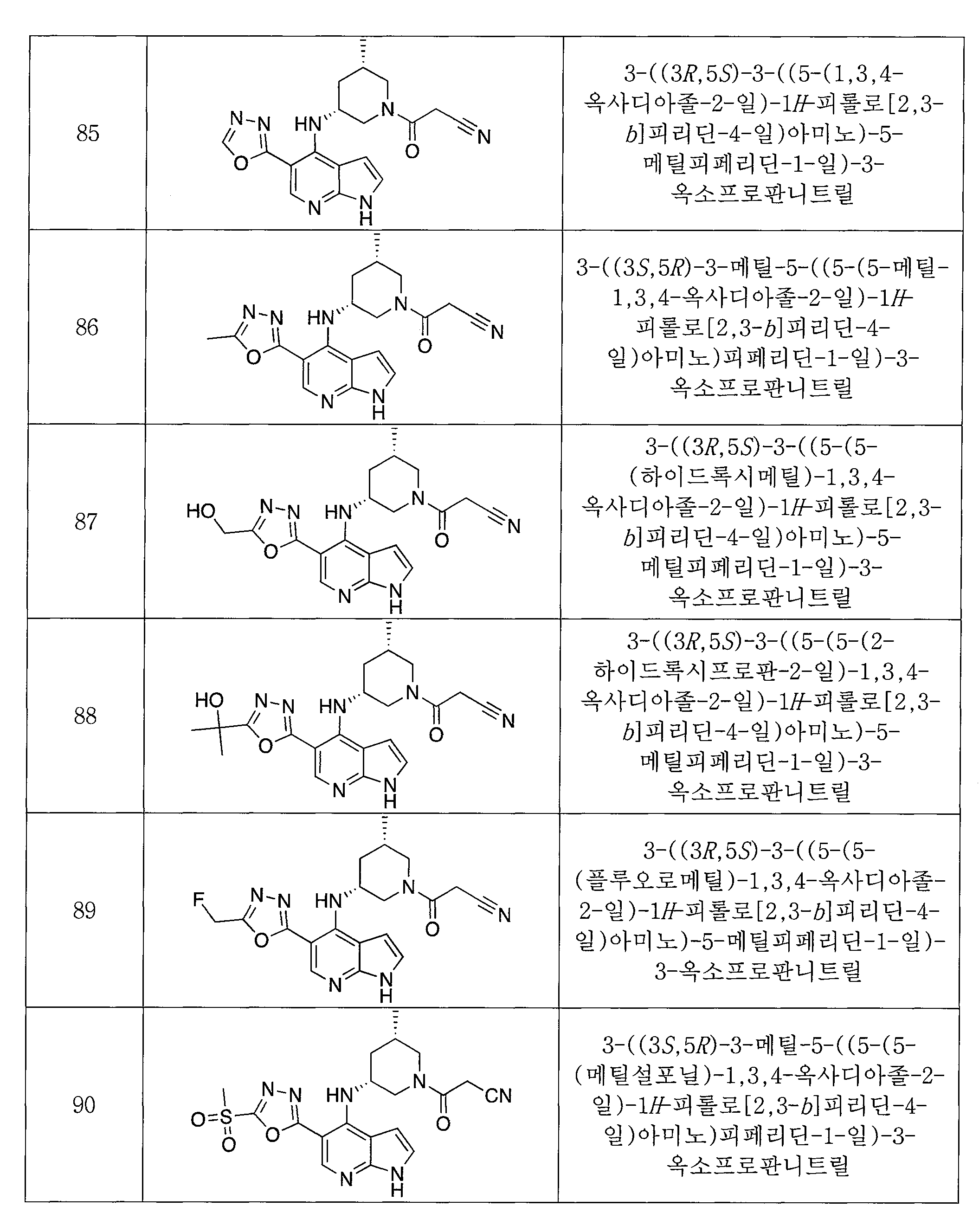
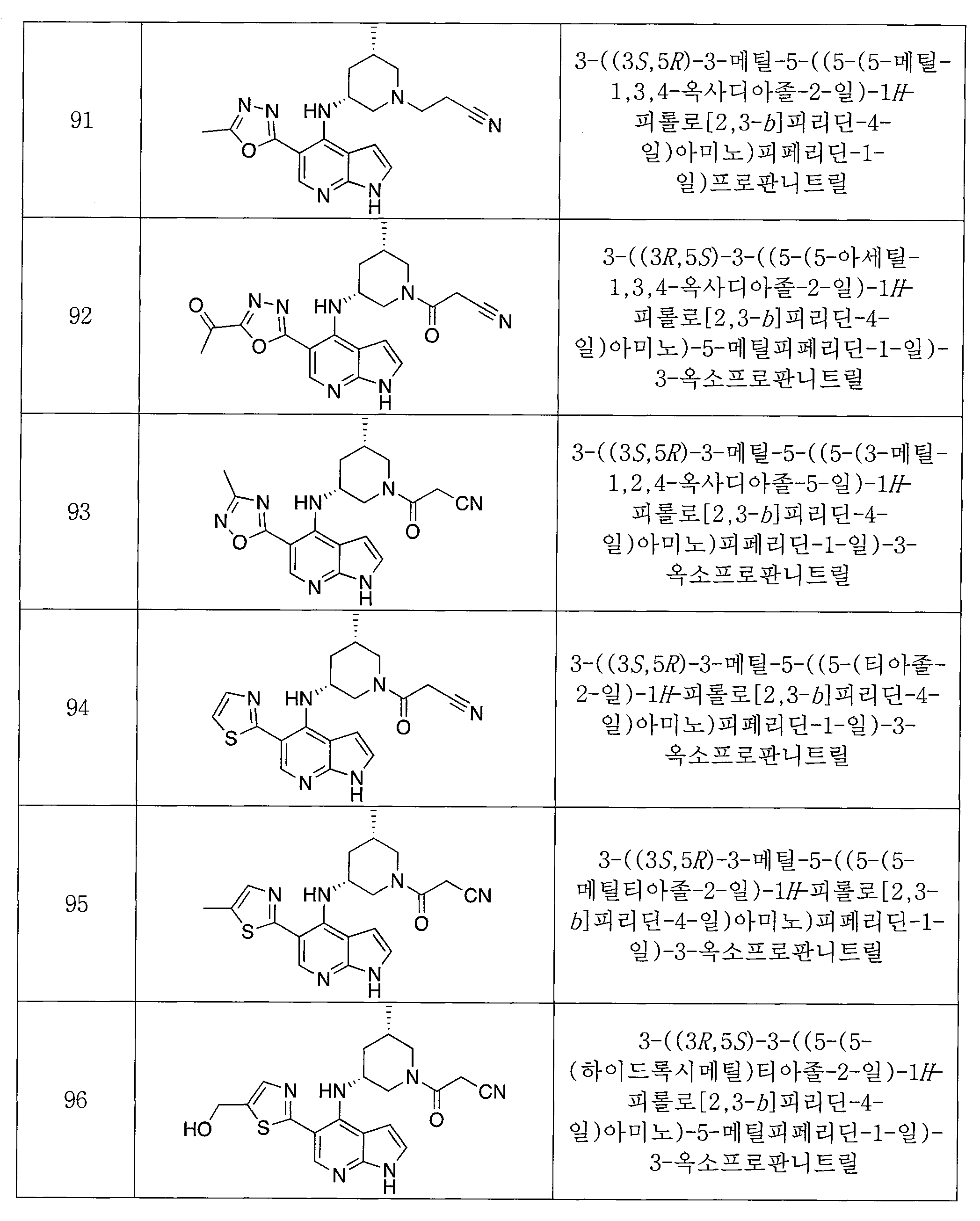


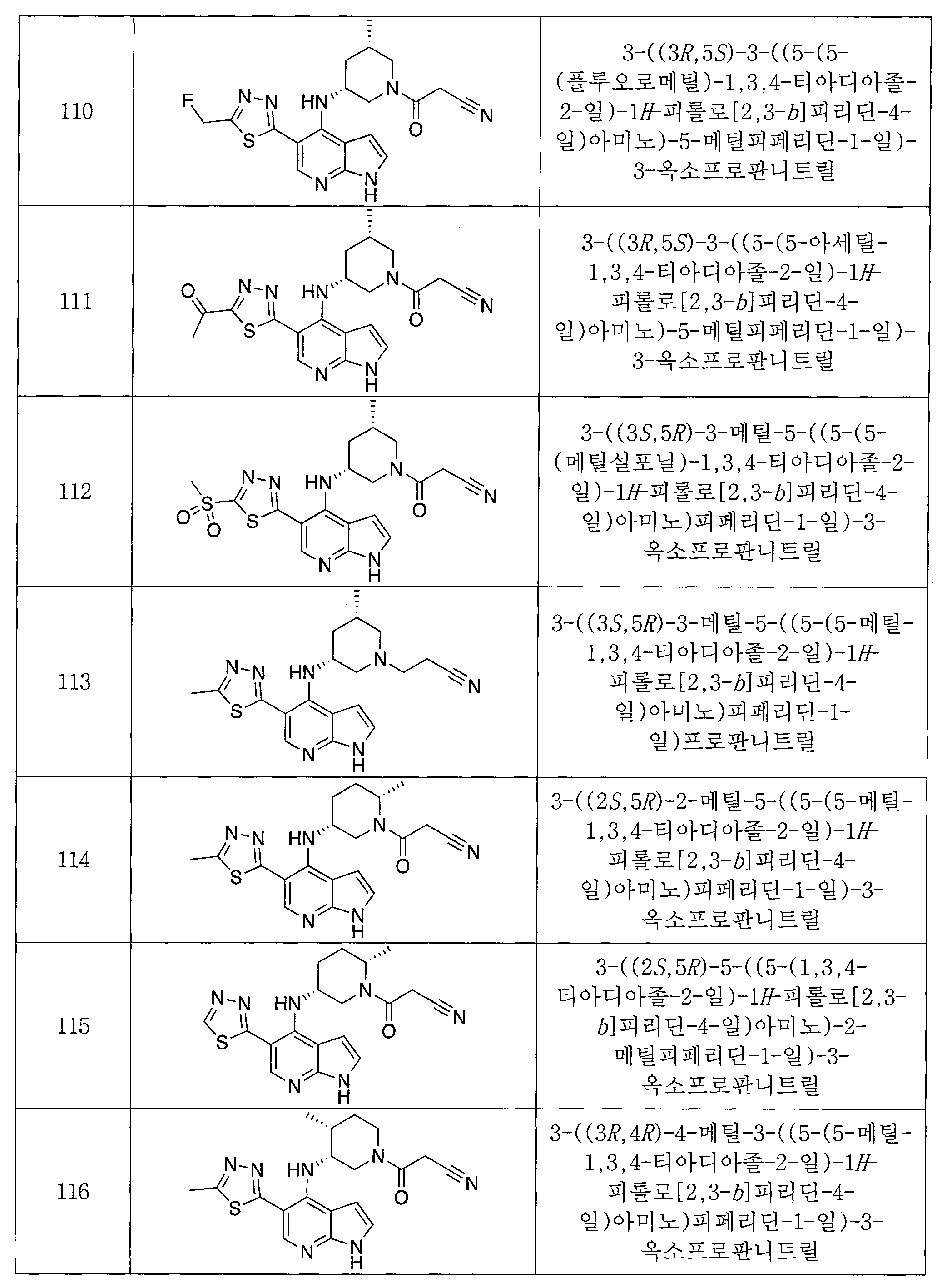


[000148] 본 발명을 화학식 (II)의 화합물의 하기 실시예들로 추가로 예시한다: [000148] The invention is further illustrated by the following examples of compounds of formula (II):

[000149] 일부 실시양태에서, 본원에 개시된 화합물은 장에 한정되어 작용한다. [000149] In some embodiments, the compounds disclosed herein are restricted to the intestine and act.
약제학적 조성물pharmaceutical composition
[000150] 본원의 일부 실시양태는 본원 실시양태의 화합물 및 약제학적으로 허용가능한 부형제를 포함하는 약제학적 조성물에 관한 것이다. [000150] Some embodiments herein relate to pharmaceutical compositions comprising a compound of the embodiments herein and a pharmaceutically acceptable excipient.
[000151] 또한, 본원에 개시된 화합물을 약제학적으로 허용가능한 부형제와 함께 포함하는 약제학적 조성물도 제공된다. [000151] Also provided is a pharmaceutical composition comprising a compound disclosed herein in association with a pharmaceutically acceptable excipient.
[000152] 일부 실시양태에서, 본원에 개시된 약제학적 조성물은 장에 한정되어 작용하는 화합물이다. [000152] In some embodiments, a pharmaceutical composition disclosed herein is a compound that acts restricted to the intestine.
[000153] 본원에 개시된 화합물을 원료 화학물질로서 투여할 수 있지만, 이들을 약제학적 조성물로서 제공하는 것도 가능하다. 따라서, 본원에 개시된 하나 이상의 특정 화합물, 또는 이들의 유도체를 이의 하나 이상의 약제학적으로 허용가능한 부형제 및 임의로는 하나 이상의 다른 치료제 성분들과 함께 포함하는 약제학적 조성물이 본원에 제공된다. 상기 부형제(들)은 해당 조성물의 다른 성분들과 양립가능하고 그 수용대상체에게 유해하지 않다는 점에서 말하는 소위 "허용가능"해야 한다. 약제학적 조성물의 적절한 제형은 선택된 투여 경로에 따라 좌우된다. 익히 공지되어 있는 임의의 기법, 담체 및 부형제들이 당업계에서 이해되는 바와 같이 적절하게 사용될 수 있다. 본원에 개시된 약제학적 조성물은, 예컨대 종래의 혼합, 용해, 과립화, 당의정-제조, 분말화(levigating), 에멀전화, 캡슐화, 포획 또는 압축 방법에 의해 당업계에 공지된 임의의 방식으로 제조될 수 있다. [000153] Although the compounds disclosed herein can be administered as raw materials, it is also possible to provide them as pharmaceutical compositions. Accordingly, provided herein are pharmaceutical compositions comprising one or more specific compounds disclosed herein, or derivatives thereof, together with one or more pharmaceutically acceptable excipients thereof and optionally one or more other therapeutic ingredients. The excipient(s) must be so-called "acceptable" in the sense of being compatible with the other ingredients of the composition and not deleterious to the recipient thereof. Proper formulation of the pharmaceutical composition will depend upon the route of administration chosen. Any of the well-known techniques, carriers and excipients may be used as appropriate as is understood in the art. The pharmaceutical compositions disclosed herein may be prepared in any manner known in the art, such as by conventional mixing, dissolving, granulating, dragee-making, levigating, emulsifying, encapsulating, encapsulating or compressing methods. can
[000154] 일부 실시양태에서, 본원 실시양태에 따라 사용하기 위한 약제학적 조성물은 하나 이상의 생리학적으로 허용가능한 부형제를 사용하여 통상적인 방식으로 제형화될 수 있다. [000154] In some embodiments, pharmaceutical compositions for use in accordance with embodiments herein may be formulated in a conventional manner using one or more physiologically acceptable excipients.
[000155] 상기 조성물은 경구, 비경구 (피하, 피내, 근육내, 정맥내, 관절내 및 골수내 포함), 복강내, 척수강내, 경막내, 경점막, 경피, 직장내, 비강내 및 국소 (예를 들어, 피부, 협측, 설하 및 안구내 포함), 유리체강내, 또는 질내 투여에 적합한 것들을 포함하지만, 가장 적절한 경로는, 예를 들어 수용대상체의 병태 및 장애에 좌우될 수 있다. 상기 조성물은 데포 주사 또는 이식물에 의한 투여에 적절한 것들을 포함할 수 있다. 상기 조성물은, 예를 들어 기체, 증기 또는 분말과 같은 흡입에 의한 투여에 적합한 것들을 포함할 수 있다. 상기 조성물은, 예컨대 분무기, 가습기, 흡입기 및 기화기 등을 통한 에어로졸로서 투여하기에 적합한 것들을 포함할 수 있다. 상기 조성물은 단위 제형으로 적절하게 제공될 수 있고, 약학 분야에 익히 공지된 방법들 중 어느 한 방법에 의해 제조될 수 있다. 일반적으로, 이러한 방법들은 본원에 개시된 화합물, 또는 이의 유도체 ("활성 성분")를 하나 이상의 부속 성분들을 구성하는 담체와 함께 회합시키는 단계를 포함한다. 일반적으로, 상기 조성물은 활성 성분을 액체 담체 또는 미분된 고체 담체 또는 양자 모두와 균질하고 밀접하게 회합시킨 후, 필요하다면 상기 생성물을 원하는 조성물로 성형시켜 제조된다. [000155] The composition is suitable for oral, parenteral (including subcutaneous, intradermal, intramuscular, intravenous, intraarticular and intramedullary), intraperitoneal, intrathecal, intrathecal, transmucosal, transdermal, rectal, intranasal and topical Although including those suitable for (eg, dermal, buccal, sublingual and intraocular), intravitreal, or vaginal administration, the most suitable route may depend, for example, on the condition and disorder of the recipient. The compositions may include those suitable for administration by depot injection or implantation. The compositions may include those suitable for administration by inhalation, such as, for example, gases, vapors or powders. The compositions may include those suitable for administration as an aerosol, such as via nebulizers, humidifiers, inhalers and vaporizers, and the like. The composition may be suitably provided in unit dosage form, and may be prepared by any one of methods well known in the pharmaceutical field. Generally, such methods include the step of bringing into association a compound disclosed herein, or a derivative thereof (“active ingredient”), with a carrier which constitutes one or more accessory ingredients. In general, such compositions are prepared by homogeneously and intimately bringing into association the active ingredient with liquid carriers or finely divided solid carriers or both, and then, if necessary, shaping the product into the desired composition.
[000156] 경구 투여에 적절한 본원에 개시된 화합물의 조성물은 각각 사전에 결정된 활성 성분의 양을 함유하는 캡슐, 카세제 또는 정제와 같은 개별 단위로서; 분말 또는 과립으로서; 수성 액체 또는 비수성 액체 중의 용액 또는 현탁액으로서; 또는 수중유 액체 에멀전 또는 유중수 액체 에멀전으로서 제공될 수 있다. 또한, 활성 성분은 거환(bolus), 연약 또는 페이스트로서 제공될 수도 있다. [000156] Compositions of the compounds disclosed herein suitable for oral administration may be presented as discrete units, such as capsules, cachets or tablets, each containing a predetermined amount of the active ingredient; as a powder or granules; as a solution or suspension in an aqueous or non-aqueous liquid; or as an oil-in-water liquid emulsion or a water-in-oil liquid emulsion. The active ingredient may also be presented as a bolus, ointment or paste.
[000157] 경구적으로 사용될 수 있는 약학적 제제로는 정제, 젤라틴으로 제조된 압입식 캡슐 뿐만 아니라 글리세롤 또는 소르비톨과 같은 가소제 및 젤라틴으로 제조된 연질의 밀봉 캡슐을 포함한다. 정제는 임의로 하나 이상의 부속 성분들과 함께 압축 또는 몰딩에 의해 제조될 수 있다. 압축된 정제는 임의로는 결합제, 비활성 희석제, 또는 윤활제, 표면 활성제 또는 분산제와 혼합하여, 분말 또는 과립과 같은 자유 유동성 형태의 활성 성분을 적절한 기기 중에서 압축시킴으로써 제조될 수 있다. 몰딩된 정제는 비활성 액체 희석제로 습윤화시킨 분말화 화합물의 혼합물을 적절한 기기 중에서 몰딩함으로써 제조될 수 있다. 상기 정제는 임의로는 코팅되거나 할선(score)될 수 있고, 해당 정제 안의 활성 성분의 저속 또는 제어 방출을 제공하도록 제제화될 수도 있다. 모든 경구 투여용 조성물은 이러한 투여에 적절한 용량이어야 한다. 압입식 캡슐은 락토오스와 같은 충전제, 전분과 같은 결합제 및/또는 탈크 또는 스테아린산마그네슘과 같은 윤활제, 및 임의로는 안정화제와의 혼합물 중에 활성 성분을 함유할 수 있다. 연질 캡슐에서, 활성 화합물은 적절한 액체, 예컨대 지방유, 액체 파라핀 또는 액체 폴리에틸렌 글리콜 중에 용해 또는 현탁될 수 있다. 또한, 안정화제도 첨가될 수 있다. 당의정 코어에는 적절한 코팅이 제공된다. 이러한 목적을 위해, 농축된 당 용액을 사용할 수 있는데, 이러한 용액에는 선택적으로 아라비아 검, 탈크, 폴리비닐 피롤리돈, 카보폴 겔, 폴리에틸렌 글리콜 및/또는 이산화티탄, 래커액, 및 적절한 유기 용매 또는 용매 혼합물을 함유할 수 있다. 염료 또는 안료는 상이한 조합의 활성 화합물 용량을 식별하거나 특징짓기 위해 정제 또는 당의정 코팅에 부가될 수 있다. [000157] Pharmaceutical preparations that can be used orally include tablets, press-fit capsules made of gelatin, as well as soft sealed capsules made of gelatin and a plasticizer such as glycerol or sorbitol. A tablet may be prepared by compression or molding, optionally with one or more accessory ingredients. Compressed tablets may be prepared by compressing the active ingredient in a free flowing form, such as a powder or granules, in a suitable appliance, optionally mixed with a binder, inert diluent, or lubricant, surface active agent or dispersing agent. Molded tablets may be made by molding in a suitable machine a mixture of the powdered compound moistened with an inert liquid diluent. The tablets may optionally be coated or scored and may be formulated to provide slow or controlled release of the active ingredient in the tablet. All compositions for oral administration should be in dosages suitable for such administration. Press-fitting capsules may contain the active ingredient in admixture with a filler such as lactose, a binder such as starch and/or a lubricant such as talc or magnesium stearate, and optionally a stabilizer. In soft capsules, the active compound may be dissolved or suspended in a suitable liquid, such as fatty oil, liquid paraffin or liquid polyethylene glycol. In addition, a stabilizer may be added. Dragee cores are provided with a suitable coating. For this purpose, it is possible to use concentrated sugar solutions, optionally gum arabic, talc, polyvinyl pyrrolidone, carbopol gel, polyethylene glycol and/or titanium dioxide, lacquer liquor, and suitable organic solvents or It may contain solvent mixtures. Dyestuffs or pigments may be added to tablets or dragee coatings to identify or characterize different combinations of active compound doses.
[000158] 화합물은 주사, 예를 들어 일시 주사 또는 연속 주입에 의한 비경구 투여에 맞게 제형화될 수 있다. 주사용 조성물은 보존제를 첨가한 단위 제형, 예컨대 앰풀 또는 다회분 용량의 용기로 제공될 수 있다. 약제학적 조성물은 유성 또는 수성 비히클 중 현탁액, 용액 또는 에멀전과 같은 형태를 취할 수 있으며, 현탁제, 안정화제 및/또는 분산제와 같은 제형제를 함유할 수 있다. 상기 조성물은 단위 용량 또는 다회분 용량의 용기, 예를 들어 밀봉 앰풀 및 바이알로 제공될 수 있으며, 사용 직전에 멸균 액체 담체, 예를 들어 식염수 또는 멸균 증류수의 첨가만 필요한 동결 건조 (냉동건조) 조건이나 분말 형태로 보관할 수 있다. 즉석조제용 주사액 및 현탁액은 이미 기술한 종류의 멸균 분말, 과립 및 정제로부터 제조될 수 있다. [000158] The compounds may be formulated for parenteral administration by injection, for example by bolus injection or continuous infusion. Compositions for injection may be presented in unit dosage form with added preservative, such as in ampoules or in multi-dose containers. Pharmaceutical compositions may take such forms as suspensions, solutions or emulsions in oily or aqueous vehicles, and may contain formulatory agents such as suspending, stabilizing and/or dispersing agents. The compositions may be presented in unit-dose or multi-dose containers, such as sealed ampoules and vials, and freeze-drying (freeze-drying) conditions requiring only the addition of a sterile liquid carrier, such as saline or sterile distilled water, immediately prior to use. Or it can be stored in powder form. Extemporaneous injection solutions and suspensions can be prepared from sterile powders, granules and tablets of the kind previously described.
[000159] 비경구 투여용 약제학적 조성물은, 산화방지제, 완충제, 정균제 및 해당 제제를 대상 수용자의 혈액과 등장성이 되도록 하는 용질을 함유할 수 있는 활성 화합물의 수성 및 비수성 (유성) 멸균 주사액; 및 현탁제 및 증점제를 포함할 수 있는 수성 및 비수성 멸균 현탁액을 포함한다. 적절한 친유성 용매 또는 비히클로는 지방유, 예컨대 참기름, 또는 합성 지방산 에스테르, 예컨대 에틸 올레에이트 또는 트리글리세리드, 또는 리포솜을 포함한다. 수성 주사 현탁액은 나트륨 카르복시메틸 셀룰로오스, 소르비톨, 또는 덱스트란과 같은 현탁액의 점도를 증가시키는 물질들을 함유할 수 있다. 임의로, 현탁액은 적절한 안정화제 또는 고농축 용액의 제조가 가능하도록 화합물의 용해도를 증가시키는 제제를 함유할 수도 있다. [000159] Pharmaceutical compositions for parenteral administration include aqueous and non-aqueous (oily) sterile injection solutions of an active compound which may contain antioxidants, buffers, bacteriostats and solutes that render the preparation isotonic with the blood of the subject recipient. ; and aqueous and non-aqueous sterile suspensions which may contain suspending and thickening agents. Suitable lipophilic solvents or vehicles include fatty oils such as sesame oil, or synthetic fatty acid esters such as ethyl oleate or triglycerides, or liposomes. Aqueous injection suspensions may contain substances which increase the viscosity of the suspension, such as sodium carboxymethyl cellulose, sorbitol, or dextran. Optionally, the suspension may contain suitable stabilizers or agents which increase the solubility of the compound to allow the preparation of highly concentrated solutions.
[000160] 앞서 기재한 약제학적 조성물 이외에도, 화합물은 데포 제제로서 제형화될 수도 있다. 이러한 장시간 지속형 조성물은 이식 (예를 들어, 피하 또는 근육내) 또는 근육내 주사에 의해 투여될 수 있다. 따라서, 예를 들어 화합물은 적절한 중합체성 또는 소수성 물질 (예를 들어, 허용가능한 오일 중 에멀전으로서) 또는 이온 교환 수지와 함께 제제화되거나, 또는 난용성 유도체로서, 예를 들어 난용성 염으로서 제제화될 수 있다. [000160] In addition to the pharmaceutical compositions described above, the compounds may also be formulated as depot preparations. Such long-acting compositions can be administered by implantation (eg, subcutaneously or intramuscularly) or by intramuscular injection. Thus, for example, the compound may be formulated with a suitable polymeric or hydrophobic material (eg, as an emulsion in an acceptable oil) or ion exchange resin, or as a sparingly soluble derivative, eg, as a sparingly soluble salt. have.
[000161] 협측 또는 설하 투여를 위해, 약제학적 조성물은 통상적인 방식으로 제형화된 정제, 로젠지, 캔디(pastille) 또는 겔 형태를 취할 수도 있다. 이러한 조성물은 수크로스 및 아카시아 또는 트라가칸트와 같은 향미를 첨가한 기재 중에 활성 성분을 포함할 수 있다. [000161] For buccal or sublingual administration, the pharmaceutical compositions may take the form of tablets, lozenges, pastilles or gels formulated in a conventional manner. Such compositions may include the active ingredient in a base to which sucrose and flavored such as acacia or tragacanth are added.
[000162] 또한, 화합물은 직장내 조성물, 예컨대 좌제 또는 정체 관장, 예를 들어 종래의 좌제 기재, 예컨대 코코아 버터, 폴리에틸렌 글리콜 또는 기타 글리세리드를 함유한 것들로 제제화될 수 있다. [000162] The compounds may also be formulated in rectal compositions, such as suppositories or retention enemas, such as those containing conventional suppository bases such as cocoa butter, polyethylene glycol or other glycerides.
[000163] 본원에 개시된 특정 화합물은 국소, 즉 비전신적 투여에 의해 투여될 수 있다. 여기에는 본원에 개시된 화합물의 표피 또는 구강으로의 외부적 적용, 및 이러한 화합물의 귀, 눈 및 코 내로의 점적주사가 포함된다. 이와는 반대로, 전신적 투여는 경구, 정맥내, 복강내 및 근육내 투여를 가리킨다. [000163] Certain compounds disclosed herein may be administered by topical, ie, non-systemic administration. This includes external application of the compounds disclosed herein to the epidermis or oral cavity, and instillation of such compounds into the ears, eyes, and nose. In contrast, systemic administration refers to oral, intravenous, intraperitoneal and intramuscular administration.
[000164] 일부 실시양태에서, 본원에 개시된 화합물은 눈으로 투여될 수 있다. 일부 실시양태에서, 본원에 개시된 화합물은 안과용 조성물로 투여될 수 있다. 본원 실시양태의 화합물은, 예를 들어 국소 투여용 점안제, 분무제 또는 점안액을 비롯한 액체 제제로서 투여될 수 있다. 일부 실시양태에서, 본원에 개시된 화합물은 예를 들어 크림, 로션, 겔, 연고 또는 페이스트와 같이 눈꺼풀에 도포하는 반고체 제제로서 투여될 수 있다. 일부 실시양태에서, 본원에 개시된 화합물은 예를 들어 분말과 같이 눈 표면에 도포되어 변형된 방출을 만들어내는 고체 제형으로서 투여될 수 있다. 일부 실시양태에서, 본원 실시양태의 화합물은 외과 이식용 장치, 비경구 제품 (예컨대, 각막내 또는 유리체강내 제품), 관개용 액체 등을 통해 투여된다. 일부 실시양태에서, 본원에 개시된 화합물을 포함하는 약제학적 조성물은 멸균되어 미립자 물질들이 없다. 일부 실시양태에서, 본원에 개시된 화합물은 안구내 주사, 안와내 주사 또는 유리체강내 주사에 의해 투여될 수 있다. 일부 실시양태에서, 상기 안구내 주사는 눈의 전방부, 눈의 후방부 또는 이들의 조합에 대한 것일 수 있다. 예를 들어, 본원에 개시된 화합물은 눈의 후방부 안와내 영역에 투여될 수 있다. [000164] In some embodiments, a compound disclosed herein may be administered ophthalmically. In some embodiments, the compounds disclosed herein may be administered in an ophthalmic composition. The compounds of the embodiments herein may be administered as liquid formulations, including, for example, eye drops, sprays, or eye drops for topical administration. In some embodiments, the compounds disclosed herein can be administered as semi-solid formulations that are applied to the eyelids, for example, as creams, lotions, gels, ointments, or pastes. In some embodiments, the compounds disclosed herein can be administered as a solid dosage form, for example, as a powder, applied to the surface of the eye to produce a modified release. In some embodiments, a compound of the embodiments herein is administered via a device for surgical implantation, a parenteral product (eg, an intracorneal or intravitreal product), an irrigation liquid, and the like. In some embodiments, pharmaceutical compositions comprising a compound disclosed herein are sterile and free of particulate matter. In some embodiments, the compounds disclosed herein may be administered by intraocular injection, intraorbital injection, or intravitreal injection. In some embodiments, the intraocular injection may be for the anterior portion of the eye, the posterior portion of the eye, or a combination thereof. For example, a compound disclosed herein can be administered to the posterior intraorbital region of the eye.
[000165] 일부 실시양태에서, 국소 투여용으로 적합한 약제학적 조성물로는 용액, 분말, 유체 에멀젼, 유체 현탁액, 반고체, 연고, 페이스트, 크림, 겔, 젤리, 발포체, 도찰제, 로션 및 눈, 귀 또는 코 투여에 적절한 점적제와 같이 피부를 통해 염증 부위로 침투하는데 적절한 액체 또는 반액체 제제를 포함한다. 국소 투여용 활성 성분은, 예를 들어 해당 조성물 중 0.001 내지 10% w/w (중량 기준)를 차지할 수 있다. 특정 실시양태에서, 활성 성분은 10% w/w 정도로 포함될 수 있다. 기타 실시양태에서, 활성 성분은 5% w/w 미만으로 포함될 수 있다. 특정 실시양태에서, 활성 성분은 2% w/w 내지 5% w/w로 포함될 수 있다. 기타 실시양태에서, 활성 성분은 해당 조성물 중 0.1% 내지 1% w/w를 차지할 수 있다. [000165] In some embodiments, pharmaceutical compositions suitable for topical administration include solutions, powders, fluid emulsions, fluid suspensions, semisolids, ointments, pastes, creams, gels, jellies, foams, liniments, lotions and eye, ear or liquid or semi-liquid preparations suitable for penetration through the skin into the site of inflammation, such as drops suitable for nasal administration. The active ingredient for topical administration may, for example, account for 0.001 to 10% w/w (by weight) of the composition in question. In certain embodiments, the active ingredient may be included on the order of 10% w/w. In other embodiments, the active ingredient may be included at less than 5% w/w. In certain embodiments, the active ingredient may be comprised between 2% w/w and 5% w/w. In other embodiments, the active ingredient may comprise from 0.1% to 1% w/w of the composition in question.
[000166] 국소 또는 경피 투여용 겔은 일반적으로 휘발성 용매, 비휘발성 용매 및 물의 혼합물을 포함할 수 있다. 특정 실시양태에서, 완충 용매 시스템의 휘발성 용매 성분은 저급 (C1-C6) 알킬 알코올, 저급 알킬 글리콜 및 저급 글리콜 중합체를 포함할 수 있다. 추가의 실시양태에서, 상기 휘발성 용매는 에탄올이다. 상기 휘발성 용매 성분은 투과성 향상제로서 작용하는 한편, 증발 시 피부에 냉각 효과를 부여하는 것으로 생각된다. 완충 용매 시스템의 비휘발성 용매 부분은 저급 알킬렌 글리콜 및 저급 글리콜 중합체로부터 선택된다. 특정 실시양태에서, 프로필렌 글리콜이 사용된다. 상기 비휘발성 용매는 휘발성 용매의 증발을 늦추고, 완충 용매 시스템의 증기압을 감소시킨다. 상기 비휘발성 용매 성분의 양은, 휘발성 용매에서와 같이, 사용되는 약제학적 화합물 또는 약물에 의해 결정된다. 해당 시스템에서 비휘발성 용매가 너무 소량인 경우에는, 약제학적 화합물은 휘발성 용매의 증발로 인해 결정화될 수 있지만, 과량인 경우에는 용매 혼합물로부터 약물 방출이 좋지 않아 생체이용률이 부족한 결과를 초래할 수 있다. 완충 용매 시스템의 완충제 성분은 당업계에 흔히 사용되는 임의의 완충제로부터 선택될 수 있으며; 특정 실시양태에서는, 물이 사용된다. 성분들의 통상적인 비율은 약 20%의 비휘발성 용매, 약 40%의 휘발성 용매 및 약 40%의 물이다. 국소용 조성물에 첨가될 수 있는 수개의 임의 성분들이 존재한다. 이들로서 킬레이트제 및 겔화제를 포함하지만, 이에 제한되지는 않는다. 적절한 겔화제로는 반합성 셀룰로오스 유도체 (예컨대, 하이드록시프로필메틸셀룰로오스) 및 합성 중합체, 및 화장제를 포함할 수 있지만, 이에 제한되지는 않는다. [000166] Gels for topical or transdermal administration may generally comprise a mixture of a volatile solvent, a non-volatile solvent and water. In certain embodiments, the volatile solvent component of the buffered solvent system may include a lower (C 1 -C 6 ) alkyl alcohol, a lower alkyl glycol, and a lower glycol polymer. In a further embodiment, said volatile solvent is ethanol. It is believed that the volatile solvent component acts as a permeability enhancer while imparting a cooling effect to the skin upon evaporation. The non-volatile solvent portion of the buffered solvent system is selected from lower alkylene glycols and lower glycol polymers. In certain embodiments, propylene glycol is used. The non-volatile solvent slows the evaporation of the volatile solvent and reduces the vapor pressure of the buffered solvent system. The amount of the non-volatile solvent component, as in a volatile solvent, is determined by the pharmaceutical compound or drug used. If the non-volatile solvent is too small in the system, the pharmaceutical compound may crystallize due to evaporation of the volatile solvent, but if it is in excess, poor drug release from the solvent mixture may result in poor bioavailability. The buffer component of the buffer solvent system may be selected from any buffer commonly used in the art; In certain embodiments, water is used. Typical proportions of the components are about 20% non-volatile solvent, about 40% volatile solvent and about 40% water. There are several optional ingredients that can be added to topical compositions. These include, but are not limited to, chelating agents and gelling agents. Suitable gelling agents may include, but are not limited to, semi-synthetic cellulose derivatives (eg, hydroxypropylmethylcellulose) and synthetic polymers, and cosmetic agents.
[000167] 로션은 피부 또는 눈에 도포하기에 적합한 것들을 포함한다. 점안제로는 임의로 살균제를 함유하는 멸균 수용액을 포함할 수 있고, 점적제의 제조를 위한 것들과 유사한 방법으로 제조될 수 있다. 피부에 도포하기 위한 로션 또는 도찰제로는 건조를 촉진하고 피부를 냉각시키는 제제, 예컨대 알코올 또는 아세톤, 및/또는 보습제, 예컨대 글리세롤 또는 오일, 예컨대 피마자유 또는 땅콩유를 포함할 수도 있다. [000167] Lotions include those suitable for application to the skin or eyes. The eye drop may comprise a sterile aqueous solution optionally containing a sterilizing agent, and may be prepared in a manner similar to those for the preparation of drops. Lotions or liniments for application to the skin may include agents that promote drying and cool the skin, such as alcohol or acetone, and/or humectants such as glycerol or oils such as castor oil or peanut oil.
[000168] 크림, 연고 또는 페이스트는 외용제를 위한 활성 성분의 반고체 약제학적 조성물이다. 이들은, 미분되거나 분말화된 형태의 활성 성분을, 적절한 기기를 사용하여 단독으로, 또는 수성 또는 비수성 유체 중의 용액 또는 현탁액 중에서 지성(greasy) 또는 비지성 기재와 혼합하여 제조될 수 있다. 상기 기재는, 알코올, 예컨대 프로필렌 글리콜 또는 마크로겔과 함께, 탄화수소, 예컨대 경질, 연질 또는 액체 파라핀, 글리세롤, 밀랍, 금속 비누; 점액; 천연 오일, 예컨대 아몬드, 옥수수, 땅콩, 피마자유 또는 올리브유; 양모지 또는 이의 유도체 또는 지방산, 예컨대 스테아르산 또는 올레산을 포함할 수 있다. 약제학적 조성물은 임의 적절한 표면 활성제, 예컨대 음이온성, 양이온성 또는 비이온성 계면활성제, 예컨대 소르비탄 에스테르 또는 이의 폴리옥시에틸렌 유도체를 포함할 수 있다. 현탁제, 예컨대 천연 검, 셀룰로오스 유도체 또는 무기 물질, 예컨대 규소질 실리카, 및 기타 성분들, 예컨대 라놀린도 포함될 수 있다. [000168] A cream, ointment or paste is a semi-solid pharmaceutical composition of the active ingredient for external application. They may be prepared by mixing the active ingredient in finely divided or powdered form, either alone or in solution or suspension in an aqueous or non-aqueous fluid, with a greasy or non-greasy substrate using an appropriate instrument. The substrate may be, together with alcohols such as propylene glycol or macrogels, hydrocarbons such as hard, soft or liquid paraffin, glycerol, beeswax, metallic soap; mucus; natural oils such as almond, corn, peanut, castor oil or olive oil; wool fat or derivatives thereof or fatty acids such as stearic acid or oleic acid. The pharmaceutical composition may include any suitable surface active agent, such as an anionic, cationic or nonionic surfactant, such as a sorbitan ester or polyoxyethylene derivative thereof. Suspending agents such as natural gums, cellulose derivatives or inorganic substances such as siliceous silica, and other ingredients such as lanolin may also be included.
[000169] 점적제는 멸균 수성 또는 유성 용액 또는 현탁액을 포함할 수 있고, 살균제 및/또는 살진균제 및/또는 임의의 기타 적절한 보존제, 및 특정 실시양태에서, 표면 활성제를 포함하는 이들의 적절한 수용액 중에 활성 성분을 용해하여 제조될 수 있다. 이후, 생성된 용액을 여과로 정제하고, 적절한 용기로 옮긴 후, 상기 용기를 밀봉하여 30분간 98-100℃로 고압살균 또는 유지시켜 살균할 수 있다. 다르게는, 상기 용액을 여과로 살균하고, 무균 기법에 의해 용기로 이동시킬 수 있다. 점적제 내에 포함시키기에 적합한 살균제 및 살진균제의 예로는 페닐질산수은 또는 아세테이트 (0.002%), 염화벤잘코늄 (0.01%) 및 클로르헥시딘 아세테이트 (0.01%)를 들 수 있다. 유성 용액의 제조에 적합한 용매로는 글리세롤, 희석된 알코올 및 프로필렌 글리콜을 포함한다. [000169] Drops may comprise sterile aqueous or oily solutions or suspensions, in suitable aqueous solutions thereof comprising a bactericide and/or fungicide and/or any other suitable preservative, and, in certain embodiments, a surface active agent. It can be prepared by dissolving the active ingredient. Thereafter, the resulting solution is purified by filtration, transferred to an appropriate container, and the container is sealed and sterilized by autoclaving or maintaining at 98-100° C. for 30 minutes. Alternatively, the solution may be sterilized by filtration and transferred to a vessel by aseptic technique. Examples of suitable fungicides and fungicides for inclusion in drops include phenylmercuric nitrate or acetate (0.002%), benzalkonium chloride (0.01%) and chlorhexidine acetate (0.01%). Suitable solvents for the preparation of oily solutions include glycerol, diluted alcohol and propylene glycol.
[000170] 구강의 국소 투여용, 예를 들어, 협측 또는 설하 투여용 약제학적 조성물로는, 수크로오스 및 아카시아 또는 트라가칸트와 같이 향미를 첨가한 기재 중에 활성 성분을 포함하는 로젠지, 및 젤라틴 및 글리세린 또는 수크로오스 및 아카시아와 같은 기재 중에 활성 성분을 포함하는 캔디를 포함한다. [000170] Pharmaceutical compositions for topical administration in the oral cavity, for example, buccal or sublingual administration, include lozenges comprising the active ingredient in a flavored base such as sucrose and acacia or tragacanth, and gelatin and candy comprising the active ingredient in a base such as glycerin or sucrose and acacia.
[000171] 흡입에 의한 투여를 위해, 화합물은 취입기, 분무기 가압형 팩 또는 에어로졸 분무를 전달하는 기타 적절한 수단으로부터 간편하게 전달될 수 있다. 가압형 팩은 적절한 분사제, 예컨대 디클로로디플루오로메탄, 트리클로로플루오로메탄, 디클로로테트라플루오로에탄, 이산화탄소 또는 기타 적절한 기체를 포함할 수 있다. 가압형 에어로졸의 경우, 용량 단위는 정량을 전달하도록 밸브를 제공함으로써 계량될 수 있다. 대안으로, 흡입 또는 취입에 의한 투여의 경우, 본 발명에 따른 화합물은 건조 분말 조성물, 예를 들어 해당 화합물과 적절한 분말 기재, 예컨대 락토오스 또는 전분의 분말 혼합물의 형태를 취할 수 있다. 상기 분말 조성물은 단위 제형, 예를 들어, 캡슐, 카트리지, 젤라틴 또는 블리스터 팩으로 제공될 수 있고, 이들의 분말은 흡입기 또는 취입기를 사용하여 투여될 수 있다. [000171] For administration by inhalation, the compounds may conveniently be delivered from an insufflator, nebulizer pressurized pack, or other suitable means of delivering an aerosol spray. The pressurized pack may contain a suitable propellant such as dichlorodifluoromethane, trichlorofluoromethane, dichlorotetrafluoroethane, carbon dioxide or other suitable gas. In the case of a pressurized aerosol, the dosage unit may be metered by providing a valve to deliver a dose. Alternatively, for administration by inhalation or insufflation, the compounds according to the invention may take the form of a dry powder composition, for example a powder mixture of the compound with a suitable powder base such as lactose or starch. The powder composition may be provided in unit dosage form, for example, in capsules, cartridges, gelatin or blister packs, and the powders thereof may be administered using an inhaler or insufflator.
[000172] 바람직한 단위 용량 약제학적 조성물로는, 본원에서 하기 언급되는 바와 같은 활성 성분의 유효 투여량, 또는 이의 적당한 분획량을 함유하는 조성물을 들 수 있다. [000172] Preferred unit dose pharmaceutical compositions include compositions containing an effective dosage of the active ingredient, or suitable fractions thereof, as referred to herein below.
[000173] 상기 구체적으로 언급된 성분들 이외에, 상술한 약제학적 조성물은 논의 중인 약제학적 조성물의 유형과 관련된 당업계의 통상적인 기타 제제들을 포함할 수 있는 바, 예를 들어 경구 투여용으로 적합한 조성물은 향미제를 포함할 수 있음이 이해될 것이다. [000173] In addition to the ingredients specifically mentioned above, the pharmaceutical composition described above may include other agents conventional in the art relevant to the type of pharmaceutical composition in question, for example a composition suitable for oral administration It will be understood that silver may include a flavoring agent.
[000174] 화합물은 하루에 0.1 내지 500 mg/kg의 용량으로 투여될 수 있다. 성인 인간에 대한 용량 범위는 일반적으로 하루에 5 mg 내지 2 g이다. 별도의 단위로 제공된 정제 또는 기타 형태의 제공물은, 이러한 용량으로 유효한 소정량의 하나 이상의 화합물을 적절히 포함하거나, 또는 다수의 상기 화합물을, 예를 들어 5 mg 내지 500 mg, 통상적으로 대략 10 mg 내지 200 mg을 함유하는 단위로서 적절히 포함할 수 있다. [000174] The compound may be administered at a dose of 0.1 to 500 mg/kg per day. The dosage range for adult humans is generally 5 mg to 2 g per day. Tablets or other forms of presentation, provided as separate units, suitably contain a predetermined amount of one or more compounds effective in such dosages, or a plurality of such compounds, for example from 5 mg to 500 mg, usually approximately 10 mg. to 200 mg may be included as appropriate.
[000175] 단일 제형의 제조를 위해 담체 물질과 조합될 수 있는 활성 성분의 양은 구체적인 투여 방식과 치료되는 대상체에 따라 달라질 것이다. [000175] The amount of active ingredient that may be combined with the carrier materials to prepare a single dosage form will vary depending upon the particular mode of administration and the subject being treated.
[000176] 약제로서 사용되는 경우, 화합물은 약제학적 조성물의 형태로 투여될 수 있다. 이러한 조성물은 약학 분야에 널리 공지된 방식으로 제조될 수 있고, 국소 또는 전신적 치료가 바람직한지의 여부 및 치료될 부위에 따라 다양한 경로로 투여될 수 있다. 개시된 화합물 또는 조성물의 투여는 경구, 비경구 (피하, 피내, 근육내, 정맥내, 관절내 및 골수내 포함), 폐 (예컨대, 분무기에 의한 것을 포함하는 분말 또는 에어로졸의 흡입 또는 취입; 기관내 또는 비강내 포함), 복강내, 척수강내, 경막내, 경점막, 경피, 직장, 국소 (피부, 협측, 설하 및 안구내 포함) 또는 질내 투여일 수 있다. 비경구 투여는 정맥내, 동맥내, 피하, 복강내, 근육내 또는 주사 또는 주입; 또는 두개내, 예컨대, 척수강내 또는 심실내 투여를 포함한다. 비경구 투여는 단회 일시 투여량의 형태일 수 있거나, 예를 들어 연속 관류 펌프에 의한 것일 수 있다. 국소 투여용 약제학적 조성물은 발포체, 경피용 패치, 연고, 로션, 크림, 겔, 용액, 유체 에멀전, 유체 현탁액, 반고체, 페이스트, 점적제, 좌제, 분무제, 액체 및 분말을 포함할 수 있다. 통상적인 약제학적 담체, 수성, 분말 또는 유성 기재, 증점제 등이 필요하거나 바람직할 수 있다. 코팅된 콘돔, 장갑 등도 유용할 수 있다. 일부 실시양태에서, 화합물은 약제학적으로 허용가능한 희석제, 충전제, 붕해제, 결합제, 윤활제, 계면활성제, 소수성 비히클, 수용성 비히클, 유화제, 완충제, 습윤제, 보습제, 가용화제, 보존제 등과 함께 이러한 약제학적 조성물에 함유될 수 있다. 당업자라면 누구나 길잡이용으로 다양한 약리학적 참조 문헌을 참조할 수 있다. 예를 들어, 문헌 [Modern Pharmaceutics, 5th Edition, Banker & Rhodes, CRC Press (2009)]; 및 [Goodman & Gilman's The Pharmaceutical Basis of Therapeutics, 13th Edition, McGraw Hill, New York (2018)]을 참조할 수 있다. [000176] When used as a medicament, the compound may be administered in the form of a pharmaceutical composition. Such compositions may be prepared in a manner well known in the pharmaceutical art, and may be administered by various routes depending on whether local or systemic treatment is desired and the site to be treated. Administration of the disclosed compounds or compositions may be oral, parenteral (including subcutaneous, intradermal, intramuscular, intravenous, intraarticular and intramedullary), pulmonary (eg, inhalation or insufflation of powders or aerosols, including by nebulizer; intratracheal; or intranasal), intraperitoneal, intrathecal, intrathecal, transmucosal, transdermal, rectal, topical (including dermal, buccal, sublingual and intraocular) or vaginal administration. Parenteral administration includes intravenous, intraarterial, subcutaneous, intraperitoneal, intramuscular or injection or infusion; or intracranial, such as intrathecal or intraventricular administration. Parenteral administration may be in the form of a single bolus dose or may be, for example, by means of a continuous perfusion pump. Pharmaceutical compositions for topical administration may include foams, transdermal patches, ointments, lotions, creams, gels, solutions, fluid emulsions, fluid suspensions, semisolids, pastes, drops, suppositories, sprays, liquids and powders. Conventional pharmaceutical carriers, aqueous, powdery or oily bases, thickeners and the like may be necessary or desirable. Coated condoms, gloves, etc. may also be useful. In some embodiments, the compound is combined with a pharmaceutically acceptable diluent, filler, disintegrant, binder, lubricant, surfactant, hydrophobic vehicle, water-soluble vehicle, emulsifier, buffer, wetting agent, humectant, solubilizing agent, preservative, and the like in such a pharmaceutical composition. may be contained in Those skilled in the art can refer to various pharmacological references for guidance. See, eg, Modern Pharmaceutics, 5th Edition, Banker & Rhodes, CRC Press (2009); and Goodman &Gilman's The Pharmaceutical Basis of Therapeutics, 13th Edition, McGraw Hill, New York (2018).
[000177] 일부 실시양태에서, 본원에 개시된 실시양태의 약제학적 조성물을 투여하는 JAK 키나제 매개성 질환의 치료 방법이 개시된다. 일부 실시양태에서, 화합물은 치료학적 유효량으로 존재한다. 일부 실시양태에서, 상기 치료학적 유효량은 본원에 개시된 양이다. [000177] In some embodiments, a method of treating a JAK kinase mediated disease comprising administering a pharmaceutical composition of an embodiment disclosed herein is disclosed. In some embodiments, the compound is present in a therapeutically effective amount. In some embodiments, the therapeutically effective amount is an amount disclosed herein.
[000178] 또한, 본원에 개시된 일부 실시양태는 활성 성분으로서 본원에 개시된 하나 이상의 화합물을 하나 이상의 약제학적으로 허용가능한 담체(부형제)와 함께 포함하는 약제학적 조성물도 포함한다. [000178] Some embodiments disclosed herein also include pharmaceutical compositions comprising, as an active ingredient, one or more compounds disclosed herein in association with one or more pharmaceutically acceptable carriers (excipients).
[000179] 일부 실시양태에서, 약제학적 조성물의 제조 방법은, 활성 성분을 부형제와 혼합하거나, 부형제를 사용하여 활성 성분을 희석하거나, 예를 들어 캡슐, 향냥, 종이, 또는 다른 용기의 형태로 담체 내에 활성 성분을 봉입하는 단계를 포함한다. 부형제가 희석제로서 기능하는 경우, 이는 활성 성분을 위한 비히클, 담체 또는 매질로서 작용하는 고체, 반고체 또는 액체 물질일 수 있다. 따라서, 약제학적 조성물은 정제, 환제, 분말제, 로젠지, 향낭, 카세제, 엘릭시르제, 현탁제, 에멀전, 용액, 시럽, 에어로졸 (고체로서 또는 액체 매질로), 예를 들어 최대 10 중량%의 활성 화합물을 함유하는 연고, 연질 및 경질 젤라틴 캡슐, 좌제, 멸균 주사액 및 멸균 포장된 분말의 형태로 존재할 수 있다. [000179] In some embodiments, the method for preparing a pharmaceutical composition comprises mixing the active ingredient with an excipient, diluting the active ingredient with an excipient, or a carrier in the form of, for example, a capsule, perfume, paper, or other container. encapsulating the active ingredient therein. When an excipient functions as a diluent, it may be a solid, semi-solid or liquid substance that serves as a vehicle, carrier or medium for the active ingredient. Thus, the pharmaceutical composition may be formulated in tablets, pills, powders, lozenges, sachets, cachets, elixirs, suspensions, emulsions, solutions, syrups, aerosols (as solid or in liquid medium), for example up to 10% by weight. ointments, soft and hard gelatin capsules, suppositories, sterile injectable solutions and sterile packaged powders containing the active compound of
[000180] 적절한 부형제의 일부 예로는 락토오스, 덱스트로스, 수크로오스, 소르비톨, 만니톨, 전분, 아카시아 검, 인산칼슘, 알기네이트, 트라가칸트, 젤라틴, 칼슘 실리케이트, 미세결정질 셀룰로오스, 폴리비닐피롤리돈, 셀룰로오스, 물, 시럽, 메틸 셀룰로오스 및 공융 용매, 공융계 이온성 액체 또는 이온성 액체를 포함한다. 약제학적 조성물은 탈크, 스테아린산마그네슘 및 광물유와 같은 윤활제; 습윤제; 유화제 및 현탁제; 메틸- 및 프로필하이드록시-벤조 에이트와 같은 보존제; 감미제; 및 향미제를 추가로 포함할 수 있다. 환자에게 투여한 후 활성 성분의 신속, 지속 또는 지연 방출을 제공하도록 당업계에 공지된 절차를 이용하여 약제학적 조성물을 제형화할 수 있다. [000180] Some examples of suitable excipients include lactose, dextrose, sucrose, sorbitol, mannitol, starch, gum acacia, calcium phosphate, alginate, tragacanth, gelatin, calcium silicate, microcrystalline cellulose, polyvinylpyrrolidone, cellulose, water, syrup, methyl cellulose and eutectic solvents, eutectic ionic liquids or ionic liquids. The pharmaceutical composition may contain lubricants such as talc, magnesium stearate and mineral oil; wetting agent; emulsifying and suspending agents; preservatives such as methyl- and propylhydroxy-benzoates; sweetener; and flavoring agents. Pharmaceutical compositions may be formulated using procedures known in the art to provide rapid, sustained or delayed release of the active ingredient after administration to a patient.
[000181] 상기 약제학적 조성물은 단위 제형으로 제형화할 수 있다. "단위 제형"이라는 용어는 인간 대상체 및 기타 포유동물에 대한 단일 용량으로 적합한 물리적으로 구분된 별개의 단위를 지칭하며, 각 단위는 적절한 약제학적 부형제와 함께 목적하는 치료 효과를 나타내도록 계산된 사전에 결정된 양의 활성 물질을 함유한다. [000181] The pharmaceutical composition may be formulated in a unit dosage form. The term "unit dosage form" refers to physically discrete discrete units suitable as single doses for human subjects and other mammals, each unit being previously calculated to produce the desired therapeutic effect in association with an appropriate pharmaceutical excipient. It contains a determined amount of the active substance.
[000182] 활성 화합물은 광범위한 투여량 범위에 대해 효과적일 수 있고, 일반적으로 치료학적 유효량으로 투여될 수 있다. 그러나, 실제로 투여되는 화합물의 양은 치료될 병태, 선택된 투여 경로, 투여된 실제 화합물, 연령, 체중, 및 개별 환자의 반응, 환자 증상의 중증도 등을 비롯한 관련 부대상황에 따라 통상적으로 의사에 의해 결정될 것임은 이해할 수 있을 것이다. [000182] The active compound may be effective over a wide dosage range and will generally be administered in a therapeutically effective amount. However, the amount of compound actually administered will ordinarily be determined by the physician according to the relevant circumstances, including the condition to be treated, the route of administration selected, the actual compound administered, the age, weight, and response of the individual patient, the severity of the patient's symptoms, etc. will be able to understand
[000183] 일부 실시양태에서, 약제학적 조성물은 약 0.01% 내지 약 50%의 본원에 개시된 하나 이상의 화합물을 포함할 수 있다. 일부 실시양태에서, 상기 하나 이상의 화합물은 약 0.01% 내지 약 50%, 약 0.01% 내지 약 45%, 약 0.01% 내지 약 40%, 약 0.01% 내지 약 30%, 약 0.01% 내지 약 20%, 약 0.01% 내지 약 10%, 약 0.01% 내지 약 5%, 약 0.05% 내지 약 50%, 약 0.05% 내지 약 45%, 약 0.05% 내지 약 40%, 약 0.05% 내지 약 30%, 약 0.05% 내지 약 20%, 약 0.05% 내지 약 10%, 약 0.1% 내지 약 50%, 약 0.1% 내지 약 45%, 약 0.1% 내지 약 40%, 약 0.1% 내지 약 30%, 약 0.1% 내지 약 20%, 약 0.1% 내지 약 10%, 약 0.1% 내지 약 5%, 약 0.5% 내지 약 50%, 약 0.5% 내지 약 45%, 약 0.5% 내지 약 40%, 약 0.5% 내지 약 30%, 약 0.5% 내지 약 20%, 약 0.5% 내지 약 10%, 약 0.5% 내지 약 5%, 약 1% 내지 약 50%, 약 1% 내지 약 45%, 약 1% 내지 약 40%, 약 1% 내지 약 35%, 약 1% 내지 약 30%, 약 1% 내지 약 25%, 약 1% 내지 약 20%, 약 1% 내지 약 15%, 약 1% 내지 약 10%, 약 1% 내지 약 5%, 약 5% 내지 약 45%, 약 5% 내지 약 40%, 약 5% 내지 약 35%, 약 5% 내지 약 30%, 약 5% 내지 약 25%, 약 5% 내지 약 20%, 약 5% 내지 약 15%, 약 5% 내지 약 10%, 약 10% 내지 약 45%, 약 10% 내지 약 40%, 약 10% 내지 약 35%, 약 10% 내지 약 30%, 약 10% 내지 약 25%, 약 10% 내지 약 20%, 약 10% 내지 약 15%, 또는 상기 범위들 한 범위 내 수치의 양으로 존재한다. 구체적인 예로는 약 0.01%, 약 0.05%, 약 0.1%, 약 0.25%, 약 0.5%, 약 0.75%, 약 1%, 약 5%, 약 10%, 약 15%, 약 20%, 약 25%, 약 30%, 약 35%, 약 40%, 약 45%, 약 50%, 약 60%, 약 70%, 약 80%, 약 90%, 또는 상기 수치들 중 임의의 두 수치 사이의 범위를 포함할 수 있다. 전술한 것들은 모두 약제학적 조성물의 중량 백분율을 나타낸다. 일부 실시양태에서, 약제학적 조성물은 국소 투여에 적합하다. 일부 실시양태에서, 약제학적 조성물은 경구, 비경구 (피하, 피내, 근육내, 정맥내, 관절내 및 골수내 포함), 복강내, 척수강내, 경막내, 경점막, 경피, 직장, 비강내, 국소 (예컨대, 피부, 협측, 설하 및 안구내 포함), 유리체강내 또는 질내 투여에 적합하다. [000183] In some embodiments, the pharmaceutical composition may comprise from about 0.01% to about 50% of one or more compounds disclosed herein. In some embodiments, the one or more compounds is from about 0.01% to about 50%, from about 0.01% to about 45%, from about 0.01% to about 40%, from about 0.01% to about 30%, from about 0.01% to about 20%, about 0.01% to about 10%, about 0.01% to about 5%, about 0.05% to about 50%, about 0.05% to about 45%, about 0.05% to about 40%, about 0.05% to about 30%, about 0.05 % to about 20%, about 0.05% to about 10%, about 0.1% to about 50%, about 0.1% to about 45%, about 0.1% to about 40%, about 0.1% to about 30%, about 0.1% to about 20%, about 0.1% to about 10%, about 0.1% to about 5%, about 0.5% to about 50%, about 0.5% to about 45%, about 0.5% to about 40%, about 0.5% to about 30 %, about 0.5% to about 20%, about 0.5% to about 10%, about 0.5% to about 5%, about 1% to about 50%, about 1% to about 45%, about 1% to about 40%, about 1% to about 35%, about 1% to about 30%, about 1% to about 25%, about 1% to about 20%, about 1% to about 15%, about 1% to about 10%, about 1 % to about 5%, about 5% to about 45%, about 5% to about 40%, about 5% to about 35%, about 5% to about 30%, about 5% to about 25%, about 5% to about 20%, about 5% to about 15%, about 5% to about 10%, about 10% to about 45%, about 10% to about 40%, about 10% to about 35%, about 10% to about 30 %, from about 10% to about 25%, from about 10% to about 20%, from about 10% to about 15%, or an amount within one of the above ranges. Specific examples include about 0.01%, about 0.05%, about 0.1%, about 0.25%, about 0.5%, about 0.75%, about 1%, about 5%, about 10%, about 15%, about 20%, about 25% , about 30%, about 35%, about 40%, about 45%, about 50%, about 60%, about 70%, about 80%, about 90%, or a range between any two of the above values. may include All of the above refer to weight percentages of the pharmaceutical composition. In some embodiments, the pharmaceutical composition is suitable for topical administration. In some embodiments, the pharmaceutical composition is oral, parenteral (including subcutaneous, intradermal, intramuscular, intravenous, intraarticular and intramedullary), intraperitoneal, intrathecal, intrathecal, transmucosal, transdermal, rectal, intranasal , topical (including eg dermal, buccal, sublingual and intraocular), intravitreal or intravaginal administration.
[000184] 일부 실시양태에서, 화합물은 치료학적 유효량으로 존재한다. 일부 실시양태에서, 상기 치료학적 유효량은 약 1 mg 내지 약 1000 mg, 약 1 mg 내지 약 900 mg, 약 1 mg 내지 약 800 mg, 약 1 mg 내지 약 700 mg, 약 1 mg 내지 약 600 mg, 약 1 mg 내지 약 500 mg, 약 1 mg 내지 약 400 mg, 약 1 mg 내지 약 300 mg, 약 1 mg 내지 약 200 mg, 약 1 mg 내지 약 100 mg, 약 10 mg 내지 약 1000 mg, 약 50 mg 내지 약 1000 mg, 약 100 mg 내지 약 1000 mg, 약 200 mg 내지 약 1000 mg, 약 300 mg 내지 약 1000 mg, 약 400 mg 내지 약 1000 mg, 약 500 mg 내지 약 1000 mg, 약 10 mg 내지 약 500 mg, 약 50 mg 내지 약 500 mg, 약 100 mg 내지 약 500 mg, 약 10 mg 내지 약 300 mg, 약 50 mg 내지 약 300 mg, from 약 100 mg 내지 약 300 mg, 약 10 mg 내지 약 150 mg, 약 50 mg 내지 약 150 mg, 약 60 mg 내지 약 120 mg, 약 50 mg 내지 약 120 mg 또는 상기 수치들 중 임의의 두 수치 사이의 범위일 수 있다. 구체적인 예로는, 예를 들어, 약 1000 mg, 약 900 mg, 약 800 mg, 약 700 mg, 약 750 mg, 약 600 mg, 약 500 mg, 약 400 mg, 약 450 mg, 약 300 mg, 약 250 mg, 약 200 mg, 약 175 mg, 약 150 mg, 약 125 mg, 약 120 mg, 약 110 mg, 약 100 mg, 약 90 mg, 약 80 mg, 약 70 mg, 약 60 mg, 약 50 mg, 약 30 mg, 약 20 mg, 또는 상기 개시된 범위들 중의 임의의 수치를 포함한다. [000184] In some embodiments, the compound is present in a therapeutically effective amount. In some embodiments, the therapeutically effective amount is about 1 mg to about 1000 mg, about 1 mg to about 900 mg, about 1 mg to about 800 mg, about 1 mg to about 700 mg, about 1 mg to about 600 mg, about 1 mg to about 500 mg, about 1 mg to about 400 mg, about 1 mg to about 300 mg, about 1 mg to about 200 mg, about 1 mg to about 100 mg, about 10 mg to about 1000 mg, about 50 mg to about 1000 mg, about 100 mg to about 1000 mg, about 200 mg to about 1000 mg, about 300 mg to about 1000 mg, about 400 mg to about 1000 mg, about 500 mg to about 1000 mg, about 10 mg to about 500 mg, about 50 mg to about 500 mg, about 100 mg to about 500 mg, about 10 mg to about 300 mg, about 50 mg to about 300 mg, from about 100 mg to about 300 mg, about 10 mg to about 150 mg, about 50 mg to about 150 mg, about 60 mg to about 120 mg, about 50 mg to about 120 mg, or a range between any two of the above values. Specific examples include, for example, about 1000 mg, about 900 mg, about 800 mg, about 700 mg, about 750 mg, about 600 mg, about 500 mg, about 400 mg, about 450 mg, about 300 mg, about 250 mg, about 200 mg, about 175 mg, about 150 mg, about 125 mg, about 120 mg, about 110 mg, about 100 mg, about 90 mg, about 80 mg, about 70 mg, about 60 mg, about 50 mg, about 30 mg, about 20 mg, or any of the ranges disclosed above.
[000185] 일부 실시양태에서, 치료학적 유효량은, 예를 들어, 치료를 수행하는 구체적인 용도, 화합물의 투여 방식, 환자의 건강 및 상태, 및 처방 의사의 판단에 따라 달라질 수 있다. 약제학적 조성물에서 화합물의 비율 또는 농도는 투여량, 화학적 특성 (예컨대, 소수성) 및 투여 경로를 비롯한 여러가지 요인들에 따라 달라질 수 있다. 예를 들어, 화합물은 비경구 투여를 위해 약 0.1 내지 약 10% w/v의 화합물을 함유하는 생리학적 완충 수용액으로 제공될 수 있다. 화합물에 대한 일부 통상적인 용량 범위는 체중 1 kg당 하루에 약 1 ㎍ 내지 약 1 g이다. 일부 실시양태에서, 용량 범위는 체중 1 kg당 하루에 약 0.01 mg 내지 약 100 mg이다. 상기 용량은 질환 또는 장애의 유형과 진행의 정도, 특정 환자의 전반적인 건강 상태, 선택된 화합물의 상대적인 생물학적 효능, 부형제의 조성 및 이의 투여 경로와 같은 변수들에 좌우될 것이다. 시험관내 또는 동물 모델 시험 시스템으로부터 유도한 용량 반응 곡선으로부터 유효 용량을 추정할 수 있다. [000185] In some embodiments, a therapeutically effective amount may vary depending on, for example, the specific use for performing treatment, the mode of administration of the compound, the health and condition of the patient, and the judgment of the prescribing physician. The proportion or concentration of a compound in a pharmaceutical composition may vary depending on a number of factors, including dosage, chemical properties (eg, hydrophobicity), and route of administration. For example, the compound may be provided as a physiologically buffered aqueous solution containing from about 0.1 to about 10% w/v of the compound for parenteral administration. Some typical dosage ranges for compounds are from about 1 μg to about 1 g per kg body weight per day. In some embodiments, the dosage range is from about 0.01 mg to about 100 mg per kg body weight per day. The dosage will depend on such variables as the type and extent of progression of the disease or disorder, the general health of the particular patient, the relative biological efficacy of the selected compound, the composition of the excipient and its route of administration. Effective doses can be estimated from dose response curves derived from in vitro or animal model test systems.
[000186] 환자에게 투여되는 화합물 또는 조성물의 양은 무엇이 투여되는지, 예방 또는 치료와 같은 투여의 목적, 환자의 상태, 투여 방식 등에 따라 달라질 것이다. 치료적 적용에 있어서, 조성물은 이미 질환을 앓고 있는 환자에게 해당 질환의 증상 및 그의 합병증을 치유하거나 적어도 부분적으로 저지하기에 충분한 양으로 투여될 수 있다. [000186] The amount of compound or composition administered to a patient will vary depending on what is being administered, the purpose of administration, such as prophylaxis or treatment, the condition of the patient, the mode of administration, and the like. In therapeutic applications, the composition may be administered to a patient already suffering from a disease in an amount sufficient to cure or at least partially arrest the symptoms of the disease and its complications.
[000187] 정제와 같은 고체 조성물을 제조하기 위해, 주요 활성 성분을 약제학적 부형제와 혼합하여 본 발명의 화합물의 균질한 혼합물을 함유하는 고체의 예비 제제 조성물을 제조할 수 있다. 이러한 초기 제형 조성물이 균질하다고 언급하는 경우, 활성 성분은 일반적으로 해당 약제학적 조성물에 전반적으로 고르게 분산되어서, 해당 약제학적 조성물을 정제, 환제 및 캡슐제와 같은 동일하게 치료학적으로 유효한 단위 제형으로 쉽게 세분할 수 있다. 이후, 상기 고체 예비 제제를 예를 들어 약 0.1 내지 약 1000 mg의 활성 성분을 함유하는 상술한 유형의 단위 제형으로 세분한다. [000187] To prepare solid compositions such as tablets, the main active ingredient may be mixed with pharmaceutical excipients to prepare solid preformulation compositions containing a homogeneous mixture of the compounds of the present invention. When referring to these initial dosage forms as homogeneous, the active ingredient is generally evenly dispersed throughout the pharmaceutical composition, so that the pharmaceutical composition can be readily divided into equally therapeutically effective unit dosage forms such as tablets, pills and capsules. can be subdivided. The solid pre-formulation is then subdivided into unit dosage forms of the type described above containing, for example, from about 0.1 to about 1000 mg of active ingredient.
[000188] 본 발명의 정제 또는 환제는 코팅되거나 아니면 배합되어 지효성 작용의 이점을 제공하는 제형을 제공할 수 있다. 예를 들어, 상기 정제 또는 환제는 내부 조제 및 외부 조제 성분을 포함할 수 있으며, 후자가 전자에 대하여 외피 형태로 존재한다. 상기 두 성분들은, 장에서의 붕해를 저지하여 내부 성분이 십이지장 내로 그대로 통과하거나 방출이 지연되도록 하는 기능을 하는 장용층(enteric layer)에 의해 분리될 수 있다. 다양한 물질들이 이러한 장용층 또는 장용 코팅에 사용될 수 있는데, 이러한 물질들로는 다수의 중합체 산 및 중합체 산과 셸락, 세틸 알코올 및 셀룰로오스 아세테이트와 같은 물질들의 혼합물을 포함한다. [000188] The tablets or pills of the present invention may be coated or otherwise formulated to provide a dosage form that provides the benefit of sustained release. For example, the tablet or pill may contain an internal preparation and an external preparation component, the latter being in the form of a shell with respect to the former. The two components may be separated by an enteric layer, which functions to inhibit disintegration in the intestine, allowing the internal component to pass directly into the duodenum or to delay release. A variety of materials can be used for such enteric layers or enteric coatings, including a number of polymeric acids and mixtures of polymeric acids with materials such as shellac, cetyl alcohol and cellulose acetate.
[000189] 본 발명의 화합물 및 조성물이 경구 투여 혹은 주사 투여를 위해 혼입될 수 있는 액체 형태로는, 수용액, 적절히 향미가 첨가된 시럽, 수성 또는 오일 현탁액, 및 식용유, 예컨대 면실유, 참기름, 코코넛유, 또는 땅콩유로 향미가 첨가된 에멀전 뿐만 아니라 엘릭시르제 및 이와 유사한 약제학적 비히클을 포함한다. [000189] Liquid forms in which the compounds and compositions of the present invention may be incorporated for oral or injectable administration include aqueous solutions, suitably flavored syrups, aqueous or oil suspensions, and edible oils such as cottonseed oil, sesame oil, coconut oil , or peanut oil flavored emulsions as well as elixirs and similar pharmaceutical vehicles.
[000190] 흡입 또는 취입용 조성물은 약제학적으로 허용가능한 수성 또는 유기 용매, 또는 이들의 혼합물 중의 용액 및 현탁액, 및 분말을 포함한다. 액체 또는 고체 조성물은 상술한 바와 같이 약제학적으로 허용가능한 적절한 부형제를 함유할 수 있다. 일부 실시양태에서, 약제학적 조성물은 국소 또는 전신 효과를 위해 경구 또는 비강 호흡 경로에 의해 투여된다. 비활성 기체를 사용하여 조성물을 분무할 수 있다. 분무된 용액은 분무 장치로부터 직접 들이마실 수 있거나, 분무 장치를 안면 마스크 텐트 또는 간헐적 양압 호흡기에 부착시킬 수도 있다. 용액, 현탁액 또는 분말 조성물은 적절한 방식으로 해당 조성물을 전달하는 장치로부터 경구 또는 비강 투여될 수 있다. [000190] Compositions for inhalation or insufflation include solutions and suspensions, and powders, in pharmaceutically acceptable aqueous or organic solvents, or mixtures thereof. Liquid or solid compositions may contain suitable pharmaceutically acceptable excipients as described above. In some embodiments, the pharmaceutical composition is administered by the oral or nasal respiratory route for local or systemic effect. An inert gas may be used to atomize the composition. The nebulized solution may be inhaled directly from the nebulizer device, or the nebulizer device may be attached to a face mask tent or intermittent positive pressure respirator. Solution, suspension or powder compositions may be administered orally or nasally from a device that delivers the composition in any suitable manner.
[000191] 일부 실시양태에서, 환자에게 투여되는 약제학적 조성물은 상술한 약제학적 조성물의 형태일 수 있다. 일부 실시양태에서, 이러한 조성물들은 통상적인 멸균 기법에 의해 멸균될 수 있거나, 멸균 여과될 수 있다. 수용액은 그대로 사용하기 위해 포장될 수 있거나 동결 건조시킬 수 있는데, 상기 동결 건조된 제제는 투여 전에 멸균 수성 담체와 배합한다. 일부 실시양태에서, 화합물 제제의 pH는 약 3 내지 약 11, 약 5 내지 약 9, 약 5.5 내지 약 6.5, 또는 약 5.5 내지 약 7.5이다. 상술한 특정 부형제, 담체 또는 안정화제의 사용이 약제학적 염의 형성을 유도할 것임은 이해할 수 있을 것이다. [000191] In some embodiments, the pharmaceutical composition administered to the patient may be in the form of a pharmaceutical composition described above. In some embodiments, such compositions may be sterilized by conventional sterilization techniques or may be sterile filtered. The aqueous solution may be packaged for use as is or may be lyophilized, wherein the lyophilized formulation is combined with a sterile aqueous carrier prior to administration. In some embodiments, the pH of the compound formulation is from about 3 to about 11, from about 5 to about 9, from about 5.5 to about 6.5, or from about 5.5 to about 7.5. It will be appreciated that the use of certain excipients, carriers or stabilizers described above will lead to the formation of pharmaceutical salts.
사용 방법How to use
[000192] 본 발명은 본원에 개시된 화합물 또는 이러한 화합물을 함유하는 약제학적 조성물을 치료적 유효량으로 투여하는 단계를 포함하는, 대상체에 있어서 JAK 매개성 기능의 조절 방법에 관한 것이다. [000192] The present invention relates to a method of modulating JAK-mediated function in a subject comprising administering a therapeutically effective amount of a compound disclosed herein or a pharmaceutical composition containing such compound.
[000193] 또한, 본 발명은 본원에 기재된 화합물과 하나 이상의 JAK 키나제 동형 간의 상호작용을 통해 JAK 매개성 질환을 억제하는 방법에 관한 것이다. 이러한 상호작용은 JAK 키나제에 의해 생성된 생화학적 산출량에서의 변화, JAK 키나제의 발현, 정상적인 결합 상대물질과 JAK 키나제의 결합, 세포 표현형 또는 세포 증식을 유도할 수 있다. 이러한 변화들을 모니터링하여 본원에 기재된 화합물에 의해 달성되는 조절 정도를 결정할 수 있다. 이러한 방법들은 질병의 치료 방법, 생물학적 분석법, 세포 분석법, 생화학적 분석법 등일 수 있다. [000193] The invention also relates to methods of inhibiting JAK mediated diseases through the interaction between a compound described herein and one or more JAK kinase isoforms. Such interactions can lead to changes in the biochemical output produced by JAK kinases, expression of JAK kinases, binding of JAK kinases to normal binding partners, cell phenotype or cell proliferation. These changes can be monitored to determine the degree of modulation achieved by the compounds described herein. These methods may be a method of treating a disease, a biological assay, a cell assay, a biochemical assay, and the like.
[000194] 또한, 치료적 유효량의 본원에 개시된 화합물, 이의 유도체, 또는 이들의 조합을 이를 필요로 하는 환자에게 투여하는 단계를 포함하는 JAK 매개성 질환의 치료 방법도 본원에 제공된다. 특정 실시양태에서, 치료적 유효량의 본원에 개시된 화합물, 이의 유도체, 또는 이들의 조합은 약제학적 조성물의 형태일 수 있다. 실시양태에서, 상기 약제학적 조성물은 약제학적으로 허용가능한 부형제를 포함할 수 있다. [000194] Also provided herein is a method of treating a JAK mediated disease comprising administering to a patient in need thereof a therapeutically effective amount of a compound disclosed herein, a derivative thereof, or a combination thereof. In certain embodiments, a therapeutically effective amount of a compound disclosed herein, a derivative thereof, or a combination thereof may be in the form of a pharmaceutical composition. In an embodiment, the pharmaceutical composition may include a pharmaceutically acceptable excipient.
[000195] 실시형태들에서, 본 발명의 화합물에 의해 치료되는 JAK 키나제와 관련된 질환 또는 장애로는, 자가면역성 질환, 만성 염증성 장애, 급성 염증성 장애, 자가염증성 장애, 섬유성 장애, 대사 장애, 종양형성, 또는 심혈관 또는 뇌혈관 장애를 포함한다. 따라서, 일부 실시양태에서, 본 발명은 JAK 매개성 질환 또는 장애의 치료를 필요로 하는 환자에 있어서 상기 질환 또는 장애를 치료하는 방법을 제공하는데, 여기서 상기 방법은 상기 환자에게 치료적 유효량의 제공된 화합물 또는 이의 조성물을 투여하는 단계를 포함한다. 이러한 JAK 매개성 질환 또는 장애에는 본원에 기재된 것들이 포함되나 이에 제한되지는 않는다. [000195] In embodiments, the disease or disorder associated with a JAK kinase treated by a compound of the present invention comprises an autoimmune disease, a chronic inflammatory disorder, an acute inflammatory disorder, an autoinflammatory disorder, a fibrotic disorder, a metabolic disorder, a tumor formation, or cardiovascular or cerebrovascular disorders. Accordingly, in some embodiments, the present invention provides a method of treating a JAK mediated disease or disorder in a patient in need thereof, wherein said method provides said patient with a therapeutically effective amount of a provided compound. or administering a composition thereof. Such JAK mediated diseases or disorders include, but are not limited to, those described herein.
[000196] 본원의 일부 실시형태들은, 본원에 개시된 치료적 유효량의 장에 한정되어 작용하는 화합물의 투여를 포함하는, 대상체에 있어서 JAK 매개성 기능의 조절 방법에 관한 것이다. 일부 실시형태에서, 대상체에서 JAK를 억제하는 방법은 해당 대상체에게 본원 실시형태의 장에 한정되어 작용하는 화합물을 투여하는 단계를 포함한다. [000196] Some embodiments herein are directed to a method of modulating JAK-mediated function in a subject comprising administering a therapeutically effective amount of a gut-limited acting compound disclosed herein. In some embodiments, a method of inhibiting JAK in a subject comprises administering to the subject a compound that acts restricted to the intestine of the embodiments herein.
[000197] 또한, 본 발명은 JAK 키나제를 본원에 기재된 장에 한정되어 작용하는 화합물과 접촉시키는 단계를 포함하는 적어도 하나의 JAK 기능을 억제하는 방법에 관한 것이다. 세포 표현형, 세포 증식, JAK 키나제의 활성, 활성 JAK 키나제에 의해 생성된 생화학적 산출량에서의 변화, JAK의 발현, 또는 JAK 키나제의 천연 결합 상대물질과의 결합이 모니터링될 수 있다. 이러한 방법들은 질병의 치료 방법, 생물학적 분석법, 세포 분석법, 생화학적 분석법 등일 수 있다. [000197] The invention also relates to a method of inhibiting at least one JAK function comprising contacting the JAK kinase with a compound that acts restricted to the intestine as described herein. Cell phenotype, cell proliferation, activity of JAK kinase, changes in biochemical output produced by active JAK kinase, expression of JAK, or binding of JAK kinase to its natural binding partner can be monitored. These methods may be a method of treating a disease, a biological assay, a cell assay, a biochemical assay, and the like.
[000198] 또한, 치료적 유효량의 본원에 개시된 장에 한정되어 작용하는 화합물을 이를 필요로 하는 환자에게 투여하는 단계를 포함하는 JAK 매개성 질환의 치료 방법도 본원에 제공된다. 일부 실시형태에서, 상기 투여는 장에 한정되어 작용한다. 특정 실시양태에서, 치료적 유효량의 본원에 개시된 장에 한정되어 작용하는 화합물은 약제학적 조성물의 형태일 수 있다. 실시형태들에서, 상기 약제학적 조성물은 약제학적으로 허용가능한 부형제를 추가로 포함할 수 있다. [000198] Also provided herein is a method of treating a JAK mediated disease comprising administering to a patient in need thereof a therapeutically effective amount of a compound that acts restricted to the intestines disclosed herein. In some embodiments, the administration is restricted to the intestine and acts. In certain embodiments, a therapeutically effective amount of a compound that acts restricted to the intestines disclosed herein may be in the form of a pharmaceutical composition. In embodiments, the pharmaceutical composition may further comprise a pharmaceutically acceptable excipient.
[000199] 일부 실시양태에서, 상기 JAK 매개성 질환 또는 장애는 피부 장애, 가려움증, 탈모 장애, 암, 종양, 알츠하이머병, 염증 상태, 결합 조직 질환 및 자가면역 질환으로부터 선택된다. [000199] In some embodiments, said JAK mediated disease or disorder is selected from a skin disorder, pruritus, a hair loss disorder, cancer, a tumor, Alzheimer's disease, an inflammatory condition, a connective tissue disease, and an autoimmune disease.
[000200] 특정 실시양태에서, 상기 JAK 매개성 질환 또는 장애는 종양, 악성종양, 골수증식성 장애, 조혈성 종양, 골수 종양, 림프성 종양, 골수섬유증, 1차 골수섬유증, 진성 다혈구증, 본태성 혈소판증, 급성 및 만성 백혈병, 림프종, 균산 식육종을 비롯한 피부 림프종, 기타 골수 악성종양 및 골수이형성 증후군이다. [000200] In certain embodiments, said JAK mediated disease or disorder is a tumor, malignancy, myeloproliferative disorder, hematopoietic tumor, bone marrow tumor, lymphoid tumor, myelofibrosis, primary myelofibrosis, polycythemia vera, present fetal thrombocytopenia, acute and chronic leukemia, lymphoma, cutaneous lymphoma including mycosis sarcoma, other bone marrow malignancies and myelodysplastic syndromes.
[000201] 특정 실시양태에서, 상기 JAK 매개성 질환은 자가면역성 질환 또는 반응, 면역 반응의 광범위 활성화, 세균 감염, 바이러스 감염, 염증, 만성 및/또는 급성 염증성 장애 또는 병태, 및/또는 자가 염증성 장애, 섬유성 장애, 대사 장애, 신생물, 또는 심혈관 또는 뇌혈관 장애, 피부 장애, 가려움증, 탈모 장애, 암 또는 악성종양, 자가면역성 결합 조직 질환, 및 자가면역성 병태; 스틸병, 성인발병형 스틸병, Th17 연관 염증, 다발성연골염 (예: 재발성 다발성연골염); 근염, 다발성근염, 자가면역성 근염, 피부근염, 청소년 피부근염; 중증 근무력증; 관절염 (예: 류마티스성 관절염, 청소년 류마티스성 관절염, 전신발병형 청소년 류마티스성 관절염, 골관절염, 감염성 관절염, 염증성 관절염, 염증성 장질환 관련 관절염, 특발성 관절염, 청소년 특발성 관절염, 전신성 청소년 특발성 관절염, 건선성 관절염), 척추염/척추관절염/척추관절염 (강직성 척추염), 통풍, 경피증 (전신성 경피증, 청소년 경피증), 라이터 증후군/반응성 관절염, 라임병, 루푸스/전신 홍반성 루푸스 (SLE) (홍반성 루푸스, 소아 전신 홍반성 루푸스, 피부 루푸스 (아급성 피부 루푸스, 만성 피부 루푸스/원반상 루푸스, 동창 홍반성 루푸스)), 류마티스성 다발근통, 골부착염, 혼합성 결합 조직 질환, 부착부병증; 심장염, 심근염, 혈관형성 장애, 골수이형성 증후군, 죽상동맥경화증, 재발협착증 (죽상동맥경화성 관상 동맥의 재발협착증), 급성 관상동맥 증후군, 심근 경색증, 심장 동종이식 혈관병증, 이식성 동맥병증; 혈관염 [대혈관 혈관염, 소혈관 혈관염, 거대세포 동맥염, 결절성 다발동맥염, 혈관염 증후군, 예컨대: 타카야수 동맥염(Takayasu's arteritis), 베게너 육아종증(Wegener's granulomatosis), 베체트병], 유아기에 발병한 혈관병증과 관련된 인터페론 유전자 (STING) 자극제 (SAVI); 위장관 장애, 전장염, 대장염, 염증성 장질환 (궤양성 대장염, 크론병), 과민성 대장 증후군, 장염 증후군/경성결장, 복강병; 급성 및 만성 췌장염; 원발성 담즙성 간경변증, 원발성 경화성 담관염, 황달, 간경변 [예를 들어, 원발성 담즙성 간경변 또는 지방간 질환으로 인한 간경변 (예: 알코올성 및 비알코올성 지방증)]; 식도염, 위염, 위 및 십이지장 궤양, 복막염; 신장병증: 면역학적 매개성 사구체신장병증, 자가면역성 신장병증, 막성 사구체병증, 만성 진행성 신장병증, 당뇨병성 신장병/당뇨병성 신장병증, 신장 섬유증, 신장 허혈성/재관류 손상, HIV 관련 신장병증, 요관 폐쇄성 신장병증, 사구체경화증, 단백뇨, 신장 증후군, 다낭성 신장 질환, 상염색체 우성 다낭성 신장 질환, 면역학적으로 매개되는 신장병증, 자가면역성 신장병증, 만성 진행성 신장병증, 당뇨병성 신장병증, 신장 섬유증, 허혈성/재관류 손상 관련 신장병증, HIV 관련 신장병증, 요관 폐쇄성 신장병증, 사구체신염, 만성 신장 질환 (예를 들어, 당뇨병성 신장병증), 고혈압 유발성 신장병증, 사구체경화증, 단백뇨, 신장 증후군, 다낭성 신장 질환, 상염색체 우성 다낭성 신장 질환, 당뇨병성 신장 질환, 루푸스 신염; 간질성 방광염; 치주염, 치은염; 폐 염증, 부비동염, 폐렴, 기관지염, 천식, 기관지 천식, 알레르기성 천식, 비알레르기성 천식, 알레르기성 기관지폐 진균증, 아스피린 유발성 천식, 성인형 천식, 기도의 비가역적 폐쇄가 동반된 천식 (asthma with fixed airflow obstruction), 운동 유발성 천식, 기침형 천식, 직업성 천식, 야간 (nocturnal) 천식, 비만이 동반된 천식, 호산구성 천식, 스테로이드 내성 천식/중증 천식, 외인성 천식, 내인성/특발성 천식, 처그-스트라우스(Churg-Strauss) 증후군, 세기관지염, 폐색성 세기관지염, 만성 폐쇄성 폐질환 (COPD), 간질성 폐질환 (폐섬유증, 특발성 폐섬유증), 급성 폐손상, 폐섬유증 (예를 들어, 특발성 폐섬유증 또는 낭포성 섬유증), 만성 폐쇄성 폐질환, 성인 호흡 곤란 증후군, 급성 폐손상, 약물 유발성 폐손상; 메니에르병; 안구 장애, 예컨대, 안구 염증, 포도막염, 안구 건조증/건성각결막염 공막염, 상공막염, 각막염/각막병증, 맥락막염, 망막 혈관염, 시신경염, 망막병증 [당뇨병성 망막병증, 면역 매개성 망막병증, 황반변성, 습성 황반변성, 건성 (노화) 황반변성]; 비만세포증, 철분 결핍성 빈혈증, 요독증, 호산구과다 증후군 (HES), 전신성 비만세포 질환 (SMCD), 골수이형성 증후군, 특발성 혈소판 감소성 자반증; 뼈흡수 질환; 신경퇴행성 장애, 신경계/신경근계 장애, 예컨대, 다발성 경화증, 파킨슨병, 헌팅턴병, 근위축성 측색경화증 (ALS) (가족성 ALS, 산발성 ALS), 알츠하이머병, 중증 근무력증, 람베르트-이튼 근무력 증후군 (LEMS), 길랑-바레 증후군, 수막염, 뇌염, 외상성 뇌손상; 신경계 손상, 망상성 기생충감염증, 신경 과정 및 감각 인지의 조절 장애, 뇌졸중/신경성 허혈, 척수 손상, 말초 신경병증, 환촉, 척수 손상, 정신 질환; 통증 (급성 통증, 만성 통증, 신경병성 통증 또는 섬유근육통) 감각이상증, 신경 자극, 말초 신경병증; 가려움증/가려움 (아토피성 가려움증, 건성 가려움증, 건선/건선성 가려움증/건선과 관련된 가려움과 관련된 가려움증), 급성 가려움증, 만성 가려움증, 특발성 가려움증, 만성 특발성 가려움증, 담관 가려움, 간담도 관련 가려움, 신장 관련 가려움/신장 가려움, 요독증 가려움, 담즙정체증, 임신성 간내 담즙정체증, 만성 단순 태선 관련 가려움증, 림프종 관련 가려움, 백혈병 관련 가려움, 결절성 양진, 아토피성 피부염 관련 가려움, 아토피성 가려움/아토피성 가려움증, 수포성 가려움, 상완요골근 가려움증, 신경성 가려움, 신경병성 가려움, 등통성 가려움 감각이상증(notalgia paresthetica), HIV성 소양증 구진 발진, 심인성 가려움, 물놀이 가려움, 가려움증 또는 요독성 가려움증, 두드러기 가려움; 피부과 장애, 예컨대 피부과용 약물 반응/약물 발진, 건조증/건성 피부, 피부 발진, 과민성 피부, 피부 자극, 일광화상, 면도, 체슬, 머릿니/이기생증, 음모슬증, 피부 애벌레 이행증, 옴, 기생충 감염, 곤충 침입, 두드러기/담마진, 구진상 두드러기, 곤충 물림, 곤충 쏘임, 비듬, 피부의 이물질, 진균 감염, 포진, 수두/수포창, 호산구성 모낭염, 임신성 피부병/임신성 소양증 두드러기 구진 및 발진 (PUPP), 염증성 피부병, 호중구성 피부병, 조직구상 호중구성 피부병, 장 우회술 증후군 피부병, 건선/심상성 건선, 편평 태선, 경화성 태선, 여드름 [심상성 여드름, 면포성 여드름, 염증성 여드름, 결절낭성 여드름, 곰보, 목덜미 켈로이드성 여드름(acne keloidalis nuchae)], 아토피 (알레르기성 접촉 민감, 알레르기성 피부병) 피부염 (아토피성 피부염/습진, 접촉성 피부염, 광피부염, 지루성 피부염, 정체성 피부염, 급성 열성 호중구성 피부병 (스위트 증후군), 지방이영양증이 있는 만성 비정형 호중구성 피부병 및 고온 증후군 (CANDLE 증후군, chronic atypical neutrophilic dermatosis with lipodystrophy and elevated temperature syndrome), 화농성 한선염, 담마진, 괴저성 농피증, 탈모증 [눈썹 탈모증, 코털 탈모증, 반흔성 탈모증 (예컨대, 흉터 탈모증, 중앙 원심성 반흔성 탈모증, 편평 태선, 전두엽 섬유화 탈모증, 탈모성 모낭염)], 비반흔성 탈모증 [원형 탈모증 (AA) (반상 AA, 전두 탈모증 (AT), 전신 탈모증 (AU), 사행성 패턴 원형 탈모증, 시사이포(sisaihpo) 패턴 원형 탈모증], 남성형 탈모증/안드로겐 탈모증 (AGA)/남성 및 여성형 AGA), 휴지기 탈모, 두부 백선, 감모증 (유전성 단순 감모증), 모공편평 태선 (전두부 섬유화 탈모증), 점상 수장족저 각피증, 장기 융기성 홍반 (EED), 호중구성 에크린 한선염, 울타리모양 호중구성 육아종성 피부염, 호중구성 두드러기 피부염, 백반증, 예컨대 분절형 백반증 (단분절형 백반증, 이분절형 백반증, 다분절형 백반증), 비분절형 백반증 (말단, 안면 또는 안면말단 백반증, 안면중심 백반증, 점막형 백반증, 색종이조각형 백반증, 삼색 백반증, 변연부 염증성 백반증, 사색 백반증, 청색 백반증, 쾨브너 현상, 심상성 백반증, 일반 백반증, 전신성 백반증), 혼성 백반증/분절형 백반증과 관련된 비분절형 백반증, 병소 백반증, 단독 점막 백반증 또는 백모증(체모 관련)이 있거나 없는 백반증; 수포성 질환, 면역수포성 질환 (수포성 유사천포창, 반흔성 유사천포창, 심상성 천포창, 선상 IgA 질환), 임신성 유사천포창, 색소성 건피증; 섬유증 및 반흔의 장애: 유섬유종, 간 섬유증, 폐 섬유증, 특발성 폐 섬유증, 저등급의 흉터, 예컨대 경피증, 섬유증 증가, 켈로이드, 수술후 흉터; 상처 치유, 수술 흉터, 방사선 유발 섬유증 (예를 들어, 두경부, 위장관 또는 폐), CNS 흉터, 소화관 또는 위장관 섬유증, 신장 섬유증, 간 또는 담도 섬유증, 간 섬유증 (예를 들어, 비알코올성 지방간염, C형 간염 또는 간세포 암종), 심장 섬유증 (예를 들어, 심내막심근 섬유증 또는 심방성 섬유증), 눈의 흉터, 섬유경화증, 흉터 성장, 상처 또는 딱지 치유, 켈로이드, 종격 섬유증, 골수섬유증, 후복막 섬유증/오르몬드병, 진행성 거대종괴형 섬유증, 신장성 전신 섬유증; 쇼그렌 증후군, 유육종증, 가족성 지중해열, 크라이오피린 관련 주기성 증후군 (Cryopyrin associated periodic syndrome) [머클-웰스(Muckle-Wells) 증후군, 가족성 한랭 자가염증성 증후군/가족성 한랭 두드러기/TNF 수용체 관련 주기성 증후군, 신생아 발병성 다발형 염증성 질환], 고산소혈증 유발성 염증, 재관류 손상, 수술후 외상, 조직 손상, 고온 증후군; 당뇨병 (제1형 당뇨병, 제2형 당뇨병)/진성 당뇨병, 하시모토 갑상선염, 그레이브스병, 애디슨병, 캐슬맨병, 부갑상선기능항진증, 갱년기, 비만, 스테로이드 내성, 포도당 불내성, 대사 증후군, 갑상선 질환, 뇌하수체염; 전신 면역성 노화; 자가면역성 위축성 위염, 악성 빈혈의 자가면역성 위축성 위염, 자가면역성 뇌척수염, 자가면역성 고환염, 굿패스쳐병, 쇼그렌 증후군, 자가면역성 혈소판감소증, 교감성 안염; 자가면역성 질환들 (예를 들어, 빈혈)의 2차 혈액학적 징후, 자가면역성 용혈 증후군 (자가면역성 용혈성 빈혈), 자가면역성 및 염증성 간염, 자가면역성 난소 기능상실, 자가면역성 혈소판감소증, 실리콘 임플란트 관련 자가면역성 질환, 약물 유발성 자가면역, HIV 관련 자가면역성 증후군, 금속 유발성 자가면역, 자가면역성 난청, 자가면역성 갑상선 장애; 제1형 과민 반응 (예컨대, 과민증 포함), 제2형 과민 반응 (예컨대, 굿패스쳐병, 자가면역성 용혈성 빈혈), 제3형 과민 반응 질환 (예컨대, 아르투스 반응, 혈청병), 및 제4형 과민 반응 (예컨대, 접촉성 피부염, 동종이식편 거부반응)과 같은 과민 반응을 비롯한 알레르기 및 알레르기 반응; 급성 및 만성 감염증, 패혈증 증후군 (패혈증, 패혈성 쇼크, 내독성 쇼크, 외독소 유발성 독성 쇼크, 그람 음성형 패혈증, 그람 양성형 패혈증, 진균성 패혈증, 독성 쇼크 증후군); 급성 및 만성 감염증, 패혈증 증후군 (패혈증, 패혈성 쇼크, 내독성 쇼크, 외독소 유발성 독성 쇼크, 그람 음성형 패혈증, 그람 양성형 패혈증, 진균성 패혈증, 독성 쇼크 증후군); 거부반응: 이식편 대 숙주 반응/이식편 대 숙주 질환, 동종이식편 거부반응 (예를 들어, 급성 동종이식편 거부반응 또는 만성 동종이식편 거부반응), 조기 이식 거부반응; 악성종양, 암, 림프종, 백혈병, 다발성 골수종, 고형 종양, 기형종, 전이성 및 뼈 질환, 내부암, 뼈, 구강/인두, 식도, 후두, 위, 내장, 결장, 직장, 폐 (예를 들어, 비소세포 폐암 또는 소세포 폐암), 간, 췌장, 신경, 뇌 (예를 들어, 신경교종, 다형성 교모아세포종, 성상세포종, 신경아세포종 및 신경초종), 두경부, 목구멍, 난소, 자궁, 전립선, 고환, 방광, 신장, 유방, 담낭, 자궁경부, 갑상선, 전립선, 눈 (안구 악성종양) 및 피부 (흑색종, 각질가시세포종); 뿐만 아니라 섬유성 암, 섬유종증, 섬유선종, 섬유육종, 골수증식성 장애, 종양 [조혈성 종양, 골수성 종양, 림프성 종양 (골수섬유증, 1차 골수섬유증, 진성 다혈구증, 본태성 혈소판혈증)], 백혈병 (급성 림프성 백혈병, 급성 및 만성 골수성 백혈병, 만성 림프성 백혈병, 급성 림프아구성 백혈병, 만성 골수단세포성 백혈병 (CMML) 또는 전골수세포성 백혈병), 다발성 골수종 및 기타 골수성 악성종양 [골수섬유증이 있는 골수화생 (MMM), 원발성 골수섬유증 (PMF), 특발성 골수섬유증 (IMF)], 림프종 [호지킨병, 피부 림프종 (피부 T 세포 림프종, 균상식육종)], 림프종 (예를 들어, B 세포 림프종, T 세포 림프종, 외투 세포 림프종, 모발 세포 림프종, 버키트 림프종, 비만 세포 종양 또는 호지킨병 또는 비호지킨병); 카포시 육종, 횡문근육종, 정상피종, 기형암종, 골육종, 갑상선 여포암; 외인성 오피오이드 또는 합성 오피오이드의 축적 증가, 등통성 가려움 감각이상증, 강박 장애, 강박 장애와 관련된 향수, 및 이들의 조합으로 이루어진 군으로부터 선택된다. [000201] In certain embodiments, said JAK mediated disease is an autoimmune disease or response, widespread activation of an immune response, bacterial infection, viral infection, inflammation, chronic and/or acute inflammatory disorder or condition, and/or auto-inflammatory disorder. , fibrotic disorders, metabolic disorders, neoplasms, or cardiovascular or cerebrovascular disorders, skin disorders, pruritus, hair loss disorders, cancer or malignancies, autoimmune connective tissue diseases, and autoimmune conditions; Still's disease, adult-onset Still's disease, Th17-associated inflammation, polychondritis (eg, recurrent polychondritis); myositis, polymyositis, autoimmune myositis, dermatomyositis, juvenile dermatomyositis; myasthenia gravis; Arthritis (e.g. rheumatoid arthritis, juvenile rheumatoid arthritis, systemic juvenile rheumatoid arthritis, osteoarthritis, infectious arthritis, inflammatory arthritis, inflammatory bowel disease-associated arthritis, idiopathic arthritis, juvenile idiopathic arthritis, systemic juvenile idiopathic arthritis, psoriatic arthritis ), spondylitis/spondyloarthritis/spondyloarthritis (ankylosing spondylitis), gout, scleroderma (systemic scleroderma, juvenile scleroderma), Reiter's syndrome/reactive arthritis, Lyme disease, lupus/systemic lupus erythematosus (SLE) (lupus erythematosus, systemic pediatric scleroderma) lupus erythematosus, cutaneous lupus (subacute cutaneous lupus, chronic cutaneous lupus/disc lupus, classmate lupus erythematosus)), polymyalgia rheumatica, osteochondritis, mixed connective tissue disease, adhesion edema; carditis, myocarditis, angiogenesis disorders, myelodysplastic syndrome, atherosclerosis, restenosis (restenosis of atherosclerotic coronary arteries), acute coronary syndrome, myocardial infarction, cardiac allograft angiopathy, graft arteropathy; Vasculitis [macrovascular vasculitis, small vessel vasculitis, giant cell arteritis, polyarteritis nodosa, vasculitis syndromes such as: Takayasu's arteritis, Wegener's granulomatosis, Behcet's disease], angiopathy onset in infancy related interferon gene (STING) stimulants (SAVI); Gastrointestinal disorders, enterocolitis, colitis, inflammatory bowel disease (ulcerative colitis, Crohn's disease), irritable bowel syndrome, enteritis syndrome/rigid colon, celiac disease; acute and chronic pancreatitis; primary biliary cirrhosis, primary sclerosing cholangitis, jaundice, cirrhosis [eg, cirrhosis due to primary biliary cirrhosis or fatty liver disease (eg alcoholic and nonalcoholic steatosis)]; esophagitis, gastritis, gastric and duodenal ulcers, peritonitis; Nephropathy: immunologically mediated glomerulonephropathy, autoimmune nephropathy, membranous glomerulopathy, chronic progressive nephropathy, diabetic nephropathy/diabetic nephropathy, renal fibrosis, renal ischemic/reperfusion injury, HIV-associated nephropathy, ureteric obstruction Nephropathy, glomerulosclerosis, proteinuria, nephropathy, polycystic kidney disease, autosomal dominant polycystic kidney disease, immunologically mediated nephropathy, autoimmune nephropathy, chronic progressive nephropathy, diabetic nephropathy, renal fibrosis, ischemic/ Reperfusion Injury Associated Nephropathy, HIV Associated Nephropathy, ureteric obstructive nephropathy, glomerulonephritis, chronic kidney disease (eg diabetic nephropathy), hypertension-induced nephropathy, glomerulosclerosis, proteinuria, nephrotic syndrome, polycystic kidney disease , autosomal dominant polycystic kidney disease, diabetic kidney disease, lupus nephritis; interstitial cystitis; periodontitis, gingivitis; Lung inflammation, sinusitis, pneumonia, bronchitis, asthma, bronchial asthma, allergic asthma, non-allergic asthma, allergic bronchopulmonary mycosis, aspirin-induced asthma, adult-type asthma, asthma with irreversible obstruction of airways fixed airflow obstruction), exercise-induced asthma, cough-type asthma, occupational asthma, nocturnal asthma, asthma with obesity, eosinophilic asthma, steroid-resistant asthma/severe asthma, extrinsic asthma, endogenous/ idiopathic asthma, chug -Strauss syndrome, bronchiolitis, bronchiolitis obstructive, chronic obstructive pulmonary disease (COPD), interstitial lung disease (pulmonary fibrosis, idiopathic pulmonary fibrosis), acute lung injury, pulmonary fibrosis (eg idiopathic pulmonary fibrosis) or cystic fibrosis), chronic obstructive pulmonary disease, adult respiratory distress syndrome, acute lung injury, drug-induced lung injury; Meniere's disease; Eye disorders such as eye inflammation, uveitis, dry eye/keratoconjunctivitis sicca, episcleritis, keratitis/keratopathy, choroiditis, retinal vasculitis, optic neuritis, retinopathy [diabetic retinopathy, immune mediated retinopathy, macular degeneration , wet macular degeneration, dry (aging) macular degeneration]; mastocytosis, iron deficiency anemia, uremia, eosinophilic syndrome (HES), systemic mast cell disease (SMCD), myelodysplastic syndrome, idiopathic thrombocytopenic purpura; bone resorption disease; Neurodegenerative disorders, nervous/neuromuscular disorders such as multiple sclerosis, Parkinson's disease, Huntington's disease, amyotrophic lateral sclerosis (ALS) (familial ALS, sporadic ALS), Alzheimer's disease, myasthenia gravis, Lambert-Eaton myasthenia gravis ( LEMS), Guillain-Barré syndrome, meningitis, encephalitis, traumatic brain injury; damage to the nervous system, parasitic reticulosis, dysregulation of nerve processes and sensory cognition, stroke/neurotic ischemia, spinal cord injury, peripheral neuropathy, hallucinations, spinal cord injury, psychiatric disorders; pain (acute pain, chronic pain, neuropathic pain or fibromyalgia) paresthesia, nerve irritation, peripheral neuropathy; Itch/itch (atopic itch, itch dry, psoriasis/psoriatic itch/pruritus-associated psoriasis), acute itch, chronic itch, idiopathic itch, chronic idiopathic itch, bile duct itch, hepatobiliary tract-related itch, kidney-related itch /renal itch, uremia pruritus, cholestasis, gestational intrahepatic cholestasis, chronic lichen simplex-associated itch, lymphoma-related itch, leukemia-related itch, pruritus nodosa, atopic dermatitis-related itch, atopic itch/atopic itch, bullous pruritus, radiculus brachialis itch, pruritus nervosa, pruritus neuropathic, pruritus back pain notalgia paresthetica, pruritic papular rash HIV, psychogenic itch, itch in swimming, pruritus or uremic itch, urticaria itch; Dermatological disorders such as dermatological drug reaction/drug rash, xerosis/dry skin, skin rash, hypersensitivity skin, skin irritation, sunburn, shaving, body lice, head lice/parasiticism, pubic lice, dermatophytosis, scabies, parasitic infections , insect infestation, urticaria/urticaria, papular urticaria, insect bites, insect stings, dandruff, foreign body of the skin, fungal infection, herpes, chickenpox/vesicles, eosinophilic folliculitis, gestational dermatosis/pruritus gestation, urticaria papules and rash (PUPP) , Inflammatory dermatosis, neutrophil dermatosis, histioglobinular neutrophil dermatosis, intestinal bypass syndrome dermatosis, psoriasis/psoriasis vulgaris, lichen planus, lichen planus, lichen planus, acne [acne vulgaris, comedonal acne, inflammatory acne, nodular cystic acne Acne keloidalis nuchae], atopic dermatitis (allergic contact sensitivity, allergic dermatosis) dermatitis (atopic dermatitis/eczema, contact dermatitis, photodermatitis, seborrheic dermatitis, static dermatitis, acute febrile neutrophilic dermatitis (sweet) syndrome), chronic atypical neutrophilic dermatosis with lipodystrophy and elevated temperature syndrome (CANDLE syndrome), ichthyosis suppurativa, urticaria gangrene, pyoderma gangrene, alopecia [eyebrow alopecia, alopecia on the nose, scarring Alopecia alopecia (e.g., alopecia scar, central alopecia areata, lichen planus, frontal fibrotic alopecia, folliculitis alopecia)], alopecia non-scarring [alopecia areata (AA) (alopecia macula, alopecia totalis (AT), alopecia generalis ( AU), tortuosity pattern alopecia areata, sisaihpo pattern alopecia areata], androgenetic alopecia/androgenetic alopecia (AGA)/male and female pattern AGA), telogen alopecia, ringworm of the head, hypotrichosis (hereditary hypotonia simplex), flat pore. Lichen lichen (frontal fibrotic alopecia), punctate palmoplantar keratosis, long-term elevated erythema (EED), neutrophilic eccrine cold sores, hedgerows. Shape neutrophilic granulomatous dermatitis, neutrophilic urticaria dermatitis, vitiligo, such as segmental vitiligo (segmental vitiligo, bisegmental vitiligo, multisegmented vitiligo), non-segmented vitiligo (extreme, facial or facial extremity vitiligo, centrofacial vitiligo). Vitiligo, mucosal vitiligo, Confucian leukoplakia, tricolor vitiligo, marginal inflammatory vitiligo, tetrachromated vitiligo, blue vitiligo, Köbner's phenomenon, vitiligo vulgaris, generalized vitiligo, systemic vitiligo), non-segmented vitiligo associated with vitiligo/segmental vitiligo. vitiligo with or without vitiligo, focal vitiligo, solitary mucosal vitiligo or leukoplakia (body hair related); bullous disease, immune bullous disease (pemphigus vesicles, pemphigus pemphigus vulgaris, pemphigus vulgaris, glandular IgA disease), pemphigus pemphigus in gestation, xeroderma pigmentosum; Disorders of fibrosis and scarring: fibrosis, liver fibrosis, pulmonary fibrosis, idiopathic pulmonary fibrosis, low-grade scars such as scleroderma, increased fibrosis, keloids, postoperative scars; Wound healing, surgical scars, radiation-induced fibrosis (e.g., head and neck, gastrointestinal or lung), CNS scars, digestive or gastrointestinal fibrosis, renal fibrosis, liver or biliary fibrosis, liver fibrosis (e.g., nonalcoholic steatohepatitis, C hepatitis or hepatocellular carcinoma), cardiac fibrosis (eg, endocardial myocardial fibrosis or atrial fibrosis), scarring of the eye, fibrosclerosis, scar growth, wound or scab healing, keloids, mediastinal fibrosis, myelofibrosis, retroperitoneal fibrosis /Ormond's disease, progressive megaloblastic fibrosis, renal systemic fibrosis; Sjogren's syndrome, sarcoidosis, familial Mediterranean fever, Cryopyrin associated periodic syndrome [Muckle-Wells syndrome, familial cold autoinflammatory syndrome/familial cold urticaria/TNF receptor related periodic syndrome] , neonatal onset multiple inflammatory disease], hyperxemia-induced inflammation, reperfusion injury, postoperative trauma, tissue damage, high temperature syndrome; Diabetes mellitus (type 1 diabetes, type 2 diabetes)/diabetes mellitus, Hashimoto's thyroiditis, Graves' disease, Addison's disease, Castleman's disease, hyperparathyroidism, menopause, obesity, steroid resistance, glucose intolerance, metabolic syndrome, thyroid disease, pituitary ; systemic immune aging; autoimmune atrophic gastritis, autoimmune atrophic gastritis of pernicious anemia, autoimmune encephalomyelitis, autoimmune orchitis, Goodpasture's disease, Sjogren's syndrome, autoimmune thrombocytopenia, sympathetic ophthalmitis; Secondary hematological signs of autoimmune diseases (eg anemia), autoimmune hemolytic syndrome (autoimmune hemolytic anemia), autoimmune and inflammatory hepatitis, autoimmune ovarian failure, autoimmune thrombocytopenia, autoimmune associated with silicone implants immune disorders, drug-induced autoimmunity, HIV-associated autoimmune syndrome, metal-induced autoimmunity, autoimmune deafness, autoimmune thyroid disorders; Type 1 hypersensitivity reactions (eg, including hypersensitivity), type 2 hypersensitivity reactions (eg, Goodpasture's disease, autoimmune hemolytic anemia), type 3 hypersensitivity reactions (eg, Arthus reaction, serum sickness), and type 4 allergic and allergic reactions, including hypersensitivity reactions such as hypersensitivity reactions (eg, contact dermatitis, allograft rejection); acute and chronic infections, septic syndromes (septicemia, septic shock, endotoxic shock, exotoxin-induced toxic shock, gram-negative sepsis, gram-positive sepsis, fungal sepsis, toxic shock syndrome); acute and chronic infections, septic syndromes (septicemia, septic shock, endotoxic shock, exotoxin-induced toxic shock, gram-negative sepsis, gram-positive sepsis, fungal sepsis, toxic shock syndrome); Rejection: graft-versus-host response/graft-versus-host disease, allograft rejection (eg, acute allograft rejection or chronic allograft rejection), premature transplant rejection; Malignancy, cancer, lymphoma, leukemia, multiple myeloma, solid tumor, teratoma, metastatic and bone disease, internal cancer, bone, mouth/pharynx, esophagus, larynx, stomach, intestine, colon, rectum, lung (e.g., non-small cell lung cancer or small cell lung cancer), liver, pancreas, nerve, brain (eg, glioma, glioblastoma multiforme, astrocytoma, neuroblastoma and schwannoma), head and neck, throat, ovary, uterus, prostate, testis, bladder, kidney, breast, gallbladder, cervix, thyroid gland, prostate, eye (ocular malignancy) and skin (melanoma, keratoacanthoma); as well as fibrotic cancer, fibromatosis, fibroadenoma, fibrosarcoma, myeloproliferative disorder, tumor [hematopoietic tumor, myeloid tumor, lymphoid tumor (myelofibrosis, primary myelofibrosis, polycythemia vera, essential thrombocythemia)] , leukemia (acute lymphocytic leukemia, acute and chronic myeloid leukemia, chronic lymphocytic leukemia, acute lymphoblastic leukemia, chronic myelomonocytic leukemia (CMML) or promyelocytic leukemia), multiple myeloma and other myeloid malignancies [myeloma] Myeloid metaplasia with fibrosis (MMM), primary myelofibrosis (PMF), idiopathic myelofibrosis (IMF)], lymphoma [Hodgkin's disease, cutaneous lymphoma (cutaneous T-cell lymphoma, mycosis fungoides)], lymphoma (e.g., B cell lymphoma, T cell lymphoma, mantle cell lymphoma, hair cell lymphoma, Burkitt's lymphoma, mast cell tumor or Hodgkin's disease or non-Hodgkin's disease); Kaposi's sarcoma, rhabdomyosarcoma, seminoma, teratocarcinoma, osteosarcoma, thyroid follicular cancer; an increase in accumulation of exogenous opioids or synthetic opioids, nostalgia associated with back pain itch dysesthesia, obsessive compulsive disorder, obsessive compulsive disorder, and combinations thereof.
[000202] 일부 실시양태에서, 추가의 예시적인 장애로는 하기를 포함하지만, 이에 제한되지는 않는다: 장기 이식 (이종이식 포함)으로 인한 합병증, 예컨대 이식편 대 숙주 반응(예를 들어, 이식편 대 숙주 질환), 동종이식편 거부반응 (예를 들어, 급성 동종이식편 거부반응 또는 만성 동종이식편 거부반응), 조기 이식 거부반응, 당뇨병, 골수증식성 장애, 거부반응 (예를 들어, 급성 동종이식편 거부반응); 뼈흡수 질환, 천식 (예컨대, 기관지 천식), 아토피, 자가면역성 갑상선 장애, 지방이영양증이 있는 만성 비정형 호중구성 피부병 및 고온 증후군 (CANDLE 증후군), SAVI [유아기에 발병한 혈관병증과 관련된 인터페론 유전자 (STING) 자극제]; 궤양성 대장염, 염증성 장질환, 크론병, 복강병, 궤양성 대장염, 베체트병, 중증 근무력증, 신장병증, 및 심근염, 자가면역성 질환들 (예를 들어, 빈혈)의 2차 혈액학적 징후, 자가면역성 용혈 증후군, 자가면역성 및 염증성 간염, 자가면역성 난소 기능상실, 자가면역성 고환염, 자가면역성 혈소판감소증, 실리콘 이식물 관련 자가면역성 질환, 약물 유발성 자가면역, HIV 관련 자가면역성 증후군; 급성 및 만성 감염증, 패혈증 증후군, 예컨대 패혈증, 패혈성 쇼크, 내독성 쇼크, 외독소 유발성 독성 쇼크, 그람 음성형 패혈증, 그람 양성형 패혈증, 진균성 패혈증, 독성 쇼크 증후군; 고산소혈증 유발성 염증, 재관류 손상, 수술후 외상, 조직 손상, 통증, 예컨대 급성 통증, 만성 통증, 신경병성 통증 또는 섬유근육통. [000202] In some embodiments, additional exemplary disorders include, but are not limited to: complications from organ transplantation (including xenografts), such as graft-versus-host reactions (eg, graft-versus-host disease), allograft rejection (e.g., acute allograft rejection or chronic allograft rejection), early transplant rejection, diabetes, myeloproliferative disorder, rejection (e.g., acute allograft rejection) ; Bone resorption disease, asthma (such as bronchial asthma), atopic dermatitis, autoimmune thyroid disorders, chronic atypical neutrophilic dermatosis with lipodystrophy and high temperature syndrome (CANDLE syndrome), SAVI [Interferon gene associated with angiopathy of infancy (STING) ) stimulants]; ulcerative colitis, inflammatory bowel disease, Crohn's disease, celiac disease, ulcerative colitis, Behcet's disease, myasthenia gravis, nephropathy, and myocarditis, secondary hematological signs of autoimmune diseases (eg anemia), autoimmunity hemolytic syndrome, autoimmune and inflammatory hepatitis, autoimmune ovarian failure, autoimmune orchitis, autoimmune thrombocytopenia, silicone implant-associated autoimmune disease, drug-induced autoimmunity, HIV-associated autoimmune syndrome; acute and chronic infections, sepsis syndromes such as sepsis, septic shock, endotoxic shock, exotoxin-induced toxic shock, gram-negative sepsis, gram-positive sepsis, fungal sepsis, toxic shock syndrome; Hyperoxemia-induced inflammation, reperfusion injury, post-surgical trauma, tissue damage, pain such as acute pain, chronic pain, neuropathic pain or fibromyalgia.
[000203] 한 실시형태에서, 상기 천식은 알레르기성 천식, 비알레르기성 천식, 알레르기성 기관지폐 진균증, 아스피린 유발성 천식, 성인형 천식, 기도의 비가역적 폐쇄가 동반된 천식, 운동 유발성 천식, 기침형 천식, 직업성 천식, 야간 (nocturnal) 천식, 비만이 동반된 천식, 호산구성 천식, 스테로이드 내성 천식/중증 천식, 외인성 천식, 또는 내인성/특발성 천식이다. [000203] In one embodiment, the asthma is allergic asthma, non-allergic asthma, allergic bronchopulmonary mycosis, aspirin-induced asthma, adult-type asthma, asthma with irreversible obstruction of airways, exercise-induced asthma, cough-type asthma, occupational asthma, nocturnal asthma, asthma with obesity, eosinophilic asthma, steroid-resistant asthma/severe asthma, extrinsic asthma, or endogenous/idiopathic asthma.
[000204] 한 실시양태에서, 상기 백반증은 단분절형, 이분절형 또는 다분절형 백반증을 포함하는 분절형 백반증, 비분절형 백반증, 예컨대 말단, 안면 또는 안면말단 백반증, 안면중심 백반증, 점막형 백반증, 색종이조각형 백반증, 삼색 백반증, 변연부 염증성 백반증, 사색 백반증, 청색 백반증, 쾨브너 현상, 심상성 백반증, 일반 백반증, 전신성 백반증, 혼성 백반증 (분절형 백반증과 관련된 비분절형 백반증), 병소 백반증, 단독 점막 백반증 또는 백모증(체모 관련)이 있거나 없는 백반증, 또는 하기 표 1에 기재된 임의 유형의 백반증이다: [000204] In one embodiment, said vitiligo is segmental vitiligo, including monosegmental, bisegmental or multisegmented vitiligo, non-segmented vitiligo, such as distal, facial or facial extremity vitiligo, central facial vitiligo, mucosal type Vitiligo, conflagration vitiligo, tricolor vitiligo, marginal zone inflammatory vitiligo, tetrachromated vitiligo, blue vitiligo, Köbner's phenomenon, vitiligo vulgaris, generalized vitiligo, systemic vitiligo, mixed vitiligo (non-segmented vitiligo associated with segmental vitiligo), focal vitiligo , mucosal vitiligo alone or vitiligo with or without leukoplakia (body hair related), or any type of vitiligo listed in Table 1 below:

[000205] 한 실시양태에서, 상기 피부 장애는 아토피성 피부염, 건선, 심상성 건선, 과민성 피부, 피부 자극, 피부 발진, 접촉성 피부염, 알레르기성 접촉 감작화, 알레르기성 피부염, 염증성 피부병 또는 호중구성 피부병이다. [000205] In one embodiment, the skin disorder is atopic dermatitis, psoriasis, psoriasis vulgaris, hypersensitivity skin, skin irritation, skin rash, contact dermatitis, allergic contact sensitization, allergic dermatitis, inflammatory dermatosis or neutrophilia. It is a skin disease.
[000206] 본원에 사용된 "가려움증(Pruritus)"은 "가려움(itch, 소양증)"과 서로 바꿀 수 있다. 일부 실시양태에서, 가려움증은 만성 특발성 가려움증 뿐만 아니라 기타 가려움을 일으키는 장애의 소양증 요소를 포함한다. 일부 실시양태에서, 가려움증은 하기로 이루어진 군으로부터 선택된 질환 또는 병태의 증상일 수 있다: 알레르기 반응, 절지동물 물림, 무좀, 아토피성 피부염 (AD), 아토피성 소양증, 아토피성 피부염 관련 소양증, 자가면역 반응, 자가면역성 결합 조직 질환, 박테리아 감염증, 담관 가려움, 면역 반응의 광범위 활성화, 체슬, 수포성 질환, 상완요골근 가려움증, 뇌종양, 만성 특발성 가려움증, 접촉성 피부염, 담즙정체증, 피부 애벌레 이행증, 피부 T 세포 림프종, 신경계 손상, 비듬, 망상성 기생충감염증, 피부근염, 임신성 피부병, 진성 당뇨병, 약물 발진, 신경 과정 및 감각 인지의 조절 장애, 습진, 호산구성 모낭염, 피부의 이물질, 진균성 감염, 임신성 유사천포창, 머릿니, 포진, 화농성 한선염, 담마진, 호지킨병, 부갑상선기능항진증, 특발성 만성 가려움, 염증, 곤충 침입, 곤충 물림, 곤충 쏘임, 임신성 간내 담즙정체증, 철분 결핍성 빈혈증, 외인성 오피오이드 또는 합성 오피오이드의 축적 증가, 내부암, 황달, 편평 태선, 경화성 태선, 홍반성 루푸스, 림프종, 림프종 관련 가려움, 백혈병 관련 가려움, 악성종양, 비만세포증, 갱년기, 다발성경화증, 종양, 신경 자극, 신경성 가려움, 신경병성 가려움증, 등통성 가려움 감각이상증, 강박 장애와 관련된 향수, 감각이상증, 기생충 감염증, 구진상 두드러기, 이기생증, 말초 신경병증, 광피부염, 진성 다혈구증, 정신 질환, 심인성 가려움, HIV성 소양증 구진 발진, 임신성 소양증 두드러기 구진 및 발진 (PUPPP), 건선, 건선 관련 가려움, 건선성 소양증, 음모슬증, 점상 수장족저 각피증, 신장 가려움, 류머티스성 관절염, 옴, 흉터 성장, 면도, 지루성 피부염, 정체성 피부염, 일광화상, 물놀이 가려움, 전신 면역성 노화, 환촉, Th17 관련 염증, 갑상선 질환, 요독증, 가려움증 또는 요독성 소양증, 두드러기, 두드러기 가려움증, 수드, 바이러스성 감염증, 상처 또는 딱지 치유 및 건조증. [000206] As used herein, “pruritus” is interchangeable with “itch”. In some embodiments, the itch comprises chronic idiopathic itch as well as the pruritus component of other itch-causing disorders. In some embodiments, the itch may be a symptom of a disease or condition selected from the group consisting of: allergic reaction, arthropod bite, athlete's foot, atopic dermatitis (AD), atopic pruritus, atopic dermatitis-associated pruritus, autoimmune reaction, autoimmune connective tissue disease, bacterial infection, bile duct itch, widespread activation of immune response, body mass, bullous disease, brachiocephalic muscle itch, brain tumor, chronic idiopathic pruritus, contact dermatitis, cholestasis, cutaneous larval transit, Skin T-cell lymphoma, damage to the nervous system, dandruff, parasitic reticulosis, dermatomyositis, gestational dermatosis, diabetes mellitus, drug rash, dysregulation of nerve processes and sensory perception, eczema, eosinophilic folliculitis, foreign body of the skin, fungal infection, Gestational pemphigus, head lice, herpes, hirsutism pyogenes, urticaria, Hodgkin's disease, hyperparathyroidism, idiopathic chronic itch, inflammation, insect infestation, insect bites, insect stings, gestational intrahepatic cholestasis, iron deficiency anemia, exogenous opioids or increased accumulation of synthetic opioids, internal cancer, jaundice, lichen planus, lichen sclerosing, lupus erythematosus, lymphoma, lymphoma-associated itch, leukemia-associated itch, malignancy, mastocytosis, menopause, multiple sclerosis, tumors, nerve irritation, pruritus neuritis. , neuropathic pruritus, back pain paresthesia, perfume related to obsessive compulsive disorder, paresthesia, parasitic infection, urticaria papular, parasiticism, peripheral neuropathy, photodermatitis, polycythemia vera, psychiatric disease, psychogenic pruritus, HIV-related pruritus Rash papules, pruritus gestational urticaria, papules and rashes (PUPPP), psoriasis, psoriasis-related pruritus, pruritus psoriasis, pubic dermatosis, palmoplantar keratosis, pruritus kidney, rheumatoid arthritis, scabies, scar growth, shaving, seborrheic dermatitis, identity Dermatitis, sunburn, itching from swimming, systemic immune aging, touch, Th17-related inflammation, thyroid disease, uremia, pruritus or uremic pruritus, urticaria, urticaria pruritus, suds, viral infections, wound or scab healing and dryness.
[000207] 한 실시양태에서, 탈모 장애는 탈모증, 원형 탈모증, 반상 원형 탈모증, 전두 탈모증, 전신 탈모증, 사행성 패턴 원형 탈모증, 시사이포 패턴 원형 탈모증, 안드로겐 탈모증 (남성 및 여성 패턴 탈모), 휴지기 탈모, 두부 백선, 감모증, 유전성 단순 감모증, 반흔성 탈모증, 모공편평 태선, 중앙 원심성 이형성 탈모증, 탈모성 모낭염, 또는 전두부 섬유화 탈모증으로부터 선택된다. [000207] In one embodiment, the hair loss disorder is alopecia, alopecia areata, alopecia areata, frontal alopecia, generalized alopecia, tortuosity pattern alopecia areata, cysipoid pattern alopecia areata, androgenetic alopecia (male and female pattern hair loss), telogen alopecia, telogen alopecia, ringworm of the head, hypotrichosis, hereditary hypotrichosis simplex, alopecia scarf, lichen planus pilaris, central afferent dysplastic alopecia, folliculitis alopecia, or frontal fibrotic alopecia.
[000208] 한 실시양태에서, 결합 조직 질환은 SLE (전신 홍반성 루푸스), 피부 루푸스 (예컨대, SCLE, 원판상 루푸스), 동창 홍반성 루푸스, 근염, 다발성근염, 피부근염, 경피증, 쇼그렌 증후군, 다발연골염 (재발성 다발연골염), 혈관염, 또는 대혈관 혈관염으로부터 선택된다. [000208] In one embodiment, the connective tissue disease is SLE (systemic lupus erythematosus), cutaneous lupus (eg, SCLE, disc lupus), alumni lupus erythematosus, myositis, polymyositis, dermatomyositis, scleroderma, Sjogren's syndrome, polychondritis (relapsing polychondritis), vasculitis, or macrovascular vasculitis.
[000209] 한 실시양태에서, 신장병증은 면역학적으로 매개된 신장병증, 자가면역성 신장병증, 만성 진행성 신장병증, 당뇨병성 신장병, 신장, 섬유증, 허혈성/재관류 손상 관련 신장병증, HIV 관련 신장병증, 요관 폐쇄성 신장병증, 사구체경화증, 단백뇨, 신장 증후군, 다낭성 신장 질환, 상염색체 우성 다낭성 신장 질환 또는 당뇨병성 신장 질환으로부터 선택된다. [000209] In one embodiment, the nephropathy is immunologically mediated nephropathy, autoimmune nephropathy, chronic progressive nephropathy, diabetic nephropathy, renal, fibrosis, ischemic/reperfusion injury associated nephropathy, HIV associated nephropathy, ureteral obstructive nephropathy, glomerulosclerosis, proteinuria, nephrotic syndrome, polycystic kidney disease, autosomal dominant polycystic kidney disease or diabetic kidney disease.
[000210] 한 실시양태에서, 상기 암은 고형암이다. [000210] In one embodiment, said cancer is a solid cancer.
[000211] 한 실시양태에서, 상기 암은 전립선암, 신장암, 간암, 유방암, 폐암, 갑상선암, 카포시 육종, 캐슬맨병 또는 췌장암이다. [000211] In one embodiment, said cancer is prostate cancer, kidney cancer, liver cancer, breast cancer, lung cancer, thyroid cancer, Kaposi's sarcoma, Castleman's disease, or pancreatic cancer.
[000212] 한 실시양태에서, 상기 암은 림프종, 백혈병 또는 다발성 골수종이다. [000212] In one embodiment, the cancer is lymphoma, leukemia or multiple myeloma.
[000213] 한 실시양태에서, 상기 골수증식성 장애 (MPD)는 진성 다혈구증 (PV), 본태성 혈소판혈증 (ET), 골수섬유증과 관련된 골수화생 (MMM), 원발성 골수섬유증 (PMF), 만성 골수성 백혈병 (CML), 만성 골수단세포성 백혈병 (CMML), 호산구과다 증후군 (HES), 특발성 골수섬유증 (IMF), 또는 전신성 비만 세포 질환 (SMCD)이다. [000213] In one embodiment, said myeloproliferative disorder (MPD) is polycythemia vera (PV), essential thrombocythemia (ET), myeloblastosis associated with myelofibrosis (MMM), primary myelofibrosis (PMF), chronic myeloid leukemia (CML), chronic myelomonocytic leukemia (CMML), eosinophilic syndrome (HES), idiopathic myelofibrosis (IMF), or systemic mast cell disease (SMCD).
[000214] 한 실시양태에서, 상기 골수증식성 장애는 골수섬유증이다. [000214] In one embodiment, said myeloproliferative disorder is myelofibrosis.
[000215] 한 실시양태에서, 상기 골수증식성 장애는 원발성 골수섬유증 (PMF)이다. [000215] In one embodiment, said myeloproliferative disorder is primary myelofibrosis (PMF).
[000216] 일부 실시형태에서, 상기 JAK 매개성 질환 또는 장애는 암, 전립선암, 신장암, 간암, 유방암, 폐암, 갑상선암, 카포시 육종, 캐슬맨병, 췌장암, 림프종, 백혈병, 다발성 골수종, 종양, 원발성 악성종양, 2차성 또는 재발성 악성종양, 전이성 악성종양, 혈관신생 장애, 급성 림프구성 백혈병, 급성 및 만성 골수성 백혈병, 만성 림프구성 백혈병, 급성 림프구성 백혈병, 전골수구성 백혈병, B 세포 림프종, T 세포 림프종, 외투 세포 림프종, 모발 세포 림프종, 버킷 림프종, 비만 세포 종양, 호지킨병 또는 비호지킨병, 골수이형성 증후군, 육종, 섬유육종, 횡문근육종; 성상세포종, 신경모세포종, 신경교종, 신경초종, 비흑색종 피부암, 편평 세포 암종, 기저 세포 암종, 메르켈 세포 암종, 정상피종, 기형암종, 골육종, 색소성 건피증, 각질가시세포종, 갑상선 여포암, 흑색종, 기형종, 횡문근육종, 전이성 및 뼈 장애, 다형성 교모아세포종, 악성종양, 골수증식성 질환, 조혈성 종양, 골수성 종양, 림프성 종양, 골수섬유증, 원발성 골수섬유증, 진성 다혈구증, 본태성 혈소판증가증, 급성 및 만성 백혈병, 림프종, 피부 림프종, 균상식육종, 기타 골수성 악성종양, 골수이형성 증후군, 골수증식성 장애, 진성 다혈구증, 본태성 혈소판증가증, 골수섬유증을 동반한 골수화생, 원발성 골수섬유증, 만성 골수성 백혈병 (CML), 만성 골수단핵구 백혈병, 과호산구성 증후군, 특발성 골수섬유증 (IMF), 전신성 비만 세포병 및 이들의 조합이다. [000216] In some embodiments, the JAK mediated disease or disorder is cancer, prostate cancer, kidney cancer, liver cancer, breast cancer, lung cancer, thyroid cancer, Kaposi's sarcoma, Castleman's disease, pancreatic cancer, lymphoma, leukemia, multiple myeloma, tumor, primary Malignancy, secondary or recurrent malignancy, metastatic malignancy, angiogenic disorders, acute lymphocytic leukemia, acute and chronic myeloid leukemia, chronic lymphocytic leukemia, acute lymphocytic leukemia, promyelocytic leukemia, B cell lymphoma, T cell lymphoma, mantle cell lymphoma, hair cell lymphoma, Burkitt's lymphoma, mast cell tumor, Hodgkin's disease or non-Hodgkin's disease, myelodysplastic syndrome, sarcoma, fibrosarcoma, rhabdomyosarcoma; Astrocytoma, neuroblastoma, glioma, schwannoma, non-melanoma skin cancer, squamous cell carcinoma, basal cell carcinoma, Merkel cell carcinoma, seminothelioma, teratocarcinoma, osteosarcoma, xeroderma pigmentosum, keratoacanthoma, thyroid follicular cancer, melanoma tumor, teratoma, rhabdomyosarcoma, metastatic and bone disorders, glioblastoma multiforme, malignancy, myeloproliferative disease, hematopoietic tumor, myeloid tumor, lymphoid tumor, myelofibrosis, primary myelofibrosis, polycythemia vera, essential thrombocytopenia Hyperplasia, acute and chronic leukemia, lymphoma, cutaneous lymphoma, mycosis fungoides, other myeloid malignancies, myelodysplastic syndromes, myeloproliferative disorders, polycythemia vera, essential thrombocythemia, myeloid metaplasia with myelofibrosis, primary myelofibrosis , chronic myelogenous leukemia (CML), chronic myelomonocytic leukemia, hypereosinophilic syndrome, idiopathic myelofibrosis (IMF), systemic mast cell disease, and combinations thereof.
[000217] 한 실시양태에서, 상기 뼈흡수 질환은 골다공증, 골관절염, 호르몬 불균형과 관련된 뼈흡수, 호르몬 요법과 관련된 뼈흡수, 자가면역 질환과 관련된 뼈흡수, 또는 암과 관련된 뼈흡수이다. [000217] In one embodiment, the bone resorption disease is osteoporosis, osteoarthritis, bone resorption associated with hormonal imbalance, bone resorption associated with hormone therapy, bone resorption associated with an autoimmune disease, or bone resorption associated with cancer.
[000218] 일부 실시형태에서, JAK 매개성 질환 또는 장애는 섬유성 장애이다. 예시적인 섬유성 장애로는 전신성 경화증/경피증, 루푸스 신염, 결합 조직 질환, 상처 치유, 수술 흉터, 척수 손상, CNS 흉터, 급성 폐손상, 폐 섬유증 (예컨대, 특발성 폐 섬유증 또는 낭포성 섬유증), 만성 폐쇄성 폐질환, 성인 호흡 장애 증후군, 급성 폐손상, 약물 유발성 폐손상, 사구체신염, 만성 신장 질환 (예컨대, 당뇨병성 신장병), 고혈압 유발성 신장병증, 소화관 또는 위장관 섬유증, 신장 섬유증, 간 또는 담관 섬유증, 간 섬유증 (예컨대, 비알코올성 지방간염, C형 간염 또는 간세포 암종), 간경변 [예컨대, 원발성 담즙 간경변 또는 지방간 (예를 들어, 알코올성 및 비알코올성 지방증)으로 인한 간경변], 방사선 유도성 섬유증 (예컨대, 두경부, 위장관 또는 폐), 원발성 경화성 담관염, 재발협착증, 심장 섬유증 (예컨대, 심내막심근 섬유증 또는 심방 섬유증), 눈의 흉터, 섬유경화증, 섬유성 암, 유섬유증, 섬유종, 섬유선종, 섬유육종, 이식성 동맥병증, 켈로이드, 종격 섬유증, 골수섬유증, 후복막 섬유증, 진행성 거대종괴형 섬유증 및 신장성 전신 섬유증을 포함한다. [000218] In some embodiments, the JAK mediated disease or disorder is a fibrotic disorder. Exemplary fibrotic disorders include systemic sclerosis/scleroderma, lupus nephritis, connective tissue disease, wound healing, surgical scars, spinal cord injury, CNS scarring, acute lung injury, lung fibrosis (eg, idiopathic pulmonary fibrosis or cystic fibrosis), chronic Obstructive pulmonary disease, adult respiratory disorder syndrome, acute lung injury, drug-induced lung injury, glomerulonephritis, chronic kidney disease (eg diabetic nephropathy), hypertension-induced nephropathy, gastrointestinal or gastrointestinal fibrosis, renal fibrosis, liver or bile duct Fibrosis, liver fibrosis (e.g., nonalcoholic steatohepatitis, hepatitis C or hepatocellular carcinoma), cirrhosis [e.g., cirrhosis due to primary biliary cirrhosis or fatty liver (e.g. alcoholic and nonalcoholic steatosis)], radiation induced fibrosis ( eg head and neck, gastrointestinal tract or lung), primary sclerosing cholangitis, restenosis, cardiac fibrosis (eg, endocardial myocardial fibrosis or atrial fibrosis), scarring of the eye, fibrosclerosis, fibrous cancer, fibrosis, fibroma, fibroadenoma, fibrosis sarcoma, graft arteropathy, keloids, mediastinal fibrosis, myelofibrosis, retroperitoneal fibrosis, progressive giant mass fibrosis and renal systemic fibrosis.
[000219] 일부 실시형태에서, JAK 매개성 질환 또는 장애는 대사 장애이다. 대표적인 대사 장애로는 비만, 스테로이드 내성, 포도당 불내성 및 대사 증후군을 포함한다. 일부 실시양태에서, JAK 매개성 질환 또는 장애는 종양이다. 대표적인 종양형성은 암을 포함한다. 일부 실시형태에서, 상기 종양은 원발성 악성종양, 2차성 또는 재발성 악성종양, 또는 전이성 악성종양을 포함한다. 일부 실시양태에서, 예시적인 종양으로는, 혈관형성 장애, 다발성 골수종, 백혈병 (예를 들어, 급성 림프성 백혈병, 급성 및 만성 골수성 백혈병, 만성 림프성 백혈병, 급성 림프아구성 백혈병, 또는 전골수세포성 백혈병), 림프종 (예를 들어, B 세포 림프종, T 세포 림프종, 외투 세포 림프종, 모발 세포 림프종, 버키트 림프종, 비만 세포 종양, 호지킨병 또는 비호지킨병), 골수이형성 증후군, 육종, 섬유육종, 횡문근육종; 성상세포종, 신경아세포종, 신경교종 및 신경초종; 흑색종, 비흑색종 피부암 (예컨대, 편평 상피세포 암종, 기저 세포 암종, 메르켈 세포 암종), 정상피종, 기형암종, 골육종, 색소성 건피증, 각질가시세포종, 갑상선 여포암, 카포시 육종, 흑색종, 기형종, 횡문근육종, 전이성 및 뼈 질환, 뿐만 아니라 뼈, 구강/인두, 식도, 후두, 위, 내장, 결장, 직장, 폐 (예를 들어, 비소세포 폐암 또는 소세포 폐암), 간, 췌장, 신경, 뇌 (예를 들어, 신경교종 또는 다형성 교모아세포종), 두경부, 목구멍, 난소, 자궁, 전립선, 고환, 방광, 신장, 유방, 담낭, 자궁경부, 갑상선, 전립선 및 피부의 암을 포함한다. [000219] In some embodiments, the JAK mediated disease or disorder is a metabolic disorder. Representative metabolic disorders include obesity, steroid resistance, glucose intolerance and metabolic syndrome. In some embodiments, the JAK mediated disease or disorder is a tumor. Exemplary tumorigenesis include cancer. In some embodiments, the tumor comprises a primary malignancy, a secondary or recurrent malignancy, or a metastatic malignancy. In some embodiments, exemplary tumors include angiogenesis disorders, multiple myeloma, leukemia (eg, acute lymphoblastic leukemia, acute and chronic myelogenous leukemia, chronic lymphocytic leukemia, acute lymphoblastic leukemia, or promyelocytic leukemia) leukemia), lymphoma (eg B cell lymphoma, T cell lymphoma, mantle cell lymphoma, hair cell lymphoma, Burkitt's lymphoma, mast cell tumor, Hodgkin's disease or non-Hodgkin's disease), myelodysplastic syndrome, sarcoma, fibroid sarcoma, rhabdomyosarcoma; astrocytoma, neuroblastoma, glioma and schwannoma; Melanoma, non-melanoma skin cancer (eg squamous cell carcinoma, basal cell carcinoma, Merkel cell carcinoma), seminoma, teratocarcinoma, osteosarcoma, xeroderma pigmentosum, keratoacanthoma, follicular thyroid cancer, Kaposi's sarcoma, melanoma , teratoma, rhabdomyosarcoma, metastatic and bone diseases, as well as bone, oral cavity/pharynx, esophagus, larynx, stomach, intestine, colon, rectum, lung (eg, non-small cell lung cancer or small cell lung cancer), liver, pancreas, cancers of the nerve, brain (eg, glioma or glioblastoma multiforme), head and neck, throat, ovary, uterus, prostate, testis, bladder, kidney, breast, gallbladder, cervix, thyroid, prostate and skin.
[000220] 일부 실시양태에서, JAK 매개성 장애는 심혈관 또는 뇌혈관 장애이다. 대표적인 심혈관 장애로는 죽상동맥경화증, 죽상동맥경화성 관상 동맥의 재발협착증, 급성 관상동맥 증후군, 심근경색증, 심장 동종이식 혈관병증 및 뇌졸중을 포함한다. 대표적인 뇌혈관 질환으로는 염증성 또는 아폽토시스 요소를 갖는 중추신경계 장애, 알츠하이머병, 파킨슨병, 헌팅턴병, 근위축성 측색경화증, 척수 손상, 신경성 허혈 및 말초 신경병증을 포함한다. [000220] In some embodiments, the JAK mediated disorder is a cardiovascular or cerebrovascular disorder. Representative cardiovascular disorders include atherosclerosis, restenosis of atherosclerotic coronary arteries, acute coronary syndrome, myocardial infarction, cardiac allograft angiopathy and stroke. Representative cerebrovascular diseases include central nervous system disorders with inflammatory or apoptotic components, Alzheimer's disease, Parkinson's disease, Huntington's disease, amyotrophic lateral sclerosis, spinal cord injury, neurogenic ischemia and peripheral neuropathy.
[000221] 일부 실시형태에서, JAK 매개성 장애는 위장관 장애, 예컨대 이에 제한되지는 않지만, 염증성 장질환, 크론병, 궤양성 대장염 (예컨대, 직장 구불창자염, 전대장염, 궤양성 직장염, 좌측 대장염), 아교질성 대장염, 림프구성 대장염, 면역 체크포인트 억제제 유도성 대장염, 회장염, 호산구성 식도염, 이식편 대 숙주병, 이식편 대 숙주병 관련 대장염, 감염성 대장염, 부정기 대장염, 비정형성 대장염, 자가면역성 장병증, 과민성 대장 증후군, 강직성 대장염, 급성 및 만성 췌장염, 복강병, 베체트병, 원발성 담즙 간경변증, 원발성 경화성 담관염, 치주염, 치은염, 식도염, 위염, 위 및 십이지장 궤양, 복막염, 치주염, 장염, 대장염, 구내염, 및 장/주구 (peristomal) 괴저성 농피증이다. [000221] In some embodiments, the JAK mediated disorder is a gastrointestinal disorder such as, but not limited to, inflammatory bowel disease, Crohn's disease, ulcerative colitis (e.g., rectal stomatitis, anterior colitis, ulcerative proctitis, left-sided colitis). ), collagenous colitis, lymphocytic colitis, immune checkpoint inhibitor-induced colitis, ileitis, eosinophilic esophagitis, graft-versus-host disease, graft-versus-host disease-associated colitis, infectious colitis, atypical colitis, atypical colitis, autoimmune bowel pathology, irritable bowel syndrome, ankylosing colitis, acute and chronic pancreatitis, celiac disease, Behcet's disease, primary biliary cirrhosis, primary sclerosing cholangitis, periodontitis, gingivitis, esophagitis, gastritis, gastric and duodenal ulcers, peritonitis, periodontitis, enteritis, colitis, stomatitis , and peristomal pyoderma gangrene.
[000222] 일부 실시양태에서, JAK 매개성 장애는 염증성 장질환이다. [000222] In some embodiments, the JAK mediated disorder is inflammatory bowel disease.
[000223] 또한, 본원에서는 약제로서 사용하기 위한 본원에 개시된 화합물도 제공된다. [000 223] Further, in the present application there is provided also the compounds disclosed herein for use as a medicament.
[000224] 또한, 본원에서는 JAK 매개성 질환 치료용 약제로서 사용하기 위한 본원에 개시된 화합물도 제공된다. [000 224] Further, the present application also provides a compound as described herein for use as a medicament for the JAK-mediated disease.
[000225] 또한, 본원에 개시된 화합물의 약제로서의 용도도 제공된다. [000225] Also provided is the use of a compound disclosed herein as a medicament.
[000226] 또한, 본원에 개시된 화합물의 JAK 매개성 질환의 치료를 위한 약제로서의 용도도 제공된다. [000226] Also provided is the use of a compound disclosed herein as a medicament for the treatment of a JAK mediated disease.
[000227] 또한, JAK 매개성 질환 치료용 약제의 제조에 사용하기 위한 본원에 개시된 화합물도 제공된다. [000 227] It is also possible to provide the compounds disclosed herein for use in the manufacture of a medicament for the JAK-mediated disease.
[000228] 또한, 본원에 개시된 화합물의 JAK 매개성 질환의 치료를 위한 용도도 제공된다. [000228] Also provided is the use of a compound disclosed herein for the treatment of a JAK mediated disease.
[000229] 또한, 본원에 개시된 화합물 또는 이의 유도체를 JAK 효소와 접촉시키는 단계를 포함하는 JAK의 억제 방법도 본원에 제공된다. [000229] Also provided herein is a method of inhibiting JAK comprising contacting a compound disclosed herein or a derivative thereof with a JAK enzyme.
[000230] 일부 실시양태에서, 상기 화합물은 장에 한정되어 작용하는 화합물이다. [000230] In some embodiments, the compound is a compound that acts restricted to the intestine.
[000231] 또한, 치료학적 유효량의 본원에 개시된 화합물 또는 이의 염을 환자에게 투여하는 것을 포함하는, 상기 환자에 있어서 효과를 달성하는 방법으로서, 상기 효과가 인지력 향상으로부터 선택되는 것인 방법도 본원에 제공된다. [000231] Also disclosed herein is a method of achieving an effect in a patient comprising administering to the patient a therapeutically effective amount of a compound disclosed herein, or a salt thereof, wherein the effect is selected from cognitive enhancement. provided
[000232] 특정 실시양태에서, JAK 매개성 질환은 가려움증, 탈모증, 원형 탈모증, 백반증, 남성 패턴 안드로겐 탈모증, 여성 패턴 안드로겐 탈모증, 아토피성 피부염, 류머티스성 관절염, 건선성 관절염 및 건선으로부터 선택된다. [000232] In certain embodiments, the JAK mediated disease is selected from pruritus, alopecia, alopecia areata, vitiligo, male pattern androgenetic alopecia, female pattern androgenetic alopecia, atopic dermatitis, rheumatoid arthritis, psoriatic arthritis and psoriasis.
[000233] 본 화합물은 다양한 방식으로, 예컨대 경구, 비경구 (피하, 피내, 근육내, 정맥내, 관절내 및 골수내 포함), 복강내, 척수강내, 경막내, 경점막, 경피, 직장, 비강내, 국소 (예컨대, 피부, 협측, 설하 및 안구내 포함), 유리체강내 또는 질내 투여로 투여될 수 있다. 임의의 특정 환자에 대한 구체적인 투여량 수준은, 사용되는 특정 화합물의 활성, 연령, 체중, 전반적인 건강 상태, 성별, 식이, 투여 시간, 투여 경로, 배출 속도, 약물 조합, 치료될 정확한 장애 및 치료될 적응증 또는 병태의 중증도를 비롯한 다양한 요인들에 따라 달라질 것이다. 또한, 투여 경로는 병태 및 그 중증도에 따라 달라질 수 있다. [000233] The present compounds can be administered in a variety of ways, such as oral, parenteral (including subcutaneous, intradermal, intramuscular, intravenous, intraarticular and intramedullary), intraperitoneal, intrathecal, intrathecal, transmucosal, transdermal, rectal, intranasal, topical (including, eg, dermal, buccal, sublingual and intraocular), intravitreal or intravaginal administration. The specific dosage level for any particular patient will depend on the activity of the particular compound employed, age, weight, general health, sex, diet, time of administration, route of administration, rate of excretion, drug combination, the exact disorder being treated and the exact disorder being treated. will depend on a variety of factors, including the indication or severity of the condition. In addition, the route of administration may vary depending on the condition and its severity.
[000234] 특정 실시양태에서, 국소 또는 경구 투여되는 본원에 기재된 JAK 억제제/길항제는, 단독으로, 혹은 국소 또는 병소내용 코르티코스테로이드, 국소용 미녹시딜, 경구용 미녹시딜, 국소 또는 전신용 항안드로겐, 경구용 피나스테리드, 경구용 두타스테리드, 국소 또는 경구용 코르텍솔론 17α-프로피오네이트, 케토코나졸, 스피오노락톤, 프로스타글란딘 F2 유사체 (예: 비마토프로스트 또는 라타노프로스트), 접촉 감작화 요법, 예컨대 스쿠아르산 디부틸 에스테르, 디니트로클로로벤젠, 디펜시프론, 국소 또는 경구용 메톡살렌 및 자외선 A (PUVA), 국소용 안트랄린을 이용한 접촉 감작화 요법, 모발 이식술, 미세침, 저준위 레이저 광선 요법, 저준위 비레이저 광선 요법, 혈소판 풍부 혈장 (PRP) 요법 또는 해당 병태에 유익한 효과를 나타내는 것으로 알려진 기타 요법들과 병용하여, 원형 탈모증 (예컨대, 반상 원형 탈모증, 전두 탈모증, 전신 탈모증)의 치료에 사용될 수 있다. [000234] In certain embodiments, the JAK inhibitor/antagonist described herein administered topically or orally, alone or alone, is a topical or topical corticosteroid, topical minoxidil, oral minoxidil, topical or systemic antiandrogen, oral finasteride , dutasteride, topical or oral cortexolone 17α-propionate, ketoconazole, spionolactone, prostaglandin F2 analogues (eg bimatoprost or latanoprost), contact sensitization therapy such as squaric acid Dibutyl ester, dinitrochlorobenzene, difenciprone, topical or oral methoxalene and ultraviolet A (PUVA), contact sensitization therapy with topical anthralin, hair transplantation, microneedle, low-level laser light therapy, low-level Can be used in the treatment of alopecia areata (e.g., alopecia areata, alopecia totalis, alopecia universalis) in combination with non-laser light therapy, platelet rich plasma (PRP) therapy, or other therapies known to have a beneficial effect on the condition in question. .
[000235] 특정 실시양태에서, 국소 또는 경구 투여되는 본원에 기재된 JAK 억제제/길항제는, 단독으로, 혹은 국소용 미녹시딜, 경구용 미녹시딜, 국소 또는 전신용 항안드로겐, 경구용 피나스테리드, 경구용 두타스테리드, 국소 또는 경구용 코르텍솔론 17α-프로피오네이트, 케토코나졸, 스피오노락톤, 프로스타글란딘 F2 유사체 (예: 비마토프로스트 또는 라타노프로스트), 접촉 감작화 요법, 예컨대 스쿠아르산 디부틸 에스테르, 디니트로클로로벤젠, 디펜시프론, 국소 또는 경구용 메톡살렌 및 자외선 A (PUVA), 국소용 안트랄린을 이용한 접촉 감작화 요법, 모발 이식술, 미세침, 저준위 레이저 광선 요법, 저준위 비레이저 광선 요법, 혈소판 풍부 혈장 (PRP) 요법 또는 해당 병태에 유익한 효과를 나타내는 것으로 알려진 기타 요법들과 병용하여, 남성 또는 여성형 탈모 (안드로겐성 탈모증)의 치료에 사용될 수 있다. [000235] In certain embodiments, a JAK inhibitor/antagonist described herein administered topically or orally, alone or as a topical minoxidil, oral minoxidil, topical or systemic antiandrogen, oral finasteride, oral dutasteride, Topical or oral cortexolone 17α-propionate, ketoconazole, spionolactone, prostaglandin F2 analogues (eg bimatoprost or latanoprost), contact sensitization therapy such as squaric acid dibutyl ester, dinitrochloro Benzene, difenciprone, topical or oral methoxsalen and ultraviolet A (PUVA), contact sensitization therapy with topical anthralin, hair transplantation, microneedle, low-level laser light therapy, low-level non-laser light therapy, platelet enrichment It may be used in the treatment of male or female pattern alopecia (androgenetic alopecia) in combination with plasma (PRP) therapy or other therapies known to have a beneficial effect on the condition in question.
[000236] 특정 실시양태에서, 국소 또는 경구 투여되는 본원에 기재된 JAK 억제제/길항제는, 단독으로, 혹은 국소용 미녹시딜, 경구용 미녹시딜, 국소 또는 전신용 항안드로겐, 경구용 피나스테리드, 경구용 두타스테리드, 국소 또는 경구용 코르텍솔론 17α-프로피오네이트, 케토코나졸, 스피오노락톤, 프로스타글란딘 F2 유사체 (예: 비마토프로스트 또는 라타노프로스트), 접촉 감작화 요법, 예컨대 스쿠아르산 디부틸 에스테르, 디니트로클로로벤젠, 디펜시프론, 국소 또는 경구용 메톡살렌 및 자외선 A (PUVA), 국소용 안트랄린을 이용한 접촉 감작화 요법, 모발 이식술, 미세침, 저준위 레이저 광선 요법, 저준위 비레이저 광선 요법, 혈소판 풍부 혈장 (PRP) 요법 또는 해당 병태에 유익한 효과를 나타내는 것으로 알려진 기타 요법들과 병용하여, 반흔성 탈모증 (예: 흉터 탈모증, 중앙 원심성 이형성 탈모증, 편평 태선, 전두엽 섬유화 탈모증, 탈모성 모낭염)의 치료에 사용될 수 있다. [000236] In certain embodiments, the JAK inhibitor/antagonist described herein administered topically or orally, alone or as a topical minoxidil, oral minoxidil, topical or systemic antiandrogen, oral finasteride, oral dutasteride, Topical or oral cortexolone 17α-propionate, ketoconazole, spionolactone, prostaglandin F2 analogues (eg bimatoprost or latanoprost), contact sensitization therapy such as squaric acid dibutyl ester, dinitrochloro Benzene, difenciprone, topical or oral methoxsalen and ultraviolet A (PUVA), contact sensitization therapy with topical anthralin, hair transplantation, microneedle, low-level laser light therapy, low-level non-laser light therapy, platelet enrichment In combination with plasma (PRP) therapy or other therapies known to have a beneficial effect on the condition in question, in the treatment of alopecia scar (e.g., scar alopecia, central afferent dysplastic alopecia, lichen planus, frontal fibrotic alopecia, folliculitis alopecia) can be used
[000237] 특정 실시양태에서, 본 화합물은 단독으로, 혹은 국소용 코르티코스테로이드, 국소용 타크롤리무스, 국소용 피메크롤리무스, 광선 요법, 예컨대 UVB, 협대역 UVB, 경구 또는 국소용 소랄렌 + 자외선 A (PUVA)를 이용한 자외선 요법, 칼시포트리엔 또는 기타 국소용 비타민 D 유사체, 엑시머 레이저 광선 요법, 전신성 면역 억제제, 피부 미니그래프팅과 같은 수술적 치료, 자가유래의 표피세포 현탁물의 이식, 화장 또는 디하이드록시아세톤 등을 이용한 위장술, 또는 해당 병태에 유익한 효과를 나타내는 것으로 알려진 기타 요법들과 병용하여, 백반증 (예컨대, 국소형 백반증, 병소 백반증, 일반 백반증, 분절형 백반증, 말단 백반증, 안면 백반증, 안면말단 백반증, 점막형 백반증, 색종이조각형 백반증, 삼색 백반증, 변연부 염증성 백반증, 사색 백반증, 청색 백반증, 쾨브너 현상, 심상성 백반증, 안면말단 및 심상성 백반증의 혼성 백반증, 또는 전신성 백반증)의 치료에 사용될 수 있다. [000237] In certain embodiments, the present compound is administered alone or in combination with a topical corticosteroid, topical tacrolimus, topical pimecrolimus, phototherapy, such as UVB, narrowband UVB, oral or topical psoralen + Ultraviolet therapy with ultraviolet A (PUVA), calcipotriene or other topical vitamin D analogues, excimer laser light therapy, systemic immunosuppressants, surgical treatment such as skin minigrafting, transplantation of autologous epidermal cell suspensions, cosmetics or in combination with gastroenterology using dihydroxyacetone or the like, or other therapies known to have a beneficial effect on the condition, vitiligo (e.g., focal vitiligo, focal vitiligo, general vitiligo, segmental vitiligo, acromegaly, facial vitiligo) , acromial vitiligo, mucosal vitiligo, conflagration vitiligo, trichromatic vitiligo, marginal inflammatory vitiligo, tetrachromated vitiligo, blue vitiligo, Koebner's phenomenon, vitiligo vulgaris, vitiligo vulgaris vulgaris, hybrid vitiligo of apice and vitiligo vulgaris, or systemic vitiligo). can be used for treatment.
[000238] 본원에 개시된 화합물, 조성물 및 방법에 의해 치료될 특정 JAK 매개성 질환으로는 피부 장애, 가려움증, 암, 알츠하이머병, 염증성 질환 및 자가면역성 질환을 포함한다. [000238] Specific JAK mediated diseases to be treated by the compounds, compositions and methods disclosed herein include skin disorders, pruritus, cancer, Alzheimer's disease, inflammatory diseases and autoimmune diseases.
[000239] 한 실시양태에서, 상기 피부 장애는 가려움증, 아토피성 피부염, 건선, 심상성 여드름, 면포성 여드름, 염증성 여드름, 결절낭성 여드름, 곰보, 화농성 한선염, 괴저성 농피증, 과민성 피부, 피부 자극, 피부 발진, 접촉성 피부염 또는 알레르기성 접촉 민감증이다. [000239] In one embodiment, the skin disorder is pruritus, atopic dermatitis, psoriasis, acne vulgaris, comedonal acne, inflammatory acne, nodular cystic acne, gombo, ichthyosis suppurative, pyoderma gangrene, irritable skin, skin irritation. , skin rash, contact dermatitis or allergic contact sensitization.
[000240] 인간 치료에 유용한 것 이외에도, 본원에 개시된 특정 화합물 및 조성물은 포유동물, 설치류 등을 비롯한 반려 동물, 외래 동물 및 가축의 수의과적 치료에도 유용할 수 있다. 보다 바람직한 동물로는 말, 개 및 고양이를 포함한다. [000240] In addition to being useful for human treatment, certain compounds and compositions disclosed herein may also be useful for veterinary treatment of companion animals, exotic animals, and livestock, including mammals, rodents, and the like. More preferred animals include horses, dogs and cats.
병용 요법combination therapy
[000241] 본 발명의 화합물 및 약제학적 조성물은 또 다른 약학적 제제와의 순차적 또는 공동 투여에 의해 JAK 매개성 질환의 예방 또는 치료에 사용될 수 있다. [000241] The compounds and pharmaceutical compositions of the present invention can be used for the prevention or treatment of JAK-mediated diseases by sequential or co-administration with another pharmaceutical agent.
[000242] 본 발명의 화합물은, 단독으로 또는 다른 약학적으로 활성인 화합물과 병용하여, 앞서 기재된 것들과 같은 병태들을 치료하는데 사용될 수 있다. 본 발명의 화합물(들) 및 기타 약학적으로 활성인 화합물(들)은 동시에 (동일한 제형으로 또는 별도의 제형으로) 또는 순차적으로 투여될 수 있다. 따라서, 한 실시양태에서, 본 발명은 치료적 유효량의 본 발명의 하나 이상의 화합물 및 하나 이상의 추가의 약제학적으로 활성인 화합물들을 대상체에게 투여함으로써 병태를 치료하는 방법을 포함한다. [000242] The compounds of the present invention, alone or in combination with other pharmaceutically active compounds, can be used to treat conditions such as those described above. The compound(s) of the invention and the other pharmaceutically active compound(s) may be administered simultaneously (either in the same formulation or in separate formulations) or sequentially. Accordingly, in one embodiment, the invention encompasses methods of treating a condition by administering to a subject a therapeutically effective amount of one or more compounds of the invention and one or more additional pharmaceutically active compounds.
[000243] 어떤 경우에는, 본원에 기재된 적어도 하나의 화합물, 또는 이의 유도체를 또 다른 약제학적 제제와 병용하여 투여하는 것이 적절할 수 있다. 예로서, 본원 화합물들 중 하나의 투여받을 때 환자가 경험하는 부작용 중 하나가 고혈압인 경우, 항고혈압제를 초기의 약제학적 제제와 병용하여 투여하는 것이 적절할 수 있다. 또는, 예로서, 본원에 기재된 화합물 중 한 화합물의 치료적 효능은 아주반트의 투여에 의해 향상될 수도 있다 (즉, 아주반트 자체는 최소한의 치료적 효능만 가질 수 있을 뿐이며, 또 다른 약제학적 제제와 병용하여 환자에 대한 전반적인 치료적 유익성이 향상됨). 또는, 예로서, 환자가 경험하는 유익성은 본원에 기재된 화합물 중 하나를 역시 치료적 유익성을 갖는 또 다른 약제학적 제제 (치료 처방계획도 포함)와 함께 투여함으로써 증가될 수 있다. 예로서, 본원에 기재된 화합물 중 한 화합물의 투여를 수반하는 당뇨병 치료에 있어서, 증가된 치료적 유익성은 당뇨병을 위한 또 다른 약제학적 제제를 환자에게 제공함으로써도 이루어질 수 있다. 어떠한 경우라도, 치료될 질환, 장애 또는 병태에 관계없이, 환자가 경험하는 전반적인 유익함은 단순히 2종의 약제학적 제제로 인한 부가 효과일 수도 있고, 또는 환자는 상승적인 효과를 경험할 수도 있다. [000243] In some instances, it may be appropriate to administer at least one compound described herein, or a derivative thereof, in combination with another pharmaceutical agent. For example, if one of the side effects experienced by a patient when receiving one of the compounds herein is hypertension, it may be appropriate to administer the antihypertensive agent in combination with the initial pharmaceutical agent. Or, by way of example, the therapeutic efficacy of one of the compounds described herein may be enhanced by administration of an adjuvant (ie, the adjuvant itself may only have minimal therapeutic efficacy, and another pharmaceutical agent combined with improved overall therapeutic benefit for patients). Or, by way of example, the benefit experienced by the patient may be increased by administering one of the compounds described herein in combination with another pharmaceutical agent (including a treatment regimen) that also has a therapeutic benefit. For example, in the treatment of diabetes involving administration of one of the compounds described herein, increased therapeutic benefit may also be achieved by providing the patient with another pharmaceutical agent for diabetes. In any event, regardless of the disease, disorder or condition being treated, the overall benefit experienced by the patient may simply be an additive effect from the two pharmaceutical agents, or the patient may experience a synergistic effect.
[000244] 가능한 병용 요법의 구체적인 비제한적 예로는, 본원 실시양태의 화합물을 화학요법제 또는 항증식제, 항염증제, 면역조절제 또는 면역억제제, 신경영양 인자, 심혈관 질환 치료제, 당뇨병 치료제 또는 면역결핍성 장애 치료제와 함께 사용하는 것을 포함한다. [000244] Specific, non-limiting examples of possible combination therapies include combining a compound of the present embodiment with a chemotherapeutic agent or antiproliferative agent, an anti-inflammatory agent, an immunomodulatory agent or immunosuppressive agent, a neurotrophic factor, an agent for treating cardiovascular disease, an agent for treating diabetes or an immunodeficiency disorder. Including use with therapeutic agents.
[000245] 염증에 대하여 가능한 병용 요법의 구체적인 비제한적 예로는, 본 발명의 특정 화합물을 아래의 것들과 함께 사용하는 것을 포함한다: (1) 코르티코스테로이드 (코르티손, 덱사메타손 및 메틸프레드니솔론을 포함하지만, 이에 제한되지 않음); (2) 비스테로이드성 항염증제 (NSAID) [이부프로펜, 나프록센, 아세타미노펜, 아스피린, 페노프로펜 (NALFON™), 플루르비프로펜 (ANSAID™), 케토프로펜, 옥사프로진 (DAYPRO™), 디클로페낙 나트륨 (VOLTAREN™), 디클로페낙 칼륨 (CATAFLAM™), 에토돌락 (LODINE™), 인도메타신 (INDOCIN™), 케토롤락 (TORADOL™), 설린닥 (CLINORIL™), 톨메틴 (TOLECTIN™), 메클로페나메이트 (MECLOMEN™), 메페남산 (PONSTEL™), 나부메톤 (RELAFEN™) 및 피록시캄 (FELDENE™)을 포함하지만, 이에 제한되지 않음]; (3) 면역억제제 [메토트렉세이트 (RHEUMATREX™), 레플루노미드 (ARAVA™), 아자티오프린 (IMURAN™), 사이클로스포린 (NEORAL™, SANDIMMUNE™), 타크롤리무스 및 사이클로포스파미드 (CYTOXAN™)를 포함하지만, 이에 제한되지 않음]; (4) CD20 차단제 [리툭시맙 (RITUXAN™)을 포함하지만, 이에 제한되지 않음]; (5) 종양 괴사 인자 (TNF) 차단제 [에타네르셉트 (ENBREL™), 인플릭시맙 (REMICADE™) 및 아달리무맙 (HUMIRA™)을 포함하지만, 이에 제한되지 않음]; (6) 인터루킨-1 수용체 길항제 [아나킨라 (KINERET™)를 포함하지만, 이에 제한되지 않음]; (7) 인터루킨-6 억제제 [토실리주맙 (ACTEMRA™)을 포함하지만, 이에 제한되지 않음]; (8) 인터루킨-17 억제제 (AIN457을 포함하지만, 이에 제한되지 않음); (9) 야누스 키나제 억제제 (타소시티닙을 포함하지만, 이에 제한되지 않음); 및 (10) syk 억제제 (포스타마티닙을 포함하지만, 이에 제한되지 않음). [000245] Specific, non-limiting examples of possible combination therapies for inflammation include the use of certain compounds of the invention in combination with: (1) corticosteroids (cortisone, dexamethasone and methylprednisolone, including but not limited to not limited); (2) Nonsteroidal anti-inflammatory drugs (NSAIDs) [ibuprofen, naproxen, acetaminophen, aspirin, fenoprofen (NALFON™), flurbiprofen (ANSAID™), ketoprofen, oxaprozine (DAYPRO™) ), diclofenac sodium (VOLTAREN™), diclofenac potassium (CATAFLAM™), etodolac (LODINE™), indomethacin (INDOCIN™), ketorolac (TORADOL™), sulindac (CLINORIL™), tolmetin (TOLECTIN™) ), meclofenamate (MECLOMEN™), mefenamic acid (PONSTEL™), nabumetone (RELAFEN™) and piroxicam (FELDENE™)]; (3) Immunosuppressants [methotrexate (RHEUMATREX™), leflunomide (ARAVA™), azathioprine (IMURAN™), cyclosporine (NEORAL™, SANDIMMUNE™), tacrolimus and cyclophosphamide (CYTOXAN™) including, but not limited to]; (4) CD20 blockers including but not limited to rituximab (RITUXAN™); (5) tumor necrosis factor (TNF) blockers, including but not limited to etanercept (ENBREL™), infliximab (REMICADE™) and adalimumab (HUMIRA™); (6) interleukin-1 receptor antagonists, including but not limited to anakinra (KINERET™); (7) interleukin-6 inhibitors, including but not limited to tocilizumab (ACTEMRA™); (8) interleukin-17 inhibitors (including but not limited to AIN457); (9) Janus kinase inhibitors (including but not limited to tasocitinib); and (10) syk inhibitors (including but not limited to fostamatinib).
[000246] 암 치료에 대하여 가능한 병용 요법의 구체적인 비제한적 예로는 본 발명의 특정 화합물들을 하기의 것들과 함께 사용하는 것을 포함한다: (1) 알킬화제 [시스플라틴 (PLATIN™), 카보플라틴 (PARAPLATIN™), 옥살리플라틴 (ELOXATIN™), 스트렙토조신 (ZANOSAR™), 부술판 (MYLERAN™) 및 사이클로포스파미드 (ENDOXAN™)를 포함하지만, 이에 제한되지 않음]; (2) 항대사물질 [머캅토퓨린 (PURINETHOL™), 티오구아닌, 펜토스타틴 (NIPENT™), 사이토신 아라비노시드 (ARA-C™), 젬시타빈 (GEMZAR™), 플루오로우라실 (CARAC™), 류코보린 (FUSILEV™) 및 메토트렉세이트 (RHEUMATREX™) 를 포함하지만, 이에 제한되지 않음]; (3) 식물성 알칼로이드 및 테르페노이드 (빈크리스틴 (ONCOVIN™), 빈블라스틴 및 파클리탁셀 (TAXOL™)을 포함하지만, 이에 제한되지 않음]; (4) 토포아이소머라제 억제제 [이리노테칸 (CAMPTOSAR™), 토포테칸 (HYCAMTIN™) 및 에토포시드 (EPOSIN™)를 포함하지만, 이에 제한되지 않음]; (5) 세포독성 항생제 [액티노마이신 D (COSMEGEN™), 독소루비신 (ADRIAMYCIN™), 블레오마이신 (BLENOXANE™) 및 미토마이신 (MITOSOL™)을 포함하지만, 이에 제한되지 않음]; (6) 혈관형성 억제제 [수니티닙 (SUTENT™) 및 베바시주맙 (AVASTIN™)을 포함하지만, 이에 제한되지 않음]; (7) 티로신 키나제 억제제 [이마티닙 (GLEEVEC™), 에를로티닙 (TARCEVA™), 라파티닙 (TYKERB™) 및 악시티닙 (INLYTA™)을 포함하지만, 이에 제한되지 않음]; 및 (8) 면역 체크포인트 억제제 [아테졸리주맙 (TECENTRIQ™), 아벨루맙 (BAVENCIO™), 더발루맙 (IMFINZI™), 이필리무맙 (YERVOY™), 펨브롤리주맙 (KEYTRUDA™), 니볼루맙 (OPDIVO™) 및 트레멜리무맙. [000246] Specific, non-limiting examples of possible combination therapies for the treatment of cancer include the use of certain compounds of the invention in combination with: (1) an alkylating agent [cisplatin™, carboplatin™ ), oxaliplatin (ELOXATIN™), streptozosin (ZANOSAR™), busulfan (MYLERAN™) and cyclophosphamide (ENDOXAN™)]; (2) antimetabolites [mercaptopurine (PURINETHOL™), thioguanine, pentostatin (NIPENT™), cytosine arabinoside (ARA-C™), gemcitabine (GEMZAR™), fluorouracil (CARAC™) ), leucovorin (FUSILEV™) and methotrexate (RHEUMATREX™)]; (3) plant alkaloids and terpenoids, including but not limited to vincristine (ONCOVIN™), vinblastine and paclitaxel (TAXOL™); (4) topoisomerase inhibitors [irinotecan (CAMPTOSAR™)) , topotecan (HYCAMTIN™) and etoposide (EPOSIN™); (5) cytotoxic antibiotics [actinomycin D (COSMEGEN™), doxorubicin (ADRIAMYCIN™), bleomycin ( BLENOXANE™) and mitomycin (MITOSOL™); (6) angiogenesis inhibitors including, but not limited to, sunitinib (SUTENT™) and bevacizumab (AVASTIN™) (7) tyrosine kinase inhibitors including but not limited to imatinib (GLEEVEC™), erlotinib (TARCEVA™), lapatinib (TYKERB™) and axitinib (INLYTA™); and (8) Immune checkpoint inhibitors [atezolizumab (TECENTRIQ™), avelumab (BAVENCIO™), durvalumab (IMFINZI™), ipilimumab (YERVOY™), pembrolizumab (KEYTRUDA™), nivolumab (OPDIVO™) and tremelimumab.
[000247] 본 발명의 화합물 및 약제학적 조성물은 또 다른 약제학적 제제와의 순차적 또는 공동 투여에 의해 JAK 매개성 질환의 예방 또는 치료에 사용될 수 있다. [000247] The compounds and pharmaceutical compositions of the present invention can be used for the prevention or treatment of JAK-mediated diseases by sequential or co-administration with another pharmaceutical agent.
[000248] 일부 실시양태에서, 본원 실시양태에 개시된 화합물은 다양한 기타 약제학적 제제 또는 치료제, 예를 들어, 경구 또는 비경구와 같이 전신적으로 투여되는 약제학적 제제 또는 치료제와 함께 (동시에 또는 순차적으로) 투여될 수 있다. 이러한 전신 치료제의 예로는 국소 또는 전신용 코르티코스테로이드 (예: 프레드니손), 항생제 (예: 에리스로마이신, 테트라사이클린 및 디클록사실린), 항진균제 (예: 케토코나졸 및 상표명 Diflucan™으로 시판되는 플루코나졸), 항바이러스제 (예: 상표명 Valtrex™으로 시판되는 발라사이클로버, 아사이클로버, 및 상표명 Famvir™로 시판되는 팜사이클로버), 코르티코스테로이드, 면역억제제 (예: 상표명 Cytoxan™으로 시판되는 사이클로포스파미드, 아자티오프린, 메토트렉세이트, 미코페놀레이트), 생물제제 (예: 상표명 Rituxan™으로 시판되는 리툭시맙, 상표명 Enbrel™으로 시판되는 에타네르셉트, 상표명 Humira™으로 판매되는 아달리무맙, 상표명 Remicade™으로 판매되는 인플릭시맙, 상표명 Stelara™으로 판매되는 우스테키누맙 및 상표명 Amevive™으로 판매되는 알레파셉트) 및/또는 갑상선 호르몬 대체제를 포함한다. [000248] In some embodiments, the compounds disclosed in the embodiments herein are administered (simultaneously or sequentially) with various other pharmaceutical agents or therapeutic agents, e.g., pharmaceutical agents or therapeutic agents that are administered systemically, such as orally or parenterally. can be Examples of such systemic therapeutics include topical or systemic corticosteroids (such as prednisone), antibiotics (such as erythromycin, tetracycline, and dicloxacillin), antifungal agents (such as ketoconazole and fluconazole sold under the trade name Diflucan™), antivirals (e.g., valacyclovir, marketed under the trade name Valtrex™, acyclovir, and famcyclovir sold under the trade name Famvir™), corticosteroids, immunosuppressants (e.g., cyclophosphamide sold under the trade name Cytoxan™, azathioprine) , methotrexate, mycophenolate), biologics such as rituximab sold under the trade name Rituxan™, etanercept sold under the trade name Enbrel™, adalimumab sold under the trade name Humira™, inflix sold under the trade name Remicade™ liximab, ustekinumab sold under the trade name Stelara™ and alefacept sold under the trade name Amevive™) and/or thyroid hormone replacement.
[000249] 일부 실시양태에서, 본원에 개시된 화합물과 조합하여 사용될 수 있는 다른 요법으로는, 예를 들어 머캅토퓨린, 국소 또는 전신용 코르티코스테로이드, 예컨대 프레드니손, 메틸프레드니솔론 및 프레드니솔론, 알킬화제, 예컨대 사이클로포스파미드, 칼시뉴린 억제제, 예컨대 사이클로스포린, 시롤리무스 및 타크롤리무스, 이노신 모노포스페이트 탈수소효소 (IMPDH)의 억제제, 예컨대, 미코페놀레이트, 미코페놀레이트 모페틸, 아자티오프린, 다양한 항체들, 예를 들어 항림프구성 글로불린 (ALG), 항흉선세포성 글로불린 (ATG), 단일클론성 항-T 세포 항체 (OKT3), 및 방사선 조사를 포함한다. 이러한 다양한 제제들은, 시판되는 형태의 약물과 함께 처방 정보에 명시된 바와 같이, 표준 또는 통상적인 용량에 따라 사용될 수 있다 (문헌 [the prescribing information in the 2006 Edition of The Physician's Desk Reference]도 참조한다). 일부 실시양태에서, 이러한 제제들의 표준 용량은 본원 실시양태의 화합물들과 함께 사용되는 경우에 감소될 수 있다. 본 발명의 범위를 제한하려는 것은 아니나, 이러한 조합은 더 나은 효능, 더 적은 독성, 더 긴 작용 지속기간, 또는 치료에 대한 더 신속한 반응의 상승적인 결과를 유도할 수 있는 것으로 생각된다. 일부 실시양태에서, 본원 실시양태에서의 병용 요법은 본원 실시양태의 화합물 또는 추가의 약제학적 제제, 또는 상기 모두를 치료 용량 이하의 양으로 투여할 수 있다. 아자티오프린은 현재 Azasan™이라는 상표명으로 샐릭스 파마슈티컬스 인코포레이티드(Salix Pharmaceuticals, Inc.)에서 시판되고; 머캅토퓨린은 현재 Purinethol™이라는 상표명으로 게이트 파마슈티컬스 인코포레이티드(Gate Pharmaceuticals, Inc.)에서 시판되며; 프레드니손 및 프레드니솔론은 현재 록산 래버러토리즈 인코포레이티드(Roxane Laboratories, Inc.)에서 시판되고; 메틸 프레드니솔론은 현재 화이자로부터 시판되며; 시롤리무스 (라파마이신)는 현재 Rapamune™이라는 상표명으로 와이어스-아이어스트(Wyeth-Ayerst)에서 시판되고; 타크롤리무스는 현재 Prograf™이라는 상표명으로 후지사와(Fujisawa)에서 시판되며; 사이클로스포린은 Sandimmune™이라는 상표명으로 노바티스에서 시판되고, Gengraf™이라는 상표명으로 애보트에서 시판되며; 미코페놀레이트 모페틸 및 미코페놀산과 같은 IMPDH 억제제는 현재 Cellcept™이라는 상표명으로 로슈에서 판매되고, Myfortic™이라는 상표명으로 노바티스에서 판매되며; 아자티오프린은 현재 Imuran™이라는 상표명으로 글락소 스미스 클라인으로부터 시판되고; 항체는 현재 Orthoclone™이라는 상표명으로 오르쏘 바이오테크(Ortho Biotech)에서 시판되며, Simulect™ (바실릭시맙)이라는 상표명으로 노바티스에서 시판되고, Zenapax™ (다클리주맙)이라는 상표명으로 로슈에서 시판된다. [000249] In some embodiments, other therapies that may be used in combination with the compounds disclosed herein include, for example, mercaptopurine, topical or systemic corticosteroids such as prednisone, methylprednisolone and prednisolone, alkylating agents such as cyclophospha mead, calcineurin inhibitors such as cyclosporine, sirolimus and tacrolimus, inhibitors of inosine monophosphate dehydrogenase (IMPDH) such as mycophenolate, mycophenolate mofetil, azathioprine, various antibodies, e.g. for example, anti-lymphocytic globulin (ALG), anti-thymocyte globulin (ATG), monoclonal anti-T cell antibody (OKT3), and irradiation. These various formulations may be used according to standard or conventional dosages, as specified in the prescribing information with the drug in the form as it is marketed (see also the prescribing information in the 2006 Edition of The Physician's Desk Reference). In some embodiments, the standard dose of these agents may be reduced when used in combination with the compounds of the embodiments herein. Without intending to limit the scope of the present invention, it is believed that such combinations may lead to synergistic results of better efficacy, less toxicity, longer duration of action, or faster response to treatment. In some embodiments, the combination therapy in the embodiments herein may administer a compound of the embodiments or an additional pharmaceutical agent, or both, in sub-therapeutic doses. Azathioprine is currently marketed by Salix Pharmaceuticals, Inc. under the trade name Azasan™; Mercaptopurine is currently marketed by Gate Pharmaceuticals, Inc. under the trade name Purinethol™; Prednisone and prednisolone are currently commercially available from Roxane Laboratories, Inc.; Methyl prednisolone is now commercially available from Pfizer; Sirolimus (rapamycin) is currently marketed by Wyeth-Ayerst under the trade name Rapamune™; Tacrolimus is currently marketed by Fujisawa under the trade name Prograf™; Cyclosporine is marketed by Novartis under the trade name Sandimmune™ and by Abbott under the trade name Gengraf™; IMPDH inhibitors, such as mycophenolate mofetil and mycophenolic acid, are now sold by Roche under the trade name Cellcept™ and by Novartis under the trade name Myfortic™; Azathioprine is currently marketed from Glaxo Smith Klein under the trade name Imuran™; The antibody is currently marketed by Ortho Biotech under the trade name Orthoclone™, by Novartis under the trade name Simulect™ (basiliximab), and by Roche under the trade name Zenapax™ (daclizumab). .
[000250] 일부 실시양태에서, 본원 실시양태의 화합물은 상기 약제학적 제제 또는 요법 및/또는 다른 질환을 위한 약제학적 제제 또는 요법과 함께, 동시에 또는 보조적으로 투여된다. 예를 들어, 본원 실시양태의 화합물은 갑상선 호르몬 대체 요법 또는 항염증 또는 면역조절 요법과 병용할 수 있다. [000250] In some embodiments, a compound of the present embodiments is administered with, concurrently or adjuvant to said pharmaceutical agent or therapy and/or a pharmaceutical agent or therapy for another disease. For example, the compounds of the embodiments herein may be used in combination with thyroid hormone replacement therapy or anti-inflammatory or immunomodulatory therapy.
[000251] 일부 실시양태에서, 본원 실시양태에서의 병용 요법은 본원 실시양태의 화합물 또는 추가의 약제학적 제제, 또는 상기 모두를 치료 용량 이하의 양으로 투여할 수 있다. [000251] In some embodiments, the combination therapy in the embodiments herein may administer a compound of the embodiments or an additional pharmaceutical agent, or both, in sub-therapeutic doses.
[000252] 어느 경우든, 다수의 약제학적 제제들 (이들 중 적어도 하나는 본원에 개시된 화합물임)을 임의의 순서로 또는 심지어 동시에 투여할 수도 있다. 동시에 투여하는 경우, 상기 다수의 약제학적 제제들은 단일 형태, 통합된 형태 또는 다수의 형태 (예로서, 하나의 알약 또는 2개의 개별 알약으로서)로 제공될 수 있다. 상기 약제학적 제제들 중 하나는 다회분 용량으로 제공될 수 있거나, 또는 모두가 다회분 용량으로 제공될 수 있다. 동시에 투여하는 것이 아닌 경우, 다회 투여의 시기 선택은 수분 내지 8주 범위의 임의의 기간이거나, 또는 원하는 치료적 효능을 유지하기에 적절한 임의의 간격일 수도 있다. 일부 실시양태에서, 다회분 용량간의 투여 시기는 1분, 1시간, 6시간, 1일, 2일, 3일, 4일, 5일, 6일, 1주, 2주, 3주, 4주, 5주, 6주, 7주 또는 8주일 수 있다. [000252] In either case, a plurality of pharmaceutical agents, at least one of which is a compound disclosed herein, may be administered in any order or even simultaneously. When administered simultaneously, the plurality of pharmaceutical agents may be provided in a single form, in a united form, or in multiple forms (eg, as one pill or two separate pills). One of the pharmaceutical agents may be provided in a multi-dose dose, or both may be provided in a multi-dose dose. If not administered simultaneously, the timing of multiple administrations may be any period ranging from a few minutes to 8 weeks, or any interval suitable to maintain the desired therapeutic efficacy. In some embodiments, the timing of administration between multiple doses is 1 minute, 1 hour, 6 hours, 1 day, 2 days, 3 days, 4 days, 5 days, 6 days, 1 week, 2 weeks, 3 weeks, 4 weeks. , 5 weeks, 6 weeks, 7 weeks or 8 weeks.
[000253] 따라서, 또 다른 양태에서, 특정 실시양태는 당업계에 공지된 JAK 매개성 질환의 치료를 위한 적어도 하나의 추가의 제제와 조합하여, 대상체의 상기 질환의 감소 또는 예방에 효과적인 소정량의 본원에 개시된 화합물을 상기 대상체에 투여하는 단계를 포함하는 상기 질환의 치료를 필요로 하는 인간 또는 동물 대상체에서 상기 질환을 치료하는 방법을 제공한다. 관련 양태에서, 특정 구현예는 JAK 매개성 장애의 치료를 위한 하나 이상의 추가의 작용제와 조합하여 하나 이상의 본원에 개시된 화합물을 포함하는 치료 조성물을 제공한다. [000253] Thus, in another aspect, certain embodiments provide a dose of an amount effective to reduce or prevent said disease in a subject in combination with at least one additional agent for the treatment of a JAK mediated disease known in the art. Provided is a method of treating said disease in a human or animal subject in need thereof comprising administering to said subject a compound disclosed herein. In a related aspect, certain embodiments provide therapeutic compositions comprising one or more compounds disclosed herein in combination with one or more additional agents for the treatment of a JAK mediated disorder.
[000254] 또 다른 실시양태에서, 하나 이상의 본 발명의 화합물, 하나 이상의 추가의 약제학적으로 활성인 화합물, 및 약제학적으로 허용가능한 담체를 포함하는 약제학적 조성물이 제공된다. [000254] In another embodiment, there is provided a pharmaceutical composition comprising at least one compound of the invention, at least one additional pharmaceutically active compound, and a pharmaceutically acceptable carrier.
[000255] 또 다른 실시양태에서, 상기 하나 이상의 추가의 약제학적으로 활성인 화합물은 항염증제, 항동맥경화제, 면역억제제, 면역조절제, 세포증식억제제, 항증식제, 혈관형성 억제제, 키나제 억제제, 사이토카인 차단제 및 세포 부착 분자의 억제제로 이루어진 군으로부터 선택된다. [000255] In another embodiment, said one or more additional pharmaceutically active compounds is an anti-inflammatory agent, anti-atherosclerotic agent, immunosuppressant, immunomodulatory agent, cytostatic agent, antiproliferative agent, angiogenesis inhibitor, kinase inhibitor, cytokine inhibitor blockers and inhibitors of cell adhesion molecules.
[000256] 또 다른 실시양태에서, 상기 약제학적 조성물은 하나 이상의 추가의 약제, 예컨대 화학요법제, 스테로이드, 항염증성 화합물 또는 면역억제제를 추가로 포함할 수도 있다. [000256] In another embodiment, the pharmaceutical composition may further comprise one or more additional agents, such as chemotherapeutic agents, steroids, anti-inflammatory compounds or immunosuppressive agents.
[000257] 또한, 본원에 기재된 JAK 억제제 조성물은 선택적으로, 치료될 병태에 대한 치료 효과를 위해 선택된 다른 치료제들과 조합하여 사용될 수 있다. 일반적으로, 본 명세서에 기재된 약제학적 조성물, 및 병용 요법이 사용되는 실시양태에서, 다른 제제들은 동일한 약제학적 조성물로 투여될 필요는 없으며, 서로 다른 물리적 및 화학적 특성들로 인해, 선택적으로 서로 다른 경로로 투여될 수 있다. 초기 투여는 일반적으로 확립된 프로토콜에 따라 실시한 후, 관찰된 효과에 기초하여 용량, 투여 방식 및 투여 시간을 차후 조정한다. 경우에 따라서는, 본원에 기재된 JAK 억제제 조성물을 다른 치료제와 병용하여 투여하는 것이 적절하다. 예로서, 환자가 본원에 기술된 JAK 억제제 조성물을 투여받을 때 경험하는 부작용 중 하나가 발진인 경우라면, 초기 치료제와 항히스타민제를 병용하여 투여하는 것이 적절하다. 혹은, 예로서, JAK 억제제의 치료 효과는, 치료적 유용성도 갖는 또 다른 치료제 (치료 요법도 포함)의 투여에 의해 향상된다. 어떠한 경우라도, 치료될 질환, 장애 또는 병태에 관계없이, 환자가 경험하는 전반적인 유익함은, 단순히 2종의 치료제로 인한 부가적인 효과일 수 있거나, 또는 해당 환자가 상승적 효과를 경험할 수도 있다. [000257] In addition, the JAK inhibitor compositions described herein may optionally be used in combination with other therapeutic agents selected for their therapeutic effect on the condition being treated. In general, in embodiments in which the pharmaceutical compositions described herein, and combination therapy, are used, the different agents need not be administered in the same pharmaceutical composition and, due to different physical and chemical properties, optionally take different routes. can be administered. Initial administration is generally carried out according to established protocols, followed by subsequent adjustments of dose, mode of administration and administration time based on the observed effect. In some instances, it is appropriate to administer the JAK inhibitor compositions described herein in combination with other therapeutic agents. For example, if one of the side effects experienced by a patient when receiving a JAK inhibitor composition described herein is rash, then it is appropriate to administer the initial therapeutic agent in combination with an antihistamine. Or, for example, the therapeutic effect of a JAK inhibitor is enhanced by administration of another therapeutic agent (including a therapeutic regimen) that also has therapeutic utility. In any event, regardless of the disease, disorder or condition being treated, the overall benefit experienced by the patient may simply be an additive effect from the two therapeutic agents, or the patient may experience a synergistic effect.
[000258] 해당 약물들이 치료 조합으로 사용되는 경우, 치료적 유효 용량은 다양하다. 병용 치료 계획에 사용하기 위한 약물과 기타 제제들의 치료적 유효 용량을 실험적으로 결정하는 방법으로는 해당 방법론들을 기록하는 것을 들 수 있다. 병용 치료에는 환자의 임상 관리를 돕기 위해 다양한 시점에서 시작하여 중단하는 주기적인 치료가 추가로 포함된다. 어떤 경우든, 다수의 치료제들 (그 중 하나는 본원에 기술된 JAK 억제제임)은 임의의 순서로, 또는 심지어 동시에 투여된다. 동시에 투여되는 경우, 다수의 치료제들은 임의로, 하나의 통합된 형태 또는 다수의 형태들로 (예로서, 하나의 알약 또는 2개의 개별 알약들로서) 제공될 수 있다. [000258] When the drugs are used in a therapeutic combination, the therapeutically effective dose varies. An experimental method for determining therapeutically effective doses of drugs and other agents for use in combination therapy regimens is to document the methodologies. Combination therapy additionally includes periodic treatment that is started and stopped at various time points to aid in the clinical management of the patient. In any event, multiple therapeutic agents, one of which is a JAK inhibitor described herein, are administered in any order, or even simultaneously. When administered simultaneously, multiple therapeutic agents may optionally be provided in one integrated form or multiple forms (eg, as one pill or two separate pills).
[000259] 일부 실시형태에서, 치료제들 중 하나는 다회분 용량으로 제공될 수 있거나, 또는 두 치료제 모두 다회분 용량으로 제공될 수도 있다. 동시에 투여되는 경우가 아니라면, 상기 다회분 용량 간의 시기 조절은 선택적으로 0주 초과 내지 12주 미만까지 다양할 수 있다. [000259] In some embodiments, one of the therapeutic agents may be given in multiple doses, or both therapeutic agents may be given in multiple doses. Unless administered simultaneously, the timing between the multiple doses may optionally vary from more than 0 weeks to less than 12 weeks.
[000260] 또한, 상기 조합 방법 및 조성물은 단 2개의 제제의 사용에 국한되지 않으며, 여러가지 치료적 조합의 사용도 고려된다. 완화가 필요한 병태(들)을 치료, 예방 또는 개선하기 위한 약물 투여 방법은 다양한 요인들에 따라 선택적으로 변형되는 것으로 이해한다. 이러한 요인들에는 대상체가 앓고 있는 장애 뿐만 아니라 해당 대상체의 연령, 체중, 성별, 식이 및 의학적 질환이 포함된다. 따라서, 실제로 사용되는 약물 투여 방법은, 일부 실시양태에서, 광범위하게 다양하기 때문에, 본원에 기재된 약물 투여 방법에서 벗어날 수 있다. [000260] Also, the combination methods and compositions are not limited to the use of only two agents, and the use of several therapeutic combinations is also contemplated. It is understood that the method of administering a drug for treating, preventing or ameliorating the condition(s) requiring alleviation is selectively modified depending on various factors. Such factors include the age, weight, sex, diet, and medical condition of the subject, as well as the disorder from which the subject suffers. Thus, the drug administration methods actually used may, in some embodiments, deviate widely from the drug administration methods described herein.
[000261] 본원에 개시된 병용 요법을 구성하고 있는 약제들은 선택적으로, 실질적으로 동시 투여를 의도한 조합된 제형 또는 별도의 제형으로 존재한다. 또한, 상기 병용 요법을 구성하고 있는 약제들은 선택적으로, 순차적으로 투여되는데, 어느 약제든 2단계 투여가 필요한 용법에 의해 투여된다. 상기 2단계 투여 요법은 선택적으로 활성 제제들의 순차적 투여 또는 개별 활성제들 간에 간격을 둔 투여가 필요하다. 다회 투여 단계들 간의 기간은, 각 약제의 특성들, 예컨대 해당 약제의 효능, 용해도, 생체이용률, 혈장 반감기 및 동역학적 프로파일에 따라, 수분 내지 수시간의 범위이다. 표적 분자 농도의 일주기 변화를 선택적으로 사용하여 최적의 투여 간격을 결정한다. [000261] The agents that make up the combination therapy disclosed herein are optionally present in a combined formulation or separate formulations intended for substantially simultaneous administration. In addition, the drugs constituting the combination therapy are selectively and sequentially administered, and any drug is administered by a regimen that requires two-step administration. The two-step dosing regimen optionally requires sequential administration of the active agents or spaced administration between the individual active agents. The duration between the multiple dosing phases ranges from minutes to hours, depending on the properties of each drug, such as potency, solubility, bioavailability, plasma half-life and kinetic profile of the drug. The circadian change in target molecule concentration is optionally used to determine the optimal dosing interval.
[000262] 또 다른 실시양태에서, JAK 억제제는 선택적으로 환자에게 추가적 또는 상승적 이점을 제공하는 절차들과 병용하여 사용된다. JAK 억제제 및 추가의 요법(들)은 선택적으로 질환 또는 병태가 발생하기 전, 발생하는 동안 또는 발생한 후에 투여되며, JAK 억제제를 함유하는 약제학적 조성물을 투여하는 시기는 일부 실시양태에서 다양할 수 있다. 따라서, 예를 들어, JAK 억제제는 예방제로 사용되어, 질환 또는 병태의 발생을 방지하기 위해 해당 병태 또는 질환을 발병시킬 경향이 있는 대상체에 연속적으로 투여된다. JAK 억제제 및 조성물은 선택적으로 증상이 발생하는 동안 또는 증상이 발생한 후 가능한 한 빨리 대상체에게 투여된다. 본 발명의 다양한 실시형태들을 시연하여 본원에 기술하였으나, 이러한 실시형태들은 다만 예시로서 제공하였음은 당업자에게는 명백할 것이다. 본 발명으로부터 벗어나지 않는 다양한 변형, 변화 및 치환들에 대해 당업자들이라면 누구나 생각할 수 있게 될 것이다. 본 발명의 일부 실시형태에서, 본원에 기술된 실시형태들에 대한 다양한 대안들이 본 발명을 실시하는데 사용될 수 있다. [000262] In another embodiment, a JAK inhibitor is optionally used in combination with procedures that provide an additional or synergistic benefit to the patient. The JAK inhibitor and the additional therapy(s) are optionally administered before, during, or after the disease or condition develops, and the timing of administering the pharmaceutical composition containing the JAK inhibitor may vary in some embodiments. . Thus, for example, a JAK inhibitor is used as a prophylactic agent and administered continuously to a subject prone to develop the disease or condition to prevent the development of the disease or condition. The JAK inhibitor and composition are optionally administered to the subject during or as soon as possible after the onset of the symptom. While various embodiments of the invention have been shown and described herein, it will be apparent to those skilled in the art that these embodiments have been presented by way of example only. Various modifications, changes and substitutions will occur to those skilled in the art without departing from the present invention. In some embodiments of the invention, various alternatives to the embodiments described herein may be used in practicing the invention.
[000263] JAK 억제제는 하기 부류의 약물들과 함께 사용할 수 있다: NSAID, 면역억제제, 면역조절제, 세포증식억제제, 항증식제, 혈관형성 억제제, 생물학적 제제, 스테로이드, 비타민 D3 유사체, 레티노이드, 기타 키나제 억제제, 사이토카인 차단제, 코르티코스테로이드 및 세포 부착 분자 억제제. 대상체가 죽상동맥경화증 또는 죽상동맥경화증과 관련된 병태를 앓고 있거나 앓을 위험에 처해 있는 경우, 본원에 기재된 JAK 억제제 조성물은 선택적으로 죽상동맥경화증 또는 죽상동맥경화증과 관련된 병태를 치료하기 위한 하나 이상의 제제 또는 방법과 함께 임의의 조합으로 사용될 수 있다. 죽상동맥경화증 또는 죽상동맥경화증과 관련된 병태를 치료하기 위한 치료제/치료약의 예로는, 이에 제한되지는 않지만, 토세트라핍, 아스피린, 나이아신, HMG CoA 리덕타제 억제제 (예: 아토바스타틴, 플루바스타틴, 로바스타틴, 프라바스타틴, 로수바스타틴 및 심바스타틴), 콜레세브이람, 콜레스티라민, 콜레스티폴, 겜피브로질, 프로부콜 및 클로피브레이트를 포함한다. [000263] JAK inhibitors can be used in combination with the following classes of drugs: NSAIDs, immunosuppressants, immunomodulators, cytostatic agents, antiproliferative agents, angiogenesis inhibitors, biologics, steroids, vitamin D3 analogues, retinoids, other kinases Inhibitors, cytokine blockers, corticosteroids and cell adhesion molecule inhibitors. If the subject is suffering from or at risk of suffering from atherosclerosis or a condition associated with atherosclerosis, the JAK inhibitor composition described herein optionally comprises one or more agents or methods for treating atherosclerosis or a condition associated with atherosclerosis. can be used in any combination with Examples of therapeutic agents/therapeutic agents for treating atherosclerosis or conditions associated with atherosclerosis include, but are not limited to, tocetrapib, aspirin, niacin, HMG CoA reductase inhibitors (eg, atorvastatin, fluvastatin). , lovastatin, pravastatin, rosuvastatin and simvastatin), coleseviram, cholestyramine, colestipol, gemfibrozil, probucol and clofibrate.
[000264] 대상체가 염증성 질환을 앓고 있거나 앓을 위험에 처해 있는 경우, 본원에 기재된 JAK 억제제 조성물은 선택적으로 염증성 질환을 치료하기 위한 하나 이상의 제제 또는 방법과 함께 임의의 조합으로 사용될 수 있다. [000264] If the subject is suffering from or at risk of suffering from an inflammatory disease, the JAK inhibitor compositions described herein may optionally be used in any combination with one or more agents or methods for treating the inflammatory disease.
[000265] JAK 관련 질환, 장애 또는 병태의 치료를 위해, 하나 이상의 추가의 약제학적 제제, 예를 들어 항염증제, 스테로이드, 면역억제제 뿐만 아니라, 하나 이상의 다른 ITK 키나제 억제제 및/또는 다른 키나제 억제제, 예컨대 JAK3 키나제, JAK1 키나제, JAK1/2 키나제, 또는 JAK2 키나제 억제제, 예를 들어, WO 99/65909호, WO 00/00202호 및/또는 WO 2004/099205호에 기재된 것들, 또는 기타 제제들을 본 발명의 화합물과 병용하여 사용할 수도 있다. [000265] For the treatment of a JAK-associated disease, disorder or condition, one or more additional pharmaceutical agents, such as anti-inflammatory agents, steroids, immunosuppressants, as well as one or more other ITK kinase inhibitors and/or other kinase inhibitors, such as JAK3 A kinase, JAK1 kinase, JAK1/2 kinase, or JAK2 kinase inhibitor, for example those described in WO 99/65909, WO 00/00202, and/or WO 2004/099205, or other agents, or other agents of the present invention It can also be used in combination with
[000266] 특정 실시양태에서, 상기 추가의 약제학적 제제는 탁산, bcr-abl 억제제, EGFR 억제제, DNA 손상제, 항대사성물질, 파클리탁셀, 이마티닙, 다사티닙, 닐로티닙, 에를로티닙, 게피티닙, 시스플라틴, 옥살리플라틴, 카보플라틴, 안트라사이클린, AraC, 5-FU, 캄프토테신, 독소루비신, 이다루비신, 파클리탁셀, 도세탁셀, 빈크리스틴, MEK 억제제, U0126, KSP 억제제, 보리노스타트, 펨브롤리주맙, 니볼루맙, 아테졸리주맙, 아벨루맙, 트레멜리무맙 및 더발루맙으로부터 선택된다. [000266] In certain embodiments, said additional pharmaceutical agent is a taxane, bcr-abl inhibitor, EGFR inhibitor, DNA damaging agent, antimetabolite, paclitaxel, imatinib, dasatinib, nilotinib, erlotinib, ge Fitinib, cisplatin, oxaliplatin, carboplatin, anthracycline, AraC, 5-FU, camptothecin, doxorubicin, idarubicin, paclitaxel, docetaxel, vincristine, MEK inhibitor, U0126, KSP inhibitor, vorinostat, pembb rolizumab, nivolumab, atezolizumab, avelumab, tremelimumab and durvalumab.
[000267] 일부 실시양태에서, 상기 조성물은 화학요법제 또는 항증식제, 항바이러스제, 항생제, 항히스타민 제, 완화제, 전신성 광선 요법, 소랄렌 광화학요법, 레이저 요법, 호르몬 대체 요법, 항염증제, 면역조절제 또는 면역억제제, 신경영양 인자, 심혈관 질환 치료제, 당뇨병 치료제 및 면역결핍성 질환 치료제로부터 선택된 추가의 약제학적 제제를 추가로 포함한다. [000267] In some embodiments, the composition comprises a chemotherapeutic agent or an antiproliferative agent, an antiviral agent, an antibiotic, an antihistamine, a laxative agent, systemic phototherapy, psoralen photochemotherapy, laser therapy, hormone replacement therapy, an anti-inflammatory agent, an immunomodulatory agent, or It further includes an additional pharmaceutical agent selected from an immunosuppressant agent, a neurotrophic factor, an agent for treating cardiovascular disease, an agent for treating diabetes, and an agent for treating an immunodeficiency disease.
[000268] 일부 실시양태에서, 본원 실시양태의 하나 이상의 화합물은 ITK 매개성 질환의 치료에 사용되는 하나 이상의 다른 치료제들과 병용하여 사용될 수 있고, 그 독성 영향을 악화시키지 않으면서 다른 치료제 단독 사용에 대한 반응에 비하여 치료 반응을 개선시킬 수 있다. 일부 실시양태에서, 본원 실시양태의 화합물들은 ITK 매개성 장애의 치료를 위해 하나 이상의 다른 ITK 억제제 및/또는 JAK 억제제 억제제와 병용하여 사용될 수 있다. 부가 또는 상승 효과는 이러한 조합의 바람직한 결과이다. 상기 추가의 제제들은 단일 또는 연속 제형으로 본 발명의 화합물과 조합될 수 있거나, 또는 상기 제제들은 별도의 제형으로서 동시에 또는 순차적으로 투여될 수도 있다. 일부 실시양태에서, 하나 이상의 추가의 제제들은 본원에 기술된 적어도 하나의 JAK 억제제/길항제와 조합하여 환자에게 투여될 수 있으며, 이 경우 상기 추가의 제제들은 연속적이 아닌 간헐적으로 투여된다. [000268] In some embodiments, one or more compounds of the present embodiments may be used in combination with one or more other therapeutic agents used in the treatment of ITK mediated diseases, and may be used in combination with other therapeutic agents alone without exacerbating their toxic effects. It is possible to improve the treatment response compared to the response to the treatment. In some embodiments, the compounds of the embodiments herein may be used in combination with one or more other ITK inhibitors and/or JAK inhibitor inhibitors for the treatment of ITK mediated disorders. Additive or synergistic effects are desirable results of such combinations. The additional agents may be combined with the compound of the present invention in a single or continuous dosage form, or the agents may be administered simultaneously or sequentially as separate dosage forms. In some embodiments, one or more additional agents may be administered to a patient in combination with at least one JAK inhibitor/antagonist described herein, in which case the additional agents are administered intermittently rather than continuously.
[000269] 예를 들어, 특정 실시양태에서, 국소 또는 경구 투여되는 본원에 기재된 JAK 억제제/길항제는, 단독으로, 혹은 국소 또는 병소내용 코르티코스테로이드, 국소용 미녹시딜, 경구용 피나스테리드, 경구용 두타스테리드, 접촉 감작화 요법, 예컨대 스쿠아르산 디부틸 에스테르, 디니트로클로로벤젠, 디펜시프론, 국소 또는 경구용 메톡실렌 및 자외선 A (PUVA), 국소용 안트랄린을 이용한 접촉 감작화 요법, 모발 이식술, 또는 해당 병태에 유익한 효과를 나타내는 것으로 알려진 기타 요법들과 병용하여, 원형 탈모증 (예컨대, 반상 원형 탈모증, 전두 탈모증, 전신 탈모증)의 치료에 사용될 수 있다. [000269] For example, in certain embodiments, a JAK inhibitor/antagonist described herein administered topically or orally, alone or as a topical or topical corticosteroid, topical minoxidil, oral finasteride, oral dutasteride, , contact sensitization therapy such as squaric acid dibutyl ester, dinitrochlorobenzene, difenciprone, topical or oral methoxyylene and ultraviolet A (PUVA), contact sensitization therapy with topical anthralin, hair transplantation , or in combination with other therapies known to have beneficial effects on the condition in question, for the treatment of alopecia areata (eg, alopecia areata, alopecia totalis, alopecia generalis).
[000270] 예를 들어, 특정 실시양태에서, 국소 또는 경구 투여되는 본원에 개시된 JAK 억제제/길항제는, 단독으로, 혹은 국소용 미녹시딜, (남성에서) 경구용 피나스테리드, (남성에서) 경구용 두타스테리드, 국소용 항안드로겐, 모발 이식술, 또는 해당 병태에 유익한 효과를 나타내는 것으로 알려진 기타 요법들과 병용하여, 남성형 또는 여성형 탈모증 (안드로겐 탈모증)의 치료에 사용될 수 있다. [000270] For example, in certain embodiments, a JAK inhibitor/antagonist disclosed herein administered topically or orally, alone or topically, is minoxidil, (in men) oral finasteride, (in men) oral dutaste It may be used in the treatment of male or female pattern alopecia (androgenetic alopecia) in combination with leads, topical antiandrogens, hair transplantation, or other therapies known to have beneficial effects on the condition in question.
[000271] 예를 들어, 특정 실시양태에서, 본 화합물은 단독으로, 혹은 국소용 코르티코스테로이드, 국소용 타크롤리무스, 국소용 피메크롤리무스, 광선 요법, 예컨대 UVB, 협대역 UVB, 경구 또는 국소용 소랄렌 + 자외선 A (PUVA)를 이용한 자외선 요법, 칼시포트리엔 또는 기타 국소용 비타민 D 유사체, 엑시머 레이저 광선 요법, 전신성 면역 억제제, 피부 미니그래프팅과 같은 수술적 치료, 자가유래의 표피세포 현탁물의 이식, 화장 또는 디하이드록시아세톤 등을 이용한 위장술, 또는 해당 병태에 유익한 효과를 나타내는 것으로 알려진 기타 요법들과 병용하여, 백반증 (예컨대, 국소형 백반증, 병소 백반증, 일반 백반증, 분절형 백반증, 말단 백반증, 안면 백반증, 안면말단 백반증, 점막형 백반증, 색종이조각형 백반증, 삼색 백반증, 변연부 염증성 백반증, 사색 백반증, 청색 백반증, 쾨브너 현상, 심상성 백반증, 안면말단 및 심상성 백반증의 혼성 백반증, 또는 전신성 백반증의 치료에 사용될 수 있다. [000271] For example, in certain embodiments, the present compounds alone or in combination with topical corticosteroids, topical tacrolimus, topical pimecrolimus, phototherapy such as UVB, narrowband UVB, oral or topical UV therapy with psoralen + UV A (PUVA), calcipotriene or other topical vitamin D analogues, excimer laser light therapy, systemic immunosuppressants, surgical treatment such as skin minigrafting, autologous epidermal cell suspension Vitiligo (e.g., focal vitiligo, focal vitiligo, generalized vitiligo, segmental vitiligo, extremity), in combination with water implantation, cosmetic or gastroenterology using dihydroxyacetone, or other therapies known to have beneficial effects on the condition. or It may be used in the treatment of systemic vitiligo.
[000272] 특정 실시양태에서, 본 발명의 화합물은, 위장관 장애의 치료에 영향을 미치는, 동일한 기전 또는 서로 다른 기전에 의해 작용하는 하나 이상의 제제들과 병용하여 사용될 수 있다. 상기 서로 다른 제제들은 순차적으로 또는 동시에 (별도의 조성물로 또는 동일한 조성물로) 투여될 수 있다. 병용 요법에 유용한 부류의 제제들로는, 이에 제한되지는 않지만, 아미노살리실레이트, 스테로이드, 전신성 면역억제제, 항-TNFα 항체, TNF 알파 리간드 억제제, TNF 결합제, 항-VLA-4 항체, 항-인테그린 Cv37 항체, 항-인테그린 Cv37 항체, 항박테리아제, 글루코코르티코이드 작용제, 핵인자 카파 B 억제제, 5-리폭시게나제 억제제, 인테그린 알파-4/베타-7 길항제, 시클로옥시게나제 억제제, IL-23 길항제, 류코트리엔 BLT 수용체 길항제, IL-6 길항제, IL-8 길항제, 인테그린 길항제, 니코틴성 아세틸콜린 수용체 작용제, PPAR 감마 작용제, 스핑고신-1-포스페이트 수용체-1 조절제, B-림프구 항원 CD20 억제제, 칼시뉴린 억제제, CD3 길항제, 세포 부착 분자 억제제, 호산구 퍼옥시다제 억제제, 헤파린 작용제, ICAM1 유전자 억제제, IL-13 길항제, IL-2 수용체 알파 소단위 억제제, 인슐린 감작제, 인터페론 베타 리간드, 인터페론 감마 수용체 길항제, 인터루킨-1 베타 리간드 조절제, MAdCAM 억제제, PDE 4 억제제, 스핑고신-1-포스페이트 수용체-1 작용제, TLR-9 작용제, 아세틸콜린에스테라제 억제제, ACTH 수용체 작용제, 액티빈 수용체 길항제, CCR5 케모카인 길항제, CCR9 케모카인 길항제 및 지사제를 포함한다. [000272] In certain embodiments, the compounds of the present invention may be used in combination with one or more agents that act by the same or different mechanisms to affect the treatment of gastrointestinal disorders. The different agents may be administered sequentially or simultaneously (either in separate compositions or in the same composition). Classes of agents useful for combination therapy include, but are not limited to, aminosalicylates, steroids, systemic immunosuppressants, anti-TNFα antibodies, TNF alpha ligand inhibitors, TNF binding agents, anti-VLA-4 antibodies, anti-integrin Cv37 antibody, anti-integrin Cv37 antibody, antibacterial agent, glucocorticoid agonist, nuclear factor kappa B inhibitor, 5-lipoxygenase inhibitor, integrin alpha-4/beta-7 antagonist, cyclooxygenase inhibitor, IL-23 antagonist, Leukotriene BLT receptor antagonist, IL-6 antagonist, IL-8 antagonist, integrin antagonist, nicotinic acetylcholine receptor agonist, PPAR gamma agonist, sphingosine-1-phosphate receptor-1 modulator, B-lymphocyte antigen CD20 inhibitor, calcineurin inhibitor , CD3 antagonist, cell adhesion molecule inhibitor, eosinophil peroxidase inhibitor, heparin agonist, ICAM1 gene inhibitor, IL-13 antagonist, IL-2 receptor alpha subunit inhibitor, insulin sensitizer, interferon beta ligand, interferon gamma receptor antagonist, interleukin- 1 Beta ligand modulator, MAdCAM inhibitor, PDE 4 inhibitor, sphingosine-1-phosphate receptor-1 agonist, TLR-9 agonist, acetylcholinesterase inhibitor, ACTH receptor agonist, activin receptor antagonist, CCR5 chemokine antagonist, CCR9 chemokine antagonists and antidiarrheal agents.
[000273] 본원에 개시된 화합물들과 병용하여 사용될 수 있는 아미노살리실레이트로는, 메살라민, 오살라진 및 설파살라진을 포함하지만 이에 제한되지는 않는다. 스테로이드의 예로는 프레드니손, 프레드니솔론, 하이드로코르티손, 부데소니드, 베클로메타손 및 플루티카손을 포함하지만 이에 제한되지는 않는다. 염증성 질환의 치료에 유용한 전신성 면역억제제로는 사이클로스포린, 아자티오프린, 메토트렉세이트, 6-머캅토퓨린 및 타크롤리무스를 포함하지만 이에 제한되지는 않는다. 추가로, 인플릭시맙, 아달리무맙, 골리무맙 및 세르톨리주맙을 포함하나 이에 제한되지 않는 항-TNFα 항체가 병용 요법에 사용될 수 있다. 기타 기전들에 의해 작용하는 유용한 화합물로는, 나탈리주맙과 같은 항-VLA-4 항체, 베돌리주맙과 같은 항-인테그린 α4β7 항체, 리팍시민과 같은 항박테리아제 및 로페라미드와 같은 지사제를 포함한다. (Mozaffari et al. Expert Opin. Biol. Ther. 2014, 14, 583-600; Danese, Gut, 2012, 61, 918-932; Lam et al., Immunotherapy, 2014, 6, 963-971.) [000273] Aminosalicylates that may be used in combination with the compounds disclosed herein include, but are not limited to, mesalamine, osalazine, and sulfasalazine. Examples of steroids include, but are not limited to, prednisone, prednisolone, hydrocortisone, budesonide, beclomethasone, and fluticasone. Systemic immunosuppressants useful in the treatment of inflammatory diseases include, but are not limited to, cyclosporine, azathioprine, methotrexate, 6-mercaptopurine, and tacrolimus. Additionally, anti-TNFα antibodies may be used in combination therapy, including but not limited to infliximab, adalimumab, golimumab, and certolizumab. Useful compounds that act by other mechanisms include anti-VLA-4 antibodies such as natalizumab, anti-integrin α 4 β 7 antibodies such as vedolizumab, antibacterial agents such as rifaximin, and antidiarrheal agents such as loperamide. includes (Mozaffari et al. Expert Opin. Biol. Ther. 2014, 14, 583-600; Danese, Gut, 2012, 61, 918-932; Lam et al., Immunotherapy , 2014, 6, 963-971.)
[000274] 본원에 개시된 화합물들과 병용하여 사용될 수 있는 기타 화합물들로는, 이에 제한되지는 않지만, 오파가닙, 아바타셉트, 몽게르센, 필고티닙, LYC-30937, BI-655130, 미리키주맙, 아달리무맙, 타크롤리무스, 리툭시맙, GSK-2982772, 안데칼릭시맙, 날트렉손, 리산키주맙, QBECO, 알리카포센, 에트롤리주맙, 포랄루맙, 오크렐리주맙, 베돌리주맙, 아미셀리모드, 오자니모드, 돌카나타이드, 카트리데카코그, 부데소니드, STNM-01, 칸나비디올, 텔로트리스타트 에티프레이트, SHP-6, 카로테그라스트 메틸, 페길로데카킨, TOP-1288, 이베로가스트 N, PF-06480605, 페피시티닙, 베클로메타손, 재조합 인터페론 베타-1a, 인플릭시맙, 골리무맙, 트랄로키누맙, 우스테키누맙, 세르톨리주맙 페골, 탈리도마이드, 우파다시티닙, 아프레밀라스트, 나탈리주맙, 인터페론 베타-1a, 리팍시민, RBX-2660, 에트라시모드, 질류톤, 핀골리모드, 코비톨리모드, 로피바카인, ABX-464, PF-06700841, 프레드니솔론, GLPG-0974, 발간시클로비르, 시클로스포린, VB-201, 툴리너셉트, MDGN-002, PTG-100, 덱사메타손, GED-0507-34-Levo, 베르틸리무맙, 브라지쿠맙, KHK-4083, 로시글리타존, 모크라비모드, 소트라스타우린, KAG-3010, PUR-0110, E-6007, 발사라자이드, 바실릭시맙, LP-02, ASP-3291, 트리튜리스 수이스 오바 (Trichuris suis ova), K(D)PT, 미디스마세, DNVX-078, 바텔리주맙, 알레쿠엘, 저분자량 헤파린, 메텐케팔린, 트리데칵티드, HMPL-004, SB-012, 올살라진, 발살라자이드, 프로피오닐-L-카미틴, 클로스트리디움 부티리쿰 (Clostridium butyricum), 베클로메타손 및 아세만난을 포함한다. [000274] Other compounds that may be used in combination with the compounds disclosed herein include, but are not limited to, ofaganib, abatacept, mongersen, filgotinib, LYC-30937, BI-655130, myricizumab, adalimumab, tacrolimus, rituximab, GSK-2982772, andecaliximab, naltrexone, risankizumab, QBECO, alikapocene, etrolizumab, foralumab, ocrelizumab, vedolizumab, Amicellimod, ozanimod, dolcanatide, catridecacog, budesonide, STNM-01, cannabidiol, telotristat etifrate, SHP-6, carotegrast methyl, pegilodecakin, TOP-1288, Iberogast N, PF-06480605, pepicitinib, beclomethasone, recombinant interferon beta-1a, infliximab, golimumab, tralokinumab, ustekinumab, certolizumab pegol, thalidomide, Ufa Dacitinib, apremilast, natalizumab, interferon beta-1a, rifaximin, RBX-2660, etracimod, zileuton, fingolimod, cobitolimod, lopivacaine, ABX-464, PF-06700841, Prednisolone, GLPG-0974, Valganciclovir, Cyclosporine, VB-201, Tulinercept, MDGN-002, PTG-100, Dexamethasone, GED-0507-34-Levo, Bertilimumab, Brazikumab, KHK-4083 , rosiglitazone, mokrabimod, sotrastaurine, KAG-3010, PUR-0110, E-6007, valsalazide, basiliximab, LP-02, ASP-3291, Trituris suis ova ) , K(D)PT, midismase, DNVX-078, batelizumab, alequel, low molecular weight heparin, methenkephaline, tridecactide, HMPL-004, SB-012, olsalazine, valsalazide , propionyl-L -camitin , Clostridium butyricum , beclomethasone and acemannan.
화합물의 제조를 위한 일반적 합성 방법General synthetic methods for the preparation of compounds
[000275] 본 발명의 화합물은 하기에 상세히 설명된 일반 합성 반응식 및 실험 절차에 예시된 방법들을 이용하여 제조될 수 있다. 일반 합성 반응식 및 실험 절차들은 예시할 목적으로 제시하는 것이지, 본 발명을 한정하려는 것이 아니다. 본 발명의 화합물의 제조에 사용되는 출발 물질은 시판되거나, 또는 당업계에 공지된 통상적 방법들을 사용해 제조될 수도 있다. 본 발명의 화합물의 제조를 위한 대표적인 절차를 하기 반응식 1-4로 개괄하였다. 하기에서 합성 제조에 대해 기재하지 않은 용매와 시약들은 시그마-알드리치(Sigma-Aldrich) 또는 피셔 사이언티픽(Fisher Scientific)에서 구매할 수 있다. [000275] Compounds of the present invention can be prepared using methods exemplified in the general synthetic schemes and experimental procedures detailed below. General synthetic schemes and experimental procedures are presented for purposes of illustration, and are not intended to limit the present invention. The starting materials used in the preparation of the compounds of the present invention are commercially available or may be prepared using conventional methods known in the art. Representative procedures for the preparation of compounds of the present invention are outlined in Schemes 1-4 below. Solvents and reagents not described below for synthetic preparation can be purchased from Sigma-Aldrich or Fisher Scientific.
[000276] 반응식 1은 R1, R2, R3 및 R4가 상기 정의된 바와 같고, n이 0, 1 또는 2이며, X가 브로모 또는 요오드인 화학식 (I)의 화합물에 대한 일반적인 합성을 도시한 것이다. PG1은 벤젠설포닐, 톨루엔설포닐, 메시틸렌설포닐, t-부틸카르바메이트 (Boc), 알릴, 벤질, 트리이소프로필실릴 (TIPS), 2-(트리메틸실릴)에톡시메틸 (SEM) 또는 p-메톡시벤질과 같은 인돌 보호기이다. PG2는 t- 부틸카르바메이트 (Boc), 벤질 카르바메이트 (Cbz), 벤질 (Bn), p-메톡시벤질 (PMB) 또는 N-아세틸 (Ac)과 같은 2차 아민 보호기이다. 화합물 1b는 당업계에 공지된 방법에 따라 적절한 인돌 보호기로 1a를 보호하여 형성된다. 트리에틸아민의 존재 하에 N-메틸-2-피롤리디논 (NMP)과 같은 용매 중에서 열 조건 하에 아민 1c와 1b를 커플링하여 1d를 수득한다. 다르게는, 부흐발트 (Buchwald) 조건이 1b와 1c의 커플링에 사용될 수 있다. 아릴 1e는, 디옥산/물 용매 혼합물 중에서 탄산세슘과 같은 염기의 존재 하에 팔라듐 촉매를 사용하는 스즈키 (Suzuki) 조건 하에 1d를 아릴보로네이트 또는 헤테로아릴보로네이트로 처리함으로써 형성된다. 적절한 보호기 (PG2)에 대한 표준 조건 하에서 1e의 탈보호로 1f를 수득한다. 아민 염기의 존재 하에 EDC 및 HOBT 또는 할로-R4와 같은 펩타이드 커플링 조건을 사용하여 화학식 HOR4의 화합물과 1f를 커플링시켜 화합물 1g를 생성한다. 최종적으로, 1g의 인돌 보호기 PG1을 제거하여 1h를 수득한다. 다르게는, 1e의 보호기들을 모두 제거하고 중간체를 화학식 HOR4의 화합물과 커플링하여 화합물 1h를 수득할 수도 있다. [000276] Scheme 1 is a general synthesis of compounds of formula (I), wherein R 1 , R 2 , R 3 and R 4 are as defined above, n is 0, 1 or 2, and X is bromo or iodine. will show PG 1 is benzenesulfonyl, toluenesulfonyl, mesitylenesulfonyl, t -butylcarbamate (Boc), allyl, benzyl, triisopropylsilyl (TIPS), 2- (trimethylsilyl)ethoxymethyl (SEM) or an indole protecting group such as p-methoxybenzyl. PG 2 is a secondary amine protecting group such as t -butylcarbamate (Boc), benzyl carbamate (Cbz), benzyl (Bn), p -methoxybenzyl (PMB) or N-acetyl (Ac). Compound 1b is formed by protecting 1a with an appropriate indole protecting group according to methods known in the art. Coupling of amines 1c and 1b under thermal conditions in a solvent such as N -methyl-2-pyrrolidinone (NMP) in the presence of triethylamine gives 1d. Alternatively, the Buchwald condition can be used for the coupling of 1b and 1c. Aryl 1e is formed by treating 1d with an arylboronate or heteroarylboronate under Suzuki conditions using a palladium catalyst in the presence of a base such as cesium carbonate in a dioxane/water solvent mixture. Deprotection of 1e under standard conditions for the appropriate protecting group (PG 2 ) affords 1f. Coupling 1f with a compound of formula HOR 4 using EDC and peptide coupling conditions such as HOBT or halo-R 4 in the presence of an amine base gives 1 g of compound. Finally, 1 g of the indole protecting group PG 1 is removed to obtain 1 h. Alternatively, all protecting groups of 1e may be removed and the intermediate may be coupled with a compound of formula HOR 4 to obtain compound 1h.
반응식 1. 화학식 (I)의 피롤로피리딘 헤테로사이클릭-아민 유사체의 일반적 합성Scheme 1. General synthesis of pyrrolopyridine heterocyclic-amine analogs of formula (I)

[000277] 반응식 2는 R1, R2, R3 및 R4가 상기 정의된 바와 같고, n이 0, 1 또는 2이며, X가 브로모 또는 요오드인 화학식 (I)의 화합물에 대한 일반적인 합성을 도시한 것이다. 화합물 2b는 적절한 인돌 보호기로 2a를 보호하여 형성된다. 트리에틸아민의 존재 하에 NMP와 같은 용매 중에서 열 조건 하에 아민 2c와 2b를 커플링하여 2d를 수득한다. 다르게는, 부흐발트 조건이 1b와 1c의 커플링에 사용될 수 있다. 아릴 2e는, 디옥산/물 용매 혼합물 중에서 탄산세슘과 같은 염기의 존재 하에 팔라듐 촉매를 사용하는 스즈키 조건 하에 2d를 아릴보로네이트 또는 헤테로아릴보로네이트로 처리함으로써 형성된다. 적절한 보호기 (PG1)에 대한 표준 조건 하에서 2e의 탈보호로 2f를 수득한다. 경우에 따라서는, 2d, 2e 또는 2f 상의 R3 치환기는 당업자에게 공지된 방법에 의해 상이한 R3 기를 제공하도록 변형시킬 수 있다. [000277] Scheme 2 is a general synthesis of compounds of formula (I), wherein R 1 , R 2 , R 3 and R 4 are as defined above, n is 0, 1 or 2, and X is bromo or iodine. will show Compound 2b is formed by protecting 2a with an appropriate indole protecting group. Coupling of amines 2c and 2b under thermal conditions in a solvent such as NMP in the presence of triethylamine gives 2d. Alternatively, the Buchwald condition can be used for the coupling of 1b and 1c. Aryl 2e is formed by treating 2d with an arylboronate or heteroarylboronate under Suzuki conditions using a palladium catalyst in the presence of a base such as cesium carbonate in a dioxane/water solvent mixture. Deprotection of 2e under standard conditions for the appropriate protecting group (PG 1 ) affords 2f. Optionally, the R 3 substituents on 2d, 2e or 2f can be modified to provide different R 3 groups by methods known to those skilled in the art.
반응식 2. 화학식 (II)의 피롤로피리딘 사이클로알킬아민 유사체의 일반적 합성Scheme 2. General synthesis of pyrrolopyridine cycloalkylamine analogs of formula (II)

[000278] 반응식 3은 R1, R2, R3 및 R4가 상기 정의된 바와 같고, n이 0, 1 또는 2이며, X가 브로모 또는 요오드인 화학식 (I)의 화합물에 대한 일반적인 합성을 도시한 것이다. 보로네이트 3a는 팔라듐 촉매 및 X-Phos와 같은 리간드의 존재 하에 1d를 비스(피나콜라토)디보론 (B-Pin)과 반응시켜 형성된다. 아릴 3b는, 디옥산/물 용매 혼합물 중에서 탄산세슘과 같은 염기의 존재 하에 팔라듐 촉매를 사용하는 스즈키 조건 하에 3a를 아릴브로마이드 또는 헤테로아릴브로마이드로 처리함으로써 형성된다. 적절한 보호기 (PG2)에 대한 표준 조건 하에서 3b의 탈보호로 3c를 수득한다. 아민 염기의 존재 하에 EDC 및 HOBT 또는 할로-R4와 같은 펩타이드 커플링 조건을 사용하여 화학식 HOR4의 화합물과 3c를 커플링시켜 화합물 3d를 생성한다. 3d의 인돌 보호기 PG1을 제거하여 3e를 수득한다. 다르게는, 3b의 보호기들을 모두 제거하고 중간체를 화학식 HOR4의 화합물과 커플링하여 화합물 3e를 수득할 수도 있다. [000278] Scheme 3 shows the general synthesis of compounds of formula (I), wherein R 1 , R 2 , R 3 and R 4 are as defined above, n is 0, 1 or 2, and X is bromo or iodine. will show Boronate 3a is formed by reacting 1d with bis(pinacolato)diboron (B-Pin) in the presence of a palladium catalyst and a ligand such as X-Phos. Aryl 3b is formed by treating 3a with an arylbromide or heteroarylbromide under Suzuki conditions using a palladium catalyst in the presence of a base such as cesium carbonate in a dioxane/water solvent mixture. Deprotection of 3b under standard conditions for the appropriate protecting group (PG 2 ) affords 3c. Coupling of a compound of formula HOR 4 with 3c using peptide coupling conditions such as EDC and HOBT or halo-R 4 in the presence of an amine base gives compound 3d. Removal of the indole protecting group PG 1 in 3d gives 3e. Alternatively, all protecting groups of 3b may be removed and the intermediate may be coupled with a compound of formula HOR 4 to obtain compound 3e.
반응식 3. 역 스즈키 커플링 (Reversed Suzuki Coupling)에 의한 화학식 (I)의 피롤로피리딘 헤테로사이클릭-아민 유사체의 일반적 합성Scheme 3. General synthesis of pyrrolopyridine heterocyclic-amine analogs of formula (I) by Reversed Suzuki Coupling

[000279] 반응식 4는 R1, R2, R3 및 R4가 상기 정의된 바와 같고, n이 0, 1 또는 2이며, X가 브로모 또는 요오드인 화학식 (I)의 화합물에 대한 일반적인 합성을 도시한 것이다. 보로네이트 4a는 팔라듐 촉매 및 X-Phos와 같은 리간드의 존재 하에 1d를 B-Pin과 반응시켜 형성된다. 아릴 4b는, 디옥산/물 용매 혼합물 중에서 탄산세슘과 같은 염기의 존재 하에 팔라듐 촉매를 사용하는 스즈키 조건 하에 4a를 아릴브로마이드 또는 헤테로아릴브로마이드로 처리함으로써 형성된다. 4b의 인돌 보호기 PG1을 제거하여 4c를 수득한다. [000279] Scheme 4 is a general synthesis of compounds of formula (I), wherein R 1 , R 2 , R 3 and R 4 are as defined above, n is 0, 1 or 2, and X is bromo or iodine will show Boronate 4a is formed by reacting 1d with B-Pin in the presence of a palladium catalyst and a ligand such as X-Phos. Aryl 4b is formed by treating 4a with an arylbromide or heteroarylbromide under Suzuki conditions using a palladium catalyst in the presence of a base such as cesium carbonate in a dioxane/water solvent mixture. Removal of the indole protecting group PG 1 of 4b gives 4c.
반응식 4. 역 스즈키 커플링에 의한 화학식 (II)의 피롤로피리딘 사이클로알킬아민 유사체의 일반적 합성Scheme 4. General synthesis of pyrrolopyridine cycloalkylamine analogs of formula (II) by reverse Suzuki coupling

[000280] 실시예 섹션에 상세하게 기재한 특정 화합물들에 대한 예시적인 합성 방법들을 하기에 추가로 예시한다: [000280] Exemplary synthetic methods for certain compounds detailed in the Examples section are further illustrated below:
[000281] 실시예 1: (R)-3-옥소-3-(3-((5-(티아졸-4-일)-1H-피롤로[2,3-b]피리딘-4-일)아미노)피페리딘-1-일)프로판니트릴의 제조 [000 281] Example 1: (R) -3-oxo-3- (3 - ((5- (thiazol-4-yl) -1 H-pyrrolo [2,3- b] pyridin-4-yl Preparation of )amino)piperidin-1-yl)propanenitrile

반응식 5: (Scheme 5: ( RR )-3-옥소-3-(3-((5-(티아졸-4-일)-1)-3-oxo-3-(3-((5-(thiazol-4-yl)-1 HH -피롤로[2,3--pyrrolo[2,3- bb ]피리딘-4-일)아미노)피페리딘-1-일)프로판니트릴의 제조] Preparation of pyridin-4-yl)amino)piperidin-1-yl)propanenitrile

[000282] 단계 1: 5-브로모-4-클로로-1-((2-(트리메틸실릴)에톡시)메틸)-1H-피롤로[2,3-b]피리딘의 제조Preparation of pyrrolo [2,3- b] pyridine-5-bromo-4-chloro-l - ((2- (trimethylsilyl) ethoxy) methyl) -1 H: [000282] Step 1

0℃에서 무수 디메틸포름아미드 (60 mL) 중 5-브로모-4-클로로-1H-피롤로[2,3-b]피리딘 (6 g, 25.92 mmol)의 용액을 수소화나트륨 (1.65 g, 41.47 mmol, 광유 중 60% 현탁액)으로 처리하고, 상기 현탁액을 30분간 교반하였다. 이후, 2-(트리메틸실릴)에톡시메틸 클로라이드 (9.56 mL, 53.91 mmol)를 첨가하고, 상기 혼합물을 상온에서 1.5시간 동안 교반하였다. 상기 반응 혼합물을 포화 염화암모늄 용액으로 ??칭하고 에틸 아세테이트로 추출하였다. 상기 혼합된 유기층을 염수로 세척하고, 무수 황산나트륨으로 건조시킨 후, 상기 용액을 여과하여 진공에서 농축시켰다. 상기 미정제 물질을 컬럼 크로마토그래피 (에틸 아세테이트/헥산)로 정제하여 5-브로모-4-클로로-1-((2-(트리메틸실릴)에톡시)메틸)-1H-피롤로[2,3-b]피리딘을 황색 오일로서 수득하였다 (8.6 g, 92% 수율): MS (ES) m/z 361.0 (M+H).0 ℃ in anhydrous dimethylformamide (60 mL) of 5-bromo-4-chloro -1 H - pyrrolo [2,3- b] pyridine (6 g, 25.92 mmol) ( 1.65 g of sodium hydride and a solution of, 41.47 mmol, 60% suspension in mineral oil) and the suspension was stirred for 30 min. Then, 2-(trimethylsilyl)ethoxymethyl chloride (9.56 mL, 53.91 mmol) was added, and the mixture was stirred at room temperature for 1.5 hours. The reaction mixture was quenched with saturated ammonium chloride solution and extracted with ethyl acetate. The combined organic layer was washed with brine, dried over anhydrous sodium sulfate, and then the solution was filtered and concentrated in vacuo. (Ethoxy (2- (trimethylsilyl)) methyl) -1 H - - The crude material was purified by column chromatography (ethyl acetate / hexane) afforded 5-bromo-4-chloro-l H-pyrrolo [2, 3- b ]pyridine was obtained as a yellow oil (8.6 g, 92% yield): MS (ES) m/z 361.0 (M+H).
[000283] 단계 2: (R)-N-(1-벤질피페리딘-3-일)-5-브로모-1-((2-(트리메틸실릴)에톡시)메틸)-1H-피롤로[2,3-b]피리딘-4-아민의 제조 [000 283] Step 2: (R) - N - (1- benzyl-piperidin-3-yl) -5-bromo-1 - (ethoxy (2- (trimethylsilyl)) methyl) -1 H-P Preparation of rolo[2,3- b ]pyridin-4-amine

5-브로모-4-클로로-1-((2-(트리메틸실릴)에톡시)메틸)-1H-피롤로[2,3-b]피리딘 (3 g, 8.29 mmol)과(R)-1-벤질피페리딘-3-아민 (3.15 g, 16.58 mmol)을 밀봉된 튜브 중에서 180℃로 가열하였다. 7시간 후, 상기 반응물을 실온으로 냉각시킨 후, 미정제 물질을 컬럼 크로마토그래피 (에틸 아세테이트/헥산)로 정제하여 (R)-N-(1-벤질피페리딘-3-일)-5-브로모-1-((2-(트리메틸실릴)에톡시)메틸)-1H-피롤로[2,3-b]피리딘-4-아민을 황색 오일로서 수득하였다 (3.7 g, 45% 수율): MS (ES) m/z 517.1 (M+2H).5-bromo-4-chloro-l - ((2- (trimethylsilyl) ethoxy) methyl) -1 H-pyrrolo [2,3- b] pyridine (3 g, 8.29 mmol) and (R) - 1-Benzylpiperidin-3-amine (3.15 g, 16.58 mmol) was heated to 180° C. in a sealed tube. 7 hours, after cooling the reaction to room temperature, and purified the crude by column chromatography (ethyl acetate / hexane) (R) - N - ( 1- benzyl-piperidin-3-yl) -5- bromo-1-pyrrolo [2,3- b] pyridine-4-amine as a yellow oil (3.7 g, 45% yield) - -1 H ((2- (trimethylsilyl) ethoxy) methyl) : MS (ES) m/z 517.1 (M+2H).
[000284] 단계 3: 에틸 (R)-(5-브로모-1-((2-(트리메틸실릴)에톡시)메틸)-1H-피롤로[2,3-b]피리딘-4-일)(피페리딘-3-일)카르바메이트의 제조 [000 284] Step 3: ethyl (R) - (5- bromo-1 - ((methylethoxy), 2- (trimethylsilyl)) -1 H-pyrrolo [2,3- b] pyridin-4-yl ) (piperidin-3-yl) carbamate preparation

무수 1,4-디옥산 (50 mL) 중 (R)-N-(1-벤질피페리딘-3-일)-5-브로모-1-((2-(트리메틸실릴)에톡시)메틸)-1H-피롤로[2,3-b]피리딘-4-아민 (3.7 g, 7.17 mmol)의 교반된 용액에 실온에서 에틸 클로로포르메이트 (1.03 mL, 10.76 mmol)를 첨가한 후, 생성된 혼합물을 100℃로 가열하였다. 15시간 후, 상기 반응 혼합물을 실온으로 냉각한 후, 진공에서 농축시켜 휘발성 물질들을 제거하였다. 상기 미정제 물질을 컬럼 크로마토그래피 (에틸 아세테이트/헥산)로 정제하여 에틸 (R)-(5-브로모-1-((2-(트리메틸실릴)에톡시)메틸)-1H-피롤로[2,3-b]피리딘-4-일)(피페리딘-3-일)카르바메이트를 황색 오일로서 수득하였다 (2.7 g, 76% 수율): MS (ES) m/z 496.9 (M+H).Anhydrous 1,4-dioxane (50 mL) (R) - N - (1- benzyl-piperidin-3-yl) -5-bromo-1-ethoxy ((2- (trimethylsilyl)) methyl ) -1 H - pyrrolo [2,3- b] after the addition of ethyl chloroformate (1.03 mL, 10.76 mmol) at room temperature was added dropwise a solution of pyridin-4-amine (3.7 g, 7.17 mmol), generated The resulting mixture was heated to 100 °C. After 15 h, the reaction mixture was cooled to room temperature and concentrated in vacuo to remove volatiles. Purification of the crude material by column chromatography (ethyl acetate / hexane) of ethyl (R) - ethoxy ((2- (trimethylsilyl)) methyl) -1 H - - (5- bromo-1 H-pyrrolo [ 2,3- b ]pyridin-4-yl)(piperidin-3-yl)carbamate was obtained as a yellow oil (2.7 g, 76% yield): MS (ES) m/z 496.9 (M+ H).
[000285] 단계 4: (R)-5-브로모-N-(피페리딘-3-일)-1-((2-(트리메틸실릴)에톡시)메틸)-1H-피롤로[2,3-b]피리딘-4-아민의 제조 [000 285] Step 4: (R) -5- bromo-N - (piperidin-3-yl) -1 - ((methylethoxy), 2- (trimethylsilyl)) - 1 H-pyrrolo [2 ,3- b ] Preparation of pyridin-4-amine

메탄올 : 물 (12 mL : 4 mL) 중 에틸 (R)-(5-브로모-1-((2-(트리메틸실릴)에톡시)메틸)-1H-피롤로[2,3-b]피리딘-4-일)(피페리딘-3-일)카르바메이트 (0.5 g, 1.0 mmol)의 교반된 용액에 수산화칼륨 (2.81 g, 50.25 mmol)을 첨가하고, 생성된 혼합물에 110℃에서 2시간 동안 마이크로파를 조사하였다. 상기 반응 혼합물을 실온으로 냉각하여 디클로로메탄으로 희석한 후, 물로 세척하였다. 상기 유기층을 염수로 세척하고, 무수 황산나트륨으로 건조시킨 후, 여과 및 진공에서 농축시켜 (R)-5-브로모-N-(피페리딘-3-일)-1-((2-(트리메틸실릴)에톡시)메틸)-1H-피롤로[2,3-b]피리딘-4-아민을 황색 반고체로서 수득하였다 (2 g, 94% 수율): MS (ES) m/z 424.9 (M+H).Methanol: water (12 mL: 4 mL) of ethyl (R) - (5- bromo-1 - ((2- (trimethylsilyl) ethoxy) methyl) -1 H-pyrrolo [2,3- b] To a stirred solution of pyridin-4-yl)(piperidin-3-yl)carbamate (0.5 g, 1.0 mmol) was added potassium hydroxide (2.81 g, 50.25 mmol) and to the resulting mixture at 110° C. Microwave irradiation was carried out for 2 hours. The reaction mixture was cooled to room temperature, diluted with dichloromethane, and washed with water. The organic layer was washed with brine, dried over anhydrous sodium sulfate, filtered and concentrated in vacuo ( R )-5-bromo- N- (piperidin-3-yl)-1-((2-(trimethyl) the silyl) ethoxy) methyl) -1 H - pyrrolo [2,3- b] pyridin-4-amine as a yellow semi-solid (2 g, 94% yield): MS (ES) m / z 424.9 (M +H).
[000286] 단계 5: tert-부틸 (R)-3-((5-브로모-1-((2-(트리메틸실릴)에톡시)메틸)-1H-피롤로[2,3-b]피리딘-4-일)아미노)피페리딘-1-카르복실레이트의 제조 [000 286] Step 5: tert-butyl (R) -3 - ((5- bromo-1-ethoxy) methyl) -1 H a ((2- (trimethylsilyl) -pyrrolo [2,3- b] Preparation of pyridin-4-yl)amino)piperidine-1-carboxylate

0℃에서 무수 디클로로메탄 (30 mL) 중 (R)-5-브로모-N-(피페리딘-3-일)-1-((2-(트리메틸실릴)에톡시)메틸)-1H-피롤로[2,3-b]피리딘-4-아민 (2 g, 4.70 mmol)의 교반된 용액에 4-디메틸아미노피리딘 (0.11 g, 0.94 mmol)과 트리에틸아민 (1.32 mL, 9.4 mmol)을 첨가한 후 디-tert-부틸 디카보네이트 (1.23 mL, 5.64 mmol)를 첨가하였다. 생성된 혼합물을 상온에서 15시간 동안 교반하였다. 상기 반응 혼합물을 디클로로메탄으로 희석한 후, 물과 염수로 세척하였다. 상기 유기층을 무수 황산나트륨으로 건조시킨 후, 여과 및 진공에서 농축시켰다. 상기 미정제 물질을 컬럼 크로마토그래피 (에틸 아세테이트/헥산)로 정제하여 tert-부틸 (R)-3-((5-브로모-1-((2-(트리메틸실릴)에톡시)메틸)-1H-피롤로[2,3-b]피리딘-4-일)아미노)피페리딘-1-카르복실레이트 황색 오일로서 수득하였다 (1.9 g, 77% 수율): MS (ES) m/z 524.9 (M+H). (R )-5-bromo-N-(piperidin-3-yl)-1-((2-(trimethylsilyl)ethoxy)methyl)-1 H in anhydrous dichloromethane (30 mL) at 0° C. -Pyrrolo[2,3- b ]pyridin-4-amine (2 g, 4.70 mmol) in a stirred solution of 4-dimethylaminopyridine (0.11 g, 0.94 mmol) and triethylamine (1.32 mL, 9.4 mmol) After addition of di- tert -butyl dicarbonate (1.23 mL, 5.64 mmol) was added. The resulting mixture was stirred at room temperature for 15 hours. The reaction mixture was diluted with dichloromethane and washed with water and brine. The organic layer was dried over anhydrous sodium sulfate, filtered and concentrated in vacuo. The crude material was purified by column chromatography (ethyl acetate/hexanes) to tert -butyl ( R )-3-((5-bromo-1-((2-(trimethylsilyl)ethoxy)methyl)-1 H -pyrrolo[2,3- b ]pyridin-4-yl)amino)piperidine-1-carboxylate Obtained as a yellow oil (1.9 g, 77% yield): MS (ES) m/z 524.9 (M+H).
[000287] 단계 6: tert-부틸 (R)-3-((5-(티아졸-4-일)-1-((2-(트리메틸실릴)에톡시)메틸)-1H-피롤로[2,3-b]피리딘-4-일)아미노)피페리딘-1-카르복실레이트의 제조 [000 287] Step 6: tert-butyl (R) -3 - ((5- (thiazol-4-yl) -1 - ((methylethoxy), 2- (trimethylsilyl)) - 1 H-pyrrolo [ Preparation of 2,3-b]pyridin-4-yl)amino)piperidine-1-carboxylate

N-메틸-2-피롤리돈 (10 mL) 중의 tert-부틸 (R)-3-((5-브로모-1-((2-(트리메틸실릴)에톡시)메틸)-1H-피롤로[2,3-b]피리딘-4-일)아미노)피페리딘-1-카르복실레이트 (0.5 g, 0.94 mmol), 4-(트리부틸스타닐)티아졸 (0.46 g, 1.23 mmol) 및 비스(트리페닐포스핀)팔라듐(II) 디클로라이드 (0.13 g, 0.18 mmol)를 밀봉된 튜브 중에서 질소 대기 하에 130℃로 가열하였다. 4시간 후, 상기 반응 혼합물을 상온으로 냉각시키고, 에틸 아세테이트로 희석한 후, 셀라이트를 통해 여과시켰다. 상기 여과액을 물과 염수로 세척하고, 무수 황산나트륨으로 건조 및 여과시킨 후, 진공에서 농축시켰다. 상기 미정제 물질을 섬광 크로마토그래피 (50% 에틸 아세테이트/헥산)로 정제하여 tert-부틸 (R)-3-((5-(티아졸-4-일)-1-((2-(트리메틸실릴)에톡시)메틸)-1H-피롤로[2,3-b]피리딘-4-일)아미노)피페리딘-1-카르복실레이트를 핑크색의 점착성 고체로서 수득하였다 (0.22 g, 44% 수율): MS (ES) m/z 529.9 (M+H). N - a ((2- (trimethylsilyl) ethoxy) methyl) -1 H - - methyl-2-pyrrolidone (10 mL) of tert - butyl (R) -3 - ((5- bromo-1 P Rolo[2,3- b ]pyridin-4-yl)amino)piperidine-1-carboxylate (0.5 g, 0.94 mmol), 4-(tributylstannyl)thiazole (0.46 g, 1.23 mmol) and bis(triphenylphosphine)palladium(II) dichloride (0.13 g, 0.18 mmol) were heated to 130° C. under nitrogen atmosphere in a sealed tube. After 4 hours, the reaction mixture was cooled to room temperature, diluted with ethyl acetate and filtered through celite. The filtrate was washed with water and brine, dried over anhydrous sodium sulfate, filtered, and concentrated in vacuo. The crude material was purified by flash chromatography (50% ethyl acetate/hexanes) to tert -butyl ( R )-3-((5-(thiazol-4-yl)-1-((2-(trimethylsilyl)) ) ethoxy) methyl) -1 H - pyrrolo [2,3- b] pyridin-4-yl) amino) to give piperidine-1-carboxylate as a viscous pink solid (0.22 g, 44% yield): MS (ES) m/z 529.9 (M+H).
[000288] 단계 7: (R)-N-(피페리딘-3-일)-5-(티아졸-4-일)-1H-피롤로[2,3-b]피리딘-4-아민의 제조 [000 288] Step 7: (R) - N - ( piperidin-3-yl) -5- (thiazol-4-yl) -1 H - pyrrolo [2,3- b] pyridin-4-amine manufacture of

디클로로메탄 : 트리플루오로아세트산 (3.0 mL : 3.0 mL) 중의 tert-부틸 (R)-3-((5-(티아졸-4-일)-1-((2-(트리메틸실릴)에톡시)메틸)-1H-피롤로[2,3-b]피리딘-4-일)아미노)피페리딘-1-카르복실레이트 (0.21 g, 0.39 mmol)를 상온에서 2시간 동안 교반하였다. 상기 반응 혼합물을 진공에서 농축하고, 수득된 잔류물을 1,4-디옥산 : 수성 암모니아 (3.0 mL: 3.0 mL)에 용해시킨 후, 상온에서 밤새 교반하였다. 상기 반응 혼합물을 진공 하에 농축시켜 (R)-N-(피페리딘-3-일)-5-(티아졸-4-일)-1H-피롤로[2,3-b]피리딘-4-아민을 황백색 고체로서 수득하였다 (0.08 g, 66% 수율): MS (ES) m/z 300.0 (M+H). Dichloromethane: tert -butyl ( R )-3-((5-(thiazol-4-yl)-1-((2-(trimethylsilyl)ethoxy) in trifluoroacetic acid (3.0 mL: 3.0 mL) methyl) -1 H - stirred pyrrolo [2,3- b] pyridin-4-yl) amino) piperidine-1-carboxylate (0.21 g, 0.39 mmol) for 2 h at room temperature. The reaction mixture was concentrated in vacuo, and the obtained residue was dissolved in 1,4-dioxane : aqueous ammonia (3.0 mL: 3.0 mL), followed by stirring at room temperature overnight. Concentrate the reaction mixture under vacuum to (R) - N - (piperidin-3-yl) -5- (thiazol-4-yl) -1 H - pyrrolo [2,3- b] pyridine -4 -Amine was obtained as an off-white solid (0.08 g, 66% yield): MS (ES) m/z 300.0 (M+H).
[000289] 단계 8: (R)-3-옥소-3-(3-((5-(티아졸-4-일)-1H-피롤로[2,3-b]피리딘-4-일)아미노)피페리딘-1-일)프로판니트릴의 제조 [000 289] Step 8: (R) -3-oxo-3- (3 - ((5- (thiazol-4-yl) -1 H-pyrrolo [2,3- b] pyridin-4-yl) Preparation of amino)piperidin-1-yl)propanenitrile

디클로로메탄 (4 mL) 중의 시아노아세트산 (0.024 g, 0.28 mmol), N-(3-디메틸아미노프로필)-N'-에틸카르보디이미드 하이드로클로라이드 (0.07 g, 0.34 mmol), 1-하이드록시벤조트리아졸 (0.04 g, 0.26 mmol) 및 N,N-디이소프로필에틸아민 (0.13 mL , 0.68 mmol)의 용액을 상온에서 5분간 교반하였다. 이후, (R)-N-(피페리딘-3-일)-5-(티아졸-4-일)-1H-피롤로[2,3-b]피리딘-4-아민 (0.07 g, 0.23 mmol)을 첨가하고, 생성된 혼합물을 상온에서 18시간 동안 교반하였다. 상기 반응 혼합물을 물로 ??칭하고 디클로로메탄으로 추출하였다. 상기 유기층을 물과 염수로 세척하고, 무수 황산나트륨으로 건조시킨 후, 여과하여 진공에서 농축시켰다. 상기 미정제 물질을 섬광 크로마토그래피 (5% 메탄올/디클로로메탄)로 정제하여 (R)-3-옥소-3-(3-((5-(티아졸-4-일)-1H-피롤로[2,3-b]피리딘-4-일)아미노)피페리딘-1-일)프로판니트릴을 황백색 고체로서 수득하였다 (0.01 g, 12% 수율): 1H NMR (400 MHz, DMSO-d6) δ 11.37 (br s, 1H), 9.20 (br s, 1H), 8.30-8.57 (m, 1H), 7.96 (d, J = 14.8 Hz, 1H), 7.16 (br s, 1H), 6.60 (s, 1H), 3.92-4.48 (m, 3H), 3.55-3.70 (m, 1H), 3.05-3.27 (m, 3H), 1.92-2.33 (m, 2H), 1.46-1.75 (m, 3H); MS (ES) m/z 366.9 (M+H).Dichloromethane (4 mL) of cyanoacetic acid (0.024 g, 0.28 mmol), N - (3- dimethylaminopropyl) - N '- ethylcarbodiimide hydrochloride (0.07 g, 0.34 mmol), 1- hydroxybenzotriazole A solution of triazole (0.04 g, 0.26 mmol) and N,N -diisopropylethylamine (0.13 mL , 0.68 mmol) was stirred at room temperature for 5 minutes. Since, (R) - N - (piperidin-3-yl) -5- (thiazol-4-yl) -1 H - pyrrolo [2,3- b] pyridin-4-amine (0.07 g, 0.23 mmol) was added, and the resulting mixture was stirred at room temperature for 18 hours. The reaction mixture was quenched with water and extracted with dichloromethane. The organic layer was washed with water and brine, dried over anhydrous sodium sulfate, filtered and concentrated in vacuo. The crude material was purified by flash chromatography (5% methanol / dichloromethane) (R) -3-oxo-3- (3 - ((5- (thiazol-4-yl) -1 H-pyrrolo [2,3- b ]pyridin-4-yl)amino)piperidin-1-yl)propanenitrile was obtained as an off-white solid (0.01 g, 12% yield): 1 H NMR (400 MHz, DMSO-d 6 ) δ 11.37 (br s, 1H), 9.20 (br s, 1H), 8.30-8.57 (m, 1H), 7.96 (d, J = 14.8 Hz, 1H), 7.16 (br s, 1H), 6.60 ( s, 1H), 3.92-4.48 (m, 3H), 3.55-3.70 (m, 1H), 3.05-3.27 (m, 3H), 1.92-2.33 (m, 2H), 1.46-1.75 (m, 3H); MS (ES) m/z 366.9 (M+H).
[000290] 실시예 2: (R)-3-(3-((5-(1-(디플루오로메틸)-1H-피라졸-3-일)-1H-피롤로[2,3-b]피리딘-4-일)아미노)피페리딘-1-일)-3-옥소프로판니트릴의 제조 [000 290] Example 2: (R) -3- (3 - ((5- (1- ( difluoromethyl) -1 H - pyrazol-3-yl) -1 H - pyrrolo [2,3 - b ] pyridin-4-yl) amino) piperidin-1-yl) -3-oxopropanenitrile preparation

반응식 6: (Scheme 6: ( RR )-3-(3-((5-(1-(디플루오로메틸)-1)-3-(3-((5-(1-(difluoromethyl)-1 HH -피라졸-3-일)-1-pyrazol-3-yl)-1 HH -피롤로[2,3--pyrrolo[2,3- bb ]피리딘-4-일)아미노)피페리딘-1-일)-3-옥소프로판니트릴의 제조] Preparation of pyridin-4-yl)amino)piperidin-1-yl)-3-oxopropanenitrile

[000291] 단계 1: tert-부틸 (R)-3-((5-(1-(디플루오로메틸)-1H-피라졸-3-일)-1-((2-(트리메틸실릴)에톡시)메틸)-1H-피롤로[2,3-b]피리딘-4-일)아미노)피페리딘-1-카르복실레이트의 제조 [000 291] Step 1: tert-butyl (R) -3 - ((5- (1- (difluoromethyl) -1 H-pyrazol-3-yl) -l - ((2- (trimethylsilyl) Preparation of pyrrolo [2,3- b] pyridin-4-yl) amino) piperidine-1-carboxylate-ethoxy) methyl) -1 H

1,4-디옥산 (20 mL) 중의 tert-부틸 (R)-3-((5-브로모-1-((2-(트리메틸실릴)에톡시)메틸)-1H-피롤로[2,3-b]피리딘-4-일)아미노)피페리딘-1-카르복실레이트 (0.4 g, 0.76 mmol, 반응식 5, 단계-5에 기술된 방법에 의해 제조됨), 1-(디플루오로메틸)-3-(4,4,5,5-테트라메틸-1,3,2-디옥사보롤란-2-일)-1H-피라졸 (0.24 g, 0.10 mmol), 비스-(트리페닐포스핀)팔라듐(II) 디클로라이드 (0.11 g, 0.15 mmol) 및 제3인산칼륨의 2M 수용액 (0.48 g. 2.28 mmol)의 혼합물을 질소 대기 하에 80℃로 밤새 가열하였다. 상기 반응 혼합물을 상온으로 냉각한 후, 에틸 아세테이트로 희석하고 셀라이트를 통해 여과하였다. 상기 여과액을 물과 염수로 세척하고, 무수 황산나트륨으로 건조 및 여과시킨 후, 진공에서 농축시켰다. 상기 미정제 물질을 섬광 크로마토그래피 (50% 에틸 아세테이트/헥산)로 정제하여 tert-부틸 (R)-3-((5-(1-(디플루오로메틸)-1H-피라졸-3-일)-1-((2-(트리메틸-실릴)에톡시)메틸)-1H-피롤로[2,3-b]피리딘-4-일)아미노)피페리딘-1-카르복실레이트를 오렌지 색상의 점착성 고체로서 수득하였다 (0.34 g, 80% 수율): MS (ES) m/z 562.9 (M+H).1, 4-dioxane (20 mL) of tert - butyl (R) -3 - methyl-ethoxy ((2- (trimethylsilyl))) -1 H - - ( (5- bromo-1 H-pyrrolo [2 ,3- b ]pyridin-4-yl)amino)piperidine-1-carboxylate (0.4 g, 0.76 mmol, prepared by the method described in Scheme 5, step-5), 1-(difluoromethyl)-3-(4,4,5,5-tetramethyl-1,3, 2-dioxaborolan-2-yl) -1 H-pyrazole (0.24 g, 0.10 mmol), bis- (triphenylphosphine) palladium (II) dichloride (0.11 g, 0.15 mmol) and the third acid A mixture of a 2M aqueous solution of potassium (0.48 g. 2.28 mmol) was heated to 80° C. overnight under a nitrogen atmosphere. After cooling the reaction mixture to room temperature, it was diluted with ethyl acetate and filtered through Celite. The filtrate was washed with water and brine, dried over anhydrous sodium sulfate, filtered, and concentrated in vacuo. The crude by flash chromatography to give tert (50% ethyl acetate / hexanes) afforded tert-butyl (R) -3 - ((5- (1- ( difluoromethyl) -1 H-pyrazol-3 yl) -1-a pyrrolo [2,3- b] pyridin-4-yl) amino) piperidine-1-carboxylate - ((2- (trimethyl- silyl) ethoxy) methyl) -1 H Obtained as an orange sticky solid (0.34 g, 80% yield): MS (ES) m/z 562.9 (M+H).
[000292] 단계 2: (R)-5-(1-(디플루오로메틸)-1H-피라졸-3-일)-N-(피페리딘-3-일)-1H-피롤로[2,3-b]피리딘-4-아민의 제조 [000 292] Step 2: (R) -5- (1- ( difluoromethyl) -1 H - pyrazol-3-yl) - N - (piperidin-3-yl) -1 H - pyrrolo [2,3- b ] Preparation of pyridin-4-amine

(R)-5-(1-(디플루오로메틸)-1H-피라졸-3-일)-N-(피페리딘-3-일)-1H-피롤로[2,3-b]피리딘-4-아민을 실시예 1, 단계-7에 기술되노 방법에 따라 제조하여 담황색 검으로서 분리하였다 (0.23 g, 98 %): MS (ES) m/z 333.0 (M+H)+. (R) -5- (1- (difluoromethyl) -1 H - pyrazol-3-yl) - N - (piperidin-3-yl) -1 H - pyrrolo [2,3- b ]Pyridin-4-amine was prepared according to the method described in Example 1, Step-7 and isolated as a pale yellow gum (0.23 g, 98%): MS (ES) m/z 333.0 (M+H) + .
[000293] 단계 3: (R)-3-(3-((5-(1-(디플루오로메틸)-1H-피라졸-3-일)-1H-피롤로[2,3-b]피리딘-4-일)아미노)피페리딘-1-일)-3-옥소프로판니트릴의 제조 [000 293] Step 3: (R) -3- (3 - ((5- (1- ( difluoromethyl) -1 H - pyrazol-3-yl) -1 H - pyrrolo [2,3- b] Preparation of pyridin-4-yl)amino)piperidin-1-yl)-3-oxopropanenitrile

(R)-3-(3-((5-(1-(디플루오로메틸)-1H-피라졸-3-일)-1H-피롤로[2,3-b]피리딘-4-일)아미노)피페리딘-1-일)-3-옥소프로판니트릴을 실시예 1, 단계-8에 기술된 방법에 따라 제조하여 황백색의 고체를 수득하였다 (0.05 g, 18% 수율): 1H NMR (400 MHz, DMSO-d6) δ 11.46 (br s, 1H), 8.41-8.46 (m, 2H), 8.28-8.31 (m, 1H), 7.60-7.91 (m, 1H), 7.10-7.20 (m, 2H), 6.65 (s, 1H), 4.40 (s, 1H), 3.91-4.18 (m, 3H), 3.43-3.68 (m, 2H), 3.18-3.26 (m, 1H), 2.06-2.07 (m, 1H), 1.57-1.77 (m, 3H); MS (ES) m/z 399.9 (M+H). (R) -3- (3 - ( (5- (1- ( difluoromethyl) -1 H - pyrazol-3-yl) -1 H - pyrrolo [2,3- b] pyridin-4 yl)amino)piperidin-1-yl)-3-oxopropanenitrile was prepared according to the method described in Example 1, Step-8 to give an off-white solid (0.05 g, 18% yield): 1 H NMR (400 MHz, DMSO-d 6 ) δ 11.46 (br s, 1H), 8.41-8.46 (m, 2H), 8.28-8.31 (m, 1H), 7.60-7.91 (m, 1H), 7.10-7.20 (m, 2H), 6.65 (s, 1H), 4.40 (s, 1H), 3.91-4.18 (m, 3H), 3.43-3.68 (m, 2H), 3.18-3.26 (m, 1H), 2.06-2.07 (m, 1H), 1.57-1.77 (m, 3H); MS (ES) m/z 399.9 (M+H).
분석 조건:Analysis conditions:
컬럼: Kinetex C18 (100 mm X 4.6 mm X 2.6 μm)Column: Kinetex C18 (100 mm X 4.6 mm X 2.6 μm)
이동상 (A): 물 중 0.1% TFA 산 Mobile phase (A): 0.1% TFA acid in water
이동상 (B): ACN Mobile phase (B): ACN
유속: 0.75 mL/분Flow rate: 0.75 mL/min
[000294] 실시예 3: (R)-3-(3-((5-(2-메틸티아졸-5-일)-1H-피롤로[2,3-b]피리딘-4-일)아미노)피페리딘-1-일)-3-옥소프로판니트릴의 제조 [000 294] Example 3: (R) -3- (3 - ((5- (2- methyl-5-yl) -1 H - pyrrolo [2,3- b] pyridin-4-yl) Preparation of amino)piperidin-1-yl)-3-oxopropanenitrile

반응식 7: (Scheme 7: ( RR )-3-(3-((5-(2-메틸티아졸-5-일)-1)-3-(3-((5-(2-methylthiazol-5-yl)-1 HH -피롤로[2,3--pyrrolo[2,3- bb ]피리딘-4-일)아미노)피페리딘-1-일)-3-옥소프로판니트릴의 제조] Preparation of pyridin-4-yl)amino)piperidin-1-yl)-3-oxopropanenitrile

[000295] 단계 1: tert-부틸 (R)-3-((5-(2-메틸티아졸-5-일)-1-((2-(트리메틸실릴)에톡시)메틸)-1H-피롤로[2,3-b]피리딘-4-일)아미노)피페리딘-1-카르복실레이트의 제조 [000 295] Step 1: tert-butyl (R) -3 - ((5- (2-methylthiazol-5-yl) -1-methyl) -1-ethoxy) a ((2- (trimethylsilyl) H - Preparation of pyrrolo[2,3-b]pyridin-4-yl)amino)piperidine-1-carboxylate

1,4-디옥산 : 물 (4.5 mL : 0.5 mL) 중의 tert-부틸 (R)-3-((5-브로모-1-((2-(트리메틸실릴)에톡시)메틸)-1H-피롤로[2,3-b]피리딘-4-일)아미노)피페리딘-1-카르복실레이트 (0.2 g, 0.38 mmol, 반응식-1, 단계-5에 기술된 방법에 따라 제조됨)의 용액을 탄산칼륨 (0.16 g, 0.76 mmol)으로 처리한 후, 2-메틸-5-(4,4,5,5-테트라메틸-1,3,2-디옥사보롤란-2-일)티아졸 (0.17 g, 0.76 mmol) 및 디클로로메탄과의 [1,1'-비스(디페닐 포스피노)-페로센]디클로로팔라듐(II) 착물 (0.03 g, 0.04 mmol)로 처리하였다. 상기 생성된 혼합물을 질소 대기 하에 밀봉된 튜브 중에서 100℃로 16시간 동안 가열하였다. 상기 반응 혼합물을 상온으로 냉각한 후, 에틸 아세테이트와 물로 희석하였다. 상기 유기층을 분리하여 염수로 세척하고, 무수 황산나트륨으로 건조시킨 후, 여과하여 진공에서 농축시켰다. 상기 미정제 물질을 섬광 크로마토그래피 (40% 에틸 아세테이트/헥산)로 정제하여 tert-부틸 (R)-3-((5-(2-메틸티아졸-5-일)-1-((2-(트리메틸실릴)에톡시)메틸)-1H-피롤로[2,3-b]피리딘-4-일)아미노)피페리딘-1-카르복실레이트를 갈색 액체로서 수득하였다 (0.15 g, 36% 수율): MS (ES) m/z 543.9 (M+H).4-dioxane: water (4.5 mL: 0.5 mL) of tert-butyl (R) -3 - ((5- bromo-1-ethoxy ((2- (trimethylsilyl)) methyl) -1 H -pyrrolo[2,3- b ]pyridin-4-yl)amino)piperidine-1-carboxylate (0.2 g, 0.38 mmol, prepared according to the method described in Scheme-1, Step-5) After treatment with potassium carbonate (0.16 g, 0.76 mmol), a solution of 2-methyl-5- (4,4,5,5-tetramethyl-1,3,2-dioxaborolan-2-yl) Thiazole (0.17 g, 0.76 mmol) and [1,1′-bis(diphenyl phosphino)-ferrocene]dichloropalladium(II) complex with dichloromethane (0.03 g, 0.04 mmol). The resulting mixture was heated to 100° C. for 16 hours in a sealed tube under a nitrogen atmosphere. After the reaction mixture was cooled to room temperature, it was diluted with ethyl acetate and water. The organic layer was separated, washed with brine, dried over anhydrous sodium sulfate, filtered and concentrated in vacuo. The crude material was purified by flash chromatography (40% ethyl acetate/hexanes) to tert -butyl ( R )-3-((5-(2-methylthiazol-5-yl)-1-((2-) (trimethylsilyl) ethoxy) methyl) -1 H - pyrrolo [2,3- b] pyridin-4-yl) amino) piperidine-1-carboxylate was obtained as a brown liquid (0.15 g, 36 % yield): MS (ES) m/z 543.9 (M+H).
[000296] 단계 2: (R)-5-(2-메틸티아졸-5-일)-N-(피페리딘-3-일)-1H-피롤로[2,3-b]피리딘-4-아민의 제조 [000 296] Step 2: (R) -5- (2- methyl-5-yl) - N - (piperidin-3-yl) -1 H-pyrrolo [2,3- b] pyridin- Preparation of 4-amine
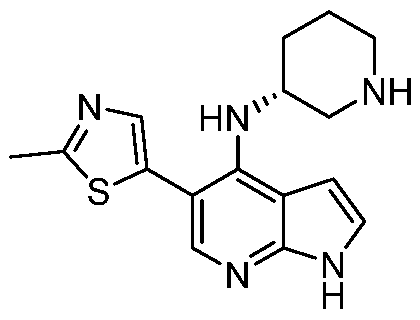
(R)-5-(2-메틸티아졸-5-일)-N-(피페리딘-3-일)-1H-피롤로[2,3-b]피리딘-4-아민은 실시예-1, 단계-7에 기술된 방법에 따라 제조하였고, 이를 담황색 검으로서 분리하였다 (0.13 g, 94% 수율): MS (ES) m/z 314.0 (M+H)+. (R) -5- (2- methyl-5-yl) - N - (piperidin-3-yl) -1 H - pyrrolo [2,3- b] pyridin-4-amines Examples -1, prepared according to the method described in step-7, which was isolated as a pale yellow gum (0.13 g, 94% yield): MS (ES) m/z 314.0 (M+H) + .
[000297] 단계 3: (R)-3-(3-((5-(2-메틸티아졸-5-일)-1H-피롤로[2,3-b]피리딘-4-일)아미노)피페리딘-1-일)-3-옥소프로판니트릴의 제조 [000 297] Step 3: (R) -3- (3 - ((5- (2- methyl-5-yl) -1 H - pyrrolo [2,3- b] pyridin-4-yl) amino ) Preparation of piperidin-1-yl)-3-oxopropanenitrile

(R)-3-(3-((5-(2-메틸티아졸-5-일)-1H-피롤로[2,3-b]피리딘-4-일)아미노)피페리딘-1-일)-3-옥소프로판니트릴을 실시예 1, 단계-8에 기술된 방법에 따라 제조하여 황백색의 고체를 수득하였다 (0.01 g, 5% 수율): 1H NMR (400 MHz, DMSO-d6) δ 11.43 (s, 1H), 7.77-7.75 (m, 1H), 7.59-7.57 (m, 1H), 7.22 (s, 1H), 6.61-6.57 (m, 1H), 5.16-5.14 (m, 1H), 4.16-4.13 (m, 1H), 4.03 (s, 2H), 3.89-3.77 (m, 3H), 2.67-2.65 (m, 3H), 1.96 (s, 2H), 1.60-1.57 (m, 3H); MS (ES) m/z 381.3 (M+H). HPLC 순도: 98.58% (R) -3- (3 - ( (5- ( 2-methyl-thiazol-yl -5-) -1 H - pyrrolo [2,3- b] pyridin-4-yl) amino) -1-piperidine -yl)-3-oxopropanenitrile was prepared according to the method described in Example 1, Step-8 to give an off-white solid (0.01 g, 5% yield): 1 H NMR (400 MHz, DMSO-d 6 ) δ 11.43 (s, 1H), 7.77-7.75 (m, 1H), 7.59-7.57 (m, 1H), 7.22 (s, 1H), 6.61-6.57 (m, 1H), 5.16-5.14 (m, 1H), 4.16-4.13 (m, 1H), 4.03 (s, 2H), 3.89-3.77 (m, 3H), 2.67-2.65 (m, 3H), 1.96 (s, 2H), 1.60-1.57 (m, 3H); MS (ES) m/z 381.3 (M+H). HPLC purity: 98.58%
분석 조건:Analysis conditions:
컬럼: X bridge (250 mm X 4.6 mm X 5 mic)Column: X bridge (250 mm X 4.6 mm X 5 mic)
이동상(A): 수중 0.1% 암모니아Mobile phase (A): 0.1% ammonia in water
이동상(B): 메탄올Mobile phase (B): methanol
유속: 1.0 mL/분Flow rate: 1.0 mL/min
[000298] 실시예 4: (R)-3-옥소-3-(3-((5-(티아졸-2-일)-1H-피롤로[2,3-b]피리딘-4-일)아미노)피페리딘-1-일)프로판니트릴의 제조 [000 298] Example 4: (R) -3-oxo-3- (3 - ((5- (thiazol-2-yl) -1 H-pyrrolo [2,3- b] pyridin-4-yl Preparation of )amino)piperidin-1-yl)propanenitrile

반응식 8: (Scheme 8: ( RR )-3-옥소-3-(3-((5-(티아졸-2-일)-1)-3-oxo-3-(3-((5-(thiazol-2-yl)-1 HH -피롤로[2,3--pyrrolo[2,3- bb ]피리딘-4-일)아미노)피페리딘-1-일)프로판니트릴의 제조] Preparation of pyridin-4-yl)amino)piperidin-1-yl)propanenitrile

[000299] 단계 1: 2-(4-클로로-1-((2-(트리메틸실릴)에톡시)메틸)-1H-피롤로[2,3-b]피리딘-5-일)티아졸의 제조The (pyrrolo [2,3- b] pyridin-5-yl 4-chloro-1 - ((2- (trimethylsilyl) ethoxy) methyl) -1 H) thiazol-2: [000 299] Step 1 Produce

N-메틸-2-피롤리돈 (15 mL) 중의 5-브로모-4-클로로-1-((2-(트리메틸실릴)에톡시)메틸)-1H-피롤로[2,3-b]피리딘 (1.5 g, 4.15 mmol, 반응식 1, 단계-1에 기술된 방법에 따라 제조됨), 2-(트리부틸스타닐)티아졸 (1.7 g, 4.57 mmol) 및 비스(트리페닐포스핀)팔라듐(II) 디클로라이드 (0.58 g, 0.83 mmol)의 용액을 질소 대기 하에 밀봉된 튜브 중에서 130℃로 가열하였다. 4시간 후, 상기 반응 혼합물을 상온으로 냉각시키고, 에틸 아세테이트로 희석한 후, 셀라이트를 통해 여과시켰다. 상기 여과액을 물과 염수로 세척하고, 무수 황산나트륨으로 건조 및 여과시킨 후, 진공에서 농축시켰다. 상기 미정제 물질을 섬광 크로마토그래피 (10% 에틸 아세테이트/헥산)로 정제하여 2-(4-클로로-1-((2-(트리메틸실릴) 에톡시)메틸)-1H-피롤로[2,3-b]피리딘-5-일)티아졸을 무색 오일로서 수득하였다 (0.75 g, 49% 수율): MS (ES) m/z 365.8 (M+H). N-methyl-2-pyrrolidone (15 mL), 5- bromo-4-chloro-l of the (methyl ethoxy) (2- (trimethylsilyl)) -1 H-pyrrolo [2,3- b ]pyridine (1.5 g, 4.15 mmol, prepared according to the method described in Scheme 1, step-1), 2-(tributylstannyl)thiazole (1.7 g, 4.57 mmol) and bis(triphenylphosphine) A solution of palladium(II) dichloride (0.58 g, 0.83 mmol) was heated to 130° C. in a sealed tube under a nitrogen atmosphere. After 4 hours, the reaction mixture was cooled to room temperature, diluted with ethyl acetate and filtered through celite. The filtrate was washed with water and brine, dried over anhydrous sodium sulfate, filtered, and concentrated in vacuo. The crude by flash chromatography (10% ethyl acetate / hexane) to give 2- (4-chloro-l-ethoxy ((2- (trimethylsilyl)) methyl) -1 H-pyrrolo [2, Obtained 3- b ]pyridin-5-yl)thiazole as a colorless oil (0.75 g, 49% yield): MS (ES) m/z 365.8 (M+H).
[000300] 단계 2: tert-부틸 (R)-3-((5-(티아졸-2-일)-1-((2-(트리메틸실릴)에톡시)메틸)-1H-피롤로[2,3-b]피리딘-4-일)아미노)피페리딘-1-카르복실레이트의 제조 [000 300] Step 2: tert-butyl (R) -3 - ((5- (thiazol-2-yl) - 1 - ((methylethoxy), 2- (trimethylsilyl)) - 1 H-pyrrolo [ Preparation of 2,3-b]pyridin-4-yl)amino)piperidine-1-carboxylate

N-메틸-2-피롤리돈 (10 mL) 중의 2-(4-클로로-1-((2-(트리메틸실릴)에톡시)메틸)-1H-피롤로[2,3-b]피리딘-5-일)티아졸 (0.7 g, 1.92 mmol), tert-부틸 (R)-3-아미노피페리딘-1-카르복실레이트 (0.57 g, 2.87 mmol) 및 트리에틸아민 (0.27 mL, 1.92 mmol)의 용액에 130℃로 3시간 동안 마이크로파를 조사하였다. 상기 반응 혼합물을 상온으로 냉각시키고, 에틸 아세테이트로 희석하여 물, 염수로 세척한 후, 무수 황산나트륨으로 건조시키고, 여과하여 진공에서 농축시켰다. 상기 미정제 물질을 섬광 크로마토그래피 (50% 에틸 아세테이트/헥산)로 정제하여 tert-부틸 (R)-3-((5-(티아졸-2-일)-1-((2-(트리메틸실릴)에톡시)메틸)-1H-피롤로[2,3-b]피리딘-4-일)아미노)피페리딘-1-카르복실레이트를 담황색 고체로서 수득하였다 (0.24 g, 24% 수율): MS (ES) m/z 529.9 (M+H). N - ((2- (trimethylsilyl) ethoxy) methyl) -1 H - - methyl-2-pyrrolidone, 2- (4-chloro-l in (10 mL) pyrrolo [2,3- b] pyridine -5-yl)thiazole (0.7 g, 1.92 mmol), tert -butyl (R)-3-aminopiperidine-1-carboxylate (0.57 g, 2.87 mmol) and triethylamine (0.27 mL, 1.92) mmol) solution was irradiated with microwaves at 130° C. for 3 hours. The reaction mixture was cooled to room temperature, diluted with ethyl acetate, washed with water and brine, dried over anhydrous sodium sulfate, filtered and concentrated in vacuo. The crude material was purified by flash chromatography (50% ethyl acetate/hexanes) to tert -butyl ( R )-3-((5-(thiazol-2-yl)-1-((2-(trimethylsilyl) pyrrolo [2,3- b] pyridin-4-yl) amino) piperidin-1-a-carboxylate as a light yellow solid (0.24 g, 24% yield)) ethoxy) methyl) -1 H in : MS (ES) m/z 529.9 (M+H).
[000301] 단계 3: (R)-N-(피페리딘-3-일)-5-(티아졸-2-일)-1H-피롤로[2,3-b]피리딘-4-아민의 제조 [000 301] Step 3: (R) - N - ( piperidin-3-yl) -5- (thiazol-2-yl) -1 H - pyrrolo [2,3- b] pyridin-4-amine manufacture of

(R)-N-(피페리딘-3-일)-5-(티아졸-2-일)-1H-피롤로[2,3-b]피리딘-4-아민을 실시예 1, 단계-7에 기술된 방법에 따라 제조하여, 이를 황백색 고체로서 분리하였다 (0.11 g, 81% 수율): MS (ES) m/z 300.0 (M+H)+. (R) - N - (piperidin-3-yl) -5- (thiazol-2-yl) -1 H - pyrrolo [2,3- b] pyridin-4-amine the embodiment example 1, step Prepared according to the method described in -7, which was isolated as an off-white solid (0.11 g, 81% yield): MS (ES) m/z 300.0 (M+H) + .
[000302] 단계 4: (R)-3-옥소-3-(3-((5-(티아졸-2-일)-1H-피롤로[2,3-b]피리딘-4-일)아미노)피페리딘-1-일)프로판니트릴의 제조 [000 302] Step 4: (R) -3-oxo-3- (3 - ((5- (thiazol-2-yl) -1 H-pyrrolo [2,3- b] pyridin-4-yl) Preparation of amino)piperidin-1-yl)propanenitrile
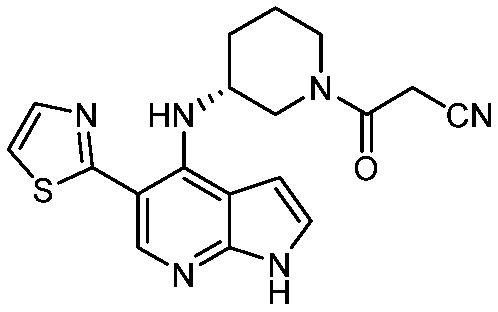
(R)-3-옥소-3-(3-((5-(티아졸-2-일)-1H-피롤로[2,3-b]피리딘-4-일)아미노)피페리딘-1-일)프로판니트릴을 실시예 1, 단계-8에 기술된 방법에 따라 제조하여 황색 고체로서 수득하였다 (0.05 g, 38% 수율): 1H NMR (400 MHz, DMSO-d6) δ 11.44 (br s, 1H), 9.75 (br s, 1H), 7.41 (d, J = 10.4 Hz, 1H), 7.74-7.80 (m, 1H), 7.59 (s, 1H), 7.22 (s, 1H), 6.69 (s, 1H), 4.15-4.45 (m, 1H), 3.90-4.10 (m, 2H), 3.61-3.82 (m, 1H), 3.25-3.55 (m, 2H), 1.95-2.20 (m, 2H), 1.45-1.85 (m, 3H); MS (ES) m/z 366.9 (M+H). (R) -3-oxo-3- (3 - ((5- (thiazol-2-yl) -1 H-pyrrolo [2,3- b] pyridin-4-yl) amino) piperidin- 1-yl)propanenitrile was prepared according to the method described in Example 1, step-8 to give as a yellow solid (0.05 g, 38% yield): 1 H NMR (400 MHz, DMSO-d 6 ) δ 11.44 (br s, 1H), 9.75 (br s, 1H), 7.41 (d, J = 10.4 Hz, 1H), 7.74-7.80 (m, 1H), 7.59 (s, 1H), 7.22 (s, 1H), 6.69 (s, 1H), 4.15-4.45 (m, 1H), 3.90-4.10 (m, 2H), 3.61-3.82 (m, 1H), 3.25-3.55 (m, 2H), 1.95-2.20 (m, 2H) ), 1.45-1.85 (m, 3H); MS (ES) m/z 366.9 (M+H).
[000303] 실시예 5: (R)-3-(3-((5-(옥사졸-2-일)-1H-피롤로[2,3-b]피리딘-4-일)아미노)피페리딘-1-일)-3-옥소프로판니트릴의 제조 [000 303] Example 5: (R) -3- (3 - ((5- ( oxazol-2-yl) -1 H - pyrrolo [2,3- b] pyridin-4-yl) amino) P Preparation of peridin-1-yl)-3-oxopropanenitrile

반응식 9: (Scheme 9: ( RR )-3-(3-((5-(옥사졸-2-일)-1)-3-(3-((5-(oxazol-2-yl)-1 HH -피롤로[2,3--pyrrolo[2,3- bb ]피리딘-4-일)아미노)피페리딘-1-일)-3-옥소프로판니트릴의 제조] Preparation of pyridin-4-yl)amino)piperidin-1-yl)-3-oxopropanenitrile

[000304] 단계 1: 2-(4-클로로-1-((2-(트리메틸실릴)에톡시)메틸)-1H-피롤로[2,3-b]피리딘-5-일)옥사졸의 제조The (pyrrolo [2,3- b] pyridin-5-yl 4-chloro-1 - ((2- (trimethylsilyl) ethoxy) methyl) -1 H) oxazol-2: [000 304] Step 1 Produce

1,4-디옥산 (20 mL) 중의 5-브로모-4-클로로-1-((2-(트리메틸실릴)에톡시)메틸)-1H-피롤로[2,3-b]피리딘 (2 g, 5.54 mmol, 반응식 5, 단계-1에 기술된 방법에 따라 제조됨), 칼륨 tert-부톡시드 (1.24 g, 11.08 mmol) 비스(트리페닐포스핀)팔라듐(II) 디클로라이드 (0.19 g, 0.27 mmol) 및 옥사졸 (0.68 g, 9.97 mmol)의 혼합물을 질소 하에 밀봉된 튜브 중에서 110℃로 가열하였다. 5시간 후, 상기 반응 혼합물을 상온으로 냉각시키고, 물로 희석한 후, 에틸 아세테이트로 추출하였다. 상기 유기층을 염수로 세척하고, 황산나트륨으로 건조시켜 여과 후 진공에서 농축시켰다. 상기 미정제 물질을 섬광 크로마토그래피 (에틸 아세테이트/헥산)로 정제하여 2-(4-클로로-1-((2-(트리메틸실릴)에톡시)메틸)-1H-피롤로[2,3-b]피리딘-5-일)옥사졸을 황백색 고체로서 수득하였다 (0.43 g, 22% 수율): MS (ES) m/z 349.9 (M+H).1, 4-dioxane (20 mL) of 5-bromo-4-chloro-1 - ((2- (trimethylsilyl) ethoxy) methyl) -1 H - [2,3- b] pyrrolo pyridine ( 2 g, 5.54 mmol, prepared according to the method described in Scheme 5, step-1), potassium tert -butoxide (1.24 g, 11.08 mmol) bis(triphenylphosphine)palladium(II) dichloride (0.19 g) , 0.27 mmol) and oxazole (0.68 g, 9.97 mmol) were heated to 110° C. in a sealed tube under nitrogen. After 5 hours, the reaction mixture was cooled to room temperature, diluted with water, and extracted with ethyl acetate. The organic layer was washed with brine, dried over sodium sulfate, filtered and concentrated in vacuo. The crude by flash chromatography (ethyl acetate / hexane) to give 2- (4-chloro-1 - a ((2- (trimethylsilyl) ethoxy) methyl) -1 H-pyrrolo [2,3- b ]pyridin-5-yl)oxazole was obtained as an off-white solid (0.43 g, 22% yield): MS (ES) m/z 349.9 (M+H).
[000305] 단계 2: tert-부틸 (R)-3-((5-(옥사졸-2-일)-1-((2-(트리메틸실릴)에톡시)메틸)-1H-피롤로[2,3-b]피리딘-4-일)아미노)피페리딘-1-카르복실레이트의 제조 [000 305] Step 2: tert-butyl (R) -3 - ((5- (oxazol-2-yl) - 1 - ((methylethoxy), 2- (trimethylsilyl)) - 1 H-pyrrolo [ Preparation of 2,3-b]pyridin-4-yl)amino)piperidine-1-carboxylate

N-메틸피롤리돈 (4 mL) 중의 2-(4-클로로-1-((2-(트리메틸실릴)에톡시)메틸)-1H-피롤로[2,3-b]피리딘-5-일)옥사졸 (0.43 g, 1.28 mmol), 트리에틸아민 (0.03 mL, 0.24 mmol) 및 tert-부틸 (R)-3-아미노피페리딘-1-카르복실레이트 (0.464 g, 2.32 mmol)의 교반된 용액에 130℃로 5시간 동안 마이크로파를 조사하였다. 상기 반응 혼합물을 상온으로 냉각시키고, 물로 희석한 후, 에틸 아세테이트로 추출하였다. 상기 유기층을 염수로 세척하고, 황산나트륨으로 건조시켜 여과 후 진공에서 농축시켰다. 상기 미정제 물질을 섬광 크로마토그래피 (50% 에틸 아세테이트/헥산)로 정제하여 tert-부틸 (R)-3-((5-(옥사졸-2-일)-1-((2-(트리메틸실릴)에톡시)메틸)-1H-피롤로[2,3-b]피리딘-4-일)아미노)피페리딘-1-카르복실레이트를 황백색 고체로서 수득하였다 (0.35 g, 53%): MS (ES) m/z 514.0 (M+H).2- (4-chloro-l-methyl pyrrolidone in (4 mL) - - N-ethoxy ((2- (trimethylsilyl)) methyl) -1 H - pyrrolo [2,3- b] pyridin-5 of yl)oxazole (0.43 g, 1.28 mmol), triethylamine (0.03 mL, 0.24 mmol) and tert -butyl ( R )-3-aminopiperidine-1-carboxylate (0.464 g, 2.32 mmol) The stirred solution was irradiated with microwaves at 130° C. for 5 hours. The reaction mixture was cooled to room temperature, diluted with water, and extracted with ethyl acetate. The organic layer was washed with brine, dried over sodium sulfate, filtered and concentrated in vacuo. The crude material was purified by flash chromatography (50% ethyl acetate/hexanes) to tert -butyl ( R )-3-((5-(oxazol-2-yl)-1-((2-(trimethylsilyl) ) ethoxy) methyl) -1 H - pyrrolo [2,3- b] pyridin-4-yl) amino) piperidine-1-carboxylate was obtained as a pale yellow solid (0.35 g, 53%): MS (ES) m/z 514.0 (M+H).
[000306] 단계 3: (R)-5-(옥사졸-2-일)-N-(피페리딘-3-일)-1H-피롤로[2,3-b]피리딘-4-아민의 제조 [000 306] Step 3: (R) -5- (oxazol-2-yl) - N - (piperidin-3-yl) -1 H - pyrrolo [2,3- b] pyridin-4-amine manufacture of

(R)-5-(옥사졸-2-일)-N-(피페리딘-3-일)-1H-피롤로[2,3-b]피리딘-4-아민을 실시예 1, 단계-7에 기술된 방법에 따라 제조하였다: MS (ES) m/z 284.1 (M+H). (R) -5- (oxazol-2-yl) - N - (piperidin-3-yl) -1 H - pyrrolo [2,3- b] pyridin-4-amine the embodiment example 1, step Prepared according to the method described in -7: MS (ES) m/z 284.1 (M+H).
[000307] 단계 4: (R)-3-(3-((5-(옥사졸-2-일)-1H-피롤로[2,3-b]피리딘-4-일)아미노)피페리딘-1-일)-3-옥소프로판니트릴의 제조 [000 307] Step 4: (R) -3- (3 - ((5- ( oxazol-2-yl) -1 H - pyrrolo [2,3- b] pyridin-4-yl) amino) piperidin Preparation of diin-1-yl)-3-oxopropanenitrile

(R)-3-(3-((5-(옥사졸-2-일)-1H-피롤로[2,3-b]피리딘-4-일)아미노)피페리딘-1-일)-3-옥소프로판니트릴을 실시예 1, 단계-8에 기술된 방법에 따라 제조하여 황백색의 고체를 수득하였다 (0.05 g, 27% 수율): 1H NMR (400 MHz, DMSO-d6) δ 11.61 ( br s, J = 8.8 Hz, 1H), 9.11-9.05 (m, 1H), 8.53 (d, J = 6.8 Hz, 1H), 8.10 (s, 1H), 7.33-7.22 (m, 2H), 6.69 (s, 1H), 4.37(br s, 1H), 4.17-3.58 (m, 6H), 2.04 (s, 1H), 1.73-1.54 (m, 3H); MS (ES) m/z 351.1 (M+H). (R) -3- (3 - ( (5- ( oxazol-2-yl) -1 H - pyrrolo [2,3- b] pyridin-4-yl) amino) piperidin-1-yl) -3-oxopropanenitrile was prepared according to the method described in Example 1, step-8 to give an off-white solid (0.05 g, 27% yield): 1 H NMR (400 MHz, DMSO-d 6 ) δ 11.61 ( br s, J = 8.8 Hz, 1H), 9.11-9.05 (m, 1H), 8.53 (d, J = 6.8 Hz, 1H), 8.10 (s, 1H), 7.33-7.22 (m, 2H), 6.69 (s, 1H), 4.37 (br s, 1H), 4.17-3.58 (m, 6H), 2.04 (s, 1H), 1.73-1.54 (m, 3H); MS (ES) m/z 351.1 (M+H).
[000308] 실시예 6: (R)-3-(3-((5-(3-메틸-1,2,4-옥사디아졸-5-일)-1H-피롤로[2,3-b]피리딘-4-일)아미노)피페리딘-1-일)-3-옥소프로판니트릴의 제조 [000 308] Example 6: (R) -3- (3 - ((5- (3- methyl-1,2,4-oxadiazol-5-yl) -1 H - pyrrolo [2,3- b] Preparation of pyridin-4-yl)amino)piperidin-1-yl)-3-oxopropanenitrile

반응식 10: (Scheme 10: ( RR )-3-(3-((5-(3-메틸-1,2,4-옥사디아졸-5-일)-1)-3-(3-((5-(3-methyl-1,2,4-oxadiazol-5-yl)-1 HH -피롤로[2,3--pyrrolo[2,3- bb ]피리딘-4-일)아미노)피페리딘-1-일)-3-옥소프로판니트릴의 제조] Preparation of pyridin-4-yl)amino)piperidin-1-yl)-3-oxopropanenitrile

[000309] 단계 1: 에틸 (R)-4-((1-((벤질옥시)카보닐)피페리딘-3-일)아미노)-1H-피롤로[2,3-b]피리딘-5-카르복실레이트의 제조 [000 309] Step 1: Ethyl (R) -4 - ((1 - (( benzyloxy) carbonyl) piperidin-3-yl) amino) -1 H-pyrrolo [2,3- b] pyridin- Preparation of 5-carboxylate

N-메틸피롤리돈 (1 mL) 중의 에틸 4-클로로-1H-피롤로[2,3-b]피리딘-5-카르복실레이트 (0.2 g, 0.89 mmol), 트리에틸아민 (0.06 mL, 0.44 mmol) 및 벤질 (R)-3-아미노피페리딘-1-카르복실레이트 (0.31 g, 1.33 mmol)의 교반된 용액에 165℃로 2시간 동안 마이크로파를 조사하였다. 상기 반응 혼합물을 상온으로 냉각시키고, 물로 희석한 후, 에틸 아세테이트로 추출하였다. 상기 유기층을 염수로 세척하고, 황산나트륨으로 건조시켜 여과 후 진공에서 농축시켰다. 상기 미정제 물질을 섬광 크로마토그래피 (40% 에틸 아세테이트/헥산)로 정제하여 에틸 (R)-4-((1-((벤질옥시)카보닐)피페리딘-3-일)아미노)-1H-피롤로[2,3-b]피리딘-5-카르복실레이트를 담황색 고체로서 수득하였다 (0.25 g, 67%): MS (ES) m/z 422.9 [M+H]+. N - pyrrolo [2,3- b] pyridine-5-carboxylate (0.2 g, 0.89 mmol), triethylamine (0.06 mL, - methylpyrrolidone (1 mL) of ethyl 4-chloro -1 H in 0.44 mmol) and benzyl ( R )-3-aminopiperidine-1-carboxylate (0.31 g, 1.33 mmol) was irradiated with microwaves at 165° C. for 2 hours. The reaction mixture was cooled to room temperature, diluted with water, and extracted with ethyl acetate. The organic layer was washed with brine, dried over sodium sulfate, filtered and concentrated in vacuo. The crude material was purified by flash chromatography (40% ethyl acetate/hexanes) to ethyl ( R )-4-((1-((benzyloxy)carbonyl)piperidin-3-yl)amino)-1 H -pyrrolo[2,3- b ]pyridine-5-carboxylate was obtained as a pale yellow solid (0.25 g, 67%): MS (ES) m/z 422.9 [M+H] + .
[000310] 단계 2: (R)-4-((1-((벤질옥시)카보닐)피페리딘-3-일)아미노)-1H-피롤로[2,3-b]피리딘-5-카르복실산의 제조 [000 310] Step 2: (R) -4 - ( (1 - (( benzyloxy) carbonyl) piperidin-3-yl) amino) -1 H - pyrrolo [2,3- b] pyridine-5 -Preparation of carboxylic acid

0℃에서 에탄올 (20 mL) 중 프로필 에틸 (R)-4-((1-((벤질옥시)카보닐)피페리딘-3-일)아미노)-1H-피롤로[2,3-b]피리딘-5-카르복실레이트 (1.5 g, 3.55 mmol)의 교반된 용액에 수산화나트륨 (5N, 10 mL)을 첨가한 후, 상기 혼합물을 상온에서 12시간 동안 교반하였다. 상기 반응 혼합물을 진공에서 농축시킨 후, 잔류물을 물에 용해시키고 에틸 아세테이트로 세척하였다. 수성층을 0℃에서 포화 중황산칼륨 용액으로 pH ~2.0으로 산성화한 후, 5% 메탄올/디클로로메탄으로 추출하였다. 상기 유기층을 무수 황산나트륨으로 건조시킨 후, 여과 및 진공에서 농축시켰다. 상기 수득된 미정제 생성물을 n-펜탄으로 연화처리하여 (R)-4-((1-((벤질옥시)카보닐)피페리딘-3-일)아미노)-1H-피롤로[2,3-b]피리딘-5-카르복실산을 황백색 고체로서 수득하였다 (1.10 g, 미정제): MS (ES) m/z 394.9 (M+H).Ethyl (R) of from 0 ℃ ethanol (20 mL) -4 - (( 1 - (( benzyloxy) carbonyl) piperidin-3-yl) amino) -1 H - pyrrolo [2,3- b ] To a stirred solution of pyridine-5-carboxylate (1.5 g, 3.55 mmol) was added sodium hydroxide (5N, 10 mL), and then the mixture was stirred at room temperature for 12 hours. After the reaction mixture was concentrated in vacuo, the residue was dissolved in water and washed with ethyl acetate. The aqueous layer was acidified to pH ~2.0 with saturated potassium bisulfate solution at 0° C. and then extracted with 5% methanol/dichloromethane. The organic layer was dried over anhydrous sodium sulfate, filtered and concentrated in vacuo. By treatment softens the so obtained crude product with n- pentane (R) -4 - ((1 - (( benzyloxy) carbonyl) piperidin-3-yl) amino) -1 H - pyrrolo [2 ,3- b ]pyridine-5-carboxylic acid was obtained as an off-white solid (1.10 g, crude): MS (ES) m/z 394.9 (M+H).
[000311] 단계 3: 벤질 (R,E)-3-((5-((1-아미노에틸리덴)카바모일)-1H-피롤로[2,3-b]피리딘-4-일)아미노)피페리딘-1-카르복실레이트의 제조 [000 311] Step 3: Benzyl (R, E) -3 - ( (5 - (( 1-amino-butylidene) carbamoyl) -1 H - pyrrolo [2,3- b] pyridin-4-yl) Preparation of amino)piperidine-1-carboxylate

N,N-디메틸포름아미드 (10 mL) 중의 (R)-4-((1-((벤질옥시)카보닐)피페리딘-3-일)아미노)-1H-피롤로[2,3-b]피리딘-5-카르복실산 (0.5 g, 1.26 mmol)의 교반된 용액에 1-비스(디메틸아미노)메틸렌]-1H-1,2,3-트리아졸로[4,5-b]피리디늄 3-옥사이드 헥사플루오로포스페이트 (0.53 g, 1.39 mmol), N,N-디이소프로필에틸아민 (1.2 g, 1.73 mmol) 및 아세타미딘 하이드로클로라이드 (0.178 g, 1.90 mmol)를 첨가하였다. 상기 혼합물을 상온에서 18시간 동안 교반하였다. 상기 반응 혼합물을 여과하고 진공에서 농축시켜 벤질 (R,E)-3-((5-((1-아미노에틸리덴)카바모일)-1H-피롤로[2,3-b]피리딘-4-일)아미노)피페리딘-1-카르복실레이트를 백색 고체로서 수득하였다 (0.4 g, 미정제): MS (ES) m/z 435.0 (M+H). N, N - dimethylformamide (10 mL) of (R) -4 - ((1 - (( benzyloxy) carbonyl) piperidin-3-yl) amino) -1 H - pyrrolo [2,3 - b ] 1-bis (dimethylamino) methylene] -1 H -1,2,3-triazolo [4,5- b ] in a stirred solution of pyridine-5-carboxylic acid (0.5 g, 1.26 mmol) Pyridinium 3-oxide hexafluorophosphate (0.53 g, 1.39 mmol), N , N -diisopropylethylamine (1.2 g, 1.73 mmol) and acetamidine hydrochloride (0.178 g, 1.90 mmol) were added. The mixture was stirred at room temperature for 18 hours. To the reaction mixture was filtered and concentrated in vacuo to give benzyl (R, E) -3 - ( (5 - ((1- amino butylidene) carbamoyl) -1 H-pyrrolo [2,3- b] pyridin- 4-yl)amino)piperidine-1-carboxylate was obtained as a white solid (0.4 g, crude): MS (ES) m/z 435.0 (M+H).
[000312] 단계 4: 벤질 (R)-3-((5-(3-메틸-1,2,4-옥사디아졸-5-일)-1H-피롤로[2,3-b]피리딘-4-일)아미노)피페리딘-1-카르복실레이트의 제조 [000 312] Step 4: Benzyl (R) -3 - ((5- (3- methyl-1,2,4-oxadiazol-5-yl) -1 H - pyrrolo [2,3- b] pyridine Preparation of -4-yl)amino)piperidine-1-carboxylate

아세트산 (0.2 mL) 중의 벤질 (R,E)-3-((5-((1-아미노에틸리덴)카바모일)-1H-피롤로[2,3-b]피리딘-4-일)아미노)피페리딘-1-카르복실레이트 (0.1 g, 0.23 mmol) 및 하이드록실아민 하이드로클로라이드 (0.024 g, 0.345 mmol)의 교반된 용액을 90℃로 가열하였다. 3시간 후, 상기 반응 혼합물을 상온으로 냉각시키고, 물로 ??칭한 후, 에틸 아세테이트로 추출하였다. 상기 유기층을 염수로 세척하고, 무수 황산나트륨으로 건조시켜 여과 후 진공에서 농축시켰다. 상기 미정제 물질을 섬광 크로마토그래피 (5% 메탄올/디클로로메탄)로 정제하여 벤질 (R)-3-((5-(3-메틸-1,2,4-옥사디아졸-5-일)-1H-피롤로[2,3-b]피리딘-4-일)아미노)피페리딘-1-카르복실레이트를 백색 고체로서 수득하였다 (0.01g, 10% 수율): MS (ES) m/z 433.3 (M+H).Benzyl acetate (R, E) -3 in (0.2 mL) - ((5 - (( 1-amino-butylidene) carbamoyl) -1 H - pyrrolo [2,3- b] pyridin-4-yl) A stirred solution of amino)piperidine-1-carboxylate (0.1 g, 0.23 mmol) and hydroxylamine hydrochloride (0.024 g, 0.345 mmol) was heated to 90°C. After 3 hours, the reaction mixture was cooled to room temperature, quenched with water, and extracted with ethyl acetate. The organic layer was washed with brine, dried over anhydrous sodium sulfate, filtered and concentrated in vacuo. The crude material was purified by flash chromatography (5% methanol/dichloromethane) to benzyl ( R )-3-((5-(3-methyl-1,2,4-oxadiazol-5-yl)- 1 H -pyrrolo[2,3- b ]pyridin-4-yl)amino)piperidine-1-carboxylate was obtained as a white solid (0.01 g, 10% yield): MS (ES) m/ z 433.3 (M+H).
[000313] 단계 5: (R)-5-(3-메틸-1,2,4-옥사디아졸-5-일)-N-(피페리딘-3-일)-1H-피롤로[2,3-b]피리딘-4-아민 하이드로클로라이드의 제조 [000 313] Step 5: (R) -5- (3- methyl-1,2,4-oxadiazol-5-yl) - N - (piperidin-3-yl) -1 H - pyrrolo [ Preparation of 2,3- b ]pyridin-4-amine hydrochloride

밀봉된 튜브 중에서 벤질 (R)-3-((5-(3-메틸-1,2,4-옥사디아졸-5-일)-1H-피롤로[2,3-b]피리딘-4-일)아미노)피페리딘-1-카르복실레이트 (0.34 g, 0.78 mmol) 및 농축 HCl (3 mL)의 교반된 용액을 70℃로 가열하였다. 3시간 후, 상기 반응 혼합물을 실온으로 냉각한 후, 진공에서 농축시켜 ((R)-5-(3-메틸-1,2,4-옥사디아졸-5-일)-N-(피페리딘-3-일)-1H-피롤로[2,3-b]피리딘-4-아민을 황백색 고체로서 수득하였다 (0.25 g, 미정제): MS (ES) m/z 299.0 (M+H).((5- (3-methyl-1,2,4-oxadiazol-5-yl) -1 H - - benzyl (R) -3 out of the sealed tube-pyrrolo [2,3- b] pyridine -4 A stirred solution of -yl)amino)piperidine-1-carboxylate (0.34 g, 0.78 mmol) and concentrated HCl (3 mL) was heated to 70°C. After 3 hours, After cooling the reaction mixture to room temperature, and concentrated in vacuo to give ((R) -5- (3- methyl-1,2,4-oxadiazol-5-yl) - N - (piperidin 3-yl) -1 H - pyrrolo [2,3- b] pyridin-4-amine was obtained as a pale yellow solid (0.25 g, crude): MS (ES) m / z 299.0 (m + H ).
[000314] 단계 6: (R)-3-(3-((5-(3-메틸-1,2,4-옥사디아졸-5-일)-1H-피롤로[2,3-b]피리딘-4-일)아미노)피페리딘-1-일)-3-옥소프로판니트릴의 제조 [000 314] Step 6: (R) -3- (3 - ((5- (3- methyl-1,2,4-oxadiazol-5-yl) -1 H - pyrrolo [2,3- b ] Preparation of pyridin-4-yl)amino)piperidin-1-yl)-3-oxopropanenitrile
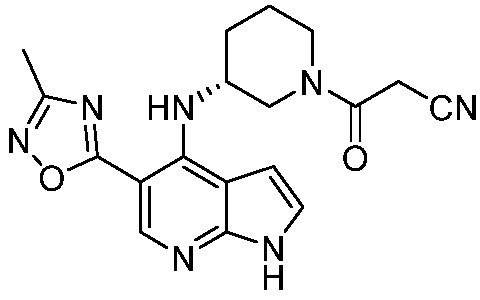
N,N-디메틸포름아미드 (0.5 mL) 중의 ((R)-5-(3-메틸-1,2,4-옥사디아졸-5-일)-N-(피페리딘-3-일)-1H-피롤로[2,3-b]피리딘-4-아민 (0.25 g, 0.83 mmol)의 교반된 용액에 1-[비스(디메틸아미노)메틸렌]-1H-1,2,3-트리아졸로[4,5-b]피리디늄 3-옥사이드 헥사플루오로포스페이트 (0.34 g, 0.91 mmol), N,N-디이소프로필에틸아민 (1.2 g, 1.73 mmol) 및 시아노아세트산 (0.118 g, 1.25 mmol)을 첨가하였다. 상기 혼합물을 상온에서 18시간 동안 교반하였다. 상기 반응 혼합물을 진공에서 농축하고, 상기 미정제 물질을 섬광 크로마토그래피 (5% 메탄올/디클로로메탄)로 정제하여 (R)-3-(3-((5-(3-메틸-1,2,4-옥사디아졸-5-일)-1H-피롤로[2,3-b]피리딘-4-일)아미노)피페리딘-1-일)-3-옥소프로판니트릴을 황백색 고체로서 수득하였다 (0.04 g, 13% 수율): 1H NMR (400 MHz, DMSO-d6) δ 11.82 (br s, 1H), 8.71-8.76 (m, 1H), 8.56-8.57 (m, 1H), 7.28 (s, 1H), 6.74 (s, 1H), 4.50 (br s, 1H), 4.28 (br s, 1H), 4.03-4.14 (m, 1H), 3.82-3.91 (m, 1H), 3.57-3.60 (m, 1H), 3.39 (m, 2H), 3.29 (m, 1H), 2.39-2.41(m, 3H), 2.04(m, 1H), 1.56-1.78 (m, 2H); MS (ES) m/z 365.9 (M+H). N, N - ((R) in dimethylformamide (0.5 mL) -5- (3- methyl-1,2,4-oxadiazol-5-yl) - N - (piperidin-3-yl) -1 H - pyrrolo [2,3- b] pyridin-4-1- [bis (dimethylamino) methylene] to a stirred solution of amine (0.25 g, 0.83 mmol) -1 H -1,2,3- triazolo[4,5- b ]pyridinium 3-oxide hexafluorophosphate (0.34 g, 0.91 mmol), N , N -diisopropylethylamine (1.2 g, 1.73 mmol) and cyanoacetic acid (0.118 g, 1.25 mmol).The mixture is stirred at room temperature for 18 hours.The reaction mixture is concentrated in vacuo, and the crude material is purified by flash chromatography (5% methanol/dichloromethane) ( R )- 3- (3 - ((5- (3-yl-methyl-1,2,4-oxadiazole -5-) -1 H-pyrrolo [2,3- b] pyridin-4-yl) amino) P Peridin-1-yl)-3-oxopropanenitrile was obtained as an off-white solid (0.04 g, 13% yield): 1 H NMR (400 MHz, DMSO-d 6 ) δ 11.82 (br s, 1H), 8.71 -8.76 (m, 1H), 8.56-8.57 (m, 1H), 7.28 (s, 1H), 6.74 (s, 1H), 4.50 (br s, 1H), 4.28 (br s, 1H), 4.03-4.14 (m, 1H), 3.82-3.91 (m, 1H), 3.57-3.60 (m, 1H), 3.39 (m, 2H), 3.29 (m, 1H), 2.39-2.41 (m, 3H), 2.04 (m) , 1H), 1.56-1.78 (m, 2H), MS (ES) m/z 365.9 (M+H).
[000315] 실시예 7: (R)-3-(3-((5-(1,3,4-옥사디아졸-2-일)-1H-피롤로[2,3-b]피리딘-4-일)아미노)피페리딘-1-일)-3-옥소프로판니트릴의 제조 [000 315] Example 7: (R) -3- (3 - ((5- (1,3,4- oxadiazol-2-yl) -1 H-pyrrolo [2,3- b] pyridin- Preparation of 4-yl)amino)piperidin-1-yl)-3-oxopropanenitrile

반응식 11: (Scheme 11: ( RR )-3-(3-((5-(1,3,4-옥사디아졸-2-일)-1)-3-(3-((5-(1,3,4-oxadiazol-2-yl)-1 HH -피롤로[2,3--pyrrolo[2,3- bb ]피리딘-4-일)아미노)피페리딘-1-일)-3-옥소프로판니트릴의 제조] Preparation of pyridin-4-yl)amino)piperidin-1-yl)-3-oxopropanenitrile

[000316] 단계 1: 벤질 (R)-3-((5-(히드라진카보닐)-1H-피롤로[2,3-b]피리딘-4-일)아미노)피페리딘-1-카르복실레이트의 제조 [000 316] Step 1: Benzyl (R) -3 - ((5- ( hydrazine-carbonyl) -1 H - pyrrolo [2,3- b] pyridin-4-yl) amino) piperidine-1- Preparation of carboxylate

에탄올 (8 mL) 중의 에틸 (R)-4-((1-((벤질옥시)카보닐)피페리딘-3-일)아미노)-1H-피롤로[2,3-b]피리딘-5-카르복실레이트 (0.5 g, 1.18 mmol, 실시예 6, 단계-1에 기술된 방법에 따라 제조됨) 및 히드라진 하이드레이트 (32 mL)의 교반된 용액을 110℃에서 18시간 동안 가열하였다. 실온으로 냉각시킨 후, 상기 혼합물을 진공에서 농축시켜 휘발성 물질을 제거하고, 잔류물을 디에틸 에테르 중 10% 메탄올로 연화처리하여 벤질 (R)-3-((5-(히드라진카보닐)-1H-피롤로[2,3-b]피리딘-4-일)아미노)피페리딘-1-카르복실레이트를 황색 고체로서 수득하였다 (0.3 g, 62% 수율): MS (ES) m/z 409.2 (M+H).Ethanol of ethyl (8 mL) (R) -4 - ((1 - (( benzyloxy) carbonyl) piperidin-3-yl) amino) -1 H-pyrrolo [2,3- b] pyridin- A stirred solution of 5-carboxylate (0.5 g, 1.18 mmol, prepared according to the method described in Example 6, step-1) and hydrazine hydrate (32 mL) was heated at 110° C. for 18 h. After cooling to room temperature, the mixture was concentrated in vacuo to remove volatiles and the residue was triturated with 10% methanol in diethyl ether to benzyl ( R )-3-((5-(hydrazinecarbonyl)- 1 H -pyrrolo[2,3- b ]pyridin-4-yl)amino)piperidine-1-carboxylate was obtained as a yellow solid (0.3 g, 62% yield): MS (ES) m/ z 409.2 (M+H).
[000317] 단계 2: 벤질 (R)-3-((5-(1,3,4-옥사디아졸-2-일)-1H-피롤로[2,3-b]피리딘-4-일)아미노)피페리딘-1-카르복실레이트의 제조 [000 317] Step 2: Benzyl (R) -3 - ((5- (1,3,4- oxadiazol-2-yl) -1 H - pyrrolo [2,3- b] pyridin-4-yl Preparation of )amino)piperidine-1-carboxylate
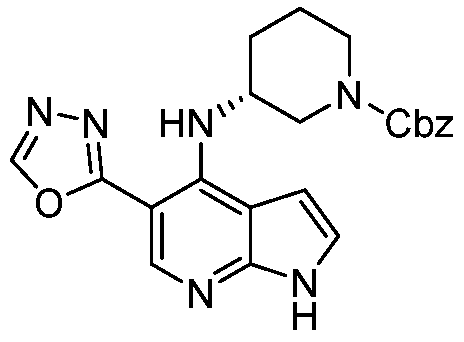
에탄올 (8 mL) 중의 벤질 (R)-3-((5-(히드라진카보닐)-1H-피롤로[2,3-b]피리딘-4-일)아미노)피페리딘-1-카르복실레이트 (0.1 g, 0.24 mmol) 및 트리에틸오르쏘포르메이트 (2 mL, 12.0 mmol)의 교반된 용액을 밀봉된 튜브 중에서 120℃로 가열하였다. 18시간 후, 상기 반응 혼합물을 실온으로 냉각하고, 상기 혼합물을 진공에서 농축시켜 휘발성 물질들을 제거하였다. 상기 미정제 물질을 컬럼 크로마토그래피 (메탄올/디클로로메탄)로 정제하여 벤질 (R)-3-((5-(1,3,4-옥사디아졸-2-일)-1H-피롤로[2,3-b]피리딘-4-일)아미노)피페리딘-1-카르복실레이트를 담황색 고체로서 수득하였다 (0.16 g, 40% 수율): MS (ES) m/z 419.2 (M+H).Ethanol (8 mL) benzyl (R) -3 of the - ((5 (hydrazine-carbonyl) -1 H-pyrrolo [2,3- b] pyridin-4-yl) amino) piperidine-1- A stirred solution of carboxylate (0.1 g, 0.24 mmol) and triethylorthoformate (2 mL, 12.0 mmol) was heated to 120° C. in a sealed tube. After 18 h, the reaction mixture was cooled to room temperature and the mixture was concentrated in vacuo to remove volatiles. Purification of the crude material by column chromatography (methanol / dichloromethane), benzyl (R) -3 - ((5- (1,3,4- oxadiazol-2-yl) -1 H - pyrrolo [ 2,3- b ]pyridin-4-yl)amino)piperidine-1-carboxylate was obtained as a pale yellow solid (0.16 g, 40% yield): MS (ES) m/z 419.2 (M+H ).
[000318] 단계 3: (R)-5-(1,3,4-옥사디아졸-2-일)-N-(피페리딘-3-일)-1H-피롤로[2,3-b]피리딘-4-아민의 제조 [000 318] Step 3: (R) -5- (1,3,4- oxadiazol-2-yl) - N - (piperidin-3-yl) -1 H - pyrrolo [2,3- b ] Preparation of pyridin-4-amine

테트라하이드로퓨란 : 에탄올 (8 mL : 5 mL) 중의 벤질 (R)-3-((5-(1,3,4-옥사디아졸-2-일)-1H-피롤로[2,3-b]피리딘-4-일)아미노)피페리딘-1-카르복실레이트 (0.16 g, 0.38 mmol)의 용액에 10% 탄소상 팔라듐 (0.03 g)을 첨가하고, 상기 이질성 혼합물을 수소 대기 하에 상온에서 32시간 동안 교반하였다. 상기 반응 혼합물을 셀라이트를 통해 여과시킨 후, 메탄올로 세척하였다. 상기 여과액을 진공에서 농축시켜 미정제 생성물을 수득하고, 이를 디에틸 에테르로 연화처리하여 (R)-5-(1,3,4-옥사디아졸-2-일)-N-(피페리딘-3-일)-1H-피롤로[2,3-b]피리딘-4-아민을 황색 고체로서 수득하였다 (0.05 g, 52% 수율): MS (ES) m/z 285.2 (M+H).Tetrahydrofuran: ethanol (8 mL: 5 mL) of benzyl (R) -3 - ((5- (1,3,4- oxadiazol-2-yl) -1 H - pyrrolo [2,3- b ] To a solution of ]pyridin-4-yl)amino)piperidine-1-carboxylate (0.16 g, 0.38 mmol) was added 10% palladium on carbon (0.03 g), and the heterogeneous mixture was brought to room temperature under a hydrogen atmosphere. stirred for 32 hours. The reaction mixture was filtered through celite and washed with methanol. Concentration of the filtrate in vacuo to give the crude product, and by this, triturated with diethyl ether (R) -5- (1,3,4- oxadiazol-2-yl) - N - (piperidin 3-yl) -1 H - pyrrolo [2,3- b] pyridin-4-amine as a yellow solid (0.05 g, 52% yield): MS (ES) m / z 285.2 (m + H).
[000319] 단계 4: (R)-3-(3-((5-(1,3,4-옥사디아졸-2-일)-1H-피롤로[2,3-b]피리딘-4-일)아미노)피페리딘-1-일)-3-옥소프로판니트릴의 제조 [000 319] Step 4: (R) -3- (3 - ((5- (1,3,4- oxadiazol-2-yl) -1 H - pyrrolo [2,3- b] pyridine -4 Preparation of -yl)amino)piperidin-1-yl)-3-oxopropanenitrile

(R)-3-(3-((5-(1,3,4-옥사디아졸-2-일)-1H-피롤로[2,3-b]피리딘-4-일)아미노)피페리딘-1-일)-3-옥소프로판니트릴을실시예 1, 단계-8에 기술된 방법에 따라 제조하여 담갈색 고체를 수득하였다 (0.01g, 14% 수율): 1H NMR (400 MHz, DMSO-d6) δ 11.77 (s, 1H), 9.24 (s, 1H), 8.40-8.47 (m, 2H), 7.28 (s, 1H), 6.75 (s, 1H), 4.20 (d, J = 10.0 Hz, 1H), 4.04 (q, J1 = 18.8 Hz, J2 = 18.4 Hz, 2H), 3.73-3.84 (m, 2H), 3.47 (d, J = 10.0 Hz, 1H), 3.14 (d, J = 4.8 Hz, 1H), 2.11 (bs, 1H), 1.98 (t, J = 8.0 Hz, 1H), 1.70-1.75 (m, 2H); MS (ES) m/z 352.0 (M+H). (R) -3- (3 - ( (5- (1,3,4- oxadiazol-2-yl) -1 H - pyrrolo [2,3- b] pyridin-4-yl) amino) P Peridin-1-yl)-3-oxopropanenitrile was prepared according to the method described in Example 1, Step-8 to give a light brown solid (0.01 g, 14% yield): 1 H NMR (400 MHz, DMSO-d 6 ) δ 11.77 (s, 1H), 9.24 (s, 1H), 8.40-8.47 (m, 2H), 7.28 (s, 1H), 6.75 (s, 1H), 4.20 (d, J = 10.0) Hz, 1H), 4.04 (q, J1 = 18.8 Hz, J2 = 18.4 Hz, 2H), 3.73-3.84 (m, 2H), 3.47 (d, J = 10.0 Hz, 1H), 3.14 (d, J = 4.8) Hz, 1H), 2.11 (bs, 1H), 1.98 (t, J = 8.0 Hz, 1H), 1.70-1.75 (m, 2H); MS (ES) m/z 352.0 (M+H).
분석 조건:Analysis conditions:
컬럼: Inertsil ODS 3V (250mm X 4.6mm X 5mm)Column: Inertsil ODS 3V (250mm X 4.6mm X 5mm)
이동상(A): 수중 0.1% 암모니아Mobile phase (A): 0.1% ammonia in water
이동상(B): ACNMobile phase (B): ACN
유속: 1.0 mL/분Flow rate: 1.0 mL/min
B의 조성: 0/10, 12/70, 25/90, 27/10, 30/10Composition of B: 0/10, 12/70, 25/90, 27/10, 30/10
[000320] 실시예 8: (R)-3-(3-((5-(1,3,4-티아디아졸-2-일)-1H-피롤로[2,3-b]피리딘-4-일)아미노)피페리딘-1-일)-3-옥소프로판니트릴의 제조 [000 320] Example 8: (R) -3- (3 - ((5- (1,3,4- thiadiazol-2-yl) -1 H-pyrrolo [2,3- b] pyridin- Preparation of 4-yl)amino)piperidin-1-yl)-3-oxopropanenitrile

반응식 12: (Scheme 12: ( RR )-3-(3-((5-(1,3,4-티아디아졸-2-일)-1)-3-(3-((5-(1,3,4-thiadiazol-2-yl)-1 HH -피롤로[2,3--pyrrolo[2,3- bb ]피리딘-4-일)아미노)피페리딘-1-일)-3-옥소프로판니트릴의 제조] Preparation of pyridin-4-yl)amino)piperidin-1-yl)-3-oxopropanenitrile

[000321] 단계 1: 에틸 4-클로로-1-((2-(트리메틸실릴)에톡시)메틸)-1H-피롤로[2,3-b]피리딘-5-카르복실레이트의 제조Preparation of pyrrolo [2,3- b] pyridine-5-carboxylate ethyl 4-chloro-1 - ((2- (trimethylsilyl) ethoxy) methyl) -1 H: [000321] Step 1

0℃에서 무수 디메틸포름아미드 (20 mL) 중 에틸 4-클로로-1H-피롤로[2,3-b]피리딘-5-카르복실레이트 (5 g, 22.2 mol)의 교반된 용액에 수소화나트륨 (1.42 g, 35.6 mol, 광유 중 60% 현탁액)을 첨가하고, 상기 현탁액을 30분간 교반하였다. 이후, 2-(트리메틸실릴)에톡시메틸 클로라이드 (7.88 mL, 44.5 mol)를 첨가하고, 상기 생성된 혼합물을 상온에서 1.5시간 동안 교반하였다. 상기 반응 혼합물을 포화 염화암모늄 용액으로 ??칭하고 에틸 아세테이트로 추출하였다. 상기 혼합된 유기층을 염수로 세척하고, 무수 황산나트륨으로 건조시킨 후, 상기 용액을 여과하여 진공에서 농축시켰다. 상기 미정제 물질을 컬럼 크로마토그래피 (에틸 아세테이트/헥산)로 정제하여 에틸 4-클로로-1-((2-(트리메틸실릴)에톡시)메틸)-1H-피롤로[2,3-b]피리딘-5-카르복실레이트를 황색 오일로서 수득하였다 (5.5 g, 70% 수율): MS (ES) m/z 354.9 (M+H). To a stirred solution of ethyl 4-chloro-1H -pyrrolo[2,3- b ]pyridine-5-carboxylate (5 g, 22.2 mol) in anhydrous dimethylformamide (20 mL) at 0° C. sodium hydride (1.42 g, 35.6 mol, 60% suspension in mineral oil) was added and the suspension was stirred for 30 min. Then, 2-(trimethylsilyl)ethoxymethyl chloride (7.88 mL, 44.5 mol) was added, and the resulting mixture was stirred at room temperature for 1.5 hours. The reaction mixture was quenched with saturated ammonium chloride solution and extracted with ethyl acetate. The combined organic layer was washed with brine, dried over anhydrous sodium sulfate, and then the solution was filtered and concentrated in vacuo. (Ethoxy) (2- (trimethylsilyl) methyl) -1 H - - The crude ethyl 4-chloro-l Purification of the material by column chromatography (ethyl acetate / hexane) pyrrolo [2,3- b] Pyridine-5-carboxylate was obtained as a yellow oil (5.5 g, 70% yield): MS (ES) m/z 354.9 (M+H).
[000322] 단계 2: 에틸 (R)-4-((1-(tert-부톡시카보닐)피페리딘-3-일)아미노)-1-((2-(트리메틸실릴)에톡시)메틸)-1H-피롤로[2,3-b]피리딘-5-카르복실레이트의 제조 [000322] Step 2: Ethyl ( R )-4-((1-( tert -butoxycarbonyl)piperidin-3-yl)amino)-1-((2-(trimethylsilyl)ethoxy)methyl )-1 H -pyrrolo [2,3- b ] pyridine-5-carboxylate preparation

밀봉된 튜브 중에서 N-메틸-2-피롤리돈 (20 mL) 중의 에틸 4-클로로-1-((2-(트리메틸실릴)에톡시)메틸)-1H-피롤로[2,3-b]피리딘-5-카르복실레이트 (2.0 g, 5.64 mmol)의 용액에 tert-부틸 (R)-3-아미노피페리딘-1-카르복실레이트 (1.7 g, 2.11 mmol)를 첨가한 후 트리에틸아민 (0.8 mL)을 첨가하였다. 상기 혼합물을 135℃로 3시간 동안 가열하였다. 상온으로 냉각시킨 후, 상기 반응 혼합물을 물로 ??칭하고 에틸 아세테이트로 추출하였다. 상기 유기층을 염수로 세척하고, 무수 황산나트륨으로 건조시켜 여과 후 진공에서 농축시켰다. 상기 미정제 물질을 섬광 크로마토그래피 (17% 에틸 아세테이트/헥산)로 정제하여 에틸 (R)-4-((1-(tert-부톡시카보닐)피페리딘-3-일)아미노)-1-((2-(트리메틸실릴)에톡시)메틸)-1H-피롤로[2,3-b]피리딘-5-카르복실레이트를 무색 오일로서 수득하였다 (1.0 g, 35% 수율): MS (ES) m/z 519.0 [M+H]+.In a sealed tube N-methyl-2-pyrrolidone (20 mL) of ethyl 4-chloro-l of - ((2- (trimethylsilyl) ethoxy) methyl) -1 H-pyrrolo [2,3- b ] To a solution of pyridine-5-carboxylate (2.0 g, 5.64 mmol) was added tert -butyl ( R )-3-aminopiperidine-1-carboxylate (1.7 g, 2.11 mmol) followed by triethyl Amine (0.8 mL) was added. The mixture was heated to 135° C. for 3 h. After cooling to room temperature, the reaction mixture was quenched with water and extracted with ethyl acetate. The organic layer was washed with brine, dried over anhydrous sodium sulfate, filtered and concentrated in vacuo. The crude material was purified by flash chromatography (17% ethyl acetate/hexanes) to ethyl ( R )-4-((1-( tert -butoxycarbonyl)piperidin-3-yl)amino)-1 - -1 H ((2- (trimethylsilyl) ethoxy) methyl) -pyrrolo [2,3- b] pyridine-5-carboxamide to yield a carboxylate as a colorless oil (1.0 g, 35% yield): MS (ES) m/z 519.0 [M+H] + .
[000323] 단계 3: (R)-4-((1-(tert-부톡시카보닐)피페리딘-3-일)아미노)-1-((2-(트리메틸실릴)에톡시)메틸)-1H-피롤로[2,3-b]피리딘-5-카르복실산의 제조 [000323] Step 3: ( R )-4-((1-( tert -butoxycarbonyl)piperidin-3-yl)amino)-1-((2-(trimethylsilyl)ethoxy)methyl) Preparation of -1 H -pyrrolo[2,3- b ]pyridine-5-carboxylic acid

메탄올 (3 mL), 테트라하이드로퓨란 : 물 (3 mL: 3 mL) 중 에틸 (R)-4-((1-(tert-부톡시카보닐)피페리딘-3-일)아미노)-1-((2-(트리메틸실릴) 에톡시)메틸)-1H-피롤로[2,3-b]피리딘-5-카르복실레이트 (1.0 g, 1.93 mmol)의 교반된 용액에 상온에서 수산화나트륨 (0.15 g, 3.85 mmol)을 첨가하였다. 상기 혼합물을 60℃로 8시간 동안 교반하였다. 상기 반응 혼합물을 상온으로 냉각하고 진공에서 농축시켜 휘발성 물질들을 제거하였다. 잔류물을 물에 용해시킨 후, 1N HCl로 산성화하고, 에틸 아세테이트로 추출하였다. 상기 유기층을 염수로 세척하고, 무수 황산나트륨으로 건조시켜 여과 후 진공에서 농축시켰다. 상기 미정제 생성물을 n-펜탄으로 연화처리하여 (R)-4-((1-(tert-부톡시카보닐)피페리딘-3-일)아미노)-1-((2-(트리메틸실릴)에톡시)메틸)-1H-피롤로[2,3-b]피리딘-5-카르복실산을 황백색 고체로서 수득하였다 (0.8 g, 84% 수율): MS (ES) m/z 490.9 [M+H]+. Ethyl (R )-4-((1-( tert -butoxycarbonyl)piperidin-3-yl)amino)-1 in methanol (3 mL), tetrahydrofuran: water (3 mL: 3 mL) - ((2- (trimethylsilyl) ethoxy) methyl) -1 H-pyrrolo [2,3- b] pyridine-5-carboxylate (1.0 g, 1.93 mmol) sodium hydroxide at room temperature to a stirred solution of (0.15 g, 3.85 mmol) was added. The mixture was stirred at 60° C. for 8 hours. The reaction mixture was cooled to room temperature and concentrated in vacuo to remove volatiles. The residue was dissolved in water, then acidified with 1N HCl and extracted with ethyl acetate. The organic layer was washed with brine, dried over anhydrous sodium sulfate, filtered and concentrated in vacuo. The crude product was triturated with n-pentane to triturate ( R )-4-((1-( tert -butoxycarbonyl)piperidin-3-yl)amino)-1-((2-(trimethylsilyl) ) ethoxy) methyl) -1 H - pyrrolo [2,3- b] pyridine-5-carboxylic acid to give a yellow-white solid as (0.8 g, 84% yield): MS (ES) m / z 490.9 [ M+H] + .
[000324] 단계 4: tert-부틸 (R)-3-((5-(2-포르밀히드라진-1-카보닐)-1-((2-(트리메틸실릴)에톡시)메틸)-1H-피롤로[2,3-b]피리딘-4-일)아미노)피페리딘-1-카르복실레이트의 제조 [000 324] Step 4: tert-butyl (R) -3 - ((5- (2-formyl-hydrazine-1-carbonyl) -1-methyl) - 1 H ethoxy) ((2- (trimethylsilyl) Preparation of -pyrrolo[2,3-b]pyridin-4-yl)amino)piperidine-1-carboxylate

디메틸포름아미드 (5 mL) 중의 (R)-4-((1-(tert-부톡시카보닐)피페리딘-3-일)아미노)-1-((2-(트리메틸실릴)에톡시)메틸)-1H-피롤로[2,3-b]피리딘-5-카르복실산 (0.4 g, 0.752 mmol)의 용액에 포름산 히드라지드 (0.07 g, 1.13 mmol), 1-[비스(디메틸아미노)메틸렌]-1H-1,2,3-트리아졸로[4,5-b]피리디늄 3-옥사이드 헥사플루오로포스페이트 (0.15 g, 0.37 mmol) 및 N,N-디이소프로필에틸아민 (0.07 mL, 0.376 mmol)를 첨가하고, 상기 혼합물을 상온에서 3시간 동안 교반하였다. 상기 반응 혼합물을 물로 ??칭하고 에틸 아세테이트로 추출하였다. 상기 유기층을 중탄산나트륨 용액, 염수로 세척하고 무수 황산나트륨으로 건조시켰다. 상기 용액을 여과한 후 진공에서 농축시켜 tert-부틸 (R)-3-((5-(2-포르밀히드라진-1-카보닐)-1-((2-(트리메틸실릴)에톡시)메틸)-1H-피롤로[2,3-b]피리딘-4-일)아미노)피페리딘-1-카르복실레이트를 담황색 액체로서 수득하였다 (0.4 g, 90% 수율): MS (ES) m/z 533.0 [M+H]+. (R )-4-((1-( tert -butoxycarbonyl)piperidin-3-yl)amino)-1-((2-(trimethylsilyl)ethoxy) in dimethylformamide (5 mL) methyl) -1 H - pyrrolo [2,3- b] pyridine-5-carboxylic acid (0.4 g, to a solution of 0.752 mmol) of formic acid hydrazide (0.07 g, 1.13 mmol), 1- [ bis (dimethylamino ) methylene] -1 H -1,2,3- triazolo [4,5- b] pyridinium 3-oxide hexafluorophosphate (0.15 g, 0.37 mmol) and N, N - diisopropylethylamine (0.07 mL, 0.376 mmol) and the mixture was stirred at room temperature for 3 hours. The reaction mixture was quenched with water and extracted with ethyl acetate. The organic layer was washed with sodium bicarbonate solution, brine and dried over anhydrous sodium sulfate. The solution was filtered and concentrated in vacuo to tert -butyl ( R )-3-((5-(2-formylhydrazine-1-carbonyl)-1-((2-(trimethylsilyl)ethoxy)methyl ) -1 H - pyrrolo [2,3- b] pyridin-4-yl) amino) to give piperidine-1-carboxylate as a pale yellow liquid (0.4 g, 90% yield): MS (ES) m/z 533.0 [M+H] + .
[000325] 단계 5: tert-부틸 (R)-3-((5-(1,3,4-티아디아졸-2-일)-1-((2-(트리메틸실릴)에톡시)메틸)-1H-피롤로[2,3-b]피리딘-4-일)아미노)피페리딘-1-카르복실레이트의 제조 [000325] Step 5: tert -Butyl ( R )-3-((5-(1,3,4-thiadiazol-2-yl)-1-((2-(trimethylsilyl)ethoxy)methyl) Preparation of -1 H -pyrrolo[2,3-b]pyridin-4-yl)amino)piperidine-1-carboxylate

테트라하이드로퓨란 (20 mL) 중의 tert-부틸 (R)-3-((5-(2-포르밀히드라진-1-카보닐)-1-((2-(트리메틸실릴)에톡시)메틸)-1H-피롤로[2,3-b]피리딘-4-일)아미노)피페리딘-1-카르복실레이트 (0.37 g, 0.695 mmol)의 용액에 상온에서 로웨슨 시약 (Lawesson's reagent) (0.84 g, 2.08 mmol)을 첨가하고, 상기 혼합물을 70℃에서 16시간 동안 교반하였다. 상기 반응 혼합물을 상온으로 냉각시키고, 10% 시트르산으로 ??칭하여 상기 용액을 5분간 교반한 후, 중탄산나트륨 용액을 첨가하여 10분간 더 교반하였다. 상기 수성층을 에틸 아세테이트로 추출한 후, 포화 중탄산나트륨 및 염수로 세척하였다. 상기 유기층을 무수 황산나트륨으로 건조시킨 후, 여과하여 진공에서 농축시켰다. 상기 미정제 물질을 섬광 크로마토그래피 (35% 에틸 아세테이트/헥산)로 정제하여 tert-부틸 (R)-3-((5-(1,3,4-티아디아졸-2-일)-1-((2-(트리메틸실릴)에톡시)메틸)-1H-피롤로[2,3-b]피리딘-4-일)아미노)피페리딘-1-카르복실레이트를 담황색 액체로서 수득하였다 (0.28 g, 78% 수율): MS (ES) m/z 530.9 [M+H]+. tert -Butyl ( R )-3-((5-(2-formylhydrazine-1-carbonyl)-1-((2-(trimethylsilyl)ethoxy)methyl)- in tetrahydrofuran (20 mL) 1 H -pyrrolo[2,3- b ]pyridin-4-yl)amino)piperidine-1-carboxylate (0.37 g, 0.695 mmol) in a solution at room temperature with Lawesson's reagent (0.84) g, 2.08 mmol) and the mixture was stirred at 70° C. for 16 h. The reaction mixture was cooled to room temperature, quenched with 10% citric acid, and the solution was stirred for 5 minutes, then sodium bicarbonate solution was added and stirred for another 10 minutes. The aqueous layer was extracted with ethyl acetate and washed with saturated sodium bicarbonate and brine. The organic layer was dried over anhydrous sodium sulfate, filtered and concentrated in vacuo. The crude material was purified by flash chromatography (35% ethyl acetate/hexanes) to tert -butyl ( R )-3-((5-(1,3,4-thiadiazol-2-yl)-1- ((2- (trimethylsilyl) ethoxy) methyl) -1 H - pyrrolo [2,3- b] pyridine-4-yl) amino) piperidine-1-carboxylate as a pale yellow liquid ( 0.28 g, 78% yield): MS (ES) m/z 530.9 [M+H] + .
[000326] 단계 6: (R)-N-(피페리딘-3-일)-5-(1,3,4-티아디아졸-2-일)-1H-피롤로[2,3-b]피리딘-4-아민의 제조 [000 326] Step 6: (R) - N - ( piperidin-3-yl) -5- (1,3,4-thiadiazol-2-yl) -1 H - pyrrolo [2,3- b ] Preparation of pyridin-4-amine

(R)-N-(피페리딘-3-일)-5-(1,3,4-티아디아졸-2-일)-1H-피롤로[2,3-b]피리딘-4-아민을 실시예 1, 단계-7에 기술된 방법에 따라 제조하여 황색 액체를 수득하였다 (0.2 g, % 수율): MS (ES) m/z 301.2 [M+H]+. (R) - N - (piperidin-3-yl) -5- (1,3,4-thiadiazol-2-yl) -1 H - pyrrolo [2,3- b] pyridin-4 The amine was prepared according to the method described in Example 1, Step-7 to give a yellow liquid (0.2 g, % yield): MS (ES) m/z 301.2 [M+H] + .
[000327] 단계 7: (R)-3-(3-((5-(1,3,4-티아디아졸-2-일)-1H-피롤로[2,3-b]피리딘-4-일)아미노)피페리딘-1-일)-3-옥소프로판니트릴의 제조 [000 327] Step 7: (R) -3- (3 - ((5- (1,3,4- thiadiazol-2-yl) -1 H - pyrrolo [2,3- b] pyridine -4 Preparation of -yl)amino)piperidin-1-yl)-3-oxopropanenitrile

(R)-3-(3-((5-(1,3,4-티아디아졸-2-일)-1H-피롤로[2,3-b]피리딘-4-일)아미노)피페리딘-1-일)-3-옥소프로판니트릴을 실시예 1, 단계-8에 기술된 방법에 따라 제조하여 황백색의 고체를 수득하였다 (0.05 g, 20% 수율): 1H NMR (400 MHz, DMSO-d6) δ 11.71 (s, 1H), 9.4-9.5 (m, 2H), 8.35 (d, J= 6.4 Hz, 1H), 7.25(s, 1H), 6.78 (s, 1H), 4.39 (s, 1H), 3.60-4.21 (m, 6H), 2.09 (s, 1H), 1.65-1.74 (m, 3H); MS (ES) m/z 351.3 (M+H). (R) -3- (3 - ( (5- (1,3,4- thiadiazol-2-yl) -1 H - pyrrolo [2,3- b] pyridin-4-yl) amino) P Peridin-1-yl)-3-oxopropanenitrile was prepared according to the method described in Example 1, Step-8 to give an off-white solid (0.05 g, 20% yield): 1 H NMR (400 MHz) , DMSO-d 6 ) δ 11.71 (s, 1H), 9.4-9.5 (m, 2H), 8.35 (d, J = 6.4 Hz, 1H), 7.25(s, 1H), 6.78 (s, 1H), 4.39 (s, 1H), 3.60-4.21 (m, 6H), 2.09 (s, 1H), 1.65-1.74 (m, 3H); MS (ES) m/z 351.3 (M+H).
[000328] 실시예 9 및 10: 3-((3R,5S)-3-메틸-5-((5-(옥사졸-2-일)-1H-피롤로[2,3-b]피리딘-4-일)아미노)피페리딘-1-일)-3-옥소프로판니트릴 및 3-((3S,5R)-3-메틸-5-((5-(옥사졸-2-일)-1H-피롤로[2,3-b]피리딘-4-일)아미노)피페리딘-1-일)-3-옥소프로판니트릴의 제조 [000 328] Examples 9 and 10: 3 - ((3R, 5S) -3- methyl-5 - ((5- (oxazol-2-yl) -1 H-pyrrolo [2,3- b] pyridine -4-yl)amino)piperidin-1-yl)-3-oxopropanenitrile and 3-(( 3S,5R )-3-methyl-5-((5-(oxazol-2-yl)- Preparation of 1 H -pyrrolo[2,3-b]pyridin-4-yl)amino)piperidin-1-yl)-3-oxopropanenitrile

벤질 3-아미노-5-메틸피페리딘-1-카르복실레이트 하이드로클로라이드를 하기 기술된 방법에 따라 제조하였다.Benzyl 3-amino-5-methylpiperidine-1-carboxylate hydrochloride was prepared according to the method described below.

[000329] 단계 1: tert-부틸 (5-메틸피페리딘-3-일)카르바메이트의 제조 [000329] Step 1: Preparation of tert -butyl (5-methylpiperidin-3-yl)carbamate

파르 진탕기 용기에서, 아세트산 (30 mL) 중 tert-부틸 (5-메틸피리딘-3-일)카르바메이트 (0.8 g)의 교반된 용액에 이산화백금 (0.2 g) 및 탄소상 로듐 (0.2 g)을 질소 대기 하에 첨가하였다. 상기 반응 혼합물을 수소 (100 psi) 하에 상온에서 24시간 동안 교반하였다. 상기 혼합물을 셀라이트를 통해 여과한 후, 상기 여과액을 진공에서 농축시켜 tert-부틸 (5-메틸피페리딘-3-일)카르바메이트를 유리 광택성 (glassy)의 액체를 수득하였다 (0.74 g, 90% 수율): MS (ES) m/z 215.1 [M+H]+.In a Parr shaker vessel, to a stirred solution of tert -butyl (5-methylpyridin-3-yl)carbamate (0.8 g) in acetic acid (30 mL) platinum dioxide (0.2 g) and rhodium on carbon (0.2 g) ) was added under a nitrogen atmosphere. The reaction mixture was stirred under hydrogen (100 psi) at room temperature for 24 hours. After the mixture was filtered through Celite, the filtrate was concentrated in vacuo to give tert -butyl (5-methylpiperidin-3-yl)carbamate as a glassy liquid ( 0.74 g, 90% yield): MS (ES) m/z 215.1 [M+H] + .
[000330] 단계 2: 벤질 3-((tert-부톡시카보닐)아미노)-5-메틸피페리딘-1-카르복실레이트의 제조 [000330] Step 2: Preparation of benzyl 3-(( tert -butoxycarbonyl)amino)-5-methylpiperidine-1-carboxylate

테트라하이드로퓨란 (12 mL) 및 물 (3 mL) 중 tert-부틸 (5-메틸피페리딘-3-일)카르바메이트 (1.5 g, 6.99 mmol)의 교반된 용액에 0℃에서 수산화나트륨 (1.4 g, 34.99 mmol) 및 벤질 클로로포르메이트 (2.4 mL, 13.99)를 첨가하였다. 상기 혼합물을 상온에서 16시간 동안 교반하였다. 상기 반응 혼합물을 에틸 아세테이트로 희석하고, 염수로 세척하여 황산나트륨으로 건조시킨 후, 여과하여 진공에서 농축시켰다. 상기 미정제 물질을 섬광 크로마토그래피 (23% 에틸 아세테이트/헥산)로 정제하여 벤질 3-((tert-부톡시카보닐)아미노)-5-메틸피페리딘-1-카르복실레이트를 백색 고체로서 수득하였다 (0.8 g, 33% 수율): MS (ES) m/z 293.2 [M-56]+. To a stirred solution of tert -butyl (5-methylpiperidin-3-yl)carbamate (1.5 g, 6.99 mmol) in tetrahydrofuran (12 mL) and water (3 mL) at 0 °C sodium hydroxide ( 1.4 g, 34.99 mmol) and benzyl chloroformate (2.4 mL, 13.99) were added. The mixture was stirred at room temperature for 16 hours. The reaction mixture was diluted with ethyl acetate, washed with brine, dried over sodium sulfate, filtered and concentrated in vacuo. The crude material was purified by flash chromatography (23% ethyl acetate/hexanes) to give benzyl 3-(( tert -butoxycarbonyl)amino)-5-methylpiperidine-1-carboxylate as a white solid. Obtained (0.8 g, 33% yield): MS (ES) m/z 293.2 [M-56] + .
[000331] 단계 3: 벤질 3-아미노-5-메틸피페리딘-1-카르복실레이트 하이드로클로라이드의 제조 [000331] Step 3: Preparation of benzyl 3-amino-5-methylpiperidine-1-carboxylate hydrochloride

디클로로메탄 (20 mL) 중의 벤질 3-((tert-부톡시카보닐)아미노)-5-메틸피페리딘-1-카르복실레이트 (0.8 g)의 교반된 용액에 0℃에서 1,4-디옥산 (8 mL) 중의 4M 염산을 첨가하였다. 상기 반응 혼합물을 상온에서 3시간 동안 교반한 후, 진공에서 농축시켜 벤질 3-아미노-5-메틸피페리딘-1-카르복실레이트 하이드로클로라이드를 백색 고체로서 수득하였다 (0.54 g, 95% 수율): MS (ES) m/z 249.0 [M+H]+.To a stirred solution of benzyl 3-(( tert -butoxycarbonyl)amino)-5-methylpiperidine-1-carboxylate (0.8 g) in dichloromethane (20 mL) at 0° C. 1,4- 4M hydrochloric acid in dioxane (8 mL) was added. The reaction mixture was stirred at room temperature for 3 hours and then concentrated in vacuo to give benzyl 3-amino-5-methylpiperidine-1-carboxylate hydrochloride as a white solid (0.54 g, 95% yield). : MS (ES) m/z 249.0 [M+H] + .
반응식 13: 3-((3Scheme 13: 3-((3 S,S, 55 RR )-3-메틸-5-((5-(옥사졸-2-일)-1)-3-methyl-5-((5-(oxazol-2-yl)-1 HH -피롤로[2,3--pyrrolo[2,3- bb ]피리딘-4-일)아미노)피페리딘-1-일)-3-옥소프로판니트릴 및 3-((3]pyridin-4-yl)amino)piperidin-1-yl)-3-oxopropanenitrile and 3-((3 S,S, 55 SS )-3-메틸-5-((5-(옥사졸-2-일)-1)-3-methyl-5-((5-(oxazol-2-yl)-1 HH -피롤로[2,3--pyrrolo[2,3- bb ]피리딘-4-일)아미노)피페리딘-1-일)-3-옥소프로판니트릴의 제조] Preparation of pyridin-4-yl)amino)piperidin-1-yl)-3-oxopropanenitrile

[000332] 단계 1: 벤질 3-메틸-5-((5-(옥사졸-2-일)-1-((2-(트리메틸실릴)에톡시)메틸)-1H-피롤로[2,3-b]피리딘-4-일)아미노)피페리딘-1-카르복실레이트의 제조 [000 332] Step 1: Benzyl 3-methyl-5 - ((5- (oxazol-2-yl) - 1 - ((methylethoxy), 2- (trimethylsilyl)) - 1 H-pyrrolo [2, Preparation of 3- b ]pyridin-4-yl)amino)piperidine-1-carboxylate

N-메틸피롤리돈 (10 mL) 중의 2-(4-클로로-1-((2-(트리메틸실릴)에톡시)메틸)-1H-피롤로[2,3-b]피리딘-5-일)옥사졸 (0.35 g, 1.00 mmol, 실시예 5, 단계-1에 기술된 방법에 따라 제조됨), 트리에틸아민 (0.4 mL, 3.00 mmol) 벤질 3-아미노-5-메틸피페리딘-1-카르복실레이트 하이드로클로라이드 (0.43 g, 1.50 mmol)의 교반된 용액에 135℃로 5시간 동안 마이크로파를 조사하였다. 상기 반응 혼합물을 상온으로 냉각시키고, 물로 희석한 후, 에틸 아세테이트로 추출하였다. 상기 유기층을 염수로 세척하고, 황산나트륨으로 건조시켜 여과 후 진공에서 농축시켰다. 상기 미정제 물질을 섬광 크로마토그래피 (21% 에틸 아세테이트/헥산)로 정제하여 벤질 3-메틸-5-((5-(옥사졸-2-일)-1-((2-(트리메틸실릴)에톡시)메틸)-1H-피롤로[2,3-b]피리딘-4-일)아미노)피페리딘-1-카르복실레이트를 걸쭉한 갈색의 액체로서 수득하였다 (0.13 g, 23%): MS (ES) m/z =561.9 [M+H]+.2- (4-chloro-l-methyl pyrrolidone in (10 mL) - - N-ethoxy ((2- (trimethylsilyl)) methyl) -1 H - pyrrolo [2,3- b] pyridin-5 yl)oxazole (0.35 g, 1.00 mmol, prepared according to the method described in Example 5, step-1), triethylamine (0.4 mL, 3.00 mmol) benzyl 3-amino-5-methylpiperidine- A stirred solution of 1-carboxylate hydrochloride (0.43 g, 1.50 mmol) was irradiated with microwaves at 135° C. for 5 hours. The reaction mixture was cooled to room temperature, diluted with water, and extracted with ethyl acetate. The organic layer was washed with brine, dried over sodium sulfate, filtered and concentrated in vacuo. The crude material was purified by flash chromatography (21% ethyl acetate/hexanes) to benzyl 3-methyl-5-((5-(oxazol-2-yl)-1-((2-(trimethylsilyl) ethoxy) methyl) -1 H - pyrrolo [2,3- b] pyridin-4-yl) amino) piperidine-1-carboxylate was obtained as a thick brown liquid (0.13 g, 23%): MS (ES) m/z =561.9 [M+H] + .
[000333] 단계 2: N-(5-메틸피페리딘-3-일)-5-(옥사졸-2-일)-1H-피롤로[2,3-b]피리딘-4-아민의 제조 [000 333] Step 2: N - (5- methyl-piperidin-3-yl) -5- (oxazol-2-yl) -1 H - pyrrolo [2,3- b] pyridine-4-amine Produce

트리플루오로아세트산 (3.0 mL) 중의 벤질 3-메틸-5-((5-(옥사졸-2-일)-1-((2-(트리메틸실릴)에톡시)메틸)-1H-피롤로[2,3-b]피리딘-4-일)아미노)피페리딘-1-카르복실레이트 (0.13 g, 0.23 mmol)의 용액을 100℃에서 1시간 동안 교반하였다. 냉각 후, 상기 반응 혼합물을 진공에서 농축하고, 수득된 잔류물을 1,4-디옥산 : 수성 암모니아 (5.0 mL: 5.0 mL)에 용해시킨 후, 상온에서 밤새 교반하였다. 상기 반응 혼합물을 진공에서 농축시켜 N-(5-메틸피페리딘-3-일)-5-(옥사졸-2-일)-1H-피롤로[2,3-b]피리딘-4-아민을 걸쭉한 액체로서 수득하였다 (0.08 g, 미정제): MS (ES) m/z 298.0 [M+H]+.Benzyl in trifluoroacetic acid (3.0 mL), 3- methyl-5 - ((5- (oxazol-2-yl) - 1 - ((2- (trimethylsilyl) ethoxy) methyl) -1 H-pyrrolo A solution of [2,3- b ]pyridin-4-yl)amino)piperidine-1-carboxylate (0.13 g, 0.23 mmol) was stirred at 100° C. for 1 hour. After cooling, the reaction mixture was concentrated in vacuo, and the obtained residue was dissolved in 1,4-dioxane : aqueous ammonia (5.0 mL: 5.0 mL) and stirred at room temperature overnight. The reaction mixture was concentrated in vacuo to N - (5- methyl-piperidin-3-yl) -5- (oxazol-2-yl) -1 H - pyrrolo [2,3- b] pyridin-4 The amine was obtained as a thick liquid (0.08 g, crude): MS (ES) m/z 298.0 [M+H] + .
[000334] 단계 3: 3-(3-메틸-5-((5-(옥사졸-2-일)-1H-피롤로[2,3-b]피리딘-4-일)아미노)피페리딘-1-일)-3-옥소프로판니트릴의 제조 [000 334] Step 3: 3- (3-methyl-5 - ((5- (oxazol-2-yl) -1 H-pyrrolo [2,3- b] pyridin-4-yl) amino) piperidin Preparation of diin-1-yl)-3-oxopropanenitrile

디클로로메탄 (10 mL) 중의 N-(5-메틸피페리딘-3-일)-5-(옥사졸-2-일)-1H-피롤로[2,3-b]피리딘-4-아민 (0.07 g, 0.235 mmol)의 용액에 트리에틸아민 (0.1 mL, 0.706 mmol), 프로판포스폰산 무수물 (0.4 mL, 0.706 mmol) 및 시아노아세트산 (0.03 g, 0.353 mmol)을 0℃에서 첨가하였다. 상기 반응 혼합물을 상온에서 3시간 동안 교반하였다. 상기 반응 혼합물을 물로 ??칭하고 디클로로메탄으로 추출하였다. 상기 유기층을 물과 염수로 세척하고, 무수 황산나트륨으로 건조시킨 후, 여과하여 진공에서 농축시켰다. 상기 미정제 물질을 섬광 크로마토그래피 (70% 에틸 아세테이트 / 헥산)로 정제하여 라세미 3-(3-메틸-5-((5-(옥사졸-2-일)-1H-피롤로[2,3-b]피리딘-4-일)아미노)피페리딘-1-일)-3-옥소프로판니트릴을 황백색 고체로서 수득하였다 (0.025 g, 31% 수율): MS (ES) m/z 351.1 [M+H]+. Dichloromethane (10 mL) of N - (5- methyl-piperidin-3-yl) -5- (oxazol-2-yl) -1 H - pyrrolo [2,3- b] pyridin-4-amine To a solution of (0.07 g, 0.235 mmol) was added triethylamine (0.1 mL, 0.706 mmol), propanephosphonic anhydride (0.4 mL, 0.706 mmol) and cyanoacetic acid (0.03 g, 0.353 mmol) at 0°C. The reaction mixture was stirred at room temperature for 3 hours. The reaction mixture was quenched with water and extracted with dichloromethane. The organic layer was washed with water and brine, dried over anhydrous sodium sulfate, filtered and concentrated in vacuo. The crude by flash chromatography (70% ethyl acetate / hexane) to give the semi-la 3- (3-methyl-5 - ((5- (oxazol-2-yl) -1 H-pyrrolo [2 ,3- b ]pyridin-4-yl)amino)piperidin-1-yl)-3-oxopropanenitrile Obtained as an off-white solid (0.025 g, 31% yield): MS (ES) m/z 351.1 [M+H] + .
상기 라세미 화합물을 키랄 분취용 HPLC로 추가로 정제하여 거울상이성질체를 분리하였다.The racemic compound was further purified by chiral preparative HPLC to separate enantiomers.
키랄 HPLCChiral HPLC
분석 조건:Analysis conditions:
컬럼: CHIRALPAC IC (10 mm x 4.6 mm x 3 mic)Column: CHIRALPAC IC (10 mm x 4.6 mm x 3 mic)
이동상(A): n-헥산 : 에탄올 + 0.1% DEA (80:20)Mobile phase (A): n -hexane: ethanol + 0.1% DEA (80:20)
유속: 1.0 mL/분Flow rate: 1.0 mL/min
[000335] 실시예 9: 3-((3R,5S)-3-메틸-5-((5-(옥사졸-2-일)-1H-피롤로[2,3-b]피리딘-4-일)아미노)피페리딘-1-일)-3-옥소프로판니트릴 (입체화학구조는 잠정적으로 할당되었음) [000 335] Example 9: 3 - ((3 R , 5 S) -3- methyl-5 - ((5- (oxazol-2-yl) -1 H-pyrrolo [2,3- b] pyridine -4-yl)amino)piperidin-1-yl)-3-oxopropanenitrile (stereochemical structure assigned tentatively)

백색 고체로서 분리함 (0.028 g, 11% 수율): 1H NMR (400 MHz, CDCl3) δ 11.84 (s, 1H), 10.37-10.35 (m, 1H), 8.56 (m, 2H), 7.75 (s, 1H), 6.975 (m, 2H ), 5.12 (d, J = 12.4 Hz, 1H), 4.2 (br s, 1H), 3.75-2.00 (m, 7H), 1.49 (s, 1H), 0.96 (d, 3H); MS (ES) m/z =365.2 [M+H]+; HPLC 순도: 99.45%. 체류 시간 11.4분.Isolated as a white solid (0.028 g, 11% yield): 1 H NMR (400 MHz, CDCl 3 ) δ 11.84 (s, 1H), 10.37-10.35 (m, 1H), 8.56 (m, 2H), 7.75 ( s, 1H), 6.975 (m, 2H ), 5.12 (d, J = 12.4 Hz, 1H), 4.2 (br s, 1H), 3.75-2.00 (m, 7H), 1.49 (s, 1H), 0.96 ( d, 3H); MS (ES) m/z =365.2 [M+H] + ; HPLC purity: 99.45%. Residence time 11.4 minutes.
[000336] 실시예 10: 3-((3S,5R)-3-메틸-5-((5-(옥사졸-2-일)-1H-피롤로[2,3-b]피리딘-4-일)아미노)피페리딘-1-일)-3-옥소프로판니트릴 (입체화학구조는 잠정적으로 할당되었음) [000 336] Example 10: 3 - ((3 S , 5 R) -3- methyl-5 - ((5- (oxazol-2-yl) -1 H-pyrrolo [2,3 -b] pyridine -4-yl)amino)piperidin-1-yl)-3-oxopropanenitrile (stereochemical structure assigned tentatively)

백색 고체로서 분리함 (0.003 g, 13% 수율): 1H NMR (400 MHz, CDCl3) δ 11.86 (s, 1H), 10.37-10.35 (m, 1H), 8.56 (m, 2H), 7.75 (s, 1H), 6.98 (m, 2H ), 5.12 (d, J = 12.4 Hz, 1H), 4.18 (br s, 1H), 3.8-2.20 (m, 7H), 2.00 (s, 1H), 0.9 (d, 3H); MS (ES) m/z =365.1 [M+H]+; HPLC 순도: 98.16%. 체류 시간 16.22분.Isolated as a white solid (0.003 g, 13% yield): 1 H NMR (400 MHz, CDCl 3 ) δ 11.86 (s, 1H), 10.37-10.35 (m, 1H), 8.56 (m, 2H), 7.75 ( s, 1H), 6.98 (m, 2H ), 5.12 (d, J = 12.4 Hz, 1H), 4.18 (br s, 1H), 3.8-2.20 (m, 7H), 2.00 (s, 1H), 0.9 ( d, 3H); MS (ES) m/z =365.1 [M+H] + ; HPLC purity: 98.16%. Residence time 16.22 minutes.
[000337] 실시예 11: (R)-3-(3-((5-(4H-1,2,4-트리아졸-3-일)-1H-피롤로[2,3-b]피리딘-4-일)아미노)피페리딘-1-일)-3-옥소프로판니트릴의 제조 [000 337] Example 11: (R) -3- (3 - ((5- (4 H -1,2,4- triazol-3-yl) -1 H - pyrrolo [2,3- b] Preparation of pyridin-4-yl)amino)piperidin-1-yl)-3-oxopropanenitrile

반응식 14: (Scheme 14: ( RR )-3-(3-((5-(4)-3-(3-((5-(4) HH -1,2,4-트리아졸-3-일)-1-1,2,4-triazol-3-yl)-1 HH -피롤로[2,3--pyrrolo[2,3- bb ]피리딘-4-일)아미노)피페리딘-1-일)-3-옥소프로판니트릴의 제조] Preparation of pyridin-4-yl)amino)piperidin-1-yl)-3-oxopropanenitrile

[000338] 단계 1: 벤질 (R)-3-((5-카바모일-1H-피롤로[2,3-b]피리딘-4-일)아미노)피페리딘-1-카르복실레이트의 제조 [000338] Step 1: of benzyl (R) -3-((5-carbamoyl- 1H -pyrrolo[2,3- b ]pyridin-4-yl)amino)piperidine-1-carboxylate Produce

N,N-디메틸포름아미드 (1 mL) 중의 (R)-4-((1-((벤질옥시)카보닐)피페리딘-3-일)아미노)-1H-피롤로[2,3-b]피리딘-5-카르복실산 (0.1 g, 0.25 mmol, 실시예 9, 단계-1에 기술된 방법에 따라 제조됨)의 교반된 용액에 1-[비스(디메틸아미노)메틸렌]-1H-1,2,3-트리아졸로[4,5-b]피리디늄 3-옥사이드 헥사플루오로포스페이트 (0.19 g, 0.508 mmol), 트리에틸아민 (0.08 g, 0.76 mmol) 및 염화암모늄 (0.07 g, 1.27 mmol)을 첨가하였다. 상기 혼합물을 상온에서 18시간 동안 교반하였다. 상기 반응 혼합물을 물로 ??칭하고 에틸 아세테이트로 추출하였다. 상기 유기층을 염수로 세척하고, 무수 황산나트륨으로 건조시킨 후, 여과하고 진공에서 농축시켜 벤질 (R)-3-((5-카바모일-1H-피롤로[2,3-b]피리딘-4-일)아미노)피페리딘-1-카르복실레이트를 황백색 고체로서 수득하였다 (0.1 g, 미정제): MS (ES) m/z 394.1 (M+H). N, N - (R) -4 in dimethylformamide (1 mL) - ((1 - (( benzyloxy) carbonyl) piperidin-3-yl) amino) -1 H - pyrrolo [2,3 - b ] 1-[bis(dimethylamino)methylene]-1 in a stirred solution of ]pyridine-5-carboxylic acid (0.1 g, 0.25 mmol, prepared according to the method described in Example 9, step-1) H -1,2,3-triazolo[4,5- b ]pyridinium 3-oxide hexafluorophosphate (0.19 g, 0.508 mmol), triethylamine (0.08 g, 0.76 mmol) and ammonium chloride (0.07 g) , 1.27 mmol) was added. The mixture was stirred at room temperature for 18 hours. The reaction mixture was quenched with water and extracted with ethyl acetate. The organic layer was washed with brine, dried over anhydrous sodium sulfate, filtered and concentrated in vacuo benzyl (R) -3-((5-carbamoyl- 1H -pyrrolo[2,3- b ]pyridine-4) -yl)amino)piperidine-1-carboxylate was obtained as an off-white solid (0.1 g, crude): MS (ES) m/z 394.1 (M+H).
[000339] 단계 2: 벤질 (R,E)-3-((5-(((디메틸아미노)메틸렌)카바모일)-1H-피롤로[2,3-b]피리딘-4-일)아미노)피페리딘-1-카르복실레이트의 제조 [000 339] Step 2: Benzyl (R, E) -3 - ( (5 - ((( dimethylamino) methylene) carbamoyl) -1 H - pyrrolo [2,3- b] pyridin-4-yl) amino ) Preparation of piperidine-1-carboxylate

벤질 (R)-3-((5-카바모일-1H-피롤로[2,3-b]피리딘-4-일)아미노)피페리딘-1-카르복실레이트 (0.3 g, 0.76 mmol), N,N-디메틸포름아미드 디메틸 아세탈 (5 mL) 및 N,N-디메틸포름아미드 (0.3 mL)의 교반된 용액을 90℃에서 3시간 동안 가열하였다. 상기 반응 혼합물을 진공에서 농축시켜 벤질 (R,E)-3-((5-(((디메틸아미노)메틸렌)카바모일)-1H-피롤로[2,3-b]피리딘-4-일)아미노)피페리딘-1-카르복실레이트를 황백색 고체로서 수득하였다 (0.25 g, 미정제): MS (ES) m/z 448.9 (M+H).Benzyl ( R )-3-((5-carbamoyl- 1H -pyrrolo[2,3- b ]pyridin-4-yl)amino)piperidine-1-carboxylate (0.3 g, 0.76 mmol) , N,N -dimethylformamide A stirred solution of dimethyl acetal (5 mL) and N , N -dimethylformamide (0.3 mL) was heated at 90° C. for 3 h. The reaction mixture was concentrated in vacuo benzyl (R, E) -3 - ( (5 - ((( dimethylamino) methylene) carbamoyl) -1 H - pyrrolo [2,3- b] pyridin-4-yl )Amino)piperidine-1-carboxylate was obtained as an off-white solid (0.25 g, crude): MS (ES) m/z 448.9 (M+H).
[000340] 단계 3: 벤질 (R)-3-((5-(4H-1,2,4-트리아졸-3-일)-1H-피롤로[2,3-b]피리딘-4-일)아미노)피페리딘-1-카르복실레이트의 제조 [000 340] Step 3: Benzyl (R) -3 - ((5- (4 H -1,2,4- triazol-3-yl) -1 H - pyrrolo [2,3- b] pyridine -4 Preparation of -yl)amino)piperidine-1-carboxylate

아세트산 (2.5 mL) 중의 벤질 (R,E)-3-((5-(((디메틸아미노)메틸렌)카바모일)-1H-피롤로[2,3-b]피리딘-4-일)아미노)피페리딘-1-카르복실레이트 (0.25 g, 0.55 mmol) 및 히드라진 하이드레이트 (1.2 mL)의 교반된 용액을 90℃에서 교반하였다. 3시간 후, 상기 반응 혼합물을 상온으로 냉각시키고, 물로 ??칭한 후, 에틸 아세테이트로 추출하였다. 상기 유기층을 물과 염수로 세척하고, 무수 황산나트륨으로 건조시킨 후, 여과하여 진공에서 농축시켰다. 상기 미정제 물질을 섬광 크로마토그래피 (5% 메탄올/디클로로메탄)로 정제하여 벤질 (R)-3-((5-(4H-1,2,4-트리아졸-3-일)-1H-피롤로[2,3-b]피리딘-4-일)아미노)피페리딘-1-카르복실레이트를 황백색 고체로서 수득하였다 (0.25 g, 미정제): MS (ES) m/z 417.9 (M+H).Acetic acid (2.5 mL) of benzyl (R, E) -3 - ( (5 - ((( dimethylamino) methylene) carbamoyl) -1 H - pyrrolo [2,3- b] pyridin-4-yl) amino ) A stirred solution of piperidine-1-carboxylate (0.25 g, 0.55 mmol) and hydrazine hydrate (1.2 mL) was stirred at 90°C. After 3 hours, the reaction mixture was cooled to room temperature, quenched with water, and extracted with ethyl acetate. The organic layer was washed with water and brine, dried over anhydrous sodium sulfate, filtered and concentrated in vacuo. Purification of the crude material by flash chromatography (5% methanol / dichloromethane) benzyl (R) -3 - ((5- (4 H -1,2,4- triazol-3-yl) -1 H -pyrrolo[2,3- b ]pyridin-4-yl)amino)piperidine-1-carboxylate was obtained as an off-white solid (0.25 g, crude): MS (ES) m/z 417.9 ( M+H).
[000341] 단계 4: (R)-N-(피페리딘-3-일)-5-(4H-1,2,4-트리아졸-3-일)-1H-피롤로[2,3-b]피리딘-4-아민 하이드로클로라이드의 제조 [000 341] Step 4: (R) - N - ( piperidin-3-yl) -5- (4 H -1,2,4- triazol-3-yl) -1 H - pyrrolo [2, 3- b ] Preparation of pyridin-4-amine hydrochloride

(R)-N-(피페리딘-3-일)-5-(4H-1,2,4-트리아졸-3-일)-1H-피롤로[2,3-b]피리딘-4-아민 하이드로클로라이드를 실시예 6, 단계 5에 기술된 방법에 따라 제조하여 황백색 고체로 수득하였다 (0.15 g, 98% 수율): MS (ES) m/z 284.0 (M+H)+. (R) - N - (piperidin-3-yl) -5- (4 H -1,2,4- triazol-3-yl) -1 H-pyrrolo [2,3- b] pyridin- 4-amine hydrochloride was prepared according to the method described in Example 6, Step 5 to give an off-white solid (0.15 g, 98% yield): MS (ES) m/z 284.0 (M+H) + .
[000342] 단계 5: (R)-3-(3-((5-(4H-1,2,4-트리아졸-3-일)-1H-피롤로[2,3-b]피리딘-4-일)아미노)피페리딘-1-일)-3-옥소프로판니트릴의 제조 [000 342] Step 5: (R) -3- (3 - ((5- (4 H -1,2,4- triazol-3-yl) -1 H - pyrrolo [2,3- b] pyridine Preparation of -4-yl)amino)piperidin-1-yl)-3-oxopropanenitrile

(R)-3-(3-((5-(4H-1,2,4-트리아졸-3-일)-1H-피롤로[2,3-b]피리딘-4-일)아미노)피페리딘-1-일)-3-옥소프로판니트릴을실시예 9, 단계-5에 기술된 방법에 따라 제조하여 황백색의 고체로 수득하였다 (0.09 g, 7.5% 수율): 1H NMR (400 MHz, DMSO-d6) 14.13 (br s, 1H), 11.49 (br s, 1H), 9.2 (br s, 1H), 8.58-8.61 (br s, 2H), 7.2 (s, 1H), 6.66 (s, 1H), 4.35 (br s, 1H), 3.96-4.12 (m, 3H), 3.32-3.69 (m, 2H), 2.06 (m, 1H), 1.53-1.76 (m, 3H), 1.21 (s, 1H); MS (ES) m/z 351.2 (M+H). (R) -3- (3 - ( (5- (4 H -1,2,4- triazol-3-yl) -1 H - pyrrolo [2,3- b] pyridin-4-yl) amino )piperidin-1-yl)-3-oxopropanenitrile was prepared according to the method described in Example 9, step-5 to obtain an off-white solid (0.09 g, 7.5% yield): 1 H NMR ( 400 MHz, DMSO-d 6 ) 14.13 (br s, 1H), 11.49 (br s, 1H), 9.2 (br s, 1H), 8.58-8.61 (br s, 2H), 7.2 (s, 1H), 6.66 (s, 1H), 4.35 (br s, 1H), 3.96-4.12 (m, 3H), 3.32-3.69 (m, 2H), 2.06 (m, 1H), 1.53-1.76 (m, 3H), 1.21 ( s, 1H); MS (ES) m/z 351.2 (M+H).
[000343] 실시예 12: (1S,3R)-3-((5-(피리딘-2-일)-1H-피롤로[2,3-b]피리딘-4-일)아미노)사이클로펜탄-1-올의 제조 [000 343] Example 12: (1 S, 3 R ) -3 - ((5- ( pyridin-2-yl) -1 H - pyrrolo [2,3- b] pyridin-4-yl) amino) bicyclo Preparation of Pentan-1-ol

(1S,3R)-3-아미노사이클로펜탄-1-올 하이드로클로라이드를 하기 방법에 따라 제조하였다.(1 S, 3 R )-3-Aminocyclopentan-1-ol hydrochloride was prepared according to the following method.

1,4-디옥산 (1 mL) 중의 tert-부틸 ((1R,3S)-3-하이드록시사이클로펜틸)카르바메이트 (0.5 g, 2.48 mmol)를 1,4-디옥산 (2.5 mL) 중의 (4M) 염산으로 처리하고, 상온의 질소 대기 하에 12시간 동안 교반하였다. 상기 반응 혼합물을 진공에서 농축시켜 (1S,3R)-3-아미노사이클로펜탄-1-올 하이드로클로라이드를 황백색 고체로서 수득하였다 (0.25 g, 미정제): MS (ES) m/z 102.1 (M+H). tert -Butyl ((1 R ,3 S )-3-hydroxycyclopentyl)carbamate (0.5 g, 2.48 mmol) in 1,4-dioxane (1 mL) was mixed with 1,4-dioxane (2.5 mL) ) in (4M) hydrochloric acid, and stirred for 12 hours under a nitrogen atmosphere at room temperature. The reaction mixture was concentrated in vacuo to give (1 S, 3 R )-3-aminocyclopentan-1-ol hydrochloride as an off-white solid (0.25 g, crude): MS (ES) m/z 102.1 ( M+H).
반응식 15: (1Scheme 15: (1 S,S, 33 RR )-3-((5-(피리딘-2-일)-1)-3-((5-(pyridin-2-yl)-1 HH -피롤로[2,3--pyrrolo[2,3- bb ]피리딘-4-일)아미노)사이클로펜탄-1-올의 제조] Preparation of pyridin-4-yl) amino) cyclopentan-1-ol

[000344] 단계 1: 5-브로모-4-클로로-1-토실-1H-피롤로[2,3-b]피리딘의 제조 [000344] Step 1: Preparation of 5-bromo-4-chloro-1-tosyl- 1H -pyrrolo[2,3- b ]pyridine

디클로로메탄 (40 mL) 중의 5-브로모-4-클로로-1H-피롤로[2,3-b]피리딘 (5 g, 21.7 mmol)의 용액에 4-디메틸아미노피리딘 (0.26 g, 2.17 mmol), p-톨루엔설포닐 클로라이드 (5.3 g, 28.2 mmol) 및 트리에틸아민 (4.3 g, 43.4 mmol)을 첨가하고, 상기 혼합물을 실온에서 12시간 동안 교반하였다. 상기 반응 혼합물을 물로 ??칭하고 에틸 아세테이트로 추출하였다. 상기 유기층을 물, 염수로 세척하고, 무수 황산나트륨으로 건조시킨 후, 여과하고 진공에서 농축시켜 5-브로모-4-클로로-1-토실-1H-피롤로[2,3-b]피리딘을 황백색 고체로서 수득하였다 (7 g, 96% 수율): MS (ES) m/z 384.7 (M+H).To a solution of 5-bromo-4-chloro-1 H -pyrrolo[2,3- b ]pyridine (5 g, 21.7 mmol) in dichloromethane (40 mL) 4-dimethylaminopyridine (0.26 g, 2.17 mmol) ), p -toluenesulfonyl chloride (5.3 g, 28.2 mmol) and triethylamine (4.3 g, 43.4 mmol) were added and the mixture was stirred at room temperature for 12 h. The reaction mixture was quenched with water and extracted with ethyl acetate. The organic layer was washed with water and brine, dried over anhydrous sodium sulfate, filtered and concentrated in vacuo to obtain 5-bromo-4-chloro-1-tosyl- 1H -pyrrolo[2,3- b ]pyridine. Obtained as an off-white solid (7 g, 96% yield): MS (ES) m/z 384.7 (M+H).
[000345] 단계 2: (1S,3R)-3-((5-브로모-1-토실-1H-피롤로[2,3-b]피리딘-4-일)아미노)사이클로펜탄-1-올의 제조 [000 345] Step 2: (1 S, 3 R ) -3 - ((5- bromo-1-tosyl -1 H-pyrrolo [2,3- b] pyridin-4-yl) amino) cyclopentane- Preparation of 1-ol

N-메틸-2-피롤리돈 (0.6 mL) 중의 5-브로모-4-클로로-1-토실-1H-피롤로[2,3-b]피리딘 (0.1 g, 0.260 mmol)의 교반된 용액에 (1S,3R)-3-아미노사이클로펜탄-1-올 하이드로클로라이드 (0.03 g, 0.33 mmol) 및 트리에틸아민 (0.1 mL)을 첨가하고, 상기 혼합물에 150℃에서 2.5시간 동안 마이크로파를 조사하였다. 상기 반응 혼합물을 실온으로 냉각시키고, 물로 ??칭한 후, 에틸 아세테이트로 추출하였다. 상기 유기층을 염수로 세척하고, 무수 황산나트륨으로 건조시켜 여과 후 진공에서 농축시켰다. 상기 미정제 물질을 섬광 크로마토그래피 (50% 에틸 아세테이트/헥산)로 정제하여 (1S,3R)-3-((5-브로모-1-토실-1H-피롤로[2,3-b]피리딘-4-일)아미노)사이클로펜탄-1-올을 무색 오일로서 수득하였다 (0.15 g, 미정제): MS (ES) m/z 449.0 (M+H). A stirred of 5-bromo-4-chloro-1-tosyl-1 H -pyrrolo[2,3- b ]pyridine (0.1 g, 0.260 mmol) in N-methyl-2-pyrrolidone (0.6 mL) To the solution were added (1 S , 3 R)-3-aminocyclopentan-1-ol hydrochloride (0.03 g, 0.33 mmol) and triethylamine (0.1 mL), and the mixture was microwaved at 150° C. for 2.5 hours. was investigated. The reaction mixture was cooled to room temperature, quenched with water, and extracted with ethyl acetate. The organic layer was washed with brine, dried over anhydrous sodium sulfate, filtered and concentrated in vacuo. The crude material was purified by flash chromatography (50% ethyl acetate/hexanes) to (1 S ,3 R )-3-((5-bromo-1-tosyl- 1H -pyrrolo[2,3- b ]Pyridin-4-yl)amino)cyclopentan-1-ol was obtained as a colorless oil (0.15 g, crude): MS (ES) m/z 449.0 (M+H).
[000346] 단계 3: (1S,3R)-3-((5-(피리딘-2-일)-1-토실-1H-피롤로[2,3-b]피리딘-4-일)아미노)사이클로펜탄-1-올의 제조 [000 346] Step 3: (1 S, 3 R ) -3 - ((5- ( pyridin-2-yl) -1-tosyl -1 H - pyrrolo [2,3- b] pyridin-4-yl) Preparation of amino) cyclopentan-1-ol

N,N-디메틸포름아미드 (0.5 mL) 중의 (1S,3R)-3-((5-브로모-1-토실-1H-피롤로[2,3-b]피리딘-4-일)아미노)사이클로펜탄-1-올 (0.3 g, 0.66 mmol), 2-(트리부틸스타닐)피리딘 (0.32 g, 0.86 mmol), 염화리튬 (0.002 g, 0.06 mmol), 요오드화구리 (0.01 g, 0.06 mmol) 및 테트라키스(트리페닐포스핀)백금(0) (0.03 g, 0.033 mmol)의 혼합물을 5분간 질소로 탈기하였다. 상기 반응 혼합물을 밀봉된 튜브에서 120℃로 2시간 동안 가열하였다. 상기 반응 혼합물을 상온으로 냉각한 후 셀라이트를 통해 여과하였다. 상기 여과액을 에틸 아세테이트로 희석한 후, 물로 세척하였다. 상기 유기층을 염수로 세척하고, 황산나트륨으로 건조시켜 여과 후 진공에서 농축시켰다. 상기 미정제 생성물을 섬광 크로마토그래피 (40% 에틸 아세테이트/헥산)로 정제하여 (1S,3R)-3-((5-(피리딘-2-일)-1-토실-1H-피롤로[2,3-b]피리딘-4-일)아미노)사이클로펜탄-1-올을 황백색 고체로서 수득하였다 (0.17 g, 56% 수율): MS (ES) m/z 449.3 (M+H). (1 S ,3 R )-3-((5-bromo-1-tosyl- 1H -pyrrolo[2,3- b ]pyridin-4-yl in N,N -dimethylformamide (0.5 mL)) )amino)cyclopentan-1-ol (0.3 g, 0.66 mmol), 2-(tributylstannyl)pyridine (0.32 g, 0.86 mmol), lithium chloride (0.002 g, 0.06 mmol), copper iodide (0.01 g, 0.06 mmol) and tetrakis(triphenylphosphine)platinum(0) (0.03 g, 0.033 mmol) was degassed with nitrogen for 5 min. The reaction mixture was heated to 120° C. in a sealed tube for 2 h. The reaction mixture was cooled to room temperature and filtered through Celite. The filtrate was diluted with ethyl acetate and washed with water. The organic layer was washed with brine, dried over sodium sulfate, filtered and concentrated in vacuo. The crude product was purified by flash chromatography (40% ethyl acetate/hexanes) to ( 1S , 3R )-3-((5-(pyridin-2-yl)-1-tosyl- 1H -pyrrolo [2,3- b ]pyridin-4-yl)amino)cyclopentan-1-ol was obtained as an off-white solid (0.17 g, 56% yield): MS (ES) m/z 449.3 (M+H).
[000347] 단계 4: (1S,3R)-3-((5-(피리딘-2-일)-1H-피롤로[2,3-b]피리딘-4-일)아미노)사이클로펜탄-1-올의 제조 [000 347] Step 4: (1 S, 3 R ) -3 - ((5- ( pyridin-2-yl) -1 H - pyrrolo [2,3- b] pyridin-4-yl) amino) cyclopentane Preparation of -1-ol

N-메틸-2-피롤리돈 (1.5 mL) 중의 (1S,3R)-3-((5-(피리딘-2-일)-1-토실-1H-피롤로[2,3-b]피리딘-4-일)아미노)사이클로펜탄-1-올 (0.17 g, 0.3 8 mmol)의 용액에 칼륨 tert-부톡시드 (0.09 g, 0.83 mmol)를 첨가하고, 상기 혼합물을 실온에서 3시간 동안 교반하였다. 상기 반응 혼합물을 물로 ??칭하고 에틸 아세테이트로 추출하였다. 상기 유기층을 염수로 세척하고, 무수 황산나트륨으로 건조시켜 여과 후 진공에서 농축시켰다. 상기 미정제 물질을 섬광 크로마토그래피 (50% 에틸 아세테이트/헥산)로 정제하여 (1S,3R)-3-((5-(피리딘-2-일)-1H-피롤로[2,3-b]피리딘-4-일)아미노)사이클로펜탄-1-올을 황백색 고체로서 수득하였다 (0.02 g, 10% 수율): 1H NMR (400 MHz, DMSO-d6) 11.28 (br s, 1H), 9.99 (d, J = 8.0Hz, 1H), 8.52-8.54 (m, 1H), 8.31 (m, 1H), 7.81-7.82 (m, 2H),7.20-7.22 (m, 1H), 7.09 (s, 1H), 6.60 (s, 1H), 4.62 (s, 1H), 4.59-4.61 (m, 1H), 4.18-4.19 (m, 1H), 2.24-2.31 (m, 1H), 1.95-2.04 (m, 1H), 1.62-1.83 (m, 2H), 1.48-1.52 (m, 1H), 1.22 (s, 1H); MS (ES) m/z 295.0 (M+H). N - methyl in the 2-pyrrolidone (1.5 mL) (1 S, 3 R) -3 - ((5- ( pyridin-2-yl) -1-tosyl -1 H - pyrrolo [2,3- b ] potassium tert- butoxide in a solution of ]pyridin-4-yl)amino)cyclopentan-1-ol (0.17 g, 0.3 8 mmol) (0.09 g, 0.83 mmol) was added and the mixture was stirred at room temperature for 3 h. The reaction mixture was quenched with water and extracted with ethyl acetate. The organic layer was washed with brine, dried over anhydrous sodium sulfate, filtered and concentrated in vacuo. Purification of the crude material by flash chromatography (50% ethyl acetate / hexanes) (1 S, 3 R) -3 - ((5- ( pyridin-2-yl) -1 H - pyrrolo [2,3 -b ]pyridin-4-yl)amino)cyclopentan-1-ol was obtained as an off-white solid (0.02 g, 10% yield): 1 H NMR (400 MHz, DMSO-d 6 ) 11.28 (br s, 1H ), 9.99 (d, J = 8.0 Hz, 1H), 8.52-8.54 (m, 1H), 8.31 (m, 1H), 7.81-7.82 (m, 2H), 7.20-7.22 (m, 1H), 7.09 ( s, 1H), 6.60 (s, 1H), 4.62 (s, 1H), 4.59-4.61 (m, 1H), 4.18-4.19 (m, 1H), 2.24-2.31 (m, 1H), 1.95-2.04 ( m, 1H), 1.62-1.83 (m, 2H), 1.48-1.52 (m, 1H), 1.22 (s, 1H); MS (ES) m/z 295.0 (M+H).
[000348] 실시예 13: (1S,3R)-3-((5-(옥사졸-2-일)-1H-피롤로[2,3-b]피리딘-4-일)아미노)사이클로펜탄-1-올의 제조 [000 348] Example 13: (1 S, 3 R ) -3 - ((5- ( oxazol-2-yl) -1 H - pyrrolo [2,3- b] pyridin-4-yl) amino) Preparation of cyclopentan-1-ol

반응식 16: (1Scheme 16: (1 SS ,3,3 RR )-3-((5-(옥사졸-2-일)-1)-3-((5-(oxazol-2-yl)-1 HH -피롤로[2,3--pyrrolo[2,3- bb ]피리딘-4-일)아미노)사이클로펜탄-1-올의 제조] Preparation of pyridin-4-yl) amino) cyclopentan-1-ol

[000349] 단계 1: (1S,3R)-3-((5-(옥사졸-2-일)-1-((2-(트리메틸실릴)에톡시)메틸)-1H-피롤로[2,3-b]피리딘-4-일)아미노)사이클로펜탄-1-올의 제조 [000 349] Step 1: (1 S, 3 R ) -3 - ((5- ( oxazol-2-yl) - 1 - ((2- (trimethylsilyl) ethoxy) methyl) -1 H-pyrrolo Preparation of [2,3-b]pyridin-4-yl)amino)cyclopentan-1-ol

N-메틸-2-피롤리돈 (0.5 mL) 중의 2-(4-클로로-1-((2-(트리메틸실릴)에톡시)메틸)-1H-피롤로[2,3-b]피리딘-5-일)옥사졸 (0.2 g, 0.573 mmol, 실시예 5, 단계-1에 기술된 방법에 따라 제조됨)의 교반된 용액에 (1S,3R)-3-아미노사이클로펜탄-1-올 하이드로클로라이드 (0.09 g, 0.86 mmol) 및 트리에틸아민 (0.1 mL)을 첨가하고, 상기 혼합물에 140℃에서 6시간 동안 마이크로파를 조사하였다. 상기 반응 혼합물을 실온으로 냉각시키고, 물로 ??칭한 후, 에틸 아세테이트로 추출하였다. 상기 유기층을 염수로 세척하고, 무수 황산나트륨으로 건조시켜 여과 후 진공에서 농축시켰다. 상기 미정제 물질을 섬광 크로마토그래피 (40% 에틸 아세테이트/헥산)로 정제하여 (1S,3R)-3-((5-(옥사졸-2-일)-1-((2-(트리메틸실릴)에톡시)메틸)-1H-피롤로[2,3-b]피리딘-4-일)아미노)사이클로펜탄-1-올을 무색 오일로서 수득하였다 (0.19 g, 80% 수율): MS (ES) m/z 415.0 (M+H). N - ((2- (trimethylsilyl) ethoxy) methyl) -1 H - - methyl-2-pyrrolidone, 2- (4-chloro-l in (0.5 mL) pyrrolo [2,3- b] pyridine To a stirred solution of-5-yl)oxazole (0.2 g, 0.573 mmol, Example 5, prepared according to the method described in step-1) (1 S ,3 R )-3-aminocyclopentane-1 -ol hydrochloride (0.09 g, 0.86 mmol) and triethylamine (0.1 mL) were added, and the mixture was irradiated with microwaves at 140° C. for 6 hours. The reaction mixture was cooled to room temperature, quenched with water, and extracted with ethyl acetate. The organic layer was washed with brine, dried over anhydrous sodium sulfate, filtered and concentrated in vacuo. The crude material was purified by flash chromatography (40% ethyl acetate/hexanes) to (1 S ,3 R )-3-((5-(oxazol-2-yl)-1-((2-(trimethyl) the silyl) ethoxy) methyl) -1 H - pyrrolo [2,3- b] pyridin-4-yl) amino) cyclopentane for 1-ol as a colorless oil (0.19 g, 80% yield): MS (ES) m/z 415.0 (M+H).
[000350] 단계 2: (1S,3R)-3-((5-(옥사졸-2-일)-1H-피롤로[2,3-b]피리딘-4-일)아미노)사이클로펜탄-1-올의 제조 [000 350] Step 2: (1 S, 3 R ) -3 - ((5- ( oxazol-2-yl) -1 H - pyrrolo [2,3- b] pyridin-4-yl) amino) bicyclo Preparation of Pentan-1-ol

디클로로메탄: 트리플루오로아세트산 (2 ml : 2 mL) 중의 (1S,3R)-3-((5-(옥사졸-2-일)-1-((2-(트리메틸실릴)에톡시)메틸)-1H-피롤로[2,3-b]피리딘-4-일)아미노)사이클로펜탄-1-올 (0.19 g, 0.46 mmol)의 용액을 상온에서 3시간 동안 교반하였다. 휘발성 물질들을 진공에서 제거하고, 잔류물을 디옥산 : 수성 암모니아 (5 mL: 5 mL)에 용해시킨 후, 상기 혼합물을 상온에서 12시간 동안 교반하였다. 상기 반응 혼합물을 물로 ??칭하고 에틸 아세테이트로 추출하였다. 상기 유기층을 염수로 세척하고, 무수 황산나트륨으로 건조시킨 후, 여과하고 진공에서 농축시켜 (1S,3R)-3-((5-(옥사졸-2-일)-1H-피롤로[2,3-b]피리딘-4-일)아미노)사이클로펜탄-1-올을 황백색 고체로서 수득하였다 (0.06 g, 50% 수율): 1H NMR (400 MHz,DMSO-d6) 11.52 (br s, 1H), 9.13 (d, J = 8.0 Hz, 1H), 8.50 (s, 1H), 8.08 (s, 1H), 7.36 (s, 1H),7.16 (s, 1H), 6.65 (s, 1H),4.65-4.66 (m, 1H), 4.52 (m, 1H), 4.18-4.19 (m, 1H), 2.31-2.48 (m, 1H), 2.09-2.18 (m, 1H), 1.66-1.81 (m, 3H), 1.48-1.53 (m, 1H); MS (ES) m/z 285.3 (M+H). Dichloromethane: (1S , 3R )-3-((5-(oxazol-2-yl)-1-((2-(trimethylsilyl)ethoxy in trifluoroacetic acid (2 ml: 2 mL)) ) methyl) -1 h - stirred pyrrolo [2,3- b] pyridin-4-yl) amino) for 3 hours a solution of cyclopentane-1-ol (0.19 g, 0.46 mmol) at room temperature. The volatiles were removed in vacuo, the residue was dissolved in dioxane : aqueous ammonia (5 mL: 5 mL), and the mixture was stirred at room temperature for 12 hours. The reaction mixture was quenched with water and extracted with ethyl acetate. After washing the organic layer with brine, dried over anhydrous sodium sulfate, filtered and concentrated in vacuo to give (1 S, 3 R) -3 - ((5- ( oxazol-2-yl) -1 H - pyrrolo [ 2,3- b ]pyridin-4-yl)amino)cyclopentan-1-ol was obtained as an off-white solid (0.06 g, 50% yield): 1 H NMR (400 MHz, DMSO-d 6 ) 11.52 (br s, 1H), 9.13 (d, J = 8.0 Hz, 1H), 8.50 (s, 1H), 8.08 (s, 1H), 7.36 (s, 1H), 7.16 (s, 1H), 6.65 (s, 1H) ),4.65-4.66 (m, 1H), 4.52 (m, 1H), 4.18-4.19 (m, 1H), 2.31-2.48 (m, 1H), 2.09-2.18 (m, 1H), 1.66-1.81 (m) , 3H), 1.48-1.53 (m, 1H); MS (ES) m/z 285.3 (M+H).
[000351] 실시예 14: (R)-2-(4-((1-(2-시아노아세틸)피페리딘-3-일)아미노)-1H-피롤로[2,3-b]피리딘-5-일)옥사졸-4-카르복사미드의 제조 [000 351] Example 14: (R) -2- (4 - ((1- (2- cyano-acetyl) -piperidin-3-yl) amino) -1 H - pyrrolo [2,3- b] Preparation of pyridin-5-yl)oxazole-4-carboxamide

반응식 17: (Scheme 17: ( RR )-2-(4-((1-(2-시아노아세틸)피페리딘-3-일)아미노)-1)-2-(4-((1-(2-cyanoacetyl)piperidin-3-yl)amino)-1 HH -피롤로[2,3--pyrrolo[2,3- bb ]피리딘-5-일)옥사졸-4-카르복사미드의 제조] Preparation of pyridin-5-yl) oxazole-4-carboxamide
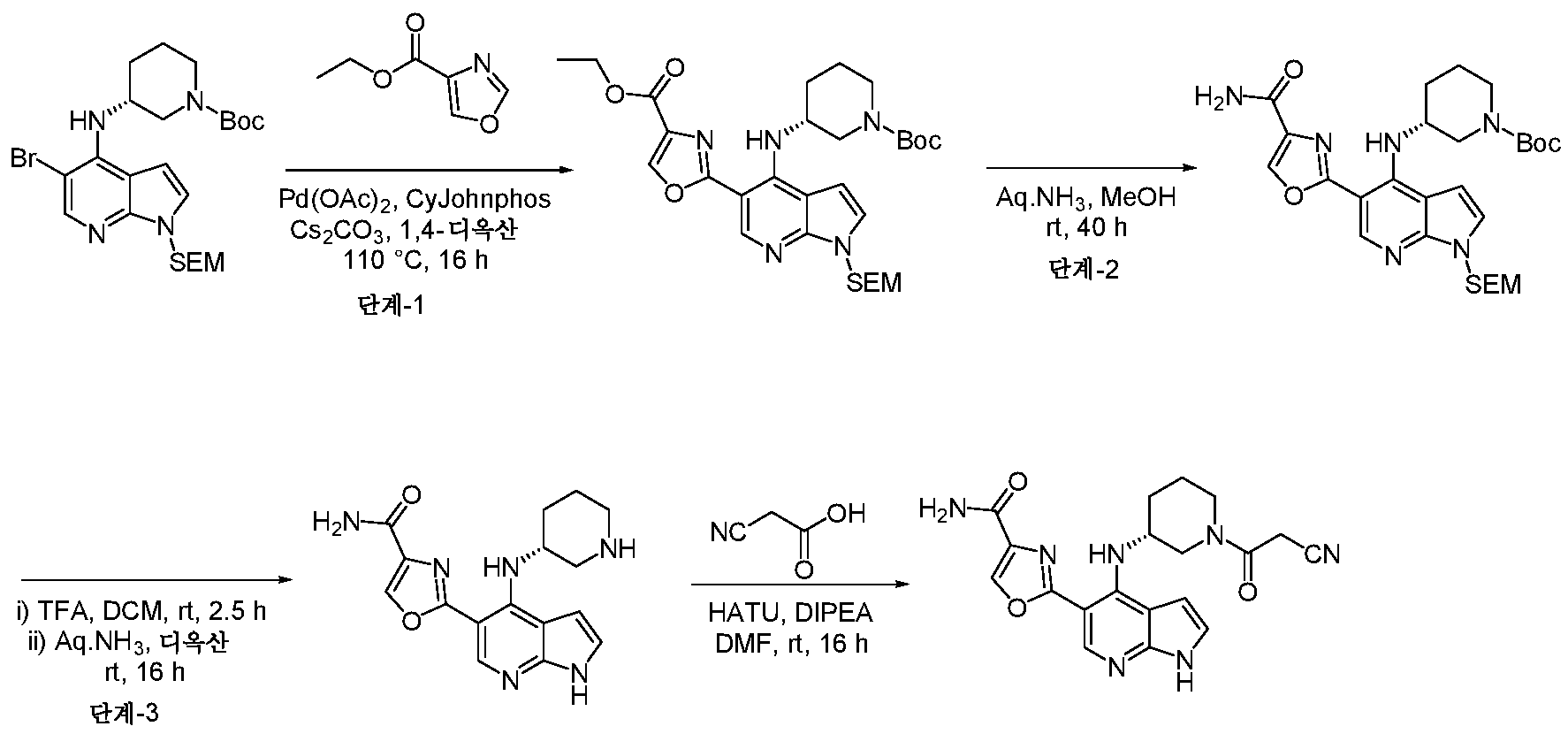
[000352] 단계 1: 에틸 (R)-2-(4-((1-(tert-부톡시카보닐)피페리딘-3-일)아미노)-1-((2-(트리메틸실릴)에톡시)메틸) -1H-피롤로[2,3-b]피리딘-5-일)옥사졸-4-카르복실레이트의 제조 [000352] Step 1: to ethyl ( R )-2-(4-((1-( tert -butoxycarbonyl)piperidin-3-yl)amino)-1-((2-(trimethylsilyl) Preparation of pyrrolo [2,3- b] pyridin-5-yl) oxazole-4-carboxylate-ethoxy) methyl) -1 H

1,4-디옥산 (8 mL) 중의 tert-부틸 (R)-3-((5-브로모-1-((2-(트리메틸실릴)에톡시)메틸)-1H-피롤로[2,3-b]피리딘-4-일)아미노)피페리딘-1-카르복실레이트 (0.8 g, 1.522 mmol, 반응식 1, 단계 5에 기술된 방법에 따라 제조됨)의 교반된 용액에 에틸 옥사졸-4-카르복실레이트 (0.03 g, 1.83 mmol) 및 탄산세슘 (0.99 g, 3.044 mmol)을 실온에서 첨가하고, 상기 용액을 질소로 15분간 탈기하였다. 팔라듐 아세테이트 (0.017 g, 0.0761 mmol) 및 CyJohnphos (0.053 g, 0.1522 mmol)를 첨가한 후, 생성된 혼합물을 밀봉된 튜브 중에서 110℃로 16시간 동안 가열하였다. 상기 반응 혼합물을 상온으로 냉각시키고, 셀라이트를 통해 여과하고, 여과액을 진공에서 농축시켰다. 상기 미정제물을 컬럼 크로마토그래피 (에틸 아세테이트/헥산)로 정제하여 에틸 (R)-2-(4-((1-(tert-부톡시카보닐)피페리딘-3-일)아미노)-1-((2-(트리메틸실릴)에톡시)메틸)-1H-피롤로[2,3-b]피리딘-5-일)옥사졸-4-카르복실레이트를 황색 고체로서 수득하였다 (0.35 g, 39% 수율): MS (ES) m/z 585.9 (M+H).1, 4-dioxane (8 mL) of tert-butyl (R) -3 - ((5- bromo-1 - ((methylethoxy), 2- (trimethylsilyl)) -1 H-pyrrolo [2 To a stirred solution of ,3- b ]pyridin-4-yl)amino)piperidine-1-carboxylate (0.8 g, 1.522 mmol, prepared according to the method described in Scheme 1, Step 5) was added ethyl oxa Sol-4-carboxylate (0.03 g, 1.83 mmol) and cesium carbonate (0.99 g, 3.044 mmol) were added at room temperature and the solution was degassed with nitrogen for 15 minutes. After addition of palladium acetate (0.017 g, 0.0761 mmol) and CyJohnphos (0.053 g, 0.1522 mmol), the resulting mixture was heated to 110° C. in a sealed tube for 16 h. The reaction mixture was cooled to room temperature, filtered through celite, and the filtrate was concentrated in vacuo. The crude was purified by column chromatography (ethyl acetate/hexanes) to ethyl ( R )-2-(4-((1-( tert -butoxycarbonyl)piperidin-3-yl)amino)-1 - ((2- (trimethylsilyl) ethoxy) methyl) -1 H-pyrrolo [2,3- b] pyridin-5-yl), to give the oxazole-4-carboxylate as a yellow solid (0.35 g , 39% yield): MS (ES) m/z 585.9 (M+H).
[000353] 단계 2: tert-부틸 (R)-3-((5-(4-카바모일옥사졸-2-일)-1-((2-(트리메틸실릴)에톡시)메틸)-1H-피롤로[2,3-b]피리딘-4-일)아미노)피페리딘-1-카르복실레이트의 제조 [000 353] Step 2: tert-butyl (R) -3 - ((5- (4- carbamoyl-2-yl) -1-a ((2- (trimethylsilyl) ethoxy) methyl) -1 H Preparation of -pyrrolo[2,3-b]pyridin-4-yl)amino)piperidine-1-carboxylate

메탄올 (5 mL) 중의 에틸 (R)-2-(4-((1-(tert-부톡시카보닐)피페리딘-3-일)아미노)-1-((2-(트리메틸실릴)-에톡시)메틸)-1H-피롤로[2,3-b]피리딘-5-일)옥사졸-4-카르복실레이트 (0.35 g, 0.597 mmol) 및 23% 수성 암모니아 (16 mL)의 용액을 밀봉된 튜브 중에서 40시간 동안 교반하였다. 상기 반응 혼합물을 진공에서 농축하고, 수성 부분을 디클로로메탄으로 추출하였다. 상기 유기층을 염수로 세척하고, 무수 황산나트륨으로 건조시켜 여과 후 진공에서 농축시켰다. 상기 미정제물을 컬럼 크로마토그래피 (에틸 아세테이트/헥산)로 정제하여 tert-부틸 (R)-3-((5-(4-카바모일옥사졸-2-일)-1-((2-(트리메틸실릴)에톡시)메틸)-1H-피롤로[2,3-b]피리딘-4-일)아미노)피페리딘-1-카르복실레이트를 황색 고체로서 수득하였다 (0.12 g, 36% 수율): MS (ES) m/z 556.9 (M+H). Ethyl (R )-2-(4-((1-( tert -butoxycarbonyl)piperidin-3-yl)amino)-1-((2-(trimethylsilyl)- in methanol (5 mL) a solution of pyrrolo [2,3- b] pyridin-5-yl) oxazole-4-carboxylate (0.35 g, 0.597 mmol) and 23% aqueous ammonia (16 mL) - ethoxy) methyl) -1 H was stirred for 40 h in a sealed tube. The reaction mixture was concentrated in vacuo and the aqueous portion was extracted with dichloromethane. The organic layer was washed with brine, dried over anhydrous sodium sulfate, filtered and concentrated in vacuo. The crude was purified by column chromatography (ethyl acetate/hexanes) to tert -butyl ( R )-3-((5-(4-carbamoyloxazol-2-yl)-1-((2-(trimethyl) the silyl) ethoxy) methyl) -1 H - pyrrolo [2,3- b] pyridin-4-yl) amino) piperidine-1-carboxylate as a yellow solid (0.12 g, 36% yield ): MS (ES) m/z 556.9 (M+H).
[000354] 단계 3: (R)-2-(4-(피페리딘-3-일아미노)-1H-피롤로[2,3-b]피리딘-5-일)옥사졸-4-카르복사미드의 제조 [000 354] Step 3: (R) -2- (4- ( piperidin-3-ylamino) -1 H - pyrrolo [2,3- b] pyridin-5-yl) oxazole-4-carboxylic Preparation of Boxamide

(R)-2-(4-(피페리딘-3-일아미노)-1H-피롤로[2,3-b]피리딘-5-일)옥사졸-4-카르복사미드를 실시예 1, 단계-7에 기술된 방법에 따라 제조하여 표제 화합물을 수득하였다 (0.1 g, 미정제): MS (ES) m/z 327.0 (M+H). (R) -2- (4- (piperidin-3-ylamino) -1 H - pyrrolo [2,3- b] pyridin-5-yl) oxazol-4-carboxamide Example 1, an exemplary , prepared according to the method described in step-7 to give the title compound (0.1 g, crude): MS (ES) m/z 327.0 (M+H).
[000355] 단계 4: (R)-2-(4-((1-(2-시아노아세틸)피페리딘-3-일)아미노)-1H-피롤로[2,3-b]피리딘-5-일)옥사졸-4-카르복사미드의 제조 [000 355] Step 4: (R) -2- (4 - ((1- (2- cyano-acetyl) -piperidin-3-yl) amino) -1 H - pyrrolo [2,3- b] pyridine Preparation of -5-yl) oxazole-4-carboxamide

(R)-2-(4-((1-(2-시아노아세틸)피페리딘-3-일)아미노)-1H-피롤로[2,3-b]피리딘-5-일)옥사졸-4-카르복사미드를 실시예 9, 단계-5에 기술된 방법에 따라 제조하여 담갈색 고체를 수득하였다 (0.01 g, 13% 수율): 1H NMR (400 MHz, DMSO-d6) δ 11.66 (d, J = 12.0 Hz, 1H), 8.71 (d, J = 8.4 Hz, 1H), 8.52-8.53 (m, 2H), 7.56-7.67 (m, 2H), 7.24 (s, 1H), 6.72 (s, 1H), 4.14-4.29 (m, 2H), 4.07 (s, 1H), 3.77-3.94 (m, 2H), 3.52 (d, J = 14.4 Hz, 1H), 3.00-3.25 (m, 1H), 2.08 (bs, 1H), 1.85 (bs, 2H), 1.50-1.70 (m, 1H); MS (ES) m/z 394.1 (M+H). (R) -2- (4 - ( (1- (2- cyano-acetyl) -piperidin-3-yl) amino) -1 H - pyrrolo [2,3- b] pyridin-5-yl) oxazole Sol-4-carboxamide was prepared according to the method described in Example 9, step-5 to give a light brown solid (0.01 g, 13% yield): 1 H NMR (400 MHz, DMSO-d 6 ) δ 11.66 (d, J = 12.0 Hz, 1H), 8.71 (d, J = 8.4 Hz, 1H), 8.52-8.53 (m, 2H), 7.56-7.67 (m, 2H), 7.24 (s, 1H), 6.72 (s, 1H), 4.14-4.29 (m, 2H), 4.07 (s, 1H), 3.77-3.94 (m, 2H), 3.52 (d, J = 14.4 Hz, 1H), 3.00-3.25 (m, 1H) ), 2.08 (bs, 1H), 1.85 (bs, 2H), 1.50-1.70 (m, 1H); MS (ES) m/z 394.1 (M+H).
분석 조건:Analysis conditions:
컬럼: X Bridge C18 (250 mm X 4.6 mm X 5 mic)Column: X Bridge C18 (250 mm X 4.6 mm X 5 mic)
이동상(A): 수중 0.1% 암모니아Mobile phase (A): 0.1% ammonia in water
이동상(B): ACNMobile phase (B): ACN
유속: 1.0 mL/분Flow rate: 1.0 mL/min
B의 조성: 0/10, 12/60, 25/90, 27/10, 30/10Composition of B: 0/10, 12/60, 25/90, 27/10, 30/10
[000356] 실시예 15: (R)-3-(3-((5-(4-메틸피리딘-2-일)-1H-피롤로[2,3-b]피리딘-4-일)아미노)피페리딘-1-일)-3-옥소프로판니트릴의 제조 [000 356] Example 15: (R) -3- (3 - ((5- (4- methylpyridin-2-yl) -1 H - pyrrolo [2,3- b] pyridin-4-yl) amino ) Preparation of piperidin-1-yl)-3-oxopropanenitrile

반응식 18: (Scheme 18: ( RR )-3-(3-((5-(4-메틸피리딘-2-일)-1)-3-(3-((5-(4-methylpyridin-2-yl)-1 HH -피롤로[2,3--pyrrolo[2,3- bb ]피리딘-4-일)아미노)피페리딘-1-일)-3-옥소프로판니트릴의 제조] Preparation of pyridin-4-yl)amino)piperidin-1-yl)-3-oxopropanenitrile

N,N-디메틸포름아미드 (5 mL) 중의 (R)-3-(3-((5-브로모-1H-피롤로[2,3-b]피리딘-4-일)아미노)피페리딘-1-일)-3-옥소프로판니트릴 (0.2 g, 0.55 mmol, 반응식 23, 단계-4에 기술된 방법에 따라 제조됨)의 용액에 염화리튬 (0.048 g, 1.1 mmol), 4-메틸-2-(트리부틸스타닐)피리딘 (0.25 g, 0.66 mmol), 요오드화구리 (0.011 g, 0.05 mmol) 및 테트라키스(트리페닐- 포스핀)팔라듐 (0) (0.03 g, 0.02 mmol)을 첨가하였다. 상기 혼합물을 질소 대기 하에 밀봉된 튜브 중에서 120℃로 3시간 동안 교반하였다. 상기 반응 혼합물을 상온으로 냉각한 후, 에틸 아세테이트와 물로 희석하였다. 상기 유기층을 분리하여 염수로 세척하고, 무수 황산나트륨으로 건조시킨 후, 여과하여 진공에서 농축시켰다. 상기 미정제 물질을 역상 크로마토그래피로 정제하여 ( R)-3-(3-((5-(4-메틸피리딘-2-일)-1H-피롤로[2,3-b]피리딘-4-일)아미노)피페리딘-1-일)-3-옥소프로판니트릴을 황백색 고체로서 수득하였다 (0.02 g, 8% 수율): 1H NMR (400 MHz, DMSO-d6) δ 11.42-11.37 (m, 1H), 10.13-10.02 (m, 1H), 8.42-8.32 (m, 2H), 7.75-7.72 (m, 1H), 7.15-7.08 (m, 2H), 6.61 (s, 1H), 4.38 (m, 1H), 4.12-3.94 (m, 3H), 3.73-3.55 (m, 3H), 2.31(s, 3H), 1.97 (s, 1H), 1.69-1.52 (s, 3H); MS (ES) m/z 375.1 (M+H). HPLC 순도: 99.38%. (R )-3-(3-((5-bromo- 1H -pyrrolo[2,3- b ]pyridin-4-yl)amino)piperidin in N,N -dimethylformamide (5 mL) To a solution of din-1-yl)-3-oxopropanenitrile (0.2 g, 0.55 mmol, prepared according to the method described in Scheme 23, step-4) lithium chloride (0.048 g, 1.1 mmol), 4-methyl -2-(tributylstannyl)pyridine (0.25 g, 0.66 mmol), copper iodide (0.011 g, 0.05 mmol) and tetrakis(triphenyl-phosphine)palladium (0) (0.03 g, 0.02 mmol) were added did The mixture was stirred at 120° C. for 3 hours in a sealed tube under a nitrogen atmosphere. After the reaction mixture was cooled to room temperature, it was diluted with ethyl acetate and water. The organic layer was separated, washed with brine, dried over anhydrous sodium sulfate, filtered and concentrated in vacuo. Purification of the crude material by reverse phase chromatography (R) -3- (3 - ( (5- (4- methylpyridin-2-yl) -1 H - pyrrolo [2,3- b] pyridine -4 -yl)amino)piperidin-1-yl)-3-oxopropanenitrile was obtained as an off-white solid (0.02 g, 8% yield): 1 H NMR (400 MHz, DMSO-d 6 ) δ 11.42-11.37 (m, 1H), 10.13-10.02 (m, 1H), 8.42-8.32 (m, 2H), 7.75-7.72 (m, 1H), 7.15-7.08 (m, 2H), 6.61 (s, 1H), 4.38 (m, 1H), 4.12-3.94 (m, 3H), 3.73-3.55 (m, 3H), 2.31 (s, 3H), 1.97 (s, 1H), 1.69-1.52 (s, 3H); MS (ES) m/z 375.1 (M+H). HPLC purity: 99.38%.
분석 조건:Analysis conditions:
컬럼: Inertsil ODS 3V (150mm X 4.6mm X 5mm)Column: Inertsil ODS 3V (150mm X 4.6mm X 5mm)
이동상(A): 수중 0.1% 암모니아Mobile phase (A): 0.1% ammonia in water
이동상(B): ACNMobile phase (B): ACN
유속: 1.0 mL/분Flow rate: 1.0 mL/min
[000357] 실시예 16: (R)-3-옥소-3-(3-((5-(티아졸-5-일)-1H-피롤로[2,3-b]피리딘-4-일)아미노)피페리딘-1-일)프로판니트릴의 제조 [000 357] Example 16: (R) -3-oxo-3- (3 - ((5- (thiazol-5-yl) -1 H-pyrrolo [2,3- b] pyridin-4-yl Preparation of )amino)piperidin-1-yl)propanenitrile

반응식 19: (Scheme 19: ( RR )-3-옥소-3-(3-((5-(티아졸-5-일)-1)-3-oxo-3-(3-((5-(thiazol-5-yl)-1 HH -피롤로[2,3--pyrrolo[2,3- bb ]피리딘-4-일)아미노)피페리딘-1-일)프로판니트릴의 제조] Preparation of pyridin-4-yl)amino)piperidin-1-yl)propanenitrile
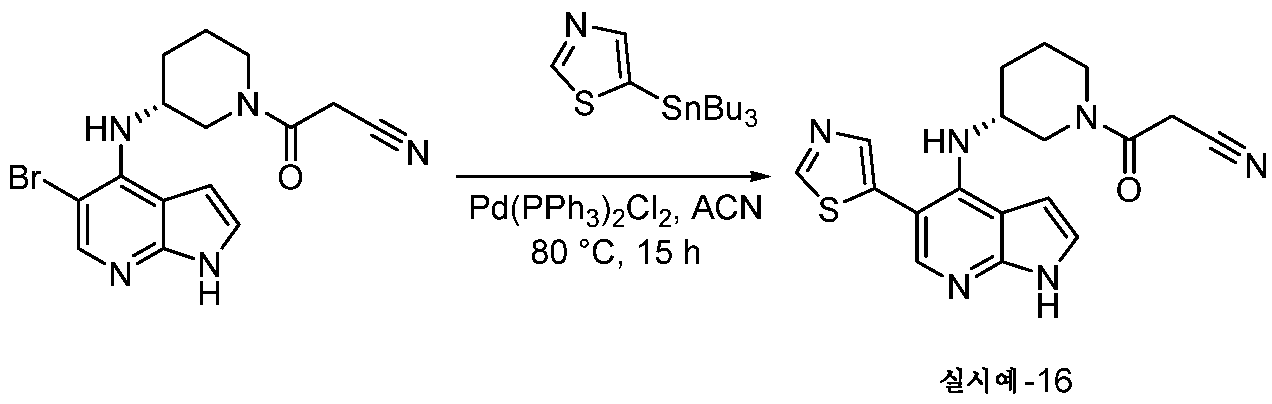
아세토니트릴 (5 mL) 중의 (R)-3-(3-((5-브로모-1H-피롤로 [2,3-b]피리딘-4-일)아미노)피페리딘-1-일)-3-옥소프로판니트릴 (0.2 g, 0.55 mmol, 반응식 23, 단계 4에 기술된 방법에 따라 제조됨), 5-(트리부틸스타닐)티아졸 (0.24 g, 0.66 mmol) 및 비스(트리페닐포스핀)팔라듐(II) 디클로라이드 (0.09 g, 0.027 mmol)의 용액을 밀봉된 튜브 중에서 80℃로 15시간 동안 가열하였다. 상기 반응 혼합물을 상온으로 냉각시키고, 물로 ??칭한 후, 에틸 아세테이트로 추출하였다. 상기 유기층을 염수로 세척하고, 무수 황산나트륨으로 건조시켜 여과 후 진공에서 농축시켰다. 상기 미정제 물질을 섬광 크로마토그래피 (5% 메탄올/디클로로메탄)로 정제하여 (R)-3-옥소-3-(3-((5-(티아졸-5-일)-1H-피롤로[2,3-b]피리딘-4-일)아미노)피페리딘-1-일)프로판니트릴을 황백색 고체로서 수득하였다 (0.04 g, 22% 수율): 1H NMR (400 MHz, DMSO-d6, 70℃) δ 11.29 (s, 1H), 9.10 (s, 1H), 7.86 (s,1H), 7.79 (s, 1H), 7.20 (s, 1H), 6.58 (s, 1H), 5.04 (s, 1H), 4.13 (br s, 1H), 3.82-3.99 (m, 3H), 3.53-3.65 (m, 1H), 3.35-3.44 (m, 1H), 1.94 (br s, 1H), 1.40-1.65 (m, 3H), 1.29-1.30 (m, 1H); MS (ES) m/z 367.2 (M+1). (R )-3-(3-((5-bromo- 1H -pyrrolo[2,3- b ]pyridin-4-yl)amino)piperidin-1-yl in acetonitrile (5 mL) )-3-oxopropanenitrile (0.2 g, 0.55 mmol, prepared according to the method described in Scheme 23, step 4), 5-(tributylstannyl)thiazole (0.24 g, 0.66 mmol) and bis(tri A solution of phenylphosphine)palladium(II) dichloride (0.09 g, 0.027 mmol) was heated to 80° C. for 15 h in a sealed tube. The reaction mixture was cooled to room temperature, quenched with water, and extracted with ethyl acetate. The organic layer was washed with brine, dried over anhydrous sodium sulfate, filtered and concentrated in vacuo. The crude material was purified by flash chromatography (5% methanol / dichloromethane) (R) -3-oxo-3- (3 - ((5- (thiazol-5-yl) -1 H-pyrrolo [2,3- b ]pyridin-4-yl)amino)piperidin-1-yl)propanenitrile was obtained as an off-white solid (0.04 g, 22% yield): 1 H NMR (400 MHz, DMSO-d 6, 70°C) δ 11.29 (s, 1H), 9.10 (s, 1H), 7.86 (s,1H), 7.79 (s, 1H), 7.20 (s, 1H), 6.58 (s, 1H), 5.04 ( s, 1H), 4.13 (br s, 1H), 3.82-3.99 (m, 3H), 3.53-3.65 (m, 1H), 3.35-3.44 (m, 1H), 1.94 (br s, 1H), 1.40- 1.65 (m, 3H), 1.29-1.30 (m, 1H); MS (ES) m/z 367.2 (M+1).
[000358] 실시예 17: (R)-3-(3-((5-(1-메틸-1H-이미다졸-2-일)-1H-피롤로[2,3-b]피리딘-4-일)아미노)피페리딘-1-일)-3-옥소프로판니트릴의 제조 [000 358] Example 17: (R) -3- (3 - ((5- (1- methyl -1 H-imidazol -2-) -1 H-pyrrolo [2,3- b] pyridin- Preparation of 4-yl)amino)piperidin-1-yl)-3-oxopropanenitrile

반응식 20: (Scheme 20: ( RR )-3-(3-((5-(1-메틸-1)-3-(3-((5-(1-methyl-1) HH -이미다졸-2-일)-1-imidazol-2-yl)-1 HH -피롤로[2,3--pyrrolo[2,3- bb ]피리딘-4-일)아미노)피페리딘-1-일)-3-옥소프로판니트릴]pyridin-4-yl)amino)piperidin-1-yl)-3-oxopropanenitrile

1,4-디옥산 (4 mL) 중의 (R)-3-(3-((5-브로모-1H-피롤로 [2,3-b]피리딘-4-일)아미노)피페리딘-1-일)-3-옥소프로판니트릴 (0.3 g, 0.82 mmol, 반응식 23, 단계 4에 기술된 방법에 따라 제조됨), 1-메틸-2-(트리부틸스타닐)-1H-이미다졸 (0.46 g, 1.24 mmol) 및 테트라키스(트리페닐포스핀)팔라듐 (0) (0.09 g, 0.08 mmol)의 용액에 140℃에서 2시간 동안 마이크로파를 조사하였다. 상기 반응 혼합물을 상온으로 냉각한 후, 에틸 아세테이트로 희석하였다. 상기 유기층을 물과 염수로 세척하고, 무수 황산나트륨으로 건조시킨 후, 여과하여 진공에서 농축시켰다. 상기 미정제 물질을 섬광 크로마토그래피 (5% 메탄올/디클로로메탄)로 정제하여 (R)-3-(3-((5-(1-메틸-1H-이미다졸-2-일)-1H-피롤로[2,3-b]피리딘-4-일)아미노)피페리딘-1-일)-3-옥소프로판니트릴을 황백색 고체로서 수득하였다 (0.04 g, 15% 수율): 1H NMR (400 MHz, DMSO-d6, 70℃) δ 11.41 (s, 1H), 7.72-7.74 (m, 1H), 7.63-7.64 (m, 1H), 7.21 (s, 1H), 6.88 (s, 1H), 6.59-6.64 (m, 1H), 4.85-4.99 (m, 2H), 3.79-4.20 (m, 5H), 2.68-3.07 (m, 3H), 1.91 (bs, 2H), 1.49-1.56 (m, 3H); MS (ES) m/z 364.1 (M+1). (R )-3-(3-((5-bromo- 1H -pyrrolo[2,3- b ]pyridin-4-yl)amino)piperidine in 1,4-dioxane (4 mL) 1-yl) -3-oxo-propanenitrile (prepared according to the method described in 0.3 g, 0.82 mmol, scheme 23, step 4) and l-methyl-2- (tributyltin star carbonyl) -1 H - already A solution of dazole (0.46 g, 1.24 mmol) and tetrakis(triphenylphosphine)palladium (0) (0.09 g, 0.08 mmol) was irradiated with microwaves at 140° C. for 2 hours. After the reaction mixture was cooled to room temperature, it was diluted with ethyl acetate. The organic layer was washed with water and brine, dried over anhydrous sodium sulfate, filtered and concentrated in vacuo. To give the crude by flash chromatography (5% methanol / dichloromethane) (R) -3- (3 - ((5- (1- methyl -1 H - imidazol -2-) -1 H Obtained -pyrrolo[2,3- b ]pyridin-4-yl)amino)piperidin-1-yl)-3-oxopropanenitrile as an off-white solid (0.04 g, 15% yield): 1 H NMR (400 MHz, DMSO-d 6, 70°C) δ 11.41 (s, 1H), 7.72-7.74 (m, 1H), 7.63-7.64 (m, 1H), 7.21 (s, 1H), 6.88 (s, 1H) ), 6.59-6.64 (m, 1H), 4.85-4.99 (m, 2H), 3.79-4.20 (m, 5H), 2.68-3.07 (m, 3H), 1.91 (bs, 2H), 1.49-1.56 (m) , 3H); MS (ES) m/z 364.1 (M+1).
[000359] 실시예 18: (R)-3-(3-((5-(1H-피라졸-5-일)-1H-피롤로[2,3-b]피리딘-4-일)아미노)피페리딘-1-일)-3-옥소프로판니트릴의 제조 [000 359] Example 18: (R) -3- (3 - ((5- (1 H - pyrazol-5-yl) -1 H - pyrrolo [2,3- b] pyridin-4-yl) Preparation of amino)piperidin-1-yl)-3-oxopropanenitrile

반응식 21: (Scheme 21: ( RR )-3-(3-((5-(1)-3-(3-((5-(1) HH -피라졸-5-일)-1-pyrazol-5-yl)-1 HH -피롤로[2,3--pyrrolo[2,3- bb ]피리딘-4-일)아미노)피페리딘-1-일)-3-옥소프로판니트릴의 제조] Preparation of pyridin-4-yl)amino)piperidin-1-yl)-3-oxopropanenitrile

1,4-디옥산 (4 mL)/물 (1 mL) 중의 (R)-3-(3-((5-브로모-1H-피롤로 [2,3-b]피리딘-4-일)아미노)피페리딘-1-일)-3-옥소프로판니트릴 (0.2 g, 0.55 mmol, 반응식 23, 단계 4에 기술된 방법에 따라 제조됨), 5-(4,4,5,5-테트라메틸-1,3,2-디옥사보롤란-2-일)-1H-피라졸 (0.16 g, 0.83 mmol), 탄산나트륨 (0.17 g, 1.65 mmol) 및 테트라키스(트리페닐포스핀)팔라듐(0) (0.032 g, 0.03 mmol)의 혼합물에 100℃에서 3시간 동안 마이크로파를 조사하였다. 상기 반응 혼합물을 상온으로 냉각한 후, 에틸 아세테이트로 희석하였다. 상기 유기층을 물과 염수로 세척하고, 무수 황산나트륨으로 건조시킨 후, 여과하여 진공에서 농축시켰다. 상기 미정제 물질을 섬광 크로마토그래피 (5% 메탄올/디클로로메탄)로 정제하여 (R)-3-(3-((5-(1H-피라졸-5-일)-1H-피롤로[2,3-b]피리딘-4-일)아미노)피페리딘-1-일)-3-옥소프로판니트릴을 황백색 고체로서 수득하였다 (0.045 g, 15% 수율): 1H NMR (400 MHz, DMSO-d6, 70℃) δ 12.67 (s, 1H), 11.11 (s, 1H), 8.63 (s, 1H), 8.31 (s, 1H), 7.75 (s, 1H), 7.12 (s, 1H), 6.70 (s, 1H), 6.60 (s, 1H), 4.41 (br s, 1H), 3.81-4.09 (m, 3H), 3.51 (br s, 1H), 3.22 (s, 1H), 2.99 (s, 1H), 2.11 (br s, 1H), 1.61-1.81 (m, 3H); MS (ES) m/z 350.3 (M+1). (R )-3-(3-((5-bromo- 1H -pyrrolo[2,3- b ]pyridin-4-yl) in 1,4-dioxane (4 mL)/water (1 mL) )amino)piperidin-1-yl)-3-oxopropanenitrile (0.2 g, 0.55 mmol, prepared according to the method described in Scheme 23, Step 4), 5-(4,4,5,5- tetramethyl-1,3,2 dioxaborolan-2-yl) -1 H - pyrazole (0.16 g, 0.83 mmol), sodium carbonate (0.17 g, 1.65 mmol) and tetrakis (triphenylphosphine) palladium A mixture of (0) (0.032 g, 0.03 mmol) was irradiated with microwaves at 100° C. for 3 hours. After the reaction mixture was cooled to room temperature, it was diluted with ethyl acetate. The organic layer was washed with water and brine, dried over anhydrous sodium sulfate, filtered and concentrated in vacuo. The crude by flash chromatography (5% methanol / dichloromethane) to give (R) -3- (3 - ( (5- (1 H - pyrazol-5-yl) -1 H - pyrrolo [ 2,3- b ]pyridin-4-yl)amino)piperidin-1-yl)-3-oxopropanenitrile was obtained as an off-white solid (0.045 g, 15% yield): 1 H NMR (400 MHz, DMSO-d 6, 70°C) δ 12.67 (s, 1H), 11.11 (s, 1H), 8.63 (s, 1H), 8.31 (s, 1H), 7.75 (s, 1H), 7.12 (s, 1H) , 6.70 (s, 1H), 6.60 (s, 1H), 4.41 (br s, 1H), 3.81-4.09 (m, 3H), 3.51 (br s, 1H), 3.22 (s, 1H), 2.99 (s) , 1H), 2.11 (br s, 1H), 1.61-1.81 (m, 3H); MS (ES) m/z 350.3 (M+1).
[000360] 실시예 19: (R)-3-(3-((5-(5-메틸-1,2,4-옥사디아졸-3-일)-1H-피롤로[2,3-b]피리딘-4-일)아미노)피페리딘-1-일)-3-옥소프로판니트릴의 제조 [000 360] Example 19: (R) -3- (3 - ((5- (5- methyl-1,2,4-oxadiazol-3-yl) -1 H - pyrrolo [2,3- b] Preparation of pyridin-4-yl)amino)piperidin-1-yl)-3-oxopropanenitrile

반응식 22: (Scheme 22: ( RR )-3-(3-((5-(5-메틸-1,2,4-옥사디아졸-3-일)-1)-3-(3-((5-(5-methyl-1,2,4-oxadiazol-3-yl)-1 HH -피롤로[2,3--pyrrolo[2,3- bb ]피리딘-4-일)아미노)피페리딘-1-일)-3-옥소프로판니트릴의 제조] Preparation of pyridin-4-yl)amino)piperidin-1-yl)-3-oxopropanenitrile

[000361] 단계 1: tert-부틸 (R)-5-브로모-4-((1-(tert-부톡시카보닐)피페리딘-3-일)아미노)-1H-피롤로[2,3-b]피리딘-1-카르복실레이트의 제조 [000 361] Step 1: tert - butyl (R) -5- bromo -4 - ((1- (tert - butoxycarbonyl) piperidin-3-yl) amino) -1 H - pyrrolo [2 ,3- b ] Preparation of pyridine-1-carboxylate

디클로로메탄 (70 mL) 중의 (R)-5-브로모-N-(피페리딘-3-일)-1H-피롤로[2,3-b]피리딘-4-아민 (미정제) (5.0 g, 17.0 mmol, 반응식 23, 단계 3에 기술된 방법에 따라 제조됨)의 용액에 디-tert-부틸 디카보네이트 (3.9 mL, 17.0 mmol), 트리에틸아민 (4.7 mL, 34 mmol) 및 4-디메틸아미노피리딘 (0.02 g, 0.17 mmol)을 첨가하고, 상기 혼합물을 상온에서 16시간 동안 교반하였다. 상기 반응 혼합물을 디클로로메탄으로 희석하고, 물, 염수로 세척하여 무수 황산나트륨으로 건조시킨 후, 여과하여 진공에서 농축시켰다. 상기 미정제 물질을 섬광 크로마토그래피 (30% 에틸 아세테이트/헥산)로 정제하여 tert-부틸 (R)-5-브로모-4-((1-(tert-부톡시카보닐)-피페리딘-3-일)아미노)-1H-피롤로[2,3-b]피리딘-1-카르복실레이트를 황백색 고체로서 수득하였다 (1.2 g, 14% 수율): MS (ES) m/z 496.8 (M+2).Dichloromethane (70 mL) of (R) -5- bromo - N - (piperidin-3-yl) -1 H - pyrrolo [2,3- b] pyridin-4-amine (crude) ( To a solution of 5.0 g, 17.0 mmol, prepared according to the method described in Scheme 23, step 3), di- tert -butyl dicarbonate (3.9 mL, 17.0 mmol), triethylamine (4.7 mL, 34 mmol) and 4 -Dimethylaminopyridine (0.02 g, 0.17 mmol) was added, and the mixture was stirred at room temperature for 16 hours. The reaction mixture was diluted with dichloromethane, washed with water, brine, dried over anhydrous sodium sulfate, filtered and concentrated in vacuo. The crude material was purified by flash chromatography (30% ethyl acetate/hexanes) to tert -butyl ( R )-5-bromo-4-((1-( tert -butoxycarbonyl)-piperidine- 3- yl) amino) -1 H - pyrrolo [2,3- b] pyridine-1-carboxylate was obtained as a pale yellow solid (1.2 g, 14% yield): MS (ES) m / z 496.8 ( M+2).
[000362] 단계 2: tert-부틸 (R)-3-((5-시아노-1H-피롤로[2,3-b]피리딘-4-일)아미노)피페리딘-1-카르복실레이트의 제조 [000362] Step 2: tert -Butyl ( R )-3-((5-cyano- 1H -pyrrolo[2,3- b ]pyridin-4-yl)amino)piperidine-1-carboxyl production of the rate

디메틸아세타미드 (15 mL) 중의 tert-부틸 (R)-5-브로모-4-((1-(tert-부톡시카보닐)피페리딘-3-일)아미노)-1H-피롤로[2,3-b]피리딘-1-카르복실레이트 (1.5 g, 3.02 mmol), 시안화아연 (0.53 g, 4.54 mmol) 및 테트라키스(트리페닐- 포스핀)팔라듐(0) (0.87 g, 0.75 mmol)의 현탁액을 아르곤 대기 하에 밀봉된 튜브 중에서 130℃로 16시간 동안 가열하였다. 상기 반응 혼합물을 상온으로 냉각한 후, 에틸 아세테이트로 희석하였다. 상기 유기층을 물과 염수로 세척하고, 무수 황산나트륨으로 건조시킨 후, 여과하여 진공에서 농축시켰다. 상기 미정제 물질을 섬광 크로마토그래피 (30% 에틸 아세테이트/헥산)로 정제하여 tert-부틸 (R)-3-((5-시아노-1H-피롤로[2,3-b]피리딘-4-일)아미노)피페리딘-1-카르복실레이트를 황백색 고체로서 수득하였다 (0.7 g, 미정제): MS (ES) m/z 342.2 (M+H).Dimethyl O theta imide (15 mL) of tert - butyl (R) -5- bromo -4 - ((1- (tert - butoxycarbonyl) piperidin-3-yl) amino) -1 H - P Rolo[2,3- b ]pyridine-1-carboxylate (1.5 g, 3.02 mmol), zinc cyanide (0.53 g, 4.54 mmol) and tetrakis(triphenyl-phosphine)palladium(0) (0.87 g, 0.75 mmol) was heated to 130° C. for 16 h in a sealed tube under argon atmosphere. After the reaction mixture was cooled to room temperature, it was diluted with ethyl acetate. The organic layer was washed with water and brine, dried over anhydrous sodium sulfate, filtered and concentrated in vacuo. The crude material was purified by flash chromatography (30% ethyl acetate/hexanes) to tert -butyl ( R )-3-((5-cyano- 1H -pyrrolo[2,3- b ]pyridine-4) -yl)amino)piperidine-1-carboxylate was obtained as an off-white solid (0.7 g, crude): MS (ES) m/z 342.2 (M+H).
[000363] 단계 3: tert-부틸 (R,Z)-3-((5-(N'-하이드록시카르밤이미도일)-1H-피롤로[2,3-b]피리딘-4-일)아미노)피페리딘-1-카르복실레이트의 제조 [000 363] Step 3: tert - butyl (R, Z) -3 - ( (5- (N '- hydroxycarboxylic night yimido yl) -1 H - pyrrolo [2,3- b] pyridin-4-yl Preparation of )amino)piperidine-1-carboxylate

에탄올 (5 mL) 중의 tert-부틸 (R)-3-((5-시아노-1H-피롤로[2,3-b]피리딘-4-일)아미노)피페리딘-1-카르복실레이트 (0.2 g, 0.58 mmol), 하이드록실아민 하이드로클로라이드 (0.06 g, 0.88 mmol) 및 트리에틸아민 (0.16 mL, 1.17 mmol)의 현탁액을 아르곤 대기 하에 90℃로 15시간 동안 가열하였다. 상기 반응 혼합물을 상온으로 냉각하고 진공에서 농축시켜 휘발성 물질들을 제거하였다. 잔류물을 디클로로메탄 중에 용해시킨 후, 물, 염수 용액으로 세척하고, 무수 황산나트륨으로 건조시켜 여과한 후 진공에서 농축시켜 tert-부틸 (R,Z)-3-((5-(N'-하이드록시카르밤이미도일)-1H-피롤로[2,3-b]피리딘-4-일)아미노)피페리딘-1-카르복실레이트를 점성 고체로서 수득하였다 (0.21 g, 95% 수율): MS (ES) m/z 375.2 (M+1). tert -Butyl ( R )-3-((5-cyano- 1H -pyrrolo[2,3- b ]pyridin-4-yl)amino)piperidine-1-carboxyl in ethanol (5 mL) A suspension of lactate (0.2 g, 0.58 mmol), hydroxylamine hydrochloride (0.06 g, 0.88 mmol) and triethylamine (0.16 mL, 1.17 mmol) was heated to 90° C. under an argon atmosphere for 15 h. The reaction mixture was cooled to room temperature and concentrated in vacuo to remove volatiles. The residue was dissolved in dichloromethane, washed with water, brine solution, dried over anhydrous sodium sulfate, filtered, and concentrated in vacuo, concentrated in vacuo to tert -butyl ( R,Z )-3-((5-( N' -hyde). hydroxy carboxylic night yimido yl) -1 H - pyrrolo [2,3- b] pyridin-4-yl) amino) piperidine-1-carboxylate was obtained as a viscous solid (0.21 g, 95% yield) : MS (ES) m/z 375.2 (M+1).
[000364] 단계 4: tert-부틸 (R)-3-((5-(5-메틸-1,2,4-옥사디아졸-3-일)-1H-피롤로[2,3-b]피리딘-4-일) 아미노)피페리딘-1-카르복실레이트의 제조 [000 364] Step 4: tert - butyl (R) -3 - ((5- (-3- yl 5-methyl-1,2,4-oxadiazole) -1 H - pyrrolo [2,3- b ] Preparation of pyridin-4-yl) amino) piperidine-1-carboxylate

아세트산 무수물 (2 mL) 중의 tert-부틸 (R,Z)-3-((5-(N'-하이드록시카르밤이미도일)-1H-피롤로[2,3-b]피리딘-4-일)아미노) 피페리딘-1-카르복실레이트 (0.1 g, 0.27 mmol)의 용액을 140℃로 45분간 가열하였다. 상기 반응 혼합물을 상온으로 냉각시키고, 수성 암모니아를 사용하여 중화시킨 후, 디클로로메탄 (30 ml)으로 추출하였다. 상기 유기층을 물과 염수로 세척하고, 무수 황산나트륨으로 건조시킨 후, 여과하여 진공에서 농축시켰다. 미정제물을 메탄올 (4 mL)에 용해시키고, 3M 수산화나트륨 수용액 (2 mL)을 첨가한 후, 상기 용액을 상온에서 2시간 동안 교반하였다. 상기 반응 혼합물을 진공에서 농축하여 휘발성 물질들을 제거하고; 잔류물을 디클로로메탄에 용해시켜 물, 염수로 세척한 후, 무수 황산나트륨으로 건조시켰다. 상기 용액을 여과한 후 진공에서 농축시켜 tert-부틸 (R)-3-((5-(5-메틸-1,2,4-옥사디아졸-3-일)-1H-피롤로[2,3-b]피리딘-4-일)아미노)피페리딘-1-카르복실레이트를 황백색 고체로서 수득하였다 (0.12 g, 미정제): MS (ES) m/z 399.0 (M+H).Acetic anhydride (2 mL) of tert - butyl (R, Z) -3 - ( (5- (N '- hydroxycarboxylic night yimido yl) -1 H - pyrrolo [2,3- b] pyridin-4 A solution of yl)amino) piperidine-1-carboxylate (0.1 g, 0.27 mmol) was heated to 140° C. for 45 min. The reaction mixture was cooled to room temperature, neutralized with aqueous ammonia, and then extracted with dichloromethane (30 ml). The organic layer was washed with water and brine, dried over anhydrous sodium sulfate, filtered and concentrated in vacuo. The crude product was dissolved in methanol (4 mL), 3M aqueous sodium hydroxide solution (2 mL) was added, and the solution was stirred at room temperature for 2 hours. concentrating the reaction mixture in vacuo to remove volatiles; The residue was dissolved in dichloromethane, washed with water and brine, and dried over anhydrous sodium sulfate. Was then filtered off and the solution concentrated in vacuo to give tert - butyl (R) -3 - ((5- (-3- yl 5-methyl-1,2,4-oxadiazole) -1 H - pyrrolo [2 ,3- b ]pyridin-4-yl)amino)piperidine-1-carboxylate was obtained as an off-white solid (0.12 g, crude): MS (ES) m/z 399.0 (M+H).
[000365] 단계 5: (R)-5-(5-메틸-1,2,4-옥사디아졸-3-일)-N-(피페리딘-3-일)-1H-피롤로[2,3-b]피리딘-4-아민의 제조 [000 365] Step 5: (R) -5- (5- methyl-1,2,4-oxadiazol-3-yl) - N - (piperidin-3-yl) -1 H - pyrrolo [ Preparation of 2,3- b ]pyridin-4-amine
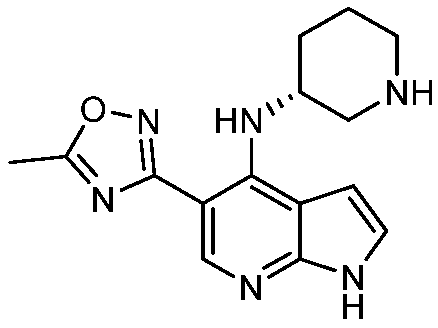
디클로로메탄 : 트리플루오로아세트산 (3 mL : 0.5 mL) 중의 tert-부틸 (R)-3-((5-(5-메틸-1,2,4-옥사디아졸-3-일)-1H-피롤로[2,3-b]피리딘-4-일)아미노)피페리딘-1-카르복실레이트 (0.12g, 0.3 mmol)의 용액을 상온에서 3시간 동안 교반하였다. 상기 반응 혼합물을 진공에서 농축시켜 휘발성 물질들을 제거하고, 수성 암모니아를 사용하여 중화한 후, 디클로로메탄 (30 ml)으로 추출하였다. 상기 유기층을 물, 염수로 세척하고, 무수 황산나트륨으로 건조시킨 후, 여과하고 진공에서 농축시켜 (R)-5-(5-메틸-1,2,4-옥사디아졸-3-일)-N-(피페리딘-3-일)-1H-피롤로[2,3-b]피리딘-4-아민을 황백색 고체로서 수득하였다 (0.1 g, 미정제): MS (ES) m/z 299.0 (M+1).Dichloromethane: trifluoroacetic acid (3 mL: 0.5 mL) of tert - butyl (R) -3 - ((5- (5- methyl-1,2,4-oxadiazol-3-yl) -1 H A solution of -pyrrolo[2,3- b ]pyridin-4-yl)amino)piperidine-1-carboxylate (0.12g, 0.3 mmol) was stirred at room temperature for 3 hours. The reaction mixture was concentrated in vacuo to remove volatiles, neutralized with aqueous ammonia and then extracted with dichloromethane (30 ml). The organic layer was washed with water, brine, dried over anhydrous sodium sulfate, filtered and concentrated in vacuo ( R )-5-(5-methyl-1,2,4-oxadiazol-3-yl) -N - (piperidin-3-yl) -1 H-pyrrolo [2,3- b] pyridine-4-amine was obtained as a pale yellow solid (0.1 g, crude): MS (ES) m / z 299.0 (M+1).
[000366] 단계 5: (R)-3-(3-((5-(5-메틸-1,2,4-옥사디아졸-3-일)-1H-피롤로[2,3-b]피리딘-4-일)아미노)피페리딘-1-일)-3-옥소프로판니트릴의 제조 [000 366] Step 5: (R) -3- (3 - ((5- (5- methyl-1,2,4-oxadiazol-3-yl) -1 H - pyrrolo [2,3- b ] Preparation of pyridin-4-yl)amino)piperidin-1-yl)-3-oxopropanenitrile

(R)-3-(3-((5-(5-메틸-1,2,4-옥사디아졸-3-일)-1H-피롤로[2,3-b]피리딘-4-일)아미노)피페리딘-1-일)-3-옥소프로판니트릴을실시예 1, 단계 8에 기술된 방법에 따라 제조하여 황백색의 고체로 수득하였다 (0.01 g, 9% 수율): 1H NMR (400 MHz, DMSO-d6, at 60℃) δ 11.64 (s, 1H), 8.67 (s, 1H), 7.49-7.57 (m, 1H), 7.25 (s, 1H), 6.70 (s, 1H), 4.21 (br s, 1H), 4.03-4.12 (m, 2H), 3.66-3.84 (m, 1H), 3.42-3.53 (m, 2H), 2.65 (s, 3H), 2.06 (br s, 2H), 1.65-1.73 (m, 3H); MS (ES) m/z 366.1 (M+H). (R) -3- (3 - ( (5- (5- methyl-1,2,4-oxadiazol-3-yl) -1 H - pyrrolo [2,3- b] pyridin-4-yl )Amino)piperidin-1-yl)-3-oxopropanenitrile was prepared according to the method described in Example 1, Step 8 to obtain an off-white solid (0.01 g, 9% yield): 1 H NMR (400 MHz, DMSO-d 6, at 60°C) δ 11.64 (s, 1H), 8.67 (s, 1H), 7.49-7.57 (m, 1H), 7.25 (s, 1H), 6.70 (s, 1H) , 4.21 (br s, 1H), 4.03-4.12 (m, 2H), 3.66-3.84 (m, 1H), 3.42-3.53 (m, 2H), 2.65 (s, 3H), 2.06 (br s, 2H) , 1.65-1.73 (m, 3H); MS (ES) m/z 366.1 (M+H).
[000367] 실시예 20-25: 5-아릴 치환된 피롤로피리딘의 제조 [000367] Examples 20-25: Preparation of 5-aryl substituted pyrrolopyridine

반응식 23: (Scheme 23: ( RR )-3-(3-((5-브로모-1)-3-(3-((5-bromo-1) HH -피롤로[2,3--pyrrolo[2,3- bb ]피리딘-4-일)아미노)피페리딘-1-일)-3-옥소프로판니트릴의 제조] Preparation of pyridin-4-yl)amino)piperidin-1-yl)-3-oxopropanenitrile

[000368] 단계 1: 5-브로모-4-클로로-1-토실-1H-피롤로[2,3-b]피리딘의 제조 [000368] Step 1: Preparation of 5-bromo-4-chloro-1-tosyl- 1H -pyrrolo[2,3- b ]pyridine

디클로로메탄 (200 mL) 중의 5-브로모-4-클로로-1H-피롤로[2,3-b]피리딘 (15 g, 65.0 mmol)의 용액에 트리에틸아민 (18.2 mL, 130 mmol), p-톨루엔설포닐 클로라이드 (18.5 g, 97 mmol) 및 4-디메틸아미노피리딘 (0.79 g, 6.0 mmol)을 0℃에서 첨가하였다. 상기 용액을 상온에서 16시간 동안 교반하였다. 상기 반응 혼합물을 디클로로메탄으로 희석하고, 물, 염수로 세척하여 무수 황산나트륨으로 건조시킨 후, 여과하여 진공에서 농축시켰다. 상기 미정제 생성물을 n-펜탄으로 연화처리하고 건조시켜 5-브로모-4-클로로-1-토실-1H-피롤로[2,3-b]피리딘을 황백색 고체로서 수득하였다 (23.0 g, 92% 수율): MS (ES) m/z 386.7 (M+2).To a solution of 5-bromo-4-chloro-1 H -pyrrolo[2,3- b ]pyridine (15 g, 65.0 mmol) in dichloromethane (200 mL) triethylamine (18.2 mL, 130 mmol), p -Toluenesulfonyl chloride (18.5 g, 97 mmol) and 4-dimethylaminopyridine (0.79 g, 6.0 mmol) were added at 0°C. The solution was stirred at room temperature for 16 hours. The reaction mixture was diluted with dichloromethane, washed with water, brine, dried over anhydrous sodium sulfate, filtered and concentrated in vacuo. The crude product was triturated with n-pentane and dried to give 5-bromo-4-chloro-1-tosyl- 1H -pyrrolo[2,3- b ]pyridine as an off-white solid (23.0 g, 92% yield): MS (ES) m/z 386.7 (M+2).
[000369] 단계 2: (R)-N-(1-벤질피페리딘-3-일)-5-브로모-1-토실-1H-피롤로[2,3-b]피리딘-4-아민의 제조 [000 369] Step 2: (R) - N - (1- benzyl-piperidin-3-yl) -5-bromo-1-tosyl -1 H - pyrrolo [2,3- b] pyridin-4 Preparation of amines

5-브로모-4-클로로-1-토실-1H-피롤로[2,3-b]피리딘 (10.0 g, 25.0 mmol) 및 (R)-1-벤질피페리딘-3-아민 (9.88 g, 52 mmol)의 혼합물을 밀봉된 튜브 중에서 180℃로 3시간 동안 가열하였다. 상기 반응 혼합물을 상온으로 냉각시키고, 상기 미정제 물질을 섬광 크로마토그래피 (30% 에틸 아세테이트/헥산)로 정제하여 (R)-N-(1-벤질피페리딘-3-일)-5-브로모-1-토실-1H-피롤로[2,3-b]피리딘-4-아민을 담황색의 점착성 고체로서 수득하였다 (9.1 g, 66% 수율): MS (ES) m/z 541.1 (M+2).5-Bromo-4-chloro-1-tosyl- 1H -pyrrolo[2,3- b ]pyridine (10.0 g, 25.0 mmol) and ( R )-1-benzylpiperidin-3-amine (9.88) g, 52 mmol) was heated to 180° C. in a sealed tube for 3 h. The reaction mixture was cooled to room temperature, and purified the crude by flash chromatography (30% ethyl acetate / hexane) (R) - N - ( 1- benzyl-piperidin-3-yl) -5-bromo Mo-1 -tosyl -1H -pyrrolo[2,3- b ]pyridin-4-amine was obtained as a pale yellow sticky solid (9.1 g, 66% yield): MS (ES) m/z 541.1 (M +2).
[000370] 단계 3: (R)-5-브로모-N-(피페리딘-3-일)-1H-피롤로[2,3-b]피리딘-4-아민의 제조 [000 370] Step 3: (R) -5- bromo - N - (piperidin-3-yl) -1 H - pyrrolo [2,3- b] pyridine-4-amine

1,4-디옥산 (200 mL) 중의 (R)-N-(1-벤질피페리딘-3-일)-5-브로모-1-토실-1H-피롤로[2,3-b]피리딘-4-아민 (10.0 g, 18.5 mmol)의 용액에 에틸 클로로포르메이트 (2.1 mL, 22.6 mmol)를 첨가하고, 생성된 혼합물을 100℃로 가열하였다. 16시간 후, 상기 반응 혼합물을 상온으로 냉각하고, 진공에서 농축시켰다. 상기 미정제 중간체를 메탄올: 물 (150 mL : 70 mL)에 용해시키고, 수산화칼륨 (20.75 g, 370 mmol)을 첨가한 후, 상기 혼합물을 90℃로 16시간 동안 가열하였다. 상기 반응 혼합물을 상온으로 냉각하고 진공에서 농축시켜 휘발성 물질들을 제거하였다. 잔류물을 디클로로메탄 중에 용해시킨 후, 물, 염수 용액으로 세척하고, 무수 황산나트륨으로 건조시켜 여과한 후 진공에서 농축시켜 (R)-5-브로모-N-(피페리딘-3-일)-1H-피롤로[2,3-b]피리딘-4-아민을 갈색 오일로서 수득하였다 (8.4 g, 미정제): MS (ES) m/z 297.0 (M+2).1, 4-dioxane (R) in the (200 mL) - N - ( 1- benzyl-piperidin-3-yl) -5-bromo-1-tosyl -1 H - pyrrolo [2,3- b ] To a solution of pyridin-4-amine (10.0 g, 18.5 mmol) was added ethyl chloroformate (2.1 mL, 22.6 mmol), and the resulting mixture was heated to 100 °C. After 16 h, the reaction mixture was cooled to room temperature and concentrated in vacuo. The crude intermediate was dissolved in methanol: water (150 mL: 70 mL), potassium hydroxide (20.75 g, 370 mmol) was added, and the mixture was heated to 90° C. for 16 h. The reaction mixture was cooled to room temperature and concentrated in vacuo to remove volatiles. The residue was dissolved in dichloromethane, washed with water, brine solution, dried over anhydrous sodium sulfate, filtered and concentrated in vacuo ( R )-5-bromo- N- (piperidin-3-yl) -1 H -pyrrolo[2,3- b ]pyridin-4-amine was obtained as a brown oil (8.4 g, crude): MS (ES) m/z 297.0 (M+2).
[000371] 단계-4: (R)-3-(3-((5-브로모-1H-피롤로[2,3-b]피리딘-4-일)아미노)피페리딘-1-일)-3-옥소프로판니트릴의 제조 [000371] Step-4: ( R )-3-(3-((5-bromo- 1H -pyrrolo[2,3- b ]pyridin-4-yl)amino)piperidin-1-yl ) Preparation of -3-oxopropanenitrile

디클로로메탄 (150 mL) 중의 (R)-5-브로모-N-(피페리딘-3-일)-1H-피롤로[2,3-b]피리딘-4-아민 (8.4 g, 28.4 mmol)의 용액에 시아노아세트산 (4.84 g, 56.9 mmol), 1-에틸-3-(3-디메틸아미노프로필) 카르보디이미드.하이드로클로라이드 (10.94 g, 56.9 mmol), 하이드록시벤조트리아졸 (7.68 g, 56.9 mmol) 및 N,N-디이소프로필에틸아민 (14.7 mL, 85.4 mmol)을 첨가하였다. 상기 반응 혼합물을 상온에서 16시간 동안 교반하였다. 상기 반응 혼합물을 디클로로메탄 (150 mL)으로 희석하고, 물, 염수 용액으로 세척하여 무수 황산나트륨으로 건조시킨 후, 여과하여 진공에서 농축시켰다. 상기 미정제 물질을 섬광 크로마토그래피 (5% 메탄올/디클로로메탄)로 정제하여 (R)-3-(3-((5-브로모-1H-피롤로[2,3-b]피리딘-4-일)아미노)피페리딘-1-일)-3-옥소프로판니트릴을 황백색 고체로서 수득하였다 (2.8 g, 27% 수율): 1H NMR (400 MHz, DMSO-d6, 60℃) δ 11.37 (b, 1H), 7.96 (s, 1H), 7.20 (s, 1H), 6.57 (s, 1H), 5.19 (d, J = 8.8 Hz, 1H), 4.20 (br s, 1H), 3.80-4.10 (m, 4H), 3.52-3.54 (m, 1H), 3.01 (br s, 1H), 2.02 (br s, 1H), 1.51-1.75 (m, 3H); MS (ES) m/z 364.2 (M+2).Dichloromethane (150 mL) of (R) -5- bromo - N - (piperidin-3-yl) -1 H - pyrrolo [2,3- b] pyridin-4-amine (8.4 g, 28.4 mmol), cyanoacetic acid (4.84 g, 56.9 mmol), 1-ethyl-3-(3-dimethylaminopropyl) carbodiimide.hydrochloride (10.94 g, 56.9 mmol), hydroxybenzotriazole (7.68) g, 56.9 mmol) and N,N -diisopropylethylamine (14.7 mL, 85.4 mmol). The reaction mixture was stirred at room temperature for 16 hours. The reaction mixture was diluted with dichloromethane (150 mL), washed with water and brine solution, dried over anhydrous sodium sulfate, filtered and concentrated in vacuo. The crude material was purified by flash chromatography (5% methanol/dichloromethane) to ( R )-3-(3-((5-bromo- 1H -pyrrolo[2,3- b ]pyridine-4) Obtained -yl)amino)piperidin-1-yl)-3-oxopropanenitrile as an off-white solid (2.8 g, 27% yield): 1 H NMR (400 MHz, DMSO-d 6, 60° C.) δ 11.37 (b, 1H), 7.96 (s, 1H), 7.20 (s, 1H), 6.57 (s, 1H), 5.19 (d, J = 8.8 Hz, 1H), 4.20 (br s, 1H), 3.80- 4.10 (m, 4H), 3.52-3.54 (m, 1H), 3.01 (br s, 1H), 2.02 (br s, 1H), 1.51-1.75 (m, 3H); MS (ES) m/z 364.2 (M+2).
[000372] 교차 결합 반응의 일반적 절차 [000372] General procedure of cross-linking reaction

N,N-디메틸포름아미드 (5 mL) 중의 (R)-3-(3-((5-브로모-1H-피롤로[2,3-b]피리딘-4-일)아미노)피페리딘-1-일)-3-옥소프로판니트릴 (1.0 당량), 아릴/헤테로아릴(트리부틸 또는 스타닐) (1.2 당량), 염화리튬 (2.0 당량), 요오드화구리 (0.1 당량) 및 테트라키스(트리페닐포스핀)팔라듐 (0)의 혼합물을 아르곤 대기 하에 3시간 동안 가열하였다. 상기 반응 혼합물을 상온으로 냉각한 후, 에틸 아세테이트로 희석하였다. 상기 에틸 아세테이트 층을 물과 염수로 세척하고, 무수 황산나트륨으로 건조시킨 후, 여과하여 진공에서 농축시켰다. 상기 미정제 물질을 섬광 크로마토그래피 (5% 메탄올/디클로로메탄)로 정제하여 목적한 생성물들을 표 2에 나타낸 것과 같이 수득하였다. (R )-3-(3-((5-bromo- 1H -pyrrolo[2,3- b ]pyridin-4-yl)amino)piperidin in N,N -dimethylformamide (5 mL) Din-1-yl)-3-oxopropanenitrile (1.0 equiv), aryl/heteroaryl (tributyl or stanyl) (1.2 equiv), lithium chloride (2.0 equiv), copper iodide (0.1 equiv) and tetrakis ( A mixture of triphenylphosphine)palladium (0) was heated under an argon atmosphere for 3 hours. After the reaction mixture was cooled to room temperature, it was diluted with ethyl acetate. The ethyl acetate layer was washed with water and brine, dried over anhydrous sodium sulfate, filtered and concentrated in vacuo. The crude material was purified by flash chromatography (5% methanol/dichloromethane) to obtain the desired products as shown in Table 2.


[000373] 실시예 25: (R)-4-((1-(2-시아노아세틸)피페리딘-3-일)아미노)-1H-피롤로[2,3-b]피리딘-5-카르보니트릴의 제조 [000 373] Example 25: (R) -4 - ( (1- (2- cyano-acetyl) -piperidin-3-yl) amino) -1 H - pyrrolo [2,3- b] pyridine-5 -Preparation of carbonitrile

반응식 24: (Scheme 24: ( RR )-4-((1-(2-시아노아세틸)피페리딘-3-일)아미노)-1)-4-((1-(2-cyanoacetyl)piperidin-3-yl)amino)-1 HH -피롤로[2,3--pyrrolo[2,3- bb ]피리딘-5-카르보니트릴의 제조]Preparation of pyridine-5-carbonitrile

디메틸포름아미드 (5 mL) 중의 (R)-3-(3-((5-브로모-1H-피롤로[2,3-b]피리딘-4-일)아미노)피페리딘-1-일)-3-옥소프로판니트릴 (0.2 g, 0.55 mmol 에 기술된 방법에 따라 제조됨 반응식 23, 단계 4), 시안화아연 (0.01 mg, 0.83 mmol) 및 테트라키스(트리페닐포스핀)팔라듐(0) (0.16 g, 0.14 mmol)의 현탁액을 아르곤 대기 하에 밀봉된 튜브 중에서 130℃로 16시간 동안 가열하였다. 상기 반응 혼합물을 실온으로 냉각한 후, 에틸 아세테이트로 희석하였다. 상기 유기층을 물과 염수로 세척하고, 무수 황산나트륨으로 건조시킨 후, 여과하여 진공에서 농축시켰다. 상기 미정제 생성물을 역상 크로마토그래피로 정제하여 (R)-4-((1-(2-시아노아세틸)피페리딘-3-일)아미노)-1H-피롤로[2,3-b]피리딘-5-카르보니트릴을 황백색 고체로서 수득하였다 (0.04 g, 26% 수율): 1H NMR (400 MHz, DMSO-d6, 70℃) 11.67 (s, 1H), 8.07 (s, 1H), 7.23 (s, 1H), 6.71 (s, 1H), 6.21-6.66 (m, 1H), 4.05-4.29 (m, 2H), 3.99 (s, 2H), 3.53 - 3.91 (m, 1H), 2.85-3.02 (m, 1H), 2.03-2.10 (m, 2H), 1.68-1.78 (m, 3H); MS (ES) m/z 309.2 (M+H). HPLC 순도: 99.58% (R )-3-(3-((5-bromo- 1H -pyrrolo[2,3- b ]pyridin-4-yl)amino)piperidin-1-yl in dimethylformamide (5 mL) yl)-3-oxopropanenitrile (0.2 g, 0.55 mmol prepared according to the method described in Scheme 23, step 4), zinc cyanide (0.01 mg, 0.83 mmol) and tetrakis(triphenylphosphine)palladium (0 ) (0.16 g, 0.14 mmol) was heated to 130° C. for 16 h in a sealed tube under an argon atmosphere. The reaction mixture was cooled to room temperature and then diluted with ethyl acetate. The organic layer was washed with water and brine, dried over anhydrous sodium sulfate, filtered and concentrated in vacuo. Purification of the crude product by reverse phase chromatography (R) -4 - ((1- (2- cyano-acetyl) -piperidin-3-yl) amino) -1 H - pyrrolo [2,3- b ]Pyridine-5-carbonitrile was obtained as an off-white solid (0.04 g, 26% yield): 1 H NMR (400 MHz, DMSO-d 6 , 70° C.) 11.67 (s, 1H), 8.07 (s, 1H) , 7.23 (s, 1H), 6.71 (s, 1H), 6.21-6.66 (m, 1H), 4.05-4.29 (m, 2H), 3.99 (s, 2H), 3.53 - 3.91 (m, 1H), 2.85 -3.02 (m, 1H), 2.03-2.10 (m, 2H), 1.68-1.78 (m, 3H); MS (ES) m/z 309.2 (M+H). HPLC purity: 99.58%
분취용 HPLC 조건:Preparative HPLC conditions:
컬럼: Kinetex C18 (100 mm x 4.6 mm x 2.6 μm)Column: Kinetex C18 (100 mm x 4.6 mm x 2.6 μm)
이동상 A: 물 중의 0.1% TFAMobile phase A: 0.1% TFA in water
이동상 B: ACNMobile phase B: ACN
유속: 0.75 mL/분Flow rate: 0.75 mL/min
[000374] 실시예 26: (R)-3-(3-((5-(3-메틸-1H-피라졸-5-일)-1H-피롤로[2,3-b]피리딘-4-일)아미노)피페리딘-1-일)-3-옥소프로판니트릴의 제조 [000 374] Example 26: (R) -3- (3 - ((5- (3- methyl -1 H-pyrazol-5-yl) -1 H-pyrrolo [2,3- b] pyridin- Preparation of 4-yl)amino)piperidin-1-yl)-3-oxopropanenitrile

반응식 25: (Scheme 25: ( RR )-3-(3-((5-(3-메틸-1)-3-(3-((5-(3-methyl-1) HH -피라졸-5-일)-1-pyrazol-5-yl)-1 HH -피롤로[2,3--pyrrolo[2,3- bb ]피리딘-4-일)아미노)피페리딘-1-일)-3-옥소프로판니트릴의 제조] Preparation of pyridin-4-yl)amino)piperidin-1-yl)-3-oxopropanenitrile

[000375] 단계 1: 3-((3R)-3-((5-(3-메틸-1-(테트라하이드로-2H-피란-2-일)-1H-피라졸-5-일)-1H-피롤로[2,3-b]피리딘-4-일)아미노)피페리딘-1-일)-3-옥소프로판니트릴의 제조 [000 375] Step 1: 3 - ((3 R ) -3 - ((5- (3- methyl-1- (tetrahydro -2 H - pyran-2-yl) -1 H - pyrazol-5-yl ) -1 H - pyrrolo [2,3- b] pyridin-4-yl) amino) piperidin-1-yl) Preparation of 3-oxo-propanenitrile

1,4-디옥산 : 물 (4 mL : 1 mL) 중의 (R)-3-(3-((5-브로모-1H-피롤로[2,3-b]피리딘-4-일)아미노)피페리딘-1-일)-3-옥소프로판니트릴 (0.5 g, 1.38 mmol, 반응식 23, 단계 4에 기술된 방법에 따라 제조됨), 3-메틸-1-(테트라하이드로-2H-피란-2-일)-5-(4,4,5,5-테트라메틸-1,3,2-디옥사보롤란-2-일)-1H-피라졸 (0.6 g, 2.07 mmol), 탄산세슘 (1.35 g, 4.14 mmol) 및 테트라키스(트리페닐포스핀)팔라듐 (0) (0.08 g, 0.07 mmol)의 혼합물을 아르곤 대기 하에 밀봉된 튜브 중에서 100℃로 5시간 동안 가열하였다. 상기 반응 혼합물을 상온으로 냉각시키고, 에틸 아세테이트와 물로 희석하였다. 상기 유기층을 염수로 세척하고, 무수 황산나트륨으로 건조시켜 여과 후 진공에서 농축시켰다. 상기 미정제 물질을 섬광 크로마토그래피 (80% 에틸 아세테이트/헥산)를 사용해 정제하여 에틸 4-(((3r,4r)5-((N-메틸설파모일)메틸)사이클로헥실)아미노)-1-토실-1H-피롤로[2,3-b]피리딘-4-카복실레이트를 갈색 고체로서 수득하였다 (0.2 g, 32% 수율): MS (ES) m/z 448 (M+H). 1,4-dioxane: (R )-3-(3-((5-bromo- 1H -pyrrolo[2,3- b ]pyridin-4-yl) in water (4 mL : 1 mL) Amino)piperidin-1-yl)-3-oxopropanenitrile (0.5 g, 1.38 mmol, prepared according to the method described in Scheme 23, Step 4), 3-methyl-1-(tetrahydro- 2H - pyran-2-yl) -5- (4,4,5,5-tetramethyl-1,3,2 dioxaborolan-2-yl) -1 H-pyrazole (0.6 g, 2.07 mmol) A mixture of , cesium carbonate (1.35 g, 4.14 mmol) and tetrakis(triphenylphosphine)palladium (0) (0.08 g, 0.07 mmol) was heated to 100° C. for 5 h in a sealed tube under an argon atmosphere. The reaction mixture was cooled to room temperature and diluted with ethyl acetate and water. The organic layer was washed with brine, dried over anhydrous sodium sulfate, filtered and concentrated in vacuo. The crude material was purified using flash chromatography (80% ethyl acetate/hexanes) to ethyl 4-(((3 r ,4 r )5-(( N -methylsulfamoyl)methyl)cyclohexyl)amino)- 1-Tosyl- 1H -pyrrolo[2,3- b ]pyridine-4-carboxylate was obtained as a brown solid (0.2 g, 32% yield): MS (ES) m/z 448 (M+H) .
[000376] 단계 2: (R)-3-(3-((5-(3-메틸-1H-피라졸-5-일)-1H-피롤로[2,3-b]피리딘-4-일)아미노)피페리딘-1-일)-3-옥소프로판니트릴의 제조 [000 376] Step 2: (R) -3- (3 - ((5- (3- methyl -1 H - pyrazol-5-yl) -1 H - pyrrolo [2,3- b] pyridine -4 Preparation of -yl)amino)piperidin-1-yl)-3-oxopropanenitrile

메탄올 (5 mL) 중 3-((3R)-3-((5-(3-메틸-1-(테트라하이드로-2H-피란-2-일)-1H-피라졸-5-일)-1H-피롤로[2,3-b]피리딘-4-일)아미노)피페리딘-1-일)-3-옥소프로판니트릴 (0.2 g, 0.44 mmol) 및 p-톨루엔설폰산 (0.15 g, 0.89 mmol)의 교반된 용액을 60℃로 12시간 동안 가열하였다. 상기 반응 혼합물을 실온으로 냉각하여 진공에서 농축시켰다. 상기 미정제 물질을 역상 크로마토그래피로 정제하여 (R)-3-(3-((5-(3-메틸-1H-피라졸-5-일)-1H-피롤로[2,3-b]피리딘-4-일)아미노)피페리딘-1-일)-3-옥소프로판니트릴을 황백색 고체로서 수득하였다 (0.01 g, 6% 수율): 1H NMR (400 MHz, DMSO-d6) δ 12.52 (s, 1H), 11.35 (s, 1H), 8.24-8.27 (m, 1H), 7.44-7.46 (m, 1H), 7.08-7.16 (m, 2H), 6.47-6.50 (m, 1H), 4.31 (s, 1H), 3.89-4.11 (m, 2H), 3.49-3.69 (m, 2H), 3.20 (s, 3H), 2.94 (s, 2H), 2.27 (m, 3H), 2.05-2.10 (m, 1H); MS (ES) m/z 364.1 (M+).Methanol (5 mL) of 3 - ((3 R) -3 - ((5- (3- methyl-1- (tetrahydro -2 H - pyran-2-yl) -1 H - pyrazol-5-yl ) -1 H - pyrrolo [2,3- b] pyridin-4-yl) amino) piperidin-1-yl) -3-oxo-propanenitrile (0.2 g, 0.44 mmol) and p - toluenesulfonic acid ( 0.15 g, 0.89 mmol) was heated to 60° C. for 12 h. The reaction mixture was cooled to room temperature and concentrated in vacuo. Purification of the crude material by reverse phase chromatography (R) -3- (3 - ( (5- (3- methyl -1 H - pyrazol-5-yl) -1 H - pyrrolo [2,3- b ]pyridin-4-yl)amino)piperidin-1-yl)-3-oxopropanenitrile was obtained as an off-white solid (0.01 g, 6% yield): 1 H NMR (400 MHz, DMSO-d 6 ) ) δ 12.52 (s, 1H), 11.35 (s, 1H), 8.24-8.27 (m, 1H), 7.44-7.46 (m, 1H), 7.08-7.16 (m, 2H), 6.47-6.50 (m, 1H) ), 4.31 (s, 1H), 3.89-4.11 (m, 2H), 3.49-3.69 (m, 2H), 3.20 (s, 3H), 2.94 (s, 2H), 2.27 (m, 3H), 2.05- 2.10 (m, 1H); MS (ES) m/z 364.1 (M+).
분석 조건: 유속: 0.3 mL/분Analytical conditions: Flow rate: 0.3 mL/min
컬럼: BEH C18 (100 mm X 2.1 mm X 1.7 μm)Column: BEH C18 (100 mm X 2.1 mm X 1.7 μm)
이동상 (A): 물 중 0.1% 포름산Mobile phase (A): 0.1% formic acid in water
이동상 (B): ACNMobile phase (B): ACN
[000377] 실시예 27: (R)-3-(3-((5-(옥사졸-2-일)-1H-피롤로[2,3-b]피리딘-4-일)아미노)피페리딘-1-일)프로판니트릴의 제조 [000 377] Example 27: (R) -3- (3 - ((5- ( oxazol-2-yl) -1 H - pyrrolo [2,3- b] pyridin-4-yl) amino) P Preparation of peridin-1-yl)propanenitrile

반응식 26: (Scheme 26: ( RR )-3-(3-((5-(옥사졸-2-일)-1)-3-(3-((5-(oxazol-2-yl)-1 HH -피롤로[2,3--pyrrolo[2,3- bb ]피리딘-4-일)아미노)피페리딘-1-일)프로판니트릴의 제조 ] Preparation of pyridin-4-yl)amino)piperidin-1-yl)propanenitrile

[000378] 단계 1: 2-(4-클로로-1-((2-(트리메틸실릴)에톡시)메틸)-1H-피롤로[2,3-b]피리딘-5-일)옥사졸의 제조The (pyrrolo [2,3- b] pyridin-5-yl 4-chloro-1 - ((2- (trimethylsilyl) ethoxy) methyl) -1 H) oxazol-2: [000 378] Step 1 Produce

1,4-디옥산 (20 mL) 중의 5-브로모-4-클로로-1-((2-(트리메틸실릴)에톡시)메틸)-1H-피롤로[2,3-b]피리딘 (2.00 g, 5.54 mmol), 옥사졸 (0.68 g, 9.97 mmol), 칼륨 tert-부톡시드 (1.24 g, 11.1 mmol) 및 비스(트리페닐 포스핀)팔라듐(II) 디클로라이드 (0.19 g, 0.27 mmol)의 혼합물을 질소 대기 하에 밀봉된 튜브 중에서 110℃로 가열하였다. 5시간 후, 상기 반응 혼합물을 상온으로 냉각시키고, 물로 희석한 후, 에틸 아세테이트로 추출하였다. 상기 유기층을 염수로 세척하고, 황산나트륨으로 건조시켜 여과 후 진공에서 농축시켰다. 상기 미정제 물질을 섬광 크로마토그래피 (10% 에틸 아세테이트/헥산)로 정제하여 2-(4-클로로-1-((2-(트리메틸실릴)에톡시)메틸)-1H-피롤로[2,3-b]피리딘-5-일)옥사졸을 황백색 고체로서 수득하였다 (0.43 g, 22% 수율): MS (ES) m/z 349.9 (M+H).1, 4-dioxane (20 mL) of 5-bromo-4-chloro-1 - ((2- (trimethylsilyl) ethoxy) methyl) -1 H - [2,3- b] pyrrolo pyridine ( 2.00 g, 5.54 mmol), oxazole (0.68 g, 9.97 mmol), potassium tert -butoxide (1.24 g, 11.1 mmol) and bis(triphenyl phosphine)palladium(II) dichloride (0.19 g, 0.27 mmol) was heated to 110° C. in a sealed tube under a nitrogen atmosphere. After 5 hours, the reaction mixture was cooled to room temperature, diluted with water, and extracted with ethyl acetate. The organic layer was washed with brine, dried over sodium sulfate, filtered and concentrated in vacuo. The crude by flash chromatography (10% ethyl acetate / hexane) to give 2- (4-chloro-l-ethoxy ((2- (trimethylsilyl)) methyl) -1 H-pyrrolo [2, Obtained 3- b ]pyridin-5-yl)oxazole as an off-white solid (0.43 g, 22% yield): MS (ES) m/z 349.9 (M+H).
[000379] 단계 2: tert-부틸 (R)-3-((5-(옥사졸-2-일)-1-((2-(트리메틸실릴)에톡시)메틸)-1H-피롤로[2,3-b]피리딘-4-일)아미노)피페리딘-1-카르복실레이트의 제조 [000 379] Step 2: tert-butyl (R) -3 - ((5- (oxazol-2-yl) - 1 - ((methylethoxy), 2- (trimethylsilyl)) - 1 H-pyrrolo [ Preparation of 2,3-b]pyridin-4-yl)amino)piperidine-1-carboxylate
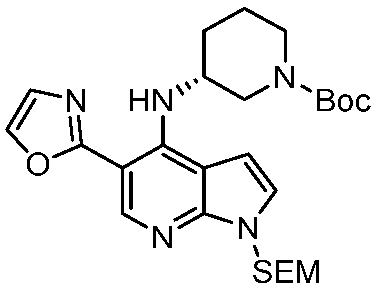
N-메틸피롤리돈 (4 mL) 중 2-(4-클로로-1-((2-(트리메틸실릴)에톡시)메틸)-1H-피롤로[2,3-b]피리딘-5-일)옥사졸 (0.43 g, 1.28 mmol), 트리에틸아민 (0.03 mL, 0.24 mmol) 및 tert-부틸 (R)-3-아미노피페리딘-1-카르복실레이트 (0.46 g, 2.32 mmol)의 교반된 용액에 130℃로 5시간 동안 마이크로파를 조사하였다. 상기 반응 혼합물을 상온으로 냉각시키고, 물로 희석한 후, 에틸 아세테이트로 추출하였다. 상기 유기층을 염수로 세척하고, 황산나트륨으로 건조시켜 여과 후 진공에서 농축시켰다. 상기 미정제 물질을 섬광 크로마토그래피 (50% 에틸 아세테이트/헥산)로 정제하여 tert-부틸 (R)-3-((5-(옥사졸-2-일)-1-((2-(트리메틸실릴)에톡시)메틸)-1H-피롤로[2,3-b]피리딘-4-일)아미노)피페리딘-1-카르복실레이트를 황백색 고체로서 수득하였다 (0.35 g, 53% 수율): MS (ES) m/z 514.0 (M+H).2- (4-chloro-l of methyl-pyrrolidone (4 mL) - - N-ethoxy ((2- (trimethylsilyl)) methyl) -1 H - pyrrolo [2,3- b] pyridin-5 of yl)oxazole (0.43 g, 1.28 mmol), triethylamine (0.03 mL, 0.24 mmol) and tert -butyl ( R )-3-aminopiperidine-1-carboxylate (0.46 g, 2.32 mmol) The stirred solution was irradiated with microwaves at 130° C. for 5 hours. The reaction mixture was cooled to room temperature, diluted with water, and extracted with ethyl acetate. The organic layer was washed with brine, dried over sodium sulfate, filtered and concentrated in vacuo. The crude material was purified by flash chromatography (50% ethyl acetate/hexanes) to tert -butyl ( R )-3-((5-(oxazol-2-yl)-1-((2-(trimethylsilyl) pyrrolo [2,3- b] pyridin-4-yl) amino) piperidin-1-a-carboxylate was obtained as a pale yellow solid (0.35 g, 53% yield)) ethoxy) methyl) -1 H in : MS (ES) m/z 514.0 (M+H).
[000380] 단계 3: (R)-5-(옥사졸-2-일)-N-(피페리딘-3-일)-1H-피롤로[2,3-b]피리딘-4-아민의 제조 [000 380] Step 3: (R) -5- (oxazol-2-yl) - N - (piperidin-3-yl) -1 H - pyrrolo [2,3- b] pyridin-4-amine manufacture of

디클로로메탄 : 트리플루오로아세트산 (3 mL : 3 mL) 중의 tert-부틸 (R)-3-((5-(옥사졸-2-일)-1-((2-(트리메틸실릴)에톡시)메틸)-1H-피롤로[2,3-b]피리딘-4-일)아미노)피페리딘-1-카르복실레이트 (0.12 g, 0.23 mmol)의 용액을 상온에서 3시간 동안 교반하였다. 상기 반응 혼합물을 진공에서 농축하고, 잔류물을 1,4-디옥산 : 수성 암모니아 (3 mL: 3 mL, 물 중 23%)에 용해시킨 후, 상기 혼합물을 상온에서 16시간 동안 교반하였다. 상기 반응 혼합물을 진공에서 농축시켜 (R)-5-(옥사졸-2-일)-N-(피페리딘-3-일)-1H-피롤로[2,3-b]피리딘-4-아민을 황백색 고체로서 수득하였다 (0.05 g, 미정제): MS (ES) m/z 284.2 (M+H). Dichloromethane: tert -butyl ( R )-3-((5-(oxazol-2-yl)-1-((2-(trimethylsilyl)ethoxy) in trifluoroacetic acid (3 mL: 3 mL)) methyl) -1 h - pyrrolo stirred for [2,3- b] pyridin-4-yl) amino) piperidine-1-carboxylate (0.12 g, 3 hours at room temperature a solution of 0.23 mmol). The reaction mixture was concentrated in vacuo, the residue was dissolved in 1,4-dioxane : aqueous ammonia (3 mL: 3 mL, 23% in water), and then the mixture was stirred at room temperature for 16 h. The reaction mixture was concentrated in vacuo (R) -5- (oxazol-2-yl) - N - (piperidin-3-yl) -1 H - pyrrolo [2,3- b] pyridine -4 -Amine was obtained as an off-white solid (0.05 g, crude): MS (ES) m/z 284.2 (M+H).
[000381] 단계 4: (R)-3-(3-((5-(옥사졸-2-일)-1H-피롤로[2,3-b]피리딘-4-일)아미노)피페리딘-1-일)프로판니트릴의 제조 [000 381] Step 4: (R) -3- (3 - ((5- ( oxazol-2-yl) -1 H - pyrrolo [2,3- b] pyridin-4-yl) amino) piperidin Preparation of diin-1-yl) propanenitrile

에탄올 (3 mL) 중 (R)-5-(옥사졸-2-일)-N-(피페리딘-3-일)-1H-피롤로[2,3-b]피리딘-4-아민 (0.05 g, 0.17 mmol)의 교반된 용액에 아크릴로니트릴 (0.09 g, 1.7 mmol)을 첨가한 후 트리메틸아민 (0.05 mL, 0.34 mmol)을 첨가하고, 상기 용액을 80℃에서 3시간 동안 교반하였다. 상기 반응 혼합물을 주위 온도로 냉각하여 진공에서 농축시켰다. 상기 미정제 물질을 섬광 크로마토그래피 (5% 메탄올/디클로로메탄)로 정제하여 (R)-3-(3-((5-(옥사졸-2-일)-1H-피롤로[2,3-b]피리딘-4-일)아미노)피페리딘-1-일)프로판니트릴을 황백색 고체로서 수득하였다 (0.03 g, 45% 수율): 1H NMR (400 MHz, DMSO-d6) δ 11.53 (br s, 1H), 9.17 (br s, 1H), 8.50 (s, 1H), 8.06 (s, 1H), 7.36 (s, 1H), 7.17 (s, 1H), 6.56 (s, 1H), 4.14-4.27 (m, 1H), 2.85-2.98 (m, 1H), 2.55-2.66 (m, 2H), 2.83-2.97 (m, 2H), 1.52-1.69 (m, 2H), 1.42-1.60 (m, 3H), 1.21 (s, 2H); MS (ES) m/z 337.2 (M+H). Ethanol (3 mL) of (R) -5- (oxazol-2-yl) - N - (piperidin-3-yl) -1 H - pyrrolo [2,3- b] pyridin-4-amine To a stirred solution of (0.05 g, 0.17 mmol) was added acrylonitrile (0.09 g, 1.7 mmol) followed by trimethylamine (0.05 mL, 0.34 mmol), and the solution was stirred at 80° C. for 3 hours. . The reaction mixture was cooled to ambient temperature and concentrated in vacuo. To give the crude by flash chromatography (5% methanol / dichloromethane) (R) -3- (3 - ((5- ( oxazol-2-yl) -1 H - pyrrolo [2,3 -b ]pyridin-4-yl)amino)piperidin-1-yl)propanenitrile was obtained as an off-white solid (0.03 g, 45% yield): 1 H NMR (400 MHz, DMSO-d 6 ) δ 11.53 (br s, 1H), 9.17 (br s, 1H), 8.50 (s, 1H), 8.06 (s, 1H), 7.36 (s, 1H), 7.17 (s, 1H), 6.56 (s, 1H), 4.14-4.27 (m, 1H), 2.85-2.98 (m, 1H), 2.55-2.66 (m, 2H), 2.83-2.97 (m, 2H), 1.52-1.69 (m, 2H), 1.42-1.60 (m) , 3H), 1.21 (s, 2H); MS (ES) m/z 337.2 (M+H).
[000382] 실시예 28: 3-((2S,5R)-2-메틸-5-((5-(옥사졸-2-일)-1H-피롤로[2,3-b]피리딘-4-일) 아미노) 피페리딘-1-일)-3-옥소프로판니트릴의 제조 [000 382] Example 28: 3 - ((2 S , 5 R) -2- methyl-5 - ((5- (oxazol-2-yl) -1 H-pyrrolo [2,3- b] pyridine Preparation of -4-yl) amino) piperidin-1-yl) -3-oxopropanenitrile

반응식 27. 3-((2Scheme 27. 3-((2 SS ,5,5 RR )-2-메틸-5-((5-(옥사졸-2-일)-1)-2-methyl-5-((5-(oxazol-2-yl)-1 HH -피롤로[2,3--pyrrolo[2,3- bb ]피리딘-4-일) 아미노) 피페리딘-1-일)-3-옥소프로판니트릴의 제조Preparation of ]pyridin-4-yl) amino) piperidin-1-yl)-3-oxopropanenitrile

[000383] 단계 1: 벤질 (2S,5R)-2-메틸-5-((5-(옥사졸-2-일)-1-((2-(트리메틸실릴)에톡시)메틸)-1H-피롤로[2,3-b]피리딘-4-일)아미노)피페리딘-1-카르복실레이트의 제조 [000 383] Step 1: Benzyl (2 S, 5 R) -2-methyl-5 - ((5- (oxazol-2-yl) - 1 - ((ethoxy) methyl) 2- (trimethylsilyl) - Preparation of 1 H -pyrrolo[2,3-b]pyridin-4-yl)amino)piperidine-1-carboxylate

1,4-디옥산 (5 mL) 중의 2-(4-클로로-1-((2-(트리메틸실릴)에톡시)메틸)-1H-피롤로[2,3-b]피리딘-5-일)옥사졸 (0.2 g, 0.57 mmol) (실시예 27, 단계 1에서 수득함) 및 벤질 (2S,5R)-5-아미노-2-메틸피페리딘-1-카르복실레이트 (0.21 g, 0.85 mmol)의 교반된 용액에 칼륨 tert-부톡시드 (0.16 g, 1.71 mmol), 팔라듐(II) 아세테이트 (0.02 g, 0.08 mmol) 및 (R)-(+)-2,2'-비스(디페닐포스피노)-1,1'-바이나프틸 (0.05 g, 0.08 mmol)을 첨가하고, 생성된 혼합물에 MW를 100℃로 45분간 조사하였다. 상기 반응 혼합물을 상온으로 냉각시키고, 물로 희석한 후, 에틸 아세테이트로 추출하였다. 상기 유기층을 염수로 세척하고, 황산나트륨으로 건조시켜 여과 후 진공에서 농축시켰다. 상기 미정제 물질을 섬광 크로마토그래피 (40% 에틸 아세테이트/헥산)로 정제하여 벤질 (2S,5R)-2-메틸-5-((5-(옥사졸-2-일)-1-((2-(트리메틸실릴)에톡시)메틸)-1H-피롤로[2,3-b]피리딘-4-일)아미노)피페리딘-1-카르복실레이트 무색의 진득한 액체로서 수득하였다 (0.12 g, 37% 수율); MS (ES) m/z 561.9 (M+H). 1, 4-dioxane (5 mL) of 2- (4-chloro-1 - ((2- (trimethylsilyl) ethoxy) methyl) -1 H-pyrrolo [2,3-b] pyridine-5 yl) oxazole (0.2 g, 0.57 mmol) (example 27, also obtained in step 1) and benzyl (2 S, 5 R) -5- amino-2-methyl-piperidine-1-carboxylate (0.21 g, 0.85 mmol) potassium tert -butoxide (0.16 g, 1.71 mmol), palladium(II) acetate (0.02 g, 0.08 mmol) and ( R )-(+)-2,2'-bis (diphenylphosphino)-1,1'-binaphthyl (0.05 g, 0.08 mmol) was added, and the resulting mixture was irradiated with MW at 100° C. for 45 minutes. The reaction mixture was cooled to room temperature, diluted with water, and extracted with ethyl acetate. The organic layer was washed with brine, dried over sodium sulfate, filtered and concentrated in vacuo. The crude material was purified by flash chromatography (40% ethyl acetate/hexanes) to benzyl ( 2S , 5R )-2-methyl-5-((5-(oxazol-2-yl)-1-( (2- (trimethylsilyl)) methyl) -1 H - pyrrolo [2,3- b] pyridin-4-yl) amino) as a piperidine-1-carboxylate, colorless liquid jindeukhan ( 0.12 g, 37% yield); MS (ES) m/z 561.9 (M+H).
[000384] 단계 2: N-((3R,6S)-6-메틸피페리딘-3-일)-5-(옥사졸-2-일)-1H-피롤로[2,3-b]피리딘-4-아민의 제조 [000 384] Step 2: N - ((3 R , 6 S) -6- methylpiperidin-3-yl) -5- (oxazol-2-yl) -1 H - pyrrolo [2,3- b ] Preparation of pyridin-4-amine

트리플루오로아세트산 (2.0 mL) 중의 벤질 (2S,5R)-2-메틸-5-((5-(옥사졸-2-일)-1-((2-(트리메틸실릴)에톡시)메틸)-1H-피롤로[2,3-b]피리딘-4-일)아미노)피페리딘-1-카르복실레이트 (2.0 g, 0.35 mmol)의 용액을 100℃로 1시간 동안 교반하였다. 상기 반응 혼합물을 상온으로 냉각시키고, 상기 혼합물을 진공에서 농축하여, 잔류물을 1,4-디옥산 : 수성 암모니아 (2 mL: 2 mL)에 용해시킨 후, 상온에서 16시간 동안 교반하였다. 상기 반응 혼합물을 진공에서 농축시켜 N-((3R,6S)-6-메틸피페리딘-3-일)-5-(옥사졸-2-일)-1H-피롤로[2,3-b]피리딘-4-아민 담황색의 진득한 액체로서 수득하였다 (0.1 g, 미정제): MS (ES) m/z 298.0 (M+H). Benzyl (2S , 5R )-2-methyl-5-((5-(oxazol-2-yl)-1-((2-(trimethylsilyl)ethoxy) in trifluoroacetic acid (2.0 mL)) methyl) -1 H - a solution of pyrrolo [2,3- b] pyridin-4-yl) amino) piperidine-1-carboxylate (2.0 g, 0.35 mmol) and stirred for one hour at 100 ℃ . The reaction mixture was cooled to room temperature, the mixture was concentrated in vacuo, the residue was dissolved in 1,4-dioxane : aqueous ammonia (2 mL: 2 mL), and then stirred at room temperature for 16 hours. The reaction mixture was concentrated in vacuo to N -((3 R ,6 S )-6-methylpiperidin-3-yl)-5-(oxazol-2-yl)-1 H -pyrrolo[2, 3- b ]pyridin-4-amine Obtained as a pale yellow thick liquid (0.1 g, crude): MS (ES) m/z 298.0 (M+H).
[000385] 단계 3: 3-((2S,5R)-2-메틸-5-((5-(옥사졸-2-일)-1H-피롤로[2,3-b]피리딘-4-일) 아미노) 피페리딘-1-일)-3-옥소프로판니트릴의 제조 [000 385] Step 3: 3 - ((2 S , 5 R) -2- methyl-5 - ((5- (oxazol-2-yl) -1 H-pyrrolo [2,3- b] pyridin- Preparation of 4-yl) amino) piperidin-1-yl)-3-oxopropanenitrile

디클로로메탄 (5 mL) 중시아노아세트산 (0.03 g, 0.4 mmol) 및 1-하이드록시벤조트리아졸 (0.055 g, 0.4 mmol)의 용액에 N-(3-디메틸아미노프로필)-N'-에틸카르보디이미드 하이드로클로라이드 (0.1 g, 0.51 mmol)를 첨가하고, 상기 혼합물을 상온에서 5분간 교반하였다. 이때, N-((3R,6S)-6-메틸피페리딘-3-일)-5-(옥사졸-2-일)-1H-피롤로[2,3-b]피리딘-4-아민 (0.1 g, 0.34 mmol)을 첨가한 후, N,N-디이소프로필에틸아민 (0.18 mL, 1.02 mmol)을 첨가한 다음, 생성된 혼합물을 상온에서 18시간 동안 교반하였다. 상기 반응 혼합물을 물로 ??칭하고 디클로로메탄으로 추출하였다. 상기 유기층을 물과 염수로 세척하고, 무수 황산나트륨으로 건조시킨 후, 여과하여 진공에서 농축시켰다. 상기 미정제 물질을 섬광 크로마토그래피 (5% 메탄올/디클로로메탄)로 정제하고, 추가로 역상 크로마토그래피로 더 정제하여 3-((2S,5R)-2-메틸-5-((5-(옥사졸-2-일)-1H-피롤로[2,3-b]피리딘-4-일)아미노)피페리딘-1-일)-3-옥소프로판니트릴을 황백색 고체로서 수득하였다 (0.04 g, 33% 수율): 1H NMR (400 MHz, DMSO-d6, VT, 70℃) δ 11.43 (br s, 1H), 8.92 (d, J = 7.6 Hz, 1H), 8.55 (s, 1H), 8.05 (s, 1H), 7.36 (s, 1H), 7.20 (s, 1H), 6.68 (s, 1H), 3.93-4.02 (m, 3H), 3.56 (s, 2H), 1.80-2.12 (m, 2H), 1.60-1.79 (m, 2H), 1.24 (s, 4H); MS (ES) m/z 365.1 (M+H).In dichloromethane (5 mL) oriented cyanoacetic acid (0.03 g, 0.4 mmol) and 1-hydroxybenzotriazole to a solution of (0.055 g, 0.4 mmol) N - (3- dimethylaminopropyl) - N '- ethyl carbodiimide Mead hydrochloride (0.1 g, 0.51 mmol) was added, and the mixture was stirred at room temperature for 5 minutes. At this time, N - ((3 R, 6 S) -6- methylpiperidin-3-yl) -5- (oxazol-2-yl) -1 H-pyrrolo [2,3- b] pyridin- 4-amine (0.1 g, 0.34 mmol) was added, followed by N,N -diisopropylethylamine (0.18 mL, 1.02 mmol), and the resulting mixture was stirred at room temperature for 18 hours. The reaction mixture was quenched with water and extracted with dichloromethane. The organic layer was washed with water and brine, dried over anhydrous sodium sulfate, filtered and concentrated in vacuo. The crude material was purified by flash chromatography (5% methanol/dichloromethane) and further purified by reverse phase chromatography to 3-((2 S ,5 R )-2-methyl-5-((5- (oxazol-2-yl) -1 H - pyrrolo [2,3- b] pyridin-4-yl) amino) piperidin-1-yl) to yield 3-oxo-propanenitrile as a yellow-white solid ( 0.04 g, 33% yield): 1 H NMR (400 MHz, DMSO-d 6, VT, 70° C.) δ 11.43 (br s, 1H), 8.92 (d, J = 7.6 Hz, 1H), 8.55 (s, 1H), 8.05 (s, 1H), 7.36 (s, 1H), 7.20 (s, 1H), 6.68 (s, 1H), 3.93-4.02 (m, 3H), 3.56 (s, 2H), 1.80-2.12 (m, 2H), 1.60-1.79 (m, 2H), 1.24 (s, 4H); MS (ES) m/z 365.1 (M+H).
분석 조건: 유속: 0.3 mL/분 Analytical conditions: Flow rate: 0.3 mL/min
컬럼: BEH C18 (50 mm X 2.1 mm X 1.7 μm) Column: BEH C18 (50 mm X 2.1 mm X 1.7 μm)
이동상 (A): 물 중 0.1% 포름산 Mobile phase (A): 0.1% formic acid in water
이동상 (B): MeCNMobile phase (B): MeCN
[000386] 실시예 29: 2-(4-(((1S,3R)-3-하이드록시사이클로펜틸)아미노)-1H-피롤로[2,3-b]피리딘-5-일)옥사졸-4-카르복사미드의 제조 [000 386] Example 29: 2- (4 - (( (1 S, 3 R) -3- hydroxy-cyclopentyl) amino) -1 H - pyrrolo [2,3- b] pyridin-5-yl) Preparation of oxazole-4-carboxamide

반응식 28. 2-(4-(((1Scheme 28. 2-(4-(((1) SS ,3,3 RR )-3-하이드록시사이클로펜틸)아미노)-1)-3-hydroxycyclopentyl)amino)-1 HH -피롤로[2,3--pyrrolo[2,3- bb ]피리딘-5-일)옥사졸-4-카르복사미드의 제조 ] Preparation of pyridin-5-yl) oxazole-4-carboxamide

[000387] 단계 1: 에틸 2-(4-클로로-1-((2-(트리메틸실릴)에톡시)메틸)-1H-피롤로[2,3-b]피리딘-5-일)옥사졸-4-카르복실레이트의 제조 [000 387] Step 1: Ethyl 2- (4-chloro-1 - ((methylethoxy), 2- (trimethylsilyl)) -1 H-pyrrolo [2,3- b] pyridin-5-yl) oxazole Preparation of -4-carboxylate
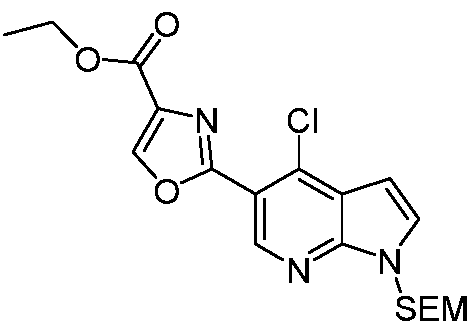
1,4-디옥산 (30 mL) 중의 5-브로모-4-클로로-1-((2-(트리메틸실릴)에톡시)메틸)-1H-피롤로[2,3-b]피리딘 (0.8 g, 2.22 mmol) 및 에틸 옥사졸-4-카르복실레이트 (0.37 g, 2.66 mmol)의 교반된 용액에 팔라듐 아세테이트 (0.024 g, 0.11 mmol), CyJohnphos (0.08 g, 0.22 mmol) 및 탄산세슘 (1.44 g, 4.44 mmol)을 첨가하고, 상기 혼합물을 밀봉된 튜브 중에서 110℃로 16시간 동안 가열하였다. 상기 반응 혼합물을 상온으로 냉각시키고, 셀라이트를 통해 여과하고, 여과액을 진공에서 농축시켰다. 상기 미정제물을 섬광 크로마토그래피 (30% 에틸 아세테이트/헥산)로 정제하여 에틸 2-(4-클로로-1-((2-(트리메틸실릴)에톡시)메틸)-1H-피롤로[2,3-b]피리딘-5-일)옥사졸-4-카르복실레이트를 갈색 액체로서 수득하였다 (0.41 g, 44% 수율): MS (ES) m/z 421.9 (M+H). 1, 4-dioxane (30 mL) of 5-bromo-4-chloro-1 - ((2- (trimethylsilyl) ethoxy) methyl) -1 H - [2,3- b] pyrrolo pyridine ( 0.8 g, 2.22 mmol) and ethyl oxazole-4-carboxylate (0.37 g, 2.66 mmol) in a stirred solution of palladium acetate (0.024 g, 0.11 mmol), CyJohnphos (0.08 g, 0.22 mmol) and cesium carbonate ( 1.44 g, 4.44 mmol) was added and the mixture was heated to 110° C. in a sealed tube for 16 h. The reaction mixture was cooled to room temperature, filtered through celite, and the filtrate was concentrated in vacuo. The crude flash chromatography (30% ethyl acetate / hexanes) afforded ethyl 2- (4-chloro-l to give the-ethoxy ((2- (trimethylsilyl)) methyl) -1 H-pyrrolo [2, 3- b ]pyridin-5-yl)oxazole-4-carboxylate was obtained as a brown liquid (0.41 g, 44% yield): MS (ES) m/z 421.9 (M+H).
[000388] 단계 2: 에틸 2-(4-(((1S,3R)-3-하이드록시사이클로펜틸)아미노)-1-((2-(트리메틸실릴) 에톡시)메틸)-1H-피롤로[2,3-b]피리딘-5-일)옥사졸-4-카르복실레이트의 제조 [000 388] Step 2: ethyl 2- (4 - (((1 S, 3 R) -3- hydroxy-cyclopentyl) amino) -1-ethoxy ((2- (trimethylsilyl)) methyl) -1 H -Preparation of pyrrolo[2,3- b ]pyridin-5-yl)oxazole-4-carboxylate

N-메틸피롤리돈 (5 mL) 중의 에틸 2-(4-클로로-1-((2-(트리메틸실릴)에톡시)메틸)-1H-피롤로[2,3-b]피리딘-5-일)옥사졸-4-카르복실레이트 (0.4 g, 0.95 mmol)의 교반된 용액에 (1R,3S)-3-아미노사이클로펜탄-1-올 하이드로클로라이드 (0.13 g, 0.95 mmol)를 첨가한 후 트리메틸아민 (0.17 mL, 1.23 mmol)을 첨가하였다. 상기 생성된 혼합물에 150℃로 45분간 마이크로파를 조사하였다. 상기 반응 혼합물을 상온으로 냉각시키고, 물로 희석한 후, 에틸 아세테이트로 추출하였다. 상기 유기층을 염수로 세척하고, 황산나트륨으로 건조시켜 여과 후 진공에서 농축시켰다. 상기 미정제 물질을 섬광 크로마토그래피 (50% 에틸 아세테이트/헥산)로 정제하여 에틸 2-(4-(((1S,3R)-3-하이드록시사이클로펜틸)아미노)-1-((2-(트리메틸실릴)에톡시)메틸)-1H-피롤로[2,3-b]피리딘-5-일)옥사졸-4-카르복실레이트를 무색의 걸쭉한 액체로서 수득하였다 (0.31 g, 67% 수율): MS (ES) m/z 486.9 (M+H). Ethyl 2- (4-chloro-l-methyl pyrrolidone in (5 mL) - - N-ethoxy ((2- (trimethylsilyl)) methyl) -1 H - pyrrolo [2,3- b] pyridine-5 To a stirred solution of -yl)oxazole-4-carboxylate (0.4 g, 0.95 mmol) was added (1 R ,3 S )-3-aminocyclopentan-1-ol hydrochloride (0.13 g, 0.95 mmol) After addition, trimethylamine (0.17 mL, 1.23 mmol) was added. The resulting mixture was irradiated with microwaves at 150° C. for 45 minutes. The reaction mixture was cooled to room temperature, diluted with water, and extracted with ethyl acetate. The organic layer was washed with brine, dried over sodium sulfate, filtered and concentrated in vacuo. The crude material was purified by flash chromatography (50% ethyl acetate/hexanes) to ethyl 2-(4-(((1 S ,3 R )-3-hydroxycyclopentyl)amino)-1-((2 - (trimethylsilyl) ethoxy) methyl) -1 H-pyrrolo [2,3- b] pyridin-5-yl) oxazole-4-carboxylate was obtained as a thick colorless liquid (0.31 g, 67 % yield): MS (ES) m/z 486.9 (M+H).
[000389] 단계 3: 2-(4-(((1S,3R)-3-하이드록시사이클로펜틸)아미노)-1-((2-(트리메틸실릴)에톡시)메틸)-1H-피롤로[2,3-b]피리딘-5-일)옥사졸-4-카르복사미드의 제조 [000 389] Step 3: 2- (4 - (( (1 S, 3 R) -3- hydroxy-cyclopentyl) amino) -l - ((2- (ethoxy) trimethylsilyl)) - 1 H - Preparation of pyrrolo[2,3-b]pyridin-5-yl)oxazole-4-carboxamide

에틸 2-(4-(((1S,3R)-3-하이드록시사이클로펜틸)아미노)-1-((2-(트리메틸실릴)에톡시)메틸)-1H-피롤로[2,3-b]피리딘-5-일)옥사졸-4-카르복실레이트 (0.30 g, 0.62 mmol), 메탄올 (5 mL) 및 수성 암모니아 (5 mL, 물 중 23%)의 교반된 용액을 상온에서 20시간 동안 교반하였다. 상기 반응 혼합물을 진공에서 농축시켜 2-(4-(((1S,3R)-3-하이드록시사이클로펜틸)아미노)-1-((2-(트리메틸실릴)에톡시)메틸)-1H-피롤로[2,3-b]피리딘-5-일)옥사졸-4-카르복사미드를 백색 고체로서 수득하였다 (0.28 g, 99% 수율): MS (ES) m/z 457.9 (M+H).Ethyl 2- (4 - (((1 S, 3 R) -3- hydroxy-cyclopentyl) amino) -1-ethoxy) methyl) ((2- (trimethylsilyl) -1 H-pyrrolo [2, 3- b ]Pyridin-5-yl)oxazole-4-carboxylate (0.30 g, 0.62 mmol), methanol (5 mL) and aqueous ammonia (5 mL, 23% in water) were brought to a stirred solution at room temperature. Stirred for 20 hours. The reaction mixture was concentrated in vacuo to 2-(4-(((1 S ,3 R )-3-hydroxycyclopentyl)amino)-1-((2-(trimethylsilyl)ethoxy)methyl)-1 H -pyrrolo[2,3- b ]pyridin-5-yl)oxazole-4-carboxamide was obtained as a white solid (0.28 g, 99% yield): MS (ES) m/z 457.9 (M +H).
[000390] 단계 4: 2-(4-(((1S,3R)-3-하이드록시사이클로펜틸)아미노)-1H-피롤로[2,3-b]피리딘-5-일)옥사졸-4-카르복사미드의 제조 [000 390] Step 4: 2- (4 - (( (1 S, 3 R) -3- hydroxy-cyclopentyl) amino) -1 H - pyrrolo [2,3- b] pyridin-5-yl) oxazole Preparation of sol-4-carboxamide

디클로로메탄 : 트리플루오로아세트산 (3 mL : 3 mL) 중의 2-(4-(((1S,3R)-3-하이드록시사이클로펜틸)아미노)-1-((2-(트리메틸실릴)에톡시)메틸)-1H-피롤로[2,3-b]피리딘-5-일)옥사졸-4-카르복사미드 (0.25 g, 0.55 mmol)의 용액을 상온에서 3시간 동안 교반하였다. 상기 반응 혼합물을 진공에서 농축하고, 잔류물을 1,4-디옥산 : 수성 암모니아 (3 mL: 5 mL, 물 중 23%)에 용해시킨 후, 상기 용액을 상온에서 16시간 동안 교반하였다. 상기 반응 혼합물을 진공에서 농축하고, 상기 미정제 물질을 섬광 크로마토그래피 (5% 메탄올/디클로로메탄)로 정제하여 2-(4-(((1S,3R)-3-하이드록시사이클로펜틸)아미노)-1H-피롤로[2,3-b]피리딘-5-일)옥사졸-4-카르복사미드를 황백색 고체로서 수득하였다 (0.05 g, 35% 수율): 1H NMR (400 MHz, DMSO-d6) δ 11.56 (br s, 1H), 9.35 (d, J = 8.4 Hz, 1H), 8.48 (d, J = 8.4 Hz, 1H), 7.58 (s, 1H), 7.17 (s, 1H), 6.71 (s, 1H), 5.13 (s, 1H), 4.63 (s, 1H), 4.35 (s, 1H), 2.05-2.19 (m, 2H), 1.82-2.00 (m, 2H), 1.75-1.80 (m, 1H), 1.15-1.30 (m, 3H); MS (ES) m/z 328.1 (M+H).Dichloromethane: 2-(4-(((1 S ,3 R )-3-hydroxycyclopentyl)amino)-1-((2-(trimethylsilyl) in trifluoroacetic acid (3 mL : 3 mL) stirred-pyrrolo [2,3- b] pyridin-5-yl) oxazole-4-carboxamide for 3 hours at room temperature a solution of the carboxamide (0.25 g, 0.55 mmol) - ethoxy) methyl) -1 h. The reaction mixture was concentrated in vacuo, the residue was dissolved in 1,4-dioxane : aqueous ammonia (3 mL: 5 mL, 23% in water), and the solution was stirred at room temperature for 16 h. The reaction mixture was concentrated in vacuo and the crude material was purified by flash chromatography (5% methanol/dichloromethane) to 2-(4-(((1 S ,3 R )-3-hydroxycyclopentyl) amino) -1 H - pyrrolo [2,3- b] pyridin-5-yl) oxazole-4-carboxamide was obtained as a pale yellow solid (0.05 g, 35% yield): 1 H NMR (400 MHz , DMSO-d 6 ) δ 11.56 (br s, 1H), 9.35 (d, J = 8.4 Hz, 1H), 8.48 (d, J = 8.4 Hz, 1H), 7.58 (s, 1H), 7.17 (s, 1H), 6.71 (s, 1H), 5.13 (s, 1H), 4.63 (s, 1H), 4.35 (s, 1H), 2.05-2.19 (m, 2H), 1.82-2.00 (m, 2H), 1.75 -1.80 (m, 1H), 1.15-1.30 (m, 3H); MS (ES) m/z 328.1 (M+H).
[000391] 중간체 [000391] intermediate

[000392] (1S,3R)-3-아미노사이클로펜탄-1-올 하이드로클로라이드의 제조 [000392] Preparation of (1 S ,3 R )-3-aminocyclopentan-1-ol hydrochloride

1,4-디옥산 (1 mL) 중의 tert-부틸 ((1R,3S)-3-하이드록시사이클로펜틸)카르바메이트 (0.5 g, 2.48 mmol)의 용액에 1,4-디옥산 (2.5 mL) 중의 4N 염산을 첨가한 후, 상온에서 12시간 동안 교반하였다. 상기 반응 혼합물을 진공에서 농축시켜 에틸 (S)-4-(피페리딘-3-일아미노)-1H-피롤로[2,3-b]피리딘-5-카르복실레이트 하이드로클로라이드를 황백색 고체로서 수득하였다 (0.25 g, 미정제): MS (ES) m/z 102.1 (M+H). To a solution of tert -butyl ((1 R ,3 S )-3-hydroxycyclopentyl)carbamate (0.5 g, 2.48 mmol) in 1,4-dioxane (1 mL) 1,4-dioxane ( After addition of 4N hydrochloric acid in 2.5 mL), the mixture was stirred at room temperature for 12 hours. The reaction mixture was concentrated in vacuo to ethyl (S) -4- (piperidin-3-ylamino) -1 H - pyrrolo [2,3- b] pyridine-5-carboxylate hydrochloride was prepared from a yellowish white solid (0.25 g, crude): MS (ES) m/z 102.1 (M+H).
[000393] 실시예 30: 2-(4-(((3R,6S)-1-(2-시아노아세틸)-6-메틸피페리딘-3-일)아미노)-1H-피롤로[2,3-b]피리딘-5-일)-N-메틸옥사졸-4-카르복사미드의 제조 [000 393] Example 30: 2- (4 - (( (3 R, 6 S) -1- (2- cyano-acetyl) -6-methylpiperidin-3-yl) amino) -1 H - P Preparation of rolo[2,3-b]pyridin-5-yl) -N -methyloxazole-4-carboxamide

반응식 29. 2-(4-(((3Scheme 29. 2-(4-(((3) RR ,6,6 SS )-1-(2-시아노아세틸)-6-메틸피페리딘-3-일)아미노)-1)-1-(2-cyanoacetyl)-6-methylpiperidin-3-yl)amino)-1 HH -피롤로[2,3--pyrrolo[2,3- bb ]피리딘-5-일)-]pyridin-5-yl)- NN -메틸옥사졸-4-카르복사미드의 제조 -Preparation of methyloxazole-4-carboxamide

[000394] 단계 1: 에틸 2-(4-(((3R,6S)-1-((벤질옥시)카보닐)-6-메틸피페리딘-3-일)아미노)-1-((2-(트리메틸실릴)에톡시)메틸)-1H-피롤로[2,3-b]피리딘-5-일)옥사졸-4-카르복실레이트의 제조 [000 394] Step 1: Ethyl 2- (4 - (((3 R, 6 S) -1 - (( benzyloxy) carbonyl) -6-methylpiperidin-3-yl) amino) -1- ( methyl (2- (trimethylsilyl))) -1 H - pyrrolo [2,3- b] pyridin-5-yl) Preparation of 2-phenyl-oxazol-4-carboxylate
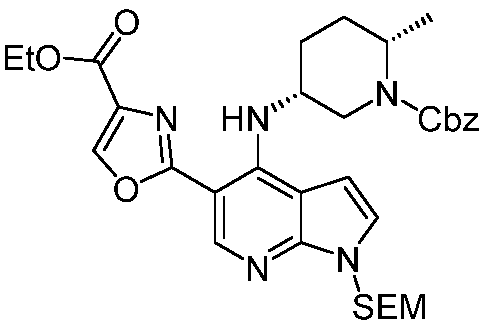
10 mL의 바이알에서, N-메틸피롤리돈 (15 mL) 중의 에틸 2-(4-클로로-1-{[2-(트리메틸실릴)에톡시]메틸}-1H-피롤로[2,3-b]피리딘-5-일)-1,3-옥사졸-4-카르복실레이트 (2.0 g, 4.74 mmol) (실시예 29, 단계 1에서 수득함), 벤질 (2S,5R)-5-아미노-2-메틸피페리딘-1-카르복실레이트 (2.35 g, 9.48 mmol) 및 디이소프로필에틸아민 (1.29 mL, 14.2 mmol)의 용액을 130℃로 16시간 동안 가열하였다. 상기 반응 혼합물을 상온으로 냉각시키고, 에틸 아세테이트로 희석하여 물, 염수로 세척한 후, 무수 황산나트륨으로 건조시키고, 여과하여 진공에서 농축시켰다. 상기 미정제 물질을 섬광 크로마토그래피 (30% 에틸 아세테이트/헥산)로 정제하여 벤질 (2S,5R)-5-({5-[4-(에톡시카보닐)-1,3-옥사졸-2-일]-1-{[2-(트리메틸실릴)에톡시]메틸}-1H-피롤로[2,3-b]피리딘-4-일}아미노)-2-메틸피페리딘-1-카르복실레이트를 담황색의 진득한 액체로서 수득하였다 (0.71 g, 24% 수율): MS (ES) m/z 634.3 (M+H).In a vial of 10 mL, ethyl 2-(4-chloro-1-{[2-(trimethylsilyl)ethoxy]methyl}-1 H -pyrrolo[2,3 ) in N-methylpyrrolidone (15 mL) - b] pyridin-5-yl) -1,3-oxazole-4-carboxylate (2.0 g, 4.74 mmol) (example 29, also obtained in step 1) and benzyl (2 S, 5 R) - A solution of 5-amino-2-methylpiperidine-1-carboxylate (2.35 g, 9.48 mmol) and diisopropylethylamine (1.29 mL, 14.2 mmol) was heated to 130° C. for 16 h. The reaction mixture was cooled to room temperature, diluted with ethyl acetate, washed with water and brine, dried over anhydrous sodium sulfate, filtered and concentrated in vacuo. The crude material was purified by flash chromatography (30% ethyl acetate/hexanes) to benzyl ( 2S , 5R )-5-({5-[4-(ethoxycarbonyl)-1,3-oxazole) 2-yl] -1 - {[2- (trimethylsilyl) ethoxy] methyl} -1 H-pyrrolo [2,3- b] pyridin-4-yl} amino) -2-methyl-piperidine- The 1-carboxylate was obtained as a pale yellow thick liquid (0.71 g, 24% yield): MS (ES) m/z 634.3 (M+H).
[000395] 단계 2: 2-(4-(((3R,6S)-1-((벤질옥시)카보닐)-6-메틸피페리딘-3-일)아미노)-1-((2-(트리메틸실릴)에톡시)메틸)-1H-피롤로[2,3-b]피리딘-5-일)옥사졸-4-카르복실산의 제조 [000395] Step 2: 2-(4-(((3 R ,6 S )-1-((benzyloxy)carbonyl)-6-methylpiperidin-3-yl)amino)-1-(( ethoxy) 2- (trimethylsilyl) methyl) -1 H - pyrrolo [2,3- b] pyridin-5-yl) Preparation of 2-phenyl-oxazol-4-carboxylic acid
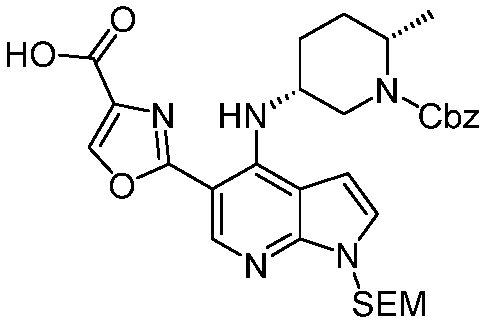
벤질 (2S,5R)-5-({5-[4-(에톡시카보닐)-1,3-옥사졸-2-일]-1-{[2-(트리메틸실릴) 에톡시]메틸}-1H-피롤로[2,3-b]피리딘-4-일}아미노)-2-메틸피페리딘-1-카르복실레이트 (0.60 g, 0.95 mmol), 메탄올 (20 mL) 및 2M 수산화나트륨 수용액 (0.2 g, 4.73 mmol)의 용액을 상온에서 5시간 동안 교반하였다. 휘발성 물질들을 진공에서 제거하고, 잔류물을 물에 용해시키고 1N 염산으로 산성화하여 pH를 ~3으로 조정하였다. 수성층을 디클로로메탄으로 추출하고, 염수로 세척하여 황산나트륨으로 건조시킨 후, 여과하고 진공에서 농축시켜 2-(4-{[(3R,6S)-1-[(벤질옥시)카보닐]-6-메틸피페리딘-3-일]아미노}-1-{[2-(트리메틸실릴)에톡시]메틸}-1H-피롤로[2,3-b]피리딘-5-일)-1,3-옥사졸-4-카르복실산을 무색의 걸쭉한 액체로서 수득하였다 (0.51 g, 89% 수율): MS (ES) m/z 606.3 (M+H). Benzyl ( 2S , 5R )-5-({5-[4-(ethoxycarbonyl)-1,3-oxazol-2-yl]-1-{[2-(trimethylsilyl)ethoxy] methyl}-1 H -pyrrolo[2,3- b ]pyridin-4-yl}amino)-2-methylpiperidine-1-carboxylate (0.60 g, 0.95 mmol), methanol (20 mL) and A solution of 2M aqueous sodium hydroxide solution (0.2 g, 4.73 mmol) was stirred at room temperature for 5 hours. The volatiles were removed in vacuo, the residue was dissolved in water and acidified with 1N hydrochloric acid to adjust the pH to ˜3. The aqueous layer was extracted with dichloromethane, washed with brine, dried over sodium sulfate, filtered and concentrated in vacuo to 2-(4-{[(3 R ,6 S )-1-[(benzyloxy)carbonyl]- 6-methyl-piperidin-3-yl] amino} -1 - {[2- (trimethylsilyl) ethoxy] methyl} -1 H-pyrrolo [2,3- b] pyridin-5-yl) -1 ,3-oxazole-4-carboxylic acid was obtained as a colorless thick liquid (0.51 g, 89% yield): MS (ES) m/z 606.3 (M+H).
[000396] 단계 3: 벤질 (2S,5R)-2-메틸-5-({5-[4-(메틸카바모일)-1,3-옥사졸-2-일]-1-{[2-(트리메틸실릴)에톡시]메틸}-1H-피롤로[2,3-b]피리딘-4-일}아미노)피페리딘-1-카르복실레이트의 제조 [000 396] Step 3: Benzyl (2 S, 5 R) -2-methyl-5 - ({5- [4- (methyl-carbamoyl) -1,3-oxazol-2-yl] -1 - {[ 2- (trimethylsilyl) ethoxy] methyl} -1 H in - [2,3- b] pyrrolo-4-yl} amino) Preparation of piperidine-1-carboxylate

상온에서 N,N-디메틸포름아미드 (8 mL) 중의 2-(4-{[(3R,6S)-1-[(벤질옥시)카보닐]-6-메틸피페리딘-3-일]아미노}-1-{[2-(트리메틸실릴)에톡시]메틸}-1H-피롤로[2,3-b]피리딘-5-일)-1,3-옥사졸-4-카르복실산 (0.5 g, 0.82 mmol) 및 1-[비스(디메틸아미노)메틸렌]-1H-1,2,3-트리아졸로[4,5-b]피리디늄 3-옥사이드 헥사플루오로포스페이트 (0.48 g, 1.24 mmol)의 교반된 용액에 메틸아민 하이드로클로라이드 (0.13 g, 4.13 mmol)를 첨가한 후, 트리에틸아민 (0.6 mL, 4.13 mmol)을 첨가하고, 상기 혼합물을 상온에서 10시간 동안 교반하였다. 상기 반응 혼합물을 에틸 아세테이트로 희석한 후, 물과 염수로 세척하였다. 상기 유기층을 무수 황산나트륨으로 건조시킨 후, 여과 및 진공에서 농축시켰다. 상기 미정제 물질을 섬광 크로마토그래피 (30% 에틸 아세테이트/헥산)로 정제하여 벤질 (2S,5R)-2-메틸-5-({5-[4-(메틸카바모일)-1,3-옥사졸-2-일]-1-{[2-(트리메틸실릴)에톡시]메틸}-1H-피롤로[2,3-b]피리딘-4-일}아미노)피페리딘-1-카르복실레이트를 담황색의 점착성 고체로서 수득하였다 (0.32 g, 63% 수율): MS (ES) m/z 619.3 (M+H).2-(4-{[( 3R , 6S )-1-[(benzyloxy)carbonyl]-6-methylpiperidin-3-yl in N,N -dimethylformamide (8 mL) at room temperature ] amino} -1 - {[2- (trimethylsilyl) ethoxy] methyl} -1 H in-pyrrolo [2,3- b] pyridin-5-yl) -1,3-oxazole-4-carboxylic acid (0.5 g, 0.82 mmol) and 1- [bis (dimethylamino) methylene] -1 H -1,2,3- triazolo [4,5- b] pyridinium-3-phosphate (0.48 g as oxide hexafluoro , 1.24 mmol) was added methylamine hydrochloride (0.13 g, 4.13 mmol), followed by triethylamine (0.6 mL, 4.13 mmol), and the mixture was stirred at room temperature for 10 hours. The reaction mixture was diluted with ethyl acetate and washed with water and brine. The organic layer was dried over anhydrous sodium sulfate, filtered and concentrated in vacuo. Purification of the crude material by flash chromatography (30% ethyl acetate / hexane) benzyl (2 S, 5 R) -2- methyl-5 - ({5- [4- (methyl-carbamoyl) -1,3 -oxazol-2-yl] -1 - {[2- (trimethylsilyl) ethoxy] methyl} -1 H-pyrrolo [2,3- b] pyridin-4-yl} amino) piperidine -1 -carboxylate was obtained as a pale yellow sticky solid (0.32 g, 63% yield): MS (ES) m/z 619.3 (M+H).
[000397] 단계 4: N-메틸-2-(4-{[(3R,6S)-6-메틸피페리딘-3-일]아미노}-1H-피롤로[2,3-b]피리딘-5-일)-1,3-옥사졸-4-카르복사미드의 제조 [000 397] Step 4: N - Methyl -2- (4 - {[(3 R, 6 S) -6- methylpiperidin-3-yl] amino} -1 H - pyrrolo [2,3- b ] Preparation of pyridin-5-yl)-1,3-oxazole-4-carboxamide

트리플루오로아세트산 (5.0 mL) 중의 벤질 (2S,5R)-2-메틸-5-({5-[4-(메틸카바모일)-1,3-옥사졸-2-일]-1-{[2-(트리메틸실릴) 에톡시]메틸}-1H-피롤로[2,3-b]피리딘-4-일}아미노)피페리딘-1-카르복실레이트 (0.32 g, 0.51 mmol)의 용액을 100℃로 1시간 동안 교반하였다. 상기 반응 혼합물을 상온로 냉각한 후, 상기 혼합물을 진공 하에 농축시켰다. 상기 수득된 잔류물을 1,4-디옥산 : 수성 암모니아 (5 mL: 5 mL, 물 중 23%)에 용해시킨 후, 상온에서 16시간 동안 교반하였다. 상기 반응 혼합물을 진공에서 농축시켜 N-메틸-2-(4-{[(3R,6S)-6-메틸피페리딘-3-일]아미노}-1H-피롤로[2,3-b]피리딘-5-일)-1,3-옥사졸-4-카르복사미드를 담황색의 진득한 액체로서 수득하였다 (0.15 g, 미정제): MS (ES) m/z 355.2 (M+H). Benzyl (2S , 5R )-2-methyl-5-({5-[4-(methylcarbamoyl)-1,3-oxazol-2-yl]-1 in trifluoroacetic acid (5.0 mL)) - {[2- (trimethylsilyl) ethoxy] methyl} -1 H-pyrrolo [2,3- b] pyridin-4-yl} amino) piperidine-1-carboxylate (0.32 g, 0.51 mmol ) was stirred at 100 °C for 1 hour. After the reaction mixture was cooled to room temperature, the mixture was concentrated in vacuo. The obtained residue was dissolved in 1,4-dioxane: aqueous ammonia (5 mL: 5 mL, 23% in water), followed by stirring at room temperature for 16 hours. The reaction mixture was concentrated in vacuo to N -methyl-2-(4-{[(3 R ,6 S )-6-methylpiperidin-3-yl]amino}-1 H -pyrrolo[2,3 -b ]pyridin-5-yl)-1,3-oxazole-4-carboxamide was obtained as a pale yellow thick liquid (0.15 g, crude): MS (ES) m/z 355.2 (M+H ).
[000398] 단계 5: 2-(4-(((3R,6S)-1-(2-시아노아세틸)-6-메틸피페리딘-3-일)아미노)-1H-피롤로[2,3-b]피리딘-5-일)-N-메틸옥사졸-4-카르복사미드의 제조 [000 398] Step 5: 2- (4 - (( (3 R, 6 S) -1- (2- cyano-acetyl) -6-methylpiperidin-3-yl) amino) -1 H - pyrrolo Preparation of [2,3-b]pyridin-5-yl) -N -methyloxazole-4-carboxamide

N-메틸피롤리돈 (3.0 mL) 중의 2-시아노아세트산 (0.3 g, 0.27 mmol), 1-하이드록시-1,2-디하이드로피리딘-2-온 (0.03 g, 0.27 mmol) 및 2-(1H-벤조트리아졸-1-일)-1,1,3,3-테트라메틸암모늄 테트라플루오로보레이트 (TBTU) (0.11 g, 0.34 mmol)의 용액을 상온에서 2분간 교반하였다. N-메틸-2-(4-{[(3R,6S)-6-메틸피페리딘-3-일]아미노}-1H-피롤로[2,3-b]피리딘-5-일)-1,3-옥사졸-4-카르복사미드 (0.08 g, 0.23 mmol)를 첨가한 후, 트리에틸아민 (0.1 mL, 0.70 mmol)을 첨가하고, 상기 혼합물을 상온에서 16시간 동안 교반하였다. 상기 반응 혼합물을 에틸 아세테이트로 희석한 후, 물과 염수로 세척하였다. 상기 유기층을 무수 황산나트륨으로 건조시킨 후, 여과 및 진공에서 농축시켰다. 상기 미정제물을 역상 정제로 정제하여 2-(4-(((3R,6S)-1-(2-시아노아세틸)-6-메틸피페리딘-3-일)아미노)-1H-피롤로[2,3-b]피리딘-5-일)-N-메틸옥사졸-4-카르복사미드를 백색 고체로서 수득하였다 (0.03 g, 30% 수율): 1H NMR (400 MHz, DMSO-d6, VT, 80℃) δ 11.46 (br s, 1H), 8.46-8.53 (m, 3H), 8.03 (br s, 1H), 7.21 (s, 1H), 6.68 (s, 1H), 4.40-4.70 (m, 1H), 3.92-4.01 (m, 5H), 2.84 (d, J = 4.0 Hz, 3H), 1.80-2.10 (m, 3H), 1.20-1.35 (m, 4H); MS (ES) m/z 422.4 (M+H).2-cyanoacetic acid (0.3 g, 0.27 mmol), 1-hydroxy-1,2-dihydropyridin-2-one (0.03 g, 0.27 mmol) and 2- in N-methylpyrrolidone (3.0 mL) A solution of (1 H -benzotriazol-1-yl)-1,1,3,3-tetramethylammonium tetrafluoroborate (TBTU) (0.11 g, 0.34 mmol) was stirred at room temperature for 2 minutes. N - Methyl -2- (4 - {[(3 R, 6 S) -6- methylpiperidin-3-yl] amino} -1 H - pyrrolo [2,3- b] pyridin-5-yl )-1,3-oxazole-4-carboxamide (0.08 g, 0.23 mmol) was added, followed by triethylamine (0.1 mL, 0.70 mmol), and the mixture was stirred at room temperature for 16 hours. . The reaction mixture was diluted with ethyl acetate and washed with water and brine. The organic layer was dried over anhydrous sodium sulfate, filtered and concentrated in vacuo. Purification of the crude by reverse phase purified 2- (4 - (((3 R, 6 S) -1- (2- cyano-acetyl) -6-methylpiperidin-3-yl) amino) -1 H -pyrrolo[2,3- b ]pyridin-5-yl) -N -methyloxazole-4-carboxamide was obtained as a white solid (0.03 g, 30% yield): 1 H NMR (400 MHz, DMSO-d 6, VT, 80 °C) δ 11.46 (br s, 1H), 8.46-8.53 (m, 3H), 8.03 (br s, 1H), 7.21 (s, 1H), 6.68 (s, 1H), 4.40-4.70 (m, 1H), 3.92-4.01 (m, 5H), 2.84 (d, J = 4.0 Hz, 3H), 1.80-2.10 (m, 3H), 1.20-1.35 (m, 4H); MS (ES) m/z 422.4 (M+H).
분석 조건:Analysis conditions:
이동상 A: H2O 중의 0.1% NH4OH Mobile phase A: 0.1% NH 4 OH in H 2 O
이동상 B: MeCN Mobile phase B: MeCN
컬럼: X-Bridge, C18 19*100* 5 마이크론 Column: X-Bridge, C18 19*100* 5 microns
유속: 20 mL/분Flow rate: 20 mL/min
[000399] 실시예 31: 2-(4-(((3R,5S)-1-(2-시아노아세틸)-5-메틸피페리딘-3-일)아미노)-1H-피롤로[2,3-b]피리딘-5-일)-N-메틸옥사졸-4-카르복사미드의 제조 [000 399] Example 31: 2- (4 - (( (3 R, 5 S) -1- (2- cyano-acetyl) -5-methyl-piperidin-3-yl) amino) -1 H - P Preparation of rolo[2,3-b]pyridin-5-yl) -N -methyloxazole-4-carboxamide

반응식 30. 2-(4-(((3Scheme 30. 2-(4-(((3) RR ,5,5 SS )-1-(2-시아노아세틸)-5-메틸피페리딘-3-일)아미노)-1)-1-(2-cyanoacetyl)-5-methylpiperidin-3-yl)amino)-1 HH -피롤로[2,3--pyrrolo[2,3- bb ]피리딘-5-일)-]pyridin-5-yl)- NN -메틸옥사졸-4-카르복사미드의 제조-Preparation of methyloxazole-4-carboxamide

[000400] 단계 1: 에틸 2-(4-(((3R,5S)-1-((벤질옥시)카보닐)-5-메틸피페리딘-3-일)아미노)-1-((2-(트리메틸실릴)에톡시)메틸)-1H-피롤로[2,3-b]피리딘-5-일)옥사졸-4-카르복실레이트의 제조 [000 400] Step 1: Ethyl 2- (4 - (((3 R, 5 S) -1 - (( benzyloxy) carbonyl) -5-methyl-piperidin-3-yl) amino) -1- ( methyl (2- (trimethylsilyl))) -1 H - pyrrolo [2,3- b] pyridin-5-yl) Preparation of 2-phenyl-oxazol-4-carboxylate

밀봉된 튜브 중에서 에틸 2-(4-클로로-1-{[2-(트리메틸실릴)에톡시]메틸}-1H-피롤로[2,3-b]피리딘-5-일)-1,3-옥사졸-4-카르복실레이트 (7.0 g, 16.6 mmol) (실시예 29, 단계 1에서 수득함), N-메틸피롤리돈 (42 mL), 벤질 (3S,5R)-3-아미노-5-메틸피페리딘-1-카르복실레이트 (5.36 g, 21.6 mmol) 및 트리에틸아민 (11.7 mL, 82.9 mmol)의 교반된 용액을 150℃에서 32시간 동안 가열하였다. 상기 반응 혼합물을 상온으로 냉각시키고, 물로 ??칭한 후, 에틸 아세테이트로 추출하였다. 상기 유기층을 염수로 세척하고, 무수 황산나트륨으로 건조시켜 여과 후 진공에서 농축시켰다. 상기 미정제물을 섬광 크로마토그래피 (에틸 아세테이트/헥산)로 정제하여 에틸 2-(4-(((3R,5S)-1-((벤질옥시)카보닐)-5-메틸피페리딘-3-일)아미노)-1-((2-(트리메틸실릴)에톡시)메틸)-1H-피롤로[2,3-b]피리딘-5-일)옥사졸-4-카르복실레이트를 담황색의 반고체로서 수득하였다 (5.8 g, 55% 수율): MS (ES) m/z 634.3 (M+H).In a sealed tube ethyl 2- (4-chloro-1 - {[2- (trimethylsilyl) ethoxy] methyl} -1 H-pyrrolo [2,3- b] pyridin-5-yl) -1,3 -oxazole-4-carboxylate (7.0 g, 16.6 mmol) (Example 29, obtained in step 1), N-methylpyrrolidone (42 mL), benzyl (3 S ,5 R )-3- A stirred solution of amino-5-methylpiperidine-1-carboxylate (5.36 g, 21.6 mmol) and triethylamine (11.7 mL, 82.9 mmol) was heated at 150° C. for 32 h. The reaction mixture was cooled to room temperature, quenched with water, and extracted with ethyl acetate. The organic layer was washed with brine, dried over anhydrous sodium sulfate, filtered and concentrated in vacuo. The crude was purified by flash chromatography (ethyl acetate/hexanes) to ethyl 2-(4-(((3 R ,5 S )-1-((benzyloxy)carbonyl)-5-methylpiperidine- 3- yl) amino) -1-a pyrrolo [2,3- b] pyridin-5-yl) oxazole-4-carboxylate - ((2- (trimethylsilyl) ethoxy) methyl) -1 H Obtained as a pale yellow semi-solid (5.8 g, 55% yield): MS (ES) m/z 634.3 (M+H).
[000401] 단계 2: 2-(4-(((3R,5S)-1-((벤질옥시)카보닐)-5-메틸피페리딘-3-일)아미노)-1-((2-(트리메틸실릴)에톡시)메틸)-1H-피롤로[2,3-b]피리딘-5-일)옥사졸-4-카르복실산의 제조 [000 401] Step 2: 2- (4 - (( (3 R, 5 S) -1 - (( benzyloxy) carbonyl) -5-methyl-piperidin-3-yl) amino) -l - (( ethoxy) 2- (trimethylsilyl) methyl) -1 H - pyrrolo [2,3- b] pyridin-5-yl) Preparation of 2-phenyl-oxazol-4-carboxylic acid

메탄올 : 테트라하이드로퓨란 (20 mL : 20 mL) 중의 벤질 (3R,5S)-3-({5-[4-(에톡시카보닐)-1,3-옥사졸-2-일]-1-{[2-(트리메틸실릴)에톡시]메틸}-1H-피롤로[2,3-b]피리딘-4-일}아미노)-5-메틸피페리딘-1-카르복실레이트 (5.8 g, 9.15 mmol)의 교반된 용액에 2M 수산화리튬 일수화물 수용액 (0.8 g, 18.3 mmol)을 첨가하고, 상기 혼합물을 상온에서 5시간 동안 교반하였다. 휘발성 물질들을 진공에서 제거하고, 잔류물을 물에 용해시키고 10% NaHSO4로 산성화하여 pH를 ~2로 조정하였다. 수성층을 디클로로메탄으로 추출하고, 염수로 세척하여 황산나트륨으로 건조시킨 후, 여과하고 진공에서 농축시켜 2-(4-(((3R,5S)-1-((벤질옥시)카보닐)-5-메틸피페리딘-3-일)아미노)-1-((2-(트리메틸실릴)에톡시)메틸)-1H-피롤로[2,3-b]피리딘-5-일)옥사졸-4-카르복실산을 황백색 고체로서 수득하였다 (5.7 g, 미정제): MS (ES) m/z 606.3 (M+H). Methanol: benzyl (3R , 5S )-3-({5-[4-(ethoxycarbonyl)-1,3-oxazol-2-yl]- in tetrahydrofuran (20 mL: 20 mL) 1 - {[2- (trimethylsilyl) ethoxy] methyl} -1 H-pyrrolo [2,3- b] pyridin-4-yl} amino) -5-methyl-piperidine-1-carboxylate ( 5.8 g, 9.15 mmol) was added 2M aqueous lithium hydroxide monohydrate solution (0.8 g, 18.3 mmol), and the mixture was stirred at room temperature for 5 hours. The volatiles were removed in vacuo, the residue was dissolved in water and acidified with 10% NaHSO 4 to adjust the pH to ˜2. The aqueous layer was extracted with dichloromethane, washed with brine, dried over sodium sulfate, filtered and concentrated in vacuo to 2-(4-(((3 R ,5 S )-1-((benzyloxy)carbonyl)- 5-methyl-piperidin-3-yl) amino) -l - ((2- (trimethylsilyl) methyl-ethoxy)) - 1 H-pyrrolo [2,3- b] pyridin-5-yl) oxazole -4-carboxylic acid was obtained as an off-white solid (5.7 g, crude): MS (ES) m/z 606.3 (M+H).
[000402] 단계 3: 벤질 (3S,5R)-3-메틸-5-((5-(4-(메틸카바모일)옥사졸-2-일)-1-((2-(트리메틸실릴)에톡시)메틸)-1H-피롤로[2,3-b]피리딘-4-일)아미노)피페리딘-1-카르복실레이트의 제조 [000 402] Step 3: Benzyl (3 S, 5 R) -3- methyl-5 - ((5- (4- (methyl-carbamoyl) 2-yl) -l - ((2- (trimethylsilyl ) ethoxy) methyl) -1 H in-pyrrolo [2,3- b] pyridin-4-yl) amino) Preparation of piperidine-1-carboxylate

N,N-디메틸포름아미드 (60 mL) 중의 2-(4-{[(3R,5S)-1-[(벤질옥시)카보닐]-5-메틸피페리딘-3-일]아미노}-1-{[2-(트리메틸실릴)에톡시]메틸}-1H-피롤로[2,3-b]피리딘-5-일)-1,3-옥사졸-4-카르복실산 (5.7 g, 9.41 mmol) 및 1-[비스(디메틸아미노)메틸렌]-1H-1,2,3-트리아졸로[4,5-b]피리디늄 3-옥사이드 헥사플루오로포스페이트 (0.29 g, 0.74 mmol)의 용액을 상온에서 3분간 교반하였다. 메틸아민 하이드로클로라이드 (1.27 g, 18.8 mmol)을 첨가한 후, N,N-디이소프로필에틸아민 (8.22 mL, 47.0 mmol)을 첨가하고, 상기 혼합물을 상온에서 10시간 동안 교반하였다. 상기 반응 혼합물을 에틸 아세테이트로 희석한 후, 물과 염수로 세척하였다. 상기 유기층을 무수 황산나트륨으로 건조시킨 후, 여과 및 진공에서 농축시켰다. 상기 미정제 물질을 섬광 크로마토그래피 (30% 에틸 아세테이트/헥산)로 정제하여 벤질 (3S,5R)-3-메틸-5-((5-(4-(메틸카바모일)옥사졸-2-일)-1-((2-(트리메틸실릴)에톡시)메틸)-1H-피롤로[2,3-b]피리딘-4-일)아미노)피페리딘-1-카르복실레이트를 담황색의 점착성 고체로서 수득하였다 (5.7 g, 97% 수율): MS (ES) m/z 619.3 (M+H).2-(4-{[( 3R , 5S )-1-[(benzyloxy)carbonyl]-5-methylpiperidin-3-yl]amino in N,N-dimethylformamide (60 mL) } 1 - {[2- (trimethylsilyl) ethoxy] methyl} -1 H-pyrrolo [2,3- b] pyridin-5-yl) -1,3-oxazole-4-carboxylic acid ( 5.7 g, 9.41 mmol) and 1- [bis (dimethylamino) methylene] -1 H -1,2,3- triazolo [4,5- b] pyridinium 3-oxide hexafluorophosphate (0.29 g, 0.74 mmol) was stirred at room temperature for 3 minutes. Methylamine hydrochloride (1.27 g, 18.8 mmol) was added, followed by N,N -diisopropylethylamine (8.22 mL, 47.0 mmol), and the mixture was stirred at room temperature for 10 hours. The reaction mixture was diluted with ethyl acetate and washed with water and brine. The organic layer was dried over anhydrous sodium sulfate, filtered and concentrated in vacuo. The crude material was purified by flash chromatography (30% ethyl acetate/hexanes) to benzyl (3 S ,5 R )-3-methyl-5-((5-(4-(methylcarbamoyl)oxazole-2) -yl) -1-a pyrrolo [2,3- b] pyridin-4-yl) amino) piperidine-1-carboxylate - ((2- (trimethylsilyl) ethoxy) methyl) -1 H Obtained as a pale yellow sticky solid (5.7 g, 97% yield): MS (ES) m/z 619.3 (M+H).
[000403] 단계 4: N-메틸-2-(4-(((3R,5S)-5-메틸피페리딘-3-일)아미노)-1H-피롤로[2,3-b]피리딘-5-일)옥사졸-4-카르복사미드의 제조 [000 403] Step 4: N - Methyl -2- (4 - (((3 R, 5 S) -5- methylpiperidin-3-yl) amino) -1 H - pyrrolo [2,3- b ] Preparation of pyridin-5-yl) oxazole-4-carboxamide

트리플루오로아세트산 (15 mL) 중의 벤질 (3S,5R)-3-메틸-5-((5-(4-(메틸카바모일)옥사졸-2-일)-1-((2-(트리메틸실릴)에톡시)메틸)-1H-피롤로[2,3-b]피리딘-4-일)아미노)피페리딘-1-카르복실레이트 (5.7 g, 9.21 mmol)의 교반된 용액을 밀봉된 튜브 중에서 100℃로 1시간 동안 가열하였다. 냉각 후, 상기 반응 혼합물을 농축하여 건조 상태로 하고, 잔류물을 1,4-디옥산 : 수성 암모니아 (10 mL: 20 mL, 물 중 23%)에 용해시킨 후, 상기 반응 혼합물을 상온에서 15시간 동안 교반하였다. 상기 반응물을 진공에서 농축시켜 건조 상태로 하여 N-메틸-2-(4-(((3R,5S)-5-메틸피페리딘-3-일)아미노)-1H-피롤로[2,3-b]피리딘-5-일) 옥사졸-4-카르복사미드를 황백색 고체로서 수득하였다. (9.2 g, 미정제): MS (ES) m/z 355.4 (M+H). Benzyl (3S , 5R )-3-methyl-5-((5-(4-(methylcarbamoyl)oxazol-2-yl)-1-((2-) in trifluoroacetic acid (15 mL) to a stirred solution of pyrrolo [2,3- b] pyridin-4-yl) amino) piperidine-1-carboxylate (5.7 g, 9.21 mmol) - ( trimethylsilyl) ethoxy) methyl) -1 H was heated to 100° C. for 1 h in a sealed tube. After cooling, the reaction mixture was concentrated to dryness, the residue was dissolved in 1,4-dioxane: aqueous ammonia (10 mL: 20 mL, 23% in water), and then the reaction mixture was stirred at room temperature for 15 stirred for hours. The reaction was concentrated in vacuo to dryness and N -methyl-2-(4-(((3 R ,5 S )-5-methylpiperidin-3-yl)amino)-1 H -pyrrolo[ 2,3- b ]pyridin-5-yl) oxazole-4-carboxamide was obtained as an off-white solid. (9.2 g, crude): MS (ES) m/z 355.4 (M+H).
[000404] 단계 5: 2-(4-(((3R,5S)-1-(2-시아노아세틸)-5-메틸피페리딘-3-일)아미노)-1H-피롤로[2,3-b]피리딘-5-일)-N-메틸옥사졸-4-카르복사미드의 제조 [000 404] Step 5: 2- (4 - (( (3 R, 5 S) -1- (2- cyano-acetyl) -5-methyl-piperidin-3-yl) amino) -1 H - pyrrolo Preparation of [2,3-b]pyridin-5-yl) -N -methyloxazole-4-carboxamide

N,N-디메틸포름아미드 (45 mL) 중의 시아노아세트산 (1.48 g, 17.4 mmol) 및 1-[비스(디메틸아미노)메틸렌]-1H-1,2,3-트리아졸로[4,5-b]피리디늄 3-옥사이드 헥사플루오로포스페이트 (11 g, 28.9 mmol)의 용액을 상온에서 10분간 교반하였다. 이후, N-메틸-2-(4-(((3R,5S)-5-메틸피페리딘-3-일)아미노)-1H-피롤로[2,3-b]피리딘-5-일)옥사졸-4-카르복사미드 (4.1 g, 11.6 mmol)를 첨가한 후, N,N-디이소프로필에틸아민 (10 mL, 57.8 mmol)을 첨가하고, 생성된 혼합물을 상온에서 12시간 동안 교반하였다. 상기 반응 혼합물을 얼음물로 ??칭하고, 에틸 아세테이트로 추출한 후, 상기 혼합된 유기 부분을 물과 염수로 세척하고, 무수 황산나트륨으로 건조시켰다. 상기 용액을 여과시킨 후 진공에서 농축시켰다. 상기 미정제 물질을 역상 크로마토그래피를 사용하여 정제하여 백색 고체를 수득하였다 (0.67 g, 13% 수율): 1H NMR (400 MHz, DMSO-d6, VT, 90℃) δ 11.40 (s, 1H), 8.54 (s, 1H), 8.47-8.43 (m, 2H), 7.85 (br s, 1H), 7.21 (s, 1H), 6.72 (s, 1H), 4.80 (br s, 1H), 4.15 (s, 1H), 3.98 (s, 2H), 3.75 (br s, 1H), 2.85 (s, 3H), 2.65 (s, 1H), 2.30-2.27 (m, 2H), 1.86 (br s, 1H), 1.41 (d, J = 11.2 Hz, 1H), 0.95 (d, J = 5.6 Hz, 3H); MS (ES) m/z 422.3 (M+H). N, N - cyano-acetic acid (1.48 g, 17.4 mmol) and 1- [bis (dimethylamino) methylene] in dimethylformamide (45 mL) -1 H -1,2,3- triazolo [4,5- b ] A solution of pyridinium 3-oxide hexafluorophosphate (11 g, 28.9 mmol) was stirred at room temperature for 10 minutes. Since, N - Methyl -2- (4 - (((3 R, 5 S) -5- methylpiperidin-3-yl) amino) -1 H - pyrrolo [2,3- b] pyridine-5 -yl)oxazole-4-carboxamide (4.1 g, 11.6 mmol) was added, and then N,N -diisopropylethylamine (10 mL, 57.8 mmol) was added, and the resulting mixture was stirred at room temperature for 12 stirred for hours. The reaction mixture was quenched with ice water, extracted with ethyl acetate, and the mixed organic portion was washed with water and brine and dried over anhydrous sodium sulfate. The solution was filtered and then concentrated in vacuo. The crude material was purified using reverse phase chromatography to give a white solid (0.67 g, 13% yield): 1 H NMR (400 MHz, DMSO-d 6 , VT, 90° C.) δ 11.40 (s, 1H) ), 8.54 (s, 1H), 8.47-8.43 (m, 2H), 7.85 (br s, 1H), 7.21 (s, 1H), 6.72 (s, 1H), 4.80 (br s, 1H), 4.15 ( s, 1H), 3.98 (s, 2H), 3.75 (br s, 1H), 2.85 (s, 3H), 2.65 (s, 1H), 2.30-2.27 (m, 2H), 1.86 (br s, 1H) , 1.41 (d, J = 11.2 Hz, 1H), 0.95 (d, J = 5.6 Hz, 3H); MS (ES) m/z 422.3 (M+H).
분석 조건:Analysis conditions:
컬럼: X-Bridge C-18 (250 mm X 4.6 mm X 5 mic)Column: X-Bridge C-18 (250 mm X 4.6 mm X 5 mic)
이동상(A): 수중 0.1% 암모니아Mobile phase (A): 0.1% ammonia in water
이동상(B): MeCNMobile phase (B): MeCN
유속: 1.0 mL/분Flow rate: 1.0 mL/min
[000405] 실시예 32: 2-(4-(((3S,5R)-1-(2-시아노아세틸)-5-메틸피페리딘-3-일)아미노)-1H-피롤로[2,3-b]피리딘-5-일)-N-메틸옥사졸-4-카르복사미드의 제조 [000 405] Example 32: 2- (4 - (( (3 S, 5 R) -1- (2- cyano-acetyl) -5-methyl-piperidin-3-yl) amino) -1 H - P Preparation of rolo[2,3-b]pyridin-5-yl) -N -methyloxazole-4-carboxamide

2-(4-(((3S,5R)-1-(2-시아노아세틸)-5-메틸피페리딘-3-일)아미노)-1H-피롤로[2,3-b]피리딘-5-일)-N-메틸옥사졸-4-카르복사미드를 실시예 31에 따라 단계 1의 벤질 (3R,5S)-3-아미노-5-메틸피페리딘-1-카르복실레이트를 사용하여 제조하여 백색 고체를 수득하였다 (0.6 g, 11% 수율): 1H NMR (400 MHz, DMSO-d6, VT, 80℃) δ 11.45 (s, 1H), 8.45-8.43 (m, 3H), 7.91 (br s, 1H), 7.21 (s, 1H), 6.72 (s, 1H), 4.80 (br s, 1H), 4.15 (s, 1H), 3.98 (s, 2H), 3.75 (br s, 1H), 2.85 (s, 3H), 2.65 (s, 1H), 2.30-2.27 (m, 2H), 1.86 (br s, 1H), 1.41 (d, J = 11.2 Hz, 1H), 0.95 (d, J = 5.6 Hz, 3H); MS (ES) m/z 422.3 (M+H). 2- (4 - (((3S , 5R) -1- (2- cyano-acetyl) -5-methyl-piperidin-3-yl) amino) -1 H - pyrrolo [2,3-b] pyridine -5-yl) -N -methyloxazole-4-carboxamide in step 1 according to Example 31 benzyl (3 R ,5 S )-3-amino-5-methylpiperidine-1-carboxyl rate to give a white solid (0.6 g, 11% yield): 1 H NMR (400 MHz, DMSO-d 6 , VT, 80° C.) δ 11.45 (s, 1H), 8.45-8.43 (m , 3H), 7.91 (br s, 1H), 7.21 (s, 1H), 6.72 (s, 1H), 4.80 (br s, 1H), 4.15 (s, 1H), 3.98 (s, 2H), 3.75 ( br s, 1H), 2.85 (s, 3H), 2.65 (s, 1H), 2.30-2.27 (m, 2H), 1.86 (br s, 1H), 1.41 (d, J = 11.2 Hz, 1H), 0.95 (d, J = 5.6 Hz, 3H); MS (ES) m/z 422.3 (M+H).
분석 조건:Analysis conditions:
컬럼: X-Bridge C-18 (250 mm X 4.6 mm X 5 mic)Column: X-Bridge C-18 (250 mm X 4.6 mm X 5 mic)
이동상(A): 수중 0.1% 암모니아Mobile phase (A): 0.1% ammonia in water
이동상(B): MeCN Mobile phase (B): MeCN
유속: 1.0 mL/분Flow rate: 1.0 mL/min
[000406] 실시예 33: (R)-2-(4-((1-(2-시아노아세틸)피페리딘-3-일)아미노)-1H-피롤로[2,3-b]피리딘-5-일)-N-메틸옥사졸-4-카르복사미드의 제조 [000 406] Example 33: (R) -2- (4 - ((1- (2- cyano-acetyl) -piperidin-3-yl) amino) -1 H - pyrrolo [2,3- b] Preparation of pyridin-5-yl) -N -methyloxazole-4-carboxamide

반응식 31. (Scheme 31. ( RR )-2-(4-((1-(2-시아노아세틸)피페리딘-3-일)아미노)-1)-2-(4-((1-(2-cyanoacetyl)piperidin-3-yl)amino)-1 HH -피롤로[2,3--pyrrolo[2,3- bb ]피리딘-5-일)-]pyridin-5-yl)- NN -메틸옥사졸-4-카르복사미드의 제조-Preparation of methyloxazole-4-carboxamide

[000407] 단계 1: 에틸 (R)-2-(4-((1-(tert-부톡시카보닐)피페리딘-3-일)아미노)-1-((2-(트리메틸실릴)에톡시)메틸)-1H-피롤로[2,3-b]피리딘-5-일)옥사졸-4-카르복실레이트의 제조 [000407] Step 1: to ethyl ( R )-2-(4-((1-( tert -butoxycarbonyl)piperidin-3-yl)amino)-1-((2-(trimethylsilyl) Preparation of pyrrolo [2,3- b] pyridin-5-yl) oxazole-4-carboxylate-ethoxy) methyl) -1 H

1,4-디옥산 (18 mL) 중의 tert-부틸 (R)-3-((5-브로모-1-((2-(트리메틸실릴)에톡시)메틸)-1H-피롤로[2,3-b]피리딘-4-일)아미노)피페리딘-1-카르복실레이트 (1.2 g, 2.28 mmol) 및 에틸 옥사졸-4-카르복실레이트 (0.38 g, 2.74 mmol)의 교반된 용액에 팔라듐 아세테이트 (0.03 g, 0.12 mmol), CyJohnphos (0.08 g, 0.23 mmol) 및 탄산세슘 (1.48 g, 4.56 mmol)을 첨가한 후, 생성된 혼합물을 질소 대기 하에 밀봉된 튜브 중에서 110℃로 16시간 동안 가열하였다. 상기 반응 혼합물을 상온으로 냉각시키고, 셀라이트를 통해 여과시켜 에틸 아세테이트로 세척한 후, 여과액을 진공에서 농축시켰다. 상기 미정제 물질을 섬광 크로마토그래피 (40% 에틸 아세테이트/헥산)로 정제하여 에틸 (R)-2-(4-((1-(tert-부톡시카보닐)피페리딘-3-일)아미노)-1-((2-(트리메틸실릴)에톡시)메틸)-1H-피롤로[2,3-b]피리딘-5-일)옥사졸-4-카르복실레이트를 황백색 고체로서 수득하였다 (1.1 g, 41% 수율): MS (ES) m/z 585.9 (M+H).1, 4-dioxane (18 mL) of tert-butyl (R) -3 - ((5- bromo-1 - ((methylethoxy), 2- (trimethylsilyl)) -1 H-pyrrolo [2 A stirred solution of ,3- b ]pyridin-4-yl)amino)piperidine-1-carboxylate (1.2 g, 2.28 mmol) and ethyl oxazole-4-carboxylate (0.38 g, 2.74 mmol) After addition of palladium acetate (0.03 g, 0.12 mmol), CyJohnphos (0.08 g, 0.23 mmol) and cesium carbonate (1.48 g, 4.56 mmol), the resulting mixture was heated at 110° C. in a sealed tube under a nitrogen atmosphere for 16 hours. heated while The reaction mixture was cooled to room temperature, filtered through celite, washed with ethyl acetate, and the filtrate was concentrated in vacuo. The crude material was purified by flash chromatography (40% ethyl acetate/hexanes) to ethyl ( R )-2-(4-((1-( tert -butoxycarbonyl)piperidin-3-yl)amino ) -1 - ((2- (trimethylsilyl) ethoxy) methyl) -1 H-a pyrrolo [2,3- b] pyridin-5-yl) oxazole-4-carboxylate was obtained as a pale yellow solid (1.1 g, 41% yield): MS (ES) m/z 585.9 (M+H).
[000408] 단계 2: (R)-4-((1-(tert-부톡시카보닐)피페리딘-3-일)아미노)-1-((2-(트리메틸실릴)에톡시)메틸)-1H-피롤로[2,3-b]피리딘-5-카르복실산의 제조 [000408] Step 2: ( R )-4-((1-( tert -butoxycarbonyl)piperidin-3-yl)amino)-1-((2-(trimethylsilyl)ethoxy)methyl) Preparation of -1 H -pyrrolo[2,3- b ]pyridine-5-carboxylic acid

에탄올 (12 mL) 중의 에틸 (R)-2-(4-((1-(tert-부톡시카보닐)피페리딘-3-일)아미노)-1-((2-(트리메틸실릴) 에톡시)메틸)-1H-피롤로[2,3-b]피리딘-5-일)옥사졸-4-카르복실레이트 (0.5 g, 0.85 mmol)의 교반된 용액에 2M 수산화나트륨 수용액 (0.1 g, 2.56 mmol)을 첨가한 후, 생성된 혼합물을 상온에서 3시간 동안 교반하였다. 휘발성 물질들을 진공에서 제거하고, 잔류물을 물에 용해시키고 10% 황산수소칼륨 수용액으로 산성화하여 pH를 ~3으로 조정하였다. 수성층을 디클로로메탄으로 추출하고 염수로 세척하였다. 상기 유기층을 염수로 세척하고, 무수 황산나트륨으로 건조시킨 후, 여과하고 진공에서 농축시켜 (R)-4-((1-(tert-부톡시카보닐)피페리딘-3-일)아미노)-1-((2-(트리메틸실릴)에톡시)메틸)-1H-피롤로[2,3-b]피리딘-5-카르복실산을 황백색 고체로서 수득하였다. (0.3 g, 64% 수율): MS (ES) m/z 557.9 (M+H). To ethyl (R )-2-(4-((1-( tert -butoxycarbonyl)piperidin-3-yl)amino)-1-((2-(trimethylsilyl) in ethanol (12 mL) ethoxy) methyl) -1 H - pyrrolo [2,3- b] pyridin-5-yl) oxazole-4-carboxylate (0.5 g, (0.1 g 2M aqueous sodium hydroxide solution was added dropwise a solution of 0.85 mmol) , 2.56 mmol), and the resulting mixture was stirred at room temperature for 3 hours. The volatiles were removed in vacuo, the residue was dissolved in water and acidified with 10% aqueous potassium hydrogen sulfate solution to adjust the pH to -3. The aqueous layer was extracted with dichloromethane and washed with brine. The organic layer was washed with brine, dried over anhydrous sodium sulfate, filtered and concentrated in vacuo ( R )-4-((1-( tert -butoxycarbonyl)piperidin-3-yl)amino)- 1 - ((2- (trimethylsilyl) ethoxy) methyl) -1 H-pyrrolo [2,3- b] pyridine to give the carboxylic acid as a pale yellow solid. (0.3 g, 64% yield): MS (ES) m/z 557.9 (M+H).
[000409] 단계 3: tert-부틸 (R)-3-((5-(4-(메틸카바모일)옥사졸-2-일)-1-((2-(트리메틸실릴)에톡시) 메틸)-1H-피롤로[2,3-b]피리딘-4-일)아미노)피페리딘-1-카르복실레이트의 제조 [000409] Step 3: tert -Butyl ( R )-3-((5-(4-(methylcarbamoyl)oxazol-2-yl)-1-((2-(trimethylsilyl)ethoxy)methyl) Preparation of -1 H -pyrrolo[2,3-b]pyridin-4-yl)amino)piperidine-1-carboxylate

N,N-디메틸포름아미드 (10 mL) 중의 (R)-2-(4-((1-(tert-부톡시카보닐)피페리딘-3-일)아미노)-1-((2-(트리메틸실릴)에톡시)메틸)-1H-피롤로[2,3-b]피리딘-5-일)옥사졸-4-카르복실산 (0.27 g, 0.48 mmol) 및 1-[비스(디메틸아미노)메틸렌]-1H-1,2,3-트리아졸로[4,5-b]피리디늄 3-옥사이드 헥사플루오로포스페이트 (0.24 g, 0.63 mmol)의 용액을 5분간 교반하였다. 메틸아민 하이드로클로라이드 (0.05 g, 0.726 mmol)를 첨가한 후, N,N-디이소프로필에틸아민 (0.25 mL, 1.45 mmol)을 첨가하고, 생성된 혼합물을 상온에서 3시간 동안 교반하였다. 상기 반응 혼합물을 얼음물로 ??칭하고, 에틸 아세테이트로 추출한 후, 상기 유기 부분을 물과 염수로 세척한 다음, 무수 황산나트륨으로 건조시켰다. 상기 용액을 여과시킨 후 진공에서 농축시켰다. 상기 미정제 물질을 섬광 크로마토그래피 (5% 메탄올/디클로로메탄)로 정제하여 tert-부틸 (R)-3-((5-(4-(메틸카바모일)옥사졸-2-일)-1-((2-(트리메틸실릴)에톡시)메틸)-1H-피롤로[2,3-b]피리딘-4-일)아미노)피페리딘-1-카르복실레이트를 황색 오일로서 수득하였다 (0.27 g, 99% 수율): MS (ES) m/z 571.3 (M+H). (R )-2-(4-((1-( tert -butoxycarbonyl)piperidin-3-yl)amino)-1-((2- ) in N,N -dimethylformamide (10 mL) (trimethylsilyl) ethoxy) methyl) -1 H - pyrrolo [2,3- b] pyridin-5-yl) oxazole-4-carboxylic acid (0.27 g, 0.48 mmol) and 1- [bis (dimethyl amino) methylene] a solution of -1 H -1,2,3- triazolo [4,5- b] pyridinium-phosphate (0.24 g, 0.63 mmol) 3-hexafluoro-oxide and stirred for 5 minutes. Methylamine hydrochloride (0.05 g, 0.726 mmol) was added, followed by N,N -diisopropylethylamine (0.25 mL, 1.45 mmol), and the resulting mixture was stirred at room temperature for 3 hours. The reaction mixture was quenched with ice water, extracted with ethyl acetate, and the organic portion was washed with water and brine, then dried over anhydrous sodium sulfate. The solution was filtered and then concentrated in vacuo. The crude material was purified by flash chromatography (5% methanol/dichloromethane) to tert -butyl ( R )-3-((5-(4-(methylcarbamoyl)oxazol-2-yl)-1- a pyrrolo [2,3- b] pyridin-4-yl) amino) piperidine-1-carboxylate - ((2- (trimethylsilyl) ethoxy) methyl) -1 H Obtained as a yellow oil (0.27 g, 99% yield): MS (ES) m/z 571.3 (M+H).
[000410] 단계 4: (R)-N-메틸-2-(4-(피페리딘-3-일아미노)-1H-피롤로[2,3-b]피리딘-5-일)옥사졸-4-카르복사미드의 제조 [000 410] Step 4: (R) - N - methyl-2- (4- (piperidin-3-ylamino) -1 H - pyrrolo [2,3- b] pyridin-5-yl) oxazole Preparation of -4-carboxamide

디클로로메탄 : 트리플루오로아세트산 (5 mL: 4 mL) 중의 tert-부틸 (R)-3-((5-(4-(메틸카바모일)옥사졸-2-일)-1-((2-(트리메틸실릴)에톡시)메틸)-1H-피롤로[2,3-b]피리딘-4-일)아미노)피페리딘-1-카르복실레이트 (0.30 g, 0.52 mmol)의 용액을 상온에서 3시간 동안 교반하였다. 상기 반응 혼합물을 진공에서 농축하고, 잔류물을 1,4-디옥산 : 수성 암모니아 (4 mL : 5 mL, 물 중 23%)에 용해시켰다. 상기 반응 혼합물을 상온에서 16시간 동안 교반하였다. 상기 반응물을 진공에서 농축하여 잔류물을 수득하고, 이를 5% 메탄올/디클로로메탄에 용해시켰다. 상기 유기층을 물, 염수로 세척하고 무수 황산나트륨으로 건조시켰다. 상기 용액을 여과한 후 진공에서 농축시켜 (R)-N-메틸-2-(4-(피페리딘-3-일아미노)-1H-피롤로[2,3-b]피리딘-5-일)옥사졸-4-카르복사미드를 진득한 액체로서 수득하였다 (0.12 g, 70% 수율): MS (ES) m/z 341.2 (M+H). Dichloromethane: tert -butyl ( R )-3-((5-(4-(methylcarbamoyl)oxazol-2-yl)-1-((2-) in trifluoroacetic acid (5 mL: 4 mL) (trimethylsilyl) ethoxy) methyl) -1 H - pyrrolo [2,3- b] pyridin-4-yl) amino) piperidin-1 at room temperature and a solution of carboxylate (0.30 g, 0.52 mmol) was stirred for 3 hours. The reaction mixture was concentrated in vacuo and the residue was dissolved in 1,4-dioxane : aqueous ammonia (4 mL : 5 mL, 23% in water). The reaction mixture was stirred at room temperature for 16 hours. The reaction was concentrated in vacuo to give a residue, which was dissolved in 5% methanol/dichloromethane. The organic layer was washed with water and brine and dried over anhydrous sodium sulfate. After the solution was filtered and concentrated in vacuo to give (R) - N - methyl-2- (4- (piperidin-3-ylamino) -1 H - pyrrolo [2,3- b] pyridin-5 yl)oxazole-4-carboxamide was obtained as a thick liquid (0.12 g, 70% yield): MS (ES) m/z 341.2 (M+H).
[000411] 단계 5: (R)-2-(4-((1-(2-시아노아세틸)피페리딘-3-일)아미노)-1H-피롤로[2,3-b]피리딘-5-일)-N-메틸옥사졸-4-카르복사미드의 제조 [000 411] Step 5: (R) -2- (4 - ((1- (2- cyano-acetyl) -piperidin-3-yl) amino) -1 H - pyrrolo [2,3- b] pyridine Preparation of -5-yl) -N -methyloxazole-4-carboxamide

N,N-디메틸포름아미드 (5 mL) 중의 시아노아세트산 (0.05 g, 0.55 mmol) 및 1-[비스(디메틸아미노)메틸렌]-1H-1,2,3-트리아졸로[4,5-b]피리디늄 3-옥사이드 헥사플루오로포스페이트 (0.17 g, 0.45 mmol)의 용액을 10분간 교반하였다. (R)-N-메틸-2-(4-(피페리딘-3-일아미노)-1H-피롤로[2,3-b]피리딘-5-일)옥사졸-4-카르복사미드 (0.12 g, 0.35 mmol)를 첨가한 후, N,N-디이소프로필에틸아민 (0.18 mL, 1.05 mmol)을 첨가하고, 생성된 혼합물을 상온에서 6시간 동안 교반하였다. 상기 반응 혼합물을 얼음물로 ??칭하고 에틸 아세테이트로 추출하였다. 상기 유기층을 염수로 세척하고, 무수 황산나트륨으로 건조시켜 여과 후 진공에서 농축시켰다. 상기 미정제 물질을 역상 크로마토그래피로 정제하여 (R)-2-(4-((1-(2-시아노아세틸)피페리딘-3-일)아미노)-1H-피롤로[2,3-b]피리딘-5-일)-N-메틸옥사졸-4-카르복사미드를 백색 고체로서 수득하였다 (0.01 g, 8% 수율): 1H NMR (400 MHz, DMSO-d6) δ 11.68-11.64 (br s, 1H), 8.63 (d, J = 7.2 Hz, 1H), 8.55-8.52 (m, 2H), 8.13 (s, 1H), 7.24 (s, 1H), 6.72 (s, 1H), 4.38 (br s, 1H), 4.22-4.19 (m, 1H), 4.08 (s, 1H), 3.96 (s, 1H), 3.82-3.77 (m, 1H), 3.48 (s, 1H), 3.36 (s, 1H), 2.83 (d, J = 3.6 Hz, 3H), 2.07 (br s, 2H), 1.85 (br s, 2H); MS (ES) m/z 408.5 (M+H). N, N - dimethylformamide (5 mL) cyanoacetic acid (0.05 g, 0.55 mmol) and 1- [bis (dimethylamino) methylene] -1 H -1,2,3- triazolo [4,5- b ] A solution of pyridinium 3-oxide hexafluorophosphate (0.17 g, 0.45 mmol) was stirred for 10 minutes. (R) - N - methyl-2- (4- (piperidin-3-ylamino) -1 H - pyrrolo [2,3- b] pyridin-5-yl) oxazol-4-carboxamide (0.12 g, 0.35 mmol) was added, followed by N,N -diisopropylethylamine (0.18 mL, 1.05 mmol), and the resulting mixture was stirred at room temperature for 6 hours. The reaction mixture was quenched with ice water and extracted with ethyl acetate. The organic layer was washed with brine, dried over anhydrous sodium sulfate, filtered and concentrated in vacuo. Purification of the crude material by reverse phase chromatography (R) -2- (4 - ( (1- (2- cyano-acetyl) -piperidin-3-yl) amino) -1 H - pyrrolo [2, 3- b ]pyridin-5-yl) -N -methyloxazole-4-carboxamide was obtained as a white solid (0.01 g, 8% yield): 1 H NMR (400 MHz, DMSO-d 6 ) δ 11.68-11.64 (br s, 1H), 8.63 (d, J = 7.2 Hz, 1H), 8.55-8.52 (m, 2H), 8.13 (s, 1H), 7.24 (s, 1H), 6.72 (s, 1H) ), 4.38 (br s, 1H), 4.22-4.19 (m, 1H), 4.08 (s, 1H), 3.96 (s, 1H), 3.82-3.77 (m, 1H), 3.48 (s, 1H), 3.36 (s, 1H), 2.83 (d, J = 3.6 Hz, 3H), 2.07 (br s, 2H), 1.85 (br s, 2H); MS (ES) m/z 408.5 (M+H).
분석 조건:Analysis conditions:
컬럼: X-Bridge C-18 (250 mm X 4.6 mm X 5 mic)Column: X-Bridge C-18 (250 mm X 4.6 mm X 5 mic)
이동상(A): 수중 0.1% 암모니아Mobile phase (A): 0.1% ammonia in water
이동상(B): MeCN Mobile phase (B): MeCN
유속: 1.0 mL/분Flow rate: 1.0 mL/min
[000412] 실시예 34: (R)-2-(4-((1-(2-시아노아세틸)피페리딘-3-일)아미노)-1H-피롤로[2,3-b]피리딘-5-일)-N,N-디메틸-옥사졸-4-카르복사미드의 제조 [000 412] Example 34: (R) -2- (4 - ((1- (2- cyano-acetyl) -piperidin-3-yl) amino) -1 H - pyrrolo [2,3- b] Preparation of pyridin-5-yl) -N,N -dimethyl-oxazole-4-carboxamide

반응식 32. (Scheme 32. ( RR )-2-(4-((1-(2-시아노아세틸)피페리딘-3-일)아미노)-1)-2-(4-((1-(2-cyanoacetyl)piperidin-3-yl)amino)-1 HH -피롤로[2,3--pyrrolo[2,3- bb ]피리딘-5-일)-]pyridin-5-yl)- N,NN, N -디메틸-옥사졸-4-카르복사미드의 제조 -Preparation of dimethyl-oxazole-4-carboxamide

[000413] 단계 1: tert-부틸 (R)-3-((5-(4-(디메틸카바모일)옥사졸-2-일)-1-((2-(트리메틸실릴)에톡시)메틸)-1H-피롤로[2,3-b]피리딘-4-일)아미노)피페리딘-1-카르복실레이트의 제조 [000413] Step 1: tert -Butyl ( R )-3-((5-(4-(dimethylcarbamoyl)oxazol-2-yl)-1-((2-(trimethylsilyl)ethoxy)methyl) Preparation of -1 H -pyrrolo[2,3-b]pyridin-4-yl)amino)piperidine-1-carboxylate

N,N-디메틸포름아미드 (10 mL) 중의 (R)-2-(4-((1-(tert-부톡시카보닐)피페리딘-3-일)아미노)-1-((2-(트리메틸실릴) 에톡시)메틸)-1H-피롤로[2,3-b]피리딘-5-일)옥사졸-4-카르복실산 (0.25 g, 0.44 mmol) (실시예 32, 단계 2에서 수득함) 및 1-[비스(디메틸아미노)메틸렌]-1H-1,2,3-트리아졸로[4,5-b]피리디늄 3-옥사이드 헥사플루오로포스페이트 (0.22 g, 0.58 mmol)의 교반된 용액에 디메틸아민 하이드로클로라이드 (0.05 g, 0.67 mmol)를 첨가한 후 N,N-디이소프로필에틸아민 (0.23 ml, 1.34 mmol)을 첨가하고, 상기 혼합물을 상온에서 30분간 교반하였다. 상기 반응 혼합물을 물로 희석하고 에틸 아세테이트로 추출하였다. 상기 유기층을 염수로 세척하고, 황산나트륨으로 건조시켜 여과 후 진공에서 농축시켰다. 상기 미정제물을 컬럼 크로마토그래피 (50% 에틸 아세테이트/헥산)로 정제하여 표제 화합물을 황색 오일로서 수득하였다 (0.23 g, 88% 수율): MS (ES) m/z 585.3 (M+H). (R )-2-(4-((1-( tert -butoxycarbonyl)piperidin-3-yl)amino)-1-((2- ) in N,N- dimethylformamide (10 mL) (trimethylsilyl) ethoxy) methyl) -1 H - pyrrolo [2,3- b] pyridin-5-yl) oxazole-4-carboxylic acid (0.25 g, 0.44 mmol) (example 32, step 2 yield;) and 1- [bis (dimethylamino) methylene] -1 H -1,2,3- triazolo [4,5- b] phosphate (0.22 g, 0.58 mmol) with pyridinium-3-oxide-hexafluoro in To a stirred solution of dimethylamine hydrochloride (0.05 g, 0.67 mmol) was added, and then N,N -diisopropylethylamine (0.23 ml, 1.34 mmol) was added, and the mixture was stirred at room temperature for 30 minutes. The reaction mixture was diluted with water and extracted with ethyl acetate. The organic layer was washed with brine, dried over sodium sulfate, filtered and concentrated in vacuo. The crude was purified by column chromatography (50% ethyl acetate/hexanes) to give the title compound as a yellow oil (0.23 g, 88% yield): MS (ES) m/z 585.3 (M+H).
[000414] 단계 2: (R)-N,N-디메틸-2-(4-(피페리딘-3-일아미노)-1H-피롤로[2,3-b]피리딘-5-일)옥사졸-4-카르복사미드의 제조 [000 414] Step 2: (R) - N, N- dimethyl-2- (4- (piperidin-3-ylamino) -1 H - pyrrolo [2,3- b] pyridin-5-yl) Preparation of oxazole-4-carboxamide

디클로로메탄 : 트리플루오로아세트산 (3 mL: 3 mL) 중의 tert-부틸 (R)-3-((5-(4-(디메틸카바모일)옥사졸-2-일)-1-((2-(트리메틸실릴)에톡시)메틸)-1H-피롤로[2,3-b]피리딘-4-일)아미노)피페리딘-1-카르복실레이트 (0.23 g, 0.39 mmol)의 용액을 상온에서 3시간 동안 교반하였다. 상기 반응 혼합물을 진공에서 농축하고, 잔류물을 1,4-디옥산 : 수성 암모니아 (3 mL: 3 mL, 물 중 23%)에 용해시킨 후, 상온에서 16시간 동안 교반하였다. 상기 반응 혼합물을 진공에서 농축시켜 (R)-N,N-디메틸-2-(4-(피페리딘-3-일아미노)-1H-피롤로[2,3-b]피리딘-5-일)옥사졸-4-카르복사미드를 수득하였다 (0.1 g, 미정제): MS (ES) m/z 355.2 (M+H). Dichloromethane: tert -butyl ( R )-3-((5-(4-(dimethylcarbamoyl)oxazol-2-yl)-1-((2-) in trifluoroacetic acid (3 mL: 3 mL) (trimethylsilyl) ethoxy) methyl) -1 H - pyrrolo [2,3- b] pyridin-4-yl) amino) piperidin-1 at room temperature and a solution of carboxylate (0.23 g, 0.39 mmol) was stirred for 3 hours. The reaction mixture was concentrated in vacuo, and the residue was dissolved in 1,4-dioxane : aqueous ammonia (3 mL: 3 mL, 23% in water) and stirred at room temperature for 16 h. The reaction mixture was concentrated in vacuo (R) - N, N - dimethyl-2- (4- (piperidin-3-ylamino) -1 H - pyrrolo [2,3- b] pyridin-5 Yield yl)oxazole-4-carboxamide (0.1 g, crude): MS (ES) m/z 355.2 (M+H).
[000415] 단계 3: (R)-2-(4-((1-(2-시아노아세틸)피페리딘-3-일)아미노)-1H-피롤로[2,3-b]피리딘-5-일)-N,N-디메틸-옥사졸-4-카르복사미드의 제조 [000 415] Step 3: (R) -2- (4 - ((1- (2- cyano-acetyl) -piperidin-3-yl) amino) -1 H - pyrrolo [2,3- b] pyridine Preparation of -5-yl) -N,N -dimethyl-oxazole-4-carboxamide

N-메틸피롤리돈 (5 mL) 중의 시아노아세트산 (0.03 g, 0.33 mmol), 1-하이드록시-2-피리돈 (0.03 g, 0.27 mmol) 및 2-(1H-벤조트리아졸-1-일)-1,1,3,3-테트라메틸암모늄 테트라플루오로보레이트 (0.09 g, 0.27 mmol)의 교반된 용액에 (R)-2-(4-(피페리딘-3-일아미노)-1H-피롤로[2,3-b]피리딘-5-일)옥사졸-4-카르복사미드 (0.08 g, 0.22 mmol)를 첨가한 후, 트리에틸아민 (0.1 mL, 0.7 mmol)을 첨가하고, 생성된 혼합물을 상온에서 2시간 동안 교반하였다. 상기 반응 혼합물을 물로 희석하고 에틸 아세테이트로 추출하였다. 상기 유기층을 염수로 세척하고, 무수 황산나트륨으로 건조시켜 여과 후 진공에서 농축시켰다. 상기 미정제물을 섬광 크로마토그래피 (10% 메탄올/헥산)로 정제하여 (R)-2-(4-((1-(2-시아노아세틸)피페리딘-3-일)아미노)-1H-피롤로[2,3-b]피리딘-5-일)-N,N-디메틸옥사졸-4-카르복사미드를 황백색 고체로서 수득하였다 (0.05 g, 52% 수율): 1H NMR (400 MHz, DMSO-d6) δ 11.4 (br s, 1H), 8.73 (br s, 1H), 8.55 (s, 1H), 8.42 (s, 1H), 7.22 (s, 1H), 6.72 (s, 1H), 4.20 (m, 2H), 3.51-3.99 (m, 4H), 3.09-3.29 (m, 6H), 1.67-2.15 (m, 5H); MS (ES) m/z 422.1 (M+H).Cyanoacetic acid (0.03 g, 0.33 mmol), 1-hydroxy-2-pyridone (0.03 g, 0.27 mmol) and 2-(1 H -benzotriazole- 1 in N-methylpyrrolidone (5 mL) To a stirred solution of -yl)-1,1,3,3-tetramethylammonium tetrafluoroborate (0.09 g, 0.27 mmol) ( R )-2-(4-(piperidin-3-ylamino) -1 H - pyrrolo [2,3- b] pyridin-5-yl) oxazol-4-carboxamide (0.08 g, was added to 0.22 mmol), triethylamine (0.1 mL, 0.7 mmol) to was added, and the resulting mixture was stirred at room temperature for 2 hours. The reaction mixture was diluted with water and extracted with ethyl acetate. The organic layer was washed with brine, dried over anhydrous sodium sulfate, filtered and concentrated in vacuo. Purification of the crude by flash chromatography (10% methanol / hexane) (R) -2- (4 - ((1- (2- cyano-acetyl) -piperidin-3-yl) amino) -1 H -Pyrrolo[2,3- b ]pyridin-5-yl) -N,N- dimethyloxazole-4-carboxamide was obtained as an off-white solid (0.05 g, 52% yield): 1 H NMR (400 MHz, DMSO-d 6 ) δ 11.4 (br s, 1H), 8.73 (br s, 1H), 8.55 (s, 1H), 8.42 (s, 1H), 7.22 (s, 1H), 6.72 (s, 1H), 4.20 (m, 2H), 3.51-3.99 (m, 4H), 3.09-3.29 (m, 6H), 1.67-2.15 (m, 5H); MS (ES) m/z 422.1 (M+H).
[000416] 실시예 35: (R)-2-(4-((1-(2-시아노아세틸)피페리딘-3-일)아미노)-1H-피롤로[2,3-b]피리딘-5-일)-N-메틸티아졸-4-카르복사미드의 제조 [000 416] Example 35: (R) -2- (4 - ((1- (2- cyano-acetyl) -piperidin-3-yl) amino) -1 H - pyrrolo [2,3- b] Preparation of pyridin-5-yl) -N -methylthiazole-4-carboxamide

반응식 33. (Scheme 33. ( RR )-2-(4-((1-(2-시아노아세틸)피페리딘-3-일)아미노)-1)-2-(4-((1-(2-cyanoacetyl)piperidin-3-yl)amino)-1 HH -피롤로[2,3--pyrrolo[2,3- bb ]피리딘-5-일)-]pyridin-5-yl)- NN -메틸티아졸-4-카르복사미드의 제조 -Preparation of methylthiazole-4-carboxamide
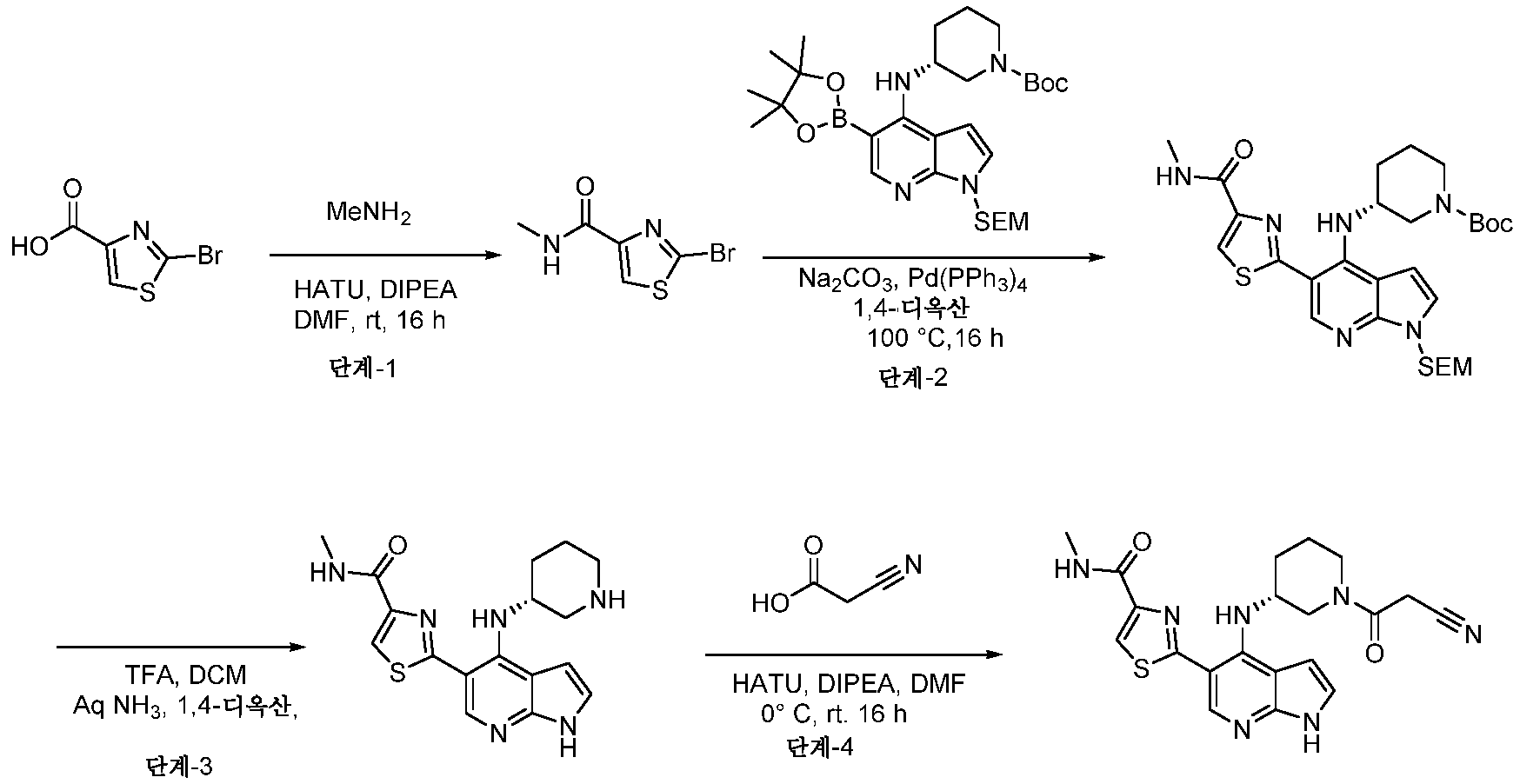
[000417] 단계 1: 2-브로모-N-메틸티아졸-4-카르복사미드의 제조 [000417] Step 1: Preparation of 2-bromo- N -methylthiazole-4-carboxamide
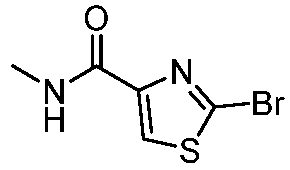
N,N-디메틸포름아미드 (20 mL) 중의 2-브로모티아졸-4-카르복실산 (1.0 g, 4.8 mmol) 및 1-[비스(디메틸아미노)- 메틸렌]-1H-1,2,3-트리아졸로[4,5-b]피리디늄 3-옥사이드 헥사플루오로포스페이트 (4.5 g, 12.0 mmol)의 교반된 용액에 메틸아민 (3.6 mL, 7.2 mmol, 테트라하이드로퓨란 중 2M)을 첨가한 후, 디이소프로필에틸아민 (4.2 mL, 24.0 mmol)을 첨가하고, 생성된 혼합물을 상온에서 16시간 동안 교반하였다. 상기 반응 혼합물을 얼음물로 ??칭하고 에틸 아세테이트로 2회 추출하였다. 상기 유기층을 염수 용액으로 세척하고, 무수 황산나트륨으로 건조시켜 진공에서 농축시켰다. 상기 미정제 물질을 섬광 크로마토그래피 (13% 에틸 아세테이트/헥산)로 정제하여 2-브로모-N-메틸티아졸-4-카르복사미드를 백색 고체로서 수득하였다 (0.7 g, 70% 수율): MS (ES) m/z 221.0 (M+H). N, N-dimethylformamide (20 mL) solution of 2-bromothiazole-4-carboxylic acid (1.0 g, 4.8 mmol) and 1- [bis (dimethylamino) methylene] -1 H -1,2, To a stirred solution of 3-triazolo[4,5- b ]pyridinium 3-oxide hexafluorophosphate (4.5 g, 12.0 mmol) was added methylamine (3.6 mL, 7.2 mmol, 2M in tetrahydrofuran) Then, diisopropylethylamine (4.2 mL, 24.0 mmol) was added, and the resulting mixture was stirred at room temperature for 16 hours. The reaction mixture was quenched with ice water and extracted twice with ethyl acetate. The organic layer was washed with brine solution, dried over anhydrous sodium sulfate and concentrated in vacuo. The crude material was purified by flash chromatography (13% ethyl acetate/hexanes) to give 2-bromo- N -methylthiazole-4-carboxamide as a white solid (0.7 g, 70% yield): MS (ES) m/z 221.0 (M+H).
[000418] 단계 2: tert-부틸 (R)-3-((5-(4-(메틸카바모일)티아졸-2-일)-1-((2-(트리메틸실릴)에톡시)메틸)-1H-피롤로[2,3-b]피리딘-4-일)아미노)피페리딘-1-카르복실레이트의 제조 [000418] Step 2: tert -Butyl ( R )-3-((5-(4-(methylcarbamoyl)thiazol-2-yl)-1-((2-(trimethylsilyl)ethoxy)methyl) Preparation of -1 H -pyrrolo[2,3-b]pyridin-4-yl)amino)piperidine-1-carboxylate

1,4-디옥산 (25 mL) 중의 2-브로모-N-메틸티아졸-4-카르복사미드 (0.7 g, 1.22 mmol), tert-부틸 (R)-3-((5-(4,4,5,5-테트라메틸-1,3,2-디옥사보롤란-2-일)-1-((2-(트리메틸실릴)에톡시)메틸)-1H-피롤로[2,3-b]피리딘-4-일)아미노)피페리딘-1-카르복실레이트 (0.4 g, 1.83 mmol, 중간체 7)의 교반된 용액에 테트라키스(트리페닐포스핀) 팔라듐(0) (0.14 g, 0.12 mmol) 및 2M의 탄산나트륨 수용액 (0.39 g, 3.66 mmol)을 첨가한 후, 상기 반응 혼합물을 100℃에서 16시간 동안 교반하였다. 냉각 후, 상기 반응 혼합물을 에틸 아세테이트로 희석한 다음, 셀라이트를 통해 여과시켰다. 상기 여과액을 물과 염수로 세척하고, 무수 황산나트륨으로 건조 및 여과시킨 후, 진공에서 농축시켰다. 상기 미정제 물질을 섬광 크로마토그래피 (35% 에틸 아세테이트/헥산)로 정제하여 tert-부틸 (R)-3-((5-(4-(메틸카바모일)티아졸-2-일)-1-((2-(트리메틸실릴)에톡시)메틸)-1H-피롤로[2,3-b]피리딘-4-일)아미노)피페리딘-1-카르복실레이트를 담갈색의 액체로서 수득하였다 (0.55 g, 79% 수율): MS (ES) m/z 587.6 (M+H). 2-Bromo-N- methylthiazole-4-carboxamide (0.7 g, 1.22 mmol), tert -butyl (R)-3-((5-(4) in 1,4-dioxane (25 mL)) , 4,5,5- tetramethyl-1,3,2 dioxaborolan-2-yl) -1H-pyrrolo [2, -methyl) -1 H (ethoxy- (2- (trimethylsilyl)) To a stirred solution of 3-b]pyridin-4-yl)amino)piperidine-1-carboxylate (0.4 g, 1.83 mmol, Intermediate 7) was added tetrakis(triphenylphosphine) palladium(0) (0.14). g, 0.12 mmol) and 2M aqueous sodium carbonate solution (0.39 g, 3.66 mmol) were added, and the reaction mixture was stirred at 100° C. for 16 hours. After cooling, the reaction mixture was diluted with ethyl acetate and then filtered through celite. The filtrate was washed with water and brine, dried over anhydrous sodium sulfate, filtered, and concentrated in vacuo. The crude material was purified by flash chromatography (35% ethyl acetate/hexanes) to tert -butyl ( R )-3-((5-(4-(methylcarbamoyl)thiazol-2-yl)-1- ((2- (trimethylsilyl) ethoxy) methyl) -1 H - a pyrrolo [2,3- b] pyridin-4-yl) amino) piperidine-1-carboxylate obtained as a light brown liquid (0.55 g, 79% yield): MS (ES) m/z 587.6 (M+H).
[000419] 단계 3: (R)-N-메틸-2-(4-(피페리딘-3-일아미노)-1H-피롤로[2,3-b]피리딘-5-일)티아졸-4-카르복사미드의 제조 [000 419] Step 3: (R) - N - methyl-2- (4- (piperidin-3-ylamino) -1 H - pyrrolo [2,3- b] pyridin-5-yl) thiazole Preparation of -4-carboxamide

디클로로메탄 : 트리플루오로아세트산 (2.0 mL : 3.0 mL) 중의 tert-부틸 (R)-3-((5-(4-(메틸카바모일)티아졸-2-일)-1-((2-(트리메틸실릴)에톡시)메틸)-1H-피롤로[2,3-b]피리딘-4-일)아미노)피페리딘-1-카르복실레이트 (0.55 g, 0.94 mmol)의 용액을 상온에서 3시간 동안 교반하였다. 상기 반응 혼합물을 진공에서 농축하고, 수득된 잔류물을 1,4-디옥산 : 수성 암모니아 (2.0 mL: 5.0 mL, 물 중 23%)에 용해시킨 후, 상온에서 16시간 동안 교반하였다. 상기 반응 혼합물을 진공에서 농축시켜 (R)-N-메틸-2-(4-(피페리딘-3-일아미노)-1H-피롤로[2,3-b]피리딘-5-일)티아졸-4-카르복사미드를 황색 액체로서 수득하였다 (0.36 g, 미정제): MS (ES) m/z 357.2 (M+H). Dichloromethane: tert -butyl ( R )-3-((5-(4-(methylcarbamoyl)thiazol-2-yl)-1-((2-) in trifluoroacetic acid (2.0 mL: 3.0 mL) (trimethylsilyl) ethoxy) methyl) -1 H - pyrrolo [2,3- b] pyridin-4-yl) amino) piperidin-1 at room temperature and a solution of carboxylate (0.55 g, 0.94 mmol) was stirred for 3 hours. The reaction mixture was concentrated in vacuo, and the obtained residue was dissolved in 1,4-dioxane : aqueous ammonia (2.0 mL: 5.0 mL, 23% in water), followed by stirring at room temperature for 16 hours. The reaction mixture was concentrated in vacuo (R) - N - methyl-2- (4- (piperidin-3-ylamino) -1 H - pyrrolo [2,3- b] pyridin-5-yl) Thiazole-4-carboxamide was obtained as a yellow liquid (0.36 g, crude): MS (ES) m/z 357.2 (M+H).
[000420] 단계 4: (R)-2-(4-((1-(2-시아노아세틸)피페리딘-3-일)아미노)-1H-피롤로[2,3-b]피리딘-5-일)-N-메틸티아졸-4-카르복사미드의 제조 [000 420] Step 4: (R) -2- (4 - ((1- (2- cyano-acetyl) -piperidin-3-yl) amino) -1 H - pyrrolo [2,3- b] pyridine Preparation of -5-yl) -N -methylthiazole-4-carboxamide

N,N-디메틸포름아미드 (10 mL) 중의 시아노아세트산 (0.1 g, 1.2 mmol) 및 1-[비스(디메틸아미노)메틸렌]-1H-1,2,3-트리아졸로[4,5-b]피리디늄 3-옥사이드 헥사플루오로포스페이트 (0.9 g, 2.5 mmol)의 용액을 3분간 교반하였다. 이때, (R)-N-메틸-2-(4-(피페리딘-3-일아미노)-1H-피롤로[2,3-b]피리딘-5-일)티아졸-4-카르복사미드 (0.36 g, 1.0 mmol)를 첨가한 후, N,N-디이소프로필에틸아민 (0.72 mL, 5.0 mmol)을 첨가하고, 상기 혼합물을 상온에서 16시간 동안 교반하였다. 상기 반응 혼합물을 얼음물로 ??칭하고 에틸 아세테이트로 추출하였다. 상기 유기층을 염수 용액으로 세척하고, 무수 황산나트륨으로 건조시켜 진공에서 농축시켰다. 상기 미정제 물질을 역상 크로마토그래피로 정제하여 (R)-2-(4-((1-(2-시아노아세틸)피페리딘-3-일)아미노)-1H-피롤로[2,3-b]피리딘-5-일)-N-메틸티아졸-4-카르복사미드를 황백색 고체로서 수득하였다 (0.01 g, 3% 수율): 1HNMR (400 MHz, DMSO-d6) δ 11.65 (br s, 1H), 9.32 (d, J = 7.6 Hz, 1H), 8.37 (s, 1H), 8.30 (s, 1H), 8.09 (s, 1H), 7.23 (s, 1H), 6.72 (d, J = 8.8 Hz, 1H), 4.27 (s, 1H), 4.11 (s, 1H), 4.05 (s, 1H), 3.89 (s, 1H), 3.78 (d, J = 12.4 Hz, 1H), 3.64 (s, 1H), 3.51 (s, 1H), 3.20-3.23 (m, 3H), 3.00 (s, 1H), 2.83 (s, 3H); MS (ES) m/z 424.2 (M+H). N, N - cyano-acetic acid (0.1 g, 1.2 mmol) and 1- [bis (dimethylamino) methylene] in dimethylformamide (10 mL) -1 H -1,2,3- triazolo [4,5- b ] A solution of pyridinium 3-oxide hexafluorophosphate (0.9 g, 2.5 mmol) was stirred for 3 minutes. In this case, (R) - N - methyl-2- (4- (piperidin-3-ylamino) -1 H - pyrrolo [2,3- b] pyridin-5-yl) thiazole-4-carboxylic After addition of boxamide (0.36 g, 1.0 mmol), N,N -diisopropylethylamine (0.72 mL, 5.0 mmol) was added, and the mixture was stirred at room temperature for 16 hours. The reaction mixture was quenched with ice water and extracted with ethyl acetate. The organic layer was washed with brine solution, dried over anhydrous sodium sulfate and concentrated in vacuo. The crude material was purified by reverse phase chromatography ( R )-2-(4-((1-(2-cyanoacetyl)piperidin-3-yl)amino)-1H - pyrrolo[2, 3- b ]pyridin-5-yl) -N -methylthiazole-4-carboxamide was obtained as an off-white solid (0.01 g, 3% yield): 1 HNMR (400 MHz, DMSO-d 6 ) δ 11.65 (br s, 1H), 9.32 (d, J = 7.6 Hz, 1H), 8.37 (s, 1H), 8.30 (s, 1H), 8.09 (s, 1H), 7.23 (s, 1H), 6.72 (d , J = 8.8 Hz, 1H), 4.27 (s, 1H), 4.11 (s, 1H), 4.05 (s, 1H), 3.89 (s, 1H), 3.78 (d, J = 12.4 Hz, 1H), 3.64 (s, 1H), 3.51 (s, 1H), 3.20-3.23 (m, 3H), 3.00 (s, 1H), 2.83 (s, 3H); MS (ES) m/z 424.2 (M+H).
분석 조건: Analysis conditions:
컬럼: X Bridge C18 (100 mm X 4.6 mm X 3.5 μm)Column: X Bridge C18 (100 mm X 4.6 mm X 3.5 μm)
이동상(A): 수중 0.1% 암모니아Mobile phase (A): 0.1% ammonia in water
이동상(B): MeCNMobile phase (B): MeCN
유속: 0.8 mL/분Flow rate: 0.8 mL/min
[000421] 실시예 36: (R)-3-(3-((5-(5-메틸옥사졸-2-일)-1H-피롤로[2,3-b]피리딘-4-일)아미노)피페리딘-1-일)-3-옥소프로판니트릴의 제조 [000 421] Example 36: (R) -3- (3 - ((5- (5- methyloxazol-2-yl) -1 H - pyrrolo [2,3- b] pyridin-4-yl) Preparation of amino)piperidin-1-yl)-3-oxopropanenitrile

반응식 34. (Scheme 34. ( RR )-3-(3-((5-(5-메틸옥사졸-2-일)-1)-3-(3-((5-(5-methyloxazol-2-yl)-1 HH -피롤로[2,3--pyrrolo[2,3- bb ]피리딘-4-일)아미노)피페리딘-1-일)-3-옥소프로판니트릴의 제조 ] Preparation of pyridin-4-yl)amino)piperidin-1-yl)-3-oxopropanenitrile

[000422] 단계 1: tert-부틸 (R)-3-((5-(5-메틸옥사졸-2-일)-1-((2-(트리메틸실릴)에톡시)메틸)-1H-피롤로[2,3-b]피리딘-4-일)아미노)피페리딘-1-카르복실레이트의 제조 [000 422] Step 1: tert-butyl (R) -3 - ((5- (5- methyloxazol-2-yl) -1-methyl) -1-ethoxy) a ((2- (trimethylsilyl) H - Preparation of pyrrolo[2,3-b]pyridin-4-yl)amino)piperidine-1-carboxylate

1,4-디옥산 (5 mL) 중의 tert-부틸 (R)-3-((5-브로모-1-((2-(트리메틸실릴)에톡시)메틸)-1H-피롤로[2,3-b]피리딘-4-일)아미노)피페리딘-1-카르복실레이트 (0.30 g, 5.57 mmol), 칼륨 tert-부톡시드 (0.13 g, 1.14 mmol) 비스(트리페닐포스핀)팔라듐(II) 디클로라이드 (0.02 g, 0.03 mmol) 및 5-메틸옥사졸 (0.09 g, 1.14 mmol)의 혼합물을 질소 대기 하에 밀봉된 튜브 중에서 100℃로 가열하였다. 6시간 후, 상기 반응 혼합물을 상온으로 냉각시키고, 물로 희석한 후, 에틸 아세테이트로 추출하였다. 상기 유기층을 염수로 세척하고, 무수 황산나트륨으로 건조시켜 여과 후 진공에서 농축시켰다. 상기 미정제 물질을 섬광 크로마토그래피 (40% 에틸 아세테이트/헥산)로 정제하여 tert-부틸 (R)-3-((5-(5-메틸옥사졸-2-일)-1-((2-(트리메틸실릴)에톡시)메틸)-1H-피롤로[2,3-b]피리딘-4-일)아미노)피페리딘-1-카르복실레이트를 걸쭉한 황색 오일로서 수득하였다 (0.2 g, 66% 수율): MS (ES) m/z 528.0 (M+H).1, 4-dioxane (5 mL) of tert-butyl (R) -3 - ((5- bromo-1 - ((methylethoxy), 2- (trimethylsilyl)) -1 H-pyrrolo [2 ,3- b ]pyridin-4-yl)amino)piperidine-1-carboxylate (0.30 g, 5.57 mmol), potassium tert -butoxide (0.13 g, 1.14 mmol) bis(triphenylphosphine)palladium (II) A mixture of dichloride (0.02 g, 0.03 mmol) and 5-methyloxazole (0.09 g, 1.14 mmol) was heated to 100° C. in a sealed tube under a nitrogen atmosphere. After 6 hours, the reaction mixture was cooled to room temperature, diluted with water, and extracted with ethyl acetate. The organic layer was washed with brine, dried over anhydrous sodium sulfate, filtered and concentrated in vacuo. The crude material was purified by flash chromatography (40% ethyl acetate/hexanes) to tert -butyl ( R )-3-((5-(5-methyloxazol-2-yl)-1-((2-) (trimethylsilyl) ethoxy) methyl) -1 H - a pyrrolo [2,3- b] pyridin-4-yl) amino) piperidine-1-carboxylate was obtained as a thick yellow oil (0.2 g, 66% yield): MS (ES) m/z 528.0 (M+H).
[000423] 단계 2: (R)-5-(5-메틸옥사졸-2-일)-N-(피페리딘-3-일)-1H-피롤로[2,3-b]피리딘-4-아민의 제조 [000 423] Step 2: (R) -5- (5- methyloxazol-2-yl) - N - (piperidin-3-yl) -1 H-pyrrolo [2,3- b] pyridin- Preparation of 4-amine

디클로로메탄 : 트리플루오로아세트산 (2.0 mL: 2.0 mL) 중의 tert-부틸 (R)-3-((5-(5-메틸옥사졸-2-일)-1-((2-(트리메틸실릴)에톡시)메틸)-1H-피롤로[2,3-b]피리딘-4-일)아미노)피페리딘-1-카르복실레이트 (0.20 g, 0.37 mmol)의 용액을 상온에서 3시간 동안 교반하였다. 상기 반응 혼합물을 진공에서 농축하고, 잔류물을 1,4-디옥산 : 수성 암모니아 (3.0 mL: 3.0 mL, 물 중 23%)에 용해시킨 후, 상온에서 16시간 동안 교반하였다. 상기 반응 혼합물을 진공에서 농축시켜 (R)-5-(5-메틸옥사졸-2-일)-N-(피페리딘-3-일)-1H-피롤로[2,3-b]피리딘-4-아민을 황색 고체로서 수득하였다 (0.17 g, 미정제): MS (ES) m/z 298.2 (M+H). Dichloromethane: tert -butyl ( R )-3-((5-(5-methyloxazol-2-yl)-1-((2-(trimethylsilyl) in trifluoroacetic acid (2.0 mL: 2.0 mL)) ethoxy) methyl) -1 H - pyrrolo [2,3- b] pyridin-4-yl) amino) piperidine-1-carboxylate (0.20 g, at room temperature a solution of 0.37 mmol) for 3 h stirred. The reaction mixture was concentrated in vacuo, and the residue was dissolved in 1,4-dioxane : aqueous ammonia (3.0 mL: 3.0 mL, 23% in water) and stirred at room temperature for 16 h. The reaction mixture was concentrated in vacuo to give (R) -5- (5- methyloxazol-2-yl) - N - (piperidin-3-yl) -1 H - pyrrolo [2,3- b] pyridin-4-amine Obtained as a yellow solid (0.17 g, crude): MS (ES) m/z 298.2 (M+H).
[000424] 단계 3: (R)-3-(3-((5-(5-메틸옥사졸-2-일)-1H-피롤로[2,3-b]피리딘-4-일)아미노)피페리딘-1-일)-3-옥소프로판니트릴의 제조 [000 424] Step 3: (R) -3- (3 - ((5- (5- methyloxazol-2-yl) -1 H - pyrrolo [2,3- b] pyridin-4-yl) amino ) Preparation of piperidin-1-yl)-3-oxopropanenitrile

디클로로메탄 (5 mL) 중의 시아노아세트산 (0.02 g, 0.24 mmol), N-(3-디메틸아미노프로필)-N'-에틸카르보디이미드 하이드로클로라이드 (0.58 g, 0.30 mmol), 1-하이드록시벤조트리아졸 (0.03 g, 0.22 mmol) 및 N,N-디이소프로필에틸아민 (0.1 mL , 0.6 mmol)의 용액을 상온에서 5분간 교반하였다. 이후, (R)-5-(5-메틸옥사졸-2-일)-N-(피페리딘-3-일)-1H-피롤로[2,3-b]피리딘-4-아민 (0.06 g, 0.20 mmol)을 첨가하고, 생성된 혼합물을 상온에서 18시간 동안 교반하였다. 상기 반응 혼합물을 물로 ??칭하고 디클로로메탄으로 추출하였다. 상기 유기층을 물과 염수로 세척하고, 무수 황산나트륨으로 건조시킨 후, 여과하여 진공에서 농축시켰다. 상기 미정제 물질을 섬광 크로마토그래피 (5% 메탄올/디클로로메탄)로 정제하여 (R)-3-(3-((5-(5-메틸옥사졸-2-일)-1H-피롤로[2,3-b]피리딘-4-일)아미노)피페리딘-1-일)-3-옥소프로판니트릴을 황백색 고체로서 수득하였다 (0.01 g, 27% 수율): 1H NMR (400 MHz, DMSO-d6, VT, 100℃) δ 11.38 (br s, J = 9.2 Hz, 1H), 8.98 (br s, 1H), 8.50 (s, 1H), 7.19 (s, 1H), 6.91 (s, 1H), 6.66 (s, 1H), 3.90-4.40 (m, 3H), 3.52-3.91 (m, 1H), 3.20-3.40 (m, 2H), 2.31 (s, 3H), 1.95-2.10 (m, 2H), 1.50-1.90 (m, 3H); MS (ES) m/z 365.1 (M+H).In dichloromethane (5 mL) of cyanoacetic acid (0.02 g, 0.24 mmol), N - (3- dimethylaminopropyl) - N '- ethylcarbodiimide hydrochloride (0.58 g, 0.30 mmol), 1- hydroxybenzotriazole A solution of triazole (0.03 g, 0.22 mmol) and N,N -diisopropylethylamine (0.1 mL, 0.6 mmol) was stirred at room temperature for 5 minutes. Since, (R) -5- (5- methyloxazol-2-yl) - N - (piperidin-3-yl) -1 H - pyrrolo [2,3- b] pyridin-4-amine (0.06 g, 0.20 mmol) was added, and the resulting mixture was stirred at room temperature for 18 hours. The reaction mixture was quenched with water and extracted with dichloromethane. The organic layer was washed with water and brine, dried over anhydrous sodium sulfate, filtered and concentrated in vacuo. The crude by flash chromatography (5% methanol / dichloromethane) to give (R) -3- (3 - ( (5- (5- methyloxazol-2-yl) -1 H - pyrrolo [ 2,3- b ]pyridin-4-yl)amino)piperidin-1-yl)-3-oxopropanenitrile was obtained as an off-white solid (0.01 g, 27% yield): 1 H NMR (400 MHz, DMSO-d 6 , VT, 100° C.) δ 11.38 (br s, J = 9.2 Hz, 1H), 8.98 (br s, 1H), 8.50 (s, 1H), 7.19 (s, 1H), 6.91 (s, 1H), 6.66 (s, 1H), 3.90-4.40 (m, 3H), 3.52-3.91 (m, 1H), 3.20-3.40 (m, 2H), 2.31 (s, 3H), 1.95-2.10 (m, 2H), 1.50-1.90 (m, 3H); MS (ES) m/z 365.1 (M+H).
[000425] 실시예 37: (R)-3-(3-((5-(5-메틸옥사졸-2-일)-1H-피롤로[2,3-b]피리딘-4-일)아미노)피페리딘-1-일)프로판니트릴의 제조 [000 425] Example 37: (R) -3- (3 - ((5- (5- methyloxazol-2-yl) -1 H - pyrrolo [2,3- b] pyridin-4-yl) Preparation of amino)piperidin-1-yl)propanenitrile

반응식 35. (Scheme 35. ( RR )-3-(3-((5-(5-메틸옥사졸-2-일)-1)-3-(3-((5-(5-methyloxazol-2-yl)-1 HH -피롤로[2,3--pyrrolo[2,3- bb ]피리딘-4-일)아미노)피페리딘-1-일)프로판니트릴의 제조 ] Preparation of pyridin-4-yl)amino)piperidin-1-yl)propanenitrile

[000426] (R)-3-(3-((5-(5-메틸옥사졸-2-일)-1H-피롤로[2,3-b]피리딘-4-일)아미노)피페리딘-1-일)프로판니트릴의 제조 [000426] (R) -3- ( 3 - ((5- (5- methyloxazol-2-yl) -1 H - pyrrolo [2,3- b] pyridin-4-yl) amino) piperidin Preparation of diin-1-yl) propanenitrile

에탄올 (10 mL) 중의 (R)-5-(5-메틸옥사졸-2-일)-N-(피페리딘-3-일)-1H-피롤로[2,3-b]피리딘-4-아민 (0.08 g, 0.26 mmol, 실시예 36, 단계 2) 및 아크릴로니트릴 (0.04 g, 0.60 mmol), 트리에틸아민 (0.1 mL, 0.80 mmol)의 용액을 80℃로 3시간 동안 가열하였다. 상기 반응 혼합물을 주위 온도로 냉각하여 진공에서 농축시켰다. 상기 미정제물을 섬광 크로마토그래피 (10% 메탄올/디클로로메탄)로 정제하여 (R)-3-(3-((5-(5-메틸옥사졸-2-일)-1H-피롤로[2,3-b]피리딘-4-일)아미노)피페리딘-1-일)프로판니트릴을 백색 고체로서 수득하였다 (0.02 g, 30% 수율): 1H NMR (400 MHz, DMSO-d6,) δ 11.49 (s, 1H), 9.10 (d, J = 8 Hz, 1H), 8.46 (s, 1H), 7.16 (s, 1H), 6.96 (s, 1H), 6.55 (s, 1H), 4.18-4.20 (m, 1H), 2.92-2.95 (m, 1H), 2.56-2.64 (m, 5H), 2.30-2.47 (m, 5H), 1.91-1.20 (m, 1H), 1.60-1.69 (m, 1H), 1.49-1.53 (m, 2H); MS (ES) m/z 351.1 (M+H). Ethanol (R) in the (10 mL) -5- (5- methyloxazol-2-yl) - N - (piperidin-3-yl) -1 H-pyrrolo [2,3- b] pyridin- A solution of 4-amine (0.08 g, 0.26 mmol, Example 36, Step 2) and acrylonitrile (0.04 g, 0.60 mmol), triethylamine (0.1 mL, 0.80 mmol) was heated to 80° C. for 3 h. . The reaction mixture was cooled to ambient temperature and concentrated in vacuo. Purification of the crude by flash chromatography (10% methanol / dichloromethane) (R) -3- (3 - ((5- (5- methyloxazol-2-yl) -1 H - pyrrolo [2 ,3- b ]pyridin-4-yl)amino)piperidin-1-yl)propanenitrile was obtained as a white solid (0.02 g, 30% yield): 1 H NMR (400 MHz, DMSO-d 6, ) δ 11.49 (s, 1H), 9.10 (d, J = 8 Hz, 1H), 8.46 (s, 1H), 7.16 (s, 1H), 6.96 (s, 1H), 6.55 (s, 1H), 4.18 -4.20 (m, 1H), 2.92-2.95 (m, 1H), 2.56-2.64 (m, 5H), 2.30-2.47 (m, 5H), 1.91-1.20 (m, 1H), 1.60-1.69 (m, 1H), 1.49-1.53 (m, 2H); MS (ES) m/z 351.1 (M+H).
[000427] 실시예 38: (R)-3-(3-((5-(1,2,4-옥사디아졸-3-일)-1H-피롤로[2,3-b]피리딘-4-일)아미노)피페리딘-1-일)-3-옥소프로판니트릴의 제조 [000 427] Example 38: (R) -3- (3 - ((5- (1,2,4- oxadiazol-3-yl) -1 H-pyrrolo [2,3- b] pyridin- Preparation of 4-yl)amino)piperidin-1-yl)-3-oxopropanenitrile

반응식 36. (Scheme 36. ( RR )-3-(3-((5-(1,2,4-옥사디아졸-3-일)-1)-3-(3-((5-(1,2,4-oxadiazol-3-yl)-1 HH -피롤로[2,3--pyrrolo[2,3- bb ]피리딘-4-일)아미노)피페리딘-1-일)-3-옥소프로판니트릴의 제조] Preparation of pyridin-4-yl)amino)piperidin-1-yl)-3-oxopropanenitrile

[000428] 단계 1: tert-부틸 (R)-3-((5-시아노-1H-피롤로[2,3-b]피리딘-4-일)아미노)피페리딘-1-카르복실레이트의 제조 [000428] Step 1: tert -Butyl ( R )-3-((5-cyano- 1H -pyrrolo[2,3- b ]pyridin-4-yl)amino)piperidine-1-carboxyl production of the rate

밀봉된 튜브 중에서, N-메틸-2-피롤리돈 (15 mL) 중의 4-클로로-1H-피롤로[2,3-b]피리딘-5-카르보니트릴 (1.0 g, 5.64 mmol), tert-부틸 (R)-3-아미노피페리딘-1-카르복실레이트 (1.69 g, 8.4 mmol) 및 트리에틸아민 (2.37 mL, 16.9 mmol)의 교반된 용액을 130℃로 6시간 동안 가열하였다. 상기 반응 혼합물을 실온으로 냉각시키고, 물로 ??칭한 후, 에틸 아세테이트로 추출하였다. 상기 유기층을 염수로 세척하고, 무수 황산나트륨으로 건조시킨 후, 여과하고 진공에서 농축시켜 미정제물인 tert-부틸 (R)-3-((5-시아노-1H-피롤로[2,3-b]피리딘-4-일)아미노)피페리딘-1-카르복실레이트를 황백색 고체로서 수득하였다 (2.3 g, 미정제): MS (ES) m/z 342.2 (M+H).In a sealed tube, 4-chloro-1H -pyrrolo[2,3- b ]pyridine-5-carbonitrile (1.0 g, 5.64 mmol), tert in N -methyl-2-pyrrolidone (15 mL) A stirred solution of -butyl ( R )-3-aminopiperidine-1-carboxylate (1.69 g, 8.4 mmol) and triethylamine (2.37 mL, 16.9 mmol) was heated to 130° C. for 6 h. The reaction mixture was cooled to room temperature, quenched with water, and extracted with ethyl acetate. The organic layer was washed with brine, dried over anhydrous sodium sulfate, filtered and concentrated in vacuo to obtain crude tert -butyl ( R )-3-((5-cyano- 1H -pyrrolo[2,3- b ]pyridin-4-yl)amino)piperidine-1-carboxylate was obtained as an off-white solid (2.3 g, crude): MS (ES) m/z 342.2 (M+H).
[000429] 단계 2: tert-부틸 (R,Z)-3-((5-(N'-하이드록시카르밤이미도일)-1H-피롤로[2,3-b]피리딘-4-일)아미노)피페리딘-1-카르복실레이트의 제조 [000 429] Step 2: tert - butyl (R, Z) -3 - ( (5- (N '- hydroxycarboxylic night yimido yl) -1 H - pyrrolo [2,3- b] pyridin-4-yl ) Preparation of amino) piperidine-1-carboxylate

에탄올 (10 mL) 중의 tert-부틸 (R)-3-((5-시아노-1H-피롤로[2,3-b]피리딘-4-일)아미노)피페리딘-1-카르복실레이트 (2.3 g, 6.74 mmol), 하이드록실아민 하이드로클로라이드 (0.70 g, 10.1 mmol) 및 트리에틸아민 (1.89 mL, 13.4 mmol)의 현탁액을 아르곤 대기 하에 90℃로 15시간 동안 가열하였다. 상기 반응 혼합물을 상온으로 냉각하고 진공에서 농축시켜 휘발성 물질들을 제거하였다. 잔류물을 디클로로메탄 중에 용해시킨 후, 물, 염수로 세척하고, 무수 황산나트륨으로 건조시켜 여과한 후 진공에서 농축시켜 미정제물인 tert-부틸 (R,Z)-3-((5-(N'-하이드록시카르밤이미도일)-1H-피롤로[2,3-b]피리딘-4-일)아미노)피페리딘-1-카르복실레이트를 반고체로서 수득하였다 (1.2 g, 미정제): MS (ES) m/z 375.0 (M+H). tert- Butyl ( R )-3-((5-cyano- 1H -pyrrolo[2,3- b ]pyridin-4-yl)amino)piperidine-1-carboxyl in ethanol (10 mL) A suspension of lactate (2.3 g, 6.74 mmol), hydroxylamine hydrochloride (0.70 g, 10.1 mmol) and triethylamine (1.89 mL, 13.4 mmol) was heated to 90° C. under an argon atmosphere for 15 h. The reaction mixture was cooled to room temperature and concentrated in vacuo to remove volatiles. The residue was dissolved in dichloromethane, washed with water, brine, dried over anhydrous sodium sulfate, filtered and concentrated in vacuo to obtain crude tert -butyl ( R,Z )-3-((5-( N ') -hydroxy carboxylic night yimido yl) -1 H-a pyrrolo [2,3- b] pyridin-4-yl) amino) piperidine-1-carboxylate was obtained as a semi-solid (1.2 g, crude) : MS (ES) m/z 375.0 (M+H).
[000430] 단계 3: tert-부틸 (R)-3-((5-(1,2,4-옥사디아졸-3-일)-1H-피롤로[2,3-b]피리딘-4-일)아미노) 피페리딘-1-카르복실레이트의 제조 [000 430] Step 3: tert - butyl (R) -3 - ((5- (1,2,4- oxadiazol-3-yl) -1 H - pyrrolo [2,3- b] pyridine -4 Preparation of -yl)amino) piperidine-1-carboxylate

tert-부틸 (R,Z)-3-((5-(N'-하이드록시카르밤이미도일)-1H-피롤로[2,3-b]피리딘-4-일) 아미노)피페리딘-1-카르복실레이트 (0.5 g, 1.3 mmol), 트리플루오로아세트산 (0.05 mL) 및 트리에틸오르쏘포르메이트 (0.5 mL)의 교반된 용액을 밀봉된 튜브 중에서 60℃로 12시간 동안 가열하였다. 상기 반응 혼합물을 상온으로 냉각하여, 디클로로메탄으로 희석한 후, 물과 염수로 세척하였다. 상기 유기층을 무수 황산나트륨으로 건조시킨 후, 여과하고 진공에서 농축시켜 tert-부틸 (R)-3-((5-(1,2,4-옥사디아졸-3-일)-1H-피롤로[2,3-b]피리딘-4-일)아미노) 피페리딘-1-카르복실레이트를 황백색 고체로서 수득하였다 (0.25 g, 미정제): MS (ES) m/z 385.0 (M+H). tert - butyl (R, Z) -3 - ( (5- (N'- hydroxycarboxylic night yimido yl) -1 H - pyrrolo [2,3- b] pyridin-4-yl) amino) piperidine A stirred solution of -1-carboxylate (0.5 g, 1.3 mmol), trifluoroacetic acid (0.05 mL) and triethylorthoformate (0.5 mL) was heated to 60° C. for 12 h in a sealed tube. . The reaction mixture was cooled to room temperature, diluted with dichloromethane, and washed with water and brine. After drying the organic layer over anhydrous sodium sulfate, filtered and concentrated in vacuo to give tert - butyl (R) -3 - ((5- (1,2,4- oxadiazol-3-yl) -1 H - pyrrolo [2,3- b ]pyridin-4-yl)amino)piperidine-1-carboxylate was obtained as an off-white solid (0.25 g, crude): MS (ES) m/z 385.0 (M+H ).
[000431] 단계 4: (R)-5-(1,2,4-옥사디아졸-3-일)-N-(피페리딘-3-일)-1H-피롤로[2,3-b]피리딘-4-아민의 제조 [000 431] Step 4: (R) -5- (1,2,4- oxadiazol-3-yl) - N - (piperidin-3-yl) -1 H - pyrrolo [2,3- b ] Preparation of pyridin-4-amine
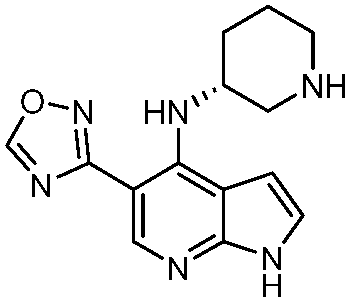
디클로로메탄: 트리플루오로아세트산 (5 mL : 2 mL) 중의 tert-부틸 (R)-3-((5-(1,2,4-옥사디아졸-3-일)-1H-피롤로[2,3-b]피리딘-4-일)아미노) 피페리딘-1-카르복실레이트 (0.25 g, 0.6 mmol)의 용액을 상온에서 3시간 동안 교반하였다. 상기 반응 혼합물을 진공에서 농축시켜 휘발성 물질들을 제거하고, 수성 암모니아로 중화한 후, 디클로로메탄 (30 ml)으로 추출하였다. 상기 유기층을 물, 염수로 세척하고, 무수 황산나트륨으로 건조시킨 후, 여과하고 진공에서 농축시켜 (R)-5-(1,2,4-옥사디아졸-3-일)-N-(피페리딘-3-일)-1H-피롤로[2,3-b]피리딘-4-아민을 무색 액체로서 수득하였다 (0.11g, 미정제): MS (ES) m/z 285.0 (M+H).Dichloromethane: trifluoroacetic acid (5 mL: 2 mL) of tert - butyl (R) -3 - ((5- (1,2,4- oxadiazol-3-yl) -1 H - pyrrolo [ A solution of 2,3- b ]pyridin-4-yl)amino) piperidine-1-carboxylate (0.25 g, 0.6 mmol) was stirred at room temperature for 3 hours. The reaction mixture was concentrated in vacuo to remove volatiles, neutralized with aqueous ammonia and extracted with dichloromethane (30 ml). After the organic layer was washed with water, brine, dried over anhydrous sodium sulfate, filtered and concentrated in vacuo to give (R) -5- (1,2,4- oxadiazol-3-yl) - N - (piperidin 3-yl) -1 H - pyrrolo [2,3- b] pyridine was obtained as a colorless liquid 4-amine (0.11g, crude): MS (ES) m / z 285.0 (m + H ).
[000432] 단계 5: (R)-3-(3-((5-(1,2,4-옥사디아졸-3-일)-1H-피롤로[2,3-b]피리딘-4-일)아미노)피페리딘-1-일)-3-옥소프로판니트릴의 제조 [000 432] Step 5: (R) -3- (3 - ((5- (1,2,4- oxadiazol-3-yl) -1 H - pyrrolo [2,3- b] pyridine -4 Preparation of -yl)amino)piperidin-1-yl)-3-oxopropanenitrile

N,N-디메틸포름아미드 (15 mL) 중의 시아노아세트산 (0.044 g, 0.52 mmol), 1-[비스(디메틸아미노)메틸렌]-1H-1,2,3-트리아졸로[4,5-b]피리디늄 3-옥사이드 헥사플루오로포스페이트 (0.17 g, 0.45 mmol)의 교반된 용액에 (R)-5-(1,2,4-옥사디아졸-3-일)-N-(피페리딘-3-일)-1H-피롤로[2,3-b]피리딘-4-아민 (0.1 g, 0.35 mmol)을 첨가한 후, N,N-디이소프로필에틸아민 (0.19 mL, 1.05 mmol)을 첨가한 다음, 생성된 혼합물을 상온에서 16시간 동안 교반하였다. 상기 반응 혼합물을 물로 ??칭하고 디클로로메탄으로 추출하였다. 상기 유기층을 물과 염수로 세척하고, 무수 황산나트륨으로 건조시킨 후, 여과하여 진공에서 농축시켰다. 상기 미정제 물질을 역상 크로마토그래피로 정제하여 (R)-3-(3-((5-(1,2,4-옥사디아졸-3-일)-1H-피롤로[2,3-b]피리딘-4-일)아미노)피페리딘-1-일)-3-옥소프로판니트릴을 황백색 고체로서 수득하였다 (0.01 g, 9% 수율): 1H NMR (400 MHz, DMSO-d6 VT, 70℃) δ 11.51 (br s, 1H), 9.56 (s, 1H), 8.73 (s, 1H), 8.34 (s, 1H), 7.46 (s, 1H), 7.23 (s, 1H), 6.70 (d, J = 3.2 Hz, 1H), 4.05-4.29 (m, 2H), 3.89-4.02 (m, 2H), 3.49-3.75 (m, 2H), 3.40-3.51 (m, 2H), 2.10 (br s, 1H), 1.64-1.82 (m, 1H); MS (ES) m/z 352.2 (M+H). N, N - cyano-acetic acid (0.044 g, 0.52 mmol) in dimethylformamide (15 mL), 1- [bis (dimethylamino) methylene] -1 H -1,2,3- triazolo [4,5- b] pyridinium 3-oxide to a stirred solution of hexafluoro-phosphate (0.17 g, 0.45 mmol) ( R) -5- (1,2,4- oxadiazol-3-yl) - N - (piperidin 3-yl) -1 H - pyrrolo [2,3- b] pyridin-4-amine (0.1 g, 0.35 mmol) followed by the addition of, N, N - diisopropylethylamine (0.19 mL, 1.05 mmol) was added, and the resulting mixture was stirred at room temperature for 16 hours. The reaction mixture was quenched with water and extracted with dichloromethane. The organic layer was washed with water and brine, dried over anhydrous sodium sulfate, filtered and concentrated in vacuo. Purification of the crude material by reverse phase chromatography (R) -3- (3 - ( (5- (1,2,4- oxadiazol-3-yl) -1 H - pyrrolo [2,3- b ]pyridin-4-yl)amino)piperidin-1-yl)-3-oxopropanenitrile was obtained as an off-white solid (0.01 g, 9% yield): 1 H NMR (400 MHz, DMSO-d 6 ) VT, 70°C) δ 11.51 (br s, 1H), 9.56 (s, 1H), 8.73 (s, 1H), 8.34 (s, 1H), 7.46 (s, 1H), 7.23 (s, 1H), 6.70 (d, J = 3.2 Hz, 1H), 4.05-4.29 (m, 2H), 3.89-4.02 (m, 2H), 3.49-3.75 (m, 2H), 3.40-3.51 (m, 2H), 2.10 (br s, 1H), 1.64-1.82 (m, 1H); MS (ES) m/z 352.2 (M+H).
분석 조건:Analysis conditions:
컬럼: X-Bridge C-18 (250 mm X 4.6 mm X 5 mic)Column: X-Bridge C-18 (250 mm X 4.6 mm X 5 mic)
이동상(A): 수중 0.1% 암모니아Mobile phase (A): 0.1% ammonia in water
이동상(B): MeCNMobile phase (B): MeCN
유속: 1.0 mL/분Flow rate: 1.0 mL/min
[000433] 실시예 39: (R)-2-(4-((1-(2-시아노아세틸)피페리딘-3-일)아미노)-1H-피롤로[2,3-b]피리딘-5-일)-N-메틸옥사졸-5-카르복사미드의 제조 [000 433] Example 39: (R) -2- (4 - ((1- (2- cyano-acetyl) -piperidin-3-yl) amino) -1 H - pyrrolo [2,3- b] Preparation of pyridin-5-yl) -N -methyloxazole-5-carboxamide

반응식 37. (Scheme 37. ( RR )-2-(4-((1-(2-시아노아세틸)피페리딘-3-일)아미노)-1)-2-(4-((1-(2-cyanoacetyl)piperidin-3-yl)amino)-1 HH -피롤로[2,3--pyrrolo[2,3- bb ]피리딘-5-일)-]pyridin-5-yl)- NN -메틸옥사졸-5-카르복사미드의 제조-Preparation of methyloxazole-5-carboxamide
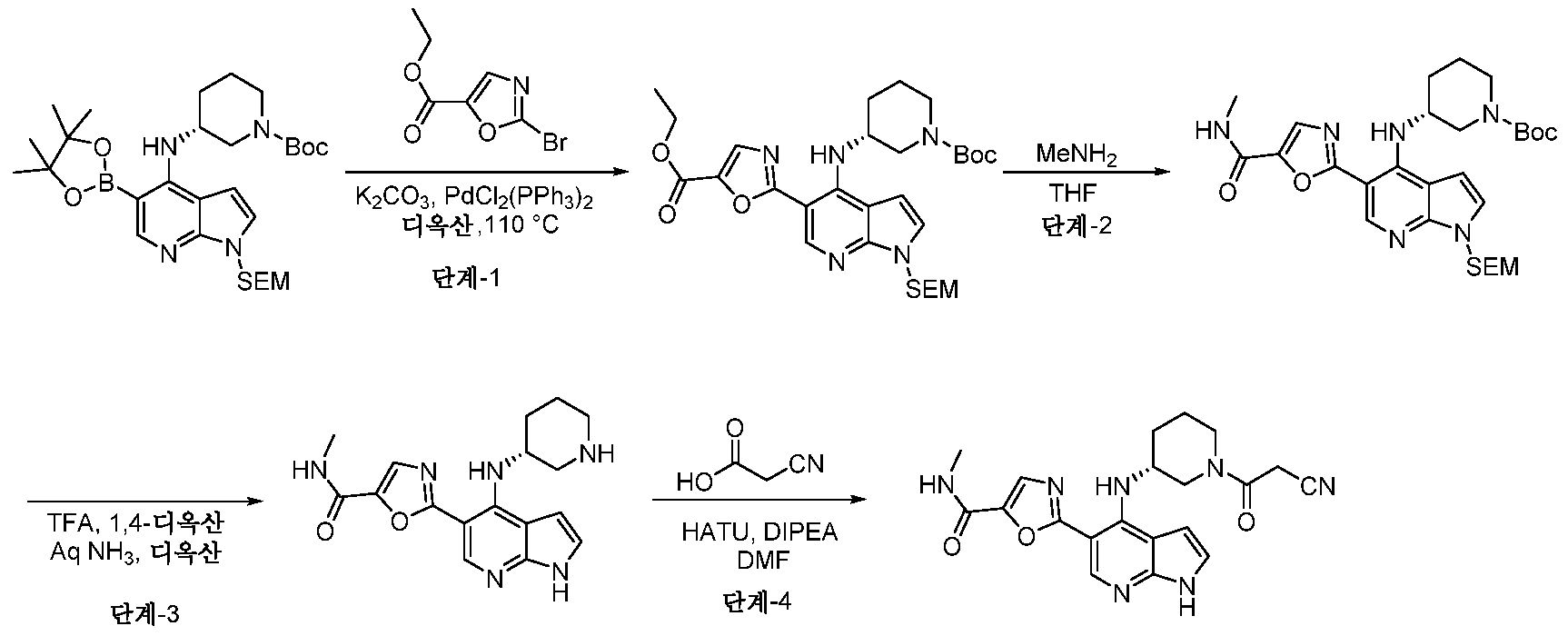
[000434] 단계 1: 에틸 (R)-2-(4-((1-(tert-부톡시카보닐)피페리딘-3-일)아미노)-1-((2-(트리메틸실릴)에톡시)메틸)-1H-피롤로[2,3-b]피리딘-5-일)옥사졸-5-카르복실레이트의 제조 [000434] Step 1: to ethyl ( R )-2-(4-((1-( tert -butoxycarbonyl)piperidin-3-yl)amino)-1-((2-(trimethylsilyl) Preparation of pyrrolo [2,3- b] pyridin-5-yl) oxazol-5-carboxylate - ethoxy) methyl) -1 H

디옥산 (25 mL) 중의 tert-부틸 (R)-3-((5-(4,4,5,5-테트라메틸-1,3,2-디옥사보롤란-2-일)-1-((2-(트리메틸실릴)에톡시)메틸)-1H-피롤로[2,3-b]피리딘-4-일)아미노)피페리딘-1-카르복실레이트 (2.5 g, 4.36 mmol) 및 에틸 2-브로모옥사졸-5-카르복실레이트 (1.05 g, 4.80 mmol)의 교반된 용액에 비스(트리페닐포스핀)팔라듐(II) 디클로라이드 및 2M 탄산칼륨 수용액 (1.8 g, 13.10 mmol)을 첨가한 후, 생성된 혼합물을 110℃로 16시간 동안 가열하였다. 상기 반응 혼합물을 상온으로 냉각하고, 에틸 아세테이트로 희석한 후, 물과 염수로 세척하였다. 상기 유기층을 무수 황산나트륨으로 건조시킨 후, 여과하여 진공에서 농축시켰다. 상기 미정제물을 섬광 크로마토그래피 (30% 에틸 아세테이트/헥산)로 정제하여 에틸 (R)-2-(4-((1-(tert-부톡시카보닐)피페리딘-3-일)아미노)-1-((2-(트리메틸 실릴)에톡시)메틸)-1H-피롤로[2,3-b]피리딘-5-일)옥사졸-5-카르복실레이트를 점성의 갈색 액체로서 수득하였다 (0.35 g, 14% 수율): MS (ES) m/z 586.3 (M+H). tert -Butyl ( R )-3-((5-(4,4,5,5-tetramethyl-1,3,2-dioxaborolan-2-yl)-1- in dioxane (25 mL) ((ethoxy) methyl-2- (trimethylsilyl)) -1 H - pyrrolo [2,3- b] pyridin-4-yl) amino) piperidine-1-carboxylate (2.5 g, 4.36 mmol) And in a stirred solution of ethyl 2-bromooxazole-5-carboxylate (1.05 g, 4.80 mmol) bis(triphenylphosphine)palladium(II) dichloride and 2M aqueous potassium carbonate solution (1.8 g, 13.10 mmol) After addition, the resulting mixture was heated to 110 ℃ for 16 hours. The reaction mixture was cooled to room temperature, diluted with ethyl acetate, and washed with water and brine. The organic layer was dried over anhydrous sodium sulfate, filtered, and concentrated in vacuo. The crude was purified by flash chromatography (30% ethyl acetate/hexanes) to ethyl ( R )-2-(4-((1-( tert -butoxycarbonyl)piperidin-3-yl)amino) -1 - ((2- (trimethylsilyl)) methyl) -1 H-pyrrolo [2,3- b] pyridin-5-yl) to yield the oxazole-5-carboxylate as a brown viscous liquid (0.35 g, 14% yield): MS (ES) m/z 586.3 (M+H).
[000435] 단계 2: tert-부틸 (R)-3-((5-(5-(메틸카바모일)옥사졸-2-일)-1-((2-(트리메틸실릴)에톡시) 메틸)-1H-피롤로[2,3-b]피리딘-4-일)아미노)피페리딘-1-카르복실레이트의 제조 [000435] Step 2: tert -Butyl ( R )-3-((5-(5-(methylcarbamoyl)oxazol-2-yl)-1-((2-(trimethylsilyl)ethoxy)methyl) Preparation of -1 H -pyrrolo[2,3-b]pyridin-4-yl)amino)piperidine-1-carboxylate

에틸 (R)-2-(4-((1-(tert-부톡시카보닐)피페리딘-3-일)아미노)-1-((2-(트리메틸실릴)에톡시) 메틸)-1H-피롤로[2,3-b]피리딘-5-일)옥사졸-5-카르복실레이트 (0.5 g, 0.85 mmol) 및 메틸아민 (5 mL, 테트라하이드로퓨란 중 2M)의 용액을 상온에서 48시간 동안 교반하였다. 상기 반응 혼합물을 진공에서 농축시켜 tert-부틸 (R)-3-((5-(5-(메틸카바모일)옥사졸-2-일)-1-((2-(트리메틸실릴)에톡시)메틸)-1H-피롤로[2,3-b]피리딘-4-일)아미노)피페리딘-1-카르복실레이트를 점성의 갈색 액체로서 수득하였다 (0.1 g, 미정제): MS (ES) m/z 571.3 (M+H). Ethyl ( R )-2-(4-((1-( tert -butoxycarbonyl)piperidin-3-yl)amino)-1-((2-(trimethylsilyl)ethoxy)methyl)-1 A solution of H -pyrrolo[2,3- b ]pyridin-5-yl)oxazole-5-carboxylate (0.5 g, 0.85 mmol) and methylamine (5 mL, 2M in tetrahydrofuran) was brought at room temperature Stirred for 48 hours. The reaction mixture was concentrated in vacuo to tert -butyl ( R )-3-((5-(5-(methylcarbamoyl)oxazol-2-yl)-1-((2-(trimethylsilyl)ethoxy) methyl) -1 H - pyrrolo [2,3- b] pyridin-4-yl) amino) piperidine-1-carboxylate was obtained as a brown viscous liquid (0.1 g, crude): MS ( ES) m/z 571.3 (M+H).
[000436] 단계 3: (R)-N-메틸-2-(4-(피페리딘-3-일아미노)-1H-피롤로[2,3-b]피리딘-5-일)옥사졸-5-카르복사미드의 제조 [000 436] Step 3: (R) - N - methyl-2- (4- (piperidin-3-ylamino) -1 H - pyrrolo [2,3- b] pyridin-5-yl) oxazole Preparation of -5-carboxamide

디클로로메탄 : 트리플루오로아세트산 (2 mL: 2 mL) 중의 tert-부틸 (R)-3-((5-(5-(메틸카바모일)옥사졸-2-일)-1-((2-(트리메틸실릴)에톡시)메틸)-1H-피롤로[2,3-b]피리딘-4-일)아미노)피페리딘-1-카르복실레이트 (0.17 g, 0.29 mmol)의 용액을 상온에서 3시간 동안 교반하였다. 상기 반응 혼합물을 진공에서 농축하고, 잔류물을 1,4-디옥산 : 수성 암모니아 (3 mL: 3 mL, 물 중 23%)에 용해시킨 후, 상온에서 16시간 동안 교반하였다. 상기 반응 혼합물을 진공에서 농축시켜 (R)-N-메틸-2-(4-(피페리딘-3-일아미노)-1H-피롤로[2,3-b]피리딘-5-일)옥사졸-5-카르복사미드를 진득한 액체로서 수득하였다 (0.2 g, 미정제): MS (ES) m/z 341.1 (M+H). Dichloromethane: tert -butyl ( R )-3-((5-(5-(methylcarbamoyl)oxazol-2-yl)-1-((2-) in trifluoroacetic acid (2 mL: 2 mL) (trimethylsilyl) ethoxy) methyl) -1 H - pyrrolo [2,3- b] pyridin-4-yl) amino) piperidin-1 at room temperature and a solution of carboxylate (0.17 g, 0.29 mmol) was stirred for 3 hours. The reaction mixture was concentrated in vacuo, and the residue was dissolved in 1,4-dioxane : aqueous ammonia (3 mL: 3 mL, 23% in water) and stirred at room temperature for 16 h. The reaction mixture was concentrated in vacuo (R) - N - methyl-2- (4- (piperidin-3-ylamino) -1 H - pyrrolo [2,3- b] pyridin-5-yl) Oxazole-5-carboxamide was obtained as a thick liquid (0.2 g, crude): MS (ES) m/z 341.1 (M+H).
[000437] 단계 4: (R)-2-(4-((1-(2-시아노아세틸)피페리딘-3-일)아미노)-1H-피롤로[2,3-b]피리딘-5-일)-N-메틸옥사졸-5-카르복사미드의 제조 [000 437] Step 4: (R) -2- (4 - ((1- (2- cyano-acetyl) -piperidin-3-yl) amino) -1 H - pyrrolo [2,3- b] pyridine Preparation of -5-yl) -N -methyloxazole-5-carboxamide

N,N-디메틸포름아미드 (5 mL) 중의 시아노아세트산 (0.07 g, 0.83 mmol) 및 1-[비스(디메틸아미노)메틸렌]-1H-1,2,3-트리아졸로[4,5-b]피리디늄 3-옥사이드 헥사플루오로포스페이트 (0.32 g, 0.83 mmol)의 용액을 5분간 교반하였다. 이후, (R)-N-메틸-2-(4-(피페리딘-3-일아미노)-1H-피롤로[2,3-b]피리딘-5-일)옥사졸-5-카르복사미드 (0.19 g, 0.56 mmol)를 첨가한 후, N,N-디이소프로필에틸아민 (0.21 mL, 1.67 mmol)을 첨가하고, 상기 혼합물을 상온에서 16시간 동안 교반하였다. 상기 반응 혼합물을 물로 ??칭하고 디클로로메탄으로 추출하였다. 상기 유기층을 물, 염수로 세척하고 무수 황산나트륨으로 건조시켰다. 상기 용액을 여과시킨 후 진공에서 농축시켰다. 상기 미정제 물질을 섬광 크로마토그래피 (6% 메탄올/디클로로메탄)로 정제하여 (R)-2-(4-((1-(2-시아노아세틸)피페리딘-3-일)아미노)-1H-피롤로[2,3-b]피리딘-5-일)-N-메틸옥사졸-5-카르복사미드를 황백색 고체로서 수득하였다 (0.03 g, 12% 수율): 1H NMR (400 MHz, DMSO-d6, 80℃, VT, 80℃) δ 11.493 (s, 1H), 8.90 (br s, 1H), 8.80 (s, 1H), 8.40 (s, 1H), 7.72 (s, 1H) 7.22 (s, 1H ), 6.69 (s, 1H), 3.97 (m, 4H), 3.45 (m, 5H), 2.80-2.81 (m, 3H), 2.07 (m, 1H), 1.77 (s, 1H); MS (ES) m/z 408.4 (M+H). N, N - dimethylformamide (5 mL) cyanoacetic acid (0.07 g, 0.83 mmol) and 1- [bis (dimethylamino) methylene] -1 H -1,2,3- triazolo [4,5- b] A solution of pyridinium 3-oxide hexafluorophosphate (0.32 g, 0.83 mmol) was stirred for 5 minutes. Since, (R) - N - methyl-2- (4- (piperidin-3-ylamino) -1 H - pyrrolo [2,3- b] pyridin-5-yl) oxazole-5-carboxylic After addition of boxamide (0.19 g, 0.56 mmol), N,N -diisopropylethylamine (0.21 mL, 1.67 mmol) was added, and the mixture was stirred at room temperature for 16 hours. The reaction mixture was quenched with water and extracted with dichloromethane. The organic layer was washed with water and brine and dried over anhydrous sodium sulfate. The solution was filtered and then concentrated in vacuo. The crude material was purified by flash chromatography (6% methanol/dichloromethane) to ( R )-2-(4-((1-(2-cyanoacetyl)piperidin-3-yl)amino)- 1 H -pyrrolo[2,3- b ]pyridin-5-yl) -N -methyloxazole-5-carboxamide was obtained as an off-white solid (0.03 g, 12% yield): 1 H NMR (400 MHz, DMSO-d 6, 80°C, VT, 80°C) δ 11.493 (s, 1H), 8.90 (br s, 1H), 8.80 (s, 1H), 8.40 (s, 1H), 7.72 (s, 1H) ) 7.22 (s, 1H ), 6.69 (s, 1H), 3.97 (m, 4H), 3.45 (m, 5H), 2.80-2.81 (m, 3H), 2.07 (m, 1H), 1.77 (s, 1H) ); MS (ES) m/z 408.4 (M+H).
[000438] 실시예 40: 3-((3R,5S)-3-((5-(1-(디플루오로메틸)-1H-피라졸-3-일)-1H-피롤로[2,3-b]피리딘-4-일)아미노)-5-메틸피페리딘-1-일)-3-옥소프로판니트릴의 제조 [000 438] Example 40: 3 - ((3 R , 5 S) -3 - ((5- (1- ( difluoromethyl) -1 H - pyrazol-3-yl) - 1H- pyrrolo [ Preparation of 2,3-b]pyridin-4-yl)amino)-5-methylpiperidin-1-yl)-3-oxopropanenitrile

반응식 38. 3-((3Scheme 38. 3-((3 RR ,5,5 SS )-3-((5-(1-(디플루오로메틸)-1)-3-((5-(1-(difluoromethyl)-1 HH -피라졸-3-일)--pyrazol-3-yl)- 1H-1H- 피롤로[2,3-pyrrolo[2,3- bb ]피리딘-4-일)아미노)-5-메틸피페리딘-1-일)-3-옥소프로판니트릴의 제조Preparation of ]pyridin-4-yl)amino)-5-methylpiperidin-1-yl)-3-oxopropanenitrile

[000439] 단계 1: 4-브로모-1-(트리이소프로필실릴)-1H-피롤로[2,3-b]피리딘의 제조 [000 439] Step 1: 4-Bromo-1- (triisopropylsilyl) -1 H - pyrrolo [2,3- b] pyridine

0-5℃로 냉각시킨 THF (400 ml) 중의 수소화나트륨 (10.55 g, 263 mmol, 광유 중 60%)의 현탁액에 4-브로모-1H-피롤로[2,3-b]피리딘(40 g, 203 mmol)을 약 20분간 분할 첨가하였다. 상기 반응물을 0-5℃에서 30분간 교반하였다. 이후, 트리이소프로필실릴 클로라이드 (64.7 mL, 304 mmol)를 20분에 걸쳐 적가하고, 상기 반응물을 3시간 동안 70℃로 가열하였다. 상기 반응 혼합물을 상온으로 냉각시키고, 물로 희석한 후, 에틸 아세테이트로 추출하였다. 상기 층들을 분리한 후, 수성층을 에틸 아세테이트로 재추출하였다. 상기 혼합된 유기층을 무수 황산나트륨으로 건조시킨 후, 여과하고 진공에서 농축시켰다. 상기 미정제 화합물을 용리제로서 석유 에테르를 사용하여 230-400 메쉬 실리카겔 상에서 섬광 크로마토그래피로 정제하여 4-브로모-1-(트리이소프로필실릴)-1H-피롤로[2,3-b]피리딘 (70 g, 97% 수율)을 무색 액체로서 수득하였다: MS (ES) m/z 355.2 (M+H).In a suspension of sodium hydride (10.55 g, 263 mmol, 60% in mineral oil) in THF (400 ml) cooled to 0-5 °C, 4-bromo-1 H -pyrrolo[2,3- b ]pyridine (40 g, 203 mmol) was added in portions over about 20 minutes. The reaction was stirred at 0-5° C. for 30 minutes. Then triisopropylsilyl chloride (64.7 mL, 304 mmol) was added dropwise over 20 minutes and the reaction was heated to 70° C. for 3 hours. The reaction mixture was cooled to room temperature, diluted with water, and extracted with ethyl acetate. After separating the layers, the aqueous layer was re-extracted with ethyl acetate. The combined organic layer was dried over anhydrous sodium sulfate, filtered and concentrated in vacuo. As the eluent The crude compound was obtained as a petroleum ether, to give the flash chromatography on 230-400 mesh silica gel, 4-bromo-1- (triisopropylsilyl) -1 H - pyrrolo [2,3- b ]Pyridine (70 g, 97% yield) was obtained as a colorless liquid: MS (ES) m/z 355.2 (M+H).
[000440] 단계 2: 4-플루오로-1-(트리이소프로필실릴)-1H-피롤로[2,3-b]피리딘의 제조 [000 440] Step 2: 1- (triisopropylsilyl) -1 H-fluoro-pyrrolo [2,3- b] pyridine

THF (800 ml) 중의 4-브로모-1-(트리이소프로필실릴)-1H-피롤로[2,3-b]피리딘 (46 g, 133 mmol)의 용액을 -78℃로 냉각시켰다. 이후, n-부틸리튬 (헥산 중 1.2 M, 디페닐아세트산 방법으로 적정) (167 mL, 200 mmol)을 주사기를 사용하여 ~1시간에 걸쳐 서서히 첨가하였다. 상기 반응 혼합물을 동일한 온도에서 15분간 교반하였다. 이어서, THF (235 ml) 중의 N-플루오로벤젠설폰아미드 (84 g, 266 mmol)의 용액을 서서히 첨가하고, 상기 반응물을 동일한 온도에서 1시간 동안 교반하였다. 상기 반응을 포화 NH4Cl 수용액으로 ??칭하고, MTBE (235 mL)로 희석하였다. 상기 반응을 상온으로 천천히 승온하고, 두 층을 분리한 후, 수성층을 MTBE (235 mL)로 추출하였다. 상기 혼합된 유기층을 무수 황산나트륨으로 건조시킨 후, 여과하고 진공에서 농축시켰다. 상기 미정제 화합물을 230-400 메쉬 실리카겔과 석유 에테르를 사용하는 섬광 컬럼 크로마토그래피로 정제하여 4-플루오로-1-(트리이소프로필실릴)-1H-피롤로[2,3-b]피리딘 (15.5 g, 40.6% 수율)을 담황색 액체로서 수득하였다: MS (ES) m/z 293.4 (M+H).In THF (800 ml) 4- bromo-1- (triisopropylsilyl) -1 H - A solution of pyrrolo [2,3- b] pyridine (46 g, 133 mmol) was cooled to -78 ℃. Then, n-butyllithium (1.2 M in hexanes, titrated by diphenylacetic acid method) (167 mL, 200 mmol) was added slowly using a syringe over ˜1 h. The reaction mixture was stirred at the same temperature for 15 minutes. Then a solution of N -fluorobenzenesulfonamide (84 g, 266 mmol) in THF (235 ml) was added slowly and the reaction was stirred at the same temperature for 1 h. The reaction was quenched with saturated aqueous NH 4 Cl solution and diluted with MTBE (235 mL). The reaction was slowly heated to room temperature, the two layers were separated, and the aqueous layer was extracted with MTBE (235 mL). The combined organic layer was dried over anhydrous sodium sulfate, filtered and concentrated in vacuo. The crude compound was purified by flash column chromatography using 230-400 mesh silica gel and petroleum ether (triisopropyl silyl) -1-fluoro -1 H - pyrrolo [2,3- b] pyridine (15.5 g, 40.6% yield) was obtained as a pale yellow liquid: MS (ES) m/z 293.4 (M+H).
[000441] 단계 3: 5-브로모-4-플루오로-1-(트리이소프로필실릴)-1H-피롤로[2,3-b]피리딘의 제조 [000 441] Step 3: 1- (triisopropylsilyl) -1 H 5-bromo-4-fluoro-pyrrolo [2,3- b] pyridine

THF (600 mL) 중의 4-플루오로-1-(트리이소프로필실릴)-1H-피롤로[2,3-b]피리딘 (15 g, 51.31 mmol)의 용액을 -78℃로 냉각시켰다. 이어서, sec-부틸리튬 (사이클로헥산 중 1.2 M, 64 mL, 76.97 mmol)을 30분에 걸쳐 천천히 첨가하고, 상기 혼합물을 1시간 동안 교반하였다. THF (45 mL) 중 사브롬화탄소 (30.57 g, 92.36 mmol)의 용액을 천천히 첨가하고, 상기 반응물을 -78℃에서 1시간 동안 교반하였다.포화 NH4Cl 수용액을 천천히 첨가하여 상기 반응 혼합물을 ??칭한 다음, MTBE (150 ml, 10 vol)를 첨가하고, 상온으로 가온하였다. 상기 두 층을 분리한 후 수성층을 MTBE (150 mL)로 추출하였다. 상기 혼합된 유기층을 무수 황산나트륨으로 건조시킨 후, 여과하고 진공에서 농축시켰다. 상기 미정제 화합물을 230-400 메쉬 실리카겔과 석유 에테르를 사용하는 섬광 컬럼 크로마토그래피로 정제하여 5-브로모-4-플루오로-1-(트리이소프로필실릴)-1H-피롤로[2,3-b]피리딘 (15.6 g, 82% 수율)을 담황색 액체로서 수득하였다: MS (ES) m/z 371.3; 373.3 (1:1; M+H).4-Fluoro in THF (600 mL) -1- (triisopropylsilyl) -1 H - A solution of pyrrolo [2,3- b] pyridine (15 g, 51.31 mmol) was cooled to -78 ℃. Then sec-butyllithium (1.2 M in cyclohexane, 64 mL, 76.97 mmol) was added slowly over 30 min and the mixture was stirred for 1 h. A solution of carbon tetrabromide (30.57 g, 92.36 mmol) in THF (45 mL) was added slowly and the reaction stirred at -78°C for 1 h. Saturated aqueous NH 4 Cl solution was slowly added to quench the reaction mixture. After quenching, MTBE (150 ml, 10 vol) was added and warmed to room temperature. After the two layers were separated, the aqueous layer was extracted with MTBE (150 mL). The combined organic layer was dried over anhydrous sodium sulfate, filtered and concentrated in vacuo. The crude compound by flash column chromatography purification of 5-bromo-4-fluoro by using a 230-400 mesh silica gel with petroleum ether-1- (triisopropylsilyl) -1 H - pyrrolo [2, 3- b ]pyridine (15.6 g, 82% yield) was obtained as a pale yellow liquid: MS (ES) m/z 371.3; 373.3 (1:1; M+H).
[000442] 단계 4: 5-브로모-4-플루오로-1H-피롤로[2,3-b]피리딘의 제조 [000442] Step 4: Preparation of 5-bromo-4-fluoro- 1H -pyrrolo[2,3- b ]pyridine

THF (260 mL) 중의 5-브로모-4-플루오로-1-(트리이소프로필실릴)-1H-피롤로[2,3-b]피리딘 (26 g, 70.08 mmol)의 용액을 얼음조를 사용하여 0-5℃로 냉각하였다. 다음으로, 테트라부틸암모늄 플루오라이드 (THF 중 1.0 M; 84 ml)를 30분에 걸쳐 천천히 첨가하고, 상기 반응물을 4시간 동안 교반하였다. 상기 반응 혼합물을 물 (260 mL)로 희석하고 에틸 아세테이트 (2x130 mL)로 추출하였다. 상기 혼합된 유기층을 무수 황산나트륨으로 건조시킨 후, 여과하고 진공에서 농축시켰다. 상기 미정제 화합물을 230-400 메쉬 실리카겔과 석유 에테르 중 15-20% 에틸 아세테이트를 사용하는 섬광 컬럼 크로마토그래피로 정제하여 5-브로모-4-플루오로-1H-피롤로[2,3-b]피리딘 (11 g, 73% 수율)을 담황색 고체로서 수득하였다: MS (ES) m/z 215.1; 217.1 (1:1; M+H).THF (260 mL) solution of 5-bromo-4-fluoro-1- (triisopropylsilyl) -1 H - pyrrolo [2,3- b] pyridine (26 g, 70.08 mmol) was cooled to 0-5 °C using an ice bath. Next, tetrabutylammonium fluoride (1.0 M in THF; 84 ml) was added slowly over 30 min and the reaction stirred for 4 h. The reaction mixture was diluted with water (260 mL) and extracted with ethyl acetate (2x130 mL). The combined organic layer was dried over anhydrous sodium sulfate, filtered and concentrated in vacuo. The crude compound was purified by flash column chromatography using 230-400 mesh silica gel and 15-20% ethyl acetate in petroleum ether to 5-bromo-4-fluoro- 1H -pyrrolo[2,3- b ]pyridine (11 g, 73% yield) was obtained as a pale yellow solid: MS (ES) m/z 215.1; 217.1 (1:1; M+H).
[000443] 단계 5: 5-브로모-4-플루오로-1-((2-(트리메틸실릴)에톡시)메틸)-1H-피롤로[2,3-b]피리딘의 제조 [000 443] Step 5: 5-bromo-4-fluoro-1 - (ethoxy (2- (trimethylsilyl)) methyl) -1 H-pyrrolo [2,3- b] pyridine

DMF (110 mL) 중 수소화나트륨 (2.94 g, 73.6 mmol, 광유 중 60%)의 현탁액을 얼음/염 혼합물을 사용하여 0-5℃로 냉각시켰다. 상기 현탁액에 5-브로모-4-플루오로-1H-피롤로[2,3-b]피리딘 (11 g, 51.1 mmol)을 분할 첨가한 후, 상기 반응 혼합물을 동일한 온도에서 30분간 교반하였다. 이어서, 2-(트리메틸실릴)에톡시메틸 클로라이드 (13.83 g, 82 mmol)를 투입 깔때기를 사용하여 30분에 걸쳐 적가하고, 상기 반응물을 상온에서 4시간 동안 교반하였다. 상기 반응 혼합물을 냉수에 부은 후, 에틸 아세테이트 (2x)로 추출하였다. 상기 혼합된 유기층을 무수 황산나트륨으로 건조시킨 후, 여과하고 진공에서 농축시켰다. 상기 미정제 화합물을 용리제로서 석유 에테르를 사용하는 230-400 메쉬 실리카겔을 이용하는 섬광 크로마토그래피로 정제하여 5-브로모-4-플루오로-1-((2-(트리메틸실릴)에톡시)메틸)-1H-피롤로[2,3-b]피리딘 (16 g, 91% 수율)을 담황색 액체로서 수득하였다: MS (ES) m/z 345.1; 347.1 (1:1; M+H).A suspension of sodium hydride (2.94 g, 73.6 mmol, 60% in mineral oil) in DMF (110 mL) was cooled to 0-5° C. using an ice/salt mixture. To the suspension, 5-bromo-4-fluoro- 1H -pyrrolo[2,3- b ]pyridine (11 g, 51.1 mmol) was added in portions, and then the reaction mixture was stirred at the same temperature for 30 minutes. . Then, 2-(trimethylsilyl)ethoxymethyl chloride (13.83 g, 82 mmol) was added dropwise using a charging funnel over 30 minutes, and the reaction was stirred at room temperature for 4 hours. The reaction mixture was poured into cold water and then extracted with ethyl acetate (2x). The combined organic layer was dried over anhydrous sodium sulfate, filtered and concentrated in vacuo. The crude compound was purified by flash chromatography using 230-400 mesh silica gel using petroleum ether as eluent to 5-bromo-4-fluoro-1-((2-(trimethylsilyl)ethoxy)methyl )-1 H -pyrrolo[2,3- b ]pyridine (16 g, 91% yield) was obtained as a pale yellow liquid: MS (ES) m/z 345.1; 347.1 (1:1; M+H).
[000444] 단계 6: 벤질 (3R,5S)-3-((5-브로모-1-((2-(트리메틸실릴)에톡시)메틸)-1H-피롤로[2,3-b]피리딘-4-일)아미노)-5-메틸피페리딘-1-카르복실레이트의 제조 [000 444] Step 6: Benzyl (3 R, 5 S) -3 - ethoxy ((2- (trimethylsilyl)) methyl) -1 H - - ((5- bromo-1 H-pyrrolo [2,3- b] Preparation of pyridin-4-yl)amino)-5-methylpiperidine-1-carboxylate

벤질 (3R,5S)-3-아미노-5-메틸피페리딘-1-카르복실레이트 (13.85 g, 55.8 mmol)를, 질소 대기 하에서 디메틸 설폭사이드 (96 mL) 중의 5-브로모-4-플루오로-1-((2-(트리메틸실릴)에톡시)메틸)-1H-피롤로[2,3-b]피리딘 (16 g, 46.5 mmol)의 교반된 용액에 첨가하였다. 상기 반응물을 상온에서 10분간 교반한 다음, N,N-디이소프로필에틸아민 (20.7 mL, 116.2 mmol)을 첨가하였다. 상기 반응 혼합물을 125-130℃로 천천히 가열한 뒤, 질소 대기 하에 24시간 동안 유지하였다. 상기 반응 혼합물을 실온으로 냉각시키고, 냉각수 (240 mL)에 부어 15분간 교반한 후, 에틸 아세테이트 (160 mL)를 첨가하였다. 상기 유기층을 분리한 후, 수성층을 에틸 아세테이트 (100 mL)로 추출하였다. 상기 혼합된 유기층을 물 (2x100 mL)로 세척하고, 무수 황산나트륨으로 건조시킨 후, 여과하고, 진공 하에 농축시켜 미정제 생성물을 매우 걸쭉한 시럽 물질로서 수득하였다. 상기 미정제 생성물을 100-200 메쉬 실리카겔을 사용하는 컬럼 크로마토그래피로 정제하여 벤질 (3R,5S)-3-((5-브로모-1-((2-(트리메틸실릴)에톡시)메틸)-1H-피롤로[2,3-b]피리딘-4-일)아미노)-5-메틸피페리딘-1-카르복실레이트 (19.5 g, 73.3% 수율)를 담황색의 점성 물질로서 수득하였다: MS (ES) m/z 573.3; 575.4 (1:1; M+H).Benzyl (3 R ,5 S )-3-amino-5-methylpiperidine-1-carboxylate (13.85 g, 55.8 mmol) was dissolved in 5-bromo- in dimethyl sulfoxide (96 mL) under nitrogen atmosphere was added to a stirred solution of pyrrolo [2,3- b] pyridine (16 g, 46.5 mmol) - 4- fluoro--1 - -1 H ((2- (trimethylsilyl) ethoxy) methyl). The reaction was stirred at room temperature for 10 minutes, and then N,N -diisopropylethylamine (20.7 mL, 116.2 mmol) was added. The reaction mixture was slowly heated to 125-130° C. and then maintained under a nitrogen atmosphere for 24 hours. The reaction mixture was cooled to room temperature, poured into cooling water (240 mL) and stirred for 15 minutes, then ethyl acetate (160 mL) was added. After separating the organic layer, the aqueous layer was extracted with ethyl acetate (100 mL). The combined organic layers were washed with water (2x100 mL), dried over anhydrous sodium sulfate, filtered and concentrated in vacuo to give the crude product as a very thick syrupy material. The crude product was purified by column chromatography using 100-200 mesh silica gel to benzyl (3 R ,5 S )-3-((5-bromo-1-((2-(trimethylsilyl)ethoxy) methyl)-1 H -pyrrolo[2,3- b ]pyridin-4-yl)amino)-5-methylpiperidine-1-carboxylate (19.5 g, 73.3% yield) was obtained as a pale yellow viscous material: MS (ES) m/z 573.3; 575.4 (1:1; M+H).
[000445] 단계 7: 벤질 (3R,5S)-3-((5-(1-(디플루오로메틸)-1H-피라졸-3-일)-1-((2-(트리메틸실릴) 에톡시)메틸)-1H-피롤로[2,3-b]피리딘-4-일)아미노)-5-메틸피페리딘-1-카르복실레이트의 제조 [000 445] Step 7: Benzyl (3 R, 5 S) -3 - ((5- (1- ( difluoromethyl) -1 H-pyrazol-3-yl) -1 - ((2- (trimethyl Preparation of pyrrolo [2,3- b] pyridin-4-yl) amino) -5-methyl-piperidine-1-carboxylate - the silyl) ethoxy) methyl) -1 H

1,4-디옥산 (35 mL) 중의 벤질 (3R,5S)-3-((5-브로모-1-((2-(트리메틸실릴)에톡시)메틸)-1H-피롤로[2,3-b]피리딘-4-일)아미노)-5-메틸피페리딘-1-카르복실레이트 (0.6 g, 1.05 mmol) 및 1-(디플루오로메틸)-3-(4,4,5,5-테트라메틸-1,3,2-디옥사보롤란-2-일)-1H-피라졸 (0.38 g, 1.57 mmol)의 교반된 용액에 비스-(트리페닐포스핀)팔라듐(II) 디클로라이드 (0.15 g, 0.21 mmol) 및 2M 수용액 제3인산칼륨 (0.90 g. 4.18 mmol)을 첨가한 후, 상기 혼합물을 질소 대기 하에 80℃로 16시간 동안 가열하였다. 상기 반응 혼합물을 상온으로 냉각한 후, 에틸 아세테이트로 희석하고 셀라이트를 통해 여과하였다. 상기 여과액을 물과 염수로 세척하고, 무수 황산나트륨으로 건조 및 여과시킨 후, 진공에서 농축시켰다. 상기 미정제 물질을 섬광 크로마토그래피 (50% 에틸 아세테이트/헥산)로 정제하여 벤질 (3R,5S)-3-({5-[1-(디플루오로메틸)-1H-피라졸-3-일]-1-{[2-(트리메틸실릴)에톡시]메틸}-1H-피롤로[2,3-b]피리딘-4-일}아미노)-5-메틸피페리딘-1-카르복실레이트를 점성의 담황색 액체로서 수득하였다 (0.52 g, 81% 수율): MS (ES) m/z 611.3 (M+H).1, 4-dioxane (35 mL) benzyl (3 R, 5 S) -3 of the - ((5-bromo-1 - ((2- (trimethylsilyl) ethoxy) methyl) -1 H-pyrrolo [2,3- b ]pyridin-4-yl)amino)-5-methylpiperidine-1-carboxylate (0.6 g, 1.05 mmol) and l- (difluoromethyl) -3- (4,4,5,5-tetramethyl-1,3,2 dioxaborolan-2-yl) -1 H - To a stirred solution of pyrazole (0.38 g, 1.57 mmol) was added bis-(triphenylphosphine)palladium(II) dichloride (0.15 g, 0.21 mmol) and potassium triphosphate triphosphate (0.90 g. 4.18 mmol) in 2M aqueous solution. After addition, the mixture was heated to 80° C. under nitrogen atmosphere for 16 h. After cooling the reaction mixture to room temperature, it was diluted with ethyl acetate and filtered through Celite. The filtrate was washed with water and brine, dried over anhydrous sodium sulfate, filtered, and concentrated in vacuo. Purification of the crude material by flash chromatography (50% ethyl acetate / hexane) benzyl (3 R, 5 S) -3 - ({5- [1- ( difluoromethyl) -1 H-pyrazol- 3-yl] -l - {[2- (trimethylsilyl) ethoxy] methyl} -1 H-pyrrolo [2,3- b] pyridin-4-yl} amino) -1-5-methyl-piperidine -carboxylate was obtained as a viscous pale yellow liquid (0.52 g, 81% yield): MS (ES) m/z 611.3 (M+H).
[000446] 단계 8: 5-(1-(디플루오로메틸)-1H-피라졸-3-일)-N-((3R,5S)-5-메틸피페리딘-3-일)-1H-피롤로[2,3-b]피리딘-4-아민의 제조 [000 446] Step 8: 5- (1- (difluoromethyl) -1 H - pyrazol-3-yl) - N - ((3 R , 5 S) -5- methylpiperidin-3-yl )-1 H -pyrrolo [2,3- b ] pyridin-4-amine preparation

트리플루오로아세트산 (5 mL) 중 벤질 (3R,5S)-3-({5-[1-(디플루오로메틸)-1H-피라졸-3-일]-1-{[2-(트리메틸실릴) 에톡시]메틸}-1H-피롤로[2,3-b]피리딘-4-일}아미노)-5-메틸피페리딘-1-카르복실레이트 (0.56 g, 0.90 mmol)의 용액을 100℃로 1시간 동안 교반하였다. 상기 반응 혼합물을 상온로 냉각한 후, 상기 혼합물을 진공 하에 농축시켰다. 상기 잔류물을 1,4-디옥산 : 수성 암모니아 (5 mL: 5 mL)에 용해시킨 후, 상온에서 16시간 동안 교반하였다. 상기 반응 혼합물을 진공에서 농축시켜 5-(1-(디플루오로메틸)-1H-피라졸-3-일)-N-((3R,5S)-5-메틸피페리딘-3-일)-1H-피롤로[2,3-b]피리딘-4-아민을 검으로서 수득하였다 (0.53 g, 미정제): MS (ES) m/z 347.2 (M+H). Benzyl (3 R ,5 S )-3-({5-[1-(difluoromethyl)-1 H -pyrazol-3-yl]-1-{[2] in trifluoroacetic acid (5 mL) - (trimethylsilyl) ethoxy] methyl} -1 H-pyrrolo [2,3- b] pyridin-4-yl} amino) -5-methyl-piperidine-1-carboxylate (0.56 g, 0.90 mmol ) was stirred at 100 °C for 1 hour. After the reaction mixture was cooled to room temperature, the mixture was concentrated in vacuo. The residue was dissolved in 1,4-dioxane: aqueous ammonia (5 mL: 5 mL) and stirred at room temperature for 16 hours. The reaction mixture was concentrated in vacuo to 5-(1-(difluoromethyl)-1 H -pyrazol-3-yl) -N -((3 R ,5 S )-5-methylpiperidine-3 -yl) -1 H-pyrrolo [2,3- b] pyridin-4-amine was obtained as a gum (0.53 g, crude): MS (ES) m / z 347.2 (m + H).
[000447] 단계 9: 3-((3R,5S)-3-((5-(1-(디플루오로메틸)-1H-피라졸-3-일)-1H-피롤로[2,3-b]피리딘-4-일)아미노)-5-메틸피페리딘-1-일)-3-옥소프로판니트릴의 제조 [000 447] Step 9: 3 - ((3 R , 5 S) -3 - ((5- (1- ( difluoromethyl) -1 H - pyrazol-3-yl) - 1H- pyrrolo [2 Preparation of ,3- b ]pyridin-4-yl)amino)-5-methylpiperidin-1-yl)-3-oxopropanenitrile

디클로로메탄 (10 mL) 중의 시아노아세트산 (0.11 g, 1.3 mmol), 1-하이드록시벤조트리아졸 (0.16 g, 1.04 mmol) 및 N-(3-디메틸아미노프로필)-N'-에틸카르보디이미드 하이드로클로라이드 (0.25 g, 1.30 mmol)의 용액을 상온에서 5분간 교반하였다. 이후, 5-(1-(디플루오로메틸)-1H-피라졸-3-일)-N-((3R,5S)-5-메틸피페리딘-3-일)-1H-피롤로[2,3-b]피리딘-4-아민 (0.23 g, 0.86 mmol)을 첨가한 후, 트리에틸아민 (0.36 mL 2.60 mmol)을 첨가한 다음, 생성된 혼합물을 상온에서 16시간 동안 교반하였다. 상기 반응 혼합물을 물로 ??칭하고 디클로로메탄으로 추출하였다. 상기 유기층을 물과 염수로 세척하고, 무수 황산나트륨으로 건조시킨 후, 여과하여 진공에서 농축시켰다. 상기 미정제 물질을 역상 크로마토그래피로 정제하여 3-[(3R,5S)-3-({5-[1-(디플루오로메틸)-1H-피라졸-3-일]-1H-피롤로[2,3-b]피리딘-4-일}아미노)-5-메틸피페리딘-1-일]-3-옥소프로판니트릴을 백색 고체로서 수득하였다 (0.04 g, 11% 수율); 1H NMR (400 MHz, DMSO-d6, VT, 90℃) δ 11.17 (br s, 1H), 8.14-8.37 (m, 3H), 7.63-7.94 (m, 1H), 7.16 (s, 1H), 7.01 (s, 1H), 6.67 (s, 1H), 4.80-4.83 (m, 1H), 3.60-4.36 (m, 3H), 2.66-2.83 (m, 1H), 2.18-2.39 (m, 2H), 1.65-1.93 (m, 1H), 1.11-1.26 (m, 2H), 0.91 (d, J = 6.4 Hz, 3H); MS (ES) m/z 414.4 (M+H).Dichloromethane (10 mL) cyanoacetic acid (0.11 g, 1.3 mmol), 1- hydroxybenzotriazole (0.16 g, 1.04 mmol), and N in the (3-dimethylaminopropyl) - N '- ethylcarbodiimide A solution of hydrochloride (0.25 g, 1.30 mmol) was stirred at room temperature for 5 minutes. Then, the 5- (1- (difluoromethyl) -1 H - pyrazol-3-yl) - N - ((3 R , 5 S) -5- methylpiperidin-3-yl) -1 H -pyrrolo[2,3- b ]pyridin-4-amine (0.23 g, 0.86 mmol) was added, followed by triethylamine (0.36 mL 2.60 mmol), and the resulting mixture was stirred at room temperature for 16 hours. stirred. The reaction mixture was quenched with water and extracted with dichloromethane. The organic layer was washed with water and brine, dried over anhydrous sodium sulfate, filtered and concentrated in vacuo. Purification of the crude material by reverse phase chromatography, 3 - [(3 R, 5 S) -3 - ({5- [1- ( difluoromethyl) -1 H - pyrazol-3-yl] -1 H -pyrrolo[2,3- b ]pyridin-4-yl}amino)-5-methylpiperidin-1-yl]-3-oxopropanenitrile was obtained as a white solid (0.04 g, 11% yield) ); 1 H NMR (400 MHz, DMSO-d 6 , VT, 90° C.) δ 11.17 (br s, 1H), 8.14-8.37 (m, 3H), 7.63-7.94 (m, 1H), 7.16 (s, 1H) , 7.01 (s, 1H), 6.67 (s, 1H), 4.80-4.83 (m, 1H), 3.60-4.36 (m, 3H), 2.66-2.83 (m, 1H), 2.18-2.39 (m, 2H) , 1.65-1.93 (m, 1H), 1.11-1.26 (m, 2H), 0.91 (d, J = 6.4 Hz, 3H); MS (ES) m/z 414.4 (M+H).
분석 조건: Analysis conditions:
유속: 20.0 mL/분 Flow rate: 20.0 mL/min
컬럼: Sunfire C18 19*150* 5 마이크론Column: Sunfire C18 19*150* 5 microns
이동상 (A): 물 중의 0.1% TFA Mobile phase (A): 0.1% TFA in water
이동상 (B): MeCNMobile phase (B): MeCN
[000448] 실시예 41: (R)-3-(3-((5-(이소티아졸-3-일)-1H-피롤로[2,3-b]피리딘-4-일)아미노)피페리딘-1-일)-3-옥소프로판니트릴의 제조 [000 448] Example 41: (R) -3- (3 - ((5- ( isothiazol-3-yl) -1 H - pyrrolo [2,3- b] pyridin-4-yl) amino) Preparation of piperidin-1-yl)-3-oxopropanenitrile

반응식 39. (Scheme 39. ( RR )-3-(3-((5-(이소티아졸-3-일)-1)-3-(3-((5-(isothiazol-3-yl)-1 HH -피롤로[2,3--pyrrolo[2,3- bb ]피리딘-4-일)아미노)피페리딘-1-일)-3-옥소프로판니트릴의 제조] Preparation of pyridin-4-yl)amino)piperidin-1-yl)-3-oxopropanenitrile

[000449] 단계 1: tert-부틸 (R)-3-((5-(이소티아졸-3-일)-1-((2-(트리메틸실릴)에톡시)메틸)-1H-피롤로[2,3-b]피리딘-4-일)아미노)피페리딘-1-카르복실레이트의 제조 [000 449] Step 1: tert-butyl (R) -3 - ((5- (isothiazol-3-yl) -l - ((2- (trimethylsilyl) ethoxy) methyl) -1 H-pyrrolo Preparation of [2,3-b]pyridin-4-yl)amino)piperidine-1-carboxylate

1,4-디옥산 (20 mL) 중의 tert-부틸 (R)-3-((5-(4,4,5,5-테트라메틸-1,3,2-디옥사보롤란-2-일)-1-((2-(트리메틸실릴) 에톡시)메틸)-1H-피롤로[2,3-b]피리딘-4-일)아미노)피페리딘-1-카르복실레이트 (0.72 g, 1.25 mmol) 및 3-브로모이소티아졸 (0.3 g, 1.63 mmol)의 교반된 용액에 테트라키스(트리페닐 포스핀)팔라듐(0) (0.18 g, 0.25 mmol)을 첨가한 뒤, 2M 탄산나트륨 수용액 (0.4 g, 3.77 mmol)을 첨가하고, 상기 반응 혼합물을 100℃로 16시간 동안 가열하였다. 냉각 후, 상기 반응 혼합물을 에틸 아세테이트로 희석한 다음, 셀라이트를 통해 여과시켰다. 상기 여과액을 물과 염수로 세척하고, 무수 황산나트륨으로 건조 및 여과시킨 후, 진공에서 농축시켰다. 상기 미정제 물질을 섬광 크로마토그래피 (25% 에틸 아세테이트/헥산)로 정제하여 tert-부틸 (R)-3-((5-(이소티아졸-3-일)-1-((2-(트리메틸실릴)에톡시)메틸)-1H-피롤로[2,3-b]피리딘-4-일)아미노)피페리딘-1-카르복실레이트를 담황색 액체로서 수득하였다 (0.23 g, 35% 수율): MS (ES) m/z 529.9 (M+H). tert -Butyl ( R )-3-((5-(4,4,5,5-tetramethyl-1,3,2-dioxaborolan-2-yl) in 1,4-dioxane (20 mL) ) -1 - ((2- (trimethylsilyl)) methyl) -1 H-pyrrolo [2,3- b] pyridin-4-yl) amino) piperidine-1-carboxylate (0.72 g , 1.25 mmol) and 3-bromoisothiazole (0.3 g, 1.63 mmol) was added tetrakis(triphenyl phosphine)palladium(0) (0.18 g, 0.25 mmol) followed by 2M sodium carbonate Aqueous solution (0.4 g, 3.77 mmol) was added and the reaction mixture was heated to 100° C. for 16 h. After cooling, the reaction mixture was diluted with ethyl acetate and then filtered through celite. The filtrate was washed with water and brine, dried over anhydrous sodium sulfate, filtered, and concentrated in vacuo. The crude material was purified by flash chromatography (25% ethyl acetate/hexanes) to tert -butyl ( R )-3-((5-(isothiazol-3-yl)-1-((2-(trimethyl) the silyl) ethoxy) methyl) -1 H - pyrrolo [2,3- b] pyridin-4-yl) amino) piperidine-1-carboxylate as a light yellow liquid (0.23 g, 35% yield ): MS (ES) m/z 529.9 (M+H).
[000450] 단계 2: (R)-5-(이소티아졸-3-일)-N-(피페리딘-3-일)-1H-피롤로[2,3-b]피리딘-4-아민의 제조 [000 450] Step 2: (R) -5- (isothiazole-3-yl) - N - (piperidin-3-yl) -1 H - pyrrolo [2,3- b] pyridin-4 Preparation of amines

디클로로메탄 : 트리플루오로아세트산 (3.0 mL : 3.0 mL) 중의 tert-부틸 (R)-3-((5-(이소티아졸-3-일)-1-((2-(트리메틸실릴)에톡시)메틸)-1H-피롤로[2,3-b]피리딘-4-일)아미노)피페리딘-1-카르복실레이트 (0.3 g, 0.56 mmol)의 교반된 용액을 상온에서 5시간 동안 교반하였다. 상기 반응 혼합물을 진공에서 농축하고, 잔류물을 1,4-디옥산 : 암모니아 (3.0 mL: 3.0 mL, 물 중 23%)에 용해시킨 후, 상온에서 16시간 동안 교반하였다. 상기 반응 혼합물을 농축하여 무수 상태로 만들어 (R)-5-(이소티아졸-3-일)-N-(피페리딘-3-일)-1H-피롤로[2,3-b]피리딘-4-아민을 점성의 갈색 액체로서 수득하였다 (0.22 g, 미정제): MS (ES) m/z 300.0 (M+H). Dichloromethane: tert -butyl ( R )-3-((5-(isothiazol-3-yl)-1-((2-(trimethylsilyl)ethoxy in trifluoroacetic acid (3.0 mL : 3.0 mL)) ) methyl) -1 H - pyrrolo [2,3- b] pyridin-4-yl) amino) piperidine-1-carboxylate (0.3 g, at room temperature to a stirred solution of 0.56 mmol) for 5 hours stirred. The reaction mixture was concentrated in vacuo, and the residue was dissolved in 1,4-dioxane : ammonia (3.0 mL: 3.0 mL, 23% in water) and stirred at room temperature for 16 hours. The reaction mixture (one isothiazole-3) to make the concentration to dryness (R) -5- - N - (piperidin-3-yl) -1 H - pyrrolo [2,3- b] Pyridin-4-amine was obtained as a viscous brown liquid (0.22 g, crude): MS (ES) m/z 300.0 (M+H).
[000451] 단계 3: (R)-3-(3-((5-(이소티아졸-3-일)-1H-피롤로[2,3-b]피리딘-4-일)아미노)피페리딘-1-일)-3-옥소프로판니트릴의 제조 [000 451] Step 3: (R) -3- (3 - ((5- ( isothiazol-3-yl) -1 H - pyrrolo [2,3- b] pyridin-4-yl) amino) P Preparation of peridin-1-yl)-3-oxopropanenitrile

디클로로메탄 (20 mL) 중의 시아노아세트산 (0.1 g, 1.00 mmol), 1-하이드록시벤조트리아졸 (0.15 g, 1.10 mmol) 및 N-(3-디메틸아미노프로필)-N'-에틸카르보디이미드 하이드로클로라이드 (0.21 g, 1.10 mmol)의 용액을 상온에서 5분간 교반하였다. 이후, (R)-5-(이소티아졸-3-일)-N-(피페리딘-3-일)-1H-피롤로[2,3-b]피리딘-4-아민 (0.22 g, 0.73 mmol)을 첨가한 후, N,N-디이소프로필에틸아민 (0.4 mL, 2.20 mmol)을 첨가하고, 생성된 혼합물을 상온에서 16시간 동안 교반하였다. 상기 반응 혼합물을 물로 ??칭하고 디클로로메탄으로 추출하였다. 상기 유기층을 물과 염수로 세척하고, 무수 황산나트륨으로 건조시킨 후, 여과하여 진공에서 농축시켰다. 상기 미정제 물질을 섬광 크로마토그래피 (3% 메탄올/디클로로메탄)로 정제하여 (R)-3-(3-((5-(이소티아졸-3-일)-1H-피롤로[2,3-b]피리딘-4-일)아미노)피페리딘-1-일)-3-옥소프로판니트릴을 황백색 고체로서 수득하였다 (0.04 g, 16% 수율): 1H NMR (400 MHz, DMSO-d6) δ 11.48 (br s, 1H), 9.58 (d, J = 6.0 Hz, 1H), 9.08 (d, J = 4.4 Hz, 1H), 8.6 (d, J = 12.0 Hz, 1H), 7.99 (d, J = 4.8 Hz, 1H), 7.19 (s, 1H), 6.67 (s, 1H), 4.39 (s, 1H), 4.02-3.95 (m, 6H), 2.02 (s, 1H), 1.72-1.60 (m, 3H); MS (ES) m/z 367.1 (M+H). in dichloromethane (20 mL) Cyano acetate (0.1 g, 1.00 mmol), 1- hydroxybenzotriazole (0.15 g, 1.10 mmol) and N - (3- dimethylaminopropyl) - N '- ethylcarbodiimide hydrochloride (0.21 g, 1.10 mmol) was stirred at room temperature for 5 minutes. Since, (R) -5- (isothiazole-3-yl) - N - (piperidin-3-yl) -1 H - pyrrolo [2,3- b] pyridin-4-amine (0.22 g , 0.73 mmol), then N,N -diisopropylethylamine (0.4 mL, 2.20 mmol) was added, and the resulting mixture was stirred at room temperature for 16 hours. The reaction mixture was quenched with water and extracted with dichloromethane. The organic layer was washed with water and brine, dried over anhydrous sodium sulfate, filtered and concentrated in vacuo. To give the crude by flash chromatography (3% methanol / dichloromethane) (R) -3- (3 - ((5- ( isothiazol-3-yl) -1 H - pyrrolo [2, Obtained 3- b ]pyridin-4-yl)amino)piperidin-1-yl)-3-oxopropanenitrile as an off-white solid (0.04 g, 16% yield): 1 H NMR (400 MHz, DMSO- d 6 ) δ 11.48 (br s, 1H), 9.58 (d, J = 6.0 Hz, 1H), 9.08 (d, J = 4.4 Hz, 1H), 8.6 (d, J = 12.0 Hz, 1H), 7.99 ( d, J = 4.8 Hz, 1H), 7.19 (s, 1H), 6.67 (s, 1H), 4.39 (s, 1H), 4.02-3.95 (m, 6H), 2.02 (s, 1H), 1.72-1.60 (m, 3H); MS (ES) m/z 367.1 (M+H).
[000452] 실시예 42: 에틸 (R)-2-(4-((1-(2-시아노아세틸)피페리딘-3-일)아미노)-1H-피롤로[2,3-b]피리딘-5-일)티아졸-5-카르복실레이트의 제조 [000 452] Example 42: Preparation of ethyl (R) -2- (4 - ( (1- (2- cyano-acetyl) -piperidin-3-yl) amino) -1 H - pyrrolo [2,3- b ] Preparation of pyridin-5-yl) thiazole-5-carboxylate

반응식 40. 에틸 (Scheme 40. Ethyl ( RR )-2-(4-((1-(2-시아노아세틸)피페리딘-3-일)아미노)-1)-2-(4-((1-(2-cyanoacetyl)piperidin-3-yl)amino)-1 HH -피롤로[2,3--pyrrolo[2,3- bb ]피리딘-5-일)티아졸-5-카르복실레이트의 제조] Preparation of pyridin-5-yl) thiazole-5-carboxylate

[000453] 단계 1: 4-클로로-1-((2-(트리메틸실릴)에톡시)메틸)-1H-피롤로[2,3-b]피리딘-5-카보티오아미드의 제조 [000 453] Step 1: 4-Chloro-1 - ((methylethoxy), 2- (trimethylsilyl)) -1 H-pyrrolo [2,3- b] pyridine-5-carbonitrile thioamide
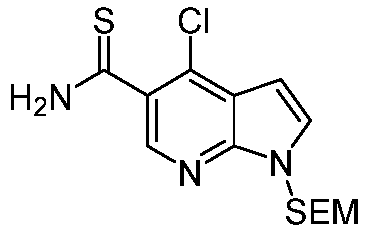
테트라하이드로퓨란 (20 mL) 중의 4-클로로-1-((2-(트리메틸실릴)에톡시)메틸)-1H-피롤로[2,3-b]피리딘-5-카르복사미드 (2.0 g, 6.1 mmol) 및 로웨슨 시약 (3.73 g, 9.20 mmol)의 현탁액을 상온에서 30분간 교반하였다. 상기 반응 혼합물을 물로 희석하고 에틸 아세테이트로 추출하였다. 상기 유기층을 염수로 세척하고, 황산나트륨으로 건조시켜 여과 후 진공에서 농축시켰다. 상기 미정제물을 섬광 크로마토그래피로 정제하여 4-클로로-1-((2-(트리메틸실릴)에톡시)메틸)-1H-피롤로[2,3-b]피리딘-5-카보티오아미드를 황색 고체로서 수득하였다 (1 g, 50% 수율): MS (ES) m/z 342.1 (M+H).(Methylethoxy) to (2- (trimethylsilyl)) -1 H - - tetrahydrofuran (20 mL) solution of 4-chloro-l H-pyrrolo [2,3- b] pyridine-5-carboxamide (2.0 g , 6.1 mmol) and Roweson's reagent (3.73 g, 9.20 mmol) were stirred at room temperature for 30 minutes. The reaction mixture was diluted with water and extracted with ethyl acetate. The organic layer was washed with brine, dried over sodium sulfate, filtered and concentrated in vacuo. Purification of the crude by flash chromatography on 4-chloro-1 - ((methylethoxy), 2- (trimethylsilyl)) -1 H-pyrrolo [2,3- b] pyridine-5-carbonitrile thioamide Obtained as a yellow solid (1 g, 50% yield): MS (ES) m/z 342.1 (M+H).
[000454] 단계 2: 에틸 2-(4-클로로-1-((2-(트리메틸실릴)에톡시)메틸)-1H-피롤로[2,3-b]피리딘-5-일)티아졸-5-카르복실레이트의 제조 [000 454] Step 2: ethyl 2- (4-chloro-1 - ((methylethoxy), 2- (trimethylsilyl)) -1 H-pyrrolo [2,3- b] pyridin-5-yl) thiazole Preparation of -5-carboxylate

톨루엔 (10 mL) 중의 4-클로로-1-((2-(트리메틸실릴)에톡시)메틸)-1H-피롤로[2,3-b]피리딘-5-카보티오아미드 (0.9 g, 2.63 mmol) 및 에틸 2-클로로-3-옥소프로파노에이트 (0.39 g, 2.63 mmol)의 교반된 용액에 황산마그네슘 (0.317 g, 2.63 mmol)을 첨가한 후, 상기 혼합물을 질소 대기 하에 110℃로 1시간 동안 가열하였다. 상기 반응 혼합물을 상온으로 냉각시키고, 물로 희석한 후, 에틸 아세테이트로 추출하였다. 상기 유기층을 염수로 세척하고, 황산나트륨으로 건조시켜 여과 후 진공에서 농축시켰다. 상기 미정제 물질을 섬광 크로마토그래피 (20% 에틸 아세테이트/헥산)로 정제하여 에틸 2-(4-클로로-1-((2-(트리메틸실릴)에톡시)메틸)-1H-피롤로[2,3-b]피리딘-5-일)티아졸-5-카르복실레이트를 황색 고체로서 수득하였다 (0.8 g, 70% 수율): MS (ES) m/z 438.1 (M+H). (A (2- (trimethylsilyl) ethoxy) methyl) -1 H - - toluene (10 mL) solution of 4-chloro-l H-pyrrolo [2,3- b] pyridine thioamide (0.9 g, 2.63 mmol) and ethyl 2-chloro-3-oxopropanoate (0.39 g, 2.63 mmol) were added magnesium sulfate (0.317 g, 2.63 mmol), then the mixture was heated to 1 heated for hours. The reaction mixture was cooled to room temperature, diluted with water, and extracted with ethyl acetate. The organic layer was washed with brine, dried over sodium sulfate, filtered and concentrated in vacuo. The crude to flash chromatography, ethyl 2- (4-chloro-l to give (20% ethyl acetate / hexane) substance-ethoxy) ((2- (trimethylsilyl) methyl) -1 H-pyrrolo [2 ,3- b ]pyridin-5-yl)thiazole-5-carboxylate was obtained as a yellow solid (0.8 g, 70% yield): MS (ES) m/z 438.1 (M+H).
[000455] 단계 3: 에틸 (R)-2-(4-((1-(tert-부톡시카보닐)피페리딘-3-일)아미노)-1-((2-(트리메틸실릴) 에톡시)메틸)-1H-피롤로[2,3-b]피리딘-5-일)티아졸-5-카르복실레이트의 제조 [000455] Step 3: Ethyl ( R )-2-(4-((1-( tert -butoxycarbonyl)piperidin-3-yl)amino)-1-((2-(trimethylsilyl) in Preparation of pyrrolo [2,3- b] pyridin-5-yl) thiazole-5-carboxylate - ethoxy) methyl) -1 H

20 mL 마이크로파 바이알 중에서, 에틸 2-(4-클로로-1-((2-(트리메틸실릴)에톡시)메틸)-1H-피롤로[2,3-b]피리딘-5-일)티아졸-5-카르복실레이트 (0.60 g, 1.37 mmol), tert-부틸 (R)-3-아미노피페리딘-1-카르복실레이트 (0.411 g, 2.05 mmol), 팔라듐(II) 아세테이트 (0.05 g, 0.20 mmol), (2,2'-비스(디페닐포스피노)-1,1'-바이나프틸) (0.13 g, 0.20 mmol), 나트륨 tert-부톡시드 (0.39 g, 4.11 mmol) 및 1,4-디옥신 (7 mL)을 혼합한 후, 생성된 혼합물에 80℃에서 1시간 동안 마이크로파를 조사하였다. 상기 반응 혼합물을 상온으로 냉각시키고, 물로 희석한 후, 에틸 아세테이트로 추출하였다. 상기 유기층을 염수로 세척하고, 황산나트륨으로 건조시켜 여과 후 진공에서 농축시켰다. 상기 미정제물을 섬광 크로마토그래피 (40% 에틸 아세테이트/헥산)로 정제하여 에틸 (R)-2-(4-((1-(tert-부톡시카보닐)피페리딘-3-일)아미노)-1-((2-(트리메틸실릴)에톡시)메틸)-1H-피롤로[2,3-b]피리딘-5-일)티아졸-5-카르복실레이트를 점성의 갈색 액체로서 수득하였다 (0.23 g, 28% 수율): MS (ES) m/z 602.3 (M+H).In 20 mL microwave vial, ethyl 2- (4-chloro-l-ethoxy) ((2- (trimethylsilyl) methyl) -1 H-pyrrolo [2,3- b] pyridin-5-yl) thiazole -5-carboxylate (0.60 g, 1.37 mmol), tert -butyl ( R )-3-aminopiperidine-1-carboxylate (0.411 g, 2.05 mmol), palladium(II) acetate (0.05 g, 0.20 mmol), (2,2′-bis(diphenylphosphino)-1,1′-binaphthyl) (0.13 g, 0.20 mmol), sodium tert- butoxide (0.39 g, 4.11 mmol) and 1, After mixing 4-dioxin (7 mL), the resulting mixture was irradiated with microwaves at 80° C. for 1 hour. The reaction mixture was cooled to room temperature, diluted with water, and extracted with ethyl acetate. The organic layer was washed with brine, dried over sodium sulfate, filtered and concentrated in vacuo. The crude was purified by flash chromatography (40% ethyl acetate/hexanes) to ethyl ( R )-2-(4-((1-( tert -butoxycarbonyl)piperidin-3-yl)amino) -1 - ((2- (trimethylsilyl)) methyl) -1 H-pyrrolo [2,3- b] pyridin-5-yl) thiazole-5-carboxylate as a brown viscous liquid (0.23 g, 28% yield): MS (ES) m/z 602.3 (M+H).
[000456] 단계 4: 에틸 (R)-2-(4-(피페리딘-3-일아미노)-1H-피롤로[2,3-b]피리딘-5-일)티아졸-5-카르복실레이트의 제조 [000 456] Step 4: Ethyl (R) -2- (4- (piperidin-3-ylamino) -1 H - pyrrolo [2,3- b] pyridin-5-yl) thiazole-5 Preparation of carboxylates

디클로로메탄 : 트리플루오로아세트산 (3.0 mL : 3.0 mL) 중의 에틸 2-(4-((1-(tert-부톡시카보닐)피페리딘-3-일)아미노)-1-((2-(트리메틸실릴)에톡시)메틸)-1H-피롤로[2,3-b]피리딘-5-일)티아졸-5-카르복실레이트 (0.15 g, 0.24 mmol)의 용액을 상온에서 3시간 동안 교반하였다. 상기 반응 혼합물을 진공에서 농축하고, 잔류물을 1,4-디옥산 : 수성 암모니아 (5.0 mL: 4.0 mL, 물 중 23%)에 용해시킨 후, 상온에서 16시간 동안 교반하였다. 상기 반응 혼합물을 진공에서 농축시켜 에틸 (R)-2-(4-(피페리딘-3-일아미노)-1H-피롤로[2,3-b]피리딘-5-일)티아졸-5-카르복실레이트를 갈색 고체로서 수득하였다 (0.15 g, 미정제): MS (ES) m/z 372.1 (M+H).Dichloromethane: ethyl 2-(4-((1-( tert -butoxycarbonyl)piperidin-3-yl)amino)-1-((2-) in trifluoroacetic acid (3.0 mL : 3.0 mL) (trimethylsilyl) ethoxy) methyl) -1 h - pyrrolo [2,3- b] pyridin-5-yl) thiazole-5-carboxylate (0.15 g, 3 hours a solution of 0.24 mmol) at room temperature stirred for a while. The reaction mixture was concentrated in vacuo, and the residue was dissolved in 1,4-dioxane: aqueous ammonia (5.0 mL: 4.0 mL, 23% in water) and stirred at room temperature for 16 h. The reaction mixture was concentrated in vacuo to ethyl (R) -2- (4- (piperidin-3-ylamino) -1 H-pyrrolo [2,3- b] pyridin-5-yl) thiazol- The 5-carboxylate was obtained as a brown solid (0.15 g, crude): MS (ES) m/z 372.1 (M+H).
[000457] 단계 5: 에틸 (R)-2-(4-((1-(2-시아노아세틸)피페리딘-3-일)아미노)-1H-피롤로[2,3-b]피리딘-5-일)티아졸-5-카르복실레이트의 제조 [000 457] Step 5: Preparation of ethyl (R) -2- (4 - ( (1- (2- cyano-acetyl) -piperidin-3-yl) amino) -1 H - pyrrolo [2,3- b] Preparation of pyridin-5-yl)thiazole-5-carboxylate

N-메틸피롤리돈 (5 mL) 중의 시아노아세트산 (0.05 g, 0.60 mmol), 1-하이드록시-2-피리돈 (0.05 g, 0.48 mmol) 및 2-(1H-벤조트리아졸-1-일)-1,1,3,3-테트라메틸암모늄 테트라플루오로보레이트 (0.15 g, 0.48 mmol)의 교반된 용액에 에틸 2-(4-(피페리딘-3-일아미노)-1H-피롤로[2,3-b]피리딘-5-일)티아졸-5-카르복실레이트 (0.15 g, 0.40 mmol)를 첨가하고, 트리에틸아민 (0.16 mL, 1.21 mmol)을 첨가한 후, 교반을 상온에서 2시간 동안 지속하였다. 상기 반응 혼합물을 물로 희석하고 에틸 아세테이트로 추출하였다. 상기 유기층을 염수로 세척하고, 황산나트륨으로 건조시켜 여과 후 진공에서 농축시켰다. 상기 미정제물을 섬광 크로마토그래피 (10% 메탄올/디클로로메탄)로 정제하여 에틸 (R)-2-(4-((1-(2-시아노아세틸)피페리딘-3-일)아미노)-1H-피롤로[2,3-b]피리딘-5-일)티아졸-5-카르복실레이트를 담황색 고체로서 수득하였다 (0.02 g, 10% 수율): 1H NMR (400 MHz, DMSO-d6) δ 11.57 (s, 1H), 9.71 (m, 1H), 8.43-8.34 (m, 2H), 7.20 (s, 1H), 6.69 (s, 1H), 4.30-4.35 (q, J = 6.4 Hz, 2H), 4.02 (m, 1H), 3.79-3.87 (m, 2H), 3.56 (m, 1H), 3.39 (m, 1H), 2.03 (m, 2H), 1.77 (m, 2H), 1.62 (m, 2H), 1.29-1.33 (t, J = 7.2 Hz, 3H); MS (ES) m/z 439.1 (M+H).Cyanoacetic acid (0.05 g, 0.60 mmol), 1-hydroxy-2-pyridone (0.05 g, 0.48 mmol) and 2-(1 H -benzotriazole- 1 in N-methylpyrrolidone (5 mL) To a stirred solution of -yl)-1,1,3,3-tetramethylammonium tetrafluoroborate (0.15 g, 0.48 mmol) in ethyl 2-(4-(piperidin-3-ylamino)-1 H -pyrrolo[2,3- b ]pyridin-5-yl)thiazole-5-carboxylate (0.15 g, 0.40 mmol) was added and triethylamine (0.16 mL, 1.21 mmol) was added, Stirring was continued for 2 hours at room temperature. The reaction mixture was diluted with water and extracted with ethyl acetate. The organic layer was washed with brine, dried over sodium sulfate, filtered and concentrated in vacuo. The crude was purified by flash chromatography (10% methanol/dichloromethane) to ethyl ( R )-2-(4-((1-(2-cyanoacetyl)piperidin-3-yl)amino)- 1 H -pyrrolo[2,3- b ]pyridin-5-yl)thiazole-5-carboxylate Obtained as a pale yellow solid (0.02 g, 10% yield): 1 H NMR (400 MHz, DMSO-d 6 ) δ 11.57 (s, 1H), 9.71 (m, 1H), 8.43-8.34 (m, 2H), 7.20 (s, 1H), 6.69 (s, 1H), 4.30-4.35 (q, J = 6.4 Hz, 2H), 4.02 (m, 1H), 3.79-3.87 (m, 2H), 3.56 (m, 1H) , 3.39 (m, 1H), 2.03 (m, 2H), 1.77 (m, 2H), 1.62 (m, 2H), 1.29-1.33 (t, J = 7.2 Hz, 3H); MS (ES) m/z 439.1 (M+H).
[000458] 실시예 43: (R)-3-(3-((5-(2-메톡시피리미딘-4-일)-1H-피롤로[2,3-b]피리딘-4-일) 아미노) 피페리딘-1-일)-3-옥소프로판니트릴의 제조 [000 458] Example 43: (R) -3- (3 - ((5- (2- methoxypyrid limiter-4-yl) -1 H - pyrrolo [2,3- b] pyridin-4-yl ) Preparation of amino) piperidin-1-yl)-3-oxopropanenitrile

반응식 41. (Scheme 41. ( RR )-3-(3-((5-(2-메톡시피리미딘-4-일)-1)-3-(3-((5-(2-methoxypyrimidin-4-yl)-1 HH -피롤로[2,3--pyrrolo[2,3- bb ]피리딘-4-일) 아미노) 피페리딘-1-일)-3-옥소프로판니트릴의 제조Preparation of ]pyridin-4-yl) amino) piperidin-1-yl)-3-oxopropanenitrile

[000459] 단계 1: tert-부틸 (R)-3-((5-(2-메톡시피리미딘-4-일)-1-((2-(트리메틸실릴)에톡시)메틸)-1H-피롤로[2,3-b]피리딘-4-일)아미노)피페리딘-1-카르복실레이트의 제조 [000 459] Step 1: tert-butyl (R) -3 - ((5- (2-methoxypyrid limiter 4-yl) -1-a ((2- (trimethylsilyl) ethoxy) methyl) -1 H Preparation of -pyrrolo[2,3-b]pyridin-4-yl)amino)piperidine-1-carboxylate

1,4-디옥산 (15 mL) 중의 tert-부틸 (R)-3-((5-(4,4,5,5-테트라메틸-1,3,2-디옥사보롤란-2-일)-1-((2-(트리메틸 실릴)에톡시)메틸)-1H-피롤로[2,3-b]피리딘-4-일)아미노)피페리딘-1-카르복실레이트 (1.36 g, 2.38 mmol) 및 4-브로모-2-메톡시피리미딘 (0.30 g, 1.58 mmol)의 교반된 용액에 비스(트리페닐포스핀) 팔라듐(II) 디클로라이드 (0.22 g, 0.32 mmol) 및 2M 탄산칼륨 수용액 (0.87 g, 6.32 mmol)을 첨가한 후, 상기 혼합물을 105℃에서 15시간 동안 교반하였다. 상기 반응 혼합물을 상온으로 냉각시키고, 에틸 아세테이트로 희석하여 물, 염수로 세척한 후, 무수 황산나트륨으로 건조시키고, 여과하여 진공에서 농축시켰다. 상기 미정제 물질을 섬광 크로마토그래피 (30% 에틸 아세테이트/헥산)로 정제하여 tert-부틸 (R)-3-((5-(2-메톡시피리미딘-4-일)-1-((2-(트리메틸실릴)에톡시)메틸)-1H-피롤로[2,3-b]피리딘-4-일)아미노)피페리딘-1-카르복실레이트를 점성의 담황색 액체로서 수득하였다 (0.62 g, 70% 수율): MS (ES) m/z 555.5 (M+H). tert -Butyl ( R )-3-((5-(4,4,5,5-tetramethyl-1,3,2-dioxaborolan-2-yl) in 1,4-dioxane (15 mL) ) -1 - ((2- (trimethylsilyl)) methyl) -1 H-pyrrolo [2,3- b] pyridin-4-yl) amino) piperidine-1-carboxylate (1.36 g , 2.38 mmol) and 4-bromo-2-methoxypyrimidine (0.30 g, 1.58 mmol) in a stirred solution of bis(triphenylphosphine) palladium(II) dichloride (0.22 g, 0.32 mmol) and 2M After addition of aqueous potassium carbonate solution (0.87 g, 6.32 mmol), the mixture was stirred at 105° C. for 15 hours. The reaction mixture was cooled to room temperature, diluted with ethyl acetate, washed with water and brine, dried over anhydrous sodium sulfate, filtered and concentrated in vacuo. The crude material was purified by flash chromatography (30% ethyl acetate/hexanes) to tert -butyl ( R )-3-((5-(2-methoxypyrimidin-4-yl)-1-((2) - a pyrrolo [2,3- b] pyridin-4-yl) amino) piperidine-1-carboxylate - (trimethylsilyl) ethoxy) methyl) -1 H Obtained as a viscous pale yellow liquid (0.62 g, 70% yield): MS (ES) m/z 555.5 (M+H).
[000460] 단계 2: (R)-5-(2-메톡시피리미딘-4-일)-N-(피페리딘-3-일)-1H-피롤로[2,3-b]피리딘-4-아민의 제조 [000 460] Step 2: (R) -5- (2- methoxypyrid limiter-4-yl) - N - (piperidin-3-yl) -1 H - pyrrolo [2,3- b] pyridine Preparation of -4-amine

디클로로메탄 : 트리플루오로아세트산 (3 mL : 3 mL) 중의 tert-부틸 (R)-3-((5-(2-메톡시피리미딘-4-일)-1-((2-(트리메틸실릴)에톡시)메틸)-1H-피롤로[2,3-b]피리딘-4-일)아미노)피페리딘-1-카르복실레이트 (0.3 g, 0.54 mmol)의 용액을 상온에서 3시간 동안 교반하였다. 상기 반응 혼합물을 진공에서 농축하고, 수득된 잔류물을 1,4-디옥산 : 수성 암모니아 (3 mL: 3 mL, 물 중 23%)에 용해시킨 후, 상온에서 16시간 동안 교반하였다. 상기 반응 혼합물을 진공에서 농축시켜 (R)-5-(2-메톡시피리미딘-4-일)-N-(피페리딘-3-일)-1H-피롤로[2,3-b]피리딘-4-아민을 진득한 갈색 액체로서 수득하였다 (0.18 g, 미정제): MS (ES) m/z 325.2 (M+H). Dichloromethane: tert -butyl ( R )-3-((5-(2-methoxypyrimidin-4-yl)-1-((2-(trimethylsilyl) in trifluoroacetic acid (3 mL: 3 mL)) ) ethoxy) methyl) -1 h - pyrrolo [2,3- b] pyridin-4-yl) amino) piperidine-1-carboxylate for 3 hours a solution of (0.3 g, 0.54 mmol) at room temperature stirred for a while. The reaction mixture was concentrated in vacuo, and the obtained residue was dissolved in 1,4-dioxane: aqueous ammonia (3 mL: 3 mL, 23% in water), followed by stirring at room temperature for 16 hours. The reaction mixture was concentrated in vacuo (R) -5- (2- methoxypyrid limiter-4-yl) - N - (piperidin-3-yl) -1 H - pyrrolo [2,3- b ]Pyridin-4-amine Obtained as a thick brown liquid (0.18 g, crude): MS (ES) m/z 325.2 (M+H).
[000461] 단계 3: (R)-3-(3-((5-(2-메톡시피리미딘-4-일)-1H-피롤로[2,3-b]피리딘-4-일) 아미노) 피페리딘-1-일)-3-옥소프로판니트릴의 제조 [000 461] Step 3: (R) -3- (3 - ((5- (2- methoxypyrid limiter-4-yl) -1 H - pyrrolo [2,3- b] pyridin-4-yl) Preparation of amino) piperidin-1-yl)-3-oxopropanenitrile

N-메틸피롤리돈 (4 mL) 중 시아노아세트산 (0.03 g, 0.32 mmol), 2-하이드록시피리딘-N-옥사이드 (0.03 g, 0.32 mmol) 및 O-(벤조트리아졸-1-일)-N,N,N',N'-테트라메틸우로늄 테트라플루오로보레이트 (0.11 g, 0.32 mmol)의 용액을 상온에서 5분간 교반하였다. 이후, (R)-5-(2-메톡시피리미딘-4-일)-N-(피페리딘-3-일)-1H-피롤로[2,3-b]피리딘-4-아민 (0.08 g, 0.25 mmol)을 첨가한 후, 트리에틸아민 (0.1 mL, 0.74 mmol)을 첨가하였다. 상기 생성된 혼합물을 상온에서 16시간 동안 교반하고, 물로 ??칭한 후, 디클로로메탄으로 추출하였다. 상기 유기층을 물과 염수로 세척하고, 무수 황산나트륨으로 건조시킨 후, 여과하여 진공에서 농축시켰다. 상기 미정제 물질을 섬광 크로마토그래피 (5% 메탄올/디클로로메탄)로 정제하여 (R)-3-(3-((5-(2-메톡시피리미딘-4-일)-1H-피롤로[2,3-b]피리딘-4-일)아미노)피페리딘-1-일)-3-옥소프로판니트릴을 황백색 고체로서 수득하였다 (0.04 g, 15% 수율): 1H NMR (400 MHz, DMSO-d6, VT, 100℃) δ 11.27 (br s, 1H), 9.89 (br s, 1H), 8.44-8.59 (m, 2H), 7.55 (s, 1H), 7.15 (s, 1H), 6.66 (s, 1H), 4.16-4.27 (m, 2H), 4.39 (s, 2H), 3.83-3.87 (m, 2H), 3.45-3.55 (m, 2H), 2.05-2.10 (m, 2H), 1.58-1.95 (m, 4H); MS (ES) m/z 392.2 (M+H).Cyanoacetic acid (0.03 g, 0.32 mmol), 2-hydroxypyridin- N -oxide (0.03 g, 0.32 mmol) and O- (benzotriazol-1-yl) in N-methylpyrrolidone (4 mL) - A solution of N,N,N',N' -tetramethyluronium tetrafluoroborate (0.11 g, 0.32 mmol) was stirred at room temperature for 5 minutes. Since, (R) -5- (2- methoxypyrid limiter-4-yl) - N - (piperidin-3-yl) -1 H - pyrrolo [2,3- b] pyridin-4-amine (0.08 g, 0.25 mmol) was added followed by triethylamine (0.1 mL, 0.74 mmol). The resulting mixture was stirred at room temperature for 16 hours, quenched with water, and then extracted with dichloromethane. The organic layer was washed with water and brine, dried over anhydrous sodium sulfate, filtered and concentrated in vacuo. To give the crude by flash chromatography (5% methanol / dichloromethane) (R) -3- (3 - ((5- (2- methoxypyrid limiter-4-yl) -1 H - pyrrolo [2,3- b ]pyridin-4-yl)amino)piperidin-1-yl)-3-oxopropanenitrile Obtained as an off-white solid (0.04 g, 15% yield): 1 H NMR (400 MHz, DMSO-d 6 , VT, 100° C.) δ 11.27 (br s, 1H), 9.89 (br s, 1H), 8.44 8.59 (m, 2H), 7.55 (s, 1H), 7.15 (s, 1H), 6.66 (s, 1H), 4.16-4.27 (m, 2H), 4.39 (s, 2H), 3.83-3.87 (m, 2H), 3.45-3.55 (m, 2H), 2.05-2.10 (m, 2H), 1.58-1.95 (m, 4H); MS (ES) m/z 392.2 (M+H).
[000462] 실시예 44: (R)-3-(3-((5-(6-아미노피리딘-2-일)-1H-피롤로[2,3-b]피리딘-4-일)아미노)피페리딘-1-일)-3-옥소프로판니트릴의 제조 [000 462] Example 44: (R) -3- (3 - ((5- (6- Amino-pyridin-2-yl) -1 H - pyrrolo [2,3- b] pyridin-4-yl) amino ) Preparation of piperidin-1-yl)-3-oxopropanenitrile

반응식 42. (Scheme 42. ( RR )-3-(3-((5-(6-아미노피리딘-2-일)-1)-3-(3-((5-(6-aminopyridin-2-yl)-1 HH -피롤로[2,3--pyrrolo[2,3- bb ]피리딘-4-일)아미노)피페리딘-1-일)-3-옥소프로판니트릴의 제조] Preparation of pyridin-4-yl)amino)piperidin-1-yl)-3-oxopropanenitrile

[000463] 단계 1: tert-부틸 (6-브로모피리딘-2-일)카르바메이트의 제조 [000463] Step 1: Preparation of tert -butyl (6-bromopyridin-2-yl)carbamate

나트륨 비스(트리메틸실릴)아미드 (6.1 mL, 6.13 mmol, THF 중 1.0)를 -78℃에서 테트라하이드로퓨란 (15 mL) 중의 6-브로모피리딘-2-아민 (0.70 g, 4.09 mmol)의 용액에 첨가한 후, 상기 혼합물을 0.5시간 동안 교반하였다. 테트라하이드로퓨란 (5 mL)에 용해시킨 디-tert-부틸 디카보네이트 (0.98 g, 4.50 mmol)의 용액을 -78℃에서 첨가하고, 상기 혼합물을 상온으로 천천히 가온한 뒤 16시간 동안 교반하였다. 상기 반응 혼합물을 포화 염화암모늄으로 ??칭하고 에틸 아세테이트로 추출하였다. 상기 유기층을 물과 염수로 세척하고, 무수 황산나트륨으로 건조시킨 후, 여과하여 진공에서 농축시켰다. 상기 미정제 물질을 섬광 크로마토그래피 (20% 에틸 아세테이트/헥산)로 정제하여 tert-부틸 (6-브로모피리딘-2-일)카르바메이트를 무색의 반고체로서 수득하였다: 1H NMR (400 MHz, DMSO-d6) δ 10.07 (s, 1H), 7.76-7.78 (m, 1H), 7.62-7.66 (m, 1H), 7.20-7.22 (m, 1H), 1.44 (s, 9H); MS (ES) m/z 174.2 (M-Boc).Sodium bis(trimethylsilyl)amide (6.1 mL, 6.13 mmol, 1.0 in THF) was added to a solution of 6-bromopyridin-2-amine (0.70 g, 4.09 mmol) in tetrahydrofuran (15 mL) at -78 °C. After addition, the mixture was stirred for 0.5 h. A solution of di-tert -butyl dicarbonate (0.98 g, 4.50 mmol) dissolved in tetrahydrofuran (5 mL) was added at -78°C, and the mixture was slowly warmed to room temperature and stirred for 16 hours. The reaction mixture was quenched with saturated ammonium chloride and extracted with ethyl acetate. The organic layer was washed with water and brine, dried over anhydrous sodium sulfate, filtered and concentrated in vacuo. The crude material was purified by flash chromatography (20% ethyl acetate/hexanes) to give tert -butyl (6-bromopyridin-2-yl)carbamate as a colorless semi-solid: 1 H NMR (400 MHz) , DMSO-d 6 ) δ 10.07 (s, 1H), 7.76-7.78 (m, 1H), 7.62-7.66 (m, 1H), 7.20-7.22 (m, 1H), 1.44 (s, 9H); MS (ES) m/z 174.2 (M-Boc).
[000464] 단계 2: tert-부틸 (R)-3-((5-(6-((tert-부톡시카보닐)아미노)피리딘-2-일)-1-((2-(트리메틸실릴)에톡시)메틸)-1H-피롤로[2,3-b]피리딘-4-일)아미노)피페리딘-1-카르복실레이트의 제조 [000464] Step 2: tert -Butyl ( R )-3-((5-(6 -((tert -butoxycarbonyl)amino)pyridin-2-yl)-1-((2-(trimethylsilyl) Preparation of pyrrolo [2,3- b] pyridin-4-yl) amino) piperidine-1-carboxylate-ethoxy) methyl) -1 H

1,4-디옥산 (40 mL) 중의 tert-부틸 (R)-3-((5-(4,4,5,5-테트라메틸-1,3,2-디옥사보롤란-2-일)-1-((2-(트리메틸실릴)에톡시)메틸)-1H-피롤로[2,3-b]피리딘-4-일)아미노)피페리딘-1-카르복실레이트 (1.2 g, 2.19 mmol) 및 tert-부틸 (6-브로모피리딘-2-일)카르바메이트 (0.4 g, 1.58 mmol)의 교반된 용액에 비스(트리페닐포스핀) 팔라듐(II) 디클로라이드 (0.2 g, 0.29 mmol) 및 2M 탄산칼륨 수용액 (0.81 g, 5.84 mmol)을 첨가한 뒤, 상기 혼합물을 100℃에서 16시간 동안 교반하였다. 상기 반응 혼합물을 상온으로 냉각시키고, 에틸 아세테이트로 희석하여 물, 염수로 세척한 후, 무수 황산나트륨으로 건조시키고, 여과하여 진공에서 농축시켰다. 상기 미정제 물질을 섬광 크로마토그래피 (30% 에틸 아세테이트/헥산)로 정제하여 tert-부틸 (R)-3-((5-(6-((tert-부톡시카보닐)아미노)피리딘-2-일)-1-((2-(트리메틸실릴)에톡시)메틸)-1H-피롤로[2,3-b]피리딘-4-일)아미노)피페리딘-1-카르복실레이트를 점착성의 옅은 액체로서 수득하였다 (0.42 g, 45% 수율): MS (ES) m/z 639.4 (M+H). tert -Butyl ( R )-3-((5-(4,4,5,5-tetramethyl-1,3,2-dioxaborolan-2-yl) in 1,4-dioxane (40 mL) ) -1-methyl ((2- (trimethylsilyl))) - 1 H-pyrrolo [2,3- b] pyridin-4-yl) amino) piperidine-1-carboxylate (1.2 g , 2.19 mmol) and tert -butyl (6-bromopyridin-2-yl)carbamate (0.4 g, 1.58 mmol) in a stirred solution of bis(triphenylphosphine)palladium(II) dichloride (0.2 g , 0.29 mmol) and 2M aqueous potassium carbonate solution (0.81 g, 5.84 mmol) were added, and the mixture was stirred at 100° C. for 16 hours. The reaction mixture was cooled to room temperature, diluted with ethyl acetate, washed with water and brine, dried over anhydrous sodium sulfate, filtered and concentrated in vacuo. The crude material was purified by flash chromatography (30% ethyl acetate/hexanes) to tert -butyl ( R )-3-((5-(6-(( tert -butoxycarbonyl)amino)pyridine-2- yl) - 1 - ((2- (trimethylsilyl)) methyl) -1 H-pyrrolo [2,3- b] pyridin-4-yl) amino) viscous piperidine-1-carboxylate was obtained as a pale liquid of (0.42 g, 45% yield): MS (ES) m/z 639.4 (M+H).
[000465] 단계 3: (R)-5-(6-아미노피리딘-2-일)-N-(피페리딘-3-일)-1H-피롤로[2,3-b]피리딘-4-아민의 제조 [000 465] Step 3: (R) -5- (6- amino-pyridin-2-yl) - N - (piperidin-3-yl) -1 H - pyrrolo [2,3- b] pyridine -4 -Preparation of amines

디클로로메탄 : 트리플루오로아세트산 (4 mL : 4 mL) 중 tert-부틸 (R)-3-((5-(6-((tert-부톡시카보닐)아미노)피리딘-2-일)-1-((2-(트리메틸실릴)에톡시) 메틸)-1H-피롤로[2,3-b]피리딘-4-일)아미노)피페리딘-1-카르복실레이트 (0.42 g, 0.66 mmol)의 용액을 상온에서 3시간 동안 교반하였다. 상기 반응 혼합물을 진공에서 농축하고, 잔류물을 1,4-디옥산 : 수성 암모니아 (5 mL: 5 mL, 물 중 23%)에 용해시킨 후, 상기 용액을 상온에서 16시간 동안 교반하였다. 상기 반응 혼합물을 진공에서 농축시켜 (R)-5-(6-아미노피리딘-2-일)-N-(피페리딘-3-일)-1H-피롤로[2,3-b]피리딘-4-아민을 황백색 고체로서 수득하였다 (0.45 g, 미정제): MS (ES) m/z 309.2 (M+H). Dichloromethane: tert -butyl ( R )-3-((5-(6-(( tert -butoxycarbonyl)amino)pyridin-2-yl)-1 in trifluoroacetic acid (4 mL: 4 mL) - ((2- (trimethylsilyl) ethoxy) methyl) -1 H-pyrrolo [2,3- b] pyridin-4-yl) amino) piperidine-1-carboxylate (0.42 g, 0.66 mmol ) was stirred at room temperature for 3 hours. The reaction mixture was concentrated in vacuo, the residue was dissolved in 1,4-dioxane : aqueous ammonia (5 mL: 5 mL, 23% in water), and the solution was stirred at room temperature for 16 h. The reaction mixture was concentrated in vacuo (R) -5- (6- amino-pyridin-2-yl) - N - (piperidin-3-yl) -1 H - pyrrolo [2,3- b] pyridine -4-amine was obtained as an off-white solid (0.45 g, crude): MS (ES) m/z 309.2 (M+H).
[000466] 단계 4: (R)-3-(3-((5-(6-아미노피리딘-2-일)-1H-피롤로[2,3-b]피리딘-4-일)아미노)피페리딘-1-일)-3-옥소프로판니트릴의 제조 [000 466] Step 4: (R) -3- (3 - ((5- (6- Amino-pyridin-2-yl) -1 H - pyrrolo [2,3- b] pyridin-4-yl) amino) Preparation of piperidin-1-yl)-3-oxopropanenitrile

N-메틸피롤리돈 (5 mL) 중 시아노아세트산 (0.07 g, 0.84 mmol), 2-하이드록시피리딘-N-옥사이드 (0.08 g, 0.71 mmol) 및 2-(1H-벤조트리아졸-1-일)-1,1,3,3-테트라메틸암모늄 테트라플루오로보레이트 (0.27 g, 0.84 mmol)의 용액을 상온에서 5분간 교반하였다. 이후, (R)-5-(6-아미노피리딘-2-일)-N-(피페리딘-3-일)-1H-피롤로[2,3-b]피리딘-4-아민 (0.08 g, 0.25 mmol)을 첨가한 후, 트리에틸아민 (0.27 mL, 1.95 mmol)을 첨가하고, 생성된 혼합물을 상온에서 18시간 동안 교반하였다. 상기 반응 혼합물을 물로 ??칭하고 에틸 아세테이트로 추출하였다. 상기 유기층을 물과 염수로 세척하고, 무수 황산나트륨으로 건조시킨 후, 여과하여 진공에서 농축시켰다. 상기 미정제 물질을 섬광 크로마토그래피 (10% 메탄올/디클로로메탄)로 정제하여 (R)-3-(3-((5-(6-아미노피리딘-2-일)-1H-피롤로[2,3-b]피리딘-4-일)아미노)피페리딘-1-일)-3-옥소프로판니트릴을 황백색 고체로서 수득하였다 (0.11 g, 45% 수율): 1H NMR (400 MHz, DMSO-d6, VT, 70℃) δ 11.11 (br s, 1H), 9.58 (br s, 1H), 8.19 (s, 1H), 7.44 (s, 1H), 7.10 (s, 1H), 6.85 (s, 1H), 6.57 (s, 1H), 634-6.36 (m, 1H), 5.79 (s, 2H), 4.20-4.35 (m, 1H), 3.95-4.07 (m, 1H), 3.45-3.60 (m, 2H), 2.10-2.15 (m, 2H), 1.60-1.75 (m, 2H), 1.15-1.30 (m, 3H); MS (ES) m/z 376.2 (M+H). Cyanoacetic acid (0.07 g, 0.84 mmol), 2-hydroxypyridine- N -oxide (0.08 g, 0.71 mmol) and 2-(1 H -benzotriazole- 1 in N-methylpyrrolidone (5 mL) -yl)-1,1,3,3-tetramethylammonium A solution of tetrafluoroborate (0.27 g, 0.84 mmol) was stirred at room temperature for 5 minutes. Since, (R) -5- (6- amino-pyridin-2-yl) - N - (piperidin-3-yl) -1 H - pyrrolo [2,3- b] pyridin-4-amine (0.08 g, 0.25 mmol), triethylamine (0.27 mL, 1.95 mmol) was added, and the resulting mixture was stirred at room temperature for 18 hours. The reaction mixture was quenched with water and extracted with ethyl acetate. The organic layer was washed with water and brine, dried over anhydrous sodium sulfate, filtered and concentrated in vacuo. Purification of the crude material by flash chromatography (10% methanol / dichloromethane) (R) -3- (3 - ((5- (6- Amino-pyridin-2-yl) -1 H - pyrrolo [2 ,3- b ]pyridin-4-yl)amino)piperidin-1-yl)-3-oxopropanenitrile was obtained as an off-white solid (0.11 g, 45% yield): 1 H NMR (400 MHz, DMSO) -d 6 , VT, 70° C.) δ 11.11 (br s, 1H), 9.58 (br s, 1H), 8.19 (s, 1H), 7.44 (s, 1H), 7.10 (s, 1H), 6.85 (s) , 1H), 6.57 (s, 1H), 634-6.36 (m, 1H), 5.79 (s, 2H), 4.20-4.35 (m, 1H), 3.95-4.07 (m, 1H), 3.45-3.60 (m) , 2H), 2.10-2.15 (m, 2H), 1.60-1.75 (m, 2H), 1.15-1.30 (m, 3H); MS (ES) m/z 376.2 (M+H).
[000467] 실시예 45: 3-((3R)-3-((5-(5-(메틸설피닐)티아졸-2-일)-1H-피롤로[2,3-b]피리딘-4-일)아미노)피페리딘-1-일)-3-옥소프로판니트릴의 제조 [000 467] Example 45: 3 - ((3 R ) -3 - ((5- (5- ( methyl-sulfinyl) thiazol-2-yl) -1 H - pyrrolo [2,3- b] pyridine Preparation of -4-yl)amino)piperidin-1-yl)-3-oxopropanenitrile

반응식 43. 3-((3Scheme 43. 3-((3 RR )-3-((5-(5-(메틸설피닐)티아졸-2-일)-1)-3-((5-(5-(methylsulfinyl)thiazol-2-yl)-1 HH -피롤로[2,3--pyrrolo[2,3- bb ]피리딘-4-일)아미노)피페리딘-1-일)-3-옥소프로판니트릴의 제조] Preparation of pyridin-4-yl)amino)piperidin-1-yl)-3-oxopropanenitrile

[000468] 단계 1: 5-(메틸티오)티아졸-2-아민의 제조 [000468] Step 1: Preparation of 5-(methylthio)thiazol-2-amine

N,N-디메틸포름아미드 (30 mL) 중 5-브로모티아졸-2-아민 (4.5 g, 25.14 mmol) 및 나트륨 티오메톡사이드 (3.52 g, 50.28 mmol)의 용액을 50℃에서 5시간 동안 교반하였다. 상기 반응 혼합물을 상온으로 냉각하고, 에틸 아세테이트로 희석한 후, 물과 염수로 세척하였다. 상기 유기층을 무수 황산나트륨으로 건조시킨 후, 여과하여 진공에서 농축시켰다. 상기 미정제물을 섬광 크로마토그래피 (30% 에틸 아세테이트/헥산)로 정제하여 5-(메틸티오)티아졸-2-아민을 갈색 고체로서 수득하였다 (1.5 g, 41% 수율): 1H NMR (400 MHz, CDCl3) δ 7.08 (s, 1H), 2.36 (s, 3H). A solution of 5-bromothiazol-2-amine (4.5 g, 25.14 mmol) and sodium thiomethoxide (3.52 g, 50.28 mmol) in N,N-dimethylformamide (30 mL) at 50 °C for 5 h stirred. The reaction mixture was cooled to room temperature, diluted with ethyl acetate, and washed with water and brine. The organic layer was dried over anhydrous sodium sulfate, filtered, and concentrated in vacuo. The crude was purified by flash chromatography (30% ethyl acetate/hexanes) to give 5-(methylthio)thiazol-2-amine as a brown solid (1.5 g, 41% yield): 1 H NMR (400 MHz, CDCl 3 ) δ 7.08 (s, 1H), 2.36 (s, 3H).
[000469] 단계 2: 2-브로모-5-(메틸티오)티아졸의 제조 [000469] Step 2: Preparation of 2-bromo-5- (methylthio) thiazole

[000470] 아세토니트릴 (60 mL) 중 5-(메틸티오)티아졸-2-아민 (1.5 g, 10.27 mmol)의 교반된 용액에 tert-부틸 아질산염 (1.58 g, 15.40 mmol)을 0℃에서 첨가한 후, 상기 혼합물을 15분간 교반하였다. 브롬화구리 (II) (6.87 g, 30.81 mmol)를 첨가한 뒤, 상기 혼합물을 0℃에서 3시간 동안 교반하였다. 상기 반응 혼합물을 에틸 아세테이트로 희석한 후, 물과 염수로 세척하였다. 상기 유기층을 무수 황산나트륨으로 건조시킨 후, 여과하여 진공에서 농축시켰다. 상기 미정제물을 섬광 크로마토그래피 (5% 에틸 아세테이트/헥산)로 정제하여 2-브로모-5-(메틸티오)티아졸을 오렌지색 오일로서 수득하였다 (0.75 g, 34% 수율): MS (ES) m/z 209.8; 211.0 (1:1; M+H). [000470] To a stirred solution of 5-(methylthio)thiazol-2-amine (1.5 g, 10.27 mmol) in acetonitrile (60 mL) was added tert -butyl nitrite (1.58 g, 15.40 mmol) at 0 °C After that, the mixture was stirred for 15 minutes. After copper (II) bromide (6.87 g, 30.81 mmol) was added, the mixture was stirred at 0° C. for 3 h. The reaction mixture was diluted with ethyl acetate and washed with water and brine. The organic layer was dried over anhydrous sodium sulfate, filtered, and concentrated in vacuo. The crude was purified by flash chromatography (5% ethyl acetate/hexanes) to give 2-bromo-5-(methylthio)thiazole as an orange oil (0.75 g, 34% yield): MS (ES) m/z 209.8; 211.0 (1:1; M+H).
[000471] 단계 3: 2-브로모-5-메탄설피닐-1,3-티아졸의 제조 [000471] Step 3: Preparation of 2-bromo-5-methanesulfinyl-1,3-thiazole

디클로로메탄 (20 mL) 중 2-브로모-5-(메틸티오)-1,3-티아졸 (0.59 g, 2.81 mmol) 및 메타-클로로퍼옥시벤조산 (0.48 g, 2.81 mmol)의 용액을 상온에서 1시간 동안 교반하였다. 상기 반응 혼합물을 포화 중탄산염 용액으로 ??칭하고 30분간 교반하였다. 상기 유기층을 분리하고, 물, 염수로 세척하여, 황산나트륨으로 건조시킨 뒤, 여과하고 진공에서 농축하여 2-브로모-5-메탄설피닐-1,3-티아졸 (0.35 g, 미정제)을 점성의 무색 액체로서 수득하였다: MS (ES) m/z 226.0; 228.0 (1:1; M+H).A solution of 2-bromo-5-(methylthio)-1,3-thiazole (0.59 g, 2.81 mmol) and meta -chloroperoxybenzoic acid (0.48 g, 2.81 mmol) in dichloromethane (20 mL) at room temperature stirred for 1 hour. The reaction mixture was quenched with saturated bicarbonate solution and stirred for 30 minutes. The organic layer was separated, washed with water and brine, dried over sodium sulfate, filtered and concentrated in vacuo to give 2-bromo-5-methanesulfinyl-1,3-thiazole (0.35 g, crude) Obtained as a viscous colorless liquid: MS (ES) m/z 226.0; 228.0 (1:1; M+H).
[000472] 단계 4: tert-부틸 (R)-3-((5-(5-(메틸설피닐)티아졸-2-일)-1-((2-(트리메틸실릴)에톡시)메틸)-1H-피롤로[2,3-b]피리딘-4-일)아미노)피페리딘-1-카르복실레이트의 제조 [000472] Step 4: tert -Butyl ( R )-3-((5-(5-(methylsulfinyl)thiazol-2-yl)-1-((2-(trimethylsilyl)ethoxy)methyl) Preparation of -1 H -pyrrolo[2,3-b]pyridin-4-yl)amino)piperidine-1-carboxylate

N,N-디메틸포름아미드 (4.00 mL) 중 (3R)-1-메틸-N-[5-(4,4,5,5-테트라메틸-1,3,2-디옥사보롤란-2-일)-1-{[2-(트리메틸 실릴)에톡시]메틸}-1H-피롤로[2,3-b]피리딘-4-일]피페리딘-3-아민 (1.5 g, 2.62 mmol) 및 2-브로모-5-메탄설피닐-1,3-티아졸 (0.39 g, 1.75 mmol)의 교반된 용액에 1,1'-비스(디페닐포스피노)페로센-팔라듐(II)디클로라이드 디클로로메탄 착물 (0.28 g, 0.35 mmol) 및 불화세슘 (1.06 g, 6.99 mmol)을 첨가한 후, 생성된 혼합물을 80℃로 5시간 동안 가열하였다. 상기 반응 혼합물을 상온으로 냉각하고, 에틸 아세테이트로 희석한 후, 물과 염수로 세척하였다. 상기 유기층을 무수 황산나트륨으로 건조시킨 후, 여과하여 진공에서 농축시켰다. 상기 미정제물을 섬광 크로마토그래피 (50% 에틸 아세테이트/헥산)로 정제하여 tert-부틸 (3R)-3-{[5-(5-메탄설피닐-1,3-티아졸-2-일)-1-{[2-(트리메틸실릴)에톡시]메틸}-1H-피롤로[2,3-b]피리딘-4-일]아미노}피페리딘-1-카르복실레이트를 갈색 색상의 액체로서 수득하였다 (0.12 g, 11% 수율): MS (ES) m/z 593.4 (M+H). (3R )-1-methyl- N- [5-(4,4,5,5-tetramethyl-1,3,2-dioxaborolane-2 in N,N -dimethylformamide (4.00 mL)) -yl) - 1 - {[2- (trimethylsilyl) ethoxy] methyl} -1 H-pyrrolo [2,3- b] pyridin-4-yl] piperidin-3-amine (1.5 g, 2.62 mmol) and 2-bromo-5-methanesulfinyl-1,3-thiazole (0.39 g, 1.75 mmol) in 1,1′-bis(diphenylphosphino)ferrocene-palladium(II) After addition of dichloride dichloromethane complex (0.28 g, 0.35 mmol) and cesium fluoride (1.06 g, 6.99 mmol), the resulting mixture was heated to 80° C. for 5 h. The reaction mixture was cooled to room temperature, diluted with ethyl acetate, and washed with water and brine. The organic layer was dried over anhydrous sodium sulfate, filtered, and concentrated in vacuo. The crude was purified by flash chromatography (50% ethyl acetate/hexanes) to tert- butyl (3 R )-3-{[5-(5-methanesulfinyl-1,3-thiazol-2-yl) 1 - {[2- (trimethylsilyl) ethoxy] methyl} -1 H-pyrrolo [2,3- b] pyridin-4-yl] amino} piperidine-1-carboxylate of a brown color Obtained as a liquid (0.12 g, 11% yield): MS (ES) m/z 593.4 (M+H).
[000473] 단계 5: 5-(5-(메틸설피닐)티아졸-2-일)-N-((R)-피페리딘-3-일)-1H-피롤로[2,3-b]피리딘-4-아민의 제조 [000 473] Step 5: 5- (5- (methyl-sulfinyl) thiazol-2-yl) - N - ((R) - piperidin-3-yl) -1 H - pyrrolo [2,3- b ] Preparation of pyridin-4-amine

디클로로메탄 : 트리플루오로아세트산 (2 mL : 2 mL) 중 tert-부틸 (3R)-3-{[5-(5-메탄설피닐-1,3-티아졸-2-일)-1-{[2-(트리메틸실릴) 에톡시]메틸}-1H-피롤로[2,3-b]피리딘-4-일]아미노}피페리딘-1-카르복실레이트 (0.12 g, 0.20 mmol)의 용액을 상온에서 3시간 동안 교반하였다. 상기 반응 혼합물을 진공에서 농축하고, 수득된 잔류물을 1,4-디옥산 : 수성 암모니아 (3 mL: 3 mL, 물 중 23%)에 용해시킨 후, 상온에서 16시간 동안 교반하였다. 상기 반응 혼합물을 진공에서 농축시켜 (3R)-N-[5-(5-메탄설피닐-1,3-티아졸-2-일)-1H-피롤로[2,3-b]피리딘-4-일]피페리딘-3-아민을 진득한 고체로서 수득하였다 (0.2 g, 미정제): MS (ES) m/z 362.1 (M+H). Dichloromethane: tert- Butyl (3 R )-3-{[5-(5-methanesulfinyl-1,3-thiazol-2-yl)-1- in trifluoroacetic acid (2 mL: 2 mL) {[2- (trimethylsilyl) ethoxy] methyl} -1 H - pyrrolo [2,3- b] pyridin-4-yl] amino} piperidine-1-carboxylate (0.12 g, 0.20 mmol) The solution was stirred at room temperature for 3 hours. The reaction mixture was concentrated in vacuo, and the obtained residue was dissolved in 1,4-dioxane: aqueous ammonia (3 mL: 3 mL, 23% in water), followed by stirring at room temperature for 16 hours. The reaction mixture was concentrated in vacuo to (3 R) - N - [ 5- (5- methane sulfinyl-1,3-thiazol-2-yl) -1 H - pyrrolo [2,3- b] pyridine -4-yl]piperidin-3-amine was obtained as a thick solid (0.2 g, crude): MS (ES) m/z 362.1 (M+H).
[000474] 단계 6: 3-((3R)-3-((5-(5-(메틸설피닐)티아졸-2-일)-1H-피롤로[2,3-b]피리딘-4-일)아미노)피페리딘-1-일)-3-옥소프로판니트릴의 제조 [000 474] Step 6: 3 - ((3 R ) -3 - ((5- (5- ( methyl-sulfinyl) thiazol-2-yl) -1 H-pyrrolo [2,3- b] pyridin- Preparation of 4-yl)amino)piperidin-1-yl)-3-oxopropanenitrile

디클로로메탄 (5 mL) 중 2-시아노아세트산 (0.04 g, 0.45 mmol) 및 1-하이드록시벤조트리아졸 (0.05 g, 0.30 mmol)의 용액을 2분간 교반하였다. 이후, (3R)-N-[5-(5-메탄설피닐-1,3-티아졸-2-일)-1H-피롤로[2,3-b]피리딘-4-일]피페리딘-3-아민 (0.1 g, 0.3 mmol), N-(3-디메틸아미노프로필)-N'-에틸카르보디이미드 하이드로클로라이드 (0.08 g, 0.41 mmol) 및 트리에틸아민 (0.11 g, 1.11 mmol)을 첨가한 뒤, 상기 혼합물을 상온에서 16시간 동안 교반하였다. 상기 반응 혼합물을 물로 ??칭하고 에틸 아세테이트로 추출하였다. 상기 유기층을 물과 염수로 세척하고, 무수 황산나트륨으로 건조시킨 후, 여과하여 진공에서 농축시켰다. 상기 미정제 물질을 역상 크로마토그래피로 정제하여 3-((3R)-3-((5-(5-(메틸설피닐)티아졸-2-일)-1H-피롤로[2,3-b]피리딘-4-일)아미노)피페리딘-1-일)-3-옥소프로판니트릴을 담황색 고체로서 수득하였다 (5 mg, 4% 수율): 1H NMR (400 MHz, DMSO-d6) δ 11.73 (br s, 1H), 9.65 (br s, 1H), 8.44 (s, 1H), 8.17 (s, 1H), 8.07 (s, 1H), 7.24 (s, 1H), 6.71 (s, 1H), 5.91-6.11 (m, 1H), 5.31 (s, 1H), 4.12-4.50 (m, 1H), 3.75-4.22 (m, 2H), 3.42-3.72 (m, 2H), 2.95-3.12 (m, 3H), 1.95-2.10 (m, 1H), 1.45-1.82 (m, 2H); MS (ES) m/z 429.2 (M+H).A solution of 2-cyanoacetic acid (0.04 g, 0.45 mmol) and 1-hydroxybenzotriazole (0.05 g, 0.30 mmol) in dichloromethane (5 mL) was stirred for 2 min. Later, (3 R) - N - [5- (5- methane sulfinyl-1,3-thiazol-2-yl) -1 H - pyrrolo [2,3- b] pyridin-4-yl] P Peridin-3-amine (0.1 g, 0.3 mmol), N- (3-dimethylaminopropyl)-N'-ethylcarbodiimide hydrochloride (0.08 g, 0.41 mmol) and triethylamine (0.11 g, 1.11 mmol) ) was added, and the mixture was stirred at room temperature for 16 hours. The reaction mixture was quenched with water and extracted with ethyl acetate. The organic layer was washed with water and brine, dried over anhydrous sodium sulfate, filtered and concentrated in vacuo. Purification of the crude material by reverse phase chromatography, 3 - ((3 R) -3 - ((5- (5- ( methyl-sulfinyl) thiazol-2-yl) -1 H - pyrrolo [2,3 -b ]pyridin-4-yl)amino)piperidin-1-yl)-3-oxopropanenitrile was obtained as a pale yellow solid (5 mg, 4% yield): 1 H NMR (400 MHz, DMSO-d 6 ) δ 11.73 (br s, 1H), 9.65 (br s, 1H), 8.44 (s, 1H), 8.17 (s, 1H), 8.07 (s, 1H), 7.24 (s, 1H), 6.71 (s) , 1H), 5.91-6.11 (m, 1H), 5.31 (s, 1H), 4.12-4.50 (m, 1H), 3.75-4.22 (m, 2H), 3.42-3.72 (m, 2H), 2.95-3.12 (m, 3H), 1.95-2.10 (m, 1H), 1.45-1.82 (m, 2H); MS (ES) m/z 429.2 (M+H).
분석 조건: Analysis conditions:
유속: 0.3 mL/분 Flow rate: 0.3 mL/min
컬럼: Ascentis Express C18 (50 mm X 2.1 mm X 2.73 μm) Column: Ascentis Express C18 (50 mm X 2.1 mm X 2.73 μm)
이동상 (A): 물 중 0.1% 포름산 Mobile phase (A): 0.1% formic acid in water
이동상 (B): MeCN Mobile phase (B): MeCN
[000475] 실시예 46: (R)-3-(3-((5-(5-(메틸설포닐)티아졸-2-일)-1H-피롤로[2,3-b]피리딘-4-일)아미노) 피페리딘-1-일)-3-옥소프로판니트릴의 제조 [000 475] Example 46: (R) -3- (3 - ((5- (5- ( methylsulfonyl) thiazol-2-yl) -1 H-pyrrolo [2,3- b] pyridin- Preparation of 4-yl)amino) piperidin-1-yl)-3-oxopropanenitrile

반응식 44. (Scheme 44. ( RR )-3-(3-((5-(5-(메틸설포닐)티아졸-2-일)-1)-3-(3-((5-(5-(methylsulfonyl)thiazol-2-yl)-1 HH -피롤로[2,3--pyrrolo[2,3- bb ]피리딘-4-일)아미노) 피페리딘-1-일)-3-옥소프로판니트릴의 제조] Preparation of pyridin-4-yl)amino) piperidin-1-yl)-3-oxopropanenitrile

[000476] 단계 1: 2-브로모-5-(메틸설포닐)티아졸의 제조 [000476] Step 1: Preparation of 2-bromo-5-(methylsulfonyl)thiazole

디클로로메탄 (20 mL) 중 2-브로모-5-(메틸티오)-1,3-티아졸 (0.59 g, 2.81 mmol) 및 메타-클로로퍼옥시벤조산 (1.2 g, 7.02 mmol)의 용액을 상온에서 3시간 동안 교반하였다. 상기 반응 혼합물을 포화 중탄산염 용액으로 ??칭하고 30분간 교반하였다. 상기 유기층을 분리하고, 물, 염수로 세척하여, 황산나트륨으로 건조시킨 뒤, 여과하고 진공에서 농축하여 2-브로모-5-메탄설포닐-1,3-티아졸 (0.35 g, 미정제)을 황백색 고체로서 수득하였다 (0.45 g, 70% 수율): 1H NMR (400 MHz, DMSO-d6) δ 8.30 (s, 1H), 3.45 (s, 3H). A solution of 2-bromo-5-(methylthio)-1,3-thiazole (0.59 g, 2.81 mmol) and meta -chloroperoxybenzoic acid (1.2 g, 7.02 mmol) in dichloromethane (20 mL) at room temperature was stirred for 3 hours. The reaction mixture was quenched with saturated bicarbonate solution and stirred for 30 minutes. The organic layer was separated, washed with water and brine, dried over sodium sulfate, filtered and concentrated in vacuo to give 2-bromo-5-methanesulfonyl-1,3-thiazole (0.35 g, crude) Obtained as an off-white solid (0.45 g, 70% yield): 1 H NMR (400 MHz, DMSO-d 6 ) δ 8.30 (s, 1H), 3.45 (s, 3H).
[000477] 단계 2: tert-부틸 (R)-3-((5-(5-(메틸설포닐)티아졸-2-일)-1-((2-(트리메틸실릴)에톡시)메틸)-1H-피롤로[2,3-b]피리딘-4-일)아미노)피페리딘-1-카르복실레이트의 제조 [000477] Step 2: tert -Butyl ( R )-3-((5-(5-(methylsulfonyl)thiazol-2-yl)-1-((2-(trimethylsilyl)ethoxy)methyl) Preparation of -1 H -pyrrolo[2,3-b]pyridin-4-yl)amino)piperidine-1-carboxylate

1,4-디옥산 (50 mL) 중 tert-부틸 (R)-3-((5-(4,4,5,5-테트라메틸-1,3,2-디옥사보롤란-2-일)-1-((2-(트리메틸실릴)에톡시)메틸)-1H-피롤로[2,3-b]피리딘-4-일)아미노)피페리딘-1-카르복실레이트 (1.7 g, 3.09 mmol), 탄산칼륨 (1.14 g, 8.28 mmol), 비스(트리페닐포스핀)팔라듐(II) 디클로라이드 (0.30 g, 0.41 mmol) 및 2-브로모-5-(메틸설포닐)티아졸 (0.5 g, 2.07 mmol)의 용액을 질소 대기 하에 밀봉된 튜브 중에서 110℃로 가열하였다. 16시간 후, 상기 반응 혼합물을 상온으로 냉각시키고, 물로 희석한 후, 에틸 아세테이트로 추출하였다. 상기 유기층을 염수로 세척하고, 황산나트륨으로 건조시켜 여과 후 진공에서 농축시켰다. 상기 미정제 물질을 섬광 크로마토그래피 (에틸 아세테이트/헥산)로 정제하여 tert-부틸 (R)-3-((5-(5-(메틸설포닐)티아졸-2-일)-1-((2-(트리메틸실릴)에톡시)메틸)-1H-피롤로[2,3-b]피리딘-4-일)아미노)피페리딘-1-카르복실레이트를 점성의 갈색 액체로서 수득하였다 (0.55 g, 30% 수율): MS (ES) m/z 608.3 (M+H). tert -Butyl ( R )-3-((5-(4,4,5,5-tetramethyl-1,3,2-dioxaborolan-2-yl) in 1,4-dioxane (50 mL) ) -1-methyl ((2- (trimethylsilyl))) - 1 H-pyrrolo [2,3- b] pyridin-4-yl) amino) piperidine-1-carboxylate (1.7 g , 3.09 mmol), potassium carbonate (1.14 g, 8.28 mmol), bis(triphenylphosphine)palladium(II) dichloride (0.30 g, 0.41 mmol) and 2-bromo-5-(methylsulfonyl)thiazole (0.5 g, 2.07 mmol) was heated to 110° C. in a sealed tube under nitrogen atmosphere. After 16 hours, the reaction mixture was cooled to room temperature, diluted with water, and extracted with ethyl acetate. The organic layer was washed with brine, dried over sodium sulfate, filtered and concentrated in vacuo. The crude material was purified by flash chromatography (ethyl acetate/hexanes) to tert -butyl ( R )-3-((5-(5-(methylsulfonyl)thiazol-2-yl)-1-(( 2- (trimethylsilyl) ethoxy) methyl) -1 H - pyrrolo [2,3- b] pyridin-4-yl) amino) to give piperidine-1-carboxylate as a brown viscous liquid ( 0.55 g, 30% yield): MS (ES) m/z 608.3 (M+H).
[000478] 단계 3: (R)-5-(5-(메틸설포닐)티아졸-2-일)-N-(피페리딘-3-일)-1H-피롤로[2,3-b]피리딘-4-아민의 제조 [000 478] Step 3: (R) -5- (5- ( methylsulfonyl) thiazol-2-yl) - N - (piperidin-3-yl) -1 H - pyrrolo [2,3- b ] Preparation of pyridin-4-amine

디클로로메탄 : 트리플루오로아세트산 (5.0 mL : 5.0 mL) 중의 tert-부틸 (R)-3-((5-(5-메틸설포닐)티아졸-2-일)-1-((2-(트리메틸실릴)에톡시)메틸)-1H-피롤로[2,3-b]피리딘-4-일)아미노)피페리딘-1-카르복실레이트 (0.55 g, 0.91 mmol)의 용액을 상온에서 3시간 동안 교반하였다. 상기 반응 혼합물을 진공에서 농축하고, 잔류물을 1,4-디옥산 : 수성 암모니아 (5 mL: 5 mL)에 용해시킨 후, 상온에서 16시간 동안 교반하였다. 상기 반응 혼합물을 진공에서 농축시켜 (R)-5-(5-(메틸설포닐)티아졸-2-일)-N-(피페리딘-3-일)-1H-피롤로[2,3-b]피리딘-4-아민을 진득한 갈색 고체로서 수득하였다 (0.6 g, 미정제): MS (ES) m/z 378.1 (M+H). Dichloromethane: tert -butyl ( R )-3-((5-(5-methylsulfonyl)thiazol-2-yl)-1-((2-() in trifluoroacetic acid (5.0 mL: 5.0 mL) trimethylsilyl) ethoxy) methyl) -1 H - pyrrolo [2,3- b] pyridin-4-yl) amino) piperidine-1-carboxylate (0.55 g, a solution of 0.91 mmol) at room temperature Stirred for 3 hours. The reaction mixture was concentrated in vacuo, and the residue was dissolved in 1,4-dioxane : aqueous ammonia (5 mL: 5 mL) and stirred at room temperature for 16 hours. The reaction mixture was concentrated in vacuo to give (R) -5- (5- (methylsulfonyl) thiazol-2-yl) - N - (piperidin-3-yl) -1 H - pyrrolo [2, 3- b ]pyridin-4-amine was obtained as a thick brown solid (0.6 g, crude): MS (ES) m/z 378.1 (M+H).
[000479] 단계 4: (R)-3-(3-((5-(5-(메틸설포닐)티아졸-2-일)-1H-피롤로[2,3-b]피리딘-4-일)아미노) 피페리딘-1-일)-3-옥소프로판니트릴의 제조 [000 479] Step 4: (R) -3- (3 - ((5- (5- ( methylsulfonyl) thiazol-2-yl) -1 H - pyrrolo [2,3- b] pyridine -4 Preparation of -yl)amino) piperidin-1-yl)-3-oxopropanenitrile
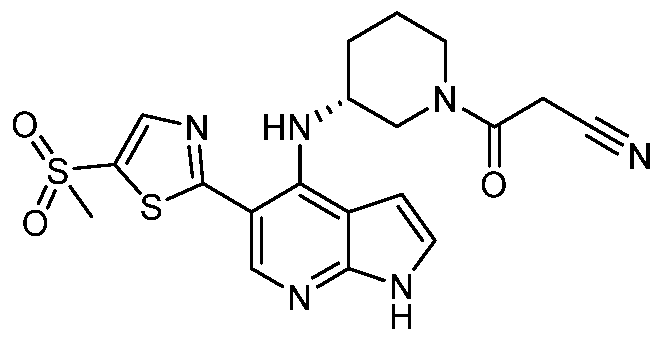
N-메틸피롤리돈 (5 mL) 중 시아노아세트산 (0.03 g, 0.39 mmol), 1-하이드록시-2-피리돈 (0.03 g, 0.31 mmol) 및 2-(1H-벤조트리아졸-1-일)-1,1,3,3-테트라메틸암모늄 테트라플루오로보레이트 (0.10 g, 0.31 mmol)의 교반된 용액에 (R)-5-(5-(메틸설포닐)티아졸-2-일)-N-(피페리딘-3-일)-1H-피롤로[2,3-b]피리딘-4-아민 (0.1 g, 0.26 mmol)을 첨가한 후, 트리에틸아민 (0.11 mL, 0.79 mmol)을 첨가하고, 생성된 혼합물을 상온에서 2시간 동안 교반하였다. 상기 반응 혼합물을 물로 희석하고 에틸 아세테이트로 추출하였다. 상기 유기층을 염수로 세척하고, 황산나트륨으로 건조시켜 여과 후 진공에서 농축시켰다. 상기 미정제물을 컬럼 크로마토그래피로 정제하여 (R)-3-(3-((5-(5-(메틸설포닐)티아졸-2-일)-1H-피롤로[2,3-b]피리딘-4-일)아미노)피페리딘-1-일)-3-옥소프로판니트릴을 황색 고체로서 수득하였다 (0.01 g, 10% 수율): 1H NMR (400 MHz, DMSO-d6, VT, 100℃) δ 11.58 (br s, 1H), 9.65 (br s, 1H), 8.42 (s, 1H), 8.24 (s, 1H), 7.21 (s, 1H), 6.71 (s, 1H), 3.54-4.44 (m, 6H), 3.42 (s, 3H), 1.21-2.04 (m, 5H); MS (ES) m/z 445.1 (M+H).Cyanoacetic acid (0.03 g, 0.39 mmol), 1-hydroxy-2-pyridone (0.03 g, 0.31 mmol) and 2-(1 H -benzotriazole- 1 in N-methylpyrrolidone (5 mL) To a stirred solution of -yl)-1,1,3,3-tetramethylammonium tetrafluoroborate (0.10 g, 0.31 mmol) ( R )-5-(5-(methylsulfonyl)thiazole-2- yl) - N - (piperidin-3-yl) -1 H - pyrrolo [2,3- b] after the addition of pyridine-4-amine (0.1 g, 0.26 mmol), triethylamine (0.11 mL , 0.79 mmol), and the resulting mixture was stirred at room temperature for 2 hours. The reaction mixture was diluted with water and extracted with ethyl acetate. The organic layer was washed with brine, dried over sodium sulfate, filtered and concentrated in vacuo. Purification of the crude by column chromatography to give (R) -3- (3 - ( (5- (5- ( methylsulfonyl) thiazol-2-yl) -1 H - pyrrolo [2,3- b ]pyridin-4-yl)amino)piperidin-1-yl)-3-oxopropanenitrile was obtained as a yellow solid (0.01 g, 10% yield): 1 H NMR (400 MHz, DMSO-d 6, VT, 100°C) δ 11.58 (br s, 1H), 9.65 (br s, 1H), 8.42 (s, 1H), 8.24 (s, 1H), 7.21 (s, 1H), 6.71 (s, 1H), 3.54-4.44 (m, 6H), 3.42 (s, 3H), 1.21-2.04 (m, 5H); MS (ES) m/z 445.1 (M+H).
[000480] 실시예 47: (R)-3-(3-((5-(5-(메틸설포닐)티아졸-2-일)-1H-피롤로[2,3-b]피리딘-4-일)아미노)피페리딘-1-일)프로판니트릴의 제조 [000 480] Example 47: (R) -3- (3 - ((5- (5- ( methylsulfonyl) thiazol-2-yl) -1 H-pyrrolo [2,3- b] pyridin- Preparation of 4-yl)amino)piperidin-1-yl)propanenitrile

반응식 45. (Scheme 45. ( RR )-3-(3-((5-(5-(메틸설포닐)티아졸-2-일)-1)-3-(3-((5-(5-(methylsulfonyl)thiazol-2-yl)-1 HH -피롤로[2,3--pyrrolo[2,3- bb ]피리딘-4-일)아미노)피페리딘-1-일)프로판니트릴의 제조] Preparation of pyridin-4-yl)amino)piperidin-1-yl)propanenitrile

[000481] (R)-3-(3-((5-(5-(메틸설포닐)티아졸-2-일)-1H-피롤로[2,3-b]피리딘-4-일)아미노)피페리딘-1-일)프로판니트릴의 제조 [000481] (R) -3- ( 3 - ((5- (5- ( methylsulfonyl) thiazol-2-yl) -1 H - pyrrolo [2,3- b] pyridin-4-yl) Preparation of amino)piperidin-1-yl)propanenitrile

에탄올 (3 mL) 중 (R)-5-(5-(메틸설포닐)티아졸-2-일)-N-(피페리딘-3-일)-1H-피롤로[2,3-b]피리딘-4-아민 (0.1 g, 0.26 mmol, 실시예 46, 단계 3)의 용액에 아크릴로니트릴 (0.14 g, 2.65 mmol) 및 트리에틸아민 (0.06 ml, 0.79 mmol)을 첨가한 후, 상기 용액을 80℃에서 3시간 동안 교반하였다. 상기 반응 혼합물을 주위 온도로 냉각하여 진공에서 농축시켰다. 상기 미정제 물질을 역상 크로마토그래피로 정제하여 (R)-3-(3-((5-(5-(메틸설포닐)티아졸-2-일)-1H-피롤로[2,3-b]피리딘-4-일)아미노)피페리딘-1-일)프로판니트릴을 황백색 고체로서 수득하였다 (0.03 g, 25%): 1H NMR (400 MHz, DMSO-d6) δ 9.83 (br s, 1H), 9.12 (br s, 1H), 8.45 (s, 1H), 8.24 (s, 1H), 7.10 (s, 1H), 6.69 (s, 1H), 4.32 (s, 1H), 3.24 (s, 3H), 2.95-3.07 (m, 1H), 2.65-2.85 (m, 2H), 2.37-2.67 (m, 4H), 1.80-2.04 (m, 2H), 1.16-1.30 (s, 3H); MS (ES) m/z 431.2 (M+H). Of ethanol (3 mL) (R) -5- (5- ( methylsulfonyl) thiazol-2-yl) - N - (piperidin-3-yl) -1 H - pyrrolo [2,3- b ] To a solution of pyridin-4-amine (0.1 g, 0.26 mmol, Example 46, Step 3) was added acrylonitrile (0.14 g, 2.65 mmol) and triethylamine (0.06 ml, 0.79 mmol), The solution was stirred at 80° C. for 3 hours. The reaction mixture was cooled to ambient temperature and concentrated in vacuo. Purification of the crude material by reverse phase chromatography (R) -3- (3 - ( (5- (5- ( methylsulfonyl) thiazol-2-yl) -1 H - pyrrolo [2,3- b ]pyridin-4-yl)amino)piperidin-1-yl)propanenitrile was obtained as an off-white solid (0.03 g, 25%): 1 H NMR (400 MHz, DMSO-d 6 ) δ 9.83 (br s, 1H), 9.12 (br s, 1H), 8.45 (s, 1H), 8.24 (s, 1H), 7.10 (s, 1H), 6.69 (s, 1H), 4.32 (s, 1H), 3.24 ( s, 3H), 2.95-3.07 (m, 1H), 2.65-2.85 (m, 2H), 2.37-2.67 (m, 4H), 1.80-2.04 (m, 2H), 1.16-1.30 (s, 3H); MS (ES) m/z 431.2 (M+H).
분석 조건:Analysis conditions:
유속: 20.0 ml/분 Flow rate: 20.0 ml/min
컬럼: Ascentis Express C18 (50 mm X 2.1 mm X 2.7 μm) Column: Ascentis Express C18 (50 mm X 2.1 mm X 2.7 μm)
이동상 (A): 수중 1% 암모니아 Mobile phase (A): 1% ammonia in water
이동상 (B): MeCNMobile phase (B): MeCN
[000482] 실시예 48: (R)-3-(3-((5-(5-(메틸설포닐)옥사졸-2-일)-1H-피롤로[2,3-b]피리딘-4-일) 아미노)피페리딘-1-일)-3-옥소프로판니트릴의 제조 [000 482] Example 48: (R) -3- (3 - ((5- (5- ( methylsulfonyl) oxazol-2-yl) -1 H-pyrrolo [2,3- b] pyridin- Preparation of 4-yl) amino) piperidin-1-yl) -3-oxopropanenitrile

반응식 46. (Scheme 46. ( RR )-3-(3-((5-(5-(메틸설포닐)옥사졸-2-일)-1)-3-(3-((5-(5-(methylsulfonyl)oxazol-2-yl)-1 HH -피롤로[2,3--pyrrolo[2,3- bb ]피리딘-4-일) 아미노)피페리딘-1-일)-3-옥소프로판니트릴의 제조 Preparation of ]pyridin-4-yl) amino) piperidin-1-yl) -3-oxopropanenitrile
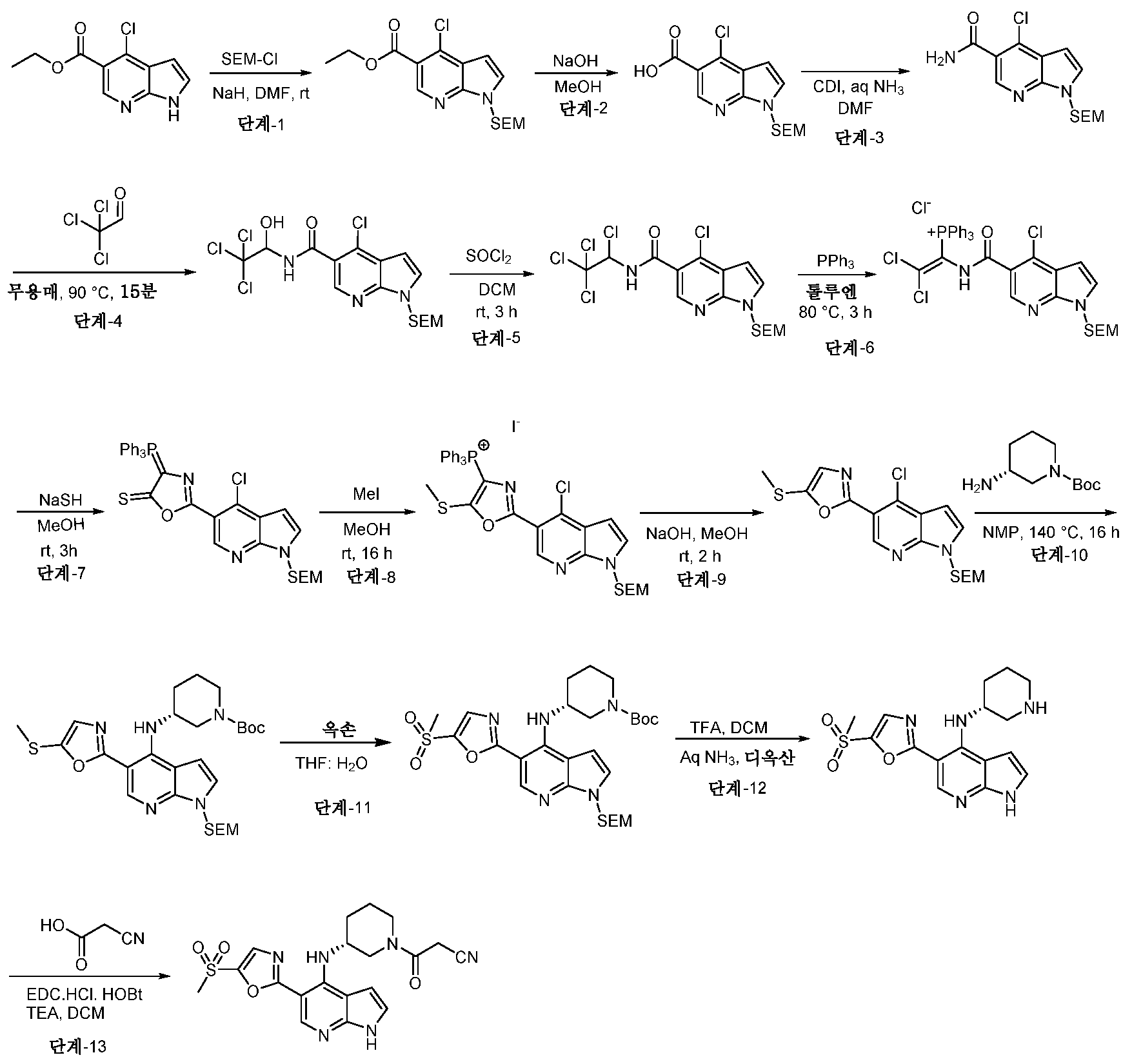
[000483] 단계 1: 에틸 4-클로로-1-((2-(트리메틸실릴)에톡시)메틸)-1H-피롤로[2,3-b]피리딘-5-카르복실레이트의 제조 Preparation of pyrrolo [2,3- b] pyridine-5-carboxylate ethyl 4-chloro-1 - ((2- (trimethylsilyl) ethoxy) methyl) -1 H: [000483] Step 1

N,N-디메틸포름아미드 (75 mL) 중 수소화나트륨 (2.14 g, 89.28 mmol, 광유 중 60%)의 교반된 현탁액에 에틸 4-클로로-1H-피롤로[2,3-b]피리딘-5-카르복실레이트 (10 g, 44.64 mmol)를 0℃에서 첨가하였다. 0.5시간 동안 교반한 후, 2-(트리메틸실릴)에톡시메틸 클로라이드 (8.7 mL, 55.34 mmol)를 0℃에서 첨가한 후, 상기 반응물을 2시간 동안 교반하였다. 상기 반응 혼합물을 얼음물로 ??칭하고 에틸 아세테이트로 추출하였다. 유기층을 황산나트륨으로 건조시킨 후, 여과 및 농축시켰다. 상기 미정제물을 섬광 크로마토그래피 (15% 에틸 아세테이트/헥산)로 정제하여 에틸 4-클로로-1-((2-(트리메틸 실릴)에톡시)메틸)-1H-피롤로[2,3-b]피리딘-5-카르복실레이트를 무색 액체로서 수득하였다 (7.8 g, 49% 수율): MS (ES) m/z 355.1 (M+H).To a stirred suspension of sodium hydride (2.14 g, 89.28 mmol, 60% in mineral oil) in N,N -dimethylformamide (75 mL) ethyl 4-chloro-1 H -pyrrolo[2,3- b ]pyridine- 5-carboxylate (10 g, 44.64 mmol) was added at 0°C. After stirring for 0.5 h, 2-(trimethylsilyl)ethoxymethyl chloride (8.7 mL, 55.34 mmol) was added at 0° C., and then the reaction was stirred for 2 h. The reaction mixture was quenched with ice water and extracted with ethyl acetate. The organic layer was dried over sodium sulfate, filtered and concentrated. Purification of the crude by flash chromatography (15% ethyl acetate / hexane) of ethyl 4-chloro-1 - ((2-bis (trimethylsilyl) ethoxy) methyl) -1 H-pyrrolo [2,3- b ]Pyridine-5-carboxylate was obtained as a colorless liquid (7.8 g, 49% yield): MS (ES) m/z 355.1 (M+H).
[000484] 단계 2: 4-클로로-1-((2-(트리메틸실릴)에톡시)메틸)-1H-피롤로[2,3-b]피리딘-5-카르복실산의 제조 [000 484] Step 2: 4-Chloro-1 - ((methylethoxy), 2- (trimethylsilyl)) -1 H-pyrrolo [2,3- b] pyridine-5-carboxylic acid Preparation of
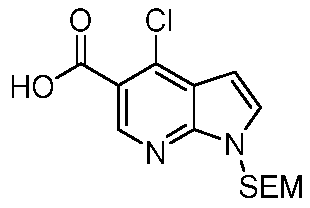
메탄올 (80 mL) 중 에틸 4-클로로-1-((2-(트리메틸실릴)에톡시)메틸)-1H-피롤로[2,3-b]피리딘-5-카르복실레이트 (7.8 , 21.91 mmol)의 용액에 2M 수산화나트륨 수용액 (4.38 g, 109.55 mmol)을 첨가한 후, 상기 혼합물을 상온에서 5시간 동안 교반하였다. 상기 반응 혼합물을 농축시켜 휘발성 물질들을 제거해 잔류물을 수득하고, 이를 물에 용해시키고 1N 염산으로 산성화하여 pH를 ~3으로 조정하였다. 수성층을 에틸 아세테이트로 추출하고, 무수 황산나트륨으로 건조시킨 후, 여과하고 진공에서 농축시켜 4-클로로-1-((2-(트리메틸실릴)에톡시)메틸)-1H-피롤로[2,3-b]피리딘-5-카르복실산을 황백색 고체로서 수득하였다 (6.3 g, 88% 수율): MS (ES) m/z: 327.1 (M+H).Methanol (80 mL) of ethyl 4-chloro-1 - ((2- (trimethylsilyl) ethoxy) methyl) -1 H-pyrrolo [2,3- b] pyridine-5-carboxylate (7.8, 21.91 mmol) was added 2M aqueous sodium hydroxide solution (4.38 g, 109.55 mmol), and the mixture was stirred at room temperature for 5 hours. The reaction mixture was concentrated to remove volatiles to give a residue, which was dissolved in water and acidified with 1N hydrochloric acid to adjust the pH to ˜3. After the aqueous layer was extracted with ethyl acetate, dried over anhydrous sodium sulfate, filtered and concentrated in vacuo to give 4-chloro-1 - ((methylethoxy), 2- (trimethylsilyl)) -1 H-pyrrolo [2,3 - b ]pyridine-5-carboxylic acid Obtained as an off-white solid (6.3 g, 88% yield): MS (ES) m/z : 327.1 (M+H).
[000485] 단계 3: 4-클로로-1-((2-(트리메틸실릴)에톡시)메틸)-1H-피롤로[2,3-b]피리딘-5-카르복사미드의 제조 [000 485] Step 3: 4-chloro-1 - ((methylethoxy), 2- (trimethylsilyl)) -1 H-pyrrolo [2,3- b] pyridine-5-carboxamide
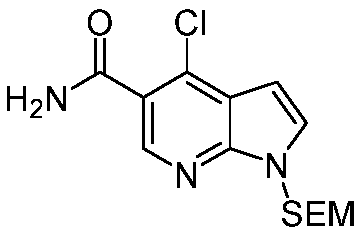
디메틸포름아미드 (30 mL) 중 4-클로로-1-((2-(트리메틸실릴)에톡시)메틸)-1H-피롤로[2,3-b]피리딘-5-카르복실산 (6.3 g, 19.32 mmol) 및 카보닐디이미다졸 (4.7 g, 28.98 mmol)의 용액을 상온에서 1시간 동안 교반하였다. 암모니아 (10 mL, 물 중 23%)를 첨가한 후, N,N-디이소프로필에틸아민 (5.0 mL, 28.98 mmol)을 첨가하고, 상기 용액을 3시간 동안 교반하였다. 상기 반응 혼합물을 얼음물로 ??칭하고 에틸 아세테이트로 추출하였다. 유기층을 황산나트륨으로 건조시킨 후, 여과 및 농축시켰다. 상기 미정제물을 섬광 크로마토그래피 (30% 에틸 아세테이트/헥산)로 정제하여 황백색 고체를 수득하였다 (4.56 g, 72% 수율): MS (ES) m/z: 326.1 (M+H).(A (2- (trimethylsilyl) ethoxy) methyl) -1 H - - dimethylformamide (30 mL) of 4-chloro-l H-pyrrolo [2,3- b] pyridine-5-carboxylic acid (6.3 g , 19.32 mmol) and carbonyldiimidazole (4.7 g, 28.98 mmol) were stirred at room temperature for 1 hour. Ammonia (10 mL, 23% in water) was added followed by N,N -diisopropylethylamine (5.0 mL, 28.98 mmol) and the solution was stirred for 3 h. The reaction mixture was quenched with ice water and extracted with ethyl acetate. The organic layer was dried over sodium sulfate, filtered and concentrated. The crude was purified by flash chromatography (30% ethyl acetate/hexanes) to give an off-white solid (4.56 g, 72% yield): MS (ES) m/z : 326.1 (M+H).
[000486] 단계 4: 4-클로로-N-(2,2,2-트리클로로-1-하이드록시에틸)-1-((2-(트리메틸실릴)에톡시)메틸)-1H-피롤로[2,3-b]피리딘-5-카르복사미드의 제조 [000 486] Step 4: 4-Chloro-N - (2,2,2- trichloro-1-hydroxyethyl) -1 - ((2- (trimethylsilyl) ethoxy) methyl) -1 H-pyrrolo [2,3- b ] Preparation of pyridine-5-carboxamide

4-클로로-1-((2-(트리메틸실릴)에톡시)메틸)-1H-피롤로[2,3-b]피리딘-5-카르복사미드 (3.0 g, 9.21 mmol) 및 2,2,2-트리클로로아세트알데하이드 (1.36 g, 9.21 mmol)의 고체 혼합물을 완전히 녹을 때까지 90℃로 가열하였다. 상기 반응 혼합물을 상온으로 냉각시키고, 미정제 생성물을 섬광 크로마토그래피 (30% 에틸 아세테이트/헥산)로 정제하여 4-클로로-N-(2,2,2-트리클로로-1-하이드록시에틸)-1-((2-(트리메틸실릴)에톡시)메틸)-1H-피롤로[2,3-b]피리딘-5-카르복사미드를 황백색 고체로서 수득하였다 (2 g, 47% 수율): MS (ES) m/z: 474.2 (M+H).4-Chloro-1 - ((2-bis (trimethylsilyl) ethoxy) methyl) -1 H-pyrrolo [2,3- b] pyridine-5-carboxamide (3.0 g, 9.21 mmol) and 2,2 A solid mixture of ,2-trichloroacetaldehyde (1.36 g, 9.21 mmol) was heated to 90° C. until completely dissolved. The reaction mixture was cooled to room temperature, and the crude product was purified by flash chromatography (30% ethyl acetate/hexanes) to 4-chloro- N- (2,2,2-trichloro-1-hydroxyethyl)- 1 - ((2- (trimethylsilyl) ethoxy) methyl) -1 H-pyrrolo [2,3- b] pyridine-5-carboxamide obtained as a pale yellow solid (2 g, 47% yield): MS (ES) m/z : 474.2 (M+H).
[000487] 단계 5: 4-클로로-N-(1,2,2,2-테트라클로로에틸)-1-((2-(트리메틸실릴)에톡시)메틸)-1H-피롤로[2,3-b]피리딘-5-카르복사미드의 제조 [000 487] Step 5: 4-Chloro-N - (1,2,2,2- tetrahydro-chloroethyl) - 1 - (ethoxy) (2- (trimethylsilyl) methyl) -1 H-pyrrolo [2, 3- b ] Preparation of pyridine-5-carboxamide

디클로로메탄 (30 mL) 중 4-클로로-N-(2,2,2-트리클로로-1-하이드록시에틸)-1-{[2-(트리메틸실릴)에톡시]메틸}-1H-피롤로[2,3-b]피리딘-5-카르복사미드 (1.30 g, 2.75 mmol)의 용액에 염화티오닐 (0.24 mL, 3.30 mmol)을 첨가한 후, 상기 용액을 상온에서 교반하였다. 3시간 후, 상기 반응 혼합물을 질소 대기 하에 진공에서 농축시켜 4-클로로-N-(1,2,2,2-테트라클로로에틸)-1-{[2-(트리메틸실릴)에톡시]메틸}-1H-피롤로[2,3-b]피리딘-5-카르복사미드를 무색의 검으로서 수득하였다 (1.35 g, 미정제). 상기 미정제 물질을 추가의 정제없이 다음 단계에서 취하였다.Of dichloro methane (30 mL), 4- chloro-N - (2,2,2-trichloro-1-hydroxyethyl) -1 - {[2- (trimethylsilyl) ethoxy] methyl} -1 H-P To a solution of rollo[2,3- b ]pyridine-5-carboxamide (1.30 g, 2.75 mmol) was added thionyl chloride (0.24 mL, 3.30 mmol), and the solution was stirred at room temperature. After 3 h, the reaction mixture was concentrated in vacuo under nitrogen atmosphere to 4-chloro- N- (1,2,2,2-tetrachloroethyl)-1-{[2-(trimethylsilyl)ethoxy]methyl} -1 H - pyrrolo [2,3- b] pyridine-5-carboxamide methanesulfonate was obtained as a colorless gum (1.35 g, crude). The crude material was taken to the next step without further purification.
[000488] 단계 6: (2,2-디클로로-1-(4-클로로-1-((2-(트리메틸실릴)에톡시)메틸)-1H-피롤로[2,3-b]피리딘-5-카르복사미도)비닐)트리페닐포스포늄 클로라이드의 제조 [000 488] Step 6: (2,2-dichloro-1- (4-chloro-1 - ((2- (trimethylsilyl) ethoxy) methyl) -1 H-pyrrolo [2,3-b] pyridin- Preparation of 5-carboxamido)vinyl)triphenylphosphonium chloride

톨루엔 (30 mL) 중 4-클로로-N-(1,2,2,2-테트라클로로에틸)-1-{[2-(트리메틸실릴)에톡시]메틸}-1H-피롤로[2,3-b]피리딘-5-카르복사미드 (1.35 g, 2.75 mmol)의 교반된 용액에 트리페닐포스핀 (0.72 g, 2.75 mmol)을 첨가한 후, 상기 용액을 80℃로 가열하였다. 3시간 후, 상기 반응 혼합물을 상온으로 냉각하고 진공에서 농축시켜 (2,2-디클로로-1-(4-클로로-1-((2-(트리메틸실릴)에톡시) 메틸)-1H-피롤로[2,3-b]피리딘-5-카르복사미도)비닐)트리페닐포스포늄 클로라이드를 무색의 검으로서 수득하였다 (2.07 g, 미정제): MS (ES) m/z: 682.4 (M-Cl).4-Chloro-N-(1,2,2,2-tetrachloroethyl)-1-{[2-(trimethylsilyl)ethoxy]methyl}-1 H -pyrrolo[2, in toluene (30 mL) To a stirred solution of 3- b ]pyridine-5-carboxamide (1.35 g, 2.75 mmol) was added triphenylphosphine (0.72 g, 2.75 mmol), and then the solution was heated to 80°C. After 3 hours, cool the reaction mixture to room temperature and concentrated in vacuo to give (2,2-dichloro-1- (4-chloro-l-ethoxy ((2- (trimethylsilyl)) methyl) -1 H-P Rolo[2,3- b ]pyridine-5-carboxamido)vinyl)triphenylphosphonium chloride was obtained as a colorless gum (2.07 g, crude): MS (ES) m/z : 682.4 (M- Cl).
[000489] 단계 7: 2-(4-클로로-1-{[2-(트리메틸실릴)에톡시]메틸}-1H-피롤로[2,3-b]피리딘-5-일)-4-(트리페닐-λ5-포스파닐리덴)-4,5-디하이드로-1,3-옥사졸-5-티온의 제조 [000 489] Step 7: 2- (4-chloro-1 - {[2- (trimethylsilyl) ethoxy] methyl} -1 H-pyrrolo [2,3- b] pyridin-5-yl) -4- Preparation of (triphenyl-λ 5 -phosphanylidene)-4,5-dihydro-1,3-oxazole-5-thione

메탄올 (45 mL) 중 (2,2-디클로로-1-(4-클로로-1-((2-(트리메틸실릴)에톡시)메틸)-1H-피롤로[2,3-b]피리딘-5-카르복사미도)비닐)트리페닐포스포늄 클로라이드 (2.0 g, 2.78 mmol)의 교반된 용액에 황화수소나트륨 (0.5 g, 8.80 mmol)를 첨가한 후, 상기 혼합물을 상온에서 교반하였다. 3시간 후, 상기 반응 혼합물을 에틸 아세테이트로 희석한 후, 물과 염수로 세척하였다. 유기층을 황산나트륨으로 건조시킨 후, 여과 및 농축시켰다. 상기 미정제물을 섬광 크로마토그래피 (50% 에틸 아세테이트/헥산)로 정제하여 2-(4-클로로-1-{[2-(트리메틸실릴)에톡시]메틸}-1H-피롤로[2,3-b]피리딘-5-일)-4-(트리페닐-λ5-포스파닐리덴)-4,5-디하이드로-1,3-옥사졸-5-티온을 담황색의 걸쭉한 액체로서 수득하였다 (1.23 g, 65% 수율): MS (ES) m/z: 642.2 (M+H).Methanol (45 mL) of (2,2-dichloro-1- (4-chloro-l-ethoxy) methyl) -1 H a ((2- (trimethylsilyl) -pyrrolo [2,3- b] pyridin- To a stirred solution of 5-carboxamido)vinyl)triphenylphosphonium chloride (2.0 g, 2.78 mmol) was added sodium hydrogensulfide (0.5 g, 8.80 mmol), and then the mixture was stirred at room temperature. After 3 hours, the reaction mixture was diluted with ethyl acetate and washed with water and brine. The organic layer was dried over sodium sulfate, filtered and concentrated. Purification of the crude by flash chromatography (50% ethyl acetate / hexanes) afforded 2- (4-chloro-1 - {[2- (trimethylsilyl) ethoxy] methyl} -1 H-pyrrolo [2,3 -b ]pyridin-5-yl)-4-(triphenyl-λ 5 -phosphanylidene)-4,5-dihydro-1,3-oxazole-5-thione was obtained as a pale yellow thick liquid (1.23 g, 65% yield): MS (ES) m/z : 642.2 (M+H).
[000490] 단계 8: (2-(4-클로로-1-((2-(트리메틸실릴)에톡시)메틸)-1H-피롤로[2,3-b]피리딘-5-일)-5-(메틸티오)옥사졸-4-일)트리페닐포스포늄 아이오다이드의 제조 [000 490] Step 8: (2- (4-chloro-l - ((2- (trimethylsilyl) ethoxy) methyl) -1 H-pyrrolo [2,3- b] pyridin-5-yl) -5 Preparation of -(methylthio)oxazol-4-yl)triphenylphosphonium iodide

메탄올 (30 mL) 중 2-(4-클로로-1-{[2-(트리메틸실릴)에톡시]메틸}-1H-피롤로[2,3-b]피리딘-5-일)-4-(트리페닐-λ5-포스파닐리덴)-4,5-디하이드로-1,3-옥사졸-5-티온 (1.35 g, 2.10 mmol)의 교반된 용액에 요오드메탄 (0.9 g, 6.31 mmol)을 첨가한 후, 상기 혼합물을 상온에서 16시간 동안 교반하였다. 상기 반응 혼합물을 진공에서 농축하여 무수 상태로 만들어 [2-(4-클로로-1-{[2-(트리메틸실릴)에톡시]메틸}-1H-피롤로[2,3-b]피리딘-5-일)-5-(메틸설파닐)-1,3-옥사졸-4-일]트리페닐포스파늄 아이오다이드를 점성의 담황색 액체로서 수득하였다 (1.50 g, 미정제): MS (ES) m/z: 656.2 (M-I).In methanol (30 mL) of 2- (4- chloro-l - {[2- (trimethylsilyl) ethoxy] methyl} -1 H-pyrrolo [2,3- b] pyridin-5-yl) -4- To a stirred solution of (triphenyl-λ 5 -phosphanylidene)-4,5-dihydro-1,3-oxazole-5-thione (1.35 g, 2.10 mmol) in iodomethane (0.9 g, 6.31 mmol) ), and the mixture was stirred at room temperature for 16 hours. Made to dryness by concentration of the reaction mixture in a vacuum [2- (4-chloro-1 - {[2- (trimethylsilyl) ethoxy] methyl} -1 H-pyrrolo [2,3- b] pyridin- 5-yl)-5-(methylsulfanyl)-1,3-oxazol-4-yl]triphenylphosphanium iodide was obtained as a viscous pale yellow liquid (1.50 g, crude): MS (ES ) m/z : 656.2 (MI).
[000491] 단계 9: 2-(4-클로로-1-((2-(트리메틸실릴)에톡시)메틸)-1H-피롤로[2,3-b]피리딘-5-일)-5-(메틸티오)옥사졸의 제조 [000 491] Step 9: 2- (4-chloro-l-ethoxy) ((2- (trimethylsilyl) methyl) -1 H-pyrrolo [2,3- b] pyridin-5-yl) -5- Preparation of (methylthio)oxazole

메탄올 (2 mL) 중 2-(4-클로로-1-{[2-(트리메틸실릴)에톡시]메틸}-1H-피롤로[2,3-b]피리딘-5-일)-5-(메틸설파닐)-1,3-옥사졸-4-일]트리페닐포스파늄 아이오다이드 (1.50 g, 2.28 mmol)의 교반된 용액에 2 M 수산화나트륨 수용액 (0.36 g, 9.13 mmol)을 첨가한 후, 상기 용액을 상온에서 2시간 동안 교반하였다. 상기 반응 혼합물을 에틸 아세테이트로 희석하고, 물, 염수로 세척하여 무수 황산나트륨으로 건조시킨 후, 여과하여 진공에서 농축시켰다. 상기 미정제 물질을 섬광 크로마토그래피 (10% 에틸 아세테이트/헥산)로 정제하여 2-(4-클로로-1-((2-(트리메틸실릴)에톡시)메틸)-1H-피롤로[2,3-b]피리딘-5-일)-5-(메틸티오)옥사졸을 담황색 액체로서 수득하였다 (0.22 g, 24% 수율): MS (ES) m/z: 396.1 (M+H).Methanol in 2 (2 mL) (4- chloro-l - {[2- (trimethylsilyl) ethoxy] methyl} -1 H-pyrrolo [2,3- b] pyridin-5-yl) -5- To a stirred solution of (methylsulfanyl)-1,3-oxazol-4-yl]triphenylphosphanium iodide (1.50 g, 2.28 mmol) was added 2 M aqueous sodium hydroxide solution (0.36 g, 9.13 mmol) After that, the solution was stirred at room temperature for 2 hours. The reaction mixture was diluted with ethyl acetate, washed with water, brine, dried over anhydrous sodium sulfate, filtered and concentrated in vacuo. The crude by flash chromatography (10% ethyl acetate / hexane) to give 2- (4-chloro-l-ethoxy ((2- (trimethylsilyl)) methyl) -1 H-pyrrolo [2, Obtained 3- b ]pyridin-5-yl)-5-(methylthio)oxazole as a pale yellow liquid (0.22 g, 24% yield): MS (ES) m/z : 396.1 (M+H).
[000492] 단계 10: tert-부틸 (R)-3-((5-(5-(메틸티오)옥사졸-2-일)-1-((2-(트리메틸실릴)에톡시) 메틸)-1H-피롤로[2,3-b]피리딘-4-일)아미노)피페리딘-1-카르복실레이트의 제조 [000492] Step 10: tert -Butyl ( R )-3-((5-(5-(methylthio)oxazol-2-yl)-1-((2-(trimethylsilyl)ethoxy)methyl)- Preparation of 1 H -pyrrolo[2,3-b]pyridin-4-yl)amino)piperidine-1-carboxylate

10 mL 바이알에서, N-메틸-2-피롤리돈 (10 mL) 중의 2-(4-클로로-1-{[2-(트리메틸실릴)에톡시]메틸}-1H-피롤로[2,3-b]피리딘-5-일)-5-(메틸설파닐)-1,3-옥사졸 (0.4 g, 1.01 mmol), tert-부틸 (3R)-3-아미노피페리딘-1-카르복실레이트 (0.4 g, 2.02 mmol) 및 N,N-디이소프로필에틸아민 (0.39 g, 3.03 mmol)을 140℃로 16시간 동안 가열하였다. 상기 반응 혼합물을 상온으로 냉각하고, 에틸 아세테이트로 희석한 후, 물과 염수로 세척하였다. 상기 유기층을 무수 황산나트륨으로 건조시킨 후, 여과하여 진공에서 농축시켰다. 상기 미정제 물질을 섬광 크로마토그래피 (30% 에틸 아세테이트/헥산)로 정제하여 tert-부틸 (3R)-3-({5-[5-(메틸설파닐)-1,3-옥사졸-2-일]-1-{[2-(트리메틸실릴)에톡시]메틸}-1H-피롤로[2,3-b]피리딘-4-일}아미노)피페리딘-1-카르복실레이트를 점성의 갈색 액체로서 수득하였다 (0.41 g, 72% 수율): MS (ES) m/z: 560.5 (M+H). In a 10 mL vial, 2-(4-chloro-1-{[2-(trimethylsilyl)ethoxy]methyl}-1 H -pyrrolo[2, in N-methyl-2-pyrrolidone (10 mL)) 3- b ]pyridin-5-yl)-5-(methylsulfanyl)-1,3-oxazole (0.4 g, 1.01 mmol), tert -butyl (3 R )-3-aminopiperidine-1- Carboxylate (0.4 g, 2.02 mmol) and N,N -diisopropylethylamine (0.39 g, 3.03 mmol) were heated to 140° C. for 16 h. The reaction mixture was cooled to room temperature, diluted with ethyl acetate, and washed with water and brine. The organic layer was dried over anhydrous sodium sulfate, filtered, and concentrated in vacuo. The crude material was purified by flash chromatography (30% ethyl acetate/hexanes) to tert -butyl (3 R )-3-({5-[5-(methylsulfanyl)-1,3-oxazole-2) -yl] -1 - {[2- (trimethylsilyl) ethoxy] methyl} -1 H-a pyrrolo [2,3- b] pyridin-4-yl} amino) piperidine-1-carboxylate Obtained as a viscous brown liquid (0.41 g, 72% yield): MS (ES) m/z : 560.5 (M+H).
[000493] 단계 11: tert-부틸 (R)-3-((5-(5-(메틸설포닐)옥사졸-2-일)-1-((2-(트리메틸실릴) 에톡시)메틸)-1H-피롤로[2,3-b]피리딘-4-일)아미노)피페리딘-1-카르복실레이트의 제조 [000493] Step 11: tert -Butyl ( R )-3-((5-(5-(methylsulfonyl)oxazol-2-yl)-1-((2-(trimethylsilyl)ethoxy)methyl) Preparation of -1 H -pyrrolo[2,3-b]pyridin-4-yl)amino)piperidine-1-carboxylate

테트라하이드로퓨란 : 물 (10 mL : 3 mL) 중 tert-부틸 (3R)-3-({5-[5-(메틸설파닐)-1,3-옥사졸-2-일]-1-{[2-(트리메틸실릴) 에톡시]메틸}-1H-피롤로[2,3-b]피리딘-4-일}아미노)피페리딘-1-카르복실레이트 (0.38 g, 0.68 mmol)의 교반된 용액에 옥손 (1.68 g, 2.72 mmol)을 첨가한 후, 상기 혼합물을 상온에서 16시간 동안 교반하였다. 상기 반응 혼합물을 에틸 아세테이트로 희석한 후, 물과 염수로 세척하였다. 상기 유기층을 무수 황산나트륨으로 건조시킨 후, 여과하여 진공에서 농축시켰다. 상기 미정제물을 섬광 크로마토그래피 (40% 에틸 아세테이트/헥산)로 정제하여 tert-부틸 (3R)-3-{[5-(5-메탄설포닐-1,3-옥사졸-2-일)-1-{[2-(트리메틸실릴)에톡시]메틸}-1H-피롤로[2,3-b]피리딘-4-일]아미노}피페리딘-1-카르복실레이트를 담황색의 진득한 고체로서 수득하였다 (0.32 g, 80% 수율): MS (ES) m/z: 592.5 (M+H). Tetrahydrofuran: tert -Butyl (3 R )-3-({5-[5-(methylsulfanyl)-1,3-oxazol-2-yl]-1- in water (10 mL : 3 mL) {[2- (trimethylsilyl) ethoxy] methyl} -1 H - pyrrolo [2,3- b] pyridin-4-yl} amino) piperidine-1-carboxylate (0.38 g, 0.68 mmol) After adding oxone (1.68 g, 2.72 mmol) to a stirred solution of , the mixture was stirred at room temperature for 16 hours. The reaction mixture was diluted with ethyl acetate and washed with water and brine. The organic layer was dried over anhydrous sodium sulfate, filtered, and concentrated in vacuo. The crude was purified by flash chromatography (40% ethyl acetate/hexanes) to tert -butyl (3 R )-3-{[5-(5-methanesulfonyl-1,3-oxazol-2-yl) 1 - {[2- (trimethylsilyl) ethoxy] methyl} -1 H-pyrrolo [2,3- b] pyridin-4-yl] amino} piperidine-1-carboxylate of a light yellow jindeukhan Obtained as a solid (0.32 g, 80% yield): MS (ES) m/z : 592.5 (M+H).
[000494] 단계 12: (R)-5-(5-(메틸설포닐)옥사졸-2-일)-N-(피페리딘-3-일)-1H-피롤로[2,3-b] 피리딘-4-아민의 제조 [000 494] Step 12: (R) -5- (5- ( methylsulfonyl) oxazol-2-yl) - N - (piperidin-3-yl) -1 H - pyrrolo [2,3- b ] Preparation of pyridin-4-amine

디클로로메탄 : 트리플루오로아세트산 (5 mL : 5 mL) 중 tert-부틸 (3R)-3-{[5-(5-메탄설포닐-1,3-옥사졸-2-일)-1-{[2-(트리메틸실릴)에톡시]메틸}-1H-피롤로[2,3-b]피리딘-4-일]아미노}피페리딘-1-카르복실레이트 (0.26 g, 439 μmol)의 용액을 상온에서 3시간 동안 교반하였다. 상기 반응 혼합물을 진공에서 농축하고, 잔류물을 1,4-디옥산 : 수성 암모니아 (5 mL : 5 mL, 물 중 23%)에 용해시킨 후, 상기 용액을 상온에서 16시간 동안 교반하였다. 상기 반응 혼합물을 진공에서 농축하여 무수 상태로 만들어 (3R)-N-[5-(5-메탄설포닐-1,3-옥사졸-2-일)-1H-피롤로[2,3-b]피리딘-4-일]피페리딘-3-아민을 무색의 진득한 고체로서 수득하였다 (0.32 g, 80% 수율): MS (ES) m/z: 362.2 (M+H). Dichloromethane: tert -butyl (3 R )-3-{[5-(5-methanesulfonyl-1,3-oxazol-2-yl)-1- in trifluoroacetic acid (5 mL: 5 mL) {[2- (trimethylsilyl) ethoxy] methyl} -1 H - pyrrolo [2,3- b] pyridin-4-yl] amino} piperidine-1-carboxylate (0.26 g, 439 μmol) The solution was stirred at room temperature for 3 hours. The reaction mixture was concentrated in vacuo, the residue was dissolved in 1,4-dioxane : aqueous ammonia (5 mL : 5 mL, 23% in water), and the solution was stirred at room temperature for 16 h. Made to dryness by concentration of the reaction mixture in vacuo to (3 R) - N - [ 5- (5- methanesulfonyl-1,3-oxazol-2-yl) -1 H - pyrrolo [2,3 -b ]pyridin-4-yl]piperidin-3-amine was obtained as a colorless thick solid (0.32 g, 80% yield): MS (ES) m/z : 362.2 (M+H).
[000495] 단계 13: (R)-3-(3-((5-(5-(메틸설포닐)옥사졸-2-일)-1H-피롤로[2,3-b]피리딘-4-일) 아미노)피페리딘-1-일)-3-옥소프로판니트릴의 제조 [000 495] Step 13: (R) -3- (3 - ((5- (5- ( methylsulfonyl) oxazol-2-yl) -1 H - pyrrolo [2,3- b] pyridine -4 Preparation of -yl) amino) piperidin-1-yl) -3-oxopropanenitrile

디클로로메탄 (10 mL) 중 2-시아노아세트산 (0.04 g, 0.45 mmol) 및 1-하이드록시벤조트리아졸 (0.06 g, 0.4 mmol)의 용액을 2분간 교반하였다. 이후, (3R)-N-[5-(5-메탄설포닐-1,3-옥사졸-2-일)-1H-피롤로[2,3-b]피리딘-4-일]피페리딘-3-아민 (0.11 g, 0.30 mmol), N-(3-디메틸아미노프로필)-N'-에틸카르보디이미드 하이드로클로라이드 (0.09 g, 0.46 mmol) 및 트리에틸아민 (0.18 mL, 1.12 mmol)을 첨가한 뒤, 상기 혼합물을 상온에서 16시간 동안 교반하였다. 상기 반응 혼합물을 물로 ??칭하고 에틸 아세테이트로 추출하였다. 상기 유기층을 물과 염수로 세척하고, 무수 황산나트륨으로 건조시킨 후, 여과하여 진공에서 농축시켰다. 상기 미정제 물질을 역상 크로마토그래피로 정제하여 3-[(3R)-3-{[5-(5-메탄설포닐-1,3-옥사졸-2-일)-1H-피롤로[2,3-b]피리딘-4-일]아미노}피페리딘-1-일]-3-옥소프로판니트릴을 황백색 고체로서 수득하였다 (0.03 g, 60% 수율): 1H NMR (400 MHz, DMSO-d6, VT, 80℃) δ 11.58 (br s, 1H), 8.74 (d, J = 5.6 Hz, 1H), 8.62 (s, 1H), 7.93 (s, 1H), 7.23 (s, 1H), 6.71 (s, 1H), 4.24-4.43 (m, 1H), 3.71-4.05 (m, 3H), 3.41-3.55 (m, 6H), 2.80-2.11 (m, 1H), 1.55-1.85 (m, 3H); MS (ES) m/z 429.1 (M+H). A solution of 2-cyanoacetic acid (0.04 g, 0.45 mmol) and 1-hydroxybenzotriazole (0.06 g, 0.4 mmol) in dichloromethane (10 mL) was stirred for 2 min. Later, (3 R) - N - [5- (5- methanesulfonyl-1,3-oxazol-2-yl) -1 H - pyrrolo [2,3- b] pyridin-4-yl] P Peridin-3-amine (0.11 g, 0.30 mmol), N- (3-dimethylaminopropyl)-N′-ethylcarbodiimide hydrochloride (0.09 g, 0.46 mmol) and triethylamine (0.18 mL, 1.12 mmol) ) was added, and the mixture was stirred at room temperature for 16 hours. The reaction mixture was quenched with water and extracted with ethyl acetate. The organic layer was washed with water and brine, dried over anhydrous sodium sulfate, filtered and concentrated in vacuo. Purification of the crude material by reverse phase chromatography, 3 - [(3 R) -3 - {[5- (5- methanesulfonyl-1,3-oxazol-2-yl) -1 H - pyrrolo [ 2,3- b ]pyridin-4-yl]amino}piperidin-1-yl]-3-oxopropanenitrile was obtained as an off-white solid (0.03 g, 60% yield): 1 H NMR (400 MHz, DMSO-d 6 , VT, 80° C.) δ 11.58 (br s, 1H), 8.74 (d, J = 5.6 Hz, 1H), 8.62 (s, 1H), 7.93 (s, 1H), 7.23 (s, 1H) ), 6.71 (s, 1H), 4.24-4.43 (m, 1H), 3.71-4.05 (m, 3H), 3.41-3.55 (m, 6H), 2.80-2.11 (m, 1H), 1.55-1.85 (m) , 3H); MS (ES) m/z 429.1 (M+H).
분석 조건: Analysis conditions:
유속: 0.3 mL/분 Flow rate: 0.3 mL/min
컬럼: Ascentis Express C18 (50 mm X 2.1 mm X 2.7 μm) Column: Ascentis Express C18 (50 mm X 2.1 mm X 2.7 μm)
이동상 (A): 물 중 0.1% 포름산 Mobile phase (A): 0.1% formic acid in water
이동상 (B): MeCN Mobile phase (B): MeCN
[000496] 실시예 49: (R)-3-(3-((5-(2-(메틸티오)피리미딘-4-일)-1H-피롤로[2,3-b]피리딘-4-일)아미노)피페리딘-1-일)-3-옥소프로판니트릴의 제조 [000 496] Example 49: (R) -3- (3 - ((5- (2- ( methylthio) pyrimidin-4-yl) -1 H - pyrrolo [2,3- b] pyridine -4 Preparation of -yl)amino)piperidin-1-yl)-3-oxopropanenitrile

반응식 47. (Scheme 47. ( RR )-3-(3-((5-(2-(메틸티오)피리미딘-4-일)-1)-3-(3-((5-(2-(methylthio)pyrimidin-4-yl)-1 HH -피롤로[2,3--pyrrolo[2,3- bb ]피리딘-4-일)아미노)피페리딘-1-일)-3-옥소프로판니트릴의 제조 ] Preparation of pyridin-4-yl)amino)piperidin-1-yl)-3-oxopropanenitrile

[000497] 단계 1: tert-부틸 (R)-3-((5-(2-(메틸티오)피리미딘-4-일)-1-((2-(트리메틸실릴)에톡시) 메틸)-1H-피롤로[2,3-b]피리딘-4-일)아미노)피페리딘-1-카르복실레이트의 제조 [000497] Step 1: tert -Butyl ( R )-3-((5-(2-(methylthio)pyrimidin-4-yl)-1-((2-(trimethylsilyl)ethoxy)methyl)- Preparation of 1 H -pyrrolo[2,3-b]pyridin-4-yl)amino)piperidine-1-carboxylate

1,4-디옥산 (40 mL) 중 4-클로로-2-(메틸티오)피리미딘 (0.30 g, 1.87 mmol) 및 tert-부틸 (R)-3-((5-(4,4,5,5-테트라메틸-1,3,2-디옥사보롤란-2-일)-1-((2-(트리메틸실릴)에톡시)메틸)-1H-피롤로[2,3-b]피리딘-4-일)아미노)피페리딘-1-카르복실레이트 (1.07 g, 1.87 mmol)의 교반된 용액에 디클로로메탄 (0.08 g, 0.09 mmol)과의 [1,1'-비스(디페닐포스피노) 페로센]디클로로팔라듐(II) 착물 및 탄산칼륨 (0.64 g, 4.68 mmol)을 첨가한 후, 상기 혼합물을 100℃로 16시간 동안 가열하였다. 상기 반응 혼합물을 상온으로 냉각시키고, 에틸 아세테이트와 물로 희석하였다. 상기 유기층을 분리하고, 황산나트륨으로 건조시켜 여과 후 진공에서 농축시켰다. 상기 미정제 잔류물을 섬광 크로마토그래피 (40% 에틸 아세테이트/헥산)로 정제하여 tert-부틸 (R)-3-((5-(2-(메틸티오)피리미딘-4-일)-1-((2-(트리메틸실릴) 에톡시)메틸)-1H-피롤로[2,3-b]피리딘-4-일)아미노)피페리딘-1-카르복실레이트를 황색 액체로서 수득하였다 (0.5 g, 50% 수율): MS (ES) m/z 571.4 (M+H).4-chloro-2-(methylthio)pyrimidine (0.30 g, 1.87 mmol) and tert- butyl ( R )-3-((5-(4,4,5) in 1,4-dioxane (40 mL) , 5-tetramethyl-1,3,2 dioxaborolan-2-yl) - 1 - ((2- (trimethylsilyl) ethoxy) methyl) -1 H-pyrrolo [2,3- b] pyridin-4-yl)amino)piperidine-1-carboxylate [1,1'-bis(diphenylphosphino)ferrocene]dichloropalladium(II) complex with dichloromethane (0.08 g, 0.09 mmol) in a stirred solution of (1.07 g, 1.87 mmol) and potassium carbonate (0.64 g , 4.68 mmol), the mixture was heated to 100° C. for 16 h. The reaction mixture was cooled to room temperature and diluted with ethyl acetate and water. The organic layer was separated, dried over sodium sulfate, filtered and concentrated in vacuo. The crude residue was purified by flash chromatography (40% ethyl acetate/hexanes) to tert -butyl ( R )-3-((5-(2-(methylthio)pyrimidin-4-yl)-1- ((methylethoxy), 2- (trimethylsilyl)) -1 H - pyrrolo [2,3- b] pyridin-4-yl) amino) to give piperidine-1-carboxylate as a yellow liquid ( 0.5 g, 50% yield): MS (ES) m/z 571.4 (M+H).
[000498] 단계 2: (R)-5-(2-(메틸티오)피리미딘-4-일)-N-(피페리딘-3-일)-1H-피롤로[2,3-b]피리딘-4-아민의 제조 [000 498] Step 2: (R) -5- (2- ( methylthio) pyrimidin-4-yl) - N - (piperidin-3-yl) -1 H - pyrrolo [2,3- b ]Preparation of pyridin-4-amine

디클로로메탄 : 트리플루오로아세트산 (3 mL : 6 mL) 중 tert-부틸 (R)-3-((5-(2-(메틸티오)피리미딘-4-일)-1-((2-(트리메틸실릴)에톡시)메틸)-1H-피롤로[2,3-b]피리딘-4-일)아미노)피페리딘-1-카르복실레이트 (0.35 g, 0.61 mmol)의 용액을 상온에서 3시간 동안 교반하였다. 상기 반응 혼합물을 진공에서 농축하고, 잔류물을 1,4-디옥산 : 수성 암모니아 (3 mL: 5 mL, 물 중 23%)에 용해시킨 후, 상기 반응 혼합물을 상온에서 16시간 동안 교반하였다. 상기 반응 혼합물을 진공에서 농축시켜 (R)-5-(2-(메틸티오)피리미딘-4-일)-N-(피페리딘-3-일)-1H-피롤로[2,3-b]피리딘-4-아민을 황색 고체로서 수득하였다 (0.3 g, 미정제): MS (ES) m/z 341.1 (M+H). Dichloromethane: tert -butyl ( R )-3-((5-(2-(methylthio)pyrimidin-4-yl)-1-((2-() in trifluoroacetic acid (3 mL: 6 mL)) trimethylsilyl) ethoxy) methyl) -1 H - pyrrolo [2,3- b] pyridin-4-yl) amino) piperidine-1-carboxylate (0.35 g, a solution of 0.61 mmol) at room temperature Stirred for 3 hours. The reaction mixture was concentrated in vacuo, the residue was dissolved in 1,4-dioxane : aqueous ammonia (3 mL: 5 mL, 23% in water), and then the reaction mixture was stirred at room temperature for 16 h. The reaction mixture was concentrated in vacuo (R) -5- (2- (methylthio) pyrimidin-4-yl) - N - (piperidin-3-yl) -1 H - pyrrolo [2,3 -b ]pyridin-4-amine was obtained as a yellow solid (0.3 g, crude): MS (ES) m/z 341.1 (M+H).
[000499] 단계 3: (R)-3-(3-((5-(2-(메틸티오)피리미딘-4-일)-1H-피롤로[2,3-b]피리딘-4-일)아미노)피페리딘-1-일)-3-옥소프로판니트릴 [000 499] Step 3: (R) -3- (3 - ((5- (2- ( methylthio) pyrimidin-4-yl) -1 H - pyrrolo [2,3- b] pyridin-4 yl)amino)piperidin-1-yl)-3-oxopropanenitrile
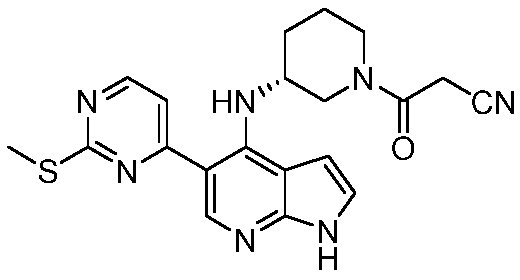
N,N-디메틸포름아미드 (60 mL) 중의 시아노아세트산 (0.11 g, 1.32 mmol) 및 1-[비스(디메틸아미노)메틸렌]-1H-1,2,3-트리아졸로[4,5-b]피리디늄 3-옥사이드 헥사플루오로포스페이트 (0.40 g, 1.05 mmol)의 용액을 3분간 교반하였다. 이후, (R)-5-(2-(메틸티오)피리미딘-4-일)-N-(피페리딘-3-일)-1H-피롤로[2,3-b]피리딘-4-아민 (0.30 g, 0.88 mmol)을 첨가한 후, N,N-디이소프로필에틸아민 (0.48 mL, 2.64 mmol)을 첨가하였다. 상기 반응 혼합물을 상온에서 16시간 동안 교반하였다. 상기 반응 혼합물을 에틸 아세테이트로 희석한 후, 물과 염수로 세척하였다. 상기 유기층을 무수 황산나트륨으로 건조시킨 후, 여과 및 진공에서 농축시켰다. 상기 미정제 잔류물을 역상 크로마토그래피로 정제하여 (R)-3-(3-((5-(2-(메틸티오)피리미딘-4-일)-1H-피롤로[2,3-b]피리딘-4-일)아미노)피페리딘-1-일)-3-옥소프로판니트릴을 담황색 고체로서 수득하였다 (0.03 g, 2% 수율): 1HNMR (400 MHz, DMSO-d6,) δ 11.61 (s, 1H), 9.90-9.92 (m, 1H), 8.50-8.54 (m, 2H), 7.70 (d, J = 5.6 Hz, 1H), 7.20-7.21 (m, 1H), 6.70 (s, 1H), 4.30-4.33 (m, 1H), 4.05-4.11 (m, 1H), 3.68-3.93 (m, 2H), 3.48-3.52 (m, 1H), 3.11-3.23 (m, 1H), 2.98-3.03 (m, 1H), 2.56 (s, 3H), 2.15-2.20 (m, 1H), 1.80-1.90 (m, 1H), 1.61-1.70 (m, 2H); MS (ES) m/z 408.1 (M+H). N, N - cyano-acetic acid (0.11 g, 1.32 mmol) and 1- [bis (dimethylamino) methylene] in dimethylformamide (60 mL) -1 H -1,2,3- triazolo [4,5- b ] A solution of pyridinium 3-oxide hexafluorophosphate (0.40 g, 1.05 mmol) was stirred for 3 minutes. Since, (R) -5- (2- (methylthio) pyrimidin-4-yl) - N - (piperidin-3-yl) -1 H - pyrrolo [2,3- b] pyridine -4 -Amine (0.30 g, 0.88 mmol) was added followed by N,N -diisopropylethylamine (0.48 mL, 2.64 mmol). The reaction mixture was stirred at room temperature for 16 hours. The reaction mixture was diluted with ethyl acetate and washed with water and brine. The organic layer was dried over anhydrous sodium sulfate, filtered and concentrated in vacuo. Purification of the crude residue by reverse phase chromatography (R) -3- (3 - ( (5- (2- ( methylthio) pyrimidin-4-yl) -1 H - pyrrolo [2,3- b ]pyridin-4-yl)amino)piperidin-1-yl)-3-oxopropanenitrile was obtained as a pale yellow solid (0.03 g, 2% yield): 1 HNMR (400 MHz, DMSO-d 6, ) δ 11.61 (s, 1H), 9.90-9.92 (m, 1H), 8.50-8.54 (m, 2H), 7.70 (d, J = 5.6 Hz, 1H), 7.20-7.21 (m, 1H), 6.70 ( s, 1H), 4.30-4.33 (m, 1H), 4.05-4.11 (m, 1H), 3.68-3.93 (m, 2H), 3.48-3.52 (m, 1H), 3.11-3.23 (m, 1H), 2.98-3.03 (m, 1H), 2.56 (s, 3H), 2.15-2.20 (m, 1H), 1.80-1.90 (m, 1H), 1.61-1.70 (m, 2H); MS (ES) m/z 408.1 (M+H).
분석 조건:Analysis conditions:
유속: 0.3 mL/분Flow rate: 0.3 mL/min
컬럼: BEH C18 (100 mm X 2.1 mm X 1.7 μm)Column: BEH C18 (100 mm X 2.1 mm X 1.7 μm)
이동상 (A): 물 중 0.1% 포름산Mobile phase (A): 0.1% formic acid in water
이동상 (B): MeCNMobile phase (B): MeCN
[000500] 실시예 50: 2-시아노-N-(1-(4-(4-(((R)-1-(2-시아노아세틸)피페리딘-3-일)아미노)-1H-피롤로[2,3-b]피리딘-5-일)피리미딘-2-일)피롤리딘-3-일)-N-메틸아세타미드의 제조 [000 500] Example 50: 2-Cyano - N - (1- (4- ( 4 - (((R) -1- (2- cyano-acetyl) -piperidin-3-yl) amino) -1 Preparation of H -pyrrolo[2,3-b]pyridin-5-yl)pyrimidin-2-yl)pyrrolidin-3-yl) -N -methylacetamide

반응식 48. 2-시아노-Scheme 48. 2-Cyano- NN -(1-(4-(4-(((-(1-(4-(4-((( RR )-1-(2-시아노아세틸)피페리딘-3-일)아미노)-1)-1-(2-cyanoacetyl)piperidin-3-yl)amino)-1 HH -피롤로[2,3--pyrrolo[2,3- bb ]피리딘-5-일)피리미딘-2-일)피롤리딘-3-일)-]pyridin-5-yl)pyrimidin-2-yl)pyrrolidin-3-yl)- NN -메틸아세타미드의 제조-Preparation of methylacetamide

[000501] 단계 1: tert-부틸 (R)-3-((5-(2-(메틸설포닐)피리미딘-4-일)-1-((2-(트리메틸실릴)에톡시)메틸)-1H-피롤로[2,3-b]피리딘-4-일)아미노)피페리딘-1-카르복실레이트의 제조 [000501] Step 1: tert -Butyl ( R )-3-((5-(2-(methylsulfonyl)pyrimidin-4-yl)-1-((2-(trimethylsilyl)ethoxy)methyl) Preparation of -1 H -pyrrolo[2,3-b]pyridin-4-yl)amino)piperidine-1-carboxylate

테트라하이드로퓨란 : 물 (6 mL : 3 mL) 중 tert-부틸 (R)-3-((5-(2-(메틸티오)피리미딘-4-일)-1-((2-(트리메틸실릴)에톡시)메틸)-1H-피롤로[2,3-b]피리딘-4-일)아미노)피페리딘-1-카르복실레이트 (0.6 g, 1.05 mmol, 실시예 43, 단계 1)의 용액에 옥손 (0.64 g, 4.21 mmol)을 첨가한 후, 상기 혼합물을 상온에서 16시간 동안 교반하였다. 상기 반응 혼합물을 에틸 아세테이트로 희석한 후, 물과 염수로 세척하였다. 상기 유기층을 무수 황산나트륨으로 건조시킨 후, 여과하여 진공에서 농축시켰다. 상기 미정제물을 섬광 크로마토그래피 (60% 에틸 아세테이트/헥산)로 정제하여 tert-부틸 (R)-3-((5-(2-(메틸설포닐)피리미딘-4-일)-1-((2-(트리메틸실릴)에톡시)메틸)-1H-피롤로[2,3-b]피리딘-4-일)아미노)피페리딘-1-카르복실레이트를 갈색 오일로서 수득하였다 (0.25 g, 39% 수율): MS (ES) m/z 603.6 (M+1). Tetrahydrofuran: tert -butyl ( R )-3-((5-(2-(methylthio)pyrimidin-4-yl)-1-((2-(trimethylsilyl) in water (6 mL : 3 mL)) ) ethoxy) methyl) -1 H - pyrrolo [2,3- b] pyridin-4-yl) amino) piperidine-1-carboxylate (0.6 g, 1.05 mmol, example 43, step 1) After oxone (0.64 g, 4.21 mmol) was added to the solution of , the mixture was stirred at room temperature for 16 hours. The reaction mixture was diluted with ethyl acetate and washed with water and brine. The organic layer was dried over anhydrous sodium sulfate, filtered, and concentrated in vacuo. The crude was purified by flash chromatography (60% ethyl acetate/hexanes) to tert -butyl ( R )-3-((5-(2-(methylsulfonyl)pyrimidin-4-yl)-1-( methyl (2- (trimethylsilyl))) -1 H - pyrrolo [2,3- b] pyridin-4-yl) amino) piperidine-1-carboxylate was obtained as a brown oil (0.25 g, 39% yield): MS (ES) m/z 603.6 (M+1).
[000502] 단계 2: tert-부틸 (3R)-3-((5-(2-(3-((tert-부톡시카보닐)(메틸)아미노)피롤리딘-1-일)피리미딘-4-일)-1-((2-(트리메틸실릴)에톡시)메틸)-1H-피롤로[2,3-b]피리딘-4-일)아미노)피페리딘-1-카르복실레이트의 제조 [000502] Step 2: tert -Butyl (3 R )-3-((5-(2-(3-(( tert -butoxycarbonyl)(methyl)amino)pyrrolidin-1-yl)pyrimidine 4-yl) -1 - ((2- (trimethylsilyl) ethoxy) methyl) -1 H-pyrrolo [2,3- b] pyridin-4-yl) amino) piperidine-1-carboxylic production of the rate

N,N-디메틸포름아미드 (2 mL) 중 (R)-3-((5-(2-(메틸설포닐)피리미딘-4-일)-1-((2-(트리메틸실릴)에톡시)메틸)-1H-피롤로[2,3-b]피리딘-4-일)아미노)피페리딘-1-카르복실레이트 (0.1 g, 0.17 mmol), tert-부틸 메틸(피롤리딘-3-일)카르바메이트 (0.04 g, 0.20 mmol) 및 N,N-디이소프로필에틸아민 (0.06 mL, 0.34 mmol)의 용액을 60℃에서 5시간 동안 교반하였다. 상기 반응 혼합물을 상온으로 냉각하고, 에틸 아세테이트로 희석한 후, 물과 염수로 세척하였다. 상기 유기층을 무수 황산나트륨으로 건조시킨 후, 여과하여 진공에서 농축시켰다. 상기 미정제물을 섬광 크로마토그래피 (20% 에틸 아세테이트/헥산)로 정제하여 tert-부틸 (3R)-3-((5-(2-(3-((tert-부톡시카보닐)(메틸)아미노)피롤리딘-1-일)피리미딘-4-일)-1-((2-(트리메틸실릴)에톡시)메틸)-1H-피롤로[2,3-b]피리딘-4-일)아미노)피페리딘-1-카르복실레이트를 갈색의 진득한 고체로서 수득하였다 (0.07 g, 58% 수율): MS (ES) m/z 723.4 (M+1). (R )-3-((5-(2-(methylsulfonyl)pyrimidin-4-yl)-1-((2-(trimethylsilyl)ethoxy in N,N -dimethylformamide (2 mL)) ) methyl) -1 H-pyrrolo [2,3- b] pyridin-4-yl) amino) piperidine-1-carboxylate (0.1 g, 0.17 mmol), tert-butyl methyl (pyrrolidin- A solution of 3-yl)carbamate (0.04 g, 0.20 mmol) and N,N -diisopropylethylamine (0.06 mL, 0.34 mmol) was stirred at 60° C. for 5 h. The reaction mixture was cooled to room temperature, diluted with ethyl acetate, and washed with water and brine. The organic layer was dried over anhydrous sodium sulfate, filtered, and concentrated in vacuo. The crude was purified by flash chromatography (20% ethyl acetate/hexanes) to tert -butyl (3 R )-3-((5-(2-(3-(( tert -butoxycarbonyl)(methyl) amino) pyrrolidin-1-yl) pyrimidin-4-yl) -1-ethoxy) ((2- (trimethylsilyl) methyl) -1 H-pyrrolo [2,3- b] pyridin-4 yl)amino)piperidine-1-carboxylate was obtained as a brown thick solid (0.07 g, 58% yield): MS (ES) m/z 723.4 (M+1).
[000503] 단계 3: 5-(2-(3-(메틸아미노)피롤리딘-1-일)피리미딘-4-일)-N-((R)-피페리딘-3-일)-1H-피롤로[2,3-b]피리딘-4-아민의 제조 [000503] Step 3: 5-(2-(3-(methylamino)pyrrolidin-1-yl)pyrimidin-4-yl) -N -(( R )-piperidin-3-yl)- Preparation of 1 H -pyrrolo[2,3- b ]pyridin-4-amine

디클로로메탄: 트리플루오로아세트산 (2 mL : 2 mL) 중 tert-부틸 (3R)-3-((5-(2-(3-((tert-부톡시카보닐)(메틸)아미노)피롤리딘-1-일)피리미딘-4-일)-1-((2-(트리메틸실릴)에톡시)메틸)-1H-피롤로[2,3-b]피리딘-4-일)아미노)피페리딘-1-카르복실레이트 (0.15 g mg, 0.21 mmol)의 용액을 상온에서 3시간 동안 교반하였다. 상기 반응 혼합물을 진공에서 농축하고, 수득된 잔류물을 1,4-디옥산 : 수성 암모니아 (3 mL: 3 mL, 물 중 23%)에 용해시킨 후, 상온에서 16시간 동안 교반하였다. 상기 반응 혼합물을 진공에서 농축시켜 5-(2-(3-(메틸아미노)피롤리딘-1-일)피리미딘-4-일)-N-((R)-피페리딘-3-일)-1H-피롤로[2,3-b]피리딘-4-아민을 담황색의 걸쭉한 액체로서 수득하였다 (0.07 g, 미정제): MS (ES) m/z 393.3 (M+H). Dichloromethane: tert-butyl (3 R )-3-((5-(2-(3-((tert-butoxycarbonyl)(methyl)amino) py in trifluoroacetic acid (2 mL : 2 mL)) 1-yl) pyrimidin-4-yl) - 1 - ((2- (trimethylsilyl) ethoxy) methyl) -1 H-pyrrolo [2,3- b] pyridin-4-yl) amino ) A solution of piperidine-1-carboxylate (0.15 g mg, 0.21 mmol) was stirred at room temperature for 3 hours. The reaction mixture was concentrated in vacuo, and the obtained residue was dissolved in 1,4-dioxane: aqueous ammonia (3 mL: 3 mL, 23% in water), followed by stirring at room temperature for 16 hours. The reaction mixture was concentrated in vacuo to 5-(2-(3-(methylamino)pyrrolidin-1-yl)pyrimidin-4-yl) -N -(( R )-piperidin-3-yl ) -1 H - pyrrolo [2,3- b] pyridin-4-amine as a light yellow thick liquid (0.07 g, crude): MS (ES) m / z 393.3 (M + H).
[000504] 단계 4: 2-시아노-N-(1-(4-(4-(((R)-1-(2-시아노아세틸)피페리딘-3-일)아미노)-1H-피롤로[2,3-b]피리딘-5-일)피리미딘-2-일)피롤리딘-3-일)-N-메틸아세타미드의 제조 [000 504] Step 4: 2-cyano - N - (1- (4- ( 4 - (((R) -1- (2- cyano-acetyl) -piperidin-3-yl) amino) -1 H Preparation of -pyrrolo[2,3-b]pyridin-5-yl)pyrimidin-2-yl)pyrrolidin-3-yl) -N -methylacetamide

디클로로메탄 (5 mL) 중 2-시아노아세트산 (0.02 g, 0.23 mmol), 1-하이드록시벤조트리아졸 (0.03 g, 0.20 mmol) 및 N-(3-디메틸아미노프로필)-N'-에틸카르보디이미드 하이드로클로라이드 (0.08 g, 0.41 mmol)의 용액을 실온에서 3분간 교반하였다. 이후, 5-(2-(3-(메틸아미노)피롤리딘-1-일)피리미딘-4-일)-N-((R)-피페리딘-3-일)-1H-피롤로[2,3-b]피리딘-4-아민 (0.07 g, 0.17 mmol) 및 트리에틸아민 (0.07 mL, 0.51 mmol)을 첨가한 후, 상기 혼합물을 상온에서 16시간 동안 교반하였다. 상기 반응 혼합물을 물로 ??칭하고 에틸 아세테이트로 추출하였다. 상기 유기층을 물과 염수로 세척하고, 무수 황산나트륨으로 건조시킨 후, 여과하여 진공에서 농축시켰다. 상기 미정제 물질을 역상 크로마토그래피로 정제하여 2-시아노-N-(1-(4-(4-(((R)-1-(2-시아노아세틸)피페리딘-3-일)아미노)-1H-피롤로[2,3-b]피리딘-5-일)피리미딘-2-일)피롤리딘-3-일)-N-메틸아세타미드를 담황색 고체로서 수득하였다 (0.02 g, 21% 수율): 1H NMR (400 MHz, DMSO-d6, VT, 100℃) δ 11.23 (br s, 1H), 9.49 (br s, 1H), 8.38 (s, 1H), 8.29 (d, J = 5.2 Hz, 1H), 7.14 (s, 1H), 7.04 (d, J = 5.2 Hz, 1H), 6.65 (s, 1H), 4.50-5.00 (m, 2H), 3.72-4.20 (m, 7H), 3.40-3.60 (m, 2H), 2.88 (s, 3H), 2.12-2.27 (m, 4H), 1.45-1.80 (m, 5H); MS (ES) m/z 527.5 (M+H).In dichloromethane (5 mL) of 2-cyano-acetic acid (0.02 g, 0.23 mmol), 1- hydroxybenzotriazole (0.03 g, 0.20 mmol) and N - (3- dimethylaminopropyl) - N '- ethyl carbonate A solution of bodyimide hydrochloride (0.08 g, 0.41 mmol) was stirred at room temperature for 3 minutes. Then, 5- (2- (3- (methylamino) pyrrolidin-1-yl) pyrimidin-4-yl) - N - ((R) - piperidin-3-yl) -1 H - P After addition of rolo[2,3- b ]pyridin-4-amine (0.07 g, 0.17 mmol) and triethylamine (0.07 mL, 0.51 mmol), the mixture was stirred at room temperature for 16 hours. The reaction mixture was quenched with water and extracted with ethyl acetate. The organic layer was washed with water and brine, dried over anhydrous sodium sulfate, filtered and concentrated in vacuo. The crude material was purified by reverse-phase chromatography to 2-cyano- N- (1-(4-(4-((( R )-1-(2-cyanoacetyl)piperidin-3-yl) amino) -1 H-O to give the methyl theta imide as a pale yellow solid (-pyrrolo [2,3- b] pyridin-5-yl) pyrimidin-2-yl) pyrrolidin-3-yl) - N 0.02 g, 21% yield): 1 H NMR (400 MHz, DMSO-d 6, VT, 100° C.) δ 11.23 (br s, 1H), 9.49 (br s, 1H), 8.38 (s, 1H), 8.29 (d, J = 5.2 Hz, 1H), 7.14 (s, 1H), 7.04 (d, J = 5.2 Hz, 1H), 6.65 (s, 1H), 4.50-5.00 (m, 2H), 3.72-4.20 ( m, 7H), 3.40-3.60 (m, 2H), 2.88 (s, 3H), 2.12-2.27 (m, 4H), 1.45-1.80 (m, 5H); MS (ES) m/z 527.5 (M+H).
분석 조건:Analysis conditions:
유속: 0.8 mL/분 Flow rate: 0.8 mL/min
컬럼: XB C18 (100 mm X 4.6 mm X 3.5 μm) Column: XB C18 (100 mm X 4.6 mm X 3.5 μm)
이동상 (A): 수중 0.1% 암모니아 Mobile phase (A): 0.1% ammonia in water
이동상 (B): MeCN Mobile phase (B): MeCN
[000505] 실시예 51: (R)-3-(3-((5-(2-아미노피리미딘-4-일)-1H-피롤로[2,3-b]피리딘-4-일)아미노) 피페리딘-1-일)-3-옥소프로판니트릴의 제조 [000 505] Example 51: (R) -3- (3 - ((5- (2- Amino-pyrimidin-4-yl) -1 H - pyrrolo [2,3- b] pyridin-4-yl) Preparation of amino) piperidin-1-yl)-3-oxopropanenitrile

반응식 49. (Scheme 49. ( RR )-3-(3-((5-(2-아미노피리미딘-4-일)-1)-3-(3-((5-(2-aminopyrimidin-4-yl)-1 HH -피롤로[2,3--pyrrolo[2,3- bb ]피리딘-4-일)아미노) 피페리딘-1-일)-3-옥소프로판니트릴의 제조 ] Preparation of pyridin-4-yl)amino) piperidin-1-yl)-3-oxopropanenitrile

[000506] 단계 1: (R)-5-(2-아미노피리미딘-4-일)-N-(피페리딘-3-일)-1H-피롤로[2,3-b]피리딘-4-아민의 제조 [000 506] Step 1: (R) -5- (2- amino-pyrimidin-4-yl) - N - (piperidin-3-yl) -1 H-pyrrolo [2,3- b] pyridin- Preparation of 4-amine

디클로로메탄 : 트리플루오로아세트산 (3 mL : 3 mL) 중 tert-부틸 (R)-3-((5-(2-(메틸설포닐)피리미딘-4-일)-1-((2-(트리메틸실릴)에톡시)메틸)-1H-피롤로[2,3-b]피리딘-4-일)아미노)피페리딘-1-카르복실레이트 (0.25 g, 0.41 mmol, 실시예 50, 단계 1의 용액을 상온에서 3시간 동안 교반하였다. 상기 반응 혼합물을 진공에서 농축하고, 잔류물을 1,4-디옥산 : 수성 암모니아 (5 mL : 5 mL, 물 중 23%)에 용해시킨 후, 상온에서 16시간 동안 교반하였다. 상기 반응 혼합물을 진공에서 농축시켜 (R)-5-(2-아미노피리미딘-4-일)-N-(피페리딘-3-일)-1H-피롤로[2,3-b]피리딘-4-아민을 점성의 갈색 액체로서 수득하였다 (0.3 g, 미정제): MS (ES) m/z 310.2 (M+H). Dichloromethane: tert -butyl ( R )-3-((5-(2-(methylsulfonyl)pyrimidin-4-yl)-1-((2-) in trifluoroacetic acid (3 mL: 3 mL) (trimethylsilyl) ethoxy) methyl) -1 H - pyrrolo [2,3- b] pyridin-4-yl) amino) piperidine-1-carboxylate (0.25 g, 0.41 mmol, example 50, The solution of step 1 was stirred at room temperature for 3 hours, the reaction mixture was concentrated in vacuo, the residue was dissolved in 1,4-dioxane : aqueous ammonia (5 mL : 5 mL, 23% in water) the mixture was stirred at room temperature for 16 hours to give (R) the reaction mixture was concentrated in vacuo 5- (2-amino-pyrimidin-4-yl) -. N - (piperidin-3-yl) -1 H - Pyrrolo[2,3- b ]pyridin-4-amine was obtained as a viscous brown liquid (0.3 g, crude): MS (ES) m/z 310.2 (M+H).
[000507] 단계 2: (R)-3-(3-((5-(2-아미노피리미딘-4-일)-1H-피롤로[2,3-b]피리딘-4-일)아미노) 피페리딘-1-일)-3-옥소프로판니트릴의 제조 [000 507] Step 2: (R) -3- (3 - ((5- (2- Amino-pyrimidin-4-yl) -1 H - pyrrolo [2,3- b] pyridin-4-yl) amino ) Preparation of piperidin-1-yl)-3-oxopropanenitrile
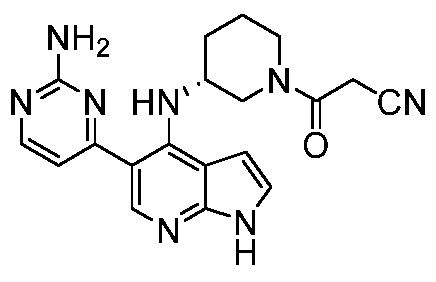
디클로로메탄 (5 mL) 중 2-시아노아세트산 (0.04 g, 0.5 mmol), 1-하이드록시벤조트리아졸 (0.06 g, 0.45 mmol) 및 N-(3-디메틸아미노프로필)-N'-에틸카르보디이미드 하이드로클로라이드 (0.11 g, 0.58 mmol)의 용액을 실온에서 3분간 교반하였다. 이후, (R)-5-(2-아미노피리미딘-4-일)-N-(피페리딘-3-일)-1H-피롤로[2,3-b]피리딘-4-아민 (0.12 g, 0.39 mmol)을 첨가한 후, 트리에틸아민 (0.27 mL, 1.95 mmol)을 첨가하고, 상기 혼합물을 상온에서 16시간 동안 교반하였다. 상기 반응 혼합물을 물로 ??칭하고 에틸 아세테이트로 추출하였다. 상기 유기층을 물과 염수로 세척하고, 무수 황산나트륨으로 건조시킨 후, 여과하여 진공에서 농축시켰다. 상기 미정제 물질을 역상 크로마토그래피로 정제하여 (R)-3-(3-((5-(2-아미노피리미딘-4-일)-1H-피롤로[2,3-b]피리딘-4-일)아미노)피페리딘-1-일)-3-옥소프로판니트릴을 황백색 고체로서 수득하였다 (0.02 g, 13% 수율): 1H NMR (400 MHz, DMSO-d6, VT, 100℃) δ 11.11 (br s, 1H), 9.95 (br s, 1H), 8.37 (s, 1H), 8.17 (s, 1H), 7.12 (s, 1H), 7.00 (s, 1H), 6.26 (s, 1H), 6.22 (s, 2H), 4.20-4.42 (m, 2H), 3.20-3.80 (m, 5H), 2.00-2.07 (m, 1H), 1.45-1.80 (m, 3H); MS (ES) m/z 377.4 (M+H).In dichloromethane (5 mL) of 2-cyano-acetic acid (0.04 g, 0.5 mmol), 1- hydroxybenzotriazole (0.06 g, 0.45 mmol) and N - (3- dimethylaminopropyl) - N '- ethyl carbonate A solution of bodyimide hydrochloride (0.11 g, 0.58 mmol) was stirred at room temperature for 3 minutes. Since, (R) -5- (2- amino-pyrimidin-4-yl) - N - (piperidin-3-yl) -1 H - pyrrolo [2,3- b] pyridin-4-amine ( 0.12 g, 0.39 mmol) was added, followed by triethylamine (0.27 mL, 1.95 mmol), and the mixture was stirred at room temperature for 16 hours. The reaction mixture was quenched with water and extracted with ethyl acetate. The organic layer was washed with water and brine, dried over anhydrous sodium sulfate, filtered and concentrated in vacuo. The crude material was purified first by reverse phase chromatography (R) -3- (3 - ( (5- (2- Amino-pyrimidin-4-yl) -1 H-pyrrolo [2,3- b] pyridin- Obtained 4-yl)amino)piperidin-1-yl)-3-oxopropanenitrile as an off-white solid (0.02 g, 13% yield): 1 H NMR (400 MHz, DMSO-d 6, VT, 100 °C) δ 11.11 (br s, 1H), 9.95 (br s, 1H), 8.37 (s, 1H), 8.17 (s, 1H), 7.12 (s, 1H), 7.00 (s, 1H), 6.26 (s) , 1H), 6.22 (s, 2H), 4.20-4.42 (m, 2H), 3.20-3.80 (m, 5H), 2.00-2.07 (m, 1H), 1.45-1.80 (m, 3H); MS (ES) m/z 377.4 (M+H).
분석 조건:Analysis conditions:
유속: 0.8 mL/분 Flow rate: 0.8 mL/min
컬럼: X-Bridge C18 (100 mm X 4.6 mm X 3.5 μm) Column: X-Bridge C18 (100 mm X 4.6 mm X 3.5 μm)
이동상 (A): 수중 0.1% 암모니아 Mobile phase (A): 0.1% ammonia in water
이동상 (B): MeCN Mobile phase (B): MeCN
[000508] 실시예 52: 3-((3S,5R)-3-메틸-5-((5-(2-메틸피리미딘-4-일)-1H-피롤로[2,3-b]피리딘-4-일)아미노)피페리딘-1-일)-3-옥소프로판니트릴의 제조 [000 508] Example 52: 3 - ((3 S , 5 R) -3- methyl-5 - ((5- (2-methyl-pyrimidin-4-yl) -1 H-pyrrolo [2,3- b] Preparation of pyridin-4-yl)amino)piperidin-1-yl)-3-oxopropanenitrile

반응식 50. 3-((3Scheme 50. 3-((3 SS ,5,5 RR )-3-메틸-5-((5-(2-메틸피리미딘-4-일)-1)-3-methyl-5-((5-(2-methylpyrimidin-4-yl)-1 HH -피롤로[2,3--pyrrolo[2,3- bb ]피리딘-4-일)아미노)피페리딘-1-일)-3-옥소프로판니트릴의 제조] Preparation of pyridin-4-yl)amino)piperidin-1-yl)-3-oxopropanenitrile

[000509] 단계 1: 4-클로로-N-메톡시-N-메틸-1-((2-(트리메틸실릴)에톡시)메틸)-1H-피롤로[2,3-b]피리딘-5-카르복사미드의 제조 [000 509] Step 1: 4-Chloro-N-methoxy-N-methyl-1 - ((methylethoxy), 2- (trimethylsilyl)) -1 H-pyrrolo [2,3- b] pyridine-5 -Preparation of carboxamide

N,N-디메틸포름아미드 (25.0 mL) 중 4-클로로-1-{[2-(트리메틸실릴)에톡시]메틸}-1H-피롤로[2,3-b]피리딘-5-카르복실산 (2.00 g, 6.12 mmol) 및 (1-[비스(디메틸아미노)메틸렌]-1H-1,2,3-트리아졸로[4,5-b]피리디늄 3-옥사이드 헥사플루오로포스페이트 (3.49 g, 9.18 mmol)의 용액을 상온에서 3분간 교반하였다. 이후, N,O-디메틸하이드록실아민 하이드로클로라이드 (1.49 g, 15.3 mmol)를 첨가한 후, 트리에틸아민 (4.28 mL, 30.6 mmol)을 첨가하고, 상기 혼합물을 상온에서 16시간 동안 교반하였다. 상기 반응 혼합물을 에틸 아세테이트와 물로 희석하였다. 상기 유기층을 분리하여 물, 염수로 세척하고, 무수 황산나트륨으로 건조시킨 후, 여과하여 진공에서 농축시켰다. 상기 미정제 물질을 섬광 크로마토그래피 (40% 에틸 아세테이트/헥산)로 정제하여 4-클로로-N-메톡시-N-메틸-1-{[2-(트리메틸실릴)에톡시]메틸}-1H-피롤로[2,3-b]피리딘-5-카르복사미드를 담황색 액체로서 수득하였다 (1.82 g, 80% 수율): MS (ES) m/z 370.2 (M+H).N, N- dimethylformamide (25.0 mL) solution of 4-chloro-l - {[2- (trimethylsilyl) ethoxy] methyl} -1 H-pyrrolo [2,3- b] pyridine-5-carboxylic acid (2.00 g, 6.12 mmol) and (1-[bis(dimethylamino)methylene]-1H-1,2,3-triazolo[4,5-b]pyridinium 3-oxide hexafluorophosphate (3.49 g) , 9.18 mmol) was stirred at room temperature for 3 minutes Then, N,O -dimethylhydroxylamine hydrochloride (1.49 g, 15.3 mmol) was added, followed by triethylamine (4.28 mL, 30.6 mmol) was added. and the mixture was stirred at room temperature for 16 hours.The reaction mixture was diluted with ethyl acetate and water.The organic layer was separated, washed with water and brine, dried over anhydrous sodium sulfate, filtered and concentrated in vacuo. purification of the crude material by flash chromatography (40% ethyl acetate / hexane) afforded 4-chloro-N-methoxy-N-methyl-1 - {[2- (trimethylsilyl)] methyl} -1 H -pyrrolo[2,3- b ]pyridine-5-carboxamide was obtained as a pale yellow liquid (1.82 g, 80% yield): MS (ES) m/z 370.2 (M+H).
[000510] 단계 2: 1-(4-클로로-1-((2-(트리메틸실릴)에톡시)메틸)-1H-피롤로[2,3-b]피리딘-5-일)프로프-2-인-1-온의 제조 [000 510] Step 2: 1- (4-chloro-l - ((methylethoxy), 2- (trimethylsilyl)) -1 H-pyrrolo [2,3- b] pyridin-5-yl) prop- Preparation of 2-yn-1-one

테트라하이드로퓨란 (25 mL) 중 4-클로로-N-메톡시-N-메틸-1-{[2-(트리메틸실릴)에톡시]메틸}-1H-피롤로[2,3-b] 피리딘-5-카르복사미드 (2.20 g, 5.95 mmol)의 용액에 브로모(에티닐)마그네슘 (18 mL, 8.92 mmol, THF 중 3M 용액)을 0℃에서 첨가하였다. 상기 반응 혼합물을 상온으로 가온하여 16시간 동안 교반하였다. 상기 반응 혼합물을 포화 수성 염화암모늄으로 ??칭하고 에틸 아세테이트로 추출하였다. 상기 유기층을 물과 염수로 세척하고, 무수 황산나트륨으로 건조시킨 후, 여과하여 진공에서 농축시켰다. 상기 미정제 물질을 섬광 크로마토그래피 (40% 에틸 아세테이트/헥산)로 정제하여 1-(4-클로로-1-{[2-(트리메틸실릴)에톡시]메틸}-1H-피롤로[2,3-b]피리딘-5-일)프로프-2-인-1-온을 담황색 반고체로서 수득하였다 (1.25 g, 63% 수율): MS (ES) m/z 335.1 (M+H).In tetrahydrofuran (25 mL) of 4-chloro-N-methoxy-N-methyl-1 - {[2- (trimethylsilyl) ethoxy] methyl} -1 H-pyrrolo [2,3- b] pyridine To a solution of-5-carboxamide (2.20 g, 5.95 mmol) was added bromo(ethynyl)magnesium (18 mL, 8.92 mmol, 3M solution in THF) at 0°C. The reaction mixture was warmed to room temperature and stirred for 16 hours. The reaction mixture was quenched with saturated aqueous ammonium chloride and extracted with ethyl acetate. The organic layer was washed with water and brine, dried over anhydrous sodium sulfate, filtered and concentrated in vacuo. The crude by flash chromatography l- (4-chloro-l to give (40% ethyl acetate / hexane) - {[2- (trimethylsilyl) ethoxy] methyl} -1 H-pyrrolo [2, Obtained 3- b ]pyridin-5-yl)prop-2-yn-1-one as a pale yellow semisolid (1.25 g, 63% yield): MS (ES) m/z 335.1 (M+H).
[000511] 단계 3: 4-클로로-5-(2-메틸피리미딘-4-일)-1-((2-(트리메틸실릴)에톡시)메틸)-1H-피롤로[2,3-b]피리딘의 제조 [000 511] Step 3: 4-Chloro-5- (2-methyl-pyrimidin-4-yl) - 1 - (ethoxy) (2- (trimethylsilyl) methyl) -1 H-pyrrolo [2,3- b ] Preparation of pyridine

1-(4-클로로-1-{[2-(트리메틸실릴)에톡시]메틸}-1H-피롤로[2,3-b]피리딘-5-일)프로프-2-인-1-온 (1.20 g, 3.58 mmol)의 교반된 현탁액에, 아세토니트릴 (10 mL) 중 N-클로로에탄이미드아미드 (0.5 mg, 5.38 mmol) 및 탄산나트륨 (1.14 g, 10.8 mmol)을 첨가한 후, 상기 혼합물에 120℃에서 1시간 동안 MW를 조사하였다. 상기 반응 혼합물을 상온으로 냉각시키고, 에틸 아세테이트와 물로 희석하였다. 상기 유기층을 분리하여 물, 염수로 세척하고, 무수 황산나트륨으로 건조시킨 후, 여과하여 진공에서 농축시켜 진득한 검을 수득하였다. 상기 미정제 물질을 섬광 크로마토그래피 (40% 에틸 아세테이트/헥산)로 정제하여 4-(4-클로로-1-{[2-(트리메틸실릴)에톡시]메틸}-1H-피롤로[2,3-b]피리딘-5-일)-2-메틸피리미딘을 갈색 액체로서 수득하였다 (0.72 g, 54% 수율): MS (ES) m/z 375.1 (M+H).1- (4-chloro-l - {[2- (trimethylsilyl) ethoxy] methyl} -1 H-pyrrolo [2,3- b] pyridin-5-yl) prop-2-in-1 To a stirred suspension of ion (1.20 g, 3.58 mmol) was added N -chloroethaneimidamide (0.5 mg, 5.38 mmol) and sodium carbonate (1.14 g, 10.8 mmol) in acetonitrile (10 mL), followed by the above The mixture was irradiated with MW at 120° C. for 1 hour. The reaction mixture was cooled to room temperature and diluted with ethyl acetate and water. The organic layer was separated, washed with water and brine, dried over anhydrous sodium sulfate, filtered and concentrated in vacuo to obtain a thick gum. The crude material was purified flash chromatography (40% ethyl acetate / hexane) afforded 4- (4-chloro-1 - {[2- (trimethylsilyl) ethoxy] methyl} -1 H-pyrrolo [2, Obtained 3- b ]pyridin-5-yl)-2-methylpyrimidine as a brown liquid (0.72 g, 54% yield): MS (ES) m/z 375.1 (M+H).
[000512] 단계 4: 벤질 (3S,5R)-3-메틸-5-((5-(2-메틸피리미딘-4-일)-1-((2-(트리메틸실릴) 에톡시)메틸)-1H-피롤로[2,3-b]피리딘-4-일)아미노)피페리딘-1-카르복실레이트의 제조 [000 512] Step 4: Benzyl (3 S, 5 R) -3- methyl-5 - ((5- (2-methyl-pyrimidin-4-yl) -1H-in ((2- (trimethylsilyl) ethoxy) methyl) -1 H - pyrrolo [2,3- b] pyridin-4-yl) amino) Preparation of piperidine-1-carboxylate

20 mL MW 바이알 중에서, N-메틸피롤리딘-2-온 (7 mL) 중 4-(4-클로로-1-{[2-(트리메틸실릴)에톡시]메틸}-1H-피롤로[2,3-b]피리딘-5-일)-2-메틸피리미딘 (0.6 g, 1.60 mmol), 벤질 (3R,5S)-3-아미노-5-메틸피페리딘-1-카르복실레이트 (0.6 g, 2.40 mmol) 및 N,N-디이소프로필에틸아민 (0.6 mL 3.20 mmol)의 용액에 190℃에서 6시간 동안 마이크로파를 조사하였다. 상기 반응 혼합물을 상온으로 냉각한 후, 에틸 아세테이트와 물로 희석하였다. 상기 유기층을 분리하여 물, 염수로 세척하고, 무수 황산나트륨으로 건조시킨 후, 여과하여 농축시켰다. 상기 미정제 물질을 섬광 크로마토그래피 (40% 에틸 아세테이트/헥산)로 정제하여 벤질 (3S,5R)-3-메틸-5-{[5-(2-메틸피리미딘-4-일)-1-{[2-(트리메틸실릴)에톡시]메틸}-1H-피롤로[2,3-b]피리딘-4-일]아미노}피페리딘-1-카르복실레이트를 갈색의 걸쭉한 액체로서 수득하였다 (0.34 g, 36% 수율): MS (ES) m/z 587.6 (M+H).In a 20 mL MW vial, 4-(4-chloro-1-{[2-(trimethylsilyl)ethoxy]methyl}-1 H -pyrrolo[ in N-methylpyrrolidin-2-one (7 mL)) 2,3- b ]pyridin-5-yl)-2-methylpyrimidine (0.6 g, 1.60 mmol), benzyl (3 R ,5 S )-3-amino-5-methylpiperidine-1-carboxyl A solution of lactate (0.6 g, 2.40 mmol) and N,N -diisopropylethylamine (0.6 mL 3.20 mmol) was irradiated with microwaves at 190° C. for 6 hours. After the reaction mixture was cooled to room temperature, it was diluted with ethyl acetate and water. The organic layer was separated, washed with water and brine, dried over anhydrous sodium sulfate, filtered and concentrated. The crude material was purified by flash chromatography (40% ethyl acetate/hexanes) to benzyl (3 S ,5 R )-3-methyl-5-{[5-(2-methylpyrimidin-4-yl)- 1 - {[2- (trimethylsilyl) ethoxy] methyl} -1 H - [2,3- b] pyrrolo-4-yl] amino} piperidine-1-carboxylate brown thick liquid of the (0.34 g, 36% yield): MS (ES) m/z 587.6 (M+H).
[000513] 단계 5: N-((3R,5S)-5-메틸피페리딘-3-일)-5-(2-메틸피리미딘-4-일)-1H-피롤로[2,3-b]피리딘-4-아민의 제조 [000 513] Step 5: N - ((3 R , 5 S) -5- methylpiperidin-3-yl) -5- (2-methyl-pyrimidin-4-yl) -1 H - pyrrolo [2 ,3- b ] Preparation of pyridin-4-amine

트리플루오로아세트산 (5 mL) 중 벤질 (3S,5R)-3-메틸-5-{[5-(2-메틸피리미딘-4-일)-1-{[2-(트리메틸실릴)에톡시]메틸}-1H-피롤로[2,3-b]피리딘-4-일]아미노}피페리딘-1-카르복실레이트 (0.33 g, 0.56 mmol)의 용액을 100℃에서 밀봉된 튜브에서 교반하였다. 1시간 후, 상기 반응 혼합물을 상온으로 냉각하고, 진공에서 농축시켜 무수 상태로 하였다. 상기 잔류물을 1,4-디옥산 : 수성 암모니아 (5 mL: 5 mL)에 용해시킨 후, 상온에서 16시간 동안 교반하였다. 상기 반응 혼합물을 농축시켜 무수 상태로 하여 (3R,5S)-5-메틸-N-[5-(2-메틸피리미딘-4-일)-1H-피롤로[2,3-b]피리딘-4-일]피페리딘-3-아민을 무색의 진득한 고체로서 수득하였다 (0.35 g, 미정제): MS (ES) m/z 323.2 (M+H). Benzyl (3 S ,5 R )-3-methyl-5-{[5-(2-methylpyrimidin-4-yl)-1-{[2-(trimethylsilyl) in trifluoroacetic acid (5 mL)) sealed and a solution of pyrrolo [2,3- b] pyridin-4-yl] amino} piperidine-1-carboxylate (0.33 g, 0.56 mmol) in 100 ℃ - ethoxy] methyl} -1 H Stir in the tube. After 1 h, the reaction mixture was cooled to room temperature and concentrated in vacuo to dryness. The residue was dissolved in 1,4-dioxane: aqueous ammonia (5 mL: 5 mL) and stirred at room temperature for 16 hours. To to to dryness The reaction mixture was concentrated (3 R, 5 S) -5- methyl - N - [5- (2- methyl-pyrimidin-4-yl) -1 H - pyrrolo [2,3- b Obtained ]pyridin-4-yl]piperidin-3-amine as a colorless thick solid (0.35 g, crude): MS (ES) m/z 323.2 (M+H).
[000514] 단계 6: 3-((3S,5R)-3-메틸-5-((5-(2-메틸피리미딘-4-일)-1H-피롤로[2,3-b]피리딘-4-일)아미노)피페리딘-1-일)-3-옥소프로판니트릴의 제조 [000 514] Step 6: 3 - ((3 S , 5 R) -3- methyl-5 - ((5- (2-methyl-pyrimidin-4-yl) -1 H-pyrrolo [2,3- b ] Preparation of pyridin-4-yl)amino)piperidin-1-yl)-3-oxopropanenitrile

N-메틸피롤리딘-2-온 (2 mL) 중 2-시아노아세트산 (0.03 g, 0.32 mol), 1-하이드록시-1,2-디하이드로피리딘-2-온 (0.31 g, 0.28 mmol) 및 O-(벤조트리아졸-1-일)-N,N,N',N'-테트라메틸우로늄 테트라플루오로보레이트 (0.1 g, 0.32 mol)의 용액을 상온에서 3분간 교반하였다. 이후, (3R,5S)-5-메틸-N-[5-(2-메틸피리미딘-4-일)-1H-피롤로[2,3-b]피리딘-4-일]피페리딘-3-아민 (0.07 g, 0.22 mmol)을 첨가한 후, 트리에틸아민 (0.1 mL, 0.70 mmol)을 첨가하고, 상기 혼합물을 상온에서 16시간 동안 교반하였다. 상기 반응 혼합물을 에틸 아세테이트로 희석한 후, 물과 염수로 세척하였다. 상기 유기층을 무수 황산나트륨으로 건조시킨 후, 여과 및 진공에서 농축시켰다. 상기 미정제 물질을 역상 크로마토그래피로 정제하여 3-[(3S,5R)-3-메틸-5-{[5-(2-메틸피리미딘-4-일)-1H-피롤로[2,3-b]피리딘-4-일]아미노}피페리딘-1-일]-3-옥소프로판니트릴을 백색 고체로서 수득하였다 (0.02 g, 20% 수율): 1H NMR (400 MHz, DMSO-d6, VT, 80℃) δ 11.29 (br s, 1H), 10.38 (br s, 1H), 8.54-8.56 (m, 2H), 7.75-7.76 (m, 1H), 7.15 (s, 1H), 6.70 (s, 1H), 4.81-4.84 (m, 1H), 3.93-4.33 (m, 5H), 2.65 (s, 4H), 2.27-2.30 (m, 1H), 1.65-1.95 (m, 1H), 1.17-1.30 (m, 1H), 0.95 (d, J = 6.4 Hz, 3H); MS (ES) m/z 390.4 (M+H).2-cyanoacetic acid (0.03 g, 0.32 mol), 1-hydroxy-1,2-dihydropyridin-2-one (0.31 g, 0.28 mmol) in N-methylpyrrolidin-2-one (2 mL) ) and A solution of O -(benzotriazol-1-yl) -N,N,N′,N′ -tetramethyluronium tetrafluoroborate (0.1 g, 0.32 mol) was stirred at room temperature for 3 minutes. Later, (3 R, 5 S) -5- methyl - N - [5- (2- methyl-pyrimidin-4-yl) -1 H - pyrrolo [2,3- b] pyridin-4-yl] P Peridin-3-amine (0.07 g, 0.22 mmol) was added, followed by triethylamine (0.1 mL, 0.70 mmol), and the mixture was stirred at room temperature for 16 hours. The reaction mixture was diluted with ethyl acetate and washed with water and brine. The organic layer was dried over anhydrous sodium sulfate, filtered and concentrated in vacuo. Purification of the crude material by reverse phase chromatography, 3 - [(3 S, 5 R) -3- methyl-5 - {[5- (2-methyl-pyrimidin-4-yl) -1 H-pyrrolo [ 2,3- b ]pyridin-4-yl]amino}piperidin-1-yl]-3-oxopropanenitrile was obtained as a white solid (0.02 g, 20% yield): 1 H NMR (400 MHz, DMSO-d 6 , VT, 80° C.) δ 11.29 (br s, 1H), 10.38 (br s, 1H), 8.54-8.56 (m, 2H), 7.75-7.76 (m, 1H), 7.15 (s, 1H) ), 6.70 (s, 1H), 4.81-4.84 (m, 1H), 3.93-4.33 (m, 5H), 2.65 (s, 4H), 2.27-2.30 (m, 1H), 1.65-1.95 (m, 1H) ), 1.17-1.30 (m, 1H), 0.95 (d, J = 6.4 Hz, 3H); MS (ES) m/z 390.4 (M+H).
분석 조건:Analysis conditions:
컬럼: X-Bridge, C18 19*100* 5 마이크론Column: X-Bridge, C18 19*100* 5 microns
이동상(A): H2O 중 0.1% 암모니아Mobile phase (A): 0.1% ammonia in H 2 O
이동상(B): MeCNMobile phase (B): MeCN
유속: 20.0 mL/분Flow rate: 20.0 mL/min
[000515] 실시예 53: (R)-2-(4-((1-(2-시아노아세틸)피페리딘-3-일)아미노)-1H-피롤로[2,3-b]피리딘-5-일)-N-메틸티아졸-5-카르복사미드의 제조 [000 515] Example 53: (R) -2- (4 - ((1- (2- cyano-acetyl) -piperidin-3-yl) amino) -1 H - pyrrolo [2,3- b] Preparation of pyridin-5-yl) -N -methylthiazole-5-carboxamide

반응식 51. (Scheme 51. ( RR )-2-(4-((1-(2-시아노아세틸)피페리딘-3-일)아미노)-1)-2-(4-((1-(2-cyanoacetyl)piperidin-3-yl)amino)-1 HH -피롤로[2,3--pyrrolo[2,3- bb ]피리딘-5-일)-]pyridin-5-yl)- NN -메틸티아졸-5-카르복사미드의 제조 -Preparation of methylthiazole-5-carboxamide

[000516] 단계 1: 4-클로로-1-((2-(트리메틸실릴)에톡시)메틸)-1H-피롤로[2,3-b]피리딘-5-카보티오아미드의 제조 [000 516] Step 1: 4-Chloro-1 - ((methylethoxy), 2- (trimethylsilyl)) -1 H-pyrrolo [2,3- b] pyridine-5-carbonitrile thioamide

테트라하이드로퓨란 (30 mL) 중 4-클로로-1-((2-(트리메틸실릴)에톡시)메틸)-1H-피롤로[2,3-b]피리딘-5-카르복실산 (7.0 g, 21.5 mmol, 실시예 48, 단계 3)의 용액에 로웨슨 시약 (8.70 g, 21.5 mmol)을 첨가한 후, 상기 혼합물을 상온에서 3시간 동안 교반하였다. 상기 반응 혼합물을 매우 차가운 포화 중탄산나트륨 용액으로 ??칭하고, 에틸 아세테이트로 추출한 후, 염수로 세척하였다. 유기층을 무수 황산나트륨으로 건조시킨 후, 여과하고 진공에서 농축시켜 4-클로로-1-((2-(트리메틸실릴)에톡시)메틸)-1H-피롤로[2,3-b]피리딘-5-카보티오아미드를 담황색의 걸쭉한 액체로서 수득하였다 (1.5 g, 47% 수율): MS (ES) m/z 342.0 (M+H).(A (2- (trimethylsilyl) ethoxy) methyl) -1 H - - tetrahydrofuran (30 mL) of 4-chloro-l H-pyrrolo [2,3- b] pyridine-5-carboxylic acid (7.0 g , 21.5 mmol, Example 48, Step 3) was added with Roweson's reagent (8.70 g, 21.5 mmol), and the mixture was stirred at room temperature for 3 hours. The reaction mixture was quenched with very cold saturated sodium bicarbonate solution, extracted with ethyl acetate and washed with brine. The organic layer was dried over anhydrous sodium sulfate, filtered and concentrated in vacuo to give 4-chloro-1 - ((methylethoxy), 2- (trimethylsilyl)) -1 H-pyrrolo [2,3- b] pyridine-5 -carbothioamide was obtained as a pale yellow thick liquid (1.5 g, 47% yield): MS (ES) m/z 342.0 (M+H).
[000517] 단계 2: 에틸 2-(4-클로로-1-((2-(트리메틸실릴)에톡시)메틸)-1H-피롤로[2,3-b]피리딘-5-일)티아졸-5-카르복실레이트의 제조 [000 517] Step 2: ethyl 2- (4-chloro-1 - ((methylethoxy), 2- (trimethylsilyl)) -1 H-pyrrolo [2,3- b] pyridin-5-yl) thiazole Preparation of -5-carboxylate

톨루엔 (60 mL) 중의 4-클로로-1-((2-(트리메틸실릴)에톡시)메틸)-1H-피롤로[2,3-b]피리딘-5-카보티오아미드 (6.0 g, 17.5 mmol)의 용액에 에틸 2-클로로-3-옥소프로파노에이트 (7.93 g, 52.6 mmol) 및 황산마그네슘 (4.22 g, 35.1 mmol)을 첨가한 후, 상기 혼합물을 90℃로 12시간 동안 가열하였다. 상기 반응 혼합물을 상온으로 냉각시키고, 물로 ??칭한 후, 에틸 아세테이트로 추출하고 염수로 세척하였다. 유기층을 무수 황산나트륨으로 건조시킨 후, 여과하고 진공에서 농축시켜 에틸 2-(4-클로로-1-((2-(트리메틸실릴)에톡시)메틸)-1H-피롤로[2,3-b]피리딘-5-일)티아졸-5-카르복실레이트를 점성의 갈색 액체로서 수득하였다 (0.6 g, 7.81% 수율): MS (ES) m/z 438.1 (M+H).(A (2- (trimethylsilyl) ethoxy) methyl) -1 H - - toluene (60 mL) solution of 4-chloro-l H-pyrrolo [2,3- b] pyridine thioamide (6.0 g, 17.5 mmol) was added ethyl 2-chloro-3-oxopropanoate (7.93 g, 52.6 mmol) and magnesium sulfate (4.22 g, 35.1 mmol), then the mixture was heated to 90° C. for 12 h. The reaction mixture was cooled to room temperature, quenched with water, extracted with ethyl acetate and washed with brine. The organic layer was dried over anhydrous sodium sulfate, filtered and concentrated in vacuo to give ethyl 2- (4-chloro-1 - ((2- (trimethylsilyl) ethoxy) methyl) -1 H-pyrrolo [2,3- b ]pyridin-5-yl)thiazole-5-carboxylate was obtained as a viscous brown liquid (0.6 g, 7.81% yield): MS (ES) m/z 438.1 (M+H).
[000518] 단계 3: 에틸 2-(4-클로로-1H-피롤로[2,3-b]피리딘-5-일)티아졸-5-카르복실레이트의 제조 [000518] Step 3: Preparation of ethyl 2-(4-chloro- 1H -pyrrolo[2,3- b ]pyridin-5-yl)thiazole-5-carboxylate

디클로로메탄 : 트리플루오로아세트산 (5 mL : 5 mL) 중 에틸 2-(4-클로로-1-((2-(트리메틸실릴)에톡시)메틸)-1H-피롤로[2,3-b]피리딘-5-일)티아졸-5-카르복실레이트 (0.50 g, 0.22 mmol)의 용액을 상온에서 3시간 동안 교반하였다. 상기 반응 혼합물을 진공에서 농축시켰다. 상기 잔류물을 1,4-디옥산 : 수성 암모니아 (5 mL : 5 mL, 물 중 23%)에 용해시킨 후, 상기 혼합물을 상온에서 16시간 동안 교반하였다. 상기 반응 혼합물을 진공에서 농축시켜 에틸 2-(4-클로로-1H-피롤로[2,3-b]피리딘-5-일)티아졸-5-카르복실레이트를 황백색 고체로서 수득하였다 (0.52 g, 미정제): MS (ES) m/z 308.0 (M+H).Dichloromethane: trifluoroacetic acid (5 mL: 5 mL) of ethyl 2- (4-chloro-1 - ((2- (trimethylsilyl) ethoxy) methyl) -1 H-pyrrolo [2,3- b ] A solution of pyridin-5-yl)thiazole-5-carboxylate (0.50 g, 0.22 mmol) was stirred at room temperature for 3 hours. The reaction mixture was concentrated in vacuo. The residue was dissolved in 1,4-dioxane: aqueous ammonia (5 mL: 5 mL, 23% in water), and then the mixture was stirred at room temperature for 16 h. The reaction mixture was concentrated in vacuo to give ethyl 2-(4-chloro- 1H -pyrrolo[2,3- b ]pyridin-5-yl)thiazole-5-carboxylate as an off-white solid (0.52). g, crude): MS (ES) m/z 308.0 (M+H).
[000519] 단계 4: 에틸 2-(4-클로로-1-토실-1H-피롤로[2,3-b]피리딘-5-일)티아졸-5-카르복실레이트의 제조 [000519] Step 4: Preparation of ethyl 2-(4-chloro-1-tosyl- 1H -pyrrolo[2,3- b ]pyridin-5-yl)thiazole-5-carboxylate

디클로로메탄 (3 mL) 중 에틸 2-(4-클로로-1H-피롤로[2,3-b]피리딘-5-일)티아졸-5-카르복실레이트 (0.20 g, 0.65 mmol), 4-디메틸아미노피리딘 (0.02 g, 0.13 mmol) 및 트리에틸아민 (0.09 mL, 0.65 mmol)의 교반된 용액에 4-메틸-벤젠설포닐 클로라이드 (0.15 g, 0.78 mmol)를 첨가한 후, 상기 반응 혼합물을 상온에서 3시간 동안 교반하였다. 상기 반응 혼합물을 포화 중탄산나트륨 용액으로 ??칭하고, 디클로로메탄으로 추출한 후, 염수로 세척하였다. 유기층을 황산나트륨으로 건조시킨 후, 여과하고 진공에서 농축시켜 에틸 2-(4-클로로-1-토실-1H-피롤로[2,3-b]피리딘-5-일)티아졸-5-카르복실레이트를 갈색 고체로서 수득하였다 (0.2 g, 34% 수율): MS (ES) m/z 462.1 (M+H).Ethyl 2-(4-chloro-1 H -pyrrolo[2,3- b ]pyridin-5-yl)thiazole-5-carboxylate (0.20 g, 0.65 mmol), 4 in dichloromethane (3 mL) - To a stirred solution of dimethylaminopyridine (0.02 g, 0.13 mmol) and triethylamine (0.09 mL, 0.65 mmol) was added 4-methyl-benzenesulfonyl chloride (0.15 g, 0.78 mmol), followed by the reaction mixture was stirred at room temperature for 3 hours. The reaction mixture was quenched with saturated sodium bicarbonate solution, extracted with dichloromethane, and washed with brine. The organic layer was dried over sodium sulfate, filtered and concentrated in vacuo, followed by ethyl 2-(4-chloro-1-tosyl- 1H -pyrrolo[2,3- b ]pyridin-5-yl)thiazole-5-carr. The carboxylate was obtained as a brown solid (0.2 g, 34% yield): MS (ES) m/z 462.1 (M+H).
[000520] 단계 5: 에틸 (R)-2-(4-((1-(tert-부톡시카보닐)피페리딘-3-일)아미노)-1-토실-1H-피롤로[2,3-b]피리딘-5-일)티아졸-5-카르복실레이트의 제조 [000520] Step 5: Ethyl ( R )-2-(4-((1-( tert -butoxycarbonyl)piperidin-3-yl)amino)-1-tosyl- 1H -pyrrolo[2 ,3- b ] pyridin-5-yl) thiazole-5-carboxylate preparation

에탄올 (0.5 mL) 중 에틸 4-클로로-1H-피롤로[2,3-b]피리딘-5-카르복실레이트 (0.2 g, 0.75 mmol)의 용액에 tert-부틸 (R)-3-아미노피페리딘-1-카르복실레이트 (0.35 g, 1.73 mmol) 및 트리에틸아민 (0.5 mL, 3.6 mmol)을 첨가한 후, 상기 혼합물에 130℃에서 15분간 마이크로파를 조사하였다. 상기 반응 혼합물을 상온으로 냉각시키고, 물로 ??칭한 후, 에틸 아세테이트로 추출하였다. 상기 유기층을 염수로 세척하고, 무수 황산나트륨으로 건조시켜 여과 후 진공에서 농축시켰다. 상기 미정제 물질을 섬광 크로마토그래피 (50% 에틸 아세테이트/헥산)로 정제하여 에틸 (R)-2-(4-((1-(tert-부톡시카보닐)피페리딘-3-일)아미노)-1-토실-1H-피롤로[2,3-b]피리딘-5-일)티아졸-5-카르복실레이트를 점성의 무색 액체로서 수득하였다 (0. 17 g, 62% 수율): MS (ES) m/z 626.2 (M+H).To a solution of ethyl 4-chloro- 1H -pyrrolo[2,3- b ]pyridine-5-carboxylate (0.2 g, 0.75 mmol) in ethanol (0.5 mL) tert -butyl ( R )-3-amino After piperidine-1-carboxylate (0.35 g, 1.73 mmol) and triethylamine (0.5 mL, 3.6 mmol) were added, the mixture was irradiated with microwaves at 130° C. for 15 minutes. The reaction mixture was cooled to room temperature, quenched with water, and extracted with ethyl acetate. The organic layer was washed with brine, dried over anhydrous sodium sulfate, filtered and concentrated in vacuo. The crude material was purified by flash chromatography (50% ethyl acetate/hexanes) to ethyl ( R )-2-(4-((1-( tert -butoxycarbonyl)piperidin-3-yl)amino )-1-tosyl- 1H -pyrrolo[2,3- b ]pyridin-5-yl)thiazole-5-carboxylate was obtained as a viscous colorless liquid (0.17 g, 62% yield) : MS (ES) m/z 626.2 (M+H).
[000521] 단계 6: (R)-2-(4-((1-(tert-부톡시카보닐)피페리딘-3-일)아미노)-1H-피롤로[2,3-b]피리딘-5-일)티아졸-5-카르복실산의 제조 [000 521] Step 6: (R) -2- (4 - ((1- (tert - butoxycarbonyl) piperidin-3-yl) amino) -1 H - pyrrolo [2,3- b] Preparation of pyridin-5-yl)thiazole-5-carboxylic acid
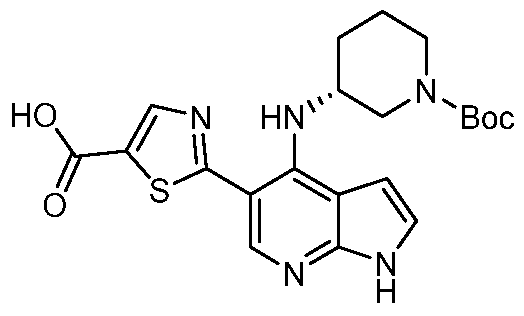
에탄올 (1 mL) 중 에틸 (R)-2-(4-((1-(tert-부톡시카보닐)피페리딘-3-일)아미노)-1-토실-1H-피롤로[2,3-b]피리딘-5-일)티아졸-5-카르복실레이트 (0.35 g, 0.55 mmol)의 교반된 용액에 2M 수산화리튬 수용액 (0.07 g, 2.8 mmol)을 첨가한 후, 상기 혼합물을 90℃에서 3시간 동안 가열하였다. 상기 반응 혼합물을 상온으로 냉각하고 진공에서 농축시켜 휘발성 물질들을 제거하였다. 상기 잔류 물질을 물에 용해시키고 1N 염산으로 산성화하여 pH를 ~3으로 조정하였다. 침전된 고체를 여과하고, 물로 세척한 후, 고진공에서 건조시켜 (R)-2-(4-((1-(tert-부톡시카보닐)피페리딘-3-일)아미노)-1H-피롤로[2,3-b]피리딘-5-일)티아졸-5-카르복실산을 황백색 고체로서 수득하였다 (0.2 g, 83% 수율): MS (ES) m/z 444.2 (M+H). Ethyl (R )-2-(4-((1-( tert -butoxycarbonyl)piperidin-3-yl)amino)-1-tosyl- 1H -pyrrolo[2 in ethanol (1 mL) ,3- b ]pyridin-5-yl)thiazole-5-carboxylate (0.35 g, 0.55 mmol) was added to a stirred solution of 2M aqueous lithium hydroxide solution (0.07 g, 2.8 mmol), and the mixture was Heated at 90° C. for 3 hours. The reaction mixture was cooled to room temperature and concentrated in vacuo to remove volatiles. The residue was dissolved in water and acidified with 1N hydrochloric acid to adjust the pH to ˜3. The precipitated solid was filtered, washed with water, followed by drying under high vacuum (R) -2- (4 - ( (1- (tert - butoxycarbonyl) piperidin-3-yl) amino) -1 H -pyrrolo[2,3- b ]pyridin-5-yl)thiazole-5-carboxylic acid was obtained as an off-white solid (0.2 g, 83% yield): MS (ES) m/z 444.2 (M+ H).
[000522] 단계 7: tert-부틸 (R)-3-((5-(5-(메틸카바모일)티아졸-2-일)-1H-피롤로[2,3-b]피리딘-4-일)아미노)피페리딘-1-카르복실레이트의 제조 [000 522] Step 7: tert - butyl (R) -3 - ((5- (5- ( methyl-carbamoyl) thiazol-2-yl) -1 H - pyrrolo [2,3 -b] pyridin -4 Preparation of -yl)amino)piperidine-1-carboxylate

N,N-디메틸포름아미드 (5 mL) 중 (R)-2-(4-((1-(tert-부톡시카보닐)피페리딘-3-일)아미노)-1H-피롤로[2,3-b]피리딘-5-일)티아졸-5-카르복실산 (0.25 g, 0.56 mmol) 및 1-[비스(디메틸아미노)메틸렌]-1H-1,2,3-트리아졸로[4,5-b]피리디늄-3-옥사이드 헥사플루오로포스페이트 (0.43 g, 1.12 mmol)의 용액을 상온에서 5분간 교반하였다. 메틸아민 하이드로클로라이드 (0.07 g, 0.68 mmol)를 첨가한 후, 트리에틸아민 (0.4 mL, 2.77 mmol)을 첨가하고, 상기 혼합물을 12시간 동안 교반하였다. 상기 반응 혼합물을 물로 ??칭하고 에틸 아세테이트로 추출하였다. 상기 유기층을 염수로 세척하고, 무수 황산나트륨으로 건조시켜 여과 후 진공에서 농축시켰다. 상기 미정제 물질을 섬광 크로마토그래피 (80% 에틸 아세테이트/헥산)로 정제하여 tert-부틸 (R)-3-((5-(5-(메틸카바모일)티아졸-2-일)-1H-피롤로[2,3-b]피리딘-4-일)아미노)피페리딘-1-카르복실레이트를 점성의 무색 액체로서 수득하였다 (0.25 g, 97% 수율): MS (ES) m/z 457.2 (M+H). (R) in dimethylformamide (5 mL) -2- (4 - - N, N ((1- (tert - butoxycarbonyl) piperidin-3-yl) amino) -1 H - pyrrolo [ 2,3- b] pyridin-5-yl) thiazole-5-carboxylic acid (0.25 g, 0.56 mmol) and 1- [bis (dimethylamino) methylene] -1 H -1,2,3- triazolo [4,5- b ] A solution of pyridinium-3-oxide hexafluorophosphate (0.43 g, 1.12 mmol) was stirred at room temperature for 5 minutes. Methylamine hydrochloride (0.07 g, 0.68 mmol) was added followed by triethylamine (0.4 mL, 2.77 mmol) and the mixture was stirred for 12 h. The reaction mixture was quenched with water and extracted with ethyl acetate. The organic layer was washed with brine, dried over anhydrous sodium sulfate, filtered and concentrated in vacuo. Purification of the crude material by flash chromatography (80% ethyl acetate / hexane) tert - butyl (R) -3 - ((5- (5- ( methyl-carbamoyl) thiazol-2-yl) -1 H -pyrrolo[2,3- b ]pyridin-4-yl)amino)piperidine-1-carboxylate was obtained as a viscous colorless liquid (0.25 g, 97% yield): MS (ES) m/ z 457.2 (M+H).
[000523] 단계 8: (R)-N-메틸-2-(4-(피페리딘-3-일아미노)-1H-피롤로[2,3-b]피리딘-5-일)티아졸-5-카르복사미드 하이드로클로라이드의 제조 [000 523] Step 8: (R) - N - methyl-2- (4- (piperidin-3-ylamino) -1 H - pyrrolo [2,3- b] pyridin-5-yl) thiazole Preparation of 5-carboxamide hydrochloride

(R)-3-((5-(5-(메틸카바모일)티아졸-2-일)-1H-피롤로[2,3-b]피리딘-4-일)아미노)피페리딘-1-카르복실레이트 (0.25 g, 0.54 mmol)를 4N 염산 및 1,4-디옥산 (5 mL)에 첨가한 후, 상기 혼합물을 상온에서 4시간 동안 교반하였다. 상기 반응 혼합물을 진공에서 농축하고, 건조시켜 (R)-N-메틸-2-(4-(피페리딘-3-일아미노)-1H-피롤로[2,3-b]피리딘-5-일)티아졸-5-카르복사미드 하이드로클로라이드를 황백색 고체로서 수득하였다 (0.16 g, 77% 수율): MS (ES) m/z 357.3 (M+H)+. (R) -3 - ((5- (5- ( methyl-carbamoyl) thiazol-2-yl) -1 H-pyrrolo [2,3- b] pyridin-4-yl) amino) piperidin- After 1-carboxylate (0.25 g, 0.54 mmol) was added to 4N hydrochloric acid and 1,4-dioxane (5 mL), the mixture was stirred at room temperature for 4 hours. To the reaction mixture was concentrated in vacuo, dried (R) - N - methyl-2- (4- (piperidin-3-ylamino) -1 H - pyrrolo [2,3- b] pyridine-5 -yl)thiazole-5-carboxamide hydrochloride was obtained as an off-white solid (0.16 g, 77% yield): MS (ES) m/z 357.3 (M+H) + .
[000524] 단계 9: (R)-2-(4-((1-(2-시아노아세틸)피페리딘-3-일)아미노)-1H-피롤로[2,3-b]피리딘-5-일)-N-메틸티아졸-5-카르복사미드의 제조 [000 524] Step 9: (R) -2- (4 - ((1- (2- cyano-acetyl) -piperidin-3-yl) amino) -1 H - pyrrolo [2,3- b] pyridine Preparation of -5-yl) -N -methylthiazole-5-carboxamide
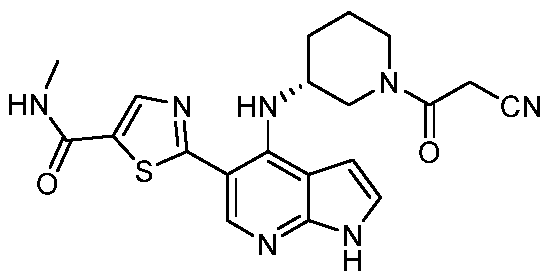
N,N-디메틸포름아미드 (4 mL) 중의 시아노아세트산 (0.04 g, 0.64 mmol) 및 1-[비스(디메틸아미노)메틸렌]-1H-1,2,3-트리아졸로[4,5-b]피리디늄 3-옥사이드 헥사플루오로포스페이트 (0.24 g, 0.63 mmol)의 용액을 상온에서 3분간 교반하였다. 이후, (R)-N-메틸-2-(4-(피페리딘-3-일아미노)-1H-피롤로[2,3-b]피리딘-5-일)티아졸-5-카르복사미드 하이드로클로라이드 (0.15 g, 0.42 mmol)를 첨가한 후, N,N-디이소프로필에틸아민 (0.5 mL, 1.42 mmol)을 첨가하고, 상기 혼합물을 상온에서 16시간 동안 교반하였다. 상기 반응 혼합물을 물로 ??칭하고 에틸 아세테이트로 추출하였다. 상기 유기층을 염수로 세척하고, 무수 황산나트륨으로 건조시켜 여과 후 진공에서 농축시켰다. 상기 미정제 물질을 역상 크로마토그래피로 정제하여 (R)-N-(2-(4-((1-(2-시아노아세틸)피페리딘-3-일)아미노)-1H-피롤로[2,3-b]피리딘-5-일)피리딘-4-일)메탄설폰아미드를 황백색 고체로서 수득하였다 (0.01 g, 6% 수율): 1H NMR (400 MHz, DMSO-d6, VT, 80℃) δ 11.45 (s, 1H), 9.65 (br s, 1H), 8.20-8.31 (m, 3H), 7.19 (s, 1H), 6.68 (s, 1H), 3.89-4.50 (m, 4H), 3.68 (m, 2H), 3.43 (m, 2H), 2.79 (s, 2H), 2.07 (s, 1H), 1.64-1.75 (m, 3H); MS (ES) m/z 424.2 (M+H). N, N - dimethylformamide (4 mL) cyanoacetic acid (0.04 g, 0.64 mmol) and 1- [bis (dimethylamino) methylene] -1 H -1,2,3- triazolo [4,5- b ] A solution of pyridinium 3-oxide hexafluorophosphate (0.24 g, 0.63 mmol) was stirred at room temperature for 3 minutes. Since, (R) - N - methyl-2- (4- (piperidin-3-ylamino) -1 H - pyrrolo [2,3- b] pyridin-5-yl) thiazole-5-carboxylic After addition of zaxamide hydrochloride (0.15 g, 0.42 mmol), N,N -diisopropylethylamine (0.5 mL, 1.42 mmol) was added, and the mixture was stirred at room temperature for 16 hours. The reaction mixture was quenched with water and extracted with ethyl acetate. The organic layer was washed with brine, dried over anhydrous sodium sulfate, filtered and concentrated in vacuo. Purification of the crude material by reverse phase chromatography (R) - N - (2- (4 - ((1- (2- cyano-acetyl) -piperidin-3-yl) amino) -1 H - pyrrolo [2,3- b ]pyridin-5-yl)pyridin-4-yl)methanesulfonamide was obtained as an off-white solid (0.01 g, 6% yield): 1 H NMR (400 MHz, DMSO-d 6, VT , 80°C) δ 11.45 (s, 1H), 9.65 (br s, 1H), 8.20-8.31 (m, 3H), 7.19 (s, 1H), 6.68 (s, 1H), 3.89-4.50 (m, 4H) ), 3.68 (m, 2H), 3.43 (m, 2H), 2.79 (s, 2H), 2.07 (s, 1H), 1.64-1.75 (m, 3H); MS (ES) m/z 424.2 (M+H).
분석 조건:Analysis conditions:
컬럼: Ascentis Express C18 (50 mm X 2.1 mm X 2.7 μm)Column: Ascentis Express C18 (50 mm X 2.1 mm X 2.7 μm)
이동상(A): 수중 0.1% 포름산Mobile phase (A): 0.1% formic acid in water
이동상(B): MeCNMobile phase (B): MeCN
유속: 1.0 mL/분Flow rate: 1.0 mL/min
[000525] 실시예 54: (R)-N-(2-(4-((1-(2-시아노아세틸)피페리딘-3-일)아미노)-1H-피롤로[2,3-b]피리딘-5-일)피리딘-4-일)N,N-디메틸 황산 디아미드의 제조 [000 525] Example 54: (R) - N - (2- (4 - ((1- (2- cyano-acetyl) -piperidin-3-yl) amino) -1 H - pyrrolo [2,3 -b ] pyridin-5-yl) pyridin-4-yl) N,N -dimethyl Sulfuric acid diamide preparation

반응식 52. (Scheme 52. ( RR )-)- NN -(2-(4-((1-(2-시아노아세틸)피페리딘-3-일)아미노)-1-(2-(4-((1-(2-cyanoacetyl)piperidin-3-yl)amino)-1 HH -피롤로[2,3-pyrrolo[2,3 -b-b ]피리딘-5-일)피리딘-4-일)]pyridin-5-yl)pyridin-4-yl) N,NN, N -디메틸 황산 디아미드의 제조 -Preparation of dimethyl sulfate diamide

[000526] 단계 1: [(2-브로모피리딘-4-일)설파모일]디메틸아민의 제조 [000526] Step 1: Preparation of [(2-bromopyridin-4-yl)sulfamoyl]dimethylamine

피리딘 (20 mL) 중 2-브로모피리딘-4-아민 (2.0 g, 11.5 mmol)의 용액에 디메틸설파모일 클로라이드 (1.63 g, 11.5 mmol)를 첨가한 후, 상기 혼합물을 질소 대기 하에 밀봉된 튜브 중에서 80℃로 12시간 동안 교반하였다. 상기 반응 혼합물을 상온으로 냉각한 후, 에틸 아세테이트와 물로 희석하였다. 상기 유기층을 분리하여 염수로 세척하고, 무수 황산나트륨으로 건조시킨 후, 여과하여 진공에서 농축시켰다. 상기 미정제 잔류물을 섬광 크로마토그래피 (20% 에틸 아세테이트/헥산)로 정제하여 [(2-브로모피리딘-4-일)설파모일]디메틸아민을 무색의 진득한 액체로서 수득하였다 (1.2 g, 37% 수율): MS (ES) m/z 280.0 (M+). To a solution of 2-bromopyridin-4-amine (2.0 g, 11.5 mmol) in pyridine (20 mL) was added dimethylsulfamoyl chloride (1.63 g, 11.5 mmol), and then the mixture was placed in a sealed tube under nitrogen atmosphere. The mixture was stirred at 80 °C for 12 hours. After the reaction mixture was cooled to room temperature, it was diluted with ethyl acetate and water. The organic layer was separated, washed with brine, dried over anhydrous sodium sulfate, filtered and concentrated in vacuo. The crude residue was purified by flash chromatography (20% ethyl acetate/hexanes) to give [(2-bromopyridin-4-yl)sulfamoyl]dimethylamine as a colorless thick liquid (1.2 g, 37 % yield): MS (ES) m/z 280.0 (M+).
[000527] 단계 2: tert-부틸 (R)-3-((5-(4-((N,N-디메틸설파모일)아미노)피리딘-2-일)-1-((2-(트리메틸실릴)에톡시)메틸)-1H-피롤로[2,3-b]피리딘-4-일)아미노)피페리딘-1-카르복실레이트의 제조 [000527] Step 2: tert -Butyl ( R )-3-((5-(4-(( N,N -dimethylsulfamoyl)amino)pyridin-2-yl)-1-((2-(trimethylsilyl) ) ethoxy) methyl) -1 H in-pyrrolo [2,3- b] pyridin-4-yl) amino) Preparation of piperidine-1-carboxylate

디옥산 (9 mL) 중 [(2-브로모피리딘-4-일)설파모일]디메틸아민 (0.8 g, 2.85 mmol) 및 tert-부틸 (R)-3-((5-(4,4,5,5-테트라메틸-1,3,2-디옥사보롤란-2-일)-1-((2-(트리메틸실릴)에톡시)메틸)-1H-피롤로[2,3-b]피리딘-4-일)아미노)피페리딘-1-카르복실레이트 (1.96 g, 3.42 mmol)의 용액에 디클로로메탄 (0.1 g, 0.13 mmol)과의 [1,1'-비스(디페닐 포스피노)페로센]디클로로팔라듐(II) 착물 및 2M 탄산칼륨 수용액 (1.18 g, 8.55 mmol)을 첨가한 후, 상기 혼합물을 질소 대기 하에 100℃로 12시간 동안 가열하였다. 상기 반응 혼합물을 상온으로 냉각하고, 에틸 아세테이트로 희석한 후, 물과 염수로 세척하였다. 유기층을 무수 황산나트륨으로 건조시켜 여과한 후, 감압 하에 증발시켜 미정제 화합물을 수득하였다. 상기 미정제 잔류물을 섬광 크로마토그래피 (50% 에틸 아세테이트/헥산)로 정제하여 tert-부틸 (R)-3-((5-(4-((N,N-디메틸설파모일)아미노)피리딘-2-일)-1-((2-(트리메틸실릴)에톡시)메틸)-1H-피롤로[2,3-b]피리딘-4-일)아미노)피페리딘-1-카르복실레이트를 진득한 갈색 고체로서 수득하였다 (0.25 g, 54% 수율): MS (ES) m/z 645.9 (M+H).[(2-bromopyridin-4-yl)sulfamoyl]dimethylamine (0.8 g, 2.85 mmol) and tert -butyl ( R )-3-((5-(4,4, 5,5-tetramethyl-1,3,2 dioxaborolan-2-yl) -1-methyl ((2- (trimethylsilyl))) - 1 H-pyrrolo [2,3- b To a solution of ]pyridin-4-yl)amino)piperidine-1-carboxylate (1.96 g, 3.42 mmol) with dichloromethane (0.1 g, 0.13 mmol) [1,1'-bis(diphenyl phos After addition of pino)ferrocene]dichloropalladium(II) complex and 2M aqueous potassium carbonate solution (1.18 g, 8.55 mmol), the mixture was heated to 100° C. under nitrogen atmosphere for 12 hours. The reaction mixture was cooled to room temperature, diluted with ethyl acetate, and washed with water and brine. The organic layer was dried over anhydrous sodium sulfate, filtered, and evaporated under reduced pressure to obtain a crude compound. The crude residue was purified by flash chromatography (50% ethyl acetate/hexanes) to tert -butyl ( R )-3-((5-(4-(( N,N -dimethylsulfamoyl)amino)pyridine- 2-yl) - 1 - ((2- (trimethylsilyl) ethoxy) methyl) -1 H-pyrrolo [2,3- b] pyridin-4-yl) amino) piperidine-1-carboxylate was obtained as a thick brown solid (0.25 g, 54% yield): MS (ES) m/z 645.9 (M+H).
[000528] 단계 3: (3R)-N-(5-{4-[(디메틸설파모일)아미노]피리딘-2-일}-1H-피롤로[2,3-b]피리딘-4-일)피페리딘-3-아민의 제조 [000 528] Step 3: (3 R) - N - (5- {4 - [( dimethylsulfamoyl) amino] pyridin-2-yl} -1 H - pyrrolo [2,3- b] pyridin-4 1) Preparation of piperidin-3-amine

디클로로메탄 : 트리플루오로아세트산 (5 mL : 5 mL) 중 tert-부틸 (R)-3-((5-(4-((N,N-디메틸설파모일)아미노)피리딘-2-일)-1-((2-(트리메틸실릴) 에톡시)메틸)-1H-피롤로[2,3-b]피리딘-4-일)아미노)피페리딘-1-카르복실레이트 (0.25 g, 0.38 mmol)의 용액을 상온에서 3시간 동안 교반하였다. 상기 반응 혼합물을 진공에서 농축하고, 잔류물을 1,4-디옥산 : 수성 암모니아 (5 mL : 5 mL, 물 중 23%)에 용해시킨 후, 상온에서 16시간 동안 교반하였다. 상기 반응 혼합물을 에틸 아세테이트로 희석한 후, 물과 염수로 세척하였다. 유기층을 무수 황산나트륨으로 건조시킨 후, 여과하고 진공에서 농축시켜 (R)-5-(5-메틸옥사졸-2-일)-N-(피페리딘-3-일)-1H-피롤로[2,3-b]피리딘-4-아민을 진득한 황색 고체로서 수득하였다 (0.15 g, 미정제): MS (ES) m/z 413.9 (M-H). Dichloromethane: tert -butyl ( R )-3-((5-(4-(( N,N -dimethylsulfamoyl)amino)pyridin-2-yl)- in trifluoroacetic acid (5 mL: 5 mL)- 1 - ((2- (trimethylsilyl) ethoxy) methyl) -1 H-pyrrolo [2,3- b] pyridin-4-yl) amino) piperidine-1-carboxylate (0.25 g, 0.38 mmol) was stirred at room temperature for 3 hours. The reaction mixture was concentrated in vacuo, and the residue was dissolved in 1,4-dioxane : aqueous ammonia (5 mL : 5 mL, 23% in water) and stirred at room temperature for 16 hours. The reaction mixture was diluted with ethyl acetate and washed with water and brine. The organic layer was dried over anhydrous sodium sulfate, filtered and concentrated in vacuo to give (R) -5- (5- methyloxazol-2-yl) - N - (piperidin-3-yl) -1 H - pyrrolo [2,3- b ]pyridin-4-amine was obtained as a thick yellow solid (0.15 g, crude): MS (ES) m/z 413.9 (MH).
[000529] 단계 4: (R)-N-(2-(4-((1-(2-시아노아세틸)피페리딘-3-일)아미노)-1H-피롤로[2,3-b]피리딘-5-일)피리딘-4-일)N,N-디메틸 황산 디아미드의 제조 [000 529] Step 4: (R) - N - (2- (4 - ((1- (2- cyano-acetyl) -piperidin-3-yl) amino) -1 H-pyrrolo [2,3 - b] Preparation of pyridin-5-yl)pyridin-4-yl) N,N -dimethyl sulfate diamide

N,N-디메틸포름아미드 (5 mL) 중의 시아노아세트산 (0.036 g, 0.43 mmol) 및 1-[비스(디메틸아미노)메틸렌]-1H-1,2,3-트리아졸로[4,5-b]피리디늄 3-옥사이드 헥사플루오로포스페이트 (0.22 g, 0.43 mmol)의 용액을 5분간 교반하였다. 이후, (R)-5-(5-메틸옥사졸-2-일)-N-(피페리딘-3-일)-1H-피롤로[2,3-b]피리딘-4-아민 (0.15 g, 0.36 mmol)을 첨가한 후, N,N-디이소프로필에틸아민 (0.19 mL, 1.08 mmol)을 첨가하고, 상기 반응 혼합물을 상온에서 12시간 동안 교반하였다. 상기 반응 혼합물을 에틸 아세테이트로 희석한 후, 물과 염수로 세척하였다. 상기 유기층을 무수 황산나트륨으로 건조시킨 후, 여과 및 진공에서 농축시켰다. 상기 미정제 물질을 역상 크로마토그래피로 정제하여 3-[(3R)-3-{[5-(4-{[(5-브로모-3-포르밀-1H-인돌-7-일)(메틸)설파모일]아미노}피리딘-2-일)-1H-피롤로[2,3-b]피리딘-4-일]아미노}피페리딘-1-일]-3-옥소프로판니트릴을 황백색 고체로서 수득하였다 (0.01 g, 6% 수율): 1H NMR (400 MHz, DMSO-d6) δ 12.37 (s, 1H), 10.81 (s, 2H), 8.45-8.46 (m, 1H), 8.24-8.26 (m, 1H), 7.41-7.48 (m, 2H) 7.16-7.17 (m, 1H), 6.91 (s, 1H), 4.08 (s, 1H), 3.60-3.76 (m, 4H), 2.80 (s, 6H), 2.04-21.30 (m, 6H); MS (ES) m/z 483.2 (M+H). N, N - cyano-acetic acid (0.036 g, 0.43 mmol) and 1- [bis (dimethylamino) methylene] in dimethylformamide (5 mL) -1 H -1,2,3- triazolo [4,5- b ] A solution of pyridinium 3-oxide hexafluorophosphate (0.22 g, 0.43 mmol) was stirred for 5 minutes. Since, (R) -5- (5- methyloxazol-2-yl) - N - (piperidin-3-yl) -1 H - pyrrolo [2,3- b] pyridin-4-amine ( 0.15 g, 0.36 mmol), then N,N -diisopropylethylamine (0.19 mL, 1.08 mmol) was added, and the reaction mixture was stirred at room temperature for 12 hours. The reaction mixture was diluted with ethyl acetate and washed with water and brine. The organic layer was dried over anhydrous sodium sulfate, filtered and concentrated in vacuo. The crude material was purified by reverse phase chromatography to 3-[(3 R )-3-{[5-(4-{[(5-bromo-3-formyl-1 H -indol-7-yl) (methyl) sulfamoyl] amino} pyridin-2-yl) -1 H - pyrrolo [2,3- b] pyridin-4-yl] amino} piperidin-1-yl] -3-oxo-propanenitrile the Obtained as an off-white solid (0.01 g, 6% yield): 1 H NMR (400 MHz, DMSO-d 6 ) δ 12.37 (s, 1H), 10.81 (s, 2H), 8.45-8.46 (m, 1H), 8.24-8.26 (m, 1H), 7.41-7.48 (m, 2H) 7.16-7.17 (m, 1H), 6.91 (s, 1H), 4.08 (s, 1H), 3.60-3.76 (m, 4H), 2.80 (s, 6H), 2.04-21.30 (m, 6H); MS (ES) m/z 483.2 (M+H).
분석 조건:Analysis conditions:
유속: 0.3 mL/분Flow rate: 0.3 mL/min
컬럼: BEH C18 (50 mm X 2.1 mm X 1.7 μm) Column: BEH C18 (50 mm X 2.1 mm X 1.7 μm)
이동상 (A): 수중 0.1% TFAMobile phase (A): 0.1% TFA in water
이동상 (B): MeCNMobile phase (B): MeCN
[000530] 실시예 55: (R)-3-(3-((5-(5-(메틸설포닐)피리딘-2-일)-1H-피롤로[2,3-b]피리딘-4-일)아미노) 피페리딘-1-일)-3-옥소프로판니트릴의 제조 [000 530] Example 55: (R) -3- (3 - ((5- (5- ( methylsulfonyl) pyridin-2-yl) -1 H - pyrrolo [2,3- b] pyridine -4 Preparation of -yl)amino) piperidin-1-yl)-3-oxopropanenitrile

반응식 53. (Scheme 53. ( RR )-3-(3-((5-(5-(메틸설포닐)피리딘-2-일)-1)-3-(3-((5-(5-(methylsulfonyl)pyridin-2-yl)-1 HH -피롤로[2,3--pyrrolo[2,3- bb ]피리딘-4-일)아미노) 피페리딘-1-일)-3-옥소프로판니트릴의 제조 ] Preparation of pyridin-4-yl)amino) piperidin-1-yl)-3-oxopropanenitrile

[000531] 단계 1: tert-부틸 (R)-3-((5-(5-(메틸설포닐)피리딘-2-일)-1-((2-(트리메틸실릴)에톡시) 메틸)-1H-피롤로[2,3-b]피리딘-4-일)아미노)피페리딘-1-카르복실레이트의 제조 [000531] Step 1: tert -Butyl ( R )-3-((5-(5-(methylsulfonyl)pyridin-2-yl)-1-((2-(trimethylsilyl)ethoxy)methyl)- Preparation of 1 H -pyrrolo[2,3-b]pyridin-4-yl)amino)piperidine-1-carboxylate

1,4-디옥산 (10 mL) 중 tert-부틸 (R)-3-((5-(4,4,5,5-테트라메틸-1,3,2-디옥사보롤란-2-일)-1-((2-(트리메틸실릴)에톡시)메틸)-1H-피롤로[2,3-b]피리딘-4-일)아미노)피페리딘-1-카르복실레이트 (1.0 g, 1.75 mmol) 및 2-브로모-5-(메틸설포닐)피리딘 (0.62 g, 2.6 mmol)의 교반된 용액에 디클로로비스 (트리페닐포스핀)팔라듐(II) (0.07 g, 0.09 mmol)을 첨가한 후 2M 탄산칼륨 수용액 (0.72 g, 5.25 mmol)을 첨가하고, 상기 혼합물을 밀봉된 튜브 중에서 질소 하에 90℃로 12시간 동안 가열하였다. 상기 반응 혼합물을 상온으로 냉각한 후, 에틸 아세테이트와 물로 희석하였다. 상기 유기층을 분리하여 염수로 세척하고, 무수 황산나트륨으로 건조시킨 후, 여과하여 진공에서 농축시켰다. 상기 미정제 물질을 섬광 크로마토그래피 (40% 에틸 아세테이트/헥산)로 정제하여 tert-부틸 (R)-3-((5-(5-(메틸설포닐)피리딘-2-일)-1-((2-(트리메틸실릴)에톡시)메틸)-1H-피롤로[2,3-b]피리딘-4-일)아미노)피페리딘-1-카르복실레이트를 끈끈한 담황색 고체로서 수득하였다 (0.19 g, 18% 수율): MS (ES) m/z 602.3 (M+H). tert- Butyl ( R )-3-((5-(4,4,5,5-tetramethyl-1,3,2-dioxaborolan-2-yl) in 1,4-dioxane (10 mL) ) -1-methyl ((2- (trimethylsilyl))) - 1 H-pyrrolo [2,3- b] pyridin-4-yl) amino) piperidine-1-carboxylate (1.0 g , 1.75 mmol) and 2-bromo-5- (methylsulfonyl) pyridine (0.62 g, 2.6 mmol) in dichlorobis (triphenylphosphine) palladium (II) (0.07 g, 0.09 mmol) was added After addition, 2M aqueous potassium carbonate solution (0.72 g, 5.25 mmol) was added and the mixture was heated in a sealed tube at 90° C. under nitrogen for 12 h. After the reaction mixture was cooled to room temperature, it was diluted with ethyl acetate and water. The organic layer was separated, washed with brine, dried over anhydrous sodium sulfate, filtered and concentrated in vacuo. The crude material was purified by flash chromatography (40% ethyl acetate/hexanes) to tert -butyl ( R )-3-((5-(5-(methylsulfonyl)pyridin-2-yl)-1-( (2- (trimethylsilyl)) methyl) -1 H - pyrrolo [2,3- b] pyridin-4-yl) amino) to give piperidine-1-carboxylate as a sticky light yellow solid ( 0.19 g, 18% yield): MS (ES) m/z 602.3 (M+H).
[000532] 단계 2: (R)-5-(5-(메틸설포닐)피리딘-2-일)-N-(피페리딘-3-일)-1H-피롤로[2,3-b]피리딘-4-아민의 제조 [000 532] Step 2: (R) -5- (5- ( methylsulfonyl) pyridin-2-yl) - N - (piperidin-3-yl) -1 H - pyrrolo [2,3-b ]Preparation of pyridin-4-amine

디클로로메탄 : 트리플루오로아세트산 (3 mL : 3 mL) 중 tert-부틸 (R)-3-((5-(5-(메틸설포닐)피리딘-2-일)-1-((2-(트리메틸실릴)에톡시)메틸)-1H-피롤로[2,3-b]피리딘-4-일)아미노)피페리딘-1-카르복실레이트 (0.19 g, 0.32 mmol)의 용액을 상온에서 3시간 동안 교반하였다. 상기 반응 혼합물을 진공에서 농축하고, 잔류물을 1,4-디옥산 : 수성 암모니아 (3 mL : 3 mL, 물 중 23%)에 용해시킨 후, 상기 용액을 상온에서 16시간 동안 교반하였다. 상기 반응 혼합물을 진공에서 농축시켜 (R)-5-(5-(메틸설포닐)피리딘-2-일)-N-(피페리딘-3-일)-1H-피롤로 [2,3-b]피리딘-4-아민을 황백색 고체로서 수득하였다 (0.15 g, 미정제); MS (ES) m/z 372.2 (M+H). Dichloromethane: tert -butyl ( R )-3-((5-(5-(methylsulfonyl)pyridin-2-yl)-1-((2-() in trifluoroacetic acid (3 mL: 3 mL)) trimethylsilyl) ethoxy) methyl) -1 H - pyrrolo [2,3- b] pyridin-4-yl) amino) piperidine-1-carboxylate (0.19 g, a solution of 0.32 mmol) at room temperature Stirred for 3 hours. The reaction mixture was concentrated in vacuo, the residue was dissolved in 1,4-dioxane : aqueous ammonia (3 mL : 3 mL, 23% in water), and the solution was stirred at room temperature for 16 h. The reaction mixture was concentrated in vacuo (R) -5- (5- (methylsulfonyl) pyridin-2-yl) - N - (piperidin-3-yl) -1 H - pyrrolo [2,3 -b]pyridin-4-amine was obtained as an off-white solid (0.15 g, crude); MS (ES) m/z 372.2 (M+H).
[000533] 단계 3: (R)-3-(3-((5-(5-(메틸설포닐)피리딘-2-일)-1H-피롤로[2,3-b]피리딘-4-일)아미노) 피페리딘-1-일)-3-옥소프로판니트릴의 제조 [000 533] Step 3: (R) -3- (3 - ((5- (5- ( methylsulfonyl) pyridin-2-yl) -1 H - pyrrolo [2,3- b] pyridin-4 Preparation of yl)amino) piperidin-1-yl)-3-oxopropanenitrile

디클로로메탄 (15 mL) 중의 시아노아세트산 (0.051 g, 0.6 mmol), N-(3-디메틸아미노프로필)-N'-에틸카르보디이미드 하이드로클로라이드 (0.085 g, 0.6 mmol), 1-하이드록시벤조트리아졸 (0.82 g, 0.6 mmol) 및 N,N-디이소프로필에틸아민 (0.2 mL, 1.2 mmol)의 용액을 상온에서 5분간 교반하였다. 이후, (R)-5-(5-(메틸설포닐)피리딘-2-일)-N-(피페리딘-3-일)-1H-피롤로[2,3-b]피리딘-4-아민 (0.15 g, 0.4 mmol)을 첨가한 후, 생성된 혼합물을 상온에서 12시간 동안 교반하였다. 상기 반응 혼합물을 물로 ??칭하고 디클로로메탄으로 추출하였다. 상기 유기층을 물과 염수로 세척하고, 무수 황산나트륨으로 건조시킨 후, 여과하여 진공에서 농축시켰다. 상기 미정제 물질을 역상 크로마토그래피로 정제하여 (R)-3-(3-((5-(5-(메틸설포닐)피리딘-2-일)-1H-피롤로[2,3-b]피리딘-4-일)아미노)피페리딘-1-일)-3-옥소프로판니트릴을 황백색 고체로서 수득하였다 (0.03 g, 16% 수율): 1H NMR (400 MHz, DMSO-d6 VT, 100℃) δ 11.27 (br s, 1H), 9.96 (br s, 1H), 8.98 (s, 1H), 8.51 (s, 1H), 8.24 (d, J = 2.2 Hz, 1H), 8.13 (d, J = 2.2 Hz, 1H), 7.16 (s, 1H), 6.66 (s, 1H), 4.29 (br s, 1H), 3.89 (br s, 2H), 3.40-3.45 (m, 3H), 3.27 (s, 3H), 2.08 (br s, 1H), 1.64-1.77 (m, 3H), 1.25 (s, 1H); MS (ES) m/z 439.1 (M+H). Dichloromethane (15 mL) cyanoacetic acid (0.051 g, 0.6 mmol), N of the (3-dimethylaminopropyl) - N '- ethylcarbodiimide hydrochloride (0.085 g, 0.6 mmol), 1- hydroxybenzotriazole A solution of triazole (0.82 g, 0.6 mmol) and N,N -diisopropylethylamine (0.2 mL, 1.2 mmol) was stirred at room temperature for 5 minutes. Since, (R) -5- (5- (methylsulfonyl) pyridin-2-yl) - N - (piperidin-3-yl) -1 H - pyrrolo [2,3- b] pyridine -4 -Amine (0.15 g, 0.4 mmol) was added, and the resulting mixture was stirred at room temperature for 12 hours. The reaction mixture was quenched with water and extracted with dichloromethane. The organic layer was washed with water and brine, dried over anhydrous sodium sulfate, filtered and concentrated in vacuo. Purification of the crude material by reverse phase chromatography (R) -3- (3 - ( (5- (5- ( methylsulfonyl) pyridin-2-yl) -1 H - pyrrolo [2,3- b ]pyridin-4-yl)amino)piperidin-1-yl)-3-oxopropanenitrile was obtained as an off-white solid (0.03 g, 16% yield): 1 H NMR (400 MHz, DMSO-d 6 VT , 100°C) δ 11.27 (br s, 1H), 9.96 (br s, 1H), 8.98 (s, 1H), 8.51 (s, 1H), 8.24 (d, J = 2.2 Hz, 1H), 8.13 (d) , J = 2.2 Hz, 1H), 7.16 (s, 1H), 6.66 (s, 1H), 4.29 (br s, 1H), 3.89 (br s, 2H), 3.40-3.45 (m, 3H), 3.27 ( s, 3H), 2.08 (br s, 1H), 1.64-1.77 (m, 3H), 1.25 (s, 1H); MS (ES) m/z 439.1 (M+H).
분석 조건:Analysis conditions:
컬럼: X bridge (250 mm X 4.6 mm X 5 마이크론)Column: X bridge (250 mm X 4.6 mm X 5 microns)
이동상(A): 수중 0.1% 암모니아Mobile phase (A): 0.1% ammonia in water
이동상(B): 메탄올Mobile phase (B): methanol
유속: 1.0 mL/분Flow rate: 1.0 mL/min
[000534] 실시예 56: (R)-N-(2-(4-((1-(2-시아노아세틸)피페리딘-3-일)아미노)-1H-피롤로[2,3-b] 피리딘-5-일)피리딘-4-일)메탄설폰아미드의 제조 [000 534] Example 56: (R) - N - (2- (4 - ((1- (2- cyano-acetyl) -piperidin-3-yl) amino) -1 H - pyrrolo [2,3 -b] Preparation of pyridin-5-yl)pyridin-4-yl)methanesulfonamide

반응식 54. (Scheme 54. ( RR )-)- NN -(2-(4-((1-(2-시아노아세틸)피페리딘-3-일)아미노)-1-(2-(4-((1-(2-cyanoacetyl)piperidin-3-yl)amino)-1 HH -피롤로[2,3--pyrrolo[2,3- bb ] 피리딘-5-일)피리딘-4-일)메탄설폰아미드의 제조 ] Preparation of pyridin-5-yl)pyridin-4-yl)methanesulfonamide

[000535] 단계 1: N-(2-브로모피리딘-4-일)메탄설폰아미드의 제조 [000535] Step 1: Preparation of N- (2-bromopyridin-4-yl)methanesulfonamide

염화메탄설포닐 (0.79 ml, 6.97 mmol)을 0℃의 디클로로메탄 (5 mL) 중 2-브로모피리딘-4-아민 (1.0 g, 5.81 mmol) 및 피리딘 (1 mL)의 교반된 용액에 첨가한 후, 상기 용액을 상온으로 가온하여 12시간 동안 교반하였다. 상기 반응 혼합물을 얼음물로 ??칭하고 에틸 아세테이트로 추출하였다. 상기 유기층을 물, 염수로 세척하고 무수 황산나트륨으로 건조시켰다. 상기 용액을 여과시킨 후 진공에서 농축시켰다. 상기 미정제 물질을 섬광 크로마토그래피 (20% 에틸 아세테이트/헥산)로 정제하여 N-(2-브로모피리딘-4-일)메탄설폰아미드를 갈색 고체로서 수득하였다 (0.4 g, 28% 수율): MS (ES) m/z 252.8 (M+H).Methanesulfonyl chloride (0.79 ml, 6.97 mmol) was added to a stirred solution of 2-bromopyridin-4-amine (1.0 g, 5.81 mmol) and pyridine (1 mL) in dichloromethane (5 mL) at 0 °C After that, the solution was warmed to room temperature and stirred for 12 hours. The reaction mixture was quenched with ice water and extracted with ethyl acetate. The organic layer was washed with water and brine and dried over anhydrous sodium sulfate. The solution was filtered and then concentrated in vacuo. The crude material was purified by flash chromatography (20% ethyl acetate/hexanes) to give N- (2-bromopyridin-4-yl)methanesulfonamide as a brown solid (0.4 g, 28% yield): MS (ES) m/z 252.8 (M+H).
[000536] 단계 2: tert-부틸 (R)-3-((5-(4-(메틸설폰아미도)피리딘-2-일)-1-((2-(트리메틸실릴) 에톡시)메틸)-1H-피롤로[2,3-b]피리딘-4-일)아미노)피페리딘-1-카르복실레이트의 제조 [000536] Step 2: tert -Butyl ( R )-3-((5-(4-(methylsulfonamido)pyridin-2-yl)-1-((2-(trimethylsilyl)ethoxy)methyl) Preparation of -1 H -pyrrolo[2,3-b]pyridin-4-yl)amino)piperidine-1-carboxylate

1,4-디옥산 (8 mL) 중 tert-부틸 (R)-3-((5-(4,4,5,5-테트라메틸-1,3,2-디옥사보롤란-2-일)-1-((2-(트리메틸실릴) 에톡시)메틸)-1H-피롤로[2,3-b]피리딘-4-일)아미노)피페리딘-1-카르복실레이트 (0.80 g, 1.39 mmol) 및 N-(2-브로모피리딘-4-일)메탄설폰아미드 (0.28 g, 1.58 mmol)의 용액에 비스(트리페닐포스핀) 팔라듐(II) 디클로라이드 (0.09 g, 0.02 mmol)를 첨가한 후, 2M 탄산나트륨 수용액 (0.45 g, 4.17 mmol)을 첨가하고, 상기 혼합물을 질소 대기 하에 100℃로 12시간 동안 교반하였다. 상기 반응 혼합물을 상온으로 냉각시키고, 에틸 아세테이트로 희석하여 물, 염수로 세척한 후, 무수 황산나트륨으로 건조시키고, 여과하여 진공에서 농축시켰다. 상기 미정제 물질을 섬광 크로마토그래피 (30% 에틸 아세테이트/헥산)로 정제하여 tert-부틸 (R)-3-((5-(4-(메틸설폰아미도)피리딘-2-일)-1-((2-(트리메틸실릴)에톡시)메틸)-1H-피롤로[2,3-b]피리딘-4-일)아미노)피페리딘-1-카르복실레이트를 무색의 걸쭉한 액체로서 수득하였다 (0.12 g, 12% 수율): MS (ES) m/z 616.9 (M+H). tert -Butyl ( R )-3-((5-(4,4,5,5-tetramethyl-1,3,2-dioxaborolan-2-yl) in 1,4-dioxane (8 mL) ) -1 - ((2- (trimethylsilyl)) methyl) -1 H-pyrrolo [2,3- b] pyridin-4-yl) amino) piperidine-1-carboxylate (0.80 g , 1.39 mmol) and N- (2-bromopyridin-4-yl)methanesulfonamide (0.28 g, 1.58 mmol) in a solution of bis(triphenylphosphine)palladium(II) dichloride (0.09 g, 0.02 mmol) ), 2M aqueous sodium carbonate solution (0.45 g, 4.17 mmol) was added, and the mixture was stirred at 100° C. under a nitrogen atmosphere for 12 hours. The reaction mixture was cooled to room temperature, diluted with ethyl acetate, washed with water and brine, dried over anhydrous sodium sulfate, filtered and concentrated in vacuo. The crude material was purified by flash chromatography (30% ethyl acetate/hexanes) to tert -butyl ( R )-3-((5-(4-(methylsulfonamido)pyridin-2-yl)-1- ((2- (trimethylsilyl) ethoxy) methyl) -1 H - pyrrolo [2,3- b] pyridin-4-yl) amino) to give piperidine-1-carboxylate as a thick colorless liquid (0.12 g, 12% yield): MS (ES) m/z 616.9 (M+H).
[000537] 단계 3: (R)-N-(2-(4-(피페리딘-3-일아미노)-1H-피롤로[2,3-b]피리딘-5-일)피리딘-4-일)메탄설폰아미드의 제조 [000 537] Step 3: (R) - N - (2- (4- ( piperidin-3-ylamino) -1 H - pyrrolo [2,3- b] pyridin-5-yl) pyridin -4 -Il) Preparation of methanesulfonamide

디클로로메탄 : 트리플루오로아세트산 (2 mL : 2 mL) 중 (R)-3-((5-(4-(메틸설폰아미도)피리딘-2-일)-1-((2-(트리메틸실릴)에톡시)메틸)-1H-피롤로[2,3-b]피리딘-4-일)아미노)피페리딘-1-카르복실레이트 (0.140 g, 0.22 mmol)의 용액을 상온에서 3시간 동안 교반하였다. 상기 반응 혼합물을 진공에서 농축하고, 수득된 잔류물을 1,4-디옥산 : 수성 암모니아 (2 mL : 4 mL, 물 중 23%)에 용해시킨 후, 상온에서 16시간 동안 교반하였다. 상기 반응 혼합물을 진공에서 농축시켜 (R)-N-(2-(4-(피페리딘-3-일아미노)-1H-피롤로[2,3-b]피리딘-5-일)피리딘-4-일)메탄설폰아미드를 황백색 고체로서 수득하였다 (0.11 g, 미정제): MS (ES) m/z 385.1 (M-H)+. Dichloromethane: (R )-3-((5-(4-(methylsulfonamido)pyridin-2-yl)-1-((2-(trimethylsilyl) in trifluoroacetic acid (2 mL: 2 mL)) ) ethoxy) methyl) -1 h - pyrrolo [2,3- b] pyridin-4-yl) amino) piperidine-1-carboxylate (3 hours a solution of 0.140 g, 0.22 mmol) at room temperature stirred for a while. The reaction mixture was concentrated in vacuo, and the obtained residue was dissolved in 1,4-dioxane: aqueous ammonia (2 mL: 4 mL, 23% in water), followed by stirring at room temperature for 16 hours. The reaction mixture was concentrated in vacuo (R) - N - (2- (4- ( piperidin-3-ylamino) -1 H - pyrrolo [2,3- b] pyridin-5-yl) pyridine -4-yl)methanesulfonamide was obtained as an off-white solid (0.11 g, crude): MS (ES) m/z 385.1 (MH) + .
[000538] 단계 4: (R)-N-(2-(4-((1-(2-시아노아세틸)피페리딘-3-일)아미노)-1H-피롤로[2,3-b] 피리딘-5-일)피리딘-4-일)메탄설폰아미드의 제조 [000 538] Step 4: (R) - N - (2- (4 - ((1- (2- cyano-acetyl) -piperidin-3-yl) amino) -1 H - pyrrolo [2,3- b ] Preparation of pyridin-5-yl)pyridin-4-yl)methanesulfonamide

N,N-디메틸포름아미드 (5 mL) 중 시아노아세트산 (0.036 g, 0.426 mmol) 및 1-[비스(디메틸아미노)메틸렌]-1H-1,2,3-트리아졸로[4,5-b]피리디늄 3-옥사이드 헥사플루오로포스페이트 (0.140 g, 0.37 mmol)의 교반된 용액에 (R)-N-(2-(4-(피페리딘-3-일아미노)-1H-피롤로[2,3-b]피리딘-5-일)피리딘-4-일)메탄설폰아미드 (0.11 g, 0.284 mmol)를 첨가한 후, N,N-디이소프로필에틸아민 (0.45 mL, 1.42 mmol)을 첨가하고, 상기 혼합물을 상온에서 16시간 동안 교반하였다. 상기 반응 혼합물을 물로 ??칭하고 에틸 아세테이트로 추출하였다. 상기 유기층을 물, 염수로 세척하고 무수 황산나트륨으로 건조시켰다. 상기 용액을 여과시킨 후 진공에서 농축시켰다. 상기 미정제 물질을 역상 크로마토그래피로 정제하여 (R)-N-(2-(4-((1-(2-시아노아세틸)피페리딘-3-일)아미노)-1H-피롤로[2,3-b]피리딘-5-일)피리딘-4-일)메탄설폰아미드를 황백색 고체로서 수득하였다 (0.02 g, 15% 수율): 1H NMR (400 MHz, DMSO-d6) δ 11.37-11.41 (m, 1H), 9.90 (br s, 1H), 8.17-8.31 (m, 3H), 7.40-7.42 (s, 1H), 7.15 (s, 1H) 6.94 (s, 1H), 6.61 (s, 1H), 4.04 (m, 1H), 3.92-3.99 (m, 3H), 3.55-3.67 (m, 2H), 3.55 (m, 2H), 3.11 (s, 2H), 2.87 (s, 1H), 1.97 (s, 2H), 1.60-1.69 (s, 1H); MS (ES) m/z 454.1 (M+H).Cyanoacetic acid (0.036 g, 0.426 mmol) and 1-[bis(dimethylamino)methylene]-1 H -1,2,3-triazolo[4,5- in N,N-dimethylformamide (5 mL) b] to a stirred solution of a pyridinium-3-oxide hexafluorophosphate (0.140 g, 0.37 mmol) ( R) - N - (2- (4- ( piperidin-3-ylamino) -1 H - P After addition of rolo[2,3- b ]pyridin-5-yl)pyridin-4-yl)methanesulfonamide (0.11 g, 0.284 mmol), N,N -diisopropylethylamine (0.45 mL, 1.42 mmol) was added, and the mixture was stirred at room temperature for 16 hours. The reaction mixture was quenched with water and extracted with ethyl acetate. The organic layer was washed with water and brine and dried over anhydrous sodium sulfate. The solution was filtered and then concentrated in vacuo. Purification of the crude material by reverse phase chromatography (R) - N - (2- (4 - ((1- (2- cyano-acetyl) -piperidin-3-yl) amino) -1 H - pyrrolo [2,3- b ]pyridin-5-yl)pyridin-4-yl)methanesulfonamide was obtained as an off-white solid (0.02 g, 15% yield): 1 H NMR (400 MHz, DMSO-d 6 ) δ 11.37-11.41 (m, 1H), 9.90 (br s, 1H), 8.17-8.31 (m, 3H), 7.40-7.42 (s, 1H), 7.15 (s, 1H) 6.94 (s, 1H), 6.61 ( s, 1H), 4.04 (m, 1H), 3.92-3.99 (m, 3H), 3.55-3.67 (m, 2H), 3.55 (m, 2H), 3.11 (s, 2H), 2.87 (s, 1H) , 1.97 (s, 2H), 1.60-1.69 (s, 1H); MS (ES) m/z 454.1 (M+H).
분석 조건:Analysis conditions:
컬럼: X-Bridge C-18 (250 mm X 4.6 mm X 5 mic)Column: X-Bridge C-18 (250 mm X 4.6 mm X 5 mic)
이동상(A): 수중 0.1% 암모니아Mobile phase (A): 0.1% ammonia in water
이동상(B): MeCNMobile phase (B): MeCN
유속: 1.0 mL/분Flow rate: 1.0 mL/min
[000539] 실시예 57: 3-((3R,5S)-3-메틸-5-((5-(피리미딘-4-일)-1H-피롤로[2,3-b]피리딘-4-일)아미노)피페리딘-1-일)-3-옥소프로판니트릴의 제조 [000 539] Example 57: 3 - ((3 R , 5 S) -3- methyl-5 - ((5- (pyrimidin-4-yl) -1 H-pyrrolo [2,3- b] pyridine Preparation of -4-yl)amino)piperidin-1-yl)-3-oxopropanenitrile

반응식 55. 3-((3Scheme 55. 3-((3 RR ,5,5 SS )-3-메틸-5-((5-(피리미딘-4-일)-1)-3-methyl-5-((5-(pyrimidin-4-yl)-1 HH -피롤로[2,3--pyrrolo[2,3- bb ]피리딘-4-일)아미노)피페리딘-1-일)-3-옥소프로판니트릴의 제조 ] Preparation of pyridin-4-yl)amino)piperidin-1-yl)-3-oxopropanenitrile

[000540] 단계 1: 4-클로로-N-메톡시-N-메틸-1-((2-(트리메틸실릴)에톡시)메틸)-1H-피롤로[2,3-b]피리딘-5-카르복사미드의 제조 [000 540] Step 1: 4-Chloro-N-methoxy-N-methyl-1 - ((methylethoxy), 2- (trimethylsilyl)) -1 H-pyrrolo [2,3- b] pyridine-5 -Preparation of carboxamide

디클로로메탄 (50 mL) 중 화합물 4-클로로-1-{[2-(트리메틸실릴)에톡시]메틸}-1H-피롤로[2,3-b]피리딘-5-카르복실산 (5.0 g, 15.3 mmol) 및 [(디메틸아미노)-1H-1,2,3-트리아졸로-[4,5-b]피리딘-1-일메틸렌]-N-메틸메탄암모늄 헥사플루오로포스페이트 N-옥사이드 (11.6 g, 30.6 mmol)의 용액을 5분간 교반하였다. 메톡시(메틸)아민 (1.40 g, 22.9 mmol) 및 N,N-디이소프로필에틸아민 (7.99 mL, 45.9 mmol)을 첨가한 후, 상기 혼합물을 상온에서 교반하였다. 5시간 후, 상기 반응 혼합물을 에틸 아세테이트로 희석한 후, 물과 염수로 세척하였다. 유기층을 황산나트륨으로 건조시킨 후, 여과 및 농축시켰다. 상기 미정제 물질을 섬광 크로마토그래피 (20% 에틸 아세테이트/헥산)로 정제하여 4-클로로-N-메톡시-N-메틸-1-{[2-(트리메틸실릴)에톡시]메틸}-1H-피롤로[2,3-b]피리딘-5-카르복사미드를 진득한 갈색 고체로서 수득하였다 (4 g, 71% 수율): MS (ES) m/z 370.2 (M+H).Dichloromethane (50 mL) of the compound 4-chloro-1 - {[2- (trimethylsilyl)] methyl} -1 H-pyrrolo [2,3- b] pyridine-5-carboxylic acid (5.0 g , 15.3 mmol) and [(dimethylamino) -1 H -1,2,3- triazolo - [4,5- b] pyridin-1-ylmethylene] - N - methyl methane ammonium hexafluorophosphate N - oxide (11.6 g, 30.6 mmol) was stirred for 5 min. Methoxy(methyl)amine (1.40 g, 22.9 mmol) and N,N -diisopropylethylamine (7.99 mL, 45.9 mmol) were added, and the mixture was stirred at room temperature. After 5 hours, the reaction mixture was diluted with ethyl acetate and washed with water and brine. The organic layer was dried over sodium sulfate, filtered and concentrated. Purification of the crude material by flash chromatography (20% ethyl acetate / hexane) afforded 4-chloro-N-methoxy-N- methyl-l - {[2- (trimethylsilyl)] methyl} -1 H Obtained -pyrrolo[2,3- b ]pyridine-5-carboxamide as a thick brown solid (4 g, 71% yield): MS (ES) m/z 370.2 (M+H).
[000541] 단계 2: 1-(4-클로로-1-((2-(트리메틸실릴)에톡시)메틸)-1H-피롤로[2,3-b]피리딘-5-일)에탄-1-온의 제조 [000 541] Step 2: 1- (4-chloro-l - ((methylethoxy), 2- (trimethylsilyl)) -1 H-pyrrolo [2,3- b] pyridin-5-yl) ethane -1 -Manufacture of on

테트라하이드로퓨란 (100 mL) 중 4-클로로-N-메톡시-N-메틸-1-{[2-(트리메틸실릴)에톡시]메틸}-1H-피롤로[2,3-b]피리딘-5-카르복사미드 (10 g, 27 mmol)의 교반된 용액에 브로모(메틸)마그네슘 (27 mL 81.1 mmol)을 0℃에서 첨가한 후, 상기 용액을 상온에서 2시간 동안 교반하였다. 상기 반응 혼합물을 포화 염화암모늄 용액으로 ??칭하고 에틸 아세테이트로 추출하였다. 유기층을 염수로 세척하고, 황산나트륨으로 건조시킨 후, 여과 및 농축시켜 1-(4-클로로-1-{[2-(트리메틸실릴) 에톡시]메틸}-1H-피롤로[2,3-b]피리딘-5-일)에탄-1-온을 담황색의 걸쭉한 액체로서 수득하였다 (6.5 g, 68% 수율): MS (ES) m/z 325.2 (M+H).Tetrahydrofuran (100 mL) of 4-chloro-N-methoxy-N-methyl-1 - {[2- (trimethylsilyl) ethoxy] methyl} -1 H-pyrrolo [2,3- b] pyridine Bromo(methyl)magnesium (27 mL 81.1 mmol) was added to a stirred solution of -5-carboxamide (10 g, 27 mmol) at 0° C., and then the solution was stirred at room temperature for 2 hours. The reaction mixture was quenched with saturated ammonium chloride solution and extracted with ethyl acetate. The organic layer was washed with brine, dried over sodium sulfate, filtered and concentrated to give 1- (4-chloro-l - {[2- (trimethylsilyl) ethoxy] methyl} -1 H-pyrrolo [2,3- b ]Pyridin-5-yl)ethan-1-one was obtained as a pale yellow thick liquid (6.5 g, 68% yield): MS (ES) m/z 325.2 (M+H).
[000542] 단계 3: 4-클로로-5-(피리미딘-4-일)-1-((2-(트리메틸실릴)에톡시)메틸)-1H-피롤로[2,3-b]피리딘의 제조 [000 542] Step 3: 4-Chloro-5- (pyrimidin-4-yl) - 1 - ((2- (trimethylsilyl) ethoxy) methyl) -1 H-pyrrolo [2,3- b] pyridine manufacture of

1-(4-클로로-1-{[2-(트리메틸실릴)에톡시]메틸}-1H-피롤로[2,3-b]피리딘-5-일)에탄-1-온 (2.0 g, 6.16 mmol), 포름아미드 (6 mL), p-톨루엔설폰산 (0.30 g, 1.54 mmol) 및 비스(트리메틸실릴)아민 (1.61 mL, 7.70 mmol)의 혼합물에 215℃에서 40분간 마이크로파를 조사하였다. 상기 반응 혼합물을 실온으로 냉각시키고, 의깬 얼음으로 ??칭한 후, 에틸 아세테이트로 추출하였다. 상기 유기층을 염수로 세척하고, 황산나트륨으로 건조시켜 여과 후 진공에서 농축시켰다. 상기 미정제 물질을 섬광 크로마토그래피 (30% 에틸 아세테이트/헥산)으로 정제하여 4-(4-클로로-1-{[2-(트리메틸실릴)에톡시]메틸}-1H-피롤로 [2,3-b]피리딘-5-일)피리미딘을 갈색 고체로서 수득하였다 (0.4 g, 18% 수율): MS (ES) m/z 361.1 (M+H).1- (4-chloro-l - {[2- (trimethylsilyl) ethoxy] methyl} -1 H-pyrrolo [2,3- b] pyridin-5-yl) ethane-1-one (2.0 g, 6.16 mmol), formamide (6 mL), p -toluenesulfonic acid (0.30 g, 1.54 mmol) and bis(trimethylsilyl)amine (1.61 mL, 7.70 mmol) were irradiated with microwave at 215° C. for 40 minutes. The reaction mixture was cooled to room temperature, quenched with crushed ice, and extracted with ethyl acetate. The organic layer was washed with brine, dried over sodium sulfate, filtered and concentrated in vacuo. Purification of the crude material by flash chromatography (30% ethyl acetate / hexane) afforded 4- (4-chloro-1 - {[2- (trimethylsilyl) ethoxy] methyl} -1 H-pyrrolo [2, 3- b ]pyridin-5-yl)pyrimidine was obtained as a brown solid (0.4 g, 18% yield): MS (ES) m/z 361.1 (M+H).
[000543] 단계 4: 4-클로로-5-(피리미딘-4-일)-1H-피롤로[2,3-b]피리딘의 제조 [000 543] Step 4: 4-Chloro-5- (pyrimidin-4-yl) -1 H - pyrrolo [2,3- b] pyridine

디클로로메탄 : 트리플루오로아세트산 (0.5 mL : 2 mL) 중 4-(4-클로로-1-{[2-(트리메틸실릴)에톡시]메틸}-1H-피롤로[2,3-b]피리딘-5-일)피리미딘 (0.80 g, 0.29 mmol)의 용액을 상온에서 3시간 동안 교반하였다. 상기 반응 혼합물을 진공에서 농축하고, 잔류물을 1,4-디옥산 : 수성 암모니아 (0.2 mL: 2 mL, 물 중 23%)에 용해시킨 후, 상기 혼합물을 상온에서 16시간 동안 교반하였다. 상기 반응 혼합물을 진공에서 농축시켜 4-클로로-5-(피리미딘-4-일)-1H-피롤로[2,3-b]피리딘을 갈색 고체로서 수득하였다 (0.5 g, 미정제): MS (ES) m/z 231.1 (M+H).Dichloromethane: trifluoroacetic acid: In (0.5 mL 2 mL) 4- ( 4- chloro-l - {[2- (trimethylsilyl) ethoxy] methyl} -1 H-pyrrolo [2,3- b] A solution of pyridin-5-yl)pyrimidine (0.80 g, 0.29 mmol) was stirred at room temperature for 3 hours. The reaction mixture was concentrated in vacuo, the residue was dissolved in 1,4-dioxane : aqueous ammonia (0.2 mL: 2 mL, 23% in water), and then the mixture was stirred at room temperature for 16 h. The reaction mixture was concentrated in vacuo 4-Chloro-5- (pyrimidin-4-yl) -1 H - pyrrolo [2,3- b] pyridine was obtained as a brown solid (0.5 g, crude): MS (ES) m/z 231.1 (M+H).
[000544] 단계 5: 벤질 (3R,5S)-3-메틸-5-((5-(피리미딘-4-일)-1H-피롤로[2,3-b]피리딘-4-일)아미노)피페리딘-1-카르복실레이트의 제조 [000 544] Step 5: Benzyl (3 R, 5 S) -3- methyl-5 - ((5- (pyrimidin-4-yl) -1 H-pyrrolo [2,3- b] pyridin-4 Preparation of yl) amino) piperidine-1-carboxylate

4-{4-클로로-1H-피롤로[2,3-b]피리딘-5-일}피리미딘 (0.10 g, 0.43 mmol), 1-메틸피롤리딘-2-온 (2 mL), 벤질 (3S,5R)-3-아미노-5-메틸피페리딘-1-카르복실레이트 (118 mg, 1.48 mmol) 및 N,N-디이소프로필에틸아민 (0.1 mL, 0.58 mmol)의 교반된 용액을 10 mL의 밀봉된 튜브 중에서 170℃로 32시간 동안 가열하였다. 상기 반응 혼합물을 상온으로 냉각시키고, 물로 ??칭한 후, 에틸 아세테이트로 추출하였다. 유기층을 염수로 세척하고, 황산나트륨으로 건조시킨 후, 여과하고 진공에서 농축시켜 벤질 (3R,5S)-3-메틸-5-{[5-(피리미딘-4-일)-1H-피롤로[2,3-b]피리딘-4-일]아미노}피페리딘-1-카르복실레이트를 갈색 액체로서 수득하였다 (0.15 g, 44.57% 수율): MS (ES) m/z 443.2 (M+H).4-{4-chloro- 1H -pyrrolo[2,3- b ]pyridin-5-yl}pyrimidine (0.10 g, 0.43 mmol), 1-methylpyrrolidin-2-one (2 mL), of benzyl ( 3S , 5R )-3-amino-5-methylpiperidine-1-carboxylate (118 mg, 1.48 mmol) and N,N -diisopropylethylamine (0.1 mL, 0.58 mmol) The stirred solution was heated to 170° C. in a sealed tube of 10 mL for 32 h. The reaction mixture was cooled to room temperature, quenched with water, and extracted with ethyl acetate. The organic layer was washed with brine, dried over sodium sulfate, filtered and concentrated in vacuo to give benzyl (3 R, 5 S) -3- methyl-5 - {[5- (pyrimidin-4-yl) -1 H- pyrrolo[2,3- b ]pyridin-4-yl]amino}piperidine-1-carboxylate was obtained as a brown liquid (0.15 g, 44.57% yield): MS (ES) m/z 443.2 ( M+H).
[000545] 단계 6: N-((3S,5R)-5-메틸피페리딘-3-일)-5-(피리미딘-4-일)-1H-피롤로[2,3-b]피리딘-4-아민의 제조 [000 545] Step 6: N - ((3 S , 5 R) -5- methylpiperidin-3-yl) -5- (pyrimidin-4-yl) -1 H - pyrrolo [2,3- b ] Preparation of pyridin-4-amine

트리플루오로아세트산 (1 mL) 중 벤질 (3R,5S)-3-메틸-5-{[5-(피리미딘-4-일)-1H-피롤로[2,3-b]피리딘-4-일]아미노}피페리딘-1-카르복실레이트 (0.25 g, 0.56 mmol)의 교반된 용액을 밀봉된 튜브 중에서 100℃로 1시간 동안 가열하였다. 상기 반응 혼합물을 상온으로 냉각시키고, 진공에서 농축시켜 N-((3S,5R)-5-메틸피페리딘-3-일)-5-(피리미딘-4-일)-1H-피롤로[2,3-b]피리딘-4-아민을 무색의 진득한 고체로서 수득하였다 (0.17 g, 99% 수율): MS (ES) m/z 309.2 (M+H).Trifluoroacetic acid (1 mL) of benzyl (3 R, 5 S) -3- methyl-5 - {[5- (pyrimidin-4-yl) -1 H-pyrrolo [2,3- b] pyridine A stirred solution of -4-yl]amino}piperidine-1-carboxylate (0.25 g, 0.56 mmol) was heated to 100° C. for 1 h in a sealed tube. The reaction mixture was cooled to room temperature, and concentrated in vacuo to give N - ((3 S, 5 R) -5-methyl-piperidin-3-yl) -5- (pyrimidin-4-yl) -1 H - Pyrrolo[2,3- b ]pyridin-4-amine was obtained as a colorless thick solid (0.17 g, 99% yield): MS (ES) m/z 309.2 (M+H).
[000546] 단계 7: 3-((3R,5S)-3-메틸-5-((5-(피리미딘-4-일)-1H-피롤로[2,3-b]피리딘-4-일)아미노)피페리딘-1-일)-3-옥소프로판니트릴의 제조 [000 546] Step 7: 3 - ((3 R , 5 S) -3- methyl-5 - ((5- (pyrimidin-4-yl) -1 H-pyrrolo [2,3- b] pyridin- Preparation of 4-yl)amino)piperidin-1-yl)-3-oxopropanenitrile

N,N-디메틸포름아미드 (1 mL) 중의 시아노아세트산 (0.06 g, 0.71 mmol) 및 1-[비스(디메틸아미노)메틸렌]-1H-1,2,3-트리아졸로[4,5-b]피리디늄 3-옥사이드 헥사플루오로포스페이트 (0.252 g, 1.07 mmol)의 용액을 상온에서 3분간 교반하였다. 이후, (3S,5R)-5-메틸-N-[5-(피리미딘-4-일)-1H-피롤로[2,3-b]피리딘-4-일]피페리딘-3-아민 (0.22 g, 0.71 mmol)을 첨가한 후, N,N-디이소프로필에틸아민 (0.5 mL, 2.14 mmol)을 첨가하고, 상기 혼합물을 상온에서 16시간 동안 교반하였다. 상기 반응 혼합물을 에틸 아세테이트로 희석한 후, 물과 염수로 세척하였다. 상기 유기층을 무수 황산나트륨으로 건조시킨 후, 여과 및 진공에서 농축시켰다. 상기 미정제 물질을 역상 크로마토그래피로 정제하여 3-((3R,5S)-3-메틸-5-((5-(피리미딘-4-일)-1H-피롤로[2,3-b] 피리딘-4-일) 아미노) 피페리딘-1-일)-3-옥소프로판니트릴을 황백색 고체로서 수득하였다 (0.012 g, 4.5% 수율): 1H NMR (400 MHz, DMSO-d6, VT, 80℃) δ 11.36 (s, 1H), 10.06 (br s, 1H), 9.08 (s, 1H), 8.65-8.66 (s, 1H), 8.54 (s, 1H), 7.96-7.97 (m, 1H), 7.16 (s, 1H), 6.71 (s, 1H), 4.77 (s, 1H), 3.98 (m, 4H), 3.65 (m, 1H), 2.70 (m, 1H), 2.30 (m, 1H), 1.85 (m, 1H), 1.29 (m, 1H), 0.93-0.94 (m, 3H); MS (ES) m/z 376.2 (M+H). N, N - dimethylformamide (1 mL) cyanoacetic acid (0.06 g, 0.71 mmol) and 1- [bis (dimethylamino) methylene] -1 H -1,2,3- triazolo [4,5- b ] A solution of pyridinium 3-oxide hexafluorophosphate (0.252 g, 1.07 mmol) was stirred at room temperature for 3 minutes. Later, (3 S, 5 R) -5- methyl-N - [5- (pyrimidin-4-yl) -1 H-pyrrolo [2,3- b] pyridin-4-yl] piperidine- 3-amine (0.22 g, 0.71 mmol) was added, followed by N,N -diisopropylethylamine (0.5 mL, 2.14 mmol), and the mixture was stirred at room temperature for 16 hours. The reaction mixture was diluted with ethyl acetate and washed with water and brine. The organic layer was dried over anhydrous sodium sulfate, filtered and concentrated in vacuo. Purification of the crude material by reverse phase chromatography, 3 - ((3 R, 5 S) -3- methyl-5 - ((5- (pyrimidin-4-yl) -1 H-pyrrolo [2,3 -b ] pyridin-4-yl) amino) piperidin-1-yl)-3-oxopropanenitrile was obtained as an off-white solid (0.012 g, 4.5% yield): 1 H NMR (400 MHz, DMSO-d 6, VT, 80° C.) δ 11.36 (s, 1H), 10.06 (br s, 1H), 9.08 (s, 1H), 8.65-8.66 (s, 1H), 8.54 (s, 1H), 7.96-7.97 ( m, 1H), 7.16 (s, 1H), 6.71 (s, 1H), 4.77 (s, 1H), 3.98 (m, 4H), 3.65 (m, 1H), 2.70 (m, 1H), 2.30 (m) , 1H), 1.85 (m, 1H), 1.29 (m, 1H), 0.93-0.94 (m, 3H); MS (ES) m/z 376.2 (M+H).
분석 조건:Analysis conditions:
컬럼: BEH C18 (50 mm X 2.1 mm X 1.7 μm)Column: BEH C18 (50 mm X 2.1 mm X 1.7 μm)
이동상(A): 물 중 0.1% 포름산Mobile phase (A): 0.1% formic acid in water
이동상(B): MeCNMobile phase (B): MeCN
유속: 0.3 mL/분Flow rate: 0.3 mL/min
[000547] 실시예 58: (R)-3-(3-((5-(1H-피라졸-5-일)-1H-피롤로[2,3-b]피리딘-4-일)아미노)피페리딘-1-일)-3-옥소프로판니트릴의 제조 [000 547] Example 58: (R) -3- (3 - ((5- (1 H - pyrazol-5-yl) -1 H - pyrrolo [2,3- b] pyridin-4-yl) Preparation of amino)piperidin-1-yl)-3-oxopropanenitrile

반응식 56. (Scheme 56. ( RR )-3-(3-((5-(1)-3-(3-((5-(1) HH -피라졸-5-일)-1-pyrazol-5-yl)-1 HH -피롤로[2,3--pyrrolo[2,3- bb ]피리딘-4-일)아미노)피페리딘-1-일)-3-옥소프로판니트릴의 제조] Preparation of pyridin-4-yl)amino)piperidin-1-yl)-3-oxopropanenitrile

[000548] 단계 1: tert-부틸 (2-클로로에틸)(메틸)카르바메이트의 제조 [000548] Step 1: Preparation of tert -butyl (2-chloroethyl) (methyl) carbamate

디클로로메탄 (30 mL) 중 2-클로로-N-메틸에탄-1-아민 (4.0 g, 42.9 mmol) 및 트리에틸아민 (17.99 mL, 128.7)의 교반된 용액에 디-tert-부틸 디카보네이트 (12.8 mL, 55.8 mmol)를 첨가한 후, 상기 용액을 상온에서 12시간 동안 교반하였다. 상기 반응 혼합물을 물로 ??칭하고 에틸 아세테이트로 추출하였다. 상기 유기층을 물, 염수로 세척하고 무수 황산나트륨으로 건조시켰다. 상기 용액을 여과한 후 진공에서 농축시켜 tert-부틸 (2-클로로에틸)(메틸)카르바메이트를 반고체로서 수득하였다 (3 g, 미정제). To a stirred solution of 2-chloro- N -methylethan-1-amine (4.0 g, 42.9 mmol) and triethylamine (17.99 mL, 128.7) in dichloromethane (30 mL) di-tert -butyl dicarbonate (12.8 mL, 55.8 mmol) was added, and the solution was stirred at room temperature for 12 hours. The reaction mixture was quenched with water and extracted with ethyl acetate. The organic layer was washed with water and brine and dried over anhydrous sodium sulfate. The solution was filtered and concentrated in vacuo to give tert -butyl (2-chloroethyl)(methyl)carbamate as a semi-solid (3 g, crude).
[000549] 단계 2: tert-부틸 (2-((6-브로모피리딘-2-일)옥시)에틸)(메틸)카르바메이트의 제조 [000549] Step 2: Preparation of tert -butyl (2-((6-bromopyridin-2-yl)oxy)ethyl)(methyl)carbamate

N,N-디메틸포름아미드 (15 mL) 중 6-브로모피리딘-2-올 (2.0 g, 10.4 mmol) 및 탄산칼륨 (2.3 g, 17.2 mmol)의 현탁액을 tert-부틸 (2-클로로에틸)(메틸)카르바메이트 (1.5 g, 8.6 mmol)에 첨가한 후, 상기 혼합물을 80℃로 12시간 동안 가열하였다. 상기 반응 혼합물을 상온으로 냉각시키고, 물로 ??칭한 후, 에틸 아세테이트로 추출하였다. 상기 유기층을 물과 염수로 세척하고, 무수 황산나트륨으로 건조시킨 후, 여과하여 진공에서 농축시켰다. 상기 미정제 물질을 섬광 크로마토그래피 (10% 에틸 아세테이트/헥산)로 정제하여 tert-부틸 (2-((6-브로모피리딘-2-일)옥시)에틸)(메틸)카르바메이트를 무색의 진득한 고체로서 수득하였다 (0.65 g, 26% 수율): MS (ES) m/z 330.1; 333.1 (1:1; M+H).A suspension of 6-bromopyridin-2-ol (2.0 g, 10.4 mmol) and potassium carbonate (2.3 g, 17.2 mmol) in N,N -dimethylformamide (15 mL) was dissolved in tert -butyl (2-chloroethyl) After addition to (methyl)carbamate (1.5 g, 8.6 mmol), the mixture was heated to 80° C. for 12 h. The reaction mixture was cooled to room temperature, quenched with water, and extracted with ethyl acetate. The organic layer was washed with water and brine, dried over anhydrous sodium sulfate, filtered and concentrated in vacuo. The crude material was purified by flash chromatography (10% ethyl acetate/hexanes) to give tert -butyl (2-((6-bromopyridin-2-yl)oxy)ethyl)(methyl)carbamate as colorless. Obtained as a thick solid (0.65 g, 26% yield): MS (ES) m/z 330.1; 333.1 (1:1; M+H).
[000550] 단계 3: tert-부틸 (R)-(2-((6-(4-((1-(2-시아노아세틸)피페리딘-3-일)아미노)-1H-피롤로[2,3-b]피리딘-5-일)피리딘-2-일)옥시)에틸)(메틸)카르바메이트의 제조 [000 550] Step 3: tert - butyl (R) - (2 - ( (6- (4 - ((1- (2- cyano-acetyl) -piperidin-3-yl) amino) -1 H - pyrrolo Preparation of [2,3-b]pyridin-5-yl)pyridin-2-yl)oxy)ethyl)(methyl)carbamate

1,4-디옥산 (8 mL) 중 (R)-3-옥소-3-(3-((5-(4,4,5,5-테트라메틸-1,3,2-디옥사보롤란-2-일)-1H-피롤로[2,3-b]피리딘-4-일)아미노)피페리딘-1-일)프로판니트릴 (0.2 g, 0.49 mmol, 실시예 61, 단계 1) 및 tert-부틸 (2-((6-브로모피리딘-2-일)옥시)에틸)(메틸)카르바메이트 (0.16 g, 0.49 mmol)의 교반된 용액에 클로로(2-디사이클로헥실포스피노-2',4',6'-트리이소프로필-1,1'-바이페닐)[2-(2'-아미노-1,1'-바이페닐)]팔라듐(II) (0.04 g, 0.05 mmol)을 첨가한 후, 2M 인산칼륨 수용액 (0.31 g, 1.46 mmol)을 첨가하고, 상기 혼합물을 질소 대기 하에 110℃에서 12시간 동안 교반하였다. 상기 반응 혼합물을 상온으로 냉각시키고, 여과한 후 진공에서 농축시켰다. 상기 미정제 물질을 섬광 크로마토그래피 (5% 메탄올/클로로메탄)로 정제하여 tert-부틸 (R)-(2-((6-(4-((1-(2-시아노아세틸)피페리딘-3-일)아미노)-1H-피롤로[2,3-b]피리딘-5-일)피리딘-2-일)옥시)에틸)(메틸)카르바메이트를 점성의 갈색 액체로서 수득하였다 (0.06 g, 23% 수율): MS (ES) m/z 534.2(M+H). (R )-3-oxo-3-(3-((5-(4,4,5,5-tetramethyl-1,3,2-dioxaborolane) in 1,4-dioxane (8 mL) 2-yl) -1 H - pyrrolo [2,3- b] pyridin-4-yl) amino) piperidin-1-yl) propanenitrile (0.2 g, 0.49 mmol, example 61, step 1) and chloro (2-dicyclohexylphosphino) in a stirred solution of tert -butyl (2-((6-bromopyridin-2-yl)oxy)ethyl)(methyl)carbamate (0.16 g, 0.49 mmol) -2',4',6'-triisopropyl-1,1'-biphenyl)[2-(2'-amino-1,1'-biphenyl)]palladium (II) (0.04 g, 0.05 mmol) was added, then 2M aqueous potassium phosphate solution (0.31 g, 1.46 mmol) was added, and the mixture was stirred at 110° C. under a nitrogen atmosphere for 12 hours. The reaction mixture was cooled to room temperature, filtered and concentrated in vacuo. The crude material was purified by flash chromatography (5% methanol/chloromethane) to tert -butyl ( R )-(2-((6-(4-((1-(2-cyanoacetyl)piperidine) to give a pyrrolo [2,3- b] pyridin-5-yl) pyridin-2-yl) oxy) ethyl) (methyl) carbamate as a brown liquid of a viscosity-3-yl) amino) -1 H (0.06 g, 23% yield): MS (ES) m/z 534.2 (M+H).
[000551] 단계 4: (R)-3-(3-((5-(6-(2-(메틸아미노)에톡시)피리딘-2-일)-1H-피롤로[2,3-b]피리딘-4-일)아미노)피페리딘-1-일)-3-옥소프로판니트릴 하이드로클로라이드의 제조 [000 551] Step 4: (R) -3- (3 - ((5- (6- (2- ( dimethylamino) ethoxy) pyridin-2-yl) -1 H - pyrrolo [2,3- b ] Preparation of pyridin-4-yl)amino)piperidin-1-yl)-3-oxopropanenitrile hydrochloride

디옥산 (1 mL) : 디옥산 중 4N 하이드로클로라이드 (0.5 mL) 중의 tert-부틸 (R)-(2-((6-(4-((1-(2-시아노아세틸)피페리딘-3-일)아미노)-1H-피롤로[2,3-b]피리딘-5-일)피리딘-2-일)옥시)에틸)(메틸)카르바메이트 (0.05 g, 0.09 mmol)의 용액을 상온에서 40분간 교반하였다. 상기 반응 혼합물을 진공에서 농축하고, 역상 크로마토그래피로 정제하여 (R)-3-(3-((5-(6-(2-(메틸아미노)에톡시)피리딘-2-일)-1H-피롤로[2,3-b]피리딘-4-일)아미노)피페리딘-1-일)-3-옥소프로판니트릴 염화수소를 황백색 고체로서 수득하였다 (0.01 g, 23% 수율): 1H NMR (400 MHz, DMSO-d6) δ 12.14 (br s, 1H), 8.70 (br s, 2H), 8.25-8.27 (m, 1H), 7.90-7.93 (m, 1H), 7.37-7.43 (m, 2H), 6.87-6.89 (m, 2H ), 4.49-4.52 (m, 3H), 4.30 (m, 1H), 3.99-4.10 (m, 3H), 3.75-3.80 (m, 1H), 3.60 (m, 2H), 2.79-2.85 (m, 1H), 2.64 (s, 3H), 2.13 (s, 1H), 1.68 (br s, 3H); MS (ES) m/z 434.6 (M+H). Dioxane (1 mL): tert -Butyl ( R )-(2-((6-(4-((1-(2-cyanoacetyl)piperidine- in 4N hydrochloride in dioxane (0.5 mL)) a solution of pyrrolo [2,3- b] pyridin-5-yl) pyridin-2-yl) oxy) ethyl) (methyl) carbamate (0.05 g, 0.09 mmol) - 3- yl) amino) -1 H was stirred at room temperature for 40 minutes. The reaction mixture was concentrated in vacuo, Purification by reverse phase chromatography (R) -3- (3 - ( ( ethoxy-5- (6- (2- (amino)) pyridin-2-yl) -1 H - pyrrolo [2,3- b ]pyridin-4-yl)amino)piperidin-1-yl)-3-oxopropanenitrile Hydrogen chloride was obtained as an off-white solid (0.01 g, 23% yield): 1 H NMR (400 MHz, DMSO-d 6 ) ) δ 12.14 (br s, 1H), 8.70 (br s, 2H), 8.25-8.27 (m, 1H), 7.90-7.93 (m, 1H), 7.37-7.43 (m, 2H), 6.87-6.89 (m) , 2H ), 4.49-4.52 (m, 3H), 4.30 (m, 1H), 3.99-4.10 (m, 3H), 3.75-3.80 (m, 1H), 3.60 (m, 2H), 2.79-2.85 (m , 1H), 2.64 (s, 3H), 2.13 (s, 1H), 1.68 (br s, 3H); MS (ES) m/z 434.6 (M+H).
분석 조건:Analysis conditions:
Kinetex EVO C18 (100 mm X 2.1 mm X 2.6 μm)Kinetex EVO C18 (100 mm X 2.1 mm X 2.6 μm)
이동상(A): 수중 0.1 % 트리플루오로아세트산Mobile phase (A): 0.1% trifluoroacetic acid in water
이동상(B): MeCNMobile phase (B): MeCN
유속: 0.75 mL/분Flow rate: 0.75 mL/min
[000552] 실시예 59. (R)-3-(3-((5-(3-(메틸설포닐)페닐)-1H-피롤로[2,3-b]피리딘-4-일)아미노)피페리딘-1-일)-3-옥소프로판니트릴의 제조 [000 552] Example 59. (R) -3- (3 - ((5- (3- ( methylsulfonyl) phenyl) -1 H - pyrrolo [2,3- b] pyridin-4-yl) amino ) Preparation of piperidin-1-yl)-3-oxopropanenitrile

반응식 57. (Scheme 57. ( RR )-3-(3-((5-(3-(메틸설포닐)페닐)-1)-3-(3-((5-(3-(methylsulfonyl)phenyl)-1 HH -피롤로[2,3--pyrrolo[2,3- bb ]피리딘-4-일)아미노)피페리딘-1-일)-3-옥소프로판니트릴의 제조] Preparation of pyridin-4-yl)amino)piperidin-1-yl)-3-oxopropanenitrile

[000553] (R)-3-(3-((5-(3-(메틸설포닐)페닐)-1H-피롤로[2,3-b]피리딘-4-일)아미노)피페리딘-1-일)-3-옥소프로판니트릴의 제조 [000553] (R) -3- ( 3 - ((5- (3- ( methylsulfonyl) phenyl) -1 H - pyrrolo [2,3- b] pyridin-4-yl) amino) piperidine Preparation of -1-yl)-3-oxopropanenitrile

1,4-디옥산 (4 mL) 중 (R)-3-(3-((5-브로모-1H-피롤로[2,3-b]피리딘-4-일)아미노)피페리딘-1-일)-3-옥소프로판니트릴 (0.05 g, 0.14 mmol)의 교반된 용액에 3-(메틸설포닐)페닐보론산 (0.04 g, 0.21 mmol) 및 2M 탄산세슘 수용액 (0.13 g, 0.41mmol)을 첨가한 후, 상기 혼합물을 아르곤으로 15분간 탈기하였다. 테트라키스트리페닐포스핀 팔라듐 (0) (0.01 g, 0.07 mmol)을 첨가하고, 생성된 혼합물을 밀봉된 튜브 중에서 100℃로 3시간 동안 가열하였다. 상기 반응 혼합물을 실온으로 냉각시키고, 셀라이트를 통해 여과하고, 여과액을 수거한 후 진공에서 농축시켰다. 상기 미정제물을 컬럼 크로마토그래피 (5% 메탄올/디클로로메탄)로 정제하여 (R)-3-(3-((5-(3-(메틸설포닐)페닐)-1H-피롤로[2,3-b]피리딘-4-일)아미노)피페리딘-1-일)-3-옥소프로판니트릴을 황백색 고체로서 수득하였다 (0.05 g, 42% 수율): 1H NMR (400 MHz, DMSO-d6, VT, 70℃) δ 11.23 (s, 1H), 7.81-7.87 (m, 2H), 7.73 (d, J = 6.8 Hz, 3H), 7.22 (s, 1H), 6.61 (s, 1H), 4.90 (br s, 1H), 4.11 (br s, 1H), 3.84 (br s, 5H), 3.42 (br s, 1H), 3.21 (s, 3H), 1.93 (br s, 1H), 1.51-1.58 (m, 3H); MS (ES) m/z 437.9 (M+H). (R )-3-(3-((5-bromo- 1H -pyrrolo[2,3- b ]pyridin-4-yl)amino)piperidine in 1,4-dioxane (4 mL) To a stirred solution of -1-yl)-3-oxopropanenitrile (0.05 g, 0.14 mmol) 3-(methylsulfonyl)phenylboronic acid (0.04 g, 0.21 mmol) and 2M aqueous cesium carbonate solution (0.13 g, 0.41) mmol), the mixture was degassed with argon for 15 min. Tetrakistriphenylphosphine palladium (0) (0.01 g, 0.07 mmol) was added and the resulting mixture was heated to 100° C. in a sealed tube for 3 h. The reaction mixture was cooled to room temperature, filtered through celite, and the filtrate was collected and concentrated in vacuo. The crude was purified by column chromatography, the sacrifice (5% methanol / dichloromethane) (R) -3- (3 - ((5- (3- ( methylsulfonyl) phenyl) -1 H - pyrrolo [2, 3- b ]pyridin-4-yl)amino)piperidin-1-yl)-3-oxopropanenitrile Obtained as an off-white solid (0.05 g, 42% yield): 1 H NMR (400 MHz, DMSO-d 6, VT, 70° C.) δ 11.23 (s, 1H), 7.81-7.87 (m, 2H), 7.73 ( d, J = 6.8 Hz, 3H), 7.22 (s, 1H), 6.61 (s, 1H), 4.90 (br s, 1H), 4.11 (br s, 1H), 3.84 (br s, 5H), 3.42 ( br s, 1H), 3.21 (s, 3H), 1.93 (br s, 1H), 1.51-1.58 (m, 3H); MS (ES) m/z 437.9 (M+H).
[000554] 실시예 60: (R)-3-(3-((5-(4-메틸피리딘-2-일)-1H-피롤로[2,3-b]피리딘-4-일)아미노)피페리딘-1-일)-3-옥소프로판니트릴의 제조 [000 554] Example 60: (R) -3- (3 - ((5- (4- methylpyridin-2-yl) -1 H - pyrrolo [2,3- b] pyridin-4-yl) amino ) Preparation of piperidin-1-yl)-3-oxopropanenitrile

반응식 58. (Scheme 58. ( RR )-3-(3-((5-(4-메틸피리딘-2-일)-1)-3-(3-((5-(4-methylpyridin-2-yl)-1 HH -피롤로[2,3--pyrrolo[2,3- bb ]피리딘-4-일)아미노)피페리딘-1-일)-3-옥소프로판니트릴의 제조] Preparation of pyridin-4-yl)amino)piperidin-1-yl)-3-oxopropanenitrile

[000555] (R)-3-(3-((5-(4-메틸피리딘-2-일)-1H-피롤로[2,3-b]피리딘-4-일)아미노)피페리딘-1-일)-3-옥소프로판니트릴의 제조 [000555] (R) -3- ( 3 - ((5- (4- methylpyridin-2-yl) -1 H - pyrrolo [2,3- b] pyridin-4-yl) amino) piperidine Preparation of -1-yl)-3-oxopropanenitrile

N,N-디메틸포름아미드 (10 mL) 중 (R)-3-(3-((5-브로모-1H-피롤로[2,3-b]피리딘-4-일)아미노)피페리딘-1-일)-3-옥소프로판니트릴 (0.4 g, 1.1 mmol)의 용액에 염화리튬 (0.095 g, 1.1 mmol), 4-메틸-2-(트리부틸스타닐)피리미딘 (0.50 g, 1.3 mmol), 요오드화구리 (0.021 g, 0.05 mmol) 및 테트라키스(트리페닐- 포스핀)팔라듐 (0) (0.07 g, 0.05 mmol)을 첨가한 후, 생성된 혼합물을 질소 대기 하에 밀봉된 튜브 중에서 120℃로 3시간 동안 교반하였다. 상기 반응 혼합물을 상온으로 냉각한 후, 에틸 아세테이트와 물로 희석하였다. 상기 유기층을 분리하여 염수로 세척하고, 무수 황산나트륨으로 건조시킨 후, 여과하여 진공에서 농축시켰다. 상기 미정제 물질을 역상 크로마토그래피로 정제하여 ((R)-3-(3-((5-(4-메틸피리딘-2-일)-1H-피롤로[2,3-b]피리딘-4-일)아미노)피페리딘-1-일)-3-옥소프로판니트릴을 황백색 고체로서 수득하였다 (0.01 g, 7% 수율): 1H NMR (400 MHz, DMSO-d6) δ 12.09 (br s, 1H), 8.43 (br s, 1H), 8.21 (s, 1H), 7.49 (s, 1H), 7.35 (s, 1H), 7.16 (d, J = 4.8 Hz, 1H), 6.87 (s, 1H), 4.30-4.55 (m, 1H), 3.55-4.05 (m, 3H), 3.30-3.45 (m, 2H), 2.82 (s, 3H), 1.95-2.10 (m, 2H), 1.60-1.85 (m, 3H); MS (ES) m/z 376.1 (M+H). (R )-3-(3-((5-bromo- 1H -pyrrolo[2,3- b ]pyridin-4-yl)amino)piperidin in N,N -dimethylformamide (10 mL) In a solution of din-1-yl)-3-oxopropanenitrile (0.4 g, 1.1 mmol) lithium chloride (0.095 g, 1.1 mmol), 4-methyl-2-(tributylstannyl)pyrimidine (0.50 g, 1.3 mmol), copper iodide (0.021 g, 0.05 mmol) and tetrakis(triphenyl-phosphine)palladium (0) (0.07 g, 0.05 mmol) were added, and the resulting mixture was placed in a sealed tube under nitrogen atmosphere. Stirred at 120° C. for 3 hours. After the reaction mixture was cooled to room temperature, it was diluted with ethyl acetate and water. The organic layer was separated, washed with brine, dried over anhydrous sodium sulfate, filtered and concentrated in vacuo. The crude material was purified first by reverse-phase chromatography ((R) -3- (3 - ((5- (4- methylpyridin-2-yl) -1 H-pyrrolo [2,3- b] pyridin- Obtained 4-yl)amino)piperidin-1-yl)-3-oxopropanenitrile as an off-white solid (0.01 g, 7% yield): 1 H NMR (400 MHz, DMSO-d 6 ) δ 12.09 ( br s, 1H), 8.43 (br s, 1H), 8.21 (s, 1H), 7.49 (s, 1H), 7.35 (s, 1H), 7.16 (d, J = 4.8 Hz, 1H), 6.87 (s) , 1H), 4.30-4.55 (m, 1H), 3.55-4.05 (m, 3H), 3.30-3.45 (m, 2H), 2.82 (s, 3H), 1.95-2.10 (m, 2H), 1.60-1.85 (m, 3H): MS (ES) m/z 376.1 (M+H).
분석 조건:Analysis conditions:
컬럼: X-Bridge C-18 (250 mm X 4.6 mm X 5 mic)Column: X-Bridge C-18 (250 mm X 4.6 mm X 5 mic)
이동상(A): 수중 0.1% 암모니아Mobile phase (A): 0.1% ammonia in water
이동상(B): MeCNMobile phase (B): MeCN
유속: 1.0 mL/분Flow rate: 1.0 mL/min
[000556] 실시예 61: (R)-2-(4-((1-(2-시아노아세틸)피페리딘-3-일)아미노)-1H-피롤로[2,3-b]피리딘-5-일)-N-메틸이소니코틴아미드의 제조 [000 556] Example 61: (R) -2- (4 - ((1- (2- cyano-acetyl) -piperidin-3-yl) amino) -1 H - pyrrolo [2,3- b] Preparation of pyridin-5-yl) -N-methylisonicotinamide

반응식 59. (Scheme 59. ( RR )-2-(4-((1-(2-시아노아세틸)피페리딘-3-일)아미노)-1)-2-(4-((1-(2-cyanoacetyl)piperidin-3-yl)amino)-1 HH -피롤로[2,3--pyrrolo[2,3- bb ]피리딘-5-일)-]pyridin-5-yl)- NN -메틸이소니코틴아미드의 제조-Preparation of methylisonicotinamide

[000557] 단계 1: (R)-3-옥소-3-(3-((5-(4,4,5,5-테트라메틸-1,3,2-디옥사보롤란-2-일)-1H-피롤로[2,3-b]피리딘-4-일)아미노)피페리딘-1-일)프로판니트릴의 제조 [000557] Step 1: ( R )-3-oxo-3-(3-((5-(4,4,5,5-tetramethyl-1,3,2-dioxaborolan-2-yl) -1 H - pyrrolo [2,3- b] pyridin-4-yl) amino) piperidin-1-yl) propanenitrile Preparation of

1,4-디옥산 (6 ml) 중 (R)-3-(3-((5-브로모-1H-피롤로[2,3-b]피리딘-4-일)아미노)피페리딘-1-일)-3-옥소프로판니트릴 (0.20 g, 0.55 mmol)의 교반된 용액에 4,4,5,5-테트라메틸-2-(4,4,5,5-테트라메틸-1,3,2-디옥사보롤란-2-일)-1,3,2-디옥사보롤란 (0.14 g, 0.57 mmol), 인산칼륨 (0.35 g, 1.66 mmol) 및 클로로(2-디사이클로헥실포스피노-2',6'-디이소프로폭시-1,1'-바이페닐)[2-(2'-아미노-1,1'-바이페닐)]팔라듐(II) (0.09 g, 0.11 mmol)을 첨가한 후, 상기 반응 혼합물을 질소 대기 하에 110℃로 2시간 동안 교반하였다. 상기 반응 혼합물을 상온으로 냉각한 후, 에틸 아세테이트로 희석하고 물로 세척하였다. 상기 유기층을 염수로 세척하고, 무수 황산나트륨으로 건조시켜 여과 후 진공에서 농축시켰다. 상기 미정제 물질을 역상 크로마토그래피로 정제하여 (R)-3-옥소-3-(3-((5-(4,4,5,5-테트라메틸-1,3,2-디옥사보롤란-2-일)-1H-피롤로[2,3-b]피리딘-4-일)아미노)피페리딘-1-일)프로판니트릴을 점착성의 갈색 고체로서 수득하였다 (0.45 g, 미정제). (R )-3-(3-((5-bromo- 1H -pyrrolo[2,3- b ]pyridin-4-yl)amino)piperidine in 1,4-dioxane (6 ml) To a stirred solution of -1-yl)-3-oxopropanenitrile (0.20 g, 0.55 mmol) 4,4,5,5-tetramethyl-2-(4,4,5,5-tetramethyl-1, 3,2-dioxaborolan-2-yl)-1,3,2-dioxaborolane (0.14 g , 0.57 mmol), potassium phosphate (0.35 g, 1.66 mmol) and Chloro (2-dicyclohexylphosphino-2',6'-diisopropoxy-1,1'-biphenyl)[2-(2'-amino-1,1'-biphenyl)]palladium (II ) (0.09 g, 0.11 mmol), the reaction mixture was stirred at 110° C. under nitrogen atmosphere for 2 hours. The reaction mixture was cooled to room temperature, diluted with ethyl acetate, and washed with water. The organic layer was washed with brine, dried over anhydrous sodium sulfate, filtered and concentrated in vacuo. The crude material was purified by reverse phase chromatography ( R )-3-oxo-3-(3-((5-(4,4,5,5-tetramethyl-1,3,2-dioxaborolane) 2-yl) -1 H - pyrrolo [2,3- b] pyridin-4-yl) amino) piperidin-1-yl) propanenitrile as a brown solid to give the adhesive (0.45 g, crude ).
[000558] 단계 2: (R)-2-(4-((1-(2-시아노아세틸)피페리딘-3-일)아미노)-1H-피롤로[2,3-b]피리딘-5-일)-N-메틸이소니코틴아미드의 제조 [000 558] Step 2: (R) -2- (4 - ((1- (2- cyano-acetyl) -piperidin-3-yl) amino) -1 H - pyrrolo [2,3- b] pyridine Preparation of -5-yl) -N-methylisonicotinamide

1,4-디옥산 : 물 (10 mL) 중 (R)-3-옥소-3-(3-((5-(4,4,5,5-테트라메틸-1,3,2-디옥사보롤란-2-일)-1H-피롤로[2,3-b]피리딘-4-일)아미노)피페리딘-1-일)프로판니트릴 (0.20 g, 0.49 mmol)의 교반된 용액에 2-브로모-N-메틸이소니코틴아미드 (0.13 g, 0.58 mmol), 클로로(2-디사이클로헥실포스피노-2',6'-디이소프로폭시-1,1'-바이페닐)[2-(2'-아미노-1,1'-바이페닐)]팔라듐(II) (0.04 g, 4.89 mmol) 및 2M 인산칼륨 수용액 (0.31 g, 0.15 mmol)을 첨가한 후, 상기 반응 혼합물을 질소 대기 하에 110℃에서 교반하였다. 16시간 후, 상기 반응 혼합물을 상온으로 냉각시키고, DCM으로 희석한 후, 셀라이트를 통해 여과시켰다. 여과액을 진공에서 농축시키고, 미정제 물질을 역상 크로마토그래피로 정제하여 (R)-2-(4-((1-(2-시아노아세틸)피페리딘-3-일)아미노)-1H-피롤로[2,3-b]피리딘-5-일)-N-메틸 이소니코틴아미드를 담황색 고체로서 수득하였다 (0.08 g, 7% 수율): 1H NMR (400 MHz, DMSO-d6, VT, 80℃) 11.23 (br s, 1H), 9.83 (br s, 1H), 8.51-8.62 (m, 3H), 8.20 (s, 1H), 7.56-7.57 (m, 1H), 7.15 (s, 1H), 6.63 (s, 1H), 4.19-4.38 (m, 2H), 3.94 (m, 2H), 3.64 (m, 2H), 3.40-3.45 (m, 2H), 2.84-2.85 (m, 2H), 2.02 (br s, 2H), 1.60 (m, 2H); MS (ES) m/z 418.3 (M+H)+.1,4-dioxane: in water (10 mL) (R) -3- oxo-3- (3 - ((5- (4,4,5,5-tetramethyl-1,3,2 dioxaborolan-2-yl) -1 H-pyrrolo To a stirred solution of [2,3- b ]pyridin-4-yl)amino)piperidin-1-yl)propanenitrile (0.20 g, 0.49 mmol) 2-bromo- N -methylisonicotinamide (0.13 g, 0.58 mmol), chloro (2-dicyclohexylphosphino-2',6'-diisopropoxy-1,1'-biphenyl)[2-(2'-amino-1,1'-bi Phenyl)]palladium(II) (0.04 g, 4.89 mmol) and 2M aqueous potassium phosphate solution (0.31 g, 0.15 mmol) was added and the reaction mixture was stirred at 110° C. under nitrogen atmosphere. After 16 h, the reaction mixture was cooled to room temperature, diluted with DCM and filtered through Celite. The filtrate was concentrated in vacuo and the crude material purified by reverse phase chromatography ( R )-2-(4-((1-(2-cyanoacetyl)piperidin-3-yl)amino)-1 H -pyrrolo[2,3- b ]pyridin-5-yl) -N -methyl isonicotinamide was obtained as a pale yellow solid (0.08 g, 7% yield): 1 H NMR (400 MHz, DMSO-d 6 ) , VT, 80°C) 11.23 (br s, 1H), 9.83 (br s, 1H), 8.51-8.62 (m, 3H), 8.20 (s, 1H), 7.56-7.57 (m, 1H), 7.15 (s) , 1H), 6.63 (s, 1H), 4.19-4.38 (m, 2H), 3.94 (m, 2H), 3.64 (m, 2H), 3.40-3.45 (m, 2H), 2.84-2.85 (m, 2H) ), 2.02 (br s, 2H), 1.60 (m, 2H); MS (ES) m/z 418.3 (M+H) + .
분석 조건:Analysis conditions:
컬럼: X-Bridge, C18 (19 mm X 100 mm X 5 mic)Column: X-Bridge, C18 (19 mm X 100 mm X 5 mic)
이동상(A): 수중 0.1% 암모니아Mobile phase (A): 0.1% ammonia in water
이동상(B): MeCNMobile phase (B): MeCN
유속: 20.0 mL/분Flow rate: 20.0 mL/min
[000559] 2-브로모-N-메틸피리딘-4-카르복사미드의 제조 [000559] Preparation of 2-bromo- N -methylpyridine-4-carboxamide

N,N-디메틸포름아미드 (10 mL) 중 2-브로모이소니코틴산 (1.0 g, 4.95 mmol) 및 (1-[비스(디메틸아미노)메틸렌]-1H-1,2,3-트리아졸로[4,5-b]피리디늄 3-옥사이드 헥사플루오로포스페이트 (2.45 g, 6.44 mmol)의 용액을 상온에서 3분간 교반하였다. 메틸아민 (12.4 mL, 24.8 mmol)을 첨가한 후, 트리에틸아민 (1.04 mL, 7.43 mmol)을 첨가하고, 상기 혼합물을 상온에서 교반하였다. 5시간 후, 상기 반응 혼합물을 에틸 아세테이트로 희석한 후, 물과 염수로 세척하였다. 유기층을 황산나트륨으로 건조시킨 후, 여과 및 농축시켰다. 상기 미정제 물질을 섬광 크로마토그래피 (30% 에틸 아세테이트/헥산)로 정제하여 2-브로모-N-메틸피리딘-4-카르복사미드를 점성의 무색 액체로서 수득하였다 (0.85 g, 3.95 mmol): MS (ES) m/z 214.9 (M+1). N, N - dimethylformamide (10 mL) of 2-bromo cattle feeders acid (1.0 g, 4.95 mmol) and (1- [bis (dimethylamino) methylene] -1 H -1,2,3- triazolo [ A solution of 4,5- b ]pyridinium 3-oxide hexafluorophosphate (2.45 g, 6.44 mmol) was stirred at room temperature for 3 minutes After addition of methylamine (12.4 mL, 24.8 mmol), triethylamine ( 1.04 mL, 7.43 mmol), and the mixture is stirred at room temperature.After 5 hours, the reaction mixture is diluted with ethyl acetate, and then washed with water and brine.The organic layer is dried over sodium sulfate, filtered and The crude material was purified by flash chromatography (30% ethyl acetate/hexanes) to give 2-bromo- N -methylpyridine-4-carboxamide as a viscous colorless liquid (0.85 g, 3.95). mmol): MS (ES) m/z 214.9 (M+1).
[000560] 실시예 62: (R)-3-(3-((5-(1-(2-하이드록시에틸)-1H-피라졸-3-일)-1H-피롤로[2,3-b]피리딘-4-일)아미노)피페리딘-1-일)-3-옥소프로판니트릴의 제조 [000 560] Example 62: (R) -3- (3 - ((5- (1- (2- hydroxyethyl) -1 H - pyrazol-3-yl) -1 H - pyrrolo [2, Preparation of 3- b ]pyridin-4-yl)amino)piperidin-1-yl)-3-oxopropanenitrile

반응식 60. (Scheme 60. ( RR )-3-(3-((5-(1-(2-하이드록시에틸)-1)-3-(3-((5-(1-(2-hydroxyethyl)-1 HH -피라졸-3-일)-1-pyrazol-3-yl)-1 HH -피롤로[2,3--pyrrolo[2,3- bb ]피리딘-4-일)아미노)피페리딘-1-일)-3-옥소프로판니트릴의 제조 ] Preparation of pyridin-4-yl)amino)piperidin-1-yl)-3-oxopropanenitrile

[000561] 단계 1: (R)-3-옥소-3-(3-((5-(4,4,5,5-테트라메틸-1,3,2-디옥사보롤란-2-일)-1H-피롤로[2,3-b]피리딘-4-일)아미노)피페리딘-1-일)프로판니트릴의 제조 [000561] Step 1: ( R )-3-oxo-3-(3-((5-(4,4,5,5-tetramethyl-1,3,2-dioxaborolan-2-yl) -1 H - pyrrolo [2,3- b] pyridin-4-yl) amino) piperidin-1-yl) propanenitrile Preparation of

1,4-디옥산 (10 mL) 중 (R)-3-(3-((5-브로모-1H-피롤로[2,3-b]피리딘-4-일)아미노)피페리딘-1-일)-3-옥소프로판니트릴 (0.35 g, 0.96 mmol), 4,4,4',4',5,5,5',5'-옥타메틸-2,2'-바이(1,3,2-디옥사보롤란) (0.36 g, 1.45 mmol), 인산칼륨 (0.60 g, 2.89 mmol)의 현탁액에 클로로(2-디사이클로헥실포스피노-2',6'-디이소프로폭시-1,1'-바이페닐) [2-(2'-아미노-1,1'-바이페닐)]팔라듐(II) (0.07 g, 0.09 mmol)을 첨가한 후, 상기 혼합물을 110℃로 1시간 동안 가열하였다. 상기 반응 혼합물을 상온로 냉각한 후, 상기 혼합물을 후처리 없이 다음 단게에서 사용하였다. (R )-3-(3-((5-bromo- 1H -pyrrolo[2,3- b ]pyridin-4-yl)amino)piperidine in 1,4-dioxane (10 mL) -1-yl)-3-oxopropanenitrile (0.35 g, 0.96 mmol), 4,4,4′,4′,5,5,5′,5′-octamethyl-2,2′-bi(1 Chloro (2-dicyclohexylphosphino-2',6'-diisopropoxy in a suspension of ,3,2-dioxaborolane) (0.36 g, 1.45 mmol), potassium phosphate (0.60 g, 2.89 mmol) -1,1′-biphenyl)[2-(2′-amino-1,1′-biphenyl)]palladium(II) (0.07 g, 0.09 mmol) was added and the mixture was heated to 1 heated for hours. After the reaction mixture was cooled to room temperature, the mixture was used in the next step without work-up.
[000562] 단계 2: (R)-3-(3-((5-(1-(2-((4-메톡시벤질)옥시)에틸)-1H-피라졸-3-일)-1H-피롤로[2,3-b]피리딘-4-일)아미노)피페리딘-1-일)-3-옥소프로판니트릴의 제조 [000 562] Step 2: (R) -3- (3 - ((5- (1- (2 - ((4- methoxybenzyl) oxy) ethyl) -1 H - pyrazol-3-yl) -1 Preparation of H -pyrrolo[2,3-b]pyridin-4-yl)amino)piperidin-1-yl)-3-oxopropanenitrile

디옥산 (10 mL) 중 (R)-3-옥소-3-(3-((5-(4,4,5,5-테트라메틸-1,3,2-디옥사보롤란-2-일)-1H-피롤로[2,3-b]피리딘-4-일)아미노)피페리딘-1-일)프로판니트릴 (~0.35 g), 3-브로모-1-(2-((4-메톡시벤질)옥시)에틸)-1H-피라졸 (0.39 g, 1.283mmol)의 교반된 혼합물에 비스(트리페닐포스핀)팔라듐(II) 디클로라이드 (0.03 g, 0.04 mmol)를 첨가한 후, 2M 인산칼륨 수용액 (0.54 g, 2.56 mmol)을 첨가하고, 상기 반응 혼합물을 110℃로 2시간 동안 가열하였다. 상기 반응 혼합물을 상온으로 냉각시키고, 셀라이트를 통해 여과하고, 여과액을 진공에서 농축시켰다. 상기 미정제 물질을 섬광 크로마토그래피 (5% 메탄올/디클로로메탄)로 정제하여 2(R)-3-(3-((5-(1-(2-((4-메톡시벤질)옥시)에틸)-1H-피라졸-3-일)-1H-피롤로[2,3-b]피리딘-4-일)아미노)피페리딘-1-일)-3-옥소프로판니트릴을 갈색의 반고체로서 수득하였다 (0.2 g, 46% 수율): MS (ES) m/z 514.3 (M+H). (R )-3-oxo-3-(3-((5-(4,4,5,5-tetramethyl-1,3,2-dioxaborolan-2-yl) in dioxane (10 mL) ) -1 H-pyrrolo [2,3- b] pyridin-4-yl) amino) piperidin-1-yl) propanenitrile (~ 0.35 g), 3- bromo-1- (2 - (( 4-methoxybenzyl) oxy) ethyl) -1 H - pyrazole (0.39 g, bis (triphenylphosphine) palladium (II) dichloride (0.03 g, 0.04 mmol) was added dropwise a mixture of 1.283mmol) was added After that, 2M aqueous potassium phosphate solution (0.54 g, 2.56 mmol) was added, and the reaction mixture was heated to 110° C. for 2 hours. The reaction mixture was cooled to room temperature, filtered through celite, and the filtrate was concentrated in vacuo. The crude material was purified by flash chromatography (5% methanol/dichloromethane) to 2( R )-3-(3-((5-(1-(2-((4-methoxybenzyl)oxy)ethyl ) -1 H - pyrazol-3-yl) -1 H - pyrrolo [2,3- b] pyridin-4-yl) amino) piperidine a brown-1-yl) -3-oxo-propanenitrile Obtained as a semi-solid (0.2 g, 46% yield): MS (ES) m/z 514.3 (M+H).
[000563] 단계 3: (R)-3-(3-((5-(1-(2-하이드록시에틸)-1H-피라졸-3-일)-1H-피롤로[2,3-b]피리딘-4-일)아미노)피페리딘-1-일)-3-옥소프로판니트릴의 제조 [000 563] Step 3: (R) -3- (3 - ((5- (1- (2- hydroxyethyl) -1 H - pyrazol-3-yl) -1 H - pyrrolo [2,3 - b ] pyridin-4-yl) amino) piperidin-1-yl) -3-oxopropanenitrile preparation

디클로로메탄 (5 mL) 중 2(R)-3-(3-((5-(1-(2-((4-메톡시벤질)옥시)에틸)-1H-피라졸-3-일)-1H-피롤로[2,3-b] 피리딘-4-일)아미노)피페리딘-1-일)-3-옥소프로판니트릴 (0.18 g, 0.35 mmol)의 용액에 트리플루오로아세트산 (0.5 mL)을 0℃에서 첨가한 후, 상기 혼합물을 상온에서 3시간 동안 교반하였다. 상기 반응물을 디클로로메탄으로 희석하고, 포화 중탄산나트륨 용액 및 염수로 세척하였다. 상기 유기층을 무수 황산나트륨으로 건조시킨 후, 여과하여 진공에서 농축시켰다. 상기 미정제 물질을 역상 크로마토그래피로 정제하여 (R)-3-(3-((5-(1-(2-하이드록시에틸)-1H-피라졸-3-일)-1H-피롤로[2,3-b]피리딘-4-일)아미노)피페리딘-1-일)-3-옥소프로판니트릴을 황백색 고체로서 수득하였다 (0.01 g, 7% 수율): 1H NMR (400 MHz, DMSO-d6) δ 12.22 (s, 1H), 10.1 (s, 1H), 8.43 (d, J = 6.0 Hz, 1H), 7.88 (s, 1H), 7.40 (s, 1H), 6.91(d, J = 14.8 Hz, 2H), 4.60 (br s, 1H), 4.32 (br s, 1H), 4.22-4.23 (m, 2H), 3.97-4.07 (m, 2H), 3.66-3.79 (m, 4H), 2.11-2.30 (m, 2H), 1.77 (m, 4H); MS (ES) m/z 394.4 (M+H).Dichloromethane of 2 (5 mL) (R) -3- (3 - ((5- (1- (2 - ((4- methoxybenzyl) oxy) ethyl) -1 H - pyrazol-3-yl) -1 H - pyrrolo [2,3- b] pyridin-4-yl) amino) piperidin-1-yl) -3-oxo-trifluoroacetic acid to a solution of propanenitrile (0.18 g, 0.35 mmol) ( 0.5 mL) was added at 0° C., and the mixture was stirred at room temperature for 3 hours. The reaction was diluted with dichloromethane and washed with saturated sodium bicarbonate solution and brine. The organic layer was dried over anhydrous sodium sulfate, filtered, and concentrated in vacuo. Purification of the crude material by reverse phase chromatography (R) -3- (3 - ( (5- (1- (2- hydroxyethyl) -1 H - pyrazol-3-yl) -1 H - P Rolo[2,3- b ]pyridin-4-yl)amino)piperidin-1-yl)-3-oxopropanenitrile was obtained as an off-white solid (0.01 g, 7% yield): 1 H NMR (400 MHz, DMSO-d 6 ) δ 12.22 (s, 1H), 10.1 (s, 1H), 8.43 (d, J = 6.0 Hz, 1H), 7.88 (s, 1H), 7.40 (s, 1H), 6.91 ( d, J = 14.8 Hz, 2H), 4.60 (br s, 1H), 4.32 (br s, 1H), 4.22-4.23 (m, 2H), 3.97-4.07 (m, 2H), 3.66-3.79 (m, 4H), 2.11-2.30 (m, 2H), 1.77 (m, 4H); MS (ES) m/z 394.4 (M+H).
분석 조건: Analysis conditions:
컬럼: X-Bridge C-18 (250 mm X 4.6 mm X 5 mic) Column: X-Bridge C-18 (250 mm X 4.6 mm X 5 mic)
이동상(A): 수중 0.1% 암모니아Mobile phase (A): 0.1% ammonia in water
이동상(B): MeCN Mobile phase (B): MeCN
유속: 1.0 mL/분Flow rate: 1.0 mL/min
[000564] 3-브로모-1-(2-((4-메톡시벤질)옥시)에틸)-1H-피라졸의 제조 [000 564] 3-bromo-1-Preparation of pyrazole - (2 - ((4-methoxybenzyl) oxy) ethyl) -1 H

[000565] 단계 1: 2-(3-브로모-1H-피라졸-1-일)에탄-1-올 and 2-(5-브로모-1H-피라졸-1-일)에탄-1-올의 제조 [000565] Step 1: 2-(3-bromo- 1H -pyrazol-1-yl)ethan-1-ol and 2-(5-bromo- 1H -pyrazol-1-yl)ethane- Preparation of 1-ol

에탄올 (30 mL) 중 3-브로모-1H-피라졸 (2.5 g, 17.123 mmol), 2-브로모에탄-1-올 (3.95 g, 31.67 mmol), 칼륨 아이오다이드 (4.26 g, 25.68 mmol) 및 수산화칼륨 (1.91 g, 34.24 mmol)의 혼합물을 100℃로 12시간 동안 가열하였다. 상기 반응 혼합물을 상온으로 냉각시키고, 여과하여 고체를 거른 후, 여과액을 진공에서 농축시켰다. 상기 잔류물을 에틸 아세테이트에 용해시키고, 물, 염수로 세척하고, 황산나트륨으로 건조시킨 후, 여과하여 진공에서 농축시켰다. 상기 미정제물을 컬럼 크로마토그래피 (n-헥산 : 에탄올 + 0.1% DEA)로 정제하여 2-(3-브로모-1H-피라졸-1-일)에탄-1-올을 액체로서 수득하고 (1.2 g, 37% 수율), 2-(5-브로모-1H-피라졸-1-일)에탄-1-올을 무색의 진득한 고체로서 수득하였다 (0.8 g, 24%): MS (ES) m/z :191.0 (M+H). 3-bromo-1H -pyrazole (2.5 g, 17.123 mmol), 2-bromoethan-1-ol (3.95 g, 31.67 mmol), potassium iodide (4.26 g, 25.68) in ethanol (30 mL) mmol) and potassium hydroxide (1.91 g, 34.24 mmol) was heated to 100° C. for 12 h. The reaction mixture was cooled to room temperature, filtered to filter out a solid, and the filtrate was concentrated in vacuo. The residue was dissolved in ethyl acetate, washed with water, brine, dried over sodium sulfate, filtered and concentrated in vacuo. The crude product was purified by column chromatography ( n -hexane: ethanol + 0.1% DEA), Obtained 2-(3-bromo- 1H -pyrazol-1-yl)ethan-1-ol as a liquid (1.2 g, 37% yield), 2-(5-bromo- 1H -pyrazole Obtained -1-yl)ethan-1-ol as a colorless thick solid (0.8 g, 24%): MS (ES) m/z : 191.0 (M+H).
[000566] 단계 2: 3-브로모-1-(2-((4-메톡시벤질)옥시)에틸)-1H-피라졸의 제조Preparation of pyrazole-3-bromo-1- (2 - ((4-methoxybenzyl) oxy) ethyl) -1 H: [000566] Step 2

N,N-디메틸포름아미드(10 mL) 중 2-(3-브로모-1H-피라졸-1-일)에탄-1-올 (1.2 g, 6.34 mmol)의 교반된 용액에 수소화나트륨 (0.4 g, 9.53 mmol, 60% 광유 분산액)을 0°C에서 첨가하였다. 20분 후, 1-(클로로메틸)-4-메톡시벤젠 (1.48 g, 9.52 mmol)을 0℃에서 첨가한 후, 상기 반응물을 3시간 동안 상온으로 가온하였다. 상기 반응 혼합물을 얼음물로 ??칭하고 에틸 아세테이트로 추출하였다. 상기 유기층을 염수로 세척하고, 무수 황산나트륨으로 건조시켜 여과 후 진공에서 농축시켰다. 상기 미정제 물질을 섬광 크로마토그래피 (30% 에틸 아세테이트/헥산)로 정제하여 브로모-1-(2-((4-메톡시 벤질)옥시)에틸)-1H-피라졸을 담황색 오일로서 수득하였다 (1.45 g, 73%): MS (ES) m/z 313.3 (M+H).To a stirred solution of 2-(3-bromo-1 H -pyrazol-1-yl)ethan-1-ol (1.2 g, 6.34 mmol) in N,N-dimethylformamide (10 mL) was sodium hydride ( 0.4 g, 9.53 mmol, 60% mineral oil dispersion) was added at 0 °C. After 20 minutes, 1-(chloromethyl)-4-methoxybenzene (1.48 g, 9.52 mmol) was added at 0° C., and then the reaction product was warmed to room temperature for 3 hours. The reaction mixture was quenched with ice water and extracted with ethyl acetate. The organic layer was washed with brine, dried over anhydrous sodium sulfate, filtered and concentrated in vacuo. To give the pyrazole as a pale yellow oil. - Purification of the crude material by flash chromatography (30% ethyl acetate / hexane) bromo-1- (2 - ((4-methoxybenzyl) oxy) ethyl) -1 H (1.45 g, 73%): MS (ES) m/z 313.3 (M+H).
[000567] 실시예 63: (R)-3-(3-((5-(3-(하이드록시메틸)페닐)-1H-피롤로[2,3-b]피리딘-4-일)아미노)피페리딘-1-일)-3-옥소프로판니트릴의 제조 [000 567] Example 63: (R) -3- (3 - ((5- (3- ( hydroxymethyl) phenyl) -1 H - pyrrolo [2,3- b] pyridin-4-yl) amino ) Preparation of piperidin-1-yl)-3-oxopropanenitrile
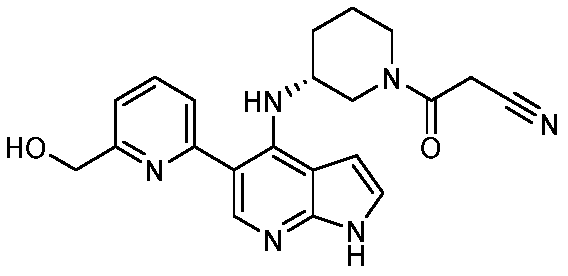
반응식 61. (Scheme 61. ( RR )-3-(3-((5-(3-(하이드록시메틸)페닐)-1)-3-(3-((5-(3-(hydroxymethyl)phenyl)-1 HH -피롤로[2,3--pyrrolo[2,3- bb ]피리딘-4-일)아미노)피페리딘-1-일)-3-옥소프로판니트릴의 제조 ] Preparation of pyridin-4-yl)amino)piperidin-1-yl)-3-oxopropanenitrile

[000568] (R)-3-(3-((5-(3-(하이드록시메틸)페닐)-1H-피롤로[2,3-b]피리딘-4-일)아미노)피페리딘-1-일)-3-옥소프로판니트릴의 제조 [000568] (R) -3- ( 3 - ((5- (3- ( hydroxymethyl) phenyl) -1 H - pyrrolo [2,3- b] pyridin-4-yl) amino) piperidine Preparation of -1-yl)-3-oxopropanenitrile

디옥산 (8 mL) 중 (R)-3-(3-((5-브로모-1H-피롤로[2,3-b]피리딘-4-일)아미노)피페리딘-1-일)-3-옥소프로판니트릴 (0.35 g, 0.96 mml)의 교반된 용액에 비스(피나콜라토)디보론 (0.37 g, 1.45 mmol) 및 인산칼륨 (0.61 g, 2.9 mmol)을 첨가한 후, XPhos-Pd-G2 (0.08 g, 0.1 mmol)를 첨가하였다. 상기 생성된 현탁액을 120℃로 2시간 동안 가열하였다. 상기 반응 혼합물을 상온으로 냉각시킨 후, (6-브로모피리딘-2-일)메탄올 (0.28 g, 1.45 mmol), 2M 인산칼륨 수용액 (0.41 g, 1.93 mmol) 및 XPhos-Pd-G2 (0.08 g, 0.1 mmol)를 첨가하고, 상기 혼합물을 100℃로 2시간 동안 가열하였다. 상기 반응물을 상온으로 냉각시키고, 셀라이트로 여과한 후, 에틸 아세테이트로 세척하였다. 상기 여과액을 물과 염수로 세척하였다. 상기 유기층을 무수 황산나트륨으로 건조시킨 후, 여과 및 진공에서 농축시켰다. 상기 미정제 물질을 역상 크로마토그래피로 정제하여 (R)-3-(3-((5-(3-(하이드록시메틸)페닐)-1H-피롤로[2,3-b]피리딘-4-일)아미노)피페리딘-1-일)-3-옥소프로판니트릴을 황백색 고체로서 수득하였다 (16 mg, 19% 수율): 1H NMR (400 MHz, DMSO-d6, 70℃) δ 11.20 (s, 1H), 9.93-10.08 (m, 1H), 8.38 (s, 1H), 7.82 (m, 1H), 7.70 (d, J = 8.0 Hz, 1H), 7.29 (d, J = 7.23 Hz, 1H), 7.14 (s, 1H), 6.63 (s, 1H), 5.25 (s, 1H), 4.63 (d, J = 6.0 Hz, 2H), 4.28-4.49 (m, 1H), 3.94-4.02 (m, 2H), 3.68-3.75 (m, 1H), 3.54-3.62 (m, 1H), 2.80-2.96 (m, 1H), 1.92-2.20 (m, 2H), 1.52-1.86 (m, 3H); MS (ES) m/z: 391.1 (M+H). (R )-3-(3-((5-bromo- 1H -pyrrolo[2,3- b ]pyridin-4-yl)amino)piperidin-1-yl in dioxane (8 mL) To a stirred solution of )-3-oxopropanenitrile (0.35 g, 0.96 mml) was added bis(pinacolato)diboron (0.37 g, 1.45 mmol) and potassium phosphate (0.61 g, 2.9 mmol), followed by XPhos -Pd-G2 (0.08 g, 0.1 mmol) was added. The resulting suspension was heated to 120° C. for 2 h. After the reaction mixture was cooled to room temperature, (6-bromopyridin-2-yl)methanol (0.28 g, 1.45 mmol), 2M aqueous potassium phosphate solution (0.41 g, 1.93 mmol) and XPhos-Pd-G2 (0.08 g) , 0.1 mmol) and the mixture was heated to 100° C. for 2 h. The reaction mass was cooled to room temperature, filtered through celite, and washed with ethyl acetate. The filtrate was washed with water and brine. The organic layer was dried over anhydrous sodium sulfate, filtered and concentrated in vacuo. Purification of the crude material by reverse phase chromatography (R) -3- (3 - ( (5- (3- ( hydroxymethyl) phenyl) -1 H - pyrrolo [2,3- b] pyridine -4 -yl)amino)piperidin-1-yl)-3-oxopropanenitrile was obtained as an off-white solid (16 mg, 19% yield): 1 H NMR (400 MHz, DMSO-d 6 , 70° C.) δ 11.20 (s, 1H), 9.93-10.08 (m, 1H), 8.38 (s, 1H), 7.82 (m, 1H), 7.70 (d, J = 8.0 Hz, 1H), 7.29 (d, J = 7.23 Hz) , 1H), 7.14 (s, 1H), 6.63 (s, 1H), 5.25 (s, 1H), 4.63 (d, J = 6.0 Hz, 2H), 4.28-4.49 (m, 1H), 3.94-4.02 ( m, 2H), 3.68-3.75 (m, 1H), 3.54-3.62 (m, 1H), 2.80-2.96 (m, 1H), 1.92-2.20 (m, 2H), 1.52-1.86 (m, 3H); MS (ES) m/z : 391.1 (M+H).
분석 조건:Analysis conditions:
Zorbax-Eclipse XDB C18 (150 mm X 4.6 mm X 5 μm) Zorbax-Eclipse XDB C18 (150 mm X 4.6 mm X 5 μm)
이동상 (A): 수중 0.1% 암모니아 Mobile phase (A): 0.1% ammonia in water
이동상 (B): MeCN Mobile phase (B): MeCN
유속: 1.0 mL/분 Flow rate: 1.0 mL/min
[000569] 실시예 64. 3-((3R,5S)-3-((5-(6-(하이드록시메틸)피리딘-2-일)-1H-피롤로[2,3-b]피리딘-4-일)아미노)-5-메틸피페리딘-1-일)-3-옥소프로판니트릴의 제조 [000 569] Example 64. 3 - ((3 R, 5 S) -3 - ((5- (6- ( hydroxymethyl) pyridin-2-yl) -1 H - pyrrolo [2,3- b Preparation of ]pyridin-4-yl)amino)-5-methylpiperidin-1-yl)-3-oxopropanenitrile

반응식 62. 3-((3Scheme 62. 3-((3 RR ,5,5 SS )-3-((5-(6-(하이드록시메틸)피리딘-2-일)-1)-3-((5-(6-(hydroxymethyl)pyridin-2-yl)-1 HH -피롤로[2,3--pyrrolo[2,3- bb ]피리딘-4-일)아미노)-5-메틸피페리딘-1-일)-3-옥소프로판니트릴의 제조Preparation of ]pyridin-4-yl)amino)-5-methylpiperidin-1-yl)-3-oxopropanenitrile

[000570] 단계 1: 벤질 (3S,5R)-3-메틸-5-((5-(4,4,5,5-테트라메틸-1,3,2-디옥사보롤란-2-일)-1-((2-(트리메틸실릴)에톡시)메틸)-1H-피롤로[2,3-b]피리딘-4-일)아미노)피페리딘-1-카르복실레이트의 제조 [000 570] Step 1: Benzyl (3 S, 5 R) -3- methyl-5 - ((5- (4,4,5,5-tetramethyl-1,3,2 dioxaborolan-2 yl) -1-methyl ((2- (trimethylsilyl))) - 1 H-pyrrolo [2,3- b] pyridin-4-yl) amino) Preparation of piperidine-1-carboxylate

톨루엔 (30.0 mL) 중 벤질 (3R,5S)-3-((5-브로모-1-((2-(트리메틸실릴)에톡시)메틸)-1H-피롤로[2,3-b]피리딘-4-일)아미노)-5-메틸피페리딘-1-카르복실레이트 (0.70 g, 1.22 mmol)의 교반된 용액에 클로로(2-디사이클로헥실포스피노-2',4',6'-트리이소프로필-1,1'-바이페닐)[2-(2'-아미노-1,1'-바이페닐)]팔라듐(II) (0.19 g, 0.24 mmol), 4,4,5,5-테트라메틸-2-(4,4,5,5-테트라메틸-1,3,2-디옥사보롤란-2-일)-1,3,2-디옥사보롤란 (0.68 g, 2.68 mmol) 및 칼륨 tert-부톡시드 (0.34 g, 3.05 mmol)를 첨가한 후, 상기 혼합물을 110℃로 미리 가열된 오일조 상에서 15분간 교반하였다. 상기 반응 혼합물을 상온으로 냉각하고, 에틸 아세테이트로 희석한 후, 물과 염수로 세척하였다. 상기 유기층을 무수 황산나트륨으로 건조시킨 후, 여과하고 농축시켜 벤질 (3S,5R)-3-메틸-5-((5-(4,4,5,5-테트라메틸-1,3,2-디옥사보롤란-2-일)-1-((2-(트리메틸실릴)에톡시)메틸)-1H-피롤로[2,3-b]피리딘-4-일)아미노)피페리딘-1-카르복실레이트를 점성의 갈색 액체로서 수득하였다 (1.24 g, 미정제): MS (ES) m/z 621.4 (M+H).Toluene (30.0 mL) of benzyl (3 R, 5 S) -3 - ((5- bromo-1 - a ((2- (trimethylsilyl) ethoxy) methyl) -1 H-pyrrolo [2,3- b ] To a stirred solution of ]pyridin-4-yl)amino)-5-methylpiperidine-1-carboxylate (0.70 g, 1.22 mmol) in chloro (2-dicyclohexylphosphino-2',4' ,6′-triisopropyl-1,1′-biphenyl)[2-(2′-amino-1,1′-biphenyl)]palladium(II) (0.19 g, 0.24 mmol), 4,4, 5,5-tetramethyl-2-(4,4,5,5-tetramethyl-1,3,2-dioxaborolan-2-yl)-1,3,2-dioxaborolane (0.68 g , 2.68 mmol) and potassium tert -butoxide (0.34 g, 3.05 mmol), the mixture was stirred on an oil bath preheated to 110° C. for 15 min. The reaction mixture was cooled to room temperature, diluted with ethyl acetate, and washed with water and brine. The organic layer was dried over anhydrous sodium sulfate, filtered, and concentrated to benzyl (3 S ,5 R )-3-methyl-5-((5-(4,4,5,5-tetramethyl-1,3,2). -dioxaborolan-2-yl) - 1 - ((2- (trimethylsilyl) ethoxy) methyl) -1 H-pyrrolo [2,3- b] pyridin-4-yl) amino) piperidine -1-carboxylate was obtained as a viscous brown liquid (1.24 g, crude): MS (ES) m/z 621.4 (M+H).
[000571] 단계 2: 벤질 (3R,5S)-3-((5-(6-(하이드록시메틸)피리딘-2-일)-1-((2-(트리메틸실릴)에톡시)메틸)-1H-피롤로[2,3-b]피리딘-4-일)아미노)-5-메틸피페리딘-1-카르복실레이트의 제조 [000 571] Step 2: Benzyl (3 R, 5 S) -3 - ((5- (6- ( hydroxymethyl) pyridin-2-yl) - 1 - ((2- (trimethylsilyl)) methyl ) -1 H - pyrrolo [2,3- b] pyridin-4-yl) amino) Preparation of 5-methyl-piperidine-1-carboxylate

1,4-디옥산 (35 mL) 중 벤질 (3S,5R)-3-메틸-5-((5-(4,4,5,5-테트라메틸-1,3,2-디옥사보롤란-2-일)-1-((2-(트리메틸실릴)에톡시)메틸)-1H-피롤로[2,3-b]피리딘-4-일)아미노)피페리딘-1-카르복실레이트 (1.20 g, 1.93 mmol), (6-브로모피리딘-2-일)메탄올 (0.24 mg, 1.29 mmol), 클로로(2-디사이클로헥실포스피노-2',4',6'-트리이소프로필-1,1'-바이페닐)[2-(2'-아미노-1,1'-바이페닐)]팔라듐(II) (0.20 g, 0.26 mmol) 및 2M 삼인산칼륨 수용액 (1.09 g, 5.16 mmol)의 교반된 혼합물을 110℃로 16시간 동안 가열하였다. 상기 반응 혼합물을 상온으로 냉각시키고, 에틸 아세테이트와 물로 희석하였다. 상기 유기층을 분리하고, 무수 황산나트륨으로 건조시킨 후, 여과하여 진공에서 농축시켰다. 상기 미정제물을 0-50% 에틸 아세테이트/헥산으로 용리하는 콤비-플래시 (combi-flash)로 정제하여 벤질 (3R,5S)-3-((5-(6-(하이드록시메틸)피리딘-2-일)-1-((2-(트리메틸실릴)에톡시)메틸)-1H-피롤로[2,3-b]피리딘-4-일)아미노)-5-메틸피페리딘-1-카르복실레이트를 점성의 갈색 액체로서 수득하였다 (0.51 g, 66% 수율): MS (ES) m/z 602.4 (M+H). Benzyl (3 S ,5 R )-3-methyl-5-((5-(4,4,5,5-tetramethyl-1,3,2-dioxa) in 1,4-dioxane (35 mL) beam Rolando-2-yl) - 1 - ((2- (trimethylsilyl) ethoxy) methyl) -1 H-pyrrolo [2,3- b] pyridin-4-yl) amino) piperidin-1 Carboxylate (1.20 g, 1.93 mmol), (6-bromopyridin-2-yl)methanol (0.24 mg, 1.29 mmol), chloro (2-dicyclohexylphosphino-2',4',6'- triisopropyl-1,1′-biphenyl)[2-(2′-amino-1,1′-biphenyl)]palladium(II) (0.20 g, 0.26 mmol) and 2M aqueous potassium triphosphate (1.09 g, 5.16 mmol) was heated to 110° C. for 16 h. The reaction mixture was cooled to room temperature and diluted with ethyl acetate and water. The organic layer was separated, dried over anhydrous sodium sulfate, filtered and concentrated in vacuo. The crude was purified by combi-flash eluting with 0-50% ethyl acetate/hexanes to benzyl ( 3R , 5S )-3-((5-(6-(hydroxymethyl)pyridine) 2-yl) -l - ((2- (trimethylsilyl) ethoxy) methyl) -1 H-pyrrolo [2,3- b] pyridin-4-yl) amino) -5-methyl-piperidin- The 1-carboxylate was obtained as a viscous brown liquid (0.51 g, 66% yield): MS (ES) m/z 602.4 (M+H).
[000572] 단계 3: (6-(4-(((3R,5S)-5-메틸피페리딘-3-일)아미노)-1H-피롤로[2,3-b]피리딘-5-일)피리딘-2-일)메탄올의 제조 [000 572] Step 3: (6- (4 - ( ((3 R, 5 S) -5- methylpiperidin-3-yl) amino) -1 H-pyrrolo [2,3- b] pyridin- Preparation of 5-yl)pyridin-2-yl)methanol

트리플루오로아세트산 (5.0 mL) 중 벤질 (3R,5S)-3-((5-(6-(하이드록시메틸)피리딘-2-일)-1-((2-(트리메틸실릴) 에톡시)메틸)-1H-피롤로[2,3-b]피리딘-4-일)아미노)-5-메틸피페리딘-1-카르복실레이트 (0.56 g, 0.85 mmol)의 교반된 용액을 100℃로 1시간 동안 가열하였다. 상기 반응 혼합물을 상온으로 냉각시킨 후, 진공에서 농축하고, 잔류물을 1,4-디옥산 : 수성 암모니아 (5 mL: 5 mL)에 용해시킨 후, 상온에서 16시간 동안 교반하였다. 상기 반응 혼합물을 진공에서 농축시켜 (6-(4-(((3R,5S)-5-메틸피페리딘-3-일)아미노)-1H-피롤로[2,3-b]피리딘-5-일)피리딘-2-일)메탄올을 점성의 갈색 액체로서 수득하였다 (0.52 g, 미정제); MS (ES) m/z 338.2 (M+H). To benzyl (3R , 5S )-3-((5-(6-(hydroxymethyl)pyridin-2-yl)-1-((2-(trimethylsilyl)) in trifluoroacetic acid (5.0 mL) ethoxy) methyl) -1 H - to a stirred solution of pyrrolo [2,3- b] pyridin-4-yl) amino) -5-methyl-piperidine-1-carboxylate (0.56 g, 0.85 mmol) Heated to 100° C. for 1 hour. The reaction mixture was cooled to room temperature, concentrated in vacuo, and the residue was dissolved in 1,4-dioxane: aqueous ammonia (5 mL: 5 mL), followed by stirring at room temperature for 16 hours. The reaction mixture was concentrated in vacuo (6-(4-(((3 R ,5 S )-5-methylpiperidin-3-yl)amino)-1 H -pyrrolo[2,3- b ] Pyridin-5-yl)pyridin-2-yl)methanol was obtained as a viscous brown liquid (0.52 g, crude); MS (ES) m/z 338.2 (M+H).
[000573] 단계 4: 3-((3R,5S)-3-((5-(6-(하이드록시메틸)피리딘-2-일)-1H-피롤로[2,3-b]피리딘-4-일)아미노)-5-메틸피페리딘-1-일)-3-옥소프로판니트릴의 제조 [000 573] Step 4: 3 - ((3 R , 5 S) -3 - ((5- (6- ( hydroxymethyl) pyridin-2-yl) -1 H - pyrrolo [2,3- b] Preparation of pyridin-4-yl)amino)-5-methylpiperidin-1-yl)-3-oxopropanenitrile

디클로로메탄 (4.0 mL) 중의 2-시아노아세트산 (0.14 g, 1.69 mmol), 1-하이드록시벤조트리아졸 (0.21 mg, 1.35 mmol) 및 N-(3-디메틸아미노프로필)-N'-에틸카르보디이미드 하이드로클로라이드 (0.32 g, 1.69 mmol)의 용액을 상온에서 3분간 교반하였다. 이후, (6-(4-(((3R,5S)-5-메틸피페리딘-3-일)아미노)-1H-피롤로[2,3-b]피리딘-5-일)피리딘-2-일)메탄올 (0.38 g, 1.13 mmol)을 첨가한 후, 트리에틸아민 (1.08 mL, 5.63 mmol)을 첨가하고, 상기 혼합물을 상온에서 16시간 동안 교반하였다. 상기 반응 혼합물을 에틸 아세테이트로 희석한 후, 물과 염수로 세척하였다. 상기 유기층을 무수 황산나트륨으로 건조시킨 후, 여과 및 진공에서 농축시켰다. 상기 미정제물을 역상 크로마토그래피로 정제하여 3-((3R,5S)-3-((5-(6-(하이드록시메틸)피리딘-2-일)-1H-피롤로[2,3-b]피리딘-4-일)아미노)-5-메틸피페리딘-1-일)-3-옥소프로판니트릴을 황백색 고체로서 수득하였다 (0.03 g, 7% 수율): 1H NMR (400 MHz, DMSO-d6, VT, 80℃) δ 11.16 (br s, 1H), 10.05 (br s, 1H), 8.39 (s, 1H), 7.79-7.83 (m, 1H), 7.70-7.72 (m, 1H), 7.28 (d, J = 7.6 Hz, 1H), 7.12 (s, 1H), 6.65 (s, 1H), 4.15-4.30 (m, 1H), 4.75-4.85 (m, 1H), 4.60-4.67 (m, 1H), 3.87-4.07 (m, 1H), 3.60-3.67 (m, 1H), 3.55 (s, 2H), 2.80-2.90 (m, 1H), 2.15-2.25 (m, 2H), 1.65-1.80 (m, 2H), 1.10-1.30 (m, 1H), 0.92 (d, J = 6.0 Hz, 3H); MS (ES) m/z 405.2 (M+H).In dichloromethane (4.0 mL) solution of 2-cyanoacetic acid (0.14 g, 1.69 mmol), 1- hydroxybenzotriazole (0.21 mg, 1.35 mmol) and N - (3- dimethylaminopropyl) - N '- ethyl carbonate A solution of bodyimide hydrochloride (0.32 g, 1.69 mmol) was stirred at room temperature for 3 minutes. Since, (6- (4 - (( (3 R, 5 S) -5- methylpiperidin-3-yl) amino) -1 H - pyrrolo [2,3- b] pyridin-5-yl) After pyridin-2-yl)methanol (0.38 g, 1.13 mmol) was added, triethylamine (1.08 mL, 5.63 mmol) was added, and the mixture was stirred at room temperature for 16 hours. The reaction mixture was diluted with ethyl acetate and washed with water and brine. The organic layer was dried over anhydrous sodium sulfate, filtered and concentrated in vacuo. Purification of the crude by reverse phase chromatography, 3 - ((3 R, 5 S) -3 - ((5- (6- ( hydroxymethyl) pyridin-2-yl) -1 H - pyrrolo [2, Obtained 3- b ]pyridin-4-yl)amino)-5-methylpiperidin-1-yl)-3-oxopropanenitrile as an off-white solid (0.03 g, 7% yield): 1 H NMR (400 MHz, DMSO-d 6, VT, 80°C) δ 11.16 (br s, 1H), 10.05 (br s, 1H), 8.39 (s, 1H), 7.79-7.83 (m, 1H), 7.70-7.72 (m , 1H), 7.28 (d, J = 7.6 Hz, 1H), 7.12 (s, 1H), 6.65 (s, 1H), 4.15-4.30 (m, 1H), 4.75-4.85 (m, 1H), 4.60- 4.67 (m, 1H), 3.87-4.07 (m, 1H), 3.60-3.67 (m, 1H), 3.55 (s, 2H), 2.80-2.90 (m, 1H), 2.15-2.25 (m, 2H), 1.65-1.80 (m, 2H), 1.10-1.30 (m, 1H), 0.92 (d, J = 6.0 Hz, 3H); MS (ES) m/z 405.2 (M+H).
분석 조건:Analysis conditions:
유속: 0.3 mL/분 Flow rate: 0.3 mL/min
컬럼: Ascentis Express C18 (50 mm X 2.1 mm X 2.73 μm) Column: Ascentis Express C18 (50 mm X 2.1 mm X 2.73 μm)
이동상 (A): 물 중 0.1% 포름산 Mobile phase (A): 0.1% formic acid in water
이동상 (B): MeCN Mobile phase (B): MeCN
[000574] 실시예 65. 3-((3S,5R)-3-메틸-5-((5-(5-(메틸설포닐)티아졸-2-일)-1H-피롤로[2,3-b]피리딘-4-일)아미노)피페리딘-1-일)-3-옥소프로판니트릴의 제조 [000 574] Example 65. 3 - ((3 S, 5 R) -3- methyl-5 - ((5- (5- (methylsulfonyl) thiazol-2-yl) -1 H-pyrrolo [ Preparation of 2,3-b]pyridin-4-yl)amino)piperidin-1-yl)-3-oxopropanenitrile
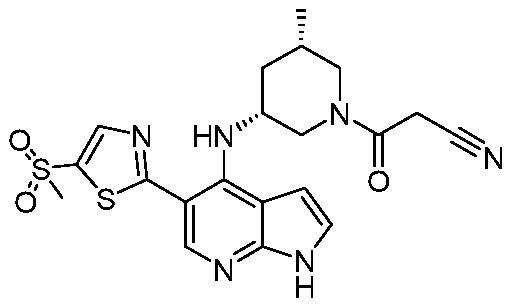
반응식 63. 3-((3Scheme 63. 3-((3 SS ,5,5 RR )-3-메틸-5-((5-(5-(메틸설포닐)티아졸-2-일)-1)-3-methyl-5-((5-(5-(methylsulfonyl)thiazol-2-yl)-1 HH -피롤로[2,3--pyrrolo[2,3- bb ]피리딘-4-일)아미노)피페리딘-1-일)-3-옥소프로판니트릴의 제조] Preparation of pyridin-4-yl)amino)piperidin-1-yl)-3-oxopropanenitrile

[000575] 단계 1: tert-부틸 (3S,5R)-3-메틸-5-((5-(5-(메틸설포닐)티아졸-2-일)-1-((2-(트리메틸실릴)에톡시)메틸)-1H-피롤로[2,3-b]피리딘-4-일)아미노)피페리딘-1-카르복실레이트의 제조 [000 575] Step 1: tert-butyl (3 S, 5 R) -3- methyl-5 - ((5- (5- (methylsulfonyl) thiazol-2-yl) -1 - ((2- ( ethoxy) methyl) -1 H to trimethylsilyl) -pyrrolo [2,3- b] pyridin-4-yl) amino) Preparation of piperidine-1-carboxylate

1,4-디옥산 (30 mL) 중 벤질 (3S,5R)-3-메틸-5-{[5-(4,4,5,5-테트라메틸-1,3,2-디옥사보롤란-2-일)-1-{[2-(트리메틸실릴)에톡시]메틸}-1H-피롤로[2,3-b]피리딘-4-일]아미노}피페리딘-1-카르복실레이트 (1.0 g, 1.61 mmol) 및 2-브로모-5-메탄설포닐-1,3-티아졸 (0.28 g, 1.18 mmol)의 교반된 용액에 팔라듐(II)비스(트리페닐포스핀) 디클로라이드 (0.15 g, 0.21 mmol) 및 2M 삼인산칼륨 수용액 (0.91 g, 4.30 mmol)을 첨가한 후, 상기 혼합물을 110℃로 16시간 동안 가열하였다. 상기 반응 혼합물을 상온으로 냉각시키고, 에틸 아세테이트와 물로 희석하였다. 상기 유기층을 분리하고, 무수 황산나트륨으로 건조시킨 후, 진공에서 농축시켰다. 상기 미정제물을 섬광 크로마토그래피 (20% 에틸 아세테이트/헥산)로 정제하여 tert-부틸 (3S,5R)-3-메틸-5-((5-(5-(메틸설포닐)티아졸-2-일)-1-((2-(트리메틸실릴)에톡시)메틸)-1H-피롤로[2,3-b]피리딘-4-일)아미노)피페리딘-1-카르복실레이트를 점성의 갈색 액체로서 수득하였다 (0.32, 45% 수율): MS (ES) m/z 622.8 (M+H). Benzyl (3 S ,5 R )-3-methyl-5-{[5-(4,4,5,5-tetramethyl-1,3,2-dioxa) in 1,4-dioxane (30 mL) beam Rolando-2-yl) - 1 - {[2- (trimethylsilyl) ethoxy] methyl} -1 H-pyrrolo [2,3- b] pyridin-4-yl] amino} piperidine-1 To a stirred solution of carboxylate (1.0 g, 1.61 mmol) and 2-bromo-5-methanesulfonyl-1,3-thiazole (0.28 g, 1.18 mmol) palladium(II)bis(triphenylphosphine) ) dichloride (0.15 g, 0.21 mmol) and 2M aqueous potassium triphosphate (0.91 g, 4.30 mmol) were added, and then the mixture was heated to 110° C. for 16 h. The reaction mixture was cooled to room temperature and diluted with ethyl acetate and water. The organic layer was separated, dried over anhydrous sodium sulfate, and then concentrated in vacuo. The crude was purified by flash chromatography (20% ethyl acetate/hexanes) to tert -butyl (3 S ,5 R )-3-methyl-5-((5-(5-(methylsulfonyl)thiazole- 2-yl) - 1 - ((2- (trimethylsilyl) ethoxy) methyl) -1 H-pyrrolo [2,3- b] pyridin-4-yl) amino) piperidine-1-carboxylate was obtained as a viscous brown liquid (0.32, 45% yield): MS (ES) m/z 622.8 (M+H).
[000576] 단계 2: N-((3R,5S)-5-메틸피페리딘-3-일)-5-(5-(메틸설포닐)티아졸-2-일)-1H-피롤로[2,3-b]피리딘-4-아민의 제조 [000 576] Step 2: N - ((3 R , 5 S) -5- methylpiperidin-3-yl) -5- (5- (methylsulfonyl) thiazol-2-yl) -1 H - Preparation of pyrrolo[2,3- b ]pyridin-4-amine

트리플루오로아세트산 (5.0 mL) 중 tert-부틸 (3S,5R)-3-메틸-5-((5-(5-(메틸설포닐)티아졸-2-일)-1-((2-(트리메틸실릴)에톡시)메틸)-1H-피롤로[2,3-b]피리딘-4-일)아미노)피페리딘-1-카르복실레이트 (0.52 g, 1.00 mmol)의 교반된 용액을 밀봉된 튜브 중에서 100℃로 1시간 동안 가열하였다. 상기 반응 혼합물을 상온으로 냉각시킨 후, 진공에서 농축하고, 잔류물을 1,4-디옥산 : 수성 암모니아 (5 mL : 5 mL)에 용해시킨 후, 상온에서 16시간 동안 교반하였다. 상기 반응 혼합물을 진공에서 농축시켜 N-((3R,5S)-5-메틸피페리딘-3-일)-5-(5-(메틸설포닐)티아졸-2-일)-1H-피롤로[2,3-b]피리딘-4-아민을 갈색의 진득한 고체로서 수득하였다 (0.45 g, 미정제): MS (ES) m/z 392.1 (M+H). tert -Butyl (3 S ,5 R )-3-methyl-5-((5-(5-(methylsulfonyl)thiazol-2-yl)-1-(() in trifluoroacetic acid (5.0 mL) agitation of the pyrrolo [2,3- b] pyridin-4-yl) amino) piperidine-1-carboxylate (0.52 g, 1.00 mmol) - 2- ( trimethylsilyl) ethoxy) methyl) -1 H The solution was heated to 100° C. for 1 hour in a sealed tube. The reaction mixture was cooled to room temperature, concentrated in vacuo, and the residue was dissolved in 1,4-dioxane: aqueous ammonia (5 mL: 5 mL) and stirred at room temperature for 16 hours. The reaction mixture was concentrated in vacuo to N -((3 R ,5 S )-5-methylpiperidin-3-yl)-5-(5-(methylsulfonyl)thiazol-2-yl)-1 H -pyrrolo[2,3- b ]pyridin-4-amine was obtained as a brown thick solid (0.45 g, crude): MS (ES) m/z 392.1 (M+H).
[000577] 단계 3: 3-((3S,5R)-3-메틸-5-((5-(5-(메틸설포닐)티아졸-2-일)-1H-피롤로[2,3-b]피리딘-4-일)아미노)피페리딘-1-일)-3-옥소프로판니트릴의 제조 [000 577] Step 3: 3 - ((3 S , 5 R) -3- methyl-5 - ((5- (5- (methylsulfonyl) thiazol-2-yl) -1 H-pyrrolo [2 Preparation of ,3- b ]pyridin-4-yl)amino)piperidin-1-yl)-3-oxopropanenitrile

디클로로메탄 (4.0 mL) 중의 2-시아노아세트산 (0.13 g, 1.53 mmol), 1-하이드록시벤조트리아졸 (0.19 mg, 1.23 mmol) 및 N-(3-디메틸아미노프로필)-N'-에틸카르보디이미드 하이드로클로라이드 (0.29 g, 1.53 mmol)의 용액을 상온에서 3분간 교반하였다. 이후, N-((3R,5S)-5-메틸피페리딘-3-일)-5-(5-(메틸설포닐)티아졸-2-일)-1H-피롤로[2,3-b]피리딘-4-아민 (0.40 g, 1.02 mmol)을 첨가한 후, 트리에틸아민 (0.70 mL, 5.11 mmol)을 첨가하고, 상기 혼합물을 상온에서 밤새 교반하였다. 상기 반응 혼합물을 에틸 아세테이트로 희석한 후, 물과 염수로 세척하였다. 상기 유기층을 무수 황산나트륨으로 건조시킨 후, 여과 및 진공에서 농축시켰다. 상기 미정제물을 역상 크로마토그래피로 정제하여 3-((3S,5R)-3-메틸-5-((5-(5-(메틸설포닐)티아졸-2-일)-1H-피롤로[2,3-b]피리딘-4-일)아미노)피페리딘-1-일)-3-옥소프로판니트릴을 황백색 고체로서 수득하였다 (0.05 g, 11% 수율): 1H NMR (400 MHz, DMSO-d6, VT, 80℃) δ 11.56 (br s, 1H), 9.33 (br s, 1H), 8.41 (s, 1H), 8.30 (s, 1H), 7.21 (s, 1H), 6.76 (s, 1H), 4.79 (br s, 1H), 3.84-4.44 (m, 3H), 3.60-3.74 (m, 1H), 3.56 (s, 1H), 3.39 (s, 3H), 2.60-2.80 (m, 1H), 2.20-2.40 (m, 1H), 1.75-1.85 (m,1H), 1.15-1.27 (m, 1H), 0.94 (d, J = 6.4 Hz, 3H); MS (ES) m/z 459.1 (M+H).In dichloromethane (4.0 mL) solution of 2-cyanoacetic acid (0.13 g, 1.53 mmol), 1- hydroxybenzotriazole (0.19 mg, 1.23 mmol) and N - (3- dimethylaminopropyl) - N '- ethyl carbonate A solution of bodyimide hydrochloride (0.29 g, 1.53 mmol) was stirred at room temperature for 3 minutes. Since, N - ((3 R, 5 S) -5-methylpiperidin-3-yl) -5- (5- (methylsulfonyl) thiazol-2-yl) -1 H - pyrrolo [2 ,3- b ]pyridin-4-amine (0.40 g, 1.02 mmol) was added, followed by triethylamine (0.70 mL, 5.11 mmol), and the mixture was stirred at room temperature overnight. The reaction mixture was diluted with ethyl acetate and washed with water and brine. The organic layer was dried over anhydrous sodium sulfate, filtered and concentrated in vacuo. Purification of the crude by reverse phase chromatography, 3 - ((3 S, 5 R) -3- methyl-5 - ((5- (5- (methylsulfonyl) -2- yl-thiazol) -1 H- Obtained pyrrolo[2,3- b ]pyridin-4-yl)amino)piperidin-1-yl)-3-oxopropanenitrile as an off-white solid (0.05 g, 11% yield): 1 H NMR (400 MHz, DMSO-d 6, VT, 80° C.) δ 11.56 (br s, 1H), 9.33 (br s, 1H), 8.41 (s, 1H), 8.30 (s, 1H), 7.21 ( s, 1H), 6.76 (s, 1H), 4.79 (br s, 1H), 3.84-4.44 (m, 3H), 3.60-3.74 (m, 1H), 3.56 (s, 1H), 3.39 (s, 3H) ), 2.60-2.80 (m, 1H), 2.20-2.40 (m, 1H), 1.75-1.85 (m,1H), 1.15-1.27 (m, 1H), 0.94 (d, J = 6.4 Hz, 3H); MS (ES) m/z 459.1 (M+H).
분석 조건:Analysis conditions:
이동상 A: H2O 중의 0.1% NH4OHMobile phase A: 0.1% NH 4 OH in H 2 O
이동상 B: MeCNMobile phase B: MeCN
컬럼: X-Bridge, C18 19*100* 5 마이크론Column: X-Bridge, C18 19*100* 5 microns
유속: 20 mL/분Flow rate: 20 mL/min
[000578] 실시예 66. (R)-3-(3-((5-(5-아세틸옥사졸-2-일)-1H-피롤로[2,3-b]피리딘-4-일)아미노)피페리딘-1-일)-3-옥소프로판니트릴의 제조 [000 578] Example 66. (R) -3- (3 - ((5- (5- acetyl-2-yl) -1 H - pyrrolo [2,3- b] pyridin-4-yl) Preparation of amino)piperidin-1-yl)-3-oxopropanenitrile

반응식 64. (R)-3-(3-((5-(5-아세틸옥사졸-2-일)-1Scheme 64. (R)-3-(3-((5-(5-acetyloxazol-2-yl)-1 HH -피롤로[2,3--pyrrolo[2,3- bb ]피리딘-4-일)아미노)피페리딘-1-일)-3-옥소프로판니트릴의 제조] Preparation of pyridin-4-yl)amino)piperidin-1-yl)-3-oxopropanenitrile

[000579] 단계 1: 에틸 (R)-2-(4-((1-(tert-부톡시카보닐)피페리딘-3-일)아미노)-1-((2-(트리메틸실릴)에톡시)메틸)-1H-피롤로[2,3-b]피리딘-5-일)옥사졸-5-카르복실레이트의 제조 [000579] Step 1: to ethyl ( R )-2-(4-((1-( tert -butoxycarbonyl)piperidin-3-yl)amino)-1-((2-(trimethylsilyl) Preparation of pyrrolo [2,3- b] pyridin-5-yl) oxazol-5-carboxylate - ethoxy) methyl) -1 H

1,4-디옥산 (40 mL) 중의 tert-부틸 (3R)-3-{[5-(4,4,5,5-테트라메틸-1,3,2-디옥사보롤란-2-일)-1-{[2-(트리메틸실릴)에톡시]메틸}-1H-피롤로[2,3-b]피리딘-4-일]아미노}피페리딘-1-카르복실레이트 (1.50 g, 2.62 mmol) 및 에틸 2-브로모-1,3-옥사졸-5-카르복실레이트 (0.38 g, 1.74 mmol)의 교반된 용액에 비스(트리페닐포스핀)팔라듐(II) 디클로라이드 (0.25 g, 0.35 mol) 및 2M 삼인산칼륨 수용액 (1.48 g, 6.97 mmol)을 첨가한 후, 상기 혼합물을 110℃에서 16시간 동안 교반하였다. 상기 반응 혼합물을 상온으로 냉각하고, 에틸 아세테이트로 희석한 후, 물과 염수로 세척하였다. 상기 유기층을 무수 황산나트륨으로 건조시킨 후, 여과 및 진공에서 농축시켰다. 상기 미정제물을 섬광 크로마토그래피 (20% 에틸 아세테이트/헥산)로 정제하여 에틸 (R)-2-(4-((1-(tert-부톡시카보닐)피페리딘-3-일)아미노)-1-((2-(트리메틸실릴)에톡시)메틸)-1H-피롤로[2,3-b]피리딘-5-일)옥사졸-5-카르복실레이트를 점성의 갈색 액체로서 수득하였다 (0.65 g, 63% 수율): MS (ES) m/z 586.3 (M+H). tert -Butyl (3 R )-3-{[5-(4,4,5,5-tetramethyl-1,3,2-dioxaborolane-2- in 1,4-dioxane (40 mL)) yl) - 1 - {[2- (trimethylsilyl) ethoxy] methyl} -1 H-pyrrolo [2,3- b] pyridin-4-yl] amino} piperidine-1-carboxylate (1.50 g, 2.62 mmol) and ethyl 2-bromo-1,3-oxazole-5-carboxylate (0.38 g, 1.74 mmol) in a stirred solution of bis(triphenylphosphine)palladium(II) dichloride ( 0.25 g, 0.35 mol) and 2M aqueous potassium triphosphate (1.48 g, 6.97 mmol) were added, and the mixture was stirred at 110° C. for 16 hours. The reaction mixture was cooled to room temperature, diluted with ethyl acetate, and washed with water and brine. The organic layer was dried over anhydrous sodium sulfate, filtered and concentrated in vacuo. The crude was purified by flash chromatography (20% ethyl acetate/hexanes) to ethyl ( R )-2-(4-((1-( tert -butoxycarbonyl)piperidin-3-yl)amino) -1 - ((2- (trimethylsilyl)) methyl) -1 H-pyrrolo [2,3- b] pyridin-5-yl) to yield the oxazole-5-carboxylate as a brown viscous liquid (0.65 g, 63% yield): MS (ES) m/z 586.3 (M+H).
[000580] 단계 2: (R)-2-(4-((1-(tert-부톡시카보닐)피페리딘-3-일)아미노)-1-((2-(트리메틸실릴)에톡시)메틸)-1H-피롤로[2,3-b]피리딘-5-일)옥사졸-5-카르복실산의 제조 [000580] Step 2: ( R )-2-(4-((1-( tert -butoxycarbonyl)piperidin-3-yl)amino)-1-((2-(trimethylsilyl)ethoxy ) methyl) -1 H - pyrrolo [2,3- b] pyridin-5-yl) Preparation of oxazole-5-carboxylic acid

메탄올 (20 mL) 중의 에틸 (R)-2-(4-((1-(tert-부톡시카보닐)피페리딘-3-일)아미노)-1-((2-(트리메틸실릴) 에톡시)메틸)-1H-피롤로[2,3-b]피리딘-5-일)옥사졸-5-카르복실레이트 (0.50 g, 0.85 mmol)의 교반된 용액에 2M 수산화나트륨 수용액 (0.17 g, 4.27 mmol)을 첨가한 후, 상기 용액을 상온에서 4시간 동안 교반하였다. 상기 반응 혼합물을 농축시켜 휘발성 물질들을 제거하고 수득된 잔류물을 물에 용해시키고 1N 염산으로 산성화하여 pH를 ~3으로 조정하였다. 수성층을 에틸 아세테이트로 추출하고, 무수 황산나트륨으로 건조시킨 후, 여과하고 농축시켜 (R)-2-(4-((1-(tert-부톡시카보닐)피페리딘-3-일)아미노)-1-((2-(트리메틸실릴)에톡시)메틸)-1H-피롤로[2,3-b]피리딘-5-일)옥사졸-5-카르복실산을 무색의 검으로서 수득하였다 (0.22 g, 46% 수율): MS (ES) m/z 558.3 (M+H). To ethyl (R )-2-(4-((1-( tert -butoxycarbonyl)piperidin-3-yl)amino)-1-((2-(trimethylsilyl) in methanol (20 mL) ethoxy) methyl) -1 H - pyrrolo [2,3- b] pyridin-5-yl) oxazol-5-carboxylate (0.50 g, (0.17 g a solution of 2M aqueous sodium hydroxide solution to the stirred 0.85 mmol) , 4.27 mmol) was added, and the solution was stirred at room temperature for 4 hours. The reaction mixture was concentrated to remove volatiles and the obtained residue was dissolved in water and acidified with 1N hydrochloric acid to adjust the pH to ˜3. The aqueous layer was extracted with ethyl acetate, dried over anhydrous sodium sulfate, filtered and concentrated ( R )-2-(4-((1-( tert -butoxycarbonyl)piperidin-3-yl)amino) -1 - ((2- (trimethylsilyl) ethoxy) methyl) -1 H-a pyrrolo [2,3- b] pyridin-5-yl) oxazole-5-carboxylic acid was obtained as a colorless gum (0.22 g, 46% yield): MS (ES) m/z 558.3 (M+H).
[000581] 단계 3: tert-부틸 (R)-3-((5-(5-(메톡시(메틸)카바모일)옥사졸-2-일)-1-((2-(트리메틸실릴)에톡시)메틸)-1H-피롤로[2,3-b]피리딘-4-일)아미노)피페리딘-1-카르복실레이트의 제조 [000581] Step 3: to tert -butyl ( R )-3-((5-(5-(methoxy(methyl)carbamoyl)oxazol-2-yl)-1-((2-(trimethylsilyl) Preparation of pyrrolo [2,3- b] pyridin-4-yl) amino) piperidine-1-carboxylate - ethoxy) methyl) -1 H

N,N-디메틸포름아미드 (5 mL) 중의 (R)-2-(4-((1-(tert-부톡시카보닐)피페리딘-3-일)아미노)-1-((2-(트리메틸실릴)에톡시)메틸)-1H-피롤로[2,3-b]피리딘-5-일)옥사졸-5-카르복실산 (0.22 g, 0.40 mmol) 및 1-[비스(디메틸아미노)메틸렌]-1H-1,2,3-트리아졸로[4,5-b]피리디늄 3-옥사이드 헥사플루오로포스페이트 (HATU) (0.23 g, 0.60 mmol)의 용액을 상온에서 3분간 교반하였다. 이후, N,O-디메틸하이드록실아민 하이드로클로라이드 (0.2 g, 1.2 mmol)를 첨가한 후, 트리에틸아민 (0.38 mL, 2.76 mmol)을 첨가하고, 상기 혼합물을 상온에서 5시간 동안 교반하였다. 상기 반응 혼합물을 물로 ??칭하고 에틸 아세테이트로 추출하였다. 상기 유기층을 물과 염수로 세척하고, 무수 황산나트륨으로 건조시킨 후, 여과하여 진공에서 농축시켰다. 상기 미정제 물질을 섬광 크로마토그래피 (30% 에틸 아세테이트/헥산)로 정제하여 tert-부틸 (R)-3-((5-(5-(메톡시(메틸)카바모일)옥사졸-2-일)-1-((2-(트리메틸실릴)에톡시)메틸)-1H-피롤로[2,3-b]피리딘-4-일)아미노)피페리딘-1-카르복실레이트를 점성 액체로서 수득하였다 (0.2 g, 84% 수율): MS (ES) m/z 601.6 (M+H). (R )-2-(4-((1-( tert -butoxycarbonyl)piperidin-3-yl)amino)-1-((2- ) in N,N -dimethylformamide (5 mL) (trimethylsilyl) ethoxy) methyl) -1 H - pyrrolo [2,3- b] pyridin-5-yl) oxazole-5-carboxylic acid (0.22 g, 0.40 mmol) and 1- [bis (dimethyl amino) methylene] -1 H -1,2,3- triazolo [4,5- b] pyridinium 3-oxide hexafluorophosphate (HATU) (0.23 g, 0.60 mmol) with stirring for 3 minutes at room temperature, a solution of did Then, N,O -dimethylhydroxylamine hydrochloride (0.2 g, 1.2 mmol) was added, followed by triethylamine (0.38 mL, 2.76 mmol), and the mixture was stirred at room temperature for 5 hours. The reaction mixture was quenched with water and extracted with ethyl acetate. The organic layer was washed with water and brine, dried over anhydrous sodium sulfate, filtered and concentrated in vacuo. The crude material was purified by flash chromatography (30% ethyl acetate/hexanes) to tert -butyl ( R )-3-((5-(5-(methoxy(methyl)carbamoyl)oxazol-2-yl) ) -1-methyl ((2- (trimethylsilyl))) - 1 H-pyrrolo [2,3- b] pyridin-4-yl) amino) viscous liquid piperidine-1-carboxylate (0.2 g, 84% yield): MS (ES) m/z 601.6 (M+H).
[000582] 단계 4: tert-부틸 (R)-3-((5-(5-아세틸옥사졸-2-일)-1-((2-(트리메틸실릴)에톡시)메틸)-1H-피롤로[2,3-b]피리딘-4-일)아미노)피페리딘-1-카르복실레이트의 제조 [000 582] Step 4: tert-butyl (R) -3 - ((5- (5- acetyl-2-yl) -l - ((2- (trimethylsilyl) ethoxy) methyl) -1 H- Preparation of pyrrolo[2,3-b]pyridin-4-yl)amino)piperidine-1-carboxylate

0℃의 테트라하이드로퓨란 (4.0 mL) 중의 tert-부틸 (R)-3-((5-(5-(메톡시(메틸)카바모일)옥사졸-2-일)-1-((2-(트리메틸실릴) 에톡시)메틸)-1H-피롤로[2,3-b]피리딘-4-일)아미노)피페리딘-1-카르복실레이트 (0.20 g, 0.33 mmol)의 용액에 브롬화메틸마그네슘 (0.34 mL, 1.00 mmol)을 첨가하였다. 상기 반응 혼합물을 상온으로 가온하여 밤새 교반하였다. 상기 반응 혼합물을 포화 염화암모늄 용액으로 ??칭하고 에틸 아세테이트로 추출하였다. 상기 유기층을 물과 염수로 세척하고, 무수 황산나트륨으로 건조시킨 후, 여과하여 진공에서 농축시켰다. 상기 미정제 물질을 섬광 크로마토그래피 (40% 에틸 아세테이트/헥산)로 정제하여 tert-부틸 (R)-3-((5-(5-아세틸옥사졸-2-일)-1-((2-(트리메틸실릴)에톡시)메틸)-1H-피롤로[2,3-b]피리딘-4-일)아미노)피페리딘-1-카르복실레이트를 담황색의 반고체로서 수득하였다 (0.12 g, 65% 수율): MS (ES) m/z 556.3 (M+H). tert -Butyl ( R )-3-((5-(5-(methoxy(methyl)carbamoyl)oxazol-2-yl)-1-((2-) in tetrahydrofuran (4.0 mL) at 0° C. (trimethylsilyl) ethoxy) methyl) -1 H - pyrrolo [2,3- b] pyridin-4-yl) amino) piperidine-1-carboxylate to a solution of bromide (0.20 g, 0.33 mmol) Methylmagnesium (0.34 mL, 1.00 mmol) was added. The reaction mixture was warmed to room temperature and stirred overnight. The reaction mixture was quenched with saturated ammonium chloride solution and extracted with ethyl acetate. The organic layer was washed with water and brine, dried over anhydrous sodium sulfate, filtered and concentrated in vacuo. The crude material was purified by flash chromatography (40% ethyl acetate/hexanes) to tert -butyl ( R )-3-((5-(5-acetyloxazol-2-yl)-1-((2-) (trimethylsilyl) ethoxy) methyl) -1 H - a pyrrolo [2,3- b] pyridin-4-yl) amino) piperidine-1-carboxylate obtained as a light yellow semi-solid (0.12 g, 65% yield): MS (ES) m/z 556.3 (M+H).
[000583] 단계 5: (R)-1-(2-(4-(피페리딘-3-일아미노)-1H-피롤로[2,3-b]피리딘-5-일)옥사졸-5-일)에탄-1-온의 제조 [000 583] Step 5: (R) -1- (2- (4- ( piperidin-3-ylamino) -1 H-pyrrolo [2,3- b] pyridin-5-yl) oxazole - Preparation of 5-yl)ethan-1-one

디클로로메탄 : 트리플루오로아세트산 (2.0 mL: 2.0 mL) 중의 tert-부틸 (R)-3-((5-(5-아세틸옥사졸-2-일)-1-((2-(트리메틸실릴)에톡시)메틸)-1H-피롤로[2,3-b]피리딘-4-일)아미노)피페리딘-1-카르복실레이트 (0.12 g, 0.22 mmol)의 용액을 상온에서 교반하였다. 3시간 후, 상기 반응 혼합물을 농축하여 무수 상태로 하고, 잔류물을 1,4-디옥산 : 수성 암모니아 (2 mL : 2 mL)에 용해시킨 후, 상온에서 16시간 동안 교반하였다. 상기 반응 혼합물을 진공에서 농축시켜 (R)-1-(2-(4-(피페리딘-3-일아미노)-1H-피롤로[2,3-b]피리딘-5-일)옥사졸-5-일)에탄-1-온을 무색의 검으로서 수득하였다 (0.12 g, 미정제): MS (ES) m/z 326.3 (M+H). Dichloromethane: tert -butyl ( R )-3-((5-(5-acetyloxazol-2-yl)-1-((2-(trimethylsilyl) in trifluoroacetic acid (2.0 mL: 2.0 mL)) ethoxy) methyl) -1 H - pyrrolo [2,3- b] pyridin-4-yl) amino) was stirred at room temperature to a solution of piperidine-1-carboxylate (0.12 g, 0.22 mmol). After 3 hours, the reaction mixture was concentrated to dryness, and the residue was dissolved in 1,4-dioxane : aqueous ammonia (2 mL : 2 mL) and stirred at room temperature for 16 hours. The reaction mixture was concentrated in vacuo to give (R) -1- (2- (4- ( piperidin-3-ylamino) -1 H - pyrrolo [2,3- b] pyridin-5-yl) oxazole Zol-5-yl)ethan-1-one was obtained as a colorless gum (0.12 g, crude): MS (ES) m/z 326.3 (M+H).
[000584] 단계 6: (R)-3-(3-((5-(5-아세틸옥사졸-2-일)-1H-피롤로[2,3-b]피리딘-4-일)아미노)피페리딘-1-일)-3-옥소프로판니트릴의 제조 [000 584] Step 6: (R) -3- (3 - ((5- (5- acetyl-2-yl) -1 H - pyrrolo [2,3- b] pyridin-4-yl) amino ) Preparation of piperidin-1-yl)-3-oxopropanenitrile

디클로로메탄 (5 mL) 중 2-시아노아세트산 (0.04 g, 0.42 mmol) 및 1-하이드록시벤조트리아졸 (0.51 g, 0.33 mmol)의 용액에 N-(3-디메틸아미노프로필)-N'-에틸카르보디이미드 하이드로클로라이드 (0.8 g, 0.42 mmol)를 첨가하고, 상기 혼합물을 상온에서 5분간 교반하였다. 이후, (R)-1-(2-(4-(피페리딘-3-일아미노)-1H-피롤로[2,3-b]피리딘-5-일)옥사졸-5-일)에탄-1-온 (0.09 g, 0.28 mmol)을 첨가한 후, 트리에틸아민 (0.2 mL, 0.38 mmol)을 첨가하고, 생성된 혼합물을 상온에서 18시간 동안 교반하였다. 상기 반응 혼합물을 물로 ??칭하고 디클로로메탄으로 추출하였다. 상기 유기층을 물과 염수로 세척하고, 무수 황산나트륨으로 건조시킨 후, 여과하여 진공에서 농축시켰다. 상기 미정제 물질을 역상 크로마토그래피로 정제하여 (R)-3-(3-((5-(5-아세틸옥사졸-2-일)-1H-피롤로[2,3-b]피리딘-4-일)아미노)피페리딘-1-일)-3-옥소프로판니트릴을 담황색 고체로서 수득하였다 (7.0 mg, 7% 수율): 1H NMR (400 MHz, DMSO-d6, VT, 80℃) δ 11.53 (br s, 1H), 9.45 (br s, 1H), 8.61 (s, 1H), 8.11 (s, 1H), 7.21 (s, 1H), 6.70 (s, 1H), 4.20-4.40 (m, 1H), 3.80-4.00 (m, 3H), 3.50-3.65 (m, 1H), 3.40-3.50 (m, 3H), 2.00-2.15 (m, 2H), 1.55-1.84 (m, 4H); MS (ES) m/z 393.1 (M+H).In dichloromethane (5 mL) of 2-cyano-acetic acid (0.04 g, 0.42 mmol) and 1-hydroxybenzotriazole (0.51 g, 0.33 mmol) to a solution of N - (3-dimethylaminopropyl) - N '- Ethylcarbodiimide hydrochloride (0.8 g, 0.42 mmol) was added, and the mixture was stirred at room temperature for 5 minutes. Since, (R) -1- (2- ( 4- ( piperidin-3-ylamino) -1 H - pyrrolo [2,3- b] pyridin-5-yl) oxazol-5-yl) Ethan-1-one (0.09 g, 0.28 mmol) was added, followed by triethylamine (0.2 mL, 0.38 mmol), and the resulting mixture was stirred at room temperature for 18 hours. The reaction mixture was quenched with water and extracted with dichloromethane. The organic layer was washed with water and brine, dried over anhydrous sodium sulfate, filtered and concentrated in vacuo. The crude material was purified first by reverse phase chromatography (R) -3- (3 - ( (5- (5- acetyl-2-yl) -1 H-pyrrolo [2,3- b] pyridin- 4-yl)amino)piperidin-1-yl)-3-oxopropanenitrile was obtained as a pale yellow solid (7.0 mg, 7% yield): 1 H NMR (400 MHz, DMSO-d 6, VT, 80° C.) δ 11.53 (br s, 1H), 9.45 (br s, 1H), 8.61 (s, 1H), 8.11 (s, 1H), 7.21 (s, 1H), 6.70 (s, 1H), 4.20-4.40 (m, 1H), 3.80-4.00 (m, 3H), 3.50-3.65 (m, 1H), 3.40-3.50 (m, 3H), 2.00-2.15 (m, 2H), 1.55-1.84 (m, 4H); MS (ES) m/z 393.1 (M+H).
분석 조건:Analysis conditions:
이동상 A: H2O 중의 0.1% NH4OH Mobile phase A: 0.1% NH 4 OH in H 2 O
이동상 B: MeCN Mobile phase B: MeCN
컬럼: Phenomenex, C18, 21.2 mm * 250 mm * 5 마이크론, Column: Phenomenex, C18, 21.2 mm * 250 mm * 5 microns,
유속: 20 mL/분 Flow rate: 20 mL/min
[000585] 실시예 67. N-((3R,5S)-1-((2,2-디플루오로사이클로프로필)메틸)-5-메틸피페리딘-3-일)-5-(티아졸-2-일)-1H-피롤로[2,3-b]피리딘-4-아민의 제조 [000 585] Example 67. N- ((3 R, 5 S) -1 - ((2,2- difluoro-cyclopropyl) methyl) -5-methyl-piperidin-3-yl) -5- ( thiazol-2-yl) -1 H - pyrrolo [2,3- b] pyridine-4-amine

반응식 65. Scheme 65. N-N- ((3((3 RR ,5,5 SS )-1-((2,2-디플루오로사이클로프로필)메틸)-5-메틸피페리딘-3-일)-5-(티아졸-2-일)-1)-1-((2,2-difluorocyclopropyl)methyl)-5-methylpiperidin-3-yl)-5-(thiazol-2-yl)-1 HH -피롤로[2,3--pyrrolo[2,3- bb ]피리딘-4-아민의 제조]Preparation of pyridin-4-amine

[000586] 단계 1: 2-(4-클로로-1-((2-(트리메틸실릴)에톡시)메틸)-1H-피롤로[2,3-b]피리딘-5-일)티아졸의 제조 The (pyrrolo [2,3- b] pyridin-5-yl 4-chloro-1 - ((2- (trimethylsilyl) ethoxy) methyl) -1 H) thiazol-2: [000 586] Step 1 Produce

N-메틸-2-피롤리돈 (15 mL) 중의 5-브로모-4-클로로-1-((2-(트리메틸실릴)에톡시)메틸)-1H-피롤로[2,3-b]피리딘 (1.5 g, 4.15 mmol), 2-(트리부틸스타닐)티아졸 (1.7 g, 4.57 mmol) 및 비스(트리페닐포스핀)팔라듐(II) 디클로라이드 (0.58 g, 0.83 mmol)의 교반된 용액을 질소 대기 하에 밀봉된 튜브 중에서 130℃로 가열하였다. 5시간 후, 상기 반응 혼합물을 상온으로 냉각시키고, 에틸 아세테이트로 희석한 후, 셀라이트를 통해 여과시켰다. 상기 여과액을 물과 염수로 세척하고, 무수 황산나트륨으로 건조 및 여과시킨 후, 진공에서 농축시켰다. 상기 미정제 물질을 섬광 크로마토그래피 (10% 에틸 아세테이트/헥산)로 정제하여 2-(4-클로로-1-((2-(트리메틸실릴)에톡시)메틸)-1H-피롤로[2,3-b]피리딘-5-일)티아졸을 무색 오일로서 수득하였다 (0.75 g, 49% 수율): MS (ES) m/z 365.8 (M+H). N-methyl-2-pyrrolidone (15 mL), 5- bromo-4-chloro-l of the (methyl ethoxy) (2- (trimethylsilyl)) -1 H-pyrrolo [2,3- b ] Stirring of pyridine (1.5 g, 4.15 mmol), 2-(tributylstannyl)thiazole (1.7 g, 4.57 mmol) and bis(triphenylphosphine)palladium(II) dichloride (0.58 g, 0.83 mmol) The solution was heated to 130° C. in a sealed tube under a nitrogen atmosphere. After 5 hours, the reaction mixture was cooled to room temperature, diluted with ethyl acetate and filtered through celite. The filtrate was washed with water and brine, dried over anhydrous sodium sulfate, filtered, and concentrated in vacuo. The crude by flash chromatography (10% ethyl acetate / hexane) to give 2- (4-chloro-l-ethoxy ((2- (trimethylsilyl)) methyl) -1 H-pyrrolo [2, Obtained 3- b ]pyridin-5-yl)thiazole as a colorless oil (0.75 g, 49% yield): MS (ES) m/z 365.8 (M+H).
[000587] 단계 2: 벤질 (3S,5R)-3-메틸-5-((5-(티아졸-2-일)-1-((2-(트리메틸실릴)에톡시)메틸)-1H-피롤로[2,3-b]피리딘-4-일)아미노)피페리딘-1-카르복실레이트의 제조 [000 587] Step 2: Benzyl (3 S, 5 R) -3- methyl-5 - ((5- (thiazol-2-yl) -1-ethoxy) methyl) ((2- (trimethylsilyl) - Preparation of 1 H -pyrrolo[2,3-b]pyridin-4-yl)amino)piperidine-1-carboxylate

N-메틸-2-피롤리돈 (20 mL) 중 2-(4-클로로-1-((2-(트리메틸실릴)에톡시)메틸)-1H-피롤로[2,3-b]피리딘-5-일)티아졸 (1.0 g, 2.73 mmol), 벤질 (3R,5S)-3-아미노-5-메틸피페리딘-1-카르복실레이트 (0.74 g, 3.0 mmol) 및 N,N-디이소프로필에틸아민 (2.0 mL , 13.6 mmol)의 교반된 용액을 175℃로 20시간 동안 가열하였다. 상기 반응 혼합물을 상온으로 냉각시키고, 에틸 아세테이트로 희석하여 물, 염수로 세척한 후, 무수 황산나트륨으로 건조시키고, 여과하여 진공에서 농축시켰다. 상기 미정제 물질을 섬광 크로마토그래피 (20% 에틸 아세테이트/헥산)로 정제하여 벤질 (3S,5R)-3-메틸-5-((5-(티아졸-2-일)-1-((2-(트리메틸실릴)에톡시)메틸)-1H-피롤로[2,3-b]피리딘-4-일)아미노)피페리딘-1-카르복실레이트를 황색 액체로서 수득하였다 (0.5 g, 32% 수율): MS (ES) m/z 578.9 (M+H).2-(4-chloro-1-((2-(trimethylsilyl)ethoxy)methyl)-1 H -pyrrolo[2,3-b]pyridine in N-methyl-2-pyrrolidone (20 mL) -5-yl)thiazole (1.0 g, 2.73 mmol), benzyl ( 3R , 5S )-3-amino-5-methylpiperidine-1-carboxylate (0.74 g, 3.0 mmol) and N, A stirred solution of N -diisopropylethylamine (2.0 mL , 13.6 mmol) was heated to 175° C. for 20 h. The reaction mixture was cooled to room temperature, diluted with ethyl acetate, washed with water and brine, dried over anhydrous sodium sulfate, filtered and concentrated in vacuo. The crude material was purified by flash chromatography (20% ethyl acetate/hexanes) to benzyl (3 S ,5 R )-3-methyl-5-((5-(thiazol-2-yl)-1-( methyl (2- (trimethylsilyl))) -1 H - pyrrolo [2,3- b] pyridin-4-yl) amino) to give piperidine-1-carboxylate as a yellow liquid (0.5 g, 32% yield): MS (ES) m/z 578.9 (M+H).
[000588] 단계 3: N-((3R,5S)-5-메틸피페리딘-3-일)-5-(티아졸-2-일)-1H-피롤로[2,3-b]피리딘-4-아민의 제조 [000 588] Step 3: N - ((3 R , 5 S) -5- methylpiperidin-3-yl) -5- (thiazol-2-yl) -1 H - pyrrolo [2,3- b ] Preparation of pyridin-4-amine

벤질 (3S,5R)-3-메틸-5-((5-(티아졸-2-일)-1-((2-(트리메틸실릴)에톡시)메틸)-1H-피롤로[2,3-b]피리딘-4-일)아미노)피페리딘-1-카르복실레이트 (0.5 g, 0.39 mmol) 및 트리플루오로아세트산 (5.0 mL)의 용액을 밀봉된 튜브 중에서 100℃로 1시간 동안 교반하였다. 냉각 후, 상기 반응 혼합물을 진공에서 농축하고, 수득된 잔류물을 1,4-디옥산 : 수성 암모니아 (5.0 mL : 5.0 mL)에 용해시킨 후, 상온에서 밤새 교반하였다. 상기 반응 혼합물을 진공에서 농축시켜 N-((3R,5S)-5-메틸피페리딘-3-일)-5-(티아졸-2-일)-1H-피롤로[2,3-b]피리딘-4-아민을 황백색 고체로서 수득하였다 (0.2 g, 미정제): MS (ES) m/z 314.0 (M+H). Benzyl (3 S, 5 R) -3- methyl-5 - ((5- (thiazol-2-yl) - 1 - ((methylethoxy), 2- (trimethylsilyl)) - 1 H-pyrrolo [ A solution of 2,3- b ]pyridin-4-yl)amino)piperidine-1-carboxylate (0.5 g, 0.39 mmol) and trifluoroacetic acid (5.0 mL) was heated to 1 stirred for hours. After cooling, the reaction mixture was concentrated in vacuo, and the obtained residue was dissolved in 1,4-dioxane : aqueous ammonia (5.0 mL : 5.0 mL) and stirred at room temperature overnight. The reaction mixture was concentrated in vacuo to N -((3 R ,5 S )-5-methylpiperidin-3-yl)-5-(thiazol-2-yl)-1 H -pyrrolo[2, 3- b ]pyridin-4-amine was obtained as an off-white solid (0.2 g, crude): MS (ES) m/z 314.0 (M+H).
[000589] 단계 4: N-((3R,5S)-1-((2,2-디플루오로사이클로프로필)메틸)-5-메틸피페리딘-3-일)-5-(티아졸-2-일)-1H-피롤로[2,3-b]피리딘-4-아민의 제조 [000 589] Step 4: N- ((3 R, 5 S) -1 - ((2,2- cyclopropyl) difluoromethyl) -5-methyl-piperidin-3-yl) -5- (thiazol 2-yl) -1 H - pyrrolo [2,3- b] pyridine-4-amine

N-메틸피롤리딘-2-온 (1.5 mL) 중 (3R,5S)-5-메틸-N-[5-(1,3-티아졸-2-일)-1H-피롤로[2,3-b]피리딘-4-일]피페리딘-3-아민 (0.1 g, 0.32 mmol)의 교반된 용액에 2-(브로모메틸)-1,1-디플루오로사이클로프로판 (0.87 g, 0.51 mmol)을 첨가한 후, 상기 용액을 밀봉된 튜브 중에서 70℃로 12시간 동안 가열하였다. 냉각 후, 상기 반응 혼합물을 매우 차가운 물로 ??칭하고, 에틸 아세테이트로 추출한 후, 염수로 세척하고, 무수 황산나트륨으로 건조시켜 여과한 후, 진공에서 농축시켰다. 상기 미정제 물질을 역상 크로마토그래피로 정제하여 N-((3R,5S)-1-((2,2-디플루오로사이클로프로필)메틸)-5-메틸피페리딘-3-일)-5-(티아졸-2-일)-1H-피롤로[2,3-b]피리딘-4-아민 (0. 003 g, 3% 수율)을 황백색 고체로서 수득하였다: 1H NMR (400 MHz, DMSO-d6, VT, 80℃) δ 11.35 (m, 1H), 9.53 (m, 1H), 8.37 (m, 1H), 7.80 (s, 1H), 7.50 (s, 1H), 7.15 (m, 1H), 6.55 (m, 1H), 4.21 (m, 1H), 3.3 (m, 1H), 2.80-2.92 (m, 1H), 2.17-2.31 (m, 1H), 1.73-1.92 (m, 3H), 1.42-1.59 (m, 1H), 1.35 (m, 1H), 1.24 (s, 3H), 0.90-1.11 (m, 4H); MS (ES) m/z 404.3 (M+H). N - methyl-pyrrolidin-2-one (1.5 mL) (3 R, 5 S) -5- methyl - N - [5- (1,3- thiazol-2-yl) -1 H - pyrrolo To a stirred solution of [2,3- b ]pyridin-4-yl]piperidin-3-amine (0.1 g, 0.32 mmol) 2-(bromomethyl)-1,1-difluorocyclopropane ( 0.87 g, 0.51 mmol), the solution was heated to 70° C. in a sealed tube for 12 h. After cooling, the reaction mixture was quenched with very cold water, extracted with ethyl acetate, washed with brine, dried over anhydrous sodium sulfate, filtered and concentrated in vacuo. The crude material was purified by reverse-phase chromatography, N -((3 R ,5 S )-1-((2,2-difluorocyclopropyl)methyl)-5-methylpiperidin-3-yl)-5-(thiazol-2-yl) -1 H -pyrrolo[2,3- b ]pyridin-4-amine (0.003 g, 3% yield) was obtained as an off-white solid: 1 H NMR (400 MHz, DMSO-d 6, VT, 80 °C) δ 11.35 (m, 1H), 9.53 (m, 1H), 8.37 (m, 1H), 7.80 (s, 1H), 7.50 (s, 1H), 7.15 (m, 1H), 6.55 (m, 1H) ), 4.21 (m, 1H), 3.3 (m, 1H), 2.80-2.92 (m, 1H), 2.17-2.31 (m, 1H), 1.73-1.92 (m, 3H), 1.42-1.59 (m, 1H) ), 1.35 (m, 1H), 1.24 (s, 3H), 0.90-1.11 (m, 4H); MS (ES) m/z 404.3 (M+H).
분석 조건: Analysis conditions:
컬럼: Sunfire C18 19*150* 5 마이크론Column: Sunfire C18 19*150* 5 microns
이동상(A): H2O 중 0.1% TFAMobile phase (A): 0.1% TFA in H 2 O
이동상(B): MeCN Mobile phase (B): MeCN
유속: 20 mL/분Flow rate: 20 mL/min
[000590] 실시예 68. 3-((3R,5S)-3-((5-(1,3,4-티아디아졸-2-일)-1H-피롤로[2,3-b]피리딘-4-일)아미노)-5-메틸피페리딘-1-일)-3-옥소프로판니트릴의 제조 [000 590] Example 68. 3 - ((3 R, 5 S) -3 - ((5- (1,3,4- thiadiazol-2-yl) -1 H - pyrrolo [2,3- b] Preparation of pyridin-4-yl)amino)-5-methylpiperidin-1-yl)-3-oxopropanenitrile

반응식 66. 3-((3Scheme 66. 3-((3 RR ,5,5 SS )-3-((5-(1,3,4-티아디아졸-2-일)-1)-3-((5-(1,3,4-thiadiazol-2-yl)-1 HH -피롤로[2,3--pyrrolo[2,3- bb ]피리딘-4-일)아미노)-5-메틸피페리딘-1-일)-3-옥소프로판니트릴의 제조Preparation of ]pyridin-4-yl)amino)-5-methylpiperidin-1-yl)-3-oxopropanenitrile

[000591] 단계 1: 에틸 4-(((3R,5S)-1-((벤질옥시)카보닐)-5-메틸피페리딘-3-일)아미노)-1-((2-(트리메틸실릴)에톡시)메틸)-1H-피롤로[2,3-b]피리딘-5-카르복실레이트의 제조 [000 591] Step 1: ethyl 4 - (((3 R, 5 S) -1 - (( benzyloxy) carbonyl) -5-methyl-piperidin-3-yl) amino) -1 - ((2 Preparation of pyrrolo [2,3- b] pyridine-5-carboxylate, - the (trimethylsilyl) ethoxy) methyl) -1 H

N-메틸-2-피롤리돈 (15 mL) 중 에틸 4-클로로-1-((2-(트리메틸실릴)에톡시)메틸)-1H-피롤로[2,3-b]피리딘-5-카르복실레이트 (1.0 g, 2.82 mmol)의 교반된 용액에 벤질 (3R,5S)-3-아미노-5-메틸피페리딘-1-카르복실레이트 (0.84 g, 3.38 mmol)를 첨가한 후, N,N-디이소프로필에틸아민 (1.0 mL)을 첨가하고, 상기 혼합물을 밀봉된 튜브 중에서 180℃로 18시간 동안 가열하였다. 상기 반응 혼합물을 상온으로 냉각시키고, 물로 ??칭한 후, 에틸 아세테이트로 추출하였다. 상기 유기층을 염수로 세척하고, 무수 황산나트륨으로 건조시켜 여과 후 진공에서 농축시켰다. 상기 미정제 물질을 섬광 크로마토그래피 (20% 에틸 아세테이트/헥산)로 정제하여 에틸 4-(((3R,5S)-1-((벤질옥시)카보닐)-5-메틸피페리딘-3-일) 아미노)-1-((2-(트리메틸실릴)에톡시)메틸)-1H-피롤로[2,3-b]피리딘-5-카르복실레이트를 무색 오일로서 수득하였다 (0.85 g, 53% 수율): MS (ES) m/z 567.3 [M+H]+. N - ((2-bis (trimethylsilyl) ethoxy) methyl) -1 H - - methyl-2-pyrrolidone (15 mL) of ethyl 4-chloro-l of the pyrrolo [2,3- b] pyridine-5 To a stirred solution of -carboxylate (1.0 g, 2.82 mmol) was added benzyl (3 R ,5 S )-3-amino-5-methylpiperidine-1-carboxylate (0.84 g, 3.38 mmol) After that, N,N -diisopropylethylamine (1.0 mL) was added and the mixture was heated to 180° C. in a sealed tube for 18 hours. The reaction mixture was cooled to room temperature, quenched with water, and extracted with ethyl acetate. The organic layer was washed with brine, dried over anhydrous sodium sulfate, filtered and concentrated in vacuo. The crude material was purified by flash chromatography (20% ethyl acetate/hexanes) to ethyl 4-(((3 R ,5 S )-1-((benzyloxy)carbonyl)-5-methylpiperidine- 3- yl) amino) -l - ((2- (trimethylsilyl) ethoxy) methyl) -1 H-pyrrolo [2,3- b] pyridine-5-carboxamide to give the carboxylate as a colorless oil (0.85 g, 53% yield): MS (ES) m/z 567.3 [M+H] + .
[000592] 단계 2: 4-(((3R,5S)-1-((벤질옥시)카보닐)-5-메틸피페리딘-3-일)아미노)-1-((2-(트리메틸실릴)에톡시)메틸)-1H-피롤로[2,3-b]피리딘-5-카르복실산의 제조 [000 592] Step 2: 4 - (((3 R, 5 S) -1 - (( benzyloxy) carbonyl) -5-methyl-piperidin-3-yl) amino) -l - ((2- ( trimethylsilyl) ethoxy) methyl) -1 H - pyrrolo [2,3- b] pyridine-5-carboxylic acid

메탄올 (10 mL) 중 에틸 4-(((3R,5S)-1-((벤질옥시)카보닐)-5-메틸피페리딘-3-일)아미노)-1-((2-(트리메틸실릴)에톡시)메틸)-1H-피롤로[2,3-b]피리딘-5-카르복실레이트 (0.85 g, 1.50 mmol)의 교반된 용액에 2M 수산화리튬 수용액 . 일수화물 (0.126 g, 3.0 mmol)을 첨가한 후, 상기 용액을 실온에서 6시간, 50℃에서 2시간 동안 교반하였다. 상기 반응 혼합물을 상온으로 냉각하고 진공에서 농축시켜 휘발성 물질들을 제거하였다. 잔류물을 물에 용해시키고 1N 염산으로 산성화하여 pH를 ~3으로 조정하였다. 수성층을 에틸 아세테이트로 추출하였다. 상기 유기층을 염수로 세척하고, 무수 황산나트륨으로 건조시켜 여과 후 진공에서 농축시켰다. 상기 미정제 물질을 n-펜탄으로 연화처리하여 4-(((3R,5S)-1-((벤질옥시)카보닐)-5-메틸피페리딘-3-일)아미노)-1-((2-(트리메틸실릴)에톡시)메틸)-1H-피롤로[2,3-b]피리딘-5-카르복실산을 끈적한 고체로서 수득하였다 (0.7 g, 미정제): MS (ES) m/z 539.3 [M+H]+. Ethyl 4-(((3R , 5S )-1-((benzyloxy)carbonyl)-5-methylpiperidin-3-yl)amino)-1-((2-) in methanol (10 mL) (trimethylsilyl) ethoxy) methyl) -1 H - pyrrolo [2,3- b] pyridine-5-carboxylic acid 2M aqueous lithium hydroxide solution was added dropwise a solution of the acrylate (0.85 g, 1.50 mmol). After addition of monohydrate (0.126 g, 3.0 mmol), the solution was stirred at room temperature for 6 hours and at 50° C. for 2 hours. The reaction mixture was cooled to room temperature and concentrated in vacuo to remove volatiles. The residue was dissolved in water and acidified with 1N hydrochloric acid to adjust the pH to ˜3. The aqueous layer was extracted with ethyl acetate. The organic layer was washed with brine, dried over anhydrous sodium sulfate, filtered and concentrated in vacuo. The crude material was triturated with n-pentane to 4-(((3 R ,5 S )-1-((benzyloxy)carbonyl)-5-methylpiperidin-3-yl)amino)-1 - ((2- (trimethylsilyl) ethoxy) methyl) -1 H-pyrrolo [2,3- b] pyridine-5-carboxamide to give the acid as a sticky solid (0.7 g, crude): MS ( ES) m/z 539.3 [M+H] + .
[000593] 단계 3: 벤질 (3R,5S)-3-((5-(2-포르밀히드라진-1-카보닐)-1-((2-(트리메틸실릴) 에톡시)메틸)-1H-피롤로[2,3-b]피리딘-4-일)아미노)-5-메틸피페리딘-1-카르복실레이트의 제조 [000 593] Step 3: Benzyl (3 R, 5 S) -3 - ((5- (2-formyl-hydrazine-1-carbonyl) -1 - ((ethoxy) methyl) 2- (trimethylsilyl) - Preparation of 1 H -pyrrolo[2,3-b]pyridin-4-yl)amino)-5-methylpiperidine-1-carboxylate

디메틸포름아미드 (10 mL) 중의 4-(((3R,5S)-1-((벤질옥시)카보닐)-5-메틸피페리딘-3-일)아미노)-1-((2-(트리메틸실릴) 에톡시)메틸)-1H-피롤로[2,3-b]피리딘-5-카르복실산 (0.6 g, 1.11 mmol) 및 1-[비스(디메틸아미노) 메틸렌]-1H-1,2,3-트리아졸로[4,5-b]피리디늄 3-옥사이드 헥사플루오로포스페이트 (0.50 g, 1.34 mmol)의 용액을 상온에서 3분간 교반하였다. 포르밀 하이드라지드 (0.13 g, 2.23 mmol)를 첨가한 후, N,N-디이소프로필에틸아민 (0.6 mL, 3.34 mmol)을 첨가하고, 상기 혼합물을 상온에서 3시간 동안 교반하였다. 상기 반응 혼합물을 물로 ??칭하고 에틸 아세테이트로 추출하였다. 상기 유기층을 염수로 세척하고 무수 황산나트륨으로 건조시켰다. 상기 용액을 여과한 후 진공에서 농축시켜 벤질 (3R,5S)-3-((5-(2-포르밀히드라진-1-카보닐)-1-((2-(트리메틸실릴) 에톡시)메틸)-1H-피롤로[2,3-b]피리딘-4-일)아미노)-5-메틸피페리딘-1-카르복실레이트를 황백색 고체로서 수득하였다 (0.45 g, 69% 수율): MS (ES) m/z 581.3 [M+H]+. 4-(((3R , 5S )-1-((benzyloxy)carbonyl)-5-methylpiperidin-3-yl)amino)-1-((2) in dimethylformamide (10 mL) - (trimethylsilyl) ethoxy) methyl) -1 H-pyrrolo [2,3- b] pyridine-5-carboxylic acid (0.6 g, 1.11 mmol) and 1- [bis (dimethylamino) methylene] -1 H -1,2,3-triazolo [4,5- b ] pyridinium 3-oxide hexafluorophosphate (0.50 g, 1.34 mmol) was stirred at room temperature for 3 minutes. Formyl hydrazide (0.13 g, 2.23 mmol) was added, followed by N,N -diisopropylethylamine (0.6 mL, 3.34 mmol), and the mixture was stirred at room temperature for 3 hours. The reaction mixture was quenched with water and extracted with ethyl acetate. The organic layer was washed with brine and dried over anhydrous sodium sulfate. The solution was filtered and concentrated in vacuo benzyl (3 R ,5 S )-3-((5-(2-formylhydrazine-1-carbonyl)-1-((2-(trimethylsilyl)ethoxy ) methyl) -1 H - pyrrolo [2,3- b] pyridin-4-yl) amino) -5-methyl-piperidine-1-carboxylate was obtained as a pale yellow solid (0.45 g, 69% yield ): MS (ES) m/z 581.3 [M+H] + .
[000594] 단계 4: 벤질 (3R,5S)-3-((5-(1,3,4-티아디아졸-2-일)-1-((2-(트리메틸실릴)에톡시)메틸)-1H-피롤로[2,3-b]피리딘-4-일)아미노)-5-메틸피페리딘-1-카르복실레이트의 제조 [000 594] Step 4: Benzyl (3 R, 5 S) -3 - ((5- (1,3,4- thiadiazol-2-yl) -1-a ((2- (trimethylsilyl) ethoxy) methyl) -1 H - pyrrolo [2,3- b] pyridin-4-yl) amino) Preparation of 5-methyl-piperidine-1-carboxylate

테트라하이드로퓨란 (20 mL) 중 벤질 (3R,5S)-3-((5-(2-포르밀히드라진-1-카보닐)-1-((2-(트리메틸실릴)에톡시)메틸)-1H-피롤로[2,3-b]피리딘-4-일)아미노)-5-메틸피페리딘-1-카르복실레이트 (0.45 g, 0.77 mmol)의 용액에 로웨슨 시약 (0.47 g, 1.16 mmol)을 상온에서 첨가한 후, 상기 혼합물을 70℃에서 16시간 동안 가열하였다. 상기 반응물을 상온으로 냉각시키고 포화 중탄산나트륨 용액으로 ??칭하였다. 상기 생성물을 에틸 아세테이트로 추출하고, 유기층을 물과 염수로 세척하여 무수 황산나트륨으로 건조시킨 후, 여과하여 진공에서 농축시켰다. 상기 미정제 물질을 섬광 크로마토그래피 (30% 에틸 아세테이트/헥산)로 정제하여 벤질 (3R,5S)-3-((5-(1,3,4-티아디아졸-2-일)-1-((2-(트리메틸실릴) 에톡시)메틸)-1H-피롤로[2,3-b]피리딘-4-일)아미노)-5-메틸피페리딘-1-카르복실레이트를 황백색 고체로서 수득하였다 (0.35 g, 78% 수율): MS (ES) m/z 579.3 [M+H]+. Benzyl (3 R ,5 S )-3-((5-(2-formylhydrazine-1-carbonyl)-1-((2-(trimethylsilyl)ethoxy)methyl in tetrahydrofuran (20 mL) ) -1 H - pyrrolo [2,3- b] pyridin-4-yl) amino) -5-methyl-piperidine-1-carboxylate (0.45 g, Wesson reagent to a solution of 0.77 mmol) (0.47 g, 1.16 mmol) was added at room temperature, and then the mixture was heated at 70° C. for 16 hours. The reaction was cooled to room temperature and quenched with saturated sodium bicarbonate solution. The product was extracted with ethyl acetate, and the organic layer was washed with water and brine, dried over anhydrous sodium sulfate, filtered and concentrated in vacuo. The crude material was purified by flash chromatography (30% ethyl acetate/hexanes) to benzyl (3 R ,5 S )-3-((5-(1,3,4-thiadiazol-2-yl)- 1-a-pyrrolo [2,3- b] pyridin-4-yl) amino) -5-methyl-piperidine-1-carboxylate - ((2- (trimethylsilyl) ethoxy) methyl) -1 H Obtained as an off-white solid (0.35 g, 78% yield): MS (ES) m/z 579.3 [M+H] + .
[000595] 단계 5: N-((3R,5S)-5-메틸피페리딘-3-일)-5-(1,3,4-티아디아졸-2-일)-1H-피롤로[2,3-b]피리딘-4-아민의 제조 [000 595] Step 5: N - ((3 R , 5 S) -5- methylpiperidin-3-yl) -5- (1,3,4-thiadiazol-2-yl) -1 H - Preparation of pyrrolo[2,3-b]pyridin-4-amine

벤질 (3R,5S)-3-((5-(1,3,4-티아디아졸-2-일)-1-((2-(트리메틸실릴)에톡시)메틸)-1H-피롤로[2,3-b]피리딘-4-일)아미노)-5-메틸피페리딘-1-카르복실레이트 (0.35 g, 1.02 mmol) 및 트리플루오로아세트산 (5.0 mL)의 용액을 밀봉된 튜브 중에서 100℃로 1시간 동안 교반하였다. 냉각 후, 상기 반응 혼합물을 진공에서 농축하고, 수득된 잔류물을 1,4-디옥산 : 수성 암모니아 (5.0 mL : 5.0 mL)에 용해시킨 후, 상온에서 밤새 교반하였다. 상기 반응 혼합물을 진공에서 농축시켜 N-((3R,5S)-5-메틸피페리딘-3-일)-5-(1,3,4-티아디아졸-2-일)-1H-피롤로[2,3-b]피리딘-4-아민을 황백색 고체로서 수득하였다 (0.3 g, 미정제): MS (ES) m/z 315.2 (M+H). Benzyl (3 R, 5 S) -3 - ((5- (1,3,4- thiadiazol-2-yl) -l - ((2- (ethoxy) trimethylsilyl)) - 1 H - Sealed solution of pyrrolo[2,3- b ]pyridin-4-yl)amino)-5-methylpiperidine-1-carboxylate (0.35 g, 1.02 mmol) and trifluoroacetic acid (5.0 mL) The mixture was stirred at 100° C. for 1 hour in a tube. After cooling, the reaction mixture was concentrated in vacuo, and the obtained residue was dissolved in 1,4-dioxane : aqueous ammonia (5.0 mL : 5.0 mL) and stirred at room temperature overnight. The reaction mixture was concentrated in vacuo to N -((3 R ,5 S )-5-methylpiperidin-3-yl)-5-(1,3,4-thiadiazol-2-yl)-1 H -pyrrolo[2,3- b ]pyridin-4-amine was obtained as an off-white solid (0.3 g, crude): MS (ES) m/z 315.2 (M+H).
[000596] 단계 6: 3-((3R,5S)-3-((5-(1,3,4-티아디아졸-2-일)-1H-피롤로[2,3-b]피리딘-4-일)아미노)-5-메틸피페리딘-1-일)-3-옥소프로판니트릴의 제조 [000 596] Step 6: 3 - ((3 R , 5 S) -3 - ((5- (1,3,4- thiadiazol-2-yl) -1 H - pyrrolo [2,3- b Preparation of ]pyridin-4-yl)amino)-5-methylpiperidin-1-yl)-3-oxopropanenitrile

N,N-디메틸포름아미드 (6 mL) 중 2-시아노아세트산 (0.16 g, 1.91 mmol), 1-하이드록시벤조트리아졸 (0.22 g, 1.43 mmol) 및 1-에틸-3-(3-디메틸아미노프로필) 카르보디이미드 하이드로클로라이드 (0.27 g, 1.43 mmol)의 용액을 상온에서 3분간 교반하였다. 이후, N-((3R,5S)-5-메틸피페리딘-3-일)-5-(1,3,4-티아디아졸-2-일)-1H-피롤로[2,3-b]피리딘-4-아민 (0.3 g, 0.95 mmol)을 첨가한 후, N,N-디이소프로필에틸아민 (0.5 mL, 2.86 mmol)을 첨가하고, 생성된 혼합물을 상온에서 3시간 동안 교반하였다. 상기 반응 혼합물을 얼음물로 ??칭하고, 상기 생성물을 에틸 아세테이트로 추출하였다. 상기 유기층을 중탄산나트륨 용액, 염수로 세척하고, 무수 황산나트륨으로 건조시킨 후, 여과하여 진공에서 농축시켰다. 상기 미정제 물질을 역상 크로마토그래피로 정제하여 3-((3R,5S)-3-((5-(1,3,4-티아디아졸-2-일)-1H-피롤로[2,3-b]피리딘-4-일)아미노)-5-메틸피페리딘-1-일)-3-옥소프로판니트릴을 황백색 고체로서 수득하였다 (0.02 g, 5% 수율): 1H NMR (400 MHz, DMSO-d6) δ 11.71 (br s, 1H), 9.36-9.46 (m, 2H), 8.34 (s, 1H), 7.25 (s, 1H), 6.79 (s, 1H), 4.82-4.84 (m, 1H), 4.30 (m, 1H), 3.93-4.09 (m, 3H), 3.58-3.61 (m, 1H), 2.64-2.74 (m, 1H), 2.19-2.30 (m, 1H), 1.87 (m, 1H), 1.32-1.35 (m, 1H), 0.91(br s, 3H); MS (ES) m/z 382.4 (M+H).2-cyanoacetic acid (0.16 g, 1.91 mmol), 1-hydroxybenzotriazole (0.22 g, 1.43 mmol) and 1-ethyl-3-(3-dimethyl) in N,N-dimethylformamide (6 mL) A solution of aminopropyl) carbodiimide hydrochloride (0.27 g, 1.43 mmol) was stirred at room temperature for 3 minutes. Since, N - ((3 R, 5 S) -5-methylpiperidin-3-yl) -5- (1,3,4-thiadiazol-2-yl) -1 H - pyrrolo [2 ,3- b ]pyridin-4-amine (0.3 g, 0.95 mmol) was added, followed by N,N -diisopropylethylamine (0.5 mL, 2.86 mmol), and the resulting mixture was stirred at room temperature for 3 hours. stirred for a while. The reaction mixture was quenched with ice water, and the product was extracted with ethyl acetate. The organic layer was washed with sodium bicarbonate solution, brine, dried over anhydrous sodium sulfate, filtered and concentrated in vacuo. Purification of the crude material by reverse phase chromatography, 3 - ((3 R, 5 S) -3 - ((5- (1,3,4- thiadiazol-2-yl) -1 H - pyrrolo [ Obtained 2,3- b ]pyridin-4-yl)amino)-5-methylpiperidin-1-yl)-3-oxopropanenitrile as an off-white solid (0.02 g, 5% yield): 1 H NMR (400 MHz, DMSO-d 6 ) δ 11.71 (br s, 1H), 9.36-9.46 (m, 2H), 8.34 (s, 1H), 7.25 (s, 1H), 6.79 (s, 1H), 4.82 4.84 (m, 1H), 4.30 (m, 1H), 3.93-4.09 (m, 3H), 3.58-3.61 (m, 1H), 2.64-2.74 (m, 1H), 2.19-2.30 (m, 1H), 1.87 (m, 1H), 1.32-1.35 (m, 1H), 0.91 (br s, 3H); MS (ES) m/z 382.4 (M+H).
분석 조건: Analysis conditions:
컬럼: X-Bridge, C18 19*100* 5 마이크론Column: X-Bridge, C18 19*100* 5 microns
이동상(A): 물 중 0.1% 암모니아수Mobile phase (A): 0.1% aqueous ammonia in water
이동상(B): MeCN Mobile phase (B): MeCN
유속: 20 mL/분Flow rate: 20 mL/min
[000597] tert-부틸 (R)-3-((5-(4,4,5,5-테트라메틸-1,3,2-디옥사보롤란-2-일)-1-((2-(트리메틸실릴)에톡시)메틸)-1H-피롤로[2,3-b]피리딘-4-일)아미노)피페리딘-1-카르복실레이트의 제조 [000597] tert -Butyl ( R )-3-((5-(4,4,5,5-tetramethyl-1,3,2-dioxaborolan-2-yl)-1-((2- Preparation of pyrrolo [2,3- b] pyridin-4-yl) amino) piperidine-1-carboxylate - (trimethylsilyl) ethoxy) methyl) -1 H

반응식 67. Scheme 67. terttert -부틸 (-Butyl ( RR )-3-((5-(4,4,5,5-테트라메틸-1,3,2-디옥사보롤란-2-일)-1-((2-(트리메틸실릴)에톡시)메틸)-1)-3-((5-(4,4,5,5-tetramethyl-1,3,2-dioxaborolan-2-yl)-1-((2-(trimethylsilyl)ethoxy)methyl )-One HH -피롤로[2,3--pyrrolo[2,3- bb ]피리딘-4-일)아미노)피페리딘-1-카르복실레이트의 제조 ] Preparation of pyridin-4-yl)amino)piperidine-1-carboxylate

[000598] 단계 1: 5-브로모-4-클로로-1-토실-1H-피롤로[2,3-b]피리딘의 제조 [000598] Step 1: Preparation of 5-bromo-4-chloro-1-tosyl- 1H -pyrrolo[2,3- b ]pyridine

디클로로메탄 (40 mL) 중 5-브로모-4-클로로-1H-피롤로[2,3-b]피리딘 (20 g, 87.3 mmol), 트리에틸아민 (36.4 mL, 262.0 mmol) 및 4-디메틸아미노피리딘 (1.06 g, 8.73 mmol)의 교반된 용액에 p-염화톨루엔설포닐 (24.9 g, 131.0 mmol)을 0℃에서 첨가한 후, 상기 혼합물을 실온에서 1시간 동안 교반하였다. 상기 반응 혼합물을 물로 ??칭하고 에틸 아세테이트로 추출하였다. 상기 유기층을 물과 염수로 세척하고, 무수 황산나트륨으로 건조시킨 후, 여과하여 진공에서 농축시켰다. 상기 미정제 생성물을 n-헥산으로 세척하여 5-브로모-4-클로로-1-토실-1H-피롤로[2,3-b]피리딘을 황백색 고체로서 수득하였다 (32.5 g, 97% 수율): MS (ES) m/z 387.0 (M+2).5-bromo-4-chloro-1 H -pyrrolo[2,3- b ]pyridine (20 g, 87.3 mmol), triethylamine (36.4 mL, 262.0 mmol) and 4- in dichloromethane (40 mL) To a stirred solution of dimethylaminopyridine (1.06 g, 8.73 mmol) was added p -toluenesulfonyl chloride (24.9 g, 131.0 mmol) at 0° C., and then the mixture was stirred at room temperature for 1 hour. The reaction mixture was quenched with water and extracted with ethyl acetate. The organic layer was washed with water and brine, dried over anhydrous sodium sulfate, filtered and concentrated in vacuo. The crude product was washed with n-hexane to give 5-bromo-4-chloro-1-tosyl- 1H -pyrrolo[2,3- b ]pyridine as an off-white solid (32.5 g, 97% yield) ): MS (ES) m/z 387.0 (M+2).
[000599] 단계 2: tert-부틸 (R)-3-((5-브로모-1-토실-1H-피롤로[2,3-b]피리딘-4-일)아미노)피페리딘-1-카르복실레이트의 제조 [000599] Step 2: tert -Butyl ( R )-3-((5-bromo-1-tosyl- 1H -pyrrolo[2,3- b ]pyridin-4-yl)amino)piperidine- Preparation of 1-carboxylate
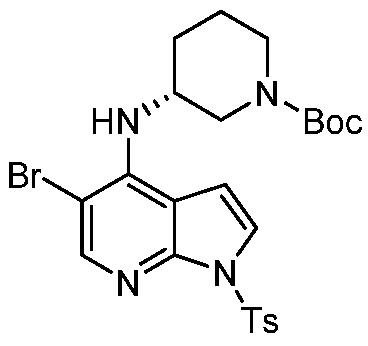
밀봉된 튜브 중에서, N-메틸피롤리돈 (25 mL) 중의 5-브로모-4-클로로-1-토실-1H-피롤로[2,3-b]피리딘 (5 g, 13.0 mmol), tert-부틸 (R)-3-아미노피페리딘-1-카르복실레이트 (3.9 g, 19.5 mmol) 및 트리에틸아민 (0.9 mL, 6.5 mmol)의 교반된 용액을 150℃로 16시간 동안 가열하였다.상기 반응 혼합물을 상온으로 냉각시키고, 상기 반응을 물로 ??칭한 후, 에틸 아세테이트로 추출하였다. 상기 유기층을 물과 염수로 세척하고, 무수 황산나트륨으로 건조시킨 후, 여과하여 진공에서 농축시켰다. 상기 미정제 물질을 섬광 크로마토그래피 (15% 에틸 아세테이트/헥산)로 정제하여 tert-부틸 (R)-3-((5-브로모-1-토실-1H-피롤로[2,3-b]피리딘-4-일)아미노)피페리딘-1-카르복실레이트를 갈색 액체로서 수득하였다 (4.0 g, 56% 수율): MS (ES) m/z 549 (M+).In a sealed tube, 5-bromo-4-chloro-1-tosyl-1 H -pyrrolo[2,3- b ]pyridine (5 g, 13.0 mmol) in N-methylpyrrolidone (25 mL), A stirred solution of tert-butyl ( R )-3-aminopiperidine-1-carboxylate (3.9 g, 19.5 mmol) and triethylamine (0.9 mL, 6.5 mmol) was heated to 150° C. for 16 h. . The reaction mixture was cooled to room temperature, the reaction quenched with water, and extracted with ethyl acetate. The organic layer was washed with water and brine, dried over anhydrous sodium sulfate, filtered and concentrated in vacuo. The crude material was purified by flash chromatography (15% ethyl acetate/hexanes) to tert -butyl ( R )-3-((5-bromo-1-tosyl- 1H -pyrrolo[2,3- b) ]Pyridin-4-yl)amino)piperidine-1-carboxylate was obtained as a brown liquid (4.0 g, 56% yield): MS (ES) m/z 549 (M+).
[000600] 단계 3: tert-부틸 (R)-3-((5-브로모-1H-피롤로[2,3-b]피리딘-4-일)아미노)피페리딘-1-카르복실레이트의 제조 [000600] Step 3: tert -Butyl ( R )-3-((5-bromo- 1H -pyrrolo[2,3- b ]pyridin-4-yl)amino)piperidine-1-carboxyl production of the rate

THF : MeOH : 물 (25 mL : 100 mL : 25 mL) 중 tert-부틸 (R)-3-((5-브로모-1-토실-1H-피롤로[2,3-b]피리딘-4-일)아미노)피페리딘-1-카르복실레이트 (18.4 g, 33.5 mmol) 및 수산화리튬 일수화물 (4.93 g, 117.5 mmol)의 교반된 용액을 60℃로 2시간 동안 가열하였다. 상기 반응 혼합물을 상온으로 냉각하여 진공에서 농축시켰다. 상기 미정제물을 에틸 아세테이트에 용해시키고, 물, 염수로 세척하여 무수 황산나트륨으로 건조시킨 후, 여과하고 진공에서 농축시켜 tert-부틸 (R)-3-((5-브로모-1H-피롤로[2,3-b]피리딘-4-일)아미노)피페리딘-1-카르복실레이트를 갈색 액체로서 수득하였다 (12.4 g, 미정제): MS (ES) m/z 395.1 (M+). THF : MeOH : tert -butyl ( R )-3-((5-bromo-1-tosyl- 1H -pyrrolo[2,3- b ]pyridine- in water (25 mL : 100 mL : 25 mL)) A stirred solution of 4-yl)amino)piperidine-1-carboxylate (18.4 g, 33.5 mmol) and lithium hydroxide monohydrate (4.93 g, 117.5 mmol) was heated to 60° C. for 2 h. The reaction mixture was cooled to room temperature and concentrated in vacuo. The crude was dissolved in ethyl acetate, washed with water, brine, dried over anhydrous sodium sulfate, filtered and concentrated in vacuo to tert -butyl ( R )-3-((5-bromo- 1H -pyrrolo) [2,3- b ]pyridin-4-yl)amino)piperidine-1-carboxylate was obtained as a brown liquid (12.4 g, crude): MS (ES) m/z 395.1 (M+).
[000601] 단계 4: tert-부틸 (R)-3-((5-브로모-1-((2-(트리메틸실릴)에톡시)메틸)-1H-피롤로[2,3-b]피리딘-4-일)아미노)피페리딘-1-카르복실레이트의 제조 [000 601] Step 4: tert-butyl (R) -3 - ((5- bromo-1-ethoxy) methyl) -1 H a ((2- (trimethylsilyl) -pyrrolo [2,3- b] Preparation of pyridin-4-yl)amino)piperidine-1-carboxylate
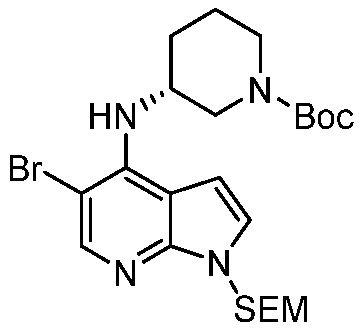
무수 디메틸포름아미드 (80 mL) 중의 수소화나트륨 (1.29 g, 32.4 mmol, 광유 중 60% 현탁액)의 현탁액에 tert-부틸 (R)-3-((5-브로모-1H-피롤로[2,3-b]피리딘-4-일)아미노)피페리딘-1-카르복실레이트 (8.0 g, 20.2 mmol)를 0℃에서 서서히 첨가한 후, 상기 혼합물을 30분간 교반하였다. 이후, 2-(트리메틸실릴)에톡시메틸 클로라이드 (6.45 mL, 36.4 mmol)를 0℃에서 첨가하고, 상기 혼합물을 상온에서 1.5시간 동안 교반하였다. 상기 반응 혼합물을 포화 염화암모늄 용액으로 ??칭하고 에틸 아세테이트로 추출하였다. 상기 유기 추출물을 물, 염수로 세척하고 무수 황산나트륨으로 건조시켰다. 상기 용액을 여과한 후 진공에서 농축시켜 미정제 물질을 수득하고, 이를 컬럼 크로마토그래피 (5% 에틸 아세테이트/헥산)로 정제하여 tert-부틸 (R)-3-((5-브로모-1-((2-(트리메틸실릴)에톡시)메틸)-1H-피롤로[2,3-b]피리딘-4-일)아미노)피페리딘-1-카르복실레이트를 황색 오일로서 수득하였다 (7.0 g, 66% 수율): MS (ES) m/z 525.0 (M+). To a suspension of sodium hydride (1.29 g, 32.4 mmol, 60% suspension in mineral oil) in anhydrous dimethylformamide (80 mL) was tert -butyl ( R )-3-((5-bromo- 1H -pyrrolo[2) ,3- b ]pyridin-4-yl)amino)piperidine-1-carboxylate (8.0 g, 20.2 mmol) was added slowly at 0° C., and then the mixture was stirred for 30 minutes. Then, 2-(trimethylsilyl)ethoxymethyl chloride (6.45 mL, 36.4 mmol) was added at 0° C., and the mixture was stirred at room temperature for 1.5 hours. The reaction mixture was quenched with saturated ammonium chloride solution and extracted with ethyl acetate. The organic extract was washed with water, brine and dried over anhydrous sodium sulfate. The solution was filtered and concentrated in vacuo to give a crude material, which was purified by column chromatography (5% ethyl acetate/hexanes) to tert -butyl ( R )-3-((5-bromo-1- ((2- (trimethylsilyl) ethoxy) methyl) -1 H - pyrrolo [2,3- b] pyridine-4-yl) amino) piperidine-1-carboxylate as a yellow oil ( 7.0 g, 66% yield): MS (ES) m/z 525.0 (M+).
[000602] 단계 5: tert-부틸 (R)-3-((5-(4,4,5,5-테트라메틸-1,3,2-디옥사보롤란-2-일)-1-((2-(트리메틸실릴)에톡시)메틸)-1H-피롤로[2,3-b]피리딘-4-일)아미노)피페리딘-1-카르복실레이트의 제조 [000602] Step 5: tert -Butyl ( R )-3-((5-(4,4,5,5-tetramethyl-1,3,2-dioxaborolan-2-yl)-1-( methyl) -1 H (2- (trimethylsilyl)) -pyrrolo [2,3- b] pyridin-4-yl) amino) the preparation of 1-carboxylate

1,4-디옥산 : 톨루엔 (4 : 1) 중 tert-부틸 (R)-3-((5-브로모-1-((2-(트리메틸실릴)에톡시)메틸)-1H-피롤로[2,3-b]피리딘-4-일)아미노)피페리딘-1-카르복실레이트 (2 g, 3.80 mmol)의 용액에 4,4,4',4',5,5,5',5'-옥타메틸-2,2'-바이(1,3,2-디옥사보롤란) (1.25 g, 4.95 mmol) 및 제3인산칼륨 (2.42 g, 11.4 mmol)을 첨가하였다. 상기 혼합물을 질소로 15분간 퍼징하였다. X-Phos Pd G2 (0.60 g, 0.76 mmol)를 첨가한 후, 생성된 혼합물을 미리 가열한 오일조 상에서 110℃로 15분간 교반하였다. 상기 반응 혼합물을 상온으로 냉각한 후, 에틸 아세테이트로 희석하고 셀라이트를 통해 여과하였다. 여과액을 물, 염수로 세척하고, 무수 황산나트륨으로 건조시킨 후, 여과하고 진공에서 농축시켜 tert-부틸 (R)-3-((5-(4,4,5,5-테트라메틸-1,3,2-디옥사보롤란-2-일)-1-((2-(트리메틸실릴)에톡시)메틸)-1H-피롤로[2,3-b]피리딘-4-일)아미노)피페리딘-1-카르복실레이트를 미정제물로 수득하였다 (3 g, 미정제): MS (ES) m/z 573.0 (M+H)+. 1,4-dioxane: toluene (4: 1) of tert-butyl (R) -3 - ((5- bromo-1 - ((2- (trimethylsilyl) ethoxy) methyl) -1 H-P To a solution of rolo[2,3-b]pyridin-4-yl)amino)piperidine-1-carboxylate (2 g, 3.80 mmol) 4,4,4',4',5,5,5 ',5'-octamethyl-2,2'-bi(1,3,2-dioxaborolane) (1.25 g, 4.95 mmol) and potassium triphosphate (2.42 g, 11.4 mmol) were added. The mixture was purged with nitrogen for 15 minutes. After addition of X-Phos Pd G2 (0.60 g, 0.76 mmol), the resulting mixture was stirred on a preheated oil bath at 110° C. for 15 minutes. After cooling the reaction mixture to room temperature, it was diluted with ethyl acetate and filtered through Celite. The filtrate was washed with water, brine, dried over anhydrous sodium sulfate, filtered and concentrated in vacuo, tert -butyl ( R )-3-((5-(4,4,5,5-tetramethyl-1, 3,2- dioxaborolan-2-yl) -1-methyl) -1 H ((2- (trimethylsilyl ethoxy)) -pyrrolo [2,3- b] pyridin-4-yl) amino) Piperidine-1-carboxylate was obtained crude (3 g, crude): MS (ES) m/z 573.0 (M+H) + .
생물학적 활성 분석Biological activity assay
JAK1, JAK2, JAK3 및 Tyk-2 효소 활성 분석JAK1, JAK2, JAK3 and Tyk-2 enzyme activity assay
[000603] JAK3 (a.a. 781-1124, ThermoFisher)의 활성은 SRCtide의 인산화를 측정하여 정량하였다 (FAM-GEEPLYWSFPAKKK-NH2). 키나제 반응은 20 mM HEPES, pH 7.5, 10 mM MgCl2, 0.01% BSA 및 0.0005% Tween-20의 완충액 조건 하에 2% 최종 DMSO 농도를 갖는 384-웰 Greiner 플레이트에서 실행하였다. 키나제 반응 성분들은 2.5 nM의 JAK3, 1 μM의 SRCtide 펩타이드 및 1 μM의 ATP였다. 실시예들은 2 μM에서 시작하는 용량 반응 (11개의 농도, 3배 단계 희석, 2회 반응)으로 시험하였다. 상기 반응물들을 실온에서 40분간 항온배양한 후, 20 mM의 HEPES (pH 7.5) 중 1:1 부피의 30 mM의 EDTA (최종 15 mM의 EDTA)를 첨가하여 반응을 중단시켰다. 반응을 중단시킨 후, 인산화된 펩타이드와 인산화되지 않은 펩타이드를 분리하고, Caliper LC3000/EZ 판독기 시스템과 HTS 웰 분석기 소프트웨어 (미국 메사추세츠주 홉킨턴 소재의 Caliper, A PerkinElmer Company)를 사용하여 정량하였다. 용량 반응 데이터를 4-매개변수 로지스틱 IC50 방정식에 피팅하여 억제제 효능을 계산하기 위해 GraFit (영국 홀리 소재의 Erithacus Software Ltd.)를 사용하였다. [000603] The activity of JAK3 (aa 781-1124, ThermoFisher) was quantified by measuring the phosphorylation of SRCtide (FAM-GEEPLYWSFPAKKK-NH 2 ). Kinase reactions were run in 384-well Greiner plates with 2% final DMSO concentration under buffer conditions of 20 mM HEPES, pH 7.5, 10 mM MgCl 2 , 0.01% BSA and 0.0005% Tween-20. The kinase reaction components were 2.5 nM JAK3, 1 μM SRCtide peptide and 1 μM ATP. Examples were tested with dose responses starting at 2 μM (11 concentrations, 3-fold serial dilutions, 2 responses). After incubation of the reactions at room temperature for 40 minutes, the reaction was stopped by adding a 1:1 volume of 30 mM EDTA (final 15 mM EDTA) in 20 mM HEPES, pH 7.5. After stopping the reaction, phosphorylated and non-phosphorylated peptides were separated and quantified using a Caliper LC3000/EZ reader system and HTS well analyzer software (Caliper, A PerkinElmer Company, Hopkinton, MA). GraFit (Erithacus Software Ltd., Holly, UK) was used to calculate inhibitor efficacy by fitting dose response data to a 4-parameter logistic IC 50 equation.
[000604] JAK1, JAK2 및 Tyk-2의 후보 화합물들의 억제 효능은 Z-lyte 분석을 사용하여 Thermo Fisher Scientific사의 Selectscreen에서 수행하였다. 다음은 각 효소에 대한 분석 세부 사항들이다: [000604] The inhibitory efficacy of the candidate compounds of JAK1, JAK2 and Tyk-2 was performed in Thermo Fisher Scientific's Selectscreen using Z-lyte analysis. Following are the assay details for each enzyme:
[000605] JAK1: 2X JAK-효소 / Tyr 06 혼합물을 50 mM HEPES pH 6.5, 0.01% BRIJ-35, 10 mM MgCl2, 1 mM EGTA, 0.02% NaN3 중에서 제조한다. 키나제 반응의 최종 10 μL는 50 mM HEPES pH 7.0, 0.01% BRIJ-35, 10 mM MgCl2, 1 mM EGTA, 0.01% NaN3 중의 21.2 - 91.5 ng의 JAK1 및 2 μM의 Tyr 06으로 구성된다. 1시간의 키나제 반응 항온배양 후, 1:128 희석의 발색 시약 5 μL를 첨가한다. [000605] JAK1: 2X JAK-enzyme / Tyr 06 mixture is prepared in 50 mM HEPES pH 6.5, 0.01% BRIJ-35, 10 mM MgCl 2 , 1 mM EGTA, 0.02% NaN 3 . The final 10 μL of the kinase reaction consists of 21.2 - 91.5 ng of JAK1 and 2 μM of Tyr 06 in 50 mM HEPES pH 7.0, 0.01% BRIJ-35, 10 mM MgCl 2 , 1 mM EGTA, 0.01% NaN 3 . After 1 h of kinase reaction incubation, 5 µL of chromogenic reagent at a 1:128 dilution is added.
[000606] JAK2: 2X JAK2 / Tyr 06 혼합물을 50 mM HEPES pH 7.5, 0.01% BRIJ-35, 10 mM MgCl2, 1 mM EGTA 중에서 제조한다. 키나제 반응의 최종 10 μL는 50 mM HEPES pH 7.5, 0.01% BRIJ-35, 10 mM MgCl2, 1 mM EGTA 중의 0.12 - 0.5 ng의 JAK2 및 2 μM의 Tyr 06으로 구성된다. 1시간의 키나제 반응 항온배양 후, 1:128 희석의 발색 시약 A를 5 μL 첨가한다. [000606] JAK2: 2X JAK2 / Tyr 06 mixture is prepared in 50 mM HEPES pH 7.5, 0.01% BRIJ-35, 10 mM MgCl 2 , 1 mM EGTA. The final 10 μL of the kinase reaction consists of 0.12-0.5 ng JAK2 and 2 μM Tyr 06 in 50 mM HEPES pH 7.5, 0.01% BRIJ-35, 10 mM MgCl 2 , 1 mM EGTA. After 1 hour of kinase reaction incubation, 5 µL of chromogenic reagent A at a 1:128 dilution is added.
[000607] TYK2: 2X TYK2 / Tyr 03 혼합물을 50 mM HEPES pH 6.5, 0.01% BRIJ-35, 10 mM MgCl2, 1 mM EGTA, 0.02% NaN3 중에서 제조한다. 키나제 반응의 최종 10 μL는 50 mM HEPES pH 7.0, 0.01% BRIJ-35, 10 mM MgCl2, 1 mM EGTA, 0.01% NaN3 중의 3.75 - 15 ng의 TYK2 및 2 μM의 Tyr 03으로 구성된다. 1시간의 키나제 반응 항온배양 후, 1:4096 희석의 발색 시약 A를 5 μL 첨가한다. [000607] A TYK2: 2X TYK2 / Tyr 03 mixture is prepared in 50 mM HEPES pH 6.5, 0.01% BRIJ-35, 10 mM MgCl 2 , 1 mM EGTA, 0.02% NaN 3 . The final 10 μL of the kinase reaction consists of 3.75 - 15 ng of TYK2 and 2 μM of Tyr 03 in 50 mM HEPES pH 7.0, 0.01% BRIJ-35, 10 mM MgCl 2 , 1 mM EGTA, 0.01% NaN 3 . After 1 hour of kinase reaction incubation, 5 µL of chromogenic reagent A at a 1:4096 dilution is added.
[000608] JAK1, JAK2 및 TYK2에 대한 데이터 축소는 효소 구동과는 관계없이 동일하게 수행한다. 요컨대, 백그라운드 신호는 효소의 부재 하에 정의되고, 억제되지 않은 신호는 비히클 (2% DMSO) 단독의 존재 하에 정의된다. 화합물들을 20 mM 내지 0.34 nM 범위의 11점 용량 반응으로 평가하였다. 화합물들의 IC50 값은, 화합물 농도의 함수로서 방출비의 4-매개변수 로지스틱 피팅을 사용하여 결정된다. 그 결과를 표 3에 나타내었다. [000608] Data reduction for JAK1, JAK2, and TYK2 is performed the same regardless of enzyme actuation. Briefly, background signal is defined in the absence of enzyme and uninhibited signal is defined in the presence of vehicle (2% DMSO) alone. Compounds were evaluated in an 11-point dose response ranging from 20 mM to 0.34 nM. The IC 50 values of the compounds are determined using a 4-parameter logistic fitting of the emission ratio as a function of compound concentration. The results are shown in Table 3.


JAK 세포성 표적 조절 분석JAK Cellular Target Regulation Assay
[000609] 표적 조절은 선택된 기질들의 JAK 동형 특이적 인산화를 억제하는 화합물의 능력을 기반으로 하였다. Tyr694에 대한 IL-2 자극 STAT5 인산화를 사용하여 JAK1/3 화합물의 선택성을 평가하였다. Tyr694에 대한 GM-CSF 자극 STAT5 인산화를 사용하여 JAK2 화합물의 선택성을 평가하였다. Tyr701에 대한 IFNγ 자극 STAT1 인산화를 사용하여 JAK1/2 화합물의 선택성을 평가하였다. Tyr693에 대한 IL-12 자극 STAT4 인산화를 사용하여 JAK2/TYK2 화합물의 선택성을 평가하였다. 4가지 분석 모두에 있어서, 냉동 스톡으로부터 인간 PBMC를 해동하여 펠릿화한 후, 완전 배지 (90% RPMI, 10% 열 불활성화 FBS, 10 mM HEPES, 47 μM 2-ME, pen/strep)에 재현탁하고, 120 μl의 완전 배지 중에서 웰당 200,000개로 96웰 V-바닥 플레이트의 웰에 넣었다. 화합물들을 1% DMSO가 포함된 완전 배지 (또는 대조군의 경우 1% DMSO가 포함된 배지)에서 10X 작업 스톡 용액의 웰당 15 μl로 첨가하고, 5% CO2가 포함된 37℃ 항온배양기의 플레이트 진탕기에 두고 1시간 동안 약하게 흔들면서 두었다 (3의 설정). 자극은 용해성 사이토카인의 첨가를 사용하였다. JAK1/3 포스포-STAT5 분석의 경우, 15 μl의 10x 작업 스톡 재조합 인간 IL-2를 25 ng/ml의 최종 농도로 첨가하였다. JAK2 포스포-STAT5 분석의 경우, 15 μl의 10x 작업 스톡 재조합 인간 GM-CSF를 5 ng/ml의 최종 농도로 첨가하였다. JAK1/2 포스포-STAT1 분석의 경우, 15 μl의 10x 작업 스톡 재조합 인간 IFNγ를 10 ng/ml의 최종 농도로 첨가하였다. JAK2/TYK2 포스포-STAT4 분석의 경우, 15 μl의 10x 작업 스톡 재조합 인간 IL-12를 1.7 ng/ml의 최종 농도로 첨가하였다. 그 다음, 플레이트들을 항온배양기의 플레이트 진탕기에 다시 넣어 추가로 각각 5, 5, 10 및 25분이 지난 뒤, 플레이트들을 항온배양기에서 꺼내 플레이트 밀봉기로 밀봉하고, 세포들을 400xg에서 5분간 펠릿화하였다. 펠릿화 후, 상기 배지를 흡인으로 제거하고, 세포들을 분석 특이적 세포 용해 완충액 중에 용해시켰다. 포스포-STAT5의 수준은 메조 스케일 결합분석법 (Meso Scale Discovery)의 포스포 (Tyr694) STAT5a,b 전체 세포 용해물 (Whole Cell Lysate) 키트를 사용하여 측정되었다. 포스포-STAT1의 수준은 CST-PathScan 포스포-STAT1 (Tyr701) 샌드위치 ELISA 키트를 사용하여 측정되었다. 포스포-STAT4의 수준은 메조 스케일 결합분석법의 포스포-STAT4 (Tyr693) 전체 세포 용해물 키트를 사용하여 측정되었다. 그 결과를 표 4에 나타내었다. [000609] Target modulation was based on the ability of compounds to inhibit JAK isoform specific phosphorylation of selected substrates. IL-2 stimulated STAT5 phosphorylation to Tyr694 was used to evaluate the selectivity of JAK1/3 compounds. GM-CSF stimulated STAT5 phosphorylation to Tyr694 was used to evaluate the selectivity of JAK2 compounds. IFNγ stimulated STAT1 phosphorylation to Tyr701 was used to evaluate the selectivity of JAK1/2 compounds. IL-12 stimulated STAT4 phosphorylation to Tyr693 was used to evaluate the selectivity of JAK2/TYK2 compounds. For all four assays, human PBMCs were thawed and pelleted from frozen stock and then resuspended in complete medium (90% RPMI, 10% heat inactivated FBS, 10 mM HEPES, 47 μM 2-ME, pen/strep). Turbid, 200,000 per well in 120 μl of complete medium were placed in the wells of 96 well V-bottom plates. Compounds were added at 15 μl per well of a 10X working stock solution in complete medium with 1% DMSO (or medium with 1% DMSO for controls), shaking the plate in a 37° C. incubator with 5% CO 2 . It was placed on a table and left for 1 hour with gentle shaking (setting of 3). Stimulation used the addition of soluble cytokines. For the JAK1/3 phospho-STAT5 assay, 15 μl of 10x working stock recombinant human IL-2 was added to a final concentration of 25 ng/ml. For the JAK2 phospho-STAT5 assay, 15 μl of 10x working stock recombinant human GM-CSF was added to a final concentration of 5 ng/ml. For the JAK1/2 phospho-STAT1 assay, 15 μl of 10x working stock recombinant human IFNγ was added to a final concentration of 10 ng/ml. For the JAK2/TYK2 phospho-STAT4 assay, 15 μl of 10x working stock recombinant human IL-12 was added to a final concentration of 1.7 ng/ml. The plates were then placed back on the plate shaker of the incubator and after an additional 5, 5, 10 and 25 minutes respectively, the plates were removed from the incubator and sealed with a plate sealer, and the cells were pelleted at 400xg for 5 minutes. After pelleting, the medium was removed by aspiration and cells were lysed in assay specific cell lysis buffer. Levels of phospho-STAT5 were measured using Meso Scale Discovery's phospho (Tyr694) STAT5a,b Whole Cell Lysate kit. Levels of phospho-STAT1 were measured using the CST-PathScan phospho-STAT1 (Tyr701) sandwich ELISA kit. Levels of phospho-STAT4 were measured using a phospho-STAT4 (Tyr693) whole cell lysate kit in a meso-scale binding assay. The results are shown in Table 4.


마우스에서 GI 노출 PKGI Exposure PK in Mice
[000610] 시험 화합물을 ~0.025%의 Tween-20으로 적시고, 막자사발 중에서 막자로 분쇄한 다음, 0.5%의 메틸 셀룰로스를 천천히 첨가하여 최종 부피를 7.25 mL로 만들었다. BalbC 시험 동물들을 5% 이소플루란과 0.8-1.5 L/분의 O2 기체 공급의 혼합물로 마취를 유도하였다. 다음으로, 제형화된 시험 화합물을 경구 위관영양법을 통해 투여하였다. 다양한 시점 (0.5, 1, 2, 4, 6 및 8시간)에, 혈액 샘플들 (~100 μL)을 문맥에서 수집한 후 (간전), 심장 천자를 통해 수집하여 (순환), 이들을 해당 시점에 따라 2% w/v K2 EDTA 수용액을 포함하는 튜브에 넣었다. 혈액 샘플링 후, 위장관 (GI) 조직들을 동일한 시점에 마우스로부터 수집하였다. GI 조직은 십이지장, 공장, 회장 및 결장과 같은 서로 다른 부분들로 해부되었다. 상기 분리된 조직들은 GI 내용물을 제거하기 위해 구강 위관영양 바늘을 통해 PBS로 플러슁하여 세척하였다. 수집 후, 모든 조직들을 블롯팅하고, 칭량한 후, PBS 완충액 (pH 7.4)으로 균질화하였다. 상기 혈액 샘플들을 즉시 얼음 위에 놓고, 4°C에서 30분 이내, 8,000 rpm으로 5분간 원심분리하여 혈장을 얻었다. 혈장을 피펫을 사용하여 사전에 라벨을 붙여 놓은 원심분리기용 튜브로 옮긴 후, 생체시료분석이 있을 때까지 즉시 -80°C로 옮겼다. 조직 샘플들을 사전에 라벨을 붙여 놓은 용기에 넣고, 모든 샘플들을 균질화될 때까지 -80°C에서 보관하였다. 상기 균질액을 바로, 생체시료분석을 수행할 때까지 -80°C로 보관하였다. 연구 샘플들 실온으로 해동하고, 50 μL의 샘플을 사전에 라벨을 붙여 놓은 바이알들에 분취하였다. 여기에 IS (100 ng/mL, 와파린, 톨부타미드 및 로페라미드)를 함유한 100% 아세토니트릴 400 μL를 첨가하였다. 상기 바이알들을 잘 혼합하고, 5분간 볼텍싱한 후, 4℃에서 14000 rpm으로 5분간 원심분리하였다. 상청액을 분리하여 이를 LC-MS/MS에 주입하였다. 시험 화합물의 혈장 및 GI 조직 수준은, 텍스트 매트릭스의 표준 곡선을 사용하여 LC-MS 분석으로 측정하였다. 각 농도-시간 데이터는 비구획 분석법 (NCA)에 의해 Phoenix WinNonlin (버전 8.1)을 사용하여 분석하였다. 그 결과를 표 5에 나타내었다. [000610] The test compound was wetted with ˜0.025% of Tween-20, ground with a pestle in a mortar, and then slowly added 0.5% of methyl cellulose to a final volume of 7.25 mL. Anesthesia was induced in BalbC test animals with a mixture of 5% isoflurane and 0.8-1.5 L/min of O 2 gas supply. Next, the formulated test compound was administered via oral gavage. At various time points (0.5, 1, 2, 4, 6 and 8 hours), blood samples (~100 μL) are collected from the portal vein (pre-hepatic) and then via cardiac puncture (circulation), which are then collected at that time point. Accordingly, it was placed in a tube containing 2% w/v K 2 EDTA aqueous solution. After blood sampling, gastrointestinal (GI) tissues were collected from mice at the same time point. The GI tissue was dissected into different parts such as duodenum, jejunum, ileum and colon. The isolated tissues were washed by flushing with PBS through an oral gavage needle to remove GI contents. After collection, all tissues were blotted, weighed and homogenized with PBS buffer (pH 7.4). The blood samples were immediately placed on ice, and centrifuged at 4°C for 30 minutes at 8,000 rpm for 5 minutes to obtain plasma. Plasma was pipetted into pre-labeled centrifuge tubes and immediately transferred to -80 °C until bioanalysis. Tissue samples were placed in pre-labeled containers, and all samples were stored at -80 °C until homogenized. The homogenate was immediately stored at -80 °C until analysis of biological samples was performed. Study samples were thawed to room temperature, and 50 μL of samples were aliquoted into pre-labeled vials. To this was added 400 μL of 100% acetonitrile containing IS (100 ng/mL, warfarin, tolbutamide and loperamide). The vials were mixed well, vortexed for 5 minutes, and then centrifuged at 14000 rpm at 4° C. for 5 minutes. The supernatant was separated and injected into LC-MS/MS. Plasma and GI tissue levels of test compounds were determined by LC-MS analysis using standard curves in text matrix. Each concentration-time data was analyzed using Phoenix WinNonlin (version 8.1) by non-compartmental analysis (NCA). The results are shown in Table 5.

마우스의 급성 DSS 대장염 모델Acute DSS colitis model in mice
[000611] 식수를 통해 마우스에게 황산화 다당류인 덱스트란 황산나트륨 (DSS)을 경구 투여하면, 체중 감소, 혈변 설사, 궤양 형성, 상피 세포 손실, 및 인간의 염증성 장질환 (IBD)의 일부 특징들과 유사한 호중구, 대식세포 및 림프구 침윤을 특징으로 하는 중증 대장염이 유발된다. 문헌 [Okayasu, I. et al. Gastroenterology, 98: 694-702 (1990)] 및 [Wirtz et al. Nature Protocols. 12(7):1295 (2017)]을 참조한다. 찰스 리버 (Charles River)의 9 내지 12주령 암컷 C57BL/6 마우스에게 4% DSS (대장염 등급 DSS, 분자량: 36,000-50,000, MP Biomedicals 카타로그 번호 160110)를 멸균 식수로 5일간 제공하였다. 6일째, 마우스를 멸균 식수로 전환하고, 6일에서 10일 또는 10일에서 14일 사이에 약물을 투여하였다 (PO, BID). [000611] Oral administration of sulfated polysaccharide sodium dextran sulfate (DSS) to mice through drinking water resulted in weight loss, bloody diarrhea, ulceration, epithelial cell loss, and some features of inflammatory bowel disease (IBD) in humans. Severe colitis characterized by similar neutrophil, macrophage and lymphocyte infiltration results. See Okayasu, I. et al. Gastroenterology , 98: 694-702 (1990)] and Wirtz et al. Nature Protocols. 12(7):1295 (2017)]. 9-12 week old female C57BL/6 mice from Charles River were given 4% DSS (colitis grade DSS, molecular weight: 36,000-50,000, MP Biomedicals catalog number 160110) with sterile drinking water for 5 days. On day 6, the mice were switched to sterile drinking water, and the drug was administered between days 6 and 10 or between days 10 and 14 (PO, BID).
[000612] 체중을 매일 모니터링하여 초기 체중에 대한 비율로 기록하였다. 또한, 대변의 굳기와 혈변 점수도 매겼다 (0-4). 각 연구의 종료시, 마우스들을 희생시켜 전체 결장을 제거하고 PBS로 플러슁하였다. 결장의 중량과 길이를 측정하고, 결장의 중량 대 길이의 비율을 기록하였다. 원위 결장의 0.5 cm 분절을 마이크로원심분리기용 튜브에 수집하여 드라이아이스 중에 냉동시켰다. MSD의 V-PLEX 마우스 사이토카인 29-플렉스 키트를 사용하여 결장 사이토카인 측정을 위해서 상기 조직의 용해물을 준비하였다. 원위 결장의 3cm 분절을 카세트에 수집하고, 조직학용 10% 포르말린 중에 고정시켰다. 슬라이드를 준비하여 헤마톡실린과 에오신 (H&E)으로 염색한 뒤, 병리학자에 의한 맹검 방식으로 점수를 매겼다. H&E 슬라이드의 점수에는 염증, 샘 손상, 미란, 점막하 부종, 점막 두께, 호중구 점수, 림프구 응집체 수와 크기에 대한 범주가 포함되었다. [000612] Body weight was monitored daily and recorded as a percentage of initial body weight. In addition, stool hardness and bloody stool scores were scored (0-4). At the end of each study, mice were sacrificed and the entire colon was removed and flushed with PBS. The weight and length of the colon were measured, and the ratio of the weight to the length of the colon was recorded. 0.5 cm segments of the distal colon were collected in microcentrifuge tubes and frozen in dry ice. Using MSD's V-PLEX Mouse Cytokine 29-Plex Kit, a lysate of the tissue was prepared for the measurement of colonic cytokines. A 3 cm segment of the distal colon was collected in a cassette and fixed in 10% formalin for histology. Slides were prepared, stained with hematoxylin and eosin (H&E), and scored in a blinded manner by a pathologist. Scores on the H&E slides included categories for inflammation, gland injury, erosion, submucosal edema, mucosal thickness, neutrophil score, and lymphocyte aggregate number and size.
[000613] 본 출원에 인용된 미국 또는 외국의 모든 참고문헌, 특허 또는 출원들은 그 전문이 본원에 기술된 것과 같이 참조로 인용된다. 임의의 불일치가 발생하는 경우에는, 본원에 문언적으로 개시된 자료가 우선한다. [000613] All US or foreign references, patents or applications cited in this application are incorporated by reference as if set forth herein in their entirety. In the event of any inconsistency, the material disclosed herein shall control.
[000614] 상기 상세한 설명으로부터, 당업계의 숙련자라면 누구나 본 발명의 개념과 범위를 벗어나지 않으면서 본 발명의 본질적인 특징들을 쉽게 알 수 있고, 본 발명에 다양한 변화와 변형을 가하여 이를 다양한 용도와 조건에 적용시킬 수도 있다. From the above detailed description, anyone skilled in the art can easily know the essential features of the present invention without departing from the concept and scope of the present invention, and various changes and modifications can be made to the present invention for various uses and conditions. can also be applied.
Claims (13)
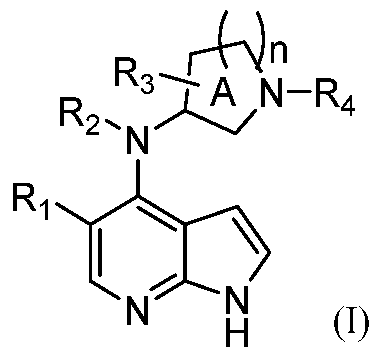
상기 식에서,
R1은 CN 또는 헤테로아릴기로부터 선택되고, 하나 이상의 가용 질소 원자에서 H 또는 C1-C5알킬로부터 독립적으로 선택되는 기로 임의 치환되며, 하나 이상의 가용 탄소 원자에서 H, 할로겐, CN, -C1-C4알킬, -C0-C6알킬C3-C6사이클로알킬, -(C0-C6알킬)C3-C6헤테로사이클, -OH, -SO2R9, -SOR9, -SR9, -NHSO2R9, -OSO2R9, -C0-C6알킬SO2R9, C0-C6알킬COR9, C0-C6알킬NR7C(O)NR7R8, C0-C6알킬OC(O)NR7R8, C0-C6알킬NR7SO2R9, -C0-C6알킬NR7COR9, -OC1-C6알킬, -OC0-C6알킬C3-C6사이클로알킬, -OC0-C6알킬C3-C6헤테로사이클, -OC0-C6알킬NR7C(O)NR7R8, -OC0-C6알킬OC(O)NR7R8, -OC0-C6알킬NR7SO2R9, -OC0-C6알킬NR7COR9, -NR7R8, -NR7C0-C6알킬C1-C6알킬, -NR7C0-C6알킬C3-C6사이클로알킬, -NR7C0-C6알킬NR7C(O)NR7R8, -NR7C0-C6알킬OC(O)NR7R8, -NR7C0-C6알킬NR7SO2R9, -NR7C0-C6알킬NR7COR9, -NR7C0-C6알킬C3-C6헤테로사이클, 아릴 및 헤테로아릴로부터 독립적으로 선택되는 치환기로 임의 치환되고, 여기서 각각의 알킬, 사이클로알킬, 아릴, 헤테로사이클릴 또는 헤테로아릴 기는 할로겐, -OH, -C0-C6알킬NR7R8, -C0-C6알킬OH, -SO2R9, -SOR9, -NHSO2R9, -C0-C6알킬NR7R4, CN, -C1-C5알킬알콕시, C1-C5알콕시 또는 -O-C1-C5알킬로부터 선택되는 하나 이상의 기로 임의 치환되며;
R2는 H, -C1-C4알킬, -C3-C6사이클로알킬, 또는 -C1-C2알킬-C3-C6사이클로알킬로부터 선택되며, 여기서 상기 알킬 또는 사이클로알킬 기는 할로겐, -OH, 또는 -O-C1-C5알킬로부터 선택되는 하나 이상의 기로 임의 치환되고;
n은 0, 1 또는 2이며;
고리 A는 하나 이상의 탄소에서 1개, 2개 또는 3개의 R3 치환기로 치환되고, 여기서 각 R3 치환기는 H, 할로겐, -C1-C4알킬, -C3-C6사이클로알킬, -OH, 또는 -O-C1-C5알킬로부터 독립적으로 선택되며, 이 경우 각 알킬 또는 사이클로알킬 기는 할로겐, -OH, -C1-C5알킬알콕시, 또는 -O-C1-C5알킬로부터 선택된 하나 이상의 기로 임의 치환되고;
상기 고리 A의 동일하거나 상이한 탄소 원자 상의 두 R3 기는 고리 A와 임의로 결합하여 스피로사이클릭 또는 바이사이클릭 고리계를 형성할 수 있으며;
R4는 -C(O)-R6, -CH2R6, -C(O)-C1-C5알킬, 또는 -C(O)-C3-C6사이클로알킬로부터 선택되고, 여기서 상기 알킬 또는 사이클로알킬 기는 -OH, 할로겐, 알킨, 또는 -CN으로부터 선택된 하나 이상의 기로 임의 치환될 수 있으며;
R5는 -C1-C5알킬, 또는 -C3-C6사이클로알킬로부터 선택되고, 여기서 상기 알킬 또는 사이클로알킬 기는 할로겐, -OH, 또는 -O-C1-C5알킬로부터 선택된 하나 이상의 기로 임의 치환될 수 있으며;
R6은 -C1-C5알킬, -C3-C6사이클로알킬, -C1-C5알킬-C3-C6사이클로알킬, -NR7R8, -O-아릴, -O-헤테로아릴, 아릴, 또는 헤테로아릴로부터 선택되고, 여기서 상기 알킬, 사이클로알킬, 아릴 또는 헤테로아릴 기는 할로겐, -CN, 알킨, -OH, 트리플루오로메틸, -O-C1-C5알킬, 또는 -O-C3-C6사이클로알킬로부터 선택된 하나 이상의 기로 임의 치환될 수 있으며;
R7과 R8은 H, -C1-C5 알킬, -C1-C5 알콕시, 또는 -C3-C5 사이클로알킬로부터 독립적으로 선택되고, 여기서 상기 알킬 기는 할로겐, -OH, 또는 -CN으로부터 선택된 하나 이상의 기로 임의 치환될 수 있으며;
R7과 R8은 임의로 연결되어 고리를 형성해 헤테로사이클, 예컨대 피페리딘, 피롤리딘을 형성하거나, 또는 다른 헤테로원자와 함께 고리, 예컨대 모르폴린을 형성하고, 이 경우 상기 헤테로사이클릭 고리는 할로겐, -OH, NH2, NHMe, NMe2, 또는 -CN으로부터 선택된 하나 이상의 기로 임의 치환될 수 있으며;
R9는 H, -C1-C5알킬, -OC1-C5알킬, -C3-C6사이클로알킬, 및 NR7R8로부터 선택되고, 여기서 상기 알킬, 헤테로사이클, 또는 사이클로알킬 기는 할로겐, -OH, NH2, NHMe, NMe2 또는 -CN으로부터 선택된 하나 이상의 기로 임의 치환될 수 있다.A compound of formula (I) or a derivative thereof:
In the above formula,
R 1 is selected from CN or heteroaryl groups, optionally substituted at one or more soluble nitrogen atoms with a group independently selected from H or C 1 -C 5 alkyl, and at one or more soluble carbon atoms H, halogen, CN, —C 1 -C 4 alkyl, -C 0 -C 6 alkylC 3 -C 6 cycloalkyl, -(C 0 -C 6 alkyl)C 3 -C 6 heterocycle, -OH, -SO 2 R 9 , -SOR 9 , -SR 9, -NHSO 2 R 9 , -OSO 2 R 9, -C 0 -C 6 alkyl SO 2 R 9, C 0 -C 6 alkyl, COR 9, C 0 -C 6 alkyl, NR 7 C (O) NR 7 R 8 , C 0 -C 6 alkylOC(O)NR 7 R 8 , C 0 -C 6 alkylNR 7 SO 2 R 9 , -C 0 -C 6 alkylNR 7 COR 9 , -OC 1 -C 6 alkyl, -OC 0 -C 6 alkylC 3 -C 6 cycloalkyl, -OC 0 -C 6 alkylC 3 -C 6 heterocycle, -OC 0 -C 6 alkylNR 7 C(O)NR 7 R 8 , -OC 0 -C 6 AlkylOC(O)NR 7 R 8 , -OC 0 -C 6 AlkylNR 7 SO 2 R 9 , -OC 0 -C 6 AlkylNR 7 COR 9 , -NR 7 R 8 , -NR 7 C 0 -C 6 alkylC 1 -C 6 alkyl, -NR 7 C 0 -C 6 alkylC 3 -C 6 cycloalkyl, -NR 7 C 0 -C 6 alkylNR 7 C(O)NR 7 R 8 , -NR 7 C 0 -C 6 AlkylOC(O)NR 7 R 8 , -NR 7 C 0 -C 6 AlkylNR 7 SO 2 R 9 , -NR 7 C 0 -C 6 AlkylNR 7 COR 9 , -NR 7 C 0 -C 6 alkylC 3 -C 6 heterocycle, optionally substituted with a substituent independently selected from aryl and heteroaryl, wherein each alkyl, cycloalkyl, aryl, heterocyclyl or heteroaryl group is halogen, - OH, -C 0 -C 6 alkylNR 7 R 8 , -C 0 -C 6 alkylOH, -SO 2 R 9 , -SOR 9 , -NHSO 2 R 9 , -C 0 -C 6 alkylNR 7 R 4 optionally substituted with one or more groups selected from , CN, -C 1 -C 5 alkylalkoxy, C 1 -C 5 alkoxy or -OC 1 -C 5 alkyl;
R 2 is selected from H, —C 1 -C 4 alkyl, —C 3 -C 6 cycloalkyl, or —C 1 -C 2 alkyl-C 3 -C 6 cycloalkyl, wherein the alkyl or cycloalkyl group is halogen optionally substituted with one or more groups selected from , -OH, or -OC 1 -C 5 alkyl;
n is 0, 1 or 2;
Ring A is substituted at one or more carbons with 1, 2 or 3 R 3 substituents, wherein each R 3 substituent is H, halogen, -C 1 -C 4 alkyl, -C 3 -C 6 cycloalkyl, - independently selected from OH, or -OC 1 -C 5 alkyl, in which case each alkyl or cycloalkyl group is at least one selected from halogen, -OH, -C 1 -C 5 alkylalkoxy, or -OC 1 -C 5 alkyl optionally substituted with a group;
two R 3 groups on the same or different carbon atoms of ring A may optionally combine with ring A to form a spirocyclic or bicyclic ring system;
R 4 is selected from -C(O)-R 6 , -CH 2 R 6 , -C(O)-C 1 -C 5 alkyl, or -C(O)-C 3 -C 6 cycloalkyl, wherein said alkyl or cycloalkyl group may be optionally substituted with one or more groups selected from -OH, halogen, alkyne, or -CN;
R 5 is selected from -C 1 -C 5 alkyl, or -C 3 -C 6 cycloalkyl, wherein the alkyl or cycloalkyl group is optionally with one or more groups selected from halogen, -OH, or -OC 1 -C 5 alkyl may be substituted;
R 6 is -C 1 -C 5 alkyl, -C 3 -C 6 cycloalkyl, -C 1 -C 5 alkyl-C 3 -C 6 cycloalkyl, -NR 7 R 8 , -O-aryl, -O- heteroaryl, aryl, or heteroaryl, wherein said alkyl, cycloalkyl, aryl or heteroaryl group is halogen, -CN, alkyne, -OH, trifluoromethyl, -OC 1 -C 5 alkyl, or -OC may be optionally substituted with one or more groups selected from 3 -C 6 cycloalkyl;
R 7 and R 8 are independently selected from H, -C 1 -C 5 alkyl, -C 1 -C 5 alkoxy, or -C 3 -C 5 cycloalkyl, wherein the alkyl group is halogen, -OH, or - may be optionally substituted with one or more groups selected from CN;
R 7 and R 8 are optionally joined to form a ring to form a heterocycle such as piperidine, pyrrolidine, or together with another heteroatom to form a ring such as morpholine, in which case the heterocyclic ring is optionally substituted with one or more groups selected from halogen, —OH, NH 2 , NHMe, NMe 2 , or —CN;
R 9 is selected from H, —C 1 -C 5 alkyl, —OC 1 -C 5 alkyl, —C 3 -C 6 cycloalkyl, and NR 7 R 8 , wherein the alkyl, heterocycle, or cycloalkyl group is may be optionally substituted with one or more groups selected from halogen, —OH, NH 2 , NHMe, NMe 2 or —CN.

상기 식에서,
R10은 CN 또는 헤테로아릴기로부터 선택되고, 하나 이상의 가용 질소 원자에서 H 또는 C1-C5알킬로부터 독립적으로 선택되는 기로 임의 치환되며, 하나 이상의 가용 탄소 원자에서 H, 할로겐, CN, -C1-C4알킬, -C0-C6알킬C3-C6사이클로알킬, -(C0-C6알킬)C3-C6헤테로사이클, -OH, -SO2R90, -NHSO2R90, -OSO2R90, -C0-C6알킬SO2R90, C0-C6알킬COR90, C0-C6알킬NR70C(O)NR70R80, C0-C6알킬OC(O)NR70R80, C0-C6알킬NR70SO2R90, -C0-C6알킬NR70COR90, -OC1-C6알킬, -OC0-C6알킬C3-C6사이클로알킬, -OC0-C6알킬C3-C6헤테로사이클, -OC0-C6알킬NR70C(O)NR70R80, -OC0-C6알킬OC(O)NR70R80, -OC0-C6알킬NR70SO2R90, -OC0-C6알킬NR70COR90, -NR70R80, -NR70C0-C6알킬C1-C6알킬, -NR70C0-C6알킬C3-C6사이클로알킬, -NR70C0-C6알킬NR7C(O)NR70R80, -NR70C0-C6알킬OC(O)NR70R80, -NR70C0-C6알킬NR70SO2R90, -NR70C0-C6알킬NR70COR90, -NR70C0-C6알킬C3-C6헤테로사이클, 아릴 및 헤테로아릴로부터 독립적으로 선택되는 치환기로 임의 치환되고, 여기서 각각의 알킬, 사이클로알킬, 아릴, 헤테로사이클릴 또는 헤테로아릴 기는 할로겐, -OH, -C0-C6알킬NR70R80, -C0-C6알킬OH, -SO2R90, -SOR90, -NHSO2R90, -C0-C6알킬NR70R40, CN, -C1-C5알킬알콕시, C1-C5알콕시 또는 -O-C1-C5알킬로부터 선택되는 하나 이상의 기로 임의 치환되며;
R20은 H, -C1-C4알킬, -C3-C6사이클로알킬, 또는 -C1-C2알킬-C3-C6사이클로알킬로부터 선택되며, 여기서 상기 알킬 또는 사이클로알킬 기는 할로겐, -OH, 또는 -O-C1-C5알킬로부터 선택되는 하나 이상의 기로 임의 치환되고;
n은 0, 1 또는 2이며;
고리 B는 하나 이상의 탄소에서 1개, 2개 또는 3개의 R30 치환기로 치환되고, 여기서 각 R30 치환기는 H, 할로겐, -C1-C4알킬, -C3-C6사이클로알킬, -OH, 또는 -O-C1-C5알킬로부터 독립적으로 선택되며, 이 경우 각 알킬 또는 사이클로알킬 기는 할로겐, -OH, -C1-C5알킬알콕시, 또는 -O-C1-C5알킬로부터 선택된 하나 이상의 기로 임의 치환되고;
상기 고리 B의 동일하거나 상이한 탄소 원자 상의 두 R30 기는 고리 B와 임의로 결합하여 스피로사이클릭 또는 바이사이클릭 고리계를 형성할 수 있으며;
R40은 -C(O)-R60, -CH2R60, -C(O)-C1-C5알킬, 또는 -C(O)-C3-C6사이클로알킬로부터 선택되고, 여기서 상기 알킬 또는 사이클로알킬 기는 -OH, 할로겐, 알킨, 또는 -CN으로부터 선택된 하나 이상의 기로 임의 치환될 수 있으며;
R50은 -C1-C5알킬, 또는 -C3-C6사이클로알킬로부터 선택되고, 여기서 상기 알킬 또는 사이클로알킬 기는 할로겐, -OH, 또는 -O-C1-C5알킬로부터 선택된 하나 이상의 기로 임의 치환될 수 있으며;
R60은 -C1-C5알킬, -C3-C6사이클로알킬, -C1-C5알킬-C3-C6사이클로알킬, -NR70R80, -O-아릴, -O-헤테로아릴, 아릴, 또는 헤테로아릴로부터 선택되고, 여기서 상기 알킬, 사이클로알킬, 아릴 또는 헤테로아릴 기는 할로겐, -CN, 알킨, -OH, 트리플루오로메틸, -O-C1-C5알킬, 또는 -O-C3-C6사이클로알킬로부터 선택된 하나 이상의 기로 임의 치환될 수 있으며;
R70과 R80은 H, -C1-C5 알킬, -C1-C5 알콕시, 또는 -C3-C5 사이클로알킬로부터 독립적으로 선택되고, 여기서 상기 알킬 기는 할로겐, -OH, 또는 -CN으로부터 선택된 하나 이상의 기로 임의 치환될 수 있으며;
R70과 R80은 임의로 연결되어 고리를 형성해 헤테로사이클, 예컨대 피페리딘, 피롤리딘을 형성하거나, 또는 다른 헤테로원자와 함께 고리, 예컨대 모르폴린을 형성하고, 이 경우 상기 헤테로사이클릭 고리는 할로겐, -OH, NH2, NHMe, NMe2, 또는 -CN으로부터 선택된 하나 이상의 기로 임의 치환될 수 있으며;
R90은 H, -C1-C5알킬, -C3-C6사이클로알킬 및 NR70R80으로부터 선택되고, 여기서 상기 알킬, 헤테로사이클, 또는 사이클로알킬 기는 할로겐, -OH, NH2, NHMe, NMe2 또는 -CN으로부터 선택된 하나 이상의 기로 임의 치환될 수 있다.A compound of formula (II) or a derivative thereof:
In the above formula,
R 10 is selected from CN or heteroaryl groups, optionally substituted at one or more soluble nitrogen atoms with a group independently selected from H or C 1 -C 5 alkyl, and at one or more soluble carbon atoms H, halogen, CN, —C 1 -C 4 alkyl, -C 0 -C 6 alkylC 3 -C 6 cycloalkyl, -(C 0 -C 6 alkyl)C 3 -C 6 heterocycle, -OH, -SO 2 R 90 , -NHSO 2 R 90, -OSO 2 R 90, -C 0 -C 6 alkyl SO 2 R 90, C 0 -C 6 alkyl, COR 90, C 0 -C 6 alkyl, NR 70 C (O) NR 70 R 80, C 0 -C 6 alkylOC(O)NR 70 R 80 , C 0 -C 6 alkylNR 70 SO 2 R 90 , -C 0 -C 6 alkylNR 70 COR 90 , -OC 1 -C 6 alkyl, -OC 0 -C 6 alkylC 3 -C 6 cycloalkyl, -OC 0 -C 6 alkylC 3 -C 6 heterocycle, -OC 0 -C 6 alkylNR 70 C(O)NR 70 R 80 , -OC 0 -C 6 alkylOC(O)NR 70 R 80 , -OC 0 -C 6 alkylNR 70 SO 2 R 90 , -OC 0 -C 6 alkylNR 70 COR 90 , -NR 70 R 80 , -NR 70 C 0 -C 6 alkylC 1 -C 6 alkyl, -NR 70 C 0 -C 6 alkylC 3 -C 6 cycloalkyl, -NR 70 C 0 -C 6 alkylNR 7 C(O)NR 70 R 80 , -NR 70 C 0 -C 6 AlkylOC(O)NR 70 R 80 , -NR 70 C 0 -C 6 AlkylNR 70 SO 2 R 90 , -NR 70 C 0 -C 6 AlkylNR 70 COR 90 , -NR 70 C 0 -C 6 alkylC 3 -C 6 heterocycle, optionally substituted with a substituent independently selected from aryl and heteroaryl, wherein each alkyl, cycloalkyl, aryl, heterocyclyl or heteroaryl group is halogen, - OH, -C 0 -C 6 alkylNR 70 R 80 , -C 0 -C 6 alkylOH, -SO 2 R 90 , -SOR 90 , -NHSO 2 R 90 , -C 0 -C 6 alkylNR 70 R 40 optionally substituted with one or more groups selected from , CN, -C 1 -C 5 alkylalkoxy, C 1 -C 5 alkoxy or -OC 1 -C 5 alkyl;
R 20 is selected from H, -C 1 -C 4 alkyl, -C 3 -C 6 cycloalkyl, or -C 1 -C 2 alkyl-C 3 -C 6 cycloalkyl, wherein the alkyl or cycloalkyl group is halogen optionally substituted with one or more groups selected from , -OH, or -OC 1 -C 5 alkyl;
n is 0, 1 or 2;
Ring B is substituted at one or more carbons with 1, 2 or 3 R 30 substituents, wherein each R 30 substituent is H, halogen, -C 1 -C 4 alkyl, -C 3 -C 6 cycloalkyl, - independently selected from OH, or -OC 1 -C 5 alkyl, in which case each alkyl or cycloalkyl group is at least one selected from halogen, -OH, -C 1 -C 5 alkylalkoxy, or -OC 1 -C 5 alkyl optionally substituted with a group;
two R 30 groups on the same or different carbon atoms of ring B may optionally combine with ring B to form a spirocyclic or bicyclic ring system;
R 40 is selected from -C(O)-R 60 , -CH 2 R 60 , -C(O)-C 1 -C 5 alkyl, or -C(O)-C 3 -C 6 cycloalkyl, wherein said alkyl or cycloalkyl group may be optionally substituted with one or more groups selected from -OH, halogen, alkyne, or -CN;
R 50 is selected from -C 1 -C 5 alkyl, or -C 3 -C 6 cycloalkyl, wherein the alkyl or cycloalkyl group is optionally with one or more groups selected from halogen, -OH, or -OC 1 -C 5 alkyl may be substituted;
R 60 is -C 1 -C 5 alkyl, -C 3 -C 6 cycloalkyl, -C 1 -C 5 alkyl-C 3 -C 6 cycloalkyl, -NR 70 R 80 , -O-aryl, -O- heteroaryl, aryl, or heteroaryl, wherein said alkyl, cycloalkyl, aryl or heteroaryl group is halogen, -CN, alkyne, -OH, trifluoromethyl, -OC 1 -C 5 alkyl, or -OC may be optionally substituted with one or more groups selected from 3 -C 6 cycloalkyl;
R 70 and R 80 are independently selected from H, -C 1 -C 5 alkyl, -C 1 -C 5 alkoxy, or -C 3 -C 5 cycloalkyl, wherein the alkyl group is halogen, -OH, or - may be optionally substituted with one or more groups selected from CN;
R 70 and R 80 are optionally joined to form a ring to form a heterocycle such as piperidine, pyrrolidine, or together with another heteroatom to form a ring such as morpholine, in which case the heterocyclic ring is optionally substituted with one or more groups selected from halogen, —OH, NH 2 , NHMe, NMe 2 , or —CN;
R 90 is selected from H, -C 1 -C 5 alkyl, -C 3 -C 6 cycloalkyl and NR 70 R 80 , wherein the alkyl, heterocycle, or cycloalkyl group is halogen, -OH, NH 2 , NHMe , NMe 2 or -CN may be optionally substituted with one or more groups.

상기 식에서,
R100은 CN 또는 헤테로아릴기로부터 선택되고, 하나 이상의 가용 질소 원자에서 H 또는 C1-C5알킬로부터 독립적으로 선택되는 기로 치환되며, 하나 이상의 가용 탄소 원자에서 H, 할로겐, CN, -C1-C4알킬, -C3-C6사이클로알킬, -OH, -O-C1-C5알킬, -SO2R900, -NHSO2R900, -OSO2R900, -CH2SO2R900, (CH2)nCOR900, 아릴 및 헤테로아릴로부터 독립적으로 선택되는 치환기로 치환되고, 여기서 각각의 알킬, 사이클로알킬, 아릴, 헤테로사이클릴 또는 헤테로아릴 기는 할로겐, -OH, NH2, NH-C1-C5알킬, CN, -C1-C5알킬알콕시, C1-C5알콕시 또는 -O-C1-C5알킬로부터 선택되는 하나 이상의 기로 임의 치환되며;
R200은 H, -C1-C4알킬, -C3-C6사이클로알킬, 또는 -C1-C2알킬-C3-C6사이클로알킬로부터 선택되며, 여기서 상기 알킬 또는 사이클로알킬 기는 할로겐, -OH, 또는 -O-C1-C5알킬로부터 선택되는 하나 이상의 기로 임의 치환되고;
n은 0, 1 또는 2이며;
고리 C는 하나 이상의 탄소에서 1개, 2개 또는 3개의 R300 치환기로 치환되고, 여기서 각 R300 치환기는 H, 할로겐, -C1-C4알킬, -C3-C6사이클로알킬, -OH, 또는 -O-C1-C5알킬로부터 독립적으로 선택되며, 이 경우 각 알킬 또는 사이클로알킬 기는 할로겐, -OH, -C1-C5알킬알콕시, 또는 -O-C1-C5알킬로부터 선택된 하나 이상의 기로 임의 치환되고;
상기 고리 C의 동일하거나 상이한 탄소 원자 상의 두 R300 기는 고리 C와 임의로 결합하여 스피로사이클릭 또는 바이사이클릭 고리계를 형성할 수 있으며;
R400은 -C(O)-R600, -CH2R600, -C(O)-C1-C5알킬, 또는 -C(O)-C3-C6사이클로알킬로부터 선택되고, 여기서 상기 알킬 또는 사이클로알킬 기는 -OH, 할로겐, 알킨, 또는 -CN으로부터 선택된 하나 이상의 기로 임의 치환될 수 있으며;
R500은 -C1-C5알킬, 또는 -C3-C6사이클로알킬로부터 선택되고, 여기서 상기 알킬 또는 사이클로알킬 기는 할로겐, -OH, 또는 -O-C1-C5알킬로부터 선택된 하나 이상의 기로 임의 치환될 수 있으며;
R600은 -C1-C5알킬, -C3-C6사이클로알킬, -C1-C5알킬-C3-C6사이클로알킬, -NR700R800, -O-아릴, -O-헤테로아릴, 아릴, 또는 헤테로아릴로부터 선택되고, 여기서 상기 알킬, 사이클로알킬, 아릴 또는 헤테로아릴 기는 할로겐, -CN, 알킨, -OH, 트리플루오로메틸, -O-C1-C5알킬, 또는 -O-C3-C6사이클로알킬로부터 선택된 하나 이상의 기로 임의 치환될 수 있으며;
R700과 R800은 H, -C1-C5 알킬, -C1-C5 알콕시, 또는 -C3-C5 사이클로알킬로부터 독립적으로 선택되고, 여기서 상기 알킬 기는 할로겐, -OH, 또는 -CN으로부터 선택된 하나 이상의 기로 임의 치환될 수 있으며;
R700과 R800은 임의로 결합해 고리를 형성하여 피페리딘, 피롤리딘과 같은 헤테로사이클을 형성하거나, 또는 다른 헤테로원자와 함께 모르폴린과 같은 고리를 형성할 수 있고;
R900은 H, -C1-C5알킬, -C3-C6사이클로알킬 및 NR700R800으로부터 선택되고, 여기서 상기 알킬 기는 할로겐, -OH 또는 -CN으로부터 선택된 하나 이상의 기로 임의 치환될 수 있다.A compound of formula (III) or a derivative thereof:
In the above formula,
R 100 is selected from CN or heteroaryl groups, substituted at one or more soluble nitrogen atoms with a group independently selected from H or C 1 -C 5 alkyl, and at one or more soluble carbon atoms H, halogen, CN, —C 1 -C 4 alkyl, -C 3 -C 6 cycloalkyl, -OH, -OC 1 -C 5 alkyl, -SO 2 R 900 , -NHSO 2 R 900 , -OSO 2 R 900 , -CH 2 SO 2 R 900 , (CH 2 ) n COR 900 , substituted with a substituent independently selected from aryl and heteroaryl, wherein each alkyl, cycloalkyl, aryl, heterocyclyl or heteroaryl group is halogen, —OH, NH 2 , NH— optionally substituted with one or more groups selected from C 1 -C 5 alkyl, CN, —C 1 -C 5 alkylalkoxy, C 1 -C 5 alkoxy or —OC 1 -C 5 alkyl;
R 200 is selected from H, -C 1 -C 4 alkyl, -C 3 -C 6 cycloalkyl, or -C 1 -C 2 alkyl-C 3 -C 6 cycloalkyl, wherein the alkyl or cycloalkyl group is halogen optionally substituted with one or more groups selected from , -OH, or -OC 1 -C 5 alkyl;
n is 0, 1 or 2;
Ring C is substituted at one or more carbons with 1, 2 or 3 R 300 substituents, wherein each R 300 substituent is H, halogen, -C 1 -C 4 alkyl, -C 3 -C 6 cycloalkyl, - independently selected from OH, or -OC 1 -C 5 alkyl, in which case each alkyl or cycloalkyl group is at least one selected from halogen, -OH, -C 1 -C 5 alkylalkoxy, or -OC 1 -C 5 alkyl optionally substituted with a group;
two R 300 groups on the same or different carbon atoms of ring C may optionally combine with ring C to form a spirocyclic or bicyclic ring system;
R 400 is selected from -C(O)-R 600 , -CH 2 R 600 , -C(O)-C 1 -C 5 alkyl, or -C(O)-C 3 -C 6 cycloalkyl, wherein said alkyl or cycloalkyl group may be optionally substituted with one or more groups selected from -OH, halogen, alkyne, or -CN;
R 500 is selected from -C 1 -C 5 alkyl, or -C 3 -C 6 cycloalkyl, wherein the alkyl or cycloalkyl group is optionally with one or more groups selected from halogen, -OH, or -OC 1 -C 5 alkyl may be substituted;
R 600 is -C 1 -C 5 alkyl, -C 3 -C 6 cycloalkyl, -C 1 -C 5 alkyl-C 3 -C 6 cycloalkyl, -NR 700 R 800 , -O-aryl, -O- heteroaryl, aryl, or heteroaryl, wherein said alkyl, cycloalkyl, aryl or heteroaryl group is halogen, -CN, alkyne, -OH, trifluoromethyl, -OC 1 -C 5 alkyl, or -OC may be optionally substituted with one or more groups selected from 3 -C 6 cycloalkyl;
R 700 and R 800 are independently selected from H, -C 1 -C 5 alkyl, -C 1 -C 5 alkoxy, or -C 3 -C 5 cycloalkyl, wherein the alkyl group is halogen, -OH, or - may be optionally substituted with one or more groups selected from CN;
R 700 and R 800 may optionally combine to form a ring to form a heterocycle such as piperidine or pyrrolidine, or together with other heteroatoms may form a ring such as morpholine;
R 900 is selected from H, -C 1 -C 5 alkyl, -C 3 -C 6 cycloalkyl and NR 700 R 800 , wherein said alkyl group may be optionally substituted with one or more groups selected from halogen, -OH or -CN have.

상기 식에서,
R1000은 CN 또는 헤테로아릴기로부터 선택되고, 하나 이상의 가용 질소 원자에서 H 또는 C1-C5알킬로부터 독립적으로 선택되는 기로 치환되며, 하나 이상의 가용 탄소 원자에서 H, 할로겐, CN, -C1-C4알킬, -C3-C6사이클로알킬, -OH, -O-C1-C5알킬, -SO2R9000, -NHSO2R9000, -OSO2R9000, -CH2SO2R9000, (CH2)nCOR9000, 아릴 및 헤테로아릴로부터 독립적으로 선택되는 치환기로 치환되고, 여기서 각각의 알킬, 사이클로알킬, 아릴, 헤테로사이클릴 또는 헤테로아릴 기는 할로겐, -OH, NH2, NH-C1-C5알킬, CN, -C1-C5알킬알콕시, C1-C5알콕시 또는 -O-C1-C5알킬로부터 선택되는 하나 이상의 기로 임의 치환되며;
R2000은 H, -C1-C4알킬, -C3-C6사이클로알킬, 또는 -C1-C2알킬-C3-C6사이클로알킬로부터 선택되며, 여기서 상기 알킬 또는 사이클로알킬 기는 할로겐, -OH, 또는 -O-C1-C5알킬로부터 선택되는 하나 이상의 기로 임의 치환되고;
n은 0, 1 또는 2이며;
고리 D는 하나 이상의 탄소에서 1개, 2개 또는 3개의 R3000 치환기로 치환되고, 여기서 각 R3000 기는 H, 할로겐, -C1-C4알킬, -C3-C6사이클로알킬, -OH, 또는 -O-C1-C5알킬로부터 독립적으로 선택되며, 이 경우 각 알킬 또는 사이클로알킬 기는 할로겐, -OH, -C1-C5알킬알콕시, 또는 -O-C1-C5알킬로부터 선택된 하나 이상의 기로 임의 치환되고;
상기 고리 D의 동일하거나 상이한 탄소 원자 상의 두 R3000 기는 고리 D와 임의로 결합하여 스피로사이클릭 또는 바이사이클릭 고리계를 형성할 수 있으며;
R4000은 -C(O)-R6000, -CH2R6000, -C(O)-C1-C5알킬, 또는 -C(O)-C3-C6사이클로알킬로부터 선택되고, 여기서 상기 알킬 또는 사이클로알킬 기는 -OH, 할로겐, 알킨, 또는 -CN으로부터 선택된 하나 이상의 기로 임의 치환될 수 있으며;
R5000은 -C1-C5알킬, 또는 -C3-C6사이클로알킬로부터 선택되고, 여기서 상기 알킬 또는 사이클로알킬 기는 할로겐, -OH, 또는 -O-C1-C5알킬로부터 선택된 하나 이상의 기로 임의 치환될 수 있으며;
R6000은 -C1-C5알킬, -C3-C6사이클로알킬, -C1-C5알킬-C3-C6사이클로알킬, -NR7000R8000, -O-아릴, -O-헤테로아릴, 아릴, 또는 헤테로아릴로부터 선택되고, 여기서 상기 알킬, 사이클로알킬, 아릴 또는 헤테로아릴 기는 할로겐, -CN, 알킨, -OH, 트리플루오로메틸, -O-C1-C5알킬, 또는 -O-C3-C6사이클로알킬로부터 선택된 하나 이상의 기로 임의 치환될 수 있으며;
R7000과 R8000은 H, -C1-C5 알킬, -C1-C5 알콕시, 또는 -C3-C5 사이클로알킬로부터 독립적으로 선택되고, 여기서 상기 알킬 기는 할로겐, -OH, 또는 -CN으로부터 선택된 하나 이상의 기로 임의 치환될 수 있으며;
R7000과 R8000은 임의로 결합해 고리를 형성하여 피페리딘, 피롤리딘과 같은 헤테로사이클을 형성하거나, 또는 다른 헤테로원자와 함께 모르폴린과 같은 고리를 형성할 수 있고;
R9000은 H, -C1-C5알킬, -C3-C6사이클로알킬 및 NR7000R8000으로부터 선택되고, 여기서 상기 알킬 기는 할로겐, -OH 또는 -CN으로부터 선택된 하나 이상의 기로 임의 치환될 수 있다.A compound of formula (IV) or a derivative thereof:
In the above formula,
R 1000 is selected from CN or heteroaryl groups, substituted at one or more soluble nitrogen atoms with a group independently selected from H or C 1 -C 5 alkyl, and at one or more soluble carbon atoms H, halogen, CN, —C 1 -C 4 alkyl, -C 3 -C 6 cycloalkyl, -OH, -OC 1 -C 5 alkyl, -SO 2 R 9000 , -NHSO 2 R 9000 , -OSO 2 R 9000 , -CH 2 SO 2 R 9000 , (CH 2 ) n COR 9000 , substituted with a substituent independently selected from aryl and heteroaryl, wherein each alkyl, cycloalkyl, aryl, heterocyclyl or heteroaryl group is halogen, —OH, NH 2 , NH— optionally substituted with one or more groups selected from C 1 -C 5 alkyl, CN, —C 1 -C 5 alkylalkoxy, C 1 -C 5 alkoxy or —OC 1 -C 5 alkyl;
R 2000 is selected from H, -C 1 -C 4 alkyl, -C 3 -C 6 cycloalkyl, or -C 1 -C 2 alkyl-C 3 -C 6 cycloalkyl, wherein the alkyl or cycloalkyl group is halogen optionally substituted with one or more groups selected from , -OH, or -OC 1 -C 5 alkyl;
n is 0, 1 or 2;
Ring D is substituted at one or more carbons with 1, 2 or 3 R 3000 substituents, wherein each R 3000 group is H, halogen, -C 1 -C 4 alkyl, -C 3 -C 6 cycloalkyl, -OH , or -OC 1 -C 5 alkyl, in which case each alkyl or cycloalkyl group is selected from one or more groups selected from halogen, -OH, -C 1 -C 5 alkylalkoxy, or -OC 1 -C 5 alkyl. optionally substituted;
two R 3000 groups on the same or different carbon atoms of ring D may optionally combine with ring D to form a spirocyclic or bicyclic ring system;
R 4000 is selected from -C(O)-R 6000 , -CH 2 R 6000 , -C(O)-C 1 -C 5 alkyl, or -C(O)-C 3 -C 6 cycloalkyl, wherein said alkyl or cycloalkyl group may be optionally substituted with one or more groups selected from -OH, halogen, alkyne, or -CN;
R 5000 is selected from -C 1 -C 5 alkyl, or -C 3 -C 6 cycloalkyl, wherein the alkyl or cycloalkyl group is optionally with one or more groups selected from halogen, -OH, or -OC 1 -C 5 alkyl may be substituted;
R 6000 is -C 1 -C 5 alkyl, -C 3 -C 6 cycloalkyl, -C 1 -C 5 alkyl-C 3 -C 6 cycloalkyl, -NR 7000 R 8000 , -O-aryl, -O- heteroaryl, aryl, or heteroaryl, wherein said alkyl, cycloalkyl, aryl or heteroaryl group is halogen, -CN, alkyne, -OH, trifluoromethyl, -OC 1 -C 5 alkyl, or -OC may be optionally substituted with one or more groups selected from 3 -C 6 cycloalkyl;
R 7000 and R 8000 are independently selected from H, -C 1 -C 5 alkyl, -C 1 -C 5 alkoxy, or -C 3 -C 5 cycloalkyl, wherein the alkyl group is halogen, -OH, or - may be optionally substituted with one or more groups selected from CN;
R 7000 and R 8000 may optionally combine to form a ring to form a heterocycle such as piperidine, pyrrolidine, or together with other heteroatoms to form a ring such as morpholine;
R 9000 is selected from H, -C 1 -C 5 alkyl, -C 3 -C 6 cycloalkyl and NR 7000 R 8000 , wherein said alkyl group may be optionally substituted with one or more groups selected from halogen, -OH or -CN have.


Applications Claiming Priority (3)
| Application Number | Priority Date | Filing Date | Title |
|---|---|---|---|
| US201962842197P | 2019-05-02 | 2019-05-02 | |
| US62/842,197 | 2019-05-02 | ||
| PCT/US2020/031332 WO2020223728A1 (en) | 2019-05-02 | 2020-05-04 | Substituted pyrrolopyridines as jak inhibitors |
Publications (1)
| Publication Number | Publication Date |
|---|---|
| KR20220004726A true KR20220004726A (en) | 2022-01-11 |
Family
ID=73017367
Family Applications (1)
| Application Number | Title | Priority Date | Filing Date |
|---|---|---|---|
| KR1020217039379A Withdrawn KR20220004726A (en) | 2019-05-02 | 2020-05-04 | Substituted pyrrolopyridines as JAK inhibitors |
Country Status (14)
| Country | Link |
|---|---|
| US (2) | US11420966B2 (en) |
| EP (1) | EP3962897A4 (en) |
| JP (1) | JP2022531088A (en) |
| KR (1) | KR20220004726A (en) |
| CN (1) | CN113727975A (en) |
| AU (1) | AU2020265828A1 (en) |
| BR (1) | BR112021021477A2 (en) |
| CA (1) | CA3138544A1 (en) |
| IL (1) | IL287717A (en) |
| MX (1) | MX2021013224A (en) |
| PH (1) | PH12021552036A1 (en) |
| SG (1) | SG11202108927UA (en) |
| WO (1) | WO2020223728A1 (en) |
| ZA (1) | ZA202105837B (en) |
Families Citing this family (12)
| Publication number | Priority date | Publication date | Assignee | Title |
|---|---|---|---|---|
| MX2020004946A (en) | 2017-11-03 | 2020-09-25 | Aclaris Therapeutics Inc | Substituted pyrrolopyrimidine jak inhibitors and methods of making and using the same. |
| US11021482B2 (en) | 2018-08-10 | 2021-06-01 | Adaris Therapeutics, Inc. | Pyrrolopyrimidine ITK inhibitors |
| US12398141B2 (en) * | 2019-03-14 | 2025-08-26 | Shanghai Synergy Pharmaceutical Sciences Co., Ltd | JAK kinase inhibitor, preparation method for same, and applications thereof in field of medicine |
| AU2020358720A1 (en) | 2019-10-01 | 2022-04-21 | Empyrean Neuroscience, Inc. | Genetic engineering of fungi to modulate tryptamine expression |
| CN113943312A (en) * | 2020-07-17 | 2022-01-18 | 轶诺(浙江)药业有限公司 | Intestinal tract cracking type co-drug and preparation and application thereof |
| CN113200983B (en) * | 2021-05-22 | 2023-01-03 | 中国药科大学 | Compound with pyrrolopyridine structure, preparation method and medical application |
| CN118984868A (en) | 2021-12-31 | 2024-11-19 | 恩派瑞安神经科学公司 | Genetically modified organisms for the production of psychotropic alkaloids |
| EP4626886A1 (en) * | 2022-12-02 | 2025-10-08 | OnQuality Pharmaceuticals China Ltd. | Jak inhibitors, pharmaceutical compositions, and therapeutic applications |
| CN118459457A (en) * | 2023-02-08 | 2024-08-09 | 南京羚诺生物医药技术研究院有限公司 | Compound with pyrrolopyridine structure, and preparation method and application thereof |
| CN118812508A (en) * | 2023-04-07 | 2024-10-22 | 原研药港生命科学研究(辽宁)有限公司 | 1-Isopropyl-1H-pyrazole compounds, pharmaceutical compositions and applications |
| WO2025038910A1 (en) * | 2023-08-16 | 2025-02-20 | Aclaris Therapeutics, Inc. | Crystalline polymorph form a of a jak inhibitor and methods for its preparation |
| WO2025144781A1 (en) * | 2023-12-28 | 2025-07-03 | Aclaris Therapeutics, Inc. | Crystalline polymorph of an itk inhibitor |
Family Cites Families (28)
| Publication number | Priority date | Publication date | Assignee | Title |
|---|---|---|---|---|
| CZ294630B6 (en) | 1993-11-30 | 2005-02-16 | G. D. Searle & Co. | Substituted pyrazolyl benzenesulfonamides for the treatment of inflammation |
| PA8469501A1 (en) * | 1998-04-10 | 2000-09-29 | Pfizer Prod Inc | HYDROXAMIDES OF THE ACID (4-ARILSULFONILAMINO) -TETRAHIDROPIRAN-4-CARBOXILICO |
| PA8474101A1 (en) | 1998-06-19 | 2000-09-29 | Pfizer Prod Inc | PYROLEUM [2,3-D] PIRIMIDINE COMPOUNDS |
| EP1091739A1 (en) | 1998-06-30 | 2001-04-18 | Parker Hughes Institute | Method for inhibiting c-jun expression using jak-3 inhibitors |
| US7135575B2 (en) | 2003-03-03 | 2006-11-14 | Array Biopharma, Inc. | P38 inhibitors and methods of use thereof |
| SE0301372D0 (en) | 2003-05-09 | 2003-05-09 | Astrazeneca Ab | Novel compounds |
| AR054416A1 (en) | 2004-12-22 | 2007-06-27 | Incyte Corp | PIRROLO [2,3-B] PIRIDIN-4-IL-AMINAS AND PIRROLO [2,3-B] PIRIMIDIN-4-IL-AMINAS AS INHIBITORS OF THE JANUS KINASES. PHARMACEUTICAL COMPOSITIONS. |
| WO2006127587A1 (en) * | 2005-05-20 | 2006-11-30 | Vertex Pharmaceuticals Incorporated | Pyrrolopyridines useful as inhibitors of protein kinase |
| EP1910358A2 (en) | 2005-07-14 | 2008-04-16 | Astellas Pharma Inc. | Heterocyclic janus kinase 3 inhibitors |
| EP2251341A1 (en) | 2005-07-14 | 2010-11-17 | Astellas Pharma Inc. | Heterocyclic Janus kinase 3 inhibitors |
| EP2343298B9 (en) | 2005-12-13 | 2020-05-06 | Incyte Holdings Corporation | Heteroaryl substituted pyrrolo[2,3-b]pyridines and pyrrolo[2,3-b]pyrimidines as Janus kinase inhibitors |
| US20100105661A1 (en) * | 2007-01-12 | 2010-04-29 | Astellas Pharma Inc. | Condensed pyridine compound |
| RS53245B2 (en) | 2007-06-13 | 2022-10-31 | Incyte Holdings Corp | JANUS KINASE INHIBITOR SALTS (R)-3-(4-(7H-PYROLO(2,3-D) PYRIMIDIN-4-YL)-1H-PYRAZOL-1-YL)-3-CYCLOPENTYLPROPANE-NITRILE |
| CL2009001884A1 (en) | 2008-10-02 | 2010-05-14 | Incyte Holdings Corp | Use of 3-cyclopentyl-3- [4- (7h-pyrrolo [2,3-d] pyrimidin-4-yl) -1h-pyrazol-1-yl) propanonitrile, janus kinase inhibitor, and use of a composition that understands it for the treatment of dry eye. |
| WO2010135650A1 (en) | 2009-05-22 | 2010-11-25 | Incyte Corporation | N-(HETERO)ARYL-PYRROLIDINE DERIVATIVES OF PYRAZOL-4-YL-PYRROLO[2,3-d]PYRIMIDINES AND PYRROL-3-YL-PYRROLO[2,3-d]PYRIMIDINES AS JANUS KINASE INHIBITORS |
| WO2012058645A1 (en) * | 2010-10-29 | 2012-05-03 | Biogen Idec Ma Inc. | Heterocyclic tyrosine kinase inhibitors |
| JP5917545B2 (en) | 2010-11-19 | 2016-05-18 | インサイト・ホールディングス・コーポレイションIncyte Holdings Corporation | Cyclobutyl substituted pyrrolopyridine and pyrrolopyrimidine derivatives as JAK inhibitors |
| BR112014002472A2 (en) | 2011-08-12 | 2017-04-11 | Nissan Chemical Ind Ltd | "tricyclic heterocyclic compounds, their use, therapeutic agent for joint rheumatism and drug" |
| ES2654051T3 (en) * | 2013-12-05 | 2018-02-12 | Pfizer Inc. | Pyrrolo [2,3-d] pyrimidinyl, pyrrolo [2,3-b] pyrazinyl and pyrrolo [2,3-d] pyridinyl acrylamides |
| EP2924026A1 (en) * | 2014-03-28 | 2015-09-30 | Novartis Tiergesundheit AG | Aminosulfonylmethylcyclohexanes as JAK inhibitors |
| GEP20186921B (en) | 2014-05-14 | 2018-11-12 | Pfizer | Pyrazolopyridines and pyrazolopyrimidines |
| ES2808988T3 (en) * | 2015-10-30 | 2021-03-02 | Calithera Biosciences Inc | Compositions and methods for inhibiting arginase activity |
| ES2830446T3 (en) | 2015-12-11 | 2021-06-03 | Sichuan Kelun Biotech Biopharmaceutical Co Ltd | Azetidine derivative, method of preparation and use of the same |
| JP2019530650A (en) | 2016-08-24 | 2019-10-24 | アークル インコーポレイテッド | Amino-pyrrolopyrimidinone compounds and methods of use thereof |
| MX2020004946A (en) | 2017-11-03 | 2020-09-25 | Aclaris Therapeutics Inc | Substituted pyrrolopyrimidine jak inhibitors and methods of making and using the same. |
| US10800775B2 (en) | 2017-11-03 | 2020-10-13 | Aclaris Therapeutics, Inc. | Pyrazolyl pyrrolo[2,3-b]pyrmidine-5-carboxylate analogs and methods of making the same |
| US11021482B2 (en) | 2018-08-10 | 2021-06-01 | Adaris Therapeutics, Inc. | Pyrrolopyrimidine ITK inhibitors |
| US12398141B2 (en) * | 2019-03-14 | 2025-08-26 | Shanghai Synergy Pharmaceutical Sciences Co., Ltd | JAK kinase inhibitor, preparation method for same, and applications thereof in field of medicine |
-
2020
- 2020-05-04 KR KR1020217039379A patent/KR20220004726A/en not_active Withdrawn
- 2020-05-04 PH PH1/2021/552036A patent/PH12021552036A1/en unknown
- 2020-05-04 AU AU2020265828A patent/AU2020265828A1/en not_active Abandoned
- 2020-05-04 CN CN202080023588.6A patent/CN113727975A/en active Pending
- 2020-05-04 JP JP2021561745A patent/JP2022531088A/en active Pending
- 2020-05-04 BR BR112021021477A patent/BR112021021477A2/en not_active Application Discontinuation
- 2020-05-04 EP EP20798983.1A patent/EP3962897A4/en not_active Withdrawn
- 2020-05-04 US US16/866,182 patent/US11420966B2/en active Active
- 2020-05-04 MX MX2021013224A patent/MX2021013224A/en unknown
- 2020-05-04 SG SG11202108927UA patent/SG11202108927UA/en unknown
- 2020-05-04 CA CA3138544A patent/CA3138544A1/en active Pending
- 2020-05-04 WO PCT/US2020/031332 patent/WO2020223728A1/en not_active Ceased
-
2021
- 2021-08-16 ZA ZA2021/05837A patent/ZA202105837B/en unknown
- 2021-10-31 IL IL287717A patent/IL287717A/en unknown
-
2022
- 2022-06-30 US US17/809,984 patent/US20220372034A1/en not_active Abandoned
Also Published As
| Publication number | Publication date |
|---|---|
| SG11202108927UA (en) | 2021-09-29 |
| US20200347053A1 (en) | 2020-11-05 |
| PH12021552036A1 (en) | 2022-05-23 |
| AU2020265828A1 (en) | 2021-09-09 |
| CA3138544A1 (en) | 2020-11-05 |
| EP3962897A1 (en) | 2022-03-09 |
| US20220372034A1 (en) | 2022-11-24 |
| CN113727975A (en) | 2021-11-30 |
| MX2021013224A (en) | 2022-01-06 |
| ZA202105837B (en) | 2022-07-27 |
| BR112021021477A2 (en) | 2021-12-21 |
| US11420966B2 (en) | 2022-08-23 |
| WO2020223728A1 (en) | 2020-11-05 |
| IL287717A (en) | 2021-12-01 |
| EP3962897A4 (en) | 2022-12-14 |
| JP2022531088A (en) | 2022-07-06 |
Similar Documents
| Publication | Publication Date | Title |
|---|---|---|
| US11420966B2 (en) | Substituted pyrrolopyridines as JAK inhibitors | |
| US12297203B2 (en) | Pyrrolopyrimidine ITK inhibitors | |
| US12281111B2 (en) | Substituted pyrrolopyridine JAK inhibitors and methods of making and using the same | |
| CA2976741C (en) | 1-cyano-pyrrolidine compounds as usp30 inhibitors | |
| US10800775B2 (en) | Pyrazolyl pyrrolo[2,3-b]pyrmidine-5-carboxylate analogs and methods of making the same | |
| CN114206339A (en) | Deuterated MK2 pathway inhibitors and methods of use thereof | |
| WO2021022178A1 (en) | Substituted sulfonamide pyrrolopyridines as jak inhibitors | |
| US20260035373A1 (en) | Pyrrolopyrimidine itk inhibitors |
Legal Events
| Date | Code | Title | Description |
|---|---|---|---|
| PA0105 | International application |
Patent event date: 20211201 Patent event code: PA01051R01D Comment text: International Patent Application |
|
| PG1501 | Laying open of application | ||
| PC1202 | Submission of document of withdrawal before decision of registration |
Comment text: [Withdrawal of Procedure relating to Patent, etc.] Withdrawal (Abandonment) Patent event code: PC12021R01D Patent event date: 20240123 |
|
| WITB | Written withdrawal of application |