KR20210062027A - CSF-1R antibody preparation - Google Patents
CSF-1R antibody preparation Download PDFInfo
- Publication number
- KR20210062027A KR20210062027A KR1020217010406A KR20217010406A KR20210062027A KR 20210062027 A KR20210062027 A KR 20210062027A KR 1020217010406 A KR1020217010406 A KR 1020217010406A KR 20217010406 A KR20217010406 A KR 20217010406A KR 20210062027 A KR20210062027 A KR 20210062027A
- Authority
- KR
- South Korea
- Prior art keywords
- ser
- val
- leu
- thr
- gly
- Prior art date
- Legal status (The legal status is an assumption and is not a legal conclusion. Google has not performed a legal analysis and makes no representation as to the accuracy of the status listed.)
- Pending
Links
Classifications
-
- C—CHEMISTRY; METALLURGY
- C07—ORGANIC CHEMISTRY
- C07K—PEPTIDES
- C07K16/00—Immunoglobulins [IGs], e.g. monoclonal or polyclonal antibodies
- C07K16/18—Immunoglobulins [IGs], e.g. monoclonal or polyclonal antibodies against material from animals or humans
- C07K16/28—Immunoglobulins [IGs], e.g. monoclonal or polyclonal antibodies against material from animals or humans against receptors, cell surface antigens or cell surface determinants
- C07K16/2866—Immunoglobulins [IGs], e.g. monoclonal or polyclonal antibodies against material from animals or humans against receptors, cell surface antigens or cell surface determinants against receptors for cytokines, lymphokines, interferons
-
- A—HUMAN NECESSITIES
- A61—MEDICAL OR VETERINARY SCIENCE; HYGIENE
- A61K—PREPARATIONS FOR MEDICAL, DENTAL OR TOILETRY PURPOSES
- A61K39/00—Medicinal preparations containing antigens or antibodies
- A61K39/395—Antibodies; Immunoglobulins; Immune serum, e.g. antilymphocytic serum
- A61K39/39591—Stabilisation, fragmentation
-
- A—HUMAN NECESSITIES
- A61—MEDICAL OR VETERINARY SCIENCE; HYGIENE
- A61K—PREPARATIONS FOR MEDICAL, DENTAL OR TOILETRY PURPOSES
- A61K45/00—Medicinal preparations containing active ingredients not provided for in groups A61K31/00 - A61K41/00
- A61K45/06—Mixtures of active ingredients without chemical characterisation, e.g. antiphlogistics and cardiaca
-
- A—HUMAN NECESSITIES
- A61—MEDICAL OR VETERINARY SCIENCE; HYGIENE
- A61K—PREPARATIONS FOR MEDICAL, DENTAL OR TOILETRY PURPOSES
- A61K47/00—Medicinal preparations characterised by the non-active ingredients used, e.g. carriers or inert additives; Targeting or modifying agents chemically bound to the active ingredient
- A61K47/06—Organic compounds, e.g. natural or synthetic hydrocarbons, polyolefins, mineral oil, petrolatum or ozokerite
- A61K47/20—Organic compounds, e.g. natural or synthetic hydrocarbons, polyolefins, mineral oil, petrolatum or ozokerite containing sulfur, e.g. dimethyl sulfoxide [DMSO], docusate, sodium lauryl sulfate or aminosulfonic acids
-
- A—HUMAN NECESSITIES
- A61—MEDICAL OR VETERINARY SCIENCE; HYGIENE
- A61K—PREPARATIONS FOR MEDICAL, DENTAL OR TOILETRY PURPOSES
- A61K47/00—Medicinal preparations characterised by the non-active ingredients used, e.g. carriers or inert additives; Targeting or modifying agents chemically bound to the active ingredient
- A61K47/06—Organic compounds, e.g. natural or synthetic hydrocarbons, polyolefins, mineral oil, petrolatum or ozokerite
- A61K47/22—Heterocyclic compounds, e.g. ascorbic acid, tocopherol or pyrrolidones
-
- A—HUMAN NECESSITIES
- A61—MEDICAL OR VETERINARY SCIENCE; HYGIENE
- A61K—PREPARATIONS FOR MEDICAL, DENTAL OR TOILETRY PURPOSES
- A61K47/00—Medicinal preparations characterised by the non-active ingredients used, e.g. carriers or inert additives; Targeting or modifying agents chemically bound to the active ingredient
- A61K47/06—Organic compounds, e.g. natural or synthetic hydrocarbons, polyolefins, mineral oil, petrolatum or ozokerite
- A61K47/26—Carbohydrates, e.g. sugar alcohols, amino sugars, nucleic acids, mono-, di- or oligo-saccharides; Derivatives thereof, e.g. polysorbates, sorbitan fatty acid esters or glycyrrhizin
-
- A—HUMAN NECESSITIES
- A61—MEDICAL OR VETERINARY SCIENCE; HYGIENE
- A61K—PREPARATIONS FOR MEDICAL, DENTAL OR TOILETRY PURPOSES
- A61K9/00—Medicinal preparations characterised by special physical form
- A61K9/08—Solutions
-
- A—HUMAN NECESSITIES
- A61—MEDICAL OR VETERINARY SCIENCE; HYGIENE
- A61K—PREPARATIONS FOR MEDICAL, DENTAL OR TOILETRY PURPOSES
- A61K9/00—Medicinal preparations characterised by special physical form
- A61K9/14—Particulate form, e.g. powders, Processes for size reducing of pure drugs or the resulting products, Pure drug nanoparticles
- A61K9/19—Particulate form, e.g. powders, Processes for size reducing of pure drugs or the resulting products, Pure drug nanoparticles lyophilised, i.e. freeze-dried, solutions or dispersions
-
- A—HUMAN NECESSITIES
- A61—MEDICAL OR VETERINARY SCIENCE; HYGIENE
- A61P—SPECIFIC THERAPEUTIC ACTIVITY OF CHEMICAL COMPOUNDS OR MEDICINAL PREPARATIONS
- A61P19/00—Drugs for skeletal disorders
- A61P19/02—Drugs for skeletal disorders for joint disorders, e.g. arthritis, arthrosis
-
- A—HUMAN NECESSITIES
- A61—MEDICAL OR VETERINARY SCIENCE; HYGIENE
- A61P—SPECIFIC THERAPEUTIC ACTIVITY OF CHEMICAL COMPOUNDS OR MEDICINAL PREPARATIONS
- A61P19/00—Drugs for skeletal disorders
- A61P19/08—Drugs for skeletal disorders for bone diseases, e.g. rachitism, Paget's disease
- A61P19/10—Drugs for skeletal disorders for bone diseases, e.g. rachitism, Paget's disease for osteoporosis
-
- A—HUMAN NECESSITIES
- A61—MEDICAL OR VETERINARY SCIENCE; HYGIENE
- A61P—SPECIFIC THERAPEUTIC ACTIVITY OF CHEMICAL COMPOUNDS OR MEDICINAL PREPARATIONS
- A61P29/00—Non-central analgesic, antipyretic or antiinflammatory agents, e.g. antirheumatic agents; Non-steroidal antiinflammatory drugs [NSAID]
-
- A—HUMAN NECESSITIES
- A61—MEDICAL OR VETERINARY SCIENCE; HYGIENE
- A61P—SPECIFIC THERAPEUTIC ACTIVITY OF CHEMICAL COMPOUNDS OR MEDICINAL PREPARATIONS
- A61P35/00—Antineoplastic agents
-
- A—HUMAN NECESSITIES
- A61—MEDICAL OR VETERINARY SCIENCE; HYGIENE
- A61P—SPECIFIC THERAPEUTIC ACTIVITY OF CHEMICAL COMPOUNDS OR MEDICINAL PREPARATIONS
- A61P35/00—Antineoplastic agents
- A61P35/04—Antineoplastic agents specific for metastasis
-
- A—HUMAN NECESSITIES
- A61—MEDICAL OR VETERINARY SCIENCE; HYGIENE
- A61K—PREPARATIONS FOR MEDICAL, DENTAL OR TOILETRY PURPOSES
- A61K39/00—Medicinal preparations containing antigens or antibodies
- A61K2039/505—Medicinal preparations containing antigens or antibodies comprising antibodies
-
- A—HUMAN NECESSITIES
- A61—MEDICAL OR VETERINARY SCIENCE; HYGIENE
- A61K—PREPARATIONS FOR MEDICAL, DENTAL OR TOILETRY PURPOSES
- A61K39/00—Medicinal preparations containing antigens or antibodies
- A61K2039/54—Medicinal preparations containing antigens or antibodies characterised by the route of administration
-
- A—HUMAN NECESSITIES
- A61—MEDICAL OR VETERINARY SCIENCE; HYGIENE
- A61K—PREPARATIONS FOR MEDICAL, DENTAL OR TOILETRY PURPOSES
- A61K2300/00—Mixtures or combinations of active ingredients, wherein at least one active ingredient is fully defined in groups A61K31/00 - A61K41/00
-
- C—CHEMISTRY; METALLURGY
- C07—ORGANIC CHEMISTRY
- C07K—PEPTIDES
- C07K2317/00—Immunoglobulins specific features
- C07K2317/20—Immunoglobulins specific features characterized by taxonomic origin
- C07K2317/24—Immunoglobulins specific features characterized by taxonomic origin containing regions, domains or residues from different species, e.g. chimeric, humanized or veneered
-
- C—CHEMISTRY; METALLURGY
- C07—ORGANIC CHEMISTRY
- C07K—PEPTIDES
- C07K2317/00—Immunoglobulins specific features
- C07K2317/30—Immunoglobulins specific features characterized by aspects of specificity or valency
- C07K2317/34—Identification of a linear epitope shorter than 20 amino acid residues or of a conformational epitope defined by amino acid residues
-
- C—CHEMISTRY; METALLURGY
- C07—ORGANIC CHEMISTRY
- C07K—PEPTIDES
- C07K2317/00—Immunoglobulins specific features
- C07K2317/50—Immunoglobulins specific features characterized by immunoglobulin fragments
- C07K2317/56—Immunoglobulins specific features characterized by immunoglobulin fragments variable (Fv) region, i.e. VH and/or VL
- C07K2317/565—Complementarity determining region [CDR]
-
- C—CHEMISTRY; METALLURGY
- C07—ORGANIC CHEMISTRY
- C07K—PEPTIDES
- C07K2317/00—Immunoglobulins specific features
- C07K2317/70—Immunoglobulins specific features characterized by effect upon binding to a cell or to an antigen
- C07K2317/76—Antagonist effect on antigen, e.g. neutralization or inhibition of binding
Landscapes
- Health & Medical Sciences (AREA)
- Chemical & Material Sciences (AREA)
- Life Sciences & Earth Sciences (AREA)
- Medicinal Chemistry (AREA)
- General Health & Medical Sciences (AREA)
- Pharmacology & Pharmacy (AREA)
- Veterinary Medicine (AREA)
- Public Health (AREA)
- Animal Behavior & Ethology (AREA)
- Epidemiology (AREA)
- Engineering & Computer Science (AREA)
- Chemical Kinetics & Catalysis (AREA)
- General Chemical & Material Sciences (AREA)
- Organic Chemistry (AREA)
- Immunology (AREA)
- Bioinformatics & Cheminformatics (AREA)
- Nuclear Medicine, Radiotherapy & Molecular Imaging (AREA)
- Oil, Petroleum & Natural Gas (AREA)
- Molecular Biology (AREA)
- Biochemistry (AREA)
- Physical Education & Sports Medicine (AREA)
- Rheumatology (AREA)
- Orthopedic Medicine & Surgery (AREA)
- Biophysics (AREA)
- Mycology (AREA)
- Microbiology (AREA)
- Genetics & Genomics (AREA)
- Proteomics, Peptides & Aminoacids (AREA)
- Oncology (AREA)
- Pain & Pain Management (AREA)
- Medicines Containing Antibodies Or Antigens For Use As Internal Diagnostic Agents (AREA)
- Medicinal Preparation (AREA)
- Medicines That Contain Protein Lipid Enzymes And Other Medicines (AREA)
Abstract
본원 발명은 40 mg/ml 내지 200 mg/ml의 CSF-1R에 대한 항체; 0.01 %(w/v) 내지 0.1 %(w/v)의 계면활성제; 5 mM 내지 100 mM의 완충제; 및 10 mM 내지 500 mM의 한 가지 이상의 안정제를 포함하되, pH가 4.5 내지 7.0의 범위 안에 있는 안정된 액체 제약학적 제제에 관계한다. The present invention provides an antibody against CSF-1R of 40 mg/ml to 200 mg/ml; 0.01% (w/v) to 0.1% (w/v) surfactant; 5 mM to 100 mM buffer; And 10 mM to 500 mM of one or more stabilizers, wherein the pH is in the range of 4.5 to 7.0.
Description
본원 발명은 CSF-1R에 대한 항체 분자의 제제, 상기 제제의 제법 및 상기 제제의 용도에 관계한다.The present invention relates to the preparation of an antibody molecule against CSF-1R, the preparation of the preparation, and the use of the preparation.
인간 CSF-1 수용체(CSF-1R; 집락 자극 인자 1 수용체; 동의어: M-CSF 수용체; 대식세포 집락 자극 인자 1 수용체, Fms 원종양유전자, c-fms, 서열 번호 13)는 1986년 이후로 알려져 있다(Coussens, L., et al., Nature 320 (1986) 277-280). CSF-1R은 CSF-1(집락 자극 인자 1, 또한 M-CSF, 대식세포 집락 자극 인자로 불림)에 대한 수용체이고, 그리고 이러한 사이토킨의 생물학적 효과를 매개한다(Sherr, C.J., et al., Cell 41 (1985) 665-676). 집락 자극 인자-1 수용체(CSF-1R)(c-fms로 또한 불림)의 클로닝은 Roussel, M.F., et al., Nature 325 (1987) 549-552에서 처음으로 설명되었다. 상기 문헌에서, CSF-1R은 Cbl에 결합하여 수용체 하향조절을 조절하는 저해성 티로신 969 인산화의 상실을 포함하는 상기 단백질의 C 말단 꼬리에서 변화(Lee, P.S., et al., Embo J. 18 (1999) 3616-3628)에 의존하는 형질전환 잠재력을 갖는 것으로 밝혀졌다. 인터류킨-34(IL-34)로 명명된 CSF-1R에 대한 두 번째 리간드 또한 확인되었다(Lin, H., et al, Science 320 (2008) 807-811).Human CSF-1 receptor (CSF-1R; colony stimulating factor 1 receptor; synonym: M-CSF receptor; macrophage colony stimulating factor 1 receptor, Fms proto-oncogene, c-fms, SEQ ID NO: 13) has been known since 1986. (Coussens, L., et al., Nature 320 (1986) 277-280). CSF-1R is a receptor for CSF-1 (colonial stimulating factor 1, also called M-CSF, macrophage colony stimulating factor), and mediates the biological effects of these cytokines (Sherr, CJ, et al., Cell. 41 (1985) 665-676). Cloning of the colony stimulating factor-1 receptor (CSF-1R) (also called c-fms) was first described in Roussel, M.F., et al., Nature 325 (1987) 549-552. In this document, CSF-1R is a change in the C-terminal tail of the protein, including the loss of inhibitory tyrosine 969 phosphorylation that regulates receptor downregulation by binding to Cbl (Lee, PS, et al., Embo J. 18 ( 1999) 3616-3628). A second ligand for CSF-1R, named interleukin-34 (IL-34), was also identified (Lin, H., et al, Science 320 (2008) 807-811).
집락 자극 인자 1(CSF-1) 및 이의 수용체, CSF-1R은 대식세포 및 이들의 전구체의 이주, 분화 및 생존을 조절한다. CSF-1R은 여러 공지된 원종양유전자를 포함하는, 성장 인자 수용체의 수용체 단백질 티로신 키나아제(rPTK) 패밀리의 구성원이다. 대형 관절에 영향을 주는 희귀한 증식성 질환인, 연조직의 미만형 건활막 거대 세포 종양(TGCT)(대안으로 색소 융모결절 윤활막염 [PVNS]으로서 알려져 있음)은 CSF-1의 과다발현에 의해 특징화된다. 대다수의 TGCT 환자에서, CSF-1을 인코딩하는 유전자를 수반하는 염색체 전위가 윤활막 내층 내에 세포에 의한 이러한 사이토킨의 과다발현을 유발한다. 이것은 CSF-1R-발현 세포, 주로 벌크 종양 덩어리를 형성하는 비악성 단핵과 다핵 세포의 대량 모집을 야기한다. 변연 절제술 또는 완전한 윤활막절제술이 여전히 TGCT에 대해 선택되는 치료법이지만, 상기 장애는 때때로, 국부 파괴성 및 재발성 종양 성장으로 인해 절단 수술을 필요하게 만든다. CSF-1R에 대한 항체인 에막투주맙은 이러한 희귀 질환을 치료하는 데 성공적인 것으로 밝혀졌다(Cassier, P., et al., Lancet Oncol. 16 (2015) 949-956).Colony stimulating factor 1 (CSF-1) and its receptor, CSF-1R, regulate migration, differentiation and survival of macrophages and their precursors. CSF-1R is a member of the receptor protein tyrosine kinase (rPTK) family of growth factor receptors, including several known proto-oncogenes. A rare proliferative disease that affects large joints, soft tissue diffuse tendon synovial giant cell tumor (TGCT) (alternatively known as pigmented chorionic synovitis [PVNS]) is characterized by overexpression of CSF-1. Become angry. In the majority of TGCT patients, chromosomal translocations involving the gene encoding CSF-1 cause overexpression of these cytokines by cells in the lining of the synovial membrane. This results in a large population of CSF-1R-expressing cells, mainly non-malignant mononuclear and multinuclear cells that form bulk tumor masses. Although marginal resection or complete synovectomy is still the treatment of choice for TGCT, the disorder sometimes makes amputation surgery necessary due to local destructive and recurrent tumor growth. Emaktuzumab, an antibody against CSF-1R, has been shown to be successful in treating these rare diseases (Cassier, P., et al., Lancet Oncol. 16 (2015) 949-956).
CSF-1R 신호전달의 주된 생물학적 효과는 조혈 전구체 세포의 대식세포 계통(파골세포 포함)으로의 분화, 증식, 이주 및 생존이다. CSF-1R의 활성화는 이의 리간드, CSF-1(M-CSF) 및 IL-34에 의해 매개된다. CSF-1R에 CSF-1(M-CSF)의 결합은 동종이합체의 형성 및 티로신 인산화에 의한 키나아제의 활성화를 유도한다(Li, W. et al, EMBO Journal.10 (1991) 277-288; Stanley, E.R., et al., Mol. Reprod. Dev. 46 (1997) 4-10). The main biological effects of CSF-1R signaling are the differentiation, proliferation, migration and survival of hematopoietic progenitor cells into macrophage lineages (including osteoclasts). Activation of CSF-1R is mediated by its ligands, CSF-1 (M-CSF) and IL-34. Binding of CSF-1 (M-CSF) to CSF-1R induces formation of homodimers and activation of kinase by tyrosine phosphorylation (Li, W. et al, EMBO Journal. 10 (1991) 277-288; Stanley , ER, et al., Mol. Reprod. Dev. 46 (1997) 4-10).
생물학적으로 활성 동종이합체 CSF-1은 CSF-1 수용체의 세포외 도메인(CSF-1R-ECD)의 서브도메인 D1 내지 D3 내에서 CSF-1R에 결합한다. CSF-1R-ECD는 5개의 면역글로불린-유사 서브도메인(Dl 내지 D5로서 지정됨)을 포함한다. 상기 세포외 도메인(CSF-1R-ECD)의 서브도메인 D4 내지 D5는 CSF-1 결합에 관련되지 않는다(Wang, Z., et al Molecular and Cellular Biology 13 (1993) 5348-5359). 서브도메인 D4는 이합체화에 관련된다(Yeung, Y-G., et al Molecular & Cellular Proteomics 2 (2003) 1143-1155; Pixley, F. J., et al., Trends Cell Biol 14 (2004) 628-638). 서열 번호 11의 인간 CSF-1R 단편 delD4(인간 CSF-1R-ECD의 D4 서브도메인이 결실된 인간 CSF-1R 단편)에 결합하는 항체는 WO 2011/070024 A1에서 설명된다. 이들 항체는 D4 및 D5 내에 위치되는 에피토프와의 수용체 이합체화 인터페이스를 차단하고, 그리고 이런 이유로 고유하다. 이들 항체 중에서 한 가지는 에막투주맙 또는 RG7155이다. 이의 CDR 및 VH/VL 서열은 본원에서 개시된다.Biologically active homodimer CSF-1 binds to CSF-1R within subdomains D1 to D3 of the extracellular domain of the CSF-1 receptor (CSF-1R-ECD). CSF-1R-ECD contains five immunoglobulin-like subdomains (designated Dl to D5). Subdomains D4 to D5 of the extracellular domain (CSF-1R-ECD) are not involved in CSF-1 binding (Wang, Z., et al Molecular and Cellular Biology 13 (1993) 5348-5359). Subdomain D4 is involved in dimerization (Yeung, Y-G., et al Molecular & Cellular Proteomics 2 (2003) 1143-1155; Pixley, F. J., et al., Trends Cell Biol 14 (2004) 628-638). An antibody that binds to the human CSF-1R fragment delD4 of SEQ ID NO: 11 (human CSF-1R fragment in which the D4 subdomain of human CSF-1R-ECD is deleted) is described in WO 2011/070024 A1. These antibodies block receptor dimerization interfaces with epitopes located within D4 and D5, and are unique for this reason. One of these antibodies is emaktuzumab or RG7155. Its CDR and VH/VL sequences are disclosed herein.
단백질 약제의 군의 일부로서 항체 분자는 물리적 및 화학적 분해에 매우 민감하다. 화학적 분해는 새로운 화학적 실체를 산출하는, 결합 형성 또는 개열을 통한 단백질의 변형을 수반하는 임의의 과정을 포함한다. 다양한 화학 반응이 단백질에 영향을 주는 것으로 알려져 있다. 이들 반응은 펩티드 결합의 개열을 포함하는 가수분해뿐만 아니라 탈아미드화, 이성화, 산화 및 분해를 수반할 수 있다. 물리적 분해는 고차 구조에서 변화를 지칭하고, 그리고 변성, 표면에 흡착, 응집 및 침전을 포함한다. 단백질 안정성은 단백질 그 자체의 특징, 예를 들면 아미노산 서열, 글리코실화 패턴에 의해, 그리고 외부 영향, 예컨대 온도, 용매 pH, 부형제, 인터페이스, 또는 전단 속도에 의해 영향을 받는다. 따라서, 제조, 보관 및 투여 동안 분해 반응에 대항하여 단백질을 보호하기 위한 최적 제제 조건을 규정하는 것이 중요하다(Manning, M. C., et al. (1989), "Stability of protein pharmaceuticals", Pharm Res 6(11), 903-918; Zheng, J. Y., Janis, L. J. (2005), "Influence of pH, buffer species, and storage temperature on physicochemical stability of a humanized monoclonal antibody LA298", Int. J. Pharmaceutics 308, 46-51). 치료 항체의 안정된 액체 제제는 특히, 제제가 항체를 높은 농도로 포함해야 할 때 획득하기 어렵다.As part of a family of protein drugs, antibody molecules are very sensitive to physical and chemical degradation. Chemical degradation includes any process that involves modification of a protein through bond formation or cleavage, resulting in a new chemical entity. It is known that a variety of chemical reactions affect proteins. These reactions can involve hydrolysis, including cleavage of peptide bonds, as well as deamidation, isomerization, oxidation and degradation. Physical decomposition refers to a change in higher order structure, and includes denaturation, adsorption to the surface, agglomeration and precipitation. Protein stability is influenced by the characteristics of the protein itself, such as amino acid sequence, glycosylation pattern, and by external influences such as temperature, solvent pH, excipients, interface, or shear rate. Therefore, it is important to define optimal formulation conditions for protecting proteins against degradation reactions during manufacture, storage and administration (Manning, MC, et al. (1989), "Stability of protein pharmaceuticals", Pharm Res 6 ( 11), 903-918; Zheng, JY, Janis, LJ (2005), "Influence of pH, buffer species, and storage temperature on physicochemical stability of a humanized monoclonal antibody LA298", Int. J. Pharmaceutics 308, 46-51 ). Stable liquid formulations of therapeutic antibodies are difficult to obtain, especially when the formulation must contain the antibody in high concentration.
이런 이유로, 본원 발명의 목적은 원하는 투약을 가능하게 하고 환자에게 항체의 편의한 투여를 허용하는, 가능한 적은 필요 부형제로 항-CSF-1R 항체를 위한 안정된 제제를 제공하는 것이다.For this reason, it is an object of the present invention to provide a stable formulation for anti-CSF-1R antibodies with as few excipients as possible, which allows the desired dosing and allows convenient administration of the antibody to the patient.
본원 발명의 제제는 가시적인 입자의 형성 없이 2 내지 8 ℃의 의도된 보관 온도에서 24 개월 동안 보관 시에 우수한 안정성을 보여주는데, 이것은 인라인 필터의 필요 없이 i.v. 투여를 허용하여 더욱 큰 투여 편의성을 가능하게 할 것이다. 의약품의 제조 또는 수송 동안 잠재적으로 발생하는 물리적 스트레스 조건을 모의하기 위해 진탕 및 복수의 동결 해동 단계가 액체 제제에 적용되었다. 본원 발명의 제제는 진탕 및 동결 해동 스트레스를 적용한 후 우수한 안정성을 보여준다.The formulations of the present invention show excellent stability when stored for 24 months at the intended storage temperature of 2 to 8° C. without the formation of visible particles, which is i.v. without the need for an in-line filter. Administration will allow for greater ease of administration. Shaking and multiple freeze-thaw steps were applied to the liquid formulation to simulate the conditions of the physical stresses that potentially occur during manufacture or transport of the drug product. The formulation of the present invention shows excellent stability after applying shaking and freeze-thaw stress.
본원 발명은 CSF-1R에 결합하는 항체의 안정된, 높은 용량 제약학적 제제, 상기 제제의 제법 및 상기 제제의 용도에 관계한다.The present invention relates to a stable, high-dose pharmaceutical formulation of an antibody that binds to CSF-1R, the preparation of the formulation, and the use of the formulation.
한 양상에서, 본원 발명은 In one aspect, the present invention
- 40 mg/ml 내지 200 mg/ml의 CSF-1R에 대한 항체;-An antibody against CSF-1R from 40 mg/ml to 200 mg/ml;
- 0.01 % 내지 0.1 %(w/v)의 계면활성제;-0.01% to 0.1% (w/v) surfactant;
- 5 mM 내지 100 mM의 완충제;-5 mM to 100 mM buffer;
- 10 mM 내지 500 mM의 한 가지 이상의 안정제를 포함하되,-10 mM to 500 mM of one or more stabilizers,
pH가 4.5 내지 7.0의 범위 안에 있는 제약학적 제제를 지칭한다.It refers to a pharmaceutical formulation having a pH in the range of 4.5 to 7.0.
특정한 양상에서, CSF-1R에 대한 항체는 서열 번호 1의 중쇄 CDR1(CDR-H1), 서열 번호 2의 CDR-H2 및 서열 번호 3의 CDR-H3을 포함하는 중쇄 가변 영역; 그리고 서열 번호 4의 경쇄 CDR1(CDR-L1), 서열 번호 5의 CDR-L2 및 서열 번호 6의 CDR-L3을 포함하는 경쇄 가변 영역을 포함한다. 더욱 특히, CSF-1R에 대한 항체는 서열 번호 7의 아미노산 서열을 포함하는 중쇄 가변 영역 및 서열 번호8의 아미노산 서열을 포함하는 경쇄 가변 영역을 포함한다.In certain aspects, the antibody against CSF-1R comprises a heavy chain variable region comprising a heavy chain CDR1 of SEQ ID NO: 1 (CDR-H1), a CDR-H2 of SEQ ID NO: 2, and a CDR-H3 of SEQ ID NO: 3; And a light chain variable region comprising a light chain CDR1 of SEQ ID NO: 4 (CDR-L1), a CDR-L2 of SEQ ID NO: 5, and a CDR-L3 of SEQ ID NO: 6. More particularly, the antibody against CSF-1R comprises a heavy chain variable region comprising the amino acid sequence of SEQ ID NO: 7 and a light chain variable region comprising the amino acid sequence of SEQ ID NO: 8.
본원 발명에 따른 제제는 액체 형태, 동결 건조된 형태, 또는 동결 건조된 형태로부터 재구성된 액체 형태로 제공될 수 있다.The formulations according to the present invention may be provided in liquid form, in lyophilized form, or in liquid form reconstituted from lyophilized form.
본원 발명에 따른 제약학적 제제에서 유용한 CSF-1R에 대한 항체는 아래에서 상세하게 설명된다.Antibodies against CSF-1R useful in the pharmaceutical formulations according to the present invention are described in detail below.
바람직한 양상에서, 본원 발명에 따른 제제 내에 포함된 CSF-1R에 대한 항체의 농도는 40 내지 100 mg/ml, 바람직하게는 40 내지 75 mg/ml, 더욱 바람직하게는 40 내지 60 mg/ml의 범위 안에 있다. 특히 바람직하게는 50 mg/ml의 농도이다. In a preferred aspect, the concentration of the antibody against CSF-1R contained in the formulation according to the present invention is in the range of 40 to 100 mg/ml, preferably 40 to 75 mg/ml, more preferably 40 to 60 mg/ml. inside. It is particularly preferably a concentration of 50 mg/ml.
다른 양상에서, 제약학적 제제는 0.01 % 내지 0.1 %(w/v)의 농도 범위에서 계면활성제를 포함한다. 본원 발명의 제제에서, 계면활성제의 농도는 중량/용적 (w/v)으로 표현된 백분율로서 설명된다. 바람직하게는, 제약학적 제제는 0.02 % 내지 약 0.05 %(w/v)의 농도 범위에서, 가장 바람직하게는 0.04 %(w/v)의 계면활성제를 포함한다. 청구항 제1항 또는 제2항에 따른 제약학적 제제, 여기서 계면활성제는 폴리소르베이트이다. 본원 발명에서 이용을 위한 바람직한 계면활성제는 폴리옥시에틸렌-소르비탄 지방산 에스테르(다시 말하면, 폴리소르베이트), 바람직하게는 폴리소르베이트 20 또는 폴리소르베이트 80이다. 특정한 양상에서, 계면활성제는 폴리소르베이트 20이다.In another aspect, the pharmaceutical formulation comprises a surfactant in a concentration range of 0.01% to 0.1% (w/v). In the formulation of the present invention, the concentration of surfactant is described as a percentage expressed in weight/volume (w/v). Preferably, the pharmaceutical formulation comprises a surfactant in a concentration range of 0.02% to about 0.05% (w/v), most preferably 0.04% (w/v). A pharmaceutical formulation according to claim 1 or 2, wherein the surfactant is a polysorbate. Preferred surfactants for use in the present invention are polyoxyethylene-sorbitan fatty acid esters (that is, polysorbate), preferably polysorbate 20 or polysorbate 80. In certain aspects, the surfactant is polysorbate 20.
추가의 양상에서, 본원 발명에 따른 제약학적 제제는 완충제를 포함한다. 바람직하게는, 완충제는 히스티딘 완충액이다. 히스티딘 완충액은 히스티딘, 일반적으로 L-히스티딘을 완충제로서 갖는 완충액이다. L-히스티딘, 또는 L-히스티딘 및 L-히스티딘 염산염의 혼합물을 포함하고 pH 조정이 염화수소산으로 달성되는 L-히스티딘/HCl 완충액이 가장 바람직하다. 별도로 지시되지 않으면, 본원에서 완충제를 설명하는 데 이용될 때 용어 "히스티딘"은 L-히스티딘/HCl 완충액, 특히 히스티딘 염화물 완충액을 지칭한다. 한 양상에서, 완충제는 10 내지 30 mM의 범위 안에, 더욱 특히 20 mM의 농도를 갖는다. In a further aspect, the pharmaceutical formulation according to the invention comprises a buffering agent. Preferably, the buffer is a histidine buffer. Histidine buffer is a buffer having histidine, generally L-histidine, as a buffer. Most preferred are L-histidine/HCl buffers comprising L-histidine, or a mixture of L-histidine and L-histidine hydrochloride and in which pH adjustment is achieved with hydrochloric acid. Unless otherwise indicated, the term “histidine” as used herein to describe buffers refers to L-histidine/HCl buffers, especially histidine chloride buffers. In one aspect, the buffer has a concentration in the range of 10 to 30 mM, more particularly 20 mM.
바람직하게는, 제제의 pH는 5.0 내지 6.5의 범위 안에 있고, 특히 약 6.0이다. 따라서, 제제의 pH는 바람직하게는 6.0이다. 이용된 완충제와 상관없이, pH는 당해 분야에서 공지된 산 또는 염기, 예를 들면 염화수소산, 아세트산, 인산, 황산 및 구연산, 수산화나트륨 및 수산화칼륨으로 조정될 수 있다.Preferably, the pH of the formulation is in the range of 5.0 to 6.5, in particular about 6.0. Therefore, the pH of the formulation is preferably 6.0. Regardless of the buffer used, the pH can be adjusted with acids or bases known in the art, such as hydrochloric acid, acetic acid, phosphoric acid, sulfuric and citric acid, sodium hydroxide and potassium hydroxide.
다른 양상에서, 본원 발명에 따른 제약학적 제제는 염, 당류 및 아미노산으로 구성된 군에서 선택되는 한 가지 이상의 안정제를 포함한다. 특정한 양상에서, 한 가지 이상의 안정제는 당류, 특히 수크로오스, 트레할로스, 락토오스, 말토오스 및 라피노오스로 구성된 군에서 선택되는 올리고당류이다. 더욱 특히, 당류는 수크로오스이다. 바람직한 양상에서, 안정제 또는 당류는 140 내지 250 mM의 범위 안에, 특히 210 내지 230 mM의 범위 안에 농도로 존재한다. 바람직하게는, 당류는 220 mM의 농도로 존재한다.In another aspect, the pharmaceutical formulation according to the present invention comprises one or more stabilizers selected from the group consisting of salts, sugars and amino acids. In certain aspects, the at least one stabilizing agent is a sugar, in particular an oligosaccharide selected from the group consisting of sucrose, trehalose, lactose, maltose and raffinose. More particularly, the sugar is sucrose. In a preferred aspect, the stabilizer or sugar is present in a concentration in the range of 140 to 250 mM, in particular in the range of 210 to 230 mM. Preferably, the saccharide is present at a concentration of 220 mM.
또 다른 양상에서, 본원 발명에 따른 제약학적 제제는 염, 당류 및 아미노산의 군에서 선택되는 제1 안정제, 그리고 제2 안정제로서 메티오닌을 포함한다. 바람직한 양상에서, 제1 안정제는 120 내지 300 mM의 농도로 존재하고, 그리고 제2 안정제 메티오닌은 5 내지 25 mM의 농도로 존재한다. 더욱 바람직하게는, 메티오닌은 10 mM의 농도로 존재한다. In another aspect, the pharmaceutical formulation according to the present invention comprises a first stabilizer selected from the group of salts, sugars and amino acids, and methionine as a second stabilizer. In a preferred aspect, the first stabilizer is present at a concentration of 120 to 300 mM, and the second stabilizer methionine is present at a concentration of 5 to 25 mM. More preferably, methionine is present at a concentration of 10 mM.
본원 발명의 제제 내에 포함된 CSF-1R에 대한 항체는 바람직하게는 1:50 또는 그 이하의 비율로 인간 CSF-1R 단편 delD4(서열 번호 11) 및 인간 CSF-1R 세포외 도메인(서열 번호 12)에 결합하는 항체이다.The antibody against CSF-1R contained in the formulation of the present invention is preferably human CSF-1R fragment delD4 (SEQ ID NO: 11) and human CSF-1R extracellular domain (SEQ ID NO: 12) in a ratio of 1:50 or less. It is an antibody that binds to.
한 가지 특정한 양상에서, 본원 발명은 In one specific aspect, the present invention
40 내지 100 mg/ml의 CSF-1R에 대한 항체;40-100 mg/ml of an antibody against CSF-1R;
20 mM L-히스티딘;20 mM L-histidine;
0.03 내지 0.05 %(w/v) 폴리소르베이트 20;0.03 to 0.05% (w/v) polysorbate 20;
210 내지 230 mM 수크로오스;210-230 mM sucrose;
임의적으로 5 내지 25 mM 메티오닌을 포함하되,Optionally 5 to 25 mM methionine,
pH가 6.0 ± 0.5인 제약학적 제제에 관계한다.Relate to pharmaceutical formulations with a pH of 6.0 ± 0.5.
한 가지 특정한 양상에서, 본원 발명에 따른 제약학적 제제는 In one specific aspect, the pharmaceutical formulation according to the invention is
50 mg/ml의 CSF-1R에 대한 항체;50 mg/ml of an antibody against CSF-1R;
20 mM L-히스티딘;20 mM L-histidine;
0.04 %(w/v) 폴리소르베이트 20;0.04% (w/v) polysorbate 20;
220 mM 수크로오스;220 mM sucrose;
10 mM 메티오닌을 포함하되,Containing 10 mM methionine,
pH가 6.0 ± 0.5이다.The pH is 6.0 ± 0.5.
추가의 양상에서, In a further aspect,
50 mg/ml의 CSF-1R에 대한 항체;50 mg/ml of an antibody against CSF-1R;
20 mM L-히스티딘;20 mM L-histidine;
0.04 %(w/v) 폴리소르베이트 20;0.04% (w/v) polysorbate 20;
220 mM 수크로오스를 포함하되,Including 220 mM sucrose,
pH가 6.0 ± 0.5인 제약학적 제제가 본원에서 제공된다.Pharmaceutical formulations with a pH of 6.0 ± 0.5 are provided herein.
다른 양상에서, In another aspect,
50 mg/ml의 CSF-1R에 대한 항체;50 mg/ml of an antibody against CSF-1R;
20 mM L-히스티딘;20 mM L-histidine;
0.04 %(w/v) 폴록사머 188;0.04% (w/v) poloxamer 188;
220 mM 수크로오스를 포함하되,Including 220 mM sucrose,
pH가 6.0 ± 0.5인 제약학적 제제가 본원에서 제공된다.Pharmaceutical formulations with a pH of 6.0 ± 0.5 are provided herein.
추가의 양상에서, In a further aspect,
50 mg/ml의 CSF-1R에 대한 항체;50 mg/ml of an antibody against CSF-1R;
20 mM L-히스티딘;20 mM L-histidine;
0.04 %(w/v) 폴리소르베이트 20;0.04% (w/v) polysorbate 20;
130 mM 염화나트륨을 포함하되,130 mM sodium chloride,
pH가 6.0 ± 0.5인 제약학적 제제가 본원에서 제공된다.Pharmaceutical formulations with a pH of 6.0 ± 0.5 are provided herein.
다른 양상에서, In another aspect,
50 mg/ml의 CSF-1R에 대한 항체;50 mg/ml of an antibody against CSF-1R;
20 mM L-히스티딘;20 mM L-histidine;
0.04 %(w/v) 폴리소르베이트 20;0.04% (w/v) polysorbate 20;
130 mM 염화나트륨;130 mM sodium chloride;
10 mM 메티오닌을 포함하되,Containing 10 mM methionine,
pH가 6.0 ± 0.5인 제약학적 제제가 본원에서 제공된다.Pharmaceutical formulations with a pH of 6.0 ± 0.5 are provided herein.
추가의 양상에서, In a further aspect,
50 mg/ml의 CSF-1R에 대한 항체;50 mg/ml of an antibody against CSF-1R;
20 mM L-히스티딘;20 mM L-histidine;
0.04 %(w/v) 폴록사머 188;0.04% (w/v) poloxamer 188;
130 mM 염화나트륨을 포함하되,130 mM sodium chloride,
pH가 6.0 ± 0.5인 제약학적 제제가 본원에서 제공된다.Pharmaceutical formulations with a pH of 6.0 ± 0.5 are provided herein.
다른 양상에서, 본원 발명에 따른 제약학적 제제는 In another aspect, the pharmaceutical formulation according to the present invention
50 mg/ml의 CSF-1R에 대한 항체;50 mg/ml of an antibody against CSF-1R;
20 mM L-히스티딘;20 mM L-histidine;
0.04 %(w/v) 폴리소르베이트 20;0.04% (w/v) polysorbate 20;
220 mM 수크로오스를 포함하되,Including 220 mM sucrose,
pH가 5.5 ± 0.5이다.The pH is 5.5 ± 0.5.
다른 양상에서, 본원 발명에 따른 제약학적 제제는 In another aspect, the pharmaceutical formulation according to the present invention
50 mg/ml의 CSF-1R에 대한 항체;50 mg/ml of an antibody against CSF-1R;
20 mM L-히스티딘;20 mM L-histidine;
0.04 %(w/v) 폴리소르베이트 20;0.04% (w/v) polysorbate 20;
220 mM 수크로오스;220 mM sucrose;
10 mM 메티오닌을 포함하되,Containing 10 mM methionine,
pH가 5.5 ± 0.5이다.The pH is 5.5 ± 0.5.
추가의 양상에서, 본원 발명에 따른 제약학적 제제는 In a further aspect, the pharmaceutical formulation according to the present invention
50 mg/ml의 CSF-1R에 대한 항체;50 mg/ml of an antibody against CSF-1R;
20 mM L-히스티딘;20 mM L-histidine;
0.04 %(w/v) 폴록사머 188;0.04% (w/v) poloxamer 188;
220 mM 수크로오스를 포함하되,Including 220 mM sucrose,
pH가 5.5 ± 0.5이다.The pH is 5.5 ± 0.5.
추가의 양상에서, In a further aspect,
50 mg/ml의 CSF-1R에 대한 항체;50 mg/ml of an antibody against CSF-1R;
20 mM L-히스티딘;20 mM L-histidine;
0.04 %(w/v) 폴리소르베이트 20;0.04% (w/v) polysorbate 20;
130 mM 염화나트륨을 포함하되,130 mM sodium chloride,
pH가 5.5 ± 0.5인 제약학적 제제가 본원에서 제공된다.Pharmaceutical formulations with a pH of 5.5 ± 0.5 are provided herein.
다른 양상에서, In another aspect,
50 mg/ml의 CSF-1R에 대한 항체;50 mg/ml of an antibody against CSF-1R;
20 mM L-히스티딘;20 mM L-histidine;
0.04 %(w/v) 폴리소르베이트 20;0.04% (w/v) polysorbate 20;
130 mM 염화나트륨;130 mM sodium chloride;
10 mM 메티오닌을 포함하되,Containing 10 mM methionine,
pH가 5.5 ± 0.5인 제약학적 제제가 본원에서 제공된다.Pharmaceutical formulations with a pH of 5.5 ± 0.5 are provided herein.
추가의 양상에서, In a further aspect,
50 mg/ml의 CSF-1R에 대한 항체;50 mg/ml of an antibody against CSF-1R;
20 mM L-히스티딘;20 mM L-histidine;
0.04 %(w/v) 폴록사머 188;0.04% (w/v) poloxamer 188;
130 mM 염화나트륨을 포함하되,130 mM sodium chloride,
pH가 5.5 ± 0.5인 제약학적 제제가 본원에서 제공된다.Pharmaceutical formulations with a pH of 5.5 ± 0.5 are provided herein.
다른 양상에서, 본원 발명에 따른 제약학적 제제는 In another aspect, the pharmaceutical formulation according to the present invention
50 mg/ml의 CSF-1R에 대한 항체;50 mg/ml of an antibody against CSF-1R;
20 mM L-히스티딘;20 mM L-histidine;
0.04 %(w/v) 폴리소르베이트 20;0.04% (w/v) polysorbate 20;
240 mM 트레할로스를 포함하되,Including 240 mM trehalose,
pH가 6.0 ± 0.5이다.The pH is 6.0 ± 0.5.
추가의 양상에서, 본원 발명에 따른 제약학적 제제는 In a further aspect, the pharmaceutical formulation according to the present invention
50 mg/ml의 CSF-1R에 대한 항체;50 mg/ml of an antibody against CSF-1R;
20 mM L-히스티딘;20 mM L-histidine;
0.04 %(w/v) 폴리소르베이트 20;0.04% (w/v) polysorbate 20;
240 mM 트레할로스;240 mM trehalose;
10 mM 메티오닌을 포함하되,Containing 10 mM methionine,
pH가 6.0 ± 0.5이다.The pH is 6.0 ± 0.5.
다른 양상에서, 본원 발명에 따른 제약학적 제제는In another aspect, the pharmaceutical formulation according to the present invention
50 mg/ml의 CSF-1R에 대한 항체;50 mg/ml of an antibody against CSF-1R;
20 mM L-히스티딘;20 mM L-histidine;
0.04 %(w/v) 폴록사머 188;0.04% (w/v) poloxamer 188;
240 mM 트레할로스를 포함하되,Including 240 mM trehalose,
pH가 6.0 ± 0.5이다.The pH is 6.0 ± 0.5.
추가의 양상에서, 본원 발명은 암 또는 전이의 치료에서 이용을 위한 전술된 바와 같은 제약학적 제제에 관계한다. 다른 양상에서, 전술된 바와 같은 제약학적 제제는 뼈 손실의 치료에서 이용을 위한 것이다. 추가의 양상에서, 전술된 바와 같은 제약학적 제제는 염증성 질환, 예컨대 염증성 장 질환의 치료에서 이용을 위한 것이다. 바람직한 양상에서, 전술된 바와 같은 제약학적 제제는 색소 융모결절 윤활막염(PVNS) 또는 건활막 거대 세포 종양(TGCT)의 치료에서 이용을 위한 것이다.In a further aspect, the invention relates to a pharmaceutical formulation as described above for use in the treatment of cancer or metastasis. In another aspect, the pharmaceutical formulation as described above is for use in the treatment of bone loss. In a further aspect, the pharmaceutical formulation as described above is for use in the treatment of an inflammatory disease, such as an inflammatory bowel disease. In a preferred aspect, the pharmaceutical formulation as described above is for use in the treatment of pigmented chorionic synovitis (PVNS) or tendon synovial giant cell tumor (TGCT).
다른 양상에서, 전술된 바와 같은 제약학적 제제는 다른 치료제, 특히 다른 면역요법과 병용을 위한 것이다. 한 가지 특정한 양상에서, 제약학적 제제는 PD-L1/PD-1 상호작용을 차단하는 작용제와 병용을 위한 것이다. 다른 양상에서, 본원 발명은 암 또는 전이를 치료하는 데 유용한 약제의 제조를 위한 전술된 바와 같은 제약학적 제제의 용도에 관계한다. 다른 양상에서, 뼈 손실의 치료에서 유용한 약제의 제조를 위한 전술된 바와 같은 제약학적 제제의 용도가 제공된다. 추가의 양상에서, 염증성 질환 예컨대 염증성 장 질환의 치료에서 유용한 약제의 제조를 위한 전술된 바와 같은 제약학적 제제의 용도가 제공된다. 바람직한 양상에서, 색소 융모결절 윤활막염(PVNS) 또는 건활막 거대 세포 종양(TGCT)의 치료에서 유용한 약제의 제조를 위한 전술된 바와 같은 제약학적 제제의 용도가 제공된다.In another aspect, the pharmaceutical formulation as described above is for use in combination with other therapeutic agents, particularly other immunotherapy. In one specific aspect, the pharmaceutical agent is for use in combination with an agent that blocks the PD-L1/PD-1 interaction. In another aspect, the invention relates to the use of a pharmaceutical formulation as described above for the manufacture of a medicament useful for treating cancer or metastasis. In another aspect, the use of a pharmaceutical formulation as described above for the manufacture of a medicament useful in the treatment of bone loss is provided. In a further aspect, there is provided the use of a pharmaceutical formulation as described above for the manufacture of a medicament useful in the treatment of inflammatory diseases such as inflammatory bowel disease. In a preferred aspect, the use of a pharmaceutical agent as described above for the manufacture of a medicament useful in the treatment of pigmented chorionic synovitis (PVNS) or tendon synovial giant cell tumor (TGCT) is provided.
본원 발명은 CSF-1R에 대한 항체를 포함하는 안정된 제약학적 제제에 관계한다.The present invention relates to a stable pharmaceutical formulation comprising an antibody against CSF-1R.
용어 "제약학적 제제" 또는 "제약학적 조성물"은 활성 성분의 생물학적 활성이 명백히 효과적이도록 허용하는 형태이고, 그리고 제제가 투여되는 개체에게 독성인 어떤 추가 성분도 내포하지 않는 제조물을 지칭한다.The term "pharmaceutical formulation" or "pharmaceutical composition" refers to a preparation that is in a form that allows the biological activity of the active ingredient to be apparently effective, and does not contain any additional ingredients that are toxic to the individual to which the agent is administered.
본원 발명에 따른 제제와 관련하여 본원에서 이용된 바와 같이, 용어 "액체"는 대기압 하에 적어도 약 2 ℃ 내지 약 8 ℃의 온도에서 액체인 제제를 표시한다.As used herein in connection with a formulation according to the present invention, the term “liquid” denotes a formulation that is liquid at a temperature of at least about 2° C. to about 8° C. under atmospheric pressure.
본원 발명에 따른 제제와 관련하여 본원에서 이용된 바와 같이, 용어 "동결 건조된"은 당해 분야에서 공지된 동결 건조 방법 그 자체에 의해 제조되는 제제를 표시한다. 용매(예를 들면 물)은 동결, 그 이후에 진공 하에 얼음의 승화 및 상승된 온도에서 잔류수의 이탈에 의해 제거된다. 동결건조물은 통상적으로 약 0.1 내지 5 %(w/w)의 잔류 수분을 갖고, 그리고 분말 또는 물리적으로 안정된 케이크로서 존재한다. 동결건조물은 재구성 매질의 첨가 후 빠른 용해에 의해 특징화된다.As used herein in connection with the formulation according to the present invention, the term "lyophilized" denotes a formulation prepared by the freeze drying method itself known in the art. The solvent (e.g. water) is removed by freezing, followed by sublimation of the ice under vacuum and removal of residual water at elevated temperatures. The lyophilisate typically has a residual moisture of about 0.1 to 5% (w/w), and is present as a powder or physically stable cake. The lyophilisate is characterized by rapid dissolution after addition of the reconstitution medium.
본원 발명에 따른 제제와 관련하여 본원에서 이용된 바와 같이, 용어 "재구성된 형태"는 동결 건조되고 재구성 매질의 첨가에 의해 재용해된 제제를 표시한다. 적합한 재구성 매질은 주사용수(WFI), 정균성 주사용수(BWFI), 염화나트륨 용액(예를 들면 0.9 %(w/v) NaCl), 글루코오스 용액(예를 들면 5 % 글루코오스), 계면활성제-내포 용액(예를 들면 0.01 % 폴리소르베이트 20), pH-완충된 용액(예를 들면 인산염-완충된 용액)을 포함하지만 이들에 한정되지 않는다.As used herein in connection with the formulation according to the present invention, the term "reconstituted form" denotes a formulation that has been lyophilized and re-dissolved by addition of a reconstitution medium. Suitable reconstitution media are water for injection (WFI), bacteriostatic water for injection (BWFI), sodium chloride solution (e.g. 0.9% (w/v) NaCl), glucose solution (e.g. 5% glucose), surfactant-containing solution. (E.g. 0.01% polysorbate 20), pH-buffered solutions (e.g., phosphate-buffered solutions).
본원 발명에 따른 제제는 생리학적으로 충분히 용인되고, 쉽게 제조될 수 있고, 정확하게 분여될 수 있고, 그리고 반복된 동결과 해동 주기 및 기계적 스트레스 동안, 보관의 지속 기간에 걸쳐 분해 산물 및 응집체에 대하여 안정된다.The formulation according to the present invention is physiologically well tolerated, can be easily prepared, can be dispensed accurately, and is stable against degradation products and aggregates over the duration of storage, during repeated freezing and thawing cycles and mechanical stress. do.
"안정된" 제제는 그 안에 단백질, 예를 들면 항체가 물리적 및 화학적 안정성, 그리고 따라서 보관 시에 생물학적 활성을 본질적으로 유지하는 것이다.A “stable” formulation is one in which a protein, such as an antibody, essentially retains its physical and chemical stability, and thus biological activity upon storage.
"안정된 액체 제약학적 항체 제제"는 적어도 12 개월, 특히 2 년, 그리고 더욱 특히 3 년 동안 냉장 온도(2 내지 8 ℃)에서 어떤 유의미한 변화도 관찰되지 않는 액체 항체 제제이다. 안정성에 대한 기준은 아래와 같다: 크기 배제 크로마토그래피(SEC-HPLC)에 의해 계측될 때 10%, 특히 5% 이내의 항체 단량체가 분해된다. 게다가, 용액이 시각적 분석에 의해 무색 또는 투명 내지 약간 유백색이다. 제제의 단백질 농도가 +/- 10% 이내의 변화를 갖는다. 10%, 특히 5% 이내의 응집이 형성된다. 안정성은 당해 분야에서 공지된 방법, 예를 들면 UV 분광법, 크기 배제 크로마토그래피(SEC-HPLC), 이온 교환 크로마토그래피(IE-HPLC), 혼탁도측정 및 시각적 검사에 의해 계측된다.A “stable liquid pharmaceutical antibody formulation” is a liquid antibody formulation in which no significant change is observed in the refrigeration temperature (2-8° C.) for at least 12 months, especially 2 years, and more particularly 3 years. Criteria for stability are as follows: antibody monomers within 10%, especially 5%, are degraded as measured by size exclusion chromatography (SEC-HPLC). In addition, the solution is colorless or transparent to slightly milky white by visual analysis. The protein concentration of the formulation has a change within +/- 10%. Aggregates within 10%, in particular 5%, are formed. Stability is measured by methods known in the art, such as UV spectroscopy, size exclusion chromatography (SEC-HPLC), ion exchange chromatography (IE-HPLC), turbidity measurement and visual inspection.
용어 "항체"는 전체 항체 및 항체 단편을 포함하지만 이들에 한정되지 않는 다양한 형태의 항체 구조를 포괄한다. 본원 발명에 따른 항체는 특히 인간 항체, 인간화 항체, 키메라 항체, 항체 단편, 또는 더욱 유전적으로 가공된 항체(본원 발명에 따른 특징적인 성질이 유지되기만 하면)이다. 더욱 특히, 항체는 인간화 단일클론 항체, 특히 재조합 인간화 항체이다. 특정한 양상에서, 인간화 항체는 인간 IgG1 아이소타입의 항체이다.The term “antibody” encompasses various types of antibody structures, including, but not limited to, whole antibodies and antibody fragments. Antibodies according to the invention are in particular human antibodies, humanized antibodies, chimeric antibodies, antibody fragments, or more genetically engineered antibodies (as long as the characteristic properties according to the invention are maintained). More particularly, the antibody is a humanized monoclonal antibody, in particular a recombinant humanized antibody. In certain aspects, the humanized antibody is an antibody of the human IgG1 isotype.
용어 "인간화 항체"는 프레임워크 또는 "상보성 결정 영역"(CDR)이 부모 면역글로불린의 것과 비교하여 상이한 특이성의 면역글로불린의 CDR을 포함하도록 변형된 항체를 지칭한다. 바람직한 구체예에서, 뮤린 CDR이 인간 항체의 프레임워크 영역 내로 합체되어 "인간화 항체"가 제조된다. 참조: 예를 들면 Riechmann, L., et al., Nature 332 (1988) 323-327; 및 Neuberger, M.S., et al., Nature 314 (1985) 268-270. 특히 바람직한 CDR은 키메라 항체에 대해 전술된 항원을 인식하는 서열을 나타내는 것들에 상응한다. 본원 발명에 의해 포괄되는 "인간화 항체"의 다른 형태는 불변 영역이 본래 항체의 것으로부터 추가적으로 변형되거나 또는 변화되어 특히 C1q 결합 및/또는 Fc 수용체(FcR) 결합에 대하여 본원 발명에 따른 성질을 산출하는 것들이다.The term “humanized antibody” refers to an antibody in which the framework or “complementarity determining region” (CDR) has been modified to include the CDRs of an immunoglobulin of different specificity compared to that of the parental immunoglobulin. In a preferred embodiment, murine CDRs are incorporated into the framework regions of a human antibody to produce a “humanized antibody”. See, eg, Riechmann, L., et al., Nature 332 (1988) 323-327; And Neuberger, M.S., et al., Nature 314 (1985) 268-270. Particularly preferred CDRs correspond to those representing sequences that recognize the antigens described above for the chimeric antibody. Other forms of "humanized antibodies" encompassed by the present invention are that the constant regions are further modified or altered from those of the original antibody to yield properties according to the present invention, in particular for C1q binding and/or Fc receptor (FcR) binding. Things.
"CSF-1R에 대한 항체"는 인간 CSF-1R에 특이적으로 결합하는 항체이다. CSF-1R에 대한 특히 유용한 항체는 예를 들면 PCT 공개 WO 2011/070024 A1(본원에서 전체적으로 참조로서 편입됨)에서 설명된 항체이다. 이들 항체는 그들이 1:50 또는 그 이하의 비율로 인간 CSF-1R 단편 delD4(세포외 서브도메인 D1 -D3 및 D5를 포함, 서열 번호 11) 및 인간 CSF-1R 세포외 도메인(CSF-1R-ECD)(세포외 서브도메인 D1 -D5를 포함, 서열 번호 12)에 결합한다는 점에서 고유하다. 에피토프가 D4 및 D5 내에 그와 같이 위치하기 때문에, 이들은 수용체 이합체화 인터페이스를 차단할 수 있다.“Antibody against CSF-1R” is an antibody that specifically binds to human CSF-1R. Particularly useful antibodies against CSF-1R are those described, for example, in PCT Publication WO 2011/070024 A1, which is incorporated herein by reference in its entirety. These antibodies contain human CSF-1R fragment delD4 (including extracellular subdomains D1-D3 and D5, SEQ ID NO: 11) and human CSF-1R extracellular domain (CSF-1R-ECD ) (Including the extracellular subdomains D1-D5, SEQ ID NO: 12). Because the epitopes are so located within D4 and D5, they can block the receptor dimerization interface.
"특이적 결합"은 결합이 항원에 선택적이고, 그리고 원치 않는 또는 비특이적 상호작용으로부터 차별될 수 있다는 것으로 의미된다. 특이적 항원 결정인자에 결합하는 항원 결합 모이어티의 능력은 효소 결합 면역흡착 검정(ELISA), 또는 당업자에게 익숙한 다른 기술, 예를 들면 표면 플라스몬 공명(SPR) 기술(예를 들면 BIAcore 기기에서 분석됨)(Liljeblad et al., Glyco J 17, 323-329 (2000)) 및 전통적인 결합 검정(Heeley, Endocr Res 28, 217-229 (2002))을 통해 계측될 수 있다. 한 구체예에서, 관련 없는 단백질에 대한 항원 결합 모이어티의 결합 정도는 예를 들면, SPR에 의해 계측될 때 항원에 대한 항원 결합 모이어티의 결합의 약 10%보다 적다. 일정한 구체예에서, 항원에 결합하는 항원 결합 모이어티, 또는 상기 항원 결합 모이어티를 포함하는 항체는 ≤ 1 μM, ≤ 100 nM, ≤ 10 nM, ≤ 1 nM, ≤ 0.1 nM, ≤ 0.01 nM, 또는 ≤ 0.001 nM(예를 들면 10-8 M 또는 그 이하, 예를 들면 10-8 M 내지 10-13 M, 예를 들면, 10-9 M 내지 10-13 M)의 해리 상수(KD)를 갖는다.“Specific binding” means that binding is selective to the antigen and can be differentiated from undesired or non-specific interactions. The ability of the antigen-binding moiety to bind to a specific antigenic determinant is determined by enzyme-linked immunosorbent assay (ELISA), or other techniques familiar to those of skill in the art, such as surface plasmon resonance (SPR) techniques (e.g. assays in a BIAcore instrument). (Liljeblad et al., Glyco J 17, 323-329 (2000)) and traditional binding assays (Heeley, Endocr Res 28, 217-229 (2002)). In one embodiment, the degree of binding of the antigen binding moiety to an unrelated protein is less than about 10% of the binding of the antigen binding moiety to the antigen, as measured by, for example, SPR. In certain embodiments, an antigen binding moiety that binds an antigen, or an antibody comprising the antigen binding moiety, is ≤ 1 μM, ≤ 100 nM, ≤ 10 nM, ≤ 1 nM, ≤ 0.1 nM, ≤ 0.01 nM, or A dissociation constant (K D ) of ≤ 0.001 nM (e.g. 10 -8 M or less, for example 10 -8 M to 10 -13 M, for example 10 -9 M to 10 -13 M) Have.
특정한 양상에서, CSF-1R에 대한 항체는 서열 번호 1의 중쇄 CDR1(CDR-H1), 서열 번호 2의 CDR-H2 및 서열 번호 3의 CDR-H3을 포함하는 중쇄 가변 영역; 그리고 서열 번호 4의 경쇄 CDR1(CDR-L1), 서열 번호 5의 CDR-L2 및 서열 번호 6의 CDR-L3을 포함하는 경쇄 가변 영역을 포함한다. 더욱 특히, CSF-1R에 대한 항체는 서열 번호 7의 아미노산 서열을 포함하는 중쇄 가변 영역 및 서열 번호 8의 아미노산 서열을 포함하는 경쇄 가변 영역을 포함한다. 특정한 바람직한 양상에서, CSF-1R에 대한 항체는 인간 IgG1 항체이고, 그리고 서열 번호 9의 아미노산 서열을 포함하는 중쇄 및 서열 번호 10의 아미노산 서열을 포함하는 경쇄를 포함한다. 이러한 항체는 에막투주맙 또는 RG7155로 불린다.In certain aspects, the antibody against CSF-1R comprises a heavy chain variable region comprising a heavy chain CDR1 of SEQ ID NO: 1 (CDR-H1), a CDR-H2 of SEQ ID NO: 2, and a CDR-H3 of SEQ ID NO: 3; And a light chain variable region comprising a light chain CDR1 of SEQ ID NO: 4 (CDR-L1), a CDR-L2 of SEQ ID NO: 5, and a CDR-L3 of SEQ ID NO: 6. More particularly, the antibody against CSF-1R comprises a heavy chain variable region comprising the amino acid sequence of SEQ ID NO: 7 and a light chain variable region comprising the amino acid sequence of SEQ ID NO: 8. In certain preferred aspects, the antibody against CSF-1R is a human IgG1 antibody, and comprises a heavy chain comprising the amino acid sequence of SEQ ID NO: 9 and a light chain comprising the amino acid sequence of SEQ ID NO: 10. This antibody is called emaktuzumab or RG7155.
용어 "가변 영역" 또는 "가변 도메인"은 항체를 항원에 결합시키는 데 관련되는 항체 중쇄 또는 경쇄의 도메인을 지칭한다. 선천적 항체의 중쇄와 경쇄의 가변 도메인(각각, VH와 VL)은 일반적으로 유사한 구조를 갖는데, 각 도메인이 4개의 보존된 프레임워크 영역(FRs) 및 3개의 상보성 결정 영역(CDRs)을 포함한다. 단일 VH 또는 VL 도메인이 항원 결합 특이성을 부여하는 데 충분할 수 있다. 가변 영역 서열과 관련하여 본원에서 이용된 바와 같이, "Kabat 넘버링"은 Kabat et al., Sequences of Proteins of Immunological Interest, 5th Ed. Public Health Service, National Institutes of Health, Bethesda, MD (1991)에 의해 진술된 넘버링 시스템을 지칭한다.The term “variable region” or “variable domain” refers to the domain of an antibody heavy or light chain involved in binding an antibody to an antigen. The variable domains of the heavy and light chains (respectively, VH and VL) of innate antibodies generally have a similar structure, with each domain comprising four conserved framework regions (FRs) and three complementarity determining regions (CDRs). A single VH or VL domain may be sufficient to confer antigen binding specificity. As used herein with respect to variable region sequences, “Kabat numbering” refers to Kabat et al., Sequences of Proteins of Immunological Interest, 5th Ed. Public Health Service, National Institutes of Health, Bethesda, MD (1991).
본원에서 이용된 바와 같이, 용어 "초가변 영역" 또는 "HVR"은 서열에서 초가변성이고 항원 결합 특이성을 결정하는 항체 가변 도메인의 각 영역을 지칭한다. HVRs는 "상보성 결정 영역"("CDRs")으로부터 아미노산 잔기를 포함한다. 일반적으로, 항체는 6개 CDRs를 포함한다: VH에서 3개(CDR-H1, CDR-H2, CDR-H3), 그리고 VL에서 3개(CDR-L1, CDR-L2, CDR-L3). 본원에서 예시적인 CDRs는 하기를 포함한다: As used herein, the term “hypervariable region” or “HVR” refers to each region of an antibody variable domain that is hypervariable in sequence and determines antigen binding specificity. HVRs contain amino acid residues from “complementarity determining regions” (“CDRs”). In general, antibodies comprise 6 CDRs: 3 in VH (CDR-H1, CDR-H2, CDR-H3), and 3 in VL (CDR-L1, CDR-L2, CDR-L3). Exemplary CDRs herein include:
(a) 아미노산 잔기 26-32(L1), 50-52(L2), 91-96(L3), 26-32(H1), 53-55(H2), 그리고 96-101(H3)에서 발생하는 초가변 루프(Chothia and Lesk, J. Mol. Biol. 196:901-917 (1987));(a) occurring at amino acid residues 26-32 (L1), 50-52 (L2), 91-96 (L3), 26-32 (H1), 53-55 (H2), and 96-101 (H3) Hypervariable loop (Chothia and Lesk, J. Mol. Biol. 196:901-917 (1987));
(b) 아미노산 잔기 24-34(L1), 50-56(L2), 89-97(L3), 31-35b(H1), 50-65(H2), 그리고 95-102(H3)에서 발생하는 CDRs(Kabat et al., Sequences of Proteins of Immunological Interest, 5th Ed. Public Health Service, National Institutes of Health, Bethesda, MD (1991)); 그리고 (b) occurring at amino acid residues 24-34 (L1), 50-56 (L2), 89-97 (L3), 31-35b (H1), 50-65 (H2), and 95-102 (H3) CDRs (Kabat et al., Sequences of Proteins of Immunological Interest , 5th Ed. Public Health Service, National Institutes of Health, Bethesda, MD (1991)); And
(c) 아미노산 잔기 27c-36(L1), 46-55(L2), 89-96(L3), 30-35b(H1), 47-58(H2), 그리고 93-101(H3)에서 발생하는 항원 접촉(MacCallum et al. J. Mol. Biol. 262: 732-745 (1996)). (c) occurring at amino acid residues 27c-36(L1), 46-55(L2), 89-96(L3), 30-35b(H1), 47-58(H2), and 93-101(H3) Antigen contact (MacCallum et al. J. Mol. Biol . 262: 732-745 (1996)).
별도로 지시되지 않으면, CDRs는 Kabat et al., 위와 같음에 따라서 결정된다. 당업자는 CDR 지정이 Chotia, 위와 같음, McCallum, 위와 같음, 또는 임의의 다른 과학적으로 용인된 명명법 시스템에 따라서 또한 결정될 수 있다는 것을 이해할 것이다.Unless otherwise indicated, CDRs are determined according to Kabat et al., as above. One of skill in the art will understand that CDR designations may also be determined according to Chotia, as above, McCallum, as above, or any other scientifically accepted nomenclature system.
"프레임워크" 또는 "FR"은 상보성 결정 영역(CDRs) 이외에 가변 도메인 잔기를 지칭한다. 가변 도메인의 FR은 일반적으로 4개의 FR 도메인: FR1, FR2, FR3 및 FR4로 구성된다. 따라서, CDR과 FR 서열은 일반적으로 VH(또는 VL)에서 하기 순서로 나타난다: FR1-CDR-H1(L1)-FR2-CDR-H2(L2)-FR3-CDR-H3(L3)-FR4.“Framework” or “FR” refers to variable domain residues in addition to complementarity determining regions (CDRs). The FR of the variable domain is generally composed of four FR domains: FR1, FR2, FR3 and FR4. Thus, CDR and FR sequences generally appear in the following order in VH (or VL): FR1-CDR-H1(L1)-FR2-CDR-H2(L2)-FR3-CDR-H3(L3)-FR4.
용어 "에피토프"는 항체에 특이적으로 결합할 수 있는 임의의 폴리펩티드 결정인자를 포함한다. 일정한 구체예에서, 에피토프 결정인자는 분자의 화학적으로 활성 표면 군화 예컨대 아미노산, 당 측쇄, 포스포릴 또는 술포닐을 포함하고, 그리고 일정한 구체예에서, 특이적인 3차원 구조적 특징 및 또는 특이적 전하 특징을 가질 수 있다. 에피토프는 항체에 의해 결합되는 항원의 영역이다. The term “epitope” includes any polypeptide determinant capable of specifically binding an antibody. In certain embodiments, the epitope determinant comprises a chemically active surface grouping of the molecule, such as amino acids, sugar side chains, phosphoryl or sulfonyl, and in certain embodiments, specific three-dimensional structural characteristics and or specific charge characteristics. I can have it. An epitope is a region of an antigen that is bound by an antibody.
"불변 영역" 또는 "불변 도메인"은 항체를 항원에 결합시키는 데 직접적으로 관련되진 않지만, 다양한 작동체 기능을 나타낸다. 중쇄의 불변 영역의 아미노산 서열에 따라서, 항체 또는 면역글로불린은 부류: IgA, IgD, IgE, IgG 및 IgM로 나눠지고, 그리고 이들 중에서 몇몇은 하위부류(아이소타입), 예를 들면 IgG1, IgG2, IgG3 및 IgG4, IgA1 및 IgA2로 더욱 나눠질 수 있다. 본원 발명에서 이용되는 항체는 특히 IgG 유형, 더욱 특히 IgG1 또는 IgG4 인간 아형이다.“Constant regions” or “constant domains” are not directly involved in binding an antibody to an antigen, but exhibit a variety of effector functions. Depending on the amino acid sequence of the constant region of the heavy chain, antibodies or immunoglobulins are divided into classes: IgA, IgD, IgE, IgG and IgM, some of which are subclasses (isotypes), such as IgG1, IgG2, IgG3. And IgG4, IgA1 and IgA2. The antibodies used in the present invention are in particular of the IgG type, more particularly of the IgG1 or IgG4 human subtype.
본원에서 용어 "Fc 영역"은 불변 영역의 적어도 일부를 내포하는, 면역글로불린 중쇄의 C 말단 영역을 규정하는 데 이용된다. 상기 용어는 선천적 서열 Fc 영역 및 변이체 Fc 영역을 포함한다. 한 양상에서, 인간 IgG 중쇄 Fc 영역은 중쇄의 Cys226으로부터, 또는 Pro230으로부터 카르복실 말단까지 연장된다. 하지만, 숙주 세포에 의해 생산되는 항체는 중쇄의 C 말단으로부터 하나 또는 그 이상, 특히 1개 또는 2개의 아미노산의 번역후 개열을 겪을 수 있다. 이런 이유로 전장 중쇄를 인코딩하는 특이적 핵산 분자의 발현에 의해 숙주 세포에 의해 생산되는 항체는 전장 중쇄를 포함할 수 있거나, 또는 이것은 전장 중쇄의 개열된 변이체를 포함할 수 있다. 이것은 중쇄의 최종 2개의 C 말단 아미노산이 글리신(G446) 및 리신(K447, Kabat EU 색인에 따른 넘버링)인 경우에 그러할 수 있다. 이런 이유로, Fc 영역의 C 말단 리신(Lys447), 또는 C 말단 글리신(Gly446) 및 리신(Lys447)은 존재하거나 존재하지 않을 수 있다. 본원에서 Fc 영역을 포함하는 중쇄의 아미노산 서열은 별도로 지시되지 않으면, C 말단 글리신-리신 디펩티드가 없이 표시된다. 한 양상에서, 본원 발명에 따른 항체 내에 포함된, 본원에서 특정된 바와 같은 Fc 영역을 포함하는 중쇄는 추가의 C 말단 글리신-리신 디펩티드(G446 및 K447, Kabat의 EU 색인에 따른 넘버링)를 포함한다. 한 양상에서, 본원 발명에 따른 항체 내에 포함된, 본원에서 특정된 바와 같은 Fc 영역을 포함하는 중쇄는 추가의 C 말단 글리신 잔기(G446, Kabat의 EU 색인에 따른 넘버링)를 포함한다. 본원에서 별도로 특정되지 않으면, Fc 영역 또는 불변 영역에서 아미노산 잔기의 넘버링은 Kabat et al., Sequences of Proteins of Immunological Interest, 5th Ed. Public Health Service, National Institutes of Health, Bethesda, MD, 1991에서 설명된 바와 같이, EU 색인으로 또한 불리는 EU 넘버링 시스템에 따른다. The term “Fc region” is used herein to define the C-terminal region of an immunoglobulin heavy chain, containing at least a portion of the constant region. The term includes an innate sequence Fc region and a variant Fc region. In one aspect, the human IgG heavy chain Fc region extends from Cys226 of the heavy chain, or from Pro230 to the carboxyl terminus. However, antibodies produced by host cells may undergo post-translational cleavage of one or more, in particular one or two amino acids, from the C-terminus of the heavy chain. For this reason, an antibody produced by a host cell by expression of a specific nucleic acid molecule encoding a full-length heavy chain may contain a full-length heavy chain, or it may contain a cleaved variant of the full-length heavy chain. This may be the case when the last two C-terminal amino acids of the heavy chain are glycine (G446) and lysine (K447, numbering according to Kabat EU index). For this reason, the C-terminal lysine (Lys447), or the C-terminal glycine (Gly446) and lysine (Lys447) of the Fc region may or may not be present. The amino acid sequence of the heavy chain comprising the Fc region herein is indicated without the C-terminal glycine-lysine dipeptide unless otherwise indicated. In one aspect, the heavy chain comprising an Fc region as specified herein, contained within an antibody according to the invention, comprises an additional C-terminal glycine-lysine dipeptide (G446 and K447, numbering according to the EU index of Kabat). do. In one aspect, a heavy chain comprising an Fc region as specified herein, contained within an antibody according to the invention, comprises an additional C-terminal glycine residue (G446, numbering according to Kabat's EU index). Unless otherwise specified herein, the numbering of amino acid residues in the Fc region or constant region is described in Kabat et al., Sequences of Proteins of Immunological Interest, 5th Ed. As described in the Public Health Service, National Institutes of Health, Bethesda, MD, 1991, it follows the EU numbering system, also referred to as the EU Index.
제약학적 제제 내에 포함된 CSF-1R에 대한 항체의 농도는 40 mg/ml 내지 200 mg/ml의 범위 안에 있고, 특히 40 mg/ml 내지 100 mg/ml의 범위 안에 있고, 더욱 특히 40 mg/ml 내지 60 mg/ml의 범위 안에 있고, 그리고 가장 특히 50 mg/ml이다.The concentration of the antibody against CSF-1R contained in the pharmaceutical formulation is in the range of 40 mg/ml to 200 mg/ml, particularly in the range of 40 mg/ml to 100 mg/ml, and more particularly 40 mg/ml To 60 mg/ml, and most particularly 50 mg/ml.
본원에서 이용된 바와 같이, 용어 "계면활성제"는 제약학적으로 허용되는, 표면-활성제를 표시한다. 바람직하게는, 비이온성 계면활성제가 이용된다. 제약학적으로 허용되는 계면활성제의 실례는 폴리옥시에틸렌-소르비탄 지방산 에스테르(Tween), 폴리옥시에틸렌 알킬 에테르(Brij), 알킬페닐폴리옥시에틸렌 에테르(Triton X), 폴리옥시에틸렌-폴리옥시프로필렌 공중합체(Poloxamer, Pluronic), 그리고 나트륨 도데실 황산염(SDS)을 포함하지만 이들에 한정되지 않는다. 바람직한 폴리옥시에틸렌-소르비탄 지방산 에스테르는 폴리소르베이트 20(폴리옥시에틸렌 소르비탄 모노라우레이트, 상표 Tween 20™ 하에 판매됨) 및 폴리소르베이트 80(폴리옥시에틸렌 소르비탄 모노올리에이트, 상표 Tween 80™ 하에 판매됨)이다. 바람직한 폴리에틸렌-폴리프로필렌 공중합체는 명칭 Pluronic® F68 또는 Poloxamer 188™ 하에 판매되는 것들이다. 바람직한 폴리옥시에틸렌 알킬 에테르는 상표 Brij™ 하에 판매되는 것들이다. 바람직한 알킬페닐폴리옥시에틸렌 에테르는 상품명 Triton X 하에 판매되고, 가장 바람직하게는 p-tert-옥틸페녹시 폴리에톡시에탄올(상품명 Triton X-100™ 하에 판매됨)이다. 본원 발명에서 이용을 위한 바람직한 계면활성제는 폴리옥시에틸렌-소르비탄 지방산 에스테르, 바람직하게는 폴리소르베이트 20 또는 폴리소르베이트 80, 가장 바람직하게는 폴리소르베이트 20이다. 다른 바람직한 계면활성제는 폴록사머 188™이다.As used herein, the term “surfactant” denotes a pharmaceutically acceptable, surface-active agent. Preferably, nonionic surfactants are used. Examples of pharmaceutically acceptable surfactants include polyoxyethylene-sorbitan fatty acid ester (Tween), polyoxyethylene alkyl ether (Brij), alkylphenylpolyoxyethylene ether (Triton X), polyoxyethylene-polyoxypropylene copolymer. Polymers (Poloxamer, Pluronic), and sodium dodecyl sulfate (SDS). Preferred polyoxyethylene-sorbitan fatty acid esters are polysorbate 20 (polyoxyethylene sorbitan monolaurate, sold under the trademark Tween 20™) and polysorbate 80 (polyoxyethylene sorbitan monooleate, trademark Tween 80). Sold under ™). Preferred polyethylene-polypropylene copolymers are those sold under the name Pluronic® F68 or Poloxamer 188™. Preferred polyoxyethylene alkyl ethers are those sold under the trademark Brij™. A preferred alkylphenylpolyoxyethylene ether is sold under the trade name Triton X, most preferably p - tert -octylphenoxy polyethoxyethanol (sold under the trade name Triton X-100™). Preferred surfactants for use in the present invention are polyoxyethylene-sorbitan fatty acid esters, preferably polysorbate 20 or polysorbate 80, most preferably polysorbate 20. Another preferred surfactant is Poloxamer 188™.
본원에서 이용된 바와 같이, 용어 "완충제"는 제약학적 제조물의 pH를 안정시키는 제약학적으로 허용되는 부형제를 표시한다. 적합한 완충액은 당해 분야에서 널리 알려져 있고 기존 문헌에서 발견될 수 있다. 바람직한 제약학적으로 허용되는 완충액은 히스티딘-완충액, 구연산염-완충액, 숙신산염-완충액, 아세트산염-완충액, 아르기닌-완충액, 인산염-완충액 또는 이들의 혼합물을 포함하지만 이들에 한정되지 않는다. 완충제는 따라서 히스티딘 염, 구연산염 염, 숙신산염 염, 아세트산염 염, 말산염, 인산염 염 및 유산염 염이다. 특히 관심되는 완충제는 당해 분야에서 공지된 산 또는 염기로 pH가 조정된 L-히스티딘, 또는 L-히스티딘 및 L-히스티딘 염산염 또는 L-히스티딘 아세트산염의 혼합물을 포함한다. 전술된 완충액은 일반적으로 약 5 mM 내지 약 100 mM, 특히 약 10 mM 내지 약 30 mM, 그리고 더욱 특히 약 20 mM의 양으로 이용된다. 이용된 완충액과는 독립적으로, pH는 당해 분야에서 공지된 산 또는 염기, 예를 들면 염화수소산, 아세트산, 인산, 황산 및 구연산, 수산화나트륨 및 수산화칼륨으로 4.5 내지 7.0의 범위에서 값, 특히 5.0 내지 6.0의 범위에서 값, 그리고 가장 특히 pH 6.0 ± 0.03으로 조정될 수 있다. As used herein, the term “buffer” refers to a pharmaceutically acceptable excipient that stabilizes the pH of a pharmaceutical preparation. Suitable buffers are well known in the art and can be found in existing literature. Preferred pharmaceutically acceptable buffers include, but are not limited to, histidine-buffer, citrate-buffer, succinate-buffer, acetate-buffer, arginine-buffer, phosphate-buffer, or mixtures thereof. Buffering agents are thus histidine salts, citrate salts, succinate salts, acetate salts, malate, phosphate salts and lactate salts. Buffers of particular interest include L-histidine, or a mixture of L-histidine and L-histidine hydrochloride or L-histidine acetate whose pH has been adjusted with an acid or base known in the art. The aforementioned buffers are generally used in an amount of about 5 mM to about 100 mM, especially about 10 mM to about 30 mM, and more particularly about 20 mM. Independently of the buffer used, the pH is a value in the range of 4.5 to 7.0 with acids or bases known in the art, such as hydrochloric acid, acetic acid, phosphoric acid, sulfuric acid and citric acid, sodium hydroxide and potassium hydroxide, in particular from 5.0 to The value in the range of 6.0, and most particularly the pH can be adjusted to 6.0 ± 0.03.
용어 "안정제"는 활성 제약학적 성분 및/또는 제제를 제조, 보관 및 적용 동안 화학적 및/또는 물리적 분해로부터 보호하는 제약학적 허용가능 부형제를 표시한다. 안정제는 하기에 규정된 바와 같은 당류, 아미노산, 폴리올(예를 들면 만니톨, 소르비톨, 자일리톨, 덱스트란, 글리세롤, 아라비톨, 프로필렌 글리콜, 폴리에틸렌 글리콜), 시클로덱스트린(예를 들면 히드록시프로필-β-시클로덱스트린, 술포부틸에틸-β-시클로덱스트린, β-시클로덱스트린), 폴리에틸렌글리콜(예를 들면 PEG 3000, PEG 3350, PEG 4000, PEG 6000), 알부민(인간 혈청 알부민(HSA), 소 혈청 알부민(BSA)), 염(예를 들면 염화나트륨(식염수), 염화마그네슘, 염화칼슘), 킬레이터(예를 들면 EDTA)를 포함하지만 이들에 한정되지 않는다. 본원 발명에서 특히 이용되는 안정제는 당류, 폴리올 및 아미노산으로 구성된 군에서 선택된다. 안정제는 약 10 mM 내지 약 500 mM의 양으로, 특히 약 140 내지 약 250 mM의 양으로, 그리고 더욱 특히 약 210 mM 내지 약 240 mM의 양으로 제제 내에 존재할 수 있다. 더욱 특히, 수크로오스 또는 트레할로스는 약 220 mM 내지 약 240 mM의 양에서 안정제로서 이용된다.The term “stabilizer” denotes a pharmaceutically acceptable excipient that protects the active pharmaceutical ingredient and/or formulation from chemical and/or physical degradation during manufacture, storage and application. Stabilizers are saccharides, amino acids, polyols (e.g. mannitol, sorbitol, xylitol, dextran, glycerol, arabitol, propylene glycol, polyethylene glycol), cyclodextrins (e.g. hydroxypropyl-β-) as specified below. Cyclodextrin, sulfobutylethyl-β-cyclodextrin, β-cyclodextrin), polyethylene glycol (e.g. PEG 3000, PEG 3350, PEG 4000, PEG 6000), albumin (human serum albumin (HSA), bovine serum albumin ( BSA)), salts (e.g. sodium chloride (saline), magnesium chloride, calcium chloride), and chelators (e.g. EDTA). Stabilizers particularly used in the present invention are selected from the group consisting of sugars, polyols and amino acids. Stabilizers may be present in the formulation in an amount of about 10 mM to about 500 mM, particularly in an amount of about 140 to about 250 mM, and more particularly in an amount of about 210 mM to about 240 mM. More particularly, sucrose or trehalose is used as a stabilizer in an amount of about 220 mM to about 240 mM.
본원에서 이용된 바와 같이, 용어 "당류"는 단당류 및 올리고당류를 포함한다. 단당류는 단순당 및 이들의 유도체, 예를 들면 아미노당을 비롯하여, 산에 의한 가수분해성이 아닌 단량체성 탄수화물이다. 당류는 통상적으로 그들의 D 입체형태로 존재한다. 단당류의 실례는 글루코오스, 프룩토오스, 갈락토오스, 만노오스, 소르보스, 리보오스, 데옥시리보오스, 뉴라민산을 포함한다. 올리고당류는 분지된 사슬 또는 선형 사슬에서 글리코시드 결합(들)을 통해 연결된 하나 이상의 단량체성 당류 단위로 구성되는 탄수화물이다. 올리고당류 내에 단량체성 당류 단위는 동일하거나 상이할 수 있다. 단량체성 당류 단위의 숫자에 따라서 올리고당류는 디-, 트리-, 테트라- 펜타- 등의 당류이다. 다당류와는 대조적으로 단당류 및 올리고당류는 수용성이다. 올리고당류의 실례는 수크로오스, 트레할로스, 락토오스, 말토오스 및 라피노오스를 포함한다. 본원 발명에서 이용을 위한 바람직한 당류는 수크로오스 및 트레할로스(다시 말하면, α,α-D-트레할로스)이고, 가장 바람직하게는 수크로오스이다. 트레할로스는 트레할로스 이수화물로서 가용하다. 당류는 약 10 내지 약 500 mM의 양으로, 바람직하게는 약 200 내지 약 300 mM의 양으로, 더욱 바람직하게는 약 220 내지 약 250 mM의 양으로, 특히 약 220 mM 또는 약 240 mM의 양으로, 가장 바람직하게는 약 220 mM의 양으로 제제 내에 존재할 수 있다.As used herein, the term “saccharide” includes monosaccharides and oligosaccharides. Monosaccharides are monomeric carbohydrates that are not hydrolyzable by acids, including simple sugars and their derivatives, such as amino sugars. Sugars usually exist in their D configuration. Examples of monosaccharides include glucose, fructose, galactose, mannose, sorbose, ribose, deoxyribose, and neuramic acid. Oligosaccharides are carbohydrates composed of one or more monomeric saccharide units linked through glycosidic bond(s) in a branched or linear chain. The monomeric saccharide units in the oligosaccharide may be the same or different. Depending on the number of monomeric saccharide units, oligosaccharides are saccharides such as di-, tri-, and tetra-penta-. In contrast to polysaccharides, monosaccharides and oligosaccharides are water-soluble. Examples of oligosaccharides include sucrose, trehalose, lactose, maltose and raffinose. Preferred saccharides for use in the present invention are sucrose and trehalose (that is, α,α-D-trehalose), most preferably sucrose. Trehalose is available as trehalose dihydrate. The saccharide is in an amount of about 10 to about 500 mM, preferably in an amount of about 200 to about 300 mM, more preferably in an amount of about 220 to about 250 mM, particularly in an amount of about 220 mM or about 240 mM. , Most preferably in an amount of about 220 mM.
본원에서 이용된 바와 같이, 용어 "아미노산"은 카르복실 기의 α-위치에서 위치된 아미노 모이어티를 소유하는 제약학적으로 허용되는 유기 분자를 표시한다. 아미노산의 실례는 아르기닌, 글리신, 오르니틴, 리신, 히스티딘, 글루타민산, 아스파라긴산, 이소류신, 류신, 알라닌, 페닐알라닌, 티로신, 트립토판, 메티오닌, 세린, 프롤린을 포함하지만 이들에 한정되지 않는다. 이용되는 아미노산은 바람직하게는 각 경우에 L-형태이다. 염기성 아미노산, 예컨대 아르기닌, 히스티딘, 또는 리신은 바람직하게는 그들의 무기 염의 형태에서(유리하게는 염화수소산 염의 형태에서, 다시 말하면, 아미노산 염산염으로서) 이용된다. 본원 발명에서 이용을 위한 바람직한 아미노산은 메티오닌이다. 메티오닌은 바람직하게는 약 5 내지 약 25 mM, 가장 바람직하게는 약 10 mM의 농도로 이용된다.As used herein, the term “amino acid” refers to a pharmaceutically acceptable organic molecule that possesses an amino moiety positioned at the α-position of a carboxyl group. Examples of amino acids include, but are not limited to, arginine, glycine, ornithine, lysine, histidine, glutamic acid, aspartic acid, isoleucine, leucine, alanine, phenylalanine, tyrosine, tryptophan, methionine, serine, proline. The amino acids used are preferably in the L-form in each case. Basic amino acids such as arginine, histidine, or lysine are preferably used in the form of their inorganic salts (preferably in the form of hydrochloric acid salts, ie as amino acid hydrochloride). A preferred amino acid for use in the present invention is methionine. Methionine is preferably used in a concentration of about 5 to about 25 mM, most preferably about 10 mM.
안정제 내에 하위군은 동결건조보호제이다. 용어 "동결건조보호제"는 불안정 활성 성분(예를 들면 단백질)을 동결 건조 과정, 차후 보관 및 재구성 동안 불안정화 조건으로부터 보호하는 제약학적으로 허용되는 부형제를 표시한다. 동결건조보호제는 당류, 폴리올(예컨대 예를 들면 당 알코올) 및 아미노산으로 구성된 군을 포함하지만 이들에 한정되지 않는다. 바람직한 동결건조보호제는 당류 예컨대 수크로오스, 트레할로스, 락토오스, 글루코오스, 만노오스, 말토오스, 갈락토오스, 프룩토오스, 소르보스, 라피노오스, 뉴라민산, 아미노 당 예컨대 글루코사민, 갈락토사민, N-메틸글루코사민("메글루민"), 폴리올 예컨대 만니톨 및 소르비톨, 그리고 아미노산 예컨대 아르기닌 및 글리신 또는 이들의 혼합물로 구성된 군에서 선택될 수 있다. 동결건조보호제는 일반적으로 약 10 내지 500 mM의 양으로, 바람직하게는 약 10 내지 약 300 mM의 양으로, 그리고 더욱 바람직하게는 약 100 내지 약 300 mM의 양으로 이용된다.A subgroup of stabilizers are lyophilized protective agents. The term "lyophilisate protective agent" denotes a pharmaceutically acceptable excipient that protects labile active ingredients (eg proteins) from destabilizing conditions during the lyophilization process, subsequent storage and reconstitution. Freeze-dried protective agents include, but are not limited to, sugars, polyols (such as sugar alcohols) and amino acids. Preferred lyophilized protective agents are sugars such as sucrose, trehalose, lactose, glucose, mannose, maltose, galactose, fructose, sorbose, raffinose, neuramic acid, amino sugars such as glucosamine, galactosamine, N-methylglucosamine ( "Meglumine"), polyols such as mannitol and sorbitol, and amino acids such as arginine and glycine or mixtures thereof. The lyophilized protective agent is generally used in an amount of about 10 to 500 mM, preferably in an amount of about 10 to about 300 mM, and more preferably in an amount of about 100 to about 300 mM.
안정제 내에 추가 하위군은 항산화제이다. 용어 "항산화제"는 활성 제약학적 성분의 산화를 예방하는 제약학적으로 허용되는 부형제를 표시한다. 항산화제는 아스코르빈산, 글루타티온, 시스테인, 메티오닌, 구연산, EDTA를 포함하지만 이들에 한정되지 않는다. 항산화제는 약 0.01 내지 약 100 mM의 양으로, 바람직하게는 약 5 내지 약 50 mM의 양으로, 그리고 더욱 바람직하게는 약 5 내지 약 25 mM의 양으로 이용될 수 있다.An additional subgroup within stabilizers are antioxidants. The term “antioxidant” denotes a pharmaceutically acceptable excipient that prevents oxidation of the active pharmaceutical ingredient. Antioxidants include, but are not limited to, ascorbic acid, glutathione, cysteine, methionine, citric acid, and EDTA. Antioxidants may be used in an amount of about 0.01 to about 100 mM, preferably in an amount of about 5 to about 50 mM, and more preferably in an amount of about 5 to about 25 mM.
본원 발명에 따른 제제는 또한, 한 가지 또는 그 이상의 긴장성 작용제를 포함할 수 있다. 용어 "긴장성 작용제"는 제제의 긴장성을 조정하는 데 이용되는 제약학적으로 허용되는 부형제를 표시한다. 제제는 저장성, 등장성 또는 고장성일 수 있다. 등장성은 통상적으로 인간 혈청의 삼투압(대략 250-350 mOsmol/kg)에 상대적인, 용액의 삼투압에 전반적으로 관계한다. 본원 발명에 따른 제제는 저장성, 등장성 또는 고장성일 수 있지만, 바람직하게는 등장성일 것이다. 등장성 제제는 액체, 또는 고체 형태로부터, 예를 들면 동결 건조된 형태로부터 재구성된 액체이고, 그리고 이것이 비교되는 일부 다른 용액, 예컨대 생리학적 염 용액 및 혈청과 동일한 긴장성을 갖는 용액을 표시한다. 적합한 긴장성 작용제는 염화나트륨, 염화칼륨, 글리세린, 그리고 아미노산 또는 당의 군으로부터 임의의 성분, 특히 글루코오스를 포함하지만 이들에 한정되지 않는다. 긴장성 작용제는 일반적으로 약 5 mM 내지 약 500 mM의 양으로 이용된다. 안정제 및 긴장성 작용제 내에는 양쪽 방식으로 기능할 수 있는 화합물의 군이 있다, 다시 말하면, 이들은 동시에 안정제 및 긴장성 작용제일 수 있다. 이들의 실례는 당, 아미노산, 폴리올, 시클로덱스트린, 폴리에틸렌글리콜 및 염의 군에서 발견될 수 있다. 동시에 안정제 및 긴장성 작용제일 수 있는 당에 대한 실례는 트레할로스이다.Formulations according to the present invention may also contain one or more tonicity agents. The term “tonicidal agent” refers to a pharmaceutically acceptable excipient used to modulate the tonicity of a formulation. The formulation may be hypotonic, isotonic or hypertonic. The isotonicity is generally related to the osmotic pressure of the solution, usually relative to the osmotic pressure of human serum (approximately 250-350 mOsmol/kg). The formulation according to the invention may be hypotonic, isotonic or hypertonic, but will preferably be isotonic. An isotonic agent is a liquid, or a liquid reconstituted from a solid form, for example from a lyophilized form, and refers to some other solution to which it is compared, such as a physiological salt solution and a solution having the same tonicity as serum. Suitable tonicity agents include, but are not limited to, sodium chloride, potassium chloride, glycerin, and any component from the group of amino acids or sugars, especially glucose. The tonicity agent is generally used in an amount of about 5 mM to about 500 mM. Within the stabilizers and tonic agents there is a group of compounds that can function in both ways, that is to say they can be both stabilizers and tonic agents at the same time. Examples of these can be found in the group of sugars, amino acids, polyols, cyclodextrins, polyethylene glycols and salts. An example for a sugar that can simultaneously be a stabilizer and tonicity agent is trehalose.
본원에서 이용된 바와 같이, 용어 "폴리올"은 하나 이상의 히드록시 기를 갖는 제약학적으로 허용되는 알코올을 표시한다. 적합한 폴리올은 만니톨, 소르비톨, 글리세린, 덱스트란, 글리세롤, 아라비톨, 프로필렌 글리콜, 폴리에틸렌 글리콜, 그리고 이들의 조합을 포함하지만 이들에 한정되지 않는다. 폴리올은 약 10 mM 내지 약 500 mM의 양으로, 특히 약 10 내지 약 250 mM의 양으로, 그리고 더욱 특히 약 200 내지 약 250 mM의 양으로 이용될 수 있다.As used herein, the term “polyol” denotes a pharmaceutically acceptable alcohol having one or more hydroxy groups. Suitable polyols include, but are not limited to, mannitol, sorbitol, glycerin, dextran, glycerol, arabitol, propylene glycol, polyethylene glycol, and combinations thereof. The polyol may be used in an amount of about 10 mM to about 500 mM, particularly in an amount of about 10 to about 250 mM, and more particularly in an amount of about 200 to about 250 mM.
제제는 또한, 어쥬번트 예컨대 보존제, 침윤제, 유화제 및 분산제를 내포할 수 있다. 미생물의 존재의 예방은 살균 절차, 그리고 다양한 항균제와 항진균제, 예를 들면 파라벤, 클로로부탄올, 페놀, 소르브산 등의 포함 둘 모두에 의해 담보될 수 있다. 보존제는 일반적으로 약 0.001 내지 약 2 %(w/v)의 양으로 이용된다. 보존제는 에탄올, 벤질 알코올, 페놀, m-크레졸, p-클로르-m-크레졸, 메틸 또는 프로필 파라벤, 염화벤잘코늄을 포함하지만 이들에 한정되지 않는다.The formulation may also contain adjuvants such as preservatives, wetting agents, emulsifying agents and dispersing agents. Prevention of the presence of microorganisms can be ensured by both sterilization procedures and the inclusion of various antimicrobial and antifungal agents such as parabens, chlorobutanol, phenol, sorbic acid, and the like. Preservatives are generally used in amounts of about 0.001 to about 2% (w/v). Preservatives include, but are not limited to, ethanol, benzyl alcohol, phenol, m-cresol, p-chlor-m-cresol, methyl or propyl paraben, benzalkonium chloride.
제약학적 제제는 또한, 어쥬번트 예컨대 보존제, 침윤제, 유화제 및 분산제를 내포할 수 있다. 미생물의 존재의 예방은 살균 절차, 그리고 다양한 항균제와 항진균제, 예를 들면 파라벤, 클로로부탄올, 페놀, 소르브산 등의 포함 둘 모두에 의해 담보될 수 있다. 보존제는 일반적으로 약 0.001 내지 약 2 %(w/v)의 양으로 이용된다. 보존제는 에탄올, 벤질 알코올, 페놀, m-크레졸, p-클로르-m-크레졸, 메틸 또는 프로필 파라벤, 염화벤잘코늄을 포함하지만 이들에 한정되지 않는다.Pharmaceutical formulations may also contain adjuvants such as preservatives, wetting agents, emulsifying agents and dispersing agents. Prevention of the presence of microorganisms can be ensured by both sterilization procedures and the inclusion of various antimicrobial and antifungal agents such as parabens, chlorobutanol, phenol, sorbic acid, and the like. Preservatives are generally used in amounts of about 0.001 to about 2% (w/v). Preservatives include, but are not limited to, ethanol, benzyl alcohol, phenol, m-cresol, p-chlor-m-cresol, methyl or propyl paraben, benzalkonium chloride.
본원 발명의 제제는 당해 분야에서 공지된 다양한 방법에 의해 투여될 수 있다. 당업자에 의해 인지되는 바와 같이, 투여의 루트 및/또는 방식은 원하는 결과에 따라 달라질 것이다. 본원 발명의 제제를 일정한 투여 루트에 의해 투여하기 위해, 제제를 희석제에 희석하는 것이 필요할 수 있다. 제약학적으로 허용되는 희석제는 식염수, 글루코오스, 링거 및 수성 완충액을 포함한다.The formulation of the present invention can be administered by various methods known in the art. As will be appreciated by those of skill in the art, the route and/or mode of administration will depend on the desired outcome. In order to administer the formulation of the present invention by a certain route of administration, it may be necessary to dilute the formulation in a diluent. Pharmaceutically acceptable diluents include saline, glucose, Ringer and aqueous buffers.
바람직하게는, 본원 발명에 따른 제제는 정맥내(IV), 피하(SC), 또는 임의의 다른 비경구 투여 수단 예컨대 제약 분야에서 공지된 것들에 의해 투여된다. 바람직한 양상에서, 제약학적 제제는 IV 주입에 의해 투여된다. 정맥내 주사를 통해 투여될 때, 이것은 일시 주사로서 또는 연속 주입으로서 투여될 수 있다. 예를 들면, 본원 발명의 제약학적 제제는 무균 식염수로 희석되고, 그리고 임상적 설정에서 통상적으로 이용되는 바와 같이 주입 펌프로 투여될 수 있다. Preferably, the formulations according to the invention are administered by intravenous (IV), subcutaneous (SC), or any other parenteral means of administration such as those known in the pharmaceutical art. In a preferred aspect, the pharmaceutical formulation is administered by IV infusion. When administered via intravenous injection, it can be administered as a bolus injection or as a continuous infusion. For example, the pharmaceutical formulations of the present invention can be diluted with sterile saline and administered with an infusion pump as commonly used in clinical settings.
본원에서 이용된 바와 같이, 관용구 "비경구 투여" 및 "비경구 투여된"은 경장 및 국소 투여 이외에, 통상적으로 주사에 의한 투여 방식을 의미하고, 그리고 정맥내, 근육내, 동맥내, 척수강내, 낭내, 안와내, 심장내, 피내, 복막내, 경기관, 피하, 표피하, 관절내, 피막하, 거미막하, 척주내, 경막외 및 흉골내 주사와 주입을 제한 없이 포함한다.As used herein, the phraseology “parenteral administration” and “parenteral administration” refer to a mode of administration, usually by injection, in addition to enteral and topical administration, and intravenous, intramuscular, intraarterial, intrathecal Intracapsular, intraorbital, intracardiac, intradermal, intraperitoneal, transverse tube, subcutaneous, subcutaneous, intraarticular, subcapsular, subarachnoid, intrathecal, epidural and intrasternal injections and infusions are included without limitation.
본원 발명에 따른 제약학적 제제는 적절하게는 한꺼번에 또는 일련의 치료에 걸쳐 환자에게 투여되고, 그리고 진단으로부터 계속하여 임의의 시점에서 환자에게 투여될 수 있다; 이것은 유일 치료로서, 또는 전술된 바와 같은 질환을 치료하는 데 유용한 다른 약물 또는 요법과 함께 투여될 수 있다.The pharmaceutical formulations according to the present invention are suitably administered to the patient at one time or over a series of treatments, and may be administered to the patient at any time point continuing from diagnosis; It can be administered as the only treatment, or in combination with other drugs or therapies useful for treating diseases as described above.
CSF-1R에 대한 항체는 액체 제약학적 조성물에서 유일 활성 성분일 수 있다. 대안으로, CSF-1R에 대한 항체는 한 가지 또는 그 이상의 다른 치료적으로 활성 성분과 조합으로, 예를 들면 동시에, 순차적으로 또는 별개로 투여될 수 있다. 본원에서 이용된 바와 같이, 용어 "활성 성분"은 유관한 용량에서 약리학적 효과, 예컨대 치료 효과를 갖는 성분을 지칭한다. 따라서, 액체 제약학적 조성물에서 CSF-1R에 대한 항체는 다른 항체 성분, 예를 들면 CD40 항체, VEGF 항체 또는 PD-L1/PD-1 상호작용을 차단하는 작용제를 비롯한 다른 활성 성분을 동반할 수 있다. 특히, PD-L1/PD-1 상호작용을 차단하는 작용제는 항-PD-L1 항체 또는 항-PD1 항체이다. 더욱 특히, PD-L1/PD-1 상호작용을 차단하는 작용제는 아테졸리주맙, 더발루맙, 펨브로리주맙 및 니볼루맙으로 구성된 군에서 선택된다. 특정한 양상에서, PD-L1/PD-1 상호작용을 차단하는 작용제는 아테졸리주맙이다. 특정한 양상에서, CD40 항체는 셀리크렐루맙이다. 다른 바람직한 양상에서, VEGF 항체는 베바시주맙(Avastin)이다. Antibodies against CSF-1R may be the only active ingredient in liquid pharmaceutical compositions. Alternatively, antibodies to CSF-1R can be administered in combination with one or more other therapeutically active ingredients, for example simultaneously, sequentially or separately. As used herein, the term “active ingredient” refers to an ingredient that has a pharmacological effect, such as a therapeutic effect, at a relevant dose. Thus, antibodies to CSF-1R in liquid pharmaceutical compositions may be accompanied by other antibody components, such as CD40 antibodies, VEGF antibodies, or other active ingredients, including agents that block PD-L1/PD-1 interactions. . In particular, the agent that blocks the PD-L1/PD-1 interaction is an anti-PD-L1 antibody or an anti-PD1 antibody. More particularly, the agent that blocks the PD-L1/PD-1 interaction is selected from the group consisting of atezolizumab, dervalumab, pembrolizumab and nivolumab. In certain aspects, the agent that blocks the PD-L1/PD-1 interaction is atezolizumab. In certain aspects, the CD40 antibody is celicrelumab. In another preferred aspect, the VEGF antibody is bevacizumab (Avastin).
제약학적 조성물은 적절하게는 항체의 치료 효과량을 포함한다. 본원에서 이용된 바와 같이, 용어 "치료 효과량"은 표적화된 질환 또는 장애를 치료하거나, 개선하거나 또는 예방하는 데 필요한, 또는 검출가능한 치료적, 약리학적 또는 예방적 효과를 나타내는 데 필요한 치료제의 양을 지칭한다. 임의의 항체에 대해, 치료 효과량은 세포 배양 검정에서 또는 동물 모형에서, 통상적으로 설치류, 토끼, 개, 돼지 또는 영장류에서 초기에 추정될 수 있다. 동물 모형은 적합한 농도 범위 및 투여 루트를 결정하는 데에도 이용될 수 있다. 이런 정보는 이후, 인간에서 유용한 투여 용량과 루트를 결정하는 데 이용될 수 있다.The pharmaceutical composition suitably comprises a therapeutically effective amount of the antibody. As used herein, the term “therapeutically effective amount” refers to the amount of therapeutic agent necessary to treat, ameliorate or prevent a targeted disease or disorder, or to exhibit a detectable therapeutic, pharmacological or prophylactic effect. Refers to. For any antibody, the therapeutically effective amount can be estimated initially in cell culture assays or in animal models, typically in rodents, rabbits, dogs, pigs or primates. Animal models can also be used to determine suitable concentration ranges and routes of administration. This information can then be used to determine useful doses and routes of administration in humans.
인간 개체에 대한 정확한 치료 효과량은 질환 상태의 심각도, 개체의 전반적인 건강, 개체의 연령, 체중 및 성별, 식이, 투여 시간과 빈도, 약물 조합(들), 반응 민감도 및 요법에 대한 내성/반응에 좌우될 것이다. 이러한 양은 일과적인 실험에 의해 결정될 수 있고, 그리고 임상의의 판단 내에 있다. 특정한 양상에서, CSF-1R에 대한 항체는 600-1200 mg의 (고정된) 용량에서, 특히 750-1100 mg의 용량에서, 더욱 특히 750-1000 mg의 용량에서, 그리고 더더욱 특히 900-1000 mg의 용량에서 투여된다. 바람직한 양상에서, 용량은 1000 mg이다.The exact therapeutically effective amount for a human subject depends on the severity of the disease state, the subject's overall health, the subject's age, weight and sex, diet, time and frequency of administration, drug combination(s), response sensitivity, and tolerance/response to therapy. Will be influenced. This amount can be determined by routine experimentation and is within the judgment of the clinician. In certain aspects, the antibody against CSF-1R is at a (fixed) dose of 600-1200 mg, particularly at a dose of 750-1100 mg, more particularly at a dose of 750-1000 mg, and even more particularly 900-1000 mg. It is administered in doses. In a preferred aspect, the dose is 1000 mg.
본원 발명의 바람직한 양상에서, 제약학적 제제는 치료 주기에서 이용을 위한 것이다. 특히, 치료 주기는 2 주 내지 4 주, 바람직하게는 18 일 내지 24 일의 길이를 갖는다. 더욱 바람직하게는, 치료 주기는 (약) 3 주의 길이를 갖는다.In a preferred aspect of the invention, the pharmaceutical formulation is for use in a treatment cycle. In particular, the treatment cycle has a length of 2 to 4 weeks, preferably 18 to 24 days. More preferably, the treatment cycle has a length of (about) 3 weeks.
제약학적 제제는 미리 결정된 양의 CSF-1R에 대한 항체를 내포하는 단위 투약 형태로 편의하게 제공될 수 있다. 특정한 양상에서, 제약학적 제제는 2 내지 8 ℃에서 보관을 위한 바이알에 담겨 제공될 것이다. 바람직한 양상에서, 제약학적 제제는 20 ml의 크기의 바이알에 담겨 제공될 것이다. 다른 바람직한 양상에서, 제약학적 제제는 50 ml의 크기의 바이알에 담겨 제공될 것이다.Pharmaceutical formulations may conveniently be provided in unit dosage form containing a predetermined amount of an antibody against CSF-1R. In certain aspects, the pharmaceutical formulation will be provided in vials for storage at 2-8°C. In a preferred aspect, the pharmaceutical formulation will be provided in vials of size 20 ml. In another preferred aspect, the pharmaceutical formulation will be provided in a 50 ml vial.
생체내 투여에 이용되는 안정된 제제는 무균이어야 한다. 이것은 무균 여과 막을 통한 여과에 의해 쉽게 달성된다. 제제는 이러한 제제가 주사기 또는 주입 시스템에 의해 전달가능할 정도까지 유체이어야 한다. 물에 더하여, 운반체는 등장성 완충된 식염수, 에탄올, 폴리올(예를 들면, 글리세롤, 프로필렌 글리콜, 액체 폴리에틸렌 글리콜 등), 그리고 이들의 적합한 혼합물일 수 있다. 본원 발명에 따른 제약학적 제제는 그들의 높은 안정성에 비추어, 인라인 필터의 필요 없이 i.v. 투여될 수 있고, 그리고 따라서, 인라인 필터로 투여되어야 하는 전통적인 제제보다 다루기가 훨씬 편의하다. 인라인 필터 예컨대 Sterifix®는 i.v. 용액 또는 라인 내에 있을 수 있는 임의의 입자, 공기 또는 미생물의 투여를 예방하기 위해 i.v. 약제의 주입 라인에 설치되어야 한다. 5 내지 20 마이크론 및 그 이상 크기의 입자는 폐 모세관을 통한 혈류를 방해하는 능력을 갖는데, 이것은 합병증 예컨대 폐색전증을 야기할 수 있었다. 외래 입자가 또한 주사 부위에서 정맥염을 유발할 수 있고, 그리고 필터가 정맥염의 발생을 감소시키는 데 도움을 줄 수 있다.Stable formulations used for in vivo administration must be sterile. This is easily achieved by filtration through a sterile filtration membrane. The formulation must be fluid to the extent that such formulation is deliverable by a syringe or infusion system. In addition to water, the carrier may be isotonic buffered saline, ethanol, polyol (eg, glycerol, propylene glycol, liquid polyethylene glycol, etc.), and suitable mixtures thereof. Pharmaceutical formulations according to the present invention, in view of their high stability, i.v. It can be administered, and is thus much more convenient to handle than traditional formulations that must be administered with an in-line filter. Inline filters such as Sterifix® are i.v. To prevent the administration of any particles, air or microorganisms that may be in solution or line i.v. It must be installed in the drug injection line. Particles of size 5 to 20 microns and larger have the ability to interfere with blood flow through the pulmonary capillaries, which could lead to complications such as pulmonary embolism. Foreign particles can also cause phlebitis at the injection site, and filters can help reduce the incidence of phlebitis.
본원 발명에 따른 안정된 제약학적 제제는 당해 분야에서 공지된 방법, 예를 들면 한외여과-정용여과, 투석, 첨가와 혼합, 동결 건조, 재구성, 그리고 이들의 조합에 의해 제조될 수 있다. 본원 발명에 따른 제제의 제조물의 실례는 아래에서 발견될 수 있다. Stable pharmaceutical formulations according to the present invention can be prepared by methods known in the art, such as ultrafiltration-diafiltration, diafiltration, addition and mixing, freeze drying, reconstitution, and combinations thereof. Examples of preparations of formulations according to the present invention can be found below.
본원 발명은 따라서, 본원 발명에 따른 제제의 제법을 포함한다. 상기 제법은 기대되는 완충액 조성물을 내포하는 정용여과 완충액에 대해 항체를 완충액 교환하고, 그리고 필요한 경우에, 정용여과에 의해 항체를 농축하고, 그 이후에 원액으로서 부형제(예를 들면, 수크로오스, 염화나트륨, 메티오닌)를 항체 용액에 첨가하고, 그 이후에 원액으로서 계면활성제를 항체/부형제 용액에 첨가하고, 그리고 완충액을 이용하여 항체 농도를 원하는 최종 농도로 최종적으로 조정하여 최종 부형제와 계면활성제 농도 또한 도달되는 것을 포함한다.The present invention thus includes the preparation of the formulation according to the present invention. In the above preparation method, the antibody is buffer-exchanged with the diafiltration buffer containing the expected buffer composition, and if necessary, the antibody is concentrated by diafiltration, and thereafter, an excipient (e.g., sucrose, sodium chloride, Methionine) is added to the antibody solution, and thereafter, a surfactant is added to the antibody/excipient solution as a stock solution, and the antibody concentration is finally adjusted to the desired final concentration using a buffer solution, so that the final excipient and surfactant concentration are also reached. Includes that.
대안으로, 부형제는 또한, 항체를 포함하는 시작 용액에 고체로서 첨가될 수 있다. 만약 항체가 고체, 예를 들면 동결건조물의 형태이면, 본원 발명에 따른 제제는 먼저 항체를 부형제 중에서 한 가지 또는 그 이상을 임의적으로 포함하는 물 또는 완충액에 용해하고, 그리고 차후에 추가 부형제를 원액 또는 고체로서 첨가함으로써 제조될 수 있다. 항체는 또한 유리하게는, 모든 추가 부형제를 포함하는 용액에서 직접적으로 용해될 수 있다. 본원 발명에 따른 제제 내에 존재하는 부형제 중에서 한 가지 또는 그 이상은 예를 들면, 항체의 제조 후 실행된 정제의 최종 단계에서 제제의 한 가지, 한 가지 이상, 또는 바람직하게는 모든 부형제를 포함하는 용액에서 항체를 직접적으로 용해함으로써, 항체의 제법 동안 또는 이것의 종결 시점에서 이미 첨가될 수 있다. 만약 항체 및 부형제를 포함하는 용액이 원하는 pH를 여전히 갖지 않으면, 이것은 산 또는 염기의 첨가에 의해, 바람직하게는 완충계 내에 이미 존재하는 산 또는 염기를 이용하여 조정된다. 이것 이후에 무균 여과가 뒤따른다.Alternatively, the excipient can also be added as a solid to the starting solution containing the antibody. If the antibody is in the form of a solid, for example a lyophilisate, the formulation according to the present invention first dissolves the antibody in water or a buffer optionally containing one or more of the excipients, and then additional excipients are added to the stock solution or solid. It can be prepared by adding as. Antibodies can also advantageously be dissolved directly in a solution containing all additional excipients. One or more of the excipients present in the formulation according to the present invention are, for example, a solution comprising one, one or more, or preferably all of the excipients of the formulation in the final stage of purification carried out after preparation of the antibody. By directly dissolving the antibody in, it can already be added during the preparation of the antibody or at its termination. If the solution containing the antibody and excipient still does not have the desired pH, it is adjusted by addition of an acid or base, preferably with an acid or base already present in the buffer system. This is followed by sterile filtration.
본원 발명에 따른 안정된 액체 제약학적 제제는 또한, 동결 건조된 형태, 또는 동결 건조된 형태로부터 재구성된 액체 형태일 수 있다. "동결 건조된 형태"는 당해 분야에서 공지된 동결 건조 방법에 의해 제조된다. 동결건조물은 통상적으로 약 0.1 내지 5 %(w/w)의 잔류 수분 함량을 갖고, 그리고 분말 또는 물리적으로 안정된 케이크로서 존재한다. "재구성된 형태"는 재구성 매질의 첨가 후 빠른 용해에 의해 동결건조물로부터 획득될 수 있다. 적합한 재구성 매질은 주사용수(WFI), 정균성 주사용수(BWFI), 염화나트륨 용액(예를 들면 0.9 %(w/v) NaCl), 글루코오스 용액(예를 들면 5 %(w/v) 글루코오스), 계면활성제-내포 용액(예를 들면 0.01 %(w/v) 폴리소르베이트 20 및 pH-완충된 용액(예를 들면 인산염-완충된 용액)을 포함하지만 이들에 한정되지 않는다.The stable liquid pharmaceutical formulation according to the present invention may also be in lyophilized form, or in liquid form reconstituted from lyophilized form. The "lyophilized form" is prepared by freeze drying methods known in the art. The lyophilisate typically has a residual moisture content of about 0.1 to 5% (w/w), and exists as a powder or physically stable cake. The "reconstituted form" can be obtained from the lyophilisate by rapid dissolution after addition of the reconstitution medium. Suitable reconstitution media are water for injection (WFI), bacteriostatic water for injection (BWFI), sodium chloride solution (e.g. 0.9% (w/v) NaCl), glucose solution (e.g. 5% (w/v) glucose), Surfactant-containing solutions (eg 0.01% (w/v) polysorbate 20 and pH-buffered solutions (eg phosphate-buffered solutions)).
본원 발명은 질환을 치료하는 데 이용을 위한 본원 발명에 따른 제제, 또는 질환의 치료, 특히 암의 치료에서, 그리고 색소 융모결절 윤활막염(PVNS) 또는 건활막 거대 세포 종양(TGCT)의 치료에서 유용한 약제의 제조를 위한 본원 발명에 따른 제제의 용도를 더욱 포함한다.The present invention is useful in the treatment of a disease, particularly in the treatment of cancer, and in the treatment of pigmented chorionic synovitis (PVNS) or tendon synovial giant cell tumor (TGCT), for use in the treatment of a disease. It further includes the use of the formulation according to the invention for the manufacture of a medicament.
본원에서 이용된 바와 같이, 용어 "암"은 예를 들면 폐암, 비소세포 폐(NSCL) 암, 세기관지 세포 폐암, 골암, 췌장암, 피부암, 머리 또는 목의 암, 피부 또는 안구내 흑색종, 자궁암, 난소암, 직장암, 항문 영역의 암, 위암, 위암, 결장암, 유방암, 자궁암, 난관의 암종, 자궁내막의 암종, 자궁경부의 암종, 질의 암종, 외음부의 암종, 호지킨병, 식도의 암, 소장의 암, 내분비계의 암, 갑상선의 암, 부갑상선의 암, 부신의 암, 연조직의 육종, 요도의 암, 음경의 암, 전립선암, 방광의 암, 신장 또는 요관의 암, 신장 세포 암종, 신우의 암종, 중피종, 간세포암, 담즙 암, 중추신경계(CNS)의 신생물, 척추 축 종양, 뇌간 신경교종, 다형성 아교모세포종, 성상세포종, 슈반세포종, 상의세포종, 수모세포종, 수막종, 편평상피 세포 암종, 뇌하수체 선종, 림프종, 림프성 백혈병, 그리고 상기 암 중에서 어느 것의 불응성 버전, 또는 상기 암 중에서 한 가지 또는 그 이상의 조합일 수 있다. 바람직한 양상에서, 암은 유방암, 결장직장암, 흑색종, 두경부암, 폐암 또는 전립선암이다. 다른 바람직한 양상에서, 이런 암은 유방암, 폐암, 결장암, 난소암, 흑색종 암, 방광암, 신장암, 신장암, 간암, 두경부암, 결장직장암, 췌장암, 위 암종 암, 식도암, 중피종, 전립선암, 백혈병, 림프종, 골수종이다. 한 가지 바람직한 양상에서, 이런 암은 CSF-1 또는 CSF-IR 발현 또는 과다발현에 의해 더욱 특징화된다. 다른 양상에서, 본원 발명의 제약학적 제제는 원발성 종양 및 새로운 전이의 동시적 치료에서 이용을 위한 것이다. 추가의 양상에서, 본원 발명의 제약학적 제제는 치주염, X조직구증, 골다공증, 뼈의 파제트병(PDB), 암 요법에 기인한 뼈 손실, 인공 관절 주위 골용해, 글루코코르티코이드-유도된 골다공증, 류마티스성 관절염, 건선성 관절염, 골관절염, 염증성 관절염, 그리고 염증의 치료에서 이용을 위한 것이다. 다른 바람직한 양상에서, 제약학적 제제는 흑색종, 방광암(UCB), 또는 폐암(예를 들면 비소세포 폐(NSCL) 암)에서 이용을 위한 것이다. 다른 바람직한 양상에서, 제약학적 제제는 신장 세포 암종(RCC) 또는 두경부 편평상피 세포 암종(HNSCC)에서 이용을 위한 것이다. 특히 바람직한 양상에서, 본원 발명의 제약학적 제제는 색소 융모결절 윤활막염(PVNS) 또는 건활막 거대 세포 종양(TGCT)의 치료에서 이용을 위한 것이다.As used herein, the term "cancer" refers to, for example, lung cancer, non-small cell lung (NSCL) cancer, bronchobronchial cell lung cancer, bone cancer, pancreatic cancer, skin cancer, head or neck cancer, skin or intraocular melanoma, uterine cancer, Ovarian cancer, rectal cancer, anal cancer, gastric cancer, gastric cancer, colon cancer, breast cancer, uterine cancer, fallopian tube carcinoma, endometrial carcinoma, cervical carcinoma, vaginal carcinoma, vulvar carcinoma, Hodgkin's disease, esophageal cancer, small intestine Of the cancer, cancer of the endocrine system, cancer of the thyroid gland, cancer of the parathyroid gland, cancer of the adrenal gland, sarcoma of the soft tissue, cancer of the urethra, cancer of the penis, cancer of the penis, cancer of the prostate, cancer of the bladder, cancer of the kidney or ureter, cancer of the kidney cell Of carcinoma, mesothelioma, hepatocellular carcinoma, biliary cancer, neoplasm of the central nervous system (CNS), spinal axis tumor, brainstem glioma, glioblastoma polymorphic, astrocytoma, Schwanncytoma, epithelial cell tumor, medulloblastoma, meningioma, squamous cell carcinoma , Pituitary adenoma, lymphoma, lymphocytic leukemia, and a refractory version of any of the above cancers, or a combination of one or more of the above cancers. In a preferred aspect, the cancer is breast cancer, colorectal cancer, melanoma, head and neck cancer, lung cancer or prostate cancer. In another preferred aspect, such cancer is breast cancer, lung cancer, colon cancer, ovarian cancer, melanoma cancer, bladder cancer, kidney cancer, kidney cancer, liver cancer, head and neck cancer, colorectal cancer, pancreatic cancer, gastric carcinoma, esophageal cancer, mesothelioma, prostate cancer, Leukemia, lymphoma, and myeloma. In one preferred aspect, such cancer is further characterized by CSF-1 or CSF-IR expression or overexpression. In another aspect, the pharmaceutical formulations of the present invention are for use in the simultaneous treatment of a primary tumor and a new metastasis. In a further aspect, the pharmaceutical formulations of the present invention include periodontitis, histocytosis X, osteoporosis, Paget's disease of the bone (PDB), bone loss due to cancer therapy, osteolysis around artificial joints, glucocorticoid-induced osteoporosis, It is for use in the treatment of rheumatoid arthritis, psoriatic arthritis, osteoarthritis, inflammatory arthritis, and inflammation. In another preferred aspect, the pharmaceutical agent is for use in melanoma, bladder cancer (UCB), or lung cancer (eg, non-small cell lung (NSCL) cancer). In another preferred aspect, the pharmaceutical agent is for use in renal cell carcinoma (RCC) or head and neck squamous cell carcinoma (HNSCC). In a particularly preferred aspect, the pharmaceutical formulation of the present invention is for use in the treatment of pigmented chorionic synovitis (PVNS) or tendon synovial giant cell tumor (TGCT).
[표 A][Table A]
서열order


실시예Example
본원 발명에 따른, 정맥내(i.v.) 투여를 위한 액체 의약품 제제가 하기와 같이 개발되었다.According to the present invention, a liquid pharmaceutical formulation for intravenous (i.v.) administration was developed as follows.
실시예 A: 초기 제제 선별검사를 위한 액체 제제의 제조Example A: Preparation of liquid formulations for initial formulation screening
표 1에서 열거된 바와 같은 huMAb CSF-1R 액체 제제 F1 내지 F16이 50 mg/ml의 단백질 농도에서 제조되었다.The huMAb CSF-1R liquid formulations Fl to F16 as listed in Table 1 were prepared at a protein concentration of 50 mg/ml.
항-CSF-1R 항체(에막투주맙)는 재조합 단백질의 생산으로부터 전반적으로 알려져 있고 WO 2011/070024에서 설명된 바와 같은 기술에 의해 제조되었다. 실시예에 따른 제약학적 제제를 제조하기 위해 상기 항체가 대략 5.5의 pH에서 20 mM 히스티딘 완충액(L-히스티딘/HCl 완충액)에서 대략 20 mg/ml의 농도로 제공되었다. 실시예에서 이용된 CSF-1R 항체는 서열 번호 9의 아미노산 서열을 포함하는 중쇄 및 서열 번호 10의 아미노산 서열을 포함하는 경쇄를 포함하는 인간화 항체이다.Anti-CSF-1R antibodies (Emaktuzumab) are known generally from the production of recombinant proteins and were prepared by techniques as described in WO 2011/070024. To prepare a pharmaceutical formulation according to the examples, the antibody was provided at a concentration of approximately 20 mg/ml in 20 mM histidine buffer (L-histidine/HCl buffer) at a pH of approximately 5.5. The CSF-1R antibody used in the examples is a humanized antibody comprising a heavy chain comprising the amino acid sequence of SEQ ID NO: 9 and a light chain comprising the amino acid sequence of SEQ ID NO: 10.
본원 발명에 따른 제제의 부형제는 실무에서 폭넓게 이용되고 당업자에게 알려져 있다. 이런 이유로, 이들을 여기에서 상세하게 설명할 필요가 없다.The excipients of the formulations according to the present invention are widely used in practice and are known to those skilled in the art. For this reason, it is not necessary to describe them in detail here.
액체 제제의 제조를 위해 항-CSF-1R 항체가 기대되는 완충액 조성물을 내포하는 정용여과 완충액에 대해 완충액 교환되고, 그리고 한외여과에 의해 대략 80 mg/ml의 항체 농도까지 농축되었다. 한외여과 작업의 완결 후, 부형제(예를 들면 수크로오스, 메티오닌)가 항체 용액에 원액으로서 첨가되었다. 계면활성제가 이후, 125-배 원액으로서 첨가되었다. 최종적으로, 단백질 농도가 완충액으로 대략 50 mg/ml의 최종 항-CSF-1R 항체 농도로 조정되었다.For the preparation of liquid formulations the anti-CSF-1R antibody was buffer exchanged against the diafiltration buffer containing the expected buffer composition, and concentrated by ultrafiltration to an antibody concentration of approximately 80 mg/ml. After completion of the ultrafiltration operation, excipients (eg, sucrose, methionine) were added to the antibody solution as a stock solution. Surfactant was then added as a 125-fold stock solution. Finally, the protein concentration was adjusted to a final anti-CSF-1R antibody concentration of approximately 50 mg/ml in buffer.
모든 제제는 0.22 μm 낮은 단백질 결합 필터를 통해 무균 여과되고, 그리고 ETFE(에틸렌 및 테트라플루오로에틸렌의 공중합체)-코팅된 고무 마개 및 알루크림프 캡으로 밀폐된 무균 6 ml 유리 바이알 내로 무균 충전되었다. 충전 용적은 대략 2.4 ml이었다. 이들 제제는 상이한 시간 간격 동안 상이한 ICH 기후 조건(5 ℃, 25 ℃ 및 40 ℃)에서 보관되고, 그리고 진탕(5 ℃에서 및 25 ℃에서 200 분-1의 진탕 빈도에서 1 주) 및 동결 해동 스트레스 방법(-80 ℃/+5 ℃에서 5회 주기)에 의해 스트레스 부하되었다.All formulations were aseptically filtered through a 0.22 μm low protein binding filter, and aseptically filled into sterile 6 ml glass vials sealed with ETFE (copolymer of ethylene and tetrafluoroethylene)-coated rubber stopper and alucream cap. The fill volume was approximately 2.4 ml. These formulations are stored in different ICH climatic conditions (5° C., 25° C. and 40° C.) for different time intervals, and shake ( 1 week at 5° C. and 25° C. at a shaking frequency of 200 min -1 ) and freeze-thaw stress Stress loaded by the method (5 cycles at -80°C/+5°C).
[표 1] [Table 1]
다양한 제제의 개요Overview of various formulations

표본은 스트레스 검사를 적용하기 전후에, 하기의 분석법에 의해 분석되었다:Samples were analyzed by the following analysis method before and after applying the stress test:
UV 분광광도법,UV spectrophotometry,
크기 배제 크로마토그래피(SEC),Size exclusion chromatography (SEC),
이온 교환 크로마토그래피(IEC),Ion exchange chromatography (IEC),
용액의 투명도 및 단백광,Transparency and protein light of the solution,
분석적 단백질 A 크로마토그래피,Analytical protein A chromatography,
시각적 검사.Visual inspection.
단백질 함량의 결정에 이용된 UV 분광법은 240 nm 내지 400 nm의 파장 범위에서 Perkin Elmer λ35 UV 분광광도계에서 수행되었다. 순수한 단백질 표본이 상응하는 조제 완충액으로 대략 0.5 mg/ml로 희석되었다. 단백질 농도는 하기 수학식 1에 따라서 계산되었다:The UV spectroscopy used to determine the protein content was performed on a Perkin Elmer λ35 UV spectrophotometer in the wavelength range of 240 nm to 400 nm. Pure protein samples were diluted to approximately 0.5 mg/ml with the corresponding preparation buffer. Protein concentration was calculated according to Equation 1 below:
[수학식 1][Equation 1]
단백질 함량Protein content

280 nm에서 UV 광 흡수가 320 nm에서 광 산란에 대해 교정되고, 그리고 순수한 표본 및 희석 완충액의 계량된 질량과 밀도로부터 결정된 희석 인자로 곱해졌다. 분자는 큐벳의 통로 길이 d 및 흡광 계수 ε의 결과물에 의해 나눠졌다. UV light absorption at 280 nm was corrected for light scattering at 320 nm, and multiplied by a dilution factor determined from the weighed mass and density of the pure sample and dilution buffer. The molecule was divided by the product of the cuvette's passage length d and the extinction coefficient ε.
크기 배제 크로마토그래피(SEC)가 제제에서 가용성 고분자량 종류(응집체) 및 저분자량 가수분해 산물(LMW)을 검출하는 데 이용되었다. 상기 방법은 Waters W2487 이중 흡광도 검출기를 포함하고 Waters BioSuite 250 칼럼이 구비된 Waters Alliance 2695 HPLC 기기에서 수행되었다. 무손상 단량체, 응집체 및 가수분해 산물은 0.2M K2HPO4 / 0.25M KCL, pH 7.0을 이동상으로서 이용하여, 등용매성 용리 프로필에 의해 분리되었고, 그리고 280 nm의 파장에서 검출되었다. Size exclusion chromatography (SEC) was used to detect soluble high molecular weight species (aggregates) and low molecular weight hydrolysis products (LMW) in the formulation. The method was performed on a Waters Alliance 2695 HPLC instrument comprising a Waters W2487 dual absorbance detector and equipped with a Waters BioSuite 250 column. Intact monomers, aggregates and hydrolysis products were separated by an isocratic elution profile using 0.2MK 2 HPO 4 / 0.25M KCL, pH 7.0 as mobile phase, and detected at a wavelength of 280 nm.
이온 교환 크로마토그래피(IEC)가 제제에서 항체의 순전하를 변화시키는 화학적 분해 산물을 검출하기 위해 수행되었다. 상기 방법은 Waters W2487 이중 흡광도 검출기(검출 파장 280nm)를 포함하고 MabPac SCX-10, 4mm x 150mm 칼럼이 구비된 Waters Alliance 2695 HPLC 기기를 이용하였다. 5mM MES, 15mM NaCl, pH 6.5 및 5mM BICINE, 30mM NaCl, pH 8.5 및 5mM BICINE, 1M NaCl, pH 8.5가 각각, 0.5 ml/분의 유속에서 이동상 A, B 및 C로서 이용된다.Ion exchange chromatography (IEC) was performed to detect chemical degradation products that change the net charge of the antibody in the formulation. The method used a Waters Alliance 2695 HPLC instrument including a Waters W2487 double absorbance detector (detection wavelength 280 nm) and equipped with a MabPac SCX-10, 4 mm x 150 mm column. 5mM MES, 15mM NaCl, pH 6.5 and 5mM BICINE, 30mM NaCl, pH 8.5 and 5mM BICINE, 1M NaCl, pH 8.5 are used as mobile phases A, B and C at a flow rate of 0.5 ml/min, respectively.
구배 프로그램:Gradient program:

투명도 및 단백광의 정도가 혼탁측정의 방법에 의해 포마진 탁도 단위(FTU)로서 계측되었다. 순수한 표본이 11 mm 직경 투명 유리 튜브 내로 이전되고 HACH 2100AN 혼탁도계 내로 배치되었다.Transparency and degree of protein light were measured as formagene turbidity units (FTU) by the method of turbidity measurement. Pure specimens were transferred into 11 mm diameter clear glass tubes and placed into a HACH 2100AN turbidimeter.
분석적 단백질 A 크로마토그래피가 항-CSF-1R 항체의 Fc 부분에서 4개의 보존된 메티오닌 측쇄의 산화 상태를 모니터링하기 위해 수행되었다. 상기 방법은 Waters W2487 이중 흡광도 검출기(검출 파장 280 nm)를 포함하고 Applied Biosystems, USA로부터 Poros A720 4.6 mm x50 mm 칼럼이 구비된 Waters Alliance 2695 HPLC 기기에서 수행되었다. Gibco, Invitrogen으로부터 PBS 및 0.1M 아세트산, 0.15M 염화나트륨, pH 2.8이 각각, 2.0 ml/분의 유속에서 이동상 A 및 B로서 이용되었다.Analytical Protein A chromatography was performed to monitor the oxidation status of the four conserved methionine side chains in the Fc portion of the anti-CSF-1R antibody. The method was performed on a Waters Alliance 2695 HPLC instrument comprising a Waters W2487 dual absorbance detector (detection wavelength 280 nm) and equipped with a Poros A720 4.6 mm x 50 mm column from Applied Biosystems, USA. PBS and 0.1M acetic acid, 0.15M sodium chloride, pH 2.8 from Gibco, Invitrogen were used as mobile phases A and B at a flow rate of 2.0 ml/min, respectively.
구배 프로그램:Gradient program:

표본은 Simplex 앰풀 검사 기구 OPTIMA I를 이용함으로써 가시적인 입자의 존재에 대해 검사되었다.Specimens were examined for the presence of visible particles by using the Simplex ampoule test instrument OPTIMA I.
제제 F1 내지 F16에 대한 안정성 검사의 결과가 아래의 표에서 제공된다. 제제 F2가 최대 항체 안정성 및 입자가 없는 항체 제제를 획득하는 데 가장 우호적인 것으로 결정되었다.The results of the stability tests for formulations F1 to F16 are provided in the table below. Formulation F2 was determined to be the most favorable for obtaining maximum antibody stability and particle free antibody formulation.
실시예 1: 액체 항-CSF-1R 항체 제제의 조성과 안정성 데이터Example 1: Composition and stability data of liquid anti-CSF-1R antibody formulation
F1은 pH 6.0에서 50 mg/ml 항-CSF-1R 항체, 20 mM 히스티딘 HCl, 220 mM 수크로오스, 0.04% 폴리소르베이트 20의 조성을 갖는 액체 제제이다: F1 is a liquid formulation with a composition of 50 mg/ml anti-CSF-1R antibody, 20 mM histidine HCl, 220 mM sucrose, 0.04% polysorbate 20 at pH 6.0:


F2는 pH 6.0에서 50 mg/ml 항-CSF-1R 항체, 20 mM 히스티딘 HCl, 220 mM 수크로오스, 0.04% 폴리소르베이트 20, 10mM 메티오닌의 조성을 갖는 액체 제제이다: F2 is a liquid formulation with a composition of 50 mg/ml anti-CSF-1R antibody, 20 mM histidine HCl, 220 mM sucrose, 0.04% polysorbate 20, 10 mM methionine at pH 6.0:


F3은 pH 6.0에서 50 mg/ml 항-CSF-1R 항체, 20 mM 히스티딘 HCl, 220 mM 수크로오스, 0.04% 폴록사머 188의 조성을 갖는 액체 제제이다: F3 is a liquid formulation with a composition of 50 mg/ml anti-CSF-1R antibody, 20 mM histidine HCl, 220 mM sucrose, 0.04% poloxamer 188 at pH 6.0:


F4는 pH 6.0에서 50 mg/ml 항-CSF-1R 항체, 20 mM 히스티딘 HCl, 130 mM NaCl, 0.04% 폴리소르베이트 20의 조성을 갖는 액체 제제이다: F4 is a liquid formulation with a composition of 50 mg/ml anti-CSF-1R antibody, 20 mM histidine HCl, 130 mM NaCl, 0.04% polysorbate 20 at pH 6.0:


F5는 pH 6.0에서 50 mg/ml 항-CSF-1R 항체, 20 mM 히스티딘 HCl, 130 mM NaCl, 0.04% 폴리소르베이트 20, 10mM 메티오닌의 조성을 갖는 액체 제제이다: F5 is a liquid formulation with a composition of 50 mg/ml anti-CSF-1R antibody, 20 mM histidine HCl, 130 mM NaCl, 0.04% polysorbate 20, 10 mM methionine at pH 6.0:


F6은 pH 6.0에서 50 mg/ml 항-CSF-1R 항체, 20 mM 히스티딘 HCl, 130 mM NaCl, 0.04% 폴록사머 188의 조성을 갖는 액체 제제이다: F6 is a liquid formulation with a composition of 50 mg/ml anti-CSF-1R antibody, 20 mM histidine HCl, 130 mM NaCl, 0.04% poloxamer 188 at pH 6.0:


F7은 pH 5.5에서 50 mg/ml 항-CSF-1R 항체, 20 mM 히스티딘 아세트산염, 220mM 수크로오스, 0.04% 폴리소르베이트 20의 조성을 갖는 액체 제제이다: F7 is a liquid formulation with a composition of 50 mg/ml anti-CSF-1R antibody, 20 mM histidine acetate, 220 mM sucrose, 0.04% polysorbate 20 at pH 5.5:
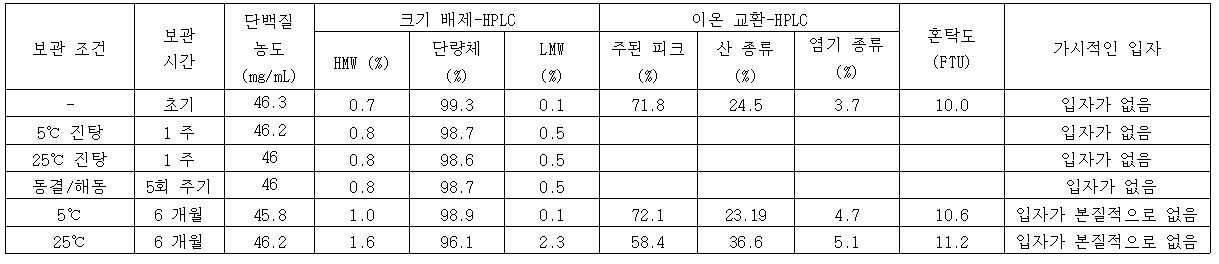

F8은 pH 5.5에서 50 mg/ml 항-CSF-1R 항체, 20 mM 히스티딘 아세트산염, 220mM 수크로오스, 0.04% 폴리소르베이트 20, 10mM 메티오닌의 조성을 갖는 액체 제제이다: F8 is a liquid formulation with a composition of 50 mg/ml anti-CSF-1R antibody, 20 mM histidine acetate, 220 mM sucrose, 0.04% polysorbate 20, 10 mM methionine at pH 5.5:


F9는 pH 5.5에서 50 mg/ml 항-CSF-1R 항체, 20 mM 히스티딘 아세트산염, 220mM 수크로오스, 0.04% 폴록사머 188의 조성을 갖는 액체 제제이다: F9 is a liquid formulation with a composition of 50 mg/ml anti-CSF-1R antibody, 20 mM histidine acetate, 220 mM sucrose, 0.04% poloxamer 188 at pH 5.5:


F10은 pH 5.5에서 50 mg/ml 항- CSF-1R 항체, 20 mM 히스티딘 아세트산염, 130 mM NaCl, 0.04% 폴리소르베이트 20의 조성을 갖는 액체 제제이다: F10 is a liquid formulation with a composition of 50 mg/ml anti-CSF-1R antibody, 20 mM histidine acetate, 130 mM NaCl, 0.04% polysorbate 20 at pH 5.5:

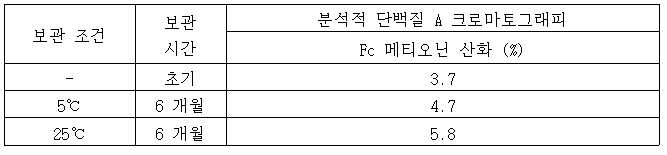
F11은 pH 5.5에서 50 mg/ml 항-CSF-1R 항체, 20 mM 히스티딘 아세트산염, 130 mM NaCl, 0.04% 폴리소르베이트 20, 10mM 메티오닌의 조성을 갖는 액체 제제이다: F11 is a liquid formulation with a composition of 50 mg/ml anti-CSF-1R antibody, 20 mM histidine acetate, 130 mM NaCl, 0.04% polysorbate 20, 10 mM methionine at pH 5.5:


F12는 pH 5.5에서 50 mg/ml 항-CSF-1R 항체, 20 mM 히스티딘 아세트산염, 130 mM NaCl, 0.04% 폴록사머 188의 조성을 갖는 액체 제제이다: F12 is a liquid formulation with a composition of 50 mg/ml anti-CSF-1R antibody, 20 mM histidine acetate, 130 mM NaCl, 0.04% poloxamer 188 at pH 5.5:


F13은 pH 6.0에서 25 mg/ml 항-CSF-1R 항체, 20 mM 히스티딘 HCl, 240 mM 트레할로스, 0.02% 폴리소르베이트 20의 조성을 갖는 액체 제제이다: F13 is a liquid formulation with a composition of 25 mg/ml anti-CSF-1R antibody, 20 mM histidine HCl, 240 mM trehalose, 0.02% polysorbate 20 at pH 6.0:


F14는 pH 6.0에서 50 mg/ml 항-CSF-1R 항체, 20 mM 히스티딘 HCl, 240 mM 트레할로스, 0.04% 폴리소르베이트 20의 조성을 갖는 액체 제제이다: F14 is a liquid formulation with a composition of 50 mg/ml anti-CSF-1R antibody, 20 mM histidine HCl, 240 mM trehalose, 0.04% polysorbate 20 at pH 6.0:


F15는 pH 6.0에서 50 mg/ml 항-CSF-1R 항체, 20 mM 히스티딘 HCl, 240 mM 트레할로스, 0.04% 폴리소르베이트 20, 10mM 메티오닌의 조성을 갖는 액체 제제이다: F15 is a liquid formulation with a composition of 50 mg/ml anti-CSF-1R antibody, 20 mM histidine HCl, 240 mM trehalose, 0.04% polysorbate 20, 10 mM methionine at pH 6.0:


F16은 pH 6.0에서 50 mg/ml 항-CSF-1R 항체, 20 mM 히스티딘 HCl, 240 mM 트레할로스, 0.04% 폴록사머 188의 조성을 갖는 액체 제제이다: F16 is a liquid formulation with a composition of 50 mg/ml anti-CSF-1R antibody, 20 mM histidine HCl, 240 mM trehalose, 0.04% poloxamer 188 at pH 6.0:

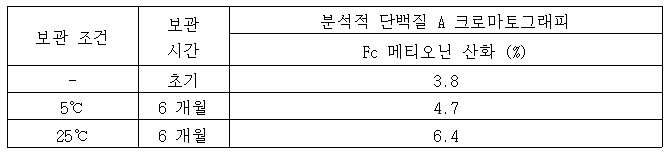
실시예 2: 바이알에서 제제 F2를 포함하는 액체 항-CSF-1R 항체 의약품의 조성과 안정성 데이터Example 2: Composition and stability data of a liquid anti-CSF-1R antibody drug product containing Formulation F2 in a vial
제제 F2에 기초된 2가지 의약품이 제조되었고, 우수한 안정성이 입증되었다. 의약품 1은 20 ml 유리 바이알에서 9.0 ml 제제 F2를 내포하고, 의약품 2는 50 ml 유리 바이알에서 46.4 ml 제제 F2를 내포한다.Two pharmaceutical products based on Formulation F2 were prepared and demonstrated good stability. Drug product 1 contains 9.0 ml formulation F2 in a 20 ml glass vial and drug product 2 contains 46.4 ml formulation F2 in a 50 ml glass vial.
의약품 1(F2) 안정성 데이터Pharmaceutical 1 (F2) stability data

의약품 2(F2) 안정성 데이터Pharmaceutical 2 (F2) stability data
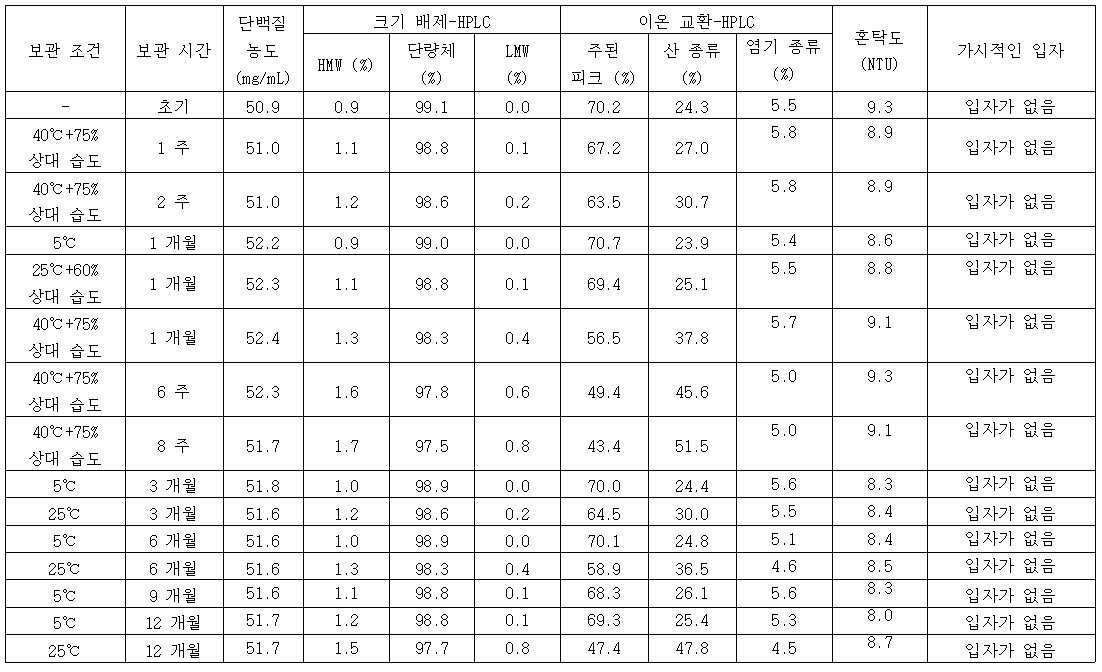
SEQUENCE LISTING <110> F. Hoffmann-La Roche AG <120> CSF-1R antibody formulation <130> P35018-WO <140> PCT/EP2019/074303 <141> 2019-09-12 <150> EP 18194145.1 <151> 2018-09-13 <160> 13 <170> PatentIn version 3.5 <210> 1 <211> 5 <212> PRT <213> Artificial Sequence <220> <223> CSF-1R CDR-H1 <400> 1 Ser Tyr Asp Ile Ser 1 5 <210> 2 <211> 16 <212> PRT <213> Artificial Sequence <220> <223> CSF-1R CDR-H2 <400> 2 Val Ile Trp Thr Asp Gly Gly Thr Asn Tyr Ala Gln Lys Leu Gln Gly 1 5 10 15 <210> 3 <211> 8 <212> PRT <213> Artificial Sequence <220> <223> CSF-1R CDR-H3 <400> 3 Asp Gln Arg Leu Tyr Phe Asp Val 1 5 <210> 4 <211> 11 <212> PRT <213> Artificial Sequence <220> <223> CSF-1R CDR-L1 <400> 4 Arg Ala Ser Glu Asp Val Asn Thr Tyr Val Ser 1 5 10 <210> 5 <211> 7 <212> PRT <213> Artificial Sequence <220> <223> CSF-1R CDR-L2 <400> 5 Ala Ala Ser Asn Arg Tyr Thr 1 5 <210> 6 <211> 8 <212> PRT <213> Artificial Sequence <220> <223> CSF-1R CDR-L3 <400> 6 Gln Gln Ser Phe Ser Tyr Pro Thr 1 5 <210> 7 <211> 116 <212> PRT <213> Artificial Sequence <220> <223> CSF-1R VH <400> 7 Gln Val Gln Leu Val Gln Ser Gly Ala Glu Val Lys Lys Pro Gly Ala 1 5 10 15 Ser Val Lys Val Ser Cys Lys Ala Ser Gly Tyr Thr Phe Thr Ser Tyr 20 25 30 Asp Ile Ser Trp Val Arg Gln Ala Pro Gly Gln Gly Leu Glu Trp Met 35 40 45 Gly Val Ile Trp Thr Asp Gly Gly Thr Asn Tyr Ala Gln Lys Leu Gln 50 55 60 Gly Arg Val Thr Met Thr Thr Asp Thr Ser Thr Ser Thr Ala Tyr Met 65 70 75 80 Glu Leu Arg Ser Leu Arg Ser Asp Asp Thr Ala Val Tyr Tyr Cys Ala 85 90 95 Arg Asp Gln Arg Leu Tyr Phe Asp Val Trp Gly Gln Gly Thr Thr Val 100 105 110 Thr Val Ser Ser 115 <210> 8 <211> 106 <212> PRT <213> Artificial Sequence <220> <223> CSF-1R VL <400> 8 Asp Ile Gln Met Thr Gln Ser Pro Ser Ser Leu Ser Ala Ser Val Gly 1 5 10 15 Asp Arg Val Thr Ile Thr Cys Arg Ala Ser Glu Asp Val Asn Thr Tyr 20 25 30 Val Ser Trp Tyr Gln Gln Lys Pro Gly Lys Ala Pro Lys Leu Leu Ile 35 40 45 Tyr Ala Ala Ser Asn Arg Tyr Thr Gly Val Pro Ser Arg Phe Ser Gly 50 55 60 Ser Gly Ser Gly Thr Asp Phe Thr Leu Thr Ile Ser Ser Leu Gln Pro 65 70 75 80 Glu Asp Phe Ala Thr Tyr Tyr Cys Gln Gln Ser Phe Ser Tyr Pro Thr 85 90 95 Phe Gly Gln Gly Thr Lys Leu Glu Ile Lys 100 105 <210> 9 <211> 444 <212> PRT <213> Artificial Sequence <220> <223> CSF-1R Heavy chain <400> 9 Gln Val Gln Leu Val Gln Ser Gly Ala Glu Val Lys Lys Pro Gly Ala 1 5 10 15 Ser Val Lys Val Ser Cys Lys Ala Ser Gly Tyr Thr Phe Thr Ser Tyr 20 25 30 Asp Ile Ser Trp Val Arg Gln Ala Pro Gly Gln Gly Leu Glu Trp Met 35 40 45 Gly Val Ile Trp Thr Asp Gly Gly Thr Asn Tyr Ala Gln Lys Leu Gln 50 55 60 Gly Arg Val Thr Met Thr Thr Asp Thr Ser Thr Ser Thr Ala Tyr Met 65 70 75 80 Glu Leu Arg Ser Leu Arg Ser Asp Asp Thr Ala Val Tyr Tyr Cys Ala 85 90 95 Arg Asp Gln Arg Leu Tyr Phe Asp Val Trp Gly Gln Gly Thr Thr Val 100 105 110 Thr Val Ser Ser Ala Ser Thr Lys Gly Pro Ser Val Phe Pro Leu Ala 115 120 125 Pro Ser Ser Lys Ser Thr Ser Gly Gly Thr Ala Ala Leu Gly Cys Leu 130 135 140 Val Lys Asp Tyr Phe Pro Glu Pro Val Thr Val Ser Trp Asn Ser Gly 145 150 155 160 Ala Leu Thr Ser Gly Val His Thr Phe Pro Ala Val Leu Gln Ser Ser 165 170 175 Gly Leu Tyr Ser Leu Ser Ser Val Val Thr Val Pro Ser Ser Ser Leu 180 185 190 Gly Thr Gln Thr Tyr Ile Cys Asn Val Asn His Lys Pro Ser Asn Thr 195 200 205 Lys Val Asp Lys Lys Val Glu Pro Lys Ser Cys Asp Lys Thr His Thr 210 215 220 Cys Pro Pro Cys Pro Ala Pro Glu Leu Leu Gly Gly Pro Ser Val Phe 225 230 235 240 Leu Phe Pro Pro Lys Pro Lys Asp Thr Leu Met Ile Ser Arg Thr Pro 245 250 255 Glu Val Thr Cys Val Val Val Asp Val Ser His Glu Asp Pro Glu Val 260 265 270 Lys Phe Asn Trp Tyr Val Asp Gly Val Glu Val His Asn Ala Lys Thr 275 280 285 Lys Pro Arg Glu Glu Gln Tyr Asn Ser Thr Tyr Arg Val Val Ser Val 290 295 300 Leu Thr Val Leu His Gln Asp Trp Leu Asn Gly Lys Glu Tyr Lys Cys 305 310 315 320 Lys Val Ser Asn Lys Ala Leu Pro Ala Pro Ile Glu Lys Thr Ile Ser 325 330 335 Lys Ala Lys Gly Gln Pro Arg Glu Pro Gln Val Tyr Thr Leu Pro Pro 340 345 350 Ser Arg Asp Glu Leu Thr Lys Asn Gln Val Ser Leu Thr Cys Leu Val 355 360 365 Lys Gly Phe Tyr Pro Ser Asp Ile Ala Val Glu Trp Glu Ser Asn Gly 370 375 380 Gln Pro Glu Asn Asn Tyr Lys Thr Thr Pro Pro Val Leu Asp Ser Asp 385 390 395 400 Gly Ser Phe Phe Leu Tyr Ser Lys Leu Thr Val Asp Lys Ser Arg Trp 405 410 415 Gln Gln Gly Asn Val Phe Ser Cys Ser Val Met His Glu Ala Leu His 420 425 430 Asn His Tyr Thr Gln Lys Ser Leu Ser Leu Ser Pro 435 440 <210> 10 <211> 213 <212> PRT <213> Artificial Sequence <220> <223> CSF-1R Light Chain <400> 10 Asp Ile Gln Met Thr Gln Ser Pro Ser Ser Leu Ser Ala Ser Val Gly 1 5 10 15 Asp Arg Val Thr Ile Thr Cys Arg Ala Ser Glu Asp Val Asn Thr Tyr 20 25 30 Val Ser Trp Tyr Gln Gln Lys Pro Gly Lys Ala Pro Lys Leu Leu Ile 35 40 45 Tyr Ala Ala Ser Asn Arg Tyr Thr Gly Val Pro Ser Arg Phe Ser Gly 50 55 60 Ser Gly Ser Gly Thr Asp Phe Thr Leu Thr Ile Ser Ser Leu Gln Pro 65 70 75 80 Glu Asp Phe Ala Thr Tyr Tyr Cys Gln Gln Ser Phe Ser Tyr Pro Thr 85 90 95 Phe Gly Gln Gly Thr Lys Leu Glu Ile Lys Arg Thr Val Ala Ala Pro 100 105 110 Ser Val Phe Ile Phe Pro Pro Ser Asp Glu Gln Leu Lys Ser Gly Thr 115 120 125 Ala Ser Val Val Cys Leu Leu Asn Asn Phe Tyr Pro Arg Glu Ala Lys 130 135 140 Val Gln Trp Lys Val Asp Asn Ala Leu Gln Ser Gly Asn Ser Gln Glu 145 150 155 160 Ser Val Thr Glu Gln Asp Ser Lys Asp Ser Thr Tyr Ser Leu Ser Ser 165 170 175 Thr Leu Thr Leu Ser Lys Ala Asp Tyr Glu Lys His Lys Val Tyr Ala 180 185 190 Cys Glu Val Thr His Gln Gly Leu Ser Ser Pro Val Thr Lys Ser Phe 195 200 205 Asn Arg Gly Glu Cys 210 <210> 11 <211> 387 <212> PRT <213> Artificial Sequence <220> <223> human CSF-1R fragment delD4 <400> 11 Ile Pro Val Ile Glu Pro Ser Val Pro Glu Leu Val Val Lys Pro Gly 1 5 10 15 Ala Thr Val Thr Leu Arg Cys Val Gly Asn Gly Ser Val Glu Trp Asp 20 25 30 Gly Pro Pro Ser Pro His Trp Thr Leu Tyr Ser Asp Gly Ser Ser Ser 35 40 45 Ile Leu Ser Thr Asn Asn Ala Thr Phe Gln Asn Thr Gly Thr Tyr Arg 50 55 60 Cys Thr Glu Pro Gly Asp Pro Leu Gly Gly Ser Ala Ala Ile His Leu 65 70 75 80 Tyr Val Lys Asp Pro Ala Arg Pro Trp Asn Val Leu Ala Gln Glu Val 85 90 95 Val Val Phe Glu Asp Gln Asp Ala Leu Leu Pro Cys Leu Leu Thr Asp 100 105 110 Pro Val Leu Glu Ala Gly Val Ser Leu Val Arg Val Arg Gly Arg Pro 115 120 125 Leu Met Arg His Thr Asn Tyr Ser Phe Ser Pro Trp His Gly Phe Thr 130 135 140 Ile His Arg Ala Lys Phe Ile Gln Ser Gln Asp Tyr Gln Cys Ser Ala 145 150 155 160 Leu Met Gly Gly Arg Lys Val Met Ser Ile Ser Ile Arg Leu Lys Val 165 170 175 Gln Lys Val Ile Pro Gly Pro Pro Ala Leu Thr Leu Val Pro Ala Glu 180 185 190 Leu Val Arg Ile Arg Gly Glu Ala Ala Gln Ile Val Cys Ser Ala Ser 195 200 205 Ser Val Asp Val Asn Phe Asp Val Phe Leu Gln His Asn Asn Thr Lys 210 215 220 Leu Ala Ile Pro Gln Gln Ser Asp Phe His Asn Asn Arg Tyr Gln Lys 225 230 235 240 Val Leu Thr Leu Asn Leu Asp Gln Val Asp Phe Gln His Ala Gly Asn 245 250 255 Tyr Ser Cys Val Ala Ser Asn Val Gln Gly Lys His Ser Thr Ser Met 260 265 270 Phe Phe Arg Tyr Pro Pro Glu Val Ser Val Ile Trp Thr Phe Ile Asn 275 280 285 Gly Ser Gly Thr Leu Leu Cys Ala Ala Ser Gly Tyr Pro Gln Pro Asn 290 295 300 Val Thr Trp Leu Gln Cys Ser Gly His Thr Asp Arg Cys Asp Glu Ala 305 310 315 320 Gln Val Leu Gln Val Trp Asp Asp Pro Tyr Pro Glu Val Leu Ser Gln 325 330 335 Glu Pro Phe His Lys Thr Val Gln Ser Leu Leu Thr Val Glu Thr Leu 340 345 350 Glu His Asn Gln Thr Tyr Glu Cys Arg Ala His Asn Ser Val Gly Ser 355 360 365 Gly Ser Trp Ala Phe Ile Pro Ile Ser Ala Gly Ala His Thr His Pro 370 375 380 Pro Asp Glu 385 <210> 12 <211> 493 <212> PRT <213> Homo sapiens <400> 12 Ile Pro Val Ile Glu Pro Ser Val Pro Glu Leu Val Val Lys Pro Gly 1 5 10 15 Ala Thr Val Thr Leu Arg Cys Val Gly Asn Gly Ser Val Glu Trp Asp 20 25 30 Gly Pro Pro Ser Pro His Trp Thr Leu Tyr Ser Asp Gly Ser Ser Ser 35 40 45 Ile Leu Ser Thr Asn Asn Ala Thr Phe Gln Asn Thr Gly Thr Tyr Arg 50 55 60 Cys Thr Glu Pro Gly Asp Pro Leu Gly Gly Ser Ala Ala Ile His Leu 65 70 75 80 Tyr Val Lys Asp Pro Ala Arg Pro Trp Asn Val Leu Ala Gln Glu Val 85 90 95 Val Val Phe Glu Asp Gln Asp Ala Leu Leu Pro Cys Leu Leu Thr Asp 100 105 110 Pro Val Leu Glu Ala Gly Val Ser Leu Val Arg Val Arg Gly Arg Pro 115 120 125 Leu Met Arg His Thr Asn Tyr Ser Phe Ser Pro Trp His Gly Phe Thr 130 135 140 Ile His Arg Ala Lys Phe Ile Gln Ser Gln Asp Tyr Gln Cys Ser Ala 145 150 155 160 Leu Met Gly Gly Arg Lys Val Met Ser Ile Ser Ile Arg Leu Lys Val 165 170 175 Gln Lys Val Ile Pro Gly Pro Pro Ala Leu Thr Leu Val Pro Ala Glu 180 185 190 Leu Val Arg Ile Arg Gly Glu Ala Ala Gln Ile Val Cys Ser Ala Ser 195 200 205 Ser Val Asp Val Asn Phe Asp Val Phe Leu Gln His Asn Asn Thr Lys 210 215 220 Leu Ala Ile Pro Gln Gln Ser Asp Phe His Asn Asn Arg Tyr Gln Lys 225 230 235 240 Val Leu Thr Leu Asn Leu Asp Gln Val Asp Phe Gln His Ala Gly Asn 245 250 255 Tyr Ser Cys Val Ala Ser Asn Val Gln Gly Lys His Ser Thr Ser Met 260 265 270 Phe Phe Arg Val Val Glu Ser Ala Tyr Leu Asn Leu Ser Ser Glu Gln 275 280 285 Asn Leu Ile Gln Glu Val Thr Val Gly Glu Gly Leu Asn Leu Lys Val 290 295 300 Met Val Glu Ala Tyr Pro Gly Leu Gln Gly Phe Asn Trp Thr Tyr Leu 305 310 315 320 Gly Pro Phe Ser Asp His Gln Pro Glu Pro Lys Leu Ala Asn Ala Thr 325 330 335 Thr Lys Asp Thr Tyr Arg His Thr Phe Thr Leu Ser Leu Pro Arg Leu 340 345 350 Lys Pro Ser Glu Ala Gly Arg Tyr Ser Phe Leu Ala Arg Asn Pro Gly 355 360 365 Gly Trp Arg Ala Leu Thr Phe Glu Leu Thr Leu Arg Tyr Pro Pro Glu 370 375 380 Val Ser Val Ile Trp Thr Phe Ile Asn Gly Ser Gly Thr Leu Leu Cys 385 390 395 400 Ala Ala Ser Gly Tyr Pro Gln Pro Asn Val Thr Trp Leu Gln Cys Ser 405 410 415 Gly His Thr Asp Arg Cys Asp Glu Ala Gln Val Leu Gln Val Trp Asp 420 425 430 Asp Pro Tyr Pro Glu Val Leu Ser Gln Glu Pro Phe His Lys Val Thr 435 440 445 Val Gln Ser Leu Leu Thr Val Glu Thr Leu Glu His Asn Gln Thr Tyr 450 455 460 Glu Cys Arg Ala His Asn Ser Val Gly Ser Gly Ser Trp Ala Phe Ile 465 470 475 480 Pro Ile Ser Ala Gly Ala His Thr His Pro Pro Asp Glu 485 490 <210> 13 <211> 972 <212> PRT <213> Homo sapiens <400> 13 Met Gly Pro Gly Val Leu Leu Leu Leu Leu Val Ala Thr Ala Trp His 1 5 10 15 Gly Gln Gly Ile Pro Val Ile Glu Pro Ser Val Pro Glu Leu Val Val 20 25 30 Lys Pro Gly Ala Thr Val Thr Leu Arg Cys Val Gly Asn Gly Ser Val 35 40 45 Glu Trp Asp Gly Pro Pro Ser Pro His Trp Thr Leu Tyr Ser Asp Gly 50 55 60 Ser Ser Ser Ile Leu Ser Thr Asn Asn Ala Thr Phe Gln Asn Thr Gly 65 70 75 80 Thr Tyr Arg Cys Thr Glu Pro Gly Asp Pro Leu Gly Gly Ser Ala Ala 85 90 95 Ile His Leu Tyr Val Lys Asp Pro Ala Arg Pro Trp Asn Val Leu Ala 100 105 110 Gln Glu Val Val Val Phe Glu Asp Gln Asp Ala Leu Leu Pro Cys Leu 115 120 125 Leu Thr Asp Pro Val Leu Glu Ala Gly Val Ser Leu Val Arg Val Arg 130 135 140 Gly Arg Pro Leu Met Arg His Thr Asn Tyr Ser Phe Ser Pro Trp His 145 150 155 160 Gly Phe Thr Ile His Arg Ala Lys Phe Ile Gln Ser Gln Asp Tyr Gln 165 170 175 Cys Ser Ala Leu Met Gly Gly Arg Lys Val Met Ser Ile Ser Ile Arg 180 185 190 Leu Lys Val Gln Lys Val Ile Pro Gly Pro Pro Ala Leu Thr Leu Val 195 200 205 Pro Ala Glu Leu Val Arg Ile Arg Gly Glu Ala Ala Gln Ile Val Cys 210 215 220 Ser Ala Ser Ser Val Asp Val Asn Phe Asp Val Phe Leu Gln His Asn 225 230 235 240 Asn Thr Lys Leu Ala Ile Pro Gln Gln Ser Asp Phe His Asn Asn Arg 245 250 255 Tyr Gln Lys Val Leu Thr Leu Asn Leu Asp Gln Val Asp Phe Gln His 260 265 270 Ala Gly Asn Tyr Ser Cys Val Ala Ser Asn Val Gln Gly Lys His Ser 275 280 285 Thr Ser Met Phe Phe Arg Val Val Glu Ser Ala Tyr Leu Asn Leu Ser 290 295 300 Ser Glu Gln Asn Leu Ile Gln Glu Val Thr Val Gly Glu Gly Leu Asn 305 310 315 320 Leu Lys Val Met Val Glu Ala Tyr Pro Gly Leu Gln Gly Phe Asn Trp 325 330 335 Thr Tyr Leu Gly Pro Phe Ser Asp His Gln Pro Glu Pro Lys Leu Ala 340 345 350 Asn Ala Thr Thr Lys Asp Thr Tyr Arg His Thr Phe Thr Leu Ser Leu 355 360 365 Pro Arg Leu Lys Pro Ser Glu Ala Gly Arg Tyr Ser Phe Leu Ala Arg 370 375 380 Asn Pro Gly Gly Trp Arg Ala Leu Thr Phe Glu Leu Thr Leu Arg Tyr 385 390 395 400 Pro Pro Glu Val Ser Val Ile Trp Thr Phe Ile Asn Gly Ser Gly Thr 405 410 415 Leu Leu Cys Ala Ala Ser Gly Tyr Pro Gln Pro Asn Val Thr Trp Leu 420 425 430 Gln Cys Ser Gly His Thr Asp Arg Cys Asp Glu Ala Gln Val Leu Gln 435 440 445 Val Trp Asp Asp Pro Tyr Pro Glu Val Leu Ser Gln Glu Pro Phe His 450 455 460 Lys Val Thr Val Gln Ser Leu Leu Thr Val Glu Thr Leu Glu His Asn 465 470 475 480 Gln Thr Tyr Glu Cys Arg Ala His Asn Ser Val Gly Ser Gly Ser Trp 485 490 495 Ala Phe Ile Pro Ile Ser Ala Gly Ala His Thr His Pro Pro Asp Glu 500 505 510 Phe Leu Phe Thr Pro Val Val Val Ala Cys Met Ser Ile Met Ala Leu 515 520 525 Leu Leu Leu Leu Leu Leu Leu Leu Leu Tyr Lys Tyr Lys Gln Lys Pro 530 535 540 Lys Tyr Gln Val Arg Trp Lys Ile Ile Glu Ser Tyr Glu Gly Asn Ser 545 550 555 560 Tyr Thr Phe Ile Asp Pro Thr Gln Leu Pro Tyr Asn Glu Lys Trp Glu 565 570 575 Phe Pro Arg Asn Asn Leu Gln Phe Gly Lys Thr Leu Gly Ala Gly Ala 580 585 590 Phe Gly Lys Val Val Glu Ala Thr Ala Phe Gly Leu Gly Lys Glu Asp 595 600 605 Ala Val Leu Lys Val Ala Val Lys Met Leu Lys Ser Thr Ala His Ala 610 615 620 Asp Glu Lys Glu Ala Leu Met Ser Glu Leu Lys Ile Met Ser His Leu 625 630 635 640 Gly Gln His Glu Asn Ile Val Asn Leu Leu Gly Ala Cys Thr His Gly 645 650 655 Gly Pro Val Leu Val Ile Thr Glu Tyr Cys Cys Tyr Gly Asp Leu Leu 660 665 670 Asn Phe Leu Arg Arg Lys Ala Glu Ala Met Leu Gly Pro Ser Leu Ser 675 680 685 Pro Gly Gln Asp Pro Glu Gly Gly Val Asp Tyr Lys Asn Ile His Leu 690 695 700 Glu Lys Lys Tyr Val Arg Arg Asp Ser Gly Phe Ser Ser Gln Gly Val 705 710 715 720 Asp Thr Tyr Val Glu Met Arg Pro Val Ser Thr Ser Ser Asn Asp Ser 725 730 735 Phe Ser Glu Gln Asp Leu Asp Lys Glu Asp Gly Arg Pro Leu Glu Leu 740 745 750 Arg Asp Leu Leu His Phe Ser Ser Gln Val Ala Gln Gly Met Ala Phe 755 760 765 Leu Ala Ser Lys Asn Cys Ile His Arg Asp Val Ala Ala Arg Asn Val 770 775 780 Leu Leu Thr Asn Gly His Val Ala Lys Ile Gly Asp Phe Gly Leu Ala 785 790 795 800 Arg Asp Ile Met Asn Asp Ser Asn Tyr Ile Val Lys Gly Asn Ala Arg 805 810 815 Leu Pro Val Lys Trp Met Ala Pro Glu Ser Ile Phe Asp Cys Val Tyr 820 825 830 Thr Val Gln Ser Asp Val Trp Ser Tyr Gly Ile Leu Leu Trp Glu Ile 835 840 845 Phe Ser Leu Gly Leu Asn Pro Tyr Pro Gly Ile Leu Val Asn Ser Lys 850 855 860 Phe Tyr Lys Leu Val Lys Asp Gly Tyr Gln Met Ala Gln Pro Ala Phe 865 870 875 880 Ala Pro Lys Asn Ile Tyr Ser Ile Met Gln Ala Cys Trp Ala Leu Glu 885 890 895 Pro Thr His Arg Pro Thr Phe Gln Gln Ile Cys Ser Phe Leu Gln Glu 900 905 910 Gln Ala Gln Glu Asp Arg Arg Glu Arg Asp Tyr Thr Asn Leu Pro Ser 915 920 925 Ser Ser Arg Ser Gly Gly Ser Gly Ser Ser Ser Ser Glu Leu Glu Glu 930 935 940 Glu Ser Ser Ser Glu His Leu Thr Cys Cys Glu Gln Gly Asp Ile Ala 945 950 955 960 Gln Pro Leu Leu Gln Pro Asn Asn Tyr Gln Phe Cys 965 970 SEQUENCE LISTING <110> F. Hoffmann-La Roche AG <120> CSF-1R antibody formulation <130> P35018-WO <140> PCT/EP2019/074303 <141> 2019-09-12 <150> EP 18194145.1 <151> 2018-09-13 <160> 13 <170> PatentIn version 3.5 <210> 1 <211> 5 <212> PRT <213> Artificial Sequence <220> <223> CSF-1R CDR-H1 <400> 1 Ser Tyr Asp Ile Ser 1 5 <210> 2 <211> 16 <212> PRT <213> Artificial Sequence <220> <223> CSF-1R CDR-H2 <400> 2 Val Ile Trp Thr Asp Gly Gly Thr Asn Tyr Ala Gln Lys Leu Gln Gly 1 5 10 15 <210> 3 <211> 8 <212> PRT <213> Artificial Sequence <220> <223> CSF-1R CDR-H3 <400> 3 Asp Gln Arg Leu Tyr Phe Asp Val 1 5 <210> 4 <211> 11 <212> PRT <213> Artificial Sequence <220> <223> CSF-1R CDR-L1 <400> 4 Arg Ala Ser Glu Asp Val Asn Thr Tyr Val Ser 1 5 10 <210> 5 <211> 7 <212> PRT <213> Artificial Sequence <220> <223> CSF-1R CDR-L2 <400> 5 Ala Ala Ser Asn Arg Tyr Thr 1 5 <210> 6 <211> 8 <212> PRT <213> Artificial Sequence <220> <223> CSF-1R CDR-L3 <400> 6 Gln Gln Ser Phe Ser Tyr Pro Thr 1 5 <210> 7 <211> 116 <212> PRT <213> Artificial Sequence <220> <223> CSF-1R VH <400> 7 Gln Val Gln Leu Val Gln Ser Gly Ala Glu Val Lys Lys Pro Gly Ala 1 5 10 15 Ser Val Lys Val Ser Cys Lys Ala Ser Gly Tyr Thr Phe Thr Ser Tyr 20 25 30 Asp Ile Ser Trp Val Arg Gln Ala Pro Gly Gln Gly Leu Glu Trp Met 35 40 45 Gly Val Ile Trp Thr Asp Gly Gly Thr Asn Tyr Ala Gln Lys Leu Gln 50 55 60 Gly Arg Val Thr Met Thr Thr Asp Thr Ser Thr Ser Thr Ala Tyr Met 65 70 75 80 Glu Leu Arg Ser Leu Arg Ser Asp Asp Thr Ala Val Tyr Tyr Cys Ala 85 90 95 Arg Asp Gln Arg Leu Tyr Phe Asp Val Trp Gly Gln Gly Thr Thr Val 100 105 110 Thr Val Ser Ser 115 <210> 8 <211> 106 <212> PRT <213> Artificial Sequence <220> <223> CSF-1R VL <400> 8 Asp Ile Gln Met Thr Gln Ser Pro Ser Ser Leu Ser Ala Ser Val Gly 1 5 10 15 Asp Arg Val Thr Ile Thr Cys Arg Ala Ser Glu Asp Val Asn Thr Tyr 20 25 30 Val Ser Trp Tyr Gln Gln Lys Pro Gly Lys Ala Pro Lys Leu Leu Ile 35 40 45 Tyr Ala Ala Ser Asn Arg Tyr Thr Gly Val Pro Ser Arg Phe Ser Gly 50 55 60 Ser Gly Ser Gly Thr Asp Phe Thr Leu Thr Ile Ser Ser Leu Gln Pro 65 70 75 80 Glu Asp Phe Ala Thr Tyr Tyr Cys Gln Gln Ser Phe Ser Tyr Pro Thr 85 90 95 Phe Gly Gln Gly Thr Lys Leu Glu Ile Lys 100 105 <210> 9 <211> 444 <212> PRT <213> Artificial Sequence <220> <223> CSF-1R Heavy chain <400> 9 Gln Val Gln Leu Val Gln Ser Gly Ala Glu Val Lys Lys Pro Gly Ala 1 5 10 15 Ser Val Lys Val Ser Cys Lys Ala Ser Gly Tyr Thr Phe Thr Ser Tyr 20 25 30 Asp Ile Ser Trp Val Arg Gln Ala Pro Gly Gln Gly Leu Glu Trp Met 35 40 45 Gly Val Ile Trp Thr Asp Gly Gly Thr Asn Tyr Ala Gln Lys Leu Gln 50 55 60 Gly Arg Val Thr Met Thr Thr Asp Thr Ser Thr Ser Thr Ala Tyr Met 65 70 75 80 Glu Leu Arg Ser Leu Arg Ser Asp Asp Thr Ala Val Tyr Tyr Cys Ala 85 90 95 Arg Asp Gln Arg Leu Tyr Phe Asp Val Trp Gly Gln Gly Thr Thr Val 100 105 110 Thr Val Ser Ser Ala Ser Thr Lys Gly Pro Ser Val Phe Pro Leu Ala 115 120 125 Pro Ser Ser Lys Ser Thr Ser Gly Gly Thr Ala Ala Leu Gly Cys Leu 130 135 140 Val Lys Asp Tyr Phe Pro Glu Pro Val Thr Val Ser Trp Asn Ser Gly 145 150 155 160 Ala Leu Thr Ser Gly Val His Thr Phe Pro Ala Val Leu Gln Ser Ser 165 170 175 Gly Leu Tyr Ser Leu Ser Ser Val Val Thr Val Pro Ser Ser Ser Leu 180 185 190 Gly Thr Gln Thr Tyr Ile Cys Asn Val Asn His Lys Pro Ser Asn Thr 195 200 205 Lys Val Asp Lys Lys Val Glu Pro Lys Ser Cys Asp Lys Thr His Thr 210 215 220 Cys Pro Pro Cys Pro Ala Pro Glu Leu Leu Gly Gly Pro Ser Val Phe 225 230 235 240 Leu Phe Pro Pro Lys Pro Lys Asp Thr Leu Met Ile Ser Arg Thr Pro 245 250 255 Glu Val Thr Cys Val Val Val Asp Val Ser His Glu Asp Pro Glu Val 260 265 270 Lys Phe Asn Trp Tyr Val Asp Gly Val Glu Val His Asn Ala Lys Thr 275 280 285 Lys Pro Arg Glu Glu Gln Tyr Asn Ser Thr Tyr Arg Val Val Ser Val 290 295 300 Leu Thr Val Leu His Gln Asp Trp Leu Asn Gly Lys Glu Tyr Lys Cys 305 310 315 320 Lys Val Ser Asn Lys Ala Leu Pro Ala Pro Ile Glu Lys Thr Ile Ser 325 330 335 Lys Ala Lys Gly Gln Pro Arg Glu Pro Gln Val Tyr Thr Leu Pro Pro 340 345 350 Ser Arg Asp Glu Leu Thr Lys Asn Gln Val Ser Leu Thr Cys Leu Val 355 360 365 Lys Gly Phe Tyr Pro Ser Asp Ile Ala Val Glu Trp Glu Ser Asn Gly 370 375 380 Gln Pro Glu Asn Asn Tyr Lys Thr Thr Pro Pro Val Leu Asp Ser Asp 385 390 395 400 Gly Ser Phe Phe Leu Tyr Ser Lys Leu Thr Val Asp Lys Ser Arg Trp 405 410 415 Gln Gln Gly Asn Val Phe Ser Cys Ser Val Met His Glu Ala Leu His 420 425 430 Asn His Tyr Thr Gln Lys Ser Leu Ser Leu Ser Pro 435 440 <210> 10 <211> 213 <212> PRT <213> Artificial Sequence <220> <223> CSF-1R Light Chain <400> 10 Asp Ile Gln Met Thr Gln Ser Pro Ser Ser Leu Ser Ala Ser Val Gly 1 5 10 15 Asp Arg Val Thr Ile Thr Cys Arg Ala Ser Glu Asp Val Asn Thr Tyr 20 25 30 Val Ser Trp Tyr Gln Gln Lys Pro Gly Lys Ala Pro Lys Leu Leu Ile 35 40 45 Tyr Ala Ala Ser Asn Arg Tyr Thr Gly Val Pro Ser Arg Phe Ser Gly 50 55 60 Ser Gly Ser Gly Thr Asp Phe Thr Leu Thr Ile Ser Ser Leu Gln Pro 65 70 75 80 Glu Asp Phe Ala Thr Tyr Tyr Cys Gln Gln Ser Phe Ser Tyr Pro Thr 85 90 95 Phe Gly Gln Gly Thr Lys Leu Glu Ile Lys Arg Thr Val Ala Ala Pro 100 105 110 Ser Val Phe Ile Phe Pro Pro Ser Asp Glu Gln Leu Lys Ser Gly Thr 115 120 125 Ala Ser Val Val Cys Leu Leu Asn Asn Phe Tyr Pro Arg Glu Ala Lys 130 135 140 Val Gln Trp Lys Val Asp Asn Ala Leu Gln Ser Gly Asn Ser Gln Glu 145 150 155 160 Ser Val Thr Glu Gln Asp Ser Lys Asp Ser Thr Tyr Ser Leu Ser Ser 165 170 175 Thr Leu Thr Leu Ser Lys Ala Asp Tyr Glu Lys His Lys Val Tyr Ala 180 185 190 Cys Glu Val Thr His Gln Gly Leu Ser Ser Pro Val Thr Lys Ser Phe 195 200 205 Asn Arg Gly Glu Cys 210 <210> 11 <211> 387 <212> PRT <213> Artificial Sequence <220> <223> human CSF-1R fragment delD4 <400> 11 Ile Pro Val Ile Glu Pro Ser Val Pro Glu Leu Val Val Lys Pro Gly 1 5 10 15 Ala Thr Val Thr Leu Arg Cys Val Gly Asn Gly Ser Val Glu Trp Asp 20 25 30 Gly Pro Pro Ser Pro His Trp Thr Leu Tyr Ser Asp Gly Ser Ser Ser 35 40 45 Ile Leu Ser Thr Asn Asn Ala Thr Phe Gln Asn Thr Gly Thr Tyr Arg 50 55 60 Cys Thr Glu Pro Gly Asp Pro Leu Gly Gly Ser Ala Ala Ile His Leu 65 70 75 80 Tyr Val Lys Asp Pro Ala Arg Pro Trp Asn Val Leu Ala Gln Glu Val 85 90 95 Val Val Phe Glu Asp Gln Asp Ala Leu Leu Pro Cys Leu Leu Thr Asp 100 105 110 Pro Val Leu Glu Ala Gly Val Ser Leu Val Arg Val Arg Gly Arg Pro 115 120 125 Leu Met Arg His Thr Asn Tyr Ser Phe Ser Pro Trp His Gly Phe Thr 130 135 140 Ile His Arg Ala Lys Phe Ile Gln Ser Gln Asp Tyr Gln Cys Ser Ala 145 150 155 160 Leu Met Gly Gly Arg Lys Val Met Ser Ile Ser Ile Arg Leu Lys Val 165 170 175 Gln Lys Val Ile Pro Gly Pro Pro Ala Leu Thr Leu Val Pro Ala Glu 180 185 190 Leu Val Arg Ile Arg Gly Glu Ala Ala Gln Ile Val Cys Ser Ala Ser 195 200 205 Ser Val Asp Val Asn Phe Asp Val Phe Leu Gln His Asn Asn Thr Lys 210 215 220 Leu Ala Ile Pro Gln Gln Ser Asp Phe His Asn Asn Arg Tyr Gln Lys 225 230 235 240 Val Leu Thr Leu Asn Leu Asp Gln Val Asp Phe Gln His Ala Gly Asn 245 250 255 Tyr Ser Cys Val Ala Ser Asn Val Gln Gly Lys His Ser Thr Ser Met 260 265 270 Phe Phe Arg Tyr Pro Pro Glu Val Ser Val Ile Trp Thr Phe Ile Asn 275 280 285 Gly Ser Gly Thr Leu Leu Cys Ala Ala Ser Gly Tyr Pro Gln Pro Asn 290 295 300 Val Thr Trp Leu Gln Cys Ser Gly His Thr Asp Arg Cys Asp Glu Ala 305 310 315 320 Gln Val Leu Gln Val Trp Asp Asp Pro Tyr Pro Glu Val Leu Ser Gln 325 330 335 Glu Pro Phe His Lys Thr Val Gln Ser Leu Leu Thr Val Glu Thr Leu 340 345 350 Glu His Asn Gln Thr Tyr Glu Cys Arg Ala His Asn Ser Val Gly Ser 355 360 365 Gly Ser Trp Ala Phe Ile Pro Ile Ser Ala Gly Ala His Thr His Pro 370 375 380 Pro Asp Glu 385 <210> 12 <211> 493 <212> PRT <213> Homo sapiens <400> 12 Ile Pro Val Ile Glu Pro Ser Val Pro Glu Leu Val Val Lys Pro Gly 1 5 10 15 Ala Thr Val Thr Leu Arg Cys Val Gly Asn Gly Ser Val Glu Trp Asp 20 25 30 Gly Pro Pro Ser Pro His Trp Thr Leu Tyr Ser Asp Gly Ser Ser Ser 35 40 45 Ile Leu Ser Thr Asn Asn Ala Thr Phe Gln Asn Thr Gly Thr Tyr Arg 50 55 60 Cys Thr Glu Pro Gly Asp Pro Leu Gly Gly Ser Ala Ala Ile His Leu 65 70 75 80 Tyr Val Lys Asp Pro Ala Arg Pro Trp Asn Val Leu Ala Gln Glu Val 85 90 95 Val Val Phe Glu Asp Gln Asp Ala Leu Leu Pro Cys Leu Leu Thr Asp 100 105 110 Pro Val Leu Glu Ala Gly Val Ser Leu Val Arg Val Arg Gly Arg Pro 115 120 125 Leu Met Arg His Thr Asn Tyr Ser Phe Ser Pro Trp His Gly Phe Thr 130 135 140 Ile His Arg Ala Lys Phe Ile Gln Ser Gln Asp Tyr Gln Cys Ser Ala 145 150 155 160 Leu Met Gly Gly Arg Lys Val Met Ser Ile Ser Ile Arg Leu Lys Val 165 170 175 Gln Lys Val Ile Pro Gly Pro Pro Ala Leu Thr Leu Val Pro Ala Glu 180 185 190 Leu Val Arg Ile Arg Gly Glu Ala Ala Gln Ile Val Cys Ser Ala Ser 195 200 205 Ser Val Asp Val Asn Phe Asp Val Phe Leu Gln His Asn Asn Thr Lys 210 215 220 Leu Ala Ile Pro Gln Gln Ser Asp Phe His Asn Asn Arg Tyr Gln Lys 225 230 235 240 Val Leu Thr Leu Asn Leu Asp Gln Val Asp Phe Gln His Ala Gly Asn 245 250 255 Tyr Ser Cys Val Ala Ser Asn Val Gln Gly Lys His Ser Thr Ser Met 260 265 270 Phe Phe Arg Val Val Glu Ser Ala Tyr Leu Asn Leu Ser Ser Glu Gln 275 280 285 Asn Leu Ile Gln Glu Val Thr Val Gly Glu Gly Leu Asn Leu Lys Val 290 295 300 Met Val Glu Ala Tyr Pro Gly Leu Gln Gly Phe Asn Trp Thr Tyr Leu 305 310 315 320 Gly Pro Phe Ser Asp His Gln Pro Glu Pro Lys Leu Ala Asn Ala Thr 325 330 335 Thr Lys Asp Thr Tyr Arg His Thr Phe Thr Leu Ser Leu Pro Arg Leu 340 345 350 Lys Pro Ser Glu Ala Gly Arg Tyr Ser Phe Leu Ala Arg Asn Pro Gly 355 360 365 Gly Trp Arg Ala Leu Thr Phe Glu Leu Thr Leu Arg Tyr Pro Pro Glu 370 375 380 Val Ser Val Ile Trp Thr Phe Ile Asn Gly Ser Gly Thr Leu Leu Cys 385 390 395 400 Ala Ala Ser Gly Tyr Pro Gln Pro Asn Val Thr Trp Leu Gln Cys Ser 405 410 415 Gly His Thr Asp Arg Cys Asp Glu Ala Gln Val Leu Gln Val Trp Asp 420 425 430 Asp Pro Tyr Pro Glu Val Leu Ser Gln Glu Pro Phe His Lys Val Thr 435 440 445 Val Gln Ser Leu Leu Thr Val Glu Thr Leu Glu His Asn Gln Thr Tyr 450 455 460 Glu Cys Arg Ala His Asn Ser Val Gly Ser Gly Ser Trp Ala Phe Ile 465 470 475 480 Pro Ile Ser Ala Gly Ala His Thr His Pro Pro Asp Glu 485 490 <210> 13 <211> 972 <212> PRT <213> Homo sapiens <400> 13 Met Gly Pro Gly Val Leu Leu Leu Leu Leu Val Ala Thr Ala Trp His 1 5 10 15 Gly Gln Gly Ile Pro Val Ile Glu Pro Ser Val Pro Glu Leu Val Val 20 25 30 Lys Pro Gly Ala Thr Val Thr Leu Arg Cys Val Gly Asn Gly Ser Val 35 40 45 Glu Trp Asp Gly Pro Pro Ser Pro His Trp Thr Leu Tyr Ser Asp Gly 50 55 60 Ser Ser Ser Ile Leu Ser Thr Asn Asn Ala Thr Phe Gln Asn Thr Gly 65 70 75 80 Thr Tyr Arg Cys Thr Glu Pro Gly Asp Pro Leu Gly Gly Ser Ala Ala 85 90 95 Ile His Leu Tyr Val Lys Asp Pro Ala Arg Pro Trp Asn Val Leu Ala 100 105 110 Gln Glu Val Val Val Phe Glu Asp Gln Asp Ala Leu Leu Pro Cys Leu 115 120 125 Leu Thr Asp Pro Val Leu Glu Ala Gly Val Ser Leu Val Arg Val Arg 130 135 140 Gly Arg Pro Leu Met Arg His Thr Asn Tyr Ser Phe Ser Pro Trp His 145 150 155 160 Gly Phe Thr Ile His Arg Ala Lys Phe Ile Gln Ser Gln Asp Tyr Gln 165 170 175 Cys Ser Ala Leu Met Gly Gly Arg Lys Val Met Ser Ile Ser Ile Arg 180 185 190 Leu Lys Val Gln Lys Val Ile Pro Gly Pro Pro Ala Leu Thr Leu Val 195 200 205 Pro Ala Glu Leu Val Arg Ile Arg Gly Glu Ala Ala Gln Ile Val Cys 210 215 220 Ser Ala Ser Ser Val Asp Val Asn Phe Asp Val Phe Leu Gln His Asn 225 230 235 240 Asn Thr Lys Leu Ala Ile Pro Gln Gln Ser Asp Phe His Asn Asn Arg 245 250 255 Tyr Gln Lys Val Leu Thr Leu Asn Leu Asp Gln Val Asp Phe Gln His 260 265 270 Ala Gly Asn Tyr Ser Cys Val Ala Ser Asn Val Gln Gly Lys His Ser 275 280 285 Thr Ser Met Phe Phe Arg Val Val Glu Ser Ala Tyr Leu Asn Leu Ser 290 295 300 Ser Glu Gln Asn Leu Ile Gln Glu Val Thr Val Gly Glu Gly Leu Asn 305 310 315 320 Leu Lys Val Met Val Glu Ala Tyr Pro Gly Leu Gln Gly Phe Asn Trp 325 330 335 Thr Tyr Leu Gly Pro Phe Ser Asp His Gln Pro Glu Pro Lys Leu Ala 340 345 350 Asn Ala Thr Thr Lys Asp Thr Tyr Arg His Thr Phe Thr Leu Ser Leu 355 360 365 Pro Arg Leu Lys Pro Ser Glu Ala Gly Arg Tyr Ser Phe Leu Ala Arg 370 375 380 Asn Pro Gly Gly Trp Arg Ala Leu Thr Phe Glu Leu Thr Leu Arg Tyr 385 390 395 400 Pro Pro Glu Val Ser Val Ile Trp Thr Phe Ile Asn Gly Ser Gly Thr 405 410 415 Leu Leu Cys Ala Ala Ser Gly Tyr Pro Gln Pro Asn Val Thr Trp Leu 420 425 430 Gln Cys Ser Gly His Thr Asp Arg Cys Asp Glu Ala Gln Val Leu Gln 435 440 445 Val Trp Asp Asp Pro Tyr Pro Glu Val Leu Ser Gln Glu Pro Phe His 450 455 460 Lys Val Thr Val Gln Ser Leu Leu Thr Val Glu Thr Leu Glu His Asn 465 470 475 480 Gln Thr Tyr Glu Cys Arg Ala His Asn Ser Val Gly Ser Gly Ser Trp 485 490 495 Ala Phe Ile Pro Ile Ser Ala Gly Ala His Thr His Pro Pro Asp Glu 500 505 510 Phe Leu Phe Thr Pro Val Val Val Ala Cys Met Ser Ile Met Ala Leu 515 520 525 Leu Leu Leu Leu Leu Leu Leu Leu Leu Tyr Lys Tyr Lys Gln Lys Pro 530 535 540 Lys Tyr Gln Val Arg Trp Lys Ile Ile Glu Ser Tyr Glu Gly Asn Ser 545 550 555 560 Tyr Thr Phe Ile Asp Pro Thr Gln Leu Pro Tyr Asn Glu Lys Trp Glu 565 570 575 Phe Pro Arg Asn Asn Leu Gln Phe Gly Lys Thr Leu Gly Ala Gly Ala 580 585 590 Phe Gly Lys Val Val Glu Ala Thr Ala Phe Gly Leu Gly Lys Glu Asp 595 600 605 Ala Val Leu Lys Val Ala Val Lys Met Leu Lys Ser Thr Ala His Ala 610 615 620 Asp Glu Lys Glu Ala Leu Met Ser Glu Leu Lys Ile Met Ser His Leu 625 630 635 640 Gly Gln His Glu Asn Ile Val Asn Leu Leu Gly Ala Cys Thr His Gly 645 650 655 Gly Pro Val Leu Val Ile Thr Glu Tyr Cys Cys Tyr Gly Asp Leu Leu 660 665 670 Asn Phe Leu Arg Arg Lys Ala Glu Ala Met Leu Gly Pro Ser Leu Ser 675 680 685 Pro Gly Gln Asp Pro Glu Gly Gly Val Asp Tyr Lys Asn Ile His Leu 690 695 700 Glu Lys Lys Tyr Val Arg Arg Asp Ser Gly Phe Ser Ser Gln Gly Val 705 710 715 720 Asp Thr Tyr Val Glu Met Arg Pro Val Ser Thr Ser Ser Asn Asp Ser 725 730 735 Phe Ser Glu Gln Asp Leu Asp Lys Glu Asp Gly Arg Pro Leu Glu Leu 740 745 750 Arg Asp Leu Leu His Phe Ser Ser Gln Val Ala Gln Gly Met Ala Phe 755 760 765 Leu Ala Ser Lys Asn Cys Ile His Arg Asp Val Ala Ala Arg Asn Val 770 775 780 Leu Leu Thr Asn Gly His Val Ala Lys Ile Gly Asp Phe Gly Leu Ala 785 790 795 800 Arg Asp Ile Met Asn Asp Ser Asn Tyr Ile Val Lys Gly Asn Ala Arg 805 810 815 Leu Pro Val Lys Trp Met Ala Pro Glu Ser Ile Phe Asp Cys Val Tyr 820 825 830 Thr Val Gln Ser Asp Val Trp Ser Tyr Gly Ile Leu Leu Trp Glu Ile 835 840 845 Phe Ser Leu Gly Leu Asn Pro Tyr Pro Gly Ile Leu Val Asn Ser Lys 850 855 860 Phe Tyr Lys Leu Val Lys Asp Gly Tyr Gln Met Ala Gln Pro Ala Phe 865 870 875 880 Ala Pro Lys Asn Ile Tyr Ser Ile Met Gln Ala Cys Trp Ala Leu Glu 885 890 895 Pro Thr His Arg Pro Thr Phe Gln Gln Ile Cys Ser Phe Leu Gln Glu 900 905 910 Gln Ala Gln Glu Asp Arg Arg Glu Arg Asp Tyr Thr Asn Leu Pro Ser 915 920 925 Ser Ser Arg Ser Gly Gly Ser Gly Ser Ser Ser Ser Glu Leu Glu Glu 930 935 940 Glu Ser Ser Ser Glu His Leu Thr Cys Cys Glu Gln Gly Asp Ile Ala 945 950 955 960 Gln Pro Leu Leu Gln Pro Asn Asn Tyr Gln Phe Cys 965 970
Claims (22)
40 mg/ml 내지 200 mg/ml의 CSF-1R에 대한 항체;
0.01 % 내지 0.1 %(w/v)의 계면활성제;
5 mM 내지 100 mM의 완충제;
10 mM 내지 500 mM의 한 가지 이상의 안정제.Pharmaceutical formulations comprising the following ingredients and having a pH in the range of 4.5 to 7.0:
40 mg/ml to 200 mg/ml of an antibody against CSF-1R;
0.01% to 0.1% (w/v) surfactant;
5 mM to 100 mM buffer;
10 mM to 500 mM of one or more stabilizers.
40 내지 100 mg/ml의 CSF-1R에 대한 항체;
20 mM의 L-히스티딘;
0.03 내지 0.05 %(w/v)의 폴리소르베이트 20;
210 내지 230 mM의 수크로오스;
임의적으로 5 내지 25 mM의 메티오닌.The pharmaceutical formulation according to any one of claims 1 to 12, comprising the following ingredients and having a pH of 6.0 ± 0.5:
40-100 mg/ml of an antibody against CSF-1R;
20 mM L-histidine;
0.03 to 0.05% (w/v) polysorbate 20;
210 to 230 mM sucrose;
Optionally 5-25 mM methionine.
50 mg/ml의 CSF-1R에 대한 항체;
20 mM의 L-히스티딘;
0.04 %(w/v)의 폴리소르베이트 20;
220 mM의 수크로오스;
10 mM의 메티오닌.Pharmaceutical formulation according to any one of claims 1 to 16, comprising the following ingredients and having a pH of 6.0 ± 0.5:
50 mg/ml of an antibody against CSF-1R;
20 mM L-histidine;
0.04% (w/v) polysorbate 20;
220 mM sucrose;
10 mM methionine.
Applications Claiming Priority (3)
| Application Number | Priority Date | Filing Date | Title |
|---|---|---|---|
| EP18194145 | 2018-09-13 | ||
| EP18194145.1 | 2018-09-13 | ||
| PCT/EP2019/074303 WO2020053321A1 (en) | 2018-09-13 | 2019-09-12 | Csf-1r antibody formulation |
Publications (1)
| Publication Number | Publication Date |
|---|---|
| KR20210062027A true KR20210062027A (en) | 2021-05-28 |
Family
ID=63579121
Family Applications (1)
| Application Number | Title | Priority Date | Filing Date |
|---|---|---|---|
| KR1020217010406A Pending KR20210062027A (en) | 2018-09-13 | 2019-09-12 | CSF-1R antibody preparation |
Country Status (11)
| Country | Link |
|---|---|
| US (1) | US20210205453A1 (en) |
| EP (1) | EP3849518A1 (en) |
| JP (1) | JP7475335B2 (en) |
| KR (1) | KR20210062027A (en) |
| CN (3) | CN118356487A (en) |
| AU (1) | AU2019339740B2 (en) |
| BR (1) | BR112021004649A2 (en) |
| CA (1) | CA3111858A1 (en) |
| IL (1) | IL281255A (en) |
| MX (1) | MX2021002935A (en) |
| WO (1) | WO2020053321A1 (en) |
Families Citing this family (9)
| Publication number | Priority date | Publication date | Assignee | Title |
|---|---|---|---|---|
| AR097584A1 (en) | 2013-09-12 | 2016-03-23 | Hoffmann La Roche | ANTIBODY COMBINATION THERAPY AGAINST HUMAN CSF-1R AND ANTIBODIES AGAINST HUMAN PD-L1 |
| CN109790220A (en) | 2016-08-25 | 2019-05-21 | 豪夫迈·罗氏有限公司 | Intermittent dosing of anti-CSF-1R antibodies in combination with macrophage activators |
| EP3558360A1 (en) | 2016-12-22 | 2019-10-30 | F. Hoffmann-La Roche AG | Treatment of tumors with an anti-csf-1r antibody in combination with an anti-pd-l1 antibody after failure of anti-pd-l1/pd1 treatment |
| KR102735988B1 (en) | 2019-02-18 | 2024-12-03 | 일라이 릴리 앤드 캄파니 | therapeutic antibody preparations |
| AU2021330845A1 (en) * | 2020-08-24 | 2023-01-19 | Amgen Inc. | Pharmaceutical formulation comprising a bite, bispecific antibody, and methionine |
| RU2751249C1 (en) * | 2020-10-28 | 2021-07-12 | Закрытое Акционерное Общество "Биокад" | Monoclonal antibody that specifically binds to csf-1r |
| CN113368234B (en) * | 2021-06-22 | 2022-02-22 | 宝船生物医药科技(上海)有限公司 | Stable liquid preparation of anti-CSF-1R monoclonal antibody and application |
| WO2023019262A1 (en) * | 2021-08-12 | 2023-02-16 | AmMax Bio, Inc. | Targeted delivery of anti-csf1r antibodies |
| CN119013300A (en) * | 2022-04-13 | 2024-11-22 | 豪夫迈·罗氏有限公司 | Pharmaceutical compositions of anti-CD 20/anti-CD 3 bispecific antibodies and methods of use |
Family Cites Families (10)
| Publication number | Priority date | Publication date | Assignee | Title |
|---|---|---|---|---|
| US20030104996A1 (en) * | 2001-08-30 | 2003-06-05 | Tiansheng Li | L-methionine as a stabilizer for NESP/EPO in HSA-free formulations |
| BRPI0921320A2 (en) * | 2008-11-28 | 2018-05-22 | Abbott Laboratories | stable antibody compositions and methods for stabilizing them |
| AR078161A1 (en) * | 2009-09-11 | 2011-10-19 | Hoffmann La Roche | VERY CONCENTRATED PHARMACEUTICAL FORMULATIONS OF AN ANTIBODY ANTI CD20. USE OF THE FORMULATION. TREATMENT METHOD |
| HUE044179T2 (en) * | 2009-12-10 | 2019-10-28 | Hoffmann La Roche | Antibodies binding preferentially human csf1r extracellular domain 4 and their use |
| EP2788024A1 (en) * | 2011-12-06 | 2014-10-15 | F.Hoffmann-La Roche Ag | Antibody formulation |
| AR090244A1 (en) * | 2012-03-08 | 2014-10-29 | Hoffmann La Roche | FORMULATION OF ANTI-SELECTINE ANTIBODY P |
| US8883979B2 (en) * | 2012-08-31 | 2014-11-11 | Bayer Healthcare Llc | Anti-prolactin receptor antibody formulations |
| EP3237447B1 (en) * | 2014-12-22 | 2020-12-02 | Five Prime Therapeutics, Inc. | Anti-csf1r antibodies for treating pvns |
| WO2016103093A1 (en) * | 2014-12-23 | 2016-06-30 | Pfizer Inc. | Stable aqueous antibody formulation for anti tnf alpha antibodies |
| WO2016128318A1 (en) * | 2015-02-09 | 2016-08-18 | Ucb Biopharma Sprl | Pharmaceutical formulation |
-
2019
- 2019-09-12 KR KR1020217010406A patent/KR20210062027A/en active Pending
- 2019-09-12 BR BR112021004649-6A patent/BR112021004649A2/en not_active Application Discontinuation
- 2019-09-12 JP JP2021513330A patent/JP7475335B2/en active Active
- 2019-09-12 CN CN202410306018.8A patent/CN118356487A/en active Pending
- 2019-09-12 MX MX2021002935A patent/MX2021002935A/en unknown
- 2019-09-12 EP EP19765736.4A patent/EP3849518A1/en active Pending
- 2019-09-12 CA CA3111858A patent/CA3111858A1/en active Pending
- 2019-09-12 AU AU2019339740A patent/AU2019339740B2/en active Active
- 2019-09-12 WO PCT/EP2019/074303 patent/WO2020053321A1/en not_active Ceased
- 2019-09-12 CN CN202411879437.7A patent/CN119857138A/en active Pending
- 2019-09-12 CN CN201980067033.9A patent/CN112822999A/en active Pending
-
2021
- 2021-03-04 IL IL281255A patent/IL281255A/en unknown
- 2021-03-11 US US17/199,195 patent/US20210205453A1/en active Pending
Also Published As
| Publication number | Publication date |
|---|---|
| JP7475335B2 (en) | 2024-04-26 |
| JP2022500386A (en) | 2022-01-04 |
| US20210205453A1 (en) | 2021-07-08 |
| EP3849518A1 (en) | 2021-07-21 |
| AU2019339740A8 (en) | 2021-04-08 |
| AU2019339740A1 (en) | 2021-04-01 |
| MX2021002935A (en) | 2021-06-15 |
| CN119857138A (en) | 2025-04-22 |
| BR112021004649A2 (en) | 2021-06-01 |
| CN118356487A (en) | 2024-07-19 |
| AU2019339740B2 (en) | 2025-06-26 |
| CA3111858A1 (en) | 2020-03-19 |
| CN112822999A (en) | 2021-05-18 |
| IL281255A (en) | 2021-04-29 |
| WO2020053321A1 (en) | 2020-03-19 |
Similar Documents
| Publication | Publication Date | Title |
|---|---|---|
| JP7475335B2 (en) | CSF-1R antibody preparation | |
| US20250074985A1 (en) | Stable formulations of anti-ctla4 antibodies alone and in combination with programmed death receptor 1 (pd-1) antibodies and methods of use thereof | |
| JP7382232B2 (en) | Preparation of anti-LAG3 antibody and co-formulation of anti-LAG3 antibody and anti-PD-1 antibody | |
| CN111971062B (en) | Monoclonal antibody preparation against human PD-1, combined medicament and application thereof | |
| JP7402693B2 (en) | Stable formulations of anti-TIGIT antibodies alone and in combination with programmed death receptor 1 (PD-1) antibodies, and methods of use thereof | |
| JP2022540781A (en) | Formulations containing anti-CD47/PD-L1 bispecific antibodies, methods of preparation and uses thereof | |
| JP2013522313A (en) | Anti-nerve growth factor (NGF) antibody composition | |
| CN113134081A (en) | anti-BTLA antibody pharmaceutical composition and application thereof | |
| CN114146174B (en) | Anti-PD-L1/OX40 bispecific antibody preparation and preparation method and use thereof | |
| TWI782397B (en) | Formulation of recombinant fully human anti-tigit monoclonal antibody and the preparation method and use thereof | |
| HK40118051A (en) | Csf-1r antibody formulation | |
| HK40107164A (en) | Csf-1r antibody formulation | |
| HK40052133A (en) | Csf-1r antibody formulation | |
| KR20220044286A (en) | Formulations comprising anti-PD-1/HER2 bispecific antibodies, methods for their preparation and uses | |
| RU2820576C2 (en) | Stable compositions of anti-tigit antibodies, individually and in combination with antibodies against programmed death receptor 1 (pd-1), and methods of their use | |
| CN120225565A (en) | Pharmaceutical formulations of anti-ILT 4 antibodies or antigen-binding fragments thereof and methods of use thereof | |
| CN119855584A (en) | Formulations comprising anti-Claudin18.2 and CD3 bispecific antibodies, methods of making and uses thereof |
Legal Events
| Date | Code | Title | Description |
|---|---|---|---|
| PA0105 | International application |
St.27 status event code: A-0-1-A10-A15-nap-PA0105 |
|
| PG1501 | Laying open of application |
St.27 status event code: A-1-1-Q10-Q12-nap-PG1501 |
|
| PA0201 | Request for examination |
St.27 status event code: A-1-2-D10-D11-exm-PA0201 |
|
| R18-X000 | Changes to party contact information recorded |
St.27 status event code: A-3-3-R10-R18-oth-X000 |
|
| E902 | Notification of reason for refusal | ||
| PE0902 | Notice of grounds for rejection |
St.27 status event code: A-1-2-D10-D21-exm-PE0902 |
|
| E13 | Pre-grant limitation requested |
Free format text: ST27 STATUS EVENT CODE: A-2-3-E10-E13-LIM-X000 (AS PROVIDED BY THE NATIONAL OFFICE) |
|
| E13-X000 | Pre-grant limitation requested |
St.27 status event code: A-2-3-E10-E13-lim-X000 |
|
| P11 | Amendment of application requested |
Free format text: ST27 STATUS EVENT CODE: A-2-2-P10-P11-NAP-X000 (AS PROVIDED BY THE NATIONAL OFFICE) |
|
| P11-X000 | Amendment of application requested |
St.27 status event code: A-2-2-P10-P11-nap-X000 |
|
| P13 | Application amended |
Free format text: ST27 STATUS EVENT CODE: A-2-2-P10-P13-NAP-X000 (AS PROVIDED BY THE NATIONAL OFFICE) |
|
| P13-X000 | Application amended |
St.27 status event code: A-2-2-P10-P13-nap-X000 |
|
| D22 | Grant of ip right intended |
Free format text: ST27 STATUS EVENT CODE: A-1-2-D10-D22-EXM-PE0701 (AS PROVIDED BY THE NATIONAL OFFICE) |
|
| PE0701 | Decision of registration |
St.27 status event code: A-1-2-D10-D22-exm-PE0701 |