KR20200128043A - JAK1 pathway inhibitors for the treatment of cytokine-related disorders - Google Patents
JAK1 pathway inhibitors for the treatment of cytokine-related disorders Download PDFInfo
- Publication number
- KR20200128043A KR20200128043A KR1020207026669A KR20207026669A KR20200128043A KR 20200128043 A KR20200128043 A KR 20200128043A KR 1020207026669 A KR1020207026669 A KR 1020207026669A KR 20207026669 A KR20207026669 A KR 20207026669A KR 20200128043 A KR20200128043 A KR 20200128043A
- Authority
- KR
- South Korea
- Prior art keywords
- cytokine
- jak1
- pathway inhibitor
- pharmaceutically acceptable
- acceptable salt
- Prior art date
- Legal status (The legal status is an assumption and is not a legal conclusion. Google has not performed a legal analysis and makes no representation as to the accuracy of the status listed.)
- Granted
Links
Images


Classifications
-
- A—HUMAN NECESSITIES
- A61—MEDICAL OR VETERINARY SCIENCE; HYGIENE
- A61K—PREPARATIONS FOR MEDICAL, DENTAL OR TOILETRY PURPOSES
- A61K31/00—Medicinal preparations containing organic active ingredients
- A61K31/33—Heterocyclic compounds
- A61K31/395—Heterocyclic compounds having nitrogen as a ring hetero atom, e.g. guanethidine or rifamycins
- A61K31/495—Heterocyclic compounds having nitrogen as a ring hetero atom, e.g. guanethidine or rifamycins having six-membered rings with two or more nitrogen atoms as the only ring heteroatoms, e.g. piperazine or tetrazines
- A61K31/505—Pyrimidines; Hydrogenated pyrimidines, e.g. trimethoprim
- A61K31/519—Pyrimidines; Hydrogenated pyrimidines, e.g. trimethoprim ortho- or peri-condensed with heterocyclic rings
-
- A—HUMAN NECESSITIES
- A61—MEDICAL OR VETERINARY SCIENCE; HYGIENE
- A61K—PREPARATIONS FOR MEDICAL, DENTAL OR TOILETRY PURPOSES
- A61K31/00—Medicinal preparations containing organic active ingredients
- A61K31/045—Hydroxy compounds, e.g. alcohols; Salts thereof, e.g. alcoholates
- A61K31/05—Phenols
-
- A—HUMAN NECESSITIES
- A61—MEDICAL OR VETERINARY SCIENCE; HYGIENE
- A61K—PREPARATIONS FOR MEDICAL, DENTAL OR TOILETRY PURPOSES
- A61K31/00—Medicinal preparations containing organic active ingredients
- A61K31/33—Heterocyclic compounds
- A61K31/395—Heterocyclic compounds having nitrogen as a ring hetero atom, e.g. guanethidine or rifamycins
- A61K31/41—Heterocyclic compounds having nitrogen as a ring hetero atom, e.g. guanethidine or rifamycins having five-membered rings with two or more ring hetero atoms, at least one of which being nitrogen, e.g. tetrazole
- A61K31/415—1,2-Diazoles
- A61K31/4155—1,2-Diazoles non condensed and containing further heterocyclic rings
-
- A—HUMAN NECESSITIES
- A61—MEDICAL OR VETERINARY SCIENCE; HYGIENE
- A61K—PREPARATIONS FOR MEDICAL, DENTAL OR TOILETRY PURPOSES
- A61K31/00—Medicinal preparations containing organic active ingredients
- A61K31/33—Heterocyclic compounds
- A61K31/395—Heterocyclic compounds having nitrogen as a ring hetero atom, e.g. guanethidine or rifamycins
- A61K31/435—Heterocyclic compounds having nitrogen as a ring hetero atom, e.g. guanethidine or rifamycins having six-membered rings with one nitrogen as the only ring hetero atom
- A61K31/4353—Heterocyclic compounds having nitrogen as a ring hetero atom, e.g. guanethidine or rifamycins having six-membered rings with one nitrogen as the only ring hetero atom ortho- or peri-condensed with heterocyclic ring systems
- A61K31/437—Heterocyclic compounds having nitrogen as a ring hetero atom, e.g. guanethidine or rifamycins having six-membered rings with one nitrogen as the only ring hetero atom ortho- or peri-condensed with heterocyclic ring systems the heterocyclic ring system containing a five-membered ring having nitrogen as a ring hetero atom, e.g. indolizine, beta-carboline
-
- A—HUMAN NECESSITIES
- A61—MEDICAL OR VETERINARY SCIENCE; HYGIENE
- A61K—PREPARATIONS FOR MEDICAL, DENTAL OR TOILETRY PURPOSES
- A61K31/00—Medicinal preparations containing organic active ingredients
- A61K31/33—Heterocyclic compounds
- A61K31/395—Heterocyclic compounds having nitrogen as a ring hetero atom, e.g. guanethidine or rifamycins
- A61K31/495—Heterocyclic compounds having nitrogen as a ring hetero atom, e.g. guanethidine or rifamycins having six-membered rings with two or more nitrogen atoms as the only ring heteroatoms, e.g. piperazine or tetrazines
- A61K31/4965—Non-condensed pyrazines
- A61K31/497—Non-condensed pyrazines containing further heterocyclic rings
-
- A—HUMAN NECESSITIES
- A61—MEDICAL OR VETERINARY SCIENCE; HYGIENE
- A61K—PREPARATIONS FOR MEDICAL, DENTAL OR TOILETRY PURPOSES
- A61K31/00—Medicinal preparations containing organic active ingredients
- A61K31/33—Heterocyclic compounds
- A61K31/395—Heterocyclic compounds having nitrogen as a ring hetero atom, e.g. guanethidine or rifamycins
- A61K31/495—Heterocyclic compounds having nitrogen as a ring hetero atom, e.g. guanethidine or rifamycins having six-membered rings with two or more nitrogen atoms as the only ring heteroatoms, e.g. piperazine or tetrazines
- A61K31/505—Pyrimidines; Hydrogenated pyrimidines, e.g. trimethoprim
- A61K31/506—Pyrimidines; Hydrogenated pyrimidines, e.g. trimethoprim not condensed and containing further heterocyclic rings
-
- A—HUMAN NECESSITIES
- A61—MEDICAL OR VETERINARY SCIENCE; HYGIENE
- A61K—PREPARATIONS FOR MEDICAL, DENTAL OR TOILETRY PURPOSES
- A61K31/00—Medicinal preparations containing organic active ingredients
- A61K31/56—Compounds containing cyclopenta[a]hydrophenanthrene ring systems; Derivatives thereof, e.g. steroids
- A61K31/57—Compounds containing cyclopenta[a]hydrophenanthrene ring systems; Derivatives thereof, e.g. steroids substituted in position 17 beta by a chain of two carbon atoms, e.g. pregnane or progesterone
- A61K31/573—Compounds containing cyclopenta[a]hydrophenanthrene ring systems; Derivatives thereof, e.g. steroids substituted in position 17 beta by a chain of two carbon atoms, e.g. pregnane or progesterone substituted in position 21, e.g. cortisone, dexamethasone, prednisone or aldosterone
-
- A—HUMAN NECESSITIES
- A61—MEDICAL OR VETERINARY SCIENCE; HYGIENE
- A61K—PREPARATIONS FOR MEDICAL, DENTAL OR TOILETRY PURPOSES
- A61K39/00—Medicinal preparations containing antigens or antibodies
- A61K39/395—Antibodies; Immunoglobulins; Immune serum, e.g. antilymphocytic serum
-
- A—HUMAN NECESSITIES
- A61—MEDICAL OR VETERINARY SCIENCE; HYGIENE
- A61P—SPECIFIC THERAPEUTIC ACTIVITY OF CHEMICAL COMPOUNDS OR MEDICINAL PREPARATIONS
- A61P17/00—Drugs for dermatological disorders
-
- A—HUMAN NECESSITIES
- A61—MEDICAL OR VETERINARY SCIENCE; HYGIENE
- A61P—SPECIFIC THERAPEUTIC ACTIVITY OF CHEMICAL COMPOUNDS OR MEDICINAL PREPARATIONS
- A61P19/00—Drugs for skeletal disorders
- A61P19/02—Drugs for skeletal disorders for joint disorders, e.g. arthritis, arthrosis
-
- A—HUMAN NECESSITIES
- A61—MEDICAL OR VETERINARY SCIENCE; HYGIENE
- A61P—SPECIFIC THERAPEUTIC ACTIVITY OF CHEMICAL COMPOUNDS OR MEDICINAL PREPARATIONS
- A61P25/00—Drugs for disorders of the nervous system
-
- A—HUMAN NECESSITIES
- A61—MEDICAL OR VETERINARY SCIENCE; HYGIENE
- A61P—SPECIFIC THERAPEUTIC ACTIVITY OF CHEMICAL COMPOUNDS OR MEDICINAL PREPARATIONS
- A61P35/00—Antineoplastic agents
-
- A—HUMAN NECESSITIES
- A61—MEDICAL OR VETERINARY SCIENCE; HYGIENE
- A61P—SPECIFIC THERAPEUTIC ACTIVITY OF CHEMICAL COMPOUNDS OR MEDICINAL PREPARATIONS
- A61P35/00—Antineoplastic agents
- A61P35/02—Antineoplastic agents specific for leukemia
-
- A—HUMAN NECESSITIES
- A61—MEDICAL OR VETERINARY SCIENCE; HYGIENE
- A61P—SPECIFIC THERAPEUTIC ACTIVITY OF CHEMICAL COMPOUNDS OR MEDICINAL PREPARATIONS
- A61P37/00—Drugs for immunological or allergic disorders
-
- A—HUMAN NECESSITIES
- A61—MEDICAL OR VETERINARY SCIENCE; HYGIENE
- A61P—SPECIFIC THERAPEUTIC ACTIVITY OF CHEMICAL COMPOUNDS OR MEDICINAL PREPARATIONS
- A61P37/00—Drugs for immunological or allergic disorders
- A61P37/02—Immunomodulators
-
- C—CHEMISTRY; METALLURGY
- C07—ORGANIC CHEMISTRY
- C07K—PEPTIDES
- C07K16/00—Immunoglobulins [IGs], e.g. monoclonal or polyclonal antibodies
- C07K16/18—Immunoglobulins [IGs], e.g. monoclonal or polyclonal antibodies against material from animals or humans
- C07K16/28—Immunoglobulins [IGs], e.g. monoclonal or polyclonal antibodies against material from animals or humans against receptors, cell surface antigens or cell surface determinants
- C07K16/2866—Immunoglobulins [IGs], e.g. monoclonal or polyclonal antibodies against material from animals or humans against receptors, cell surface antigens or cell surface determinants against receptors for cytokines, lymphokines, interferons
-
- A—HUMAN NECESSITIES
- A61—MEDICAL OR VETERINARY SCIENCE; HYGIENE
- A61K—PREPARATIONS FOR MEDICAL, DENTAL OR TOILETRY PURPOSES
- A61K39/00—Medicinal preparations containing antigens or antibodies
- A61K2039/505—Medicinal preparations containing antigens or antibodies comprising antibodies
-
- A—HUMAN NECESSITIES
- A61—MEDICAL OR VETERINARY SCIENCE; HYGIENE
- A61K—PREPARATIONS FOR MEDICAL, DENTAL OR TOILETRY PURPOSES
- A61K2300/00—Mixtures or combinations of active ingredients, wherein at least one active ingredient is fully defined in groups A61K31/00 - A61K41/00
Landscapes
- Health & Medical Sciences (AREA)
- Chemical & Material Sciences (AREA)
- Life Sciences & Earth Sciences (AREA)
- Medicinal Chemistry (AREA)
- General Health & Medical Sciences (AREA)
- Veterinary Medicine (AREA)
- Public Health (AREA)
- Animal Behavior & Ethology (AREA)
- Pharmacology & Pharmacy (AREA)
- Epidemiology (AREA)
- Organic Chemistry (AREA)
- Nuclear Medicine, Radiotherapy & Molecular Imaging (AREA)
- General Chemical & Material Sciences (AREA)
- Chemical Kinetics & Catalysis (AREA)
- Immunology (AREA)
- Engineering & Computer Science (AREA)
- Bioinformatics & Cheminformatics (AREA)
- Biophysics (AREA)
- Proteomics, Peptides & Aminoacids (AREA)
- Molecular Biology (AREA)
- Genetics & Genomics (AREA)
- Biochemistry (AREA)
- Orthopedic Medicine & Surgery (AREA)
- Rheumatology (AREA)
- Physical Education & Sports Medicine (AREA)
- Neurology (AREA)
- Biomedical Technology (AREA)
- Neurosurgery (AREA)
- Dermatology (AREA)
- Hematology (AREA)
- Oncology (AREA)
- Pharmaceuticals Containing Other Organic And Inorganic Compounds (AREA)
- Microbiology (AREA)
- Mycology (AREA)
- Medicines That Contain Protein Lipid Enzymes And Other Medicines (AREA)
- Medicines Containing Antibodies Or Antigens For Use As Internal Diagnostic Agents (AREA)
- Heterocyclic Carbon Compounds Containing A Hetero Ring Having Oxygen Or Sulfur (AREA)
Abstract
본 개시는 사이토카인 방출 증후군 (CRS), 혈구탐식성 림프조직구증식증 (HLH), 대식세포 활성화 증후군 (MAS), 및 CAR-T-세포-관련 뇌병증 증후군 (CRES)과 같은 사이토카인-관련 질환 또는 장애를 치료하는 JAK1 경로 억제제 및 이의 용도에 관한 것이다.The present disclosure relates to cytokine-related diseases such as cytokine release syndrome (CRS), hemophagocytic lymphocytosis (HLH), macrophage activation syndrome (MAS), and CAR-T-cell-related encephalopathy syndrome (CRES). Or to JAK1 pathway inhibitors and uses thereof to treat disorders.
Description
본 개시는 사이토카인-관련 질환 또는 장애를 치료하기 위한 JAK1 경로 억제제 및 이의 용도에 관한 것이다.The present disclosure relates to JAK1 pathway inhibitors and uses thereof for treating cytokine-related diseases or disorders.
사이토카인-관련 질환 또는 장애는 과다 면역 활성화를 특징으로 하고 사이토카인 방출 증후군 (CRS), 혈구탐식성 림프조직구증식증 (HLH), 대식세포 활성화 증후군 (MAS), 및 CAR-T-세포-관련 뇌병증 증후군 (CRES)을 포함한다.Cytokine-related diseases or disorders are characterized by hyperimmune activation and are characterized by cytokine release syndrome (CRS), hemophagocytic lymphocytic hyperplasia (HLH), macrophage activation syndrome (MAS), and CAR-T-cell-related Encephalopathy syndrome (CRES).
사이토카인 방출 증후군 (CRS)은 과생리적 수준의 면역 활성화로 인한 염증성 사이토카인의 과잉 생산의 직접적인 결과이며 발열, 구토, 피로, 근육통, 불쾌감, 저혈압, 저산소증, 모세 혈관 누출을 포함하는 증상의 임상적 집합으로 나타나며, 잠재적 다기관 독성을 초래한다. Cytokine Release Syndrome (CRS) is a direct result of overproduction of inflammatory cytokines due to overphysiological levels of immune activation and is a clinical symptom of symptoms including fever, vomiting, fatigue, muscle pain, discomfort, hypotension, hypoxia, and capillary leakage. It appears as an aggregate and causes potential multi-organ toxicity.
CRS는 예를 들어, 암과 같은 심각한 질환을 위한 면역 기반 요법의 원치 않는 부작용이다. CRS를 초래할 수 있는 면역 기반 요법은 단클론 항체 (mAb)의 투여 및, 더욱 최근에는, 암에 대한 입양 T-세포 요법을 포함한다. Lee et al. Blood. 2014, 124(2): 188-195. 예를 들어, 키메라 항체 수용체 (CAR) T-세포 요법은 암을 표적으로 하기 위해 변경된 T-세포를 사용하고 특정 형태의 불응성 비호지킨 림프종 및 소아 재발성 림프아구성 백혈병 (ALL)에 사용하도록 이미 FDA의 승인을 받았다. CRS is an undesired side effect of immune-based therapy for serious diseases such as cancer, for example. Immune based therapies that can lead to CRS include administration of monoclonal antibodies (mAb) and, more recently, adoptive T-cell therapy for cancer. Lee et al. Blood . 2014 , 124(2): 188-195. For example, chimeric antibody receptor (CAR) T-cell therapy uses altered T-cells to target cancer and is intended for use in certain forms of refractory non-Hodgkin's lymphoma and childhood recurrent lymphoblastic leukemia (ALL). It has already been approved by the FDA.
CRS에 관련된 사이토카인 프로필은 두 가지 주요 세포 공급원을 포함한다: 인터페론-감마 (IFN)-γ, IL-2, IL-6, 가용성 IL-6 수용체 (IL-6R) 및 과립구-대식세포 콜로니 자극 인자 (GM-CSF)를 포함하는 T 림프구 유래 사이토카인; 및 IL-1β, IL-6, IL-12, IL-18, 및 종양 괴사 인자 (TNF)-α와 같은 단핵구 및/또는 대식세포에 의해 주로 분비되는 사이토카인. Xu XJ, Tang YM. Cancer Lett. 2014;343:172-8. Zhang Y., et al. Sci China Life Sci. 2016;59:379-85. Brentjens R., et al. Mol Ther. 2010;18:666-8.The cytokine profile involved in CRS includes two major cellular sources: interferon-gamma (IFN)-γ, IL-2, IL-6, soluble IL-6 receptor (IL-6R) and granulocyte-macrophage colony stimulation. T lymphocyte-derived cytokines including factor (GM-CSF); And cytokines primarily secreted by monocytes and/or macrophages such as IL-1β, IL-6, IL-12, IL-18, and tumor necrosis factor (TNF)-α. Xu XJ, Tang YM. Cancer Lett . 2014 ;343:172-8. Zhang Y., et al. Sci China Life Sci. 2016 ;59:379-85. Brentjens R., et al. Mol Ther. 2010 ;18:666-8.
CRS를 초래하는 과장된 사이토카인 반응의 조절은 상당한 임상적 이점을 제공할 가능성이 있다. 예를 들어, 토실리주맙, IL-6 수용체 (IL-6R)에 대한 항체는 심각한 CRS의 비율을 감소시키며 CRS에서의 사용을 위해 FDA 승인을 받았다. 그러나, 토실리주맙의 작용 기전은 항-IL-6R로만 제한된다. Modulation of the exaggerated cytokine response leading to CRS is likely to provide significant clinical benefit. For example, tocilizumab, an antibody against the IL-6 receptor (IL-6R), reduces the rate of severe CRS and is FDA approved for use in CRS. However, the mechanism of action of tocilizumab is limited to anti-IL-6R only.
혈구탐식성 림프조직구증식증 (HLH), 과도한 또는 제어되지 않은 면역 활성화의 또 다른 증후군은 대부분 출생에서 18개월까지의 영아에서 발생하지만, 성인에서도 발생할 수 있다. HLH는 일차적 (가족적) 또는 이차적일 수 있으며, 이는 다른 감염성, 악성, 류마티스 또는 대사 조건의 환경에서 발생함을 의미한다. HLH의 증상은 혈구감소증, 간비종대, 및 발열을 포함한다. Schram, A. and Berliner, N. Blood. 2005. 125(19), 2908-2914. Another syndrome of hemophagocytic lymphocytosis (HLH), excessive or uncontrolled immune activation, most often occurs in infants from birth to 18 months, but can also occur in adults. HLH can be primary (familial) or secondary, meaning it occurs in the environment of other infectious, malignant, rheumatic or metabolic conditions. Symptoms of HLH include hemocytopenia, hepatomegaly, and fever. Schram, A. and Berliner, N. Blood . 2005 . 125(19), 2908-2914.
대식세포 활성화 증후군 (MAS)은 HLH와 유사한 방식으로 임상적으로 나타나며 (심지어 HLH에 대해 이차 또는 후천적이라고 간주되고) 감염, 류마티스 질환 또는 악성 종양과 관련된 증가된 염증의 에피소드이다. Borgia, R. E. et al. Arthritis Rheumatol., 2018, doi: 10.1002/art.40417, 출판 전. MAS는 처음에는 청소년 특발성 관절염과 관련된 것으로 설명되었지만, 소아 발병 전신성 홍반성 루푸스 (cSLE)와 같은 다른 질환의 합병증으로 점차 인식되고 있다. Shimizu M., et al. Clin Immunol. 2013 Feb;146(2):73-6. MAS의 발달은 수많은 전염증성 사이토카인의 상당한 증가, 즉, 사이토카인 폭풍을 특징으로 한다. Borgia, R. E. et al. Arthritis Rheumatol., 2018, doi: 10.1002/art.40417, 출판 전. MAS는 사망률이 높은 생명을 위협하는 병태이다: 일반적으로 소아 자가 면역 질환에서 8-22% 및 MAS 복합 cSLE에서 10-22%. Borgia, R. E. et al. Arthritis Rheumatol., 2018, doi: 10.1002/art.40417, 출판 전.Macrophage activation syndrome (MAS) is clinically manifested in a manner similar to HLH (even considered secondary or acquired for HLH) and is an episode of increased inflammation associated with infection, rheumatic disease or malignant tumors. Borgia, RE et al. Arthritis Rheumatol. , 2018 , doi: 10.1002/art.40417, before publication. Although initially described as associated with juvenile idiopathic arthritis, MAS is increasingly recognized as a complication of other diseases such as childhood onset systemic lupus erythematosus (cSLE). Shimizu M., et al. Clin Immunol . 2013 Feb;146(2):73-6. The development of MAS is characterized by a significant increase in a number of pro-inflammatory cytokines, namely, cytokine storms . Borgia, RE et al. Arthritis Rheumatol. , 2018 , doi: 10.1002/art.40417, before publication. MAS is a life-threatening condition with a high mortality rate: typically 8-22% in pediatric autoimmune disease and 10-22% in MAS complex cSLE. Borgia, RE et al. Arthritis Rheumatol. , 2018 , doi: 10.1002/art.40417, before publication.
CAR-T-세포-관련 뇌병증 증후군 (CRES)은 CAR-T-세포 요법과 관련된, CRS 이후에 두 번째로 흔한 부작용이다. CRES는 일반적으로 혼돈 및 섬망 및 간헐적 발작 및 뇌부종의 증상이 있는 독성 뇌병증 상태를 특징으로 한다. CRES의 발현은 세포 면역요법 후 처음 5일 및/또는 3-4 주 이내에 발생하는 증상과 함께 이상성일 수 있다. 병태 생리학적 기전은 CAR-T-세포 요법으로 치료받은 환자의 뇌로 사이토카인의 수동적 확산을 포함하는 것으로 여겨진다. 이러한 기전의 감소 또는 제거는 그러한 환자에게 유익할 수 있다. Neelapu, et al. Nat Rev Clin Oncol. 2018, 15(1) 47-62. CAR-T-cell-related encephalopathy syndrome (CRES) is the second most common side effect after CRS, associated with CAR-T-cell therapy. CRES is usually characterized by a toxic encephalopathy condition with symptoms of confusion and delirium and intermittent seizures and brain edema. The expression of CRES can be abnormal, with symptoms occurring within the first 5 days and/or 3-4 weeks after cellular immunotherapy. The pathophysiological mechanism is believed to involve the passive diffusion of cytokines into the brains of patients treated with CAR-T-cell therapy. Reduction or elimination of these mechanisms may be beneficial to such patients. Neelapu, et al. Nat Rev Clin Oncol . 2018 , 15(1) 47-62.
따라서, 사이토카인-관련 질환 또는 장애의 치료를 위한 새로운 치료법 개발이 필요하다. 본 출원은 이러한 요구 및 기타 사항을 다룬다.Therefore, there is a need to develop new therapies for the treatment of cytokine-related diseases or disorders. This application addresses these needs and other matters.
도 1은 항-CD3 항체 유도 사이토카인 방출 증후군 동안 혈액 구획 내에서 화합물 1의 투여 시 IL-6 농도의 용량 의존적 억제를 나타낸다 (실시예 B 참조).
도 2a-2c는 콘카나발린 A 유도 사이토카인 방출 증후군 동안 화합물 1의 투여 시의 T-세포 유래 사이토카인 (즉, IL-6, IFNγ, 및 GM-CSF)의 용량 의존적 억제를 나타낸다 (실시예 C 참조). 도 2a는 IL-6의 억제를 나타낸다. 도 2b는 IFNγ의 억제를 나타낸다. 도 2c는 GM-CSF의 억제를 나타낸다.
도 3a-3c는 콘카나발린 A 유도 사이토카인 방출 증후군 동안 화합물 1의 투여 시 단핵구 및/또는 대식세포 유래 사이토카인 (즉, IL-12, IL-1β, 및 IL-18)의 용량 의존적 억제를 나타낸다 (실시예 C 참조). 도 3a는 IL-12의 억제를 나타낸다. 도 3b는 IL-1β의 억제를 나타낸다. 도 3c는 IL-18의 억제를 나타낸다.
도 4는 사이토카인 IL-5가 콘카나발린 A 유도 사이토카인 방출 증후군 동안 화합물 1 처리에 의해 영향을 받지 않음을 나타낸다 (실시예 C 참조). Figure 1 During anti-CD3 antibody induced cytokine release syndrome, administration of compound 1 within the blood compartment shows a dose dependent inhibition of IL-6 concentration (see Example B).
2A-2C show dose-dependent inhibition of T-cell derived cytokines (i.e., IL-6, IFNγ, and GM-CSF) upon administration of Compound 1 during concanavalin A induced cytokine release syndrome (Examples C). 2A shows the inhibition of IL-6. Figure 2b shows the inhibition of IFNγ. Figure 2c shows the inhibition of GM-CSF.
3A-3C show dose-dependent inhibition of monocyte and/or macrophage-derived cytokines (i.e., IL-12, IL-1β, and IL-18) upon administration of Compound 1 during concanavalin A-induced cytokine release syndrome. Shown (see Example C). 3A shows the inhibition of IL-12. Figure 3b shows the inhibition of IL-1β. Figure 3c shows the inhibition of IL-18.
Figure 4 It shows that the cytokine IL-5 is not affected by compound 1 treatment during concanavalin A induced cytokine release syndrome (see Example C).
개요summary
본원에서 이를 필요로 하는 대상체에서 사이토카인-관련 질환 또는 장애의 치료를 위한 방법이 제공되며, 상기 환자에 대해 치료적 유효량의 JAK1 경로 억제제 또는 이의 약학적으로 허용 가능한 염을 투여하는 것을 포함한다.Provided herein is a method for the treatment of a cytokine-related disease or disorder in a subject in need thereof, comprising administering to the patient a therapeutically effective amount of a JAK1 pathway inhibitor or a pharmaceutically acceptable salt thereof.
본원에서 제공되는 것은 이를 필요로 하는 대상체에서 사이토카인-관련 질환 또는 장애의 치료를 위한, JAK1 경로 억제제 또는 이의 약학적으로 허용 가능한 염이다. Provided herein is a JAK1 pathway inhibitor or a pharmaceutically acceptable salt thereof for the treatment of a cytokine-related disease or disorder in a subject in need thereof.
본원에서 제공되는 것은 이를 필요로 하는 대상체에서 사이토카인-관련 질환 또는 장애를 치료하기 위해 사용되는 약제의 제조를 위한, JAK1 경로 억제제 또는 이의 약학적으로 허용 가능한 염의 용도이다.Provided herein is the use of a JAK1 pathway inhibitor or a pharmaceutically acceptable salt thereof for the manufacture of a medicament used to treat a cytokine-related disease or disorder in a subject in need thereof.
상세한 설명details
본 발명은 특히, 사이토카인-관련 질환 또는 장애의 치료를 필요로 하는 대상체에서 사이토카인-관련 질환 또는 장애를 치료하는 방법을 제공하며, 치료적 유효량의 JAK1 경로 억제제 또는 이의 약학적으로 허용 가능한 염을 상기 대상체에 투여하는 것을 포함한다.In particular, the present invention provides a method of treating a cytokine-related disease or disorder in a subject in need thereof, in particular, a therapeutically effective amount of a JAK1 pathway inhibitor or a pharmaceutically acceptable salt thereof. It includes administering to the subject.
본원에서 기술된 방법은 JAK1 경로 억제제, 특히 JAK1 선택적 억제제를 사용한다. JAK1 선택적 억제제는 다른 야누스 키나제보다 JAK1 활성을 우선적으로 억제하는 화합물이다. JAK1는 조절이 되지 않으면, 질환 상태를 초래하거나 기여할 수 있는, 다수의 사이토카인 및 성장 인자 신호전달 경로에서 중심적인 역할을 한다. 예를 들어, IL-6 수준은 해로운 영향을 갖는 것으로 제시되었던 질환인 류마티스 관절염에서 상승된다 (Fonesca, et al., Autoimmunity Reviews, 8:538-42, 2009). IL-6이 적어도 부분적으로, JAK1을 통해, 신호 전달하기 때문에, IL-6은 JAK1 억제를 통해 간접적일 수 있고, 잠재적 임상적 이점을 초래한다 (Guschin, et al. Embo J 14:1421, 1995; Smolen, et al. Lancet 371:987, 2008). 더욱이, 일부 암에서 JAK1이 돌연변이되어 구성적으로 바람직하지 않은 종양 세포 성장 및 생존을 초래한다 (Mullighan, Proc Natl Acad Sci U S A.106:9414-8, 2009; Flex, J Exp Med. 205:751-8, 2008). 다른 자가면역 질환 및 암에서, JAK1을 활성화시키는 상승한 전신 수준의 염증성 사이토카인은 질환 및/또는 관련 증상에 기여할 수 있다. 따라서, 이러한 질환을 가진 환자는 JAK1 억제로부터 이익을 얻을 수 있다. JAK1의 선택적 억제제는 다른 JAK 키나제를 억제하는 것의 불필요하고 잠재적으로 바람직하지 않은 효과를 피하면서 효과적일 수 있다. The methods described herein use JAK1 pathway inhibitors, particularly JAK1 selective inhibitors. JAK1 selective inhibitors are compounds that preferentially inhibit JAK1 activity over other Janus kinases. JAK1 plays a central role in a number of cytokine and growth factor signaling pathways that, if unregulated, can lead to or contribute to disease states. For example, IL-6 levels are elevated in rheumatoid arthritis, a disease that has been shown to have deleterious effects (Fonesca, et al., Autoimmunity Reviews , 8:538-42, 2009). Because IL-6 signals, at least in part, through JAK1, IL-6 can be indirect through JAK1 inhibition, leading to potential clinical benefits (Guschin, et al. Embo J 14:1421, 1995). ; Smolen, et al. Lancet 371:987, 2008). Moreover, in some cancers JAK1 is mutated resulting in constitutively undesirable tumor cell growth and survival (Mullighan, Proc Natl Acad Sci USA . 106:9414-8, 2009; Flex, J Exp Med . 205:751- 8, 2008). In other autoimmune diseases and cancers, elevated systemic levels of inflammatory cytokines that activate JAK1 can contribute to the disease and/or related symptoms. Thus, patients with these diseases can benefit from JAK1 inhibition. Selective inhibitors of JAK1 can be effective while avoiding the unnecessary and potentially undesirable effects of inhibiting other JAK kinases.
JAK1 경로 억제제, 구체적으로 화합물 1 (즉, {1-{1-[3-플루오로-2-(트리플루오로메틸)이소니코티노일]피페리딘-4-일}-3-[4-(7H-피롤로[2,3-d]피리미딘-4-일)-1H-피라졸-1-일]아제티딘-3-일}아세토니트릴, 표 1 참조)은 CRS-관련 염증성 사이토카인의 매우 효과적인 용량 의존적 조절을 달성한다 (예를 들어, 실시예 B 및 C, 및 도 1, 2a-2c, 및 3a-3c 참조). 놀랍게도, 치료학적 프로필은 여러 병원성 사이토카인을 포함하며 IL-6 / IL-6R 축에만 한정되지는 않는다 (예를 들어, 토실리주맙과 달리). CRS 발병에 대해 높은 임상적 관련성을 갖는 T-세포 및 단핵구 / 대식세포로부터 유래된 사이토카인을 억제함으로써 효능이 달성된다. 또한, JAK1 억제제 화합물 1과 관련하여 본원에 제시된 데이터는 광범위 사이토카인 면역억제 없이 치료 이점이 달성됨을 보여준다 (변하지 않은 IL-5 수준에 의해 입증된 바와 같이) (도 4). JAK1 pathway inhibitor, specifically compound 1 (ie {1-{1-[3-fluoro-2-(trifluoromethyl)isonicotinoyl]piperidin-4-yl}-3-[4- (7H-pyrrolo[2,3-d]pyrimidin-4-yl)-1H-pyrazol-1-yl]azetidin-3-yl}acetonitrile, see Table 1) is a CRS-related inflammatory cytokine Achieves very effective dose dependent regulation of (see, e.g., Examples B and C, and FIGS. 1, 2a-2c, and 3a-3c). Surprisingly, the therapeutic profile includes several pathogenic cytokines and is not limited to the IL-6/IL-6R axis (e.g., unlike tocilizumab). Efficacy is achieved by inhibiting cytokines derived from T-cells and monocytes/macrophages with high clinical relevance for the onset of CRS. In addition, the data presented herein with respect to JAK1 inhibitor compound 1 show that therapeutic benefits are achieved without extensive cytokine immunosuppression (as evidenced by unchanged IL-5 levels) (FIG. 4 ).
일부 양태에서, 사이토카인-관련 질환 또는 장애는 사이토카인 방출 증후군 (CRS), 혈구탐식성 림프조직구증식증 (HLH), 대식세포 활성화 증후군 (MAS), 또는 CAR-T-세포-관련 뇌병증 증후군 (CRES)이다.In some embodiments, the cytokine-related disease or disorder is cytokine release syndrome (CRS), hemophagocytic lymphocytosis (HLH), macrophage activation syndrome (MAS), or CAR-T-cell-related encephalopathy syndrome ( CRES).
일부 양태에서, 사이토카인-관련 질환 또는 장애는 사이토카인 방출 증후군 (CRS)이다.In some embodiments, the cytokine-related disease or disorder is cytokine release syndrome (CRS).
일부 양태에서, 사이토카인-관련 질환 또는 장애는 혈구탐식성 림프조직구증식증 (HLH)이다.In some embodiments, the cytokine-related disease or disorder is hemophagocytic lymphocytosis (HLH).
일부 양태에서, 사이토카인-관련 질환 또는 장애는 대식세포 활성화 증후군 (MAS)이다. 일부 양태에서, 대식세포 활성화 증후군은 전신성 청소년 특발성 관절염과 관련된다. 일부 양태에서, 대식세포 활성화 증후군은 소아 전신성 홍반루푸스와 관련된다. In some embodiments, the cytokine-related disease or disorder is macrophage activation syndrome (MAS). In some embodiments, the macrophage activation syndrome is associated with systemic juvenile idiopathic arthritis. In some embodiments, the macrophage activation syndrome is associated with systemic lupus erythematosus in children.
일부 양태에서, 사이토카인-관련 질환 또는 장애는 CAR-T-세포-관련 뇌병증 증후군 (CRES)이다. In some embodiments, the cytokine-related disease or disorder is CAR-T-cell-related encephalopathy syndrome (CRES).
일부 양태에서, 본 출원은 대상체에서 사이토카인 방출 증후군을 치료하는 방법을 제공하며, 상기 대상체에 대해 CAR-T 세포 요법 및 JAK1 경로 억제제 또는 이의 약학적으로 허용 가능한 염을 투여하는 것을 포함한다. 일부 양태에서, 치료는 개선 또는 억제이다. 일부 양태에서, 치료는 예방이다. In some embodiments, the present application provides a method of treating a cytokine release syndrome in a subject, comprising administering to the subject a CAR-T cell therapy and a JAK1 pathway inhibitor or a pharmaceutically acceptable salt thereof. In some embodiments, treatment is improvement or inhibition. In some embodiments, treatment is prophylaxis.
일부 양태에서, JAK1 경로 억제제 또는 이의 약학적으로 허용 가능한 염은 CAR-T 세포 요법과 동시에 투여된다.In some embodiments, the JAK1 pathway inhibitor or a pharmaceutically acceptable salt thereof is administered concurrently with the CAR-T cell therapy.
일부 양태에서, JAK1 경로 억제제 또는 이의 약학적으로 허용 가능한 염은 CAR-T 세포 요법의 투여 후에 투여된다.In some embodiments, the JAK1 pathway inhibitor or a pharmaceutically acceptable salt thereof is administered after administration of CAR-T cell therapy.
일부 양태에서, CAR-T 세포 요법은 엑시캅타젠 실로루셀(axicabtagene ciloleucel)이다.In some embodiments, the CAR-T cell therapy is axicabtagene ciloleucel.
일부 양태에서, CAR-T 세포 요법은 티사젠렉루셀(tisagenlecleucel)이다.In some embodiments, the CAR-T cell therapy is tisagenlecleucel.
일부 양태에서, 대상체는 B-세포 악성 종양을 앓고 있다.In some embodiments, the subject suffers from B-cell malignancies.
일부 양태에서, 대상체는 미만성 거대 B-세포 림프종 (DLBCL), 원발성 종격동 거대 B-세포 림프종, 고급 B-세포 림프종, 형질전환 소포 림프종, 또는 급성 림프모구 백혈병을 앓고 있다.In some embodiments, the subject suffers from diffuse large B-cell lymphoma (DLBCL), primary mediastinal large B-cell lymphoma, high-grade B-cell lymphoma, transformed vesicular lymphoma, or acute lymphoblastic leukemia.
일부 양태에서, JAK1 경로 억제제 또는 이의 약학적으로 허용 가능한 염은 JAK2, JAK3, 및 TYK2 보다 JAK1에 대해 선택적이다 (즉, JAK1 선택적 억제제). 예를 들어, 본원에서 기술된 화합물, 또는 이의 약학적으로 허용 가능한 염은 JAK2, JAK3, 및 TYK2 중 하나 이상보다 JAK1을 우선적으로 억제한다. 일부 양태에서, 화합물은 JAK1을 JAK2 보다 우선적으로 억제한다 (예를 들어, JAK2/JAK1 IC50 비율 >1을 가짐). 일부 양태에서, 화합물 또는 염은 JAK2 보다 JAK1에 대해 약 10배 이상 선택적이다. 일부 양태에서, 화합물 또는 염은 1 mM ATP에서 IC50를 측정하여 계산한 바와 같이 JAK2 보다 JAK1에 대해 약 3배, 약 5배, 약 10배, 약 15배, 또는 약 20배 이상 선택적이다 (예를 들어, 실시예 A 참조).In some embodiments, the JAK1 pathway inhibitor or a pharmaceutically acceptable salt thereof is more selective for JAK1 than JAK2, JAK3, and TYK2 (ie, a JAK1 selective inhibitor). For example, a compound described herein, or a pharmaceutically acceptable salt thereof, preferentially inhibits JAK1 over one or more of JAK2, JAK3, and TYK2. In some embodiments, the compound inhibits JAK1 preferentially over JAK2 (eg, has a JAK2/JAK1 IC 50 ratio >1). In some embodiments, the compound or salt is at least about 10 times more selective for JAK1 than JAK2. In some embodiments, the compound or salt is about 3 times, about 5 times, about 10 times, about 15 times, or about 20 times or more selective for JAK1 over JAK2 as calculated by measuring IC 50 at 1 mM ATP ( See, for example, Example A).
일부 양태에서, JAK1 경로 억제제는 표 1의 화합물, 또는 이의 약학적으로 허용 가능한 염이다. 표 1의 화합물은 선택적 JAK1 억제제이다 (JAK2, JAK3, 및 TYK2 보다 선택적). 1 mM ATP에서 실시예 A의 방법에 의해 수득된 IC50 값을 표 1에 나타낸다.In some embodiments, the JAK1 pathway inhibitor is a compound of Table 1, or a pharmaceutically acceptable salt thereof. The compounds in Table 1 are selective JAK1 inhibitors (more selective than JAK2, JAK3, and TYK2). Table 1 shows the IC 50 values obtained by the method of Example A at 1 mM ATP.

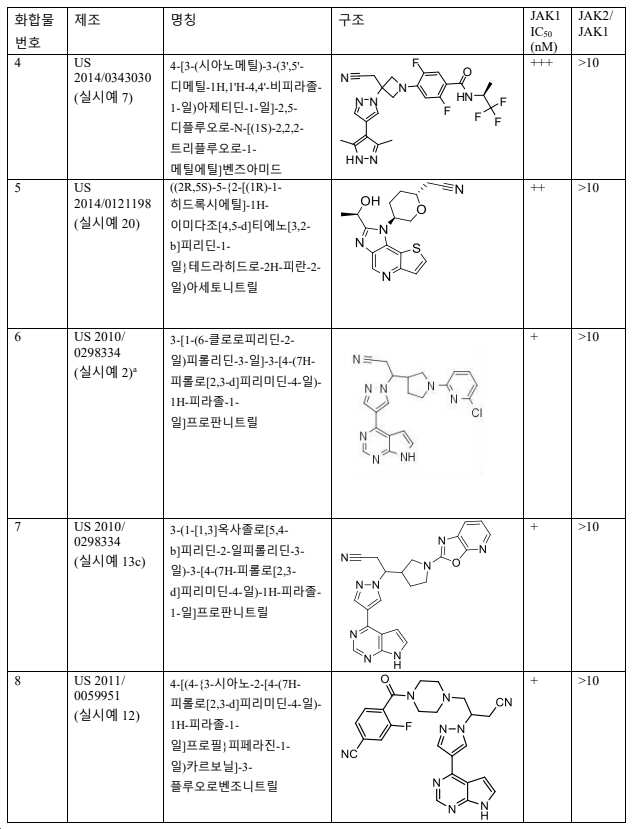

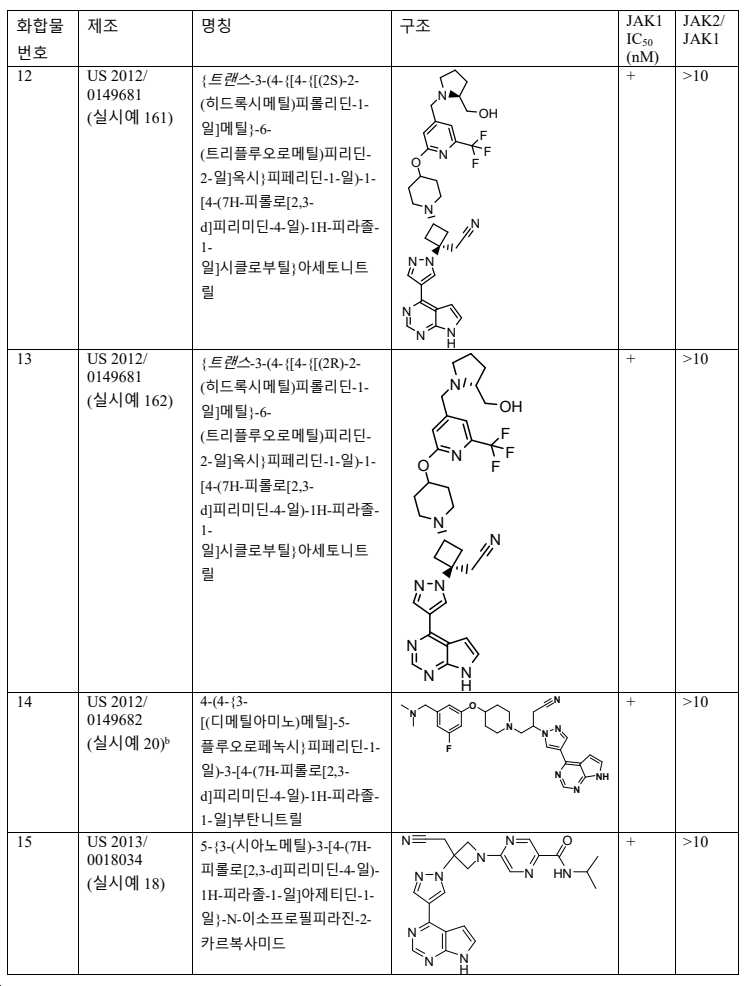


일부 양태에서, JAK1 경로 억제제는 {1-{1-[3-플루오로-2-(트리플루오로메틸)이소니코티노일]피페리딘-4-일}-3[4-(7H-피롤로[2,3-d]피리미딘-4-일)-1H-피라졸-1-일]아제티딘-3-일}아세토니트릴, 또는 이의 약학적으로 허용 가능한 염이다. In some embodiments, the JAK1 pathway inhibitor is {1-{1-[3-fluoro-2-(trifluoromethyl)isonicotinoyl]piperidin-4-yl}-3[4-(7H-pi Rolo[2,3-d]pyrimidin-4-yl)-1H-pyrazol-1-yl]azetidin-3-yl}acetonitrile, or a pharmaceutically acceptable salt thereof.
일부 양태에서, JAK1 경로 억제제는 {1-{1-[3-플루오로-2-(트리플루오로메틸)이소니코티노일]피페리딘-4-일}-3[4-(7H-피롤로[2,3-d]피리미딘-4-일)-1H-피라졸-1-일]아제티딘-3-일}아세토니트릴 아디핀산염이다.In some embodiments, the JAK1 pathway inhibitor is {1-{1-[3-fluoro-2-(trifluoromethyl)isonicotinoyl]piperidin-4-yl}-3[4-(7H-pi Lolo[2,3-d]pyrimidin-4-yl)-1H-pyrazol-1-yl]azetidin-3-yl}acetonitrile adipate.
{1-{1-[3-플루오로-2-(트리플루오로메틸)이소니코티노일]피페리딘-4-일}-3[4-(7H-피롤로[2,3-d]피리미딘-4-일)-1H-피라졸-1-일]아제티딘-3-일}아세토니트릴 및 이들의 아디핀산염의 합성 및 제조는 예를 들어, 각각 그 전문이 본원에 참고로 포함된 2011년 3월 9일 출원된 미국 특허 공개 번호 2011/0224190, 2012년 9월 6일 출원된 미국 특허 공개 번호 2013/0060026, 및 2014년 3월 5일 출원된 미국 특허 공개 번호 2014/0256941에서 찾을 수 있다.{1-{1-[3-Fluoro-2-(trifluoromethyl)isonicotinoyl]piperidin-4-yl}-3[4-(7H-pyrrolo[2,3-d] Synthesis and preparation of pyrimidin-4-yl)-1H-pyrazol-1-yl]azetidin-3-yl}acetonitrile and their adipic acid salts are, for example, each of which is incorporated herein by reference in its entirety U.S. Patent Publication No. 2011/0224190 filed March 9, 2012, U.S. Patent Publication No. 2013/0060026 filed September 6, 2012, and U.S. Patent Publication No. 2014/0256941 filed March 5, 2014 Can be found.
일부 양태에서, JAK1 경로 억제제는 4-[3-(시아노메틸)-3-(3',5'-디메틸-1H,1'H-4,4'-비피라졸-1-일)아제티딘-1-일]-2,5-디플루오로-N-[(1S)-2,2,2-트리플루오로-1-메틸에틸]벤즈아미드, 또는 이의 약학적으로 허용 가능한 염이다. In some embodiments, the JAK1 pathway inhibitor is 4-[3-(cyanomethyl)-3-(3',5'-dimethyl-1H,1'H-4,4'-bipyrazol-1-yl)ase Tidin-1-yl]-2,5-difluoro-N-[(1S)-2,2,2-trifluoro-1-methylethyl]benzamide, or a pharmaceutically acceptable salt thereof.
일부 양태에서, JAK1 경로 억제제는 4-[3-(시아노메틸)-3-(3',5'-디메틸-1H,1'H-4,4'-비피라졸-1-일)아제티딘-1-일]-2,5-디플루오로-N-[(1S)-2,2,2-트리플루오로-1-메틸에틸]벤즈아미드 인산염이다. In some embodiments, the JAK1 pathway inhibitor is 4-[3-(cyanomethyl)-3-(3',5'-dimethyl-1H,1'H-4,4'-bipyrazol-1-yl)ase Tidin-1-yl]-2,5-difluoro-N-[(1S)-2,2,2-trifluoro-1-methylethyl]benzamide phosphate.
4-[3-(시아노메틸)-3-(3',5'-디메틸-1H,1'H-4,4'-비피라졸-1-일)아제티딘-1-일]-2,5-디플루오로-N-[(1S)-2,2,2-트리플루오로-1-메틸에틸]벤즈아미드 및 이들의 인산염의 합성 및 제조는 예를 들어, 그 전문이 본원에 참고로 포함된 2014년 5월 16일 출원된 미국 특허 공개 번호 2014/0343030에서 찾을 수 있다.4-[3-(cyanomethyl)-3-(3',5'-dimethyl-1H,1'H-4,4'-bipyrazol-1-yl)azetidin-1-yl]-2 Synthesis and preparation of ,5-difluoro-N-[(1S)-2,2,2-trifluoro-1-methylethyl]benzamide and their phosphates are, for example, incorporated herein by reference in their entirety. It can be found in U.S. Patent Publication No. 2014/0343030 filed May 16, 2014, which is incorporated as.
일부 양태에서, JAK1 경로 억제제는 ((2R,5S)-5-{2-[(1R)-1-히드록시에틸]-1H-이미다조[4,5-d]티에노[3,2-b]피리딘-1-일}테드라히드로-2H-피란-2-일)아세토니트릴, 또는 이의 약학적으로 허용 가능한 염이다. In some embodiments, the JAK1 pathway inhibitor is ((2R,5S)-5-{2-[(1R)-1-hydroxyethyl]-1H-imidazo[4,5-d]thieno[3,2- b]pyridin-1-yl}tedrahydro-2H-pyran-2-yl)acetonitrile, or a pharmaceutically acceptable salt thereof.
일부 양태에서, JAK1 경로 억제제는 ((2R,5S)-5-{2-[(1R)-1-히드록시에틸]-1H-이미다조[4,5-d]티에노[3,2-b]피리딘-1-일}테드라히드로-2H-피란-2-일)아세토니트릴 일수화물이다. In some embodiments, the JAK1 pathway inhibitor is ((2R,5S)-5-{2-[(1R)-1-hydroxyethyl]-1H-imidazo[4,5-d]thieno[3,2- b]pyridin-1-yl}tedrahydro-2H-pyran-2-yl)acetonitrile monohydrate.
((2R,5S)-5-{2-[(1R)-1-히드록시에틸]-1H-이미다조[4,5-d]티에노[3,2-b]피리딘-1-일}테드라히드로-2H-피란-2-일)아세토니트릴의 합성 및 이들의 무수 및 일수화물 형태의 특징규명은 각각 그 전문이 본원에 참고로 포함된 2013년 10월 31일 출원된 미국 특허 공개 번호 2014/0121198, 및 2015년 4월 29일 출원된 미국 특허 공개 번호 2015/0344497에 기술되어 있다.((2R,5S)-5-{2-[(1R)-1-hydroxyethyl]-1H-imidazo[4,5-d]thieno[3,2-b]pyridin-1-yl} Synthesis of tedrahydro-2H-pyran-2-yl) acetonitrile and characterization of their anhydrous and monohydrate forms are described in U.S. Patent Publication No. filed on October 31, 2013, each of which is incorporated herein by reference in its entirety. 2014/0121198, and in US Patent Publication No. 2015/0344497 filed April 29, 2015.
일부 양태에서, 표 1의 화합물은 각각 그 전문이 본원에 참고로 포함된 2011년 3월 9일 출원된 미국 특허 공개 번호 2011/0224190, 2014년 5월 16일 출원된 미국 특허 공개 번호 2014/0343030, 2013년 10월 31일 출원된 미국 특허 공개 번호 2014/0121198, 2010년 5월 21일 출원된 미국 특허 공개 번호 2010/0298334, 2010년 8월 31일 출원된 미국 특허 공개 번호 2011/0059951, 2011년 11월 18일 출원된 미국 특허 공개 번호 2012/0149681, 2011년 11월 18일 출원된 미국 특허 공개 번호 2012/0149682, 2012년 6월 19일 출원된 미국 특허 공개 2013/0018034, 2012년 8월 17일 출원된 미국 특허 공개 번호 2013/0045963, 및 2013년 5월 17일 출원된 미국 특허 공개 번호 2014/0005166에 기술된 합성 공정에 의해 제조된다.In some embodiments, the compounds in Table 1 are U.S. Patent Publication No. 2011/0224190, filed March 9, 2011, each of which is incorporated herein by reference in its entirety, and U.S. Patent Publication No. 2014/0343030 filed May 16, 2014. , U.S. Patent Publication No. 2014/0121198 filed on October 31, 2013, U.S. Patent Publication No. 2010/0298334 filed on May 21, 2010, and U.S. Patent Publication No. 2011/0059951, filed on August 31, 2010 US Patent Publication No. 2012/0149681 filed on November 18, 2011, US Patent Publication No. 2012/0149682 filed on November 18, 2011, US Patent Publication 2013/0018034 filed on June 19, 2012, August 2012 It is prepared by the synthetic process described in US Patent Publication No. 2013/0045963, filed on May 17, 2013, and US Patent Publication No. 2014/0005166, filed on May 17, 2013.
일부 양태에서, JAK1 경로 억제제는 각각 그 전문이 본원에 참고로 포함된 2011년 3월 9일 출원된 미국 특허 공개 번호 2011/0224190, 2014년 5월 16일 출원된 미국 특허 공개 번호 2014/0343030, 2013년 10월 31일 출원된 미국 특허 공개 번호 2014/0121198, 2010년 5월 21일 출원된 미국 특허 공개 번호 2010/0298334, 2010년 8월 31일 출원된 미국 특허 공개 번호 2011/0059951, 2011년 11월 18일 출원된 미국 특허 공개 번호 2012/0149681, 2011년 11월 18일 출원된 미국 특허 공개 번호 2012/0149682, 2012년 6월 19일 출원된 미국 특허 공개 2013/0018034, 2012년 8월 17일 출원된 미국 특허 공개 번호 2013/0045963, 및 2013년 5월 17일 출원된 미국 특허 공개 번호 2014/0005166의 화합물, 또는 이의 약학적으로 허용 가능한 염으로부터 선택된다.In some embodiments, the JAK1 pathway inhibitors are U.S. Patent Publication No. 2011/0224190 filed March 9, 2011, U.S. Patent Publication No. 2014/0343030 filed May 16, 2014, each of which is incorporated herein by reference in its entirety. U.S. Patent Publication No. 2014/0121198 filed on October 31, 2013, U.S. Patent Publication No. 2010/0298334 filed on May 21, 2010, and U.S. Patent Publication No. 2011/0059951 filed on August 31, 2010, 2011 U.S. Patent Publication No. 2012/0149681 filed on November 18, 2011, U.S. Patent Publication No. 2012/0149682, filed on November 18, 2012, U.S. Patent Publication 2013/0018034, filed on June 19, 2012, August 17, 2012 US Patent Publication No. 2013/0045963, filed on May 17, 2013, and a compound of US Patent Publication No. 2014/0005166, filed May 17, 2013, or a pharmaceutically acceptable salt thereof.
일부 양태에서, JAK1 경로 억제제는 식 I의 화합물In some embodiments, the JAK1 pathway inhibitor is a compound of formula I

또는 이의 약학적으로 허용 가능한 염이고, 식 중: Or a pharmaceutically acceptable salt thereof, wherein:
X는 N 또는 CH이고;X is N or CH;
L은 C(=O) 또는 C(=O)NH이고;L is C(=O) or C(=O)NH;
A는 이들 각각이 1 또는 2개의 독립적으로 선택된 R1 기로 임의로 치환된 페닐, 피리디닐, 또는 피리미디닐이고; 그리고A is phenyl, pyridinyl, or pyrimidinyl, each of which is optionally substituted with 1 or 2 independently selected R 1 groups; And
각각의 R1은 독립적으로 플루오로 또는 트리플루오로메틸이다.Each R 1 is independently fluoro or trifluoromethyl.
일부 양태에서, 식 I의 화합물은 {1-{1-[3-플루오로-2-(트리플루오로메틸)이소니코티노일]피페리딘-4-일}-3[4-(7H-피롤로[2,3-d]피리미딘-4-일)-1H-피라졸-1-일]아제티딘-3-일}아세토니트릴, 또는 이의 약학적으로 허용 가능한 염이다. In some embodiments, the compound of formula I is {1-{1-[3-fluoro-2-(trifluoromethyl)isonicotinoyl]piperidin-4-yl}-3[4-(7H- Pyrrolo[2,3-d]pyrimidin-4-yl)-1H-pyrazol-1-yl]azetidin-3-yl}acetonitrile, or a pharmaceutically acceptable salt thereof.
일부 양태에서, 식 I의 화합물은 4-{3-(시아노메틸)-3-[4-(7H-피롤로[2,3-d]피리미딘-4-일)-1H-피라졸-1-일]아제티딘-1-일}-N-[4-플루오로-2-(트리플루오로메틸)페닐]피페리딘-1-카르복사미드, 또는 이의 약학적으로 허용 가능한 염이다. In some embodiments, the compound of formula I is 4-{3-(cyanomethyl)-3-[4-(7H-pyrrolo[2,3-d]pyrimidin-4-yl)-1H-pyrazole- 1-yl]azetidin-1-yl}-N-[4-fluoro-2-(trifluoromethyl)phenyl]piperidine-1-carboxamide, or a pharmaceutically acceptable salt thereof.
일부 양태에서, 식 I의 화합물은 [3-[4-(7H-피롤로[2,3-d]피리미딘-4-일)-1H-피라졸-1-일]-1-(1-{[2-(트리플루오로메틸)피리미딘-4-일]카르보닐}피페리딘-4-일)아제티딘-3-일]아세토니트릴, 또는 이의 약학적으로 허용 가능한 염이다. In some embodiments, the compound of formula I is [3-[4-(7H-pyrrolo[2,3-d]pyrimidin-4-yl)-1H-pyrazol-1-yl]-1-(1- {[2-(trifluoromethyl)pyrimidin-4-yl]carbonyl}piperidin-4-yl)azetidin-3-yl]acetonitrile, or a pharmaceutically acceptable salt thereof.
일부 양태에서, JAK1 경로 억제제는 식 II의 화합물 In some embodiments, the JAK1 pathway inhibitor is a compound of formula II

또는 이의 약학적으로 허용 가능한 염이고, 식 중:Or a pharmaceutically acceptable salt thereof, wherein:
R2는 C1-6 알킬, C1-6 할로알킬, C3-6 시클로알킬, 또는 C3-6 시클로알킬-C1-3 알킬이고, 여기서 상기 C1-6 알킬, C3-6 시클로알킬, 및 C3-6 시클로알킬-C1-3 알킬은 각각 플루오로, -CF3, 및 메틸로부터 독립적으로 선택된 1, 2 또는 3개의 치환기로 임의로 치환되고;R 2 is C 1-6 alkyl, C 1-6 haloalkyl, C 3-6 cycloalkyl, or C 3-6 cycloalkyl-C 1-3 alkyl, wherein said C 1-6 alkyl, C 3-6 Cycloalkyl, and C 3-6 cycloalkyl-C 1-3 alkyl are each optionally substituted with 1, 2 or 3 substituents independently selected from fluoro, -CF 3 , and methyl;
R3는 H 또는 메틸이고; R 3 is H or methyl;
R4는 H, F, 또는 Cl이고;R 4 is H, F, or Cl;
R5는 H 또는 F이고; R 5 is H or F;
R6는 H 또는 F이고; R 6 is H or F;
R7은 H 또는 F이고;R 7 is H or F;
R8은 H 또는 메틸이고;R 8 is H or methyl;
R9은 H 또는 메틸이고;R 9 is H or methyl;
R10은 H 또는 메틸이고; 그리고R 10 is H or methyl; And
R11은 H 또는 메틸이다.R 11 is H or methyl.
일부 양태에서, 식 II의 화합물은 4-[3-(시아노메틸)-3-(3',5'-디메틸-1H,1'H-4,4'-비피라졸-1-일)아제티딘-1-일]-2,5-디플루오로-N-[(1S)-2,2,2-트리플루오로-1-메틸에틸]벤즈아미드, 또는 이의 약학적으로 허용 가능한 염이다.In some embodiments, the compound of formula II is 4-[3-(cyanomethyl)-3-(3',5'-dimethyl-1H,1'H-4,4'-bipyrazol-1-yl) Azetidin-1-yl]-2,5-difluoro-N-[(1S)-2,2,2-trifluoro-1-methylethyl]benzamide, or a pharmaceutically acceptable salt thereof. .
일부 양태에서, JAK1 경로 억제제는 식 III의 화합물In some embodiments, the JAK1 pathway inhibitor is a compound of Formula III

또는 이의 약학적으로 허용 가능한 염이고, 식 중:Or a pharmaceutically acceptable salt thereof, wherein:
Cy4는 테드라히드로-2H-피란 고리이고, 이는 CN, OH, F, Cl, C1-3 알킬, C1-3 할로알킬, 시아노-C1-3 알킬, HO-C1-3 알킬, 아미노, C1-3 알킬아미노, 및 디(C1-3 알킬)아미노로부터 독립적으로 선택된 1개 또는 2개의 기로 임의로 치환되고, 여기서 상기 C1-3 알킬 및 디(C1-3 알킬)아미노는 F, Cl, C1-3 알킬아미노술포닐, 및 C1-3 알킬술포닐로부터 독립적으로 선택된 1, 2, 또는 3개의 치환기로 임의로 치환되고; 그리고Cy 4 is a tedrahydro-2H-pyran ring, which is CN, OH, F, Cl, C 1-3 alkyl, C 1-3 haloalkyl, cyano-C 1-3 alkyl, HO-C 1-3 Optionally substituted with one or two groups independently selected from alkyl, amino, C 1-3 alkylamino, and di(C 1-3 alkyl)amino, wherein said C 1-3 alkyl and di(C 1-3 alkyl ) Amino is optionally substituted with 1, 2, or 3 substituents independently selected from F, Cl, C 1-3 alkylaminosulfonyl, and C 1-3 alkylsulfonyl; And
R12는 -CH2-OH, -CH(CH3)-OH, 또는 -CH2-NHSO2CH3이다.R 12 is -CH 2 -OH, -CH(CH 3 )-OH, or -CH 2 -NHSO 2 CH 3 .
일부 양태에서, 식 III의 화합물은 ((2R,5S)-5-{2-[(1R)-1-히드록시에틸]-1H-이미다조[4,5-d]티에노[3,2-b]피리딘-1-일}테드라히드로-2H-피란-2-일)아세토니트릴, 또는 이의 약학적으로 허용 가능한 염이다. In some embodiments, the compound of Formula III is ((2R,5S)-5-{2-[(1R)-1-hydroxyethyl]-1H-imidazo[4,5-d]thieno[3,2 -b]pyridin-1-yl}tedrahydro-2H-pyran-2-yl)acetonitrile, or a pharmaceutically acceptable salt thereof.
일부 양태에서, JAK1 경로 억제제 또는 이의 약학적으로 허용 가능한 염은 유리 염기 기준으로 약 100 mg 내지 약 600 mg의 일일 양으로 투여된다. 따라서, 일부 양태에서, 선택적 JAK1 경로 억제제는 유리 염기 기준으로 약 100 mg, 약 150 mg, 약 200 mg, 약 250 mg, 약 300 mg, 약 350 mg, 약 400 mg, 약 450 mg, 약 500 mg, 약 550 mg, 또는 약 600 mg의 일일 양으로 투여된다.In some embodiments, the JAK1 pathway inhibitor or a pharmaceutically acceptable salt thereof is administered in a daily amount of about 100 mg to about 600 mg on a free base basis. Thus, in some embodiments, the selective JAK1 pathway inhibitor is about 100 mg, about 150 mg, about 200 mg, about 250 mg, about 300 mg, about 350 mg, about 400 mg, about 450 mg, about 500 mg on a free base basis. , About 550 mg, or about 600 mg daily.
일부 양태에서, JAK1 경로 억제제 또는 이의 약학적으로 허용 가능한 염은 유리 염기 기준으로 약 200 mg의 일일 양으로 투여된다.In some embodiments, the JAK1 pathway inhibitor or a pharmaceutically acceptable salt thereof is administered in a daily amount of about 200 mg on a free base basis.
일부 양태에서, JAK1 경로 억제제 또는 이의 약학적으로 허용 가능한 염은 유리 염기 기준으로 약 300 mg의 일일 양으로 투여된다.In some embodiments, the JAK1 pathway inhibitor or a pharmaceutically acceptable salt thereof is administered in a daily amount of about 300 mg on a free base basis.
일부 양태에서, JAK1 경로 억제제 또는 이의 약학적으로 허용 가능한 염은 유리 염기 기준으로 약 400 mg의 일일 양으로 투여된다.In some embodiments, the JAK1 pathway inhibitor or a pharmaceutically acceptable salt thereof is administered in a daily amount of about 400 mg on a free base basis.
일부 양태에서, JAK1 경로 억제제 또는 이의 약학적으로 허용 가능한 염은 유리 염기 기준으로 약 500 mg의 일일 양으로 투여된다.In some embodiments, the JAK1 pathway inhibitor or a pharmaceutically acceptable salt thereof is administered in a daily amount of about 500 mg on a free base basis.
일부 양태에서, JAK1 경로 억제제 또는 이의 약학적으로 허용 가능한 염은 유리 염기 기준으로 약 600 mg의 일일 양으로 투여된다.In some embodiments, the JAK1 pathway inhibitor or a pharmaceutically acceptable salt thereof is administered in a daily amount of about 600 mg on a free base basis.
일부 양태에서, JAK1 경로 억제제 또는 이의 약학적으로 허용 가능한 염은 유리 염기 기준으로 약 200 mg의 양으로 1일 1회 투여된다.In some embodiments, the JAK1 pathway inhibitor or a pharmaceutically acceptable salt thereof is administered once daily in an amount of about 200 mg on a free base basis.
일부 양태에서, JAK1 경로 억제제 또는 이의 약학적으로 허용 가능한 염은 유리 염기 기준으로 약 300 mg의 양으로 1일 1회 투여된다.In some embodiments, the JAK1 pathway inhibitor or a pharmaceutically acceptable salt thereof is administered once daily in an amount of about 300 mg on a free base basis.
일부 양태에서, JAK1 경로 억제제 또는 이의 약학적으로 허용 가능한 염은 유리 염기 기준으로 약 400 mg의 양으로 1일 1회 투여된다.In some embodiments, the JAK1 pathway inhibitor or a pharmaceutically acceptable salt thereof is administered once daily in an amount of about 400 mg on a free base basis.
일부 양태에서, JAK1 경로 억제제 또는 이의 약학적으로 허용 가능한 염은 유리 염기 기준으로 약 500 mg의 양으로 1일 1회 투여된다.In some embodiments, the JAK1 pathway inhibitor or a pharmaceutically acceptable salt thereof is administered once daily in an amount of about 500 mg on a free base basis.
일부 양태에서, JAK1 경로 억제제 또는 이의 약학적으로 허용 가능한 염은 유리 염기 기준으로 약 600 mg의 양으로 1일 1회 투여된다.In some embodiments, the JAK1 pathway inhibitor or a pharmaceutically acceptable salt thereof is administered once daily in an amount of about 600 mg on a free base basis.
일부 양태에서, JAK1 경로 억제제 또는 이의 약학적으로 허용 가능한 염은 각각 JAK1 경로 억제제 또는 이의 약학적으로 허용 가능한 염을 포함하는 하나 이상의 서방형 제형으로 투여된다.In some embodiments, the JAK1 pathway inhibitor or a pharmaceutically acceptable salt thereof is administered in one or more sustained release formulations, each comprising a JAK1 pathway inhibitor or a pharmaceutically acceptable salt thereof.
본원에서 제공되는 것은 대상체에서 이를 필요로 하는 대상체에서 사이토카인-관련 질환 또는 장애를 치료하는 방법이며, JAK1 경로 억제제 또는 이의 약학적으로 허용 가능한 염의 유리 염기 기준으로 약 100 mg 내지 600 mg의 일일 용량을 대상체에 대해 투여하는 것을 포함하고, 여기서 JAK1 경로 억제제 또는 이의 약학적으로 허용 가능한 염은 JAK1 경로 억제제 또는 이의 약학적으로 허용 가능한 염을 포함하는 하나 이상의 서방형 제형으로 투여된다.Provided herein is a method of treating a cytokine-related disease or disorder in a subject in need thereof in a subject, a daily dose of about 100 mg to 600 mg based on the free base of a JAK1 pathway inhibitor or a pharmaceutically acceptable salt thereof. To a subject, wherein the JAK1 pathway inhibitor or a pharmaceutically acceptable salt thereof is administered in one or more sustained release formulations comprising the JAK1 pathway inhibitor or a pharmaceutically acceptable salt thereof.
본원에 기술된 양태는 양태가 다중 의존 청구항인 것처럼 임의의 적합한 조합으로 조합되도록 의도된다 (예를 들어, 선택적 JAK1 경로 억제제 및 이들의 용량에 관련된 양태, 본원에 개시된 화합물의 임의의 염 형태에 관련된 양태, 사이토카인-관련 질환 또는 장애의 개별 유형에 관련된 양태, 및 조성물 및/또는 투여에 관련된 양태는 임의의 조합으로 조합될 수 있음).Aspects described herein are intended to be combined in any suitable combination as if the aspect was a multiple dependent claim (e.g., aspects relating to selective JAK1 pathway inhibitors and doses thereof, relating to any salt form of the compounds disclosed herein. Aspects, aspects relating to individual types of cytokine-related diseases or disorders, and aspects relating to compositions and/or administration may be combined in any combination).
예를 들어, 본원에서 제공되는 것은 대상체에서 사이토카인 방출 증후군 (CRS), 혈구탐식성 림프조직구증식증 (HLH), 대식세포 활성화 증후군 (MAS), 또는 CAR-T-세포-관련 뇌병증 증후군 (CRES)으로 이루어진 그룹으로부터 선택된 사이토카인-관련 질환 또는 장애를 치료하는 방법이며, 방법은 대상체에게 유리 염기 기준으로 약 200 mg의 1일 1회 용량의 {1-{1-[3-플루오로-2-(트리플루오로메틸)이소니코티노일]피페리딘-4-일}-3-[4-(7H-피롤로[2,3-d]피리미딘-4-일)-1H-피라졸-1-일]아제티딘-3-일}아세토니트릴, 또는 이의 약학적으로 허용 가능한 염을 투여하는 것을 포함하며, 여기서 용량은 각각 {1-{1-[3-플루오로-2-(트리플루오로메틸)이소니코티노일]피페리딘-4-일}-3-[4-(7H-피롤로[2,3-d]피리미딘-4-일)-1H-피라졸-1-일]아제티딘-3-일}아세토니트릴, 또는 이의 약학적으로 허용 가능한 염을 포함하는 하나 이상의 서방형 제형을 포함한다.For example, provided herein is cytokine release syndrome (CRS), hemophagophobic lymphocytocytosis (HLH), macrophage activation syndrome (MAS), or CAR-T-cell-related encephalopathy syndrome (CRES) in a subject. ) Is a method of treating a cytokine-related disease or disorder selected from the group consisting of, wherein the method is to give a subject a daily dose of about 200 mg on a free base basis of {1-{1-[3-fluoro-2 -(Trifluoromethyl)isonicotinoyl]piperidin-4-yl}-3-[4-(7H-pyrrolo[2,3-d]pyrimidin-4-yl)-1H-pyrazole -1-yl]azetidin-3-yl}acetonitrile, or a pharmaceutically acceptable salt thereof, wherein the dose is each {1-{1-[3-fluoro-2-(tri Fluoromethyl)isonicotinoyl]piperidin-4-yl}-3-[4-(7H-pyrrolo[2,3-d]pyrimidin-4-yl)-1H-pyrazole-1- One] azetidin-3-yl} acetonitrile, or a pharmaceutically acceptable salt thereof.
{1-{1-[3-플루오로-2-(트리플루오로메틸)이소니코티노일]피페리딘-4-일}-3[4-(7H-피롤로[2,3-d]피리미딘-4-일)-1H-피라졸-1-일]아제티딘-3-일}아세토니트릴, 또는 이의 약학적으로 허용 가능한 염 (표 1, 화합물 1)의 서방형 제형은 그 전문이 본원에 참고로 포함된 2014년 8월 6일 출원된 미국 공개 번호 2015/0065484에서 찾을 수 있다. {1-{1-[3-Fluoro-2-(trifluoromethyl)isonicotinoyl]piperidin-4-yl}-3[4-(7H-pyrrolo[2,3-d] The sustained-release formulation of pyrimidin-4-yl)-1H-pyrazol-1-yl]azetidin-3-yl}acetonitrile, or a pharmaceutically acceptable salt thereof (Table 1, Compound 1), is described in its entirety. US Publication No. 2015/0065484, filed August 6, 2014, which is incorporated herein by reference.
간결함을 위해 모든 가능한 조합이 본원에 별도로 열거되지 않는다.For brevity all possible combinations are not listed separately herein.
본원에서 기술된 화합물은 비대칭일 수 있다 (예를 들어, 하나 이상의 입체 중심을 가짐). 모든 입체이성질체, 예를 들어 거울상이성질체 및 부분입체이성질체는 달리 명시되지 않는 한 의도된다. 비대칭으로 치환된 탄소 원자를 함유하는 화합물은 광학 활성 또는 라세미 형태로 분리될 수 있다. 예를 들어 라세미 혼합물의 분해 또는 입체선택적 합성에 의한, 광학적으로 불활성인 출발 물질로부터 광학적으로 활성인 형태를 제조하는 법에 대한 방법은 당 업계에 공지되어 있다. 올레핀의 많은 기하 이성질체, C=N 이중 결합 등이 또한 본원에 기술된 화합물에 존재할 수 있으며, 모든 이러한 안정한 이성질체가 본 발명에서 고려된다. 본 발명의 화합물의 시스 및 트랜스 기하 이성질체가 기술되어 있으며 이성질체의 혼합물 또는 분리된 이성질체 형태로 단리될 수 있다.The compounds described herein may be asymmetric (e.g., Has one or more stereogenic centers). All stereoisomers, such as enantiomers and diastereomers, are intended unless otherwise specified. Compounds containing asymmetrically substituted carbon atoms can be separated in optically active or racemic form. Methods for preparing optically active forms from optically inert starting materials, for example by decomposition or stereoselective synthesis of racemic mixtures, are known in the art. Many geometric isomers of olefins, C=N double bonds, and the like may also exist in the compounds described herein, and all such stable isomers are contemplated in the present invention. The cis and trans geometric isomers of the compounds of the present invention are described and can be isolated in the form of mixtures of isomers or separate isomers.
일부 양태에서, 화합물은 (R)-배열을 가진다. 일부 양태에서, 화합물은 (S)-배열을 가진다.In some embodiments, the compound has the (R)- configuration. In some embodiments, the compound has the (S)- configuration.
화합물의 라세미 혼합물의 분해는 당 업계에 공지된 임의의 수많은 방법에 의해 수행될 수 있다. 예시적인 방법은 광학적으로 활성인 염 형성 유기산인 키랄 분해산을 사용하는 분별 재결정화를 포함한다. 분별 재결정화 방법에 적합한 분해제는 예를 들어, 광학 활성산, 예를 들어 타르타르산의 D 및 L 형태, 디아세틸타르타르산, 디벤조일타르타르산, 만델산, 말산, 젖산 또는 β- 캄포르술폰산과 같은 캄포르술폰산이다. 분별 재결정화 방법에 대한 적합한 다른 분해제는 α-메틸벤질아민의 입체이성질체적으로 순수 형태 (예를 들어, S 및 R 형태, 또는 부분입체이성질체적으로 순수 형태), 2-페닐글리시놀, 노르에페드린, 에페드린, N-메틸에페드린, 시클로헥실에틸아민, 1,2-디아미노시클로헥산 등을 포함한다.The decomposition of racemic mixtures of compounds can be carried out by any of a number of methods known in the art. An exemplary method involves fractional recrystallization using a chiral decomposing acid, an optically active salt forming organic acid. Disintegrants suitable for the fractional recrystallization method include, for example, optically active acids, such as the D and L forms of tartaric acid, diacetyltartaric acid, dibenzoyltartaric acid, mandelic acid, malic acid, lactic acid or camphorsulfonic acid such as β-camphorsulfonic acid. It is forsulfonic acid. Other suitable dissolving agents for the fractional recrystallization process are stereoisomerically pure forms of α-methylbenzylamine (e.g., S and R forms, or diastereomerically pure forms), 2-phenylglycinol, Norephedrine, ephedrine, N-methylephedrine, cyclohexylethylamine, 1,2-diaminocyclohexane, and the like.
라세미 혼합물의 분해는 또한 광학 활성 분해제 (예를 들어, 디니트로벤조일페닐글리신)로 채워진 컬럼에서 용리에 의해 수행될 수 있다. 적합한 용출 용매 조성물은 당업자에 의해 결정될 수 있다. Decomposition of the racemic mixture can also result in optically active decomposition agents (e.g. Dinitrobenzoylphenylglycine). Suitable elution solvent compositions can be determined by a person skilled in the art.
본원에 기술된 화합물은 또한 호변이성질체 형태를 포함한다. 호변이성질체 형태는 양성자의 수반되는 이동과 함께 단일 결합과 인접한 이중 결합의 교환으로부터 생성된다. 호변이성질체 형태는 동일한 실험식 및 총 전하를 갖는 이성질체 양성자화 상태인 양성자성 호변이성질체를 포함한다. 예시 양성자성 호변이성질체는 케톤 - 에놀 쌍, 아미드 - 이미드산 쌍, 락탐 - 락팀 쌍, 에나민 - 이민 쌍, 및 양성자가 이종고리 시스템의 두 개 이상의 위치를 차지할 수 있는 고리 모양 형태, 예를 들어, 1H- 및 3H-이미다졸, 1H-, 2H- 및 4H- 1,2,4-트리아졸, 1H- 및 2H- 이소인돌, 및 1H- 및 2H-피라졸을 포함한다. 호변이성질체 형태는 평형 상태이거나 적절한 치환에 의해 입체적으로 하나의 형태로 고정될 수 있다. The compounds described herein also include tautomeric forms. Tautomeric forms result from the exchange of a single bond with an adjacent double bond with the concomitant shift of a proton. Tautomeric forms include protic tautomers that are in the isomeric protonated state with the same empirical formula and total charge. Exemplary protic tautomers are ketone-enol pairs, amide-imide acid pairs, lactam-lactim pairs, enamine-imine pairs, and cyclic forms in which protons can occupy more than one position in a heterocyclic system, e.g. , 1H- and 3H-imidazole, 1H-, 2H- and 4H- 1,2,4-triazole, 1H- and 2H- isoindole, and 1H- and 2H-pyrazole. The tautomeric form may be in equilibrium or may be sterically fixed to one form by appropriate substitution.
본원에 기술된 화합물은 또한 본 개시의 동위원소-표지된 화합물을 포함한다. "동위원소" 또는 "방사선-표지된" 화합물은 하나 이상의 원자가 자연에서 전형적으로 발견되는 (즉, 자연 발생) 원자 질량 또는 질량 수와 다른 원자 질량 또는 질량 수를 갖는 원자로 대체되거나 치환되는 본 개시의 화합물이다. 본 개시의 화합물에 포함될 수 있는 적합한 방사성핵종은 2H (또한 중수소에 대해 D로 작성), 3H (또한 삼중수소에 대해 T로 작성), 11C, 13C, 14C, 13N, 15N, 15O, 17O, 18O, 18F, 35S, 36Cl, 82Br, 75Br, 76Br, 77Br, 123I, 124I, 125I 및 131I를 포함하지만, 이에 한정되지 않는다. 예를 들어, 본 개시의 화합물에서 하나 이상의 수소 원자는 중수소 원자로 임의로 치환될 수 있다 (예를 들어, 식 (I), (II), 또는 (III) 또는 표 1의 화합물의 C1-6 알킬 기의 하나 이상의 수소 원자가 중수소 원자로 임의로 치환될 수 있음, 예를 들어 -CH3에 대해 -CD3로 치환됨). 본원에서 사용된 바와 같이, 용어, "화합물"은 명칭이 특정 입체이성질체를 나타내지 않는 한, 묘사된 구조의 모든 입체이성질체, 기하 이성질체, 호변이성질체, 및 동위원소를 포함하는 것을 의미한다. 하나의 특정 호변이성질체 형태로서 명칭 또는 구조에 의해 본원에서 확인된 화합물은 달리 명시되지 않는 한 다른 호변이성질체 형태를 포함하도록 의도된다. The compounds described herein also include isotopically-labeled compounds of the present disclosure. “Isotopes” or “radiation-labeled” compounds are of the present disclosure in which one or more atoms are replaced or substituted with an atom having an atomic mass or mass number different from the atomic mass or mass number typically found in nature (ie, naturally occurring). It is a compound. Suitable radionuclides that may be included in the compounds of this disclosure are 2 H (also written D for deuterium), 3 H (also written T for tritium), 11 C, 13 C, 14 C, 13 N, 15 N, 15 O, 17 O, 18 O, 18 F, 35 S, 36 Cl, 82 Br, 75 Br, 76 Br, 77 Br, 123 I, 124 I, 125 I and 131 I. Does not. For example, in the compounds of the present disclosure, one or more hydrogen atoms may be optionally substituted with deuterium atoms (e.g., formula (I), (II), or (III) or C 1-6 alkyl of the compound of Table 1 One or more hydrogen atoms of the group may be optionally substituted with deuterium atoms, e.g. substituted with -CD 3 for -CH 3 ). As used herein, the term “compound” is meant to include all stereoisomers, geometric isomers, tautomers, and isotopes of the depicted structure, unless the name indicates a specific stereoisomer. Compounds identified herein by name or structure as one particular tautomeric form are intended to include other tautomeric forms unless otherwise specified.
모든 화합물, 및 이의 약학적으로 허용 가능한 염은 물 및 용매와 같은 다른 물질과 함께 발견될 수 있거나 (예를 들어 수화물 및 용매화물) 단리될 수 있다.All compounds, and pharmaceutically acceptable salts thereof, can be found together with other substances such as water and solvents (eg, hydrates and solvates) or can be isolated.
일부 양태에서, 본원에서 기술된 화합물, 또는 이의 염은 실질적으로 단리된다. "실질적으로 단리된"은 화합물이 형성되거나 검출된 환경으로부터 적어도 부분적으로 또는 실질적으로 분리된 것을 의미한다. 부분적 분리는 예를 들어, 본원에서 기술된 화합물이 풍부한 조성물을 포함할 수 있다. 실제적 분리는 본원에서 기술된 화합물, 또는 이의 염의 적어도 약 50%, 적어도 약 60%, 적어도 약 70%, 적어도 약 80%, 적어도 약 90%, 적어도 약 95%, 적어도 약 97%, 또는 적어도 약 99 중량%를 함유하는 조성물을 포함할 수 있다. 화합물 및 이의 염을 분리하는 방법은 당 업계에서 일상적이다. In some embodiments, a compound described herein, or salt thereof, is substantially isolated. "Substantially isolated" means that the compound has been at least partially or substantially separated from the environment in which it was formed or detected. Partial separation can include, for example, a composition rich in the compounds described herein. The actual separation is at least about 50%, at least about 60%, at least about 70%, at least about 80%, at least about 90%, at least about 95%, at least about 97%, or at least about a compound described herein, or a salt thereof. It may include a composition containing 99% by weight. Methods for separating compounds and salts thereof are routine in the art.
문구 "약학적으로 허용 가능한"은 건전한 의학적 판단 범위 내에서, 합리적인 이익/위험 비율에 비례하는, 과도한 독성, 자극, 알레르기 반응 또는 기타 문제 또는 합병증 없이 인간 또는 동물의 조직과 접촉하여 사용하기에 적합한, 이들 화합물, 재료, 조성물, 및/또는 제형을 지칭하기 위해 본원에서 사용된다. The phrase “pharmaceutically acceptable” means, within the scope of sound medical judgment, suitable for use in contact with human or animal tissues without excessive toxicity, irritation, allergic reaction or other problems or complications, proportional to a reasonable benefit/risk ratio. , As used herein to refer to these compounds, materials, compositions, and/or formulations.
본원에서 사용된 바와 같이, 표현 "주위 온도" 및 "실온" 또는 "rt"는 당 업계에서 이해되고, 일반적으로 온도, 예를 들어 반응 온도, 즉 반응이 수행되는 실내 온도, 예를 들어, 약 20℃ 내지 약 30℃의 온도를 지칭한다. As used herein, the expressions “ambient temperature” and “room temperature” or “rt” are understood in the art and are generally temperature, for example It refers to the reaction temperature, that is, the room temperature at which the reaction is carried out, for example, from about 20°C to about 30°C.
본 발명은 또한 본원에서 기술된 화합물의 약학적으로 허용 가능한 염을 포함한다. 본원에서 사용된 바와 같이, "약학적으로 허용 가능한 염"은 개시된 화합물의 유도체를 지칭하며 모 화합물은 기존 산 또는 염기 모이어티를 그의 염 형태로 전환함으로써 변형된다. 약학적으로 허용 가능한 염의 예시는 아민과 같은 염기성 잔기의 무기 또는 유기산 염; 카르복실 산과 같은 산성 잔기의 알칼리 또는 유기 염 등을 포함하지만, 이에 한정되지 않는다. 본 발명의 약학적으로 허용 가능한 염은 예를 들어, 무독성 무기 또는 유기산으로부터, 형성된 모 화합물의 통상적인 무독성 염을 포함한다. 본 발명의 약학적으로 허용 가능한 염은 통상적인 화학적 방법에 의해 염기성 또는 산성 모이어티를 함유하는 모 화합물로부터 합성될 수 있다. 일반적으로, 이러한 염은 화합물의 유리 산 또는 염기 형태를 물 또는 유기 용매, 또는 이 둘의 혼합물에서 화학량론적 양의 적절한 염기 또는 산과 반응시켜 제조할 수 있고; 일반적으로, 에테르, 에틸 아세테이트, 알코올 (예를 들어, 메탄올, 에탄올, 이소프로판올, 또는 부탄올) 또는 아세토니트릴 (ACN)과 같은 비수성 매체가 바람직하다. 적합한 염의 목록은 각각 그 전문이 본원에 참고로 포함된, Remington's Pharmaceutical Sciences, 17th ed., Mack Publishing Company, Easton, Pa., 1985, p. 1418 및 Journal of Pharmaceutical Science, 66, 2 (1977)에서 찾을 수 있다. The invention also includes pharmaceutically acceptable salts of the compounds described herein. As used herein, “pharmaceutically acceptable salt” refers to a derivative of the disclosed compound and the parent compound is modified by converting an existing acid or base moiety into its salt form. Examples of pharmaceutically acceptable salts include inorganic or organic acid salts of basic moieties such as amines; Alkali or organic salts of acidic residues such as carboxylic acids, but are not limited thereto. Pharmaceutically acceptable salts of the present invention include conventional non-toxic salts of the parent compound formed, for example, from non-toxic inorganic or organic acids. The pharmaceutically acceptable salts of the present invention can be synthesized from a parent compound containing a basic or acidic moiety by conventional chemical methods. In general, such salts can be prepared by reacting the free acid or base form of the compound with a stoichiometric amount of a suitable base or acid in water or an organic solvent, or a mixture of the two; In general, non-aqueous media such as ether, ethyl acetate, alcohol (eg methanol, ethanol, isopropanol, or butanol) or acetonitrile (ACN) are preferred. A list of suitable salts can be found in Remington's Pharmaceutical Sciences , 17th ed., Mack Publishing Company, Easton, Pa., 1985, p., each of which is incorporated herein by reference in its entirety. 1418 and Journal of Pharmaceutical Science , 66, 2 (1977).
본원에서 사용된 바와 같이, 상호교환적으로 사용되는 용어 "대상체", "개체," 또는 "환자"는 포유동물, 바람직하게는 마우스, 랫트, 다른 설치류, 토끼, 개, 고양이, 돼지, 소, 양, 말, 또는 영장류, 및 가장 바람직하게는 인간을 포함하는 임의의 동물을 지칭한다. 일부 양태에서, "대상체", "개체," 또는 "환자"는 상기 치료를 필요로 한다.As used herein, the terms “subject”, “individual,” or “patient” as used interchangeably refer to mammals, preferably mice, rats, other rodents, rabbits, dogs, cats, pigs, cattle, It refers to any animal, including sheep, horses, or primates, and most preferably humans. In some embodiments, the “subject”, “subject,” or “patient” is in need of such treatment.
일부 양태에서, 억제제는 치료학적 유효량으로 투여된다. 본원에서 사용된 바와 같이, 문구 "치료학적 유효량"은 연구자, 수의사, 의사 또는 다른 임상의에 의해 조직, 계, 동물, 개체 또는 인간에서 찾고 있는 생물학적 또는 의학적 반응을 유도하는 활성 화합물 또는 약학 제제의 양을 지칭한다. 일부 양태에서, 환자 또는 개체에게 투여되는, 화합물, 또는 이의 약학적으로 허용 가능한 염의 투여량은 약 1 mg 내지 약 2 g, 약 1 mg 내지 약 1000 mg, 약 1 mg 내지 약 500 mg, 약 1 mg 내지 약 200 mg, 약 1 mg 내지 약 100 mg, 약 1 mg 내지 50 mg, 또는 약 50 mg 내지 약 500 mg이다. 일부 양태에서, 화합물, 또는 이의 약학적으로 허용 가능한 염의 투여량은 약 200 mg이다. In some embodiments, the inhibitor is administered in a therapeutically effective amount. As used herein, the phrase "therapeutically effective amount" refers to an active compound or pharmaceutical agent that induces a biological or medical response that is sought in a tissue, system, animal, individual or human by a researcher, veterinarian, physician or other clinician. Refers to sheep. In some embodiments, the dosage of the compound, or a pharmaceutically acceptable salt thereof, administered to a patient or individual is about 1 mg to about 2 g, about 1 mg to about 1000 mg, about 1 mg to about 500 mg, about 1 mg to about 200 mg, about 1 mg to about 100 mg, about 1 mg to 50 mg, or about 50 mg to about 500 mg. In some embodiments, the dosage of the compound, or a pharmaceutically acceptable salt thereof, is about 200 mg.
본원에서 사용된 바와 같이, 용어 "치료하는" 또는 "치료"는 (1) 질환을 억제하는 것; 예를 들어, 질환, 병태 또는 장애의 병리 또는 증상을 경험하거나 나타내는 개체에서 질환, 병태 또는 장애를 억제하는 것 (즉, 병리 및/또는 증상의 추가 발달을 저지함); (2) 질환을 개선하는 것; 예를 들어, 질환의 중증도를 감소시키는 것과 같이 질환, 병태 또는 장애의 병리 또는 증상을 경험하거나 나타내는 개체에서 질환, 병태 또는 장애를 개선하는 것 (즉, 병리 및/또는 증상을 반전시키는 것); 또는 (3) 질환, 병태 또는 장애에 취약할 수 있지만 아직 질환의 병리 또는 증상을 경험하거나 나타내지 않는 개체에서 질환, 병태 또는 장애를 예방하는 것 중 하나 이상을 지칭한다. 일부 양태에서, 치료는 질환을 억제하거나 개선하는 것을 의미한다. 일부 양태에서, 치료는 질환을 예방하는 것이다. As used herein, the term “treating” or “treatment” refers to (1) inhibiting the disease; For example, inhibiting the disease, condition or disorder in an individual experiencing or exhibiting a pathology or symptom of the disease, condition or disorder (ie, inhibiting further development of the pathology and/or condition); (2) improving the disease; Ameliorating a disease, condition or disorder in an individual experiencing or exhibiting a pathology or symptom of a disease, condition or disorder, such as reducing the severity of the disease (ie, reversing the pathology and/or symptoms); Or (3) preventing a disease, condition or disorder in an individual who may be susceptible to a disease, condition or disorder but does not yet experience or exhibit the pathology or symptoms of the disease. In some embodiments, treatment means inhibiting or ameliorating the disease. In some embodiments, treatment is to prevent the disease.
병용 요법Combination therapy
본원에서 기술된 방법은 하나 이상의 추가 치료제를 투여하는 것을 추가로 포함할 수 있다. 하나 이상의 추가 치료제는 환자에게 동시에 또는 순차적으로 투여될 수 있다. The methods described herein may further comprise administering one or more additional therapeutic agents. One or more additional therapeutic agents may be administered to the patient simultaneously or sequentially.
일부 양태에서, 추가 치료제는 IL-6 길항제 또는 수용체 길항제이다. 일부 양태에서, IL-6 수용체 길항제는 토실리주맙이다.In some embodiments, the additional therapeutic agent is an IL-6 antagonist or receptor antagonist. In some embodiments, the IL-6 receptor antagonist is tocilizumab.
일부 양태에서, 추가 치료제는 MCP-1의 억제제이다. 일부 양태에서, 추가 치료제는 MIP1B의 억제제이다. 일부 양태에서, 추가 치료제는 IL-2R의 억제제이다. 일부 양태에서, 추가 치료제는 IL-1R의 억제제이다. 일부 양태에서, 추가 치료제는 TNF-α의 억제제이다.In some embodiments, the additional therapeutic agent is an inhibitor of MCP-1. In some embodiments, the additional therapeutic agent is an inhibitor of MIP1B. In some embodiments, the additional therapeutic agent is an inhibitor of IL-2R. In some embodiments, the additional therapeutic agent is an inhibitor of IL-1R. In some embodiments, the additional therapeutic agent is an inhibitor of TNF-α.
일부 양태에서, 추가 치료제는 항-CD25 항체이다. 일부 양태에서, 항-CD25 항체는 다클리주맙이다. In some embodiments, the additional therapeutic agent is an anti-CD25 antibody. In some embodiments, the anti-CD25 antibody is daclizumab.
일부 양태에서, 추가 치료제는 IL-1β의 길항제이다.In some embodiments, the additional therapeutic agent is an antagonist of IL-1β.
일부 양태에서, 추가 치료제는 IL1 수용체 길항제 (IL1Ra)이다. 일부 양태에서, IL1 수용체 길항제 (IL1Ra)는 아나킨라이다.In some embodiments, the additional therapeutic agent is an IL1 receptor antagonist (IL1Ra). In some embodiments, the IL1 receptor antagonist (IL1Ra) is anakinra.
일부 양태에서, 추가 치료제는 코르티코스테로이드이다. 일부 양태에서, 코르티코스테로이드는 프레드니손이다. In some embodiments, the additional therapeutic agent is a corticosteroid. In some embodiments, the corticosteroid is prednisone.
일부 양태에서, 임의의 전술한 추가 치료제가 코르티코스테로이드 (예를 들어, 프레드니손)와 추가로 조합하여 사용된다. In some embodiments, any of the aforementioned additional therapeutic agents are used in further combination with a corticosteroid (eg, prednisone).
일부 양태에서, 추가 치료제는 토실리주맙 및 코르티코스테로이드를 포함한다. 일부 양태에서, 추가 치료제는 토실리주맙 및 프레드니손을 포함한다.In some embodiments, the additional therapeutic agent includes tocilizumab and a corticosteroid. In some embodiments, additional therapeutic agents include tocilizumab and prednisone.
약학적 제제 및 제형Pharmaceutical formulations and formulations
약제로서 사용되는 경우, JAK1 경로 억제제 또는 이의 약학적으로 허용 가능한 염은 약학 조성물의 형태로 투여될 수 있다. 이러한 조성물은 제약 분야에서 잘 알려진 방식으로 제조될 수 있고, 국소 또는 전신 치료가 바람직한 지 여부 및 치료될 부위에 따라 다양한 경로로 투여될 수 있다. 투여는 국부 (경피, 상피, 안구 및 비강 내, 질 및 직장 전달을 포함하는 점막까지 포함), 폐 (예를 들어, 분무기에 의한 것을 포함하는, 분말 또는 에어로졸의 흡입 또는 주입에 의해; 기관 내 또는 비강 내), 경구 또는 비경구일 수 있다. 비경구 투여는 정맥 내, 동맥 내, 피하, 복강 내 근육 내 또는 주사 또는 주입; 또는 두개 내, 예를 들어, 척수 강내 또는 심실 내, 투여를 포함한다. 비경구 투여는 단일 볼루스(bolus) 용량의 형태일 수 있거나, 예를 들어, 연속 관류 펌프에 의해 이루어질 수 있다. 국부 투여를 위한 약학 조성물 및 제제는 경피 패치, 연고, 로션, 크림, 겔, 점적제, 좌약, 스프레이, 액체 및 분말을 포함할 수 있다. 통상적인 약제학적 담체, 수성, 분말 또는 유성 베이스, 증점제 등이 필요하거나 바람직할 수 있다. When used as a medicament, the JAK1 pathway inhibitor or a pharmaceutically acceptable salt thereof can be administered in the form of a pharmaceutical composition. Such compositions can be prepared in a manner well known in the pharmaceutical field, and can be administered by various routes depending on whether local or systemic treatment is desired and the site to be treated. Administration is topical (including transdermal, epithelial, intraocular and intranasal, up to mucous membranes including vaginal and rectal delivery), pulmonary (e.g., by inhalation or infusion of a powder or aerosol, including by nebulizer; intratracheal Or intranasally), oral or parenteral. Parenteral administration may include intravenous, intraarterial, subcutaneous, intraperitoneal intramuscular or injection or infusion; Or intracranial, eg, intrathecal or intraventricular, administration. Parenteral administration may be in the form of a single bolus dose or may be effected, for example, by a continuous perfusion pump. Pharmaceutical compositions and formulations for topical administration may include transdermal patches, ointments, lotions, creams, gels, drops, suppositories, sprays, liquids and powders. Conventional pharmaceutical carriers, aqueous, powder or oily bases, thickeners and the like may be necessary or desirable.
본 발명은 또한 활성 성분으로서, 본원에 기술된 JAK1 경로 억제제 또는 이의 약학적으로 허용 가능한 염을 하나 이상의 약학적으로 허용 가능한 담체 (부형제)와 조합하여, 함유하는 약학 조성물을 포함한다. 일부 양태에서, 조성물은 국부 투여에 적합하다. 조성물을 제조할 때, 활성 성분은 전형적으로 부형제와 혼합되고, 부형제에 의해 희석되거나 담체 예를 들어, 캡슐, 봉지(sachet), 종이 또는 기타 용기의 형태로 이러한 담체 내에 포함된다. 부형제가 희석제 역할을 하는 경우, 이는 활성 성분의 매개체, 담체 또는 매질 역할을 하는, 고체, 반고체 또는 액체 물질일 수 있다. 따라서, 조성물은 정제, 환제, 분말, 로젠지, 봉지, 카세제(cachet), 엘릭시르제, 현탁액, 에멀젼, 용액, 시럽, 에어로졸 (고체로서 또는 액체 매질 중), 예를 들어 최대 10 중량%의 활성 화합물을 함유하는 연고, 연질 및 경질 젤라틴 캡슐, 좌약, 멸균 주사 용액, 및 멸균 포장 분말의 형태일 수 있다. The present invention also encompasses pharmaceutical compositions containing, as an active ingredient, a JAK1 pathway inhibitor described herein or a pharmaceutically acceptable salt thereof, in combination with one or more pharmaceutically acceptable carriers (excipients). In some embodiments, the composition is suitable for topical administration. When preparing the composition, the active ingredient is typically mixed with an excipient, diluted with an excipient, or contained within such a carrier in the form of a carrier such as a capsule, sachet, paper or other container. When the excipient acts as a diluent, it can be a solid, semi-solid or liquid substance, which acts as a medium, carrier or medium for the active ingredient. Thus, the composition may contain tablets, pills, powders, lozenges, bags, cachets, elixirs, suspensions, emulsions, solutions, syrups, aerosols (as a solid or in a liquid medium), for example up to 10% by weight. Ointments containing the active compound, soft and hard gelatin capsules, suppositories, sterile injection solutions, and sterile packaged powders.
제제를 제조할 때, 활성 화합물을 밀링하여 다른 성분과 결합하기 전에 적절한 입자 크기를 제공할 수 있다. 활성 화합물이 실질적으로 불용성이면, 200 메쉬 미만의 입자 크기로 밀링할 수 있다. 활성 화합물이 실질적으로 수용성이면, 입자 크기는 제제에서 실질적으로 균일한 분포를 제공하기 위해 밀링(milling)에 의해, 예를 들어 약 40 메쉬로 조정될 수 있다. When preparing the formulation, the active compound can be milled to provide an appropriate particle size prior to binding with other ingredients. If the active compound is substantially insoluble, it can be milled to a particle size of less than 200 mesh. If the active compound is substantially water-soluble, the particle size is determined by milling, e.g., to provide a substantially uniform distribution in the formulation. It can be adjusted to about 40 mesh.
JAK1 경로 억제제는 정제 제제 및 기타 제제 유형에 적합한 입자 크기를 수득하기 위해 습식 밀링과 같은 공지된 밀링 절차를 사용하여 밀링될 수 있다. JAK1 선택적 억제제의 미분 (나노미립자) 조제물은 당 업계에 공지된 공정에 의해 제조될 수 있다, 예를 들어, 국제 출원 번호 WO 2002/000196 참조.JAK1 pathway inhibitors can be milled using known milling procedures such as wet milling to obtain particle sizes suitable for tablet formulations and other formulation types. Finely divided (nanoparticulate) preparations of JAK1 selective inhibitors can be prepared by processes known in the art, see, for example, International Application No. WO 2002/000196.
적합한 부형제의 일부 예시는 락토오스, 덱스트로스, 수크로오스, 소르비톨, 만니톨, 전분, 아카시아 검, 인산 칼슘, 알긴산염, 트라가칸트, 젤라틴, 규산 칼슘, 미세결정질 셀룰로오스, 폴리비닐피롤리돈, 셀룰로오스, 물, 시럽 및 메틸 셀룰로오스를 포함한다. 제제는 추가로 다음을 포함할 수 있다: 탈크, 마그네슘 스테아레이트 및 미네랄 오일과 같은 윤활제; 습윤제; 유화제 및 현탁제; 메틸-및 프로필히드록시-벤조에이트와 같은 보존제; 감미제; 및 향료. 본 발명의 조성물은 당 업계에 공지된 절차를 사용하여 환자에게 투여한 후 활성 성분의 신속, 지속 또는 지연 방출을 제공하도록 제형화될 수 있다. Some examples of suitable excipients are lactose, dextrose, sucrose, sorbitol, mannitol, starch, gum acacia, calcium phosphate, alginate, tragacanth, gelatin, calcium silicate, microcrystalline cellulose, polyvinylpyrrolidone, cellulose, water. , Syrup and methyl cellulose. The formulation may further contain: lubricants such as talc, magnesium stearate and mineral oil; Humectants; Emulsifying and suspending agents; Preservatives such as methyl- and propylhydroxy-benzoate; Sweeteners; And spices. The compositions of the present invention may be formulated to provide rapid, sustained or delayed release of the active ingredient after administration to a patient using procedures known in the art.
조성물은 단위 투여 형태로 제형화될 수 있으며, 각 투여량은 약 5 내지 약 1000 mg (1 g), 보다 일반적으로 약 100 내지 약 500 mg의 활성 성분을 함유한다. 용어 "단위 투여 형태"는 인간 대상체 및 다른 포유동물에 대한 단위 투여량으로 적합한 물리적으로 분리된 단위를 지칭하며, 각 단위는 적합한 약제학적 부형제와 함께, 원하는 치료 효과를 생성하도록 계산된 미리 결정된 양의 활성 물질을 함유한다.The compositions may be formulated in unit dosage form, with each dosage containing from about 5 to about 1000 mg (1 g), more typically from about 100 to about 500 mg of active ingredient. The term “unit dosage form” refers to physically discrete units suitable as unit dosages for human subjects and other mammals, each unit with a suitable pharmaceutical excipient in a predetermined amount calculated to produce the desired therapeutic effect. Contains the active substance of.
일부 양태에서, 본 발명의 조성물은 약 5 내지 약 50 mg의 활성 성분을 함유한다. 당업자는 약 5 내지 약 10, 약 10 내지 약 15, 약 15 내지 약 20, 약 20 내지 약 25, 약 25 내지 약 30, 약 30 내지 약 35, 약 35 내지 약 40, 약 40 내지 약 45, 또는 약 45 내지 약 50 mg의 활성 성분을 함유하는 조성물을 구현함을 이해할 것이다. In some embodiments, the compositions of the present invention contain about 5 to about 50 mg of active ingredient. Those of skill in the art will have about 5 to about 10, about 10 to about 15, about 15 to about 20, about 20 to about 25, about 25 to about 30, about 30 to about 35, about 35 to about 40, about 40 to about 45, Or it will be appreciated that a composition containing about 45 to about 50 mg of active ingredient is implemented.
일부 양태에서, 본 발명의 조성물은 약 50 내지 약 500 mg의 활성 성분을 함유한다. 당업자는 약 50 내지 약 100, 약 100 내지 약 150, 약 150 내지 약 200, 약 200 내지 약 250, 약 250 내지 약 300, 약 350 내지 약 400, 또는 약 450 내지 약 500 mg의 활성 성분을 함유하는 조성물을 구현함을 이해할 것이다.In some embodiments, the compositions of the present invention contain about 50 to about 500 mg of active ingredient. Those skilled in the art contain about 50 to about 100, about 100 to about 150, about 150 to about 200, about 200 to about 250, about 250 to about 300, about 350 to about 400, or about 450 to about 500 mg of active ingredient. It will be appreciated that the composition is implemented.
일부 양태에서, 본 발명의 조성물은 약 500 내지 약 1000 mg의 활성 성분을 함유한다. 당업자는 약 500 내지 약 550, 약 550 내지 약 600, 약 600 내지 약 650, 약 650 내지 약 700, 약 700 내지 약 750, 약 750 내지 약 800, 약 800 내지 약 850, 약 850 내지 약 900, 약 900 내지 약 950, 또는 약 950 내지 약 1000 mg의 활성 성분을 함유하는 조성물을 구현함을 이해할 것이다.In some embodiments, the compositions of the present invention contain about 500 to about 1000 mg of active ingredient. Those of skill in the art will have about 500 to about 550, about 550 to about 600, about 600 to about 650, about 650 to about 700, about 700 to about 750, about 750 to about 800, about 800 to about 850, about 850 to about 900, It will be appreciated that compositions containing from about 900 to about 950, or from about 950 to about 1000 mg of active ingredient are implemented.
유사한 투여량이 본 발명의 방법 및 용도에서 본원에서 기술된 화합물에 사용될 수 있다.Similar dosages can be used for the compounds described herein in the methods and uses of the invention.
활성 화합물은 광범위한 투여량 범위에 걸쳐 효과적일 수 있으며 일반적으로 약학적 유효량으로 투여된다. 그러나, 실제로 투여되는 화합물의 양은 일반적으로 치료될 병태, 선택된 투여 경로, 투여되는 실제 화합물, 연령, 체중, 개별 환자의 반응, 환자 증상의 중증도 등을 포함하는 관련 상황에 따라 의사에 의해 결정되는 것으로 이해될 것이다. The active compound can be effective over a wide dosage range and is generally administered in a pharmaceutically effective amount. However, the amount of the compound that is actually administered is generally determined by the doctor according to the relevant circumstances, including the condition to be treated, the route of administration selected, the actual compound administered, age, weight, individual patient response, and the severity of patient symptoms. Will make sense.
정제와 같은 고체 조성물을 제조하기 위해, 주요 활성 성분은 본 발명의 화합물의 균일한 혼합물을 함유하는 고체 프리포뮬레이션 조성물을 형성하기 위해 약제학적 부형제와 혼합된다. 이러한 프리포뮬레이션 조성물을 균일한 것으로 언급할 때, 활성 성분은 전형적으로 조성물 전체에 고르게 분산되어 조성물이 정제, 환제 및 캡슐과 같은 동등하게 효과적인 단위 투여 형태로 쉽게 세분될 수 있다. 그런 다음, 이러한 고체 프리포뮬레이션은 예를 들어, 약 0.1 내지 약 1000 mg의 본 발명의 활성 성분을 함유하는 상기 기재된 유형의 단위 투여 형태로 세분된다. To prepare a solid composition such as a tablet, the main active ingredient is mixed with a pharmaceutical excipient to form a solid preformulation composition containing a homogeneous mixture of the compounds of the present invention. When referring to such preformulated compositions as homogeneous, the active ingredient is typically evenly dispersed throughout the composition so that the composition can be easily subdivided into equally effective unit dosage forms such as tablets, pills and capsules. This solid preformulation is then subdivided into unit dosage forms of the type described above containing, for example, about 0.1 to about 1000 mg of the active ingredient of the invention.
본 발명의 정제 또는 환제는 코팅되거나 그렇지 않으면 배합되어 연장된 작용의 이점을 제공하는 투여 형태를 제공할 수 있다. 예를 들어, 정제 또는 환제는 내부 투여 및 외부 투여 성분을 포함할 수 있으며, 후자는 전자를 덮는 외피 형태이다. 두 성분은 위장에서 붕해에 저항하고 내부 성분이 십이지장으로 온전히 통과하거나 방출이 지연되도록 하는 장용 층에 의해 분리될 수 있다. 다양한 물질이 이러한 장용 층 또는 코팅을 위해 사용될 수 있으며, 이러한 물질은 다수의 중합체 산 및 셸락, 세틸 알코올 및 셀룰로오스 아세테이트와 같은 물질과 중합체 산의 혼합물을 포함한다. The tablets or pills of the present invention may be coated or otherwise combined to provide a dosage form that provides the benefit of prolonged action. For example, a tablet or pill may contain internally administered and externally administered components, the latter in the form of a shell covering the former. The two components can be separated by an enteric layer that resists disintegration in the stomach and allows the internal component to pass completely into the duodenum or delay release. A variety of materials can be used for such enteric layers or coatings, including a number of polymeric acids and mixtures of polymeric acids with materials such as shellac, cetyl alcohol and cellulose acetate.
본 발명의 화합물 및 조성물이 경구 투여 또는 주사 투여를 위해 혼입될 수 있는 액체 형태는 수용액, 적절한 향의 시럽, 수성 또는 오일 현탁액, 및 면실유, 참기름, 코코넛 오일, 땅콩 오일과 같은 식용 오일의 향미 에멀젼, 뿐만 아니라 엘릭시르 및 유사한 약학적 비히클을 포함한다. Liquid forms in which the compounds and compositions of the present invention may be incorporated for oral administration or injection administration include aqueous solutions, syrups of appropriate flavor, aqueous or oil suspensions, and flavor emulsions of edible oils such as cottonseed oil, sesame oil, coconut oil, and peanut oil. , As well as elixirs and similar pharmaceutical vehicles.
흡입 또는 주입용 조성물은 약학적으로 허용 가능한, 수성 또는 유기 용매, 또는 이들의 혼합물 중의 용액 및 현탁액, 및 분말을 포함한다. 액체 또는 고체 조성물은 상기 기술된 바와 같은 적합한 약학적으로 허용 가능한 부형제를 함유할 수 있다. 일부 양태에서, 조성물은 국소 또는 전신 효과를 위해 경구 또는 비강 호흡 경로에 의해 투여된다. 불활성 기체를 사용하여 조성물을 분무할 수 있다. 분무 용액은 분무 장치로부터 직접 호흡할 수 있거나 분무 장치를 안면 마스크, 텐트 또는 간헐적 양압 호흡 기계에 부착할 수 있다. 용액, 현탁액 또는 분말 조성물은 적절한 방식으로 제재를 전달하는 장치로부터 경구 또는 비강으로 투여될 수 있다.Compositions for inhalation or infusion include solutions and suspensions, and powders in pharmaceutically acceptable, aqueous or organic solvents, or mixtures thereof. Liquid or solid compositions may contain suitable pharmaceutically acceptable excipients as described above. In some embodiments, the composition is administered by the oral or nasal respiratory route for local or systemic effect. The composition can be sprayed using an inert gas. The nebulizing solution can be breathed directly from the nebulizing device or the nebulizing device can be attached to a face mask, tent or intermittent positive pressure breathing machine. Solution, suspension or powder compositions can be administered orally or nasally from devices that deliver the agent in a suitable manner.
국부 제제는 하나 이상의 통상적 담체를 함유할 수 있다. 일부 양태에서, 연고는 물 및 예를 들어, 액체 파라핀, 폴리옥시에틸렌 알킬 에테르, 프로필렌 글리콜, 백색 바셀린 등으로부터 선택된 하나 이상의 소수성 담체를 함유할 수 있다. 크림의 담체 조성물은 글리세롤 및 하나 이상의 다른 성분, 예를 들어 글리세린모노스테아레이트, PEG-글리세린모노스테아레이트 및 세틸스테아릴 알코올과 조합된 물을 기반으로 할 수 있다. 겔은 이소프로필 알코올 및 물을 사용하여, 적합하게 예를 들어 글리세롤, 히드록시 에틸셀룰로오스 등과 같은 다른 성분과 조합하여 제형화될 수 있다. 일부 양태에서, 국부 제제는 적어도 약 0.1, 적어도 약 0.25, 적어도 약 0.5, 적어도 약 1, 적어도 약 2, 또는 적어도 약 5 중량%의 본원에서 기술된 화합물을 함유한다. 국부 제제는 선별된 적응증, 예를 들어, 건선 또는 다른 피부 병태의 치료를 위한 설명서와 임의로 연결되어 예를 들어, 100 g의 튜브에 적합하게 포장될 수 있다. Topical formulations may contain one or more conventional carriers. In some embodiments, the ointment may contain water and one or more hydrophobic carriers selected from, for example, liquid paraffin, polyoxyethylene alkyl ether, propylene glycol, white petrolatum, and the like. The carrier composition of the cream may be based on water in combination with glycerol and one or more other ingredients such as glycerin monostearate, PEG-glycerin monostearate and cetylstearyl alcohol. The gel can be formulated using isopropyl alcohol and water, suitably in combination with other ingredients, such as for example glycerol, hydroxy ethylcellulose, and the like. In some embodiments, the topical formulation contains at least about 0.1, at least about 0.25, at least about 0.5, at least about 1, at least about 2, or at least about 5% by weight of a compound described herein. The topical preparations can be suitably packaged, for example in a tube of 100 g, optionally linked with instructions for the treatment of a selected indication, eg psoriasis or other skin condition.
환자에게 투여되는 화합물 또는 조성물의 양은 투여되는 대상, 예방 또는 치료와 같은, 투여 목적, 환자의 상태, 투여 방식 등에 따라 달라질 것이다. 치료적 적용에서, 조성물은 질환의 증상 및 그 합병증을 치료하거나 적어도 부분적으로 저지하기에 충분한 양으로 이미 질환을 앓고 있는 환자에게 투여될 수 있다. 유효 용량은 치료 중인 질환 상태뿐만 아니라 환자의 질환 중증도, 연령, 체중 및 일반적인 상태 등과 같은 요인에 따른 담당 임상의의 판단에 따라 달라질 것이다. The amount of the compound or composition administered to a patient will vary depending on the subject being administered, the purpose of administration, such as prevention or treatment, the condition of the patient, the mode of administration, and the like. In therapeutic applications, the composition may be administered to a patient already suffering from the disease in an amount sufficient to treat or at least partially arrest the symptoms of the disease and its complications. The effective dose will depend not only on the disease state being treated, but also on the judgment of the attending clinician according to factors such as the disease severity, age, weight and general condition of the patient.
환자에게 투여되는 조성물은 전술한 약학 조성물의 형태일 수 있다. 이들 조성물은 통상적인 멸균 기술에 의해 멸균될 수 있거나, 또는 멸균 여과될 수 있다. 수용액은 그대로 사용하기 위해 포장되거나, 동결건조될 수 있고, 동결건조된 제조물은 투여 전에 멸균된 수성 담체와 결합된다. 화합물 제조물의 pH는 전형적으로 3 내지 11, 더욱 바람직하게는 5 내지 9 및 가장 바람직하게는 7 내지 8일 것이다. 전술한 특정 부형제, 담체, 또는 안정화제의 사용이 약제학적 염의 형성을 초래할 것이라는 점은 이해될 것이다. The composition administered to the patient may be in the form of the aforementioned pharmaceutical composition. These compositions can be sterilized by conventional sterilization techniques, or can be sterile filtered. The aqueous solution may be packaged for use as such, or may be lyophilized, and the lyophilized preparation is combined with a sterile aqueous carrier prior to administration. The pH of the compound preparation will typically be 3 to 11, more preferably 5 to 9 and most preferably 7 to 8. It will be appreciated that the use of certain excipients, carriers, or stabilizers described above will result in the formation of pharmaceutical salts.
본 발명의 화합물의 치료 용량은 예를 들어, 치료가 이루어지는 특정 용도, 화합물의 투여 방식, 환자의 건강 및 상태, 및 처방 의사의 판단에 따라 달라질 수 있다. 약학 조성물에서 본원에서 기술된 화합물의 비율 또는 농도는 투여량, 화학적 특성 (예를 들어, 소수성), 및 투여 경로를 포함하는 다수의 인자에 따라 달라질 수 있다. 예를 들어, 본원에서 기술된 화합물은 약 0.1 내지 약 10% w/v의 비경구 투여용 화합물을 함유하는 수성 생리학적 완충 용액으로 제공될 수 있다. 일부 전형적인 용량 범위는 하루에 체중의 약 1 μg/kg 내지 약 1 g/kg이다. 일부 양태에서, 용량 범위는 하루에 체중의 약 0.01 mg/kg 내지 약 100 mg/kg이다. 투여량은 질환 또는 장애의 진행 유형 및 정도, 특정 환자의 전반적인 건강 상태, 선택한 화합물의 상대적 생물학적 효능, 부형제의 제형, 및 투여 경로와 같은 변수에 따라 달라질 수 있다. 유효 용량은 시험관내 또는 동물 모델시험 시스템으로부터 유도된 용량 반응 곡선에서 외삽할 수 있다. The therapeutic dose of the compound of the present invention may vary depending on, for example, the specific use in which the treatment is performed, the mode of administration of the compound, the health and condition of the patient, and the judgment of the prescribing physician. The proportion or concentration of the compounds described herein in the pharmaceutical composition depends on the dosage, chemical properties (e.g., Hydrophobicity), and the route of administration. For example, the compounds described herein can be provided as an aqueous physiological buffer solution containing about 0.1 to about 10% w/v of a compound for parenteral administration. Some typical dosage ranges are from about 1 μg/kg to about 1 g/kg of body weight per day. In some embodiments, the dosage range is about 0.01 mg/kg to about 100 mg/kg of body weight per day. The dosage may vary depending on variables such as the type and degree of progression of the disease or disorder, the overall health status of a particular patient, the relative biological efficacy of the compound selected, the formulation of the excipient, and the route of administration. Effective doses can be extrapolated from dose response curves derived from in vitro or animal model testing systems.
본 발명의 조성물은 화학 요법, 스테로이드, 항-염증 화합물, 또는 면역 억제제와 같은 하나 이상의 추가 약제를 추가로 포함할 수 있으며, 이들의 예시는 본원에 열거되어 있다.The compositions of the present invention may further comprise one or more additional agents such as chemotherapy, steroids, anti-inflammatory compounds, or immunosuppressants, examples of which are listed herein.
키트Kit
본 발명은 또한 예를 들어, 사이토카인-관련 질환 또는 장애, 예를 들어 CRS의 치료 및/또는 예방에 유용한 약학 키트를 포함하며, 이는 치료적 유효량의 본원에서 기술된 화합물을 포함하는 약학 조성물을 함유하는 하나 이상의 용기를 포함한다. 이러한 키트는 원하는 경우, 예를 들어, 하나 이상의 약학적으로 허용 가능한 담체를 갖는 용기, 추가 용기 등과 같은 당업자에게 쉽게 자명할 바와 같은, 다양한 통상적인 약학 키트 구성성분 중 하나 이상을 추가로 포함할 수 있다., 삽입물 또는 라벨로서, 투여할 성분의 양, 투여 지침, 및/또는 성분 혼합 지침을 나타내는, 설명서가 또한 키트에 포함될 수 있다.The present invention also encompasses pharmaceutical kits useful for the treatment and/or prevention of, for example, cytokine-related diseases or disorders, such as CRS, which comprise a therapeutically effective amount of a pharmaceutical composition comprising a compound described herein. And one or more containers containing. Such kits may, if desired, further comprise one or more of a variety of conventional pharmaceutical kit components, as will be readily apparent to those skilled in the art, such as, for example, containers with one or more pharmaceutically acceptable carriers, additional containers, etc. Instructions, as inserts or labels, indicating the amount of ingredients to be administered, instructions for administration, and/or instructions for mixing ingredients may also be included in the kit.
실시예Example
본 발명은 특정 실시예를 통해 더욱 상세히 설명될 것이다. 하기 실시예는 예시 목적으로 제공되며, 어떤 방식으로든 본 발명을 한정하려고 의도되지 않는다. 당업자는 본질적으로 동일한 결과를 산출하기 위해 변경되거나 수정될 수 있는 다양한 비-중요 파라미터를 쉽게 인식할 것이다. 실시예의 화합물은 본원에 기재된 적어도 하나의 분석에 따라 JAK 억제제인 것으로 밝혀졌다.The invention will be described in more detail through specific examples. The following examples are provided for illustrative purposes and are not intended to limit the invention in any way. Those of skill in the art will readily recognize a variety of non-critical parameters that can be changed or modified to yield essentially the same results. The compounds of the examples were found to be JAK inhibitors according to at least one assay described herein.
실시예 A: Example A: 시험관내 In vitro JAK 키나제 분석JAK Kinase Analysis
사이토카인-관련 질환 또는 장애의 치료를 위해 사용될 수 있는 JAK1 경로 억제제를 Park et al., Analytical Biochemistry 1999, 269, 94-104에 기술된 하기 시험관내 분석에 따라 JAK 표적의 억제 활성을 시험하였다. N-말단 His 태그를 갖는 인간 JAK1 (a.a. 837-1142), JAK2 (a.a. 828-1132) 및 JAK3 (a.a. 781-1124)의 촉매 도메인을 곤충 세포에서 바큘로바이러스를 사용하여 발현하고 정제하였다. JAK1, JAK2 또는 JAK3의 촉매 활성은 비오틴화된 펩티드의 인산화를 측정하여 분석하였다. 인산화된 펩티드를 균질 시간 분해 형광발광 (HTRF, homogenous time resolved fluorescence)에 의해 측정하였다. 화합물의 IC50를 100 mM NaCl, 5 mM DTT, 및 0.1 mg/mL (0.01%) BSA가 있는 50 mM 트리스 (pH 7.8) 완충액 중 효소, ATP 및 500 nM 펩티드를 함유하는 40 마이크로L 반응액에서 각각의 키나제에 대해 측정하였다. 1 mM IC50 측정의 경우, 반응액 중 ATP 농도는 1 mM이다. 반응을 1시간 동안 실온에서 수행한 다음 분석 완충액 (Perkin Elmer, Boston, MA) 중 20 uL 45 mM EDTA, 300 nM SA-APC, 6 nM Eu-Py20으로 중지하였다. 유로퓸 표지된 항체에 대한 결합이 40분 동안 발생하고 HTRF 신호를 융합 플레이트 판독기 (Perkin Elmer, Boston, MA) 상에서 측정하였다. 표 1의 화합물을 이 분석에서 시험하였으며 표 1에서도 찾을 수 있는 IC50 값을 갖는 것으로 나타났다.JAK1 pathway inhibitors that can be used for the treatment of cytokine-related diseases or disorders are described in Park et al. , Analytical Biochemistry 1999 , 269 , 94-104 The inhibitory activity of JAK targets was tested according to the following in vitro assay. The catalytic domains of human JAK1 (aa 837-1142), JAK2 (aa 828-1132) and JAK3 (aa 781-1124) with an N-terminal His tag were expressed and purified using baculovirus in insect cells. The catalytic activity of JAK1, JAK2 or JAK3 was analyzed by measuring the phosphorylation of biotinylated peptides. The phosphorylated peptide was measured by homogeneous time resolved fluorescence (HTRF, h omogenous t ime r esolved f luorescence). The IC 50 of the compound was determined in a 40 microL reaction solution containing enzyme, ATP and 500 nM peptide in 50 mM Tris (pH 7.8) buffer with 100 mM NaCl, 5 mM DTT, and 0.1 mg/mL (0.01%) BSA. Measured for each kinase. In the case of 1 mM IC 50 measurement, the ATP concentration in the reaction solution is 1 mM. The reaction was carried out at room temperature for 1 hour and then stopped with 20 uL 45 mM EDTA, 300 nM SA-APC, 6 nM Eu-Py20 in assay buffer (Perkin Elmer, Boston, MA). Binding to the europium labeled antibody occurred for 40 minutes and the HTRF signal was measured on a fusion plate reader (Perkin Elmer, Boston, MA). The compounds of Table 1 were tested in this assay and found to have IC 50 values that can also be found in Table 1.
실시예 B: BALB/c 마우스에서 항-CD3 항체-유도된 사이토카인 방출 증후군Example B: Anti-CD3 antibody-induced cytokine release syndrome in BALB/c mice
JAK1 경로 억제제를 Ferran, C. et al. Clin. Exp. Immunol. 1991, 86, 537-543에 기술된 생체내 분석에 따라 CRS에 대한 효능에 대해 시험할 수 있다. 구체적으로, 이 연구는 BALB/c 마우스에서 항-CD3 항체-유도된 사이토카인 방출 증후군 (CRS)을 감소 또는 개선하는 화합물의 능력을 시험할 수 있다. 항체, 클론 145-2C11은 CD3 쥐 분자의 ε 사슬에 대해 특이적인 면역글로불린 G (IgG) 햄스터 MoAb이다 (
A. 재료 및 방법A. Materials and Methods
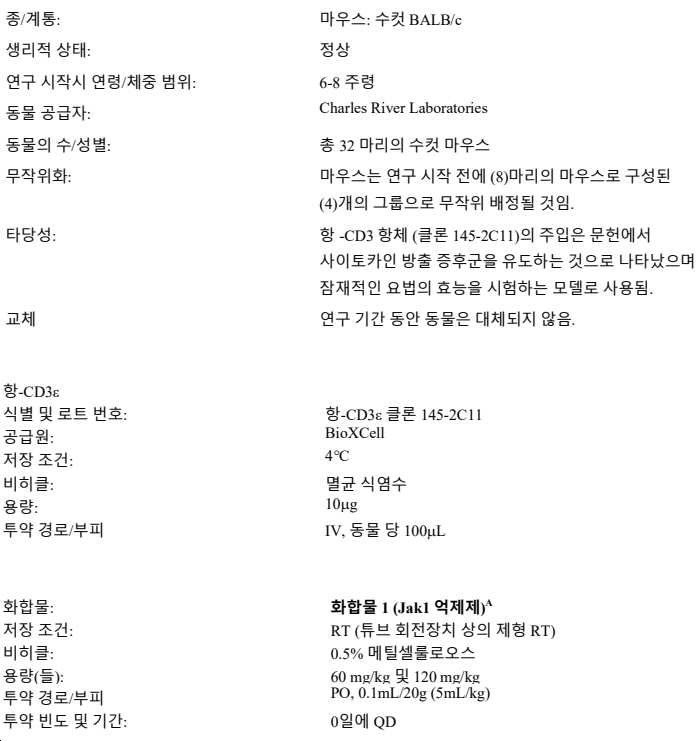
A 표 1의 화합물 1 또는 {1-{1-[3-플루오로-2-(트리플루오로메틸)이소니코티노일]피페리딘-4-일}-3[4-(7H-피롤로[2,3-d]피리미딘-4-일)-1H-피라졸-1-일]아제티딘-3-일}아세토니트릴 및 이들의 아디핀산염의 합성 및 제조는 예를 들어, 각각 그 전문이 본원에 참고로 포함된 2011년 3월 9일 출원된 미국 특허 공개 번호 2011/0224190, 2012년 9월 6일 출원된 미국 특허 공개 번호 2013/0060026, 및 2014 년 3 월 5 일 출원된 미국 특허 공개 번호 2014/0256941에서 찾을 수 있다. A Compound 1 of Table 1 or {1-{1-[3-fluoro-2-(trifluoromethyl)isonicotinoyl]piperidin-4-yl}-3[4-(7H-pyrrolo Synthesis and preparation of [2,3-d]pyrimidin-4-yl)-1H-pyrazol-1-yl]azetidin-3-yl}acetonitrile and their adipic acid salts, respectively, United States Patent Publication No. 2011/0224190 filed March 9, 2011, filed September 6, 2012, and United States Patent Publication No. 2013/0060026 filed September 6, 2012, and the United States filed March 5, 2014 It can be found in Patent Publication No. 2014/0256941.
B. 실험 설계B. Experimental design
이 연구의 주요 목적은 BALB/c 마우스에서 항-CD3 항체-유도된 사이토카인 방출 증후군 (CRS)을 감소 또는 개선시키는 JAK1 경로 억제제 (예를 들어, 화합물 1)의 능력을 시험하기 위한 것이었다. 총 서른두 (32) 마리의 BALB/c 마우스를 이 하루 연구에 사용하였다. 동물을 시험 물품 투여 전에 칭량하고, 실험 기간 동안 모니터링하였다. 0일에, 항-CD3 항체 투여 1시간 전, 비히클 (0.5% 메틸셀룰로오스) 또는 화합물 1을 표 1A에 상세히 설명된 바와 같이 그룹 2-4의 동물에 대해 경구 위관 영양법 (PO)을 통해 단일 용량으로 제공하였다. 그룹 1은 나이브 대조군으로 역할을 하며 처리되지 않았다. 비히클 또는 화합물 1로의 1시간 전처리 후, 그룹 2-4의 동물에 CRS를 유도하기 위해 정맥 주사 (IV)를 통해 10 ug의 항-CD3ε 항체 (클론 145-2C11)를 투여하였다. 항-CD3 투여 1.5 시간 후 모든 동물을 CO2 흡입을 통해 안락사시켰다. 전혈을 심장 천자를 통해 K2EDTA 튜브로 수집하고 혈장 처리가 발생할 때까지 얼음 상에 저장하였다. 혈장을 수집하고 사이토카인 멀티플렉스를 수행할 때까지 -80 ℃에 저장하였다. The main objective of this study was to test the ability of JAK1 pathway inhibitors (eg Compound 1) to reduce or ameliorate anti-CD3 antibody-induced cytokine release syndrome (CRS) in BALB/c mice. A total of thirty-two (32) BALB/c mice were used in this day study. Animals were weighed prior to administration of the test article and monitored for the duration of the experiment. On
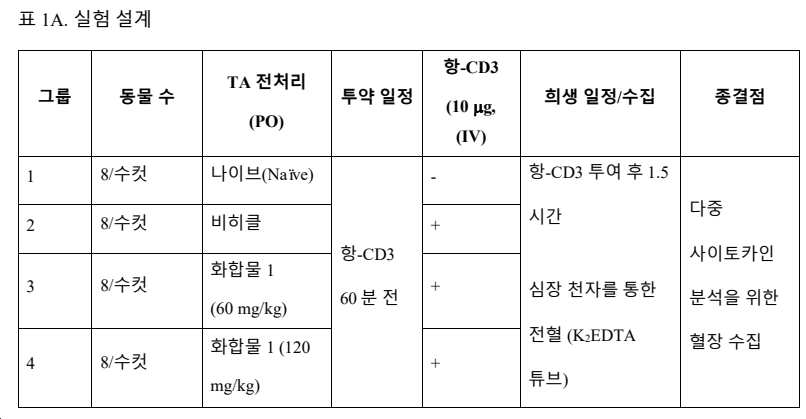
C. 실험 절차C. Experimental procedure
I. 시험 물품 전처리I. Test article pretreatment
0일에, 표 1A에 나타낸 바와 같이 비히클 또는 시험 물품 또는 화합물 1을 동물에 투약하였다. 그룹 2는 0.1 mL/20g으로 PO를 통해 단일 용량의 비히클 (0.5% 메틸셀룰로오스)을 받았다. 그룹 3은 0.1 mL/20g으로 PO를 통해 단일 용량의 60 mg/kg 화합물 1을 받았다. 그룹 4는 0.1 mL/20g으로 PO를 통해 단일 용량의 120 mg/kg 화합물 1을 받았다. 그룹 1은 나이브 대조군으로 역할을 하며 처리되지 않았다. On
II. 항-CD3ε 항체 투여II. Anti-CD3ε antibody administration
시험 물품 투여 한 (1) 시간 후, 그룹 2-4에 IV 주사를 통해 항-CD3ε 항체 (클론 145-2C11)를 투여하였다. 그룹 2-4의 각 동물은 0.1 mL 중 10 μg의 항-CD3ε 항체를 받았다.(1) hours after administration of the test article, anti-CD3ε antibody (clone 145-2C11) was administered to groups 2-4 via IV injection. Each animal in groups 2-4 received 10 μg of anti-CD3ε antibody in 0.1 mL.
III. 생전 모니터링III. Life monitoring
항-CD3 항체의 투여 후, 전신성 염증 반응으로 인한 고통의 징후에 대해 동물을 면밀하게 모니터링하였다. 스스로 지탱할 수 없고, 만지기에 차갑거나, 빈사상태인 동물을 안락사시켰다. 빈사상태의 동물을 CO2 흡입으로 안락사시키고, 전혈을 심장 천자를 통해 수집하고 혈장을 보유하였다. Following administration of the anti-CD3 antibody, animals were closely monitored for signs of distress due to systemic inflammatory reactions. Animals that could not support themselves, were cold to the touch, or were moribund were euthanized. Moribund animals were euthanized by CO 2 inhalation, whole blood was collected via cardiac puncture and plasma was retained.
IV. 희생IV. sacrifice
항-CD3 항체 투여 한 시간 반 (1.5) 후 모든 동물을 CO2 흡입으로 안락사시켰다.An hour and a half (1.5) after anti-CD3 antibody administration, all animals were euthanized by CO 2 inhalation.
V. 샘플 수집V. Sample collection
희생 시, 전혈을 각 동물로부터 심장 천자를 통해 K2EDTA 튜브로 수집하였다. 혈액을 원심분리하고 혈장을 저온유리병에 수집하였다. 혈장을 동결하고 다운스트림 사이토카인 멀티플렉스 분석을 위해 -80℃에서 저장하였다. At sacrifice, whole blood was collected from each animal through cardiac puncture into K 2 EDTA tubes. The blood was centrifuged and plasma was collected in a cryogenic glass bottle. Plasma was frozen and stored at -80°C for downstream cytokine multiplex analysis.
VI. 사이토카인 멀티플렉스 분석VI. Cytokine multiplex analysis
혈장 샘플을 얼음 상에서 해동하고 제조자 프로토콜 (ThermoFisher)에 따라 사이토카인 멀티플렉스에 사용하였다. Plasma samples were thawed on ice and used for cytokine multiplex according to the manufacturer's protocol (ThermoFisher).
D. 결과D. Results
화합물 1은 혈액 구획 내에서 IL-6 농도를 용량 의존적으로 억제하였다 (도 1). 이는 실시예 C에서 하기에 기술된 Con A 전임상 모델에서 관찰된 생물학적 활성의 확인으로 역할을 한다. 시닥(Sidak)의 다중 검사 비교를 포함하는 비쌍 일원 분산 분석 (ANOVA)을 그래프패드 프리즘 (버전 4.00; GraphPad Software, San Diego California, USA)을 사용하여 수행하였다. p < 0.05의 값은 유의한 것으로 간주되었다.Compound 1 dose-dependently inhibited IL-6 concentration in the blood compartment (Fig. 1). This serves as a confirmation of the biological activity observed in the Con A preclinical model described below in Example C. A non-paired one-way analysis of variance (ANOVA), including Sidak's multiple test comparisons, was performed using GraphPad Prism (version 4.00; GraphPad Software, San Diego California, USA). Values of p <0.05 were considered significant.
실시예 C: 콘카나발린 A 유도 사이토카인 방출 증후군Example C: Concanavalin A induced cytokine release syndrome
콘카나발린 A (Con A)는 광범위 염증성 사이토카인 방출 및 CD4 및 CD8 T-세포의 증식을 초래하는 선택적 T 림프구 미토겐이다. Con-A의 주입은 문헌에서 사이토카인 방출 증후군을 유도하는 것으로 나타났으며 사이토카인 방출 증후군 요법의 효능을 시험하기 위한 모델로서 사용된다 (Gantner, F. at al. Hepatology, 1995, 21, 190-198). 미토겐 반응은 T-세포 수용체의 발현에 의존적이다. 동물은 발열, 불쾌감, 저혈압, 저산소증, 모세 혈관 누출, 및 잠재적 다기관 독성과 같은 행동 변화를 나타낸다.Concanavalin A (Con A) is a selective T lymphocyte mitogen that results in extensive inflammatory cytokine release and proliferation of CD4 and CD8 T-cells. Infusion of Con-A has been shown to induce cytokine release syndrome in the literature and is used as a model to test the efficacy of cytokine release syndrome therapy (Gantner, F. at al. Hepatology , 1995 , 21, 190- 198). The mitogen response is dependent on the expression of the T-cell receptor. Animals exhibit behavioral changes such as fever, discomfort, hypotension, hypoxia, capillary leakage, and potential multi-organ toxicity.
A. 재료 및 방법A. Materials and Methods

B. 실험 설계B. Experimental design
특히, 이 연구는 BALB/c 마우스에서 Con A-유도된 사이토카인 방출 증후군 (CRS)을 감소 또는 개선하는 선택적 JAK1 억제제 (예를 들어, 화합물 1, 표 1)의 능력을 시험한다. 총 마흔 (40) 마리의 BALB/c 마우스를 이 하루 연구에 사용하였다. 동물을 시험 물품 투여 전에 칭량하고, 실험 기간 동안 모니터링하였다. 0일에, Con A 투여 육십 (60) 분 전에, 비히클 (0.5% 메틸셀룰로오스) 또는 화합물 1 (60 및 120 mg/kg)을 표 2A에 상세히 설명한 바와 같이 그룹 2-4의 동물에 경구 위관 영양법 (PO)을 통해 단일 용량으로 제공하였다. 그룹 1은 나이브 대조군으로 역할을 하며 처리되지 않았다. 비히클 또는 화합물 1로의 전처리 45분 후, 그룹 2-4의 동물에 CRS를 유도하기 위해 정맥 주사 (IV)를 통해 20 mg/kg의 Con A를 투여하였다. Con A 투여 2시간 후 모든 동물을 CO- 2 흡입을 통해 안락사시켰다. 전혈을 심장 천자를 통해 K2EDTA 튜브로 수집하고 혈장 처리가 발생할 때까지 얼음 상에 저장하였다. 혈장을 수집하고 사이토카인 멀티플렉스를 수행할 때까지 -80℃에서 저장하였다. In particular, this study tests the ability of a selective JAK1 inhibitor (eg Compound 1, Table 1) to reduce or ameliorate Con A-induced cytokine release syndrome (CRS) in BALB/c mice. A total of forty (40) BALB/c mice were used in this day study. Animals were weighed prior to administration of the test article and monitored for the duration of the experiment. On

C. 실험 절차C. Experimental procedure
-1일-1 day
동물을 칭량하고 Con-A 용량 (20 mg/kg)을 계산하였다.Animals were weighed and the Con-A dose (20 mg/kg) calculated.
비히클 및 화합물 1을 상응하는 용량으로 제조하였다. Vehicle and compound 1 were prepared in corresponding doses.
0일0 days
I. 시험 물품 전처리I. Test article pretreatment
0일에, 동물을 표 2A에서와 같이, 비히클 또는 화합물 1로 투약하였다. 그룹 1은 나이브 대조군으로 역할을 하고 처리되지 않았다. 그룹 2는 0.1 mL/20g으로 PO를 통해 단일 용량의 비히클 (0.5% 메틸셀룰로오스)을 받았다. 그룹 3은 0.1 mL/20g으로 PO를 통해 단일 용량의 60 mg/kg 화합물 1을 받았다. 그룹 4는 0.1 mL/20g으로 PO를 통해 단일 용량의 120 mg/kg 화합물 1을 받았다.On
II. Con-A 투여 II. Con-A administration
시험 물품 투여 육십 (60) 분 후, 그룹 2-4에 대해 IV 주사를 통해 Con-A를 투여하였다. 그룹 2-4의 각 동물은 0.2 mL 중 20 mg/kg의 Con-A를 받았다.Sixty (60) minutes after administration of the test article, Con-A was administered via IV injection for groups 2-4. Each animal in groups 2-4 received 20 mg/kg of Con-A in 0.2 mL.
III. 생전 모니터링III. Life monitoring
Con-A의 투여 후, 동물을 전신성 염증 반응으로 인한 고통의 징후를 면밀히 모니터링하였다. After administration of Con-A, animals were closely monitored for signs of pain due to systemic inflammatory reactions.
IV. 희생IV. sacrifice
Con-A 투여 2시간 후 모든 동물을 CO2 흡입에 의해 안락사시켰다.Two hours after Con-A administration, all animals were euthanized by CO 2 inhalation.
V. 샘플 수집V. Sample collection
희생 시, 전혈을 각 동물로부터 심장 천자를 통해 K2EDTA 튜브로 수집하였다. 혈액을 원심분리하고 혈장을 저온유리병에 수집하였다. 혈장을 동결하고 다운스트림 사이토카인 멀티플렉스 분석을 위해 -80℃에서 저장하였다. At sacrifice, whole blood was collected from each animal through cardiac puncture into K 2 EDTA tubes. The blood was centrifuged and plasma was collected in a cryogenic glass bottle. Plasma was frozen and stored at -80°C for downstream cytokine multiplex analysis.
VI. 사이토카인 멀티플렉스 분석VI. Cytokine multiplex analysis
혈장 샘플을 얼음 상에서 해동하고 제조자 프로토콜 (ThermoFisher)에 따라 사이토카인 멀티플렉스를 위해 사용하였다. Plasma samples were thawed on ice and used for cytokine multiplex according to the manufacturer's protocol (ThermoFisher).
D. 결과D. Results
화합물 1은 혈액 구획 내에서 용량 의존적으로 IL-6 농도를 억제하였다 (도 2a). 이러한 사이토카인이 CRS 병태생리학의 핵심 매개체이다. T-세포 유래 IFNγ 및 GM-CSF 사이토카인이 또한 유의하게 억제됨은 화합물 1이 토실리주맙의 제한된 작용 기전 이상의 치료 잠재력을 가짐을 시사한다 (항-IL-6R 단독) (도 2b 및 2c).Compound 1 dose-dependently inhibited IL-6 concentration in the blood compartment (FIG. 2A ). These cytokines are key mediators of CRS pathophysiology. Significant inhibition of T-cell derived IFNγ and GM-CSF cytokines also suggests that Compound 1 has therapeutic potential beyond the limited mechanism of action of tocilizumab (anti-IL-6R alone) (FIGS. 2B and 2C ).
단핵구 및/또는 대식세포 유래 사이토카인이 또한 감소되었다. IL-1β (도 3b) 및 IL-18 (도 3c)을 사용한 치료 효과에 대한 경향뿐만 아니라 통계적으로 유의한 용량 의존적 IL-12 감소 (도 3a)가 관찰됨은 JAK1 특이적 억제가 CRS 병리학에서 면역 세포 유형에 걸쳐 치료 잠재력을 가짐을 시사한다. Cytokines derived from monocytes and/or macrophages were also reduced. A statistically significant dose-dependent decrease in IL-12 (Fig. 3A) as well as a trend toward treatment effects with IL-1β (Fig. 3b) and IL-18 (Fig. 3c) is observed, indicating that JAK1-specific inhibition is immune to CRS pathology. It suggests that it has therapeutic potential across cell types.
중요하게, 사이토카인 IL-5 (도 4)는 화합물 1 치료에 의해 영향을 받지 않았고, JAK1 독립적이고 CRS 병리와 관련이 없다. 이러한 데이터는 화합물 1 기반 효능이 광범위한, 비특이적, 면역 억제를 통해 매개되지 않음을 시사한다. Importantly, the cytokine IL-5 (FIG. 4) was not affected by Compound 1 treatment, is JAK1 independent and not associated with CRS pathology. These data suggest that Compound 1 based efficacy is not mediated through broad, nonspecific, immune suppression.
시닥의 다중 검사 비교를 포함하는 비쌍 일원 분산 분석 (ANOVA)을 그래프패드 프리즘 (버전 4.00; GraphPad Software, San Diego California, USA)을 사용하여 수행하였다. p < 0.05의 값은 유의한 것으로 간주되었다.A non-paired one-way analysis of variance (ANOVA) including Sidaq's multiple test comparisons was performed using GraphPad Prism (version 4.00; GraphPad Software, San Diego California, USA). Values of p <0.05 were considered significant.
실시예 D: 화합물 1의 서방형 제제의 제조Example D: Preparation of a sustained-release formulation of compound 1
화합물 1을 포함하는 서방형 정제를 하기 표에 나타낸 양인 부형제를 사용하여 제조하였다. 프로토콜 A는 SR1 정제에 대해 사용하였고, 프로토콜 B는 SR2 정제에 대해 사용하였고, 프로토콜 C는 SR3 정제 및 25 mg SR 정제에 대해 사용하였고, 프로토콜 D는 SR4 정제에 대해 사용하였다. 이들 절차는 미국 특허 공개 번호 2015/0065484에 개시되었고, 이는 화합물 1의 서방형 제형에 관한 것이다.Sustained-release tablets containing Compound 1 were prepared using the amount of excipient shown in the following table. Protocol A was used for SR1 tablets, Protocol B was used for SR2 tablets, Protocol C was used for SR3 tablets and 25 mg SR tablets, and Protocol D was used for SR4 tablets. These procedures are disclosed in US Patent Publication No. 2015/0065484, which relates to a sustained release formulation of Compound 1.
프로토콜 A:Protocol A:
단계 1. 화합물 1의 아디핀산염, 미결정 셀룰로오스, 히프로멜로스 (메토셀 K100 LV 및 메토셀 K4M), 및 락토오스 일수화물을 개별적으로 선별한다.Step 1. The adipic acid salt of compound 1, microcrystalline cellulose, hypromellose (Methocel K100 LV and Methocel K4M), and lactose monohydrate are individually selected.
단계 2. 단계 1에서 선별된 재료를 적절한 혼합기로 옮기고 혼합한다.Step 2. Transfer the ingredients selected in Step 1 to an appropriate mixer and mix.
단계 3. 단계 2의 혼합물을 적합한 과립기로 옮기고 혼합한다.Step 3. Transfer the mixture from Step 2 to a suitable granulator and mix.
단계 4. 혼합하면서 정제수를 추가한다.Step 4. While mixing, add purified water.
단계 5.
단계 4의 과립을 적합한 건조기로 옮기고 LOD가 3% 미만이 될 때까지 건조한다.
단계 6.
단계 5의 과립을 선별한다.
단계 7.
단계 6의 과립을 선별된 마그네슘 스테아레이트와 적합한 혼합기에서 혼합한다.Step 7.
The granules of
단계 8.
단계 7의 최종 혼합물을 적합한 회전식 정제 프레스에서 압축한다.
프로토콜 B:Protocol B:
단계 1. 화합물 1의 아디핀산염, 미결정 셀룰로오스, 히프로멜로오스 및 호화 전분을 개별적으로 선별한다. Step 1. The adipic acid salt of compound 1, microcrystalline cellulose, hypromellose and gelatinized starch are individually selected.
단계 2. 단계 1에서 선별된 재료를 적절한 혼합기로 옮기고 혼합한다.Step 2. Transfer the ingredients selected in Step 1 to an appropriate mixer and mix.
단계 3. 단계 2의 혼합물을 적합한 과립기로 옮기고 혼합한다.Step 3. Transfer the mixture from Step 2 to a suitable granulator and mix.
단계 4. 혼합하면서 정제수를 추가한다.Step 4. While mixing, add purified water.
단계 5.
단계 4의 과립을 적합한 건조기로 옮기고 LOD가 3% 미만이 될 때까지 건조한다.
단계 6.
단계 5의 과립을 선별한다.
단계 7. 폴리옥스, 부틸화 히드록시톨루엔 및 콜로이드성 이산화규소를 개별적으로 선별한다. Step 7. Polyox, butylated hydroxytoluene and colloidal silicon dioxide are individually screened.
단계 8.
단계 6의 과립과 단계 7의 재료를 적절한 혼합기로 옮기고 혼합한다.
단계 9.
선별된 마그네슘 스테아레이트를 단계 8의 재료에 첨가하고 혼합을 계속한다.Step 9.
The selected magnesium stearate is added to the ingredients in
단계 10.
단계 9의 최종 혼합물을 적합한 회전식 정제 프레스에서 압축한다.
프로토콜 C:Protocol C:
단계 1. 락토오스 일수화물, 화합물 1의 아디핀산염, 미결정 셀룰로오스 및 히프로멜로스를 적합한 스크린을 통해 개별적으로 선별한다.Step 1. Lactose monohydrate, adipic acid salt of compound 1, microcrystalline cellulose and hypromellose are individually screened through a suitable screen.
단계 2. 단계 1에서 선별된 재료를 적절한 혼합기로 옮기고 혼합한다.Step 2. Transfer the ingredients selected in Step 1 to an appropriate mixer and mix.
단계 3. 단계 2의 혼합물을 적합한 과립기로 옮기고 혼합한다.Step 3. Transfer the mixture from Step 2 to a suitable granulator and mix.
단계 4. 혼합하면서 정제수를 추가한다.Step 4. While mixing, add purified water.
단계 5.
적합한 스크린을 통해 습식 과립을 선별한다.
단계 6.
단계 5의 과립을 적합한 건조기로 옮기고 LOD가 3% 미만이 될 때까지 건조한다.
단계 7.
단계 6의 과립을 밀링한다.Step 7.
Mill the granules from
단계 8.
선별된 마그네슘 스테아레이트를 적합한 혼합기에서 단계 7의 과립과 혼합한다.
단계 9.
단계 8의 최종 혼합물을 적합한 회전식 정제 프레스에서 압축한다.Step 9.
The final mixture from
프로토콜 D:Protocol D:
단계 1. 호화 전분, 화합물 1의 아디핀산염, 히프로멜로오스, 및 일부의 필요한 미결정 셀룰로오스를 적합한 스크린을 통해 개별적으로 선별한다.Step 1. The gelatinized starch, the adipic acid salt of compound 1, hypromellose, and some of the required microcrystalline cellulose are individually screened through a suitable screen.
단계 2. 단계 1에서 선별된 재료를 적절한 혼합기로 옮기고 혼합한다.Step 2. Transfer the ingredients selected in Step 1 to an appropriate mixer and mix.
단계 3. 단계 2의 혼합물을 적합한 과립기로 옮기고 혼합한다.Step 3. Transfer the mixture from Step 2 to a suitable granulator and mix.
단계 4. 혼합하면서 정제수를 추가한다.Step 4. While mixing, add purified water.
단계 5.
적합한 스크린을 통해 습식 과립을 선별한다.
단계 6.
단계 5의 과립을 적합한 건조기로 옮기고 LOD가 3% 미만이 될 때까지 건조한다.
단계 7.
단계 6의 과립을 밀링한다.Step 7.
Mill the granules from
단계 8.
미결정 셀룰로오스의 나머지 부분 및 중탄산 나트륨의 절반을 선별한다.
단계 9.
단계 7의 밀링된 과립 및 단계 8의 선별된 재료를 적절한 혼합기로 옮기고 혼합한다.Step 9.
Transfer the milled granules from step 7 and the selected material from
단계 10.
중탄산 나트륨의 나머지 부분을 선별하고 단계 9의 혼합물과 혼합한다.
단계 11.
마그네슘 스테아레이트를 선별하고 단계 10의 혼합물과 혼합한다.Step 11.
Select the magnesium stearate and mix with the mixture from
단계 12.
단계 11의 최종 혼합물을 적합한 회전식 정제 프레스에서 압축한다.
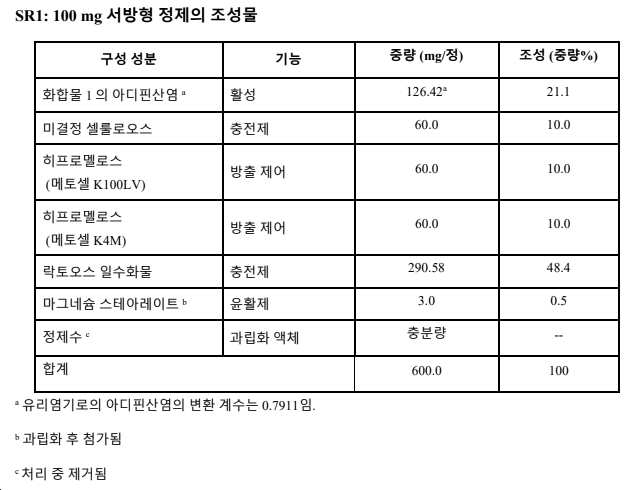


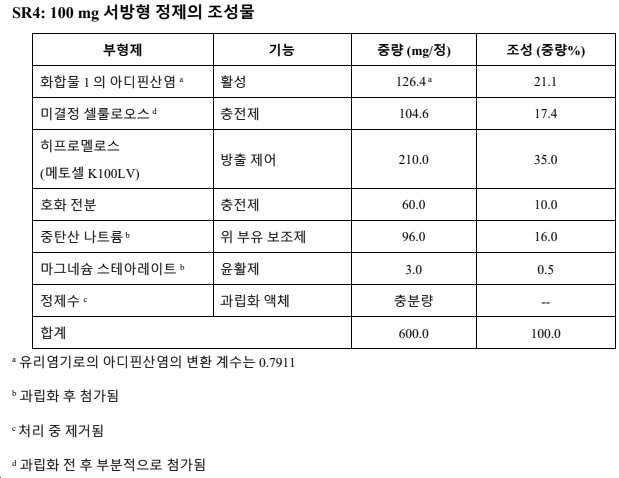

본 명세서에 기술된 것들에 더하여, 본 발명의 다양한 변형은 전술한 설명으로부터 당업자에게 명백할 것이다. 이러한 변형은 또한 첨부된 청구항의 범위 내에 속하도록 의도된다. 본 출원에 인용된, 모든 특허, 특허 출원, 및 간행물을 포함하는 각 참고 문헌은 그 전문이 본원에 참고로 포함된다.In addition to those described herein, various modifications of the invention will be apparent to those skilled in the art from the foregoing description. Such variations are also intended to fall within the scope of the appended claims. Each reference cited in this application, including all patents, patent applications, and publications, is incorporated herein by reference in its entirety.
Claims (18)
Priority Applications (2)
| Application Number | Priority Date | Filing Date | Title |
|---|---|---|---|
| KR1020247035396A KR102925957B1 (en) | 2018-02-16 | 2019-02-14 | Jak1 pathway inhibitors for the treatment of cytokine-related disorders |
| KR1020247035403A KR20240158365A (en) | 2018-02-16 | 2019-02-14 | Jak1 pathway inhibitors for the treatment of cytokine-related disorders |
Applications Claiming Priority (5)
| Application Number | Priority Date | Filing Date | Title |
|---|---|---|---|
| US201862710446P | 2018-02-16 | 2018-02-16 | |
| US62/710,446 | 2018-02-16 | ||
| US201862631825P | 2018-02-18 | 2018-02-18 | |
| US62/631,825 | 2018-02-18 | ||
| PCT/US2019/018066 WO2019161098A1 (en) | 2018-02-16 | 2019-02-14 | Jak1 pathway inhibitors for the treatment of cytokine-related disorders |
Related Child Applications (2)
| Application Number | Title | Priority Date | Filing Date |
|---|---|---|---|
| KR1020247035396A Division KR102925957B1 (en) | 2018-02-16 | 2019-02-14 | Jak1 pathway inhibitors for the treatment of cytokine-related disorders |
| KR1020247035403A Division KR20240158365A (en) | 2018-02-16 | 2019-02-14 | Jak1 pathway inhibitors for the treatment of cytokine-related disorders |
Publications (2)
| Publication Number | Publication Date |
|---|---|
| KR20200128043A true KR20200128043A (en) | 2020-11-11 |
| KR102830476B1 KR102830476B1 (en) | 2025-07-08 |
Family
ID=65529906
Family Applications (2)
| Application Number | Title | Priority Date | Filing Date |
|---|---|---|---|
| KR1020207026669A Active KR102830476B1 (en) | 2018-02-16 | 2019-02-14 | JAK1 pathway inhibitors for the treatment of cytokine-related disorders |
| KR1020247035403A Ceased KR20240158365A (en) | 2018-02-16 | 2019-02-14 | Jak1 pathway inhibitors for the treatment of cytokine-related disorders |
Family Applications After (1)
| Application Number | Title | Priority Date | Filing Date |
|---|---|---|---|
| KR1020247035403A Ceased KR20240158365A (en) | 2018-02-16 | 2019-02-14 | Jak1 pathway inhibitors for the treatment of cytokine-related disorders |
Country Status (20)
| Country | Link |
|---|---|
| US (4) | US11103510B2 (en) |
| EP (1) | EP3752146A1 (en) |
| JP (2) | JP7736431B2 (en) |
| KR (2) | KR102830476B1 (en) |
| CN (4) | CN111936135A (en) |
| AU (2) | AU2019221667B2 (en) |
| BR (3) | BR122023022189A2 (en) |
| CA (1) | CA3091339A1 (en) |
| CL (1) | CL2020002102A1 (en) |
| CO (1) | CO2020011388A2 (en) |
| EC (1) | ECSP20057643A (en) |
| IL (3) | IL276725B2 (en) |
| MA (1) | MA51829A (en) |
| MX (2) | MX2020008521A (en) |
| PE (1) | PE20212186A1 (en) |
| PH (1) | PH12020551251A1 (en) |
| SG (1) | SG11202007805SA (en) |
| TW (1) | TWI799513B (en) |
| UA (1) | UA127519C2 (en) |
| WO (1) | WO2019161098A1 (en) |
Families Citing this family (17)
| Publication number | Priority date | Publication date | Assignee | Title |
|---|---|---|---|---|
| CA2888816A1 (en) | 2012-11-01 | 2014-05-08 | Incyte Corporation | Tricyclic fused thiophene derivatives as jak inhibitors |
| PL3786162T3 (en) | 2013-05-17 | 2024-04-08 | Incyte Holdings Corporation | Bipyrazole derivatives as jak inhibitors |
| BR122023022189A2 (en) | 2018-02-16 | 2024-02-20 | Incyte Corporation | USES OF JAK1 PATHWAY INHIBITORS FOR THE TREATMENT OF CYTOKINE-RELATED DISORDERS |
| JP7565798B2 (en) | 2018-03-30 | 2024-10-11 | インサイト・コーポレイション | Biomarkers for Inflammatory Skin Disease |
| CA3097025A1 (en) | 2018-04-13 | 2019-10-17 | Incyte Corporation | Biomarkers for graft-versus-host disease |
| EP3873433A1 (en) | 2018-10-31 | 2021-09-08 | Incyte Corporation | Combination therapy for treatment of hematological diseases |
| MA55201A (en) | 2019-03-05 | 2022-01-12 | Incyte Corp | JAK1 PATHWAY INHIBITORS FOR THE TREATMENT OF CHRONIC LUNG ALLOGraft DYSFUNCTION |
| JP7682155B2 (en) * | 2019-08-08 | 2025-05-23 | ライジェル ファーマシューティカルズ, インコーポレイテッド | Compounds and methods for treating cytokine release syndrome - Patents.com |
| JP2022551649A (en) | 2019-10-10 | 2022-12-12 | インサイト・コーポレイション | Biomarkers for graft-versus-host disease |
| US12360120B2 (en) | 2019-10-10 | 2025-07-15 | Incyte Corporation | Biomarkers for graft-versus-host disease |
| US11992490B2 (en) | 2019-10-16 | 2024-05-28 | Incyte Corporation | Use of JAK1 inhibitors for the treatment of cutaneous lupus erythematosus and Lichen planus (LP) |
| JP2022090856A (en) * | 2020-12-08 | 2022-06-20 | ソニーセミコンダクタソリューションズ株式会社 | Ranging device and ranging method, and program |
| IL303238A (en) * | 2020-12-08 | 2023-07-01 | Incyte Corp | Jak1 pathway inhibitors for the treatment of vitiligo |
| TW202308610A (en) * | 2021-05-03 | 2023-03-01 | 美商英塞特公司 | Jak1 pathway inhibitors for the treatment of prurigo nodularis |
| CN117858709A (en) * | 2022-08-08 | 2024-04-09 | 石药集团中奇制药技术(石家庄)有限公司 | Use of tricyclic heteroaryl-containing compounds |
| CN120053657B (en) * | 2025-02-28 | 2025-09-09 | 东莞市第八人民医院(东莞市儿童医院) | Drugs and pharmaceutical compositions for treating APLAID |
| CN121227629A (en) * | 2025-12-01 | 2025-12-30 | 暨南大学 | Regulated γδT cells and their interventional regulation methods and applications |
Citations (1)
| Publication number | Priority date | Publication date | Assignee | Title |
|---|---|---|---|---|
| US20110224190A1 (en) * | 2010-03-10 | 2011-09-15 | Taisheng Huang | Piperidin-4-yl azetidine derivatives as jak1 inhibitors |
Family Cites Families (75)
| Publication number | Priority date | Publication date | Assignee | Title |
|---|---|---|---|---|
| US5521184A (en) | 1992-04-03 | 1996-05-28 | Ciba-Geigy Corporation | Pyrimidine derivatives and processes for the preparation thereof |
| ES2342240T3 (en) | 1998-08-11 | 2010-07-02 | Novartis Ag | ISOQUINOLINE DERIVATIVES WITH ACTIVITY INHIBITED BY ANGIOGENIA. |
| US6133031A (en) | 1999-08-19 | 2000-10-17 | Isis Pharmaceuticals Inc. | Antisense inhibition of focal adhesion kinase expression |
| GB9905075D0 (en) | 1999-03-06 | 1999-04-28 | Zeneca Ltd | Chemical compounds |
| GB0004890D0 (en) | 2000-03-01 | 2000-04-19 | Astrazeneca Uk Ltd | Chemical compounds |
| KR100786927B1 (en) | 2000-06-28 | 2007-12-17 | 스미스클라인비이참피이엘시이 | Wet Grinding Method |
| HUP0401982A3 (en) | 2001-09-19 | 2012-09-28 | Aventis Pharma Sa | Indolizine derivates, process for their preparation and pharmaceutical compositions containing the compounds |
| HU230798B1 (en) | 2001-10-30 | 2018-06-28 | Novartis Ag | Staurosporine derivatives as inhibitors of flt3 receptor tyrosine kinase activity |
| PE20040522A1 (en) | 2002-05-29 | 2004-09-28 | Novartis Ag | DIARYLUREA DERIVATIVES DEPENDENT ON PROTEIN KINASE |
| GB0215676D0 (en) | 2002-07-05 | 2002-08-14 | Novartis Ag | Organic compounds |
| TWI335913B (en) | 2002-11-15 | 2011-01-11 | Vertex Pharma | Diaminotriazoles useful as inhibitors of protein kinases |
| UA80767C2 (en) | 2002-12-20 | 2007-10-25 | Pfizer Prod Inc | Pyrimidine derivatives for the treatment of abnormal cell growth |
| GB0305929D0 (en) | 2003-03-14 | 2003-04-23 | Novartis Ag | Organic compounds |
| AR045944A1 (en) | 2003-09-24 | 2005-11-16 | Novartis Ag | ISOQUINOLINE DERIVATIVES 1.4-DISPOSED |
| WO2005105814A1 (en) | 2004-04-28 | 2005-11-10 | Incyte Corporation | Tetracyclic inhibitors of janus kinases |
| MX2007006204A (en) | 2004-11-24 | 2007-06-20 | Novartis Ag | Combinations of jak inhibitors and at least one of bcr-abl, flt-3, fak or raf kinase inhibitors. |
| AR054416A1 (en) | 2004-12-22 | 2007-06-27 | Incyte Corp | PIRROLO [2,3-B] PIRIDIN-4-IL-AMINAS AND PIRROLO [2,3-B] PIRIMIDIN-4-IL-AMINAS AS INHIBITORS OF THE JANUS KINASES. PHARMACEUTICAL COMPOSITIONS. |
| EP1926735A1 (en) | 2005-09-22 | 2008-06-04 | Incyte Corporation | Tetracyclic inhibitors of janus kinases |
| EP2343298B9 (en) | 2005-12-13 | 2020-05-06 | Incyte Holdings Corporation | Heteroaryl substituted pyrrolo[2,3-b]pyridines and pyrrolo[2,3-b]pyrimidines as Janus kinase inhibitors |
| JP5492565B2 (en) | 2006-12-22 | 2014-05-14 | インサイト・コーポレイション | Substituted heterocycles as JANUS kinase inhibitors |
| CL2008001709A1 (en) | 2007-06-13 | 2008-11-03 | Incyte Corp | Compounds derived from pyrrolo [2,3-b] pyrimidine, jak kinase modulators; pharmaceutical composition; and use in the treatment of diseases such as cancer, psoriasis, rheumatoid arthritis, among others. |
| RS53245B2 (en) | 2007-06-13 | 2022-10-31 | Incyte Holdings Corp | JANUS KINASE INHIBITOR SALTS (R)-3-(4-(7H-PYROLO(2,3-D) PYRIMIDIN-4-YL)-1H-PYRAZOL-1-YL)-3-CYCLOPENTYLPROPANE-NITRILE |
| US8309718B2 (en) | 2007-11-16 | 2012-11-13 | Incyte Corporation | 4-pyrazolyl-N-arylpyrimidin-2-amines and 4-pyrazolyl-N-heteroarylpyrimidin-2-amines as janus kinase inhibitors |
| MY165582A (en) | 2008-03-11 | 2018-04-05 | Incyte Holdings Corp | Azetidine and cyclobutane derivatives as jak inhibitors |
| CL2009001884A1 (en) | 2008-10-02 | 2010-05-14 | Incyte Holdings Corp | Use of 3-cyclopentyl-3- [4- (7h-pyrrolo [2,3-d] pyrimidin-4-yl) -1h-pyrazol-1-yl) propanonitrile, janus kinase inhibitor, and use of a composition that understands it for the treatment of dry eye. |
| JOP20190230A1 (en) | 2009-01-15 | 2017-06-16 | Incyte Corp | Methods for repairing JAK inhibitors and related intermediates |
| HRP20192203T1 (en) | 2009-05-22 | 2020-03-06 | Incyte Holdings Corporation | 3-[4-(7h-pyrrolo[2,3-d]pyrimidin-4-yl)-1h-pyrazol-1-yl]octane- or heptane-nitrile as jak inhibitors |
| WO2010135650A1 (en) | 2009-05-22 | 2010-11-25 | Incyte Corporation | N-(HETERO)ARYL-PYRROLIDINE DERIVATIVES OF PYRAZOL-4-YL-PYRROLO[2,3-d]PYRIMIDINES AND PYRROL-3-YL-PYRROLO[2,3-d]PYRIMIDINES AS JANUS KINASE INHIBITORS |
| TW201113285A (en) | 2009-09-01 | 2011-04-16 | Incyte Corp | Heterocyclic derivatives of pyrazol-4-yl-pyrrolo[2,3-d]pyrimidines as janus kinase inhibitors |
| BR112012008267B1 (en) | 2009-10-09 | 2022-10-04 | Incyte Holdings Corporation | 3-(4-(7H-PYROLO[2,3-D]PYRIMIDIN-4-IL)-1H-PYRAZOL-1-IL)-3-CYCLOPENTYLPROPANONITRILE 3-(4-(7H-PYROXYL, KETO, AND GLUCURONIDE) DERIVATIVES |
| JP5858434B2 (en) | 2010-02-18 | 2016-02-10 | インサイト・ホールディングス・コーポレイションIncyte Holdings Corporation | Cyclobutane and methylcyclobutane derivatives as Janus kinase inhibitors |
| CN102985424B (en) | 2010-04-14 | 2015-03-11 | 阵列生物制药公司 | 5, 7-substituted-imidazo [1, 2-c] pyrimidines as inhibitors of jak kinases |
| MY161078A (en) | 2010-05-21 | 2017-04-14 | Incyte Holdings Corp | Topical formulation for a jak inhibitor |
| JOP20190250A1 (en) | 2010-07-14 | 2017-06-16 | Regeneron Pharma | Stable formulas containing anti-NGF antibodies |
| WO2012068440A1 (en) | 2010-11-19 | 2012-05-24 | Incyte Corporation | Heterocyclic-substituted pyrrolopyridines and pyrrolopyrimidines as jak inhibitors |
| JP5917545B2 (en) | 2010-11-19 | 2016-05-18 | インサイト・ホールディングス・コーポレイションIncyte Holdings Corporation | Cyclobutyl substituted pyrrolopyridine and pyrrolopyrimidine derivatives as JAK inhibitors |
| ES2545110T3 (en) | 2010-12-10 | 2015-09-08 | Rottapharm Biotech S.R.L. | Pyridinamide derivatives as EP4 receptor antagonists |
| JP5936628B2 (en) | 2011-02-18 | 2016-06-22 | ノバルティス・ファルマ・アクチェンゲゼルシャフトNovartis Pharma AG | mTOR / JAK inhibitor combination therapy |
| SG192910A1 (en) | 2011-02-24 | 2013-09-30 | Massachusetts Inst Technology | ALTERNATIVELY SPLICED mRNA ISOFORMS AS PROGNOSTIC INDICATORS FOR METASTATIC CANCER |
| PE20140832A1 (en) | 2011-06-20 | 2014-07-14 | Incyte Corp | DERIVATIVES OF AZETIDINYL PHENYL, PYRIDYL OR PYRAZINYL CARBOXAMIDE AS JAK INHIBITORS |
| EP2741747A1 (en) | 2011-08-10 | 2014-06-18 | Novartis Pharma AG | JAK P13K/mTOR COMBINATION THERAPY |
| TW201313721A (en) | 2011-08-18 | 2013-04-01 | Incyte Corp | Cyclohexyl azetidine derivatives as JAK inhibitors |
| UA111854C2 (en) | 2011-09-07 | 2016-06-24 | Інсайт Холдінгс Корпорейшн | METHODS AND INTERMEDIATE COMPOUNDS FOR JAK INHIBITORS |
| US9394282B2 (en) | 2011-09-22 | 2016-07-19 | Merck Sharp & Dohme Corp. | Pyrazole carboxamides as Janus kinase inhibitors |
| US9193733B2 (en) | 2012-05-18 | 2015-11-24 | Incyte Holdings Corporation | Piperidinylcyclobutyl substituted pyrrolopyridine and pyrrolopyrimidine derivatives as JAK inhibitors |
| CA2888816A1 (en) | 2012-11-01 | 2014-05-08 | Incyte Corporation | Tricyclic fused thiophene derivatives as jak inhibitors |
| TWI702057B (en) | 2012-11-15 | 2020-08-21 | 美商英塞特控股公司 | Sustained-release dosage forms of ruxolitinib |
| ES2900492T3 (en) | 2013-03-06 | 2022-03-17 | Incyte Holdings Corp | Processes and intermediates to make a JAK inhibitor |
| PL3786162T3 (en) | 2013-05-17 | 2024-04-08 | Incyte Holdings Corporation | Bipyrazole derivatives as jak inhibitors |
| JO3603B1 (en) | 2013-05-17 | 2020-07-05 | Janssen Sciences Ireland Uc | Sulfamoyl pyrolamide derivatives and their use as medicines to treat hepatitis B |
| EP2803668A1 (en) | 2013-05-17 | 2014-11-19 | Boehringer Ingelheim International Gmbh | Novel (cyano-dimethyl-methyl)-isoxazoles and -[1,3,4]thiadiazoles |
| US9371282B2 (en) | 2013-05-17 | 2016-06-21 | Centrexion Therapeutics Corporation | Somatostatin receptor subtype 4 (SSTR4) agonists |
| JP6533217B2 (en) | 2013-05-17 | 2019-06-19 | エフ.ホフマン−ラ ロシュ アーゲーF. Hoffmann−La Roche Aktiengesellschaft | 6-Bridged Heteroaryldihydropyrimidines for the Treatment and Prevention of Hepatitis B Virus Infection |
| RS60469B1 (en) | 2013-08-07 | 2020-07-31 | Incyte Corp | Sustained release dosage forms for a jak1 inhibitor |
| WO2015026818A1 (en) | 2013-08-20 | 2015-02-26 | Incyte Corporation | Survival benefit in patients with solid tumors with elevated c-reactive protein levels |
| JP2016539927A (en) | 2013-10-24 | 2016-12-22 | アッヴィ・インコーポレイテッド | JAK1 selective inhibitors and uses thereof |
| LT3110409T (en) * | 2014-02-28 | 2019-01-25 | Incyte Corporation | Jak1 inhibitors for the treatment of myelodysplastic syndromes |
| MA39987A (en) | 2014-04-30 | 2017-03-08 | Incyte Corp | Processes of preparing a jak1 inhibitor and new forms thereto |
| US9498467B2 (en) | 2014-05-30 | 2016-11-22 | Incyte Corporation | Treatment of chronic neutrophilic leukemia (CNL) and atypical chronic myeloid leukemia (aCML) by inhibitors of JAK1 |
| LT3233843T (en) | 2014-12-16 | 2019-12-10 | Novartis Ag | Isoxazole hydroxamic acid compounds as lpxc inhibitors |
| EP3384294B1 (en) | 2015-12-04 | 2021-10-13 | Juno Therapeutics, Inc. | Methods and compositions related to toxicity associated with cell therapy |
| BR112018069251A2 (en) * | 2016-03-22 | 2019-01-22 | Seattle Children's Hospital (dba Seattle Children's Research Institute) | early intervention methods to prevent or improve toxicity |
| CN110461315B (en) * | 2016-07-15 | 2025-05-02 | 诺华股份有限公司 | Treatment and prevention of cytokine release syndrome using chimeric antigen receptors in combination with kinase inhibitors |
| WO2019040706A1 (en) | 2017-08-24 | 2019-02-28 | Aclaris Therapeutics, Inc. | Compositions and methods for treatment of vitiligo |
| TW201924683A (en) | 2017-12-08 | 2019-07-01 | 美商英塞特公司 | Low dose combination therapy for treatment of myeloproliferative neoplasms |
| PT3746429T (en) | 2018-01-30 | 2022-06-20 | Incyte Corp | Processes for preparing (1 -(3-fluoro-2-(trifluoromethyl)isonicotinyl)piperidine-4-one) |
| BR122023022189A2 (en) | 2018-02-16 | 2024-02-20 | Incyte Corporation | USES OF JAK1 PATHWAY INHIBITORS FOR THE TREATMENT OF CYTOKINE-RELATED DISORDERS |
| JP7565798B2 (en) | 2018-03-30 | 2024-10-11 | インサイト・コーポレイション | Biomarkers for Inflammatory Skin Disease |
| EP4424328A3 (en) | 2018-03-30 | 2024-12-04 | Incyte Corporation | Treatment of hidradenitis suppurativa using jak inhibitors |
| CA3097025A1 (en) | 2018-04-13 | 2019-10-17 | Incyte Corporation | Biomarkers for graft-versus-host disease |
| JP2022526301A (en) | 2019-03-19 | 2022-05-24 | インサイト・コーポレイション | Biomarker of vitiligo vulgaris |
| HRP20241560T1 (en) | 2020-06-02 | 2025-01-17 | Incyte Corporation | METHODS FOR PRODUCING JAK1 INHIBITORS |
| PT4255442T (en) | 2020-12-04 | 2025-05-19 | Incyte Corp | Jak inhibitor with a vitamin d analog for treatment of skin diseases |
| IL303238A (en) | 2020-12-08 | 2023-07-01 | Incyte Corp | Jak1 pathway inhibitors for the treatment of vitiligo |
| TW202308610A (en) | 2021-05-03 | 2023-03-01 | 美商英塞特公司 | Jak1 pathway inhibitors for the treatment of prurigo nodularis |
-
2019
- 2019-02-14 BR BR122023022189-3A patent/BR122023022189A2/en unknown
- 2019-02-14 KR KR1020207026669A patent/KR102830476B1/en active Active
- 2019-02-14 SG SG11202007805SA patent/SG11202007805SA/en unknown
- 2019-02-14 CA CA3091339A patent/CA3091339A1/en active Pending
- 2019-02-14 MX MX2020008521A patent/MX2020008521A/en unknown
- 2019-02-14 BR BR122023022247-4A patent/BR122023022247A2/en unknown
- 2019-02-14 JP JP2020543559A patent/JP7736431B2/en active Active
- 2019-02-14 WO PCT/US2019/018066 patent/WO2019161098A1/en not_active Ceased
- 2019-02-14 BR BR112020016628-6A patent/BR112020016628A2/en unknown
- 2019-02-14 KR KR1020247035403A patent/KR20240158365A/en not_active Ceased
- 2019-02-14 CN CN201980024450.5A patent/CN111936135A/en active Pending
- 2019-02-14 CN CN202410646737.4A patent/CN118490690A/en active Pending
- 2019-02-14 CN CN202411298460.7A patent/CN119386019A/en active Pending
- 2019-02-14 PE PE2020001231A patent/PE20212186A1/en unknown
- 2019-02-14 IL IL276725A patent/IL276725B2/en unknown
- 2019-02-14 US US16/276,157 patent/US11103510B2/en active Active
- 2019-02-14 MA MA051829A patent/MA51829A/en unknown
- 2019-02-14 EP EP19707655.7A patent/EP3752146A1/en active Pending
- 2019-02-14 CN CN202410646741.0A patent/CN118557580A/en active Pending
- 2019-02-14 UA UAA202005910A patent/UA127519C2/en unknown
- 2019-02-14 AU AU2019221667A patent/AU2019221667B2/en active Active
- 2019-02-15 TW TW108105190A patent/TWI799513B/en active
-
2020
- 2020-08-14 MX MX2023003392A patent/MX2023003392A/en unknown
- 2020-08-14 CL CL2020002102A patent/CL2020002102A1/en unknown
- 2020-08-14 PH PH12020551251A patent/PH12020551251A1/en unknown
- 2020-09-15 CO CONC2020/0011388A patent/CO2020011388A2/en unknown
- 2020-09-15 EC ECSENADI202057643A patent/ECSP20057643A/en unknown
-
2021
- 2021-07-19 US US17/379,336 patent/US11833152B2/en active Active
-
2023
- 2023-10-23 US US18/382,939 patent/US12336998B2/en active Active
- 2023-11-01 JP JP2023187800A patent/JP2024023213A/en active Pending
-
2024
- 2024-03-14 IL IL311485A patent/IL311485B1/en unknown
- 2024-07-16 AU AU2024204891A patent/AU2024204891A1/en active Pending
-
2025
- 2025-05-19 US US19/211,766 patent/US20250367202A1/en active Pending
- 2025-12-11 IL IL325285A patent/IL325285A/en unknown
Patent Citations (2)
| Publication number | Priority date | Publication date | Assignee | Title |
|---|---|---|---|---|
| US20110224190A1 (en) * | 2010-03-10 | 2011-09-15 | Taisheng Huang | Piperidin-4-yl azetidine derivatives as jak1 inhibitors |
| WO2011112662A1 (en) * | 2010-03-10 | 2011-09-15 | Incyte Corporation | Piperidin-4-yl azetidine derivatives as jak1 inhibitors |
Also Published As
Similar Documents
| Publication | Publication Date | Title |
|---|---|---|
| KR102830476B1 (en) | JAK1 pathway inhibitors for the treatment of cytokine-related disorders | |
| US11596632B2 (en) | JAK1 pathway inhibitors for the treatment of gastrointestinal disease | |
| KR20210018203A (en) | Treatment of purulent sweating with JAK inhibitors | |
| UA119767C2 (en) | Treatment of b-cell malignancies by a combination jak and pi3k inhibitor | |
| JP2025087734A (en) | JAK1 pathway inhibitors for the treatment of chronic pulmonary allograft dysfunction - Patents.com | |
| JP2023506118A (en) | Use of JAK1 inhibitors for the treatment of cutaneous lupus erythematosus and lichen planus (LP) | |
| KR20230157307A (en) | Combination therapy involving JAK pathway inhibitors and ROCK inhibitors | |
| KR102925957B1 (en) | Jak1 pathway inhibitors for the treatment of cytokine-related disorders | |
| TWI910423B (en) | Jak1 pathway inhibitors for the treatment of cytokine-related disorders | |
| EA042956B1 (en) | JAK1 PATHWAY INHIBITORS FOR THE TREATMENT OF CYTOKINE RELATED DISORDERS | |
| CN117120055A (en) | Combination therapy comprising a JAK pathway inhibitor and a ROCK inhibitor | |
| EA050167B1 (en) | COMBINATION THERAPY CONTAINING A JAK PATHWAY INHIBITOR AND A ROCK INHIBITOR |
Legal Events
| Date | Code | Title | Description |
|---|---|---|---|
| PA0105 | International application |
St.27 status event code: A-0-1-A10-A15-nap-PA0105 |
|
| P11-X000 | Amendment of application requested |
St.27 status event code: A-2-2-P10-P11-nap-X000 |
|
| P13-X000 | Application amended |
St.27 status event code: A-2-2-P10-P13-nap-X000 |
|
| PG1501 | Laying open of application |
St.27 status event code: A-1-1-Q10-Q12-nap-PG1501 |
|
| E13-X000 | Pre-grant limitation requested |
St.27 status event code: A-2-3-E10-E13-lim-X000 |
|
| P11-X000 | Amendment of application requested |
St.27 status event code: A-2-2-P10-P11-nap-X000 |
|
| P13-X000 | Application amended |
St.27 status event code: A-2-2-P10-P13-nap-X000 |
|
| PA0201 | Request for examination |
St.27 status event code: A-1-2-D10-D11-exm-PA0201 |
|
| E902 | Notification of reason for refusal | ||
| PE0902 | Notice of grounds for rejection |
St.27 status event code: A-1-2-D10-D21-exm-PE0902 |
|
| A107 | Divisional application of patent | ||
| P11-X000 | Amendment of application requested |
St.27 status event code: A-2-2-P10-P11-nap-X000 |
|
| P13-X000 | Application amended |
St.27 status event code: A-2-2-P10-P13-nap-X000 |
|
| PA0104 | Divisional application for international application |
St.27 status event code: A-0-1-A10-A18-div-PA0104 St.27 status event code: A-0-1-A10-A16-div-PA0104 |
|
| E701 | Decision to grant or registration of patent right | ||
| PE0701 | Decision of registration |
St.27 status event code: A-1-2-D10-D22-exm-PE0701 |
|
| GRNT | Written decision to grant | ||
| PR0701 | Registration of establishment |
St.27 status event code: A-2-4-F10-F11-exm-PR0701 |
|
| PR1002 | Payment of registration fee |
St.27 status event code: A-2-2-U10-U12-oth-PR1002 |
|
| PG1601 | Publication of registration |
St.27 status event code: A-4-4-Q10-Q13-nap-PG1601 |
|
| Q13 | Ip right document published |
Free format text: ST27 STATUS EVENT CODE: A-4-4-Q10-Q13-NAP-PG1601 (AS PROVIDED BY THE NATIONAL OFFICE) |