KR20200120649A - Non-viral DNA vectors and their use for production of antibodies and fusion proteins - Google Patents
Non-viral DNA vectors and their use for production of antibodies and fusion proteins Download PDFInfo
- Publication number
- KR20200120649A KR20200120649A KR1020207024274A KR20207024274A KR20200120649A KR 20200120649 A KR20200120649 A KR 20200120649A KR 1020207024274 A KR1020207024274 A KR 1020207024274A KR 20207024274 A KR20207024274 A KR 20207024274A KR 20200120649 A KR20200120649 A KR 20200120649A
- Authority
- KR
- South Korea
- Prior art keywords
- antibody
- itr
- cedna vector
- cedna
- sequence
- Prior art date
- Legal status (The legal status is an assumption and is not a legal conclusion. Google has not performed a legal analysis and makes no representation as to the accuracy of the status listed.)
- Ceased
Links
Images




Classifications
-
- C—CHEMISTRY; METALLURGY
- C12—BIOCHEMISTRY; BEER; SPIRITS; WINE; VINEGAR; MICROBIOLOGY; ENZYMOLOGY; MUTATION OR GENETIC ENGINEERING
- C12N—MICROORGANISMS OR ENZYMES; COMPOSITIONS THEREOF; PROPAGATING, PRESERVING, OR MAINTAINING MICROORGANISMS; MUTATION OR GENETIC ENGINEERING; CULTURE MEDIA
- C12N15/00—Mutation or genetic engineering; DNA or RNA concerning genetic engineering, vectors, e.g. plasmids, or their isolation, preparation or purification; Use of hosts therefor
- C12N15/09—Recombinant DNA-technology
- C12N15/63—Introduction of foreign genetic material using vectors; Vectors; Use of hosts therefor; Regulation of expression
- C12N15/79—Vectors or expression systems specially adapted for eukaryotic hosts
- C12N15/85—Vectors or expression systems specially adapted for eukaryotic hosts for animal cells
- C12N15/86—Viral vectors
-
- C—CHEMISTRY; METALLURGY
- C12—BIOCHEMISTRY; BEER; SPIRITS; WINE; VINEGAR; MICROBIOLOGY; ENZYMOLOGY; MUTATION OR GENETIC ENGINEERING
- C12N—MICROORGANISMS OR ENZYMES; COMPOSITIONS THEREOF; PROPAGATING, PRESERVING, OR MAINTAINING MICROORGANISMS; MUTATION OR GENETIC ENGINEERING; CULTURE MEDIA
- C12N15/00—Mutation or genetic engineering; DNA or RNA concerning genetic engineering, vectors, e.g. plasmids, or their isolation, preparation or purification; Use of hosts therefor
- C12N15/09—Recombinant DNA-technology
- C12N15/63—Introduction of foreign genetic material using vectors; Vectors; Use of hosts therefor; Regulation of expression
- C12N15/79—Vectors or expression systems specially adapted for eukaryotic hosts
- C12N15/85—Vectors or expression systems specially adapted for eukaryotic hosts for animal cells
-
- A—HUMAN NECESSITIES
- A61—MEDICAL OR VETERINARY SCIENCE; HYGIENE
- A61P—SPECIFIC THERAPEUTIC ACTIVITY OF CHEMICAL COMPOUNDS OR MEDICINAL PREPARATIONS
- A61P17/00—Drugs for dermatological disorders
-
- A—HUMAN NECESSITIES
- A61—MEDICAL OR VETERINARY SCIENCE; HYGIENE
- A61P—SPECIFIC THERAPEUTIC ACTIVITY OF CHEMICAL COMPOUNDS OR MEDICINAL PREPARATIONS
- A61P19/00—Drugs for skeletal disorders
- A61P19/02—Drugs for skeletal disorders for joint disorders, e.g. arthritis, arthrosis
-
- A—HUMAN NECESSITIES
- A61—MEDICAL OR VETERINARY SCIENCE; HYGIENE
- A61P—SPECIFIC THERAPEUTIC ACTIVITY OF CHEMICAL COMPOUNDS OR MEDICINAL PREPARATIONS
- A61P25/00—Drugs for disorders of the nervous system
- A61P25/28—Drugs for disorders of the nervous system for treating neurodegenerative disorders of the central nervous system, e.g. nootropic agents, cognition enhancers, drugs for treating Alzheimer's disease or other forms of dementia
-
- A—HUMAN NECESSITIES
- A61—MEDICAL OR VETERINARY SCIENCE; HYGIENE
- A61P—SPECIFIC THERAPEUTIC ACTIVITY OF CHEMICAL COMPOUNDS OR MEDICINAL PREPARATIONS
- A61P35/00—Antineoplastic agents
-
- C—CHEMISTRY; METALLURGY
- C07—ORGANIC CHEMISTRY
- C07K—PEPTIDES
- C07K16/00—Immunoglobulins [IGs], e.g. monoclonal or polyclonal antibodies
-
- C—CHEMISTRY; METALLURGY
- C07—ORGANIC CHEMISTRY
- C07K—PEPTIDES
- C07K16/00—Immunoglobulins [IGs], e.g. monoclonal or polyclonal antibodies
- C07K16/18—Immunoglobulins [IGs], e.g. monoclonal or polyclonal antibodies against material from animals or humans
-
- C—CHEMISTRY; METALLURGY
- C07—ORGANIC CHEMISTRY
- C07K—PEPTIDES
- C07K16/00—Immunoglobulins [IGs], e.g. monoclonal or polyclonal antibodies
- C07K16/18—Immunoglobulins [IGs], e.g. monoclonal or polyclonal antibodies against material from animals or humans
- C07K16/22—Immunoglobulins [IGs], e.g. monoclonal or polyclonal antibodies against material from animals or humans against growth factors ; against growth regulators
-
- C—CHEMISTRY; METALLURGY
- C07—ORGANIC CHEMISTRY
- C07K—PEPTIDES
- C07K16/00—Immunoglobulins [IGs], e.g. monoclonal or polyclonal antibodies
- C07K16/18—Immunoglobulins [IGs], e.g. monoclonal or polyclonal antibodies against material from animals or humans
- C07K16/24—Immunoglobulins [IGs], e.g. monoclonal or polyclonal antibodies against material from animals or humans against cytokines, lymphokines or interferons
- C07K16/241—Tumor Necrosis Factors
-
- C—CHEMISTRY; METALLURGY
- C12—BIOCHEMISTRY; BEER; SPIRITS; WINE; VINEGAR; MICROBIOLOGY; ENZYMOLOGY; MUTATION OR GENETIC ENGINEERING
- C12N—MICROORGANISMS OR ENZYMES; COMPOSITIONS THEREOF; PROPAGATING, PRESERVING, OR MAINTAINING MICROORGANISMS; MUTATION OR GENETIC ENGINEERING; CULTURE MEDIA
- C12N15/00—Mutation or genetic engineering; DNA or RNA concerning genetic engineering, vectors, e.g. plasmids, or their isolation, preparation or purification; Use of hosts therefor
- C12N15/09—Recombinant DNA-technology
- C12N15/11—DNA or RNA fragments; Modified forms thereof; Non-coding nucleic acids having a biological activity
- C12N15/62—DNA sequences coding for fusion proteins
-
- A—HUMAN NECESSITIES
- A61—MEDICAL OR VETERINARY SCIENCE; HYGIENE
- A61K—PREPARATIONS FOR MEDICAL, DENTAL OR TOILETRY PURPOSES
- A61K39/00—Medicinal preparations containing antigens or antibodies
- A61K2039/505—Medicinal preparations containing antigens or antibodies comprising antibodies
-
- A—HUMAN NECESSITIES
- A61—MEDICAL OR VETERINARY SCIENCE; HYGIENE
- A61K—PREPARATIONS FOR MEDICAL, DENTAL OR TOILETRY PURPOSES
- A61K39/00—Medicinal preparations containing antigens or antibodies
- A61K2039/51—Medicinal preparations containing antigens or antibodies comprising whole cells, viruses or DNA/RNA
- A61K2039/53—DNA (RNA) vaccination
-
- A—HUMAN NECESSITIES
- A61—MEDICAL OR VETERINARY SCIENCE; HYGIENE
- A61K—PREPARATIONS FOR MEDICAL, DENTAL OR TOILETRY PURPOSES
- A61K48/00—Medicinal preparations containing genetic material which is inserted into cells of the living body to treat genetic diseases; Gene therapy
-
- C—CHEMISTRY; METALLURGY
- C12—BIOCHEMISTRY; BEER; SPIRITS; WINE; VINEGAR; MICROBIOLOGY; ENZYMOLOGY; MUTATION OR GENETIC ENGINEERING
- C12N—MICROORGANISMS OR ENZYMES; COMPOSITIONS THEREOF; PROPAGATING, PRESERVING, OR MAINTAINING MICROORGANISMS; MUTATION OR GENETIC ENGINEERING; CULTURE MEDIA
- C12N2710/00—MICROORGANISMS OR ENZYMES; COMPOSITIONS THEREOF; PROPAGATING, PRESERVING, OR MAINTAINING MICROORGANISMS; MUTATION OR GENETIC ENGINEERING; CULTURE MEDIA dsDNA viruses
- C12N2710/00011—Details
- C12N2710/14011—Baculoviridae
- C12N2710/14111—Nucleopolyhedrovirus, e.g. autographa californica nucleopolyhedrovirus
- C12N2710/14141—Use of virus, viral particle or viral elements as a vector
- C12N2710/14143—Use of virus, viral particle or viral elements as a vector viral genome or elements thereof as genetic vector
-
- C—CHEMISTRY; METALLURGY
- C12—BIOCHEMISTRY; BEER; SPIRITS; WINE; VINEGAR; MICROBIOLOGY; ENZYMOLOGY; MUTATION OR GENETIC ENGINEERING
- C12N—MICROORGANISMS OR ENZYMES; COMPOSITIONS THEREOF; PROPAGATING, PRESERVING, OR MAINTAINING MICROORGANISMS; MUTATION OR GENETIC ENGINEERING; CULTURE MEDIA
- C12N2710/00—MICROORGANISMS OR ENZYMES; COMPOSITIONS THEREOF; PROPAGATING, PRESERVING, OR MAINTAINING MICROORGANISMS; MUTATION OR GENETIC ENGINEERING; CULTURE MEDIA dsDNA viruses
- C12N2710/00011—Details
- C12N2710/14011—Baculoviridae
- C12N2710/14111—Nucleopolyhedrovirus, e.g. autographa californica nucleopolyhedrovirus
- C12N2710/14141—Use of virus, viral particle or viral elements as a vector
- C12N2710/14144—Chimeric viral vector comprising heterologous viral elements for production of another viral vector
-
- C—CHEMISTRY; METALLURGY
- C12—BIOCHEMISTRY; BEER; SPIRITS; WINE; VINEGAR; MICROBIOLOGY; ENZYMOLOGY; MUTATION OR GENETIC ENGINEERING
- C12N—MICROORGANISMS OR ENZYMES; COMPOSITIONS THEREOF; PROPAGATING, PRESERVING, OR MAINTAINING MICROORGANISMS; MUTATION OR GENETIC ENGINEERING; CULTURE MEDIA
- C12N2750/00—MICROORGANISMS OR ENZYMES; COMPOSITIONS THEREOF; PROPAGATING, PRESERVING, OR MAINTAINING MICROORGANISMS; MUTATION OR GENETIC ENGINEERING; CULTURE MEDIA ssDNA viruses
- C12N2750/00011—Details
- C12N2750/14011—Parvoviridae
- C12N2750/14111—Dependovirus, e.g. adenoassociated viruses
- C12N2750/14141—Use of virus, viral particle or viral elements as a vector
- C12N2750/14143—Use of virus, viral particle or viral elements as a vector viral genome or elements thereof as genetic vector
-
- C—CHEMISTRY; METALLURGY
- C12—BIOCHEMISTRY; BEER; SPIRITS; WINE; VINEGAR; MICROBIOLOGY; ENZYMOLOGY; MUTATION OR GENETIC ENGINEERING
- C12N—MICROORGANISMS OR ENZYMES; COMPOSITIONS THEREOF; PROPAGATING, PRESERVING, OR MAINTAINING MICROORGANISMS; MUTATION OR GENETIC ENGINEERING; CULTURE MEDIA
- C12N2750/00—MICROORGANISMS OR ENZYMES; COMPOSITIONS THEREOF; PROPAGATING, PRESERVING, OR MAINTAINING MICROORGANISMS; MUTATION OR GENETIC ENGINEERING; CULTURE MEDIA ssDNA viruses
- C12N2750/00011—Details
- C12N2750/14011—Parvoviridae
- C12N2750/14111—Dependovirus, e.g. adenoassociated viruses
- C12N2750/14141—Use of virus, viral particle or viral elements as a vector
- C12N2750/14144—Chimeric viral vector comprising heterologous viral elements for production of another viral vector
-
- C—CHEMISTRY; METALLURGY
- C12—BIOCHEMISTRY; BEER; SPIRITS; WINE; VINEGAR; MICROBIOLOGY; ENZYMOLOGY; MUTATION OR GENETIC ENGINEERING
- C12N—MICROORGANISMS OR ENZYMES; COMPOSITIONS THEREOF; PROPAGATING, PRESERVING, OR MAINTAINING MICROORGANISMS; MUTATION OR GENETIC ENGINEERING; CULTURE MEDIA
- C12N2830/00—Vector systems having a special element relevant for transcription
- C12N2830/50—Vector systems having a special element relevant for transcription regulating RNA stability, not being an intron, e.g. poly A signal
Landscapes
- Health & Medical Sciences (AREA)
- Chemical & Material Sciences (AREA)
- Life Sciences & Earth Sciences (AREA)
- Organic Chemistry (AREA)
- Genetics & Genomics (AREA)
- Engineering & Computer Science (AREA)
- Bioinformatics & Cheminformatics (AREA)
- General Health & Medical Sciences (AREA)
- Biomedical Technology (AREA)
- Molecular Biology (AREA)
- Medicinal Chemistry (AREA)
- Biophysics (AREA)
- Biochemistry (AREA)
- General Engineering & Computer Science (AREA)
- Zoology (AREA)
- Wood Science & Technology (AREA)
- Biotechnology (AREA)
- Immunology (AREA)
- Veterinary Medicine (AREA)
- Nuclear Medicine, Radiotherapy & Molecular Imaging (AREA)
- Public Health (AREA)
- Animal Behavior & Ethology (AREA)
- Pharmacology & Pharmacy (AREA)
- Chemical Kinetics & Catalysis (AREA)
- General Chemical & Material Sciences (AREA)
- Proteomics, Peptides & Aminoacids (AREA)
- Plant Pathology (AREA)
- Physics & Mathematics (AREA)
- Microbiology (AREA)
- Neurosurgery (AREA)
- Neurology (AREA)
- Psychiatry (AREA)
- Hospice & Palliative Care (AREA)
- Virology (AREA)
- Physical Education & Sports Medicine (AREA)
- Rheumatology (AREA)
- Orthopedic Medicine & Surgery (AREA)
- Dermatology (AREA)
- Micro-Organisms Or Cultivation Processes Thereof (AREA)
- Medicines Containing Material From Animals Or Micro-Organisms (AREA)
Abstract
본 출원은 이식유전자의 전달 및 발현을 위한 선형 및 연속 구조를 갖는 ceDNA 벡터를 기술한다. ceDNA 벡터는 2개의 ITR 서열이 측면에 있는 발현 카세트를 포함하며, 여기서 발현 카세트는 이식유전자를 인코딩한다. 일부 ceDNA 벡터는 조절 스위치를 포함하여, 시스 조절-요소를 추가로 포함한다. 추가로 ceDNA 벡터를 사용하여 시험관내, 생체외 및 생체내에서 신뢰할 수 있는 유전자 발현을 위한 방법 및 세포주가 본원에 제공된다. 세포, 조직 또는 대상체에서 항체 또는 융합 단백질의 발현에 유용한 ceDNA 벡터를 포함하는 방법 및 조성물이 본원에 제공된다. 이러한 항체 또는 융합 단백질은 질환을 치료하기 위해 또는 대안적으로 상업적인 환경에서 항체 또는 융합 단백질의 생산을 위해 발현될 수 있다.This application describes ceDNA vectors with linear and continuous structures for transgene delivery and expression. The ceDNA vector contains an expression cassette flanked by two ITR sequences, wherein the expression cassette encodes a transgene. Some ceDNA vectors further comprise cis regulatory-elements, including regulatory switches. Additionally provided herein are methods and cell lines for reliable gene expression in vitro , ex vivo and in vivo using ceDNA vectors. Provided herein are methods and compositions comprising ceDNA vectors useful for the expression of antibodies or fusion proteins in cells, tissues or subjects. Such antibodies or fusion proteins can be expressed to treat diseases or alternatively for production of antibodies or fusion proteins in a commercial setting.
Description
관련 출원에 대한 상호 참조Cross-reference to related applications
본 출원은 2018년 2월 14일에 제출된 미국 가출원 62/630,670, 2018년 6월 4일에 제출된 미국 가출원 62/680,087, 2018년 2월 14일에 제출된 미국 가출원 62/630,676 및 미국 가출원 2018년 6월 4일에 제출된 62/680,092의 35 U.S.C. 119 (e)에 따른 이익을 주장하며, 각각의 내용은 그 전문이 본원에 참고로 포함된다.This application is for U.S.
서열 목록Sequence list
본 출원은 ASCII 형식으로 전자적으로 제출된 시퀀스 목록을 포함하며, 그 전문이 본원에 참고로 포함된다. 2019년 2월 13일에 작성된 상기 ASCII 사본의 이름은 080170-091100-WOPT_SL.txt이며 크기는 128,788 바이트이다.This application contains a list of sequences submitted electronically in ASCII format, the entire contents of which are incorporated herein by reference. The ASCII copy created on February 13, 2019 is named 080170-091100-WOPT_SL.txt and is 128,788 bytes in size.
기술 분야Technical field
본 발명은 대상체 또는 세포에서 이식유전자 또는 단리된 폴리뉴클레오티드를 발현하기 위한 비-바이러스 벡터를 포함하는 유전자 요법 분야에 관한 것이다. 본 개시는 또한 폴리뉴클레오티드를 포함하는 핵산 작제물, 프로모터, 벡터 및 숙주 세포뿐만 아니라 외인성 DNA 서열을 표적 세포, 조직, 기관 또는 유기체에 전달하는 방법에 관한 것이다. 예를 들어, 본 발명은 비-바이러스성 DNA 벡터를 사용하여 세포로부터 치료 항체와 같은 항체를 발현시키는 방법을 제공한다. 본 개시내용은 또한 비-바이러스성 DNA 벡터를 사용하여 세포로부터 치료 단백질, 예컨대 치료 융합 단백질을 발현시키는 방법을 제공한다. 상기 방법 및 조성물은 예를 들어, 상업적 항체 또는 융합 단백질 생산 또는 이를 필요로 하는 대상체의 세포 또는 조직에서 치료적 항체 또는 융합 단백질을 발현시킴으로써 질환을 치료하기 위해 적용될 수 있다.The present invention relates to the field of gene therapy comprising non-viral vectors for expressing transgenes or isolated polynucleotides in a subject or cell. The present disclosure also relates to nucleic acid constructs, promoters, vectors and host cells comprising polynucleotides, as well as methods of delivering exogenous DNA sequences to target cells, tissues, organs or organisms. For example, the present invention provides a method of expressing an antibody, such as a therapeutic antibody, from a cell using a non-viral DNA vector. The present disclosure also provides a method of expressing a therapeutic protein, such as a therapeutic fusion protein, from a cell using a non-viral DNA vector. The methods and compositions can be applied to treat a disease, for example, by producing a commercial antibody or fusion protein or expressing a therapeutic antibody or fusion protein in cells or tissues of a subject in need thereof.
유전자 요법은 유전자 돌연변이 또는 유전자 발현 프로파일의 이상(aberration)에 의해 유발된 후천성 질환을 앓고 있는 환자의 임상 결과를 개선시키는 것을 목표로 한다. 유전자 요법은 장애, 질환, 악성 종양 등을 초래할 수 있는, 결함 유전자, 또는 비정상적 조절 또는 발현, 예를 들어 저발현(underexpression) 또는 과발현으로 인한 의학적 상태의 치료 또는 예방을 포함한다. 예를 들어, 결함 유전자에 의해 야기된 질환 또는 장애는 교정 유전 물질을 환자에게 전달함으로써 치료 예방 또는 개선될 수 있거나, 예를 들어 교정 유전 물질을 시용하여 결함 유전자를 환자에게 변경 또는 침묵시킴으로써 환자 내에서 유전 물질의 치료적 발현을 초래함으로써 치료, 예방 또는 개선될 수 있다.Gene therapy aims to improve the clinical outcome of patients suffering from acquired diseases caused by gene mutations or aberrations of gene expression profiles. Gene therapy includes treatment or prevention of a medical condition resulting from defective genes, or abnormal regulation or expression, such as underexpression or overexpression, which can lead to disorders, diseases, malignancies, etc. For example, a disease or disorder caused by a defective gene can be treated prevented or ameliorated by passing the corrected genetic material to the patient, or by altering or silencing the defective gene to the patient, for example, using the corrected genetic material. Can be treated, prevented or ameliorated by causing the therapeutic expression of the genetic material in.
유전자 요법의 기초는, 예를 들어, 긍정적인 기능 획득 효과, 부정적인 기능 손실 효과, 또는 다른 결과를 초래할 수 있는 활성 유전자 산물 (때로는 이식유전자으로 지칭됨)을 전사 카세트에 공급하는 것이다. 이러한 결과는 활성화 항체 또는 융합 단백질 또는 억제성 (중화) 항체 또는 융합 단백질의 발현에 기인할 수 있다. 유전자 요법은 또한 다른 요인들에 의해 야기된 질환 또는 악성 종양을 치료하는 데 사용될 수 있다. 인간 단일유전인자 장애는 표적 세포로의 정상 유전자의 전달 및 발현에 의해 치료될 수 있다. 환자의 표적 세포에서 교정 유전자의 전달 및 발현은 조작된 바이러스 및 바이러스 유전자 전달 벡터의 사용을 포함하여 수많은 방법을 통해 수행될 수 있다. 이용 가능한 많은 바이러스-유래 벡터 (예를 들어, 재조합 레트로바이러스, 재조합 렌티바이러스, 재조합 아데노바이러스 등) 중에서, 재조합 아데노-관련 바이러스 (rAAV)는 유전자 요법에서 다용도 벡터로서 인기를 얻고 있다. The basis of gene therapy is to supply a transcription cassette with an active gene product (sometimes referred to as a transgene) that can lead to, for example, a positive gain-of-function effect, a negative loss-of-function effect, or other outcome. This result may be due to the expression of the activating antibody or fusion protein or the inhibitory (neutralizing) antibody or fusion protein. Gene therapy can also be used to treat malignant tumors or diseases caused by other factors. Human monogenetic factor disorders can be treated by delivery and expression of normal genes into target cells. Delivery and expression of corrective genes in target cells of a patient can be accomplished through a number of methods, including the use of engineered viral and viral gene transfer vectors. Of the many virus-derived vectors available ( eg, recombinant retrovirus, recombinant lentivirus, recombinant adenovirus, etc.), recombinant adeno-associated virus (rAAV) is gaining popularity as a versatile vector in gene therapy.
아데노-관련 바이러스 (AAV)는 파보비리다에(parvoviridae) 패밀리에 속하고 보다 구체적으로 데펜도파보바이러스(dependoparvovirus) 속을 구성한다. AAV로부터 유래된 벡터 (즉, 재조합 AAV (rAVV) 또는 AAV 벡터)는 (i) 근세포 및 뉴런을 포함하는 다양한 비-분열 및 분열 세포 유형을 감염 (형질도입)시킬 수 있고; (ii) 바이러스 구조 유전자가 결여되어 바이러스 감염에 대한 숙주 세포 반응, 예를 들어 인터페론-매개 반응을 감소시키고; (iii) 야생형 바이러스는 인간에서 비-병리학적인 것으로 간주되고; (iv) 숙주 세포 게놈 내로 통합될 수 있는 야생형 AAV와 달리, 복제-결함 AAV 벡터는 rep 유전자가 결여되고 일반적으로 에피솜으로서 지속되므로, 삽입 돌연변이유발 또는 유전독성의 위험을 제한하고; (v) 다른 벡터 시스템과 비교하여, AAV 벡터는 일반적으로 상대적으로 열악한 면역원으로 간주되고 따라서 상당한 면역 반응을 유발하지 않으며 (ii 참조), 따라서 벡터 DNA의 지속성 및 잠재적으로 치료적 이식유전자(transgene)의 장기간 발현을 얻게 되기 때문에 유전 물질을 전달하는 데 매력적이다.Adeno-associated virus (AAV) belongs to the parvoviridae family, and more specifically constitutes the genus dependoparvovirus. Vectors derived from AAV ( ie, recombinant AAV (rAVV) or AAV vectors) are capable of (i) infecting (transducing) a variety of non-dividing and dividing cell types, including myocytes and neurons; (ii) lack of viral structural genes to reduce host cell responses to viral infection, such as interferon-mediated responses; (iii) wild-type virus is considered non-pathological in humans; (iv) Unlike wild-type AAV, which can be integrated into the host cell genome, replication-defective AAV vectors lack the rep gene and generally persist as episomes, limiting the risk of insertional mutagenesis or genotoxicity; (v) Compared to other vector systems, AAV vectors are generally regarded as relatively poor immunogens and therefore do not elicit significant immune responses (see ii), and thus persistence of vector DNA and potentially therapeutic transgenes. It is attractive for delivering genetic material because it obtains long-term expression of.
그러나, AAV 입자를 유전자 전달 벡터로서 사용하는 데에는 몇 가지 주요 결점이 있다. rAAV와 관련된 하나의 주요 단점은 약 4.5 kb의 이종 DNA의 제한된 바이러스 패키징 용량이고 (Dong et al., 1996; Athanasopoulos et al., 2004; Lai et al., 2010), 그리고 결과적으로, AAV 벡터의 사용은 150,000 Da 미만의 단백질 코딩 능력으로 제한되었다. 두 번째 단점은 개체군에서 야생형 AAV 감염의 유병률로 인해 rAAV 유전자 요법 후보가 환자로부터 벡터를 제거하는 중화 항체의 존재에 대해 스크리닝되어야 한다는 점이다. 세 번째 단점은 초기 치료에서 배제되지 않은 환자에게 재투여를 방지하는 캡시드 면역원성과 관련이 있다. 환자의 면역계는 향후 치료를 배제하는 높은 역가 항-AAV 항체를 생성하는 면역계를 자극하기 위해 "부스터"샷으로서 효과적으로 작용하는 벡터에 반응할 수 있다. 일부 최근 보고는 고용량 상황에서 면역원성에 대한 우려를 나타낸다. 또 다른 주목할 만한 단점은 단일-가닥 AAV DNA가 이종 유전자 발현 전에 이중 가닥 DNA로 전환되어야 하기 때문에 AAV 매개 유전자 발현의 개시가 상대적으로 느리다는 점이다.However, there are several major drawbacks in using AAV particles as gene transfer vectors. One major drawback associated with rAAV is the limited viral packaging capacity of about 4.5 kb of heterologous DNA (Dong et al., 1996; Athanasopoulos et al., 2004; Lai et al., 2010), and consequently of AAV vectors. Use was limited to a protein coding ability of less than 150,000 Da. A second drawback is that due to the prevalence of wild-type AAV infection in the population, rAAV gene therapy candidates must be screened for the presence of neutralizing antibodies that clear the vector from the patient. A third drawback is related to capsid immunogenicity, which prevents re-administration to patients who were not excluded from initial treatment. The patient's immune system can respond to vectors that act effectively as "booster" shots to stimulate the immune system to produce high titer anti-AAV antibodies that preclude future treatment. Some recent reports indicate concerns about immunogenicity in high-dose situations. Another notable drawback is that the initiation of AAV mediated gene expression is relatively slow because single-stranded AAV DNA must be converted to double-stranded DNA prior to heterologous gene expression.
또한, 캡시드를 갖는 통상적인 AAV 비리온은 AAV 게놈, rep 유전자 및 cap 유전자를 함유하는 플라스미드 또는 플라스미드들을 도입함으로써 생성된다 (Grimm et al., 1998). 그러나, 이러한 캡시드로 이입된 AAV 바이러스 벡터는 특정 세포 및 조직 유형을 비효율적으로 형질도입시키는 것으로 밝혀졌고 그리고 캡시드는 또한 면역 반응을 유도한다.In addition, conventional AAV virions with capsids are generated by introducing plasmids or plasmids containing the AAV genome, the rep gene and the cap gene (Grimm et al., 1998). However, these capsid-transduced AAV viral vectors have been found to inefficiently transduce certain cell and tissue types, and the capsid also induces an immune response.
따라서, 유전자 치료를 위한 아데노-관련 바이러스 (AAV) 벡터의 사용은 (환자 면역 반응으로 인해) 환자에 대한 단일 투여, 최소 바이러스 패키징 용량 (약 4.5 kb)으로 인한 AAV 벡터로의 전달에 적합한 이식유전자 유전 물질의 제한된 범위, 및 느린 AAV-매개 유전자 발현으로 인해 제한된다.Thus, the use of adeno-associated virus (AAV) vectors for gene therapy is a single dose to the patient (due to the patient's immune response), transgenes suitable for delivery to AAV vectors due to minimal viral packaging doses (about 4.5 kb). Limited range of genetic material, and slow AAV-mediated gene expression.
세포, 조직 또는 대상체에서 또는, 대안적으로, 정제 및/또는 상업적 생산을 위해 시험관내 또는 생체내에서 항체 또는 융합 단백질을 생성하기 위해 치료 항체 (예를 들어, 분비된 항체 또는 인트라바디(intrabody)) 또는 융합 단백질 (예를 들어, 수용체 세포외 도메인-Fc 융합물)의 발현을 가능하게 하는 기술에 대한 당해 분야에서의 필요성이 존재한다. 또한, 기존 또는 통상적인 방법 또는 벡터와 비교하여 항체 (예를 들어, 치료 항체) 및 융합 단백질 (예를 들어, 치료 융합 단백질)의 생산 개선을 위한 생산 및/또는 발현 특성이 개선된 제어 가능한 재조합 DNA 벡터에 대한 충족되지 않은 중요한 필요성이 여전히 남아있다.A therapeutic antibody ( e.g. , a secreted antibody or intrabody) to produce an antibody or fusion protein in a cell, tissue or subject or, alternatively, in vitro or in vivo for purification and/or commercial production. ) Or fusion proteins ( eg , receptor extracellular domain-Fc fusions). In addition, controllable recombination with improved production and/or expression properties for improved production of antibodies ( e.g. , therapeutic antibodies) and fusion proteins (e.g., therapeutic fusion proteins) compared to conventional or conventional methods or vectors There remains an important unmet need for DNA vectors.
발명의 간단한 설명Brief description of the invention
본원에 기재된 기술은 공유적으로-폐쇄된 말단을 갖는 캡시드-비함유 (예를 들어, 비-바이러스) DNA 벡터 (본원에서는 "폐쇄된-말단 DNA 벡터" 또는 "ceDNA 벡터"로 지칭됨)를 사용하는 항체 및 융합 단백질 (예컨대 치료 항체 및 융합 단백질)의 발현을 위한 방법 및 조성물에 관한 것이다. 이들 ceDNA 벡터는 질환 치료, 악성 종양 치료, 모니터링 및 진단, 뿐만 아니라 상업적 항체 또는 융합 단백질 생산을 위한 항체 및 융합 단백질을 생성하는데 사용될 수 있다. 하나의 예시적인 항체는 본원에 기재된 ceDNA 벡터를 사용하여 대상체의 세포 또는 조직에서 발현될 수 있는 모노클로날 항체 아달리무맙(Humira™)을 포함하지만 이에 제한되지 않는 항종양 괴사 인자 항체 또는 이의 항체-결합 단편이다. 이러한 치료 항체는 류마티스 관절염, 건선성 관절염, 강직성 척추염 및 크론병의 치료 목적으로 사용될 수 있다.The techniques described herein include capsid-free ( eg , non-viral) DNA vectors (referred to herein as “closed-ended DNA vectors” or “ceDNA vectors”) with covalently-closed ends. It relates to methods and compositions for the expression of antibodies and fusion proteins for use (such as therapeutic antibodies and fusion proteins). These ceDNA vectors can be used to generate antibodies and fusion proteins for disease treatment, malignant tumor treatment, monitoring and diagnosis, as well as commercial antibody or fusion protein production. One exemplary antibody includes, but is not limited to, the monoclonal antibody adalimumab (Humira™), which can be expressed in cells or tissues of a subject using the ceDNA vectors described herein, anti-tumor necrosis factor antibodies or antibodies thereof. -It is a binding fragment. Such therapeutic antibodies can be used for the treatment of rheumatoid arthritis, psoriatic arthritis, ankylosing spondylitis and Crohn's disease.
따라서, 본원에 기재된 본 발명은 세포, 예를 들어, 분비된 항체 또는 인트라바디 내에서 항체의 발현을 가능하게 하기 위해 항체 (예를 들어, 경쇄, 중쇄, 프레임워크, Fab', 단일쇄 항체) 또는 이의 항원-결합 단편을 인코딩하는 이종 유전자를 포함하는 공유적으로-폐쇄된 말단을 갖는 캡시드-비함유 (예를 들어, 비-바이러스) DNA 벡터 (본원에서는 "폐쇄된-말단 DNA 벡터" 또는 "ceDNA 벡터"로 지칭됨)에 관한 것이다. 본 발명은 또한 세포 내에서 융합 단백질의 발현을 가능하게 하기 위해 융합 단백질을 인코딩하는 이종 유전자를 포함하는 ceDNA 벡터에 관한 것이다. 발현될 이러한 항체 또는 융합 단백질은 치료 항체 또는 융합 단백질일 수 있고/있거나 적용된 기술은 상업적 목적을 위한 항체 또는 융합 단백질의 생성에 사용될 수 있다. 특히, 본원에 기재된 기술은 ceDNA 벡터를 사용하는 항체 및 융합 단백질의 생산 개선에 관한 것이다.Accordingly, the invention described herein is an antibody (e.g., light chain, heavy chain, framework, Fab', single chain antibody) to enable expression of the antibody in cells, e.g., secreted antibodies or intrabodies. Or a capsid-free ( eg , non-viral) DNA vector having a covalently-closed end comprising a heterologous gene encoding an antigen-binding fragment thereof (herein a “closed-terminal DNA vector” or referred to as "ceDNA vector"). The invention also relates to a ceDNA vector comprising a heterologous gene encoding the fusion protein to enable expression of the fusion protein in cells. Such antibodies or fusion proteins to be expressed may be therapeutic antibodies or fusion proteins and/or the techniques applied may be used in the production of antibodies or fusion proteins for commercial purposes. In particular, the techniques described herein relate to improving the production of antibodies and fusion proteins using ceDNA vectors.
본원에 기재된 바와 같이 항체 및 융합 단백질 생산에 대한 ceDNA 벡터는 5' 역 말단 반복 (ITR) 서열 및 3' ITR 서열을 포함하는 공유적으로 폐쇄된 말단 (선형, 연속 및 비-캡슐화된 구조)을 갖는 상보성 DNA의 연속 가닥으로부터 형성된 캡시드-비함유 선형 듀플렉스 DNA 분자이며, 여기서 5' ITR 및 3' ITR은 서로 동일한 대칭 3차원 구성을 가질 수 있거나 (즉, 대칭 또는 실질적으로 대칭), 또는 대안적으로 5' ITR 및 3' ITR은 서로 상이한 3차원 구성 (즉, 비대칭 ITR)을 가질 수 있다. 또한, ITR은 동일하거나 상이한 혈청형으로부터 유래될 수 있다. 일부 구현예에서, ceDNA 벡터는 구조가 기하학적 공간에서 동일한 형상이거나 3D 공간에서 동일한 A, C-C' 및 B-B' 루프를 갖도록 대칭 3차원 공간 구성을 갖는 ITR 서열을 포함할 수 있다 (즉, 이들은 동일하거나 서로 거울상임). 일부 구현예에서, 하나의 ITR은 하나의 AAV 혈청형으로부터 유래될 수 있고, 다른 ITR은 상이한 AAV 혈청형으로부터 유래될 수 있다.The ceDNA vectors for antibody and fusion protein production as described herein have a covalently closed end (linear, continuous and non-encapsulated structure) comprising a 5'inverted terminal repeat (ITR) sequence and a 3'ITR sequence. Is a capsid-free linear duplex DNA molecule formed from contiguous strands of complementary DNA having, wherein the 5'ITR and 3'ITR may have the same symmetrical three-dimensional configuration (i.e., symmetrical or substantially symmetrical), or alternatively As a 5'ITR and a 3'ITR may have a different three-dimensional configuration (ie, asymmetric ITR). In addition, the ITR can be derived from the same or different serotypes. In some embodiments, the ceDNA vector may comprise an ITR sequence having a symmetrical three-dimensional spatial configuration such that the structure is of the same shape in geometric space or has the same A, CC' and BB' loops in 3D space (i.e., they are the same or Mirror images of each other). In some embodiments, one ITR can be derived from one AAV serotype and the other ITR can be derived from a different AAV serotype.
따라서, 본원에 기재된 기술의 일부 측면은 (i) 적어도 하나의 WT ITR 및 적어도 하나의 변형된 AAV 역 말단 반복부 (ITR) (예를 들어, 비대칭인 변형된 ITR); (ii) 모드-ITR 쌍이 서로 상이한 3차원 공간 구성을 갖는 2개의 변형된 ITR (예를 들어, 비대칭인 변형된 ITR), 또는 (iii) 각각의 WT-ITR이 동일한 3차원 공간 구성을 갖는 대칭 또는 실질적으로 대칭인 WT-WT ITR 쌍, 또는 (iv) 각각의 모드-ITR이 동일한 3차원 공간 구성을 갖는 대칭 또는 실질적으로 대칭인 변형된 ITR 쌍 중 어느 것으로부터 선택된 ITR 서열을 포함하는 개선된 항체 또는 융합 단백질 발현 및/또는 생산용 ceDNA 벡터에 관한 것이다. 본원에 개시된 ceDNA 벡터는 진핵 세포에서 생성될 수 있으며, 따라서 곤충 세포에서 원핵생물 DNA 변형 및 박테리아 내독소 오염이 없다. Accordingly, some aspects of the techniques described herein include (i) at least one WT ITR and at least one modified AAV reverse terminal repeat (ITR) (eg, asymmetric modified ITR); (ii) two modified ITRs in which mode-ITR pairs have different three-dimensional spatial configurations (e.g., asymmetric modified ITRs), or (iii) symmetrical in which each WT-ITR has the same three-dimensional spatial configuration Or a substantially symmetric WT-WT ITR pair, or (iv) an improved ITR sequence selected from either a symmetrical or substantially symmetrical modified ITR pair with each mod-ITR having the same three-dimensional spatial configuration. It relates to ceDNA vectors for expression and/or production of antibodies or fusion proteins. The ceDNA vectors disclosed herein can be produced in eukaryotic cells and thus are free of prokaryotic DNA modification and bacterial endotoxin contamination in insect cells.
본원에 기재된 방법 및 조성물은, 부분적으로, 세포로부터 적어도 하나의 항체 및/또는 융합 단백질, 또는 하나 초과의 항체 및/또는 융합 단백질을 발현시키는데 사용될 수 있는 공유적으로-폐쇄된 말단을 갖는 비-바이러스 캡시드-비함유 DNA 벡터(ceDNA 벡터)의 발견에 관한 것이다. 상기 방법 및 조성물은 예를 들어, 상업적 항체 또는 융합 단백질 생산에 또는 치료 항체 또는 융합 단백질로 질환을 치료하기 위해 적용될 수 있다.The methods and compositions described herein are, in part, non-covalently-closed ends that can be used to express at least one antibody and/or fusion protein, or more than one antibody and/or fusion protein from a cell. It relates to the discovery of viral capsid-free DNA vectors (ceDNA vectors). The methods and compositions can be applied, for example , to the production of commercial antibodies or fusion proteins or to treat diseases with therapeutic antibodies or fusion proteins.
따라서, 일 측면에서 2개의 상이한 AAV 역 말단 반복 서열 (ITR) 사이에 위치한 프로모터에 작동 가능하게 연결된 항체 또는 이의 항원-결합 단편 또는 융합 단백질을 인코딩하는 적어도 하나의 이식유전자를 인코딩하는 적어도 하나의 이종 핵산 서열을 포함하는 DNA 벡터 (예를 들어, ceDNA 벡터)가 본원에 제공되며, 상기 ITR 중 하나는 기능적 AAV 말단 분해 부위 및 Rep 결합 부위를 포함하고, 상기 ITR 중 하나는 다른 ITR에 대한 결실, 삽입 또는 치환을 포함하고; 여기서 이식유전자는 항체 또는 이의 단편(예를 들어, 이의 항원-결합 단편) 또는 융합 단백질이고; DNA는, DNA 벡터 상에 단일 인식 부위를 갖는 제한 효소로 소화될 때, 비-변성 겔 상에서 분석되는 경우 선형 및 비-연속 DNA 대조군과 비교하여 선형 및 연속 DNA의 특징적인 밴드가 존재한다. 다른 측면은 본원에 기재된 바와 같은 ceDNA 벡터로부터 생체내에서 발현시킴으로써 치료 항체 또는 융합 단백질의 전달 및 추가로 이러한 항체 또는 융합 단백질을 사용한 다양한 질환의 치료를 포함한다. 본원에 기재된 바와 같은 ceDNA 벡터를 포함하는 세포가 또한 본 명세서에서 고려된다.Thus, in one aspect, at least one heterologous encoding antibody or at least one transgene encoding an antigen-binding fragment or fusion protein operably linked to a promoter located between two different AAV reverse terminal repeat sequences (ITRs) Provided herein is a DNA vector comprising a nucleic acid sequence ( e.g., a ceDNA vector), one of the ITRs comprising a functional AAV terminal cleavage site and a Rep binding site, and one of the ITRs is a deletion for the other ITR, Includes insertions or substitutions; Wherein the transgene is an antibody or fragment thereof (eg, an antigen-binding fragment thereof) or a fusion protein; When DNA is digested with a restriction enzyme with a single recognition site on a DNA vector, there are characteristic bands of linear and continuous DNA compared to linear and non-contiguous DNA controls when analyzed on a non-denaturing gel. Other aspects include the delivery of therapeutic antibodies or fusion proteins by in vivo expression from ceDNA vectors as described herein and further treatment of various diseases using such antibodies or fusion proteins. Cells comprising ceDNA vectors as described herein are also contemplated herein.
본 발명의 측면은 본원에 기재된 바와 같은 세포에서 항체 또는 융합 단백질 생산 또는 항체 또는 융합 단백질 발현에 유용한 ceDNA 벡터를 생성하는 방법에 관한 것이다. 다른 구현예는 본원에 제공된 방법에 의해 생성된 ceDNA 벡터에 관한 것이다. 일 구현예에서, 항체 또는 융합 단백질 생산을 위한 캡시드 비함유 (예를 들어, 비-바이러스) DNA 벡터 (ceDNA 벡터)는 다음의 순서로 포함되는 폴리뉴클레오티드 발현 작제물 주형을 포함하는 플라스미드 (본 명세서에서 "ceDNA-플라스미드"로 지칭됨)로부터 수득되며: 처음 5' 역 말단 반복부 (예를 들어, AAV ITR); 이종 핵산 서열; 및 3' ITR (예를 들어, AAV ITR), 여기서 5' ITR 및 3' ITR은 서로 비대칭일 수 있거나, 또는 본원에 정의된 바와 같은 대칭 (예를 들어, WT-ITR 또는 변형된 대칭 ITR)일 수 있다. Aspects of the invention relate to methods of generating ceDNA vectors useful for antibody or fusion protein production or antibody or fusion protein expression in cells as described herein. Another embodiment relates to ceDNA vectors produced by the methods provided herein. In one embodiment, the capsid-free (e.g., non-viral) DNA vector (ceDNA vector) for the production of an antibody or fusion protein is a plasmid comprising a polynucleotide expression construct template included in the following order (this specification Referred to as "ceDNA-plasmid"): the first 5'reverse terminal repeat (eg, AAV ITR); Heterologous nucleic acid sequence; And 3'ITR (e.g., AAV ITR), wherein the 5'ITR and 3'ITR can be asymmetric from each other, or symmetric as defined herein (e.g., WT-ITR or modified symmetric ITR). Can be
본원에 개시된 항체 또는 융합 단백질 생산을 위한 ceDNA 벡터는 본 개시내용을 읽은 후에 당업자에게 공지될 수 있는 수많은 수단들에 의해 수득될 수 있다. 예를 들어, 본 발명의 ceDNA 벡터를 생성하는 데 사용된 폴리뉴클레오티드 발현 작제물 주형은 ceDNA-플라스미드, ceDNA-박미드(bacmid) 및/또는 ceDNA-바쿨로바이러스일 수 있다. 일 구현예에서, ceDNA-플라스미드는 예를 들어, 이식유전자, 예를 들어, 항체 또는 이의 항원 결합 단편 또는 융합 단백질 및/또는 리포터 유전자를 코딩하는 핵산)에 작동적으로 연결된 프로모터를 포함하는 발현 카세트가 삽입될 수 있는 ITR들 사이에 작동 가능하게 위치한 제한 클로닝 부위 (예를 들어, 서열 번호: 123 및/또는 124)를 포함한다. 일부 구현예에서, 항체 또는 융합 단백질 생산을 위한 ceDNA 벡터는 대칭 또는 비대칭 ITR (변형된 또는 WT ITR)을 함유하는 폴리뉴클레오티드 주형 (예를 들어, ceDNA-플라스미드, ceDNA-박미드, ceDNA-바쿨로바이러스)으로부터 생성된다.The ceDNA vectors for the production of antibodies or fusion proteins disclosed herein can be obtained by a number of means that may be known to those of skill in the art after reading this disclosure. For example, the polynucleotide expression construct template used to generate the ceDNA vector of the present invention may be ceDNA-plasmid, ceDNA-bacmid and/or ceDNA-baculovirus. In one embodiment, the ceDNA-plasmid is an expression cassette comprising a promoter operably linked to, for example, a transgene, e.g., an antibody or antigen-binding fragment thereof or a fusion protein and/or a nucleic acid encoding a reporter gene). Restriction cloning sites (eg, SEQ ID NOs: 123 and/or 124) that are operably located between ITRs into which are inserted. In some embodiments, the ceDNA vector for antibody or fusion protein production is a polynucleotide template containing a symmetric or asymmetric ITR (modified or WT ITR) (e.g., ceDNA-plasmid, ceDNA-bacmide, ceDNA-baculo Virus).
허용 숙주 세포에서, 예를 들어, Rep의 존재하에, 적어도 2개의 ITR을 갖는 폴리뉴클레오티드 주형이 복제되어 항체 또는 융합 단백질 생산을 위한 ceDNA 벡터를 생성한다. ceDNA 벡터 생산은 두 단계, 즉 우선, Rep 단백질을 통한 주형 골격 (예를 들어 ceDNA-플라스미드, ceDNA-박미드, ceDNA-바쿨로바이러스 게놈 등)으로부터 주형의 절제 ("구조") 단계 및 둘째, 절제된 ceDNA 벡터의 Rep 매개 복제 단계를 거친다. 다양한 AAV 혈청형의 Rep 단백질 및 Rep 결합 부위는 당업자에게 널리 공지되어 있다. 당업자는 적어도 하나의 기능성 ITR에 기초하여 핵산 서열에 결합하고 이를 복제하는 혈청형으로부터 Rep 단백질을 선택하는 것을 이해한다. 예를 들어, 복제 적격 ITR이 AAV 혈청형 2에서 유래한 경우, 상응하는 Rep는 AAV2 또는 AAV4 Rep를 갖는 AAV2 ITR과 같은 혈청형과 작동하는 AAV 혈청형에서 유래하지만 AAV5 Rep는 그렇지 않다. 복제시, 공유-폐쇄된 말단 ceDNA 벡터는 허용 세포에 계속 축적되고, ceDNA 벡터는 바람직하게는 표준 복제 조건 하에서 Rep 단백질의 존재하에 시간 경과에 따라 충분히 안정적이어서, 예를 들어, 적어도 1 pg/세포, 바람직하게는 적어도 2 pg/세포, 바람직하게는 적어도 3 pg/세포, 보다 바람직하게는 적어도 4 pg/세포, 더욱 더 바람직하게는 적어도 5 pg/세포의 양으로 축적된다. In an acceptable host cell, for example, in the presence of Rep, a polynucleotide template with at least two ITRs is replicated to create a ceDNA vector for antibody or fusion protein production. The ceDNA vector production is carried out in two steps, firstly the excision ("structure") of the template from the template backbone (eg ceDNA-plasmid, ceDNA-bacmid, ceDNA-baculovirus genome, etc.) via the Rep protein and second, The excised ceDNA vector undergoes a Rep-mediated replication step. Rep proteins and Rep binding sites of various AAV serotypes are well known to those of skill in the art. One of skill in the art understands to select a Rep protein from a serotype that binds and replicates a nucleic acid sequence based on at least one functional ITR. For example, if the replication competent ITR is from
따라서, 본 발명의 일 측면은 a) 숙주 세포 내에서 ceDNA 벡터의 생성을 유도하는데 효과적인 조건 하에서 및 충분한 시간 동안 Rep 단백질의 존재하에서 바이러스 캡시드 코딩 서열이 없는, 폴리뉴클레오티드 발현 작제물 주형 (예를 들어, ceDNA-플라스미드, ceDNA-박미드 및/또는 ceDNA-바쿨로바이러스)을 보유하는 숙주 세포 (예를 들어, 곤충 세포)의 개체군을 인큐베이션하는 단계로서, 숙주 세포는 바이러스 캡시드 코딩 서열을 포함하지 않는, 상기 단계; 및 b) 숙주 세포로부터 ceDNA 벡터를 수거하고 단리하는 단계를 포함하는 항체 또는 융합 단백질 생산을 위한 ceDNA 벡터의 제조 방법에 관한 것이다. Rep 단백질의 존재는 숙주 세포에서 항체 또는 융합 단백질 생산을 위한 ceDNA 벡터를 생성하기 위해 변형된 ITR로 벡터 폴리뉴클레오티드의 복제를 유도한다. 그러나, 바이러스 입자 (예를 들어, AAV 비리온)는 발현되지 않는다. 따라서, 비리온-적용 크기 제한은 없다. Accordingly, one aspect of the present invention is a) a polynucleotide expression construct template (e.g., without viral capsid coding sequence) under conditions effective to induce production of ceDNA vectors in a host cell and in the presence of Rep protein for a sufficient time. , incubating a population of host cells (e.g., insect cells) bearing ceDNA-plasmid, ceDNA-bacmid and/or ceDNA-baculovirus), wherein the host cell does not contain a viral capsid coding sequence. , The step; And b) collecting and isolating the ceDNA vector from the host cell. It relates to a method for producing a ceDNA vector for the production of an antibody or fusion protein. The presence of the Rep protein induces the replication of the vector polynucleotide into the modified ITR to generate the ceDNA vector for antibody or fusion protein production in the host cell. However, viral particles (eg, AAV virions) are not expressed. Thus, there is no virion-applied size limit.
항체 또는 융합 단백질 생산에 유용한 ceDNA 벡터의 존재는 숙주 세포로부터 단리되어 ceDNA 벡터 상에 단일 인식 부위를 갖는 제한 효소로 숙주 세포로부터 단리된 DNA를 소화시키고 선형 및 비-연속 DNA와 비교하여 선형 및 연속 DNA의 특징적인 밴드의 존재를 확인하기 위해 변성 및 비-변성 겔에서 소화된 DNA 물질을 분석함으로써 확인될 수 있다.The presence of ceDNA vectors useful for the production of antibodies or fusion proteins is isolated from host cells to digest DNA isolated from host cells with restriction enzymes having a single recognition site on the ceDNA vector and linear and continuous compared to linear and non-contiguous DNA. It can be confirmed by analyzing the digested DNA material in denatured and non-denaturing gels to confirm the presence of characteristic bands of DNA.
본 개시의 목적을 위해, ceDNA에 의해 발현된 이식유전자는 항체 또는 항체 결합 단편 또는 융합 단백질을 인코딩한다. 항체 및 융합 단백질은 당 업계에 잘 알려져 있으며, 리간드, 수용체, 독소, 호르몬, 효소, 또는 세포 표면 단백질, 또는 병원체 또는 바이러스 단백질 또는 항원, 뿐만 아니라 번역 전 및 번역 후 변형된 단백질, 예컨대 당단백질 또는 수모화(SUMOylated) 단백질 (예를 들어, ant-SUMO2/3 항체) 등을 포함하지만, 이에 제한되지 않는 임의의 관심 단백질에 결합할 수 있다. 항체 및 항원 결합 단편은 또한 핵산, 예를 들어, DNA (예를 들어, 항-dsDNA 항체), RNA (예를 들어, 항-RNA 결합 항체)를 포함하지만 이에 제한되지 않는, 임의의 항원에 결합하는 항체를 포함한다. 일부 구현예에서, 본원에 개시된 ceDNA 벡터에 의해 생성된 항체는 중화 항체 또는 이의 항원-결합 단편이다. 표적화될 예시적인 유전자 및 관심 단백질은 본원의 사용 방법 및 치료 방법 섹션에 상세히 기재되어 있다.For the purposes of this disclosure, a transgene expressed by ceDNA encodes an antibody or antibody binding fragment or fusion protein. Antibodies and fusion proteins are well known in the art and include ligands, receptors, toxins, hormones, enzymes, or cell surface proteins, or pathogen or viral proteins or antigens, as well as pre- and post-translational modified proteins such as glycoproteins or Can bind to any protein of interest, including, but not limited to, SUMOylated proteins (eg, ant-SUMO2/3 antibodies), and the like. Antibodies and antigen binding fragments also bind to any antigen, including, but not limited to, nucleic acids such as DNA (e.g., anti-dsDNA antibodies), RNA (e.g., anti-RNA binding antibodies). It includes antibodies to. In some embodiments, the antibody produced by the ceDNA vectors disclosed herein is a neutralizing antibody or antigen-binding fragment thereof. Exemplary genes to be targeted and proteins of interest are described in detail in the Methods of Use and Methods of Treatment section herein.
세포 또는 대상체에서 ceDNA 벡터를 사용하는, 치료 용도를 갖는 항체 또는 융합 단백질을 발현시키는 방법이 또한 본원에 제공된다. 이러한 항체 또는 융합 단백질은 질환의 치료에 사용될 수 있다. 따라서, 치료 항체 또는 융합 단백질을 인코딩하는 ceDNA 벡터를 이를 필요로 하는 대상체에게 투여하는 것을 포함하는 질환의 치료 방법이 본원에 제공된다. 다른 구현예에서 치료 항체 또는 융합 단백질은 악성 세포를 표적화하거나, 특정 단백질을 모니터링하거나, 또는 진단 목적으로 사용될 수 있다.Also provided herein are methods of expressing antibodies or fusion proteins for therapeutic use using ceDNA vectors in cells or subjects. Such antibodies or fusion proteins can be used in the treatment of diseases. Accordingly, provided herein is a method of treating a disease comprising administering to a subject in need thereof a ceDNA vector encoding a therapeutic antibody or fusion protein. In other embodiments, the therapeutic antibody or fusion protein can be used to target malignant cells, monitor specific proteins, or for diagnostic purposes.
일부 구현예에서, 본 출원은 하기 단락 중 임의의 단락에서 정의될 수 있다:In some embodiments, the present application may be defined in any of the following paragraphs:
1. 플랭킹 역 말단 반복부 (ITR) 사이의 적어도 하나의 이종 뉴클레오티드 서열을 포함하는 캡시드-비함유 폐쇄된-말단 DNA (ceDNA) 벡터로서, 적어도 하나의 이종 뉴클레오티드 서열은 적어도 하나의 항체 및/또는 융합 단백질을 인코딩하는, 캡시드-비함유 폐쇄된-말단 DNA (ceDNA) 벡터.1.A capsid-free closed-terminal DNA (ceDNA) vector comprising at least one heterologous nucleotide sequence between flanking reverse terminal repeats (ITR), wherein at least one heterologous nucleotide sequence comprises at least one antibody and/ Or a capsid-free closed-ended DNA (ceDNA) vector encoding a fusion protein.
1. 제1항에 있어서, 적어도 하나의 이종 뉴클레오티드 서열은 항체를 인코딩하는, ceDNA 벡터.1. The ceDNA vector of
2. 제2항에 있어서, 상기 항체는 전장 항체, Fab, Fab', 단일-도메인 항체, 또는 단일쇄 항체 (scFv)인, ceDNA 벡터.2. The ceDNA vector according to
3. 제3항에 있어서, 적어도 하나의 이종 뉴클레오티드 서열은 단일-도메인 항체 또는 단일쇄 항체를 인코딩하는, ceDNA 벡터.3. The ceDNA vector of
4. 제4항에 있어서, 상기 적어도 하나의 이종 뉴클레오티드 서열은 단일-도메인 항체 또는 단일쇄 항체의 상류에 있는 분비 리더 서열(secretory leader sequence)을 추가로 인코딩하는, ceDNA 벡터.4. The ceDNA vector of
5. 제1항 내지 제3항 중 어느 한 항에 있어서, 제1 이종 뉴클레오티드 서열은 중쇄 가변 영역을 인코딩하고, 제2 이종 뉴클레오티드 서열은 경쇄 가변 영역을 인코딩하는, ceDNA 벡터.5. The ceDNA vector according to any one of
6. 제4항에 있어서, 상기 제1 이종 뉴클레오티드 서열은 중쇄 가변 영역 및 중쇄 불변 영역 또는 이의 일부를 인코딩하고, 상기 제2 이종 뉴클레오티드 서열은 경쇄 가변 영역 및 경쇄 불변 영역 또는 이의 일부를 인코딩하는, cDNA 벡터.6. The method of
7. 제6항 또는 제7항에 있어서, 상기 제1 이종 뉴클레오티드 서열 및/또는 상기 제2 이종 뉴클레오티드 서열은 상기 중쇄 가변 영역 및/또는 경쇄 가변 영역의 상류에 있는 분비 리더 서열을 추가로 인코딩하는, ceDNA 벡터.7. The method of
8. 제1항 내지 제8항 중 어느 한 항에 있어서, 상기 항체는 인간 또는 인간화된 항체인, ceDNA 벡터.8. The ceDNA vector according to any one of
9. 제1항 내지 제9항 중 어느 한 항에 있어서, 상기 항체는 IgG, IgA, IgD, IgM, 또는 IgE 항체인, ceDNA 벡터.9. The ceDNA vector according to any one of
10. 제10항에 있어서, 상기 항체는 IgG 항체인, ceDNA 벡터.10. The ceDNA vector according to
11. 제11항에 있어서, 상기 IgG 항체는 IgG1, IgG2, IgG3, 또는 IgG4 항체인, ceDNA 벡터.11. The ceDNA vector according to
12. 제1항 내지 제12항 중 어느 한 항에 있어서, 상기 항체는 표 1, 2, 3a, 3b, 4, 및 5에 열거된 표적으로부터 선택된 적어도 하나의 표적에 결합하는, ceDNA 벡터.12. The ceDNA vector of any one of
13. 제1항에 있어서, 적어도 하나의 이종 뉴클레오티드 서열은 융합 단백질을 인코딩하는, ceDNA 벡터.13. The ceDNA vector of
14. 제14항에 있어서, 상기 적어도 하나의 이종 뉴클레오티드 서열은 상기 융합 단백질의 상류에 있는 분비 리더 서열을 추가로 인코딩하는, ceDNA 벡터.14. The ceDNA vector of
15. 제14항 또는 제15항에 있어서, 상기 융합 단백질은 Fc 영역에 융합된 적어도 하나의 수용체 세포외 도메인을 포함하는, ceDNA 벡터.15. The ceDNA vector according to
16. 제16항에 있어서, 상기 수용체 세포외 도메인은 CTLA-4, VEGFR1, VEGFR2, LFA-3, TNFR, IL-1R1, IL-1R1, IL-1RAcP, 및 ACVR2A로부터 선택된 수용체의 세포외 도메인인, ceDNA 벡터.16. The method of
17. 제1항 내지 제17항 중 어느 한 항에 있어서, 상기 항체 또는 융합 단백질은 표 1, 2, 3A, 3B, 4, 또는 5의 항체 및 융합 단백질로부터 선택되는, ceDNA 벡터.17. The ceDNA vector according to any one of
18. 제1항 내지 제18항 중 어느 한 항에 있어서, 상기 ceDNA 벡터는 하나 이상의 폴리-A 부위를 포함하는, ceDNA 벡터.18. The ceDNA vector according to any one of
19. 제1항 내지 제19항 중 어느 한 항에 있어서, 상기 ceDNA 벡터는 적어도 하나의 이종 뉴클레오티드 서열에 작동 가능하게 연결된 적어도 하나의 프로모터를 포함하는, ceDNA 벡터.19. The ceDNA vector according to any one of
20. 제1항 내지 제20항 중 어느 한 항에 있어서, 적어도 하나의 이종 뉴클레오티드 서열은 cDNA인, ceDNA 벡터.20. The ceDNA vector according to any one of
21. 제1항 내지 제21항 중 어느 한 항에 있어서, 적어도 하나의 ITR은 기능적 말단 분해 부위 및 Rep 결합 부위를 포함하는, ceDNA 벡터.21. The ceDNA vector of any one of items 1-21, wherein at least one ITR comprises a functional terminal cleavage site and a Rep binding site.
22. 제1항 내지 제22항 중 어느 한 항에 있어서, 상기 ITR 중 하나 또는 둘 모두는 파보바이러스(parvovirus), 데펜도바이러스(dependovirus), 및 아데노-관련 바이러스 (AAV)로부터 선택된 바이러스로부터 유래되는, ceDNA 벡터.22. The method of any one of items 1-22, wherein one or both of the ITRs are derived from a virus selected from parvovirus, dependovirus, and adeno-associated virus (AAV). Being, ceDNA vector.
23. 제1항 내지 제23항 중 어느 한 항에 있어서, 상기 플랭킹 ITR은 대칭 또는 비대칭인, ceDNA 벡터.23. The ceDNA vector of any one of items 1-23, wherein the flanking ITR is symmetric or asymmetric.
24. 제24항에 있어서, 상기 플랭킹 ITR은 대칭이거나 실질적으로 대칭인, ceDNA 벡터.24. The ceDNA vector of
25. 제24항에 있어서, 상기 플랭킹 ITR은 비대칭인, ceDNA 벡터.25. The ceDNA vector of
26. 제1항 내지 제26항 중 어느 한 항에 있어서, 상기 ITR 중 하나 또는 둘 모두는 야생형이거나, 두 ITR 모두 야생형인, ceDNA 벡터.26. The ceDNA vector according to any one of items 1-26, wherein one or both of the ITRs are wild type or both ITRs are wild type.
27. 제1항 내지 제27항 중 어느 한 항에 있어서, 상기 플랭킹 ITR은 상이한 바이러스 혈청형으로부터 유래하는, ceDNA 벡터.27. The ceDNA vector according to any one of items 1-27, wherein the flanking ITR is derived from a different viral serotype.
28. 제1항 내지 제28항 중 어느 한 항에 있어서, 상기 플랭킹 ITR은 표 6에 나타낸 한 쌍의 바이러스 혈청형으로부터 유래하는, ceDNA 벡터.28. The ceDNA vector according to any one of items 1-28, wherein the flanking ITR is derived from a pair of viral serotypes shown in Table 6.
29. 제1항 내지 제29항 중 어느 한 항에 있어서, 상기 ITR 중 하나 또는 둘 모두는 표 7의 서열로부터 선택된 서열을 포함하는, ceDNA 벡터.29. The ceDNA vector of any one of items 1-29, wherein one or both of the ITRs comprise a sequence selected from the sequence in Table 7.
30. 제1항 내지 제30항 중 어느 한 항에 있어서, 상기 ITR 중 적어도 하나는 상기 ITR의 전체 3차원 입체 형태에 영향을 주는 결실, 첨가 또는 치환에 의해 야생형 AAV ITR 서열로부터 변경되는, ceDNA 벡터.30. The ceDNA of any one of
31. 제1항 내지 제31항 중 어느 한 항에 있어서, 상기 ITR 중 하나 또는 둘 모두는 AAV1, AAV2, AAV3, AAV4, AAV5, AAV6, AAV7, AAV8, AAV9, AAV10, AAV11, 및 AAV12로부터 선택된 AAV 혈청형으로부터 유래되는, ceDNA 벡터.31.The method according to any one of items 1-31, wherein one or both of the ITRs are selected from AAV1, AAV2, AAV3, AAV4, AAV5, AAV6, AAV7, AAV8, AAV9, AAV10, AAV11, and AAV12. CeDNA vector derived from the AAV serotype.
32. 제1항 내지 제32항 중 어느 한 항에 있어서, 상기 ITR 중 하나 또는 둘 모두는 합성인, ceDNA 벡터.32. The ceDNA vector of any one of items 1-32, wherein one or both of the ITRs are synthetic.
33. 제1항 내지 제33항 중 어느 한 항에 있어서, 상기 ITR 중 하나 또는 둘 모두는 야생형 ITR이 아니거나, 두 ITR 모두가 야생형이 아닌, ceDNA 벡터.33. The ceDNA vector of any one of items 1-33, wherein one or both of the ITRs are not wild type ITRs, or both ITRs are not wild type.
34. 제1항 내지 제34항 중 어느 한 항에 있어서, 상기 ITR 중 하나 또는 둘 모두는 A, A', B, B', C, C', D, 및 D'로부터 선택된 ITR 영역 중 적어도 하나에서 결실, 삽입 및/또는 치환에 의해 변형되는, ceDNA 벡터.34. The method of any one of items 1-34, wherein one or both of the ITRs are at least one of the ITR regions selected from A, A', B, B', C, C', D, and D'. CeDNA vector, which is modified by deletion, insertion and/or substitution in one.
35. 제35항에 있어서, 상기 결실, 삽입 및/또는 치환이 A, A', B, B' C 또는 C' 영역에 의해 일반적으로 형성된 스템-루프 구조의 전부 또는 일부를 결실시키는, ceDNA 벡터.35. The ceDNA vector of claim 35, wherein the deletion, insertion and/or substitution deletes all or part of the stem-loop structure generally formed by the A, A', B, B'C or C'region. .
36. 제1항 내지 제36항 중 어느 한 항에 있어서, 상기 ITR 중 하나 또는 둘 모두는 B 및 B' 영역에 의해 일반적으로 형성된 스템-루프 구조의 전부 또는 일부를 결실시키는 결실, 삽입 및/또는 치환에 의해 변형되는, ceDNA 벡터.36. A deletion, insertion and/or deletion of any one of items 1-36, wherein one or both of the ITRs delete all or part of the stem-loop structure generally formed by the B and B'regions. Or, ceDNA vector modified by substitution.
37. 제1항 내지 제37항 중 어느 한 항에 있어서, 상기 ITR 중 하나 또는 둘 모두는 C 및 C' 영역에 의해 일반적으로 형성된 스템-루프 구조의 전부 또는 일부를 결실시키는 결실, 삽입 및/또는 치환에 의해 변형되는, ceDNA 벡터.37.A deletion, insertion and/or deletion of any one of items 1-37, wherein one or both of the ITRs delete all or part of the stem-loop structure generally formed by the C and C'regions. Or, ceDNA vector modified by substitution.
38. 제1항 내지 제38항 중 어느 한 항에 있어서, 상기 ITR 중 하나 또는 둘 모두는 B 및 B' 영역에 의해 일반적으로 형성된 스템-루프 구조의 일부 및/또는 C 및 C' 영역에 의해 일반적으로 형성된 스템-루프 구조의 일부를 결실시키는 결실, 삽입 및/또는 치환에 의해 변형되는, ceDNA 벡터.38. The method of any of paragraphs 1-38, wherein one or both of the ITRs are part of a stem-loop structure generally formed by regions B and B'and/or by regions C and C'. CeDNA vectors, which are modified by deletions, insertions and/or substitutions that generally delete part of the formed stem-loop structure.
39. 제1항 내지 제39항 중 어느 한 항에 있어서, 상기 ITR 중 하나 또는 둘 모두는 B 및 B' 영역에 의해 형성된 제1 스템-루프 구조 및 C 및 C' 영역에 의해 형성된 제2 스템-루프 구조를 일반적으로 포함하는 영역에서 단일 스템-루프 구조를 포함하는, ceDNA 벡터.39. The method of any of paragraphs 1-39, wherein one or both of the ITRs are a first stem-loop structure formed by regions B and B'and a second stem formed by regions C and C'. -CeDNA vector, containing a single stem-loop structure in the region generally containing the loop structure.
40. 제1항 내지 제40항 중 어느 한 항에 있어서, 상기 ITR 중 하나 또는 둘 모두는 B 및 B' 영역에 의해 형성된 제1 스템-루프 구조 및 C 및 C' 영역에 의해 형성된 제2 스템-루프 구조를 일반적으로 포함하는 영역에서 단일 스템 및 2개의 루프를 포함하는, ceDNA 벡터.40. The method of any one of
41. 제1항 내지 제41항 중 어느 한 항에 있어서, 상기 ITR 중 하나 또는 둘 모두는 B 및 B' 영역에 의해 형성된 제1 스템-루프 구조 및 C 및 C' 영역에 의해 형성된 제2 스템-루프 구조를 일반적으로 포함하는 영역에서 단일 스템 및 단일 루프를 포함하는, ceDNA 벡터.41.The method of any of paragraphs 1-41, wherein one or both of the ITRs are a first stem-loop structure formed by regions B and B'and a second stem formed by regions C and C'. -CeDNA vector, comprising a single stem and a single loop in the region generally containing the loop structure.
42. 제1항 내지 제42항 중 어느 한 항에 있어서, 상기 ITR이 서로 반전될 때 두 ITR이 전체적으로 3차원 대칭이 되는 방식으로 변경되는, ceDNA 벡터.42. The ceDNA vector according to any one of items 1-42, wherein the two ITRs are altered in such a way that when the ITRs are inverted to each other, the two ITRs are generally three-dimensionally symmetric.
43. 제1항 내지 제43항 중 어느 한 항에 있어서, 상기 ITR 중 하나 또는 둘 모두는 표 7, 9a, 9b, 및 10의 서열로부터 선택된 서열을 포함하는, ceDNA 벡터.43. The ceDNA vector of any one of items 1-43, wherein one or both of the ITRs comprise a sequence selected from the sequences of Tables 7, 9a, 9b, and 10.
44. 제1항 내지 제44항 중 어느 한 항에 있어서, 적어도 하나의 이종 뉴클레오티드 서열은 적어도 하나의 조절 스위치의 제어하에 있는, ceDNA 벡터.44. The ceDNA vector of any one of items 1-44, wherein at least one heterologous nucleotide sequence is under the control of at least one regulatory switch.
45. 제45항에 있어서, 적어도 하나의 조절 스위치는 이진 조절 스위치, 소분자 조절 스위치, 패스코드(passcode) 조절 스위치, 핵산-기반 조절 스위치, 전사 후 조절 스위치, 방사선-제어 또는 초음파 제어 조절 스위치, 저산소증-매개 조절 스위치, 염증 반응 조절 스위치, 전단-활성화 조절 스위치, 및 사멸 스위치로부터 선택되는, ceDNA 벡터.45. The method of
46. 상기 세포를 제1항 내지 제46항 중 어느 한 항의 ceDNA 벡터와 접촉시키는 것을 포함하는 세포에서 항체 또는 융합 단백질을 발현시키는 방법.46. A method of expressing an antibody or fusion protein in a cell, comprising contacting the cell with the ceDNA vector of any one of items 1-46.
47. 제47항에 있어서, 접촉된 세포가 진핵 세포인, 방법.47. The method of claim 47, wherein the contacted cell is a eukaryotic cell.
48. 제47항 또는 제48항에 있어서, 상기 세포는 시험관내 또는 생체내인, 방법.48. The method of claim 47 or 48, wherein the cell is in vitro or in vivo .
49. 제47항 내지 제49항 중 어느 한 항에 있어서, 상기 적어도 하나의 이종 뉴클레오티드 서열은 상기 진핵 세포에서의 발현에 대해 코돈 최적화된, 방법.49. The method of any one of claims 47-49, wherein the at least one heterologous nucleotide sequence is codon optimized for expression in the eukaryotic cell.
50. 제47항 내지 제50항 중 어느 한 항에 있어서, 상기 항체 또는 융합 단백질은 상기 세포로부터 분비되는, 방법.50. The method of any of paragraphs 47-50, wherein the antibody or fusion protein is secreted from the cell.
51. 제47항 내지 제50항 중 어느 한 항에 있어서, 상기 항체 또는 융합 단백질은 세포에서 유지되는, 방법.51. The method of any of paragraphs 47-50, wherein the antibody or fusion protein is maintained in the cell.
52. 대상체를 치료 항체 또는 치료 융합 단백질로 치료하는 방법으로서, 상기 대상체에게 제1항 내지 제46항 중 어느 한 항의 ceDNA 벡터를 투여하는 것을 포함하고, 여기서 적어도 하나의 이종 뉴클레오티드 서열은 상기 치료 항체 또는 치료 융합 단백질을 인코딩하는, 방법.52. A method of treating a subject with a therapeutic antibody or a therapeutic fusion protein, comprising administering to the subject the ceDNA vector of any one of claims 1-46, wherein at least one heterologous nucleotide sequence is the therapeutic antibody. Or encoding a therapeutic fusion protein.
53. 제53항에 있어서, 상기 대상체는 암, 자가면역 질환, a 신경퇴행성 장애, 고콜레스테롤혈증, 급성 기관 거부, 다발성 경화증, 폐경기후 골다공증, 피부 병태, 천식, 또는 혈우병으로부터 선택된 질환 또는 장애를 갖는, 방법.53. The method of
54. 제53항에 있어서, 상기 암은 고형 종양, 연조직 육종, 림프종 및 백혈병으로부터 선택되는, 방법.54. The method of
55. 제53항에 있어서, 상기 자가면역 질환은 류마티스 관절염 및 크론병으로부터 선택되는, 방법.55. The method of
56. 제53항에 있어서, 상기 피부 병태는 건선 및 아토피 피부염으로부터 선택되는, 방법.56. The method of
57. 제53항에 있어서, 상기 신경퇴행성 장애는 알츠하이머병인, 방법.57. The method of
58. 제1항 내지 제46항 중 어느 한 항의 ceDNA 벡터를 포함하는 약제학적 조성물.58. A pharmaceutical composition comprising the ceDNA vector of any one of items 1-46.
59. 제1항 내지 제46항 중 어느 한 항의 ceDNA 벡터를 함유하는 세포.59. A cell containing the ceDNA vector of any one of items 1-46.
60. 제1항 내지 제46항 중 어느 한 항의 ceDNA 벡터 및 지질을 포함하는 조성물.60. A composition comprising the ceDNA vector of any one of items 1-46 and a lipid.
61. 제61항에 있어서, 상기 지질은 지질 나노입자 (LNP)인, 조성물.61. The composition of claim 61, wherein the lipid is a lipid nanoparticle (LNP).
62. 제1항 내지 제46항 중 어느 한 항의 ceDNA 벡터 또는 제61항 또는 제62항의 조성물 또는 제60항의 세포를 포함하는 키트.62. A kit comprising the ceDNA vector of any one of
63. 제60항의 세포를 항체 또는 융합 단백질을 생성하기에 적합한 조건하에서 배양하는 것을 포함하는 항체 또는 융합 단백질의 생산 방법.63. A method for producing an antibody or fusion protein, comprising culturing the cell of
64. 제64항에 있어서, 상기 항체 또는 융합 단백질의 단리를 추가로 포함하는, 방법.64. The method of
일부 구현예에서, 본원에 기재된 기술의 일 측면은 공유적으로 폐쇄된 말단을 갖는 비-바이러스 캡시드 비함유 DNA 벡터 (ceDNA 벡터)에 관한 것이며, 여기서 ceDNA 벡터는 비대칭 역 말단 반복 서열 사이에 작동 가능하게 위치된 적어도 하나의 이종 뉴클레오티드 서열을 포함하고, ITR 서열이 이들 용어가 본원에 정의된 바와 같이 비대칭, 또는 대칭 또는 실질적으로 대칭일 수 있고, ITR 중 적어도 하나는 기능성 말단 분해 부위 및 Rep 결합 부위를 포함하고, 임의로 이종 핵산 서열이 이식유전자(예를 들어, 항체 또는 융합 단백질)를 인코딩하고, 벡터가 바이러스 캡시드에 있지 않다.In some embodiments, one aspect of the technology described herein relates to a non-viral capsid-free DNA vector (ceDNA vector) having covalently closed ends, wherein the ceDNA vector is operable between asymmetric reverse terminal repeat sequences. And at least one heterologous nucleotide sequence that is positioned so that the ITR sequence may be asymmetric, or symmetric or substantially symmetric as these terms are defined herein, and at least one of the ITRs is a functional terminal cleavage site and a Rep binding site. And optionally the heterologous nucleic acid sequence encodes a transgene (eg, antibody or fusion protein), and the vector is not in the viral capsid.
본 발명의 이들 및 다른 측면은 아래에 더 상세히 설명된다.These and other aspects of the invention are described in more detail below.
위에서 간략하게 요약되고 아래에서 더 상세히 논의되는 본 개시의 구현예는 첨부된 도면에 도시된 본 개시의 예시적인 구현예를 참조하여 이해될 수 있다. 그러나, 첨부된 도면은 본 개시의 전형적인 구현예만을 도시하며, 따라서 본 개시는 다른 동등하게 유효한 구현예를 인정할 수 있기 때문에 범위를 제한하는 것으로 간주되지 않아야 한다.
위에서 간략하게 요약되고 아래에서 더 상세히 논의되는 본 개시의 구현예는 첨부된 도면에 도시된 본 개시의 예시적인 구현예를 참조하여 이해될 수 있다. 그러나, 첨부된 도면은 본 개시의 전형적인 구현예만을 도시하며, 따라서 본 개시는 다른 동등하게 유효한 구현예를 인정할 수 있기 때문에 범위를 제한하는 것으로 간주되지 않아야 한다.
도 1a는 비대칭 ITR을 포함하는, 본원에 개시된 항체 또는 융합 단백질 생산을 위한 ceDNA 벡터의 예시적인 구조를 도시한다. 이 구현예에서, 예시적인 ceDNA 벡터는 CAG 프로모터, WPRE 및 BGHpA를 함유하는 발현 카세트를 포함한다. 이식유전자, 예를 들어, 항체 또는 융합 단백질을 인코딩하는 핵산을 인코딩하는 오픈 리딩 프레임 (ORF)이 CAG 프로모터와 WPRE 사이의 클로닝 부위 (R3/R4)에 삽입된다. 발현 카세트는 2개의 역 말단 반복부 (ITR), 즉 발현 카세트의 상류 (5'-말단)의 야생형 AAV2 ITR 및 하류 (3'-말단)의 변형된 ITR에 의해 플랭킹되며, 따라서 발현 카세트 측면에 있는 2개의 ITR은 서로 비대칭이다.
도 1b는 CAG 프로모터, WPRE 및 BGHpA를 함유하는 발현 카세트를 이용한 비대칭 ITR을 포함하는, 본원에 개시된 항체 또는 융합 단백질 생산을 위한 ceDNA 벡터의 예시적인 구조를 도시한다. 이식유전자 항체 또는 융합 단백질을 인코딩하는 핵산을 인코딩하는 오픈 리딩 프레임 (ORF)이 CAG 프로모터와 WPRE 사이의 클로닝 부위에 삽입된다. 발현 카세트는 발현 카세트의 상류 (5'-말단)의 변형된 ITR 및 하류 (3'-말단)의 야생형 ITR인, 2개의 역 말단 반복부 (ITR)에 의해 플랭킹된다.
도 1c는 인핸서/프로모터, 이식유전자, 전사 후 요소 (WPRE) 및 폴리 A 신호를 함유하는 발현 카세트를 갖는, 비대칭 ITR을 포함하는 본원에 개시된 항체 또는 융합 단백질 생산을 위한 ceDNA 벡터의 예시적인 구조를 도시한다. 오픈 리딩 프레임 (ORF)은 이식유전자, 예를 들어 항체 또는 융합 단백질을 인코딩하는 핵산을 CAG 프로모터와 WPRE 사이의 클로닝 부위 내로의 삽입을 허용한다. 발현 카세트는 서로 비대칭인 2개의 역 말단 반복부 (ITR); 발현 카세트의 상류 (5'-말단)의 변형된 ITR 및 하류 (3'-말단)의 변형된 ITR에 의해 플랭킹되고, 여기서 5' ITR 및 3' ITR은 모두 변형된 ITR이지만 상이한 변형을 갖는다 (즉, 이들은 동일한 변형을 갖지 않는다).
도 1d는 CAG 프로모터, WPRE, 및 BGHpA를 함유하는 발현 카세트를 갖는, 본원에 정의된 바와 같은 대칭 변형된 ITR 또는 실질적으로 대칭 변형된 ITR을 포함하는, 본원에 개시된 항체 또는 융합 단백질 생산을 위한 ceDNA 벡터의 예시적인 구조를 도시한다. 이식유전자, 예를 들어, 항체 또는 융합 단백질을 인코딩하는 핵산을 인코딩하는 오픈 리딩 프레임 (ORF)이 CAG 프로모터와 WPRE 사이의 클로닝 부위에 삽입된다. 상기 발현 카세트는 2개의 변형된 역 말단 반복부 (ITR)의 측면에 있으며, 여기서 5' 변형된 ITR 및 3' 변형된 ITR은 대칭이거나 실질적으로 대칭이다.
도 1e는 인핸서/프로모터, 이식유전자, 전사 후 요소 (WPRE), 및 폴리A 신호를 함유하는 발현 카세트를 갖는, 본원에 정의된 바와 같은 대칭 변형된 ITR 또는 실질적으로 대칭 변형된 ITR을 포함하는 본원에 개시된 항체 또는 융합 단백질 생산을 위한 ceDNA 벡터의 예시적인 구조를 도시한다. 오픈 리딩 프레임 (ORF)은 이식유전자, 예를 들어, 항체 또는 융합 단백질을 인코딩하는 핵산을 CAG 프로모터와 WPRE 사이의 클로닝 부위에 삽입할 수 있게 한다. 상기 발현 카세트는 2개의 변형된 역 말단 반복부 (ITR)의 측면에 있으며, 여기서 5' 변형된 ITR 및 3' 변형된 ITR은 대칭이거나 실질적으로 대칭이다.
도 1f는 CAG 프로모터, WPRE, 및 BGHpA를 함유하는 발현 카세트를 갖는, 본원에 정의된 바와 같은 대칭 WT-ITR 또는 실질적으로 대칭 WT-ITR을 포함하는, 본원에 개시된 항체 또는 융합 단백질 생산을 위한 ceDNA 벡터의 예시적인 구조를 도시한다. 이식유전자, 예를 들어, 항체 또는 융합 단백질을 인코딩하는 핵산을 인코딩하는 오픈 리딩 프레임 (ORF)이 CAG 프로모터와 WPRE 사이의 클로닝 부위에 삽입된다. 상기 발현 카세트는 2개의 야생형 역 말단 반복부 (WT-ITR)의 측면에 있으며, 여기서 5' WT-ITR 및 3' WT-ITR은 대칭이거나 실질적으로 대칭이다.
도 1g는 인핸서/프로모터, 이식유전자, 전사 후 요소(WPRE) 및 폴리A 신호를 함유하는 발현 카세트와 함께, 본원에 개시된 바와 같은 대칭 변형된 ITR 또는 실질적으로 대칭인 변형된 ITR을 포함하는, 본원에 개시된 바와 같은 항체 또는 융합 단백질 생산을 위한 ceDNA 벡터의 예시적 구조를 도시한다. 오픈 리딩 프레임 (ORF)은 이식유전자, 예를 들어 항체 또는 융합 단백질을 인코딩하는 핵산을 CAG 프로모터와 WPRE 사이의 클로닝 부위에 삽입할 수 있게 한다. 발현 카세트는 2 개의 야생형 역 말단 반복 (WT-ITR)에 의해 측면(flanked) 위치하며, 여기서 5' WT-ITR 및 3' WT ITR은 대칭 또는 실질적으로 대칭이다.
도 2a는 A-A' 아암, B-B' 아암, C-C' 아암, 2개의 Rep 결합 부위 (RBE 및 RBE')의 확인과 함께 AAV2의 야생형 좌측 ITR (서열 번호: 52)의 T형 스템-루프 구조를 제공하며, 말단 분해 부위 (trs)도 도시된다. RBE는 Rep 78 또는 Rep 68과 상호 작용하는 것으로 여겨지는 일련의 4개의 듀플렉스 사량체를 포함한다. 또한, RBE'는 또한 작제물에서 야생형 ITR 또는 돌연변이된 ITR 상에 조립된 Rep 복합체와 상호 작용하는 것으로 여겨진다. D 및 D' 영역은 전사 인자 결합 부위 및 다른 보존된 구조를 함유한다. 도 2b는 A-A' 아암, B-B' 아암, C-C' 아암, 2개의 Rep 결합 부위 (RBE 및 RBE')의 확인과 함께 AAV2의 야생형 좌측 ITR의 T형 스템-루프 구조를 포함하는, 야생형 좌측 ITR (서열 번호: 53)에서 제안된 Rep-촉매화된 닉킹 및 결찰 활성을 도시하며, 또한 말단 분해 부위 (trs) 및 여러 전사 인자 결합 부위 및 다른 보존된 구조를 포함하는 D 및 D' 영역을 보여준다.
도 3a는 A-A' 아암, 및 야생형 좌측 AAV2 ITR (서열 번호: 54)의 C-C' 및 B-B' 아암의 RBE-함유 부분의 1차 구조 (폴리뉴클레오티드 서열) (왼쪽) 및 2차 구조 (오른쪽)를 제공한다. 도 3b는 좌측 ITR에 대한 예시적인 돌연변이된 ITR (또한 변형된 ITR이라고도 지칭됨) 서열을 도시한다. 예시적인 돌연변이된 좌측 ITR (ITR-1, 왼쪽) (서열 번호: 113)의 A-A' 아암, C 아암 및 B-B' 아암의 RBE 부분의 1차 구조 (왼쪽) 및 예측된 2차 구조 (오른쪽)가 도시되어 있다. 도 3c는 A-A' 루프 및 야생형 우측 AAV2 ITR (서열 번호: 55)의 B-B' 및 C-C' 아암의 RBE-함유 부분의 1차 구조 (왼쪽) 및 2차 구조 (오른쪽)를 도시한다. 도 3d는 예시적인 우측 변형된 ITR을 도시한다. 예시적인 돌연변이체 우측 ITR (ITR-1, 오른쪽) (서열 번호: 114)의 A-A' 아암, B-B' 및 C 아암의 일부를 함유하는 RBE의 1차 구조 (왼쪽) 및 예측된 2차 구조 (오른쪽)가 도시된다. 좌우 ITR (예를 들어, AAV2 ITR 또는 다른 바이러스 혈청형 또는 합성 ITR)의 임의의 조합이 본원에 교시된 바와 같이 사용될 수 있다. 도 3a-3d 폴리뉴클레오티드 서열 각각은 본원에 기재된 바와 같이 ceDNA를 생성하는 데 사용된 플라스미드 또는 박미드/바쿨로바이러스 게놈에 사용된 서열을 지칭한다. 또한, 도 3a-3d 각각에는 플라스미드 또는 박미드/바쿨로바이러스 게놈의 ceDNA 벡터 구성 및 예측된 깁스 자유 에너지 값으로부터 추론된 상응하는 ceDNA 2차 구조가 포함된다.
도 4a는 도 4b의 개략도에 기술된 과정에서 본원에 개시된 항체 또는 융합 단백질 생산을 위한 ceDNA의 생성에 유용한 바쿨로바이러스 감염된 곤충 세포 (BIIC)를 제조하기 위한 상류 공정을 도시한 개략도이다. 도 4b는 ceDNA 생산의 예시적인 방법의 개략도이고, 도 4c는 ceDNA 벡터 생성을 확인하기 위한 생화학적 방법 및 과정을 도시한다. 도 4d 및 도 4e는 도 4b의 ceDNA 생산 공정 동안 수득된 세포 펠렛으로부터 수거된 DNA에서 ceDNA의 존재를 확인하기 위한 과정을 설명하는 개략도이다. 도 4d는 제한 엔도뉴클레아제로 절단되지 않은 상태로 유지되거나 소화된 후 미변성 겔 또는 변성 겔 상에서 전기영동을 거친 예시적인 ceDNA에 대한 개략적인 예상 밴드를 보여준다. 가장 왼쪽의 도식은 미변성 겔이며, 다수의 밴드를 보여주는데, 이는 듀플렉스 및 절단되지 않은 형태에서 ceDNA가, 더 빠르게 이동하는 더 작은 단량체 및 더 느리게 이동하는 이량체 (단량체 크기의 2배임)로 보이는, 적어도 단량체 및 이량체 상태로 존재함을 시사한다. 왼쪽에서 두 번째 도식은 ceDNA가 제한 엔도뉴클레아제로 절단될 때, 원래 밴드가 사라지고 절단 후 남은 예상 단편 크기에 상응하는 더 빠르게 이동하는 (예를 들어, 더 작은) 밴드가 나타난다는 것을 보여준다. 변성 조건 하에서, 원래의 듀플렉스 DNA는 단일 가닥이고 상보적 가닥이 공유적으로 연결되어 있기 때문에 미변성 겔에서 관찰된 것보다 2배 큰 종으로 이동한다. 따라서 오른쪽에서 두 번째 도식에서, 소화된 ceDNA는 미변성 겔에서 관찰된 것과 유사한 밴딩 분포를 나타내지만, 밴드는 미변성 겔 대응물 크기의 두 배의 단편으로 이동한다. 가장 오른쪽 도식은 변성 조건 하에서 절단되지 않은 ceDNA가 단일 가닥 개방 원으로 이동하므로 관찰된 밴드는 원이 열리지 않은 미변성 조건 하에서 관찰된 크기의 두 배라는 것을 보여준다. 이 도면에서, "kb"는, 맥락에 따라, 뉴클레오티드 사슬 길이 (예를 들어, 변성 조건에서 관찰된 단일 가닥 분자의 경우) 또는 염기쌍의 수 (예를 들어, 미변성 조건에서 관찰된 이중 가닥 분자의 경우)에 기초한 뉴클레오티드 분자의 상대적인 크기를 나타내기 위해 사용된다. 도 4e는 비-연속 구조를 갖는 DNA를 도시한다. ceDNA는 ceDNA 벡터 상에 단일 인식 부위를 갖는 제한 엔도뉴클레아제에 의해 절단될 수 있고, 중성 및 변성 조건 모두에서 상이한 크기 (1kb 및 2kb)를 갖는 2개의 DNA 단편을 생성한다. 도 4e는 또한 선형 및 연속 구조를 갖는 ceDNA를 도시한다. ceDNA 벡터는 제한 엔도뉴클레아제에 의해 절단될 수 있고, 중성 조건에서 1kb 및 2kb로 이동하는 2개의 DNA 단편을 생성하지만, 변성 조건에서, 스탠드는 연결된 상태로 유지되고 2kb 및 4kb로 이동하는 단일 가닥을 생성한다.
도 5는 엔도뉴클레아제 (ceDNA 작제물 1 및 2에 대해 EcoRI; ceDNA 작제물 3 및 4에 대해 BamH1; ceDNA 작제물 5 및 6에 대해 SpeI; 및 ceDNA 작제물 7 및 8에 대해 XhoI)로 소화된 (+) 또는 소화되지 않은 (-) ceDNA 벡터의 변성 겔 실행 예의 예시적인 사진이다. 작제물 1-8은 국제 출원 PCT PCT/US18/49996의 실시예 1에 기재되어 있으며, 이는 그 전문이 본원에 참조로 포함된다. 별표로 강조 표시된 밴드의 크기를 결정하고 사진 하단에 제공했다.
도 6a-6c는 항체 또는 융합 단백질 생산을 위한 ceDNA 벡터를 생성하기 위한 예시적인 작제물 및 플라스미드를 나타내고, 예시적인 목적으로 아두카누맙(aducanumab)을 인코딩하는 ceDNA 벡터를 도시한다. 숙련가는 아두카누맙을 인코딩하는 핵산을 상이한 항체 또는 융합 단백질을 인코딩하는 임의의 다른 핵산으로 쉽게 대체할 수 있다. 도 6a는 ceDNA 벡터를 발현시키는 아두카누맙 (전체 IgG1)을 생성하기 위한 예시적인 ceDNA 플라스미드 (pFBdual-ceDNA-아두카누맙; 서열 번호: 56)를 도시한다. 이 ceDNA 플라스미드는 비대칭 ITR 쌍 (즉, WT 5' ITR (wt ITR)과 3' 모드-ITR (R-asym ITR) 사이의 측면에 배치된, 코돈 최적화된 아두카누맙을 발현시키기 위한 핵산 서열을 포함한다. 이 ITR 쌍은 본원에 기재된 바와 같은 또 다른 비대칭 ITR-쌍 또는 대칭 ITR 쌍으로 쉽게 대체될 수 있다. 또한, 이 플라스미드는 5'에서 3'의 방향으로 ITR-쌍 사이의 측면에 배치된, SV40 인핸서 (서열 번호: 126), 인간 EF1 알파 프로모터 (서열 번호: 77) 또는 이의 단편 (서열 번호: 78), 및 VH1-02 분비 리더 서열 (서열 번호: 88), 최적화된 아두카누맙 중쇄 (HC) 핵산 서열 (서열 번호: 57), SV40 폴리A 서열 (서열 번호: 86)을 포함하고, 아두카누맙 경쇄 (LC) 서열의 상류에서 CMV 인핸서 (서열 번호: 83), rEF1 프로모터 (서열 번호: 85 또는 서열 번호: 150), VK A26 리더 서열 (서열 번호: 89), 최적화된 아두카누맙 경쇄 (LC) 핵산 서열 (서열 번호: 58) 및 BGH 폴리아데닐화 서열 (서열 번호: 68 또는 서열 번호: 148)을 포함한다. 최적화된 아두카누맙 중쇄 (HC) 서열 및 최적화된 아두카누맙 경쇄 (LC) 핵산 서열은 본원에 기재된 항체의 임의의 다른 중쇄 또는 경쇄 서열로 쉽게 치환될 수 있으며, 예를 들어, 본원의 표 1-5를 참고한다. 도 6b는 도 6a에서와 같이 플라스미드를 생성하기 위해 원하는 ceDNA 벡터에 삽입될 모듈식 성분으로서 사용될 수 있는 예시적인 삽입물이다. 도 6c는 아두카누맙을 생성하기 위한 서열을 포함하는 ceDNA-Adu-전체-IgG1 플라스미드 영역의 선형도이다.
도 7a-7g는 본원에 개시된 여러 상이한 항체 또는 항원-결합 단편 또는 융합 단백질을 발현시킬 수 있는 예시적인 ceDNA 벡터를 도시한다. 예시된 ceDNA 벡터는 또한 IRES 서열, 프로모터 서열, 인핸서 서열, 링커 서열, 폴리아데닐화 서열의 사용과 관련하여 다수의 구성을 도시한다. 도 7a는 중쇄 서열 다음에 폴리 A 서열, 및 경쇄 핵산 서열의 상류에 있는 선택적 인핸서를 갖는 항체를 생산하기 위한 ceDNA 벡터 작제물의 구현예를 도시한다. 도 7b는 중쇄 서열 다음에 폴리 A 서열, 및 경쇄 핵산 서열의 상류에 있는 IRES를 갖는 항체를 생산하기 위한 ceDNA 벡터 작제물의 구현예를 도시한다. 도 7c는 중쇄 Fab 단편 서열 다음에 폴리 A 서열, 및 경쇄 단편 핵산 서열의 상류에 있는 선택적 인핸서를 포함하는, 도 7a와 유사한 항체 단편 (예를 들어, 항원 결합 단편)을 생산하기 위한 ceDNA 벡터 작제물의 구현예를 도시한다. 도 7d는 경쇄 서열 다음에 폴리A 서열을 포함하는, 본원에 개시된 항체를 생산하기 위한 ceDNA 벡터 작제물의 구현예를 도시한다. 도 7e는 중쇄 서열 다음에 폴리A 서열을 포함하는, 본원에 개시된 항체를 생산하기 위한 ceDNA 벡터 작제물의 구현예를 도시한다. 도 7f는 dAb 서열 다음에 폴리A 서열을 포함하는, 본원에 개시된 단일 도메인 항체 (dAb)를 생산하기 위한 ceDNA 벡터 작제물의 구현예를 도시한다. 도 7g는 단일쇄 항체 서열의 scFv 서열 다음에 폴리A 서열을 포함하는, 본원에 개시된 항체 단편, 예컨대 단일쇄 가변 단편 융합 단백질 (scFv) 또는 단일쇄 항체를 생산하기 위한 ceDNA 벡터 작제물의 구현예를 도시한다. 당업자라면, 본원에 기재된 바와 같은 항체 생산을 위한 ceDNA 벡터를 모듈 방식으로 사용할 수 있어서, 항체 또는 이의 단편을 인코딩하는 원하는 조절 서열 또는 이종 핵산이 다른 원하는 서열과 상호교환될 수 있음을 이해할 것이다. 즉, ceDNA 벡터는 원하는 적용을 위해 맞춤화될 수 있다. 또한, 가변 쇄 (VH 및 VL) 및 불변 쇄 (CH 및 CL)에 대한 핵산 서열, 및 Fc 서열이 서로 인접하게 위치하거나, 대안적으로 Fc가 본원에 개시된 바와 같은 링커 서열을 통해 VH 및 VL을 인코딩하는 서열에 연결될 수 있는 구현예가 도 7a-7g에 도시되어 있다.
도 8a-8b는 발현된 단백질의 일 단계 정제 후 실시예 9에 기재된 바와 같이 ceDNA-IgG1-Adu 작제물로부터 발현된 아두카누맙 (전체 IgG1) 항체의 발현에 대한 예시적인 SDS-Page (도 8a) 및 웨스턴 블롯 (도 8b) 분석을 도시한다. 도 8a는 발현된 항체의 SDS-PAGE 겔 이미지를 보여준다. 레인은 다음과 같다: M1은 단백질 마커 (Takara cat. no. 3452)이고, 정제된 아두카누맙은 환원 조건 (레인 1) 및 비-환원 (레인 2) 조건으로 보여준다. 환원 조건에서 2개의 밴드 및 비-환원 조건에서 단 1개의 밴드의 존재는 비환원 조건에서 단일 밴드로 이동하고, 환원 조건하에 구성 성분인 중쇄 및 경쇄로 이동하는 중쇄 및 경쇄를 갖는 항체인 단백질과 일치한다. 도 8b는 항-인간 IgG 항체로 면역염색된 웨스턴 블롯 이미지를 보여준다. 레인은 다음과 같다: M2는 단백질 마커 (GenScript, cat. no. M00521)이고, P는 양성 대조군 인간 IgG1 항체 (Sigma)이다.
도 9a-9b는 ceDNA-IgG1-Adu 벡터로부터 발현된 ceDNA 발현 GFP 또는 아두카누맙 (전체 IgG1) 항체의 발현을 보여준다. 도 9a는 실시예 8에 기재된 바와 같이, ceDNA-GFP 플라스미드 (상단 패널) 및 ceDNA-GFP 벡터 (하단 패널)로 형질감염된 HEK293T 세포의 형광 현미경 이미지를 제공한다. 두 이미지에서 풍부한 형광의 존재는 각각의 ceDNA 처리로 세포에서 이식유전자 GFP의 상당한 형질감염 및 발현이 발생했음을 보여준다. 도 9b는 실시예 8에 기재된 바와 같이, SDS-PAGE에 의해 전기영동적으로 분리된 세포 샘플의 동일한 막 전달의 2개의 상이한 이미지를 제공한다. 하단 패널은 모든 단백질 함량을 나타내는 폰소(Ponceau) 염색된 막이고; 상단 패널은 가시적인 밴드가 인간 항체의 존재를 반영하는 웨스턴 블롯이다. 레인 7-10에서 항체 중쇄는 대략 50 kDa으로 이동하고, 항체 경쇄는 대략 25 kDa으로 이동하고; 두 쇄는 모두 4개의 모든 레인에서 볼 수 있다.
도 10a-10b는 ceDNA 생산된 아두카누맙 항체의 특성화를 보여준다. 도 10a는 ceDNA-생산된 아두카누맙에 상응하는 단일 피크를 보여주는, 실시예 9에 기재된 HPLC 분석 결과를 도시한다. 도 10b는 실시예 9에 기재된 바와 같이, 정제된 아두카누맙 항체가 고정된 베타-아밀로이드 (1-42) 리간드를 인식하는 능력을 평가하는 ELISA 분석 결과를 도시한다.
도 11은 실시예 10에 기재된 실험 결과를 그래프로 도시한다. 아두카누맙 이식유전자가 결여된 ceDNA 작제물로 처리된 마우스로부터의 음성 대조군 샘플 (ceDNA 음성 대조군으로 표지됨)은 분석에서 정량 하한 또는 그 미만이었다. 대조적으로, ceDNA-IgG 작제물로 처리된 마우스의 혈청에는 3일 및 7일 시점 모두에 존재하는 인간 면역글로불린 수준이 높았다.
도 12는 실시예 12에 기재된 바와 같이, SDS-PAGE에 의해 전기영동적으로 분리된 세포 샘플의 동일한 막 전달의 2개의 상이한 시간 노출을 제공한다. 상단 패널은 6초 노출시 촬영되고, 하단 패널은 20초 노출 후 촬영되었다. 온전한 항체에 상응하는 밴드가 겔의 상단에 보이고 (각각 ~50 kDa 및 ~25 kDa으로 이동한 제한된 양의 환원된 중쇄 및 경쇄) 레인 5, 7 (둘 다 아두카누맙), 및 11 (베바시주맙) (화살표 참고)에서 볼 수 있다. 레인 9에서, Fc 융합 단백질의 존재는 레인의 상단 근처에서 관찰되고, 예상되는 바와 같이, 더 낮은 분자량의 구성 성분 생성물은 관찰되지 않는다.Embodiments of the present disclosure, which are briefly summarized above and discussed in more detail below, may be understood with reference to exemplary embodiments of the present disclosure shown in the accompanying drawings. However, the accompanying drawings show only typical embodiments of the present disclosure, and thus this disclosure should not be regarded as limiting the scope as other equally effective embodiments may be admitted.
Embodiments of the present disclosure, which are briefly summarized above and discussed in more detail below, may be understood with reference to exemplary embodiments of the present disclosure shown in the accompanying drawings. However, the accompanying drawings show only typical embodiments of the present disclosure, and thus this disclosure should not be regarded as limiting the scope as other equally effective embodiments may be admitted.
1A shows an exemplary structure of a ceDNA vector for production of an antibody or fusion protein disclosed herein, comprising an asymmetric ITR. In this embodiment, an exemplary ceDNA vector comprises an expression cassette containing the CAG promoter, WPRE and BGHpA. An open reading frame (ORF) encoding a nucleic acid encoding a transgene, eg, an antibody or fusion protein, is inserted at the cloning site (R3/R4) between the CAG promoter and WPRE. The expression cassette is flanked by two reverse terminal repeats (ITRs), i.e. a wild type AAV2 ITR upstream (5'-end) of the expression cassette and a modified ITR downstream (3'-end), thus flanking the expression cassette. The two ITRs in are asymmetric with each other.
1B shows an exemplary structure of a ceDNA vector for the production of an antibody or fusion protein disclosed herein, comprising an asymmetric ITR using an expression cassette containing a CAG promoter, WPRE and BGHpA. An open reading frame (ORF) encoding a nucleic acid encoding a transgenic antibody or fusion protein is inserted at the cloning site between the CAG promoter and WPRE. The expression cassette is flanked by two reverse terminal repeats (ITRs), the modified ITR upstream (5'-end) of the expression cassette and the wild-type ITR downstream (3'-end).
1C is an exemplary structure of a ceDNA vector for production of an antibody or fusion protein disclosed herein comprising an asymmetric ITR, with an enhancer/promoter, a transgene, a post-transcriptional element (WPRE) and an expression cassette containing a poly A signal. Shows. The open reading frame (ORF) allows the insertion of a transgene, such as an antibody or nucleic acid encoding a fusion protein, into the cloning site between the CAG promoter and WPRE. The expression cassette comprises two reverse terminal repeats (ITRs) that are asymmetric to each other; Flanked by a modified ITR upstream (5'-end) of the expression cassette and a modified ITR downstream (3'-end), where both 5'ITR and 3'ITR are modified ITRs but have different modifications (I.e. they do not have the same variant).
Figure 1d is Examples of ceDNA vectors for production of antibodies or fusion proteins disclosed herein comprising a symmetrically modified ITR or substantially symmetrically modified ITR as defined herein, with an expression cassette containing the CAG promoter, WPRE, and BGHpA Shows a typical structure. An open reading frame (ORF) encoding a nucleic acid encoding a transgene, eg, an antibody or fusion protein, is inserted at the cloning site between the CAG promoter and the WPRE. The expression cassette is flanked by two modified reverse terminal repeats (ITRs), wherein the 5'modified ITR and the 3'modified ITR are symmetrical or substantially symmetrical.
Figure 1e Antibodies disclosed herein comprising a symmetrically modified ITR or substantially symmetrically modified ITR as defined herein, with an enhancer/promoter, transgene, post-transcriptional element (WPRE), and an expression cassette containing a polyA signal. Or it shows an exemplary structure of a ceDNA vector for fusion protein production. The open reading frame (ORF) allows the insertion of a transgene, eg, a nucleic acid encoding an antibody or fusion protein, into the cloning site between the CAG promoter and WPRE. The expression cassette is flanked by two modified reverse terminal repeats (ITRs), wherein the 5'modified ITR and the 3'modified ITR are symmetrical or substantially symmetrical.
Figure 1f is Examples of ceDNA vectors for production of antibodies or fusion proteins disclosed herein comprising a symmetric WT-ITR or substantially symmetric WT-ITR as defined herein, having an expression cassette containing the CAG promoter, WPRE, and BGHpA Shows a typical structure. An open reading frame (ORF) encoding a nucleic acid encoding a transgene, eg , an antibody or fusion protein, is inserted at the cloning site between the CAG promoter and WPRE. The expression cassette flanks two wild-type inverted terminal repeats (WT-ITR), wherein the 5'WT-ITR and 3'WT-ITR are symmetric or substantially symmetric.
1G is the present application comprising a symmetrically modified ITR or a substantially symmetrically modified ITR as disclosed herein, with an expression cassette containing an enhancer/promoter, transgene, post-transcriptional element (WPRE) and polyA signal. An exemplary structure of a ceDNA vector for production of an antibody or fusion protein as disclosed in is shown. The open reading frame (ORF) allows the insertion of a transgene, such as a nucleic acid encoding an antibody or fusion protein, into the cloning site between the CAG promoter and WPRE. The expression cassette is flanked by two wild-type reverse terminal repeats (WT-ITR), where the 5'WT-ITR and 3'WT ITR are symmetric or substantially symmetric.
Figure 2a provides a T-type stem-loop structure of the wild-type left ITR (SEQ ID NO: 52) of AAV2 with identification of AA' arm, BB' arm, CC' arm, two Rep binding sites (RBE and RBE'). And the terminal digestion site ( trs ) is also shown. RBE contains a series of four duplex tetramers that are believed to interact with Rep 78 or Rep 68. In addition, RBE' is also believed to interact with Rep complexes assembled on wild-type ITRs or mutated ITRs in the construct. The D and D'regions contain transcription factor binding sites and other conserved structures. Figure 2b shows the wild-type left ITR, including the T-type stem-loop structure of the wild-type left ITR of AAV2 with identification of AA' arm, BB' arm, CC' arm, two Rep binding sites (RBE and RBE') ( Rep-catalyzed nicking and ligation activity proposed in SEQ ID NO: 53), and also shows the D and D'regions comprising a terminal cleavage site ( trs ) and several transcription factor binding sites and other conserved structures.
Figure 3a shows the primary structure (polynucleotide sequence) (left) and secondary structure (right) of the RBE-containing portion of the AA' arm, and the CC' and BB' arms of the wild-type left AAV2 ITR (SEQ ID NO: 54). to provide. 3B depicts an exemplary mutated ITR (also referred to as modified ITR) sequence for the left ITR. The primary structure (left) and predicted secondary structure (right) of the RBE portion of the AA' arm, C arm and BB' arm of an exemplary mutated left ITR (ITR-1, left) (SEQ ID NO: 113) Is shown. 3C shows the primary structure (left) and secondary structure (right) of the RBE-containing portion of the BB' and CC' arms of the AA' loop and wild-type right AAV2 ITR (SEQ ID NO: 55). 3D shows an exemplary right modified ITR. The primary structure (left) and predicted secondary structure of the RBE containing part of the AA' arm, BB' and C arm of the exemplary mutant right ITR (ITR-1, right) (SEQ ID NO: 114) (right) ) Is shown. Any combination of left and right ITRs (eg, AAV2 ITRs or other viral serotypes or synthetic ITRs) can be used as taught herein. 3A-3D each of the polynucleotide sequences refers to the plasmid used to generate the ceDNA or the sequence used in the bacmid/baculovirus genome as described herein. In addition, each of Figs. 3A-3D contains the ceDNA vector configuration of the plasmid or baculovirus genome and the corresponding ceDNA secondary structure deduced from the predicted Gibbs free energy values.
FIG. 4A is a schematic diagram showing an upstream process for producing baculovirus infected insect cells (BIIC) useful for the production of ceDNA for production of antibodies or fusion proteins disclosed herein in the process described in the schematic diagram of FIG. 4B. 4B is a schematic diagram of an exemplary method of ceDNA production, and FIG. 4C shows a biochemical method and process for confirming ceDNA vector generation. 4D and 4E are schematic diagrams illustrating a process for confirming the presence of ceDNA in DNA collected from the cell pellet obtained during the ceDNA production process of FIG. 4B. FIG. 4D shows a schematic predicted band for an exemplary ceDNA that was left uncut with restriction endonuclease or subjected to electrophoresis on an undenatured or denatured gel after digestion. The diagram on the far left is an undenatured gel, showing a number of bands, which in duplex and uncleaved form shows ceDNA as a faster moving smaller monomer and a slower moving dimer (which is twice the size of the monomer). , At least in the monomer and dimer state. The second schematic from the left shows that when ceDNA is cleaved with restriction endonuclease, the original band disappears and a faster moving (e.g., smaller) band corresponding to the expected fragment size remaining after cleavage appears. Under denaturing conditions, the original duplex DNA is single-stranded and because the complementary strands are covalently linked, it migrates to a species twice as large as that observed in the undenatured gel. Thus, in the second schematic from the right, the digested ceDNA shows a banding distribution similar to that observed in the undenatured gel, but the band migrates to a fragment twice the size of the undenatured gel counterpart. The rightmost schematic shows that under denaturing conditions, uncut ceDNA migrates to single-stranded open circles, so the observed bands are twice the size observed under undenatured conditions. In this figure, “kb” is, depending on the context, the nucleotide chain length (eg, for single-stranded molecules observed in denaturing conditions) or the number of base pairs (eg, double-stranded molecules observed in undenatured conditions). Is used to indicate the relative size of the nucleotide molecule based on). 4E shows DNA with non-contiguous structure. The ceDNA can be cleaved by restriction endonucleases with a single recognition site on the ceDNA vector, resulting in two DNA fragments with different sizes (1 kb and 2 kb) in both neutral and denaturing conditions. Figure 4e also shows ceDNA with linear and continuous structures. ceDNA vectors can be cleaved by restriction endonucleases and produce two DNA fragments that migrate at 1 kb and 2 kb in neutral conditions, but in denaturing conditions, the stand remains linked and a single migrating to 2 kb and 4 kb. Produces strands.
5 is an endonuclease (EcoRI for ceDNA constructs 1 and 2; BamH1 for ceDNA constructs 3 and 4; SpeI for ceDNA constructs 5 and 6; and XhoI for ceDNA constructs 7 and 8). It is an exemplary picture of a denatured gel run example of digested (+) or undigested (-) ceDNA vector. Constructs 1-8 are described in Example 1 of International Application PCT PCT/US18/49996, which is incorporated herein by reference in its entirety. The size of the bands highlighted by asterisks was determined and provided at the bottom of the photo.
6A-6C show exemplary constructs and plasmids for generating ceDNA vectors for antibody or fusion protein production, and ceDNA vectors encoding aducanumab for exemplary purposes. The skilled artisan can easily replace the nucleic acid encoding adukanumab with a different antibody or any other nucleic acid encoding a fusion protein. 6A shows an exemplary ceDNA plasmid (pFBdual-ceDNA-aducanumab; SEQ ID NO: 56) for generating adukanumab (whole IgG1) expressing a ceDNA vector. This ceDNA plasmid is flanked between asymmetric ITR pairs (i.e., WT 5'ITR (wt ITR) and 3'mode-ITR (R-asym ITR)). This ITR pair can be easily replaced with another asymmetric ITR-pair or symmetric ITR pair as described herein, and this plasmid is flanked between the ITR-pairs in a 5'to 3'direction. SV40 enhancer (SEQ ID NO: 126), human EF1 alpha promoter (SEQ ID NO: 77) or fragments thereof (SEQ ID NO: 78), and VH1-02 secretion leader sequence (SEQ ID NO: 88), optimized adukanumab Heavy chain (HC) nucleic acid sequence (SEQ ID NO: 57), SV40 polyA sequence (SEQ ID NO: 86), CMV enhancer (SEQ ID NO: 83) upstream of adukanumab light chain (LC) sequence, rEF1 promoter ( SEQ ID NO: 85 or SEQ ID NO: 150), VK A26 leader sequence (SEQ ID NO: 89), optimized adukanumab light chain (LC) nucleic acid sequence (SEQ ID NO: 58) and BGH polyadenylation sequence (SEQ ID NO: 68) Or SEQ ID NO: 148. The optimized adukanumab heavy chain (HC) sequence and the optimized adukanumab light chain (LC) nucleic acid sequence can be easily substituted with any other heavy or light chain sequence of the antibodies described herein. and, for example, refer to Table 1-5 of the present application. Figure 6b is an illustration of insert that may be used as a modular component to be inserted into the desired ceDNA vector to produce the plasmid, as shown in Figure 6a. Figure 6c It is a linear diagram of the ceDNA-Adu-whole-IgG1 plasmid region containing the sequence for generating adukanumab.
7A-7G depict exemplary ceDNA vectors capable of expressing several different antibodies or antigen-binding fragments or fusion proteins disclosed herein. The illustrated ceDNA vectors also show a number of configurations with respect to the use of IRES sequences, promoter sequences, enhancer sequences, linker sequences, polyadenylation sequences. 7A shows an embodiment of a ceDNA vector construct for producing an antibody with a poly A sequence followed by a heavy chain sequence and a selective enhancer upstream of the light chain nucleic acid sequence. 7B depicts an embodiment of a ceDNA vector construct for producing an antibody with a poly A sequence followed by a heavy chain sequence and an IRES upstream of the light chain nucleic acid sequence. Figure 7c is a ceDNA vector construction for producing antibody fragments (e.g., antigen binding fragments) similar to Figure 7a comprising a heavy chain Fab fragment sequence followed by a poly A sequence, and a selective enhancer upstream of the light chain fragment nucleic acid sequence. Shows an embodiment of the offering. 7D depicts an embodiment of a ceDNA vector construct for producing an antibody disclosed herein comprising a light chain sequence followed by a polyA sequence. 7E depicts an embodiment of a ceDNA vector construct for producing an antibody disclosed herein comprising a polyA sequence following a heavy chain sequence. 7F depicts an embodiment of a ceDNA vector construct for producing a single domain antibody (dAb) disclosed herein comprising a polyA sequence followed by a dAb sequence. Figure 7G is an embodiment of a ceDNA vector construct for producing an antibody fragment disclosed herein, such as a single chain variable fragment fusion protein (scFv) or single chain antibody, comprising a polyA sequence following the scFv sequence of a single chain antibody sequence. Shows. Those skilled in the art will appreciate that the ceDNA vectors for antibody production as described herein can be used in a modular fashion, so that the desired regulatory sequences or heterologous nucleic acids encoding the antibody or fragment thereof can be interchanged with other desired sequences. That is, the ceDNA vector can be customized for the desired application. In addition, the nucleic acid sequences for the variable chains (V H and V L ) and the constant chains (C H and C L ), and the Fc sequence are located adjacent to each other, or alternatively the Fc is through a linker sequence as disclosed herein. Embodiments that can be linked to sequences encoding V H and V L are shown in Figures 7A-7G.
Figures 8A-8B are exemplary SDS-Page for the expression of an adukanumab (total IgG1) antibody expressed from the ceDNA-IgG1-Adu construct as described in Example 9 after one step purification of the expressed protein ( Fig.8A ) And Western blot ( FIG. 8B ) analysis. 8A shows an SDS-PAGE gel image of the expressed antibody. Lanes are as follows: M1 is a protein marker (Takara cat. no. 3452), and purified adukanumab is shown in reducing conditions (lane 1) and non-reducing (lane 2) conditions. The presence of two bands under reducing conditions and only one band under non-reducing conditions moves to a single band under non-reducing conditions, and is an antibody having heavy and light chains moving to the heavy and light constituents under reducing conditions, and Matches. Figure 8b shows a Western blot image immunostained with anti-human IgG antibody. Lanes are as follows: M2 is a protein marker (GenScript, cat. no. M00521) and P is a positive control human IgG1 antibody (Sigma).
9A-9B show the expression of ceDNA-expressing GFP or adukanumab (total IgG1) antibody expressed from ceDNA-IgG1-Adu vector. 9A provides fluorescence microscopy images of HEK293T cells transfected with ceDNA-GFP plasmid (top panel) and ceDNA-GFP vector (bottom panel), as described in Example 8. The presence of abundant fluorescence in both images shows that each ceDNA treatment resulted in significant transfection and expression of the transgene GFP in cells. 9B provides two different images of the same membrane transfer of cell samples electrophoretically separated by SDS-PAGE, as described in Example 8. The bottom panel is a Ponceau stained membrane showing all protein content; The top panel is a Western blot in which the visible band reflects the presence of human antibodies. In lanes 7-10, antibody heavy chains migrate at approximately 50 kDa and antibody light chains move at approximately 25 kDa; Both chains are visible in all four lanes.
10A-10B show the characterization of ceDNA produced adukanumab antibodies. 10A shows the results of the HPLC analysis described in Example 9, showing a single peak corresponding to ceDNA-produced adukanumab. 10B shows the results of an ELISA assay evaluating the ability of a purified adukanumab antibody to recognize an immobilized beta-amyloid (1-42) ligand, as described in Example 9.
11 graphically shows the experimental results described in Example 10. Negative control samples (labeled as ceDNA negative controls) from mice treated with ceDNA constructs lacking the adukanumab transgene were at or below the lower limit of quantification in the assay. In contrast, serum from mice treated with the ceDNA-IgG construct had high levels of human immunoglobulin present at both the 3 and 7 day time points.
12 provides two different time exposures of the same membrane transfer of cell samples electrophoretically separated by SDS-PAGE, as described in Example 12. The upper panel was photographed after exposure for 6 seconds, and the lower panel was photographed after exposure for 20 seconds. Bands corresponding to the intact antibody are visible on the top of the gel (limited amounts of reduced heavy and light chains migrated to -50 kDa and -25 kDa, respectively)
항체 (예를 들어, 중쇄, 경쇄, 프레임워크, Fab', scAb)를 인코딩하는 하나 이상의 이종성 핵산을 포함하는 본원에 기재된 바와 같은 항체 생산을 위한 ceDNA 벡터가 본원에 제공된다. 융합 단백질을 인코딩하는 하나 이상의 이종성 핵산을 포함하는 본원에 기재된 바와 같은 융합 단백질 생산을 위한 ceDNA 벡터가 본원에 제공된다. 이러한 벡터는 ceDNA 벡터로부터 세포 내 발현에 의해, 상업적 항체 또는 융합 단백질 생산 또는 본원에 기재된 바와 같은 치료용 항체 또는 융합 단백질의 전달에 사용될 수 있다. 일부 구현예에서, 항체 또는 융합 단백질의 발현은 항체 또는 융합 단백질이 발현되는 세포 밖으로 항체 또는 융합 단백질의 분비를 포함 할 수 있거나 또는 일부 구현예에서, 발현된 항체 또는 융합 단백질은 이것이 발현되는 세포 내의 단백질을 표적화할 수 있다 (예를 들어, 항체는 체내이다). 일부 구현예에서, ceDNA 벡터는 대상체의 근육 (예를 들어, 골격근)에서 항체 또는 그의 항원-결합 단편 또는 융합 단백질을 발현하며, 이는 항체 또는 융합 단백질 생성 및 다수의 전신 구획에 대한 분비를 위한 저장소로서 작용할 수 있다.Provided herein are ceDNA vectors for the production of antibodies as described herein comprising one or more heterologous nucleic acids encoding an antibody (eg, heavy chain, light chain, framework, Fab′, scAb). Provided herein are ceDNA vectors for production of fusion proteins as described herein comprising one or more heterologous nucleic acids encoding the fusion protein. Such vectors can be used for the production of commercial antibodies or fusion proteins or for delivery of therapeutic antibodies or fusion proteins as described herein, by intracellular expression from ceDNA vectors. In some embodiments, expression of the antibody or fusion protein may comprise secretion of the antibody or fusion protein out of the cell in which the antibody or fusion protein is expressed, or in some embodiments, the expressed antibody or fusion protein is within the cell in which it is expressed. Proteins can be targeted (eg, antibodies are in the body). In some embodiments, the ceDNA vector expresses the antibody or antigen-binding fragment or fusion protein thereof in the subject's muscle (e.g., skeletal muscle), which is a reservoir for antibody or fusion protein production and secretion to multiple systemic compartments. Can act as
I. 정의I. Definition
본 명세서에서 달리 정의되지 않는 한, 본 출원과 관련하여 사용된 과학 및 기술 용어는 본 발명이 속하는 기술 분야의 숙련가에 의해 일반적으로 이해되는 의미를 가질 것이다. 본 발명은 본원에 기술된 특정 방법론, 프로토콜 및 시약 등에 제한되지 않으며, 다양할 수 있음을 이해해야 한다. 본원에 사용된 용어는 단지 특정한 구현예를 설명하기 위한 것으로, 본 발명의 범위를 한정하려는 의도가 아니며, 본 발명의 범위는 청구범위에 의해서만 정의된다. 면역학 및 분자 생물학에서 일반적인 용어의 정의는 하기에서 찾을 수 있다: The Merck Manual of Diagnosis and Therapy, 19th Edition, published by Merck Sharp & Dohme Corp., 2011 (ISBN 978-0-911910-19-3); Robert S. Porter et al. (eds.), Fields Virology, 6th Edition, published by Lippincott Williams & Wilkins, Philadelphia, PA, USA (2013), Knipe, D.M. and Howley, P.M. (ed.), The Encyclopedia of Molecular Cell Biology and Molecular Medicine, published by Blackwell Science Ltd., 1999-2012 (ISBN 9783527600908); 및 Robert A. Meyers (ed.), Molecular Biology and Biotechnology: a Comprehensive Desk Reference, published by VCH Publishers, Inc., 1995 (ISBN 1-56081-569-8); Immunology by Werner Luttmann, published by Elsevier, 2006; Janeway's Immunobiology, Kenneth Murphy, Allan Mowat, Casey Weaver (eds.), Taylor & Francis Limited, 2014 (ISBN 0815345305, 9780815345305); Lewin's Genes XI, published by Jones & Bartlett Publishers, 2014 (ISBN-1449659055); Michael Richard Green and Joseph Sambrook, Molecular Cloning: A Laboratory Manual, 4th ed., Cold Spring Harbor Laboratory Press, Cold Spring Harbor, N.Y., USA (2012) (ISBN 1936113414); Davis et al., Basic Methods in Molecular Biology, Elsevier Science Publishing, Inc., New York, USA (2012) (ISBN 044460149X); Laboratory Methods in Enzymology: DNA, Jon Lorsch (ed.) Elsevier, 2013 (ISBN 0124199542); Current Protocols in Molecular Biology (CPMB), Frederick M. Ausubel (ed.), John Wiley and Sons, 2014 (ISBN047150338X, 9780471503385), Current Protocols in Protein Science (CPPS), John E. Coligan (ed.), John Wiley and Sons, Inc., 2005; and Current Protocols in Immunology (CPI) (John E. Coligan, ADA M Kruisbeek, David H Margulies, Ethan M Shevach, Warren Strobe, (eds.) John Wiley and Sons, Inc., 2003 (ISBN 0471142735, 9780471142737) (이들의 내용은 그 전문이 본원에 참고로 포함됨).Unless otherwise defined herein, scientific and technical terms used in connection with this application will have the meanings generally understood by those skilled in the art to which this invention belongs. It is to be understood that the present invention is not limited to the specific methodology, protocols, reagents, etc. described herein, but may vary. The terms used herein are for the purpose of describing specific embodiments only, and are not intended to limit the scope of the invention, and the scope of the invention is defined only by the claims. Definitions of general terms in immunology and molecular biology can be found in The Merck Manual of Diagnosis and Therapy, 19th Edition, published by Merck Sharp & Dohme Corp., 2011 (ISBN 978-0-911910-19-3); Robert S. Porter et al. (eds.), Fields Virology, 6 th Edition, published by Lippincott Williams & Wilkins, Philadelphia, PA, USA (2013), Knipe, DM and Howley, PM (ed.), The Encyclopedia of Molecular Cell Biology and Molecular Medicine, published by Blackwell Science Ltd., 1999-2012 (ISBN 9783527600908); And Robert A. Meyers (ed.), Molecular Biology and Biotechnology: a Comprehensive Desk Reference, published by VCH Publishers, Inc., 1995 (ISBN 1-56081-569-8); Immunology by Werner Luttmann, published by Elsevier, 2006; Janeway's Immunobiology, Kenneth Murphy, Allan Mowat, Casey Weaver (eds.), Taylor & Francis Limited, 2014 (ISBN 0815345305, 9780815345305); Lewin's Genes XI, published by Jones & Bartlett Publishers, 2014 (ISBN-1449659055); Michael Richard Green and Joseph Sambrook, Molecular Cloning: A Laboratory Manual, 4 th ed., Cold Spring Harbor Laboratory Press, Cold Spring Harbor, NY, USA (2012) (ISBN 1936113414); Davis et al. , Basic Methods in Molecular Biology, Elsevier Science Publishing, Inc., New York, USA (2012) (ISBN 044460149X); Laboratory Methods in Enzymology: DNA, Jon Lorsch (ed.) Elsevier, 2013 (ISBN 0124199542); Current Protocols in Molecular Biology (CPMB), Frederick M. Ausubel (ed.), John Wiley and Sons, 2014 (ISBN047150338X, 9780471503385), Current Protocols in Protein Science (CPPS), John E. Coligan (ed.), John Wiley and Sons, Inc., 2005; and Current Protocols in Immunology (CPI) (John E. Coligan, ADA M Kruisbeek, David H Margulies, Ethan M Shevach, Warren Strobe, (eds.) John Wiley and Sons, Inc., 2003 (ISBN 0471142735, 9780471142737) (These The contents of are incorporated herein by reference in their entirety.
본원에 사용된 용어 "이종 뉴클레오티드 서열" 및 "이식유전자"은 상호 교환적으로 사용되며, 본 명세서에 개시된 바와 같은 ceDNA 벡터에 통합되고 ceDNA 벡터에 의해 전달되고 발현될 수 있는 관심 핵산 (캡시드 폴리펩티드를 인코딩하는 핵산 이외)을 지칭한다.As used herein, the terms “heterologous nucleotide sequence” and “transgene” are used interchangeably and include a nucleic acid of interest (capsid polypeptide that is incorporated into a ceDNA vector as disclosed herein and can be delivered and expressed by a ceDNA vector. Other than the encoding nucleic acid).
본원에 사용된 용어 "발현 카세트" 및 "전사 카세트"는 상호 교환적으로 사용되며, 하나 이상의 프로모터 또는 이식유전자의 전사를 지시하기에 충분한 다른 조절 서열에 작동 가능하게 연결되지만, 캡시드-인코딩 서열, 다른 벡터 서열 또는 역 말단 반복 영역을 포함하지 않는 이식유전자를 포함하는 핵산의 선형 스트레치를 지칭한다. 발현 카세트는 하나 이상의 시스 -작용 서열 (예를 들어, 프로모터, 인핸서 또는 리프레서), 하나 이상의 인트론 및 하나 이상의 전사 후 조절 요소를 추가로 포함할 수 있다.As used herein, the terms “expression cassette” and “transcription cassette” are used interchangeably and are operably linked to one or more promoters or other regulatory sequences sufficient to direct transcription of a transgene, but a capsid-encoding sequence, It refers to a linear stretch of nucleic acid comprising a transgene that does not contain other vector sequences or reverse terminal repeat regions. The expression cassette may further comprise one or more cis - acting sequences (eg, promoters, enhancers or repressors), one or more introns, and one or more post-transcriptional regulatory elements.
본원에서 상호 교환적으로 사용되는 용어 "폴리뉴클레오티드" 및 "핵산"은 리보뉴클레오티드 또는 데옥시리보뉴클레오티드인, 임의의 길이의 뉴클레오티드의 폴리머 형태를 지칭한다. 따라서, 이 용어는 단일, 이중 또는 다중 가닥 DNA 또는 RNA, 게놈 DNA, cDNA, DNA-RNA 하이브리드, 또는 퓨린 및 피리미딘 염기 또는 다른 천연, 화학적 또는 생화학적으로 변형된, 비-천연 또는 유도체화된 뉴클레오티드 염기를 포함하는 폴리머를 포함한다. "올리고뉴클레오티드"는 일반적으로 단일 가닥 또는 이중 가닥 DNA의 약 5개 내지 약 100개의 뉴클레오티드의 폴리뉴클레오티드를 지칭한다. 그러나, 본 개시의 목적상, 올리고뉴클레오티드의 길이에 대한 상한은 없다. 올리고뉴클레오티드는 또한 "올리고머" 또는 "올리고"로 공지되어 있으며, 유전자로부터 단리되거나, 당 업계에 공지된 방법에 의해 화학적으로 합성될 수 있다. 용어 "폴리뉴클레오티드" 및 "핵산"은, 기술된 구현예에 적용 가능한, 단일 가닥 (예컨대 센스 또는 안티센스) 및 이중 가닥 폴리뉴클레오티드를 포함하는 것으로 이해되어야 한다.The terms “polynucleotide” and “nucleic acid”, as used interchangeably herein, refer to a polymeric form of nucleotides of any length, either ribonucleotides or deoxyribonucleotides. Thus, the term refers to single, double or multi-stranded DNA or RNA, genomic DNA, cDNA, DNA-RNA hybrids, or purine and pyrimidine bases or other natural, chemically or biochemically modified, non-natural or derivatized. It includes a polymer comprising a nucleotide base. “Oligonucleotide” generally refers to a polynucleotide of about 5 to about 100 nucleotides of single-stranded or double-stranded DNA. However, for the purposes of this disclosure, there is no upper limit on the length of the oligonucleotide. Oligonucleotides are also known as “oligomers” or “oligomers” and can be isolated from genes or chemically synthesized by methods known in the art. The terms “polynucleotide” and “nucleic acid” are to be understood to include single-stranded (such as sense or antisense) and double-stranded polynucleotides, applicable to the described embodiments.
본원에 사용된 용어 "핵산 작제물"은 단일 가닥 또는 이중 가닥의 핵산 분자를 말하며, 이는 천연 발생 유전자로부터 단리되거나 또는 달리 자연적으로 존재하지 않거나 합성되는 방식으로 핵산 세그먼트를 함유하도록 변형된다. 핵산 작제물이라는 용어는 핵산 작제물이 본 개시내용의 코딩 서열의 발현에 필요한 조절 서열을 함유할 때 "발현 카세트"라는 용어와 동의어이다. "발현 카세트"는 프로모터에 작동 가능하게 연결된 DNA 코딩 서열을 포함한다.The term “nucleic acid construct” as used herein refers to a single-stranded or double-stranded nucleic acid molecule, which is isolated from a naturally occurring gene or otherwise modified to contain a nucleic acid segment in a manner that is not naturally present or synthesized. The term nucleic acid construct is synonymous with the term “expression cassette” when the nucleic acid construct contains the regulatory sequences necessary for expression of the coding sequence of the present disclosure. An “expression cassette” includes a DNA coding sequence operably linked to a promoter.
"하이브리드화 가능" 또는 "상보적" 또는 "실질적으로 상보적"이란 핵산 (예를 들어, RNA)이 적절한 시험관내 및/또는 생체내 조건의 온도 및 용액 이온 강도 하에서 서열 특이적 역평행 방식으로 (즉, 핵산은 상보적인 핵산에 특이적으로 결합함) 또 다른 핵산에 비-공유적으로 결합하거나, 즉 왓슨-크릭(Watson-Crick) 염기쌍 및/또는 G/U 염기쌍을 형성하거나, "어닐링"하거나 "하이브리드화"될 수 있는 뉴클레오티드 서열을 포함함을 의미한다. 당 업계에 공지된 바와 같이, 표준 왓슨-크릭 염기쌍은 티미딘 (T)과 쌍을 이루는 아데닌 (A), 우라실 (U)과 쌍을 이루는 아데닌 (A) 및 시토신 (C)과 쌍을 이루는 구아닌 (G)을 포함한다. 또한, 2개의 RNA 분자 (예를 들어, dsRNA) 간의 하이브리드화, 우라실 (U)과 구아닌 (G)의 염기쌍에 대해 당 업계에 공지되어 있다. 예를 들어, G/U 염기 짝짓기는 mRNA 내 코돈과 tRNA 항-코돈 염기 짝짓기의 맥락에서 유전자 코드의 축퇴 (즉 , 중복)를 부분적으로 담당한다. 본 개시의 맥락에서, 대상 DNA-표적화 RNA 분자의 단백질-결합 세그먼트 (dsRNA 듀플렉스)의 구아닌 (G)은 우라실 (U)과 상보적인 것으로 간주되고, 그 반대도 마찬가지이다. 이와 같이, G/U 염기쌍이 주어진 뉴클레오티드 위치 대상 DNA-표적화 RNA 분자의 단백질-결합 세그먼트 (dsRNA 듀플렉스)에서 만들어질 수 있는 경우, 위치는 비-상보적인 것으로 간주되지 않고, 대신에 상보적인 것으로 간주된다.“Hybridable” or “complementary” or “substantially complementary” means that the nucleic acid ( eg, RNA) is in a sequence-specific antiparallel manner under the temperature and solution ionic strength of appropriate in vitro and/or in vivo conditions. ( I.e. , a nucleic acid specifically binds to a complementary nucleic acid) non-covalently binds to another nucleic acid, ie forms a Watson-Crick base pair and/or a G/U base pair, or “annealed It is meant to include nucleotide sequences that can be “or “hybridized”. As is known in the art, standard Watson-Crick base pairs are adenine (A) paired with thymidine (T), adenine (A) paired with uracil (U), and guanine paired with cytosine (C). Includes (G). It is also known in the art for hybridization between two RNA molecules ( eg dsRNA), base pairs of uracil (U) and guanine (G). For example, G/U base pairing is partly responsible for the degeneration ( i.e. , redundancy) of the genetic code in the context of codon and tRNA anti-codon base pairing in mRNA. In the context of this disclosure, the guanine (G) of the protein-binding segment (dsRNA duplex) of the target DNA-targeting RNA molecule is considered complementary to uracil (U) and vice versa. As such, if a G/U base pair can be made in a protein-binding segment (dsRNA duplex) of a DNA-targeting RNA molecule of interest at a given nucleotide position, the position is not considered non-complementary, but instead considered complementary. do.
용어 "펩티드", "폴리펩티드" 및 "단백질"은 본원에서 상호 교환적으로 사용되며, 코딩된 및 코딩되지 않은 아미노산, 화학적으로 또는 생화학적으로 변형되거나 유도체화된 아미노산, 및 변형된 펩티드 골격을 갖는 폴리펩티드를 포함할 수 있는, 임의의 길이의 아미노산의 폴리머 형태를 지칭한다.The terms “peptide”, “polypeptide” and “protein” are used interchangeably herein and have encoded and non-encoded amino acids, chemically or biochemically modified or derivatized amino acids, and modified peptide backbones. It refers to a polymeric form of amino acids of any length, which may comprise a polypeptide.
본원에 사용된 용어 "항체"는 원하는 항원 또는 에피토프에 대한 항원-결합 활성을 보유하는 임의의 항체 또는 항체 단편 (즉, 기능성 항체 단편), 또는 항원-결합 단편을 포함한다. 일 구현예에서, 항체 또는 이의 항원-결합 단편은 면역글로불린 쇄 또는 이의 단편 및 적어도 하나의 면역글로불린 가변 도메인 서열을 포함한다. 항체의 예는 scFv, Fab 단편, Fab', F(ab')2, 단일 도메인 항체 (dAb), 중쇄, 경쇄, 중쇄 및 경쇄, 전체 항체 (예를 들어, 각각의 Fc, Fab, 중쇄, 경쇄, 가변 영역 등을 포함함), 이중특이적 항체, 디아바디, 선형 항체, 단일쇄 항체, 인트라바디, 모노클로날 항체, 키메라 항체, 또는 다량체 항체를 포함하지만, 이에 제한되지 않는다. 또한, 항체는 임의의 포유동물, 예를 들어, 영장류, 인간, 랫트, 마우스, 말, 염소 등으로부터 유래될 수 있다. 일 구현예에서, 항체는 인간 또는 인간화된 항체이다. 일부 구현예에서, 항체는 변형된 항체이다. 일부 구현예에서, 항체의 성분은 단백질 성분의 발현 후에 항체가 자가-조립되도록 개별적으로 발현될 수 있다. 일부 구현예에서, 항체는 질환 또는 질환의 증상을 치료할 목적으로 원하는 기능, 예를 들어, 원하는 단백질의 상호작용 및 억제를 갖는다. 일 구현예에서, 항체 또는 이의 항원-결합 단편은 프레임워크 영역 또는 Fc 영역을 포함한다. 항체 단편은 완전한 항체의 활성의 10-99% (예를 들어, 10-90%, 10-80%, 10-70%, 10-60%, 10-50%, 10-40%, 10-30%, 10-20%, 50-99%, 50-90%, 50-80%, 50-70%, 50-60%, 20-99%, 30-99%, 40-99%, 60-99%, 70-99%, 80-99% 90-99% 또는 그 사이의 임의의 활성)를 보유할 수 있다. 또한, 기능성 항체 단편은 온전한 항체의 활성보다 큰 활성 (예를 들어, 적어도 2배 이상)을 포함하는 것으로 고려된다. 또 다른 구현예에서, 항체 단편은 동일한 표적 (예를 들어, 에피토프)에 대한 온전한 항체의 친화도와 실질적으로 유사한 이의 표적에 대한 친화도를 포함한다. 항체는 표적 단백질의 활성을 증가시키도록 "활성화" 항체일 수 있거나, 또는 표적 단백질의 활성을 감소시키도록 "억제" 항체 (예를 들어, 중화 또는 차단 항체)일 수 있다.As used herein, the term “antibody” includes any antibody or antibody fragment (ie, functional antibody fragment), or antigen-binding fragment, that retains antigen-binding activity against a desired antigen or epitope. In one embodiment, the antibody or antigen-binding fragment thereof comprises an immunoglobulin chain or fragment thereof and at least one immunoglobulin variable domain sequence. Examples of antibodies are scFv, Fab fragment, Fab', F(ab') 2 , single domain antibody (dAb), heavy chain, light chain, heavy chain and light chain, whole antibody ( e.g. , each Fc, Fab, heavy chain, light chain , Including variable regions, etc.), bispecific antibodies, diabodies, linear antibodies, single chain antibodies, intrabodies, monoclonal antibodies, chimeric antibodies, or multimeric antibodies. In addition, the antibody can be derived from any mammal, such as primate, human, rat, mouse, horse, goat, and the like. In one embodiment, the antibody is a human or humanized antibody. In some embodiments, the antibody is a modified antibody. In some embodiments, components of an antibody can be expressed individually so that the antibody self-assembles after expression of the protein component. In some embodiments, the antibody has a desired function, eg, interaction and inhibition of a desired protein, for the purpose of treating a disease or symptom of a disease. In one embodiment, the antibody or antigen-binding fragment thereof comprises a framework region or an Fc region. Antibody fragments contain 10-99% of the activity of the intact antibody (e.g. , 10-90%, 10-80%, 10-70%, 10-60%, 10-50%, 10-40%, 10-30 %, 10-20%, 50-99%, 50-90%, 50-80%, 50-70%, 50-60%, 20-99%, 30-99%, 40-99%, 60-99 %, 70-99%, 80-99% 90-99% or any activity in between). In addition, functional antibody fragments are contemplated to contain an activity greater than that of an intact antibody ( eg , at least twofold or more). In another embodiment, the antibody fragment comprises an affinity for a target thereof that is substantially similar to that of an intact antibody for the same target ( eg , an epitope). An antibody may be an “activating” antibody to increase the activity of the target protein, or may be an “inhibiting” antibody (eg, a neutralizing or blocking antibody) to reduce the activity of the target protein.
본원에 사용된 용어 항체 분자의 "항원-결합 도메인"은 항원 결합에 참여하는 항체 분자, 예를 들어, 면역글로불린 (Ig) 분자의 일부를 지칭한다. 구현예에서, 항원 결합 부위는 무거운 (H) 및 가벼운 (L) 쇄의 가변 (V) 영역의 아미노산 잔기에 의해 형성된다. 초가변 영역으로 지칭되는, 중쇄 및 경쇄의 가변 영역 내의 3개의 고도로 분기된 확장부는 "프레임워크 영역" (FR)으로 불리는 보다 보존된 플랭킹 확장부 사이에 배치된다. FR은 면역글로불린에서 초가변 영역 사이에 및 이에 인접하여 자연적으로 발견되는 아미노산 서열이다. 구현예에서, 항체 분자에서, 경쇄의 3개의 초가변 영역 및 중쇄의 3개의 초가변 영역은 3차원 공간에서 서로에 대해 배치되어 항원-결합 표면을 형성하며, 이는 결합된 항원의 3차원 표면에 상보적이다. 각각의 중쇄 및 경쇄의 3개의 초가변 영역은 "상보성-결정 영역" 또는 "CDR"로 지칭된다. 프레임워크 영역 및 CDR은, 예를 들어, 하기에서 정의되고 설명되었다: Kabat, E. A., et al. (1991) Sequences of 단백질 of Immunological Interest, Fifth Edition, U.S. Department of Health and Human Services, NIH Publication No. 91-3242, 및 Chothia, C. et al. (1987) J. Mol. Biol. 196:901-917. 각각의 가변 사슬 (예를 들어, 가변 중쇄 및 가변 경쇄)은 전형적으로, 아미노산 순서로 아미노-말단에서 카복시-말단으로 배열된 3개의 CDR 및 4개의 FR, 즉 FR1, CDR1, FR2, CDR2, FR3, CDR3, 및 FR4로 구성된다. 본원에 사용된 용어 "상보성 결정 영역" 및 "CDR"은 항원 특이성 및 결합 친화성을 부여하는 항체 가변 영역 내의 아미노산 서열을 지칭한다. 일반적으로, 각각의 중쇄 가변 영역 내 3개의 CDR (HCDR1, HCDR2, HCDR3)이 있고, 각각의 경쇄 가변 영역 내 3개의 CDR (LCDR1, LCDR2, LCDR3)이 있다. 주어진 CDR의 정확한 아미노산 서열 경계는 카밧 등 (Kabat et al. (1991), "Sequences of 단백질 of Immunological Interest," 5th Ed. Public Health Service, National Institutes of Health, Bethesda, Md.) ("카밧" 넘버링 방식), 알-라지카니 등(Al-Lazikani et al., (1997) JMB 273,927-948) ("초티아(Chothia)" 넘버링 방식)에 의해 기재된 것들을 포함하여, 다수의 공지된 임의의 방식을 사용하여 결정될 수 있다. 본원에 사용된 "초티아" 번호 방식에 따라 정의된 CDR은 때때로 "초가변 루프"로도 지칭된다. 예를 들어, 카밧 하에, 중쇄 가변 도메인 (VH) 내 CDR 아미노산 잔기는 31-35 (HCDR1), 50-65 (HCDR2), 및 95-102 (HCDR3)로 넘버링되고; 경쇄 가변 도메인 (VL) 내 CDR 아미노산 잔기는 24-34 (LCDR1), 50-56 (LCDR2), 및 89-97 (LCDR3)로 넘버링된다. 초티아 하에, VH 내 CDR 아미노산은 26-32 (HCDR1), 52-56 (HCDR2), 및 95-102 (HCDR3)로 넘버링되고; VL 내 아미노산 잔기는 26-32 (LCDR1), 50-52 (LCDR2), 및 91-96 (LCDR3)으로 넘버링된다. 각각의 VH 및 VL은 전형적으로 다음 순서로 아미노-말단에서 카복시-말단으로 배열된 3개의 CDR 및 4개의 FR, 즉 FR1, CDR1, FR2, CDR2, FR3, CDR3, FR4를 포함한다.The term “antigen-binding domain” of an antibody molecule, as used herein, refers to a portion of an antibody molecule that participates in antigen binding, eg, an immunoglobulin (Ig) molecule. In an embodiment, the antigen binding site is formed by amino acid residues of the variable (V) region of the heavy (H) and light (L) chains. The three highly branched extensions within the variable regions of the heavy and light chains, referred to as hypervariable regions, are placed between more conserved flanking extensions called "framework regions" (FR). FR is an amino acid sequence found naturally between and adjacent to the hypervariable regions in immunoglobulins. In an embodiment, in the antibody molecule, the three hypervariable regions of the light chain and the three hypervariable regions of the heavy chain are arranged with respect to each other in a three-dimensional space to form an antigen-binding surface, which is on the three-dimensional surface of the bound antigen. It is complementary. The three hypervariable regions of each heavy and light chain are referred to as “complementarity-determining regions” or “CDRs”. Framework regions and CDRs have been defined and described below, for example : Kabat, EA, et al. (1991) Sequences of Protein of Immunological Interest, Fifth Edition, US Department of Health and Human Services, NIH Publication No. 91-3242, and Chothia, C. et al. (1987) J. Mol. Biol. 196:901-917. Each variable chain ( e.g., variable heavy chain and variable light chain) is typically 3 CDRs and 4 FRs arranged amino-terminus to carboxy-terminus in amino acid sequence, i.e. FR1, CDR1, FR2, CDR2, FR3 , CDR3, and FR4. The terms “complementarity determining region” and “CDR” as used herein refer to an amino acid sequence within an antibody variable region that confers antigen specificity and binding affinity. In general, there are three CDRs (HCDR1, HCDR2, HCDR3) in each heavy chain variable region, and three CDRs (LCDR1, LCDR2, LCDR3) in each light chain variable region. The exact amino acid sequence boundaries of a given CDR are determined by Kabat et al. (1991), “Sequences of Protein of Immunological Interest,” 5th Ed. Public Health Service, National Institutes of Health, Bethesda, Md.) (“Kabat” numbering). Method), Al-Lazikani et al., (1997) JMB 273,927-948) ("Chothia" numbering scheme), including those described by a number of known arbitrary methods. Can be determined using. As used herein, CDRs defined according to the “Chotia” numbering scheme are sometimes also referred to as “hypervariable loops”. For example, under Kabat, the CDR amino acid residues in the heavy chain variable domain (VH) are numbered 31-35 (HCDR1), 50-65 (HCDR2), and 95-102 (HCDR3); The CDR amino acid residues in the light chain variable domain (VL) are numbered 24-34 (LCDR1), 50-56 (LCDR2), and 89-97 (LCDR3). Under chothia, the CDR amino acids in the VH are numbered 26-32 (HCDR1), 52-56 (HCDR2), and 95-102 (HCDR3); The amino acid residues in VL are numbered 26-32 (LCDR1), 50-52 (LCDR2), and 91-96 (LCDR3). Each VH and VL typically comprises 3 CDRs and 4 FRs, ie FR1, CDR1, FR2, CDR2, FR3, CDR3, FR4, arranged amino-terminally to carboxy-terminus in the following order.
본원에 사용된 용어 "전장 항체"는 예를 들어, 자연적으로 발생하고, 정상적인 면역글로불린 유전자 단편 재조합 과정에 의해 형성된 면역글로불린 (Ig) 분자 (예를 들어, IgG, IgE, IgM 항체)를 지칭한다.The term “full-length antibody” as used herein refers to an immunoglobulin (Ig) molecule ( eg , IgG, IgE, IgM antibody) that occurs, for example, naturally occurring and is formed by the process of normal immunoglobulin gene fragment recombination. .
본원에 사용된 용어 "기능성 항체 단편" 또는 "항원-결합 단편"은 상호 교환적으로 사용되며, 온전한 (예를 들어, 전장) 항체에 의해 인식되는 것과 동일한 항원 또는 에피토프에 결합하는 항체 단편을 지칭한다. 용어 "항체 단편" 또는 "기능적 단편"은 또한 가변 영역으로 구성된 단리된 단편, 예컨대 중쇄 및 경쇄의 가변 영역으로 구성된 "Fv" 단편 또는 경쇄 및 중쇄 가변 영역이 펩티드 링커 ("scFv 단백질")에 의해 연결되는 재조합 단일쇄 폴리펩티드 분자를 포함한다. 일부 구현예에서, 항체 단편은 항원 결합 활성이 없는 항체의 일부, 예컨대 Fc 단편 또는 단일 아미노산 잔기를 포함하지 않는다. 일부 구현예에서, 기능성 항체 단편은, 예를 들어, 표적 단백질의 활성화 또는 억제 정도를 측정함으로써 평가된 바와 같이, 온전한 또는 전장 항체의 활성의 적어도 20%를 보유한다. 다른 구현예에서, 기능성 항체 단편은 온전한 항체에 대해 적어도 30%, 적어도 40%, 적어도 50%, 적어도 60%, 적어도 70%, 적어도 80%, 적어도 90%, 적어도 95%, 적어도 98%, 적어도 99%, 또는 심지어 100% (즉, 실질적으로 유사한) 활성을 보유한다. 기능성 항체 단편은 온전한 항체와 비교하여 증가된 활성 (예를 들어, 적어도 1배, 적어도 2배, 적어도 5배, 적어도 10배, 적어도 100배 이상)을 포함할 것으로 본 명세서에서 또한 고려된다.As used herein, the terms “functional antibody fragment” or “antigen-binding fragment” are used interchangeably and refer to antibody fragments that bind to the same antigen or epitope as recognized by an intact ( eg , full length) antibody. do. The term "antibody fragment" or "functional fragment" also refers to an isolated fragment composed of variable regions, such as "Fv" fragments composed of the variable regions of the heavy and light chains or the light and heavy chain variable regions by a peptide linker ("scFv protein"). It includes a recombinant single chain polypeptide molecule to which it is linked. In some embodiments, the antibody fragment does not comprise a portion of an antibody that has no antigen binding activity, such as an Fc fragment or a single amino acid residue. In some embodiments, the functional antibody fragment retains at least 20% of the activity of the intact or full length antibody, as assessed, for example, by measuring the degree of activation or inhibition of the target protein. In other embodiments, the functional antibody fragment is at least 30%, at least 40%, at least 50%, at least 60%, at least 70%, at least 80%, at least 90%, at least 95%, at least 98%, at least against intact antibody. 99%, or even 100% ( ie , substantially similar) activity. Functional antibody fragments are also contemplated herein to include increased activity ( e.g. , at least 1 fold, at least 2 fold, at least 5 fold, at least 10 fold, at least 100 fold or more) compared to an intact antibody.
본원에 사용된 바와 같이, "면역글로불린 가변 도메인 서열"은 면역글로불린 가변 도메인의 구조를 형성할 수 있는 아미노산 서열을 지칭한다. 예를 들어, 상기 서열은 자연 발생 가변 도메인의 아미노산 서열의 전부 또는 일부를 포함할 수 있다. 예를 들어, 상기 서열은 1개, 2개 또는 그 이상의 N-말단 또는 C-말단 아미노산을 포함할 수 있거나 포함하지 않을 수 있거나, 또는 단백질 구조의 형성에 적합한 다른 변경을 포함할 수 있다.As used herein, “immunoglobulin variable domain sequence” refers to an amino acid sequence capable of forming the structure of an immunoglobulin variable domain. For example, the sequence may include all or part of the amino acid sequence of a naturally occurring variable domain. For example, the sequence may or may not include one, two or more N-terminal or C-terminal amino acids, or may contain other modifications suitable for formation of the protein structure.
본원에 사용된 용어 "프레임워크" 또는 "프레임워크 서열"은 CDR을 뺀 가변 영역의 나머지 서열을 지칭한다. CDR 서열의 정확한 정의는 상이한 시스템에 의해 결정될 수 있기 때문에, 프레임워크 서열의 의미는 상응하는 상이한 해석의 대상이된다. 6개의 CDR (경쇄의 CDR-L1, CDR-L2 및 CDR-L3, 및 중쇄의 CDR-H1, CDR-H2 및 CDR-H3)은 또한 경쇄 및 중쇄 상의 프레임워크 영역을 각각의 사슬 상의 4개의 하위-영역 (FR1, FR2, FR3 및 FR4)으로 분할하며, 여기서 CDR1은 FR1과 FR2 사이에 위치하고, CDR2는 FR2와 FR3 사이에 위치하며, CDR3은 FR3과 FR4 사이에 위치한다. 특정 하위-영역을 FR1, FR2, FR3 또는 FR4로 지정하지 않고, 프레임워크 영역은, 다른 것으로 언급되는 바와 같이, 단일의 자연 발생 면역글로불린 사슬의 가변 영역 내에서 결합된 FR을 나타낸다. 본원에 사용된 바와 같이, FR은 4개의 하위-영역 중 하나를 나타내고, FR은 프레임워크 영역을 구성하는 4개의 하위-영역 중 2개 이상을 나타낸다.As used herein, the term "framework" or "framework sequence" refers to the remaining sequence of the variable region minus the CDRs. Since the exact definition of the CDR sequences can be determined by different systems, the meaning of the framework sequences is subject to corresponding different interpretations. The six CDRs (CDR-L1, CDR-L2 and CDR-L3 of the light chain, and CDR-H1, CDR-H2 and CDR-H3 of the heavy chain) also have the framework regions on the light and heavy chains, with 4 subordinates on each chain. -Split into regions (FR1, FR2, FR3 and FR4), where CDR1 is located between FR1 and FR2, CDR2 is located between FR2 and FR3, and CDR3 is located between FR3 and FR4. Without designating a specific sub-region as FR1, FR2, FR3 or FR4, the framework region refers to the FRs bound within the variable regions of a single naturally occurring immunoglobulin chain, as mentioned elsewhere. As used herein, FR represents one of the four sub-regions, and FR represents two or more of the four sub-regions that make up the framework region.
특정 항체 또는 항원-결합 단편을 "인코딩"하는 DNA 서열은 특정 RNA 및/또는 단백질로 전사되는 DNA 핵산 서열이다. DNA 폴리뉴클레오티드는 단백질로 번역되는 RNA (mRNA)를 인코딩할 수 있거나, DNA 폴리뉴클레오티드는 단백질로 번역되지 않는 RNA (예를 들어, tRNA, rRNA 또는 DNA-표적화 RNA; "비-코딩" RNA 또는 "ncRNA"라고도 함)를 인코딩할 수 있다.A DNA sequence that “encodes” a specific antibody or antigen-binding fragment is a DNA nucleic acid sequence that is transcribed into a specific RNA and/or protein. DNA polynucleotides can encode RNA (mRNA) that is translated into a protein, or DNA polynucleotides are RNA that is not translated into a protein ( eg , tRNA, rRNA or DNA-targeting RNA; "non-coding" RNA or "ncRNA").
본원에 사용된 바와 같이, 본원에 사용된 용어 "융합 단백질"은 적어도 2개의 상이한 단백질로부터의 단백질 도메인을 포함하는 폴리펩티드를 지칭한다. 예를 들어, 융합 단백질은 (i) 항체 또는 이의 단편 (예를 들어, 항체의 항원-결합 부분 또는 항원-결합 단편) 또는 리간드 결합 도메인 및 (ii) 적어도 하나의 비-항체 단백질을 포함할 수 있다. 본원에 포함된 융합 단백질은 항체, 또는 관심 단백질에 융합된 항체의 Fc 또는 항원-결합 단편, 예를 들어, 수용체, 리간드, 효소 또는 펩티드의 세포외 도메인을 포함하지만, 이에 제한되지 않는다. 융합 단백질의 일부인 항체 또는 이의 항원-결합 단편은 단일특이적 항체 또는 이중특이적 또는 다중특이적 항체일 수 있다.As used herein, the term “fusion protein” as used herein refers to a polypeptide comprising protein domains from at least two different proteins. For example, the fusion protein may comprise (i) an antibody or fragment thereof (e.g., an antigen-binding portion or antigen-binding fragment of an antibody) or a ligand binding domain and (ii) at least one non-antibody protein. have. Fusion proteins included herein include, but are not limited to, the extracellular domain of an antibody, or an Fc or antigen-binding fragment of an antibody fused to a protein of interest, such as a receptor, ligand, enzyme or peptide. The antibody or antigen-binding fragment thereof that is part of the fusion protein may be a monospecific antibody or a bispecific or multispecific antibody.
본원에 사용된 용어 "게놈 세이프 하버 유전자" 또는 "세이프 하버 유전자"는 내인성 유전자 활성에 중대한 부정적인 영향 없이 또는 암의 촉진 없이 서열이 예측 가능한 방식으로 통합되고 기능할 수 있도록 (예를 들어, 관심 단백질을 발현하도록) 핵산 서열이 삽입될 수 있는 유전자 또는 유전자좌를 지칭한다. 일부 구현예에서, 세이프 하버 유전자는 또한 삽입된 핵산 서열이 비-세이프 하버 부위보다 효율적으로 그리고 더 높은 수준으로 발현될 수 있는 유전자좌 또는 유전자이다.As used herein, the term “genomic safe harbor gene” or “safe harbor gene” is such that sequences can be integrated and function in a predictable manner without significant negative impact on endogenous gene activity or promotion of cancer ( eg, protein of interest Refers to a gene or locus into which a nucleic acid sequence can be inserted. In some embodiments, a safe harbor gene is also a locus or gene in which the inserted nucleic acid sequence can be expressed more efficiently and at a higher level than a non-safe harbor region.
본원에 사용된 용어 "유전자 전달"은 외래 DNA가 유전자 요법 적용을 위해 숙주 세포로 전달되는 과정을 의미한다.As used herein, the term "gene transfer" refers to the process by which foreign DNA is delivered to a host cell for gene therapy applications.
본원에 사용된 용어 "말단 반복부" 또는 "TR"은 적어도 하나의 최소 요구된 복제 기원 및 회문 헤어핀 구조를 포함하는 영역을 포함하는 임의의 바이러스 말단 반복 또는 합성 서열을 포함한다. Rep-결합 서열 ("RBS") (RBE (Rep-결합 요소)로도 지칭됨) 및 말단 분해 부위 ("TRS")는 함께 "최소 요구된 복제 기원"을 구성하므로 TR은 적어도 하나의 RBS 및 적어도 하나의 TRS를 포함한다. 주어진 폴리뉴클레오티드 서열의 스트레치 내에서 서로의 역 보체인 TR은 전형적으로 각각 "역 말단 반복" 또는 "ITR"로 지칭된다. 바이러스와 관련하여, ITR은 복제, 바이러스 패키징, 통합 및 프로바이러스 구조를 중재한다. 본 발명에서 예기치 않게 발견된 바와 같이, 전장에 걸쳐 역 보체가 아닌 TR은 여전히 ITR의 전통적인 기능을 수행할 수 있으므로, ITR이라는 용어는 본원에서 ceDNA 벡터의 복제를 매개할 수 있는 ceDNA 게놈 또는 ceDNA 벡터 내의 TR을 지칭하는데 사용된다. 복잡한 ceDNA 벡터 구성에서 2개 이상의 ITR 또는 비대칭 ITR 쌍이 존재할 수 있음을 당업자는 이해할 것이다. ITR은 AAV ITR 또는 비-AAV ITR일 수 있거나, AAV ITR 또는 비-AAV ITR로부터 유도될 수 있다. 예를 들어, ITR은 파보바이러스 및 데펜도바이러스 (예를 들어, 개 파보바이러스, 소 파보바이러스, 마우스 파보바이러스, 돼지 파보바이러스, 인간 파보바이러스 B-19)를 포함하는 파보비리다에 패밀리로부터 유래될 수 있거나, SV40 복제 기원으로 사용되는 SV40 헤어핀을 ITR로 사용할 수 있으며, 이는 절단, 치환, 결실, 삽입 및/또는 첨가에 의해 추가로 변형될 수 있다. 파보비리다에 패밀리 바이러스는 척추동물을 감염시키는 파보비리나에(Parvovirinae), 및 무척추동물을 감염시키는 덴소비리나에(Densovirinae)의 2개의 하위패밀리로 구성된다. 데펜도파보바이러스는 인간, 영장류, 소, 개, 말 및 양 종을 포함하지만 이에 제한되지 않는 척추동물 숙주에서 복제할 수 있는 아데노-관련 바이러스 (AAV)의 바이러스 패밀리를 포함한다. 본원의 편의를 위해, ceDNA 벡터에서 발현 카세트의 5'에 (상류에) 위치한 ITR은 "5' ITR" 또는 "좌측 ITR"로 지칭되고, ceDNA 벡터에서 발현 카세트의 3'에 (하류에) 위치한 ITR은 "3' ITR" 또는 "우측 ITR"로 지칭된다.As used herein, the term “terminal repeat” or “TR” includes any viral end repeat or synthetic sequence comprising a region comprising at least one minimally required origin of replication and a palindromic hairpin structure. The Rep-binding sequence ("RBS") (also referred to as RBE (Rep-binding element)) and the terminal cleavage site ("TRS") together constitute the "minimum required origin of replication" so that TR is at least one RBS and at least Includes one TRS. TRs, which are the reverse complements of each other within a given stretch of polynucleotide sequence, are typically referred to as “reverse terminal repeats” or “ITR”, respectively. Regarding viruses, ITR mediates replication, viral packaging, integration and proviral structure. As unexpectedly discovered in the present invention, since the TR that is not reverse complement over the full length can still perform the traditional function of ITR, the term ITR is used herein as a ceDNA genome or ceDNA vector that can mediate the replication of a ceDNA vector. Is used to refer to the TR within. Those skilled in the art will understand that there may be more than two ITRs or asymmetric ITR pairs in a complex ceDNA vector construction. The ITR may be an AAV ITR or a non-AAV ITR, or may be derived from an AAV ITR or a non-AAV ITR. For example, ITRs may be derived from the Pavoviridae family, including parvovirus and defendovirus (e.g., canine parvovirus, bovine parvovirus, mouse parvovirus, porcine parvovirus, human parvovirus B-19). Alternatively, the SV40 hairpin used as the SV40 origin of replication can be used as the ITR, which can be further modified by cleavage, substitution, deletion, insertion and/or addition. The Pavoviridae family viruses consist of two subfamilies: Parvovirinae, which infects vertebrates, and Densovirinae, which infects invertebrates. Defendopavoviruses include a family of viruses of adeno-associated viruses (AAV) that are capable of replicating in vertebrate hosts including, but not limited to, human, primate, bovine, canine, equine and sheep species. For convenience herein, the ITR located 5'(upstream) of the expression cassette in the ceDNA vector is referred to as "5' ITR" or "left ITR", and is located 3'(downstream) of the expression cassette in the ceDNA vector. ITR is referred to as "3' ITR" or "right ITR".
"야생형 ITR" 또는 "WT-ITR"은, 예를 들어, Rep 결합 활성 및 Rep 닉킹 능력을 보유하는 AAV 또는 다른 데펜도바이러스에서 천연 발생 ITR 서열의 서열을 지칭한다. 임의의 AAV 혈청형으로부터의 WT-ITR의 뉴클레오티드 서열은 유전자 코드 또는 드리프트의 축퇴로 인해 정규 천연 발생 서열과 약간 다를 수 있으므로, 본원에 사용하기 위해 포함된 WT-ITR 서열은 생성 과정 중에 발생하는 천연 발생 변화 (예를 들어, 복제 오류)의 결과로서 WT-ITR 서열을 포함한다.“Wild type ITR” or “WT-ITR” refers to a sequence of naturally occurring ITR sequences in AAV or other defendoviruses that retain, for example, Rep binding activity and Rep nicking ability. Since the nucleotide sequence of WT-ITR from any AAV serotype may differ slightly from the canonical naturally occurring sequence due to degeneracy of the genetic code or drift, the WT-ITR sequences included for use herein are naturally occurring during the production process. Include WT-ITR sequences as a result of a change in occurrence (eg, replication error).
본원에 사용된 용어 "실질적으로 대칭인 WT-ITR" 또는 "실질적으로 대칭인 WT-ITR 쌍"은 둘 다 전체 길이에 걸쳐 역 보체 서열을 갖는 야생형 ITR인 단일 ceDNA 게놈 또는 ceDNA 벡터 내의 한 쌍의 WT-ITR을 지칭한다. 예를 들어, ITR은 변화가 서열의 특성 및 전체 3차원 구조에 영향을 미치지 않는 한, 정규 천연 발생 서열로부터 벗어난 하나 이상의 뉴클레오티드를 갖는 경우에도 야생형 서열로 간주될 수 있다. 일부 측면에서, 변형 뉴클레오티드는 보존적 서열 변화를 나타낸다. 하나의 비제한적인 예로서, 정규 서열과 적어도 95%, 96%, 97%, 98% 또는 99%의 서열 동일성을 갖고 (예를 들어, 디폴트 설정에서 BLAST를 사용하여 측정됨), 또한 3D 구조가 기하학적 공간에서 동일한 형상이 되도록 다른 WT-ITR에 대해 대칭 3차원 공간 구성을 갖는 서열. 실질적으로 대칭인 WT-ITR은 3D 공간에서 동일한 A, C-C' 및 B-B' 루프를 갖는다. 실질적으로 대칭인 WT-ITR은 그것이 적절한 Rep 단백질과 쌍을 이루는 작동 가능한 Rep 결합 부위 (RBE 또는 RBE') 및 말단 분해 부위 (trs)를 갖는 것으로 결정함으로써 WT로서 기능적으로 확인될 수 있다. 허용 조건 하에서 이식유전자 발현을 포함하여, 다른 기능을 선택적으로 시험할 수 있다.The terms “substantially symmetric WT-ITR” or “substantially symmetric WT-ITR pair” as used herein refer to either a single ceDNA genome or a pair in a ceDNA vector, both wild-type ITRs with reverse complement sequences over the entire length. Refers to WT-ITR. For example, an ITR can be considered a wild-type sequence even if it has one or more nucleotides deviating from the canonical naturally occurring sequence, as long as the change does not affect the nature of the sequence and the overall three-dimensional structure. In some aspects, modified nucleotides exhibit conservative sequence changes. As one non-limiting example, has a sequence identity of at least 95%, 96%, 97%, 98% or 99% with the canonical sequence (e.g., measured using BLAST in default settings), and also a 3D structure A sequence having a symmetrical three-dimensional spatial configuration for different WT-ITRs such that the is of the same shape in geometric space. Substantially symmetrical WT-ITRs have the same A, C-C' and B-B' loops in 3D space. A substantially symmetric WT-ITR can be functionally identified as a WT by determining that it has an operable Rep binding site (RBE or RBE') and a terminal cleavage site (trs) paired with an appropriate Rep protein. Other functions can be selectively tested, including transgene expression under acceptable conditions.
본원에 사용된 "변형된 ITR" 또는 "모드-ITR" 또는 "돌연변이 ITR"의 문구는 본원에서 상호 교환적으로 사용되며, 동일한 혈청형으로부터의 WT-ITR과 비교하여 적어도 하나 이상의 뉴클레오티드 내의 돌연변이를 갖는 ITR을 지칭한다. 돌연변이는 ITR에서 A, C, C', B, B' 영역 중 하나 이상에서의 변화를 초래할 수 있고, 동일한 혈청형의 WT-ITR의 3D 공간 구성과 비교하여 3차원 공간 구성 (즉, 기하학적 공간에서의 3D 구조)의 변화를 초래할 수 있다.As used herein, the phrases “modified ITR” or “mod-ITR” or “mutant ITR” are used interchangeably herein and include mutations in at least one or more nucleotides compared to WT-ITRs from the same serotype. Refers to the ITR having. Mutations can result in a change in one or more of the A, C, C', B, B'regions in the ITR, compared to the 3D spatial configuration of WT-ITRs of the same serotype (i.e., geometric space 3D structure) can lead to changes.
본원에서 사용되는 용어 "비대칭 ITR"은 "비대칭 ITR 쌍"으로도 지칭되고, 전체 길이에 걸쳐 역 보체가 아닌 단일 ceDNA 게놈 또는 ceDNA 벡터 내의 한 쌍의 ITR을 지칭한다. 하나의 비제한적인 예로서, 비대칭 ITR 쌍은 3D 구조가 기하학적 공간에서 상이한 형상이 되도록 동족 ITR에 대해 대칭인 3차원 공간 구성을 갖지 않는다. 다르게 말하면, 비대칭 ITR 쌍은 전체적인 기하학적 구조가 다르며, 즉, 3D 공간에서 A, C-C' 및 B-B' 루프의 구성이 다르다 (예를 들어, 하나의 ITR은 동족 ITR과 비교하여 짧은 C-C' 아암 및/또는 짧은 B-B' 아암을 가질 수 있음). 두 ITR 사이의 서열 차이는 하나 이상의 뉴클레오티드 첨가, 결실, 절단 또는 점 돌연변이에 기인할 수 있다. 일 구현예에서, 비대칭 ITR 쌍의 하나의 ITR은 야생형 AAV ITR 서열일 수 있고, 다른 ITR은 본원에 정의된 변형된 ITR (예를 들어, 비-야생형 또는 합성 ITR 서열)일 수 있다. 또 다른 구현예에서, 비대칭 ITR 쌍의 모든 ITR은 야생형 AAV 서열이 아니며, 2개의 ITR은 기하학적 공간에서 상이한 형상 (즉, 상이한 전체 기하학적 구조)을 갖는 변형된 ITR이다. 일부 구현예에서, 비대칭 ITR 쌍의 하나의 모드-ITR은 짧은 C-C' 아암을 가질 수 있고 다른 ITR은 상이한 변형 (예를 들어, 단일 암 또는 짧은 B-B' 아암 등)을 가질 수 있으므로 동족 비대칭 모드-ITR과 비교하여 상이한 3차원 공간 구성을 갖는다.The term “asymmetric ITR” as used herein, also referred to as “asymmetric ITR pair”, refers to a single ceDNA genome or a pair of ITRs within a ceDNA vector that is not reverse complement over the entire length. As one non-limiting example, an asymmetric ITR pair does not have a three-dimensional spatial configuration that is symmetric about the cognate ITR so that the 3D structure is of a different shape in geometric space. In other words, asymmetric ITR pairs have different overall geometries, i.e., different configurations of A, CC' and BB' loops in 3D space (e.g., one ITR has a shorter CC' arm and/or Or have a short BB' arm). The sequence difference between the two ITRs may be due to one or more nucleotide additions, deletions, truncations or point mutations. In one embodiment, one ITR of an asymmetric ITR pair can be a wild-type AAV ITR sequence and the other ITR can be a modified ITR (e.g., non-wild-type or synthetic ITR sequence) as defined herein. In another embodiment, all ITRs of the asymmetric ITR pair are not wild-type AAV sequences, and the two ITRs are modified ITRs with different shapes (ie, different overall geometries) in geometric space. In some embodiments, one mode of an asymmetric ITR pair-ITR can have a short CC' arm and another ITR can have a different variation (e.g., single arm or short BB' arm, etc.), thus cognate asymmetric mode- Compared to the ITR, it has a different three-dimensional spatial configuration.
본원에 사용된 용어 "대칭 ITR"은 야생형 데펜도바이러스 ITR 서열에 대해 돌연변이되거나 변형되고 전장에 걸쳐 역 보체인 단일 ceDNA 게놈 또는 ceDNA 벡터 내의 한 쌍의 ITR을 지칭한다. ITR은 모두 야생형 ITR AAV2 서열이 아니며 (즉, 돌연변이 ITR이라고도 하는 변형된 ITR임), 뉴클레오티드 첨가, 결실, 치환, 절단 또는 점 돌연변이로 인해 야생형 ITR과 서열상 차이가 있을 수 있다. 본원의 편의를 위해, ceDNA 벡터에서 발현 카세트의 5'에 (상류에) 위치한 ITR은 "5' ITR" 또는 "좌측 ITR"로 지칭되고, ceDNA 벡터에서 발현 카세트의 3'에 (하류에) 위치한 ITR은 "3' ITR" 또는 "우측 ITR"로 지칭된다.As used herein, the term “symmetric ITR” refers to a pair of ITRs in a ceDNA genome or ceDNA vector that is mutated or modified to a wild-type defendovirus ITR sequence and is a reverse complement over the full length. Not all ITRs are wild-type ITR AAV2 sequences (i.e., modified ITRs, also known as mutant ITRs), and may differ in sequence from wild-type ITRs due to nucleotide additions, deletions, substitutions, truncations, or point mutations. For convenience herein, the ITR located 5'(upstream) of the expression cassette in the ceDNA vector is referred to as "5' ITR" or "left ITR", and is located 3'(downstream) of the expression cassette in the ceDNA vector. ITR is referred to as "3' ITR" or "right ITR".
본원에 사용된 용어 "실질적으로 대칭인 변형된-ITR" 또는 "실질적으로 대칭인 모드-ITR 쌍"은 둘 다 전체 길이에 걸쳐 역 보체 서열을 갖는 단일 ceDNA 게놈 또는 ceDNA 벡터 내의 한 쌍의 변형된-ITR을 지칭한다. 예를 들어, 변형된 ITR은 변화가 특성 및 전체 형상에 영향을 미치지 않는 한, 역 보체 서열로부터 벗어난 일부 뉴클레오티드 서열을 가지더라도 실질적으로 대칭인 것으로 간주될 수 있다. 하나의 비제한적인 예로서, 정규 서열과 적어도 85%, 90%, 95%, 96%, 97%, 98% 또는 99% 서열 동일성을 갖고 (디폴트 설정에서 BLAST를 사용하여 측정됨), 또한 3D 구조가 기하학적 공간에서 동일한 형상이 되도록 동족 변형된 ITR에 대해 대칭 3차원 공간 구성을 갖는 서열. 다르게 말하면, 실질적으로 대칭인 변형된-ITR 쌍은 3D 공간에서 구성된 동일한 A, C-C' 및 B-B' 루프를 갖는다. 일부 구현예에서, 모드-ITR 쌍으로부터의 ITR은 상이한 역 보체 뉴클레오티드 서열을 가질 수 있지만 여전히 동일한 대칭 3차원 공간 구성을 가질 수 있으며 - 즉, 두 ITR은 모두 동일한 전체 3D 형상을 초래하는 돌연변이를 갖는다. 예를 들어, 모드-ITR 쌍에서 하나의 ITR (예를 들어, 5' ITR)은 하나의 혈청형으로부터 유래될 수 있고, 다른 ITR (예를 들어, 3' ITR)은 상이한 혈청형으로부터 유래될 수 있지만, 둘 모두 동일한 상응하는 돌연변이를 가질 수 있으므로 (예를 들어, 5'ITR이 C 영역에서 결실을 갖는 경우, 상이한 혈청형으로부터의 동족 변형된 3'ITR은 C '영역 내 상응하는 위치에서 결실을 가짐) 변형된 ITR 쌍은 동일한 대칭 3차원 공간 구성을 갖는다. 이러일 구현예에서, 변형된 ITR 쌍의 각각의 ITR은 AAV2 및 AAV6의 조합과 같은 다른 혈청형 (예를 들어 AAV1, 2, 3, 4, 5, 6, 7, 8, 9, 10, 11, 및 12)으로부터 유래할 수 있으며, 하나의 ITR에서의 변형은 다른 혈청형으로부터의 동족 ITR의 상응하는 위치에 반영된다. 일 구현예에서, 실질적으로 대칭인 변형된 ITR 쌍은 ITR 사이의 뉴클레오티드 서열의 차이가 특성 또는 전체 형상에 영향을 미치지 않고 3D 공간에서 실질적으로 동일한 형상을 갖는 한 변형된 ITR (모드-ITR)의 쌍을 지칭한다. 비제한적인 예로서, BLAST(기본 지역 정렬 검색 도구(Basic Local Alignment Search Tool)) 또는 디폴트 설정의 BLASTN과 같이 당 업계에 잘 알려진 표준 수단에 의해 결정된 정규 모드-ITR과 적어도 95%, 96%, 97%, 98% 또는 99% 서열 동일성을 갖고, 또한 3D 구조가 기하학적 공간에서 동일한 형상이 되도록 대칭 3차원 공간 구성을 갖는, 모드-ITR. 실질적으로 대칭인 모드-ITR 쌍은 3D 공간에서 동일한 A, C-C' 및 B-B' 루프를 가지며, 예를 들어, 실질적으로 대칭인 모드-ITR 쌍의 변형된 ITR이 C-C' 아암의 결실을 갖는다면, 동족 모드-ITR은 상응하는 C-C' 루프의 결실을 가지며 또한 동족 모드-ITR의 기하학적 공간에서 동일한 형태로 남은 A 및 B-B' 루프의 유사한 3D 구조를 갖는다.The terms “substantially symmetric modified-ITR” or “substantially symmetric mod-ITR pair” as used herein refer to either a single ceDNA genome having a reverse complement sequence over the entire length or a pair of modified modifications within a ceDNA vector. -Refers to ITR. For example, a modified ITR can be considered substantially symmetric even with some nucleotide sequence deviating from the reverse complement sequence, as long as the change does not affect the properties and overall shape. As one non-limiting example, has at least 85%, 90%, 95%, 96%, 97%, 98% or 99% sequence identity with the canonical sequence (measured using BLAST in the default setting), and also 3D A sequence with a symmetrical three-dimensional spatial configuration to an ITR cognately modified so that the structure is of the same shape in geometric space. In other words, a substantially symmetric modified-ITR pair has the same A, C-C' and B-B' loops constructed in 3D space. In some embodiments, the ITRs from the mod-ITR pair may have different reverse complement nucleotide sequences but still have the same symmetrical three-dimensional spatial configuration-i.e., both ITRs have mutations that result in the same overall 3D shape. . For example, in a mod-ITR pair, one ITR (e.g., 5'ITR) can be derived from one serotype, and another ITR (e.g., 3'ITR) will be derived from a different serotype. Can have the same corresponding mutation (e.g., if the 5'ITR has a deletion in the C region, the cognate modified 3'ITR from a different serotype will be at the corresponding position in the C'region. The modified ITR pair has the same symmetric three-dimensional spatial configuration. In one such embodiment, each ITR of the modified ITR pair is a different serotype such as a combination of AAV2 and AAV6 (e.g. AAV1, 2, 3, 4, 5, 6, 7, 8, 9, 10, 11 , And 12), and the modification in one ITR is reflected in the corresponding position of the cognate ITR from the other serotype. In one embodiment, a substantially symmetric modified ITR pair is of a modified ITR (mod-ITR) as long as the difference in nucleotide sequence between the ITRs has substantially the same shape in 3D space without affecting the property or overall shape. Refers to a pair. By way of non-limiting example, at least 95%, 96% with normal mode-ITR determined by standard means well known in the art, such as BLAST (Basic Local Alignment Search Tool) or BLASTN with default settings, Mod-ITR, having 97%, 98% or 99% sequence identity and also having a symmetrical three-dimensional spatial configuration such that the 3D structure is of the same shape in geometric space. A substantially symmetrical mod-ITR pair has the same A, CC' and BB' loops in 3D space, for example, if the modified ITR of a substantially symmetrical mod-ITR pair has a deletion of the CC' arm, The cognate mode-ITR has a deletion of the corresponding CC' loop and also has a similar 3D structure of the A and BB' loops remaining in the same shape in the geometric space of the cognate mode-ITR.
용어 "플랭킹"은 또 다른 핵산 서열에 대한 하나의 핵산 서열의 상대적 위치를 지칭한다. 일반적으로, 서열 ABC에서, B는 A 및 C에 의해 플랭킹된다. 배열 AxBxC에 대해서도 동일하다. 따라서, 플랭킹 서열은 플랭킹된 서열에 선행하거나 후속하지만 플랭킹된 서열에 근접하거나 또는 바로 인접할 필요는 없다. 일 구현예에서, 용어 플랭킹은 선형 듀플렉스 ceDNA 벡터의 각 말단에서의 말단 반복부를 지칭한다.The term “flanking” refers to the relative position of one nucleic acid sequence to another nucleic acid sequence. Generally, in sequence ABC, B is flanked by A and C. The same is true for the array AxBxC. Thus, the flanking sequence precedes or follows the flanking sequence, but need not be close to or immediately adjacent to the flanking sequence. In one embodiment, the term flanking refers to terminal repeats at each end of a linear duplex ceDNA vector.
본원에 사용된 용어 "ceDNA 게놈"은 적어도 하나의 역 말단 반복 영역을 추가로 포함하는 발현 카세트를 지칭한다. ceDNA 게놈은 하나 이상의 스페이서 영역을 추가로 포함할 수 있다. 일부 구현예에서, ceDNA 게놈은 DNA의 분자간 듀플렉스 폴리뉴클레오티드로서 플라스미드 또는 바이러스 게놈에 통합된다.As used herein, the term "ceDNA genome" refers to an expression cassette further comprising at least one reverse terminal repeat region. The ceDNA genome may further comprise one or more spacer regions. In some embodiments, the ceDNA genome is integrated into the plasmid or viral genome as an intermolecular duplex polynucleotide of DNA.
본원에 사용된 용어 "ceDNA 스페이서 영역"은 ceDNA 벡터 또는 ceDNA 게놈에서 기능적 요소를 분리하는 개재 서열을 지칭한다. 일부 구현예에서, ceDNA 스페이서 영역은 최적의 기능성을 위해 2개의 기능성 요소를 원하는 거리로 유지한다. 일부 구현예에서, ceDNA 스페이서 영역은 예를 들어, 플라스미드 또는 바쿨로바이러스 내에서 ceDNA 게놈의 유전자 안정성을 제공하거나 추가한다. 일부 구현예에서, ceDNA 스페이서 영역은 클로닝 부위 등을 위한 편리한 위치를 제공함으로써 ceDNA 게놈의 준비된 유전자 조작을 용이하게 한다. 예를 들어, 특정 측면에서, 몇몇 제한 엔도뉴클레아제 부위를 함유하는 올리고뉴클레오티드 "폴리링커", 또는 공지된 단백질 (예를 들어, 전사 인자) 결합 부위를 갖지 않도록 설계된 비-오픈 리딩 프레임 서열은, 예를 들어, 말단 분해 부위와 상류 전사 조절 요소 사이에 6mer, 12mer, 18mer, 24mer, 48mer, 86mer, 176mer 등을 삽입하여 시스 - 작용 인자를 분리하도록 ceDNA 게놈에 위치할 수 있다. 유사하게, 스페이서는 폴리아데닐화 신호 서열과 3'-말단 분해 부위 사이에 포함될 수 있다.The term “ceDNA spacer region” as used herein refers to a ceDNA vector or an intervening sequence that separates functional elements in the ceDNA genome. In some embodiments, the ceDNA spacer region keeps the two functional elements a desired distance for optimal functionality. In some embodiments, the ceDNA spacer region provides or adds to the genetic stability of the ceDNA genome, eg, within a plasmid or baculovirus. In some embodiments, the ceDNA spacer region facilitates prepared genetic manipulation of the ceDNA genome by providing a convenient location for a cloning site or the like. For example, in certain aspects, an oligonucleotide “polylinker” containing several restriction endonuclease sites, or a non-open reading frame sequence designed not to have a known protein (eg, transcription factor) binding site , For example, 6mers, 12mers, 18mers, 24mers, 48mers, 86mers, 176mers, etc. may be inserted between the terminal cleavage site and the upstream transcriptional regulatory elements to separate the cis -acting factors. Similarly, a spacer may be included between the polyadenylation signal sequence and the 3'-terminal cleavage site.
본원에 사용된 용어 "Rep 결합 부위, "Rep 결합 요소, "RBE" 및 "RBS"는 상호 교환적으로 사용되며, Rep 단백질에 의해 결합될 때 Rep 단백질이 RBS를 포함하는 서열에서 이의 부위-특이적 엔도뉴클레아제 활성을 수행할 수 있도록 하는 Rep 단백질 (예를 들어, AAV Rep 78 또는 AAV Rep 68)에 대한 결합 부위를 지칭한다. RBS 서열 및 이의 역 보체는 함께 단일 RBS를 형성한다. RBS 서열은 당 업계에 공지되어 있으며, 예를 들어, AAV2에서 확인된 RBS 서열인, 5'-GCGCGCTCGCTCGCTC-3' (서열 번호: 60)를 포함한다. 다른 공지된 AAV RBS 서열 및 다른 자연적으로 알려진 또는 합성 RBS 서열을 포함하는, 임의의 공지된 RBS 서열이 본 발명의 구현예에서 사용될 수 있다. 이론에 구속되지 않고, Rep 단백질의 뉴클레아제 도메인은 듀플렉스 뉴클레오티드 서열 GCTC에 결합하고, 따라서 공지된 2개의 AAV Rep 단백질은 듀플렉스 올리고뉴클레오티드, 5'-(GCGC)(GCTC)(GCTC)(GCTC)-3' (서열 번호: 60)에 직접 결합하고 안정적으로 조립된다고 생각된다. 또한, 가용성 응집된 컨포머 (즉, 정의되지 않은 수의 상호 연관된 Rep 단백질)는 해리되어 Rep 결합 부위를 함유하는 올리고뉴클레오티드에 결합한다. 각각의 Rep 단백질은 각 가닥에서 질소 염기 및 포스포디에스테르 골격 둘 다와 상호 작용한다. 질소 염기와의 상호 작용은 서열 특이성을 제공하는 반면, 포스포디에스테르 골격과의 상호 작용은 서열에 특이적이지 않거나 덜 특이적이고, 단백질-DNA 복합체를 안정화시킨다.As used herein, the terms “Rep binding site, “Rep binding element, “RBE” and “RBS” are used interchangeably, and when bound by a Rep protein, the Rep protein is its site-specific in a sequence comprising RBS. It refers to a binding site for a Rep protein (eg AAV Rep 78 or AAV Rep 68) that allows it to carry out enemy endonuclease activity. The RBS sequence and its reverse complement together form a single RBS. RBS sequences are known in the art and include, for example, the RBS sequence identified in AAV2, 5'-GCGCGCTCGCTCGCTC-3' (SEQ ID NO: 60). Any known RBS sequence, including other known AAV RBS sequences and other naturally known or synthetic RBS sequences, can be used in embodiments of the invention. Without being bound by theory, the nuclease domain of the Rep protein binds to the duplex nucleotide sequence GCTC, and thus the two known AAV Rep proteins are duplex oligonucleotides, 5'-(GCGC)(GCTC)(GCTC)(GCTC) It is believed to bind directly to -3' (SEQ ID NO: 60) and assemble stably. In addition, soluble aggregated conformers (i.e., an undefined number of correlated Rep proteins) dissociate and bind to the oligonucleotide containing the Rep binding site. Each Rep protein interacts with both a nitrogen base and a phosphodiester backbone on each strand. The interaction with the nitrogen base provides sequence specificity, while the interaction with the phosphodiester backbone is not sequence specific or less specific and stabilizes the protein-DNA complex.
본원에 사용된 용어 "말단 분해 부위" 및 "TRS"는 본원에서 상호 교환적으로 사용되며, Rep가 DNA 중합 효소, 예를 들어, DNA pol 델타 또는 DNA pol 엡실론을 통해 DNA 확장을 위한 기질로 작용하는 3' OH를 생성하는 5' 티미딘과 티로신-포스포디에스테르 결합을 형성하여 영역을 지칭한다. 대안적으로, Rep-티미딘 복합체는 조정된 결찰 반응에 참여할 수 있다. 일부 구현예에서, TRS는 비-염기쌍을 이루는 티미딘을 최소로 포함한다. 일부 구현예에서, TRS의 닉킹 효율은 RBS로부터 동일한 분자 내에서의 거리에 의해 적어도 부분적으로 제어될 수 있다. 수용체 기질이 상보적 ITR인 경우, 생성된 생성물은 분자내 듀플렉스이다. TRS 서열은 당 업계에 공지되어 있으며, 예를 들어, AAV2에서 확인된 헥사뉴클레오티드 서열인, 5'-GGTTGA-3' (서열 번호: 61)를 포함한다. 다른 공지된 AAV TRS 서열 및 다른 자연적으로 알려진 또는 합성 TRS 서열 예컨대 AGTT (서열 번호: 62), GGTTGG (서열 번호: 63), AGTTGG (서열 번호: 64), AGTTGA (서열 번호: 65), 및 RRTTRR (서열 번호: 66)과 같은 다른 모티프를 포함하는, 임의의 공지된 TRS 서열이 본 발명의 구현예에서 사용될 수 있다.As used herein, the terms “terminal cleavage site” and “TRS” are used interchangeably herein, where Rep acts as a substrate for DNA expansion via a DNA polymerase, eg, DNA pol delta or DNA pol epsilon. It refers to a region by forming a tyrosine-phosphodiester bond with a 5'thymidine that produces a 3'OH. Alternatively, the Rep-thymidine complex can participate in a coordinated ligation reaction. In some embodiments, the TRS minimally comprises thymidine in a non-base pair. In some embodiments, the nicking efficiency of the TRS can be controlled at least in part by the distance within the same molecule from the RBS. When the receptor substrate is a complementary ITR, the resulting product is an intramolecular duplex. TRS sequences are known in the art and include, for example, 5'-GGTTGA-3' (SEQ ID NO: 61), a hexanucleotide sequence identified in AAV2. Other known AAV TRS sequences and other naturally known or synthetic TRS sequences such as AGTT (SEQ ID NO: 62), GGTTGG (SEQ ID NO: 63), AGTTGG (SEQ ID NO: 64), AGTTGA (SEQ ID NO: 65), and RRTTRR Any known TRS sequence, including other motifs such as (SEQ ID NO: 66), can be used in embodiments of the present invention.
본원에 사용된 용어 "ceDNA-플라스미드"는 분자간 듀플렉스로서 ceDNA 게놈을 포함하는 플라스미드를 지칭한다.The term "ceDNA-plasmid" as used herein refers to a plasmid comprising the ceDNA genome as an intermolecular duplex.
본원에 사용된 용어 "ceDNA-박미드"는 이. 콜라이에서 플라스미드로서 증식할 수 있는 분자간 듀플렉스로서 ceDNA 게놈을 포함하는 감염성 바쿨로바이러스 게놈을 지칭하며, 따라서 바쿨로바이러스에 대한 셔틀 벡터로서 작용할 수 있다. This is the term "ceDNA- mid-night," as used herein. It refers to an infectious baculovirus genome comprising a ceDNA genome as an intermolecular duplex capable of proliferating as a plasmid in E. coli , and thus can act as a shuttle vector for baculovirus.
본원에 사용된 용어 "ceDNA- 바쿨로바이러스"는 바쿨로바이러스 게놈 내의 분자간 듀플렉스로서 ceDNA 게놈을 포함하는 바쿨로바이러스를 지칭한다.The term “ceDNA-baculovirus” as used herein refers to a baculovirus comprising the ceDNA genome as an intermolecular duplex within the baculovirus genome.
본원에 사용된 용어 "ceDNA-바쿨로바이러스 감염된 곤충 세포" 및 "ceDNA-BIIC"는 상호 교환적으로 사용되며, ceDNA-바쿨로바이러스로 감염된 무척추동물 숙주 세포 (곤충 세포 (예를 들어, Sf9 세포)를 포함하지만 이에 제한되지 않음)를 지칭한다.As used herein, the terms “ceDNA-baculovirus infected insect cell” and “ceDNA-BIIC” are used interchangeably and invertebrate host cells infected with ceDNA-baculovirus (insect cells (eg, Sf9 cells ), including but not limited to).
본원에 사용된 용어 "폐쇄 말단 DNA 벡터"는 적어도 하나의 공유적으로 폐쇄된 말단을 갖는 캡시드 비함유 DNA 벡터 (즉, 분자내 듀플렉스)를 지칭하고, 벡터의 적어도 일부는 분자 내 듀플렉스를 갖는다.The term “closed-ended DNA vector” as used herein refers to a capsid-free DNA vector (ie, intramolecular duplex) having at least one covalently closed end, and at least a portion of the vector has an intramolecular duplex.
본원에 사용된 용어 "ceDNA 벡터" 및 "ceDNA"는 상호교환 가능하게 사용되고 적어도 하나의 말단 회문을 포함하는 폐쇄 말단 DNA 벡터를 지칭한다. 일부 구현예에서, ceDNA는 2개의 공유적으로 폐쇄된 말단을 포함한다.As used herein, the terms “ceDNA vector” and “ceDNA” are used interchangeably and refer to a closed-ended DNA vector comprising at least one terminal palindrome. In some embodiments, the ceDNA comprises two covalently closed ends.
본원에 정의된 바와 같이, "리포터"는 검출 가능한 판독을 제공하는데 사용될 수 있는 단백질을 지칭한다. 리포터는 일반적으로 형광, 색 또는 발광과 같은 측정 가능한 신호를 생성한다. 리포터 단백질 코딩 서열은 세포 또는 유기체에서의 존재가 쉽게 관찰되는 단백질을 인코딩한다. 예를 들어, 형광 단백질은 특정 파장의 빛으로 여기될 때 세포가 형광을 일으키고, 루시퍼라제는 세포가 빛을 생성하는 반응을 촉매하게 하며, β-갈락토시다제와 같은 효소는 기질을 착색된 생성물로 전환시킨다. 실험 또는 진단 목적에 유용한 예시적인 리포터 폴리펩티드는 β-락타마제, β-갈락토시다제 (LacZ), 알칼리 포스파타제 (AP), 티미딘 키나제 (TK), 녹색 형광 단백질 (GFP) 및 기타 형광 단백질, 클로람페니콜 아세틸트랜스퍼라제 (CAT), 루시퍼라제 및 당 업계에 잘 알려진 다른 것들을 포함하지만, 이에 제한되지는 않는다.As defined herein, “reporter” refers to a protein that can be used to provide detectable reads. Reporters generally produce measurable signals such as fluorescence, color, or luminescence. The reporter protein coding sequence encodes a protein whose presence in a cell or organism is readily observed. For example, fluorescent proteins cause cells to fluoresce when excited with light of a specific wavelength, luciferase catalyzes the reaction of cells to produce light, and enzymes such as β-galactosidase can stain the substrate. Conversion to the product. Exemplary reporter polypeptides useful for experimental or diagnostic purposes include β-lactamase, β-galactosidase (LacZ), alkaline phosphatase (AP), thymidine kinase (TK), green fluorescent protein (GFP) and other fluorescent proteins, Chloramphenicol acetyltransferase (CAT), luciferase and others well known in the art are included, but are not limited thereto.
본원에 사용된 용어 "이펙터 단백질"은, 예를 들어, 리포터 폴리펩티드로서 또는 보다 적절하게는, 세포를 사멸시키는 폴리펩티드, 예를 들어 독소, 또는 세포를 선택된 제제로의 사멸 또는 이의 결핍에 민감하게 하는 제제로서 검출 가능한 판독을 제공하는 폴리펩티드를 지칭한다. 이펙터 단백질은 숙주 세포의 DNA 및/또는 RNA를 직접 표적화하거나 손상시키는 임의의 단백질 또는 펩티드를 포함한다. 예를 들어, 이펙터 단백질은 숙주 세포 DNA 서열 (게놈 또는 염색체외 요소에 관계없이)을 표적화하는 제한 엔도뉴클레아제, 세포 생존에 필요한 폴리펩티드 표적을 분해하는 프로테아제, DNA 자이레이스 억제제, 및 리보뉴클레아제-타입 독소를 포함할 수 있지만, 이에 제한되지는 않는다. 일부 구현예에서, 본원에 기재된 합성 생물학적 회로에 의해 제어되는 이펙터 단백질의 발현은 또 다른 합성 생물학적 회로의 인자로서 참여하여 생물학적 회로 시스템의 반응성의 범위 및 복잡성을 확장시킬 수 있다.As used herein, the term "effector protein" is, for example, as a reporter polypeptide or more suitably, a polypeptide that kills a cell, such as a toxin, or that sensitizes the cell to death or a lack thereof with a selected agent. It refers to a polypeptide that provides a detectable read as an agent. Effector proteins include any protein or peptide that directly targets or damages the DNA and/or RNA of a host cell. For example, effector proteins include restriction endonucleases that target host cell DNA sequences (whether genomic or extrachromosomal elements), proteases that degrade polypeptide targets required for cell survival, DNA gyase inhibitors, and ribonucleas. It may include, but is not limited to, type-toxin. In some embodiments, expression of an effector protein controlled by a synthetic biological circuit described herein can participate as a factor in another synthetic biological circuit, expanding the scope and complexity of the responsiveness of the biological circuit system.
전사 조절제는 관심 유전자의 전사를 활성화시키거나 억제하는 전사 활성화제 및 억제제를 지칭한다. 프로모터는 특정 유전자의 전사를 개시하는 핵산의 영역이다. 전사 활성화제는 전형적으로 전사 프로모터 인근에 결합하고 전사를 직접 개시하기 위해 RNA 폴리머라제를 동원한다. 억제제는 전사 프로모터에 결합하고 RNA 폴리머라제에 의한 전사 개시를 입체적으로 방해한다. 다른 전사 조절제는 이들이 결합하는 위치 및 세포 및 환경 조건에 따라 활성화제 또는 억제제로서 작용할 수 있다. 전사 조절제 부류의 비제한적인 예는 호메오도메인 단백질, 아연-핑거 단백질, 윙드(winged)-헬릭스 (포크헤드) 단백질 및 류신-지퍼 단백질을 포함하지만, 이에 제한되지는 않는다.Transcription modulators refer to transcription activators and inhibitors that activate or inhibit the transcription of a gene of interest. A promoter is a region of a nucleic acid that initiates transcription of a specific gene. Transcription activators typically bind near the transcriptional promoter and recruit RNA polymerase to directly initiate transcription. The inhibitor binds to the transcriptional promoter and sterically interferes with the initiation of transcription by RNA polymerase. Other transcriptional modulators can act as activators or inhibitors depending on the site to which they bind and the cellular and environmental conditions. Non-limiting examples of the class of transcriptional modulators include, but are not limited to, homeodomain proteins, zinc-finger proteins, winged-helix (forkhead) proteins, and leucine-zipper proteins.
본원에 사용된 "억제 단백질" 또는 "유도 단백질"은 조절 서열 요소에 결합하고 조절 서열 요소에 작동적으로 연결된 서열의 전사를 각각 억제하거나 활성화시키는 단백질이다. 본원에 기술된 바람직한 억제 및 유도 단백질은 적어도 하나의 투입 제제 또는 환경 투입의 존재 또는 부재에 민감하다. 본원에 기재된 바와 같은 바람직한 단백질은, 예를 들어, 분리 가능한 DNA-결합 및 투입 제제-결합 또는 반응성 요소 또는 도메인을 포함하는 형태의 모듈이다.As used herein, an “inhibitory protein” or “inducing protein” is a protein that binds to a regulatory sequence element and inhibits or activates the transcription of a sequence operatively linked to a regulatory sequence element, respectively. The preferred inhibitory and inducible proteins described herein are sensitive to the presence or absence of at least one input agent or environmental input. Preferred proteins as described herein are, for example, modules of the form comprising separable DNA-binding and input agent-binding or reactive elements or domains.
본원에 사용된 "담체"는 임의의 및 모든 용매, 분산 매질, 비히클, 코팅, 희석제, 항균제 및 항진균제, 등장제 및 흡수 지연제, 완충제, 담체 용액, 현탁액, 콜로이드 등을 포함한다. 약제학적 활성 물질을 위한 이러한 매질 및 제제의 사용은 당 업계에 잘 알려져 있다. 보충 활성 성분이 또한 조성물에 혼입될 수 있다. 문구 "약제학적으로 허용되는"은 숙주에 투여될 때 독성, 알레르기성 또는 유사한 유해 반응을 일으키지 않는 분자 엔티티 및 조성물을 지칭한다.As used herein, “carrier” includes any and all solvents, dispersion media, vehicles, coatings, diluents, antibacterial and antifungal agents, isotonic and absorption delaying agents, buffers, carrier solutions, suspensions, colloids, and the like. The use of such media and agents for pharmaceutically active substances is well known in the art. Supplementary active ingredients may also be incorporated into the composition. The phrase “pharmaceutically acceptable” refers to molecular entities and compositions that do not cause toxic, allergic or similar adverse reactions when administered to a host.
본원에 사용된 "입력 제제 반응 도메인"은 연결된 DNA 결합 융합 도메인이 그 조건 또는 입력의 존재에 반응하도록 하는 방식으로 조건 또는 입력 제제에 결합하거나 달리 반응하는 전사 인자의 도메인이다. 일 구현예에서, 조건 또는 투입의 존재는 전사 인자의 전사-조절 활성을 변형시키는, 투입 제제 반응 도메인 또는 그것이 융합된 단백질에서 형태적 변화를 초래한다.As used herein, an “input agent response domain” is a domain of a transcription factor that binds or otherwise reacts to a condition or input agent in a manner that causes the linked DNA binding fusion domain to respond to the condition or presence of the input. In one embodiment, the presence of a condition or input results in a conformational change in the input agent response domain or protein to which it is fused, which modifies the transcription-regulatory activity of the transcription factor.
"생체내"라는 용어는 유기체, 예컨대 다세포 동물에서 또는 내에서 발생하는 분석 또는 과정을 지칭한다. 본원에 기재된 일부 측면에서, 박테리아와 같은 단세포 유기체가 사용될 때 방법 또는 사용이 "생체내"에서 발생한다고 말할 수 있다. "생체외"라는 용어는 다세포 동물 또는 식물의 몸체 외부, 예를 들어, 외식편, 일차 세포 및 세포주를 비롯한 배양 세포, 형질전환 세포주, 및 추출된 조직 또는 특히 혈액 세포를 포함하는 세포의 외부인 온전한 막을 갖는 살아있는 세포를 사용하여 수행되는 방법 및 사용을 지칭한다. "시험관내"라는 용어는 세포 추출물과 같은 온전한 막을 갖는 세포의 존재를 필요로 하지 않는 분석 및 방법을 지칭하고, 비-세포 시스템, 예컨대 세포 추출물과 같이 세포 또는 세포 시스템을 포함하지 않는 배지에서 프로그램 가능한 합성 생물학적 회로의 도입을 지칭할 수 있다.The term “in vivo ” refers to an assay or process that occurs in or within an organism, such as a multicellular animal. In some aspects described herein, it can be said that the method or use occurs “in vivo ” when a single celled organism such as a bacterium is used. The term “ ex vivo ” refers to the intact external to the body of a multicellular animal or plant, eg , explants, cultured cells, including primary cells and cell lines, transformed cell lines, and extracted tissues or cells, including blood cells in particular. Refers to methods and uses carried out using living cells with membranes. The term "in vitro " refers to assays and methods that do not require the presence of cells with an intact membrane, such as a cell extract, and programs in non-cellular systems, such as media that do not contain cells or cellular systems, such as cell extracts. It may refer to the introduction of possible synthetic biological circuits.
본원에 사용된 용어 "프로모터"는 단백질 또는 RNA를 인코딩하는 이종 표적 유전자일 수 있는, 핵산 서열의 전사를 유도함으로써 또 다른 핵산 서열의 발현을 조절하는 임의의 핵산 서열을 지칭한다. 프로모터는 구성적, 유도성, 억제성, 조직-특이적, 또는 이들의 임의의 조합일 수 있다. 프로모터는 핵산 서열의 나머지 부분의 개시 및 전사 속도를 제어하는 핵산 서열의 제어 영역이다. 프로모터는 또한 조절 단백질 및 분자가 결합할 수 있는 유전자 요소, 예컨대 RNA 폴리머라제 및 다른 전사 인자를 함유할 수 있다. 본원에 기재된 측면의 일부 구현예에서, 프로모터는 프로모터 자체의 발현을 조절하는 전사 인자의 발현을 구동할 수 있다. 프로모터 서열 내에서 전사 개시 부위 및 RNA 폴리머라제의 결합을 담당하는 단백질 결합 도메인이 발견될 것이다. 진핵생물 프로모터는 종종 "TATA" 박스 및 "CAT" 박스를 포함하지만, 항상 그런 것은 아니다. 유도성 프로모터를 포함하는 다양한 프로모터가 본원에 개시된 ceDNA 벡터에서 이식유전자의 발현을 유도하는데 사용될 수 있다. 프로모터 서열은 전사 개시 부위에 의해 이의 3' 말단에 결합될 수 있고, 배경 이상의 검출 가능한 수준으로 전사를 개시하는데 필요한 최소 수의 염기 또는 요소를 포함하도록 상류 (5' 방향)로 연장된다.As used herein, the term “promoter” refers to any nucleic acid sequence that modulates the expression of another nucleic acid sequence by inducing transcription of a nucleic acid sequence, which may be a heterologous target gene encoding a protein or RNA. Promoters can be constitutive, inducible, inhibitory, tissue-specific, or any combination thereof. A promoter is a control region of a nucleic acid sequence that controls the initiation and transcription rate of the remainder of the nucleic acid sequence. Promoters may also contain genetic elements to which regulatory proteins and molecules can bind, such as RNA polymerase and other transcription factors. In some embodiments of aspects described herein, the promoter is capable of driving the expression of transcription factors that regulate the expression of the promoter itself. Within the promoter sequence, a protein binding domain responsible for the binding of the transcription initiation site and RNA polymerase will be found. Eukaryotic promoters often include a "TATA" box and a "CAT" box, but not always. A variety of promoters, including inducible promoters, can be used to drive the expression of transgenes in the ceDNA vectors disclosed herein. The promoter sequence can be linked to its 3'end by a transcription initiation site and extends upstream (5' direction) to contain the minimum number of bases or elements necessary to initiate transcription at a detectable level above background.
본원에 사용된 용어 "인핸서"는 핵산 서열의 전사 활성화를 증가시키기 위해 하나 이상의 단백질 (예를 들어, 활성화제 단백질 또는 전사 인자)에 결합하는 시스-작용 조절 서열 (예를 들어, 50-1,500 염기쌍)을 지칭한다. 인핸서는 이들이 조절하는 유전자 개시 부위의 상류 또는 유전자 개시 부위의 하류에서 최대 1,000,000개의 염기 파스(base pars)에 위치할 수 있다. 인핸서는 인트론 영역 내에 또는 관련되지 않은 유전자의 엑손 영역에 위치할 수 있다.As used herein, the term “enhancer” refers to a cis-acting regulatory sequence (eg, 50-1,500 base pairs) that binds to one or more proteins (eg, activator proteins or transcription factors) to increase transcriptional activation of the nucleic acid sequence. ). Enhancers can be located at up to 1,000,000 base pars upstream of the gene initiation site they regulate or downstream of the gene initiation site. Enhancers can be located within the intron region or in the exon region of an unrelated gene.
프로모터는 그것이 조절하는 핵산 서열의 발현 또는 전사를 유도한다고 할 수 있다. "작동 가능하게 연결된", "작동적으로 위치된", "작동적으로 연결된", "제어 하" 및 "전사적 제어 하"라는 문구는 프로모터가 핵산 서열과 관련하여 해당 서열의 전사 개시 및/또는 발현을 제어하도록 조절하는 올바른 기능적 위치 및/또는 배향에 있음을 나타낸다. 본원에 사용된 "역 프로모터"는 핵산 서열이 역 배향으로 되어, 코딩 가닥이 이제 비-코딩 가닥이 되거나 그 반대인 프로모터를 지칭한다. 역 프로모터 서열은 스위치의 상태를 조절하기 위해 다양한 구현예에서 사용될 수 있다. 또한, 다양일 구현예에서, 프로모터는 인핸서와 함께 사용될 수 있다.It can be said that a promoter induces the expression or transcription of the nucleic acid sequence it regulates. The phrases “operably linked”, “operably positioned”, “operably linked”, “under control” and “under transcriptional control” mean that the promoter initiates transcription of that sequence with respect to the nucleic acid sequence and/or Is in the correct functional position and/or orientation that regulates to control expression. As used herein, “reverse promoter” refers to a promoter in which the nucleic acid sequence is in a reverse orientation so that the coding strand is now a non-coding strand or vice versa. The reverse promoter sequence can be used in various embodiments to regulate the state of the switch. In addition, in various embodiments, a promoter can be used in conjunction with an enhancer.
프로모터는 주어진 유전자 또는 서열의 코딩 세그먼트 및/또는 엑손의 상류에 위치한 5' 비-코딩 서열을 단리함으로써 수득될 수 있는 바와 같이 유전자 또는 서열과 자연적으로 관련된 것일 수 있다. 이러한 프로모터는 "내인성"으로 지칭될 수 있다. 유사하게, 일부 구현예에서, 인핸서는 그 서열의 하류 또는 상류에 위치한 핵산 서열과 자연적으로 관련된 것일 수 있다.A promoter may be one that is naturally associated with a gene or sequence, as can be obtained by isolating a 5′ non-coding sequence located upstream of a coding segment and/or exon of a given gene or sequence. Such promoters may be referred to as “endogenous”. Similarly, in some embodiments, an enhancer may be one that is naturally associated with a nucleic acid sequence located downstream or upstream of that sequence.
일부 구현예에서, 코딩 핵산 세그먼트는 "재조합 프로모터" 또는 "이종 프로모터"의 제어 하에 위치되며, 이들 둘 모두는 천연 환경에서 작동 가능하게 연결되는 인코딩된 핵산 서열과 정상적으로 연관되지 않은 프로모터를 지칭한다. 재조합 또는 이종 인핸서는 천연 환경에서 주어진 핵산 서열과 정상적으로 관련되지 않은 인핸서를 지칭한다. 이러한 프로모터 또는 인핸서는 다른 유전자의 프로모터 또는 인핸서; 임의의 다른 원핵생물, 바이러스 또는 진핵생물 세포로부터 단리된 프로모터 또는 인핸서; 및 "천연 발생"이 아닌 합성 프로모터 또는 인핸서를 포함할 수 있으며, 즉, 상이한 전사 조절 영역의 상이한 요소, 및/또는 당 업계에 공지된 유전 공학 방법을 통해 발현을 변경시키는 돌연변이를 포함한다. 프로모터 및 인핸서의 핵산 서열을 합성적으로 생성하는 것에 더하여, 프로모터 서열은 본원에 개시된 합성 생물학적 회로 및 모듈과 관련하여, PCR을 포함하는 재조합 클로닝 및/또는 핵산 증폭 기술을 사용하여 생성될 수 있다 (예를 들어, 미국 특허 번호 4,683,202, 미국 특허 번호 5,928,906 참조, 각각 본원에 참고로 포함됨). 또한, 미토콘드리아, 엽록체 등과 같은 비-핵 소기관 내에서 서열의 전사 및/또는 발현을 지시하는 제어 서열도 사용될 수 있는 것으로 고려된다.In some embodiments, an encoding nucleic acid segment is located under the control of a “recombinant promoter” or a “heterologous promoter,” both refer to a promoter that is not normally associated with an encoded nucleic acid sequence that is operably linked in its natural environment. Recombinant or heterologous enhancers refer to enhancers that are not normally associated with a given nucleic acid sequence in their natural environment. Such promoters or enhancers are promoters or enhancers of other genes; Promoters or enhancers isolated from any other prokaryotic, viral or eukaryotic cell; And synthetic promoters or enhancers that are not “naturally occurring”, ie, different elements of different transcriptional regulatory regions, and/or mutations that alter expression through genetic engineering methods known in the art. In addition to synthetically generating the nucleic acid sequences of promoters and enhancers, promoter sequences can be generated using recombinant cloning and/or nucleic acid amplification techniques, including PCR, in connection with the synthetic biological circuits and modules disclosed herein ( See, for example , U.S. Patent No. 4,683,202, U.S. Patent No. 5,928,906, each incorporated herein by reference). In addition, it is contemplated that control sequences directing the transcription and/or expression of the sequence in non-nuclear organelles such as mitochondria, chloroplasts, etc. may also be used.
본원에 기재된 바와 같이, "유도성 프로모터"는 유도제 또는 유도 제제의 존재하, 이에 영향을 받거나 이에 의해 접촉될 때 전사 활성을 개시 또는 향상시키는 것을 특징으로 하는 것이다. 본원에 정의된 "유도제" 또는 "유도 제제"는 유도성 프로모터로부터 전사 활성을 유도하는데 활성이 있는 방식으로 투여되는 내인성, 또는 일반적으로 외인성 화합물 또는 단백질일 수 있다. 일부 구현예에서, 유도제 또는 유도 제제, 즉, 화학 물질, 화합물 또는 단백질 자체는 핵산 서열의 전사 또는 발현 결과일 수 있으며 (즉, 유도제는 또 다른 성분 또는 모듈에 의해 발현된 유도 단백질일 수 있음), 이는 그 자체로 제어 하에 있거나 유도성 프로모터일 수 있다. 일부 구현예에서, 유도성 프로모터는 특정 작용제, 예컨대 억제제의 부재 하에 유도된다. 유도성 프로모터의 예는 테트라사이클린, 메탈로티오닌, 엑디손, 포유동물 바이러스 (예를 들어, 아데노바이러스 후기 프로모터; 및 마우스 유방 종양 바이러스 긴 말단 반복부 (MMTV-LTR)) 및 다른 스테로이드-반응성 프로모터인, 라파마이신 반응성 프로모터 등을 포함하지만, 이에 제한되지는 않는다.As described herein, a “inducible promoter” is one characterized by initiating or enhancing transcriptional activity in the presence of, affected by, or contacted by an inducing agent or an inducing agent. An “inducing agent” or “inducing agent” as defined herein may be an endogenous, or generally exogenous compound or protein, administered in a manner that is active in inducing transcriptional activity from an inducible promoter. In some embodiments, the inducing agent or inducing agent, i.e., the chemical entity, compound or protein itself, can be the result of transcription or expression of a nucleic acid sequence ( i.e. , the inducing agent can be an inducing protein expressed by another component or module). , It may itself be under control or may be an inducible promoter. In some embodiments, the inducible promoter is induced in the absence of a specific agent, such as an inhibitor. Examples of inducible promoters are tetracycline, metallotionine, ecdysone, mammalian virus ( e.g. , adenovirus late promoter; and mouse mammary tumor virus long terminal repeat (MMTV-LTR)) and other steroid-responsive It includes, but is not limited to, a promoter, a rapamycin responsive promoter, and the like.
본원에서 상호 교환적으로 사용되는 용어 "DNA 조절 서열", "제어 요소" 및 "조절 요소"는 전사 및 번역 제어 서열, 예컨대 프로모터, 인핸서, 폴리아데닐화 신호, 종결자, 단백질 분해 신호 등을 지칭하고, 비-코딩 서열 (예를 들어, DNA-표적화 RNA) 또는 코딩 서열 (예를 들어, 부위 지향적 변형 폴리펩티드, 또는 Cas9/Csn1 폴리펩티드)의 전사를 제공 및/또는 조절하고/하거나 인코딩된 폴리펩티드의 번역을 조절한다.The terms “DNA regulatory sequence”, “control element” and “regulatory element”, as used interchangeably herein, refer to transcriptional and translational control sequences, such as promoters, enhancers, polyadenylation signals, terminators, proteolytic signals, etc. And provides and/or modulates the transcription of a non-coding sequence ( e.g., DNA-targeting RNA) or a coding sequence ( e.g., site-directed modified polypeptide, or Cas9/Csn1 polypeptide) and/or of the encoded polypeptide. Control the translation.
"작동 가능하게 연결된"은 설명된 구성 요소들이 의도된 방식으로 기능할 수 있게 하는 관계에 있는 근접부위(juxtaposition)를 지칭한다. 예를 들어, 프로모터가 이의 전사 또는 발현에 영향을 미치는 경우, 프로모터는 코딩 서열에 작동 가능하게 연결된다. "발현 카세트"는 ceDNA 벡터에서 이식유전자의 전사를 지시하기에 충분한 프로모터 또는 다른 조절 서열에 작동 가능하게 연결된 이종 DNA 서열을 포함한다. 적합한 프로모터는, 예를 들어, 조직 특이적 프로모터를 포함한다. 프로모터는 또한 AAV 기원일 수 있다.“Operably connected” refers to a juxtaposition in a relationship that allows the described components to function in the intended manner. For example, if a promoter affects its transcription or expression, the promoter is operably linked to the coding sequence. An “expression cassette” includes a heterologous DNA sequence operably linked to a promoter or other regulatory sequence sufficient to direct transcription of a transgene in a ceDNA vector. Suitable promoters include, for example, tissue specific promoters. The promoter can also be of AAV origin.
본원에 사용된 용어 "대상체"는 예방적 치료를 포함하여, 본 발명에 따른 ceDNA 벡터를 사용한 치료가 제공되는 인간 또는 동물을 지칭한다. 일반적으로 동물은 영장류, 설치류, 가축 또는 게임 동물과 같은 척추동물이다. 영장류는 침팬지, 사이노몰구스 원숭이(cynomologous monkey), 거미 원숭이 및 마카크(macaque), 예를 들어 레소스(Rhesus)를 포함하지만 이에 제한되지 않는다. 설치류에는 마우스, 랫트, 우드척(woodchuck), 흰 족제비, 토끼 및 햄스터가 포함된다. 가축 및 게임 동물에는 소, 말, 돼지, 사슴, 들소, 버팔로, 고양이과 종, 예를 들어, 집고양이, 개과 종, 예를 들어, 개, 여우, 늑대, 조류 종, 예를 들어, 닭, 에뮤, 타조 및 어류, 예를 들어, 송어, 메기 및 연어가 포함되지만 이에 제한되지 않는다. 본원에 기재된 측면의 특정 구현예에서, 대상체는 포유동물, 예를 들어, 영장류 또는 인간이다. 대상체는 남성 또는 여성일 수 있다. 또한, 대상체는 유아 또는 소아일 수 있다. 일부 구현예에서, 대상체는 신생아 또는 태어나지 않은 대상체일 수 있으며, 예를 들어, 대상체는 자궁 내에 있다. 바람직하게는, 대상체는 포유동물이다. 포유동물은 인간, 비인간 영장류, 마우스, 랫트, 개, 고양이, 말 또는 소일 수 있지만, 이들 예에 제한되지는 않는다. 인간 이외의 포유동물이 질환 및 장애의 동물 모델을 나타내는 대상체로서 유리하게 사용될 수 있다. 또한, 본원에 기술된 방법 및 조성물은 길들여진 동물 및/또는 애완 동물을 위해 사용될 수 있다. 인간 대상체는 임의의 연령, 성별, 인종 또는 민족 그룹, 예를 들어, 코카서스(백인), 아시아인, 아프리카인, 흑인, 아프리카계 미국인, 아프리카계 유럽인, 히스패닉계, 중동인 등일 수 있다. 일부 구현예에서, 대상체는 임상 환경의 환자 또는 다른 대상체일 수 있다. 일부 구현예에서, 대상체는 이미 치료 중이다. 일부 구현예에서, 대상체는 배아, 태아, 신생아, 유아, 소아, 청소년 또는 성인이다. 일부 구현예에서, 대상체는 인간 태아, 인간 신생아, 인간 유아, 인간 소아, 인간 청소년 또는 인간 성인이다. 일부 구현예에서, 대상체는 동물 배아, 또는 비인간 배아 또는 비인간 영장류 배아이다. 일부 구현예에서, 대상체는 인간 배아이다.As used herein, the term “subject” refers to a human or animal to which treatment with a ceDNA vector according to the present invention is provided, including prophylactic treatment. In general, animals are vertebrates such as primates, rodents, livestock or game animals. Primates include, but are not limited to, chimpanzees, cynomologous monkeys, spider monkeys and macaques, such as Rhesus. Rodents include mice, rats, woodchuck, ferrets, rabbits and hamsters. Livestock and game animals include cattle, horses, pigs, deer, bison, buffalo, feline species such as domestic cats, canine species such as dogs, foxes, wolves, bird species such as chickens, emu , Ostrich and fish such as trout, catfish and salmon. In certain embodiments of aspects described herein, the subject is a mammal, eg, a primate or human. Subjects can be male or female. Also, the subject may be an infant or child. In some embodiments, the subject may be a newborn or unborn subject, eg, the subject is in the womb . Preferably, the subject is a mammal. Mammals can be humans, non-human primates, mice, rats, dogs, cats, horses or cattle, but are not limited to these examples. Mammals other than humans can be advantageously used as subjects representing animal models of diseases and disorders. In addition, the methods and compositions described herein can be used for domesticated animals and/or pets. The human subject can be of any age, sex, race or ethnic group, such as Caucasian (white), Asian, African, Black, African American, African European, Hispanic, Middle Eastern, and the like. In some embodiments, the subject can be a patient or other subject in a clinical setting. In some embodiments, the subject is already being treated. In some embodiments, the subject is an embryo, fetus, newborn, infant, child, juvenile or adult. In some embodiments, the subject is a human fetus, human newborn, human infant, human child, human juvenile or human adult. In some embodiments, the subject is an animal embryo, or a non-human embryo or a non-human primate embryo. In some embodiments, the subject is a human embryo.
본원에 사용된 용어 "숙주 세포"는 본 개시내용의 핵산 작제물 또는 ceDNA 발현 벡터에 의한 형질전환, 형질감염, 형질도입 등에 민감한 임의의 세포 유형을 포함한다. 비제한적인 예로서, 숙주 세포는 단리된 1차 세포, 다능성 줄기세포, CD34+ 세포), 유도된 다능성 줄기세포, 또는 임의의 다수의 불멸화 세포주 (예를 들어, HepG2 세포)일 수 있다. 대안적으로, 숙주 세포는 조직, 기관 또는 유기체 내의 동일계 또는 생체내 세포일 수 있다.The term “host cell” as used herein includes any cell type susceptible to transformation, transfection, transduction, etc. with a nucleic acid construct of the present disclosure or a ceDNA expression vector. As a non-limiting example, the host cell can be an isolated primary cell, a pluripotent stem cell, a CD34 + cell), an induced pluripotent stem cell, or any of a number of immortalized cell lines ( e.g., HepG2 cells). . Alternatively, the host cell can be an in situ or in vivo cell within a tissue, organ or organism.
용어 "외인성"은 천연 공급원이 아닌 세포에 존재하는 물질을 지칭한다. 본원에서 사용될 때 용어 "외인성"은 인간의 손을 포함하는 과정에 의해 세포 또는 유기체와 같은 생물학적 시스템으로 도입된 핵산 (예를 들어, 폴리펩티드를 인코딩하는 핵산) 또는 폴리펩티드를 지칭할 수 있으며, 이는 정상적으로는 발견되지 않으며, 그러한 세포 또는 유기체 내로 핵산 또는 폴리펩티드를 도입하고자 하는 것이다. 대안적으로, "외인성"은 인간의 손을 포함하는 과정에 의해 세포 또는 유기체와 같은 생물학적 시스템으로 도입된 핵산 또는 폴리펩티드를 지칭할 수 있으며, 이는 비교적 적은 양으로 발견되고 세포 또는 유기체에서 핵산 또는 폴리펩티드의 양을 증가시키고자 하는 것, 예를 들어, 이소성 발현 또는 수준을 생성하고자 하는 것이다. 대조적으로, 용어 "내인성"은 생물학적 시스템 또는 세포에 자생하는 물질을 지칭한다.The term “exogenous” refers to a substance present in cells that is not of a natural source. As used herein, the term “exogenous” may refer to a nucleic acid ( eg, a nucleic acid encoding a polypeptide) or polypeptide introduced into a biological system such as a cell or organism by a process involving the human hand, which normally Is not found, and is intended to introduce nucleic acids or polypeptides into such cells or organisms. Alternatively, “exogenous” may refer to a nucleic acid or polypeptide introduced into a biological system such as a cell or organism by a process involving the human hand, which is found in relatively small amounts and is a nucleic acid or polypeptide in a cell or organism. To increase the amount of, for example, to produce ectopic expression or levels. In contrast, the term “endogenous” refers to a substance that is native to a biological system or cell.
용어 "서열 동일성"은 두 뉴클레오티드 서열 사이의 관련성을 지칭한다. 본 개시의 목적을 위해, 2개의 데옥시리보뉴클레오티드 서열 사이의 서열 동일성 정도는 EMBOSS 패키지 (EMBOSS: 유럽 분자 생물학 개방 소프트웨어 스위트, Rice et al., 2000, 상기)의 니들 프로그램, 바람직하게는 버전 3.0.0 이상에서 구현된 바와 같이 니들맨-운쉬 알고리즘 (Needleman and Wunsch, 1970, 상기)을 사용하여 결정된다. 사용되는 선택적 파라미터는 갭 오픈 페널티(gap open penalty) 10, 갭 연장 페널티(gap extension penalty) 0.5, 및 EDNAFULL (NCBI NUC4.4의 EMBOSS 버전) 치환 매트릭스이다. "가장 긴 동일성"으로 표시된 니들의 출력 (-nobrief 옵션을 사용하여 획득)은 백분율 동일성으로 사용되며 다음과 같이 계산된다: (동일한 데옥시리보뉴클레오티드.횟수.100)/(정렬의 길이-정렬에서의 총 갭의 수). 정렬의 길이는 바람직하게는 적어도 10개의 뉴클레오티드, 바람직하게는 적어도 25개의 뉴클레오티드, 보다 바람직하게는 적어도 50개의 뉴클레오티드, 가장 바람직하게는 적어도 100개의 뉴클레오티드이다.The term “sequence identity” refers to the relationship between two nucleotide sequences. For the purposes of this disclosure, the degree of sequence identity between two deoxyribonucleotide sequences is the needle program of the EMBOSS package (EMBOSS: European Molecular Biology Open Software Suite, Rice et al., 2000, supra), preferably version 3.0. As implemented in .0 and above, it is determined using the Needleman-Wunsch algorithm (Needleman and Wunsch, 1970, above). Optional parameters used are a gap open penalty of 10, a gap extension penalty of 0.5, and an EDNAFULL (EMBOSS version of NCBI NUC4.4) substitution matrix. The output of the needle marked "longest identity" (obtained using the -nobrief option) is used as the percent identity and is calculated as follows: (same deoxyribonucleotides. count. 100)/(length of alignment-in alignment) Total number of gaps). The length of the alignment is preferably at least 10 nucleotides, preferably at least 25 nucleotides, more preferably at least 50 nucleotides, most preferably at least 100 nucleotides.
본원에 사용된 용어 "상동성" 또는 "상동"은 서열을 정렬하고, 필요한 경우, 최대 퍼센트 서열 동일성을 달성하기 위해 갭을 도입한 후 표적 염색체 상의 상응하는 서열의 뉴클레오티드 잔기와 동일한 뉴클레오티드 잔기의 백분율로 정의된다. 뉴클레오티드 서열 상동성 백분율을 결정하기 위한 정렬은, 예를 들어, BLAST, BLAST-2, ALIGN, ClustalW2 또는 Megalign (DNASTAR) 소프트웨어와 같은 공개적으로 이용 가능한 컴퓨터 소프트웨어를 사용하여 당 업계의 기술 내에 있는 다양한 방식으로 달성될 수 있다. 당업자는 비교되는 서열의 전체 길이에 걸쳐 최대 정렬을 달성하는데 필요한 임의의 알고리즘을 포함하여, 서열을 정렬하기 위한 적절한 파라미터를 결정할 수 있다. 일부 구현예에서, 서열이 숙주 세포의 상응하는 천연 또는 편집되지 않은 핵산 서열 (예를 들어, 게놈 서열)과 적어도 70%, 적어도 75%, 적어도 80%, 적어도 85%, 적어도 90%, 적어도 91%, 적어도 92%, 적어도 93%, 적어도 94%, 적어도 95%, 적어도 96%, 적어도 97%, 적어도 98%, 적어도 99% 이상 동일한 경우, 예를 들어 상동성 아암의 핵산 서열 (예를 들어, DNA 서열)은 "상동성"인 것으로 간주된다.As used herein, the term "homology" or "homology" means the percentage of nucleotide residues that are identical to the nucleotide residues of the corresponding sequence on the target chromosome after aligning the sequences and, if necessary, introducing a gap to achieve maximum percent sequence identity. Is defined as Alignment to determine the percentage of nucleotide sequence homology can be accomplished in a variety of ways within the skill of the art using publicly available computer software such as, for example, BLAST, BLAST-2, ALIGN, ClustalW2 or Megalign (DNASTAR) software. Can be achieved with One of skill in the art can determine the appropriate parameters for aligning the sequences, including any algorithms necessary to achieve maximal alignment over the entire length of the sequence being compared. In some embodiments, the sequence is at least 70%, at least 75%, at least 80%, at least 85%, at least 90%, at least 91 with the corresponding natural or unedited nucleic acid sequence ( e.g., genomic sequence) of the host cell. %, at least 92%, at least 93%, at least 94%, at least 95%, at least 96%, at least 97%, at least 98%, at least 99% or more identical, e.g., the nucleic acid sequence of the homology arm ( e.g. , DNA sequence) is considered to be “homologous”.
본원에 사용된 용어 "이종"은 각각 고유 핵산 또는 단백질에서 발견되지 않는 뉴클레오티드 또는 폴리펩티드 서열을 의미한다. 이종 핵산 서열은 (예를 들어, 유전 공학에 의해) 천연 발생 핵산 서열 (또는 이의 변이체)에 연결되어 키메라 폴리펩티드를 인코딩하는 키메라 뉴클레오티드 서열을 생성할 수 있다. 이종 핵산 서열은 (예를 들어, 유전 공학에 의해) 변이체 폴리펩티드에 연결되어 융합 변이체 폴리펩티드를 인코딩하는 뉴클레오티드 서열을 생성할 수 있다.As used herein, the term “heterologous” refers to a nucleotide or polypeptide sequence not found in a unique nucleic acid or protein, respectively. The heterologous nucleic acid sequence can be linked ( eg , by genetic engineering) to a naturally occurring nucleic acid sequence (or variant thereof) to generate a chimeric nucleotide sequence encoding a chimeric polypeptide. The heterologous nucleic acid sequence can be linked to a variant polypeptide ( eg , by genetic engineering) to generate a nucleotide sequence encoding the fusion variant polypeptide.
"벡터" 또는 "발현 벡터"는 또 다른 DNA 세그먼트, 즉 "삽입물"이 세포에 부착된 세그먼트의 복제를 야기하도록 부착될 수 있는 플라스미드, 박미드, 파지, 바이러스, 비리온 또는 코스미드와 같은 레플리콘이다. 벡터는 숙주 세포로의 전달 또는 상이한 숙주 세포 사이의 이동을 위해 설계된 핵산 작제물일 수 있다. 본원에 사용된 벡터는 최초 및/또는 최종 형태의 바이러스성 또는 비-바이러스성일 수 있지만, 본 개시의 목적상, "벡터"는 일반적으로 그 용어가 본원에 사용된 바와 같이 ceDNA 벡터를 지칭한다. 용어 "벡터"는 적절한 제어 요소와 관련될 때 복제될 수 있고 유전자 서열을 세포로 전달할 수 있는 임의의 유전자 요소를 포함한다. 일부 구현예에서, 벡터는 발현 벡터 또는 재조합 벡터일 수 있다.A “vector” or “expression vector” refers to a label such as a plasmid, bacmid, phage, virus, virion or cosmid to which another DNA segment, ie, an “insert”, can be attached to cause replication of It's Flickon. The vector can be a nucleic acid construct designed for transfer to a host cell or transfer between different host cells. A vector as used herein may be viral or non-viral in its original and/or final form, but for the purposes of this disclosure, “vector” generally refers to a ceDNA vector as the term is used herein. The term “vector” includes any genetic element capable of being replicated and capable of transferring a genetic sequence to a cell when associated with an appropriate control element. In some embodiments, the vector can be an expression vector or a recombinant vector.
본원에 사용된 용어 "발현 벡터"는 벡터 상의 전사 조절 서열에 연결된 서열로부터 RNA 또는 폴리펩티드의 발현을 지시하는 벡터를 지칭한다. 발현된 서열은 종종 세포에 대해 이종성일 수 있지만, 반드시 그런 것은 아니다. 발현 벡터는 추가 요소를 포함할 수 있으며, 예를 들어, 발현 벡터는 2개의 복제 시스템을 가질 수 있고, 따라서 2개의 유기체, 예를 들어 발현을 위한 인간 세포 및 클로닝 및 증폭을 위한 원핵생물 숙주에서 유지될 수 있도록 한다. 용어 "발현"은, 적용 가능한 경우, 예를 들어, 전사, 전사체 프로세싱, 번역 및 단백질 폴딩, 변형 및 프로세싱을 포함하지만, 이에 제한되지 않는, RNA 및 단백질 및 적절한 경우, 분비 단백질을 생산하는데 관여하는 세포 과정을 지칭한다. "발현 산물"은 유전자로부터 전사된 RNA, 및 유전자로부터 전사된 mRNA의 번역에 의해 수득된 폴리펩티드를 포함한다. 용어 "유전자"는 적절한 조절 서열에 작동 가능하게 연결된 경우 시험관내 또는 생체내에서 (DNA가) RNA로 전사되는 핵산 서열을 의미한다. 유전자는 코딩 영역의 앞뒤에 있는 영역, 예를 들어, 5' 비번역 (5'UTR) 또는 "리더" 서열 및 3' UTR 또는 "트레일러" 서열뿐만 아니라 개별 코딩 세그먼트 (엑손) 간의 개재 서열 (인트론)을 포함하거나 포함하지 않을 수 있다.As used herein, the term “expression vector” refers to a vector directing the expression of an RNA or polypeptide from a sequence linked to a transcriptional control sequence on the vector. The expressed sequence can often be heterologous to the cell, but not necessarily. Expression vectors may contain additional elements, e.g., expression vectors may have two systems of replication, and thus in two organisms, e.g. human cells for expression and prokaryotic hosts for cloning and amplification To be maintained. The term “expression”, where applicable, is involved in producing RNA and proteins and, where appropriate, secreted proteins, including, but not limited to, transcription, transcript processing, translation and protein folding, modification and processing. Refers to a cellular process that does. “Expression product” includes RNA transcribed from a gene, and polypeptides obtained by translation of mRNA transcribed from a gene. The term “gene” refers to a nucleic acid sequence that is transcribed into RNA (DNA) in vitro or in vivo when operably linked to an appropriate regulatory sequence. The gene is a region before or after the coding region, for example, a 5'untranslated (5'UTR) or "leader" sequence and a 3'UTR or "trailer" sequence, as well as an intervening sequence (intron) between individual coding segments (exons). ) May or may not be included.
"재조합 벡터"는 이종 핵산 서열, 또는 생체내에서 발현될 수 있는 "이식유전자"을 포함하는 벡터를 의미한다. 본원에 기술된 벡터는, 일부 구현예에서, 다른 적합한 조성물 및 요법과 조합될 수 있음을 이해해야 한다. 일부 구현예에서, 벡터는 에피솜이다. 적합한 에피솜 벡터의 사용은 대상체에서 관심 뉴클레오티드를 높은 카피 수의 추가 염색체 DNA로 유지하여 염색체 통합의 잠재적 영향을 제거하는 수단을 제공한다."Recombinant vector" refers to a vector comprising a heterologous nucleic acid sequence or a "transgene" that can be expressed in vivo . It should be understood that the vectors described herein, in some embodiments, may be combined with other suitable compositions and therapies. In some embodiments, the vector is an episome. The use of suitable episomal vectors provides a means of maintaining the nucleotide of interest in a subject with a high copy number of additional chromosomal DNA, thereby eliminating the potential impact of chromosomal integration.
본원에 사용된 문구 "유전 질환"은 게놈에서 하나 이상의 이상, 특히 출생시 존재하는 상태에 의해 부분적으로 또는 전적으로, 직접적으로 또는 간접적으로 유발되는 질환을 지칭한다. 이상은 돌연변이, 삽입 또는 결실일 수 있다. 이상은 유전자의 코딩 서열 또는 이의 조절 서열에 영향을 줄 수 있다. 유전 질환은 DMD, 혈우병, 낭포성 섬유증, 헌팅턴 무도병, 가족성 고콜레스테롤혈증 (LDL 수용체 결함), 간모세포종, 윌슨병(Wilson's disease), 선천성 간성 포르피린증, 간 대사의 유전성 장애, 레쉬 니한 증후군(Lesch Nyhan syndrome), 겸상 적혈구 빈혈, 지중해빈혈, 색소피부건조증, 판코니 빈혈(Fanconi's anemia), 망막색소변성증, 모세혈관확장성 실조증, 블룸 증후군(Bloom's syndrome), 망막모세포종 및 테이-삭스병(Tay-Sachs disease)일 수 있지만, 이에 제한되지는 않는다.The phrase “hereditary disease” as used herein refers to a disease caused in part or entirely, directly or indirectly by one or more of the conditions in the genome, particularly a condition present at birth. Abnormalities can be mutations, insertions or deletions. The abnormality may affect the coding sequence of the gene or its regulatory sequence. Hereditary diseases include DMD, hemophilia, cystic fibrosis, Huntington's chorea, familial hypercholesterolemia (LDL receptor defect), hepatoblastoma, Wilson's disease, congenital hepatic porphyria, hereditary disorder of liver metabolism, and Leschnihan syndrome (Lesch Nyhan syndrome), sickle cell anemia, thalassemia, dry pigmentation, Fanconi's anemia, retinal pigmentation, telangiectasia, Bloom's syndrome, retinoblastoma and Tay- Sachs disease), but is not limited thereto.
본원에 사용된 용어 "포함하는" 또는 "포함하다"는 방법 또는 조성물에 필수적인 조성물, 방법 및 이의 각각의 성분(들)을 언급하는데 사용되지만, 필수적인지 여부에 관계없이, 특정되지 않은 요소의 포함에도 개방적이다.As used herein, the term “comprising” or “comprising” is used to refer to a composition, method and each component(s) thereof essential to a method or composition, but the inclusion of elements not specified, whether essential or not. It is also open to it.
본원에 사용된 용어 "본질적으로 구성되는"은 주어진 구현예에 필요한 요소들을 지칭한다. 상기 용어는 그 구현예의 기본 및 신규 또는 기능적 특성(들)에 실질적으로 영향을 미치지 않는 요소의 존재를 허용한다. "포함하는"의 사용은 제한이 아니라 포함을 나타낸다.The term “consisting essentially of” as used herein refers to the elements necessary for a given embodiment. The term allows the presence of elements that do not substantially affect the basic and novel or functional property(s) of the embodiment. The use of “including” refers to inclusion, not limitation.
"구성되는"이라는 용어는 구현예의 설명에서 언급되지 않은 임의의 요소를 배제한, 본원에 기재된 조성물, 방법 및 이들의 각각의 구성 요소를 지칭한다.The term “consisting of” refers to the compositions, methods and their respective components described herein, excluding any elements not mentioned in the description of the embodiments.
본 명세서 및 첨부된 청구범위에 사용된 바와 같이, 단수 형태 "a", "an" 및 "the"는 문맥상 명백하게 달리 지시되지 않는 한 복수의 지시대상을 포함한다. 따라서, 예를 들어, "방법"에 대한 언급은 하나 이상의 방법, 및/또는 여기에 설명된 유형의 단계를 포함하고/하거나 본 개시내용 등을 읽을 때 당업자에게 명백할 것이다. 유사하게, 용어 "또는"은 문맥상 명백하게 달리 나타내지 않는 한 "및"을 포함하는 것으로 의도된다. 본 명세서에 기술된 것과 유사하거나 동등한 방법 및 재료가 본 개시의 실시 또는 시험에 사용될 수 있지만, 적합한 방법 및 재료가 후술된다. 약어 "예를 들어(e.g.)"는 라틴어 예컨대(Latin exempli gratia)로부터 유래되며, 비제한적인 예를 나타내기 위해 본원에서 사용된다. 따라서, 약어 "예를 들어(e.g.)"는 "예를 들어(for example)"라는 용어와 동의어이다.As used in this specification and the appended claims, the singular forms “a”, “an” and “the” include plural referents unless the context clearly dictates otherwise. Thus, for example, reference to “a method” will be apparent to one of ordinary skill in the art upon reading one or more methods, and/or steps of the type described herein, and/or upon reading this disclosure and the like. Similarly, the term “or” is intended to include “and” unless the context clearly indicates otherwise. Although methods and materials similar or equivalent to those described herein may be used in the practice or testing of the present disclosure, suitable methods and materials are described below. The abbreviation “e.g.” is derived from the Latin exempli gratia and is used herein to indicate a non-limiting example. Thus, the abbreviation “e.g.” is synonymous with the term “for example”.
작동 실시예 이외의, 또는 달리 지시된 경우에, 본원에 사용된 성분 또는 반응 조건의 양을 나타내는 모든 수는 모든 경우에 용어 "약"에 의해 수식되는 것으로 이해되어야 한다. 백분율과 관련하여 사용될 때 "약"이라는 용어는 ±1%를 의미할 수 있다. 이하의 실시예에 의해 본 발명을 더욱 상세하게 추가로 설명하지만, 본 발명의 범위가 이것에 한정되는 것은 아니다.Other than the operating examples, or where otherwise indicated, all numbers expressing amounts of ingredients or reaction conditions used herein are to be understood as being modified in all instances by the term “about”. When used in connection with a percentage, the term “about” can mean ±1%. The present invention is further described in more detail by the following examples, but the scope of the present invention is not limited thereto.
본원에 개시된 본 발명의 대안적인 요소 또는 구현예의 그룹핑은 제한으로서 해석되지 않아야 한다. 각각의 그룹 구성원은 개별적으로 또는 그룹의 다른 구성원 또는 본원에서 발견된 다른 요소와의 임의의 조합으로 언급되고 청구될 수 있다. 편의성 및/또는 특허성의 이유로 그룹의 하나 이상의 구성원이 그룹에 포함되거나 그룹에서 삭제될 수 있다. 그러한 포함 또는 삭제가 발생할 때, 본 명세서는 본원에서 수정된 그룹을 포함하는 것으로 간주되어 첨부된 청구범위에 사용된 모든 마쿠시 그룹의 서면 설명을 충족시킨다.The groupings of alternative elements or embodiments of the invention disclosed herein should not be construed as limiting. Each group member may be referred to and claimed individually or in any combination with other members of the group or other elements found herein. For convenience and/or patentability, one or more members of a group may be included in or deleted from the group. When such inclusion or deletion occurs, the present specification is deemed to include the groups as modified herein and meets the written description of all Makush groups used in the appended claims.
임의의 측면의 일부 구현예에서, 본원에 기재된 개시내용은 인간을 클로닝하는 과정, 인간의 생식선 유전자 동일성을 변형시키는 공정, 산업 또는 상업적 목적을 위한 인간 배아의 사용 또는 사람이나 동물에게 어떠한 실질적인 의학적 이익 없이 고통을 유발할 수 있는 동물의 유전적 정체성을 변경시키는 과정, 및 그러한 과정으로 얻어진 동물에 관한 것이 아니다.In some embodiments of any aspect, the disclosure described herein provides a process for cloning a human, a process for modifying human germline gene identity, the use of a human embryo for industrial or commercial purposes, or any substantial medical benefit to a person or animal. It is not about the process of altering the genetic identity of an animal that can cause pain without it, and the animal obtained by that process.
다른 용어는 본 발명의 다양한 측면의 설명 내에서 본원에 정의된다.Other terms are defined herein within the description of various aspects of the invention.
문헌 참조, 발행된 특허, 공개된 특허 출원 및 동시 계류중인 특허 출원을 포함하고; 본원 전체에 걸쳐 인용된 모든 특허 및 기타 출판물은, 예를 들어, 본원에 설명된 기술과 관련하여 사용될 수 있는 그러한 공보에 기술된 방법론을 기술하고 개시할 목적으로 명백히 본원에 참고로 포함된다. 이들 간행물은 본 출원의 출원일 이전에 그들의 공개만을 위해 제공된다. 이와 관련하여 어떠한 것도 발명자가 선행 발명에 의해 또는 임의의 다른 이유로 그러한 개시를 앞당길 자격이 없다는 것을 인정하는 것으로 해석되어서는 안된다. 이 문서의 날짜 또는 내용에 대한 표현에 관한 모든 진술은 출원인이 이용할 수 있는 정보를 기반으로 하며 이 문서의 날짜 또는 내용의 정확성에 대한 어떠한 입장을 의미하지 않는다.Including literature references, issued patents, published patent applications, and co-pending patent applications; All patents and other publications cited throughout this application are expressly incorporated herein by reference for the purpose of describing and disclosing the methodology described in such publications, which may be used, for example, in connection with the technology described herein. These publications are provided for their publication only prior to the filing date of this application. Nothing in this regard is to be construed as an admission that the inventor is not entitled to advance such disclosure by virtue of prior invention or for any other reason. All statements regarding the date or content of this document are based on information available to the applicant and do not imply any position as to the accuracy of the date or content of this document.
본 개시의 구현예의 설명은 완전하거나 본 개시내용을 개시된 정확한 형태로 제한하려는 것이 아니다. 본 개시의 특정 구현예 및 본 개시에 대한 예가 예시적인 목적으로 본 명세서에 기술되었지만, 관련 기술 분야의 숙련가들이 인식할 수 있는 바와 같이, 본 개시의 범위 내에서 다양한 등가의 변형들이 가능하다. 예를 들어, 방법 단계 또는 기능이 주어진 순서로 제시되지만, 대안적인 구현예가 다른 순서로 기능을 수행할 수 있거나, 기능이 실질적으로 동시에 수행될 수 있다. 본원에 제공된 개시내용의 교시는 다른 절차 또는 방법에 적절하게 적용될 수 있다. 본원에 기재된 다양한 구현예는 추가 구현예를 제공하기 위해 조합될 수 있다. 본 개시의 측면은, 필요하다면, 본 개시의 추가 구현예를 제공하기 위해 상기 참조 및 적용의 조성물, 기능 및 개념을 사용하도록 변형될 수 있다. 또한, 생물학적 기능적 동등성 고려 사항으로 인해, 생물학적 또는 화학적 작용의 종류 또는 양에 영향을 미치지 않으면서 단백질 구조에서 약간의 변화가 이루어질 수 있다. 상세한 설명에 비추어 본 개시내용에 대한 이들 및 다른 변경이 이루어질 수 있다. 이러한 모든 변형은 첨부된 청구범위의 범위 내에 포함되도록 의도된다.The description of embodiments of the present disclosure is not intended to be exhaustive or to limit the disclosure to the precise form disclosed. While certain embodiments of the present disclosure and examples of the disclosure have been described herein for illustrative purposes, various equivalent modifications are possible within the scope of the disclosure, as those skilled in the relevant art will recognize. For example, while method steps or functions are presented in a given order, alternative implementations may perform the functions in a different order, or the functions may be performed substantially simultaneously. The teachings of the disclosure provided herein may be appropriately applied to other procedures or methods. The various embodiments described herein can be combined to provide additional embodiments. Aspects of the present disclosure may, if necessary, be modified to use the compositions, functions and concepts of the above references and applications to provide further embodiments of the present disclosure. In addition, due to biofunctional equivalence considerations, minor changes in protein structure can be made without affecting the type or amount of biological or chemical action. These and other changes may be made to the present disclosure in light of the detailed description. All such modifications are intended to be included within the scope of the appended claims.
임의의 전술한 구현예의 특정 요소는 조합되거나 다른 구현예의 요소를 대체할 수 있다. 또한, 본 개시내용의 특정 구현예와 관련된 이점이 이들 구현예의 맥락에서 설명되었지만, 다른 구현예도 그러한 이점을 나타낼 수 있으며, 모든 구현예가 본 개시내용의 범위 내에 있도록 반드시 이러한 이점을 나타낼 필요는 없다.Certain elements of any of the foregoing embodiments can be combined or substituted for elements of other embodiments. In addition, while advantages associated with certain implementations of the present disclosure have been described in the context of these implementations, other implementations may exhibit such advantages, and not necessarily all implementations are within the scope of the present disclosure.
본원에 기재된 기술은 하기 실시예에 의해 추가로 설명되며, 이는 결코 추가로 제한되는 것으로 해석되어서는 안된다.The techniques described herein are further illustrated by the following examples, which in no way should be construed as being further limited.
본 발명은 본원에 기재된 특정 방법론, 프로토콜 및 시약 등에 제한되지 않으며, 다양할 수 있음을 이해해야 한다. 본원에서 사용된 용어는 단지 특정한 구현예를 설명하기 위한 것으로, 본 발명의 범위를 한정하려는 의도가 아니며, 본 발명의 범위는 청구범위에 의해서만 정의된다.It is to be understood that the present invention is not limited to the specific methodology, protocols, and reagents described herein, but may vary. The terms used herein are for the purpose of describing specific embodiments only, and are not intended to limit the scope of the invention, and the scope of the invention is defined only by the claims.
II. ceDNA 벡터로부터 항체 또는 융합 단백질의 발현II. Expression of antibody or fusion protein from ceDNA vector
본원에 기재된 기술은 일반적으로 비-바이러스 DNA 벡터, 예를 들어, 본원에 기재된 ceDNA 벡터로부터의 세포에서 항체 또는 융합 단백질의 발현 및/또는 생산에 관한 것이다. 항체 또는 융합 단백질 생산을 위한 ceDNA 벡터는 "일반적인 ceDNA 벡터"라는 제목의 섹션에서 본원에 기재되어 있다. 특히, 항체 또는 융합 단백질 생산을 위한 ceDNA 벡터는 한 쌍의 ITR (예를 들어, 본원에 기재된 바와 같이 대칭 또는 비대칭), 및 ITR 쌍 사이에, 프로모터 또는 조절 서열에 작동 가능하게 연결된, 본원에 기재된 항체 또는 융합 단백질을 인코딩하는 핵산을 포함한다. 전통적인 AAV 벡터, 및 심지어 렌티바이러스 벡터에 비해 항체 또는 융합 단백질 생산에 대한 ceDNA 벡터의 뚜렷한 이점은 원하는 단백질을 인코딩하는 이종 핵산 서열에 대한 크기 제약이 없다는 것이다. 따라서, 예를 들어, 2개의 중쇄 Fc 영역, 링커 및 Fab 단편을 포함하는 전장 항체조차 단일 ceDNA 벡터로부터 발현될 수 있다. 특히 항체의 발현 및/또는 생산에 있어서, 이의 크기가 주어지면, ceDNA 벡터는 사용 용이성으로 인해 전통적인 벡터보다 유리할 수 있으며, 크기 제약의 결여로 상이한 도메인 구조를 갖는 항체 (다량체 항체 포함)를 제어된 방식으로 쉽게 발현시킬 수 있다. 또한, 상이한 항체 또는 융합 단백질을 발현시키는 상이한 ceDNA 벡터의 칵테일(coctail)이 투여될 수 있도록 다수의 투여가 이루어질 수 있다. 따라서, 본원에 기재된 ceDNA 벡터는 치료 항체 또는 융합 단백질을 이를 필요로 하는 대상체에서 발현시키기 위해 사용될 수 있다. 대안적으로, ceDNA 벡터는 상업적 환경에서, 예를 들어, 생물반응기(bioreactor)를 사용하여 또는 원하는 숙주에서의 생산을 위한 항체 또는 융합 단백질의 생산에 사용될 수 있다.The techniques described herein generally relate to the expression and/or production of antibodies or fusion proteins in cells from non-viral DNA vectors, e.g., ceDNA vectors described herein. CeDNA vectors for the production of antibodies or fusion proteins are described herein in the section titled "Common ceDNA vectors". In particular, ceDNA vectors for antibody or fusion protein production are described herein, operably linked to a promoter or regulatory sequence, between a pair of ITRs (e.g., symmetric or asymmetric as described herein), and ITR pairs. It includes nucleic acids encoding antibodies or fusion proteins. A distinct advantage of ceDNA vectors for antibody or fusion protein production over traditional AAV vectors, and even lentiviral vectors, is that there are no size constraints on the heterologous nucleic acid sequence encoding the desired protein. Thus, for example , even a full length antibody comprising two heavy chain Fc regions, a linker and a Fab fragment can be expressed from a single ceDNA vector. Particularly in the expression and/or production of antibodies, given their size, ceDNA vectors can be advantageous over traditional vectors due to ease of use, and control antibodies (including multimeric antibodies) with different domain structures due to the lack of size constraints. It can be easily expressed in a conventional manner. In addition, multiple administrations can be made so that a cocktail of different ceDNA vectors expressing different antibodies or fusion proteins can be administered. Thus, the ceDNA vectors described herein can be used to express therapeutic antibodies or fusion proteins in a subject in need thereof. Alternatively, the ceDNA vectors can be used in a commercial setting, for example, using a bioreactor or for the production of antibodies or fusion proteins for production in a desired host.
알 수 있는 바와 같이, 본원에 기재된 ceDNA 벡터 기술은 임의의 수준의 복잡성에 적응될 수 있거나 항체 또는 융합 단백질의 상이한 성분의 발현이 독립적인 방식으로 제어될 수 있는 모듈 방식으로 사용될 수 있다. 예를 들어, 본원에 설계된 ceDNA 벡터 기술은 단일 이종 유전자 서열 (예를 들어, 원하는 항체의 중쇄 또는 경쇄)을 발현시키기 위해 단일 ceDNA 벡터를 사용하는 것만큼 단순할 수 있거나 또는 다수의 ceDNA 벡터를 사용하는 것과 같이 복잡할 수 있는 것으로 구체적으로 고려되며, 여기서 각각의 벡터는 상이한 프로모터에 의해 각각 독립적으로 제어되는 다수의 항체 또는 항체 성분을 발현시킨다. 하기 구현예는 본원에서 구체적으로 고려되며, 원하는 바에 따라 당업자에 의해 조정될 수 있다.As can be seen, the ceDNA vector technology described herein can be adapted to any level of complexity or can be used in a modular manner in which the expression of different components of an antibody or fusion protein can be controlled in an independent manner. For example, the ceDNA vector technology designed herein can be as simple as using a single ceDNA vector to express a single heterologous gene sequence ( e.g., the heavy or light chain of the desired antibody) or use multiple ceDNA vectors. It is specifically contemplated that it may be as complex as that, wherein each vector expresses a number of antibodies or antibody components, each independently controlled by a different promoter. The following embodiments are specifically contemplated herein and can be adjusted by one of ordinary skill in the art as desired.
일 구현예에서, 단일 ceDNA 벡터는 항체 또는 융합 단백질의 단일 성분, 예를 들어, 중쇄 또는 경쇄를 발현시키는데 사용될 수 있다. 대안적으로, 단일 ceDNA 벡터는, 선택적으로 각 성분의 적절한 발현을 보장하기 위해 IRES 서열(들)을 사용하여 단일 프로모터 (예를 들어, 강력한 프로모터)의 제어하에 항체 또는 융합 단백질의 다수의 성분 (예를 들어, 적어도 2개)을 발현시키는데 사용될 수 있다.In one embodiment, a single ceDNA vector can be used to express a single component of an antibody or fusion protein, such as a heavy or light chain. Alternatively, a single ceDNA vector, optionally, using the IRES sequence(s) to ensure proper expression of each component, under the control of a single promoter ( e.g. , a strong promoter), multiple components of the antibody or fusion protein ( For example , it can be used to express at least two).
또 다른 구현예에서, 적어도 2개의 삽입물 (예를 들어, 중쇄 또는 경쇄를 발현시킴)을 포함하는 단일 ceDNA 벡터가 또한 본 명세서에서 고려되며, 여기서 각각의 삽입물의 발현은 그 자신의 프로모터의 제어하에 있다. 프로모터는 동일한 프로모터의 다수의 카피, 다수의 상이한 프로모터, 또는 이들의 임의의 조합을 포함할 수 있다. 당업자라면, 상이한 발현 수준으로 항체의 성분을 발현시켜 세포에서 효율적인 항체 폴딩 및 조합을 보장하도록 발현된 개별 성분의 화학량론을 제어하는 것이 종종 바람직할 수 있음을 이해할 것이다.In another embodiment , a single ceDNA vector comprising at least two inserts ( e.g., expressing a heavy or light chain) is also contemplated herein, wherein the expression of each insert is under the control of its own promoter. have. A promoter can include multiple copies of the same promoter, multiple different promoters, or any combination thereof. Those of skill in the art will appreciate that it may often be desirable to control the stoichiometry of the individual components expressed to ensure efficient antibody folding and combination in cells by expressing components of the antibody at different levels of expression.
ceDNA 벡터 기술의 추가 변형은 당업자에 의해 구상될 수 있거나 통상적인 벡터를 사용하는 항체 생산 방법으로부터 조정될 수 있다.Further modifications of the ceDNA vector technology can be envisioned by a person skilled in the art or can be adapted from antibody production methods using conventional vectors.
A. 항체 또는 융합 단백질을 발현시키기 위한 이종 서열A. Heterologous sequence for expressing antibody or fusion protein
본질적으로 임의의 항체 또는 이의 항원-결합 단편 (예를 들어, 기능적 단편) 또는 융합 단백질은 본원에 기재된 ceDNA 벡터로부터 발현될 수 있다. 당업자는 항체 단편이 최소한 항원 또는 에피토프 결합에 필요한 아미노산 (예를 들어, scAb, Fab, F(ab')2, dAb 및 Fv)을 포함한다는 것을 이해할 것이다. 예를 들어, 항체 분자는 무거운 (H) 사슬 가변 도메인 서열 (본원에서 VH로 약칭됨), 및 가벼운 (L) 사슬 가변 도메인 서열 (본원에서 VL로 약칭됨)을 포함할 수 있다. 일 구현예에서, 항체 분자는 중쇄 및 경쇄를 포함하거나 이로 구성된다 (본원에서 반 항체(half antibody)로 지칭됨). 또 다른 예에서, 항체 분자는 2개의 무거운 (H) 사슬 가변 도메인 서열 및 2개의 가벼운 (L) 사슬 가변 도메인 서열을 포함하여 2개의 항원 결합 부위, 예컨대 Fab, Fab', F(ab')2, Fc, Fd, Fd', Fv, 단일쇄 항체 (예를 들어 scFv), 단일 가변 도메인 항체, 디아바디 (Dab) (2가 및 이중특이적), 및 키메라 (예를 들어, 인간화된) 항체를 형성하며, 이는 전체 항체 또는 재조합 DNA 기술을 사용하여 새로 합성된 것들의 변형에 의해 생성될 수 있다. 이러한 기능성 항체 단편은 이의 각각의 항원 또는 에피토프와 선택적으로 결합하고, 표적 단백질을 활성화 또는 억제하는 능력을 보유한다.Essentially any antibody or antigen-binding fragment thereof ( eg , functional fragment) or fusion protein can be expressed from the ceDNA vectors described herein. One of skill in the art will understand that the antibody fragment contains at least the amino acids required for antigen or epitope binding ( eg , scAb, Fab, F(ab') 2 , dAb and Fv). For example, an antibody molecule may comprise a heavy (H) chain variable domain sequence (abbreviated herein as VH), and a light (L) chain variable domain sequence (abbreviated herein as VL). In one embodiment, the antibody molecule comprises or consists of a heavy chain and a light chain (referred to herein as a half antibody). In another example, the antibody molecule comprises two heavy (H) chain variable domain sequences and two light (L) chain variable domain sequences, such as two antigen binding sites, such as Fab, Fab', F(ab') 2 , Fc, Fd, Fd', Fv, single chain antibodies (e.g. scFv), single variable domain antibodies, diabodies (Dab) (bivalent and bispecific), and chimeric ( e.g. , humanized) antibodies Can be generated by modification of whole antibodies or those newly synthesized using recombinant DNA technology. These functional antibody fragments retain the ability to selectively bind to their respective antigens or epitopes and activate or inhibit target proteins.
또한, 융합 단백질을 발현시키는 ceDNA 벡터가 본원에 포함된다. 일부 구현예에서, 융합 단백질은 생체기능성(biofunctional) 융합 단백질이다. 일부 구현예에서, 융합 단백질은 트랩(trap) 기술, 예를 들어, 항체-리간드 트랩에 유용하며, 여기서 융합 단백질은 펩티드에 융합된 항체 (예를 들어, 단일특이적 또는 이중특이적 항체) 또는 항체 단편 (예를 들어, 항원-결합 단편), 또는 리간드를 포획하여 리간드의 활성을 억제하는 리간드 결합 도메인 또는 수용체 도메인을 포함한다. 따라서, 일부 구현예에서 ceDNA 벡터는 당 업계에서 트랩 또는 Y-트랩으로 지칭되는 융합 단백질을 인코딩하고 발현시킬 수 있다. 일부 구현예에서, 본원에 기재된 ceDNA 벡터는 융합 단백질, 예를 들어, VEGF-트랩 융합 단백질, IGF-트랩 융합 단백질 (Vaniotis et al., Sci Rep, 2018, 8(1), 17361 참조) 또는 TGFβ-트랩 융합 단백질을 발현시키는데 사용된다. 예시적인 TGFβ-트랩은 Y-트랩, 예를 들어, 표적 세포 미세환경에서 자가분비/주변분비 TGFβ (a-CTLA4-TGFβRIIecd 및 a-PDL1-TGFβRIIecd)를 동시에 무력화시키는 TGFβ 수용체 II 엑토도메인 서열에 융합된 CTLA-4 및/또는 PD-L1을 표적화하는 항체를 포함하는 이작용성 항체-리간드 트랩 (Y-트랩)이다 (예를 들어, Ravi et al., Nat Comm 2018, 9(1);741 참조). 일부 구현예에서, 본원에 사용하기 위해 포함되고, ceDNA 벡터에 의해 발현되는 융합 단백질은 항체-리간드 트랩이고, 여기서 융합 단백질은 리간드를 포획하는 리간드 결합 도메인 또는 수용체 도메인 (예를 들어, 세포외 수용체 도메인)에 융합된 항체 또는 항체 단편 (예를 들어, 항원-결합 단편)을 포함하며, 여기서 리간드는 IGF, VEGF, TGFβ, TNFα, EGF, NGF, PDGF, LFA-3, CTLA-4, IL-1, TPO를 포함하지만 이에 제한되지 않는 임의의 통상적으로 공지된 성장 인자 또는 리간드로부터 선택된다.Also included herein are ceDNA vectors expressing the fusion protein. In some embodiments, the fusion protein is a biofunctional fusion protein. In some embodiments, the fusion protein is useful for trap techniques, e.g., antibody-ligand traps, wherein the fusion protein is an antibody fused to a peptide (e.g., monospecific or bispecific antibody) or Antibody fragments (eg, antigen-binding fragments), or ligand binding domains or receptor domains that capture the ligand and thereby inhibit the activity of the ligand. Thus, in some embodiments, ceDNA vectors are capable of encoding and expressing a fusion protein referred to in the art as a trap or Y-trap. In some embodiments, the ceDNA vector described herein is a fusion protein, e.g., a VEGF-trap fusion protein, an IGF-trap fusion protein (see Vaniotis et al., Sci Rep, 2018, 8(1), 17361) or TGFβ. -Used to express the trap fusion protein. Exemplary TGFβ-trap is fused to a Y-trap, e.g., a TGFβ receptor II ectodomain sequence that simultaneously disables the autocrine/perisecretory TGFβ (a-CTLA4-TGFβRIIecd and a-PDL1-TGFβRIIecd) in the target cell microenvironment. Is a bifunctional antibody-ligand trap (Y-trap) comprising antibodies targeting CTLA-4 and/or PD-L1 (see, e.g., Ravi et al., Nat Comm 2018, 9(1); 741 ). In some embodiments, the fusion protein included for use herein and expressed by the ceDNA vector is an antibody-ligand trap, wherein the fusion protein is a ligand binding domain or receptor domain that captures the ligand (e.g., extracellular receptor Domain) fused to an antibody or antibody fragment (e.g., an antigen-binding fragment), wherein the ligand is IGF, VEGF, TGFβ, TNFα, EGF, NGF, PDGF, LFA-3, CTLA-4, IL- 1, any commonly known growth factor or ligand including, but not limited to, TPO.
예시적인 융합 단백질은 인간 IgG1 Fc에 융합된 종양 괴사 인자 (TNF) 수용체 II의 75 kDa 가용성 세포외 도메인 (ECD)을 포함하는 에타너셉트 (ENBREL®); 인간 IgG1 Fc에 융합된 림프구 기능-관련 항원 3 (LFA-3)의 제1 ECD를 포함하는 알레파셉트 (AMEVIVE®); 인간 IgG1 Fc에 융합된 인간 세포독성 T 림프구 관련 분자-4 (CTLA-4)의 ECD를 포함하는 아바타셉트 (ORENCIA®); 인간 IgG1 Fc에 융합된, IL-1RI ECD의 N-말단에 융합된 IL-1R 보조 단백질 리간드 결합 영역의 C-말단을 각각 포함하는 2개의 사슬을 포함하는 릴로나셉트 (ARCALYST®); 아글리코실화 인간 IgG1 Fc의 C-말단에 융합된 펩티드 트롬보포이에틴 (TPO) 모방체를 포함하는 로미플로스팀 (NPLATE®); 인간 IgG1 Fc에 융합된 CTLA-4의 ECD를 포함하고, CTLA-4 영역에서 2개의 아미노산 치환 (L104E, A29Y)에 의해 아바타셉트와 상이한 벨라타셉트 (NULOJIX®)를 포함하지만, 이에 제한되지 않는다.Exemplary fusion proteins include etanercept (ENBREL®) comprising a 75 kDa soluble extracellular domain (ECD) of tumor necrosis factor (TNF) receptor II fused to a human IgG1 Fc; Allefacept (AMEVIVE®) comprising the first ECD of lymphocyte function-associated antigen 3 (LFA-3) fused to human IgG1 Fc; Avatarcept (ORENCIA®) comprising the ECD of human cytotoxic T lymphocyte-associated molecule-4 (CTLA-4) fused to human IgG1 Fc; Lilonacept (ARCALYST®) comprising two chains each comprising the C-terminus of the IL-1R helper protein ligand binding region fused to the N-terminus of the IL-1RI ECD, fused to a human IgG1 Fc; Romiflostim (NPLATE®) comprising a peptide thrombopoietin (TPO) mimetic fused to the C-terminus of an aglycosylated human IgG1 Fc; Including the ECD of CTLA-4 fused to a human IgG1 Fc, and including, but not limited to, belatacept (NULOJIX®), which differs from avatarcept by two amino acid substitutions (L104E, A29Y) in the CTLA-4 region.
항체 및 항체 단편은 IgG, IgA, IgM, IgD 및 IgE를 포함하지만, 이에 제한되지 않는 임의의 클래스의 항체, 및 항체의 임의의 서브클래스 (예를 들어, IgG1, IgG2, IgG3 및 IgG4)로부터 유래할 수 있다. 항체는 모노클로날일 수 있다. 본원에 기재된 방법을 사용하여 생산된 항체는 인간, 인간화된, CDR-그래프팅된, 또는 시험관내 생성된 항체일 수 있다. 항체는, 예를 들어, IgG1, IgG2, IgG3, 또는 IgG4로부터 선택된 중쇄 불변 영역을 가질 수 있다. 항체는 또한 예를 들어, 카파 또는 람다로부터 선택된 경쇄를 가질 수 있다. 용어 "면역글로불린" (Ig)은 본원에서 용어 "항체"와 상호 교환적으로 사용된다. 이러한 항체에 대한 코딩 서열을 ceDNA 벡터에 삽입함으로써 사실상 임의의 항체가 생성될 수 있다. 일 구현예에서, 경쇄 및 중쇄 유전자는 조절 스위치의 제어하에 있다. 동일한 또는 대안적인 구현예에서, 경쇄 및 중쇄 유전자는 IRES 서열 (예를 들어, 서열 번호: 190)과 연결된다.Antibodies and antibody fragments are from any class of antibodies, including, but not limited to, IgG, IgA, IgM, IgD and IgE, and from any subclass of antibodies ( e.g. , IgG1, IgG2, IgG3 and IgG4). can do. Antibodies can be monoclonal. Antibodies produced using the methods described herein can be human, humanized, CDR-grafted, or in vitro generated antibodies. Antibodies may have a heavy chain constant region selected from, for example, IgG1, IgG2, IgG3, or IgG4. Antibodies may also have a light chain selected from , for example, kappa or lambda. The term “immunoglobulin” (Ig) is used interchangeably with the term “antibody” herein. Virtually any antibody can be generated by inserting the coding sequence for such an antibody into a ceDNA vector. In one embodiment, the light and heavy chain genes are under the control of a regulatory switch. In the same or alternative embodiment, the light and heavy chain genes are linked with an IRES sequence (eg, SEQ ID NO: 190).
전형적으로, 항체 또는 융합 단백질 유전자는 또한 분비 서열을 인코딩하여 항체가 ER을 통과하고 세포 밖으로 빠져나갈 때 샤페론 분자에 의해 항체가 올바른 형태로 폴딩되는 곳에서 골지체 및 소포체로 향하게 될 것이다. 예시적인 분비 서열은 VH-02 (서열 번호: 88) abd VK-A26 (서열 번호: 89) 및 Igκ 신호 서열 (서열 번호: 126), 뿐만 아니라 태그된 단백질이 시토졸 밖으로 분비될 수 있도록 하는 Gluc 분비 신호 (서열 번호: 188), 태그된 단백질이 골지로 향하게 하는 TMD-ST 분비 서열 (서열 번호: 189)을 포함하지만, 이에 제한되지 않는다.Typically, the antibody or fusion protein gene will also encode a secretory sequence so that when the antibody passes through the ER and exits the cell, it will be directed to the Golgi and endoplasmic reticulum where the antibody is folded into the correct shape by the chaperone molecule. Exemplary secretion sequences are VH-02 (SEQ ID NO: 88) abd VK-A26 (SEQ ID NO: 89) and Igκ signal sequence (SEQ ID NO: 126), as well as Gluc, which allows the tagged protein to be secreted out of the cytosol. A secretion signal (SEQ ID NO: 188), a TMD-ST secretion sequence (SEQ ID NO: 189) that directs the tagged protein to the Golgi, but is not limited thereto.
인트라바디가 필요한 경우, 항체를 인코딩하는 핵산 또는 유전자는 전형적으로 분비 서열을 코딩하지 않는다. 일부 경우에, 이는 분비 서열을 인코딩할 수 있지만, 비제한적으로 세포 내에 이를 유지하기 위한 KDEL 서열과 같은 의도된 표적화 서열을 또한 갖는다. 다른 구현예에서, 인트라바디 유전자는 또 다른 세포내 표적화 서열, 예를 들어, 핵 국재화 서열을 인코딩한다.When an intrabody is required, the nucleic acid or gene encoding the antibody typically does not encode a secreted sequence. In some cases, it may encode a secretory sequence, but also has an intended targeting sequence, such as, but not limited to, a KDEL sequence to maintain it in the cell. In other embodiments, the intrabody gene encodes another intracellular targeting sequence, eg , a nuclear localization sequence.
조절 스위치는, 원하는 발현 수준 또는 양으로의 항체 또는 융합 단백질의 발현을 비제한적으로 포함하거나, 또는 대안적으로, 특정 신호의 존재 또는 부재가 있을 때, 세포 시그널링 사건을 포함하여, 항체가 원하는 대로 발현되도록 항체 (인트라바디 포함) 또는 융합 단백질의 발현을 미세 조정하기 위해 사용될 수 있다. 예를 들어, 본원에 기재된 바와 같이, ceDNA 벡터로부터 항체 또는 융합 단백질의 발현은 본원에서 조절 스위치라는 제목의 섹션에 기재된 바와 같이, 특정 조건이 발생할 때 켜지거나 꺼질 수 있다.Regulatory switches include, but are not limited to, expression of the antibody or fusion protein at a desired level or amount of expression, or alternatively, in the presence or absence of a specific signal, including cellular signaling events, wherein the antibody is as desired. It can be used to fine tune the expression of antibodies (including intrabodies) or fusion proteins to be expressed. For example, as described herein, expression of an antibody or fusion protein from a ceDNA vector can be turned on or off when certain conditions arise, as described in the section titled Control Switches herein.
예를 들어, 그리고 예시의 목적으로만, 항체 또는 융합 단백질은 항-TNFα 항체, 예컨대 아달리무맙과 같은 바람직하지 않은 반응을 끄는 데 사용될 수 있다. 다른 경우에, 항체 또는 융합 단백질은 면역 반응을 증대시키는 것을 도울 수 있다. 예를 들어, 악성 세포, 예를 들어, 종양과 관련하여. 항체 유전자는 종양-관련 마커를 함유하여 항체를 원하는 세포로 가져올 수 있다. 그러나, 어느 상황에서도 항체 또는 융합 단백질의 발현을 조절하는 것이 바람직할 수 있다. ceDNA 벡터는 항체와 함께 조절 스위치의 사용을 쉽게 수용한다. ceDNA 벡터는 또한 중쇄 및 경쇄의 화학량론의 제어를 가능하게 한다. 융합 단백질의 예는 VEGF-트랩 및 TGFβ-트랩 기술을 포함하지만, 이에 제한되지 않는다.For example, and for illustrative purposes only, antibodies or fusion proteins can be used to turn off undesirable reactions such as anti-TNFα antibodies such as adalimumab. In other cases, the antibody or fusion protein can help augment the immune response. For example, in connection with malignant cells, for example, tumors. Antibody genes can contain tumor-associated markers to bring antibodies to the desired cells. However, it may be desirable to modulate the expression of the antibody or fusion protein under any circumstances. ceDNA vectors readily accommodate the use of regulatory switches with antibodies. The ceDNA vector also allows control of the stoichiometry of the heavy and light chains. Examples of fusion proteins include, but are not limited to, VEGF-trap and TGFβ-trap technology.
항체 분자는 온전한 분자뿐만 아니라 항원-결합 단편 및 이의 기능적 단편을 포함한다. 항체 분자의 불변 영역은 항체의 특성을 변형시키기 위해 (예를 들어, Fc 수용체 결합, 시스테인 잔기의 수 등 중 하나 이상을 증가 또는 감소시키기 위해) 변경, 예를 들어, 돌연변이될 수 있다. 항체 분자의 항원-결합 단편의 예는 다음을 포함하지만, 이에 제한되지 않는다: (i) VL, VH, CL 및 CH1 도메인으로 구성된 1가 단편인, Fab 단편; (ii) 힌지 영역에서 이황화 브릿지에 의해 연결된 2개의 Fab 단편을 포함하는 2가 단편인, F(ab')2 단편; (iii) VH 및 CH1 도메인으로 구성된 Fd 단편; (iv) 항체의 단일 아암의 VL 및 VH 도메인으로 구성된 Fv 단편, (v) VH 도메인으로 구성된 디아바디 (dAb) 단편; (vi) 낙타 또는 낙타화(camelized) 가변 도메인; (vii) 단일쇄 Fv (scFv), 예를 들어, Bird et al. (1988) Science 242:423-426; 및 Huston et al. (1988) Proc. Natl. Acad. Sci. USA 85:5879-5883 참조); (viii) 단일 도메인 항체. 이들 항체 단편은 ceDNA 벡터를 사용하여 수득되며 온전한 항체와 동일한 방식으로 유용성에 대해 스크리닝될 수 있다.Antibody molecules include intact molecules as well as antigen-binding fragments and functional fragments thereof. The constant region of the antibody molecule can be altered, e.g. , mutated, to alter the properties of the antibody ( e.g., to increase or decrease one or more of Fc receptor binding, number of cysteine residues, etc.) Examples of antigen-binding fragments of antibody molecules include, but are not limited to: (i) Fab fragment, which is a monovalent fragment consisting of the VL, VH, CL and CH1 domains; (ii) an F(ab')2 fragment, which is a bivalent fragment comprising two Fab fragments linked by a disulfide bridge in the hinge region; (iii) Fd fragment consisting of VH and CH1 domains; (iv) an Fv fragment consisting of the VL and VH domains of a single arm of the antibody, (v) a diabody (dAb) fragment consisting of the VH domain; (vi) camel or camelized variable domains; (vii) single chain Fv (scFv), for example , Bird et al. (1988) Science 242:423-426; And Huston et al. (1988) Proc. Natl. Acad. Sci. USA 85:5879-5883); (viii) single domain antibodies. These antibody fragments are obtained using ceDNA vectors and can be screened for utility in the same way as intact antibodies.
전통적인 AAV 벡터, 및 심지어 렌티바이러스 벡터에 비해 ceDNA 벡터의 뚜렷한 이점은 원하는 단백질을 인코딩하는 이종 핵산 서열에 대한 크기 제약이 없다는 것이다. 따라서, 2개의 중쇄 Fc 영역, 링커 및 Fab 단편을 포함하는 전장 항체조차 단일 ceDNA 벡터로부터 발현될 수 있다. 또한, 필요한 스티오케미스트리(stiochemistry)에 따라, 동일한 항체 또는 융합 단백질의 다중 세그먼트, 예를 들어, 경쇄 및 중쇄를 발현시킬 수 있고, 동일하거나 상이한 프로모터를 사용할 수 있으며, 또한 조절 스위치를 사용하여 각 영역의 발현을 미세 조정할 수 있다. 예를 들어, 실시예에 나타난 바와 같이, 이중 프로모터 시스템을 포함하는 ceDNA 벡터가 사용될 수 있어서, 상이한 프로모터가 아두카누맙 항체의 중쇄 및 경쇄 각각에 대해 사용된다. 항체 또는 융합 단백질을 생성하기 위한 ceDNA 플라스미드의 사용은 기능성 항체 또는 융합 단백질의 형성을 위한 중쇄 및 경쇄의 적절한 비율을 초래하는 중쇄 및 경쇄의 발현을 위한 독특한 프로모터 조합을 포함할 수 있다. 따라서, 일부 구현예에서, ceDNA 벡터를 사용하여 항체 또는 융합 단백질의 상이한 영역을 개별적으로 (예를 들어, 상이한 프로모터의 제어하에) 발현시킬 수 있다. 일부 구현예에서, 중쇄를 인코딩하는 핵산은 제1 프로모터 또는 제1 조절 스위치에 작동 가능하게 연결될 수 있고, 경쇄를 인코딩하는 핵산은 제2 프로모터 또는 제2 조절 스위치에 작동 가능하게 연결될 수 있어서, 서로 독립적으로 중쇄 및 경쇄의 제어되거나 조정 가능한 발현을 가능하게 하여 기능성 항체 또는 융합 단백질의 생산을 위한 중쇄 및 경쇄의 비의 제어를 가능하게 한다.A distinct advantage of ceDNA vectors over traditional AAV vectors, and even lentiviral vectors, is that there is no size constraint on the heterologous nucleic acid sequence encoding the desired protein. Thus, even a full length antibody comprising two heavy chain Fc regions, a linker and a Fab fragment can be expressed from a single ceDNA vector. In addition, depending on the required stiochemistry, multiple segments of the same antibody or fusion protein, e.g., light and heavy chains, can be expressed, the same or different promoters can be used, and also each The expression of the region can be fine-tuned. For example, as shown in the Examples, a ceDNA vector comprising a dual promoter system can be used, so that different promoters are used for each of the heavy and light chains of the adukanumab antibody. The use of ceDNA plasmids to generate antibodies or fusion proteins can include a unique combination of promoters for the expression of heavy and light chains resulting in an appropriate ratio of heavy and light chains for formation of functional antibodies or fusion proteins. Thus, in some embodiments, ceDNA vectors can be used to express different regions of an antibody or fusion protein individually ( eg, under the control of different promoters). In some embodiments, a nucleic acid encoding a heavy chain may be operably linked to a first promoter or a first regulatory switch, and a nucleic acid encoding a light chain may be operably linked to a second promoter or a second regulatory switch, It enables controlled or tunable expression of the heavy and light chains independently, allowing control of the ratio of heavy and light chains for production of functional antibodies or fusion proteins.
ceDNA 벡터로부터의 항체 또는 융합 단백질의 발현은 하나 이상의 유도성 또는 억제성 프로모터를 사용하여 공간적으로 및 시간적으로 달성될 수 있다.Expression of antibodies or fusion proteins from ceDNA vectors can be achieved spatially and temporally using one or more inducible or inhibitory promoters.
항체 분자는 또한 단일 도메인 항체일 수 있다. 단일 도메인 항체는 상보적 결정 영역이 단일 도메인 폴리펩티드의 일부인 항체를 포함할 수 있다. 예로는 중쇄 항체, 경쇄가 자연적으로 결여된 항체, 통상적인 4-쇄 항체로부터 유래된 단일 도메인 항체, 조작된 항체 및 항체로부터 유래된 것 이외의 단일 도메인 스캐폴드를 포함하지만, 이에 제한되지 않는다. 단일 도메인 항체는 당 업계의 임의의 것, 또는 임의의 향후 단일 도메인 항체일 수 있다. 단일 도메인 항체는 마우스, 인간, 낙타, 라마, 어류, 상어, 염소, 토끼 및 소를 포함하지만, 이에 제한되지 않는 임의의 종으로부터 유래될 수 있다.Antibody molecules can also be single domain antibodies. Single domain antibodies may include antibodies in which the complementary determining regions are part of a single domain polypeptide. Examples include, but are not limited to, heavy chain antibodies, antibodies naturally devoid of light chains, single domain antibodies derived from conventional 4-chain antibodies, engineered antibodies and single domain scaffolds other than those derived from antibodies. The single domain antibody may be any one in the art, or any future single domain antibody. Single domain antibodies can be derived from any species including, but not limited to, mice, humans, camels, llamas, fish, sharks, goats, rabbits and cattle.
일부 구현예에서, 항체는 다중특이적 항체로서, 2개 이상의 가변 영역을 포함하여, 예를 들어, 동일한 표적 단백질 상에서 적어도 2개의 상이한 에피토프에 결합하거나 동시에 적어도 2개의 상이한 단백질을 표적화한다. 즉, 다중특이적 항체에 의해 인식되는 에피토프는 동일하거나 상이한 표적 상에 있을 수 있다.In some embodiments, the antibody is a multispecific antibody, comprising two or more variable regions, e.g., binding to at least two different epitopes on the same target protein, or targeting at least two different proteins simultaneously. That is, epitopes recognized by multispecific antibodies can be on the same or different targets.
다른 구현예에서, 항체는 이중특이적 항체로서, 적어도 2개의 상이한 에피토프 또는 표적을 인식하고 이에 결합할 수 있다 (예를 들어, 예시적인 이중특이적 항체 구조에 대해서는 Riethmuller, G Cancer Immunity (2012) 12:12-18; Schaefer w et al. PNAS (2011) 108(27):11187-92 참조). 2세대 이중특이적 항체, 예를 들어, "삼작용성 이중특이적" 항체도 본원에 기재된 방법 및 조성물로 고려된다.In other embodiments, the antibody is a bispecific antibody that is capable of recognizing and binding to at least two different epitopes or targets ( e.g., Riethmuller, G Cancer Immunity (2012) for exemplary bispecific antibody structures). 12:12-18; see Schaefer w et al. PNAS (2011) 108(27):11187-92). Second generation bispecific antibodies, such as “trifunctional bispecific” antibodies are also contemplated by the methods and compositions described herein.
특정 구현예에서, 제공된 항체는 이중특이적 항체를 포함하는 다중특이적 항체이다. 다중특이적 항체는 적어도 2개의 상이한 부위에 대한 결합 특이성을 갖는 모노클로날 항체이다. 예시적인 이중특이적 항체는 결합 특이성 중 하나가 A베타에 대한 것이고 다른 하나는 임의의 다른 항원에 대한 것이다. 특정 구현예에서, 이중특이적 항체는 A베타의 2개의 상이한 에피토프에 결합할 수 있다. 이중특이적 항체는 또한 세포독성제를 세포에 국한시키는데 사용될 수 있다. 이중특이적 항체는 전장 항체 또는 항체 단편으로 제조될 수 있다.In certain embodiments, provided antibodies are multispecific antibodies, including bispecific antibodies. Multispecific antibodies are monoclonal antibodies that have binding specificities for at least two different sites. Exemplary bispecific antibodies have one of the binding specificities for Abeta and the other for any other antigen. In certain embodiments, bispecific antibodies are capable of binding two different epitopes of Abeta. Bispecific antibodies can also be used to localize cytotoxic agents to cells. Bispecific antibodies can be prepared as full length antibodies or antibody fragments.
일부 구현예에서, 다중특이적 항체를 생산하기 위한 ceDNA 벡터는 특이성이 상이한 2개의 면역글로불린 중쇄-경쇄 쌍의 공동-발현 (Milstein and Cuello, Nature 305: 537 (1983)), WO 93/08829, 및 Traunecker et al., EMBO J. 10: 3655 (1991) 참조), 및 "놉-인-홀(knob-in-hole)" 엔지니어링 (예를 들어, 미국 특허 번호 5,731,168 참조)을 포함한다. 다중특이적 항체는 또한 항체 Fc-이종이량체 분자를 제조하기 위한 정전기적 스티어링 효과(electrostatic steering effect)를 조작하고 (WO 2009/089004A1); 2개 이상의 항체 또는 단편을 가교하고 (예를 들어, 미국 특허 번호 4,676,980, 및 Brennan et al., Science, 229: 81 (1985) 참조); 이중특이적 항체를 생성하기 위해 류신 지퍼를 사용하고 (예를 들어, Kostelny et al., J. Immunol., 148(5):1547-1553 (1992) 참조); 이중특이적 항체 단편을 제조하기 위해 "디아바디" 기술을 사용하고 (예를 들어, Hollinger et al., Proc. Natl. Acad. Sci. USA, 90:6444-6448 (1993) 참조); 단일쇄 Fv (sFv) 이량체를 사용하고 (예를 들어 Gruber et al., J. Immunol., 152:5368 (1994) 참조); 예를 들어, 문헌[Tutt et al. J. Immunol. 147: 60 (1991)]에 기재된 바와 같은 삼중특이적 항체를 제조함으로써 제조될 수 있다.In some embodiments, ceDNA vectors for producing multispecific antibodies are co-expression of two immunoglobulin heavy-light chain pairs with different specificities (Milstein and Cuello, Nature 305: 537 (1983)), WO 93/08829, And Traunecker et al., EMBO J. 10: 3655 (1991)), and “knob-in-hole” engineering (see, eg, US Pat. No. 5,731,168). Multispecific antibodies also manipulate the electrostatic steering effect for making antibody Fc-heterodimer molecules (WO 2009/089004A1); Crosslinking two or more antibodies or fragments (see, eg, US Pat. No. 4,676,980, and Brennan et al., Science, 229: 81 (1985)); Leucine zippers are used to generate bispecific antibodies (see, eg, Kostelny et al., J. Immunol., 148(5):1547-1553 (1992)); Using the “diabody” technology to prepare bispecific antibody fragments (see, eg, Hollinger et al., Proc. Natl. Acad. Sci. USA, 90:6444-6448 (1993)); Single chain Fv (sFv) dimers are used (see for example Gruber et al., J. Immunol., 152:5368 (1994)); See, eg, Tutt et al. J. Immunol. 147: 60 (1991)].
일부 구현예에서, ceDNA 벡터는 본원에 또한 포함되는, "옥토퍼스 항체(Octopus antibody)"를 포함하여, 3개 이상의 기능성 항원 결합 부위를 갖는 조작된 항체를 인코딩한다 (예를 들어, US 2006/0025576A1 참조). 일부 구현예에서, ceDNA 벡터는 A베타뿐만 아니라 다른 상이한 항원에 결합하는 항원 결합 부위를 포함하는 "이중 작용 FAb" 또는 "DAF"인 항체 또는 융합 단백질을 인코딩한다 (예를 들어, US 2008/0069820 참조).In some embodiments, ceDNA vectors encode engineered antibodies having three or more functional antigen binding sites, including “Octopus antibodies”, also included herein (eg, US 2006/0025576A1 Reference). In some embodiments, the ceDNA vector encodes an antibody or fusion protein that is a “dual acting FAb” or “DAF” comprising an antigen binding site that binds Abeta as well as other different antigens (eg, US 2008/0069820 Reference).
일 구현예에서, 항체는 "항체 변이체"로, 이의 상응하는 천연 항체와 비교하여 변경된 아미노산 서열, 조성 또는 구조를 갖는 항체를 지칭한다. 예를 들어, 항체 변이체는 비-천연 분비 신호를 포함하여 항체가 숙주 세포로부터 분비되도록 할 수 있다.In one embodiment, an antibody is an “antibody variant” and refers to an antibody having an altered amino acid sequence, composition or structure compared to its corresponding natural antibody. For example, antibody variants can include a non-natural secretion signal such that the antibody is secreted from the host cell.
특정 구현예에서, ceDNA 벡터는 시스테인 조작된 항체 변이체, 예를 들어, "티오MAb"를 인코딩하고, 여기서 항체의 하나 이상의 잔기는 시스테인 잔기로 치환된다. 특정 구현예에서, 치환된 잔기는 항체의 접근 가능한 부위에서 발생한다. 이들 잔기를 시스테인으로 치환함으로써, 반응성 티올 기는 항체의 접근 가능한 부위에 위치되고, 본원에서 추가로 기재된 면역접합체를 생성하기 위해 약물 모이어티 또는 링커-약물 모이어티와 같이, 항체를 다른 모이어티에 접합시키는데 사용될 수 있다. 특정 구현예에서, 다음의 잔기 중 임의의 하나 이상이 시스테인으로 치환될 수 있다: 경쇄의 V205 (카밧 넘버링); 중쇄의 A118 (EU 넘버링); 및 중쇄 Fc 영역의 S400 (EU 넘버링). 시스테인 조작된 항체는, 예를 들어, 미국 특허 번호 7,521,541에 기재된 바와 같이 생성될 수 있다.In certain embodiments, the ceDNA vector encodes a cysteine engineered antibody variant, eg, “thioMAb,” wherein one or more residues of the antibody are substituted with cysteine residues. In certain embodiments, the substituted moiety occurs at an accessible site of the antibody. By substituting these moieties with cysteine, reactive thiol groups are located at accessible sites of the antibody and are used to conjugate antibodies to other moieties, such as drug moieties or linker-drug moieties, to generate immunoconjugates as further described herein. Can be used. In certain embodiments, any one or more of the following residues may be substituted with cysteine: V205 of the light chain (Kabat numbering); A118 of the heavy chain (EU numbering); And S400 of the heavy chain Fc region (EU numbering). Cysteine engineered antibodies can be generated, for example, as described in US Pat. No. 7,521,541.
또 다른 구현예에서, 항체는 가변 경쇄, 가변 무거운 항원 결합 도메인 및, 선택적으로, 하나 이상의 이펙터 도메인 (예를 들어, 조직-특이적 표적화)을 포함하는 1가 또는 2가 항체인, 소형화된 항체일 수 있다. 소형화된 항체의 사용이 본원에서 구체적으로 고려되지만, ceDNA 벡터는 이종 핵산 서열과 관련하여 크기에 의해 제한되지 않으므로 전장 항체도 발현시킬 수 있는 이점이 있다.In another embodiment, the antibody is a monovalent or bivalent antibody comprising a variable light chain, a variable heavy antigen binding domain and, optionally, one or more effector domains ( e.g. , tissue-specific targeting). Can be Although the use of miniaturized antibodies is specifically contemplated herein, ceDNA vectors have the advantage of being able to express full-length antibodies as well as they are not limited by size with respect to heterologous nucleic acid sequences.
또 다른 구현예에서, ceDNA 벡터로부터 발현된 항체 또는 융합 단백질은 추가의 기능성, 예컨대 형광, 효소 활성, 분비 신호 또는 면역 세포 활성화제를 추가로 포함한다.In another embodiment, the antibody or fusion protein expressed from the ceDNA vector further comprises additional functionality, such as fluorescence, enzymatic activity, secretion signals or immune cell activators.
일부 구현예에서, ceDNA 벡터에 의해 인코딩된 항체는 디아바디 (이중특이적 단일쇄 항체) 또는 유니바디(unibody) (면역 활성화의 위험을 감소시키기 위해 힌지 영역이 없는 IgG4 분자)를 포함한다.In some embodiments, the antibody encoded by the ceDNA vector comprises a diabody (a bispecific single chain antibody) or a unibody (IgG4 molecule without a hinge region to reduce the risk of immune activation).
항체 생산을 위한 본원에 기재된 ceDNA 벡터는 또한 세포 기능 (예를 들어, 대사, 세포 분열, 전사, 번역 등)에 영향을 미치는 세포내 단백질을 표적화할 수 있는 융합 단백질 또는 인트라바디 (즉, 세포내 항체)의 발현에 유용하다. 인트라바디는 scFv일 수 있다. 인트라바디는 C-말단 ER 체류 신호 (예를 들어, KDEL), 미토콘드리아 표적화 서열, 핵 국재화 서열 등과 같은 시그널링 모티프를 통합함으로써 특정 세포 구획으로 향할 수 있다.The ceDNA vectors described herein for antibody production can also target intracellular proteins that affect cellular function ( e.g. , metabolism, cell division, transcription, translation, etc.) or fusion proteins or intrabodies (i.e., intracellular Antibody). The intrabody may be an scFv. Intrabodies can be directed to specific cell compartments by incorporating signaling motifs such as C-terminal ER retention signals ( eg , KDEL), mitochondrial targeting sequences, nuclear localization sequences, and the like.
인트라바디는 미스폴딩된 단백질과 관련된 질환, 예를 들어, 알츠하이머병, 파킨슨병, 프라이온병, 헌팅턴병 등의 치료에 특히 적합하다.Intrabody is particularly suitable for the treatment of diseases related to misfolded proteins, for example Alzheimer's disease, Parkinson's disease, Pryon's disease, Huntington's disease, and the like.
일부 구현예에서, 항체 또는 융합 단백질은, 예를 들어, 링커 도메인을 추가로 포함할 수 있다. 본원에 사용된 "링커 도메인"은 본원에 기재된 바와 같은 항체의 임의의 도메인/영역을 함께 연결하는, 약 2 내지 100개 아미노산 길이의 올리고펩티드 또는 폴리펩티드 영역을 지칭한다. 일부 구현예에서, 링커는 인접한 단백질 도메인이 서로에 대해 자유롭게 이동할 수 있도록 글리신 및 세린과 같은 가요성 잔기를 포함하거나 이로 구성될 수 있다. 인접한 두 도메인이 서로 입체적으로 간섭하지 않도록 하는 것이 바람직한 경우 더 긴 링커가 사용될 수 있다. 링커는 절단 가능하거나 절단 불가능할 수 있다. 절단 가능한 링커의 예는 2A 링커 (예를 들어 T2A), 2A-유사 링커 또는 이의 기능적 등가물 및 이들의 조합을 포함한다. 링커는 토세아 어사이나(Thosea asigna) 바이러스로부터 유래된 T2A인 링커 영역일 수 있다.In some embodiments, the antibody or fusion protein may further comprise, for example, a linker domain. As used herein, “linker domain” refers to an oligopeptide or polypeptide region of about 2 to 100 amino acids in length that joins together any domain/region of an antibody as described herein. In some embodiments, a linker may comprise or consist of flexible moieties such as glycine and serine so that adjacent protein domains can move freely with respect to each other. Longer linkers can be used if it is desired that the two adjacent domains do not sterically interfere with each other. The linker may be cleavable or non-cleavable. Examples of cleavable linkers include 2A linkers (eg T2A), 2A-like linkers or functional equivalents thereof, and combinations thereof. The linker may be a linker T2A regions derived from or assigned SAT Seah (Thosea asigna) virus.
예를 들어, 융합 단백질, 중쇄, 경쇄, 가변 영역 등의 공지된 및/또는 공개적으로 이용 가능한 단백질 서열을 취하고, 이러한 단백질 (예를 들어, 융합 단백질) 또는 항체를 인코딩하기 위해 cDNA 서열을 역 엔지니어링하는 것은 당업자의 능력 내에 있다. 이어서, cDNA는 의도된 숙주 세포와 매칭되도록 코돈 최적화되고 본원에 기재된 바와 같이 ceDNA 벡터에 삽입될 수 있다. Take known and/or publicly available protein sequences , e.g., fusion proteins, heavy chains, light chains, variable regions, etc., and reverse engineer cDNA sequences to encode such proteins (e.g., fusion proteins) or antibodies It is within the capabilities of those skilled in the art. The cDNA can then be codon optimized to match the intended host cell and inserted into the ceDNA vector as described herein.
일 구현예에서, 항체-인코딩 서열은, 예를 들어, 하이브리도마 세포주로부터 수득된 mRNA를 역전사시키고 PCR을 사용하여 서열을 증폭시킴으로써 기존의 하이브리도마 세포주로부터 유래될 수 있다.In one embodiment, the antibody-encoding sequence may be derived from an existing hybridoma cell line, for example, by reverse transcribing an mRNA obtained from a hybridoma cell line and amplifying the sequence using PCR.
B. 항체 또는 융합 단백질을 발현시키는 ceDNA 벡터B. ceDNA vector expressing antibody or fusion protein
원하는 항체를 인코딩하는 하나 이상의 서열을 갖는 항체 또는 융합 단백질 생산을 위한 ceDNA 벡터는 조절 서열, 예컨대 프로모터, 분비 신호, 폴리A 영역, 및 인핸서를 포함할 수 있다. 최소한, ceDNA 벡터는 항체 또는 융합 단백질을 인코딩하는 하나 이상의 이종 서열을 포함한다. 항체 또는 융합 단백질 생산을 위한 예시적인 ceDNA 벡터가 도 7a-7g에 도시되어 있다.A ceDNA vector for producing an antibody or fusion protein having one or more sequences encoding the desired antibody may comprise regulatory sequences such as promoters, secretion signals, polyA regions, and enhancers. At a minimum, the ceDNA vector contains one or more heterologous sequences encoding an antibody or fusion protein. Exemplary ceDNA vectors for antibody or fusion protein production are shown in Figures 7A-7G .
매우 효율적이고 정확한 항체 또는 융합 단백질 어셈블리를 달성하기 위해, 일부 구현예에서, 항체, 융합 단백질 또는 개별 항체 도메인은 소포체 ER 리더 서열을 포함하여 단백질 폴딩이 일어나는 ER로 유도하는 것이 구체적으로 고려된다. 예를 들어, 폴딩을 위해 발현된 단백질(들)을 ER로 유도하는 서열.In order to achieve highly efficient and accurate antibody or fusion protein assembly, in some embodiments, it is specifically contemplated that the antibody, fusion protein or individual antibody domain comprises an endoplasmic reticulum ER leader sequence to direct to the ER where protein folding occurs. For example, a sequence that directs the expressed protein(s) to ER for folding.
일부 구현예에서, ceDNA 벡터에 세포 또는 세포외 국재화 신호 (예를 들어, 분비 신호, 핵 국재화 신호, 미토콘드리아 국재화 신호 등)가 포함되어 (예를 들어, 도 10g 참조) 항체 또는 융합 단백질이 세포내 표적(들) (예를 들어, 인트라바디) 또는 세포외 표적(들)에 결합할 수 있도록 항체 또는 융합 단백질의 분비 또는 원하는 세포하 국재화를 유도한다.In some embodiments, the (e, secretion signal, nuclear localization signal, a mitochondrial localization signal or the like for example) is included (e.g., see Fig. 10g) antibodies or fusion proteins or extracellular localization signal to ceDNA vector This induces the secretion of the antibody or fusion protein or the desired subcellular localization so that it can bind to the intracellular target(s) ( eg , intrabody) or extracellular target(s).
특정 구현예에서, 항체 생산을 위한 ceDNA 벡터는 인트라바디를 인코딩할 수 있으며, 일부 구현예에서, 인트라바디는 전장 항체뿐만 아니라 단일쇄일 수 있다. 인트라바디는 바이러스 장애, 및 세포 장애 예컨대 암을 치료하는 것을 포함하여 광범위한 영역에 사용될 수 있으며, 예를 들어 미국 특허 번호: 6,004,940을 참조한다.In certain embodiments, the ceDNA vector for antibody production may encode an intrabody, and in some embodiments, the intrabody may be a full length antibody as well as a single chain. Intrabodies can be used in a wide range of areas, including treating viral disorders, and cellular disorders such as cancer, see for example US Pat. No. 6,004,940.
일부 구현예에서, 본원에 기재된 바와 같이 항체 또는 융합 단백질 생산을 위한 ceDNA 벡터 (예를 들어 도 6a에 도시된 예시적인 ceDNA 벡터 참조)는 모듈 방식으로 임의의 원하는 항체 또는 융합 단백질의 어셈블리 및 발현을 가능하게 한다. 본원에 사용된 용어 "모듈"은 작제물로부터 쉽게 제거될 수 있는 ceDNA 발현 플라스미드의 요소를 지칭한다. 예를 들어, ceDNA-생성 플라스미드의 모듈 요소는 작제물 내에서 각 요소의 측면에 있는 고유한 제한 부위 쌍을 포함하여, 개별 요소의 배타적 조작을 가능하게 한다 (예를 들어, 도 7a-7g 참조). 따라서, ceDNA 벡터 플랫폼은 임의의 원하는 항체 또는 융합 단백질 구성의 발현 및 어셈블리를 허용할 수 있다. 다양한 구현예에서, 항체 또는 융합 단백질을 인코딩하는 원하는 ceDNA 벡터를 조립하는데 필요한 조작량을 감소 및/또는 최소화할 수 있는 ceDNA 플라스미드 벡터가 본원에 제공된다.In some embodiments, a ceDNA vector for the production of an antibody or fusion protein as described herein (see, e.g., an exemplary ceDNA vector shown in FIG . 6A ), modulates the assembly and expression of any desired antibody or fusion protein. Make it possible. The term “module” as used herein refers to an element of a ceDNA expression plasmid that can be easily removed from a construct. For example, the modular elements of the ceDNA-producing plasmid contain a unique pair of restriction sites flanking each element within the construct, allowing the exclusive manipulation of individual elements ( see, e.g., FIGS. 7A-7G . ). Thus, the ceDNA vector platform can allow the expression and assembly of any desired antibody or fusion protein construct. In various embodiments, ceDNA plasmid vectors are provided herein that can reduce and/or minimize the amount of manipulation required to assemble a desired ceDNA vector encoding an antibody or fusion protein.
C. ceDNA 벡터에 의해 발현된 예시적인 항체 및 융합 단백질Exemplary antibodies and fusion proteins expressed by C. ceDNA vector
특히, 본원에 개시된 바와 같은 항체 또는 융합 단백질 생산을 위한 ceDNA 벡터는, 예를 들어, 비제한적으로, 질환, 기능 장애, 손상 및/또는 장애의 하나 이상의 증상의 치료, 예방 및/또는 개선에 사용하기 위한 항체, 항원 결합 단편, 융합 단백질뿐만 아니라 변이체 및/또는 이의 활성 단편을 인코딩할 수 있다. 일 측면에서, 질환, 기능 장애, 외상, 손상 및/또는 장애는 인간 질환, 기능 장애, 외상, 손상 및/또는 장애이다.In particular, ceDNA vectors for the production of antibodies or fusion proteins as disclosed herein are, for example, but not limited to, used for the treatment, prevention and/or amelioration of one or more symptoms of a disease, dysfunction, injury and/or disorder Antibodies, antigen binding fragments, fusion proteins, as well as variants and/or active fragments thereof may be encoded. In one aspect, the disease, dysfunction, trauma, injury and/or disorder is a human disease, dysfunction, trauma, injury and/or disorder.
일부 구현예에서, 본원에 개시된 바와 같은 항체 또는 융합 단백질 생산을 위한 ceDNA 벡터는 또한, ceDNA로부터 발현된 항체 또는 융합 단백질과 함께 사용될 수 있는 보조-인자 또는 다른 폴리펩티드, 센스 또는 안티센스 올리고뉴클레오티드, 또는 RNA (코딩 또는 비-코딩; 예를 들어, siRNA, shRNA, 마이크로-RNA, 및 이들의 안티센스 대응물 (예를 들어, antagoMiR))를 인코딩할 수 있다. 또한, 항체 또는 융합 단백질을 인코딩하는 서열을 포함하는 발현 카세트는 또한, β-락타마제, β-갈락토시다제 (LacZ), 알칼리 포스파타제, 티미딘 키나제, 녹색 형광 단백질 (GFP), 클로람페니콜 아세틸트랜스퍼라제 (CAT), 루시퍼라제, 및 당 업계에 잘 알려진 다른 것들과 같이, 실험적 또는 진단 목적에 사용되는 리포터 단백질을 인코딩하는 외인성 서열을 포함할 수 있다.In some embodiments, ceDNA vectors for the production of antibodies or fusion proteins as disclosed herein are also co-factors or other polypeptides, sense or antisense oligonucleotides, or RNA that can be used with antibodies or fusion proteins expressed from ceDNA. (Coding or non-coding; e.g., siRNA, shRNA, micro-RNA, and their antisense counterparts ( e.g., antagoMiR)). In addition, an expression cassette comprising a sequence encoding an antibody or a fusion protein may also include β-lactamase, β-galactosidase (LacZ), alkaline phosphatase, thymidine kinase, green fluorescent protein (GFP), chloramphenicol acetyltransfer. Exogenous sequences encoding reporter proteins used for experimental or diagnostic purposes, such as enzyme (CAT), luciferase, and others well known in the art.
특정 구현예에서, 다수의 상이한 항체 및/또는 융합 단백질은 하나 이상의 ceDNA 벡터를 사용하여 투여될 수 있다. 따라서, 세포, 조직 또는 대상체에서 "칵테일"로 원하는 수의 항체 및/또는 융합 단백질을 발현시킬 수 있는 것으로 구체적으로 고려된다.In certain embodiments, a number of different antibodies and/or fusion proteins may be administered using one or more ceDNA vectors. Thus, it is specifically contemplated to be capable of expressing a desired number of antibodies and/or fusion proteins in a "cocktail" in a cell, tissue or subject.
본원에 기재된 ceDNA 벡터는 예를 들어, 암, 자가면역 질환 (예를 들어, 류마티스 관절염, 크론병), 알츠하이머병, 고콜레스테롤혈증, 급성 기관 거부, 다발성 경화증, 폐경기후 골다공증, 피부 병태 (예를 들어, 건선, 아토피 피부염), 천식, 또는 혈우병의 치료를 위한 항체 및 융합 단백질을 전달하기 위해 사용될 수 있다.The ceDNA vectors described herein are , for example, cancer, autoimmune diseases ( e.g., rheumatoid arthritis, Crohn's disease), Alzheimer's disease, hypercholesterolemia, acute organ rejection, multiple sclerosis, postmenopausal osteoporosis, skin conditions ( e.g. For example, it can be used to deliver antibodies and fusion proteins for the treatment of psoriasis, atopic dermatitis), asthma, or hemophilia.
본원에 기재된 ceDNA 벡터는 임의의 원하는 치료 항체 또는 융합 단백질을 발현시키는데 사용될 수 있다. 예시적인 치료 항체 및 융합 단백질은 아브시시맙, 아발로파라티드, 아달리무맙, 아달리무맙-아토(adalimumab-atto), 아도-트라스투주맙 엠탄신, 아두카누맙, 알렘투주맙, 알리로쿠맙, 아테졸리주맙, 아벨루맙, 바피뉴주맙, 바실리시맙, 벨리무맙, 베바시주맙, 베즐로톡수맙, 블리나투모맙, 블로소주맙, 보코시주맙, 브렌툭시맙 베도틴, 브로달루맙, 카나키누맙, 카프로맙 펜데티드, 세르톨리주맙 페골, 세툭시맙, 콘시주맙, 다클리주맙, 다라투무맙, 데노수맙, 디누툭시맙, 두필루맙, 더발루맙, 에칼란티드, 에쿨리주맙, 엘로투주맙, 엠탄신, 에미시주맙, 에볼로쿠맙, 에비나쿠맙, 인자 IX-Fc 항체, 인자 VIII-Fc 항체, 골리무맙, 이브리투모맙 튜세탄, 이다루시주맙, 인클라쿠맙, 인플리시맙, 인플리시맙-abda, 인플리시맙-dyyb, 이필리무맙, 익세키주맙, 라나델루맙, 로델시주맙, 메폴리주맙, 나탈리주맙, 네시투무맙, 니볼루맙, 오빌톡사시맙(obiltoxaximab), 오비누투주맙, 오크렐리주맙, 오파투무맙, 올라라투맙, 오말리주맙, 오르티쿠맙, 팔리비주맙, 파니투무맙, 펨브로리주맙, 퍼투주맙, 페셀리주맙, 랄판시주맙, 라무시루맙, 라니비주맙, 락시바쿠맙, 레슬리주맙, 리툭시맙, 롤레두맙, 로모소주맙, 세쿠키누맙, 실툭시맙, 솔라네주맙, 소타터셉트, 타도시주맙, 토실리주맙, 트라스투주맙, 우스테키누맙, 베돌리주맙, 사릴루맙, 리툭시맙, 구셀쿠맙, 이노투주맙 오조가미신, 아달리무맙-adbm, 젬투주맙 오조가미신, 베바시주맙-awwb, 벤랄리주맙, 에미시주맙-kxwh, 트라스투주맙-dkst를 포함하지만, 이에 제한되지 않는다.The ceDNA vectors described herein can be used to express any desired therapeutic antibody or fusion protein. Exemplary therapeutic antibodies and fusion proteins are abcimab, avaloparatide, adalimumab, adalimumab-atto, adalimumab-atto, ado-trastuzumab emtansine, aducanumab, alemtuzumab, alirocumab. , Atezolizumab, Avelumab, Vaffinuzumab, Basilisimab, Belimumab, Bevacizumab, Bezlotoxumab, Blinatumumab, Blosozumab, Bocosizumab, Brentuximab Vedotin, Bro Dalumab, Kanakinumab, Capromap Pendetide, Sertolizumab Pegol, Cetuximab, Concizumab, Daclizumab, Daratumumab, Denosumab, Dinutuximab, Dupilumab, Duvalumab, E Callantide, Eculizumab, Elotuzumab, Emtansine, Emisizumab, Evolokumab, Ebinakumab, Factor IX-Fc Antibody, Factor VIII-Fc Antibody, Golimumab, Ibritumomab Tucetan, Idarushi Zumab, Inclacumab, Infliximab, Infliximab-abda, Infliximab-dyyb, Ipilimumab, Ixekizumab, Ranadelumab, Rodelcizumab, Mepolizumab, Natalizumab, Necitumumab, Nibol Lumab, obiltoxaximab, obinutuzumab, ocrelizumab, ofatumumab, olatumab, omalizumab, orticumab, palivizumab, panitumumab, pembrolizumab, pertuzumab, peseli Zumab, Ralfancizumab, Ramushirumab, Ranibizumab, Laxibacumab, Reslizumab, Rituximab, Roledumab, Lomosozumab, Secukinumab, Siltuximab, Solanezumab, Sotatercept, Tadozu Mab, tocilizumab, trastuzumab, ustekinumab, vedolizumab, sarilumab, rituximab, guselcumab, inotuzumab ozogamicin, adalimumab-adbm, gemtuzumab ozogamicin, beba Cizumab-awwb, benralizumab, emicizumab-kxwh, trastuzumab-dkst, but are not limited thereto.
일 구현예에서, ceDNA 벡터는 질환의 치료에 기능적인 치료 항체 또는 융합 단백질을 발현시키는 핵산 서열을 포함한다. 바람직한 구현예에서, 치료 항체 또는 융합 단백질은, 원치 않는 한, 면역계 반응을 일으키지 않는다.In one embodiment, the ceDNA vector comprises a nucleic acid sequence expressing a therapeutic antibody or fusion protein that is functional for the treatment of a disease. In a preferred embodiment, the therapeutic antibody or fusion protein, unless desired, does not elicit an immune system response.
일 구현예에서, 항체는 면역 체크포인트 억제제 (예를 들어, PDL1)를 표적화하고, 예를 들어, 암 (예를 들어, 고형 종양, 유방암, 림프종, 간암, 난소암, 폐암, 결장직장암, 백혈병, 혈액암, 피부암, 다발성 골수종 등)의 치료에 사용될 수 있는 ceDNA 벡터에 의해 발현된 치료 항체 또는 융합 단백질이다. 일 구현예에서, 치료 항체 또는 융합 단백질은 체크포인트 억제제 예컨대 PDL1, CD47, 메소텔린, 강글리오시드 2 (GD2), 전립선 줄기세포 항원 (PSCA), 전립선 특이적 막 항원 (PMSA), 전립선-특이적 항원 (PSA), 암배아 항원 (CEA), Ron 키나제, c-Met, 미성숙 라미닌 수용체, TAG-72, BING-4, 칼슘-활성화 클로라이드 채널 2, 사이클린-B1, 9D7, Ep-CAM, EphA3, Her2/neu, 텔로머라제, SAP-1, 서바이빈(Survivin), NY-ESO-1/LAGE-1, PRAME, SSX-2, 멜란-A/MART-1, Gp100/pmel17, 티로시나제, TRP-1/-2, MC1R, β-카테닌, BRCA1/2, CDK4, CML66, 피브로넥틴, p53, Ras, TGF-B 수용체, AFP, ETA, MAGE, MUC-1, CA-125, BAGE, GAGE, NY-ESO-1, β-카테닌, CDK4, CDC27, CD47, α 액티닌-4, TRP1/gp75, TRP2, gp100, 멜란-A/MART1, 강글리오시드, WT1, EphA3, 표피 성장 인자 수용체 (EGFR), CD20, MART-2, MART-1, MUC1, MUC2, MUC16, MUM1, MUM2, MUMS, NA88-1, NPM, OA1, OGT, RCC, RUI1, RUI2, SAGE, TRG, TRP1, TSTA, 폴레이트 수용체 알파, L1-CAM, CAIX, EGFRvIII, gpA33, GD3, GM2, VEGFR, 인터그린(Intergrin) (인테그린 알파V베타3, 인테그린 알파5베타1), 탄수화물 (Le), IGF1R, EPHA3, TRAILR1, TRAILR2, RANKL, 섬유아세포 활성화 프로테아제 (FAP), TGF-베타, 히알루론산, 콜라겐 (예를 들어, 콜라겐 IV, 테나신 C, 또는 테나신 W), CD19, CD33, CD47, CD123, CD20, CD99, CD30, BCMA, CD38, CD22, SLAMF7, 또는 NY-ESO1을 표적화한다.In one embodiment, the antibody targets an immune checkpoint inhibitor ( e.g. , PDL1), e.g. , cancer ( e.g., solid tumor, breast cancer, lymphoma, liver cancer, ovarian cancer, lung cancer, colorectal cancer, leukemia) , Hematologic cancer, skin cancer, multiple myeloma, etc.). In one embodiment, the therapeutic antibody or fusion protein is a checkpoint inhibitor such as PDL1, CD47, mesothelin, ganglioside 2 (GD2), prostate stem cell antigen (PSCA), prostate specific membrane antigen (PMSA), prostate-specific Enemy antigen (PSA), carcinogenic antigen (CEA), Ron kinase, c-Met, immature laminin receptor, TAG-72, BING-4, calcium-activated chloride channel 2, cyclin-B1, 9D7, Ep-CAM, EphA3 , Her2/neu, telomerase, SAP-1, Survivin, NY-ESO-1/LAGE-1, PRAME, SSX-2, melan-A/MART-1, Gp100/pmel17, tyrosinase, TRP-1/-2, MC1R, β-catenin, BRCA1/2, CDK4, CML66, fibronectin, p53, Ras, TGF-B receptor, AFP, ETA, MAGE, MUC-1, CA-125, BAGE, GAGE, NY-ESO-1, β-catenin, CDK4, CDC27, CD47, α actinin-4, TRP1/gp75, TRP2, gp100, melan-A/MART1, ganglioside, WT1, EphA3, epidermal growth factor receptor (EGFR ), CD20, MART-2, MART-1, MUC1, MUC2, MUC16, MUM1, MUM2, MUMS, NA88-1, NPM, OA1, OGT, RCC, RUI1, RUI2, SAGE, TRG, TRP1, TSTA, folate Receptor alpha, L1-CAM, CAIX, EGFRvIII, gpA33, GD3, GM2, VEGFR, Intergrin (integrin alpha Vbeta3, integrin alpha5beta1), carbohydrate (Le), IGF1R, EPHA3, TRAILR1, TRAILR2 , RANKL, fibroblast activating protease (FAP), TGF-beta, hyaluronic acid, collagen ( e.g., collagen IV, tenasin C, or tenasin W), CD19, CD33, CD47, CD123, CD20, CD99, CD30 , BCMA, CD38, CD22, SL Target AMF7, or NY-ESO1.
일 구현예에서, ceDNA 벡터는 에볼로쿠맙 모노클로날 항체를 발현시키고, 고지혈증의 치료에 사용된다. 에볼로쿠맙은 전구단백질 전환 효소 서브틸리신/켁신 유형 9 (PCSK9)를 억제한다. PCSK9는 분해를 위해 LDL 수용체를 표적화하여 혈액에서 LDL-C 또는 "나쁜" 콜레스테롤을 제거하는 간 기능을 감소시키는 단백질이다. 에볼로쿠맙은 그 전문이 본원에 참고로 포함된, US8,999,341에 추가로 기재되어 있다.In one embodiment, the ceDNA vector expresses an ebolocumab monoclonal antibody and is used for the treatment of hyperlipidemia. Evolokumab inhibits the proprotein converting enzyme subtilisin/kexin type 9 (PCSK9). PCSK9 is a protein that targets the LDL receptor for degradation and reduces liver function that removes LDL-C or “bad” cholesterol from the blood. Evolokumab is further described in US8,999,341, which is incorporated herein by reference in its entirety.
본원에 개시된 방법 및 조성물에 사용하기 위한 ceDNA 벡터로부터 발현된 예시적인 항체 및 융합 단백질은 본원의 표 1, 표 2, 표 3a, 표 3b, 표 4 또는 표 5에 열거된 임의의 항체 또는 융합 단백질일 수 있다.Exemplary antibodies and fusion proteins expressed from ceDNA vectors for use in the methods and compositions disclosed herein are any of the antibodies or fusion proteins listed in Table 1, Table 2, Table 3a, Table 3b, Table 4 or Table 5 herein. Can be
표 1: 예시적인 항체 및 융합 단백질로서 FDA-승인된 항체 및 융합 단백질. Table 1: FDA-approved antibodies and fusion proteins as exemplary antibodies and fusion proteins.


표 2: 본원에 기재된 방법 및 조성물에 유용한 ceDNA 벡터에 의한 발현을 위한 예시적인 항체 및 융합 단백질.Table 2: Exemplary antibodies and fusion proteins for expression by ceDNA vectors useful for the methods and compositions described herein.

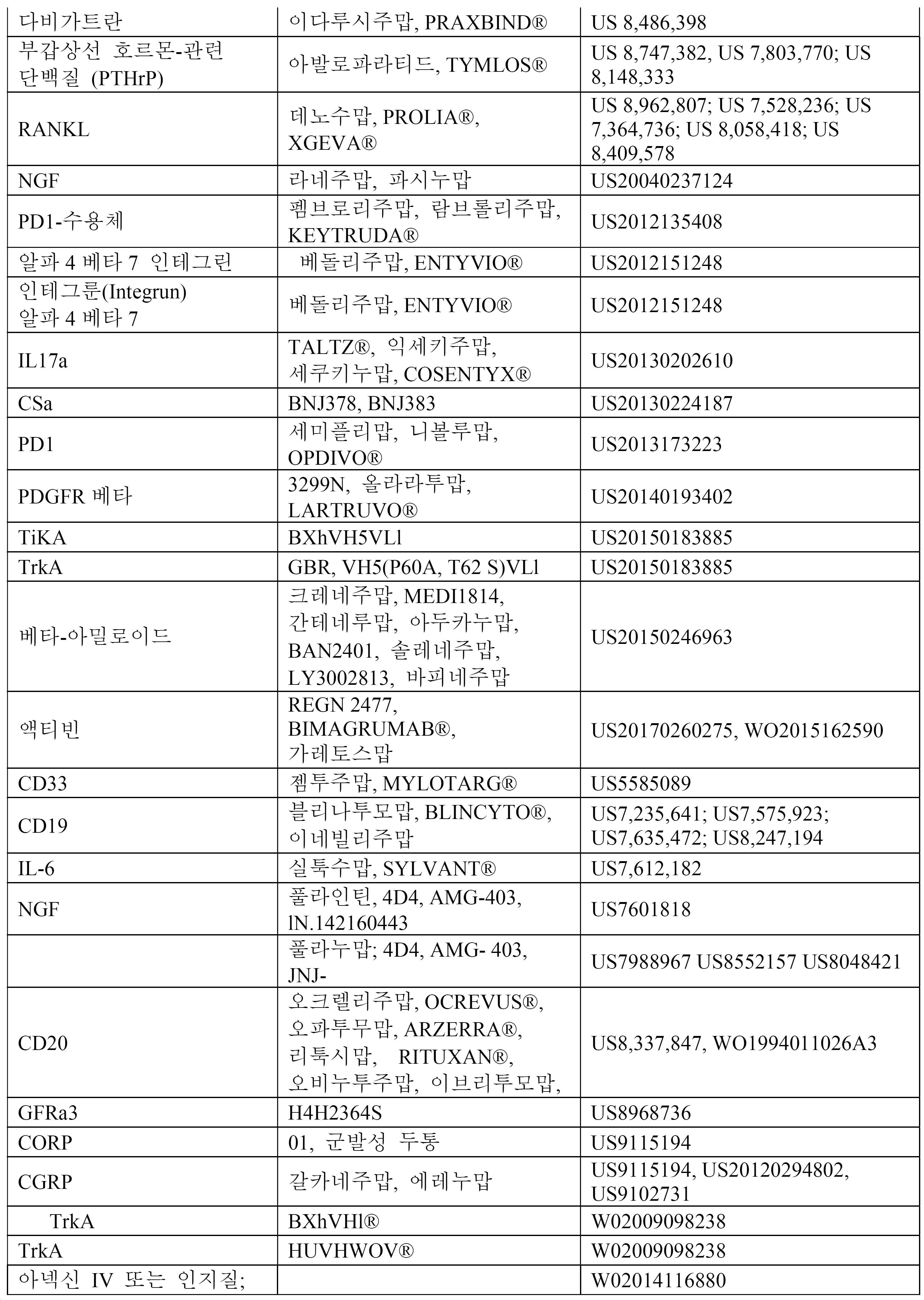
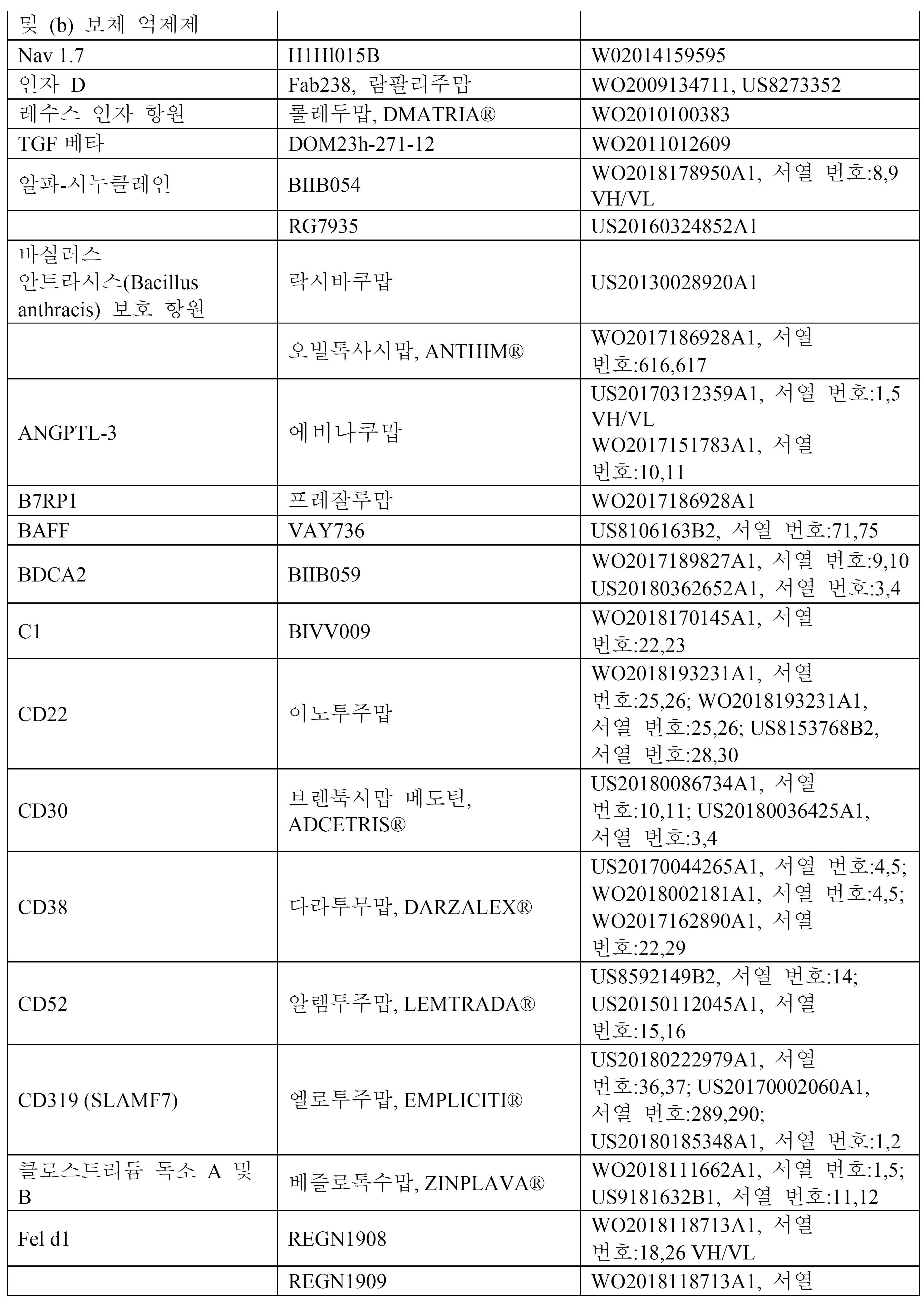
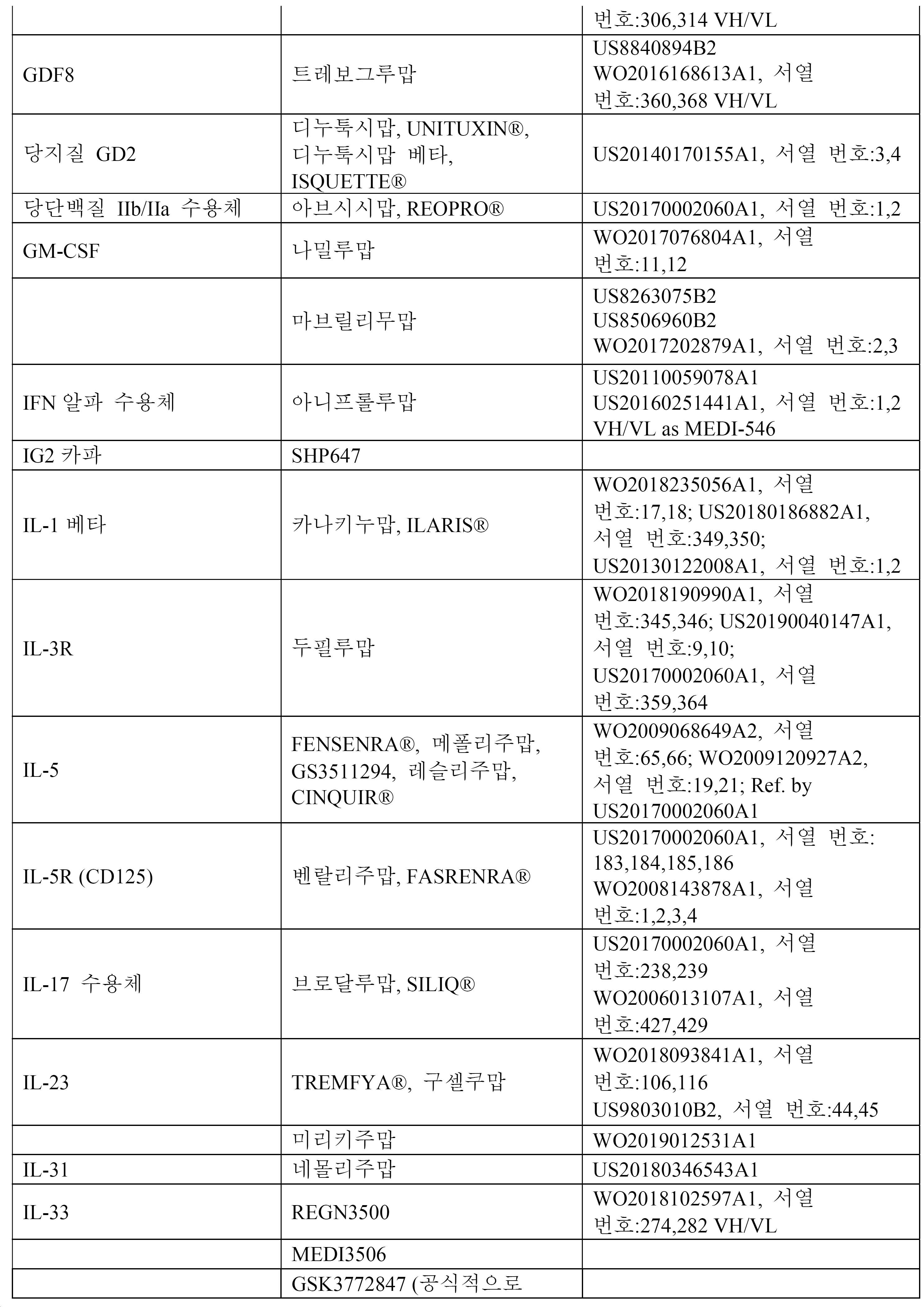


표 3a: ceDNA 벡터에 의해 발현되는 예시적인 항체는 유럽 연합 또는 미국에서 승인된 항체 치료제를 포함하지만, 이에 제한되지는 않는다.Table 3a: Exemplary antibodies expressed by ceDNA vectors include, but are not limited to, antibody therapeutics approved in the European Union or the United States.

표 3b: ceDNA 벡터에 의해 발현되는 예시적인 항체는 유럽 연합 또는 미국에서 규제 검토중인 항체 치료제를 포함하지만, 이에 제한되지는 않는다Table 3b: Exemplary antibodies expressed by ceDNA vectors include, but are not limited to, antibody therapeutics under regulatory review in the European Union or the United States.

표 4: ceDNA 벡터에 의해 발현되는 예시적인 항체는 말기 임상 연구에서 비암 적응증에 대한 항체 치료제를 포함하지만, 이에 제한되지 않는다. 항체를 상업적으로 개발하거나 임상적으로 시험하고 있는 회사는 다음과 같다: 1. Novartis, 2. LFB Group, 3. Shire, 4. Prothena Therapeutics Ltd., 5. Omeros Corporation, 6. Alexion Pharmaceuticals Inc., 7. AstraZeneca/ MedImmune LLC, 8. Boehringer Ingelheim Pharmaceuticals, AbbVie, 9. Genentech, 10. Shire, 11. R-Pharm, 12. Chugai Pharmaceuticals/Roche, 13. NovImmune SA, 14. CytoDyn, 15. Biogen, 16. Hoffmann-La Roche, 17. Alder Biopharmaceuticals, 18. Regeneron Pharmaceuticals, 19. Pfizer; Eli Lilly & Company, 20. Horizon Pharma USA Table 4: Exemplary antibodies expressed by ceDNA vectors include, but are not limited to, antibody therapeutics for non-cancer indications in end-stage clinical studies. Companies developing commercially or clinically testing antibodies include: 1. Novartis, 2. LFB Group, 3. Shire, 4. Prothena Therapeutics Ltd., 5. Omeros Corporation, 6. Alexion Pharmaceuticals Inc., 7. AstraZeneca/ MedImmune LLC, 8. Boehringer Ingelheim Pharmaceuticals, AbbVie, 9. Genentech, 10. Shire, 11. R-Pharm, 12. Chugai Pharmaceuticals/Roche, 13. NovImmune SA, 14. CytoDyn, 15. Biogen, 16 Hoffmann-La Roche, 17. Alder Biopharmaceuticals, 18. Regeneron Pharmaceuticals, 19. Pfizer; Eli Lilly & Company, 20. Horizon Pharma USA
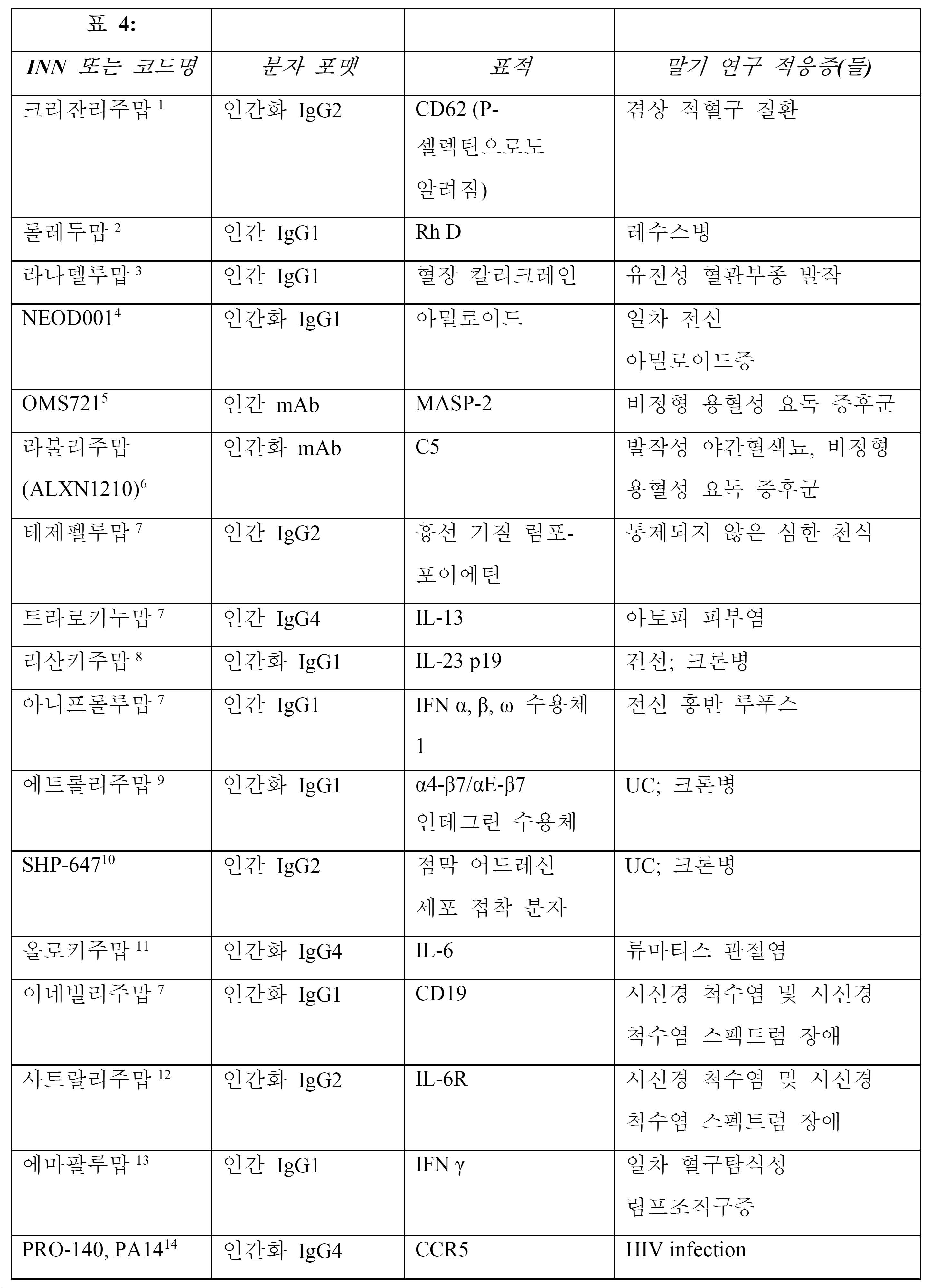

표 5: ceDNA 벡터에 의해 발현되는 예시적인 항체는 말기 임상 연구에서 암 적응증에 대한 항체 치료제를 포함하지만 이에 제한되지 않는다. 표 4의 항체를 상업적으로 개발하거나 임상적으로 시험하고 있는 회사는 다음과 같다: 1. Actinium Pharmaceuticals, 2. Sanofi, 3. TG Therapeutics, , 5. MorphoSys, 6. Pfizer, 8. Viventia Bio, 10. Jiangsu HengRui Medicine Co., Ltd, 11. MacroGenics, 16. Gilead Sciences, 18. AstraZeneca/ MedImmune LLC, 19. Recombio SL, 20. Regeneron Pharmaceuticals, 21. Innovent Biologics (Suzhou) Co. Ltd., 22. BeiGene, 24. Biocad, 25. Novartis, 26. Philogen SpA, 27.Tracon. Table 5 : Exemplary antibodies expressed by ceDNA vectors include, but are not limited to, antibody therapeutics for cancer indications in terminal clinical studies. Companies that are commercially developing or clinically testing the antibodies in Table 4 are as follows: 1. Actinium Pharmaceuticals, 2. Sanofi, 3. TG Therapeutics,, 5. MorphoSys, 6. Pfizer, 8. Viventia Bio, 10 Jiangsu HengRui Medicine Co., Ltd, 11. MacroGenics, 16. Gilead Sciences, 18. AstraZeneca/ MedImmune LLC, 19. Recombio SL, 20. Regeneron Pharmaceuticals, 21. Innovent Biologics (Suzhou) Co. Ltd., 22. BeiGene, 24. Biocad, 25. Novartis, 26. Philogen SpA, 27. Tracon.

ceDNA 벡터에 의해 발현되는 추가의 예시적인 항체 및 융합 단백질은 하기 기재된 것들을 포함하지만, 이에 제한되지 않는다:Additional exemplary antibodies and fusion proteins expressed by ceDNA vectors include, but are not limited to, those described below:
브로달루맙 (SILIQ®, LUMICEF®, KYNTHEUM®, AMG-827)은 IL-17 수용체 A (IL-17RA)를 표적화하고, IL-17RA를 통한 IL-17A, IL-17F 및 IL-17C 전염증성 사이토카인의 염증 시그널링을 방지하는 인간 IgG2 항체이다. 브로달루맙은 미국 (SILIQ®), EU (KYNTHEUM®), 및 일본 (LUMICEF®)에서 승인되었다. 브로달루맙은 전신 요법 또는 광선 요법의 후보이며, 다른 전신 요법에 반응을 나타내지 않거나 다른 전신 요법에 대한 반응이 중단된, 중등도 내지 중증의 판상형 건선을 갖는 성인 환자의 치료에 권고된다.Brodalumab (SILIQ®, LUMICEF®, KYNTHEUM®, AMG-827) targets IL-17 receptor A (IL-17RA) and is proinflammatory through IL-17RA, IL-17A, IL-17F and IL-17C It is a human IgG2 antibody that prevents inflammatory signaling of cytokines. Brodalumab has been approved in the US (SILIQ®), EU (KYNTHEUM®), and Japan (LUMICEF®). Brodalumab is a candidate for systemic therapy or phototherapy and is recommended for the treatment of adult patients with moderate to severe platy psoriasis, who have not responded to other systemic therapy or have ceased to respond to other systemic therapy.
두필루맙 (DUPIXENT®, REGN668/SAR231893)은 IL-4 수용체 (IL4R)를 표적화하여 IL-4 및 IL-13에 의해 매개된 염증 반응을 차단하는 인간 IgG4 mAb이다. mAb는 아토피 피부염 환자에 대해 미국 및 EU에서 승인되었다.Dupilumab (DUPIXENT®, REGN668/SAR231893) is a human IgG4 mAb that targets the IL-4 receptor (IL4R) and blocks the inflammatory response mediated by IL-4 and IL-13. mAb has been approved in the US and EU for patients with atopic dermatitis.
오크렐리주맙 (OCREVUS®)은 CD20-양성 B 세포를 표적화하는 인간화된 IgG1 항체이다. 이러한 B 세포는 미엘린 손상 및 다발성 경화증 발병에서 역할을 한다.Ocrelizumab (OCREVUS®) is a humanized IgG1 antibody targeting CD20-positive B cells. These B cells play a role in the development of myelin damage and multiple sclerosis.
오크렐리주맙은 미국에서 재발 다발성 경화증 (RMS) 및 일차 진행성 다발성 경화증 (PPMS)의 치료에 대한 승인을 받았다.Ocrelizumab is approved in the United States for the treatment of relapsing multiple sclerosis (RMS) and primary progressive multiple sclerosis (PPMS).
사릴루맙 (KEVZARA®, SAR153191, REGN88)은 IL-6 수용체 (IL-6R)를 표적화하는 인간 IgG1 항체이고, 캐나다, 미국 및 EU에서 메토트렉세이트 (MTX)와 같은 하나 이상의 질환 변형 항-류마티스 약물 (DMARD)에 대한 반응이 불충분하거나 불내성인 중등도 내지 중증의 활성 류마티스 관절염 (RA) 환자에 대해 승인되었다.Sarilumab (KEVZARA®, SAR153191, REGN88) is a human IgG1 antibody targeting the IL-6 receptor (IL-6R), and one or more disease-modifying anti-rheumatic drugs such as methotrexate (MTX) in Canada, the United States and the EU ( DMARD), moderate to severe active rheumatoid arthritis (RA) patients with insufficient or intolerant response.
벤랄리주맙 (FASENRA®, MEDI-563)은 호산구에서 발견되는 IL-5R의 α-서브유닛을 표적화하는 비푸코실화된 IgG1 mAb로, 12세 이상의 중증 천식 환자의 추가 유지 치료에 대한 FDA 승인을 받았다.Benralizumab (FASENRA®, MEDI-563) is a non-fucosylated IgG1 mAb that targets the α-subunit of IL-5R found in eosinophils and has been approved by the FDA for further maintenance treatment in
에미시주맙 (HEMLIBRA®, 에미시주맙-kxwh, ACE910, RO5534262)은 인자 IXa 및 X를 표적화하는 이중특이적 IgG4 mAb로, FDA에 의해 승인되었다. 이 약물은 인자 VIII 억제제가 발달한 혈우병 A를 갖는 성인 및 소아 환자에서 출혈 에피소드를 예방하거나 이의 빈도를 감소시키는 것으로 승인되었다. 2017년 12월 1일 현재, 총 9개의 항체 치료제가 미국 또는 EU에서 규제 검토를 받고 있다. 이들 중, 8개 (이발리주맙, 부로수맙, 틸드라키주맙, 카플라시주맙, 에레누맙, 프레마네주맙, 갈카네주맙, 로모소주맙)는 아직 판매 승인을 받지 못했다. 모가물리주맙은 2012년 3월 20일자로 일본에서 세계 최초의 승인을 받았다.Emisizumab (HEMLIBRA®, Emisizumab-kxwh, ACE910, RO5534262) is a bispecific IgG4 mAb targeting factors IXa and X, approved by the FDA. The drug has been approved to prevent or reduce the frequency of bleeding episodes in adult and pediatric patients with hemophilia A with a factor VIII inhibitor developed. As of December 1, 2017, a total of 9 antibody treatments are undergoing regulatory review in the U.S. or EU. Of these, eight (Ivalizumab, Burosumab, Tildrakizumab, Carplaceizumab, Erenumab, Premanezumab, Galcanezumab, Lomosozumab) have not yet been approved for sale. Mogamulizumab received the world's first approval in Japan on March 20, 2012.
이발리주맙은 CD4를 표적화하는 IgG4 mAb이고, 다제내성 인간 면역결핍 바이러스 (HIV) 감염에 대한 치료제로서 FDA에 의해 평가되고 있다.Ivalizumab is an IgG4 mAb targeting CD4 and is being evaluated by the FDA as a therapeutic agent for multidrug resistant human immunodeficiency virus (HIV) infection.
부로수맙 (KRN23)은 신장에 의한 인산염 배출 및 활성 비타민 D 생성을 조절하는 호르몬인, 섬유아세포 성장 인자 23 (FGF23)을 표적화하는 인간 IgG1 mAb이다.Burosumab (KRN23) is a human IgG1 mAb targeting fibroblast growth factor 23 (FGF23), a hormone that regulates phosphate excretion by the kidneys and active vitamin D production.
틸드라키주맙 (SCH 900222/MK-3222)은 IL-23p19를 표적화하는 인간화된 IgG1 mAb이다. 중등도 내지 중증 판상형 건선 치료제로서 틸드라키주맙의 판매 신청서가 EU 및 미국에 제출되었다.Tildrakizumab (SCH 900222/MK-3222) is a humanized IgG1 mAb targeting IL-23p19. Applications for the sale of tildrakizumab as a treatment for moderate to severe platy psoriasis have been submitted to the EU and the United States.
카플라시주맙 (ALX-0081)은 폰 빌레브란트 인자를 표적화하는 2가 단일-도메인 항체 (Nanobody®)로, aTTP 환자에서 낮은 혈소판 수, 조직 허혈 및 장기 부전을 유발하는 미세혈전(microclot)의 형성을 수반하는, 희귀한, 생명을 위협하는 혈액 응고 장애인 후천성 혈전성 혈소판감소성 자반증 (aTTP)에 대한 치료제로서 규제 검토를 받고 있다.Kaplaceizumab (ALX-0081) is a bivalent single-domain antibody (Nanobody®) that targets von Willebrand factor, and is a microthrombosis that causes low platelet count, tissue ischemia and organ failure in aTTP patients. It is under regulatory review as a treatment for acquired thrombotic thrombocytoptic purpura (aTTP), a rare, life-threatening blood clotting disorder that accompanies formation.
에레누맙 (AIMOVIG™, AMG 334)은 감작된 침해 수용성 뉴런의 발달에 관여하는 칼시토닌 유전자-관련 펩티드 (CGRP)에 대한 수용체를 표적화하는 IgG2 mAb이다. 한 달에 4일 이상 편두통을 경험한 환자의 편두통 예방을 위한 에레누맙의 판매 신청서가 EU 및 미국에 제출되었다.Erenumab (AIMOVIG™, AMG 334) is an IgG2 mAb that targets receptors for the calcitonin gene-related peptide (CGRP) involved in the development of sensitized nociceptive neurons. Applications for the sale of erenumab for the prevention of migraine in patients with migraine headaches more than 4 days a month have been submitted to the EU and the United States.
프레마네주맙 (TEV-48125)은 편두통 예방 치료에 대한 규제 검토를 받고 있는 CGRP를 표적화하는 IgG2 mAb이다.Premanezumab (TEV-48125) is an IgG2 mAb targeting CGRP that is undergoing regulatory review for migraine prophylactic treatment.
갈카네주맙 (LY2951742)은 CGRP를 표적화하는 IgG4 mAb로, 성인의 발작적 편두통 및 만성 편두통 예방에 대한 규제 검토를 받고 있다.Galcanezumab (LY2951742) is an IgG4 mAb targeting CGRP and is under regulatory review for the prevention of seizure and chronic migraine in adults.
로모소주맙 (EVENITY™, AMG785)은 스클레로스틴을 표적화하는 인간화된 IgG2 mAb로, 여성 및 남성의 골다공증 치료제로서 평가되고 있다.Lomosozumab (EVENITY™, AMG785) is a humanized IgG2 mAb targeting sclerostin and is being evaluated as a treatment for osteoporosis in women and men.
모가물리주맙 (KW-0761, POTELIGEo®)은 균상식육종 및 세자리(
라나델루맙 (SHP643, DX-2930)은 혈장 칼리크레인을 표적화하여 브라디키닌의 생성을 방지하는 인간 IgG1 mAb이다.Ranadelumab (SHP643, DX-2930) is a human IgG1 mAb that targets plasma kallikrein and prevents the production of bradykinin.
크리잔리주맙 (SEG101)은 CD62로도 알려진 P-셀렉틴을 표적화하는 인간화된 mAb이고, 겸상 적혈구 질환 환자에서 혈관 폐쇄에 의해 유발된 겸상 적혈구-관련 통증 위기 (SCPC)의 치료제로서 평가를 받고 있다.Crizanlizumab (SEG101) is a humanized mAb targeting P-selectin, also known as CD62, and is being evaluated as a treatment for sickle cell-related pain crisis (SCPC) caused by vascular occlusion in sickle cell disease patients.
라불리주맙 (ALXN1210)은 발작성 야간혈색뇨 (PNH) 환자의 두 3상 연구에서 평가를 받고 있는 보체 성분 5 (C5)를 표적화하는 인간화된 mAb이다.Labulizumab (ALXN1210) is a humanized mAb targeting complement component 5 (C5) being evaluated in two
엡티네주맙 (ALD403)은 칼시토닌 유전자-관련 펩티드 (CGRP)를 표적화하는 IgG1 mAb이고, 편두통 예방에 대해 평가되고 있다.Eptinezumab (ALD403) is an IgG1 mAb targeting calcitonin gene-related peptide (CGRP) and is being evaluated for migraine prevention.
리산키주맙 (ABBV066, BI655066)은 건선의 발병에 연루된 IL-23의 p19 서브유닛을 표적화하는 IgG1 mAb이다.Risankizumab (ABBV066, BI655066) is an IgG1 mAb that targets the p19 subunit of IL-23 involved in the pathogenesis of psoriasis.
사트랄리주맙 (SA237)은 IL-6R을 표적화하는 인간화된 IgG2로, 시신경 척수염 (NMO) 또는 NMO 스펙트럼 장애가 있는 환자의 두 3상 연구에서 평가되고 있다.Satralizumab (SA237) is a humanized IgG2 that targets IL-6R and is being evaluated in two
브롤루시주맙 (RTH258)은 혈관 내피 성장 인자 (VEGF)-A를 표적화하는 단일쇄 가변 단편 (scFv)이다.Brolucizumab (RTH258) is a single chain variable fragment (scFv) targeting vascular endothelial growth factor (VEGF)-A.
PRO140은 인간화된 IgG4 mAb로, T 세포에서 인간 면역결핍 바이러스 (HIV) 공동-수용체 CCR5를 차단하여 바이러스 진입을 방지한다.PRO140 is a humanized IgG4 mAb that blocks human immunodeficiency virus (HIV) co-receptor CCR5 in T cells to prevent viral entry.
람팔리주맙 (RG7417, FCFD4514S)은 인간화 항원-결합 단편 (Fab)으로, 보체 인자 D에 결합함으로써 대안적인 보체 경로의 활성화 및 증폭을 억제한다.Rampalizumab (RG7417, FCFD4514S) is a humanized antigen-binding fragment (Fab) that binds to complement factor D, thereby inhibiting the activation and amplification of alternative complement pathways.
롤레두맙 (LFB-R593)은 LFB S.A.의 EMABLING® 기술 플랫폼으로부터 유래된 인간 IgG1 항-레수스 (Rh)D mAb로, 푸코실화를 변경시켜 항체를 이펙터 세포에 보다 효과적으로 결합시킨다. 상기 항체는 일부 태아모체 동종면역 상태, 즉, RhD-양성 태아를 임신한 RhD-음성 임산부에서 일부 태아모체 동종면역 상태를 예방하도록 설계된다.Roledumab (LFB-R593) is a human IgGl anti-resus (Rh)D mAb derived from LFB S.A.'s EMABLING® technology platform, which alters fucosylation to more effectively bind the antibody to effector cells. The antibodies are designed to prevent some fetal maternal alloimmune conditions, ie, some fetal maternal alloimmune conditions in RhD-negative pregnant women who are pregnant with RhD-positive fetuses.
파시누맙 (REGN475)은 신경 성장 인자를 표적화하는 인간 IgG4 mAb로, 많은 말기 연구에서 엉덩이 또는 무릎의 중등도 내지 중증의 골관절염 통증 및 만성 요통에 대한 치료제로서 평가되고 있다.Pasinumab (REGN475) is a human IgG4 mAb that targets nerve growth factor, and has been evaluated in many terminal studies as a treatment for moderate to severe osteoarthritis pain and chronic low back pain in the hip or knee.
에트롤리주맙 (RH7413)은 α4β7 및 αEβ7 인테그린 이종이량체의 β7 서브유닛에 결합하여 이들의 리간드 MAdCAM-1 및 E-카드헤린과의 상호작용을 각각 억제하는 인간화된 mAb이다.Etrolizumab (RH7413) is a humanized mAb that binds to the β7 subunit of the α4β7 and αEβ7 integrin heterodimers and inhibits their interaction with the ligands MAdCAM-1 and E-cadherin, respectively.
NEOD001은 인간화된 IgG1 mAb로, 심장, 신장 및 간을 포함하는 조직 및 기관에 단백질 응집체가 과도하게 축적되는 것을 특징으로 하는 장애인, 아밀로이드 경쇄 (AL) 아밀로이드증을 유발하는 가용성 및 불용성 경쇄 응집체를 표적화한다.NEOD001 is a humanized IgG1 mAb that targets soluble and insoluble light chain aggregates that cause amyloid light chain (AL) amyloidosis, a disorder characterized by excessive accumulation of protein aggregates in tissues and organs including the heart, kidney and liver .
간테네루맙 (RO4909832)은 알츠하이머병의 치료제로서 조사되고 있는 원섬유 아밀로이드-β를 표적화하는 인간 mAb이다.Gantenerumab (RO4909832) is a human mAb targeting fibrillar amyloid-β, which is being investigated as a therapeutic agent for Alzheimer's disease.
아니프롤루맙 (MEDI-546)은 SLE의 치료제로서 평가되고 있는 I형 인터페론 (IFN) 수용체 서브유닛 1을 표적화하는 인간 IgG1 mAb이다.Aniprolumab (MEDI-546) is a human IgG1 mAb targeting type I interferon (IFN)
목세투모맙 파수도톡스 (HA22, CAT- 8015)는 CD22를 표적화하는 항체 가변 단편에 융합된 슈도모나스 외독소 A의 38-kDa 세포독성 부분을 함유하는 재조합 면역독소이다.Moxtumomab fasudotox (HA22, CAT- 8015) is a recombinant immunotoxin containing the 38-kDa cytotoxic portion of Pseudomonas exotoxin A fused to an antibody variable fragment targeting CD22.
프로그램된 사멸-1 (PD1)을 표적화하는 인간 항체인, 세미플리맙 (REGN2810, SAR439684)은 전이성 또는 절제 불가능한 피부 편평세포 암종 (CSCC)의 치료제로서 평가를 받고 있다.Semiplimab (REGN2810, SAR439684), a human antibody targeting Programmed Death-1 (PD1), is being evaluated as a treatment for metastatic or unresectable cutaneous squamous cell carcinoma (CSCC).
유블리툭시맙 (LFB-R603, TGT-1101, TGTX-1101)은 CD20을 표적화하는 당조작된(glycoengineered) 키메라 mAb이다.Ublituximab (LFB-R603, TGT-1101, TGTX-1101) is a glycoengineered chimeric mAb targeting CD20.
트레멜리무맙 (CP-675,206)은 세포독성 T 림프구-관련 항원-4 (CTLA-4)를 표적화하는 인간 IgG2 항체이다. 생리학적 조건에서, CD28은 B7 리간드 (CD80, CD86)와 상호작용하여 T 세포 활성화, 증식 및 CTLA-4 상향조절을 초래한다. CTLA-4는 CD28보다 높은 친화도로 B7 리간드에 결합하고 T-세포 반응을 종결시킨다.Tremelimumab (CP-675,206) is a human IgG2 antibody targeting cytotoxic T lymphocyte-associated antigen-4 (CTLA-4). Under physiological conditions, CD28 interacts with B7 ligands (CD80, CD86) leading to T cell activation, proliferation and CTLA-4 upregulation. CTLA-4 binds to the B7 ligand with a higher affinity than CD28 and terminates the T-cell response.
이사툭시맙 (SAR650984)은 재발성 및 불응성 다발성 골수종 (MM) 환자의 치료에 대해 평가되고 있는 항-CD38 IgG1 키메라 항체이다.Isutuximab (SAR650984) is an anti-CD38 IgG1 chimeric antibody that is being evaluated for the treatment of patients with relapsed and refractory multiple myeloma (MM).
BCD-100은 프로그램된 세포 사멸-1 (PD-1)을 표적화하는 인간 항체이다.BCD-100 is a human antibody targeting programmed cell death-1 (PD-1).
카로툭시맙 (TRC105)은 혈관 신생 및 증식성 내피세포에서 고도로 발현된 단백질인, 엔도글린 (CD105)을 표적화하는 키메라 IgG1 항체이다. mAb는 1-2 ng/mL의 KD로 증식하는 내피에서 인간 CD105에 결합하고 인간 제정맥 내피세포의 ADCC를 유도한다.Carrotuximab (TRC105) is a chimeric IgG1 antibody that targets endoglin (CD105), a protein highly expressed in angiogenic and proliferative endothelial cells. mAb binds to human CD105 in proliferating endothelium with a KD of 1-2 ng/mL and induces ADCC of human umbilical vein endothelial cells.
캄렐리주맙 (INCSHR-1210, SHR-1210)은 PD-1을 표적화하는 IgG4κ 인간화된 항체이다.Camrelizumab (INCSHR-1210, SHR-1210) is an IgG4κ humanized antibody targeting PD-1.
글렘바투무맙 베도틴 (CDX-011, CR011-vcMMAE)은 암 세포에서 방출될 때, 종양 세포 사멸을 유도할 수 있는 세포독성 약물인, 모노메틸 아우리스타틴 E에 접합된 막횡단 당단백질 비-전이성 유전자 B (gpNMB)를 표적화하는 IgG2 인간 항체이다.Glembatumumab vedotin (CDX-011, CR011-vcMMAE) is a cytotoxic drug that can induce tumor cell death when released from cancer cells, the ratio of transmembrane glycoproteins conjugated to monomethyl auristatin E. -IgG2 human antibody targeting metastatic gene B (gpNMB).
미르베툭시맙 소라브탄신 (IMGN853)은 항-유사분열제인, 메이탄시노이드 약물 DM4의 3-4 분자에 접합된 폴레이트 수용체 알파 (FRα)를 표적화하는 항체이다.Mirbetuximab sorabtansine (IMGN853) is an antibody that targets the folate receptor alpha (FRα) conjugated to 3-4 molecules of the maytansinoid drug DM4, an anti-mitotic agent.
오포르투주납 모나톡스 (VICINIUM™, VB4-845)는 슈도모나스 아에루기노사(Pseudomonas aeruginosa) 외독소 A에 접합된 항-상피 세포 접착 분자 (EpCAM) 재조합 인간화된 항체 scFv 단편이다.Oportuzunab monatox (VICINIUM™, VB4-845) is an anti-epithelial cell adhesion molecule (EpCAM) recombinant humanized antibody scFv fragment conjugated to Pseudomonas aeruginosa exotoxin A.
L19IL2/L19TNF (DAROMUN)는 인간 IL2 또는 인간 TNF에 융합된 피브로넥틴의 엑스트라도메인 B를 표적화하는, L19 항체의 scFv로 구성된 융합 단백질이다.L19IL2/L19TNF (DAROMUN) is a fusion protein composed of the scFv of the L19 antibody targeting the extradomain B of fibronectin fused to human IL2 or human TNF.
더 추가의 예시적인 항체 및 융합 단백질은 다음 중 임의의 것으로부터 선택될 수 있다: AstraZeneca 및 MedImmune의 벤랄리주맙, MEDI-8968, 아니프롤루맙, MEDI7183, 시팔리무맙, MEDI-575, 트라로키누맙; Biogen Idec/Eisai Co. LTD ("Eisai")/BioArctic Neuroscience AB의 BAN2401; Biogen의 CDP7657 항-CD40L 1가 페길화된 Fab 항체 단편, STX-100 항-avB6 mAb, BIIB059, 항-TWEAK (BIIB023), 및 BIIB022; Janssen 및 Amgen의 풀라누맙; BioInvent International/Genentech의 BI-204/RG7418; Biotest Pharmaceuticals Corporation의 BT-062 (인다툭시맙 라브탄신); Boehringer Ingelheim/Xencor의 XmAb; Bristol-Myers Squibb의 항-IP10; BZL Biologics LLC의 J 591 Lu-177; CDX-011 (글렘바투무맙 베도틴), Celldex Therapeutics의 CDX-0401; Crucell의 포라비루맙; Daiichi Sankyo Company Limited의 티가투주맙; Eisai의 MORAb-004, MORAb-009 (아마툭시맙); Eli Lilly의 LY2382770; EMD Serono Inc의 DI17E6; Emergent BioSolutions, Inc.의 자놀리무맙; FibroGen, Inc.의 FG-3019; Fresenius SE & Co. KGaA의 카투막소맙; Genentech의 파테클리주맙, 론탈리주맙; Genzyme & Sanofi의 프레솔리무맙; Gilead의 GS-6624 (심투주맙); Janssen의 CNTO-328, 바피뉴주맙 (AAB-001), 카를루맙, CNTO-136; KaloBios Pharmaceuticals, Inc.의 KB003; Kyowa의 ASKP1240; Labrys Biologics Inc.의 RN-307; Life Science Pharmaceuticals의 에크로멕시맙; Eli Lilly의 LY2495655, LY2928057, LY3015014, LY2951742; MassBiologics의 MBL-HCV1; MENTRIK Biotech, LLC의 AME-133v; Merck KGaA의 아비투주맙; Merrimack Pharmaceuticals, Inc.의 MM-121; Novartis AG의 MCS 110, QAX576, QBX258, QGE031; Novartis AG and XOMA Corporation ("XOMA")의 HCD122; Novo Nordisk의 NN8555; Peregrine Pharmaceuticals, Inc.의 바비툭시맙, 코타라; Progenies Pharmaceuticals, Inc.의 PSMA-ADC; Quest Pharmatech, Inc.의 오레고보맙; Regeneron의 파시누맙 (REGN475), REGN1033, SAR231893, REGN846; Roche의 RG7160, CIM331, RG7745; TaiMed Biologics Inc.의 이발리주맙 (TMB-355); Theraclone Sciences의 TCN-032; TRACON Pharmaceuticals, Inc.의 TRC105; United Biomedical Inc.의 UB-421; Viventia Bio, Inc.의 VB4-845; AbbVie의 ABT-110; Ablynx의 카플라시주맙, 오조랄리주맙; CytoDyn, Inc.의 PRO 140; Medarex, Inc.의 GS-CDA1, MDX-1388; Amgen의 AMG 827, AMG 888; TG Therapeutics Inc.의 유블리툭시맙; Tolera Therapeutics, Inc.의 TOL101; ImmunoGen Inc.의 huN901-DM1 (로르보투주맙 머탄신); Immunomedics, Inc.의 에프라투주맙 Y-90/벨투주맙 조합 (IMMU-102); Agenix, Limited의 항-피브린 mAb/3B6/22 Tc-99m; Alder Biopharmaceuticals, Inc.의 ALD403; Pfizer의 RN6G/PF-04382923; CG Therapeutics, Inc.의 CG201; KaloBios Pharmaceuticals/Sanofi의 KB001-A; Kyowa.의 KRN-23; Immunomedics, Inc.의 Y-90 hPAM 4; Morphosys AG & OncoMed Pharmaceuticals, Inc.의 타렉스투맙; Morphosys AG & Novartis AG의 LFG316; Morphosys AG & Jannsen의 CNTO3157, CNTO6785; Roche & Chugai의 RG6013; Merrimack Pharmaceuticals, Inc. ("Merrimack")의 MM-111; GlaxoSmithKline의 GSK2862277; Amgen의 AMG 282, AMG 172, AMG 595, AMG 745, AMG 761; Biocon의 BVX-20; Celltrion의 CT-P19, CT-P24, CT-P25, CT-P26, CT-P27, CT-P4; GlaxoSmithKline의 GSK284933, GSK2398852, GSK2618960, GSK1223249, GSK933776A; Morphosys AG & Bayer AG의 아네투맙 라브탄신; Morphosys AG & Boehringer Ingelheim의 BI-836845; Morphosys AG & Novartis AG의 NOV-7, NOV-8; Merrimack의 MM-302, MM-310, MM-141, MM-131, MM-151, Roche & Seattle Genetics의 RG7882; Roche/Genentech의 RG7841; Pfizer의 PF-06410293, PF-06438179, PF-06439535, PF-04605412, PF-05280586; Roche의 RG7716, RG7936, 젠테네루맙, RG7444; Astrazeneca의 MEDI-547, MEDI-565, MEDI1814, MEDI4920, MEDI8897, MEDI-4212, MEDI-5117, MEDI-7814; Bristol-Myers Squibb의 울로쿠플루맙, PCSK9 아드넥틴; FivePrime Therapeutics, Inc.의 FPA009, FPA145; Gilead의 GS-5745; Kyowa Hakko Kirin의 BIW-8962, KHK4083, KHK6640; Merck KGaA의 MM-141; Regeneron의 REGN1154, REGN1193, REGN1400, REGN1500, REGN1908-1909, REGN2009, REGN2176-3, REGN728; Sanofi의 SAR307746; Seattle Genetics의 SGN-CD70A; Ablynx의 ALX-0141, ALX-0171; Immunomedics, Inc.의 밀라투주맙-DOX, 밀라투주맙, TF2; Millennium의 MLNO264; AbbVie의 ABT-981; AbGenomics International Inc.의 AbGn-168H; AVEO의 피클라투주맙; BioInvent International의 BI-505; Celldex Therapeutics의 CDX-1127, CDX-301; Cellerant Therapeutics Inc.의 CLT-008; Circadian의 VGX-100; Daiichi Sankyo Company Limited의 U3-1565; Dekkun Corp.의 DKN-01; Eli Lilly의 플란보투맙 (TYRP1 단백질), IL-1β 항체, IMC-CS4; Eli Lilly 및 ImClone, LLC의 VEGFR3 mAb, IMC-TR1 (LY3022859); Elusys Therapeutics Inc.의 앤심; Galaxy Biotech LLC의 HuL2G7; ImmunoGen Inc.의 IMGB853, IMGN529; Janssen의 CNTO-5, CNTO-5825; Kaketsuken의 KD-247; KaloBios Pharmaceuticals의 KB004; MacroGenics, Inc.의 MGA271, MGAH22; MorphoSys AG/Xencor의 XmAb5574; Neogenix Oncology, Inc.의 엔시툭시맙; Novartis AG and XOMA의 LFA102; Novartis AG의 ATI355; Santarus Inc.의 SAN-300; Selexys의 SelG1; Targa Therapeutics, Corp.의 HuM195/rGel; Teva Pharmaceuticals, Industries Ltd. ("Teva") 및 Vaccinex Inc.의 VX15; Theraclone Sciences의 TCN-202; Xencor의 XmAb2513, XmAb5872; XOMA 및 미국 국립 알레르기 및 전염병 연구소(National Institute for Allergy and Infectious Diseases)의 XOMA 3AB; MabVax Therapeutics의 신경아세포종 항체 백신; CytoDyn, Inc.의 사이톨린; Emergent BioSolutions Inc.의 트라빅사(Thravixa); 및 Cytovance Biologics의 FB 301; Janssen 및 Sanofi의 광견병 mAb; 미국국립보건원(National Institutes of Health)이 일부 기금을 제공한, Janssen의 flu mAb; Mapp Biopharmaceutical, Inc.의 MB-003 및 ZMapp; 및 Defyrus IncG의 ZMAbFurther exemplary antibodies and fusion proteins may be selected from any of the following: Benralizumab, MEDI-8968, aniprolumab, MEDI7183, sifalimumab, MEDI-575, trarokinu from AstraZeneca and MedImmune. Thank you; Biogen Idec/Eisai Co. LTD ("Eisai")/BAN2401 from BioArctic Neuroscience AB; Biogen's CDP7657 anti-CD40L monovalent PEGylated Fab antibody fragment, STX-100 anti-avB6 mAb, BIIB059, anti-TWEAK (BIIB023), and BIIB022; Fulanumab from Janssen and Amgen; BI-204/RG7418 from BioInvent International/Genentech; BT-062 from Biotest Pharmaceuticals Corporation (Indutuximab Rabtansine); XmAb from Boehringer Ingelheim/Xencor; Anti-IP10 from Bristol-Myers Squibb; J 591 Lu-177 from BZL Biologics LLC; CDX-011 (Glembatumumab vedotin), CDX-0401 from Celldex Therapeutics; Poravirumab from Crucell; Tigatuzumab from Daiichi Sankyo Company Limited; Eisai's MORAb-004, MORAb-009 (Amatuximab); LY2382770 by Eli Lilly; DI17E6 from EMD Serono Inc; Zanolimumab from Emergent BioSolutions, Inc.; FG-3019 from FibroGen, Inc.; Fresenius SE & Co. Catumaxomab from KGaA; Pateklizumab, Rontalizumab from Genentech; Presolimumab from Genzyme &Sanofi; Gilead's GS-6624 (Simtuzumab); Janssen's CNTO-328, vafinuzumab (AAB-001), karlumab, CNTO-136; KB003 of KaloBios Pharmaceuticals, Inc.; ASKP1240 from Kyowa; RN-307 from Labrys Biologics Inc.; Ecromeximab from Life Science Pharmaceuticals; LY2495655, LY2928057, LY3015014, LY2951742 from Eli Lilly; MBL-HCV1 from MassBiologics; AME-133v from MENTRIK Biotech, LLC; Abituzumab from Merck KGaA; MM-121 from Merrimack Pharmaceuticals, Inc.; MCS 110, QAX576, QBX258, QGE031 from Novartis AG; HCD122 from Novartis AG and XOMA Corporation ("XOMA"); NN8555 from Novo Nordisk; Babituximab, Kotara from Peregrine Pharmaceuticals, Inc.; PSMA-ADC from Progenies Pharmaceuticals, Inc.; Oregobomab from Quest Pharmatech, Inc.; Regeneron's pasinumab (REGN475), REGN1033, SAR231893, REGN846; Roche's RG7160, CIM331, RG7745; Ivalizumab (TMB-355) from TaiMed Biologics Inc.; TCN-032 from Theraclone Sciences; TRC105 from TRACON Pharmaceuticals, Inc.; UB-421 of United Biomedical Inc.; VB4-845 from Viventia Bio, Inc.; AbbVie's ABT-110; Ablynx's carplacizumab, ozoralizumab; PRO 140 from CytoDyn, Inc.; GS-CDA1, MDX-1388 from Medarex, Inc.; Amgen's AMG 827, AMG 888; Ublituximab from TG Therapeutics Inc.; TOL101 from Tolera Therapeutics, Inc.; HuN901-DM1 from ImmunoGen Inc. (Robotuzumab mertansine); Epratuzumab Y-90/beltuzumab combination from Immunomedics, Inc. (IMMU-102); Anti-fibrin mAb/3B6/22 Tc-99m from Agenix, Limited; ALD403 from Alder Biopharmaceuticals, Inc.; RN6G/PF-04382923 from Pfizer; CG201 from CG Therapeutics, Inc.; KB001-A from KaloBios Pharmaceuticals/Sanofi; KRN-23 of Kyowa.; Y-90
III. 항체 및 융합 단백질의 생산에 사용하기 위한 일반적인 ceDNA 벡터III. Common ceDNA vectors for use in the production of antibodies and fusion proteins
본 발명의 구현예는 이식유전자 (예를 들어, 항체 또는 융합 단백질)를 발현시킬 수 있는 폐쇄 말단 선형 듀플렉스 (ceDNA) 벡터를 포함하는 방법 및 조성물에 기반한다. 일부 구현예에서, 이식유전자는 항체 또는 융합 단백질을 인코딩하는 서열이다. 본원에 기재된 바와 같이 항체 또는 융합 단백질 생산을 위한 ceDNA 벡터는 크기에 의해 제한되지 않으므로, 예를 들어, 단일 벡터로부터 이식유전자의 발현에 필요한 모든 성분의 발현을 허용한다. 항체 또는 융합 단백질 생산을 위한 ceDNA 벡터는 바람직하게는 듀플렉스, 예를 들어 발현 카세트와 같은 분자의 적어도 일부에 대해 자가-상보적이다 (예를 들어 ceDNA는 이중 가닥 원형 분자가 아님). ceDNA 벡터는 공유적으로 폐쇄된 말단을 가지므로 예를 들어 37℃에서 1시간 이상 동안 엑소뉴클레아제 소화 (예를 들어 엑소뉴클레아제 I 또는 엑소뉴클레아제 III)에 내성이 있다.Embodiments of the invention are based on methods and compositions comprising closed-ended linear duplex (ceDNA) vectors capable of expressing a transgene ( eg, antibody or fusion protein). In some embodiments, the transgene is a sequence that encodes an antibody or fusion protein. The ceDNA vectors for antibody or fusion protein production as described herein are not limited by size, and thus allow the expression of all components necessary for expression of the transgene, for example from a single vector. The ceDNA vector for antibody or fusion protein production is preferably self-complementary to at least a portion of a molecule such as a duplex, eg an expression cassette (eg ceDNA is not a double stranded circular molecule). Since the ceDNA vector has a covalently closed end, it is resistant to exonuclease digestion (eg exonuclease I or exonuclease III) for at least 1 hour, eg at 37°C.
일반적으로, 본원에 개시된 바와 같은 항체 또는 융합 단백질 생산을 위한 ceDNA 벡터는 5'에서 3'의 방향으로 제1 아데노-관련 바이러스 (AAV) 역 말단 반복부 (ITR), 관심 뉴클레오티드 서열 (예를 들어 본원에 기재된 발현 카세트) 및 제2 AAV ITR을 포함한다. ITR 서열은 다음 중 어느 것으로부터 선택된다: (i) 적어도 하나의 WT ITR 및 적어도 하나의 변형된 AAV 역 말단 반복부 (모드-ITR) (예를 들어, 비대칭 변형된 ITR); (ii) 모드-ITR 쌍이 서로에 대해 상이한 3차원 공간 구성을 갖는 2개의 변형된 ITR (예를 들어, 비대칭 변형된 ITR), 또는 (iii) 각각의 WT-ITR이 동일한 3차원 공간 구성을 갖는 대칭 또는 실질적으로 대칭인 WT-WT ITR 쌍, 또는 (iv) 각각의 모드-ITR이 동일한 3차원 공간 구성을 갖는 대칭 또는 실질적으로 대칭인 변형된 ITR 쌍.In general, the ceDNA vector for the production of an antibody or fusion protein as disclosed herein is a first adeno-associated virus (AAV) reverse terminal repeat (ITR) in a 5′ to 3′ direction, a nucleotide sequence of interest (e.g. Expression cassettes described herein) and a second AAV ITR. The ITR sequence is selected from any of the following: (i) at least one WT ITR and at least one modified AAV reverse terminal repeat (mod-ITR) ( eg, asymmetric modified ITR); (ii) two modified ITRs in which the mode-ITR pair has a different three-dimensional spatial configuration with respect to each other ( e.g., asymmetrically modified ITR), or (iii) each WT-ITR has the same three-dimensional spatial configuration. A symmetric or substantially symmetric WT-WT ITR pair, or (iv) a symmetric or substantially symmetric modified ITR pair in which each mod-ITR has the same three-dimensional spatial configuration.
비제한적으로, 리포좀 나노입자 전달 시스템과 같은 전달 시스템을 추가로 포함할 수 있는, 항체 또는 융합 단백질 생산을 위한 ceDNA 벡터를 포함하는 방법 및 조성물이 본원에 포함된다. 사용을 위해 포함되는 비제한적인 예시적인 리포좀 나노입자 시스템이 본원에 개시되어 있다. 일부 측면에서, 본 개시내용은 ceDNA 및 이온화 가능한 지질을 포함하는 지질 나노입자를 제공한다. 예를 들어, 본 방법에 의해 수득된 ceDNA 벡터로 제조되고 로딩된 지질 나노입자 제형은 2018년 9월 7일자로 출원된 국제 출원 PCT/US2018/050042에 개시되어 있으며, 이는 본원에 포함된다.Included herein are methods and compositions comprising ceDNA vectors for production of antibodies or fusion proteins, which may further include, but are not limited to, a delivery system such as a liposomal nanoparticle delivery system. Non-limiting exemplary liposomal nanoparticle systems included for use are disclosed herein. In some aspects, the present disclosure provides lipid nanoparticles comprising ceDNA and an ionizable lipid. For example, lipid nanoparticle formulations prepared and loaded with ceDNA vectors obtained by this method are disclosed in international application PCT/US2018/050042 filed September 7, 2018, which is incorporated herein.
본원에 개시된 바와 같은 항체 또는 융합 단백질 생산을 위한 ceDNA 벡터는 바이러스 캡시드 내의 제한 공간에 의해 부과되는 패키징 제약이 없다. ceDNA 벡터는 캡슐화된 AAV 게놈과 대조적으로, 원핵생물-생산 플라스미드 DNA 벡터에 대한 생존가능 진핵생물적으로-생산된 대안을 나타낸다. 이는 제어 요소, 예를 들어, 본원에 개시된 조절 스위치, 대형 이식유전자, 다중 이식유전자 등의 삽입을 허용한다.The ceDNA vectors for the production of antibodies or fusion proteins as disclosed herein are free of packaging restrictions imposed by restriction spaces within the viral capsid. ceDNA vectors represent a viable eukaryote-produced alternative to prokaryotic-producing plasmid DNA vectors, in contrast to the encapsulated AAV genome. This allows the insertion of control elements, such as the regulatory switches disclosed herein, large transgenes, multiple transgenes, and the like.
도 1a-1e는 항체 또는 융합 단백질 생산을 위한 비제한적인, 예시적인 ceDNA 벡터, 또는 상응하는 ceDNA 플라스미드 서열의 개략도를 보여준다. 항체 또는 융합 단백질 생산을 위한 ceDNA 벡터는 캡시드가 없고, 제1 ITR, 이식유전자를 포함하는 발현 카세트 및 제2 ITR 순으로 인코딩된 플라스미드로부터 수득될 수 있다. 발현 카세트는 이식유전자의 발현을 허용 및/또는 통제하는 하나 이상의 조절 서열을 포함할 수 있고, 예를 들어, 여기서 발현 카세트는 다음 순서로, 인핸서/프로모터, ORF 리포터 (이식유전자), 전사 후 조절 요소 (예를 들어, WPRE), 및 폴리아데닐화 및 종결 신호 (예를 들어, BGH 폴리A) 중 하나 이상을 포함할 수 있다. 1A-1E show schematics of non-limiting, exemplary ceDNA vectors, or corresponding ceDNA plasmid sequences for antibody or fusion protein production. The ceDNA vector for antibody or fusion protein production is capsid free and can be obtained from a plasmid encoded in the order of the first ITR, the expression cassette containing the transgene, and the second ITR. The expression cassette may contain one or more regulatory sequences that allow and/or control the expression of the transgene, for example, wherein the expression cassette is in the following order, enhancer/promoter, ORF reporter (transgene), post-transcriptional control Urea ( e.g., WPRE), and polyadenylation and termination signals ( e.g., BGH polyA).
발현 카세트는 또한 내부 리보솜 진입 부위 (IRES) 및/또는 2A 요소를 포함할 수 있다. 시스-조절 요소는 프로모터, 리보스위치(riboswitch), 절연체, mir-조절 가능 요소, 전사 후 조절 요소, 조직- 및 세포 유형-특이적 프로모터 및 인핸서를 포함하지만, 이에 제한되지 않는다. 일부 구현예에서, ITR은 이식유전자, 예를 들어, 항체 또는 융합 단백질에 대한 프로모터로서 작용할 수 있다. 일부 구현예에서, ceDNA 벡터는 이식유전자의 발현을 조절하기 위한 추가 성분, 예를 들어, 항체 또는 융합 단백질의 발현을 제어 및 조절하기 위한 "조절 스위치"라는 제목의 섹션에서 본원에 기재된 조절 스위치를 포함하고, 원한다면, ceDNA 벡터를 포함하는 세포의 제어된 세포 사멸을 가능하게 하는 사멸 스위치인, 조절 스위치를 포함할 수 있다.The expression cassette may also contain an internal ribosome entry site (IRES) and/or 2A element. Cis-regulatory elements include, but are not limited to, promoters, riboswitches, insulators, mir-regulatory elements, post-transcriptional regulatory elements, tissue- and cell type-specific promoters and enhancers. In some embodiments, the ITR can act as a promoter for a transgene, eg, an antibody or fusion protein. In some embodiments, the ceDNA vector comprises additional components for regulating the expression of a transgene, eg, a regulatory switch described herein in the section titled “regulatory switch” for controlling and regulating the expression of an antibody or fusion protein. And, if desired, a control switch, which is a death switch that allows controlled cell death of cells containing the ceDNA vector.
발현 카세트는 4000개 초과의 뉴클레오티드, 5000개의 뉴클레오티드, 10,000개의 뉴클레오티드 또는 20,000개의 뉴클레오티드, 또는 30,000개의 뉴클레오티드, 또는 40,000개의 뉴클레오티드 또는 50,000개의 뉴클레오티드, 또는 약 4000-10,000개의 뉴클레오티드 또는 10,000-50,000개의 뉴클레오티드 사이의 임의의 범위, 또는 50,000개 초과의 뉴클레오티드를 포함할 수 있다. 일부 구현예에서, 발현 카세트는 500 내지 50,000개의 뉴클레오티드 길이 범위의 이식유전자를 포함할 수 있다. 일부 구현예에서, 발현 카세트는 500 내지 75,000개의 뉴클레오티드 길이 범위의 이식유전자를 포함할 수 있다. 일부 구현예에서, 발현 카세트는 500 내지 10,000개의 뉴클레오티드 길이 범위의 이식유전자를 포함할 수 있다. 일부 구현예에서, 발현 카세트는 1000 내지 10,000개의 뉴클레오티드 길이 범위의 이식유전자를 포함할 수 있다. 일부 구현예에서, 발현 카세트는 500 내지 5,000개의 뉴클레오티드 길이 범위의 이식유전자를 포함할 수 있다. ceDNA 벡터는 캡시드로 둘러싸인 AAV 벡터의 크기 제한이 없으므로, 효율적인 이식유전자 발현을 제공하기 위해 대형 발현 카세트의 전달을 가능하게 한다. 일부 구현예에서, ceDNA 벡터는 원핵생물-특이적 메틸화가 없다.Expression cassettes may contain more than 4000 nucleotides, 5000 nucleotides, 10,000 nucleotides or 20,000 nucleotides, or 30,000 nucleotides, or 40,000 nucleotides or 50,000 nucleotides, or between about 4000-10,000 nucleotides or 10,000-50,000 nucleotides. It may include any range, or more than 50,000 nucleotides. In some embodiments, the expression cassette may comprise a transgene ranging in length from 500 to 50,000 nucleotides. In some embodiments, the expression cassette may comprise a transgene ranging in length from 500 to 75,000 nucleotides. In some embodiments, the expression cassette may comprise a transgene ranging in length from 500 to 10,000 nucleotides. In some embodiments, the expression cassette may comprise a transgene ranging in length from 1000 to 10,000 nucleotides. In some embodiments, the expression cassette may comprise a transgene ranging in length from 500 to 5,000 nucleotides. The ceDNA vector allows delivery of large expression cassettes to provide efficient transgene expression, since there is no size limitation of the AAV vector surrounded by the capsid. In some embodiments, the ceDNA vector is free of prokaryotic-specific methylation.
ceDNA 발현 카세트는, 예를 들어, 수용 대상체에서 부재하거나, 비활성이거나 활성이 불충분한 단백질을 인코딩하는 발현 가능한 외인성 서열 (예를 들어, 오픈 리딩 프레임) 또는 원하는 생물학적 또는 치료적 효과를 갖는 단백질을 인코딩하는 유전자를 포함할 수 있다. 이식유전자는 결함 유전자 또는 전사체의 발현을 교정하는 기능을 할 수 있는 유전자 산물을 인코딩할 수 있다. 원칙적으로, 발현 카세트는 돌연변이로 인해 감소되거나 부재하거나, 과발현될 때 치료적 이점을 전달하는 단백질, 폴리펩티드 또는 RNA를 인코딩하는 임의의 유전자를 포함할 수 있으며, 이는 본 개시의 범위 내에 있는 것으로 간주된다.The ceDNA expression cassette, for example, encodes an expressible exogenous sequence (e.g., an open reading frame) encoding a protein that is absent, inactive or insufficiently active in the recipient subject or a protein having a desired biological or therapeutic effect. It may contain a gene that does. The transgene may encode a gene product that may function to correct the expression of a defective gene or transcript. In principle, the expression cassette may contain any gene encoding a protein, polypeptide or RNA that delivers a therapeutic benefit when reduced or absent due to mutation, or overexpressed, which is considered to be within the scope of this disclosure. .
발현 카세트는 임의의 이식유전자 (예를 들어, 항체 또는 융합 단백질을 인코딩하는), 예를 들어, 대상체에서 질환 또는 장애의 치료에 유용한 항체 또는 융합 단백질, 즉, 치료 항체 또는 융합 단백질을 포함할 수 있다. ceDNA 벡터는 단독으로 또는 폴리펩티드를 인코딩하는 핵산, 또는 비-코딩 핵산 (예를 들어, RNAi, miR 등), 뿐만 아니라 대상체의 게놈 내의 바이러스 서열, 예를 들어, HIV 바이러스 서열 등을 포함하는 외인성 유전자 및 뉴클레오티드 서열과 함께, 대상체에서 임의의 관심 항체 또는 융합 단백질을 전달하고 발현시키는데 사용될 수 있다. 바람직하게는 본원에 개시된 ceDNA 벡터는 치료 목적 (예를 들어, 의학적, 진단 또는 수의학적 용도) 또는 면역원성 폴리펩티드에 사용된다. 특정 구현예에서, ceDNA 벡터는, 하나 이상의 폴리펩티드, 펩티드, 리보자임, 펩티드 핵산, siRNA, RNAis, 안티센스 올리고뉴클레오티드, 안티센스 폴리뉴클레오티드, 또는 RNA (코딩 또는 비-코딩; 예를 들어, siRNA, shRNA, 마이크로-RNA, 및 이들의 안티센스 대응물 (예를 들어, antagoMiR)), 항체, 융합 단백질, 또는 이들의 임의의 조합을 포함하여, 대상체에서 임의의 관심 유전자를 발현시키는데 유용하다.The expression cassette may comprise any transgene ( e.g., encoding an antibody or fusion protein), e.g., an antibody or fusion protein useful for the treatment of a disease or disorder in a subject, i.e. , a therapeutic antibody or fusion protein. have. The ceDNA vector is a nucleic acid encoding a polypeptide, alone or in a non-encoding nucleic acid ( e.g. , RNAi, miR, etc.), as well as an exogenous gene comprising a viral sequence in the subject's genome, e.g., an HIV viral sequence, etc. And a nucleotide sequence, can be used to deliver and express any antibody or fusion protein of interest in a subject. Preferably the ceDNA vectors disclosed herein are used for therapeutic purposes ( eg, medical, diagnostic or veterinary use) or immunogenic polypeptides. In certain embodiments, the ceDNA vector comprises one or more polypeptides, peptides, ribozymes, peptide nucleic acids, siRNA, RNAis, antisense oligonucleotides, antisense polynucleotides, or RNA (coding or non-coding; e.g., siRNA, shRNA, It is useful for expressing any gene of interest in a subject, including micro-RNAs, and their antisense counterparts ( eg, antagoMiR)), antibodies, fusion proteins, or any combination thereof.
발현 카세트는 또한 폴리펩티드, 센스 또는 안티센스 올리고뉴클레오티드, 또는 RNA (코딩 또는 비-코딩; 예를 들어, siRNA, shRNA, 마이크로-RNA, 및 이들의 안티센스 대응물 (예를 들어, antagoMiR))를 인코딩할 수 있다. 발현 카세트는 β-락타마제, β-갈락토시다제 (LacZ), 알칼리성 포스파타제, 티미딘 키나제, 녹색 형광 단백질 (GFP), 클로람페니콜 아세틸트랜스퍼라제 (CAT), 루시퍼라제 및 당 업계에 잘 알려진 다른 것들과 같은 실험 또는 진단 목적으로 사용되는 리포터 단백질을 인코딩하는 외인성 서열을 포함할 수 있다.Expression cassettes can also encode polypeptides, sense or antisense oligonucleotides, or RNA (coding or non-coding; e.g., siRNA, shRNA, micro-RNA, and their antisense counterparts ( e.g., antagoMiR)). I can. Expression cassettes include β-lactamase, β-galactosidase (LacZ), alkaline phosphatase, thymidine kinase, green fluorescent protein (GFP), chloramphenicol acetyltransferase (CAT), luciferase and others well known in the art. It may include an exogenous sequence encoding a reporter protein used for experimental or diagnostic purposes such as.
본원에 기재된 항체 또는 융합 단백질 생산을 위한 ceDNA 벡터의 발현 카세트, 발현 작제물에 제공된 서열은 표적 숙주 세포에 대해 코돈 최적화될 수 있다. 본원에 사용된 용어 "코돈 최적화된" 또는 "코돈 최적화"는 천연 서열 (예를 들어, 원핵생물 서열)의 적어도 하나, 하나 초과 또는 상당한 수의 코돈을 척추동물의 유전자에서 보다 빈번하게 또는 가장 빈번하게 사용되는 코돈으로 대체함으로써 관심 척추동물 세포, 예를 들어, 마우스 또는 인간의 세포에서 발현을 향상시키기 위해 핵산 서열을 변형시키는 과정을 지칭한다. 다양한 종은 특정 아미노산의 특정 코돈에 대해 특정한 편향을 나타낸다. 전형적으로, 코돈 최적화는 원래 번역된 단백질의 아미노산 서열을 변경시키지 않는다. 최적화된 코돈은 예를 들어, Aptagen's Gene Forge® 코돈 최적화 및 맞춤형 유전자 합성 플랫폼 (Aptagen, Inc., 2190 Fox Mill Rd. Suite 300, Herndon, Va. 20171) 또는 또 다른 공개적으로 이용 가능한 데이터베이스를 사용하여 결정될 수 있다. 일부 구현예에서, 항체 또는 융합 단백질을 인코딩하는 핵산은 인간 발현을 위해 최적화되고/되거나 당 분야에 공지된 바와 같이, 인간 항체 또는 인간화된 항체, 또는 이의 항원-결합 단편이다.Expression cassettes of ceDNA vectors for production of antibodies or fusion proteins described herein, sequences provided in expression constructs, can be codon optimized for target host cells. The term “codon optimized” or “codon optimized” as used herein refers to at least one, more than one, or a significant number of codons in a native sequence ( eg , a prokaryotic sequence) more frequently or most frequently in a vertebrate's genes. It refers to the process of modifying a nucleic acid sequence to enhance expression in a vertebrate cell of interest, e.g., a mouse or human cell, by replacing it with a codon that is used specifically. Various species exhibit specific biases for specific codons of specific amino acids. Typically, codon optimization does not alter the amino acid sequence of the original translated protein. Optimized codons are , for example, Aptagen's Gene Forge® codon optimization and custom gene synthesis platform (Aptagen, Inc., 2190 Fox Mill Rd.
일부 구현예에서, ceDNA 벡터에 의해 발현된 항체 또는 융합 단백질은 치료 활성화 항체 또는 융합 단백질 또는 치료 중화 (예를 들어, 차단 또는 억제) 항체 또는 융합 단백질을 포함하는 치료 항체 또는 융합 단백질이다.In some embodiments, the antibody or fusion protein expressed by the ceDNA vector is a therapeutic antibody or fusion protein, including a therapeutically activating antibody or fusion protein or a therapeutic neutralizing (eg, blocking or inhibiting) antibody or fusion protein.
본원에 개시된 바와 같은 항체 또는 융합 단백질 생산을 위한 ceDNA 벡터에 의해 발현된 이식유전자는 항체 또는 융합 단백질을 인코딩한다. 항체 및 융합 단백질은 당 업계에 잘 알려져 있으며, 리간드, 수용체, 독소, 호르몬, 효소 또는 세포 표면 단백질, 또는 병원체 또는 바이러스 단백질 또는 항원, 뿐만 아니라 번역 전 및 번역 후 변형된 단백질, 예컨대 당단백질 또는 수모화(SUMOylated) 단백질 (예를 들어, ant-SUMO2/3 항체) 등을 포함하지만, 이에 제한되지 않는, 임의의 관심 단백질에 결합할 수 있다. 항체는 또한, 핵산, 예를 들어, DNA (예를 들어, 항-dsDNA 항체), RNA (예를 들어, 항-RNA 결합 항체)를 포함하지만, 이에 제한되지 않는, 임의의 항원에 결합하는 항체를 포함한다. 일부 구현예에서, 본원에 개시된 ceDNA 벡터에 의해 생성된 항체 또는 융합 단백질은 중화 항체 또는 융합 단백질이다. 표적화되는 예시적인 유전자 및 관심 단백질은 본원의 사용 방법 및 치료 방법 섹션에 상세히 기재되어 있다. 질환, 기능 장애, 손상 및/또는 장애의 하나 이상의 증상의 치료, 예방 및/또는 개선에 사용하기 위한, 항체, 융합 단백질, 뿐만 아니라 변이체 및/또는 이의 활성 단편은 본원에 개시된 항체 또는 융합 단백질 생산을 위해 ceDNA 벡터에서 사용되는 것이 포함된다. 예시적인 치료 유전자는 "치료 방법"이라는 제목의 섹션에서 본원에 기재되어 있다.A transgene expressed by a ceDNA vector for the production of an antibody or fusion protein as disclosed herein encodes an antibody or fusion protein. Antibodies and fusion proteins are well known in the art and include ligands, receptors, toxins, hormones, enzymes or cell surface proteins, or pathogens or viral proteins or antigens, as well as pre- and post-translational modified proteins, such as glycoproteins or hairs It can bind to any protein of interest, including, but not limited to, SUMOylated proteins (eg, ant-SUMO2/3 antibodies) and the like. Antibodies also include, but are not limited to, nucleic acids, e.g., DNA (e.g., anti-dsDNA antibodies), RNA (e.g., anti-RNA binding antibodies), antibodies that bind to any antigen. Includes. In some embodiments, the antibody or fusion protein produced by the ceDNA vectors disclosed herein is a neutralizing antibody or fusion protein. Exemplary genes and proteins of interest to be targeted are described in detail in the Methods of Use and Methods of Treatment section herein. Antibodies, fusion proteins, as well as variants and/or active fragments thereof, for use in the treatment, prevention and/or amelioration of one or more symptoms of a disease, dysfunction, injury and/or disorder, produce the antibodies or fusion proteins disclosed herein. For use in ceDNA vectors are included. Exemplary therapeutic genes are described herein in the section titled "Methods of Treatment."
플라스미드 기반 발현 벡터와 상이한 항체 또는 융합 단백질 생산을 위한 ceDNA 벡터의 많은 구조적 특징이 있다. ceDNA 벡터는 다음의 특징들 중 하나 이상을 가질 수 있다: 원래 (즉, 삽입되지 않은) 박테리아 DNA의 결핍, 원핵생물 복제 기원의 결핍, 자가-포함(being self-containing), 즉, 이들은 Rep 결합 및 말단 분해 부위 (RBS 및 TRS)를 포함하는 2개의 ITR, 및 ITR들 사이의 외인성 서열 이외의 임의의 서열을 요구하지 않음, 헤어핀을 형성하는 ITR 서열의 존재 및 박테리아 유형 DNA 메틸화 또는 실제로 포유동물 숙주에 의해 비정상적인 것으로 간주되는 임의의 다른 메틸화의 부재. 일반적으로, 본 벡터는 임의의 원핵생물 DNA를 함유하지 않는 것이 바람직하지만, 일부 원핵생물 DNA는 프로모터 또는 인핸서 영역에서 비-제한적인 예로서 외인성 서열로서 삽입될 수 있는 것으로 고려된다. 플라스미드 발현 벡터로부터 ceDNA 벡터를 구별하는 또 다른 중요한 특징은 ceDNA 벡터가 폐쇄 말단을 갖는 단일 가닥 선형 DNA인 반면, 플라스미드는 항상 이중 가닥 DNA라는 것이다.There are many structural features of ceDNA vectors for the production of antibodies or fusion proteins that are different from plasmid based expression vectors. ceDNA vectors may have one or more of the following characteristics: lack of original (i.e. uninserted) bacterial DNA, lack of prokaryotic origin of replication, being self-containing, i.e. they bind to Rep And two ITRs comprising a terminal cleavage site (RBS and TRS), and does not require any sequence other than the exogenous sequence between the ITRs, the presence of the ITR sequence forming the hairpin and bacterial type DNA methylation or indeed mammalian Absence of any other methylation considered abnormal by the host. In general, it is preferred that the present vector does not contain any prokaryotic DNA, but it is contemplated that some prokaryotic DNA may be inserted as an exogenous sequence as a non-limiting example in the promoter or enhancer region. Another important feature that distinguishes ceDNA vectors from plasmid expression vectors is that ceDNA vectors are single-stranded linear DNA with closed ends, whereas plasmids are always double-stranded DNA.
본원에 제공된 방법에 의해 생성된, 항체 또는 융합 단백질 생산을 위한 ceDNA 벡터는 바람직하게는 제한 효소 소화 분석에 의해 결정된 바와 같이, 비-연속 구조보다는 선형 및 연속 구조를 갖는다 (도 4d). 선형 및 연속 구조는 세포 엔도뉴클레아제에 의한 공격으로부터 보다 안정할뿐만 아니라 재조합되고 돌연변이를 유발할 가능성이 적은 것으로 여겨진다. 따라서, 선형 및 연속 구조에서 ceDNA 벡터는 바람직일 구현예이다. 연속적인, 선형의 단일 가닥 분자내 듀플렉스 ceDNA 벡터는 AAV 캡시드 단백질을 인코딩하는 서열 없이 공유 결합된 말단을 가질 수 있다. 이들 ceDNA 벡터는 박테리아 기원의 원형 듀플렉스 핵산 분자인 플라스미드 (본원에 기재된 ceDNA 플라스미드 포함)와 구조적으로 구별된다. 상보적인 플라스미드 가닥은 변성 후에 분리되어 2개의 핵산 분자를 생성할 수 있는 반면, 대조적으로, 상보적인 가닥을 가지면서 ceDNA 벡터는 단일 DNA 분자이고, 따라서 변성되더라도 단일 분자로 남아있다. 일부 구현예에서, 본원에 기재된 바와 같은 ceDNA 벡터는 플라스미드와 달리, 원핵생물 유형의 DNA 염기 메틸화 없이 생성될 수 있다. 따라서, ceDNA 벡터 및 ceDNA-플라스미드는 둘 모두 구조 측면에서 (특히 선형 대 원형) 및 또한 이들 상이한 대상을 생성 및 정제하는데 사용된 방법의 관점에서 (아래 참조), 및 ceDNA-플라스미드에 대해 원핵생물 유형이고 ceDNA 벡터에 대해 진핵생물 유형인 DNA 메틸화의 관점에서 상이하다.The ceDNA vectors for antibody or fusion protein production, produced by the methods provided herein, preferably have a linear and continuous structure rather than a non-contiguous structure, as determined by restriction enzyme digestion analysis ( FIG. 4D ). It is believed that linear and continuous structures are not only more stable from attack by cellular endonucleases, but are also less likely to be recombined and mutagenic. Thus, ceDNA vectors in linear and continuous structures are a preferred embodiment. Consecutive, linear, single-stranded intramolecular duplex ceDNA vectors can have covalently linked ends without a sequence encoding an AAV capsid protein. These ceDNA vectors are structurally distinct from plasmids (including the ceDNA plasmids described herein), which are circular duplex nucleic acid molecules of bacterial origin. Complementary plasmid strands can be separated after denaturation to produce two nucleic acid molecules, whereas, in contrast, ceDNA vectors with complementary strands are single DNA molecules and thus remain single molecules even if denatured. In some embodiments, ceDNA vectors as described herein can be produced without prokaryotic type DNA base methylation, unlike plasmids. Thus, ceDNA vectors and ceDNA-plasmids are both in terms of structure (especially linear versus circular) and also in terms of the methods used to generate and purify these different objects (see below), and prokaryotic types for ceDNA-plasmids. And the ceDNA vector is different in terms of methylation of the eukaryotic type DNA.
플라스미드-기반 발현 벡터에 비해 본원에 기재된 항체 또는 융합 단백질 생산을 위한 ceDNA 벡터를 사용하는 것의 몇 가지 이점이 있으며, 이러한 이점은 다음을 포함하지만, 이에 제한되지는 않는다: 1) 플라스미드는 박테리아 DNA 서열을 함유하고 원핵생물-특이적 메틸화, 예를 들어, 6-메틸 아데노신 및 5-메틸 시토신 메틸화를 거친 박테리아 DNA 서열을 함유하고, 반면 캡시드-비함유 AAV 벡터 서열은 진핵생물 기원이고 원핵생물-특이적 메틸화를 겪지 않으며; 결과적으로, 캡시드-비함유 AAV 벡터는 플라스미드와 비교하여 염증 및 면역 반응을 유발할 가능성이 적고; 2) 플라스미드는 생산 공정 동안 저항성 유전자의 존재를 요구하지만, ceDNA 벡터는 그렇지 않고; 3) 원형 플라스미드가 세포 내로 도입될 때 핵으로 전달되지 않고, 세포 뉴클레아제에 의한 분해를 우회하기 위해 과부하가 필요한 반면, ceDNA 벡터는 바이러스성 시스-요소, 즉, 클레아제에 대한 저항성을 부여하고 핵으로 표적화되고 전달되도록 설계될 수 있는 ITR을 함유한다. ITR 기능에 없어서는 안 될 최소 정의 요소는 Rep-결합 부위 (RBS; AAV2의 경우 5'-GCGCGCTCGCTCGCTC-3' (서열 번호: 60)) 및 말단 분해 부위 (TRS; AAV2의 경우 5'-AGTTGG-3' (서열 번호: 64)) 및 헤어핀 형성을 허용하는 가변 팔린드롬 서열인 것으로 가정되고; 4) ceDNA 벡터는 T 세포-매개 면역 반응을 유발하는, 톨-유사 수용체 패밀리의 일원에 결합하는 것으로 보고된 원핵생물-유래 플라스미드에서 종종 발견되는 CpG 디뉴클레오티드의 과다-표현(over-representation)을 갖지 않는다. 대조적으로, 본원에 개시된 캡시드-비함유 AAV 벡터를 이용한 형질도입은 다양한 전달 시약을 사용하여 통상적인 AAV 비리온으로 형질도입하기 어려운 세포 및 조직 유형을 효율적으로 표적화할 수 있다.There are several advantages of using ceDNA vectors for the production of antibodies or fusion proteins described herein over plasmid-based expression vectors, these advantages include, but are not limited to: 1) The plasmid is a bacterial DNA sequence And contains bacterial DNA sequences that have undergone prokaryotic-specific methylation, e.g. 6-methyl adenosine and 5-methyl cytosine methylation, whereas capsid-free AAV vector sequences are of eukaryotic origin and prokaryotic-specific. Does not undergo enemy methylation; As a result, capsid-free AAV vectors are less likely to elicit inflammatory and immune responses compared to plasmids; 2) The plasmid requires the presence of a resistance gene during the production process, but the ceDNA vector does not; 3) When the circular plasmid is introduced into the cell, it is not transferred to the nucleus and requires overload to bypass degradation by cell nucleases, whereas ceDNA vector imparts resistance to viral cis-elements, i.e., cleases. And contains ITRs that can be designed to be targeted and delivered to the nucleus. The least defining elements that are indispensable for ITR function are the Rep-binding site (RBS; 5'-GCGCGCTCGCTCGCTC-3' (SEQ ID NO: 60) for AAV2) and the terminal cleavage site (TRS; 5'-AGTTGG-3 for AAV2). '(SEQ ID NO: 64)) and a variable palindrome sequence that allows hairpin formation; 4) ceDNA vectors exhibit over-representation of CpG dinucleotides often found in prokaryotic-derived plasmids reported to bind to members of the Toll-like receptor family, eliciting a T cell-mediated immune response. Do not have. In contrast, transduction with capsid-free AAV vectors disclosed herein can efficiently target cell and tissue types that are difficult to transduce with conventional AAV virions using a variety of delivery reagents.
IV. IV. ITRITR
본원에 개시된 바와 같이, 항체 또는 융합 단백질 생산을 위한 ceDNA 벡터는 2개의 역 말단 반복 (ITR) 서열 사이에 위치된 이식유전자 EH는 이종 핵산 서열을 함유하며, 여기서 ITR 서열은 이 용어가 본원에 정의된 바와 같이, 비대칭 ITR 쌍 또는 대칭 또는 실질적으로 대칭 ITR 쌍일 수 있다. 본원에 개시된 ceDNA 벡터는 (i) 적어도 하나의 WT ITR 및 적어도 하나의 변형된 AAV 역 말단 반복부 (모드-ITR) (예를 들어, 비대칭인 변형된 ITR); (ii) 모드-ITR 쌍이 서로 상이한 3차원 공간 구성을 갖는 2개의 변형된 ITR (예를 들어, 비대칭인 변형된 ITR), 또는 (iii) 대칭 또는 실질적으로 대칭인 WT-WT ITR 쌍 (여기서 각각의 WT-ITR은 동일한 3차원 공간 구성을 가짐), 또는 (iv) 대칭 또는 실질적으로 대칭인 변형된 ITR 쌍 (여기서 각각의 모드-ITR은 동일한 3차원 공간 구성을 가짐) 중 어느 것으로부터 선택된 ITR 서열을 포함할 수 있으며, 여기서 본 개시의 방법은 비제한적으로 리포좀 나노입자 전달 시스템과 같은 전달 시스템을 추가로 포함할 수 있다.As disclosed herein, ceDNA vectors for antibody or fusion protein production contain a heterologous nucleic acid sequence where the transgene EH located between two reverse terminal repeat (ITR) sequences, where the ITR sequence is defined herein by this term. As indicated, it may be an asymmetric ITR pair or a symmetric or substantially symmetric ITR pair. The ceDNA vectors disclosed herein include (i) at least one WT ITR and at least one modified AAV reverse terminal repeat (mod-ITR) (eg, asymmetric modified ITR); (ii) two modified ITRs (e.g., asymmetric modified ITRs) in which the mode-ITR pairs have different three-dimensional spatial configurations, or (iii) symmetric or substantially symmetric WT-WT ITR pairs, wherein each WT-ITRs of have the same three-dimensional spatial configuration), or (iv) an ITR selected from either a symmetrical or substantially symmetric modified ITR pair, where each mode-ITR has the same three-dimensional spatial configuration. Sequence, wherein the method of the present disclosure may further include a delivery system such as, but not limited to, a liposomal nanoparticle delivery system.
일부 구현예에서, ITR 서열은 2개의 서브패밀리: 척추동물을 감염시키는 파보비리나에, 및 곤충을 감염시키는 덴소비리나에를 포함하는 파보비리다에 패밀리의 바이러스로부터 유래될 수 있다. 파보비리나에 서브패밀리 (파보바이러스라고 함)에는 데펜도바이러스 속이 포함되는데, 대부분의 조건에서, 이의 구성원은 생산적인 감염을 위해 아데노바이러스 또는 헤르페스 바이러스와 같은 헬퍼 바이러스로 동시 감염이 필요하다. 데펜도바이러스 속에는 일반적으로 사람 (예를 들어, 혈청형 2, 3A, 3B, 5 및 6) 또는 영장류 (예를 들어, 혈청형 1 및 4)를 감염시키는 아데노 관련 바이러스 (AAV) 및 다른 온혈 동물 (예를 들어, 소, 개, 말 및 양 아데노-관련 바이러스)을 감염시키는 관련 바이러스가 포함한다. 파보바이러스 및 파보비리다에 패밀리의 다른 구성원은 일반적으로 하기에 기재되어 있다: Kenneth I. Berns, "Parvoviridae: The Viruses and Their Replication," Chapter 69 in FIELDS VIROLOGY (3d Ed. 1996).In some embodiments, the ITR sequence may be derived from a virus of the Pavoviridae family, including two subfamily: Pavovirinae, which infects vertebrates, and Densovirinae, which infects insects. The parvovirinae subfamily (called parvovirus) includes the genus Defendovirus, which under most conditions requires simultaneous infection with helper viruses such as adenovirus or herpes virus for productive infection. Defendovirus genus generally include adeno-associated viruses (AAV) and other warm-blooded animals that infect humans (e.g., serotypes 2, 3A, 3B, 5 and 6) or primates (e.g. serotypes 1 and 4). (E.g., cattle, dogs, horses, and sheep adeno-associated viruses). Parvoviruses and other members of the parvoviridae family are generally described below: Kenneth I. Berns, “Parvoviridae: The Viruses and Their Replication,” Chapter 69 in FIELDS VIROLOGY (3d Ed. 1996).
본원의 명세서 및 실시예에서 예시된 ITR은 AAV2 WT-ITR이지만, 당업자는, 상기 언급된 바와 같이, 임의의 공지된 파보바이러스, 예를 들어 데펜도바이러스 예컨대 AAV (예를 들어, AAV1, AAV2, AAV3, AAV4, AAV5, AAV 5, AAV7, AAV8, AAV9, AAV10, AAV 11, AAV12, AAVrh8, AAVrh10, AAV-DJ 및 AAV-DJ8 게놈. 예를 들어, NCBI:NC 002077; NC 001401; NC001729; NC001829; NC006152; NC 006260; NC 006261)로부터의 ITR, 키메라 ITR 또는 임의의 합성 AAV로부터의 ITR을 사용할 수 있다는 것을 알고 있다. 일부 구현예에서, AAV는 온혈 동물, 예를 들어, 조류 (AAAV), 소 (BAAV), 개, 말 및 양 아데노-관련 바이러스를 감염시킬 수 있다. 일부 구현예에서, ITR은 B19 파보바이러스 (GenBank 수탁 번호: NC 000883), 마우스로부터의 미세 바이러스 (Minute Virus from Mouse; MVM) (GenBank 수탁 번호 NC 001510); 거위 파보바이러스 (GenBank 수탁 번호 NC 001701); 뱀 파보바이러스 1 (GenBank 수탁 번호 NC 006148)에서 유래된다. 일부 구현예에서, 5' WT-ITR은 본원에 논의된 바와 같이, 하나의 혈청형으로부터 유래될 수 있고, 3' WT-ITR은 상이한 혈청형으로부터 유래될 수 있다.The ITRs exemplified in the specification and examples herein are AAV2 WT-ITR, but those skilled in the art, as mentioned above, have any known parvovirus, e.g. defendovirus such as AAV (e.g. AAV1, AAV2, AAV3, AAV4, AAV5,
통상의 숙련가는 ITR 서열이 이중 가닥 홀리데이 접합의 공통 구조를 가지며, 이는 전형적으로 T형 또는 Y형 헤어핀 구조 (예를 들어, 도 2a 및 도 3a 참조)임을 알고 있으며, 여기서 각각의 WT-ITR은 더 큰 팔린드롬 아암 (A-A')에 포매된 2개의 팔린드롬 아암 또는 루프 (B-B' 및 C-C')와 단일 가닥 D 서열 (여기서 이러한 팔린드롬 서열의 순서는 ITR의 플립 또는 플롭 배향을 한정함)에 의해 형성된다. 예를 들어, 하기에 기재된, 상이한 AAV 혈청형 (AAV1-AAV6)으로부터의 ITR의 구조 분석 및 서열 비교를 참조한다: Grimm et al., J. Virology, 2006; 80(1); 426-439; Yan et al., J. Virology, 2005; 364-379; Duan et al., Virology 1999; 261; 8-14. 당업자는 본원에 제공된 예시적인 AAV2 ITR 서열에 기초하여 ceDNA 벡터 또는 ceDNA-플라스미드에 사용하기 위한 임의의 AAV 혈청형으로부터 WT-ITR 서열을 쉽게 결정할 수 있다. 예를 들어, AAV2의 좌측 ITR과 다른 혈청형으로부터의 좌측 ITR의% 동일성: AAV-1 (84%), AAV-3 (86%), AAV-4 (79%), AAV-5 (58%), AAV-6 (좌측 ITR) (100%) 및 AAV-6 (우측 ITR) (82%)을 보여주는, 문헌(Grimm et al., J. Virology, 2006; 80(1); 426-439)에 기재된 상이한 AAV 혈청형 (AAV1-AAV6, 및 조류 AAV (AAAV) 및 소 AAV (BAAV))으로부터의 ITR의 서열 비교를 참조한다.The skilled artisan knows that the ITR sequence has a consensus structure of double-stranded holiday junctions, which is typically a T- or Y-shaped hairpin structure (see, e.g., FIGS. 2A and 3A ), where each WT-ITR Two palindrome arms or loops (BB' and C-C') embedded in a larger palindrome arm (A-A') and a single-stranded D sequence, where the order of these palindrome sequences is the flip or flop orientation of the ITR. Is formed by). See, for example, structural analysis and sequence comparison of ITRs from different AAV serotypes (AAV1-AAV6), described below: Grimm et al., J. Virology, 2006; 80(1); 426-439; Yan et al., J. Virology, 2005; 364-379; Duan et al.,
A. 대칭 ITR 쌍A. Symmetric ITR pair
일부 구현예에서, 본원에 기재된 바와 같은 항체 또는 융합 단백질 생산을 위한 ceDNA 벡터는 5 '내지 3'방향으로: 제1 아데노 관련 바이러스 (AAV) 역 말단 반복 (ITR), 관심대상의 뉴클레오티드 서열 (예를 들어, 본원에 기재된 바와 같은 발현 카세트) 및 제2 AAV ITR을 포함하며, 여기서 제1 ITR (5' ITR)과 제2 ITR (3' ITR)이 서로에 대해 대칭이거나 실질적으로 대칭이며, 즉, ceDNA 벡터는 그들의 구조가 기하학적 공간에서 동일한 형상이거나 3D 공간에서 동일한 A, C-C' 및 B-B' 루프를 갖도록 대칭 3 차원 공간 구성을 갖는 ITR 서열을 포함할 수 있다. 이러한 구현예에서, 대칭 ITR 쌍, 또는 실질적으로 대칭 ITR 쌍은 야생형 ITR이 아닌 변형된 ITR (예를 들어, 모드-ITR)일 수 있다. 모드-ITR 쌍은 야생형 ITR로부터 하나 이상의 변형을 갖고 서로의 역 보체 (역상)인 동일한 서열을 가질 수 있다. 대안적인 구현예에서, 변형된 ITR 쌍은 본 명세서에 정의된 바와 같이 실질적으로 대칭이고, 즉, 변형된 ITR 쌍은 상이한 서열을 가질 수 있지만 상응하는 또는 동일한 대칭 3차원 형상을 가질 수 있다.In some embodiments, the ceDNA vector for the production of an antibody or fusion protein as described herein is in the 5'to 3'direction: a first adeno-associated virus (AAV) reverse terminal repeat (ITR), a nucleotide sequence of interest (e.g. E.g., an expression cassette as described herein) and a second AAV ITR, wherein the first ITR (5' ITR) and the second ITR (3' ITR) are symmetrical or substantially symmetric with respect to each other, i.e. , ceDNA vectors may contain ITR sequences having a symmetrical three-dimensional spatial configuration such that their structures are of the same shape in geometric space or have the same A, CC' and BB' loops in 3D space. In such embodiments, the symmetric ITR pair, or substantially symmetric ITR pair, may be a modified ITR (eg, mod-ITR) that is not a wild type ITR. Mod-ITR pairs can have the same sequence with one or more modifications from wild-type ITRs and are inverse complements (reverse phases) of each other. In an alternative embodiment, the modified ITR pair is substantially symmetric as defined herein, ie, the modified ITR pair may have a different sequence but a corresponding or identical symmetric three-dimensional shape.
(i) 야생형 (i) wild type ITRITR
일부 구현예에서, 대칭 ITR 또는 실질적으로 대칭 ITR은 본원에 기재된 야생형 (WT-ITR)이다. 즉, 두 ITR 모두 야생형 서열을 갖지만 반드시 동일한 AAV 혈청형으로부터의 WT-ITR일 필요는 없다. 즉, 일부 구현예에서, 하나의 WT-ITR은 하나의 AAV 혈청형으로부터 유래될 수 있고, 다른 WT-ITR은 상이한 AAV 혈청형으로부터 유래될 수 있다. 이러일 구현예에서, WT-ITR 쌍은 본원에 정의된 바와 같이 실질적으로 대칭이며, 즉, 대칭인 3차원 공간 구성을 여전히 유지하면서 하나 이상의 보존적 뉴클레오티드 변형을 가질 수 있다.In some embodiments, the symmetric ITR or substantially symmetric ITR is wild type (WT-ITR) described herein. That is, both ITRs have wild-type sequences but do not necessarily have to be WT-ITRs from the same AAV serotype. That is, in some embodiments, one WT-ITR may be derived from one AAV serotype and the other WT-ITR may be derived from a different AAV serotype. In one such embodiment, the WT-ITR pair is substantially symmetric as defined herein, that is, can have one or more conservative nucleotide modifications while still maintaining a symmetric three-dimensional spatial configuration.
따라서, 본원에 개시된 바와 같이, 이식유전자 또는 이종 핵산을 함유하는 ceDNA 벡터는 2개의 플랭킹 야생형 역 말단 반복 (WT-ITR) 서열 사이에 위치된 이식유전자 또는 이종 핵산 서열을 함유하며, 이는 서로의 역 보체 (역상)이거나 또는 대안적으로는 서로 실질적으로 대칭이고, 즉, WT-ITR 쌍이 대칭인 3차원 공간 구성을 갖는다. 일부 구현예에서, 야생형 ITR 서열 (예를 들어, AAV WT-ITR)은 기능적 Rep 결합 부위 (RBS; 예를 들어, AAV2에 대한 5'-GCGCGCTCGCTCGCTC-3', 서열 번호: 60) 및 기능성 말단 분해 부위 (TRS; 예를 들어 5'-AGTT-3', 서열 번호: 62)를 포함한다.Thus, as disclosed herein, a ceDNA vector containing a transgene or heterologous nucleic acid contains a transgene or heterologous nucleic acid sequence located between two flanking wild-type inverted terminal repeat (WT-ITR) sequences, which It is inverse complement (inverse phase) or alternatively has a three-dimensional spatial configuration in which the WT-ITR pairs are substantially symmetrical to each other, ie. In some embodiments, the wild-type ITR sequence (e.g., AAV WT-ITR) is a functional Rep binding site (RBS; e.g., 5'-GCGCGCTCGCTCGCTC-3' to AAV2, SEQ ID NO: 60) and functional terminal digestion. Site (TRS; e.g. 5'-AGTT-3', SEQ ID NO: 62).
일 측면에서, 항체 또는 융합 단백질 생산을 위한 ceDNA 벡터는 2개의 WT 역 말단 반복 서열 (WT-ITR) (예를 들어 AAV WT-ITR) 사이에 작동적으로 위치된 이종 핵산을 인코딩하는 벡터 폴리뉴클레오티드로부터 얻을 수 있다. 즉, 두 ITR 모두 야생형 서열을 갖지만, 반드시 동일한 AAV 혈청형으로부터의 WT-ITR일 필요는 없다. 즉, 일부 구현예에서, 하나의 WT-ITR은 하나의 AAV 혈청형으로부터 유래될 수 있고, 다른 WT-ITR은 상이한 AAV 혈청형으로부터 유래될 수 있다. 이러일 구현예에서, WT-ITR 쌍은 본원에 정의된 바와 같이 실질적으로 대칭이며, 즉, 대칭인 3차원 공간 구성을 여전히 유지하면서 하나 이상의 보존적 뉴클레오티드 변형을 가질 수 있다. 일부 구현예에서, 5' WT-ITR은 하나의 AAV 혈청형으로부터 유래되고, 3' WT-ITR은 동일하거나 상이한 AAV 혈청형으로부터 유래된다. 일부 구현예에서, 5' WT-ITR 및 3'WT-ITR은 서로의 거울상이고, 즉 대칭이다. 일부 구현예에서, 5' WT-ITR 및 3' WT-ITR은 동일한 AAV 혈청형으로부터 유래된다.In one aspect, the ceDNA vector for antibody or fusion protein production is a vector polynucleotide encoding a heterologous nucleic acid operably positioned between two WT inverted terminal repeats (WT-ITR) (e.g. AAV WT-ITR) Can be obtained from That is, both ITRs have a wild-type sequence, but need not necessarily be WT-ITRs from the same AAV serotype. That is, in some embodiments, one WT-ITR may be derived from one AAV serotype and the other WT-ITR may be derived from a different AAV serotype. In one such embodiment, the WT-ITR pair is substantially symmetric as defined herein, that is, can have one or more conservative nucleotide modifications while still maintaining a symmetric three-dimensional spatial configuration. In some embodiments, the 5'WT-ITR is from one AAV serotype and the 3'WT-ITR is from the same or different AAV serotypes. In some embodiments, the 5'WT-ITR and 3'WT-ITR are mirror images of each other, ie symmetric. In some embodiments, the 5'WT-ITR and 3'WT-ITR are from the same AAV serotype.
WT ITR은 잘 알려져 있다. 일 구현예에서, 2개의 ITR은 동일한 AAV2 혈청형으로부터 유래된다. 특정 구현예에서, 다른 혈청형으로부터의 WT를 사용할 수 있다. 상동성인 다수의 혈청형, 예를 들어 AAV2, AAV4, AAV6, AAV8이 있다. 일 구현예에서, 밀접한 상동성 ITR (예를 들어, 유사한 루프 구조를 갖는 ITR)이 사용될 수 있다. 또 다른 구현예에서, 보다 다양한 AAV WT ITR, 예를 들어, AAV2 및 AAV5를 사용할 수 있고, 또 다른 구현예에서, 실질적으로 WT인 ITR을 사용할 수 있으며, 즉, 그것은 WT의 기본 루프 구조를 갖지만 특성을 변경하거나 특성에 영향을 미치지 않는 일부 보존적 뉴클레오티드 변화를 갖는다. 동일한 바이러스 혈청형으로부터 WT-ITR을 사용할 때, 하나 이상의 조절 서열이 추가로 사용될 수 있다. 특정 구현예에서, 조절 서열은 ceDNA의 활성의 조절, 예를 들어 인코딩된 항체 또는 융합 단백질의 발현을 허용하는 조절 스위치이다.The WT ITR is well known. In one embodiment, the two ITRs are from the same AAV2 serotype. In certain embodiments, WTs from other serotypes can be used. There are a number of serotypes that are homologous, for example AAV2, AAV4, AAV6, AAV8. In one embodiment, a close homologous ITR (eg, an ITR with a similar loop structure) can be used. In another embodiment, a wider variety of AAV WT ITRs, e.g., AAV2 and AAV5, can be used, and in another embodiment, ITRs that are substantially WT can be used, i.e., it has a basic loop structure of WT. It has some conservative nucleotide changes that do not alter the property or affect the property. When using WT-ITR from the same viral serotype, one or more regulatory sequences may additionally be used. In certain embodiments, the regulatory sequence is a regulatory switch that allows regulation of the activity of ceDNA, eg, expression of the encoded antibody or fusion protein.
일부 구현예에서, 본원에 기재된 기술의 한 측면은 항체 또는 융합 단백질 생산을 위한 ceDNA 벡터에 관한 것이며, 여기서 ceDNA 벡터는 2개의 야생형 역 말단 반복 서열 (WT-ITR) 사이에 작동 가능하게 위치된 적어도 하나의 이종 뉴클레오티드 서열을 포함하며, WT-ITR은 동일한 혈청형, 상이한 혈청형으로부터 유래될 수 있거나 서로 실질적으로 대칭일 수 있다 (즉, 이들의 구조가 기하학적 공간에서 동일한 형상이거나 3D 공간에서 동일한 A, C-C' 및 B-B' 루프를 가짐). 일부 구현예에서, 대칭 WT-ITR은 기능성 말단 분해 부위 및 Rep 결합 부위를 포함한다. 일부 구현예에서, 이종 핵산 서열은 이식유전자를 인코딩하고, 벡터는 바이러스 캡시드에 있지 않다.In some embodiments, one aspect of the technology described herein relates to a ceDNA vector for the production of an antibody or fusion protein, wherein the ceDNA vector is at least operably positioned between two wild-type inverted terminal repeat sequences (WT-ITR). Containing one heterologous nucleotide sequence, the WT-ITRs may be derived from the same serotype, different serotypes, or may be substantially symmetrical to each other (i.e., their structures are of the same shape in geometric space or the same A , CC' and BB' loops). In some embodiments, the symmetric WT-ITR comprises a functional terminal cleavage site and a Rep binding site. In some embodiments, the heterologous nucleic acid sequence encodes a transgene and the vector is not in the viral capsid.
일부 구현예에서, WT-ITR은 동일하지만 서로의 역 보체이다. 예를 들어, 5' ITR에서 서열 AACG는 상응하는 부위에서 3' ITR에서 CGTT (즉, 역 보체)일 수 있다. 일례에서, 5' WT-ITR 센스 가닥은 ATCGATCG의 서열을 포함하고 상응하는 3' WT-ITR 센스 가닥은 CGATCGAT (즉, ATCGATCG의 역 보체)를 포함한다. 일부 구현예에서, WT-ITR ceDNA는 말단 분해 부위 및 복제 단백질 결합 부위 (RPS) (때로는 복제 단백질 결합 부위로 지칭됨), 예를 들어 Rep 결합 부위를 추가로 포함한다.In some embodiments, the WT-ITRs are the same but inverse complement of each other. For example, the sequence AACG in the 5'ITR can be CGTT (ie reverse complement) in the 3'ITR at the corresponding site. In one example, the 5'WT-ITR sense strand comprises the sequence of ATCGATCG and the corresponding 3'WT-ITR sense strand comprises CGATCGAT (ie, the reverse complement of ATCGATCG). In some embodiments, the WT-ITR ceDNA further comprises a terminal cleavage site and a replication protein binding site (RPS) (sometimes referred to as a replication protein binding site), such as a Rep binding site.
WT-ITR을 포함하는 항체 또는 융합 단백질 생산을 위한 ceDNA 벡터에 사용하기 위한 예시적인 WT-ITR 서열은 본원의 표 7에 도시되어 있으며, 이는 WT-ITR의 쌍 (5' WT-ITR 및 3' WT-ITR)을 나타낸다.Exemplary WT-ITR sequences for use in ceDNA vectors for production of antibodies or fusion proteins comprising WT-ITR are shown in Table 7 herein, which is a pair of WT-ITRs (5' WT-ITR and 3' WT-ITR).
예시적인 예로서, 본 개시내용은 조절 스위치의 존재 또는 부재 하에 이식유전자 (예를 들어, 이종 핵산 서열)에 작동 가능하게 연결된 프로모터를 포함하는 항체 또는 융합 단백질 생산을 위한 ceDNA 벡터를 제공하며, 여기서 ceDNA는 캡시드 단백질이 없고, (a) ceDNA는 WT-ITR을 인코딩하는 ceDNA-플라스미드 (예를 들어, 도 1f-1g 참조)로부터 생성되며, 여기서 각각의 WT-ITR은 이의 헤어핀 이차 구성에서 동일한 수의 분자내 이중화 염기쌍을 갖고 (바람직하게는 이러한 참조 서열과 비교하여 이 구성에서 임의의 AAA 또는 TTT 말단 루프의 결실을 배제함), (b) ceDNA는 미변성 겔 및 실시예 1의 변성 조건 하에서 아가로스 겔 전기영동에 의해 ceDNA 식별을 위한 분석을 사용하여 ceDNA로서 식별된다.As an illustrative example, the present disclosure provides ceDNA vectors for production of antibodies or fusion proteins comprising a promoter operably linked to a transgene (e.g., a heterologous nucleic acid sequence) with or without a regulatory switch, wherein ceDNA is devoid of capsid protein, and (a) ceDNA is generated from ceDNA-plasmid encoding WT-ITR (see, e.g., Figures 1f-1g ), where each WT-ITR is the same number in its hairpin secondary configuration Has an intramolecular duplexing base pair of (preferably excludes deletion of any AAA or TTT end loops in this configuration compared to this reference sequence), (b) ceDNA is undenatured gel and under denaturing conditions of Example By agarose gel electrophoresis It is identified as ceDNA using an assay for ceDNA identification.
일부 구현예에서, 플랭킹 WT-ITR은 서로 실질적으로 대칭이다. 이 구현예에서, 5' WT-ITR은 AAV의 하나의 혈청형으로부터 유래될 수 있고, 3' WT-ITR은 AAV의 상이한 혈청형으로부터 유래될 수 있으므로 WT-ITR은 동일한 역 보체가 아니다. 예를 들어, 5' WT-ITR은 AAV2로부터 유래될 수 있고, 3' WT-ITR은 상이한 혈청형 (예를 들어, AAV1, 3, 4, 5, 6, 7, 8, 9, 10, 11 및 12)으로부터 유래될 수 있다. 일부 구현예에서, WT-ITR은 AAV1, AAV2, AAV3, AAV4, AAV5, AAV6, AAV7, AAV8, AAV9, AAV10, AAV11, AAV12, AAV13, 뱀 파보바이러스 (예를 들어, 로얄 피톤(royal python) 파보바이러스), 소 파보바이러스, 염소 파보바이러스, 조류 파보바이러스, 개 파보바이러스, 말 파보바이러스, 새우 파보바이러스, 돼지 파보바이러스 또는 곤충 AAV 중 어느 것으로부터 선택된 2개의 상이한 파보바이러스로부터 선택될 수 있다. 일부 구현예에서, 이러한 WT ITR의 조합은 AAV2 및 AAV6으로부터의 WT-ITR의 조합이다. 일 구현예에서, 실질적으로 대칭인 WT-ITR은 하나가 다른 ITR에 대해 반전될 때, 적어도 90% 동일하고, 적어도 95% 동일하고, 적어도 96% ... 97% ... 98% ... 99% .... 99.5% 및 그 사이의 모든 포인트 동일하고, 동일한 대칭 3차원 공간 구성을 갖는다. 일부 구현예에서, WT-ITR 쌍은 대칭인 3차원 공간 구성, 예를 들어, A, C-C'. B-B' 및 D 아암의 동일한 3D 구성을 갖기 때문에 실질적으로 대칭이다. 일 구현예에서, 실질적으로 대칭인 WT-ITR 쌍은 다른 것에 대해 반전되고, 서로 적어도 95% 동일하고, 적어도 96% ... 97% ... 98% ... 99% .... 99.5% 및 그 사이의 모든 포인트 동일하고, 하나의 WT-ITR은 5'-GCGCGCTCGCTCGCTC-3'(서열 번호: 60)의 Rep-결합 부위 (RBS) 및 말단 분해 부위 (trs)를 보유한다. 일부 구현예에서, 실질적으로 대칭인 WT-ITR 쌍은 서로 반전되고, 서로 적어도 95% 동일하고, 적어도 96% ... 97% ... 98% ... 99% .... 99.5% 및 그 사이의 모든 포인트 동일하고, 하나의 WT-ITR은 헤어핀 이차 구조 형성을 허용하는 가변 팔린드롬 서열에 추가하여 5'-GCGCGCTCGCTCGCTC-3' (서열 번호: 60)의 Rep-결합 부위 (RBS) 및 말단 분해 부위 (trs)를 보유한다. 상동성은 디폴트 설정에서 BLAST (기본 지역 정렬 검색 도구), BLASTN과 같은 당 업계에 잘 알려진 표준 수단에 의해 결정될 수 있다.In some embodiments, the flanking WT-ITRs are substantially symmetrical to each other. In this embodiment, the WT-ITR is not the same reverse complement, as the 5'WT-ITR can be derived from one serotype of AAV and the 3'WT-ITR can be derived from a different serotype of AAV. For example, the 5'WT-ITR can be derived from AAV2 , and the 3'WT-ITR can be of different serotypes ( e.g., AAV1, 3, 4, 5, 6, 7, 8, 9, 10, 11 And 12). In some embodiments, the WT-ITR is AAV1, AAV2, AAV3, AAV4, AAV5, AAV6, AAV7, AAV8, AAV9, AAV10, AAV11, AAV12, AAV13, snake parvovirus (e.g., royal python parvo Virus), bovine parvovirus, goat parvovirus, bird parvovirus, canine parvovirus, equine parvovirus, shrimp parvovirus, porcine parvovirus or insect AAV. In some embodiments, this combination of WT ITRs is a combination of WT-ITRs from AAV2 and AAV6. In one embodiment, a substantially symmetric WT-ITR is at least 90% identical, at least 95% identical, and at least 96% ... 97% ... 98% when one is inverted relative to the other ITR.. 99% .... 99.5% and all points in between are identical, and have the same symmetrical three-dimensional spatial composition. In some embodiments, the WT-ITR pair is a symmetric three-dimensional spatial configuration, e.g., A, C-C'. It is substantially symmetric because it has the same 3D configuration of the BB' and D arms. In one embodiment, substantially symmetric WT-ITR pairs are inverted relative to the other, at least 95% identical to each other, at least 96% ... 97% ... 98% ... 99% .... 99.5 % And all points in between are identical, and one WT-ITR has the Rep-binding site (RBS) and terminal cleavage site (trs) of 5′-GCGCGCTCGCTCGCTC-3′ (SEQ ID NO: 60). In some embodiments, substantially symmetric WT-ITR pairs are inverted from each other, at least 95% identical to each other, at least 96% ... 97% ... 98% ... 99% .... 99.5% and All points in between are the same, and one WT-ITR is the Rep-binding site (RBS) of 5'-GCGCGCTCGCTCGCTC-3' (SEQ ID NO: 60) in addition to the variable palindrome sequence allowing hairpin secondary structure formation and It retains terminal cleavage sites (trs). Homology can be determined by standard means well known in the art, such as BLAST (Basic Local Alignment Search Tool), BLASTN in default settings.
일부 구현예에서, ITR의 구조적 요소는 큰 Rep 단백질 (예를 들어, Rep 78 또는 Rep 68)과 ITR의 기능적 상호 작용에 관여하는 임의의 구조적 요소일 수 있다. 특정 구현예에서, 구조적 요소는 큰 Rep 단백질과 ITR의 상호 작용에 대한 선택성을 제공하고, 즉, Rep 단백질이 ITR과 기능적으로 상호 작용하는 것을 적어도 부분적으로 결정한다. 다른 구현예에서, Rep 단백질이 ITR에 결합될 때 구조적 요소는 큰 Rep 단백질과 물리적으로 상호 작용한다. 각각의 구조적 요소는, 예를 들어, ITR의 2차 구조, ITR의 뉴클레오티드 서열, 2개 이상의 요소 사이의 간격, 또는 임의의 상기의 조합일 수 있다. 일 구현예에서, 구조적 요소는 A 및 A' 아암, B 및 B' 아암, C 및 C' 아암, D 아암, Rep 결합 부위 (RBE) 및 RBE' (즉, 상보적인 RBE 서열) 및 말단 분해 부위 (trs)로 구성된 군으로부터 선택된다.In some embodiments, the structural element of the ITR can be any structural element that is involved in the functional interaction of the ITR with a large Rep protein (eg, Rep 78 or Rep 68). In certain embodiments, the structural element provides selectivity for the interaction of the large Rep protein with the ITR, ie, at least in part determining that the Rep protein functionally interacts with the ITR. In another embodiment, when the Rep protein binds to the ITR, the structural element physically interacts with the large Rep protein. Each structural element can be, for example, a secondary structure of an ITR, a nucleotide sequence of an ITR, a spacing between two or more elements, or any combination of the above. In one embodiment, the structural elements are A and A'arms, B and B'arms, C and C'arms, D arms, Rep binding site (RBE) and RBE' (i.e., complementary RBE sequence) and terminal cleavage sites. (trs) is selected from the group consisting of.
단지 예로서, 표 6은 WT-ITR의 예시적인 조합을 나타낸다.By way of example only, Table 6 shows exemplary combinations of WT-ITR.
표 6: 동일한 혈청형 또는 상이한 혈청형 또는 상이한 파로바이러스로부터의 WT-ITR의 예시적인 조합. 표시된 순서는 ITR 위치를 나타내지 않으며, 예를 들어, "AAV1, AAV2"는 ceDNA가 5' 위치에 WT-AAV1 ITR을, 3' 위치에 WT-AAV2 ITR을 포함할 수 있고, 반대로, 5' 위치에 WT-AAV2 ITR 및 3' 위치에 WT-AAV1 ITR을 포함할 수 있음을 나타낸다. 약어: AAV 혈청형 1 (AAV1), AAV 혈청형 2 (AAV2), AAV 혈청형 3 (AAV3), AAV 혈청형 4 (AAV4), AAV 혈청형 5 (AAV5), AAV 혈청형 6 (AAV6), AAV 혈청형 7 (AAV7) AAV 혈청형 8 (AAV8), AAV 혈청형 9 (AAV9), AAV 혈청형 10 (AAV10), AAV 혈청형 11 (AAV11) 또는 AAV 혈청형 12 (AAV12); AAVrh8, AAVrh10, AAV-DJ 및 AAV-DJ8 게놈 (예를 들어, NCBI: NC 002077; NC 001401; NC001729; NC001829; NC006152; NC 006260; NC 006261), 온혈 동물로부터의 ITR (조류 AAV (AAAV), 소 AAV (BAAV), 개, 말 및 양 AAV), B19 파보비리스로부터의 ITR (GenBank 수탁 번호: NC 000883), 마우스로부터의 미세 바이러스 (MVM) (GenBank 수탁 번호 NC 001510); 거위: 거위 파보바이러스 (GenBank 수탁 번호 NC 001701); 뱀: 뱀 파보바이러스 1 (GenBank 수탁 번호 NC 006148). Table 6: Exemplary combinations of WT-ITRs from the same serotype or different serotypes or different paroviruses. The order shown does not indicate the ITR position, for example, "AAV1, AAV2" means that the ceDNA may contain the WT-AAV1 ITR at the 5'position and the WT-AAV2 ITR at the 3'position, and vice versa Indicates that it may contain a WT-AAV2 ITR and a WT-AAV1 ITR at the 3'position. Abbreviations: AAV serotype 1 (AAV1), AAV serotype 2 (AAV2), AAV serotype 3 (AAV3), AAV serotype 4 (AAV4), AAV serotype 5 (AAV5), AAV serotype 6 (AAV6), AAV serotype 7 (AAV7) AAV serotype 8 (AAV8), AAV serotype 9 (AAV9), AAV serotype 10 (AAV10), AAV serotype 11 (AAV11) or AAV serotype 12 (AAV12); AAVrh8, AAVrh10, AAV-DJ and AAV-DJ8 genomes (e.g. NCBI: NC 002077; NC 001401; NC001729; NC001829; NC006152; NC 006260; NC 006261), ITRs from warm-blooded animals (bird AAV (AAAV), Bovine AAV (BAAV), dog, horse and sheep AAV), ITR from B19 parboviris (GenBank accession number: NC 000883), microscopic virus from mice (MVM) (GenBank accession number NC 001510); Goose: Goose parvovirus (GenBank accession number NC 001701); Snake: Snake parvovirus 1 (GenBank accession number NC 006148).
표 6:Table 6:


단지 예로서, 표 7은 일부 상이한 AAV 혈청형으로부터의 예시적인 WT-ITR의 서열을 보여준다.By way of example only, Table 7 shows the sequences of exemplary WT-ITRs from some different AAV serotypes.
표 7Table 7

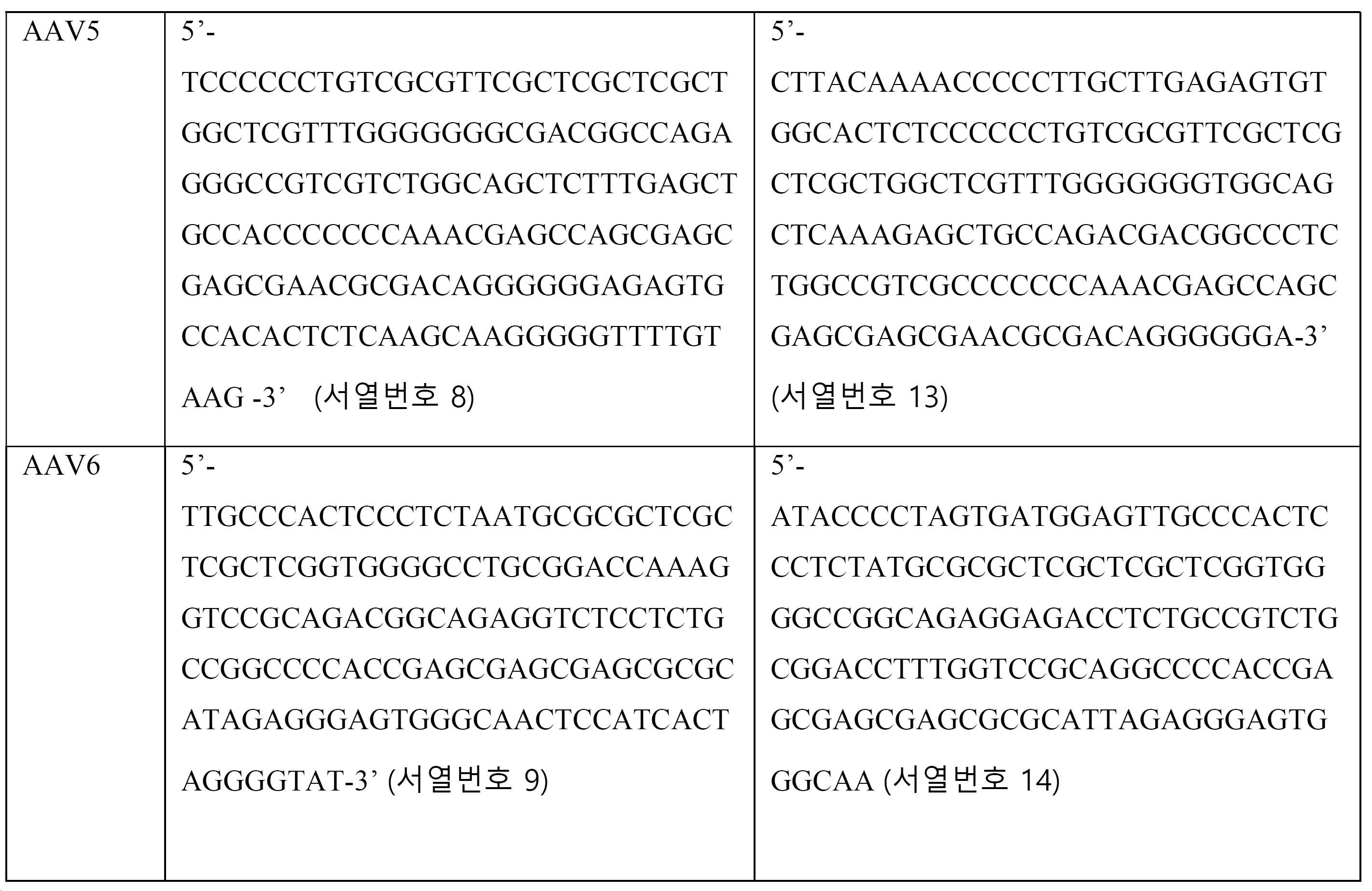
일부 구현예에서, WT-ITR 서열의 뉴클레오티드 서열은 (예를 들어, 1, 2, 3, 4 또는 5개 이상의 뉴클레오티드 또는 그 안의 임의의 범위의 뉴클레오티드를 변형시킴으로써) 변형될 수 있는데, 변형은 상보적 뉴클레오티드에 대한 치환이고, 예를 들어, C 대신 G, 및 그 반대, 및 A 대신 T, 및 그 반대이다.In some embodiments, the nucleotide sequence of the WT-ITR sequence can be modified (e.g., by modifying 1, 2, 3, 4 or 5 or more nucleotides or any range of nucleotides therein), wherein the modification is complementary. Substitution for an enemy nucleotide, for example, G instead of C, and vice versa, and T instead of A, and vice versa.
본 발명의 특정 구현예에서, 항체 또는 융합 단백질 생산을 위한 ceDNA 벡터는 서열 번호: 1, 2, 5-14 중 임의의 것으로부터 선택된 뉴클레오티드 서열로 구성된 WT-ITR을 갖지 않는다. 본 발명의 대안의 구현예에서, ceDNA 벡터가 서열 번호: 1, 2, 5-14 중 임의의 것으로부터 선택된 뉴클레오티드 서열을 포함하는 WT-ITR을 갖는 경우, 플랭킹 ITR은 또한 WT이고, ceDNA 벡터는 예를 들어, 본원 및 PCT/US18/49996 (예를 들어, PCT/US18/49996의 표 11 참조)에 개시된 바와 같은 조절 스위치를 포함한다. 일부 구현예에서, 항체 또는 융합 단백질 생산을 위한 ceDNA 벡터는 본원에 개시된 바와 같은 조절 스위치 및 서열 번호: 1, 2, 5-14로 구성된 군 중 어느 것으로부터 선택된 뉴클레오티드 서열을 갖는 선택된 WT-ITR을 포함한다.In certain embodiments of the invention, the ceDNA vector for antibody or fusion protein production does not have a WT-ITR consisting of a nucleotide sequence selected from any of SEQ ID NOs: 1, 2, 5-14. In an alternative embodiment of the invention, if the ceDNA vector has a WT-ITR comprising a nucleotide sequence selected from any of SEQ ID NOs: 1, 2, 5-14, the flanking ITR is also WT, and the ceDNA vector Includes, for example, control switches as disclosed herein and in PCT/US18/49996 (see, eg, Table 11 of PCT/US18/49996). In some embodiments, the ceDNA vector for antibody or fusion protein production comprises a selected WT-ITR having a regulatory switch as disclosed herein and a nucleotide sequence selected from any of the group consisting of SEQ ID NOs: 1, 2, 5-14. Include.
본원에 기재된 항체 또는 융합 단백질 생산을 위한 ceDNA 벡터는 작동 가능한 RBE, trs 및 RBE' 부분을 보유하는 WT-ITR 구조를 포함할 수 있다. 도 2a 및 도 2b는 예시적인 목적으로 야생형 ITR을 사용하여 ceDNA 벡터의 야생형 ITR 구조 부분 내에서 trs 부위의 작동을 위한 하나의 가능한 메커니즘을 보여준다. 일부 구현예에서, 항체 또는 융합 단백질 생산을 위한 ceDNA 벡터는 Rep-결합 부위 (RBS; AAV2에 대해 5'-GCGCGCTCGCTCGCTC-3'(서열 번호: 60)) 및 말단 분해 부위 (TRS; 5'-AGTT (서열 번호: 62))를 포함하는 하나 이상의 기능성 WT-ITR 폴리뉴클레오티드 서열을 함유한다. 일부 구현예에서, 적어도 하나의 WT-ITR은 기능적이다. 대안적인 구현예에서, 항체 또는 융합 단백질 생산을 위한 ceDNA 벡터가 서로 실질적으로 대칭인 2개의 WT-ITR을 포함하는 경우, 적어도 하나의 WT-ITR은 기능적이고 적어도 하나의 WT-ITR은 비-기능적이다.The ceDNA vectors for the production of antibodies or fusion proteins described herein may comprise a WT-ITR structure bearing operable RBE, trs and RBE' moieties. 2A and 2B show one possible mechanism for actuation of the trs site within the wild type ITR structure portion of the ceDNA vector using wild type ITR for illustrative purposes. In some embodiments, the ceDNA vector for antibody or fusion protein production comprises a Rep-binding site (RBS; 5'-GCGCGCTCGCTCGCTC-3' (SEQ ID NO: 60) for AAV2) and a terminal cleavage site (TRS; 5'-AGTT). (SEQ ID NO: 62)) of one or more functional WT-ITR polynucleotide sequences. In some embodiments, at least one WT-ITR is functional. In an alternative embodiment, when the ceDNA vector for antibody or fusion protein production comprises two WT-ITRs that are substantially symmetrical to each other, at least one WT-ITR is functional and at least one WT-ITR is non-functional. to be.
B. 비대칭 B. Asymmetry ITRITR 쌍 또는 대칭 Pair or symmetric ITRITR 쌍을 포함하는 Paired ceDNAceDNA 벡터에 대한 일반적으로 변형된 A generally transformed vector for ITRITR (모드- (mode- ITRITR ))
본원에서 논의된 바와 같이, 항체 또는 융합 단백질 생산을 위한 ceDNA 벡터는 대칭 ITR 쌍 또는 비대칭 ITR 쌍을 포함할 수 있다. 두 경우 모두에서, ITR의 하나 또는 둘 모두는 변형된 ITR일 수 있으며, 차이점은 첫 번째 경우 (즉, 대칭 모드-ITR), 모드-ITR은 동일한 3차원 공간 구성을 가지며 (즉, 동일한 A-A', C-C' 및 B-B' 아암 구성를 가짐), 반면 두 번째 경우 (즉, 비대칭 모드-ITR), 모드-ITR은 다른 3차원 공간 구성을 갖는다 (즉, A-A', C-C' 및 B-B' 아암의 다른 구성을 가짐).As discussed herein, ceDNA vectors for antibody or fusion protein production may comprise symmetric ITR pairs or asymmetric ITR pairs. In both cases, one or both of the ITRs can be modified ITRs, the difference is in the first case (i.e. symmetric mode-ITR), the mode-ITR has the same three-dimensional spatial configuration (i.e. the same A- A', CC' and BB' arm configurations), whereas in the second case (i.e., asymmetric mode-ITR), mode-ITRs have different three-dimensional spatial configurations (i.e., A-A', CC' and BB' Have a different configuration of the arm).
일부 구현예에서, 변형된 ITR은 야생형 ITR 서열 (예를 들어 AAV ITR)과 비교하여 결실, 삽입 및/또는 치환에 의해 변형된 ITR이다. 일부 구현예에서, ceDNA 벡터의 ITR 중 적어도 하나는 기능적 Rep 결합 부위 (RBS; 예를 들어, AAV2에 대해 5'-GCGCGCTCGCTCGCTC-3', 서열 번호: 60) 및 기능성 말단 분해 부위 (TRS; 5'-AGTT-3', 서열 번호: 62)를 포함한다. 일 구현예에서, ITR 중 적어도 하나는 비-기능적 ITR이다. 일 구현예에서, 상이한 또는 변형된 ITR은 각각 상이한 혈청형으로부터의 야생형 ITR이 아니다.In some embodiments, the modified ITR is an ITR that has been modified by deletion, insertion and/or substitution compared to a wild-type ITR sequence (eg AAV ITR). In some embodiments, at least one of the ITRs of the ceDNA vector comprises a functional Rep binding site (RBS; e.g., 5'-GCGCGCTCGCTCGCTC-3' for AAV2, SEQ ID NO: 60) and a functional terminal cleavage site (TRS; 5' -AGTT-3', SEQ ID NO: 62). In one embodiment, at least one of the ITRs is a non-functional ITR. In one embodiment, the different or modified ITRs are not wild type ITRs from each different serotype.
ITR에서의 특정 변경 및 돌연변이는 본원에 상세하게 기술되어 있지만, ITR의 맥락에서, "변경된" 또는 "돌연변이된" 또는 "변형된"은, 뉴클레오티드가 야생형, 참조 또는 원래 ITR 서열에 대해 삽입, 결실 및/또는 치환된 것을 나타낸다. 변경된 또는 돌연변이된 ITR은 조작된 ITR일 수 있다. 본원에 사용된 "조작된"은 인간의 손에 의해 조작된 측면을 지칭한다. 예를 들어, 폴리펩티드의 적어도 하나의 측면, 예를 들어, 이의 서열이 사람의 손에 의해 조작되어 자연에 존재하는 측면과 상이할 때 폴리펩티드가 "조작된" 것으로 간주된다.Certain alterations and mutations in the ITR are described in detail herein, but in the context of ITR, "altered" or "mutated" or "modified" means that the nucleotide is wild-type, a reference or an insertion, deletion with respect to the original ITR sequence. And/or substituted. The altered or mutated ITR can be an engineered ITR. As used herein, “manipulated” refers to aspects manipulated by the human hand. For example, a polypeptide is considered “engineered” when at least one aspect of the polypeptide, eg, its sequence, is manipulated by the human hand and differs from the aspect that exists in nature.
일부 구현예에서, 모드-ITR은 합성일 수 있다. 일 구현예에서, 합성 ITR은 하나 초과의 AAV 혈청형으로부터의 ITR 서열에 기초한다. 또 다른 구현예에서, 합성 ITR은 AAV 기반 서열을 포함하지 않는다. 또 다른 구현예에서, 합성 ITR은 AAV에서 얻어진 서열의 일부만을 갖거나 갖지 않더라도 상기 기술된 ITR 구조를 보존한다. 일부 측면에서, 합성 ITR은 야생형 Rep 또는 특정 혈청형의 Rep와 우선적으로 상호 작용할 수 있거나, 일부 경우 야생형 Rep에 의해 인식되지 않고 돌연변이된 Rep에 의해서만 인식될 것이다.In some embodiments, the mode-ITR can be synthetic. In one embodiment, the synthetic ITR is based on ITR sequences from more than one AAV serotype. In another embodiment, the synthetic ITR does not comprise an AAV based sequence. In another embodiment, the synthetic ITR preserves the ITR structure described above with or without only a portion of the sequence obtained from the AAV. In some aspects, synthetic ITRs may interact preferentially with wild-type Rep or a specific serotype of Rep, or in some cases will not be recognized by wild-type Rep, but only by mutated Rep.
당업자는 공지된 수단에 의해 다른 혈청형에서 상응하는 서열을 결정할 수 있다. 예를 들어, 변화가 A, A', B, B', C, C' 또는 D 영역에 있는지 확인하고 또 다른 혈청형에서 해당 영역을 결정한다. BLAST® (기본 지역 정렬 검색 도구) 또는 다른 상동성 정렬 프로그램을 디폴트 상태로 사용하여 상응하는 서열을 결정할 수 있다. 본 발명은 또한 상이한 AAV 혈청형의 조합으로부터의 모드-ITR을 포함하는 ceDNA 벡터의 집단 및 복수의 ceDNA 벡터를 제공하고, 즉, 하나의 모드-ITR은 하나의 AAV 혈청형으로부터 유래될 수 있고, 다른 모드-ITR은 상이한 혈청형으로부터 유래될 수 있다. 이론에 구속되지 않고, 일 구현예에서 하나의 ITR은 AAV2 ITR 서열로부터 유래하거나 이를 기초로 할 수 있고, ceDNA 벡터의 다른 ITR은 AAV 혈청형 1 (AAV1), AAV 혈청형 4 (AAV4), AAV 혈청형 5 (AAV5), AAV 혈청형 6 (AAV6), AAV 혈청형 7 (AAV7), AAV 혈청형 8 (AAV8), AAV 혈청형 9 (AAV9), AAV 혈청형 10 (AAV10) , AAV 혈청형 11 (AAV11), 또는 AAV 혈청형 12 (AAV12)의 임의의 하나 이상의 ITR 서열로부터 유래하거나 이를 기초로 할 수 있다.One of skill in the art can determine the corresponding sequence in other serotypes by known means. For example, determine if the change is in regions A, A', B, B', C, C', or D, and determine that region in another serotype. The corresponding sequence can be determined using BLAST® (basic local alignment search tool) or other homology alignment program as the default. The invention also provides a population of ceDNA vectors comprising a mod-ITR from a combination of different AAV serotypes and a plurality of ceDNA vectors, i.e., one mod-ITR can be derived from one AAV serotype, Other mod-ITRs can be derived from different serotypes. Without being bound by theory, in one embodiment one ITR may be derived from or based on the AAV2 ITR sequence, and the other ITR of the ceDNA vector is AAV serotype 1 (AAV1), AAV serotype 4 (AAV4), AAV Serotype 5 (AAV5), AAV serotype 6 (AAV6), AAV serotype 7 (AAV7), AAV serotype 8 (AAV8), AAV serotype 9 (AAV9), AAV serotype 10 (AAV10), AAV serotype 11 (AAV11), or any one or more ITR sequences of AAV serotype 12 (AAV12).
임의의 파보바이러스 ITR은 변형을 위해 ITR 또는 기본 ITR로 사용될 수 있다. 바람직하게는, 파보바이러스는 데펜도바이러스이다. 보다 바람직하게는 AAV. 선택된 혈청형은 혈청형의 조직 향성(tropism)에 기초할 수 있다. AAV2는 광범위한 조직 향성을 가지며, AAV1은 뉴런 및 골격근을 우선적으로 표적화하고, AAV5는 뉴런, 망막 색소 상피 및 광수용체를 우선적으로 표적화한다. AAV6은 골격근 및 폐를 우선적으로 표적화한다. AAV8은 간, 골격근, 심장 및 췌장 조직을 우선적으로 표적화한다. AAV9는 간, 골격 및 폐 조직을 우선적으로 표적화한다. 일 구현예에서, 변형된 ITR은 AAV2 ITR에 기초한다.Any parvovirus ITR can be used as ITR or basic ITR for modification. Preferably, the parvovirus is a defendovirus. More preferably AAV. The serotype selected may be based on the tissue tropism of the serotype. AAV2 has a wide range of tissue tropism, AAV1 preferentially targets neurons and skeletal muscle, and AAV5 preferentially targets neurons, retinal pigment epithelium and photoreceptors. AAV6 preferentially targets skeletal muscle and lungs. AAV8 preferentially targets liver, skeletal muscle, heart and pancreatic tissue. AAV9 preferentially targets liver, skeletal and lung tissue. In one embodiment, the modified ITR is based on the AAV2 ITR.
보다 구체적으로, 구조적 요소가 특정한 큰 Rep 단백질과 기능적으로 상호 작용하는 능력은 구조적 요소를 변형시킴으로써 변경될 수 있다. 예를 들어, 구조적 요소의 뉴클레오티드 서열은 ITR의 야생형 서열과 비교하여 변형될 수 있다. 일 구현예에서, ITR의 구조적 요소 (예를 들어, A 아암, A' 아암, B 아암, B' 아암, C 아암, C' 아암, D 아암, RBE, RBE' 및 trs)는 제거되고 다른 파보바이러스로부터의 야생형 구조적 요소로 대체될 수 있다. 예를 들어, 대체 구조는 AAV1, AAV2, AAV3, AAV4, AAV5, AAV6, AAV7, AAV8, AAV9, AAV10, AAV11, AAV12, AAV13, 뱀 파보바이러스 (예를 들어, 로얄 피톤 파보바이러스), 소 파보바이러스, 염소 파보바이러스, 조류 파보바이러스, 개 파보바이러스, 말 파보바이러스, 새우 파보바이러스, 돼지 파보바이러스 또는 곤충 AAV로부터 유래될 수 있다. 예를 들어, ITR은 AAV2 ITR일 수 있고, A 또는 A' 아암 또는 RBE는 AAV5로부터의 구조적 요소로 대체될 수 있다. 또 다른 예에서, ITR은 AAV5 ITR일 수 있고, C 또는 C' 아암, RBE, 및 trs는 AAV2로부터의 구조적 요소로 대체될 수 있다. 또 다른 예에서, AAV ITR은 AAV2 ITR B 및 B' 아암으로 대체된 B 및 B' 아암을 갖는 AAV5 ITR일 수 있다.More specifically, the ability of a structural element to functionally interact with a specific large Rep protein can be altered by modifying the structural element. For example, the nucleotide sequence of the structural element can be modified compared to the wild-type sequence of the ITR. In one embodiment, structural elements of the ITR (e.g., A arm, A'arm, B arm, B'arm, C arm, C'arm, D arm, RBE, RBE' and trs) are removed and It can be replaced by wild-type structural elements from viruses. For example, alternative structures are AAV1, AAV2, AAV3, AAV4, AAV5, AAV6, AAV7, AAV8, AAV9, AAV10, AAV11, AAV12, AAV13, snake parvovirus (e.g., royal phyton parvovirus), bovine parvovirus , Goat parvovirus, bird parvovirus, canine parvovirus, equine parvovirus, shrimp parvovirus, porcine parvovirus or insect AAV. For example, the ITR can be an AAV2 ITR, and the A or A'arm or RBE can be replaced with a structural element from AAV5. In another example, the ITR can be an AAV5 ITR, and the C or C'arm, RBE, and trs can be replaced with structural elements from AAV2. In another example, the AAV ITR may be an AAV5 ITR with B and B'arms replaced with AAV2 ITR B and B'arms.
단지 예로서, 표 8은 변형된 ITR의 영역에서 적어도 하나의 뉴클레오티드의 예시적인 변형 (예를 들어, 결실, 삽입 및/또는 치환)을 나타내며, 여기서 X는 상응하는 야생형 ITR에 대한 해당 섹션에서의 적어도 하나의 핵산의 변형 (예를 들어, 결실, 삽입 및/또는 치환)을 나타낸다. 일부 구현예에서, C 및/또는 C' 및/또는 B 및/또는 B'의 임의의 영역에서 적어도 하나의 뉴클레오티드의 임의의 변형 (예를 들어, 결실, 삽입 및/또는 치환)은 적어도 하나의 말단 루프에서 3개의 순차적인 T 뉴클레오티드 (즉, TTT)를 보유한다. 예를 들어, 변형 결과, 단일 아암 ITR (예를 들어, 단일 C-C' 아암 또는 단일 B-B' 아암) 또는 변형된 C-B' 아암 또는 C'-B 아암, 또는 적어도 하나의 절단된 아암 (예를 들어, 절단된 C-C' 아암 및/또는 절단된 B-B' 아암)을 갖는 2개의 아암 ITR 중 어느 것이 된다면, 적어도 하나의 단일 아암 또는 2개의 아암 ITR 중 적어도 하나의 아암 (하나의 아암이 절단될 수 있는 경우)은 적어도 하나의 말단 루프에서 순차적인 T 뉴클레오티드 (즉, TTT)를 보유한다. 일부 구현예에서, 절단된 C-C' 아암 및/또는 절단된 B-B' 아암은 말단 루프에서 3개의 순차적인 T 뉴클레오티드 (즉, TTT)를 갖는다.By way of example only, Table 8 shows exemplary modifications (e.g., deletions, insertions and/or substitutions) of at least one nucleotide in the region of the modified ITR, where X is in the corresponding section for the corresponding wild-type ITR. It represents a modification (eg, deletion, insertion and/or substitution) of at least one nucleic acid. In some embodiments, any modification (e.g., deletion, insertion and/or substitution) of at least one nucleotide in any region of C and/or C′ and/or B and/or B′ is at least one It retains three sequential T nucleotides (ie, TTT) in the terminal loop. For example, as a result of the modification, a single arm ITR (e.g., a single CC' arm or a single BB' arm) or a modified CB' arm or a C'-B arm, or at least one truncated arm (e.g., If any of the two arm ITRs with a truncated CC' arm and/or a truncated BB' arm), at least one single arm or at least one of the two arm ITRs (if one arm can be cut ) Carries sequential T nucleotides (i.e., TTT) in at least one terminal loop. In some embodiments, the truncated CC' arm and/or the truncated BB' arm has 3 sequential T nucleotides (ie, TTT) in the terminal loop.
표 8: ITR의 상이한 B-B' 및 C-C' 영역 또는 아암에 대한 적어도 하나의 뉴클레오티드 변형 (예를 들어, 결실, 삽입 및/또는 치환)의 예시적인 조합 (X는 뉴클레오티드 변형, 예를 들어, 상기 영역에서 적어도 하나의 뉴클레오티드의 첨가, 결실 또는 치환을 나타냄).Table 8: Exemplary combinations of at least one nucleotide modification (e.g., deletion, insertion and/or substitution) for different BB' and CC' regions or arms of the ITR (X is a nucleotide modification, e.g., said region Represents the addition, deletion or substitution of at least one nucleotide in).
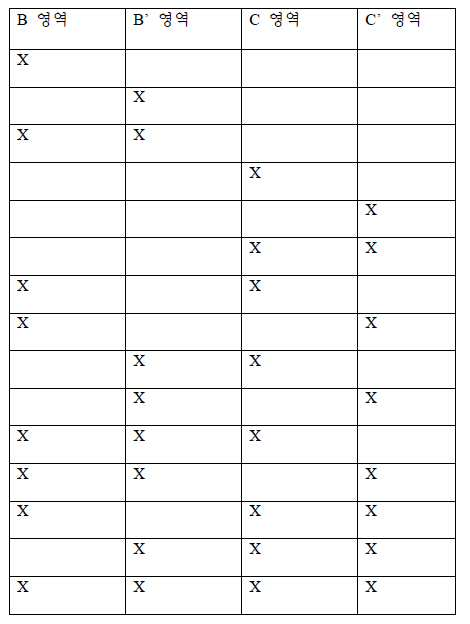
일부 구현예에서, 비대칭 ITR 쌍, 또는 본원에 개시된 바와 같은 대칭 모드-ITR 쌍을 포함하는 항체 또는 융합 단백질 생산을 위한 ceDNA 벡터에 사용하기 위한 모드-ITR은 표 8에 나타낸 변형, 및 또한 A'와 C 사이, C와 C' 사이, C'와 B 사이, B와 B' 사이, 및 B'와 A 사이에서 선택된 영역 중 어느 하나 이상에서 적어도 하나의 뉴클레오티드의 변형의 조합 중 어느 하나를 포함할 수 있다. 일부 구현예에서, C 또는 C' 또는 B 또는 B' 영역에서 적어도 하나의 뉴클레오티드의 임의의 변형 (예를 들어, 결실, 삽입 및/또는 치환)은 여전히 스템-루프의 말단 루프를 보존한다. 일부 구현예에서, C 및 C' 및/또는 B 및 B' 사이의 적어도 하나의 뉴클레오티드의 임의의 변형 (예를 들어, 결실, 삽입 및/또는 치환)은 적어도 하나의 말단 루프에 3개의 순차적인 T 뉴클레오티드 (즉, TTT)를 보유한다. 대안적인 구현예에서, C 및 C' 및/또는 B 및 B' 사이의 적어도 하나의 뉴클레오티드의 임의의 변형 (예를 들어, 결실, 삽입 및/또는 치환)은 적어도 하나의 말단 루프에 3개의 순차적인 A 뉴클레오티드 (즉, AAA)를 보유한다 일부 구현예에서, 본원에 사용하기 위한 변형된 ITR은 표 8에 나타낸 변형, 및 또한 A', A 및/또는 D로부터 선택된 영역 중 임의의 하나에서 적어도 하나의 뉴클레오티드의 변형 (예를 들어, 결실, 삽입 및/또는 치환)의 조합 중 임의의 하나를 포함할 수 있다. 예를 들어, 일부 구현예에서, 본원에 사용하기 위한 변형된 ITR은 표 8에 나타낸 변형, 및 또한 A 영역에서 적어도 하나의 뉴클레오티드 변형 (예를 들어, 결실, 삽입 및/또는 치환)의 조합 중 임의의 하나를 포함할 수 있다. 일부 구현예에서, 본원에 사용하기 위한 변형된 ITR은 표 8에 나타낸 변형, 및 또한 A' 영역에서 적어도 하나의 뉴클레오티드 변형 (예를 들어, 결실, 삽입 및/또는 치환)의 조합 중 임의의 하나를 포함할 수 있다. 일부 구현예에서, 본원에 사용하기 위한 변형된 ITR은 표 8에 나타낸 변형, 및 또한 A 및/또는 A' 영역에서 적어도 하나의 뉴클레오티드 변형 (예를 들어, 결실, 삽입 및/또는 치환)의 조합 중 임의의 하나를 포함할 수 있다. 일부 구현예에서, 본원에 사용하기 위한 변형된 ITR은 표 8에 나타낸 변형, 및 또한 D 영역에서 적어도 하나의 뉴클레오티드 변형 (예를 들어, 결실, 삽입 및/또는 치환)의 조합 중 임의의 하나를 포함할 수 있다.In some embodiments, the mod-ITR for use in ceDNA vectors for producing antibodies or fusion proteins comprising an asymmetric ITR pair, or a symmetric mod-ITR pair as disclosed herein, is a modification shown in Table 8 , and also A' And C, between C and C', between C'and B, between B and B', and between B'and A, any one of a combination of modifications of at least one nucleotide in any one or more of the selected regions. I can. In some embodiments, any modification (eg, deletion, insertion and/or substitution) of at least one nucleotide in the C or C′ or B or B′ region still preserves the terminal loop of the stem-loop. In some embodiments, any modification (e.g., deletion, insertion and/or substitution) of at least one nucleotide between C and C′ and/or B and B′ is 3 sequential It has a T nucleotide (ie, TTT). In an alternative embodiment, any modifications (e.g., deletions, insertions and/or substitutions) of at least one nucleotide between C and C'and/or B and B'are three sequentially in at least one terminal loop. In some embodiments, a modified ITR for use herein is at least in the modification shown in Table 8 , and also in any one of the regions selected from A′, A and/or D. It can include any one of a combination of modifications (eg, deletions, insertions and/or substitutions) of one nucleotide. For example, in some embodiments, a modified ITR for use herein is a combination of the modifications shown in Table 8 , and also at least one nucleotide modification (e.g., deletion, insertion and/or substitution) in region A. It can contain any one. In some embodiments, the modified ITR for use herein is any one of the modifications shown in Table 8 , and also a combination of at least one nucleotide modification (e.g., deletion, insertion and/or substitution) in the A′ region. It may include. In some embodiments, the modified ITR for use herein is a combination of the modifications shown in Table 8 , and also at least one nucleotide modification (e.g., deletion, insertion and/or substitution) in the A and/or A′ region. It may include any one of. In some embodiments, a modified ITR for use herein is a modification shown in Table 8 , and also any one of a combination of at least one nucleotide modification (e.g., deletion, insertion and/or substitution) in the D region. Can include.
일 구현예에서, 구조적 요소의 뉴클레오티드 서열을 (예를 들어, 1, 2, 3, 4, 5, 6, 7, 8, 9, 10, 11, 12, 13, 14, 15, 16, 17, 18, 19 또는 20개 이상의 뉴클레오티드 또는 그 안의 임의의 범위의 뉴클레오티드를 변형함으로써) 변형시켜 변형된 구조적 요소를 생성할 수 있다. 일 구현예에서, ITR에 대한 특정 변형은 본원에 예시되어 있거나 (예를 들어, 2018년 12월 6일에 출원된 PCT/US2018/064242의 서열 번호: 3, 4, 15-47, 101-116 또는 165-187, 또는 도 7a-7b에 도시됨 (예를 들어, PCT/US2018/064242 중의 서열번호: 97-98, 101-103, 105-108, 111-112, 117-134, 545-54)에 도시되어 있다. 일부 구현예에서, ITR은 (예를 들어, 1, 2, 3, 4, 5, 6, 7, 8, 9, 10, 11, 12, 13, 14, 15, 16, 17, 18, 19 또는 20개 이상의 뉴클레오티드 또는 그 안의 임의의 범위의 뉴클레오티드를 변형시킴으로써) 변형될 수 있다. 다른 구현예에서, ITR은 서열 번호: 3, 4, 15-47, 101-116 또는 165-187의 변형된 ITR, 또는 서열 번호: 3, 4, 15-47, 101-116 또는 165-187의 A-A' 아암 및 C-C' 및 B-B' 아암의 RBE-함유 섹션, 또는 국제 출원 PCT/US18/49996 (이는 그 전문이 본원에 참고로 포함됨)의 표 2-9 (즉, 서열 번호: 110-112, 115-190, 200-468)에 나타낸 것 중 하나와 적어도 80%, 적어도 85%, 적어도 90%, 적어도 95%, 적어도 96%, 적어도 97%, 적어도 98%, 적어도 99% 또는 그 이상의 서열 동일성을 가질 수 있다.In one embodiment, the nucleotide sequence of the structural element (e.g., 1, 2, 3, 4, 5, 6, 7, 8, 9, 10, 11, 12, 13, 14, 15, 16, 17, By modifying 18, 19, or 20 or more nucleotides or any range of nucleotides therein), modified structural elements can be produced. In one embodiment, certain modifications to the ITR are exemplified herein (e.g., SEQ ID NOs: 3, 4, 15-47, 101-116 of PCT/US2018/064242, filed December 6, 2018. Or 165-187, or shown in FIGS.7A-7B (e.g., SEQ ID NOs: 97-98, 101-103, 105-108, 111-112, 117-134, 545-54 in PCT/US2018/064242 In some embodiments, the ITR is (eg, 1, 2, 3, 4, 5, 6, 7, 8, 9, 10, 11, 12, 13, 14, 15, 16, 17, 18, 19 or 20 or more nucleotides or any range of nucleotides therein. In other embodiments, the ITR is SEQ ID NO: 3, 4, 15-47, 101-116 or 165 A modified ITR of -187, or the RBE-containing section of the AA' arms and CC' and BB' arms of SEQ ID NO: 3, 4, 15-47, 101-116 or 165-187, or international application PCT/US18/ 49996 (which is incorporated herein by reference in its entirety) with at least 80%, at least 85%, at least one of those shown in Tables 2-9 (i.e. SEQ ID NOs: 110-112, 115-190, 200-468) 90%, at least 95%, at least 96%, at least 97%, at least 98%, at least 99% or more sequence identity.
일부 구현예에서, 변형된 ITR은 예를 들어 특정 아암의 전부, 예를 들어, A-A' 아암의 전부 또는 일부, 또는 B-B' 아암의 전부 또는 일부 또는 C-C' 아암의 전부 또는 일부의 제거 또는 결실, 또는 대안적으로, 스템 (예를 들어, 단일 아암)을 캡핑하는 최종 루프가 존재하는 한 루프의 스템을 형성하는 1, 2, 3, 4, 5, 6, 7, 8, 9개 이상의 염기쌍의 제거를 포함할 수 있다 (예를 들어, 2018년 12월 6일에 출원된 PCT/US2018/064242의 도 7a의 ITR-21 참조). 일부 구현예에서, 변형된 ITR은 B-B' 아암으로부터 1, 2, 3, 4, 5, 6, 7, 8, 9개 이상의 염기쌍의 제거를 포함할 수 있다. 일부 구현예에서, 변형된 ITR은 C-C' 아암으로부터 1, 2, 3, 4, 5, 6, 7, 8, 9개 이상의 염기쌍의 제거를 포함할 수 있다 (예를 들어, 2018년 12월 6일에 출원된 PCT/US2018/064242의 도 3b의 ITR-1 또는 도 7a의 ITR-45 참조). 일부 구현예에서, 변형된 ITR은 C-C' 아암으로부터 1, 2, 3, 4, 5, 6, 7, 8, 9개 이상의 염기쌍의 제거 및 B-B' 아암으로부터 1, 2, 3, 4, 5, 6, 7, 8, 9개 이상의 염기쌍의 제거를 포함할 수 있다. 염기쌍의 제거의 임의의 조합이 구상되며, 예를 들어, C-C' 아암에서 6개의 염기쌍이 제거될 수 있고, B-B' 아암에서 2개의 염기쌍이 제거될 수 있다. 예시적인 예로서, 도 3b는 각각의 C 부분 및 C' 부분으로부터 결실된 적어도 7개의 염기쌍, C 및 C' 영역 사이의 루프에서 뉴클레오티드의 치환, 및 변형된 ITR이 적어도 하나의 아암 (예를 들어, C-C')이 절단된 2개의 아암을 포함하도록 B 영역 및 B' 영역 각각으로부터 적어도 하나의 염기쌍 결실을 갖는 예시적인 변형된 ITR을 보여준다. 일부 구현예에서, 변형된 ITR은 또한, B-B' 아암이 WT ITR에 대해 또한 절단되도록 B 영역 및 B' 영역 각각으로부터 적어도 하나의 염기쌍 결실을 포함한다.In some embodiments, the modified ITR is, for example, removal or deletion of all or part of a particular arm, e.g., all or part of an AA' arm, or all or part of a BB' arm or all or part of a CC' arm, Or alternatively, 1, 2, 3, 4, 5, 6, 7, 8, 9 or more base pairs forming the stem of the loop as long as there is a final loop capping the stem (e.g., a single arm). Removal may be included (see, for example, ITR-21 in FIG. 7A of PCT/US2018/064242 filed December 6, 2018). In some embodiments, the modified ITR may comprise removal of 1, 2, 3, 4, 5, 6, 7, 8, 9 or more base pairs from the BB′ arm. In some embodiments, the modified ITR may comprise the removal of 1, 2, 3, 4, 5, 6, 7, 8, 9 or more base pairs from the CC' arm (e.g., December 6, 2018 filed on day PCT / US2018 / 064 242 of the Fig. 3b ITR-ITR-1 or 45 of Figure 7a Reference). In some embodiments, the modified ITR is the removal of 1, 2, 3, 4, 5, 6, 7, 8, 9 or more base pairs from the CC' arm and 1, 2, 3, 4, 5, 6, 7, 8, 9 or more base pairs may be removed. Any combination of removal of base pairs is envisioned, for example, 6 base pairs can be removed in the CC' arm and 2 base pairs can be removed in the BB' arm. As an illustrative example, FIG. 3B shows at least 7 base pairs deleted from each C moiety and C′ moiety, substitution of nucleotides in the loop between the C and C′ regions, and the modified ITR is at least one arm (e.g. , C-C') shows an exemplary modified ITR with at least one base pair deletion from each of the B region and the B'region to include the two arms truncated. In some embodiments, the modified ITR also comprises at least one base pair deletion from each of the B and B'regions such that the BB' arm is also cleaved for the WT ITR.
일부 구현예에서, 변형된 ITR은 전장 야생형 ITR 서열에 대해 1 내지 50개 (예를 들어, 1, 2, 3, 4, 5, 6, 7, 8, 9, 10, 11, 12, 13, 14, 15, 16, 17, 18, 19, 20, 21, 22, 23, 24, 25, 26, 27, 28, 29, 30, 31, 32, 33, 34, 35, 36, 37, 38, 39, 40, 41, 42, 43, 44, 45, 46, 47, 48, 49 또는 50개)의 뉴클레오티드 결실을 가질 수 있다. 일부 구현예에서, 변형된 ITR은 전장 WT ITR 서열에 대해 1 내지 30개의 뉴클레오티드 결실을 가질 수 있다. 일부 구현예에서, 변형된 ITR은 전장 야생형 ITR 서열에 대해 2 내지 20개의 뉴클레오티드 결실을 갖는다.In some embodiments, the modified ITR is 1-50 (e.g., 1, 2, 3, 4, 5, 6, 7, 8, 9, 10, 11, 12, 13, 14, 15, 16, 17, 18, 19, 20, 21, 22, 23, 24, 25, 26, 27, 28, 29, 30, 31, 32, 33, 34, 35, 36, 37, 38, 39, 40, 41, 42, 43, 44, 45, 46, 47, 48, 49 or 50) nucleotide deletions. In some embodiments, the modified ITR can have 1 to 30 nucleotide deletions to the full length WT ITR sequence. In some embodiments, the modified ITR has 2 to 20 nucleotide deletions relative to the full length wild type ITR sequence.
일부 구현예에서, 변형된 ITR은 A 또는 A' 영역의 RBE-함유 부분에서 임의의 뉴클레오티드 결실을 함유하지 않아서 DNA 복제 (예를 들어, Rep 단백질에 의한 RBE에의 결합 또는 말단 분해 부위에서의 닉킹)를 방해하지 않는다. 일부 구현예에서, 본원에 사용하기 위해 포함된 변형된 ITR은 본원에 기재된 바와 같이 B, B', C 및/또는 C 영역에서 하나 이상의 결실을 갖는다.In some embodiments, the modified ITR does not contain any nucleotide deletions in the RBE-containing portion of the A or A'region, such that DNA replication (e.g., binding to RBE by the Rep protein or nicking at the terminal cleavage site) Do not disturb. In some embodiments, the modified ITRs included for use herein have one or more deletions in regions B, B', C and/or C as described herein.
일부 구현예에서, 대칭 ITR 쌍 또는 비대칭 ITR 쌍을 포함하는 항체 또는 융합 단백질 생산을 위한 ceDNA 벡터는 본원에 개시된 바와 같은 조절 스위치 및 서열 번호: 3, 4, 15-47, 101-116 또는 165-187로 구성된 군 중 어느 것으로부터 선택된 뉴클레오티드 서열을 갖는 선택된 적어도 하나의 변형된 ITR을 포함한다.In some embodiments, the ceDNA vector for the production of an antibody or fusion protein comprising a symmetric ITR pair or an asymmetric ITR pair is a regulatory switch as disclosed herein and SEQ ID NO: 3, 4, 15-47, 101-116 or 165- At least one modified ITR having a nucleotide sequence selected from any of the group consisting of 187.
또 다른 구현예에서, 구조적 요소의 구조는 변형될 수 있다. 예를 들어, 구조적 요소는 스템의 높이 및/또는 루프에서 뉴클레오티드 수의 변화이다. 예를 들어, 스템의 높이는 약 2, 3, 4, 5, 6, 7, 8 또는 9개 이상의 뉴클레오티드 또는 그 안의 임의의 범위일 수 있다. 일 구현예에서, 스템 높이는 약 5개의 뉴클레오티드 내지 약 9개의 뉴클레오티드일 수 있고, Rep와 기능적으로 상호 작용할 수 있다. 또 다른 구현예에서, 스템 높이는 약 7개의 뉴클레오티드일 수 있고, Rep와 기능적으로 상호 작용할 수 있다. 또 다른 예에서, 루프는 3, 4, 5, 6, 7, 8, 9 또는 10개 이상의 뉴클레오티드 또는 그 안의 임의의 범위를 가질 수 있다.In another embodiment, the structure of the structural element can be modified. For example, the structural factor is a change in the height of the stem and/or the number of nucleotides in the loop. For example, the height of the stem can be about 2, 3, 4, 5, 6, 7, 8 or 9 or more nucleotides or any range therein. In one embodiment, the stem height can be from about 5 nucleotides to about 9 nucleotides and can functionally interact with Rep. In another embodiment, the stem height can be about 7 nucleotides and can functionally interact with Rep. In another example, the loop can have 3, 4, 5, 6, 7, 8, 9 or 10 or more nucleotides or any range therein.
또 다른 구현예에서, RBE 또는 확장된 RBE 내의 GAGY 결합 부위 또는 GAGY 관련 결합 부위의 수는 증가 또는 감소될 수 있다. 일 예에서, RBE 또는 확장된 RBE는 1, 2, 3, 4, 5 또는 6개 이상의 GAGY 결합 부위 또는 그 안의 임의의 범위를 포함할 수 있다. 서열이 Rep 단백질에 결합하기에 충분하다면, 각각의 GAGY 결합 부위는 독립적으로 정확한 GAGY 서열 또는 GAGY와 유사한 서열일 수 있다.In another embodiment, the number of GAGY binding sites or GAGY-related binding sites in the RBE or expanded RBE can be increased or decreased. In one example, the RBE or extended RBE may include 1, 2, 3, 4, 5 or 6 or more GAGY binding sites or any range therein. Each GAGY binding site may independently be an exact GAGY sequence or a GAGY-like sequence, provided that the sequence is sufficient to bind the Rep protein.
또 다른 구현예에서, 두 요소 (예컨대 비제한적으로 RBE 및 헤어핀) 사이의 간격은 큰 Rep 단백질과의 기능적 상호 작용을 변경하기 위해 변경 (예를 들어, 증가 또는 감소)될 수 있다. 예를 들어, 간격은 약 1, 2, 3, 4, 5, 6, 7, 8, 9, 10, 11, 12, 13, 14, 15, 16, 17, 18, 19, 20, 또는 21개 이상의 뉴클레오티드 또는 그 안의 임의의 범위일 수 있다.In another embodiment, the spacing between two elements (eg, but not limited to RBE and hairpin) can be altered (eg, increased or decreased) to alter the functional interaction with the large Rep protein. For example, the interval is about 1, 2, 3, 4, 5, 6, 7, 8, 9, 10, 11, 12, 13, 14, 15, 16, 17, 18, 19, 20, or 21 Or more nucleotides or any range therein.
본원에 기재된 바와 같은 항체 또는 융합 단백질 생산을 위한 ceDNA 벡터는 본원에 개시된 야생형 AAV2 ITR 구조와 관련하여 변형된 ITR 구조를 포함할 수 있지만 여전히 작동 가능한 RBE, trs 및 RBE' 부분을 보유한다. 도 2a 및 도 2b는 항체 또는 융합 단백질 생산을 위한 ceDNA 벡터의 야생형 ITR 구조 부분 내에서 trs 부위의 작동을 위한 하나의 가능한 메커니즘을 보여준다. 일부 구현예에서, 항체 또는 융합 단백질 생산을 위한 ceDNA 벡터는 Rep-결합 부위 (RBS; 5'-GCGCGCTCGCTCGCTC-3' (AAV2의 경우 서열번호 60)) 및 말단 확인 부위 (TRS; 5'-AGTT (서열 번호 62))를 포함하는 하나 이상의 기능성 ITR 폴리뉴클레오티드 서열 를 함유한다. 일부 구현예에서, 하나 이상의 ITR (wt 또는 변형된 ITR)은 기능적이다. 대안적 구현예에서, 항체 또는 융합 단백질 생산을 위한 ceDNA 벡터가 서로 상이하거나 비대칭인 2 개의 변형된 ITR을 포함하는 경우, 하나 이상의 변형된 ITR은 기능적이고 하나 이상의 변형된 ITR은 비-기능적이다.The ceDNA vectors for the production of antibodies or fusion proteins as described herein may contain modified ITR structures with respect to the wild type AAV2 ITR structures disclosed herein, but still retain operable RBE, trs and RBE' moieties. 2A and 2B show one possible mechanism for the actuation of the trs site within the wild-type ITR structural portion of the ceDNA vector for antibody or fusion protein production. In some embodiments, the ceDNA vector for antibody or fusion protein production comprises a Rep-binding site (RBS; 5'-GCGCGCTCGCTCGCTC-3' (SEQ ID NO: 60 for AAV2)) and a terminal identification site (TRS; 5'-AGTT ( SEQ ID NO: 62)) and at least one functional ITR polynucleotide sequence. In some embodiments, one or more ITRs (wt or modified ITRs) are functional. In an alternative embodiment, when the ceDNA vector for antibody or fusion protein production comprises two modified ITRs that are different or asymmetric from each other, at least one modified ITR is functional and at least one modified ITR is non-functional.
일부 구현예에서, 본원에 기재된 바와 같은 항체 또는 융합 단백질 생산을 위한 ceDNA 벡터의 변형된 ITR (예를 들어, 좌측 또는 우측 ITR)은 루프 아암, 절단된 아암 또는 스페이서 내에서 변형을 갖는다. 루프 암, 절단된 암 또는 스페이서 내에서 변형을 갖는 ITR의 예시적인 서열은 국제 출원 PCT/US18/49996의 표 2 (즉, 서열 번호: 135-190, 200-233); 표 3 (예를 들어, 서열 번호: 234-263); 표 4 (예를 들어, 서열 번호: 264-293); 표 5 (예를 들어, 본원의 서열 번호: 294-318); 표 6 (예를 들어, 서열 번호: 319-468; 및 표 7-9 (예를 들어, 서열 번호: 101-110, 111-112, 115-134)) 또는 표 10A 또는 10B (예를 들어, 서열 번호: 9, 100, 469-483, 484-499)에 열거되어 있으며, 이는 그 전문이 본원에 참조로 포함된다.In some embodiments, a modified ITR (eg, left or right ITR) of a ceDNA vector for production of an antibody or fusion protein as described herein has a modification within a loop arm, truncated arm or spacer. Exemplary sequences of ITRs with modifications in loop arms, truncated arms or spacers are listed in Table 2 of International Application PCT/US18/49996 (ie, SEQ ID NOs: 135-190, 200-233); Table 3 (eg, SEQ ID NO: 234-263); Table 4 (eg, SEQ ID NO: 264-293); Table 5 (eg, SEQ ID NO: 294-318 herein); Table 6 (e.g., SEQ ID NO: 319-468; And Table 7-9 (e.g., SEQ ID NO: 101-110, 111-112, 115-134)) or Table 10A or 10B (e.g., SEQ ID NO: 9, 100, 469-483, 484-499), which is incorporated herein by reference in its entirety.
일부 구현예에서, 비대칭 ITR 쌍 또는 대칭 mod-ITR 쌍을 포함하는 항체 또는 융합 단백질 생산을 위한 ceDNA 벡터에 사용하기 위한 변형된 ITR은 국제 출원 PCT/US18/49996의 표 2, 3, 4, 5, 6, 7, 8, 9 및 10A-10B에 나타나며, 본원에 그 전체가 참조로 포함된다.In some embodiments, modified ITRs for use in ceDNA vectors for production of antibodies or fusion proteins comprising asymmetric ITR pairs or symmetric mod-ITR pairs are described in Tables 2, 3, 4, 5 of international application PCT/US18/49996. , 6, 7, 8, 9 and 10A-10B, the entire contents of which are incorporated herein by reference.
상기 클래스 각각에서 비대칭 ITR 쌍, 또는 대칭 mod-ITR 쌍을 포함하는 항체 또는 융합 단백질 생산을 위한 ceDNA 벡터에 사용하기 위한 추가의 예시적인 변형된 ITR이 표 9A 및 9B에 제공되어 있다. 표 9A에서 우측 변형된 ITR의 예측된 이차 구조는 2018년 12월 6일에 출원된 국제 출원 PCT/US2018/064242의 도 7A 및 표 9B에서 좌측 변형된 ITR의 예측된 2차 구조가 2018년 12월 6일에 출원된 국제 출원 PCT/US2018/064242의 도 7B에 도시되며, 본원에 그 전체가 참조로 포함된다.Additional exemplary modified ITRs for use in ceDNA vectors for the production of antibodies or fusion proteins comprising asymmetric ITR pairs, or symmetric mod-ITR pairs in each of these classes, are provided in Tables 9A and 9B . The predicted secondary structure of the right modified ITR in Table 9A is the predicted secondary structure of the left modified ITR in Fig. 7A and Table 9B of international application PCT/US2018/064242 filed on December 6, 2018. 7B of international application PCT/US2018/064242, filed on the 6th day of the month, incorporated herein by reference in its entirety.
표 9A 및 표 9B는 예시적인 우측 및 좌측 변형된 ITR을 나타낸다. Tables 9A and 9B show exemplary right and left modified ITRs.
표 9A: 예시적인 변형된 우측 ITR. 이러한 예시적인 변형된 우측 ITR은 GCGCGCTCGCTCGCTC-3'의 RBE (서열 번호: 60), ACTGAGGC의 스페이서 (서열 번호: 69), 스페이서 보체 GCCTCAGT (서열 번호: 70) 및 RBE' (즉, GAGCGAGCGAGCGCGC (서열 번호 71)의 RBE에 대한 보체). Table 9A : Exemplary modified right ITR. These exemplary modified right ITRs are RBE of GCGCGCTCGCTCGCTC-3' (SEQ ID NO: 60), spacer of ACTGAGGC (SEQ ID NO: 69), spacer complement GCCTCAGT (SEQ ID NO: 70) and RBE' (i.e., GAGCGAGCGAGCGCGC (SEQ ID NO: 71) of RBE).
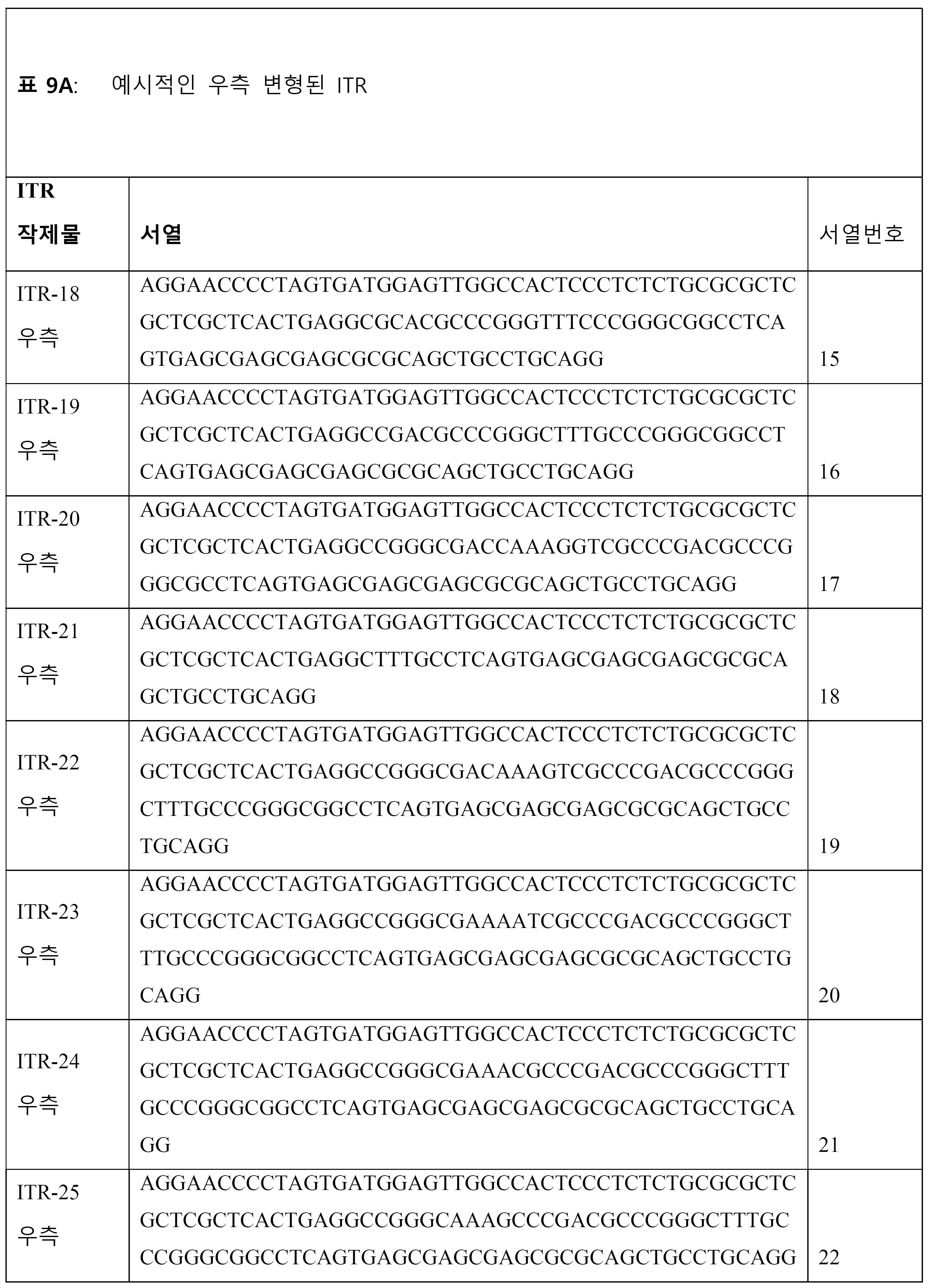
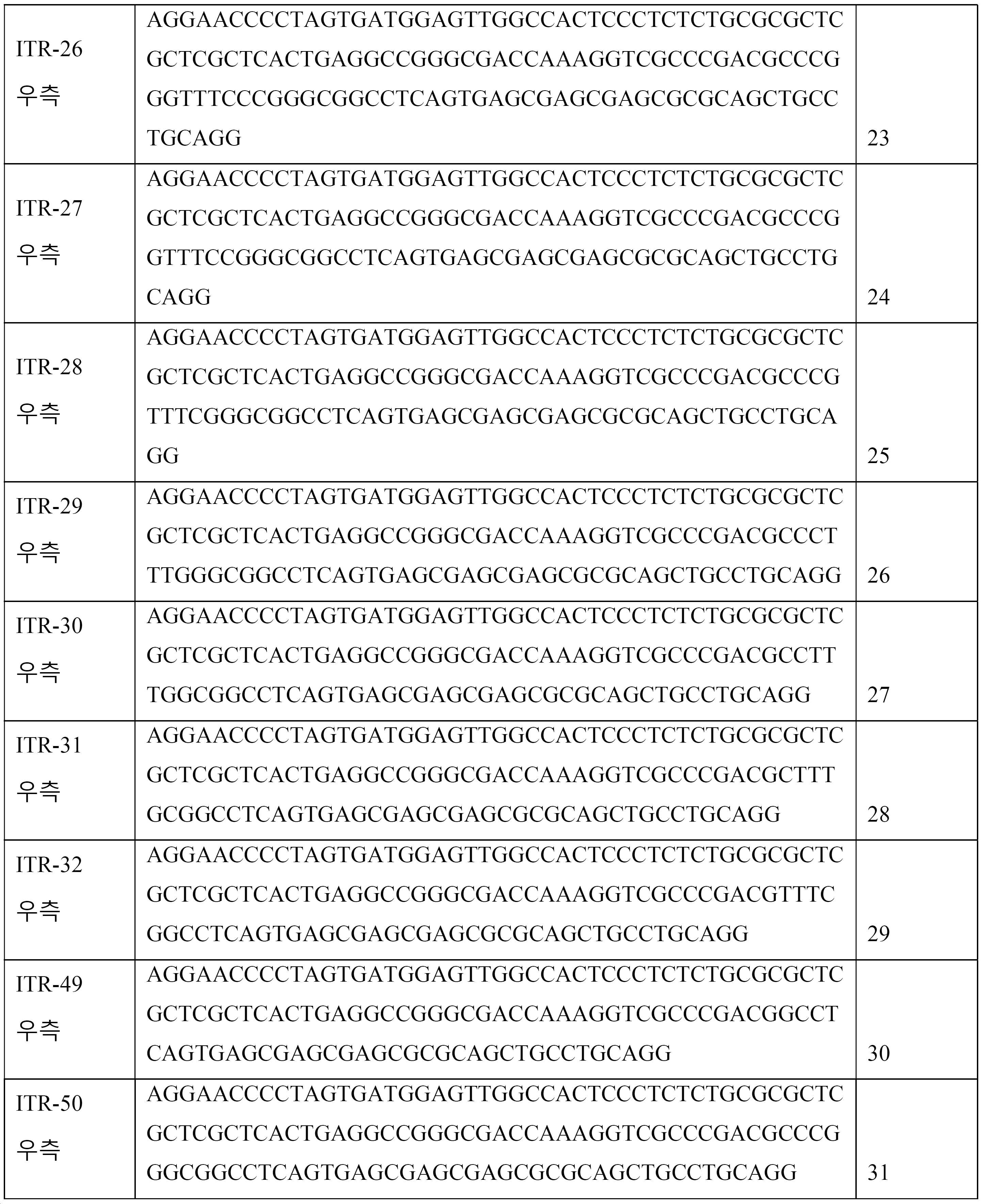
표 9B : 예시적인 변형된 좌측 ITR. 이러한 예시적인 변형된 좌측 ITR은 GCGCGCTCGCTCGCTC-3'의 RBE (서열 번호: 60), ACTGAGGC의 스페이서 (서열 번호: 69), 스페이서 보체 GCCTCAGT (서열 번호: 70) 및 GAGCGAGCGAGCGCGC (서열 번호 71)의 RBE 보체 (RBE')을 포함할 수 있다. Table 9B : Exemplary modified left ITR. This exemplary modified left ITR is the RBE of GCGCGCTCGCTCGCTC-3' (SEQ ID NO: 60), the spacer of ACTGAGGC (SEQ ID NO: 69), the spacer complement GCCTCAGT (SEQ ID NO: 70) and the RBE complement of GAGCGAGCGAGCGCGC (SEQ ID NO: 71). (RBE') may be included.


일 구현예에서, 항체 또는 융합 단백질 생산을 위한 ceDNA 벡터는 5'에서 3'의 방향으로 제1 아데노-관련 바이러스 (AAV) 역 말단 반복부 (ITR), 관심 뉴클레오티드 서열 (예를 들어 본원에 기재된 발현 카세트) 및 제2 AAV ITR을 포함하고, 여기서 제1 ITR (5' ITR) 및 제2 ITR (3' ITR)은 서로 비대칭이고, 즉, 이들은 서로 상이한 3차원 구성을 갖는다. 예시적인 구현예로서, 제1 ITR은 야생형 ITR일 수 있고, 제2 ITR은 돌연변이되거나 변형된 ITR일 수 있거나, 반대로, 제1 ITR이 돌연변이되거나 변형된 ITR이고, 제2 ITR이 야생형 ITR일 수 있다. 일부 구현예에서, 제1 ITR 및 제2 ITR은 둘 다 모드-ITR이지만, 상이한 서열, 또는 상이한 변형을 갖고, 따라서 동일한 변형된 ITR이 아니며, 상이한 3D 공간 구성을 갖는다. 다르게 말하면, 비대칭 ITR을 갖는 ceDNA 벡터는 WT-ITR에 대해 하나의 ITR에서의 임의의 변화가 다른 ITR에 반영되지 않거나; 또는 대안적으로, 비대칭 ITR이, 서로 상이한 서열 및 상이한 3차원 형상을 가질 수 있는 변형된 비대칭 ITR 쌍을 갖는 ITR을 포함한다. 항체 또는 융합 단백질 생산 및 ceDNA-플라스미드를 생성하는데 사용하기 위한 ceDNA 벡터 내의 예시적인 비대칭 ITR은 표 9A 및 9B에서 보여준다.In one embodiment, the ceDNA vector for antibody or fusion protein production is a first adeno-associated virus (AAV) reverse terminal repeat (ITR), a nucleotide sequence of interest (e.g., as described herein Expression cassette) and a second AAV ITR, wherein the first ITR (5' ITR) and the second ITR (3' ITR) are asymmetric from each other, ie they have a different three-dimensional configuration from each other. As an exemplary embodiment, the first ITR may be a wild type ITR, and the second ITR may be a mutated or modified ITR, or, conversely, the first ITR is a mutated or modified ITR, and the second ITR may be a wild type ITR. have. In some embodiments, the first ITR and the second ITR are both mod-ITRs, but have different sequences, or different modifications, and thus are not the same modified ITR, and have different 3D spatial configurations. In other words, ceDNA vectors with asymmetric ITRs do not reflect any change in one ITR for WT-ITR in the other; Or, alternatively, asymmetric ITRs include ITRs with modified asymmetric ITR pairs that may have different sequences and different three-dimensional shapes from each other. Exemplary asymmetric ITRs in ceDNA vectors for use in antibody or fusion protein production and ceDNA-plasmid generation are shown in Tables 9A and 9B .
대안적 구현예에서, 항체 또는 융합 단백질 생산을 위한 ceDNA 벡터는 2개의 대칭인 모드-ITR을 포함하며, 즉, 두 ITR은 동일한 서열을 갖지만, 서로의 역 보체 (역상)이다. 일부 구현예에서, 대칭 모드-ITR 쌍은 동일한 AAV 혈청형으로부터의 야생형 ITR 서열에 대한 결실, 삽입 또는 치환 중 적어도 하나 또는 임의의 조합을 포함한다. 대칭 ITR에서의 첨가, 결실 또는 치환은 동일하지만 서로의 역 보체이다. 예를 들어, 5' ITR의 C 영역에서 3개의 뉴클레오티드의 삽입은 3' ITR의 C' 영역에서의 상응하는 섹션에서 3개의 역 보체 뉴클레오티드의 삽입에 반영될 것이다. 단지 설명의 목적으로만, 5' ITR에서 첨가가 AACG인 경우, 상응하는 부위에서의 3' ITR에서 첨가는 CGTT이다. 예를 들어, 5' ITR 센스 가닥이 ATCGATCG인 경우, G와 A 사이에 AACG가 첨가되어 ATCG AACG ATCG 서열 (서열번호: 51)이 생성된다. 상응하는 3' ITR 센스 가닥은 CGATCGAT (ATCGATCG의 역 보체)이고, T와 C 사이에 CGTT (즉, AACG의 역 보체)를 첨가하여 CGAT CGTT CGAT (서열번호: 49) (ATCG AACG ATCG의 역 보체) 서열 (서열번호: 51)이 생성된다. In an alternative embodiment, the ceDNA vector for antibody or fusion protein production comprises two symmetrical mod-ITRs, ie the two ITRs have the same sequence, but are inverse complements (reverse phases) of each other. In some embodiments, the symmetric mode-ITR pair comprises at least one or any combination of deletions, insertions, or substitutions for wild-type ITR sequences from the same AAV serotype. Additions, deletions or substitutions in symmetric ITRs are identical but inverse complements of each other. For example, the insertion of 3 nucleotides in the C region of the 5′ ITR will reflect the insertion of 3 reverse complement nucleotides in the corresponding section in the C′ region of the 3′ ITR. For illustrative purposes only, if the addition in the 5'ITR is AACG, the addition in the 3'ITR at the corresponding site is CGTT. For example, when the 5'ITR sense strand is ATC GA TCG, AACG is added between G and A to generate an ATCG AACG ATCG sequence (SEQ ID NO: 51). The corresponding 3'ITR sense strand is CGA TC GAT (reverse complement of ATC GA TCG), and CGTT (i.e. reverse complement of AACG) is added between T and C to add CGA T CGTT C GAT (SEQ ID NO: 49) ( ATC G AACG A Reverse complement of TCG) sequence (SEQ ID NO: 51) is generated.
대안적인 구현예에서, 변형된 ITR 쌍은 본원에 정의된 바와 같이 실질적으로 대칭이고, 즉, 변형된 ITR 쌍은 상이한 서열을 가질 수 있지만 대응하는 또는 동일한 대칭 3차원 형상을 가질 수 있다. 예를 들어, 하나의 변형된 ITR은 하나의 혈청형으로부터 유래될 수 있고, 다른 변형된 ITR은 상이한 혈청형으로부터 유래될 수 있지만, 이들은 동일한 영역에서 동일한 돌연변이 (예를 들어, 뉴클레오티드 삽입, 결실 또는 치환)를 갖는다. 달리 언급하면, 단지 설명의 목적으로, 5' 모드-ITR은 AAV2로부터 유래될 수 있고, C 영역에서 결실을 가질 수 있으며, 3' 모드-ITR은 AAV5로부터 유래될 수 있고, C' 영역에서 상응하는 결실을 가질 수 있으며, 5' 모드-ITR 및 3' 모드-ITR이 동일하거나 대칭인 3차원 공간 구성을 갖는 경우, 이들은 본 명세서에서 변형된 ITR 쌍으로 사용하기 위해 포함된다. In an alternative embodiment, the modified ITR pair is substantially symmetric as defined herein, ie, the modified ITR pair can have a different sequence but a corresponding or identical symmetrical three-dimensional shape. For example, one modified ITR can be derived from one serotype, and another modified ITR can be derived from a different serotype, but they are the same mutation (e.g., nucleotide insertion, deletion or Substitution). Stated differently, for illustrative purposes only, the 5'mode-ITR can be derived from AAV2 and may have a deletion in the C region, and the 3'mode-ITR can be derived from AAV5 and the corresponding in the C'region. If the 5'mode-ITR and 3'mode-ITR have the same or symmetric three-dimensional spatial configuration, they are included for use as a modified ITR pair herein.
일부 구현예에서, 실질적으로 대칭인 모드-ITR 쌍은 3D 공간에서 동일한 A, C-C' 및 B-B' 루프를 가지며, 예를 들어, 실질적으로 대칭인 모드-ITR 쌍에서 변형된 ITR이 C-C' 아암의 결실을 갖는 경우, 동족 모드-ITR은 C-C' 루프의 상응하는 결실을 가지며 또한 이의 동족 모드-ITR의 기하학적 공간에서 동일한 형태로 나머지 A 및 B-B' 루프의 유사한 3D 구조를 갖는다. 단지 예로서, 실질적으로 대칭인 ITR은 그 구조가 기하학적 공간에서 동일한 형상이 되도록 대칭 공간 구성을 가질 수 있다. 이것은, 예를 들어, G-C 쌍이, 예를 들어, C-G 쌍으로 또는 그 반대로 변형될 때, 또는 A-T 쌍이 T-A 쌍으로 또는 그 반대로 변형될 때 발생할 수 있다. 따라서, ATCG AACG ATCG (서열 번호: 51)로서 변형된 5' ITR 및 CGAT CGTT CGAT (서열 번호: 49) (즉, ATCG AACG ATCG (서열 번호: 51)의 역 보체)로서 변형된 3' ITR의 상기 예시적인 예를 사용하면, 예를 들어, 5' ITR이 ATCG AAC C ATCG (서열 번호: 50)의 서열을 갖는 경우, 이러한 변형된 ITR은 여전히 대칭일 것이며, 여기서 첨가에서 G는 C로 변형되고, 실질적으로 대칭인 3' ITR은 A로의 첨가에서 T의 상응하는 변형 없이 CGATCGTT CGAT (서열 번호: 49)의 서열을 갖는다. 일부 구현예에서, 이러한 변형된 ITR 쌍은 변형된 ITR 쌍이 대칭 입체화학을 갖기 때문에 실질적으로 대칭이다.In some embodiments, a substantially symmetrical mod-ITR pair has the same A, CC' and BB' loops in 3D space, e.g., an ITR modified in a substantially symmetrical mod-ITR pair is of the CC' arm. When having a deletion, the cognate mode-ITR has the corresponding deletion of the CC' loop and also has a similar 3D structure of the remaining A and BB' loops in the same shape in the geometric space of its cognate mode-ITR. By way of example only, a substantially symmetric ITR may have a symmetrical spatial configuration such that its structure is of the same shape in geometrical space. This can occur, for example, when a GC pair is transformed into, for example, a CG pair or vice versa, or when an AT pair is transformed into a TA pair or vice versa. Thus, as ATC G AACG A TCG (SEQ ID NO: 51) modified 5'ITR and CGA T CGTT C GAT (SEQ ID NO: 49) (i.e. reverse complement of ATC G AACG A TCG (SEQ ID NO: 51)) Using the above illustrative example of a modified 3'ITR, for example, if the 5'ITR has the sequence of ATC G AAC C A TCG (SEQ ID NO: 50), then this modified ITR will still be symmetric, Here at the addition G is transformed to C, and the substantially symmetric 3'ITR has the sequence of CGAT CGTT C GAT (SEQ ID NO: 49) without the corresponding modification of T at the addition to A. In some embodiments, such modified ITR pairs are substantially symmetric because the modified ITR pairs have symmetric stereochemistry.
표 10은 항체 또는 융합 단백질 생산을 위한 ceDAN 벡터에서 사용하기 위한 예시적인 대칭 변형된 ITR 쌍 (즉, 좌측 변형된 ITR 및 대칭 우측 변형된 ITR)을 보여준다. 서열의 굵은 체 (빨간색) 부분은 도 31a-46b에 또한 도시된 부분 ITR 서열 (즉, A-A', C-C' 및 B-B' 루프의 서열)을 식별한다. 이러한 예시적인 변형된 ITR은 GCGCGCTCGCTCGCTC-3' (서열 번호: 60)의 RBE, ACTGAGGC (서열 번호: 69)의 스페이서, 스페이서 보체 GCCTCAGT (서열 번호: 70) 및 GAGCGAGCGAGCGCGC (서열 번호: 71)의 RBE' (즉, RBE에 대한 보체)를 포함할 수 있다. Table 10 shows exemplary symmetrically modified ITR pairs (ie, left modified ITR and symmetric right modified ITR) for use in ceDAN vectors for antibody or fusion protein production. The bold (red) portion of the sequence identifies the partial ITR sequences (ie, sequences of the A-A', CC' and BB' loops) also shown in Figures 31A-46B. This exemplary modified ITR is RBE of GCGCGCTCGCTCGCTC-3' (SEQ ID NO: 60), spacer of ACTGAGGC (SEQ ID NO: 69), spacer complement GCCTCAGT (SEQ ID NO: 70) and GAGCGAGCGAGCGCGC (SEQ ID NO: 71) of RBE' (ie, complement to RBE).


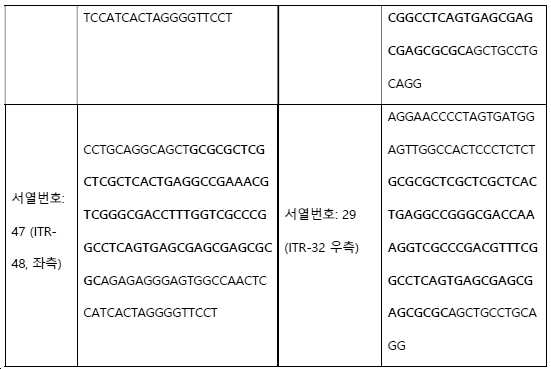
일부 구현예에서, 비대칭 ITR 쌍을 포함하는 항체 또는 융합 단백질 생산을 위한 ceDNA 벡터는 본원의 표 9A-9B 중 임의의 하나 이상에 나타낸 ITR 서열 또는 ITR 부분 서열 또는 2018년 12월 6일에 출원된 국제 출원 PCT/US2018/064242의 도 7a-도 7b에 도시된 서열(이는 그 전문이 본원에 참고로 포함), 또는 2018년 9월 7일에 출원된 국제 출원 PCT/US18/49996의 표 2, 3, 4, 5, 6, 7, 8, 9 또는 10A-10B에 개시된 서열에서의 임의의 변형에 상응하는 변형을 갖는 ITR을 포함할 수 있다.In some embodiments, the ceDNA vector for the production of an antibody or fusion protein comprising an asymmetric ITR pair is an ITR sequence or ITR subsequence shown in any one or more of Tables 9A-9B herein or filed on December 6, 2018. The sequence shown in FIGS . 7A- B of international application PCT/US2018/064242, which is incorporated herein by reference in its entirety, or Table 2 of international application PCT/US18/49996 filed on September 7, 2018, 3, 4, 5, 6, 7, 8, 9, or 10A-10B.
V. 예시적인 V. Exemplary ceDNAceDNA 벡터 vector
상술한 바와 같이, 본 개시내용은 비대칭 ITR 쌍, 대칭 ITR 쌍, 또는 전술한 바와 같이 실질적으로 대칭인 ITR 쌍 중 임의의 하나를 포함하는 재조합 ceDNA 발현 벡터 및 항체 및 융합 단백질 생산을 위한 항체 및 융합 단백질을 인코딩하는 ceDNA 벡터에 관한 것이다. 특정 구현예에서, 본 개시내용은 플랭킹 ITR 서열 및 이식유전자를 갖는 항체 또는 융합 단백질 생산을 위한 재조합 ceDNA 벡터에 관한 것으로, 여기서 ITR 서열은 본원에 정의된 바와 같이 서로 비대칭, 대칭 또는 실질적으로 대칭이며, ceDNA는 플랭킹 ITR 사이에 위치한 관심 뉴클레오티드 서열 (예를 들어 이식유전자의 핵산을 포함하는 발현 카세트)을 추가로 포함하며, 여기서 상기 핵산 분자는 바이러스 캡시드 단백질 코딩 서열이 없다.As described above, the present disclosure provides for the production of recombinant ceDNA expression vectors and antibodies and fusion proteins comprising any one of asymmetric ITR pairs, symmetric ITR pairs, or substantially symmetric ITR pairs as described above. It relates to a ceDNA vector encoding a protein. In certain embodiments, the present disclosure relates to a recombinant ceDNA vector for the production of an antibody or fusion protein having a flanking ITR sequence and a transgene, wherein the ITR sequences are asymmetric, symmetric or substantially symmetric to each other as defined herein. And the ceDNA further comprises a nucleotide sequence of interest (eg, an expression cassette containing a nucleic acid of a transgene) located between the flanking ITRs, wherein the nucleic acid molecule is devoid of a viral capsid protein coding sequence.
항체 또는 융합 단백질 생산을 위한 ceDNA 발현 벡터는 적어도 하나의 ITR이 변경된 경우 본원에 기재된 바와 같은 뉴클레오티드 서열(들)을 포함하는 재조합 DNA 절차에 편리하게 적용될 수 있는 임의의 ceDNA 벡터일 수 있다. 본 개시내용의 항체 또는 융합 단백질 생산을 위한 ceDNA 벡터는 ceDNA 벡터가 도입될 숙주 세포와 양립 가능하다. 특정 구현예에서, ceDNA 벡터는 선형일 수 있다. 특정 구현예에서, ceDNA 벡터는 염색체외 엔티티로서 존재할 수 있다. 특정 구현예에서, 본 개시내용의 ceDNA 벡터는 공여체 서열을 숙주 세포의 게놈으로 통합시킬 수 있는 요소(들)를 함유할 수 있다. 본원에 사용된 "이식유전자" 및 "이종 뉴클레오티드 서열"은 동의어고, 본원에 기재된 항체 또는 융합 단백질을 인코딩한다.The ceDNA expression vector for antibody or fusion protein production can be any ceDNA vector that can be conveniently applied to a recombinant DNA procedure comprising nucleotide sequence(s) as described herein when at least one ITR is altered. The ceDNA vector for producing the antibody or fusion protein of the present disclosure is compatible with the host cell into which the ceDNA vector will be introduced. In certain embodiments, the ceDNA vector can be linear. In certain embodiments, the ceDNA vector can exist as an extrachromosomal entity. In certain embodiments, the ceDNA vectors of the present disclosure may contain element(s) capable of integrating a donor sequence into the genome of a host cell. As used herein, “transgene” and “heterologous nucleotide sequence” are synonymous and encode an antibody or fusion protein described herein.
이제 도 1a-1g를 참조하면, 항체 또는 융합 단백질 생산을 위한 ceDNA 벡터를 제조하는데 유용한 2개의 비제한적 플라스미드의 기능적 성분의 개략도가 도시되어 있다. 도 1a, 1b, 1d, 1f는 항체 또는 융합 단백질 생산을 위한 ceDNA 벡터 또는 상응하는 ceDNA 플라스미드 서열의 작제물을 보여준다. ceDNA 벡터는 캡시드가 없고, 제1 ITR, 발현성 이식유전자 카세트 및 제2 ITR의 순서로 인코딩된 플라스미드로부터 수득될 수 있으며, 여기서 제1 및 제2 ITR 서열은 본 명세서에서 정의된 바와 같이 서로 비대칭, 대칭 또는 실질적으로 대칭이다. 항체 또는 융합 단백질 생산을 위한 ceDNA 벡터는 캡시드가 없고, 하기 순서로 코딩하는 플라스미드로부터 얻을 수 있다: 제1 ITR, 발현성 이식유전자 (단백질 또는 핵산) 및 제2 ITR, 여기서 제1 및 제2 ITR 서열은 본원에 정의된 바와 같이 서로에 대해 비대칭, 대칭 또는 실질적으로 대칭이다. 일부 구현예에서, 발현성 이식유전자 카세트는 필요에 따라 인핸서/프로모터, 하나 이상의 상동성 아암, 공여체 서열, 전사 후 조절 요소 (예를 들어, WPRE, 예를 들어, 서열번호 67)) 및 폴리아데닐화 및 종결 신호 (예를 들어, BGH 폴리A, 예를 들어, 서열번호 68)를 포함한다.Referring now to FIGS. 1A - 1G , schematic diagrams of the functional components of two non-limiting plasmids useful for preparing ceDNA vectors for antibody or fusion protein production are shown. 1A, 1B, 1D, 1F show the construction of ceDNA vectors or corresponding ceDNA plasmid sequences for antibody or fusion protein production. The ceDNA vector can be obtained from a plasmid that has no capsid and is encoded in the sequence of a first ITR, an expression transgene cassette and a second ITR, wherein the first and second ITR sequences are asymmetric to each other as defined herein. , Symmetrical or substantially symmetrical. The ceDNA vectors for antibody or fusion protein production are capsid-free and can be obtained from plasmids encoding in the following sequence: first ITR, expressive transgene (protein or nucleic acid) and second ITR, wherein first and second ITR The sequences are asymmetric, symmetric or substantially symmetric with respect to each other as defined herein. In some embodiments, the expressive transgene cassette is an enhancer/promoter, one or more homology arms, donor sequences, post-transcriptional regulatory elements (e.g., WPRE, e.g., SEQ ID NO: 67)) and polyades as needed. Nylation and termination signals (eg, BGH polyA, eg, SEQ ID NO: 68).
도 5는 실시예에 기재된 방법을 사용하여 다중 플라스미드 작제물로부터 ceDNA의 생성을 확인하는 겔이다. ceDNA는 상기 도 4a와 관련하여 그리고 실시예에서 논의된 바와 같이, 겔에서의 특징적인 밴드 패턴에 의해 확인된다. 5 is a gel confirming the generation of ceDNA from multiple plasmid constructs using the method described in the Examples. ceDNA is identified by a characteristic band pattern in the gel, as discussed in connection with Figure 4A above and in the Examples.
A. 조절 요소. A. Control factor .
본원에 정의된 비대칭 ITR 쌍 또는 대칭 ITR 쌍을 포함하는 본원에 기재된 항체 또는 융합 단백질 생산을 위한 ceDNA 벡터는 시스-조절 요소의 특정 조합을 추가로 포함한다. 시스-조절 요소는 프로모터, 리보스위치, 절연체, 미르-조절 가능 요소, 전사 후 조절 요소, 조직- 및 세포 유형-특이적 프로모터 및 인핸서를 포함하지만, 이에 제한되지는 않는다. 일부 구현예에서, ITR은 이식유전자, 예를 들어 항체 또는 융합 단백질의 프로모터로서 작용할 수 있다. 일부 구현예에서, 본원에 기재된 항체 또는 융합 단백질 생산을 위한 ceDNA 벡터는 이식유전자의 발현을 조절하기 위한 추가 성분, 예를 들어, 이식유전자의 발현을 조절하기 위한 본원에 기재된 조절 스위치, 또는 항체 또는 그의 항원 결합 단편을 인코딩하는 ceDNA 벡터를 포함하는 세포를 사멸시킬 수 있는 사멸 스위치를 포함한다. 본 발명에서 사용될 수 있는 조절 스위치를 포함하는 조절 요소는 국제 출원 PCT/US18/49996에 보다 상세하게 논의되어 있으며, 이의 전문이 본원에 참고로 포함된다. The ceDNA vectors for the production of antibodies or fusion proteins described herein comprising asymmetric ITR pairs or symmetric ITR pairs as defined herein further comprise certain combinations of cis-regulatory elements. Cis-regulatory elements include, but are not limited to, promoters, riboswitches, insulators, mir-regulatory elements, post-transcriptional regulatory elements, tissue- and cell type-specific promoters and enhancers. In some embodiments, the ITR can act as a promoter of a transgene, such as an antibody or fusion protein. In some embodiments, the ceDNA vector for the production of an antibody or fusion protein described herein is an additional component for modulating the expression of a transgene, e.g., a regulatory switch described herein for modulating the expression of a transgene, or an antibody or It includes a death switch capable of killing cells containing a ceDNA vector encoding an antigen-binding fragment thereof. Control elements comprising a control switch that can be used in the present invention are discussed in more detail in international application PCT/US18/49996, the entirety of which is incorporated herein by reference.
구현예에서, 제2 뉴클레오티드 서열은 조절 서열, 및 뉴클레아제를 인코딩하는 뉴클레오티드 서열을 포함한다. 특정 구현예에서, 유전자 조절 서열은 뉴클레아제를 인코딩하는 뉴클레오티드 서열에 작동 가능하게 연결된다. 특정 구현예에서, 조절 서열은 숙주 세포에서 뉴클레아제의 발현을 제어하기에 적합하다. 특정 구현예에서, 조절 서열은 프로모터 서열에 작동 가능하게 연결된 유전자, 예컨대 본 개시내용의 뉴클레아제(들)를 인코딩하는 뉴클레오티드 서열의 전사를 지시할 수 있는, 적합한 프로모터 서열을 포함한다. 특정 구현예에서, 제2 뉴클레오티드 서열은 뉴클레아제를 인코딩하는 뉴클레오티드 서열의 5' 말단에 연결된 인트론 서열을 포함한다. 특정 구현예에서, 프로모터의 효능을 증가시키기 위해 인핸서 서열이 프로모터의 상류에 제공된다. 특정 구현예에서, 조절 서열은 인핸서 및 프로모터를 포함하고, 여기서 제2 뉴클레오티드 서열은 뉴클레아제를 인코딩하는 뉴클레오티드 서열의 상류에 있는 인트론 서열을 포함하고, 상기 인트론은 하나 이상의 뉴클레아제 절단 부위(들)를 포함하고, 상기 프로모터는 뉴클레아제를 인코딩하는 뉴클레오티드 서열에 작동 가능하게 연결된다.In an embodiment, the second nucleotide sequence comprises a regulatory sequence and a nucleotide sequence encoding a nuclease. In certain embodiments, the gene regulatory sequence is operably linked to a nucleotide sequence encoding a nuclease. In certain embodiments, the regulatory sequences are suitable for controlling the expression of nucleases in the host cell. In certain embodiments, the regulatory sequence comprises a suitable promoter sequence capable of directing transcription of a gene operably linked to a promoter sequence, such as a nucleotide sequence encoding the nuclease(s) of the present disclosure. In certain embodiments, the second nucleotide sequence comprises an intron sequence linked to the 5'end of a nucleotide sequence encoding a nuclease. In certain embodiments, an enhancer sequence is provided upstream of the promoter to increase the efficacy of the promoter. In certain embodiments, the regulatory sequence comprises an enhancer and a promoter, wherein the second nucleotide sequence comprises an intron sequence upstream of a nucleotide sequence encoding a nuclease, wherein the intron is one or more nuclease cleavage sites ( S), and the promoter is operably linked to a nucleotide sequence encoding a nuclease.
합성적으로 또는 실시예에서 본원에 기재된 바와 같은 세포-기반 생산 방법을 사용하여 생산된 항체 또는 융합 단백질 생산을 위한 ceDNA 벡터는 시스-조절 요소, 예컨대 WHP 전사 후 조절 요소 (WPRE) (예를 들어, 서열 번호: 67) 및 BGH 폴리A (서열 번호: 68)의 특정 조합을을 추가로 포함할 수 있다. 발현 작제물에 사용하기에 적합한 발현 카세트는 바이러스 캡시드에 의해 부과된 패키징 제약에 의해 제한되지 않는다.The ceDNA vector for the production of an antibody or fusion protein produced synthetically or using a cell-based production method as described herein in the examples is a cis-regulatory element, such as a WHP post-transcriptional regulatory element (WPRE) (e.g. , SEQ ID NO: 67) and BGH polyA (SEQ ID NO: 68). Expression cassettes suitable for use in the expression construct are not limited by the packaging restrictions imposed by the viral capsid.
(i). 프로모터:(i). Promoter:
본원에 개시된 바와 같이 항체 또는 융합 단백질 생산을 위한 ceDNA 벡터에 사용된 프로모터는 이들이 촉진하는 특정 서열에 적합하게 맞추어져야 한다는 것이 당업자에게 이해될 것이다.It will be appreciated by those skilled in the art that the promoters used in ceDNA vectors for the production of antibodies or fusion proteins as disclosed herein must be suitably tailored to the specific sequence they promote.
항체 또는 융합 단백질 생산을 위한 ceDNA 벡터의 발현 카세트는 세포-특이성뿐만 아니라 전체 발현 수준에 영향을 줄 수 있는 프로모터를 포함한다. 이식유전자 발현 예를 들어, 항체 또는 항원-결합 단편 발현을 위해, 이들은 매우 활성인 바이러스-유래 즉각적인 조기 프로모터를 포함할 수 있다. 발현 카세트는 조직 특이적 진핵생물 프로모터를 함유하여 이식유전자 발현을 특정 세포 유형으로 제한하고 조절되지 않은 이소성 발현으로 인한 독성 효과 및 면역 반응을 감소시킬 수 있다. 특정 구현예에서, 발현 카세트는 합성 조절 요소, 예컨대 CAG 프로모터 (서열 번호: 72)를 함유할 수 있다. CAG 프로모터는 (i) 사이토메갈로바이러스 (CMV) 조기 인핸서 요소, (ii) 치킨 베타-액틴 유전자의 프로모터, 제1 엑손 및 제1 인트론, 및 (iii) 토끼 베타-글로빈 유전자의 스플라이스 수용체를 포함한다. 대안적으로, 발현 카세트는 알파-1-항트립신 (AAT) 프로모터 (서열 번호: 73 또는 서열 번호: 74), 간 특이적 (LP1) 프로모터 (서열 번호: 75 또는 서열 번호: 76), 또는 인간 신장 인자-1 알파 (EF1a) 프로모터 (예를 들어, 서열 번호: 77 또는 서열 번호: 78)를 함유할 수 있다. 일부 구현예에서, 발현 카세트는 하나 이상의 구성적 프로모터, 예를 들어, 레트로바이러스 라우스 육종 바이러스 (RSV) LTR 프로모터 (선택적으로 RSV 인핸서를 가짐) 또는 사이토메갈로바이러스 (CMV) 즉각적인 조기 프로모터 (선택적으로 CMV 인핸서, 예를 들어, 서열 번호: 79를 가짐)를 포함한다. 대안적으로, 유도성 프로모터, 이식유전자를 위한 천연 프로모터, 조직-특이적 프로모터, 또는 당 업계에 공지된 다양한 프로모터가 사용될 수 있다.Expression cassettes of ceDNA vectors for antibody or fusion protein production contain promoters that can affect the overall expression level as well as cell-specificity. For transgene expression, e.g., antibody or antigen-binding fragment expression, they may contain highly active virus-derived immediate early promoters. Expression cassettes can contain tissue-specific eukaryotic promoters to limit transgene expression to certain cell types and reduce toxic effects and immune responses due to unregulated ectopic expression. In certain embodiments, the expression cassette may contain synthetic regulatory elements, such as the CAG promoter (SEQ ID NO: 72). The CAG promoter comprises (i) cytomegalovirus (CMV) early enhancer element, (ii) the promoter of the chicken beta-actin gene, the first exon and the first intron, and (iii) the splice receptor of the rabbit beta-globin gene. do. Alternatively, the expression cassette is an alpha-1-antitrypsin (AAT) promoter (SEQ ID NO: 73 or SEQ ID NO: 74), a liver specific (LP1) promoter (SEQ ID NO: 75 or SEQ ID NO: 76), or a human Elongation factor-1 alpha (EF1a) promoter (eg, SEQ ID NO: 77 or SEQ ID NO: 78). In some embodiments, the expression cassette comprises one or more constitutive promoters, e.g., retroviral Rous sarcoma virus (RSV) LTR promoter (optionally with RSV enhancer) or cytomegalovirus (CMV) immediate early promoter (optionally CMV Enhancer, for example, has SEQ ID NO: 79). Alternatively, inducible promoters, natural promoters for transgenes, tissue-specific promoters, or various promoters known in the art can be used.
상기 기재된 것들을 포함하여, 적합한 프로모터는 바이러스로부터 유래될 수 있으며 따라서 바이러스 프로모터로 지칭될 수 있거나, 원핵생물 또는 진핵생물 유기체를 포함하는 임의의 유기체로부터 유래될 수 있다. 적합한 프로모터를 사용하여 임의의 RNA 폴리머라제 (예를 들어, pol I, pol II, pol III)에 의한 발현을 구동시킬 수 있다. 예시적인 프로모터는 SV40 조기 프로모터, 마우스 유방 종양 바이러스 긴 말단 반복 (LTR) 프로모터; 아데노바이러스 주요 후기 프로모터 (Ad MLP); 단순 포진 바이러스 (HSV) 프로모터, CMV 즉각적인 조기 프로모터 영역 (CMVIE)과 같은 사이토메갈로바이러스 (CMV) 프로모터, 라우스 육종 바이러스 (RSV) 프로모터, 인간 U6 소형 핵 프로모터 (U6, 예를 들어, 서열 번호: 80) (Miyagishi et al., Nature Biotechnology 20, 497-500 (2002)), 향상된 U6 프로모터 (예를 들어, Xia et al., Nucleic Acids Res. 2003 Sep. 1; 31(17)), 인간 H1 프로모터 (H1) (예를 들어, 서열 번호: 81 또는 서열번호: 155), CAG 프로모터, 인간 알파 1-안티팁신(antitypsin) (HAAT) 프로모터 (예를 들어, 서열 번호: 82) 등을 포함하지만, 이에 제한되지 않는다. 특정 구현예에서, 이들 프로모터는 하나 이상의 뉴클레아제 절단 부위를 포함하도록 하류 인트론 함유 말단에서 변경된다. 특정 구현예에서, 뉴클레아제 절단 부위(들)를 함유하는 DNA는 프로모터 DNA에 이질적이다.Suitable promoters, including those described above, may be derived from viruses and thus may be referred to as viral promoters, or may be derived from any organism, including prokaryotic or eukaryotic organisms. Expression by any RNA polymerase ( eg pol I, pol II, pol III) can be driven using a suitable promoter. Exemplary promoters include the SV40 early promoter, mouse mammary tumor virus long terminal repeat (LTR) promoter; Adenovirus major late promoter (Ad MLP); Herpes simplex virus (HSV) promoter, cytomegalovirus (CMV) promoter such as CMV immediate early promoter region (CMVIE), Rous sarcoma virus (RSV) promoter, human U6 small nuclear promoter (U6, e.g. SEQ ID NO: 80 ) (Miyagishi et al .,
일 구현예에서, 사용된 프로모터는 치료 단백질을 인코딩하는 유전자의 천연 프로모터이다. 치료 단백질을 인코딩하는 각각의 유전자에 대한 프로모터 및 다른 조절 서열은 공지되어 있고 특성화되어 있다. 사용된 프로모터 영역은 SV40 인핸서 (서열 번호 126)를 포함하는, 하나 이상의 추가 조절 서열 (예를 들어, 천연), 예를 들어 인핸서 (예를 들어, 서열 번호: 79 및 서열 번호: 83)를 추가로 포함할 수 있다.In one embodiment, the promoter used is a native promoter of a gene encoding a therapeutic protein. Promoters and other regulatory sequences for each gene encoding a therapeutic protein are known and characterized. The promoter region used adds one or more additional regulatory sequences (e.g., native), e.g., enhancers (e.g., SEQ ID NO: 79 and SEQ ID NO: 83), including the SV40 enhancer (SEQ ID NO: 126). Can be included as.
일부 구현예에서, 프로모터는 또한 인간 유비퀴틴 C (hUbC), 인간 액틴, 인간 미오신, 인간 헤모글로빈, 인간 근육 크레아틴 또는 인간 메탈로티오네인과 같은 인간 유전자로부터의 프로모터일 수 있다. 프로모터는 또한 조직 특이적 프로모터, 예컨대 간 특이적 프로모터, 예컨대 인간 알파 1-안티팁신 (HAAT), 천연 또는 합성일 수 있다. 일 구현예에서, 간으로의 전달은 간세포 표면에 존재하는 저밀도 지단백질 (LDL) 수용체를 통해 간세포에 대한 ceDNA 벡터를 포함하는 조성물의 내인성 ApoE 특이적 표적화를 사용하여 달성될 수 있다.In some embodiments, the promoter may also be a promoter from a human gene, such as human ubiquitin C (hUbC), human actin, human myosin, human hemoglobin, human muscle creatine, or human metallothionein. The promoter can also be a tissue specific promoter, such as a liver specific promoter, such as human alpha 1-antitipsin (HAAT), natural or synthetic. In one embodiment, delivery to the liver can be achieved using endogenous ApoE specific targeting of a composition comprising a ceDNA vector to hepatocytes via a low density lipoprotein (LDL) receptor present on the hepatocyte surface.
본 발명에 따라 사용하기에 적합한 프로모터의 비제한적인 예는, 예를 들어, (서열 번호: 72)의 CAG 프로모터, HAAT 프로모터 (서열 번호: 82), 인간 EF1-α 프로모터 (서열 번호: 77) 또는 EF1a 프로모터의 단편 (서열 번호: 78), IE2 프로모터 (예를 들어, 서열 번호: 84) 및 랫트 EF1-α 프로모터 (서열 번호: 85), mEF1 프로모터 (서열 번호: 59) 또는 1E1 프로모터 단편 (서열 번호: 125)를 포함한다. Non-limiting examples of promoters suitable for use according to the present invention include, for example, the CAG promoter of (SEQ ID NO: 72), the HAAT promoter (SEQ ID NO: 82), the human EF1-α promoter (SEQ ID NO: 77). Or a fragment of the EF1a promoter (SEQ ID NO: 78), the IE2 promoter (e.g., SEQ ID NO: 84) and the rat EF1-α promoter (SEQ ID NO: 85), the mEF1 promoter (SEQ ID NO: 59) or the 1E1 promoter fragment ( SEQ ID NO: 125).
(ii). (ii). 폴리아데닐화Polyadenylation 서열: order:
ceDNA 벡터로부터 발현된 mRNA를 안정화시키고 핵 수출 및 번역을 돕기 위해 폴리아데닐화 서열을 인코딩하는 서열이 항체 또는 융합 단백질 생산을 위한 ceDNA 벡터에 포함될 수 있다. 일 구현예에서, ceDNA 벡터는 폴리아데닐화 서열을 포함하지 않는다. 다른 구현예에서, 항체 또는 융합 단백질 생산을 위한 ceDNA 벡터는 적어도 1, 적어도 2, 적어도 3, 적어도 4, 적어도 5, 적어도 10, 적어도 15, 적어도 20, 적어도 25, 적어도 30, 적어도 40, 적어도 45, 적어도 50개 또는 그 이상의 아데닌 디뉴클레오티드를 포함한다. 일부 구현예에서, 폴리아데닐화 서열은 약 43개 뉴클레오티드, 약 40-50개 뉴클레오티드, 약 40-55개 뉴클레오티드, 약 45-50개 뉴클레오티드, 약 35-50개 뉴클레오티드, 또는 이들 사이의 임의의 범위를 포함한다. 도 10a-10g에 도시된 바와 같이, 폴리아데닐화 서열은 항체 또는 항체 단편을 인코딩하는 이식유전자의 3'에 위치할 수 있다. 일부 구현예에서, 전체 IgG 또는 전체 항체를 인코딩하는 항체 또는 융합 단백질 생산을 위한 ceDNA 벡터는 IRES (내부 리보솜 진입 부위) 서열 (서열 번호 190)을 포함 할 수 있으며, 예를 들어, 상기 IRES 서열이 폴리아데닐화 서열의 3'에 위치함으로써, 제1 이식유전자의 3'에 위치한 제2 이식유전자 (예를 들어, 항체 또는 항원-결합 단편)가 동일한 ceDNA 벡터에 의해 번역되고 발현되며, 이로써 ceDNA 벡터는 완전한 항체를 발현할 수 있다. (예를 들어, 도 10b 참조).A sequence encoding a polyadenylation sequence may be included in the ceDNA vector for antibody or fusion protein production to stabilize the mRNA expressed from the ceDNA vector and aid in nuclear export and translation. In one embodiment, the ceDNA vector does not comprise a polyadenylation sequence. In another embodiment, the ceDNA vector for antibody or fusion protein production is at least 1, at least 2, at least 3, at least 4, at least 5, at least 10, at least 15, at least 20, at least 25, at least 30, at least 40, at least 45 , At least 50 or more adenine dinucleotides. In some embodiments, the polyadenylation sequence is about 43 nucleotides, about 40-50 nucleotides, about 40-55 nucleotides, about 45-50 nucleotides, about 35-50 nucleotides, or any range therebetween. Includes. As shown in FIGS . 10A-10G , the polyadenylation sequence may be located 3′ of the transgene encoding the antibody or antibody fragment. In some embodiments, the ceDNA vector for the production of an antibody or fusion protein encoding a whole IgG or whole antibody may comprise an IRES (internal ribosome entry site) sequence (SEQ ID NO: 190), for example, the IRES sequence By being positioned 3'of the polyadenylation sequence, the second transgene (e.g., antibody or antigen-binding fragment) located 3'of the first transgene is translated and expressed by the same ceDNA vector, whereby the ceDNA vector Is capable of expressing a complete antibody. (See, for example, Fig. 10B ).
발현 카세트는 당 업계에 공지된 폴리아데닐화 서열 또는 이의 변형, 예컨대 소 BGHpA (예를 들어, 서열 번호: 68) 또는 바이러스 SV40pA (예를 들어, 서열 번호: 86), 또는 합성 서열 (예를 들어, 서열 번호: 87)로부터 단리된 천연 발생 서열을 포함할 수 있다. 일부 발현 카세트는 또한 SV40 후기 폴리 A 신호 상류 인핸서 (USE) 서열을 포함할 수 있다. 일부 구현예에서, USE는 SV40pA 또는 이종 폴리-A 신호와 조합하여 사용될 수 있다.The expression cassette may be a polyadenylation sequence known in the art or a modification thereof, such as bovine BGHpA (e.g., SEQ ID NO: 68) or viral SV40pA (e.g., SEQ ID NO: 86), or a synthetic sequence (e.g. , SEQ ID NO: 87). Some expression cassettes may also contain an SV40 late poly A signal upstream enhancer (USE) sequence. In some embodiments, USE can be used in combination with SV40pA or heterologous poly-A signals.
발현 카세트는 또한 이식유전자의 발현을 증가시키기 위해 전사 후 요소를 포함할 수 있다. 일부 구현예에서, 우드척 간염 바이러스 (WHP) 전사 후 조절 요소 (WPRE) (예를 들어, 서열 번호: 67)는 이식유전자의 발현을 증가시키는 데 사용된다. 단순 포진 바이러스 또는 B형 간염 바이러스 (HBV)의 티미딘 키나제 유전자로부터의 전사 후 요소와 같은 다른 전사 후 처리 요소가 사용될 수 있다. 분비 서열은 이식유전자, 예를 들어, VH-02 및 VK-A26 서열, 예를 들어, 서열 번호: 88 및 서열 번호: 89에 연결될 수 있다.Expression cassettes may also contain post-transcription elements to increase the expression of the transgene. In some embodiments, the Woodchuck hepatitis virus (WHP) post-transcriptional regulatory element (WPRE) (eg, SEQ ID NO: 67) is used to increase the expression of a transgene. Other post-transcriptional processing elements can be used, such as those from the thymidine kinase gene of the herpes simplex virus or hepatitis B virus (HBV). The secretory sequence can be linked to a transgene, such as the VH-02 and VK-A26 sequences, such as SEQ ID NO: 88 and SEQ ID NO: 89.
(iii). 핵 (iii). nucleus 국재화Localization 서열 order
일부 구현예에서, 항체 또는 융합 단백질 생산을 위한 ceDNA 벡터는 하나 이상의 핵 국재화 서열 (NLS), 예를 들어, 1, 2, 3, 4, 5, 6, 7, 8, 9, 10개 또는 그 이상의 NLS를 포함한다. 일부 구현예에서, 하나 이상의 NLS는 아미노-말단에 또는 그 근처, 카복시-말단에 또는 그 근처에 위치하거나, 또는 이들의 조합 (예를 들어, 아미노-말단에서 하나 이상의 NLS 및/또는 카복시 말단에서 하나 이상의 NLS)에 위치한다. 하나 초과의 NLS가 존재하는 경우, 단일 NLS가 하나 초과의 카피에 존재하고/하거나 하나 이상의 다른 NLS와 조합하여 하나 이상의 카피에 존재하도록 다른 것과 독립적으로 선택될 수 있다. NLS의 비제한적인 예는 표 11에 제시되어 있다.In some embodiments, the ceDNA vector for antibody or fusion protein production comprises one or more nuclear localization sequences (NLS), e.g., 1, 2, 3, 4, 5, 6, 7, 8, 9, 10 or It includes more NLS. In some embodiments, the one or more NLS is located at or near the amino-terminus, at or near the carboxy-terminus, or a combination thereof ( e.g., at the amino-terminus, at least one NLS and/or at the carboxy terminus One or more NLS). If more than one NLS is present, it may be selected independently of the others such that a single NLS is present in more than one copy and/or in combination with one or more other NLSs in more than one copy. Non-limiting examples of NLS are shown in Table 11 .
표 11: 핵 국재화 신호Table 11: Nuclear localization signals
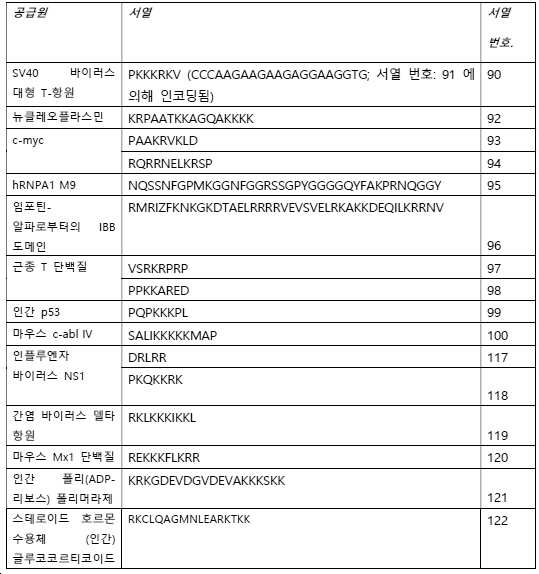
B.B. ceDNA 벡터의 추가 성분Additional components of ceDNA vector
본 개시내용의 항체 또는 융합 단백질 생산을 위한 ceDNA 벡터는 유전자 발현을 위해 다른 성분을 인코딩하는 뉴클레오티드를 함유할 수 있다. 예를 들어, 특정 유전자 표적화 사건을 선택하기 위해, 보호 shRNA가 마이크로RNA에 포매되어 알부민 유전자좌와 같은 고도로 활성인 유전자좌에 부위 특이적으로 통합되도록 설계된 재조합 ceDNA 벡터에 삽입될 수 있다. 이러일 구현예는 하기에 기재된 바와 같은 임의의 유전자 배경에서 유전자 변형 간세포의 생체내 선택 및 확장을 위한 시스템을 제공할 수 있다: Nygaard et al., A universal system to select gene-modified hepatocytes in vivo , Gene Therapy, June 8, 2016. 본 개시내용의 ceDNA 벡터는 형질전환, 형질감염, 형질도입 또는 이와 유사한 세포의 선택을 허용하는 하나 이상의 선택 가능한 마커를 함유할 수 있다. 선택 가능한 마커는 그 산물이 살생물제 또는 바이러스 내성, 중금속에 대한 내성, 영양요구성에 대한 프로토트로피(prototrophy), NeoR 등을 제공하는 유전자이다. 특정 구현예에서, 양성 선별 마커는 NeoR과 같은 공여체 서열에 포함된다. 음성 선별 마커는 공여체 서열의 하류에 통합될 수 있으며, 예를 들어 음성 선별 마커를 인코딩하는 핵산 서열 HSV-tk는 공여체 서열의 하류에 있는 핵산 작제물에 통합될 수 있다. The ceDNA vectors for the production of antibodies or fusion proteins of the present disclosure may contain nucleotides encoding other components for gene expression. For example, to select a specific gene targeting event, a protective shRNA can be embedded in a microRNA and inserted into a recombinant ceDNA vector designed to be site-specifically integrated into a highly active locus, such as an albumin locus. This embodiment can provide a system for in vivo selection and expansion of genetically modified hepatocytes in any genetic background as described below: Nygaard et al ., A universal system to select gene-modified hepatocytes in vivo , Gene Therapy , June 8, 2016. The ceDNA vectors of the present disclosure may contain one or more selectable markers that allow selection of cells for transformation, transfection, transduction or similar. Selectable markers are genes whose products provide biocide or viral resistance, resistance to heavy metals, prototrophy for auxotroph, NeoR, and the like. In certain embodiments, a positive selection marker is included in a donor sequence such as NeoR. The negative selection marker can be integrated downstream of the donor sequence, for example the nucleic acid sequence HSV-tk encoding the negative selection marker can be integrated into a nucleic acid construct downstream of the donor sequence.
C. 조절 스위치C. Control switch
분자 조절 스위치는 신호에 응답하여 측정 가능한 상태 변화를 생성하는 스위치이다. 이러한 조절 스위치는 ceDNA 벡터로부터 항체 또는 항원-결합 단편의 발현의 출력을 제어하기 위해 본원에 기재된 항체 또는 융합 단백질 생산을 위한 ceDNA 벡터와 유용하게 결합될 수 있다. 일부 구현예에서, 항체 또는 융합 단백질 생산을 위한 ceDNA 벡터는 항체 또는 항원-결합 단편의 발현을 미세 조정하는 역할을 하는 조절 스위치를 포함한다. 예를 들어, 이는 ceDNA 벡터의 생화학적 봉쇄(biocontainment) 기능으로 작용할 수 있다. 일부 구현예에서, 스위치는 제어 가능하고 조절 가능한 방식으로 ceDNA 벡터에서 항체 또는 항원-결합 단편의 발현을 시작 또는 중지 (즉, 셧다운)하도록 설계된 "ON/OFF" 스위치이다. 일부 구현예에서, 스위치는 스위치가 활성화되면 ceDNA 벡터를 포함하는 세포가 세포 프로그래밍된 사멸을 겪도록 지시할 수 있는 "사멸 스위치"를 포함할 수 있다. 항체 또는 융합 단백질 생산을 위한 ceDNA에 사용하기 위해 포함된 예시적인 조절 스위치는 이식유전자의 발현을 조절하는데 이용될 수 있고 국제 출원 PCT/US18/49996 (이는 그 전문이 본원에 참고로 포함됨)에서 보다 상세히 논의된다.Molecular control switches are switches that generate measurable state changes in response to signals. Such regulatory switches can be usefully combined with ceDNA vectors for the production of antibodies or fusion proteins described herein to control the output of expression of antibodies or antigen-binding fragments from ceDNA vectors. In some embodiments, the ceDNA vector for antibody or fusion protein production comprises a regulatory switch that serves to fine tune the expression of the antibody or antigen-binding fragment. For example, it can act as a biochemical containment function of ceDNA vectors. In some embodiments, the switch is an “ON/OFF” switch designed to start or stop (ie, shut down) the expression of an antibody or antigen-binding fragment in a ceDNA vector in a controllable and regulated manner. In some embodiments, the switch may comprise a “death switch” that can direct a cell comprising the ceDNA vector to undergo cell programmed death when the switch is activated. Exemplary regulatory switches included for use in ceDNA for antibody or fusion protein production can be used to modulate the expression of transgenes and are described in international application PCT/US18/49996, which is incorporated herein by reference in its entirety. It is discussed in detail.
(i) 이진 조절 스위치(i) binary control switch
일부 구현예에서, 항체 또는 융합 단백질 생산을 위한 ceDNA 벡터는 항체 또는 항원-결합 단편의 발현을 제어 가능하게 조절하는 역할을 할 수 있는 조절 스위치를 포함한다. 예를 들어, ceDNA 벡터의 ITR 사이에 위치한 발현 카세트는 항원-결합 단편에 작동적으로 연결된, 조절 영역, 예를 들어, 프로모터, 시스-요소, 리프레서, 인핸서 등을 추가로 포함할 수 있으며, 여기서 조절 영역은 하나 이상의 보조 인자 또는 외인성 제제에 의해 조절된다. 단지 예로서, 조절 영역은 소분자 스위치 또는 유도성 또는 억제성 프로모터에 의해 조절될 수 있다. 유도성 프로모터의 비-제한적인 예는 호르몬-유도성 또는 금속-유도성 프로모터이다. 다른 예시적인 유도성 프로모터/인핸서 요소는 RU486-유도성 프로모터, 엑디손-유도성 프로모터, 라파마이신-유도성 프로모터 및 메탈로티오네인 프로모터를 포함하지만, 이에 제한되지는 않는다. In some embodiments, the ceDNA vector for antibody or fusion protein production comprises a regulatory switch that can serve to controllably regulate the expression of the antibody or antigen-binding fragment. For example, the expression cassette located between the ITR of the ceDNA vector may further include a regulatory region, such as a promoter, cis-element, repressor, enhancer, etc., operably linked to an antigen-binding fragment, Wherein the region of regulation is regulated by one or more cofactors or exogenous agents. By way of example only, regulatory regions may be regulated by small molecule switches or by inducible or repressible promoters. Non-limiting examples of inducible promoters are hormone-inducible or metal-inducible promoters. Other exemplary inducible promoter/enhancer elements include, but are not limited to, a RU486-inducible promoter, an ecdysone-inducible promoter, a rapamycin-inducible promoter, and a metallothionein promoter.
(ii) (ii) 소분자Small molecule 조절 스위치 Adjustable switch
다양한 당 업계에 공지된 소분자 기반 조절 스위치가 당 업계에 공지되어 있고, 조절 스위치 제어 ceDNA 벡터를 형성하기 위해 본원에 개시된 항체 또는 융합 단백질 생산을 위한 ceDNA 벡터와 조합될 수 있다. 일부 구현예에서, 조절 스위치는 문헌(Taylor, et al. BMC Biotechnology 10 (2010): 15)에 기재된 것과 같이, 작동적으로 연결된 이식유전자의 발현을 제어하는 인공 프로모터와 함께, 직교 리간드/핵 수용체 쌍, 예를 들어 레티노이드 수용체 변이체/LG335 및 GRQCIMFI; 조작된 스테로이드 수용체, 예를 들어, 프로게스테론에 결합할 수 없지만 RU486 (미페프리스톤)에 결합하는 C-말단 절단을 갖는 변형된 프로게스테론 수용체 (미국 특허 번호 5,364,791); 드로소필라(Drosophila) 유래 엑디손 수용체 및 이의 엑디스테로이드 리간드 (Saez, et al., PNAS, 97(26)(2000), 14512-14517; 또는 문헌(Sando R 3rd; Nat Methods. 2013, 10(11):1085-8)에 개시된 바와 같은 항생제 트리메토프림 (TMP)에 의해 제어되는 스위치 중 임의의 하나 또는 조합으로부터 선택될 수 있다. 일부 구현예에서, 이식유전자를 제어하거나 ceDNA 벡터에 의해 발현되는 조절 스위치는 미국 특허 8,771,679 및 6,339,070에 개시된 것과 같은 전구 약물 활성화 스위치이다.A variety of small molecule based regulatory switches known in the art are known in the art and can be combined with ceDNA vectors for production of antibodies or fusion proteins disclosed herein to form regulatory switch control ceDNA vectors. In some embodiments, the regulatory switch is an orthogonal ligand/nuclear receptor, with an artificial promoter that controls the expression of an operably linked transgene, as described in Taylor, et al. BMC Biotechnology 10 (2010): 15 Pairs, eg retinoid receptor variant/LG335 and GRQCIMFI; Engineered steroid receptors, such as modified progesterone receptors that cannot bind progesterone but have a C-terminal truncation that binds RU486 (mifepristone) (US Pat. No. 5,364,791); Draw small pillars (Drosophila) derived exciter Dishon receptor and its ekdi steroid ligands (Saez, et al, PNAS, 97 (26) (2000), 14512-14517;. Or literature (Sando R 3 rd;. Nat Methods 2013, 10 (11):1085-8) can be selected from any one or combination of switches controlled by the antibiotic trimethoprim (TMP), in some embodiments, the transgene is controlled or by ceDNA vectors. The regulatory switches that are expressed are prodrug activation switches such as those disclosed in US Pat.
(iii) "패스코드((iii) "Passcode ( PasscodePasscode )" 조절 스위치)" control switch
일부 구현예에서, 조절 스위치는 "패스코드 스위치" 또는 "패스코드 회로"일 수 있다. 패스코드 스위치는 특정 조건이 발생할 때 ceDNA 벡터에서 이식유전자의 발현 제어를 미세 조정할 수 있도록 하며, 즉, 이식유전자 발현 및/또는 억제가 발생하려면 조건의 조합이 필요한다. 예를 들어, 이식유전자의 발현이 발생하기 위해서는 적어도 조건 A 및 B가 발생해야 한다. 패스코드 조절 스위치는 이식유전자 발현이 발생하기 위해 임의의 수의 조건, 예를 들어, 적어도 2, 적어도 3, 적어도 4, 적어도 5, 적어도 6 또는 적어도 7개 또는 그 이상의 조건이 존재할 수 있다. 일부 구현예에서, 적어도 2개의 조건 (예를 들어, A, B 조건)이 발생해야 하고, 일부 구현예에서, 적어도 3개의 조건 (예를 들어, A, B 및 C, 또는 A, B 및 D)이 발생해야 한다. 단지 예로서, 패스코드 "ABC" 조절 스위치를 갖는 ceDNA로부터의 유전자 발현이 발생하기 위해서는 조건 A, B 및 C가 존재해야 한다. 조건 A, B 및 C는 다음과 같을 수 있다; 조건 A는 병태 또는 질환의 존재이고, 조건 B는 호르몬 반응이고, 조건 C는 이식유전자 발현에 대한 반응이다. 예를 들어, 이식유전자이 결함 있는 EPO 유전자를 편집하는 경우, 조건 A는 만성 신장 질환 (CKD)의 존재이고, 조건 B는 대상체가 신장에 저산소 상태에 있는 경우 발생하고, 조건 C는 신장에서 에리스로포이에틴 생성 세포 (EPC) 동원이 손상된 것이거나; 또는 대안적으로, HIF-2 활성화가 손상된 것이다. 산소 수준이 증가하거나 원하는 수준의 EPO에 도달하면, 3가지 조건이 발생할 때까지 이식유전자이 다시 꺼지고, 다시 켜진다.In some implementations, the control switch may be a “passcode switch” or a “passcode circuit”. Passcode switches allow fine tuning of the expression control of transgenes in ceDNA vectors when certain conditions occur, that is, a combination of conditions is required for transgene expression and/or inhibition to occur. For example, at least conditions A and B must occur for expression of the transgene to occur. The passcode regulating switch may have any number of conditions, for example at least 2, at least 3, at least 4, at least 5, at least 6 or at least 7 or more conditions for transgene expression to occur. In some embodiments, at least two conditions (e.g., A, B conditions) must occur, and in some embodiments, at least three conditions (e.g., A, B and C, or A, B and D ) Should occur. By way of example only, conditions A, B and C must be present for gene expression from ceDNA with the passcode “ABC” regulatory switch to occur. Conditions A, B and C may be as follows; Condition A is the presence of a condition or disease, condition B is a hormonal response, and condition C is a response to transgene expression. For example, if the transgene edits the defective EPO gene, condition A is the presence of chronic kidney disease (CKD), condition B occurs when the subject is hypoxic in the kidney, and condition C is erythropoietin production in the kidney. Cell (EPC) recruitment is impaired; Or, alternatively, HIF-2 activation is impaired. When oxygen levels increase or the desired level of EPO is reached, the transgene turns off again and turns on again until three conditions occur.
일부 구현예에서, ceDNA 벡터에 사용하기 위해 포함된 패스코드 조절 스위치 또는 "패스코드 회로"는 생화학적 봉쇄 조건을 정의하는데 사용되는 환경 신호의 범위 및 복잡성을 확장시키기 위해 하이브리드 전사 인자 (TF)를 포함한다. 미리 결정된 조건의 존재하에 세포 사멸을 유발하는 데드맨 스위치(deadman switch)와는 달리, "패스코드 회로"는 특정 "패스코드"의 존재하에서 세포 생존 또는 이식유전자 발현을 허용하고, 미리 결정된 환경 조건 또는 패스코드가 존재하는 경우에만 이식유전자 발현 및/또는 세포 생존을 허용하도록 쉽게 재프로그래밍될 수 있다.In some embodiments, a passcode control switch or “passcode circuit” included for use in the ceDNA vector incorporates a hybrid transcription factor (TF) to expand the range and complexity of environmental signals used to define biochemical containment conditions. Include. Unlike deadman switches that cause cell death in the presence of predetermined conditions, “passcode circuits” allow cell survival or transgene expression in the presence of specific “passcodes”, and predetermined environmental conditions or It can be easily reprogrammed to allow transgene expression and/or cell survival only when a passcode is present.
본원에 개시된 조절 스위치의 임의의 및 모든 조합, 예를 들어, 소분자 스위치, 핵산-기반 스위치, 소분자-핵산 하이브리드 스위치, 전사 후 이식유전자 조절 스위치, 번역 후 조절, 방사선-제어 스위치, 저산소증-매개 스위치 및 본원에 개시된 바와 같은 당업자에게 공지된 다른 조절 스위치는 본원에 개시된 바와 같은 패스코드 조절 스위치에 사용될 수 있다. 사용을 위해 포함된 조절 스위치는 리뷰 논문 (Kis et al., J R Soc Interface. 12: 20141000 (2015))에서 또한 논의되며, Kis의 표 1에 요약되어 있다. 일부 구현예에서, 패스코드 시스템에 사용하기 위한 조절 스위치는 본원에 그 전체가 참고로 포함된 국제 특허 출원 PCT/US18/49996의 표 11에 개시된 스위치 중 임의의 것 또는 조합으로부터 선택될 수 있다.Any and all combinations of regulatory switches disclosed herein, e.g., small molecule switches, nucleic acid-based switches, small molecule-nucleic acid hybrid switches, post-transcriptional transgene control switches, post-translational control, radiation-controlled switches, hypoxia-mediated switches And other control switches known to those of skill in the art as disclosed herein can be used in passcode control switches as disclosed herein. The control switches included for use are also discussed in the review paper (Kis et al., J R Soc Interface. 12: 20141000 (2015)) and summarized in Table 1 of Kis. In some embodiments, the control switch for use in the passcode system may be selected from any or combination of the switches disclosed in Table 11 of International Patent Application PCT/US18/49996, which is incorporated herein by reference in its entirety.
(iv). 이식유전자 발현을 제어하기 위한 핵산 기반 조절 스위치(iv). Nucleic acid-based regulatory switch to control transgene expression
일부 구현예에서, ceDNA에 의해 발현된 항체 또는 항원-결합 단편을 제어하기 위한 조절 스위치는 핵산 기반 제어 메커니즘에 기초한다. 예시적인 핵산 제어 메카니즘이 당 업계에 공지되어 있으며 사용이 구상된다. 예를 들어, 이러한 메커니즘은, 예를 들어, US2009/0305253, US2008/0269258, US2017/0204477, WO2018026762A1, 미국 특허 9,222,093 및 EP 출원 EP288071에 개시되고, 또한 문헌(Villa JK et al., Microbiol Spectr. 2018 May;6(3))에 의한 검토에 개시된 것과 같은 리보스위치를 포함한다. 또한, WO2018/075486 및 WO2017/147585에 개시된 것과 같은 대사 물질-반응성 전사 바이오센서가 포함된다. 사용이 구상된 당 업계에 공지된 다른 메커니즘은 siRNA 또는 RNAi 분자 (예를 들어, miR, shRNA)로 이식유전자의 침묵화를 포함한다. 예를 들어, ceDNA 벡터는 ceDNA 벡터에 의해 발현된 이식유전자의 일부에 상보적인 RNAi 분자를 인코딩하는 조절 스위치를 포함할 수 있다. 이식유전자(예를 들어, 항체 또는 항원-결합 단편)가 ceDNA 벡터에 의해 발현되더라도 이러한 RNAi가 발현될 때, 상보적 RNAi 분자에 의해 침묵화될 것이고, 이식유전자이 ceDNA 벡터에 의해 발현될 때 RNAi가 발현되지 않을 때 이식유전자(예를 들어, 항체 또는 항원-결합 단편)는 RNAi에 의해 침묵화되지 않는다. In some embodiments, the regulatory switch for controlling an antibody or antigen-binding fragment expressed by ceDNA is based on a nucleic acid-based control mechanism. Exemplary nucleic acid control mechanisms are known in the art and are envisioned for use. For example, such a mechanism is disclosed in, for example, US2009/0305253, US2008/0269258, US2017/0204477, WO2018026762A1, US patent 9,222,093 and EP application EP288071, and also described in Villa JK et al., Microbiol Spectr. 2018 Includes riboswitches such as those disclosed in the review by May;6(3)). Also included are metabolite-responsive transcriptional biosensors such as those disclosed in WO2018/075486 and WO2017/147585. Other mechanisms known in the art for which use is contemplated include silencing of transgenes with siRNA or RNAi molecules (eg, miR, shRNA). For example, the ceDNA vector may contain a regulatory switch encoding an RNAi molecule that is complementary to a portion of the transgene expressed by the ceDNA vector. Even if a transgene (e.g., antibody or antigen-binding fragment) is expressed by a ceDNA vector, when such RNAi is expressed, it will be silenced by a complementary RNAi molecule, and when the transgene is expressed by a ceDNA vector, RNAi is When not expressed, the transgene (eg, antibody or antigen-binding fragment) is not silenced by RNAi.
일부 구현예에서, 조절 스위치는, 예를 들어 US2002/0022018에 개시된 바와 같은 조직-특이적 자가-활성화 조절 스위치이며, 따라서 조절 스위치는 이식유전자 발현이 그렇지 않으면 불리할 수 있는 부위에서 이식유전자(예를 들어, 항체 또는 항원-결합 단편) 발현을 의도적으로 차단한다. 일부 구현예에서, 조절 스위치는, 예를 들어 US2014/0127162 및 미국 특허 8,324,436에 개시된 바와 같은 재조합 효소 가역 유전자 발현 시스템이다.In some embodiments, the regulatory switch is a tissue-specific self-activating regulatory switch, e.g., as disclosed in US2002/0022018, and thus the regulatory switch is a transgene (e.g. For example, antibody or antigen-binding fragment) expression is intentionally blocked. In some embodiments, the regulatory switch is a recombinant enzyme reversible gene expression system, such as disclosed in US2014/0127162 and US Pat. No. 8,324,436.
(V). 전사 후 및 번역 후 조절 스위치.(V). Post-transcription and post-translational control switch.
일부 구현예에서, ceDNA 벡터에 의해 발현된 항체 또는 항원-결합 단편을 제어하기 위한 조절 스위치는 전사 후 변형 시스템이다. 예를 들어, 이러한 조절 스위치는 US2018/0119156, GB201107768, WO2001/064956A3, EP 특허 2707487 및 문헌(Beilstein et al., ACS Synth. Biol., 2015, 4 (5), pp 526-534; Zhong et al., Elife. 2016 Nov 2;5. pii: e18858)에 개시된 바와 같이 테트라사이클린 또는 테오필린에 민감한 압타자임(aptazyme) 리보스위치일 수 있다. 일부 구현예에서, 당업자는 리간드 감수성 (OFF-스위치) 압타머를 함유하는 억제성 siRNA 및 이식유전자 둘 다를 인코딩할 수 있으며, 최종 결과는 리간드 감수성 ON-스위치인 것으로 예상된다.In some embodiments, the regulatory switch to control the antibody or antigen-binding fragment expressed by the ceDNA vector is a post-transcriptional modification system. For example, such control switches are described in US2018/0119156, GB201107768, WO2001/064956A3, EP patent 2707487 and Beilstein et al., ACS Synth. Biol., 2015, 4 (5), pp 526-534; Zhong et al. ., Elife. 2016
(vi). 다른 예시적인 조절 스위치(vi). Another exemplary control switch
환경 변화에 의해 유발된 것들을 포함하여, ceDNA 벡터에 의해 발현된 항체 또는 항원-결합 단편의 유전자 발현을 제어하기 위해 임의의 공지된 조절 스위치가 ceDNA 벡터에서 사용될 수 있다. 추가의 예는 다음을 포함하지만, 이에 제한되지 않는다; 문헌(Suzuki et al., Scientific Reports 8; 10051 (2018))의 BOC 방법; 유전자 코드 확장 및 비-생리적 아미노산; 방사선 제어 또는 초음파 제어 온/오프 스위치 (예를 들어, Scott S et al., Gene Ther. 2000 Jul;7(13):1121-5; 미국 특허 5,612,318; 5,571,797; 5,770,581; 5,817,636; 및 WO1999/025385A1 참조. 일부 구현예에서, 조절 스위치는, 예를 들어, 미국 특허 7,840,263; US2007/0190028A1 (여기서 유전자 발현은 ceDNA 벡터의 이식유전자에 작동적으로 연결된 프로모터를 활성화시키는 전자기 에너지를 포함하는 하나 이상의 형태의 에너지에 의해 제어됨)에 개시된 바와 같은 이식 가능한 시스템에 의해 제어된다.Any known regulatory switch can be used in the ceDNA vector to control gene expression of an antibody or antigen-binding fragment expressed by the ceDNA vector, including those caused by environmental changes. Additional examples include, but are not limited to: BOC method of Suzuki et al.,
일부 구현예에서, ceDNA 벡터에 사용하기 위해 구상된 조절 스위치는 저산소증-매개 또는 스트레스-활성화 스위치, 예를 들어, WO1999060142A2, 미국 특허 5,834,306; 6,218,179; 6,709,858; US2015/0322410; 문헌(Greco et al., (2004) Targeted Cancer Therapies 9, S368)에 기재된 것, 뿐만 아니라, 예를 들어, 미국 특허 9,394,526에 개시된 바와 같은, FROG, TOAD 및 NRSE 요소 및 저산소증 반응 요소 (HRE), 염증 반응 요소 (IRE) 및 전단 응력 활성화 요소 (SSAE)를 포함한 조건부로 유도 가능한 침묵 요소이다. 이러한 구현예는 허혈 후 또는 허혈성 조직 및/또는 종양에서 ceDNA 벡터로부터 이식유전자의 발현을 켜는데 유용하다.In some embodiments, regulatory switches contemplated for use in ceDNA vectors include hypoxia-mediated or stress-activated switches, eg, WO1999060142A2, US Pat. No. 5,834,306; 6,218,179; 6,709,858; US2015/0322410; As described in Greco et al., (2004)
(iv). 사멸 스위치(iv). Death switch
본원에 기재된 다른 구현예는 사멸 스위치를 포함하는 본원에 기재된 바와 같은 항체 또는 융합 단백질 생산을 위한 ceDNA 벡터에 관한 것이다. 본원에 개시된 사멸 스위치는 ceDNA 벡터를 포함하는 세포가 대상체 시스템으로부터 도입된 ceDNA 벡터를 영구적으로 제거하기 위한 수단으로 사멸되거나 프로그래밍된 세포 사멸을 겪도록 할 수 있다. 당업자는 항체 또는 융합 단백질 생산을 위한 ceDNA 벡터에서 사멸 스위치의 사용이 전형적으로 대상체가 수용 가능하게 상실할 수 있는 제한된 수의 세포 또는 아폽토시스가 바람직한 세포 유형 (예를 들어, 암 세포)에 대한 ceDNA 벡터의 표적화와 결합될 수 있음을 이해할 것이다. 모든 측면에서, 본원에 개시된 바와 같은 "사멸 스위치"는 입력 생존 신호 또는 다른 특정 조건이 없는 경우 ceDNA 벡터를 포함하는 세포의 빠르고 강력한 세포 사멸을 제공하도록 설계된다. 달리 말하면, 항체 또는 융합 단백질 생산을 위한 ceDNA 벡터에 의해 인코딩된 사멸 스위치는 ceDNA 벡터를 포함하는 세포의 세포 생존을 특정 입력 신호에 의해 정의된 환경으로 제한할 수 있다. 이러한 사멸 스위치는 대상체로부터 항체 또는 항원-결합 단편을 발현하는 ceDNA 벡터를 제거하거나 그것이 인코딩된 항체 또는 항원-결합 단편을 발현하지 않도록 보장하는 것이 바람직한 경우 생물학적 봉쇄 기능을 한다.Another embodiment described herein relates to a ceDNA vector for production of an antibody or fusion protein as described herein comprising a death switch. The death switches disclosed herein can cause cells comprising ceDNA vectors to die or undergo programmed cell death as a means to permanently remove the introduced ceDNA vectors from a subject system. Those of skill in the art will use ceDNA vectors for the production of antibodies or fusion proteins, for ceDNA vectors for a limited number of cells or cell types for which apoptosis is desirable (e.g., cancer cells) for which a subject can acceptably lose. It will be appreciated that it can be combined with the targeting of. In all aspects, a "kill switch" as disclosed herein is designed to provide fast and robust cell death of cells containing ceDNA vectors in the absence of an input survival signal or other specific condition. In other words, a death switch encoded by a ceDNA vector for antibody or fusion protein production can limit the cell survival of cells containing the ceDNA vector to an environment defined by a specific input signal. Such death switches function as biological containment when it is desired to remove the ceDNA vector expressing the antibody or antigen-binding fragment from the subject or ensure that it does not express the encoded antibody or antigen-binding fragment.
당업자에게 공지된 다른 사멸 스위치, 뿐만 아니라 문헌[Jusiak et al, Reviews in Cell Biology and molecular Medicine; 2014; 1-56; Kobayashi et al., PNAS, 2004; 101; 8419-9; Marchisio et al., Int. Journal of Biochem and Cell Biol., 2011; 43; 310-319; 및 Reinshagen et al., Science Translational Medicine, 2018, 11]에 개시된 사멸 스위치는 본원에 개시된 바와 같이, 예를 들어, US2010/0175141; US2013/0009799; US2011/0172826; US2013/0109568에 개시된 바와 같이, 항체 또는 융합 단백질 생산을 위해 ceDNA 벡터에서 사용되는 것이 포함된다.Other death switches known to those of skill in the art, as well as Jusiak et al, Reviews in Cell Biology and molecular Medicine; 2014; 1-56; Kobayashi et al., PNAS, 2004; 101; 8419-9; Marchisio et al., Int. Journal of Biochem and Cell Biol., 2011; 43; 310-319; And Reinshagen et al., Science Translational Medicine, 2018, 11], as disclosed herein, for example, US2010/0175141; US2013/0009799; US2011/0172826; As disclosed in US2013/0109568, those used in ceDNA vectors for the production of antibodies or fusion proteins are included.
따라서, 일부 구현예에서, 항체 또는 융합 단백질 생산을 위한 ceDNA 벡터는 이펙터 독소 또는 리포터 단백질을 인코딩하는 핵산을 포함하는, 사멸 스위치 핵산 작제물을 포함할 수 있고, 여기서 이펙터 독소 (예를 들어, 사멸 단백질) 또는 리포터 단백질의 발현은 미리 결정된 조건에 의해 제어된다. 예를 들어, 미리 결정된 조건은 예를 들어, 외인성 인자와 같은 환경 인자의 존재일 수 있으며, 상기 환경 인자가 없다면 세포는 이펙터 독소 (예를 들어, 사멸 단백질)의 발현에 대해 디폴트되거나 사멸될 것이다. 대안적인 구현예에서, 미리 결정된 조건은 2가지 이상의 환경 인자의 존재이며, 예를 들어, 세포는 2가지 이상의 필수적인 외인성 인자가 공급되는 경우에만 생존할 것이며, 이들 중 어느 하나라도 없다면, ceDNA 벡터를 포함하는 세포는 사멸된다.Thus, in some embodiments, the ceDNA vector for antibody or fusion protein production may comprise a death switch nucleic acid construct, comprising a nucleic acid encoding an effector toxin or a reporter protein, wherein the effector toxin ( e.g., killing Protein) or reporter protein is controlled by predetermined conditions. For example, the predetermined condition may be the presence of an environmental factor, such as , for example, an exogenous factor, and without said environmental factor, the cell will default or be killed for the expression of an effector toxin ( e.g. , a death protein). . In an alternative embodiment, the pre-determined condition is the presence of two or more environmental factors, e.g., the cell will survive only if two or more essential exogenous factors are supplied, and if none of them are present, the ceDNA vector is The containing cell is killed.
일부 구현예에서, 항체 또는 융합 단백질 생산을 위한 ceDNA 벡터는 ceDNA 벡터에 의해 발현되는 이식유전자 (예를 들어, 전장 항체, Fab, scAb)의 생체내 발현을 효과적으로 종결시키기 위해 ceDNA 벡터를 포함하는 세포를 파괴하는 사멸-스위치를 포함하도록 변형된다. 구체적으로, ceDNA 벡터는 정상 생리학적 조건하에 포유동물 세포에서 기능하지 않는 스위치-단백질을 발현시키도록 추가로 유전자 조작된다. 이 스위치-단백질을 특이적으로 표적화하는 약물 또는 환경 조건의 투여시에만, 스위치-단백질을 발현시키는 세포가 파괴되어 치료 단백질 또는 펩티드의 발현이 종결될 것이다. 예를 들어, HSV-티미딘 키나제를 발현시키는 세포는 간시클로비르 및 시토신 데아미나제와 같은 약물의 투여시 사멸될 수 있는 것으로 보고되었다. 예를 들어, 하기를 참조한다: Dey and Evans, Suicide Gene Therapy by Herpes Simplex Virus-1 Thymidine Kinase (HSV-TK), in Targets in Gene Therapy, edited by You (2011); 및 Beltinger et al., Proc. Natl. Acad. Sci. USA 96(15):8699-8704 (1999). 일부 구현예에서 ceDNA 벡터는 DISE (생존 유전자 제거로 인한 사망)로 지칭되는 siRNA 사멸 스위치를 포함할 수 있다 (Murmann et al., Oncotarget. 2017; 8:84643-84658. Induction of DISE in ovarian cancer cells in vivo).In some embodiments, the ceDNA vector for antibody or fusion protein production is a cell comprising a ceDNA vector to effectively terminate in vivo expression of a transgene ( e.g., full-length antibody, Fab, scAb) expressed by the ceDNA vector. It is modified to include a kill-switch that destroys. Specifically, the ceDNA vector is further engineered to express a switch-protein that does not function in mammalian cells under normal physiological conditions. Only upon administration of a drug or environmental conditions specifically targeting this switch-protein will the cells expressing the switch-protein be destroyed and the expression of the therapeutic protein or peptide will be terminated. For example, it has been reported that cells expressing HSV-thymidine kinase can be killed upon administration of drugs such as ganciclovir and cytosine deaminase. See, for example: Dey and Evans, Suicide Gene Therapy by Herpes Simplex Virus-1 Thymidine Kinase (HSV-TK), in Targets in Gene Therapy, edited by You (2011); And Beltinger et al., Proc. Natl. Acad. Sci. USA 96(15):8699-8704 (1999). In some embodiments the ceDNA vector may comprise an siRNA death switch referred to as DISE (death due to surviving gene removal) (Murmann et al., Oncotarget. 2017; 8:84643-84658. Induction of DISE in ovarian cancer cells) in vivo ).
VI. ceDNA 벡터의 상세한 생산 방법VI. Detailed production method of ceDNA vector
A. 일반적인 생산A. General production
본원에 기재된 바와 같이 비대칭 ITR 쌍 또는 대칭 ITR 쌍을 포함하는 항체 또는 융합 단백질 생산을 위한 ceDNA 벡터의 특정 생산 방법은 2018년 9월 7일자로 출원된 국제 출원 PCT/US18/49996의 섹션 IV에 기재되어 있으며, 이는 그 전문이 본원에 참고로 포함되어 있다. 일부 구현예에서, 본원에 개시된 바와 같은 항체 또는 융합 단백질 생산을 위한 ceDNA 벡터는 본원에 기재된 바와 같이, 곤충 세포를 사용하여 생성될 수 있다. 대안적인 구현예에서, 본원에 개시된 바와 같은 항체 또는 융합 단백질 생산을 위한 ceDNA 벡터는 합성적으로 그리고 일부 구현예에서, 그 전문이 본원에 참고로 포함된, 2019년 1월 18일자로 출원된 국제 출원 PCT/US19/14122에 개시된 바와 같은 무세포 방법으로 생성될 수 있다.Specific production methods of ceDNA vectors for the production of antibodies or fusion proteins comprising asymmetric ITR pairs or symmetric ITR pairs as described herein are described in section IV of international application PCT/US18/49996 filed September 7, 2018. Which is incorporated herein by reference in its entirety. In some embodiments, ceDNA vectors for production of antibodies or fusion proteins as disclosed herein can be generated using insect cells, as described herein. In an alternative embodiment, ceDNA vectors for the production of antibodies or fusion proteins as disclosed herein are synthetically and in some embodiments, internationally filed January 18, 2019, the entirety of which is incorporated herein by reference. It can be produced by a cell-free method as disclosed in application PCT/US19/14122.
본원에 기재된 바와 같이, 일 구현예에서, 항체 또는 융합 단백질 생산을 위한 ceDNA 벡터는, 예를 들어, a) 숙주 세포 내에서 ceDNA 벡터의 생성을 유도하기에 효과적인 조건 하에서 및 충분한 시간 동안 Rep 단백질의 존재하에, 바이러스 캡시드 코딩 서열이 없는, 폴리뉴클레오티드 발현 작제물 주형 (예를 들어, ceDNA-플라스미드, ceDNA-박미드 및/또는 ceDNA-바쿨로바이러스)을 보유하는 숙주 세포 (예를 들어, 곤충 세포) 집단을 인큐베이션하는 단계로서, 상기 숙주 세포는 바이러스 캡시드 코딩 서열을 포함하지 않는, 상기 단계; 및 b) 숙주 세포로부터 ceDNA 벡터를 수거하고 분리하는 단계를 포함하는 과정에 의해 얻어질 수 있다. Rep 단백질의 존재는 변형된 ITR로 벡터 폴리뉴클레오티드의 복제를 유도하여 숙주 세포에서 ceDNA 벡터를 생성한다. 그러나, 바이러스 입자 (예를 들어 AAV 비리온)는 발현되지 않는다. 따라서, AAV 또는 다른 바이러스 기반 벡터에 자연적으로 부과되는 것과 같은 크기 제한은 없다.As described herein, in one embodiment, the ceDNA vector for antibody or fusion protein production is, for example, a) under conditions effective to induce production of the ceDNA vector in the host cell and for a sufficient time of the Rep protein. In the presence of a host cell (e.g., an insect cell) carrying a polynucleotide expression construct template (e.g., ceDNA-plasmid, ceDNA-bacmid and/or ceDNA-baculovirus), without viral capsid coding sequence ) Incubating the population, wherein the host cell does not contain a viral capsid coding sequence; And b) collecting and isolating a ceDNA vector from a host cell. The presence of the Rep protein induces replication of the vector polynucleotide with the modified ITR, resulting in a ceDNA vector in the host cell. However, viral particles (eg AAV virions) are not expressed. Thus, there is no size limitation as naturally imposed on AAV or other virus based vectors.
숙주 세포로부터 단리된 ceDNA 벡터의 존재는 ceDNA 벡터 상에 단일 인식 부위를 갖는 제한 효소로 숙주 세포로부터 단리된 DNA를 소화하고 비-변성 겔 상에서 소화된 DNA 물질을 분석하여 선형 및 비연속 DNA와 비교하여 선형 및 연속 DNA의 특징적인 밴드의 존재를 확인함으로써 확인될 수 있다. The presence of the ceDNA vector isolated from the host cell was compared with linear and non-contiguous DNA by digesting the DNA isolated from the host cell with a restriction enzyme having a single recognition site on the ceDNA vector and analyzing the digested DNA material on a non-denaturing gel. This can be confirmed by confirming the presence of characteristic bands of linear and continuous DNA.
또 다른 측면에서, 본 발명은, 예를 들어, 하기에 기재된 바와 같이, 비-바이러스성 DNA 벡터의 생산에서 DNA 벡터 폴리뉴클레오티드 발현 주형 (ceDNA 주형)을 그들 자신의 게놈에 안정적으로 통합시킨 숙주 세포주의 사용을 제공한다: Lee, L. et al. (2013) Plos One 8(8): e69879. 바람직하게는, Rep는 약 3의 MOI에서 숙주 세포에 첨가된다. 숙주 세포주가 포유동물 세포주, 예를 들어, HEK293 세포인 경우, 세포주는 안정적으로 통합된 폴리뉴클레오티드 벡터 주형을 가질 수 있고, 헤르페스 바이러스와 같은 제2 벡터를 사용하여 Rep 단백질을 세포 내로 도입할 수 있으며, 이는 Rep 및 헬퍼 바이러스의 존재하에 ceDNA의 절제 및 증폭을 허용한다. In another aspect, the present invention provides a host cell line stably incorporating a DNA vector polynucleotide expression template (ceDNA template) into their own genome in the production of a non-viral DNA vector, for example, as described below. Provides the use of: Lee, L. et al. (2013) Plos One 8(8): e69879. Preferably, Rep is added to the host cell at an MOI of about 3. When the host cell line is a mammalian cell line, e.g., HEK293 cell, the cell line may have a stably integrated polynucleotide vector template, and a second vector such as herpes virus may be used to introduce the Rep protein into the cell, and , Which allows the ablation and amplification of ceDNA in the presence of Rep and helper viruses.
일 구현예에서, 본원에 기재된 항체 또는 융합 단백질 생산을 위한 ceDNA 벡터를 제조하는데 사용된 숙주 세포는 곤충 세포이고, 바쿨로바이러스는 Rep 단백질을 인코딩하는 폴리뉴클레오티드 및, 예를 들어, 도 4a-4c 및 실시예 1에 기재된 바와 같이, ceDNA에 대한 비-바이러스성 DNA 벡터 폴리뉴클레오티드 발현 작제물 주형 둘 다를 전달하는데 사용된다. 일부 구현예에서, 숙주 세포는 Rep 단백질을 발현하도록 조작된다.In one embodiment, the host cell used to prepare the ceDNA vector for the production of the antibody or fusion protein described herein is an insect cell, and the baculovirus is a polynucleotide encoding a Rep protein and, for example, FIGS. 4A-4C And a non-viral DNA vector polynucleotide expression construct template for ceDNA, as described in Example 1. In some embodiments, the host cell is engineered to express the Rep protein.
이어서 ceDNA 벡터를 수거하고 숙주 세포로부터 단리한다. 세포로부터 본원에 기재된 ceDNA 벡터를 수거하고 수집하는 시간은 ceDNA 벡터의 고-수율 생산을 달성하도록 선택되고 최적화될 수 있다. 예를 들어, 수거 시간은 세포 생존력, 세포 형태, 세포 성장 등을 고려하여 선택될 수 있다. 일 구현예에서, 세포는 충분한 조건 하에서 성장하고, ceDNA 벡터를 생성하기 위해 바쿨로바이러스 감염 후 그러나 바쿨로바이러스 독성으로 인해 대부분의 세포가 죽기 시작하기 전에 충분한 시간 수거한다. Qiagen Endo-Free Plasmid 키트와 같은 플라스미드 정제 키트를 사용하여 DNA 벡터를 분리할 수 있다. 플라스미드 분리를 위해 개발된 다른 방법도 DNA 벡터에 적용될 수 있다. 일반적으로, 임의의 핵산 정제 방법이 채택될 수 있다. The ceDNA vector is then harvested and isolated from host cells. The time to harvest and collect the ceDNA vectors described herein from cells can be selected and optimized to achieve high-yield production of ceDNA vectors. For example, the collection time may be selected in consideration of cell viability, cell morphology, cell growth, and the like. In one embodiment, the cells grow under sufficient conditions and are harvested for a sufficient time after baculovirus infection but before most cells begin to die due to baculovirus toxicity to produce a ceDNA vector. DNA vectors can be isolated using plasmid purification kits such as the Qiagen Endo-Free Plasmid kit. Other methods developed for plasmid isolation can also be applied to DNA vectors. In general, any nucleic acid purification method can be employed.
DNA 벡터는 DNA의 정제를 위해 당업자에게 공지된 임의의 수단에 의해 정제될 수 있다. 일 구현예에서, ceDNA 벡터는 DNA 분자로서 정제된다. 또 다른 구현예에서, ceDNA 벡터는 엑소좀 또는 미세입자로서 정제된다.DNA vectors can be purified by any means known to those skilled in the art for purification of DNA. In one embodiment, the ceDNA vector is purified as a DNA molecule. In another embodiment, the ceDNA vector is purified as exosomes or microparticles.
항체 또는 융합 단백질 생산을 위한 ceDNA 벡터의 존재는 DNA 벡터 상에 단일 인식 부위를 갖는 제한 효소로 세포로부터 단리된 벡터 DNA를 소화시키고, 겔 전기영동을 사용하여 소화된 및 소화되지 않은 DNA 물질 모두를 분석하여, 선형 및 비-연속 DNA와 비교하여 선형 및 연속 DNA의 특징적인 밴드의 존재를 확인함으로써 확인할 수 있다. 도 4c 및 도 4d는 본원의 공정에 의해 생성된 폐쇄 말단 ceDNA 벡터의 존재를 확인하기 위한 일 구현예를 도시한다.The presence of ceDNA vectors for antibody or fusion protein production digests vector DNA isolated from cells with a restriction enzyme having a single recognition site on the DNA vector, and gel electrophoresis is used to remove both digested and undigested DNA material. Analysis can be confirmed by confirming the presence of characteristic bands of linear and contiguous DNA compared to linear and non-contiguous DNA. 4C and 4D show an embodiment for confirming the presence of a closed-ended ceDNA vector produced by the process of the present application.
B. B. ceDNAceDNA 플라스미드 Plasmid
ceDNA-플라스미드는 항체 또는 융합 단백질 생산을 위한 ceDNA 벡터의 추후 생산에 사용되는 플라스미드이다. 일부 구현예에서, ceDNA-플라스미드는 적어도 다음을 전사 방향으로 작동적으로 연결된 성분으로서 제공하기 위해 공지된 기술을 사용하여 구축될 수 있다: (1) 변형된 5' ITR 서열; (2) 시스-조절 요소, 예를 들어, 프로모터, 유도성 프로모터, 조절 스위치, 인핸서 등을 함유하는 발현 카세트; 및 (3) 3' ITR 서열이 5' ITR 서열에 대해 대칭인 변형된 3' ITR 서열. 일부 구현예에서, ITR이 측면에 있는 발현 카세트는 외인성 서열을 도입하기 위한 클로닝 부위를 포함한다. 발현 카세트는 AAV 게놈의 rep 및 cap 코딩 영역을 대체한다.The ceDNA-plasmid is a plasmid used for the subsequent production of ceDNA vectors for the production of antibodies or fusion proteins. In some embodiments, ceDNA-plasmids can be constructed using known techniques to provide at least the following as operatively linked components in the transcriptional direction: (1) modified 5'ITR sequences; (2) an expression cassette containing cis-regulatory elements such as promoters, inducible promoters, regulatory switches, enhancers, and the like; And (3) a modified 3'ITR sequence in which the 3'ITR sequence is symmetric to the 5'ITR sequence. In some embodiments, the expression cassette flanked by the ITR comprises a cloning site for introducing exogenous sequences. The expression cassette replaces the rep and cap coding regions of the AAV genome.
일 측면에서, 항체 또는 융합 단백질 생산을 위한 ceDNA 벡터는 본원에서, 제1 아데노-관련 바이러스 (AAV) 역 말단 반복부 (ITR), 이식유전자를 포함하는 발현 카세트, 및 돌연변이 또는 변형된 AAV ITR 순서로 인코딩하는 "ceDNA-플라스미드"로 지칭되는 플라스미드로부터 수득되며, 여기서 상기 ceDNA-플라스미드는 AAV 캡시드 단백질 코딩 서열이 없다. 대안적인 구현예에서, ceDNA-플라스미드는 제1 (또는 5') 변형 또는 돌연변이된 AAV ITR, 이식유전자를 포함하는 발현 카세트, 및 제2 (또는 3') 변형된 AAV ITR 순서로 인코딩하며, 여기서 상기 ceDNA-플라스미드 AAV 캡시드 단백질 코딩 서열이 없고, 5' 및 3' ITR은 서로 대칭이다. 대안적인 구현예에서, ceDNA-플라스미드는 제1 (또는 5') 변형 또는 돌연변이된 AAV ITR, 이식유전자를 포함하는 발현 카세트, 및 제2 (또는 3') 돌연변이 또는 변형된 AAV ITR 순서로 인코딩하며, 여기서 상기 ceDNA-플라스미드는 AAV 캡시드 단백질 코딩 서열이 없고, 5' 및 3' 변형된 ITR은 동일한 변형을 갖는다 (즉, 이들은 서로 역 보체이거나 대칭이다).In one aspect, the ceDNA vector for antibody or fusion protein production herein is a first adeno-associated virus (AAV) reverse terminal repeat (ITR), an expression cassette comprising a transgene, and a mutant or modified AAV ITR sequence. Is obtained from a plasmid referred to as "ceDNA-plasmid" which encodes with, wherein the ceDNA-plasmid is devoid of the AAV capsid protein coding sequence. In an alternative embodiment, the ceDNA-plasmid encodes in the sequence of a first (or 5') modified or mutated AAV ITR, an expression cassette comprising a transgene, and a second (or 3') modified AAV ITR, wherein The ceDNA-plasmid AAV capsid protein coding sequence is absent, and the 5'and 3'ITRs are symmetric to each other. In an alternative embodiment, the ceDNA-plasmid encodes a first (or 5') modified or mutated AAV ITR, an expression cassette comprising a transgene, and a second (or 3') mutant or modified AAV ITR sequence, and , Wherein the ceDNA-plasmid lacks the AAV capsid protein coding sequence, and the 5'and 3'modified ITRs have the same modification (i.e. they are inverse complement or symmetric to each other).
추가의 구현예에서, ceDNA-플라스미드 시스템은 바이러스 캡시드 단백질 코딩 서열이 없다 (즉, AAV 캡시드 유전자가 없고 다른 바이러스의 캡시드 유전자도 없다). 또한, 특정 구현예에서, ceDNA-플라스미드는 또한 AAV Rep 단백질 코딩 서열이 없다. 따라서, 바람직한 구현예에서, ceDNA-플라스미드는 AAV2)에 대한 기능성 AAV 캡 및 AAV rep 유전자 GG-3', 및 헤어핀 형성을 허용하는 가변 팔린드롬 서열이 없다. In a further embodiment, the ceDNA-plasmid system is devoid of viral capsid protein coding sequence (ie, there is no AAV capsid gene and no capsid genes of other viruses). Furthermore, in certain embodiments, the ceDNA-plasmid also lacks the AAV Rep protein coding sequence. Thus, in a preferred embodiment, the ceDNA-plasmid is devoid of a functional AAV cap for AAV2) and the AAV rep gene GG-3', and a variable palindrome sequence that allows hairpin formation.
본 발명의 ceDNA-플라스미드는 당 업계에 널리 공지된 임의의 AAV 혈청형의 게놈의 천연 뉴클레오티드 서열을 사용하여 생성될 수 있다. 일 구현예에서, ceDNA-플라스미드 골격은 AAV1, AAV2, AAV3, AAV4, AAV5, AAV 5, AAV7, AAV8, AAV9, AAV10, AAV 11, AAV12, AAVrh8, AAVrh10, AAV-DJ 및 AAV-DJ8 게놈으로부터 유도된다. 예를 들어, NCBI: NC 002077; NC 001401; NC001729; NC001829; NC006152; NC 006260; NC 006261; Kotin and Smith, The Springer Index of Viruses, Springer가 유지 관리하는 URL에서 이용 가능 (www 웹 주소: oesys.springer.de/viruses/database/mkchapter.asp?virID=42.04.)(참고 -URL 또는 데이터베이스에 대한 참조는 본 출원의 유효 출원일자의 URL 또는 데이터베이스의 내용을 지칭함). 특정 구현예에서, ceDNA-플라스미드 골격은 AAV2 게놈으로부터 유래된다. 또 다른 특정 구현예에서, ceDNA-플라스미드 골격은 이들 AAV 게놈 중 하나로부터 유래된 5' 및 3' ITR을 포함하도록 유전자 조작된 합성 골격이다.The ceDNA-plasmids of the present invention can be generated using the natural nucleotide sequence of the genome of any AAV serotype well known in the art. In one embodiment, the ceDNA-plasmid backbone is derived from the AAV1, AAV2, AAV3, AAV4, AAV5,
ceDNA-플라스미드는 선택적으로 ceDNA 벡터-생성 세포주의 확립에 사용하기 위한 선택 가능한 또는 선별 마커를 포함할 수 있다. 일 구현예에서, 선별 마커는 3' ITR 서열의 하류 (즉 , 3')에 삽입될 수 있다. 또 다른 구현예에서, 선별 마커는 5' ITR 서열의 상류 (즉 , 5')에 삽입될 수 있다. 적절한 선별 마커는, 예를 들어, 약물 내성을 부여하는 마커를 포함한다. 선별 마커는, 예를 들어, 블라스티시딘 S-저항성 유전자, 카나마이신, 제네티신 등일 수 있다. 바람직일 구현예에서, 약물 선별 마커는 블라스티시딘 S-저항성 유전자이다.The ceDNA-plasmid may optionally contain a selectable or selectable marker for use in the establishment of a ceDNA vector-producing cell line. In one embodiment, the selectable marker can be inserted downstream of the 3'ITR sequence ( ie , 3'). In another embodiment, the selectable marker can be inserted upstream ( ie , 5') of the 5'ITR sequence. Suitable selectable markers include, for example, markers that confer drug resistance. The selectable marker may be, for example, a blasticidin S-resistance gene, kanamycin, geneticin, or the like. In a preferred embodiment, the drug selection marker is a blasticidin S-resistance gene.
항체 또는 융합 단백질 생산을 위한 예시적인 ceDNA (예를 들어, rAAV0) 벡터는 rAAV 플라스미드로부터 생성된다. rAAV 벡터의 생산 방법은 (a) 상기 기재된 바와 같은 rAAV 플라스미드를 숙주 세포에 제공하는 단계로서, 상기 숙주 세포 및 상기 플라스미드 둘 다는 캡시드 단백질 코딩 유전자가 없는, 상기 단계, (b) 숙주 세포를 ceDNA 게놈의 생성을 허용하는 조건 하에 배양하는 단계, 및 (c) 세포를 수거하고 상기 세포로부터 생성된 AAV 게놈을 분리하는 단계를 포함한다.Exemplary ceDNA (eg, rAAV0) vectors for antibody or fusion protein production are generated from rAAV plasmids. The method for producing an rAAV vector is the step of (a) providing a host cell with an rAAV plasmid as described above, wherein both the host cell and the plasmid do not have a capsid protein coding gene, and (b) the host cell is converted to a ceDNA genome. And culturing under conditions that allow the production of, and (c) harvesting the cells and separating the resulting AAV genome from the cells.
C. C. ceDNAceDNA 플라스미드로부터 From plasmid ceDNAceDNA 벡터를 제조하는 예시적인 방법 Exemplary Methods of Making Vectors
항체 또는 융합 단백질 생산을 위한 캡시드가 없는 ceDNA 벡터를 제조하는 방법, 특히 생체내 실험에 충분한 벡터를 제공하기 위해 충분히 높은 수율을 갖는 방법이 또한 본원에 제공된다.Also provided herein are methods of making ceDNA vectors without capsids for antibody or fusion protein production, particularly those having a sufficiently high yield to provide sufficient vectors for in vivo experiments.
일부 구현예에서, 항체 또는 융합 단백질 생산을 위한 ceDNA 벡터의 생산 방법은 (1) 발현 카세트 및 2개의 대칭 ITR 서열을 포함하는 핵산 작제물을 숙주 세포 (예를 들어, Sf9 세포)에 도입하는 단계, (2) 선택적으로, 예를 들어, 플라스미드 상에 존재하는 선별 마커를 사용하여 클론 세포주를 확립하는 단계, (3) Rep 코딩 유전자를 상기 곤충 세포 내로 (상기 유전자를 운반하는 바쿨로바이러스에 의한 형질감염 또는 감염에 의해) 도입하는 단계; 및 (4) 세포를 수거하고 ceDNA 벡터를 정제하는 단계를 포함한다. ceDNA 벡터의 생성을 위해 상기 기술된 발현 카세트 및 2개의 ITR 서열을 포함하는 핵산 작제물은 ceDNA 플라스미드, 또는 하기 기재된 바와 같이 ceDNA 플라스미드로 생성된 박미드 또는 바쿨로바이러스의 형태일 수 있다. 핵산 작제물은 형질감염, 바이러스 형질도입, 안정적인 통합 또는 당 업계에 공지된 다른 방법에 의해 숙주 세포로 도입될 수 있다. In some embodiments, the method of producing a ceDNA vector for the production of an antibody or fusion protein comprises the steps of: (1) introducing a nucleic acid construct comprising an expression cassette and two symmetric ITR sequences into a host cell ( e.g. , Sf9 cell). , (2) optionally, e.g., establishing a clonal cell line using a selection marker present on a plasmid, (3) introducing a Rep coding gene into the insect cell (by a baculovirus carrying the gene Introducing) by transfection or infection; And (4) harvesting the cells and purifying the ceDNA vector. The nucleic acid construct comprising the expression cassette and two ITR sequences described above for the generation of ceDNA vectors may be in the form of ceDNA plasmids, or baculoviruses or baculoviruses generated from ceDNA plasmids as described below. Nucleic acid constructs can be introduced into host cells by transfection, viral transduction, stable integration, or other methods known in the art.
D. 세포주D. Cell line ::
항체 또는 융합 단백질 생산을 위한 ceDNA 벡터의 생산에 사용되는 숙주 세포주는 Sf9 Sf21과 같은 스포도프테라 프루기페르다(Spodoptera frugiperda), 또는 트리코플루시아 니(Trichoplusia ni) 세포, 또는 기타 무척추동물, 척추동물 또는 포유동물 세포를 포함하는 다른 진핵 세포주로부터 유래된 곤충 세포주를 포함할 수 있다. HEK293, Huh-7, HeLa, HepG2, HeplA, 911, CHO, COS, MeWo, NIH3T3, A549, HT1 180, 단핵구 및 성숙 및 미성숙 수지상 세포과 같은, 당업자에게 공지된 다른 세포주가 또한 사용될 수 있다. 높은 수율의 ceDNA 벡터 생산을 위해 ceDNA-플라스미드의 안정적인 발현을 위해 숙주 세포주를 형질감염시킬 수 있다.The host cell line used for the production of ceDNA vectors for the production of antibodies or fusion proteins is Spodoptera frugiperda, such as Sf9 Sf21, or Trichoplusia ni cells, or other invertebrates, vertebrates. It may include insect cell lines derived from other eukaryotic cell lines, including animal or mammalian cells. Other cell lines known to those of skill in the art can also be used, such as HEK293, Huh-7, HeLa, HepG2, HeplA, 911, CHO, COS, MeWo, NIH3T3, A549, HT1 180, monocytes and mature and immature dendritic cells. A host cell line can be transfected for stable expression of ceDNA-plasmid for high yield of ceDNA vector production.
CeDNA-플라스미드는 당 업계에 공지된 시약 (예를 들어, 리포좀, 인산칼슘) 또는 물리적 수단 (예를 들어, 전기천공)을 사용하여 일시적 형질감염에 의해 Sf9 세포 내로 도입될 수 있다. 대안적으로, ceDNA-플라스미드를 게놈에 안정적으로 통합시킨 안정적인 Sf9 세포주가 확립될 수 있다. 이러한 안정적인 세포주는 상기 기술된 바와 같이 선별 마커를 ceDNA-플라스미드에 통합시킴으로써 확립될 수 있다. 세포주를 형질감염시키기 위해 사용된 ceDNA-플라스미드가 항생제와 같은 선별 마커를 포함하는 경우, ceDNA-플라스미드로 형질감염되고 ceDNA-플라스미드 DNA를 게놈에 통합시킨 세포는 세포 성장 배지에 항생제의 첨가에 의해 선별될 수 있다. 이어서, 세포의 내성 클론을 단일 세포 희석 또는 콜로니 전달 기술에 의해 단리하고 증식시킬 수 있다.CeDNA-plasmids can be introduced into Sf9 cells by transient transfection using reagents known in the art (eg, liposomes, calcium phosphate) or physical means (eg, electroporation). Alternatively, a stable Sf9 cell line can be established that stably integrates the ceDNA-plasmid into the genome. Such stable cell lines can be established by incorporating a selectable marker into the ceDNA-plasmid as described above. When the ceDNA-plasmid used to transfect the cell line contains a selection marker such as an antibiotic, cells transfected with ceDNA-plasmid and incorporating ceDNA-plasmid DNA into the genome are selected by addition of antibiotics to the cell growth medium. Can be. Resistant clones of cells can then be isolated and propagated by single cell dilution or colony transfer techniques.
E. E. ceDNAceDNA 벡터 분리 및 정제 Vector isolation and purification ::
ceDNA 벡터를 수득 및 분리하는 과정의 예는 도 4a-4e 및 아래의 특정 예에 기재되어 있다. 본원에 개시된 항체 또는 융합 단백질 생산을 위한 ceDNA-벡터는 ceDNA-플라스미드, ceDNA-박미드 또는 ceDNA-바쿨로바이러스로 추가로 형질전환된, AAV Rep 단백질(들)을 발현하는 생산 세포로부터 얻을 수 있다. ceDNA 벡터의 생산에 유용한 플라스미드는 항체 중쇄 및/또는 항체 경쇄, 또는 하나 이상의 REP 단백질을 인코딩하는 플라스미드를 포함한다. 예시적인 ceDNA 플라스미드가 도 6a에 도시되어 있으며, 아두카누맙 HC를 인코딩하는 이식유전자 및 아두카누만 LC를 인코딩하는 이식유전자는 관심있는 항체 또는 융합 단백질의 중쇄 및/또는 경쇄를 갖는 핵산 서열로 대체될 수 있으며, 예를 들어 표 1-5를 참조한다.Examples of the process of obtaining and isolating ceDNA vectors are described in FIGS. 4A-4E and specific examples below. The ceDNA-vector for the production of an antibody or fusion protein disclosed herein can be obtained from a producing cell expressing AAV Rep protein(s), further transformed with ceDNA-plasmid, ceDNA-bacmid or ceDNA-baculovirus. . Plasmids useful for the production of ceDNA vectors include antibody heavy chains and/or antibody light chains, or plasmids encoding one or more REP proteins. An exemplary ceDNA plasmid is shown in FIG . 6A , wherein the transgene encoding adukanumab HC and the transgene encoding the aducanuman LC are replaced with a nucleic acid sequence having the heavy and/or light chains of the antibody or fusion protein of interest. Can be, for example, see Table 1-5.
일 측면에서, 폴리뉴클레오티드는 플라스미드 (Rep-플라스미드), 박미드 (Rep-박미드) 또는 바쿨로바이러스 (Rep-바쿨로바이러스)에서 생산 세포로 전달된 AAV Rep 단백질 (Rep 78 또는 68)을 인코딩한다. Rep-플라스미드, Rep-박미드 및 Rep-바쿨로바이러스는 위에서 설명한 방법으로 생성될 수 있다.In one aspect, the polynucleotide encodes an AAV Rep protein (Rep 78 or 68) delivered from a plasmid (Rep-plasmid), bacmid (Rep-baculovirus) or baculovirus (Rep-baculovirus) to production cells. do. Rep-plasmid, Rep-bacmid and Rep-baculovirus can be generated by the method described above.
항체 또는 융합 단백질 생산을 위한 ceDNA-벡터를 생성하는 방법이 본원에 기재되어 있다. 본원에 기재된 바와 같이 항체 또는 융합 단백질 생산을 위한 ceDNA 벡터를 생성하기 위해 사용되는 발현 작제물은 플라스미드 (예를 들어, ceDNA-플라스미드), 박미드 (예를 들어, ceDNA-박미드) 및/또는 바쿨로바이러스 (예를 들어, ceDNA-바쿨로바이러스)일 수 있다. 단지 예로서, ceDNA-벡터는 ceDNA-바쿨로바이러스 및 Rep-바쿨로바이러스로 공동 감염된 세포로부터 생성될 수 있다. Rep-바쿨로바이러스로부터 생산된 Rep 단백질은 ceDNA-바쿨로바이러스를 복제하여 ceDNA-벡터를 생성할 수 있다. 대안적으로, 항체 또는 융합 단백질 생산을 위한 ceDNA 벡터는 Rep-플라스미드, Rep-박미드 또는 Rep-바쿨로바이러스로 전달된 AAV Rep 단백질 (Rep78/52)을 인코딩하는 서열을 포함하는 작제물로 안정적으로 형질감염된 세포로부터 생성될 수 있다. ceDNA-바쿨로바이러스는 세포로 일시적으로 형질감염될 수 있고, Rep 단백질에 의해 복제되고 ceDNA 벡터를 생성할 수 있다.Methods of generating ceDNA-vectors for antibody or fusion protein production are described herein. Expression constructs used to generate ceDNA vectors for the production of antibodies or fusion proteins as described herein are plasmids (e.g. ceDNA-plasmids), bacmids (e.g. ceDNA-bacmids) and/or Baculovirus (eg ceDNA-baculovirus). By way of example only, ceDNA-vectors can be generated from cells co-infected with ceDNA-baculovirus and Rep-baculovirus. Rep protein produced from Rep-baculovirus can produce ceDNA-vector by replicating ceDNA-baculovirus. Alternatively, the ceDNA vector for antibody or fusion protein production is stable with a construct comprising a sequence encoding AAV Rep protein (Rep78/52) delivered to Rep-plasmid, Rep-baculovirus or Rep-baculovirus. Can be produced from transfected cells. The ceDNA-baculovirus can be transiently transfected into cells, replicated by the Rep protein and generated ceDNA vectors.
박미드 (예를 들어, ceDNA- 박미드)는 Sf9, Sf21, Tni (트리코플루시아 니) 세포, 하이 파이브(High Five) 세포와 같은 허용 곤충 세포로 형질감염될 수 있고, ceDNA-바쿨로바이러스를 생성할 수 있으며, 이는 대칭 ITR 및 발현 카세트를 포함하는 서열을 포함하는 재조합 바쿨로바이러스이다. ceDNA-바쿨로바이러스는 곤충 세포 내로 다시 감염되어 차세대 재조합 바쿨로바이러스를 수득할 수 있다. 선택적으로, 단계는 재조합 바쿨로바이러스를 대량으로 생성하기 위해 한 번 또는 여러 번 반복될 수 있다.Bacmid (e.g., ceDNA-Bacmid) can be transfected with acceptable insect cells such as Sf9, Sf21, Tni (Trichoflucia ni) cells, High Five cells, and ceDNA-baculovirus Is a recombinant baculovirus comprising a sequence comprising a symmetric ITR and an expression cassette. ceDNA-baculovirus can be re-infected into insect cells to obtain the next generation of recombinant baculovirus. Optionally, the steps can be repeated once or several times to produce large quantities of the recombinant baculovirus.
세포로부터 본원에 기재된 항체 또는 융합 단백질 생산을 위한 ceDNA 벡터를 수거하고 수집하는 시간은 ceDNA 벡터의 고수율 생산을 달성하도록 선택되고 최적화될 수 있다. 예를 들어, 수거 시간은 세포 생존력, 세포 형태, 세포 성장 등을 고려하여 선택될 수 있다. 일반적으로, 세포는 ceDNA 벡터 (예를 들어, ceDNA 벡터)를 생성하기 위해 바쿨로바이러스 감염 후 충분한 시간 후에 그러나 바이러스 독성으로 인해 대부분의 세포가 죽기 시작하기 전에 수거될 수 있다. ceDNA-벡터는 Qiagen ENDO-FREE PLASMID® 키트와 같은 플라스미드 정제 키트를 사용하여 Sf9 세포로부터 분리될 수 있다. 플라스미드 단리를 위해 개발된 다른 방법들도 ceDNA 벡터에 적용될 수 있다. 일반적으로, 상업적으로 입수 가능한 DNA 추출 키트뿐만 아니라 임의의 당 업계에 공지된 핵산 정제 방법이 채택될 수 있다.The time to collect and collect ceDNA vectors for production of antibodies or fusion proteins described herein from cells can be selected and optimized to achieve high yield production of ceDNA vectors. For example, the collection time may be selected in consideration of cell viability, cell morphology, cell growth, and the like. In general, cells can be harvested after a sufficient time after baculovirus infection to produce a ceDNA vector (eg, a ceDNA vector) but before most cells begin to die due to viral toxicity. The ceDNA-vector can be isolated from Sf9 cells using a plasmid purification kit such as the Qiagen ENDO-FREE PLASMID® kit. Other methods developed for plasmid isolation can also be applied to ceDNA vectors. In general, commercially available DNA extraction kits as well as any nucleic acid purification methods known in the art can be employed.
대안적으로, 정제는 세포 펠릿을 알칼리 용해 공정에 적용하고, 생성된 용해물을 원심분리하고 크로마토그래피 분리를 수행함으로써 구현될 수 있다. 하나의 비-제한적인 예로서, 상기 공정은 핵산을 보유하는 이온 교환 컬럼 (예를 들어, SARTOBIND Q®) 상에 상청액을 로딩한 후 (예를 들어 1.2 M NaCl 용액으로) 용리하고 겔 여과 칼럼 (예를 들어, 6 빠른 흐름 GE) 상에서 추가 크로마토그래피 정제를 수행함으로써 수행될 수 있다. 이어서, 캡시드-비함유 AAV 벡터는, 예를 들어, 침전에 의해 회수된다.Alternatively, purification can be implemented by subjecting the cell pellet to an alkali lysis process, centrifuging the resulting lysate and performing chromatographic separation. As one non-limiting example, the process involves loading the supernatant onto an ion exchange column (e.g., SARTOBIND Q®) containing the nucleic acid, then eluting (e.g. with a 1.2 M NaCl solution) and a gel filtration column. (E.g., 6 fast flow GE) by performing further chromatographic purification. The capsid-free AAV vector is then recovered, for example by precipitation.
일부 구현예에서, 항체 또는 융합 단백질 생산을 위한 ceDNA 벡터는 또한 엑소좀 또는 미세입자 형태로 정제될 수 있다. 많은 세포 유형이 막 미세소포 쉐딩(membrane microvesicle shedding)을 통해 가용성 단백질뿐만 아니라 복잡한 단백질/핵산 카고도 방출한다는 것이 당 업계에 공지되어 있다 (Cocucci et al, 2009; EP 10306226.1) 이러한 소포는 미세소포 (미세입자로도 지칭됨) 및 엑소좀 (나노소포로도 지칭됨)을 포함하는데, 이 둘은 모두 단백질 및 RNA를 카고로서 포함한다. 미세소포는 원형질막의 직접 버딩(budding)으로부터 생성되고, 엑소좀은 다소포성 엔도좀과 원형질막의 융합시 세포외 환경으로 방출된다. 따라서, ceDNA 벡터-함유 미세소포 및/또는 엑소좀은 ceDNA-플라스미드 또는 ceDNA-플라스미드로 생성된 박미드 또는 바쿨로바이러스로 형질도입된 세포로부터 단리될 수 있다.In some embodiments, ceDNA vectors for antibody or fusion protein production may also be purified in the form of exosomes or microparticles. It is known in the art that many cell types release not only soluble proteins but also complex protein/nucleic acid cargoes via membrane microvesicle shedding (Cocucci et al, 2009; EP 10306226.1). Also referred to as microparticles) and exosomes (also referred to as nanovesicles), both of which contain proteins and RNA as cargo. Microvesicles are produced from direct budding of the plasma membrane, and exosomes are released into the extracellular environment upon fusion of the multifocal endosomes and the plasma membrane. Thus, ceDNA vector-containing microvesicles and/or exosomes can be isolated from ceDNA-plasmids or cells transduced with baculovirus or baculovirus produced with ceDNA-plasmids or ceDNA-plasmids.
미세소포는 배양 배지를 여과하거나 20,000 x g에서, 엑소좀은 100,000 x g에서 초원심분리함으로써 단리될 수 있다. 초원심분리의 최적 지속 시간은 실험적으로 결정될 수 있으며, 소포가 분리되는 특정 세포 유형에 의존할 것이다. 바람직하게는, 배양 배지는 먼저 저속 원심분리 (예를 들어, 2000 x g에서 5-20분 동안)로 제거되고, 예를 들어, AMICON® 스핀 컬럼 (Millipore, Watford, UK)을 사용하여 스핀 농축된다. 미세소포 및 엑소좀은 미세소포 및 엑소좀 상에 존재하는 특정 표면 항원을 인식하는 특정 항체를 사용함으로써 FACS 또는 MACS를 통해 추가로 정제될 수 있다. 다른 미세소포 및 엑소좀 정제 방법은 면역침전, 친화성 크로마토그래피, 여과 및 특정 항체 또는 압타머로 코팅된 자성 비드를 포함하지만, 이에 제한되지는 않는다. 정제시, 소포는, 예를 들어, 포스페이트-완충 염수로 세척된다. ceDNA-함유 소포를 전달하기 위해 미세소포 또는 엑소좀을 사용하는 것의 하나의 이점은 이들 소포가 각각의 세포 유형 상의 특정 수용체에 의해 인식되는 막 단백질을 포함하여 다양한 세포 유형에 표적화될 수 있다는 것이다. (또한 EP 10306226 참조)Microvesicles can be isolated by filtration of the culture medium or ultracentrifugation at 20,000 x g and exosomes at 100,000 x g. The optimal duration of ultracentrifugation can be determined empirically and will depend on the specific cell type from which the vesicle is isolated. Preferably, the culture medium is first removed by low speed centrifugation (e.g., at 2000 xg for 5-20 minutes) and spin concentrated using, for example, AMICON® spin columns (Millipore, Watford, UK). . Microvesicles and exosomes can be further purified via FACS or MACS by using specific antibodies that recognize specific surface antigens present on microvesicles and exosomes. Other microvesicle and exosome purification methods include, but are not limited to, immunoprecipitation, affinity chromatography, filtration, and magnetic beads coated with specific antibodies or aptamers. Upon purification, the vesicles are washed, for example, with phosphate-buffered saline. One advantage of using microvesicles or exosomes to deliver ceDNA-containing vesicles is that these vesicles can be targeted to a variety of cell types, including membrane proteins recognized by specific receptors on each cell type. (See also EP 10306226)
본원의 또 다른 측면은 ceDNA 작제물을 자신의 게놈에 안정적으로 통합한 숙주 세포주로부터 ceDNA 벡터를 정제하는 방법에 관한 것이다. 일 구현예에서, ceDNA 벡터는 DNA 분자로서 정제된다. 또 다른 구현예에서, ceDNA 벡터는 엑소좀 또는 미세입자로서 정제된다.Another aspect of the present application relates to a method of purifying a ceDNA vector from a host cell line stably incorporating a ceDNA construct into its genome. In one embodiment, the ceDNA vector is purified as a DNA molecule. In another embodiment, the ceDNA vector is purified as exosomes or microparticles.
국제 출원 PCT/US18/49996의 도 5는 실시예에 기재된 방법을 사용하여 다수의 ceDNA-플라스미드 작제물로부터 ceDNA의 생성을 확인하는 겔을 보여준다. ceDNA는 실시예에서 도 4d와 관련하여 논의된 바와 같이, 겔에서 특징적인 밴드 패턴에 의해 확인된다. Figure 5 of international application PCT/US18/49996 shows a gel confirming the production of ceDNA from multiple ceDNA-plasmid constructs using the method described in the examples. ceDNA is identified by a characteristic band pattern in the gel, as discussed in connection with Figure 4D in the Examples.
VII. 약제학적 조성물VII. Pharmaceutical composition
또 다른 측면에서, 약제학적 조성물이 제공된다. 약제학적 조성물은 본원에 기재된 바와 같은 항체 또는 융합 단백질 생산을 위한 ceDNA 벡터 및 약제학적으로 허용되는 담체 또는 희석제를 포함한다.In another aspect, a pharmaceutical composition is provided. The pharmaceutical composition comprises a ceDNA vector for the production of an antibody or fusion protein as described herein and a pharmaceutically acceptable carrier or diluent.
본원에 개시된 항체 또는 융합 단백질 생산을 위한 ceDNA-벡터는 대상체의 세포, 조직 또는 기관으로의 생체내 전달을 위해 대상체에게 투여하기에 적합한 약제학적 조성물에 포함될 수 있다. 전형적으로, 약제학적 조성물은 본원에 개시된 바와 같은 ceDNA-벡터 및 약제학적으로 허용되는 담체를 포함한다. 예를 들어, 본원에 기재된 항체 또는 융합 단백질 생산을 위한 ceDNA 벡터는 원하는 치료적 투여 경로 (예를 들어, 비경구 투여)에 적합한 약제학적 조성물에 포함될 수 있다. 고압 정맥내 또는 동맥내 주입, 및 세포내 주사, 예컨대 핵내 미세주입 또는 세포질내 주사를 통한 수동적인 조직 형질도입이 또한 고려된다. 치료 목적을 위한 약제학적 조성물은 용액, 마이크로에멀젼, 분산액, 리포좀 또는 높은 ceDNA 벡터 농도에 적합한 다른 정렬된 구조로서 제형화될 수 있다. 멸균 주사용 용액은 ceDNA 벡터 화합물을 필요한 양으로, 필요에 따라, 상기 열거된 성분 중 하나 또는 조합과 함께 적절한 완충제에 혼입한 후 멸균 여과함으로써 제조될 수 있으며, ceDNA 벡터를 포함하여 제형화하여 핵 내의 이식유전자를 수용자의 유전자에 전달하여, 그 안의 이식유전자 또는 공여체 서열의 치료적 발현을 초래한다. 상기 조성물은 또한 약제학적으로 허용되는 담체를 포함할 수 있다.The ceDNA-vectors for the production of antibodies or fusion proteins disclosed herein can be used in cells, tissues or organs of a subject. It may be included in a pharmaceutical composition suitable for administration to a subject for in vivo delivery. Typically, the pharmaceutical composition comprises a ceDNA-vector as disclosed herein and a pharmaceutically acceptable carrier. For example, ceDNA vectors for the production of antibodies or fusion proteins described herein can be included in a pharmaceutical composition suitable for the desired therapeutic route of administration (eg, parenteral administration). High pressure intravenous or intraarterial injection, and passive tissue transduction via intracellular injection, such as intranuclear microinjection or intracytoplasmic injection, are also contemplated. Pharmaceutical compositions for therapeutic purposes can be formulated as solutions, microemulsions, dispersions, liposomes or other ordered structures suitable for high ceDNA vector concentrations. A sterile injectable solution may be prepared by incorporating a ceDNA vector compound in a necessary amount, if necessary, in an appropriate buffer with one or a combination of the components listed above, and then sterilizing filtration, and is formulated to contain a ceDNA vector. The transgene within it is transferred to the gene of the recipient, resulting in therapeutic expression of the transgene or donor sequence therein. The composition may also contain a pharmaceutically acceptable carrier.
항체 또는 융합 단백질 생산을 위한 ceDNA 벡터를 포함하는 약제학적 활성 조성물은 다양한 목적을 위해 이식유전자를 세포, 예를 들어, 대상체의 세포로 전달하도록 제형화될 수 있다.Pharmaceutically active compositions comprising ceDNA vectors for the production of antibodies or fusion proteins can be formulated to deliver transgenes to cells, eg, cells of a subject, for various purposes.
치료 목적을 위한 약제학적 조성물은 전형적으로 제조 및 저장 조건 하에서 멸균되고 안정적이어야 한다. 조성물은 용액, 마이크로에멀젼, 분산액, 리포좀 또는 높은 ceDNA 벡터 농도에 적합한 다른 정렬 구조로 제형화될 수 있다. 멸균 주사용 용액은 ceDNA 벡터 화합물을 필요한 양으로, 필요에 따라, 상기 열거된 성분 중 하나 또는 조합과 함께 적절한 완충제에 혼입한 후 멸균 여과함으로써 제조될 수 있다.Pharmaceutical compositions for therapeutic purposes should typically be sterile and stable under the conditions of manufacture and storage. The compositions can be formulated as solutions, microemulsions, dispersions, liposomes or other ordered structures suitable for high ceDNA vector concentrations. Sterile injectable solutions can be prepared by incorporating the ceDNA vector compound in a required amount, if necessary, in an appropriate buffer with one or a combination of the components listed above, followed by sterile filtration.
본원에 개시된 바와 같은 항체 또는 융합 단백질 생산을 위한 ceDNA 벡터는 국소, 전신, 양막내, 경막내, 두개내, 동맥내, 정맥내, 림프내, 복강내, 피하, 기관, 조직내 (예를 들어, 근육내, 심장내, 간내, 신장내, 뇌내), 경막내, 방광내, 결막 (예를 들어, 안와외(extra-orbital), 안와내, 안와후(retroorbital), 망막내, 망막하, 맥락막, 맥락막하, 간질내, 전방내 및 유리체내), 달팽이관내 및 점막 (예를 들어, 구강, 직장, 코) 투여에 적합한 약제학적 조성물에 포함될 수 있다. 고압 정맥내 또는 동맥내 주입, 및 세포내 주사, 예컨대 핵내 미세주입 또는 세포질내 주사를 통한 수동 조직 형질도입이 또한 고려된다.The ceDNA vectors for the production of antibodies or fusion proteins as disclosed herein can be local, systemic, intraamniotic, intrathecal, intracranial, intraarterial, intravenous, intralymphatic, intraperitoneal, subcutaneous, organ, intra-tissue (e.g. , Intramuscular, intracardiac, intrahepatic, intrarenal, intracranial), intrathecal, intrabladder, conjunctiva (e.g., extra-orbital, intraorbital, retroorbital, intraretinal, subretinal, Choroidal, subchoroidal, intrastitial, anterior and intravitreal), intracochlear and mucosal (eg, oral, rectal, nasal) administration. High pressure intravenous or intraarterial injection, and passive tissue transduction via intracellular injection, such as intranuclear microinjection or intracytoplasmic injection, are also contemplated.
일부 측면에서, 본원에 제공된 방법은 본원에 개시된 바와 같은 항체 또는 융합 단백질 생산을 위한 하나 이상의 ceDNA 벡터를 숙주 세포로 전달하는 것을 포함한다. 또한, 이러한 방법에 의해 생성된 세포, 및 이러한 세포를 포함하거나 이로부터 생성된 유기체 (예컨대 동물, 식물 또는 진균)가 본원에 제공된다. 핵산의 전달 방법은 리포펙션, 뉴클레오펙션, 마이크로인젝션, 유전자총법(biolistics), 리포좀, 면역리포좀, 다가 양이온 또는 지질:핵산 접합체, 네이키드 DNA, 및 작용제-강화된 DNA 흡수를 포함할 수 있다. 리포펙션은 예를 들어, 미국 특허 번호 5,049,386, 4,946,787; 및 4,897,355)에 기재되어 있으며, 리포펙션 시약은 상업적으로 판매된다 (예를 들어, Transfectam™ 및 Lipofectin™). 전달은 세포 (예를 들어, 시험관 내 또는 생체외 투여) 또는 표적 조직 (예를 들어, 생체내 투여)으로의 전달일 수 있다.In some aspects, the methods provided herein comprise delivering one or more ceDNA vectors for production of an antibody or fusion protein as disclosed herein to a host cell. Also provided herein are cells produced by such methods, and organisms (eg, animals, plants or fungi) comprising or produced from such cells. Methods of delivery of nucleic acids may include lipofection, nucleofection, microinjection, biolistics, liposomes, immunoliposomes, polyvalent cation or lipid:nucleic acid conjugates, naked DNA, and agent-enhanced DNA uptake. . Lipofection is described in, for example, US Patent Nos. 5,049,386, 4,946,787; And 4,897,355), and lipofection reagents are commercially available ( eg, Transfectam™ and Lipofectin™). Transmission may be transmitted to the cell (e.g., in vitro or in vivo administration other) or target tissues (e. G., In vivo administration).
핵산을 세포로 전달하기 위한 다양한 기술 및 방법이 당 업계에 공지되어 있다. 예를 들어, 항체 또는 융합 단백질 생산을 위한 ceDNA와 같은 핵산은 지질 나노입자 (LNP), 리피도이드, 리포좀, 지질 나노입자, 리포플렉스 또는 코어-쉘 나노입자로 제형화될 수 있다. 전형적으로, LNP는 핵산 (예를 들어, ceDNA) 분자, 하나 이상의 이온화 가능한 또는 양이온성 지질 (또는 이의 염), 하나 이상의 비이온성 또는 중성 지질 (예를 들어, 인지질), 응집을 방지하는 분자 (예를 들어, PEG 또는 PEG-지질 접합체), 및 임의로 스테롤 (예를 들어, 콜레스테롤)로 구성된다.Various techniques and methods are known in the art for delivering nucleic acids to cells. For example, nucleic acids such as ceDNA for the production of antibodies or fusion proteins are lipid nanoparticles (LNPs), Lipidoids, liposomes, lipid nanoparticles, lipoplexes or core-shell nanoparticles can be formulated. Typically, LNPs are nucleic acid ( e.g. , ceDNA) molecules, one or more ionizable or cationic lipids (or salts thereof), one or more nonionic or neutral lipids ( e.g. , phospholipids), molecules that prevent aggregation ( For example , PEG or PEG-lipid conjugates), and optionally sterols ( eg cholesterol).
항체 또는 융합 단백질 생산을 위한 ceDNA와 같은 핵산을 세포로 전달하는 또 다른 방법은 세포에 의해 내재화된 리간드와 핵산을 접합시키는 것이다. 예를 들어, 리간드는 세포 표면상의 수용체에 결합하고 세포내이입을 통해 내재화될 수 있다. 리간드는 핵산에서 뉴클레오티드에 공유적으로 연결될 수 있다. 핵산을 세포 내로 전달하기 위한 예시적인 접합체는, 예를 들어, WO2015/006740, WO2014/025805, WO2012/037254, WO2009/082606, WO2009/073809, WO2009/018332, WO2006/112872, WO2004/090108, WO2004/091515 및 WO2017/177326에 기재되어 있다.Another method of delivering a nucleic acid such as ceDNA for production of an antibody or fusion protein into a cell is to conjugate the nucleic acid with a ligand internalized by the cell. For example, ligands can bind to receptors on the cell surface and internalize through endocytosis. Ligands can be covalently linked to nucleotides in nucleic acids. Exemplary conjugates for delivering nucleic acids into cells are, for example, WO2015/006740, WO2014/025805, WO2012/037254, WO2009/082606, WO2009/073809, WO2009/018332, WO2006/112872, WO2004/090108, WO2004/ 091515 and WO2017/177326.
항체 또는 융합 단백질 생산을 위한 ceDNA 벡터와 같은 핵산은 또한 형질감염에 의해 세포로 전달될 수 있다. 유용한 형질감염 방법은 지질-매개 형질감염, 양이온성 폴리머-매개 형질감염 또는 인산칼슘 침전을 포함하지만, 이에 제한되지는 않는다. 형질감염 시약은 당 업계에 잘 알려져 있으며, TurboFect 형질감염 시약 (Thermo Fisher Scientific), Pro-Ject 시약 (Thermo Fisher Scientific), TRANSPASS™ P 단백질 형질감염 시약 (New England Biolabs), CHARIOT™ 단백질 전달 시약 (Active Motif), PROTEOJUICE™ 단백질 형질감염 시약 (EMD Millipore), 293fectin, LIPOFECTAMINE™ 2000, LIPOFECTAMINE™ 3000 (Thermo Fisher Scientific), LIPOFECTAMINE™ (Thermo Fisher Scientific), LIPOFECTIN™ (Thermo Fisher Scientific), DMRIE-C, CELLFECTIN™ (Thermo Fisher Scientific), OLIGOFECTAMINE™ (Thermo Fisher Scientific), LIPOFECTACE™, FUGENE™ (Roche, Basel, Switzerland), FUGENE™ HD (Roche), TRANSFECTAM™ (Transfectam, Pr오메가, Madison, Wis.), TFX-10™ (Pr오메가), TFX-20™ (Pr오메가), TFX-50™ (Pr오메가), TRANSFECTIN™ (BioRad, Hercules, Calif.), SILENTFECT™ (Bio-Rad), Effectene™ (Qiagen, Valencia, Calif.), DC-chol (Avanti Polar Lipids), GENEPORTER™ (Gene Therapy Systems, San Diego, Calif.), DHARMAFECT 1™ (Dharmacon, Lafayette, Colo.), DHARMAFECT 2™ (Dharmacon), DHARMAFECT 3™ (Dharmacon), DHARMAFECT 4™ (Dharmacon), ESCORT™ III (Sigma, St. Louis, Mo.) 및 ESCORT™ IV (Sigma Chemical Co.)를 포함하지만, 이에 제한되지 않는다. ceDNA와 같은 핵산은 또한 당업자에게 공지된 미세유체 방법을 통해 세포로 전달될 수 있다.Nucleic acids such as ceDNA vectors for antibody or fusion protein production can also be delivered to cells by transfection. Useful transfection methods include, but are not limited to, lipid-mediated transfection, cationic polymer-mediated transfection or calcium phosphate precipitation. Transfection reagents are well known in the art, and include TurboFect Transfection Reagent (Thermo Fisher Scientific), Pro-Ject Reagent (Thermo Fisher Scientific), TRANSPASS™ P Protein Transfection Reagent (New England Biolabs), CHARIOT™ Protein Transfer Reagent ( Active Motif), PROTEOJUICE™ protein transfection reagent (EMD Millipore), 293fectin, LIPOFECTAMINE™ 2000, LIPOFECTAMINE™ 3000 (Thermo Fisher Scientific), LIPOFECTAMINE™ (Thermo Fisher Scientific), LIPOFECTIN™ (Thermo Fisher Scientific), DMRIE-C, CELLFECTIN™ (Thermo Fisher Scientific), OLIGOFECTAMINE™ (Thermo Fisher Scientific), LIPOFECTACE™, FUGENE™ (Roche, Basel, Switzerland), FUGENE™ HD (Roche), TRANSFECTAM™ (Transfectam, Pr Omega, Madison, Wis.), TFX-10™ (Pr Omega), TFX-20™ (Pr Omega), TFX-50™ (Pr Omega), TRANSFECTIN™ (BioRad, Hercules, Calif.), SILENTFECT™ (Bio-Rad), Effectene™ (Qiagen , Valencia, Calif.), DC-chol (Avanti Polar Lipids), GENEPORTER™ (Gene Therapy Systems, San Diego, Calif.), DHARMAFECT 1™ (Dharmacon, Lafayette, Colo.), DHARMAFECT 2™ (Dharmacon), DHARMAFECT 3™ (Dharmacon), DHARMAFECT 4™ (Dharmacon), ESCORT™ III (Sigma, St. Louis, Mo.) and ESCORT™ IV (Sigma Chemical Co.). Nucleic acids such as ceDNA can also be delivered to cells via microfluidic methods known to those of skill in the art.
본원에 기재된 바와 같은 항체 또는 융합 단백질 생산을 위한 ceDNA 벡터는 또한 생체내에서 세포의 형질도입을 위해 유기체에 직접 투여될 수 있다. 투여는 주사, 주입, 국소 적용 및 전기천공을 포함하지만, 이에 제한되지 않는, 분자를 혈액 또는 조직 세포와 궁극적으로 접촉되게 도입하기 위해 통상적으로 사용되는 임의의 경로에 의해 이루어진다. 이러한 핵산을 투여하는 적합한 방법은 이용 가능하고 당업자에게 잘 알려져 있으며, 하나 초과의 경로가 특정 조성물을 투여하는데 사용될 수 있지만, 특정 경로는 종종 또 다른 경로보다 더 즉각적이고 보다 효과적인 반응을 제공할 수 있다.The ceDNA vectors for the production of antibodies or fusion proteins as described herein can also be administered directly to an organism for transduction of cells in vivo . Administration is by any route commonly used to introduce a molecule into ultimate contact with blood or tissue cells, including, but not limited to, injection, infusion, topical application and electroporation. Suitable methods of administering such nucleic acids are available and well known to those of skill in the art, and although more than one route may be used to administer a particular composition, certain routes can often provide a more immediate and more effective response than another route. .
본원에 개시된 바와 같은 항체 또는 융합 단백질 생산을 위한 핵산 벡터 ceDNA 벡터의 도입 방법은, 예를 들어, 미국 특허 번호 5,928,638에 기재된 바와 같은 방법에 의해 조혈 줄기세포로 전달될 수 있다. A method of introducing a nucleic acid vector ceDNA vector for the production of an antibody or fusion protein as disclosed herein can be delivered to hematopoietic stem cells by, for example, a method as described in US Pat. No. 5,928,638.
본 발명에 따른 항체 또는 융합 단백질 생산을 위한 ceDNA 벡터는 대상체에서 세포 또는 표적 기관으로 전달하기 위해 리포좀에 첨가될 수 있다. 리포좀은 적어도 하나의 지질 이중층을 갖는 소포이다. 리포좀은 약학 개발의 맥락에서 약물/치료적 전달을 위한 담체로서 전형적으로 사용된다. 그들은 세포막과 융합하고 그의 지질 구조를 재배치하여 약물 또는 활성 제약 성분 (API)을 전달함으로써 작동한다. 이러한 전달을 위한 리포좀 조성물은 인지질, 특히 포스파티딜콜린기를 갖는 화합물로 구성되지만, 이들 조성물은 또한 다른 지질을 포함할 수 있다. 폴리에틸렌글리콜 (PEG)-작용기 함유 화합물을 포함하나 이에 제한되지 않는 예시적인 리포좀 및 리포좀 제형은 2018년 9월 7일에 출원된 국제 출원 PCT/US2018/050042 및 2018년 12월 6일에 출원된 국제 출원 PCT/US2018/064242에 개시되어 있으며, 예를 들어, "제약 제형" 섹션을 참조한다.The ceDNA vector for the production of an antibody or fusion protein according to the present invention may be added to a liposome for delivery from a subject to a cell or a target organ. Liposomes are vesicles with at least one lipid bilayer. Liposomes are typically used as carriers for drug/therapeutic delivery in the context of pharmaceutical development. They work by fusing with cell membranes and rearranging their lipid structures to deliver drugs or active pharmaceutical ingredients (APIs). Liposomal compositions for such delivery are composed of phospholipids, particularly compounds having phosphatidylcholine groups, but these compositions may also contain other lipids. Exemplary liposome and liposome formulations including, but not limited to, compounds containing polyethylene glycol (PEG)-functional groups are international application PCT/US2018/050042 filed on September 7, 2018 and international application filed on December 6, 2018. It is disclosed in application PCT/US2018/064242, see, for example, the "Pharmaceutical Formulation" section.
당 업계에 공지된 다양한 전달 방법 또는 이의 변형을 사용하여 시험관내 또는 생체내에서 ceDNA 벡터를 전달할 수 있다. 예를 들어, 일부 구현예에서, 항체 또는 융합 단백질 생산을 위한 ceDNA 벡터는 표적화된 세포로의 DNA 유입이 촉진되도록 기계적, 전기, 초음파, 유체 역학적 또는 레이저-기반 에너지에 의해 세포막에 일시적 침투를 함으로써 전달된다. 예를 들어, ceDNA 벡터는 크기 제한 채널을 통해 또는 당 업계에 공지된 다른 수단을 통해 세포를 압착함으로써 일시적으로 세포막을 파괴함으로써 전달될 수 있다. 일부 경우에, ceDNA 벡터는 단독으로 피부, 흉선, 심장 근육, 골격근 또는 간 세포에 네이키드 DNA로서 직접 주사된다. 일부 경우에, ceDNA 벡터는 유전자 총에 의해 전달된다. 캡시드가 없는 AAV 벡터로 코팅된 금 또는 텅스텐 구형 입자 (1-3 μm 직경)는 가압된 가스를 통해 표적 조직 세포로 침투하기 위해 고속으로 가속화될 수 있다.The ceDNA vectors can be delivered in vitro or in vivo using various delivery methods known in the art or variations thereof. For example, in some embodiments, the ceDNA vector for antibody or fusion protein production is by transient penetration into the cell membrane by mechanical, electrical, ultrasonic, hydrodynamic, or laser-based energy to facilitate DNA entry into the targeted cell. Delivered. For example, ceDNA vectors can be delivered by temporarily destroying cell membranes by compressing cells through size limiting channels or through other means known in the art. In some cases, the ceDNA vector alone is injected directly as naked DNA into skin, thymus, cardiac muscle, skeletal muscle or liver cells. In some cases, the ceDNA vector is delivered by gene gun. Gold or tungsten spherical particles (1-3 μm diameter) coated with the capsid-free AAV vector can be accelerated at high speed to penetrate the target tissue cells via pressurized gas.
항체 또는 융합 단백질 생산을 위한 ceDNA 벡터 및 약제학적으로 허용되는 담체를 포함하는 조성물이 본원에서 구체적으로 고려된다. 일부 구현예에서, ceDNA 벡터는 지질 전달 시스템, 예를 들어, 본원에 기재된 리포좀으로 제형화된다. 일부 구현예에서, 이러한 조성물은 숙련된 전문가가 원하는 임의의 경로로 투여된다. 상기 조성물은 경구, 비경구, 설하, 경피, 직장, 경점막, 국소, 흡입, 협측 투여, 흉막내, 정맥내, 동맥내, 복강내, 피하, 근육내, 비강내 경막내, 및 관절내 또는 이들의 조합을 포함하여 상이한 경로로 대상체에게 투여될 수 있다. 수의용으로, 조성물은 정상적인 수의학적 실무에 따라 적합하게 허용되는 제형으로 투여될 수 있다. 수의사는 특정 동물에 가장 적합한 투여 요법 및 투여 경로를 쉽게 결정할 수 있다. 조성물은 전통적인 주사기, 바늘이 없는 주입 장치, "미세발사체 충격 유전자 건(mjicroprojectile bombardment gene gun)" 또는 전기천공 ("EP"), 유체 역학적 방법 또는 초음파와 같은 다른 물리적 방법에 의해 투여될 수 있다.Compositions comprising a ceDNA vector for production of an antibody or fusion protein and a pharmaceutically acceptable carrier are specifically contemplated herein. In some embodiments, the ceDNA vector is formulated with a lipid delivery system, e.g., a liposome described herein. In some embodiments, such compositions are administered by any route desired by the skilled practitioner. The composition may be oral, parenteral, sublingual, transdermal, rectal, transmucosal, topical, inhalation, buccal administration, intrapleural, intravenous, intraarterial, intraperitoneal, subcutaneous, intramuscular, intranasal, intrathecal, and intraarticular or It can be administered to a subject by different routes, including combinations thereof. For veterinary use, the composition can be administered in a formulation that is suitably acceptable according to normal veterinary practice. Veterinarians can easily determine the best dosage regimen and route of administration for a particular animal. The compositions may be administered by traditional syringes, needleless injection devices, “mjicroprojectile bombardment gene guns” or other physical methods such as electroporation (“EP”), hydrodynamic methods or ultrasound.
일부 경우에, 항체 또는 융합 단백질 생산을 위한 ceDNA 벡터는 유체 역학적 주사에 의해 전달되는데, 이는 임의의 수용성 화합물 및 입자를 사지 전체의 내부 기관 및 골격근으로 직접 세포내로 전달하기 위한 간단하고 매우 효율적인 방법이다. In some cases, ceDNA vectors for antibody or fusion protein production are delivered by hydrodynamic injection, which is a simple and highly efficient method for direct intracellular delivery of any water soluble compounds and particles to internal organs and skeletal muscles throughout the limb. .
일부 경우에, 항체 또는 융합 단백질 생산을 위한 ceDNA 벡터는 내부 장기 또는 종양의 세포 내로 DNA 입자의 세포내 전달을 용이하게 하기 위해 막에 나노스코픽 공극을 만들어 초음파에 의해 전달되므로, 플라스미드 DNA의 크기 및 농도는 시스템의 효율에 큰 역할을 한다. 일부 경우에, ceDNA 벡터는 핵산을 함유하는 입자를 표적 세포 내로 농축시키기 위해 자기장을 사용하여 자기감염에 의해 전달된다.In some cases, ceDNA vectors for antibody or fusion protein production are delivered by ultrasound by creating nanoscopic voids in the membrane to facilitate intracellular delivery of DNA particles into cells of internal organs or tumors, so the size of the plasmid DNA and Concentration plays a large role in the efficiency of the system. In some cases, the ceDNA vector is delivered by autoinfection using a magnetic field to enrich the particles containing the nucleic acid into target cells.
일부 경우에, 화학적 전달 시스템은, 예를 들어, 나노머 복합체를 사용함으로써 사용될 수 있으며, 이는 양이온성 리포좀/미쉘 또는 양이온성 폴리머에 속하는, 다가 양이온 나노머 입자에 의한 음전하 핵산의 압축을 포함한다. 전달 방법에 사용되는 양이온성 지질은 1가 양이온성 지질, 다가 양이온성 지질, 구아니딘 함유 화합물, 콜레스테롤 유도체 화합물, 양이온성 폴리머 (예를 들어, 폴리(에틸렌이민), 폴리-L-리신, 프로타민, 기타 양이온성 폴리머), 및 지질-폴리머 하이브리드를 포함하지만, 이에 제한되지 않는다. In some cases, chemical delivery systems can be used, for example, by using nanomer complexes, which include compression of negatively charged nucleic acids by multivalent cationic nanomer particles, belonging to cationic liposomes/micelles or cationic polymers. . Cationic lipids used in the delivery method include monovalent cationic lipids, polyvalent cationic lipids, guanidine-containing compounds, cholesterol derivative compounds, cationic polymers ( e.g., poly(ethyleneimine), poly-L-lysine, protamine, Other cationic polymers), and lipid-polymer hybrids.
A. 엑소좀: A. exosomes:
일부 구현예에서, 본원에 개시된 바와 같은 항체 또는 융합 단백질 생산을 위한 ceDNA 벡터는 엑소좀에 패키징되어 전달된다. 엑소좀은 다소포체와 원형질막의 융합 후 세포외 환경으로 방출되는 식작용 기원의 작은 막 소포이다. 이들의 표면은 공여체 세포의 세포막으로부터의 지질 이중층으로 구성되며, 이들은 엑소좀을 생성하는 세포로부터의 시토졸을 함유하고, 표면상의 모 세포로부터 막 단백질을 나타낸다. 엑소좀은 상피 세포, B 및 T 림프구, 비만 세포 (MC) 및 수지상 세포 (DC)를 포함하는 다양한 세포 유형에 의해 생성된다. 일부 구현예, 직경이 10nm 내지 1μm, 20nm 내지 500nm, 30nm 내지 250nm, 50nm 내지 100nm인 엑소좀이 사용되는 것으로 예상된다. 공여체 세포를 사용하거나 특정 핵산을 이들에 도입함으로써 표적 세포로의 전달을 위한 엑소좀을 단리할 수 있다. 당 업계에 공지된 다양한 접근법을 사용하여 본 발명의 캡시드-비함유 AAV 벡터를 함유하는 엑소좀을 생성할 수 있다.In some embodiments, ceDNA vectors for production of antibodies or fusion proteins as disclosed herein are packaged and delivered in exosomes. Exosomes are small membrane vesicles of phagocytic origin that are released into the extracellular environment after fusion of the multifocal body and plasma membrane. Their surface consists of a lipid bilayer from the cell membrane of the donor cell, which contains cytosols from cells that produce exosomes, and represent membrane proteins from parent cells on the surface. Exosomes are produced by a variety of cell types, including epithelial cells, B and T lymphocytes, mast cells (MC) and dendritic cells (DC). In some embodiments, it is expected that exosomes having a diameter of 10 nm to 1 μm, 20 nm to 500 nm, 30 nm to 250 nm, 50 nm to 100 nm are used. Exosomes for delivery to target cells can be isolated using donor cells or by introducing specific nucleic acids into them. Exosomes containing capsid-free AAV vectors of the present invention can be generated using a variety of approaches known in the art.
B. 미세입자/나노입자:B. Microparticles/Nanoparticles:
일부 구현예에서, 본원에 개시된 바와 같은 항체 또는 융합 단백질 생산을 위한 ceDNA 벡터는 지질 나노입자에 의해 전달된다. 일반적으로, 지질 나노입자는 예를 들어 하기에 개시된 바와 같이, 이온화 가능한 아미노 지질 (예를 들어, 헵타트리아콘타-6,9,28,31-테트라엔-19-일 4-(디메틸아미노)부타노에이트, DLin-MC3-DMA, 포스파티딜콜린 (1,2-디스테아로일-sn-글리세로-3-포스포콜린, DSPC), 콜레스테롤 및 코트 지질 (폴리에틸렌 글리콜-디미리스토글리세롤, PEG-DMG)을 포함한다: Tam et al. (2013). Advances in Lipid Nanoparticles for siRNA delivery. Pharmaceuticals 5(3): 498-507. In some embodiments, ceDNA vectors for production of antibodies or fusion proteins as disclosed herein are delivered by lipid nanoparticles. In general, lipid nanoparticles are ionizable amino lipids (e.g., heptatriaconta-6,9,28,31-tetraen-19-yl 4-(dimethylamino) Butanoate, DLin-MC3-DMA, phosphatidylcholine (1,2-distearoyl-sn-glycero-3-phosphocholine, DSPC), cholesterol and coat lipids (polyethylene glycol-dimyristoglycerol, PEG- DMG): Tam et al. (2013).Advances in Lipid Nanoparticles for siRNA delivery.Pharmaceuticals 5(3): 498-507.
일부 구현예에서, 지질 나노입자는 약 10 내지 약 1000 nm의 평균 직경을 갖는다. 일부 구현예에서, 지질 나노입자는 300 nm 미만의 직경을 갖는다. 일부 구현예에서, 지질 나노입자는 약 10 내지 약 300 nm의 직경을 갖는다. 일부 구현예에서, 지질 나노입자는 200 nm 미만의 직경을 갖는다. 일부 구현예에서, 지질 나노입자는 약 25 내지 약 200 nm의 직경을 갖는다. 일부 구현예에서, 지질 나노입자 제제 (예를 들어, 복수의 지질 나노입자를 포함하는 조성물)는 평균 크기 (예를 들어, 직경)가 약 70 nm 내지 약 200 nm이고, 보다 전형적으로 평균 크기가 약 100nm 이하인 크기 분포를 갖는다.In some embodiments, the lipid nanoparticles have an average diameter of about 10 to about 1000 nm. In some embodiments, the lipid nanoparticles have a diameter of less than 300 nm. In some embodiments, the lipid nanoparticles have a diameter of about 10 to about 300 nm. In some embodiments, the lipid nanoparticles have a diameter of less than 200 nm. In some embodiments, the lipid nanoparticles have a diameter of about 25 to about 200 nm. In some embodiments, the lipid nanoparticle formulation ( e.g., a composition comprising a plurality of lipid nanoparticles) has an average size ( e.g. , diameter) of about 70 nm to about 200 nm, more typically It has a size distribution of about 100 nm or less.
당 업계에 공지된 다양한 지질 나노입자가 본원에 개시된 항체 또는 융합 단백질 생산을 위한 ceDNA 벡터를 전달하는데 사용될 수 있다. 예를 들어, 지질 나노입자를 사용한 다양한 전달 방법은 미국 특허 번호 9,404,127, 9,006,417 및 9,518,272에 기재되어 있다.A variety of lipid nanoparticles known in the art can be used to deliver ceDNA vectors for production of the antibodies or fusion proteins disclosed herein. For example, various methods of delivery using lipid nanoparticles are described in US Patent Nos. 9,404,127, 9,006,417 and 9,518,272.
일부 구현예에서, 본원에 개시된 항체 또는 융합 단백질 생산을 위한 ceDNA 벡터는 금 나노입자에 의해 전달된다. 일반적으로, 핵산은, 예를 들어, 하기에 기재된 바와 같이, 금 나노입자에 공유 결합될 수 있거나 금 나노입자에 비공유 결합 (예를 들어, 전하-전하 상호작용에 의해 결합)될 수 있다: Ding et al. (2014). Gold Nanoparticles for Nucleic Acid Delivery. Mol. Ther. 22(6); 1075-1083. 일부 구현예에서, 금 나노입자-핵산 접합체는, 예를 들어, 미국 특허 번호 6,812,334에 기재된 방법을 사용하여 제조된다.In some embodiments, ceDNA vectors for production of antibodies or fusion proteins disclosed herein are delivered by gold nanoparticles. In general, nucleic acids may be covalently bound to gold nanoparticles or non-covalently bound ( e.g., bound by charge-charge interactions) to gold nanoparticles , e.g., as described below: Ding et al. (2014). Gold Nanoparticles for Nucleic Acid Delivery . Mol. Ther. 22(6); 1075-1083. In some embodiments, the gold nanoparticle-nucleic acid conjugate is prepared, for example, using the method described in US Pat.
C. 접합체C. Conjugate
일부 구현예에서, 본원에 개시된 바와 같은 항체 또는 융합 단백질 생산을 위한 ceDNA 벡터는 접합된다 (예를 들어, 세포 흡수를 증가시키는 작용제에 공유 결합됨). "세포 흡수를 증가시키는 작용제"는 지질 막을 통한 핵산의 수송을 용이하게 하는 분자이다. 예를 들어, 핵산은 친유성 화합물 (예를 들어, 콜레스테롤, 토코페롤 등), 세포 침투 펩티드 (CPP) (예를 들어, 페네트라틴, TAT, Syn1B 등) 및 폴리아민 (예를 들어, 스퍼민)에 접합될 수 있다. 세포 흡수를 증가시키는 작용제의 추가 예는, 예를 들어, 하기에 개시되어 있다: Winkler (2013). Oligonucleotide conjugates for therapeutic applications. Ther. Deliv. 4(7); 791-809.In some embodiments, a ceDNA vector for production of an antibody or fusion protein as disclosed herein is conjugated ( eg , covalently linked to an agent that increases cellular uptake). "An agent that increases cellular uptake" is a molecule that facilitates the transport of nucleic acids through lipid membranes. For example, nucleic acids can be applied to lipophilic compounds ( e.g. , cholesterol, tocopherol, etc. ), cell penetrating peptides (CPP) ( e.g. , penetatin, TAT, Syn1B, etc. ) and polyamines ( e.g. , spermine). Can be joined. Further examples of agents that increase cellular uptake are disclosed, for example, in Winkler (2013). Oligonucleotide conjugates for therapeutic applications . Ther. Deliv. 4(7); 791-809.
일부 구현예에서, 본원에 개시된 바와 같은 항체 또는 융합 단백질 생산을 위한 ceDNA 벡터는 폴리머 (예를 들어, 폴리머 분자) 또는 폴레이트 분자 (예를 들어, 엽산 분자)에 접합된다. 일반적으로, 폴리머에 접합된 핵산의 전달은, 예를 들어 WO2000/34343 및 WO2008/022309에 기재된 바와 같이, 당 업계에 공지되어 있다. 일부 구현예에서, 본원에 개시된 바와 같은 항체 또는 융합 단백질 생산을 위한 ceDNA 벡터는, 예를 들어 미국 특허 번호 8,987,377에 기재된 바와 같은 폴리(아미드) 폴리머에 접합된다. 일부 구현예에서, 본 개시내용에 기재된 핵산은 미국 특허 번호 8,507,455에 기재된 바와 같은 엽산 분자에 접합된다.In some embodiments, a ceDNA vector for producing an antibody or fusion protein as disclosed herein is conjugated to a polymer ( eg , a polymer molecule) or a folate molecule ( eg , a folate molecule). In general, delivery of nucleic acids conjugated to polymers is known in the art, for example as described in WO2000/34343 and WO2008/022309. In some embodiments, a ceDNA vector for producing an antibody or fusion protein as disclosed herein is conjugated to a poly(amide) polymer, for example as described in US Pat. No. 8,987,377. In some embodiments, the nucleic acids described in this disclosure are conjugated to a folic acid molecule as described in US Pat. No. 8,507,455.
일부 구현예에서, 본원에 개시된 바와 같은 항체 또는 융합 단백질 생산을 위한 ceDNA 벡터는, 예를 들어, 미국 특허 번호 8,450,467에 기재된 바와 같이 탄수화물에 접합된다.In some embodiments, a ceDNA vector for production of an antibody or fusion protein as disclosed herein is conjugated to a carbohydrate as described, for example, in US Pat. No. 8,450,467.
D. 나노캡슐D. Nano Capsule
대안적으로, 본원에 개시된 바와 같은 항체 또는 융합 단백질 생산을 위한 ceDNA 벡터의 나노캡슐 제형이 사용될 수 있다. 나노캡슐은 일반적으로 물질을 안정적이고 재현 가능한 방식으로 포획할 수 있다. 세포내 폴리머 과부하로 인한 부작용을 피하기 위해, 이러한 초미립자 (약 0.1 μm 크기)는 생체내에서 분해될 수 있는 폴리머를 사용하여 설계되어야 한다. 이들 요건을 충족시키는 생분해성 폴리알킬-시아노아크릴레이트 나노입자가 사용될 것으로 고려된다.Alternatively, nanocapsule formulations of ceDNA vectors for production of antibodies or fusion proteins as disclosed herein can be used. Nanocapsules are generally capable of capturing substances in a stable and reproducible manner. To avoid side effects due to intracellular polymer overload, these ultrafine particles (about 0.1 μm in size) should be designed using polymers that can be degraded in vivo . It is contemplated that biodegradable polyalkyl-cyanoacrylate nanoparticles meeting these requirements will be used.
E. 리포솜 E. Liposomes
본 개시내용에 따른 항체 또는 융합 단백질 생산을 위한 ceDNA 벡터는 대상체에서 세포 또는 표적 기관으로 전달하기 위해 리포좀에 첨가될 수 있다. 리포좀은 적어도 하나의 지질 이중층을 갖는 소포이다. 리포좀은 제약 개발의 맥락에서 약물/치료적 전달을 위한 담체로서 전형적으로 사용된다. 이들은 세포막과 융합하고 이의 지질 구조를 재배치하여 약물 또는 활성 제약 성분 (API)을 전달함으로써 작동한다. 이러한 전달을 위한 리포좀 조성물은 인지질, 특히 포스파티딜콜린 기를 갖는 화합물로 구성되지만, 이들 조성물은 또한 다른 지질을 포함할 수 있다.The ceDNA vectors for the production of antibodies or fusion proteins according to the present disclosure can be added to liposomes for delivery from a subject to cells or target organs. Liposomes are vesicles with at least one lipid bilayer. Liposomes are typically used as carriers for drug/therapeutic delivery in the context of pharmaceutical development. They work by fusing with the cell membrane and rearranging its lipid structure to deliver the drug or active pharmaceutical ingredient (API). Liposomal compositions for such delivery are composed of phospholipids, particularly compounds with phosphatidylcholine groups, but these compositions may also contain other lipids.
리포좀의 형성 및 사용은 일반적으로 당업자에게 공지되어 있다. 리포좀은 개선된 혈청 안정성 및 순환 하프-타임(half-time)으로 개발되었다 (미국 특허 번호 5,741,516). 또한, 잠재적 약물 담체로서의 리포좀 및 리포좀 유사 제제의 다양한 방법이 기술되어 있다 (미국 특허 번호 5,567,434; 5,552,157; 5,565,213; 5,738,868 및 5,795,587).The formation and use of liposomes is generally known to those of skill in the art. Liposomes were developed with improved serum stability and circulation half-time (US Pat. No. 5,741,516). In addition, various methods of liposomes and liposome-like agents as potential drug carriers have been described (US Pat. Nos. 5,567,434; 5,552,157; 5,565,213; 5,738,868 and 5,795,587).
F. 예시적인 리포좀 및 지질 나노입자 (LNP) 조성물F. Exemplary liposome and lipid nanoparticle (LNP) compositions
본 발명에 따른 항체 또는 융합 단백질 생산을 위한 ceDNA 벡터는 이식유전자의 발현이 필요한 세포, 예를 들어 세포로 전달하기 위해 리포좀에 첨가될 수 있다. 리포좀은 적어도 하나의 지질 이중층을 갖는 소포이다. 리포좀은 제약 개발의 맥락에서 약물/치료적 전달을 위한 담체로서 전형적으로 사용된다. 이들은 세포막과 융합하고 이의 지질 구조를 재배치하여 약물 또는 활성 제약 성분 (API)을 전달함으로써 작동한다. 이러한 전달을 위한 리포좀 조성물은 인지질, 특히 포스파티딜콜린 기를 갖는 화합물로 구성되지만, 이들 조성물은 또한 다른 지질을 포함할 수 있다.The ceDNA vector for the production of an antibody or fusion protein according to the present invention may be added to a liposome for delivery to a cell in need of expression of a transgene, for example, a cell. Liposomes are vesicles with at least one lipid bilayer. Liposomes are typically used as carriers for drug/therapeutic delivery in the context of pharmaceutical development. They work by fusing with the cell membrane and rearranging its lipid structure to deliver the drug or active pharmaceutical ingredient (API). Liposomal compositions for such delivery are composed of phospholipids, particularly compounds with phosphatidylcholine groups, but these compositions may also contain other lipids.
ceDNA 벡터를 포함하는 지질 나노 입자 (LNP)는 2018년 9월 7일에 출원된 국제 출원 PCT/US2018/050042 및 2018년 12월 6일에 출원된 국제 출원 PCT/US2018/064242에 개시되어 있으며, 이들은 전체가 본원에 포함되고 본원에 개시된 바와 같은 항체 또는 융합 단백질 생산을 위한 ceDNA 벡터의 방법 및 조성물에 사용되도록 계획된다.The lipid nanoparticles (LNP) containing ceDNA vectors are disclosed in international application PCT/US2018/050042 filed on September 7, 2018 and international application PCT/US2018/064242 filed on December 6, 2018, They are intended to be used in methods and compositions of ceDNA vectors for the production of antibodies or fusion proteins as incorporated herein in their entirety and disclosed herein.
일부 측면에서, 본 개시내용은 화합물(들)의 면역원성/항원성을 감소시키고, 친수성 및 소수성을 제공하고, 투여 빈도를 감소시킬 수 있는 폴리에틸렌 글리콜 (PEG) 작용기를 갖는 하나 이상의 화합물 (소위 "PEG화 화합물")을 포함하는 리포좀 제형을 제공한다. 또는 리포좀 제형은 단순히 추가 성분으로서 폴리에틸렌 글리콜 (PEG) 폴리머를 포함한다. 이러한 측면에서, PEG 또는 PEG 작용기의 분자량은 62 Da 내지 약 5,000 Da일 수 있다.In some aspects, the present disclosure provides one or more compounds with polyethylene glycol (PEG) functional groups capable of reducing the immunogenicity/antigenicity of the compound(s), providing hydrophilicity and hydrophobicity, and reducing the frequency of administration (so-called " It provides a liposomal formulation comprising a PEGylated compound"). Or the liposome formulation simply comprises a polyethylene glycol (PEG) polymer as an additional component. In this aspect, the molecular weight of the PEG or PEG functional group can be from 62 Da to about 5,000 Da.
일부 측면에서, 본 개시내용은 수 시간 내지 수 주에 걸쳐 연장 방출 또는 제어 방출 프로파일을 갖는 API를 전달할 리포좀 제형을 제공한다. 일부 관련 측면에서, 리포좀 제형은 지질 이중층에 의해 결합된 수성 챔버를 포함할 수 있다. 다른 관련 측면에서, 리포좀 제형은 승온에서 물리적 전이를 겪는 성분으로 API를 캡슐화하여 수 시간 내지 수 주에 걸쳐 API를 방출한다.In some aspects, the present disclosure provides liposomal formulations that will deliver an API having an extended or controlled release profile over hours to weeks. In some related aspects, the liposomal formulation may comprise an aqueous chamber bound by a lipid bilayer. In another related aspect, the liposome formulation encapsulates the API with a component that undergoes a physical transition at elevated temperature to release the API over hours to weeks.
일부 측면에서, 리포좀 제형은 스핑고미엘린 및 본원에 개시된 하나 이상의 지질을 포함한다. 일부 측면에서, 리포좀 제형은 옵티좀을 포함한다.In some aspects, the liposomal formulation comprises sphingomyelin and one or more lipids disclosed herein. In some aspects, the liposome formulation comprises an optisome.
일부 측면에서, 본 개시내용은 N-(카보닐-메톡시폴리에틸렌 글리콜 2000)-1,2-디스테아로일-sn-글리세로-3-포스포에탄올아민 나트륨염 (디스테아로일-sn-글리세로-포스포에탄올아민), MPEG (메톡시 폴리에틸렌 글리콜)-공액 지질, HSPC (수소화 대두 포스파티딜콜린); PEG (폴리에틸렌 글리콜); DSPE (디스테아로일-sn-글리세로-포스포에탄올아민); DSPC (디스테아로일포스파티딜콜린); DOPC (디올레오일포스파티딜콜린); DPPG (디팔미토일포스파티딜글리세롤); EPC (계란 포스파티딜콜린); DOPS (디올레오일포스파티딜세린); POPC (팔미토일로레오일포스파티딜콜린); SM (스핑고미엘린); MPEG (메톡시 폴리에틸렌 글리콜); DMPC (디미리스토일 포스파티딜콜린); DMPG (디미리스토일 포스파티딜글리세롤); DSPG (디스테아로일포스파티딜글리세롤); DEPC (디에루코일포스파티딜콜린); DOPE (디올레올리-sn-글리세로-포스포에탄올아민). 콜레스테릴 설페이트 (CS), 디팔미토일포스파티딜글리세롤 (DPPG), DOPC (디오롤리-sn-글리세로-포스파티딜콜린) 또는 이들의 임의의 조합으로부터 선택된 하나 이상의 지질을 포함하는 리포좀 제형을 제공한다.In some aspects, the present disclosure provides N-(carbonyl-methoxypolyethylene glycol 2000)-1,2-distearoyl-sn-glycero-3-phosphoethanolamine sodium salt (distearoyl-sn -Glycero-phosphoethanolamine), MPEG (methoxy polyethylene glycol)-conjugated lipids, HSPC (hydrogenated soybean phosphatidylcholine); PEG (polyethylene glycol); DSPE (distearoyl-sn-glycero-phosphoethanolamine); DSPC (distearoylphosphatidylcholine); DOPC (dioleoylphosphatidylcholine); DPPG (dipalmitoylphosphatidylglycerol); EPC (egg phosphatidylcholine); DOPS (dioleoylphosphatidylserine); POPC (palmitoyloleoilphosphatidylcholine); SM (sphingomyelin); MPEG (methoxy polyethylene glycol); DMPC (dimyristoyl phosphatidylcholine); DMPG (dimyristoyl phosphatidylglycerol); DSPG (distearoylphosphatidylglycerol); DEPC (dierucoylphosphatidylcholine); DOPE (dioleoly-sn-glycero-phosphoethanolamine). Liposomal formulations comprising one or more lipids selected from cholesteryl sulfate (CS), dipalmitoylphosphatidylglycerol (DPPG), DOPC (diooli-sn-glycero-phosphatidylcholine) or any combination thereof are provided.
일부 측면에서, 본 개시내용은 인지질, 콜레스테롤 및 PEG화 지질을 56:38:5의 몰비로 포함하는 리포좀 제형을 제공한다. 일부 측면에서, 리포좀 제형의 전체 지질 함량은 2-16 mg/mL이다. 일부 측면에서, 본 개시내용은 포스파티딜콜린 작용기를 함유하는 지질, 에탄올아민 작용기를 함유하는 지질 및 PEG화 지질을 포함하는 리포좀 제형을 제공한다. 일부 측면에서, 본 개시내용은 포스파티딜콜린 작용기를 함유하는 지질, 에탄올아민 작용기를 함유하는 지질 및 PEG화 지질을 각각 3:0.015:2의 몰비로 포함하는 리포좀 제형을 제공한다. 일부 측면에서, 본 개시내용은 포스파티딜콜린 작용기를 함유하는 지질, 콜레스테롤 및 PEG화 지질을 포함하는 리포좀 제형을 제공한다. 일부 측면에서, 본 개시내용은 포스파티딜콜린 작용기를 함유하는 지질 및 콜레스테롤을 포함하는 리포좀 제형을 제공한다. 일부 측면에서, PEG화 지질은 PEG-2000-DSPE이다. 일부 측면에서, 본 개시내용은 DPPG, 대두 PC, MPEG-DSPE 지질 접합체 및 콜레스테롤을 포함하는 리포좀 제형을 제공한다. In some aspects, the disclosure provides a liposomal formulation comprising a phospholipid, cholesterol and PEGylated lipid in a molar ratio of 56:38:5. In some aspects, the total lipid content of the liposome formulation is 2-16 mg/mL. In some aspects, the present disclosure provides liposome formulations comprising a lipid containing a phosphatidylcholine functional group, a lipid containing an ethanolamine functional group, and a PEGylated lipid. In some aspects, the present disclosure provides a liposome formulation comprising a lipid containing a phosphatidylcholine functional group, a lipid containing an ethanolamine functional group, and a PEGylated lipid in a molar ratio of 3:0.015:2, respectively. In some aspects, the present disclosure provides liposome formulations comprising lipids containing phosphatidylcholine functional groups, cholesterol and PEGylated lipids. In some aspects, the disclosure provides liposome formulations comprising cholesterol and lipids containing phosphatidylcholine functional groups. In some aspects, the PEGylated lipid is PEG-2000-DSPE. In some aspects, the present disclosure provides liposome formulations comprising DPPG, soybean PC, MPEG-DSPE lipid conjugate and cholesterol.
일부 측면에서, 본 개시내용은 포스파티딜콜린 작용기를 함유하는 하나 이상의 지질 및 에탄올아민 작용기를 함유하는 하나 이상의 지질을 포함하는 리포좀 제형을 제공한다. 일부 측면에서, 본 개시내용은 포스파티딜콜린 작용기를 함유하는 지질, 에탄올아민 작용기를 함유하는 지질 및 스테롤, 예를 들어 콜레스테롤 중 하나 이상을 포함하는 리포좀 제형을 제공한다. 일부 측면에서, 리포좀 제형은 DOPC/DEPC; 및 DOPE를 포함한다.In some aspects, the disclosure provides liposome formulations comprising one or more lipids containing a phosphatidylcholine functional group and one or more lipids containing an ethanolamine functional group. In some aspects, the present disclosure provides liposome formulations comprising one or more of a lipid containing a phosphatidylcholine functional group, a lipid containing an ethanolamine functional group, and a sterol, such as cholesterol. In some aspects, the liposomal formulation comprises DOPC/DEPC; And DOPE.
일부 측면에서, 본 개시내용은 하나 이상의 약제학적 부형제, 예를 들어, 수 크로스 및/또는 글리신을 추가로 포함하는 리포좀 제형을 제공한다.In some aspects, the disclosure provides liposomal formulations further comprising one or more pharmaceutical excipients, such as sucrose and/or glycine.
일부 측면에서, 본 개시내용은 구조상 단일 라멜라 또는 다중 라멜라인 리포좀 제형을 제공한다. 일부 측면에서, 본 개시내용은 다중 소포성 입자 및/또는 발포체 기반 입자를 포함하는 리포좀 제형을 제공한다. 일부 측면에서, 본 개시내용은 일반적인 나노입자에 비해 크기가 크고 크기가 약 150 내지 250 nm인 리포좀 제형을 제공한다. 일부 측면에서, 리포좀 제형은 동결 건조된 분말이다.In some aspects, the present disclosure provides a single lamellar or multiple lamellar liposome formulation in structure. In some aspects, the present disclosure provides liposomal formulations comprising multiple vesicular particles and/or foam based particles. In some aspects, the present disclosure provides liposomal formulations that are larger in size and about 150-250 nm in size compared to conventional nanoparticles. In some aspects, the liposome formulation is a lyophilized powder.
일부 측면에서, 본 개시내용은 리포좀 외부에 단리된 ceDNA를 갖는 혼합물에 약한 염기를 첨가함으로써 본원에 개시되거나 기재된 ceDNA 벡터로 제조되고 로딩된 리포좀 제형을 제공한다. 이 첨가는 리포좀 외부의 pH를 약 7.3으로 증가시키고 API를 리포좀으로 유도한다. 일부 측면에서, 본 개시내용은 리포좀 내부에서 산성인 pH를 갖는 리포좀 제형을 제공한다. 이러한 경우, 리포좀 내부는 pH 4-6.9, 보다 바람직하게는 pH 6.5일 수 있다. 다른 측면에서, 본 개시내용은 리포좀내 약물 안정화 기술을 사용하여 제조된 리포좀 제형을 제공한다. 이러한 경우에, 폴리머 또는 비-폴리머 고도로 하전된 음이온 및 리포좀내 포획제, 예를 들어 폴리포스페이트 또는 수크로스 옥타설페이트가 사용된다.In some aspects, the present disclosure provides liposome formulations prepared and loaded with ceDNA vectors disclosed or described herein by adding a weak base to a mixture with isolated ceDNA outside the liposome. This addition increases the pH outside the liposome to about 7.3 and induces the API into the liposome. In some aspects, the disclosure provides liposome formulations having a pH that is acidic inside the liposome. In this case, the inside of the liposome may be pH 4-6.9, more preferably pH 6.5. In another aspect, the present disclosure provides liposomal formulations prepared using intraliposomal drug stabilization techniques. In this case, polymeric or non-polymeric highly charged anionic and intraliposomal trapping agents such as polyphosphate or sucrose octasulfate are used.
일부 측면에서, 본 개시내용은 ceDNA 및 이온화 가능한 지질을 포함하는 지질 나노입자를 제공한다. 예를 들어, 본원에 포함된, 2018년 9월 7일자로 출원된 국제 출원 PCT/US2018/050042에 개시된 바와 같은 방법에 의해 수득된 ceDNA로 제조되고 로딩된 지질 나노입자 제형. 이는 이온화 가능한 지질을 양성화하고 ceDNA/지질 회합 및 입자의 핵 형성에 유리한 에너지학을 제공하는 낮은 pH에서 에탄올성 지질과 수성 ceDNA의 고에너지 혼합에 의해 달성될 수 있다. 입자는 유기 용매의 수성 희석 및 제거를 통해 추가로 안정화될 수 있다. 입자는 원하는 수준으로 농축될 수 있다.In some aspects, the present disclosure provides lipid nanoparticles comprising ceDNA and an ionizable lipid. For example, a lipid nanoparticle formulation prepared and loaded with ceDNA obtained by a method as disclosed in international application PCT/US2018/050042 filed September 7, 2018, incorporated herein. This can be achieved by high energy mixing of ethanolic lipids and aqueous ceDNA at low pH, which protonates ionizable lipids and provides favorable energies for ceDNA/lipid association and nucleation of particles. The particles can be further stabilized through aqueous dilution and removal of organic solvents. The particles can be concentrated to a desired level.
일반적으로, 지질 입자는 약 10:1 내지 30:1의 총 지질 대 ceDNA (질량 또는 중량) 비로 제조된다. 일부 구현예에서, 지질 대 ceDNA 비 (질량/질량 비; w/w 비)는 약 1:1 내지 약 25:1, 약 10:1 내지 약 14:1, 약 3:1 내지 약 15:1, 약 4:1 내지 약 10:1, 약 5:1 내지 약 9:1, 또는 약 6:1 내지 약 9:1의 범위일 수 있다. 지질 및 ceDNA의 양은 원하는 N/P 비, 예를 들어, 3, 4, 5, 6, 7, 8, 9, 10 이상의 N/P 비를 제공하도록 조정될 수 있다. 일반적으로, 지질 입자 제형의 전체 지질 함량은 약 5 mg/ml 내지 약 30 mg/mL의 범위일 수 있다.Typically, lipid particles are prepared with a total lipid to ceDNA (mass or weight) ratio of about 10:1 to 30:1. In some embodiments, the lipid to ceDNA ratio (mass/mass ratio; w/w ratio) is about 1:1 to about 25:1, about 10:1 to about 14:1, about 3:1 to about 15:1 , From about 4:1 to about 10:1, from about 5:1 to about 9:1, or from about 6:1 to about 9:1. The amount of lipid and ceDNA can be adjusted to provide a desired N/P ratio, eg, 3, 4, 5, 6, 7, 8, 9, 10 or more N/P ratios. In general, the total lipid content of the lipid particle formulation can range from about 5 mg/ml to about 30 mg/mL.
이온화 가능한 지질은 전형적으로 핵산 카고, 예를 들어, ceDNA를 낮은 pH에서 응축시키고 막 회합 및 융합유도성(fusogenicity)을 유도하기 위해 사용된다. 일반적으로, 이온화 가능한 지질은 산성 조건, 예를 들어 pH 6.5 이하에서 양으로 하전되거나 양성화되는 적어도 하나의 아미노기를 포함하는 지질이다. 이온화 가능한 지질은 또한 본원에서 양이온성 지질로 지칭된다.Ionizable lipids are typically used to condense a nucleic acid cargo, eg ceDNA, at low pH and induce membrane association and fusogenicity. In general, ionizable lipids are lipids comprising at least one amino group that are positively charged or protonated under acidic conditions, for example pH 6.5 or less. Ionizable lipids are also referred to herein as cationic lipids.
예시적인 이온화 가능한 지질은 국제 PCT 특허 공보 WO2015/095340, WO2015/199952, WO2018/011633, WO2017/049245, WO2015/061467, WO2012/040184, WO2012/000104, WO2015/074085, WO2016/081029, WO2017/004143, WO2017/075531, WO2017/117528, WO2011/022460, WO2013/148541, WO2013/116126, WO2011/153120, WO2012/044638, WO2012/054365, WO2011/090965, WO2013/016058, WO2012/162210, WO2008/042973, WO2010/129709, WO2010/144740 , WO2012/099755, WO2013/049328, WO2013/086322, WO2013/086373, WO2011/071860, WO2009/132131, WO2010/048536, WO2010/088537, WO2010/054401, WO2010/054406 , WO2010/054405, WO2010/054384, WO2012/016184, WO2009/086558, WO2010/042877, WO2011/000106, WO2011/000107, WO2005/120152, WO2011/141705, WO2013/126803, WO2006/007712, WO2011/038160, WO2005/121348, WO2011/066651, WO2009/127060, WO2011/141704, WO2006/069782, WO2012/031043, WO2013/006825, WO2013/033563, WO2013/089151, WO2017/099823, WO2015/095346, 및 WO2013/086354, 및 미국 특허 공보 US2016/0311759, US2015/0376115, US2016/0151284, US2017/0210697, US2015/0140070, US2013/0178541, US2013/0303587, US2015/0141678, US2015/0239926, US2016/0376224, US2017/0119904, US2012/0149894, US2015/0057373, US2013/0090372, US2013/0274523, US2013/0274504, US2013/0274504, US2009/0023673, US2012/0128760, US2010/0324120, US2014/0200257, US2015/0203446, US2018/0005363, US2014/0308304, US2013/0338210, US2012/0101148, US2012/0027796, US2012/0058144, US2013/0323269, US2011/0117125, US2011/0256175, US2012/0202871, US2011/0076335, US2006/0083780, US2013/0123338, US2015/0064242, US2006/0051405, US2013/0065939, US2006/0008910, US2003/0022649, US2010/0130588, US2013/0116307, US2010/0062967, US2013/0202684, US2014/0141070, US2014/0255472, US2014/0039032, US2018/0028664, US2016/0317458, 및 US2013/0195920 (이들 내용은 모두 그 전문이 본원에 참고로 포함됨)에 기재되어 있다.Exemplary ionizable lipids include international PCT patent publications WO2015/095340, WO2015/199952, WO2018/011633, WO2017/049245, WO2015/061467, WO2012/040184, WO2012/000104, WO2015/074085, WO2016/081029, WO2017/004143, WO2017/075531, WO2017/117528, WO2011/022460, WO2013/148541, WO2013/116126, WO2011/153120, WO2012/044638, WO2012/054365, WO2011/090965, WO2013/016058, WO2012/162210, WO2008/042973, WO2010/ 129709, WO2010/144740, WO2012/099755, WO2013/049328, WO2013/086322, WO2013/086373, WO2011/071860, WO2009/132131, WO2010/048536, WO2010/088537, WO2010/054401, WO2010/054406, WO2010/054405, WO2010/054384, WO2012/016184, WO2009/086558, WO2010/042877, WO2011/000106, WO2011/000107, WO2005/120152, WO2011/141705, WO2013/126803, WO2006/007712, WO2011/038160, WO2005/121348, WO2011/ 066651, WO2009/127060, WO2011/141704, WO2006/069782, WO2012/031043, WO2013/006825, WO2013/033563, WO2013/089151, WO2017/099823, WO2015/095346, and WO2013/086354, and U.S. Patent Publication US2016/0311759 , US2015/0376115, US2016/0151284, US2017/0210697, US2015/0140070, US201 3/0178541, US2013/0303587, US2015/0141678, US2015/0239926, US2016/0376224, US2017/0119904, US2012/0149894, US2015/0057373, US2013/0090372, US2013/0274523, US2013/0274504, US2013/0274504, US2009/ 0023673, US2012/0128760, US2010/0324120, US2014/0200257, US2015/0203446, US2018/0005363, US2014/0308304, US2013/0338210, US2012/0101148, US2012/0027796, US2012/0058144, US2013/0323269, US2011/0117125, US2011/0256175, US2012/0202871, US2011/0076335, US2006/0083780, US2013/0123338, US2015/0064242, US2006/0051405, US2013/0065939, US2006/0008910, US2003/0022649, US2010/0130588, US2013/0116307, US2010/ 0062967, US2013/0202684, US2014/0141070, US2014/0255472, US2014/0039032, US2018/0028664, US2016/0317458, and US2013/0195920 (the contents of which are all incorporated herein by reference in their entirety).
일부 구현예에서, 이온화 가능한 지질은 다음 구조를 갖는 MC3 (6Z,9Z,28Z,31Z)-헵타트리아콘타-6,9,28,31-테트라엔-19-일-4-(디메틸아미노) 부타노에이트 (DLin-MC3-DMA 또는 MC3)이다.In some embodiments, the ionizable lipid has the structure MC3 (6Z,9Z,28Z,31Z)-heptariaconta-6,9,28,31-tetraen-19-yl-4-(dimethylamino) Butanoate (DLin-MC3-DMA or MC3).

지질 DLin-MC3-DMA는 Jayaraman et al., Angew. Chem. Int. Ed Engl. (2012), 51(34): 8529-8533에 기재되어 있으며, 이의 내용은 그 전문이 본원에 참고로 포함된다.Lipid DLin-MC3-DMA is described in Jayaraman et al. , Angew. Chem. Int. Ed Engl. (2012), 51(34): 8529-8533, the contents of which are incorporated herein by reference in their entirety.
일부 구현예에서, 이온화 가능한 지질은 WO2015/074085에 기재된 지질 ATX-002이며, 이의 내용은 그 전문이 본원에 참고로 포함된다. In some embodiments, the ionizable lipid is lipid ATX-002 described in WO2015/074085, the contents of which are incorporated herein by reference in their entirety.
일부 구현예에서, 이온화 가능한 지질은 WO2012/040184에 기재된 (13Z,16Z)-N,N-디메틸-3-노닐도코사-13,16-디엔-1-아민 (화합물 32)이며, 이의 내용은 그 전문이 본원에 참고로 포함된다.In some embodiments, the ionizable lipid is (13 Z ,16 Z ) -N,N -dimethyl-3-nonyldocosa-13,16-dien-1-amine (Compound 32) described in WO2012/040184, The contents are incorporated herein by reference in their entirety.
일부 구현예에서, 이온 가능한 지질은 WO2015/199952에 기재된 화합물 6 또는 화합물 22이며, 이의 내용은 그 전문이 본원에 참고로 포함된다.In some embodiments, the ionizable lipid is
제한 없이, 이온화 가능한 지질은 지질 나노입자에 존재하는 총 지질의 20-90% (mol)를 포함할 수 있다. 예를 들어, 이온화 가능한 지질 몰 함량은 지질 나노입자에 존재하는 총 지질의 20-70% (mol), 30-60% (mol) 또는 40-50% (mol)일 수 있다. 일부 구현예에서, 이온화 가능한 지질은 지질 나노입자에 존재하는 총 지질의 약 50 mol% 내지 약 90 mol%를 포함한다.Without limitation, the ionizable lipid may comprise 20-90% (mol) of the total lipid present in the lipid nanoparticle. For example, the ionizable lipid molar content may be 20-70% (mol), 30-60% (mol) or 40-50% (mol) of the total lipid present in the lipid nanoparticle. In some embodiments, the ionizable lipid comprises from about 50 mol% to about 90 mol% of the total lipid present in the lipid nanoparticle.
일부 측면에서, 지질 나노입자는 비-양이온성 지질을 추가로 포함할 수 있다. 비이온성 지질은 양친매성 지질, 중성 지질 및 음이온성 지질을 포함한다. 따라서, 비-양이온성 지질은 중성, 하전된, 양쪽이온성 또는 음이온성 지질일 수 있다. 비양이온성 지질은 전형적으로 융합유도성을 향상시키기 위해 사용된다. In some aspects, the lipid nanoparticle can further comprise a non-cationic lipid. Nonionic lipids include amphiphilic lipids, neutral lipids and anionic lipids. Thus, non-cationic lipids can be neutral, charged, zwitterionic or anionic lipids. Non-cationic lipids are typically used to improve fusogenicity.
본원에 개시된 바와 같은 방법 및 조성물에 사용하기 위해 계획된 예시적인 비-양이온성 지질은 2018년 9월 7일 출원된 국제 출원 PCT/US2018/050042 및 2018년 12월 6일 출원된 PCT/US2018/064242에 기재되어 있으며, 이는 그 전체가 본원에 포함된다. 예시적인 비-양이온성 지질은 국제 출원 공개 WO2017/099823 및 미국 특허 공개 US2018/0028664에 기재되어 있으며, 이들의 내용은 그 전문이 본원에 참조로 포함된다.Exemplary non-cationic lipids contemplated for use in methods and compositions as disclosed herein are international application PCT/US2018/050042 filed September 7, 2018 and PCT/US2018/064242 filed December 6, 2018. And are incorporated herein in their entirety. Exemplary non-cationic lipids are described in International Application Publication WO2017/099823 and US Patent Publication US2018/0028664, the contents of which are incorporated herein by reference in their entirety.
비-양이온성 지질은 지질 나노입자에 존재하는 총 지질의 0-30% (mol)를 포함할 수 있다. 예를 들어, 비-양이온성 지질 함량은 지질 나노입자에 존재하는 총 지질의 5-20% (mol) 또는 10-15% (mol)이다. 다양일 구현예에서, 이온화 가능한 지질 대 중성 지질의 몰비는 약 2:1 내지 약 8:1의 범위이다.Non-cationic lipids may comprise 0-30% (mol) of the total lipid present in the lipid nanoparticle. For example, the non-cationic lipid content is 5-20% (mol) or 10-15% (mol) of the total lipid present in the lipid nanoparticle. In various embodiments, the molar ratio of ionizable lipid to neutral lipid ranges from about 2:1 to about 8:1.
일부 구현예에서, 지질 나노입자는 임의의 인지질을 포함하지 않는다. 일부 측면에서, 지질 나노입자는 막 완전성을 제공하기 위해 스테롤과 같은 성분을 추가로 포함할 수 있다.In some embodiments, the lipid nanoparticles do not include any phospholipids. In some aspects, lipid nanoparticles can further include components such as sterols to provide membrane integrity.
지질 나노입자에 사용될 수 있는 하나의 예시적인 스테롤은 콜레스테롤 및 이의 유도체이다. 예시적인 콜레스테롤 유도체는 국제 출원 WO2009/127060 및 미국 특허 공보 US2010/0130588에 기재되어 있으며, 이들의 내용은 모두 그 전문이 본원에 참고로 포함된다.One exemplary sterol that can be used in lipid nanoparticles is cholesterol and derivatives thereof. Exemplary cholesterol derivatives are described in international application WO2009/127060 and US patent publication US2010/0130588, the contents of which are all incorporated herein by reference in their entirety.
스테롤과 같은 막 완전성을 제공하는 성분은 지질 나노입자에 존재하는 총 지질의 0-50% (mol)를 포함할 수 있다. 일부 구현예에서, 이러한 성분은 지질 나노입자의 총 지질 함량의 20-50% (mol) 30-40% (mol)이다.Components that provide membrane integrity, such as sterols, may comprise 0-50% (mol) of the total lipid present in the lipid nanoparticle. In some embodiments, this component is 20-50% (mol) 30-40% (mol) of the total lipid content of the lipid nanoparticle.
일부 측면에서, 지질 나노입자는 폴리에틸렌 글리콜 (PEG) 또는 공액 지질 분자를 추가로 포함할 수 있다. 일반적으로, 이들은 지질 나노입자의 응집을 억제하고/하거나 입체 안정화를 제공하는데 사용된다. 예시적인 공액 지질은 PEG-지질 접합체, 폴리옥사졸린 (POZ)-지질 접합체, 폴리아미드-지질 접합체 (예컨대 ATTA-지질 접합체) , 양이온-폴리머 지질 (CPL) 접합체, 및 이들의 혼합물을 포함하지만, 이에 제한되지 않는다. 일부 구현예에서, 접합된 지질 분자는 PEG-지질 접합체, 예를 들어 (메톡시 폴리에틸렌 글리콜)-접합된 지질이다. 예시적인 PEG-지질 접합체는 PEG-디아실글리세롤 (DAG) (예컨대 1-(모노메톡시-폴리에틸렌글리콜)-2,3-디미리스토일글리세롤 (PEG-DMG)), PEG-디알킬옥시프로필 (DAA), PEG-인지질, PEG-세라마이드 (Cer), 페길화된 포스파티딜에탄올로아민 (PEG-PE), PEG 석시네이트 디아실글리세롤 (PEGS-DAG) (예컨대 4-O-(2',3'-디(테트라데카노일옥시)프로필-1-O-(w-메톡시(폴리에톡시)에틸) 부탄디오에이트 (PEG-S-DMG)), PEG 디알콕시프로필카밤, N-(카보닐-메톡시폴리에틸렌 글리콜 2000)-1,2-디스테아로일-sn-글리세로-3-포스포에탄올아민 나트륨염, 또는 이들의 혼합물을 포함하지만, 이에 제한되지는 않는다. 추가의 예시적인 PEG-지질 접합체는 US5,885,613, US6,287,591, US2003/0077829, US2003/0077829, US2005/0175682, US2008/0020058, US2011/0117125, US2010/0130588, US2016/0376224, 및 US2017/0119904에 기재되어 있으며, 이들의 내용은 그 전문이 본원에 참고로 포함된다.In some aspects, the lipid nanoparticles may further comprise polyethylene glycol (PEG) or conjugated lipid molecules. In general, they are used to inhibit aggregation of lipid nanoparticles and/or provide steric stabilization. Exemplary conjugated lipids include PEG-lipid conjugates, polyoxazoline (POZ)-lipid conjugates, polyamide-lipid conjugates (such as ATTA-lipid conjugates), cation-polymer lipid (CPL) conjugates, and mixtures thereof, It is not limited thereto. In some embodiments, the conjugated lipid molecule is a PEG-lipid conjugate, for example (methoxy polyethylene glycol)-conjugated lipid. Exemplary PEG-lipid conjugates are PEG-diacylglycerol (DAG) (such as 1-(monomethoxy-polyethylene glycol)-2,3-dimyristoylglycerol (PEG-DMG)), PEG-dialkyloxypropyl (DAA), PEG-phospholipid, PEG-ceramide (Cer), pegylated phosphatidylethanoloamine (PEG-PE), PEG succinate diacylglycerol (PEGS-DAG) (e.g. 4-O-(2',3 '-Di(tetradecanoyloxy)propyl-1-O-(w-methoxy(polyethoxy)ethyl) butanedioate (PEG-S-DMG)), PEG dialkoxypropylcarbam, N-(carbonyl -Methoxypolyethylene glycol 2000)-1,2-distearoyl-sn-glycero-3-phosphoethanolamine sodium salt, or mixtures thereof. Additional exemplary PEG -Lipid conjugates are described in US5,885,613, US6,287,591, US2003/0077829, US2003/0077829, US2005/0175682, US2008/0020058, US2011/0117125, US2010/0130588, US2016/0376224, and US2017/0119904, and these The content of is incorporated herein by reference in its entirety.
일부 구현예에서, PEG-지질은 US2018/0028664(이의 내용은 그 전문이 본원에 참고로 포함됨)에 정의된 바와 같은 화합물이다. 일부 구현예에서, PEG-지질은 US20150376115 또는 US2016/0376224 (이들 내용은 모두 그 전문이 본원에 참고로 포함됨)에 개시된다.In some embodiments, the PEG-lipid is a compound as defined in US2018/0028664, the contents of which are incorporated herein by reference in their entirety. In some embodiments, PEG-lipids are disclosed in US20150376115 or US2016/0376224, the contents of which are all incorporated herein by reference in their entirety.
PEG-DAA 접합체는, 예를 들어, PEG-디라우릴옥시프로필, PEG-디미리스틸옥시프로필, PEG-디팔미틸옥시프로필 또는 PEG-디스테아릴옥시프로필일 수 있다. PEG-지질은 PEG-DMG, PEG-디라우릴글리세롤, PEG-디팔미토일글리세롤, PEG-디스테릴글리세롤, PEG-디라우릴글리카미드, PEG-디미리스틸글리카미드, PEG-디팔미토일글리카미드, PEG-디스테릴글리카미드, PEG-콜레스테롤 (1-[8'-(콜레스트-5-엔-3[베타]-옥시)카복사미도-3',6'-디옥사옥타닐] 카바모일-[오메가]-메틸-폴리(에틸렌 글리콜), PEG-DMB (3,4-디테트라데콕실벤질- [오메가]-메틸-폴리(에틸렌 글리콜) 에테르), 및 1,2-디미리스토일-sn-글리세로-3-포스포에탄올아민-N-[메톡시(폴리에틸렌 글리콜)-2000] 중 하나 이상일 수 있다. 일부 구현예에서, PEG-지질은 PEG-DMG, 1,2-디미리스토일-sn-글리세로-3-포스포에탄올아민-N-[메톡시(폴리에틸렌 글리콜) -2000]로 구성된 군으로부터 선택될 수 있다.The PEG-DAA conjugate can be, for example, PEG-dilauryloxypropyl, PEG-dimyristyloxypropyl, PEG-dipalmityloxypropyl or PEG-distearyloxypropyl. PEG-lipids include PEG-DMG, PEG-dilaurylglycerol, PEG-dipalmitoylglycerol, PEG-dissterylglycerol, PEG-dilaurylglycamide, PEG-dimyristylglycamide, PEG-dipalmitoylglycerol Licamide, PEG-disterylglycamide, PEG-cholesterol (1-[8'-(cholest-5-en-3[beta]-oxy)carboxamido-3',6'-dioxaoctanyl ] Carbamoyl-[omega]-methyl-poly(ethylene glycol), PEG-DMB (3,4-ditetradecoxybenzyl-[omega]-methyl-poly(ethylene glycol) ether), and 1,2-di Myristoyl-sn-glycero-3-phosphoethanolamine-N-[methoxy(polyethylene glycol)-2000] In some embodiments, the PEG-lipid is PEG-DMG, 1,2 -Dimyristoyl-sn-glycero-3-phosphoethanolamine-N-[methoxy(polyethylene glycol)-2000].
PEG 이외의 분자와 접합된 지질도 PEG-지질 대신 사용될 수 있다. 예를 들어, 폴리옥사졸린 (POZ)-지질 접합체, 폴리아미드-지질 접합체 (예컨대 ATTA-지질 접합체), 및 양이온성-폴리머 지질 (CPL) 접합체가 PEG-지질 대신에 또는 이에 더하여 사용될 수 있다. 예시적인 접합된 지질, 즉, PEG-지질, (POZ)-지질 접합체, ATTA-지질 접합체 및 양이온성 폴리머-지질은 국제 특허 출원 공보 WO1996/010392, WO1998/051278, WO2002/087541, WO2005/026372, WO2008/147438, WO2009/086558, WO2012/000104, WO2017/117528, WO2017/099823, WO2015/199952, WO2017/004143, WO2015/095346, WO2012/000104, WO2012/000104, 및 WO2010/006282, 미국 특허 출원 공보 US2003/0077829, US2005/0175682, US2008/0020058, US2011/0117125, US2013/0303587, US2018/0028664, US2015/0376115, US2016/0376224, US2016/0317458, US2013/0303587, US2013/0303587, 및 US20110123453 및 미국 특허 US5,885,613, US6,287,591, US6,320,017, 및 US6,586,559 (이들 내용은 모두 그 전문이 본원에 참고로 포함됨)에 기재되어 있다.Lipids conjugated with molecules other than PEG can also be used instead of PEG-lipids. For example, polyoxazoline (POZ)-lipid conjugates, polyamide-lipid conjugates (such as ATTA-lipid conjugates), and cationic-polymer lipid (CPL) conjugates can be used in place of or in addition to PEG-lipids. Exemplary conjugated lipids, i.e. PEG-lipids, (POZ)-lipid conjugates, ATTA-lipid conjugates and cationic polymer-lipids, are described in International Patent Application Publications WO1996/010392, WO1998/051278, WO2002/087541, WO2005/026372, WO2008/147438, WO2009/086558, WO2012/000104, WO2017/117528, WO2017/099823, WO2015/199952, WO2017/004143, WO2015/095346, WO2012/000104, WO2012/000104, and WO2010/006282, U.S. Patent Application Publication US2003/0077829, US2005/0175682, US2008/0020058, US2011/0117125, US2013/0303587, US2018/0028664, US2015/0376115, US2016/0376224, US2016/0317458, US2013/0303587, US2013/0303587, and US20110123453 And US patents US5,885,613, US6,287,591, US6,320,017, and US6,586,559, the contents of which are all incorporated herein by reference in their entirety.
일부 구현예에서, 하나 이상의 추가 화합물은 치료제일 수 있다. 치료제는 치료 목적에 적합한 임의의 부류로부터 선택될 수 있다. 다시 말해, 치료제는 치료 목적에 적합한 임의의 부류로부터 선택될 수 있다. 즉, 치료제는 원하는 치료 목적 및 생물학적 작용에 따라 선택될 수 있다. 예를 들어, LNP 내의 ceDNA가 암 치료에 유용한 경우, 추가의 화합물은 항암제 (예를 들어, 화학요법제, 표적화된 암 요법 (소분자 또는 항체를 포함하지만, 이에 제한되지 않음)일 수 있다. 또 다른 예에서, ceDNA를 함유하는 LNP가 감염 치료에 유용한 경우, 추가의 화합물은 항균제 (예를 들어, 항생제 또는 항바이러스 화합물)일 수 있다. 또 다른 예에서, ceDNA를 함유하는 LNP가 면역 질환 또는 장애의 치료에 유용한 경우, 추가 화합물은 면역 반응을 조절하는 화합물 (예를 들어, 면역억제제, 면역자극 화합물, 또는 하나 이상의 특정 면역 경로를 조절하는 화합물일 수 있다. 일부 구현예에서, 상이한 단백질을 인코딩하는 ceDNA와 같은 상이한 화합물, 또는 치료제와 같은 상이한 화합물을 함유하는 상이한 지질 나노입자의 상이한 칵테일이 본 발명의 조성물 및 방법에 사용될 수 있다.In some embodiments, the one or more additional compounds can be therapeutic agents. The therapeutic agent can be selected from any class suitable for the therapeutic purpose. In other words, the therapeutic agent can be selected from any class suitable for the therapeutic purpose. That is, the therapeutic agent may be selected according to the desired therapeutic purpose and biological action. For example, if the ceDNA in the LNP is useful for cancer treatment, the additional compound may be an anticancer agent (eg, a chemotherapeutic agent, a targeted cancer therapy (including, but not limited to, small molecules or antibodies)). In another example, if the LNP containing ceDNA is useful in the treatment of an infection, the additional compound may be an antimicrobial agent (e.g., an antibiotic or antiviral compound). In another example, the LNP containing ceDNA is an immune disease or When useful in the treatment of a disorder, the additional compound may be a compound that modulates the immune response (eg, an immunosuppressant, an immunostimulatory compound, or a compound that modulates one or more specific immune pathways. In some embodiments, different proteins are used. Different compounds, such as the encoding ceDNA, or different cocktails of different lipid nanoparticles containing different compounds, such as therapeutic agents, can be used in the compositions and methods of the present invention.
일부 구현예에서, 추가의 화합물은 면역 조절제이다. 예를 들어, 추가 화합물은 면역억제제이다. 일부 구현예에서, 추가의 화합물은 면역자극제이다. 생산된 지질 나노 입자-캡슐화된 곤충 세포 또는 본원에 기재된 바와 같은 항체 또는 융합 단백질 생산을 위한 합성적으로 생산된 ceDNA 벡터 및 약제학적으로 허용되는 담체 또는 부형제를 포함하는 약제학적 조성물이 본원에 또한 제공된다. In some embodiments, the additional compound is an immune modulator. For example, additional compounds are immunosuppressants. In some embodiments, the additional compound is an immunostimulatory agent. Also provided herein is a pharmaceutical composition comprising a produced lipid nanoparticle-encapsulated insect cell or a synthetically produced ceDNA vector for the production of an antibody or fusion protein as described herein and a pharmaceutically acceptable carrier or excipient do.
일부 측면에서, 본 개시내용은 하나 이상의 약제학적 부형제를 추가로 포함하는 지질 나노입자 제형을 제공한다. 일부 구현예에서, 지질 나노입자 제형은 수크로스, 트리스, 트레할로스 및/또는 글리신을 추가로 포함한다.In some aspects, the disclosure provides a lipid nanoparticle formulation further comprising one or more pharmaceutical excipients. In some embodiments, the lipid nanoparticle formulation further comprises sucrose, tris, trehalose and/or glycine.
ceDNA 벡터는 입자의 지질 부분과 복합체화되거나 지질 나노입자의 지질 부분에서 캡슐화될 수 있다. 일부 구현예에서, ceDNA는 지질 나노입자의 지질 위치에서 완전히 캡슐화될 수 있으며, 이에 의해, 예를 들어, 수용액에서 뉴클레아제에 의한 분해로부터 보호할 수 있다. 일부 구현예에서, 지질 나노입자 중의 ceDNA는 지질 나노입자를 37℃에서 적어도 약 20, 30, 45 또는 60분 동안 뉴클레아제에 노출시킨 후 실질적으로 분해되지 않는다. 일부 구현예에서, 지질 나노입자의 ceDNA는 37℃에서 적어도 약 30, 45 또는 60분 또는 적어도 약 2, 3, 4, 5, 6, 7, 8, 9, 10, 12, 14, 16, 18, 20, 22, 24, 26, 28, 30, 32, 34 또는 36시간 동안 혈청에서 입자의 인큐베이션 후 실질적으로 분해되지 않는다.The ceDNA vector can be complexed with the lipid portion of the particle or encapsulated in the lipid portion of the lipid nanoparticle. In some embodiments, the ceDNA can be completely encapsulated at the lipid site of the lipid nanoparticle, thereby protecting it from degradation by nucleases , for example in aqueous solutions. In some embodiments, the ceDNA in the lipid nanoparticle is not substantially degraded after exposing the lipid nanoparticle to a nuclease at 37° C. for at least about 20, 30, 45, or 60 minutes. In some embodiments, the ceDNA of the lipid nanoparticles is at least about 30, 45 or 60 minutes or at least about 2, 3, 4, 5, 6, 7, 8, 9, 10, 12, 14, 16, 18 at 37°C. , After incubation of the particles in serum for 20, 22, 24, 26, 28, 30, 32, 34 or 36 hours, substantially no degradation.
특정 구현예에서, 지질 나노입자는 대상체, 예를 들어, 인간과 같은 포유동물에 실질적으로 비-독성이다. 일부 측면에서, 지질 나노입자 제형은 동결 건조된 분말이다.In certain embodiments, the lipid nanoparticles are substantially non-toxic to a subject, eg, a mammal such as a human. In some aspects, the lipid nanoparticle formulation is a lyophilized powder.
일부 구현예에서, 지질 나노입자는 적어도 하나의 지질 이중층을 갖는 고체 코어 입자이다. 다른 구현예에서, 지질 나노입자는 비-이중층 구조, 즉, 비-라멜라 (즉, 비-이중층) 형태를 갖는다. 제한 없이, 비-이중층 형태는, 예를 들어, 3차원 튜브, 막대, 입방체 대칭 등을 포함할 수 있다. 예를 들어, 지질 나노입자의 형태 (라멜라 대 비-라멜라)는, 예를 들어, US2010/0130588 (이의 내용은 그 전문이 본원에 참조로 포함됨)에 기재된 바와 같은 Cryo-TEM 분석을 사용하여 쉽게 평가되고 특성화될 수 있다.In some embodiments, the lipid nanoparticle is a solid core particle having at least one lipid bilayer. In other embodiments, the lipid nanoparticles have a non-bilayer structure, ie, a non-lamellar (ie, non-bilayer) morphology. Without limitation, non-bilayer forms may include, for example, three-dimensional tubes, rods, cubic symmetry and the like. For example, the morphology of lipid nanoparticles (lamella vs. non-lamella) can be readily determined using Cryo-TEM analysis as described, for example, in US2010/0130588, the contents of which are incorporated herein by reference in their entirety. Can be evaluated and characterized.
일부 추가의 구현예에서, 비-라멜라 형태를 갖는 지질 나노입자는 고전자밀도이다. 일부 측면에서, 본 개시내용은 구조상 단일 라멜라 또는 다중 라멜라인 지질 나노입자를 제공한다. 일부 측면에서, 본 개시내용은 다중-소포성 입자 및/또는 발포체-기반 입자를 포함하는 지질 나노입자 제형을 제공한다.In some further embodiments, the lipid nanoparticles having a non-lamellar form are of high magnetic density. In some aspects, the present disclosure provides a single lamella or multiple lamella lipid nanoparticles in structure. In some aspects, the present disclosure provides a lipid nanoparticle formulation comprising multi-vesicular particles and/or foam-based particles.
지질 성분의 조성 및 농도를 제어함으로써, 지질 접합체가 지질 입자로부터 교환되는 속도, 및 이어서 지질 나노입자가 융합유도성이 되는 속도를 제어할 수 있다. 또한, 예를 들어, pH, 온도 또는 이온 강도를 포함하는 다른 변수를 사용하여 지질 나노입자가 융합유도성이 되는 속도를 변화 및/또는 제어할 수 있다. 지질 나노입자가 융합유도성이 되는 속도를 제어하는데 사용될 수 있는 다른 방법은 본 개시내용에 기초하여 당업자에게 명백할 것이다. 지질 접합체의 조성 및 농도를 제어함으로써 지질 입자 크기를 제어할 수 있음이 또한 명백할 것이다.By controlling the composition and concentration of the lipid component, it is possible to control the rate at which the lipid conjugate is exchanged from the lipid particle, and then the rate at which the lipid nanoparticles become fusogenic. In addition, other parameters including, for example, pH, temperature, or ionic strength can be used to change and/or control the rate at which lipid nanoparticles become fusogenic. Other methods that can be used to control the rate at which lipid nanoparticles become fusogenic will be apparent to those skilled in the art based on the present disclosure. It will also be apparent that the lipid particle size can be controlled by controlling the composition and concentration of the lipid conjugate.
제형화된 양이온성 지질의 pKa는 핵산의 전달을 위한 LNP의 효과와 상관관계가 있을 수 있다 (Jayaraman et al, Angewandte Chemie, International Edition (2012), 51(34), 8529-8533; Semple et al, Nature Biotechnology 28, 172-176 (20l0) 참조, 둘 다 그 전문이 참고로 포함됨). pKa의 바람직한 범위는 약 5 내지 약 7이다. 양이온성 지질의 pKa는 2-(p-톨루이디노)-6-나프탈렌 설폰산 (TNS)의 형광에 기초한 검정을 사용하여 지질 나노입자에서 측정될 수 있다.The pKa of formulated cationic lipids may be correlated with the effect of LNP for delivery of nucleic acids (Jayaraman et al, Angewandte Chemie, International Edition (2012), 51(34), 8529-8533; Semple et al. ,
VIII. 사용 방법VIII. How to use
본원에 개시된 바와 같은 항체 또는 융합 단백질 생산을 위한 ceDNA 벡터는 또한 표적 세포 (예를 들어, 숙주 세포)에 관심 뉴클레오티드 서열 (예를 들어, 항체 또는 융합 단백질을 인코딩함)을 전달하는 방법에 사용될 수 있다. 상기 방법은 특히 항체 또는 항원-결합 단편을 이를 필요로 하는 대상체의 세포로 전달하고 관심 질환을 치료하는 방법일 수 있다. 본 발명은 항체 또는 융합 단백질의 발현의 치료 효과가 발생하도록 대상체의 세포에서 ceDNA 벡터에 인코딩된 항체 또는 융합 단백질의 생체내 발현을 가능하게 한다. 이러한 결과는 ceDNA 벡터의 생체내 및 시험관내 전달 방식 둘 다에서 관찰된다.The ceDNA vectors for the production of antibodies or fusion proteins as disclosed herein can also be used in methods of delivering a nucleotide sequence of interest ( e.g., encoding an antibody or fusion protein) to a target cell ( e.g., a host cell). have. The method may in particular be a method of delivering an antibody or antigen-binding fragment to a cell of a subject in need thereof and treating a disease of interest. The present invention enables in vivo expression of an antibody or fusion protein encoded in a ceDNA vector in a cell of a subject so that the therapeutic effect of expression of the antibody or fusion protein occurs. These results are observed in both in vivo and in vitro delivery modes of ceDNA vectors.
또한, 본 발명은 이를 필요로 하는 대상체의 세포에서 항체 또는 융합 단백질을 전달하는 방법으로, 상기 항체 또는 융합 단백질을 인코딩하는 본 발명의 ceDNA 벡터의 다중 투여를 포함하는 방법이 제공된다. 본 발명의 ceDNA 벡터가 캡시드로 둘러싸인 바이러스 벡터에 대해 전형적으로 관찰되는 것과 같은 면역 반응을 유도하지 않기 때문에, 이러한 다중 투여 전략은 ceDNA-기반 시스템에서 더 큰 성공을 거둘 것이다.In addition, the present invention provides a method of delivering an antibody or fusion protein to a cell of a subject in need thereof, comprising multiple administrations of the ceDNA vector of the present invention encoding the antibody or fusion protein. Since the ceDNA vectors of the invention do not elicit an immune response as is typically observed for capsid-enclosed viral vectors, this multiple dose strategy will have greater success in ceDNA-based systems.
ceDNA 벡터는 원하는 조직의 세포를 형질감염시키고, 과도한 부작용 없이 항체 또는 융합 단백질의 충분한 수준의 유전자 전달 및 발현을 제공하기에 충분한 양으로 투여된다. 통상적이고 약제학적으로 허용되는 투여 경로는 정맥내 (예를 들어, 리포좀 제형으로), 선택된 기관으로의 직접 전달 (예를 들어, 간으로의 문맥내 전달), 근육내 및 기타 모 투여 경로를 포함하지만, 이에 제한되지는 않는다. 원하는 경우, 투여 경로가 조합될 수 있다.The ceDNA vector is administered in an amount sufficient to transfect cells of the desired tissue and provide sufficient levels of gene transfer and expression of the antibody or fusion protein without undue side effects. Typical and pharmaceutically acceptable routes of administration include intravenous ( e.g. , in liposome formulations), direct delivery to selected organs ( e.g. , intra-portal delivery to the liver), intramuscular and other parental routes of administration. However, it is not limited thereto. If desired, routes of administration may be combined.
본원에 기재된 바와 같이 항체 또는 융합 단백질 생산을 위한 ceDNA 벡터의 전달은 발현된 항체 또는 항원-결합 단편의 전달로 제한되지 않는다. 예를 들어, 통상적으로 생성된 (예를 들어, 세포-기반 생산 방법 (예를 들어, 곤충-세포 생산 방법)을 사용하여) 또는 본원에 기재된 바와 같이 합성적으로 생산된 ceDNA 벡터는 유전자 요법의 일부를 제공하기 위해 제공된 다른 전달 시스템과 함께 사용될 수 있다. 본 개시내용에 따른 ceDNA 벡터와 조합될 수 있는 시스템의 비제한적인 일 예는 항체 또는 융합 단백질을 발현시키는 ceDNA 벡터의 효과적인 유전자 발현을 위해 하나 이상의 보조-인자 또는 면역 억제제를 개별적으로 전달하는 시스템을 포함한다.Delivery of ceDNA vectors for antibody or fusion protein production as described herein is not limited to delivery of expressed antibodies or antigen-binding fragments. For example, a ceDNA vector typically produced ( e.g. , using a cell-based production method (e.g., an insect-cell production method)) or synthetically produced as described herein can be used in gene therapy. It can be used with other delivery systems provided to provide some. One non-limiting example of a system that can be combined with a ceDNA vector according to the present disclosure is a system that individually delivers one or more co-factors or immune inhibitors for effective gene expression of a ceDNA vector expressing an antibody or fusion protein. Include.
본 발명은 또한 선택적으로 약제학적으로 허용되는 담체와 함께, 치료적 유효량의 ceDNA 벡터를 대상체의 이를 필요로 하는 표적 세포 (특히 근육 세포 또는 조직)에 도입하는 것을 포함하는 대상체에서 질환을 치료하는 방법을 제공한다. ceDNA 벡터는 캐리어의 존재하에 도입될 수 있지만, 이러한 캐리어는 필수가 아니다. 선택된 ceDNA 벡터는 질환을 치료하는데 유용한 항체 또는 융합 단백질을 인코딩하는 뉴클레오티드 서열을 포함한다. 특히, ceDNA 벡터는 대상체에 도입될 때 외인성 DNA 서열에 의해 인코딩된 원하는 항체 또는 융합 단백질의 전사를 지시할 수 있는 제어 요소에 작동 가능하게 연결된 원하는 항체 또는 융합 단백질 서열을 포함할 수 있다. ceDNA 벡터는 상기 및 본원의 다른 곳에 제공된 임의의 적합한 경로를 통해 투여될 수 있다.The present invention also provides a method for treating a disease in a subject comprising introducing a therapeutically effective amount of a ceDNA vector into a target cell (especially a muscle cell or tissue) in need thereof, optionally with a pharmaceutically acceptable carrier. Provides. The ceDNA vector can be introduced in the presence of a carrier, but such a carrier is not required. The selected ceDNA vector contains a nucleotide sequence encoding an antibody or fusion protein useful for treating the disease. In particular, the ceDNA vector may comprise a desired antibody or fusion protein sequence operably linked to a control element capable of directing transcription of a desired antibody or fusion protein encoded by an exogenous DNA sequence when introduced into a subject. The ceDNA vector can be administered via any suitable route provided above and elsewhere herein.
본원에 제공된 조성물 및 벡터는 다양한 목적으로 항체 또는 융합 단백질을 전달하는데 사용될 수 있다. 일부 구현예에서, 이식유전자는 연구 목적으로, 예를 들어, 항체 또는 융합 단백질 산물의 기능을 연구하기 위한, 예를 들어, 이식유전자를 보유한 체세포성 형질전환 동물 모델을 생성하기 위해 사용하고자 하는 항체 또는 융합 단백질을 인코딩한다. 또 다른 예에서, 이식유전자는 동물 질환 모델을 생성하기 위해 사용하고자 하는 항체 또는 융합 단백질을 인코딩한다. 일부 구현예에서, 인코딩된 항체 또는 융합 단백질은 포유동물 대상체에서 질환 상태의 치료 또는 예방에 유용하다. 항체 또는 융합 단백질은 유전자의 발현 감소, 발현 결핍 또는 기능 장애와 관련된 질환을 치료하기에 충분한 양으로 환자에게 전달 (예를 들어, 환자에서 발현)될 수 있다.The compositions and vectors provided herein can be used to deliver antibodies or fusion proteins for a variety of purposes. In some embodiments, the transgene is an antibody that is intended to be used for research purposes, e.g., to study the function of an antibody or fusion protein product, e.g., to generate a somatic transgenic animal model bearing the transgene. Or encodes a fusion protein. In another example, the transgene encodes an antibody or fusion protein to be used to generate an animal disease model. In some embodiments, the encoded antibody or fusion protein is useful for the treatment or prevention of a disease state in a mammalian subject. The antibody or fusion protein can be delivered to the patient ( eg , expressed in the patient) in an amount sufficient to treat a disease associated with reduced expression, lack of expression, or dysfunction of the gene.
원칙적으로, 발현 카세트는 돌연변이로 인해 감소되거나 부재하거나 또는 과발현될 때 치료적 이점을 전달하는 항체 또는 융합 단백질을 인코딩하는 핵산 또는 임의의 이식유전자를 포함할 수 있으며, 이는 본 발명의 범위 내에 있는 것으로 간주된다. 바람직하게는, 비삽입된 박테리아 DNA는 존재하지 않으며, 바람직하게는 박테리아 DNA가 본원에 제공된 ceDNA 조성물에 존재하지 않는다.In principle, the expression cassette may contain a nucleic acid or any transgene encoding an antibody or fusion protein that delivers a therapeutic benefit when reduced, absent or overexpressed due to mutation, which is within the scope of the present invention. Is considered. Preferably, no non-inserted bacterial DNA is present, preferably no bacterial DNA is present in the ceDNA compositions provided herein.
ceDNA 벡터는 한 종의 ceDNA 벡터로 제한되지 않는다. 이와 같이, 또 다른 측면에서, 상이한 항체 또는 융합 단백질 또는 동일한 항체 또는 융합 단백질을 발현시키지만 상이한 프로모터 또는 시스-조절 요소에 작동 가능하게 연결된 다수의 ceDNA 벡터는 표적 세포, 조직, 기관 또는 대상체에게 동시에 또는 순차적으로 전달될 수 있다. 따라서, 이 전략은 다수의 항체 및/또는 융합 단백질의 유전자 요법 또는 유전자 전달을 동시에 허용할 수 있다. 항체의 상이한 부분을, 동시에 또는 상이한 시간에 투여될 수 있고, 개별적으로 조절 가능하여 항체 또는 융합 단백질의 발현의 추가 수준의 제어를 부가할 수 있는 별도의 ceDNA 벡터 (예를 들어, 항체 또는 항원-결합 단편의 기능성에 필요한 상이한 도메인 및/또는 보조-인자)로 분리하는 것이 또한 가능하다. 전달은 또한 여러 번, 중요하게는 바이러스 캡시드의 부재로 인한 항-캡시드 숙주 면역 반응의 부족을 고려하여, 후속적으로 증가하거나 감소하는 용량으로 임상 환경에서 유전자 요법에 대해 수행될 수 있다. 캡시드가 없으므로 항-캡시드 반응이 일어나지 않을 것으로 예상된다.The ceDNA vector is not limited to one species of ceDNA vector. As such, in another aspect, multiple ceDNA vectors expressing different antibodies or fusion proteins or the same antibody or fusion protein, but operably linked to different promoters or cis-regulatory elements, simultaneously or to a target cell, tissue, organ or subject Can be delivered sequentially. Thus, this strategy can allow gene therapy or gene delivery of multiple antibodies and/or fusion proteins simultaneously. Different parts of the antibody can be administered at the same time or at different times, and can be individually regulated to add an additional level of control of the expression of the antibody or fusion protein ( e.g. , antibody or antigen- It is also possible to separate into different domains and/or co-factors) required for the functionality of the binding fragment. Delivery can also be carried out for gene therapy in a clinical setting in a clinical setting at several times, importantly taking into account the lack of an anti-capsid host immune response due to the absence of viral capsids. Since there is no capsid, it is expected that no anti-capsid reaction will occur.
본 발명은 또한 선택적으로 약제학적으로 허용되는 담체와 함께, 치료적 유효량의 본원에 개시된 ceDNA 벡터를 대상체의 이를 필요로 하는 표적 세포 (특히 근육 세포 또는 조직)에 도입하는 것을 포함하는 대상체에서 질환을 치료하는 방법을 제공한다. ceDNA 벡터는 캐리어의 존재하에 도입될 수 있지만, 이러한 캐리어는 필수가 아니다. 구현된 ceDNA 벡터는 질환을 치료하는데 유용한 관심 뉴클레오티드 서열을 포함한다. 특히, ceDNA 벡터는 대상체에 도입될 때 외인성 DNA 서열에 의해 인코딩된 원하는 폴리펩티드, 단백질 또는 올리고뉴클레오티드의 전사를 지시할 수 있는 제어 요소에 작동 가능하게 연결된 원하는 외인성 DNA 서열을 포함할 수 있다. ceDNA 벡터는 상기 및 본원의 다른 곳에 제공된 임의의 적합한 경로를 통해 투여될 수 있다.The present invention also comprises introducing a therapeutically effective amount of a ceDNA vector disclosed herein, optionally together with a pharmaceutically acceptable carrier, to a target cell (especially a muscle cell or tissue) in need thereof of the subject. Provides a method of treatment. The ceDNA vector can be introduced in the presence of a carrier, but such a carrier is not required. The embodied ceDNA vector comprises a nucleotide sequence of interest useful for treating a disease. In particular, the ceDNA vector may comprise a desired exogenous DNA sequence operably linked to a control element capable of directing the transcription of a desired polypeptide, protein or oligonucleotide encoded by the exogenous DNA sequence when introduced into a subject. The ceDNA vector can be administered via any suitable route provided above and elsewhere herein.
IX. 항체 또는 융합 단백질 생산을 위한 ceDNA 벡터를 전달하는 방법IX. Method of delivering ceDNA vector for antibody or fusion protein production
일부 구현예에서, 항체 또는 융합 단백질 생산을 위한 ceDNA 벡터는 다양한 적합한 방법에 의해 시험관내 또는 생체내에서 표적 세포에 전달될 수 있다. ceDNA 벡터는 단독으로 적용되거나 주사될 수 있다. ceDNA 벡터는 형질감염 시약 또는 기타 물리적 수단의 도움 없이 세포에 전달될 수 있다. 대안적으로, 항체 또는 융합 단백질 생산을 위한 ceDNA 벡터는 DNA의 세포로의 진입을 촉진시키는 임의의 당 업계에 공지된 형질감염 시약 또는 기타 당 업계에 공지된 물리적 수단, 예를 들어, 리포좀, 알코올, 폴리리신-풍부 화합물, 아르기닌-풍부 화합물, 인산칼슘, 미세소포, 미세주사, 전기천공 등을 사용하여 전달될 수 있다.In some embodiments, ceDNA vectors for antibody or fusion protein production can be delivered to target cells in vitro or in vivo by a variety of suitable methods. The ceDNA vector can be applied alone or injected. The ceDNA vector can be delivered to cells without the aid of transfection reagents or other physical means. Alternatively, the ceDNA vector for antibody or fusion protein production may be any transfection reagent known in the art or other physical means known in the art, such as liposomes, alcohols that facilitate the entry of DNA into cells. , Polylysine-rich compounds, arginine-rich compounds, calcium phosphate, microvesicles, microinjections, electroporation, and the like.
본원에 개시된 바와 같은 항체 또는 융합 단백질 생산을 위한 ceDNA 벡터는 다양한 전달 시약을 사용하여 통상적인 AAV 비리온으로 형질도입하는 것이 일반적으로 어려운 세포 및 조직-유형을 효율적으로 표적화할 수 있다. The ceDNA vectors for the production of antibodies or fusion proteins as disclosed herein can efficiently target cells and tissue-types that are generally difficult to transduce with conventional AAV virions using a variety of delivery reagents.
본원에 기재된 기술의 일 측면은 항체 또는 항원-결합 단편을 세포에 전달하는 방법에 관한 것이다. 전형적으로, 생체내 및 시험관내 방법의 경우, 본원에 개시된 바와 같은 항체 또는 융합 단백질 생산을 위한 ceDNA 벡터는 본원에 개시된 바와 같은 방법뿐만 아니라 당 업계에 공지된 다른 방법을 사용하여 세포에 도입될 수 있다. 본원에 개시된 바와 같은 항체 또는 융합 단백질 생산을 위한 ceDNA 벡터는 바람직하게는 생물학적 유효량으로 세포에 투여된다. ceDNA 벡터가 생체내에서 세포에 (예를 들어, 대상체에게) 투여되는 경우, 생물학적 유효량의 ceDNA 벡터는 표적 세포에서 항체 또는 항원-결합 단편의 형질도입 및 발현을 초래하기에 충분한 양이다.One aspect of the techniques described herein relates to a method of delivering an antibody or antigen-binding fragment to a cell. Typically, for in vivo and in vitro methods, ceDNA vectors for production of antibodies or fusion proteins as disclosed herein can be introduced into cells using methods as disclosed herein as well as other methods known in the art. have. The ceDNA vector for the production of an antibody or fusion protein as disclosed herein is preferably administered to the cell in a biologically effective amount. If ceDNA vectors to the cells in vivo administration (e. g., a subject), ceDNA vector biologically effective amount of an antibody or antigen on the target cells is an amount sufficient to result in transduction and expression of the binding fragment.
본원에 개시된 바와 같은 항체 또는 융합 단백질 생산을 위한 ceDNA 벡터의 예시적인 투여 방식은 경구, 직장, 경점막, 비강내, 흡입 (예를 들어, 에어로졸을 통한), 협측 (예를 들어, 설하), 질, 경막내, 안내, 경피, 내피내, 자궁 내 (또는 난(ovo) 내), 비경구 (예를 들어, 정맥내, 피하, 피내, 두개내, 근육내 [골격, 횡격막 및/또는 심장 근육으로의 투여 포함], 흉막내, 뇌내 및 관절내), 국소 (예를 들어, 기도 표면, 및 경피 투여를 포함하는, 피부 및 점막 표면 모두에), 림프내 등, 뿐만 아니라 직접 조직 또는 기관 주사 (예를 들어, 비제한적으로, 간, 눈, 골격근, 심장 근육, 횡격막 근육을 포함하는 근육, 또는 뇌)를 포함한다.Exemplary modes of administration of ceDNA vectors for the production of antibodies or fusion proteins as disclosed herein are oral, rectal, transmucosal, intranasal, inhalation ( e.g., via aerosol), buccal ( e.g. , sublingual), Vaginal, intrathecal, intraocular, transdermal, endothelial, intrauterine (or intraocular), parenteral ( eg , intravenous, subcutaneous, intradermal, intracranial, intramuscular [skeletal, diaphragm and/or heart Including administration to muscles], intrapleural, intracranial and intraarticular), local ( eg, to both the skin and mucous surfaces, including the airway surface, and transdermal administration), intralymphatic, etc., as well as direct tissues or organs Injection ( eg, but not limited to, liver, eye, skeletal muscle, heart muscle, muscle, including diaphragmatic muscle, or brain).
ceDNA 벡터의 투여는 뇌, 골격근, 평활근, 심장, 횡격막, 기도 상피, 간, 신장, 비장, 췌장, 피부 및 눈으로 구성된 군으로부터 선택된 부위를 포함하지만, 이에 제한되지 않는, 대상체의 임의의 부위에 투여될 수 있다. ceDNA 벡터의 투여는 또한 종양 (예를 들어, 종양 또는 림프절 내 또는 그 근처)으로의 투여일 수 있다.The administration of the ceDNA vector includes, but is not limited to, a site selected from the group consisting of brain, skeletal muscle, smooth muscle, heart, diaphragm, airway epithelium, liver, kidney, spleen, pancreas, skin, and eyes. Can be administered. Administration of the ceDNA vector can also be administration to a tumor ( eg, in or near a tumor or lymph node).
임의의 주어진 경우에 가장 적합한 경로는 치료, 개선 및/또는 예방되는 상태의 성질 및 중증도 및 사용되는 특정 ceDNA 벡터의 성질에 따라 달라질 것이다. 또한, ceDNA는 단일 벡터 또는 다수의 ceDNA 벡터 (예를 들어 ceDNA 칵테일)에서 하나 초과의 항체를 투여할 수 있게 한다.The most suitable route in any given case will depend on the nature and severity of the condition being treated, ameliorated and/or prevented and the nature of the particular ceDNA vector used. In addition, ceDNA makes it possible to administer more than one antibody in a single vector or in multiple ceDNA vectors (eg ceDNA cocktails).
A. ceDNA 벡터의 근육내 투여A. Intramuscular administration of ceDNA vector
일부 구현예에서, 대상체에서 질환을 치료하는 방법은 선택적으로 약제학적으로 허용되는 담체와 함께, 항체 또는 이의 항원 결합 단편을 인코딩하는 ceDNA 벡터의 치료적 유효량을 대상체의 이를 필요로 하는 표적 세포 (특히 근육 세포 또는 조직)에 도입하는 것을 포함한다. 일부 구현예에서, 항체 또는 융합 단백질 생산을 위한 ceDNA 벡터는 대상체의 근육 조직에 투여된다.In some embodiments, the method of treating a disease in a subject comprises a therapeutically effective amount of a ceDNA vector encoding an antibody or antigen-binding fragment thereof, optionally together with a pharmaceutically acceptable carrier, of the subject in need of it in a target cell (especially Muscle cells or tissues). In some embodiments, the ceDNA vector for antibody or fusion protein production is administered to the muscle tissue of the subject.
일부 구현예에서, ceDNA 벡터의 투여는 골격근, 평활근, 심장, 횡경막 또는 눈 근육으로 구성된 군으로부터 선택된 부위를 포함하지만, 이에 제한되지 않는 대상체의 임의의 부위에 투여될 수 있다. 일부 구현예에서, 본 발명에 따른 ceDNA 벡터는 골격근, 횡격막 근육 및/또는 심장 근육에 투여된다 (예를 들어, 근이영양증 또는 심장병 (예를 들어, PAD 또는 울혈성 심부전)을 치료, 개선 및/또는 예방하기 위해).In some embodiments, administration of the ceDNA vector can be administered to any site of the subject, including, but not limited to, a site selected from the group consisting of skeletal muscle, smooth muscle, heart, diaphragm, or eye muscle. In some embodiments, the ceDNA vector according to the invention is administered to skeletal muscle, diaphragmatic muscle and/or cardiac muscle ( e.g., treating, ameliorating and/or treating muscular dystrophy or heart disease ( e.g. , PAD or congestive heart failure)). To prevent).
본 발명에 따른 골격근으로 본원에 개시된 바와 같은 항체 또는 융합 단백질 생산을 위한 ceDNA 벡터의 투여는 사지 (예를 들어, 상완, 하완, 상부 다리 및/또는 하부 다리), 등, 목, 머리 (예를 들어, 혀), 흉부, 복부, 골반/회음 및/또는 손발가락의 골격근으로의 투여를 포함하지만 이에 제한되지 않는다. 본원에 개시된 바와 같은 ceDNA 벡터는 정맥내 투여, 동맥내 투여, 복강내 투여, 사지 관류, (선택적으로, 다리 및/또는 팔의 고립된 사지 관류; 예를 들어, Arruda et al., (2005) Blood 105: 3458-3464 참조), 및/또는 직접 근육내 주사에 의해 골격근으로 전달될 수 있다. 특정 구현예에서, 본원에 개시된 바와 같은 ceDNA 벡터는 사지 관류, 선택적으로 고립된 사지 관류 (예를 들어, 정맥내 또는 관절내 투여에 의해 대상체 (예를 들어, DMD와 같은 근이영양증을 갖는 대상체)의 사지 (팔 및/또는 다리)에 투여된다. 구현예에서, 본원에 개시된 바와 같은 ceDNA 벡터는 "유체 역학적" 기술을 사용하지 않고 투여될 수 있다. 예를 들어, 통상적인 바이러스 벡터의 조직 전달 (예를 들어, 근육으로)은 종종 유체 역학적 기술 (예를 들어, 대량으로 정맥내/정맥내 투여)에 의해 향상되고, 이는 혈관계 내 압력을 증가시키고 내피 세포 장벽을 가로지르는 바이러스 벡터의 능력을 촉진시킨다. 특정 구현예에서, 본원에 기재된 ceDNA 벡터는 유체 역학적 기술 예컨대 다량의 주입 및/또는 상승된 혈관내 압력 (예를 들어, 정상 수축기압보다 큰, 예를 들어, 정상 수축기압에 비해 혈관내 압력의 5%, 10%, 15%, 20%, 25% 이하의 증가)의 부재하에 투여될 수 있다. 이러한 방법은 부종, 신경 손상 및/또는 구획 증후군과 같은 유체 역학적 기술과 관련된 부작용을 줄이거나 피할 수 있다.Administration of ceDNA vectors for the production of antibodies or fusion proteins as disclosed herein to skeletal muscles according to the invention can be performed on limbs ( e.g. , upper arms, lower arms, upper legs and/or lower legs), back, neck, head ( e.g. For example , tongue), chest, abdomen, pelvis/perineum and/or limbs to skeletal muscles. The ceDNA vectors as disclosed herein can be administered intravenously, intraarterial administration, intraperitoneal administration, limb perfusion, (optionally, isolated limb perfusion of the legs and/or arms; e.g., Arruda et al., (2005)) Blood 105: 3458-3464), and/or by direct intramuscular injection. In certain embodiments, the ceDNA vectors as disclosed herein are limb perfusion, optionally isolated limb perfusion ( e.g. , by intravenous or intraarticular administration) of a subject ( e.g., a subject with muscular dystrophy such as DMD). It is administered to the limbs (arms and/or legs) In an embodiment, a ceDNA vector as disclosed herein may be administered without the use of “hydrodynamic” techniques, eg, tissue delivery of conventional viral vectors ( For example, muscle) is often enhanced by hydrodynamic techniques ( e.g. , intravenous/intravenous administration in large quantities), which increases the pressure in the vascular system and promotes the ability of viral vectors to cross the endothelial cell barrier. In certain embodiments, the ceDNA vectors described herein are hydrodynamic techniques such as large amounts of infusion and/or elevated intravascular pressure ( eg, greater than normal systolic pressure, eg, intravascular compared to normal systolic pressure). 5%, 10%, 15%, 20%, 25% or less increase in pressure) This method may reduce side effects associated with hydrodynamic techniques such as edema, nerve damage and/or compartment syndrome. I can avoid it.
또한, 골격근으로 투여되는 본원에 개시된 바와 같은 항체 또는 융합 단백질 생산을 위한 ceDNA 벡터를 포함하는 조성물은 사지 (예를 들어, 상완, 하완, 상부 다리 및/또는 하부 다리), 등, 목, 머리 (예를 들어, 혀), 흉부, 복부, 골반/회음 및/또는 손발가락의 골격근으로 투여될 수 있다. 적합한 골격근은 소지외전근 (손에서), 소지외전근 (발에서), 무지외전근, 애브덕터 오시스 메타타르시 퀸티(abductor ossis metatarsi quinti), 단무지외전근, 장무지외전근, 단내전근, 무지내전근, 장내전근, 대내전근, 엄지내전근, 주근, 전사각근, 슬관절근, 상완이두근, 대퇴이두근, 상완신근, 상완요근, 협근, 오훼완근, 추미근, 델토이드, 구각하체근, 하순하체근, 이복근, 배측골간근 (손에서), 배측골간근 (발에서), 단요측수근신근, 장요측수근신근, 척측수근신근, 소지신근, 지신근, 단지신근, 장지신근, 단무지신근, 장무지신근, 시지신근, 짧은엄지폄근, 긴엄지폄근, 요측수근굴근, 척측수근굴근, 단소지굴근 (손에서), 단소지굴근 (발에서), 단지굴근, 장지굴근, 심지굴근, 천지굴근, 짧은엄지발가락굽힘근, 긴엄지발가락굽힘근, 짧은엄지손가락굽힘근, 긴엄지손가락굽힘근, 전두근, 비복근, 이설골근, 대둔근, 중둔근, 소둔근, 대퇴박근, 경장늑근, 요장늑근, 흉장늑근, 장근(illiacus), 아래쌍동이근, 하사근, 하직근, 극하근, 가시사이근육(interspinalis), 가로돌기사이근육(intertransversi), 외측익돌근, 외직근, 광배근, 구각거근, 상순거근, 상순비익거근, 상안검거근, 견갑거근, 긴 돌림근육(long rotators), 두최장근, 경최장근, 흉최장근, 두장근, 경장근, 충양근 (손에서), 충양근 (발에서), 교근, 내측날개근, 내측곧은근, 중사각근, 다열근, 악설골근, 하두사근, 상두사근, 외폐쇄근, 내폐쇄근, 후두근, 견갑설골근, 새끼맞섬근, 무지대립근, 안륜근, 구륜근, 장측골간근, 단수장근, 장수장근, 치골근, 대흉근, 소흉근, 단비골근, 장비골근, 제삼비골근, 이상근, 저측골간근, 족척근, 광경근, 슬와근, 후사각근, 방형회내근, 원회내근, 대요근, 대퇴방형근, 족척방형근, 전두직근, 외측두직근, 대후두직근, 소후두직근, 대퇴직근, 대능형근, 소능형근, 소근, 봉공근, 최소사각근, 반막양근, 두반극근, 경반극근, 흉반극근, 반건형근, 전거근, 짧은 돌림근육(short rotators), 가자미근, 두극근, 경극근, 흉극근, 두판상근, 경판상근, 흉쇄유돌근, 흉설골근, 복장방패근, 경돌설골근, 쇄골하근, 견갑하근, 상쌍자근, 상사근, 상직근, 회외근, 극상근, 측두근, 대퇴근막장근, 대원근, 소원근, 가슴근육, 갑상설골근, 전경골근, 후경골근, 승모근, 상완삼두근, 중간광근, 외측광근, 내측광근, 대관골근, 및 소관골근, 및 당 업계에 공지된 바와 같은 임의의 다른 적합한 골격근을 포함하지만 이에 제한되지 않는다.In addition, a composition comprising a ceDNA vector for the production of an antibody or fusion protein as disclosed herein administered to skeletal muscle may include a limb ( e.g. , upper arm, lower arm, upper leg and/or lower leg), back, neck, head ( For example , tongue), chest, abdomen, pelvis/perineum and/or skeletal muscles of the limbs. Suitable skeletal muscles are the minor abductor muscle (in the hand), the minor abductor muscle (in the foot), the abductor abductor muscle, the abductor ossis metatarsi quinti, the abductor abductor, the abductor abduction muscle, the abductor abduction muscle, and the thumb. Adductor muscle, intestinal adductor muscle, adductor muscle, thumb adductor muscle, main muscle, decanter muscle, knee joint muscle, biceps brachii, biceps femoris, extensor brachial muscle, psoas brachii, psoas muscle, lumbosaurus, deltoid, inferior leg muscle, inferior lip muscle, biceps muscle , Dorsilateral interosseous muscle (from hand), dorsolateral interosseous muscle (from foot), unilateral carpal extensor, iliopsolateral carpal extensor, vertebral carpal extensor, small extremity extensor, extremity extensor, only extensor, extensor extensor extremity, extensor extensor dorsi, Digestive extensors, short thumb extensors, long thumb extensors, lumbosacral flexors, vertebral carpal flexors, short flexors (from hands), short flexors (from feet), flexors flexors, long flexors, cardiac flexors, pectoralis flexors, short thumb toes Bend muscle, long thumb toe flexor, short thumb flexor, long thumb flexor, frontal, gastrocnemius, biceps muscle, gluteus maximus, gluteus maximus, gluteus maximus, quadriceps, cervical ribs, lumbar ribs, thoracic ribs, iliacus ), inferior biceps, inferior oblique, inferior rectus, inferior extremity, interspinalis, intertransversi, lateral pterygoid muscle, lateral rectus muscle, lats, levator cuboid, levator upper lip, levator upper lip, upper eyelid Levator, levator scapula, long rotators, long rotators, long rotators, longest thorax, longest thorax, longest thorax, longest thorax (in hand), levator muscle (in foot), masseter muscle, medial wing muscle, medial rectus muscle , Mid-rectangular muscle, multifidus muscle, jaw temporal muscle, inferior oblique muscle, upper oblique muscle, external obturator, internal obturator, occipital oblique muscle, scapular hyoid muscle, vertebral skeletal muscle, limb large leg muscle, orbital annulus, spherical annulus, long temporal interstitial muscle, singular oblique muscle, Longevity, pubic muscle, pectoralis major muscle, pectoralis minor pectoralis muscle, short fibular muscle, sternal fibular muscle, trifibular muscle, piriformis muscle, temporal interosseous muscle, ankle spermatozoa, spectroscopy muscle, popliteal muscle, posterior quadrilateral muscle, introductor square muscle, distal dorsal muscle, psoas major, quadriceps femoris Rectus quadriceps, rectus frontal, rectus lateral, rectus large occipital, rectus occipitalis, rectus femoris, rectus abdominis, small piriformis muscle, rectus abdominis muscle, reflexus rectus muscle, minimal quadriceps muscle, biceps femoris muscle, parietal cranial muscle Muscles, thorax thorax, semitendinosus, anterior levator, short rotators, soleus, parietal, transthoracic, thoracic, supracranial, supraclavicular muscle, sternocleidomastoid muscle, sternosiliac muscle, orthodontic ventricle muscle, tibialis anterior muscle, Subclavian muscle, subscapularis, superior biceps, superior oblique, superior rectus, retrovertebral muscle, superfine muscle, temporalis, femoral fascia, large distal, small distal, pectoral muscle, hypothyroidism, tibialis anterior muscle, posterior tibialis muscle, trapezius, triceps brachii, middle The vastus, lateral, lateral, medial, coronal, and coronal muscle, and any other suitable skeletal muscle as known in the art.
횡격막 근육으로 본원에 개시된 바와 같은 항체 또는 융합 단백질 생산을 위한 ceDNA 벡터의 투여는 정맥내 투여, 동맥내 투여 및/또는 복강내 투여를 포함하는 임의의 적합한 방법에 의해 투여될 수 있다. 일부 구현예에서, ceDNA 벡터에서 표적 조직으로 발현된 이식유전자의 전달은 또한 ceDNA 벡터를 포함하는 합성 데포를 전달함으로써 달성될 수 있으며, 여기서 ceDNA 벡터를 포함하는 데포는 골격, 평활, 심장 및/또는 횡격막 근육 조직에 이식되거나 근육 조직은 본원에 기재된 바와 같은 ceDNA 벡터를 포함하는 필름 또는 다른 매트릭스와 접촉될 수 있다. 이러한 이식 가능한 매트릭스 또는 기재는 미국 특허 번호 7,201,898에 기재되어 있다.Administration of ceDNA vectors for production of antibodies or fusion proteins as disclosed herein to the diaphragmatic muscle can be administered by any suitable method including intravenous, intraarterial and/or intraperitoneal administration. In some embodiments, delivery of a transgene expressed from a ceDNA vector to a target tissue can also be achieved by delivering a synthetic depot comprising a ceDNA vector, wherein the depot comprising the ceDNA vector is skeletal, smooth, heart and/or Implanted into diaphragmatic muscle tissue or the muscle tissue can be contacted with a film or other matrix comprising a ceDNA vector as described herein. Such implantable matrices or substrates are described in US Pat. No. 7,201,898.
심장 근육으로 본원에 개시된 바와 같은 항체 또는 융합 단백질 생산을 위한 ceDNA 벡터의 투여는 좌심방, 우심방, 좌심실, 우심실 및/또는 격막으로의 투여를 포함한다. 본원에 기재된 바와 같은 ceDNA 벡터는 정맥내 투여, 동맥내 투여 예컨대 대동맥내 투여, 직접 심장 주사 (예를 들어, 좌심방, 우심방, 좌심실, 우심실 내로), 및/또는 관상동맥 관류에 의해 심장 근육으로 전달될 수 있다.Administration of ceDNA vectors for the production of antibodies or fusion proteins as disclosed herein to the cardiac muscle includes administration to the left atrium, right atrium, left ventricle, right ventricle and/or septum. The ceDNA vectors as described herein are delivered to the heart muscle by intravenous administration, intraarterial administration such as intraaortic administration, direct cardiac injection ( e.g., into the left atrium, right atrium, left ventricle, right ventricle), and/or coronary artery perfusion. Can be.
평활근으로 본원에 개시된 바와 같은 항체 또는 융합 단백질 생산을 위한 ceDNA 벡터의 투여는 정맥내 투여, 동맥내 투여 및/또는 복강내 투여를 포함하는 임의의 적합한 방법에 의해 투여될 수 있다. 일 구현예에서, 투여는 평활근 내, 평활근 인근에 및/또는 평활근 상에 존재하는 내피세포로의 투여일 수 있다. 평활근의 비제한적인 예는 눈의 홍채, 폐의 세기관지, 후두 근육 (성대), 위 근육층, 식도, 위장관의 소장 및 대장, 요관, 방광의 배뇨근, 자궁근층, 음경 또는 전립선을 포함한다.Administration of ceDNA vectors for production of antibodies or fusion proteins as disclosed herein to smooth muscle may be administered by any suitable method including intravenous administration, intraarterial administration and/or intraperitoneal administration. In one embodiment, the administration may be administration to endothelial cells present in, near, and/or on the smooth muscle. Non-limiting examples of smooth muscles include the iris of the eye, the bronchioles of the lungs, the laryngeal muscles (vocal cords), the gastric muscle layer, the esophagus, the small and large intestine of the gastrointestinal tract, the ureter, the detrusor of the bladder, the uterine muscle layer, the penis or prostate.
일부 구현예에서, 본원에 개시된 바와 같은 항체 또는 융합 단백질 생산을 위한 ceDNA 벡터는 골격근, 횡격막 근육 및/또는 심장 근육에 투여된다 (예를 들어, 근이영양증 또는 심장병 (예를 들어, PAD 또는 울혈성 심부전)을 치료, 개선 및/또는 예방하기 위해). 대표적인 구현예에서, 본 발명에 따른 ceDNA 벡터는 골격, 심장 및/또는 횡격막 근육의 장애를 치료 및/또는 예방하는데 사용된다.In some embodiments, the ceDNA vector for the production of an antibody or fusion protein as disclosed herein is administered to skeletal muscle, diaphragmatic muscle and/or cardiac muscle ( e.g. , muscular dystrophy or heart disease ( e.g. , PAD or congestive heart failure. ) To treat, improve and/or prevent). In an exemplary embodiment, the ceDNA vector according to the invention is used to treat and/or prevent disorders of the skeletal, heart and/or diaphragmatic muscles.
구체적으로, 본원에 개시된 바와 같은 항체 또는 융합 단백질 생산을 위한 ceDNA 벡터를 포함하는 조성물은 하나 이상의 눈의 근육 (예를 들어, 외직근, 내측곧은근, 상직근, 하직근, 상사근, 하사근), 안면 근육 (예를 들어, 후두전두근, 관자마루근, 눈살근, 코근, 비중격하체근, 안륜근, 추미근, 미모하체근, 이개근, 구륜근, 구각하체근, 소근, 대관골근, 소관골근, 상순거근, 상순비익거근, 하순하체근, 구각거근, 협근, 턱끝근) 또는 혀 근육 (예를 들어, 턱끝혀근, 부대설근, 소각설근, 경돌설근, 구개설근, 상종설근, 하종설근, 수직근, 및 횡근)으로 전달될 수 있다.Specifically, a composition comprising a ceDNA vector for the production of an antibody or fusion protein as disclosed herein comprises one or more eye muscles ( e.g., lateral rectus muscle, medial rectus muscle, superior rectus muscle, inferior rectus muscle, superior oblique muscle, inferior oblique muscle ), facial muscles ( e.g., occipital frontal muscle, temporal parietal muscle, parietal muscle, nose muscle, lower nasal septum muscle, orbital muscle, parietal muscle, inferior parietal muscle, biceps muscle, oral annulus muscle, inferior angle leg muscle, small muscle, large tibialis muscle, small tibialis muscle, Levator upper lip, levator upper lip, inferior lip muscle , levator cuboid, coccygeal muscle , tip of the chin) or tongue muscle ( e.g., levator chin, sphincter muscle, sphenoid muscle, small sphenoid muscle, sphenoid sphenoid muscle, sphenoid sphenoid muscle, superior sphenoid muscle, inferior sphenoid muscle , vertical muscle , And transverse muscle).
(i) 근육내 주사: 일부 구현예에서, 본원에 개시된 바와 같은 항체 또는 융합 단백질 생산을 위한 ceDNA 벡터를 포함하는 조성물은 바늘을 사용하여 대상체의 소정의 근육, 예를 들어, 골격근 (예를 들어, 델토이드, 외측광근, 배둔근(dorsogluteal muscle)의 복둔근(ventrogluteal muscle), 또는 영아의 경우 전외측대퇴)의 하나 이상의 부위에 주사될 수 있다. ceDNA를 포함하는 조성물은 근육 세포의 다른 하위 유형에 도입될 수 있다. 근육 세포 하위 유형의 비제한적인 예는 골격근 세포, 심장 근육 세포, 평활근 세포 및/또는 횡격막 근육 세포를 포함한다. (i) Intramuscular injection: In some embodiments, a composition comprising a ceDNA vector for production of an antibody or fusion protein as disclosed herein uses a needle to form a given muscle of a subject, e.g., a skeletal muscle ( e.g. , Deltoid, lateral vastus, ventrogluteal muscle of the dorsogluteal muscle, or anterior lateral femur in infants). Compositions comprising ceDNA can be introduced into other subtypes of muscle cells. Non-limiting examples of muscle cell subtypes include skeletal muscle cells, cardiac muscle cells, smooth muscle cells and/or diaphragmatic muscle cells.
근육내 주사 방법은 당업자에게 공지되어 있으며, 따라서 본원에 상세하게 기술되지 않았다. 그러나, 근육내 주사를 수행할 때, 환자의 연령 및 크기, 조성물의 점도, 뿐만 아니라 주사 부위에 기초하여 적절한 바늘 크기가 결정되어야 한다. 표 12는 예시적인 주사 부위 및 상응하는 바늘 크기에 대한 지침을 제공한다.Methods of intramuscular injection are known to those of skill in the art and therefore have not been described in detail herein. However, when performing intramuscular injection, an appropriate needle size should be determined based on the age and size of the patient, the viscosity of the composition, as well as the injection site. Table 12 provides guidelines for exemplary injection sites and corresponding needle sizes.
표 12: 인간 환자에서 근육내 주사를 위한 지침Table 12: Guidelines for intramuscular injection in human patients
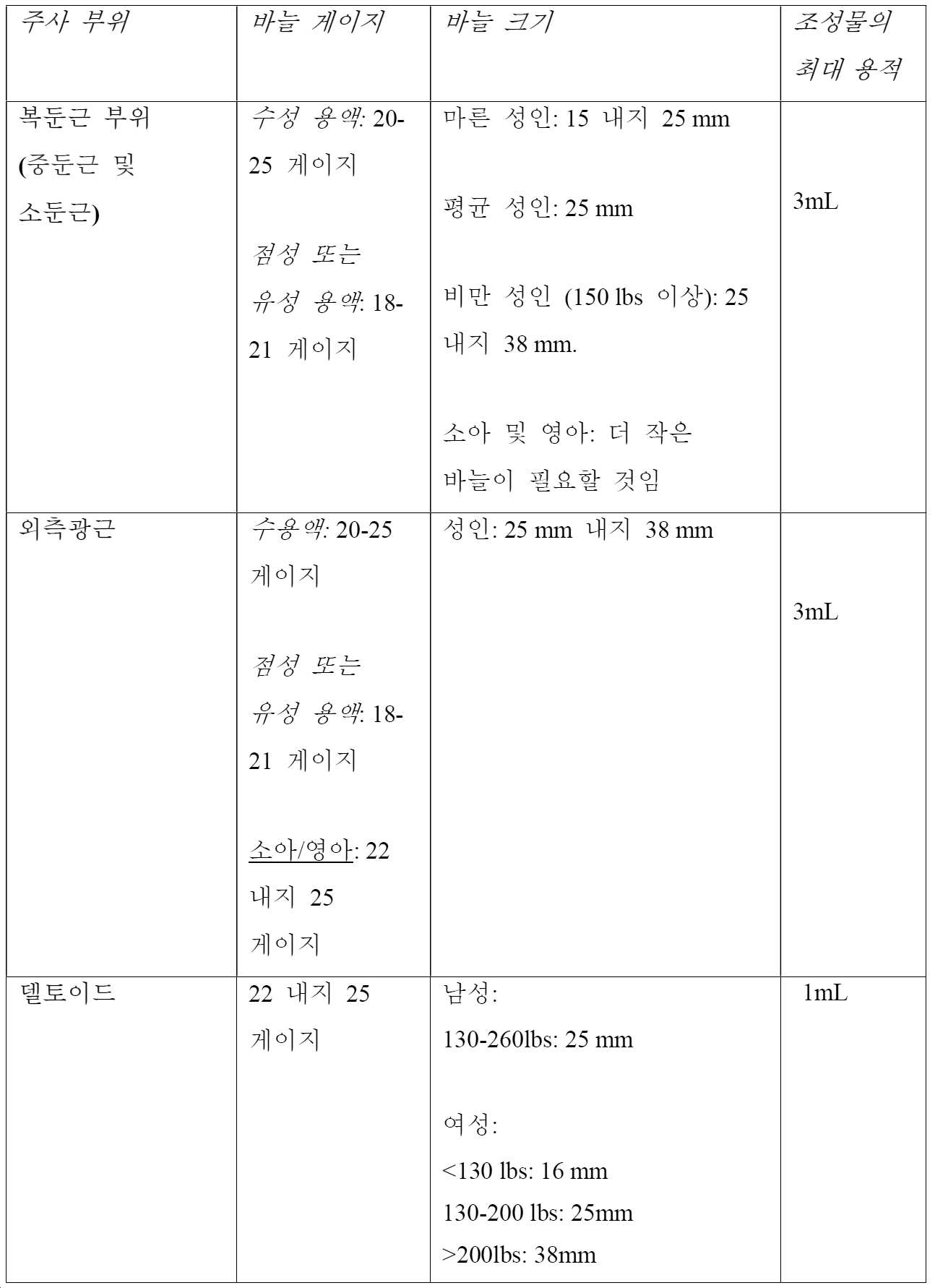
특정 구현예에서, 본원에 개시된 바와 같은 항체 또는 융합 단백질 생산을 위한 ceDNA 벡터는 소량, 예를 들어, 소정의 대상체에 대해 표 12에 개괄된 예시적인 용적으로 제형화된다. 일부 구현예에서, 원하는 경우, 대상체는 주사 전에 전신 또는 국소 마취제를 투여받을 수 있다. 이것은 상기 언급된 일반적인 주사 부위보다는 다수의 주사가 요구되거나 더 깊은 근육이 주사되는 경우에 특히 바람직하다.In certain embodiments, ceDNA vectors for production of antibodies or fusion proteins as disclosed herein are formulated in small amounts, e.g., in exemplary volumes outlined in Table 12 for a given subject. In some embodiments, if desired, the subject may be administered a general or local anesthetic prior to injection. This is particularly preferred when multiple injections are required or deeper muscles are injected than the general injection sites mentioned above.
일부 구현예에서, 근육내 주사는 전기천공, 전달 압력 또는 형질감염 시약의 사용과 조합되어 ceDNA 벡터의 세포 흡수를 향상시킬 수 있다.In some embodiments, intramuscular injection can be combined with electroporation, delivery pressure, or the use of transfection reagents to enhance cellular uptake of ceDNA vectors.
(ii) 형질감염 시약: 일부 구현예에서, 본원에 개시된 바와 같은 항체 또는 융합 단백질 생산을 위한 ceDNA 벡터는 근관 또는 근육 조직으로의 벡터의 흡수를 촉진시키기 위해 하나 이상의 형질감염 시약을 포함하는 조성물로 제형화된다. 따라서, 일 구현예에서, 본원에 기재된 핵산은 본원의 다른 곳에 기재된 방법을 사용하여 형질감염에 의해 근육 세포, 근관 또는 근육 조직에 투여된다. (ii) Transfection Reagent: In some embodiments, the ceDNA vector for the production of an antibody or fusion protein as disclosed herein is a composition comprising one or more transfection reagents to facilitate uptake of the vector into root canal or muscle tissue. Formulated. Thus, in one embodiment, the nucleic acids described herein are administered to muscle cells, root canals, or muscle tissue by transfection using methods described elsewhere herein.
(iii) 전기천공: 특정 구현예에서, 본원에 개시된 바와 같은 항체 또는 융합 단백질 생산을 위한 ceDNA 벡터는 세포 내로 ceDNA의 진입을 용이하게 하기 위한 담체의 부재하에 또는 생리학적으로 불활성인 약제학적으로 허용되는 담체 (즉, 캡시드 비함유, 비-바이러스 벡터의 근관으로의 흡수를 개선 또는 향상시키지 않는 임의의 담체)에서 투여된다. 이러한 구현예에서, 캡시드 비함유, 비-바이러스 벡터의 흡수는 세포 또는 조직의 전기천공에 의해 촉진될 수 있다. (iii) Electroporation: In certain embodiments, ceDNA vectors for the production of antibodies or fusion proteins as disclosed herein are pharmaceutically acceptable or physiologically inactive in the absence of a carrier to facilitate entry of ceDNA into cells. ( I.e., no capsid, any carrier that does not improve or enhance absorption of the non-viral vector into the root canal) In such embodiments, uptake of a capsid-free, non-viral vector may be facilitated by electroporation of cells or tissues.
세포막은 자연적으로 세포외의 세포 세포질 내로의 통과에 저항한다. 이러한 저항을 일시적으로 감소시키는 한 가지 방법은 "전기천공"으로, 전기장을 사용하여 세포에 영구적인 손상을 주지 않으면서 세포에 기공을 생성한다. 이들 기공은 DNA 벡터, 약제, DNA 및 다른 극성 화합물이 세포 내부에 접근할 수 있을 정도로 충분히 크다. 시간이 지남에 따라 세포막의 기공이 닫히고 세포가 또 다시 불투과성이 된다.Cell membranes naturally resist passage outside the cell into the cytoplasm. One way to temporarily reduce this resistance is "electroporation," in which an electric field is used to create pores in the cell without permanent damage to the cell. These pores are large enough to allow DNA vectors, drugs, DNA and other polar compounds to access the interior of the cell. Over time, the pores in the cell membrane close and the cells become impermeable again.
전기천공은 시험관내 및 생체내 적용에서 모두 사용되어 예를 들어, 외인성 DNA를 살아있는 세포에 도입할 수 있다. 시험관내 적용은 전형적으로 살아있는 세포 샘플을 예를 들어, DNA를 포함하는 조성물과 혼합한다. 이어서, 세포를 평행 플레이트와 같은 전극 사이에 놓고 전기장을 세포/조성물 혼합물에 적용한다.Electroporation can be used in both in vitro and in vivo applications to introduce , for example, exogenous DNA into living cells. In vitro application typically mixes a sample of live cells with a composition comprising , for example, DNA. The cells are then placed between electrodes such as parallel plates and an electric field is applied to the cell/composition mixture.
생체내 전기천공에 대한 다수의 방법이 있으며; 전극은, 예를 들어, 치료될 세포 영역 위에 가로놓인 표피를 파지하는 캘리퍼와 같은 다양한 구성으로 제공될 수 있다. 대안적으로, 바늘 모양의 전극은 조직에 삽입되어 보다 깊게 위치한 세포에 접근할 수 있다. 어느 경우이든, 예를 들어, 핵산을 포함하는 조성물을 치료 부위에 주사한 후, 전극은 상기 부위에 전기장을 인가한다. 일부 전기천공 적용에서, 이 전기장은 약 10 내지 60 ms 지속 시간의 100 내지 500 V/cm 정도의 단일 구형파 펄스를 포함한다. 이러한 펄스는, 예를 들어, Genetronics, Inc.의 BTX 사업부에 의해 제작된, Electro Square Porator T820의 공지된 어플리케이션에서 생성될 수 있다.There are a number of methods for in vivo electroporation; The electrodes can be provided in various configurations, such as, for example, a caliper that grips the epidermis overlying the area of the cell to be treated. Alternatively, needle-shaped electrodes can be inserted into the tissue to access cells located deeper. In either case, for example, after injection of a composition comprising a nucleic acid into the treatment site, the electrode applies an electric field to the site. In some electroporation applications, this electric field comprises a single square wave pulse on the order of 100 to 500 V/cm with a duration of about 10 to 60 ms. Such pulses can be generated, for example, in a known application of the Electro Square Porator T820, manufactured by the BTX division of Genetronics, Inc.
전형적으로, 예를 들어, 핵산의 성공적인 흡수는 근육이, 예를 들어, 근육에 주사에 의해 조성물의 투여 즉시 또는 직후에 근육이 전기적으로 자극되는 경우에만 발생한다.Typically, for example, successful absorption of the nucleic acid occurs only when the muscle is electrically stimulated immediately or immediately after administration of the composition, for example by injection into the muscle.
특정 구현예에서, 전기천공은 전기장의 펄스를 사용하거나 저전압/장 펄스 치료 요법 (예를 들어, 구형파 펄스 전기천공 시스템을 사용)을 사용하여 달성된다. 펄스 전기장을 생성할 수 있는 예시적인 펄스 발생기는, 예를 들어, 지수 파형(exponential wave form)을 생성할 수 있는 ECM600, 및 구형파형(square wave form)을 생성할 수 있는 ElectroSquarePorator (T820)를 포함하며, 둘 다 Genetronics, Inc.의 사업부인, BTX (San Diego, Calif.)로부터 입수 가능하다. 구형파 전기천공 시스템은 설정된 전압으로 빠르게 상승하는 제어된 전기 펄스를 제공하고, 설정된 시간 (펄스 길이) 동안 해당 레벨을 유지한 다음 빠르게 0으로 떨어진다.In certain embodiments, electroporation is accomplished using pulses of an electric field or using a low voltage/long pulse therapy regimen ( eg , using a square wave pulse electroporation system). Exemplary pulse generators capable of generating a pulsed electric field include, for example, ECM600 capable of generating an exponential wave form, and ElectroSquarePorator (T820) capable of generating a square wave form. And both are available from BTX (San Diego, Calif.), a division of Genetronics, Inc. The square wave electroporation system provides a controlled electric pulse that rises rapidly to a set voltage, holds that level for a set time (pulse length), and then quickly drops to zero.
일부 구현예에서, 국소 마취제는, 예를 들어, 본원에 기재된 바와 같이 캡시드 비함유, 비-바이러스 벡터를 포함하는 조성물의 존재하에 조직의 전기천공과 관련될 수 있는 통증을 감소시키기 위한 치료 부위에의 주사에 의해 투여된다. 또한, 당업자는 근육의 섬유증, 괴사 또는 염증을 유발하는 과도한 조직 손상을 최소화 및/또는 방지하는 조성물의 용량이 선택되어야 한다는 것을 이해할 것이다.In some embodiments, a local anesthetic is administered to a treatment site to reduce pain that may be associated with electroporation of tissue, e.g., in the presence of a composition comprising a capsid-free, non-viral vector as described herein. Is administered by injection of. In addition, one of skill in the art will understand that a dose of the composition should be selected that minimizes and/or prevents excessive tissue damage leading to muscle fibrosis, necrosis or inflammation.
(iv) 전달 압력 : 일부 구현예에서, 본원에 개시된 바와 같은 항체 또는 융합 단백질 생산을 위한 ceDNA 벡터를 근육 조직으로 전달하는 것은 전달 압력에 의해 촉진되는데, 이는 사지에 공급되는 동맥 (예를 들어, 장골동맥)으로의 대량 및 빠른 주사의 조합을 사용한다. 이러한 투여 방식은, 전형적으로 근육이 혈관 클램프의 지혈대를 사용하여 전신 순환으로부터 단리되는 동안, ceDNA 벡터를 포함하는 조성물을 사지 혈관계에 주입하는 것을 포함하는 다양한 방법을 통해 달성될 수 있다. 일 방법에서, 조성물은 사지 혈관계를 통해 순환되어 세포로의 혈관외 유출을 가능하게 한다. 또 다른 방법에서, 혈관내 유체 역학적 압력은 혈관 층을 확장시키고 ceDNA 벡터의 근육 세포 또는 조직으로의 흡수를 증가시키기 위해 증가된다. 일 구현예에서, ceDNA 조성물은 동맥으로 투여된다. (iv) Delivery pressure : In some embodiments , delivery of a ceDNA vector for production of an antibody or fusion protein as disclosed herein to muscle tissue is facilitated by delivery pressure, which is an artery supplied to the limb ( e.g. , Iliac artery), a combination of mass and rapid injections is used. This mode of administration can be achieved through a variety of methods, including injecting a composition comprising a ceDNA vector into the limb vascular system, typically while the muscle is isolated from the systemic circulation using a tourniquet of a vascular clamp. In one method, the composition is circulated through the limb vasculature to allow extravascular outflow into the cells. In another method, the intravascular hydrodynamic pressure is increased to expand the vascular layer and increase the uptake of ceDNA vectors into muscle cells or tissues. In one embodiment, the ceDNA composition is administered into an artery.
(v) 지질 나노입자 조성물: 일부 구현예에서, 근육내 전달을 위한 본원에 개시된 바와 같은 항체 또는 융합 단백질 생산을 위한 ceDNA 벡터는 본원의 다른 곳에 기재된 바와 같은 리포좀을 포함하는 조성물로 제형화된다. (v) Lipid Nanoparticle Composition: In some embodiments, the ceDNA vector for production of an antibody or fusion protein as disclosed herein for intramuscular delivery is formulated into a composition comprising liposomes as described elsewhere herein.
(vi) 근육 조직을 표적화하는 ceDNA 벡터의 전신 투여: 일부 구현예에서, 본원에 개시된 바와 같은 항체 또는 융합 단백질 생산을 위한 ceDNA 벡터는 간접 전달 투여를 통해 근육을 표적화하도록 제형화되며, 여기서 ceDNA는 간이 아닌 근육으로 운반된다. 따라서, 본원에 기재된 기술은, 예를 들어, 전신 투여에 의해 본원에 개시된 바와 같은 항체 또는 융합 단백질 생산을 위한 ceDNA 벡터를 포함하는 조성물을 근육 조직에 간접적으로 투여하는 것을 포함한다. 이러한 조성물은 국소, 정맥내 (볼루스 또는 연속 주입에 의해), 세포내 주사, 조직내 주사, 경구, 흡입, 복강내, 피하내, 공동내(intracavity)로 투여될 수 있고, 원한다면, 연동 수단에 의해 또는 당업자에게 알려진 다른 수단에 의해 전달될 수 있다. 제제는, 원하는 경우, 전신 투여, 예를 들어, 정맥내 주입에 의해 투여될 수 있다. (vi) Systemic administration of ceDNA vectors targeting muscle tissue: In some embodiments, ceDNA vectors for production of antibodies or fusion proteins as disclosed herein are formulated to target muscle via indirect delivery administration, wherein ceDNA is It is carried by the muscles, not the liver. Accordingly, the techniques described herein include indirectly administering to muscle tissue a composition comprising a ceDNA vector for production of an antibody or fusion protein as disclosed herein, for example by systemic administration. Such compositions can be administered topically, intravenously (by bolus or continuous infusion), intracellular injection, intracellular injection, oral, inhalation, intraperitoneal, subcutaneous, intracavity, if desired, peristaltic means By or by other means known to those skilled in the art. The formulations can be administered, if desired, by systemic administration, for example intravenous infusion.
일부 구현예에서, 본원에 개시된 바와 같은 항체 또는 융합 단백질 생산을 위한 ceDNA 벡터의 근육 세포/조직으로의 흡수는 벡터를 근육 조직으로 우선적으로 지시하는 표적화 제제 또는 모이어티를 사용함으로써 증가된다. 따라서, 일부 구현예에서, 캡시드 비함유 ceDNA 벡터는 신체의 다른 세포 또는 조직에 존재하는 캡시드 비함유 ceDNA 벡터의 양과 비교하여 근육 조직에서 농축될 수 있다.In some embodiments, uptake of ceDNA vectors for production of antibodies or fusion proteins as disclosed herein into muscle cells/tissues is increased by using a targeting agent or moiety that preferentially directs the vector to muscle tissue. Thus, in some embodiments, the capsid-free ceDNA vector can be enriched in muscle tissue compared to the amount of capsid-free ceDNA vector present in other cells or tissues of the body.
일부 구현예에서, 본원에 개시된 바와 같은 항체 또는 융합 단백질 생산을 위한 ceDNA 벡터를 포함하는 조성물은 근육 세포에 대한 표적화 모이어티를 추가로 포함한다. 다른 구현예에서, 발현된 유전자 산물은 작용하고자 하는 조직에 특이적인 표적화 모이어티를 포함한다. 표적화 모이어티는 세포 또는 조직의 세포내, 세포 표면 또는 세포외 바이오마커를 표적화, 상호작용, 커플링 및/또는 결합할 수 있는 임의의 분자 또는 분자 복합체를 포함할 수 있다. 바이오마커는, 예를 들어, 세포 프로테아제, 키나제, 단백질, 세포 표면 수용체, 지질 및/또는 지방산을 포함할 수 있다. 표적화 모이어티가 표적화, 상호작용, 커플링 및/또는 결합할 수 있는 바이오마커의 다른 예는 특정 질환과 관련된 분자를 포함한다. 예를 들어, 바이오마커는 표피 성장 인자 수용체 및 트랜스페린 수용체와 같이 암 발달에 연루된 세포 표면 수용체를 포함할 수 있다. 표적화 모이어티는 표적 근육 조직에서 발현된 분자에 결합하는 합성 화합물, 천연 화합물 또는 생성물, 거대분자 개체, 생체공학적 분자 (예를 들어, 폴리펩티드, 지질, 폴리뉴클레오티드, 항체, 항체 단편), 및 작은 개체 (예를 들어, 소분자, 신경전달물질, 기질, 리간드, 호르몬 및 원소 화합물)를 포함할 수 있지만, 이에 제한되지 않는다.In some embodiments, compositions comprising ceDNA vectors for production of antibodies or fusion proteins as disclosed herein further comprise a targeting moiety for muscle cells. In another embodiment, the expressed gene product comprises a targeting moiety specific for the tissue to be acted upon. The targeting moiety may comprise any molecule or molecular complex capable of targeting, interacting, coupling and/or binding an intracellular, cell surface, or extracellular biomarker of a cell or tissue. Biomarkers can include, for example, cell proteases, kinases, proteins, cell surface receptors, lipids and/or fatty acids. Other examples of biomarkers to which the targeting moiety can target, interact, couple and/or bind include molecules associated with a particular disease. For example, biomarkers can include cell surface receptors involved in cancer development, such as epidermal growth factor receptors and transferrin receptors. Targeting moieties are synthetic compounds, natural compounds or products, macromolecular entities, biotechnological molecules ( e.g., polypeptides, lipids, polynucleotides, antibodies, antibody fragments), and small individuals that bind to molecules expressed in the target muscle tissue. ( For example, small molecules, neurotransmitters, substrates, ligands, hormones, and elemental compounds), but are not limited thereto.
특정 구현예에서, 표적화 분자는, 예를 들어, 표적 세포의 특정한 원하는 분자를 자연적으로 인식하는 수용체를 포함하는 수용체 분자를 추가로 포함할 수 있다. 이러한 수용체 분자는 표적 분자와의 상호작용의 특이성을 증가시키도록 변형된 수용체, 수용체에 의해 자연적으로 인식되지 않는 원하는 표적 분자와 상호작용하도록 변형된 수용체, 및 이러한 수용체의 단편을 포함한다 (예를 들어, Skerra, 2000, J. Molecular Recognition, 13:167-187 참조). 바람직한 수용체는 케모카인 수용체이다. 예시적인 케모카인 수용체는, 예를 들어, 하기에 기재되었다: Lapidot et al, 2002, Exp Hematol, 30:973-81 및 Onuffer et al, 2002, Trends Pharmacol Sci, 23:459-67.In certain embodiments, the targeting molecule may further comprise a receptor molecule, including, for example, a receptor that naturally recognizes a particular desired molecule of the target cell. Such receptor molecules include receptors that have been modified to increase the specificity of their interaction with the target molecule, receptors that have been modified to interact with the desired target molecule that is not naturally recognized by the receptor, and fragments of such receptors ( e.g. See, for example, Skerra, 2000, J. Molecular Recognition, 13:167-187). A preferred receptor is a chemokine receptor. Exemplary chemokine receptors have been described, for example, below: Lapidot et al, 2002, Exp Hematol, 30:973-81 and Onuffer et al, 2002, Trends Pharmacol Sci, 23:459-67.
다른 구현예에서, 추가의 표적화 모이어티는, 예를 들어, 트랜스페린 (Tf) 리간드와 같은 표적 세포의 원하는 특정 수용체를 자연적으로 인식하는 리간드를 포함하는 리간드 분자를 포함할 수 있다. 이러한 리간드 분자는 표적 수용체와의 상호작용의 특이성을 증가시키기 위해 변형된 리간드, 리간드에 의해 자연적으로 인식되지 않는 원하는 수용체와 상호작용하도록 변형된 리간드, 및 이러한 리간드의 단편을 포함한다.In other embodiments, the additional targeting moiety may comprise a ligand molecule comprising a ligand that naturally recognizes the specific desired receptor of the target cell, such as, for example, a transferrin (Tf) ligand. Such ligand molecules include ligands modified to increase the specificity of interactions with target receptors, ligands modified to interact with desired receptors that are not naturally recognized by the ligand, and fragments of such ligands.
또 다른 구현예에서, 표적화 모이어티는 압타머를 포함할 수 있다. 압타머는 표적 세포의 원하는 분자 구조에 특이적으로 결합하도록 선택된 올리고뉴클레오티드이다. 압타머는 전형적으로 파지 디스플레이의 친화도 선택 (시험관내 분자 진화로도 알려져 있음)과 유사한 친화도 선택 과정의 산물이다. 상기 방법은, 예를 들어, 병에 걸린 면역원이 결합된 고체 지지체를 사용하여 친화도 분리의 여러 탠덤 반복을 수행한 후, 면역원에 결합된 핵산을 증폭시키기 위한 중합효소 연쇄 반응 (PCR)을 수반한다. 따라서 각 친화도 분리 라운드는 원하는 면역원에 성공적으로 결합하는 분자에 대한 핵산 집단을 풍부하게 한다. 이러한 방식으로, 랜덤 핵산 풀이 "교육(educated)"되어 표적 분자에 특이적으로 결합하는 압타머를 생성할 수 있다. 압타머는 전형적으로 RNA이지만, 비제한적으로, 펩티드 핵산 (PNA) 및 포스포로티오에이트 핵산과 같은, DNA 또는 이의 유사체 또는 유도체일 수 있다.In yet another embodiment, the targeting moiety may comprise an aptamer. Aptamers are oligonucleotides selected to specifically bind to the desired molecular structure of a target cell. Aptamers are typically the product of an affinity selection process similar to the affinity selection of phage display (also known as in vitro molecular evolution). The method involves, for example , polymerase chain reaction (PCR) to amplify the nucleic acid bound to the immunogen after performing several tandem repetitions of affinity separation using a solid support to which the diseased immunogen is bound. do. Thus, each round of affinity separation enriches a population of nucleic acids for molecules that successfully bind to the desired immunogen. In this way, random nucleic acid pools can be "educated" to generate aptamers that specifically bind to target molecules. Aptamers are typically RNA, but can be DNA or analogs or derivatives thereof, such as, but not limited to, peptide nucleic acids (PNA) and phosphorothioate nucleic acids.
일부 구현예에서, 표적화 모이어티는 캡시드 비함유, 비-바이러스 벡터 또는 유전자 산물이 특정 조직으로 표적화되도록, 예를 들어, 집속 광 빔(focused beam of light)으로부터 방출되는 광분해성 리간드 (즉, '케이지드(caged)' 리간드)를 포함할 수 있다.In some embodiments, the targeting moiety is a capsid-free, non-viral vector or a photodegradable ligand ( i.e. , ' A caged' ligand).
본 명세서에서 조성물은 대상체의 하나 이상의 근육에서 다수의 부위로 전달되는 것이 또한 고려된다. 즉, 주사는 적어도 2, 적어도 3, 적어도 4, 적어도 5, 적어도 6, 적어도 7, 적어도 8, 적어도 9, 적어도 10, 적어도 15, 적어도 20, 적어도 25, 적어도 30, 적어도 35, 적어도 40, 적어도 45, 적어도 50, 적어도 55, 적어도 60, 적어도 65, 적어도 70, 적어도 75, 적어도 80, 적어도 85, 적어도 90, 적어도 95, 적어도 100개의 주사 부위에서 수행될 수 있다. 이러한 부위는 단일 근육의 영역에 퍼지거나 여러 근육에 분산될 수 있다.It is also contemplated herein that the composition is delivered to multiple sites in one or more muscles of the subject. That is, the injection is at least 2, at least 3, at least 4, at least 5, at least 6, at least 7, at least 8, at least 9, at least 10, at least 15, at least 20, at least 25, at least 30, at least 35, at least 40, at least 45, at least 50, at least 55, at least 60, at least 65, at least 70, at least 75, at least 80, at least 85, at least 90, at least 95, at least 100 injection sites. These areas can spread over an area of a single muscle or spread across multiple muscles.
B. B. 비-근육 위치에 항체 또는 융합 단백질 생산을 위한 ceDNA 벡터의 투여Administration of ceDNA vectors for production of antibodies or fusion proteins to non-muscular locations
또 다른 구현예에서, 항체 또는 융합 단백질 생산을 위한 ceDNA 벡터는 CNS (예를 들어, 뇌 또는 눈)에 투여된다. ceDNA 벡터는 척수, 뇌간 (숨뇌, 뇌교), 중뇌 (시상하부, 시상, 시상상부, 뇌하수체, 흑질, 송과선), 소뇌, 종뇌(선조체, 후두를 포함한 대뇌, 측두엽, 두정엽, 전두엽, 피질, 기저핵, 해마 및 포르타아미달라(portaamygdala)), 변연계, 신피질, 선조체, 대뇌 및 하구로 도입될 수 있다. ceDNA 벡터는 또한 망막, 각막 및/또는 시신경과 같은 눈의 다른 영역에 투여될 수 있다. 항체 또는 융합 단백질 생산을 위한 ceDNA 벡터는 뇌척수액 내로 전달될 수 있다 (예를 들어, 요추 천자에 의해). ceDNA 벡터는 혈액-뇌 장벽이 교란된 상황 (예를 들어, 뇌종양 또는 뇌경색)에서 CNS에 혈관내로 추가로 투여될 수 있다.In another embodiment, the ceDNA vector for antibody or fusion protein production is administered to the CNS (eg, brain or eye). ceDNA vectors include spinal cord, brainstem (breath brain, pons), midbrain (hypothalamus, thalamus, hypothalamus, pituitary gland, black matter, pineal gland), cerebellum, cerebellum, cerebrum, cerebrum including striatum, larynx, temporal lobe, parietal lobe, frontal lobe, cortex, basal ganglia Hippocampus and portaamygdala), limbic system, neocortex, striatum, cerebrum and estuary. The ceDNA vector can also be administered to other areas of the eye, such as the retina, cornea and/or optic nerve. The ceDNA vector for antibody or fusion protein production can be delivered into the cerebrospinal fluid (eg, by lumbar puncture). The ceDNA vector can be further administered intravascularly to the CNS in situations in which the blood-brain barrier is disturbed (eg, brain tumor or cerebral infarction).
일부 구현예에서, 항체 또는 융합 단백질 생산을 위한 ceDNA 벡터는 경막내, 안구내, 뇌내, 심실내, 정맥내 (예를 들어, 만니톨과 같은 당의 존재하에), 비강내, 귀내, 안구내 (예를 들어, 유리체내, 망막하, 전방) 및 안구주위 (예를 들어, 서브-테논 부위(sub-Tenon's region)) 전달뿐만 아니라 운동 뉴런으로 역행 전달을 통한 근육내 전달을 포함하지만 이에 제한되지 않는, 당 업계에 공지된 임의의 경로에 의해 CNS의 원하는 영역(들)에 투여될 수 있다.In some embodiments, the ceDNA vector for antibody or fusion protein production is intrathecal, intraocular, intracranial, intraventricular, intravenous (e.g., in the presence of a sugar such as mannitol), intranasal, intra-ear, intraocular (e.g. For example, including, but not limited to, intravitreal, subretinal, anterior) and peri-ocular (e.g., sub-Tenon's region) delivery, as well as intramuscular delivery via retrograde delivery to motor neurons. , Can be administered to the desired region(s) of the CNS by any route known in the art.
일부 구현예에서, 항체 또는 융합 단백질 생산을 위한 ceDNA 벡터는 CNS의 원하는 영역 또는 구획에 직접 주사 (예를 들어, 정위 주사)에 의해 액체 제형으로 투여된다. 다른 구현예에서, ceDNA 벡터는 원하는 영역에 국소 적용하거나 에어로졸 제형의 비강내 투여에 의해 제공될 수 있다. 눈에의 투여는 액체 액적의 국소 적용에 의한 것일 수 있다. 추가의 대안으로서, ceDNA 벡터는 고체, 서방형 제형으로서 투여될 수 있다 (예를 들어, 미국 특허 번호 7,201,898 참조). 또 다른 추가의 구현예에서, ceDNA 벡터는 운동 뉴런 (예를 들어, 근위축성 측삭 경화증 (ALS); 척수 근육 위축 (SMA) 등)을 포함하는 질환 및 장애를 치료, 개선 및/또는 예방하기 위해 역행 수송에 사용될 수 있다. 예를 들어, ceDNA 벡터는 뉴런으로 이동할 수 있는 근육 조직으로 전달될 수 있다.In some embodiments, the ceDNA vector for antibody or fusion protein production is administered in a liquid formulation by direct injection (eg, stereotactic injection) to a desired region or compartment of the CNS. In other embodiments, the ceDNA vector can be provided by topical application to the desired area or by intranasal administration of an aerosol formulation. Administration to the eye may be by topical application of liquid droplets. As a further alternative, the ceDNA vector can be administered as a solid, sustained release formulation (see, eg, US Pat. No. 7,201,898). In another further embodiment, the ceDNA vector is used to treat, ameliorate and/or prevent diseases and disorders, including motor neurons (e.g., amyotrophic lateral sclerosis (ALS); spinal muscle atrophy (SMA), etc.). Can be used for reverse transportation. For example, ceDNA vectors can be delivered to muscle tissue that can move to neurons.
C. 생체외 C. In vitro 치료cure
일부 구현예에서, 대상체로부터 세포를 제거하고, 본원에 개시된 바와 같은 항체 또는 융합 단백질 생산을 위한 ceDNA 벡터가 그 안에 도입되고, 이어서 세포는 대상체 내로 다시 교체된다. 생체외 치료를 위해 대상체로부터 세포를 제거한 후 대상체로 다시 도입하는 방법은 당 업계에 공지되어 있다 (예를 들어, 미국 특허 번호 5,399,346 참조; 이의 개시내용은 그 전문이 본원에 포함됨). 대안적으로, ceDNA 벡터는 또 다른 대상체 유래 세포, 배양 세포, 또는 임의의 다른 적합한 공급원 유래 세포 내로 도입되고, 세포는 이를 필요로 하는 대상체에게 투여된다.In some embodiments, cells are removed from the subject, and ceDNA vectors for production of antibodies or fusion proteins as disclosed herein are introduced therein, and then the cells are replaced back into the subject. Methods of removing cells from a subject for ex vivo treatment and then introducing them back into a subject are known in the art ( see, for example , U.S. Patent No. 5,399,346; the disclosure of which is incorporated herein in its entirety). Alternatively, the ceDNA vector is introduced into another subject-derived cell, a cultured cell, or any other suitable source-derived cell, and the cells are administered to a subject in need thereof.
본원에 개시된 바와 같은 항체 또는 융합 단백질 생산을 위한 ceDNA 벡터로 형질도입된 세포는 바람직하게는 약제학적 담체와 함께 "치료적 유효량"으로 대상체에게 투여된다. 당업자는 치료 효과가 대상체에게 약간의 이점이 제공되는 한 완전하거나 치유력이 있을 필요는 없음을 이해할 것이다.Cells transduced with ceDNA vectors for the production of antibodies or fusion proteins as disclosed herein are administered to a subject in a "therapeutically effective amount", preferably with a pharmaceutical carrier. One of skill in the art will understand that the therapeutic effect does not need to be complete or curative as long as some benefit is provided to the subject.
일부 구현예에서, 본원에 개시된 바와 같은 항체 또는 융합 단백질 생산을 위한 ceDNA 벡터는 시험관내, 생체외 또는 생체내 세포에서 생산되는 본원에 기재된 바와 같은 항체 또는 융합 단백질 (때로는 이식유전자 또는 이종 뉴클레오티드 서열이라고도 함)을 인코딩할 수 있다. 예를 들어, 본원에 논의된 바와 같은 치료 방법에서 본원에 기재된 ceDNA 벡터의 사용과 대조적으로, 일부 구현예에서 항체 또는 융합 단백질 생산을 위한 ceDNA 벡터는, 예를 들어, 항체 및 융합 단백질의 생산을 위해 배양 세포 및 상기 세포로부터 단리된 발현된 항체 또는 융합 단백질 내로 도입될 수 있다. 일부 구현예에서, 본원에 개시된 바와 같은 항체 또는 융합 단백질 생산을 위한 ceDNA 벡터를 포함하는 배양 세포는, 예를 들어, 항체 또는 융합 단백질의 소규모 또는 대규모 바이오 제조(biomanufacturing)를 위한 세포 공급원으로서 제공되는, 항체 또는 융합 단백질의 상업적 생산에 사용될 수 있다. 대안적인 구현예에서, 본원에 개시된 바와 같은 항체 또는 융합 단백질 생산을 위한 ceDNA 벡터는 소규모 생산뿐만 아니라 상업적인 대규모 항체 또는 융합 단백질 생산을 포함하여, 항체 또는 융합 단백질의 생체내 생산을 위해 숙주 비-인간 대상체의 세포로 도입된다.In some embodiments, the ceDNA vector for the production of an antibody or fusion protein as disclosed herein is an antibody or fusion protein as described herein produced in a cell in vitro, ex vivo or in vivo (sometimes referred to as a transgene or heterologous nucleotide sequence. Ha) can be encoded. For example, in contrast to the use of the ceDNA vectors described herein in a method of treatment as discussed herein, in some embodiments, ceDNA vectors for antibody or fusion protein production, e.g., for the production of antibodies and fusion proteins. It can be introduced into cultured cells and expressed antibodies or fusion proteins isolated from said cells. In some embodiments, a cultured cell comprising a ceDNA vector for production of an antibody or fusion protein as disclosed herein is provided as a cell source for small or large scale biomanufacturing, e.g., of an antibody or fusion protein. , Can be used for commercial production of antibodies or fusion proteins. In alternative embodiments, ceDNA vectors for production of antibodies or fusion proteins as disclosed herein are host non-human for in vivo production of antibodies or fusion proteins, including small scale production as well as commercial large scale antibody or fusion protein production. It is introduced into the cells of the subject.
본원에 개시된 바와 같은 항체 또는 융합 단백질 생산을 위한 ceDNA 벡터는 수의학 및 의학적 용도 둘 모두에서 사용될 수 있다. 상기 기재된 바와 같은 생체외 유전자 전달 방법에 적합한 대상체는 조류 (예를 들어, 닭, 오리, 거위, 메추라기, 칠면조 및 꿩) 및 포유동물 (예를 들어, 인간, 소, 양, 염소, 말, 고양이, 개 및 토끼목) 둘 다를 포함하며, 포유동물이 바람직하다. 인간 대상체가 가장 바람직하다. 인간 대상체에는 신생아, 유아, 청소년 및 성인이 포함된다.The ceDNA vectors for the production of antibodies or fusion proteins as disclosed herein can be used in both veterinary and medical applications. Subjects suitable for ex vivo gene delivery methods as described above include birds ( e.g. , chickens, ducks, geese, quails, turkeys and pheasants) and mammals ( e.g. , humans, cattle, sheep, goats, horses, cats , Dogs and rabbits), and mammals are preferred. Human subjects are most preferred. Human subjects include newborns, infants, adolescents and adults.
D. 투여 범위D. Dosing range
본원에 기재된 바와 같은 항체 또는 융합 단백질을 인코딩하는 ceDNA 벡터를 포함하는 조성물의 유효량을 대상체에게 투여하는 것을 포함하는 치료 방법이 본원에 제공된다. 숙련가에 의해 이해되는 바와 같이, 용어 "유효량"은 질환의 치료를 위해 "치료적 유효량"으로 항체 또는 융합 단백질을 발현시키는 투여된 ceDNA 조성물의 양을 지칭한다.Provided herein are methods of treatment comprising administering to a subject an effective amount of a composition comprising a ceDNA vector encoding an antibody or fusion protein as described herein. As will be understood by one of skill in the art, the term “effective amount” refers to the amount of an administered ceDNA composition that expresses an antibody or fusion protein in a “therapeutically effective amount” for treatment of a disease.
생체내 및/또는 시험관내 분석은 선택적으로 사용을 위한 최적의 투약 범위를 식별하는데 도움을 주기 위해 사용될 수 있다. 제형에 사용될 정확한 용량은 또한 투여 경로 및 상태의 심각성에 따라 달라질 것이며, 당업자의 판단 및 각 대상체의 상황에 따라 결정되어야 한다. 시험관내 또는 동물 모델 시험 시스템으로부터 유도된 용량-반응 곡선으로부터 유효 용량이 추론될 수 있다. In vivo and/or in vitro assays can optionally be used to help identify the optimal dosage range for use. The exact dosage to be used in the formulation will also depend on the route of administration and the severity of the condition, and should be determined according to the judgment of those skilled in the art and the circumstances of each subject. Effective doses can be inferred from dose-response curves derived from in vitro or animal model test systems.
본원에 개시된 바와 같은 항체 또는 융합 단백질 생산을 위한 ceDNA 벡터는 원하는 조직의 세포를 형질감염시키고 과도한 부작용 없이 충분한 수준의 유전자 전달 및 발현을 제공하기에 충분한 양으로 투여된다. 통상적이고 약제학적으로 허용되는 투여 경로는 선택된 기관으로의 직접 전달 (예를 들어, 간으로의 문맥내 전달), 경구, 흡입 (비강내 및 기관내 전달 포함), 안내, 정맥내, 근육내, 피하, 피내, 종양내 및 기타 모 투여 경로와 같이 상기 "투여" 섹션에서 기재된 것을 포함하지만, 이에 제한되지 않는다. 원하는 경우, 투여 경로를 조합할 수 있다.The ceDNA vectors for the production of antibodies or fusion proteins as disclosed herein are administered in an amount sufficient to transfect cells of the desired tissue and provide sufficient levels of gene transfer and expression without undue side effects. Typical and pharmaceutically acceptable routes of administration include direct delivery to the selected organ ( e.g. , intraportal delivery to the liver), oral, inhalation (including intranasal and intratracheal delivery), intraocular, intravenous, intramuscular, Subcutaneous, intradermal, intratumoral and other parental routes of administration, including, but not limited to, those described in the "administration" section above. If desired, routes of administration can be combined.
특정 "치료 효과"를 달성하기 위해 요구되는 본원에 개시된 바와 같은 항체 또는 융합 단백질 생산을 위한 ceDNA 벡터의 양의 용량은 핵산 투여 경로, 치료 효과를 달성하기 위해 요구되는 유전자 또는 RNA 발현 수준, 치료되는 특정 질환 또는 장애, 및 유전자(들), RNA 산물(들), 또는 생성된 발현 단백질(들)의 안정성을 포함하지만, 이에 제한되지 않는 몇몇 요인에 기초하여 달라질 것이다. 당업자는 상기 언급된 인자, 및 당 업계에 잘 알려진 다른 인자에 기초하여 특정 질환 또는 장애를 갖는 환자를 치료하기 위한 ceDNA 벡터 용량 범위를 쉽게 결정할 수 있다.The dose of the amount of ceDNA vector for the production of an antibody or fusion protein as disclosed herein required to achieve a specific “therapeutic effect” is the route of administration of the nucleic acid, the level of gene or RNA expression required to achieve the therapeutic effect, and The specific disease or disorder will vary based on several factors, including, but not limited to, the stability of the gene(s), RNA product(s), or the resulting expressed protein(s). One of skill in the art can easily determine the ceDNA vector dose range for treating patients with a particular disease or disorder based on the factors mentioned above, and other factors well known in the art.
투약 요법은 최적의 치료 반응을 제공하도록 조정될 수 있다. 예를 들어, 올리고뉴클레오티드는 반복적으로 투여될 수 있으며, 예를 들어, 수회 용량이 매일 투여될 수 있거나, 치료 상황의 긴급성으로 지시되는 바와 같이 용량을 비례적으로 감소시킬 수 있다. 당업자는 올리고 뉴클레오티드가 세포 또는 대상체에게 투여되는지에 관계없이 대상 올리고뉴클레오티드의 적절한 용량 및 투여 스케줄을 쉽게 결정할 수 있을 것이다.The dosing regimen can be adjusted to provide an optimal therapeutic response. For example, oligonucleotides may be administered repeatedly, for example several doses may be administered daily, or the dose may be proportionally reduced as indicated by the urgency of the treatment situation. One of skill in the art will be able to readily determine the appropriate dosage and dosing schedule of the oligonucleotide of interest, regardless of whether the oligonucleotide is administered to a cell or subject.
"치료적 유효 용량"은 임상 시험을 통해 결정될 수 있는 비교적 넓은 범위에 속할 것이고, 특정 적용에 따라 달라질 것이다 (신경 세포는 매우 소량을 필요로 하는 한편, 전신 주사는 다량을 필요로 할 것임). 예를 들어, 인간 대상체의 골격 또는 심장 근육으로의 생체내 직접 주사의 경우, 치료적 유효 용량은 약 1 μg 내지 100 g 정도의 ceDNA 벡터일 것이다. 엑소좀 또는 미세입자가 ceDNA 벡터를 전달하기 위해 사용되는 경우, 치료적 유효 용량은 실험적으로 결정될 수 있지만, 1 μg 내지 약 100 g의 벡터를 전달할 것으로 예상된다. 또한, 치료적 유효 용량은 질환의 하나 이상의 증상을 감소시키지만, 상당한 오프-표적 또는 상당한 부작용을 초래하지 않는, 대상체에게 영향을 미치기에 충분한 양의 이식유전자를 발현시키는 ceDNA 벡터의 양이다. 일 구현예에서, "치료적 유효량"은 질환 바이오마커의 발현 또는 주어진 질환 증상의 감소에서 통계적으로 유의하고, 측정 가능한 변화를 생성하기에 충분한 발현된 항체 또는 융합 단백질의 양이다. 이러한 유효량은 주어진 ceDNA 벡터 조성물에 대한 동물 연구뿐만 아니라 임상 시험에서 측정될 수 있다.The “therapeutically effective dose” will fall within a relatively wide range that can be determined through clinical trials and will depend on the particular application (neural cells will require very small amounts while systemic injections will require large amounts). For example, for direct injection in vivo into the skeletal or cardiac muscle of a human subject, the therapeutically effective dose will be about 1 μg to 100 g of ceDNA vector. When exosomes or microparticles are used to deliver a ceDNA vector, a therapeutically effective dose can be determined empirically, but is expected to deliver 1 μg to about 100 g of vector. In addition, a therapeutically effective dose is an amount of a ceDNA vector expressing a transgene in an amount sufficient to affect a subject, which reduces one or more symptoms of the disease but does not result in significant off-targets or significant side effects. In one embodiment, a “therapeutically effective amount” is an amount of expressed antibody or fusion protein sufficient to produce a statistically significant, measurable change in the expression of a disease biomarker or reduction of a given disease symptom. Such effective amounts can be determined in animal studies as well as clinical trials for a given ceDNA vector composition.
약제학적으로-허용되는 부형제 및 담체 용액의 제형은 다양한 치료 요법에서 본원에 기재된 특정 조성물을 사용하기 위한 적합한 투여 및 치료 요법의 개발과 같이 당업자에게 잘 알려져 있다.Formulations of pharmaceutically-acceptable excipient and carrier solutions are well known to those of skill in the art, such as the development of suitable dosing and treatment regimens for use of the specific compositions described herein in a variety of treatment regimens.
시험관내 형질감염의 경우, 세포 (1x10⁶ 세포)로 전달될 본원에 개시된 바와 같은 항체 또는 융합 단백질 생산을 위한 ceDNA 벡터의 유효량은 0.1 내지 100 μg ceDNA 벡터, 바람직하게는 1 내지 20 μg, 보다 바람직하게는 1 내지 15 μg 또는 8 내지 10 μg 정도일 것이다. 더 큰 ceDNA 벡터는 더 높은 용량을 요구할 것이다. 엑소좀 또는 미세입자가 사용되는 경우, 효과적인 시험관내 용량은 실험적으로 결정될 수 있지만 일반적으로 동일한 양의 ceDNA 벡터를 전달하도록 의도될 것이다. For in vitro transfection, the effective amount of ceDNA vector for production of an antibody or fusion protein as disclosed herein to be delivered to cells (1×10 6 cells) is 0.1 to 100 μg ceDNA vector, preferably 1 to 20 μg, more preferably Preferably it will be about 1 to 15 μg or 8 to 10 μg. Larger ceDNA vectors will require higher doses. When exosomes or microparticles are used, the effective in vitro dose can be determined empirically but will generally be intended to deliver the same amount of ceDNA vector.
질환의 치료를 위해, 본원에 개시된 바와 같은 항체 또는 융합 단백질을 발현시키는 ceDNA 벡터의 적절한 투여량은 치료될 특정 질환 유형, 항체 유형, 질환의 중증도 및 과정, 이전 요법, 환자의 임상 병력 및 항체에 대한 반응, 및 주치의의 재량에 따라 달라질 것이다. 항체는 한번에 또는 일련의 치료에 걸쳐 환자에게 적합하게 투여된다. 다양한 시점에 걸친 단일 또는 다중 투여, 볼루스 투여 및 펄스 주입을 포함하지만, 이에 제한되지 않는 다양한 투여 스케줄이 본원에서 고려된다.For the treatment of a disease, an appropriate dosage of a ceDNA vector expressing an antibody or fusion protein as disclosed herein is dependent upon the specific disease type to be treated, the type of antibody, the severity and course of the disease, prior therapy, the patient's clinical history and antibodies. Response to, and at the discretion of the attending physician. The antibody is suitably administered to the patient at one time or over a series of treatments. Various dosing schedules are contemplated herein including, but not limited to, single or multiple administrations over various time points, bolus administration and pulsed infusion.
질환의 유형 및 중증도에 따라, ceDNA 벡터는 인코딩된 항체 또는 융합 단백질이 1회 이상의 개별 투여 또는 연속 주입에 의해 약 0.3 mg/kg 내지 100 mg/kg (예를 들어 15 mg/kg-100 mg/kg, 또는 그 범위 내의 임의의 투여량)에서 발현되는 양으로 투여된다. ceDNA 벡터의 하나의 전형적인 1일 투여량은 상기 언급된 인자에 따라, 약 15 mg/kg 내지 100 mg/kg 이상의 범위에서 인코딩된 항체 또는 융합 단백질의 발현을 초래하기에 충분하다. ceDNA 벡터의 하나의 예시적인 용량은 약 10 mg/kg 내지 약 50 mg/kg의 범위에서 본원에 개시된 바와 같은 인코딩된 항체 또는 융합 단백질의 발현을 초래하기에 충분한 양이다. 따라서, 약 0.5 mg/kg, 1 mg/kg, 1.5 mg/kg, 2.0 mg/kg, 3 mg/kg, 4.0 mg/kg, 5 mg/kg, 10 mg/kg, 15 mg/kg, 20 mg/kg, 25 mg/kg, 30 mg/kg, 35 mg/kg, 40 mg/kg, 50 mg/kg, 60 mg/kg, 70 mg/kg, 80 mg/kg, 90 mg/kg, 또는 100 mg/kg (또는 이들의 임의의 조합)에서 인코딩된 항체 또는 융합 단백질의 발현을 초래하기에 충분한 양의 ceDNA 벡터의 하나 이상의 용량이 환자에게 투여될 수 있다. 일부 구현예에서, ceDNA 벡터는 50 mg 내지 2500 mg의 범위의 총 용량에 대해 인코딩된 항체 또는 융합 단백질의 발현을 초래하기에 충분한 양이다. ceDNA 벡터의 예시적인 용량은 약 50 mg, 약 100 mg, 200 mg, 300 mg, 400 mg, 약 500 mg, 약 600 mg, 약 700 mg, 약 720 mg, 약 1000 mg, 약 1050 mg, 약 1100 mg, 약 1200 mg, 약 1300 mg, 약 1400 mg, 약 1500 mg, 약 1600 mg, 약 1700 mg, 약 1800 mg, 약 1900 mg, 약 2000 mg, 약 2050 mg, 약 2100 mg, 약 2200 mg, 약 2300 mg, 약 2400 mg, 또는 약 2500 mg (또는 이들의 임의의 조합)에서 인코딩된 항체 또는 융합 단백질의 전체 발현을 초래하기에 충분한 양이다. ceDNA 벡터로부터의 항체 또는 융합 단백질의 발현은 본원의 조절 스위치, 또는 대안적으로 대상체에게 투여되는 ceDNA 벡터의 다중 용량에 의해 조심스럽게 제어될 수 있으므로, ceDNA 벡터로부터의 항체 또는 융합 단백질의 발현은 발현된 항체 또는 융합 단백질의 용량이 간헐적으로, 예를 들어 ceDNA 벡터로부터 매주, 2주마다, 3주마다, 4주마다, 매월, 2개월마다, 3개월마다 또는 6개월마다 투여될 수 있는 방식으로 제어될 수 있다. 이 요법의 진행은 통상적인 기술 및 분석에 의해 모니터링될 수 있다.Depending on the type and severity of the disease, the ceDNA vector contains about 0.3 mg/kg to 100 mg/kg (e.g. 15 mg/kg-100 mg/kg) by one or more individual administrations or continuous infusions of the encoded antibody or fusion protein. kg, or any dosage within that range). One typical daily dose of ceDNA vector is sufficient to result in the expression of the encoded antibody or fusion protein in the range of about 15 mg/kg to 100 mg/kg or more, depending on the factors mentioned above. One exemplary dose of ceDNA vector is an amount sufficient to result in expression of an encoded antibody or fusion protein as disclosed herein in the range of about 10 mg/kg to about 50 mg/kg. Thus, about 0.5 mg/kg, 1 mg/kg, 1.5 mg/kg, 2.0 mg/kg, 3 mg/kg, 4.0 mg/kg, 5 mg/kg, 10 mg/kg, 15 mg/kg, 20 mg /kg, 25 mg/kg, 30 mg/kg, 35 mg/kg, 40 mg/kg, 50 mg/kg, 60 mg/kg, 70 mg/kg, 80 mg/kg, 90 mg/kg, or 100 One or more doses of the ceDNA vector may be administered to the patient in an amount sufficient to result in expression of the encoded antibody or fusion protein at mg/kg (or any combination thereof). In some embodiments, the ceDNA vector is in an amount sufficient to result in expression of the encoded antibody or fusion protein for a total dose ranging from 50 mg to 2500 mg. Exemplary doses of ceDNA vectors are about 50 mg, about 100 mg, 200 mg, 300 mg, 400 mg, about 500 mg, about 600 mg, about 700 mg, about 720 mg, about 1000 mg, about 1050 mg, about 1100. mg, about 1200 mg, about 1300 mg, about 1400 mg, about 1500 mg, about 1600 mg, about 1700 mg, about 1800 mg, about 1900 mg, about 2000 mg, about 2050 mg, about 2100 mg, about 2200 mg, At about 2300 mg, about 2400 mg, or about 2500 mg (or any combination thereof) sufficient to result in full expression of the encoded antibody or fusion protein. Since the expression of the antibody or fusion protein from the ceDNA vector can be carefully controlled by the regulatory switches herein, or alternatively, multiple doses of the ceDNA vector administered to the subject, the expression of the antibody or fusion protein from the ceDNA vector is expressed In such a way that the dose of the antibody or fusion protein can be administered intermittently, e.g., from a ceDNA vector every week, every two weeks, every three weeks, every four weeks, every month, every two months, every three months or every six months. Can be controlled. The progress of this therapy can be monitored by conventional techniques and assays.
특정 구현예에서, ceDNA 벡터는 15 mg/kg, 30 mg/kg, 40 mg/kg, 45 mg/kg, 50 mg/kg, 60 mg/kg의 용량 또는 예를 들어, 300 mg, 500 mg, 700 mg, 800 mg 이상의 균일한 용량에서 인코딩된 항체 또는 융합 단백질의 발현을 초래하기에 충분한 양으로 투여된다. 일부 구현예에서, ceDNA 벡터로부터 항체 또는 융합 단백질의 발현은, 항체 또는 융합 단백질이 일정 기간 동안 매일, 격일마다, 매주, 2주마다 또는 4주마다 발현되도록 제어된다. 일부 구현예에서, ceDNA 벡터로부터 항체 또는 융합 단백질의 발현은, 항체 또는 융합 단백질이 일정 기간 동안 2주마다 또는 4주마다 발현되도록 제어된다. 특정 구현예에서, 일정 기간은 6개월, 1년, 18개월, 2년, 5년, 10년, 15년, 20년 또는 환자의 수명이다.In certain embodiments, the ceDNA vector is a dose of 15 mg/kg, 30 mg/kg, 40 mg/kg, 45 mg/kg, 50 mg/kg, 60 mg/kg or, for example, 300 mg, 500 mg, It is administered in an amount sufficient to result in expression of the encoded antibody or fusion protein at a uniform dose of 700 mg, 800 mg or more. In some embodiments, expression of the antibody or fusion protein from the ceDNA vector is controlled so that the antibody or fusion protein is expressed daily, every other day, weekly, every 2 weeks, or every 4 weeks for a period of time. In some embodiments, expression of the antibody or fusion protein from the ceDNA vector is controlled so that the antibody or fusion protein is expressed every 2 weeks or every 4 weeks for a period of time. In certain embodiments, the period of time is 6 months, 1 year, 18 months, 2 years, 5 years, 10 years, 15 years, 20 years or the lifespan of the patient.
치료는 단일 용량 또는 다중 용량의 투여를 수반할 수 있다. 일부 구현예에서, 하나 초과의 용량이 대상체에게 투여될 수 있고; 실제로, ceDNA 벡터는 바이러스 캡시드의 부재로 인해 항-캡시드 숙주 면역 반응을 유발하고 유발하지 않기 때문에, 필요에 따라 다중 용량이 투여될 수 있다. 이와 같이, 당업자는 적절한 수의 용량을 쉽게 결정할 수 있다. 투여되는 용량의 수는, 예를 들어, 1 내지 100, 바람직하게는 2 내지 20개 정도의 용량일 수 있다.Treatment may involve administration of a single dose or multiple doses. In some embodiments, more than one dose can be administered to a subject; Indeed, since ceDNA vectors elicit and do not elicit an anti-capsid host immune response due to the absence of viral capsid, multiple doses can be administered as needed. As such, one of ordinary skill in the art can easily determine the appropriate number of doses. The number of doses administered may be, for example, about 1 to 100, preferably about 2 to 20 doses.
임의의 특정 이론에 구속되지 않고, 본 개시내용에 기재된 바와 같은 ceDNA 벡터의 투여에 의해 유발된 전형적인 항-바이러스 면역 반응의 부재 (즉, 캡시드 성분의 부재)는 항체 또는 융합 단백질 생산을 위한 ceDNA 벡터가 숙주에 여러 번 투여될 수 있게 한다. 일부 구현예에서, 이종 핵산이 대상체에게 전달되는 경우의 수는 2 내지 10배 (예를 들어, 2, 3, 4, 5, 6, 7, 8, 9, 또는 10배)의 범위이다. 일부 구현예에서, ceDNA 벡터는 10회 넘게 대상체에게 전달된다.Without wishing to be bound by any particular theory, the absence of a typical anti-viral immune response ( i.e. , absence of a capsid component) induced by administration of a ceDNA vector as described in this disclosure is a ceDNA vector for antibody or fusion protein production Can be administered multiple times to the host. In some embodiments, the number of times the heterologous nucleic acid is delivered to a subject ranges from 2 to 10 times ( eg , 2, 3, 4, 5, 6, 7, 8, 9, or 10 times). In some embodiments, the ceDNA vector is delivered to the subject more than 10 times.
일부 구현예에서, 본원에 개시된 바와 같은 항체 또는 융합 단백질 생산을 위한 ceDNA 벡터의 용량은 캘린더 일(calendar day) (예를 들어, 24시간 기간)당 1회 이하로 대상체에게 투여된다. 일부 구현예에서, ceDNA 벡터의 용량은 2, 3, 4, 5, 6 또는 7 캘린더 일당 1회 이하로 대상체에게 투여된다. 일부 구현예에서, 본원에 개시된 바와 같은 항체 또는 융합 단백질 생산을 위한 ceDNA 벡터의 용량은 캘린더 주(calendar week) (예를 들어, 7 캘린더 일)당 1회 이하로 대상체에게 투여된다. 일부 구현예에서, ceDNA 벡터의 용량은 격주 이내에 (예를 들어, 2 캘린더 주 주기 내에 1회) 대상체에게 투여된다. 일부 구현예에서, ceDNA 벡터의 용량은 캘린더 개월(calendar month)당 1회 이하로 (예를 들어, 30 캘린더 일 내에 1회) 대상체에게 투여된다. 일부 구현예에서, ceDNA 벡터의 용량은 6 캘린더 개월당 1회 이하로 대상체에게 투여된다. 일부 구현예에서, ceDNA 벡터의 용량은 캘린더 년(calendar year) (예를 들어, 365일 또는 윤년에는 366일)당 1회 이하로 대상체에게 투여된다.In some embodiments, a dose of ceDNA vector for production of an antibody or fusion protein as disclosed herein is administered to the subject no more than once per calendar day ( eg , a 24-hour period). In some embodiments, the dose of the ceDNA vector is administered to the subject no more than once per 2, 3, 4, 5, 6 or 7 calendar days. In some embodiments, a dose of ceDNA vector for production of an antibody or fusion protein as disclosed herein is administered to the subject no more than once per calendar week ( eg , 7 calendar days). In some embodiments, a dose of the ceDNA vector is administered to the subject within every other week ( eg, once within a 2 calendar week cycle). In some embodiments, a dose of the ceDNA vector is administered to the subject no more than once per calendar month ( eg, once within 30 calendar days). In some embodiments, the dose of ceDNA vector is administered to the subject no more than once every 6 calendar months. In some embodiments, the dose of the ceDNA vector is administered to the subject no more than once per calendar year ( eg , 365 days or 366 days in a leap year).
특정 구현예에서, 예를 들어, 매일, 매주, 매달, 매년 등과 같이 다양한 간격의 기간 동안 원하는 수준의 유전자 발현을 달성하기 위해 본원에 개시된 바와 같은 항체 또는 융합 단백질 생산을 위한 ceDNA 벡터의 1회 이상 투여 (예를 들어, 2, 3, 4회 이상의 투여)가 이용될 수 있다.In certain embodiments, for example, every day, every week, every month, at least once a ceDNA vector for the antibody or a fusion protein produced as described herein to achieve the desired level of gene expression for the different interval period, such as every year Administration ( eg, 2, 3, 4 or more administrations) may be used.
일부 구현예에서, 본원에 개시된 바와 같은 ceDNA 벡터에 의해 인코딩된 치료 항체는, 그것이 적어도 1시간, 적어도 2시간, 적어도 5시간, 적어도 10시간, 적어도 12시간, 적어도 18시간, 적어도 24시간, 적어도 36시간, 적어도 48시간, 적어도 72시간, 적어도 1주, 적어도 2주, 적어도 1개월, 적어도 2개월, 적어도 6개월, 적어도 12개월/1년, 적어도 2년, 적어도 5년, 적어도 10년, 적어도 15년, 적어도 20년, 적어도 30년, 적어도 40년, 적어도 50년 이상 동안 대상체에서 발현되도록 조절 스위치, 유도 가능한 또는 억제 가능한 프로모터에 의해 조절될 수 있다. 일 구현예에서, 발현은 미리 결정된 또는 원하는 간격으로 본원에 기재된 ceDNA 벡터의 반복 투여에 의해 달성될 수 있다. 대안적으로, 본원에 개시된 바와 같은 항체 또는 융합 단백질 생산을 위한 ceDNA 벡터는 질환의 실질적으로 영구적인 치료 또는 "치유"를 위해 유전자 편집 시스템의 성분 (예를 들어, CRISPR/Cas, TALEN, 아연 핑거 엔도뉴클레아제 등)을 추가로 포함하여 항체를 인코딩하는 하나 이상의 핵산 서열의 삽입을 가능하게 할 수 있다. 유전자 편집 성분을 포함하는 이러한 ceDNA 벡터는 국제 출원 PCT/US18/64242에 개시되어 있고, 알부민 유전자 또는 CCR5 유전자를 포함하지 않는, 세이프 하버 영역에 항체를 인코딩하는 핵산을 삽입하기 위한 5' 및 3' 상동성 아암 (예를 들어, 서열 번호: 151-154, 또는 이에 적어도 40%, 50%, 60%, 70% 또는 80% 상동성을 갖는 서열)을 포함할 수 있다.In some embodiments, the therapeutic antibody encoded by a ceDNA vector as disclosed herein is at least 1 hour, at least 2 hours, at least 5 hours, at least 10 hours, at least 12 hours, at least 18 hours, at least 24 hours, at least 36 hours, at least 48 hours, at least 72 hours, at least 1 week, at least 2 weeks, at least 1 month, at least 2 months, at least 6 months, at least 12 months/1 year, at least 2 years, at least 5 years, at least 10 years, It can be regulated by a regulatory switch, an inducible or repressable promoter to be expressed in a subject for at least 15 years, at least 20 years, at least 30 years, at least 40 years, at least 50 years or more. In one embodiment, expression can be achieved by repeated administration of the ceDNA vectors described herein at predetermined or desired intervals. Alternatively, ceDNA vectors for production of antibodies or fusion proteins as disclosed herein are components of a gene editing system ( eg , CRISPR/Cas, TALEN, zinc finger) for substantially permanent treatment or "healing" of a disease. Endonucleases, etc.) may further be included to enable insertion of one or more nucleic acid sequences encoding the antibody. Such ceDNA vectors comprising a gene editing component are disclosed in international application PCT/US18/64242, and are 5'and 3'for inserting nucleic acids encoding antibodies into the safe harbor region, which do not contain albumin genes or CCR5 genes. Homology arms (eg, SEQ ID NO: 151-154, or a sequence having at least 40%, 50%, 60%, 70% or 80% homology thereto).
치료 기간은 대상체의 임상 진행 및 치료에 대한 반응성에 따라 달라진다. 초기의 더 높은 치료 용량 후에는 지속적이고 비교적 낮은 유지 용량이 고려된다.The duration of treatment depends on the subject's clinical progress and responsiveness to treatment. After the initial higher therapeutic dose, a sustained and relatively low maintenance dose is considered.
E. 단위 투여 형태E. Unit dosage form
일부 구현예에서, 본원에 개시된 바와 같은 항체 또는 융합 단백질 생산을 위한 ceDNA 벡터를 포함하는 약제학적 조성물은 단위 투여 형태로 편리하게 제공될 수 있다. 단위 투여 형태는 전형적으로 약제학적 조성물의 하나 이상의 특정 투여 경로에 적합할 것이다. 일부 구현예에서, 단위 투여 형태는 흡입에 의한 투여에 적합하다. 일부 구현예에서, 단위 투여 형태는 기화기에 의한 투여에 적합하다. 일부 구현예에서, 단위 투여 형태는 네불라이저(nebulizer)에 의한 투여에 적합하다. 일부 구현예에서, 단위 투여 형태는 분무기(aerosolizer)에 의한 투여에 적합하다. 일부 구현예에서, 단위 투여 형태는 경구 투여, 협측 투여 또는 설하 투여에 적합하다. 일부 구현예에서, 단위 투여 형태는 정맥내, 근육내 또는 피하 투여에 적합하다. 일부 구현예에서, 단위 투여 형태는 경막내 또는 뇌실내 투여에 적합하다. 일부 구현예에서, 약제학적 조성물은 국소 투여용으로 제형화된다. 단일 투여 형태를 생성하기 위해 담체 물질과 조합될 수 있는 활성 성분의 양은 일반적으로 치료 효과를 생성하는 화합물의 양일 것이다.In some embodiments, pharmaceutical compositions comprising ceDNA vectors for production of antibodies or fusion proteins as disclosed herein can be conveniently provided in unit dosage form. The unit dosage form will typically be suitable for one or more specific routes of administration of the pharmaceutical composition. In some embodiments, the unit dosage form is suitable for administration by inhalation. In some embodiments, the unit dosage form is suitable for administration by vaporizer. In some embodiments, the unit dosage form is suitable for administration by a nebulizer. In some embodiments, the unit dosage form is suitable for administration by an aerosolizer. In some embodiments, the unit dosage form is suitable for oral administration, buccal administration or sublingual administration. In some embodiments, the unit dosage form is suitable for intravenous, intramuscular or subcutaneous administration. In some embodiments, the unit dosage form is suitable for intrathecal or intraventricular administration. In some embodiments, the pharmaceutical composition is formulated for topical administration. The amount of active ingredient that can be combined with a carrier material to produce a single dosage form will generally be the amount of the compound that produces a therapeutic effect.
X. 치료 방법X. Treatment method
본원에 기재된 기술은 또한, 예를 들어, 생체외, 현장외(ex situ), 시험관내 및 생체내 적용, 방법론, 진단 절차 및/또는 유전자 치료 요법을 포함하는 다양한 방식으로 항체 또는 융합 단백질 생산을 위해 개시된 ceDNA 벡터를 사용하는 방법뿐만 아니라 제조 방법을 입증한다.The techniques described herein also support antibody or fusion protein production in a variety of ways, including, for example, ex vivo, ex situ, in vitro and in vivo applications, methodologies, diagnostic procedures and/or gene therapy therapies. To demonstrate the method of making as well as the method of using the ceDNA vector disclosed for.
일 구현예에서, 본원에 개시된 바와 같은 ceDNA 벡터로부터 발현된, 발현된 치료 항체는 질환의 치료에 기능적이다. 바람직한 구현예에서, 치료 항체는 원하지 않는 한 면역계 반응을 일으키지 않는다.In one embodiment, the expressed therapeutic antibody expressed from a ceDNA vector as disclosed herein is functional for the treatment of a disease. In a preferred embodiment, the therapeutic antibody does not elicit an undesired immune system response.
선택적으로 약제학적으로 허용되는 담체와 함께, 본원에 개시된 바와 같은 항체 또는 융합 단백질 생산을 위한 ceDNA 벡터의 치료적 유효량을 대상체의 이를 필요로 하는 표적 세포 (예를 들어, 근육 세포 또는 조직, 또는 다른 병든 세포 유형)에 도입하는 것을 포함하는 대상체에서 질환 또는 장애를 치료하는 방법이 본원에 제공된다. ceDNA 벡터는 담체의 존재하에 도입될 수 있지만, 이러한 담체는 필수가 아니다. 구현된 ceDNA 벡터는 질환을 치료하는데 유용한 본원에 기재된 바와 같은 항체 또는 항원-결합 단편을 인코딩하는 뉴클레오티드 서열을 포함한다. 특히, ceDNA 벡터는 대상체에 도입될 때 외인성 DNA 서열에 의해 인코딩된 원하는 항체 또는 항원-결합 단편의 전사를 지시할 수 있는 제어 요소에 작동 가능하게 연결된 원하는 항체 또는 항원-결합 단편 DNA 서열을 포함할 수 있다. 본원에 개시된 바와 같이 항체 또는 융합 단백질 생산을 위한 ceDNA 벡터는 상기 및 본원의 다른 곳에 제공된 임의의 적합한 경로를 통해 투여될 수 있다.Optionally, in combination with a pharmaceutically acceptable carrier, a therapeutically effective amount of a ceDNA vector for production of an antibody or fusion protein as disclosed herein is administered to a target cell (e.g., muscle cell or tissue, or other A method of treating a disease or disorder in a subject comprising introducing into the diseased cell type is provided herein. The ceDNA vector can be introduced in the presence of a carrier, but such a carrier is not essential. The embodied ceDNA vector comprises a nucleotide sequence encoding an antibody or antigen-binding fragment as described herein useful for treating a disease. In particular, the ceDNA vector comprises a desired antibody or antigen-binding fragment DNA sequence operably linked to a control element capable of directing transcription of the desired antibody or antigen-binding fragment encoded by an exogenous DNA sequence when introduced into a subject. I can. The ceDNA vectors for production of antibodies or fusion proteins as disclosed herein can be administered via any suitable route provided above and elsewhere herein.
본원에는, 본 발명의 ceDNA 벡터 중 하나 이상을, 하나 이상의 약제학적으로 허용되는 완충제, 희석제 또는 부형제와 함께 포함하는 본원에 개시된 바와 같은 항체 또는 융합 단백질 생산을 위한 ceDNA 벡터 조성물 및 제형이 개시된다. 질환, 손상, 장애, 외상 또는 기능 장애의 하나 이상의 증상을 진단, 예방, 치료 또는 개선하기 위한 이러한 조성물은 하나 이상의 진단 또는 치료 키트에 포함될 수 있다. 일 측면에서, 질환, 손상, 장애, 외상 또는 기능 장애는 인간 질환, 손상, 장애, 외상 또는 기능 장애이다. Disclosed herein are ceDNA vector compositions and formulations for the production of antibodies or fusion proteins as disclosed herein comprising one or more of the ceDNA vectors of the present invention together with one or more pharmaceutically acceptable buffers, diluents or excipients. Such compositions for diagnosing, preventing, treating or ameliorating one or more symptoms of a disease, injury, disorder, trauma or dysfunction may be included in one or more diagnostic or treatment kits. In one aspect, the disease, injury, disorder, trauma or dysfunction is a human disease, injury, disorder, trauma or dysfunction.
본원에 기재된 기술의 또 다른 측면은 본원에 개시된 바와 같은 항체 또는 융합 단백질 생산을 위한 ceDNA 벡터의 진단적 또는 치료적 유효량을 이를 필요로 하는 대상체에게 제공하는 방법을 제공하며, 상기 방법은 이를 필요로 하는 대상체의 세포, 조직 또는 기관에, 본원에 개시된 바와 같은 ceDNA 벡터의 양을; ceDNA 벡터로부터 항체 또는 항원-결합 단편의 발현을 가능하게 하기에 효과적인 시간 동안 제공하여 ceDNA 벡터에 의해 발현된 항체 또는 항원-결합 단편의 진단적 또는 치료적 유효량을 대상체에게 제공하는 단계를 포함한다. 추가 측면에서, 대상체는 인간이다.Another aspect of the technology described herein provides a method of providing a diagnostic or therapeutically effective amount of a ceDNA vector for production of an antibody or fusion protein as disclosed herein to a subject in need thereof, the method requiring The amount of ceDNA vector as disclosed herein to the cells, tissues or organs of the subject to which it is performed; and providing a diagnostic or therapeutically effective amount of the antibody or antigen-binding fragment expressed by the ceDNA vector to the subject by providing for a period of time effective to enable expression of the antibody or antigen-binding fragment from the ceDNA vector. In a further aspect, the subject is a human.
본원에 기재된 기술의 또 다른 측면은 대상체에서 질환, 장애, 기능 장애, 손상, 비정상적 상태 또는 외상의 적어도 하나 이상의 증상을 진단, 예방, 치료 또는 개선하는 방법을 제공한다. 전체적이고 일반적인 의미에서, 상기 방법은 적어도, 이를 필요로 하는 대상체에게 항체 또는 융합 단백질 생산을 위한 하나 이상의 개시된 ceDNA 벡터를, 상기 대상체의 질환, 장애, 기능 장애, 손상, 비정상적 상태 또는 외상의 하나 이상의 증상을 진단, 예방, 치료 또는 개선하기에 충분한 양으로 그리고 시간 동안 투여하는 단계를 포함한다. 이러한 구현예에서, 대상체는 항체/항원-결합 단편의 효능, 또는 대안적으로 대상체에서 특정 단백질 또는 조직 위치 (세포 및 세포하 위치 포함)에 대한 항원 또는 항원-결합 단편의 검출에 대해 평가될 수 있다. 이와 같이, 본원에 개시된 바와 같은 항체 또는 융합 단백질 생산을 위한 ceDNA 벡터는, 예를 들어, 암 또는 다른 징후의 검출을 위한 생체내 진단 도구로서 사용될 수 있다. 추가 측면에서, 대상체는 인간이다.Another aspect of the techniques described herein provides a method of diagnosing, preventing, treating or ameliorating at least one symptom of a disease, disorder, dysfunction, injury, abnormal condition or trauma in a subject. In a general and general sense, the method comprises at least one disclosed ceDNA vector for producing an antibody or fusion protein to a subject in need thereof, and at least one of a disease, disorder, dysfunction, injury, abnormal condition, or trauma of the subject. And administering for a time and in an amount sufficient to diagnose, prevent, treat or ameliorate the symptoms. In such embodiments, the subject may be assessed for the efficacy of the antibody/antigen-binding fragment, or alternatively for detection of the antigen or antigen-binding fragment for a specific protein or tissue location (including cellular and subcellular locations) in the subject. have. As such, ceDNA vectors for the production of antibodies or fusion proteins as disclosed herein can be used, for example, as in vivo diagnostic tools for the detection of cancer or other indications. In a further aspect, the subject is a human.
또 다른 측면은 질환 또는 질환 상태의 하나 이상의 증상을 치료 또는 감소시키기 위한 도구로서 본원에 개시된 바와 같은 항체 또는 융합 단백질 생산을 위한 ceDNA 벡터를 사용하는 것이다. 결함이 있는 유전자가 알려져 있고, 전형적으로 다음의 두 가지 부류에 속하는 수많은 유전 질환이 있다: 일반적으로 열성 방식으로 유전되는, 일반적으로 효소의 결핍 상태, 및 조절 또는 구조 단백질을 수반할 수 있고, 전형적으로 우성 방식으로 유전되지만 항상 그런 것은 아닌 불균형 상태. 결핍 상태 질환의 경우, 본원에 개시된 바와 같은 항체 또는 융합 단백질 생산을 위한 ceDNA 벡터는 대체 요법을 위한 정상 유전자의 발현을 증가시키는 경로에서 단백질을 중화시키는 항체 또는 융합 단백질을 전달할 뿐만 아니라, 일부 구현예에서, 중화 항체 또는 융합 단백질을 발현시키는 ceDNA 벡터를 사용하여 질환에 대한 동물 모델을 생성하기 위해 사용될 수 있다. 불균형 질환 상태의 경우, 본원에 개시된 바와 같은 항체 또는 융합 단백질 생산을 위한 ceDNA 벡터를 사용하여 모델 시스템에서 질환 상태를 생성한 다음 질환 상태를 저지하기 위한 노력에 사용할 수 있다. 따라서, 본원에 개시된 바와 같은 항체 또는 융합 단백질 생산을 위한 ceDNA 벡터는 유전병의 치료를 가능하게 한다. 본원에 사용된 바와 같이, 질환 상태는 질환을 유발하거나 더 심각하게 만드는 결핍 또는 불균형을 부분적으로 또는 전체적으로 개선함으로써 치료된다.Another aspect is the use of ceDNA vectors for production of antibodies or fusion proteins as disclosed herein as a tool for treating or reducing one or more symptoms of a disease or disease state. Defective genes are known, and there are a number of genetic disorders that typically fall into two classes: generally inherited in a recessive manner, generally enzymatic deficiency, and may involve regulatory or structural proteins, and are typically Is inherited in a dominant manner, but is not always an imbalance. In the case of deficient disease, the ceDNA vector for the production of an antibody or fusion protein as disclosed herein delivers an antibody or fusion protein that neutralizes the protein in a pathway that increases the expression of normal genes for replacement therapy, as well as some embodiments. In, ceDNA vectors expressing neutralizing antibodies or fusion proteins can be used to generate animal models for disease. In the case of an imbalanced disease state, a ceDNA vector for the production of an antibody or fusion protein as disclosed herein can be used to generate a disease state in a model system and then use it in an effort to arrest the disease state. Thus, ceDNA vectors for production of antibodies or fusion proteins as disclosed herein allow treatment of genetic diseases. As used herein, disease conditions are treated by partially or wholly ameliorating deficiencies or imbalances that cause or make the disease more severe.
일 구현예에서, 근육내 전달 및 근육에서 항체에 대한 이식유전자의 발현이 근육-특이적 질환을 치료하는데, 또는 대안적으로, 치료적 이식유전자 산물이 원위 부위에서 작용하기 위한 단백질 생산을 위한 데포로서 작용하는데 사용될 수 있음이 본원에서 고려된다. 본원에 기재된 ceDNA 벡터는 근육에서 항체 또는 융합 단백질을 발현시키는데 사용될 수 있다. 일부 구현예에서, 유전자 산물은 표적 유전자의 발현 및/또는 활성을 증가시킨다. 다른 구현예에서, 유전자 산물은 표적 유전자의 발현 및/또는 활성을 감소시킨다.In one embodiment, intramuscular delivery and expression of the transgene to the antibody in the muscle treat a muscle-specific disease, or alternatively, the therapeutic transgene product is depot for protein production to act at the distal site. It is contemplated herein that it can be used to act as. The ceDNA vectors described herein can be used to express antibodies or fusion proteins in muscle. In some embodiments, the gene product increases the expression and/or activity of the target gene. In other embodiments, the gene product reduces the expression and/or activity of the target gene.
A. 숙주 세포:A. Host cell:
일부 구현예에서, 본원에 기재된 바와 같이 항체 또는 융합 단백질 생산을 위한 ceDNA 벡터는 항체 또는 항원-결합 단편 이식유전자를 대상체 숙주 세포 내로 전달한다. 일부 구현예에서, 본 발명의 숙주 세포는, 예를 들어 혈액 세포, 줄기세포, 조혈 세포, CD34+ 세포, 간 세포, 암 세포, 혈관 세포, 근육 세포, 췌장 세포, 신경 세포, 눈 또는 망막 세포, 상피 또는 내피 세포, 수지상 세포, 섬유 모세포, 또는, 제한 없이, 간(hepatic) (즉, 간(liver)) 세포, 폐 세포, 심장 세포, 췌장 세포, 장 세포, 횡격막 세포, 신장(renal) (즉, 신장(kidney)) 세포, 신경 세포, 혈액 세포, 골수 세포, 또는 유전자 요법이 고려되는 대상체의 임의의 하나 이상의 선택된 조직을 포함하는 포유동물 기원의 임의의 다른 세포를 포함하는 인간 숙주 세포이다. 일 측면에서, 본 발명의 숙주 세포는 인간 숙주 세포이다.In some embodiments, ceDNA vectors for antibody or fusion protein production as described herein deliver the antibody or antigen-binding fragment transgene into a subject host cell. In some embodiments, the host cells of the invention are, for example, blood cells, stem cells, hematopoietic cells, CD34 + cells, liver cells, cancer cells, vascular cells, muscle cells, pancreatic cells, nerve cells, ocular or retinal cells. , Epithelial or endothelial cells, dendritic cells, fibroblasts, or, without limitation, hepatic (i.e., liver) cells, lung cells, heart cells, pancreatic cells, intestinal cells, diaphragmatic cells, renal Human host cells, including (i.e., kidney) cells, nerve cells, blood cells, bone marrow cells, or any other cell of mammalian origin, including any one or more selected tissues of the subject for which gene therapy is contemplated. to be. In one aspect, the host cell of the invention is a human host cell.
본 개시내용은 또한, 본원에 개시된 항체 또는 융합 단백질 생산을 위한 ceDNA 벡터를 포함하여, 상기 언급된 바와 같은 재조합 숙주 세포에 관한 것이다. 따라서, 숙련가에게 명백한 목적에 따라 다수의 숙주 세포를 사용할 수 있다. 공여체 서열을 포함하는, 본원에 개시된 바와 같이 항체 또는 융합 단백질 생산을 위한 ceDNA 벡터 또는 작제물이 숙주 세포 내로 도입되어 공여체 서열이 전술한 바와 같이 염색체 구성 요소로 유지된다. 용어 숙주 세포는 복제 동안 발생하는 돌연변이로 인해 모 세포와 동일하지 않은 모 세포의 임의의 자손을 포함한다. 숙주 세포의 선택은 공여체 서열 및 그 공급원에 크게 좌우될 것이다. The present disclosure also relates to recombinant host cells as mentioned above, including ceDNA vectors for production of the antibodies or fusion proteins disclosed herein. Thus, it is possible to use a number of host cells depending on the purposes apparent to the skilled person. A ceDNA vector or construct for the production of an antibody or fusion protein as disclosed herein, comprising a donor sequence, is introduced into a host cell so that the donor sequence is maintained as a chromosomal component as described above. The term host cell includes any progeny of a parent cell that is not identical to the parent cell due to mutations occurring during replication. The choice of host cell will be highly dependent on the donor sequence and its source.
숙주 세포는 또한 포유동물, 곤충, 식물 또는 진균 세포와 같은 진핵생물일 수 있다. 일 구현예에서, 숙주 세포는 인간 세포 (예를 들어, 1차 세포, 줄기세포 또는 불멸화된 세포주)이다. 일부 구현예에서, 숙주 세포는 생체 외에서 본원에 개시된 바와 같은 항체 또는 융합 단백질 생산을 위해 ceDNA 벡터를 투여한 후 유전자 요법 이벤트 후 대상에게 전달될 수 있다. 숙주 세포는 임의의 세포 유형, 예를 들어, 체세포 또는 줄기세포, 유도된 다능성 줄기세포, 또는 혈액 세포, 예를 들어, T-세포 또는 B-세포, 또는 골수 세포일 수 있다. 특정 구현예에서, 숙주 세포는 동종이계 세포이다. 예를 들어, T-세포 게놈 조작은 암 면역요법, HIV 요법과 같은 질환 조절 (예를 들어, 수용체 녹아웃, 예컨대 CXCR4 및 CCR5) 및 면역결핍 요법에 유용하다. B-세포 상의 MHC 수용체는 면역요법에 대해 표적화될 수 있다. 일부 구현예에서, 유전자 변형된 숙주 세포, 예를 들어, 골수 줄기세포, 예를 들어, CD34+ 세포, 또는 유도된 다능성 줄기세포는 치료 단백질의 발현을 위해 환자에게 다시 이식될 수 있다.Host cells can also be eukaryotes such as mammalian, insect, plant or fungal cells. In one embodiment, the host cell is a human cell ( eg, a primary cell, a stem cell or an immortalized cell line). In some embodiments, the host cell can be delivered to a subject after a gene therapy event after administration of a ceDNA vector to produce an antibody or fusion protein as disclosed herein ex vivo. The host cell can be any cell type, for example a somatic or stem cell, an induced pluripotent stem cell, or a blood cell, for example a T-cell or B-cell, or a bone marrow cell. In certain embodiments, the host cell is an allogeneic cell. For example, T-cell genomic engineering is useful in cancer immunotherapy, disease control such as HIV therapy ( eg, receptor knockout such as CXCR4 and CCR5) and immunodeficiency therapy. MHC receptors on B-cells can be targeted for immunotherapy. In some embodiments, genetically modified host cells, eg, bone marrow stem cells, eg, CD34 + cells, or induced pluripotent stem cells, can be transplanted back into the patient for expression of the therapeutic protein.
C. 유전자 치료를 위한 추가 질환:C. Additional diseases for gene therapy:
일반적으로, 본원에 개시된 바와 같은 항체 또는 융합 단백질 생산을 위한 ceDNA 벡터는 대상체의 유산 단백질 발현 또는 유전자 발현과 관련된 임의의 장애와 관련된 증상을 치료, 예방 또는 개선하기 위해 상기 설명에 따라 임의의 항체 또는 항원-결합 단편을 전달하는데 사용될 수 있다. 예시적인 질환 상태는 낭포성 섬유증 (및 폐의 다른 질환), 혈우병 A, 혈우병 B, 지중해 빈혈, 빈혈 및 기타 혈액 장애, AIDS, 알츠하이머병, 파킨슨병, 헌팅턴병, 근위축성 측삭 경화증, 간질 및 기타 신경계 장애, 암, 당뇨병, 근위축증 (예를 들어, 뒤센느, 베커), 헐러병(Hurler's disease), 아데노신 데아미나제 결핍, 대사 결함, 망막 퇴행성 질환 (및 눈의 다른 질환), 미토콘드리아증 (예를 들어, 레버의 유전성 시신경병증 (LHON), 리 증후군 및 아급성 경화성 뇌병증), 근병증 (예를 들어, 안면견갑상완 근병증 (FSHD) 및 심근병증), 고형 장기 (예를 들어, 뇌, 간, 신장, 심장) 질환 등을 포함하지만, 이에 제한되지는 않는다. 일부 구현예에서, 본원에 개시된 바와 같은 ceDNA 벡터는 대사 장애 (예를 들어, 오르니틴 트랜스카바밀라제 결핍)를 갖는 개체의 치료에 유리하게 사용될 수 있다.In general, ceDNA vectors for the production of antibodies or fusion proteins as disclosed herein are any antibody or antibody according to the above description to treat, prevent or ameliorate symptoms associated with any disorder associated with lactic acid protein expression or gene expression in a subject. It can be used to deliver antigen-binding fragments. Exemplary disease states include cystic fibrosis (and other diseases of the lungs), hemophilia A, hemophilia B, thalassemia, anemia and other blood disorders, AIDS, Alzheimer's disease, Parkinson's disease, Huntington's disease, amyotrophic lateral sclerosis, epilepsy and other nervous system. Disorders, cancer, diabetes, muscular dystrophy (e.g., Duchenne, Becker), Hurler's disease, adenosine deaminase deficiency, metabolic defects, retinal degenerative diseases (and other diseases of the eye), mitochondria (e.g. For example, hereditary optic neuropathy of the lever (LHON), Lee syndrome and subacute sclerosing encephalopathy), myopathy (e.g., facial scapular thyroid myopathy (FSHD) and cardiomyopathy), solid organs (e.g., brain, liver, kidney , Heart) disease, and the like, but are not limited thereto. In some embodiments, ceDNA vectors as disclosed herein can be advantageously used in the treatment of individuals with metabolic disorders (eg, ornithine transcarbamylase deficiency).
일부 구현예에서, 본원에 개시된 항체 또는 융합 단백질 생산을 위한 ceDNA 벡터는 유전자 또는 유전자 산물에서의 돌연변이에 의해 야기된 질환 또는 장애를 치료, 개선 및/또는 예방하는데 사용될 수 있다. ceDNA 벡터로 치료될 수 있는 예시적인 질환 또는 장애는 대사 질환 또는 장애 (예를 들어, 파브리병, 고셔병, 페닐케톤뇨증 (PKU), 글리코겐 저장병); 우레아 사이클 질환 또는 장애 (예를 들어, 오르니틴 트랜스카바밀라제 (OTC) 결핍); 리소좀 저장 질환 또는 장애 (예를 들어, 이염성백질디스트로피 (MLD), 점막다당류증 II형 (MPSII; 헌터 증후군)); 간 질환 또는 장애 (예를 들어, 진행 가족성 간내담즙정체 (PFIC); 혈액 질환 또는 장애 (예를 들어, 혈우병 (A 및 B), 지중해 빈혈 및 빈혈); 암 및 종양, 및 유전 질환 또는 장애 (예를 들어, 낭포성 섬유증)를 포함하지만, 이에 제한되지 않는다.In some embodiments, ceDNA vectors for the production of antibodies or fusion proteins disclosed herein can be used to treat, ameliorate and/or prevent diseases or disorders caused by mutations in genes or gene products. Exemplary diseases or disorders that can be treated with ceDNA vectors include metabolic diseases or disorders (eg, Fabry's disease, Gaucher's disease, phenylketonuria (PKU), glycogen storage disease); Urea cycle disease or disorder (eg, ornithine transcarbamylase (OTC) deficiency); Lysosomal storage diseases or disorders (eg, otitis media dystrophy (MLD), mucosal polysaccharide type II (MPSII; Hunter syndrome)); Liver disease or disorder (e.g., advanced familial intrahepatic cholestasis (PFIC); blood disorders or disorders (e.g., hemophilia (A and B), thalassemia and anemia); cancers and tumors, and genetic diseases or disorders (E.g., cystic fibrosis).
일부 구현예에서, 본원에 개시된 바와 같은 항체 또는 융합 단백질 생산을 위한 ceDNA 벡터는 항체 또는 융합 단백질을 골격, 심장 또는 다이어프램 근육에 전달하여 혈액에서 분비 및 순환을 위해, 또는 장애 (예를 들어, 대사 장애, 예컨대 당뇨병 (예를 들어, 인슐린), 혈우병 (예를 들어, VIII), 무코다당류 장애 (예를 들어, Sly 증후군, 헐러 증후군, 샤이 증후군(Scheie Syndrome), 헐러-샤이 증후군, 헌터 증후군, 산필리포 증후군(Sanfilippo Syndrome) A, B, C, D, 모르키오 증후군(Morquio Syndrome), 마로토-라미 증후군(Maroteaux-Lamy Syndrome) 등) 또는 리소좀 저장 장애 (예컨대 고셔병 [글루코세레브로시다제], 폼페병 [리소좀산 .알파-글루코시다제] 또는 파브리병 [.알파-갈락토시다제 A]) 또는 글리코겐 저장 장애 (예컨대, 폼페병 [리소좀산 글루코시다제])를 치료, 개선 및/또는 예방하기 위해 다른 조직으로 전신 전달하기 위해 골격, 심장 또는 횡격막 근육에 항체 또는 융합 단백질을 전달하는데 사용될 수 있다. 대사 장애를 치료, 개선 및/또는 예방하기 위한 다른 적합한 단백질이 상기 기재되어 있다.In some embodiments, the ceDNA vector for the production of an antibody or fusion protein as disclosed herein delivers the antibody or fusion protein to the skeletal, heart or diaphragm muscle for secretion and circulation in the blood, or for impairment (e.g. Disorders such as diabetes (e.g. insulin), hemophilia (e.g. VIII), mucopolysaccharide disorders (e.g. Sly syndrome, Hurler syndrome, Schie Syndrome, Hurler-Schey syndrome, Hunter syndrome, Sanfilippo Syndrome A, B, C, D, Morquio Syndrome, Maroteaux-Lamy Syndrome, etc.) or lysosome storage disorders (eg Gaucher disease [glucocerebrosidase]) , Pompe disease [lysosomal acid .alpha-glucosidase] or Fabry disease [.alpha-galactosidase A]) or glycogen storage disorders (eg Pompe disease [lysosomal acid glucosidase]) for treatment, improvement and/ Or can be used to deliver antibodies or fusion proteins to skeletal, heart or diaphragmatic muscles for systemic delivery to other tissues for prevention Other suitable proteins for treating, ameliorating and/or preventing metabolic disorders are described above.
다른 구현예에서, 본원에 개시된 바와 같은 항체 또는 융합 단백질 생산을 위한 ceDNA 벡터는 이를 필요로 하는 대상체에서 대사 장애를 치료, 개선 및/또는 예방하는 방법으로 항체 또는 항원-결합 단편을 전달하는데 사용될 수 있다. 예시적인 대사 장애 및 항체 또는 항원-결합 단편은 본원에 기재되어 있다. 선택적으로, 폴리펩티드는 분비된다 (예를 들어, 천연 상태의 분비된 폴리펩티드이거나, 예를 들어, 당 업계에 공지된 바와 같은 분비 신호 서열과의 작동 가능한 회합에 의해 분비되도록 조작된 폴리펩티드).In other embodiments, ceDNA vectors for the production of antibodies or fusion proteins as disclosed herein can be used to deliver antibodies or antigen-binding fragments as a method of treating, ameliorating and/or preventing metabolic disorders in a subject in need thereof. have. Exemplary metabolic disorders and antibodies or antigen-binding fragments are described herein. Optionally, the polypeptide is secreted (e.g., a natively secreted polypeptide or a polypeptide engineered to be secreted, e.g., by operative association with a secretion signal sequence as known in the art).
본원에 개시된 바와 같은 항체 또는 융합 단백질 생산을 위한 ceDNA 벡터는 임의의 적합한 수단에 의해, 선택적으로 대상체가 흡입하는, ceDNA 벡터를 포함하는 호흡 가능한 입자의 에어로졸 현탁액을 투여함으로써 대상체의 폐에 투여될 수 있다. 호흡 가능한 입자는 액체 또는 고체일 수 있다. ceDNA 벡터를 포함하는 액체 입자의 에어로졸은 당업자에게 공지된 바와 같이, 임의의 적합한 수단, 예컨대 압력 구동식 에어로졸 분무기 또는 초음파 분무기를 사용하여 제조될 수 있다. 예를 들어, 미국 특허 번호 4,501,729 호를 참조한다. ceDNA 벡터를 포함하는 고체 입자의 에어로졸도 마찬가지로 제약 분야에 공지된 기술에 의해 임의의 고체 미립자 의약 에어로졸 발생기로 제조될 수 있다.The ceDNA vector for the production of an antibody or fusion protein as disclosed herein can be administered to the lungs of a subject by any suitable means, optionally by administering an aerosol suspension of respirable particles comprising the ceDNA vector, which the subject inhales. have. Respirable particles can be liquid or solid. Aerosols of liquid particles comprising ceDNA vectors can be prepared using any suitable means, such as pressure driven aerosol nebulizers or ultrasonic nebulizers, as known to those skilled in the art. See, for example, U.S. Patent No. 4,501,729. The aerosol of solid particles comprising the ceDNA vector can likewise be prepared with any solid particulate pharmaceutical aerosol generator by techniques known in the pharmaceutical art.
일부 구현예에서, 본원에 개시된 바와 같은 항체 또는 융합 단백질 생산을 위한 ceDNA 벡터는 CNS의 조직 (예를 들어, 뇌, 눈)에 투여될 수 있다. 특정 구현예에서, 본원에 개시된 바와 같은 ceDNA 벡터는 유전 장애, 신경퇴행성 장애, 정신 장애 및 종양을 포함하는, CNS 질환을 치료, 개선 또는 예방하기 위해 투여될 수 있다. CNS의 예시적인 질환은 알츠하이머병, 파킨슨병, 헌팅턴병, 카나반병(Canavan disease), 라이병(Leigh's disease), 레프숨병(Refsum disease), 투렛 증후군, 1차 측삭 경화증, 근위축성 측삭 경화증, 진행성 근위축증, 피크병(Pick's disease), 근위축증, 다발성 경화증, 중증 근무력증, 빈스완거병(Binswanger's disease), 척수 또는 두부 손상으로 인한 외상, 테이 삭스병, 레쉬-나이안병(Lesch-Nyan disease), 간질, 뇌경색, 기분 장애 (예를 들어, 우울증, 양극성 정동 장애, 지속성 정동 장애, 2차 기분 장애)를 포함한 정신 장애, 조현병, 약물 의존성 (예를 들어, 알코올 중독 및 기타 물질 의존성), 신경증 (예를 들어, 불안, 강박 장애, 신체형 장애, 해리성 장애, 비탄, 산후 우울증), 정신병 (예를 들어, 환각 및 망상), 치매, 편집증, 주의력 결핍 장애, 정신성적 장애, 수면 장애, 통증 장애, 식이 또는 체중 장애 (예를 들어, 비만, 악액질, 신경성 식욕부진 및 폭식증(bulemia)) 및 CNS의 암 및 종양 (예를 들어, 뇌하수체 종양)을 포함하지만, 이에 제한되지는 않는다.In some embodiments, ceDNA vectors for production of antibodies or fusion proteins as disclosed herein can be administered to the tissues of the CNS (eg, brain, eye). In certain embodiments, ceDNA vectors as disclosed herein can be administered to treat, ameliorate or prevent CNS diseases, including genetic disorders, neurodegenerative disorders, mental disorders and tumors. Exemplary diseases of the CNS are Alzheimer's disease, Parkinson's disease, Huntington's disease, Canavan disease, Leigh's disease, Refsum disease, Tourette's syndrome, primary lateral sclerosis, amyotrophic lateral sclerosis, progressive amyotrophy. , Pick's disease, muscular atrophy, multiple sclerosis, myasthenia gravis, Binswanger's disease, trauma due to spinal cord or head injury, Tay Sachs disease, Lesch-Nyan disease, epilepsy, cerebral infarction , Mental disorders including mood disorders (e.g., depression, bipolar affective disorder, persistent affective disorder, secondary mood disorder), schizophrenia, drug dependence (e.g. alcoholism and other substance dependence), neurosis (e.g. For example, anxiety, obsessive-compulsive disorder, somatoform disorder, dissociative disorder, grief, postpartum depression), psychosis (e.g. hallucinations and delusions), dementia, paranoia, attention deficit disorder, psychosexual disorder, sleep disorder, pain disorder, diet Or weight disorders (eg, obesity, cachexia, anorexia nervosa and bulimia) and cancers and tumors of the CNS (eg, pituitary tumors).
본원에 개시된 바와 같은 항체 또는 융합 단백질 생산을 위한 ceDNA 벡터로 치료, 개선 또는 예방될 수 있는 안구 장애에는 망막, 후관(posterior tract) 및 시신경을 포함하는 안과 질환 (예를 들어, 망막색소변성증, 당뇨병성 망막병증 및 기타 망막 퇴행성 질환, 포도막염, 연령-관련 황반 변성, 녹내장)을 포함한다. 많은 안과 질환 및 장애는 3가지 유형의 징후 중 하나 이상과 관련이 있다: (1) 혈관 신생, (2) 염증 및 (3) 변성. 일부 구현예에서, 본원에 개시된 바와 같은 ceDNA 벡터는 항-혈관 신생 인자; 항염증 인자; 세포 변성을 지연시키거나, 세포 스페어링(cell sparing)을 촉진시키거나, 또는 세포 성장를 촉진시키는 인자 및 상기의 조합을 전달하기 위해 사용될 수 있다. 예를 들어, 당뇨병성 망막병증은 혈관 신생을 특징으로 한다. 당뇨병성 망막병증은 안구 내로 (예를 들어, 유리체에서) 또는 안구 주위로 (예를 들어, 서브-테논 부위에서) 하나 이상의 항-혈관 신생 항체 또는 융합 단백질을 전달함으로써 치료될 수 있다. 본 발명의 ceDNA 벡터로 치료, 개선 또는 예방될 수 있는 추가의 안 질환은 지도모양 위축(geographic atrophy), 혈관 또는 "습성" 황반 변성, 스타가르트, 질환(Stargardt disease), 레베르 선천성 흑암시 (LCA), 어셔 증후군(Usher syndrome), 탄력섬유성 가황색종 (PXE), x-연관 망막색소변성증 (XLRP), x-연관 망막층간분리증 (XLRS), 맥락막결손, 레베르 유전성 시신경병증 (LHON), 아코마톱시아(Archomatopsia), 추체-간체 이영양증, 퓨크스 내피 각막 이영양증(Fuchs endothelial corneal dystrophy), 당뇨병성 황반 부종 및 안암 및 안 종양을 포함한다.Eye disorders that can be treated, ameliorated or prevented with ceDNA vectors for the production of antibodies or fusion proteins as disclosed herein include ophthalmic diseases including the retina, posterior tract and optic nerve (e.g., retinopathy, diabetes Retinopathy and other retinal degenerative diseases, uveitis, age-related macular degeneration, glaucoma). Many eye diseases and disorders are associated with one or more of three types of signs: (1) angiogenesis, (2) inflammation and (3) degeneration. In some embodiments, a ceDNA vector as disclosed herein comprises an anti-angiogenic factor; Anti-inflammatory factor; It can be used to delay cell degeneration, promote cell sparing, or deliver factors that promote cell growth and combinations of the above. For example, diabetic retinopathy is characterized by angiogenesis. Diabetic retinopathy can be treated by delivering one or more anti-angiogenic antibodies or fusion proteins into the eye (eg, in the vitreous body) or around the eye (eg, in the sub-tenon site). Additional eye diseases that can be treated, ameliorated or prevented with the ceDNA vectors of the present invention include geographic atrophy, vascular or "wet" macular degeneration, Stargardt disease, Leber congenital dark dark. (LCA), Usher syndrome, elastic fibrous vulcanemia (PXE), x-linked retinal pigmentation (XLRP), x-linked retinal delamination (XLRS), choroidal defect, Leber hereditary optic neuropathy (LHON) ), Archomatopsia, vertebral-simplified dystrophy, Fuchs endothelial corneal dystrophy, diabetic macular edema and eye cancer and eye tumors.
일부 구현예에서, 염증성 안 질환 또는 장애 (예를 들어, 포도막염)는 본원에 개시된 바와 같은 항체 또는 융합 단백질 생산을 위한 ceDNA 벡터에 의해 치료, 개선 또는 예방될 수 있다. 하나 이상의 항-염증성 항체 또는 융합 단백질이 본원에 개시된 바와 같은 ceDNA 벡터의 안내 (예를 들어, 유리체 또는 전방) 투여에 의해 발현될 수 있다.In some embodiments, an inflammatory eye disease or disorder ( eg, uveitis) can be treated, ameliorated or prevented by ceDNA vectors for production of antibodies or fusion proteins as disclosed herein. One or more anti-inflammatory antibodies or fusion proteins can be expressed by intraocular ( eg, vitreous or anterior) administration of a ceDNA vector as disclosed herein.
일부 구현예에서, 본원에 개시된 바와 같은 항체 또는 융합 단백질 생산을 위한 ceDNA 벡터는 리포터 폴리펩티드 (예를 들어, 효소 예컨대 녹색 형광 단백질 또는 알칼리 포스파타제)를 인코딩하는 이식유전자와 관련된 항체 또는 항원-결합 단편을 인코딩할 수 있다. 일부 구현예에서, 실험 또는 진단 목적에 유용한 리포터 단백질을 인코딩하는 이식유전자는 β-락타마제, β-갈락토시다제 (LacZ), 알칼리 포스파타제 (AP), 티미딘 키나제, 녹색 형광 단백질 (GFP), 클로람페니콜 아세틸트랜스퍼라제 (CAT), 루시퍼라제, 및 당 업계에 잘 알려진 다른 것들 중 어느 것으로부터 선택된다. 일부 측면에서, 리포터 폴리펩티드에 연결된 항체 또는 항원-결합 단편을 발현시키는 ceDNA 벡터는 진단 목적뿐만 아니라 효능을 결정하거나 그것이 투여되는 대상체에서 ceDNA 벡터의 활성 마커로서 사용될 수 있다.In some embodiments, the ceDNA vector for the production of an antibody or fusion protein as disclosed herein comprises an antibody or antigen-binding fragment associated with a transgene encoding a reporter polypeptide ( e.g., an enzyme such as green fluorescent protein or alkaline phosphatase). Can be encoded. In some embodiments, the transgene encoding a reporter protein useful for experimental or diagnostic purposes is β-lactamase, β-galactosidase (LacZ), alkaline phosphatase (AP), thymidine kinase, green fluorescent protein (GFP). , Chloramphenicol acetyltransferase (CAT), luciferase, and any of others well known in the art. In some aspects, ceDNA vectors expressing an antibody or antigen-binding fragment linked to a reporter polypeptide can be used for diagnostic purposes as well as determining efficacy or as an activity marker of the ceDNA vector in the subject to which it is administered.
일부 구현예에서, 본원에 개시된 바와 같은 항체 또는 융합 단백질 생산을 위한 ceDNA 벡터는 대상체에서 면역원성 폴리펩티드 또는 면역원에 특이적으로 결합하는 항체 또는 항원-결합 단편을 발현시킬 수 있다. 항체 또는 항원-결합 단편은 인간 면역결핍 바이러스, 인플루엔자 바이러스, gag 단백질, 종양 항원, 암 항원, 박테리아 항원, 바이러스 항원 등으로부터의 면역원을 포함하지만, 이에 제한되지 않는 당 업계에 공지된 임의의 관심 면역원에 특이적으로 결합할 수 있다.In some embodiments, ceDNA vectors for the production of antibodies or fusion proteins as disclosed herein are capable of expressing an immunogenic polypeptide or antibody or antigen-binding fragment that specifically binds to an immunogen in a subject. Antibodies or antigen-binding fragments include, but are not limited to, immunogens from human immunodeficiency virus, influenza virus, gag protein, tumor antigen, cancer antigen, bacterial antigen, viral antigen, etc. Any immunogen of interest known in the art. Can specifically bind to
D. ceDNA 벡터를 사용한 성공적인 유전자 발현 시험D. Successful gene expression test using ceDNA vector
ceDNA 벡터에 의한 항체 또는 항원-결합 단편의 유전자 전달 효율을 시험하기 위해 당 업계에 잘 알려진 분석법이 시험관내 및 생체내 모델 둘 다에서 수행될 수 있다. ceDNA에 의한 항체 또는 항원-결합 단편의 발현 수준은 항체 또는 항원-결합 단편의 mRNA 및 단백질 수준을 측정 (예를 들어, 역전사 PCR, 웨스턴 블롯 분석 및 효소-결합 면역흡착 분석법 (ELISA))함으로써 당업자에 의해 평가될 수 있다. 일 구현예에서, ceDNA는, 예를 들어 형광 현미경 또는 발광 플레이트 판독기에 의해 리포터 단백질의 발현을 조사함으로써, 항체 또는 항원-결합 단편의 발현을 평가하는데 사용될 수 있는 리포터 단백질을 포함한다. 생체내 적용의 경우, 단백질 기능 분석을 사용하여 유전자 발현이 성공적으로 일어났는지 결정하기 위해 주어진 항체 또는 항원-결합 단편의 기능성을 시험할 수 있다. 당업자는 시험관내 또는 생체내에서 ceDNA 벡터에 의해 발현된 항체 또는 항원-결합 단편의 기능성을 측정하기 위한 최상의 시험을 결정할 수 있을 것이다.Assays well known in the art can be performed in both in vitro and in vivo models to test the efficiency of gene transfer of antibodies or antigen-binding fragments by ceDNA vectors. The expression level of the antibody or antigen-binding fragment by ceDNA can be determined by measuring the mRNA and protein levels of the antibody or antigen-binding fragment ( e.g. , reverse transcription PCR, western blot analysis, and enzyme-linked immunosorbent assay (ELISA)). Can be evaluated by In one embodiment, the ceDNA comprises a reporter protein that can be used to assess the expression of an antibody or antigen-binding fragment, for example by examining the expression of the reporter protein by a fluorescence microscope or a luminescent plate reader. For in vivo applications, protein function analysis can be used to test the functionality of a given antibody or antigen-binding fragment to determine if gene expression has occurred successfully. One of skill in the art will be able to determine the best test to determine the functionality of an antibody or antigen-binding fragment expressed by a ceDNA vector in vitro or in vivo .
세포 또는 대상체에서 ceDNA 벡터로부터 항체 또는 항원-결합 단편의 유전자 발현의 효과는 적어도 1개월, 적어도 2개월, 적어도 3개월, 적어도 4개월, 적어도 5개월, 적어도 6개월, 적어도 10개월, 적어도 12개월, 적어도 18개월, 적어도 2년, 적어도 5년, 적어도 10년, 적어도 20년 동안 지속되거나 영구적일 수 있음이 고려된다.The effect of gene expression of an antibody or antigen-binding fragment from a ceDNA vector in a cell or subject is at least 1 month, at least 2 months, at least 3 months, at least 4 months, at least 5 months, at least 6 months, at least 10 months, at least 12 months , It is contemplated that it may last or be permanent for at least 18 months, at least 2 years, at least 5 years, at least 10 years, at least 20 years.
일부 구현예에서, 본원에 기재된 발현 카세트, 발현 작제물 또는 ceDNA 벡터의 항체 또는 항원-결합 단편은 숙주 세포에 대해 코돈 최적화될 수 있다. 본원에 사용된 용어 "코돈 최적화된" 또는 "코돈 최적화"는 천연 서열 (예를 들어, 원핵생물 서열)의 적어도 하나, 하나 초과 또는 상당수의 코돈을 척추동물의 유전자에서 보다 빈번하게 또는 가장 빈번하게 사용되는 코돈으로 대체함으로써, 관심 척추동물의 세포, 예를 들어 마우스 또는 인간 (예를 들어, 인간화된)의 세포에서 발현을 향상시키기 위해 핵산 서열을 변형시키는 과정을 지칭한다. 다양한 종은 특정 아미노산의 특정 코돈에 대해 특정한 편향을 나타낸다. 전형적으로, 코돈 최적화는 원래 번역된 단백질의 아미노산 서열을 변경시키지 않는다. 최적화된 코돈은 예를 들어, Aptagen's Gene Forge® 코돈 최적화 및 맞춤형 유전자 합성 플랫폼 (Aptagen, Inc.) 또는 또 다른 공개적으로 이용 가능한 데이터베이스를 사용하여 결정될 수 있다.In some embodiments, an antibody or antigen-binding fragment of an expression cassette, expression construct or ceDNA vector described herein can be codon optimized for a host cell. The term “codon optimized” or “codon optimized” as used herein refers to at least one, more than one, or a significant number of codons in a native sequence ( eg, a prokaryotic sequence) more frequently or most frequently Refers to the process of modifying a nucleic acid sequence to enhance expression in a cell of a vertebrate of interest, such as a mouse or a human (eg, humanized) cell, by replacement with the codon used. Various species exhibit specific biases for specific codons of specific amino acids. Typically, codon optimization does not alter the amino acid sequence of the original translated protein. Optimized codons can be determined , for example, using Aptagen's Gene Forge® codon optimization and custom gene synthesis platform (Aptagen, Inc.) or another publicly available database.
E. ceDNA 벡터로부터 항체 발현을 평가함으로써 효능 결정E. Efficacy determination by evaluating antibody expression from ceDNA vector
본질적으로 단백질 발현을 결정하기 위한 당 업계에 공지된 임의의 방법을 사용하여 ceDNA 벡터로부터 원하는 항체의 발현을 분석할 수 있다. 이러한 방법/분석법의 비제한적인 예는 효소-결합 면역분석법 (ELISA), 친화성 ELISA, ELISPOT, 연속 희석, 유세포 분석, 표면 플라즈몬 공명 분석, 동역학 배제 분석법, 질량 분석법, 웨스턴 블롯, 면역침전 및 PCR을 포함한다.Essentially any method known in the art for determining protein expression can be used to analyze the expression of the desired antibody from ceDNA vectors. Non-limiting examples of such methods/assays include enzyme-linked immunoassay (ELISA), affinity ELISA, ELISPOT, serial dilution, flow cytometry, surface plasmon resonance analysis, kinetic exclusion assay, mass spectrometry, western blot, immunoprecipitation and PCR. Includes.
생체내 항체 발현을 평가하기 위해, 분석을 위한 대상체로부터의 생물학적 샘플이 수득될 수 있다. 예시적인 생물학적 샘플은 생체 유체 샘플, 체액 샘플, 혈액 (전혈 포함), 혈청, 혈장, 소변, 타액, 생검 및/또는 조직 샘플 등을 포함한다. 생물학적 샘플 또는 조직 샘플은 또한, 종양 생검, 대변, 척수액, 흉수, 유두 흡인물, 림프액, 피부의 외부 섹션, 기도, 장관, 및 비뇨생식관, 누액, 타액, 모유, 세포 (혈액 세포를 포함하지만, 이에 제한되지 않음), 종양, 기관을 포함하지만, 이에 제한되지 않는 개체로부터 단리된 조직 또는 유체 샘플, 및 또한 시험관내 세포 배양 성분의 샘플을 지칭할 수 있다. 상기 용어는 또한 상기 언급된 샘플의 혼합물을 포함한다. 용어 "샘플"은 또한 처리되지 않은 또는 전처리된 (또는 사전 프로세싱된) 생물학적 샘플을 포함한다. 일부 구현예에서, 본원에 기재된 분석법 및 방법에 사용된 샘플은 시험될 대상체에서 수집된 혈청 샘플을 포함한다.To assess antibody expression in vivo , biological samples from subjects can be obtained for analysis. Exemplary biological samples include biological fluid samples, bodily fluid samples, blood (including whole blood), serum, plasma, urine, saliva, biopsy and/or tissue samples, and the like. Biological samples or tissue samples may also include tumor biopsies, feces, spinal fluid, pleural fluid, nipple aspirates, lymph fluid, external sections of skin, airways, intestines, and genitourinary tracts, tears, saliva, breast milk, cells (blood cells, but , But not limited thereto), a tissue or fluid sample isolated from an individual including, but not limited to, a tumor, an organ, and also a sample of in vitro cell culture components. The term also includes mixtures of the above-mentioned samples. The term “sample” also includes untreated or pretreated (or preprocessed) biological samples. In some embodiments, samples used in the assays and methods described herein include serum samples collected from a subject to be tested.
F. 임상 파라미터에 의한 발현된 항체의 효능 결정F. Determination of the efficacy of expressed antibodies by clinical parameters
류마티스 관절염 또는 암 (유방암, 흑색종 등을 포함하지만, 이에 제한되지 않음)과 같은 주어진 질환에 대해 ceDNA 벡터에 의해 발현된 (즉, 기능적 발현) 주어진 항체 또는 항원-결합 단편의 효능은 숙련된 임상의에 의해 결정될 수 있다. 그러나, 암의 징후 또는 증상 중 임의의 하나 또는 전부가 유익한 방식으로 변경되거나, 또는 질환의 임상적으로 허용되는 다른 증상 또는 마커가, 예를 들어, 본원에 기재된 바와 같은 치료 항체를 인코딩하는 ceDNA 벡터로 치료 후 적어도 10% 향상되거나 개선된다면, 치료는 그 용어가 본원에 사용된 바와 같이 "효과적인 치료"로 간주된다. 효능은 또한 질환의 안정화, 또는 의학적 개입의 필요성에 의해 평가된 바와 같이 개체가 악화되지 않음 (즉, 질환의 진행이 정지되거나 적어도 둔화됨)에 의해 측정될 수 있다. 이들 지표를 측정하는 방법은 당업자에게 공지되어 있고/있거나 본원에 기재되어 있다. 치료는 개체 또는 동물 (일부 비제한적인 예로는 인간 또는 포유동물이 포함됨)에서 질환의 임의의 치료를 포함하고, 다음을 포함한다: (1) 질환의 억제, 예를 들어, 질환 (예를 들어, 관절염, 암) 진행의 저지 또는 둔화; 또는 (2) 예를 들어, 질환의 퇴행을 유발하는 질환의 완화; 및 (3) 질환의 발병 가능성 예방 또는 감소, 또는 질환관 관련된 이차 질환/장애 (예를 들어, 류마티스 관절염으로 인한 손 기형, 또는 암 전이)의 예방.The efficacy of a given antibody or antigen-binding fragment expressed by a ceDNA vector ( i.e., functional expression) against a given disease such as rheumatoid arthritis or cancer (including, but not limited to, breast cancer, melanoma, etc.) It can be determined by righteousness. However, any one or all of the signs or symptoms of cancer are altered in a beneficial way, or other clinically acceptable symptoms or markers of the disease are, for example , ceDNA vectors encoding therapeutic antibodies as described herein. If it is improved or improved by at least 10% after treatment with, the treatment is considered to be an “effective treatment” as the term is used herein. Efficacy can also be measured by stabilization of the disease, or by the individual not deteriorating ( ie, disease progression is stopped or at least slowed) as assessed by the need for medical intervention. Methods for measuring these indicators are known to those of skill in the art and/or described herein. Treatment includes any treatment of a disease in an individual or animal (including some non-limiting examples including humans or mammals), and includes: (1) inhibition of a disease, e.g., a disease ( e.g. , Arthritis, cancer) arrest or slowing of progression; Or (2) alleviation of a disease causing , for example, regression of the disease; And (3) preventing or reducing the likelihood of developing a disease, or preventing disease-related secondary diseases/disorders ( eg, hand deformities due to rheumatoid arthritis, or cancer metastasis).
질환의 치료를 위한 유효량은, 이를 필요로 하는 포유동물에게 투여될 때, 그 용어가 본원에서 정의된 바와 같이, 그 질환에 대해 효과적인 치료를 하기에 충분한 양을 의미한다. 제제의 효능은 주어진 질환에 특정한 물리적 지표를 평가함으로써 결정될 수 있다. 예를 들어, 암의 물리적 지표에는 통증, 종양 크기, 종양 성장 속도, 혈액 세포 수 등이 포함되지만, 이에 제한되지 않는다.An effective amount for the treatment of a disease, when administered to a mammal in need thereof, as the term is defined herein, means an amount sufficient to effect an effective treatment for the disease. The efficacy of an agent can be determined by evaluating physical indicators specific to a given disease. For example, physical indicators of cancer include, but are not limited to, pain, tumor size, tumor growth rate, blood cell count, and the like.
XI. 항체 또는 융합 단백질을 발현시키는 ceDNA 벡터의 다양한 적용XI. Various applications of ceDNA vectors expressing antibodies or fusion proteins
본원에 개시된 바와 같이, 본원에 기재된 바와 같은 항체 또는 융합 단백질 생산을 위한 ceDNA 벡터 및 조성물은 다양한 목적으로 항체 또는 융합 단백질을 발현시키는데 사용될 수 있다. 일 구현예에서, 항체 또는 융합 단백질을 발현시키는 ceDNA 벡터는, 예를 들어, 항체 또는 융합 단백질의 표적의 기능을 연구하기 위해 이식유전자를 보유한 체세포성 형질전환 동물 모델을 생성하는데 사용될 수 있다. 일부 구현예에서, 항체 또는 융합 단백질을 발현시키는 ceDNA 벡터는 포유동물 대상체에서 질환 상태 또는 장애의 치료, 예방 또는 개선에 유용하다.As disclosed herein, ceDNA vectors and compositions for the production of antibodies or fusion proteins as described herein can be used to express antibodies or fusion proteins for a variety of purposes. In one embodiment, a ceDNA vector expressing an antibody or fusion protein can be used to generate a somatic transgenic animal model carrying a transgene , for example, to study the function of a target of the antibody or fusion protein. In some embodiments, the ceDNA vector expressing the antibody or fusion protein is useful for the treatment, prevention or amelioration of a disease state or disorder in a mammalian subject.
일부 구현예에서 항체 또는 융합 단백질은 발현 증가, 유전자 산물의 활성 증가 또는 유전자의 부적절한 상향조절과 관련된 질환을 치료하는데 충분한 양으로 대상체에서 ceDNA 벡터로부터 발현될 수 있다. 이러한 구현예에서, 발현된 항체 또는 융합 단백질은 표적이거나 항체 또는 융합 단백질이 특이적으로 결합하는 단백질 또는 유전자 산물의 활성을 저해 또는 억제 또는 달리 감소시키는 기능을 하는 차단 또는 중화 항체 또는 융합 단백질일 수 있다.In some embodiments, the antibody or fusion protein may be expressed from a ceDNA vector in a subject in an amount sufficient to treat a disease associated with increased expression, increased activity of a gene product, or inappropriate upregulation of a gene. In this embodiment, the expressed antibody or fusion protein may be a target or a blocking or neutralizing antibody or fusion protein that functions to inhibit or inhibit or otherwise reduce the activity of the protein or gene product to which the antibody or fusion protein specifically binds. have.
일부 구현예에서 항체 또는 융합 단백질은 단백질의 발현 감소, 발현 부족 또는 기능 장애와 관련된 질환을 치료하기에 충분한 양으로 대상체에서 ceDNA 벡터로부터 발현될 수 있다. 예를 들어, 발현된 항체 또는 융합 단백질은 활성화 항체 또는 융합 단백질이고, 예를 들어, 단백질을 작용시키거나 단백질의 억제자를 억제함으로써 대상체에서 발현 및/또는 활성이 감소된 단백질의 활성 또는 기능을 증가시킬 수 있다.In some embodiments, the antibody or fusion protein may be expressed from a ceDNA vector in a subject in an amount sufficient to treat a disease associated with decreased expression, lack of expression, or dysfunction of the protein. For example, the expressed antibody or fusion protein is an activating antibody or fusion protein, e.g., by acting on the protein or inhibiting an inhibitor of the protein, thereby increasing the activity or function of a protein whose expression and/or activity is reduced in a subject. I can make it.
이식유전자는 그 자체로 전사될 유전자의 오픈 리딩 프레임이 아닐 수 있음을 당업자는 인식할 것이며; 대신에, 그것은 표적 유전자의 프로모터 영역 또는 억제 영역일 수 있고, ceDNA 벡터는 관심 유전자의 발현을 조절하는 결과로 이러한 영역을 변형시킬 수 있다.Those of skill in the art will recognize that a transgene may not itself be an open reading frame of the gene to be transcribed; Instead, it can be a promoter region or a repression region of a target gene, and the ceDNA vector can modify this region as a result of regulating the expression of the gene of interest.
본원에 개시된 바와 같은 항체 또는 융합 단백질 생산을 위한 ceDNA 벡터 및 조성물은 상기 기재된 바와 같이 다양한 목적으로 항체 또는 항원-결합 단편을 전달하는데 사용될 수 있다.The ceDNA vectors and compositions for the production of antibodies or fusion proteins as disclosed herein can be used to deliver antibodies or antigen-binding fragments for various purposes as described above.
일부 구현예에서, 이식유전자는 포유동물 대상체에서 질환 상태의 치료, 개선 또는 예방에 유용한 하나 이상의 항체 또는 융합 단백질을 인코딩한다. ceDNA 벡터에 의해 발현된 항체 또는 융합 단백질은 비정상적인 유전자 서열과 관련된 질환을 치료하는데 충분한 양으로 환자에게 투여되며, 이는 다음 중 임의의 하나 이상을 초래할 수 있다: 단백질 발현 증가, 단백질의 과잉 활성, 발현 감소, 표적 유전자 또는 단백질의 발현 부족 또는 기능 장애.In some embodiments, the transgene encodes one or more antibodies or fusion proteins useful for the treatment, amelioration or prevention of a disease state in a mammalian subject. The antibody or fusion protein expressed by the ceDNA vector is administered to the patient in an amount sufficient to treat a disease associated with the abnormal gene sequence, which can result in any one or more of the following: increased protein expression, protein overactivity, expression Reduction, lack of expression or dysfunction of the target gene or protein.
일부 구현예에서, 진단 및 스크리닝 방법에 사용하기 위해, 항체 또는 항원-결합 단편이 세포 배양 시스템, 또는 대안적으로 형질전환 동물 모델에서 일시적으로 또는 안정적으로 발현되는, 본원에 개시된 바와 같이 항체 또는 융합 단백질 생산을 위한 ceDNA 벡터가 구상된다.In some embodiments, an antibody or fusion as disclosed herein, for use in diagnostic and screening methods, wherein the antibody or antigen-binding fragment is transiently or stably expressed in a cell culture system, or alternatively in a transgenic animal model. A ceDNA vector for protein production is envisioned.
본원에 기재된 기술의 또 다른 측면은 본원에 개시된 바와 같은 항체 또는 융합 단백질 생산을 위한 ceDNA 벡터를 갖는 포유동물 세포 집단을 형질도입시키는 방법을 제공한다. 전체적이고 일반적인 의미에서, 본 방법은 적어도, 집단의 하나 이상의 세포에, 본원에 개시된 바와 같이 항체 또는 융합 단백질 생산을 위한 ceDNA 벡터 중 하나 이상의 유효량을 포함하는 조성물을 도입하는 단계를 포함한다.Another aspect of the techniques described herein provides a method of transducing a population of mammalian cells with ceDNA vectors for production of antibodies or fusion proteins as disclosed herein. In a general and general sense, the method comprises introducing a composition comprising an effective amount of one or more of an antibody or ceDNA vector for production of an antibody or fusion protein, as disclosed herein, to at least one or more cells of the population.
추가로, 본 발명은 하나 이상의 개시된, 본원에 개시된 바와 같이 항체 또는 융합 단백질 생산을 위한 ceDNA 벡터 또는 ceDNA 조성물을 포함하거나, 하나 이상의 추가 성분으로 제형화되거나, 또는 이들의 사용을 위한 하나 이상의 설명서와 함께 준비된 조성물, 및 치료 및/또는 진단 키트를 제공한다.In addition, the present invention includes one or more disclosed, ceDNA vectors or ceDNA compositions for the production of antibodies or fusion proteins as disclosed herein, formulated with one or more additional components, or with one or more instructions for use thereof. Compositions prepared together, and treatment and/or diagnostic kits are provided.
본원에 개시된 바와 같은 항체 또는 융합 단백질 생산을 위한 ceDNA 벡터가 투여되는 세포는 신경 세포 (말초 및 중추 신경계 세포, 특히 뇌 세포 포함), 폐 세포, 망막 세포, 상피 세포 (예를 들어, 장 및 호흡기 상피 세포), 근육 세포, 수지상 세포, 췌장 세포 (섬 세포 포함), 간 세포, 심근 세포, 골 세포 (예를 들어, 골수 줄기세포), 조혈 줄기세포, 비장 세포, 각질 세포, 섬유 모세포, 내피 세포, 전립선 세포, 생식 세포 등을 포함하지만 이에 제한되지 않는 임의의 유형일 수 있다. 대안적으로, 세포는 임의의 전구 세포일 수 있다. 추가의 대안으로서, 세포는 줄기세포 (예를 들어, 신경 줄기세포, 간 줄기세포)일 수 있다. 또 다른 대안으로서, 세포는 암 또는 종양 세포일 수 있다. 더욱이, 세포는, 상기 나타낸 바와 같이, 임의의 기원의 종으로부터 유래될 수 있다.Cells to which ceDNA vectors for the production of antibodies or fusion proteins as disclosed herein are administered are neurons (including peripheral and central nervous system cells, particularly brain cells), lung cells, retinal cells, epithelial cells (e.g., intestinal and respiratory Epithelial cells), muscle cells, dendritic cells, pancreatic cells (including islet cells), liver cells, cardiomyocytes, bone cells (eg, bone marrow stem cells), hematopoietic stem cells, spleen cells, keratinocytes, fibroblasts, endothelium It may be of any type including, but not limited to, cells, prostate cells, germ cells, and the like. Alternatively, the cell can be any progenitor cell. As a further alternative, the cells may be stem cells (eg, neural stem cells, liver stem cells). As another alternative, the cells can be cancer or tumor cells. Moreover, cells can be derived from species of any origin, as indicated above.
A. 상업적 항체 또는 융합 단백질 생산을 위한 ceDNA 벡터A. ceDNA vector for commercial antibody or fusion protein production
일부 구현예에서, 본원에 개시된 바와 같은 ceDNA 벡터는 상업적 환경에서, 예를 들어, 생물반응기를 사용하여 또는 원하는 숙주에서의 생산을 위해 항체 또는 융합 단백질의 생산에 사용될 수 있다.In some embodiments, ceDNA vectors as disclosed herein can be used in a commercial setting, for example, using a bioreactor or in the production of antibodies or fusion proteins for production in a desired host.
예를 들어, 본원에 개시된 바와 같은 항체 또는 융합 단백질 생산을 위한 ceDNA 벡터를 포함하는 세포는, 예를 들어, 항체 또는 융합 단백질의 소규모 또는 대규모 바이오 제조를 위한 세포 공급원으로서 제공되는, 항체 또는 융합 단백질의 상업적 생산에 사용될 수 있다. 대안적인 구현예에서, 본원에 개시된 바와 같은 항체 또는 융합 단백질 생산을 위한 ceDNA 벡터는 소규모 생산뿐만 아니라 상업적 대규모 항체 또는 융합 단백질 생산을 포함하여, 항체 또는 융합 단백질의 생체내 생산을 위해 숙주 비-인간 대상체의 세포에 도입된다. 예를 들어, 일부 구현예에서, 본원에 기재된 ceDNA 벡터는, 예를 들어, 복수 종양을 사용하여 랫트, 마우스, 말, 염소 등에서 항체 또는 융합 단백질을 생체내에서 생성하는데 사용될 수 있다.For example, a cell comprising a ceDNA vector for the production of an antibody or fusion protein as disclosed herein is provided as a cell source for small or large-scale bio-production of, for example, an antibody or fusion protein. Can be used for commercial production of In an alternative embodiment, ceDNA vectors for production of antibodies or fusion proteins as disclosed herein are host non-human for in vivo production of antibodies or fusion proteins, including small scale production as well as commercial large scale antibody or fusion protein production. Introduced into the cells of the subject. For example, in some embodiments, the ceDNA vectors described herein can be used to in vivo antibody or fusion proteins in rats, mice, horses, goats, etc., using, for example, ascites tumors. Can be used to create.
일부 구현예에서, 항체 또는 융합 단백질을 인코딩하는 ceDNA 벡터는, 예를 들어, 키메라 항원 수용체 (CAR)를 생성하는데 사용될 수 있으며, 이는 이어서 CAR T 세포를 생성하는데 사용될 수 있다. CAR은 특정 모노클로날 항체 및 하나 이상의 T-세포 수용체 세포내 시그널링 도메인으로부터 선택된 단일쇄 단편 변수의 융합 단백질이다. 이 T-세포 유전자 변형은 본원에 기재된 바와 같은 ceDNA 벡터를 사용하여 발생할 수 있다. 따라서, 키메라 항원 수용체를 발현시키는 ceDNA 벡터는 예를 들어, 생체외 T 세포에 투여되어 암, 예컨대, 비제한적으로 백혈병, 유방암, 폐암, 난소암 등의 치료를 위해 CAR T 세포를 조작할 수 있는 것으로 구체적으로 고려된다.In some embodiments, the ceDNA vector encoding the antibody or fusion protein can be used, for example, to generate a chimeric antigen receptor (CAR), which can then be used to generate CAR T cells. CAR is a fusion protein of a single chain fragment variable selected from a specific monoclonal antibody and one or more T-cell receptor intracellular signaling domains. This T-cell genetic modification can occur using ceDNA vectors as described herein. Thus, ceDNA vectors expressing chimeric antigen receptors are , for example , administered to T cells ex vivo to manipulate CAR T cells for the treatment of cancer such as, but not limited to, leukemia, breast cancer, lung cancer, ovarian cancer It is specifically considered to be.
B. 항체 또는 융합 단백질 생산 및 정제B. Antibody or fusion protein production and purification
본원에 개시된 ceDNA 벡터는 시험관내 또는 생체내에서 항체 또는 융합 단백질을 생성하는데 사용된다. 이러한 방식으로 생성된 항체 또는 융합 단백질은 단리되고, 원하는 기능에 대해 시험되고, 연구에서 또는 치료적 처치로서 추가로 사용하기 위해 정제될 수 있다. 각각의 항체 또는 융합 단백질 생산 시스템은 그 자체의 장점/단점을 갖는다. 시험관내에서 생성된 항체 또는 융합 단백질은 쉽게 정제될 수 있고, 단시간에 항체 또는 융합 단백질을 생성할 수 있지만, 생체내에서 생성된 항체 또는 융합 단백질은 글리코실화와 같은 번역 후 변형을 가질 수 있다.The ceDNA vectors disclosed herein are used to generate antibodies or fusion proteins in vitro or in vivo . Antibodies or fusion proteins produced in this manner can be isolated, tested for a desired function, and purified for further use in studies or as therapeutic treatment. Each antibody or fusion protein production system has its own advantages/disadvantages. Antibodies or fusion proteins produced in vitro can be easily purified and can produce antibodies or fusion proteins in a short time, but antibodies or fusion proteins produced in vivo can have post-translational modifications such as glycosylation.
면역화 및 라이브러리 디스플레이 (예를 들어, 파지 디스플레이)와 같은 항체를 생성하기 위한 종래의 기술은 항체 또는 항체 성분을 인코딩하기 위해 전통적인 벡터 (예를 들어, 플라스미드, 바이러스 등) 대신에 ceDNA를 사용함으로써 조정될 수 있다. 또한, 본원에 기재된 바와 같은 ceDNA 벡터는 생물반응기, 생물반응기 생성 또는 원하는 숙주, 세포, 조직 또는 기관에서의 항체 생산에서 전통적인 벡터를 대체할 수 있다. 이러한 기술은 당업자에게 공지되어 있으며, 본원에서 상세하게 설명되지 않는다.Conventional techniques for generating antibodies, such as immunization and library display ( e.g. , phage display), can be modified by using ceDNA instead of traditional vectors ( e.g. , plasmids, viruses, etc.) to encode the antibody or antibody component. I can. In addition, ceDNA vectors as described herein can replace traditional vectors in bioreactors, bioreactor production or antibody production in a desired host, cell, tissue or organ. Such techniques are known to those of skill in the art and are not described in detail herein.
본원에 기재된 ceDNA 벡터는 하이브리도마 세포주에서 원하는 항체를 발현시키는데 사용될 수 있다. 하이브리도마 세포주의 생성 방법은 당 분야에 공지되어 있다. 대규모 항체 생산을 위해, 하이브리도마 세포는 정적 또는 교반된 세포 현탁 배양, 롤러-병 배양 또는 생물반응기 (예를 들어, 중공 섬유 생물반응기)에서 성장할 수 있다. 막-기반 배양 시스템은 또한 시험관내에서 항체를 생성하는데 사용될 수 있으며, 여기서 세포 배양물은 산소 및 가스 전달을 높이는 특수 가스화 막(special gassing membrane)을 통해 영양소로부터 분리된다. 대안적으로, 하이브리도마 세포가 매트릭스 상에 고정되고 새로운 배양 배지가 연속적으로 공급되는 매트릭스-기반 배양 시스템. The ceDNA vectors described herein can be used to express desired antibodies in hybridoma cell lines. Methods of generating hybridoma cell lines are known in the art. For large-scale antibody production, hybridoma cells can be grown in static or agitated cell suspension culture, roller-bottle culture or bioreactors ( eg , hollow fiber bioreactors). Membrane-based culture systems can also be used to generate antibodies in vitro , where cell cultures are separated from nutrients through special gassing membranes that enhance oxygen and gas delivery. Alternatively, a matrix-based culture system in which hybridoma cells are immobilized on a matrix and fresh culture medium is continuously supplied.
ceDNA 벡터를 사용하여 생성된 항체는 당업자에게 공지된 임의의 방법, 예를 들어, 이온 교환 크로마토그래피, 친화성 크로마토그래피, 침전 또는 전기영동법을 사용하여 정제될 수 있다.Antibodies generated using ceDNA vectors can be purified using any method known to those of skill in the art, such as ion exchange chromatography, affinity chromatography, precipitation or electrophoresis.
본원에 기재된 방법 및 조성물에 의해 생성된 항체는 원하는 표적 단백질과의 결합에 대해 시험될 수 있다.Antibodies produced by the methods and compositions described herein can be tested for binding to a desired target protein.
XIII. 기타 다양한 구현예XIII. Various other embodiments
일부 구현예에서, 본 출원은 하기 단락 중 임의의 단락에서 정의될 수 있다:In some embodiments, the present application may be defined in any of the following paragraphs:
1. 2개의 AAV 역 말단 반복 서열 (ITR) 사이에 위치한 프로모터에 작동 가능하게 연결된 적어도 하나의 이식유전자를 인코딩하는 적어도 하나의 이종 핵산 서열을 포함하는 DNA 벡터로서, 상기 ITR은 선택적으로 동일하거나 상이한 ITR일 수 있고, 이들이 상이한 ITR인 경우, ITR 중 하나는 기능적 AAV 말단 분해 부위 및 Rep 결합 부위를 포함하고, ITR 중 하나는 다른 ITR에 대한 결실, 삽입, 또는 치환을 포함하고; 상기 이식유전자는 항체 또는 이의 단편 또는 융합 단백질이고; 상기 DNA는 DNA 벡터 상에 단일 인식 부위를 갖는 제한 효소로 소화될 때 비-변성 겔 상에서 분석되는 경우 선형 및 비-연속 DNA 대조군과 비교하여 선형 및 연속 DNA의 특징적인 밴드가 존재하는, DNA 벡터.1.A DNA vector comprising at least one heterologous nucleic acid sequence encoding at least one transgene operably linked to a promoter located between two AAV reverse terminal repeat sequences (ITR), wherein the ITR is optionally the same or different. It can be an ITR, and if they are different ITRs, one of the ITRs contains a functional AAV terminal cleavage site and a Rep binding site, and one of the ITRs contains a deletion, insertion, or substitution for the other ITR; The transgene is an antibody or fragment or fusion protein thereof; When the DNA is digested with a restriction enzyme having a single recognition site on the DNA vector, when analyzed on a non-denaturing gel there is a characteristic band of linear and continuous DNA compared to the linear and non-contiguous DNA control, a DNA vector .
2. 항체는 전장 항체 또는 이의 단편인, 단락 1의 벡터.2. The vector of
3. 항체는 모노클로날 항체, 단일쇄 항체, Fab' 단편 또는 단일 도메인 항체 (dAb)인, 단락 2의 벡터.3. The vector of
4. DNA 벡터는 분비 서열 및 중쇄 단백질을 인코딩하는 제1 이식유전자에 작동 가능하게 연결된 프로모터, 및 경쇄 단백질을 인코딩하는 제2 이식유전자에 작동 가능하게 연결된 제2 프로모터를 함유하는, 단락 1-3 중 어느 하나의 벡터.4. The DNA vector contains a secretory sequence and a promoter operably linked to a first transgene encoding a heavy chain protein, and a second promoter operably linked to a second transgene encoding a light chain protein, paragraphs 1-3 Any one of the vectors.
5. 이식유전자는 융합 단백질을 인코딩하고, 상기 융합 단백질은 단일쇄 가변 단편 (scFv)인, 단락 1-4 중 어느 하나의 벡터.5. The vector of any of paragraphs 1-4, wherein the transgene encodes a fusion protein, and the fusion protein is a single chain variable fragment (scFv).
6. 항체는 표 1-5로부터 선택된 항체인, 단락 1-5 중 어느 하나의 벡터.6. The vector of any one of paragraphs 1-5, wherein the antibody is an antibody selected from Tables 1-5.
7. ITR은 기능적 말단 분해 부위 및 Rep 결합 부위를 포함하고, 야생형 AAV ITR이거나, 2개의 ITR은 대칭이거나 실질적으로 대칭이거나, 2개의 ITR은 비대칭이거나, 2개의 ITR은 표 7, 9a, 9b 및 10에 열거된 어느 것으로부터 선택되는, 단락 1-6 중 어느 하나의 벡터.7.ITR comprises a functional terminal cleavage site and a Rep binding site, is a wild-type AAV ITR, two ITRs are symmetrical or substantially symmetrical, two ITRs are asymmetric, or two ITRs are in Tables 7, 9a, 9b and The vector of any one of paragraphs 1-6, selected from any of those listed in 10.
8. 항체는 아두카누맙인, 단락 1의 벡터.8. The vector of
9. 항체는 인간 또는 인간화된 항체인, 상기 단락 중 어느 하나의 벡터.9. The vector of any of the preceding paragraphs, wherein the antibody is a human or humanized antibody.
10. 항체는 IgG, IgA, IgD, IgM, 또는 IgE 항체인, 상기 단락 중 어느 하나의 벡터.10. The vector of any of the preceding paragraphs, wherein the antibody is an IgG, IgA, IgD, IgM, or IgE antibody.
11. 단락 1-10의 DNA 벡터의 유효량을 세포 또는 이의 집단에 투여하고, 세포에서 항체를 발현시키는 조건하에 세포 또는 이의 집단을 배양하는 것을 포함하는, 세포 또는 이의 집단에서 항체를 발현시키는 방법.11. A method of expressing an antibody in a cell or a population thereof, comprising administering an effective amount of the DNA vector of paragraphs 1-10 to the cell or a population thereof, and culturing the cell or population thereof under conditions that express the antibody in the cell.
12. DNA 벡터 또는 ceDNA 벡터는 약제학적으로 허용되는 담체와 함께 투여되는, 단락 11의 방법.12. The method of
13. 항체 또는 이의 단편은 세포로부터 분비되는, 단락 11 또는 12의 방법.13. The method of
14. 항체 또는 이의 단편은 인트라바디로서 세포내 유지되는, 단락 11-13 중 어느 하나의 방법.14. The method of any one of paragraphs 11-13, wherein the antibody or fragment thereof is maintained intracellularly as an intrabody.
15. 세포는 포유동물 세포인, 단락 11-14 중 어느 하나의 방법.15. The method of any of paragraphs 11-14, wherein the cell is a mammalian cell.
16. 세포는 인간 세포인, 단락 15의 방법.16. The method of
17. 항체는 세포로부터 단리되고 정제되는, 단락 15의 방법.17. The method of
18. 대상체에게 치료 항체를 전달하는 방법으로서, 대상체에게 단락 1-10의 DNA 벡터를 포함하는 조성물을 투여하는 것을 포함하는, 방법.18. A method of delivering a therapeutic antibody to a subject comprising administering to the subject a composition comprising the DNA vectors of paragraphs 1-10.
19. 대상체에서 질환을 치료하는 방법으로서, 대상체에게 단락 1-10의 DNA 벡터를 포함하는 조성물을 투여하여 대상체에서 치료 항체를 발현시키고 질환을 치료하는 것을 포함하는, 방법.19. A method of treating a disease in a subject, comprising administering to the subject a composition comprising a DNA vector of paragraphs 1-10 to express a therapeutic antibody in the subject and treating the disease.
20. ceDNA 벡터는 약제학적으로 허용되는 담체와 함께 투여되는, 단락 18 또는 19의 방법.20. The method of
21. 치료 항체는 그것이 발현된 세포로부터 분비되는, 단락 18-20 중 어느 하나의 방법.21. The method of any of paragraphs 18-20, wherein the therapeutic antibody is secreted from the cell in which it has been expressed.
22. 치료 항체는 그것이 발현되는 세포에서 유지되는, 단락 18-22 중 어느 하나의 방법.22. The method of any of paragraphs 18-22, wherein the therapeutic antibody is maintained in the cell in which it is expressed.
23. 세포 또는 이의 집단은 생물반응기에서 배양되는, 단락 11-17 중 어느 하나의 방법.23. The method of any of paragraphs 11-17, wherein the cell or population thereof is cultured in a bioreactor.
24. 대상체의 질환 치료에 사용하기 위한 단락 1-10 중 어느 하나에 따른 벡터를 포함하는 조성물.24. A composition comprising a vector according to any one of paragraphs 1-10 for use in the treatment of a disease in a subject.
25. 대상체의 질환 치료에서 단락 1-10 중 어느 하나에 따른 벡터를 포함하는 조성물의 용도.25. Use of a composition comprising a vector according to any of paragraphs 1-10 in the treatment of a disease in a subject.
26. 대상체의 질환 치료를 위한 약제의 제조에서 단락 1-10 중 어느 하나에 따른 벡터를 포함하는 조성물의 용도.26. Use of a composition comprising a vector according to any one of paragraphs 1-10 in the manufacture of a medicament for the treatment of a disease in a subject.
실시예Example
하기 실시예는 제한이 아닌 예시로서 제공된다. 당업자는 ceDNA 벡터가 본원에 기재된 임의의 야생형 또는 변형된 ITR로부터 구축될 수 있고, 하기 예시적인 방법이 이러한 ceDNA 벡터의 활성을 구축 및 평가하는데 사용될 수 있음을 이해할 것이다. 상기 방법은 특정 ceDNA 벡터로 예시되지만, 설명에 따라 임의의 ceDNA 벡터에 적용 가능하다.The following examples are provided by way of example and not limitation. One of skill in the art will understand that ceDNA vectors can be constructed from any of the wild-type or modified ITRs described herein, and the following exemplary methods can be used to construct and evaluate the activity of such ceDNA vectors. The method is exemplified by a specific ceDNA vector, but is applicable to any ceDNA vector according to the description.
실시예Example 1: 곤충 세포-기반 방법을 사용하는 1: Using an insect cell-based method ceDNAceDNA 벡터의 구축 Construction of vectors
폴리뉴클레오티드 작제 주형을 사용한 ceDNA 벡터의 생성은 PCT/US18/49996의 실시예 1에 기재되어 있으며, 이는 본원에 그 전체가 참조된다. 예를 들어, 본 발명의 ceDNA 벡터를 생성하는데 사용되는 폴리뉴클레오티드 작제 주형은 ceDNA-플라스미드, ceDNA-박미드 및/또는 ceDNA-바쿨로바이러스일 수 있다. 이론에 제한되지 않고, 허용 숙주 세포에서, 예를 들어, Rep의 존재하에, 2개의 대칭 ITR 및 발현 작제물을 갖는 폴리뉴클레오티드 작제 주형 (여기서 ITR 중 적어도 하나는 야생형 ITR 서열에 대해 변형됨)은 ceDNA 벡터를 생성하기 위해 복제된다. ceDNA 벡터 생산은 두 단계, 즉, 우선, Rep 단백질을 통한 주형 골격 (예를 들어 ceDNA-플라스미드, ceDNA-박미드, ceDNA-배큘로바이러스(baculovirus) 게놈 등)으로부터 주형의 절제 ("구조") 단계 및 둘째, 절제된 ceDNA 벡터의 Rep 매개 복제 단계를 거친다.The generation of ceDNA vectors using polynucleotide construction templates is described in Example 1 of PCT/US18/49996, which is incorporated herein by reference in its entirety. For example, the polynucleotide construction template used to generate the ceDNA vector of the present invention may be ceDNA-plasmid, ceDNA-bacmid and/or ceDNA-baculovirus. Without being bound by theory, in an acceptable host cell, e.g., in the presence of Rep, a polynucleotide construction template with two symmetric ITRs and an expression construct, wherein at least one of the ITRs is modified to the wild-type ITR sequence It is cloned to create the ceDNA vector. ceDNA vector production is carried out in two steps, firstly, excision of the template from the template backbone (eg ceDNA-plasmid, ceDNA-bacmid, ceDNA-baculovirus genome, etc.) via the Rep protein ("structure"). Step and secondly, a Rep-mediated replication step of the excised ceDNA vector is performed.
ceDNA 벡터를 생성하는 예시적인 방법은 본원에 기재된 ceDNA-플라스미드로부터의 방법이다. 도 1a 및 1b를 참조하면, 각각의 ceDNA-플라스미드의 폴리뉴클레오티드 작제 주형은 ITR 서열 사이에 다음을 갖는 좌측 변형된 ITR 및 우측 변형된 ITR 둘 모두를 포함한다: (i) 인핸서/프로모터; (ii) 이식유전자의 클로닝 부위; (iii) 전사 후 반응 요소 (예를 들어, 우드척 간염 바이러스 전사 후 조절 요소 (WPRE)); 및 (iv) 폴리아데닐화 신호 (예를 들어, 소 성장 호르몬 유전자 (BGHpA)로부터). 작제물 내의 특정 부위에 새로운 유전자 성분의 도입을 용이하게 하기 위해 고유한 제한 엔도뉴클레아제 인식 부위 (R1-R6) (도 1a 및 도 1b에 도시됨)가 또한 각 성분 사이에 도입되었다. R3 (PmeI) GTTTAAAC (서열 번호: 123) 및 R4 (PacI) TTAATTAA (서열 번호: 124) 효소 부위는 클로닝 부위로 조작되어 이식유전자의 오픈 리딩 프레임을 도입한다. 이들 서열을 ThermoFisher Scientific으로부터 입수한 pFastBac HT B 플라스미드 내로 클로닝하였다.An exemplary method of generating ceDNA vectors is the method from the ceDNA-plasmid described herein. 1A and 1B , the polynucleotide construction template of each ceDNA-plasmid comprises both a left modified ITR and a right modified ITR with the following between the ITR sequences: (i) enhancer/promoter; (ii) the cloning site of the transgene; (iii) post-transcriptional response elements (eg, Woodchuck hepatitis virus post-transcriptional regulatory elements (WPRE)); And (iv) a polyadenylation signal (eg, from bovine growth hormone gene (BGHpA)). Unique restriction endonuclease recognition sites (R1-R6) ( shown in FIGS . 1A and 1B ) were also introduced between each component to facilitate the introduction of new gene components at specific sites within the construct. The R3 (PmeI) GTTTAAAC (SEQ ID NO: 123) and R4 (PacI) TTAATTAA (SEQ ID NO: 124) enzyme sites are engineered as cloning sites to introduce the open reading frame of the transgene. These sequences were cloned into the pFastBac HT B plasmid obtained from ThermoFisher Scientific.
ceDNA-박미드의 생산:ceDNA-Bacmid production:
DH10Bac 적격 세포 (MAX EFFICIENCY® DH10Bac™ 적격 세포, Thermo Fisher)를 제조사의 지시에 따른 프로토콜에 따라 시험 또는 대조군 플라스미드로 형질전환시켰다. DH10Bac 세포에서 플라스미드와 바쿨로바이러스 셔틀 벡터 간의 재조합을 유도하여 재조합 ceDNA-박미드를 생성하였다. 박미드 및 트랜스포사제 플라스미드를 유지 및 형질전환체를 선택하기 위해 항생제와 함께 X-gal 및 IPTG를 함유하는 박테리아 한천 플레이트 상에서 이. 콜라이(E. coli)에서의 청색-백색 스크리닝 (Φ80dlacZΔM15 마커는 박미드 벡터로부터 β-갈락토시다제 유전자의 α-상보성을 제공함)에 기초한 양성 선별을 스크리닝함으로써 재조합 박미드를 선별하였다. β-갈락토시드 지표 유전자를 파괴하는 전위에 의해 야기된 백색 콜로니를 선별하여 10 ml의 배지에서 배양하였다.DH10Bac competent cells (MAX EFFICIENCY® DH10Bac™ competent cells, Thermo Fisher) were transformed with test or control plasmids according to the protocol according to the manufacturer's instructions. Recombination between the plasmid and the baculovirus shuttle vector was induced in DH10Bac cells to generate a recombinant ceDNA-bakmid. E. coli on bacterial agar plates containing X-gal and IPTG along with antibiotics to maintain the bacmid and transposase plasmid and select transformants . Recombinant bacmid was selected by screening for positive selection based on blue-white screening in E. coli (Φ80dlacZΔM15 marker provides α-complementarity of β-galactosidase gene from bacmid vector). White colonies caused by a potential disrupting the β-galactoside indicator gene were selected and cultured in 10 ml of medium.
재조합 ceDNA-박미드를 이. 콜라이로부터 단리하고 FugeneHD를 사용하여 Sf9 또는 Sf21 곤충 세포로 형질감염시켜 감염성 바쿨로바이러스를 생성하였다. 부착성 Sf9 또는 Sf21 곤충 세포를 25℃에서 T25 플라스크 중의 50 ml의 배지에서 배양하였다. 4일 후, 배양 배지 (P0 바이러스 함유)를 세포로부터 제거하고, 0.45 μm 필터를 통해 여과하여, 감염성 바쿨로바이러스 입자를 세포 또는 세포 잔해로부터 분리하였다. The recombinant ceDNA- the mid-night. It was isolated from E. coli and transfected with Sf9 or Sf21 insect cells using FugeneHD to generate infectious baculovirus. Adherent Sf9 or Sf21 insect cells were cultured in 50 ml of medium in T25 flasks at 25°C. After 4 days, the culture medium (containing P0 virus) was removed from the cells and filtered through a 0.45 μm filter to separate infectious baculovirus particles from cells or cell debris.
선택적으로, 제1 세대의 바쿨로바이러스 (P0)는 50 내지 500 ml의 배지에서 나이브 Sf9 또는 Sf21 곤충 세포를 감염시킴으로써 증폭되었다. 세포가 직경 18-19 nm (나이브 직경 14-15 nm), 및 밀도 ~4.0E+6 세포/mL에 도달할 때까지, 세포 직경 및 생존력을 모니터링하면서, 25℃에서 130 rpm으로 궤도 진탕기 인큐베이터에서 현탁 배양으로 세포를 유지시켰다. 감염 후 3일에서 8일 사이에, 배지에서 P1 바쿨로바이러스 입자를 원심분리 후 수집하여 세포 및 잔해물을 제거한 다음 0.45 μm 필터를 통해 여과하였다.Optionally, the first generation of baculovirus (P0) was amplified by infecting naive Sf9 or Sf21 insect cells in 50-500 ml of medium. Orbital shaker incubator at 25° C. at 130 rpm, monitoring cell diameter and viability until cells reach 18-19 nm in diameter (14-15 nm in naive diameter), and density ˜4.0E+6 cells/mL. The cells were maintained in suspension culture in. Between 3 and 8 days after infection, P1 baculovirus particles were collected after centrifugation in the medium to remove cells and debris, and then filtered through a 0.45 μm filter.
시험 작제물을 포함하는 ceDNA-바쿨로바이러스를 수집하고, 바쿨로바이러스의 감염성 활성 또는 역가를 측정하였다. 구체적으로, 2.5E+6 세포/ml에서 4 x 20 ml Sf9 세포 배양물을 다음 희석에서 P1 바쿨로바이러스로 처리하고: 1/1000, 1/10,000, 1/50,000, 1/100,000, 25-27℃에서 인큐베이션하였다. 감염력은 4 내지 5일 동안 매일, 세포 직경 증가율 및 세포주기 정지율, 및 세포 생존력의 변화에 의해 결정되었다.The ceDNA-baculovirus containing the test construct was collected and the infectious activity or titer of the baculovirus was measured. Specifically, 4 x 20 ml Sf9 cell cultures at 2.5E+6 cells/ml were treated with P1 baculovirus at the following dilutions: 1/1000, 1/10,000, 1/50,000, 1/100,000, 25-27 Incubated at °C. Infectivity was determined daily for 4 to 5 days, by the rate of increase in cell diameter and rate of cell cycle arrest, and by changes in cell viability.
전체적으로 본 명세서에 참고로 포함된 PCT/US18/49996의 도 8a에 개시된 "Rep-플라스미드"는 Rep78 (서열 번호: 131 또는 133) 및 Rep52 (서열 번호: 132) 또는 Rep68 (서열 번호: 130) 및 Rep40 (서열 번호: 129) 둘 모두를 포함하는 pFASTBAC™-이중 발현 벡터 (ThermoFisher)에서 생성되었다. Rep-플라스미드를 제조자가 제공한 프로토콜에 따라 DH10Bac 적격 세포 (MAX EFFICIENCY® DH10Bac™ Competent Cells (Thermo Fisher)로 형질전환시켰다. DH10Bac 세포에서 Rep-플라스미드와 바쿨로바이러스 셔틀 벡터 간의 재조합을 유도하여 재조합 박미드 ("Rep-박미드")를 생성하였다. X-gal 및 IPTG를 함유하는 박테리아 한천 플레이트 상의 이. 콜라이에서의 청색-백색 스크리닝 (Φ80dlacZΔM15 마커는 박미드 벡터로부터 β-갈락토시다제 유전자의 α-상보성을 제공함)을 포함하는 양성 선별에 의해 재조합 박미드를 선별하였다. 단리된 백색 콜로니를 선별하고 10 ml의 선별 배지 (LB 브로쓰 중의 카나마이신, 겐타마이신, 테트라사이클린)에 접종하였다. 재조합 박미드 (Rep-박미드)를 이. 콜라이로부터 단리하고, Rep-박미드를 Sf9 또는 Sf21 곤충 세포에 형질감염시켜 감염성 바쿨로바이러스를 생성하였다."Rep-plasmid" disclosed in Fig. 8A of PCT/US18/49996, which is incorporated herein by reference in its entirety, includes Rep78 (SEQ ID NO: 131 or 133) and Rep52 (SEQ ID NO: 132) or Rep68 (SEQ ID NO: 130) and Rep40 (SEQ ID NO: 129) was generated in a pFASTBAC™-double expression vector (ThermoFisher) containing both. Rep-plasmid was transformed into DH10Bac competent cells (MAX EFFICIENCY® DH10Bac™ Competent Cells (Thermo Fisher)) according to the protocol provided by the manufacturer. In DH10Bac cells, recombination between the Rep-plasmid and baculovirus shuttle vector was induced to induce recombinant foil A mid ("Rep-Bacmid") was generated in E. coli on bacterial agar plates containing X-gal and IPTG . Recombinant Bacmids were selected by positive selection including blue-white screening (Phi80dlacZΔM15 marker provides α-complementarity of β-galactosidase gene from Bacmid vector). Isolated white colonies were selected and inoculated in 10 ml of selection medium (kanamycin, gentamicin, tetracycline in LB broth). The recombinant mid-night (Rep- mid night). It was isolated from E. coli , and Rep-Bacmid was transfected into Sf9 or Sf21 insect cells to generate infectious baculovirus.
Sf9 또는 Sf21 곤충 세포를 4일 동안 50 ml의 배지에서 배양하고, 감염성 재조합 바쿨로바이러스 ("Rep-바쿨로바이러스")를 배양물로부터 단리하였다. 선택적으로, 제1 세대의 렙-바쿨로바이러스 (P0)는 나이브 Sf9 또는 Sf21 곤충 세포를 감염시켜 증폭되고 50 내지 500 ml의 배지에서 배양되었다. 감염 후 3일 내지 8일 사이에, 배지에서 P1 바쿨로바이러스 입자를 원심분리 또는 여과 또는 또 다른 분별 공정에 의해 세포를 분리함으로써 수집하였다. Rep-바쿨로바이러스를 수집하고 바쿨로바이러스의 감염 활성을 측정하였다. 구체적으로, 2.5x10⁶ 세포/mL에서 4 x 20 mL Sf9 세포 배양물을 다음 희석, 1/1000, 1/10,000, 1/50,000, 1/100,000에서 P1 바쿨로바이러스로 처리하고, 인큐베이션하였다. 감염력은 4 내지 5일 동안 매일, 세포 직경 증가율 및 세포주기 정지율, 및 세포 생존력의 변화에 의해 결정되었다. Sf9 or Sf21 insect cells were cultured in 50 ml of medium for 4 days, and infectious recombinant baculovirus (“Rep-baculovirus”) was isolated from the culture. Optionally, the first generation of lep-baculovirus (P0) was amplified by infecting naive Sf9 or Sf21 insect cells and cultured in 50-500 ml of medium. Between 3 and 8 days post infection, P1 baculovirus particles in the medium were collected by separating the cells by centrifugation or filtration or another fractionation process. Rep-baculovirus was collected and the infectious activity of baculovirus was measured. Specifically, 4 x 20 mL Sf9 cell cultures at 2.5 x 10 6 cells/mL were treated with P1 baculovirus at the following dilutions, 1/1000, 1/10,000, 1/50,000, and 1/100,000, and incubated. Infectivity was determined daily for 4-5 days, by the rate of increase in cell diameter and rate of cell cycle arrest, and by changes in cell viability.
ceDNA 벡터 생성 및 특성화ceDNA vector generation and characterization
도 4b를 참조하면, (1) ceDNA-박미드 또는 ceDNA-바쿨로바이러스를 함유하는 샘플 및 (2) 상기 기재된 Rep-바쿨로바이러스를 함유하는 Sf9 곤충 세포 배양 배지를 각각 1:1000 및 1:10,000의 비율로 Sf9 세포의 새로운 배양액 (2.5E+6 세포/ml, 20ml)에 첨가하였다. 이어서, 세포를 25℃에서 130 rpm으로 배양하였다. 공동 감염 후 4-5일 후에, 세포 직경 및 생존력이 검출된다. 세포 직경이 ~70-80%의 생존력으로 18-20nm에 도달하면, 세포 배양물을 원심분리하고, 배지를 제거하고, 세포 펠릿을 수집하였다. 세포 펠릿은 먼저 물 또는 완충제 중 적절한 부피의 수성 매질에 재현탁된다. ceDNA 벡터는 Qiagen MIDI PLUS™ 정제 프로토콜 (Qiagen, 컬럼당 처리되는 세포 펠릿 덩어리 0.2mg)을 사용하여 세포로부터 단리 및 정제되었다. Referring to Figure 4b , (1) a sample containing ceDNA-bacmid or ceDNA-baculovirus, and (2) Sf9 insect cell culture medium containing the Rep-baculovirus described above, respectively, 1:1000 and 1: It was added to a new culture medium (2.5E+6 cells/ml, 20ml) of Sf9 cells at a rate of 10,000. Then, the cells were cultured at 25° C. at 130 rpm. After 4-5 days after co-infection, cell diameter and viability are detected. When the cell diameter reached 18-20 nm with a viability of -70-80%, the cell culture was centrifuged, the medium was removed, and the cell pellet was collected. The cell pellet is first resuspended in an appropriate volume of aqueous medium in water or buffer. The ceDNA vector was isolated and purified from cells using the Qiagen MIDI PLUS™ purification protocol (Qiagen, 0.2 mg of cell pellet mass processed per column).
Sf9 곤충 세포로부터 생성되고 정제된 ceDNA 벡터의 수율은 260nm에서의 UV 흡광도에 기초하여 초기에 결정되었다.The yield of ceDNA vector generated and purified from Sf9 insect cells was initially determined based on the UV absorbance at 260 nm.
ceDNA 벡터는 도 4d에 도시된 바와 같이 비변성 또는 변성 조건 하에서 아가로스 겔 전기영동에 의해 동정함으로써 평가될 수 있으며, 여기서 (a) 제한 엔도뉴클레아제 절단 및 겔 전기영동 분석 후 변성 겔 대 비변성 겔 상에서 크기의 2배로 이동하는 특징적인 밴드의 존재 및 (b) 비절단 물질에 대한 변성 겔 상의 단량체 및 이량체 (2x) 밴드의 존재는 ceDNA 벡터의 존재의 특징이다.ceDNA vector can be evaluated by identification by agarose gel electrophoresis under non-denaturing or denaturing conditions as shown in Figure 4d , where (a) restriction endonuclease cleavage and gel electrophoresis analysis followed by denaturing gel versus ratio The presence of characteristic bands moving at twice the size on the denatured gel and (b) the presence of monomeric and dimer (2x) bands on the denatured gel for uncut material are characteristic of the presence of the ceDNA vector.
단리된 ceDNA 벡터의 구조는 a) ceDNA 벡터 내에 단일 절단 부위만 존재, 및 b) 0.8% 변성 아가로스 겔 상에서 분별될 때 명확하게 보일 정도로 충분히 큰 생성 단편 (>800 bp)에 대해 선택된 제한 엔도뉴클레아제를 사용하여 공동-감염된 Sf9 세포 (본원에 기재된 바와 같음)로부터 수득된 DNA를 소화함으로써 추가로 분석되었다. 도 4d 및 4e에 도시된 바와 같이, 비-연속 구조를 갖는 선형 DNA 벡터 및 선형 및 연속 구조를 갖는 ceDNA 벡터는 반응 생성물의 크기에 의해 구별될 수 있고, 예를 들어, 비-연속 구조를 갖는 DNA 벡터는 1kb 및 2kb 단편을 생성할 것으로 예상되고, 연속 구조를 갖는 비-캡슐화된 벡터는 2kb 및 4kb 단편을 생성할 것으로 예상된다.The structure of the isolated ceDNA vector is: a) only a single cleavage site in the ceDNA vector, and b) a restriction endonucleus selected for the resulting fragment (>800 bp) large enough to be clearly visible when fractionated on a 0.8% denatured agarose gel It was further analyzed by digesting DNA obtained from co-infected Sf9 cells (as described herein) using clease. As shown in Figures 4d and 4e , linear DNA vectors with non-contiguous structures and ceDNA vectors with linear and contiguous structures can be distinguished by the size of the reaction product, e.g., having non-contiguous structures. DNA vectors are expected to produce 1 kb and 2 kb fragments, and non-encapsulated vectors with contiguous structure are expected to produce 2 kb and 4 kb fragments.
따라서, 단리된 ceDNA 벡터가 정의에 의해 요구되는 바와 같이 공유적으로 폐쇄된-말단이라는 것을 정성적인 방식으로 입증하기 위해, 샘플을 단일 제한 부위를 갖는 것으로 특정 DNA 벡터 서열의 맥락에서 확인된 제한 엔도뉴클레아제로 소화하여, 바람직하게는 동일하지 않은 크기 (예를 들어, 1000 bp 및 2000 bp)의 2개의 절단 산물을 생성한다. 소화 및 변성 겔 (2개의 상보적 DNA 가닥을 분리함) 상에서 전기영동 후, 선형의 비공유적으로 폐쇄된 DNA는 1000 bp 및 2000 bp 크기로 분해되며, 공유적으로 폐쇄된 DNA (즉, ceDNA 벡터)는, 2개의 DNA 가닥이 연결되고 현재 펼쳐져(unfolded) 길이가 2배 (단일 가닥을 통해)이므로 2배 크기 (2000 bp 및 4000 bp)로 분해될 것이다. 또한, DNA 벡터의 단량체, 이량체 및 n-머릭(meric) 형태의 소화는 다량체 DNA 벡터의 말단-대-말단 연결로 인해 동일한 크기의 단편으로 모두 분해될 것이다 (도 4d 참조).Thus, in order to demonstrate in a qualitative manner that the isolated ceDNA vector is covalently closed-terminal as required by definition, the sample was identified as having a single restriction site in the context of a specific DNA vector sequence. Digestion with nucleases yields two cleavage products, preferably of unequal size (eg 1000 bp and 2000 bp). After electrophoresis on digestion and denaturation gel (separating two complementary DNA strands), the linear, non-covalently closed DNA is digested to 1000 bp and 2000 bp size, and covalently closed DNA (i.e. ceDNA vector ), because the two DNA strands are joined and currently unfolded are twice as long (through a single strand), they will be broken down to twice the size (2000 bp and 4000 bp). Further, the digestion of the monomeric, dimer and n- meric forms of the DNA vector will all be broken down into fragments of the same size due to the end-to-end linkage of the multimeric DNA vector (see Fig. 4d ).
본원에 사용된 문구 "비변성 겔 및 변성 조건 하에서 아가로스 겔 전기영동에 의한 DNA 벡터의 동정을 위한 분석"은 제한 엔도뉴클레아제 소화를 수행한 후 소화 생성물의 전기영동 평가를 수행하여 ceDNA의 폐쇄-말단성(close-endedness)을 평가하기 위한 분석을 지칭한다. 하나의 이러한 예시적인 분석이 뒤따르지만, 당업자는 이 예에서 많은 당 업계 공지된 변형이 가능하다는 것을 이해할 것이다. 제한 엔도뉴클레아제는 DNA 벡터 길이의 대략 1/3x 및 2/3x의 생성물을 생성하는 관심 ceDNA 벡터에 대한 단일 절단 효소로 선택된다. 이것은 비변성 겔과 변성 겔 상의 밴드를 분해한다. 변성 전에, 샘플에서 완충제를 제거하는 것이 중요한다. Qiagen PCR 클린-업 키트 또는 탈염 "스핀 컬럼", 예를 들어 GE HEALTHCARE ILUSTRA™ MICROSPIN™ G-25 컬럼이 엔도뉴클레아제 소화를 위해 당 업계에 공지된 일부 옵션이다. 분석은 예를 들어, i) 적절한 제한 엔도뉴클레아제(들)를 사용하여 DNA 소화시키고, 2) 예를 들어, Qiagen PCR 클린-업 키트에 적용하고, 증류수로 용리하고, iii) 10x 변성 용액 (10x = 0.5M NaOH, 10mM EDTA)을 첨가하고, 완충되지 않은 10X 염료를 첨가하고, NaOH 농도가 겔 및 겔 박스에서 균일하도록 보장하기 위해 1mM EDTA 및 200mM NaOH와 함께 사전 인큐베이션된 0.8 - 1.0% 겔 상에서 10X 변성 용액을 4x로 첨가하여 제조된 DNA 레더와 함께 분석하고, 1x 변성 용액 (50 mM NaOH, 1mM EDTA)의 존재하에 겔을 작동시키는 것을 포함한다. 당업자는 크기 및 원하는 결과 타이밍에 기초하여 전기영동을 작동시키기 위해 어떤 전압을 사용할 것인지 이해할 것이다. 전기영동 후, 겔을 배수하고 1x TBE 또는 TAE로 중화시키고 1x SYBR Gold를 사용하여 증류수 또는 1x TBE/TAE로 옮긴다. 그런 다음 밴드를 예를 들어 Thermo Fisher, SYBR® Gold Nucleic Acid Gel Stain (DMSO 중 10,000X 농축물) 및 에피플루오레센트 빛(epifluorescent light) (청색) 또는 UV (312nm)로 시각화할 수 있다.As used herein, the phrase "non-denaturing gel and by agarose gel electrophoresis under denaturing conditions "Analyze for identification of DNA vectors" refers to an assay for evaluating the close-endedness of ceDNA by carrying out restriction endonuclease digestion followed by electrophoretic evaluation of digestion products. While this exemplary analysis follows, one of skill in the art will understand that many art-known modifications are possible in this example. Restriction endonucleases are of interest to produce products approximately 1/3x and 2/3x the length of the DNA vector The ceDNA vector is chosen as the single cleavage enzyme, which breaks down the bands on the undenatured gel and the denatured gel Before denaturing, it is important to remove the buffer from the sample Qiagen PCR clean-up kit or desalting "spin column", For example, the GE HEALTHCARE ILUSTRA™ MICROSPIN™ G-25 column is some of the options known in the art for endonuclease digestion, the assay is for example i) using the appropriate restriction endonuclease(s) DNA Digest, 2) apply to, e.g., Qiagen PCR clean-up kit, elute with distilled water, iii) add 10x denaturing solution (10x = 0.5M NaOH, 10mM EDTA), add 10x unbuffered dye And, to ensure that the NaOH concentration is uniform in the gel and gel box, analyze with DNA leather prepared by adding 10X denaturing solution 4x on a 0.8-1.0% gel pre-incubated with 1mM EDTA and 200mM NaOH, and 1x denaturing It involves running the gel in the presence of a solution (50 mM NaOH, 1 mM EDTA). One of skill in the art will understand what voltage to use to operate the electrophoresis based on the size and timing of the desired results. After electrophoresis, the gel is drained, neutralized with 1x TBE or TAE, and transferred to distilled water or 1x TBE/TAE using 1x SYBR Gold. The bands can then be visualized, for example, with Thermo Fisher, SYBR® Gold Nucleic Acid Gel Stain (10,000X concentrate in DMSO) and epifluorescent light (blue) or UV (312 nm).
생성된 ceDNA 벡터의 순도는 임의의 당 업계에 공지된 방법을 사용하여 평가될 수 있다. 하나의 예시적이고 비제한적인 방법으로서, ceDNA 벡터의 형광 강도를 표준과 비교함으로써 샘플의 전체 UV 흡광도에 대한 ceDNA-플라스미드의 기여를 추정할 수 있다. 예를 들어, UV 흡광도를 기준으로 4μg의 ceDNA 벡터가 겔에 로딩되고, ceDNA 벡터 형광 강도가 1μg인 것으로 알려진 2kb 밴드에 해당하는 경우, 1μg의 ceDNA 벡터가 있으며, ceDNA 벡터는 총 UV 흡수 물질의 25%이다. 그런 다음 겔 상의 밴드 강도는 밴드가 나타내는 계산된 입력에 대해 플로팅되며, 예를 들어, 총 ceDNA 벡터가 8kb이고, 절단된 비교 밴드가 2kb인 경우, 밴드 강도는 전체 입력의 25%로 플롯팅될 것이며, 이 경우 1.0μg 입력에 대해 .25μg일 것이다. 이어서 ceDNA 벡터 플라스미드 적정을 사용하여 표준 곡선을 플롯팅하면, 회귀선 방정식은 ceDNA 벡터 밴드의 양을 계산하는데 사용되고, 그런 다음 ceDNA 벡터로 표시되는 총 입력 백분율 또는 순도 백분율을 결정하는데 사용될 수 있다.The purity of the resulting ceDNA vector can be assessed using any method known in the art. As one exemplary and non-limiting method, one can estimate the contribution of the ceDNA-plasmid to the total UV absorbance of the sample by comparing the fluorescence intensity of the ceDNA vector to a standard. For example, if 4 μg of ceDNA vector is loaded on a gel based on UV absorbance, and the ceDNA vector fluorescence intensity corresponds to a 2 kb band known to be 1 μg, there is 1 μg of ceDNA vector, and ceDNA vector is the total UV absorbing material. 25%. The band intensity on the gel is then plotted against the calculated input represented by the band, e.g., if the total ceDNA vector is 8 kb and the truncated comparison band is 2 kb, the band intensity will be plotted as 25% of the total input. And in this case it would be .25 μg for a 1.0 μg input. Then plotting a standard curve using ceDNA vector plasmid titration, the regression line equation is used to calculate the amount of ceDNA vector bands, and then can be used to determine the percentage of total input or the percentage of purity expressed as ceDNA vector.
비교 목적으로, 실시예 1은 곤충 세포 기반 방법 및 폴리뉴클레오티드 작제물 주형을 사용하여 ceDNA 벡터의 생성을 기술하고, 또한 PCT/US18/49996의 실시예 1에 기재되어 있으며, 이는 그 전문이 본원에 참고로 포함된다. 예를 들어, 실시예 1에 따른 본 발명의 ceDNA 벡터를 생성하는데 사용되는 폴리뉴클레오티드 작제 주형은 ceDNA-플라스미드, ceDNA-박미드 및/또는 ceDNA-바쿨로바이러스일 수 있다. 이론에 제한되지 않고, 허용 숙주 세포에서, 예를 들어, Rep의 존재하에, 2개의 대칭 ITR 및 발현 작제물을 갖는 폴리뉴클레오티드 작제 주형 (여기서 ITR 중 적어도 하나는 야생형 ITR 서열에 대해 변형됨)은 ceDNA 벡터를 생성하기 위해 복제된다. ceDNA 벡터 생산은 두 단계, 즉, 우선, Rep 단백질을 통해 주형 골격 (예를 들어 ceDNA-플라스미드, ceDNA-박미드, ceDNA-바쿨로바이러스 게놈 등)으로부터 주형의 절제 ("구조") 단계 및 둘째, 절제된 ceDNA 벡터의 Rep 매개 복제 단계를 거친다.For comparison purposes, Example 1 describes the generation of ceDNA vectors using an insect cell-based method and a polynucleotide construct template, and is also described in Example 1 of PCT/US18/49996, which is herein incorporated by reference in its entirety. Included for reference. For example, the polynucleotide construction template used to generate the ceDNA vector of the present invention according to Example 1 may be ceDNA-plasmid, ceDNA-bacmide and/or ceDNA-baculovirus. Without being bound by theory, in an acceptable host cell, e.g., in the presence of Rep, a polynucleotide construction template with two symmetric ITRs and an expression construct, wherein at least one of the ITRs is modified to the wild-type ITR sequence It is cloned to create ceDNA vector. The ceDNA vector production is carried out in two steps: first, the excision ("structure") of the template from the template backbone (eg ceDNA-plasmid, ceDNA-bacmid, ceDNA-baculovirus genome, etc.) via the Rep protein and second , Rep mediated replication of the excised ceDNA vector is performed.
곤충 세포를 사용하는 방법에서 ceDNA 벡터를 생성하는 예시적인 방법은 본원에 기재된 ceDNA-플라스미드로부터의 방법이다. 도 1a 및 1b를 참조하면, 각각의 ceDNA-플라스미드의 폴리뉴클레오티드 작제 주형은 ITR 서열 사이에 다음을 갖는 좌측 변형된 ITR 및 우측 변형된 ITR 둘 모두를 포함한다: (i) 인핸서/프로모터; (ii) 이식유전자의 클로닝 부위; (iii) 전사 후 반응 요소 (예를 들어 우드척 간염 바이러스 전사 후 조절 요소 (WPRE)); 및 (iv) 폴리아데닐화 신호 (예를 들어, 소 성장 호르몬 유전자 (BGHpA)로부터). 작제물 내의 특정 부위에 새로운 유전자 성분의 도입을 용이하게 하기 위해 고유한 제한 엔도뉴클레아제 인식 부위 (R1-R6) (도 1a 및 도 1b에 도시됨)가 또한 각 성분 사이에 도입되었다. R3 (PmeI) GTTTAAAC (서열 번호: 123) 및 R4 (PacI) TTAATTAA (서열 번호: 124) 효소 부위는 이식유전자의 오픈 리딩 프레임을 도입하기 위해 클로닝 부위로 조작된다. 이들 서열을 ThermoFisher Scientific으로부터 입수한 pFastBac HT B 플라스미드 내로 클로닝하였다.An exemplary method of generating a ceDNA vector in a method using insect cells is the method from the ceDNA-plasmid described herein. 1A and 1B , the polynucleotide construction template of each ceDNA-plasmid comprises both a left modified ITR and a right modified ITR with the following between the ITR sequences: (i) enhancer/promoter; (ii) the cloning site of the transgene; (iii) post-transcriptional response elements (eg Woodchuck hepatitis virus post-transcriptional regulatory elements (WPRE)); And (iv) a polyadenylation signal (eg, from bovine growth hormone gene (BGHpA)). Unique restriction endonuclease recognition sites (R1-R6) ( shown in FIGS . 1A and 1B ) were also introduced between each component to facilitate the introduction of new gene components at specific sites within the construct. The R3 (PmeI) GTTTAAAC (SEQ ID NO: 123) and R4 (PacI) TTAATTAA (SEQ ID NO: 124) enzyme sites are engineered into the cloning site to introduce the open reading frame of the transgene. These sequences were cloned into the pFastBac HT B plasmid obtained from ThermoFisher Scientific.
ceDNA-박미드의 생산:ceDNA-Bacmid production:
DH10Bac 적격 세포 (MAX EFFICIENCY® DH10Bac™ 적격 세포, Thermo Fisher)를 제조사의 지시에 따른 프로토콜에 따라 시험 또는 대조군 플라스미드로 형질전환시켰다. DH10Bac 세포에서 플라스미드와 바쿨로바이러스 셔틀 벡터 간의 재조합을 유도하여 재조합 ceDNA-박미드를 생성하였다. 박미드 및 트랜스포사제 플라스미드를 유지 및 형질전환체를 선택하기 위해 항생제와 함께 X-gal 및 IPTG를 함유하는 박테리아 한천 플레이트 상에서 이. 콜라이에서의 청색-백색 스크리닝 (Φ80dlacZΔM15 마커는 박미드 벡터로부터 β-갈락토시다제 유전자의 α-상보성을 제공함)에 기초한 양성 선별을 스크리닝함으로써 재조합 박미드를 선별하였다. β-갈락토시드 지표 유전자를 파괴하는 전위에 의해 야기된 백색 콜로니를 선별하여 10 ml의 배지에서 배양하였다.DH10Bac competent cells (MAX EFFICIENCY® DH10Bac™ competent cells, Thermo Fisher) were transformed with test or control plasmids according to the protocol according to the manufacturer's instructions. Recombination between the plasmid and the baculovirus shuttle vector was induced in DH10Bac cells to generate a recombinant ceDNA-bakmid. E. coli on bacterial agar plates containing X-gal and IPTG along with antibiotics to maintain the bacmid and transposase plasmid and select transformants . Recombinant Bacmids were selected by screening for positive selection based on blue-white screening in E. White colonies caused by a potential disrupting the β-galactoside indicator gene were selected and cultured in 10 ml of medium.
재조합 ceDNA-박미드를 이. 콜라이로부터 단리하고 FugeneHD를 사용하여 Sf9 또는 Sf21 곤충 세포로 형질감염시켜 감염성 바쿨로바이러스를 생성하였다. 부착성 Sf9 또는 Sf21 곤충 세포를 25℃에서 T25 플라스크 중의 50 ml의 배지에서 배양하였다. 4일 후, 배양 배지 (P0 바이러스 함유)를 세포로부터 제거하고, 0.45 μm 필터를 통해 여과하여, 감염성 바쿨로바이러스 입자를 세포 또는 세포 잔해물로부터 분리하였다. The recombinant ceDNA- the mid-night. It was isolated from E. coli and transfected with Sf9 or Sf21 insect cells using FugeneHD to generate infectious baculovirus. Adherent Sf9 or Sf21 insect cells were cultured in 50 ml of medium in T25 flasks at 25°C. After 4 days, the culture medium (containing P0 virus) was removed from the cells and filtered through a 0.45 μm filter to separate infectious baculovirus particles from cells or cell debris.
선택적으로, 제1 세대의 바쿨로바이러스 (P0)는 50 내지 500 ml의 배지에서 나이브 Sf9 또는 Sf21 곤충 세포를 감염시킴으로써 증폭되었다. 세포가 직경 18-19 nm (나이브 직경 14-15 nm), 및 밀도 ~4.0E+6 세포/mL에 도달할 때까지, 세포 직경 및 생존력을 모니터링하면서, 25℃에서 130 rpm으로 궤도 진탕기 인큐베이터에서 현탁 배양으로 세포를 유지시켰다. 감염 후 3일에서 8일 사이에, 배지에서 P1 바쿨로바이러스 입자를 원심분리 후 수집하여 세포 및 잔해물을 제거한 다음 0.45 μm 필터를 통해 여과하였다.Optionally, the first generation of baculovirus (P0) was amplified by infecting naive Sf9 or Sf21 insect cells in 50-500 ml of medium. Orbital shaker incubator at 25° C. at 130 rpm, monitoring cell diameter and viability until cells reach 18-19 nm in diameter (14-15 nm in naive diameter), and density ˜4.0E+6 cells/mL. The cells were maintained in suspension culture in. Between 3 and 8 days after infection, P1 baculovirus particles were collected after centrifugation in the medium to remove cells and debris, and then filtered through a 0.45 μm filter.
시험 작제물을 포함하는 ceDNA-바쿨로바이러스를 수집하고, 바쿨로바이러스의 감염성 활성 또는 역가를 측정하였다. 구체적으로, 2.5E+6 세포/ml에서 4 x 20 ml Sf9 세포 배양물을 다음 희석에서 P1 바쿨로바이러스로 처리하고: 1/1000, 1/10,000, 1/50,000, 1/100,000, 25-27℃에서 인큐베이션하였다. 감염력은 4 내지 5일 동안 매일, 세포 직경 증가율 및 세포주기 정지율, 및 세포 생존력의 변화에 의해 결정되었다.The ceDNA-baculovirus containing the test construct was collected and the infectious activity or titer of the baculovirus was measured. Specifically, 4 x 20 ml Sf9 cell cultures at 2.5E+6 cells/ml were treated with P1 baculovirus at the following dilutions: 1/1000, 1/10,000, 1/50,000, 1/100,000, 25-27 Incubated at °C. Infectivity was determined daily for 4 to 5 days, by the rate of increase in cell diameter and rate of cell cycle arrest, and by changes in cell viability.
"Rep-플라스미드"는 Rep 78 (서열 번호: 131 또는 133) 또는 Rep68 (서열 번호: 130) 및 Rep52 (서열 번호: 132) 또는 Rep40 (서열 번호: 129) 둘 다를 포함하는 pFASTBAC™-이중 발현 벡터 (ThermoFisher)에서 생성되었다. Rep-플라스미드를 제조자가 제공한 프로토콜에 따라 DH10Bac 적격 세포 (MAX EFFICIENCY® DH10Bac™ 적격 세포 (Thermo Fisher)로 형질전환시켰다. DH10Bac 세포에서 Rep-플라스미드와 바쿨로바이러스 셔틀 벡터 간의 재조합을 유도하여 재조합 박미드 ("Rep-박미드")를 생성하였다. X-gal 및 IPTG를 함유하는 박테리아 한천 플레이트 상의 이. 콜라이에서의 청색-백색 스크리닝 (Φ80dlacZΔM15 마커는 박미드 벡터로부터 β-갈락토시다제 유전자의 α-상보성을 제공함)을 포함하는 양성 선별에 의해 재조합 박미드를 선별하였다. 단리된 백색 콜로니를 선별하고 10 ml의 선별 배지 (LB 브로쓰 중의 카나마이신, 겐타마이신, 테트라사이클린)에 접종하였다. 재조합 박미드 (Rep-박미드)를 이. 콜라이로부터 단리하고, Rep-박미드를 Sf9 또는 Sf21 곤충 세포로 형질감염시켜 감염성 바쿨로바이러스를 생성하였다.“Rep-plasmid” is a pFASTBAC™-double expression vector comprising both Rep 78 (SEQ ID NO: 131 or 133) or Rep68 (SEQ ID NO: 130) and Rep52 (SEQ ID NO: 132) or Rep40 (SEQ ID NO: 129) Created in (ThermoFisher). Rep-plasmid was transformed into DH10Bac competent cells (MAX EFFICIENCY® DH10Bac™ competent cells (Thermo Fisher)) according to the protocol provided by the manufacturer. In DH10Bac cells, recombination between Rep-plasmid and baculovirus shuttle vector was induced to A mid ("Rep-Bacmid") was generated in E. coli on bacterial agar plates containing X-gal and IPTG . Recombinant Bacmids were selected by positive selection including blue-white screening (Phi80dlacZΔM15 marker provides α-complementarity of β-galactosidase gene from Bacmid vector). Isolated white colonies were selected and inoculated in 10 ml of selection medium (kanamycin, gentamicin, tetracycline in LB broth). The recombinant mid-night (Rep- mid night). It was isolated from E. coli , and Rep-bacmid was transfected with Sf9 or Sf21 insect cells to generate infectious baculovirus.
Sf9 또는 Sf21 곤충 세포를 4일 동안 50 ml의 배지에서 배양하고, 감염성 재조합 바쿨로바이러스 ("Rep-바쿨로바이러스")를 배양물로부터 단리하였다. 선택적으로, 제1 세대 Rep-바쿨로바이러스 (P0)는 50 내지 500 ml의 배지에서 나이브 Sf9 또는 Sf21 곤충 세포를 감염시킴으로써 증폭되었다. 감염 후 3일에서 8일 사이에, 배지에서 P1 바쿨로바이러스 입자를, 원심분리 또는 여과 또는 또 다른 분별 공정에 의해 세포를 분리함으로써 수집하였다. Rep-바쿨로바이러스를 수집하고, 바쿨로바이러스의 감염성 활성을 측정하였다. 구체적으로, 2.5x10⁶ 세포/ml에서 4 x 20 ml Sf9 세포 배양물을 다음 희석에서 P1 바쿨로바이러스로 처리하고: 1/1000, 1/10,000, 1/50,000, 1/100,000, 인큐베이션하였다. 감염력은 4 내지 5일 동안 매일, 세포 직경 증가율 및 세포주기 정지율, 및 세포 생존력의 변화에 의해 결정되었다.Sf9 or Sf21 insect cells were cultured in 50 ml of medium for 4 days, and infectious recombinant baculovirus (“Rep-baculovirus”) was isolated from the culture. Optionally, first generation Rep-baculovirus (P0) was amplified by infecting naive Sf9 or Sf21 insect cells in 50-500 ml of medium. Between 3 and 8 days post infection, P1 baculovirus particles in the medium were collected by separating the cells by centrifugation or filtration or another fractionation process. Rep-baculovirus was collected and the infectious activity of baculovirus was measured. Specifically, 4 x 20 ml Sf9 cell cultures at 2.5 x 10 6 cells/ml were treated with P1 baculovirus at the following dilutions: 1/1000, 1/10,000, 1/50,000, 1/100,000, and incubated. Infectivity was determined daily for 4-5 days, by the rate of increase in cell diameter and rate of cell cycle arrest, and by changes in cell viability.
ceDNA 벡터 생성 및 특성화ceDNA vector generation and characterization
이어서, (1) ceDNA-박미드 또는 ceDNA-바쿨로바이러스를 함유하는 샘플 및 (2) 상기 기재된 Rep-바쿨로바이러스를 함유하는 Sf9 곤충 세포 배양 배지를 각각 1:1000 및 1:10,000의 비율로 Sf9 세포의 새로운 배양액 (2.5E+6 세포/ml, 20ml)에 첨가하였다. 이어서, 세포를 25℃에서 130 rpm으로 배양하였다. 공동-감염 후 4-5일 후에, 세포 직경 및 생존력을 검출한다. 세포 직경이 ~70-80%의 생존력으로 18-20nm에 도달하면, 세포 배양물을 원심분리하고, 배지를 제거하고, 세포 펠릿을 수집하였다. 세포 펠릿은 먼저 물 또는 완충제 중 적절한 부피의 수성 매질에 재현탁된다. ceDNA 벡터는 Qiagen MIDI PLUS™ 정제 프로토콜 (Qiagen, 컬럼당 처리되는 세포 펠릿 덩어리 0.2mg)을 사용하여 세포로부터 단리 및 정제되었다.Subsequently, (1) a sample containing ceDNA-bacmid or ceDNA-baculovirus and (2) a Sf9 insect cell culture medium containing the Rep-baculovirus described above at a ratio of 1:1000 and 1:10,000, respectively. It was added to a fresh culture of Sf9 cells (2.5E+6 cells/ml, 20ml). Then, the cells were cultured at 25° C. at 130 rpm. After 4-5 days after co-infection, cell diameter and viability are detected. When the cell diameter reached 18-20 nm with a viability of -70-80%, the cell culture was centrifuged, the medium was removed, and the cell pellet was collected. The cell pellet is first resuspended in an appropriate volume of aqueous medium in water or buffer. The ceDNA vector was isolated and purified from cells using the Qiagen MIDI PLUS™ purification protocol (Qiagen, 0.2 mg of cell pellet mass processed per column).
Sf9 곤충 세포로부터 생성되고 정제된 ceDNA 벡터의 수율은 260nm에서의 UV 흡광도에 기초하여 초기에 결정되었다. 정제된 ceDNA 벡터는 실시예 5에 기재된 전기영동 방법론을 사용하여 적절한 폐쇄-말단 구성에 대해 평가될 수 있다.The yield of ceDNA vector generated and purified from Sf9 insect cells was initially determined based on the UV absorbance at 260 nm. Purified ceDNA vectors can be evaluated for appropriate closed-ended configuration using the electrophoretic methodology described in Example 5.
실시예 2: 이중 가닥 DNA 분자로부터 절제를 통한 합성 ceDNA 생산Example 2: Synthetic ceDNA production through excision from double-stranded DNA molecules
ceDNA 벡터의 합성적 생산은 2019년 1월 18일자로 출원된 국제 출원 PCT/US19/14122의 실시예 2-6에 기재되어 있으며, 이는 그 전문이 본원에 참고로 포함된다. 이중 가닥 DNA 분자의 절제를 포함하는 합성 방법을 사용하여 ceDNA 벡터를 생성하는 하나의 예시적인 방법. 간략하게, ceDNA 벡터는 이중 가닥 DNA 작 제물을 사용하여 생성될 수 있으며, 예를 들어, PCT/US19/14122의 도 7a-8e를 참조한다. 일부 구현예에서, 이중 가닥 DNA 작제물은 ceDNA 플라스미드이고, 예를 들어, 2018년 12월 6일자로 출원된 국제 특허 출원 PCT/US2018/064242의 도 6을 참조한다.The synthetic production of ceDNA vectors is described in Examples 2-6 of international application PCT/US19/14122 filed Jan. 18, 2019, the entire contents of which are incorporated herein by reference. One exemplary method of generating ceDNA vectors using synthetic methods comprising ablation of double-stranded DNA molecules. Briefly, ceDNA vectors can be generated using double-stranded DNA constructs, see, e.g., Figs. 7A-8E of PCT/US19/14122. In some embodiments, the double-stranded DNA construct is a ceDNA plasmid, see, e.g., FIG. 6 of international patent application PCT/US2018/064242, filed December 6 , 2018.
일부 구현예에서, ceDNA 벡터를 제조하기 위한 작제물은 본원에 기재된 바와 같은 조절 스위치를 포함한다.In some embodiments, constructs for making ceDNA vectors comprise a regulatory switch as described herein.
예시적인 목적으로, 실시예 2는 이 방법을 사용하여 생성된 예시적인 폐쇄된-말단 DNA 벡터로서 ceDNA 벡터를 생성하는 것을 기술한다. 그러나, ITR 및 발현 카세트 (예를 들어, 이종 핵산 서열)를 포함하는 이중 가닥 폴리뉴클레오티드의 절제에 이어서 본원에 기재된 바와 같이 유리 3' 및 5' 말단의 결찰에 의해 폐쇄된-말단 DNA 벡터를 생성하기 위한 시험관내 합성적 생산 방법을 설명하기 위해 ceDNA 벡터가 본 실시예에서 예시되어 있지만, 당업자는, 상기 예시된 바와 같이, 도기본(doggybone) DNA, 덤벨 DNA 등을 포함하지만, 이에 제한되지 않는 임의의 원하는 폐쇄된-말단 DNA 벡터가 생성되도록 이중 가닥 DNA 폴리뉴클레오티드 분자가 변형될 수 있다는 것을 알고 있다. 실시예 2에 기재된 합성적 생산 방법에 의해 생성될 수 있는 항체 또는 융합 단백질의 생산을 위한 예시적인 DNA 벡터는 "III 일반적인 ceDNA 벡터"라는 제목의 섹션에서 논의된다. ceDNA 벡터에 의해 발현된 예시적인 항체 및 융합 단백질은 "IIC ceDNA 벡터에 의해 발현된 예시적인 항체 및 융합 단백질"이라는 제목의 섹션에 기재되어 있다.For illustrative purposes, Example 2 describes the generation of ceDNA vectors as exemplary closed-ended DNA vectors generated using this method. However, ablation of double-stranded polynucleotides comprising ITR and expression cassettes ( e.g. , heterologous nucleic acid sequences) followed by ligation of the free 3'and 5'ends as described herein to create a closed-ended DNA vector. Although ceDNA vector is exemplified in this example to illustrate the in vitro synthetic production method for, those skilled in the art, as exemplified above, include, but are not limited to, doggybone DNA, dumbbell DNA, etc. It is understood that double-stranded DNA polynucleotide molecules can be modified to produce any desired closed-ended DNA vector. Exemplary DNA vectors for the production of antibodies or fusion proteins that can be produced by the synthetic production methods described in Example 2 are discussed in the section entitled “III Generic ceDNA Vectors”. Exemplary antibodies and fusion proteins expressed by ceDNA vectors are described in the section entitled “Exemplary antibodies and fusion proteins expressed by IIC ceDNA vectors”.
상기 방법은 (i) 이중 가닥 DNA 작제물로부터 발현 카세트를 인코딩하는 서열을 절제하는 단계 및 (ii) 하나 이상의 ITR에서 헤어핀 구조를 형성하는 단계 및 (iii) 유리 5' 및 3' 말단을 결찰, 예를 들어, T4 DNA 리가아제에 의한 결찰에 의해 연결하는 단계를 포함한다.The method comprises the steps of (i) excision of the sequence encoding the expression cassette from the double-stranded DNA construct and (ii) forming a hairpin structure in one or more ITRs, and (iii) ligation of the free 5'and 3'ends, for example, T4 DNA Riga and a step of connecting by ligation by the kinase.
이중 가닥 DNA 작제물은 5'에서 3' 순서로 제1 제한 엔도뉴클레아제 부위; 상류 ITR; 발현 카세트; 하류 ITR; 및 제2 제한 엔도뉴클레아제 부위를 포함한다. 이어서, 이중 가닥 DNA 작제물을 하나 이상의 제한 엔도뉴클레아제와 접촉시켜 제한 엔도뉴클레아제 부위의 양쪽에서 이중 가닥 파괴물을 생성한다. 하나의 엔도뉴클레아제는 양쪽 부위를 표적화할 수 있거나, 제한 부위가 ceDNA 벡터 주형에 존재하지 않는 한 각각의 부위는 상이한 엔도뉴클레아제에 의해 표적화될 수 있다. 이는 나머지 이중 가닥 DNA 작제물로부터 제한 엔도뉴클레아제 부위들 사이의 서열을 절제한다 (PCT/US19/14122의 도 9 참조). 결찰될 때 폐쇄된-말단 DNA 벡터가 형성된다.The double-stranded DNA construct comprises a first restriction endonuclease site in 5'to 3'order; Upstream ITR; Expression cassette; Downstream ITR; And a second restriction endonuclease site. The double stranded DNA construct is then contacted with one or more restriction endonucleases to generate double stranded breaks on both sides of the restriction endonuclease site. One endonuclease can target both sites, or each site can be targeted by a different endonuclease as long as no restriction sites are present in the ceDNA vector template. This excises the sequence between the restriction endonuclease sites from the remaining double-stranded DNA constructs (see Fig. 9 of PCT/US19/14122). When ligated, a closed-ended DNA vector is formed.
본 방법에 사용된 ITR 중 하나 또는 둘 다는 야생형 ITR일 수 있다. 변형된 ITR이 또한 사용될 수 있으며, 여기서 변형은 B 및 B' 아암 및/또는 C 및 C' 아암을 형성하는 서열에서 야생형 ITR로부터 하나 이상의 뉴클레오티드의 결실, 삽입 또는 치환을 포함할 수 있고 (예를 들어, 도 6-8 및 10 PCT/US19/14122의 도 11b 참조), 2개 이상의 헤어핀 루프 (예를 들어, 도 6-8 PCT/US19/14122의 도 11b 참조) 또는 단일 헤어핀 루프 (예를 들어, 도 10a-10b PCT/US19/14122의 도 11b 참조)를 가질 수 있다. 헤어핀 루프 변형된 ITR은 기존 올리고의 유전자 변형에 의해 또는 새로운 생물학적 및/또는 화학적 합성에 의해 생성될 수 있다.One or both of the ITRs used in this method may be wild type ITRs. Modified ITRs may also be used, wherein modifications may include deletion, insertion or substitution of one or more nucleotides from wild-type ITRs in the sequence forming the B and B'arms and/or C and C'arms ( e.g. For example, see FIGS. 6-8 and FIG. 11B of 10 PCT/US19/14122), two or more hairpin loops ( see, for example, FIG. 11B of FIGS. 6-8 PCT/US19/14122), or a single hairpin loop ( e.g. For example, see Fig. 11B of Fig. 10a-10b PCT/US19/14122). Hairpin loop modified ITRs can be generated by genetic modification of existing oligos or by new biological and/or chemical synthesis.
비제한적인 예로, ITR-6 좌측 및 우측 (서열 번호: 111 및 112)은 AAV2의 야생형 ITR로부터의 B-B' 및 C-C' 아암 내 40개의 뉴클레오티드 결실을 포함한다. 변형된 ITR에 남아있는 뉴클레오티드는 단일 헤어핀 구조를 형성할 것으로 예측된다. 구조를 언폴딩(unfolding)하는 깁스 자유 에너지는 약 -54.4 kcal/mol이다. 기능적 Rep 결합 부위 또는 Trs 부위의 선택적 결실을 포함하여, ITR에 대한 다른 변형이 또한 이루어질 수 있다.As a non-limiting example, ITR-6 left and right (SEQ ID NOs: 111 and 112) contain 40 nucleotide deletions in the B-B' and C-C' arms from the wild type ITR of AAV2. The nucleotides remaining in the modified ITR are predicted to form a single hairpin structure. The Gibbs free energy for unfolding the structure is about -54.4 kcal/mol. Other modifications to ITR can also be made, including selective deletion of functional Rep binding sites or Trs sites.
실시예 3: 올리고뉴클레오티드 구축을 통한 ceDNA 생산 Example 3 : ceDNA production through oligonucleotide construction
다양한 올리고뉴클레오티드의 어셈블리를 포함하는 합성 방법을 사용하여 ceDNA 벡터를 생성하는 또 다른 예시적인 방법이 PCT/US19/14122의 실시예 3에서 제공되고, 여기서 ceDNA 벡터는 5' 올리고뉴클레오티드 및 3' ITR 올리고뉴클레오티드를 합성하고 ITR 올리고뉴클레오티드를, 발현 카세트를 포함하는 이중 가닥 폴리뉴클레오티드에 결찰함으로써 생성된다. PCT/US19/14122의 도 11b는 5' ITR 올리고뉴클레오티드 및 3' ITR 올리고뉴클레오티드를, 발현 카세트를 포함하는 이중 가닥 폴리뉴클레오티드에 결찰하는 예시적인 방법을 도시한다.Another exemplary method for generating a ceDNA vector using a synthetic method comprising the assembly of various oligonucleotides is provided in Example 3 of PCT/US19/14122, wherein the ceDNA vector is a 5'oligonucleotide and a 3'ITR oligo. It is generated by synthesizing nucleotides and ligating ITR oligonucleotides to double-stranded polynucleotides containing expression cassettes. Figure 11B of PCT/US19/14122 shows an exemplary method of ligating 5'ITR oligonucleotides and 3'ITR oligonucleotides to a double stranded polynucleotide comprising an expression cassette.
본원에 개시된 바와 같이, ITR 올리고뉴클레오티드는 WT-ITR (예를 들어, 도 3a, 도 3c 참조), 또는 변형된 ITR (예를 들어, 도 3b 및 도 3d 참조)을 포함할 수 있다. (또한, 예를 들어, 그 전문이 본원에 포함된, PCT/US19/14122의 도 6a, 6b, 7a 및 7b 참조). 예시적인 ITR 올리고뉴클레오티드는 서열 번호: 134-145를 포함하지만, 이에 제한되지 않는다 (예를 들어, PCT/US19/14122의 표 7 참조). 변형된 ITR은 B 및 B' 아암 및/또는 C 및 C' 아암을 형성하는 서열에서 야생형 ITR로부터 하나 이상의 뉴클레오티드의 결실, 삽입, 또는 치환을 포함할 수 있다. 무세포 합성에서 사용되는 본원에 기재된 바와 같은 WT-ITR 또는 모드-ITR을 포함하는 ITR 올리고뉴클레오티드는 유전자 변형 또는 생물학적 및/또는 화학적 합성에 의해 생성될 수 있다. 본원에 논의된 바와 같이, 실시예 2 및 3의 ITR 올리고뉴클레오티드는 본원에 논의된 바와 같이, 대칭 또는 비대칭 구성으로 WT-ITR 또는 변형된 ITR (모드-ITR)을 포함할 수 있다.As disclosed herein, an ITR oligonucleotide may comprise a WT-ITR ( see, eg, FIGS. 3A , 3C ), or a modified ITR (see eg, FIGS. 3B and 3D ). (See also, for example , FIGS. 6A, 6B, 7A and 7B of PCT/US19/14122, which is incorporated herein in its entirety). Exemplary ITR oligonucleotides include, but are not limited to, SEQ ID NOs: 134-145 (see, eg, Table 7 of PCT/US19/14122). Modified ITRs may include deletions, insertions, or substitutions of one or more nucleotides from wild-type ITRs in sequences forming B and B'arms and/or C and C'arms. ITR oligonucleotides comprising WT-ITR or mod-ITR as described herein used in cell-free synthesis can be produced by genetic modification or biological and/or chemical synthesis. As discussed herein, the ITR oligonucleotides of Examples 2 and 3 may comprise WT-ITR or modified ITR (mod-ITR) in a symmetric or asymmetric configuration, as discussed herein.
실시예 4: 단일 가닥 DNA 분자를 통한 ceDNA 생산Example 4: ceDNA production through single-stranded DNA molecules
합성 방법을 사용하여 ceDNA 벡터를 생성하는 또 다른 예시적인 방법은 PCT/US19/14122의 실시예 4에 제공되고, 센스 발현 카세트 서열의 측면에 있고, 안티센스 발현 카세트의 측면에 있는 2개의 안티센스 ITR에 공유적으로 부착되는 2개의 센스 ITR을 포함하는 단일 가닥 선형 DNA를 사용하며, 이후 이 단일 가닥 선형 DNA의 말단이 결찰되어 폐쇄된-말단 단일 가닥 분자를 형성한다. 하나의 비제한적인 예는 단일 가닥 DNA 분자를 합성 및/또는 생성하고, 분자의 일부를 어닐링하여 2차 구조의 하나 이상의 염기쌍 영역을 갖는 단일 선형 DNA 분자를 형성한 다음, 유리 5' 및 3' 말단을 서로 결찰하여 폐쇄된 단일 가닥 분자를 형성하는 것을 포함한다.Another exemplary method of generating ceDNA vectors using synthetic methods is provided in Example 4 of PCT/US19/14122, flanked by the sense expression cassette sequence, and flanked by two antisense ITRs flanking the antisense expression cassette. A single stranded linear DNA comprising two covalently attached sense ITRs is used, and the ends of this single stranded linear DNA are then ligated to form a closed-ended single stranded molecule. One non-limiting example is to synthesize and/or generate a single-stranded DNA molecule, anneal a portion of the molecule to form a single linear DNA molecule having one or more base pair regions of secondary structure, and then free 5'and 3' It involves ligating the ends together to form a closed single-stranded molecule.
ceDNA 벡터의 생산을 위한 예시적인 단일 가닥 DNA 분자는 5'에서 3'로 다음을 포함한다:Exemplary single-stranded DNA molecules for the production of ceDNA vectors, from 5'to 3', include:
센스 제1 ITR; Sense first ITR;
센스 발현 카세트 서열;Sense expression cassette sequence;
센스 제2 ITR;Sense second ITR;
안티센스 제2 ITR;Antisense second ITR;
안티센스 발현 카세트 서열; 및Antisense expression cassette sequence; And
안티센스 제1 ITR.Antisense first ITR.
실시예 4의 예시적인 방법에 사용하기 위한 단일 가닥 DNA 분자는 본원에 기재된 임의의 DNA 합성 방법, 예를 들어, 시험관내 DNA 합성에 의해 형성될 수 있거나, DNA 작제물 (예를 들어, 플라스미드)을 뉴클레아제로 절단하고 생성된 dsDNA 단편을 용융시켜 ssDNA 단편을 제공함으로써 제공된다.Single-stranded DNA molecules for use in the exemplary methods of Example 4 can be formed by any of the DNA synthesis methods described herein, e.g., in vitro DNA synthesis, or DNA constructs ( e.g., plasmids) Is provided by digesting with a nuclease and melting the resulting dsDNA fragment to provide an ssDNA fragment.
어닐링은 온도를 센스 및 안티센스 서열 쌍의 계산된 용융 온도 아래로 낮춤으로써 달성될 수 있다. 용융 온도는 특정 뉴클레오티드 염기 함량 및 사용된 용액의 특성, 예를 들어, 염 농도에 의존한다. 임의의 주어진 서열 및 용액 조합에 대한 용융 온도는 당업자에 의해 쉽게 계산된다.Annealing can be achieved by lowering the temperature below the calculated melting temperature of the sense and antisense sequence pairs. The melting temperature depends on the specific nucleotide base content and the properties of the solution used, for example the salt concentration. The melting temperature for any given sequence and solution combination is easily calculated by one of skill in the art.
어닐링된 분자의 유리 5' 및 3' 말단은 서로 결찰되거나 헤어핀 분자에 결찰되어 ceDNA 벡터를 형성할 수 있다. 예시적인 적합한 결찰 방법 및 헤어핀 분자는 실시예 2 및 3에 기재되어 있다.The free 5'and 3'ends of the annealed molecule can be ligated to each other or to a hairpin molecule to form a ceDNA vector. Exemplary suitable ligation methods and hairpin molecules are described in Examples 2 and 3.
실시예 5: ceDNA의 정제 및/또는 생성 확인Example 5: Confirmation of purification and/or production of ceDNA
예를 들어, 실시예 1에 기재된 곤충 세포 기반 생산 방법, 또는 실시예 2-4에 기재된 합성적 생산 방법을 포함하여, 본원에 기재된 방법에 의해 생성된 임의의 DNA 벡터 산물은, 예를 들어, 불순물, 미사용 성분 또는 부산물을, 숙련가에게 흔히 알려진 방법을 사용하여 제거하기 위해 정제될 수 있고; 및/또는 생성된 DNA 벡터 (이 경우에, ceDNA 벡터)가 원하는 분자임을 확인하기 위해 분석될 수 있다. DNA 벡터, 예를 들어, ceDNA의 정제를 위한 예시적인 방법은 Qiagen Midi Plus 정제 프로토콜 (Qiagen) 및/또는 겔 정제를 사용하는 것이다.Any DNA vector product produced by the methods described herein, including , for example, the insect cell-based production method described in Example 1, or the synthetic production method described in Examples 2-4, is, for example, Can be purified to remove impurities, unused components or by-products using methods commonly known to the skilled person; And/or the resulting DNA vector (in this case, ceDNA vector) can be analyzed to confirm that it is the desired molecule. An exemplary method for purification of DNA vectors, e.g. ceDNA, is to use the Qiagen Midi Plus purification protocol (Qiagen) and/or gel purification.
다음은 ceDNA 벡터의 정체(identity)를 확인하기 위한 예시적인 방법이다.The following is an exemplary method for confirming the identity of the ceDNA vector.
ceDNA 벡터는 도 4d에 도시된 바와 같이 비변성 또는 변성 조건하에 아가로스 겔 전기영동에 의해 동정함으로써 평가될 수 있으며, 여기서 (a) 제한 엔도뉴클레아제 절단 및 겔 전기영동 분석 후 변성 겔 대 비변성 겔 상에서 크기의 2배로 이동하는 특징적인 밴드의 존재 및 (b) 비절단 물질에 대한 변성 겔 상의 단량체 및 이량체 (2x) 밴드의 존재는 ceDNA 벡터의 존재의 특징이다.ceDNA vector can be evaluated by identification by agarose gel electrophoresis under non-denaturing or denaturing conditions as shown in Figure 4d , where (a) restriction endonuclease cleavage and gel electrophoresis analysis followed by denaturing gel versus ratio The presence of characteristic bands moving at twice the size on the denatured gel and (b) the presence of monomeric and dimer (2x) bands on the denatured gel for uncut material are characteristic of the presence of the ceDNA vector.
단리된 ceDNA 벡터의 구조는 a) ceDNA 벡터 내에 단일 절단 부위만 존재, 및 b) 0.8% 변성 아가로스 겔 상에서 분별될 때 명확하게 보일 정도로 충분히 큰 생성 단편 (>800 bp)을 위해 선택된 제한 엔도뉴클레아제로 정제된 DNA를 소화시킴으로써 추가로 분석되었다. 도 4d 및 4e에 도시된 바와 같이, 비-연속 구조를 갖는 선형 DNA 벡터 및 선형 및 연속 구조를 갖는 ceDNA 벡터는 반응 생성물의 크기에 의해 구별될 수 있고, 예를 들어, 비-연속 구조를 갖는 DNA 벡터는 1kb 및 2kb 단편을 생성할 것으로 예상되고, 한편 연속 구조를 갖는 ceDNA 벡터는 2kb 및 4kb 단편을 생성할 것으로 예상된다.The structure of the isolated ceDNA vector is: a) only a single cleavage site in the ceDNA vector, and b) a restriction endonucleus selected for the resulting fragment (>800 bp) large enough to be clearly visible when fractionated on a 0.8% denatured agarose gel. It was further analyzed by digesting DNA purified with clease. As shown in Figures 4d and 4e , linear DNA vectors with non-contiguous structures and ceDNA vectors with linear and contiguous structures can be distinguished by the size of the reaction product, e.g., having non-contiguous structures. DNA vectors are expected to produce 1 kb and 2 kb fragments, while ceDNA vectors with contiguous structure are expected to produce 2 kb and 4 kb fragments.
따라서, 단리된 ceDNA 벡터가 정의상 요구되는 바와 같이 공유적으로 폐쇄된-말단이라는 것을 정성적인 방식으로 입증하기 위해, 샘플을 단일 제한 부위를 갖는 것으로 특정 DNA 벡터 서열의 맥락에서 확인된 제한 엔도뉴클레아제로 소화시켜, 바람직하게는 크기가 동일하지 않은 (예를 들어, 1000 bp 및 2000 bp) 2개의 절단 산물을 생성한다. 소화 및 변성 겔 상에서 전기영동 (2개의 상보적 DNA 가닥을 분리함) 후, 선형의 비공유적으로 폐쇄된 DNA는 1000 bp 및 2000 bp 크기로 분해될 것이며, 한편 공유적으로 폐쇄된 DNA (즉, ceDNA 벡터)는, 2개의 DNA 가닥이 연결되고 이제 언폴딩되어(unfolded) 길이가 2배 (단일 가닥을 통해)가 되므로 2배 크기 (2000 bp 및 4000 bp)로 분해될 것이다. 또한, DNA 벡터의 단량체, 이량체 및 n-머릭(meric) 형태의 소화는 다량체 DNA 벡터의 말단-대-말단 연결로 인해 동일한 크기의 단편으로 모두 분해될 것이다 (도 4e 참조).Thus, in order to demonstrate in a qualitative manner that the isolated ceDNA vector is covalently closed-terminal as required by definition, the sample was identified as having a single restriction site in the context of a specific DNA vector sequence. Digestion with zero results in two cleavage products that are preferably not identical in size ( eg , 1000 bp and 2000 bp). After digestion and electrophoresis on a denaturing gel (separating two complementary DNA strands), the linear, non-covalently closed DNA will be digested to 1000 bp and 2000 bp size, while covalently closed DNA ( i.e. ceDNA vector) will be broken down to double size (2000 bp and 4000 bp) as the two DNA strands are ligated and are now unfolded and will be double the length (through a single strand). In addition, the digestion of the monomeric, dimer and n- meric forms of the DNA vector will all be broken down into fragments of the same size due to the end-to-end linkage of the multimeric DNA vector (see Fig. 4e ).
본원에 사용된 문구 "비변성 겔 및 변성 조건하에 아가로스 겔 전기영동에 의한 DNA 벡터의 동정을 위한 분석"은 제한 엔도뉴클레아제 소화를 수행한 후 소화 생성물의 전기영동 평가를 수행하여 ceDNA의 폐쇄-말단성(close-endedness)을 평가하기 위한 분석을 지칭한다. 이러한 하나의 예시적인 분석이 뒤따르지만, 당업자는 이 예에서 많은 당 업계에 공지된 변형이 가능하다는 것을 이해할 것이다. 제한 엔도뉴클레아제는 DNA 벡터 길이의 대략 1/3x 및 2/3x의 생성물을 생성하는 관심 ceDNA 벡터에 대한 단일 절단 효소인 것으로 선택된다. 이것은 비변성 겔과 변성 겔 상의 밴드를 분해한다. 변성 전에, 샘플에서 완충제를 제거하는 것이 중요하다. Qiagen PCR 클린-업 키트 또는 탈염 "스핀 컬럼", 예를 들어 GE HEALTHCARE ILUSTRA™ MICROSPIN™ G-25 컬럼이 엔도뉴클레아제 소화를 위해 당 업계에 공지된 일부 옵션이다. 분석은 예를 들어, i) 적절한 제한 엔도뉴클레아제(들)로 DNA를 소화시키고, 2) 예를 들어, Qiagen PCR 클린-업 키트에 적용하고, 증류수로 용리하고, iii) 10x 변성 용액 (10x = 0.5 M NaOH, 10mM EDTA)을 첨가하고, 완충되지 않은 10X 염료를 첨가하고, NaOH 농도가 겔 및 겔 박스에서 균일하도록 보장하기 위해 1mM EDTA 및 200mM NaOH와 함께 사전 인큐베이션된 0.8 - 1.0% 겔 상에서 10X 변성 용액을 4x로 첨가하여 제조된 DNA 레더와 함께 분석하고, 1x 변성 용액 (50 mM NaOH, 1mM EDTA)의 존재하에 겔을 작동시키는 것을 포함한다. 당업자는 크기 및 원하는 결과 타이밍에 기초하여 전기영동을 작동시키기 위해 어떤 전압을 사용할 것인지 이해할 것이다. 전기영동 후, 겔을 배수하고 1x TBE 또는 TAE로 중화시키고 1x SYBR Gold를 사용하여 증류수 또는 1x TBE/TAE로 옮긴다. 그런 다음 밴드를 예를 들어 Thermo Fisher, SYBR® Gold Nucleic Acid Gel Stain (DMSO 중 10,000X 농축물) 및 에피플루오레센트 빛(epifluorescent light) (청색) 또는 UV (312nm)로 시각화할 수 있다. 상기 겔-기반 방법은 겔 밴드로부터 ceDNA 벡터를 동정하고 그것이 재생되도록 함으로써 정제 목적에 적합할 수 있다.As used herein, the phrase "non-denaturing gel and by agarose gel electrophoresis under denaturing conditions "Analyze for identification of DNA vectors" refers to an assay for evaluating the close-endedness of ceDNA by carrying out restriction endonuclease digestion followed by electrophoretic evaluation of digestion products. Such one. An exemplary analysis of is followed, but one of skill in the art will understand that many art-known modifications are possible in this example. Restriction endonucleases produce products approximately 1/3x and 2/3x the length of the DNA vector. It is chosen to be the single cleavage enzyme for the ceDNA vector of interest, which breaks down the bands on the undenatured gel and the denaturing gel. Before denaturing, it is important to remove the buffer from the sample. Qiagen PCR Clean-up Kit or Desalting "Spin Columns" “For example, the GE HEALTHCARE ILUSTRA™ MICROSPIN™ G-25 column is some of the options known in the art for endonuclease digestion. The assay is, for example, i) with the appropriate restriction endonuclease(s). DNA Digest, 2) apply to, e.g., Qiagen PCR clean-up kit, elute with distilled water, iii) add 10x denaturing solution (10x = 0.5 M NaOH, 10mM EDTA), add 10x unbuffered dye And, to ensure that the NaOH concentration is uniform in the gel and gel box, analyze with DNA leather prepared by adding 10X denaturing solution 4x on a 0.8-1.0% gel pre-incubated with 1mM EDTA and 200mM NaOH, and 1x denaturing It involves running the gel in the presence of a solution (50 mM NaOH, 1 mM EDTA). One of skill in the art will understand what voltage to use to operate the electrophoresis based on the size and timing of the desired results. After electrophoresis, the gel is drained, neutralized with 1x TBE or TAE, and transferred to distilled water or 1x TBE/TAE using 1x SYBR Gold. The bands can then be visualized, for example, with Thermo Fisher, SYBR® Gold Nucleic Acid Gel Stain (10,000X concentrate in DMSO) and epifluorescent light (blue) or UV (312 nm). The gel-based method may be suitable for purification purposes by identifying the ceDNA vector from the gel band and allowing it to be regenerated.
생성된 ceDNA 벡터의 순도는 임의의 당 업계에 공지된 방법을 사용하여 평가될 수 있다. 하나의 예시적이고 비제한적인 방법으로서, ceDNA 벡터의 형광 강도를 표준과 비교함으로써 샘플의 전체 UV 흡광도에 대한 ceDNA-플라스미드의 기여를 추정할 수 있다. 예를 들어, UV 흡광도를 기준으로 4μg의 ceDNA 벡터가 겔에 로딩되고, ceDNA 벡터 형광 강도가 1μg인 것으로 알려진 2kb 밴드에 해당하는 경우, 1μg의 ceDNA 벡터가 있으며, ceDNA 벡터는 총 UV 흡수 물질의 25%이다. 그런 다음 겔 상의 밴드 강도는 밴드가 나타내는 계산된 입력에 대해 플로팅되며, 예를 들어 총 ceDNA 벡터가 8kb이고, 절제된 비교 밴드가 2kb인 경우, 밴드 강도는 전체 입력의 25%로 플롯팅될 것이며, 이 경우 1.0μg 입력에 대해 .25μg일 것이다. 이어서, ceDNA 벡터 플라스미드 적정을 사용하여 표준 곡선을 플롯팅하면, 회귀선 방정식이 ceDNA 벡터 밴드의 양을 계산하는데 사용되고, 그런 다음 ceDNA 벡터로 표시되는 총 입력 백분율 또는 순도 백분율을 결정하는데 사용될 수 있다.The purity of the resulting ceDNA vector can be assessed using any method known in the art. As one exemplary and non-limiting method, one can estimate the contribution of the ceDNA-plasmid to the total UV absorbance of the sample by comparing the fluorescence intensity of the ceDNA vector to a standard. For example, if 4 μg of ceDNA vector is loaded on a gel based on UV absorbance, and the ceDNA vector fluorescence intensity corresponds to a 2 kb band known to be 1 μg, there is 1 μg of ceDNA vector, and ceDNA vector is the total UV absorbing material. 25%. The band intensity on the gel is then plotted against the calculated input represented by the band, e.g. if the total ceDNA vector is 8 kb and the excised comparison band is 2 kb, the band intensity will be plotted as 25% of the total input, In this case, it would be .25μg for a 1.0μg input. Then, by plotting the standard curve using ceDNA vector plasmid titration, the regression line equation is used to calculate the amount of the ceDNA vector band, and then can be used to determine the percentage of total input or the percentage of purity expressed as the ceDNA vector.
실시예 6: ceDNA 플라스미드로부터 항체 또는 융합 단백질 생산Example 6: Production of antibody or fusion protein from ceDNA plasmid
항체를 발현시키는 ceDNA 벡터의 능력을 입증하기 위해, 모노클로날 항체 아두카누맙을 인코딩하는 ceDNA 플라스미드가 생성되었다.To demonstrate the ability of the ceDNA vector to express the antibody, a ceDNA plasmid encoding the monoclonal antibody adukanumab was generated.
아두카누맙은 응집된 형태의 베타-아밀로이드 단백질을 표적화함으로써 알츠하이머병의 치료를 위해 연구되고 있는 인간 모노클로날 항체이다. 도 6a는 전장 아두카누맙을 발현시키도록 생성되고 결정된 예시적인 플라스미드를 도시한다. 도 6b는 도 6a의 ceDNA 플라스미드를 사용하여 수득될 수 있는 ceDNA 벡터의 개략도이다. 도 6b의 발현 카세트는 아두카누맙 항체의 중쇄 및 경쇄 각각에 대해 상이한 프로모터가 사용되는 이중 프로모터 시스템을 도시한다. 아두카누맙 항체를 생성하는데 사용된 ceDNA 플라스미드는 기능성 항체의 형성을 위한 중쇄 및 경쇄의 적절한 비율을 초래하는 중쇄 및 경쇄의 발현을 위한 독특한 프로모터 조합을 포함한다. 당업자는 온전한 항체의 효율적인 형성을 촉진하기 위해 원하는 비율의 발현된 중쇄 및/또는 경쇄를 생성하도록 원하는 항체의 각각의 경쇄 및 중쇄에 대한 프로모터를 선택하는 방법을 이해할 것이다.Adukanumab is a human monoclonal antibody being studied for the treatment of Alzheimer's disease by targeting the aggregated form of beta-amyloid protein. 6A shows an exemplary plasmid generated and determined to express full length adukanumab. Figure 6b is a schematic diagram of a ceDNA vector that can be obtained using the ceDNA plasmid of Figure 6a . The expression cassette of FIG. 6B depicts a dual promoter system in which different promoters are used for each of the heavy and light chains of the adukanumab antibody. The ceDNA plasmids used to generate adukanumab antibodies contain a unique combination of promoters for the expression of heavy and light chains resulting in an appropriate ratio of heavy and light chains for the formation of functional antibodies. One of skill in the art will understand how to select a promoter for each light and heavy chain of the desired antibody to produce the desired ratio of the expressed heavy and/or light chains to facilitate efficient formation of the intact antibody.
도 6a에 도시된 바와 같은 "pFB이중-ceDNA-아두카누맙 플라스미드" 또는 "ceDNA-IgG-플라스미드"로 지칭되는 ceDNA 플라스미드는 실시예 1에 기재된 바와 같이 제조되고, 293 세포의 일시적 형질감염에 사용되었다. 293-6E 세포를 무혈청 FreeStyle™ 293 발현 배지 (Life Technologies, Carlsbad, CA, USA)에서 성장시켰다. 세포를 궤도 진탕기 (VWR Scientific, Chester, PA) 상의 삼각 플라스크 (Corning Inc., Acton, MA)에서 37℃에서 5% CO2로 유지시켰다. 형질감염 하루 전에, 세포를 코닝 삼각 플라스크에 적절한 밀도로 시딩하였다. 형질감염 당일, DNA 및 형질감염 시약을 최적의 비율로 혼합한 후 형질감염을 위해 준비된 세포와 함께 플라스크에 첨가하였다. 표적 단백질을 인코딩하는 재조합 플라스미드를 현탁액 293-6E 세포 배양물로 일시적으로 형질감염시켰다. 형질감염 후 2일, 4일 및 5일째의 세포 밀도 및 생존력이 표 13에 열거되어 있다. 2일, 4일 및 5일째에 수집된 세포 배양 상청액 샘플을 단백질 발현 평가에 사용하였다. 형질감염 후 6일째에 수확된 세포 배양 상청액을 정제에 사용하였다. The ceDNA plasmid referred to as “pFB double-ceDNA-aducanumab plasmid” or “ceDNA-IgG-plasmid” as shown in FIG . 6A was prepared as described in Example 1 and used for transient transfection of 293 cells. Became. 293-6E cells were grown in serum-free FreeStyle™ 293 expression medium (Life Technologies, Carlsbad, CA, USA). Cells were maintained with 5% CO 2 at 37° C. in Erlenmeyer flasks (Corning Inc., Acton, MA) on an orbital shaker (VWR Scientific, Chester, PA). One day prior to transfection, cells were seeded in Corning Erlenmeyer flasks at the appropriate density. On the day of transfection, DNA and transfection reagent were mixed in an optimal ratio, and then added to the flask together with the cells prepared for transfection. Recombinant plasmid encoding the target protein was transiently transfected with suspension 293-6E cell culture. Cell densities and viability at 2, 4 and 5 days post transfection are listed in Table 13 . Cell culture supernatant samples collected on
표 13: 293-6E 세포에서 ceTTX-IgG1-Adu의 세포 밀도 및 생존력Table 13: Cell density and viability of ceTTX-IgG1-Adu in 293-6E cells
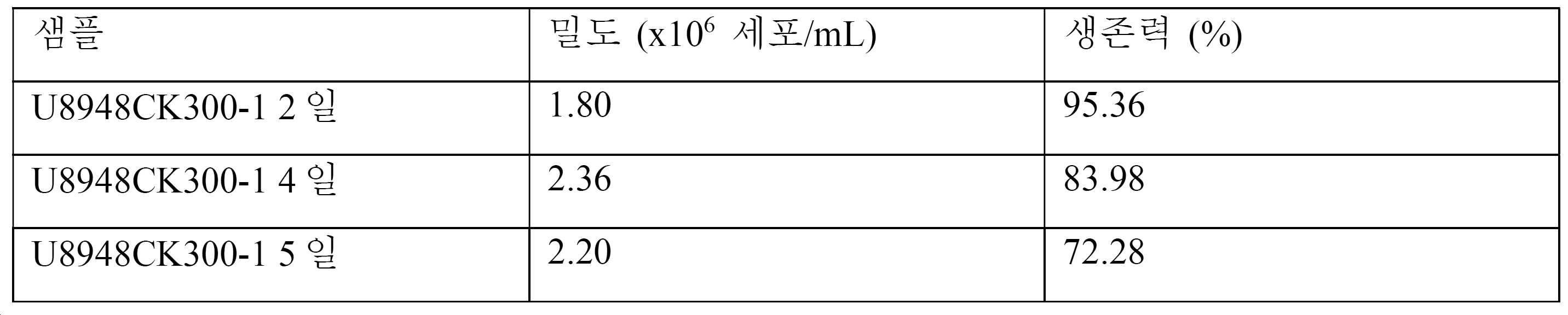
항체의 발현 및 정제: 단백질 발현 수준을 추정하기 위해, 형질감염 후 2, 4 및 5일째에 세포 배양 상청액을 수집하고, SDS-PAGE 및 웨스턴 블롯으로 분석하였다 (데이터는 표시되지 않음). 단백질 정제를 위해, 세포 배양 브로쓰를 원심분리하고 상청액을 여과하였다. 여과된 상청액을 1.0 ml/분으로 Monofinity A 수지 사전 패킹된 컬럼 1 ml (GenScript) 상에 로딩한 다음 적절한 완충제로 세척하고 용리하였다. 용리된 분획을 풀링하고 PBS pH7.2로 완충제 교환하였다. 정제된 단백질을 분자량, 수율 및 순도 측정을 위해 표준 프로토콜을 사용하여 SDS-PAGE (도 8a), 웨스턴 블롯 (도 8b) 및 SEC-HPLC (데이터는 표시되지 않음)로 분석하였다. Expression and purification of antibodies: To estimate protein expression levels, cell culture supernatants were collected 2, 4 and 5 days after transfection and analyzed by SDS-PAGE and Western blot (data not shown). For protein purification, the cell culture broth was centrifuged and the supernatant was filtered. The filtered supernatant was loaded at 1.0 ml/min onto 1 ml of a Monofinity A resin prepacked column (GenScript), then washed with an appropriate buffer and eluted. The eluted fractions were pooled and buffer exchanged with PBS pH7.2. Purified proteins were analyzed by SDS-PAGE ( FIG. 8A ), Western Blot ( FIG. 8B ) and SEC-HPLC (data not shown) using standard protocols for molecular weight, yield and purity determination.
요약하면, 현탁 배양으로 성장한 293-6E 세포에서 pFB이중-ceDNA-아두카누맙 플라스미드로부터 생성된 ceDNA 벡터로부터 아두카누맙을 발현시켰다. 항체는 SDS-PAGE 분석을 사용하여 식별될 수 있는 수준으로 발현되었다 (도 8a). 한 단계 정제 후, 추정된 분자량이 환원 조건하에 ~55 kDa 및 ~25 kDa이고, 비-환원 조건하에 ~150 kDa인 항체가 검출되었다 (도 8b). 이 데이터는 항체의 중쇄 및 경쇄가 이 시스템에서 전체 항체로 자가-조립되었음을 나타낸다.Briefly, in 293-6E cells grown in suspension culture, adukanumab was expressed from a ceDNA vector generated from the pFB bi-ceDNA-aducanumab plasmid. Antibodies were expressed at levels that could be discerned using SDS-PAGE analysis ( FIG. 8A ). After one step purification, antibodies with estimated molecular weights of -55 kDa and -25 kDa under reducing conditions and -150 kDa under non-reducing conditions were detected ( FIG. 8B ). These data indicate that the heavy and light chains of the antibody self-assemble into whole antibodies in this system.
실시예 7: 체외 재조합 항체의 대규모 생산 Example 7: Large-scale production of recombinant antibodies in vitro
아두카누맙 중쇄 및 경쇄를 인코딩하는 서열을 포함하는 ceDNA 플라스미드는 실시예 1 및 5에서 이전에 기재된 바와 같이 생성될 수 있고, 예를 들어 무혈청 조건에서 성장하도록 적응된 FreeStyle™ 293-F 세포 (R790-07, Life Technologies)의 대규모 현탁 배양으로 형질감염될 수 있다. 현탁 및 무혈청 적응된 FreeStyleTM293-F 세포 (Life Technologies)는, 궤도 진탕기 플랫폼에서 135 rpm으로 회전시키면서, 벤트 캡(vented cap) (Sigma)이 있는 125mL 멸균 삼각 플라스크 내의 FreeStyleTM293 발현 배지 (Life Technologies)에서 1 X 10⁵-5 X 10⁵ 생존 세포/mL 사이의 밀도로 배양된다. 1 X 10⁶ 생존 세포/mL에서 30 mL의 세포를 함유하는 각각의 125 mL 플라스크를 제조사의 지시에 따라 ceDNA Fugene6 형질감염 시약 (3:1 Fugene6:ceDNA)으로 형질감염시켰다. 형질감염 24시간 후, 선별 (50 mg/mL)을 세포에 첨가하고 세포를 2 X 10⁵ - 5 X 10⁵ 생존 세포/mL 사이의 밀도에서 2주 동안 선별하에 유지한 후 1 L 진탕기 플라스크 (Sigma), 1 L 스피너 병 (Sigma) 또는 5 L WAVE 생물반응기 (GE Healthcare)로 확장시켰다. 샘플은 48시간마다 수집되고 IgG 발현 수준은 항-인간 IgG ELISA에 의해 결정된다. 피크 발현에서, 배양된 상청액을 수거하고, 1000 X g에서 15분 동안 원심분리하고, 0.45 mm 필터 (Sartorius)를 통과시키고, 사용할 때까지 0.1% 아지드화나트륨 (Sigma)과 함께 4℃에서 저장한다. 
실시예 8: 전장 아두카누맙을 발현시키는 ceDNA 벡터의 제조 및 Example 8: Preparation of ceDNA vector expressing full-length adukanumab and 시험관내In vitro 에서 항체의 ceDNA 발현Antibody ceDNA expression in
아두카누맙 또는 GFP를 발현시키는 ceDNA 플라스미드 또는 ceDNA 벡터는 실시예 1에서 제조된 바와 같은 ceDNA Adu-전체-IgG1 플라스미드 (pFB이중-ceDNA-아두카누맙 플라스미드 또는 ceDNA-IgG-플라스미드) (도 6a)를 사용하여 실시예 1 및 5에 기재된 바와 같이 제조하였다. 생성되고 정제된 ceDNA 벡터 ("ceDNA IgG"로 지칭됨) 또는 ceDNA 플라스미드의 수율은 260nm에서의 UV 흡광도에 기초하여 결정되었다. ceDNA 벡터 또는 ceDNA 플라스미드를 제조사의 지시에 따라 Lipofectamine™ 3000 형질감염 시약 (Invitrogen)을 사용하여 HEK293T 세포로 형질감염시켰다. 72시간 후, 세포를 RIPA 완충제에 용해시키고, 전체 세포 상청액을 수집하고 필터 (Amicon)를 사용하여 농축시켰다. 생성된 항체 생산을 웨스턴 블롯으로 검사하였다. 세포 상청액 및 용해물 샘플을, 동일한 양의 단백질이 로딩되도록 하는 농도로 정규화하였다. 제조된 샘플을 70℃에서 10분 동안 열 블록에서 비등시킨 후 얼음 위에 두었다. 샘플을 200V에서 32분 동안 SDS-PAGE 겔에서 작동시킨 후 표준 기술을 사용하여 니트로셀룰로오스 막으로 옮겼다. 상업적으로 입수 가능한 인간 IgG를 양성 대조군 (Abcam, Sigma)으로 사용하였다. 막을 실온에서 30분 동안 차단 완충제 (Odyssey)로 차단하였다. 폰소 S 염색으로 막을 5분 동안 염색한 후 증류수로 세척하고 TBST로 디스테이닝(destaining)하여 단백질 밴드를 시각화하였다. 이어서 막을 차단 완충액에 1:5000으로 희석된, 호스래디시 페록시다제에 접합된 1차 항-인간 IgG 항체 (Genscript)로 가볍게 교반하면서 4℃에서 밤새 프로빙(probed)하였다. 이어서, 블롯을 TBST로 매번 5분 동안 3회 세척하고, ECL 키트 (SuperSignal West Femto Substrate)로 현상하고 겔 이미징 시스템 (Syngene Box Mini)을 사용하여 영상화하였다.The ceDNA plasmid or ceDNA vector expressing adukanumab or GFP is the ceDNA Adu-whole-IgG1 plasmid as prepared in Example 1 (pFB double-ceDNA-aducanumab plasmid or ceDNA-IgG-plasmid) ( FIG. 6A ) Was prepared as described in Examples 1 and 5 . The yield of the resulting and purified ceDNA vector (referred to as “ceDNA IgG”) or ceDNA plasmid was determined based on the UV absorbance at 260 nm. The ceDNA vector or ceDNA plasmid was transfected into HEK293T cells using
Lipofectamine™ 3000 형질감염 절차의 형질감염 효율은 ceDNA-GFP 플라스미드 (도 9a, 상단 패널) 또는 ceDNA-GFP 벡터 (도 9a, 하단 패널)로 형질감염된 293T 세포의 형광을 검사함으로써 평가되었다. 두 샘플 모두 도 9a에 도시된 바와 같이 상당한 형광을 나타냈고, 이는 형질감염이 두 경우에 모두 성공했음을 나타낸다. 각각의 샘플에서 상당한 단백질 함량 (도 9b, 하단 패널)에도 불구하고, 발현된 아두카누맙의 존재는 ceDNA-IgG 플라스미드 또는 ceDNA-IgG 작제물로 형질감염된 세포로부터의 샘플에서만 검출되었다 (도 9b, 상단 패널, 중쇄 및 경쇄 모두 관찰됨). 이는 ceDNA 벡터가 293T 세포에서 아두카누맙을 발현시켰음을 나타냈다.The transfection efficiency of the
실시예 9: 발현된 항체의 정체 확인Example 9: Identification of the expressed antibody
인간 배아 신장 세포 (HEK293-6E) 세포에서의 발현을 위해 아두카누맙을 인코딩하는 관심 핵산을 포함하는 플라스미드를 제조하였다. HEK293-6E 세포를 무혈청 배지 (FreeStyle™ 293 발현 배지, Thermo Fisher Scientific)에서 성장시켰다. 세포를 궤도 진탕기 상에서 5% CO2로 37℃의 삼각 플라스크에 유지시켰다. 형질감염 하루 전, 세포를 삼각 플라스크에 적절한 밀도로 시딩하였다. 형질감염 당일, DNA 및 형질감염 시약을 최적의 비율로 혼합한 후 형질감염을 위해 준비된 세포와 함께 플라스크에 첨가하였다. 표적 단백질을 인코딩하는 재조합 플라스미드를 현탁 HEK293-6E 세포 배양물로 일시적으로 형질감염시켰다. 6일째에 수집된 세포 배양 상청액을 정제에 사용하였다.A plasmid containing a nucleic acid of interest encoding adukanumab was prepared for expression in human embryonic kidney cell (HEK293-6E) cells. HEK293-6E cells were grown in serum-free medium (FreeStyle™ 293 expression medium, Thermo Fisher Scientific). The cells were maintained in an Erlenmeyer flask at 37° C. with 5% CO 2 on an orbital shaker. One day before transfection, cells were seeded in Erlenmeyer flasks at an appropriate density. On the day of transfection, DNA and transfection reagent were mixed in an optimal ratio, and then added to the flask together with the cells prepared for transfection. Recombinant plasmid encoding the target protein was transiently transfected into suspension HEK293-6E cell culture. The cell culture supernatant collected on the 6th day was used for purification.
세포 배양 브로스를 원심분리하고, 여과하고, 적절한 유속으로 친화성 정제 컬럼 (Monofinity A Resin™ Prepacked Column, GenScript) 상에 로딩하였다. 세척 및 용리 후, 용리된 분획을 풀링하고 최종 제형 완충제로 완충제 교환하였다. 정제된 단백질은 (a) 환원 및 비-환원 조건하에 SDS-폴리아크릴아미드 겔 전기영동, (b) 염소-항-인간 IgG-HRP (GenScript) 및 염소 항-인간 카파-HRP를 1차 항체로 사용하고, 화학발광 검출된, 웨스턴 블롯팅, 및 (c) 분자량 및 순도를 결정하기 위해 TSKgel G3000SWxl (Tosoh Bioscience) 고성능 액체 크로마토그래피를 사용한 크기 배제 크로마토그래피로 분석되었다. 단백질 농도는 A260/280에서의 흡수에 의해 결정되었다. 결과는 도 10a에 도시되어 있다. HPLC 분석 결과 단일 피크가 나타났다 (도 10a). 이 단백질의 샘플이 SDS-PAGE 겔에서 실행될 때 (도 8a), 비-환원 조건에서 단일 밴드가 명백하였고 (레인 2), 반면 샘플이 환원 조건에 노출되었을 때 2개의 밴드가 관찰되었다 (레인 1). 이는 경쇄 및 중쇄 서브유닛이 비환원 조건하에서 이황화-결합된 상태로 유지되고 단일 밴드로 이동하지만, 환원 조건하에서 이들의 개별 서브유닛으로 분리되어 2개의 밴드로 이동하는 항체인, 단백질과 일치한다. 웨스턴 블롯은 유사한 밴딩 패턴을 나타내었고 (도 8b), 인간 IgG 및 인간 카파 경쇄에 특이적인 1차 항체에 의한 검출이기 때문에 항체의 존재를 추가로 확인하였다.The cell culture broth was centrifuged, filtered, and loaded onto an affinity purification column (Monofinity A Resin™ Prepacked Column, GenScript) at an appropriate flow rate. After washing and elution, the eluted fractions were pooled and buffer exchanged with the final formulation buffer. Purified protein was subjected to (a) SDS-polyacrylamide gel electrophoresis under reducing and non-reducing conditions, (b) goat-anti-human IgG-HRP (GenScript) and goat anti-human kappa-HRP as primary antibodies. Used and analyzed by chemiluminescence detected, Western blotting, and (c) size exclusion chromatography using TSKgel G3000SWxl (Tosoh Bioscience) high performance liquid chromatography to determine molecular weight and purity. Protein concentration was determined by absorption at A260/280. The results are shown in Figure 10A . As a result of HPLC analysis, a single peak appeared ( FIG. 10A ). When a sample of this protein was run on an SDS-PAGE gel ( FIG. 8A ), a single band was evident under non-reducing conditions (lane 2), whereas when the sample was exposed to reducing conditions, two bands were observed (lane 1 ). This is consistent with proteins, which are antibodies in which the light and heavy chain subunits remain disulfide-linked under non-reducing conditions and migrate to a single band, but separate into their individual subunits under reducing conditions and migrate to two bands. Western blot showed a similar banding pattern ( FIG. 8B ) and further confirmed the presence of the antibody because it was detected by the primary antibody specific for human IgG and human kappa light chain.
정제된 아두카누맙이 이의 리간드 베타-아밀로이드 (1-42) ("A베타")를 인식하는 능력을 ELISA로 평가하였다. 아밀로이드를 시험관내에서 응집시키고 플레이트에 부착시킨 후 다양한 농도 및 시간에서 아두카누맙 또는 대조군 항체에 노출시킨 다음 비색계 노출시켰다. 합성 Aβ1-42 펩티드 (AnaSpec, Fremont, California, USA)를 헥사플루오로-이소프로판올에서 1 mg/ml의 농도로 재구성하고, 공기 건조시키고 진공 농축하여 필름을 형성하였다. 필름을 DMSO에 용해시키고, DMSO 재구성된 단량체를 100 μg/mL의 농도로 PBS에 희석하고, 각각 37℃에서 적어도 3일 및 1주 동안 인큐베이션함으로써 AB42 올리고머 및 AB42 피브릴을 제조하였다. ELISA 플레이트를 응집된 아밀로이드로 코팅하였다.The ability of purified adukanumab to recognize its ligand beta-amyloid (1-42) ("Abeta") was evaluated by ELISA. The amyloid was aggregated in vitro and attached to the plate and then exposed to adukanumab or control antibody at various concentrations and times followed by colorimetric exposure. The synthetic Aβ1-42 peptide (AnaSpec, Fremont, California, USA) was reconstituted in hexafluoro-isopropanol to a concentration of 1 mg/ml, air dried and concentrated in vacuo to form a film. AB42 oligomers and AB42 fibrils were prepared by dissolving the film in DMSO, diluting the DMSO reconstituted monomer in PBS at a concentration of 100 μg/mL and incubating at 37° C. for at least 3 days and 1 week, respectively. ELISA plates were coated with aggregated amyloid.
간략하게, 문헌[Stine et al., Methods Mol. Biol. (2011) 670: 13-32]에 기재된 방법에 따라 A베타를 제조하고 웨스턴 블롯을 실행하고 염색하였다. 동등한 양의 A베타를 겔 상의 각각의 레인 3, 4 및 5에서 실행시켰다. 니트로셀룰로스로 옮긴 후, 각각의 레인을 분리하고, 상이한 1차 항체로 프로빙하였다: 레인 3에는 본원에 기재된 정제된 아두카누맙, 레인 4에는 정제된 항-베타-아밀로이드 (17-24) (BioLegend, 클론 4G8), 및 레인 5에는 정제된 항-베타-아밀로이드 (1-16) (BioLegend, 클론 6E10). 세척 후, 각각 2차 항체로서 염소 항-인간 IgG-HRP (레인 3) (GenScript) 또는 염소 항-마우스 IgG-HRP (레인 4 및 5) (GenScript)로 프로빙하고, HRP 기질로 현상하였다. 결과는 도 10b에 도시되어 있다. 플라스미드-발현된 아두카누맙은, 다른 2개의 항-A베타 항체와 같이, 니트로셀룰로스-고정된 A베타 단량체에 결합하고, 이는 정제된 아두카누맙이 예상대로 이의 리간드를 인식할 수 있었음을 나타낸다.Briefly, Stine et al., Methods Mol. Biol. (2011) 670: 13-32], Abeta was prepared, Western blot was performed and stained. Equal amounts of Abeta were run in each
실시예 10: 야생형 마우스에서 항체의 생체내 발현Example 10: In vivo expression of antibodies in wild-type mice
야생형 좌측 ITR 및 절단 돌연변이 우측 ITR을 갖고 각각 자체 EF1 프로모터의 제어하에 아두카누맙 중쇄 및 경쇄를 인코딩하는 이식유전자 영역을 갖는 ceDNA 벡터를 상기 실시예 1 및 5에 기재된 바와 같이 제조하고 정제하였다("ceDNA IgG 벡터"). 간-특이적 hAAT 프로모터의 제어하에 루시퍼라제 이식유전자를 포함하는 ceDNA IgG 벡터 또는 ceDNA 제어 벡터를 대략 6주령의 수컷 C57bl/6J 마우스에 투여하였다. 캡슐화되지 않은 ceDNA 벡터는 2.2 mL 용적의 측면 꼬리 정맥을 통한 유체 역학적 정맥내 주사에 의해 동물당 0.005 mg (그룹당 4마리의 동물)으로 투여되었다. 3일, 7일, 14일, 21일 및 28일 종료일에 각각의 처리된 동물로부터 혈액 샘플을 수집하였다. 혈청 샘플에서 발현된 아두카누맙의 존재는 제조사의 지시에 따라 상업적으로 입수 가능한 Discovery Human/NHP IgG 키트 (Meso Scale Discovery) 중의 임의의 특이성을 갖는 인간 항체를 인식하는 폴리클로날 항-인간 면역글로불린 항체를 사용하여 ELISA에 의해 측정되었다.A ceDNA vector having a wild-type left ITR and a truncated mutant right ITR and having transgene regions encoding adukanumab heavy and light chains, respectively, under the control of its own EF1 promoter, was prepared and purified as described in Examples 1 and 5 above (" ceDNA IgG vector"). A ceDNA IgG vector or ceDNA control vector comprising a luciferase transgene under the control of a liver-specific hAAT promoter was administered to approximately 6 weeks old male C57bl/6J mice. Unencapsulated ceDNA vector was administered at 0.005 mg per animal (4 animals per group) by hydrodynamic intravenous injection through a 2.2 mL volume of the lateral tail vein. Blood samples were collected from each treated animal on the 3rd, 7th, 14th, 21st and 28th day end days. The presence of adukanumab expressed in serum samples is a polyclonal anti-human immunoglobulin that recognizes human antibodies with any specificity in the commercially available Discovery Human/NHP IgG kit (Meso Scale Discovery) according to the manufacturer's instructions. Measured by ELISA using antibodies.
도 11에 도시된 바와 같이, 인간 항체는 ceDNA IgG 벡터로 처리된 마우스로부터 3일 및 7일째 혈청 샘플에서 쉽게 검출되었지만, 인간 항체가 아닌 루시퍼라제를 발현시키는 ceDNA로 처리된 마우스에서는 관찰되지 않았다. 이 특정 벡터에 대해 이들 두 시점에서 관찰된 최대 혈청 발현 수준은 대략 500 ng/mL였다.As shown in FIG . 11 , human antibodies were easily detected in serum samples on
실시예 11: 알츠하이머병 마우스 모델에서 항체의 Example 11: of antibodies in Alzheimer's disease mouse model 생체내In vivo 발현 Manifestation
아두카누맙 중쇄 및 경쇄를 인코딩하는 서열을 갖는 ceDNA 벡터는 실시예 1 및 5에서 이전에 기재된 바와 같이 생성될 수 있다. ceDNA 벡터는 지질 나노입자와 함께 제형화되어 Tg2576 마우스 (Kawarabayashi et al, J. Neurosci 21(2):372-381 (2001)) 및 정상 마우스에게 투여될 것이다. LNP-ceDNA 벡터는 1.2 mL 용적으로 0.3 내지 5 mg/kg의 용량으로 각각의 마우스에게 투여된다. 각 용량은 i.v. 유체 역학적 투여를 통해 투여되거나, 또는 예를 들어 복강내 주사에 의해 투여될 것이다. 정상 마우스로의 투여는 대조군으로서 제공되고, 또한 아두카누맙 mAb의 존재 및 양을 검출하는데 사용될 수 있다. 본 명세서 및 실시예 6에 기재된 바와 같이, 각각 응집된 아밀로이드 및 뇌 절편 IHC를 사용한 시험관내 및 생체외 결합 분석 (ELISA이 수행될 것이다.CeDNA vectors having sequences encoding the adukanumab heavy and light chains can be generated as previously described in Examples 1 and 5 . The ceDNA vector will be formulated with lipid nanoparticles and administered to Tg2576 mice (Kawarabayashi et al, J. Neurosci 21(2):372-381 (2001)) and normal mice. The LNP-ceDNA vector is administered to each mouse at a dose of 0.3 to 5 mg/kg in a volume of 1.2 mL. Each dose will be administered via iv hydrodynamic administration or, for example, by intraperitoneal injection. Administration to normal mice serves as a control and can also be used to detect the presence and amount of adukanumab mAb. As described herein and in Example 6, in vitro and ex vivo binding assays (ELISAs) using aggregated amyloid and brain slice IHC will be performed, respectively.
급성 투약 후, 예를 들어 a., 단일 용량의 LNP-TTX-Adu ceDNA 혈장 및 뇌 농도는 다양한 시점, 예를 들어, 10, 20, 30, 40, 50, 1000 및 200일 이상의 시점에 ELISA에 의해 결정될 것이다. 구체적으로, 프로테아제 억제제와 함께, 50 mM NaCl, 0.2% 디에틸아민 (DEA)을 함유하는 용액의 10 용적으로 동결된 뇌 (10 mL/g의 습성 조직)를 균질화하고, 얼음 위에서 대략 15-20초 동안 초음파처리한다. 샘플을 4℃에서 100,000 g로 30분 동안 원심분리하고, 상청액을 DEA 추출된 가용성 Aβ 분획으로서 유지시킨다. 나머지 펠릿을 10 용적의 5M 구아니딘-염산염 (Gu-HCl)에 재현탁시키고, 초음파 처리하고, 상기와 같이 원심분리한다. 생성된 상청액은 구아니딘-추출된 불용성 Aβ 분획으로서 유지되고, 나머지 펠릿은 폐기된다. 혈장 및 뇌 항체 농도의 경우, 96 웰 마이크로플레이트 (Nunc Maxisorp, Corning Costar)를 4℃에서 밤새 차가운 코팅 완충제에서 5 ug/mL의 농도로 Aβ(1-42) 펩티드 (Αβ42)로 코팅하였다. 혈장 또는 DEA 추출된 (즉, 세제가 없는) 뇌 균질액 샘플을 최종 작업 농도로 희석하고, 실온에서 2시간 동안 인큐베이션한다. 결합은 리포터 항체, 예를 들어 호스래디시 페록시다제 (HRP)-접합된 염소 항-인간 폴리클로날 항체 (Jackson ImmunoResearch)를 사용하여 결정되고, 이어서 기질 TMB를 사용하여 HRP 활성을 측정한다. 정제된 항체를 사용하여 생성된 표준 곡선과 비교하여 농도를 결정한다. 대안적으로, 혈장 중 Ab는 기재된 바와 같은 웨스턴 블롯을 사용하여 확인된다.After acute dosing, e.g., a., a single dose of LNP-TTX-Adu ceDNA plasma and brain concentrations were measured in ELISA at various time points, e.g., 10, 20, 30, 40, 50, 1000 and 200 days or more. Will be determined by Specifically, homogenize frozen brain (10 mL/g wet tissue) in 10 volumes of a solution containing 50 mM NaCl, 0.2% diethylamine (DEA), with a protease inhibitor, and approximately 15-20 on ice. Sonicate for seconds. Samples are centrifuged at 4° C. at 100,000 g for 30 minutes and the supernatant is maintained as a DEA extracted soluble Aβ fraction. The remaining pellet is resuspended in 10 volumes of 5M guanidine-hydrochloride (Gu-HCl), sonicated and centrifuged as above. The resulting supernatant is maintained as a guanidine-extracted insoluble Aβ fraction and the remaining pellet is discarded. For plasma and brain antibody concentrations, 96 well microplates (Nunc Maxisorp, Corning Costar) were coated with Aβ(1-42) peptide (Αβ42) at a concentration of 5 ug/mL in cold coating buffer overnight at 4°C. Plasma or DEA extracted ( ie , detergent-free) brain homogenate samples are diluted to final working concentration and incubated for 2 hours at room temperature. Binding is determined using reporter antibodies, such as horseradish peroxidase (HRP)-conjugated goat anti-human polyclonal antibody (Jackson ImmunoResearch), followed by measurement of HRP activity using substrate TMB. The concentration is determined by comparison to a standard curve generated using the purified antibody. Alternatively, Abs in plasma are identified using Western blot as described.
Tg2576 마우스에서 단일 용량 후 Aβ 침착물에 대한 항체의 생체내 결합은 또한 비오티닐화된 항-인간 2차 항체를 사용하여 결정될 수 있고, 양성 대조군으로서 연속 섹션에서 생체외에서 수행된 pan-Aβ 항체 5F3에 의한 염색과 비교될 수 있다. 조직은 포르말린-고정된 파라핀 포매되고, 5 μm로 절편화되고, 파라핀이 제거되고, EDTA-보레이트 기반 열-유도된 에피토프 검색 (Ventana CC1)이 사용될 수 있다. 이어서, 염소 항-인간 2차 항체를 1:500 희석으로 조직에 적용하고 헤마톡실린으로 염색된 조직에 적용할 수 있다.In vivo binding of antibodies to Aβ deposits after a single dose in Tg2576 mice can also be determined using biotinylated anti-human secondary antibodies, and pan-Aβ antibodies performed ex vivo in consecutive sections as positive controls. It can be compared to staining with 5F3. Tissues are formalin-fixed paraffin embedded, 5 μm sectioned, paraffin removed, and EDTA-borate based heat-induced epitope retrieval (Ventana CC1) can be used. The goat anti-human secondary antibody can then be applied to the tissue at a 1:500 dilution and applied to the tissue stained with hematoxylin.
전신 투여된 LNP-TTX-Adu ceDNA는 혈장 및 뇌에서 발현될 것이고, 높은 친화도로 실질 아밀로이드 플라크에 결합할 것으로 예상된다.Systemically administered LNP-TTX-Adu ceDNA will be expressed in plasma and brain and is expected to bind to parenchymal amyloid plaques with high affinity.
실시예 12: ceDNA로 투여 후 아밀로이드 부담 감소 분석Example 12: Analysis of reduction of amyloid burden after administration with ceDNA
아밀로이드 부담을 감소시키는 데 있어서 ceDNA 발현된 아두카누맙의 효능은 Tg2576 형질전환 마우스에서 만성 투여 후 평가될 것이다. 예를 들어, 0.3, 1, 3, 10, 내지 30 mg/kg 등의 용량 또는 PBS는 주어진 시간 프레임에, 예를 들어 매주 또는 매월 투여될 것이다. 혈장 및 뇌 약물 수준은 상기 실시예 8에 기재된 바와 같이 ELISA에 의해 측정될 것이다. 혈장 샘플을 마지막 투약 후 24시간-72시간에 수집하고, 항체 수준을 측정하여 용량 반응을 결정할 것이다. The efficacy of ceDNA expressed adukanumab in reducing the amyloid burden will be evaluated after chronic administration in Tg2576 transgenic mice. For example, a dose of 0.3, 1, 3, 10, to 30 mg/kg, or the like, or PBS will be administered at a given time frame, eg weekly or monthly. Plasma and brain drug levels will be measured by ELISA as described in Example 8 above. Plasma samples will be collected 24-72 hours after the last dosing and antibody levels will be measured to determine dose response.
피질 및 해마에서의 총 뇌 아밀로이드 로드는 면역조직화학에 의해 밝혀질 것이다. 구체적으로, 뇌를 해부하고, 48 내지 72시간 동안 10% 중성 완충 포르말린에 침지시켜 고정시킨다. 이어서 고정된 뇌를 수평 방향으로 처리하고 포매한다. 각 블록은 해마가 식별될 때까지 섹셔닝되며, 이 시점에서 300개의 연속 5μm 섹션 (슬라이드당 3개의 섹션)이 수득된다. 6E10 및 티오플라빈-S 염색 둘 다에 대해, 매 14번째 슬라이드가 염색되었다 (225 μm마다 대략 1개의 섹션). 뇌 아밀로이드를 규정하는 면역조직화학은 예를 들어 1 :750 희석으로 1차 항체로서 마우스 항-Aβ 1-16 모노클로날 항체 (클론 6E10, Covance, Princeton, NJ), 및 Ultramap 항-마우스 알칼리성 포스파타제 키트 (Ventana Medical Systems, Tucson, AZ)를 사용할 것이고, 본원에 기재된 바와 같은 VISIOPHARM® 소프트웨어를 사용하여 정량화된다. Ventana Discovery XT 면역염색제(immunostainer) 위에 놓기 전에 슬라이드를 88% 포름산 용액으로 전처리한다. 슬라이드를 Ventana Hematoxylin (Ventana Medical Systems, Tucson, AZ)으로 대비염색하고, 커버슬립하고, 밤새 공기 건조시킨다.The total brain amyloid load in the cortex and hippocampus will be revealed by immunohistochemistry. Specifically, the brain is dissected and fixed by immersion in 10% neutral buffered formalin for 48 to 72 hours. Then, the fixed brain is processed horizontally and embedded. Each block is sectioned until the hippocampus is identified, at which
6E10 면역염색 후, 슬라이드를 제조사의 지시에 따라 20x 배율로 Aperio XT (Aperio Technologies, Inc., Vista, CA) 전체 슬라이드 이미징 시스템에서 스캐닝한다. 이어서 디지털 이미지를 검토하고, 개별 마스크로 수동으로 주석을 달고(annotated), VISIOPHARM'^ 소프트웨어로 작성된 알고리즘을 사용하여 분석할 수 있다. 이 알고리즘은 이러한 해부학적 영역에서 주석이 달린 해마 또는 피질의 영역과 실질 및 혈관 아밀로이드의 영역을 10X 가상 배율로 결정한다. 예를 들어, 소프트웨어의 트레이닝은 50개의 슬라이드 세트에서 수행된다. 슬라이드를 또한 (Bussiere et ah, Am J Pathol 165:987-995 (2004))에 기재된 바와 같이 티오플라빈-S (Thio-S)로 염색하고, DAPI를 갖춘 VECTASHIELD® Mounting Media (Vector Laboratories Burlingame, CA)로 커버슬립한다. 티오플라빈-S 염색 후, 슬라이드는 영상화 시스템, 예를 들어 Aperio FL (Aperio Technologies, Inc., Vista, CA) 형광 전체 슬라이드 영상화 시스템으로 제조사의 지시에 따라 20x 배율로 검토 및 스캐닝된다. 6E10과 마찬가지로, 해마 또는 피질을 개별 마스크로 수동으로 주석을 달고, 이어서 VISIOPHARM® 소프트웨어로 작성된 알고리즘을 사용하여 분석하고, 형광에 대해 조정된다. 이 알고리즘은 이러한 해부학적 영역에서 해마 및 피질의 영역과 실질 및 혈관 아밀로이드의 영역을 10X 가상 배율로 결정한다. 소프트웨어의 트레이닝은 10개의 슬라이드 세트에서 수행될 수 있다. 염색된 침착물이 차지하는 총 면적은 PBS 대조군과 비교하여 상당히 감소될 것으로 예상된다.After 6E10 immunostaining, slides are scanned on an Aperio XT (Aperio Technologies, Inc., Vista, CA) full slide imaging system at 20x magnification according to the manufacturer's instructions. The digital images can then be reviewed, manually annotated with individual masks, and analyzed using algorithms written in VISIOPHARM ' ^ software. This algorithm determines the annotated hippocampal or cortical regions and parenchymal and vascular amyloid regions at 10X virtual magnification in these anatomical regions. For example, training of the software is performed on a set of 50 slides. Slides were also stained with Thioflavin-S (Thio-S) as described in (Bussiere et ah, Am J Pathol 165:987-995 (2004)) and VECTASHIELD ® Mounting Media with DAPI (Vector Laboratories Burlingame, CA) cover slip. After thioflavin-S staining, slides are reviewed and scanned at 20x magnification according to the manufacturer's instructions with an imaging system, for example Aperio FL (Aperio Technologies, Inc., Vista, CA) fluorescence whole slide imaging system. As with 6E10, put the manual annotations to the hippocampus or cortex in a separate mask, and then analyzed using an algorithm written in VISIOPHARM ® software, it is adjusted for the fluorescence. This algorithm determines the hippocampal and cortical regions and parenchymal and vascular amyloid regions at 10X virtual magnification in these anatomical regions. Training of the software can be performed on a set of 10 slides. The total area occupied by the stained deposits is expected to be significantly reduced compared to the PBS control.
실시예 13: Example 13: 시험관내In vitro 에서 항체 및 Fc-융합 단백질의 ceDNA-기반 발현CeDNA-based expression of antibodies and Fc-fusion proteins in
아두카누맙을 제외하고 다른 항체 및 면역글로불린-유사 분자를 발현시키는 ceDNA의 능력을 평가하기 위해, 유전자 카세트에서 베바시주맙의 경쇄 및 중쇄 (혈관 내피 성장 인자 ("VEGF")에 특이적으로 결합하는 항체)를 인코딩하는 것 및 Fc 융합 단백질 아플리버셉트 (인간 VEGF 수용체 1 및 2의 세포외 도메인의 VEGF-결합 부분에 융합된 인간 IgG1 Fc)를 인코딩하는 것인, 2개의 추가 ceDNA 작제물로 실시예 8의 실험을 반복하였다. 비-환원 샘플에 대한 웨스턴 블롯의 결과는 도 12에 도시되어 있다 (6초 및 12초의 상이한 노출 시간에서 동일한 블롯의 두 이미지가 도시됨). 아두카누맙은 실시예 8에서 이전에 발견된 바와 같이 ceDNA-Adu-플라스미드에서 그리고 ceDNA-Adu 벡터-형질감염된 세포로부터 다시 발현되었다 (레인 5 및 7). 베바시주맙은 ceDNA-베바시주맙 벡터-형질감염된 세포에서 유사하게 발현되었다 (레인 11). 아플리버셉트는 또한 ceDNA-아플리버셉트 벡터-형질감염된 세포에서 발현되었다 (레인 9). 이는 ceDNA 작제물로부터 다양한 IgG 및 면역글로불린-유사 분자의 세포에서의 발현이 얻어질 수 있음을 입증한다.To evaluate the ability of ceDNA to express antibodies and immunoglobulin-like molecules other than adukanumab, specifically binding to the light and heavy chains of bevacizumab (vascular endothelial growth factor ("VEGF") in a gene cassette) Antibody) and the Fc fusion protein aflibercept (human IgG1 Fc fused to the VEGF-binding portion of the extracellular domain of
참조Reference
본 출원 및 본원의 실시예에 인용된 특허 및 특허 출원을 포함하지만 이에 제한되지 않는 모든 간행물 및 참고 문헌은, 각각의 개별 간행물 또는 참고 문헌이 본 명세서에 완전히 제시된 것으로 본원에 참고로 포함되는 것으로 구체적이고 개별적으로 표시된 것처럼 그 전문이 참고로 포함된다. 본 출원이 우선권을 주장하는 임의의 특허 출원도 간행물 및 참고 문헌에 대해 전술한 방식으로 본원에 참고로 포함된다.All publications and references, including, but not limited to, patents and patent applications cited in this application and in the examples herein, are specifically incorporated herein by reference as each individual publication or reference is fully set forth herein. And the full text is incorporated by reference, as indicated individually. Any patent applications for which this application claims priority are also incorporated herein by reference in the manner described above for publications and references.
SEQUENCE LISTING <110> GENERATION BIO INC. <120> NON-VIRAL DNA VECTORS AND USES THEREOF FOR ANTIBODY PRODUCTION <130> 080170-091100-WOPT <140> <141> <150> 62/680,087 <151> 2018-06-04 <150> 62/680,092 <151> 2018-06-04 <150> 62/630,670 <151> 2018-02-14 <150> 62/630,676 <151> 2018-02-14 <160> 190 <170> PatentIn version 3.5 <210> 1 <211> 141 <212> DNA <213> Artificial Sequence <220> <223> Description of Artificial Sequence: Synthetic polynucleotide <400> 1 aggaacccct agtgatggag ttggccactc cctctctgcg cgctcgctcg ctcactgagg 60 ccgggcgacc aaaggtcgcc cgacgcccgg gctttgcccg ggcggcctca gtgagcgagc 120 gagcgcgcag ctgcctgcag g 141 <210> 2 <211> 141 <212> DNA <213> Artificial Sequence <220> <223> Description of Artificial Sequence: Synthetic polynucleotide <400> 2 cctgcaggca gctgcgcgct cgctcgctca ctgaggccgc ccgggcaaag cccgggcgtc 60 gggcgacctt tggtcgcccg gcctcagtga gcgagcgagc gcgcagagag ggagtggcca 120 actccatcac taggggttcc t 141 <210> 3 <211> 130 <212> DNA <213> Artificial Sequence <220> <223> Description of Artificial Sequence: Synthetic polynucleotide <400> 3 aggaacccct agtgatggag ttggccactc cctctctgcg cgctcgctcg ctcactgagg 60 ccgggcgacc aaaggtcgcc cgacgcccgg gcggcctcag tgagcgagcg agcgcgcagc 120 tgcctgcagg 130 <210> 4 <211> 130 <212> DNA <213> Artificial Sequence <220> <223> Description of Artificial Sequence: Synthetic polynucleotide <400> 4 cctgcaggca gctgcgcgct cgctcgctca ctgaggccgc ccgggcgtcg ggcgaccttt 60 ggtcgcccgg cctcagtgag cgagcgagcg cgcagagagg gagtggccaa ctccatcact 120 aggggttcct 130 <210> 5 <211> 143 <212> DNA <213> Artificial Sequence <220> <223> Description of Artificial Sequence: Synthetic polynucleotide <400> 5 ttgcccactc cctctctgcg cgctcgctcg ctcggtgggg cctgcggacc aaaggtccgc 60 agacggcaga ggtctcctct gccggcccca ccgagcgagc gacgcgcgca gagagggagt 120 gggcaactcc atcactaggg taa 143 <210> 6 <211> 144 <212> DNA <213> Artificial Sequence <220> <223> Description of Artificial Sequence: Synthetic polynucleotide <400> 6 ttggccactc cctctatgcg cactcgctcg ctcggtgggg cctggcgacc aaaggtcgcc 60 agacggacgt gggtttccac gtccggcccc accgagcgag cgagtgcgca tagagggagt 120 ggccaactcc atcactagag gtat 144 <210> 7 <211> 127 <212> DNA <213> Artificial Sequence <220> <223> Description of Artificial Sequence: Synthetic polynucleotide <400> 7 ttggccactc cctctatgcg cgctcgctca ctcactcggc cctggagacc aaaggtctcc 60 agactgccgg cctctggccg gcagggccga gtgagtgagc gagcgcgcat agagggagtg 120 gccaact 127 <210> 8 <211> 166 <212> DNA <213> Artificial Sequence <220> <223> Description of Artificial Sequence: Synthetic polynucleotide <400> 8 tcccccctgt cgcgttcgct cgctcgctgg ctcgtttggg ggggcgacgg ccagagggcc 60 gtcgtctggc agctctttga gctgccaccc ccccaaacga gccagcgagc gagcgaacgc 120 gacagggggg agagtgccac actctcaagc aagggggttt tgtaag 166 <210> 9 <211> 144 <212> DNA <213> Artificial Sequence <220> <223> Description of Artificial Sequence: Synthetic polynucleotide <400> 9 ttgcccactc cctctaatgc gcgctcgctc gctcggtggg gcctgcggac caaaggtccg 60 cagacggcag aggtctcctc tgccggcccc accgagcgag cgagcgcgca tagagggagt 120 gggcaactcc atcactaggg gtat 144 <210> 10 <211> 143 <212> DNA <213> Artificial Sequence <220> <223> Description of Artificial Sequence: Synthetic polynucleotide <400> 10 ttaccctagt gatggagttg cccactccct ctctgcgcgc gtcgctcgct cggtggggcc 60 ggcagaggag acctctgccg tctgcggacc tttggtccgc aggccccacc gagcgagcga 120 gcgcgcagag agggagtggg caa 143 <210> 11 <211> 144 <212> DNA <213> Artificial Sequence <220> <223> Description of Artificial Sequence: Synthetic polynucleotide <400> 11 atacctctag tgatggagtt ggccactccc tctatgcgca ctcgctcgct cggtggggcc 60 ggacgtggaa acccacgtcc gtctggcgac ctttggtcgc caggccccac cgagcgagcg 120 agtgcgcata gagggagtgg ccaa 144 <210> 12 <211> 127 <212> DNA <213> Artificial Sequence <220> <223> Description of Artificial Sequence: Synthetic polynucleotide <400> 12 agttggccac attagctatg cgcgctcgct cactcactcg gccctggaga ccaaaggtct 60 ccagactgcc ggcctctggc cggcagggcc gagtgagtga gcgagcgcgc atagagggag 120 tggccaa 127 <210> 13 <211> 166 <212> DNA <213> Artificial Sequence <220> <223> Description of Artificial Sequence: Synthetic polynucleotide <400> 13 cttacaaaac ccccttgctt gagagtgtgg cactctcccc cctgtcgcgt tcgctcgctc 60 gctggctcgt ttgggggggt ggcagctcaa agagctgcca gacgacggcc ctctggccgt 120 cgccccccca aacgagccag cgagcgagcg aacgcgacag ggggga 166 <210> 14 <211> 144 <212> DNA <213> Artificial Sequence <220> <223> Description of Artificial Sequence: Synthetic polynucleotide <400> 14 atacccctag tgatggagtt gcccactccc tctatgcgcg ctcgctcgct cggtggggcc 60 ggcagaggag acctctgccg tctgcggacc tttggtccgc aggccccacc gagcgagcga 120 gcgcgcatta gagggagtgg gcaa 144 <210> 15 <211> 120 <212> DNA <213> Artificial Sequence <220> <223> Description of Artificial Sequence: Synthetic polynucleotide <400> 15 aggaacccct agtgatggag ttggccactc cctctctgcg cgctcgctcg ctcactgagg 60 cgcacgcccg ggtttcccgg gcggcctcag tgagcgagcg agcgcgcagc tgcctgcagg 120 <210> 16 <211> 122 <212> DNA <213> Artificial Sequence <220> <223> Description of Artificial Sequence: Synthetic polynucleotide <400> 16 aggaacccct agtgatggag ttggccactc cctctctgcg cgctcgctcg ctcactgagg 60 ccgacgcccg ggctttgccc gggcggcctc agtgagcgag cgagcgcgca gctgcctgca 120 gg 122 <210> 17 <211> 129 <212> DNA <213> Artificial Sequence <220> <223> Description of Artificial Sequence: Synthetic polynucleotide <400> 17 aggaacccct agtgatggag ttggccactc cctctctgcg cgctcgctcg ctcactgagg 60 ccgggcgacc aaaggtcgcc cgacgcccgg gcgcctcagt gagcgagcga gcgcgcagct 120 gcctgcagg 129 <210> 18 <211> 101 <212> DNA <213> Artificial Sequence <220> <223> Description of Artificial Sequence: Synthetic polynucleotide <400> 18 aggaacccct agtgatggag ttggccactc cctctctgcg cgctcgctcg ctcactgagg 60 ctttgcctca gtgagcgagc gagcgcgcag ctgcctgcag g 101 <210> 19 <211> 139 <212> DNA <213> Artificial Sequence <220> <223> Description of Artificial Sequence: Synthetic polynucleotide <400> 19 aggaacccct agtgatggag ttggccactc cctctctgcg cgctcgctcg ctcactgagg 60 ccgggcgaca aagtcgcccg acgcccgggc tttgcccggg cggcctcagt gagcgagcga 120 gcgcgcagct gcctgcagg 139 <210> 20 <211> 137 <212> DNA <213> Artificial Sequence <220> <223> Description of Artificial Sequence: Synthetic polynucleotide <400> 20 aggaacccct agtgatggag ttggccactc cctctctgcg cgctcgctcg ctcactgagg 60 ccgggcgaaa atcgcccgac gcccgggctt tgcccgggcg gcctcagtga gcgagcgagc 120 gcgcagctgc ctgcagg 137 <210> 21 <211> 135 <212> DNA <213> Artificial Sequence <220> <223> Description of Artificial Sequence: Synthetic polynucleotide <400> 21 aggaacccct agtgatggag ttggccactc cctctctgcg cgctcgctcg ctcactgagg 60 ccgggcgaaa cgcccgacgc ccgggctttg cccgggcggc ctcagtgagc gagcgagcgc 120 gcagctgcct gcagg 135 <210> 22 <211> 133 <212> DNA <213> Artificial Sequence <220> <223> Description of Artificial Sequence: Synthetic polynucleotide <400> 22 aggaacccct agtgatggag ttggccactc cctctctgcg cgctcgctcg ctcactgagg 60 ccgggcaaag cccgacgccc gggctttgcc cgggcggcct cagtgagcga gcgagcgcgc 120 agctgcctgc agg 133 <210> 23 <211> 139 <212> DNA <213> Artificial Sequence <220> <223> Description of Artificial Sequence: Synthetic polynucleotide <400> 23 aggaacccct agtgatggag ttggccactc cctctctgcg cgctcgctcg ctcactgagg 60 ccgggcgacc aaaggtcgcc cgacgcccgg gtttcccggg cggcctcagt gagcgagcga 120 gcgcgcagct gcctgcagg 139 <210> 24 <211> 137 <212> DNA <213> Artificial Sequence <220> <223> Description of Artificial Sequence: Synthetic polynucleotide <400> 24 aggaacccct agtgatggag ttggccactc cctctctgcg cgctcgctcg ctcactgagg 60 ccgggcgacc aaaggtcgcc cgacgcccgg tttccgggcg gcctcagtga gcgagcgagc 120 gcgcagctgc ctgcagg 137 <210> 25 <211> 135 <212> DNA <213> Artificial Sequence <220> <223> Description of Artificial Sequence: Synthetic polynucleotide <400> 25 aggaacccct agtgatggag ttggccactc cctctctgcg cgctcgctcg ctcactgagg 60 ccgggcgacc aaaggtcgcc cgacgcccgt ttcgggcggc ctcagtgagc gagcgagcgc 120 gcagctgcct gcagg 135 <210> 26 <211> 133 <212> DNA <213> Artificial Sequence <220> <223> Description of Artificial Sequence: Synthetic polynucleotide <400> 26 aggaacccct agtgatggag ttggccactc cctctctgcg cgctcgctcg ctcactgagg 60 ccgggcgacc aaaggtcgcc cgacgccctt tgggcggcct cagtgagcga gcgagcgcgc 120 agctgcctgc agg 133 <210> 27 <211> 131 <212> DNA <213> Artificial Sequence <220> <223> Description of Artificial Sequence: Synthetic polynucleotide <400> 27 aggaacccct agtgatggag ttggccactc cctctctgcg cgctcgctcg ctcactgagg 60 ccgggcgacc aaaggtcgcc cgacgccttt ggcggcctca gtgagcgagc gagcgcgcag 120 ctgcctgcag g 131 <210> 28 <211> 129 <212> DNA <213> Artificial Sequence <220> <223> Description of Artificial Sequence: Synthetic polynucleotide <400> 28 aggaacccct agtgatggag ttggccactc cctctctgcg cgctcgctcg ctcactgagg 60 ccgggcgacc aaaggtcgcc cgacgctttg cggcctcagt gagcgagcga gcgcgcagct 120 gcctgcagg 129 <210> 29 <211> 127 <212> DNA <213> Artificial Sequence <220> <223> Description of Artificial Sequence: Synthetic polynucleotide <400> 29 aggaacccct agtgatggag ttggccactc cctctctgcg cgctcgctcg ctcactgagg 60 ccgggcgacc aaaggtcgcc cgacgtttcg gcctcagtga gcgagcgagc gcgcagctgc 120 ctgcagg 127 <210> 30 <211> 122 <212> DNA <213> Artificial Sequence <220> <223> Description of Artificial Sequence: Synthetic polynucleotide <400> 30 aggaacccct agtgatggag ttggccactc cctctctgcg cgctcgctcg ctcactgagg 60 ccgggcgacc aaaggtcgcc cgacggcctc agtgagcgag cgagcgcgca gctgcctgca 120 gg 122 <210> 31 <211> 130 <212> DNA <213> Artificial Sequence <220> <223> Description of Artificial Sequence: Synthetic polynucleotide <400> 31 aggaacccct agtgatggag ttggccactc cctctctgcg cgctcgctcg ctcactgagg 60 ccgggcgacc aaaggtcgcc cgacgcccgg gcggcctcag tgagcgagcg agcgcgcagc 120 tgcctgcagg 130 <210> 32 <211> 120 <212> DNA <213> Artificial Sequence <220> <223> Description of Artificial Sequence: Synthetic polynucleotide <400> 32 cctgcaggca gctgcgcgct cgctcgctca ctgaggccgc ccgggaaacc cgggcgtgcg 60 cctcagtgag cgagcgagcg cgcagagagg gagtggccaa ctccatcact aggggttcct 120 <210> 33 <211> 122 <212> DNA <213> Artificial Sequence <220> <223> Description of Artificial Sequence: Synthetic polynucleotide <400> 33 cctgcaggca gctgcgcgct cgctcgctca ctgaggccgt cgggcgacct ttggtcgccc 60 ggcctcagtg agcgagcgag cgcgcagaga gggagtggcc aactccatca ctaggggttc 120 ct 122 <210> 34 <211> 122 <212> DNA <213> Artificial Sequence <220> <223> Description of Artificial Sequence: Synthetic polynucleotide <400> 34 cctgcaggca gctgcgcgct cgctcgctca ctgaggccgc ccgggcaaag cccgggcgtc 60 ggcctcagtg agcgagcgag cgcgcagaga gggagtggcc aactccatca ctaggggttc 120 ct 122 <210> 35 <211> 129 <212> DNA <213> Artificial Sequence <220> <223> Description of Artificial Sequence: Synthetic polynucleotide <400> 35 cctgcaggca gctgcgcgct cgctcgctca ctgaggcgcc cgggcgtcgg gcgacctttg 60 gtcgcccggc ctcagtgagc gagcgagcgc gcagagaggg agtggccaac tccatcacta 120 ggggttcct 129 <210> 36 <211> 101 <212> DNA <213> Artificial Sequence <220> <223> Description of Artificial Sequence: Synthetic polynucleotide <400> 36 cctgcaggca gctgcgcgct cgctcgctca ctgaggcaaa gcctcagtga gcgagcgagc 60 gcgcagagag ggagtggcca actccatcac taggggttcc t 101 <210> 37 <211> 139 <212> DNA <213> Artificial Sequence <220> <223> Description of Artificial Sequence: Synthetic polynucleotide <400> 37 cctgcaggca gctgcgcgct cgctcgctca ctgaggccgc ccgggcaaag cccgggcgtc 60 gggcgacttt gtcgcccggc ctcagtgagc gagcgagcgc gcagagaggg agtggccaac 120 tccatcacta ggggttcct 139 <210> 38 <211> 137 <212> DNA <213> Artificial Sequence <220> <223> Description of Artificial Sequence: Synthetic polynucleotide <400> 38 cctgcaggca gctgcgcgct cgctcgctca ctgaggccgc ccgggcaaag cccgggcgtc 60 gggcgatttt cgcccggcct cagtgagcga gcgagcgcgc agagagggag tggccaactc 120 catcactagg ggttcct 137 <210> 39 <211> 135 <212> DNA <213> Artificial Sequence <220> <223> Description of Artificial Sequence: Synthetic polynucleotide <400> 39 cctgcaggca gctgcgcgct cgctcgctca ctgaggccgc ccgggcaaag cccgggcgtc 60 gggcgtttcg cccggcctca gtgagcgagc gagcgcgcag agagggagtg gccaactcca 120 tcactagggg ttcct 135 <210> 40 <211> 133 <212> DNA <213> Artificial Sequence <220> <223> Description of Artificial Sequence: Synthetic polynucleotide <400> 40 cctgcaggca gctgcgcgct cgctcgctca ctgaggccgc ccgggcaaag cccgggcgtc 60 gggctttgcc cggcctcagt gagcgagcga gcgcgcagag agggagtggc caactccatc 120 actaggggtt cct 133 <210> 41 <211> 139 <212> DNA <213> Artificial Sequence <220> <223> Description of Artificial Sequence: Synthetic polynucleotide <400> 41 cctgcaggca gctgcgcgct cgctcgctca ctgaggccgc ccgggaaacc cgggcgtcgg 60 gcgacctttg gtcgcccggc ctcagtgagc gagcgagcgc gcagagaggg agtggccaac 120 tccatcacta ggggttcct 139 <210> 42 <211> 137 <212> DNA <213> Artificial Sequence <220> <223> Description of Artificial Sequence: Synthetic polynucleotide <400> 42 cctgcaggca gctgcgcgct cgctcgctca ctgaggccgc ccggaaaccg ggcgtcgggc 60 gacctttggt cgcccggcct cagtgagcga gcgagcgcgc agagagggag tggccaactc 120 catcactagg ggttcct 137 <210> 43 <211> 135 <212> DNA <213> Artificial Sequence <220> <223> Description of Artificial Sequence: Synthetic polynucleotide <400> 43 cctgcaggca gctgcgcgct cgctcgctca ctgaggccgc ccgaaacggg cgtcgggcga 60 cctttggtcg cccggcctca gtgagcgagc gagcgcgcag agagggagtg gccaactcca 120 tcactagggg ttcct 135 <210> 44 <211> 133 <212> DNA <213> Artificial Sequence <220> <223> Description of Artificial Sequence: Synthetic polynucleotide <400> 44 cctgcaggca gctgcgcgct cgctcgctca ctgaggccgc ccaaagggcg tcgggcgacc 60 tttggtcgcc cggcctcagt gagcgagcga gcgcgcagag agggagtggc caactccatc 120 actaggggtt cct 133 <210> 45 <211> 131 <212> DNA <213> Artificial Sequence <220> <223> Description of Artificial Sequence: Synthetic polynucleotide <400> 45 cctgcaggca gctgcgcgct cgctcgctca ctgaggccgc caaaggcgtc gggcgacctt 60 tggtcgcccg gcctcagtga gcgagcgagc gcgcagagag ggagtggcca actccatcac 120 taggggttcc t 131 <210> 46 <211> 129 <212> DNA <213> Artificial Sequence <220> <223> Description of Artificial Sequence: Synthetic polynucleotide <400> 46 cctgcaggca gctgcgcgct cgctcgctca ctgaggccgc aaagcgtcgg gcgacctttg 60 gtcgcccggc ctcagtgagc gagcgagcgc gcagagaggg agtggccaac tccatcacta 120 ggggttcct 129 <210> 47 <211> 127 <212> DNA <213> Artificial Sequence <220> <223> Description of Artificial Sequence: Synthetic polynucleotide <400> 47 cctgcaggca gctgcgcgct cgctcgctca ctgaggccga aacgtcgggc gacctttggt 60 cgcccggcct cagtgagcga gcgagcgcgc agagagggag tggccaactc catcactagg 120 ggttcct 127 <210> 48 <211> 122 <212> DNA <213> Artificial Sequence <220> <223> Description of Artificial Sequence: Synthetic polynucleotide <400> 48 aggaacccct agtgatggag ttggccactc cctctctgcg cgctcgctcg ctcactgagg 60 ccgggcgacc aaaggtcgcc cgacggcctc agtgagcgag cgagcgcgca gctgcctgca 120 gg 122 <210> 49 <211> 12 <212> DNA <213> Artificial Sequence <220> <223> Description of Artificial Sequence: Synthetic oligonucleotide <400> 49 cgatcgttcg at 12 <210> 50 <211> 12 <212> DNA <213> Artificial Sequence <220> <223> Description of Artificial Sequence: Synthetic oligonucleotide <400> 50 atcgaaccat cg 12 <210> 51 <211> 12 <212> DNA <213> Artificial Sequence <220> <223> Description of Artificial Sequence: Synthetic oligonucleotide <400> 51 atcgaacgat cg 12 <210> 52 <211> 165 <212> DNA <213> Artificial Sequence <220> <223> Description of Artificial Sequence: Synthetic polynucleotide <400> 52 aggaacccct agtgatggag ttggccactc cctctctgcg cgctcgctcg ctcactgagg 60 ccgcccgggc aaagcccggg cgtcgggcga cctttggtcg cccggcctca gtgagcgagc 120 gagcgcgcag agagggagtg gccaactcca tcactagggg ttcct 165 <210> 53 <211> 140 <212> DNA <213> Artificial Sequence <220> <223> Description of Artificial Sequence: Synthetic polynucleotide <400> 53 cccctagtga tggagttggc cactccctct ctgcgcgctc gctcgctcac tgaggccgcc 60 cgggcaaagc ccgggcgtcg ggcgaccttt ggtcgcccgg cctcagtgag cgagcgagcg 120 cgcagagaga tcactagggg 140 <210> 54 <211> 91 <212> DNA <213> Artificial Sequence <220> <223> Description of Artificial Sequence: Synthetic oligonucleotide <400> 54 gcgcgctcgc tcgctcactg aggccgcccg ggcaaagccc gggcgtcggg cgacctttgg 60 tcgcccggcc tcagtgagcg agcgagcgcg c 91 <210> 55 <211> 91 <212> DNA <213> Artificial Sequence <220> <223> Description of Artificial Sequence: Synthetic oligonucleotide <400> 55 gcgcgctcgc tcgctcactg aggccgggcg accaaaggtc gcccgacgcc cgggctttgc 60 ccgggcggcc tcagtgagcg agcgagcgcg c 91 <210> 56 <211> 10808 <212> DNA <213> Artificial Sequence <220> <223> Description of Artificial Sequence: Synthetic polynucleotide <400> 56 aaagtagccg aagatgacgg tttgtcacat ggagttggca ggatgtttga ttaaaaacat 60 aacaggaaga aaaatgcccc gctgtgggcg gacaaaatag ttgggaactg ggaggggtgg 120 aaatggagtt tttaaggatt atttagggaa gagtgacaaa atagatggga actgggtgta 180 gcgtcgtaag ctaatacgaa aattaaaaat gacaaaatag tttggaacta gatttcactt 240 atctggttcg gatctcctag gcggccggcc cctgcaggca gctgcgcgct cgctcgctca 300 ctgaggccgc ccgggcaaag cccgggcgtc gggcgacctt tggtcgcccg gcctcagtga 360 gcgagcgagc gcgcagagag ggagtggcca actccatcac taggggttcc ttgtagttaa 420 tgattaaccc gccatgctac ttatctacgt agccatgcgc ggccgcggcc tgaaataacc 480 tctgaaagag gaacttggtt aggtaccttc tgaggcggaa agaaccagct gtggaatgtg 540 tgtcagttag ggtgtggaaa gtccccaggc tccccagcag gcagaagtat gcaaagcatg 600 catctcaatt agtcagcaac caggtgtgga aagtccccag gctccccagc aggcagaagt 660 atgcaaagca tgcatctcaa ttagtcagca accatagtcc cactagtgga gccgagagta 720 attcatacaa aaggagggat cgccttcgca aggggagagc ccagggaccg tccctaaatt 780 ctcacagacc caaatccctg tagccgcccc acgacagcgc gaggagcatg cgctcagggc 840 tgagcgcggg gagagcagag cacacaagct catagaccct ggtcgtgggg gggaggaccg 900 gggagctggc gcggggcaaa ctgggaaagc ggtgtcgtgt gctggctccg ccctcttccc 960 gagggtgggg gagaacggta tataagtgcg gcagtcgcct tggacgttct ttttcgcaac 1020 gggtttgccg tcagaacgca ggtgaggggc gggtgtggct tccgcgggcc gccgagctgg 1080 aggtcctgct ccgagcgggc cgggccccgc tgtcgtcggc ggggattagc tgcgagcatt 1140 cccgcttcga gttgcgggcg gcgcgggagg cagagtgcga ggcctagcgg caaccccgta 1200 gcctcgcctc gtgtccggct tgaggcctag cgtggtgtcc gcgccgccgc cgcgtgctac 1260 tccggccgca ctctggtctt tttttttttt gttgttgttg ccctgctgcc ttcgattgcc 1320 gttcagcaat aggggctaac aaagggaggg tgcggggctt gctcgcccgg agcccggaga 1380 ggtcatggtt ggggaggaat ggagggacag gagtggcggc tggggcccgc ccgccttcgg 1440 agcacatgtc cgacgccacc tggatggggc gaggcctggg gtttttcccg aagcaaccag 1500 gctggggtta gcgtgccgag gccatgtggc cccagcaccc ggcacgatct ggcttggcgg 1560 cgccgcgttg ccctgcctcc ctaactaggg tgaggccatc ccgtccggca ccagttgcgt 1620 gcgtggaaag atggccgctc ccgggccctg ttgcaaggag ctcaaaatgg aggacgcggc 1680 agcccggtgg agcgggcggg tgagtcaccc acacaaagga agagggcctg gtccctcacc 1740 ggctgctgct tcctgtgacc ccgtggtcct atcggccgca atagtcacct cgggcttttg 1800 agcacggcta gtcgcggcgg ggggagggga tgtaatggcg ttggagtttg ttcacatttg 1860 gtgggtggag actagtcagg ccagcctggc gctggaagtc atttttggaa tttgtcccct 1920 tgagttttga gcggagctaa ttctcgggct tcttagcggt tcaaaggtat cttttaaacc 1980 cttttttagg tgttgtgaaa accaccgcta attcaaagca accggtatgg actggacctg 2040 gcgaattctt ttccttgtag cagcggctac tggtgcacat tcattggttg agtcaggcgg 2100 tggggtagta cagcctggcc ggtcccttag gctctcctgc gccgcgtccg ggttcgcgtt 2160 tagctcctac gggatgcact gggttagaca ggctcctgga aagggactgg aatgggttgc 2220 agtcatttgg tttgacggga ccaaaaaata ctatacagat tccgttaagg ggaggtttac 2280 aatcagtaga gataatagta aaaacacgtt gtatcttcaa atgaatactc tcagagccga 2340 agatacagca gtatattact gcgcccgcga tcggggaata ggcgctcgga ggggacccta 2400 ctatatggat gtgtggggta aaggtacgac cgtgactgtg agctctgcgt ccaccaaagg 2460 tccaagtgtt tttcccctcg ccccttcaag caagtcaacc tcaggcggta ctgctgcttt 2520 gggatgtctg gttaaagatt actttccaga gcctgtgact gtgagttgga attcaggcgc 2580 tcttaccagc ggtgttcaca cattccccgc agtcttgcaa tcctctggtt tgtattccct 2640 gagtagcgta gtcacggtgc ctagcagtag cctcgggaca caaacgtaca tttgcaatgt 2700 gaatcacaaa cccagtaata ccaaggttga taagcgggtc gaacctaaat cctgtgacaa 2760 gacccacaca tgtcctccgt gcccggctcc cgagctgctg ggcgggccgt ccgtattcct 2820 gtttccccct aaaccgaaag acactttgat gatatcacgg acacccgagg ttacgtgtgt 2880 ggtcgtcgat gtttctcacg aggaccccga agtcaaattc aattggtacg tggatggtgt 2940 tgaggttcac aacgccaaaa ctaaaccccg cgaggagcag tacaattcaa cctatagggt 3000 tgtgagtgtc cttactgtcc tccatcaaga ttggctgaac ggcaaagaat ataaatgcaa 3060 agtctcaaac aaagctctgc cagccccgat agaaaagacc atctccaaag ctaaggggca 3120 acccagagaa cctcaagtgt acaccctccc tccatcaagg gaggagatga cgaaaaatca 3180 agtaagcttg acctgtcttg taaaagggtt ctacccaagt gatatagctg tagaatggga 3240 gagtaatggg cagcccgaga ataattacaa aacgacaccg cccgtgctgg actcagacgg 3300 tagctttttc ctctacagca aacttactgt agataaaagt aggtggcagc agggaaatgt 3360 tttttcctgt tcagtcatgc atgaagcatt gcacaaccat tacacccaga agtctctcag 3420 tttgagcccg ggcaagtaat gaccagacat gataagatac attgatgagt ttggacaaac 3480 cacaactaga atgcagtgaa aaaaatgctt tatttgtgaa atttgtgatg ctattgcttt 3540 atttgtaacc attataagct gcaataaaca agttaacaac aacaattgca ttcattttat 3600 gtttcaggtt cagggggagg tgtgggaggt tttttaaagc aagtaaaacc tctacaaatg 3660 tggtatggcg ttacataact tacggtaaat ggcccgcctg gctgaccgcc caacgacccc 3720 cgcccattga cgtcaataat gacgtatgtt cccatagtaa cgccaatagg gactttccat 3780 tgacgtcaat gggtggagta tttacggtaa actgcccact tggcagtaca tcaagtgtat 3840 catatgccaa gtacgccccc tattgacgtc aatgacggta aatggcccgc ctggcattat 3900 gcccagtaca tgaccttatg ggactttcct acttggcagt acatctacgt attagtcatc 3960 gctattacca tgatgatgcg gttttggcag tacatcaatg ggcgtggata gcggtttgac 4020 tcacggggat ttccaagtct ccaccccatt gacgtcaatg ggagtttgtt ttgactagtg 4080 gagccgagag taattcatac aaaaggaggg atcgccttcg caaggggaga gcccagggac 4140 cgtccctaaa ttctcacaga cccaaatccc tgtagccgcc ccacgacagc gcgaggagca 4200 tgcgcccagg gctgagcgcg ggtagatcag agcacacaag ctcacagtcc ccggcggtgg 4260 ggggaggggc gcgctgagcg ggggccaggg agctggcgcg gggcaaactg ggaaagtggt 4320 gtcgtgtgct ggctccgccc tcttcccgag ggtgggggag aacggtatat aagtgcggta 4380 gtcgccttgg acgttctttt tcgcaacggg tttgccgtca gaacgcaggt gagtggcggg 4440 tgtggcttcc gcgggccccg gagctggagc cctgctctga gcgggccggg ctgatatgcg 4500 agtgtcgtcc gcagggttta gctgtgagca ttcccacttc gagtggcggg cggtgcgggg 4560 gtgagagtgc gaggcctagc ggcaaccccg tagcctcgcc tcgtgtccgg cttgaggcct 4620 agcgtggtgt ccgccgccgc gtgccactcc ggccgcacta tgcgtttttt gtccttgctg 4680 ccctcgattg ccttccagca gcatgggcta acaaagggag ggtgtggggc tcactcttaa 4740 ggagcccatg aagcttacgt tggataggaa tggaagggca ggaggggcga ctggggcccg 4800 cccgccttcg gagcacatgt ccgacgccac ctggatgggg cgaggcctgt ggctttccga 4860 agcaatcggg cgtgagttta gcctacctgg gccatgtggc cctagcactg ggcacggtct 4920 ggcctggcgg tgccgcgttc ccttgcctcc caacaagggt gaggccgtcc cgcccggcac 4980 cagttgcttg cgcggaaaga tggccgctcc cggggccctg ttgcaaggag ctcaaaatgg 5040 aggacgcggc agcccggtgg agcgggcggg tgagtcaccc acacaaagga agagggcctt 5100 gcccctcgcc ggccgctgct tcctgtgacc ccgtggtcta tcggccgcat agtcacctcg 5160 ggcttctctt gagcaccgct cgtcgcggcg gggggagggg atctaatggc gttggagttt 5220 gttcacattt ggtgggtgga gactagtcag gccagcctgg cgctggaagt cattcttgga 5280 atttgcccct ttgagtttgg agcgaggcta attctcaagc ctcttagcgg ttcaaaggta 5340 ttttctaaac ccgtttccag gtgttgtgaa agccaccgct aattcaaagc aatccggaat 5400 gcttccaagt cagttgatag ggtttttgct gctgtgggtg cctgcttcaa gaggtattca 5460 gatgactcaa tctccttctt ctctgtcagc cagcgtaggt gatcgcgtca ccatcacctg 5520 tcgagcctca cagtccattt ctagctatct caattggtat cagcagaagc caggaaaagc 5580 ccctaaactt ctcatatacg ccgcctctag tctccaaagt ggggtgccca gtcggttcag 5640 tggctccgga tctgggactg atttcacttt gactatatct agtctccagc ctgaggattt 5700 tgctacatat tattgtcaac aatcctactc tacacccctg acgttcggtg gcggaacgaa 5760 ggttgaaata aagaggactg tggccgcccc atcagttttc attttcccgc cgtctgatga 5820 acaactcaaa agcggcacag catctgtagt ctgccttttg aacaactttt atccacggga 5880 ggcaaaagtg caatggaaag tggataatgc tctgcaaagt ggtaacagcc aagaaagtgt 5940 aaccgaacag gattccaaag actcaaccta ttccctcagt tccacactca cactgtctaa 6000 ggctgattac gagaagcata aggtttacgc ctgtgaagtt acgcaccaag gactctctag 6060 tccagttact aaaagcttta atcgggggga atgttagtga tgtgccttct agttgccagc 6120 catctgttgt ttgcccctcc cccgtgcctt ccttgaccct ggaaggtgcc actcccactg 6180 tcctttccta ataaaatgag gaaattgcat cgcattgtct gagtaggtgt cattctattc 6240 tggggggtgg ggtggggcag gacagcaagg gggaggattg ggaagacaat agcaggcatg 6300 ctggggatgc ggtgggctct atggcggcgc gccgcatggc tacgtagata agtagcatgg 6360 cgggttaatc attaactaca cctgcaggag gaacccctag tgatggagtt ggccactccc 6420 tctctgcgcg ctcgctcgct cactgaggcc gggcgaccaa aggtcgcccg acgcccgggc 6480 ggcctcagtg agcgagcgag cgcgcagctg cctgcaggtc gacgcatgcg gtaccgggag 6540 atgggggagg ctaactgaaa cacggaagga gacaataccg gaaggaaccc gcgctatgac 6600 ggcaataaaa agacagaata aaacgcacgg gtgttgggtc gtttgttcat aaacgcgggg 6660 ttcggtccca gggctggcac tctgtcgata ccccaccgag accccattgg gaccaatacg 6720 cccgcgtttc ttccttttcc ccaccccaac ccccaagttc gggtgaaggc ccagggctcg 6780 cagccaacgt cggggcggca agccctgcca tagccactac gggtacgtag gccaaccact 6840 agaactatag ctagagtcct gggcgaacaa acgatgctcg ccttccagaa aaccgaggat 6900 gcgaaccact tcatccgggg tcagcaccac cggcaagcgc cgcgacggcc gaggtctacc 6960 gatctcctga agccagggca gatccgtgca cagcaccttg ccgtagaaga acagcaaggc 7020 cgccaatgcc tgacgatgcg tggagaccga aaccttgcgc tcgttcgcca gccaggacag 7080 aaatgcctcg acttcgctgc tgcccaaggt tgccgggtga cgcacaccgt ggaaacggat 7140 gaaggcacga acccagttga cataagcctg ttcggttcgt aaactgtaat gcaagtagcg 7200 tatgcgctca cgcaactggt ccagaacctt gaccgaacgc agcggtggta acggcgcagt 7260 ggcggttttc atggcttgtt atgactgttt ttttgtacag tctatgcctc gggcatccaa 7320 gcagcaagcg cgttacgccg tgggtcgatg tttgatgtta tggagcagca acgatgttac 7380 gcagcagcaa cgatgttacg cagcagggca gtcgccctaa aacaaagtta ggtggctcaa 7440 gtatgggcat cattcgcaca tgtaggctcg gccctgacca agtcaaatcc atgcgggctg 7500 ctcttgatct tttcggtcgt gagttcggag acgtagccac ctactcccaa catcagccgg 7560 actccgatta cctcgggaac ttgctccgta gtaagacatt catcgcgctt gctgccttcg 7620 accaagaagc ggttgttggc gctctcgcgg cttacgttct gcccaggttt gagcagccgc 7680 gtagtgagat ctatatctat gatctcgcag tctccggcga gcaccggagg cagggcattg 7740 ccaccgcgct catcaatctc ctcaagcatg aggccaacgc gcttggtgct tatgtgatct 7800 acgtgcaagc agattacggt gacgatcccg cagtggctct ctatacaaag ttgggcatac 7860 gggaagaagt gatgcacttt gatatcgacc caagtaccgc cacctaacaa ttcgttcaag 7920 ccgagatcgg cttcccggcc gcggagttgt tcggtaaatt gtcacaacgc cgcgaatata 7980 gtctttacca tgcccttggc cacgcccctc tttaatacga cgggcaattt gcacttcaga 8040 aaatgaagag tttgctttag ccataacaaa agtccagtat gctttttcac agcataactg 8100 gactgatttc agtttacaac tattctgtct agtttaagac tttattgtca tagtttagat 8160 ctattttgtt cagtttaaga ctttattgtc cgcccacacc cgcttacgca gggcatccat 8220 ttattactca accgtaaccg attttgccag gttacgcggc tggtctgcgg tgtgaaatac 8280 cgcacagatg cgtaaggaga aaataccgca tcaggcgctc ttccgcttcc tcgctcactg 8340 actcgctgcg ctcggtcgtt cggctgcggc gagcggtatc agctcactca aaggcggtaa 8400 tacggttatc cacagaatca ggggataacg caggaaagaa catgtgagca aaaggccagc 8460 aaaaggccag gaaccgtaaa aaggccgcgt tgctggcgtt tttccatagg ctccgccccc 8520 ctgacgagca tcacaaaaat cgacgctcaa gtcagaggtg gcgaaacccg acaggactat 8580 aaagatacca ggcgtttccc cctggaagct ccctcgtgcg ctctcctgtt ccgaccctgc 8640 cgcttaccgg atacctgtcc gcctttctcc cttcgggaag cgtggcgctt tctcaatgct 8700 cacgctgtag gtatctcagt tcggtgtagg tcgttcgctc caagctgggc tgtgtgcacg 8760 aaccccccgt tcagcccgac cgctgcgcct tatccggtaa ctatcgtctt gagtccaacc 8820 cggtaagaca cgacttatcg ccactggcag cagccactgg taacaggatt agcagagcga 8880 ggtatgtagg cggtgctaca gagttcttga agtggtggcc taactacggc tacactagaa 8940 ggacagtatt tggtatctgc gctctgctga agccagttac cttcggaaaa agagttggta 9000 gctcttgatc cggcaaacaa accaccgctg gtagcggtgg tttttttgtt tgcaagcagc 9060 agattacgcg cagaaaaaaa ggatctcaag aagatccttt gatcttttct acggggtctg 9120 acgctcagtg gaacgaaaac tcacgttaag ggattttggt catgagatta tcaaaaagga 9180 tcttcaccta gatcctttta aattaaaaat gaagttttaa atcaatctaa agtatatatg 9240 agtaaacttg gtctgacagt taccaatgct taatcagtga ggcacctatc tcagcgatct 9300 gtctatttcg ttcatccata gttgcctgac tccccgtcgt gtagataact acgatacggg 9360 agggcttacc atctggcccc agtgctgcaa tgataccgcg agacccacgc tcaccggctc 9420 cagatttatc agcaataaac cagccagccg gaagggccga gcgcagaagt ggtcctgcaa 9480 ctttatccgc ctccatccag tctattaatt gttgccggga agctagagta agtagttcgc 9540 cagttaatag tttgcgcaac gttgttgcca ttgctacagg catcgtggtg tcacgctcgt 9600 cgtttggtat ggcttcattc agctccggtt cccaacgatc aaggcgagtt acatgatccc 9660 ccatgttgtg caaaaaagcg gttagctcct tcggtcctcc gatcgttgtc agaagtaagt 9720 tggccgcagt gttatcactc atggttatgg cagcactgca taattctctt actgtcatgc 9780 catccgtaag atgcttttct gtgactggtg agtactcaac caagtcattc tgagaatagt 9840 gtatgcggcg accgagttgc tcttgcccgg cgtcaatacg ggataatacc gcgccacata 9900 gcagaacttt aaaagtgctc atcattggaa aacgttcttc ggggcgaaaa ctctcaagga 9960 tcttaccgct gttgagatcc agttcgatgt aacccactcg tgcacccaac tgatcttcag 10020 catcttttac tttcaccagc gtttctgggt gagcaaaaac aggaaggcaa aatgccgcaa 10080 aaaagggaat aagggcgaca cggaaatgtt gaatactcat actcttcctt tttcaatatt 10140 attgaagcat ttatcagggt tattgtctca tgagcggata catatttgaa tgtatttaga 10200 aaaataaaca aataggggtt ccgcgcacat ttccccgaaa agtgccacct gaaattgtaa 10260 acgttaatat tttgttaaaa ttcgcgttaa atttttgtta aatcagctca ttttttaacc 10320 aataggccga aatcggcaaa atcccttata aatcaaaaga atagaccgag atagggttga 10380 gtgttgttcc agtttggaac aagagtccac tattaaagaa cgtggactcc aacgtcaaag 10440 ggcgaaaaac cgtctatcag ggcgatggcc cactacgtga accatcaccc taatcaagtt 10500 ttttggggtc gaggtgccgt aaagcactaa atcggaaccc taaagggagc ccccgattta 10560 gagcttgacg gggaaagccg gcgaacgtgg cgagaaagga agggaagaaa gcgaaaggag 10620 cgggcgctag ggcgctggca agtgtagcgg tcacgctgcg cgtaaccacc acacccgccg 10680 cgcttaatgc gccgctacag ggcgcgtccc attcgccatt caggctgcaa ataagcgttg 10740 atattcagtc aattacaaac attaataacg aagagatgac agaaaaattt tcattctgtg 10800 acagagaa 10808 <210> 57 <211> 453 <212> PRT <213> Artificial Sequence <220> <223> Description of Artificial Sequence: Synthetic polypeptide <220> <221> MOD_RES <222> (1)..(1) <223> Any amino acid <400> 57 Xaa Val Gln Leu Val Glu Ser Gly Gly Gly Val Val Gln Pro Gly Arg 1 5 10 15 Ser Leu Arg Leu Ser Cys Ala Ala Ser Gly Phe Ala Phe Ser Ser Tyr 20 25 30 Gly Met His Trp Val Arg Gln Ala Pro Gly Lys Gly Leu Glu Trp Val 35 40 45 Ala Val Ile Trp Phe Asp Gly Thr Lys Lys Tyr Tyr Thr Asp Ser Val 50 55 60 Lys Gly Arg Phe Thr Ile Ser Arg Asp Asn Ser Lys Asn Thr Leu Tyr 65 70 75 80 Leu Gln Met Asn Thr Leu Arg Ala Glu Asp Thr Ala Val Tyr Tyr Cys 85 90 95 Ala Arg Asp Arg Gly Ile Gly Ala Arg Arg Gly Pro Tyr Tyr Met Asp 100 105 110 Val Trp Gly Lys Gly Thr Thr Val Thr Val Ser Ser Ala Ser Thr Lys 115 120 125 Gly Pro Ser Val Phe Pro Leu Ala Pro Ser Ser Lys Ser Thr Ser Gly 130 135 140 Gly Thr Ala Ala Leu Gly Cys Leu Val Lys Asp Tyr Phe Pro Glu Pro 145 150 155 160 Val Thr Val Ser Trp Asn Ser Gly Ala Leu Thr Ser Gly Val His Thr 165 170 175 Phe Pro Ala Val Leu Gln Ser Ser Gly Leu Tyr Ser Leu Ser Ser Val 180 185 190 Val Thr Val Pro Ser Ser Ser Leu Gly Thr Gln Thr Tyr Ile Cys Asn 195 200 205 Val Asn His Lys Pro Ser Asn Thr Lys Val Asp Lys Arg Val Glu Pro 210 215 220 Lys Ser Cys Asp Lys Thr His Thr Cys Pro Pro Cys Pro Ala Pro Glu 225 230 235 240 Leu Leu Gly Gly Pro Ser Val Phe Leu Phe Pro Pro Lys Pro Lys Asp 245 250 255 Thr Leu Met Ile Ser Arg Thr Pro Glu Val Thr Cys Val Val Val Asp 260 265 270 Val Ser His Glu Asp Pro Glu Val Lys Phe Asn Trp Tyr Val Asp Gly 275 280 285 Val Glu Val His Asn Ala Lys Thr Lys Pro Arg Glu Glu Gln Tyr Asn 290 295 300 Ser Thr Tyr Arg Val Val Ser Val Leu Thr Val Leu His Gln Asp Trp 305 310 315 320 Leu Asn Gly Lys Glu Tyr Lys Cys Lys Val Ser Asn Lys Ala Leu Pro 325 330 335 Ala Pro Ile Glu Lys Thr Ile Ser Lys Ala Lys Gly Gln Pro Arg Glu 340 345 350 Pro Gln Val Tyr Thr Leu Pro Pro Ser Arg Glu Glu Met Thr Lys Asn 355 360 365 Gln Val Ser Leu Thr Cys Leu Val Lys Gly Phe Tyr Pro Ser Asp Ile 370 375 380 Ala Val Glu Trp Glu Ser Asn Gly Gln Pro Glu Asn Asn Tyr Lys Thr 385 390 395 400 Thr Pro Pro Val Leu Asp Ser Asp Gly Ser Phe Phe Leu Tyr Ser Lys 405 410 415 Leu Thr Val Asp Lys Ser Arg Trp Gln Gln Gly Asn Val Phe Ser Cys 420 425 430 Ser Val Met His Glu Ala Leu His Asn His Tyr Thr Gln Lys Ser Leu 435 440 445 Ser Leu Ser Pro Gly 450 <210> 58 <211> 214 <212> PRT <213> Artificial Sequence <220> <223> Description of Artificial Sequence: Synthetic polypeptide <400> 58 Asp Ile Gln Met Thr Gln Ser Pro Ser Ser Leu Ser Ala Ser Val Gly 1 5 10 15 Asp Arg Val Thr Ile Thr Cys Arg Ala Ser Gln Ser Ile Ser Ser Tyr 20 25 30 Leu Asn Trp Tyr Gln Gln Lys Pro Gly Lys Ala Pro Lys Leu Leu Ile 35 40 45 Tyr Ala Ala Ser Ser Leu Gln Ser Gly Val Pro Ser Arg Phe Ser Gly 50 55 60 Ser Gly Ser Gly Thr Asp Phe Thr Leu Thr Ile Ser Ser Leu Gln Pro 65 70 75 80 Glu Asp Phe Ala Thr Tyr Tyr Cys Gln Gln Ser Tyr Ser Thr Pro Leu 85 90 95 Thr Phe Gly Gly Gly Thr Lys Val Glu Ile Lys Arg Thr Val Ala Ala 100 105 110 Pro Ser Val Phe Ile Phe Pro Pro Ser Asp Glu Gln Leu Lys Ser Gly 115 120 125 Thr Ala Ser Val Val Cys Leu Leu Asn Asn Phe Tyr Pro Arg Glu Ala 130 135 140 Lys Val Gln Trp Lys Val Asp Asn Ala Leu Gln Ser Gly Asn Ser Gln 145 150 155 160 Glu Ser Val Thr Glu Gln Asp Ser Lys Asp Ser Thr Tyr Ser Leu Ser 165 170 175 Ser Thr Leu Thr Leu Ser Lys Ala Asp Tyr Glu Lys His Lys Val Tyr 180 185 190 Ala Cys Glu Val Thr His Gln Gly Leu Ser Ser Pro Val Thr Lys Ser 195 200 205 Phe Asn Arg Gly Glu Cys 210 <210> 59 <211> 1310 <212> DNA <213> Artificial Sequence <220> <223> Description of Artificial Sequence: Synthetic polynucleotide <400> 59 ggagccgaga gtaattcata caaaaggagg gatcgccttc gcaaggggag agcccaggga 60 ccgtccctaa attctcacag acccaaatcc ctgtagccgc cccacgacag cgcgaggagc 120 atgcgctcag ggctgagcgc ggggagagca gagcacacaa gctcatagac cctggtcgtg 180 ggggggagga ccggggagct ggcgcggggc aaactgggaa agcggtgtcg tgtgctggct 240 ccgccctctt cccgagggtg ggggagaacg gtatataagt gcggcagtcg ccttggacgt 300 tctttttcgc aacgggtttg ccgtcagaac gcaggtgagg ggcgggtgtg gcttccgcgg 360 gccgccgagc tggaggtcct gctccgagcg ggccgggccc cgctgtcgtc ggcggggatt 420 agctgcgagc attcccgctt cgagttgcgg gcggcgcggg aggcagagtg cgaggcctag 480 cggcaacccc gtagcctcgc ctcgtgtccg gcttgaggcc tagcgtggtg tccgcgccgc 540 cgccgcgtgc tactccggcc gcactctggt cttttttttt tttgttgttg ttgccctgct 600 gccttcgatt gccgttcagc aataggggct aacaaaggga gggtgcgggg cttgctcgcc 660 cggagcccgg agaggtcatg gttggggagg aatggaggga caggagtggc ggctggggcc 720 cgcccgcctt cggagcacat gtccgacgcc acctggatgg ggcgaggcct ggggtttttc 780 ccgaagcaac caggctgggg ttagcgtgcc gaggccatgt ggccccagca cccggcacga 840 tctggcttgg cggcgccgcg ttgccctgcc tccctaacta gggtgaggcc atcccgtccg 900 gcaccagttg cgtgcgtgga aagatggccg ctcccgggcc ctgttgcaag gagctcaaaa 960 tggaggacgc ggcagcccgg tggagcgggc gggtgagtca cccacacaaa ggaagagggc 1020 ctggtccctc accggctgct gcttcctgtg accccgtggt cctatcggcc gcaatagtca 1080 cctcgggctt ttgagcacgg ctagtcgcgg cggggggagg ggatgtaatg gcgttggagt 1140 ttgttcacat ttggtgggtg gagactagtc aggccagcct ggcgctggaa gtcatttttg 1200 gaatttgtcc ccttgagttt tgagcggagc taattctcgg gcttcttagc ggttcaaagg 1260 tatcttttaa accctttttt aggtgttgtg aaaaccaccg ctaattcaaa 1310 <210> 60 <211> 16 <212> DNA <213> Artificial Sequence <220> <223> Description of Artificial Sequence: Synthetic oligonucleotide <400> 60 gcgcgctcgc tcgctc 16 <210> 61 <211> 6 <212> DNA <213> Artificial Sequence <220> <223> Description of Artificial Sequence: Synthetic oligonucleotide <400> 61 ggttga 6 <210> 62 <211> 4 <212> DNA <213> Artificial Sequence <220> <223> Description of Artificial Sequence: Synthetic oligonucleotide <400> 62 agtt 4 <210> 63 <211> 6 <212> DNA <213> Artificial Sequence <220> <223> Description of Artificial Sequence: Synthetic oligonucleotide <400> 63 ggttgg 6 <210> 64 <211> 6 <212> DNA <213> Artificial Sequence <220> <223> Description of Artificial Sequence: Synthetic oligonucleotide <400> 64 agttgg 6 <210> 65 <211> 6 <212> DNA <213> Artificial Sequence <220> <223> Description of Artificial Sequence: Synthetic oligonucleotide <400> 65 agttga 6 <210> 66 <211> 6 <212> DNA <213> Artificial Sequence <220> <223> Description of Artificial Sequence: Synthetic oligonucleotide <400> 66 rrttrr 6 <210> 67 <211> 581 <212> DNA <213> Artificial Sequence <220> <223> Description of Artificial Sequence: Synthetic polynucleotide <400> 67 gagcatctta ccgccattta ttcccatatt tgttctgttt ttcttgattt gggtatacat 60 ttaaatgtta ataaaacaaa atggtggggc aatcatttac atttttaggg atatgtaatt 120 actagttcag gtgtattgcc acaagacaaa catgttaaga aactttcccg ttatttacgc 180 tctgttcctg ttaatcaacc tctggattac aaaatttgtg aaagattgac tgatattctt 240 aactatgttg ctccttttac gctgtgtgga tatgctgctt tatagcctct gtatctagct 300 attgcttccc gtacggcttt cgttttctcc tccttgtata aatcctggtt gctgtctctt 360 ttagaggagt tgtggcccgt tgtccgtcaa cgtggcgtgg tgtgctctgt gtttgctgac 420 gcaaccccca ctggctgggg cattgccacc acctgtcaac tcctttctgg gactttcgct 480 ttccccctcc cgatcgccac ggcagaactc atcgccgcct gccttgcccg ctgctggaca 540 ggggctaggt tgctgggcac tgataattcc gtggtgttgt c 581 <210> 68 <211> 225 <212> DNA <213> Artificial Sequence <220> <223> Description of Artificial Sequence: Synthetic polynucleotide <400> 68 tgtgccttct agttgccagc catctgttgt ttgcccctcc cccgtgcctt ccttgaccct 60 ggaaggtgcc actcccactg tcctttccta ataaaatgag gaaattgcat cgcattgtct 120 gagtaggtgt cattctattc tggggggtgg ggtggggcag gacagcaagg gggaggattg 180 ggaagacaat agcaggcatg ctggggatgc ggtgggctct atggc 225 <210> 69 <211> 8 <212> DNA <213> Artificial Sequence <220> <223> Description of Artificial Sequence: Synthetic oligonucleotide <400> 69 actgaggc 8 <210> 70 <211> 8 <212> DNA <213> Artificial Sequence <220> <223> Description of Artificial Sequence: Synthetic oligonucleotide <400> 70 gcctcagt 8 <210> 71 <211> 16 <212> DNA <213> Artificial Sequence <220> <223> Description of Artificial Sequence: Synthetic oligonucleotide <400> 71 gagcgagcga gcgcgc 16 <210> 72 <211> 1923 <212> DNA <213> Artificial Sequence <220> <223> Description of Artificial Sequence: Synthetic polynucleotide <400> 72 tcaatattgg ccattagcca tattattcat tggttatata gcataaatca atattggcta 60 ttggccattg catacgttgt atctatatca taatatgtac atttatattg gctcatgtcc 120 aatatgaccg ccatgttggc attgattatt gactagttat taatagtaat caattacggg 180 gtcattagtt catagcccat atatggagtt ccgcgttaca taacttacgg taaatggccc 240 gcctggctga ccgcccaacg acccccgccc attgacgtca ataatgacgt atgttcccat 300 agtaacgcca atagggactt tccattgacg tcaatgggtg gagtatttac ggtaaactgc 360 ccacttggca gtacatcaag tgtatcatat gccaagtccg ccccctattg acgtcaatga 420 cggtaaatgg cccgcctggc attatgccca gtacatgacc ttacgggact ttcctacttg 480 gcagtacatc tacgtattag tcatcgctat taccatggtc gaggtgagcc ccacgttctg 540 cttcactctc cccatctccc ccccctcccc acccccaatt ttgtatttat ttatttttta 600 attattttgt gcagcgatgg gggcgggggg gggggggggg cgcgcgccag gcggggcggg 660 gcggggcgag gggcggggcg gggcgaggcg gagaggtgcg gcggcagcca atcagagcgg 720 cgcgctccga aagtttcctt ttatggcgag gcggcggcgg cggcggccct ataaaaagcg 780 aagcgcgcgg cgggcgggag tcgctgcgac gctgccttcg ccccgtgccc cgctccgccg 840 ccgcctcgcg ccgcccgccc cggctctgac tgaccgcgtt actcccacag gtgagcgggc 900 gggacggccc ttctcctccg ggctgtaatt agcgcttggt ttaatgacgg cttgtttctt 960 ttctgtggct gcgtgaaagc cttgaggggc tccgggaggg ccctttgtgc gggggggagc 1020 ggctcggggg gtgcgtgcgt gtgtgtgtgc gtggggagcg ccgcgtgcgg cccgcgctgc 1080 ccggcggctg tgagcgctgc gggcgcggcg cggggctttg tgcgctccgc agtgtgcgcg 1140 aggggagcgc ggccgggggc ggtgccccgc ggtgcggggg gggctgcgag gggaacaaag 1200 gctgcgtgcg gggtgtgtgc gtgggggggt gagcaggggg tgtgggcgcg gcggtcgggc 1260 tgtaaccccc ccctgcaccc ccctccccga gttgctgagc acggcccggc ttcgggtgcg 1320 gggctccgta cggggcgtgg cgcggggctc gccgtgccgg gcggggggtg gcggcaggtg 1380 ggggtgccgg gcggggcggg gccgcctcgg gccggggagg gctcggggga ggggcgcggc 1440 ggcccccgga gcgccggcgg ctgtcgaggc gcggcgagcc gcagccattg ccttttatgg 1500 taatcgtgcg agagggcgca gggacttcct ttgtcccaaa tctgtgcgga gccgaaatct 1560 gggaggcgcc gccgcacccc ctctagcggg cgcggggcga agcggtgcgg cgccggcagg 1620 aaggaaatgg gcggggaggg ccttcgtgcg tcgccgcgcc gccgtcccct tctccctctc 1680 cagcctcggg gctgtccgcg gggggacggc tgccttcggg ggggacgggg cagggcgggg 1740 ttcggcttct ggcgtgtgac cggcggctct agagcctctg ctaaccatgt tttagccttc 1800 ttctttttcc tacagctcct gggcaacgtg ctggttattg tgctgtctca tcatttgtcg 1860 acagaattcc tcgaagatcc gaaggggttc aagcttggca ttccggtact gttggtaaag 1920 cca 1923 <210> 73 <211> 1272 <212> DNA <213> Artificial Sequence <220> <223> Description of Artificial Sequence: Synthetic polynucleotide <400> 73 aggctcagag gcacacagga gtttctgggc tcaccctgcc cccttccaac ccctcagttc 60 ccatcctcca gcagctgttt gtgtgctgcc tctgaagtcc acactgaaca aacttcagcc 120 tactcatgtc cctaaaatgg gcaaacattg caagcagcaa acagcaaaca cacagccctc 180 cctgcctgct gaccttggag ctggggcaga ggtcagagac ctctctgggc ccatgccacc 240 tccaacatcc actcgacccc ttggaatttc ggtggagagg agcagaggtt gtcctggcgt 300 ggtttaggta gtgtgagagg gtccgggttc aaaaccactt gctgggtggg gagtcgtcag 360 taagtggcta tgccccgacc ccgaagcctg tttccccatc tgtacaatgg aaatgataaa 420 gacgcccatc tgatagggtt tttgtggcaa ataaacattt ggtttttttg ttttgttttg 480 ttttgttttt tgagatggag gtttgctctg tcgcccaggc tggagtgcag tgacacaatc 540 tcatctcacc acaaccttcc cctgcctcag cctcccaagt agctgggatt acaagcatgt 600 gccaccacac ctggctaatt ttctattttt agtagagacg ggtttctcca tgttggtcag 660 cctcagcctc ccaagtaact gggattacag gcctgtgcca ccacacccgg ctaatttttt 720 ctatttttga cagggacggg gtttcaccat gttggtcagg ctggtctaga ggtaccggat 780 cttgctacca gtggaacagc cactaaggat tctgcagtga gagcagaggg ccagctaagt 840 ggtactctcc cagagactgt ctgactcacg ccaccccctc caccttggac acaggacgct 900 gtggtttctg agccaggtac aatgactcct ttcggtaagt gcagtggaag ctgtacactg 960 cccaggcaaa gcgtccgggc agcgtaggcg ggcgactcag atcccagcca gtggacttag 1020 cccctgtttg ctcctccgat aactggggtg accttggtta atattcacca gcagcctccc 1080 ccgttgcccc tctggatcca ctgcttaaat acggacgagg acagggccct gtctcctcag 1140 cttcaggcac caccactgac ctgggacagt gaatccggac tctaaggtaa atataaaatt 1200 tttaagtgta taatgtgtta aactactgat tctaattgtt tctctctttt agattccaac 1260 ctttggaact ga 1272 <210> 74 <211> 1177 <212> DNA <213> Artificial Sequence <220> <223> Description of Artificial Sequence: Synthetic polynucleotide <400> 74 ggctcagagg ctcagaggca cacaggagtt tctgggctca ccctgccccc ttccaacccc 60 tcagttccca tcctccagca gctgtttgtg tgctgcctct gaagtccaca ctgaacaaac 120 ttcagcctac tcatgtccct aaaatgggca aacattgcaa gcagcaaaca gcaaacacac 180 agccctccct gcctgctgac cttggagctg gggcagaggt cagagacctc tctgggccca 240 tgccacctcc aacatccact cgaccccttg gaatttcggt ggagaggagc agaggttgtc 300 ctggcgtggt ttaggtagtg tgagagggtc cgggttcaaa accacttgct gggtggggag 360 tcgtcagtaa gtggctatgc cccgaccccg aagcctgttt ccccatctgt acaatggaaa 420 tgataaagac gcccatctga tagggttttt gtggcaaata aacatttggt ttttttgttt 480 tgttttgttt tgttttttga gatggaggtt tgctctgtcg cccaggctgg agtgcagtga 540 cacaatctca tctcaccaca accttcccct gcctcagcct cccaagtagc tgggattaca 600 agcatgtgcc accacacctg gctaattttc tatttttagt agagacgggt ttctccatgt 660 tggtcagcct cagcctccca agtaactggg attacaggcc tgtgccacca cacccggcta 720 attttttcta tttttgacag ggacggggtt tcaccatgtt ggtcaggctg gtctagaggt 780 accggatctt gctaccagtg gaacagccac taaggattct gcagtgagag cagagggcca 840 gctaagtggt actctcccag agactgtctg actcacgcca ccccctccac cttggacaca 900 ggacgctgtg gtttctgagc caggtacaat gactcctttc ggtaagtgca gtggaagctg 960 tacactgccc aggcaaagcg tccgggcagc gtaggcgggc gactcagatc ccagccagtg 1020 gacttagccc ctgtttgctc ctccgataac tggggtgacc ttggttaata ttcaccagca 1080 gcctcccccg ttgcccctct ggatccactg cttaaatacg gacgaggaca gggccctgtc 1140 tcctcagctt caggcaccac cactgacctg ggacagt 1177 <210> 75 <211> 547 <212> DNA <213> Artificial Sequence <220> <223> Description of Artificial Sequence: Synthetic polynucleotide <400> 75 ccctaaaatg ggcaaacatt gcaagcagca aacagcaaac acacagccct ccctgcctgc 60 tgaccttgga gctggggcag aggtcagaga cctctctggg cccatgccac ctccaacatc 120 cactcgaccc cttggaattt ttcggtggag aggagcagag gttgtcctgg cgtggtttag 180 gtagtgtgag aggggaatga ctcctttcgg taagtgcagt ggaagctgta cactgcccag 240 gcaaagcgtc cgggcagcgt aggcgggcga ctcagatccc agccagtgga cttagcccct 300 gtttgctcct ccgataactg gggtgacctt ggttaatatt caccagcagc ctcccccgtt 360 gcccctctgg atccactgct taaatacgga cgaggacagg gccctgtctc ctcagcttca 420 ggcaccacca ctgacctggg acagtgaatc cggactctaa ggtaaatata aaatttttaa 480 gtgtataatg tgttaaacta ctgattctaa ttgtttctct cttttagatt ccaacctttg 540 gaactga 547 <210> 76 <211> 556 <212> DNA <213> Artificial Sequence <220> <223> Description of Artificial Sequence: Synthetic polynucleotide <400> 76 ccctaaaatg ggcaaacatt gcaagcagca aacagcaaac acacagccct ccctgcctgc 60 tgaccttgga gctggggcag aggtcagaga cctctctggg cccatgccac ctccaacatc 120 cactcgaccc cttggaattt cggtggagag gagcagaggt tgtcctggcg tggtttaggt 180 agtgtgagag gggaatgact cctttcggta agtgcagtgg aagctgtaca ctgcccaggc 240 aaagcgtccg ggcagcgtag gcgggcgact cagatcccag ccagtggact tagcccctgt 300 ttgctcctcc gataactggg gtgaccttgg ttaatattca ccagcagcct cccccgttgc 360 ccctctggat ccactgctta aatacggacg aggacactcg agggccctgt ctcctcagct 420 tcaggcacca ccactgacct gggacagtga atccggacat cgattctaag gtaaatataa 480 aatttttaag tgtataattt gttaaactac tgattctaat tgtttctctc ttttagattc 540 caacctttgg aactga 556 <210> 77 <211> 1179 <212> DNA <213> Artificial Sequence <220> <223> Description of Artificial Sequence: Synthetic polynucleotide <400> 77 ggctccggtg cccgtcagtg ggcagagcgc acatcgccca cagtccccga gaagttgggg 60 ggaggggtcg gcaattgaac cggtgcctag agaaggtggc gcggggtaaa ctgggaaagt 120 gatgtcgtgt actggctccg cctttttccc gagggtgggg gagaaccgta tataagtgca 180 gtagtcgccg tgaacgttct ttttcgcaac gggtttgccg ccagaacaca ggtaagtgcc 240 gtgtgtggtt cccgcgggcc tggcctcttt acgggttatg gcccttgcgt gccttgaatt 300 acttccacct ggctgcagta cgtgattctt gatcccgagc ttcgggttgg aagtgggtgg 360 gagagttcga ggccttgcgc ttaaggagcc ccttcgcctc gtgcttgagt tgaggcctgg 420 cctgggcgct ggggccgccg cgtgcgaatc tggtggcacc ttcgcgcctg tctcgctgct 480 ttcgataagt ctctagccat ttaaaatttt tgatgacctg ctgcgacgct ttttttctgg 540 caagatagtc ttgtaaatgc gggccaagat ctgcacactg gtatttcggt ttttggggcc 600 gcgggcggcg acggggcccg tgcgtcccag cgcacatgtt cggcgaggcg gggcctgcga 660 gcgcggccac cgagaatcgg acgggggtag tctcaagctg gccggcctgc tctggtgcct 720 ggtctcgcgc cgccgtgtat cgccccgccc tgggcggcaa ggctggcccg gtcggcacca 780 gttgcgtgag cggaaagatg gccgcttccc ggccctgctg cagggagctc aaaatggagg 840 acgcggcgct cgggagagcg ggcgggtgag tcacccacac aaaggaaaag ggcctttccg 900 tcctcagccg tcgcttcatg tgactccacg gagtaccggg cgccgtccag gcacctcgat 960 tagttctcga gcttttggag tacgtcgtct ttaggttggg gggaggggtt ttatgcgatg 1020 gagtttcccc acactgagtg ggtggagact gaagttaggc cagcttggca cttgatgtaa 1080 ttctccttgg aatttgccct ttttgagttt ggatcttggt tcattctcaa gcctcagaca 1140 gtggttcaaa gtttttttct tccatttcag gtgtcgtga 1179 <210> 78 <211> 141 <212> DNA <213> Artificial Sequence <220> <223> Description of Artificial Sequence: Synthetic polynucleotide <400> 78 aataaacgat aacgccgttg gtggcgtgag gcatgtaaaa ggttacatca ttatcttgtt 60 cgccatccgg ttggtataaa tagacgttca tgttggtttt tgtttcagtt gcaagttggc 120 tgcggcgcgc gcagcacctt t 141 <210> 79 <211> 317 <212> DNA <213> Artificial Sequence <220> <223> Description of Artificial Sequence: Synthetic polynucleotide <400> 79 ggtgtggaaa gtccccaggc tccccagcag gcagaagtat gcaaagcatg catctcaatt 60 agtcagcaac caggtgtgga aagtccccag gctccccagc aggcagaagt atgcaaagca 120 tgcatctcaa ttagtcagca accatagtcc cgcccctaac tccgcccatc ccgcccctaa 180 ctccgcccag ttccgcccat tctccgcccc atggctgact aatttttttt atttatgcag 240 aggccgaggc cgcctcggcc tctgagctat tccagaagta gtgaggaggc ttttttggag 300 gcctaggctt ttgcaaa 317 <210> 80 <211> 241 <212> DNA <213> Artificial Sequence <220> <223> Description of Artificial Sequence: Synthetic polynucleotide <400> 80 gagggcctat ttcccatgat tccttcatat ttgcatatac gatacaaggc tgttagagag 60 ataattggaa ttaatttgac tgtaaacaca aagatattag tacaaaatac gtgacgtaga 120 aagtaataat ttcttgggta gtttgcagtt ttaaaattat gttttaaaat ggactatcat 180 atgcttaccg taacttgaaa gtatttcgat ttcttggctt tatatatctt gtggaaagga 240 c 241 <210> 81 <211> 215 <212> DNA <213> Artificial Sequence <220> <223> Description of Artificial Sequence: Synthetic polynucleotide <400> 81 gaacgctgac gtcatcaacc cgctccaagg aatcgcgggc ccagtgtcac taggcgggaa 60 cacccagcgc gcgtgcgccc tggcaggaag atggctgtga gggacagggg agtggcgccc 120 tgcaatattt gcatgtcgct atgtgttctg ggaaatcacc ataaacgtga aatgtctttg 180 gatttgggaa tcgtataaga actgtatgag accac 215 <210> 82 <211> 546 <212> DNA <213> Artificial Sequence <220> <223> Description of Artificial Sequence: Synthetic polynucleotide <400> 82 ccctaaaatg ggcaaacatt gcaagcagca aacagcaaac acacagccct ccctgcctgc 60 tgaccttgga gctggggcag aggtcagaga cctctctggg cccatgccac ctccaacatc 120 cactcgaccc cttggaattt ttcggtggag aggagcagag gttgtcctgg cgtggtttag 180 gtagtgtgag aggggaatga ctcctttcgg taagtgcagt ggaagctgta cactgcccag 240 gcaaagcgtc cgggcagcgt aggcgggcga ctcagatccc agccagtgga cttagcccct 300 gtttgctcct ccgataactg gggtgacctt ggttaatatt caccagcagc ctcccccgtt 360 gcccctctgg atccactgct taaatacgga cgaggacagg gccctgtctc ctcagcttca 420 ggcaccacca ctgacctggg acagtgaatc cggactctaa ggtaaatata aaatttttaa 480 gtgtataatg tgttaaacta ctgattctaa ttgtttctct cttttagatt ccaacctttg 540 gaactg 546 <210> 83 <211> 576 <212> DNA <213> Artificial Sequence <220> <223> Description of Artificial Sequence: Synthetic polynucleotide <400> 83 tagtaatcaa ttacggggtc attagttcat agcccatata tggagttccg cgttacataa 60 cttacggtaa atggcccgcc tggctgaccg cccaacgacc cccgcccatt gacgtcaata 120 atgacgtatg ttcccatagt aacgccaata gggactttcc attgacgtca atgggtggag 180 tatttacggt aaactgccca cttggcagta catcaagtgt atcatatgcc aagtacgccc 240 cctattgacg tcaatgacgg taaatggccc gcctggcatt atgcccagta catgacctta 300 tgggactttc ctacttggca gtacatctac gtattagtca tcgctattac catggtgatg 360 cggttttggc agtacatcaa tgggcgtgga tagcggtttg actcacgggg atttccaagt 420 ctccacccca ttgacgtcaa tgggagtttg ttttggcacc aaaatcaacg ggactttcca 480 aaatgtcgta acaactccgc cccattgacg caaatgggcg gtaggcgtgt acggtgggag 540 gtctatataa gcagagctgg tttagtgaac cgtcag 576 <210> 84 <211> 150 <212> DNA <213> Artificial Sequence <220> <223> Description of Artificial Sequence: Synthetic polynucleotide <400> 84 ataaacgata acgccgttgg tggcgtgagg catgtaaaag gttacatcat tatcttgttc 60 gccatccggt tggtataaat agacgttcat gttggttttt gtttcagttg caagttggct 120 gcggcgcgcg cagcaccttt gcggccatct 150 <210> 85 <211> 1313 <212> DNA <213> Artificial Sequence <220> <223> Description of Artificial Sequence: Synthetic polynucleotide <400> 85 ggagccgaga gtaattcata caaaaggagg gatcgccttc gcaaggggag agcccaggga 60 ccgtccctaa attctcacag acccaaatcc ctgtagccgc cccacgacag cgcgaggagc 120 atgcgcccag ggctgagcgc gggtagatca gagcacacaa gctcacagtc cccggcggtg 180 gggggagggg cgcgctgagc gggggccagg gagctggcgc ggggcaaact gggaaagtgg 240 tgtcgtgtgc tggctccgcc ctcttcccga gggtggggga gaacggtata taagtgcggt 300 agtcgccttg gacgttcttt ttcgcaacgg gtttgccgtc agaacgcagg tgagtggcgg 360 gtgtggcttc cgcgggcccc ggagctggag ccctgctctg agcgggccgg gctgatatgc 420 gagtgtcgtc cgcagggttt agctgtgagc attcccactt cgagtggcgg gcggtgcggg 480 ggtgagagtg cgaggcctag cggcaacccc gtagcctcgc ctcgtgtccg gcttgaggcc 540 tagcgtggtg tccgccgccg cgtgccactc cggccgcact atgcgttttt tgtccttgct 600 gccctcgatt gccttccagc agcatgggct aacaaaggga gggtgtgggg ctcactctta 660 aggagcccat gaagcttacg ttggatagga atggaagggc aggaggggcg actggggccc 720 gcccgccttc ggagcacatg tccgacgcca cctggatggg gcgaggcctg tggctttccg 780 aagcaatcgg gcgtgagttt agcctacctg ggccatgtgg ccctagcact gggcacggtc 840 tggcctggcg gtgccgcgtt cccttgcctc ccaacaaggg tgaggccgtc ccgcccggca 900 ccagttgctt gcgcggaaag atggccgctc ccggggccct gttgcaagga gctcaaaatg 960 gaggacgcgg cagcccggtg gagcgggcgg gtgagtcacc cacacaaagg aagagggcct 1020 tgcccctcgc cggccgctgc ttcctgtgac cccgtggtct atcggccgca tagtcacctc 1080 gggcttctct tgagcaccgc tcgtcgcggc ggggggaggg gatctaatgg cgttggagtt 1140 tgttcacatt tggtgggtgg agactagtca ggccagcctg gcgctggaag tcattcttgg 1200 aatttgcccc tttgagtttg gagcgaggct aattctcaag cctcttagcg gttcaaaggt 1260 attttctaaa cccgtttcca ggtgttgtga aagccaccgc taattcaaag caa 1313 <210> 86 <211> 213 <212> DNA <213> Artificial Sequence <220> <223> Description of Artificial Sequence: Synthetic polynucleotide <400> 86 taagatacat tgatgagttt ggacaaacca caactagaat gcagtgaaaa aaatgcttta 60 tttgtgaaat ttgtgatgct attgctttat ttgtaaccat tataagctgc aataaacaag 120 ttaacaacaa caattgcatt cattttatgt ttcaggttca gggggaggtg tgggaggttt 180 tttaaagcaa gtaaaacctc tacaaatgtg gta 213 <210> 87 <211> 7 <212> PRT <213> Artificial Sequence <220> <223> Description of Artificial Sequence: Synthetic peptide <400> 87 Pro Lys Lys Lys Arg Lys Val 1 5 <210> 88 <211> 19 <212> PRT <213> Artificial Sequence <220> <223> Description of Artificial Sequence: Synthetic peptide <400> 88 Met Asp Trp Thr Trp Arg Ile Leu Phe Leu Val Ala Ala Ala Thr Gly 1 5 10 15 Ala His Ser <210> 89 <211> 19 <212> PRT <213> Artificial Sequence <220> <223> Description of Artificial Sequence: Synthetic peptide <400> 89 Met Leu Pro Ser Gln Leu Ile Gly Phe Leu Leu Leu Trp Val Pro Ala 1 5 10 15 Ser Arg Gly <210> 90 <211> 7 <212> PRT <213> Simian virus 40 <400> 90 Pro Lys Lys Lys Arg Lys Val 1 5 <210> 91 <211> 21 <212> DNA <213> Simian virus 40 <400> 91 cccaagaaga agaggaaggt g 21 <210> 92 <211> 16 <212> PRT <213> Unknown <220> <223> Description of Unknown: Nucleoplasmin bipartite NLS sequence <400> 92 Lys Arg Pro Ala Ala Thr Lys Lys Ala Gly Gln Ala Lys Lys Lys Lys 1 5 10 15 <210> 93 <211> 9 <212> PRT <213> Unknown <220> <223> Description of Unknown: C-myc NLS sequence <400> 93 Pro Ala Ala Lys Arg Val Lys Leu Asp 1 5 <210> 94 <211> 11 <212> PRT <213> Unknown <220> <223> Description of Unknown: C-myc NLS sequence <400> 94 Arg Gln Arg Arg Asn Glu Leu Lys Arg Ser Pro 1 5 10 <210> 95 <211> 38 <212> PRT <213> Homo sapiens <400> 95 Asn Gln Ser Ser Asn Phe Gly Pro Met Lys Gly Gly Asn Phe Gly Gly 1 5 10 15 Arg Ser Ser Gly Pro Tyr Gly Gly Gly Gly Gln Tyr Phe Ala Lys Pro 20 25 30 Arg Asn Gln Gly Gly Tyr 35 <210> 96 <211> 42 <212> PRT <213> Unknown <220> <223> Description of Unknown: IBB domain from importin-alpha sequence <400> 96 Arg Met Arg Ile Glx Phe Lys Asn Lys Gly Lys Asp Thr Ala Glu Leu 1 5 10 15 Arg Arg Arg Arg Val Glu Val Ser Val Glu Leu Arg Lys Ala Lys Lys 20 25 30 Asp Glu Gln Ile Leu Lys Arg Arg Asn Val 35 40 <210> 97 <211> 8 <212> PRT <213> Unknown <220> <223> Description of Unknown: Myoma T protein sequence <400> 97 Val Ser Arg Lys Arg Pro Arg Pro 1 5 <210> 98 <211> 8 <212> PRT <213> Unknown <220> <223> Description of Unknown: Myoma T protein sequence <400> 98 Pro Pro Lys Lys Ala Arg Glu Asp 1 5 <210> 99 <211> 8 <212> PRT <213> Homo sapiens <400> 99 Pro Gln Pro Lys Lys Lys Pro Leu 1 5 <210> 100 <211> 12 <212> PRT <213> Mus musculus <400> 100 Ser Ala Leu Ile Lys Lys Lys Lys Lys Met Ala Pro 1 5 10 <210> 101 <211> 70 <212> DNA <213> Artificial Sequence <220> <223> Description of Artificial Sequence: Synthetic oligonucleotide <400> 101 gcgcgctcgc tcgctcactg aggccgcccg ggaaacccgg gcgtgcgcct cagtgagcga 60 gcgagcgcgc 70 <210> 102 <211> 70 <212> DNA <213> Artificial Sequence <220> <223> Description of Artificial Sequence: Synthetic oligonucleotide <400> 102 gcgcgctcgc tcgctcactg aggcgcacgc ccgggtttcc cgggcggcct cagtgagcga 60 gcgagcgcgc 70 <210> 103 <211> 72 <212> DNA <213> Artificial Sequence <220> <223> Description of Artificial Sequence: Synthetic oligonucleotide <400> 103 gcgcgctcgc tcgctcactg aggccgtcgg gcgacctttg gtcgcccggc ctcagtgagc 60 gagcgagcgc gc 72 <210> 104 <211> 72 <212> DNA <213> Artificial Sequence <220> <223> Description of Artificial Sequence: Synthetic oligonucleotide <400> 104 gcgcgctcgc tcgctcactg aggccgggcg accaaaggtc gcccgacggc ctcagtgagc 60 gagcgagcgc gc 72 <210> 105 <211> 72 <212> DNA <213> Artificial Sequence <220> <223> Description of Artificial Sequence: Synthetic oligonucleotide <400> 105 gcgcgctcgc tcgctcactg aggccgcccg ggcaaagccc gggcgtcggc ctcagtgagc 60 gagcgagcgc gc 72 <210> 106 <211> 72 <212> DNA <213> Artificial Sequence <220> <223> Description of Artificial Sequence: Synthetic oligonucleotide <400> 106 gcgcgctcgc tcgctcactg aggccgacgc ccgggctttg cccgggcggc ctcagtgagc 60 gagcgagcgc gc 72 <210> 107 <211> 83 <212> DNA <213> Artificial Sequence <220> <223> Description of Artificial Sequence: Synthetic oligonucleotide <400> 107 gcgcgctcgc tcgctcactg aggccgcccg ggcaaagccc gggcgtcggg ctttgcccgg 60 cctcagtgag cgagcgagcg cgc 83 <210> 108 <211> 83 <212> DNA <213> Artificial Sequence <220> <223> Description of Artificial Sequence: Synthetic oligonucleotide <400> 108 gcgcgctcgc tcgctcactg aggccgggca aagcccgacg cccgggcttt gcccgggcgg 60 cctcagtgag cgagcgagcg cgc 83 <210> 109 <211> 77 <212> DNA <213> Artificial Sequence <220> <223> Description of Artificial Sequence: Synthetic oligonucleotide <400> 109 gcgcgctcgc tcgctcactg aggccgaaac gtcgggcgac ctttggtcgc ccggcctcag 60 tgagcgagcg agcgcgc 77 <210> 110 <211> 77 <212> DNA <213> Artificial Sequence <220> <223> Description of Artificial Sequence: Synthetic oligonucleotide <400> 110 gcgcgctcgc tcgctcactg aggccgggcg accaaaggtc gcccgacgtt tcggcctcag 60 tgagcgagcg agcgcgc 77 <210> 111 <211> 51 <212> DNA <213> Artificial Sequence <220> <223> Description of Artificial Sequence: Synthetic oligonucleotide <400> 111 gcgcgctcgc tcgctcactg aggcaaagcc tcagtgagcg agcgagcgcg c 51 <210> 112 <211> 51 <212> DNA <213> Artificial Sequence <220> <223> Description of Artificial Sequence: Synthetic oligonucleotide <400> 112 gcgcgctcgc tcgctcactg aggctttgcc tcagtgagcg agcgagcgcg c 51 <210> 113 <211> 80 <212> DNA <213> Artificial Sequence <220> <223> Description of Artificial Sequence: Synthetic oligonucleotide <400> 113 gcgcgctcgc tcgctcactg aggccgcccg ggcgtcgggc gacctttggt cgcccggcct 60 cagtgagcga gcgagcgcgc 80 <210> 114 <211> 80 <212> DNA <213> Artificial Sequence <220> <223> Description of Artificial Sequence: Synthetic oligonucleotide <400> 114 gcgcgctcgc tcgctcactg aggccgggcg accaaaggtc gcccgacgcc cgggcggcct 60 cagtgagcga gcgagcgcgc 80 <210> 115 <211> 79 <212> DNA <213> Artificial Sequence <220> <223> Description of Artificial Sequence: Synthetic oligonucleotide <400> 115 gcgcgctcgc tcgctcactg aggcgcccgg gcgtcgggcg acctttggtc gcccggcctc 60 agtgagcgag cgagcgcgc 79 <210> 116 <211> 79 <212> DNA <213> Artificial Sequence <220> <223> Description of Artificial Sequence: Synthetic oligonucleotide <400> 116 gcgcgctcgc tcgctcactg aggccgggcg accaaaggtc gcccgacgcc cgggcgcctc 60 agtgagcgag cgagcgcgc 79 <210> 117 <211> 5 <212> PRT <213> Influenza virus <400> 117 Asp Arg Leu Arg Arg 1 5 <210> 118 <211> 7 <212> PRT <213> Influenza virus <400> 118 Pro Lys Gln Lys Lys Arg Lys 1 5 <210> 119 <211> 10 <212> PRT <213> Hepatitis delta virus <400> 119 Arg Lys Leu Lys Lys Lys Ile Lys Lys Leu 1 5 10 <210> 120 <211> 10 <212> PRT <213> Mus musculus <400> 120 Arg Glu Lys Lys Lys Phe Leu Lys Arg Arg 1 5 10 <210> 121 <211> 20 <212> PRT <213> Homo sapiens <400> 121 Lys Arg Lys Gly Asp Glu Val Asp Gly Val Asp Glu Val Ala Lys Lys 1 5 10 15 Lys Ser Lys Lys 20 <210> 122 <211> 17 <212> PRT <213> Homo sapiens <400> 122 Arg Lys Cys Leu Gln Ala Gly Met Asn Leu Glu Ala Arg Lys Thr Lys 1 5 10 15 Lys <210> 123 <211> 8 <212> DNA <213> Artificial Sequence <220> <223> Description of Artificial Sequence: Synthetic oligonucleotide <400> 123 gtttaaac 8 <210> 124 <211> 8 <212> DNA <213> Artificial Sequence <220> <223> Description of Artificial Sequence: Synthetic oligonucleotide <400> 124 ttaattaa 8 <210> 125 <211> 141 <212> DNA <213> Artificial Sequence <220> <223> Description of Artificial Sequence: Synthetic polynucleotide <400> 125 aataaacgat aacgccgttg gtggcgtgag gcatgtaaaa ggttacatca ttatcttgtt 60 cgccatccgg ttggtataaa tagacgttca tgttggtttt tgtttcagtt gcaagttggc 120 tgcggcgcgc gcagcacctt t 141 <210> 126 <211> 317 <212> DNA <213> Artificial Sequence <220> <223> Description of Artificial Sequence: Synthetic polynucleotide <400> 126 ggtgtggaaa gtccccaggc tccccagcag gcagaagtat gcaaagcatg catctcaatt 60 agtcagcaac caggtgtgga aagtccccag gctccccagc aggcagaagt atgcaaagca 120 tgcatctcaa ttagtcagca accatagtcc cgcccctaac tccgcccatc ccgcccctaa 180 ctccgcccag ttccgcccat tctccgcccc atggctgact aatttttttt atttatgcag 240 aggccgaggc cgcctcggcc tctgagctat tccagaagta gtgaggaggc ttttttggag 300 gcctaggctt ttgcaaa 317 <210> 127 <211> 72 <212> DNA <213> Artificial Sequence <220> <223> Description of Artificial Sequence: Synthetic oligonucleotide <400> 127 gcgcgctcgc tcgctcactg aggccgggcg accaaaggtc gcccgacggc ctcagtgagc 60 gagcgagcgc gc 72 <210> 128 <211> 60 <212> DNA <213> Artificial Sequence <220> <223> Description of Artificial Sequence: Synthetic oligonucleotide <400> 128 gagacagaca cactcctgct atgggtactg ctgctctggg ttccaggttc cactggtgac 60 <210> 129 <211> 1260 <212> DNA <213> Adeno-associated virus - 2 <400> 129 atggagctgg tcgggtggct cgtggacaag gggattacct cggagaagca gtggatccag 60 gaggaccagg cctcatacat ctccttcaat gcggcctcca actcgcggtc ccaaatcaag 120 gctgccttgg acaatgcggg aaagattatg agcctgacta aaaccgcccc cgactacctg 180 gtgggccagc agcccgtgga ggacatttcc agcaatcgga tttataaaat tttggaacta 240 aacgggtacg atccccaata tgcggcttcc gtctttctgg gatgggccac gaaaaagttc 300 ggcaagagga acaccatctg gctgtttggg cctgcaacta ccgggaagac caacatcgcg 360 gaggccatag cccacactgt gcccttctac gggtgcgtaa actggaccaa tgagaacttt 420 cccttcaacg actgtgtcga caagatggtg atctggtggg aggaggggaa gatgaccgcc 480 aaggtcgtgg agtcggccaa agccattctc ggaggaagca aggtgcgcgt ggaccagaaa 540 tgcaagtcct cggcccagat agacccgact cccgtgatcg tcacctccaa caccaacatg 600 tgcgccgtga ttgacgggaa ctcaacgacc ttcgaacacc agcagccgtt gcaagaccgg 660 atgttcaaat ttgaactcac ccgccgtctg gatcatgact ttgggaaggt caccaagcag 720 gaagtcaaag actttttccg gtgggcaaag gatcacgtgg ttgaggtgga gcatgaattc 780 tacgtcaaaa agggtggagc caagaaaaga cccgccccca gtgacgcaga tataagtgag 840 cccaaacggg tgcgcgagtc agttgcgcag ccatcgacgt cagacgcgga agcttcgatc 900 aactacgcag acaggtacca aaacaaatgt tctcgtcacg tgggcatgaa tctgatgctg 960 tttccctgca gacaatgcga gagaatgaat cagaattcaa atatctgctt cactcacgga 1020 cagaaagact gtttagagtg ctttcccgtg tcagaatctc aacccgtttc tgtcgtcaaa 1080 aaggcgtatc agaaactgtg ctacattcat catatcatgg gaaaggtgcc agacgcttgc 1140 actgcctgcg atctggtcaa tgtggatttg gatgactgca tctttgaaca ataaatgatt 1200 taaatcaggt atggctgccg atggttatct tccagattgg ctcgaggaca ctctctctga 1260 <210> 130 <211> 1932 <212> DNA <213> Adeno-associated virus - 2 <400> 130 atgccggggt tttacgagat tgtgattaag gtccccagcg accttgacga gcatctgccc 60 ggcatttctg acagctttgt gaactgggtg gccgagaagg aatgggagtt gccgccagat 120 tctgacatgg atctgaatct gattgagcag gcacccctga ccgtggccga gaagctgcag 180 cgcgactttc tgacggaatg gcgccgtgtg agtaaggccc cggaggccct tttctttgtg 240 caatttgaga agggagagag ctacttccac atgcacgtgc tcgtggaaac caccggggtg 300 aaatccatgg ttttgggacg tttcctgagt cagattcgcg aaaaactgat tcagagaatt 360 taccgcggga tcgagccgac tttgccaaac tggttcgcgg tcacaaagac cagaaatggc 420 gccggaggcg ggaacaaggt ggtggatgag tgctacatcc ccaattactt gctccccaaa 480 acccagcctg agctccagtg ggcgtggact aatatggaac agtatttaag cgcctgtttg 540 aatctcacgg agcgtaaacg gttggtggcg cagcatctga cgcacgtgtc gcagacgcag 600 gagcagaaca aagagaatca gaatcccaat tctgatgcgc cggtgatcag atcaaaaact 660 tcagccaggt acatggagct ggtcgggtgg ctcgtggaca aggggattac ctcggagaag 720 cagtggatcc aggaggacca ggcctcatac atctccttca atgcggcctc caactcgcgg 780 tcccaaatca aggctgcctt ggacaatgcg ggaaagatta tgagcctgac taaaaccgcc 840 cccgactacc tggtgggcca gcagcccgtg gaggacattt ccagcaatcg gatttataaa 900 attttggaac taaacgggta cgatccccaa tatgcggctt ccgtctttct gggatgggcc 960 acgaaaaagt tcggcaagag gaacaccatc tggctgtttg ggcctgcaac taccgggaag 1020 accaacatcg cggaggccat agcccacact gtgcccttct acgggtgcgt aaactggacc 1080 aatgagaact ttcccttcaa cgactgtgtc gacaagatgg tgatctggtg ggaggagggg 1140 aagatgaccg ccaaggtcgt ggagtcggcc aaagccattc tcggaggaag caaggtgcgc 1200 gtggaccaga aatgcaagtc ctcggcccag atagacccga ctcccgtgat cgtcacctcc 1260 aacaccaaca tgtgcgccgt gattgacggg aactcaacga ccttcgaaca ccagcagccg 1320 ttgcaagacc ggatgttcaa atttgaactc acccgccgtc tggatcatga ctttgggaag 1380 gtcaccaagc aggaagtcaa agactttttc cggtgggcaa aggatcacgt ggttgaggtg 1440 gagcatgaat tctacgtcaa aaagggtgga gccaagaaaa gacccgcccc cagtgacgca 1500 gatataagtg agcccaaacg ggtgcgcgag tcagttgcgc agccatcgac gtcagacgcg 1560 gaagcttcga tcaactacgc agacaggtac caaaacaaat gttctcgtca cgtgggcatg 1620 aatctgatgc tgtttccctg cagacaatgc gagagaatga atcagaattc aaatatctgc 1680 ttcactcacg gacagaaaga ctgtttagag tgctttcccg tgtcagaatc tcaacccgtt 1740 tctgtcgtca aaaaggcgta tcagaaactg tgctacattc atcatatcat gggaaaggtg 1800 ccagacgctt gcactgcctg cgatctggtc aatgtggatt tggatgactg catctttgaa 1860 caataaatga tttaaatcag gtatggctgc cgatggttat cttccagatt ggctcgagga 1920 cactctctct ga 1932 <210> 131 <211> 1876 <212> DNA <213> Artificial Sequence <220> <223> Description of Artificial Sequence: Synthetic polynucleotide <400> 131 cgcagccacc atggcggggt tttacgagat tgtgattaag gtccccagcg accttgacgg 60 gcatctgccc ggcatttctg acagctttgt gaactgggtg gccgagaagg aatgggagtt 120 gccgccagat tctgacatgg atctgaatct gattgagcag gcacccctga ccgtggccga 180 gaagctgcag cgcgactttc tgacggaatg gcgccgtgtg agtaaggccc cggaggccct 240 tttctttgtg caatttgaga agggagagag ctacttccac atgcacgtgc tcgtggaaac 300 caccggggtg aaatccatgg ttttgggacg tttcctgagt cagattcgcg aaaaactgat 360 tcagagaatt taccgcggga tcgagccgac tttgccaaac tggttcgcgg tcacaaagac 420 cagaaatggc gccggaggcg ggaacaaggt ggtggatgag tgctacatcc ccaattactt 480 gctccccaaa acccagcctg agctccagtg ggcgtggact aatatggaac agtatttaag 540 cgcctgtttg aatctcacgg agcgtaaacg gttggtggcg cagcatctga cgcacgtgtc 600 gcagacgcag gagcagaaca aagagaatca gaatcccaat tctgatgcgc cggtgatcag 660 atcaaaaact tcagccaggt acatggagct ggtcgggtgg ctcgtggaca aggggattac 720 ctcggagaag cagtggatcc aggaggacca ggcctcatac atctccttca atgcggcctc 780 caactcgcgg tcccaaatca aggctgcctt ggacaatgcg ggaaagatta tgagcctgac 840 taaaaccgcc cccgactacc tggtgggcca gcagcccgtg gaggacattt ccagcaatcg 900 gatttataaa attttggaac taaacgggta cgatccccaa tatgcggctt ccgtctttct 960 gggatgggcc acgaaaaagt tcggcaagag gaacaccatc tggctgtttg ggcctgcaac 1020 taccgggaag accaacatcg cggaggccat agcccacact gtgcccttct acgggtgcgt 1080 aaactggacc aatgagaact ttcccttcaa cgactgtgtc gacaagatgg tgatctggtg 1140 ggaggagggg aagatgaccg ccaaggtcgt ggagtcggcc aaagccattc tcggaggaag 1200 caaggtgcgc gtggaccaga aatgcaagtc ctcggcccag atagacccga ctcccgtgat 1260 cgtcacctcc aacaccaaca tgtgcgccgt gattgacggg aactcaacga ccttcgaaca 1320 ccagcagccg ttgcaagacc ggatgttcaa atttgaactc acccgccgtc tggatcatga 1380 ctttgggaag gtcaccaagc aggaagtcaa agactttttc cggtgggcaa aggatcacgt 1440 ggttgaggtg gagcatgaat tctacgtcaa aaagggtgga gccaagaaaa gacccgcccc 1500 cagtgacgca gatataagtg agcccaaacg ggtgcgcgag tcagttgcgc agccatcgac 1560 gtcagacgcg gaagcttcga tcaactacgc agacaggtac caaaacaaat gttctcgtca 1620 cgtgggcatg aatctgatgc tgtttccctg cagacaatgc gagagaatga atcagaattc 1680 aaatatctgc ttcactcacg gacagaaaga ctgtttagag tgctttcccg tgtcagaatc 1740 tcaacccgtt tctgtcgtca aaaaggcgta tcagaaactg tgctacattc atcatatcat 1800 gggaaaggtg ccagacgctt gcactgcctg cgatctggtc aatgtggatt tggatgactg 1860 catctttgaa caataa 1876 <210> 132 <211> 1194 <212> DNA <213> Artificial Sequence <220> <223> Description of Artificial Sequence: Synthetic polynucleotide <400> 132 atggagctgg tcgggtggct cgtggacaag gggattacct cggagaagca gtggatccag 60 gaggaccagg cctcatacat ctccttcaat gcggcctcca actcgcggtc ccaaatcaag 120 gctgccttgg acaatgcggg aaagattatg agcctgacta aaaccgcccc cgactacctg 180 gtgggccagc agcccgtgga ggacatttcc agcaatcgga tttataaaat tttggaacta 240 aacgggtacg atccccaata tgcggcttcc gtctttctgg gatgggccac gaaaaagttc 300 ggcaagagga acaccatctg gctgtttggg cctgcaacta ccgggaagac caacatcgcg 360 gaggccatag cccacactgt gcccttctac gggtgcgtaa actggaccaa tgagaacttt 420 cccttcaacg actgtgtcga caagatggtg atctggtggg aggaggggaa gatgaccgcc 480 aaggtcgtgg agtcggccaa agccattctc ggaggaagca aggtgcgcgt ggaccagaaa 540 tgcaagtcct cggcccagat agacccgact cccgtgatcg tcacctccaa caccaacatg 600 tgcgccgtga ttgacgggaa ctcaacgacc ttcgaacacc agcagccgtt gcaagaccgg 660 atgttcaaat ttgaactcac ccgccgtctg gatcatgact ttgggaaggt caccaagcag 720 gaagtcaaag actttttccg gtgggcaaag gatcacgtgg ttgaggtgga gcatgaattc 780 tacgtcaaaa agggtggagc caagaaaaga cccgccccca gtgacgcaga tataagtgag 840 cccaaacggg tgcgcgagtc agttgcgcag ccatcgacgt cagacgcgga agcttcgatc 900 aactacgcag accgctacca aaacaaatgt tctcgtcacg tgggcatgaa tctgatgctg 960 tttccctgca gacaatgcga gagaatgaat cagaattcaa atatctgctt cactcacgga 1020 cagaaagact gtttagagtg ctttcccgtg tcagaatctc aacccgtttc tgtcgtcaaa 1080 aaggcgtatc agaaactgtg ctacattcat catatcatgg gaaaggtgcc agacgcttgc 1140 actgcctgcg atctggtcaa tgtggatttg gatgactgca tctttgaaca ataa 1194 <210> 133 <211> 1876 <212> DNA <213> Artificial Sequence <220> <223> Description of Artificial Sequence: Synthetic polynucleotide <400> 133 cgcagccacc atggcggggt tttacgagat tgtgattaag gtccccagcg accttgacgg 60 gcatctgccc ggcatttctg acagctttgt gaactgggtg gccgagaagg aatgggagtt 120 gccgccagat tctgacatgg atctgaatct gattgagcag gcacccctga ccgtggccga 180 gaagctgcag cgcgactttc tgacggaatg gcgccgtgtg agtaaggccc cggaggccct 240 tttctttgtg caatttgaga agggagagag ctacttccac atgcacgtgc tcgtggaaac 300 caccggggtg aaatccatgg ttttgggacg tttcctgagt cagattcgcg aaaaactgat 360 tcagagaatt taccgcggga tcgagccgac tttgccaaac tggttcgcgg tcacaaagac 420 cagaaatggc gccggaggcg ggaacaaggt ggtggatgag tgctacatcc ccaattactt 480 gctccccaaa acccagcctg agctccagtg ggcgtggact aatatggaac agtatttaag 540 cgcctgtttg aatctcacgg agcgtaaacg gttggtggcg cagcatctga cgcacgtgtc 600 gcagacgcag gagcagaaca aagagaatca gaatcccaat tctgatgcgc cggtgatcag 660 atcaaaaact tcagccaggt acatggagct ggtcgggtgg ctcgtggaca aggggattac 720 ctcggagaag cagtggatcc aggaggacca ggcctcatac atctccttca atgcggcctc 780 caactcgcgg tcccaaatca aggctgcctt ggacaatgcg ggaaagatta tgagcctgac 840 taaaaccgcc cccgactacc tggtgggcca gcagcccgtg gaggacattt ccagcaatcg 900 gatttataaa attttggaac taaacgggta cgatccccaa tatgcggctt ccgtctttct 960 gggatgggcc acgaaaaagt tcggcaagag gaacaccatc tggctgtttg ggcctgcaac 1020 taccgggaag accaacatcg cggaggccat agcccacact gtgcccttct acgggtgcgt 1080 aaactggacc aatgagaact ttcccttcaa cgactgtgtc gacaagatgg tgatctggtg 1140 ggaggagggg aagatgaccg ccaaggtcgt ggagtcggcc aaagccattc tcggaggaag 1200 caaggtgcgc gtggaccaga aatgcaagtc ctcggcccag atagacccga ctcccgtgat 1260 cgtcacctcc aacaccaaca tgtgcgccgt gattgacggg aactcaacga ccttcgaaca 1320 ccagcagccg ttgcaagacc ggatgttcaa atttgaactc acccgccgtc tggatcatga 1380 ctttgggaag gtcaccaagc aggaagtcaa agactttttc cggtgggcaa aggatcacgt 1440 ggttgaggtg gagcatgaat tctacgtcaa aaagggtgga gccaagaaaa gacccgcccc 1500 cagtgacgca gatataagtg agcccaaacg ggtgcgcgag tcagttgcgc agccatcgac 1560 gtcagacgcg gaagcttcga tcaactacgc agacaggtac caaaacaaat gttctcgtca 1620 cgtgggcatg aatctgatgc tgtttccctg cagacaatgc gagagaatga atcagaattc 1680 aaatatctgc ttcactcacg gacagaaaga ctgtttagag tgctttcccg tgtcagaatc 1740 tcaacccgtt tctgtcgtca aaaaggcgta tcagaaactg tgctacattc atcatatcat 1800 gggaaaggtg ccagacgctt gcactgcctg cgatctggtc aatgtggatt tggatgactg 1860 catctttgaa caataa 1876 <210> 134 <211> 51 <212> DNA <213> Artificial Sequence <220> <223> Description of Artificial Sequence: Synthetic oligonucleotide <400> 134 ctaggccgcc cgggcaaagc ccgggcgtcg ggcgaccttt ggtcgcccgg c 51 <210> 135 <211> 65 <212> DNA <213> Artificial Sequence <220> <223> Description of Artificial Sequence: Synthetic oligonucleotide <400> 135 ctaggactga ggccgcccgg gcaaagcccg ggcgtcgggc gacctttggt cgcccggcct 60 cagtc 65 <210> 136 <211> 67 <212> DNA <213> Artificial Sequence <220> <223> Description of Artificial Sequence: Synthetic oligonucleotide <400> 136 ggactgaggc cgcccgggca aagcccgggc gtcgggcgac ctttggtcgc ccggcctcag 60 tcctgca 67 <210> 137 <211> 41 <212> DNA <213> Artificial Sequence <220> <223> Description of Artificial Sequence: Synthetic oligonucleotide <400> 137 gtgcgggcga ccaaaggtcg cccgacgccc gggcgcactc a 41 <210> 138 <211> 56 <212> DNA <213> Artificial Sequence <220> <223> Description of Artificial Sequence: Synthetic oligonucleotide <400> 138 ggactgaggc cgggcgacca aaggtcgccc gacgcccggg cggcctcagt cctgca 56 <210> 139 <211> 54 <212> DNA <213> Artificial Sequence <220> <223> Description of Artificial Sequence: Synthetic oligonucleotide <400> 139 ctaggactga ggccgcccgg gcgtcgggcg acctttggtc gcccggcctc agtc 54 <210> 140 <211> 48 <212> DNA <213> Artificial Sequence <220> <223> Description of Artificial Sequence: Synthetic oligonucleotide <400> 140 ggactgaggc cgggcgacca aaggtcgccc gacggcctca gtcctgca 48 <210> 141 <211> 46 <212> DNA <213> Artificial Sequence <220> <223> Description of Artificial Sequence: Synthetic oligonucleotide <400> 141 ctaggactga ggccgtcggg cgacctttgg tcgcccggcc tcagtc 46 <210> 142 <211> 67 <212> DNA <213> Artificial Sequence <220> <223> Description of Artificial Sequence: Synthetic oligonucleotide <400> 142 ggactgaggc ccgggcgacc aaaggtcgcc cgacgcccgg gctttgcccg ggcgcctcag 60 tcctgca 67 <210> 143 <211> 47 <212> DNA <213> Artificial Sequence <220> <223> Description of Artificial Sequence: Synthetic oligonucleotide <400> 143 atacctaggc acgcgtgtta ctagttatta atagtaatca attacgg 47 <210> 144 <211> 29 <212> DNA <213> Artificial Sequence <220> <223> Description of Artificial Sequence: Synthetic oligonucleotide <400> 144 atacctaggg gccgcacgcg tgttactag 29 <210> 145 <211> 42 <212> DNA <213> Artificial Sequence <220> <223> Description of Artificial Sequence: Synthetic oligonucleotide <400> 145 atacactcag tgcctgcagg cacgtggtcc ggagatccag ac 42 <210> 146 <211> 3754 <212> DNA <213> Artificial Sequence <220> <223> Description of Artificial Sequence: Synthetic polynucleotide <400> 146 cctaggtgag cgagcgagcg cgcagagagg gagtggccaa ctccatcact aggggttcct 60 tgtagttaat gattaacccg ccatgctact tatcgcggcc gctcaatatt ggccattagc 120 catattattc attggttata tagcataaat caatattggc tattggccat tgcatacgtt 180 gtatctatat cataatatgt acatttatat tggctcatgt ccaatatgac cgccatgttg 240 gcattgatta ttgactagtt attaatagta atcaattacg gggtcattag ttcatagccc 300 atatatggag ttccgcgtta cataacttac ggtaaatggc ccgcctggct gaccgcccaa 360 cgacccccgc ccattgacgt caataatgac gtatgttccc atagtaacgc caatagggac 420 tttccattga cgtcaatggg tggagtattt acggtaaact gcccacttgg cagtacatca 480 agtgtatcat atgccaagtc cgccccctat tgacgtcaat gacggtaaat ggcccgcctg 540 gcattatgcc cagtacatga ccttacggga ctttcctact tggcagtaca tctacgtatt 600 agtcatcgct attaccatgg tcgaggtgag ccccacgttc tgcttcactc tccccatctc 660 ccccccctcc ccacccccaa ttttgtattt atttattttt taattatttt gtgcagcgat 720 gggggcgggg gggggggggg ggcgcgcgcc aggcggggcg gggcggggcg aggggcgggg 780 cggggcgagg cggagaggtg cggcggcagc caatcagagc ggcgcgctcc gaaagtttcc 840 ttttatggcg aggcggcggc ggcggcggcc ctataaaaag cgaagcgcgc ggcgggcggg 900 agtcgctgcg acgctgcctt cgccccgtgc cccgctccgc cgccgcctcg cgccgcccgc 960 cccggctctg actgaccgcg ttactcccac aggtgagcgg gcgggacggc ccttctcctc 1020 cgggctgtaa ttagcgcttg gtttaatgac ggcttgtttc ttttctgtgg ctgcgtgaaa 1080 gccttgaggg gctccgggag ggccctttgt gcggggggga gcggctcggg gggtgcgtgc 1140 gtgtgtgtgt gcgtggggag cgccgcgtgc ggcccgcgct gcccggcggc tgtgagcgct 1200 gcgggcgcgg cgcggggctt tgtgcgctcc gcagtgtgcg cgaggggagc gcggccgggg 1260 gcggtgcccc gcggtgcggg gggggctgcg aggggaacaa aggctgcgtg cggggtgtgt 1320 gcgtgggggg gtgagcaggg ggtgtgggcg cggcggtcgg gctgtaaccc ccccctgcac 1380 ccccctcccc gagttgctga gcacggcccg gcttcgggtg cggggctccg tacggggcgt 1440 ggcgcggggc tcgccgtgcc gggcgggggg tggcggcagg tgggggtgcc gggcggggcg 1500 gggccgcctc gggccgggga gggctcgggg gaggggcgcg gcggcccccg gagcgccggc 1560 ggctgtcgag gcgcggcgag ccgcagccat tgccttttat ggtaatcgtg cgagagggcg 1620 cagggacttc ctttgtccca aatctgtgcg gagccgaaat ctgggaggcg ccgccgcacc 1680 ccctctagcg ggcgcggggc gaagcggtgc ggcgccggca ggaaggaaat gggcggggag 1740 ggccttcgtg cgtcgccgcg ccgccgtccc cttctccctc tccagcctcg gggctgtccg 1800 cggggggacg gctgccttcg ggggggacgg ggcagggcgg ggttcggctt ctggcgtgtg 1860 accggcggct ctagagcctc tgctaaccat gttttagcct tcttcttttt cctacagctc 1920 ctgggcaacg tgctggttat tgtgctgtct catcatttgt cgacagaatt cctcgaagat 1980 ccgaaggggt tcaagcttgg cattccggta ctgttggtaa agccagttta aacgccgcca 2040 ccatggtgag caagggcgag gagctgttca ccggggtggt gcccatcctg gtcgagctgg 2100 acggcgacgt aaacggccac aagttcagcg tgtccggcga gggcgagggc gatgccacct 2160 acggcaagct gaccctgaag ttcatctgca ccaccggcaa gctgcccgtg ccctggccca 2220 ccctcgtgac caccctgacc tacggcgtgc agtgcttcag ccgctacccc gaccacatga 2280 agcagcacga cttcttcaag tccgccatgc ccgaaggcta cgtccaggag cgcaccatct 2340 tcttcaagga cgacggcaac tacaagaccc gcgccgaggt gaagttcgag ggcgacaccc 2400 tggtgaaccg catcgagctg aagggcatcg acttcaagga ggacggcaac atcctggggc 2460 acaagctgga gtacaactac aacagccaca acgtctatat catggccgac aagcagaaga 2520 acggcatcaa ggtgaacttc aagatccgcc acaacatcga ggacggcagc gtgcagctcg 2580 ccgaccacta ccagcagaac acccccatcg gcgacggccc cgtgctgctg cccgacaacc 2640 actacctgag cacccagtcc gccctgagca aagaccccaa cgagaagcgc gatcacatgg 2700 tcctgctgga gttcgtgacc gccgccggga tcactctcgg catggacgag ctgtacaagt 2760 aattaattaa gagcatctta ccgccattta ttcccatatt tgttctgttt ttcttgattt 2820 gggtatacat ttaaatgtta ataaaacaaa atggtggggc aatcatttac atttttaggg 2880 atatgtaatt actagttcag gtgtattgcc acaagacaaa catgttaaga aactttcccg 2940 ttatttacgc tctgttcctg ttaatcaacc tctggattac aaaatttgtg aaagattgac 3000 tgatattctt aactatgttg ctccttttac gctgtgtgga tatgctgctt tatagcctct 3060 gtatctagct attgcttccc gtacggcttt cgttttctcc tccttgtata aatcctggtt 3120 gctgtctctt ttagaggagt tgtggcccgt tgtccgtcaa cgtggcgtgg tgtgctctgt 3180 gtttgctgac gcaaccccca ctggctgggg cattgccacc acctgtcaac tcctttctgg 3240 gactttcgct ttccccctcc cgatcgccac ggcagaactc atcgccgcct gccttgcccg 3300 ctgctggaca ggggctaggt tgctgggcac tgataattcc gtggtgttgt ctgtgccttc 3360 tagttgccag ccatctgttg tttgcccctc ccccgtgcct tccttgaccc tggaaggtgc 3420 cactcccact gtcctttcct aataaaatga ggaaattgca tcgcattgtc tgagtaggtg 3480 tcattctatt ctggggggtg gggtggggca ggacagcaag ggggaggatt gggaagacaa 3540 tagcaggcat gctggggatg cggtgggctc tatggctcta gagcatggct acgtagataa 3600 gtagcatggc gggttaatca ttaactacac ctgcagcagg aacccctagt gatggagttg 3660 gccactccct ctctgcgcgc tcgctcgctc cctgcaggac tgaggccggg cgaccaaagg 3720 tcgcccgacg cccgggcggc ctcagtcctg cagg 3754 <210> 147 <211> 8418 <212> DNA <213> Artificial Sequence <220> <223> Description of Artificial Sequence: Synthetic polynucleotide <400> 147 ggcagctgcg cgctcgctcg ctcacctagg ccgcccgggc aaagcccggg cgtcgggcga 60 cctttggtcg cccggcctag gtgagcgagc gagcgcgcag agagggagtg gccaactcca 120 tcactagggg ttccttgtag ttaatgatta acccgccatg ctacttatcg cggccgctca 180 atattggcca ttagccatat tattcattgg ttatatagca taaatcaata ttggctattg 240 gccattgcat acgttgtatc tatatcataa tatgtacatt tatattggct catgtccaat 300 atgaccgcca tgttggcatt gattattgac tagttattaa tagtaatcaa ttacggggtc 360 attagttcat agcccatata tggagttccg cgttacataa cttacggtaa atggcccgcc 420 tggctgaccg cccaacgacc cccgcccatt gacgtcaata atgacgtatg ttcccatagt 480 aacgccaata gggactttcc attgacgtca atgggtggag tatttacggt aaactgccca 540 cttggcagta catcaagtgt atcatatgcc aagtccgccc cctattgacg tcaatgacgg 600 taaatggccc gcctggcatt atgcccagta catgacctta cgggactttc ctacttggca 660 gtacatctac gtattagtca tcgctattac catggtcgag gtgagcccca cgttctgctt 720 cactctcccc atctcccccc cctccccacc cccaattttg tatttattta ttttttaatt 780 attttgtgca gcgatggggg cggggggggg gggggggcgc gcgccaggcg gggcggggcg 840 gggcgagggg cggggcgggg cgaggcggag aggtgcggcg gcagccaatc agagcggcgc 900 gctccgaaag tttcctttta tggcgaggcg gcggcggcgg cggccctata aaaagcgaag 960 cgcgcggcgg gcgggagtcg ctgcgacgct gccttcgccc cgtgccccgc tccgccgccg 1020 cctcgcgccg cccgccccgg ctctgactga ccgcgttact cccacaggtg agcgggcggg 1080 acggcccttc tcctccgggc tgtaattagc gcttggttta atgacggctt gtttcttttc 1140 tgtggctgcg tgaaagcctt gaggggctcc gggagggccc tttgtgcggg ggggagcggc 1200 tcggggggtg cgtgcgtgtg tgtgtgcgtg gggagcgccg cgtgcggccc gcgctgcccg 1260 gcggctgtga gcgctgcggg cgcggcgcgg ggctttgtgc gctccgcagt gtgcgcgagg 1320 ggagcgcggc cgggggcggt gccccgcggt gcgggggggg ctgcgagggg aacaaaggct 1380 gcgtgcgggg tgtgtgcgtg ggggggtgag cagggggtgt gggcgcggcg gtcgggctgt 1440 aacccccccc tgcacccccc tccccgagtt gctgagcacg gcccggcttc gggtgcgggg 1500 ctccgtacgg ggcgtggcgc ggggctcgcc gtgccgggcg gggggtggcg gcaggtgggg 1560 gtgccgggcg gggcggggcc gcctcgggcc ggggagggct cgggggaggg gcgcggcggc 1620 ccccggagcg ccggcggctg tcgaggcgcg gcgagccgca gccattgcct tttatggtaa 1680 tcgtgcgaga gggcgcaggg acttcctttg tcccaaatct gtgcggagcc gaaatctggg 1740 aggcgccgcc gcaccccctc tagcgggcgc ggggcgaagc ggtgcggcgc cggcaggaag 1800 gaaatgggcg gggagggcct tcgtgcgtcg ccgcgccgcc gtccccttct ccctctccag 1860 cctcggggct gtccgcgggg ggacggctgc cttcgggggg gacggggcag ggcggggttc 1920 ggcttctggc gtgtgaccgg cggctctaga gcctctgcta accatgtttt agccttcttc 1980 tttttcctac agctcctggg caacgtgctg gttattgtgc tgtctcatca tttgtcgaca 2040 gaattcctcg aagatccgaa ggggttcaag cttggcattc cggtactgtt ggtaaagcca 2100 gtttaaacgc cgccaccatg gtgagcaagg gcgaggagct gttcaccggg gtggtgccca 2160 tcctggtcga gctggacggc gacgtaaacg gccacaagtt cagcgtgtcc ggcgagggcg 2220 agggcgatgc cacctacggc aagctgaccc tgaagttcat ctgcaccacc ggcaagctgc 2280 ccgtgccctg gcccaccctc gtgaccaccc tgacctacgg cgtgcagtgc ttcagccgct 2340 accccgacca catgaagcag cacgacttct tcaagtccgc catgcccgaa ggctacgtcc 2400 aggagcgcac catcttcttc aaggacgacg gcaactacaa gacccgcgcc gaggtgaagt 2460 tcgagggcga caccctggtg aaccgcatcg agctgaaggg catcgacttc aaggaggacg 2520 gcaacatcct ggggcacaag ctggagtaca actacaacag ccacaacgtc tatatcatgg 2580 ccgacaagca gaagaacggc atcaaggtga acttcaagat ccgccacaac atcgaggacg 2640 gcagcgtgca gctcgccgac cactaccagc agaacacccc catcggcgac ggccccgtgc 2700 tgctgcccga caaccactac ctgagcaccc agtccgccct gagcaaagac cccaacgaga 2760 agcgcgatca catggtcctg ctggagttcg tgaccgccgc cgggatcact ctcggcatgg 2820 acgagctgta caagtaatta attaagagca tcttaccgcc atttattccc atatttgttc 2880 tgtttttctt gatttgggta tacatttaaa tgttaataaa acaaaatggt ggggcaatca 2940 tttacatttt tagggatatg taattactag ttcaggtgta ttgccacaag acaaacatgt 3000 taagaaactt tcccgttatt tacgctctgt tcctgttaat caacctctgg attacaaaat 3060 ttgtgaaaga ttgactgata ttcttaacta tgttgctcct tttacgctgt gtggatatgc 3120 tgctttatag cctctgtatc tagctattgc ttcccgtacg gctttcgttt tctcctcctt 3180 gtataaatcc tggttgctgt ctcttttaga ggagttgtgg cccgttgtcc gtcaacgtgg 3240 cgtggtgtgc tctgtgtttg ctgacgcaac ccccactggc tggggcattg ccaccacctg 3300 tcaactcctt tctgggactt tcgctttccc cctcccgatc gccacggcag aactcatcgc 3360 cgcctgcctt gcccgctgct ggacaggggc taggttgctg ggcactgata attccgtggt 3420 gttgtctgtg ccttctagtt gccagccatc tgttgtttgc ccctcccccg tgccttcctt 3480 gaccctggaa ggtgccactc ccactgtcct ttcctaataa aatgaggaaa ttgcatcgca 3540 ttgtctgagt aggtgtcatt ctattctggg gggtggggtg gggcaggaca gcaaggggga 3600 ggattgggaa gacaatagca ggcatgctgg ggatgcggtg ggctctatgg ctctagagca 3660 tggctacgta gataagtagc atggcgggtt aatcattaac tacacctgca gcaggaaccc 3720 ctagtgatgg agttggccac tccctctctg cgcgctcgct cgctccctgc aggactgagg 3780 ccgggcgacc aaaggtcgcc cgacgcccgg gcggcctcag tcctgcaggg agcgagcgag 3840 cgcgcagctg cctgcacggg cgcgccggta ccgggagatg ggggaggcta actgaaacac 3900 ggaaggagac aataccggaa ggaacccgcg ctatgacggc aataaaaaga cagaataaaa 3960 cgcacgggtg ttgggtcgtt tgttcataaa cgcggggttc ggtcccaggg ctggcactct 4020 gtcgataccc caccgagacc ccattgggac caatacgccc gcgtttcttc cttttcccca 4080 ccccaacccc caagttcggg tgaaggccca gggctcgcag ccaacgtcgg ggcggcaagc 4140 cctgccatag ccactacggg tacgtaggcc aaccactaga actatagcta gagtcctggg 4200 cgaacaaacg atgctcgcct tccagaaaac cgaggatgcg aaccacttca tccggggtca 4260 gcaccaccgg caagcgccgc gacggccgag gtctaccgat ctcctgaagc cagggcagat 4320 ccgtgcacag caccttgccg tagaagaaca gcaaggccgc caatgcctga cgatgcgtgg 4380 agaccgaaac cttgcgctcg ttcgccagcc aggacagaaa tgcctcgact tcgctgctgc 4440 ccaaggttgc cgggtgacgc acaccgtgga aacggatgaa ggcacgaacc cagttgacat 4500 aagcctgttc ggttcgtaaa ctgtaatgca agtagcgtat gcgctcacgc aactggtcca 4560 gaaccttgac cgaacgcagc ggtggtaacg gcgcagtggc ggttttcatg gcttgttatg 4620 actgtttttt tgtacagtct atgcctcggg catccaagca gcaagcgcgt tacgccgtgg 4680 gtcgatgttt gatgttatgg agcagcaacg atgttacgca gcagcaacga tgttacgcag 4740 cagggcagtc gccctaaaac aaagttaggt ggctcaagta tgggcatcat tcgcacatgt 4800 aggctcggcc ctgaccaagt caaatccatg cgggctgctc ttgatctttt cggtcgtgag 4860 ttcggagacg tagccaccta ctcccaacat cagccggact ccgattacct cgggaacttg 4920 ctccgtagta agacattcat cgcgcttgct gccttcgacc aagaagcggt tgttggcgct 4980 ctcgcggctt acgttctgcc caggtttgag cagccgcgta gtgagatcta tatctatgat 5040 ctcgcagtct ccggcgagca ccggaggcag ggcattgcca ccgcgctcat caatctcctc 5100 aagcatgagg ccaacgcgct tggtgcttat gtgatctacg tgcaagcaga ttacggtgac 5160 gatcccgcag tggctctcta tacaaagttg ggcatacggg aagaagtgat gcactttgat 5220 atcgacccaa gtaccgccac ctaacaattc gttcaagccg agatcggctt cccggccgcg 5280 gagttgttcg gtaaattgtc acaacgccgc gaatatagtc tttaccatgc ccttggccac 5340 gcccctcttt aatacgacgg gcaatttgca cttcagaaaa tgaagagttt gctttagcca 5400 taacaaaagt ccagtatgct ttttcacagc ataactggac tgatttcagt ttacaactat 5460 tctgtctagt ttaagacttt attgtcatag tttagatcta ttttgttcag tttaagactt 5520 tattgtccgc ccacacccgc ttacgcaggg catccattta ttactcaacc gtaaccgatt 5580 ttgccaggtt acgcggctgg tctgcggtgt gaaataccgc acagatgcgt aaggagaaaa 5640 taccgcatca ggcgctcttc cgcttcctcg ctcactgact cgctgcgctc ggtcgttcgg 5700 ctgcggcgag cggtatcagc tcactcaaag gcggtaatac ggttatccac agaatcaggg 5760 gataacgcag gaaagaacat gtgagcaaaa ggccagcaaa aggccaggaa ccgtaaaaag 5820 gccgcgttgc tggcgttttt ccataggctc cgcccccctg acgagcatca caaaaatcga 5880 cgctcaagtc agaggtggcg aaacccgaca ggactataaa gataccaggc gtttccccct 5940 ggaagctccc tcgtgcgctc tcctgttccg accctgccgc ttaccggata cctgtccgcc 6000 tttctccctt cgggaagcgt ggcgctttct caatgctcac gctgtaggta tctcagttcg 6060 gtgtaggtcg ttcgctccaa gctgggctgt gtgcacgaac cccccgttca gcccgaccgc 6120 tgcgccttat ccggtaacta tcgtcttgag tccaacccgg taagacacga cttatcgcca 6180 ctggcagcag ccactggtaa caggattagc agagcgaggt atgtaggcgg tgctacagag 6240 ttcttgaagt ggtggcctaa ctacggctac actagaagga cagtatttgg tatctgcgct 6300 ctgctgaagc cagttacctt cggaaaaaga gttggtagct cttgatccgg caaacaaacc 6360 accgctggta gcggtggttt ttttgtttgc aagcagcaga ttacgcgcag aaaaaaagga 6420 tctcaagaag atcctttgat cttttctacg gggtctgacg ctcagtggaa cgaaaactca 6480 cgttaaggga ttttggtcat gagattatca aaaaggatct tcacctagat ccttttaaat 6540 taaaaatgaa gttttaaatc aatctaaagt atatatgagt aaacttggtc tgacagttac 6600 caatgcttaa tcagtgaggc acctatctca gcgatctgtc tatttcgttc atccatagtt 6660 gcctgactcc ccgtcgtgta gataactacg atacgggagg gcttaccatc tggccccagt 6720 gctgcaatga taccgcgaga cccacgctca ccggctccag atttatcagc aataaaccag 6780 ccagccggaa gggccgagcg cagaagtggt cctgcaactt tatccgcctc catccagtct 6840 attaattgtt gccgggaagc tagagtaagt agttcgccag ttaatagttt gcgcaacgtt 6900 gttgccattg ctacaggcat cgtggtgtca cgctcgtcgt ttggtatggc ttcattcagc 6960 tccggttccc aacgatcaag gcgagttaca tgatccccca tgttgtgcaa aaaagcggtt 7020 agctccttcg gtcctccgat cgttgtcaga agtaagttgg ccgcagtgtt atcactcatg 7080 gttatggcag cactgcataa ttctcttact gtcatgccat ccgtaagatg cttttctgtg 7140 actggtgagt actcaaccaa gtcattctga gaatagtgta tgcggcgacc gagttgctct 7200 tgcccggcgt caatacggga taataccgcg ccacatagca gaactttaaa agtgctcatc 7260 attggaaaac gttcttcggg gcgaaaactc tcaaggatct taccgctgtt gagatccagt 7320 tcgatgtaac ccactcgtgc acccaactga tcttcagcat cttttacttt caccagcgtt 7380 tctgggtgag caaaaacagg aaggcaaaat gccgcaaaaa agggaataag ggcgacacgg 7440 aaatgttgaa tactcatact cttccttttt caatattatt gaagcattta tcagggttat 7500 tgtctcatga gcggatacat atttgaatgt atttagaaaa ataaacaaat aggggttccg 7560 cgcacatttc cccgaaaagt gccacctgaa attgtaaacg ttaatatttt gttaaaattc 7620 gcgttaaatt tttgttaaat cagctcattt tttaaccaat aggccgaaat cggcaaaatc 7680 ccttataaat caaaagaata gaccgagata gggttgagtg ttgttccagt ttggaacaag 7740 agtccactat taaagaacgt ggactccaac gtcaaagggc gaaaaaccgt ctatcagggc 7800 gatggcccac tacgtgaacc atcaccctaa tcaagttttt tggggtcgag gtgccgtaaa 7860 gcactaaatc ggaaccctaa agggagcccc cgatttagag cttgacgggg aaagccggcg 7920 aacgtggcga gaaaggaagg gaagaaagcg aaaggagcgg gcgctagggc gctggcaagt 7980 gtagcggtca cgctgcgcgt aaccaccaca cccgccgcgc ttaatgcgcc gctacagggc 8040 gcgtcccatt cgccattcag gctgcaaata agcgttgata ttcagtcaat tacaaacatt 8100 aataacgaag agatgacaga aaaattttca ttctgtgaca gagaaaaagt agccgaagat 8160 gacggtttgt cacatggagt tggcaggatg tttgattaaa aacataacag gaagaaaaat 8220 gccccgctgt gggcggacaa aatagttggg aactgggagg ggtggaaatg gagtttttaa 8280 ggattattta gggaagagtg acaaaataga tgggaactgg gtgtagcgtc gtaagctaat 8340 acgaaaatta aaaatgacaa aatagtttgg aactagattt cacttatctg gttcggatct 8400 cctagtgagc tccctgca 8418 <210> 148 <211> 225 <212> DNA <213> Artificial Sequence <220> <223> Description of Artificial Sequence: Synthetic polynucleotide <400> 148 tgtgccttct agttgccagc catctgttgt ttgcccctcc cccgtgcctt ccttgaccct 60 ggaaggtgcc actcccactg tcctttccta ataaaatgag gaaattgcat cgcattgtct 120 gagtaggtgt cattctattc tggggggtgg ggtggggcag gacagcaagg gggaggattg 180 ggaagacaat agcaggcatg ctggggatgc ggtgggctct atggc 225 <210> 149 <211> 1177 <212> DNA <213> Artificial Sequence <220> <223> Description of Artificial Sequence: Synthetic polynucleotide <400> 149 ggctcagagg ctcagaggca cacaggagtt tctgggctca ccctgccccc ttccaacccc 60 tcagttccca tcctccagca gctgtttgtg tgctgcctct gaagtccaca ctgaacaaac 120 ttcagcctac tcatgtccct aaaatgggca aacattgcaa gcagcaaaca gcaaacacac 180 agccctccct gcctgctgac cttggagctg gggcagaggt cagagacctc tctgggccca 240 tgccacctcc aacatccact cgaccccttg gaatttcggt ggagaggagc agaggttgtc 300 ctggcgtggt ttaggtagtg tgagagggtc cgggttcaaa accacttgct gggtggggag 360 tcgtcagtaa gtggctatgc cccgaccccg aagcctgttt ccccatctgt acaatggaaa 420 tgataaagac gcccatctga tagggttttt gtggcaaata aacatttggt ttttttgttt 480 tgttttgttt tgttttttga gatggaggtt tgctctgtcg cccaggctgg agtgcagtga 540 cacaatctca tctcaccaca accttcccct gcctcagcct cccaagtagc tgggattaca 600 agcatgtgcc accacacctg gctaattttc tatttttagt agagacgggt ttctccatgt 660 tggtcagcct cagcctccca agtaactggg attacaggcc tgtgccacca cacccggcta 720 attttttcta tttttgacag ggacggggtt tcaccatgtt ggtcaggctg gtctagaggt 780 accggatctt gctaccagtg gaacagccac taaggattct gcagtgagag cagagggcca 840 gctaagtggt actctcccag agactgtctg actcacgcca ccccctccac cttggacaca 900 ggacgctgtg gtttctgagc caggtacaat gactcctttc ggtaagtgca gtggaagctg 960 tacactgccc aggcaaagcg tccgggcagc gtaggcgggc gactcagatc ccagccagtg 1020 gacttagccc ctgtttgctc ctccgataac tggggtgacc ttggttaata ttcaccagca 1080 gcctcccccg ttgcccctct ggatccactg cttaaatacg gacgaggaca gggccctgtc 1140 tcctcagctt caggcaccac cactgacctg ggacagt 1177 <210> 150 <211> 1326 <212> DNA <213> Artificial Sequence <220> <223> Description of Artificial Sequence: Synthetic polynucleotide <400> 150 ctgcagggcc cactagtgga gccgagagta attcatacaa aaggagggat cgccttcgca 60 aggggagagc ccagggaccg tccctaaatt ctcacagacc caaatccctg tagccgcccc 120 acgacagcgc gaggagcatg cgcccagggc tgagcgcggg tagatcagag cacacaagct 180 cacagtcccc ggcggtgggg ggaggggcgc gctgagcggg ggccagggag ctggcgcggg 240 gcaaactggg aaagtggtgt cgtgtgctgg ctccgccctc ttcccgaggg tgggggagaa 300 cggtatataa gtgcggtagt cgccttggac gttctttttc gcaacgggtt tgccgtcaga 360 acgcaggtga gtggcgggtg tggcttccgc gggccccgga gctggagccc tgctctgagc 420 gggccgggct gatatgcgag tgtcgtccgc agggtttagc tgtgagcatt cccacttcga 480 gtggcgggcg gtgcgggggt gagagtgcga ggcctagcgg caaccccgta gcctcgcctc 540 gtgtccggct tgaggcctag cgtggtgtcc gccgccgcgt gccactccgg ccgcactatg 600 cgttttttgt ccttgctgcc ctcgattgcc ttccagcagc atgggctaac aaagggaggg 660 tgtggggctc actcttaagg agcccatgaa gcttacgttg gataggaatg gaagggcagg 720 aggggcgact ggggcccgcc cgccttcgga gcacatgtcc gacgccacct ggatggggcg 780 aggcctgtgg ctttccgaag caatcgggcg tgagtttagc ctacctgggc catgtggccc 840 tagcactggg cacggtctgg cctggcggtg ccgcgttccc ttgcctccca acaagggtga 900 ggccgtcccg cccggcacca gttgcttgcg cggaaagatg gccgctcccg gggccctgtt 960 gcaaggagct caaaatggag gacgcggcag cccggtggag cgggcgggtg agtcacccac 1020 acaaaggaag agggccttgc ccctcgccgg ccgctgcttc ctgtgacccc gtggtctatc 1080 ggccgcatag tcacctcggg cttctcttga gcaccgctcg tcgcggcggg gggaggggat 1140 ctaatggcgt tggagtttgt tcacatttgg tgggtggaga ctagtcaggc cagcctggcg 1200 ctggaagtca ttcttggaat ttgccccttt gagtttggag cgaggctaat tctcaagcct 1260 cttagcggtt caaaggtatt ttctaaaccc gtttccaggt gttgtgaaag ccaccgctaa 1320 ttcaaa 1326 <210> 151 <211> 573 <212> DNA <213> Mus musculus <400> 151 gtaagagttt tatgtttttt catctctgct tgtatttttc tagtaatgga agcctggtat 60 tttaaaatag ttaaattttc ctttagtgct gatttctaga ttattattac tgttgttgtt 120 gttattattg tcattatttg catctgagaa cccttaggtg gttatattat tgatatattt 180 ttggtatctt tgatgacaat aatgggggat tttgaaagct tagctttaaa tttcttttaa 240 ttaaaaaaaa atgctaggca gaatgactca aattacgttg gatacagttg aatttattac 300 ggtctcatag ggcctgcctg ctcgaccatg ctatactaaa aattaaaagt gtgtgttact 360 aattttataa atggagtttc catttatatt tacctttatt tcttatttac cattgtctta 420 gtagatattt acaaacatga cagaaacact aaatcttgag tttgaatgca cagatataaa 480 cacttaacgg gttttaaaaa taataatgtt ggtgaaaaaa tataactttg agtgtagcag 540 agaggaacca ttgccacctt cagattttcc tgt 573 <210> 152 <211> 1993 <212> DNA <213> Mus musculus <400> 152 acgatcggga actggcatct tcagggagta gcttaggtca gtgaagagaa gaacaaaaag 60 cagcatatta cagttagttg tcttcatcaa tctttaaata tgttgtgtgg tttttctctc 120 cctgtttcca cagacaagag tgagatcgcc catcggtata atgatttggg agaacaacat 180 ttcaaaggcc tgtaagttat aatgctgaaa gcccacttaa tatttctggt agtattagtt 240 aaagttttaa aacacctttt tccaccttga gtgtgagaat tgtagagcag tgctgtccag 300 tagaaatgtg tgcattgaca gaaagactgt ggatctgtgc tgagcaatgt ggcagccaga 360 gatcacaagg ctatcaagca ctttgcacat ggcaagtgta actgagaagc acacattcaa 420 ataatagtta attttaattg aatgtatcta gccatgtgtg gctagtagct cctttcctgg 480 agagagaatc tggagcccac atctaacttg ttaagtctgg aatcttattt tttatttctg 540 gaaaggtcta tgaactatag ttttgggggc agctcactta ctaactttta atgcaataag 600 atctcatggt atcttgagaa cattattttg tctctttgta gtactgaaac cttatacatg 660 tgaagtaagg ggtctatact taagtcacat ctccaacctt agtaatgttt taatgtagta 720 aaaaaatgag taattaattt atttttagaa ggtcaatagt atcatgtatt ccaaataaca 780 gaggtatatg gttagaaaag aaacaattca aaggacttat ataatatcta gccttgacaa 840 tgaataaatt tagagagtag tttgcctgtt tgcctcatgt tcataaatct attgacacat 900 atgtgcatct gcacttcagc atggtagaag tccatattcc tttgcttgga aaggcaggtg 960 ttcccattac gcctcagaga atagctgacg ggaagaggct ttctagatag ttgtatgaaa 1020 gatatacaaa atctcgcagg tatacacagg catgatttgc tggttgggag agccacttgc 1080 ctcatactga ggtttttgtg tctgcttttc agagtcctga ttgccttttc ccagtatctc 1140 cagaaatgct catacgatga gcatgccaaa ttagtgcagg aagtaacaga ctttgcaaag 1200 acgtgtgttg ccgatgagtc tgccgccaac tgtgacaaat cccttgtgag taccttctga 1260 ttttgtggat ctactttcct gctttctgga actctgtttc aaagccaatc atgactccat 1320 cacttaaggc cccgggaaca ctgtggcaga gggcagcaga gagattgata aagccagggt 1380 gatgggaatt ttctgtggga ctccatttca tagtaattgc agaagctaca atacactcaa 1440 aaagtctcac cacatgactg cccaaatggg agcttgacag tgacagtgac agtagatatg 1500 ccaaagtgga tgagggaaag accacaagag ctaaaccctg taaaaagaac tgtaggcaac 1560 taaggaatgc agagagaaga agttgccttg gaagagcata ccaactgcct ctccaatacc 1620 aatggtcatc cctaaaacat acgtatgaat aacatgcaga ctaagcaggc tacatttagg 1680 aatatacatg tatttacata aatgtatatg catgtaacaa caatgaatga aaactgaggt 1740 catggatctg aaagagagca agggggctta catgagaggg tttggaggga ggggttggag 1800 ggagggaggt attattcttt agttttacag ggaacgtagt aaaaacatag gcttctccca 1860 aaggagcaga gcccatgagg agctgtgcaa ggttccccag cttgatttta cctgctcctc 1920 aaattccctt gatttgtttt tattataatg actttactcc tagcttttag tgtcagatag 1980 aaaacatgga agg 1993 <210> 153 <211> 1350 <212> DNA <213> Homo sapiens <400> 153 taggaggctg aggcaggagg atcgcttgag cccaggagtt cgagaccagc ctgggcaaca 60 tagtgtgatc ttgtatctat aaaaataaac aaaattagct tggtgtggtg gcgcctgtag 120 tccccagcca cttggagggg tgaggtgaga ggattgcttg agcccgggat ggtccaggct 180 gcagtgagcc atgatcgtgc cactgcactc cagcctgggc gacagagtga gaccctgtct 240 cacaacaaca acaacaacaa caaaaaggct gagctgcacc atgcttgacc cagtttctta 300 aaattgttgt caaagcttca ttcactccat ggtgctatag agcacaagat tttatttggt 360 gagatggtgc tttcatgaat tcccccaaca gagccaagct ctccatctag tggacaggga 420 agctagcagc aaaccttccc ttcactacaa aacttcattg cttggccaaa aagagagtta 480 attcaatgta gacatctatg taggcaatta aaaacctatt gatgtataaa acagtttgca 540 ttcatggagg gcaactaaat acattctagg actttataaa agatcacttt ttatttatgc 600 acagggtgga acaagatgga ttatcaagtg tcaagtccaa tctatgacat caattattat 660 acatcggagc cctgccaaaa aatcaatgtg aagcaaatcg cagcccgcct cctgcctccg 720 ctctactcac tggtgttcat ctttggtttt gtgggcaaca tgctggtcat cctcatcctg 780 ataaactgca aaaggctgaa gagcatgact gacatctacc tgctcaacct ggccatctct 840 gacctgtttt tccttcttac tgtccccttc tgggctcact atgctgccgc ccagtgggac 900 tttggaaata caatgtgtca actcttgaca gggctctatt ttataggctt cttctctgga 960 atcttcttca tcatcctcct gacaatcgat aggtacctgg ctgtcgtcca tgctgtgttt 1020 gctttaaaag ccaggacggt cacctttggg gtggtgacaa gtgtgatcac ttgggtggtg 1080 gctgtgtttg cgtctctccc aggaatcatc tttaccagat ctcaaaaaga aggtcttcat 1140 tacacctgca gctctcattt tccatacagt cagtatcaat tctggaagaa tttccagaca 1200 ttaaagatag tcatcttggg gctggtcctg ccgctgcttg tcatggtcat ctgctactcg 1260 ggaatcctaa aaactctgct tcggtgtcga aatgagaaga agaggcacag ggctgtgagg 1320 cttatcttca ccatcatgat tgtttatttt 1350 <210> 154 <211> 1223 <212> DNA <213> Homo sapiens <400> 154 tgacagagac tcttgggatg acgcactgct gcatcaaccc catcatctat gcctttgtcg 60 gggagaagtt cagaaactac ctcttagtct tcttccaaaa gcacattgcc aaacgcttct 120 gcaaatgctg ttctattttc cagcaagagg ctcccgagcg agcaagctca gtttacaccc 180 gatccactgg ggagcaggaa atatctgtgg gcttgtgaca cggactcaag tgggctggtg 240 acccagtcag agttgtgcac atggcttagt tttcatacac agcctgggct gggggtgggg 300 tgggagaggt cttttttaaa aggaagttac tgttatagag ggtctaagat tcatccattt 360 atttggcatc tgtttaaagt agattagatc ttttaagccc atcaattata gaaagccaaa 420 tcaaaatatg ttgatgaaaa atagcaacct ttttatctcc ccttcacatg catcaagtta 480 ttgacaaact ctcccttcac tccgaaagtt ccttatgtat atttaaaaga aagcctcaga 540 gaattgctga ttcttgagtt tagtgatctg aacagaaata ccaaaattat ttcagaaatg 600 tacaactttt tacctagtac aaggcaacat ataggttgta aatgtgttta aaacaggtct 660 ttgtcttgct atggggagaa aagacatgaa tatgattagt aaagaaatga cacttttcat 720 gtgtgatttc ccctccaagg tatggttaat aagtttcact gacttagaac caggcgagag 780 acttgtggcc tgggagagct ggggaagctt cttaaatgag aaggaatttg agttggatca 840 tctattgctg gcaaagacag aagcctcact gcaagcactg catgggcaag cttggctgta 900 gaaggagaca gagctggttg ggaagacatg gggaggaagg acaaggctag atcatgaaga 960 accttgacgg cattgctccg tctaagtcat gagctgagca gggagatcct ggttggtgtt 1020 gcagaaggtt tactctgtgg ccaaaggagg gtcaggaagg atgagcattt agggcaagga 1080 gaccaccaac agccctcagg tcagggtgag gatggcctct gctaagctca aggcgtgagg 1140 atgggaagga gggaggtatt cgtaaggatg ggaaggaggg aggtattcgt gcagcatatg 1200 aggatgcaga gtcagcagaa ctg 1223 <210> 155 <211> 215 <212> DNA <213> Artificial Sequence <220> <223> Description of Artificial Sequence: Synthetic polynucleotide <400> 155 gaacgctgac gtcatcaacc cgctccaagg aatcgcgggc ccagtgtcac taggcgggaa 60 cacccagcgc gcgtgcgccc tggcaggaag atggctgtga gggacagggg agtggcgccc 120 tgcaatattt gcatgtcgct atgtgttctg ggaaatcacc ataaacgtga aatgtctttg 180 gatttgggaa tcttataagt tctgtatgag accac 215 <210> 156 <211> 141 <212> DNA <213> Artificial Sequence <220> <223> Description of Artificial Sequence: Synthetic polynucleotide <400> 156 cctgcaggca gctgcgcgct cgctcgctca cctaggccgc ccgggcaaag cccgggcgtc 60 gggcgacctt tggtcgcccg gcctaggtga gcgagcgagc gcgcagagag ggagtggcca 120 actccatcac taggggttcc t 141 <210> 157 <211> 19 <212> DNA <213> Artificial Sequence <220> <223> Description of Artificial Sequence: Synthetic oligonucleotide <400> 157 gcgcgctcgc tcgctcacc 19 <210> 158 <211> 22 <212> DNA <213> Artificial Sequence <220> <223> Description of Artificial Sequence: Synthetic oligonucleotide <400> 158 ctaggtgagc gagcgagcgc gc 22 <210> 159 <211> 75 <212> DNA <213> Artificial Sequence <220> <223> Description of Artificial Sequence: Synthetic oligonucleotide <400> 159 cctgcaggac tgaggccgcc cgggcaaagc ccgggcgtcg ggcgaccttt ggtcgcccgg 60 cctcagtcct gcagg 75 <210> 160 <211> 130 <212> DNA <213> Artificial Sequence <220> <223> Description of Artificial Sequence: Synthetic polynucleotide <400> 160 aggaacccct agtgatggag ttggccactc cctctctgcg cgctcgctcg ctcactgagt 60 gcgggcgacc aaaggtcgcc cgacgcccgg gcgcactcag tgagcgagcg agcgcgcagc 120 tgcctgcagg 130 <210> 161 <211> 142 <212> DNA <213> Artificial Sequence <220> <223> Description of Artificial Sequence: Synthetic polynucleotide <400> 161 cctgcaggca gctgcgcgct cgctcgctcc ctaggactga ggccgcccgg gcgtcgggcg 60 acctttggtc gcccggcctc agtcctaggg agcgagcgag cgcgcagaga gggagtggcc 120 aactccatca ctaggggttc ct 142 <210> 162 <211> 80 <212> DNA <213> Artificial Sequence <220> <223> Description of Artificial Sequence: Synthetic oligonucleotide <400> 162 gcgcgctcgc tcgctcactg agtgcgggcg accaaaggtc gcccgacgcc cgggcgcact 60 cagtgagcga gcgagcgcgc 80 <210> 163 <211> 21 <212> DNA <213> Artificial Sequence <220> <223> Description of Artificial Sequence: Synthetic oligonucleotide <400> 163 gcgcgctcgc tcgctcactg a 21 <210> 164 <211> 18 <212> DNA <213> Artificial Sequence <220> <223> Description of Artificial Sequence: Synthetic oligonucleotide <400> 164 gtgagcgagc gagcgcgc 18 <210> 165 <211> 89 <212> DNA <213> Artificial Sequence <220> <223> Description of Artificial Sequence: Synthetic oligonucleotide <400> 165 gcgcgctcgc tcgctcactg aggccgcccg ggcaaagccc gggcgtcggg cgactttgtc 60 gcccggcctc agtgagcgag cgagcgcgc 89 <210> 166 <211> 89 <212> DNA <213> Artificial Sequence <220> <223> Description of Artificial Sequence: Synthetic oligonucleotide <400> 166 gcgcgctcgc tcgctcactg aggccgggcg acaaagtcgc ccgacgcccg ggctttgccc 60 gggcggcctc agtgagcgag cgagcgcgc 89 <210> 167 <211> 87 <212> DNA <213> Artificial Sequence <220> <223> Description of Artificial Sequence: Synthetic oligonucleotide <400> 167 gcgcgctcgc tcgctcactg aggccgcccg ggcaaagccc gggcgtcggg cgattttcgc 60 ccggcctcag tgagcgagcg agcgcgc 87 <210> 168 <211> 87 <212> DNA <213> Artificial Sequence <220> <223> Description of Artificial Sequence: Synthetic oligonucleotide <400> 168 gcgcgctcgc tcgctcactg aggccgggcg aaaatcgccc gacgcccggg ctttgcccgg 60 gcggcctcag tgagcgagcg agcgcgc 87 <210> 169 <211> 85 <212> DNA <213> Artificial Sequence <220> <223> Description of Artificial Sequence: Synthetic oligonucleotide <400> 169 gcgcgctcgc tcgctcactg aggccgcccg ggcaaagccc gggcgtcggg cgtttcgccc 60 ggcctcagtg agcgagcgag cgcgc 85 <210> 170 <211> 85 <212> DNA <213> Artificial Sequence <220> <223> Description of Artificial Sequence: Synthetic oligonucleotide <400> 170 gcgcgctcgc tcgctcactg aggccgggcg aaacgcccga cgcccgggct ttgcccgggc 60 ggcctcagtg agcgagcgag cgcgc 85 <210> 171 <211> 89 <212> DNA <213> Artificial Sequence <220> <223> Description of Artificial Sequence: Synthetic oligonucleotide <400> 171 gcgcgctcgc tcgctcactg aggccgcccg ggaaacccgg gcgtcgggcg acctttggtc 60 gcccggcctc agtgagcgag cgagcgcgc 89 <210> 172 <211> 89 <212> DNA <213> Artificial Sequence <220> <223> Description of Artificial Sequence: Synthetic oligonucleotide <400> 172 gcgcgctcgc tcgctcactg aggccgggcg accaaaggtc gcccgacgcc cgggtttccc 60 gggcggcctc agtgagcgag cgagcgcgc 89 <210> 173 <211> 87 <212> DNA <213> Artificial Sequence <220> <223> Description of Artificial Sequence: Synthetic oligonucleotide <400> 173 gcgcgctcgc tcgctcactg aggccgcccg gaaaccgggc gtcgggcgac ctttggtcgc 60 ccggcctcag tgagcgagcg agcgcgc 87 <210> 174 <211> 87 <212> DNA <213> Artificial Sequence <220> <223> Description of Artificial Sequence: Synthetic oligonucleotide <400> 174 gcgcgctcgc tcgctcactg aggccgggcg accaaaggtc gcccgacgcc cggtttccgg 60 gcggcctcag tgagcgagcg agcgcgc 87 <210> 175 <211> 85 <212> DNA <213> Artificial Sequence <220> <223> Description of Artificial Sequence: Synthetic oligonucleotide <400> 175 gcgcgctcgc tcgctcactg aggccgcccg aaacgggcgt cgggcgacct ttggtcgccc 60 ggcctcagtg agcgagcgag cgcgc 85 <210> 176 <211> 85 <212> DNA <213> Artificial Sequence <220> <223> Description of Artificial Sequence: Synthetic oligonucleotide <400> 176 gcgcgctcgc tcgctcactg aggccgggcg accaaaggtc gcccgacgcc cgtttcgggc 60 ggcctcagtg agcgagcgag cgcgc 85 <210> 177 <211> 83 <212> DNA <213> Artificial Sequence <220> <223> Description of Artificial Sequence: Synthetic oligonucleotide <400> 177 gcgcgctcgc tcgctcactg aggccgccca aagggcgtcg ggcgaccttt ggtcgcccgg 60 cctcagtgag cgagcgagcg cgc 83 <210> 178 <211> 83 <212> DNA <213> Artificial Sequence <220> <223> Description of Artificial Sequence: Synthetic oligonucleotide <400> 178 gcgcgctcgc tcgctcactg aggccgggcg accaaaggtc gcccgacgcc ctttgggcgg 60 cctcagtgag cgagcgagcg cgc 83 <210> 179 <211> 81 <212> DNA <213> Artificial Sequence <220> <223> Description of Artificial Sequence: Synthetic oligonucleotide <400> 179 gcgcgctcgc tcgctcactg aggccgccaa aggcgtcggg cgacctttgg tcgcccggcc 60 tcagtgagcg agcgagcgcg c 81 <210> 180 <211> 81 <212> DNA <213> Artificial Sequence <220> <223> Description of Artificial Sequence: Synthetic oligonucleotide <400> 180 gcgcgctcgc tcgctcactg aggccgggcg accaaaggtc gcccgacgcc tttggcggcc 60 tcagtgagcg agcgagcgcg c 81 <210> 181 <211> 79 <212> DNA <213> Artificial Sequence <220> <223> Description of Artificial Sequence: Synthetic oligonucleotide <400> 181 gcgcgctcgc tcgctcactg aggccgcaaa gcgtcgggcg acctttggtc gcccggcctc 60 agtgagcgag cgagcgcgc 79 <210> 182 <211> 79 <212> DNA <213> Artificial Sequence <220> <223> Description of Artificial Sequence: Synthetic oligonucleotide <400> 182 gcgcgctcgc tcgctcactg aggccgggcg accaaaggtc gcccgacgct ttgcggcctc 60 agtgagcgag cgagcgcgc 79 <210> 183 <211> 81 <212> DNA <213> Artificial Sequence <220> <223> Description of Artificial Sequence: Synthetic oligonucleotide <400> 183 ctgcgcgctc gctcgctcac tgaggccgaa acgtcgggcg acctttggtc gcccggcctc 60 agtgagcgag cgagcgcgca g 81 <210> 184 <211> 81 <212> DNA <213> Artificial Sequence <220> <223> Description of Artificial Sequence: Synthetic oligonucleotide <400> 184 ctgcgcgctc gctcgctcac tgaggccggg cgaccaaagg tcgcccgacg tttcggcctc 60 agtgagcgag cgagcgcgca g 81 <210> 185 <211> 72 <212> DNA <213> Artificial Sequence <220> <223> Description of Artificial Sequence: Synthetic oligonucleotide <400> 185 gcgcgctcgc tcgctcactg aggccgggcg accaaaggtc gcccgacggc ctcagtgagc 60 gagcgagcgc gc 72 <210> 186 <211> 80 <212> DNA <213> Artificial Sequence <220> <223> Description of Artificial Sequence: Synthetic oligonucleotide <400> 186 gcgcgctcgc tcgctcactg aggccgggcg accaaaggtc gcccgacgcc cgggcggcct 60 cagtgagcga gcgagcgcgc 80 <210> 187 <211> 79 <212> DNA <213> Artificial Sequence <220> <223> Description of Artificial Sequence: Synthetic oligonucleotide <400> 187 gcgcgctcgc tcgctcactg aggcgcccgg gcgtcgggcg acctttggtc gcccggcctc 60 agtgagcgag cgagcgcgc 79 <210> 188 <211> 48 <212> DNA <213> Artificial Sequence <220> <223> Description of Artificial Sequence: Synthetic oligonucleotide <400> 188 ggagtcaaag ttctgtttgc cctgatctgc atcgctgtgg ccgaggcc 48 <210> 189 <211> 99 <212> DNA <213> Artificial Sequence <220> <223> Description of Artificial Sequence: Synthetic oligonucleotide <400> 189 attcatacca acttgaagaa aaagttcagc ctcttcatcc tggtctttct cctgttcgca 60 gtcatctgtg tttggaagaa agggagcgac tatgaggcc 99 <210> 190 <211> 588 <212> DNA <213> Artificial Sequence <220> <223> Description of Artificial Sequence: Synthetic polynucleotide <400> 190 gcccctctcc ctcccccccc cctaacgtta ctggccgaag ccgcttggaa taaggccggt 60 gtgcgtttgt ctatatgtta ttttccacca tattgccgtc ttttggcaat gtgagggccc 120 ggaaacctgg ccctgtcttc ttgacgagca ttcctagggg tctttcccct ctcgccaaag 180 gaatgcaagg tctgttgaat gtcgtgaagg aagcagttcc tctggaagct tcttgaagac 240 aaacaacgtc tgtagcgacc ctttgcaggc agcggaaccc cccacctggc gacaggtgcc 300 tctgcggcca aaagccacgt gtataagata cacctgcaaa ggcggcacaa ccccagtgcc 360 acgttgtgag ttggatagtt gtggaaagag tcaaatggct ctcctcaagc gtattcaaca 420 aggggctgaa ggatgcccag aaggtacccc attgtatggg atctgatctg gggcctcggt 480 gcacatgctt tacatgtgtt tagtcgaggt taaaaaaacg tctaggcccc ccgaaccacg 540 gggacgtggt tttcctttga aaaacacgat gataatatgg ccacaacc 588 SEQUENCE LISTING <110> GENERATION BIO INC. <120> NON-VIRAL DNA VECTORS AND USES THEREOF FOR ANTIBODY PRODUCTION <130> 080170-091100-WOPT <140> <141> <150> 62/680,087 <151> 2018-06-04 <150> 62/680,092 <151> 2018-06-04 <150> 62/630,670 <151> 2018-02-14 <150> 62/630,676 <151> 2018-02-14 <160> 190 <170> PatentIn version 3.5 <210> 1 <211> 141 <212> DNA <213> Artificial Sequence <220> <223> Description of Artificial Sequence: Synthetic polynucleotide <400> 1 aggaacccct agtgatggag ttggccactc cctctctgcg cgctcgctcg ctcactgagg 60 ccgggcgacc aaaggtcgcc cgacgcccgg gctttgcccg ggcggcctca gtgagcgagc 120 gagcgcgcag ctgcctgcag g 141 <210> 2 <211> 141 <212> DNA <213> Artificial Sequence <220> <223> Description of Artificial Sequence: Synthetic polynucleotide <400> 2 cctgcaggca gctgcgcgct cgctcgctca ctgaggccgc ccgggcaaag cccgggcgtc 60 gggcgacctt tggtcgcccg gcctcagtga gcgagcgagc gcgcagagag ggagtggcca 120 actccatcac taggggttcc t 141 <210> 3 <211> 130 <212> DNA <213> Artificial Sequence <220> <223> Description of Artificial Sequence: Synthetic polynucleotide <400> 3 aggaacccct agtgatggag ttggccactc cctctctgcg cgctcgctcg ctcactgagg 60 ccgggcgacc aaaggtcgcc cgacgcccgg gcggcctcag tgagcgagcg agcgcgcagc 120 tgcctgcagg 130 <210> 4 <211> 130 <212> DNA <213> Artificial Sequence <220> <223> Description of Artificial Sequence: Synthetic polynucleotide <400> 4 cctgcaggca gctgcgcgct cgctcgctca ctgaggccgc ccgggcgtcg ggcgaccttt 60 ggtcgcccgg cctcagtgag cgagcgagcg cgcagagagg gagtggccaa ctccatcact 120 aggggttcct 130 <210> 5 <211> 143 <212> DNA <213> Artificial Sequence <220> <223> Description of Artificial Sequence: Synthetic polynucleotide <400> 5 ttgcccactc cctctctgcg cgctcgctcg ctcggtgggg cctgcggacc aaaggtccgc 60 agacggcaga ggtctcctct gccggcccca ccgagcgagc gacgcgcgca gagagggagt 120 gggcaactcc atcactaggg taa 143 <210> 6 <211> 144 <212> DNA <213> Artificial Sequence <220> <223> Description of Artificial Sequence: Synthetic polynucleotide <400> 6 ttggccactc cctctatgcg cactcgctcg ctcggtgggg cctggcgacc aaaggtcgcc 60 agacggacgt gggtttccac gtccggcccc accgagcgag cgagtgcgca tagagggagt 120 ggccaactcc atcactagag gtat 144 <210> 7 <211> 127 <212> DNA <213> Artificial Sequence <220> <223> Description of Artificial Sequence: Synthetic polynucleotide <400> 7 ttggccactc cctctatgcg cgctcgctca ctcactcggc cctggagacc aaaggtctcc 60 agactgccgg cctctggccg gcagggccga gtgagtgagc gagcgcgcat agagggagtg 120 gccaact 127 <210> 8 <211> 166 <212> DNA <213> Artificial Sequence <220> <223> Description of Artificial Sequence: Synthetic polynucleotide <400> 8 tcccccctgt cgcgttcgct cgctcgctgg ctcgtttggg ggggcgacgg ccagagggcc 60 gtcgtctggc agctctttga gctgccaccc ccccaaacga gccagcgagc gagcgaacgc 120 gacagggggg agagtgccac actctcaagc aagggggttt tgtaag 166 <210> 9 <211> 144 <212> DNA <213> Artificial Sequence <220> <223> Description of Artificial Sequence: Synthetic polynucleotide <400> 9 ttgcccactc cctctaatgc gcgctcgctc gctcggtggg gcctgcggac caaaggtccg 60 cagacggcag aggtctcctc tgccggcccc accgagcgag cgagcgcgca tagagggagt 120 gggcaactcc atcactaggg gtat 144 <210> 10 <211> 143 <212> DNA <213> Artificial Sequence <220> <223> Description of Artificial Sequence: Synthetic polynucleotide <400> 10 ttaccctagt gatggagttg cccactccct ctctgcgcgc gtcgctcgct cggtggggcc 60 ggcagaggag acctctgccg tctgcggacc tttggtccgc aggccccacc gagcgagcga 120 gcgcgcagag agggagtggg caa 143 <210> 11 <211> 144 <212> DNA <213> Artificial Sequence <220> <223> Description of Artificial Sequence: Synthetic polynucleotide <400> 11 atacctctag tgatggagtt ggccactccc tctatgcgca ctcgctcgct cggtggggcc 60 ggacgtggaa acccacgtcc gtctggcgac ctttggtcgc caggccccac cgagcgagcg 120 agtgcgcata gagggagtgg ccaa 144 <210> 12 <211> 127 <212> DNA <213> Artificial Sequence <220> <223> Description of Artificial Sequence: Synthetic polynucleotide <400> 12 agttggccac attagctatg cgcgctcgct cactcactcg gccctggaga ccaaaggtct 60 ccagactgcc ggcctctggc cggcagggcc gagtgagtga gcgagcgcgc atagagggag 120 tggccaa 127 <210> 13 <211> 166 <212> DNA <213> Artificial Sequence <220> <223> Description of Artificial Sequence: Synthetic polynucleotide <400> 13 cttacaaaac ccccttgctt gagagtgtgg cactctcccc cctgtcgcgt tcgctcgctc 60 gctggctcgt ttgggggggt ggcagctcaa agagctgcca gacgacggcc ctctggccgt 120 cgccccccca aacgagccag cgagcgagcg aacgcgacag ggggga 166 <210> 14 <211> 144 <212> DNA <213> Artificial Sequence <220> <223> Description of Artificial Sequence: Synthetic polynucleotide <400> 14 atacccctag tgatggagtt gcccactccc tctatgcgcg ctcgctcgct cggtggggcc 60 ggcagaggag acctctgccg tctgcggacc tttggtccgc aggccccacc gagcgagcga 120 gcgcgcatta gagggagtgg gcaa 144 <210> 15 <211> 120 <212> DNA <213> Artificial Sequence <220> <223> Description of Artificial Sequence: Synthetic polynucleotide <400> 15 aggaacccct agtgatggag ttggccactc cctctctgcg cgctcgctcg ctcactgagg 60 cgcacgcccg ggtttcccgg gcggcctcag tgagcgagcg agcgcgcagc tgcctgcagg 120 <210> 16 <211> 122 <212> DNA <213> Artificial Sequence <220> <223> Description of Artificial Sequence: Synthetic polynucleotide <400> 16 aggaacccct agtgatggag ttggccactc cctctctgcg cgctcgctcg ctcactgagg 60 ccgacgcccg ggctttgccc gggcggcctc agtgagcgag cgagcgcgca gctgcctgca 120 gg 122 <210> 17 <211> 129 <212> DNA <213> Artificial Sequence <220> <223> Description of Artificial Sequence: Synthetic polynucleotide <400> 17 aggaacccct agtgatggag ttggccactc cctctctgcg cgctcgctcg ctcactgagg 60 ccgggcgacc aaaggtcgcc cgacgcccgg gcgcctcagt gagcgagcga gcgcgcagct 120 gcctgcagg 129 <210> 18 <211> 101 <212> DNA <213> Artificial Sequence <220> <223> Description of Artificial Sequence: Synthetic polynucleotide <400> 18 aggaacccct agtgatggag ttggccactc cctctctgcg cgctcgctcg ctcactgagg 60 ctttgcctca gtgagcgagc gagcgcgcag ctgcctgcag g 101 <210> 19 <211> 139 <212> DNA <213> Artificial Sequence <220> <223> Description of Artificial Sequence: Synthetic polynucleotide <400> 19 aggaacccct agtgatggag ttggccactc cctctctgcg cgctcgctcg ctcactgagg 60 ccgggcgaca aagtcgcccg acgcccgggc tttgcccggg cggcctcagt gagcgagcga 120 gcgcgcagct gcctgcagg 139 <210> 20 <211> 137 <212> DNA <213> Artificial Sequence <220> <223> Description of Artificial Sequence: Synthetic polynucleotide <400> 20 aggaacccct agtgatggag ttggccactc cctctctgcg cgctcgctcg ctcactgagg 60 ccgggcgaaa atcgcccgac gcccgggctt tgcccgggcg gcctcagtga gcgagcgagc 120 gcgcagctgc ctgcagg 137 <210> 21 <211> 135 <212> DNA <213> Artificial Sequence <220> <223> Description of Artificial Sequence: Synthetic polynucleotide <400> 21 aggaacccct agtgatggag ttggccactc cctctctgcg cgctcgctcg ctcactgagg 60 ccgggcgaaa cgcccgacgc ccgggctttg cccgggcggc ctcagtgagc gagcgagcgc 120 gcagctgcct gcagg 135 <210> 22 <211> 133 <212> DNA <213> Artificial Sequence <220> <223> Description of Artificial Sequence: Synthetic polynucleotide <400> 22 aggaacccct agtgatggag ttggccactc cctctctgcg cgctcgctcg ctcactgagg 60 ccgggcaaag cccgacgccc gggctttgcc cgggcggcct cagtgagcga gcgagcgcgc 120 agctgcctgc agg 133 <210> 23 <211> 139 <212> DNA <213> Artificial Sequence <220> <223> Description of Artificial Sequence: Synthetic polynucleotide <400> 23 aggaacccct agtgatggag ttggccactc cctctctgcg cgctcgctcg ctcactgagg 60 ccgggcgacc aaaggtcgcc cgacgcccgg gtttcccggg cggcctcagt gagcgagcga 120 gcgcgcagct gcctgcagg 139 <210> 24 <211> 137 <212> DNA <213> Artificial Sequence <220> <223> Description of Artificial Sequence: Synthetic polynucleotide <400> 24 aggaacccct agtgatggag ttggccactc cctctctgcg cgctcgctcg ctcactgagg 60 ccgggcgacc aaaggtcgcc cgacgcccgg tttccgggcg gcctcagtga gcgagcgagc 120 gcgcagctgc ctgcagg 137 <210> 25 <211> 135 <212> DNA <213> Artificial Sequence <220> <223> Description of Artificial Sequence: Synthetic polynucleotide <400> 25 aggaacccct agtgatggag ttggccactc cctctctgcg cgctcgctcg ctcactgagg 60 ccgggcgacc aaaggtcgcc cgacgcccgt ttcgggcggc ctcagtgagc gagcgagcgc 120 gcagctgcct gcagg 135 <210> 26 <211> 133 <212> DNA <213> Artificial Sequence <220> <223> Description of Artificial Sequence: Synthetic polynucleotide <400> 26 aggaacccct agtgatggag ttggccactc cctctctgcg cgctcgctcg ctcactgagg 60 ccgggcgacc aaaggtcgcc cgacgccctt tgggcggcct cagtgagcga gcgagcgcgc 120 agctgcctgc agg 133 <210> 27 <211> 131 <212> DNA <213> Artificial Sequence <220> <223> Description of Artificial Sequence: Synthetic polynucleotide <400> 27 aggaacccct agtgatggag ttggccactc cctctctgcg cgctcgctcg ctcactgagg 60 ccgggcgacc aaaggtcgcc cgacgccttt ggcggcctca gtgagcgagc gagcgcgcag 120 ctgcctgcag g 131 <210> 28 <211> 129 <212> DNA <213> Artificial Sequence <220> <223> Description of Artificial Sequence: Synthetic polynucleotide <400> 28 aggaacccct agtgatggag ttggccactc cctctctgcg cgctcgctcg ctcactgagg 60 ccgggcgacc aaaggtcgcc cgacgctttg cggcctcagt gagcgagcga gcgcgcagct 120 gcctgcagg 129 <210> 29 <211> 127 <212> DNA <213> Artificial Sequence <220> <223> Description of Artificial Sequence: Synthetic polynucleotide <400> 29 aggaacccct agtgatggag ttggccactc cctctctgcg cgctcgctcg ctcactgagg 60 ccgggcgacc aaaggtcgcc cgacgtttcg gcctcagtga gcgagcgagc gcgcagctgc 120 ctgcagg 127 <210> 30 <211> 122 <212> DNA <213> Artificial Sequence <220> <223> Description of Artificial Sequence: Synthetic polynucleotide <400> 30 aggaacccct agtgatggag ttggccactc cctctctgcg cgctcgctcg ctcactgagg 60 ccgggcgacc aaaggtcgcc cgacggcctc agtgagcgag cgagcgcgca gctgcctgca 120 gg 122 <210> 31 <211> 130 <212> DNA <213> Artificial Sequence <220> <223> Description of Artificial Sequence: Synthetic polynucleotide <400> 31 aggaacccct agtgatggag ttggccactc cctctctgcg cgctcgctcg ctcactgagg 60 ccgggcgacc aaaggtcgcc cgacgcccgg gcggcctcag tgagcgagcg agcgcgcagc 120 tgcctgcagg 130 <210> 32 <211> 120 <212> DNA <213> Artificial Sequence <220> <223> Description of Artificial Sequence: Synthetic polynucleotide <400> 32 cctgcaggca gctgcgcgct cgctcgctca ctgaggccgc ccgggaaacc cgggcgtgcg 60 cctcagtgag cgagcgagcg cgcagagagg gagtggccaa ctccatcact aggggttcct 120 <210> 33 <211> 122 <212> DNA <213> Artificial Sequence <220> <223> Description of Artificial Sequence: Synthetic polynucleotide <400> 33 cctgcaggca gctgcgcgct cgctcgctca ctgaggccgt cgggcgacct ttggtcgccc 60 ggcctcagtg agcgagcgag cgcgcagaga gggagtggcc aactccatca ctaggggttc 120 ct 122 <210> 34 <211> 122 <212> DNA <213> Artificial Sequence <220> <223> Description of Artificial Sequence: Synthetic polynucleotide <400> 34 cctgcaggca gctgcgcgct cgctcgctca ctgaggccgc ccgggcaaag cccgggcgtc 60 ggcctcagtg agcgagcgag cgcgcagaga gggagtggcc aactccatca ctaggggttc 120 ct 122 <210> 35 <211> 129 <212> DNA <213> Artificial Sequence <220> <223> Description of Artificial Sequence: Synthetic polynucleotide <400> 35 cctgcaggca gctgcgcgct cgctcgctca ctgaggcgcc cgggcgtcgg gcgacctttg 60 gtcgcccggc ctcagtgagc gagcgagcgc gcagagaggg agtggccaac tccatcacta 120 ggggttcct 129 <210> 36 <211> 101 <212> DNA <213> Artificial Sequence <220> <223> Description of Artificial Sequence: Synthetic polynucleotide <400> 36 cctgcaggca gctgcgcgct cgctcgctca ctgaggcaaa gcctcagtga gcgagcgagc 60 gcgcagagag ggagtggcca actccatcac taggggttcc t 101 <210> 37 <211> 139 <212> DNA <213> Artificial Sequence <220> <223> Description of Artificial Sequence: Synthetic polynucleotide <400> 37 cctgcaggca gctgcgcgct cgctcgctca ctgaggccgc ccgggcaaag cccgggcgtc 60 gggcgacttt gtcgcccggc ctcagtgagc gagcgagcgc gcagagaggg agtggccaac 120 tccatcacta ggggttcct 139 <210> 38 <211> 137 <212> DNA <213> Artificial Sequence <220> <223> Description of Artificial Sequence: Synthetic polynucleotide <400> 38 cctgcaggca gctgcgcgct cgctcgctca ctgaggccgc ccgggcaaag cccgggcgtc 60 gggcgatttt cgcccggcct cagtgagcga gcgagcgcgc agagagggag tggccaactc 120 catcactagg ggttcct 137 <210> 39 <211> 135 <212> DNA <213> Artificial Sequence <220> <223> Description of Artificial Sequence: Synthetic polynucleotide <400> 39 cctgcaggca gctgcgcgct cgctcgctca ctgaggccgc ccgggcaaag cccgggcgtc 60 gggcgtttcg cccggcctca gtgagcgagc gagcgcgcag agagggagtg gccaactcca 120 tcactagggg ttcct 135 <210> 40 <211> 133 <212> DNA <213> Artificial Sequence <220> <223> Description of Artificial Sequence: Synthetic polynucleotide <400> 40 cctgcaggca gctgcgcgct cgctcgctca ctgaggccgc ccgggcaaag cccgggcgtc 60 gggctttgcc cggcctcagt gagcgagcga gcgcgcagag agggagtggc caactccatc 120 actaggggtt cct 133 <210> 41 <211> 139 <212> DNA <213> Artificial Sequence <220> <223> Description of Artificial Sequence: Synthetic polynucleotide <400> 41 cctgcaggca gctgcgcgct cgctcgctca ctgaggccgc ccgggaaacc cgggcgtcgg 60 gcgacctttg gtcgcccggc ctcagtgagc gagcgagcgc gcagagaggg agtggccaac 120 tccatcacta ggggttcct 139 <210> 42 <211> 137 <212> DNA <213> Artificial Sequence <220> <223> Description of Artificial Sequence: Synthetic polynucleotide <400> 42 cctgcaggca gctgcgcgct cgctcgctca ctgaggccgc ccggaaaccg ggcgtcgggc 60 gacctttggt cgcccggcct cagtgagcga gcgagcgcgc agagagggag tggccaactc 120 catcactagg ggttcct 137 <210> 43 <211> 135 <212> DNA <213> Artificial Sequence <220> <223> Description of Artificial Sequence: Synthetic polynucleotide <400> 43 cctgcaggca gctgcgcgct cgctcgctca ctgaggccgc ccgaaacggg cgtcgggcga 60 cctttggtcg cccggcctca gtgagcgagc gagcgcgcag agagggagtg gccaactcca 120 tcactagggg ttcct 135 <210> 44 <211> 133 <212> DNA <213> Artificial Sequence <220> <223> Description of Artificial Sequence: Synthetic polynucleotide <400> 44 cctgcaggca gctgcgcgct cgctcgctca ctgaggccgc ccaaagggcg tcgggcgacc 60 tttggtcgcc cggcctcagt gagcgagcga gcgcgcagag agggagtggc caactccatc 120 actaggggtt cct 133 <210> 45 <211> 131 <212> DNA <213> Artificial Sequence <220> <223> Description of Artificial Sequence: Synthetic polynucleotide <400> 45 cctgcaggca gctgcgcgct cgctcgctca ctgaggccgc caaaggcgtc gggcgacctt 60 tggtcgcccg gcctcagtga gcgagcgagc gcgcagagag ggagtggcca actccatcac 120 taggggttcc t 131 <210> 46 <211> 129 <212> DNA <213> Artificial Sequence <220> <223> Description of Artificial Sequence: Synthetic polynucleotide <400> 46 cctgcaggca gctgcgcgct cgctcgctca ctgaggccgc aaagcgtcgg gcgacctttg 60 gtcgcccggc ctcagtgagc gagcgagcgc gcagagaggg agtggccaac tccatcacta 120 ggggttcct 129 <210> 47 <211> 127 <212> DNA <213> Artificial Sequence <220> <223> Description of Artificial Sequence: Synthetic polynucleotide <400> 47 cctgcaggca gctgcgcgct cgctcgctca ctgaggccga aacgtcgggc gacctttggt 60 cgcccggcct cagtgagcga gcgagcgcgc agagagggag tggccaactc catcactagg 120 ggttcct 127 <210> 48 <211> 122 <212> DNA <213> Artificial Sequence <220> <223> Description of Artificial Sequence: Synthetic polynucleotide <400> 48 aggaacccct agtgatggag ttggccactc cctctctgcg cgctcgctcg ctcactgagg 60 ccgggcgacc aaaggtcgcc cgacggcctc agtgagcgag cgagcgcgca gctgcctgca 120 gg 122 <210> 49 <211> 12 <212> DNA <213> Artificial Sequence <220> <223> Description of Artificial Sequence: Synthetic oligonucleotide <400> 49 cgatcgttcg at 12 <210> 50 <211> 12 <212> DNA <213> Artificial Sequence <220> <223> Description of Artificial Sequence: Synthetic oligonucleotide <400> 50 atcgaaccat cg 12 <210> 51 <211> 12 <212> DNA <213> Artificial Sequence <220> <223> Description of Artificial Sequence: Synthetic oligonucleotide <400> 51 atcgaacgat cg 12 <210> 52 <211> 165 <212> DNA <213> Artificial Sequence <220> <223> Description of Artificial Sequence: Synthetic polynucleotide <400> 52 aggaacccct agtgatggag ttggccactc cctctctgcg cgctcgctcg ctcactgagg 60 ccgcccgggc aaagcccggg cgtcgggcga cctttggtcg cccggcctca gtgagcgagc 120 gagcgcgcag agagggagtg gccaactcca tcactagggg ttcct 165 <210> 53 <211> 140 <212> DNA <213> Artificial Sequence <220> <223> Description of Artificial Sequence: Synthetic polynucleotide <400> 53 cccctagtga tggagttggc cactccctct ctgcgcgctc gctcgctcac tgaggccgcc 60 cgggcaaagc ccgggcgtcg ggcgaccttt ggtcgcccgg cctcagtgag cgagcgagcg 120 cgcagagaga tcactagggg 140 <210> 54 <211> 91 <212> DNA <213> Artificial Sequence <220> <223> Description of Artificial Sequence: Synthetic oligonucleotide <400> 54 gcgcgctcgc tcgctcactg aggccgcccg ggcaaagccc gggcgtcggg cgacctttgg 60 tcgcccggcc tcagtgagcg agcgagcgcg c 91 <210> 55 <211> 91 <212> DNA <213> Artificial Sequence <220> <223> Description of Artificial Sequence: Synthetic oligonucleotide <400> 55 gcgcgctcgc tcgctcactg aggccgggcg accaaaggtc gcccgacgcc cgggctttgc 60 ccgggcggcc tcagtgagcg agcgagcgcg c 91 <210> 56 <211> 10808 <212> DNA <213> Artificial Sequence <220> <223> Description of Artificial Sequence: Synthetic polynucleotide <400> 56 aaagtagccg aagatgacgg tttgtcacat ggagttggca ggatgtttga ttaaaaacat 60 aacaggaaga aaaatgcccc gctgtgggcg gacaaaatag ttgggaactg ggaggggtgg 120 aaatggagtt tttaaggatt atttagggaa gagtgacaaa atagatggga actgggtgta 180 gcgtcgtaag ctaatacgaa aattaaaaat gacaaaatag tttggaacta gatttcactt 240 atctggttcg gatctcctag gcggccggcc cctgcaggca gctgcgcgct cgctcgctca 300 ctgaggccgc ccgggcaaag cccgggcgtc gggcgacctt tggtcgcccg gcctcagtga 360 gcgagcgagc gcgcagagag ggagtggcca actccatcac taggggttcc ttgtagttaa 420 tgattaaccc gccatgctac ttatctacgt agccatgcgc ggccgcggcc tgaaataacc 480 tctgaaagag gaacttggtt aggtaccttc tgaggcggaa agaaccagct gtggaatgtg 540 tgtcagttag ggtgtggaaa gtccccaggc tccccagcag gcagaagtat gcaaagcatg 600 catctcaatt agtcagcaac caggtgtgga aagtccccag gctccccagc aggcagaagt 660 atgcaaagca tgcatctcaa ttagtcagca accatagtcc cactagtgga gccgagagta 720 attcatacaa aaggagggat cgccttcgca aggggagagc ccagggaccg tccctaaatt 780 ctcacagacc caaatccctg tagccgcccc acgacagcgc gaggagcatg cgctcagggc 840 tgagcgcggg gagagcagag cacacaagct catagaccct ggtcgtgggg gggaggaccg 900 gggagctggc gcggggcaaa ctgggaaagc ggtgtcgtgt gctggctccg ccctcttccc 960 gagggtgggg gagaacggta tataagtgcg gcagtcgcct tggacgttct ttttcgcaac 1020 gggtttgccg tcagaacgca ggtgaggggc gggtgtggct tccgcgggcc gccgagctgg 1080 aggtcctgct ccgagcgggc cgggccccgc tgtcgtcggc ggggattagc tgcgagcatt 1140 cccgcttcga gttgcgggcg gcgcgggagg cagagtgcga ggcctagcgg caaccccgta 1200 gcctcgcctc gtgtccggct tgaggcctag cgtggtgtcc gcgccgccgc cgcgtgctac 1260 tccggccgca ctctggtctt tttttttttt gttgttgttg ccctgctgcc ttcgattgcc 1320 gttcagcaat aggggctaac aaagggaggg tgcggggctt gctcgcccgg agcccggaga 1380 ggtcatggtt ggggaggaat ggagggacag gagtggcggc tggggcccgc ccgccttcgg 1440 agcacatgtc cgacgccacc tggatggggc gaggcctggg gtttttcccg aagcaaccag 1500 gctggggtta gcgtgccgag gccatgtggc cccagcaccc ggcacgatct ggcttggcgg 1560 cgccgcgttg ccctgcctcc ctaactaggg tgaggccatc ccgtccggca ccagttgcgt 1620 gcgtggaaag atggccgctc ccgggccctg ttgcaaggag ctcaaaatgg aggacgcggc 1680 agcccggtgg agcgggcggg tgagtcaccc acacaaagga agagggcctg gtccctcacc 1740 ggctgctgct tcctgtgacc ccgtggtcct atcggccgca atagtcacct cgggcttttg 1800 agcacggcta gtcgcggcgg ggggagggga tgtaatggcg ttggagtttg ttcacatttg 1860 gtgggtggag actagtcagg ccagcctggc gctggaagtc atttttggaa tttgtcccct 1920 tgagttttga gcggagctaa ttctcgggct tcttagcggt tcaaaggtat cttttaaacc 1980 cttttttagg tgttgtgaaa accaccgcta attcaaagca accggtatgg actggacctg 2040 gcgaattctt ttccttgtag cagcggctac tggtgcacat tcattggttg agtcaggcgg 2100 tggggtagta cagcctggcc ggtcccttag gctctcctgc gccgcgtccg ggttcgcgtt 2160 tagctcctac gggatgcact gggttagaca ggctcctgga aagggactgg aatgggttgc 2220 agtcatttgg tttgacggga ccaaaaaata ctatacagat tccgttaagg ggaggtttac 2280 aatcagtaga gataatagta aaaacacgtt gtatcttcaa atgaatactc tcagagccga 2340 agatacagca gtatattact gcgcccgcga tcggggaata ggcgctcgga ggggacccta 2400 ctatatggat gtgtggggta aaggtacgac cgtgactgtg agctctgcgt ccaccaaagg 2460 tccaagtgtt tttcccctcg ccccttcaag caagtcaacc tcaggcggta ctgctgcttt 2520 gggatgtctg gttaaagatt actttccaga gcctgtgact gtgagttgga attcaggcgc 2580 tcttaccagc ggtgttcaca cattccccgc agtcttgcaa tcctctggtt tgtattccct 2640 gagtagcgta gtcacggtgc ctagcagtag cctcgggaca caaacgtaca tttgcaatgt 2700 gaatcacaaa cccagtaata ccaaggttga taagcgggtc gaacctaaat cctgtgacaa 2760 gacccacaca tgtcctccgt gcccggctcc cgagctgctg ggcgggccgt ccgtattcct 2820 gtttccccct aaaccgaaag acactttgat gatatcacgg acacccgagg ttacgtgtgt 2880 ggtcgtcgat gtttctcacg aggaccccga agtcaaattc aattggtacg tggatggtgt 2940 tgaggttcac aacgccaaaa ctaaaccccg cgaggagcag tacaattcaa cctatagggt 3000 tgtgagtgtc cttactgtcc tccatcaaga ttggctgaac ggcaaagaat ataaatgcaa 3060 agtctcaaac aaagctctgc cagccccgat agaaaagacc atctccaaag ctaaggggca 3120 acccagagaa cctcaagtgt acaccctccc tccatcaagg gaggagatga cgaaaaatca 3180 agtaagcttg acctgtcttg taaaagggtt ctacccaagt gatatagctg tagaatggga 3240 gagtaatggg cagcccgaga ataattacaa aacgacaccg cccgtgctgg actcagacgg 3300 tagctttttc ctctacagca aacttactgt agataaaagt aggtggcagc agggaaatgt 3360 tttttcctgt tcagtcatgc atgaagcatt gcacaaccat tacacccaga agtctctcag 3420 tttgagcccg ggcaagtaat gaccagacat gataagatac attgatgagt ttggacaaac 3480 cacaactaga atgcagtgaa aaaaatgctt tatttgtgaa atttgtgatg ctattgcttt 3540 atttgtaacc attataagct gcaataaaca agttaacaac aacaattgca ttcattttat 3600 gtttcaggtt cagggggagg tgtgggaggt tttttaaagc aagtaaaacc tctacaaatg 3660 tggtatggcg ttacataact tacggtaaat ggcccgcctg gctgaccgcc caacgacccc 3720 cgcccattga cgtcaataat gacgtatgtt cccatagtaa cgccaatagg gactttccat 3780 tgacgtcaat gggtggagta tttacggtaa actgcccact tggcagtaca tcaagtgtat 3840 catatgccaa gtacgccccc tattgacgtc aatgacggta aatggcccgc ctggcattat 3900 gcccagtaca tgaccttatg ggactttcct acttggcagt acatctacgt attagtcatc 3960 gctattacca tgatgatgcg gttttggcag tacatcaatg ggcgtggata gcggtttgac 4020 tcacggggat ttccaagtct ccaccccatt gacgtcaatg ggagtttgtt ttgactagtg 4080 gagccgagag taattcatac aaaaggaggg atcgccttcg caaggggaga gcccagggac 4140 cgtccctaaa ttctcacaga cccaaatccc tgtagccgcc ccacgacagc gcgaggagca 4200 tgcgcccagg gctgagcgcg ggtagatcag agcacacaag ctcacagtcc ccggcggtgg 4260 ggggaggggc gcgctgagcg ggggccaggg agctggcgcg gggcaaactg ggaaagtggt 4320 gtcgtgtgct ggctccgccc tcttcccgag ggtgggggag aacggtatat aagtgcggta 4380 gtcgccttgg acgttctttt tcgcaacggg tttgccgtca gaacgcaggt gagtggcggg 4440 tgtggcttcc gcgggccccg gagctggagc cctgctctga gcgggccggg ctgatatgcg 4500 agtgtcgtcc gcagggttta gctgtgagca ttcccacttc gagtggcggg cggtgcgggg 4560 gtgagagtgc gaggcctagc ggcaaccccg tagcctcgcc tcgtgtccgg cttgaggcct 4620 agcgtggtgt ccgccgccgc gtgccactcc ggccgcacta tgcgtttttt gtccttgctg 4680 ccctcgattg ccttccagca gcatgggcta acaaagggag ggtgtggggc tcactcttaa 4740 ggagcccatg aagcttacgt tggataggaa tggaagggca ggaggggcga ctggggcccg 4800 cccgccttcg gagcacatgt ccgacgccac ctggatgggg cgaggcctgt ggctttccga 4860 agcaatcggg cgtgagttta gcctacctgg gccatgtggc cctagcactg ggcacggtct 4920 ggcctggcgg tgccgcgttc ccttgcctcc caacaagggt gaggccgtcc cgcccggcac 4980 cagttgcttg cgcggaaaga tggccgctcc cggggccctg ttgcaaggag ctcaaaatgg 5040 aggacgcggc agcccggtgg agcgggcggg tgagtcaccc acacaaagga agagggcctt 5100 gcccctcgcc ggccgctgct tcctgtgacc ccgtggtcta tcggccgcat agtcacctcg 5160 ggcttctctt gagcaccgct cgtcgcggcg gggggagggg atctaatggc gttggagttt 5220 gttcacattt ggtgggtgga gactagtcag gccagcctgg cgctggaagt cattcttgga 5280 atttgcccct ttgagtttgg agcgaggcta attctcaagc ctcttagcgg ttcaaaggta 5340 ttttctaaac ccgtttccag gtgttgtgaa agccaccgct aattcaaagc aatccggaat 5400 gcttccaagt cagttgatag ggtttttgct gctgtgggtg cctgcttcaa gaggtattca 5460 gatgactcaa tctccttctt ctctgtcagc cagcgtaggt gatcgcgtca ccatcacctg 5520 tcgagcctca cagtccattt ctagctatct caattggtat cagcagaagc caggaaaagc 5580 ccctaaactt ctcatatacg ccgcctctag tctccaaagt ggggtgccca gtcggttcag 5640 tggctccgga tctgggactg atttcacttt gactatatct agtctccagc ctgaggattt 5700 tgctacatat tattgtcaac aatcctactc tacacccctg acgttcggtg gcggaacgaa 5760 ggttgaaata aagaggactg tggccgcccc atcagttttc attttcccgc cgtctgatga 5820 acaactcaaa agcggcacag catctgtagt ctgccttttg aacaactttt atccacggga 5880 ggcaaaagtg caatggaaag tggataatgc tctgcaaagt ggtaacagcc aagaaagtgt 5940 aaccgaacag gattccaaag actcaaccta ttccctcagt tccacactca cactgtctaa 6000 ggctgattac gagaagcata aggtttacgc ctgtgaagtt acgcaccaag gactctctag 6060 tccagttact aaaagcttta atcgggggga atgttagtga tgtgccttct agttgccagc 6120 catctgttgt ttgcccctcc cccgtgcctt ccttgaccct ggaaggtgcc actcccactg 6180 tcctttccta ataaaatgag gaaattgcat cgcattgtct gagtaggtgt cattctattc 6240 tggggggtgg ggtggggcag gacagcaagg gggaggattg ggaagacaat agcaggcatg 6300 ctggggatgc ggtgggctct atggcggcgc gccgcatggc tacgtagata agtagcatgg 6360 cgggttaatc attaactaca cctgcaggag gaacccctag tgatggagtt ggccactccc 6420 tctctgcgcg ctcgctcgct cactgaggcc gggcgaccaa aggtcgcccg acgcccgggc 6480 ggcctcagtg agcgagcgag cgcgcagctg cctgcaggtc gacgcatgcg gtaccgggag 6540 atgggggagg ctaactgaaa cacggaagga gacaataccg gaaggaaccc gcgctatgac 6600 ggcaataaaa agacagaata aaacgcacgg gtgttgggtc gtttgttcat aaacgcgggg 6660 ttcggtccca gggctggcac tctgtcgata ccccaccgag accccattgg gaccaatacg 6720 cccgcgtttc ttccttttcc ccaccccaac ccccaagttc gggtgaaggc ccagggctcg 6780 cagccaacgt cggggcggca agccctgcca tagccactac gggtacgtag gccaaccact 6840 agaactatag ctagagtcct gggcgaacaa acgatgctcg ccttccagaa aaccgaggat 6900 gcgaaccact tcatccgggg tcagcaccac cggcaagcgc cgcgacggcc gaggtctacc 6960 gatctcctga agccagggca gatccgtgca cagcaccttg ccgtagaaga acagcaaggc 7020 cgccaatgcc tgacgatgcg tggagaccga aaccttgcgc tcgttcgcca gccaggacag 7080 aaatgcctcg acttcgctgc tgcccaaggt tgccgggtga cgcacaccgt ggaaacggat 7140 gaaggcacga acccagttga cataagcctg ttcggttcgt aaactgtaat gcaagtagcg 7200 tatgcgctca cgcaactggt ccagaacctt gaccgaacgc agcggtggta acggcgcagt 7260 ggcggttttc atggcttgtt atgactgttt ttttgtacag tctatgcctc gggcatccaa 7320 gcagcaagcg cgttacgccg tgggtcgatg tttgatgtta tggagcagca acgatgttac 7380 gcagcagcaa cgatgttacg cagcagggca gtcgccctaa aacaaagtta ggtggctcaa 7440 gtatgggcat cattcgcaca tgtaggctcg gccctgacca agtcaaatcc atgcgggctg 7500 ctcttgatct tttcggtcgt gagttcggag acgtagccac ctactcccaa catcagccgg 7560 actccgatta cctcgggaac ttgctccgta gtaagacatt catcgcgctt gctgccttcg 7620 accaagaagc ggttgttggc gctctcgcgg cttacgttct gcccaggttt gagcagccgc 7680 gtagtgagat ctatatctat gatctcgcag tctccggcga gcaccggagg cagggcattg 7740 ccaccgcgct catcaatctc ctcaagcatg aggccaacgc gcttggtgct tatgtgatct 7800 acgtgcaagc agattacggt gacgatcccg cagtggctct ctatacaaag ttgggcatac 7860 gggaagaagt gatgcacttt gatatcgacc caagtaccgc cacctaacaa ttcgttcaag 7920 ccgagatcgg cttcccggcc gcggagttgt tcggtaaatt gtcacaacgc cgcgaatata 7980 gtctttacca tgcccttggc cacgcccctc tttaatacga cgggcaattt gcacttcaga 8040 aaatgaagag tttgctttag ccataacaaa agtccagtat gctttttcac agcataactg 8100 gactgatttc agtttacaac tattctgtct agtttaagac tttattgtca tagtttagat 8160 ctattttgtt cagtttaaga ctttattgtc cgcccacacc cgcttacgca gggcatccat 8220 ttattactca accgtaaccg attttgccag gttacgcggc tggtctgcgg tgtgaaatac 8280 cgcacagatg cgtaaggaga aaataccgca tcaggcgctc ttccgcttcc tcgctcactg 8340 actcgctgcg ctcggtcgtt cggctgcggc gagcggtatc agctcactca aaggcggtaa 8400 tacggttatc cacagaatca ggggataacg caggaaagaa catgtgagca aaaggccagc 8460 aaaaggccag gaaccgtaaa aaggccgcgt tgctggcgtt tttccatagg ctccgccccc 8520 ctgacgagca tcacaaaaat cgacgctcaa gtcagaggtg gcgaaacccg acaggactat 8580 aaagatacca ggcgtttccc cctggaagct ccctcgtgcg ctctcctgtt ccgaccctgc 8640 cgcttaccgg atacctgtcc gcctttctcc cttcgggaag cgtggcgctt tctcaatgct 8700 cacgctgtag gtatctcagt tcggtgtagg tcgttcgctc caagctgggc tgtgtgcacg 8760 aaccccccgt tcagcccgac cgctgcgcct tatccggtaa ctatcgtctt gagtccaacc 8820 cggtaagaca cgacttatcg ccactggcag cagccactgg taacaggatt agcagagcga 8880 ggtatgtagg cggtgctaca gagttcttga agtggtggcc taactacggc tacactagaa 8940 ggacagtatt tggtatctgc gctctgctga agccagttac cttcggaaaa agagttggta 9000 gctcttgatc cggcaaacaa accaccgctg gtagcggtgg tttttttgtt tgcaagcagc 9060 agattacgcg cagaaaaaaa ggatctcaag aagatccttt gatcttttct acggggtctg 9120 acgctcagtg gaacgaaaac tcacgttaag ggattttggt catgagatta tcaaaaagga 9180 tcttcaccta gatcctttta aattaaaaat gaagttttaa atcaatctaa agtatatatg 9240 agtaaacttg gtctgacagt taccaatgct taatcagtga ggcacctatc tcagcgatct 9300 gtctatttcg ttcatccata gttgcctgac tccccgtcgt gtagataact acgatacggg 9360 agggcttacc atctggcccc agtgctgcaa tgataccgcg agacccacgc tcaccggctc 9420 cagatttatc agcaataaac cagccagccg gaagggccga gcgcagaagt ggtcctgcaa 9480 ctttatccgc ctccatccag tctattaatt gttgccggga agctagagta agtagttcgc 9540 cagttaatag tttgcgcaac gttgttgcca ttgctacagg catcgtggtg tcacgctcgt 9600 cgtttggtat ggcttcattc agctccggtt cccaacgatc aaggcgagtt acatgatccc 9660 ccatgttgtg caaaaaagcg gttagctcct tcggtcctcc gatcgttgtc agaagtaagt 9720 tggccgcagt gttatcactc atggttatgg cagcactgca taattctctt actgtcatgc 9780 catccgtaag atgcttttct gtgactggtg agtactcaac caagtcattc tgagaatagt 9840 gtatgcggcg accgagttgc tcttgcccgg cgtcaatacg ggataatacc gcgccacata 9900 gcagaacttt aaaagtgctc atcattggaa aacgttcttc ggggcgaaaa ctctcaagga 9960 tcttaccgct gttgagatcc agttcgatgt aacccactcg tgcacccaac tgatcttcag 10020 catcttttac tttcaccagc gtttctgggt gagcaaaaac aggaaggcaa aatgccgcaa 10080 aaaagggaat aagggcgaca cggaaatgtt gaatactcat actcttcctt tttcaatatt 10140 attgaagcat ttatcagggt tattgtctca tgagcggata catatttgaa tgtatttaga 10200 aaaataaaca aataggggtt ccgcgcacat ttccccgaaa agtgccacct gaaattgtaa 10260 acgttaatat tttgttaaaa ttcgcgttaa atttttgtta aatcagctca ttttttaacc 10320 aataggccga aatcggcaaa atcccttata aatcaaaaga atagaccgag atagggttga 10380 gtgttgttcc agtttggaac aagagtccac tattaaagaa cgtggactcc aacgtcaaag 10440 ggcgaaaaac cgtctatcag ggcgatggcc cactacgtga accatcaccc taatcaagtt 10500 ttttggggtc gaggtgccgt aaagcactaa atcggaaccc taaagggagc ccccgattta 10560 gagcttgacg gggaaagccg gcgaacgtgg cgagaaagga agggaagaaa gcgaaaggag 10620 cgggcgctag ggcgctggca agtgtagcgg tcacgctgcg cgtaaccacc acacccgccg 10680 cgcttaatgc gccgctacag ggcgcgtccc attcgccatt caggctgcaa ataagcgttg 10740 atattcagtc aattacaaac attaataacg aagagatgac agaaaaattt tcattctgtg 10800 acagagaa 10808 <210> 57 <211> 453 <212> PRT <213> Artificial Sequence <220> <223> Description of Artificial Sequence: Synthetic polypeptide <220> <221> MOD_RES <222> (1)..(1) <223> Any amino acid <400> 57 Xaa Val Gln Leu Val Glu Ser Gly Gly Gly Val Val Gln Pro Gly Arg 1 5 10 15 Ser Leu Arg Leu Ser Cys Ala Ala Ser Gly Phe Ala Phe Ser Ser Tyr 20 25 30 Gly Met His Trp Val Arg Gln Ala Pro Gly Lys Gly Leu Glu Trp Val 35 40 45 Ala Val Ile Trp Phe Asp Gly Thr Lys Lys Tyr Tyr Thr Asp Ser Val 50 55 60 Lys Gly Arg Phe Thr Ile Ser Arg Asp Asn Ser Lys Asn Thr Leu Tyr 65 70 75 80 Leu Gln Met Asn Thr Leu Arg Ala Glu Asp Thr Ala Val Tyr Tyr Cys 85 90 95 Ala Arg Asp Arg Gly Ile Gly Ala Arg Arg Gly Pro Tyr Tyr Met Asp 100 105 110 Val Trp Gly Lys Gly Thr Thr Val Thr Val Ser Ser Ala Ser Thr Lys 115 120 125 Gly Pro Ser Val Phe Pro Leu Ala Pro Ser Ser Lys Ser Thr Ser Gly 130 135 140 Gly Thr Ala Ala Leu Gly Cys Leu Val Lys Asp Tyr Phe Pro Glu Pro 145 150 155 160 Val Thr Val Ser Trp Asn Ser Gly Ala Leu Thr Ser Gly Val His Thr 165 170 175 Phe Pro Ala Val Leu Gln Ser Ser Gly Leu Tyr Ser Leu Ser Ser Val 180 185 190 Val Thr Val Pro Ser Ser Ser Leu Gly Thr Gln Thr Tyr Ile Cys Asn 195 200 205 Val Asn His Lys Pro Ser Asn Thr Lys Val Asp Lys Arg Val Glu Pro 210 215 220 Lys Ser Cys Asp Lys Thr His Thr Cys Pro Pro Cys Pro Ala Pro Glu 225 230 235 240 Leu Leu Gly Gly Pro Ser Val Phe Leu Phe Pro Pro Lys Pro Lys Asp 245 250 255 Thr Leu Met Ile Ser Arg Thr Pro Glu Val Thr Cys Val Val Val Asp 260 265 270 Val Ser His Glu Asp Pro Glu Val Lys Phe Asn Trp Tyr Val Asp Gly 275 280 285 Val Glu Val His Asn Ala Lys Thr Lys Pro Arg Glu Glu Gln Tyr Asn 290 295 300 Ser Thr Tyr Arg Val Val Ser Val Leu Thr Val Leu His Gln Asp Trp 305 310 315 320 Leu Asn Gly Lys Glu Tyr Lys Cys Lys Val Ser Asn Lys Ala Leu Pro 325 330 335 Ala Pro Ile Glu Lys Thr Ile Ser Lys Ala Lys Gly Gln Pro Arg Glu 340 345 350 Pro Gln Val Tyr Thr Leu Pro Pro Ser Arg Glu Glu Met Thr Lys Asn 355 360 365 Gln Val Ser Leu Thr Cys Leu Val Lys Gly Phe Tyr Pro Ser Asp Ile 370 375 380 Ala Val Glu Trp Glu Ser Asn Gly Gln Pro Glu Asn Asn Tyr Lys Thr 385 390 395 400 Thr Pro Pro Val Leu Asp Ser Asp Gly Ser Phe Phe Leu Tyr Ser Lys 405 410 415 Leu Thr Val Asp Lys Ser Arg Trp Gln Gln Gly Asn Val Phe Ser Cys 420 425 430 Ser Val Met His Glu Ala Leu His Asn His Tyr Thr Gln Lys Ser Leu 435 440 445 Ser Leu Ser Pro Gly 450 <210> 58 <211> 214 <212> PRT <213> Artificial Sequence <220> <223> Description of Artificial Sequence: Synthetic polypeptide <400> 58 Asp Ile Gln Met Thr Gln Ser Pro Ser Ser Leu Ser Ala Ser Val Gly 1 5 10 15 Asp Arg Val Thr Ile Thr Cys Arg Ala Ser Gln Ser Ile Ser Ser Tyr 20 25 30 Leu Asn Trp Tyr Gln Gln Lys Pro Gly Lys Ala Pro Lys Leu Leu Ile 35 40 45 Tyr Ala Ala Ser Ser Leu Gln Ser Gly Val Pro Ser Arg Phe Ser Gly 50 55 60 Ser Gly Ser Gly Thr Asp Phe Thr Leu Thr Ile Ser Ser Leu Gln Pro 65 70 75 80 Glu Asp Phe Ala Thr Tyr Tyr Cys Gln Gln Ser Tyr Ser Thr Pro Leu 85 90 95 Thr Phe Gly Gly Gly Thr Lys Val Glu Ile Lys Arg Thr Val Ala Ala 100 105 110 Pro Ser Val Phe Ile Phe Pro Pro Ser Asp Glu Gln Leu Lys Ser Gly 115 120 125 Thr Ala Ser Val Val Cys Leu Leu Asn Asn Phe Tyr Pro Arg Glu Ala 130 135 140 Lys Val Gln Trp Lys Val Asp Asn Ala Leu Gln Ser Gly Asn Ser Gln 145 150 155 160 Glu Ser Val Thr Glu Gln Asp Ser Lys Asp Ser Thr Tyr Ser Leu Ser 165 170 175 Ser Thr Leu Thr Leu Ser Lys Ala Asp Tyr Glu Lys His Lys Val Tyr 180 185 190 Ala Cys Glu Val Thr His Gln Gly Leu Ser Ser Pro Val Thr Lys Ser 195 200 205 Phe Asn Arg Gly Glu Cys 210 <210> 59 <211> 1310 <212> DNA <213> Artificial Sequence <220> <223> Description of Artificial Sequence: Synthetic polynucleotide <400> 59 ggagccgaga gtaattcata caaaaggagg gatcgccttc gcaaggggag agcccaggga 60 ccgtccctaa attctcacag acccaaatcc ctgtagccgc cccacgacag cgcgaggagc 120 atgcgctcag ggctgagcgc ggggagagca gagcacacaa gctcatagac cctggtcgtg 180 ggggggagga ccggggagct ggcgcggggc aaactgggaa agcggtgtcg tgtgctggct 240 ccgccctctt cccgagggtg ggggagaacg gtatataagt gcggcagtcg ccttggacgt 300 tctttttcgc aacgggtttg ccgtcagaac gcaggtgagg ggcgggtgtg gcttccgcgg 360 gccgccgagc tggaggtcct gctccgagcg ggccgggccc cgctgtcgtc ggcggggatt 420 agctgcgagc attcccgctt cgagttgcgg gcggcgcggg aggcagagtg cgaggcctag 480 cggcaacccc gtagcctcgc ctcgtgtccg gcttgaggcc tagcgtggtg tccgcgccgc 540 cgccgcgtgc tactccggcc gcactctggt cttttttttt tttgttgttg ttgccctgct 600 gccttcgatt gccgttcagc aataggggct aacaaaggga gggtgcgggg cttgctcgcc 660 cggagcccgg agaggtcatg gttggggagg aatggaggga caggagtggc ggctggggcc 720 cgcccgcctt cggagcacat gtccgacgcc acctggatgg ggcgaggcct ggggtttttc 780 ccgaagcaac caggctgggg ttagcgtgcc gaggccatgt ggccccagca cccggcacga 840 tctggcttgg cggcgccgcg ttgccctgcc tccctaacta gggtgaggcc atcccgtccg 900 gcaccagttg cgtgcgtgga aagatggccg ctcccgggcc ctgttgcaag gagctcaaaa 960 tggaggacgc ggcagcccgg tggagcgggc gggtgagtca cccacacaaa ggaagagggc 1020 ctggtccctc accggctgct gcttcctgtg accccgtggt cctatcggcc gcaatagtca 1080 cctcgggctt ttgagcacgg ctagtcgcgg cggggggagg ggatgtaatg gcgttggagt 1140 ttgttcacat ttggtgggtg gagactagtc aggccagcct ggcgctggaa gtcatttttg 1200 gaatttgtcc ccttgagttt tgagcggagc taattctcgg gcttcttagc ggttcaaagg 1260 tatcttttaa accctttttt aggtgttgtg aaaaccaccg ctaattcaaa 1310 <210> 60 <211> 16 <212> DNA <213> Artificial Sequence <220> <223> Description of Artificial Sequence: Synthetic oligonucleotide <400> 60 gcgcgctcgc tcgctc 16 <210> 61 <211> 6 <212> DNA <213> Artificial Sequence <220> <223> Description of Artificial Sequence: Synthetic oligonucleotide <400> 61 ggttga 6 <210> 62 <211> 4 <212> DNA <213> Artificial Sequence <220> <223> Description of Artificial Sequence: Synthetic oligonucleotide <400> 62 agtt 4 <210> 63 <211> 6 <212> DNA <213> Artificial Sequence <220> <223> Description of Artificial Sequence: Synthetic oligonucleotide <400> 63 ggttgg 6 <210> 64 <211> 6 <212> DNA <213> Artificial Sequence <220> <223> Description of Artificial Sequence: Synthetic oligonucleotide <400> 64 agttgg 6 <210> 65 <211> 6 <212> DNA <213> Artificial Sequence <220> <223> Description of Artificial Sequence: Synthetic oligonucleotide <400> 65 agttga 6 <210> 66 <211> 6 <212> DNA <213> Artificial Sequence <220> <223> Description of Artificial Sequence: Synthetic oligonucleotide <400> 66 rrttrr 6 <210> 67 <211> 581 <212> DNA <213> Artificial Sequence <220> <223> Description of Artificial Sequence: Synthetic polynucleotide <400> 67 gagcatctta ccgccattta ttcccatatt tgttctgttt ttcttgattt gggtatacat 60 ttaaatgtta ataaaacaaa atggtggggc aatcatttac atttttaggg atatgtaatt 120 actagttcag gtgtattgcc acaagacaaa catgttaaga aactttcccg ttatttacgc 180 tctgttcctg ttaatcaacc tctggattac aaaatttgtg aaagattgac tgatattctt 240 aactatgttg ctccttttac gctgtgtgga tatgctgctt tatagcctct gtatctagct 300 attgcttccc gtacggcttt cgttttctcc tccttgtata aatcctggtt gctgtctctt 360 ttagaggagt tgtggcccgt tgtccgtcaa cgtggcgtgg tgtgctctgt gtttgctgac 420 gcaaccccca ctggctgggg cattgccacc acctgtcaac tcctttctgg gactttcgct 480 ttccccctcc cgatcgccac ggcagaactc atcgccgcct gccttgcccg ctgctggaca 540 ggggctaggt tgctgggcac tgataattcc gtggtgttgt c 581 <210> 68 <211> 225 <212> DNA <213> Artificial Sequence <220> <223> Description of Artificial Sequence: Synthetic polynucleotide <400> 68 tgtgccttct agttgccagc catctgttgt ttgcccctcc cccgtgcctt ccttgaccct 60 ggaaggtgcc actcccactg tcctttccta ataaaatgag gaaattgcat cgcattgtct 120 gagtaggtgt cattctattc tggggggtgg ggtggggcag gacagcaagg gggaggattg 180 ggaagacaat agcaggcatg ctggggatgc ggtgggctct atggc 225 <210> 69 <211> 8 <212> DNA <213> Artificial Sequence <220> <223> Description of Artificial Sequence: Synthetic oligonucleotide <400> 69 actgaggc 8 <210> 70 <211> 8 <212> DNA <213> Artificial Sequence <220> <223> Description of Artificial Sequence: Synthetic oligonucleotide <400> 70 gcctcagt 8 <210> 71 <211> 16 <212> DNA <213> Artificial Sequence <220> <223> Description of Artificial Sequence: Synthetic oligonucleotide <400> 71 gagcgagcga gcgcgc 16 <210> 72 <211> 1923 <212> DNA <213> Artificial Sequence <220> <223> Description of Artificial Sequence: Synthetic polynucleotide <400> 72 tcaatattgg ccattagcca tattattcat tggttatata gcataaatca atattggcta 60 ttggccattg catacgttgt atctatatca taatatgtac atttatattg gctcatgtcc 120 aatatgaccg ccatgttggc attgattatt gactagttat taatagtaat caattacggg 180 gtcattagtt catagcccat atatggagtt ccgcgttaca taacttacgg taaatggccc 240 gcctggctga ccgcccaacg acccccgccc attgacgtca ataatgacgt atgttcccat 300 agtaacgcca atagggactt tccattgacg tcaatgggtg gagtatttac ggtaaactgc 360 ccacttggca gtacatcaag tgtatcatat gccaagtccg ccccctattg acgtcaatga 420 cggtaaatgg cccgcctggc attatgccca gtacatgacc ttacgggact ttcctacttg 480 gcagtacatc tacgtattag tcatcgctat taccatggtc gaggtgagcc ccacgttctg 540 cttcactctc cccatctccc ccccctcccc acccccaatt ttgtatttat ttatttttta 600 attattttgt gcagcgatgg gggcgggggg gggggggggg cgcgcgccag gcggggcggg 660 gcggggcgag gggcggggcg gggcgaggcg gagaggtgcg gcggcagcca atcagagcgg 720 cgcgctccga aagtttcctt ttatggcgag gcggcggcgg cggcggccct ataaaaagcg 780 aagcgcgcgg cgggcgggag tcgctgcgac gctgccttcg ccccgtgccc cgctccgccg 840 ccgcctcgcg ccgcccgccc cggctctgac tgaccgcgtt actcccacag gtgagcgggc 900 gggacggccc ttctcctccg ggctgtaatt agcgcttggt ttaatgacgg cttgtttctt 960 ttctgtggct gcgtgaaagc cttgaggggc tccgggaggg ccctttgtgc gggggggagc 1020 ggctcggggg gtgcgtgcgt gtgtgtgtgc gtggggagcg ccgcgtgcgg cccgcgctgc 1080 ccggcggctg tgagcgctgc gggcgcggcg cggggctttg tgcgctccgc agtgtgcgcg 1140 aggggagcgc ggccgggggc ggtgccccgc ggtgcggggg gggctgcgag gggaacaaag 1200 gctgcgtgcg gggtgtgtgc gtgggggggt gagcaggggg tgtgggcgcg gcggtcgggc 1260 tgtaaccccc ccctgcaccc ccctccccga gttgctgagc acggcccggc ttcgggtgcg 1320 gggctccgta cggggcgtgg cgcggggctc gccgtgccgg gcggggggtg gcggcaggtg 1380 ggggtgccgg gcggggcggg gccgcctcgg gccggggagg gctcggggga ggggcgcggc 1440 ggcccccgga gcgccggcgg ctgtcgaggc gcggcgagcc gcagccattg ccttttatgg 1500 taatcgtgcg agagggcgca gggacttcct ttgtcccaaa tctgtgcgga gccgaaatct 1560 gggaggcgcc gccgcacccc ctctagcggg cgcggggcga agcggtgcgg cgccggcagg 1620 aaggaaatgg gcggggaggg ccttcgtgcg tcgccgcgcc gccgtcccct tctccctctc 1680 cagcctcggg gctgtccgcg gggggacggc tgccttcggg ggggacgggg cagggcgggg 1740 ttcggcttct ggcgtgtgac cggcggctct agagcctctg ctaaccatgt tttagccttc 1800 ttctttttcc tacagctcct gggcaacgtg ctggttattg tgctgtctca tcatttgtcg 1860 acagaattcc tcgaagatcc gaaggggttc aagcttggca ttccggtact gttggtaaag 1920 cca 1923 <210> 73 <211> 1272 <212> DNA <213> Artificial Sequence <220> <223> Description of Artificial Sequence: Synthetic polynucleotide <400> 73 aggctcagag gcacacagga gtttctgggc tcaccctgcc cccttccaac ccctcagttc 60 ccatcctcca gcagctgttt gtgtgctgcc tctgaagtcc acactgaaca aacttcagcc 120 tactcatgtc cctaaaatgg gcaaacattg caagcagcaa acagcaaaca cacagccctc 180 cctgcctgct gaccttggag ctggggcaga ggtcagagac ctctctgggc ccatgccacc 240 tccaacatcc actcgacccc ttggaatttc ggtggagagg agcagaggtt gtcctggcgt 300 ggtttaggta gtgtgagagg gtccgggttc aaaaccactt gctgggtggg gagtcgtcag 360 taagtggcta tgccccgacc ccgaagcctg tttccccatc tgtacaatgg aaatgataaa 420 gacgcccatc tgatagggtt tttgtggcaa ataaacattt ggtttttttg ttttgttttg 480 ttttgttttt tgagatggag gtttgctctg tcgcccaggc tggagtgcag tgacacaatc 540 tcatctcacc acaaccttcc cctgcctcag cctcccaagt agctgggatt acaagcatgt 600 gccaccacac ctggctaatt ttctattttt agtagagacg ggtttctcca tgttggtcag 660 cctcagcctc ccaagtaact gggattacag gcctgtgcca ccacacccgg ctaatttttt 720 ctatttttga cagggacggg gtttcaccat gttggtcagg ctggtctaga ggtaccggat 780 cttgctacca gtggaacagc cactaaggat tctgcagtga gagcagaggg ccagctaagt 840 ggtactctcc cagagactgt ctgactcacg ccaccccctc caccttggac acaggacgct 900 gtggtttctg agccaggtac aatgactcct ttcggtaagt gcagtggaag ctgtacactg 960 cccaggcaaa gcgtccgggc agcgtaggcg ggcgactcag atcccagcca gtggacttag 1020 cccctgtttg ctcctccgat aactggggtg accttggtta atattcacca gcagcctccc 1080 ccgttgcccc tctggatcca ctgcttaaat acggacgagg acagggccct gtctcctcag 1140 cttcaggcac caccactgac ctgggacagt gaatccggac tctaaggtaa atataaaatt 1200 tttaagtgta taatgtgtta aactactgat tctaattgtt tctctctttt agattccaac 1260 ctttggaact ga 1272 <210> 74 <211> 1177 <212> DNA <213> Artificial Sequence <220> <223> Description of Artificial Sequence: Synthetic polynucleotide <400> 74 ggctcagagg ctcagaggca cacaggagtt tctgggctca ccctgccccc ttccaacccc 60 tcagttccca tcctccagca gctgtttgtg tgctgcctct gaagtccaca ctgaacaaac 120 ttcagcctac tcatgtccct aaaatgggca aacattgcaa gcagcaaaca gcaaacacac 180 agccctccct gcctgctgac cttggagctg gggcagaggt cagagacctc tctgggccca 240 tgccacctcc aacatccact cgaccccttg gaatttcggt ggagaggagc agaggttgtc 300 ctggcgtggt ttaggtagtg tgagagggtc cgggttcaaa accacttgct gggtggggag 360 tcgtcagtaa gtggctatgc cccgaccccg aagcctgttt ccccatctgt acaatggaaa 420 tgataaagac gcccatctga tagggttttt gtggcaaata aacatttggt ttttttgttt 480 tgttttgttt tgttttttga gatggaggtt tgctctgtcg cccaggctgg agtgcagtga 540 cacaatctca tctcaccaca accttcccct gcctcagcct cccaagtagc tgggattaca 600 agcatgtgcc accacacctg gctaattttc tatttttagt agagacgggt ttctccatgt 660 tggtcagcct cagcctccca agtaactggg attacaggcc tgtgccacca cacccggcta 720 attttttcta tttttgacag ggacggggtt tcaccatgtt ggtcaggctg gtctagaggt 780 accggatctt gctaccagtg gaacagccac taaggattct gcagtgagag cagagggcca 840 gctaagtggt actctcccag agactgtctg actcacgcca ccccctccac cttggacaca 900 ggacgctgtg gtttctgagc caggtacaat gactcctttc ggtaagtgca gtggaagctg 960 tacactgccc aggcaaagcg tccgggcagc gtaggcgggc gactcagatc ccagccagtg 1020 gacttagccc ctgtttgctc ctccgataac tggggtgacc ttggttaata ttcaccagca 1080 gcctcccccg ttgcccctct ggatccactg cttaaatacg gacgaggaca gggccctgtc 1140 tcctcagctt caggcaccac cactgacctg ggacagt 1177 <210> 75 <211> 547 <212> DNA <213> Artificial Sequence <220> <223> Description of Artificial Sequence: Synthetic polynucleotide <400> 75 ccctaaaatg ggcaaacatt gcaagcagca aacagcaaac acacagccct ccctgcctgc 60 tgaccttgga gctggggcag aggtcagaga cctctctggg cccatgccac ctccaacatc 120 cactcgaccc cttggaattt ttcggtggag aggagcagag gttgtcctgg cgtggtttag 180 gtagtgtgag aggggaatga ctcctttcgg taagtgcagt ggaagctgta cactgcccag 240 gcaaagcgtc cgggcagcgt aggcgggcga ctcagatccc agccagtgga cttagcccct 300 gtttgctcct ccgataactg gggtgacctt ggttaatatt caccagcagc ctcccccgtt 360 gcccctctgg atccactgct taaatacgga cgaggacagg gccctgtctc ctcagcttca 420 ggcaccacca ctgacctggg acagtgaatc cggactctaa ggtaaatata aaatttttaa 480 gtgtataatg tgttaaacta ctgattctaa ttgtttctct cttttagatt ccaacctttg 540 gaactga 547 <210> 76 <211> 556 <212> DNA <213> Artificial Sequence <220> <223> Description of Artificial Sequence: Synthetic polynucleotide <400> 76 ccctaaaatg ggcaaacatt gcaagcagca aacagcaaac acacagccct ccctgcctgc 60 tgaccttgga gctggggcag aggtcagaga cctctctggg cccatgccac ctccaacatc 120 cactcgaccc cttggaattt cggtggagag gagcagaggt tgtcctggcg tggtttaggt 180 agtgtgagag gggaatgact cctttcggta agtgcagtgg aagctgtaca ctgcccaggc 240 aaagcgtccg ggcagcgtag gcgggcgact cagatcccag ccagtggact tagcccctgt 300 ttgctcctcc gataactggg gtgaccttgg ttaatattca ccagcagcct cccccgttgc 360 ccctctggat ccactgctta aatacggacg aggacactcg agggccctgt ctcctcagct 420 tcaggcacca ccactgacct gggacagtga atccggacat cgattctaag gtaaatataa 480 aatttttaag tgtataattt gttaaactac tgattctaat tgtttctctc ttttagattc 540 caacctttgg aactga 556 <210> 77 <211> 1179 <212> DNA <213> Artificial Sequence <220> <223> Description of Artificial Sequence: Synthetic polynucleotide <400> 77 ggctccggtg cccgtcagtg ggcagagcgc acatcgccca cagtccccga gaagttgggg 60 ggaggggtcg gcaattgaac cggtgcctag agaaggtggc gcggggtaaa ctgggaaagt 120 gatgtcgtgt actggctccg cctttttccc gagggtgggg gagaaccgta tataagtgca 180 gtagtcgccg tgaacgttct ttttcgcaac gggtttgccg ccagaacaca ggtaagtgcc 240 gtgtgtggtt cccgcgggcc tggcctcttt acgggttatg gcccttgcgt gccttgaatt 300 acttccacct ggctgcagta cgtgattctt gatcccgagc ttcgggttgg aagtgggtgg 360 gagagttcga ggccttgcgc ttaaggagcc ccttcgcctc gtgcttgagt tgaggcctgg 420 cctgggcgct ggggccgccg cgtgcgaatc tggtggcacc ttcgcgcctg tctcgctgct 480 ttcgataagt ctctagccat ttaaaatttt tgatgacctg ctgcgacgct ttttttctgg 540 caagatagtc ttgtaaatgc gggccaagat ctgcacactg gtatttcggt ttttggggcc 600 gcgggcggcg acggggcccg tgcgtcccag cgcacatgtt cggcgaggcg gggcctgcga 660 gcgcggccac cgagaatcgg acgggggtag tctcaagctg gccggcctgc tctggtgcct 720 ggtctcgcgc cgccgtgtat cgccccgccc tgggcggcaa ggctggcccg gtcggcacca 780 gttgcgtgag cggaaagatg gccgcttccc ggccctgctg cagggagctc aaaatggagg 840 acgcggcgct cgggagagcg ggcgggtgag tcacccacac aaaggaaaag ggcctttccg 900 tcctcagccg tcgcttcatg tgactccacg gagtaccggg cgccgtccag gcacctcgat 960 tagttctcga gcttttggag tacgtcgtct ttaggttggg gggaggggtt ttatgcgatg 1020 gagtttcccc acactgagtg ggtggagact gaagttaggc cagcttggca cttgatgtaa 1080 ttctccttgg aatttgccct ttttgagttt ggatcttggt tcattctcaa gcctcagaca 1140 gtggttcaaa gtttttttct tccatttcag gtgtcgtga 1179 <210> 78 <211> 141 <212> DNA <213> Artificial Sequence <220> <223> Description of Artificial Sequence: Synthetic polynucleotide <400> 78 aataaacgat aacgccgttg gtggcgtgag gcatgtaaaa ggttacatca ttatcttgtt 60 cgccatccgg ttggtataaa tagacgttca tgttggtttt tgtttcagtt gcaagttggc 120 tgcggcgcgc gcagcacctt t 141 <210> 79 <211> 317 <212> DNA <213> Artificial Sequence <220> <223> Description of Artificial Sequence: Synthetic polynucleotide <400> 79 ggtgtggaaa gtccccaggc tccccagcag gcagaagtat gcaaagcatg catctcaatt 60 agtcagcaac caggtgtgga aagtccccag gctccccagc aggcagaagt atgcaaagca 120 tgcatctcaa ttagtcagca accatagtcc cgcccctaac tccgcccatc ccgcccctaa 180 ctccgcccag ttccgcccat tctccgcccc atggctgact aatttttttt atttatgcag 240 aggccgaggc cgcctcggcc tctgagctat tccagaagta gtgaggaggc ttttttggag 300 gcctaggctt ttgcaaa 317 <210> 80 <211> 241 <212> DNA <213> Artificial Sequence <220> <223> Description of Artificial Sequence: Synthetic polynucleotide <400> 80 gagggcctat ttcccatgat tccttcatat ttgcatatac gatacaaggc tgttagagag 60 ataattggaa ttaatttgac tgtaaacaca aagatattag tacaaaatac gtgacgtaga 120 aagtaataat ttcttgggta gtttgcagtt ttaaaattat gttttaaaat ggactatcat 180 atgcttaccg taacttgaaa gtatttcgat ttcttggctt tatatatctt gtggaaagga 240 c 241 <210> 81 <211> 215 <212> DNA <213> Artificial Sequence <220> <223> Description of Artificial Sequence: Synthetic polynucleotide <400> 81 gaacgctgac gtcatcaacc cgctccaagg aatcgcgggc ccagtgtcac taggcgggaa 60 cacccagcgc gcgtgcgccc tggcaggaag atggctgtga gggacagggg agtggcgccc 120 tgcaatattt gcatgtcgct atgtgttctg ggaaatcacc ataaacgtga aatgtctttg 180 gatttgggaa tcgtataaga actgtatgag accac 215 <210> 82 <211> 546 <212> DNA <213> Artificial Sequence <220> <223> Description of Artificial Sequence: Synthetic polynucleotide <400> 82 ccctaaaatg ggcaaacatt gcaagcagca aacagcaaac acacagccct ccctgcctgc 60 tgaccttgga gctggggcag aggtcagaga cctctctggg cccatgccac ctccaacatc 120 cactcgaccc cttggaattt ttcggtggag aggagcagag gttgtcctgg cgtggtttag 180 gtagtgtgag aggggaatga ctcctttcgg taagtgcagt ggaagctgta cactgcccag 240 gcaaagcgtc cgggcagcgt aggcgggcga ctcagatccc agccagtgga cttagcccct 300 gtttgctcct ccgataactg gggtgacctt ggttaatatt caccagcagc ctcccccgtt 360 gcccctctgg atccactgct taaatacgga cgaggacagg gccctgtctc ctcagcttca 420 ggcaccacca ctgacctggg acagtgaatc cggactctaa ggtaaatata aaatttttaa 480 gtgtataatg tgttaaacta ctgattctaa ttgtttctct cttttagatt ccaacctttg 540 gaactg 546 <210> 83 <211> 576 <212> DNA <213> Artificial Sequence <220> <223> Description of Artificial Sequence: Synthetic polynucleotide <400> 83 tagtaatcaa ttacggggtc attagttcat agcccatata tggagttccg cgttacataa 60 cttacggtaa atggcccgcc tggctgaccg cccaacgacc cccgcccatt gacgtcaata 120 atgacgtatg ttcccatagt aacgccaata gggactttcc attgacgtca atgggtggag 180 tatttacggt aaactgccca cttggcagta catcaagtgt atcatatgcc aagtacgccc 240 cctattgacg tcaatgacgg taaatggccc gcctggcatt atgcccagta catgacctta 300 tgggactttc ctacttggca gtacatctac gtattagtca tcgctattac catggtgatg 360 cggttttggc agtacatcaa tgggcgtgga tagcggtttg actcacgggg atttccaagt 420 ctccacccca ttgacgtcaa tgggagtttg ttttggcacc aaaatcaacg ggactttcca 480 aaatgtcgta acaactccgc cccattgacg caaatgggcg gtaggcgtgt acggtgggag 540 gtctatataa gcagagctgg tttagtgaac cgtcag 576 <210> 84 <211> 150 <212> DNA <213> Artificial Sequence <220> <223> Description of Artificial Sequence: Synthetic polynucleotide <400> 84 ataaacgata acgccgttgg tggcgtgagg catgtaaaag gttacatcat tatcttgttc 60 gccatccggt tggtataaat agacgttcat gttggttttt gtttcagttg caagttggct 120 gcggcgcgcg cagcaccttt gcggccatct 150 <210> 85 <211> 1313 <212> DNA <213> Artificial Sequence <220> <223> Description of Artificial Sequence: Synthetic polynucleotide <400> 85 ggagccgaga gtaattcata caaaaggagg gatcgccttc gcaaggggag agcccaggga 60 ccgtccctaa attctcacag acccaaatcc ctgtagccgc cccacgacag cgcgaggagc 120 atgcgcccag ggctgagcgc gggtagatca gagcacacaa gctcacagtc cccggcggtg 180 gggggagggg cgcgctgagc gggggccagg gagctggcgc ggggcaaact gggaaagtgg 240 tgtcgtgtgc tggctccgcc ctcttcccga gggtggggga gaacggtata taagtgcggt 300 agtcgccttg gacgttcttt ttcgcaacgg gtttgccgtc agaacgcagg tgagtggcgg 360 gtgtggcttc cgcgggcccc ggagctggag ccctgctctg agcgggccgg gctgatatgc 420 gagtgtcgtc cgcagggttt agctgtgagc attcccactt cgagtggcgg gcggtgcggg 480 ggtgagagtg cgaggcctag cggcaacccc gtagcctcgc ctcgtgtccg gcttgaggcc 540 tagcgtggtg tccgccgccg cgtgccactc cggccgcact atgcgttttt tgtccttgct 600 gccctcgatt gccttccagc agcatgggct aacaaaggga gggtgtgggg ctcactctta 660 aggagcccat gaagcttacg ttggatagga atggaagggc aggaggggcg actggggccc 720 gcccgccttc ggagcacatg tccgacgcca cctggatggg gcgaggcctg tggctttccg 780 aagcaatcgg gcgtgagttt agcctacctg ggccatgtgg ccctagcact gggcacggtc 840 tggcctggcg gtgccgcgtt cccttgcctc ccaacaaggg tgaggccgtc ccgcccggca 900 ccagttgctt gcgcggaaag atggccgctc ccggggccct gttgcaagga gctcaaaatg 960 gaggacgcgg cagcccggtg gagcgggcgg gtgagtcacc cacacaaagg aagagggcct 1020 tgcccctcgc cggccgctgc ttcctgtgac cccgtggtct atcggccgca tagtcacctc 1080 gggcttctct tgagcaccgc tcgtcgcggc ggggggaggg gatctaatgg cgttggagtt 1140 tgttcacatt tggtgggtgg agactagtca ggccagcctg gcgctggaag tcattcttgg 1200 aatttgcccc tttgagtttg gagcgaggct aattctcaag cctcttagcg gttcaaaggt 1260 attttctaaa cccgtttcca ggtgttgtga aagccaccgc taattcaaag caa 1313 <210> 86 <211> 213 <212> DNA <213> Artificial Sequence <220> <223> Description of Artificial Sequence: Synthetic polynucleotide <400> 86 taagatacat tgatgagttt ggacaaacca caactagaat gcagtgaaaa aaatgcttta 60 tttgtgaaat ttgtgatgct attgctttat ttgtaaccat tataagctgc aataaacaag 120 ttaacaacaa caattgcatt cattttatgt ttcaggttca gggggaggtg tgggaggttt 180 tttaaagcaa gtaaaacctc tacaaatgtg gta 213 <210> 87 <211> 7 <212> PRT <213> Artificial Sequence <220> <223> Description of Artificial Sequence: Synthetic peptide <400> 87 Pro Lys Lys Lys Arg Lys Val 1 5 <210> 88 <211> 19 <212> PRT <213> Artificial Sequence <220> <223> Description of Artificial Sequence: Synthetic peptide <400> 88 Met Asp Trp Thr Trp Arg Ile Leu Phe Leu Val Ala Ala Ala Thr Gly 1 5 10 15 Ala His Ser <210> 89 <211> 19 <212> PRT <213> Artificial Sequence <220> <223> Description of Artificial Sequence: Synthetic peptide <400> 89 Met Leu Pro Ser Gln Leu Ile Gly Phe Leu Leu Leu Trp Val Pro Ala 1 5 10 15 Ser Arg Gly <210> 90 <211> 7 <212> PRT <213> Simian virus 40 <400> 90 Pro Lys Lys Lys Arg Lys Val 1 5 <210> 91 <211> 21 <212> DNA <213> Simian virus 40 <400> 91 cccaagaaga agaggaaggt g 21 <210> 92 <211> 16 <212> PRT <213> Unknown <220> <223> Description of Unknown: Nucleoplasmin bipartite NLS sequence <400> 92 Lys Arg Pro Ala Ala Thr Lys Lys Ala Gly Gln Ala Lys Lys Lys Lys 1 5 10 15 <210> 93 <211> 9 <212> PRT <213> Unknown <220> <223> Description of Unknown: C-myc NLS sequence <400> 93 Pro Ala Ala Lys Arg Val Lys Leu Asp 1 5 <210> 94 <211> 11 <212> PRT <213> Unknown <220> <223> Description of Unknown: C-myc NLS sequence <400> 94 Arg Gln Arg Arg Asn Glu Leu Lys Arg Ser Pro 1 5 10 <210> 95 <211> 38 <212> PRT <213> Homo sapiens <400> 95 Asn Gln Ser Ser Asn Phe Gly Pro Met Lys Gly Gly Asn Phe Gly Gly 1 5 10 15 Arg Ser Ser Gly Pro Tyr Gly Gly Gly Gly Gln Tyr Phe Ala Lys Pro 20 25 30 Arg Asn Gln Gly Gly Tyr 35 <210> 96 <211> 42 <212> PRT <213> Unknown <220> <223> Description of Unknown: IBB domain from importin-alpha sequence <400> 96 Arg Met Arg Ile Glx Phe Lys Asn Lys Gly Lys Asp Thr Ala Glu Leu 1 5 10 15 Arg Arg Arg Arg Val Glu Val Ser Val Glu Leu Arg Lys Ala Lys Lys 20 25 30 Asp Glu Gln Ile Leu Lys Arg Arg Asn Val 35 40 <210> 97 <211> 8 <212> PRT <213> Unknown <220> <223> Description of Unknown: Myoma T protein sequence <400> 97 Val Ser Arg Lys Arg Pro Arg Pro 1 5 <210> 98 <211> 8 <212> PRT <213> Unknown <220> <223> Description of Unknown: Myoma T protein sequence <400> 98 Pro Pro Lys Lys Ala Arg Glu Asp 1 5 <210> 99 <211> 8 <212> PRT <213> Homo sapiens <400> 99 Pro Gln Pro Lys Lys Lys Pro Leu 1 5 <210> 100 <211> 12 <212> PRT <213> Mus musculus <400> 100 Ser Ala Leu Ile Lys Lys Lys Lys Lys Met Ala Pro 1 5 10 <210> 101 <211> 70 <212> DNA <213> Artificial Sequence <220> <223> Description of Artificial Sequence: Synthetic oligonucleotide <400> 101 gcgcgctcgc tcgctcactg aggccgcccg ggaaacccgg gcgtgcgcct cagtgagcga 60 gcgagcgcgc 70 <210> 102 <211> 70 <212> DNA <213> Artificial Sequence <220> <223> Description of Artificial Sequence: Synthetic oligonucleotide <400> 102 gcgcgctcgc tcgctcactg aggcgcacgc ccgggtttcc cgggcggcct cagtgagcga 60 gcgagcgcgc 70 <210> 103 <211> 72 <212> DNA <213> Artificial Sequence <220> <223> Description of Artificial Sequence: Synthetic oligonucleotide <400> 103 gcgcgctcgc tcgctcactg aggccgtcgg gcgacctttg gtcgcccggc ctcagtgagc 60 gagcgagcgc gc 72 <210> 104 <211> 72 <212> DNA <213> Artificial Sequence <220> <223> Description of Artificial Sequence: Synthetic oligonucleotide <400> 104 gcgcgctcgc tcgctcactg aggccgggcg accaaaggtc gcccgacggc ctcagtgagc 60 gagcgagcgc gc 72 <210> 105 <211> 72 <212> DNA <213> Artificial Sequence <220> <223> Description of Artificial Sequence: Synthetic oligonucleotide <400> 105 gcgcgctcgc tcgctcactg aggccgcccg ggcaaagccc gggcgtcggc ctcagtgagc 60 gagcgagcgc gc 72 <210> 106 <211> 72 <212> DNA <213> Artificial Sequence <220> <223> Description of Artificial Sequence: Synthetic oligonucleotide <400> 106 gcgcgctcgc tcgctcactg aggccgacgc ccgggctttg cccgggcggc ctcagtgagc 60 gagcgagcgc gc 72 <210> 107 <211> 83 <212> DNA <213> Artificial Sequence <220> <223> Description of Artificial Sequence: Synthetic oligonucleotide <400> 107 gcgcgctcgc tcgctcactg aggccgcccg ggcaaagccc gggcgtcggg ctttgcccgg 60 cctcagtgag cgagcgagcg cgc 83 <210> 108 <211> 83 <212> DNA <213> Artificial Sequence <220> <223> Description of Artificial Sequence: Synthetic oligonucleotide <400> 108 gcgcgctcgc tcgctcactg aggccgggca aagcccgacg cccgggcttt gcccgggcgg 60 cctcagtgag cgagcgagcg cgc 83 <210> 109 <211> 77 <212> DNA <213> Artificial Sequence <220> <223> Description of Artificial Sequence: Synthetic oligonucleotide <400> 109 gcgcgctcgc tcgctcactg aggccgaaac gtcgggcgac ctttggtcgc ccggcctcag 60 tgagcgagcg agcgcgc 77 <210> 110 <211> 77 <212> DNA <213> Artificial Sequence <220> <223> Description of Artificial Sequence: Synthetic oligonucleotide <400> 110 gcgcgctcgc tcgctcactg aggccgggcg accaaaggtc gcccgacgtt tcggcctcag 60 tgagcgagcg agcgcgc 77 <210> 111 <211> 51 <212> DNA <213> Artificial Sequence <220> <223> Description of Artificial Sequence: Synthetic oligonucleotide <400> 111 gcgcgctcgc tcgctcactg aggcaaagcc tcagtgagcg agcgagcgcg c 51 <210> 112 <211> 51 <212> DNA <213> Artificial Sequence <220> <223> Description of Artificial Sequence: Synthetic oligonucleotide <400> 112 gcgcgctcgc tcgctcactg aggctttgcc tcagtgagcg agcgagcgcg c 51 <210> 113 <211> 80 <212> DNA <213> Artificial Sequence <220> <223> Description of Artificial Sequence: Synthetic oligonucleotide <400> 113 gcgcgctcgc tcgctcactg aggccgcccg ggcgtcgggc gacctttggt cgcccggcct 60 cagtgagcga gcgagcgcgc 80 <210> 114 <211> 80 <212> DNA <213> Artificial Sequence <220> <223> Description of Artificial Sequence: Synthetic oligonucleotide <400> 114 gcgcgctcgc tcgctcactg aggccgggcg accaaaggtc gcccgacgcc cgggcggcct 60 cagtgagcga gcgagcgcgc 80 <210> 115 <211> 79 <212> DNA <213> Artificial Sequence <220> <223> Description of Artificial Sequence: Synthetic oligonucleotide <400> 115 gcgcgctcgc tcgctcactg aggcgcccgg gcgtcgggcg acctttggtc gcccggcctc 60 agtgagcgag cgagcgcgc 79 <210> 116 <211> 79 <212> DNA <213> Artificial Sequence <220> <223> Description of Artificial Sequence: Synthetic oligonucleotide <400> 116 gcgcgctcgc tcgctcactg aggccgggcg accaaaggtc gcccgacgcc cgggcgcctc 60 agtgagcgag cgagcgcgc 79 <210> 117 <211> 5 <212> PRT <213> Influenza virus <400> 117 Asp Arg Leu Arg Arg 1 5 <210> 118 <211> 7 <212> PRT <213> Influenza virus <400> 118 Pro Lys Gln Lys Lys Arg Lys 1 5 <210> 119 <211> 10 <212> PRT <213> Hepatitis delta virus <400> 119 Arg Lys Leu Lys Lys Lys Ile Lys Lys Leu 1 5 10 <210> 120 <211> 10 <212> PRT <213> Mus musculus <400> 120 Arg Glu Lys Lys Lys Phe Leu Lys Arg Arg 1 5 10 <210> 121 <211> 20 <212> PRT <213> Homo sapiens <400> 121 Lys Arg Lys Gly Asp Glu Val Asp Gly Val Asp Glu Val Ala Lys Lys 1 5 10 15 Lys Ser Lys Lys 20 <210> 122 <211> 17 <212> PRT <213> Homo sapiens <400> 122 Arg Lys Cys Leu Gln Ala Gly Met Asn Leu Glu Ala Arg Lys Thr Lys 1 5 10 15 Lys <210> 123 <211> 8 <212> DNA <213> Artificial Sequence <220> <223> Description of Artificial Sequence: Synthetic oligonucleotide <400> 123 gtttaaac 8 <210> 124 <211> 8 <212> DNA <213> Artificial Sequence <220> <223> Description of Artificial Sequence: Synthetic oligonucleotide <400> 124 ttaattaa 8 <210> 125 <211> 141 <212> DNA <213> Artificial Sequence <220> <223> Description of Artificial Sequence: Synthetic polynucleotide <400> 125 aataaacgat aacgccgttg gtggcgtgag gcatgtaaaa ggttacatca ttatcttgtt 60 cgccatccgg ttggtataaa tagacgttca tgttggtttt tgtttcagtt gcaagttggc 120 tgcggcgcgc gcagcacctt t 141 <210> 126 <211> 317 <212> DNA <213> Artificial Sequence <220> <223> Description of Artificial Sequence: Synthetic polynucleotide <400> 126 ggtgtggaaa gtccccaggc tccccagcag gcagaagtat gcaaagcatg catctcaatt 60 agtcagcaac caggtgtgga aagtccccag gctccccagc aggcagaagt atgcaaagca 120 tgcatctcaa ttagtcagca accatagtcc cgcccctaac tccgcccatc ccgcccctaa 180 ctccgcccag ttccgcccat tctccgcccc atggctgact aatttttttt atttatgcag 240 aggccgaggc cgcctcggcc tctgagctat tccagaagta gtgaggaggc ttttttggag 300 gcctaggctt ttgcaaa 317 <210> 127 <211> 72 <212> DNA <213> Artificial Sequence <220> <223> Description of Artificial Sequence: Synthetic oligonucleotide <400> 127 gcgcgctcgc tcgctcactg aggccgggcg accaaaggtc gcccgacggc ctcagtgagc 60 gagcgagcgc gc 72 <210> 128 <211> 60 <212> DNA <213> Artificial Sequence <220> <223> Description of Artificial Sequence: Synthetic oligonucleotide <400> 128 gagacagaca cactcctgct atgggtactg ctgctctggg ttccaggttc cactggtgac 60 <210> 129 <211> 1260 <212> DNA <213> Adeno-associated virus-2 <400> 129 atggagctgg tcgggtggct cgtggacaag gggattacct cggagaagca gtggatccag 60 gaggaccagg cctcatacat ctccttcaat gcggcctcca actcgcggtc ccaaatcaag 120 gctgccttgg acaatgcggg aaagattatg agcctgacta aaaccgcccc cgactacctg 180 gtgggccagc agcccgtgga ggacatttcc agcaatcgga tttataaaat tttggaacta 240 aacgggtacg atccccaata tgcggcttcc gtctttctgg gatgggccac gaaaaagttc 300 ggcaagagga acaccatctg gctgtttggg cctgcaacta ccgggaagac caacatcgcg 360 gaggccatag cccacactgt gcccttctac gggtgcgtaa actggaccaa tgagaacttt 420 cccttcaacg actgtgtcga caagatggtg atctggtggg aggaggggaa gatgaccgcc 480 aaggtcgtgg agtcggccaa agccattctc ggaggaagca aggtgcgcgt ggaccagaaa 540 tgcaagtcct cggcccagat agacccgact cccgtgatcg tcacctccaa caccaacatg 600 tgcgccgtga ttgacgggaa ctcaacgacc ttcgaacacc agcagccgtt gcaagaccgg 660 atgttcaaat ttgaactcac ccgccgtctg gatcatgact ttgggaaggt caccaagcag 720 gaagtcaaag actttttccg gtgggcaaag gatcacgtgg ttgaggtgga gcatgaattc 780 tacgtcaaaa agggtggagc caagaaaaga cccgccccca gtgacgcaga tataagtgag 840 cccaaacggg tgcgcgagtc agttgcgcag ccatcgacgt cagacgcgga agcttcgatc 900 aactacgcag acaggtacca aaacaaatgt tctcgtcacg tgggcatgaa tctgatgctg 960 tttccctgca gacaatgcga gagaatgaat cagaattcaa atatctgctt cactcacgga 1020 cagaaagact gtttagagtg ctttcccgtg tcagaatctc aacccgtttc tgtcgtcaaa 1080 aaggcgtatc agaaactgtg ctacattcat catatcatgg gaaaggtgcc agacgcttgc 1140 actgcctgcg atctggtcaa tgtggatttg gatgactgca tctttgaaca ataaatgatt 1200 taaatcaggt atggctgccg atggttatct tccagattgg ctcgaggaca ctctctctga 1260 <210> 130 <211> 1932 <212> DNA <213> Adeno-associated virus-2 <400> 130 atgccggggt tttacgagat tgtgattaag gtccccagcg accttgacga gcatctgccc 60 ggcatttctg acagctttgt gaactgggtg gccgagaagg aatgggagtt gccgccagat 120 tctgacatgg atctgaatct gattgagcag gcacccctga ccgtggccga gaagctgcag 180 cgcgactttc tgacggaatg gcgccgtgtg agtaaggccc cggaggccct tttctttgtg 240 caatttgaga agggagagag ctacttccac atgcacgtgc tcgtggaaac caccggggtg 300 aaatccatgg ttttgggacg tttcctgagt cagattcgcg aaaaactgat tcagagaatt 360 taccgcggga tcgagccgac tttgccaaac tggttcgcgg tcacaaagac cagaaatggc 420 gccggaggcg ggaacaaggt ggtggatgag tgctacatcc ccaattactt gctccccaaa 480 acccagcctg agctccagtg ggcgtggact aatatggaac agtatttaag cgcctgtttg 540 aatctcacgg agcgtaaacg gttggtggcg cagcatctga cgcacgtgtc gcagacgcag 600 gagcagaaca aagagaatca gaatcccaat tctgatgcgc cggtgatcag atcaaaaact 660 tcagccaggt acatggagct ggtcgggtgg ctcgtggaca aggggattac ctcggagaag 720 cagtggatcc aggaggacca ggcctcatac atctccttca atgcggcctc caactcgcgg 780 tcccaaatca aggctgcctt ggacaatgcg ggaaagatta tgagcctgac taaaaccgcc 840 cccgactacc tggtgggcca gcagcccgtg gaggacattt ccagcaatcg gatttataaa 900 attttggaac taaacgggta cgatccccaa tatgcggctt ccgtctttct gggatgggcc 960 acgaaaaagt tcggcaagag gaacaccatc tggctgtttg ggcctgcaac taccgggaag 1020 accaacatcg cggaggccat agcccacact gtgcccttct acgggtgcgt aaactggacc 1080 aatgagaact ttcccttcaa cgactgtgtc gacaagatgg tgatctggtg ggaggagggg 1140 aagatgaccg ccaaggtcgt ggagtcggcc aaagccattc tcggaggaag caaggtgcgc 1200 gtggaccaga aatgcaagtc ctcggcccag atagacccga ctcccgtgat cgtcacctcc 1260 aacaccaaca tgtgcgccgt gattgacggg aactcaacga ccttcgaaca ccagcagccg 1320 ttgcaagacc ggatgttcaa atttgaactc acccgccgtc tggatcatga ctttgggaag 1380 gtcaccaagc aggaagtcaa agactttttc cggtgggcaa aggatcacgt ggttgaggtg 1440 gagcatgaat tctacgtcaa aaagggtgga gccaagaaaa gacccgcccc cagtgacgca 1500 gatataagtg agcccaaacg ggtgcgcgag tcagttgcgc agccatcgac gtcagacgcg 1560 gaagcttcga tcaactacgc agacaggtac caaaacaaat gttctcgtca cgtgggcatg 1620 aatctgatgc tgtttccctg cagacaatgc gagagaatga atcagaattc aaatatctgc 1680 ttcactcacg gacagaaaga ctgtttagag tgctttcccg tgtcagaatc tcaacccgtt 1740 tctgtcgtca aaaaggcgta tcagaaactg tgctacattc atcatatcat gggaaaggtg 1800 ccagacgctt gcactgcctg cgatctggtc aatgtggatt tggatgactg catctttgaa 1860 caataaatga tttaaatcag gtatggctgc cgatggttat cttccagatt ggctcgagga 1920 cactctctct ga 1932 <210> 131 <211> 1876 <212> DNA <213> Artificial Sequence <220> <223> Description of Artificial Sequence: Synthetic polynucleotide <400> 131 cgcagccacc atggcggggt tttacgagat tgtgattaag gtccccagcg accttgacgg 60 gcatctgccc ggcatttctg acagctttgt gaactgggtg gccgagaagg aatgggagtt 120 gccgccagat tctgacatgg atctgaatct gattgagcag gcacccctga ccgtggccga 180 gaagctgcag cgcgactttc tgacggaatg gcgccgtgtg agtaaggccc cggaggccct 240 tttctttgtg caatttgaga agggagagag ctacttccac atgcacgtgc tcgtggaaac 300 caccggggtg aaatccatgg ttttgggacg tttcctgagt cagattcgcg aaaaactgat 360 tcagagaatt taccgcggga tcgagccgac tttgccaaac tggttcgcgg tcacaaagac 420 cagaaatggc gccggaggcg ggaacaaggt ggtggatgag tgctacatcc ccaattactt 480 gctccccaaa acccagcctg agctccagtg ggcgtggact aatatggaac agtatttaag 540 cgcctgtttg aatctcacgg agcgtaaacg gttggtggcg cagcatctga cgcacgtgtc 600 gcagacgcag gagcagaaca aagagaatca gaatcccaat tctgatgcgc cggtgatcag 660 atcaaaaact tcagccaggt acatggagct ggtcgggtgg ctcgtggaca aggggattac 720 ctcggagaag cagtggatcc aggaggacca ggcctcatac atctccttca atgcggcctc 780 caactcgcgg tcccaaatca aggctgcctt ggacaatgcg ggaaagatta tgagcctgac 840 taaaaccgcc cccgactacc tggtgggcca gcagcccgtg gaggacattt ccagcaatcg 900 gatttataaa attttggaac taaacgggta cgatccccaa tatgcggctt ccgtctttct 960 gggatgggcc acgaaaaagt tcggcaagag gaacaccatc tggctgtttg ggcctgcaac 1020 taccgggaag accaacatcg cggaggccat agcccacact gtgcccttct acgggtgcgt 1080 aaactggacc aatgagaact ttcccttcaa cgactgtgtc gacaagatgg tgatctggtg 1140 ggaggagggg aagatgaccg ccaaggtcgt ggagtcggcc aaagccattc tcggaggaag 1200 caaggtgcgc gtggaccaga aatgcaagtc ctcggcccag atagacccga ctcccgtgat 1260 cgtcacctcc aacaccaaca tgtgcgccgt gattgacggg aactcaacga ccttcgaaca 1320 ccagcagccg ttgcaagacc ggatgttcaa atttgaactc acccgccgtc tggatcatga 1380 ctttgggaag gtcaccaagc aggaagtcaa agactttttc cggtgggcaa aggatcacgt 1440 ggttgaggtg gagcatgaat tctacgtcaa aaagggtgga gccaagaaaa gacccgcccc 1500 cagtgacgca gatataagtg agcccaaacg ggtgcgcgag tcagttgcgc agccatcgac 1560 gtcagacgcg gaagcttcga tcaactacgc agacaggtac caaaacaaat gttctcgtca 1620 cgtgggcatg aatctgatgc tgtttccctg cagacaatgc gagagaatga atcagaattc 1680 aaatatctgc ttcactcacg gacagaaaga ctgtttagag tgctttcccg tgtcagaatc 1740 tcaacccgtt tctgtcgtca aaaaggcgta tcagaaactg tgctacattc atcatatcat 1800 gggaaaggtg ccagacgctt gcactgcctg cgatctggtc aatgtggatt tggatgactg 1860 catctttgaa caataa 1876 <210> 132 <211> 1194 <212> DNA <213> Artificial Sequence <220> <223> Description of Artificial Sequence: Synthetic polynucleotide <400> 132 atggagctgg tcgggtggct cgtggacaag gggattacct cggagaagca gtggatccag 60 gaggaccagg cctcatacat ctccttcaat gcggcctcca actcgcggtc ccaaatcaag 120 gctgccttgg acaatgcggg aaagattatg agcctgacta aaaccgcccc cgactacctg 180 gtgggccagc agcccgtgga ggacatttcc agcaatcgga tttataaaat tttggaacta 240 aacgggtacg atccccaata tgcggcttcc gtctttctgg gatgggccac gaaaaagttc 300 ggcaagagga acaccatctg gctgtttggg cctgcaacta ccgggaagac caacatcgcg 360 gaggccatag cccacactgt gcccttctac gggtgcgtaa actggaccaa tgagaacttt 420 cccttcaacg actgtgtcga caagatggtg atctggtggg aggaggggaa gatgaccgcc 480 aaggtcgtgg agtcggccaa agccattctc ggaggaagca aggtgcgcgt ggaccagaaa 540 tgcaagtcct cggcccagat agacccgact cccgtgatcg tcacctccaa caccaacatg 600 tgcgccgtga ttgacgggaa ctcaacgacc ttcgaacacc agcagccgtt gcaagaccgg 660 atgttcaaat ttgaactcac ccgccgtctg gatcatgact ttgggaaggt caccaagcag 720 gaagtcaaag actttttccg gtgggcaaag gatcacgtgg ttgaggtgga gcatgaattc 780 tacgtcaaaa agggtggagc caagaaaaga cccgccccca gtgacgcaga tataagtgag 840 cccaaacggg tgcgcgagtc agttgcgcag ccatcgacgt cagacgcgga agcttcgatc 900 aactacgcag accgctacca aaacaaatgt tctcgtcacg tgggcatgaa tctgatgctg 960 tttccctgca gacaatgcga gagaatgaat cagaattcaa atatctgctt cactcacgga 1020 cagaaagact gtttagagtg ctttcccgtg tcagaatctc aacccgtttc tgtcgtcaaa 1080 aaggcgtatc agaaactgtg ctacattcat catatcatgg gaaaggtgcc agacgcttgc 1140 actgcctgcg atctggtcaa tgtggatttg gatgactgca tctttgaaca ataa 1194 <210> 133 <211> 1876 <212> DNA <213> Artificial Sequence <220> <223> Description of Artificial Sequence: Synthetic polynucleotide <400> 133 cgcagccacc atggcggggt tttacgagat tgtgattaag gtccccagcg accttgacgg 60 gcatctgccc ggcatttctg acagctttgt gaactgggtg gccgagaagg aatgggagtt 120 gccgccagat tctgacatgg atctgaatct gattgagcag gcacccctga ccgtggccga 180 gaagctgcag cgcgactttc tgacggaatg gcgccgtgtg agtaaggccc cggaggccct 240 tttctttgtg caatttgaga agggagagag ctacttccac atgcacgtgc tcgtggaaac 300 caccggggtg aaatccatgg ttttgggacg tttcctgagt cagattcgcg aaaaactgat 360 tcagagaatt taccgcggga tcgagccgac tttgccaaac tggttcgcgg tcacaaagac 420 cagaaatggc gccggaggcg ggaacaaggt ggtggatgag tgctacatcc ccaattactt 480 gctccccaaa acccagcctg agctccagtg ggcgtggact aatatggaac agtatttaag 540 cgcctgtttg aatctcacgg agcgtaaacg gttggtggcg cagcatctga cgcacgtgtc 600 gcagacgcag gagcagaaca aagagaatca gaatcccaat tctgatgcgc cggtgatcag 660 atcaaaaact tcagccaggt acatggagct ggtcgggtgg ctcgtggaca aggggattac 720 ctcggagaag cagtggatcc aggaggacca ggcctcatac atctccttca atgcggcctc 780 caactcgcgg tcccaaatca aggctgcctt ggacaatgcg ggaaagatta tgagcctgac 840 taaaaccgcc cccgactacc tggtgggcca gcagcccgtg gaggacattt ccagcaatcg 900 gatttataaa attttggaac taaacgggta cgatccccaa tatgcggctt ccgtctttct 960 gggatgggcc acgaaaaagt tcggcaagag gaacaccatc tggctgtttg ggcctgcaac 1020 taccgggaag accaacatcg cggaggccat agcccacact gtgcccttct acgggtgcgt 1080 aaactggacc aatgagaact ttcccttcaa cgactgtgtc gacaagatgg tgatctggtg 1140 ggaggagggg aagatgaccg ccaaggtcgt ggagtcggcc aaagccattc tcggaggaag 1200 caaggtgcgc gtggaccaga aatgcaagtc ctcggcccag atagacccga ctcccgtgat 1260 cgtcacctcc aacaccaaca tgtgcgccgt gattgacggg aactcaacga ccttcgaaca 1320 ccagcagccg ttgcaagacc ggatgttcaa atttgaactc acccgccgtc tggatcatga 1380 ctttgggaag gtcaccaagc aggaagtcaa agactttttc cggtgggcaa aggatcacgt 1440 ggttgaggtg gagcatgaat tctacgtcaa aaagggtgga gccaagaaaa gacccgcccc 1500 cagtgacgca gatataagtg agcccaaacg ggtgcgcgag tcagttgcgc agccatcgac 1560 gtcagacgcg gaagcttcga tcaactacgc agacaggtac caaaacaaat gttctcgtca 1620 cgtgggcatg aatctgatgc tgtttccctg cagacaatgc gagagaatga atcagaattc 1680 aaatatctgc ttcactcacg gacagaaaga ctgtttagag tgctttcccg tgtcagaatc 1740 tcaacccgtt tctgtcgtca aaaaggcgta tcagaaactg tgctacattc atcatatcat 1800 gggaaaggtg ccagacgctt gcactgcctg cgatctggtc aatgtggatt tggatgactg 1860 catctttgaa caataa 1876 <210> 134 <211> 51 <212> DNA <213> Artificial Sequence <220> <223> Description of Artificial Sequence: Synthetic oligonucleotide <400> 134 ctaggccgcc cgggcaaagc ccgggcgtcg ggcgaccttt ggtcgcccgg c 51 <210> 135 <211> 65 <212> DNA <213> Artificial Sequence <220> <223> Description of Artificial Sequence: Synthetic oligonucleotide <400> 135 ctaggactga ggccgcccgg gcaaagcccg ggcgtcgggc gacctttggt cgcccggcct 60 cagtc 65 <210> 136 <211> 67 <212> DNA <213> Artificial Sequence <220> <223> Description of Artificial Sequence: Synthetic oligonucleotide <400> 136 ggactgaggc cgcccgggca aagcccgggc gtcgggcgac ctttggtcgc ccggcctcag 60 tcctgca 67 <210> 137 <211> 41 <212> DNA <213> Artificial Sequence <220> <223> Description of Artificial Sequence: Synthetic oligonucleotide <400> 137 gtgcgggcga ccaaaggtcg cccgacgccc gggcgcactc a 41 <210> 138 <211> 56 <212> DNA <213> Artificial Sequence <220> <223> Description of Artificial Sequence: Synthetic oligonucleotide <400> 138 ggactgaggc cgggcgacca aaggtcgccc gacgcccggg cggcctcagt cctgca 56 <210> 139 <211> 54 <212> DNA <213> Artificial Sequence <220> <223> Description of Artificial Sequence: Synthetic oligonucleotide <400> 139 ctaggactga ggccgcccgg gcgtcgggcg acctttggtc gcccggcctc agtc 54 <210> 140 <211> 48 <212> DNA <213> Artificial Sequence <220> <223> Description of Artificial Sequence: Synthetic oligonucleotide <400> 140 ggactgaggc cgggcgacca aaggtcgccc gacggcctca gtcctgca 48 <210> 141 <211> 46 <212> DNA <213> Artificial Sequence <220> <223> Description of Artificial Sequence: Synthetic oligonucleotide <400> 141 ctaggactga ggccgtcggg cgacctttgg tcgcccggcc tcagtc 46 <210> 142 <211> 67 <212> DNA <213> Artificial Sequence <220> <223> Description of Artificial Sequence: Synthetic oligonucleotide <400> 142 ggactgaggc ccgggcgacc aaaggtcgcc cgacgcccgg gctttgcccg ggcgcctcag 60 tcctgca 67 <210> 143 <211> 47 <212> DNA <213> Artificial Sequence <220> <223> Description of Artificial Sequence: Synthetic oligonucleotide <400> 143 atacctaggc acgcgtgtta ctagttatta atagtaatca attacgg 47 <210> 144 <211> 29 <212> DNA <213> Artificial Sequence <220> <223> Description of Artificial Sequence: Synthetic oligonucleotide <400> 144 atacctaggg gccgcacgcg tgttactag 29 <210> 145 <211> 42 <212> DNA <213> Artificial Sequence <220> <223> Description of Artificial Sequence: Synthetic oligonucleotide <400> 145 atacactcag tgcctgcagg cacgtggtcc ggagatccag ac 42 <210> 146 <211> 3754 <212> DNA <213> Artificial Sequence <220> <223> Description of Artificial Sequence: Synthetic polynucleotide <400> 146 cctaggtgag cgagcgagcg cgcagagagg gagtggccaa ctccatcact aggggttcct 60 tgtagttaat gattaacccg ccatgctact tatcgcggcc gctcaatatt ggccattagc 120 catattattc attggttata tagcataaat caatattggc tattggccat tgcatacgtt 180 gtatctatat cataatatgt acatttatat tggctcatgt ccaatatgac cgccatgttg 240 gcattgatta ttgactagtt attaatagta atcaattacg gggtcattag ttcatagccc 300 atatatggag ttccgcgtta cataacttac ggtaaatggc ccgcctggct gaccgcccaa 360 cgacccccgc ccattgacgt caataatgac gtatgttccc atagtaacgc caatagggac 420 tttccattga cgtcaatggg tggagtattt acggtaaact gcccacttgg cagtacatca 480 agtgtatcat atgccaagtc cgccccctat tgacgtcaat gacggtaaat ggcccgcctg 540 gcattatgcc cagtacatga ccttacggga ctttcctact tggcagtaca tctacgtatt 600 agtcatcgct attaccatgg tcgaggtgag ccccacgttc tgcttcactc tccccatctc 660 ccccccctcc ccacccccaa ttttgtattt atttattttt taattatttt gtgcagcgat 720 gggggcgggg gggggggggg ggcgcgcgcc aggcggggcg gggcggggcg aggggcgggg 780 cggggcgagg cggagaggtg cggcggcagc caatcagagc ggcgcgctcc gaaagtttcc 840 ttttatggcg aggcggcggc ggcggcggcc ctataaaaag cgaagcgcgc ggcgggcggg 900 agtcgctgcg acgctgcctt cgccccgtgc cccgctccgc cgccgcctcg cgccgcccgc 960 cccggctctg actgaccgcg ttactcccac aggtgagcgg gcgggacggc ccttctcctc 1020 cgggctgtaa ttagcgcttg gtttaatgac ggcttgtttc ttttctgtgg ctgcgtgaaa 1080 gccttgaggg gctccgggag ggccctttgt gcggggggga gcggctcggg gggtgcgtgc 1140 gtgtgtgtgt gcgtggggag cgccgcgtgc ggcccgcgct gcccggcggc tgtgagcgct 1200 gcgggcgcgg cgcggggctt tgtgcgctcc gcagtgtgcg cgaggggagc gcggccgggg 1260 gcggtgcccc gcggtgcggg gggggctgcg aggggaacaa aggctgcgtg cggggtgtgt 1320 gcgtgggggg gtgagcaggg ggtgtgggcg cggcggtcgg gctgtaaccc ccccctgcac 1380 ccccctcccc gagttgctga gcacggcccg gcttcgggtg cggggctccg tacggggcgt 1440 ggcgcggggc tcgccgtgcc gggcgggggg tggcggcagg tgggggtgcc gggcggggcg 1500 gggccgcctc gggccgggga gggctcgggg gaggggcgcg gcggcccccg gagcgccggc 1560 ggctgtcgag gcgcggcgag ccgcagccat tgccttttat ggtaatcgtg cgagagggcg 1620 cagggacttc ctttgtccca aatctgtgcg gagccgaaat ctgggaggcg ccgccgcacc 1680 ccctctagcg ggcgcggggc gaagcggtgc ggcgccggca ggaaggaaat gggcggggag 1740 ggccttcgtg cgtcgccgcg ccgccgtccc cttctccctc tccagcctcg gggctgtccg 1800 cggggggacg gctgccttcg ggggggacgg ggcagggcgg ggttcggctt ctggcgtgtg 1860 accggcggct ctagagcctc tgctaaccat gttttagcct tcttcttttt cctacagctc 1920 ctgggcaacg tgctggttat tgtgctgtct catcatttgt cgacagaatt cctcgaagat 1980 ccgaaggggt tcaagcttgg cattccggta ctgttggtaa agccagttta aacgccgcca 2040 ccatggtgag caagggcgag gagctgttca ccggggtggt gcccatcctg gtcgagctgg 2100 acggcgacgt aaacggccac aagttcagcg tgtccggcga gggcgagggc gatgccacct 2160 acggcaagct gaccctgaag ttcatctgca ccaccggcaa gctgcccgtg ccctggccca 2220 ccctcgtgac caccctgacc tacggcgtgc agtgcttcag ccgctacccc gaccacatga 2280 agcagcacga cttcttcaag tccgccatgc ccgaaggcta cgtccaggag cgcaccatct 2340 tcttcaagga cgacggcaac tacaagaccc gcgccgaggt gaagttcgag ggcgacaccc 2400 tggtgaaccg catcgagctg aagggcatcg acttcaagga ggacggcaac atcctggggc 2460 acaagctgga gtacaactac aacagccaca acgtctatat catggccgac aagcagaaga 2520 acggcatcaa ggtgaacttc aagatccgcc acaacatcga ggacggcagc gtgcagctcg 2580 ccgaccacta ccagcagaac acccccatcg gcgacggccc cgtgctgctg cccgacaacc 2640 actacctgag cacccagtcc gccctgagca aagaccccaa cgagaagcgc gatcacatgg 2700 tcctgctgga gttcgtgacc gccgccggga tcactctcgg catggacgag ctgtacaagt 2760 aattaattaa gagcatctta ccgccattta ttcccatatt tgttctgttt ttcttgattt 2820 gggtatacat ttaaatgtta ataaaacaaa atggtggggc aatcatttac atttttaggg 2880 atatgtaatt actagttcag gtgtattgcc acaagacaaa catgttaaga aactttcccg 2940 ttatttacgc tctgttcctg ttaatcaacc tctggattac aaaatttgtg aaagattgac 3000 tgatattctt aactatgttg ctccttttac gctgtgtgga tatgctgctt tatagcctct 3060 gtatctagct attgcttccc gtacggcttt cgttttctcc tccttgtata aatcctggtt 3120 gctgtctctt ttagaggagt tgtggcccgt tgtccgtcaa cgtggcgtgg tgtgctctgt 3180 gtttgctgac gcaaccccca ctggctgggg cattgccacc acctgtcaac tcctttctgg 3240 gactttcgct ttccccctcc cgatcgccac ggcagaactc atcgccgcct gccttgcccg 3300 ctgctggaca ggggctaggt tgctgggcac tgataattcc gtggtgttgt ctgtgccttc 3360 tagttgccag ccatctgttg tttgcccctc ccccgtgcct tccttgaccc tggaaggtgc 3420 cactcccact gtcctttcct aataaaatga ggaaattgca tcgcattgtc tgagtaggtg 3480 tcattctatt ctggggggtg gggtggggca ggacagcaag ggggaggatt gggaagacaa 3540 tagcaggcat gctggggatg cggtgggctc tatggctcta gagcatggct acgtagataa 3600 gtagcatggc gggttaatca ttaactacac ctgcagcagg aacccctagt gatggagttg 3660 gccactccct ctctgcgcgc tcgctcgctc cctgcaggac tgaggccggg cgaccaaagg 3720 tcgcccgacg cccgggcggc ctcagtcctg cagg 3754 <210> 147 <211> 8418 <212> DNA <213> Artificial Sequence <220> <223> Description of Artificial Sequence: Synthetic polynucleotide <400> 147 ggcagctgcg cgctcgctcg ctcacctagg ccgcccgggc aaagcccggg cgtcgggcga 60 cctttggtcg cccggcctag gtgagcgagc gagcgcgcag agagggagtg gccaactcca 120 tcactagggg ttccttgtag ttaatgatta acccgccatg ctacttatcg cggccgctca 180 atattggcca ttagccatat tattcattgg ttatatagca taaatcaata ttggctattg 240 gccattgcat acgttgtatc tatatcataa tatgtacatt tatattggct catgtccaat 300 atgaccgcca tgttggcatt gattattgac tagttattaa tagtaatcaa ttacggggtc 360 attagttcat agcccatata tggagttccg cgttacataa cttacggtaa atggcccgcc 420 tggctgaccg cccaacgacc cccgcccatt gacgtcaata atgacgtatg ttcccatagt 480 aacgccaata gggactttcc attgacgtca atgggtggag tatttacggt aaactgccca 540 cttggcagta catcaagtgt atcatatgcc aagtccgccc cctattgacg tcaatgacgg 600 taaatggccc gcctggcatt atgcccagta catgacctta cgggactttc ctacttggca 660 gtacatctac gtattagtca tcgctattac catggtcgag gtgagcccca cgttctgctt 720 cactctcccc atctcccccc cctccccacc cccaattttg tatttattta ttttttaatt 780 attttgtgca gcgatggggg cggggggggg gggggggcgc gcgccaggcg gggcggggcg 840 gggcgagggg cggggcgggg cgaggcggag aggtgcggcg gcagccaatc agagcggcgc 900 gctccgaaag tttcctttta tggcgaggcg gcggcggcgg cggccctata aaaagcgaag 960 cgcgcggcgg gcgggagtcg ctgcgacgct gccttcgccc cgtgccccgc tccgccgccg 1020 cctcgcgccg cccgccccgg ctctgactga ccgcgttact cccacaggtg agcgggcggg 1080 acggcccttc tcctccgggc tgtaattagc gcttggttta atgacggctt gtttcttttc 1140 tgtggctgcg tgaaagcctt gaggggctcc gggagggccc tttgtgcggg ggggagcggc 1200 tcggggggtg cgtgcgtgtg tgtgtgcgtg gggagcgccg cgtgcggccc gcgctgcccg 1260 gcggctgtga gcgctgcggg cgcggcgcgg ggctttgtgc gctccgcagt gtgcgcgagg 1320 ggagcgcggc cgggggcggt gccccgcggt gcgggggggg ctgcgagggg aacaaaggct 1380 gcgtgcgggg tgtgtgcgtg ggggggtgag cagggggtgt gggcgcggcg gtcgggctgt 1440 aacccccccc tgcacccccc tccccgagtt gctgagcacg gcccggcttc gggtgcgggg 1500 ctccgtacgg ggcgtggcgc ggggctcgcc gtgccgggcg gggggtggcg gcaggtgggg 1560 gtgccgggcg gggcggggcc gcctcgggcc ggggagggct cgggggaggg gcgcggcggc 1620 ccccggagcg ccggcggctg tcgaggcgcg gcgagccgca gccattgcct tttatggtaa 1680 tcgtgcgaga gggcgcaggg acttcctttg tcccaaatct gtgcggagcc gaaatctggg 1740 aggcgccgcc gcaccccctc tagcgggcgc ggggcgaagc ggtgcggcgc cggcaggaag 1800 gaaatgggcg gggagggcct tcgtgcgtcg ccgcgccgcc gtccccttct ccctctccag 1860 cctcggggct gtccgcgggg ggacggctgc cttcgggggg gacggggcag ggcggggttc 1920 ggcttctggc gtgtgaccgg cggctctaga gcctctgcta accatgtttt agccttcttc 1980 tttttcctac agctcctggg caacgtgctg gttattgtgc tgtctcatca tttgtcgaca 2040 gaattcctcg aagatccgaa ggggttcaag cttggcattc cggtactgtt ggtaaagcca 2100 gtttaaacgc cgccaccatg gtgagcaagg gcgaggagct gttcaccggg gtggtgccca 2160 tcctggtcga gctggacggc gacgtaaacg gccacaagtt cagcgtgtcc ggcgagggcg 2220 agggcgatgc cacctacggc aagctgaccc tgaagttcat ctgcaccacc ggcaagctgc 2280 ccgtgccctg gcccaccctc gtgaccaccc tgacctacgg cgtgcagtgc ttcagccgct 2340 accccgacca catgaagcag cacgacttct tcaagtccgc catgcccgaa ggctacgtcc 2400 aggagcgcac catcttcttc aaggacgacg gcaactacaa gacccgcgcc gaggtgaagt 2460 tcgagggcga caccctggtg aaccgcatcg agctgaaggg catcgacttc aaggaggacg 2520 gcaacatcct ggggcacaag ctggagtaca actacaacag ccacaacgtc tatatcatgg 2580 ccgacaagca gaagaacggc atcaaggtga acttcaagat ccgccacaac atcgaggacg 2640 gcagcgtgca gctcgccgac cactaccagc agaacacccc catcggcgac ggccccgtgc 2700 tgctgcccga caaccactac ctgagcaccc agtccgccct gagcaaagac cccaacgaga 2760 agcgcgatca catggtcctg ctggagttcg tgaccgccgc cgggatcact ctcggcatgg 2820 acgagctgta caagtaatta attaagagca tcttaccgcc atttattccc atatttgttc 2880 tgtttttctt gatttgggta tacatttaaa tgttaataaa acaaaatggt ggggcaatca 2940 tttacatttt tagggatatg taattactag ttcaggtgta ttgccacaag acaaacatgt 3000 taagaaactt tcccgttatt tacgctctgt tcctgttaat caacctctgg attacaaaat 3060 ttgtgaaaga ttgactgata ttcttaacta tgttgctcct tttacgctgt gtggatatgc 3120 tgctttatag cctctgtatc tagctattgc ttcccgtacg gctttcgttt tctcctcctt 3180 gtataaatcc tggttgctgt ctcttttaga ggagttgtgg cccgttgtcc gtcaacgtgg 3240 cgtggtgtgc tctgtgtttg ctgacgcaac ccccactggc tggggcattg ccaccacctg 3300 tcaactcctt tctgggactt tcgctttccc cctcccgatc gccacggcag aactcatcgc 3360 cgcctgcctt gcccgctgct ggacaggggc taggttgctg ggcactgata attccgtggt 3420 gttgtctgtg ccttctagtt gccagccatc tgttgtttgc ccctcccccg tgccttcctt 3480 gaccctggaa ggtgccactc ccactgtcct ttcctaataa aatgaggaaa ttgcatcgca 3540 ttgtctgagt aggtgtcatt ctattctggg gggtggggtg gggcaggaca gcaaggggga 3600 ggattgggaa gacaatagca ggcatgctgg ggatgcggtg ggctctatgg ctctagagca 3660 tggctacgta gataagtagc atggcgggtt aatcattaac tacacctgca gcaggaaccc 3720 ctagtgatgg agttggccac tccctctctg cgcgctcgct cgctccctgc aggactgagg 3780 ccgggcgacc aaaggtcgcc cgacgcccgg gcggcctcag tcctgcaggg agcgagcgag 3840 cgcgcagctg cctgcacggg cgcgccggta ccgggagatg ggggaggcta actgaaacac 3900 ggaaggagac aataccggaa ggaacccgcg ctatgacggc aataaaaaga cagaataaaa 3960 cgcacgggtg ttgggtcgtt tgttcataaa cgcggggttc ggtcccaggg ctggcactct 4020 gtcgataccc caccgagacc ccattgggac caatacgccc gcgtttcttc cttttcccca 4080 ccccaacccc caagttcggg tgaaggccca gggctcgcag ccaacgtcgg ggcggcaagc 4140 cctgccatag ccactacggg tacgtaggcc aaccactaga actatagcta gagtcctggg 4200 cgaacaaacg atgctcgcct tccagaaaac cgaggatgcg aaccacttca tccggggtca 4260 gcaccaccgg caagcgccgc gacggccgag gtctaccgat ctcctgaagc cagggcagat 4320 ccgtgcacag caccttgccg tagaagaaca gcaaggccgc caatgcctga cgatgcgtgg 4380 agaccgaaac cttgcgctcg ttcgccagcc aggacagaaa tgcctcgact tcgctgctgc 4440 ccaaggttgc cgggtgacgc acaccgtgga aacggatgaa ggcacgaacc cagttgacat 4500 aagcctgttc ggttcgtaaa ctgtaatgca agtagcgtat gcgctcacgc aactggtcca 4560 gaaccttgac cgaacgcagc ggtggtaacg gcgcagtggc ggttttcatg gcttgttatg 4620 actgtttttt tgtacagtct atgcctcggg catccaagca gcaagcgcgt tacgccgtgg 4680 gtcgatgttt gatgttatgg agcagcaacg atgttacgca gcagcaacga tgttacgcag 4740 cagggcagtc gccctaaaac aaagttaggt ggctcaagta tgggcatcat tcgcacatgt 4800 aggctcggcc ctgaccaagt caaatccatg cgggctgctc ttgatctttt cggtcgtgag 4860 ttcggagacg tagccaccta ctcccaacat cagccggact ccgattacct cgggaacttg 4920 ctccgtagta agacattcat cgcgcttgct gccttcgacc aagaagcggt tgttggcgct 4980 ctcgcggctt acgttctgcc caggtttgag cagccgcgta gtgagatcta tatctatgat 5040 ctcgcagtct ccggcgagca ccggaggcag ggcattgcca ccgcgctcat caatctcctc 5100 aagcatgagg ccaacgcgct tggtgcttat gtgatctacg tgcaagcaga ttacggtgac 5160 gatcccgcag tggctctcta tacaaagttg ggcatacggg aagaagtgat gcactttgat 5220 atcgacccaa gtaccgccac ctaacaattc gttcaagccg agatcggctt cccggccgcg 5280 gagttgttcg gtaaattgtc acaacgccgc gaatatagtc tttaccatgc ccttggccac 5340 gcccctcttt aatacgacgg gcaatttgca cttcagaaaa tgaagagttt gctttagcca 5400 taacaaaagt ccagtatgct ttttcacagc ataactggac tgatttcagt ttacaactat 5460 tctgtctagt ttaagacttt attgtcatag tttagatcta ttttgttcag tttaagactt 5520 tattgtccgc ccacacccgc ttacgcaggg catccattta ttactcaacc gtaaccgatt 5580 ttgccaggtt acgcggctgg tctgcggtgt gaaataccgc acagatgcgt aaggagaaaa 5640 taccgcatca ggcgctcttc cgcttcctcg ctcactgact cgctgcgctc ggtcgttcgg 5700 ctgcggcgag cggtatcagc tcactcaaag gcggtaatac ggttatccac agaatcaggg 5760 gataacgcag gaaagaacat gtgagcaaaa ggccagcaaa aggccaggaa ccgtaaaaag 5820 gccgcgttgc tggcgttttt ccataggctc cgcccccctg acgagcatca caaaaatcga 5880 cgctcaagtc agaggtggcg aaacccgaca ggactataaa gataccaggc gtttccccct 5940 ggaagctccc tcgtgcgctc tcctgttccg accctgccgc ttaccggata cctgtccgcc 6000 tttctccctt cgggaagcgt ggcgctttct caatgctcac gctgtaggta tctcagttcg 6060 gtgtaggtcg ttcgctccaa gctgggctgt gtgcacgaac cccccgttca gcccgaccgc 6120 tgcgccttat ccggtaacta tcgtcttgag tccaacccgg taagacacga cttatcgcca 6180 ctggcagcag ccactggtaa caggattagc agagcgaggt atgtaggcgg tgctacagag 6240 ttcttgaagt ggtggcctaa ctacggctac actagaagga cagtatttgg tatctgcgct 6300 ctgctgaagc cagttacctt cggaaaaaga gttggtagct cttgatccgg caaacaaacc 6360 accgctggta gcggtggttt ttttgtttgc aagcagcaga ttacgcgcag aaaaaaagga 6420 tctcaagaag atcctttgat cttttctacg gggtctgacg ctcagtggaa cgaaaactca 6480 cgttaaggga ttttggtcat gagattatca aaaaggatct tcacctagat ccttttaaat 6540 taaaaatgaa gttttaaatc aatctaaagt atatatgagt aaacttggtc tgacagttac 6600 caatgcttaa tcagtgaggc acctatctca gcgatctgtc tatttcgttc atccatagtt 6660 gcctgactcc ccgtcgtgta gataactacg atacgggagg gcttaccatc tggccccagt 6720 gctgcaatga taccgcgaga cccacgctca ccggctccag atttatcagc aataaaccag 6780 ccagccggaa gggccgagcg cagaagtggt cctgcaactt tatccgcctc catccagtct 6840 attaattgtt gccgggaagc tagagtaagt agttcgccag ttaatagttt gcgcaacgtt 6900 gttgccattg ctacaggcat cgtggtgtca cgctcgtcgt ttggtatggc ttcattcagc 6960 tccggttccc aacgatcaag gcgagttaca tgatccccca tgttgtgcaa aaaagcggtt 7020 agctccttcg gtcctccgat cgttgtcaga agtaagttgg ccgcagtgtt atcactcatg 7080 gttatggcag cactgcataa ttctcttact gtcatgccat ccgtaagatg cttttctgtg 7140 actggtgagt actcaaccaa gtcattctga gaatagtgta tgcggcgacc gagttgctct 7200 tgcccggcgt caatacggga taataccgcg ccacatagca gaactttaaa agtgctcatc 7260 attggaaaac gttcttcggg gcgaaaactc tcaaggatct taccgctgtt gagatccagt 7320 tcgatgtaac ccactcgtgc acccaactga tcttcagcat cttttacttt caccagcgtt 7380 tctgggtgag caaaaacagg aaggcaaaat gccgcaaaaa agggaataag ggcgacacgg 7440 aaatgttgaa tactcatact cttccttttt caatattatt gaagcattta tcagggttat 7500 tgtctcatga gcggatacat atttgaatgt atttagaaaa ataaacaaat aggggttccg 7560 cgcacatttc cccgaaaagt gccacctgaa attgtaaacg ttaatatttt gttaaaattc 7620 gcgttaaatt tttgttaaat cagctcattt tttaaccaat aggccgaaat cggcaaaatc 7680 ccttataaat caaaagaata gaccgagata gggttgagtg ttgttccagt ttggaacaag 7740 agtccactat taaagaacgt ggactccaac gtcaaagggc gaaaaaccgt ctatcagggc 7800 gatggcccac tacgtgaacc atcaccctaa tcaagttttt tggggtcgag gtgccgtaaa 7860 gcactaaatc ggaaccctaa agggagcccc cgatttagag cttgacgggg aaagccggcg 7920 aacgtggcga gaaaggaagg gaagaaagcg aaaggagcgg gcgctagggc gctggcaagt 7980 gtagcggtca cgctgcgcgt aaccaccaca cccgccgcgc ttaatgcgcc gctacagggc 8040 gcgtcccatt cgccattcag gctgcaaata agcgttgata ttcagtcaat tacaaacatt 8100 aataacgaag agatgacaga aaaattttca ttctgtgaca gagaaaaagt agccgaagat 8160 gacggtttgt cacatggagt tggcaggatg tttgattaaa aacataacag gaagaaaaat 8220 gccccgctgt gggcggacaa aatagttggg aactgggagg ggtggaaatg gagtttttaa 8280 ggattattta gggaagagtg acaaaataga tgggaactgg gtgtagcgtc gtaagctaat 8340 acgaaaatta aaaatgacaa aatagtttgg aactagattt cacttatctg gttcggatct 8400 cctagtgagc tccctgca 8418 <210> 148 <211> 225 <212> DNA <213> Artificial Sequence <220> <223> Description of Artificial Sequence: Synthetic polynucleotide <400> 148 tgtgccttct agttgccagc catctgttgt ttgcccctcc cccgtgcctt ccttgaccct 60 ggaaggtgcc actcccactg tcctttccta ataaaatgag gaaattgcat cgcattgtct 120 gagtaggtgt cattctattc tggggggtgg ggtggggcag gacagcaagg gggaggattg 180 ggaagacaat agcaggcatg ctggggatgc ggtgggctct atggc 225 <210> 149 <211> 1177 <212> DNA <213> Artificial Sequence <220> <223> Description of Artificial Sequence: Synthetic polynucleotide <400> 149 ggctcagagg ctcagaggca cacaggagtt tctgggctca ccctgccccc ttccaacccc 60 tcagttccca tcctccagca gctgtttgtg tgctgcctct gaagtccaca ctgaacaaac 120 ttcagcctac tcatgtccct aaaatgggca aacattgcaa gcagcaaaca gcaaacacac 180 agccctccct gcctgctgac cttggagctg gggcagaggt cagagacctc tctgggccca 240 tgccacctcc aacatccact cgaccccttg gaatttcggt ggagaggagc agaggttgtc 300 ctggcgtggt ttaggtagtg tgagagggtc cgggttcaaa accacttgct gggtggggag 360 tcgtcagtaa gtggctatgc cccgaccccg aagcctgttt ccccatctgt acaatggaaa 420 tgataaagac gcccatctga tagggttttt gtggcaaata aacatttggt ttttttgttt 480 tgttttgttt tgttttttga gatggaggtt tgctctgtcg cccaggctgg agtgcagtga 540 cacaatctca tctcaccaca accttcccct gcctcagcct cccaagtagc tgggattaca 600 agcatgtgcc accacacctg gctaattttc tatttttagt agagacgggt ttctccatgt 660 tggtcagcct cagcctccca agtaactggg attacaggcc tgtgccacca cacccggcta 720 attttttcta tttttgacag ggacggggtt tcaccatgtt ggtcaggctg gtctagaggt 780 accggatctt gctaccagtg gaacagccac taaggattct gcagtgagag cagagggcca 840 gctaagtggt actctcccag agactgtctg actcacgcca ccccctccac cttggacaca 900 ggacgctgtg gtttctgagc caggtacaat gactcctttc ggtaagtgca gtggaagctg 960 tacactgccc aggcaaagcg tccgggcagc gtaggcgggc gactcagatc ccagccagtg 1020 gacttagccc ctgtttgctc ctccgataac tggggtgacc ttggttaata ttcaccagca 1080 gcctcccccg ttgcccctct ggatccactg cttaaatacg gacgaggaca gggccctgtc 1140 tcctcagctt caggcaccac cactgacctg ggacagt 1177 <210> 150 <211> 1326 <212> DNA <213> Artificial Sequence <220> <223> Description of Artificial Sequence: Synthetic polynucleotide <400> 150 ctgcagggcc cactagtgga gccgagagta attcatacaa aaggagggat cgccttcgca 60 aggggagagc ccagggaccg tccctaaatt ctcacagacc caaatccctg tagccgcccc 120 acgacagcgc gaggagcatg cgcccagggc tgagcgcggg tagatcagag cacacaagct 180 cacagtcccc ggcggtgggg ggaggggcgc gctgagcggg ggccagggag ctggcgcggg 240 gcaaactggg aaagtggtgt cgtgtgctgg ctccgccctc ttcccgaggg tgggggagaa 300 cggtatataa gtgcggtagt cgccttggac gttctttttc gcaacgggtt tgccgtcaga 360 acgcaggtga gtggcgggtg tggcttccgc gggccccgga gctggagccc tgctctgagc 420 gggccgggct gatatgcgag tgtcgtccgc agggtttagc tgtgagcatt cccacttcga 480 gtggcgggcg gtgcgggggt gagagtgcga ggcctagcgg caaccccgta gcctcgcctc 540 gtgtccggct tgaggcctag cgtggtgtcc gccgccgcgt gccactccgg ccgcactatg 600 cgttttttgt ccttgctgcc ctcgattgcc ttccagcagc atgggctaac aaagggaggg 660 tgtggggctc actcttaagg agcccatgaa gcttacgttg gataggaatg gaagggcagg 720 aggggcgact ggggcccgcc cgccttcgga gcacatgtcc gacgccacct ggatggggcg 780 aggcctgtgg ctttccgaag caatcgggcg tgagtttagc ctacctgggc catgtggccc 840 tagcactggg cacggtctgg cctggcggtg ccgcgttccc ttgcctccca acaagggtga 900 ggccgtcccg cccggcacca gttgcttgcg cggaaagatg gccgctcccg gggccctgtt 960 gcaaggagct caaaatggag gacgcggcag cccggtggag cgggcgggtg agtcacccac 1020 acaaaggaag agggccttgc ccctcgccgg ccgctgcttc ctgtgacccc gtggtctatc 1080 ggccgcatag tcacctcggg cttctcttga gcaccgctcg tcgcggcggg gggaggggat 1140 ctaatggcgt tggagtttgt tcacatttgg tgggtggaga ctagtcaggc cagcctggcg 1200 ctggaagtca ttcttggaat ttgccccttt gagtttggag cgaggctaat tctcaagcct 1260 cttagcggtt caaaggtatt ttctaaaccc gtttccaggt gttgtgaaag ccaccgctaa 1320 ttcaaa 1326 <210> 151 <211> 573 <212> DNA <213> Mus musculus <400> 151 gtaagagttt tatgtttttt catctctgct tgtatttttc tagtaatgga agcctggtat 60 tttaaaatag ttaaattttc ctttagtgct gatttctaga ttattattac tgttgttgtt 120 gttattattg tcattatttg catctgagaa cccttaggtg gttatattat tgatatattt 180 ttggtatctt tgatgacaat aatgggggat tttgaaagct tagctttaaa tttcttttaa 240 ttaaaaaaaa atgctaggca gaatgactca aattacgttg gatacagttg aatttattac 300 ggtctcatag ggcctgcctg ctcgaccatg ctatactaaa aattaaaagt gtgtgttact 360 aattttataa atggagtttc catttatatt tacctttatt tcttatttac cattgtctta 420 gtagatattt acaaacatga cagaaacact aaatcttgag tttgaatgca cagatataaa 480 cacttaacgg gttttaaaaa taataatgtt ggtgaaaaaa tataactttg agtgtagcag 540 agaggaacca ttgccacctt cagattttcc tgt 573 <210> 152 <211> 1993 <212> DNA <213> Mus musculus <400> 152 acgatcggga actggcatct tcagggagta gcttaggtca gtgaagagaa gaacaaaaag 60 cagcatatta cagttagttg tcttcatcaa tctttaaata tgttgtgtgg tttttctctc 120 cctgtttcca cagacaagag tgagatcgcc catcggtata atgatttggg agaacaacat 180 ttcaaaggcc tgtaagttat aatgctgaaa gcccacttaa tatttctggt agtattagtt 240 aaagttttaa aacacctttt tccaccttga gtgtgagaat tgtagagcag tgctgtccag 300 tagaaatgtg tgcattgaca gaaagactgt ggatctgtgc tgagcaatgt ggcagccaga 360 gatcacaagg ctatcaagca ctttgcacat ggcaagtgta actgagaagc acacattcaa 420 ataatagtta attttaattg aatgtatcta gccatgtgtg gctagtagct cctttcctgg 480 agagagaatc tggagcccac atctaacttg ttaagtctgg aatcttattt tttatttctg 540 gaaaggtcta tgaactatag ttttgggggc agctcactta ctaactttta atgcaataag 600 atctcatggt atcttgagaa cattattttg tctctttgta gtactgaaac cttatacatg 660 tgaagtaagg ggtctatact taagtcacat ctccaacctt agtaatgttt taatgtagta 720 aaaaaatgag taattaattt atttttagaa ggtcaatagt atcatgtatt ccaaataaca 780 gaggtatatg gttagaaaag aaacaattca aaggacttat ataatatcta gccttgacaa 840 tgaataaatt tagagagtag tttgcctgtt tgcctcatgt tcataaatct attgacacat 900 atgtgcatct gcacttcagc atggtagaag tccatattcc tttgcttgga aaggcaggtg 960 ttcccattac gcctcagaga atagctgacg ggaagaggct ttctagatag ttgtatgaaa 1020 gatatacaaa atctcgcagg tatacacagg catgatttgc tggttgggag agccacttgc 1080 ctcatactga ggtttttgtg tctgcttttc agagtcctga ttgccttttc ccagtatctc 1140 cagaaatgct catacgatga gcatgccaaa ttagtgcagg aagtaacaga ctttgcaaag 1200 acgtgtgttg ccgatgagtc tgccgccaac tgtgacaaat cccttgtgag taccttctga 1260 ttttgtggat ctactttcct gctttctgga actctgtttc aaagccaatc atgactccat 1320 cacttaaggc cccgggaaca ctgtggcaga gggcagcaga gagattgata aagccagggt 1380 gatgggaatt ttctgtggga ctccatttca tagtaattgc agaagctaca atacactcaa 1440 aaagtctcac cacatgactg cccaaatggg agcttgacag tgacagtgac agtagatatg 1500 ccaaagtgga tgagggaaag accacaagag ctaaaccctg taaaaagaac tgtaggcaac 1560 taaggaatgc agagagaaga agttgccttg gaagagcata ccaactgcct ctccaatacc 1620 aatggtcatc cctaaaacat acgtatgaat aacatgcaga ctaagcaggc tacatttagg 1680 aatatacatg tatttacata aatgtatatg catgtaacaa caatgaatga aaactgaggt 1740 catggatctg aaagagagca agggggctta catgagaggg tttggaggga ggggttggag 1800 ggagggaggt attattcttt agttttacag ggaacgtagt aaaaacatag gcttctccca 1860 aaggagcaga gcccatgagg agctgtgcaa ggttccccag cttgatttta cctgctcctc 1920 aaattccctt gatttgtttt tattataatg actttactcc tagcttttag tgtcagatag 1980 aaaacatgga agg 1993 <210> 153 <211> 1350 <212> DNA <213> Homo sapiens <400> 153 taggaggctg aggcaggagg atcgcttgag cccaggagtt cgagaccagc ctgggcaaca 60 tagtgtgatc ttgtatctat aaaaataaac aaaattagct tggtgtggtg gcgcctgtag 120 tccccagcca cttggagggg tgaggtgaga ggattgcttg agcccgggat ggtccaggct 180 gcagtgagcc atgatcgtgc cactgcactc cagcctgggc gacagagtga gaccctgtct 240 cacaacaaca acaacaacaa caaaaaggct gagctgcacc atgcttgacc cagtttctta 300 aaattgttgt caaagcttca ttcactccat ggtgctatag agcacaagat tttatttggt 360 gagatggtgc tttcatgaat tcccccaaca gagccaagct ctccatctag tggacaggga 420 agctagcagc aaaccttccc ttcactacaa aacttcattg cttggccaaa aagagagtta 480 attcaatgta gacatctatg taggcaatta aaaacctatt gatgtataaa acagtttgca 540 ttcatggagg gcaactaaat acattctagg actttataaa agatcacttt ttatttatgc 600 acagggtgga acaagatgga ttatcaagtg tcaagtccaa tctatgacat caattattat 660 acatcggagc cctgccaaaa aatcaatgtg aagcaaatcg cagcccgcct cctgcctccg 720 ctctactcac tggtgttcat ctttggtttt gtgggcaaca tgctggtcat cctcatcctg 780 ataaactgca aaaggctgaa gagcatgact gacatctacc tgctcaacct ggccatctct 840 gacctgtttt tccttcttac tgtccccttc tgggctcact atgctgccgc ccagtgggac 900 tttggaaata caatgtgtca actcttgaca gggctctatt ttataggctt cttctctgga 960 atcttcttca tcatcctcct gacaatcgat aggtacctgg ctgtcgtcca tgctgtgttt 1020 gctttaaaag ccaggacggt cacctttggg gtggtgacaa gtgtgatcac ttgggtggtg 1080 gctgtgtttg cgtctctccc aggaatcatc tttaccagat ctcaaaaaga aggtcttcat 1140 tacacctgca gctctcattt tccatacagt cagtatcaat tctggaagaa tttccagaca 1200 ttaaagatag tcatcttggg gctggtcctg ccgctgcttg tcatggtcat ctgctactcg 1260 ggaatcctaa aaactctgct tcggtgtcga aatgagaaga agaggcacag ggctgtgagg 1320 cttatcttca ccatcatgat tgtttatttt 1350 <210> 154 <211> 1223 <212> DNA <213> Homo sapiens <400> 154 tgacagagac tcttgggatg acgcactgct gcatcaaccc catcatctat gcctttgtcg 60 gggagaagtt cagaaactac ctcttagtct tcttccaaaa gcacattgcc aaacgcttct 120 gcaaatgctg ttctattttc cagcaagagg ctcccgagcg agcaagctca gtttacaccc 180 gatccactgg ggagcaggaa atatctgtgg gcttgtgaca cggactcaag tgggctggtg 240 acccagtcag agttgtgcac atggcttagt tttcatacac agcctgggct gggggtgggg 300 tgggagaggt cttttttaaa aggaagttac tgttatagag ggtctaagat tcatccattt 360 atttggcatc tgtttaaagt agattagatc ttttaagccc atcaattata gaaagccaaa 420 tcaaaatatg ttgatgaaaa atagcaacct ttttatctcc ccttcacatg catcaagtta 480 ttgacaaact ctcccttcac tccgaaagtt ccttatgtat atttaaaaga aagcctcaga 540 gaattgctga ttcttgagtt tagtgatctg aacagaaata ccaaaattat ttcagaaatg 600 tacaactttt tacctagtac aaggcaacat ataggttgta aatgtgttta aaacaggtct 660 ttgtcttgct atggggagaa aagacatgaa tatgattagt aaagaaatga cacttttcat 720 gtgtgatttc ccctccaagg tatggttaat aagtttcact gacttagaac caggcgagag 780 acttgtggcc tgggagagct ggggaagctt cttaaatgag aaggaatttg agttggatca 840 tctattgctg gcaaagacag aagcctcact gcaagcactg catgggcaag cttggctgta 900 gaaggagaca gagctggttg ggaagacatg gggaggaagg acaaggctag atcatgaaga 960 accttgacgg cattgctccg tctaagtcat gagctgagca gggagatcct ggttggtgtt 1020 gcagaaggtt tactctgtgg ccaaaggagg gtcaggaagg atgagcattt agggcaagga 1080 gaccaccaac agccctcagg tcagggtgag gatggcctct gctaagctca aggcgtgagg 1140 atgggaagga gggaggtatt cgtaaggatg ggaaggaggg aggtattcgt gcagcatatg 1200 aggatgcaga gtcagcagaa ctg 1223 <210> 155 <211> 215 <212> DNA <213> Artificial Sequence <220> <223> Description of Artificial Sequence: Synthetic polynucleotide <400> 155 gaacgctgac gtcatcaacc cgctccaagg aatcgcgggc ccagtgtcac taggcgggaa 60 cacccagcgc gcgtgcgccc tggcaggaag atggctgtga gggacagggg agtggcgccc 120 tgcaatattt gcatgtcgct atgtgttctg ggaaatcacc ataaacgtga aatgtctttg 180 gatttgggaa tcttataagt tctgtatgag accac 215 <210> 156 <211> 141 <212> DNA <213> Artificial Sequence <220> <223> Description of Artificial Sequence: Synthetic polynucleotide <400> 156 cctgcaggca gctgcgcgct cgctcgctca cctaggccgc ccgggcaaag cccgggcgtc 60 gggcgacctt tggtcgcccg gcctaggtga gcgagcgagc gcgcagagag ggagtggcca 120 actccatcac taggggttcc t 141 <210> 157 <211> 19 <212> DNA <213> Artificial Sequence <220> <223> Description of Artificial Sequence: Synthetic oligonucleotide <400> 157 gcgcgctcgc tcgctcacc 19 <210> 158 <211> 22 <212> DNA <213> Artificial Sequence <220> <223> Description of Artificial Sequence: Synthetic oligonucleotide <400> 158 ctaggtgagc gagcgagcgc gc 22 <210> 159 <211> 75 <212> DNA <213> Artificial Sequence <220> <223> Description of Artificial Sequence: Synthetic oligonucleotide <400> 159 cctgcaggac tgaggccgcc cgggcaaagc ccgggcgtcg ggcgaccttt ggtcgcccgg 60 cctcagtcct gcagg 75 <210> 160 <211> 130 <212> DNA <213> Artificial Sequence <220> <223> Description of Artificial Sequence: Synthetic polynucleotide <400> 160 aggaacccct agtgatggag ttggccactc cctctctgcg cgctcgctcg ctcactgagt 60 gcgggcgacc aaaggtcgcc cgacgcccgg gcgcactcag tgagcgagcg agcgcgcagc 120 tgcctgcagg 130 <210> 161 <211> 142 <212> DNA <213> Artificial Sequence <220> <223> Description of Artificial Sequence: Synthetic polynucleotide <400> 161 cctgcaggca gctgcgcgct cgctcgctcc ctaggactga ggccgcccgg gcgtcgggcg 60 acctttggtc gcccggcctc agtcctaggg agcgagcgag cgcgcagaga gggagtggcc 120 aactccatca ctaggggttc ct 142 <210> 162 <211> 80 <212> DNA <213> Artificial Sequence <220> <223> Description of Artificial Sequence: Synthetic oligonucleotide <400> 162 gcgcgctcgc tcgctcactg agtgcgggcg accaaaggtc gcccgacgcc cgggcgcact 60 cagtgagcga gcgagcgcgc 80 <210> 163 <211> 21 <212> DNA <213> Artificial Sequence <220> <223> Description of Artificial Sequence: Synthetic oligonucleotide <400> 163 gcgcgctcgc tcgctcactg a 21 <210> 164 <211> 18 <212> DNA <213> Artificial Sequence <220> <223> Description of Artificial Sequence: Synthetic oligonucleotide <400> 164 gtgagcgagc gagcgcgc 18 <210> 165 <211> 89 <212> DNA <213> Artificial Sequence <220> <223> Description of Artificial Sequence: Synthetic oligonucleotide <400> 165 gcgcgctcgc tcgctcactg aggccgcccg ggcaaagccc gggcgtcggg cgactttgtc 60 gcccggcctc agtgagcgag cgagcgcgc 89 <210> 166 <211> 89 <212> DNA <213> Artificial Sequence <220> <223> Description of Artificial Sequence: Synthetic oligonucleotide <400> 166 gcgcgctcgc tcgctcactg aggccgggcg acaaagtcgc ccgacgcccg ggctttgccc 60 gggcggcctc agtgagcgag cgagcgcgc 89 <210> 167 <211> 87 <212> DNA <213> Artificial Sequence <220> <223> Description of Artificial Sequence: Synthetic oligonucleotide <400> 167 gcgcgctcgc tcgctcactg aggccgcccg ggcaaagccc gggcgtcggg cgattttcgc 60 ccggcctcag tgagcgagcg agcgcgc 87 <210> 168 <211> 87 <212> DNA <213> Artificial Sequence <220> <223> Description of Artificial Sequence: Synthetic oligonucleotide <400> 168 gcgcgctcgc tcgctcactg aggccgggcg aaaatcgccc gacgcccggg ctttgcccgg 60 gcggcctcag tgagcgagcg agcgcgc 87 <210> 169 <211> 85 <212> DNA <213> Artificial Sequence <220> <223> Description of Artificial Sequence: Synthetic oligonucleotide <400> 169 gcgcgctcgc tcgctcactg aggccgcccg ggcaaagccc gggcgtcggg cgtttcgccc 60 ggcctcagtg agcgagcgag cgcgc 85 <210> 170 <211> 85 <212> DNA <213> Artificial Sequence <220> <223> Description of Artificial Sequence: Synthetic oligonucleotide <400> 170 gcgcgctcgc tcgctcactg aggccgggcg aaacgcccga cgcccgggct ttgcccgggc 60 ggcctcagtg agcgagcgag cgcgc 85 <210> 171 <211> 89 <212> DNA <213> Artificial Sequence <220> <223> Description of Artificial Sequence: Synthetic oligonucleotide <400> 171 gcgcgctcgc tcgctcactg aggccgcccg ggaaacccgg gcgtcgggcg acctttggtc 60 gcccggcctc agtgagcgag cgagcgcgc 89 <210> 172 <211> 89 <212> DNA <213> Artificial Sequence <220> <223> Description of Artificial Sequence: Synthetic oligonucleotide <400> 172 gcgcgctcgc tcgctcactg aggccgggcg accaaaggtc gcccgacgcc cgggtttccc 60 gggcggcctc agtgagcgag cgagcgcgc 89 <210> 173 <211> 87 <212> DNA <213> Artificial Sequence <220> <223> Description of Artificial Sequence: Synthetic oligonucleotide <400> 173 gcgcgctcgc tcgctcactg aggccgcccg gaaaccgggc gtcgggcgac ctttggtcgc 60 ccggcctcag tgagcgagcg agcgcgc 87 <210> 174 <211> 87 <212> DNA <213> Artificial Sequence <220> <223> Description of Artificial Sequence: Synthetic oligonucleotide <400> 174 gcgcgctcgc tcgctcactg aggccgggcg accaaaggtc gcccgacgcc cggtttccgg 60 gcggcctcag tgagcgagcg agcgcgc 87 <210> 175 <211> 85 <212> DNA <213> Artificial Sequence <220> <223> Description of Artificial Sequence: Synthetic oligonucleotide <400> 175 gcgcgctcgc tcgctcactg aggccgcccg aaacgggcgt cgggcgacct ttggtcgccc 60 ggcctcagtg agcgagcgag cgcgc 85 <210> 176 <211> 85 <212> DNA <213> Artificial Sequence <220> <223> Description of Artificial Sequence: Synthetic oligonucleotide <400> 176 gcgcgctcgc tcgctcactg aggccgggcg accaaaggtc gcccgacgcc cgtttcgggc 60 ggcctcagtg agcgagcgag cgcgc 85 <210> 177 <211> 83 <212> DNA <213> Artificial Sequence <220> <223> Description of Artificial Sequence: Synthetic oligonucleotide <400> 177 gcgcgctcgc tcgctcactg aggccgccca aagggcgtcg ggcgaccttt ggtcgcccgg 60 cctcagtgag cgagcgagcg cgc 83 <210> 178 <211> 83 <212> DNA <213> Artificial Sequence <220> <223> Description of Artificial Sequence: Synthetic oligonucleotide <400> 178 gcgcgctcgc tcgctcactg aggccgggcg accaaaggtc gcccgacgcc ctttgggcgg 60 cctcagtgag cgagcgagcg cgc 83 <210> 179 <211> 81 <212> DNA <213> Artificial Sequence <220> <223> Description of Artificial Sequence: Synthetic oligonucleotide <400> 179 gcgcgctcgc tcgctcactg aggccgccaa aggcgtcggg cgacctttgg tcgcccggcc 60 tcagtgagcg agcgagcgcg c 81 <210> 180 <211> 81 <212> DNA <213> Artificial Sequence <220> <223> Description of Artificial Sequence: Synthetic oligonucleotide <400> 180 gcgcgctcgc tcgctcactg aggccgggcg accaaaggtc gcccgacgcc tttggcggcc 60 tcagtgagcg agcgagcgcg c 81 <210> 181 <211> 79 <212> DNA <213> Artificial Sequence <220> <223> Description of Artificial Sequence: Synthetic oligonucleotide <400> 181 gcgcgctcgc tcgctcactg aggccgcaaa gcgtcgggcg acctttggtc gcccggcctc 60 agtgagcgag cgagcgcgc 79 <210> 182 <211> 79 <212> DNA <213> Artificial Sequence <220> <223> Description of Artificial Sequence: Synthetic oligonucleotide <400> 182 gcgcgctcgc tcgctcactg aggccgggcg accaaaggtc gcccgacgct ttgcggcctc 60 agtgagcgag cgagcgcgc 79 <210> 183 <211> 81 <212> DNA <213> Artificial Sequence <220> <223> Description of Artificial Sequence: Synthetic oligonucleotide <400> 183 ctgcgcgctc gctcgctcac tgaggccgaa acgtcgggcg acctttggtc gcccggcctc 60 agtgagcgag cgagcgcgca g 81 <210> 184 <211> 81 <212> DNA <213> Artificial Sequence <220> <223> Description of Artificial Sequence: Synthetic oligonucleotide <400> 184 ctgcgcgctc gctcgctcac tgaggccggg cgaccaaagg tcgcccgacg tttcggcctc 60 agtgagcgag cgagcgcgca g 81 <210> 185 <211> 72 <212> DNA <213> Artificial Sequence <220> <223> Description of Artificial Sequence: Synthetic oligonucleotide <400> 185 gcgcgctcgc tcgctcactg aggccgggcg accaaaggtc gcccgacggc ctcagtgagc 60 gagcgagcgc gc 72 <210> 186 <211> 80 <212> DNA <213> Artificial Sequence <220> <223> Description of Artificial Sequence: Synthetic oligonucleotide <400> 186 gcgcgctcgc tcgctcactg aggccgggcg accaaaggtc gcccgacgcc cgggcggcct 60 cagtgagcga gcgagcgcgc 80 <210> 187 <211> 79 <212> DNA <213> Artificial Sequence <220> <223> Description of Artificial Sequence: Synthetic oligonucleotide <400> 187 gcgcgctcgc tcgctcactg aggcgcccgg gcgtcgggcg acctttggtc gcccggcctc 60 agtgagcgag cgagcgcgc 79 <210> 188 <211> 48 <212> DNA <213> Artificial Sequence <220> <223> Description of Artificial Sequence: Synthetic oligonucleotide <400> 188 ggagtcaaag ttctgtttgc cctgatctgc atcgctgtgg ccgaggcc 48 <210> 189 <211> 99 <212> DNA <213> Artificial Sequence <220> <223> Description of Artificial Sequence: Synthetic oligonucleotide <400> 189 attcatacca acttgaagaa aaagttcagc ctcttcatcc tggtctttct cctgttcgca 60 gtcatctgtg tttggaagaa agggagcgac tatgaggcc 99 <210> 190 <211> 588 <212> DNA <213> Artificial Sequence <220> <223> Description of Artificial Sequence: Synthetic polynucleotide <400> 190 gcccctctcc ctcccccccc cctaacgtta ctggccgaag ccgcttggaa taaggccggt 60 gtgcgtttgt ctatatgtta ttttccacca tattgccgtc ttttggcaat gtgagggccc 120 ggaaacctgg ccctgtcttc ttgacgagca ttcctagggg tctttcccct ctcgccaaag 180 gaatgcaagg tctgttgaat gtcgtgaagg aagcagttcc tctggaagct tcttgaagac 240 aaacaacgtc tgtagcgacc ctttgcaggc agcggaaccc cccacctggc gacaggtgcc 300 tctgcggcca aaagccacgt gtataagata cacctgcaaa ggcggcacaa ccccagtgcc 360 acgttgtgag ttggatagtt gtggaaagag tcaaatggct ctcctcaagc gtattcaaca 420 aggggctgaa ggatgcccag aaggtacccc attgtatggg atctgatctg gggcctcggt 480 gcacatgctt tacatgtgtt tagtcgaggt taaaaaaacg tctaggcccc ccgaaccacg 540 gggacgtggt tttcctttga aaaacacgat gataatatgg ccacaacc 588
Claims (65)
Applications Claiming Priority (9)
| Application Number | Priority Date | Filing Date | Title |
|---|---|---|---|
| US201862630670P | 2018-02-14 | 2018-02-14 | |
| US201862630676P | 2018-02-14 | 2018-02-14 | |
| US62/630,676 | 2018-02-14 | ||
| US62/630,670 | 2018-02-14 | ||
| US201862680087P | 2018-06-04 | 2018-06-04 | |
| US201862680092P | 2018-06-04 | 2018-06-04 | |
| US62/680,092 | 2018-06-04 | ||
| US62/680,087 | 2018-06-04 | ||
| PCT/US2019/018016 WO2019161059A1 (en) | 2018-02-14 | 2019-02-14 | Non-viral dna vectors and uses thereof for antibody and fusion protein production |
Publications (1)
| Publication Number | Publication Date |
|---|---|
| KR20200120649A true KR20200120649A (en) | 2020-10-21 |
Family
ID=67619630
Family Applications (1)
| Application Number | Title | Priority Date | Filing Date |
|---|---|---|---|
| KR1020207024274A Ceased KR20200120649A (en) | 2018-02-14 | 2019-02-14 | Non-viral DNA vectors and their use for production of antibodies and fusion proteins |
Country Status (14)
| Country | Link |
|---|---|
| US (1) | US20220042035A1 (en) |
| EP (1) | EP3752191A4 (en) |
| JP (2) | JP2021513355A (en) |
| KR (1) | KR20200120649A (en) |
| CN (1) | CN111818942A (en) |
| AU (1) | AU2019221642A1 (en) |
| BR (1) | BR112020016288A2 (en) |
| CA (1) | CA3091250A1 (en) |
| IL (1) | IL276469A (en) |
| MA (1) | MA51842A (en) |
| MX (1) | MX2020008470A (en) |
| PH (1) | PH12020551039A1 (en) |
| SG (1) | SG11202006431WA (en) |
| WO (1) | WO2019161059A1 (en) |
Families Citing this family (17)
| Publication number | Priority date | Publication date | Assignee | Title |
|---|---|---|---|---|
| TWI904068B (en) | 2017-08-09 | 2025-11-11 | 美商生物化學醫療公司 | Nucleic acid molecules and uses thereof |
| MX2020005790A (en) | 2018-01-19 | 2020-10-28 | Generation Bio Co | Closed-ended dna vectors obtainable from cell-free synthesis and process for obtaining cedna vectors. |
| CA3108799A1 (en) | 2018-08-09 | 2020-02-13 | Bioverativ Therapeutics Inc. | Nucleic acid molecules and uses thereof for non-viral gene therapy |
| US20220280427A1 (en) * | 2019-09-06 | 2022-09-08 | Generation Bio Co. | Lipid nanoparticle compositions comprising closed-ended dna and cleavable lipids and methods of use thereof |
| WO2021169167A1 (en) * | 2020-02-29 | 2021-09-02 | Nanjing GenScript Biotech Co., Ltd. | Method for treating coronavirus infections |
| DE102020111571A1 (en) * | 2020-03-11 | 2021-09-16 | Immatics US, Inc. | WPRE MUTANT CONSTRUCTS, COMPOSITIONS, AND RELATED PROCEDURES |
| US20230134550A1 (en) * | 2020-03-24 | 2023-05-04 | Generation Bio Co. | Non-viral dna vectors and uses thereof for expressing gaucher therapeutics |
| US20230272432A1 (en) | 2020-07-27 | 2023-08-31 | Anjarium Biosciences Ag | Compositions of dna molecules, methods of making therefor, and methods of use thereof |
| TW202242103A (en) * | 2021-01-12 | 2022-11-01 | 日商Jcr製藥股份有限公司 | Nucleic acid molecule containing incorporated gene encoding fused protein of ligand and protein having physiological activity |
| US20240092885A1 (en) * | 2021-01-26 | 2024-03-21 | Kriya Therapeutics, Inc. | Vector constructs for delivery of nucleic acids encoding therapeutic anti-tnf antibodies and methods of using the same |
| CA3218126A1 (en) * | 2021-05-07 | 2022-11-10 | Matthew MANGANIELLO | Lyophilized non-viral dna vector compositions and uses thereof |
| WO2023091708A1 (en) * | 2021-11-18 | 2023-05-25 | The Brigham And Women's Hospital, Inc. | Induced proteinopathy models |
| CN118186005A (en) * | 2022-12-12 | 2024-06-14 | 苏州荷光科汇生物科技有限公司 | An expression cassette suitable for adalimumab and its vector and application |
| US11993783B1 (en) * | 2023-03-27 | 2024-05-28 | Genecraft Inc. | Nucleic acid molecule comprising asymmetrically modified ITR for improving expression rate of inserted gene, and use thereof |
| CN116549632B (en) * | 2023-03-28 | 2024-09-10 | 中国人民解放军军事科学院军事医学研究院 | New application of anti-Lingo-1 antibody Opicinumab and medicine for new application |
| CN121127502A (en) * | 2023-05-15 | 2025-12-12 | 宜明凯尔生物医药技术(上海)有限公司 | Recombinant fusion proteins for the treatment of pulmonary hypertension |
| WO2025092951A1 (en) * | 2023-11-03 | 2025-05-08 | Shanghai Vitalgen Biopharma Co., Ltd. | Recombinant adeno-associated viral vectors for treating fabry disease |
Family Cites Families (16)
| Publication number | Priority date | Publication date | Assignee | Title |
|---|---|---|---|---|
| WO2001092551A2 (en) * | 2000-06-01 | 2001-12-06 | University Of North Carolina At Chapel Hill | Duplexed parvovirus vectors |
| MXPA04001566A (en) * | 2001-08-27 | 2004-05-17 | Genentech Inc | A system for antibody expression and assembly. |
| GB0903207D0 (en) * | 2009-02-25 | 2009-04-08 | Ucb Pharma Sa | Method for expressing multimeric proteins |
| US8865881B2 (en) * | 2011-02-22 | 2014-10-21 | California Institute Of Technology | Delivery of proteins using adeno-associated virus (AAV) vectors |
| EP2500434A1 (en) * | 2011-03-12 | 2012-09-19 | Association Institut de Myologie | Capsid-free AAV vectors, compositions, and methods for vector production and gene delivery |
| EP3517612A1 (en) * | 2013-03-15 | 2019-07-31 | The University of North Carolina At Chapel Hill | Synthetic adeno-associated virus inverted terminal repeats |
| SG11201606101WA (en) * | 2014-02-06 | 2016-08-30 | Genzyme Corp | Compositions and methods for treating and preventing macular degeneration |
| EP3151866B1 (en) * | 2014-06-09 | 2023-03-08 | Voyager Therapeutics, Inc. | Chimeric capsids |
| MX2018010633A (en) * | 2016-03-03 | 2019-06-13 | Univ Massachusetts | Closed-ended linear duplex dna for non-viral gene transfer. |
| EP3665290A1 (en) * | 2017-08-09 | 2020-06-17 | The U.S.A. As Represented By The Secretary, Department Of Health And Human Services | Closed-ended, linear, duplex adenoassociated virus dna, and uses thereof |
| MX2020002500A (en) * | 2017-09-08 | 2020-09-17 | Generation Bio Co | Modified closed-ended dna (cedna). |
| SG11202000765PA (en) * | 2017-09-08 | 2020-03-30 | Generation Bio Co | Lipid nanoparticle formulations of non-viral, capsid-free dna vectors |
| AU2018350992A1 (en) * | 2017-10-18 | 2020-05-21 | Regenxbio Inc. | Fully-human post-translationally modified antibody therapeutics |
| CA3084185A1 (en) * | 2017-12-06 | 2019-06-13 | Generation Bio Co. | Gene editing using a modified closed-ended dna (cedna) |
| MX2020005790A (en) * | 2018-01-19 | 2020-10-28 | Generation Bio Co | Closed-ended dna vectors obtainable from cell-free synthesis and process for obtaining cedna vectors. |
| MA52116A (en) * | 2018-03-02 | 2021-01-06 | Generation Bio Co | CLOSED END DNA VECTORS (CEDNA) FOR THE INSERTION OF TRANSGENS AT THE GENOMIC SAFE (GSH) LEVEL IN HUMAN AND WALL GENOMES |
-
2019
- 2019-02-14 US US16/968,990 patent/US20220042035A1/en not_active Abandoned
- 2019-02-14 AU AU2019221642A patent/AU2019221642A1/en not_active Abandoned
- 2019-02-14 KR KR1020207024274A patent/KR20200120649A/en not_active Ceased
- 2019-02-14 MA MA051842A patent/MA51842A/en unknown
- 2019-02-14 SG SG11202006431WA patent/SG11202006431WA/en unknown
- 2019-02-14 CA CA3091250A patent/CA3091250A1/en active Pending
- 2019-02-14 EP EP19753655.0A patent/EP3752191A4/en active Pending
- 2019-02-14 WO PCT/US2019/018016 patent/WO2019161059A1/en not_active Ceased
- 2019-02-14 JP JP2020543344A patent/JP2021513355A/en active Pending
- 2019-02-14 CN CN201980013028.XA patent/CN111818942A/en active Pending
- 2019-02-14 MX MX2020008470A patent/MX2020008470A/en unknown
- 2019-02-14 BR BR112020016288-4A patent/BR112020016288A2/en unknown
-
2020
- 2020-07-03 PH PH12020551039A patent/PH12020551039A1/en unknown
- 2020-08-03 IL IL276469A patent/IL276469A/en unknown
-
2024
- 2024-08-23 JP JP2024141968A patent/JP2024167281A/en active Pending
Also Published As
| Publication number | Publication date |
|---|---|
| SG11202006431WA (en) | 2020-08-28 |
| EP3752191A4 (en) | 2021-12-22 |
| US20220042035A1 (en) | 2022-02-10 |
| EP3752191A1 (en) | 2020-12-23 |
| MX2020008470A (en) | 2020-09-25 |
| AU2019221642A1 (en) | 2020-07-09 |
| JP2024167281A (en) | 2024-12-03 |
| RU2020130010A (en) | 2022-03-14 |
| BR112020016288A2 (en) | 2020-12-15 |
| PH12020551039A1 (en) | 2021-08-23 |
| WO2019161059A1 (en) | 2019-08-22 |
| MA51842A (en) | 2020-12-23 |
| CN111818942A (en) | 2020-10-23 |
| CA3091250A1 (en) | 2019-08-22 |
| IL276469A (en) | 2020-09-30 |
| JP2021513355A (en) | 2021-05-27 |
Similar Documents
| Publication | Publication Date | Title |
|---|---|---|
| KR20200120649A (en) | Non-viral DNA vectors and their use for production of antibodies and fusion proteins | |
| KR102879598B1 (en) | Method for obtaining closed-end DNA vectors and ceDNA vectors obtained from cell-free synthesis | |
| AU2018211212B2 (en) | Treatment of amd using AAV sFlt-1 | |
| KR20210119416A (en) | Closed-ended DNA (CEDNA), and use thereof in methods of reducing the immune response associated with gene or nucleic acid therapy | |
| JP2024028931A (en) | Controlled expression of transgenes using closed-ended DNA (CEDNA) vectors | |
| KR20200051011A (en) | Modified closed-terminated DNA (CEDNA) | |
| KR20210127935A (en) | Modification of Rep protein activity in closed-form DNA (ceDNA) production | |
| KR20210090619A (en) | Modified closed-loop DNA (ceDNA) containing symmetrical modified inverted repeats | |
| KR20210149702A (en) | Non-viral DNA vectors and their use for expression of phenylalanine hydroxylase (PAH) therapeutics | |
| JP2022524434A (en) | Non-viral DNA vector and its use for expressing FVIII therapeutic agents | |
| KR20230003477A (en) | Non-viral DNA vectors and their use for expressing Factor IX therapeutics | |
| KR20230003478A (en) | Non-viral DNA vectors and their use for expressing Gaucher therapeutics | |
| KR20230117179A (en) | Anti-VEGF antibody constructs and related methods for treating symptoms associated with acoustic schwannoma | |
| KR20220007601A (en) | Compositions and methods for administering therapeutic agents | |
| RU2800914C2 (en) | Non-viral dna vectors and their use for the production of antibodies and fusion proteins | |
| RU2800914C9 (en) | Non-viral dna vectors and their use for the production of antibodies and fusion proteins | |
| RU2829367C2 (en) | Closed-circular dna (ccdna) and use in methods for reducing immune response associated with gene therapy or nucleic acid therapy | |
| RU2820586C2 (en) | Closed-ended dna vectors obtained by cell-free synthesis, and method of producing cedna vectors | |
| RU2816963C2 (en) | Modified closed circular dna (ccdna) containing symmetric modified inverted end repeated sequences | |
| RU2816871C2 (en) | CONTROLLED EXPRESSION OF TRANSGENES USING CLOSED-END DNA VECTORS (ceDNA) | |
| RU2814137C2 (en) | Non-viral dna vectors and options for their use for expression of therapeutic agent based on phenylalanine hydroxylase (pah) | |
| RU2800026C2 (en) | MODIFIED CLOSED-ENDED DNA (scDNA) | |
| RU2812850C2 (en) | MODULATION OF REP PROTEIN ACTIVITY WHEN PRODUCING CLOSED-END DNA (ceDNA) | |
| KR20240011714A (en) | Non-viral DNA vectors expressing therapeutic antibodies and uses thereof | |
| EP4329884A1 (en) | Non-viral dna vectors expressing anti-coronavirus antibodies and uses thereof |
Legal Events
| Date | Code | Title | Description |
|---|---|---|---|
| PA0105 | International application |
St.27 status event code: A-0-1-A10-A15-nap-PA0105 |
|
| PG1501 | Laying open of application |
St.27 status event code: A-1-1-Q10-Q12-nap-PG1501 |
|
| E13-X000 | Pre-grant limitation requested |
St.27 status event code: A-2-3-E10-E13-lim-X000 |
|
| P11-X000 | Amendment of application requested |
St.27 status event code: A-2-2-P10-P11-nap-X000 |
|
| P13-X000 | Application amended |
St.27 status event code: A-2-2-P10-P13-nap-X000 |
|
| PA0201 | Request for examination |
St.27 status event code: A-1-2-D10-D11-exm-PA0201 |
|
| E902 | Notification of reason for refusal | ||
| PE0902 | Notice of grounds for rejection |
St.27 status event code: A-1-2-D10-D21-exm-PE0902 |
|
| T11-X000 | Administrative time limit extension requested |
St.27 status event code: U-3-3-T10-T11-oth-X000 |
|
| E13-X000 | Pre-grant limitation requested |
St.27 status event code: A-2-3-E10-E13-lim-X000 |
|
| P11-X000 | Amendment of application requested |
St.27 status event code: A-2-2-P10-P11-nap-X000 |
|
| B15 | Application refused following examination |
Free format text: ST27 STATUS EVENT CODE: N-2-6-B10-B15-EXM-PE0601 (AS PROVIDED BY THE NATIONAL OFFICE) |
|
| PE0601 | Decision on rejection of patent |
St.27 status event code: N-2-6-B10-B15-exm-PE0601 |