KR20200067850A - Inhibition of ubiquitin-specific peptidase 30 - Google Patents
Inhibition of ubiquitin-specific peptidase 30 Download PDFInfo
- Publication number
- KR20200067850A KR20200067850A KR1020207012361A KR20207012361A KR20200067850A KR 20200067850 A KR20200067850 A KR 20200067850A KR 1020207012361 A KR1020207012361 A KR 1020207012361A KR 20207012361 A KR20207012361 A KR 20207012361A KR 20200067850 A KR20200067850 A KR 20200067850A
- Authority
- KR
- South Korea
- Prior art keywords
- group
- groups
- alkyl
- formula
- heteroalkyl
- Prior art date
- Legal status (The legal status is an assumption and is not a legal conclusion. Google has not performed a legal analysis and makes no representation as to the accuracy of the status listed.)
- Granted
Links
- 0 *C(C1)CN1C(NC1=NCC(C2CCCCC2)S1)=* Chemical compound *C(C1)CN1C(NC1=NCC(C2CCCCC2)S1)=* 0.000 description 1
- AVIGLTMOPPPIFC-UHFFFAOYSA-N N#CNC(C1)CN1C(Nc1ncc(C2CCCCC2)[s]1)=O Chemical compound N#CNC(C1)CN1C(Nc1ncc(C2CCCCC2)[s]1)=O AVIGLTMOPPPIFC-UHFFFAOYSA-N 0.000 description 1
- MILDSRCRMROFRX-OLZOCXBDSA-N N#CN[C@@H](CCC1)[C@@H]1C(Nc1ncc(C2CCCCC2)[s]1)=O Chemical compound N#CN[C@@H](CCC1)[C@@H]1C(Nc1ncc(C2CCCCC2)[s]1)=O MILDSRCRMROFRX-OLZOCXBDSA-N 0.000 description 1
- MILDSRCRMROFRX-CHWSQXEVSA-N N#CN[C@H](CCC1)[C@@H]1C(Nc1ncc(C2CCCCC2)[s]1)=O Chemical compound N#CN[C@H](CCC1)[C@@H]1C(Nc1ncc(C2CCCCC2)[s]1)=O MILDSRCRMROFRX-CHWSQXEVSA-N 0.000 description 1
- IPDQLXIQYLKSLX-UHFFFAOYSA-N NC(C1)CN1C(Nc1ncc(C2CCCCC2)[s]1)=O Chemical compound NC(C1)CN1C(Nc1ncc(C2CCCCC2)[s]1)=O IPDQLXIQYLKSLX-UHFFFAOYSA-N 0.000 description 1
- SOFLDPBWJJOWOK-UHFFFAOYSA-N Nc1ncc(C2CCCCC2)[s]1 Chemical compound Nc1ncc(C2CCCCC2)[s]1 SOFLDPBWJJOWOK-UHFFFAOYSA-N 0.000 description 1
Classifications
-
- C—CHEMISTRY; METALLURGY
- C07—ORGANIC CHEMISTRY
- C07D—HETEROCYCLIC COMPOUNDS
- C07D417/00—Heterocyclic compounds containing two or more hetero rings, at least one ring having nitrogen and sulfur atoms as the only ring hetero atoms, not provided for by group C07D415/00
- C07D417/02—Heterocyclic compounds containing two or more hetero rings, at least one ring having nitrogen and sulfur atoms as the only ring hetero atoms, not provided for by group C07D415/00 containing two hetero rings
- C07D417/12—Heterocyclic compounds containing two or more hetero rings, at least one ring having nitrogen and sulfur atoms as the only ring hetero atoms, not provided for by group C07D415/00 containing two hetero rings linked by a chain containing hetero atoms as chain links
-
- A—HUMAN NECESSITIES
- A61—MEDICAL OR VETERINARY SCIENCE; HYGIENE
- A61K—PREPARATIONS FOR MEDICAL, DENTAL OR TOILETRY PURPOSES
- A61K31/00—Medicinal preparations containing organic active ingredients
- A61K31/16—Amides, e.g. hydroxamic acids
- A61K31/165—Amides, e.g. hydroxamic acids having aromatic rings, e.g. colchicine, atenolol, progabide
- A61K31/167—Amides, e.g. hydroxamic acids having aromatic rings, e.g. colchicine, atenolol, progabide having the nitrogen of a carboxamide group directly attached to the aromatic ring, e.g. lidocaine, paracetamol
-
- A—HUMAN NECESSITIES
- A61—MEDICAL OR VETERINARY SCIENCE; HYGIENE
- A61K—PREPARATIONS FOR MEDICAL, DENTAL OR TOILETRY PURPOSES
- A61K31/00—Medicinal preparations containing organic active ingredients
- A61K31/33—Heterocyclic compounds
- A61K31/395—Heterocyclic compounds having nitrogen as a ring hetero atom, e.g. guanethidine or rifamycins
- A61K31/41—Heterocyclic compounds having nitrogen as a ring hetero atom, e.g. guanethidine or rifamycins having five-membered rings with two or more ring hetero atoms, at least one of which being nitrogen, e.g. tetrazole
- A61K31/415—1,2-Diazoles
-
- A—HUMAN NECESSITIES
- A61—MEDICAL OR VETERINARY SCIENCE; HYGIENE
- A61K—PREPARATIONS FOR MEDICAL, DENTAL OR TOILETRY PURPOSES
- A61K31/00—Medicinal preparations containing organic active ingredients
- A61K31/33—Heterocyclic compounds
- A61K31/395—Heterocyclic compounds having nitrogen as a ring hetero atom, e.g. guanethidine or rifamycins
- A61K31/41—Heterocyclic compounds having nitrogen as a ring hetero atom, e.g. guanethidine or rifamycins having five-membered rings with two or more ring hetero atoms, at least one of which being nitrogen, e.g. tetrazole
- A61K31/425—Thiazoles
- A61K31/426—1,3-Thiazoles
-
- A—HUMAN NECESSITIES
- A61—MEDICAL OR VETERINARY SCIENCE; HYGIENE
- A61K—PREPARATIONS FOR MEDICAL, DENTAL OR TOILETRY PURPOSES
- A61K31/00—Medicinal preparations containing organic active ingredients
- A61K31/33—Heterocyclic compounds
- A61K31/395—Heterocyclic compounds having nitrogen as a ring hetero atom, e.g. guanethidine or rifamycins
- A61K31/41—Heterocyclic compounds having nitrogen as a ring hetero atom, e.g. guanethidine or rifamycins having five-membered rings with two or more ring hetero atoms, at least one of which being nitrogen, e.g. tetrazole
- A61K31/425—Thiazoles
- A61K31/427—Thiazoles not condensed and containing further heterocyclic rings
-
- C—CHEMISTRY; METALLURGY
- C07—ORGANIC CHEMISTRY
- C07C—ACYCLIC OR CARBOCYCLIC COMPOUNDS
- C07C261/00—Derivatives of cyanic acid
- C07C261/04—Cyanamides
-
- C—CHEMISTRY; METALLURGY
- C07—ORGANIC CHEMISTRY
- C07D—HETEROCYCLIC COMPOUNDS
- C07D213/00—Heterocyclic compounds containing six-membered rings, not condensed with other rings, with one nitrogen atom as the only ring hetero atom and three or more double bonds between ring members or between ring members and non-ring members
- C07D213/02—Heterocyclic compounds containing six-membered rings, not condensed with other rings, with one nitrogen atom as the only ring hetero atom and three or more double bonds between ring members or between ring members and non-ring members having three double bonds between ring members or between ring members and non-ring members
- C07D213/04—Heterocyclic compounds containing six-membered rings, not condensed with other rings, with one nitrogen atom as the only ring hetero atom and three or more double bonds between ring members or between ring members and non-ring members having three double bonds between ring members or between ring members and non-ring members having no bond between the ring nitrogen atom and a non-ring member or having only hydrogen or carbon atoms directly attached to the ring nitrogen atom
- C07D213/60—Heterocyclic compounds containing six-membered rings, not condensed with other rings, with one nitrogen atom as the only ring hetero atom and three or more double bonds between ring members or between ring members and non-ring members having three double bonds between ring members or between ring members and non-ring members having no bond between the ring nitrogen atom and a non-ring member or having only hydrogen or carbon atoms directly attached to the ring nitrogen atom with hetero atoms or with carbon atoms having three bonds to hetero atoms with at the most one bond to halogen, e.g. ester or nitrile radicals, directly attached to ring carbon atoms
- C07D213/72—Nitrogen atoms
- C07D213/75—Amino or imino radicals, acylated by carboxylic or carbonic acids, or by sulfur or nitrogen analogues thereof, e.g. carbamates
-
- C—CHEMISTRY; METALLURGY
- C07—ORGANIC CHEMISTRY
- C07D—HETEROCYCLIC COMPOUNDS
- C07D231/00—Heterocyclic compounds containing 1,2-diazole or hydrogenated 1,2-diazole rings
- C07D231/02—Heterocyclic compounds containing 1,2-diazole or hydrogenated 1,2-diazole rings not condensed with other rings
- C07D231/10—Heterocyclic compounds containing 1,2-diazole or hydrogenated 1,2-diazole rings not condensed with other rings having two or three double bonds between ring members or between ring members and non-ring members
- C07D231/14—Heterocyclic compounds containing 1,2-diazole or hydrogenated 1,2-diazole rings not condensed with other rings having two or three double bonds between ring members or between ring members and non-ring members with hetero atoms or with carbon atoms having three bonds to hetero atoms with at the most one bond to halogen, e.g. ester or nitrile radicals, directly attached to ring carbon atoms
- C07D231/38—Nitrogen atoms
- C07D231/40—Acylated on said nitrogen atom
-
- C—CHEMISTRY; METALLURGY
- C07—ORGANIC CHEMISTRY
- C07D—HETEROCYCLIC COMPOUNDS
- C07D241/00—Heterocyclic compounds containing 1,4-diazine or hydrogenated 1,4-diazine rings
- C07D241/02—Heterocyclic compounds containing 1,4-diazine or hydrogenated 1,4-diazine rings not condensed with other rings
- C07D241/04—Heterocyclic compounds containing 1,4-diazine or hydrogenated 1,4-diazine rings not condensed with other rings having no double bonds between ring members or between ring members and non-ring members
-
- C—CHEMISTRY; METALLURGY
- C07—ORGANIC CHEMISTRY
- C07D—HETEROCYCLIC COMPOUNDS
- C07D261/00—Heterocyclic compounds containing 1,2-oxazole or hydrogenated 1,2-oxazole rings
- C07D261/02—Heterocyclic compounds containing 1,2-oxazole or hydrogenated 1,2-oxazole rings not condensed with other rings
- C07D261/04—Heterocyclic compounds containing 1,2-oxazole or hydrogenated 1,2-oxazole rings not condensed with other rings having one double bond between ring members or between a ring member and a non-ring member
-
- C—CHEMISTRY; METALLURGY
- C07—ORGANIC CHEMISTRY
- C07D—HETEROCYCLIC COMPOUNDS
- C07D261/00—Heterocyclic compounds containing 1,2-oxazole or hydrogenated 1,2-oxazole rings
- C07D261/02—Heterocyclic compounds containing 1,2-oxazole or hydrogenated 1,2-oxazole rings not condensed with other rings
- C07D261/06—Heterocyclic compounds containing 1,2-oxazole or hydrogenated 1,2-oxazole rings not condensed with other rings having two or more double bonds between ring members or between ring members and non-ring members
- C07D261/10—Heterocyclic compounds containing 1,2-oxazole or hydrogenated 1,2-oxazole rings not condensed with other rings having two or more double bonds between ring members or between ring members and non-ring members with hetero atoms or with carbon atoms having three bonds to hetero atoms with at the most one bond to halogen, e.g. ester or nitrile radicals, directly attached to ring carbon atoms
- C07D261/14—Nitrogen atoms
-
- C—CHEMISTRY; METALLURGY
- C07—ORGANIC CHEMISTRY
- C07D—HETEROCYCLIC COMPOUNDS
- C07D261/00—Heterocyclic compounds containing 1,2-oxazole or hydrogenated 1,2-oxazole rings
- C07D261/02—Heterocyclic compounds containing 1,2-oxazole or hydrogenated 1,2-oxazole rings not condensed with other rings
- C07D261/06—Heterocyclic compounds containing 1,2-oxazole or hydrogenated 1,2-oxazole rings not condensed with other rings having two or more double bonds between ring members or between ring members and non-ring members
- C07D261/10—Heterocyclic compounds containing 1,2-oxazole or hydrogenated 1,2-oxazole rings not condensed with other rings having two or more double bonds between ring members or between ring members and non-ring members with hetero atoms or with carbon atoms having three bonds to hetero atoms with at the most one bond to halogen, e.g. ester or nitrile radicals, directly attached to ring carbon atoms
- C07D261/18—Carbon atoms having three bonds to hetero atoms, with at the most one bond to halogen
-
- C—CHEMISTRY; METALLURGY
- C07—ORGANIC CHEMISTRY
- C07D—HETEROCYCLIC COMPOUNDS
- C07D263/00—Heterocyclic compounds containing 1,3-oxazole or hydrogenated 1,3-oxazole rings
- C07D263/02—Heterocyclic compounds containing 1,3-oxazole or hydrogenated 1,3-oxazole rings not condensed with other rings
- C07D263/30—Heterocyclic compounds containing 1,3-oxazole or hydrogenated 1,3-oxazole rings not condensed with other rings having two or three double bonds between ring members or between ring members and non-ring members
- C07D263/34—Heterocyclic compounds containing 1,3-oxazole or hydrogenated 1,3-oxazole rings not condensed with other rings having two or three double bonds between ring members or between ring members and non-ring members with hetero atoms or with carbon atoms having three bonds to hetero atoms with at the most one bond to halogen, e.g. ester or nitrile radicals, directly attached to ring carbon atoms
- C07D263/48—Nitrogen atoms not forming part of a nitro radical
-
- C—CHEMISTRY; METALLURGY
- C07—ORGANIC CHEMISTRY
- C07D—HETEROCYCLIC COMPOUNDS
- C07D265/00—Heterocyclic compounds containing six-membered rings having one nitrogen atom and one oxygen atom as the only ring hetero atoms
- C07D265/28—1,4-Oxazines; Hydrogenated 1,4-oxazines
- C07D265/30—1,4-Oxazines; Hydrogenated 1,4-oxazines not condensed with other rings
-
- C—CHEMISTRY; METALLURGY
- C07—ORGANIC CHEMISTRY
- C07D—HETEROCYCLIC COMPOUNDS
- C07D277/00—Heterocyclic compounds containing 1,3-thiazole or hydrogenated 1,3-thiazole rings
- C07D277/02—Heterocyclic compounds containing 1,3-thiazole or hydrogenated 1,3-thiazole rings not condensed with other rings
- C07D277/20—Heterocyclic compounds containing 1,3-thiazole or hydrogenated 1,3-thiazole rings not condensed with other rings having two or three double bonds between ring members or between ring members and non-ring members
- C07D277/32—Heterocyclic compounds containing 1,3-thiazole or hydrogenated 1,3-thiazole rings not condensed with other rings having two or three double bonds between ring members or between ring members and non-ring members with hetero atoms or with carbon atoms having three bonds to hetero atoms with at the most one bond to halogen, e.g. ester or nitrile radicals, directly attached to ring carbon atoms
- C07D277/38—Nitrogen atoms
- C07D277/44—Acylated amino or imino radicals
- C07D277/46—Acylated amino or imino radicals by carboxylic acids, or sulfur or nitrogen analogues thereof
-
- C—CHEMISTRY; METALLURGY
- C07—ORGANIC CHEMISTRY
- C07D—HETEROCYCLIC COMPOUNDS
- C07D277/00—Heterocyclic compounds containing 1,3-thiazole or hydrogenated 1,3-thiazole rings
- C07D277/02—Heterocyclic compounds containing 1,3-thiazole or hydrogenated 1,3-thiazole rings not condensed with other rings
- C07D277/20—Heterocyclic compounds containing 1,3-thiazole or hydrogenated 1,3-thiazole rings not condensed with other rings having two or three double bonds between ring members or between ring members and non-ring members
- C07D277/32—Heterocyclic compounds containing 1,3-thiazole or hydrogenated 1,3-thiazole rings not condensed with other rings having two or three double bonds between ring members or between ring members and non-ring members with hetero atoms or with carbon atoms having three bonds to hetero atoms with at the most one bond to halogen, e.g. ester or nitrile radicals, directly attached to ring carbon atoms
- C07D277/56—Carbon atoms having three bonds to hetero atoms with at the most one bond to halogen
-
- C—CHEMISTRY; METALLURGY
- C07—ORGANIC CHEMISTRY
- C07D—HETEROCYCLIC COMPOUNDS
- C07D277/00—Heterocyclic compounds containing 1,3-thiazole or hydrogenated 1,3-thiazole rings
- C07D277/60—Heterocyclic compounds containing 1,3-thiazole or hydrogenated 1,3-thiazole rings condensed with carbocyclic rings or ring systems
- C07D277/62—Benzothiazoles
- C07D277/68—Benzothiazoles with hetero atoms or with carbon atoms having three bonds to hetero atoms with at the most one bond to halogen, e.g. ester or nitrile radicals, directly attached in position 2
- C07D277/82—Nitrogen atoms
-
- C—CHEMISTRY; METALLURGY
- C07—ORGANIC CHEMISTRY
- C07D—HETEROCYCLIC COMPOUNDS
- C07D295/00—Heterocyclic compounds containing polymethylene-imine rings with at least five ring members, 3-azabicyclo [3.2.2] nonane, piperazine, morpholine or thiomorpholine rings, having only hydrogen atoms directly attached to the ring carbon atoms
- C07D295/04—Heterocyclic compounds containing polymethylene-imine rings with at least five ring members, 3-azabicyclo [3.2.2] nonane, piperazine, morpholine or thiomorpholine rings, having only hydrogen atoms directly attached to the ring carbon atoms with substituted hydrocarbon radicals attached to ring nitrogen atoms
- C07D295/12—Heterocyclic compounds containing polymethylene-imine rings with at least five ring members, 3-azabicyclo [3.2.2] nonane, piperazine, morpholine or thiomorpholine rings, having only hydrogen atoms directly attached to the ring carbon atoms with substituted hydrocarbon radicals attached to ring nitrogen atoms substituted by singly or doubly bound nitrogen atoms
- C07D295/135—Heterocyclic compounds containing polymethylene-imine rings with at least five ring members, 3-azabicyclo [3.2.2] nonane, piperazine, morpholine or thiomorpholine rings, having only hydrogen atoms directly attached to the ring carbon atoms with substituted hydrocarbon radicals attached to ring nitrogen atoms substituted by singly or doubly bound nitrogen atoms with the ring nitrogen atoms and the substituent nitrogen atoms separated by carbocyclic rings or by carbon chains interrupted by carbocyclic rings
-
- C—CHEMISTRY; METALLURGY
- C07—ORGANIC CHEMISTRY
- C07D—HETEROCYCLIC COMPOUNDS
- C07D295/00—Heterocyclic compounds containing polymethylene-imine rings with at least five ring members, 3-azabicyclo [3.2.2] nonane, piperazine, morpholine or thiomorpholine rings, having only hydrogen atoms directly attached to the ring carbon atoms
- C07D295/16—Heterocyclic compounds containing polymethylene-imine rings with at least five ring members, 3-azabicyclo [3.2.2] nonane, piperazine, morpholine or thiomorpholine rings, having only hydrogen atoms directly attached to the ring carbon atoms acylated on ring nitrogen atoms
- C07D295/18—Heterocyclic compounds containing polymethylene-imine rings with at least five ring members, 3-azabicyclo [3.2.2] nonane, piperazine, morpholine or thiomorpholine rings, having only hydrogen atoms directly attached to the ring carbon atoms acylated on ring nitrogen atoms by radicals derived from carboxylic acids, or sulfur or nitrogen analogues thereof
- C07D295/182—Radicals derived from carboxylic acids
- C07D295/185—Radicals derived from carboxylic acids from aliphatic carboxylic acids
-
- C—CHEMISTRY; METALLURGY
- C07—ORGANIC CHEMISTRY
- C07D—HETEROCYCLIC COMPOUNDS
- C07D413/00—Heterocyclic compounds containing two or more hetero rings, at least one ring having nitrogen and oxygen atoms as the only ring hetero atoms
- C07D413/02—Heterocyclic compounds containing two or more hetero rings, at least one ring having nitrogen and oxygen atoms as the only ring hetero atoms containing two hetero rings
- C07D413/10—Heterocyclic compounds containing two or more hetero rings, at least one ring having nitrogen and oxygen atoms as the only ring hetero atoms containing two hetero rings linked by a carbon chain containing aromatic rings
-
- C—CHEMISTRY; METALLURGY
- C07—ORGANIC CHEMISTRY
- C07D—HETEROCYCLIC COMPOUNDS
- C07D413/00—Heterocyclic compounds containing two or more hetero rings, at least one ring having nitrogen and oxygen atoms as the only ring hetero atoms
- C07D413/14—Heterocyclic compounds containing two or more hetero rings, at least one ring having nitrogen and oxygen atoms as the only ring hetero atoms containing three or more hetero rings
-
- C—CHEMISTRY; METALLURGY
- C07—ORGANIC CHEMISTRY
- C07D—HETEROCYCLIC COMPOUNDS
- C07D417/00—Heterocyclic compounds containing two or more hetero rings, at least one ring having nitrogen and sulfur atoms as the only ring hetero atoms, not provided for by group C07D415/00
- C07D417/02—Heterocyclic compounds containing two or more hetero rings, at least one ring having nitrogen and sulfur atoms as the only ring hetero atoms, not provided for by group C07D415/00 containing two hetero rings
- C07D417/04—Heterocyclic compounds containing two or more hetero rings, at least one ring having nitrogen and sulfur atoms as the only ring hetero atoms, not provided for by group C07D415/00 containing two hetero rings directly linked by a ring-member-to-ring-member bond
-
- C—CHEMISTRY; METALLURGY
- C07—ORGANIC CHEMISTRY
- C07D—HETEROCYCLIC COMPOUNDS
- C07D417/00—Heterocyclic compounds containing two or more hetero rings, at least one ring having nitrogen and sulfur atoms as the only ring hetero atoms, not provided for by group C07D415/00
- C07D417/02—Heterocyclic compounds containing two or more hetero rings, at least one ring having nitrogen and sulfur atoms as the only ring hetero atoms, not provided for by group C07D415/00 containing two hetero rings
- C07D417/06—Heterocyclic compounds containing two or more hetero rings, at least one ring having nitrogen and sulfur atoms as the only ring hetero atoms, not provided for by group C07D415/00 containing two hetero rings linked by a carbon chain containing only aliphatic carbon atoms
-
- C—CHEMISTRY; METALLURGY
- C07—ORGANIC CHEMISTRY
- C07C—ACYCLIC OR CARBOCYCLIC COMPOUNDS
- C07C2601/00—Systems containing only non-condensed rings
- C07C2601/04—Systems containing only non-condensed rings with a four-membered ring
-
- C—CHEMISTRY; METALLURGY
- C07—ORGANIC CHEMISTRY
- C07C—ACYCLIC OR CARBOCYCLIC COMPOUNDS
- C07C2602/00—Systems containing two condensed rings
- C07C2602/02—Systems containing two condensed rings the rings having only two atoms in common
- C07C2602/04—One of the condensed rings being a six-membered aromatic ring
- C07C2602/08—One of the condensed rings being a six-membered aromatic ring the other ring being five-membered, e.g. indane
Landscapes
- Chemical & Material Sciences (AREA)
- Organic Chemistry (AREA)
- Health & Medical Sciences (AREA)
- Public Health (AREA)
- Medicinal Chemistry (AREA)
- Pharmacology & Pharmacy (AREA)
- Epidemiology (AREA)
- Life Sciences & Earth Sciences (AREA)
- Animal Behavior & Ethology (AREA)
- General Health & Medical Sciences (AREA)
- Veterinary Medicine (AREA)
- Pain & Pain Management (AREA)
- Pharmaceuticals Containing Other Organic And Inorganic Compounds (AREA)
- Plural Heterocyclic Compounds (AREA)
- Medicines Containing Material From Animals Or Micro-Organisms (AREA)
- Medicines Containing Plant Substances (AREA)
- Pyridine Compounds (AREA)
- Acyclic And Carbocyclic Compounds In Medicinal Compositions (AREA)
- Organic Low-Molecular-Weight Compounds And Preparation Thereof (AREA)
- Thiazole And Isothizaole Compounds (AREA)
- Heterocyclic Carbon Compounds Containing A Hetero Ring Having Nitrogen And Oxygen As The Only Ring Hetero Atoms (AREA)
Abstract
본 개시내용은 유비퀴틴 특이적 펩티다제 30 (USP30)의 억제제로서 유용한 화학 물질, 화학 물질을 포함하는 제약 조성물, 및 화학 물질을 사용하는 방법에 관한 것이다. 본원에 개시된 바와 같은 화학 물질은, 다른 질병 중에서도, 신경변성 질환, 운동 뉴런 질환, 대사 장애, 및 암을 포함한, 미토콘드리아 기능장애를 수반하는 질환, 장애, 또는 상태의 치료에 유용할 수 있다.The present disclosure relates to chemicals useful as inhibitors of ubiquitin specific peptidase 30 (USP30), pharmaceutical compositions comprising chemicals, and methods of using the chemicals. Chemicals as disclosed herein can be useful in the treatment of diseases, disorders, or conditions involving mitochondrial dysfunction, including, among other diseases, neurodegenerative diseases, motor neuron diseases, metabolic disorders, and cancer.
Description
본 특허 출원은 2017년 10월 6일에 출원된 미국 특허 가출원 일련 번호 62/569,177의 이익을 주장하며, 이는 그 전문이 본원에 참조로 포함된다.This patent application claims the benefit of United States Provisional Patent Application Serial No. 62/569,177, filed on October 6, 2017, the entirety of which is incorporated herein by reference.
기술 분야Technical field
본 개시내용은 탈유비퀴틴화 (DUB) 효소 패밀리의 구성원인 유비퀴틴 특이적 펩티다제 30 (USP30)의 억제제로서 작용할 수 있는 신규 화학 물질, 그의 제조, 합성 및 제작 방법에 관한 것이다. 본 개시내용은 또한 USP30 효소와 연관된 질환 또는 장애의 치료, 예컨대 미토콘드리아 기능장애 질환 또는 장애, 신경변성 질환의 치료에서의, 및 암의 치료에서의 이들 USP30 억제제의 용도를 기재한다. 구체적으로, 개시내용은 USP30을 억제하는 화학 물질 및 조성물, USP30과 연관된 질환 또는 장애의 치료 방법, 및 이들 화합물의 합성 방법에 관한 것이다.The present disclosure relates to novel chemicals that can act as inhibitors of ubiquitin-specific peptidase 30 (USP30), a member of the deubiquitinated (DUB) enzyme family, and methods for their preparation, synthesis and fabrication. The present disclosure also describes the use of these USP30 inhibitors in the treatment of diseases or disorders associated with the USP30 enzyme, such as in the treatment of mitochondrial dysfunction diseases or disorders, neurodegenerative diseases, and in the treatment of cancer. Specifically, the disclosure relates to chemicals and compositions that inhibit USP30, methods of treating diseases or disorders associated with USP30, and methods of synthesizing these compounds.
유비퀴틴화 시스템은 매우 다양한 세포 활성 및 생리학적 과정에 영향을 미치는 고도로 조절되는 과정이다. 이러한 시스템의 조절이상은 통상적으로, 특히 암, 신경변성 장애, 근육 이영양증, 및 심근병증을 포함한 여러 인간 질환과 연관된다 (Popovic, et al., Nature Medicine 2014, 20, 1242-1253). 유비퀴틴화는 기질로부터 유비퀴틴 (Ub)을 탈접합시키는 탈유비퀴틴화 효소 (DUB)로 공지된 단백질의 군에 의해 촉진되는 가역적 과정이다. DUB는 대략 100개의 인간 유전자에 의해 코딩되고, 6개의 패밀리로 분류되며, 가장 큰 패밀리는 50개를 초과하는 구성원을 갖는 유비퀴틴-특이적 프로테아제 (USP)이다.Ubiquitination systems are highly regulated processes that affect a wide variety of cellular activities and physiological processes. The dysregulation of these systems is usually associated with several human diseases, particularly cancer, neurodegenerative disorders, muscular dystrophy, and cardiomyopathy (Popovic, et al., Nature Medicine 2014, 20, 1242-1253). Ubiquitination is a reversible process facilitated by a group of proteins known as deubiquitination enzymes (DUBs) that deconjugate ubiquitin (Ub) from a substrate. DUBs are encoded by approximately 100 human genes, divided into 6 families, and the largest family is a ubiquitin-specific protease (USP) with more than 50 members.
유비퀴틴은 미토콘드리아 역학 및 생물발생을 조절하고, 이는 이들 소기관의 존재비 및 기능에 영향을 미친다. 많은 연령-관련 질환, 특히 신경변성 장애가 미토콘드리아 기능장애 및 유비퀴틴화 시스템의 손상과 연관이 있다 (Ross, et al., Int J Mol Sci. 2015, 16(8), 19458-19476).Ubiquitin regulates mitochondrial dynamics and biological development, which affects the abundance and function of these organelles. Many age-related diseases, particularly neurodegenerative disorders, have been associated with mitochondrial dysfunction and damage to the ubiquitination system (Ross, et al., Int J Mol Sci. 2015, 16(8), 19458-19476).
파킨슨병 (PD)은 미국에서만 1년에 60,000건의 신규 진단을 포함하여, 전세계적으로 1천만명 초과의 사람에게 영향을 미치는 신경변성 장애이다 (Parkinson's Disease Foundation, www.pdf.org). PD는 흑색질 내 도파민성 뉴런의 손실을 특징으로 한다. 뉴런 손실의 정확한 메카니즘은 아직 완전히 설명되지 않지만, 증가하는 증거들은 미토콘드리아 기능장애를 도파민성 뉴런 취약성과 연관시킨다.Parkinson's disease (PD) is a neurodegenerative disorder affecting more than 10 million people worldwide, including 60,000 new diagnoses per year in the United States alone (Parkinson's Disease Foundation, www.pdf.org). PD is characterized by the loss of dopaminergic neurons in the black matter. The exact mechanism of neuronal loss has not been fully elucidated, but increasing evidence correlates mitochondrial dysfunction with dopamine neuronal vulnerability.
자가포식을 통한 기능장애 미토콘드리아의 소거인 미토파지는 파킨슨병 환자의 특정의 유전적으로 규정된 하위세트에서 특히 중요한 것으로 보인다. PRKN (파킨(Parkin) 단백질을 코딩하는 유전자)에서의 기능 상실 돌연변이는 상염색체 열성 소아 파킨슨증 (AR-JP)의 형태로 제시된다 (Shimura, et al., Nat Genet. 2000, 25(3), 302-305; Sriram, et al., Hum Mol Genet. 2005, 14(17), 2571-2586; Ekholm-Reed, et al., Mol Cell Biol. 2013, 33(18), 3627-3643). 1990년대 말 일본인 가족의 유전자 분석으로 PARK2에서의 돌연변이 (nPRKN)가 AR-JP의 원인인 것으로 밝혀졌다 (Matsumine, et al., Am J Hum Genet. 1997, 60(3), 588-596). 상이한 인종 집단의 후속 조사는 PRKN 돌연변이와 조기-발병 PD 사이의 연관성을 독립적으로 재현하였다. 이후의 유전자 작업으로 조기-발병 열성 PD를 발생시키는 PINK1에서의 돌연변이를 확인하였다 (Valente, et al., Science. 2004, 304(5674), 1158-1160; Valente, et al., Ann Neurol. 2004, 56(3), 336-341).Mitophages, the elimination of dysfunctional mitochondria through autophagy, appear to be particularly important in certain genetically defined subsets of Parkinson's disease patients. Malfunction mutations in PRKN (the gene encoding the Parkin protein) are presented in the form of autosomal recessive pediatric Parkinsonism (AR-JP) (Shimura, et al., Nat Genet. 2000, 25(3), 302-305; Sriram, et al., Hum Mol Genet. 2005, 14(17), 2571-2586; Ekholm-Reed, et al., Mol Cell Biol. 2013, 33(18), 3627-3643). Genetic analysis of Japanese families in the late 1990s revealed that mutations in PARK2 (nPRKN) were responsible for AR-JP (Matsumine, et al., Am J Hum Genet. 1997, 60(3), 588-596). Subsequent investigations of different ethnic groups independently reproduced the association between the PRKN mutation and early-onset PD. Subsequent genetic work identified mutations in PINK1 that resulted in early-onset recessive PD (Valente, et al., Science. 2004, 304(5674), 1158-1160; Valente, et al., Ann Neurol. 2004 , 56(3), 336-341).
파킨 (E3 유비퀴틴 리가제) 및 PINK1 (키나제)은 미토파지의 주요 조절인자이다. 건강한 미토콘드리아에서, 미토콘드리아 외막 (MOM)에의 PINK1 국재화 및 시토졸에의 노출은 미토콘드리아 내막 (MIM)으로의 신속한 유입에 의해 제한된다. 일단 MIM에 국재화되면, PINK1은 여러 프로테아제, 예컨대 프레세닐린 회합된 장사방형-유사 프로테아제 (PARL)에 의해 프로세싱되어 PINK1의 말단절단된 버전이 생성되고, 이는 후속적으로 프로테아솜에 의해 분해된다 (Meissner et al., Autophagy. 2015, 11(9), 1484-1498). 미토콘드리아 탈분극 또는 기능장애 시, PINK1은 미토콘드리아 외막 (MOM)에 축적되고, 이는 유비퀴틴 및 파킨 둘 다의 PINK1-의존성 인산화를 통해 파킨을 동원하고 활성화시킨다. 결과적으로, 활성화된 파킨은 TOMM20과 같은 MOM 단백질을 유비퀴틴화하여 미토파지를 촉발한다 (Pickrell et al., Neuron. 2015, 85(2), 257-273).Parkin (E3 ubiquitin ligase) and PINK1 (kinase) are major regulators of mitophages. In healthy mitochondria, PINK1 localization to the mitochondrial outer membrane (MOM) and exposure to the cytosol is limited by rapid entry into the mitochondrial inner membrane (MIM). Once localized in MIM, PINK1 is processed by several proteases, such as presenilin associated oblong-like protease (PARL), resulting in truncated versions of PINK1, which are subsequently degraded by proteasomes. (Meissner et al., Autophagy. 2015, 11(9), 1484-1498). Upon mitochondrial depolarization or dysfunction, PINK1 accumulates in the mitochondrial outer membrane (MOM), which mobilizes and activates parkin through PINK1-dependent phosphorylation of both ubiquitin and parkin. As a result, activated Parkin ubiquitinates MOM proteins such as TOMM20 to trigger mitophages (Pickrell et al., Neuron. 2015, 85(2), 257-273).
USP30은 MOM 내에 매립되어 있고, 그의 촉매 DUB 도메인은 시토졸을 향해 배향되어 있으며, 이는 통상적인 기질의 파킨-매개 유비퀴틴화를 길항작용하여, 결과적으로 파킨-매개 미토파지에 대항하는 것으로 제시되었다. USP30의 유전자 침묵은 여러 파킨 기질의 유비퀴틴화 증가에 이어 미토파지 증가를 발생시킨다. 모델 유기체에서, USP30 고갈은 병원성 파킨 돌연변이에 의해 유발된 미토파지 결함을 구제할 수 있을 뿐만 아니라, 미토콘드리아 형태 및 기능, 및 도파민 수준을 회복시킬 수 있다 (Nakamura, et al., Mol Biol Cell. 2008, 19(5), 1903-1911; Bingol, et al., Nature 2014, 510(7505):370-5). 따라서, USP30의 억제는 미토콘드리아 턴오버를 촉진함으로써 PD에 대한 신규 치료 패러다임을 제시할 수 있다.USP30 is embedded in the MOM, and its catalytic DUB domain is oriented towards the cytosol, which has been shown to antagonize Parkin-mediated ubiquitination of a conventional substrate, consequently against Parkin-mediated mitophagy. Gene silencing in USP30 results in increased mitophages following increased ubiquitination of several parkin substrates. In model organisms, USP30 depletion can not only relieve mitophage defects caused by pathogenic Parkin mutations, but also restore mitochondrial morphology and function, and dopamine levels (Nakamura, et al., Mol Biol Cell. 2008 , 19(5), 1903-1911; Bingol, et al., Nature 2014, 510(7505):370-5). Thus, inhibition of USP30 may suggest a new treatment paradigm for PD by promoting mitochondrial turnover.
USP30 억제는 또한 신경변성 질환, 운동 뉴런 질환, 대사 장애, 심혈관 질환, 정신 질환, 골관절염, 및 암을 포함하나 이에 제한되지는 않는, 미토콘드리아 기능을 수반하는 다른 적응증을 갖는 환자에게 유익할 수 있다. 예를 들어, 미토콘드리아는 아폽토시스 세포 사멸에서 중추적 역할을 한다. 이러한 과정에서 주요 사건은 BAX/BAK-의존성 미토콘드리아 외막 투과화이다. USP30은 BAX/BAK-의존성 아폽토시스를 조절하고, 그의 고갈은 암 세포를 BCL-2 억제제/BH3-모방체인 ABT-737에 대해 감작화시킨다 (Liang, et al., EMBO reports 2015, 16, 618-627). 이들 연구는 항암 요법에서의 USP30 억제제의 유용성을 시사한다.USP30 inhibition may also be beneficial to patients with other indications involving mitochondrial function, including, but not limited to, neurodegenerative disease, motor neuron disease, metabolic disorders, cardiovascular disease, mental disease, osteoarthritis, and cancer. For example, mitochondria play a central role in apoptotic cell death. The main event in this process is BAX/BAK-dependent mitochondrial outer membrane permeation. USP30 modulates BAX/BAK-dependent apoptosis, and its depletion sensitizes cancer cells to the BCL-2 inhibitor/BH3-mimetic ABT-737 (Liang, et al., EMBO reports 2015, 16, 618- 627). These studies suggest the usefulness of USP30 inhibitors in anticancer therapy.
USP30 억제제 화합물에 대한 필요가 여전히 존재한다. 이러한 화합물은 예를 들어 파킨슨병에 대한 새로운 요법의 개발에서 유용할 것이다.There is still a need for USP30 inhibitor compounds. Such compounds would be useful, for example, in the development of new therapies for Parkinson's disease.
본 개시내용은 화학식 (Ia)의 화합물:The present disclosure is a compound of formula (Ia):

및 그의 제약상 허용되는 염, 용매화물, 전구약물, 입체이성질체, 및 호변이성질체를 제공하며, 여기서:And pharmaceutically acceptable salts, solvates, prodrugs, stereoisomers, and tautomers thereof, wherein:
R은 독립적으로 수소, OH, CN, (C1-C6) 알킬 기, (C1-C6) 알콕시 기, (C1-C6) 할로알킬 기, (C1-C6) 할로알콕시 기, 할로겐, (C3-C6) 시클로알킬 기, 및 (C3-C6) 헤테로시클로알킬 기로부터 선택되고;R is independently hydrogen, OH, CN, (C 1 -C 6 ) alkyl group, (C 1 -C 6 ) alkoxy group, (C 1 -C 6 ) haloalkyl group, (C 1 -C 6 ) haloalkoxy Group, halogen, (C 3 -C 6 ) cycloalkyl group, and (C 3 -C 6 ) heterocycloalkyl group;
n은 0, 1, 또는 2이고;n is 0, 1, or 2;
여기서, n이 2인 경우에, R 기는 조합되어 R1과 융합된 고리계를 형성할 수 있고;Here, when n is 2, the R groups may be combined to form a ring system fused with R 1 ;
R1은 4-원 시클릭 또는 헤테로시클릭 기이고;R 1 is a 4-membered cyclic or heterocyclic group;
R2는 C(X)n, S(O)2, N(X), 헤테로원자 링커, N(X)S(O)2, N(X)S(O)2N(X), 카르보닐알킬 기, 및 카르보닐헤테로알킬 기로부터 선택되고, 여기서 카르보닐알킬 및 카르보닐헤테로알킬 기의 알킬 부분은 임의로 R, R1, 또는 R3과 고리화될 수 있고;R 2 is C(X) n , S(O) 2 , N(X), heteroatom linker, N(X)S(O) 2 , N(X)S(O) 2 N(X), carbonyl Alkyl groups, and carbonylheteroalkyl groups, wherein the alkyl portion of the carbonylalkyl and carbonylheteroalkyl groups can optionally be cyclized with R, R 1 , or R 3 ;
X는 독립적으로 수소, 알킬 기, 및 헤테로알킬 기로부터 선택되고, 여기서 알킬 및 헤테로알킬 기는 임의로 R, R1, 또는 R3과, 또는 다중 X 기가 존재하는 경우에 또 다른 X 기와 고리화될 수 있고;X is independently selected from hydrogen, alkyl groups, and heteroalkyl groups, wherein the alkyl and heteroalkyl groups can optionally cyclize with another X group if R, R 1 , or R 3 , or multiple X groups are present There is;
R3은 수소, 할로겐, 알킬 기, 헤테로알킬 기, 할로알킬 기, 알콕시 기, 헤테로알콕시 기, 할로알콕시 기, 카르보닐알킬 기, 카르보닐헤테로알킬 기, 시클릭 기, 헤테로시클릭 기, 아릴 기, 및 헤테로아릴 기로부터 선택되고, 여기서 임의의 고리는 임의로 1 또는 2개의 R 기로 치환되고;R 3 is hydrogen, halogen, alkyl group, heteroalkyl group, haloalkyl group, alkoxy group, heteroalkoxy group, haloalkoxy group, carbonylalkyl group, carbonylheteroalkyl group, cyclic group, heterocyclic group, aryl Group, and heteroaryl group, wherein any ring is optionally substituted with 1 or 2 R groups;
R4는 독립적으로 알킬 기, 헤테로알킬 기, 할로알킬 기, 알콕시 기, 시클로알콕시 기, 헤테로알콕시 기, 할로알콕시 기, 카르복시알킬 기, 헤테로카르복시알킬 기, 시클릭 기, 헤테로시클릭 기, 아릴 기 및 헤테로아릴 기로부터 선택되고, 여기서 임의의 고리는 임의로 1 또는 2개의 Y 기로 치환되고;R 4 is independently an alkyl group, heteroalkyl group, haloalkyl group, alkoxy group, cycloalkoxy group, heteroalkoxy group, haloalkoxy group, carboxyalkyl group, heterocarboxyalkyl group, cyclic group, heterocyclic group, aryl Groups and heteroaryl groups, wherein any ring is optionally substituted with 1 or 2 Y groups;
Y는 독립적으로 수소, OH, CN, N(X)2, (C1-C6) 알킬 기, (C1-C6) 헤테로알킬 기, (C1-C6) 알콕시 기, (C1-C6) 할로알킬 기, (C1-C6) 할로알콕시 기, 할로겐, (C3-C6) 시클로알킬 기, (C3-C6) 헤테로시클로알킬 기, (C5-C8) 아릴 기, 및 (C4-C8) 헤테로아릴 기로부터 선택되고;Y is independently hydrogen, OH, CN, N(X) 2 , (C 1 -C 6 ) alkyl group, (C 1 -C 6 ) heteroalkyl group, (C 1 -C 6 ) alkoxy group, (C 1 -C 6 ) haloalkyl group, (C 1 -C 6 ) haloalkoxy group, halogen, (C 3 -C 6 ) cycloalkyl group, (C 3 -C 6 ) heterocycloalkyl group, (C 5 -C 8 ) Aryl groups, and (C 4 -C 8 ) heteroaryl groups;
m은 0, 1, 또는 2이다.m is 0, 1, or 2.
본 개시내용은 화학식 (Ib)의 화합물:The present disclosure is a compound of formula (Ib):

및 그의 제약상 허용되는 염, 용매화물, 전구약물, 입체이성질체, 및 호변이성질체를 제공하며, 여기서:And pharmaceutically acceptable salts, solvates, prodrugs, stereoisomers, and tautomers thereof, wherein:
R은 독립적으로 수소, OH, CN, (C1-C6) 알킬 기, (C1-C6) 알콕시 기, (C1-C6) 할로알킬 기, (C1-C6) 할로알콕시 기, 할로겐, (C3-C6) 시클로알킬 기, 및 (C3-C6) 헤테로시클로알킬 기로부터 선택되고;R is independently hydrogen, OH, CN, (C 1 -C 6 ) alkyl group, (C 1 -C 6 ) alkoxy group, (C 1 -C 6 ) haloalkyl group, (C 1 -C 6 ) haloalkoxy Group, halogen, (C 3 -C 6 ) cycloalkyl group, and (C 3 -C 6 ) heterocycloalkyl group;
n은 0, 1, 또는 2이고;n is 0, 1, or 2;
여기서, n이 2인 경우에, R 기는 조합되어 R1과 융합된 고리계를 형성할 수 있고;Here, when n is 2, the R groups may be combined to form a ring system fused with R 1 ;
R1은 3-6원 시클릭 또는 헤테로시클릭 기로부터 선택되고;R 1 is selected from 3-6 membered cyclic or heterocyclic groups;
R2는 카르보닐헤테로알킬 기로부터 선택되고, 여기서 카르보닐헤테로알킬 기의 알킬 부분은 임의로 R, R1, 또는 R3과 고리화될 수 있고;R 2 is selected from a carbonylheteroalkyl group, wherein the alkyl portion of the carbonylheteroalkyl group can optionally be cyclized with R, R 1 , or R 3 ;
X는 독립적으로 수소, 알킬 기, 및 헤테로알킬 기로부터 선택되고, 여기서 알킬 및 헤테로알킬 기는 임의로 R, R1, 또는 R3과, 또는 다중 X 기가 존재하는 경우에 또 다른 X 기와 고리화될 수 있고;X is independently selected from hydrogen, alkyl groups, and heteroalkyl groups, wherein the alkyl and heteroalkyl groups can optionally cyclize with another X group if R, R 1 , or R 3 , or multiple X groups are present There is;
R3은 수소, 할로겐, 알킬 기, 헤테로알킬 기, 할로알킬 기, 알콕시 기, 헤테로알콕시 기, 할로알콕시 기, 카르보닐알킬 기, 카르보닐헤테로알킬 기, 시클릭 기, 헤테로시클릭 기, 아릴 기, 및 헤테로아릴 기로부터 선택되고, 여기서 임의의 고리는 임의로 1 또는 2개의 R 기로 치환되고;R 3 is hydrogen, halogen, alkyl group, heteroalkyl group, haloalkyl group, alkoxy group, heteroalkoxy group, haloalkoxy group, carbonylalkyl group, carbonylheteroalkyl group, cyclic group, heterocyclic group, aryl Group, and heteroaryl group, wherein any ring is optionally substituted with 1 or 2 R groups;
R4는 독립적으로 알킬 기, 헤테로알킬 기, 할로알킬 기, 알콕시 기, 시클로알콕시 기, 헤테로알콕시 기, 할로알콕시 기, 카르복시알킬 기, 헤테로카르복시알킬 기, 시클릭 기, 헤테로시클릭 기, 아릴 기 및 헤테로아릴 기로부터 선택되고, 여기서 임의의 고리는 임의로 1 또는 2개의 Y 기로 치환되고;R 4 is independently an alkyl group, heteroalkyl group, haloalkyl group, alkoxy group, cycloalkoxy group, heteroalkoxy group, haloalkoxy group, carboxyalkyl group, heterocarboxyalkyl group, cyclic group, heterocyclic group, aryl Groups and heteroaryl groups, wherein any ring is optionally substituted with 1 or 2 Y groups;
Y는 독립적으로 수소, OH, CN, N(X)2, (C1-C6) 알킬 기, (C1-C6) 헤테로알킬 기, (C1-C6) 알콕시 기, (C1-C6) 할로알킬 기, (C1-C6) 할로알콕시 기, 할로겐, (C3-C6) 시클로알킬 기, (C3-C6) 헤테로시클로알킬 기, (C5-C8) 아릴 기, 및 (C4-C8) 헤테로아릴 기로부터 선택되고;Y is independently hydrogen, OH, CN, N(X) 2 , (C 1 -C 6 ) alkyl group, (C 1 -C 6 ) heteroalkyl group, (C 1 -C 6 ) alkoxy group, (C 1 -C 6 ) haloalkyl group, (C 1 -C 6 ) haloalkoxy group, halogen, (C 3 -C 6 ) cycloalkyl group, (C 3 -C 6 ) heterocycloalkyl group, (C 5 -C 8 ) Aryl groups, and (C 4 -C 8 ) heteroaryl groups;
m은 0, 1, 또는 2이다.m is 0, 1, or 2.
본 개시내용은 화학식 (Ic)의 화합물:The present disclosure is a compound of formula (Ic):

및 그의 제약상 허용되는 염, 용매화물, 전구약물, 입체이성질체, 및 호변이성질체를 제공하며, 여기서:And pharmaceutically acceptable salts, solvates, prodrugs, stereoisomers, and tautomers thereof, wherein:
R은 독립적으로 수소, OH, CN, (C1-C6) 알킬 기, (C1-C6) 알콕시 기, (C1-C6) 할로알킬 기, (C1-C6) 할로알콕시 기, 할로겐, (C3-C6) 시클로알킬 기, 및 (C3-C6) 헤테로시클로알킬 기로부터 선택되고;R is independently hydrogen, OH, CN, (C 1 -C 6 ) alkyl group, (C 1 -C 6 ) alkoxy group, (C 1 -C 6 ) haloalkyl group, (C 1 -C 6 ) haloalkoxy Group, halogen, (C 3 -C 6 ) cycloalkyl group, and (C 3 -C 6 ) heterocycloalkyl group;
n은 0, 1, 또는 2이고;n is 0, 1, or 2;
여기서, n이 2인 경우에, R 기는 조합되어 R1과 융합된 고리계를 형성할 수 있고;Here, when n is 2, the R groups may be combined to form a ring system fused with R 1 ;
R1은 4-원 시클릭 또는 헤테로시클릭 기이고;R 1 is a 4-membered cyclic or heterocyclic group;
R2는 카르보닐헤테로알킬 기이고, 여기서 카르보닐헤테로알킬 기의 알킬 부분은 임의로 R, R1, 또는 R3과 고리화될 수 있고;R 2 is a carbonylheteroalkyl group, wherein the alkyl portion of the carbonylheteroalkyl group can optionally be cyclized with R, R 1 , or R 3 ;
X는 독립적으로 수소, 알킬 기, 및 헤테로알킬 기로부터 선택되고, 여기서 알킬 및 헤테로알킬 기는 임의로 R, R1, 또는 R3과, 또는 다중 X 기가 존재하는 경우에 또 다른 X 기와 고리화될 수 있고;X is independently selected from hydrogen, alkyl groups, and heteroalkyl groups, wherein the alkyl and heteroalkyl groups can optionally cyclize with another X group if R, R 1 , or R 3 , or multiple X groups are present There is;
R3은 수소, 할로겐, 알킬 기, 헤테로알킬 기, 할로알킬 기, 알콕시 기, 헤테로알콕시 기, 할로알콕시 기, 카르보닐알킬 기, 카르보닐헤테로알킬 기, 시클릭 기, 헤테로시클릭 기, 아릴 기, 및 헤테로아릴 기로부터 선택되고, 여기서 임의의 고리는 임의로 1 또는 2개의 R 기로 치환되고;R 3 is hydrogen, halogen, alkyl group, heteroalkyl group, haloalkyl group, alkoxy group, heteroalkoxy group, haloalkoxy group, carbonylalkyl group, carbonylheteroalkyl group, cyclic group, heterocyclic group, aryl Group, and heteroaryl group, wherein any ring is optionally substituted with 1 or 2 R groups;
R4는 독립적으로 알킬 기, 헤테로알킬 기, 할로알킬 기, 알콕시 기, 시클로알콕시 기, 헤테로알콕시 기, 할로알콕시 기, 카르복시알킬 기, 헤테로카르복시알킬 기, 시클릭 기, 헤테로시클릭 기, 아릴 기 및 헤테로아릴 기로부터 선택되고, 여기서 임의의 고리는 임의로 1 또는 2개의 Y 기로 치환되고;R 4 is independently an alkyl group, heteroalkyl group, haloalkyl group, alkoxy group, cycloalkoxy group, heteroalkoxy group, haloalkoxy group, carboxyalkyl group, heterocarboxyalkyl group, cyclic group, heterocyclic group, aryl Groups and heteroaryl groups, wherein any ring is optionally substituted with 1 or 2 Y groups;
Y는 독립적으로 수소, OH, CN, N(X)2, (C1-C6) 알킬 기, (C1-C6) 헤테로알킬 기, (C1-C6) 알콕시 기, (C1-C6) 할로알킬 기, (C1-C6) 할로알콕시 기, 할로겐, (C3-C6) 시클로알킬 기, (C3-C6) 헤테로시클로알킬 기, (C5-C8) 아릴 기, 및 (C4-C8) 헤테로아릴 기로부터 선택되고;Y is independently hydrogen, OH, CN, N(X) 2 , (C 1 -C 6 ) alkyl group, (C 1 -C 6 ) heteroalkyl group, (C 1 -C 6 ) alkoxy group, (C 1 -C 6 ) haloalkyl group, (C 1 -C 6 ) haloalkoxy group, halogen, (C 3 -C 6 ) cycloalkyl group, (C 3 -C 6 ) heterocycloalkyl group, (C 5 -C 8 ) Aryl groups, and (C 4 -C 8 ) heteroaryl groups;
m은 0, 1, 또는 2이다.m is 0, 1, or 2.
본 개시내용은 화학식 (II)의 화합물:The present disclosure is a compound of formula (II):

및 그의 제약상 허용되는 염, 용매화물, 전구약물, 입체이성질체, 및 호변이성질체를 제공하며, 여기서:And pharmaceutically acceptable salts, solvates, prodrugs, stereoisomers, and tautomers thereof, wherein:
A는 N 또는 CRb이고;A is N or CR b ;
Ra는 수소 및 (C1-C6) 알킬 기로 이루어진 군으로부터 선택되고;R a is selected from the group consisting of hydrogen and (C 1 -C 6 ) alkyl groups;
Rb는 수소, 할로겐, OH, 1개 이상의 R5로 임의로 치환된 (C1-C6) 알킬 기 및 1개 이상의 R5로 임의로 치환된 (C1-C6) 알콕시 기로 이루어진 군으로부터 선택되거나; 또는R b is selected from hydrogen, halogen, OH, the group consisting optionally substituted with 1 or more R 5 (C 1 -C 6) alkyl group, and optionally substituted with one or more R 5 (C 1 -C 6) alkoxy Or or
Rb 및 X는 함께 (C3-C6) 스피로시클릭 시클로알킬 또는 (C3-C6) 스피로시클릭 헤테로시클로알킬을 형성하고;R b and X together form (C 3 -C 6 ) spirocyclic cycloalkyl or (C 3 -C 6 ) spirocyclic heterocycloalkyl;
각각의 Rc, Rd, Re 및 Rf는 독립적으로 수소, 할로겐, -OR5 및 1개 이상의 R5로 임의로 치환된 (C1-C6) 알킬 기로 이루어진 군으로부터 선택되고;Each R c , R d , R e and R f is independently selected from the group consisting of hydrogen, halogen, -OR 5 and (C 1 -C 6 ) alkyl groups optionally substituted with one or more R 5 ;
R2는 C(O)N(X), N(X)C(O)로 이루어진 군으로부터 선택되고;R 2 is selected from the group consisting of C(O)N(X), N(X)C(O);
X는 독립적으로 수소, 알킬 기, 및 헤테로알킬 기로부터 선택되고, 여기서 알킬 및 헤테로알킬 기는 임의로 Rb 또는 R3과 고리화될 수 있고;X is independently selected from hydrogen, alkyl groups, and heteroalkyl groups, where the alkyl and heteroalkyl groups can optionally be cyclized with R b or R 3 ;
R3은 (C1-C6) 알킬 (예를 들어, R4에 대한 링커, 또는 X가 R3과 함께 시클로알킬을 형성한 경우), (C3-C6) 시클로알킬, (C1-C6) 헤테로알킬 (예를 들어, X가 R3과 함께 헤테로시클릴을 형성한 경우), 1 내지 3개의 방향족 고리를 갖는 아릴 (1 또는 2개의 R 기로 임의로 치환된 아릴 기 포함) 및 1 내지 3개의 방향족 고리를 갖는 헤테로아릴 (1 또는 2개의 R 기로 임의로 치환된 헤테로아릴 기 포함)로 이루어진 군으로부터 선택되고;R 3 is (C 1 -C 6 ) alkyl (eg, a linker to R 4 , or when X together with R 3 forms a cycloalkyl), (C 3 -C 6 ) cycloalkyl, (C 1 -C 6 ) heteroalkyl (e.g. when X forms heterocyclyl with R 3 ), aryl having 1-3 aromatic rings (including aryl groups optionally substituted with 1 or 2 R groups) and Heteroaryl having 1 to 3 aromatic rings (including heteroaryl groups optionally substituted with 1 or 2 R groups);
R4 (m이 1 또는 2인 경우에 존재함)는 독립적으로 알킬 기, 시클로알킬 기, 헤테로알킬 기, 할로알킬 기, 알콕시 기, 시클로알콕시 기, 헤테로알콕시 기, 할로알콕시 기, 카르복시알킬 기, 헤테로카르복시알킬 기, 시클릭 기, 헤테로시클릭 기, 아릴 기 및 헤테로아릴 기로부터 선택되고, 여기서 임의의 고리는 임의로 1 또는 2개의 Y 기로 치환되고;R 4 (which is present when m is 1 or 2) is independently an alkyl group, cycloalkyl group, heteroalkyl group, haloalkyl group, alkoxy group, cycloalkoxy group, heteroalkoxy group, haloalkoxy group, carboxyalkyl group , Heterocarboxyalkyl group, cyclic group, heterocyclic group, aryl group and heteroaryl group, wherein any ring is optionally substituted with 1 or 2 Y groups;
R5는 수소, 할로겐, OH, (C1-C3) 알킬 기, 및 (C1-C3) 알콕시 기로 이루어진 군으로부터 선택되고;R 5 is selected from the group consisting of hydrogen, halogen, OH, (C 1 -C 3 ) alkyl group, and (C 1 -C 3 ) alkoxy group;
R은 독립적으로 수소, OH, CN, (C1-C6) 알킬 기, (C1-C6) 알콕시 기, (C1-C6) 할로알킬 기, (C1-C6) 할로알콕시 기, 할로겐, (C3-C6) 시클로알킬 기, (C3-C6) 헤테로시클로알킬 기; (C3-C6)시클로알킬옥시 기 및 (C1-C6) 알콕시알킬 기로부터 선택되고;R is independently hydrogen, OH, CN, (C 1 -C 6 ) alkyl group, (C 1 -C 6 ) alkoxy group, (C 1 -C 6 ) haloalkyl group, (C 1 -C 6 ) haloalkoxy Group, halogen, (C 3 -C 6 ) cycloalkyl group, (C 3 -C 6 ) heterocycloalkyl group; (C 3 -C 6 )cycloalkyloxy group and (C 1 -C 6 ) alkoxyalkyl group;
Y는 독립적으로 수소, OH, CN, N(X)2, (C1-C6) 알킬 기, (C1-C6) 헤테로알킬 기, (C1-C6) 알콕시 기, (C1-C6) 할로알킬 기, (C1-C6) 할로알콕시 기, 할로겐, (C3-C6) 시클로알킬 기, (C3-C6) 헤테로시클로알킬 기, (C5-C8) 아릴 기, (C4-C8) 헤테로아릴 기, 및 C1-C3 알킬로 치환된 (C4-C8) 헤테로아릴 기로부터 선택되고;Y is independently hydrogen, OH, CN, N(X) 2 , (C 1 -C 6 ) alkyl group, (C 1 -C 6 ) heteroalkyl group, (C 1 -C 6 ) alkoxy group, (C 1 -C 6 ) haloalkyl group, (C 1 -C 6 ) haloalkoxy group, halogen, (C 3 -C 6 ) cycloalkyl group, (C 3 -C 6 ) heterocycloalkyl group, (C 5 -C 8 ) Aryl groups, (C 4 -C 8 ) heteroaryl groups, and (C 4 -C 8 ) heteroaryl groups substituted with C 1 -C 3 alkyl;
m은 0, 1, 또는 2이다.m is 0, 1, or 2.
본 개시내용은 화학식 (III)의 화합물:The present disclosure is a compound of formula (III):

및 그의 제약상 허용되는 염, 용매화물, 전구약물, 입체이성질체, 및 호변이성질체를 제공하며, 여기서:And pharmaceutically acceptable salts, solvates, prodrugs, stereoisomers, and tautomers thereof, wherein:
Ra는 수소 및 (C1-C6) 알킬 기로 이루어진 군으로부터 선택되고;R a is selected from the group consisting of hydrogen and (C 1 -C 6 ) alkyl groups;
Rb는 수소, 할로겐, OH, 1개 이상의 R5로 임의로 치환된 (C1-C6) 알킬 기 및 1개 이상의 R5로 임의로 치환된 (C1-C6) 알콕시 기로 이루어진 군으로부터 선택되거나; 또는R b is selected from hydrogen, halogen, OH, the group consisting optionally substituted with 1 or more R 5 (C 1 -C 6) alkyl group, and optionally substituted with one or more R 5 (C 1 -C 6) alkoxy Or or
Rb 및 X는 함께 (C3-C6) 스피로시클릭 시클로알킬 또는 (C3-C6) 스피로시클릭 헤테로시클로알킬을 형성하고;R b and X together form (C 3 -C 6 ) spirocyclic cycloalkyl or (C 3 -C 6 ) spirocyclic heterocycloalkyl;
각각의 Rc, Rd, Re 및 Rf는 독립적으로 수소, 할로겐, -OR5 및 1개 이상의 R5로 임의로 치환된 (C1-C6) 알킬 기로 이루어진 군으로부터 선택되고;Each R c , R d , R e and R f is independently selected from the group consisting of hydrogen, halogen, -OR 5 and (C 1 -C 6 ) alkyl groups optionally substituted with one or more R 5 ;
X는 독립적으로 수소, 알킬 기, 및 헤테로알킬 기로부터 선택되고, 여기서 알킬 및 헤테로알킬 기는 임의로 Rb 또는 R3과 고리화될 수 있고;X is independently selected from hydrogen, alkyl groups, and heteroalkyl groups, where the alkyl and heteroalkyl groups can optionally be cyclized with R b or R 3 ;
R3은 (C1-C3) 알킬, (C1-C3) 헤테로알킬, 및 5-10원 시클릭, 헤테로시클릭, 아릴, 및 헤테로아릴 기로 이루어진 군으로부터 선택되고, 여기서 임의의 고리는 임의로 1 또는 2개의 R 기로 치환될 수 있고;R 3 is selected from the group consisting of (C 1 -C 3 ) alkyl, (C 1 -C 3 ) heteroalkyl, and 5-10 membered cyclic, heterocyclic, aryl, and heteroaryl groups, wherein any ring May be optionally substituted with 1 or 2 R groups;
R4 (m이 1 또는 2인 경우에 존재함)는 독립적으로 알킬 기, 시클로알킬 기, 헤테로알킬 기, 할로알킬 기, 알콕시 기, 시클로알콕시 기, 헤테로알콕시 기, 할로알콕시 기, 카르복시알킬 기, 헤테로카르복시알킬 기, 시클릭 기, 헤테로시클릭 기, 아릴 기 및 헤테로아릴 기로부터 선택되고, 여기서 임의의 고리는 임의로 1 또는 2개의 Y 기로 치환되고;R 4 (which is present when m is 1 or 2) is independently an alkyl group, cycloalkyl group, heteroalkyl group, haloalkyl group, alkoxy group, cycloalkoxy group, heteroalkoxy group, haloalkoxy group, carboxyalkyl group , Heterocarboxyalkyl group, cyclic group, heterocyclic group, aryl group and heteroaryl group, wherein any ring is optionally substituted with 1 or 2 Y groups;
R5는 수소, 할로겐, OH, (C1-C3) 알킬 기, 및 (C1-C3) 알콕시 기로 이루어진 군으로부터 선택되고;R 5 is selected from the group consisting of hydrogen, halogen, OH, (C 1 -C 3 ) alkyl group, and (C 1 -C 3 ) alkoxy group;
R은 독립적으로 수소, OH, CN, (C1-C6) 알킬 기, (C1-C6) 알콕시 기, (C1-C6) 할로알킬 기, (C1-C6) 할로알콕시 기, 할로겐, (C3-C6) 시클로알킬 기, (C3-C6) 헤테로시클로알킬 기; (C3-C6)시클로알킬옥시 기 및 (C1-C6) 알콕시알킬 기로부터 선택되고;R is independently hydrogen, OH, CN, (C 1 -C 6 ) alkyl group, (C 1 -C 6 ) alkoxy group, (C 1 -C 6 ) haloalkyl group, (C 1 -C 6 ) haloalkoxy Group, halogen, (C 3 -C 6 ) cycloalkyl group, (C 3 -C 6 ) heterocycloalkyl group; (C 3 -C 6 )cycloalkyloxy group and (C 1 -C 6 ) alkoxyalkyl group;
Y는 독립적으로 수소, OH, CN, N(X)2, (C1-C6) 알킬 기, (C1-C6) 헤테로알킬 기, (C1-C6) 알콕시 기, (C1-C6) 할로알킬 기, (C1-C6) 할로알콕시 기, 할로겐, (C3-C6) 시클로알킬 기, (C3-C6) 헤테로시클로알킬 기, (C5-C8) 아릴 기, 및 (C4-C8) 헤테로아릴 기, 및 C1-C3 알킬로 치환된 (C4-C8) 헤테로아릴 기로부터 선택되고;Y is independently hydrogen, OH, CN, N(X) 2 , (C 1 -C 6 ) alkyl group, (C 1 -C 6 ) heteroalkyl group, (C 1 -C 6 ) alkoxy group, (C 1 -C 6 ) haloalkyl group, (C 1 -C 6 ) haloalkoxy group, halogen, (C 3 -C 6 ) cycloalkyl group, (C 3 -C 6 ) heterocycloalkyl group, (C 5 -C 8 ) aryl, and (C 4 -C 8) heteroaryl, and C 1 a (C 4 -C 8 substituted by -C 3 alkyl) is selected from a heteroaryl group;
m은 0, 1, 또는 2이다.m is 0, 1, or 2.
본 개시내용은 또한 화학식 (I)의 화합물:The present disclosure also provides compounds of formula (I):

및 그의 제약상 허용되는 염, 용매화물, 전구약물, 입체이성질체, 및 호변이성질체를 제공하며, 여기서:And pharmaceutically acceptable salts, solvates, prodrugs, stereoisomers, and tautomers thereof, wherein:
R은 독립적으로 수소, OH, CN, (C1-C6) 알킬 기, (C1-C6) 알콕시 기, (C1-C6) 할로알킬 기, (C1-C6) 할로알콕시 기, 할로겐, (C3-C6) 시클로알킬 기, 및 (C3-C6) 헤테로시클로알킬 기로부터 선택되고;R is independently hydrogen, OH, CN, (C 1 -C 6 ) alkyl group, (C 1 -C 6 ) alkoxy group, (C 1 -C 6 ) haloalkyl group, (C 1 -C 6 ) haloalkoxy Group, halogen, (C 3 -C 6 ) cycloalkyl group, and (C 3 -C 6 ) heterocycloalkyl group;
n은 0, 1, 또는 2이고;n is 0, 1, or 2;
여기서, n이 2인 경우에, R 기는 조합되어 R1과 융합된 고리계를 형성할 수 있고;Here, when n is 2, the R groups may be combined to form a ring system fused with R 1 ;
R1은 3-6원 시클릭 또는 헤테로시클릭 기로부터 선택되고;R 1 is selected from 3-6 membered cyclic or heterocyclic groups;
R2는 C(X)n, S(O)2, N(X), 헤테로원자 링커, N(X)S(O)2, N(X)S(O)2N(X), 카르보닐알킬 기, 및 카르보닐헤테로알킬 기로부터 선택되고, 여기서 카르보닐알킬 및 카르보닐헤테로알킬 기의 알킬 부분은 임의로 R, R1, 또는 R3과 고리화될 수 있고;R 2 is C(X) n , S(O) 2 , N(X), heteroatom linker, N(X)S(O) 2 , N(X)S(O) 2 N(X), carbonyl Alkyl groups, and carbonylheteroalkyl groups, wherein the alkyl portion of the carbonylalkyl and carbonylheteroalkyl groups can optionally be cyclized with R, R 1 , or R 3 ;
X는 독립적으로 수소, 알킬 기, 및 헤테로알킬 기로부터 선택되고, 여기서 알킬 및 헤테로알킬 기는 임의로 R, R1, 또는 R3과, 또는 다중 X 기가 존재하는 경우에 또 다른 X 기와 고리화될 수 있고;X is independently selected from hydrogen, alkyl groups, and heteroalkyl groups, wherein the alkyl and heteroalkyl groups can optionally cyclize with another X group if R, R 1 , or R 3 , or multiple X groups are present There is;
R3은 수소, 할로겐, 알킬 기, 헤테로알킬 기, 할로알킬 기, 알콕시 기, 헤테로알콕시 기, 할로알콕시 기, 카르보닐알킬 기, 카르보닐헤테로알킬 기, 시클릭 기, 헤테로시클릭 기, 아릴 기, 및 헤테로아릴 기로부터 선택되고, 여기서 임의의 고리는 임의로 1 또는 2개의 R 기로 치환되고;R 3 is hydrogen, halogen, alkyl group, heteroalkyl group, haloalkyl group, alkoxy group, heteroalkoxy group, haloalkoxy group, carbonylalkyl group, carbonylheteroalkyl group, cyclic group, heterocyclic group, aryl Group, and heteroaryl group, wherein any ring is optionally substituted with 1 or 2 R groups;
R4는 독립적으로 알킬 기, 헤테로알킬 기, 할로알킬 기, 알콕시 기, 시클로알콕시 기, 헤테로알콕시 기, 할로알콕시 기, 카르복시알킬 기, 헤테로카르복시알킬 기, 시클릭 기, 헤테로시클릭 기, 아릴 기 및 헤테로아릴 기로부터 선택되고, 여기서 임의의 고리는 임의로 1 또는 2개의 Y 기로 치환되고;R 4 is independently an alkyl group, heteroalkyl group, haloalkyl group, alkoxy group, cycloalkoxy group, heteroalkoxy group, haloalkoxy group, carboxyalkyl group, heterocarboxyalkyl group, cyclic group, heterocyclic group, aryl Groups and heteroaryl groups, wherein any ring is optionally substituted with 1 or 2 Y groups;
Y는 독립적으로 수소, OH, CN, N(X)2, (C1-C6) 알킬 기, (C1-C6) 헤테로알킬 기, (C1-C6) 알콕시 기, (C1-C6) 할로알킬 기, (C1-C6) 할로알콕시 기, 할로겐, (C3-C6) 시클로알킬 기, (C3-C6) 헤테로시클로알킬 기, (C5-C8) 아릴 기, 및 (C4-C8) 헤테로아릴 기로부터 선택되고;Y is independently hydrogen, OH, CN, N(X) 2 , (C 1 -C 6 ) alkyl group, (C 1 -C 6 ) heteroalkyl group, (C 1 -C 6 ) alkoxy group, (C 1 -C 6 ) haloalkyl group, (C 1 -C 6 ) haloalkoxy group, halogen, (C 3 -C 6 ) cycloalkyl group, (C 3 -C 6 ) heterocycloalkyl group, (C 5 -C 8 ) Aryl groups, and (C 4 -C 8 ) heteroaryl groups;
m은 0, 1, 또는 2이다.m is 0, 1, or 2.
본 개시내용의 또 다른 측면은 유비퀴틴 특이적 펩티다제 30 (USP30)의 억제와 연관된 질환 또는 장애를 치료하는 방법에 관한 것이다. 방법은 USP30의 억제와 연관된 질환 또는 장애의 치료를 필요로 하는 환자에게 화학식 (I)의 화합물, 및 그의 제약상 허용되는 염, 용매화물, 전구약물, 입체이성질체, 및 호변이성질체로부터 선택된 적어도 1종의 화학 물질의 유효량을 투여하는 것을 포함한다.Another aspect of the disclosure relates to a method of treating a disease or disorder associated with the inhibition of ubiquitin specific peptidase 30 (USP30). The method comprises at least one selected from the compounds of formula (I), and pharmaceutically acceptable salts, solvates, prodrugs, stereoisomers, and tautomers thereof, in a patient in need of treatment of a disease or disorder associated with the inhibition of USP30. It involves administering an effective amount of a chemical.
개시내용의 또 다른 측면은 USP30의 억제 방법에 관한 것이다. 방법은 화학식 (I)의 화합물, 및 그의 제약상 허용되는 염, 수화물, 용매화물, 전구약물, 입체이성질체, 및 호변이성질체로부터 선택된 적어도 1종의 화학 물질의 유효량을 그를 필요로 하는 환자에게 투여하는 것을 수반한다.Another aspect of the disclosure relates to a method of inhibiting USP30. The method comprises administering to a patient in need thereof an effective amount of a compound of Formula (I) and at least one chemical selected from pharmaceutically acceptable salts, hydrates, solvates, prodrugs, stereoisomers, and tautomers thereof It entails.
개시내용의 또 다른 측면은 신경변성 질환을 치료하는 방법에 관한 것이다. 방법은 화학식 (I)의 화합물, 및 그의 제약상 허용되는 염, 용매화물, 전구약물, 입체이성질체, 및 호변이성질체로부터 선택된 적어도 1종의 화학 물질의 유효량을 그를 필요로 하는 환자에게 투여하는 것을 포함한다.Another aspect of the disclosure relates to methods of treating neurodegenerative diseases. The method comprises administering to a patient in need thereof an effective amount of a compound of formula (I), and at least one chemical selected from pharmaceutically acceptable salts, solvates, prodrugs, stereoisomers, and tautomers thereof do.
바람직하게는, 개시내용의 화합물은 파킨슨병의 치료 방법에 사용하기 위한 것이며, 여기서 방법은 파킨슨병의 치료를 필요로 하는 환자에게 개시내용의 적어도 1종의 화학 물질 또는 그의 제약상 허용되는 염, 용매화물, 전구약물, 입체이성질체, 또는 호변이성질체의 유효량을 투여하는 것을 포함한다.Preferably, the compounds of the disclosure are for use in a method of treating Parkinson's disease, wherein the method provides at least one chemical entity of the disclosure or a pharmaceutically acceptable salt thereof to a patient in need of treatment for Parkinson's disease, And administering an effective amount of a solvate, prodrug, stereoisomer, or tautomer.
개시내용의 또 다른 측면은 화학식 (I)의 화합물, 및 그의 제약상 허용되는 염, 용매화물, 전구약물, 입체이성질체, 및 호변이성질체로부터 선택된 적어도 1종의 화학 물질, 및 제약상 허용되는 담체를 포함하는 제약 조성물에 관한 것이다. 제약상 허용되는 담체는 부형제, 희석제, 또는 계면활성제를 추가로 포함할 수 있다.Another aspect of the disclosure provides a compound of Formula (I), and at least one chemical substance selected from a pharmaceutically acceptable salt, solvate, prodrug, stereoisomer, and tautomer thereof, and a pharmaceutically acceptable carrier. It relates to a pharmaceutical composition comprising. Pharmaceutically acceptable carriers may further include excipients, diluents, or surfactants.
본 개시내용의 또 다른 측면은 USP30의 억제와 연관된 질환을 치료하기 위한 의약의 제조에 사용하기 위한, 화학식 (I)의 화합물, 및 그의 제약상 허용되는 염, 용매화물, 전구약물, 입체이성질체, 및 호변이성질체로부터 선택된 적어도 1종의 화학 물질에 관한 것이다.Another aspect of the present disclosure is a compound of Formula (I), and a pharmaceutically acceptable salt, solvate, prodrug, stereoisomer thereof, for use in the manufacture of a medicament for treating a disease associated with the inhibition of USP30. And tautomers.
본 개시내용의 또 다른 측면은 USP30의 억제와 연관된 질환의 치료에서의, 화학식 (I)의 화합물, 및 그의 제약상 허용되는 염, 용매화물, 전구약물, 입체이성질체, 및 호변이성질체로부터 선택된 적어도 1종의 화학 물질의 용도에 관한 것이다.Another aspect of the disclosure is at least one selected from compounds of formula (I), and pharmaceutically acceptable salts, solvates, prodrugs, stereoisomers, and tautomers thereof, in the treatment of diseases associated with the inhibition of USP30. It is related to the use of species chemicals.
상기에 요약되고 하기에서 상세하게 제시되는 바와 같이, 본 개시내용은 USP30의 활성을 억제할 수 있는 화학 물질 및 조성물에 관한 것이다. 개시내용은 또한 USP30이 소정의 역할을 하는 질환 또는 장애의 치료, 예방 또는 개선을 필요로 하는 환자에게 화학식 (I)의 화합물, 및 그의 제약상 허용되는 염, 용매화물, 전구약물, 입체이성질체, 및 호변이성질체로부터 선택된 적어도 1종의 화학 물질의 치료 유효량을 투여함으로써, USP30이 소정의 역할을 하는 질환 또는 장애를 치료, 예방 또는 개선하는 방법에 관한 것이다. 본 개시내용의 방법은 USP30의 활성을 억제함으로써 다양한 USP30 의존성 질환 및 장애를 치료하는데 사용될 수 있다. 본원에 개시된 바와 같은 USP30의 억제는 암을 포함하나 이에 제한되지는 않는 질환의 치료, 예방, 또는 개선에 대한 신규 접근법을 제공한다.As summarized above and presented in detail below, the present disclosure relates to chemicals and compositions capable of inhibiting the activity of USP30. The disclosure also provides a compound of Formula (I), and a pharmaceutically acceptable salt, solvate, prodrug, stereoisomer thereof, to a patient in need of treatment, prevention or amelioration of a disease or disorder in which USP30 plays a role. And by administering a therapeutically effective amount of at least one chemical selected from tautomers, a method of treating, preventing or ameliorating a disease or disorder in which USP30 plays a role. The methods of the present disclosure can be used to treat various USP30 dependent diseases and disorders by inhibiting the activity of USP30. Inhibition of USP30 as disclosed herein provides a novel approach to the treatment, prevention, or amelioration of diseases, including but not limited to cancer.
본 개시내용은 USP30을 억제하는 화합물을 기재한다. USP30을 억제하는 화합물은 USP30 효소와 연관된 질환 또는 장애의 치료, 예컨대 미토콘드리아 기능장애 질환 또는 장애, 신경변성 질환의 치료, 및 암의 치료를 위한 신규 요법을 개발하는데 유용하다. 구체적으로, 본 개시내용은 USP30을 억제하는 화학 물질 및 조성물, USP30과 연련된 질환 또는 장애의 치료 방법, 및 이들 화합물의 합성 방법에 관한 것이다. 일부 실시양태에서, 본 발명의 화합물은 본원의 실시예 A의 생화학적 검정에서 시험할 경우 IC50 값이 <10 μM 및 > 0.001 μM인 USP30 억제제이다. 바람직하게는, 본 발명의 화합물은 본원의 실시예 A의 생화학적 검정에서 시험할 경우 IC50 값이 <1 μM 및 > 0.001 μM인 USP30 억제제이다.The present disclosure describes compounds that inhibit USP30. Compounds that inhibit USP30 are useful for developing new therapies for the treatment of diseases or disorders associated with USP30 enzymes, such as the treatment of mitochondrial dysfunction diseases or disorders, neurodegenerative diseases, and cancer. Specifically, the present disclosure relates to chemical substances and compositions that inhibit USP30, methods of treating diseases or disorders associated with USP30, and methods of synthesizing these compounds. In some embodiments, the compounds of the invention are USP30 inhibitors with IC 50 values <10 μM and> 0.001 μM when tested in the biochemical assay of Example A herein. Preferably, the compounds of the invention are USP30 inhibitors with IC 50 values <1 μM and >0.001 μM when tested in the biochemical assay of Example A herein.
개시내용의 제1 측면에서, 화학식 (I)의 화합물:In a first aspect of the disclosure, a compound of formula (I):

및 그의 제약상 허용되는 염, 용매화물, 전구약물, 입체이성질체 및 호변이성질체로부터 선택된 화학 물질이 기재되며, 여기서 R, R1, R2, R3, R4, n, 및 m은 상기 본원에 기재된 바와 같다. 개시내용의 추가 측면에서, 상기 본원에 기재된 바와 같은 화학식 (Ia), (Ib), 및 (Ic)의 화합물 및 그의 제약상 허용되는 염, 용매화물, 전구약물, 입체이성질체 및 호변이성질체가 제공된다.And pharmaceutically acceptable salts, solvates, prodrugs, stereoisomers and tautomers thereof, wherein R, R 1 , R 2 , R 3 , R 4 , n, and m are described herein above. As described. In a further aspect of the disclosure, compounds of Formulas (Ia), (Ib), and (Ic) as described herein above and pharmaceutically acceptable salts, solvates, prodrugs, stereoisomers and tautomers thereof are provided. .
개시내용의 추가 측면에서, 화학식 (II)의 화합물:In a further aspect of the disclosure, the compound of formula (II):

및 그의 제약상 허용되는 염, 용매화물, 전구약물, 입체이성질체, 및 호변이성질체가 제공되며, 여기서 A, Ra, Rb, Rc, Rd, Re, Rf, R, R2, R3, R4, R5, X, Y, 및 m은 상기 본원에 기재된 바와 같다.And pharmaceutically acceptable salts, solvates, prodrugs, stereoisomers, and tautomers thereof, wherein A, R a , R b , R c , R d , R e , R f , R, R 2 , R 3 , R 4 , R 5 , X, Y, and m are as described herein above.
개시내용의 추가 측면에서, 화학식 (III)의 화합물:In a further aspect of the disclosure, the compound of formula (III):

및 그의 제약상 허용되는 염, 용매화물, 전구약물, 입체이성질체, 및 호변이성질체가 제공되며, 여기서 Ra, Rb, Rc, Rd, Re, Rf, R, R3, R4, R5, X, Y, 및 m은 상기 본원에 기재된 바와 같다.And pharmaceutically acceptable salts, solvates, prodrugs, stereoisomers, and tautomers thereof, wherein R a , R b , R c , R d , R e , R f , R, R 3 , R 4 , R 5 , X, Y, and m are as described herein above.
개시내용의 세부사항이 하기 이어지는 상세한 설명에서 제시된다. 본원에 기재된 것과 유사하거나 동등한 방법 및 물질이 본 개시내용의 실시 또는 시험에서 사용될 수 있지만, 여기서는 예시적인 방법 및 물질이 기재된다. 개시내용의 다른 특색, 목적 및 이점은 상세한 설명 및 청구범위로부터 분명할 것이다. 명세서 및 첨부된 청구범위에서, 단수 형태는 문맥이 달리 명백하게 지시하지 않는 한 복수 형태를 또한 포함한다. 달리 정의되지 않는 한, 본원에 사용된 모든 기술 과학 용어는 본 개시내용이 속한 관련 기술분야의 통상의 기술자에 의해 통상적으로 이해되는 것과 동일한 의미를 갖는다. 본 명세서에 인용된 모든 특허 및 공개는 그 전문이 본원에 참조로 포함된다.The details of the disclosure are set forth in the detailed description that follows. Although methods and materials similar or equivalent to those described herein can be used in the practice or testing of the present disclosure, exemplary methods and materials are described herein. Other features, objects, and advantages of the disclosure will be apparent from the detailed description and claims. In the specification and appended claims, singular forms also include plural forms unless the context clearly dictates otherwise. Unless otherwise defined, all technical and scientific terms used herein have the same meaning as commonly understood by one of ordinary skill in the art to which this disclosure belongs. All patents and publications cited in this specification are hereby incorporated by reference in their entirety.
단수 형태는 하나 또는 하나 초과 (예를 들어, 적어도 하나)의 문법적 대상을 지칭하기 위해 본 개시내용에서 사용된다. 예로서, "요소"는 하나의 요소 또는 하나 초과의 요소를 의미한다.The singular form is used in the present disclosure to refer to one or more (eg, at least one) grammatical object. By way of example, “element” means one element or more than one element.
용어 "및/또는"은 달리 나타내지 않는 한 "및" 또는 "또는"을 의미하기 위해 본 개시내용에서 사용된다.The term “and/or” is used in the present disclosure to mean “and” or “or” unless indicated otherwise.
용어 "임의로 치환된"은 주어진 화학적 모이어티 (예를 들어, 알킬 기)가 다른 치환기 (예를 들어, 헤테로원자)에 결합될 수 있다 (그러나 요구되는 것은 아니다)는 것을 의미하는 것으로 이해된다. 예를 들어, 임의로 치환된 알킬 기는 완전 포화 알킬 쇄 (예를 들어, 순수한 탄화수소)일 수 있다. 대안적으로, 동일한 임의로 치환된 알킬 기는 수소와 상이한 치환기를 가질 수 있다. 예를 들어, 이는 쇄를 따라 임의의 지점에서 할로겐 원자, 히드록실 기, 또는 본원에 기재된 임의의 다른 치환기에 결합될 수 있다. 따라서, 용어 "임의로 치환된"은 주어진 화학적 모이어티가 다른 관능 기를 함유할 잠재력을 갖지만, 임의의 추가의 관능 기를 반드시 갖는 것은 아님을 의미한다. 기재된 기의 임의적 치환에 사용되는 적합한 치환기는, 비제한적으로, 할로겐, 옥소, -OH, -CN, -COOH, -CH2CN, -O-(C1-C6) 알킬, (C1-C6) 알킬, (C1-C6) 알콕시, (C1-C6) 할로알킬, (C1-C6) 할로알콕시, -O-(C2-C6) 알케닐, -O-(C2-C6) 알키닐, (C2-C6) 알케닐, (C2-C6) 알키닐, -OH, -OP(O)(OH)2, -OC(O)(C1-C6) 알킬, -C(O)(C1-C6) 알킬, -OC(O)O(C1-C6) 알킬, -NH2, -NH((C1-C6) 알킬), -N((C1-C6) 알킬)2, -NHC(O)(C1-C6) 알킬, -C(O)NH(C1-C6) 알킬, -S(O)2(C1-C6) 알킬, -S(O)NH(C1-C6) 알킬, 및 S(O)N((C1-C6) 알킬)2를 포함한다. 치환기는 그 자체가 임의로 치환될 수 있다. 본원에 사용된 "임의로 치환된"은 또한 치환된 또는 비치환된을 지칭하고, 그의 의미는 하기 기재된다.The term “optionally substituted” is understood to mean that a given chemical moiety (eg, an alkyl group) can be attached (but is not required) to another substituent (eg, a heteroatom). For example, an optionally substituted alkyl group can be a fully saturated alkyl chain (eg, pure hydrocarbon). Alternatively, the same optionally substituted alkyl group can have a different substituent from hydrogen. For example, it can be attached to a halogen atom, hydroxyl group, or any other substituent described herein at any point along the chain. Thus, the term “optionally substituted” means that a given chemical moiety has the potential to contain other functional groups, but does not necessarily have any additional functional groups. Suitable substituents used for the optional substitution of the described groups include, but are not limited to, halogen, oxo, -OH, -CN, -COOH, -CH 2 CN, -O-(C 1 -C 6 ) alkyl, (C 1- C 6 ) alkyl, (C 1 -C 6 ) Alkoxy, (C 1 -C 6 ) haloalkyl, (C 1 -C 6 ) Haloalkoxy, -O-(C 2 -C 6 ) alkenyl, -O-(C 2 -C 6 ) alkynyl, (C 2 -C 6 ) alkenyl, (C 2 -C 6 ) alkynyl,- OH, -OP(O)(OH) 2 , -OC(O)(C 1 -C 6 ) alkyl, -C(O)(C 1 -C 6 ) Alkyl, -OC(O)O(C 1 -C 6 ) alkyl, -NH 2 , -NH((C 1 -C 6 ) alkyl), -N((C 1 -C 6 ) alkyl) 2 , -NHC (O)(C 1 -C 6 ) Alkyl, -C(O)NH(C 1 -C 6 ) Alkyl, -S(O) 2 (C 1 -C 6 ) Alkyl, -S(O)NH(C 1 -C 6 ) alkyl, and S(O)N((C 1 -C 6 ) alkyl) 2 . The substituent may itself be optionally substituted. As used herein, “optionally substituted” also refers to substituted or unsubstituted, the meaning of which is described below.
본원에 사용된 용어 "치환된"은 명시된 기 또는 모이어티가 1개 이상의 적합한 치환기를 보유한다는 것을 의미하고, 여기서 치환기는 명시된 기 또는 모이어티에 1개 이상의 위치에서 연결될 수 있다. 예를 들어, 시클로알킬로 치환된 아릴은 시클로알킬이 아릴의 1개의 원자에 결합에 의해 연결되거나, 또는 아릴과 융합되어 2개 이상의 공통 원자를 공유함으로써 연결된 것을 나타낼 수 있다.As used herein, the term “substituted” means that the specified group or moiety has one or more suitable substituents, where the substituents may be linked at one or more positions to the specified group or moiety. For example, aryl substituted with cycloalkyl may indicate that cycloalkyl is linked to one atom of aryl by a bond, or fused with aryl to share two or more common atoms.
본원에 사용된 용어 "비치환된"은 명시된 기가 어떠한 치환기도 보유하지 않는다는 것을 의미한다.As used herein, the term "unsubstituted" means that the specified group has no substituents.
달리 구체적으로 정의되지 않는 한, 용어 "아릴"은 모노시클릭 또는 비시클릭 기, 예컨대 페닐, 비페닐 또는 나프틸을 포함한, 1 내지 3개의 방향족 고리를 갖는 시클릭, 방향족 탄화수소 기를 지칭한다. 2개의 방향족 고리를 함유하는 경우 (비시클릭 등), 아릴 기의 방향족 고리는 단일 지점에서 연결될 수 있거나 (예를 들어, 비페닐), 융합될 수 있다 (예를 들어, 나프틸). 아릴 기는 임의의 부착 지점에서 1개 이상의 치환기, 예를 들어, 1 내지 5개의 치환기에 의해 임의로 치환될 수 있다. 예시적인 치환기는 -H, -할로겐, -O-(C1-C6) 알킬, (C1-C6) 알킬, -O-(C2-C6) 알케닐, -O-(C2-C6) 알키닐, (C2-C6) 알케닐, (C2-C6) 알키닐, -OH, -OP(O)(OH)2, -OC(O)(C1-C6) 알킬, -C(O)(C1-C6) 알킬, -OC(O)O(C1-C6) 알킬, -NH2, NH((C1-C6) 알킬), N((C1-C6) 알킬)2, -S(O)2-(C1-C6) 알킬, -S(O)NH(C1-C6) 알킬, 및 -S(O)N((C1-C6) 알킬)2를 포함하나, 이에 제한되지는 않는다. 치환기는 그 자체가 임의로 치환될 수 있다. 또한, 2개의 융합된 고리를 함유하는 경우, 본원에 정의된 아릴 기는 완전 포화된 고리와 융합된 불포화 또는 부분 포화된 고리를 가질 수 있다. 이들 아릴 기의 예시적인 고리계는 페닐, 비페닐, 나프틸, 안트라세닐, 페날레닐, 페난트레닐, 인다닐, 인데닐, 테트라히드로나프탈레닐, 테트라히드로벤조아눌레닐 등을 포함하나, 이에 제한되지는 않는다.Unless specifically defined otherwise, the term "aryl" refers to a cyclic, aromatic hydrocarbon group having 1 to 3 aromatic rings, including monocyclic or bicyclic groups, such as phenyl, biphenyl or naphthyl. If it contains two aromatic rings (such as bicyclic), the aromatic rings of the aryl group may be linked at a single point (eg biphenyl) or fused (eg naphthyl). An aryl group can be optionally substituted at one point of attachment by one or more substituents, for example 1 to 5 substituents. Exemplary substituents are -H, -halogen, -O-(C 1 -C 6 ) alkyl, (C 1 -C 6 ) alkyl, -O-(C 2 -C 6 ) alkenyl, -O-(C 2 -C 6 ) Alkynyl, (C 2 -C 6 ) Alkenyl, (C 2 -C 6 ) Alkynyl, -OH, -OP(O)(OH) 2 , -OC(O)(C 1 -C 6 ) Alkyl, -C(O)(C 1 -C 6 ) Alkyl, -OC(O)O(C 1 -C 6 ) Alkyl, -NH 2 , NH((C 1 -C 6 ) Alkyl), N ((C 1 -C 6 ) alkyl) 2 , -S(O) 2 -(C 1 -C 6 ) alkyl, -S(O)NH(C 1 -C 6 ) alkyl, and -S(O)N ((C 1 -C 6 ) alkyl) 2 , but is not limited thereto. The substituent may itself be optionally substituted. Further, when containing two fused rings, an aryl group as defined herein can have an unsaturated or partially saturated ring fused with a fully saturated ring. Exemplary ring systems of these aryl groups include phenyl, biphenyl, naphthyl, anthracenyl, phenenyl, phenanthrenyl, indanyl, indenyl, tetrahydronaphthalenyl, tetrahydrobenzoanenyl, and the like, It is not limited to this.
달리 구체적으로 정의되지 않는 한, "헤테로아릴"은 N, O, 및 S로부터 선택된 1개 이상의 고리 헤테로원자를 함유하고, 나머지 고리 원자는 C인, 5 내지 24개의 고리 원자의 1가 모노시클릭 방향족 라디칼 또는 폴리시클릭 방향족 라디칼을 의미한다. 본원에 정의된 바와 같은 헤테로아릴은 또한 헤테로원자가 N, O 및 S로부터 선택된 비시클릭 헤테로방향족 기를 의미한다. 방향족 라디칼은 본원에 기재된 1개 이상의 치환기로 독립적으로 임의로 치환된다. 예는 푸릴, 티에닐, 피롤릴, 피리딜, 피라졸릴, 피리미디닐, 이미다졸릴, 이속사졸릴, 옥사졸릴, 옥사디아졸릴, 피라지닐, 인돌릴, 티오펜-2-일, 퀴놀릴, 벤조피라닐, 이소티아졸릴, 티아졸릴, 티아디아졸, 인다졸, 벤즈이미다졸릴, 티에노[3,2-b]티오펜, 트리아졸릴, 트리아지닐, 이미다조[1,2-b]피라졸릴, 푸로[2,3-c]피리디닐, 이미다조[1,2-a]피리디닐, 인다졸릴, 피롤로[2,3-c]피리디닐, 피롤로[3,2-c]피리디닐, 피라졸로[3,4-c]피리디닐, 티에노[3,2-c]피리디닐, 티에노[2,3-c]피리디닐, 티에노[2,3-b]피리디닐, 벤조티아졸릴, 인돌릴, 인돌리닐, 인돌리노닐, 디히드로벤조티오페닐, 디히드로벤조푸라닐, 벤조푸란, 크로마닐, 티오크로마닐, 테트라히드로퀴놀리닐, 디히드로벤조티아진, 디히드로벤족사닐, 퀴놀리닐, 이소퀴놀리닐, 1,6-나프티리디닐, 벤조[de]이소퀴놀리닐, 피리도[4,3-b][1,6]나프티리디닐, 티에노[2,3-b]피라지닐, 퀴나졸리닐, 테트라졸로[1,5-a]피리디닐, [1,2,4]트리아졸로[4,3-a]피리디닐, 이소인돌릴, 피롤로[2,3-b]피리디닐, 피롤로[3,4-b]피리디닐, 피롤로[3,2-b]피리디닐, 이미다조[5,4-b]피리디닐, 피롤로[1,2-a]피리미디닐, 테트라히드로 피롤로[1,2-a]피리미디닐, 디벤조[b,d] 티오펜, 피리딘-2-온, 푸로[3,2-c]피리디닐, 푸로[2,3-c]피리디닐, 1H-피리도[3,4-b][1,4] 티아지닐, 벤조옥사졸릴, 벤조이속사졸릴, 푸로[2,3-b]피리디닐, 벤조티오페닐, 1,5-나프티리디닐, 푸로[3,2-b]피리딘, [1,2,4]트리아졸로[1,5-a]피리디닐, 벤조 [1,2,3]트리아졸릴, 이미다조[1,2-a]피리미디닐, [1,2,4]트리아졸로[4,3-b]피리다지닐, 벤조[c][1,2,5]티아디아졸릴, 벤조[c][1,2,5]옥사디아졸, 1,3-디히드로-2H-벤조[d]이미다졸-2-온, 3,4-디히드로-2H-피라졸로[1,5-b][1,2]옥사지닐, 4,5,6,7-테트라히드로피라졸로[1,5-a]피리디닐, 티아졸로[5,4-d]티아졸릴, 이미다조[2,1-b][1,3,4]티아디아졸릴, 티에노[2,3-b]피롤릴, 티에노[2,3-d]티아졸, 1a,2,3,7b-테트라히드로-1H-시클로프로파[c][1,8]나프티리딘, 3H-인돌릴, 및 그의 유도체를 포함하나, 이에 제한되지는 않는다. 또한 본원에 사용된 용어 "헤테로아릴" 및 "헤테로아르-"는 또한 헤테로방향족 고리가 1개 이상의 아릴, 시클로지방족 또는 헤테로시클릴 고리에 융합된 기를 포함하며, 여기서 라디칼 또는 부착 지점은 헤테로방향족 고리 상에 존재한다. 비제한적 예는 인돌리닐, 인돌리노닐, 디히드로벤조티오페닐, 디히드로벤조푸란, 크로마닐, 티오크로마닐, 테트라히드로퀴놀리닐, 디히드로벤조티아진, 3,4-디히드로-1H-이소퀴놀리닐, 2,3-디히드로벤조푸란, 인돌리닐, 인돌릴, 이소인돌릴 및 디히드로벤족사닐을 포함한다.Unless specifically defined otherwise, "heteroaryl" contains one or more ring heteroatoms selected from N, O, and S, and the remaining ring atoms are C, monovalent monocyclic of 5 to 24 ring atoms. Means an aromatic radical or a polycyclic aromatic radical. Heteroaryl as defined herein also means a bicyclic heteroaromatic group wherein the heteroatom is selected from N, O and S. The aromatic radical is independently optionally substituted with one or more substituents described herein. Examples include furyl, thienyl, pyrrolyl, pyridyl, pyrazolyl, pyrimidinyl, imidazolyl, isoxazolyl, oxazolyl, oxadiazolyl, pyrazinyl, indolyl, thiophen-2-yl, quinolyl , Benzopyranyl, isothiazolyl, thiazolyl, thiadiazole, indazole, benzimidazolyl, thieno[3,2-b]thiophene, triazolyl, triazinyl, imidazo[1,2-b ]Pyrazolyl, furo[2,3-c]pyridinyl, imidazo[1,2-a]pyridinyl, indazolyl, pyrrolo[2,3-c]pyridinyl, pyrrolo[3,2-c ]Pyridinyl, pyrazolo[3,4-c]pyridinyl, thieno[3,2-c]pyridinyl, thieno[2,3-c]pyridinyl, thieno[2,3-b]pyridine Dinil, benzothiazolyl, indolyl, indolinyl, indolinonyl, dihydrobenzothiophenyl, dihydrobenzofuranyl, benzofuran, chromanyl, thiochromanyl, tetrahydroquinolinyl, dihydrobenzothiazine, Dihydrobenzoxanyl, quinolinyl, isoquinolinyl, 1,6-naphthyridinyl, benzo[de]isoquinolinyl, pyrido[4,3-b][1,6]naphthyridinyl, Thieno[2,3-b]pyrazinyl, quinazolinyl, tetrazolo[1,5-a]pyridinyl, [1,2,4]triazolo[4,3-a]pyridinyl, isoindolyl , Pyrrolo[2,3-b]pyridinyl, pyrrolo[3,4-b]pyridinyl, pyrrolo[3,2-b]pyridinyl, imidazo[5,4-b]pyridinyl, pi Rollo[1,2-a]pyrimidinyl, tetrahydropyrrolo[1,2-a]pyrimidinyl, dibenzo[b,d] thiophene, pyridin-2-one, furo[3,2-c ]Pyridinyl, furo[2,3-c]pyridinyl, 1H-pyrido[3,4-b][1,4] thiazinyl, benzooxazolyl, benzoisoxazolyl, furo[2,3-b] Pyridinyl, benzothiophenyl, 1,5-naphthyridinyl, furo[3,2-b]pyridine, [1,2,4]triazolo[1,5-a]pyridinyl, benzo [1,2, 3]triazolyl, imidazo[1,2-a]pyrimidinyl, [1,2,4]triazolo[4,3-b]pyridazinyl, benzo[c][1,2,5]thia Diazolyl, benzo[c][1,2,5]oxadiazole, 1,3-dihydro-2H-benzo[d]imidazol-2-one, 3,4-dihydro-2H-pyrazolo[ 1,5-b][1,2]oxazinyl, 4,5,6,7-tetrahydropy Lazolo[1,5-a]pyridinyl, thiazolo[5,4-d]thiazolyl, imidazo[2,1-b][1,3,4]thiadiazolyl, thieno[2,3 -b]pyrroleyl, thieno[2,3-d]thiazole, 1a,2,3,7b-tetrahydro-1H-cyclopropa[c][1,8]naphthyridine, 3H-indolyl, And derivatives thereof, but is not limited thereto. The terms “heteroaryl” and “heteroar-” as used herein also include groups in which the heteroaromatic ring is fused to one or more aryl, cycloaliphatic or heterocyclyl rings, wherein the radical or point of attachment is a heteroaromatic ring It is present on. Non-limiting examples include indolinyl, indololinyl, dihydrobenzothiophenyl, dihydrobenzofuran, chromanyl, thiochromanyl, tetrahydroquinolinyl, dihydrobenzothiazine, 3,4-dihydro-1H- Isoquinolinyl, 2,3-dihydrobenzofuran, indolinyl, indolyl, isoindolyl and dihydrobenzoxanyl.
할로겐 또는 "할로"는 플루오린, 염소, 브로민, 또는 아이오딘을 지칭한다.Halogen or “halo” refers to fluorine, chlorine, bromine, or iodine.
알킬은 1-12개의 탄소 원자를 함유하는 직쇄 또는 분지쇄 포화 탄화수소를 지칭한다. (C1-C6) 알킬 기의 예는 메틸, 에틸, 프로필, 부틸, 펜틸, 헥실, 이소프로필, 이소부틸, sec-부틸, tert-부틸, 이소펜틸, 네오펜틸, 및 이소헥실을 포함하나, 이에 제한되지는 않는다.Alkyl refers to a straight or branched chain saturated hydrocarbon containing 1-12 carbon atoms. Examples of (C 1 -C 6 ) alkyl groups include methyl, ethyl, propyl, butyl, pentyl, hexyl, isopropyl, isobutyl, sec-butyl, tert-butyl, isopentyl, neopentyl, and isohexyl , But is not limited thereto.
"알콕시"는 쇄에서 말단 "O"을 함유하는 1-12개의 탄소 원자를 함유하는 직쇄 또는 분지쇄 포화 탄화수소, 예를 들어 -O(알킬)을 지칭한다. 알콕시 기의 예는, 비제한적으로, 메톡시, 에톡시, 프로폭시, 부톡시, t-부톡시 또는 펜톡시 기를 포함한다."Alkoxy" refers to a straight or branched chain saturated hydrocarbon containing 1-12 carbon atoms containing the terminal "O" in the chain, for example -O (alkyl). Examples of alkoxy groups include, but are not limited to, methoxy, ethoxy, propoxy, butoxy, t-butoxy or pentoxy groups.
용어 "알킬렌" 또는 "알킬레닐"은 2가 알킬 라디칼을 지칭한다. 상기 언급된 1가 알킬 기 중 임의의 것은, 알킬로부터 제2 수소 원자의 제거에 의한 알킬렌일 수 있다. 본원에 정의된 알킬렌은 또한 C0-C6 알킬렌일 수 있다. 알킬렌은 추가로 C0-C4 알킬렌일 수 있다. 전형적인 알킬렌 기는 -CH2-, -CH(CH3)-, -C(CH3)2-, -CH2CH2-, -CH2CH(CH3)-, -CH2C(CH3)2-, -CH2CH2CH2-, -CH2CH2CH2CH2- 등을 포함하나, 이에 제한되지는 않는다.The term "alkylene" or "alkylenyl" refers to a divalent alkyl radical. Any of the aforementioned monovalent alkyl groups can be alkylene by removal of a second hydrogen atom from alkyl. The alkylene as defined herein may also be C 0 -C 6 alkylene. The alkylene may further be C 0 -C 4 alkylene. Typical alkylene groups -CH 2 -, -CH(CH 3 )-, -C(CH 3 ) 2 -, -CH 2 CH 2 -, -CH 2 CH(CH 3 )-, -CH 2 C(CH 3 ) 2 -, -CH 2 CH 2 CH 2 -, -CH 2 CH 2 CH 2 CH 2 -and the like.
용어 "카르보닐알킬"은 알킬 기가 1개 이상의 C(O) 기로 치환된, 상기 정의된 바와 같은 알킬 기를 의미한다.The term "carbonylalkyl" refers to an alkyl group as defined above, wherein the alkyl group is substituted with one or more C(O) groups.
용어 "카르보닐헤테로알킬"은 N, S, O와 같은 헤테로원자를 함유하는 알킬 기 ("헤테로알킬")가 1개 이상의 C(O) 기로 치환된 점에서 상기 정의된 바와 같은 카르보닐알킬 기와 유사하다. 카르보닐헤테로알킬 기의 비제한적 예는 아미드, 역 아미드, 및 알킬아미드-유형 기 예컨대 NXC(O), C(X)2NXC(O), C(O)NX, 우레아-유형 기 예컨대 NXC(O)NX를 포함하며, 여기서 X는 수소, 알킬 및 헤테로알킬 기로부터 선택되고, 여기서 알킬 및 헤테로알킬 기는 임의로 화합물 상의 다른 기, 예컨대 R, R1, R3과, 또는 다중 X 기가 존재하는 경우에 또 다른 X 기와 고리화될 수 있다.The term “carbonylheteroalkyl” refers to a carbonylalkyl group as defined above in that an alkyl group containing a heteroatom such as N, S, O (“heteroalkyl”) is substituted with one or more C(O) groups. similar. Non-limiting examples of carbonylheteroalkyl groups include amide, reverse amide, and alkylamide-type groups such as NXC(O), C(X) 2 NXC(O), C(O)NX, urea-type groups such as NXC( O)NX, wherein X is selected from hydrogen, alkyl and heteroalkyl groups, where the alkyl and heteroalkyl groups are optionally present with other groups on the compound, such as R, R 1 , R 3 , or multiple X groups Can be cyclized with another X group.
"시클로알킬" 또는 "카르보시클릴"은 3-18개의 탄소 원자를 함유하는 모노시클릭 또는 폴리시클릭 포화 탄소 고리를 의미한다. 시클로알킬 고리에서 1 또는 2개의 고리 탄소 원자는 임의로 -C(O)- 기에 의해 대체될 수 있다. 시클로알킬 기의 예는, 비제한적으로, 시클로프로필, 시클로부틸, 시클로펜틸, 시클로헥실, 시클로헵타닐, 시클로옥타닐, 노르보라닐, 노르보레닐, 비시클로[2.2.2]옥타닐, 또는 비시클로[2.2.2]옥테닐 및 그의 유도체를 포함한다. C3-C8 시클로알킬은 3 내지 8개의 탄소 원자를 함유하는 시클로알킬 기이다. 시클로알킬 기는 융합 (예를 들어, 데칼린) 또는 가교 (예를 들어, 노르보르난)될 수 있다."Cycloalkyl" or "carbocyclyl" means a monocyclic or polycyclic saturated carbon ring containing 3-18 carbon atoms. One or two ring carbon atoms in the cycloalkyl ring can be optionally substituted by a -C(O)- group. Examples of cycloalkyl groups include, but are not limited to, cyclopropyl, cyclobutyl, cyclopentyl, cyclohexyl, cycloheptanyl, cyclooctanyl, norbornyl, norborenyl, bicyclo[2.2.2]octanyl, or Bicyclo[2.2.2]octenyl and derivatives thereof. C 3 -C 8 cycloalkyl is a cycloalkyl group containing 3 to 8 carbon atoms. Cycloalkyl groups can be fused (eg, decalin) or bridged (eg, norbornane).
"헤테로시클릴" 또는 "헤테로시클로알킬"은 탄소 및 산소, 질소, 또는 황으로부터 선택된 헤테로원자를 함유하는 모노시클릭 또는 폴리시클릭 고리이고, 여기서 전체 고리 탄소 또는 헤테로원자 중에서 공유되는 탈국재화된 π 전자 (방향족성)는 존재하지 않는다. 헤테로시클로알킬 고리에서 1 또는 2개의 고리 탄소 원자는 임의로 -C(O)- 기에 의해 대체될 수 있다. 헤테로시클로알킬 고리 구조는 1개 이상의 치환기에 의해 치환될 수 있다. 치환기는 그 자체가 임의로 치환될 수 있다. 헤테로시클릴 고리의 예는 옥세타닐, 아제타디닐, 테트라히드로푸라닐, 테트라히드로피라닐, 피롤리디닐, 옥사졸리닐, 옥사졸리디닐, 티아졸리닐, 티아졸리디닐, 피라닐, 티오피라닐, 테트라히드로피라닐, 디옥살리닐, 피페리디닐, 모르폴리닐, 티오모르폴리닐, 티오모르폴리닐 S-옥시드, 티오모르폴리닐 S-디옥시드, 피페라지닐, 아제피닐, 옥세피닐, 디아제피닐, 트로파닐, 옥사졸리디노닐, 및 호모트로파닐을 포함하나, 이에 제한되지는 않는다. 본원에 사용된 "헤테로시클릴" 및 "헤테로시클로알킬"은 또한 적어도 1개의 원자가 헤테로원자인 가교된 고리계 및 스피로시클릭 고리계를 포함한다. 치환기로서의 헤테로시클릭 고리는 고리 헤테로원자를 통해 (예를 들어 "N-연결") 또는 고리 탄소를 통해 (예를 들어 "C-연결") 부착될 수 있다.“Heterocyclyl” or “heterocycloalkyl” is a monocyclic or polycyclic ring containing heteroatoms selected from carbon and oxygen, nitrogen, or sulfur, wherein delocalized π shared among all ring carbon or heteroatoms The former (aromatic) does not exist. One or two ring carbon atoms in the heterocycloalkyl ring can be optionally substituted by a -C(O)- group. The heterocycloalkyl ring structure can be substituted by one or more substituents. The substituent may itself be optionally substituted. Examples of heterocyclyl rings are oxetanyl, azetadinyl, tetrahydrofuranyl, tetrahydropyranyl, pyrrolidinyl, oxazolinyl, oxazolidinyl, thiazolinyl, thiazolidinyl, pyranyl, thiopyra Neil, tetrahydropyranyl, dioxalinyl, piperidinyl, morpholinyl, thiomorpholinyl, thiomorpholinyl S-oxide, thiomorpholinyl S-dioxide, piperazinyl, azepinyl, Oxepinyl, diazepinyl, tropanyl, oxazolidinonyl, and homotrophanil. “Heterocyclyl” and “heterocycloalkyl” as used herein also include crosslinked ring systems and spirocyclic ring systems in which at least one atom is a heteroatom. Heterocyclic rings as substituents can be attached via a ring heteroatom (eg “N-linked”) or through a ring carbon (eg “C-linked”).
용어 "히드록시알킬"은 알킬 기가 1개 이상의 OH 기로 치환된 것인, 상기 정의된 바와 같은 알킬 기를 의미한다. 히드록시알킬 기의 예는 HO-CH2-, HO-CH2-CH2- 및 CH3-CH(OH)-를 포함한다.The term "hydroxyalkyl" means an alkyl group as defined above, wherein the alkyl group is substituted with one or more OH groups. Examples of hydroxyalkyl groups include HO-CH 2 -, HO-CH 2 -CH 2 -and CH 3 -CH(OH)-.
본원에 사용된 용어 "할로알킬"은 1개 이상의 할로겐으로 치환된, 본원에 정의된 바와 같은 알킬 기를 지칭한다. 할로알킬 기의 예는 트리플루오로메틸, 디플루오로메틸, 펜타플루오로에틸, 트리클로로메틸 등을 포함하나, 이에 제한되지는 않는다.The term “haloalkyl” as used herein refers to an alkyl group as defined herein, substituted with one or more halogens. Examples of haloalkyl groups include, but are not limited to, trifluoromethyl, difluoromethyl, pentafluoroethyl, trichloromethyl, and the like.
본원에 사용된 용어 "할로알콕시"는 1개 이상의 할로겐으로 치환된, 본원에 정의된 바와 같은 알콕시 기를 지칭한다. 할로알킬 기의 예는 트리플루오로메톡시, 디플루오로메톡시, 펜타플루오로에톡시, 트리클로로메톡시 등을 포함하나, 이에 제한되지는 않는다.The term "haloalkoxy" as used herein refers to an alkoxy group as defined herein, substituted with one or more halogens. Examples of haloalkyl groups include, but are not limited to, trifluoromethoxy, difluoromethoxy, pentafluoroethoxy, trichloromethoxy, and the like.
본원에 사용된 용어 "시아노"는 삼중 결합에 의해 질소 원자에 연결된 탄소 원자, 예를 들어 C≡N을 갖는 치환기를 의미한다.The term "cyano" as used herein means a substituent having a carbon atom, for example C≡N, connected to a nitrogen atom by a triple bond.
용어 "용매화물"은 용질 및 용매에 의해 형성된 다양한 화학량론의 복합체를 지칭한다. 개시내용의 목적상 이러한 용매는 용질의 생물학적 활성을 방해하지 않을 수 있다. 적합한 용매의 예는 물, MeOH, EtOH, 및 AcOH를 포함하나, 이에 제한되지는 않는다. 물이 용매 분자인 경우의 용매화물은 전형적으로 수화물로서 지칭된다. 수화물은 화학량론적 양의 물을 함유하는 조성물, 뿐만 아니라 가변량의 물을 함유하는 조성물을 포함한다.The term "solvate" refers to complexes of various stoichiometry formed by solutes and solvents. For the purposes of the disclosure, these solvents may not interfere with the biological activity of the solute. Examples of suitable solvents include, but are not limited to, water, MeOH, EtOH, and AcOH. Solvates when water is the solvent molecule are typically referred to as hydrates. Hydrates include compositions containing stoichiometric amounts of water, as well as compositions containing variable amounts of water.
용어 "이성질체"는 동일한 조성 및 분자량을 갖지만, 물리적 및/또는 화학적 특성이 상이한 화합물을 지칭한다. 구조적인 차이는 구성 (기하 이성질체) 또는 편광면을 회전시키는 능력 (입체이성질체)에 있을 수 있다. 입체이성질체에 관해서, 화학식 (I)의 화합물은 1개 이상의 비대칭 탄소 원자를 가질 수 있고, 라세미체, 라세미 혼합물로서, 및 개별 거울상이성질체 또는 부분입체이성질체로서 발생할 수 있다.The term “isomer” refers to compounds having the same composition and molecular weight, but different physical and/or chemical properties. Structural differences may be in composition (geometric isomers) or the ability to rotate the polarization plane (stereoisomers). Regarding stereoisomers, compounds of formula (I) may have one or more asymmetric carbon atoms and may occur as racemates, racemic mixtures, and as individual enantiomers or diastereomers.
개시내용은 또한 유효량의 개시된 화합물 및 제약상 허용되는 담체를 포함하는 제약 조성물을 포함한다. 대표적인 "제약상 허용되는 염"은, 예를 들어, 수용성 및 수불용성 염, 예컨대 아세테이트, 암소네이트 (4,4-디아미노스틸벤-2,2-디술포네이트), 벤젠술포네이트, 벤조에이트, 비카르보네이트, 비술페이트, 비타르트레이트, 보레이트, 브로마이드, 부티레이트, 칼슘, 에데트산칼슘, 캄실레이트, 카르보네이트, 클로라이드, 시트레이트, 클라불라리에이트, 디히드로클로라이드, 에데테이트, 에디실레이트, 에스톨레이트, 에실레이트, 푸마레이트, 피우나레이트, 글루셉테이트, 글루코네이트, 글루타메이트, 글리콜릴아르사닐레이트, 헥사플루오로포스페이트, 헥실레조르시네이트, 히드라바민, 히드로브로마이드, 히드로클로라이드, 히드록시나프토에이트, 아이오다이드, 이소티오네이트, 락테이트, 락토비오네이트, 라우레이트, 마그네슘, 말레이트, 말레에이트, 만델레이트, 메실레이트, 메틸브로마이드, 메틸니트레이트, 메틸술페이트, 뮤케이트, 나프실레이트, 니트레이트, N-메틸글루카민 암모늄 염, 3-히드록시-2-나프토에이트, 올레에이트, 옥살레이트, 팔미테이트, 파모에이트 (1,1-메텐-비스-2-히드록시-3-나프토에이트, 에인보네이트), 판토테네이트, 포스페이트/디포스페이트, 피크레이트, 폴리갈락투로네이트, 프로피오네이트, p-톨루엔술포네이트, 살리실레이트, 스테아레이트, 서브아세테이트, 숙시네이트, 술페이트, 술포살리실레이트, 수라메이트, 탄네이트, 타르트레이트, 테오클레이트, 토실레이트, 트리에티오다이드 및 발레레이트 염을 포함한다.The disclosure also includes pharmaceutical compositions comprising an effective amount of the disclosed compounds and a pharmaceutically acceptable carrier. Representative "pharmaceutically acceptable salts" are, for example, water-soluble and water-insoluble salts, such as acetate, cownate (4,4-diaminostilben-2,2-disulfonate), benzenesulfonate, benzoate , Bicarbonate, bisulfate, bitartrate, borate, bromide, butyrate, calcium, calcium edetate, camsylate, carbonate, chloride, citrate, clavulariate, dihydrochloride, edetate, eddie Silate, Estolate, Esylate, Fumarate, Fionarate, Glucetate, Gluconate, Glutamate, Glycolyl Arsanylate, Hexafluorophosphate, Hexylresorcinate, Hydradamine, Hydrobromide, Hydrochloride, Hydroxynaphthoate, iodide, isothionate, lactate, lactobionate, laurate, magnesium, malate, maleate, mandelate, mesylate, methyl bromide, methylnitrate, methylsulfate, mu Kate, naphthylate, nitrate, N-methylglucamine ammonium salt, 3-hydroxy-2-naphthoate, oleate, oxalate, palmitate, famoate (1,1-methene-bis-2- Hydroxy-3-naphthoate, einbonate), pantothenate, phosphate/diphosphate, picrate, polygalacturonate, propionate, p-toluenesulfonate, salicylate, stearate, sub Acetate, succinate, sulfate, sulfosalicylate, suramate, tannate, tartrate, theolate, tosylate, triethiodide and valerate salts.
"환자" 또는 "대상체"는 포유동물, 예를 들어, 인간, 마우스, 래트, 기니 피그, 개, 고양이, 말, 소, 돼지 또는 비-인간 영장류, 예컨대 원숭이, 침팬지, 개코원숭이 또는 레서스이다.“Patient” or “subject” is a mammal, eg, a human, mouse, rat, guinea pig, dog, cat, horse, cow, pig or non-human primate, such as monkey, chimpanzee, baboon or rhesus .
"유효량"은, 화합물과 관련하여 사용되는 경우, 본원에 기재된 바와 같이 대상체에서 질환을 치료 또는 예방하는데 효과적인 양이다.An “effective amount”, when used in connection with a compound, is an amount effective to treat or prevent a disease in a subject, as described herein.
본 개시내용에 사용된 용어 "담체"는 담체, 부형제 및 희석제를 포괄하며, 제약 작용제를 대상체의 신체의 한 기관 또는 부분으로부터 신체의 또 다른 기관 또는 부분으로 운반 또는 수송하는데 수반되는 물질, 조성물 또는 비히클, 예컨대 액체 또는 고체 충전제, 희석제, 부형제, 용매 또는 캡슐화 물질을 의미한다.The term “carrier” as used in the present disclosure encompasses carriers, excipients and diluents, substances, compositions or substances involved in transporting or transporting a pharmaceutical agent from one organ or part of the subject's body to another organ or part of the body or Means a vehicle, such as a liquid or solid filler, diluent, excipient, solvent or encapsulating material.
대상체와 관련하여 용어 "치료하는 것"은 대상체의 장애의 적어도 하나의 증상을 개선시키는 것을 지칭한다. 치료하는 것은 장애를 치유, 개선, 또는 적어도 부분적으로 호전시키는 것을 포함한다.The term “treating” in relation to a subject refers to improving at least one symptom of the subject's disorder. Treatment includes healing, improving, or at least partially improving the disorder.
용어 "장애"는 달리 나타내지 않는 한, 본 개시내용에서 용어 질환, 상태 또는 질병을 의미하기 위해 사용되고, 이와 상호교환가능하게 사용된다.The term “disorder” is used in the present disclosure to mean the term disease, condition or disease, unless otherwise indicated, and is used interchangeably therewith.
본 개시내용에 사용된 용어 "투여하다", "투여하는", 또는 "투여"는 개시된 화합물 또는 개시된 화합물의 제약상 허용되는 염 또는 조성물을 대상체에게 직접 투여하는 것, 또는 대상체의 신체 내에 등가량의 활성 화합물을 형성할 수 있는, 상기 화합물의 전구약물 유도체 또는 유사체 또는 상기 화합물의 제약상 허용되는 염 또는 조성물을 대상체에게 투여하는 것을 지칭한다.The terms “administer,” “administering,” or “administering” as used in the present disclosure are those in which a disclosed compound or a pharmaceutically acceptable salt or composition of the disclosed compound is administered directly to a subject, or an equivalent amount in the subject's body. Refers to administering to a subject a prodrug derivative or analog of the compound or a pharmaceutically acceptable salt or composition of the compound, capable of forming the active compound of
본 개시내용에 사용된 용어 "전구약물"은 대사 수단에 의해 (예를 들어 가수분해에 의해) 생체내에서 개시된 화합물로 전환가능한 화합물을 의미한다.The term “prodrug” as used in the present disclosure means a compound that is convertible to a compound disclosed in vivo by metabolic means (eg, by hydrolysis).
본원에 사용된 용어 "신경변성 질환"은 알츠하이머병 및 다른 치매, 파킨슨병 및 다른 시뉴클레인병증 예컨대 다계통 위축, 루이 소체 치매 및 PD-관련 장애, 프리온 질환, 피질기저 변성, 전두측두엽 치매, 후피질 위축, 원발성 진행성 실어증, 진행성 핵상 마비, 픽병, 만성 외상성 뇌병증, 권투선수 치매, 외상성 뇌 손상, 혈관성 치매, 말초 신경병증 및 다발성 경화증 포함하나, 이에 제한되지는 않는다.The term “neurodegenerative disease” as used herein refers to Alzheimer's disease and other dementia, Parkinson's disease and other synucleinopathies such as multiline atrophy, Lewy body dementia and PD-related disorders, prion disease, cortical basal degeneration, frontotemporal dementia, post- Cortical atrophy, primary progressive aphasia, progressive nuclear paralysis, pickle disease, chronic traumatic encephalopathy, boxer dementia, traumatic brain injury, vascular dementia, peripheral neuropathy, and multiple sclerosis.
화학식 I (및 화학식 (Ia), (Ib), 및 (Ic))Formula I (and Formulas (Ia), (Ib), and (Ic))
본 개시내용은 USP30의 억제와 연관된 질환 및 장애의 치료에 유용한, USP30을 억제할 수 있는 화학식 (I)의 화합물 및 그의 제약상 허용되는 염, 용매화물, 전구약물, 입체이성질체 및 호변이성질체로부터 선택된 화학 물질에 관한 것이다. 개시내용은 추가로 USP30을 억제하는데 유용한 화학식 (I)의 화합물 및 그의 제약상 허용되는 염, 용매화물, 전구약물, 입체이성질체, 및 호변이성질체로부터 선택된 화학 물질에 관한 것이다.The present disclosure is selected from compounds of formula (I) and pharmaceutically acceptable salts, solvates, prodrugs, stereoisomers and tautomers capable of inhibiting USP30, useful for the treatment of diseases and disorders associated with the inhibition of USP30 It is about chemicals. The disclosure further relates to compounds of formula (I) useful for inhibiting USP30 and chemicals selected from pharmaceutically acceptable salts, solvates, prodrugs, stereoisomers, and tautomers thereof.
개시된 화학 물질은 화학식 (I)의 화합물:The disclosed chemicals are compounds of formula (I):

및 그의 제약상 허용되는 염, 용매화물, 전구약물, 입체이성질체, 및 호변이성질체로부터 선택되며, 여기서:And pharmaceutically acceptable salts, solvates, prodrugs, stereoisomers, and tautomers thereof, wherein:
R은 독립적으로 수소, OH, CN, (C1-C6) 알킬 기, (C1-C6) 알콕시 기, (C1-C6) 할로알킬 기, (C1-C6) 할로알콕시 기, 할로겐, (C3-C6) 시클로알킬 기, 및 (C3-C6) 헤테로시클로알킬 기로부터 선택되고;R is independently hydrogen, OH, CN, (C 1 -C 6 ) alkyl group, (C 1 -C 6 ) alkoxy group, (C 1 -C 6 ) haloalkyl group, (C 1 -C 6 ) haloalkoxy Group, halogen, (C 3 -C 6 ) cycloalkyl group, and (C 3 -C 6 ) heterocycloalkyl group;
n은 0, 1, 또는 2이고;n is 0, 1, or 2;
여기서, n이 2인 경우에, R 기는 조합되어 R1과 융합된 고리계를 형성할 수 있고;Here, when n is 2, the R groups may be combined to form a ring system fused with R 1 ;
R1은 3-6원 시클릭 또는 헤테로시클릭 기로부터 선택되고;R 1 is selected from 3-6 membered cyclic or heterocyclic groups;
R2는 C(X)n, S(O)2, N(X), 헤테로원자 링커, N(X)S(O)2, N(X)S(O)2N(X), 카르보닐알킬 기, 및 카르보닐헤테로알킬 기로부터 선택되고, 여기서 카르보닐알킬 및 카르보닐헤테로알킬 기의 알킬 부분은 임의로 R, R1, 또는 R3과 고리화될 수 있고;R 2 is C(X) n , S(O) 2 , N(X), heteroatom linker, N(X)S(O) 2 , N(X)S(O) 2 N(X), carbonyl Alkyl groups, and carbonylheteroalkyl groups, wherein the alkyl portion of the carbonylalkyl and carbonylheteroalkyl groups can optionally be cyclized with R, R 1 , or R 3 ;
X는 독립적으로 수소, 알킬 기, 및 헤테로알킬 기로부터 선택되고, 여기서 알킬 및 헤테로알킬 기는 임의로 R, R1, 또는 R3과, 또는 다중 X 기가 존재하는 경우에 또 다른 X 기와 고리화될 수 있고;X is independently selected from hydrogen, alkyl groups, and heteroalkyl groups, wherein the alkyl and heteroalkyl groups can optionally cyclize with another X group if R, R 1 , or R 3 , or multiple X groups are present There is;
R3은 수소, 할로겐, 알킬 기, 헤테로알킬 기, 할로알킬 기, 알콕시 기, 헤테로알콕시 기, 할로알콕시 기, 카르보닐알킬 기, 카르보닐헤테로알킬 기, 시클릭 기, 헤테로시클릭 기, 아릴 기, 및 헤테로아릴 기로부터 선택되고, 여기서 임의의 고리는 임의로 1 또는 2개의 R 기로 치환되고;R 3 is hydrogen, halogen, alkyl group, heteroalkyl group, haloalkyl group, alkoxy group, heteroalkoxy group, haloalkoxy group, carbonylalkyl group, carbonylheteroalkyl group, cyclic group, heterocyclic group, aryl Group, and heteroaryl group, wherein any ring is optionally substituted with 1 or 2 R groups;
R4는 독립적으로 알킬 기, 헤테로알킬 기, 할로알킬 기, 알콕시 기, 시클로알콕시 기, 헤테로알콕시 기, 할로알콕시 기, 카르복시알킬 기, 헤테로카르복시알킬 기, 시클릭 기, 헤테로시클릭 기, 아릴 기 및 헤테로아릴 기로부터 선택되고, 여기서 임의의 고리는 임의로 1 또는 2개의 Y 기로 치환되고;R 4 is independently an alkyl group, heteroalkyl group, haloalkyl group, alkoxy group, cycloalkoxy group, heteroalkoxy group, haloalkoxy group, carboxyalkyl group, heterocarboxyalkyl group, cyclic group, heterocyclic group, aryl Groups and heteroaryl groups, wherein any ring is optionally substituted with 1 or 2 Y groups;
Y는 독립적으로 수소, OH, CN, N(X)2, (C1-C6) 알킬 기, (C1-C6) 헤테로알킬 기, (C1-C6) 알콕시 기, (C1-C6) 할로알킬 기, (C1-C6) 할로알콕시 기, 할로겐, (C3-C6) 시클로알킬 기, (C3-C6) 헤테로시클로알킬 기, (C5-C8) 아릴 기, 및 (C4-C8) 헤테로아릴 기로부터 선택되고;Y is independently hydrogen, OH, CN, N(X) 2 , (C 1 -C 6 ) alkyl group, (C 1 -C 6 ) heteroalkyl group, (C 1 -C 6 ) alkoxy group, (C 1 -C 6 ) haloalkyl group, (C 1 -C 6 ) haloalkoxy group, halogen, (C 3 -C 6 ) cycloalkyl group, (C 3 -C 6 ) heterocycloalkyl group, (C 5 -C 8 ) Aryl groups, and (C 4 -C 8 ) heteroaryl groups;
m은 0, 1, 또는 2이다.m is 0, 1, or 2.
상기 화학식 (I)의 일부 실시양태에서, R은 할로겐으로부터 선택된다.In some embodiments of Formula (I) above, R is selected from halogen.
상기 화학식 (I)의 일부 실시양태에서, R1은 시클로프로판, 시클로부탄, 시클로펜탄, 및 시클로헥산으로부터 선택된다. 일부 실시양태에서, R1은 시클로부탄 및 시클로펜탄으로부터 선택된다. 일부 실시양태에서, R1은 헤테로시클릭 기로부터 선택된다. 일부 실시양태에서, R1은 피롤리딘이다. 상기 화학식 (I)의 일부 실시양태에서, R1은 시클릭 기이다. 상기 화학식 (I)의 일부 실시양태에서, R1은 헤테로시클릭 기이다. 상기 화학식 (I)의 일부 실시양태에서, R1은 바람직하게는 시클로부탄이다.In some embodiments of Formula (I) above, R 1 is selected from cyclopropane, cyclobutane, cyclopentane, and cyclohexane. In some embodiments, R 1 is selected from cyclobutane and cyclopentane. In some embodiments, R 1 is selected from heterocyclic groups. In some embodiments, R 1 is pyrrolidine. In some embodiments of Formula (I) above, R 1 is a cyclic group. In some embodiments of Formula (I) above, R 1 is a heterocyclic group. In some embodiments of Formula (I) above, R 1 is preferably cyclobutane.
상기 화학식 (I)의 일부 실시양태에서, R2는 카르보닐알킬 및 헤테로카르보닐알킬 기로부터 선택된다. 일부 실시양태에서, R2는 아미드, 역 아미드, 및 우레아로부터 선택된다.In some embodiments of Formula (I) above, R 2 is selected from carbonylalkyl and heterocarbonylalkyl groups. In some embodiments, R 2 is selected from amide, reverse amide, and urea.
상기 화학식 (I)의 일부 실시양태에서, R2는 카르보닐알킬 및 헤테로카르보닐알킬 기로부터 선택되고, 여기서 기는 임의로 인접한 기와 고리화된다. 일부 실시양태에서, R2는 아미드, 역 아미드, 및 우레아로부터 선택되며, 여기서 아미드 및 역 아미드는 임의로 인접한 기와 고리화된다.In some embodiments of Formula (I) above, R 2 is selected from carbonylalkyl and heterocarbonylalkyl groups, where the groups are optionally cyclized with adjacent groups. In some embodiments, R 2 is selected from amide, reverse amide, and urea, where the amide and reverse amide optionally cyclize with adjacent groups.
상기 화학식 (I)의 일부 실시양태에서, R2는 카르보닐헤테로알킬 기이며, 여기서 카르보닐헤테로알킬 기의 알킬 부분은 임의로 R, R1, 또는 R3과 고리화될 수 있다. 상기 화학식 (I)의 일부 실시양태에서, R2는 아미드 또는 역 아미드 기이다. 상기 화학식 (I)의 일부 실시양태에서, R2는 바람직하게는 아미드이다. 상기 화학식 (I)의 일부 실시양태에서, R2는 역 아미드이다. 상기 화학식 (I)의 일부 실시양태에서, R2는 C(O)N(X) 및 N(X)C(O)로부터 선택된다. 상기 화학식 (I)의 일부 실시양태에서, R2는 바람직하게는 C(O)N(X)이다. 상기 화학식 (I)의 일부 실시양태에서, R2는 N(X)C(O)이다.In some embodiments of Formula (I) above, R 2 is a carbonylheteroalkyl group, wherein the alkyl portion of the carbonylheteroalkyl group can optionally be cyclized with R, R 1 , or R 3 . In some embodiments of Formula (I) above, R 2 is an amide or reverse amide group. In some embodiments of Formula (I) above, R 2 is preferably an amide. In some embodiments of Formula (I) above, R 2 is a reverse amide. In some embodiments of Formula (I) above, R 2 is selected from C(O)N(X) and N(X)C(O). In some embodiments of Formula (I) above, R 2 is preferably C(O)N(X). In some embodiments of Formula (I) above, R 2 is N(X)C(O).
상기 화학식 (I)의 일부 실시양태에서, R3은 아릴 및 헤테로아릴 고리로부터 선택된다. 일부 실시양태에서, R3은 티아졸, 인데닐, 피라졸, 및 페닐 고리로부터 선택된다. 일부 실시양태에서, R3은 시클릭 및 헤테로시클릭 고리로부터 선택된다.In some embodiments of Formula (I) above, R 3 is selected from aryl and heteroaryl rings. In some embodiments, R 3 is selected from thiazole, indenyl, pyrazole, and phenyl rings. In some embodiments, R 3 is selected from cyclic and heterocyclic rings.
일부 실시양태에서, R3은 티아졸, 인데닐, 피라졸, 페닐, 벤조티아졸, 및 옥사졸 고리로부터 선택된다.In some embodiments, R 3 is selected from thiazole, indenyl, pyrazole, phenyl, benzothiazole, and oxazole rings.
상기 화학식 (I)의 일부 실시양태에서, R4는 1 또는 2개의 R로 임의로 치환된 시클릭 및 헤테로시클릭 고리로부터 선택된다. 일부 실시양태에서, R4는 알킬, 헤테로알킬, 및 할로알킬 기로부터 선택된다. 일부 실시양태에서, R4는 1 또는 2개의 R로 임의로 치환된 아릴 및 헤테로아릴 고리로부터 선택된다.In some embodiments of Formula (I) above, R 4 is selected from cyclic and heterocyclic rings optionally substituted with 1 or 2 R. In some embodiments, R 4 is selected from alkyl, heteroalkyl, and haloalkyl groups. In some embodiments, R 4 is selected from aryl and heteroaryl rings optionally substituted with 1 or 2 R.
상기 화학식 (I)의 일부 실시양태에서, m은 0이다. 일부 실시양태에서, m은 1이다. 일부 실시양태에서, m은 2이다.In some embodiments of Formula (I) above, m is 0. In some embodiments, m is 1. In some embodiments, m is 2.
상기 화학식 (I)의 일부 실시양태에서, R1은 1 또는 2개의 R로 임의로 치환된 시클로부탄이고; R은 (C1-C6) 알킬 기, (C1-C6) 할로알킬 기, (C1-C6) 알콕시 기, 및 할로겐으로부터 선택되고; R2는 아미드 또는 역 아미드로부터 선택되고; R3은 1 또는 2개의 R로 임의로 치환된 C1-C3 알킬 링커, 티아졸, 페닐, 벤조티아졸, 옥사졸 기로부터 선택되고; R4는 1 또는 2개의 Y로 임의로 치환된 시클릭 고리, 알킬 기, 및 헤테로아릴 기로부터 선택되고; Y는 (C1-C6) 알킬 기, (C3-C6) 시클로알킬 기로부터 선택된다.In some embodiments of Formula (I), R 1 is cyclobutane optionally substituted with 1 or 2 R; R is selected from (C 1 -C 6 ) alkyl groups, (C 1 -C 6 ) haloalkyl groups, (C 1 -C 6 ) alkoxy groups, and halogen; R 2 is selected from amide or reverse amide; R 3 is selected from a C 1 -C 3 alkyl linker, thiazole, phenyl, benzothiazole, oxazole group optionally substituted with 1 or 2 R; R 4 is selected from cyclic rings, alkyl groups, and heteroaryl groups optionally substituted with 1 or 2 Y; Y is selected from (C 1 -C 6 ) alkyl groups, (C 3 -C 6 ) cycloalkyl groups.
상기 화학식 (I)의 일부 실시양태에서, R1은 1 또는 2개의 R로 임의로 치환된 시클로부탄이고; R은 (C1-C6) 알킬 기, (C1-C6) 할로알킬 기, (C1-C6) 알콕시 기, 및 할로겐으로부터 선택되고; R2는 R1과 함께 스피로시클릭 고리를 형성하는 아미드 및 역 아미드로부터 선택되고; R3은 1 또는 2개의 R로 임의로 치환된 티아졸, 페닐, 및 옥사졸 기로부터 선택되고; R4는 1 또는 2개의 Y로 임의로 치환된 시클릭 고리, 알킬 기, 및 헤테로아릴 기로부터 선택되고; Y는 (C1-C6) 알킬 기 및 (C3-C6) 시클로알킬 기로부터 선택된다.In some embodiments of Formula (I), R 1 is cyclobutane optionally substituted with 1 or 2 R; R is selected from (C 1 -C 6 ) alkyl groups, (C 1 -C 6 ) haloalkyl groups, (C 1 -C 6 ) alkoxy groups, and halogen; R 2 is selected from amides and reverse amides which together with R 1 form a spirocyclic ring; R 3 is selected from thiazole, phenyl, and oxazole groups optionally substituted with 1 or 2 R; R 4 is selected from cyclic rings, alkyl groups, and heteroaryl groups optionally substituted with 1 or 2 Y; Y is selected from (C 1 -C 6 ) alkyl groups and (C 3 -C 6 ) cycloalkyl groups.
상기 화학식 (I)의 일부 실시양태에서, R1은 시클로부탄이고, R2는 카르보닐알킬 및 헤테로카르보닐알킬 기 (예를 들어 아미드, 역 아미드, 및 우레아, 바람직하게는 아미드)로부터 선택되고, R3은 아릴 및 헤테로아릴 고리 (예를 들어 티아졸, 인데닐, 피라졸, 및 페닐 고리) 바람직하게는 헤테로아릴 고리로부터 선택되고, R4는 1 또는 2개의 R로 임의로 치환된 아릴 및 헤테로아릴 고리로부터 선택된다.In some embodiments of Formula (I) above, R 1 is cyclobutane, and R 2 is selected from carbonylalkyl and heterocarbonylalkyl groups (eg, amides, reverse amides, and ureas, preferably amides) , R 3 is selected from an aryl and heteroaryl ring (eg thiazole, indenyl, pyrazole, and phenyl ring) preferably a heteroaryl ring, R 4 is aryl optionally substituted with 1 or 2 R and Heteroaryl ring.
상기 화학식 (I)의 일부 실시양태에서, R1은 시클로부탄이고, R2는 카르보닐알킬 및 헤테로카르보닐알킬 기 (예를 들어 아미드, 역 아미드, 및 우레아, 바람직하게는 아미드)로부터 선택되고, R3은 아릴 및 헤테로아릴 고리 (예를 들어 티아졸, 인데닐, 피라졸, 및 페닐 고리) 바람직하게는 헤테로아릴 고리로부터 선택되고, R4는 1 또는 2개의 R로 임의로 치환된 시클릭 및 헤테로시클릭 고리로부터 선택된다.In some embodiments of Formula (I) above, R 1 is cyclobutane, and R 2 is selected from carbonylalkyl and heterocarbonylalkyl groups (eg, amides, reverse amides, and ureas, preferably amides) , R 3 is an aryl and heteroaryl ring (eg thiazole, indenyl, pyrazole, and phenyl ring) is preferably selected from heteroaryl rings, R 4 is cyclic optionally substituted with 1 or 2 R And heterocyclic rings.
상기 화학식 (I)의 일부 실시양태에서, R1은 시클로부탄이고, R2는 카르보닐알킬 및 헤테로카르보닐알킬 기 (예를 들어 아미드, 역 아미드, 및 우레아, 바람직하게는 아미드)로부터 선택되고, R3은 아릴 및 헤테로아릴 고리 (예를 들어 티아졸, 인데닐, 피라졸, 및 페닐 고리) 바람직하게는 헤테로아릴 고리로부터 선택되고, R4는 알킬, 헤테로알킬, 및 할로알킬 기로부터 선택된다.In some embodiments of Formula (I) above, R 1 is cyclobutane, and R 2 is selected from carbonylalkyl and heterocarbonylalkyl groups (eg, amides, reverse amides, and ureas, preferably amides) , R 3 is selected from an aryl and heteroaryl ring (eg thiazole, indenyl, pyrazole, and phenyl ring) preferably a heteroaryl ring, R 4 is selected from alkyl, heteroalkyl, and haloalkyl groups do.
개시내용의 비제한적인 예시적인 화합물은 다음을 포함한다:Non-limiting exemplary compounds of the disclosure include:


화학식 (I)의 화합물과 관련하여 상기 개시된 특색 중 임의의 것은 또한 본원에 개시된 화학식 (Ia), (Ib), (Ic), (II), 및 (III)의 화합물 중 임의의 것에 적용될 수 있다.Any of the features disclosed above in connection with the compounds of Formula (I) may also be applied to any of the compounds of Formulas (Ia), (Ib), (Ic), (II), and (III) disclosed herein. .
화학식 (Ia)Formula (Ia)
상기 개시된 화학식 (I)의 실시양태 중 임의의 것에서, 화학식 (I)의 화합물은 상기 본원에 기재된 바와 같은 화학식 (Ia)의 화합물일 수 있다. 화학식 (Ia)의 화합물은 R1이 4-원 시클릭 또는 헤테로시클릭 기인 화학식 (I)의 화합물에 상응한다.In any of the embodiments of Formula (I) disclosed above, the compound of Formula (I) can be a compound of Formula (Ia) as described herein above. Compounds of formula (Ia) correspond to compounds of formula (I), wherein R 1 is a 4-membered cyclic or heterocyclic group.
상기 화학식 (Ia)의 일부 실시양태에서, R은 할로겐으로부터 선택된다.In some embodiments of Formula (Ia) above, R is selected from halogen.
화학식 (Ia)의 일부 실시양태에서, R1은 시클릭 기이다. 화학식 (Ia)의 일부 실시양태에서, R1은 헤테로시클릭 기이다. 화학식 (Ia)의 일부 실시양태에서, R1은 바람직하게는 시클로부탄이다.In some embodiments of Formula (Ia), R 1 is a cyclic group. In some embodiments of Formula (Ia), R 1 is a heterocyclic group. In some embodiments of Formula (Ia), R 1 is preferably cyclobutane.
화학식 (Ia)의 일부 실시양태에서, R2는 카르보닐알킬 및 헤테로카르보닐알킬 기로부터 선택된다. 화학식 (Ia)의 일부 실시양태에서, R2는 아미드, 역 아미드, 및 우레아로부터 선택된다.In some embodiments of Formula (Ia), R 2 is selected from carbonylalkyl and heterocarbonylalkyl groups. In some embodiments of Formula (Ia), R 2 is selected from amide, reverse amide, and urea.
화학식 (Ia)의 일부 실시양태에서, R2는 카르보닐알킬 및 헤테로카르보닐알킬 기로부터 선택되고, 여기서 기는 임의로 인접한 기와 고리화된다. 일부 실시양태에서, R2는 아미드, 역 아미드, 및 우레아로부터 선택되며, 여기서 아미드 및 역 아미드는 임의로 인접한 기와 고리화된다.In some embodiments of Formula (Ia), R 2 is selected from carbonylalkyl and heterocarbonylalkyl groups, where the groups are optionally cyclized with adjacent groups. In some embodiments, R 2 is selected from amide, reverse amide, and urea, where the amide and reverse amide optionally cyclize with adjacent groups.
상기 화학식 (I)의 일부 실시양태에서, R2는 카르보닐헤테로알킬 기이며, 여기서 카르보닐헤테로알킬 기의 알킬 부분은 임의로 R, R1, 또는 R3과 고리화될 수 있다. 화학식 (Ia)의 일부 실시양태에서, R2는 아미드 또는 역 아미드 기이다. 화학식 (Ia)의 일부 실시양태에서, R2는 바람직하게는 아미드이다. 화학식 (Ia)의 일부 실시양태에서, R2는 역 아미드이다. 화학식 (Ia)의 일부 실시양태에서, R2는 C(O)N(X) 및 N(X)C(O)로부터 선택된다. 화학식 (Ia)의 일부 실시양태에서, R2는 바람직하게는 C(O)N(X)이다. 화학식 (Ia)의 일부 실시양태에서, R2는 N(X)C(O)이다.In some embodiments of Formula (I) above, R 2 is a carbonylheteroalkyl group, wherein the alkyl portion of the carbonylheteroalkyl group can optionally be cyclized with R, R 1 , or R 3 . In some embodiments of Formula (Ia), R 2 is an amide or reverse amide group. In some embodiments of Formula (Ia), R 2 is preferably an amide. In some embodiments of Formula (Ia), R 2 is a reverse amide. In some embodiments of Formula (Ia), R 2 is selected from C(O)N(X) and N(X)C(O). In some embodiments of Formula (Ia), R 2 is preferably C(O)N(X). In some embodiments of Formula (Ia), R 2 is N(X)C(O).
화학식 (Ia)의 일부 실시양태에서, R3은 아릴 및 헤테로아릴 고리로부터 선택된다. 화학식 (Ia)의 일부 실시양태에서, R3은 티아졸, 인데닐, 피라졸, 및 페닐 고리로부터 선택된다. 화학식 (Ia)의 일부 실시양태에서, R3은 시클릭 및 헤테로시클릭 고리로부터 선택된다.In some embodiments of Formula (Ia), R 3 is selected from aryl and heteroaryl rings. In some embodiments of Formula (Ia), R 3 is selected from thiazole, indenyl, pyrazole, and phenyl ring. In some embodiments of Formula (Ia), R 3 is selected from cyclic and heterocyclic rings.
화학식 (Ia)의 일부 실시양태에서, R3은 티아졸, 인데닐, 피라졸, 페닐, 벤조티아졸, 및 옥사졸 고리로부터 선택된다.In some embodiments of Formula (Ia), R 3 is selected from thiazole, indenyl, pyrazole, phenyl, benzothiazole, and oxazole rings.
화학식 (Ia)의 일부 실시양태에서, R4는 1 또는 2개의 R로 임의로 치환된 시클릭 및 헤테로시클릭 고리로부터 선택된다. 화학식 (Ia)의 일부 실시양태에서, R4는 알킬, 헤테로알킬, 및 할로알킬 기로부터 선택된다. 화학식 (Ia)의 일부 실시양태에서, R4는 1 또는 2개의 R로 임의로 치환된 아릴 및 헤테로아릴 고리로부터 선택된다.In some embodiments of Formula (Ia), R 4 is selected from cyclic and heterocyclic rings optionally substituted with 1 or 2 R. In some embodiments of Formula (Ia), R 4 is selected from alkyl, heteroalkyl, and haloalkyl groups. In some embodiments of Formula (Ia), R 4 is selected from aryl and heteroaryl rings optionally substituted with 1 or 2 R.
화학식 (Ia)의 일부 실시양태에서, m은 0이다. 화학식 (Ia)의 일부 실시양태에서, m은 1이다. 화학식 (Ia)의 일부 실시양태에서, m은 2이다.In some embodiments of Formula (Ia), m is 0. In some embodiments of Formula (Ia), m is 1. In some embodiments of Formula (Ia), m is 2.
상기 화학식 (Ia)의 일부 실시양태에서, R1은 1 또는 2개의 R로 임의로 치환된 시클로부탄이고; R은 (C1-C6) 알킬 기, (C1-C6) 할로알킬 기, (C1-C6) 알콕시 기, 및 할로겐으로부터 선택되고; R2는 아미드 또는 역 아미드로부터 선택되고; R3은 1 또는 2개의 R로 임의로 치환된 C1-C3 알킬 링커, 티아졸, 페닐, 벤조티아졸, 옥사졸 기로부터 선택되고; R4는 1 또는 2개의 Y로 임의로 치환된 시클릭 고리, 알킬 기, 및 헤테로아릴 기로부터 선택되고; Y는 (C1-C6) 알킬 기, (C3-C6) 시클로알킬 기로부터 선택된다.In some embodiments of Formula (Ia) above, R 1 is cyclobutane optionally substituted with 1 or 2 R; R is selected from (C 1 -C 6 ) alkyl groups, (C 1 -C 6 ) haloalkyl groups, (C 1 -C 6 ) alkoxy groups, and halogen; R 2 is selected from amide or reverse amide; R 3 is selected from a C 1 -C 3 alkyl linker, thiazole, phenyl, benzothiazole, oxazole group optionally substituted with 1 or 2 R; R 4 is selected from cyclic rings, alkyl groups, and heteroaryl groups optionally substituted with 1 or 2 Y; Y is selected from (C 1 -C 6 ) alkyl groups, (C 3 -C 6 ) cycloalkyl groups.
상기 화학식 (Ia)의 일부 실시양태에서, R1은 1 또는 2개의 R로 임의로 치환된 시클로부탄이고; R은 (C1-C6) 알킬 기, (C1-C6) 할로알킬 기, (C1-C6) 알콕시 기, 및 할로겐으로부터 선택되고; R2는 R1과 함께 스피로시클릭 고리를 형성하는 아미드 및 역 아미드로부터 선택되고; R3은 1 또는 2개의 R로 임의로 치환된 티아졸, 페닐, 및 옥사졸 기로부터 선택되고; R4는 1 또는 2개의 Y로 임의로 치환된 시클릭 고리, 알킬 기, 및 헤테로아릴 기로부터 선택되고; Y는 (C1-C6) 알킬 기 및 (C3-C6) 시클로알킬 기로부터 선택된다.In some embodiments of Formula (Ia) above, R 1 is cyclobutane optionally substituted with 1 or 2 R; R is selected from (C 1 -C 6 ) alkyl groups, (C 1 -C 6 ) haloalkyl groups, (C 1 -C 6 ) alkoxy groups, and halogen; R 2 is selected from amides and reverse amides which together with R 1 form a spirocyclic ring; R 3 is selected from thiazole, phenyl, and oxazole groups optionally substituted with 1 or 2 R; R 4 is selected from cyclic rings, alkyl groups, and heteroaryl groups optionally substituted with 1 or 2 Y; Y is selected from (C 1 -C 6 ) alkyl groups and (C 3 -C 6 ) cycloalkyl groups.
상기 화학식 (Ia)의 일부 실시양태에서, R1은 시클로부탄이고, R2는 카르보닐알킬 및 헤테로카르보닐알킬 기 (예를 들어 아미드, 역 아미드, 및 우레아, 바람직하게는 아미드)로부터 선택되고, R3은 아릴 및 헤테로아릴 고리 (예를 들어 티아졸, 인데닐, 피라졸, 및 페닐 고리) 바람직하게는 헤테로아릴 고리로부터 선택되고, R4는 1 또는 2개의 R로 임의로 치환된 아릴 및 헤테로아릴 고리로부터 선택된다.In some embodiments of Formula (Ia) above, R 1 is cyclobutane, and R 2 is selected from carbonylalkyl and heterocarbonylalkyl groups (eg, amides, reverse amides, and ureas, preferably amides) , R 3 is selected from an aryl and heteroaryl ring (eg thiazole, indenyl, pyrazole, and phenyl ring) preferably a heteroaryl ring, R 4 is aryl optionally substituted with 1 or 2 R and Heteroaryl ring.
상기 화학식 (Ia)의 일부 실시양태에서, R1은 시클로부탄이고, R2는 카르보닐알킬 및 헤테로카르보닐알킬 기 (예를 들어 아미드, 역 아미드, 및 우레아, 바람직하게는 아미드)로부터 선택되고, R3은 아릴 및 헤테로아릴 고리 (예를 들어 티아졸, 인데닐, 피라졸, 및 페닐 고리) 바람직하게는 헤테로아릴 고리로부터 선택되고, R4는 1 또는 2개의 R로 임의로 치환된 시클릭 및 헤테로시클릭 고리로부터 선택된다.In some embodiments of Formula (Ia) above, R 1 is cyclobutane, and R 2 is selected from carbonylalkyl and heterocarbonylalkyl groups (eg, amides, reverse amides, and ureas, preferably amides) , R 3 is an aryl and heteroaryl ring (eg thiazole, indenyl, pyrazole, and phenyl ring) is preferably selected from heteroaryl rings, R 4 is cyclic optionally substituted with 1 or 2 R And heterocyclic rings.
상기 화학식 (Ia)의 일부 실시양태에서, R1은 시클로부탄이고, R2는 카르보닐알킬 및 헤테로카르보닐알킬 기 (예를 들어 아미드, 역 아미드, 및 우레아, 바람직하게는 아미드)로부터 선택되고, R3은 아릴 및 헤테로아릴 고리 (예를 들어 티아졸, 인데닐, 피라졸, 및 페닐 고리) 바람직하게는 헤테로아릴 고리로부터 선택되고, R4는 알킬, 헤테로알킬, 및 할로알킬 기로부터 선택된다.In some embodiments of Formula (Ia) above, R 1 is cyclobutane, and R 2 is selected from carbonylalkyl and heterocarbonylalkyl groups (eg, amides, reverse amides, and ureas, preferably amides) , R 3 is selected from an aryl and heteroaryl ring (eg thiazole, indenyl, pyrazole, and phenyl ring) preferably a heteroaryl ring, R 4 is selected from alkyl, heteroalkyl, and haloalkyl groups do.
화학식 (Ia)의 화합물과 관련하여 상기 개시된 특색 중 임의의 것은 또한 본원에 개시된 화학식 (I), (Ib), (Ic), (II), 및 (III)의 화합물 중 임의의 것에 적용될 수 있다.Any of the features disclosed above in connection with the compounds of formula (Ia) can also be applied to any of the compounds of formulas (I), (Ib), (Ic), (II), and (III) disclosed herein. .
화학식 (Ib)Formula (Ib)
상기 개시된 실시양태 중 임의의 것에서, 화학식 (I)의 화합물은 상기 본원에 기재된 바와 같은 화학식 (Ib)의 화합물일 수 있다. 화학식 (Ib)의 화합물은 R2가 카르보닐헤테로알킬 기인 화학식 (I)의 화합물에 상응하며, 여기서 카르보닐헤테로알킬 기의 알킬 부분은 임의로 R, R1, 또는 R3과 고리화될 수 있다.In any of the embodiments disclosed above, the compound of formula (I) can be a compound of formula (Ib) as described herein above. Compounds of formula (Ib) correspond to compounds of formula (I) where R 2 is a carbonylheteroalkyl group, wherein the alkyl portion of the carbonylheteroalkyl group can optionally be cyclized with R, R 1 , or R 3 .
상기 화학식 (Ib)의 일부 실시양태에서, R은 할로겐으로부터 선택된다In some embodiments of Formula (Ib) above, R is selected from halogen
화학식 (Ib)의 일부 실시양태에서, R1은 4-원 시클릭 또는 헤테로시클릭 기이다. 화학식 (Ib)의 일부 실시양태에서, R1은 시클릭 기이다. 화학식 (Ib)의 일부 실시양태에서, R1은 헤테로시클릭 기이다. 화학식 (Ib)의 일부 실시양태에서, R1은 바람직하게는 시클로부탄이다.In some embodiments of Formula (Ib), R 1 is a 4-membered cyclic or heterocyclic group. In some embodiments of Formula (Ib), R 1 is a cyclic group. In some embodiments of Formula (Ib), R 1 is a heterocyclic group. In some embodiments of Formula (Ib), R 1 is preferably cyclobutane.
화학식 (Ib)의 일부 실시양태에서, R2는 아미드, 역 아미드, 및 우레아로부터 선택된다. 화학식 (Ib)의 일부 실시양태에서, R2는 헤테로카르보닐알킬 기로부터 선택되고, 여기서 기는 임의로 인접한 기와 고리화된다. 일부 실시양태에서, R2는 아미드, 역 아미드, 및 우레아로부터 선택되며, 여기서 아미드 및 역 아미드는 임의로 인접한 기와 고리화된다.In some embodiments of Formula (Ib), R 2 is selected from amide, reverse amide, and urea. In some embodiments of Formula (Ib), R 2 is selected from heterocarbonylalkyl groups, where the groups are optionally cyclized with adjacent groups. In some embodiments, R 2 is selected from amide, reverse amide, and urea, where the amide and reverse amide optionally cyclize with adjacent groups.
상기 화학식 (Ib)의 일부 실시양태에서, R2는 카르보닐헤테로알킬 기이며, 여기서 카르보닐헤테로알킬 기의 알킬 부분은 임의로 R, R1, 또는 R3과 고리화될 수 있다. 화학식 (Ib)의 일부 실시양태에서, R2는 아미드 또는 역 아미드 기이다. 화학식 (Ib)의 일부 실시양태에서, R2는 바람직하게는 아미드이다. 화학식 (Ib)의 일부 실시양태에서, R2는 역 아미드이다. 화학식 (Ib)의 일부 실시양태에서, R2는 C(O)N(X) 및 N(X)C(O)로부터 선택된다. 화학식 (Ib)의 일부 실시양태에서, R2는 바람직하게는 C(O)N(X)이다. 화학식 (Ib)의 일부 실시양태에서, R2는 N(X)C(O)이다.In some embodiments of Formula (Ib) above, R 2 is a carbonylheteroalkyl group, wherein the alkyl portion of the carbonylheteroalkyl group can optionally be cyclized with R, R 1 , or R 3 . In some embodiments of Formula (Ib), R 2 is an amide or reverse amide group. In some embodiments of Formula (Ib), R 2 is preferably an amide. In some embodiments of Formula (Ib), R 2 is a reverse amide. In some embodiments of Formula (Ib), R 2 is selected from C(O)N(X) and N(X)C(O). In some embodiments of Formula (Ib), R 2 is preferably C(O)N(X). In some embodiments of Formula (Ib), R 2 is N(X)C(O).
화학식 (Ib)의 일부 실시양태에서, R3은 아릴 및 헤테로아릴 고리로부터 선택된다. 화학식 (Ib)의 일부 실시양태에서, R3은 티아졸, 인데닐, 피라졸, 및 페닐 고리로부터 선택된다. 화학식 (Ib)의 일부 실시양태에서, R3은 시클릭 및 헤테로시클릭 고리로부터 선택된다.In some embodiments of Formula (Ib), R 3 is selected from aryl and heteroaryl rings. In some embodiments of Formula (Ib), R 3 is selected from thiazole, indenyl, pyrazole, and phenyl ring. In some embodiments of Formula (Ib), R 3 is selected from cyclic and heterocyclic rings.
화학식 (Ib)의 일부 실시양태에서, R3은 티아졸, 인데닐, 피라졸, 페닐, 벤조티아졸, 및 옥사졸 고리로부터 선택된다.In some embodiments of Formula (Ib), R 3 is selected from thiazole, indenyl, pyrazole, phenyl, benzothiazole, and oxazole rings.
화학식 (Ib)의 일부 실시양태에서, R4는 1 또는 2개의 R로 임의로 치환된 시클릭 및 헤테로시클릭 고리로부터 선택된다. 화학식 (Ib)의 일부 실시양태에서, R4는 알킬, 헤테로알킬, 및 할로알킬 기로부터 선택된다. 화학식 (Ib)의 일부 실시양태에서, R4는 1 또는 2개의 R로 임의로 치환된 아릴 및 헤테로아릴 고리로부터 선택된다.In some embodiments of Formula (Ib), R 4 is selected from cyclic and heterocyclic rings optionally substituted with 1 or 2 R. In some embodiments of Formula (Ib), R 4 is selected from alkyl, heteroalkyl, and haloalkyl groups. In some embodiments of Formula (Ib), R 4 is selected from aryl and heteroaryl rings optionally substituted with 1 or 2 R.
화학식 (Ib)의 일부 실시양태에서, m은 0이다. 화학식 (Ib)의 일부 실시양태에서, m은 1이다. 화학식 (Ib)의 일부 실시양태에서, m은 2이다.In some embodiments of Formula (Ib), m is 0. In some embodiments of Formula (Ib), m is 1. In some embodiments of Formula (Ib), m is 2.
상기 화학식 (Ib)의 일부 실시양태에서, R1은 1 또는 2개의 R로 임의로 치환된 시클로부탄이고; R은 (C1-C6) 알킬 기, (C1-C6) 할로알킬 기, (C1-C6) 알콕시 기, 및 할로겐으로부터 선택되고; R2는 아미드 또는 역 아미드로부터 선택되고; R3은 1 또는 2개의 R로 임의로 치환된 C1-C3 알킬 링커, 티아졸, 페닐, 벤조티아졸, 옥사졸 기로부터 선택되고; R4는 1 또는 2개의 Y로 임의로 치환된 시클릭 고리, 알킬 기, 및 헤테로아릴 기로부터 선택되고; Y는 (C1-C6) 알킬 기, (C3-C6) 시클로알킬 기로부터 선택된다.In some embodiments of Formula (Ib) above, R 1 is cyclobutane optionally substituted with 1 or 2 R; R is selected from (C 1 -C 6 ) alkyl groups, (C 1 -C 6 ) haloalkyl groups, (C 1 -C 6 ) alkoxy groups, and halogen; R 2 is selected from amide or reverse amide; R 3 is selected from a C 1 -C 3 alkyl linker, thiazole, phenyl, benzothiazole, oxazole group optionally substituted with 1 or 2 R; R 4 is selected from cyclic rings, alkyl groups, and heteroaryl groups optionally substituted with 1 or 2 Y; Y is selected from (C 1 -C 6 ) alkyl groups, (C 3 -C 6 ) cycloalkyl groups.
상기 화학식 (Ib)의 일부 실시양태에서, R1은 1 또는 2개의 R로 임의로 치환된 시클로부탄이고; R은 (C1-C6) 알킬 기, (C1-C6) 할로알킬 기, (C1-C6) 알콕시 기, 및 할로겐으로부터 선택되고; R2는 R1과 함께 스피로시클릭 고리를 형성하는 아미드 및 역 아미드로부터 선택되고; R3은 1 또는 2개의 R로 임의로 치환된 티아졸, 페닐, 및 옥사졸 기로부터 선택되고; R4는 1 또는 2개의 Y로 임의로 치환된 시클릭 고리, 알킬 기, 및 헤테로아릴 기로부터 선택되고; Y는 (C1-C6) 알킬 기 및 (C3-C6) 시클로알킬 기로부터 선택된다.In some embodiments of Formula (Ib) above, R 1 is cyclobutane optionally substituted with 1 or 2 R; R is selected from (C 1 -C 6 ) alkyl groups, (C 1 -C 6 ) haloalkyl groups, (C 1 -C 6 ) alkoxy groups, and halogen; R 2 is selected from amides and reverse amides which together with R 1 form a spirocyclic ring; R 3 is selected from thiazole, phenyl, and oxazole groups optionally substituted with 1 or 2 R; R 4 is selected from cyclic rings, alkyl groups, and heteroaryl groups optionally substituted with 1 or 2 Y; Y is selected from (C 1 -C 6 ) alkyl groups and (C 3 -C 6 ) cycloalkyl groups.
상기 화학식 (Ib)의 일부 실시양태에서, R1은 시클로부탄이고, R2는 카르보닐알킬 및 헤테로카르보닐알킬 기 (예를 들어 아미드, 역 아미드, 및 우레아, 바람직하게는 아미드)로부터 선택되고, R3은 아릴 및 헤테로아릴 고리 (예를 들어 티아졸, 인데닐, 피라졸, 및 페닐 고리) 바람직하게는 헤테로아릴 고리로부터 선택되고, R4는 1 또는 2개의 R로 임의로 치환된 아릴 및 헤테로아릴 고리로부터 선택된다.In some embodiments of Formula (Ib) above, R 1 is cyclobutane, and R 2 is selected from carbonylalkyl and heterocarbonylalkyl groups (eg, amides, reverse amides, and ureas, preferably amides) , R 3 is selected from an aryl and heteroaryl ring (eg thiazole, indenyl, pyrazole, and phenyl ring) preferably a heteroaryl ring, R 4 is aryl optionally substituted with 1 or 2 R and Heteroaryl ring.
상기 화학식 (Ib)의 일부 실시양태에서, R1은 시클로부탄이고, R2는 카르보닐알킬 및 헤테로카르보닐알킬 기 (예를 들어 아미드, 역 아미드, 및 우레아, 바람직하게는 아미드)로부터 선택되고, R3은 아릴 및 헤테로아릴 고리 (예를 들어 티아졸, 인데닐, 피라졸, 및 페닐 고리) 바람직하게는 헤테로아릴 고리로부터 선택되고, R4는 1 또는 2개의 R로 임의로 치환된 시클릭 및 헤테로시클릭 고리로부터 선택된다.In some embodiments of Formula (Ib) above, R 1 is cyclobutane, and R 2 is selected from carbonylalkyl and heterocarbonylalkyl groups (eg, amides, reverse amides, and ureas, preferably amides) , R 3 is an aryl and heteroaryl ring (eg thiazole, indenyl, pyrazole, and phenyl ring) is preferably selected from heteroaryl rings, R 4 is cyclic optionally substituted with 1 or 2 R And heterocyclic rings.
상기 화학식 (Ib)의 일부 실시양태에서, R1은 시클로부탄이고, R2는 카르보닐알킬 및 헤테로카르보닐알킬 기 (예를 들어 아미드, 역 아미드, 및 우레아, 바람직하게는 아미드)로부터 선택되고, R3은 아릴 및 헤테로아릴 고리 (예를 들어 티아졸, 인데닐, 피라졸, 및 페닐 고리) 바람직하게는 헤테로아릴 고리로부터 선택되고, R4는 알킬, 헤테로알킬, 및 할로알킬 기로부터 선택된다.In some embodiments of Formula (Ib) above, R 1 is cyclobutane, and R 2 is selected from carbonylalkyl and heterocarbonylalkyl groups (eg, amides, reverse amides, and ureas, preferably amides) , R 3 is selected from an aryl and heteroaryl ring (eg thiazole, indenyl, pyrazole, and phenyl ring) preferably a heteroaryl ring, R 4 is selected from alkyl, heteroalkyl, and haloalkyl groups do.
화학식 (Ib)의 화합물과 관련하여 상기 개시된 특색 중 임의의 것은 또한 본원에 개시된 화학식 (I), (Ia), (Ic), (II), 및 (III)의 화합물 중 임의의 것에 적용될 수 있다.Any of the features disclosed above in connection with the compounds of formula (Ib) may also be applied to any of the compounds of formulas (I), (Ia), (Ic), (II), and (III) disclosed herein. .
화학식 (Ic)Formula (Ic)
상기 개시된 실시양태 중 임의의 것에서, 화학식 (I)의 화합물은 상기 본원에 기재된 바와 같은 화학식 (Ic)의 화합물일 수 있다. 화학식 (Ic)의 화합물은 R1이 4-원 시클릭 또는 헤테로시클릭 기이고; R2가 카르보닐헤테로알킬 기인 화학식 (I)의 화합물에 상응하며, 여기서 카르보닐헤테로알킬 기의 알킬 부분은 임의로 R, R1, 또는 R3과 고리화될 수 있다.In any of the embodiments disclosed above, the compound of formula (I) can be a compound of formula (Ic) as described herein above. Compounds of formula (Ic) have R 1 a 4-membered cyclic or heterocyclic group; R 2 corresponds to a compound of formula (I) where the carbonylheteroalkyl group is, wherein the alkyl portion of the carbonylheteroalkyl group can optionally be cyclized with R, R 1 , or R 3 .
상기 화학식 (Ic)의 일부 실시양태에서, R은 할로겐으로부터 선택된다In some embodiments of Formula (Ic) above, R is selected from halogen
화학식 (Ic)의 일부 실시양태에서, R1은 시클릭 기이다. 화학식 (Ic)의 일부 실시양태에서, R1은 헤테로시클릭 기이다. 화학식 (Ic)의 일부 실시양태에서, R1은 바람직하게는 시클로부탄이다.In some embodiments of Formula (Ic), R 1 is a cyclic group. In some embodiments of Formula (Ic), R 1 is a heterocyclic group. In some embodiments of Formula (Ic), R 1 is preferably cyclobutane.
화학식 (Ic)의 일부 실시양태에서, R2는 아미드, 역 아미드, 및 우레아로부터 선택된다. 화학식 (Ic)의 일부 실시양태에서, R2는 헤테로카르보닐알킬 기로부터 선택되고, 여기서 기는 임의로 인접한 기와 고리화된다. 일부 실시양태에서, R2는 아미드, 역 아미드, 및 우레아로부터 선택되며, 여기서 아미드 및 역 아미드는 임의로 인접한 기와 고리화된다.In some embodiments of Formula (Ic), R 2 is selected from amide, reverse amide, and urea. In some embodiments of Formula (Ic), R 2 is selected from heterocarbonylalkyl groups, where the groups are optionally cyclized with adjacent groups. In some embodiments, R 2 is selected from amide, reverse amide, and urea, where the amide and reverse amide optionally cyclize with adjacent groups.
화학식 (Ic)의 일부 실시양태에서, R2는 아미드 또는 역 아미드 기이다. 화학식 (Ic)의 일부 실시양태에서, R2는 바람직하게는 아미드이다. 화학식 (Ic)의 일부 실시양태에서, R2는 역 아미드이다. 화학식 (Ic)의 일부 실시양태에서, R2는 C(O)N(X) 및 N(X)C(O)로부터 선택된다. 화학식 (Ic)의 일부 실시양태에서, R2는 바람직하게는 C(O)N(X)이다. 화학식 (Ic)의 일부 실시양태에서, R2는 N(X)C(O)이다.In some embodiments of Formula (Ic), R 2 is an amide or reverse amide group. In some embodiments of Formula (Ic), R 2 is preferably an amide. In some embodiments of Formula (Ic), R 2 is a reverse amide. In some embodiments of Formula (Ic), R 2 is selected from C(O)N(X) and N(X)C(O). In some embodiments of Formula (Ic), R 2 is preferably C(O)N(X). In some embodiments of Formula (Ic), R 2 is N(X)C(O).
화학식 (Ic)의 일부 실시양태에서, R3은 아릴 및 헤테로아릴 고리로부터 선택된다. 화학식 (Ic)의 일부 실시양태에서, R3은 티아졸, 인데닐, 피라졸, 및 페닐 고리로부터 선택된다. 화학식 (Ic)의 일부 실시양태에서, R3은 시클릭 및 헤테로시클릭 고리로부터 선택된다.In some embodiments of Formula (Ic), R 3 is selected from aryl and heteroaryl rings. In some embodiments of Formula (Ic), R 3 is selected from thiazole, indenyl, pyrazole, and phenyl ring. In some embodiments of Formula (Ic), R 3 is selected from cyclic and heterocyclic rings.
화학식 (Ic)의 일부 실시양태에서, R3은 티아졸, 인데닐, 피라졸, 페닐, 벤조티아졸, 및 옥사졸 고리로부터 선택된다.In some embodiments of Formula (Ic), R 3 is selected from thiazole, indenyl, pyrazole, phenyl, benzothiazole, and oxazole rings.
화학식 (Ic)의 일부 실시양태에서, R4는 1 또는 2개의 R로 임의로 치환된 시클릭 및 헤테로시클릭 고리로부터 선택된다. 화학식 (Ic)의 일부 실시양태에서, R4는 알킬, 헤테로알킬, 및 할로알킬 기로부터 선택된다. 화학식 (Ic)의 일부 실시양태에서, R4는 1 또는 2개의 R로 임의로 치환된 아릴 및 헤테로아릴 고리로부터 선택된다.In some embodiments of Formula (Ic), R 4 is selected from cyclic and heterocyclic rings optionally substituted with 1 or 2 R. In some embodiments of Formula (Ic), R 4 is selected from alkyl, heteroalkyl, and haloalkyl groups. In some embodiments of Formula (Ic), R 4 is selected from aryl and heteroaryl rings optionally substituted with 1 or 2 R.
화학식 (Ic)의 일부 실시양태에서, m은 0이다. 화학식 (Ic)의 일부 실시양태에서, m은 1이다. 화학식 (Ic)의 일부 실시양태에서, m은 2이다.In some embodiments of Formula (Ic), m is 0. In some embodiments of Formula (Ic), m is 1. In some embodiments of Formula (Ic), m is 2.
상기 화학식 (Ic)의 일부 실시양태에서, R1은 1 또는 2개의 R로 임의로 치환된 시클로부탄이고; R은 (C1-C6) 알킬 기, (C1-C6) 할로알킬 기, (C1-C6) 알콕시 기, 및 할로겐으로부터 선택되고; R2는 아미드 또는 역 아미드로부터 선택되고; R3은 1 또는 2개의 R로 임의로 치환된 C1-C3 알킬 링커, 티아졸, 페닐, 벤조티아졸, 옥사졸 기로부터 선택되고; R4는 1 또는 2개의 Y로 임의로 치환된 시클릭 고리, 알킬 기, 및 헤테로아릴 기로부터 선택되고; Y는 (C1-C6) 알킬 기, (C3-C6) 시클로알킬 기로부터 선택된다.In some embodiments of Formula (Ic), R 1 is cyclobutane optionally substituted with 1 or 2 R; R is selected from (C 1 -C 6 ) alkyl groups, (C 1 -C 6 ) haloalkyl groups, (C 1 -C 6 ) alkoxy groups, and halogen; R 2 is selected from amide or reverse amide; R 3 is selected from a C 1 -C 3 alkyl linker, thiazole, phenyl, benzothiazole, oxazole group optionally substituted with 1 or 2 R; R 4 is selected from cyclic rings, alkyl groups, and heteroaryl groups optionally substituted with 1 or 2 Y; Y is selected from (C 1 -C 6 ) alkyl groups, (C 3 -C 6 ) cycloalkyl groups.
상기 화학식 (Ic)의 일부 실시양태에서, R1은 1 또는 2개의 R로 임의로 치환된 시클로부탄이고; R은 (C1-C6) 알킬 기, (C1-C6) 할로알킬 기, (C1-C6) 알콕시 기, 및 할로겐으로부터 선택되고; R2는 R1과 함께 스피로시클릭 고리를 형성하는 아미드 및 역 아미드로부터 선택되고; R3은 1 또는 2개의 R로 임의로 치환된 티아졸, 페닐, 및 옥사졸 기로부터 선택되고; R4는 1 또는 2개의 Y로 임의로 치환된 시클릭 고리, 알킬 기, 및 헤테로아릴 기로부터 선택되고; Y는 (C1-C6) 알킬 기 및 (C3-C6) 시클로알킬 기로부터 선택된다.In some embodiments of Formula (Ic), R 1 is cyclobutane optionally substituted with 1 or 2 R; R is selected from (C 1 -C 6 ) alkyl groups, (C 1 -C 6 ) haloalkyl groups, (C 1 -C 6 ) alkoxy groups, and halogen; R 2 is selected from amides and reverse amides which together with R 1 form a spirocyclic ring; R 3 is selected from thiazole, phenyl, and oxazole groups optionally substituted with 1 or 2 R; R 4 is selected from cyclic rings, alkyl groups, and heteroaryl groups optionally substituted with 1 or 2 Y; Y is selected from (C 1 -C 6 ) alkyl groups and (C 3 -C 6 ) cycloalkyl groups.
상기 화학식 (Ic)의 일부 실시양태에서, R1은 시클로부탄이고, R2는 카르보닐알킬 및 헤테로카르보닐알킬 기 (예를 들어 아미드, 역 아미드, 및 우레아, 바람직하게는 아미드)로부터 선택되고, R3은 아릴 및 헤테로아릴 고리 (예를 들어 티아졸, 인데닐, 피라졸, 및 페닐 고리) 바람직하게는 헤테로아릴 고리로부터 선택되고, R4는 1 또는 2개의 R로 임의로 치환된 아릴 및 헤테로아릴 고리로부터 선택된다.In some embodiments of Formula (Ic) above, R 1 is cyclobutane, and R 2 is selected from carbonylalkyl and heterocarbonylalkyl groups (eg, amides, reverse amides, and ureas, preferably amides) , R 3 is selected from an aryl and heteroaryl ring (eg thiazole, indenyl, pyrazole, and phenyl ring) preferably a heteroaryl ring, R 4 is aryl optionally substituted with 1 or 2 R and Heteroaryl ring.
상기 화학식 (Ic)의 일부 실시양태에서, R1은 시클로부탄이고, R2는 카르보닐알킬 및 헤테로카르보닐알킬 기 (예를 들어 아미드, 역 아미드, 및 우레아, 바람직하게는 아미드)로부터 선택되고, R3은 아릴 및 헤테로아릴 고리 (예를 들어 티아졸, 인데닐, 피라졸, 및 페닐 고리) 바람직하게는 헤테로아릴 고리로부터 선택되고, R4는 1 또는 2개의 R로 임의로 치환된 시클릭 및 헤테로시클릭 고리로부터 선택된다.In some embodiments of Formula (Ic) above, R 1 is cyclobutane, and R 2 is selected from carbonylalkyl and heterocarbonylalkyl groups (eg, amides, reverse amides, and ureas, preferably amides) , R 3 is an aryl and heteroaryl ring (eg thiazole, indenyl, pyrazole, and phenyl ring) is preferably selected from heteroaryl rings, R 4 is cyclic optionally substituted with 1 or 2 R And heterocyclic rings.
상기 화학식 (Ic)의 일부 실시양태에서, R1은 시클로부탄이고, R2는 카르보닐알킬 및 헤테로카르보닐알킬 기 (예를 들어 아미드, 역 아미드, 및 우레아, 바람직하게는 아미드)로부터 선택되고, R3은 아릴 및 헤테로아릴 고리 (예를 들어 티아졸, 인데닐, 피라졸, 및 페닐 고리) 바람직하게는 헤테로아릴 고리로부터 선택되고, R4는 알킬, 헤테로알킬, 및 할로알킬 기로부터 선택된다.In some embodiments of Formula (Ic) above, R 1 is cyclobutane, and R 2 is selected from carbonylalkyl and heterocarbonylalkyl groups (eg, amides, reverse amides, and ureas, preferably amides) , R 3 is selected from an aryl and heteroaryl ring (eg thiazole, indenyl, pyrazole, and phenyl ring) preferably a heteroaryl ring, R 4 is selected from alkyl, heteroalkyl, and haloalkyl groups do.
화학식 (Ic)의 화합물과 관련하여 상기 개시된 특색 중 임의의 것은 또한 본원에 개시된 화학식 (I), (Ia), (Ib), (II), 및 (III)의 화합물 중 임의의 것에 적용될 수 있다.Any of the features disclosed above in connection with the compounds of formula (Ic) may also be applied to any of the compounds of formulas (I), (Ia), (Ib), (II), and (III) disclosed herein. .
개시내용의 비제한적인 예시적인 화합물은:Non-limiting exemplary compounds of the disclosure are:


및 그의 제약상 허용되는 염, 용매화물, 전구약물, 입체이성질체 및 호변이성질체를 포함한다.And pharmaceutically acceptable salts, solvates, prodrugs, stereoisomers and tautomers thereof.
개시내용의 비제한적인 예시적인 화합물은 또한:Non-limiting exemplary compounds of the disclosure also include:


및 그의 제약상 허용되는 염, 용매화물, 전구약물, 입체이성질체 및 호변이성질체를 포함한다.And pharmaceutically acceptable salts, solvates, prodrugs, stereoisomers and tautomers thereof.
화학식 IIFormula II
개시내용은 또한 화학식 II의 화합물을 제공하며:The disclosure also provides compounds of Formula II:

여기서 A, Ra, Rb, Rc, Rd, Re, Rf, R, R2, R3, R4, R5, X, Y, 및 m은 상기 본원에 기재된 바와 같다.Wherein A, R a , R b , R c , R d , R e , R f , R, R 2 , R 3 , R 4 , R 5 , X, Y, and m are as described herein above.
개시내용은 바람직하게는 A가 CRb인 화학식 (II)의 화합물을 제공한다.The disclosure preferably provides compounds of formula (II) wherein A is CR b .
개시내용은 Ra가 수소인 화학식 (II)의 화합물을 제공한다.The disclosure provides compounds of formula (II) wherein R a is hydrogen.
개시내용은 Rb가 수소, 할로겐, 1개 이상의 R5로 임의로 치환된 (C1-C6) 알킬 기, 및 1개 이상의 R5로 임의로 치환된 (C1-C6) 알콕시 기로부터 선택된 것인 화학식 (II)의 화합물을 제공한다.Disclosure of which R b is hydrogen, halogen, optionally substituted with one or more R 5 (C 1 -C 6) alkyl group, and optionally substituted with one or more R 5 (C 1 -C 6) alkoxycarbonyl group selected from It provides a compound of formula (II).
개시내용은 Ra 및 Rb 둘 다가 각각 수소인 화학식 (II)의 화합물을 제공한다.The disclosure provides compounds of formula (II), wherein both R a and R b are each hydrogen.
개시내용은 각각의 Rc, Rd, Re, 및 Rf가 독립적으로 수소 및 임의로 1개 이상의 R5로 치환된 (C1-C6) 알킬 기로 이루어진 군으로부터 선택된 것인 화학식 (II)의 화합물을 제공한다. 화학식 (II)의 일부 실시양태에서, 화학식 (II)의 화합물에서 각각의 Rc, Rd, Re, 및 Rf는 수소이다.The disclosure is that formula (II) wherein each R c , R d , R e , and R f is independently selected from the group consisting of hydrogen and (C 1 -C 6 ) alkyl groups optionally substituted with one or more R 5 It provides a compound. In some embodiments of Formula (II), each R c , R d , R e , and R f in the compound of Formula (II) is hydrogen.
개시내용은 R2가 아미드 및 역 아미드로부터 선택된 것인 화학식 (II)의 화합물을 제공한다. 개시내용은 R2가 아미드인 화학식 (II)의 화합물을 제공한다. 개시내용은 R2가 역 아미드인 화학식 (II)의 화합물을 제공한다. 개시내용은 R2가 C(O)N(X) 및 N(X)C(O)로부터 선택된 것인 화학식 (II)의 화합물을 제공한다. 개시내용은 R2가 바람직하게는 C(O)N(X)인 화학식 (II)의 화합물을 제공한다. 개시내용은 R2가 N(X)C(O)인 화학식 (II)의 화합물을 제공한다.The disclosure provides compounds of formula (II), wherein R 2 is selected from amides and reverse amides. The disclosure provides compounds of formula (II), wherein R 2 is amide. The disclosure provides compounds of formula (II), wherein R 2 is a reverse amide. The disclosure provides compounds of formula (II) wherein R 2 is selected from C(O)N(X) and N(X)C(O). The disclosure provides compounds of formula (II), wherein R 2 is preferably C(O)N(X). The disclosure provides compounds of formula (II), wherein R 2 is N(X)C(O).
화학식 (II)의 바람직한 실시양태에서, A는 CRb이고, R2는 아미드 및 역 아미드로부터 선택된다. 한 실시양태에서 A는 CRb이고, R2는 역 아미드이다. 보다 바람직하게는, A는 CRb이고, R2는 아미드이다.In a preferred embodiment of formula (II), A is CR b and R 2 is selected from amides and reverse amides. In one embodiment A is CR b and R 2 is a reverse amide. More preferably, A is CR b and R 2 is amide.
화학식 (II)의 바람직한 실시양태에서, A는 CRb이고, R2는 C(O)N(X) 및 N(X)C(O)로부터 선택된다. 한 실시양태에서 A는 CRb이고, R2는 N(X)C(O)이다. 보다 바람직하게는, A는 CRb이고, R2는 C(O)N(X)이다.In a preferred embodiment of formula (II), A is CR b and R 2 is selected from C(O)N(X) and N(X)C(O). In one embodiment A is CR b and R 2 is N(X)C(O). More preferably, A is CR b and R 2 is C(O)N(X).
개시내용은 X가 수소 및 알킬 기로부터 선택된 것인 화학식 (II)의 화합물을 제공한다. 화학식 (II)의 일부 실시양태에서 X는 H이다.The disclosure provides compounds of formula (II) wherein X is selected from hydrogen and alkyl groups. In some embodiments of Formula (II), X is H.
개시내용은 X가 알킬 기 및 헤테로알킬 기로부터 선택되고, 알킬 및 헤테로알킬 기가 Rb 또는 R3과 고리화된 것인 화학식 (II)의 화합물을 제공한다.The disclosure provides compounds of formula (II) wherein X is selected from alkyl groups and heteroalkyl groups, and the alkyl and heteroalkyl groups are cyclized with R b or R 3 .
개시내용은 R3이 1 내지 3개의 방향족 고리를 갖는 아릴 (1 또는 2개의 R 기로 임의로 치환된 아릴 기 포함) 및 1 내지 3개의 방향족 고리를 갖는 헤테로아릴 (1 또는 2개의 R 기로 임의로 치환된 헤테로아릴 기 포함)로 이루어진 군으로부터 선택된 것인 화학식 (II)의 화합물을 제공한다. 화학식 (II)의 일부 실시양태에서, R3은 1 내지 3개의 방향족 고리를 갖는 헤테로아릴 기 (1 또는 2개의 R 기로 임의로 치환된 헤테로아릴 기 포함)이다. 화학식 (II)의 일부 실시양태에서, R3은 1 또는 2개의 R 기로 임의로 치환된 1개의 방향족 고리를 갖는 헤테로아릴 기이다. 화학식 (II)의 일부 실시양태에서, R3은 1개 또는 2개의 R 기로 임의로 치환된 1개의 방향족 고리를 갖는 헤테로아릴 기이고, 여기서 방향족 고리는 2개의 헤테로원자, 바람직하게는 1개의 질소 및 1개의 황 원자를 특색으로 한다. 화학식 (II)의 일부 실시양태에서, R3은 1 또는 2개의 R 기로 임의로 치환된 1개의 방향족 고리를 갖는 헤테로아릴 기이고, 여기서 방향족 고리는 1개의 질소 및 1개의 황 원자를 특색으로 하는 5원 고리, 바람직하게는 티아졸 고리이다. 화학식 (II)의 일부 실시양태에서, R3은 티아졸, 인데닐, 피라졸, 페닐, 벤조티아졸, 및 옥사졸 고리로부터 선택된다.The disclosure is that R 3 is aryl having 1 to 3 aromatic rings (including aryl groups optionally substituted with 1 or 2 R groups) and heteroaryl having 1 to 3 aromatic rings (optionally substituted with 1 or 2 R groups) It provides a compound of formula (II) selected from the group consisting of heteroaryl groups. In some embodiments of Formula (II), R 3 is a heteroaryl group having 1 to 3 aromatic rings (including heteroaryl groups optionally substituted with 1 or 2 R groups). In some embodiments of Formula (II), R 3 is a heteroaryl group having 1 aromatic ring optionally substituted with 1 or 2 R groups. In some embodiments of Formula (II), R 3 is a heteroaryl group having 1 aromatic ring optionally substituted with 1 or 2 R groups, wherein the aromatic ring is 2 heteroatoms, preferably 1 nitrogen and It features one sulfur atom. In some embodiments of Formula (II), R 3 is a heteroaryl group having 1 aromatic ring optionally substituted with 1 or 2 R groups, wherein the aromatic ring is characterized by 1 nitrogen and 1 sulfur atom 5 It is a circular ring, preferably a thiazole ring. In some embodiments of Formula (II), R 3 is selected from thiazole, indenyl, pyrazole, phenyl, benzothiazole, and oxazole rings.
개시내용은 R4가 시클릭 기, 예를 들어 1 또는 2개의 Y 기로 임의로 치환된 시클로알킬 기인 화학식 (II)의 화합물을 제공한다. 개시내용은 R4가 1 또는 2개의 Y 기로 임의로 치환된 아릴 기인 화학식 (II)의 화합물을 제공한다. 개시내용은 R4가 시클로헥실 기 또는 페닐 기인 화학식 (II)의 화합물을 제공한다. 개시내용은 R4가 시클로헥실 기인 화학식 (II)의 화합물을 제공한다. 개시내용은 R4가 페닐 기인 화학식 (II)의 화합물을 제공한다.The disclosure provides compounds of formula (II), wherein R 4 is a cycloalkyl group optionally substituted with cyclic groups, for example 1 or 2 Y groups. The disclosure provides compounds of formula (II), wherein R 4 is an aryl group optionally substituted with 1 or 2 Y groups. The disclosure provides compounds of formula (II), wherein R 4 is a cyclohexyl group or a phenyl group. The disclosure provides compounds of formula (II), wherein R 4 is a cyclohexyl group. The disclosure provides compounds of formula (II), wherein R 4 is a phenyl group.
개시내용은 A가 CRb이고, Rb가 수소 및 (C1-C6)알킬 기로부터 선택되고, 각각의 Ra, Rc, Rd, Re, 및 Rf가 수소이고, R2가 C(O)N(X)이고, X가 수소 및 알킬 기로부터 선택되고, R3이 1 또는 2개의 R 기로 임의로 치환된 1개의 방향족 고리를 갖는 헤테로아릴 기이고, 여기서 방향족 고리는 1개의 질소 및 1개의 황 원자를 특색으로 하고; R4가 1 또는 2개의 Y기로 임의로 치환된 시클릭 기 또는 아릴 기인 화학식 (II)의 화합물을 제공한다.The disclosure is that A is CR b , R b is selected from hydrogen and (C 1 -C 6 )alkyl groups, each R a , R c , R d , R e , and R f is hydrogen, R 2 Is C(O)N(X), X is selected from hydrogen and alkyl groups, R 3 is a heteroaryl group having 1 aromatic ring optionally substituted with 1 or 2 R groups, wherein the aromatic ring is 1 Featuring nitrogen and 1 sulfur atom; Provided are compounds of formula (II), wherein R 4 is a cyclic group or an aryl group optionally substituted with 1 or 2 Y groups.
개시내용은 A가 CRb이고, Rb가 수소 및 (C1-C6)알킬 기로부터 선택되고, 각각의 Ra, Rc, Rd, Re, 및 Rf가 수소이고, R2가 C(O)N(X)이고, X가 수소 및 알킬 기로부터 선택되고, R3이 1 또는 2개의 R 기로 임의로 치환된 티아졸 고리이고; R4가 1 또는 2개의 Y기로 임의로 치환된 6-원 시클릭 기 또는 아릴 기인 화학식 (II)의 화합물을 제공한다.The disclosure is that A is CR b , R b is selected from hydrogen and (C 1 -C 6 )alkyl groups, each R a , R c , R d , R e , and R f is hydrogen, R 2 Is C(O)N(X), X is selected from hydrogen and an alkyl group, R 3 is a thiazole ring optionally substituted with 1 or 2 R groups; Provided are compounds of formula (II), wherein R 4 is a 6-membered cyclic group or an aryl group optionally substituted with 1 or 2 Y groups.
화학식 (II)의 화합물과 관련하여 상기 개시된 특색 중 임의의 것은 또한 본원에 개시된 화학식 (I), (Ia), (Ib), (Ic), 및 (III)의 화합물 중 임의의 것에 적용될 수 있다.Any of the features disclosed above in connection with the compounds of Formula (II) may also be applied to any of the compounds of Formulas (I), (Ia), (Ib), (Ic), and (III) disclosed herein. .
화학식 IIIFormula III
개시내용은 또한 화학식 (III)의 화합물을 제공하며:The disclosure also provides compounds of formula (III):
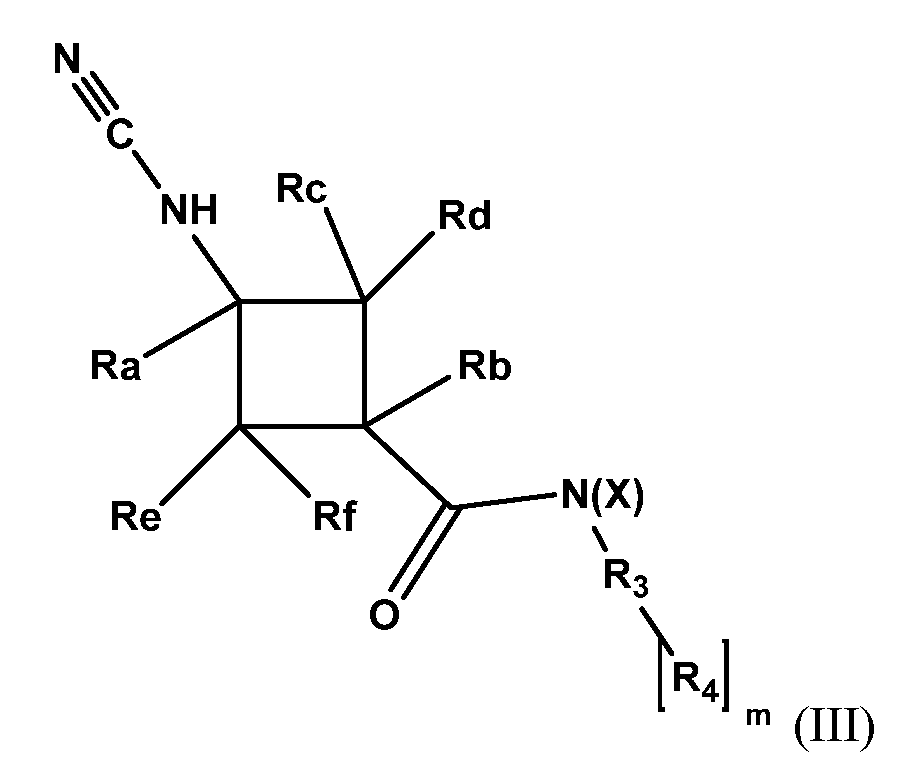
여기서 Ra, Rb, Rc, Rd, Re, Rf, R, R3, R4, R5, X, Y, 및 m은 상기 본원에 기재된 바와 같다.Wherein R a , R b , R c , R d , R e , R f , R, R 3 , R 4 , R 5 , X, Y, and m are as described herein above.
개시내용은 Ra가 수소인 화학식 (III)의 화합물을 제공한다.The disclosure provides compounds of formula (III) wherein R a is hydrogen.
개시내용은 Rb가 수소, 할로겐, 1개 이상의 R5로 임의로 치환된 (C1-C6) 알킬 기, 및 1개 이상의 R5로 임의로 치환된 (C1-C6) 알콕시 기로부터 선택된 것인 화학식 (III)의 화합물을 제공한다.Disclosure of which R b is hydrogen, halogen, optionally substituted with one or more R 5 (C 1 -C 6) alkyl group, and optionally substituted with one or more R 5 (C 1 -C 6) alkoxycarbonyl group selected from To provide a compound of formula (III).
개시내용은 Ra 및 Rb 둘 다가 각각 수소인 화학식 (III)의 화합물을 제공한다.The disclosure provides compounds of formula (III) wherein both R a and R b are each hydrogen.
개시내용은 각각의 Rc, Rd, Re, 및 Rf가 독립적으로 수소 및 임의로 1개 이상의 R5로 치환된 (C1-C6) 알킬 기로 이루어진 군으로부터 선택된 것인 화학식 (III)의 화합물을 제공한다. 개시내용의 일부 실시양태에서, 화학식 (III)의 화합물에서 각각의 Rc, Rd, Re, 및 Rf는 수소이다.The disclosure is that formula (III) wherein each R c , R d , R e , and R f is independently selected from the group consisting of hydrogen and (C 1 -C 6 ) alkyl groups optionally substituted with one or more R 5 It provides a compound. In some embodiments of the disclosure, each R c , R d , R e , and R f in the compound of Formula (III) is hydrogen.
개시내용은 X가 수소 및 알킬 기로부터 선택된 것인 화학식 (III)의 화합물을 제공한다. 화학식 (III)의 화합물의 일부 실시양태에서 X는 H이다.The disclosure provides compounds of formula (III) wherein X is selected from hydrogen and alkyl groups. In some embodiments of compound (III), X is H.
개시내용은 X가 알킬 기 및 헤테로알킬 기로부터 선택되고, 알킬 및 헤테로알킬 기가 Rb 또는 R3과 고리화된 것인 화학식 (III)의 화합물을 제공한다.The disclosure provides compounds of formula (III) wherein X is selected from alkyl groups and heteroalkyl groups, and the alkyl and heteroalkyl groups are cyclized with R b or R 3 .
개시내용은 R3이 1 내지 3개의 방향족 고리를 갖는 아릴 (1 또는 2개의 R 기로 임의로 치환된 아릴 기 포함) 및 1 내지 3개의 방향족 고리를 갖는 헤테로아릴 (1 또는 2개의 R 기로 임의로 치환된 헤테로아릴 기 포함)로 이루어진 군으로부터 선택된 것인 화학식 (III)의 화합물을 제공한다. 개시내용의 일부 실시양태에서, 화학식 (III)의 화합물에서 R3은 1 내지 3개의 방향족 고리를 갖는 헤테로아릴 기 (1 또는 2개의 R 기로 임의로 치환된 헤테로아릴 기 포함)이다. 일부 실시양태에서, R3은 1 또는 2개의 R 기로 임의로 치환된 1개의 방향족 고리를 갖는 헤테로아릴 기이다. 일부 실시양태에서, R3은 1개 또는 2개의 R 기로 임의로 치환된 1개의 방향족 고리를 갖는 헤테로아릴 기이고, 여기서 방향족 고리는 2개의 헤테로원자, 바람직하게는 1개의 질소 및 1개의 황 원자를 특색으로 한다. 일부 실시양태에서, R3은 1 또는 2개의 R 기로 임의로 치환된 1개의 방향족 고리를 갖는 헤테로아릴 기이고, 여기서 방향족 고리는 1개의 질소 및 1개의 황 원자를 특색으로 하는 5원 고리, 바람직하게는 티아졸 고리이다. 화학식 (III)의 일부 실시양태에서, R3은 티아졸, 인데닐, 피라졸, 페닐, 벤조티아졸, 및 옥사졸 고리로부터 선택된다.The disclosure is that R 3 is aryl having 1 to 3 aromatic rings (including aryl groups optionally substituted with 1 or 2 R groups) and heteroaryl having 1 to 3 aromatic rings (optionally substituted with 1 or 2 R groups) Provides a compound of formula (III) selected from the group consisting of heteroaryl groups. In some embodiments of the disclosure, R 3 in the compound of Formula (III) is a heteroaryl group having 1 to 3 aromatic rings (including heteroaryl groups optionally substituted with 1 or 2 R groups). In some embodiments, R 3 is a heteroaryl group having 1 aromatic ring optionally substituted with 1 or 2 R groups. In some embodiments, R 3 is a heteroaryl group having 1 aromatic ring optionally substituted with 1 or 2 R groups, wherein the aromatic ring has 2 heteroatoms, preferably 1 nitrogen and 1 sulfur atom. It is characteristic. In some embodiments, R 3 is a heteroaryl group having 1 aromatic ring optionally substituted with 1 or 2 R groups, wherein the aromatic ring is a 5-membered ring, preferably featuring 1 nitrogen and 1 sulfur atom. Is a thiazole ring. In some embodiments of Formula (III), R 3 is selected from thiazole, indenyl, pyrazole, phenyl, benzothiazole, and oxazole rings.
개시내용은 R4가 시클릭 기, 예를 들어 1 또는 2개의 Y 기로 임의로 치환된 시클로알킬 기인 화학식 (III)의 화합물을 제공한다. 개시내용은 R4가 1 또는 2개의 Y 기로 임의로 치환된 아릴 기인 화학식 (III)의 화합물을 제공한다. 개시내용은 R4가 시클로헥실 기 또는 페닐 기인 화학식 (III)의 화합물을 제공한다. 개시내용은 R4가 시클로헥실 기인 화학식 (III)의 화합물을 제공한다.The disclosure provides compounds of formula (III) wherein R 4 is a cycloalkyl group optionally substituted with cyclic groups, for example 1 or 2 Y groups. The disclosure provides compounds of formula (III), wherein R 4 is an aryl group optionally substituted with 1 or 2 Y groups. The disclosure provides compounds of formula (III), wherein R 4 is a cyclohexyl group or a phenyl group. The disclosure provides compounds of formula (III), wherein R 4 is a cyclohexyl group.
개시내용은 Rb가 수소 및 (C1-C6)알킬 기로부터 선택되고, 각각의 Ra, Rc, Rd, Re, 및 Rf가 수소이고, X가 수소 및 알킬 기로부터 선택되고, R3이 1 또는 2개의 R 기로 임의로 치환된 1개의 방향족 고리를 갖는 헤테로아릴 기이고, 여기서 방향족 고리는 1개의 질소 및 1개의 황 원자를 특색으로 하고; R4가 1 또는 2개의 Y기로 임의로 치환된 시클릭 기 또는 아릴 기인 화학식 (III)의 화합물을 제공한다.The disclosure is that R b is selected from hydrogen and (C 1 -C 6 )alkyl groups, each R a , R c , R d , R e , and R f is hydrogen, and X is selected from hydrogen and an alkyl group. And R 3 is a heteroaryl group having 1 aromatic ring optionally substituted with 1 or 2 R groups, wherein the aromatic ring is characterized by 1 nitrogen and 1 sulfur atom; Provided are compounds of formula (III), wherein R 4 is a cyclic group or an aryl group optionally substituted with 1 or 2 Y groups.
개시내용은 Rb가 수소 및 (C1-C6)알킬 기로부터 선택되고, 각각의 Ra, Rc, Rd, Re, 및 Rf가 수소이고, X가 수소 및 알킬 기로부터 선택되고, R3이 1 또는 2개의 R 기로 임의로 치환된 티아졸 고리이고; R4가 1 또는 2개의 Y기로 임의로 치환된 6-원 시클릭 기 또는 아릴 기인 화학식 (III)의 화합물을 제공한다.The disclosure is that R b is selected from hydrogen and (C 1 -C 6 )alkyl groups, each R a , R c , R d , R e , and R f is hydrogen, and X is selected from hydrogen and an alkyl group. And R 3 is a thiazole ring optionally substituted with 1 or 2 R groups; Provided are compounds of formula (III), wherein R 4 is a 6-membered cyclic group or an aryl group optionally substituted with 1 or 2 Y groups.
화학식 (III)의 화합물과 관련하여 상기 개시된 특색 중 임의의 것은 또한 본원에 개시된 화학식 (I), (Ia), (Ib), (Ic), 및 (II)의 화합물 중 임의의 것에 적용될 수 있다.Any of the features disclosed above in connection with the compound of Formula (III) may also be applied to any of the compounds of Formulas (I), (Ia), (Ib), (Ic), and (II) disclosed herein. .
본 개시내용에서, 화학식 (I)의 화합물에 관한 언급은 또한 화학식 (Ia), (Ib), (Ic), (II), 및 (III)의 화합물 중 임의의 것에 적용될 수 있다.In the present disclosure, reference to a compound of formula (I) may also apply to any of the compounds of formulas (Ia), (Ib), (Ic), (II), and (III).
개시내용의 또 다른 실시양태에서, 화학식 (I)의 화합물은 거울상이성질체이다. 일부 실시양태에서 화합물은 (S)-거울상이성질체이다. 다른 실시양태에서 화합물은 (R)-거울상이성질체이다. 또 다른 실시양태에서, 화학식 (I)의 화합물은 (+) 또는 (-) 거울상이성질체일 수 있다.In another embodiment of the disclosure, the compound of formula (I) is an enantiomer. In some embodiments, the compound is the (S)-enantiomer. In other embodiments, the compound is the (R)-enantiomer. In another embodiment, the compound of formula (I) may be a (+) or (-) enantiomer.
모든 이성질체 형태는 그의 혼합물을 포함하여 본 개시내용 내에 포함된다는 것을 이해하여야 한다. 화합물이 이중 결합을 함유하는 경우에, 치환기는 E 또는 Z 배위일 수 있다. 화합물이 이치환된 시클로알킬을 함유하는 경우에, 시클로알킬 치환기는 시스- 또는 트랜스 배위를 가질 수 있다. 모든 호변이성질체 형태도 또한 포함되는 것으로 의도된다.It should be understood that all isomeric forms are included within the present disclosure, including mixtures thereof. When the compound contains a double bond, the substituent may be in the E or Z configuration. When the compound contains a disubstituted cycloalkyl, the cycloalkyl substituent can have a cis- or trans configuration. All tautomeric forms are also intended to be included.
개시내용의 화합물, 및 그의 제약상 허용되는 염, 수화물, 용매화물, 입체이성질체 및 전구약물은 그의 호변이성질체 형태로 (예를 들어, 아미드 또는 이미노 에테르로서) 존재할 수 있다. 모든 이러한 호변이성질체 형태는 본 개시내용의 일부로서 본원에서 고려된다.The compounds of the disclosure, and pharmaceutically acceptable salts, hydrates, solvates, stereoisomers, and prodrugs thereof may exist in their tautomeric forms (eg, as amides or imino ethers). All such tautomeric forms are contemplated herein as part of the present disclosure.
개시내용의 화합물은 비대칭 또는 키랄 중심을 함유할 수 있으며, 따라서 상이한 입체이성질체 형태로 존재할 수 있다. 개시내용의 화합물의 모든 입체이성질체 형태 뿐만 아니라 라세미 혼합물을 비롯한 그의 혼합물은 본 개시내용의 일부를 형성하는 것으로 의도된다. 또한, 본 개시내용은 모든 기하 및 위치 이성질체를 포괄한다. 예를 들어, 개시내용의 화합물이 이중 결합 또는 융합된 고리를 포함하는 경우에, 시스- 및 트랜스-형태 둘 다, 뿐만 아니라 혼합물이 본 발명의 범주 내에 포함된다. 본원에 개시된 각각의 화합물은 화합물의 일반 구조에 따른 모든 거울상이성질체를 포함한다. 화합물은 라세미 또는 거울상이성질체적으로 순수한 형태 또는 입체화학의 면에서 임의의 다른 형태로 존재할 수 있다. 검정 결과는 라세미 형태, 거울상이성질체적으로 순수한 형태, 또는 입체화학의 면에서의 임의의 다른 형태에 대해 수집된 데이터를 반영할 수 있다.The compounds of the disclosure may contain asymmetric or chiral centers and thus may exist in different stereoisomeric forms. All stereoisomeric forms of the compounds of the disclosure as well as mixtures thereof, including racemic mixtures, are intended to form part of this disclosure. In addition, the present disclosure covers all geometric and positional isomers. For example, when the compounds of the disclosure include double bonds or fused rings, both cis- and trans-forms, as well as mixtures, are included within the scope of the present invention. Each compound disclosed herein includes all enantiomers according to the general structure of the compound. The compounds may exist in racemic or enantiomerically pure form or any other form in terms of stereochemistry. The assay results can reflect the data collected for racemic forms, enantiomerically pure forms, or any other form in terms of stereochemistry.
부분입체이성질체 혼합물은 그의 물리적 화학적 차이에 기초하여 관련 기술분야의 통상의 기술자에게 널리 공지된 방법, 예컨대 예를 들어 크로마토그래피 및/또는 분별 결정화에 의해 그의 개별 부분입체이성질체로 분리될 수 있다. 거울상이성질체는 적절한 광학 활성 화합물 (예를 들어, 키랄 보조제 예컨대 키랄 알콜 또는 모셔의 산 클로라이드)과의 반응에 의해 거울상이성질체 혼합물을 부분입체이성질체 혼합물로 전환시키고, 부분입체이성질체를 분리하고, 개별 부분입체이성질체를 상응하는 순수한 거울상이성질체로 전환 (예를 들어, 가수분해)시킴으로써 분리할 수 있다. 또한, 개시내용의 화합물 중 일부는 회전장애이성질체 (예를 들어, 치환된 비아릴)일 수 있고, 본 개시내용의 일부로 간주된다. 거울상이성질체는 또한 키랄 HPLC 칼럼의 사용에 의해 분리될 수 있다.Diastereomeric mixtures can be separated into their individual diastereomers based on their physical and chemical differences, by methods well known to those skilled in the art, such as, for example, chromatography and/or fractional crystallization. Enantiomers convert the enantiomer mixture to a diastereomeric mixture by isolating a diastereomeric mixture by reaction with a suitable optically active compound (e.g., a chiral adjuvant such as chiral alcohol or Mosher's acid chloride), to separate the diastereomers, and to separate diastereomers. Isomers can be separated by conversion (eg, hydrolysis) to the corresponding pure enantiomer. In addition, some of the compounds of the disclosure can be atropisomers (eg, substituted biaryls) and are considered part of the disclosure. Enantiomers can also be separated by use of chiral HPLC columns.
개시내용의 화합물이 상이한 호변이성질체 형태로 존재할 수 있고, 모든 이러한 형태가 개시내용의 범주 내에 포함되는 것이 또한 가능하다. 또한, 예를 들어 화합물의 모든 케토-엔올 및 이민-엔아민 형태가 개시내용에 포함된다.It is also possible that the compounds of the disclosure may exist in different tautomeric forms, and all such forms are included within the scope of the disclosure. Also included in the disclosure are, for example, all keto-enol and imine-enamine forms of the compounds.
본 발명의 화합물의 모든 입체이성질체 (예를 들어, 기하 이성질체, 광학 이성질체 등) (화합물의 염, 용매화물, 에스테르 및 전구약물 뿐만 아니라 전구약물의 염, 용매화물 및 에스테르의 입체이성질체 포함), 예컨대 거울상이성질체 형태 (이는 심지어 비대칭 탄소의 부재 하에도 존재할 수 있음), 회전이성질체 형태, 회전장애이성질체 및 부분입체이성질체 형태를 비롯한, 다양한 치환기 상의 비대칭 탄소로 인해 존재할 수 있는 입체이성질체가 본 개시내용의 범주 내로 고려되며, 마찬가지로 위치 이성질체 (예컨대 예를 들어, 4-피리딜 및 3-피리딜)가 고려된다. (예를 들어, 화학식 (I)의 화합물이 이중 결합 또는 융합된 고리를 포함하는 경우에, 시스- 및 트랜스-형태 둘 다 뿐만 아니라 혼합물이 개시내용의 범주 내에 포괄됨. 또한, 예를 들어 화합물의 모든 케토-엔올 및 이민-엔아민 형태가 개시내용에 포함됨). 개시내용의 화합물의 개별 입체이성질체는, 예를 들어 다른 이성질체가 실질적으로 존재하지 않을 수 있거나, 또는 예를 들어 라세미체로서 혼합되거나 모든 다른 입체이성질체 또는 다른 선택된 입체이성질체와 혼합될 수 있다. 본 개시내용의 키랄 중심은 IUPAC 1974 권고에 의해 정의된 바와 같은 S 또는 R 배위를 가질 수 있다. 용어 "염", "용매화물", "에스테르", "전구약물" 등의 사용은 본원에 개시된 화합물의 거울상이성질체, 입체이성질체, 회전이성질체, 호변이성질체, 위치 이성질체, 라세미체 또는 전구약물의 염, 용매화물, 에스테르 및 전구약물에 동등하게 적용되는 것으로 의도된다.All stereoisomers of the compounds of the invention (e.g., geometric isomers, optical isomers, etc.) (including salts, solvates, esters and prodrugs of compounds as well as stereoisomers of salts, solvates and esters of prodrugs), such as The stereoisomers that may exist due to asymmetric carbon on various substituents, including enantiomeric forms (which may even exist in the absence of asymmetric carbons), rotational isomer forms, atropisomers and diastereomeric forms are within the scope of the present disclosure. And isomers (such as 4-pyridyl and 3-pyridyl) are also contemplated. (For example, if the compound of formula (I) comprises a double bond or a fused ring, both cis- and trans-forms, as well as mixtures, are included within the scope of the disclosure. Also, for example, compounds All keto-enol and imine-enamine forms of are included in the disclosure). Individual stereoisomers of the compounds of the disclosure may, for example, be substantially free of other isomers, or may be mixed, for example, as racemates, or mixed with all other stereoisomers or other selected stereoisomers. The chiral center of the present disclosure can have an S or R configuration as defined by the IUPAC 1974 Recommendation. The use of the terms “salt”, “solvate”, “ester”, “prodrug”, and the like is a salt of the enantiomers, stereoisomers, rotational isomers, tautomers, regioisomers, racemates or prodrugs of the compounds disclosed herein , Solvates, esters and prodrugs.
본원에 개시된 화합물은, 또한 본 개시내용의 범주 내인 염을 형성할 수 있다.The compounds disclosed herein can also form salts that are within the scope of this disclosure.
본 개시내용은 USP30의 억제제일 수 있는 화합물에 관한 것이다.The present disclosure relates to compounds that may be inhibitors of USP30.
개시내용은 1 μM 이하의 USP30 IC50 (μM)을 갖는 화합물을 제공한다. 1 μM 이하의 USP30 IC50 (μM)을 갖는 개시내용의 화합물의 비제한적 예는, 활성이 "+++" 또는 "++++"로 보고된 하기 표 A1 내지 A3에 예시된 것을 포함한다.The disclosure provides compounds with USP30 IC 50 (μM) of 1 μM or less. Non-limiting examples of compounds of the disclosure having a USP30 IC 50 (μM) of 1 μM or less include those exemplified in Tables A1 to A3 below, whose activity is reported as “+++” or “++++”. .
개시내용은 0.5 μM 미만의 USP30 IC50 (μM)을 갖는 화합물을 제공한다.The disclosure provides compounds with USP30 IC 50 (μM) of less than 0.5 μM.
개시내용은 또한 0.1 μM 미만의 USP30 IC50 (μM)을 갖는 화합물을 제공한다. 1 μM 이하의 USP30 IC50 (μM)을 갖는 개시내용의 화합물의 비제한적 예는, 활성이 "++++"로 보고된 하기 표 A1 내지 A3에 예시된 것을 포함한다.The disclosure also provides compounds with USP30 IC 50 (μM) of less than 0.1 μM. Non-limiting examples of compounds of the disclosure having a USP30 IC 50 (μM) of 1 μM or less include those exemplified in Tables A1 to A3 below with activity reported as “++++”.
본 개시내용은 본원에 기재된 바와 같은 화합물 및 그의 제약상 허용되는 염, 용매화물, 전구약물, 입체이성질체 및 호변이성질체로부터 선택된 화학 물질, 및 본원에 기재된 바와 같은 화합물 및 그의 제약상 허용되는 염, 용매화물, 전구약물, 입체이성질체 및 호변이성질체로부터 선택된 적어도 1종의 화학 물질을 포함하는 제약 조성물에 관한 것이다.The present disclosure includes compounds as described herein and chemicals selected from pharmaceutically acceptable salts, solvates, prodrugs, stereoisomers and tautomers thereof, and compounds as described herein and pharmaceutically acceptable salts, solvents thereof It relates to a pharmaceutical composition comprising at least one chemical substance selected from cargoes, prodrugs, stereoisomers and tautomers.
본원에 기재된 방법의 일부 실시양태에서, 신경변성 질환은 알츠하이머병 및 다른 치매, 파킨슨병 및 다른 시뉴클레인병증 예컨대 다계통 위축, 루이 소체 치매 및 PD-관련 장애, 프리온 질환, 피질기저 변성, 전두측두엽 치매, 후피질 위축, 원발성 진행성 실어증, 진행성 핵상 마비, 픽병, 만성 외상성 뇌병증, 권투선수 치매, 외상성 뇌 손상, 혈관성 치매, 말초 신경병증 및 다발성 경화증으로부터 선택된다.In some embodiments of the methods described herein, the neurodegenerative disease is Alzheimer's disease and other dementia, Parkinson's disease, and other synucleinopathies such as multiline atrophy, Lewy body dementia and PD-related disorders, prion disease, cortical basal degeneration, frontal temporal lobe. Dementia, cortical atrophy, primary progressive aphasia, progressive nuclear paralysis, pick disease, chronic traumatic encephalopathy, boxer dementia, traumatic brain injury, vascular dementia, peripheral neuropathy and multiple sclerosis.
개시내용의 또 다른 측면은 화학식 (I)의 화합물 및 그의 제약상 허용되는 염, 용매화물, 전구약물, 입체이성질체 및 호변이성질체로부터 선택된 화학 물질 및 제약상 허용되는 담체를 포함하는 제약 조성물에 관한 것이다. 제약상 허용되는 담체는 추가로 부형제, 희석제 또는 계면활성제를 포함할 수 있다.Another aspect of the disclosure relates to pharmaceutical compositions comprising a compound of formula (I) and a pharmaceutically acceptable carrier and a chemical selected from pharmaceutically acceptable salts, solvates, prodrugs, stereoisomers and tautomers thereof. . Pharmaceutically acceptable carriers may further include excipients, diluents or surfactants.
개시내용의 개시된 화합물은 대상체에서 장애를 치료 또는 예방하고/거나 그의 발생을 예방하기 위해 유효량으로 투여될 수 있다.The disclosed compounds of the disclosure can be administered in an effective amount to treat or prevent a disorder in a subject and/or prevent its occurrence.
개시된 화합물의 투여는 치료제에 대한 임의의 투여 방식을 통해 완수될 수 있다. 이들 방식은 전신 또는 국부 투여, 예컨대 경구, 비강, 비경구, 경피, 피하, 질, 협측, 직장 또는 국소 투여 방식을 포함한다.Administration of the disclosed compounds can be accomplished through any mode of administration to the therapeutic agent. These modes include systemic or local administration, such as oral, nasal, parenteral, transdermal, subcutaneous, vaginal, buccal, rectal or topical administration.
의도된 투여 방식에 따라, 개시된 조성물은 고체, 반-고체 또는 액체 투여 형태, 예컨대 예를 들어 주사제, 정제, 좌제, 환제, 시한-방출 캡슐, 엘릭시르, 팅크제, 에멀젼, 시럽, 분말, 액체, 현탁액 등으로, 때때로 단위 투여량으로 존재할 수 있고, 통상적인 제약 실시와 일치할 수 있다. 마찬가지로, 이들은 또한, 정맥내 (볼루스 및 주입 둘 다), 복강내, 피하 또는 근육내 형태, 및 제약 기술분야의 통상의 기술자에게 널리 공지된 모든 사용 형태로 투여될 수 있다.Depending on the intended mode of administration, the disclosed compositions may be in solid, semi-solid or liquid dosage forms such as, for example, injections, tablets, suppositories, pills, time-release capsules, elixirs, tinctures, emulsions, syrups, powders, liquids, Suspensions, etc., may sometimes be present in unit doses, and may be consistent with conventional pharmaceutical practice. Likewise, they can also be administered in intravenous (both bolus and infusion), intraperitoneal, subcutaneous or intramuscular form, and in any form of use well known to those skilled in the pharmaceutical arts.
본 개시내용은 또한 본원에 개시된 화합물 및 제약상 허용되는 담체를 포함하는 제약 조성물에 관한 것이다. 제약상 허용되는 담체는 추가로 부형제, 희석제, 첨가제 또는 계면활성제를 포함할 수 있다. 개시내용의 화합물 또는 제약 조성물은 치료제에 대한 임의의 투여 방식을 통해 투여될 수 있다. 이들 방식은 전신 또는 국부 투여, 예컨대 경구 투여를 포함한다. 의도된 투여 방식에 따라, 개시된 화합물 또는 조성물은 고체 투여 형태, 예컨대 예를 들어, 정제 또는 환제 등으로, 때때로 단위 투여량으로 존재할 수 있고, 통상적인 제약 실시와 일치할 수 있다. 마찬가지로, 이들은 또한 제약 기술분야의 통상의 기술자에게 널리 공지된 사용 형태로 투여될 수 있다.The present disclosure also relates to pharmaceutical compositions comprising a compound disclosed herein and a pharmaceutically acceptable carrier. Pharmaceutically acceptable carriers may further include excipients, diluents, additives or surfactants. The compounds or pharmaceutical compositions of the disclosure can be administered via any mode of administration to the therapeutic agent. These modes include systemic or local administration, such as oral administration. Depending on the intended mode of administration, the disclosed compounds or compositions may be present in solid dosage forms, such as, for example, tablets or pills, sometimes in unit doses, and may be consistent with conventional pharmaceutical practice. Likewise, they can also be administered in a form of use well known to those skilled in the pharmaceutical arts.
개시내용의 개시된 화합물은 대상체에서 장애를 치료 또는 예방하고/거나 그의 발생을 예방하기 위해 유효량으로 투여될 수 있다.The disclosed compounds of the disclosure can be administered in an effective amount to treat or prevent a disorder in a subject and/or prevent its occurrence.
한 실시양태에서, 본 개시내용은 본 개시내용의 적어도 1종의 제약상 허용되는 화합물, 및 임의로 1종 이상의 제약상 허용되는 담체, 첨가제 또는 부형제를 혼합하여 본 개시내용의 제약 조성물을 제조하는 방법에 관한 것이다. 개시내용의 화합물을 포함하는 제약 조성물은 각각 통상적인 혼합, 과립화 또는 코팅 방법에 따라 제조될 수 있고, 본 제약 조성물은 중량 또는 부피 기준으로 약 0.1% 내지 약 99%, 약 5% 내지 약 90%, 또는 약 1% 내지 약 20%의 개시된 화합물을 함유할 수 있다. 본 개시내용의 투여 형태가 본 개시내용의 1종 이상의 화합물의 혼합물을 함유할 수 있고, 제약 부형제로서 관련 기술분야의 통상의 기술자에게 공지된 추가의 물질을 포함할 수 있다. 안정화 첨가제는 전달 작용제 용액 내로 혼입될 수 있다. 일부 약물에 있어서, 이러한 첨가제의 존재는 용액 중 작용제의 안정성 및 분산성을 촉진한다. 안정화 첨가제는 약 0.1 및 5% (W/V) 범위의, 바람직하게는 약 0.5% (W/V)의 농도로 사용될 수 있다. 안정화 첨가제의 적합한 비제한적 예는 아카시아 검, 젤라틴, 메틸 셀룰로스, 폴리에틸렌 글리콜, 카르복실산 및 그의 염, 및 폴리리신을 포함한다. 한 실시양태에서, 안정화 첨가제는 아카시아 검, 젤라틴 및 메틸 셀룰로스이다.In one embodiment, the present disclosure provides a method of preparing a pharmaceutical composition of the present disclosure by mixing at least one pharmaceutically acceptable compound of the present disclosure, and optionally one or more pharmaceutically acceptable carriers, additives or excipients. It is about. Pharmaceutical compositions comprising the compounds of the disclosure can each be prepared according to conventional mixing, granulating or coating methods, wherein the pharmaceutical composition is from about 0.1% to about 99%, from about 5% to about 90 by weight or volume. %, or about 1% to about 20% of the disclosed compound. The dosage form of the present disclosure may contain a mixture of one or more compounds of the present disclosure, and may include additional substances known to those skilled in the art as pharmaceutical excipients. Stabilizing additives can be incorporated into the delivery agent solution. For some drugs, the presence of these additives promotes the stability and dispersibility of the agent in solution. Stabilizing additives can be used in concentrations in the range of about 0.1 and 5% (W/V), preferably about 0.5% (W/V). Suitable non-limiting examples of stabilizing additives include acacia gum, gelatin, methyl cellulose, polyethylene glycol, carboxylic acid and salts thereof, and polylysine. In one embodiment, the stabilizing additive is acacia gum, gelatin and methyl cellulose.
본원에 제공된 개시내용의 화합물은 바람직하게는 치료 유효량 (예를 들어, 적합한 바람직한 치료 지수를 갖는 양)으로 투여된다. 개시내용의 화합물 및/또는 그의 제약상 허용되는 염의 투여량 및 투여 빈도는 환자의 연령, 상태 및 크기 뿐만 아니라 치료될 증상 의학적 상태의 중증도와 같은 인자를 고려하여 담당 임상의의 판단에 따라 조절될 것이다. 개시된 화합물을 이용하는 투여 요법은 환자의 유형, 종, 연령, 체중, 성별 및 의학적 상태; 치료될 상태의 중증도; 투여 경로; 환자의 신장 또는 간 기능; 및 사용된 특정한 개시된 화합물을 포함한 다양한 인자에 따라 선택된다. 관련 기술분야의 통상의 기술자인 의사 또는 수의사는 상태의 진행을 예방, 대응 또는 저지하는데 필요한 약물의 유효량을 용이하게 결정하고 처방할 수 있다.The compounds of the disclosure provided herein are preferably administered in a therapeutically effective amount (eg, an amount with a suitable desirable therapeutic index). The dosage and frequency of administration of the compounds of the disclosure and/or pharmaceutically acceptable salts thereof will be adjusted at the discretion of the attending clinician taking into account factors such as the age, condition and size of the patient as well as the severity of the symptomatic medical condition to be treated. will be. Dosing regimens using the disclosed compounds include patient type, species, age, weight, sex and medical condition; The severity of the condition to be treated; Route of administration; Kidney or liver function in the patient; And the particular disclosed compound used. A physician or veterinarian, skilled in the art, can readily determine and prescribe an effective amount of a drug necessary to prevent, counteract or prevent the progression of the condition.
사용되는 실제 투여량은 환자의 요건 및 치료될 상태의 중증도에 따라 달라질 수 있다. 특정한 상황을 위한 적절한 투여 요법의 결정은 관련 기술분야의 기술 내에 있다. 편의상, 총 1일 투여량은 필요 시에 분할되어 하루 동안 여러 부분으로 투여될 수 있다.The actual dosage used can vary depending on the patient's requirements and the severity of the condition being treated. Determination of a suitable dosing regimen for a particular situation is within the skill of the art. For convenience, the total daily dose may be divided as needed and administered in multiple portions throughout the day.
예시적인 제약 조성물은 개시내용의 화합물 및 제약상 허용되는 담체, 예컨대 a) 희석제, 예를 들어, 정제수, 트리글리세리드 오일, 예컨대 수소화 또는 부분 수소화 식물성 오일, 또는 그의 혼합물, 옥수수 오일, 올리브 오일, 해바라기 오일, 홍화 오일, 어유, 예컨대 EPA 또는 DHA, 또는 그의 에스테르 또는 트리글리세리드 또는 그의 혼합물, 오메가-3 지방산 또는 그의 유도체, 락토스, 덱스트로스, 수크로스, 만니톨, 소르비톨, 셀룰로스, 나트륨, 사카린, 글루코스 및/또는 글리신; b) 윤활제, 예를 들어, 실리카, 활석, 스테아르산, 그의 마그네슘 또는 칼슘 염, 올레산나트륨, 스테아르산나트륨, 스테아르산마그네슘, 벤조산나트륨, 아세트산나트륨, 염화나트륨 및/또는 폴리에틸렌 글리콜; 정제의 경우에 또한; c) 결합제, 예를 들어, 규산알루미늄마그네슘, 전분 페이스트, 젤라틴, 트라가칸트, 메틸셀룰로스, 소듐 카르복시메틸셀룰로스, 탄산마그네슘, 천연 당 예컨대 글루코스 또는 베타-락토스, 옥수수 감미제, 천연 및 합성 검 예컨대 아카시아, 트라가칸트 또는 알긴산나트륨, 왁스 및/또는 폴리비닐피롤리돈, 원하는 경우에; d) 붕해제, 예를 들어, 전분, 한천, 메틸 셀룰로스, 벤토나이트, 크산탄 검, 알긴산 또는 그의 나트륨 염 또는 발포성 혼합물; e) 흡수제, 착색제, 향미제 및 감미제; f) 유화제 또는 분산제, 예컨대 트윈 80, 라브라솔, HPMC, DOSS, 카프로일 909, 라브라팍, 라브라필, 페세올, 트랜스큐톨, 카프물 MCM, 카프물 PG-12, 카프텍스 355, 겔루시르, 비타민 E TGPS 또는 다른 허용되는 유화제; 및/또는 g) 화합물의 흡수를 증진시키는 작용제 예컨대 시클로덱스트린, 히드록시프로필-시클로덱스트린, PEG400, PEG200을 포함하는 정제 및 젤라틴 캡슐이다.Exemplary pharmaceutical compositions include compounds of the disclosure and pharmaceutically acceptable carriers, such as a) diluents, such as purified water, triglyceride oils, such as hydrogenated or partially hydrogenated vegetable oils, or mixtures thereof, corn oil, olive oil, sunflower oil , Safflower oil, fish oil, such as EPA or DHA, or esters or triglycerides or mixtures thereof, omega-3 fatty acids or derivatives thereof, lactose, dextrose, sucrose, mannitol, sorbitol, cellulose, sodium, saccharin, glucose and/or Glycine; b) lubricants such as silica, talc, stearic acid, its magnesium or calcium salt, sodium oleate, sodium stearate, magnesium stearate, sodium benzoate, sodium acetate, sodium chloride and/or polyethylene glycol; Also in the case of tablets; c) binders, such as aluminum magnesium silicate, starch paste, gelatin, tragacanth, methylcellulose, sodium carboxymethylcellulose, magnesium carbonate, natural sugars such as glucose or beta-lactose, corn sweeteners, natural and synthetic gums such as acacia , Tragacanth or sodium alginate, wax and/or polyvinylpyrrolidone, if desired; d) disintegrating agents such as starch, agar, methyl cellulose, bentonite, xanthan gum, alginic acid or its sodium salt or effervescent mixtures; e) absorbents, colorants, flavors and sweeteners; f) Emulsifiers or dispersants, such as Tween 80, Labrasol, HPMC, DOSS, Caproyl 909, Labrapak, Labrafil, Peseol, Transcutol, Capmul MCM, Capmul PG-12, Captex 355, Gellucir, vitamin E TGPS or other acceptable emulsifiers; And/or g) tablets and gelatin capsules comprising agents that enhance absorption of the compound, such as cyclodextrin, hydroxypropyl-cyclodextrin, PEG400, PEG200.
개시내용의 또 다른 측면은 화학식 (I)의 화합물 및 그의 제약상 허용되는 염, 용매화물, 전구약물, 입체이성질체 및 호변이성질체로부터 선택된 화학 물질 및 제약상 허용되는 담체를 포함하는 제약 조성물에 관한 것이다. 제약상 허용되는 담체는 추가로 부형제, 희석제 또는 계면활성제를 포함할 수 있다.Another aspect of the disclosure relates to pharmaceutical compositions comprising a compound of formula (I) and a pharmaceutically acceptable carrier and a chemical selected from pharmaceutically acceptable salts, solvates, prodrugs, stereoisomers and tautomers thereof. . Pharmaceutically acceptable carriers may further include excipients, diluents or surfactants.
조성물은 각각 통상적인 혼합, 과립화 또는 코팅 방법에 따라 제조될 수 있고, 본 발명의 제약 조성물은 중량 또는 부피 기준으로 약 0.1% 내지 약 99%, 약 5% 내지 약 90%, 또는 약 1% 내지 약 20%의 개시된 화합물을 함유할 수 있다.Each of the compositions can be prepared according to conventional mixing, granulating or coating methods, and the pharmaceutical compositions of the present invention are about 0.1% to about 99%, about 5% to about 90%, or about 1% by weight or volume. To about 20% of the disclosed compounds.
개시된 화합물을 이용하는 투여 요법은 환자의 유형, 종, 연령, 체중, 성별 및 의학적 상태; 치료될 상태의 중증도; 투여 경로; 환자의 신장 또는 간 기능; 및 사용된 특정한 개시된 화합물을 포함한 다양한 인자에 따라 선택된다. 관련 기술분야의 통상의 기술자인 의사 또는 수의사는 상태의 진행을 예방, 대응 또는 저지하는데 필요한 약물의 유효량을 용이하게 결정하고 처방할 수 있다.Dosing regimens using the disclosed compounds include patient type, species, age, weight, sex and medical condition; The severity of the condition to be treated; Route of administration; Kidney or liver function in the patient; And the particular disclosed compound used. A physician or veterinarian, skilled in the art, can readily determine and prescribe an effective amount of a drug necessary to prevent, counteract or prevent the progression of the condition.
개시된 화합물의 유효 투여량은, 지정된 효과를 위해 사용되는 경우, 상태를 치료하기 위해 필요에 따라 개시된 화합물의 약 0.5 mg 내지 약 5000 mg의 범위이다. 생체내 또는 시험관내 사용을 위한 조성물은 개시된 화학 물질을 약 0.5, 5, 20, 50, 75, 100, 150, 250, 500, 750, 1000, 1250, 2500, 3500, 또는 5000 mg으로, 또는 용량 목록에서 하나의 양 내지 또 다른 양의 범위로 함유할 수 있다. 한 실시양태에서, 조성물은 스코어링될 수 있는 정제의 형태이다.Effective doses of the disclosed compounds, when used for the indicated effect, range from about 0.5 mg to about 5000 mg of the disclosed compounds as needed to treat the condition. Compositions for in vivo or in vitro use may comprise the disclosed chemicals at about 0.5, 5, 20, 50, 75, 100, 150, 250, 500, 750, 1000, 1250, 2500, 3500, or 5000 mg, or doses It may contain from one amount to another in the list. In one embodiment, the composition is in the form of a tablet that can be scored.
화합물을 합성하는 방법Methods of synthesizing compounds
본 개시내용의 화합물은 표준 화학을 비롯한 다양한 방법에 의해 제조될 수 있다. 적합한 합성 경로는 하기 주어진 반응식에 도시된다.Compounds of the present disclosure can be prepared by a variety of methods, including standard chemistry. Suitable synthetic routes are shown in the schemes given below.
본원에 개시된 화합물은 하기 합성 반응식에 의한 부분에 기술된 바와 같이 유기 합성의 관련 기술분야에 공지된 방법에 의해 제조될 수 있다. 하기 기재된 반응식에서, 일반적 원리 또는 화학에 따라 필요한 경우, 감수성 또는 반응성 기에 대해 보호기가 사용된다는 것이 널리 이해된다. 보호기는 유기 합성의 표준 방법에 따라 조작된다 (T. W. Greene and P. G. M. Wuts, "Protective Groups in Organic Synthesis", Third edition, Wiley, New York 1999). 이들 기는 관련 기술분야의 통상의 기술자에게 용이하게 명백한 방법을 사용하여 화합물 합성의 편리한 단계에서 제거된다. 선택 과정, 뿐만 아니라 반응 조건 및 그의 실행 순서는 화학식 (I)의 화합물의 제조에 부합할 것이다.The compounds disclosed herein can be prepared by methods known in the art of organic synthesis, as described in the section by the synthetic schemes below. In the schemes described below, it is well understood that protecting groups are used for sensitive or reactive groups, if necessary according to general principles or chemistry. The protecting groups are manipulated according to standard methods of organic synthesis (T. W. Greene and P. G. M. Wuts, "Protective Groups in Organic Synthesis", Third edition, Wiley, New York 1999). These groups are removed at a convenient stage of compound synthesis using methods that are readily apparent to those skilled in the art. The selection process, as well as the reaction conditions and order of execution thereof, will be consistent with the preparation of the compound of formula (I).
관련 기술분야의 통상의 기술자는 입체중심이 화학식 (I)의 화합물에 존재하는지 인식할 것이다. 따라서, 본 개시내용은 (합성에서 명시되지 않는 한) 가능한 입체이성질체 둘 다를 포함하고, 라세미 화합물 뿐만 아니라 개별 거울상이성질체 및/또는 부분입체이성질체도 포함한다. 화합물이 단일 거울상이성질체 또는 부분입체이성질체로서 요구되는 경우에, 이는 입체특이적 합성에 의해 또는 최종 생성물 또는 임의의 편리한 중간체의 분해에 의해 수득될 수 있다. 최종 생성물, 중간체, 또는 출발 물질의 분해는 관련 기술분야에 공지된 임의의 적합한 방법에 의해 수행될 수 있다. 예를 들어, 문헌 ["Stereochemistry of Organic Compounds" by E. L. Eliel, S. H. Wilen, and L. N. Mander (Wiley-lnterscience, 1994)]을 참조한다.Those skilled in the art will recognize whether the stereocenter is present in the compound of formula (I). Accordingly, the present disclosure includes both possible stereoisomers (unless otherwise specified in the synthesis), as well as racemic compounds as well as individual enantiomers and/or diastereomers. When a compound is required as a single enantiomer or diastereomer, it can be obtained by stereospecific synthesis or by resolution of the final product or any convenient intermediate. The decomposition of the final product, intermediate, or starting material can be carried out by any suitable method known in the art. See, for example, "Stereochemistry of Organic Compounds" by E. L. Eliel, S. H. Wilen, and L. N. Mander (Wiley-lnterscience, 1994).
본원에 기재된 화합물은 상업적으로 입수가능한 출발 물질로부터 제조될 수 있거나, 또는 공지된 유기, 무기 및/또는 효소적 과정을 이용하여 합성될 수 있다.The compounds described herein can be prepared from commercially available starting materials, or can be synthesized using known organic, inorganic and/or enzymatic procedures.
화합물의 제조Preparation of compounds
본 개시내용의 화합물은 유기 합성 기술분야의 통상의 기술자에게 공지되어 있는 수많은 방법으로 제조될 수 있다. 예로서, 본 개시내용의 화합물은 관련 기술분야의 통상의 기술자가 인지하는 바와 같은 합성 유기 화학 기술분야에 공지된 합성 방법 또는 그의 변경과 함께, 하기 기재된 방법을 이용하여 합성될 수 있다. 바람직한 방법은 하기 기재된 방법을 포함하나, 이에 제한되지는 않는다. 본 발명의 화합물을 제조하기 위한 일반적 절차는 반응식 1 및 2에 기재되어 있다.Compounds of the present disclosure can be prepared in a number of ways known to those skilled in the art of organic synthesis. As an example, the compounds of the present disclosure can be synthesized using the methods described below, together with synthetic methods known in the art of synthetic organic chemistry, or variations thereof, as recognized by those skilled in the art. Preferred methods include, but are not limited to, the methods described below. General procedures for preparing the compounds of the present invention are described in Schemes 1 and 2.
반응식 1Scheme 1

일반적 절차: Boc-보호된 아미노산을 적합한 용매 (즉, DMF) 중에서 표준 커플링 시약 (즉, HATU) 및 염기 (즉, DIEA)를 사용하여 아민과 커플링시킬 수 있다 (즉, Z-NH2). 이어서 Boc 기를 적합한 용매 (즉, DCM) 중에서 TFA 또는 HCl을 이용하여 제거하여 상응하는 조 아민 염을 수득할 수 있다. 최종적으로, 조 아민 염을 소정의 온도 범위 (즉, -20℃ 내지 25℃)에서 과량의 염기 (즉, TEA 또는 NaHCO3)를 함유하는 적절한 용매 (즉, THF) 중에서 브로민화시아노겐과 반응시켜, 정제 후에 최종 생성물을 수득할 수 있다.General procedure: Boc-protected amino acids can be coupled with amines using a standard coupling reagent (i.e., HATU) and base (i.e., DIEA) in a suitable solvent (i.e., DMF) (i.e., Z-NH 2 ). The Boc group can then be removed with TFA or HCl in a suitable solvent (ie DCM) to give the corresponding crude amine salt. Finally, the crude amine salt is treated with bromide cyanogen in a suitable solvent (i.e., THF) containing an excess of base (i.e., TEA or NaHCO 3 ) at a given temperature range (i.e., -20 to 25 °C). By reaction, the final product can be obtained after purification.
반응식 2Scheme 2

일반적 절차: 모노-Boc-보호된 디아민을 적합한 용매 (즉, DCM) 중에서 염기 (즉, DIEA)의 존재 하에 CDI 및 또 다른 아민 (즉, Z-NH2)으로 처리하여 상응하는 우레아 중간체를 수득할 수 있다. 이어서 Boc 기를 적합한 용매 (즉, DCM) 중에서 TFA 또는 HCl을 이용하여 제거하여 상응하는 조 아민 염을 수득할 수 있다. 최종적으로, 조 아민 염을 소정의 온도 범위 (즉, -20℃ 내지 25℃)에서 과량의 염기 (즉, TEA 또는 NaHCO3)를 함유하는 적절한 용매 (즉, THF) 중에서 브로민화시아노겐과 반응시켜, 정제 후에 최종 생성물을 수득할 수 있다.General procedure: Mono-Boc-protected diamine is treated with CDI and another amine (ie, Z-NH 2 ) in the presence of a base (ie, DIEA) in a suitable solvent (ie, DCM) to obtain the corresponding urea intermediate. can do. The Boc group can then be removed with TFA or HCl in a suitable solvent (ie DCM) to give the corresponding crude amine salt. Finally, the crude amine salt is treated with bromide cyanogen in a suitable solvent (i.e., THF) containing an excess of base (i.e., TEA or NaHCO 3 ) at a given temperature range (i.e., -20 to 25 °C). By reaction, the final product can be obtained after purification.
실시예Example
개시내용은 하기 실시예 및 합성 반응식에 의해 추가로 예시되며, 이는 본 개시내용을 범주 또는 취지면에서 본원에 기재된 구체적 절차로 제한하는 것으로 해석되어서는 안 된다. 실시예는 특정 실시양태를 예시하기 위해 제공되며 이로써 개시내용의 범주를 제한하려는 의도는 없음을 이해해야 한다. 추가로, 본 개시내용의 취지 및/또는 첨부된 청구범위의 범주로부터 벗어나지 않으면서 관련 기술분야의 통상의 기술자에게 제안될 수 있는 다양한 다른 실시양태, 변형 및 그의 등가물을 이용할 수 있음을 이해해야 한다.The disclosure is further illustrated by the following examples and synthetic schemes, which should not be construed as limiting the disclosure to the specific procedures described herein in scope or spirit. It should be understood that the examples are provided to illustrate certain embodiments, and thus are not intended to limit the scope of the disclosure. Additionally, it should be understood that various other embodiments, modifications, and equivalents thereof may be utilized that may be suggested to one skilled in the art without departing from the spirit of the present disclosure and/or the scope of the appended claims.
분석 방법, 물질, 및 기기Analytical Methods, Materials, and Instruments
달리 나타내지 않는 한, 시약 및 용매는 상업적 공급업체로부터 제공받은 대로 사용하였다. 달리 나타내지 않는 한, 반응은 질소의 불활성 분위기 하에서 수행하였다. 양성자 핵 자기 공명 (NMR) 스펙트럼은 각각 브루커(Bruker) 또는 배리안(Varian) 분광계에서 300 또는 400 MHz에서 수득하였다. 스펙트럼은 ppm (δ)으로 제공되고, 커플링 상수 J는 헤르츠로 보고된다. 테트라메틸실란 (TMS)을 내부 표준으로서 사용하였다. 질량 스펙트럼은 워터스 ZQ 단일 사중극자 질량 분광계 (이온 트랩 전기분무 이온화 (ESI))를 사용하여 수집하였다. 순도 및 저해상도 질량 스펙트럼 데이터는 액퀴티(Acquity) 포토 다이오드 어레이 검출기, 액퀴티 증발성 광 산란 검출기 (ELSD) 및 워터스(Waters) ZQ 질량 분광계가 구비된 워터스 액퀴티 i-클래스 초고성능 액체 크로마토그래피 (UPLC) 시스템을 사용하여 측정하였다. 데이터는 워터스 매스링스(Waters MassLynx) 4.1 소프트웨어를 사용하여 획득하고, 순도는 UV 파장 220 nm, 증발 광 산란 검출 (ELSD) 및 전기분무 양이온 (ESI)에 의해 특징화하였다. (칼럼 : 액퀴티 UPLC BEH C18 1.7 μm 2.1 X 50 mm; 유량 0.6 mL/분; 용매 A (95/5/0.1%: 10 mM 암모늄 포르메이트/아세토니트릴/포름산), 용매 B (95/5/0.09%: 아세토니트릴/물/포름산); 구배: 0에서 2분 5-100% B, 2.2분까지 100% B 유지, 및 2.21분에 5%B. 정제용 HPLC 정제를 하기 표시된 바와 같이 수행하였다. 본원에 기재된 실시예에서 화합물의 분리된 거울상이성질체의 절대 배위가 때때로 결정되었다. 다른 모든 경우에는 분리된 거울상이성질체의 절대 배위가 결정되지 않았고, 그러한 경우에는 분해된 물질의 배위를 각 경우에 임의적으로 R 또는 S로 배정하였다.Reagents and solvents were used as provided by commercial suppliers, unless otherwise indicated. Unless otherwise indicated, reactions were conducted under an inert atmosphere of nitrogen. Proton nuclear magnetic resonance (NMR) spectra were obtained at 300 or 400 MHz on a Bruker or Varian spectrometer, respectively. Spectra are given in ppm (δ) and the coupling constant J is reported in Hertz. Tetramethylsilane (TMS) was used as internal standard. Mass spectra were collected using a Waters ZQ single quadrupole mass spectrometer (ion trap electrospray ionization (ESI)). Purity and low resolution mass spectral data include Waters Acquity i-Class Ultra High Performance Liquid Chromatography with Acquity Photodiode Array Detector, Acquity Evaporative Light Scattering Detector (ELSD) and Waters ZQ Mass Spectrometer ( UPLC) system. Data were obtained using Waters MassLynx 4.1 software, and purity was characterized by UV wavelength 220 nm, evaporative light scattering detection (ELSD) and electrospray cation (ESI). (Column: Acquity UPLC BEH C18 1.7 μm 2.1 X 50 mm; flow rate 0.6 mL/min; solvent A (95/5/0.1%: 10 mM ammonium formate/acetonitrile/formic acid), solvent B (95/5/ 0.09%: acetonitrile/water/formic acid); gradient: 0 to 2 min 5-100% B, 2.2 min to 100% B retention, and 2.21 min to 5% B. Preparative HPLC purification was performed as indicated below. In the examples described herein, the absolute configuration of the isolated enantiomer of a compound was sometimes determined, in all other cases the absolute configuration of the isolated enantiomer was not determined, in which case the configuration of the degraded material was optional in each case. It was assigned as R or S.
하기 실시예 및 본원의 다른 곳에서 사용된 약어는 다음과 같다:The following examples and abbreviations used elsewhere herein are as follows:


화학식 (I)의 화합물의 합성 실시예:Synthetic Examples of Compounds of Formula (I):
실시예 1. 트랜스-3-(시아노아미노)-N-[5-(옥산-4-일)-1,3-티아졸-2-일]시클로부탄-1-카르복스아미드 (화합물 1-1)Example 1. Trans-3-(cyanoamino)-N-[5-(oxan-4-yl)-1,3-thiazol-2-yl]cyclobutane-1-carboxamide (Compound 1- One)

단계 1. tert-부틸 (트랜스-(테트라히드로-2H-피란-4-일)티아졸-2-일카르바모일)시클로부틸카르바메이트Step 1. tert-Butyl (trans-(tetrahydro-2H-pyran-4-yl)thiazol-2-ylcarbamoyl)cyclobutylcarbamate
N,N-디메틸포름아미드 (3 mL) 중 트랜스-3-(tert-부톡시카르보닐아미노)시클로부탄카르복실산 (169 mg, 0.786 mmol), HATU (298 mg, 0.790 mmol), 5-(테트라히드로-2H-피란-4-일)티아졸-2-아민 (120 mg, 0.650 mmol) 및 DIEA (0.320 mL, 1.96 mmol)의 용액을 25℃에서 30분 동안 교반하였다. 이어서, 반응물을 물 (10 mL)의 첨가에 의해 켄칭하였다. 생성된 혼합물을 에틸 아세테이트 (3 x10 mL)로 추출하였다. 유기 층을 합하고, 무수 황산나트륨 상에서 건조시키고, 여과하고, 진공 하에 농축시켰다. 잔류물을 정제용 TLC 플레이트 (전개 용매: 20:1 디클로로메탄/메탄올)에 의해 정제하여 tert-부틸 (트랜스-(테트라히드로-2H-피란-4-일)티아졸-2-일카르바모일)시클로부틸카르바메이트를 황색 고체 (80.0 mg)로서 수득하였다.Trans-3-(tert-butoxycarbonylamino)cyclobutanecarboxylic acid (169 mg, 0.786 mmol), HATU (298 mg, 0.790 mmol), 5-() in N,N-dimethylformamide (3 mL) A solution of tetrahydro-2H-pyran-4-yl)thiazol-2-amine (120 mg, 0.650 mmol) and DIEA (0.320 mL, 1.96 mmol) was stirred at 25°C for 30 minutes. The reaction was then quenched by addition of water (10 mL). The resulting mixture was extracted with ethyl acetate (3 x10 mL). The organic layers were combined, dried over anhydrous sodium sulfate, filtered and concentrated in vacuo. The residue was purified by preparative TLC plate (developing solvent: 20:1 dichloromethane/methanol) to tert-butyl (trans-(tetrahydro-2H-pyran-4-yl)thiazol-2-ylcarbamoyl ) Cyclobutylcarbamate as a yellow solid (80.0 mg).
LCMS (ES, m/z) 382 [M+H]+.LCMS (ES, m/z) 382 [M+H] + .
단계 2. 트랜스-3-아미노-N-(5-(테트라히드로-2H-피란-4-일)티아졸-2-일)시클로부탄카르복스아미드 2,2,2-트리플루오로아세테이트Step 2. Trans-3-amino-N-(5-(tetrahydro-2H-pyran-4-yl)thiazol-2-yl)cyclobutanecarboxamide 2,2,2-trifluoroacetate
디클로로메탄 (3 mL) 중 tert-부틸 (트랜스-(테트라히드로-2H-피란-4-일)티아졸-2-일카르바모일)시클로부틸카르바메이트 (80.0 mg, 0.210 mmol) 및 트리플루오로아세트산 (1 mL)의 용액을 25℃에서 2시간 동안 교반하였다. 생성된 혼합물을 진공 하에 농축시켜 트랜스-3-아미노-N-(5-(테트라히드로-2H-피란-4-일)티아졸-2-일)시클로부탄카르복스아미드 2,2,2-트리플루오로아세테이트를 황색 오일 (90.0 mg)로서 수득하였다.Tert-Butyl (trans-(tetrahydro-2H-pyran-4-yl)thiazol-2-ylcarbamoyl)cyclobutylcarbamate (80.0 mg, 0.210 mmol) and trifluoro in dichloromethane (3 mL) The solution of roacetic acid (1 mL) was stirred at 25° C. for 2 hours. The resulting mixture was concentrated in vacuo to make trans-3-amino-N-(5-(tetrahydro-2H-pyran-4-yl)thiazol-2-yl)cyclobutanecarboxamide 2,2,2-tri Fluoroacetate was obtained as a yellow oil (90.0 mg).
LCMS (ES, m/z) 282 [M+H]+.LCMS (ES, m/z) 282 [M+H] + .
단계 3. 트랜스-3-(시아노아미노)-N-[5-(옥산-4-일)-1,3-티아졸-2-일]시클로부탄-1-카르복스아미드Step 3. Trans-3-(cyanoamino)-N-[5-(oxan-4-yl)-1,3-thiazol-2-yl]cyclobutane-1-carboxamide
브로민화시아노겐 (19.0 mg, 0.180 mmol)을 -20℃에서 테트라히드로푸란 (5 mL) 중 트랜스-3-아미노-N-(5-(테트라히드로-2H-피란-4-일)티아졸-2-일)시클로부탄카르복스아미드 2,2,2-트리플루오로아세테이트 (70.0 mg, 0.180 mmol) 및 TEA (0.074 mL, 0.530 mmol)의 교반 용액에 첨가하였다. 생성된 용액을 -20℃에서 30분 동안 교반하였다. 이어서, 반응물을 물 (10 mL)의 첨가에 의해 켄칭하였다. 생성된 혼합물을 에틸 아세테이트 (3x15 mL)로 추출하였다. 유기 층을 합하고, 무수 황산나트륨 상에서 건조시키고, 여과하고, 진공 하에 농축시켰다. 잔류물을 정제용 HPLC (칼럼: 엑스브리지(XBridge) BEH130 RP18 OBD 칼럼, 130 Å, 5 μm, 19 mm*150 mm; 이동상, A: 물 (10 mM NH4HCO3) 및 B: ACN (10%에서 40%까지, 7분에 걸침); 유량: 20 mL/분; 검출기: 254 & 220 nm)에 의해 정제하여 트랜스-3-(시아노아미노)-N-[5-(옥산-4-일)-1,3-티아졸-2-일]시클로부탄-1-카르복스아미드를 백색 고체 (5.40 mg)로서 수득하였다.Trans-3-amino-N-(5-(tetrahydro-2H-pyran-4-yl)thiazole in tetrahydrofuran (5 mL) at -20°C with brominated cyanogen (19.0 mg, 0.180 mmol) -2-yl)cyclobutanecarboxamide 2,2,2-trifluoroacetate (70.0 mg, 0.180 mmol) and TEA (0.074 mL, 0.530 mmol) were added to a stirred solution. The resulting solution was stirred at -20°C for 30 minutes. The reaction was then quenched by addition of water (10 mL). The resulting mixture was extracted with ethyl acetate (3x15 mL). The organic layers were combined, dried over anhydrous sodium sulfate, filtered and concentrated in vacuo. The residue was purified by preparative HPLC (column: XBridge BEH130 RP18 OBD column, 130 mm 3, 5 μm, 19 mm*150 mm; mobile phase, A: water (10 mM NH 4 HCO 3 ) and B: ACN (10 % To 40%, over 7 minutes); flow rate: 20 mL/min; detector: 254 & 220 nm) purified by trans-3-(cyanoamino)-N-[5-(oxane-4- 1)-1,3-thiazol-2-yl]cyclobutane-1-carboxamide was obtained as a white solid (5.40 mg).
1H NMR (300MHz, DMSO-d6), δ 11.92 (s, 1H), 7.22 (s, 1H), 7.19 (s, 1H), 3.92-3.79 (m, 3H), 3.46-3.42 (m, 2H), 3.28-3.19 (m, 1H), 3.07-2.98 (m, 1H), 2.47-2.42 (m, 2H), 2.27-2.17 (m, 2H), 1.88-1.83 (m, 2H), 1.68-1.55 (m, 2H). 1 H NMR (300MHz, DMSO-d 6 ), δ 11.92 (s, 1H), 7.22 (s, 1H), 7.19 (s, 1H), 3.92-3.79 (m, 3H), 3.46-3.42 (m, 2H ), 3.28-3.19 (m, 1H), 3.07-2.98 (m, 1H), 2.47-2.42 (m, 2H), 2.27-2.17 (m, 2H), 1.88-1.83 (m, 2H), 1.68-1.55 (m, 2H).
LC-MS (ESI) m/z 307.2 [M+H]+ LC-MS (ESI) m/z 307.2 [M+H] +
하기 화합물을 반응식 1에 따라 합성하였다:The following compounds were synthesized according to Scheme 1:


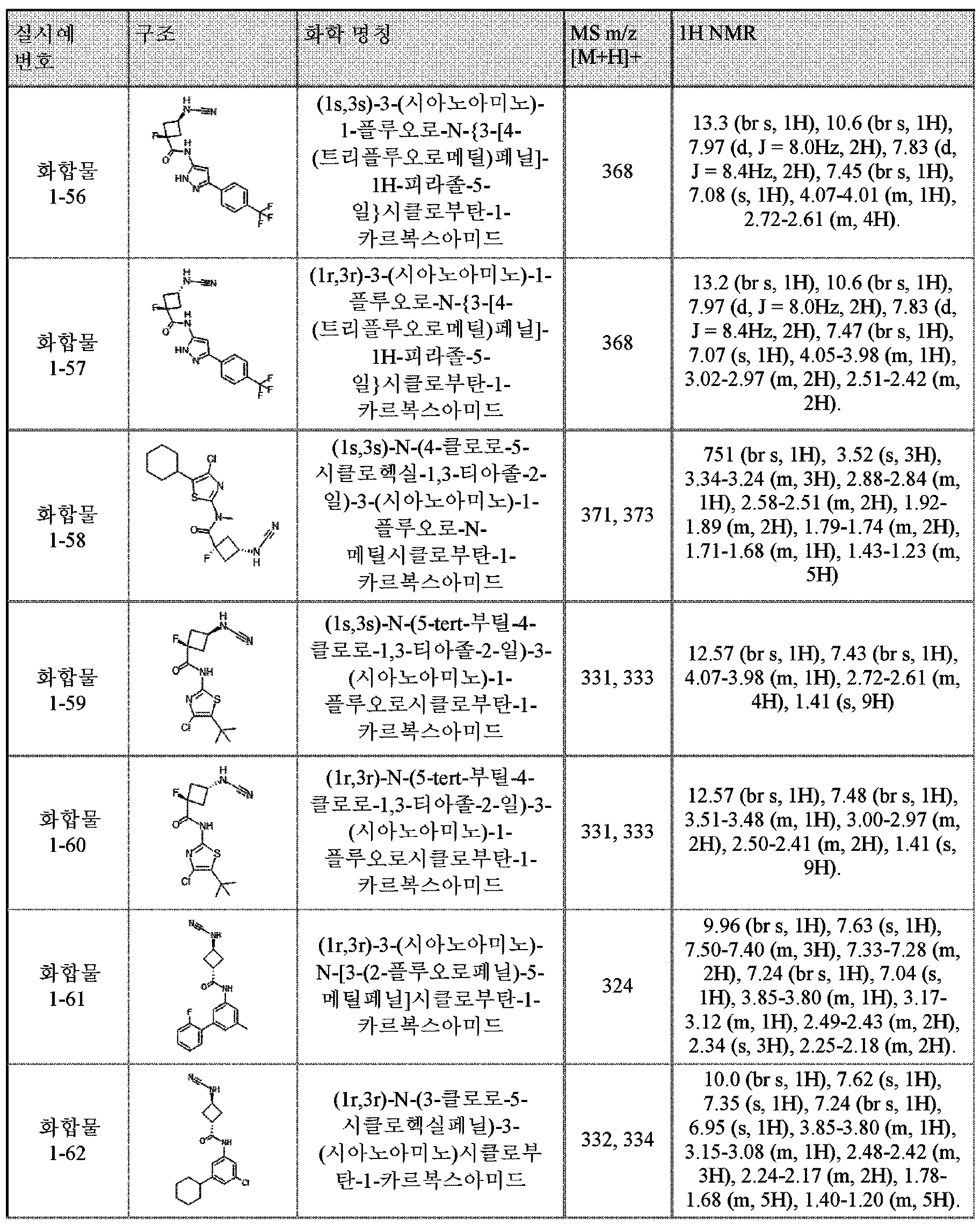


실시예 2-1. 3-(시아노아미노)-N-(5-시클로헥실-1,3-티아졸-2-일)아제티딘-1-카르복스아미드 (화합물 2-1)Example 2-1. 3-(cyanoamino)-N-(5-cyclohexyl-1,3-thiazol-2-yl)azetidine-1-carboxamide (Compound 2-1)
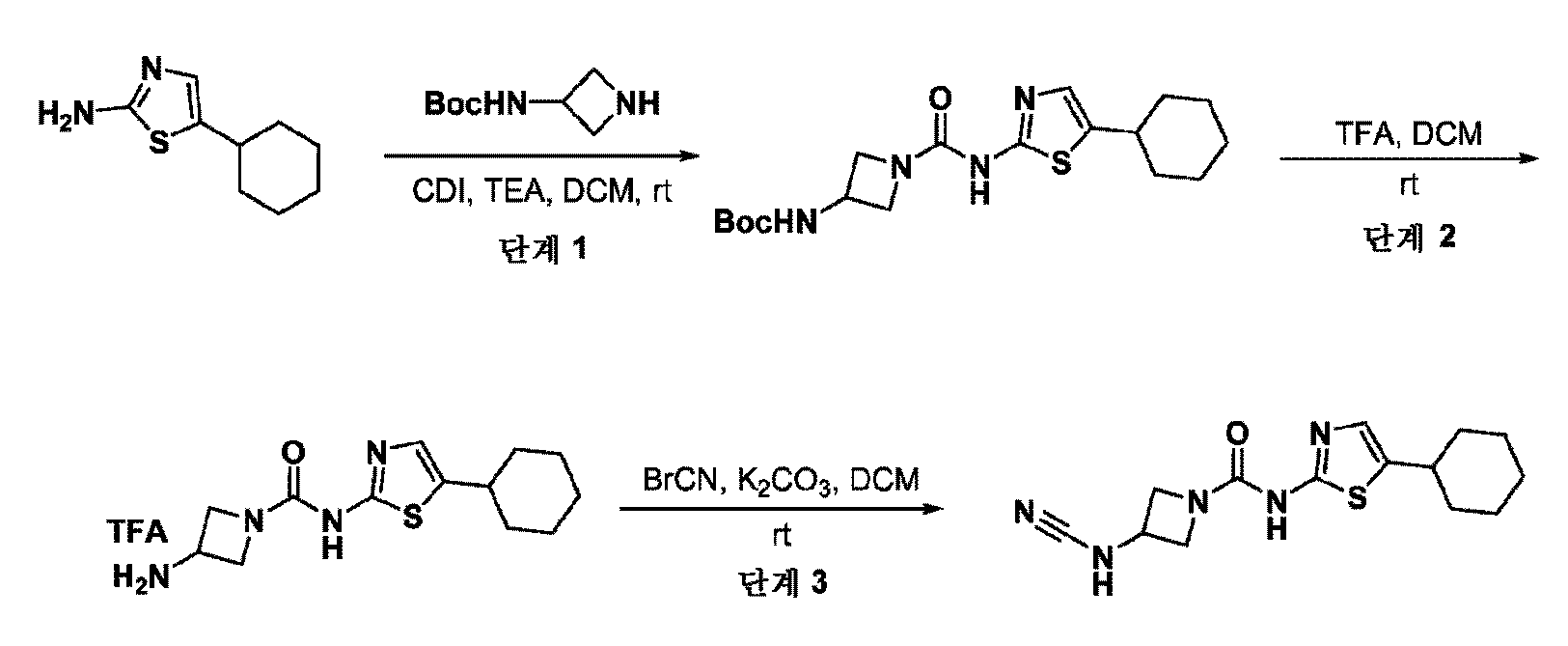
단계 1. tert-부틸 (1-((5-시클로헥실티아졸-2-일)카르바모일)아제티딘-3-일)카르바메이트Step 1. tert-Butyl (1-((5-cyclohexylthiazol-2-yl)carbamoyl)azetidin-3-yl)carbamate
50 mL 둥근 바닥 플라스크에 5-시클로헥실티아졸-2-아민 (300 mg, 1.65 mmol), 디클로로메탄 (5 mL) 및 트리에틸아민 (833 mg, 8.23 mmol)을 담았다. 이어서, N,N'-카르보닐디이미다졸 (348 mg, 2.15 mmol)을 첨가하였다. 생성된 용액을 실온에서 2시간 동안 교반하였다. 이어서, tert-부틸 아제티딘-3-일카르바메이트 (369 mg, 2.14 mmol)를 첨가하였다. 생성된 용액을 실온에서 밤새 교반하였다. 반응 혼합물을 물 (5 mL)에 부은 다음, 에틸 아세테이트 (3 x 10 mL)로 추출하였다. 유기 층을 합하고, 무수 황산나트륨 상에서 건조시키고, 여과하고, 진공 하에 농축시켰다. 잔류물을 실리카 겔 크로마토그래피 (1:1 에틸 아세테이트/석유 에테르를 사용하여 용리함)에 의해 정제하여 tert-부틸 (1-((5-시클로헥실티아졸-2-일)카르바모일)아제티딘-3-일)카르바메이트를 황색 고체로서 수득하였다.A 50 mL round bottom flask was charged with 5-cyclohexylthiazole-2-amine (300 mg, 1.65 mmol), dichloromethane (5 mL) and triethylamine (833 mg, 8.23 mmol). Then, N,N'-carbonyldiimidazole (348 mg, 2.15 mmol) was added. The resulting solution was stirred at room temperature for 2 hours. Then tert-butyl azetidin-3-ylcarbamate (369 mg, 2.14 mmol) was added. The resulting solution was stirred overnight at room temperature. The reaction mixture was poured into water (5 mL), then extracted with ethyl acetate (3 x 10 mL). The organic layers were combined, dried over anhydrous sodium sulfate, filtered and concentrated in vacuo. The residue was purified by silica gel chromatography (eluting with 1:1 ethyl acetate/petroleum ether) to tert-butyl (1-((5-cyclohexylthiazol-2-yl)carbamoyl)ase Tidin-3-yl)carbamate was obtained as a yellow solid.
LC-MS (ESI) m/z 381.2[M+H]+ LC-MS (ESI) m/z 381.2 [M+H] +
단계 2. 3-아미노-N-(5-시클로헥실티아졸-2-일)아제티딘-1-카르복스아미드 TFA 염Step 2. 3-Amino-N-(5-cyclohexylthiazol-2-yl)azetidine-1-carboxamide TFA salt
50 mL 둥근 바닥 플라스크에 tert-부틸 (1-((5-시클로헥실티아졸-2-일)카르바모일)아제티딘-3-일)카르바메이트 (190 mg, 0.50 mmol), 디클로로메탄 (3 mL) 및 트리플루오로아세트산 (1 mL)을 담았다. 생성된 용액을 실온에서 2시간 동안 교반하였다. 반응 혼합물을 진공 하에 농축시켰다. 잔류물을 에틸 에테르로 처리하고, 진공 하에 건조시켜 3-아미노-N-(5-시클로헥실티아졸-2-일)아제티딘-1-카르복스아미드 TFA 염을 황색 오일로서 수득하였다.In a 50 mL round bottom flask tert-butyl (1-((5-cyclohexylthiazol-2-yl)carbamoyl)azetidin-3-yl)carbamate (190 mg, 0.50 mmol), dichloromethane ( 3 mL) and trifluoroacetic acid (1 mL). The resulting solution was stirred at room temperature for 2 hours. The reaction mixture was concentrated in vacuo. The residue was treated with ethyl ether and dried under vacuum to give 3-amino-N-(5-cyclohexylthiazol-2-yl)azetidine-1-carboxamide TFA salt as a yellow oil.
LC-MS (ESI) m/z 281.2[M+H]+ LC-MS (ESI) m/z 281.2 [M+H] +
단계 3. 3-(시아노아미노)-N-(5-시클로헥실-1,3-티아졸-2-일)아제티딘-1-카르복스아미드Step 3. 3-(Cyanoamino)-N-(5-cyclohexyl-1,3-thiazol-2-yl)azetidine-1-carboxamide
50 mL 둥근 바닥 플라스크에 3-아미노-N-(5-시클로헥실티아졸-2-일)아제티딘-1-카르복스아미드 TFA 염 (160 mg, 0.41 mmol), 디클로로메탄 (5 mL), 탄산칼륨 (169 mg, 1.22 mmol) 및 브로민화시아노겐 (44 mg, 0.42 mmol)을 담았다. 생성된 용액을 실온에서 2시간 동안 교반하였다. 반응 혼합물을 물 (5 mL)에 부은 다음, 에틸 아세테이트 (3 x 10 mL)로 추출하였다. 유기 층을 합하고, 무수 황산나트륨 상에서 건조시키고, 여과하고, 진공 하에 농축시켰다. 잔류물을 정제용 HPLC (칼럼: 엑스브리지 쉴드(XBridge Shield) RP18 OBD 칼럼, 130 Å, 5 μm, 19 mm x 150 mm; 이동상: 물 (10 mM NH4HCO3), MeCN (30% MeCN에서 50%까지, 10분에 걸침); 유량: 20 mL/분; 검출기: 254 & 220 nm)에 의해 정제하여 3-시안아미도-N-(5-시클로헥실티아졸-2-일)아제티딘-1-카르복스아미드를 백색 고체로서 수득하였다.3-amino-N-(5-cyclohexylthiazol-2-yl)azetidine-1-carboxamide TFA salt (160 mg, 0.41 mmol), dichloromethane (5 mL), carbonic acid in a 50 mL round bottom flask Potassium (169 mg, 1.22 mmol) and bromide cyanogen (44 mg, 0.42 mmol) were added. The resulting solution was stirred at room temperature for 2 hours. The reaction mixture was poured into water (5 mL), then extracted with ethyl acetate (3 x 10 mL). The organic layers were combined, dried over anhydrous sodium sulfate, filtered and concentrated in vacuo. The residue was purified HPLC (column: XBridge Shield RP18 OBD column, 130 mm 3, 5 μm, 19 mm×150 mm; mobile phase: water (10 mM NH 4 HCO 3 ), MeCN (at 30% MeCN Up to 50%, over 10 minutes); flow rate: 20 mL/min; detector: 254 & 220 nm) to purify by 3-cyanamido-N-(5-cyclohexylthiazol-2-yl)azetidine -1-Carboxamide was obtained as a white solid.
1H NMR (300 MHz, DMSO-d6) δ 6.96(s, 1H), 4.43-4.38(m, 2H), 4.21-4.10(m, 3H), 2.77-2.73(m, 1H), 1.81(s, 4H), 1.45-1.32(m, 7H). 1 H NMR (300 MHz, DMSO-d 6 ) δ 6.96 (s, 1H), 4.43-4.38 (m, 2H), 4.21-4.10 (m, 3H), 2.77-2.73 (m, 1H), 1.81 (s , 4H), 1.45-1.32 (m, 7H).
LC-MS (ESI) m/z 306.2[M+H]+ LC-MS (ESI) m/z 306.2 [M+H] +
실시예 3-1. 5-페닐-N-[(트랜스)-3-(시아노아미노)시클로부틸]-1,3-티아졸-2-카르복스아미드 (화합물 3-1)Example 3-1. 5-phenyl-N-[(trans)-3-(cyanoamino)cyclobutyl]-1,3-thiazole-2-carboxamide (Compound 3-1)

단계 1. tert-부틸 ((트랜스)-3-(5-브로모티아졸-2-카르복스아미도)시클로부틸)카르바메이트Step 1. tert-Butyl ((trans)-3-(5-bromothiazole-2-carboxamido)cyclobutyl)carbamate
100 mL 둥근 바닥 플라스크에 5-브로모티아졸-2-카르복실산 (300 mg, 1.41 mmol), N,N-디메틸포름아미드 (5 mL), tert-부틸 N-[(트랜스)-3-아미노시클로부틸]카르바메이트 (270 mg, 1.42 mmol), N,N-디이소프로필에틸아민 (560 mg, 4.33 mmol) 및 HATU (661 mg, 1.74 mmol)를 담았다. 생성된 용액을 실온에서 1시간 동안 교반하였다. 반응 혼합물을 물 (5 mL)에 부은 다음, 에틸 아세테이트 (3 x 10 mL)로 추출하였다. 유기 층을 합하고, 무수 황산나트륨 상에서 건조시키고, 여과하고, 진공 하에 농축시켰다. 잔류물을 정제용 TLC (1:1 에틸 아세테이트/석유 에테르를 사용하여 용리함)에 의해 정제하여 tert-부틸 ((트랜스)-3-(5-브로모티아졸-2-카르복스아미도)시클로부틸)카르바메이트를 황색 고체로서 수득하였다.5-Bromothiazole-2-carboxylic acid (300 mg, 1.41 mmol), N,N-dimethylformamide (5 mL), tert-butyl N-[(trans)-3-amino in a 100 mL round bottom flask Cyclobutyl]carbamate (270 mg, 1.42 mmol), N,N-diisopropylethylamine (560 mg, 4.33 mmol) and HATU (661 mg, 1.74 mmol). The resulting solution was stirred at room temperature for 1 hour. The reaction mixture was poured into water (5 mL), then extracted with ethyl acetate (3 x 10 mL). The organic layers were combined, dried over anhydrous sodium sulfate, filtered and concentrated in vacuo. The residue was purified by preparative TLC (eluting with 1:1 ethyl acetate/petroleum ether) to tert-butyl ((trans)-3-(5-bromothiazole-2-carboxamido)cyclo Butyl)carbamate was obtained as a yellow solid.
LC-MS (ESI) m/z 320.0, 322.0 [M+H-tBu]+ LC-MS (ESI) m/z 320.0, 322.0 [M+H-tBu] +
단계 2. tert-부틸 ((트랜스)-3-(5-페닐티아졸-2-카르복스아미도)시클로부틸)카르바메이트Step 2. tert-Butyl ((trans)-3-(5-phenylthiazole-2-carboxamido)cyclobutyl)carbamate
퍼징하고 질소의 불활성 분위기로 유지시킨 100 mL 둥근 바닥 플라스크에 tert-부틸 ((트랜스)-3-(5-브로모티아졸-2-카르복스아미도)시클로부틸)카르바메이트 (200 mg, 0.51 mmol), 1,4-디옥산 (15 mL), 물 (5 mL), 페닐보론산 (78 mg, 0.63 mmol, 1.23), 탄산칼륨 (219 mg, 1.58 mmol) 및 Pd(dppf)Cl2 (39 mg, 0.05 mmol)를 담았다. 생성된 혼합물을 80℃에서 밤새 교반하였다. 실온으로 냉각시킨 후, 반응 혼합물을 물 (10 mL)에 부은 다음, 에틸 아세테이트 (3 x 10 mL)로 추출하였다. 유기 층을 합하고, 무수 황산나트륨 상에서 건조시키고, 여과하고, 진공 하에 농축시켰다. 잔류물을 실리카 겔 크로마토그래피 (1:1 에틸 아세테이트/석유 에테르를 사용하여 용리함)에 의해 정제하여 tert-부틸 ((트랜스)-3-(5-페닐티아졸-2-카르복스아미도)시클로부틸)카르바메이트를 백색 고체로서 수득하였다.In a 100 mL round bottom flask purged and maintained in an inert atmosphere of nitrogen, tert-butyl ((trans)-3-(5-bromothiazole-2-carboxamido)cyclobutyl)carbamate (200 mg, 0.51 mmol), 1,4-dioxane (15 mL), water (5 mL), phenylboronic acid (78 mg, 0.63 mmol, 1.23), potassium carbonate (219 mg, 1.58 mmol) and Pd(dppf)Cl 2 ( 39 mg, 0.05 mmol). The resulting mixture was stirred at 80°C overnight. After cooling to room temperature, the reaction mixture was poured into water (10 mL), then extracted with ethyl acetate (3 x 10 mL). The organic layers were combined, dried over anhydrous sodium sulfate, filtered and concentrated in vacuo. The residue was purified by silica gel chromatography (eluting with 1:1 ethyl acetate/petroleum ether) to tert-butyl ((trans)-3-(5-phenylthiazole-2-carboxamido) Cyclobutyl)carbamate was obtained as a white solid.
LC-MS (ESI) m/z 374.2 [M+H]+ LC-MS (ESI) m/z 374.2 [M+H] +
단계 3. N-((트랜스)-3-아미노시클로부틸)-5-페닐티아졸-2-카르복스아미드 TFA 염Step 3. N-((Trans)-3-aminocyclobutyl)-5-phenylthiazole-2-carboxamide TFA salt
50 mL 둥근 바닥 플라스크에 tert-부틸 ((트랜스)-3-(5-페닐티아졸-2-카르복스아미도)시클로부틸)카르바메이트 (60 mg, 0.15 mmol), 디클로로메탄 (3 mL) 및 트리플루오로아세트산 (0.6 mL)을 담았다. 생성된 용액을 실온에서 1시간 동안 교반하였다. 반응 혼합물을 진공 하에 농축시켰다. 잔류물을 에틸 에테르로 처리하고, 진공 하에 건조시켜 N-((트랜스)-3-아미노시클로부틸)-5-페닐티아졸-2-카르복스아미드 TFA 염을 황색 오일로서 수득하였다.In a 50 mL round bottom flask tert-butyl ((trans)-3-(5-phenylthiazole-2-carboxamido)cyclobutyl)carbamate (60 mg, 0.15 mmol), dichloromethane (3 mL) And trifluoroacetic acid (0.6 mL). The resulting solution was stirred at room temperature for 1 hour. The reaction mixture was concentrated in vacuo. The residue was treated with ethyl ether and dried under vacuum to give N-((trans)-3-aminocyclobutyl)-5-phenylthiazole-2-carboxamide TFA salt as a yellow oil.
LC-MS (ESI) m/z 274.2 [M+H]+ LC-MS (ESI) m/z 274.2 [M+H] +
단계 4. 5-페닐-N-[(트랜스)-3-(시아노아미노)시클로부틸]-1,3-티아졸-2-카르복스아미드Step 4. 5-phenyl-N-[(trans)-3-(cyanoamino)cyclobutyl]-1,3-thiazole-2-carboxamide
50 mL 둥근 바닥 플라스크에 N-((트랜스)-3-아미노시클로부틸)-5-페닐티아졸-2-카르복스아미드 TFA 염 (50 mg, 0.12 mmol), 테트라히드로푸란 (5 mL) 및 트리에틸아민 (16 mg, 0.16 mmol)을 담았다. -10℃로 냉각시킨 후, 이 용액에 브로민화시아노겐 (17 mg, 0.16 mmol)을 첨가하였다. 생성된 용액을 -10℃에서 30분 동안 교반하였다. 반응 혼합물을 물 (5 mL)에 부은 다음, 에틸 아세테이트 (3 x 10 mL)로 추출하였다. 유기 층을 합하고, 무수 황산나트륨 상에서 건조시키고, 여과하고, 진공 하에 농축시켰다. 잔류물을 정제용 HPLC (칼럼: 엑스브리지 쉴드 RP18 OBD 칼럼, 130 Å, 5 μm, 19 mm x 150 mm; 이동상: 물 (10 mM NH4HCO3), MeCN (25% MeCN에서 55%까지, 7분에 걸침); 유량: 20 mL/분; 검출기: 254 & 220 nm)에 의해 정제하여 N-((트랜스)-3-시안아미도시클로부틸)-5-페닐티아졸-2-카르복스아미드를 백색 고체로서 수득하였다.In a 50 mL round bottom flask N-((trans)-3-aminocyclobutyl)-5-phenylthiazole-2-carboxamide TFA salt (50 mg, 0.12 mmol), tetrahydrofuran (5 mL) and tri Ethylamine (16 mg, 0.16 mmol) was added. After cooling to -10°C, brominated cyanogen (17 mg, 0.16 mmol) was added to the solution. The resulting solution was stirred at -10°C for 30 minutes. The reaction mixture was poured into water (5 mL), then extracted with ethyl acetate (3 x 10 mL). The organic layers were combined, dried over anhydrous sodium sulfate, filtered and concentrated in vacuo. The residue was purified HPLC (column: Exbridge Shield RP18 OBD column, 130 mm 3, 5 μm, 19 mm×150 mm; mobile phase: water (10 mM NH 4 HCO 3 ), MeCN (25% MeCN to 55%, Purified over 7 minutes); flow rate: 20 mL/min; purified by detector: 254 & 220 nm) N-((trans)-3-cyanamicyclobutyl)-5-phenylthiazole-2-carbox Amide was obtained as a white solid.
1H NMR (400 MHz, DMSO-d6) δ 9.31 (d, J = 7.60 Hz, 1H), 8.44 (s, 1H), 7.80-7.77 (m, 2H), 7.51-7.41 (m, 3H), 7.22 (s, 1H), 4.56-4.50 (m, 1H), 3.85 (d, J = 3.20 Hz, 1H), 2.51-2.46 (m, 2H), 2.33-2.08 (m, 2H). 1 H NMR (400 MHz, DMSO-d 6 ) δ 9.31 (d, J = 7.60 Hz, 1H), 8.44 (s, 1H), 7.80-7.77 (m, 2H), 7.51-7.41 (m, 3H), 7.22 (s, 1H), 4.56-4.50 (m, 1H), 3.85 (d, J = 3.20 Hz, 1H), 2.51-2.46 (m, 2H), 2.33-2.08 (m, 2H).
LC-MS (ESI) m/z 299.2 [M+H]+ LC-MS (ESI) m/z 299.2 [M+H] +
하기 화합물을 화합물 3-1과 유사한 방식으로 합성하였다:The following compound was synthesized in a similar manner to compound 3-1:

실시예 4-1. 5-페닐-N-[(시스)-3-(시아노아미노)시클로부틸]-1,3-티아졸-2-카르복스아미드 (화합물 4-1)Example 4-1. 5-phenyl-N-[(cis)-3-(cyanoamino)cyclobutyl]-1,3-thiazole-2-carboxamide (Compound 4-1)

단계 1. 5-페닐티아졸-2-카르복실산Step 1. 5-phenylthiazole-2-carboxylic acid
퍼징하고 질소의 불활성 분위기로 유지시킨 100 mL 둥근 바닥 플라스크에 5-브로모티아졸-2-카르복실산 (1 g, 4.71 mmol), 페닐보론산 (707 mg, 5.68 mmol), 탄산칼륨 (2 g, 14.47 mmol), 1,4-디옥산 (20 mL), 물 (2 mL) 및 Pd(dppf)Cl2 (352 mg, 0.48 mmol)를 담았다. 생성된 혼합물을 80℃에서 16시간 동안 교반하였다. 실온으로 냉각시킨 후, 반응 혼합물을 물 (5 mL)에 부은 다음, 에틸 에테르 (2 x 5 mL)로 세척하였다. 수성 층을 염산 (1N)을 사용하여 pH 5로 산성화시킨 다음, 에틸 아세테이트 (3 x 20 mL)로 추출하였다. 유기 층을 합하고, 무수 황산나트륨 상에서 건조시키고, 여과하고, 진공 하에 농축시켜 5-페닐티아졸-2-카르복실산을 갈색 고체로서 수득하였다.5-bromothiazole-2-carboxylic acid (1 g, 4.71 mmol), phenylboronic acid (707 mg, 5.68 mmol), potassium carbonate (2 g) in a 100 mL round bottom flask purged and maintained in an inert atmosphere of nitrogen. , 14.47 mmol), 1,4-dioxane (20 mL), water (2 mL) and Pd(dppf)Cl 2 (352 mg, 0.48 mmol). The resulting mixture was stirred at 80° C. for 16 hours. After cooling to room temperature, the reaction mixture was poured into water (5 mL), then washed with ethyl ether (2 x 5 mL). The aqueous layer was acidified to pH 5 with hydrochloric acid (1N), then extracted with ethyl acetate (3 x 20 mL). The organic layers were combined, dried over anhydrous sodium sulfate, filtered and concentrated in vacuo to give 5-phenylthiazole-2-carboxylic acid as a brown solid.
LC-MS (ESI) m/z 206.1 [M+H]+ LC-MS (ESI) m/z 206.1 [M+H] +
단계 2. tert-부틸 ((시스)-3-(5-페닐티아졸-2-카르복스아미도)시클로부틸)카르바메이트Step 2. tert-Butyl ((cis)-3-(5-phenylthiazole-2-carboxamido)cyclobutyl)carbamate
100 mL 둥근 바닥 플라스크에 5-페닐티아졸-2-카르복실산 (120 mg, 0.56 mmol), N,N-디메틸포름아미드 (20 mL), tert-부틸 N-[(시스)-3-아미노시클로부틸]카르바메이트 (109 mg, 0.57 mmol), N,N-디이소프로필에틸아민 (227 mg, 1.76 mmol) 및 HATU (267 mg, 0.70 mmol)를 담았다. 생성된 용액을 실온에서 1시간 동안 교반하였다. 반응 혼합물을 물 (10 mL)에 부은 다음, 에틸 아세테이트 (3 x 20 mL)로 추출하였다. 유기 층을 합하고, 무수 황산나트륨 상에서 건조시키고, 여과하고, 진공 하에 농축시켰다. 잔류물을 실리카 겔 크로마토그래피 (1:3 에틸 아세테이트/석유 에테르를 사용하여 용리함)에 의해 정제하여 tert-부틸 ((시스)-3-(5-페닐티아졸-2-카르복스아미도)시클로부틸)카르바메이트를 백색 고체로서 수득하였다.5-phenylthiazole-2-carboxylic acid (120 mg, 0.56 mmol), N,N-dimethylformamide (20 mL), tert-butyl N-[(cis)-3-amino in a 100 mL round bottom flask Cyclobutyl]carbamate (109 mg, 0.57 mmol), N,N-diisopropylethylamine (227 mg, 1.76 mmol) and HATU (267 mg, 0.70 mmol). The resulting solution was stirred at room temperature for 1 hour. The reaction mixture was poured into water (10 mL), then extracted with ethyl acetate (3 x 20 mL). The organic layers were combined, dried over anhydrous sodium sulfate, filtered and concentrated in vacuo. The residue was purified by silica gel chromatography (eluting with 1:3 ethyl acetate/petroleum ether) to tert-butyl ((cis)-3-(5-phenylthiazole-2-carboxamido) Cyclobutyl)carbamate was obtained as a white solid.
LC-MS (ESI) m/z 374.2 [M+H]+ LC-MS (ESI) m/z 374.2 [M+H] +
단계 3. N-(시스)-3-아미노시클로부틸)-5-페닐티아졸-2-카르복스아미드 TFA 염Step 3. N-(Cis)-3-aminocyclobutyl)-5-phenylthiazole-2-carboxamide TFA salt
50 mL 둥근 바닥 플라스크에 tert-부틸 (시스)-3-(5-페닐티아졸-2-카르복스아미도)시클로부틸)카르바메이트 (200 mg, 0.51 mmol), 디클로로메탄 (5 mL) 및 트리플루오로아세트산 (1 mL)을 담았다. 생성된 용액을 실온에서 1시간 동안 교반하였다. 반응 혼합물을 진공 하에 농축시켰다. 잔류물을 에틸 에테르로 처리하고, 진공 하에 건조시켜 N-(시스)-3-아미노시클로부틸)-5-페닐티아졸-2-카르복스아미드 TFA 염을 황색 오일로서 수득하였다.In a 50 mL round bottom flask tert-butyl (cis)-3-(5-phenylthiazole-2-carboxamido)cyclobutyl)carbamate (200 mg, 0.51 mmol), dichloromethane (5 mL) and Trifluoroacetic acid (1 mL) was added. The resulting solution was stirred at room temperature for 1 hour. The reaction mixture was concentrated in vacuo. The residue was treated with ethyl ether and dried under vacuum to give N-(cis)-3-aminocyclobutyl)-5-phenylthiazole-2-carboxamide TFA salt as a yellow oil.
LC-MS (ESI) m/z 274.2 [M+H]+ LC-MS (ESI) m/z 274.2 [M+H] +
단계 4. 5-페닐-N-[(시스)-3-(시아노아미노)시클로부틸]-1,3-티아졸-2-카르복스아미드Step 4. 5-phenyl-N-[(cis)-3-(cyanoamino)cyclobutyl]-1,3-thiazole-2-carboxamide
50 mL 둥근 바닥 플라스크에 N-(시스)-3-아미노시클로부틸)-5-페닐티아졸-2-카르복스아미드 TFA 염 (120 mg, 0.29 mmol), 테트라히드로푸란 (10 mL) 및 트리에틸아민 (54 mg, 0.53 mmol)을 담았다. -10℃로 냉각시킨 후, 이 용액에 브로민화시아노겐 (56 mg, 0.52 mmol)을 첨가하였다. 생성된 용액을 -10℃에서 30분 동안 교반하였다. 반응 혼합물을 물 (5 mL)에 부은 다음, 에틸 아세테이트 (3 x 10 mL)로 추출하였다. 유기 층을 합하고, 무수 황산나트륨 상에서 건조시키고, 여과하고, 진공 하에 농축시켰다. 잔류물을 정제용 HPLC (칼럼: 엑스브리지 쉴드 RP18 OBD 칼럼, 130 Å, 5 μm, 19 mm x 150 mm; 이동상: 물 (10 mM NH4HCO3), MeCN (25% MeCN에서 55%까지, 7분에 걸침); 유량: 20 mL/분; 검출기: 254 & 220 nm)에 의해 정제하여 N-(시스)-3-시안아미도시클로부틸)-5-페닐티아졸-2-카르복스아미드를 백색 고체로서 수득하였다.N-(cis)-3-aminocyclobutyl)-5-phenylthiazole-2-carboxamide TFA salt (120 mg, 0.29 mmol), tetrahydrofuran (10 mL) and triethyl in a 50 mL round bottom flask Amine (54 mg, 0.53 mmol) was added. After cooling to -10°C, cyanobromide (56 mg, 0.52 mmol) was added to the solution. The resulting solution was stirred at -10°C for 30 minutes. The reaction mixture was poured into water (5 mL), then extracted with ethyl acetate (3 x 10 mL). The organic layers were combined, dried over anhydrous sodium sulfate, filtered and concentrated in vacuo. The residue was purified HPLC (column: Exbridge Shield RP18 OBD column, 130 mm 3, 5 μm, 19 mm×150 mm; mobile phase: water (10 mM NH 4 HCO 3 ), MeCN (25% MeCN to 55%, Purified over 7 min); flow rate: 20 mL/min; detector: 254 & 220 nm) purified by N-(cis)-3-cyanamicyclocyclo)-5-phenylthiazole-2-carboxamide Was obtained as a white solid.
1H NMR (400 MHz, DMSO-d6) δ 9.30 (d, J = 7.60 Hz, 1H), 8.43 (s, 1H), 7.78 (d, J = 7.20 Hz, 2H), 7.51-7.43 (m, 3H), 7.17 (d, J = 4.40 Hz, 1H), 4.06-4.04 (m, 1H), 3.39-3.33 (m, 1H), 2.56-2.50 (m, 2H), 2.23-2.16 (m, 2H). 1 H NMR (400 MHz, DMSO-d 6 ) δ 9.30 (d, J = 7.60 Hz, 1H), 8.43 (s, 1H), 7.78 (d, J = 7.20 Hz, 2H), 7.51-7.43 (m, 3H), 7.17 (d, J = 4.40 Hz, 1H), 4.06-4.04 (m, 1H), 3.39-3.33 (m, 1H), 2.56-2.50 (m, 2H), 2.23-2.16 (m, 2H) .
LC-MS (ESI) m/z 299.2 [M+H]+ LC-MS (ESI) m/z 299.2 [M+H] +
실시예 5: 시스-3-(시아노아미노)-N-(5-시클로헥실-1,3-티아졸-2-일)시클로부탄-1-카르복스아미드 (화합물 5-3)Example 5: Cis-3-(cyanoamino)-N-(5-cyclohexyl-1,3-thiazol-2-yl)cyclobutane-1-carboxamide (Compound 5-3)

단계 1. tert-부틸 N-[시스-3-[(5-시클로헥실-1,3-티아졸-2-일)카르바모일]시클로부틸]카르바메이트Step 1. tert-Butyl N-[cis-3-[(5-cyclohexyl-1,3-thiazol-2-yl)carbamoyl]cyclobutyl]carbamate
DMF (4 mL) 중 시스-3-[[(tert-부톡시)카르보닐]아미노]시클로부탄-1-카르복실산 (100 mg, 0.465 mmol)의 교반 혼합물에 25℃에서 HATU (212 mg, 0.560 mmol), DIEA (0.230 mL, 1.39 mmol) 및 5-시클로헥실-1,3-티아졸-2-아민 (93.0 mg, 0.510 mmol)을 첨가하였다. 생성된 용액을 25℃에서 1.5시간 동안 교반하였다. 생성된 혼합물을 물 (10 mL)로 희석하고, DCM (3 x 15 mL)으로 추출하였다. 합한 유기 층을 염수 (4 x 30 mL)로 세척하고, 무수 황산나트륨 상에서 건조시키고, 여과하고, 감압 하에 농축시켰다. 잔류물을 실리카 겔 칼럼 크로마토그래피 (에틸 아세테이트/석유 에테르 1/1을 사용하여 용리함)에 의해 정제하여 tert-부틸 N-[시스-3-[(5-시클로헥실-1,3-티아졸-2-일)카르바모일]시클로부틸]카르바메이트를 백색 고체 (98.0 mg)로서 수득하였다.To a stirred mixture of cis-3-[[((tert-butoxy)carbonyl]amino]cyclobutane-1-carboxylic acid (100 mg, 0.465 mmol) in DMF (4 mL) at 25° C. HATU (212 mg, 0.560 mmol), DIEA (0.230 mL, 1.39 mmol) and 5-cyclohexyl-1,3-thiazole-2-amine (93.0 mg, 0.510 mmol) were added. The resulting solution was stirred at 25° C. for 1.5 hours. The resulting mixture was diluted with water (10 mL) and extracted with DCM (3 x 15 mL). The combined organic layers were washed with brine (4 x 30 mL), dried over anhydrous sodium sulfate, filtered and concentrated under reduced pressure. The residue was purified by silica gel column chromatography (eluted with ethyl acetate/petroleum ether 1/1) to tert-butyl N-[cis-3-[(5-cyclohexyl-1,3-thiazole) -2-yl)carbamoyl]cyclobutyl]carbamate was obtained as a white solid (98.0 mg).
LCMS (ES, m/z): 380 [M+H]+.LCMS (ES, m/z): 380 [M+H] + .
단계 2. 시스-3-아미노-N-(5-시클로헥실-1,3-티아졸-2-일)시클로부탄-1-카르복스아미드 2,2,2-트리플루오로아세테이트Step 2. Cis-3-amino-N-(5-cyclohexyl-1,3-thiazol-2-yl)cyclobutane-1-carboxamide 2,2,2-trifluoroacetate
DCM (5 mL) 중 tert-부틸 N-[(시스)-3-[(5-시클로헥실-1,3-티아졸-2-일)카르바모일]시클로부틸]카르바메이트 (98.0 mg, 0.258 mmol) 및 TFA (1 mL)의 용액을 25℃에서 1시간 동안 교반하였다. 생성된 혼합물을 감압 하에 농축시켜 시스-3-아미노-N-(5-시클로헥실-1,3-티아졸-2-일)시클로부탄-1-카르복스아미드 2,2,2-트리플루오로아세테이트를 황색 오일 (102 mg)로서 수득하였다.Tert-butyl N-[(cis)-3-[(5-cyclohexyl-1,3-thiazol-2-yl)carbamoyl]cyclobutyl]carbamate (98.0 mg, in DCM (5 mL)) 0.258 mmol) and a solution of TFA (1 mL) was stirred at 25° C. for 1 hour. The resulting mixture was concentrated under reduced pressure to cis-3-amino-N-(5-cyclohexyl-1,3-thiazol-2-yl)cyclobutane-1-carboxamide 2,2,2-trifluoro Acetate was obtained as a yellow oil (102 mg).
LCMS (ES, m/z): 280 [M+H]+.LCMS (ES, m/z): 280 [M+H] + .
단계 3. 시스-3-(시아노아미노)-N-(5-시클로헥실-1,3-티아졸-2-일)시클로부탄-1-카르복스아미드Step 3. Cis-3-(cyanoamino)-N-(5-cyclohexyl-1,3-thiazol-2-yl)cyclobutane-1-carboxamide
DMF (2 mL) 중 시스-3-아미노-N-(5-시클로헥실-1,3-티아졸-2-일)시클로부탄-1-카르복스아미드 2,2,2-트리플루오로아세테이트 (102 mg, 0.271 mmol)의 교반 혼합물에 Et3N (0.072 mL, 0.520 mmol)을 0℃에서 적가하였다. 이어서, BrCN (28.0 mg, 0.260 mmol)을 첨가하였다. 혼합물을 25℃에서 2시간 동안 교반한 다음, 얼음/물 (5 mL)에 부었다. 생성된 혼합물을 DCM (3 x 10 mL)으로 추출하였다. 합한 유기 층을 염수 (20 mL)로 세척하고, 무수 황산나트륨 상에서 건조시키고, 여과하고, 감압 하에 농축시켰다. 잔류물을 정제용 HPLC (칼럼, 키네텍스(Kinetex) EVO C18 칼럼, 21.2 x 150 mm, 5 μm; 이동상, A: 물 (10 mmol/L NH4HCO3) 및 B: ACN (27%에서 46%까지, 10분); 검출기, UV 254/220 nm)에 의해 정제하였다. 수집된 분획을 동결건조시켜 시스-3-(시아노아미노)-N-(5-시클로헥실-1,3-티아졸-2-일)시클로부탄-1-카르복스아미드를 백색 고체 (14.9 mg)로서 수득하였다.Cis-3-amino-N-(5-cyclohexyl-1,3-thiazol-2-yl)cyclobutane-1-carboxamide 2,2,2-trifluoroacetate in DMF (2 mL) ( Et 3 N (0.072 mL, 0.520 mmol) was added dropwise to a stirred mixture of 102 mg, 0.271 mmol) at 0°C. Then BrCN (28.0 mg, 0.260 mmol) was added. The mixture was stirred at 25° C. for 2 hours, then poured into ice/water (5 mL). The resulting mixture was extracted with DCM (3 x 10 mL). The combined organic layers were washed with brine (20 mL), dried over anhydrous sodium sulfate, filtered and concentrated under reduced pressure. The residue was purified HPLC (column, Kinetex EVO C18 column, 21.2 x 150 mm, 5 μm; mobile phase, A: water (10 mmol/L NH 4 HCO 3 ) and B: ACN (27% to 46 %, 10 min); purified by detector, UV 254/220 nm). The collected fractions were lyophilized to give cis-3-(cyanoamino)-N-(5-cyclohexyl-1,3-thiazol-2-yl)cyclobutane-1-carboxamide as a white solid (14.9 mg ).
1H NMR (DMSO-d6, 400 MHz) δ (ppm): 11.88 (br s, 1H), 7.20 (br s, 1H), 7.14 (s, 1H), 3.67-3.55 (m, 1H), 2.97-2.85 (m, 1H), 2.83-2.71 (m, 1H), 2.47-2.36 (m, 2H), 2.20-2.10 (m, 2H), 2.00-1.88 (m, 2H), 1.81-1.71 (m, 2H), 1.71-1.62 (m, 1H), 1.44-1.29 (m, 4H), 1.28-1.15 (m, 1H). 1 H NMR (DMSO-d 6 , 400 MHz) δ (ppm): 11.88 (br s, 1H), 7.20 (br s, 1H), 7.14 (s, 1H), 3.67-3.55 (m, 1H), 2.97 -2.85 (m, 1H), 2.83-2.71 (m, 1H), 2.47-2.36 (m, 2H), 2.20-2.10 (m, 2H), 2.00-1.88 (m, 2H), 1.81-1.71 (m, 2H), 1.71-1.62 (m, 1H), 1.44-1.29 (m, 4H), 1.28-1.15 (m, 1H).
LCMS (ES, m/z): 305 [M+H]+ LCMS (ES, m/z): 305 [M+H] +
하기 화합물을 실시예 5에 따라 합성하였다:The following compounds were synthesized according to Example 5:


실시예 6: {[(1r,3r)-3-[(4S)-4-[(5-시클로헥실-1,3-티아졸-2-일)아미노]-2-옥소피롤리딘-1-일]시클로부틸]아미노}포르모니트릴 (화합물 6-1)Example 6: {[(1r,3r)-3-[(4S)-4-[(5-cyclohexyl-1,3-thiazol-2-yl)amino]-2-oxopyrrolidine-1 -Yl]cyclobutyl]amino}formonitrile (Compound 6-1)

단계 1. 1-(2-아미노-1,3-티아졸-5-일)시클로헥산-1-올Step 1. 1-(2-Amino-1,3-thiazol-5-yl)cyclohexane-1-ol
n-BuLi (헥산 중 2.5 M)의 용액 (200 mL)을 THF (200 mL) 중 1,3-티아졸-2-아민 (25.0 g, 0.250 mol)의 용액에 -78℃에서 첨가한 다음, 혼합물을 -78℃에서 15분 동안 교반하였다. 트리메틸클로로실란 (54.5 g, 0.500 mol)을 -78℃에서 첨가하였다. 생성된 혼합물을 -25℃에서 30분 동안 교반하였다. n-BuLi (헥산 중 2.5 M)의 용액 (100 mL)을 -78℃에서 첨가하고, 혼합물을 -78℃에서 15분 동안 교반하였다. 시클로헥사논 (27.0 g, 0.275 mol)을 첨가하고, 생성된 혼합물을 -78℃에서 추가로 30분 동안 교반하였다. 반응물을 -78℃에서 염화암모늄 (200 mL 포화)으로 켄칭하였다. 생성된 혼합물을 에틸 아세테이트 (3 x 200 mL)로 추출하였다. 합한 유기 층을 염수 (200 mL)로 세척하고, 무수 황산나트륨 상에서 건조시키고, 여과하고, 진공 하에 농축시켜 1-(2-아미노-1,3-티아졸-5-일)시클로헥산-1-올을 갈색 고체 (26.0 g)로서 수득하였다.A solution of n-BuLi (2.5 M in hexane) (200 mL) was added to a solution of 1,3-thiazol-2-amine (25.0 g, 0.250 mol) in THF (200 mL) at -78 °C, then The mixture was stirred at -78°C for 15 minutes. Trimethylchlorosilane (54.5 g, 0.500 mol) was added at -78 °C. The resulting mixture was stirred at -25°C for 30 minutes. A solution of n-BuLi (2.5 M in hexane) (100 mL) was added at -78 °C, and the mixture was stirred at -78 °C for 15 minutes. Cyclohexanone (27.0 g, 0.275 mol) was added and the resulting mixture was stirred at -78°C for an additional 30 minutes. The reaction was quenched with ammonium chloride (200 mL saturated) at -78 °C. The resulting mixture was extracted with ethyl acetate (3 x 200 mL). The combined organic layers were washed with brine (200 mL), dried over anhydrous sodium sulfate, filtered, and concentrated in vacuo to 1-(2-amino-1,3-thiazol-5-yl)cyclohexane-1-ol. Was obtained as a brown solid (26.0 g).
LCMS (ES, m/z) 199 [M+H]+.LCMS (ES, m/z) 199 [M+H] + .
단계 2. 5-시클로헥실-1,3-티아졸-2-아민Step 2. 5-cyclohexyl-1,3-thiazole-2-amine
트리에틸실란 (122 g, 1.05 mol) 및 TFA (90 mL)를 DCM (500 mL) 중 1-(2-아미노-1,3-티아졸-5-일)시클로헥산-1-올 (23.0 g, 115 mmol)의 용액에 첨가하고, 반응 혼합물을 25℃에서 1시간 동안 교반하였다. 생성된 혼합물을 진공 하에 농축시켰다. 잔류물을 에틸 에테르 (50 mL)로부터 재결정화하였다. 고체를 여과에 의해 수집하여 5-시클로헥실-1,3-티아졸-2-아민을 회백색 고체 (18.0 g)로서 수득하였다.Triethylsilane (122 g, 1.05 mol) and TFA (90 mL) were added 1-(2-amino-1,3-thiazol-5-yl)cyclohexane-1-ol (23.0 g) in DCM (500 mL). , 115 mmol), and the reaction mixture was stirred at 25°C for 1 hour. The resulting mixture was concentrated in vacuo. The residue was recrystallized from ethyl ether (50 mL). The solid was collected by filtration to give 5-cyclohexyl-1,3-thiazole-2-amine as an off-white solid (18.0 g).
LCMS (ES, m/z): 183 [M+H]+.LCMS (ES, m/z): 183 [M+H] + .
단계 3. 2-브로모-5-시클로헥실-1,3-티아졸Step 3. 2-Bromo-5-cyclohexyl-1,3-thiazole
tert-부틸 니트라이트 (8.83 mL, 81.4 mmol)를 0℃에서 ACN (200 mL) 중 5-시클로헥실-1,3-티아졸-2-아민 (10.0 g, 54.9 mmol) 및 CuBr2 (24.5 g, 108 mmol)의 교반 혼합물에 첨가하였다. 생성된 혼합물을 25℃에서 1.5시간 동안 교반하였다. 반응물을 물 (100 mL)의 첨가에 의해 켄칭하였다. 용매를 진공 하에 제거하였다. 잔류물을 디클로로메탄 (3 x 300 mL)으로 추출하였다. 합한 유기 층을 무수 황산나트륨 상에서 건조시켰다. 여과한 후, 여과물을 감압 하에 농축시켰다. 잔류물을 실리카 겔 크로마토그래피 (1:10 에틸 아세테이트/석유 에테르를 사용하여 용리함)에 의해 정제하여 2-브로모-5-시클로헥실-1,3-티아졸을 황색 오일 (10.8 g)로서 수득하였다.tert-butyl nitrite (8.83 mL, 81.4 mmol) with 5-cyclohexyl-1,3-thiazol-2-amine (10.0 g, 54.9 mmol) and CuBr 2 (24.5 g) in ACN (200 mL) at 0°C. , 108 mmol). The resulting mixture was stirred at 25° C. for 1.5 hours. The reaction was quenched by the addition of water (100 mL). The solvent was removed under vacuum. The residue was extracted with dichloromethane (3 x 300 mL). The combined organic layers were dried over anhydrous sodium sulfate. After filtration, the filtrate was concentrated under reduced pressure. The residue was purified by silica gel chromatography (eluting with 1:10 ethyl acetate/petroleum ether) to give 2-bromo-5-cyclohexyl-1,3-thiazole as a yellow oil (10.8 g). Obtained.
LCMS (ES, m/z): 246,248 [M+H]+.LCMS (ES, m/z): 246,248 [M+H] + .
단계 4. 메틸 (3S)-3-[[(벤질옥시)카르보닐]아미노]-4-히드록시부타노에이트Step 4. Methyl (3S)-3-[[(benzyloxy)carbonyl]amino]-4-hydroxybutanoate
THF (50 mL) 중 (2S)-2-[[(벤질옥시)카르보닐]아미노]-4-메톡시-4-옥소부탄산 (8.00 g, 27.1 mmol), NMM (2.88 g, 27.1 mmol), 및 에틸 클로로포르메이트 (4.01 g, 35.1 mmol)의 용액을 -10℃에서 10분 동안 교반하였다. 상기 혼합물에 -10℃에서 NaBH4 (5.38 g, 135 mmol)를 한 번에 첨가하였다. 메탄올 (70 mL)을 -10℃에서 적가하고, 생성된 혼합물을 0℃에서 추가로 30분 동안 교반하였다. 용매를 진공 하에 제거하였다. 잔류물의 pH 값을 0℃에서 염산 (1 N)을 사용하여 6으로 조정하였다. 생성된 혼합물을 DCM (3 x 50 mL)으로 추출하였다. 합한 유기 층을 무수 황산나트륨 상에서 건조시키고, 여과하고, 진공 하에 농축시켰다. 잔류물을 역상 크로마토그래피 (칼럼, C18 실리카 겔; 이동상, A: 물 (10 mM NH4HCO3 함유) 및 B: ACN (10%에서 50%, 10분); 검출기, UV 254/220 nm)에 의해 정제하여 메틸 (3S)-3-[[(벤질옥시)카르보닐]아미노]-4-히드록시부타노에이트를 무색 오일 (3.00 g)로서 수득하였다.(2S)-2-[[(benzyloxy)carbonyl]amino]-4-methoxy-4-oxobutanoic acid (8.00 g, 27.1 mmol), NMM (2.88 g, 27.1 mmol) in THF (50 mL) , And a solution of ethyl chloroformate (4.01 g, 35.1 mmol) was stirred at -10°C for 10 minutes. To this mixture, NaBH 4 (5.38 g, 135 mmol) at -10°C was added in one portion. Methanol (70 mL) was added dropwise at -10 °C, and the resulting mixture was stirred at 0 °C for an additional 30 minutes. The solvent was removed under vacuum. The pH value of the residue was adjusted to 6 with hydrochloric acid (1 N) at 0°C. The resulting mixture was extracted with DCM (3 x 50 mL). The combined organic layers were dried over anhydrous sodium sulfate, filtered and concentrated in vacuo. The residue was subjected to reverse phase chromatography (column, C18 silica gel; mobile phase, A: water (with 10 mM NH 4 HCO 3 ) and B: ACN (10% to 50%, 10 min); detector, UV 254/220 nm) Purification by afforded methyl (3S)-3-[[(benzyloxy)carbonyl]amino]-4-hydroxybutanoate as a colorless oil (3.00 g).
LCMS (ES, m/z) 268 [M+H]+.LCMS (ES, m/z) 268 [M+H] + .
단계 5. 메틸 (3S)-3-[[(벤질옥시)카르보닐]아미노]-4-옥소부타노에이트Step 5. Methyl (3S)-3-[[(benzyloxy)carbonyl]amino]-4-oxobutanoate
DMP (6.77 g, 15.2 mmol)를 DCM (40 mL) 중 메틸 (3S)-3-[[(벤질옥시)카르보닐]아미노]-4-히드록시부타노에이트 (3.00 g, 10.1 mmol)의 0℃ 용액에 여러 부분으로 첨가하였다. 혼합물을 25℃에서 2시간 동안 교반하였다. 반응물을 포화 수성 티오황산나트륨 (10 mL)으로 켄칭하였다. 고체를 여과하고, 필터 케이크를 DCM (3 x 10 mL)으로 세척하였다. 여과물을 중탄산나트륨 (2 x 20 mL, 포화)으로 세척하였다. 합한 유기 층을 무수 황산나트륨 상에서 건조시켰다. 여과한 후, 여과물을 감압 하에 농축시켰다. 잔류물을 역상 크로마토그래피 (칼럼, C18 실리카 겔; 이동상, A: 물 (10 mM NH4HCO3 함유) 및 B: ACN (5%에서 50%, 5분); 검출기, UV 254/220 nm)에 의해 정제하여 메틸 (3S)-3-[[(벤질옥시)카르보닐]아미노]-4-옥소부타노에이트를 황색 오일 (2.00 g)로서 수득하였다.DMP (6.77 g, 15.2 mmol) is 0 of methyl (3S)-3-[[(benzyloxy)carbonyl]amino]-4-hydroxybutanoate (3.00 g, 10.1 mmol) in DCM (40 mL) It was added in several parts to the ℃ solution. The mixture was stirred at 25°C for 2 hours. The reaction was quenched with saturated aqueous sodium thiosulfate (10 mL). The solid was filtered off and the filter cake was washed with DCM (3 x 10 mL). The filtrate was washed with sodium bicarbonate (2 x 20 mL, saturated). The combined organic layers were dried over anhydrous sodium sulfate. After filtration, the filtrate was concentrated under reduced pressure. The residue was subjected to reverse phase chromatography (column, C18 silica gel; mobile phase, A: water (containing 10 mM NH 4 HCO 3 ) and B: ACN (5% to 50%, 5 min); detector, UV 254/220 nm) Purification by afforded methyl (3S)-3-[[(benzyloxy)carbonyl]amino]-4-oxobutanoate as a yellow oil (2.00 g).
LCMS (ES, m/z) 266 [M+H]+.LCMS (ES, m/z) 266 [M+H] + .
단계 6. 벤질 N-[(3S)-5-옥소-1-[(1r,3r)-3-[[(tert-부톡시)카르보닐]아미노]시클로부틸]피롤리딘-3-일]카르바메이트Step 6. Benzyl N-[(3S)-5-oxo-1-[(1r,3r)-3-[[(tert-butoxy)carbonyl]amino]cyclobutyl]pyrrolidin-3-yl] Carbamate
DCM (30 mL) 중 tert-부틸 N-[(트랜스)-3-아미노시클로부틸]카르바메이트 (545 mg, 2.78 mmol) 및 메틸 (3S)-3-[[(벤질옥시)카르보닐]아미노]-4-옥소부타노에이트 (820 mg, 2.78 mmol)의 용액을 25℃에서 1시간 동안 교반하였다. 소듐 트리아세톡시보로히드라이드 (807 mg, 3.62 mmol)를 2 부분으로 첨가하고, 생성된 혼합물을 25℃에서 추가로 14시간 동안 교반하였다. 반응물을 물/얼음 (30 mL)의 첨가에 의해 켄칭하였다. 생성된 혼합물을 DCM (2 x 50 mL)으로 추출하였다. 합한 유기 층을 염수 (50 mL)로 세척하고, 무수 황산나트륨 상에서 건조시키고, 여과하고, 진공 하에 농축시켰다. 잔류물을 DMF (5 mL)로 처리하였다. 고체를 여과에 의해 수집하고, MeOH (3 x 10 mL)로 세척하고, 오븐에서 건조시켜 벤질 N-[(3S)-5-옥소-1-[(트랜스)-3-[[(tert-부톡시)카르보닐]아미노]시클로부틸]피롤리딘-3-일]카르바메이트를 백색 고체 (800 mg)로서 수득하였다.Tert-butyl N-[(trans)-3-aminocyclobutyl]carbamate (545 mg, 2.78 mmol) and methyl (3S)-3-[[(benzyloxy)carbonyl]amino in DCM (30 mL) ] A solution of 4-oxobutanoate (820 mg, 2.78 mmol) was stirred at 25°C for 1 hour. Sodium triacetoxyborohydride (807 mg, 3.62 mmol) was added in 2 parts, and the resulting mixture was stirred at 25°C for an additional 14 hours. The reaction was quenched by addition of water/ice (30 mL). The resulting mixture was extracted with DCM (2 x 50 mL). The combined organic layer was washed with brine (50 mL), dried over anhydrous sodium sulfate, filtered and concentrated in vacuo. The residue was treated with DMF (5 mL). The solid was collected by filtration, washed with MeOH (3 x 10 mL), and dried in the oven to benzyl N-[(3S)-5-oxo-1-[(trans)-3-[[(tert-part) Thoxy)carbonyl]amino]cyclobutyl]pyrrolidin-3-yl]carbamate was obtained as a white solid (800 mg).
LCMS (ES, m/z) 404 [M+H]+.LCMS (ES, m/z) 404 [M+H] + .
단계 7. tert-부틸 N-[(1r,3r)-3-(4-아미노-2-옥소피롤리딘-1-일)시클로부틸]카르바메이트Step 7. tert-Butyl N-[(1r,3r)-3-(4-amino-2-oxopyrrolidin-1-yl)cyclobutyl]carbamate
메탄올 (30 mL) 중 벤질 N-[(3S)-5-옥소-1-[(1r,3r)-3-[[(tert-부톡시)카르보닐]아미노]시클로부틸]피롤리딘-3-일]카르바메이트 (800 mg, 1.99 mmol) 및 탄소 상 팔라듐 (500 mg, 10%)의 혼합물을 수소 분위기 (풍선) 하에 25℃에서 4시간 동안 교반하였다. 고체를 여과하고, 필터 케이크를 메탄올 (2 x 5 mL)로 세척하였다. 여과물을 감압 하에 농축시켜 tert-부틸 N-[(트랜스)-3-(4-아미노-2-옥소피롤리딘-1-일)시클로부틸]카르바메이트를 무색 오일 (480 mg)로서 수득하였다.Benzyl N-[(3S)-5-oxo-1-[(1r,3r)-3-[[(tert-butoxy)carbonyl]amino]cyclobutyl]pyrrolidine-3 in methanol (30 mL) A mixture of -day]carbamate (800 mg, 1.99 mmol) and palladium on carbon (500 mg, 10%) was stirred at 25° C. under a hydrogen atmosphere (balloon) for 4 hours. The solid was filtered off and the filter cake was washed with methanol (2 x 5 mL). The filtrate was concentrated under reduced pressure to give tert-butyl N-[(trans)-3-(4-amino-2-oxopyrrolidin-1-yl)cyclobutyl]carbamate as a colorless oil (480 mg). Did.
LCMS (ES, m/z) 270 [M+H]+.LCMS (ES, m/z) 270 [M+H] + .
단계 8. tert-부틸 N-[(트랜스)-3-[4-[(5-시클로헥실-1,3-티아졸-2-일)아미노]-2-옥소피롤리딘-1-일]시클로부틸]카르바메이트Step 8. tert-Butyl N-[(trans)-3-[4-[(5-cyclohexyl-1,3-thiazol-2-yl)amino]-2-oxopyrrolidin-1-yl] Cyclobutyl]carbamate
디옥산 (20 mL) 중 tert-부틸 N-[(트랜스)-3-(4-아미노-2-옥소피롤리딘-1-일)시클로부틸]카르바메이트 (300 mg, 1.12 mmol), 2-브로모-5-시클로헥실-1,3-티아졸 (360 mg, 1.32 mmol), BrettPhos (120 mg, 0.220 mmol), 제3 세대 BrettPhos 전촉매 (100 mg, 0.100 mmol), 및 t-BuOK (180 mg, 1.52 mmol)의 혼합물을 100℃에서 1시간 동안 교반하였다. 25℃로 냉각시킨 후, 반응물을 물 (30 mL)의 첨가에 의해 켄칭하였다. 생성된 혼합물을 에틸 아세테이트 (2 x 30 mL)로 추출하였다. 합한 유기 층을 염수 (30 mL)로 세척하고, 무수 황산나트륨 상에서 건조시키고, 여과하고, 진공 하에 농축시켰다. 잔류물을 역상 크로마토그래피 (칼럼, C18 실리카 겔; 이동상, A: 물 (10 mM NH4HCO3 함유) 및 B: ACN (30%에서 70%, 10분); 검출기, UV 254/220 nm)에 의해 정제하여 tert-부틸 N-[(트랜스)-3-[4-[(5-시클로헥실-1,3-티아졸-2-일)아미노]-2-옥소피롤리딘-1-일]시클로부틸]카르바메이트를 황색 고체 (300 mg)로서 수득하였다.Tert-Butyl N-[(trans)-3-(4-amino-2-oxopyrrolidin-1-yl)cyclobutyl]carbamate (300 mg, 1.12 mmol) in dioxane (20 mL), 2 -Bromo-5-cyclohexyl-1,3-thiazole (360 mg, 1.32 mmol), BrettPhos (120 mg, 0.220 mmol), third generation BrettPhos procatalyst (100 mg, 0.100 mmol), and t-BuOK (180 mg, 1.52 mmol) was stirred at 100° C. for 1 hour. After cooling to 25° C., the reaction was quenched by addition of water (30 mL). The resulting mixture was extracted with ethyl acetate (2 x 30 mL). The combined organic layers were washed with brine (30 mL), dried over anhydrous sodium sulfate, filtered and concentrated in vacuo. The residue was subjected to reverse phase chromatography (column, C18 silica gel; mobile phase, A: water (containing 10 mM NH 4 HCO 3 ) and B: ACN (30% to 70%, 10 min); detector, UV 254/220 nm) Purified by tert-butyl N-[(trans)-3-[4-[(5-cyclohexyl-1,3-thiazol-2-yl)amino]-2-oxopyrrolidin-1-yl ]Cyclobutyl]carbamate was obtained as a yellow solid (300 mg).
LCMS (ES, m/z) 435 [M+H]+.LCMS (ES, m/z) 435 [M+H] + .
단계 9. 4-[(5-시클로헥실-1,3-티아졸-2-일)아미노]-1-[(트랜스)-3-아미노시클로부틸]피롤리딘-2-온 2,2,2-트리플루오로아세테이트Step 9. 4-[(5-cyclohexyl-1,3-thiazol-2-yl)amino]-1-[(trans)-3-aminocyclobutyl]pyrrolidin-2-one 2,2, 2-trifluoroacetate
DCM (5 mL) 중 tert-부틸 N-[(트랜스)-3-[4-[(5-시클로헥실-1,3-티아졸-2-일)아미노]-2-옥소피롤리딘-1-일]시클로부틸]카르바메이트 (180 mg, 0.331 mmol) 및 TFA (1 mL)의 용액을 25℃에서 1시간 동안 교반하였다. 생성된 혼합물을 진공 하에 농축시켜 4-[(5-시클로헥실-1,3-티아졸-2-일)아미노]-1-[(트랜스)-3-아미노시클로부틸]피롤리딘-2-온 2,2,2-트리플루오로아세테이트를 황색 오일 (200 mg)로서 수득하였다.Tert-butyl N-[(trans)-3-[4-[(5-cyclohexyl-1,3-thiazol-2-yl)amino]-2-oxopyrrolidine-1 in DCM (5 mL) A solution of -yl]cyclobutyl]carbamate (180 mg, 0.331 mmol) and TFA (1 mL) was stirred at 25°C for 1 hour. The resulting mixture was concentrated in vacuo to 4-[(5-cyclohexyl-1,3-thiazol-2-yl)amino]-1-[(trans)-3-aminocyclobutyl]pyrrolidine-2- Warm 2,2,2-trifluoroacetate was obtained as a yellow oil (200 mg).
LCMS (ES, m/z) 335 [M+H]+.LCMS (ES, m/z) 335 [M+H] + .
단계 10. [[(트랜스)-3-[4-[(5-시클로헥실-1,3-티아졸-2-일)아미노]-2-옥소피롤리딘-1-일]시클로부틸]아미노]포르모니트릴Step 10. [[(trans)-3-[4-[(5-cyclohexyl-1,3-thiazol-2-yl)amino]-2-oxopyrrolidin-1-yl]cyclobutyl]amino ]Formonitrile
DMF (4 mL) 중 4-[(5-시클로헥실-1,3-티아졸-2-일)아미노]-1-[(트랜스)-3-아미노시클로부틸]피롤리딘-2-온 2,2,2-트리플루오로아세테이트 (200 mg, 0.464 mmol) 및 NaHCO3 (315 mg, 3.56 mmol)의 혼합물을 0℃에서 30분 동안 교반하였다. DMF (1 mL) 중 브로민화시아노겐 (40.0 mg, 0.360 mmol)의 용액을 0℃에서 적가하였다. 생성된 혼합물을 25℃에서 14시간 동안 교반하였다. 반응물을 물/얼음 (10 mL)의 첨가에 의해 켄칭하였다. 생성된 혼합물을 에틸 아세테이트 (2 x 20 mL)로 추출하였다. 합한 유기 층을 염수 (20 mL)로 세척하고, 무수 황산나트륨 상에서 건조시키고, 여과하고, 진공 하에 농축시켰다. 잔류물을 정제용 HPLC (칼럼: 엑스브리지 쉴드 RP18 OBD, 5μm, 19 x 150 mm; 이동상, A: 물 (10mM 중탄산암모늄 함유) 및 B: CH3CN (2%에서 40%, 1분에 걸침); 검출기: UV 254/220 nm)에 의해 정제하였다. 생성물 분획을 동결건조시켜 [[(1r,3r)-3-[4-[(5-시클로헥실-1,3-티아졸-2-일)아미노]-2-옥소피롤리딘-1-일]시클로부틸]아미노]포르모니트릴을 백색 고체 (70 mg)로서 수득하였다.4-[(5-cyclohexyl-1,3-thiazol-2-yl)amino]-1-[(trans)-3-aminocyclobutyl]pyrrolidin-2-one 2 in DMF (4 mL) A mixture of ,2,2-trifluoroacetate (200 mg, 0.464 mmol) and NaHCO 3 (315 mg, 3.56 mmol) was stirred at 0° C. for 30 minutes. A solution of cyanogen bromide (40.0 mg, 0.360 mmol) in DMF (1 mL) was added dropwise at 0°C. The resulting mixture was stirred at 25° C. for 14 hours. The reaction was quenched by addition of water/ice (10 mL). The resulting mixture was extracted with ethyl acetate (2 x 20 mL). The combined organic layers were washed with brine (20 mL), dried over anhydrous sodium sulfate, filtered and concentrated in vacuo. The residue was purified HPLC (column: Exbridge Shield RP18 OBD, 5 μm, 19×150 mm; mobile phase, A: water (containing 10 mM ammonium bicarbonate) and B: CH 3 CN (2% to 40%, over 1 min. ); Detector: UV 254/220 nm). The product fractions were lyophilized to [[(1r,3r)-3-[4-[(5-cyclohexyl-1,3-thiazol-2-yl)amino]-2-oxopyrrolidin-1-yl ]Cyclobutyl]amino]formonitrile was obtained as a white solid (70 mg).
LCMS (ES, m/z) 360 [M+H]+.LCMS (ES, m/z) 360 [M+H] + .
단계 11. {[(1r,3r)-3-[(4S)-4-[(5-시클로헥실-1,3-티아졸-2-일)아미노]-2-옥소피롤리딘-1-일]시클로부틸]아미노}포르모니트릴Step 11. {[(1r,3r)-3-[(4S)-4-[(5-cyclohexyl-1,3-thiazol-2-yl)amino]-2-oxopyrrolidine-1- 1]cyclobutyl]amino}formonitrile
[[(1r,3r)-3-[4-[(5-시클로헥실-1,3-티아졸-2-일)아미노]-2-옥소피롤리딘-1-일]시클로부틸]아미노]포르모니트릴 (70.0 mg, 0.175 mmol)을 키랄-HPLC (칼럼: 키랄팩 IE(CHIRALPAK IE), 2 x 25 cm, 5 um; 이동상 A: MTBE (0.2%IPA 함유) 및 B: EtOH (20% 유지, 14분); 유량: 17 mL/분; 검출기: 220/254 nm; RT1: 9.148분; RT2:11.792분)로 분리하였다. 제1 용리 이성질체 (RT1 = 9.148분)를 수집하고, 동결건조시켜 {[(1r,3r)-3-[(4S)-4-[(5-시클로헥실-1,3-티아졸-2-일)아미노]-2-옥소피롤리딘-1-일]시클로부틸]아미노}포르모니트릴 (28.3 mg)로서 임의적으로 배정된 황색 오일을 수득하였다.[[(1r,3r)-3-[4-[(5-cyclohexyl-1,3-thiazol-2-yl)amino]-2-oxopyrrolidin-1-yl]cyclobutyl]amino] Formonitrile (70.0 mg, 0.175 mmol) was chiral-HPLC (column: CHIRALPAK IE, 2 x 25 cm, 5 um; mobile phase A: MTBE (with 0.2% IPA) and B: EtOH (20%) Maintenance, 14 min); flow rate: 17 mL/min; detector: 220/254 nm; RT 1 : 9.148 min; RT 2 :11.792 min). The first eluting isomer (RT 1 =9.148 min) was collected and lyophilized to give {[(1r,3r)-3-[(4S)-4-[(5-cyclohexyl-1,3-thiazole-2). -Ye)amino]-2-oxopyrrolidin-1-yl]cyclobutyl]amino}formylnitrile (28.3 mg) to give a yellow oil that was randomly assigned.
1H NMR (DMSO-d6, 400 MHz) δ (ppm): 7.68 (br s, 1H), 7.24 (br s, 1H), 6.72 (s, 1H), 4.73-4.69 (m, 1H), 4.26-4.24 (m, 1H), 3.80-3.72 (m, 2H), 3.26-3.21 (m, 1H), 2.71-2.59 (m, 2H), 2.51-2.46 (m, 1H), 2.25-2.20 (m, 1H), 2.11-2.06 (m, 2H), 1.89-1.87 (m, 2H), 1.74-1.71 (m, 2H), 1.66-1.63 (m, 1H), 1.37-1.13 (m, 6H). 1 H NMR (DMSO-d 6 , 400 MHz) δ (ppm): 7.68 (br s, 1H), 7.24 (br s, 1H), 6.72 (s, 1H), 4.73-4.69 (m, 1H), 4.26 -4.24 (m, 1H), 3.80-3.72 (m, 2H), 3.26-3.21 (m, 1H), 2.71-2.59 (m, 2H), 2.51-2.46 (m, 1H), 2.25-2.20 (m, 1H), 2.11-2.06 (m, 2H), 1.89-1.87 (m, 2H), 1.74-1.71 (m, 2H), 1.66-1.63 (m, 1H), 1.37-1.13 (m, 6H).
LCMS (ES, m/z) 360 [M+H]+.LCMS (ES, m/z) 360 [M+H] + .
제2 용리 이성질체 (RT = 11.792분)를 수집하고, 동결건조시켜 {[(1r,3r)-3-[(4R)-4-[(5-시클로헥실-1,3-티아졸-2-일)아미노]-2-옥소피롤리딘-1-일]시클로부틸]아미노}포르모니트릴 (26.2 mg)로서 임의적으로 배정된 황색 오일을 수득하였다.The second eluting isomer (RT = 11.792 min) was collected and lyophilized to {[(1r,3r)-3-[(4R)-4-[(5-cyclohexyl-1,3-thiazole-2- One)Amino]-2-oxopyrrolidin-1-yl]cyclobutyl]amino}formylnitrile (26.2 mg) afforded a yellow oil that was randomly assigned.
LCMS (ES, m/z) 360 [M+H]+.LCMS (ES, m/z) 360 [M+H] + .
실시예 7. {[(2r,4s)-6-(5-tert-부틸-4-클로로-1,3-티아졸-2-일)-5-옥소-6-아자스피로[3.4]옥탄-2-일]아미노}카르보니트릴 (화합물 7-1)Example 7. {[(2r,4s)-6-(5-tert-butyl-4-chloro-1,3-thiazol-2-yl)-5-oxo-6-azaspiro[3.4]octane- 2-yl]amino}carbonitrile (Compound 7-1)

단계 1. tert-부틸 N-[5-옥소-6-아자스피로[3.4]옥탄-2-일]카르바메이트Step 1. tert-Butyl N-[5-oxo-6-azaspiro[3.4]octan-2-yl]carbamate
디-tert-부틸 디카르보네이트 (0.600 mL, 2.73 mmol)를 디옥산 (5 mL) 및 물 (0.5 mL) 중 2-아미노-6-아자스피로[3.4]옥탄-5-온 (300 mg, 2.14 mmol) 및 Na2CO3 (454 mg, 4.24 mmol)의 용액에 첨가하고, 용액을 25℃에서 4시간 동안 교반하였다. 생성된 혼합물을 물 (10 mL)로 희석하고, 에틸 아세테이트 (3 x 50 mL)로 추출하였다. 합한 유기 층을 무수 황산나트륨 상에서 건조시키고, 여과하고, 진공 하에 농축시켰다. 잔류물을 역상 크로마토그래피 (칼럼, C18 실리카 겔; 이동상, A: 물 (10mM NH4HCO3 함유) 및 B: ACN (5%에서 50%, 5분); 검출기, UV 254/220 nm)에 의해 정제하여 tert-부틸 N-[5-옥소-6-아자스피로[3.4]옥탄-2-일]카르바메이트를 백색 고체 (400 mg)로서 수득하였다.Di-tert-butyl dicarbonate (0.600 mL, 2.73 mmol) was added to 2-amino-6-azaspiro[3.4]octan-5-one (300 mg, 2.14) in dioxane (5 mL) and water (0.5 mL). mmol) and Na 2 CO 3 (454 mg, 4.24 mmol), and the solution was stirred at 25° C. for 4 hours. The resulting mixture was diluted with water (10 mL) and extracted with ethyl acetate (3 x 50 mL). The combined organic layers were dried over anhydrous sodium sulfate, filtered and concentrated in vacuo. The residue was subjected to reverse phase chromatography (column, C18 silica gel; mobile phase, A: water (containing 10 mM NH 4 HCO 3 ) and B: ACN (5% to 50%, 5 min); detector, UV 254/220 nm). Purification by to give tert-butyl N-[5-oxo-6-azaspiro[3.4]octan-2-yl]carbamate as a white solid (400 mg).
LCMS (ES, m/z) 241 [M+H]+.LCMS (ES, m/z) 241 [M+H] + .
단계 2. tert-부틸 N-[6-(5-tert-부틸-1,3-티아졸-2-일)-5-옥소-6-아자스피로[3.4]옥탄-2-일]카르바메이트Step 2. tert-Butyl N-[6-(5-tert-butyl-1,3-thiazol-2-yl)-5-oxo-6-azaspiro[3.4]octan-2-yl]carbamate
톨루엔 (12 mL) 중 tert-부틸 N-[5-옥소-6-아자스피로[3.4]옥탄-2-일]카르바메이트 (654 mg, 2.59 mmol), 2-브로모-5-tert-부틸-1,3-티아졸 (600 mg, 2.59 mmol), K3PO4 (1.67 g, 7.79 mmol), CuI (99.6 mg, 0.518 mmol), 및 메틸[2-(메틸아미노)에틸]아민 (115 mg, 1.30 mmol)의 혼합물을 100℃에서 16시간 동안 교반하였다. 25℃로 냉각시킨 후, 반응물을 물 (50 mL)의 첨가에 의해 켄칭하였다. 생성된 혼합물을 에틸 아세테이트 (3 x 100 mL)로 추출하였다. 합한 유기 층을 염수 (100 mL)로 세척하고, 무수 황산나트륨 상에서 건조시켰다. 여과한 후, 여과물을 감압 하에 농축시켰다. 잔류물을 실리카 겔 크로마토그래피 (3:7 석유 에테르/에틸 아세테이트를 사용하여 용리함)에 의해 정제하여 N-[6-(5-tert-부틸-1,3-티아졸-2-일)-5-옥소-6-아자스피로[3.4]옥탄-2-일]카르바메이트를 황색 고체 (690 mg)로서 수득하였다.Tert-butyl N-[5-oxo-6-azaspiro[3.4]octan-2-yl]carbamate (654 mg, 2.59 mmol), 2-bromo-5-tert-butyl in toluene (12 mL) -1,3-thiazole (600 mg, 2.59 mmol), K 3 PO 4 (1.67 g, 7.79 mmol), CuI (99.6 mg, 0.518 mmol), and methyl[2-(methylamino)ethyl]amine (115 mg, 1.30 mmol) was stirred at 100° C. for 16 hours. After cooling to 25° C., the reaction was quenched by addition of water (50 mL). The resulting mixture was extracted with ethyl acetate (3 x 100 mL). The combined organic layer was washed with brine (100 mL) and dried over anhydrous sodium sulfate. After filtration, the filtrate was concentrated under reduced pressure. The residue was purified by silica gel chromatography (eluting with 3:7 petroleum ether/ethyl acetate) to give N-[6-(5-tert-butyl-1,3-thiazol-2-yl)- 5-oxo-6-azaspiro[3.4]octan-2-yl]carbamate was obtained as a yellow solid (690 mg).
LCMS (ES, m/z): 380 [M+H]+.LCMS (ES, m/z): 380 [M+H] + .
단계 3. tert-부틸 N-[6-(5-tert-부틸-4-클로로-1,3-티아졸-2-일)-5-옥소-6-아자스피로[3.4]옥탄-2-일]카르바메이트Step 3. tert-Butyl N-[6-(5-tert-butyl-4-chloro-1,3-thiazol-2-yl)-5-oxo-6-azaspiro[3.4]octan-2-yl ]Carbamate
아세토니트릴 (10 mL) 중 tert-부틸 N-[6-(5-tert-부틸-1,3-티아졸-2-일)-5-옥소-6-아자스피로[3.4]옥탄-2-일]카르바메이트 (600 mg, 1.50 mmol) 및 NCS (300 mg, 2.25 mmol)의 용액을 60℃에서 16시간 동안 교반하였다. 혼합물을 25℃로 냉각되도록 하였다. 반응물을 물 (20 mL)의 첨가에 의해 켄칭하였다. 생성된 혼합물을 에틸 아세테이트 (3 x 50 mL)로 추출하였다. 합한 유기 층을 무수 황산나트륨 상에서 건조시켰다. 여과한 후, 여과물을 감압 하에 농축시켰다. 잔류물을 실리카 겔 크로마토그래피 (1:1 석유 에테르/에틸 아세테이트를 사용하여 용리함)에 의해 정제하여 tert-부틸 N-[6-(5-tert-부틸-4-클로로-1,3-티아졸-2-일)-5-옥소-6-아자스피로[3.4]옥탄-2-일]카르바메이트를 황색 오일 (270 mg)로서 수득하였다.Tert-butyl N-[6-(5-tert-butyl-1,3-thiazol-2-yl)-5-oxo-6-azaspiro[3.4]octan-2-yl in acetonitrile (10 mL) ] A solution of carbamate (600 mg, 1.50 mmol) and NCS (300 mg, 2.25 mmol) was stirred at 60° C. for 16 hours. The mixture was allowed to cool to 25°C. The reaction was quenched by the addition of water (20 mL). The resulting mixture was extracted with ethyl acetate (3 x 50 mL). The combined organic layers were dried over anhydrous sodium sulfate. After filtration, the filtrate was concentrated under reduced pressure. The residue was purified by silica gel chromatography (eluting with 1:1 petroleum ether/ethyl acetate) to tert-butyl N-[6-(5-tert-butyl-4-chloro-1,3-thia Sol-2-yl)-5-oxo-6-azaspiro[3.4]octan-2-yl]carbamate was obtained as a yellow oil (270 mg).
LCMS (ES, m/z): 414, 416 [M+H]+.LCMS (ES, m/z): 414, 416 [M+H] + .
단계 4. 2-아미노-6-(5-tert-부틸-4-클로로-1,3-티아졸-2-일)-6-아자스피로[3.4]옥탄-5-온 2,2,2-트리플루오로아세테이트Step 4. 2-amino-6-(5-tert-butyl-4-chloro-1,3-thiazol-2-yl)-6-azaspiro[3.4]octan-5-one 2,2,2- Trifluoroacetate
DCM (5 mL) 중 tert-부틸 N-[6-(5-tert-부틸-4-클로로-1,3-티아졸-2-일)-5-옥소-6-아자스피로[3.4]옥탄-2-일]카르바메이트 (200 mg, 0.460 mmol) 및 TFA (2 mL)의 용액을 25℃에서 1시간 동안 교반하였다. 생성된 혼합물을 진공 하에 농축시켜 2-아미노-6-(5-tert-부틸-4-클로로-1,3-티아졸-2-일)-6-아자스피로[3.4]옥탄-5-온 2,2,2-트리플루오로아세테이트를 황색 오일 (210 mg)로서 수득하였다.Tert-butyl N-[6-(5-tert-butyl-4-chloro-1,3-thiazol-2-yl)-5-oxo-6-azaspiro[3.4]octane- in DCM (5 mL) 2-Day] A solution of carbamate (200 mg, 0.460 mmol) and TFA (2 mL) was stirred at 25° C. for 1 hour. The resulting mixture was concentrated in vacuo to 2-amino-6-(5-tert-butyl-4-chloro-1,3-thiazol-2-yl)-6-azaspiro[3.4]octan-5-one 2 ,2,2-Trifluoroacetate as a yellow oil (210 mg).
LCMS (ES, m/z): 314, 316 [M+H]+.LCMS (ES, m/z): 314, 316 [M+H] + .
단계 5. [[6-(5-tert-부틸-4-클로로-1,3-티아졸-2-일)-5-옥소-6-아자스피로[3.4]옥탄-2-일]아미노]포르모니트릴Step 5. [[6-(5-tert-butyl-4-chloro-1,3-thiazol-2-yl)-5-oxo-6-azaspiro[3.4]octan-2-yl]amino]por Monitrile
DMF (3 mL) 중 2-아미노-6-(5-tert-부틸-4-클로로-1,3-티아졸-2-일)-6-아자스피로[3.4]옥탄-5-온 2,2,2-트리플루오로아세테이트 (150 mg, 0.365 mmol), NaHCO3 (132 mg, 1.58 mmol) 및 BrCN (33.4 mg, 0.320 mmol)의 혼합물을 25℃에서 4시간 동안 교반하였다. 반응물을 물 (10 mL)의 첨가에 의해 켄칭하였다. 생성된 혼합물을 에틸 아세테이트 (3 x 30 mL)로 추출하였다. 합한 유기 층을 염수 (30 mL)로 세척하고, 무수 황산나트륨 상에서 건조시켰다. 여과한 후, 여과물을 감압 하에 농축시켰다. 잔류물을 정제용 HPLC (칼럼: 엑스브리지 정제용 페닐 OBD 칼럼, 5 μm, 19 x 150 mm; 이동상, A: 물 (0.05% 중탄산암모늄 함유) 및 B: CH3CN (13%에서 37%, 7분); 검출기: UV 254 nm)에 의해 정제하였다. 생성물 분획을 동결건조시켜 [[6-(5-tert-부틸-4-클로로-1,3-티아졸-2-일)-5-옥소-6-아자스피로[3.4]옥탄-2-일]아미노]포르모니트릴을 백색 고체 (70.0 mg)로서 수득하였다.2-amino-6-(5-tert-butyl-4-chloro-1,3-thiazol-2-yl)-6-azaspiro[3.4]octan-5-one 2,2 in DMF (3 mL) A mixture of ,2-trifluoroacetate (150 mg, 0.365 mmol), NaHCO 3 (132 mg, 1.58 mmol) and BrCN (33.4 mg, 0.320 mmol) was stirred at 25° C. for 4 hours. The reaction was quenched by addition of water (10 mL). The resulting mixture was extracted with ethyl acetate (3 x 30 mL). The combined organic layer was washed with brine (30 mL) and dried over anhydrous sodium sulfate. After filtration, the filtrate was concentrated under reduced pressure. The residue was purified by preparative HPLC (column: Xbridge preparative phenyl OBD column, 5 μm, 19×150 mm; mobile phase, A: water (containing 0.05% ammonium bicarbonate) and B: CH 3 CN (13% to 37%, 7 min); detector: UV 254 nm). Freeze-dried the product fractions [[6-(5-tert-butyl-4-chloro-1,3-thiazol-2-yl)-5-oxo-6-azaspiro[3.4]octan-2-yl] Amino] formononitrile was obtained as a white solid (70.0 mg).
LCMS (ES, m/z): 314, 316 [M+H]+.LCMS (ES, m/z): 314, 316 [M+H] + .
단계 6. [[(2s,4r)-6-(5-tert-부틸-4-클로로-1,3-티아졸-2-일)-5-옥소-6-아자스피로[3.4]옥탄-2-일]아미노]포르모니트릴 및 [[(2r,4s)-6-(5-tert-부틸-4-클로로-1,3-티아졸-2-일)-5-옥소-6-아자스피로[3.4]옥탄-2-일]아미노]포르모니트릴Step 6. [[(2s,4r)-6-(5-tert-butyl-4-chloro-1,3-thiazol-2-yl)-5-oxo-6-azaspiro[3.4]octane-2 -Yl]amino]formonitrile and [[(2r,4s)-6-(5-tert-butyl-4-chloro-1,3-thiazol-2-yl)-5-oxo-6-azaspiro [3.4] Octan-2-yl] amino] formonitrile
[[6-(5-tert-부틸-4-클로로-1,3-티아졸-2-일)-5-옥소-6-아자스피로[3.4]옥탄-2-일]아미노]포르모니트릴 (70.0 mg, 0.223 mmol)을 키랄-HPLC (칼럼, 키랄팩 IA, 5 um, 2 x 25 cm; 이동상 A: 헥산 및 B: 에탄올 (30% 유지, 10분); 유량: 20 mL/분; 검출기: 254 및 220 nm; RT1: 7.043분; RT2: 8.368분)로 분리하였다. 생성물 분획 (RT: 7.043분)을 동결건조시켜 [[(2s,4r)-6-(5-tert-부틸-4-클로로-1,3-티아졸-2-일)-5-옥소-6-아자스피로[3.4]옥탄-2-일]아미노]포르모니트릴 (22.6 mg)로서 임의적으로 배정된 백색 고체를 수득하였다.[[6-(5-tert-butyl-4-chloro-1,3-thiazol-2-yl)-5-oxo-6-azaspiro[3.4]octan-2-yl]amino]formonitrile ( 70.0 mg, 0.223 mmol) of chiral-HPLC (column, chiral pack IA, 5 um, 2 x 25 cm; mobile phase A: hexane and B: ethanol (30% maintenance, 10 min); flow rate: 20 mL/min; detector : 254 and 220 nm; RT 1 : 7.043 min; RT 2 : 8.368 min). The product fraction (RT: 7.043 min) was lyophilized to [[(2s,4r)-6-(5-tert-butyl-4-chloro-1,3-thiazol-2-yl)-5-oxo-6 -A white solid, optionally assigned as azaspiro[3.4]octan-2-yl]amino]formonitrile (22.6 mg), was obtained.
1H NMR (DMSO-d6, 400 MHz) δ (ppm): 7.35 (br s, 1H), 3.89-3.86 (m, 2H), 3.83-3.82 (m, 1H), 2.34-2.23 (m, 6H), 1.41 (s, 9H). 1 H NMR (DMSO-d 6 , 400 MHz) δ (ppm): 7.35 (br s, 1H), 3.89-3.86 (m, 2H), 3.83-3.82 (m, 1H), 2.34-2.23 (m, 6H ), 1.41 (s, 9H).
LCMS (ES, m/z): 339, 341[M+H]+.LCMS (ES, m/z): 339, 341 [M+H] + .
생성물 분획 (RT: 8.368분)을 동결건조시켜 [[(2r,4s)-6-(5-tert-부틸-4-클로로-1,3-티아졸-2-일)-5-옥소-6-아자스피로[3.4]옥탄-2-일]아미노]포르모니트릴 (15.1 mg)로서 임의적으로 배정된 백색 고체를 수득하였다.The product fraction (RT: 8.368 min) was lyophilized to [[(2r,4s)-6-(5-tert-butyl-4-chloro-1,3-thiazol-2-yl)-5-oxo-6 -A white solid, optionally assigned as azaspiro[3.4]octan-2-yl]amino]formonitrile (15.1 mg), was obtained.
1H NMR (DMSO-d6, 400 MHz) δ (ppm): 7.30 (br s, 1H), 3.88-3.85 (m, 2H), 3.81-3.80 (m, 1H), 2.63-2.62 (m, 2H), 2.28-2.24 (m, 2H), 2.16-2.12 (m, 2H), 1.42 (s, 9H). 1 H NMR (DMSO-d 6 , 400 MHz) δ (ppm): 7.30 (br s, 1H), 3.88-3.85 (m, 2H), 3.81-3.80 (m, 1H), 2.63-2.62 (m, 2H ), 2.28-2.24 (m, 2H), 2.16-2.12 (m, 2H), 1.42 (s, 9H).
LCMS (ES, m/z): 339, 341[M+H]+.LCMS (ES, m/z): 339, 341 [M+H] + .
하기 화합물을 실시예 7에 따라 합성하였다:The following compounds were synthesized according to Example 7:

실시예 8. N-(5-tert-부틸-4-클로로-1,3-티아졸-2-일)-3-(시아노아미노)-1-메톡시시클로부탄-1-카르복스아미드 (화합물 8-1)Example 8. N-(5-tert-butyl-4-chloro-1,3-thiazol-2-yl)-3-(cyanoamino)-1-methoxycyclobutane-1-carboxamide ( Compound 8-1)

단계 1. 5-tert-부틸-1,3-티아졸-2-아민Step 1. 5-tert-butyl-1,3-thiazole-2-amine
시클로헥산 (280 mL) 중 3,3-디메틸부탄알 (20.0 g, 0.200 mol), 피롤리딘 (17.5 mL, 0.214 mol) 및 TsOH (40.0 mg, 0.232 mol)의 용액을 환류 하에 3시간 동안 가열하였다. 25℃로 냉각시킨 후, 용매를 감압 하에 제거하였다. 잔류물을 메탄올 (80 mL) 중에 용해시켰다. 생성된 용액을 0℃에서 메탄올 (20 mL) 중 황 (6.40 g, 194 mmol) 및 시안아미드 (8.39 g, 0.200 mol)의 교반 혼합물에 첨가하였다. 반응 혼합물을 25℃에서 12시간 동안 교반한 다음, 감압 하에 농축시켰다. 잔류물을 실리카 겔 크로마토그래피 (1:1 에틸 아세테이트/석유 에테르를 사용하여 용리함)에 의해 정제하여 5-tert-부틸-1,3-티아졸-2-아민을 담황색 고체 (8.10 g)로서 수득하였다.A solution of 3,3-dimethylbutanal (20.0 g, 0.200 mol), pyrrolidine (17.5 mL, 0.214 mol) and TsOH (40.0 mg, 0.232 mol) in cyclohexane (280 mL) was heated at reflux for 3 hours Did. After cooling to 25° C., the solvent was removed under reduced pressure. The residue was dissolved in methanol (80 mL). The resulting solution was added to a stirred mixture of sulfur (6.40 g, 194 mmol) and cyanamide (8.39 g, 0.200 mol) in methanol (20 mL) at 0°C. The reaction mixture was stirred at 25° C. for 12 hours, then concentrated under reduced pressure. The residue was purified by silica gel chromatography (eluting with 1:1 ethyl acetate/petroleum ether) to give 5-tert-butyl-1,3-thiazole-2-amine as a pale yellow solid (8.10 g). Obtained.
LCMS (ES, m/z): 157 [M+H]+.LCMS (ES, m/z): 157 [M+H] + .
단계 2. tert-부틸 N-(5-tert-부틸-1,3-티아졸-2-일)카르바메이트Step 2. tert-Butyl N-(5-tert-butyl-1,3-thiazol-2-yl)carbamate
에틸 아세테이트 (10 mL) 및 물 (10 mL) 중 5-tert-부틸-1,3-티아졸-2-아민 (500 mg, 3.21 mmol), 디-tert-부틸 디카르보네이트 (1.39 g, 6.38 mmol), 및 Na2CO3 (680 mg, 6.42 mmol)의 용액을 25℃에서 16시간 동안 교반하였다. 반응 용액을 물 (30 mL)로 희석하였다. 생성된 혼합물을 에틸 아세테이트 (3 x 60 mL)로 추출하였다. 합한 유기 층을 염수 (70 mL)로 세척하고, 무수 황산나트륨 상에서 건조시키고, 여과하고, 진공 하에 농축시켰다. 잔류물을 실리카 겔 크로마토그래피 (1:4 에틸 아세테이트/석유 에테르를 사용하여 용리함)에 의해 정제하여 tert-부틸 N-(5-tert-부틸-1,3-티아졸-2-일)카르바메이트를 황색 고체 (700 mg)로서 수득하였다.5-tert-butyl-1,3-thiazol-2-amine (500 mg, 3.21 mmol), di-tert-butyl dicarbonate (1.39 g, 6.38) in ethyl acetate (10 mL) and water (10 mL) mmol), and a solution of Na 2 CO 3 (680 mg, 6.42 mmol) was stirred at 25° C. for 16 hours. The reaction solution was diluted with water (30 mL). The resulting mixture was extracted with ethyl acetate (3 x 60 mL). The combined organic layers were washed with brine (70 mL), dried over anhydrous sodium sulfate, filtered and concentrated in vacuo. The residue was purified by silica gel chromatography (eluted with 1:4 ethyl acetate/petroleum ether) to give tert-butyl N-(5-tert-butyl-1,3-thiazol-2-yl)car Barmate was obtained as a yellow solid (700 mg).
LCMS (ES, m/z): 257 [M+H]+.LCMS (ES, m/z): 257 [M+H] + .
단계 3. tert-부틸 N-(5-tert-부틸-4-클로로-1,3-티아졸-2-일)카르바메이트Step 3. tert-Butyl N-(5-tert-butyl-4-chloro-1,3-thiazol-2-yl)carbamate
MeCN 중 tert-부틸 N-(5-tert-부틸-1,3-티아졸-2-일)카르바메이트 (700 mg, 2.73 mmol) 및 NCS (852 mg, 3.55 mmol)의 용액을 60℃에서 2시간 동안 교반하였다. 25℃로 냉각시킨 후, 고체를 여과하고, 여과물을 감압 하에 농축시켰다. 잔류물을 25℃에서 물 (50 mL)로 희석하였다. 생성된 혼합물을 에틸 아세테이트 (2 x 50 mL)로 추출하였다. 유기 층을 합하고, 염수 (40 mL)로 세척하고, 무수 황산나트륨 상에서 건조시키고, 여과하고, 진공 하에 농축시켰다. 잔류물을 실리카 겔 크로마토그래피 (1:5 에틸 아세테이트/석유 에테르를 사용하여 용리함)에 의해 정제하여 tert-부틸 N-(5-tert-부틸-4-클로로-1,3-티아졸-2-일)카르바메이트를 백색 고체 (530 mg)로서 수득하였다.A solution of tert-butyl N-(5-tert-butyl-1,3-thiazol-2-yl)carbamate (700 mg, 2.73 mmol) and NCS (852 mg, 3.55 mmol) in MeCN at 60°C Stir for 2 hours. After cooling to 25° C., the solid was filtered off and the filtrate was concentrated under reduced pressure. The residue was diluted with water (50 mL) at 25°C. The resulting mixture was extracted with ethyl acetate (2 x 50 mL). The organic layers were combined, washed with brine (40 mL), dried over anhydrous sodium sulfate, filtered and concentrated in vacuo. The residue was purified by silica gel chromatography (eluting with 1:5 ethyl acetate/petroleum ether) to tert-butyl N-(5-tert-butyl-4-chloro-1,3-thiazole-2 -Yl)carbamate as a white solid (530 mg).
LCMS (ES, m/z): 291, 293 [M+H]+.LCMS (ES, m/z): 291, 293 [M+H] + .
단계 4. 5-tert-부틸-4-클로로-1,3-티아졸-2-아민Step 4. 5-tert-butyl-4-chloro-1,3-thiazole-2-amine
DCM (5 mL) 중 tert-부틸 N-(5-tert-부틸-4-클로로-1,3-티아졸-2-일)카르바메이트 (525 mg, 1.80 mmol) 및 TFA (2 mL)의 용액을 25℃에서 14시간 동안 교반하였다. 생성된 혼합물을 진공 하에 농축시켰다. 잔류물을 역상 크로마토그래피 (칼럼, C18 실리카 겔; 이동상, A: 물 (10 Mm NH4HCO3 함유) 및 B: ACN (10%에서 50%, 8분); 검출기, UV 254/220 nm)에 의해 정제하여 5-tert-부틸-4-클로로-1,3-티아졸-2-아민을 황색 고체 (310 mg)로서 수득하였다.Tert-butyl N-(5-tert-butyl-4-chloro-1,3-thiazol-2-yl)carbamate (525 mg, 1.80 mmol) and TFA (2 mL) in DCM (5 mL) The solution was stirred at 25° C. for 14 hours. The resulting mixture was concentrated in vacuo. The residue was subjected to reverse phase chromatography (column, C18 silica gel; mobile phase, A: water (containing 10 Mm NH 4 HCO 3 ) and B: ACN (10% to 50%, 8 min); detector, UV 254/220 nm) Purification by yielding 5-tert-butyl-4-chloro-1,3-thiazole-2-amine as a yellow solid (310 mg).
LCMS (ES, m/z): 191, 193 [M+H]+.LCMS (ES, m/z): 191, 193 [M+H] + .
단계 5. 2-(3-히드록시시클로부틸)-2,3,3a,7a-테트라히드로-1H-이소인돌-1,3-디온Step 5. 2-(3-hydroxycyclobutyl)-2,3,3a,7a-tetrahydro-1H-isoindole-1,3-dione
트리에틸아민 (20.2 mL, 192 mmol)을 톨루엔 (400 mL) 중 3-아미노시클로부탄-1-올 히드로클로라이드 (10.0 g, 76.8 mmol) 및 1,3-디히드로-2-벤조푸란-1,3-디온 (15.5 g, 100 mmol)의 용액에 첨가하였다. 생성된 혼합물을 120℃에서 6시간 동안 교반하였다. 25℃로 냉각시킨 후, 생성된 혼합물을 감압 하에 농축시켰다. 잔류물을 실리카 겔 크로마토그래피 (1:1 에틸 아세테이트/석유 에테르를 사용하여 용리함)에 의해 정제하여 2-(3-히드록시시클로부틸)-2,3,3a,7a-테트라히드로-1H-이소인돌-1,3-디온을 백색 고체 (8.00 g)로서 수득하였다.Triethylamine (20.2 mL, 192 mmol) with 3-aminocyclobutan-1-ol hydrochloride (10.0 g, 76.8 mmol) and 1,3-dihydro-2-benzofuran-1 in toluene (400 mL), To a solution of 3-dione (15.5 g, 100 mmol) was added. The resulting mixture was stirred at 120° C. for 6 hours. After cooling to 25° C., the resulting mixture was concentrated under reduced pressure. The residue was purified by silica gel chromatography (eluting with 1:1 ethyl acetate/petroleum ether) to give 2-(3-hydroxycyclobutyl)-2,3,3a,7a-tetrahydro-1H-. Isoindole-1,3-dione was obtained as a white solid (8.00 g).
LCMS (ES, m/z): 218 [M+H]+.LCMS (ES, m/z): 218 [M+H] + .
단계 6. 2-(3-옥소시클로부틸)-2,3-디히드로-1H-이소인돌-1,3-디온Step 6. 2-(3-Oxocyclobutyl)-2,3-dihydro-1H-isoindole-1,3-dione
DMP (7.91 g, 18.6 mmol)를 DCM (60 mL) 중 2-(3-히드록시시클로부틸)-2,3-디히드로-1H-이소인돌-1,3-디온 (3.00 g, 12.4 mmol)의 0℃ 용액에 여러 부분으로 첨가하였다. 생성된 혼합물을 25℃에서 2시간 동안 교반하였다. 고체를 여과하고, 필터 케이크를 DCM (3 x 20 mL)으로 세척하였다. 여과물을 감압 하에 농축시켰다. 잔류물을 에틸 아세테이트 (20 mL)로 처리하였다. 고체를 여과에 의해 수집하고, 오븐에서 건조시켜 2-(3-옥소시클로부틸)-2,3-디히드로-1H-이소인돌-1,3-디온을 백색 고체 (2.70 g)로서 수득하였다.DMP (7.91 g, 18.6 mmol) was added to 2-(3-hydroxycyclobutyl)-2,3-dihydro-1H-isoindole-1,3-dione in DCM (60 mL) (3.00 g, 12.4 mmol). To the 0 ℃ solution was added in several parts. The resulting mixture was stirred at 25° C. for 2 hours. The solid was filtered off and the filter cake was washed with DCM (3 x 20 mL). The filtrate was concentrated under reduced pressure. The residue was treated with ethyl acetate (20 mL). The solid was collected by filtration and dried in an oven to give 2-(3-oxocyclobutyl)-2,3-dihydro-1H-isoindole-1,3-dione as a white solid (2.70 g).
LCMS (ES, m/z): 216 [M+H]+.LCMS (ES, m/z): 216 [M+H] + .
단계 7. 3-(1,3-디옥소-2,3-디히드로-1H-이소인돌-2-일)-1-히드록시시클로부탄-1-카르보니트릴Step 7. 3-(1,3-dioxo-2,3-dihydro-1H-isoindol-2-yl)-1-hydroxycyclobutane-1-carbonitrile
ZnI2 (210 mg, 0.630 mmol)를 2-(3-옥소시클로부틸)-2,3-디히드로-1H-이소인돌-1,3-디온 (7.50 g, 31.4 mmol) 및 TMSCN (200 mL)의 0℃ 용액에 첨가하였다. 생성된 혼합물을 25℃에서 20시간 동안 교반한 다음, 진공 하에 농축시켰다. 잔류물을 실리카 겔 크로마토그래피 (1:1 에틸 아세테이트/석유 에테르를 사용하여 용리함)에 의해 정제하여 3-(1,3-디옥소-2,3-디히드로-1H-이소인돌-2-일)-1-히드록시시클로부탄-1-카르보니트릴을 백색 고체 (5.50 g)로서 수득하였다.ZnI 2 (210 mg, 0.630 mmol) is 2-(3-oxocyclobutyl)-2,3-dihydro-1H-isoindole-1,3-dione (7.50 g, 31.4 mmol) and TMSCN (200 mL) It was added to the 0 ℃ solution. The resulting mixture was stirred at 25° C. for 20 hours, then concentrated in vacuo. The residue was purified by silica gel chromatography (eluting with 1:1 ethyl acetate/petroleum ether) to 3-(1,3-dioxo-2,3-dihydro-1H-isoindole-2- 1)-1-hydroxycyclobutane-1-carbonitrile was obtained as a white solid (5.50 g).
LCMS (ES, m/z): 315 [M+H]+.LCMS (ES, m/z): 315 [M+H] + .
단계 8. 메틸 3-(1,3-디옥소-2,3-디히드로-1H-이소인돌-2-일)-1-히드록시시클로부탄-1-카르복실레이트Step 8. Methyl 3-(1,3-dioxo-2,3-dihydro-1H-isoindol-2-yl)-1-hydroxycyclobutane-1-carboxylate
H2SO4 (25.0 mL, con.)를 MeOH (100 mL) 중 3-(1,3-디옥소-2,3-디히드로-1H-이소인돌-2-일)-1-[(트리메틸실릴)옥시]시클로부탄-1-카르보니트릴 (6.00 g, 17.2 mmol)의 0℃ 용액에 첨가하였다. 반응 혼합물을 90℃에서 3시간 동안 교반하였다. 25℃로 냉각시킨 후, 용매를 진공 하에 제거하였다. 잔류물의 pH 값을 포화 수성 Na2CO3 용액을 사용하여 7-8로 조정하였다. 생성된 혼합물을 DCM (2 x 100 mL)으로 추출하였다. 합한 유기 층을 무수 황산나트륨 상에서 건조시켰다. 여과한 후, 여과물을 감압 하에 농축시켰다. 잔류물을 역상 크로마토그래피 (칼럼, C18 실리카 겔; 이동상, A: 물 (0.05% TFA 함유) 및 B: ACN (10%에서 50%, 10분); 검출기, UV 254/220 nm)에 의해 정제하여 메틸 3-(1,3-디옥소-2,3-디히드로-1H-이소인돌-2-일)-1-히드록시시클로부탄-1-카르복실레이트 (2.10 g)를 황색 고체로서 수득하였다.H 2 SO 4 (25.0 mL, con.) in 3-(1,3-dioxo-2,3-dihydro-1H-isoindol-2-yl)-1-((trimethyl) in MeOH (100 mL) Silyl)oxy]cyclobutane-1-carbonitrile (6.00 g, 17.2 mmol) was added to a 0° C. solution. The reaction mixture was stirred at 90° C. for 3 hours. After cooling to 25° C., the solvent was removed under vacuum. The pH value of the residue was adjusted to 7-8 using saturated aqueous Na 2 CO 3 solution. The resulting mixture was extracted with DCM (2 x 100 mL). The combined organic layers were dried over anhydrous sodium sulfate. After filtration, the filtrate was concentrated under reduced pressure. The residue was purified by reverse phase chromatography (column, C18 silica gel; mobile phase, A: water (containing 0.05% TFA) and B: ACN (10% to 50%, 10 min); detector, UV 254/220 nm) To give methyl 3-(1,3-dioxo-2,3-dihydro-1H-isoindol-2-yl)-1-hydroxycyclobutane-1-carboxylate (2.10 g) as a yellow solid. Did.
LCMS (ES, m/z): 276 [M+H]+.LCMS (ES, m/z): 276 [M+H] + .
단계 9. 메틸 3-(1,3-디옥소-2,3-디히드로-1H-이소인돌-2-일)-1-메톡시시클로부탄-1-카르복실레이트Step 9. Methyl 3-(1,3-dioxo-2,3-dihydro-1H-isoindol-2-yl)-1-methoxycyclobutane-1-carboxylate
DCM (8 mL) 중 메틸 3-(1,3-디옥소-2,3-디히드로-1H-이소인돌-2-일)-1-히드록시시클로부탄-1-카르복실레이트 (500 mg, 1.64 mmol), CH3I (0.540 mL, 8.21 mmol) 및 Ag2O (4.00 g, 16.4 mmol)의 혼합물을 40℃에서 20시간 동안 교반하였다. 고체를 여과하고, 필터 케이크를 DCM (2 x 10 mL)으로 세척하였다. 여과물을 감압 하에 농축시켰다. 잔류물을 역상 크로마토그래피 (칼럼, C18 실리카 겔; 이동상, A: 물 (0.05%TFA 함유) 및 B: ACN (40%에서 80%, 10분); 검출기, UV 254/220 nm)에 의해 정제하여 메틸 3-(1,3-디옥소-2,3-디히드로-1H-이소인돌-2-일)-1-메톡시시클로부탄-1-카르복실레이트 (200 mg)를 백색 고체로서 수득하였다.Methyl 3-(1,3-dioxo-2,3-dihydro-1H-isoindol-2-yl)-1-hydroxycyclobutane-1-carboxylate (500 mg, in DCM (8 mL)) A mixture of 1.64 mmol), CH 3 I (0.540 mL, 8.21 mmol) and Ag 2 O (4.00 g, 16.4 mmol) was stirred at 40° C. for 20 hours. The solid was filtered off and the filter cake was washed with DCM (2 x 10 mL). The filtrate was concentrated under reduced pressure. The residue was purified by reverse phase chromatography (column, C18 silica gel; mobile phase, A: water (containing 0.05% TFA) and B: ACN (40% to 80%, 10 min); detector, UV 254/220 nm) By obtaining methyl 3-(1,3-dioxo-2,3-dihydro-1H-isoindol-2-yl)-1-methoxycyclobutane-1-carboxylate (200 mg) as a white solid. Did.
LCMS (ES, m/z): 290 [M+H]+.LCMS (ES, m/z): 290 [M+H] + .
단계 10. 3-(1,3-디옥소-2,3-디히드로-1H-이소인돌-2-일)-1-메톡시시클로부탄-1-카르복실산Step 10. 3-(1,3-dioxo-2,3-dihydro-1H-isoindol-2-yl)-1-methoxycyclobutane-1-carboxylic acid
메틸 3-(1,3-디옥소-2,3-디히드로-1H-이소인돌-2-일)-1-메톡시시클로부탄-1-카르복실레이트 (400 mg, 1.38 mmol) 및 염산 (8 mL, 4N)의 혼합물을 90℃에서 4시간 동안 교반하였다. 25℃로 냉각시킨 후, 생성된 혼합물을 감압 하에 농축시켰다. 잔류물을 역상 크로마토그래피 (칼럼, C18 실리카 겔; 이동상, A: 물 (0.05%TFA 함유) 및 B: CH3CN (18%에서 25%, 8분에 걸침); 검출기: UV 220/254 nm)에 의해 정제하여 3-(1,3-디옥소-2,3-디히드로-1H-이소인돌-2-일)-1-메톡시시클로부탄-1-카르복실산을 백색 고체 (200 mg)로서 수득하였다.Methyl 3-(1,3-dioxo-2,3-dihydro-1H-isoindol-2-yl)-1-methoxycyclobutane-1-carboxylate (400 mg, 1.38 mmol) and hydrochloric acid ( The mixture of 8 mL, 4N) was stirred at 90° C. for 4 hours. After cooling to 25° C., the resulting mixture was concentrated under reduced pressure. The residue was subjected to reverse phase chromatography (column, C18 silica gel; mobile phase, A: water (with 0.05% TFA) and B: CH 3 CN (18% to 25%, over 8 min); detector: UV 220/254 nm ) To give 3-(1,3-dioxo-2,3-dihydro-1H-isoindol-2-yl)-1-methoxycyclobutane-1-carboxylic acid as a white solid (200 mg ).
LCMS (ES, m/z): 276 [M+H]+.LCMS (ES, m/z): 276 [M+H] + .
단계 11. N-(5-tert-부틸-4-클로로-1,3-티아졸-2-일)-3-(1,3-디옥소-2,3-디히드로-1H-이소인돌-2-일)-1-메톡시시클로부탄-1-카르복스아미드Step 11. N-(5-tert-Butyl-4-chloro-1,3-thiazol-2-yl)-3-(1,3-dioxo-2,3-dihydro-1H-isoindole- 2-yl)-1-methoxycyclobutane-1-carboxamide
DCM (10 mL) 중 3-(1,3-디옥소-2,3-디히드로-1H-이소인돌-2-일)-1-메톡시시클로부탄-1-카르복실산 (290 mg, 0.948 mmol), 5-tert-부틸-4-클로로-1,3-티아졸-2-아민 (301 mg, 1.42 mmol), DCC (515 mg, 2.37 mmol) 및 DMAP (305 mg, 2.37 mmol)의 혼합물을 25℃에서 30시간 동안 교반하였다. 고체를 여과하고, 여과물을 물 (40 mL)로 희석하였다. 생성된 혼합물을 DCM (2 x 40 mL)으로 추출하였다. 합한 유기 층을 무수 황산나트륨 상에서 건조시키고, 여과하고, 진공 하에 농축시켰다. 잔류물을 실리카 겔 크로마토그래피 (1:1 에틸 아세테이트/석유 에테르를 사용하여 용리함)에 의해 정제하여 N-(5-tert-부틸-4-클로로-1,3-티아졸-2-일)-3-(1,3-디옥소-2,3-디히드로-1H-이소인돌-2-일)-1-메톡시시클로부탄-1-카르복스아미드를 황색 고체 (150 mg)로서 수득하였다.3-(1,3-dioxo-2,3-dihydro-1H-isoindol-2-yl)-1-methoxycyclobutane-1-carboxylic acid (290 mg, 0.948) in DCM (10 mL) mmol), a mixture of 5-tert-butyl-4-chloro-1,3-thiazole-2-amine (301 mg, 1.42 mmol), DCC (515 mg, 2.37 mmol) and DMAP (305 mg, 2.37 mmol) The mixture was stirred at 25°C for 30 hours. The solid was filtered off and the filtrate was diluted with water (40 mL). The resulting mixture was extracted with DCM (2 x 40 mL). The combined organic layers were dried over anhydrous sodium sulfate, filtered and concentrated in vacuo. The residue was purified by silica gel chromatography (eluting with 1:1 ethyl acetate/petroleum ether) to give N-(5-tert-butyl-4-chloro-1,3-thiazol-2-yl) -3-(1,3-dioxo-2,3-dihydro-1H-isoindol-2-yl)-1-methoxycyclobutane-1-carboxamide was obtained as a yellow solid (150 mg). .
LCMS (ES, m/z): 448, 450 [M+H]+.LCMS (ES, m/z): 448, 450 [M+H] + .
단계 12. 3-아미노-N-(5-tert-부틸-4-클로로-1,3-티아졸-2-일)-1-메톡시시클로부탄-1-카르복스아미드 2,2,2-트리플루오로아세테이트Step 12. 3-Amino-N-(5-tert-butyl-4-chloro-1,3-thiazol-2-yl)-1-methoxycyclobutane-1-carboxamide 2,2,2- Trifluoroacetate
EtOH (4 mL) 중 N-(5-tert-부틸-4-클로로-1,3-티아졸-2-일)-3-(1,3-디옥소-2,3-디히드로-1H-이소인돌-2-일)-1-메톡시시클로부탄-1-카르복스아미드 (140 mg, 0.281 mmol) 및 히드라진 수화물 용액 (0.140 mL, 물 중 80%)의 용액을 50℃에서 4시간 동안 교반하였다. 25℃로 냉각시킨 후, 생성된 혼합물을 진공 하에 농축시켰다. 잔류물을 역상 크로마토그래피 (칼럼, C18 실리카 겔; 이동상, A: 물 (0.05%TFA 함유) 및 B: ACN (10%에서 50%, 10분); 검출기, UV 254/220 nm)에 의해 정제하여 3-아미노-N-(5-tert-부틸-4-클로로-1,3-티아졸-2-일)-1-메톡시시클로부탄-1-카르복스아미드 2,2,2-트리플루오로아세테이트를 황색 고체 (70.0 mg)로서 수득하였다.N-(5-tert-butyl-4-chloro-1,3-thiazol-2-yl)-3-(1,3-dioxo-2,3-dihydro-1H- in EtOH (4 mL) A solution of isoindol-2-yl)-1-methoxycyclobutane-1-carboxamide (140 mg, 0.281 mmol) and hydrazine hydrate solution (0.140 mL, 80% in water) was stirred at 50° C. for 4 hours. Did. After cooling to 25° C., the resulting mixture was concentrated in vacuo. The residue was purified by reverse phase chromatography (column, C18 silica gel; mobile phase, A: water (containing 0.05% TFA) and B: ACN (10% to 50%, 10 min); detector, UV 254/220 nm) 3-amino-N-(5-tert-butyl-4-chloro-1,3-thiazol-2-yl)-1-methoxycyclobutane-1-carboxamide 2,2,2-trifluoro Loacetate was obtained as a yellow solid (70.0 mg).
LCMS (ES, m/z): 318, 320 [M+H]+.LCMS (ES, m/z): 318, 320 [M+H] + .
단계 13. N-(5-tert-부틸-4-클로로-1,3-티아졸-2-일)-3-(시아노아미노)-1-메톡시시클로부탄-1-카르복스아미드Step 13. N-(5-tert-Butyl-4-chloro-1,3-thiazol-2-yl)-3-(cyanoamino)-1-methoxycyclobutane-1-carboxamide
DMF (2 mL) 중 3-아미노-N-(5-tert-부틸-4-클로로-1,3-티아졸-2-일)-1-메톡시시클로부탄-1-카르복스아미드 2,2,2-트리플루오로아세테이트 (70.0 mg, 0.220 mmol), NaHCO3 (185 mg, 2.20 mmol) 및 BrCN (23.3 mg, 0.220 mmol)의 혼합물을 25℃에서 2시간 동안 교반하였다. 반응물을 물/얼음 (5 mL)의 첨가에 의해 켄칭하였다. 생성된 혼합물을 에틸 아세테이트 (3 x 10 mL)로 추출하였다. 합한 유기 층을 염수 (5 mL)로 세척하고, 무수 황산나트륨 상에서 건조시켰다. 여과한 후, 여과물을 감압 하에 농축시켰다. 잔류물을 정제용 HPLC (칼럼: 엑스브리지 쉴드 RP18 OBD 칼럼, 5 μm, 19 x 150 mm; 이동상, A: 물 (10 mM 중탄산암모늄 함유) 및 B: 아세토니트릴 (65%에서 75%, 7분); 검출기: UV 254 nm)에 의해 정제하였다. 생성물 분획을 동결건조시켜 N-(5-tert-부틸-4-클로로-1,3-티아졸-2-일)-3-(시아노아미노)-1-메톡시시클로부탄-1-카르복스아미드를 백색 고체 (27.3 mg)로서 수득하였다.3-Amino-N-(5-tert-butyl-4-chloro-1,3-thiazol-2-yl)-1-methoxycyclobutane-1-carboxamide 2,2 in DMF (2 mL) A mixture of ,2-trifluoroacetate (70.0 mg, 0.220 mmol), NaHCO 3 (185 mg, 2.20 mmol) and BrCN (23.3 mg, 0.220 mmol) was stirred at 25° C. for 2 hours. The reaction was quenched by addition of water/ice (5 mL). The resulting mixture was extracted with ethyl acetate (3 x 10 mL). The combined organic layer was washed with brine (5 mL) and dried over anhydrous sodium sulfate. After filtration, the filtrate was concentrated under reduced pressure. The residue was purified by preparative HPLC (column: Exbridge Shield RP18 OBD column, 5 μm, 19×150 mm; mobile phase, A: water (containing 10 mM ammonium bicarbonate) and B: acetonitrile (65% to 75%, 7 min) ); Detector: UV 254 nm). The product fractions were lyophilized to N-(5-tert-butyl-4-chloro-1,3-thiazol-2-yl)-3-(cyanoamino)-1-methoxycyclobutane-1-carbox Amide was obtained as a white solid (27.3 mg).
1H NMR (DMSO-d6, 400 MHz) δ (ppm): 10.28 (br s, 1H), 7.30 (br s, 1H), 3.10 (s, 3H), 2.77-2.76 (m, 2H), 2.51-2.50 (m, 2H), 1.41 (s, 9H). 1 H NMR (DMSO-d 6 , 400 MHz) δ (ppm): 10.28 (br s, 1H), 7.30 (br s, 1H), 3.10 (s, 3H), 2.77-2.76 (m, 2H), 2.51 -2.50 (m, 2H), 1.41 (s, 9H).
LCMS (ES, m/z): 343, 345 [M+H]+.LCMS (ES, m/z): 343, 345 [M+H] + .
실시예 9. (1s,3s)-N-(5-tert-부틸-4-클로로-1,3-티아졸-2-일)-1-클로로-3-(시아노아미노)시클로부탄-1-카르복스아미드 (화합물 9-1) 및 (1r,3r)-N-(5-tert-부틸-4-클로로-1,3-티아졸-2-일)-1-클로로-3-(시아노아미노)시클로부탄-1-카르복스아미드 (화합물 9-2)Example 9. (1s,3s)-N-(5-tert-butyl-4-chloro-1,3-thiazol-2-yl)-1-chloro-3-(cyanoamino)cyclobutane-1 -Carboxamide (Compound 9-1) and (1r,3r)-N-(5-tert-butyl-4-chloro-1,3-thiazol-2-yl)-1-chloro-3-(sia Noamino)cyclobutane-1-carboxamide (Compound 9-2)

단계 1. 메틸 1-클로로-3-(1,3-디옥소-2,3-디히드로-1H-이소인돌-2-일)시클로부탄-1-카르복실레이트Step 1. Methyl 1-chloro-3-(1,3-dioxo-2,3-dihydro-1H-isoindol-2-yl)cyclobutane-1-carboxylate
CCl4 (30 mL) 중 메틸 3-(1,3-디옥소-2,3-디히드로-1H-이소인돌-2-일)-1-히드록시시클로부탄-1-카르복실레이트 (1.50 g, 4.90 mmol), DMF (3 mL) 및 SOCl2 (30 mL)의 용액을 100℃에서 30시간 동안 교반하였다. 25℃로 냉각시킨 후, 생성된 혼합물을 감압 하에 농축시켰다. 잔류물을 역상 크로마토그래피 (칼럼, C18 실리카 겔; 이동상, A: 물 (0.05% TFA) 및 B: ACN (10%에서 50%, 10분); 검출기, UV 254/220 nm)에 의해 정제하여 메틸 1-클로로-3-(1,3-디옥소-2,3-디히드로-1H-이소인돌-2-일)시클로부탄-1-카르복실레이트를 백색 고체 (500 mg)로서 수득하였다.Methyl 3-(1,3-dioxo-2,3-dihydro-1H-isoindol-2-yl)-1-hydroxycyclobutane-1-carboxylate (1.50 g) in CCl 4 (30 mL) , 4.90 mmol), a solution of DMF (3 mL) and SOCl 2 (30 mL) was stirred at 100° C. for 30 hours. After cooling to 25° C., the resulting mixture was concentrated under reduced pressure. The residue was purified by reverse phase chromatography (column, C18 silica gel; mobile phase, A: water (0.05% TFA) and B: ACN (10% to 50%, 10 min); detector, UV 254/220 nm) Methyl 1-chloro-3-(1,3-dioxo-2,3-dihydro-1H-isoindol-2-yl)cyclobutane-1-carboxylate was obtained as a white solid (500 mg).
LCMS (ES, m/z): 294, 296 [M+H]+.LCMS (ES, m/z): 294, 296 [M+H] + .
단계 2. 1-클로로-3-(1,3-디옥소-2,3-디히드로-1H-이소인돌-2-일)시클로부탄-1-카르복실산Step 2. 1-Chloro-3-(1,3-dioxo-2,3-dihydro-1H-isoindol-2-yl)cyclobutane-1-carboxylic acid
메틸 1-클로로-3-(1,3-디옥소-2,3-디히드로-1H-이소인돌-2-일)시클로부탄-1-카르복실레이트 (500 mg, 1.70 mmol) 및 염산 (3 mL, 4 N)의 혼합물을 90℃에서 1시간 동안 교반하였다. 25℃로 냉각시킨 후, 생성된 혼합물을 진공 하에 농축시켰다. 잔류물을 역상 크로마토그래피 (칼럼, C18 실리카 겔; 이동상, A: 물 (0.05% TFA 함유) B: ACN (10%에서 80%, 10분); 검출기, UV 254/220 nm)에 의해 정제하여 1-클로로-3-(1,3-디옥소-2,3-디히드로-1H-이소인돌-2-일)시클로부탄-1-카르복실산을 백색 고체 (360 mg)로서 수득하였다.Methyl 1-chloro-3-(1,3-dioxo-2,3-dihydro-1H-isoindol-2-yl)cyclobutane-1-carboxylate (500 mg, 1.70 mmol) and hydrochloric acid (3 The mixture of mL, 4 N) was stirred at 90° C. for 1 hour. After cooling to 25° C., the resulting mixture was concentrated in vacuo. The residue was purified by reverse phase chromatography (column, C18 silica gel; mobile phase, A: water (with 0.05% TFA) B: ACN (10% to 80%, 10 min); detector, UV 254/220 nm) 1-Chloro-3-(1,3-dioxo-2,3-dihydro-1H-isoindol-2-yl)cyclobutane-1-carboxylic acid was obtained as a white solid (360 mg).
LCMS (ES, m/z): 280, 282 [M+H]+.LCMS (ES, m/z): 280, 282 [M+H] + .
단계 3. N-(5-tert-부틸-4-클로로-1,3-티아졸-2-일)-1-클로로-3-(1,3-디옥소-2,3-디히드로-1H-이소인돌-2-일)시클로부탄-1-카르복스아미드Step 3. N-(5-tert-Butyl-4-chloro-1,3-thiazol-2-yl)-1-chloro-3-(1,3-dioxo-2,3-dihydro-1H -Isoindol-2-yl)cyclobutane-1-carboxamide
피리딘 (10 mL) 중 1-클로로-3-(1,3-디옥소-2,3-디히드로-1H-이소인돌-2-일)시클로부탄-1-카르복실산 (360 mg, 1.28 mmol) 및 5-tert-부틸-4-클로로-1,3-티아졸-2-아민 (294 mg, 1.39 mmol)의 용액을 0℃에서 5분 동안 교반하였다. POCl3 (0.46 mL,9.23 mmol)을 0℃에서 첨가하고, 생성된 혼합물을 0℃에서 추가로 14시간 동안 교반하였다. 이어서, 반응물을 얼음/물 (20 mL)의 첨가에 의해 켄칭하였다. 생성된 혼합물을 에틸 아세테이트 (2 x 40 mL)로 추출하였다. 합한 유기 층을 무수 황산나트륨 상에서 건조시키고, 여과하고, 진공 하에 농축시켰다. 잔류물을 실리카 겔 크로마토그래피 (1:1 에틸 아세테이트/석유 에테르를 사용하여 용리함)에 의해 정제하여 N-(5-tert-부틸-4-클로로-1,3-티아졸-2-일)-1-클로로-3-(1,3-디옥소-2,3-디히드로-1H-이소인돌-2-일)시클로부탄 -1-카르복스아미드를 황색 고체 (280 mg)로서 수득하였다.1-chloro-3-(1,3-dioxo-2,3-dihydro-1H-isoindol-2-yl)cyclobutane-1-carboxylic acid (360 mg, 1.28 mmol) in pyridine (10 mL) ) And 5-tert-butyl-4-chloro-1,3-thiazole-2-amine (294 mg, 1.39 mmol) were stirred at 0° C. for 5 minutes. POCl 3 (0.46 mL,9.23 mmol) was added at 0° C., and the resulting mixture was stirred at 0° C. for an additional 14 hours. The reaction was then quenched by addition of ice/water (20 mL). The resulting mixture was extracted with ethyl acetate (2 x 40 mL). The combined organic layers were dried over anhydrous sodium sulfate, filtered and concentrated in vacuo. The residue was purified by silica gel chromatography (eluted with 1:1 ethyl acetate/petroleum ether) to N-(5-tert-butyl-4-chloro-1,3-thiazol-2-yl) -1-Chloro-3-(1,3-dioxo-2,3-dihydro-1H-isoindol-2-yl)cyclobutane-1-carboxamide was obtained as a yellow solid (280 mg).
LCMS (ES, m/z): 452, 454 [M+H]+.LCMS (ES, m/z): 452, 454 [M+H] + .
단계 4. 3-아미노-N-(5-tert-부틸-4-클로로-1,3-티아졸-2-일)-1-클로로시클로부탄-1-카르복스아미드 2,2,2-트리플루오로아세테이트Step 4. 3-Amino-N-(5-tert-butyl-4-chloro-1,3-thiazol-2-yl)-1-chlorocyclobutane-1-carboxamide 2,2,2-tri Fluoroacetate
EtOH (5 mL) 중 N-(5-tert-부틸-4-클로로-1,3-티아졸-2-일)-1-클로로-3-(1,3-디옥소-2,3-디히드로-1H-이소인돌-2-일)시클로부탄-1-카르복스아미드 (280 mg, 0.619 mmol) 및 히드라진 수화물 용액 (0.29 mL, 물 중 80%)의 용액을 50℃에서 2시간 동안 교반하였다. 25℃로 냉각시킨 후, 생성된 혼합물을 진공 하에 농축시켰다. 잔류물을 역상 크로마토그래피 (칼럼, C18 실리카 겔; 이동상, A: 물 (0.05%TFA 함유) 및 B: ACN (10%에서 50%, 10분); 검출기, UV 254/220 nm)에 의해 정제하여 3-아미노-N-(5-tert-부틸-4-클로로-1,3-티아졸-2-일)-1-클로로시클로부탄-1-카르복스아미드 2,2,2-트리플루오로아세테이트를 백색 고체 (100 mg)로서 수득하였다.N-(5-tert-butyl-4-chloro-1,3-thiazol-2-yl)-1-chloro-3-(1,3-dioxo-2,3-di in EtOH (5 mL) A solution of hydro-1H-isoindol-2-yl)cyclobutane-1-carboxamide (280 mg, 0.619 mmol) and hydrazine hydrate solution (0.29 mL, 80% in water) was stirred at 50° C. for 2 hours. . After cooling to 25° C., the resulting mixture was concentrated in vacuo. The residue was purified by reverse phase chromatography (column, C18 silica gel; mobile phase, A: water (containing 0.05% TFA) and B: ACN (10% to 50%, 10 min); detector, UV 254/220 nm) 3-amino-N-(5-tert-butyl-4-chloro-1,3-thiazol-2-yl)-1-chlorocyclobutane-1-carboxamide 2,2,2-trifluoro Acetate was obtained as a white solid (100 mg).
LCMS (ES, m/z): 322, 324 [M+H]+.LCMS (ES, m/z): 322, 324 [M+H] + .
단계 5. N-(5-tert-부틸-4-클로로-1,3-티아졸-2-일)-1-클로로-3-(시아노아미노)시클로부탄-1-카르복스아미드Step 5. N-(5-tert-Butyl-4-chloro-1,3-thiazol-2-yl)-1-chloro-3-(cyanoamino)cyclobutane-1-carboxamide
중탄산나트륨 (182 mg, 2.06 mmol)을 DMF (3 mL) 중 3-아미노-N-(5-tert-부틸-4-클로로-1,3-티아졸-2-일)-1-클로로시클로부탄-1-카르복스아미드 2,2,2-트리플루오로아세테이트 (100 mg, 0.228 mmol)의 교반 용액에 첨가하였다. 생성된 용액을 25℃에서 0.5시간 동안 교반하였다. DMF (0.5 mL) 중 BrCN (23.0 mg, 0.206 mmol)의 용액을 0℃에서 첨가하고, 생성된 용액을 25℃에서 14시간 동안 교반하였다. 이어서, 반응물을 얼음/물 (10 mL)의 첨가에 의해 켄칭하였다. 생성된 혼합물을 에틸 아세테이트 (2 x 20 mL)로 추출하였다. 합한 유기 층을 무수 황산나트륨 상에서 건조시키고, 여과하고, 진공 하에 농축시켰다. 잔류물을 정제용 HPLC (칼럼: 엑스브리지 정제용 C18 OBD 칼럼, 5μm, 19 x 150 mm; 이동상, A: 물 (10mM 중탄산암모늄 함유) 및 B: CH3CN (45% 내지 75%, 7분에 걸침); 검출기: UV 254 nm)에 의해 정제하였다. 생성물 분획을 동결건조시켜 N-(5-tert-부틸-4-클로로-1,3-티아졸-2-일)-1-클로로-3-(시아노아미노)시클로부탄-1-카르복스아미드를 백색 고체 (30.0 mg)로서 수득하였다.Sodium bicarbonate (182 mg, 2.06 mmol) was added 3-amino-N-(5-tert-butyl-4-chloro-1,3-thiazol-2-yl)-1-chlorocyclobutane in DMF (3 mL). It was added to a stirred solution of -1-carboxamide 2,2,2-trifluoroacetate (100 mg, 0.228 mmol). The resulting solution was stirred at 25° C. for 0.5 hour. A solution of BrCN (23.0 mg, 0.206 mmol) in DMF (0.5 mL) was added at 0°C, and the resulting solution was stirred at 25°C for 14 hours. The reaction was then quenched by addition of ice/water (10 mL). The resulting mixture was extracted with ethyl acetate (2 x 20 mL). The combined organic layers were dried over anhydrous sodium sulfate, filtered and concentrated in vacuo. The residue was purified by preparative HPLC (column: Xbridge preparative C18 OBD column, 5 μm, 19×150 mm; mobile phase, A: water (containing 10 mM ammonium bicarbonate) and B: CH 3 CN (45% to 75%, 7 min. Purification); detector: UV 254 nm). The product fractions were lyophilized to N-(5-tert-butyl-4-chloro-1,3-thiazol-2-yl)-1-chloro-3-(cyanoamino)cyclobutane-1-carboxamide Was obtained as a white solid (30.0 mg).
LCMS (ES, m/z): 347, 349 [M+H]+.LCMS (ES, m/z): 347, 349 [M+H] + .
단계 6. (1s,3s)-N-(5-tert-부틸-4-클로로-1,3-티아졸-2-일)-1-클로로-3-(시아노아미노)시클로부탄-1-카르복스아미드Step 6. (1s,3s)-N-(5-tert-Butyl-4-chloro-1,3-thiazol-2-yl)-1-chloro-3-(cyanoamino)cyclobutane-1- Carboxamide
N-(5-tert-부틸-4-클로로-1,3-티아졸-2-일)-1-클로로-3-(시아노아미노)시클로부탄-1-카르복스아미드 (30.0 mg, 0.086 mmol)를 키랄-HPLC (칼럼: 키랄팩 IG, 2 x 25 cm, 5 um; 이동상 A: n-헥산 및 B: EtOH (10% 유지, 30분); 유량: 20 mL/분; 검출기: 220 및 254 nm; RT1:18.708분; RT2:21.346분)로 분리하였다. 제1 생성물 분획 (RT=18.708분)을 동결건조시켜 (1s,3s)-N-(5-tert-부틸-4-클로로-1,3-티아졸-2-일)-1-클로로-3-(시아노아미노)시클로부탄-1-카르복스아미드 (1.40 mg)로서 임의적으로 배정된 백색 고체를 수득하였다.N-(5-tert-butyl-4-chloro-1,3-thiazol-2-yl)-1-chloro-3-(cyanoamino)cyclobutane-1-carboxamide (30.0 mg, 0.086 mmol ) To Chiral-HPLC (Column: Chiralpak IG, 2 x 25 cm, 5 um; Mobile Phase A: n-hexane and B: EtOH (10% hold, 30 min); Flow: 20 mL/min; Detector: 220 and 254 nm; RT1:18.708 min; RT2:21.346 min). The first product fraction (RT=18.708 min) was lyophilized to give (1s,3s)-N-(5-tert-butyl-4-chloro-1,3-thiazol-2-yl)-1-chloro-3. -(Cyanoamino)cyclobutane-1-carboxamide (1.40 mg) to give a white solid that was randomly assigned.
1H NMR (DMSO-d6, 400 MHz) δ (ppm): 12.78 (br s, 1H), 7.50 (br s, 1H), 3.48-3.38 (m, 1H), 2.60-2.52 (m, 4H), 1.42 (s, 9H). 1 H NMR (DMSO-d 6 , 400 MHz) δ (ppm): 12.78 (br s, 1H), 7.50 (br s, 1H), 3.48-3.38 (m, 1H), 2.60-2.52 (m, 4H) , 1.42 (s, 9H).
LCMS (ES, m/z): 347, 349 [M+H]+.LCMS (ES, m/z): 347, 349 [M+H] + .
제2 생성물 분획 (RT=21.346분)을 동결건조시켜 (1r,3r)-N-(5-tert-부틸-4-클로로-1,3-티아졸-2-일)-1-클로로-3-(시아노아미노)시클로부탄-1-카르복스아미드 (25.0 mg)로서 임의적으로 배정된 백색 고체를 수득하였다.Freeze-drying the second product fraction (RT=21.346 min) to (1r,3r)-N-(5-tert-butyl-4-chloro-1,3-thiazol-2-yl)-1-chloro-3 -(Cyanoamino)cyclobutane-1-carboxamide (25.0 mg) to give a white solid that was randomly assigned.
1H NMR (DMSO-d6, 400 MHz) δ (ppm): 12.77 (br s, 1H), 7.31 (br s, 1H), 4.04-3.99 (m, 1H), 2.85-2.75 (m, 4H), 1.42 (s, 9H). 1 H NMR (DMSO-d 6 , 400 MHz) δ (ppm): 12.77 (br s, 1H), 7.31 (br s, 1H), 4.04-3.99 (m, 1H), 2.85-2.75 (m, 4H) , 1.42 (s, 9H).
LCMS (ES, m/z): 347, 349 [M+H]+.LCMS (ES, m/z): 347, 349 [M+H] + .
실시예 10-1. 시스-4-(시아노아미노)-N-(5-시클로헥실-1,3-티아졸-2-일)시클로헥산-1-카르복스아미드 (화합물 10-1)Example 10-1. Cis-4-(cyanoamino)-N-(5-cyclohexyl-1,3-thiazol-2-yl)cyclohexane-1-carboxamide (Compound 10-1)

단계 1. 시스-tert-부틸 N-[4-[(5-시클로헥실-1,3-티아졸-2-일)카르바모일]시클로헥실]카르바메이트Step 1. Cis-tert-butyl N-[4-[(5-cyclohexyl-1,3-thiazol-2-yl)carbamoyl]cyclohexyl]carbamate
25 mL 둥근 바닥 플라스크에 시스-4-[(tert-부톡시)카르보닐]아미노시클로헥산-1-카르복실산 (160 mg, 0.66 mmol), N,N-디메틸포름아미드 (5 mL), N,N-디이소프로필에틸아민 (212 mg, 1.64 mmol), HATU (417 mg, 1.10 mmol) 및 5-시클로헥실티아졸-2-아민 (100 mg, 0.49 mmol)을 담았다. 생성된 용액을 25℃에서 18시간 동안 교반하였다. 생성된 용액을 물 (10 mL)에 부은 다음, 에틸 아세테이트 (3 x 10 mL)로 추출하였다. 유기 층을 합하고, 무수 황산나트륨 상에서 건조시키고, 여과하고, 진공 하에 농축시켰다. 잔류물을 실리카 겔 크로마토그래피 (1:1 에틸 아세테이트/석유 에테르를 사용하여 용리함)에 의해 정제하여 시스-tert-부틸 N-[4-[(5-시클로헥실-1,3-티아졸-2-일)카르바모일]시클로헥실]카르바메이트를 황색 오일로서 수득하였다.Cis-4-[(tert-butoxy)carbonyl]aminocyclohexane-1-carboxylic acid (160 mg, 0.66 mmol), N,N-dimethylformamide (5 mL), N in a 25 mL round bottom flask ,N-diisopropylethylamine (212 mg, 1.64 mmol), HATU (417 mg, 1.10 mmol) and 5-cyclohexylthiazol-2-amine (100 mg, 0.49 mmol). The resulting solution was stirred at 25° C. for 18 hours. The resulting solution was poured into water (10 mL), then extracted with ethyl acetate (3 x 10 mL). The organic layers were combined, dried over anhydrous sodium sulfate, filtered and concentrated in vacuo. The residue was purified by silica gel chromatography (eluting with 1:1 ethyl acetate/petroleum ether) to cis-tert-butyl N-[4-[(5-cyclohexyl-1,3-thiazole- 2-yl)carbamoyl]cyclohexyl]carbamate was obtained as a yellow oil.
LC-MS (ESI) m/z 408.2 [M+H]+ LC-MS (ESI) m/z 408.2 [M+H] +
단계 2. 시스-4-아미노-N-(5-시클로헥실-1,3-티아졸-2-일)시클로헥산-1-카르복스아미드 TFA 염Step 2. Cis-4-amino-N-(5-cyclohexyl-1,3-thiazol-2-yl)cyclohexane-1-carboxamide TFA salt
25 mL 둥근 바닥 플라스크에 시스-tert-부틸 N-[4-[(5-시클로헥실-1,3-티아졸-2-일)카르바모일]시클로헥실]카르바메이트 (70 mg, 0.15 mmol), 디클로로메탄 (4 mL) 및 트리플루오로아세트산 (1 mL)을 담았다. 생성된 용액을 25℃에서 2시간 동안 교반하였다. 반응 혼합물을 진공 하에 농축시켰다. 잔류물을 에틸 에테르로 처리하고, 진공 하에 건조시켜 시스-4-아미노-N-(5-시클로헥실-1,3-티아졸-2-일)시클로헥산-1-카르복스아미드 TFA 염을 황색 오일로서 수득하였다.Cis-tert-butyl N-[4-[(5-cyclohexyl-1,3-thiazol-2-yl)carbamoyl]cyclohexyl]carbamate (70 mg, 0.15 mmol) in a 25 mL round bottom flask ), dichloromethane (4 mL) and trifluoroacetic acid (1 mL). The resulting solution was stirred at 25° C. for 2 hours. The reaction mixture was concentrated in vacuo. The residue was treated with ethyl ether and dried under vacuum to give the cis-4-amino-N-(5-cyclohexyl-1,3-thiazol-2-yl)cyclohexane-1-carboxamide TFA salt yellow. Obtained as an oil.
LC-MS (ESI) m/z 308.2 [M+H]+ LC-MS (ESI) m/z 308.2 [M+H] +
단계 3. 시스-4-(시아노아미노)-N-(5-시클로헥실-1,3-티아졸-2-일)시클로헥산-1-카르복스아미드Step 3. Cis-4-(cyanoamino)-N-(5-cyclohexyl-1,3-thiazol-2-yl)cyclohexane-1-carboxamide
25 mL 둥근 바닥 플라스크에 시스-4-아미노-N-(5-시클로헥실-1,3-티아졸-2-일)시클로헥산-1-카르복스아미드 TFA 염 (40 mg, 0.12 mmol), 테트라히드로푸란 (5 mL) 및 트리에틸아민 (26 mg, 0.26 mmol)을 담았다. 이어서, 브로민화시아노겐 (13 mg, 0.12 mmol)을 -20℃에서 첨가하였다. 생성된 용액을 -20℃에서 1시간 동안 교반하였다. 반응 혼합물을 물 (5 mL)에 부은 다음, 에틸 아세테이트 (3 x 5 mL)로 추출하였다. 잔류물을 정제용 TLC (10:1 디클로로메탄/메탄올을 사용하여 용리함)에 의해 정제하고, 추가로 정제용 HPLC (칼럼: 엑스브리지 쉴드 RP18 OBD 칼럼, 130 Å, 5 μm, 19 mm x 150 mm; 이동상: 물 (10 mM NH4HCO3), MeCN (40% MeCN에서 65%까지, 7분에 걸침); 유량: 20 mL/분; 검출기: 254 & 220 nm)에 의해 정제하여 시스-4-(시아노아미노)-N-(5-시클로헥실-1,3-티아졸-2-일)시클로헥산-1-카르복스아미드를 수득하였다.Cis-4-amino-N-(5-cyclohexyl-1,3-thiazol-2-yl)cyclohexane-1-carboxamide TFA salt (40 mg, 0.12 mmol), tetra in a 25 mL round bottom flask Hydrofuran (5 mL) and triethylamine (26 mg, 0.26 mmol) were added. Subsequently, cyanogen bromide (13 mg, 0.12 mmol) was added at -20 °C. The resulting solution was stirred at -20°C for 1 hour. The reaction mixture was poured into water (5 mL), then extracted with ethyl acetate (3 x 5 mL). The residue is purified by preparative TLC (eluted with 10:1 dichloromethane/methanol) and further preparative HPLC (column: Exbridge Shield RP18 OBD column, 130 mm 3, 5 μm, 19 mm×150 mm; mobile phase: water (10 mM NH 4 HCO 3 ), MeCN (40% MeCN to 65%, over 7 minutes); flow rate: 20 mL/min; detector: 254 & 220 nm), cis- 4-(cyanoamino)-N-(5-cyclohexyl-1,3-thiazol-2-yl)cyclohexane-1-carboxamide was obtained.
1H NMR (300 MHz, DMSO-d6) δ11.83 (br s, 1H), 7.14 (s, 1H), 6.77 (s, 1H), 2.76-2.68 (m, 1H), 2.65-2.50 (m, 1H), 1.95-1.81 (m, 2H), 1.76-1.49 (m, 11H), 1.43-1.31 (m, 4H), 1.29-1.22 (m, 2H). 1 H NMR (300 MHz, DMSO-d 6 ) δ11.83 (br s, 1H), 7.14 (s, 1H), 6.77 (s, 1H), 2.76-2.68 (m, 1H), 2.65-2.50 (m , 1H), 1.95-1.81 (m, 2H), 1.76-1.49 (m, 11H), 1.43-1.31 (m, 4H), 1.29-1.22 (m, 2H).
LC-MS (ESI) m/z 333.2 [M+H]+ LC-MS (ESI) m/z 333.2 [M+H] +
하기 화합물을 실시예 10-1에 따라 제조하였다:The following compounds were prepared according to Example 10-1:
화합물 10-2. 트랜스-4-(시아노아미노)-N-(5-시클로헥실-1,3-티아졸-2-일)시클로헥산-1-카르복스아미드Compound 10-2. Trans-4-(cyanoamino)-N-(5-cyclohexyl-1,3-thiazol-2-yl)cyclohexane-1-carboxamide

1H NMR (300 MHz, DMSO-d6), δ 11.85 (s, 1H), 7.14 (s, 1H), 6.86 (d, J = 4.80 Hz, 1H), 3.00-2.91 (m, 1 H), 2.75 (s, 1H), 2.44-2.36 (m, 1H), 1.94-1.84 (m, 6H), 1.73-1.64 (m, 3H), 1.54-1.42 (m, 2H), 1.38-1.23 (m, 7H). 1 H NMR (300 MHz, DMSO-d 6 ), δ 11.85 (s, 1H), 7.14 (s, 1H), 6.86 (d, J = 4.80 Hz, 1H), 3.00-2.91 (m, 1 H), 2.75 (s, 1H), 2.44-2.36 (m, 1H), 1.94-1.84 (m, 6H), 1.73-1.64 (m, 3H), 1.54-1.42 (m, 2H), 1.38-1.23 (m, 7H) ).
LC-MS (ESI) m/z 333.2 [M+H]+ LC-MS (ESI) m/z 333.2 [M+H] +
화합물 10-3. (1R,2R)-2-(시아노아미노)-N-(5-시클로헥실-1,3-티아졸-2-일)시클로펜탄-1-카르복스아미드Compound 10-3. (1R,2R)-2-(cyanoamino)-N-(5-cyclohexyl-1,3-thiazol-2-yl)cyclopentane-1-carboxamide

H NMR (300 MHz, DMSO-d6) δ 7.15 (s, 1H), 3.77-3.70 (m, 1H), 2.90-2.76 (m, 2H), 2.27-1.92 (m, 4H), 1.74-1.60 (m, 7 H), 1.43-1.01 (m, 5 H).H NMR (300 MHz, DMSO-d 6 ) δ 7.15 (s, 1H), 3.77-3.70 (m, 1H), 2.90-2.76 (m, 2H), 2.27-1.92 (m, 4H), 1.74-1.60 ( m, 7 H), 1.43-1.01 (m, 5 H).
LC-MS (ESI) m/z 319.2 [M+H]+ LC-MS (ESI) m/z 319.2 [M+H] +
화합물 10-4. (1R,3S)-3-(시아노아미노)-N-(5-시클로헥실-1,3-티아졸-2-일)시클로헥산-1-카르복스아미드Compound 10-4. (1R,3S)-3-(cyanoamino)-N-(5-cyclohexyl-1,3-thiazol-2-yl)cyclohexane-1-carboxamide

1H NMR (300 MHz, DMSO-d6) δ 11.88 (s, 1H), 7.14 (d, J = 0.60 Hz, 1H), 6.91 (d, J = 4.80 Hz, 1H), 2.98 -2.97 (m, 1 H), 2.76 -2.53 (m, 1H), 2.50-2.49 (m, 1H), 1.97-1.64 (m, 9 H), 1.30-1.26 (m, 9H). 1 H NMR (300 MHz, DMSO-d 6 ) δ 11.88 (s, 1H), 7.14 (d, J = 0.60 Hz, 1H), 6.91 (d, J = 4.80 Hz, 1H), 2.98 -2.97 (m, 1 H), 2.76 -2.53 (m, 1H), 2.50-2.49 (m, 1H), 1.97-1.64 (m, 9 H), 1.30-1.26 (m, 9H).
LC-MS (ESI) m/z 333.1 [M+H]+ LC-MS (ESI) m/z 333.1 [M+H] +
화합물 10-5. (1S,3S)-3-(시아노아미노)-N-(5-시클로헥실-1,3-티아졸-2-일)시클로헥산-1-카르복스아미드Compound 10-5. (1S,3S)-3-(cyanoamino)-N-(5-cyclohexyl-1,3-thiazol-2-yl)cyclohexane-1-carboxamide

1H NMR (300 MHz, DMSO-d6) δ 11.88 (s, 1H), 7.14 (d, J = 0.60 Hz, 1H), 6.91 (d, J = 4.80 Hz, 1H), 2.98 -2.97 (m, 1 H), 2.76 -2.53 (m, 1H), 2.50-2.49 (m, 1H), 1.97-1.64 (m, 9 H), 1.30-1.26 (m, 9H). 1 H NMR (300 MHz, DMSO-d 6 ) δ 11.88 (s, 1H), 7.14 (d, J = 0.60 Hz, 1H), 6.91 (d, J = 4.80 Hz, 1H), 2.98 -2.97 (m, 1 H), 2.76 -2.53 (m, 1H), 2.50-2.49 (m, 1H), 1.97-1.64 (m, 9 H), 1.30-1.26 (m, 9H).
LC-MS (ESI) m/z 333.1 [M+H]+ LC-MS (ESI) m/z 333.1 [M+H] +
화합물 10-6. (1S,3R)-3-(시아노아미노)-N-(5-시클로헥실-1,3-티아졸-2-일)시클로헥산-1-카르복스아미드Compound 10-6. (1S,3R)-3-(cyanoamino)-N-(5-cyclohexyl-1,3-thiazol-2-yl)cyclohexane-1-carboxamide

1H NMR (300 MHz, DMSO-d6), δ 11.88 (s, 1H), 7.14 (s, 1H), 6.92 (d, J = 4.80 Hz, 1H), 3.03-2.93 (m, 1H), 2.76-2.74 (m, 1 H), 2.58-2.54 (m, 1H), 2.01-1.64 (m, 9H), 1.42-1.39 (m, 9H). 1 H NMR (300 MHz, DMSO-d 6 ), δ 11.88 (s, 1H), 7.14 (s, 1H), 6.92 (d, J = 4.80 Hz, 1H), 3.03-2.93 (m, 1H), 2.76 -2.74 (m, 1 H), 2.58-2.54 (m, 1H), 2.01-1.64 (m, 9H), 1.42-1.39 (m, 9H).
LC-MS (ESI) m/z 333.1 [M+H]+ LC-MS (ESI) m/z 333.1 [M+H] +
화합물 10-7. (1R,2S)-2-(시아노아미노)-N-(5-시클로헥실-1,3-티아졸-2-일)시클로펜탄-1-카르복스아미드Compound 10-7. (1R,2S)-2-(cyanoamino)-N-(5-cyclohexyl-1,3-thiazol-2-yl)cyclopentane-1-carboxamide

1H NMR (300 MHz, DMSO-d6) δ 7.09 (s, 1H), 3.75-3.62 (m, 1H), 2.95-2.70 (m, 2H), 2.13-1.88 (m, 4H), 1.67-1.42 (m, 7H), 1.47-0.82(m, 5H). 1 H NMR (300 MHz, DMSO-d 6 ) δ 7.09 (s, 1H), 3.75-3.62 (m, 1H), 2.95-2.70 (m, 2H), 2.13-1.88 (m, 4H), 1.67-1.42 (m, 7H), 1.47-0.82 (m, 5H).
LC-MS (ESI) m/z 319.2 [M+H]+ LC-MS (ESI) m/z 319.2 [M+H] +
화합물 10-8. (1S,2R)-2-(시아노아미노)-N-(5-시클로헥실-1,3-티아졸-2-일)시클로펜탄-1-카르복스아미드Compound 10-8. (1S,2R)-2-(cyanoamino)-N-(5-cyclohexyl-1,3-thiazol-2-yl)cyclopentane-1-carboxamide

1H NMR(300 MHz, DMSO-d6) δ 7.09 (s, 1H), 3.72-3.68 (m, 1H), 2.87-2.78 (m, 2H), 2.00-1.80 (m, 4H), 1.68-1.39 (m, 7H), 1.36-0.96 (m, 5H). 1 H NMR (300 MHz, DMSO-d 6 ) δ 7.09 (s, 1H), 3.72-3.68 (m, 1H), 2.87-2.78 (m, 2H), 2.00-1.80 (m, 4H), 1.68-1.39 (m, 7H), 1.36-0.96 (m, 5H).
LC-MS (ESI) m/z 319.2 [M+H]+ LC-MS (ESI) m/z 319.2 [M+H] +
화합물 10-9. (1S,2S)-2-(시아노아미노)-N-(5-시클로헥실-1,3-티아졸-2-일)시클로펜탄-1-카르복스아미드Compound 10-9. (1S,2S)-2-(cyanoamino)-N-(5-cyclohexyl-1,3-thiazol-2-yl)cyclopentane-1-carboxamide

1H NMR (300 MHz, DMSO-d6) δ 7.16 (s, 1H), 3.78-3.70 (m, 1H), 2.90-2.73 (m, 2H), 2.10-1.92 (m, 4H), 1.75-1.52 (m, 7H), 1.42-1.18 (m, 5H). 1 H NMR (300 MHz, DMSO-d 6 ) δ 7.16 (s, 1H), 3.78-3.70 (m, 1H), 2.90-2.73 (m, 2H), 2.10-1.92 (m, 4H), 1.75-1.52 (m, 7H), 1.42-1.18 (m, 5H).
LC-MS (ESI) m/z 319.2 [M+H]+ LC-MS (ESI) m/z 319.2 [M+H] +
화합물 10-10. (1S,3S)-3-(시아노아미노)-N-[5-(옥산-4-일)-1,3-티아졸-2-일]시클로펜탄-1-카르복스아미드Compound 10-10. (1S,3S)-3-(cyanoamino)-N-[5-(oxan-4-yl)-1,3-thiazol-2-yl]cyclopentane-1-carboxamide

1H NMR (300 MHz, DMSO-d6), δ 12.00 (s, 1H), 7.20 (s, 1H), 6.85 (s, 1H), 3.92-3.89 (m, 2H), 3.88 (s, 1H), 3.73-3.39 (m, 2H), 3.15-3.03 (m, 2H), 2.08-1.96 (m, 3H), 1.92-1.83 (m, 3H), 1.82-1.73 (m, 1H), 1.67-1.66 (m, 3H). 1 H NMR (300 MHz, DMSO-d 6 ), δ 12.00 (s, 1H), 7.20 (s, 1H), 6.85 (s, 1H), 3.92-3.89 (m, 2H), 3.88 (s, 1H) , 3.73-3.39 (m, 2H), 3.15-3.03 (m, 2H), 2.08-1.96 (m, 3H), 1.92-1.83 (m, 3H), 1.82-1.73 (m, 1H), 1.67-1.66 ( m, 3H).
LC-MS (ESI) m/z 321.2 [M+H]+ LC-MS (ESI) m/z 321.2 [M+H] +
화합물 10-11. (1R,3R)-3-(시아노아미노)-N-[5-(옥산-4-일)-1,3-티아졸-2-일]시클로펜탄-1-카르복스아미드Compound 10-11. (1R,3R)-3-(cyanoamino)-N-[5-(oxan-4-yl)-1,3-thiazol-2-yl]cyclopentane-1-carboxamide

1H NMR (300 MHz, DMSO-d6), δ 11.99 (s, 1H), 7.19 (s, 1H), 6.86 (s, 1H), 3.92-3.87 (m, 2H), 3.72 (s, 1H), 3.46-3.39 (m, 2H), 3.13-3.03 (m, 2H), 2.08-1.97 (m, 2H), 1.88-1.82 (m, 4H), 1.77-1.55 (m, 4H). 1 H NMR (300 MHz, DMSO-d 6 ), δ 11.99 (s, 1H), 7.19 (s, 1H), 6.86 (s, 1H), 3.92-3.87 (m, 2H), 3.72 (s, 1H) , 3.46-3.39 (m, 2H), 3.13-3.03 (m, 2H), 2.08-1.97 (m, 2H), 1.88-1.82 (m, 4H), 1.77-1.55 (m, 4H).
LC-MS (ESI) m/z 321.2 [M+H]+ LC-MS (ESI) m/z 321.2 [M+H] +
실시예 11-1. 트랜스-2-(시아노아미노)-N-(5-시클로헥실-1,3-티아졸-2-일)시클로프로판-1-카르복스아미드 (화합물 11-1)Example 11-1. Trans-2-(cyanoamino)-N-(5-cyclohexyl-1,3-thiazol-2-yl)cyclopropane-1-carboxamide (Compound 11-1)

단계 1. tert-부틸 N-[(트랜스)-2-[(5-시클로헥실-1,3-티아졸-2-일)카르바모일]시클로프로필]카르바메이트Step 1. tert-Butyl N-[(trans)-2-[(5-cyclohexyl-1,3-thiazol-2-yl)carbamoyl]cyclopropyl]carbamate
8 mL 바이알에 (트랜스)-2-[(tert-부톡시)카르보닐]아미노시클로프로판-1-카르복실산 (132 mg, 0.62 mmol), N,N-디메틸포름아미드 (1 mL), N,N-디이소프로필에틸아민 (212 mg, 1.64 mmol), HATU (417 mg, 1.10 mmol) 및 5-시클로헥실-1,3-티아졸-2-아민 (100 mg, 0.55 mmol)을 담았다. 생성된 용액을 25℃에서 2시간 동안 교반하였다. 반응 혼합물을 물 (2 mL)에 부은 다음, 에틸 아세테이트 (3 x 2 mL)로 추출하였다. 유기 층을 합하고, 무수 황산나트륨 상에서 건조시키고, 여과하고, 진공 하에 농축시켰다. 잔류물을 실리카 겔 크로마토그래피 (1:1 에틸 아세테이트/석유 에테르를 사용하여 용리함)에 의해 정제하여 tert-부틸 N-[(트랜스)-2-[(5-시클로헥실-1,3-티아졸-2-일)카르바모일]시클로프로필]카르바메이트를 백색 고체로서 수득하였다.(Trans)-2-[(tert-butoxy)carbonyl]aminocyclopropane-1-carboxylic acid (132 mg, 0.62 mmol), N,N-dimethylformamide (1 mL), N in 8 mL vial ,N-diisopropylethylamine (212 mg, 1.64 mmol), HATU (417 mg, 1.10 mmol) and 5-cyclohexyl-1,3-thiazole-2-amine (100 mg, 0.55 mmol). The resulting solution was stirred at 25° C. for 2 hours. The reaction mixture was poured into water (2 mL), then extracted with ethyl acetate (3 x 2 mL). The organic layers were combined, dried over anhydrous sodium sulfate, filtered and concentrated in vacuo. The residue was purified by silica gel chromatography (eluting with 1:1 ethyl acetate/petroleum ether) to tert-butyl N-[(trans)-2-[(5-cyclohexyl-1,3-thia Sol-2-yl)carbamoyl]cyclopropyl]carbamate was obtained as a white solid.
LC-MS (ESI) m/z 366.1 [M+H]+ LC-MS (ESI) m/z 366.1 [M+H] +
단계 2. (트랜스)-2-아미노-N-(5-시클로헥실-1,3-티아졸-2-일)시클로프로판-1-카르복스아미드 HCl 염Step 2. (Trans)-2-amino-N-(5-cyclohexyl-1,3-thiazol-2-yl)cyclopropane-1-carboxamide HCl salt
8 mL 바이알에 tert-부틸 N-[(트랜스)-2-[(5-시클로헥실-1,3-티아졸-2-일)카르바모일]시클로프로필]카르바메이트 (100 mg, 0.25 mmol), 디클로로메탄 (2.4 mL) 및 1,4-디옥산 중 HCl의 용액 (4 M, 0.9 mL)을 담았다. 생성된 용액을 0℃에서 6시간 동안 교반하였다. 생성된 혼합물을 진공 하에 농축시키고, 에틸 에테르로 세척하고, 여과하고, 진공 하에 농축시켜 (트랜스)-2-아미노-N-(5-시클로헥실-1,3-티아졸-2-일)시클로프로판-1-카르복스아미드 HCl 염을 백색 고체로서 수득하였다.Tert-butyl N-[(trans)-2-[(5-cyclohexyl-1,3-thiazol-2-yl)carbamoyl]cyclopropyl]carbamate (100 mg, 0.25 mmol) in an 8 mL vial ), dichloromethane (2.4 mL) and a solution of HCl in 1,4-dioxane (4 M, 0.9 mL). The resulting solution was stirred at 0° C. for 6 hours. The resulting mixture was concentrated in vacuo, washed with ethyl ether, filtered and concentrated in vacuo (trans)-2-amino-N-(5-cyclohexyl-1,3-thiazol-2-yl)cyclo Propane-1-carboxamide HCl salt was obtained as a white solid.
LC-MS (ESI) m/z 266.1 [M+H]+ LC-MS (ESI) m/z 266.1 [M+H] +
단계 3. 트랜스-2-(시아노아미노)-N-(5-시클로헥실-1,3-티아졸-2-일)시클로프로판-1-카르복스아미드Step 3. Trans-2-(cyanoamino)-N-(5-cyclohexyl-1,3-thiazol-2-yl)cyclopropane-1-carboxamide
8 mL 바이알에 (트랜스)-2-아미노-N-(5-시클로헥실-1,3-티아졸-2-일)시클로프로판-1-카르복스아미드 HCl 염 (70 mg, 0.21 mmol), N,N-디메틸포름아미드 (1 mL) 및 중탄산나트륨 (35 mg, 0.42 mmol)을 담았다. 0℃로 냉각시킨 후, 브로민화시아노겐 (22 mg, 0.21 mmol)을 첨가하였다. 생성된 용액을 0℃에서 1시간 동안 교반하고, 실온에서 18시간 동안 교반하였다. 반응 혼합물을 물 (2 mL)에 부은 다음, 에틸 아세테이트 (3 x 2 mL)로 추출하였다. 유기 층을 합하고, 무수 황산나트륨 상에서 건조시키고, 여과하고, 진공 하에 농축시켰다. 잔류물을 정제용 TLC (1:1 에틸 아세테이트/석유 에테르를 사용하여 용리함)에 의해 정제하고, 추가로 정제용 HPLC (칼럼: 엑스브리지 쉴드 RP18 OBD 칼럼, 130 Å, 5 μm, 19 mm x 150 mm; 이동상: 물 (10 mM NH4HCO3), MeCN (35% MeCN에서 65%까지, 7분에 걸침); 유량: 20 mL/분; 검출기: 254 & 220 nm)에 의해 정제하였다. 이로서 (트랜스)-2-(시아노아미노)-N-(5-시클로헥실-1,3-티아졸-2-일)시클로프로판-1-카르복스아미드를 백색 고체로서 수득하였다.(Trans)-2-amino-N-(5-cyclohexyl-1,3-thiazol-2-yl)cyclopropane-1-carboxamide HCl salt (70 mg, 0.21 mmol), N in 8 mL vial ,N-dimethylformamide (1 mL) and sodium bicarbonate (35 mg, 0.42 mmol). After cooling to 0° C., bromide cyanogen (22 mg, 0.21 mmol) was added. The resulting solution was stirred at 0° C. for 1 hour and stirred at room temperature for 18 hours. The reaction mixture was poured into water (2 mL), then extracted with ethyl acetate (3 x 2 mL). The organic layers were combined, dried over anhydrous sodium sulfate, filtered and concentrated in vacuo. The residue is purified by preparative TLC (eluted with 1:1 ethyl acetate/petroleum ether) and further preparative HPLC (column: XBridge Shield RP18 OBD column, 130 mm 3, 5 μm, 19 mm x 150 mm; mobile phase: purified by water (10 mM NH 4 HCO 3 ), MeCN (35% MeCN to 65%, over 7 min); flow rate: 20 mL/min; detector: 254 & 220 nm). This gave (trans)-2-(cyanoamino)-N-(5-cyclohexyl-1,3-thiazol-2-yl)cyclopropane-1-carboxamide as a white solid.
1H NMR (400 MHz, DMSO-d6) δ 8.15 (s, 1H), 7.29 (s, 1H), 5.67-5.64 (m, 1H), 2.82-2.71 (m, 2H), 2.68- 2.53 (m, 2H), 2.16-2.06 (m, 1H), 1.97-1.92 (m, 2H), 1.77-1.75 (m, 2H), 1.69-1.66 (m, 1H), 1.47-1.33 (m, 4H), 1.32-1.24 (m, 1H). 1 H NMR (400 MHz, DMSO-d 6 ) δ 8.15 (s, 1H), 7.29 (s, 1H), 5.67-5.64 (m, 1H), 2.82-2.71 (m, 2H), 2.68- 2.53 (m , 2H), 2.16-2.06 (m, 1H), 1.97-1.92 (m, 2H), 1.77-1.75 (m, 2H), 1.69-1.66 (m, 1H), 1.47-1.33 (m, 4H), 1.32 -1.24 (m, 1H).
LC-MS (ESI) m/z 291.2[M+H]+ LC-MS (ESI) m/z 291.2 [M+H] +
하기 화합물을 실시예 11-1에 따라 제조하였다:The following compounds were prepared according to Example 11-1:
화합물 11-2. 시스-2-(시아노아미노)-N-(5-시클로헥실-1,3-티아졸-2-일)시클로프로판-1-카르복스아미드Compound 11-2. Cis-2-(cyanoamino)-N-(5-cyclohexyl-1,3-thiazol-2-yl)cyclopropane-1-carboxamide

1H NMR (400 MHz, DMSO-d6) δ 7.98 (br s, 1H), 7.29 (s, 1H), 5.67-5.64 (m, 1H), 2.83-2.80 (m, 2H), 2.68-2.53 (m, 2H), 2.13-2.06 (m, 1H), 1.97-1.90 (m, 2H), 1.77-1.74 (m, 2H), 1.69-1.61 (m, 1H), 1.47-1.33 (m, 4H), 1.27-1.24 (m, 1H). 1 H NMR (400 MHz, DMSO-d 6 ) δ 7.98 (br s, 1H), 7.29 (s, 1H), 5.67-5.64 (m, 1H), 2.83-2.80 (m, 2H), 2.68-2.53 ( m, 2H), 2.13-2.06 (m, 1H), 1.97-1.90 (m, 2H), 1.77-1.74 (m, 2H), 1.69-1.61 (m, 1H), 1.47-1.33 (m, 4H), 1.27-1.24 (m, 1H).
LC-MS (ESI) m/z 291.2[M+H]+ LC-MS (ESI) m/z 291.2 [M+H] +
하기 화합물을 또한 상기의 이전 실시예 2-1에 따라 제조하였다:The following compounds were also prepared according to the previous Example 2-1 above:
화합물 2-2. (3S)-3-(시아노아미노)-N-(5-시클로헥실-1,3-티아졸-2-일)피롤리딘-1-카르복스아미드Compound 2-2. (3S)-3-(cyanoamino)-N-(5-cyclohexyl-1,3-thiazol-2-yl)pyrrolidine-1-carboxamide

1H NMR (400 MHz, DMSO-d6) δ 10.51 (br s, 1H), 7.13 (s, 1H), 7.01 (s, 1H), 3.92-3.89 (m, 1H), 3.51-3.39 (m, 4H), 2.72-2.70 (m, 1H), 2.08-2.06 (m, 1H), 1.95-1.92 (m, 3H), 1.74-1.72 (m, 3H), 1.34-1.31(m, 4H), 1.26-1.16 (m, 1H). 1 H NMR (400 MHz, DMSO-d 6 ) δ 10.51 (br s, 1H), 7.13 (s, 1H), 7.01 (s, 1H), 3.92-3.89 (m, 1H), 3.51-3.39 (m, 4H), 2.72-2.70 (m, 1H), 2.08-2.06 (m, 1H), 1.95-1.92 (m, 3H), 1.74-1.72 (m, 3H), 1.34-1.31 (m, 4H), 1.26- 1.16 (m, 1H).
LC-MS (ESI) m/z 320.4 [M+H]+ LC-MS (ESI) m/z 320.4 [M+H] +
화합물 2-3. (3R)-3-(시아노아미노)-N-(5-시클로헥실-1,3-티아졸-2-일)피롤리딘-1-카르복스아미드Compound 2-3. (3R)-3-(cyanoamino)-N-(5-cyclohexyl-1,3-thiazol-2-yl)pyrrolidine-1-carboxamide

1H NMR(400 MHz, DMSO-d6) δ 10.51 (br s, 1H), 7.13 (s, 1H), 7.01 (s, 1H), 3.89 (s, 1H), 3.51-3.39 (m, 4H), 2.72-2.70 (m, 1H), 2.09-2.07 (m, 1H), 1.99-1.92 (m, 3H), 1.74-1.66 (m, 3H), 1.34-1.31(m, 4H), 1.26-1.16 (m, 1H). 1 H NMR (400 MHz, DMSO-d 6 ) δ 10.51 (br s, 1H), 7.13 (s, 1H), 7.01 (s, 1H), 3.89 (s, 1H), 3.51-3.39 (m, 4H) , 2.72-2.70 (m, 1H), 2.09-2.07 (m, 1H), 1.99-1.92 (m, 3H), 1.74-1.66 (m, 3H), 1.34-1.31(m, 4H), 1.26-1.16 ( m, 1H).
LC-MS (ESI) m/z 320.1 [M+H]+ LC-MS (ESI) m/z 320.1 [M+H] +
실시예 12-1. (1R,3S)-3-(시아노아미노)-N-(5-페닐-1,3-티아졸-2-일)시클로펜탄-1-카르복스아미드 (화합물 12-1)Example 12-1. (1R,3S)-3-(cyanoamino)-N-(5-phenyl-1,3-thiazol-2-yl)cyclopentane-1-carboxamide (Compound 12-1)

하프-드램 바이알에 (1R,3S)-3-((tert-부톡시카르보닐)아미노)시클로펜탄-1-카르복실산 (1,4-디옥산 중 0.2 M, 225 μL, 45 μmol), 5-페닐티아졸-2-아민 (1,4-디옥산 중 0.2 M, 225 μL, 45 μmol) 및 DIEA (30 μL, 순수, 172 μmol)를 채운 다음, 2-클로로-1,3-디메틸이미다졸리늄 클로라이드의 용액 (DCE 중 0.2 M, 275 μL, 55 μmol)을 첨가하였다. 바이알을 밀봉하고, 실온에서 16시간 동안 진탕시켰다. 반응 혼합물을 염수 (500 μL)로 희석하고, 에틸 아세테이트 (2 x 500 μL)로 추출하였다. 합한 유기 층을 N2의 스트림 하에 증발 건조시키고, 1,4-디옥산 (250 μL)을 잔류물에 첨가하였다. 바이알을 밀봉하고, 50℃에서 15분 동안 진탕시켜 잔류물을 용해시킨 다음, 실온으로 냉각시켰다. HCl (1,4-디옥산 중 4 M, 150 μL, 600 μmol)을 첨가하고, 바이알을 밀봉하고, 실온에서 3시간 동안 진탕시켰다. 용매를 증발시키고, DMA (200 μL) 및 DIEA (50 μL, 순수, 287 μmol)를 첨가하였다. 바이알을 밀봉하고, 50℃에서 15분 동안 진탕시켜 잔류물을 용해시킨 다음, 실온으로 냉각시켰다. 브로민화시아노겐 (DMA 중 0.4 M, 225 μL, 90 μmol)을 첨가하고, 바이알을 밀봉하고, 실온에서 3시간 동안 진탕시켰다. DMSO (300 μL) 및 AcOH (45 μL)를 첨가하고, 혼합물을 질량-유도 정제용 HPLC에 의해 정제하였다. 생성물-함유 분획을 합하고, 진백(Genevac)에서 농축시켜 (1R,3S)-3-(시아노아미노)-N-(5-페닐-1,3-티아졸-2-일)시클로펜탄-1-카르복스아미드를 회백색 고체로서 수득하였다.(1R,3S)-3-((tert-butoxycarbonyl)amino)cyclopentane-1-carboxylic acid (0.2 M in 1,4-dioxane, 225 μL, 45 μmol) in a half-dram vial, Fill 5-phenylthiazole-2-amine (0.2 M in 1,4-dioxane, 225 μL, 45 μmol) and DIEA (30 μL, pure, 172 μmol), then 2-chloro-1,3-dimethyl A solution of imidazolinium chloride (0.2 M in DCE, 275 μL, 55 μmol) was added. The vial was sealed and shaken at room temperature for 16 hours. The reaction mixture was diluted with brine (500 μL) and extracted with ethyl acetate (2×500 μL). The combined organic layers were evaporated to dryness under a stream of N 2 and 1,4-dioxane (250 μL) was added to the residue. The vial was sealed and shaken at 50° C. for 15 minutes to dissolve the residue, then cooled to room temperature. HCl (4 M in 1,4-dioxane, 150 μL, 600 μmol) was added, the vial was sealed and shaken at room temperature for 3 hours. The solvent was evaporated and DMA (200 μL) and DIEA (50 μL, pure water, 287 μmol) were added. The vial was sealed and shaken at 50° C. for 15 minutes to dissolve the residue, then cooled to room temperature. Cyanogen bromide (0.4 M in DMA, 225 μL, 90 μmol) was added, the vial was sealed and shaken at room temperature for 3 hours. DMSO (300 μL) and AcOH (45 μL) were added and the mixture was purified by mass-induced preparative HPLC. The product-containing fractions were combined and concentrated in Genevac to (1R,3S)-3-(cyanoamino)-N-(5-phenyl-1,3-thiazol-2-yl)cyclopentane-1 -Carboxamide was obtained as an off-white solid.
LC-MS (ESI) m/z 313 [M+H]+ LC-MS (ESI) m/z 313 [M+H] +
하기 화합물을 실시예 12-1에 따라 합성하였다:The following compounds were synthesized according to Example 12-1:


실시예 A: 생화학적 검정: USP30 활성에 대한 유비퀴틴-로다민 110 검정 (USP30 억제제 생화학적 검정).Example A: Biochemical assay: Ubiquitin-Rhodamine 110 assay for USP30 activity (USP30 inhibitor biochemical assay).
일부 실시양태에서, 본 발명의 화합물은 하기 USP30 억제제 생화학적 검정에 의해 결정된 바와 같이 1 마이크로몰 이하 (예를 들어, 0.001 마이크로몰 내지 1 마이크로몰)의 IC50 값을 갖는 USP30 억제제 화합물이다. 일부 실시양태에서, 본 발명의 화합물은 하기 USP30 억제제 생화학적 검정에 의해 결정된 바와 같이 0.5 마이크로몰 미만 (예를 들어, 0.001 마이크로몰 내지 0.5 마이크로몰)의 IC50 값을 갖는 USP30 억제제 화합물이다. 일부 실시양태에서, 본 발명의 화합물은 바람직하게는, 하기 USP30 억제제 생화학적 검정에 의해 결정된 바와 같이 0.1 마이크로몰 미만 (예를 들어, 0.001 마이크로몰 내지 0.1 마이크로몰)의 IC50 값을 갖는 USP30 억제제 화합물이다.In some embodiments, a compound of the invention is a USP30 inhibitor compound having an IC 50 value of 1 micromolar or less (eg, 0.001 micromolar to 1 micromolar) as determined by the following USP30 inhibitor biochemical assay. In some embodiments, the compounds of the present invention are USP30 inhibitor compounds with IC 50 values of less than 0.5 micromolar (eg, 0.001 micromolar to 0.5 micromolar) as determined by the following USP30 inhibitor biochemical assays. In some embodiments, the compounds of the present invention are preferably USP30 inhibitors with IC 50 values of less than 0.1 micromolar (e.g., 0.001 micromolar to 0.1 micromolar) as determined by the following USP30 inhibitor biochemical assays: It is a compound.
검정을 20 mM 트리스-HCl (pH 8.0, (1M 트리스-HCl, pH 8.0 용액; 코닝 46-031-CM)), 1 mM GSH (환원 L-글루타티온, 시그마-알드리치(Sigma-Aldrich), G4251-100G), 0.03% BGG (0.22 μM 여과됨, 시그마, G7516-25G), 및 0.01% 트리톤 X-100 (시그마, T9284-10L)을 함유하는 검정 완충액 중에서 최종 부피 9 μL로 수행하였다. DMSO 중의 10-포인트, 3-배 연속 희석물의 나노리터 양을 각각 25 μM 내지 1.3 nM의 최종 시험 농도로, 최고에서 최저 용량으로 1536 검정 플레이트 (코닝, #3724BC) 내로 사전-분배하였다. 고정된 기질 농도에서의 초기 속도 조건을 유지시키면서 최대 신호-대-배경을 위해 농도 및 인큐베이션 시간을 최적화하였다. 검정에서 USP30 (인간 재조합 USP30, 보스턴 바이오켐(Boston Biochem), cat. # E-582)의 최종 농도는 0.2 nM이었다. 최종 기질 (Ub-Rh110; 유비퀴틴-로다민 110, UbiQ-126) 농도는 25 nM로, [Ub-Rh110]<<Km이었다. 3 μL의 2x USP30을 검정 플레이트에 첨가하고 (화합물로 사전-스탬핑됨), 30분 동안 사전 인큐베이션한 다음, 3 μL의 2 x Ub-Rh110으로 처리하였다. 플레이트를 실온에서 30분 동안 인큐베이션한 후, 정지 용액 3 μL (10 mM 시트르산 (시그마, 251275-500G)의 최종 농도)를 첨가하였다. 엔비전(Envision) (여기 485 nm 및 방출 535 nm; 퍼킨 엘머(Perkin Elmer)) 또는 페라스타(PheraSTAR) (여기 485 nm 및 방출 535 nm; BMG 랩테크(BMG Labtech)) 상에서 형광을 판독하였다.Assay 20 mM Tris-HCl (pH 8.0, (1M Tris-HCl, pH 8.0 solution; Corning 46-031-CM)), 1 mM GSH (Reduced L-Glutathione, Sigma-Aldrich, G4251- 100G), 0.03% BGG (0.22 μM filtered, Sigma, G7516-25G), and 0.01% Triton X-100 (Sigma, T9284-10L) in assay buffer containing a final volume of 9 μL. The nanoliter amounts of 10-point, 3-fold serial dilutions in DMSO were pre-distributed into 1536 assay plates (Corning, #3724BC) at the highest and lowest doses, with a final test concentration of 25 μM to 1.3 nM, respectively. Concentration and incubation times were optimized for maximum signal-to-background while maintaining initial rate conditions at fixed substrate concentrations. The final concentration of USP30 (human recombinant USP30, Boston Biochem, cat. # E-582) in the assay was 0.2 nM. The final substrate (Ub-Rh110; ubiquitin-rhodamine 110, UbiQ-126) concentration was 25 nM, [Ub-Rh110]<<Km. 3 μL of 2× USP30 was added to the assay plate (pre-stamped with compound), pre-incubated for 30 minutes, and then treated with 3 μL of 2×Ub-Rh110. After incubating the plate for 30 minutes at room temperature, 3 μL of stop solution (final concentration of 10 mM citric acid (Sigma, 251275-500G)) was added. Fluorescence was read on Envision (here 485 nm and emission 535 nm; Perkin Elmer) or PeraSTAR (here 485 nm and emission 535 nm; BMG Labtech).
모든 검정 포맷에 대해, 데이터를 하기 방정식에 기초하여 대조군 웰과 비교한 퍼센트 억제로서 보고하였다: %inh = 1-((FLU - AveLow) / (AveHigh - AveLow)), 여기서 FLU = 측정된 형광, AveLow = 효소 대조군 부재 하의 평균 형광 (n=16), 및 AveHigh= DMSO 대조군의 평균 형광 (n=16). IC50 값은 액티비티 베이스(Activity Base) 소프트웨어 패키지: IDBS XE 디자이너 모델205에 포함된 표준 4 파라미터 로지스틱 피팅 알고리즘의 곡선 피팅에 의해 결정하였다. 데이터를 레벤부르크 마쿼트 알고리즘을 이용하여 피팅하였다.For all assay formats, data were reported as percent inhibition compared to control wells based on the following equation: %inh = 1-((FLU-Ave Low ) / (Ave High -Ave Low )), where FLU = measurement Fluorescence, Ave Low = Average fluorescence in the absence of the enzyme control (n=16), and Ave High = Mean fluorescence of the DMSO control (n=16). IC 50 values were determined by curve fitting of a standard 4 parameter logistic fitting algorithm included in the Activity Base software package: IDBS XE Designer Model 205. Data were fit using the Levenburg Marquart algorithm.
본 개시내용에 따른 USP30 생화학적 IC50 검정에서의 화합물의 활성 (IC50 범위)을 하기에 따라 아래 표 A1 내지 A3에 보고한다:The activity of the compounds in the USP30 biochemical IC 50 assay according to the present disclosure (IC 50 range) is reported in Tables A1 to A3 below as follows:
"-": 불활성, "+": 10 - 25 μM, "++": 1 - 10 μM, "+++": 0.1 - 1 μM, "++++": < 0.1 μM."-": Inactive, "+": 10-25 μM, "++": 1-10 μM, "+++": 0.1-1 μM, "++++": <0.1 μM.
표 A1Table A1


표 A2Table A2
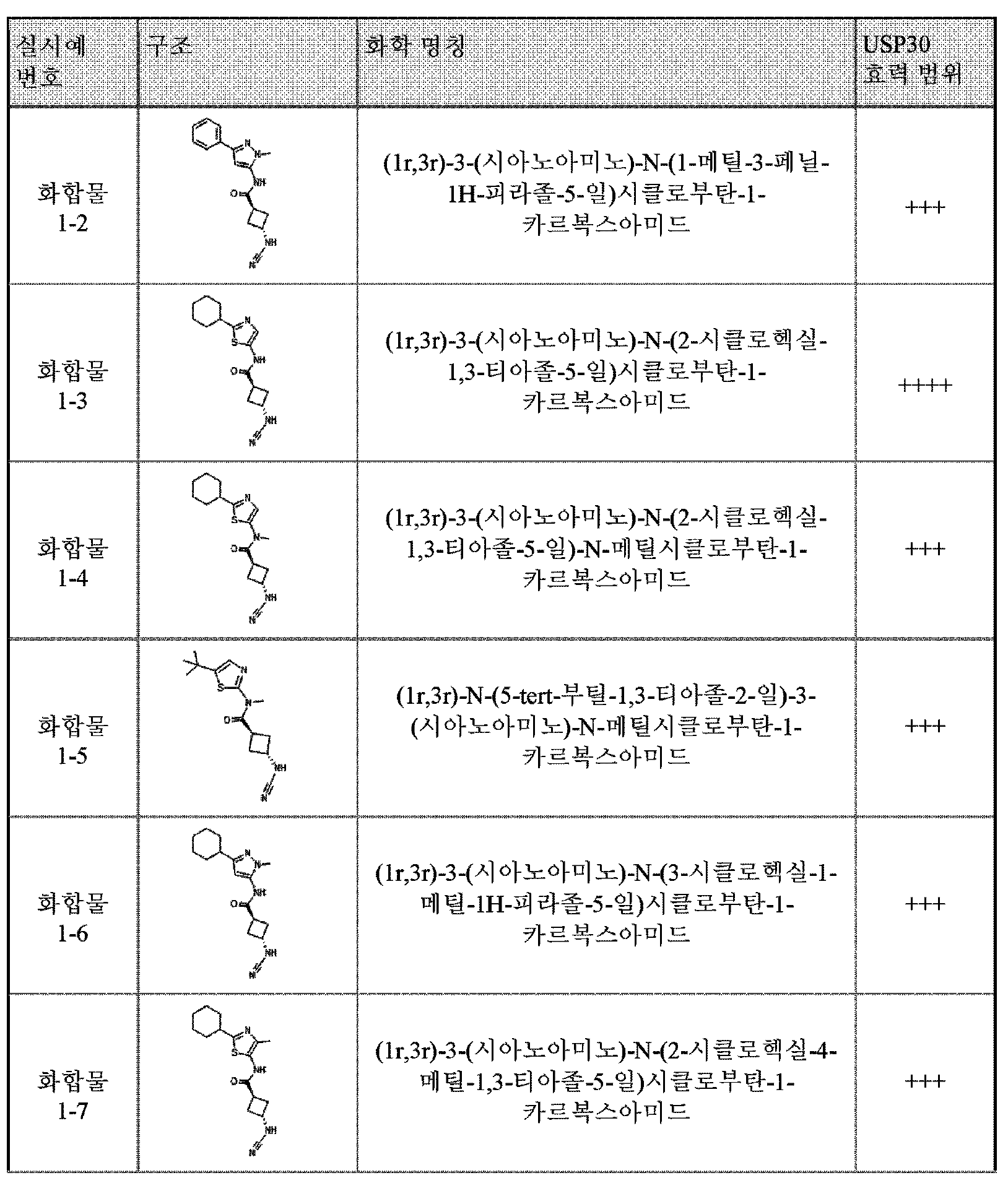


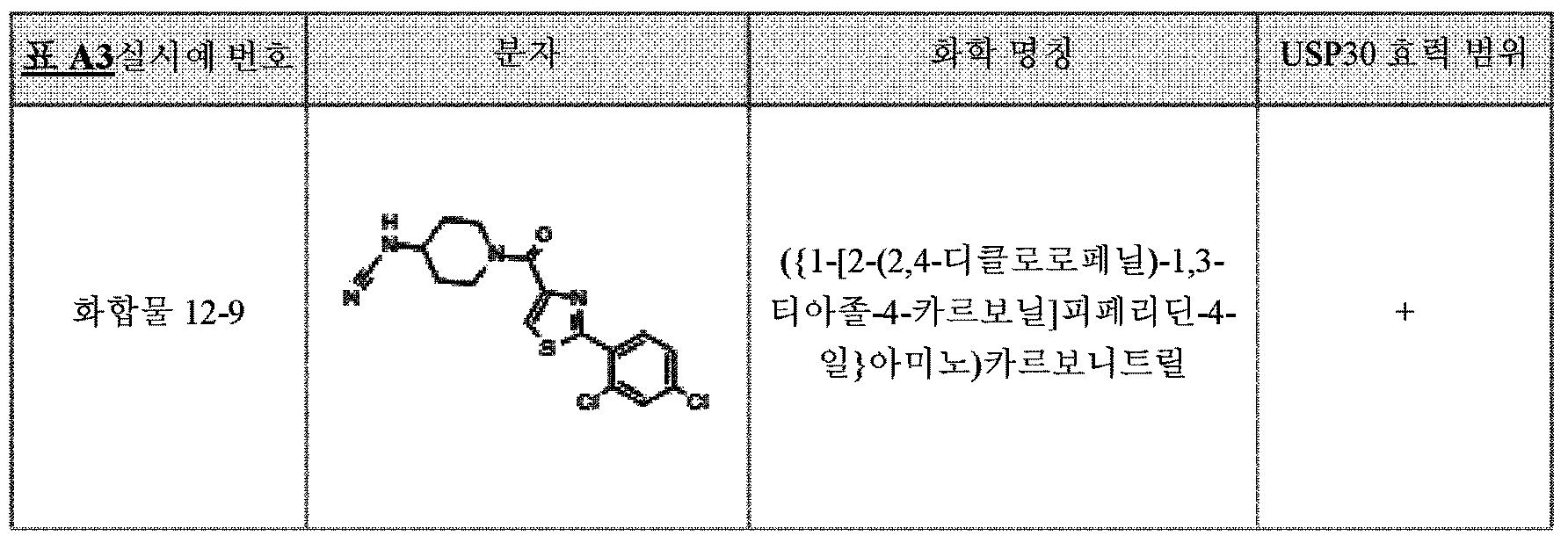
등가물Equivalent
관련 기술분야의 통상의 기술자는 상용 실험만으로도 본원에 구체적으로 기재된 특정 실시양태에 대한 수많은 등가물을 인식하거나 확인할 수 있을 것이다. 이러한 등가물은 하기 청구범위의 범주 내에 포괄되는 것으로 의도된다.Those skilled in the art will recognize or be able to recognize numerous equivalents to the specific embodiments specifically described herein, even through commercial experimentation alone. It is intended that such equivalents fall within the scope of the following claims.
개시내용의 실시양태는 하기 넘버링된 항으로 제시된다:Embodiments of the disclosure are presented in the numbered terms below:
1. 화학식 (I)의 화합물:1. Compounds of formula (I):

및 그의 제약상 허용되는 염, 용매화물, 전구약물, 입체이성질체, 및 호변이성질체로부터 선택된 적어도 1종의 화학 물질이며, 여기서:And pharmaceutically acceptable salts, solvates, prodrugs, stereoisomers, and tautomers thereof, wherein:
R은 독립적으로 수소, OH, CN, (C1-C6) 알킬 기, (C1-C6) 알콕시 기, (C1-C6) 할로알킬 기, (C1-C6) 할로알콕시 기, 할로겐, (C3-C6) 시클로알킬 기, 및 (C3-C6) 헤테로시클로알킬 기로부터 선택되고;R is independently hydrogen, OH, CN, (C 1 -C 6 ) alkyl group, (C 1 -C 6 ) alkoxy group, (C 1 -C 6 ) haloalkyl group, (C 1 -C 6 ) haloalkoxy Group, halogen, (C 3 -C 6 ) cycloalkyl group, and (C 3 -C 6 ) heterocycloalkyl group;
n은 0, 1, 또는 2이고;n is 0, 1, or 2;
여기서, n이 2인 경우에, R 기는 조합되어 R1과 융합된 고리계를 형성할 수 있고;Here, when n is 2, the R groups may be combined to form a ring system fused with R 1 ;
R1은 3-6원 시클릭 또는 헤테로시클릭 기로부터 선택되고;R 1 is selected from 3-6 membered cyclic or heterocyclic groups;
R2는 C(X)n, S(O)2, N(X), 헤테로원자 링커, N(X)S(O)2, N(X)S(O)2N(X), 카르보닐알킬 기, 및 카르보닐헤테로알킬 기로부터 선택되고, 여기서 카르보닐알킬 및 카르보닐헤테로알킬 기의 알킬 부분은 임의로 R, R1, 또는 R3과 고리화될 수 있고;R 2 is C(X) n , S(O) 2 , N(X), heteroatom linker, N(X)S(O) 2 , N(X)S(O) 2 N(X), carbonyl Alkyl groups, and carbonylheteroalkyl groups, wherein the alkyl portion of the carbonylalkyl and carbonylheteroalkyl groups can optionally be cyclized with R, R 1 , or R 3 ;
X는 독립적으로 수소, 알킬 기, 및 헤테로알킬 기로부터 선택되고, 여기서 알킬 및 헤테로알킬 기는 임의로 R, R1, 또는 R3과, 또는 다중 X 기가 존재하는 경우에 또 다른 X 기와 고리화될 수 있고;X is independently selected from hydrogen, alkyl groups, and heteroalkyl groups, wherein the alkyl and heteroalkyl groups can optionally cyclize with another X group if R, R 1 , or R 3 , or multiple X groups are present There is;
R3은 수소, 할로겐, 알킬 기, 헤테로알킬 기, 할로알킬 기, 알콕시 기, 헤테로알콕시 기, 할로알콕시 기, 카르보닐알킬 기, 카르보닐헤테로알킬 기, 시클릭 기, 헤테로시클릭 기, 아릴 기, 및 헤테로아릴 기로부터 선택되고, 여기서 임의의 고리는 임의로 1 또는 2개의 R 기로 치환되고;R 3 is hydrogen, halogen, alkyl group, heteroalkyl group, haloalkyl group, alkoxy group, heteroalkoxy group, haloalkoxy group, carbonylalkyl group, carbonylheteroalkyl group, cyclic group, heterocyclic group, aryl Group, and heteroaryl group, wherein any ring is optionally substituted with 1 or 2 R groups;
R4는 독립적으로 알킬 기, 헤테로알킬 기, 할로알킬 기, 알콕시 기, 시클로알콕시 기, 헤테로알콕시 기, 할로알콕시 기, 카르복시알킬 기, 헤테로카르복시알킬 기, 시클릭 기, 헤테로시클릭 기, 아릴 기 및 헤테로아릴 기로부터 선택되고, 여기서 임의의 고리는 임의로 1 또는 2개의 Y 기로 치환되고;R 4 is independently an alkyl group, heteroalkyl group, haloalkyl group, alkoxy group, cycloalkoxy group, heteroalkoxy group, haloalkoxy group, carboxyalkyl group, heterocarboxyalkyl group, cyclic group, heterocyclic group, aryl Groups and heteroaryl groups, wherein any ring is optionally substituted with 1 or 2 Y groups;
Y는 독립적으로 수소, OH, CN, N(X)2, (C1-C6) 알킬 기, (C1-C6) 헤테로알킬 기, (C1-C6) 알콕시 기, (C1-C6) 할로알킬 기, (C1-C6) 할로알콕시 기, 할로겐, (C3-C6) 시클로알킬 기, (C3-C6) 헤테로시클로알킬 기, (C5-C8) 아릴 기, 및 (C4-C8) 헤테로아릴 기로부터 선택되고;Y is independently hydrogen, OH, CN, N(X) 2 , (C 1 -C 6 ) alkyl group, (C 1 -C 6 ) heteroalkyl group, (C 1 -C 6 ) alkoxy group, (C 1 -C 6 ) haloalkyl group, (C 1 -C 6 ) haloalkoxy group, halogen, (C 3 -C 6 ) cycloalkyl group, (C 3 -C 6 ) heterocycloalkyl group, (C 5 -C 8 ) Aryl groups, and (C 4 -C 8 ) heteroaryl groups;
m은 0, 1, 또는 2인m is 0, 1, or 2
적어도 1종의 화학 물질.At least one chemical.
2. 제1항에 있어서, R1이 시클로프로판, 시클로부탄, 시클로펜탄, 및 시클로헥산으로부터 선택된 것인 화학 물질.2. The chemical according to item 1, wherein R 1 is selected from cyclopropane, cyclobutane, cyclopentane, and cyclohexane.
3. 제1항에 있어서, R1이 시클로부탄 및 시클로펜탄으로부터 선택된 것인 화학 물질.3. The chemical according to item 1, wherein R 1 is selected from cyclobutane and cyclopentane.
4. 제1항에 있어서, R1이 헤테로시클릭 기로부터 선택된 것인 화학 물질.4. The chemical according to item 1, wherein R 1 is selected from heterocyclic groups.
5. 제1항에 있어서, R1이 피롤리딘인 화학 물질.5. The chemical according to item 1, wherein R 1 is pyrrolidine.
6. 제1항에 있어서, R2가 카르보닐알킬 및 헤테로카르보닐알킬 기로부터 선택된 것인 화학 물질.6. The chemical according to item 1, wherein R 2 is selected from carbonylalkyl and heterocarbonylalkyl groups.
7. 제1항에 있어서, R2가 아미드, 역 아미드, 및 우레아로부터 선택된 것인 화학 물질.7. The chemical according to item 1, wherein R 2 is selected from amide, reverse amide, and urea.
8. 제1항에 있어서, R2가 아미드인 화학 물질.8. The chemical according to item 1, wherein R 2 is amide.
9. 제1항에 있어서, R3이 아릴 및 헤테로아릴 고리로부터 선택된 것인 화학 물질.9. The chemical according to item 1, wherein R 3 is selected from aryl and heteroaryl rings.
10. 제1항에 있어서, R3이 티아졸, 인데닐, 피라졸, 및 페닐 고리로부터 선택된 것인 화학 물질.10. The chemical according to item 1, wherein R 3 is selected from thiazole, indenyl, pyrazole, and phenyl rings.
11. 제1항에 있어서, R3이 시클릭 및 헤테로시클릭 고리로부터 선택된 것인 화학 물질.11. The chemical according to item 1, wherein R 3 is selected from cyclic and heterocyclic rings.
12. 제1항에 있어서, m이 0인 화학 물질.12. The chemical of item 1, wherein m is 0.
13. 제1항에 있어서, R4가 1 또는 2개의 R로 임의로 치환된 시클릭 및 헤테로시클릭 고리로부터 선택된 것인 화학 물질.13. The chemical according to item 1, wherein R 4 is selected from cyclic and heterocyclic rings optionally substituted with 1 or 2 R.
14. 제1항에 있어서, R4가 알킬, 헤테로알킬, 및 할로알킬 기로부터 선택된 것인 화학 물질.14. The chemical according to clause 1, wherein R 4 is selected from alkyl, heteroalkyl, and haloalkyl groups.
15. 제1항에 있어서, R4가 1 또는 2개의 R로 임의로 치환된 아릴 및 헤테로아릴 고리로부터 선택된 것인 화학 물질.15. The chemical according to item 1, wherein R 4 is selected from aryl and heteroaryl rings optionally substituted with 1 or 2 R.
16. 제1항에 있어서, R이 할로겐으로부터 선택된 것인 화학 물질.16. The chemical according to item 1, wherein R is selected from halogen.
17. 제1항에 있어서, 하기 화합물:17. The compound of paragraph 1, wherein:


및 그의 제약상 허용되는 염, 용매화물, 전구약물, 입체이성질체 및 호변이성질체로부터 선택된 화학 물질.And chemicals selected from pharmaceutically acceptable salts, solvates, prodrugs, stereoisomers and tautomers thereof.
18. 제1항 내지 제17항 중 어느 한 항의 적어도 1종의 화학 물질 및 제약상 허용되는 담체를 포함하는 조성물.18. A composition comprising at least one chemical entity of any one of items 1 to 17 and a pharmaceutically acceptable carrier.
19. 제1항 내지 제17항 중 어느 한 항의 적어도 1종의 화학 물질의 유효량을 USP30 활성에 대한 유비퀴틴-로다민 110 검정에 투여하는 것을 포함하는, USP30을 시험관내 억제하는 방법.19. A method of inhibiting USP30 in vitro, comprising administering an effective amount of at least one chemical of any one of items 1 to 17 to the ubiquitin-rhodamine 110 assay for USP30 activity.
20. 제1항 내지 제17항 중 어느 한 항의 적어도 1종의 화학 물질의 유효량을 미토콘드리아 기능장애와 연관된 적어도 1종의 질환, 장애, 또는 상태의 치료를 필요로 하는 환자에게 투여하는 것을 포함하는, 미토콘드리아 기능장애와 연관된 적어도 1종의 질환, 장애, 또는 상태를 치료하는 방법.20. Administering a patient in need of treatment of at least one disease, disorder, or condition associated with mitochondrial dysfunction, wherein the effective amount of at least one chemical of any one of items 1 to 17 is associated with it. , A method of treating at least one disease, disorder, or condition associated with mitochondrial dysfunction.
21. 제20항에 있어서, 적어도 1종의 질환, 장애, 또는 상태가 신경변성 질환, 운동 뉴런 질환, 대사 장애, 심혈관 질환, 정신 질환, 골관절염, 및 암으로부터 선택된 것인 방법.21. The method of claim 20, wherein the at least one disease, disorder, or condition is selected from neurodegenerative disease, motor neuron disease, metabolic disorder, cardiovascular disease, mental disease, osteoarthritis, and cancer.
22. 제21항에 있어서, 신경변성 질환이 알츠하이머병, 파킨슨병, 치매, 프리온 질환, 피질기저 변성, 후피질 위축, 원발성 진행성 실어증, 진행성 핵상 마비, 픽병, 만성 외상성 뇌병증, 외상성 뇌 손상, 말초 신경병증, 및 다발성 경화증으로부터 선택된 것인 방법.22. The method of claim 21, wherein the neurodegenerative disease is Alzheimer's disease, Parkinson's disease, dementia, prion disease, cortical basal degeneration, epithelial atrophy, primary progressive aphasia, progressive nuclear paralysis, Pick's disease, chronic traumatic encephalopathy, traumatic brain injury, peripheral A method selected from neuropathy, and multiple sclerosis.
23. 제21항에 있어서, 운동 뉴런 질환이 근위축성 측삭 경화증 (ALS), 헌팅톤병, 척수소뇌성 운동실조, 운동실조, 및 척수성 근육 위축으로부터 선택된 것인 방법.23. The method of claim 21, wherein the motor neuron disease is selected from amyotrophic lateral sclerosis (ALS), Huntington's disease, spinocerebellar ataxia, ataxia, and spinal muscular atrophy.
24. 제21항에 있어서, 대사 장애가 당뇨병, 미토콘드리아 뇌근병증, 졸중-유사 에피소드 (MELAS), 미토콘드리아 근병증, 뇌병증, 락트산 산증, 레베르 유전성 시신경병증 (LHON), 신경병증, 운동실조, 색소성 망막염-모계 유전 리 증훈군 (NARP-MILS), 다논병, 당뇨병성 신병증, 색소성 망막염-모계 유전 리 증훈군 (NARP-MILS), 다중 술파타제 결핍 (MSD), 점액지질증 II (ML II), 점액지질증 III (ML III), 점액지질증 IV (ML IV), GM1-강글리오시드증 (GM1), 신경 세로이드-리포푸신증 (NCLl), 알퍼병, 바르트 증후군, 베타-산화 결함, 카르니틴-아실-카르니틴 결핍, 카르니틴 결핍, 크레아틴 결핍 증후군, 조효소 Q 10 결핍, 복합체 I 결핍, 복합체 II 결핍, CPT I 결핍, CPT II 결핍, 글루타르산 산뇨 유형 II, 킴스-세이어 증후군, 락트산 산증, 장쇄 아실-CoA 데히드로게나제 결핍 (LCHAD), 리병 복합체 III 결핍, 복합체 IV 결핍, 복합체 V 결핍, COX 결핍, 만성 진행성 외부 증후군, 치사성 영아 심근병증 (LIC), 루프트병, 글루타르산 산뇨 유형 II, 중간쇄 아실-CoA 데히드로게나제 결핍 (MCAD), 근간대성 간질 및 불균일-적색 근섬유 (MERRF) 증후군, 미토콘드리아 세포병증, 미토콘드리아 열성 운동실조 증후군, 미토콘드리아 DNA 고갈 증후군, 근신경위장 장애 및 뇌병증, 피어슨 증후군, 피루베이트 데히드로게나제 결핍, 피루베이트 카르복실라제 결핍, POLG 안근마비 증후군 돌연변이, 중간쇄/단쇄 3-히드록시아실-CoA 데히드로게나제 (M/SCHAD) 결핍, 및 초장쇄 아실-CoA 데히드로게나제 (VLCAD) 결핍으로부터 선택된 것인 방법.24. The method of claim 21, wherein the metabolic disorder is diabetes, mitochondrial encephalopathy, stroke-like episode (MELAS), mitochondrial myopathy, encephalopathy, lactic acidosis, Lever's hereditary optic neuropathy (LHON), neuropathy, ataxia, retinitis pigmentosa. -Maternal genetic Lee syndrome (NARP-MILS), Dannon disease, diabetic nephropathy, retinitis pigmentosa-Maternal genetic Lee syndrome (NARP-MILS), multiple sulfatase deficiency (MSD), mucolipidemia II (ML II), Myxidosis III (ML III), Myxidosis IV (ML IV), GM1-gangliosidosis (GM1), Neuro-Serroid-Lipofusinosis (NCLl), Alper's disease, Bart's syndrome, Beta- Oxidative deficiency, carnitine-acyl-carnitine deficiency, carnitine deficiency, creatine deficiency syndrome, coenzyme Q 10 deficiency, complex I deficiency, complex II deficiency, CPT I deficiency, CPT II deficiency, glutaric acid aciduria type II, Kims-Say syndrome , Lactic acidosis, long chain acyl-CoA dehydrogenase deficiency (LCHAD), pathology complex III deficiency, complex IV deficiency, complex V deficiency, COX deficiency, chronic progressive external syndrome, lethal infantile myocardial disease (LIC), Lufts disease, Glutaric acid aciduria type II, medium chain acyl-CoA dehydrogenase deficiency (MCAD), myotropic epilepsy and heterogeneous-red muscle fiber (MERRF) syndrome, mitochondrial cytopathy, mitochondrial recessive ataxia syndrome, mitochondrial DNA depletion syndrome, muscle Neurogastric disorders and encephalopathy, Pearson's syndrome, pyruvate dehydrogenase deficiency, pyruvate carboxylase deficiency, POLG palsy syndrome mutation, medium/short chain 3-hydroxyacyl-CoA dehydrogenase (M/SCHAD) A deficiency, and a method selected from ultra-long chain acyl-CoA dehydrogenase (VLCAD) deficiency.
25. 제21항에 있어서, 심혈관 장애가 트랜스티레틴 아밀로이드증, 심부전, 심근경색 유발 허혈성 심장 질환, 및 심장 아밀로이드증으로부터 선택된 것인 방법.25. The method of claim 21, wherein the cardiovascular disorder is selected from transthyretin amyloidosis, heart failure, myocardial infarction induced ischemic heart disease, and cardiac amyloidosis.
26. 제21항에 있어서, 정신 질환이 정신분열증, 우울증, 및 범불안 장애로부터 선택된 것인 방법.26. The method of 21, wherein the mental illness is selected from schizophrenia, depression, and generalized anxiety disorder.
27. 제21항에 있어서, 암이 방광암, 유방암, 자궁경부암, 결장직장암, 식도암, 위암, 두경부암, 혈액암, 폐암, 간암, 림프종, 신경계암, 난소암, 췌장암, 전립선암, 신암, 육종, 피부암, 갑상선암, 및 자궁암으로부터 선택된 것인 방법.27. The method of claim 21, wherein the cancer is bladder cancer, breast cancer, cervical cancer, colorectal cancer, esophageal cancer, stomach cancer, head and neck cancer, blood cancer, lung cancer, liver cancer, lymphoma, nervous system cancer, ovarian cancer, pancreatic cancer, prostate cancer, renal cancer, sarcoma. , Skin cancer, thyroid cancer, and uterine cancer.
Claims (17)

및 그의 제약상 허용되는 염, 용매화물, 전구약물, 입체이성질체, 및 호변이성질체로부터 선택된 적어도 1종의 화학 물질이며, 여기서:
R은 독립적으로 수소, OH, CN, (C1-C6) 알킬 기, (C1-C6) 알콕시 기, (C1-C6) 할로알킬 기, (C1-C6) 할로알콕시 기, 할로겐, (C3-C6) 시클로알킬 기, 및 (C3-C6) 헤테로시클로알킬 기로부터 선택되고;
n은 0, 1, 또는 2이고;
여기서, n이 2인 경우에, R 기는 조합되어 R1과 융합된 고리계를 형성할 수 있고;
R1은 3-6원 시클릭 또는 헤테로시클릭 기로부터 선택되고;
R2는 C(X)n, S(O)2, N(X), 헤테로원자 링커, N(X)S(O)2, N(X)S(O)2N(X), 카르보닐알킬 기, 및 카르보닐헤테로알킬 기로부터 선택되고, 여기서 카르보닐알킬 및 카르보닐헤테로알킬 기의 알킬 부분은 임의로 R, R1, 또는 R3과 고리화될 수 있고;
X는 독립적으로 수소, 알킬 기, 및 헤테로알킬 기로부터 선택되고, 여기서 알킬 및 헤테로알킬 기는 임의로 R, R1, 또는 R3과, 또는 다중 X 기가 존재하는 경우에 또 다른 X 기와 고리화될 수 있고;
R3은 수소, 할로겐, 알킬 기, 헤테로알킬 기, 할로알킬 기, 알콕시 기, 헤테로알콕시 기, 할로알콕시 기, 카르보닐알킬 기, 카르보닐헤테로알킬 기, 시클릭 기, 헤테로시클릭 기, 아릴 기, 및 헤테로아릴 기로부터 선택되고, 여기서 임의의 고리는 임의로 1 또는 2개의 R 기로 치환되고;
R4는 독립적으로 알킬 기, 헤테로알킬 기, 할로알킬 기, 알콕시 기, 시클로알콕시 기, 헤테로알콕시 기, 할로알콕시 기, 카르복시알킬 기, 헤테로카르복시알킬 기, 시클릭 기, 헤테로시클릭 기, 아릴 기 및 헤테로아릴 기로부터 선택되고, 여기서 임의의 고리는 임의로 1 또는 2개의 Y 기로 치환되고;
Y는 독립적으로 수소, OH, CN, N(X)2, (C1-C6) 알킬 기, (C1-C6) 헤테로알킬 기, (C1-C6) 알콕시 기, (C1-C6) 할로알킬 기, (C1-C6) 할로알콕시 기, 할로겐, (C3-C6) 시클로알킬 기, (C3-C6) 헤테로시클로알킬 기, (C5-C8) 아릴 기, 및 (C4-C8) 헤테로아릴 기로부터 선택되고;
m은 0, 1, 또는 2인
적어도 1종의 화학 물질.Compounds of formula (I):
And pharmaceutically acceptable salts, solvates, prodrugs, stereoisomers, and tautomers thereof, wherein:
R is independently hydrogen, OH, CN, (C 1 -C 6 ) alkyl group, (C 1 -C 6 ) alkoxy group, (C 1 -C 6 ) haloalkyl group, (C 1 -C 6 ) haloalkoxy Group, halogen, (C 3 -C 6 ) cycloalkyl group, and (C 3 -C 6 ) heterocycloalkyl group;
n is 0, 1, or 2;
Here, when n is 2, the R groups may be combined to form a ring system fused with R 1 ;
R 1 is selected from 3-6 membered cyclic or heterocyclic groups;
R 2 is C(X) n , S(O) 2 , N(X), heteroatom linker, N(X)S(O) 2 , N(X)S(O) 2 N(X), carbonyl Alkyl groups, and carbonylheteroalkyl groups, wherein the alkyl portion of the carbonylalkyl and carbonylheteroalkyl groups can optionally be cyclized with R, R 1 , or R 3 ;
X is independently selected from hydrogen, alkyl groups, and heteroalkyl groups, wherein the alkyl and heteroalkyl groups can optionally cyclize with another X group if R, R 1 , or R 3 , or multiple X groups are present There is;
R 3 is hydrogen, halogen, alkyl group, heteroalkyl group, haloalkyl group, alkoxy group, heteroalkoxy group, haloalkoxy group, carbonylalkyl group, carbonylheteroalkyl group, cyclic group, heterocyclic group, aryl Group, and heteroaryl group, wherein any ring is optionally substituted with 1 or 2 R groups;
R 4 is independently an alkyl group, heteroalkyl group, haloalkyl group, alkoxy group, cycloalkoxy group, heteroalkoxy group, haloalkoxy group, carboxyalkyl group, heterocarboxyalkyl group, cyclic group, heterocyclic group, aryl Groups and heteroaryl groups, wherein any ring is optionally substituted with 1 or 2 Y groups;
Y is independently hydrogen, OH, CN, N(X) 2 , (C 1 -C 6 ) alkyl group, (C 1 -C 6 ) heteroalkyl group, (C 1 -C 6 ) alkoxy group, (C 1 -C 6 ) haloalkyl group, (C 1 -C 6 ) haloalkoxy group, halogen, (C 3 -C 6 ) cycloalkyl group, (C 3 -C 6 ) heterocycloalkyl group, (C 5 -C 8 ) Aryl groups, and (C 4 -C 8 ) heteroaryl groups;
m is 0, 1, or 2
At least one chemical.

및 그의 제약상 허용되는 염, 용매화물, 전구약물, 입체이성질체, 및 호변이성질체로부터 선택된 적어도 1종의 화학 물질이며, 여기서:
R은 독립적으로 수소, OH, CN, (C1-C6) 알킬 기, (C1-C6) 알콕시 기, (C1-C6) 할로알킬 기, (C1-C6) 할로알콕시 기, 할로겐, (C3-C6) 시클로알킬 기, 및 (C3-C6) 헤테로시클로알킬 기로부터 선택되고;
n은 0, 1, 또는 2이고;
여기서, n이 2인 경우에, R 기는 조합되어 R1과 융합된 고리계를 형성할 수 있고;
R1은 4-원 시클릭 또는 헤테로시클릭 기이고;
R2는 C(X)n, S(O)2, N(X), 헤테로원자 링커, N(X)S(O)2, N(X)S(O)2N(X), 카르보닐알킬 기, 및 카르보닐헤테로알킬 기로부터 선택되고, 여기서 카르보닐알킬 및 카르보닐헤테로알킬 기의 알킬 부분은 임의로 R, R1, 또는 R3과 고리화될 수 있고;
X는 독립적으로 수소, 알킬 기, 및 헤테로알킬 기로부터 선택되고, 여기서 알킬 및 헤테로알킬 기는 임의로 R, R1, 또는 R3과, 또는 다중 X 기가 존재하는 경우에 또 다른 X 기와 고리화될 수 있고;
R3은 수소, 할로겐, 알킬 기, 헤테로알킬 기, 할로알킬 기, 알콕시 기, 헤테로알콕시 기, 할로알콕시 기, 카르보닐알킬 기, 카르보닐헤테로알킬 기, 시클릭 기, 헤테로시클릭 기, 아릴 기, 및 헤테로아릴 기로부터 선택되고, 여기서 임의의 고리는 임의로 1 또는 2개의 R 기로 치환되고;
R4는 독립적으로 알킬 기, 헤테로알킬 기, 할로알킬 기, 알콕시 기, 시클로알콕시 기, 헤테로알콕시 기, 할로알콕시 기, 카르복시알킬 기, 헤테로카르복시알킬 기, 시클릭 기, 헤테로시클릭 기, 아릴 기 및 헤테로아릴 기로부터 선택되고, 여기서 임의의 고리는 임의로 1 또는 2개의 Y 기로 치환되고;
Y는 독립적으로 수소, OH, CN, N(X)2, (C1-C6) 알킬 기, (C1-C6) 헤테로알킬 기, (C1-C6) 알콕시 기, (C1-C6) 할로알킬 기, (C1-C6) 할로알콕시 기, 할로겐, (C3-C6) 시클로알킬 기, (C3-C6) 헤테로시클로알킬 기, (C5-C8) 아릴 기, 및 (C4-C8) 헤테로아릴 기로부터 선택되고;
m은 0, 1, 또는 2인
적어도 1종의 화학 물질.Compounds of formula (Ia):
And pharmaceutically acceptable salts, solvates, prodrugs, stereoisomers, and tautomers thereof, wherein:
R is independently hydrogen, OH, CN, (C 1 -C 6 ) alkyl group, (C 1 -C 6 ) alkoxy group, (C 1 -C 6 ) haloalkyl group, (C 1 -C 6 ) haloalkoxy Group, halogen, (C 3 -C 6 ) cycloalkyl group, and (C 3 -C 6 ) heterocycloalkyl group;
n is 0, 1, or 2;
Here, when n is 2, the R groups may be combined to form a ring system fused with R 1 ;
R 1 is a 4-membered cyclic or heterocyclic group;
R 2 is C(X) n , S(O) 2 , N(X), heteroatom linker, N(X)S(O) 2 , N(X)S(O) 2 N(X), carbonyl Alkyl groups, and carbonylheteroalkyl groups, wherein the alkyl portion of the carbonylalkyl and carbonylheteroalkyl groups can optionally be cyclized with R, R 1 , or R 3 ;
X is independently selected from hydrogen, alkyl groups, and heteroalkyl groups, wherein the alkyl and heteroalkyl groups can optionally cyclize with another X group if R, R 1 , or R 3 , or multiple X groups are present There is;
R 3 is hydrogen, halogen, alkyl group, heteroalkyl group, haloalkyl group, alkoxy group, heteroalkoxy group, haloalkoxy group, carbonylalkyl group, carbonylheteroalkyl group, cyclic group, heterocyclic group, aryl Group, and heteroaryl group, wherein any ring is optionally substituted with 1 or 2 R groups;
R 4 is independently an alkyl group, heteroalkyl group, haloalkyl group, alkoxy group, cycloalkoxy group, heteroalkoxy group, haloalkoxy group, carboxyalkyl group, heterocarboxyalkyl group, cyclic group, heterocyclic group, aryl Groups and heteroaryl groups, wherein any ring is optionally substituted with 1 or 2 Y groups;
Y is independently hydrogen, OH, CN, N(X) 2 , (C 1 -C 6 ) alkyl group, (C 1 -C 6 ) heteroalkyl group, (C 1 -C 6 ) alkoxy group, (C 1 -C 6 ) haloalkyl group, (C 1 -C 6 ) haloalkoxy group, halogen, (C 3 -C 6 ) cycloalkyl group, (C 3 -C 6 ) heterocycloalkyl group, (C 5 -C 8 ) Aryl groups, and (C 4 -C 8 ) heteroaryl groups;
m is 0, 1, or 2
At least one chemical.

및 그의 제약상 허용되는 염, 용매화물, 전구약물, 입체이성질체, 및 호변이성질체로부터 선택된 적어도 1종의 화학 물질이며, 여기서:
R은 독립적으로 수소, OH, CN, (C1-C6) 알킬 기, (C1-C6) 알콕시 기, (C1-C6) 할로알킬 기, (C1-C6) 할로알콕시 기, 할로겐, (C3-C6) 시클로알킬 기, 및 (C3-C6) 헤테로시클로알킬 기로부터 선택되고;
n은 0, 1, 또는 2이고;
여기서, n이 2인 경우에, R 기는 조합되어 R1과 융합된 고리계를 형성할 수 있고;
R1은 3-6원 시클릭 또는 헤테로시클릭 기로부터 선택되고;
R2는 카르보닐헤테로알킬 기이고, 여기서 카르보닐헤테로알킬 기의 알킬 부분은 임의로 R, R1, 또는 R3과 고리화될 수 있고;
X는 독립적으로 수소, 알킬 기, 및 헤테로알킬 기로부터 선택되고, 여기서 알킬 및 헤테로알킬 기는 임의로 R, R1, 또는 R3과, 또는 다중 X 기가 존재하는 경우에 또 다른 X 기와 고리화될 수 있고;
R3은 수소, 할로겐, 알킬 기, 헤테로알킬 기, 할로알킬 기, 알콕시 기, 헤테로알콕시 기, 할로알콕시 기, 카르보닐알킬 기, 카르보닐헤테로알킬 기, 시클릭 기, 헤테로시클릭 기, 아릴 기, 및 헤테로아릴 기로부터 선택되고, 여기서 임의의 고리는 임의로 1 또는 2개의 R 기로 치환되고;
R4는 독립적으로 알킬 기, 헤테로알킬 기, 할로알킬 기, 알콕시 기, 시클로알콕시 기, 헤테로알콕시 기, 할로알콕시 기, 카르복시알킬 기, 헤테로카르복시알킬 기, 시클릭 기, 헤테로시클릭 기, 아릴 기 및 헤테로아릴 기로부터 선택되고, 여기서 임의의 고리는 임의로 1 또는 2개의 Y 기로 치환되고;
Y는 독립적으로 수소, OH, CN, N(X)2, (C1-C6) 알킬 기, (C1-C6) 헤테로알킬 기, (C1-C6) 알콕시 기, (C1-C6) 할로알킬 기, (C1-C6) 할로알콕시 기, 할로겐, (C3-C6) 시클로알킬 기, (C3-C6) 헤테로시클로알킬 기, (C5-C8) 아릴 기, 및 (C4-C8) 헤테로아릴 기로부터 선택되고;
m은 0, 1, 또는 2인
적어도 1종의 화학 물질.Compounds of formula (Ib):
And pharmaceutically acceptable salts, solvates, prodrugs, stereoisomers, and tautomers thereof, wherein:
R is independently hydrogen, OH, CN, (C 1 -C 6 ) alkyl group, (C 1 -C 6 ) alkoxy group, (C 1 -C 6 ) haloalkyl group, (C 1 -C 6 ) haloalkoxy Group, halogen, (C 3 -C 6 ) cycloalkyl group, and (C 3 -C 6 ) heterocycloalkyl group;
n is 0, 1, or 2;
Here, when n is 2, the R groups may be combined to form a ring system fused with R 1 ;
R 1 is selected from 3-6 membered cyclic or heterocyclic groups;
R 2 is a carbonylheteroalkyl group, wherein the alkyl portion of the carbonylheteroalkyl group can optionally be cyclized with R, R 1 , or R 3 ;
X is independently selected from hydrogen, alkyl groups, and heteroalkyl groups, wherein the alkyl and heteroalkyl groups can optionally cyclize with another X group if R, R 1 , or R 3 , or multiple X groups are present There is;
R 3 is hydrogen, halogen, alkyl group, heteroalkyl group, haloalkyl group, alkoxy group, heteroalkoxy group, haloalkoxy group, carbonylalkyl group, carbonylheteroalkyl group, cyclic group, heterocyclic group, aryl Group, and heteroaryl group, wherein any ring is optionally substituted with 1 or 2 R groups;
R 4 is independently an alkyl group, heteroalkyl group, haloalkyl group, alkoxy group, cycloalkoxy group, heteroalkoxy group, haloalkoxy group, carboxyalkyl group, heterocarboxyalkyl group, cyclic group, heterocyclic group, aryl Groups and heteroaryl groups, wherein any ring is optionally substituted with 1 or 2 Y groups;
Y is independently hydrogen, OH, CN, N(X) 2 , (C 1 -C 6 ) alkyl group, (C 1 -C 6 ) heteroalkyl group, (C 1 -C 6 ) alkoxy group, (C 1 -C 6 ) haloalkyl group, (C 1 -C 6 ) haloalkoxy group, halogen, (C 3 -C 6 ) cycloalkyl group, (C 3 -C 6 ) heterocycloalkyl group, (C 5 -C 8 ) Aryl groups, and (C 4 -C 8 ) heteroaryl groups;
m is 0, 1, or 2
At least one chemical.


및 그의 제약상 허용되는 염, 용매화물, 전구약물, 입체이성질체 및 호변이성질체로부터 선택된 화학 물질.The compound according to any one of claims 1 to 3, wherein:
And chemicals selected from pharmaceutically acceptable salts, solvates, prodrugs, stereoisomers and tautomers thereof.
Applications Claiming Priority (3)
| Application Number | Priority Date | Filing Date | Title |
|---|---|---|---|
| US201762569177P | 2017-10-06 | 2017-10-06 | |
| US62/569,177 | 2017-10-06 | ||
| PCT/US2018/054520 WO2019071073A1 (en) | 2017-10-06 | 2018-10-05 | Inhibiting ubiquitin specific peptidase 30 |
Publications (2)
| Publication Number | Publication Date |
|---|---|
| KR20200067850A true KR20200067850A (en) | 2020-06-12 |
| KR102717600B1 KR102717600B1 (en) | 2024-10-15 |
Family
ID=65995221
Family Applications (1)
| Application Number | Title | Priority Date | Filing Date |
|---|---|---|---|
| KR1020207012361A Active KR102717600B1 (en) | 2017-10-06 | 2018-10-05 | Inhibition of ubiquitin-specific peptidase 30 |
Country Status (15)
| Country | Link |
|---|---|
| US (2) | US11247987B2 (en) |
| EP (1) | EP3692028B1 (en) |
| JP (2) | JP2020536863A (en) |
| KR (1) | KR102717600B1 (en) |
| CN (1) | CN111148743B (en) |
| AU (1) | AU2018346597B2 (en) |
| BR (1) | BR112020003725A2 (en) |
| CA (1) | CA3072362A1 (en) |
| EA (1) | EA202090871A1 (en) |
| ES (1) | ES2950757T3 (en) |
| IL (1) | IL272838B2 (en) |
| MX (1) | MX2020003671A (en) |
| SG (1) | SG11202001684PA (en) |
| WO (1) | WO2019071073A1 (en) |
| ZA (1) | ZA202001057B (en) |
Families Citing this family (17)
| Publication number | Priority date | Publication date | Assignee | Title |
|---|---|---|---|---|
| CN111148743B (en) | 2017-10-06 | 2023-12-15 | 福马治疗有限公司 | Inhibits ubiquitin-specific peptidase 30 |
| IL278291B2 (en) | 2018-05-17 | 2023-10-01 | Forma Therapeutics Inc | Condensed bicyclic compounds are useful as ubiquitin-specific peptidase 30 inhibitors |
| SG11202102815SA (en) | 2018-10-05 | 2021-04-29 | Forma Therapeutics Inc | Fused pyrrolines which act as ubiquitin-specific protease 30 (usp30) inhibitors |
| WO2020139916A1 (en) * | 2018-12-26 | 2020-07-02 | Forma Therapeutics, Inc. | Inhibiting ubiquitin specific peptidase 9x |
| GB201905375D0 (en) | 2019-04-16 | 2019-05-29 | Mission Therapeutics Ltd | Novel compounds |
| GB201905371D0 (en) | 2019-04-16 | 2019-05-29 | Mission Therapeutics Ltd | Novel compounds |
| WO2020227168A1 (en) * | 2019-05-03 | 2020-11-12 | Integral Early Discovery, Inc. | Inhibiting trabid |
| GB201912674D0 (en) * | 2019-09-04 | 2019-10-16 | Mission Therapeutics Ltd | Novel compounds |
| JP2023509452A (en) | 2020-01-03 | 2023-03-08 | バーグ エルエルシー | Polycyclic Amides as UBE2K Modulators to Treat Cancer |
| CN115461340A (en) | 2020-04-08 | 2022-12-09 | 特殊治疗有限公司 | N-cyanopyrrolidines having activity as USP30 inhibitors |
| AU2021279199A1 (en) | 2020-05-28 | 2023-01-19 | Mission Therapeutics Limited | N-(1-cyano-pyrrolidin-3-yl)-5-(3-(trifluoromethyl)phenyl)oxazole-2-carboxamide derivatives and the corresponding oxadiazole derivatives as USP30 inhibitors for the treatment of mitochondrial dysfunction |
| IL298710A (en) | 2020-06-04 | 2023-02-01 | Mission Therapeutics Ltd | N-cyanopyrrolidines with activity as usp30 inhibitors |
| IL298785B1 (en) | 2020-06-08 | 2025-11-01 | Mission Therapeutics Ltd | 1-(5-(2-cyanopyridin-4-yl)oxazole-2-carbonyl)-4-methylhexahydropyrrolo[3,4-b]pyrrole-5(1h)-carbonitrile as a USP30 inhibitor for use in the treatment of mitochondrial dysfunction, cancer and fibrosis |
| GB202016800D0 (en) | 2020-10-22 | 2020-12-09 | Mission Therapeutics Ltd | Novel compounds |
| US20250034122A1 (en) | 2021-12-01 | 2025-01-30 | Mission Therapeutics Limited | Substituted n-cyanopyrrolidines with activity as usp30 inhibitors |
| EP4604947A2 (en) * | 2022-10-19 | 2025-08-27 | Ohio State Innovation Foundation | Compositions and methods for preventing cardiomyopathy |
| GB202408928D0 (en) | 2024-06-21 | 2024-08-07 | Mission Therapeutics Ltd | Novel compounds |
Family Cites Families (186)
| Publication number | Priority date | Publication date | Assignee | Title |
|---|---|---|---|---|
| US6576632B1 (en) | 1999-08-27 | 2003-06-10 | Pfizer Inc | Biaryl compounds useful as anticancer agents |
| US20030191279A1 (en) | 1999-08-27 | 2003-10-09 | Goldstein Steven Wayne | Urea derivatives useful as anticancer agents |
| US6632815B2 (en) | 1999-09-17 | 2003-10-14 | Millennium Pharmaceuticals, Inc. | Inhibitors of factor Xa |
| RU2002110295A (en) | 1999-09-17 | 2003-12-10 | Милленниум Фармасьютикалс, Инк. (Us) | Factor Xa Inhibitors |
| BR0014076A (en) | 1999-09-17 | 2002-10-15 | Millennium Pharm Inc | Benzamides and related factor xa inhibitors |
| WO2001029007A1 (en) | 1999-10-18 | 2001-04-26 | University Of Connecticut | Pyrazole derivatives as cannabinoid receptor antagonists |
| AU2001245353A1 (en) | 2000-02-29 | 2001-09-12 | Cor Therapeutics, Inc. | Benzamides and related inhibitors of factor xa |
| EP1272467A4 (en) | 2000-04-06 | 2003-05-07 | Merck Frosst Canada Inc | Cathepsin cysteine PROTEASE INHIBITORS |
| JP4274522B2 (en) | 2000-12-06 | 2009-06-10 | サノフィ−アベンティス・ドイチュラント・ゲゼルシャフト・ミット・ベシュレンクテル・ハフツング | Guanidine and amidine derivatives as factor XA inhibitors |
| EP1217000A1 (en) | 2000-12-23 | 2002-06-26 | Aventis Pharma Deutschland GmbH | Inhibitors of factor Xa and factor VIIa |
| AU2002317377A1 (en) | 2001-07-20 | 2003-03-03 | Cancer Research Technology Limited | Biphenyl apurinic/apyrimidinic site endonuclease inhibitors to treat cancer |
| JP2005507875A (en) | 2001-08-31 | 2005-03-24 | ユニバーシティ オブ コネチカット | Novel pyrazole analogues acting on cannabinoid receptors |
| MXPA05000130A (en) | 2002-06-27 | 2005-02-17 | Novo Nordisk As | Aryl carbonyl derivatives as therapeutic agents. |
| US7074809B2 (en) | 2002-08-09 | 2006-07-11 | Astrazeneca Ab | Compounds |
| AR041508A1 (en) | 2002-08-09 | 2005-05-18 | Astra Ab | COMPOUNDS WITH ACTIVITY IN METABOTROPIC GLUTAMATE RECEPTORS |
| MXPA05009771A (en) | 2003-03-14 | 2005-10-26 | Ono Pharmaceutical Co | Nitrogen-containing heterocyclic derivatives and drugs containing the same as the active ingredient. |
| AR043633A1 (en) | 2003-03-20 | 2005-08-03 | Schering Corp | CANABINOID RECEIVERS LINKS |
| MXPA05012281A (en) | 2003-05-14 | 2006-05-19 | Torreypines Therapeutics Inc | Compouds and uses thereof in modulating amyloid beta. |
| GB0315111D0 (en) | 2003-06-27 | 2003-07-30 | Cancer Rec Tech Ltd | Substituted 5-membered ring compounds and their use |
| WO2005019200A2 (en) | 2003-08-14 | 2005-03-03 | Icos Corporation | Aryl piperidine derivatives as vla-1 integrin antagonists and uses thereof |
| GB0325956D0 (en) | 2003-11-06 | 2003-12-10 | Addex Pharmaceuticals Sa | Novel compounds |
| KR101104100B1 (en) | 2003-11-19 | 2012-01-12 | 제이엔씨 석유 화학 주식회사 | Photopolymerizable liquid crystal compositions, polymers or polymer compositions thereof, and optical compensation elements |
| WO2005077345A1 (en) | 2004-02-03 | 2005-08-25 | Astrazeneca Ab | Compounds for the treatment of gastro-esophageal reflux disease |
| WO2005077368A2 (en) | 2004-02-03 | 2005-08-25 | Astrazeneca Ab | Treatment of gastro-esophageal reflux disease (gerd) |
| WO2005077373A2 (en) | 2004-02-03 | 2005-08-25 | Astrazeneca Ab | Treatment of gastro-esophageal reflux disease (gerd) |
| US7585881B2 (en) | 2004-02-18 | 2009-09-08 | Astrazeneca Ab | Additional heteropolycyclic compounds and their use as metabotropic glutamate receptor antagonists |
| RU2006127575A (en) | 2004-02-18 | 2008-03-27 | Астразенека Аб (Se) | COMPOUND OF TRIAZOLE AND THEIR APPLICATION AS ANTAGONISTS OF A METABOTROPIC GLUTAMATE RECEPTOR |
| WO2005087235A1 (en) | 2004-03-09 | 2005-09-22 | National Health Research Institutes | Pyrrolidine compounds |
| DE112005001070T5 (en) | 2004-05-21 | 2007-04-12 | Merck Patent Gmbh | Liquid crystal compounds, liquid crystal medium and liquid crystal display |
| WO2005115374A1 (en) | 2004-05-29 | 2005-12-08 | 7Tm Pharma A/S | Crth2 receptor ligands for therapeutic use |
| EP1758579A1 (en) | 2004-05-29 | 2007-03-07 | 7TM Pharma A/S | Crth2 receptor ligands for medicinal uses |
| WO2006015279A1 (en) | 2004-07-28 | 2006-02-09 | Neurogen Corporation | Heterocyclic diamine compounds as ligands of the melanin concentrating hormone receptor useful for the treatment of obesity, diabetes, eating and sexual disorders |
| EP1799656A4 (en) | 2004-08-25 | 2009-09-02 | Targegen Inc | Heterocyclic compounds and methods of use |
| WO2006027076A1 (en) | 2004-09-06 | 2006-03-16 | Merck Patent Gmbh | Polymerisable liquid crystal material |
| DE102004051277A1 (en) | 2004-10-21 | 2006-04-27 | Merck Patent Gmbh | Heterocyclic carbonyl compounds |
| DE102004054666A1 (en) | 2004-11-12 | 2006-05-18 | Bayer Cropscience Gmbh | New substituted pyrazol-3-carboxamide derivatives useful to combat harmful plants and for growth regulation of plants |
| WO2006063113A2 (en) | 2004-12-07 | 2006-06-15 | Portola Pharmaceuticals, Inc. | Ureas as factor xa inhibitors |
| EP2368881A1 (en) | 2005-01-10 | 2011-09-28 | University of Connecticut | Heteropyrazole analogs acting on cannabinoid receptors |
| AU2006205220B2 (en) | 2005-01-10 | 2012-09-13 | Exelixis, Inc. | Heterocyclic carboxamide compounds as steroid nuclear receptors ligands |
| GB2424881B (en) | 2005-04-07 | 2010-11-24 | Merck Patent Gmbh | Halophenyl derivatives of bisalkylfluorene |
| EP2527337A1 (en) | 2005-04-14 | 2012-11-28 | Bristol-Myers Squibb Company | Inhibitors of 11-beta hydroxysteroid dehydrogenase type I |
| DE602006003432D1 (en) | 2005-05-13 | 2008-12-11 | Lilly Co Eli | LATORS OF THE ANDROGEN RECEPTOR |
| GB0510139D0 (en) | 2005-05-18 | 2005-06-22 | Addex Pharmaceuticals Sa | Novel compounds B1 |
| WO2007024744A2 (en) | 2005-08-21 | 2007-03-01 | Exelixis, Inc. | Heterocyclic carboxamide compounds as steroid nuclear receptor ligands |
| JP2009515997A (en) | 2005-11-18 | 2009-04-16 | タケダ サン ディエゴ インコーポレイテッド | Glucokinase activator |
| WO2008035209A2 (en) | 2006-05-30 | 2008-03-27 | Methylgene Inc. | Inhibitors of protein tyrosine kinase activity |
| BRPI0712332A2 (en) | 2006-06-09 | 2012-12-18 | Icos Corp | pharmaceutically acceptable compound and derivatives thereof, pharmaceutical composition, method of antagonizing a dp-2 receptor, and use of a compound |
| TW200815437A (en) | 2006-06-13 | 2008-04-01 | Bayer Schering Pharma Ag | Substituted aminopyrazolopyridines and salts thereof, pharmaceutical compositions comprising same, methods of preparing same and uses of same |
| TW200815438A (en) | 2006-06-13 | 2008-04-01 | Bayer Schering Pharma Ag | Substituted pyrazolopyridines and salts thereof, pharmaceutical compositions comprising same, methods of preparing same and uses of same |
| JP5606736B2 (en) | 2006-09-02 | 2014-10-15 | メルク パテント ゲゼルシャフト ミット ベシュレンクテル ハフツング | Particle beam method for orienting reactive mesogens. |
| WO2008073670A2 (en) | 2006-12-08 | 2008-06-19 | Millennium Pharmaceuticals, Inc. | Unit dose formulations and methods of treating thrombosis with an oral factor xa inhibitor |
| CA2672367A1 (en) | 2006-12-15 | 2008-06-19 | Bayer Schering Pharma Aktiengesellschaft | 3-h-pyrazolopyridines and salts thereof, pharmaceutical compositions comprising same, methods of preparing same and uses of same |
| EP2125781A2 (en) | 2006-12-20 | 2009-12-02 | Amgen Inc. | Substituted heterocycles and methods of use |
| EP2155687A1 (en) | 2007-05-22 | 2010-02-24 | Via Pharmaceuticals, Inc. | Diacylglycerol acyltransferase inhibitors |
| KR101077417B1 (en) | 2007-06-12 | 2011-10-26 | 주식회사 엘지화학 | Retardation film and polarizing plate and liquid crystal display comprising the same |
| US20090069288A1 (en) | 2007-07-16 | 2009-03-12 | Breinlinger Eric C | Novel therapeutic compounds |
| EP2017264A1 (en) | 2007-07-16 | 2009-01-21 | Bayer Cropscience Ag | Substituted phenyl propargyl compounds, method for their manufacture and their use as herbicides and plant growth regulators |
| JP5057056B2 (en) | 2007-08-03 | 2012-10-24 | Jsr株式会社 | Liquid crystal aligning agent, method for producing liquid crystal aligning film, polyamic acid, polyimide and diamine compound |
| CN101952269B (en) | 2007-10-10 | 2014-06-25 | 巴斯夫欧洲公司 | Sulphonium salt initiators |
| JP2009108152A (en) | 2007-10-29 | 2009-05-21 | Sumitomo Chemical Co Ltd | Polymerizable compound and optical film |
| WO2009078992A1 (en) | 2007-12-17 | 2009-06-25 | Amgen Inc. | Linear tricyclic compounds as p38 kinase inhibitors |
| JP2009149754A (en) | 2007-12-20 | 2009-07-09 | Sumitomo Chemical Co Ltd | Polymerizable compound and optical film obtained by polymerizing the polymerizable compound |
| US20090270418A1 (en) | 2008-01-09 | 2009-10-29 | Marianne Sloss | Pyrazole pyrazine amine compounds as kinase inhibitors, compositions thereof and methods of treatment therewith |
| JP5219583B2 (en) | 2008-03-31 | 2013-06-26 | 住友化学株式会社 | Composition, optical film and method for producing the same, optical member and display device |
| CL2009000915A1 (en) | 2008-04-18 | 2010-04-16 | Glaxo Group Ltd | Compounds derived from 1-cyano-3-pyrrolidinyl-benzenesulfonamides, cathepsin c inhibitors; pharmaceutical composition comprising said compound; and use of the compound for the treatment of a chronic obstructive pulmonary disease (copd). |
| DK2361248T3 (en) | 2008-06-27 | 2019-01-14 | Celgene Car Llc | Heteroberl compounds and uses thereof |
| JP5443720B2 (en) | 2008-09-05 | 2014-03-19 | 住友化学株式会社 | Composition, optical film and method for producing the same, optical member, and display device |
| JP2010066630A (en) | 2008-09-12 | 2010-03-25 | Sumitomo Chemical Co Ltd | Method for manufacturing optical film, and optical film |
| WO2010048149A2 (en) | 2008-10-20 | 2010-04-29 | Kalypsys, Inc. | Heterocyclic modulators of gpr119 for treatment of disease |
| RU2505540C2 (en) | 2008-12-23 | 2014-01-27 | Эббви Инк. | Antiviral compounds |
| KR101641385B1 (en) | 2009-03-16 | 2016-07-20 | 스미또모 가가꾸 가부시끼가이샤 | Compound, optical film and process for producing optical film |
| JP5899607B2 (en) | 2009-03-16 | 2016-04-06 | 住友化学株式会社 | Compound, optical film and method for producing optical film |
| JP2011006360A (en) | 2009-06-26 | 2011-01-13 | Sumitomo Chemical Co Ltd | Compound, optical film and method for producing optical film |
| KR101256018B1 (en) | 2009-08-20 | 2013-04-18 | 한국과학기술연구원 | 1,3,6-Substituted indole derivatives having inhibitory activity for protein kinase |
| JP2011042606A (en) | 2009-08-20 | 2011-03-03 | Sumitomo Chemical Co Ltd | Compound, optical film and process for producing optical film |
| EP2470183B1 (en) | 2009-08-26 | 2015-09-16 | Merck Sharp & Dohme Corp. | Heterocyclic amide compounds as protein kinase inhibitors |
| EP2475254A4 (en) | 2009-09-11 | 2013-05-22 | Enanta Pharm Inc | INHIBITORS OF HEPATITIS C VIRUS |
| WO2011053825A2 (en) | 2009-10-30 | 2011-05-05 | The United States Of America, As Represented By The Secretary, Department Of Health And Human Services | Compositions and methods for the treatment or prevention of mitochondrial diseases |
| CA2788355C (en) | 2010-02-18 | 2018-03-06 | Devi Reddy Gohimukkula | Phenyl-heteroaryl derivatives and methods of use thereof |
| SG10201502484SA (en) | 2010-03-30 | 2015-05-28 | Verseon Corp | Multisubstituted aromatic compounds as inhibitors of thrombin |
| EP2569302A1 (en) | 2010-05-13 | 2013-03-20 | Amgen, Inc | Heteroaryloxyheterocyclyl compounds as pde10 inhibitors |
| GB201010359D0 (en) | 2010-06-21 | 2010-08-04 | Univ Nottingham | Compounds for treating proliferative disorders |
| KR101764952B1 (en) | 2010-07-29 | 2017-08-03 | 리겔 파마슈티칼스, 인크. | Ampk-activating heterocyclic compounds and methods for using the same |
| RS63320B1 (en) | 2010-12-08 | 2022-07-29 | The U S A As Represented By The Secretary Department Of Health And Human Services | SUBSTITUTED PYRAZOLOPYRIMIDINES AS GLUCOCEREBROSIDASE ACTIVATORS |
| JP5728921B2 (en) | 2010-12-10 | 2015-06-03 | コニカミノルタ株式会社 | Optical film, polarizing plate using the same, and liquid crystal display device |
| US20150158909A1 (en) | 2010-12-15 | 2015-06-11 | Abbevie Inc. | Anti-viral compounds |
| EP2651927A4 (en) | 2010-12-15 | 2014-06-04 | Abbvie Inc | Anti-viral compounds |
| WO2012129562A2 (en) | 2011-03-24 | 2012-09-27 | The Scripps Research Institute | Compounds and methods for inducing chondrogenesis |
| MX2013011947A (en) | 2011-04-13 | 2014-01-16 | Merck Sharp & Dohme | 5-substituted iminothiazines and their mono-and dioxides as bace inhibitors,compositions,and their use. |
| RU2013156864A (en) | 2011-05-23 | 2015-06-27 | Санофи | METHOD FOR PRODUCING DEUTERED COMPOUNDS CONTAINING N-ALKYL GROUPS |
| ES2634716T3 (en) | 2011-05-31 | 2017-09-28 | Celgene International Ii Sàrl | New stabilizers and modulators of the GLP-1 receptor |
| JP2014518223A (en) | 2011-06-20 | 2014-07-28 | アルツハイマーズ・インスティテュート・オブ・アメリカ・インコーポレイテッド | Compounds and their therapeutic uses |
| CN103764166B (en) | 2011-06-22 | 2017-10-24 | 通用医疗公司 | The treatment of protein sickness |
| TWI547493B (en) | 2011-09-27 | 2016-09-01 | 諾華公司 | 3-pyrimidin-4-yl-oxazolidine-2-one as inhibitor of mutant IDH |
| EP2763532B1 (en) | 2011-10-05 | 2018-09-19 | The Board of Trustees of the Leland Stanford Junior University | Pi-kinase inhibitors with broad spectrum anti-infective activity |
| WO2013086229A1 (en) | 2011-12-07 | 2013-06-13 | Amgen Inc. | Bicyclic aryl and heteroaryl sodium channel inhibitors |
| WO2013106678A1 (en) | 2012-01-12 | 2013-07-18 | Envivo Pharmaceuticals, Inc. | Tetrasubstituted benzenes |
| TW201348231A (en) | 2012-02-29 | 2013-12-01 | Amgen Inc | Heterobicyclic compounds |
| JP5798066B2 (en) | 2012-03-08 | 2015-10-21 | 富士フイルム株式会社 | Compound, liquid crystal composition, polymer material and film |
| US9013997B2 (en) | 2012-06-01 | 2015-04-21 | Broadcom Corporation | System for performing distributed data cut-through |
| EP2671885A1 (en) | 2012-06-05 | 2013-12-11 | Ares Trading S.A. | Imidazo-oxadiazole and Imidazo-thiadiazole derivatives |
| FR2992317B1 (en) | 2012-06-22 | 2016-05-13 | Diverchim | PROCESS FOR THE PREPARATION OF CHIRAL PEPTIDES |
| US10100253B2 (en) | 2012-06-26 | 2018-10-16 | Merck Patent Gmbh | Method of preparing a birefringent polymer film |
| CA2883480A1 (en) | 2012-09-17 | 2014-03-20 | F. Hoffmann-La Roche Ag | Usp30 inhibitors and methods of use |
| CA2888960C (en) | 2012-11-02 | 2017-08-15 | Pfizer Inc. | Bruton's tyrosine kinase inhibitors |
| CA2888324A1 (en) | 2012-11-07 | 2014-05-15 | Alexander Flohr | Triazolo compounds |
| CN103012428A (en) | 2013-01-08 | 2013-04-03 | 中国药科大学 | 4-(five-membered heterocycle pyrimidin/substituted pyridine) amino-1H-3-pyrazolecarboxamide CDK (cyclin dependent kinase)/Aurora dual inhibitor and application thereof |
| US9713612B2 (en) | 2013-03-12 | 2017-07-25 | Curegenix, Inc. | Compounds for treatment of cancer |
| CN104045552B (en) | 2013-03-13 | 2019-06-11 | 江苏先声药业有限公司 | Medicinal compound as neuroprotective agent |
| WO2014159733A1 (en) | 2013-03-14 | 2014-10-02 | Curegenix, Inc. | Compounds for treatment of fibrosis diseases |
| US9393244B2 (en) | 2013-03-15 | 2016-07-19 | Georgetown University | Increasing parkin activity by administering a deubiquitinating enzyme inhibitor |
| EP2970116A1 (en) | 2013-03-15 | 2016-01-20 | F. Hoffmann-La Roche AG | ARYL SULFAMIDE AND SULFAMATE DERIVATIVES AS RORc MODULATORS |
| JP2014232188A (en) | 2013-05-29 | 2014-12-11 | コニカミノルタ株式会社 | Cellulose acylate film, circularly polarizing plate and image display device |
| CN105793424B (en) | 2013-07-12 | 2021-02-19 | 亥姆霍兹感染研究中心有限公司 | Ascomycetes amides |
| CN105611924A (en) | 2013-07-25 | 2016-05-25 | 泰莱托恩基金会 | Inhibitors of FAPP2 and uses thereof |
| WO2015010297A1 (en) | 2013-07-25 | 2015-01-29 | Agios Pharmaceuticals, Inc. | Therapeutically active compounds and their methods of use |
| KR101715090B1 (en) | 2013-08-28 | 2017-03-13 | 한국화학연구원 | Novel compound or pharmaceutically acceptable salt thereof and pharmaceutical composition for prevention or treatment of disease caused by influenza virus infection containing the same as an active ingredient |
| WO2015048547A2 (en) | 2013-09-26 | 2015-04-02 | Rigel Pharmaceuticals, Inc. | Methods for using and biomarkers for ampk-activating compounds |
| RS60934B1 (en) | 2013-09-30 | 2020-11-30 | Guangzhou Innocare Pharma Tech Co Ltd | Substituted nicotinimide inhibitors of btk and their preparation and use in the treatment of cancer, inflammation and autoimmune disease |
| WO2015058832A1 (en) | 2013-10-21 | 2015-04-30 | Merck Patent Gmbh | Method of preparing a birefringent polymer film |
| AR098136A1 (en) | 2013-10-21 | 2016-05-04 | Merck Patent Gmbh | HETEROARILO COMPOUNDS AS BTK INHIBITORS AND USES OF THE SAME |
| WO2015085238A1 (en) | 2013-12-05 | 2015-06-11 | The Regents Of The University Of California, A California Corporation | Inhibitors of lpxc |
| EP3082823B1 (en) | 2013-12-18 | 2020-04-22 | Merck Sharp & Dohme Corp. | Iminothiadiazepane dioxide compounds as bace inhibitors, compositions, and their use |
| WO2015106292A1 (en) | 2014-01-13 | 2015-07-16 | Coferon, Inc. | Bcr-abl tyrosine-kinase ligands capable of dimerizing in an aqueous solution, and methods of using same |
| EP3110420B8 (en) | 2014-02-25 | 2019-07-10 | Board of Regents, The University of Texas System | Salts of heterocyclic modulators of hif activity for treatment of disease |
| EP3143011B1 (en) | 2014-05-13 | 2021-03-03 | F. Hoffmann-La Roche AG | Deuterated heterocyclic compounds and their use as imaging agents |
| KR102412045B1 (en) | 2014-05-22 | 2022-06-22 | 놀스 차이나 파마수티칼 컴퍼니., 엘티디. | Hydrazide compound as blood coagulation factor xa inhibitor |
| US9511142B2 (en) | 2014-06-11 | 2016-12-06 | VenatoRx Pharmaceuticals, Inc. | Beta-lactamase inhibitors |
| GB201410653D0 (en) | 2014-06-14 | 2014-07-30 | Mission Therapeutics Ltd | Methodologies for measuring isopeptidase activity in biological samples in a high throughput manner |
| WO2015197028A1 (en) | 2014-06-28 | 2015-12-30 | Sunshine Lake Pharma Co., Ltd. | Compounds as hepatitis c virus (hcv) inhibitors and uses thereof in medicine |
| WO2016007534A1 (en) | 2014-07-07 | 2016-01-14 | Genentech, Inc. | Therapeutic compounds and methods of use thereof |
| RU2017104856A (en) | 2014-07-16 | 2018-08-16 | Новоджен Лтд | FUNCTIONALIZED AND SUBSTITUTED INDOLES AS ANTI-CANCER AGENTS |
| WO2016019237A2 (en) * | 2014-07-31 | 2016-02-04 | Pharmacyclics Llc | Inhibitors of bruton's tyrosine kinase |
| US9290457B2 (en) | 2014-07-31 | 2016-03-22 | Boehringer Ingelheim International Gmbh | Substituted dihydropyrimidinones and their use as inhibitors of neutrophil elastase activity |
| EP3189551B1 (en) | 2014-09-05 | 2021-01-27 | Merck Patent GmbH | Formulations and method of producing an organic electroluminescent device |
| WO2016040449A1 (en) | 2014-09-10 | 2016-03-17 | Raze Therapeutics, Inc. | 3-phosphoglycerate dehydrogenase inhibitors and uses thereof |
| GB201416754D0 (en) | 2014-09-23 | 2014-11-05 | Mission Therapeutics Ltd | Novel compounds |
| JP2016115940A (en) | 2014-12-12 | 2016-06-23 | 出光興産株式会社 | Organic electroluminescent element and electronic apparatus |
| CN104557862B (en) | 2014-12-15 | 2017-05-17 | 苏州云轩医药科技有限公司 | Heterocyclic compound having Wnt signal channel inhibitory activity |
| EP3954685B1 (en) | 2014-12-29 | 2025-08-27 | The United States Of America, As Represented By The Secretary, Department Of Health And Human Services | Small molecule inhibitors of lactate dehydrogenase and methods of use thereof |
| DK3277677T3 (en) | 2015-03-30 | 2021-05-25 | Mission Therapeutics Ltd | 1-cyano-pyrrolidine compounds as usp30 inhibitors |
| WO2016172631A2 (en) | 2015-04-24 | 2016-10-27 | President And Fellows Of Harvard College | Substrate selective inhibitors of insulin-degrading enzyme (ide) and uses thereof |
| WO2017002120A1 (en) | 2015-07-02 | 2017-01-05 | Yeda Research And Development Co. Ltd. | Selective inhibitors of senescent cells and uses thereof |
| WO2017010399A1 (en) | 2015-07-10 | 2017-01-19 | 塩野義製薬株式会社 | COMPOUNDS HAVING RORγt INHIBITORY EFFECTS AND PHARMACEUTICAL COMPOSITIONS CONTAINING THE SAME |
| EP3322702B1 (en) | 2015-07-14 | 2019-11-20 | Mission Therapeutics Limited | Cyanopyrrolidines as dub inhibitors for the treatment of cancer |
| WO2017019830A1 (en) | 2015-07-29 | 2017-02-02 | Medivation Technologies, Inc. | Methods and compositions for targeted therapeutics |
| WO2017019817A1 (en) | 2015-07-29 | 2017-02-02 | Medivation Technologies, Inc. | Methods and compositions for targeted therapeutics |
| WO2017019822A1 (en) | 2015-07-29 | 2017-02-02 | Medivation Technologies, Inc. | Pellet composition containing repair cells |
| EP3350181B1 (en) | 2015-09-02 | 2023-11-01 | The Regents of The University of California | Her3 ligands and uses thereof |
| CN108137489B (en) | 2015-09-04 | 2020-11-20 | 美国陶氏益农公司 | Molecules with insecticidal utility, and intermediates, compositions and methods related thereto |
| CA3001857A1 (en) | 2015-10-14 | 2017-04-20 | Aquinnah Pharmaceuticals, Inc. | Compounds, compositions and methods of use against stress granules |
| GB201521109D0 (en) | 2015-11-30 | 2016-01-13 | Mission Therapeutics Ltd | Novel compounds |
| WO2017100558A1 (en) | 2015-12-09 | 2017-06-15 | Research Triangle Institute | Improved apelin receptor (apj) agonists and uses thereof |
| GB201522267D0 (en) * | 2015-12-17 | 2016-02-03 | Mission Therapeutics Ltd | Novel compounds |
| GB201522768D0 (en) | 2015-12-23 | 2016-02-03 | Mission Therapeutics Ltd | Novel compounds |
| CN106986859B (en) | 2016-01-20 | 2020-02-11 | 广东东阳光药业有限公司 | Indole derivatives and uses thereof |
| GB201602854D0 (en) | 2016-02-18 | 2016-04-06 | Mission Therapeutics Ltd | Novel compounds |
| GB201603779D0 (en) | 2016-03-04 | 2016-04-20 | Mission Therapeutics Ltd | Novel compounds |
| SMT202300273T1 (en) | 2016-03-16 | 2023-09-06 | Kura Oncology Inc | Substituted thieno[2,3-d]pyrimidine derivatives as inhibitors of menin-mll and methods of use |
| GB201604638D0 (en) | 2016-03-18 | 2016-05-04 | Mission Therapeutics Ltd | Novel compounds |
| GB201604647D0 (en) | 2016-03-18 | 2016-05-04 | Mission Therapeutics Ltd | Novel compounds |
| CN108884068B (en) | 2016-03-24 | 2021-02-26 | 特殊治疗有限公司 | 1-Cyano-pyrrolidine derivatives as DUB inhibitors |
| CN107226805A (en) | 2016-03-24 | 2017-10-03 | 北京天诚医药科技有限公司 | Aromatic amides analog derivative, its preparation method and its in application pharmaceutically |
| TW201811759A (en) | 2016-06-29 | 2018-04-01 | 加拿大蒙特利爾大學 | Biarylmethyl heterocycles |
| CN107619384B (en) | 2016-07-13 | 2020-07-28 | 江苏恒瑞医药股份有限公司 | Benzo-heterocycle derivative, preparation method and application thereof in medicine |
| CN107619388A (en) | 2016-07-13 | 2018-01-23 | 南京天印健华医药科技有限公司 | Heterocyclic compound as FGFR inhibitor |
| CN107674013B (en) | 2016-08-02 | 2022-05-24 | 上海迪诺医药科技有限公司 | Polycyclic compound, preparation method, pharmaceutical composition and application thereof |
| EP3507328B1 (en) | 2016-08-30 | 2022-07-20 | Dow Global Technologies LLC | Method of attenuating concentration of acrolein |
| EP3519385B1 (en) | 2016-09-27 | 2020-11-18 | Mission Therapeutics Limited | Cyanopyrrolidine derivatives with activity as inhibitors of usp30 |
| GB201616511D0 (en) | 2016-09-29 | 2016-11-16 | Mission Therapeutics Limited | Novel compounds |
| GB201616627D0 (en) | 2016-09-30 | 2016-11-16 | Mission Therapeutics Limited | Novel compounds |
| TWI771327B (en) | 2016-10-05 | 2022-07-21 | 英商使命醫療公司 | Novel compounds |
| WO2018106818A1 (en) | 2016-12-07 | 2018-06-14 | Kura Oncology, Inc. | Methods of promoting beta cell proliferation |
| WO2018106820A1 (en) | 2016-12-07 | 2018-06-14 | Kura Oncology, Inc. | Methods of promoting beta cell proliferation |
| RU2764980C2 (en) | 2017-01-20 | 2022-01-24 | Лео Фарма А/С | Bicyclic amines as new inhibitors of jak kinase |
| EP3580190B1 (en) | 2017-02-08 | 2021-08-04 | Helmholtz-Zentrum Dresden - Rossendorf e.V. | In vivo stable hg-197(m) compounds, method for the production thereof and use thereof in nuclear medical diagnostics and endoradionuclide therapy (theranostics) |
| US10744213B2 (en) | 2017-02-14 | 2020-08-18 | Colossus Biopharma Consultants Company, Limited | Fluorescent compounds for imaging of blood vessels and blood flow, and an in vivo screen for pro- and anti-angiogenic agents |
| WO2018160891A1 (en) | 2017-03-01 | 2018-09-07 | Achillion Pharmaceutical, Inc. | Pharmaceutical compounds for treatment of medical disorders |
| US11136324B2 (en) | 2017-03-03 | 2021-10-05 | Jiangsu Hansoh Pharmaceutical Group Co., Ltd. | Substituted imidazoles as apoptosis signal regulating kinase 1 inhibitors |
| WO2018213150A1 (en) | 2017-05-15 | 2018-11-22 | Mitobridge, Inc. | Usp30 inhibitors |
| GB201708652D0 (en) | 2017-05-31 | 2017-07-12 | Mission Therapeutics Ltd | Novel compounds and uses |
| JP7208931B2 (en) | 2017-06-20 | 2023-01-19 | ミッション セラピューティクス リミティド | Substituted cyanopyrrolidines with activity as DUB inhibitors |
| CN111148743B (en) | 2017-10-06 | 2023-12-15 | 福马治疗有限公司 | Inhibits ubiquitin-specific peptidase 30 |
| GB2571731A (en) | 2018-03-06 | 2019-09-11 | Mission Therapeutics Ltd | Novel compounds and uses |
| IL278291B2 (en) | 2018-05-17 | 2023-10-01 | Forma Therapeutics Inc | Condensed bicyclic compounds are useful as ubiquitin-specific peptidase 30 inhibitors |
| SG11202102815SA (en) | 2018-10-05 | 2021-04-29 | Forma Therapeutics Inc | Fused pyrrolines which act as ubiquitin-specific protease 30 (usp30) inhibitors |
-
2018
- 2018-10-05 CN CN201880063763.7A patent/CN111148743B/en active Active
- 2018-10-05 WO PCT/US2018/054520 patent/WO2019071073A1/en not_active Ceased
- 2018-10-05 JP JP2020519048A patent/JP2020536863A/en not_active Ceased
- 2018-10-05 KR KR1020207012361A patent/KR102717600B1/en active Active
- 2018-10-05 US US16/753,439 patent/US11247987B2/en active Active
- 2018-10-05 BR BR112020003725-7A patent/BR112020003725A2/en not_active Application Discontinuation
- 2018-10-05 AU AU2018346597A patent/AU2018346597B2/en not_active Ceased
- 2018-10-05 IL IL272838A patent/IL272838B2/en unknown
- 2018-10-05 EA EA202090871A patent/EA202090871A1/en unknown
- 2018-10-05 SG SG11202001684PA patent/SG11202001684PA/en unknown
- 2018-10-05 CA CA3072362A patent/CA3072362A1/en active Pending
- 2018-10-05 ES ES18864076T patent/ES2950757T3/en active Active
- 2018-10-05 MX MX2020003671A patent/MX2020003671A/en unknown
- 2018-10-05 EP EP18864076.7A patent/EP3692028B1/en active Active
-
2020
- 2020-02-19 ZA ZA2020/01057A patent/ZA202001057B/en unknown
-
2021
- 2021-12-21 US US17/557,215 patent/US20220185806A1/en not_active Abandoned
-
2023
- 2023-06-20 JP JP2023100583A patent/JP2023123613A/en not_active Withdrawn
Non-Patent Citations (1)
| Title |
|---|
| Bioorganic & Medicinal Chemistry Letters, 2005, 제15권, 페이지 1815-1819* * |
Also Published As
| Publication number | Publication date |
|---|---|
| IL272838B2 (en) | 2023-09-01 |
| ZA202001057B (en) | 2023-10-25 |
| JP2023123613A (en) | 2023-09-05 |
| US20220185806A1 (en) | 2022-06-16 |
| AU2018346597A1 (en) | 2020-02-27 |
| EA202090871A1 (en) | 2020-07-03 |
| US20200317658A1 (en) | 2020-10-08 |
| SG11202001684PA (en) | 2020-03-30 |
| MX2020003671A (en) | 2020-08-03 |
| US11247987B2 (en) | 2022-02-15 |
| KR102717600B1 (en) | 2024-10-15 |
| IL272838A (en) | 2020-04-30 |
| JP2020536863A (en) | 2020-12-17 |
| CN111148743B (en) | 2023-12-15 |
| EP3692028B1 (en) | 2023-04-26 |
| EP3692028A1 (en) | 2020-08-12 |
| EP3692028A4 (en) | 2021-10-13 |
| AU2018346597B2 (en) | 2023-07-13 |
| IL272838B1 (en) | 2023-05-01 |
| WO2019071073A1 (en) | 2019-04-11 |
| ES2950757T3 (en) | 2023-10-13 |
| CN111148743A (en) | 2020-05-12 |
| CA3072362A1 (en) | 2019-04-11 |
| BR112020003725A2 (en) | 2020-11-03 |
Similar Documents
| Publication | Publication Date | Title |
|---|---|---|
| KR102717600B1 (en) | Inhibition of ubiquitin-specific peptidase 30 | |
| KR102161364B1 (en) | Imidazo[4,5-c]quinoline and imidazo[4,5-c][1,5]naphthyridine derivatives as LRRK2 inhibitors | |
| AU2016256917B2 (en) | Histone deacetylase inhibitors and compositions and methods of use thereof | |
| US11787803B2 (en) | Tetrahydro-imidazo quinoline compositions as CBP/P300 inhibitors | |
| CN112312904A (en) | Spiro compounds | |
| EP3675847A1 (en) | Spirocycle compounds and methods of making and using same | |
| AU2016258188B2 (en) | Histone deacetylase inhibitors and compositions and methods of use thereof | |
| WO2023077070A1 (en) | Rxfp1 agonists | |
| CN116867490A (en) | Aminothiazole compounds as C-KIT inhibitors | |
| JP7733578B2 (en) | Inhibition of USP19 | |
| HK40036033A (en) | Inhibiting ubiquitin specific peptidase 30 | |
| HK40036033B (en) | Inhibiting ubiquitin specific peptidase 30 | |
| JP2025521097A (en) | LRRK2 inhibitors | |
| HK40031697A (en) | Tetrahydro-imidazo quinoline compositions as cbp/p300 inhibitors | |
| HK40031697B (en) | Tetrahydro-imidazo quinoline compositions as cbp/p300 inhibitors |
Legal Events
| Date | Code | Title | Description |
|---|---|---|---|
| PA0105 | International application |
St.27 status event code: A-0-1-A10-A15-nap-PA0105 |
|
| PG1501 | Laying open of application |
St.27 status event code: A-1-1-Q10-Q12-nap-PG1501 |
|
| P11-X000 | Amendment of application requested |
St.27 status event code: A-2-2-P10-P11-nap-X000 |
|
| P13-X000 | Application amended |
St.27 status event code: A-2-2-P10-P13-nap-X000 |
|
| PA0201 | Request for examination |
St.27 status event code: A-1-2-D10-D11-exm-PA0201 |
|
| R18-X000 | Changes to party contact information recorded |
St.27 status event code: A-3-3-R10-R18-oth-X000 |
|
| E902 | Notification of reason for refusal | ||
| PE0902 | Notice of grounds for rejection |
St.27 status event code: A-1-2-D10-D21-exm-PE0902 |
|
| E13-X000 | Pre-grant limitation requested |
St.27 status event code: A-2-3-E10-E13-lim-X000 |
|
| P11-X000 | Amendment of application requested |
St.27 status event code: A-2-2-P10-P11-nap-X000 |
|
| P13-X000 | Application amended |
St.27 status event code: A-2-2-P10-P13-nap-X000 |
|
| E701 | Decision to grant or registration of patent right | ||
| PE0701 | Decision of registration |
St.27 status event code: A-1-2-D10-D22-exm-PE0701 |
|
| GRNT | Written decision to grant | ||
| PR0701 | Registration of establishment |
St.27 status event code: A-2-4-F10-F11-exm-PR0701 |
|
| PR1002 | Payment of registration fee |
St.27 status event code: A-2-2-U10-U12-oth-PR1002 Fee payment year number: 1 |
|
| PG1601 | Publication of registration |
St.27 status event code: A-4-4-Q10-Q13-nap-PG1601 |
|
| L14 | Surrender of ip right requested |
Free format text: ST27 STATUS EVENT CODE: A-4-5-L10-L14-RVC-X000 (AS PROVIDED BY THE NATIONAL OFFICE) |
|
| L14-X000 | Surrender of ip right requested |
St.27 status event code: A-4-5-L10-L14-rvc-X000 |