KR20200014341A - Inhibitors of Benzimidazolone-Derived BCL6 - Google Patents
Inhibitors of Benzimidazolone-Derived BCL6 Download PDFInfo
- Publication number
- KR20200014341A KR20200014341A KR1020197038091A KR20197038091A KR20200014341A KR 20200014341 A KR20200014341 A KR 20200014341A KR 1020197038091 A KR1020197038091 A KR 1020197038091A KR 20197038091 A KR20197038091 A KR 20197038091A KR 20200014341 A KR20200014341 A KR 20200014341A
- Authority
- KR
- South Korea
- Prior art keywords
- methyl
- amino
- chloro
- alkyl
- hydroxy
- Prior art date
- Legal status (The legal status is an assumption and is not a legal conclusion. Google has not performed a legal analysis and makes no representation as to the accuracy of the status listed.)
- Granted
Links
Classifications
-
- A—HUMAN NECESSITIES
- A61—MEDICAL OR VETERINARY SCIENCE; HYGIENE
- A61P—SPECIFIC THERAPEUTIC ACTIVITY OF CHEMICAL COMPOUNDS OR MEDICINAL PREPARATIONS
- A61P35/00—Antineoplastic agents
-
- A—HUMAN NECESSITIES
- A61—MEDICAL OR VETERINARY SCIENCE; HYGIENE
- A61K—PREPARATIONS FOR MEDICAL, DENTAL OR TOILETRY PURPOSES
- A61K31/00—Medicinal preparations containing organic active ingredients
- A61K31/33—Heterocyclic compounds
- A61K31/395—Heterocyclic compounds having nitrogen as a ring hetero atom, e.g. guanethidine or rifamycins
- A61K31/41—Heterocyclic compounds having nitrogen as a ring hetero atom, e.g. guanethidine or rifamycins having five-membered rings with two or more ring hetero atoms, at least one of which being nitrogen, e.g. tetrazole
- A61K31/4164—1,3-Diazoles
- A61K31/4184—1,3-Diazoles condensed with carbocyclic rings, e.g. benzimidazoles
-
- A—HUMAN NECESSITIES
- A61—MEDICAL OR VETERINARY SCIENCE; HYGIENE
- A61K—PREPARATIONS FOR MEDICAL, DENTAL OR TOILETRY PURPOSES
- A61K31/00—Medicinal preparations containing organic active ingredients
- A61K31/33—Heterocyclic compounds
- A61K31/395—Heterocyclic compounds having nitrogen as a ring hetero atom, e.g. guanethidine or rifamycins
- A61K31/435—Heterocyclic compounds having nitrogen as a ring hetero atom, e.g. guanethidine or rifamycins having six-membered rings with one nitrogen as the only ring hetero atom
- A61K31/44—Non condensed pyridines; Hydrogenated derivatives thereof
- A61K31/4427—Non condensed pyridines; Hydrogenated derivatives thereof containing further heterocyclic ring systems
- A61K31/4439—Non condensed pyridines; Hydrogenated derivatives thereof containing further heterocyclic ring systems containing a five-membered ring with nitrogen as a ring hetero atom, e.g. omeprazole
-
- A—HUMAN NECESSITIES
- A61—MEDICAL OR VETERINARY SCIENCE; HYGIENE
- A61K—PREPARATIONS FOR MEDICAL, DENTAL OR TOILETRY PURPOSES
- A61K31/00—Medicinal preparations containing organic active ingredients
- A61K31/33—Heterocyclic compounds
- A61K31/395—Heterocyclic compounds having nitrogen as a ring hetero atom, e.g. guanethidine or rifamycins
- A61K31/495—Heterocyclic compounds having nitrogen as a ring hetero atom, e.g. guanethidine or rifamycins having six-membered rings with two or more nitrogen atoms as the only ring heteroatoms, e.g. piperazine or tetrazines
- A61K31/505—Pyrimidines; Hydrogenated pyrimidines, e.g. trimethoprim
- A61K31/506—Pyrimidines; Hydrogenated pyrimidines, e.g. trimethoprim not condensed and containing further heterocyclic rings
-
- A—HUMAN NECESSITIES
- A61—MEDICAL OR VETERINARY SCIENCE; HYGIENE
- A61K—PREPARATIONS FOR MEDICAL, DENTAL OR TOILETRY PURPOSES
- A61K31/00—Medicinal preparations containing organic active ingredients
- A61K31/33—Heterocyclic compounds
- A61K31/395—Heterocyclic compounds having nitrogen as a ring hetero atom, e.g. guanethidine or rifamycins
- A61K31/495—Heterocyclic compounds having nitrogen as a ring hetero atom, e.g. guanethidine or rifamycins having six-membered rings with two or more nitrogen atoms as the only ring heteroatoms, e.g. piperazine or tetrazines
- A61K31/505—Pyrimidines; Hydrogenated pyrimidines, e.g. trimethoprim
- A61K31/519—Pyrimidines; Hydrogenated pyrimidines, e.g. trimethoprim ortho- or peri-condensed with heterocyclic rings
-
- C—CHEMISTRY; METALLURGY
- C07—ORGANIC CHEMISTRY
- C07D—HETEROCYCLIC COMPOUNDS
- C07D235/00—Heterocyclic compounds containing 1,3-diazole or hydrogenated 1,3-diazole rings, condensed with other rings
- C07D235/02—Heterocyclic compounds containing 1,3-diazole or hydrogenated 1,3-diazole rings, condensed with other rings condensed with carbocyclic rings or ring systems
- C07D235/04—Benzimidazoles; Hydrogenated benzimidazoles
- C07D235/24—Benzimidazoles; Hydrogenated benzimidazoles with hetero atoms or with carbon atoms having three bonds to hetero atoms with at the most one bond to halogen, e.g. ester or nitrile radicals, directly attached in position 2
- C07D235/26—Oxygen atoms
-
- C—CHEMISTRY; METALLURGY
- C07—ORGANIC CHEMISTRY
- C07D—HETEROCYCLIC COMPOUNDS
- C07D401/00—Heterocyclic compounds containing two or more hetero rings, having nitrogen atoms as the only ring hetero atoms, at least one ring being a six-membered ring with only one nitrogen atom
- C07D401/02—Heterocyclic compounds containing two or more hetero rings, having nitrogen atoms as the only ring hetero atoms, at least one ring being a six-membered ring with only one nitrogen atom containing two hetero rings
- C07D401/12—Heterocyclic compounds containing two or more hetero rings, having nitrogen atoms as the only ring hetero atoms, at least one ring being a six-membered ring with only one nitrogen atom containing two hetero rings linked by a chain containing hetero atoms as chain links
-
- C—CHEMISTRY; METALLURGY
- C07—ORGANIC CHEMISTRY
- C07D—HETEROCYCLIC COMPOUNDS
- C07D401/00—Heterocyclic compounds containing two or more hetero rings, having nitrogen atoms as the only ring hetero atoms, at least one ring being a six-membered ring with only one nitrogen atom
- C07D401/14—Heterocyclic compounds containing two or more hetero rings, having nitrogen atoms as the only ring hetero atoms, at least one ring being a six-membered ring with only one nitrogen atom containing three or more hetero rings
-
- C—CHEMISTRY; METALLURGY
- C07—ORGANIC CHEMISTRY
- C07D—HETEROCYCLIC COMPOUNDS
- C07D403/00—Heterocyclic compounds containing two or more hetero rings, having nitrogen atoms as the only ring hetero atoms, not provided for by group C07D401/00
- C07D403/02—Heterocyclic compounds containing two or more hetero rings, having nitrogen atoms as the only ring hetero atoms, not provided for by group C07D401/00 containing two hetero rings
- C07D403/06—Heterocyclic compounds containing two or more hetero rings, having nitrogen atoms as the only ring hetero atoms, not provided for by group C07D401/00 containing two hetero rings linked by a carbon chain containing only aliphatic carbon atoms
-
- C—CHEMISTRY; METALLURGY
- C07—ORGANIC CHEMISTRY
- C07D—HETEROCYCLIC COMPOUNDS
- C07D403/00—Heterocyclic compounds containing two or more hetero rings, having nitrogen atoms as the only ring hetero atoms, not provided for by group C07D401/00
- C07D403/02—Heterocyclic compounds containing two or more hetero rings, having nitrogen atoms as the only ring hetero atoms, not provided for by group C07D401/00 containing two hetero rings
- C07D403/12—Heterocyclic compounds containing two or more hetero rings, having nitrogen atoms as the only ring hetero atoms, not provided for by group C07D401/00 containing two hetero rings linked by a chain containing hetero atoms as chain links
-
- C—CHEMISTRY; METALLURGY
- C07—ORGANIC CHEMISTRY
- C07D—HETEROCYCLIC COMPOUNDS
- C07D403/00—Heterocyclic compounds containing two or more hetero rings, having nitrogen atoms as the only ring hetero atoms, not provided for by group C07D401/00
- C07D403/14—Heterocyclic compounds containing two or more hetero rings, having nitrogen atoms as the only ring hetero atoms, not provided for by group C07D401/00 containing three or more hetero rings
-
- C—CHEMISTRY; METALLURGY
- C07—ORGANIC CHEMISTRY
- C07D—HETEROCYCLIC COMPOUNDS
- C07D405/00—Heterocyclic compounds containing both one or more hetero rings having oxygen atoms as the only ring hetero atoms, and one or more rings having nitrogen as the only ring hetero atom
- C07D405/02—Heterocyclic compounds containing both one or more hetero rings having oxygen atoms as the only ring hetero atoms, and one or more rings having nitrogen as the only ring hetero atom containing two hetero rings
- C07D405/06—Heterocyclic compounds containing both one or more hetero rings having oxygen atoms as the only ring hetero atoms, and one or more rings having nitrogen as the only ring hetero atom containing two hetero rings linked by a carbon chain containing only aliphatic carbon atoms
-
- C—CHEMISTRY; METALLURGY
- C07—ORGANIC CHEMISTRY
- C07D—HETEROCYCLIC COMPOUNDS
- C07D405/00—Heterocyclic compounds containing both one or more hetero rings having oxygen atoms as the only ring hetero atoms, and one or more rings having nitrogen as the only ring hetero atom
- C07D405/14—Heterocyclic compounds containing both one or more hetero rings having oxygen atoms as the only ring hetero atoms, and one or more rings having nitrogen as the only ring hetero atom containing three or more hetero rings
-
- C—CHEMISTRY; METALLURGY
- C07—ORGANIC CHEMISTRY
- C07D—HETEROCYCLIC COMPOUNDS
- C07D409/00—Heterocyclic compounds containing two or more hetero rings, at least one ring having sulfur atoms as the only ring hetero atoms
- C07D409/14—Heterocyclic compounds containing two or more hetero rings, at least one ring having sulfur atoms as the only ring hetero atoms containing three or more hetero rings
-
- C—CHEMISTRY; METALLURGY
- C07—ORGANIC CHEMISTRY
- C07D—HETEROCYCLIC COMPOUNDS
- C07D413/00—Heterocyclic compounds containing two or more hetero rings, at least one ring having nitrogen and oxygen atoms as the only ring hetero atoms
- C07D413/02—Heterocyclic compounds containing two or more hetero rings, at least one ring having nitrogen and oxygen atoms as the only ring hetero atoms containing two hetero rings
- C07D413/06—Heterocyclic compounds containing two or more hetero rings, at least one ring having nitrogen and oxygen atoms as the only ring hetero atoms containing two hetero rings linked by a carbon chain containing only aliphatic carbon atoms
-
- C—CHEMISTRY; METALLURGY
- C07—ORGANIC CHEMISTRY
- C07D—HETEROCYCLIC COMPOUNDS
- C07D413/00—Heterocyclic compounds containing two or more hetero rings, at least one ring having nitrogen and oxygen atoms as the only ring hetero atoms
- C07D413/14—Heterocyclic compounds containing two or more hetero rings, at least one ring having nitrogen and oxygen atoms as the only ring hetero atoms containing three or more hetero rings
-
- C—CHEMISTRY; METALLURGY
- C07—ORGANIC CHEMISTRY
- C07D—HETEROCYCLIC COMPOUNDS
- C07D417/00—Heterocyclic compounds containing two or more hetero rings, at least one ring having nitrogen and sulfur atoms as the only ring hetero atoms, not provided for by group C07D415/00
- C07D417/14—Heterocyclic compounds containing two or more hetero rings, at least one ring having nitrogen and sulfur atoms as the only ring hetero atoms, not provided for by group C07D415/00 containing three or more hetero rings
-
- C—CHEMISTRY; METALLURGY
- C07—ORGANIC CHEMISTRY
- C07D—HETEROCYCLIC COMPOUNDS
- C07D451/00—Heterocyclic compounds containing 8-azabicyclo [3.2.1] octane, 9-azabicyclo [3.3.1] nonane, or 3-oxa-9-azatricyclo [3.3.1.0<2,4>] nonane ring systems, e.g. tropane or granatane alkaloids, scopolamine; Cyclic acetals thereof
- C07D451/02—Heterocyclic compounds containing 8-azabicyclo [3.2.1] octane, 9-azabicyclo [3.3.1] nonane, or 3-oxa-9-azatricyclo [3.3.1.0<2,4>] nonane ring systems, e.g. tropane or granatane alkaloids, scopolamine; Cyclic acetals thereof containing not further condensed 8-azabicyclo [3.2.1] octane or 3-oxa-9-azatricyclo [3.3.1.0<2,4>] nonane ring systems, e.g. tropane; Cyclic acetals thereof
-
- C—CHEMISTRY; METALLURGY
- C07—ORGANIC CHEMISTRY
- C07D—HETEROCYCLIC COMPOUNDS
- C07D471/00—Heterocyclic compounds containing nitrogen atoms as the only ring hetero atoms in the condensed system, at least one ring being a six-membered ring with one nitrogen atom, not provided for by groups C07D451/00 - C07D463/00
- C07D471/02—Heterocyclic compounds containing nitrogen atoms as the only ring hetero atoms in the condensed system, at least one ring being a six-membered ring with one nitrogen atom, not provided for by groups C07D451/00 - C07D463/00 in which the condensed system contains two hetero rings
- C07D471/04—Ortho-condensed systems
-
- C—CHEMISTRY; METALLURGY
- C07—ORGANIC CHEMISTRY
- C07D—HETEROCYCLIC COMPOUNDS
- C07D471/00—Heterocyclic compounds containing nitrogen atoms as the only ring hetero atoms in the condensed system, at least one ring being a six-membered ring with one nitrogen atom, not provided for by groups C07D451/00 - C07D463/00
- C07D471/02—Heterocyclic compounds containing nitrogen atoms as the only ring hetero atoms in the condensed system, at least one ring being a six-membered ring with one nitrogen atom, not provided for by groups C07D451/00 - C07D463/00 in which the condensed system contains two hetero rings
- C07D471/08—Bridged systems
-
- C—CHEMISTRY; METALLURGY
- C07—ORGANIC CHEMISTRY
- C07D—HETEROCYCLIC COMPOUNDS
- C07D487/00—Heterocyclic compounds containing nitrogen atoms as the only ring hetero atoms in the condensed system, not provided for by groups C07D451/00 - C07D477/00
- C07D487/02—Heterocyclic compounds containing nitrogen atoms as the only ring hetero atoms in the condensed system, not provided for by groups C07D451/00 - C07D477/00 in which the condensed system contains two hetero rings
- C07D487/04—Ortho-condensed systems
Landscapes
- Chemical & Material Sciences (AREA)
- Organic Chemistry (AREA)
- Health & Medical Sciences (AREA)
- Veterinary Medicine (AREA)
- General Health & Medical Sciences (AREA)
- Medicinal Chemistry (AREA)
- Public Health (AREA)
- Pharmacology & Pharmacy (AREA)
- Life Sciences & Earth Sciences (AREA)
- Animal Behavior & Ethology (AREA)
- Epidemiology (AREA)
- General Chemical & Material Sciences (AREA)
- Nuclear Medicine, Radiotherapy & Molecular Imaging (AREA)
- Chemical Kinetics & Catalysis (AREA)
- Pharmaceuticals Containing Other Organic And Inorganic Compounds (AREA)
- Nitrogen Condensed Heterocyclic Rings (AREA)
- Plural Heterocyclic Compounds (AREA)
Abstract
본 발명은 BCL6(B-세포 림프종 6) 활성의 저해제로서 기능하는 하기 화학식 I의 화합물(식 중 X1, X2, R1, R2 및 R3은 각각 본 명세서에 정의된 바와 같음)에 관한 것이다. 본 발명은 또한 이러한 화합물의 제조 방법, 이들을 포함하는 약제학적 조성물, 및 BCL6 활성이 연관된 증식성 장애, 예컨대, 암, 뿐만 아니라 다른 질병 또는 질환의 치료에서의 이들의 용도에 관한 것이다.
[화학식 I]
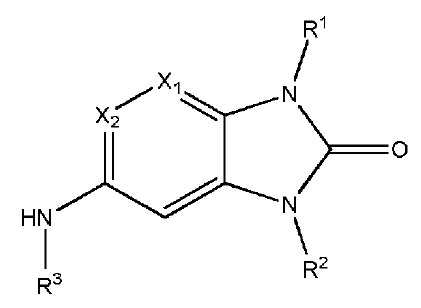
[Formula I]
Description
본 발명은 BCL6(B-cell lymphoma 6) 활성 저해제로 작용하는 특정 화합물에 관한 것이다. 또한, 본 발명은 이러한 화합물의 제조 방법, 이를 포함하는 약제학적 조성물, 및 암과 같은 증식성 장애 뿐만 아니라 BCL6 키나제 활성이 관련된 다른 질병 또는 질환의 치료에서 이들의 용도에 관한 것이다.The present invention relates to certain compounds that act as inhibitors of B-cell lymphoma 6 (BCL6) activity. The invention also relates to methods of making such compounds, pharmaceutical compositions comprising them, and their use in the treatment of proliferative disorders such as cancer as well as other diseases or disorders involving BCL6 kinase activity.
BCL6은 다양한 외부 항원에 대한 항체에서 다양성을 생성시키기 위해서, B 세포가 체세포 과돌연변이(somatic hypermutation) 및 면역글로불린 유전자의 재조합을 겪는 배중심의 형성 및 발달에 중요한 역할을 하는 아연 핑거 전사 리프레서이다(Dent et al., Science, 1997, 276, 589-592). BCL6은 DNA 손상 반응, 세포 주기 정지 및 아포토시스에 관여된 유전자를 억제시킴으로써 항체 생산 B 세포의 증식을 허용한다. BCL6은 코리프레서(corepressor) 단백질 MRT, NCoR 및 BCoR을, BCL6 BTB(BR-C, Ttk 및 Bab) 도메인의 이량체 계면을 따라서 형성된 연장된 그루브 모티프(groove motif)에 모집함으로써 이러한 억제를 매개한다(Ahmad et al., Mol Cell, 2003, 12, 1551-1564; Ghetu et al., Mol Cell, 2008, 29, 384-391). 다수의 림프종에서 인지되는 바와 같이, BCL6 유전자의 유전자 상향조절은 악성 B 세포 증식으로 이어진다(Hatzi & Melnick, Trends Mol Med, 2014, 20, 343-352). 따라서, BTB 도메인에 선택적으로 결합하여 코리프레서 모집을 예방함으로써 또는 BTB 도메인에 결합하여 단백질 분해를 유도함으로써 BCL6의 종양생성 효과를 저해하는 작용제를 개발할 필요가 있다(Kerres et al. Cell Rep., 2017, 20, 2860-2875).BCL6 is a zinc finger transcriptional repressor that plays an important role in the formation and development of embryonic centers where B cells undergo somatic hypermutation and recombination of immunoglobulin genes to generate diversity in antibodies to various foreign antigens ( Dent et al., Science , 1997, 276 , 589-592). BCL6 allows proliferation of antibody producing B cells by inhibiting genes involved in DNA damage response, cell cycle arrest and apoptosis. BCL6 mediates this inhibition by recruiting the corepressor proteins MRT, NCoR and BCoR to an extended groove motif formed along the dimeric interface of the BCL6 BTB (BR-C, Ttk and Bab) domains. (Ahmad et al., Mol Cell , 2003, 12 , 1551-1564; Ghetu et al., Mol Cell , 2008, 29 , 384-391). As is recognized in many lymphomas, gene upregulation of the BCL6 gene leads to malignant B cell proliferation (Hatzi & Melnick, Trends Mol Med , 2014, 20 , 343-352). Therefore, there is a need to develop agents that selectively inhibit the tumorigenic effects of BCL6 by selectively binding to the BTB domain to prevent recruitment of co-pressors or by inducing proteolysis by binding to the BTB domain (Kerres et al. Cell Rep. , 2017, 20 , 2860-2875).
본 발명의 제1 양태에 따르면, 본 명세서에서 정의된 화합물, 또는 이의 약제학적으로 허용 가능한 염, 수화물 또는 용매화물이 제공된다.According to a first aspect of the invention there is provided a compound as defined herein, or a pharmaceutically acceptable salt, hydrate or solvate thereof.
본 발명의 또 다른 양태에 따르면, 약제학적으로 허용 가능한 희석제 또는 담체와 혼합된, 본 명세서에서 정의된 화합물 또는 이의 약제학적으로 허용 가능한 염, 수화물 또는 용매화물을 포함하는 약제학적 조성물이 제공된다.According to another aspect of the present invention there is provided a pharmaceutical composition comprising a compound as defined herein or a pharmaceutically acceptable salt, hydrate or solvate thereof, in admixture with a pharmaceutically acceptable diluent or carrier.
본 발명의 또 다른 양태에 따르면, BCL6 활성을 시험관내 또는 생체내에서 저해하는 방법으로서, 세포를 본 명세서에서 정의된 유효량의 화합물, 또는 이의 약제학적으로 허용 가능한 염, 수화물 또는 용매화물과 접촉시키는 단계를 포함하는 방법을 제공한다.According to another aspect of the invention, a method of inhibiting BCL6 activity in vitro or in vivo, comprising contacting a cell with an effective amount of a compound as defined herein, or a pharmaceutically acceptable salt, hydrate or solvate thereof. It provides a method comprising the steps.
본 발명의 또 다른 양태에 따르면, 시험관내 또는 생체내에서 세포 증식을 저해하는 방법으로서, 세포를 본 명세서에서 정의된 유효량의 화합물, 또는 이의 약제학적으로 허용 가능한 염, 수화물 또는 용매화물, 또는 본 명세서에서 정의된 약제학적 조성물과 접촉시키는 단계를 포함하는 방법을 제공한다.According to another aspect of the invention, there is provided a method of inhibiting cell proliferation in vitro or in vivo, wherein the cell is an effective amount of a compound as defined herein, or a pharmaceutically acceptable salt, hydrate or solvate thereof, or Provided is a method comprising contacting with a pharmaceutical composition as defined herein.
본 발명의 또 다른 양태에 따르면, 치료를 필요로 하는 환자에게 BCL6 키나제 활성이 관련된 질환 또는 장애를 치료하는 방법으로서, 상기 환자에서 본 명세서에 정의된 치료 유효량의 화합물 또는 이의 약제학적으로 허용 가능한 염, 수화물 또는 용매화물, 또는 본 명세서에서 정의된 약제학적 조성물을 투여하는 단계를 포함하는 방법이 제공된다.According to another aspect of the invention, there is provided a method for treating a disease or disorder involving BCL6 kinase activity in a patient in need thereof, wherein the therapeutically effective amount of a compound as defined herein or a pharmaceutically acceptable salt thereof in the patient. , A hydrate or solvate, or a pharmaceutical composition as defined herein is provided.
본 발명의 또 다른 양태에 따르면, 증식성 장애의 치료를 필요로 하는 환자에서 이를 치료하는 방법으로서, 상기 환자에게 본 명세서에 정의된 치료 유효량의 화합물 또는 이의 약제학적으로 허용 가능한 염, 수화물 또는 용매화물, 또는 본 명세서에서 정의된 약제학적 조성물을 투여하는 단계를 포함하는 방법이 제공된다.According to another aspect of the present invention, there is provided a method of treating a patient in need of treatment of a proliferative disorder, the therapeutically effective amount of a compound or pharmaceutically acceptable salt, hydrate or solvent thereof as defined herein. There is provided a method comprising administering a cargo, or a pharmaceutical composition as defined herein.
본 발명의 또 다른 양태에 따르면, 암 치료를 필요로 하는 환자에서 암을 치료하는 방법으로서, 상기 환자에게 본 명세서에 정의된 치료 유효량의 화합물 또는 이의 약제학적으로 허용 가능한 염, 수화물 또는 용매화물, 또는 본 명세서에서 정의된 약제학적 조성물을 투여하는 단계를 포함하는 방법이 제공된다.According to another aspect of the present invention, there is provided a method of treating cancer in a patient in need thereof, the therapeutically effective amount of a compound or a pharmaceutically acceptable salt, hydrate or solvate thereof, as defined herein. Or administering a pharmaceutical composition as defined herein.
본 발명의 또 다른 양태에 따르면, 치료에 사용하기 위한 본 명세서에 정의된 화합물 또는 이의 약제학적으로 허용 가능한 염, 수화물 또는 용매화물, 또는 약제학적 조성물이 제공된다.According to another aspect of the present invention there is provided a compound as defined herein or a pharmaceutically acceptable salt, hydrate or solvate thereof, or pharmaceutical composition as defined herein for use in therapy.
본 발명의 추가의 양태에 따르면, 증식성 병태의 치료에 사용하기 위한, 본 명세서에 정의된 화합물 또는 이의 약제학적으로 허용 가능한 염, 수화물 또는 용매화물, 또는 본 명세서에서 정의된 약제학적 조성물이 제공된다.According to a further aspect of the invention there is provided a compound as defined herein or a pharmaceutically acceptable salt, hydrate or solvate thereof, or a pharmaceutical composition as defined herein for use in the treatment of a proliferative condition. do.
본 발명의 추가의 양태에 따르면, 암의 치료에 사용하기 위한, 본 명세서에 정의된 화합물 또는 이의 약제학적으로 허용 가능한 염, 수화물 또는 용매화물, 또는 약제학적 조성물이 제공된다. 특정 구현예에서, 암은 인간 암이다.According to a further aspect of the present invention there is provided a compound as defined herein or a pharmaceutically acceptable salt, hydrate or solvate thereof, or pharmaceutical composition for use in the treatment of cancer. In certain embodiments, the cancer is human cancer.
본 발명의 또 다른 양태에 따르면, BCL6 활성의 저해에 사용하기 위한, 본 명세서에 정의된 화합물 또는 이의 약제학적으로 허용 가능한 염, 수화물 또는 용매화물이 제공된다.According to another aspect of the invention there is provided a compound as defined herein or a pharmaceutically acceptable salt, hydrate or solvate thereof for use in the inhibition of BCL6 activity.
본 발명의 추가의 양태에 따르면, BCL6 활성이 관련되어 있는 질환 또는 장애의 치료에 사용하기 위한, 본 명세서에서 정의된 바와 같은 화합물, 또는 이의 약제학적으로 허용 가능한 염, 수화물 또는 용매화물이 제공된다.According to a further aspect of the invention there is provided a compound as defined herein, or a pharmaceutically acceptable salt, hydrate or solvate thereof, for use in the treatment of a disease or disorder in which BCL6 activity is associated. .
본 발명의 추가의 양태에 따르면, 증식성 질환의 치료를 위한 약제의 제조에 있어서, 본 명세서에서 정의된 바와 같은 화합물, 또는 이의 약제학적으로 허용 가능한 염, 수화물 또는 용매화물의 용도가 제공된다.According to a further aspect of the invention there is provided the use of a compound as defined herein, or a pharmaceutically acceptable salt, hydrate or solvate thereof, in the manufacture of a medicament for the treatment of proliferative disease.
적합하게는, 증식성 장애는 암, 적합하게는 인간 암(예를 들어, 혈액암, 예컨대, 림프종(미만성 거대 B-세포 림프종(DLBCL), 소포성 림프종(FL), 버킷 림프종(BL) 및 혈관면역모구 T-세포 림프종(AITL) 포함), 백혈병(급성 림프아구 백혈병(ALL) 및 만성 골수성 백혈병(CML) 포함) 및 다발성 골수종, 및 고형 종양(신경교종, 유방암, 비소세포 폐암(NSCLC) 및 편평 세포 암종(SCC)(두경부, 식도, 폐 및 난소의 SCC 포함)포함)이다.Suitably, the proliferative disorder is cancer, suitably human cancer (e.g., hematologic cancer, such as lymphoma (slightly large B-cell lymphoma (DLBCL), vesicular lymphoma (FL), Burkitt's lymphoma (BL) and Leukemia (including acute lymphoblastic leukemia (ALL) and chronic myeloid leukemia (CML)) and multiple myeloma, and solid tumors (glioma, breast cancer, non-small cell lung cancer (NSCLC)) And squamous cell carcinoma (SCC), including SCCs of the head, neck, esophagus, lungs, and ovaries.
본 발명의 추가의 양태에 따르면, 암의 치료를 위한 약제의 제조에 있어서, 본 명세서에서 정의된 바와 같은 화합물, 또는 이의 약제학적으로 허용 가능한 염, 수화물 또는 용매화물의 용도가 제공된다.According to a further aspect of the invention there is provided the use of a compound as defined herein, or a pharmaceutically acceptable salt, hydrate or solvate thereof, in the manufacture of a medicament for the treatment of cancer.
본 발명의 추가의 양태에 따르면, BCL6 활성의 저해를 위한 약제의 제조에서 본 명세서에 정의된 화합물, 또는 이의 약제학적으로 허용 가능한 염, 수화물 또는 용매화물의 용도가 제공된다.According to a further aspect of the present invention there is provided the use of a compound as defined herein, or a pharmaceutically acceptable salt, hydrate or solvate thereof, in the manufacture of a medicament for the inhibition of BCL6 activity.
본 발명의 추가의 양태에 따르면, BCL6 활성이 관련되어있는 질환 또는 장애의 치료를 위한 약제의 제조에 있어서, 본 명세서에 정의된 화합물, 또는 이의 약제학적으로 허용 가능한 염, 수화물 또는 용매화물의 용도가 제공된다.According to a further aspect of the invention, the use of a compound as defined herein, or a pharmaceutically acceptable salt, hydrate or solvate thereof, in the manufacture of a medicament for the treatment of a disease or disorder involving BCL6 activity. Is provided.
본 발명의 추가의 양태에 따르면, 본 명세서에 정의된 화합물, 또는 이의 약제학적으로 허용 가능한 염, 수화물 또는 용매화물의 제조 방법이 제공된다.According to a further aspect of the invention there is provided a process for preparing a compound as defined herein, or a pharmaceutically acceptable salt, hydrate or solvate thereof.
본 발명의 추가의 양태에 따르면, 본 명세서에 정의된 화합물의 제조 방법에 의해 수득가능하거나, 또는 수득되는, 또는 직접 수득되는 화합물, 또는 이의 약제학적으로 허용 가능한 염, 수화물 또는 용매화물이 제공된다.According to a further aspect of the invention there is provided a compound obtainable, obtained or directly obtained by a process for the preparation of a compound as defined herein, or a pharmaceutically acceptable salt, hydrate or solvate thereof. .
본 발명의 추가의 양태에 따르면, 본 명세서에 개시된 임의의 합성 방법 중 하나에 사용하기에 적합한 본 명세서에서 정의된 신규한 중간체가 제공된다.According to a further aspect of the present invention there is provided a novel intermediate as defined herein suitable for use in any of the synthetic methods disclosed herein.
본 발명의 일 양태와 관련하여 선택적인, 적합한 및 바람직한 특징을 포함하는 특징은 또한 본 발명의 임의의 다른 양태와 관련하여 선택적인, 적합한 및 바람직한 특징을 포함하는 특징일 수 있다.Features including optional, suitable and preferred features in connection with one aspect of the invention may also be features comprising optional, suitable and preferred features in connection with any other aspect of the invention.
정의Justice
달리 언급되지 않는 한, 명세서 및 청구범위에서 사용된 다음의 용어는 아래 개시된 다음의 의미를 갖는다.Unless stated otherwise, the following terms used in the specification and claims have the following meanings disclosed below.
"치료하는" 또는 "치료"는 질환의 예방 및 확립된 증상의 완화를 포함하는 것을 지칭하는 것으로 이해되어야 한다. 따라서, 상태, 장애 또는 질환의 "치료하기" 또는 "치료"는 다음을 포함한다: (1) 상태, 장애 또는 질환에 걸리거나 걸리기 쉬울 수 있지만 아직 상태, 장애 또는 상태의 임상적 또는 준임상적 증상을 경험하거나 나타내지 않는 인간에서 발달하는 상태, 장애 또는 질환의 임상 증상의 출현의 예방 또는 지연, (2) 상태, 장애 또는 질환 저해, 즉, 질환의 발달 또는 이의 재발(유지 치료의 경우) 또는 이의 최소한 하나의 임상적 또는 준임상적 증상의 저해, 감소 또는 지연, (3) 질환의 경감 또는 약화, 즉, 상태, 장애 또는 질환, 또는 이의 최소한 하나의 임상적 또는 준임상적 증상의 퇴행 야기.“Treating” or “treatment” should be understood to refer to the prevention of disease and the alleviation of established symptoms. Thus, “treating” or “treatment” of a condition, disorder or disease includes: (1) The condition, disorder or disease may or may not be, but is still clinical or subclinical of the condition, disorder or condition. Preventing or delaying the appearance of clinical symptoms of a condition, disorder or disease developing in a human who does or does not experience symptoms, (2) inhibits the condition, disorder or disease, ie, the development of the disease or its recurrence (in the case of maintenance therapy) or Inhibiting, reducing or delaying at least one clinical or subclinical symptom thereof, (3) alleviating or attenuating the disease, ie causing a condition, disorder or disease, or regression of at least one clinical or subclinical symptom thereof .
"치료 유효량"은 질환을 치료하기 위해 포유류에 투여하는 경우, 이러한 질환의 치료에 충분히 효과적인 화합물의 양을 의미한다. "치료 유효량"은 화합물, 질환 및 이의 중증도, 및 치료되는 포유류의 연령, 체중 등에 따라 달라질 것이다.A "therapeutically effective amount" means an amount of a compound that, when administered to a mammal to treat a disease, is sufficiently effective for treating such disease. A "therapeutically effective amount" will vary depending on the compound, the disease and its severity, and the age, weight, and the like of the mammal being treated.
본 명세서에서, 용어 "알킬"은 직쇄 및 분지쇄 알킬 기 모두를 포함한다. "프로필"과 같은 개개의 알킬 기에 대한 언급은 직쇄 버전에만 특정하며, "이소프로필"과 같은 개개의 분지쇄에 대한 언급은 분지쇄 버전에만 특정한다. 예를 들어, "(1-6C)알킬"은 (1-4C)알킬, (1-3C)알킬, 프로필, 이소프로필 및 t-부틸을 포함한다.As used herein, the term "alkyl" includes both straight and branched chain alkyl groups. References to individual alkyl groups such as "propyl" are specific to the straight chain version only, and references to individual branch chains such as "isopropyl" are specific to the branched chain version only. For example, "(1-6C) alkyl" includes (1-4C) alkyl, (1-3C) alkyl, propyl, isopropyl and t -butyl.
단독으로 또는 접두사로서 사용되는 용어 "(m-nC)" 또는 "(m-nC) 기"는 m 내지 n개의 탄소 원자를 갖는 임의의 기를 지칭한다.The term "(m-nC)" or "(m-nC) group", used alone or as a prefix, refers to any group having m to n carbon atoms.
"알킬렌" 기는 2개의 다른 화학 기 사이에 위치하여 이들을 연결하는 역할을 하는 알킬, 알케닐, 또는 알키닐 기이다. 따라서, "(1-6C)알킬렌"은 1개 내지 6개의 탄소 원자의 선형 포화 2가 탄화수소 라디칼 또는 3 내지 6개의 탄소 원자의 분지형 포화 2가 탄화수소 라디칼, 예컨대, 메틸렌(-CH2-), 에틸렌(-CH2CH2-), 프로필렌(-CH2CH2CH2-), 2-메틸프로필렌(-CH2CH(CH3)CH2-), 펜틸렌(-CH2CH2CH2CH2CH2-) 등을 의미한다An "alkylene" group is an alkyl, alkenyl, or alkynyl group that is located between two different chemical groups and serves to link them. Thus, "(1-6C) alkylene" refers to a linear saturated divalent hydrocarbon radical of 1 to 6 carbon atoms or a branched saturated divalent hydrocarbon radical of 3 to 6 carbon atoms, such as methylene (-CH 2- ). ), ethylene (-CH 2 CH 2 -), propylene (-CH 2 CH 2 CH 2 - ), 2- methyl-propylene (-CH 2 CH (CH 3) CH 2 -), pentylene (-CH 2 CH 2 CH 2 CH 2 CH 2- ) etc.
"(3-10C)사이클로알킬"은 3개 내지 10개의 탄소 원자를 함유하는 탄화수소 고리, 예컨대, 사이클로프로필, 사이클로부틸, 사이클로펜틸, 사이클로헥실, 사이클로헵틸 및 바이사이클로[2.2.1]헵틸을 의미한다."(3-10C) cycloalkyl" means a hydrocarbon ring containing 3 to 10 carbon atoms, such as cyclopropyl, cyclobutyl, cyclopentyl, cyclohexyl, cycloheptyl and bicyclo [2.2.1] heptyl do.
"(3-10C)사이클로알케닐"은 3개 내지 10개의 탄소 원자 및 하나 이상의 이중 결합을 함유하는 탄화수소 고리, 예컨대, 사이클로부텐일, 사이클로펜텐일, 사이클로헥센일 또는 사이클로헵텐일, 예컨대, 3-사이클로헥센-1-일, 또는 사이클로옥텐일을 의미한다."(3-10C) cycloalkenyl" is a hydrocarbon ring containing 3 to 10 carbon atoms and one or more double bonds, such as cyclobutenyl, cyclopentenyl, cyclohexenyl or cycloheptenyl, such as 3 -Cyclohexen-1-yl, or cyclooctenyl.
용어 "할로" 또는 "할로게노"는 플루오로, 클로로, 브로모 및 아이오도, 적합하게는 플루오로, 클로로 및 브로모, 보다 적합하게는, 플루오로 및 클로로를 지칭한다.The term "halo" or "halogeno" refers to fluoro, chloro, bromo and iodo, suitably fluoro, chloro and bromo, more suitably fluoro and chloro.
용어 "헤테로시클릴", "헤테로사이클의" 또는 "헤테로사이클"은 비-방향족 포화된 또는 부분적으로 포화된 모노사이클의, 융합된, 브리징된(bridged), 또는 스피로 바이사이클의 헤테로사이클 고리 계를 의미한다. 모노사이클의 헤테로사이클 고리는 고리에 질소, 산소 또는 황으로부터 선택되는 1개 내지 5개(적절하게는 1, 2 또는 3개)의 헤테로 원자와 함께, 약 3개 내지 12개(적절하게는 3개 내지 7개)의 고리 원자를 함유한다. 바이사이클의 헤테로사이클은 고리에 7개 내지 17개 원자, 적절하게는 7원 내지 12원 원자를 함유한다. 바이사이클의 헤테로사이클은 약 7원 내지 약 17개 고리 원자, 적절하게는 7원 내지 12개 고리 원자를 함유한다. 바이사이클의 헤테로사이클 고리는 융합된, 스피로, 또는 브리징된 고리 계일 수 있다. 헤테로사이클 기의 예는 사이클 에테르, 예컨대, 옥시라닐, 옥세타닐, 테트라히드로푸란일, 디옥사닐, 및 치환된 사이클 에테르를 포함한다. 질소를 함유하는 헤테로사이클은, 예컨대, 아제티디닐, 피롤리디닐, 피페리디닐, 피페라진일, 테트라히드로트리아진일, 테트라히드로피라졸릴 등을 포함한다. 전형적인 황 함유 헤테로사이클은 테트라히드로티엔일, 디히드로-1,3-디티올, 테트라히드로-2H-티오피란, 및 헥사히드로티에핀을 포함한다. 다른 헤테로사이클은 디히드로-옥사티올릴, 테트라히드로-옥사졸릴, 테트라히드로-옥사디아졸릴, 테트라히드로디옥사졸릴, 테트라히드로-옥사티아졸릴, 헥사히드로트리아진일, 테트라히드로-옥사진일, 모르폴린일, 티오모르폴린일, 테트라히드로피리미디닐, 디옥솔리닐, 옥타히드로벤조푸란일, 옥타히드로벤즈이미다졸릴, 및 옥타히드로벤조티아졸릴을 포함한다. 황을 함유하는 헤테로사이클의 경우, SO 또는 SO2 기를 함유하는 산화된 황 헤테로사이클이 또한 포함된다. 예는 테트라히드로티엔일 및 티오모르폴린일의 설폭시드 및 설폰 형태, 예컨대, 테트라히드로티엔 1,1-디옥시드 및 티오모르폴린일 1,1-디옥시드를 포함한다. 1개 또는 2개의 옥소(=O) 또는 티옥소(=S) 치환체를 함유하는 헤테로시클릴 기에 대한 적합한 값은, 예컨대, 2-옥소피롤리디닐, 2-티옥소피롤리디닐, 2-옥소이미다졸리디닐, 2-티옥소이미다졸리디닐, 2-옥소피페리디닐, 2,5-디옥소피롤리디닐, 2,5-디옥소이미다졸리디닐 또는 2,6-디옥소피페리디닐이다. 특정 헤테로시클릴 기는 질소, 산소 또는 황으로부터 선택된 1, 2 또는 3개의 헤테로원자를 함유하는 포화된 모노사이클의 3원 내지 7원 헤테로시클릴, 예컨대, 아제티디닐, 테트라히드로푸란일, 테트라히드로피란일, 피롤리디닐, 모르폴린일, 테트라히드로티엔일, 테트라히드로티엔일 1,1-디옥시드, 티오모르폴린일, 티오모르폴린일 1,1-디옥시드, 피페리디닐, 호모피페리디닐, 피페라진일 또는 호모피페라진일이다. 당업자가 이해하는 바와 같이, 임의의 헤테로사이클은 임의의 적합한 원자를 통해, 예컨대, 탄소 또는 질소 원자를 통해 또 다른 기에 연결될 수 있다. 그러나, 본 명세서에서 피페리디노 또는 모르폴리노로 언급된 것은 고리 질소를 통해 연결된 피페리딘-1-일 또는 모르폴린-4-일 고리를 지칭한다.The terms “heterocyclyl”, “heterocycle” or “heterocycle” refer to a heterocyclic ring system of a non-aromatic saturated or partially saturated monocycle, fused, bridged, or spiro bicycle. Means. A heterocycle ring of a monocycle is about 3-12 (appropriately 3) with 1-5 (appropriately 1, 2 or 3) heteroatoms selected from nitrogen, oxygen or sulfur in the ring And 7 to 7 ring atoms. Bicycle heterocycles contain 7 to 17 atoms, suitably 7 to 12 member atoms, in the ring. The bicycle heterocycle contains about 7 to about 17 ring atoms, suitably 7 to 12 ring atoms. The bicycle heterocycle ring may be a fused, spiro, or bridged ring system. Examples of heterocycle groups include cycle ethers such as oxiranyl, oxetanyl, tetrahydrofuranyl, dioxanyl, and substituted cycle ethers. Heterocycles containing nitrogen include, for example, azetidinyl, pyrrolidinyl, piperidinyl, piperazinyl, tetrahydrotriazinyl, tetrahydropyrazolyl and the like. Typical sulfur containing heterocycles include tetrahydrothienyl, dihydro-1,3-dithiol, tetrahydro-2 H -thiopyran, and hexahydrothiefine. Other heterocycles include dihydro-oxathiolyl, tetrahydro-oxazolyl, tetrahydro-oxadiazolyl, tetrahydrodioxazolyl, tetrahydro-oxathiazolyl, hexahydrotriazinyl, tetrahydro-oxazinyl, mor Paulinyl, thiomorpholinyl, tetrahydropyrimidinyl, dioxolinyl, octahydrobenzofuranyl, octahydrobenzimidazolyl, and octahydrobenzothiazolyl. For heterocycles containing sulfur, oxidized sulfur heterocycles containing SO or SO 2 groups are also included. Examples include sulfoxide and sulfone forms of tetrahydrothienyl and thiomorpholinyl, such as tetrahydrothiene 1,1-dioxide and thiomorpholinyl 1,1-dioxide. Suitable values for heterocyclyl groups containing one or two oxo (= O) or thioxo (= S) substituents are, for example, 2-oxopyrrolidinyl, 2-thioxopyrrolidinyl, 2-oxoimi Dazolidinyl, 2-thioxoimidazolidinyl, 2-oxopiperidinyl, 2,5-dioxopyrrolidinyl, 2,5-dioxoimidazolidinyl or 2,6-dioxopiperidinyl . Certain heterocyclyl groups are saturated monocycle 3- to 7-membered heterocyclyls containing 1, 2 or 3 heteroatoms selected from nitrogen, oxygen or sulfur such as azetidinyl, tetrahydrofuranyl, tetrahydro Pyranyl, pyrrolidinyl, morpholinyl, tetrahydrothienyl, tetrahydrothienyl 1,1-dioxide, thiomorpholinyl, thiomorpholinyl 1,1-dioxide, piperidinyl, homopiperididi Nil, piperazinyl or homopiperazinyl. As will be appreciated by those skilled in the art, any heterocycle may be linked to another group via any suitable atom, such as via a carbon or nitrogen atom. However, what is referred to herein as piperidino or morpholino refers to a piperidin-1-yl or morpholin-4-yl ring linked via ring nitrogen.
"브리징된 고리 계"는 2개의 고리가 2개 이상의 원자를 공유하는 고리 계를 의미하며, 예컨대, 문헌[Advanced Organic Chemistry, by Jerry March, 4th Edition, Wiley Interscience, pages 131-133, 1992]을 참조하길 바란다. 브리징된 헤테로시클릴 고리 계의 예는 아자-바이사이클로[2.2.1]헵탄, 2-옥사-5-아자바이사이클로[2.2.1]헵탄, 아자-바이사이클로[2.2.2]옥탄, 아자-바이사이클로[3.2.1]옥탄 및 퀴뉴클리딘을 포함한다."Bridged ring system" means a ring system in which two rings share two or more atoms, for example, Advanced Organic Chemistry , by Jerry March, 4 th Edition, Wiley Interscience, pages 131-133, 1992 See. Examples of bridged heterocyclyl ring systems include aza-bicyclo [2.2.1] heptane, 2-oxa-5-azabicyclo [2.2.1] heptane, aza-bicyclo [2.2.2] octane, aza- Bicyclo [3.2.1] octane and quinuclidin.
"스피로 바이-시클릭 고리 계"은 두 개의 고리 계가 하나의 공통 스피로 탄소 원자를 공유한다는 것을 의미하며, 즉, 헤테로시클릭 고리는 단일의 공통 스피로 탄소 원자를 통해 추가의 카보시클릭 또는 헤테로시클릭 고리에 연결된다. 스피로 고리 계의 예로는 6-아자스피로[3.4] 옥탄, 2-옥사-6-아자스피로[3.4] 옥탄, 2-아자스피로[3,3]헵탄, 2-옥사-6-아자스피로[3.3]헵탄, 7-옥사-2-아자스피로[3,5]노난, 6-옥사-2-아자스피로[3,4]옥탄, 2-옥사-7-아자스피로[3.5]노난, 및 2-옥사-6-아자스피로[3.5]노난을 들 수 있다."Spiro bicyclic ring system" means that two ring systems share one common spiro carbon atom, i.e., a heterocyclic ring may be further carbocyclic or heterocy through a single common spiro carbon atom. Is connected to the click ring. Examples of spiro ring systems include 6-azaspiro [3.4] octane, 2-oxa-6-azaspiro [3.4] octane, 2-azaspiro [3,3] heptane, 2-oxa-6-azaspiro [3.3] Heptane, 7-oxa-2-azaspiro [3,5] nonane, 6-oxa-2-azaspiro [3,4] octane, 2-oxa-7-azaspiro [3.5] nonane, and 2-oxa- 6-azaspiro [3.5] nonan.
용어 "헤테로아릴" 또는 "헤테로방향족"은 질소, 산소 또는 황으로부터 선택된 하나 이상의(예컨대, 1개 내지 4개, 특히 1, 2 또는 3개) 헤테로원자를 포함하는 방향족 모노-, 바이-, 또는 폴리시클릭 고리를 의미한다. 용어 헤테로아릴은 1가 종 및 2가 종 둘 모두를 포함한다. 헤테로아릴 기의 예는 5개 내지 12개의 고리 원, 및 보다 통상적으로는 5개 내지 10개의 고리 원을 함유하는 모노사이클 및 바이사이클 기이다. 헤테로아릴 기는, 예컨대, 5원 또는 6원의 모노시클릭 고리 또는 9원 또는 10원의 바이시클릭 고리, 예컨대, 융합된 5원 및 6원 고리 또는 2개의 융합된 6원 고리로부터 형성된 바이사이클 구조일 수 있다. 각각의 고리는 전형적으로 질소, 황 및 산소로부터 선택된 약 4개 이하의 헤테로원자를 함유할 수 있다. 전형적으로, 이러한 헤테로아릴 고리는 3개 이하의 헤테로원자, 보다 통상적으로는 2개 이하, 예컨대, 단일 헤테로원자를 함유할 것이다. 하나의 구현예에서, 이러한 헤테로아릴 고리는 하나 이상의 고리 질소 원자를 함유한다. 헤테로아릴 고리 내의 질소 원자는 이미다졸 또는 피리딘일 경우 염기성일 수 있거나, 인돌 또는 피롤 질소인 경우 필수적으로 비-염기성일 수 있다. 일반적으로, 헤테로아릴 기에 존재하는 염기성 질소 원자의 수는, 고리의 임의의 아미노기 치환체를 포함하여 5개 미만일 것이다.The term "heteroaryl" or "heteroaromatic" refers to aromatic mono-, bi-, or one or more (eg 1 to 4, in particular 1, 2 or 3) heteroatoms selected from nitrogen, oxygen or sulfur By polycyclic ring is meant. The term heteroaryl includes both monovalent and divalent species. Examples of heteroaryl groups are monocycle and bicycle groups containing 5 to 12 ring members, and more typically 5 to 10 ring members. Heteroaryl groups are, for example, bicycles formed from 5 or 6 membered monocyclic rings or 9 or 10 membered bicyclic rings such as fused 5 and 6 membered rings or 2 fused 6 membered rings. It may be a structure. Each ring may contain up to about four heteroatoms typically selected from nitrogen, sulfur and oxygen. Typically, such heteroaryl rings will contain up to three heteroatoms, more typically up to two, such as a single heteroatom. In one embodiment, such heteroaryl rings contain one or more ring nitrogen atoms. The nitrogen atom in the heteroaryl ring may be basic when imidazole or pyridine or may be essentially non-basic when indole or pyrrole nitrogen. In general, the number of basic nitrogen atoms present in the heteroaryl group will be less than 5, including any amino group substituents on the ring.
헤테로아릴의 예는 푸릴, 피롤릴, 티엔일, 옥사졸릴, 이소옥사졸릴, 이미다졸릴, 피라졸릴, 티아졸릴, 이소티아졸릴, 옥사디아졸릴, 티아디아졸릴, 트리아졸릴, 테트라졸릴, 피리딜, 피라다진일, 피리미디닐, 피라진일, 1,3,5-트리아제닐, 벤조푸란일, 인돌릴, 이소인돌릴, 벤조티엔일, 벤즈옥사졸릴, 벤즈이미다졸릴, 벤조티아졸릴, 벤조티아졸릴, 인다졸릴, 푸린일, 벤조푸라진일, 퀴놀릴, 이소퀴놀릴, 퀴나졸리닐, 퀴녹살리닐, 시놀리닐, 프테리디닐, 나프티리디닐, 카르바졸릴, 펜아진일, 벤즈이소퀴놀리닐, 피리도피라진일, 티에노[2,3-b]푸란일, 2H-퓨로[3,2-b]-피란일, 5H-피리도[2,3-d]-o-옥사진일, 1H-피라졸로[4,3-d]-옥사졸릴, 4H-이미다조[4,5-d]티아졸릴, 피라지노[2,3-d]피라다진일, 이미다조[2,1-b]티아졸릴, 이미다조[1,2-b][1,2,4]트리아진일을 포함한다. "헤테로아릴"은 또한 부분적으로 방향족인 바이- 또는 폴리시클릭 고리계를 포함하며, 이때, 하나 이상의 고리가 질소, 산소 또는 황으로부터 선택된 하나 이상의 헤테로원자를 포함하는 경우, 하나 이상의 고리는 방향족 고리이고 하나 이상의 다른 고리는 비-방향족의, 포화된 또는 부분적으로 포화된 고리이다. 부분적인 방향족 헤테로아릴 기의 예는, 예컨대, 테트라히드로이소퀴놀리닐, 테트라히드로퀴놀리닐, 2-옥소-1,2,3,4-테트라히드로퀴놀리닐, 디히드로벤즈티엔일, 디히드로벤즈푸란일, 2,3-디히드로-벤조[1,4]디옥시닐, 벤조[1,3]디옥솔릴, 2,2-디옥소-1,3-디히드로-2-벤조티엔일, 4,5,6,7-테트라히드로벤조푸란일, 인돌리닐, 1,2,3,4-테트라히드로-1,8-나프티리디닐, 1,2,3,4-테트라히드로피리도[2,3-b]피라진일 및 3,4-디히드로-2H-피리도[3,2-b][1,4]옥사진일을 포함한다.Examples of heteroaryls are furyl, pyrrolyl, thienyl, oxazolyl, isoxazolyl, imidazolyl, pyrazolyl, thiazolyl, isothiazolyl, oxadiazolyl, thiadiazolyl, triazolyl, tetrazolyl, pyridyl , Pyrazinyl, pyrimidinyl, pyrazinyl, 1,3,5-triazenyl, benzofuranyl, indolyl, isoindolyl, benzothienyl, benzoxazolyl, benzimidazolyl, benzothiazolyl, benzo Thiazolyl, indazolyl, furinyl, benzofurazinyl, quinolyl, isoquinolyl, quinazolinyl, quinoxalinyl, cynolinyl, pterridinyl, naphthyridinyl, carbazolyl, phenazinyl, benziso Quinolinyl, pyridopyrazinyl, thieno [2,3-b] furanyl, 2H-puro [3,2-b] -pyranyl, 5H-pyrido [2,3-d] -o-jade Photoyl, 1 H -pyrazolo [4,3-d] -oxazolyl, 4H-imidazo [4,5-d] thiazolyl, pyrazino [2,3-d] pyrazinyl, imidazo [2 , 1-b] thiazolyl, imidazo [1,2-b] [1,2,4] triazinyl. “Heteroaryl” also includes bi- or polycyclic ring systems that are partially aromatic, where one or more rings are aromatic rings when one or more rings comprise one or more heteroatoms selected from nitrogen, oxygen or sulfur One or more other rings are non-aromatic, saturated or partially saturated rings. Examples of partially aromatic heteroaryl groups include, for example, tetrahydroisoquinolinyl, tetrahydroquinolinyl, 2-oxo-1,2,3,4-tetrahydroquinolinyl, dihydrobenzthienyl, di Hydrobenzfuranyl, 2,3-dihydro-benzo [1,4] dioxyl, benzo [1,3] dioxolyl, 2,2-dioxo-1,3-dihydro-2-benzothienyl , 4,5,6,7-tetrahydrobenzofuranyl, indolinyl, 1,2,3,4-tetrahydro-1,8-naphthyridinyl, 1,2,3,4-tetrahydropyrido [ 2,3- b ] pyrazinyl and 3,4-dihydro-2 H -pyrido [3,2- b ] [1,4] oxazinyl.
5원 헤테로아릴 기의 예는, 비제한적으로 피롤릴, 푸란일, 티엔일, 이미다졸릴, 푸라진일, 옥사졸릴, 옥사디아졸릴, 옥사트리아졸릴, 이소옥사졸릴, 티아졸릴, 이소티아졸릴, 피라졸릴, 트리아졸릴 및 테트라졸릴 기를 포함한다.Examples of 5-membered heteroaryl groups include, but are not limited to, pyrrolyl, furanyl, thienyl, imidazolyl, furazinyl, oxazolyl, oxdiazolyl, oxatriazolyl, isoxazolyl, thiazolyl, isothiazolyl, Pyrazolyl, triazolyl and tetrazolyl groups.
6원 헤테로아릴 기의 예는, 비제한적으로 피리딜, 피라진일, 피리다진일, 피리미디닐 및 트리아진일을 포함한다.Examples of 6-membered heteroaryl groups include, but are not limited to, pyridyl, pyrazinyl, pyridazinyl, pyrimidinyl and triazinyl.
바이사이클의 헤테로아릴 기는, 예컨대, 다음으로부터 선택된 기일 수 있다:The bicyclic heteroaryl group can be, for example, a group selected from:
1, 2 또는 3개의 고리 헤테로원자를 함유하는 5원 또는 6원의 고리에 융합된 벤젠 고리;A benzene ring fused to a 5 or 6 membered ring containing 1, 2 or 3 ring heteroatoms;
1, 2 또는 3개의 고리 헤테로원자를 함유하는 5원 또는 6원의 고리에 융합된 피리딘 고리;Pyridine rings fused to 5- or 6-membered rings containing 1, 2 or 3 ring heteroatoms;
1개 또는 2개의 고리 헤테로원자를 함유하는 5원 또는 6원의 고리에 융합된 피리미딘 고리;Pyrimidine rings fused to five or six membered rings containing one or two ring heteroatoms;
1, 2 또는 3개의 고리 헤테로원자를 함유하는 5원 또는 6원의 고리에 융합된 피롤 고리;Pyrrole rings fused to 5- or 6-membered rings containing 1, 2 or 3 ring heteroatoms;
1개 또는 2개의 고리 헤테로원자를 함유하는 5원 또는 6원의 고리에 융합된 피라졸 고리;Pyrazole rings fused to five- or six-membered rings containing one or two ring heteroatoms;
1개 또는 2개의 고리 헤테로원자를 함유하는 5원 또는 6원의 고리에 융합된 피라진 고리;Pyrazine rings fused to five- or six-membered rings containing one or two ring heteroatoms;
1개 또는 2개의 고리 헤테로원자를 함유하는 5원 또는 6원의 고리에 융합된 이미다졸 고리;Imidazole rings fused to five- or six-membered rings containing one or two ring heteroatoms;
1개 또는 2개의 고리 헤테로원자를 함유하는 5원 또는 6원의 고리에 융합된 옥사졸 고리;Oxazole rings fused to five or six membered rings containing one or two ring heteroatoms;
1개 또는 2개의 고리 헤테로원자를 함유하는 5원 또는 6원의 고리에 융합된 이소옥사졸 고리;An isoxazole ring fused to a five or six membered ring containing one or two ring heteroatoms;
1개 또는 2개의 고리 헤테로원자를 함유하는 5원 또는 6원의 고리에 융합된 티아졸 고리;Thiazole rings fused to 5- or 6-membered rings containing one or two ring heteroatoms;
1개 또는 2개의 고리 헤테로원자를 함유하는 5원 또는 6원의 고리에 융합된 이소티아졸 고리;Isothiazole rings fused to five- or six-membered rings containing one or two ring heteroatoms;
1, 2 또는 3개의 고리 헤테로원자를 함유하는 5원 또는 6원의 고리에 융합된 티오펜 고리;Thiophene rings fused to five or six membered rings containing one, two or three ring heteroatoms;
1, 2 또는 3개의 고리 헤테로원자를 함유하는 5원 또는 6원의 고리에 융합된 푸란 고리;Furan rings fused to 5- or 6-membered rings containing 1, 2 or 3 ring heteroatoms;
1, 2 또는 3개의 고리 헤테로원자를 함유하는 5원 또는 6원의 헤테로방향족 고리에 융합된 사이클로헥실 고리; 및Cyclohexyl ring fused to a 5 or 6 membered heteroaromatic ring containing 1, 2 or 3 ring heteroatoms; And
1, 2 또는 3개의 고리 헤테로원자를 함유하는 5원 또는 6원의 헤테로방향족에 융합된 사이클로펜틸 고리.A cyclopentyl ring fused to a 5 or 6 membered heteroaromatic containing 1, 2 or 3 ring heteroatoms.
5원 고리에 융합된 6원 고리를 함유하는 바이사이클의 헤테로아릴 기의 특정 예는, 비제한적으로 벤즈푸란일, 벤즈티오페닐, 벤즈이미다졸릴, 벤즈옥사졸릴, 벤즈이소옥사졸릴, 벤즈티아졸릴, 벤즈이소티아졸릴, 이소벤조푸란일, 인돌릴, 이소인돌릴, 인돌리진일, 인돌리닐, 이소인돌리닐, 푸린일(예컨대, 아데니닐, 구아니닐), 인다졸릴, 벤조디옥솔릴 및 피라졸로피리디닐 기를 포함한다.Specific examples of bicyclic heteroaryl groups containing a 6 membered ring fused to a 5 membered ring include, but are not limited to, benzfuranyl, benzthiophenyl, benzimidazolyl, benzoxazolyl, benzisooxazolyl, benzthia Zolyl, benzisothiazolyl, isobenzofuranyl, indolyl, isoindolinyl, indolinyl, indolinyl, isoindolinyl, furinyl (e.g. adeninyl, guanyl), indazolyl, benzodiox Solyl and pyrazolopyridinyl groups.
2개의 융합된 6원 고리를 함유하는 바이사이클의 헤테로아릴 기의 특정 예는, 비제한적으로 퀴놀리닐, 이소퀴놀리닐, 크로마닐, 티오크로마닐, 크로메닐, 이소크로메닐, 크로마닐, 이소크로마닐, 벤조디옥사닐, 퀴놀리진일, 벤즈옥사진일, 벤조디아진일, 피리도피리디닐, 퀴녹살리닐, 퀴나졸리닐, 시놀리닐, 프탈라진일, 나프티리디닐 및 프테리디닐 기를 포함한다.Specific examples of bicyclic heteroaryl groups containing two fused 6 membered rings include, but are not limited to, quinolinyl, isoquinolinyl, chromanyl, thiochromenyl, chromaenyl, isochromenyl, chromanyl, Isochromenyl, benzodioxanyl, quinolizinyl, benzoxazineyl, benzodiazinyl, pyridopyridinyl, quinoxalinyl, quinazolinyl, synolinyl, phthalazinyl, naphthyridinyl and pterridinyl Include groups.
용어 "아릴"은 5개 내지 12개의 탄소 원자를 갖는 사이클 또는 폴리사이클 방향족 고리를 의미한다. 용어 아릴은 1가 종 및 2가 종 둘 모두를 포함한다. 아릴 기의 예는, 비제한적으로 페닐, 바이페닐, 나프틸 등을 포함한다. 특정 구현예에서, 아릴은 페닐이다.The term "aryl" means a cyclic or polycycle aromatic ring having 5 to 12 carbon atoms. The term aryl includes both monovalent and divalent species. Examples of aryl groups include, but are not limited to, phenyl, biphenyl, naphthyl and the like. In certain embodiments, aryl is phenyl.
용어 "선택적으로 치환된"은 치환된 기, 구조 또는 분자 및 치환되지 않은 것들을 지칭한다. 용어 "R1 기 내의 하나/임의의 CH, CH2, CH3 기 또는 헤테로원자(즉, NH)가 선택적으로 치환된 경우"는 R1 기의(임의의) 하나의 수소 라디칼이 관련된 규정된 기로 치환된 것을 적절하게 의미한다.The term "optionally substituted" refers to substituted groups, structures or molecules and unsubstituted ones. The term an "R 1 one / any of the group in the group CH, CH 2, CH 3 group or a heteroatom (i.e., NH) is optional when the substituted" is defined a (any) one of the hydrogen radicals of the group R 1 relating Mean substituted by group suitably.
선택적인 치환체가 "하나 이상의" 기로부터 선택되는 경우, 이러한 정의는 하나 이상의 특정 기로부터 선택된 모든 치환체 또는 2개 이상의 특정 기로부터 선택된 치환체를 포함하는 것으로 이해되어야 한다.Where an optional substituent is selected from "one or more" groups, this definition is to be understood to include all substituents selected from one or more specific groups or substituents selected from two or more specific groups.
어구 "본 발명의 화합물"은 일반적으로 및 특이적으로 본 명세서에 개시된 화합물을 의미한다.The phrase "compound of the present invention" means a compound disclosed herein generally and specifically.
본 발명의 화합물Compound of the Invention
일 양태에서, 본 발명은 하기-화학식 I을 갖는 화합물, 또는 이의 약제학적으로 허용 가능한 염, 수화물 또는 용매화물에 관한 것이다:In one aspect, the invention relates to a compound having the formula (I), or a pharmaceutically acceptable salt, hydrate or solvate thereof:
[화학식 I][Formula I]

식 중,In the formula,
X1은 N 또는 CRa로부터 선택되고, 여기서 Ra는 수소, (1-2C)알킬, 할로겐, 히드록시, (1-2C)알콕시, (1-2C)할로알킬, (1-2C)할로알콕시, (2-4C)알켄일, (2-4C)알킨일, 니트로, 시아노 또는 NRbRc로부터 선택되고, 여기서 Rb 및 Rc는 수소 또는 (1-2C)알킬로부터 독립적으로 선택되고;X 1 is selected from N or CR a , wherein R a is hydrogen, (1-2C) alkyl, halogen, hydroxy, (1-2C) alkoxy, (1-2C) haloalkyl, (1-2C) halo Alkoxy, (2-4C) alkenyl, (2-4C) alkynyl, nitro, cyano or NR b R c , wherein R b and R c are independently selected from hydrogen or (1-2C) alkyl Become;
X2는 N 또는 CRd로부터 선택되고, 여기서 Rd는 수소, (1-2C)알킬, 플루오로, 클로로, 브로모, 히드록시, (1-2C)알콕시, (1-2C)할로알킬 또는 (1-2C)할로알콕시로부터 선택되고;X 2 is selected from N or CR d , wherein R d is hydrogen, (1-2C) alkyl, fluoro, chloro, bromo, hydroxy, (1-2C) alkoxy, (1-2C) haloalkyl or (1-2C) haloalkoxy;
R1은 수소 또는 하기 화학식의 기로부터 선택되고:R 1 is selected from hydrogen or a group of the formula:
-L-Y-Z-L-Y-Z
식 중,In the formula,
L은 존재하지 않거나 또는 (1-2C)알킬 또는 옥소로부터 선택된 하나 이상의 치환체에 의해서 선택적으로 치환된 (1-5C)알킬렌이고; L is (1-5C) alkylene which is absent or optionally substituted by one or more substituents selected from (1-2C) alkyl or oxo;
Y는 존재하지 않거나 또는 O, S, SO, SO2, N(Re), C(O), C(O)O, OC(O), C(O)N(Re), N(Re)C(O), N(Re)C(O)N(Rf), N(Re)C(O)O, OC(O)N(Re), S(O)2N(Re) 또는 N(Re)SO2이고, 여기서 Re 및 Rf는 각각 수소 또는 (1-4C)알킬로부터 독립적으로 선택되고;Y is absent or O, S, SO, SO 2 , N (R e ), C (O), C (O) O, OC (O), C (O) N (R e ), N (R e ) C (O), N (R e ) C (O) N (R f ), N (R e ) C (O) O, OC (O) N (R e ), S (O) 2 N ( R e ) or N (R e ) SO 2 , wherein R e and R f are each independently selected from hydrogen or (1-4C) alkyl;
Z는 수소, (1-6C)알킬, (2-6C)알켄일, (2-6C)알킨일, 아릴, (3-10C)시클로알킬, (3-10C)시클로알켄일, 헤테로아릴 또는 헤테로시클릴이고; 여기서 Z는 선택적으로 (1-4C)알킬, 할로, (1-4C)할로알킬, (1-4C)할로알콕시, 아미노, (1-4C)아미노알킬, 시아노, 히드록시, 카르복시, 카르바모일, 설파모일, 머캅토, 우레이도, NRgRh, ORg, C(O)Rg, C(O)ORg, OC(O)Rg, C(O)N(Rg)Rh, N(Rg)C(O)Rh, S(O)yRg(여기서 y는 0, 1 또는 2임), SO2N(Rg)Rh, N(Rg)SO2Rg, Si(Rg)(Rh)Ri 또는 (CH2)zNRgRh(여기서 z는 1, 2 또는 3임)로부터 독립적으로 선택된 하나 이상의 치환기에 의해서 추가로 치환되고; 여기서 Rg, Rh 및 Ri는 각각 수소, (1-6C)알킬 또는 (3-6C)시클로알킬로부터 독립적으로 선택되거나; 또는 Rg와 Rh는, 이들이 부착된 질소 원자와 함께, 이들이 (1-4C)알킬, 할로, (1-4C)할로알킬, (1-4C)할로알콕시, (1-4C)알콕시, (1-4C)알킬아미노, 아미노, 시아노 또는 히드록시로부터 선택된 하나 이상의 치환체에 의해서 선택적으로 치환된 4원 내지 9원의 헤테로시클릭 고리를 형성하도록 연결될 수 있 고;Z is hydrogen, (1-6C) alkyl, (2-6C) alkenyl, (2-6C) alkynyl, aryl, (3-10C) cycloalkyl, (3-10C) cycloalkenyl, heteroaryl or hetero Cyclyl; Wherein Z is optionally (1-4C) alkyl, halo, (1-4C) haloalkyl, (1-4C) haloalkoxy, amino, (1-4C) aminoalkyl, cyano, hydroxy, carboxy, carba Mole, sulfamoyl, mercapto, ureido, NR g R h , OR g , C (O) R g , C (O) OR g , OC (O) R g , C (O) N (R g ) R h , N (R g ) C (O) R h , S (O) y R g , where y is 0, 1 or 2, SO 2 N (R g ) R h , N (R g ) SO 2 Further substituted by one or more substituents independently selected from R g , Si (R g ) (R h ) R i or (CH 2 ) z NR g R h , wherein z is 1, 2 or 3; Wherein R g, R h and R i are each independently selected from hydrogen, (1-6C) alkyl or (3-6C) cycloalkyl; Or R g and R h together with the nitrogen atom to which they are attached are (1-4C) alkyl, halo, (1-4C) haloalkyl, (1-4C) haloalkoxy, (1-4C) alkoxy, ( 1-4C) may be linked to form a 4- to 9-membered heterocyclic ring optionally substituted by one or more substituents selected from alkylamino, amino, cyano or hydroxy;
R2는 하기로부터 선택되고:R 2 is selected from:
(i) 수소 또는 메틸;(i) hydrogen or methyl;
(ii) 하기 화학식의 기:(ii) groups of the formula

(식 중,(In the meal,

W1은 CR4R5 또는 C(O)로부터 선택되고, 여기서 R4 및 R5는 수소, (1-2C)알킬, 플루오로, 히드록시, 시아노, 니트로, (1-2C)알콕시, (1-2C)할로알킬, (1-2C)할로알콕시 또는 NRjRk로부터 독립적으로 선택되고, 여기서 Rj 및 Rk는 수소 또는 (1-2C)알킬로부터 독립적으로 선택되거나; 또는W 1 is selected from CR 4 R 5 or C (O), wherein R 4 and R 5 are hydrogen, (1-2C) alkyl, fluoro, hydroxy, cyano, nitro, (1-2C) alkoxy, Independently selected from (1-2C) haloalkyl, (1-2C) haloalkoxy or NR j R k , wherein R j and R k are independently selected from hydrogen or (1-2C) alkyl; or
R4와 R5는, 이들이 부착된 탄소 원자와 함께, 이들이 (1-2C)알킬, 할로, (1-2C)할로알킬, (1-2C)할로알콕시, (1-2C)알콕시, (1-2C)알킬아미노, 아미노, 시아노 또는 히드록시로부터 선택된 하나 이상의 치환체에 의해서 선택적으로 치환된 3원 내지 6원의 카보시클릭 고리 또는 3원 내지 6원의 헤테로시클릭 고리를 형성하도록 연결될 수 있고;R 4 and R 5 together with the carbon atom to which they are attached are (1-2C) alkyl, halo, (1-2C) haloalkyl, (1-2C) haloalkoxy, (1-2C) alkoxy, (1 -2C) may be linked to form a 3-6 membered carbocyclic ring or a 3-6 membered heterocyclic ring optionally substituted by one or more substituents selected from alkylamino, amino, cyano or hydroxy There is;
W2는 시아노, 5원 또는 6원의 헤테로아릴, 페닐, C(O)Rl, SO2Rl, C(O)OCH3, C(O)N(H)CH3, CR6R7R8 또는 NRlRm으로부터 선택되고, 여기서 Rl 및 Rm은 수소 또는 (1-4C)알킬로부터 독립적으로 선택되고; 여기서W 2 is cyano, 5- or 6-membered heteroaryl, phenyl, C (O) R 1 , SO 2 R 1 , C (O) OCH 3 , C (O) N (H) CH 3 , CR 6 R 7 R 8 or NR 1 R m , wherein R 1 and R m are independently selected from hydrogen or (1-4C) alkyl; here
R6은 수소, (1-2C)알킬, 플루오로, 클로로, 브로모, 히드록시, 아미노, 시아노, 니트로, (1-2C)알콕시, (1-2C)할로알킬 또는 (1-2C)할로알콕시로부터 선택되고;R 6 is hydrogen, (1-2C) alkyl, fluoro, chloro, bromo, hydroxy, amino, cyano, nitro, (1-2C) alkoxy, (1-2C) haloalkyl or (1-2C) Selected from haloalkoxy;
R7은 수소, (1-2C)알킬, 플루오로, 클로로, 브로모, 히드록시, 시아노, 니트로, (1-2C)알콕시, (1-2C)할로알킬, (1-2C)할로알콕시 또는 하기 화학식의 기로부터 선택되고:R 7 is hydrogen, (1-2C) alkyl, fluoro, chloro, bromo, hydroxy, cyano, nitro, (1-2C) alkoxy, (1-2C) haloalkyl, (1-2C) haloalkoxy Or is selected from a group of the formula:
-Y2-L2-Z2 -Y 2 -L 2 -Z 2
식 중,In the formula,
Y2는 존재하지 않거나 또는 O, N(Rn), S, SO, SO2, C(O), C(O)O, OC(O), C(O)N(Rn), N(Rn)C(O), S(O)2N(Rn), 또는 N(Rn)SO2로부터 선택되고, 여기서 Rn은 수소 또는 (1-2C)알킬로부터 선택되고; Y 2 is absent or O, N (R n ), S, SO, SO 2 , C (O), C (O) O, OC (O), C (O) N (R n ), N ( R n ) C (O), S (O) 2 N (R n ), or N (R n ) SO 2 , wherein R n is selected from hydrogen or (1-2C) alkyl;
L2는 존재하지 않거나 또는 (1-2C)알킬렌이고;L 2 is absent or (1-2C) alkylene;
Z2는 수소, (1-6C)알킬, (2-4C)알켄일, (2-4C)알킨일, 페닐, (3-6C)시클로알킬, 5원 내지 6원의 헤테로아릴 또는 4원 내지 6원의 헤테로시클릴이고; 여기서 Z2는 (1-4C)알킬, 할로, (1-4C)할로알킬, (1-4C)할로알콕시, (1-4C)알콕시, (1-4C)알킬아미노, 아미노, 시아노, 니트로, 히드록시, C(O)Ro, C(O)ORo, OC(O)Ro, C(O)N(Ro)Rp, NRoC(O)Rp로부터 선택된 하나 이상의 치환체에 의해서 선택적으로 치환되고, 여기서 Ro 및 Rp는 수소 또는 (1-4C)알킬로부터 독립적으로 선택되고;Z 2 is hydrogen, (1-6C) alkyl, (2-4C) alkenyl, (2-4C) alkynyl, phenyl, (3-6C) cycloalkyl, 5- or 6-membered heteroaryl or 4- to 6 membered heterocyclyl; Wherein Z 2 is (1-4C) alkyl, halo, (1-4C) haloalkyl, (1-4C) haloalkoxy, (1-4C) alkoxy, (1-4C) alkylamino, amino, cyano, nitro One or more substituents selected from hydroxy, C (O) R o , C (O) OR o , OC (O) R o , C (O) N (R o ) R p , NR o C (O) R p Optionally substituted by wherein R o and R p are independently selected from hydrogen or (1-4C) alkyl;
R8은 (1-2C)알킬, -C(O)ORq , ORq, -C(O)NRq, NRqRr, 페닐 또는 5원의 헤테로아릴로부터 선택되고, 여기서 Rq 및 Rr은 수소 또는 (1-2C)알킬로부터 독립적으로 선택되거나;R 8 is (1-2C) alkyl, -C (O) OR q , OR q , -C (O) NR q , NR q R r , Phenyl or 5-membered heteroaryl, wherein R q and R r are independently selected from hydrogen or (1-2C) alkyl;
또는 R6과 R7은, 이들이 부착된 탄소 원자와 함께, 이들이 (1-2C)알킬, 할로, (1-2C)할로알킬, (1-2C)할로알콕시, (1-2C)알콕시, (1-2C)알킬아미노, 아미노, 시아노 또는 히드록실로부터 선택된 하나 이상의 치환체에 의해서 선택적으로 치환된 3원 내지 6원의 카보시클릭 고리 또는 3원 내지 6원의 헤테로시클릭 고리를 형성하도록 연결될 수 있음); 또는Or R 6 and R 7 together with the carbon atom to which they are attached are (1-2C) alkyl, halo, (1-2C) haloalkyl, (1-2C) haloalkoxy, (1-2C) alkoxy, ( 1-2C) to form a 3-6 membered carbocyclic ring or a 3-6 membered heterocyclic ring optionally substituted by one or more substituents selected from alkylamino, amino, cyano or hydroxyl Can be connected); or
(iii) 하기 화학식의 기:(iii) a group of the formula:

(식 중,(In the meal,

고리 A는 (1-2C)알킬, 할로, 히드록시, 시아노 또는 (1-2C)알콕시로부터 선택된 하나 이상의 치환기로 선택적으로 치환된, 4원 내지 6원의 시클로알킬 또는 헤테로시클릴 고리이고;Ring A is a 4-6 membered cycloalkyl or heterocyclyl ring optionally substituted with one or more substituents selected from (1-2C) alkyl, halo, hydroxy, cyano or (1-2C) alkoxy;
W3은 NR100 또는 CR101R102로부터 선택되고, 여기서 R100은 수소, (1-2C)알킬, (1-4C)할로알킬, (1-4C)히드록시알킬, -C(O)-CH3 또는 -C(O)ORab로부터 선택되고, 여기서 Rab는 (1-4C)알킬이고, R101 및 R102는 각각 수소, (1-2C)알킬, 시클로프로필, 플루오로, 클로로, 브로모, 히드록시, 아미노, 시아노, 니트로, (1-2C)알콕시, (1-2C)할로알킬, (1-2C)할로알콕시, -C(O)ORac, -NRacRad, 페닐 또는 5원의 헤테로아릴로부터 독립적으로 선택되고, 여기서 Rac 및 Rad는 수소 또는 (1-2C)알킬로부터 독립적으로 선택됨);W 3 is selected from NR 100 or CR 101 R 102 , wherein R 100 is hydrogen, (1-2C) alkyl, (1-4C) haloalkyl, (1-4C) hydroxyalkyl, -C (O)- CH 3 or —C (O) OR ab , wherein R ab is (1-4C) alkyl, R 101 and R 102 are each hydrogen, (1-2C) alkyl, cyclopropyl, fluoro, chloro, Bromo, hydroxy, amino, cyano, nitro, (1-2C) alkoxy, (1-2C) haloalkyl, (1-2C) haloalkoxy, -C (O) OR ac , -NR ac R ad , Independently selected from phenyl or 5-membered heteroaryl, wherein R ac and R ad are independently selected from hydrogen or (1-2C) alkyl);
R3은 하기로부터 선택되되:R 3 is selected from:
i) 하기에 나타낸 화학식 A의 기:i) a group of formula A shown below:
[화학식 A][Formula A]

(식 중,(In the meal,

Xa 및 Xb는 N 또는 CRx1로부터 독립적으로 선택되고, 여기서 Rx1은 수소, 플루오로, 클로로, 브로모, (1-2C)알킬, (1-2C)알콕시, 시아노, 니트로, 아세틸렌일, CH2F, CF2H 또는 CF3로부터 선택되고;X a and X b are independently selected from N or CR x1 , wherein R x1 is hydrogen, fluoro, chloro, bromo, (1-2C) alkyl, (1-2C) alkoxy, cyano, nitro, acetylene One, CH 2 F, CF 2 H or CF 3 ;
R9는 수소, 플루오로, 클로로, 브로모, (1-2C)알킬, (1-2C)알콕시, 시아노, 니트로, 아세틸렌일, CH2F, CF2H 또는 CF3으로부터 선택되고;R 9 is selected from hydrogen, fluoro, chloro, bromo, (1-2C) alkyl, (1-2C) alkoxy, cyano, nitro, acetylenyl, CH 2 F, CF 2 H or CF 3 ;
R10은 수소, 할로, (1-4C)알킬, (1-4C)알콕시, (1-4C)할로알킬, (1-4C)할로알콕시, 시아노, 니트로, (2-4C)알켄일, (2-4C)알킨일 또는 하기 화학식의 기로부터 선택되고:R 10 is hydrogen, halo, (1-4C) alkyl, (1-4C) alkoxy, (1-4C) haloalkyl, (1-4C) haloalkoxy, cyano, nitro, (2-4C) alkenyl, (2-4C) alkynyl or a group of the formula:
-Y3-Z3 -Y 3 -Z 3
식 중,In the formula,
Y3은 존재하지 않거나 또는 O, N(Rs)(CRsRt)q1(여기서 q1은 0, 1 또는 2임), S, SO, SO2, C(O), C(O)O, OC(O), C(O)N(Rs), N(Rs)C(O), N(Rs)C(O)N(Rt), N(Rs)C(O)O, OC(O)N(Rs), S(O)2N(Rs), N(Rs)SO2이고, 여기서 Rs 및 Rt는 각각 수소 또는 (1-4C)알킬로부터 독립적으로 선택되고;Y 3 is not present or O, N (R s) ( CR s R t) q1 ( where q 1 is 0, 1 or 2), S, SO, SO 2, C (O), C (O) O, OC (O), C (O) N (R s ), N (R s ) C (O), N (R s ) C (O) N (R t ), N (R s ) C (O ) O, OC (O) N (R s ), S (O) 2 N (R s ), N (R s ) SO 2 , where R s and R t are each from hydrogen or (1-4C) alkyl Independently selected;
Z3은 수소, (1-6C)알킬, 아릴, (3-6C)시클로알킬, (2-4C)알켄일, (2-4C)알킨일, (3-6C)시클로알켄일, 헤테로아릴 또는 4원 내지 11원의 헤테로시클릴이고; 여기서 Z3은 선택적으로 옥소, (1-4C)알킬, (3-6C)시클로알킬, 할로, (1-4C)할로알킬, (1-4C)할로알콕시, (1-4C)히드록시알킬, 아미노, 시아노, 히드록시, 아미도, 카르복시, 카르바모일, 설파모일, 머캅토, C(O)NRuRv, NRuRv 또는 ORu로부터 독립적으로 선택된 하나 이상의 치환기에 의해서 추가로 치환되고, 여기서 Ru 및 Rv는 각각 수소, (1-4C)알킬 또는 (3-6C)시클로알킬로부터 독립적으로 선택되고/되거나; Z3은 선택적으로 하기 화학식의 기에 의해서 추가로 치환되고:Z 3 is hydrogen, (1-6C) alkyl, aryl, (3-6C) cycloalkyl, (2-4C) alkenyl, (2-4C) alkynyl, (3-6C) cycloalkenyl, heteroaryl or 4-11 membered heterocyclyl; Wherein Z 3 is optionally oxo, (1-4C) alkyl, (3-6C) cycloalkyl, halo, (1-4C) haloalkyl, (1-4C) haloalkoxy, (1-4C) hydroxyalkyl, Further by one or more substituents independently selected from amino, cyano, hydroxy, amido, carboxy, carbamoyl, sulfamoyl, mercapto, C (O) NR u R v , NR u R v or OR u Substituted, wherein R u and R v are each independently selected from hydrogen, (1-4C) alkyl or (3-6C) cycloalkyl; Z 3 is optionally further substituted by a group of the formula:
-LZ-WZ -L Z -W Z
식 중,In the formula,
LZ는 존재하지 않거나 또는 (1-2C)알킬 또는 옥소로부터 선택된 하나 이상의 치환체에 의해서 선택적으로 치환된 (1-5C)알킬렌이고; L Z is (1-5C) alkylene which is absent or optionally substituted by one or more substituents selected from (1-2C) alkyl or oxo;
WZ는 아릴, 헤테로아릴, 4원 내지 7원의 헤테로시클릴, 3원 내지 6원의 카르보시클릴, 할로, (1-4C)할로알킬, (1-4C)할로알콕시, 시아노, 히드록시, (1-4C)알콕시, C(O)Rxa, COORxa, C(O)NRxaRxb 또는 NRxaRxb이고, 여기서 Rxa 및 Rxb는 각각 수소 또는 (1-4C)알킬로부터 독립적으로 선택되고; 여기서 각각의 아릴, 헤테로아릴, 4원 내지 7원의 헤테로시클릴 또는 3원 내지 6원의 카르보시클릴은 선택적으로 (1-4C)알킬, 할로, (1-4C)할로알킬, 아미노, 시아노 또는 히드록시로부터 독립적으로 선택된 하나 이상의 치환기에 의해서 추가로 치환됨);W Z is aryl, heteroaryl, 4- to 7-membered heterocyclyl, 3- to 6-membered carbocyclyl, halo, (1-4C) haloalkyl, (1-4C) haloalkoxy, cyano, hydroxide Roxy, (1-4C) alkoxy, C (O) R xa , COOR xa , C (O) NR xa R xb or NR xa R xb , where R xa and R xb are each hydrogen or (1-4C) alkyl Independently selected from; Wherein each aryl, heteroaryl, 4- to 7-membered heterocyclyl or 3- to 6-membered carbocyclyl is optionally (1-4C) alkyl, halo, (1-4C) haloalkyl, amino, cya Further substituted by one or more substituents independently selected from no or hydroxy);
ii) 하기에 나타낸 화학식 B의 기:ii) a group of formula B represented below:
[화학식 B][Formula B]

(식 중,(In the meal,

Xc, Xd 및 Xe는 N, CH, CF, CCl, C-CN 또는 CCH3로부터 독립적으로 선택되고;X c, X d and X e are independently selected from N, CH, CF, CCI, C-CN or CCH 3 ;
R11은 수소, 할로, (1-4C)알킬, (1-4C)알콕시, (1-4C)할로알킬, (1-4C)할로알콕시, 시아노, 니트로, (2-4C)알켄일, (2-4C)알킨일 또는 하기 화학식의 기로부터 선택되고:R 11 is hydrogen, halo, (1-4C) alkyl, (1-4C) alkoxy, (1-4C) haloalkyl, (1-4C) haloalkoxy, cyano, nitro, (2-4C) alkenyl, (2-4C) alkynyl or a group of the formula:
-Y5-Z5 -Y 5 -Z 5
식 중,In the formula,
Y5는 존재하지 않거나 또는 O, N(Rw), C(O), C(O)O, OC(O), C(O)N(Rw), N(Rw)C(O), N(Rw)C(O)N(Rx), N(Rw)C(O)O, OC(O)N(Rw), S(O)2N(Rw), N(Rw)SO2이고, 여기서 Rw 및 Rx는 각각 수소 또는 (1-4C)알킬로부터 독립적으로 선택되고;Y 5 is absent or O, N (R w ), C (O), C (O) O, OC (O), C (O) N (R w ), N (R w ) C (O) , N (R w ) C (O) N (R x ), N (R w ) C (O) O, OC (O) N (R w ), S (O) 2 N (R w ), N ( R w ) SO 2 , wherein R w and R x are each independently selected from hydrogen or (1-4C) alkyl;
Z5는 수소, (1-6C)알킬, 아릴, (3-8C)시클로알킬, (3-8C)시클로알켄일, 헤테로아릴 또는 헤테로시클릴이고; 여기서 Z5는 선택적으로 (1-4C)알킬, 할로, (1-4C)할로알킬, (1-4C)할로알콕시, (1-4C)히드록시알킬, 아미노, 시아노, 히드록시, 아미도, 카르복시, 카르바모일, 설파모일, 머캅토, NRyRz, ORy로부터 독립적으로 선택된 하나 이상의 치환기에 의해서 추가로 치환되고, 여기서 Ry 및 Rz는 각각 수소, (1-4C)알킬 또는 (3-6C)시클로알킬로부터 독립적으로 선택됨); Z 5 is hydrogen, (1-6C) alkyl, aryl, (3-8C) cycloalkyl, (3-8C) cycloalkenyl, heteroaryl or heterocyclyl; Wherein Z 5 is optionally (1-4C) alkyl, halo, (1-4C) haloalkyl, (1-4C) haloalkoxy, (1-4C) hydroxyalkyl, amino, cyano, hydroxy, amido Is further substituted by one or more substituents independently selected from carboxy, carbamoyl, sulfamoyl, mercapto, NR y R z , OR y , wherein R y and R z are each hydrogen, (1-4C) alkyl Or (3-6C) cycloalkyl independently);
iii) 하기에 나타낸 화학식 C의 기:iii) a group of formula C shown below:
[화학식 C][Formula C]

(식 중,(In the meal,

R12는 플루오로, 클로로, 브로모, (1-2C)알킬, (1-2C)알콕시, 시아노, 니트로, (2-4C)알켄일, (2-4C)알킨일, CH2F, CF2H 또는 CF3로부터 선택되고;R 12 is fluoro, chloro, bromo, (1-2C) alkyl, (1-2C) alkoxy, cyano, nitro, (2-4C) alkenyl, (2-4C) alkynyl, CH 2 F, Is selected from CF 2 H or CF 3 ;
Xf 및 Xg는 N 또는 CR13으로부터 독립적으로 선택되고, 여기서 R13은 수소, 플루오로, 클로로, (1-2C)알킬, (1-2C)할로알킬 또는 (1-2C)할로알콕시로부터 선택되고;X f and X g are independently selected from N or CR 13 , wherein R 13 is selected from hydrogen, fluoro, chloro, (1-2C) alkyl, (1-2C) haloalkyl or (1-2C) haloalkoxy Selected;
Xh, Xi 및 Xj는 N 또는 CR14로부터 독립적으로 선택되고, 여기서 R14는 수소, 할로, (1-2C)알킬, (1-2C)알콕시, (1-2C)할로알킬 또는 (1-2C)할로알콕시로부터 선택됨);X h , X i and X j are independently selected from N or CR 14 , wherein R 14 is hydrogen, halo, (1-2C) alkyl, (1-2C) alkoxy, (1-2C) haloalkyl or ( 1-2C) selected from haloalkoxy);
단,only,
(i) R3이 화학식 B의 기인 경우, Xc, Xd 및 Xe 중 2개 이하는 질소이고;(i) when R 3 is a group of formula B, then no more than two of X c , X d and X e are nitrogen;
(ii) R3이 화학식 C의 기인 경우, Xf, Xg, Xh, Xi 및 Xj 중 3개 이하는 질소이고;(ii) when R 3 is a group of formula C, then no more than three of X f, X g , X h , X i and X j are nitrogen;
(iii) X1 및 X2가 CH인 경우, R1 및 R2는 수소 또는 메틸이고, R3은 화학식 A의 기이고, Xa는 N이고, Xb는 CH이고, R9는 메틸 또는 플루오로이고, R10은 메틸설포닐아미노페닐 또는 아미노설포닐페닐이 아니고;(iii) when X 1 and X 2 are CH, R 1 and R 2 are hydrogen or methyl, R 3 is a group of formula A, X a is N, X b is CH, R 9 is methyl or Fluoro and R 10 is not methylsulfonylaminophenyl or aminosulfonylphenyl;
(iv) Y3이 NH인 경우, R1 및 R2 각각은 수소 또는 메틸이 아니고;(iv) when Y 3 is NH, each of R 1 and R 2 is not hydrogen or methyl;
(v) 화합물은 하기 중 하나가 아니다:(v) The compound is not one of the following:
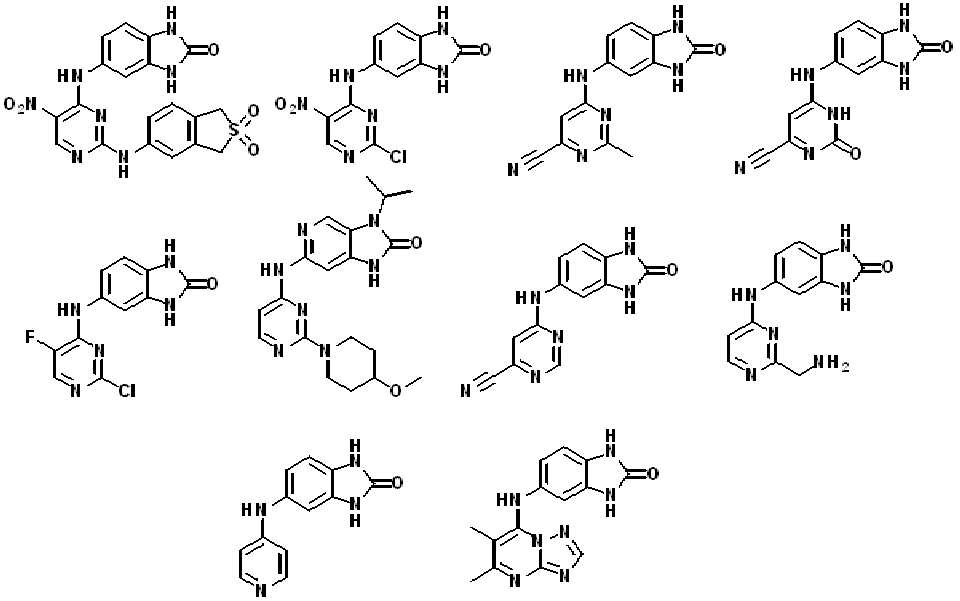
구현예에서, 본 발명은 하기-화학식 I을 갖는 화합물, 또는 이의 약제학적으로 허용 가능한 염, 수화물 또는 용매화물에 관한 것이다:In an embodiment, the present invention relates to a compound having the formula (I), or a pharmaceutically acceptable salt, hydrate or solvate thereof:
[화학식 I][Formula I]

식 중,In the formula,
X1은 N 또는 CRa로부터 선택되고, 여기서 Ra는 수소, (1-2C)알킬, 할로겐, 히드록시, (1-2C)알콕시, (1-2C)할로알킬, (1-2C)할로알콕시, (2-4C)알켄일, (2-4C)알킨일, 니트로, 시아노 또는 NRbRc로부터 선택되고, 여기서 Rb 및 Rc는 수소 또는 (1-2C)알킬로부터 독립적으로 선택되고;X 1 is selected from N or CR a , wherein R a is hydrogen, (1-2C) alkyl, halogen, hydroxy, (1-2C) alkoxy, (1-2C) haloalkyl, (1-2C) halo Alkoxy, (2-4C) alkenyl, (2-4C) alkynyl, nitro, cyano or NR b R c , wherein R b and R c are independently selected from hydrogen or (1-2C) alkyl Become;
X2는 N 또는 CRd로부터 선택되고, 여기서 Rd는 수소, (1-2C)알킬, 플루오로, 클로로, 브로모, 히드록시, (1-2C)알콕시, (1-2C)할로알킬 또는 (1-2C)할로알콕시로부터 선택되고;X 2 is selected from N or CR d , wherein R d is hydrogen, (1-2C) alkyl, fluoro, chloro, bromo, hydroxy, (1-2C) alkoxy, (1-2C) haloalkyl or (1-2C) haloalkoxy;
R1은 수소 또는 하기 화학식의 기로부터 선택되고:R 1 is selected from hydrogen or a group of the formula:
-L-Y-Z -L-Y-Z
식 중,In the formula,
L은 존재하지 않거나 또는 (1-2C)알킬 또는 옥소로부터 선택된 하나 이상의 치환체에 의해서 선택적으로 치환된 (1-5C)알킬렌이고;L is (1-5C) alkylene which is absent or optionally substituted by one or more substituents selected from (1-2C) alkyl or oxo;
Y는 존재하지 않거나 또는 O, S, SO, SO2, N(Re), C(O), C(O)O, OC(O), C(O)N(Re), N(Re)C(O), N(Re)C(O)N(Rf), N(Re)C(O)O, OC(O)N(Re), S(O)2N(Re) 또는 N(Re)SO2이고, 여기서 Re 및 Rf는 각각 수소 또는 (1-4C)알킬로부터 독립적으로 선택되고; Y is absent or O, S, SO, SO 2 , N (R e ), C (O), C (O) O, OC (O), C (O) N (R e ), N (R e ) C (O), N (R e ) C (O) N (R f ), N (R e ) C (O) O, OC (O) N (R e ), S (O) 2 N ( R e ) or N (R e ) SO 2 , wherein R e and R f are each independently selected from hydrogen or (1-4C) alkyl;
Z는 수소, (1-6C)알킬, (2-6C)알켄일, (2-6C)알킨일, 아릴, (3-10C)시클로알킬, (3-10C)시클로알켄일, 헤테로아릴 또는 헤테로시클릴이고; 여기서 Z는 선택적으로 (1-4C)알킬, 할로, (1-4C)할로알킬, (1-4C)할로알콕시, 아미노, (1-4C)아미노알킬, 시아노, 히드록시, 카르복시, 카르바모일, 설파모일, 머캅토, 우레이도, NRgRh, ORg, C(O)Rg, C(O)ORg, OC(O)Rg, C(O)N(Rg)Rh, N(Rg)C(O)Rh, S(O)yRg(여기서 y는 0, 1 또는 2임), SO2N(Rg)Rh, N(Rg)SO2Rg, Si(Rg)(Rh)Ri 또는 (CH2)zNRgRh(여기서 z는 1, 2 또는 3임)로부터 독립적으로 선택된 하나 이상의 치환기에 의해서 추가로 치환되고; 여기서 Rg, Rh 및 Ri는 각각 수소, (1-6C)알킬 또는 (3-6C)시클로알킬로부터 독립적으로 선택되거나; 또는 Rg와 Rh는, 이들이 부착된 질소 원자와 함께, 이들이 (1-4C)알킬, 할로, (1-4C)할로알킬, (1-4C)할로알콕시, (1-4C)알콕시, (1-4C)알킬아미노, 아미노, 시아노 또는 히드록시로부터 선택된 하나 이상의 치환체에 의해서 선택적으로 치환된 4원 내지 9원의 헤테로시클릭 고리를 형성하도록 연결될 수 있고;Z is hydrogen, (1-6C) alkyl, (2-6C) alkenyl, (2-6C) alkynyl, aryl, (3-10C) cycloalkyl, (3-10C) cycloalkenyl, heteroaryl or hetero Cyclyl; Wherein Z is optionally (1-4C) alkyl, halo, (1-4C) haloalkyl, (1-4C) haloalkoxy, amino, (1-4C) aminoalkyl, cyano, hydroxy, carboxy, carba Mole, sulfamoyl, mercapto, ureido, NR g R h , OR g , C (O) R g , C (O) OR g , OC (O) R g , C (O) N (R g ) R h , N (R g ) C (O) R h , S (O) y R g , where y is 0, 1 or 2, SO 2 N (R g ) R h , N (R g ) SO 2 Further substituted by one or more substituents independently selected from R g , Si (R g ) (R h ) R i or (CH 2 ) z NR g R h , wherein z is 1, 2 or 3; Wherein R g, R h and R i are each independently selected from hydrogen, (1-6C) alkyl or (3-6C) cycloalkyl; Or R g and R h together with the nitrogen atom to which they are attached are (1-4C) alkyl, halo, (1-4C) haloalkyl, (1-4C) haloalkoxy, (1-4C) alkoxy, ( 1-4C) may be linked to form a 4- to 9-membered heterocyclic ring optionally substituted by one or more substituents selected from alkylamino, amino, cyano or hydroxy;
R2는 하기로부터 선택되고:R 2 is selected from:
(i) 수소 또는 메틸;(i) hydrogen or methyl;
(ii) 하기 화학식의 기:(ii) groups of the formula

(식 중,(In the meal,

W1은 CR4R5 또는 C(O)로부터 선택되고, 여기서 R4 및 R5는 수소, (1-2C)알킬, 플루오로, 히드록시, 시아노, 니트로, (1-2C)알콕시, (1-2C)할로알킬, (1-2C)할로알콕시 또는 NRjRk로부터 독립적으로 선택되고, 여기서 Rj 및 Rk는 수소 또는 (1-2C)알킬로부터 독립적으로 선택되거나; 또는W 1 is selected from CR 4 R 5 or C (O), wherein R 4 and R 5 are hydrogen, (1-2C) alkyl, fluoro, hydroxy, cyano, nitro, (1-2C) alkoxy, Independently selected from (1-2C) haloalkyl, (1-2C) haloalkoxy or NR j R k , wherein R j and R k are independently selected from hydrogen or (1-2C) alkyl; or
R4와 R5는, 이들이 부착된 탄소 원자와 함께, 이들이 (1-2C)알킬, 할로, (1-2C)할로알킬, (1-2C)할로알콕시, (1-2C)알콕시, (1-2C)알킬아미노, 아미노, 시아노 또는 히드록시로부터 선택된 하나 이상의 치환체에 의해서 선택적으로 치환된 3원 내지 6원의 카보시클릭 고리 또는 3원 내지 6원의 헤테로시클릭 고리를 형성하도록 연결될 수 있고;R 4 and R 5 together with the carbon atom to which they are attached are (1-2C) alkyl, halo, (1-2C) haloalkyl, (1-2C) haloalkoxy, (1-2C) alkoxy, (1 -2C) may be linked to form a 3-6 membered carbocyclic ring or a 3-6 membered heterocyclic ring optionally substituted by one or more substituents selected from alkylamino, amino, cyano or hydroxy There is;
W2는 시아노, 5원 또는 6원의 헤테로아릴, 페닐, C(O)Rl, SO2Rl, C(O)OCH3, C(O)N(H)CH3, CR6R7R8 또는 NRlRm으로부터 선택되고, 여기서 Rl 및 Rm은 수소 또는 (1-4C)알킬로부터 독립적으로 선택되고; 여기서W 2 is cyano, 5- or 6-membered heteroaryl, phenyl, C (O) R 1 , SO 2 R 1 , C (O) OCH 3 , C (O) N (H) CH 3 , CR 6 R 7 R 8 or NR 1 R m , wherein R 1 and R m are independently selected from hydrogen or (1-4C) alkyl; here
R6은 수소, (1-2C)알킬, 플루오로, 클로로, 브로모, 히드록시, 아미노, 시아노, 니트로, (1-2C)알콕시, (1-2C)할로알킬 또는 (1-2C)할로알콕시로부터 선택되고;R 6 is hydrogen, (1-2C) alkyl, fluoro, chloro, bromo, hydroxy, amino, cyano, nitro, (1-2C) alkoxy, (1-2C) haloalkyl or (1-2C) Selected from haloalkoxy;
R7은 수소, (1-2C)알킬, 플루오로, 클로로, 브로모, 히드록시, 시아노, 니트로, (1-2C)알콕시, (1-2C)할로알킬, (1-2C)할로알콕시 또는 하기 화학식의 기로부터 선택되고:R 7 is hydrogen, (1-2C) alkyl, fluoro, chloro, bromo, hydroxy, cyano, nitro, (1-2C) alkoxy, (1-2C) haloalkyl, (1-2C) haloalkoxy Or is selected from a group of the formula:
-Y2-L2-Z2 -Y 2 -L 2 -Z 2
식 중,In the formula,
Y2는 존재하지 않거나 또는 O, N(Rn), S, SO, SO2, C(O), C(O)O, OC(O), C(O)N(Rn), N(Rn)C(O), S(O)2N(Rn), 또는 N(Rn)SO2로부터 선택되고, 여기서 Rn은 수소 또는 (1-2C)알킬로부터 선택되고;Y 2 is absent or O, N (R n ), S, SO, SO 2 , C (O), C (O) O, OC (O), C (O) N (R n ), N ( R n ) C (O), S (O) 2 N (R n ), or N (R n ) SO 2 , wherein R n is selected from hydrogen or (1-2C) alkyl;
L2는 존재하지 않거나 또는 (1-2C)알킬렌이고;L 2 is absent or (1-2C) alkylene;
Z2는 수소, (1-6C)알킬, (2-4C)알켄일, (2-4C)알킨일, 페닐, (3-6C)시클로알킬, 5원 내지 6원의 헤테로아릴 또는 4원 내지 6원의 헤테로시클릴이고; 여기서 Z2는 (1-4C)알킬, 할로, (1-4C)할로알킬, (1-4C)할로알콕시, (1-4C)알콕시, (1-4C)알킬아미노, 아미노, 시아노, 니트로, 히드록시, C(O)Ro, C(O)ORo, OC(O)Ro, C(O)N(Ro)Rp, NRoC(O)Rp로부터 선택된 하나 이상의 치환체에 의해서 선택적으로 치환되고, 여기서 Ro 및 Rp는 수소 또는 (1-4C)알킬로부터 독립적으로 선택되고;Z 2 is hydrogen, (1-6C) alkyl, (2-4C) alkenyl, (2-4C) alkynyl, phenyl, (3-6C) cycloalkyl, 5- or 6-membered heteroaryl or 4- to 6 membered heterocyclyl; Wherein Z 2 is (1-4C) alkyl, halo, (1-4C) haloalkyl, (1-4C) haloalkoxy, (1-4C) alkoxy, (1-4C) alkylamino, amino, cyano, nitro One or more substituents selected from hydroxy, C (O) R o , C (O) OR o , OC (O) R o , C (O) N (R o ) R p , NR o C (O) R p Optionally substituted by wherein R o and R p are independently selected from hydrogen or (1-4C) alkyl;
R8은 (1-2C)알킬, -C(O)ORq , ORq, -C(O)NRq, NRqRr, 페닐 또는 5원의 헤테로아릴로부터 선택되고, 여기서 Rq 및 Rr은 수소 또는 (1-2C)알킬로부터 독립적으로 선택되거나;R 8 is (1-2C) alkyl, -C (O) OR q , OR q , -C (O) NR q , NR q R r , Phenyl or 5-membered heteroaryl, wherein R q and R r are independently selected from hydrogen or (1-2C) alkyl;
또는 R6과 R7은, 이들이 부착된 탄소 원자와 함께, 이들이 (1-2C)알킬, 할로, (1-2C)할로알킬, (1-2C)할로알콕시, (1-2C)알콕시, (1-2C)알킬아미노, 아미노, 시아노 또는 히드록실로부터 선택된 하나 이상의 치환체에 의해서 선택적으로 치환된 3원 내지 6원의 카보시클릭 고리 또는 3원 내지 6원의 헤테로시클릭 고리를 형성하도록 연결될 수 있음); 또는Or R 6 and R 7 together with the carbon atom to which they are attached are (1-2C) alkyl, halo, (1-2C) haloalkyl, (1-2C) haloalkoxy, (1-2C) alkoxy, ( 1-2C) to form a 3-6 membered carbocyclic ring or a 3-6 membered heterocyclic ring optionally substituted by one or more substituents selected from alkylamino, amino, cyano or hydroxyl Can be connected); or
(iii) 하기 화학식의 기:(iii) a group of the formula:

(식 중,(In the meal,

고리 A는 (1-2C)알킬, 할로, 히드록시, 시아노 또는 (1-2C)알콕시로부터 선택된 하나 이상의 치환기로 선택적으로 치환된, 4원 내지 6원의 시클로알킬 또는 헤테로시클릴 고리이고;Ring A is a 4-6 membered cycloalkyl or heterocyclyl ring optionally substituted with one or more substituents selected from (1-2C) alkyl, halo, hydroxy, cyano or (1-2C) alkoxy;
W3은 NR100 또는 CR101R102로부터 선택되고, 여기서 R100은 수소, (1-2C)알킬, (1-4C)할로알킬, (1-4C)히드록시알킬, -C(O)-CH3 또는 -C(O)ORab로부터 선택되고, 여기서 Rab는 (1-2C)알킬이고, R101 및 R102는 각각 수소, (1-2C)알킬, 시클로프로필, 플루오로, 클로로, 브로모, 히드록시, 아미노, 시아노, 니트로, (1-2C)알콕시, (1-2C)할로알킬, (1-2C)할로알콕시, -C(O)ORac, -NRacRad, 페닐 또는 5원의 헤테로아릴로부터 독립적으로 선택되고, 여기서 Rac 및 Rad는 수소 또는 (1-2C)알킬로부터 독립적으로 선택됨);W 3 is selected from NR 100 or CR 101 R 102 , wherein R 100 is hydrogen, (1-2C) alkyl, (1-4C) haloalkyl, (1-4C) hydroxyalkyl, -C (O)- CH 3 or —C (O) OR ab , wherein R ab is (1-2C) alkyl, R 101 and R 102 are each hydrogen, (1-2C) alkyl, cyclopropyl, fluoro, chloro, Bromo, hydroxy, amino, cyano, nitro, (1-2C) alkoxy, (1-2C) haloalkyl, (1-2C) haloalkoxy, -C (O) OR ac , -NR ac R ad , Independently selected from phenyl or 5-membered heteroaryl, wherein R ac and R ad are independently selected from hydrogen or (1-2C) alkyl);
R3은 하기로부터 선택되되:R 3 is selected from:
i) 하기에 나타낸 화학식 A의 기:i) a group of formula A shown below:
[화학식 A][Formula A]

(식 중,(In the meal,

Xa 및 Xb는 N 또는 CRx1로부터 독립적으로 선택되고, 여기서 Rx1은 수소, 플루오로, 클로로, 브로모, (1-2C)알킬, (1-2C)알콕시, 시아노, 니트로, 아세틸렌일, CH2F, CF2H 또는 CF3로부터 선택되고;X a and X b are independently selected from N or CR x1 , wherein R x1 is hydrogen, fluoro, chloro, bromo, (1-2C) alkyl, (1-2C) alkoxy, cyano, nitro, acetylene One, CH 2 F, CF 2 H or CF 3 ;
R9는 수소, 플루오로, 클로로, 브로모, (1-2C)알킬, (1-2C)알콕시, 시아노, 니트로, 아세틸렌일, CH2F, CF2H 또는 CF3으로부터 선택되고;R 9 is selected from hydrogen, fluoro, chloro, bromo, (1-2C) alkyl, (1-2C) alkoxy, cyano, nitro, acetylenyl, CH 2 F, CF 2 H or CF 3 ;
R10은 수소, 할로, (1-4C)알킬, (1-4C)알콕시, (1-4C)할로알킬, (1-4C)할로알콕시, 시아노, 니트로, (2-4C)알켄일, (2-4C)알킨일 또는 하기 화학식의 기로부터 선택되고:R 10 is hydrogen, halo, (1-4C) alkyl, (1-4C) alkoxy, (1-4C) haloalkyl, (1-4C) haloalkoxy, cyano, nitro, (2-4C) alkenyl, (2-4C) alkynyl or a group of the formula:
-Y3-Z3 -Y 3 -Z 3
식 중,In the formula,
Y3은 존재하지 않거나 또는 O, N(Rs)(CRsRt)q1(여기서 q1은 0, 1 또는 2임), S, SO, SO2, C(O), C(O)O, OC(O), C(O)N(Rs), N(Rs)C(O), N(Rs)C(O)N(Rt), N(Rs)C(O)O, OC(O)N(Rs), S(O)2N(Rs), N(Rs)SO2이고, 여기서 Rs 및 Rt는 각각 수소 또는 (1-4C)알킬로부터 독립적으로 선택되고;Y 3 is not present or O, N (R s) ( CR s R t) q1 ( where q 1 is 0, 1 or 2), S, SO, SO 2, C (O), C (O) O, OC (O), C (O) N (R s ), N (R s ) C (O), N (R s ) C (O) N (R t ), N (R s ) C (O ) O, OC (O) N (R s ), S (O) 2 N (R s ), N (R s ) SO 2 , where R s and R t are each from hydrogen or (1-4C) alkyl Independently selected;
Z3은 수소, (1-6C)알킬, 아릴, (3-6C)시클로알킬, (2-4C)알켄일, (2-4C)알킨일, (3-6C)시클로알켄일, 헤테로아릴 또는 4원 내지 11원의 헤테로시클릴이고; 여기서 Z3은 선택적으로 옥소, (1-4C)알킬, (3-6C)시클로알킬, 할로, (1-4C)할로알킬, (1-4C)할로알콕시, 아미노, 시아노, 히드록시, 아미도, 카르복시, 카르바모일, 설파모일, 머캅토, C(O)NRuRv, NRuRv 또는 ORu로부터 독립적으로 선택된 하나 이상의 치환기에 의해서 추가로 치환되고, 여기서 Ru 및 Rv는 각각 수소, (1-4C)알킬 또는 (3-6C)시클로알킬로부터 독립적으로 선택되거나; 또는 Z3은 선택적으로 하기 화학식의 기에 의해서 추가로 치환되고:Z 3 is hydrogen, (1-6C) alkyl, aryl, (3-6C) cycloalkyl, (2-4C) alkenyl, (2-4C) alkynyl, (3-6C) cycloalkenyl, heteroaryl or 4-11 membered heterocyclyl; Wherein Z 3 is optionally oxo, (1-4C) alkyl, (3-6C) cycloalkyl, halo, (1-4C) haloalkyl, (1-4C) haloalkoxy, amino, cyano, hydroxy, amino Or further substituted by one or more substituents independently selected from carboxy, carbamoyl, sulfamoyl, mercapto, C (O) NR u R v , NR u R v or OR u , wherein R u and R v Are each independently selected from hydrogen, (1-4C) alkyl or (3-6C) cycloalkyl; Or Z 3 is optionally further substituted by a group of the formula:
-LZ-WZ -L Z -W Z
식 중,In the formula,
LZ는 (1-2C)알킬 또는 옥소로부터 선택된 하나 이상의 치환체에 의해서 선택적으로 치환된 (1-5C)알킬렌이고;L Z is (1-5C) alkylene optionally substituted by one or more substituents selected from (1-2C) alkyl or oxo;
WZ는 할로, (1-4C)할로알킬, (1-4C)할로알콕시, 시아노, 히드록시, (1-4C)알콕시, C(O)Rxa, COORxa, C(O)NRxaRxb 또는 NRxaRxb이고, 여기서 Rxa 및 Rxb는 각각 수소 또는 (1-4C)알킬로부터 독립적으로 선택됨); 및W Z is halo, (1-4C) haloalkyl, (1-4C) haloalkoxy, cyano, hydroxy, (1-4C) alkoxy, C (O) R xa , COOR xa , C (O) NR xa R xb or NR xa R xb , wherein R xa and R xb are each independently selected from hydrogen or (1-4C) alkyl); And
ii) 하기에 나타낸 화학식 B의 기:ii) a group of formula B represented below:
[화학식 B][Formula B]
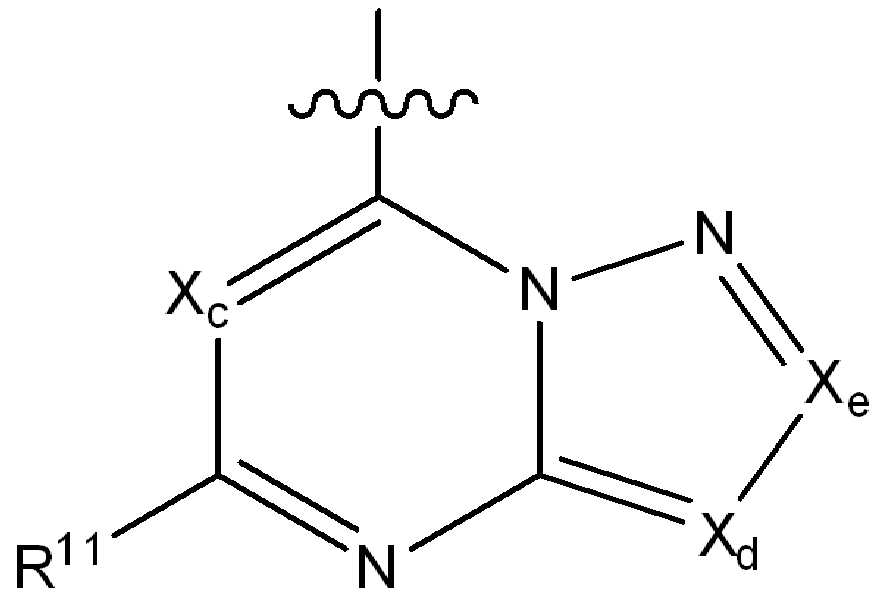
(식 중,(In the meal,

Xc, Xd 및 Xe는 N, CH, CF, CCl, C-CN 또는 CCH3로부터 독립적으로 선택되고;X c, X d and X e are independently selected from N, CH, CF, CCI, C-CN or CCH 3 ;
R11은 수소, 할로, (1-4C)알킬, (1-4C)알콕시, (1-4C)할로알킬, (1-4C)할로알콕시, 시아노, 니트로, (2-4C)알켄일, (2-4C)알킨일 또는 하기 화학식의 기로부터 선택되고:R 11 is hydrogen, halo, (1-4C) alkyl, (1-4C) alkoxy, (1-4C) haloalkyl, (1-4C) haloalkoxy, cyano, nitro, (2-4C) alkenyl, (2-4C) alkynyl or a group of the formula:
-Y5-Z5 -Y 5 -Z 5
식 중,In the formula,
Y5는 존재하지 않거나 또는 O, N(Rw), C(O), C(O)O, OC(O), C(O)N(Rw), N(Rw)C(O), N(Rw)C(O)N(Rx), N(Rw)C(O)O, OC(O)N(Rw), S(O)2N(Rw), N(Rw)SO2이고, 여기서 Rw 및 Rx는 각각 수소 또는 (1-4C)알킬로부터 독립적으로 선택되고;Y 5 is absent or O, N (R w ), C (O), C (O) O, OC (O), C (O) N (R w ), N (R w ) C (O) , N (R w ) C (O) N (R x ), N (R w ) C (O) O, OC (O) N (R w ), S (O) 2 N (R w ), N ( R w ) SO 2 , wherein R w and R x are each independently selected from hydrogen or (1-4C) alkyl;
Z5는 수소, (1-6C)알킬, 아릴, (3-8C)시클로알킬, (3-8C)시클로알켄일, 헤테로아릴 또는 헤테로시클릴이고; 여기서 Z5는 선택적으로 (1-4C)알킬, 할로, (1-4C)할로알킬, (1-4C)할로알콕시, 아미노, 시아노, 히드록시, 아미도, 카르복시, 카르바모일, 설파모일, 머캅토, NRyRz, ORy로부터 독립적으로 선택된 하나 이상의 치환기에 의해서 추가로 치환되고, 여기서 Ry 및 Rz는 각각 수소, (1-4C)알킬 또는 (3-6C)시클로알킬로부터 독립적으로 선택됨);Z 5 is hydrogen, (1-6C) alkyl, aryl, (3-8C) cycloalkyl, (3-8C) cycloalkenyl, heteroaryl or heterocyclyl; Wherein Z 5 is optionally (1-4C) alkyl, halo, (1-4C) haloalkyl, (1-4C) haloalkoxy, amino, cyano, hydroxy, amido, carboxy, carbamoyl, sulfamoyl , Is further substituted by one or more substituents independently selected from mercapto, NR y R z , OR y , wherein R y and R z are each from hydrogen, (1-4C) alkyl or (3-6C) cycloalkyl Independently selected);
iii) 하기에 나타낸 화학식 C의 기:iii) a group of formula C shown below:
[화학식 C][Formula C]

(식 중,(In the meal,

R12는 플루오로, 클로로, 브로모, (1-2C)알킬, (1-2C)알콕시, 시아노, 니트로, (2-4C)알켄일, (2-4C)알킨일, CH2F, CF2H 또는 CF3로부터 선택되고;R 12 is fluoro, chloro, bromo, (1-2C) alkyl, (1-2C) alkoxy, cyano, nitro, (2-4C) alkenyl, (2-4C) alkynyl, CH 2 F, Is selected from CF 2 H or CF 3 ;
Xf 및 Xg는 N 또는 CR13으로부터 독립적으로 선택되고, 여기서 R13은 수소, 플루오로, 클로로, (1-2C)알킬, (1-2C)할로알킬 또는 (1-2C)할로알콕시로부터 선택되고;X f and X g are independently selected from N or CR 13 , wherein R 13 is selected from hydrogen, fluoro, chloro, (1-2C) alkyl, (1-2C) haloalkyl or (1-2C) haloalkoxy Selected;
Xh, Xi 및 Xj는 N 또는 CR14로부터 독립적으로 선택되고, 여기서 R14는 수소, 할로, (1-2C)알킬, (1-2C)알콕시, (1-2C)할로알킬 또는 (1-2C)할로알콕시로부터 선택됨);X h , X i and X j are independently selected from N or CR 14 , wherein R 14 is hydrogen, halo, (1-2C) alkyl, (1-2C) alkoxy, (1-2C) haloalkyl or ( 1-2C) selected from haloalkoxy);
단,only,
(i) R3이 화학식 B의 기인 경우, Xc, Xd 및 Xe 중 2개 이하는 질소이고;(i) when R 3 is a group of formula B, then no more than two of X c , X d and X e are nitrogen;
(ii) R3이 화학식 C의 기인 경우, Xf, Xg, Xh, Xi 및 Xj 중 3개 이하는 질소이다.(ii) when R 3 is a group of formula C, up to three of X f, X g , X h , X i and X j are nitrogen;
또 다른 구현예에서, 본 발명은 하기-화학식 I을 갖는 화합물, 또는 이의 약제학적으로 허용 가능한 염, 수화물 또는 용매화물에 관한 것이다:In another embodiment, the present invention relates to a compound having formula (I), or a pharmaceutically acceptable salt, hydrate or solvate thereof:
[화학식 I][Formula I]

식 중,In the formula,
X1은 N 또는 CRa로부터 선택되고, 여기서 Ra는 수소, (1-2C)알킬, 할로겐, 히드록시, (1-2C)알콕시, (1-2C)할로알킬, (1-2C)할로알콕시, (2-4C)알켄일, (2-4C)알킨일, 니트로, 시아노 또는 NRbRc로부터 선택되고, 여기서 Rb 및 Rc는 수소 또는 (1-2C)알킬로부터 독립적으로 선택되고;X 1 is selected from N or CR a , wherein R a is hydrogen, (1-2C) alkyl, halogen, hydroxy, (1-2C) alkoxy, (1-2C) haloalkyl, (1-2C) halo Alkoxy, (2-4C) alkenyl, (2-4C) alkynyl, nitro, cyano or NR b R c , wherein R b and R c are independently selected from hydrogen or (1-2C) alkyl Become;
X2는 N 또는 CRd로부터 선택되고, 여기서 Rd는 수소, (1-2C)알킬, 플루오로, 클로로, 브로모, 히드록시, (1-2C)알콕시, (1-2C)할로알킬 또는 (1-2C)할로알콕시로부터 선택되고;X 2 is selected from N or CR d , wherein R d is hydrogen, (1-2C) alkyl, fluoro, chloro, bromo, hydroxy, (1-2C) alkoxy, (1-2C) haloalkyl or (1-2C) haloalkoxy;
R1은 수소 또는 하기 화학식의 기로부터 선택되고:R 1 is selected from hydrogen or a group of the formula:
-L-Y-Z-L-Y-Z
식 중,In the formula,
L은 존재하지 않거나 또는 (1-2C)알킬 또는 옥소로부터 선택된 하나 이상의 치환체에 의해서 선택적으로 치환된 (1-5C)알킬렌이고;L is (1-5C) alkylene which is absent or optionally substituted by one or more substituents selected from (1-2C) alkyl or oxo;
Y는 존재하지 않거나 또는 O, S, SO, SO2, N(Re), C(O), C(O)O, OC(O), C(O)N(Re), N(Re)C(O), N(Re)C(O)N(Rf), N(Re)C(O)O, OC(O)N(Re), S(O)2N(Re) 또는 N(Re)SO2이고, 여기서 Re 및 Rf는 각각 수소 또는 (1-4C)알킬로부터 독립적으로 선택되고;Y is absent or O, S, SO, SO 2 , N (R e ), C (O), C (O) O, OC (O), C (O) N (R e ), N (R e ) C (O), N (R e ) C (O) N (R f ), N (R e ) C (O) O, OC (O) N (R e ), S (O) 2 N ( R e ) or N (R e ) SO 2 , wherein R e and R f are each independently selected from hydrogen or (1-4C) alkyl;
Z는 수소, (1-6C)알킬, (2-6C)알켄일, (2-6C)알킨일, 아릴, (3-10C)시클로알킬, (3-10C)시클로알켄일, 헤테로아릴 또는 헤테로시클릴이고; 여기서 Z는 선택적으로 (1-4C)알킬, 할로, (1-4C)할로알킬, (1-4C)할로알콕시, 아미노, (1-4C)아미노알킬, 시아노, 히드록시, 카르복시, 카르바모일, 설파모일, 머캅토, 우레이도, NRgRh, ORg, C(O)Rg, C(O)ORg, OC(O)Rg, C(O)N(Rg)Rh, N(Rg)C(O)Rh, S(O)yRg(여기서 y는 0, 1 또는 2임), SO2N(Rg)Rh, N(Rg)SO2Rg, Si(Rg)(Rh)Ri 또는 (CH2)zNRgRh(여기서 z는 1, 2 또는 3임)로부터 독립적으로 선택된 하나 이상의 치환기에 의해서 추가로 치환되고; 여기서 Rg, Rh 및 Ri는 각각 수소, (1-6C)알킬 또는 (3-6C)시클로알킬로부터 독립적으로 선택되거나; 또는 Rg와 Rh는, 이들이 부착된 질소 원자와 함께, 이들이 (1-4C)알킬, 할로, (1-4C)할로알킬, (1-4C)할로알콕시, (1-4C)알콕시, (1-4C)알킬아미노, 아미노, 시아노 또는 히드록시로부터 선택된 하나 이상의 치환체에 의해서 선택적으로 치환된 4원 내지 9원의 헤테로시클릭 고리를 형성하도록 연결될 수 있고;Z is hydrogen, (1-6C) alkyl, (2-6C) alkenyl, (2-6C) alkynyl, aryl, (3-10C) cycloalkyl, (3-10C) cycloalkenyl, heteroaryl or hetero Cyclyl; Wherein Z is optionally (1-4C) alkyl, halo, (1-4C) haloalkyl, (1-4C) haloalkoxy, amino, (1-4C) aminoalkyl, cyano, hydroxy, carboxy, carba Mole, sulfamoyl, mercapto, ureido, NR g R h , OR g , C (O) R g , C (O) OR g , OC (O) R g , C (O) N (R g ) R h , N (R g ) C (O) R h , S (O) y R g , where y is 0, 1 or 2, SO 2 N (R g ) R h , N (R g ) SO 2 Further substituted by one or more substituents independently selected from R g , Si (R g ) (R h ) R i or (CH 2 ) z NR g R h , wherein z is 1, 2 or 3; Wherein R g, R h and R i are each independently selected from hydrogen, (1-6C) alkyl or (3-6C) cycloalkyl; Or R g and R h together with the nitrogen atom to which they are attached are (1-4C) alkyl, halo, (1-4C) haloalkyl, (1-4C) haloalkoxy, (1-4C) alkoxy, ( 1-4C) may be linked to form a 4- to 9-membered heterocyclic ring optionally substituted by one or more substituents selected from alkylamino, amino, cyano or hydroxy;
R2는 하기로부터 선택되고:R 2 is selected from:
(i) 수소 또는 메틸;(i) hydrogen or methyl;
(ii) 하기 화학식의 기:(ii) groups of the formula

(식 중,(In the meal,

W1은 CR4R5 또는 C(O)로부터 선택되고, 여기서 R4 및 R5는 수소, (1-2C)알킬, 플루오로, 히드록시, 시아노, 니트로, (1-2C)알콕시, (1-2C)할로알킬, (1-2C)할로알콕시 또는 NRjRk로부터 독립적으로 선택되고, 여기서 Rj 및 Rk는 수소 또는 (1-2C)알킬로부터 독립적으로 선택되거나; 또는 W 1 is selected from CR 4 R 5 or C (O), wherein R 4 and R 5 are hydrogen, (1-2C) alkyl, fluoro, hydroxy, cyano, nitro, (1-2C) alkoxy, Independently selected from (1-2C) haloalkyl, (1-2C) haloalkoxy or NR j R k , wherein R j and R k are independently selected from hydrogen or (1-2C) alkyl; or
R4와 R5는, 이들이 부착된 탄소 원자와 함께, 이들이 (1-2C)알킬, 할로, (1-2C)할로알킬, (1-2C)할로알콕시, (1-2C)알콕시, (1-2C)알킬아미노, 아미노, 시아노 또는 히드록시로부터 선택된 하나 이상의 치환체에 의해서 선택적으로 치환된 3원 내지 6원의 카보시클릭 고리 또는 3원 내지 6원의 헤테로시클릭 고리를 형성하도록 연결될 수 있고;R 4 and R 5 together with the carbon atom to which they are attached are (1-2C) alkyl, halo, (1-2C) haloalkyl, (1-2C) haloalkoxy, (1-2C) alkoxy, (1 -2C) may be linked to form a 3-6 membered carbocyclic ring or a 3-6 membered heterocyclic ring optionally substituted by one or more substituents selected from alkylamino, amino, cyano or hydroxy There is;
W2는 시아노, 5원 또는 6원의 헤테로아릴, 페닐, C(O)OCH3, C(O)N(H)CH3, CR6R7R8 또는 NRlRm으로부터 선택되고, 여기서 Rl 및 Rm은 수소 또는 (1-2C)알킬로부터 독립적으로 선택되고, 여기서W 2 is selected from cyano, 5- or 6-membered heteroaryl, phenyl, C (O) OCH 3 , C (O) N (H) CH 3 , CR 6 R 7 R 8 or NR 1 R m , Wherein R l and R m are independently selected from hydrogen or (1-2C) alkyl, wherein
R6은 수소, (1-2C)알킬, 플루오로, 클로로, 브로모, 히드록시, 아미노, 시아노, 니트로, (1-2C)알콕시, (1-2C)할로알킬 또는 (1-2C)할로알콕시로부터 선택되고;R 6 is hydrogen, (1-2C) alkyl, fluoro, chloro, bromo, hydroxy, amino, cyano, nitro, (1-2C) alkoxy, (1-2C) haloalkyl or (1-2C) Selected from haloalkoxy;
R7은 수소, (1-2C)알킬, 플루오로, 클로로, 브로모, 히드록시, 시아노, 니트로, (1-2C)알콕시, (1-2C)할로알킬, (1-2C)할로알콕시 또는 하기 화학식의 기로부터 선택되고:R 7 is hydrogen, (1-2C) alkyl, fluoro, chloro, bromo, hydroxy, cyano, nitro, (1-2C) alkoxy, (1-2C) haloalkyl, (1-2C) haloalkoxy Or is selected from a group of the formula:
-Y2-L2-Z2 -Y 2 -L 2 -Z 2
식 중,In the formula,
Y2는 존재하지 않거나 또는 O, N(Rn), S, SO, SO2, C(O), C(O)O, OC(O), C(O)N(Rn), N(Rn)C(O), S(O)2N(Rn), 또는 N(Rn)SO2로부터 선택되고, 여기서 Rn은 수소 또는 (1-2C)알킬로부터 선택되고;Y 2 is absent or O, N (R n ), S, SO, SO 2 , C (O), C (O) O, OC (O), C (O) N (R n ), N ( R n ) C (O), S (O) 2 N (R n ), or N (R n ) SO 2 , wherein R n is selected from hydrogen or (1-2C) alkyl;
L2는 존재하지 않거나 또는 (1-2C)알킬렌이고;L 2 is absent or (1-2C) alkylene;
Z2는 수소, (1-6C)알킬, (2-4C)알켄일, (2-4C)알킨일, 페닐, (3-6C)시클로알킬, 5원 내지 6원의 헤테로아릴 또는 4원 내지 6원의 헤테로시클릴이고; 여기서 Z2는 (1-4C)알킬, 할로, (1-4C)할로알킬, (1-4C)할로알콕시, (1-4C)알콕시, (1-4C)알킬아미노, 아미노, 시아노, 니트로, 히드록시, C(O)Ro, C(O)ORo, OC(O)Ro, C(O)N(Ro)Rp, NRoC(O)Rp로부터 선택된 하나 이상의 치환체에 의해서 선택적으로 치환되고, 여기서 Ro 및 Rp는 수소 또는 (1-4C)알킬로부터 독립적으로 선택되고;Z 2 is hydrogen, (1-6C) alkyl, (2-4C) alkenyl, (2-4C) alkynyl, phenyl, (3-6C) cycloalkyl, 5- or 6-membered heteroaryl or 4- to 6 membered heterocyclyl; Wherein Z 2 is (1-4C) alkyl, halo, (1-4C) haloalkyl, (1-4C) haloalkoxy, (1-4C) alkoxy, (1-4C) alkylamino, amino, cyano, nitro One or more substituents selected from hydroxy, C (O) R o , C (O) OR o , OC (O) R o , C (O) N (R o ) R p , NR o C (O) R p Optionally substituted by wherein R o and R p are independently selected from hydrogen or (1-4C) alkyl;
R8은 (1-2C)알킬, -C(O)ORq , ORq, -C(O)NRq, NRqRr, 페닐 또는 5원의 헤테로아릴로부터 선택되고, 여기서 Rq 및 Rr은 수소 또는 (1-2C)알킬로부터 독립적으로 선택되거나;R 8 is (1-2C) alkyl, -C (O) OR q , OR q , -C (O) NR q , NR q R r , Phenyl or 5-membered heteroaryl, wherein R q and R r are independently selected from hydrogen or (1-2C) alkyl;
또는 R6과 R7은, 이들이 부착된 탄소 원자와 함께, 이들이 (1-2C)알킬, 할로, (1-2C)할로알킬, (1-2C)할로알콕시, (1-2C)알콕시, (1-2C)알킬아미노, 아미노, 시아노 또는 히드록실로부터 선택된 하나 이상의 치환체에 의해서 선택적으로 치환된 3원 내지 6원의 카보시클릭 고리 또는 3원 내지 6원의 헤테로시클릭 고리를 형성하도록 연결될 수 있음); 또는Or R 6 and R 7 together with the carbon atom to which they are attached are (1-2C) alkyl, halo, (1-2C) haloalkyl, (1-2C) haloalkoxy, (1-2C) alkoxy, ( 1-2C) to form a 3-6 membered carbocyclic ring or a 3-6 membered heterocyclic ring optionally substituted by one or more substituents selected from alkylamino, amino, cyano or hydroxyl Can be connected); or
(iii) 하기 화학식의 기:(iii) a group of the formula:

(식 중,(In the meal,

고리 A는 4원 내지 6원의 시클로알킬 또는 헤테로시클릴 고리이고;Ring A is a 4-6 membered cycloalkyl or heterocyclyl ring;
W3은 NR100 또는 CR101R102로부터 선택되고, 여기서 R100은 수소, (1-2C)알킬, -C(O)-CH3 또는 -C(O)ORab로부터 선택되고, 여기서 Rab는 (1-2C)알킬이고, R101 및 R102는 각각 수소, (1-2C)알킬, 플루오로, 클로로, 브로모, 히드록시, 아미노, 시아노, 니트로, (1-2C)알콕시, (1-2C)할로알킬, (1-2C)할로알콕시, -C(O)ORac, -NRacRad, 페닐 또는 5원의 헤테로아릴로부터 독립적으로 선택되고, 여기서 Rac 및 Rad는 수소 또는 (1-2C)알킬로부터 독립적으로 선택됨); 및W 3 is selected from NR 100 or CR 101 R 102 , wherein R 100 is selected from hydrogen, (1-2C) alkyl, —C (O) —CH 3 or —C (O) OR ab , wherein R ab Is (1-2C) alkyl, R 101 and R 102 are each hydrogen, (1-2C) alkyl, fluoro, chloro, bromo, hydroxy, amino, cyano, nitro, (1-2C) alkoxy, Independently selected from (1-2C) haloalkyl, (1-2C) haloalkoxy, —C (O) OR ac , —NR ac R ad , phenyl or a 5-membered heteroaryl, wherein R ac and R ad are Independently selected from hydrogen or (1-2C) alkyl); And
R3은 하기로부터 선택되되:R 3 is selected from:
i) 하기에 나타낸 화학식 A의 기:i) a group of formula A shown below:
[화학식 A][Formula A]
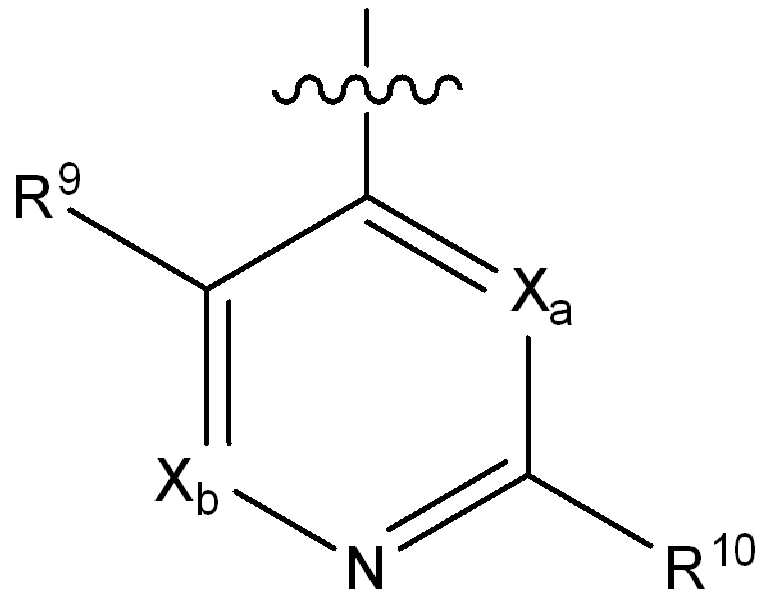
(식 중,(In the meal,

Xa 및 Xb는 N 또는 CRx1로부터 독립적으로 선택되고, 여기서 Rx1은 수소, 플루오로, 클로로, 브로모, (1-2C)알킬, (1-2C)알콕시, 시아노, 니트로, 아세틸렌일, CH2F, CF2H 또는 CF3로부터 선택되고;X a and X b are independently selected from N or CR x1 , wherein R x1 is hydrogen, fluoro, chloro, bromo, (1-2C) alkyl, (1-2C) alkoxy, cyano, nitro, acetylene One, CH 2 F, CF 2 H or CF 3 ;
R9는 수소, 플루오로, 클로로, 브로모, (1-2C)알킬, (1-2C)알콕시, 시아노, 니트로, 아세틸렌일, CH2F, CF2H 또는 CF3으로부터 선택되고;R 9 is selected from hydrogen, fluoro, chloro, bromo, (1-2C) alkyl, (1-2C) alkoxy, cyano, nitro, acetylenyl, CH 2 F, CF 2 H or CF 3 ;
R10은 수소, 할로, (1-4C)알킬, (1-4C)알콕시, (1-4C)할로알킬, (1-4C)할로알콕시, 시아노, 니트로, (2-4C)알켄일, (2-4C)알킨일 또는 하기 화학식의 기로부터 선택되고:R 10 is hydrogen, halo, (1-4C) alkyl, (1-4C) alkoxy, (1-4C) haloalkyl, (1-4C) haloalkoxy, cyano, nitro, (2-4C) alkenyl, (2-4C) alkynyl or a group of the formula:
-Y3-Z3 -Y 3 -Z 3
식 중,In the formula,
Y3은 존재하지 않거나 또는 C(O), C(O)O, OC(O), C(O)N(Rs), N(Rs)C(O), N(Rs)C(O)N(Rt), N(Rs)C(O)O, OC(O)N(Rs), S(O)2N(Rs), N(Rs)SO2이고, 여기서 Rs 및 Rt는 각각 수소 또는 (1-4C)알킬로부터 독립적으로 선택되고;Y 3 is absent or C (O), C (O) O, OC (O), C (O) N (R s ), N (R s ) C (O), N (R s ) C ( O) N (R t ), N (R s ) C (O) O, OC (O) N (R s ), S (O) 2 N (R s ), N (R s ) SO 2 , where R s and R t are each independently selected from hydrogen or (1-4C) alkyl;
Z3은 수소, (1-6C)알킬, 아릴, (3-6C)시클로알킬, (2-4C)알켄일, (2-4C)알킨일, (3-6C)시클로알켄일, 5원 또는 6원의 헤테로아릴 또는 5원 또는 6원의 헤테로시클릴이고; 여기서 Z3은 선택적으로 (1-4C)알킬, 할로, (1-4C)할로알킬, (1-4C)할로알콕시, 아미노, 시아노, 히드록시, 아미도, 카르복시, 카르바모일, 설파모일, 머캅토, NRuRv 또는 ORu로부터 독립적으로 선택된 하나 이상의 치환기에 의해서 추가로 치환되고, 여기서 Ru 및 Rv는 각각 수소, (1-4C)알킬 또는 (3-6C)시클로알킬로부터 독립적으로 선택됨);Z 3 is hydrogen, (1-6C) alkyl, aryl, (3-6C) cycloalkyl, (2-4C) alkenyl, (2-4C) alkynyl, (3-6C) cycloalkenyl, 5-membered or 6 membered heteroaryl or 5 membered or 6 membered heterocyclyl; Wherein Z 3 is optionally (1-4C) alkyl, halo, (1-4C) haloalkyl, (1-4C) haloalkoxy, amino, cyano, hydroxy, amido, carboxy, carbamoyl, sulfamoyl , Further substituted by one or more substituents independently selected from mercapto, NR u R v or OR u , wherein R u and R v are each hydrogen, (1-4C) alkyl or (3-6C) cycloalkyl Independently selected);
ii) 하기에 나타낸 화학식 B의 기:ii) a group of formula B represented below:
[화학식 B][Formula B]

(식 중,(In the meal,

Xc, Xd 및 Xe는 N, CH, CF, CCl, C-CN 또는 CCH3로부터 독립적으로 선택되고;X c, X d and X e are independently selected from N, CH, CF, CCI, C-CN or CCH 3 ;
R11은 수소, 할로, (1-4C)알킬, (1-4C)알콕시, (1-4C)할로알킬, (1-4C)할로알콕시, 시아노, 니트로, (2-4C)알켄일, (2-4C)알킨일 또는 하기 화학식의 기로부터 선택되고:R 11 is hydrogen, halo, (1-4C) alkyl, (1-4C) alkoxy, (1-4C) haloalkyl, (1-4C) haloalkoxy, cyano, nitro, (2-4C) alkenyl, (2-4C) alkynyl or a group of the formula:
-Y5-Z5 -Y 5 -Z 5
식 중,In the formula,
Y5는 존재하지 않거나 또는 O, N(Rw), C(O), C(O)O, OC(O), C(O)N(Rw), N(Rw)C(O), N(Rw)C(O)N(Rx), N(Rw)C(O)O, OC(O)N(Rw), S(O)2N(Rw), N(Rw)SO2이고, 여기서 Rw 및 Rx는 각각 수소 또는 (1-4C)알킬로부터 독립적으로 선택되고;Y 5 is absent or O, N (R w ), C (O), C (O) O, OC (O), C (O) N (R w ), N (R w ) C (O) , N (R w ) C (O) N (R x ), N (R w ) C (O) O, OC (O) N (R w ), S (O) 2 N (R w ), N ( R w ) SO 2 , wherein R w and R x are each independently selected from hydrogen or (1-4C) alkyl;
Z5는 수소, (1-6C)알킬, 아릴, (3-8C)시클로알킬, (3-8C)시클로알켄일, 헤테로아릴 또는 헤테로시클릴이고; 여기서 Z5는 선택적으로 (1-4C)알킬, 할로, (1-4C)할로알킬, (1-4C)할로알콕시, 아미노, 시아노, 히드록시, 아미도, 카르복시, 카르바모일, 설파모일, 머캅토, NRyRz, ORy로부터 독립적으로 선택된 하나 이상의 치환기에 의해서 추가로 치환되고, 여기서 Ry 및 Rz는 각각 수소, (1-4C)알킬 또는 (3-6C)시클로알킬로부터 독립적으로 선택됨);Z 5 is hydrogen, (1-6C) alkyl, aryl, (3-8C) cycloalkyl, (3-8C) cycloalkenyl, heteroaryl or heterocyclyl; Wherein Z 5 is optionally (1-4C) alkyl, halo, (1-4C) haloalkyl, (1-4C) haloalkoxy, amino, cyano, hydroxy, amido, carboxy, carbamoyl, sulfamoyl , Is further substituted by one or more substituents independently selected from mercapto, NR y R z , OR y , wherein R y and R z are each from hydrogen, (1-4C) alkyl or (3-6C) cycloalkyl Independently selected);
iii) 하기에 나타낸 화학식 C의 기:iii) a group of formula C shown below:
[화학식 C][Formula C]
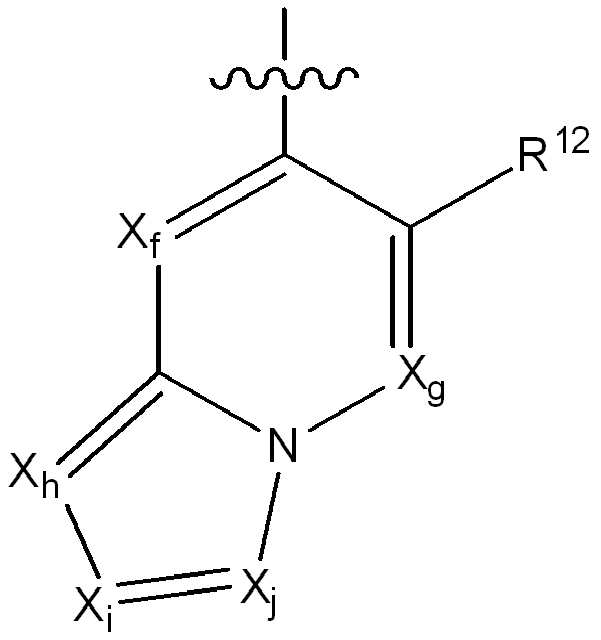
(식 중,(In the meal,

R12는 플루오로, 클로로, 브로모, (1-2C)알킬, (1-2C)알콕시, 시아노, 니트로, (2-4C)알켄일, (2-4C)알킨일, CH2F, CF2H 또는 CF3로부터 선택되고;R 12 is fluoro, chloro, bromo, (1-2C) alkyl, (1-2C) alkoxy, cyano, nitro, (2-4C) alkenyl, (2-4C) alkynyl, CH 2 F, Is selected from CF 2 H or CF 3 ;
Xf 및 Xg는 N 또는 CR13으로부터 독립적으로 선택되고, 여기서 R13은 수소, 플루오로, 클로로, (1-2C)알킬, (1-2C)할로알킬 또는 (1-2C)할로알콕시로부터 선택되고;X f and X g are independently selected from N or CR 13 , wherein R 13 is selected from hydrogen, fluoro, chloro, (1-2C) alkyl, (1-2C) haloalkyl or (1-2C) haloalkoxy Selected;
Xh, Xi 및 Xj는 N 또는 CR14로부터 독립적으로 선택되고, 여기서 R14는 수소, 할로, (1-2C)알킬, (1-2C)알콕시, (1-2C)할로알킬 또는 (1-2C)할로알콕시로부터 선택됨);X h , X i and X j are independently selected from N or CR 14 , wherein R 14 is hydrogen, halo, (1-2C) alkyl, (1-2C) alkoxy, (1-2C) haloalkyl or ( 1-2C) selected from haloalkoxy);
단,only,
(i) R3이 화학식 B의 기인 경우, Xc, Xd 및 Xe 중 단지 1개 또는 2개가 질소이고;(i) when R 3 is a group of formula B, then only one or two of X c , X d and X e is nitrogen;
(ii) R3이 화학식 C의 기인 경우, Xf, Xg, Xh, Xi 및 Xj 중 3개 이하는 질소이다.(ii) when R 3 is a group of formula C, up to three of X f, X g , X h , X i and X j are nitrogen;
본 발명의 화합물의 특정 기에서, R3이 화학식 B의 기인 경우, Xc, Xd 및 Xe 중 하나 이하는 질소이다.In certain groups of compounds of the invention, when R 3 is a group of formula B, one or less of X c , X d and X e is nitrogen.
본 발명의 화합물의 특정 기에서, R3이 화학식 C의 기인 경우, Xf, Xg, Xh, Xi 및 Xj 중 2개 이하는 질소이다.In certain groups of compounds of the invention, when R 3 is a group of formula C, up to two of X f, X g , X h , X i and X j are nitrogen.
본 발명의 화합물의 특정 기에서, R3이 화학식 C의 기인 경우, Xf, Xg, Xh, Xi 및 Xj 중 1개 이하는 질소이다.In certain groups of compounds of the invention, when R 3 is a group of formula C, at least one of X f, X g , X h , X i and X j is nitrogen.
본 발명의 화합물의 특정 기에서, R1이 수소인 경우, R2는 수소가 아니다. In certain groups of the compounds of the invention, when R 1 is hydrogen, R 2 is not hydrogen.
본 발명의 특정 화합물은 예를 들어, 화학식 I의 화합물, 또는 이의 약제학적으로 허용 가능한 염, 수화물 및/또는 용매화물이고, 여기서 달리 언급되지 않는 한, X1, X2, R1, R2, R3 및 임의의 연관된 치환기 각각은 상기 또는 하기 단락 (1) 내지 (89) 중 임의의 것에 정의된 의미 중 임의의 것을 갖는다: -Particular compounds of the invention are, for example, compounds of formula (I), or pharmaceutically acceptable salts, hydrates and / or solvates thereof, and unless stated otherwise X 1 , X 2 , R 1 , R 2 , R 3 and any associated substituents each have any of the meanings defined in any of the above or the following paragraphs (1) to (89):
(1) X1은 N 또는 CRa로부터 선택되고, 여기서 Ra는 수소, (1-2C)알킬, 플루오로, 클로로, 히드록시, (1-2C)알콕시, CH2F, CHF2, CF3, OCF3, 아세틸렌일, 니트로, 시아노 또는 NRbRc로부터 선택되고, 여기서 Rb 및 Rc는 수소 또는 (1-2C)알킬로부터 독립적으로 선택됨;(1) X 1 is selected from N or CR a , where R a is hydrogen, (1-2C) alkyl, fluoro, chloro, hydroxy, (1-2C) alkoxy, CH 2 F, CHF 2 , CF 3 , OCF 3 , acetylenyl, nitro, cyano or NR b R c , wherein R b and R c are independently selected from hydrogen or (1-2C) alkyl;
(2) X1은 N 또는 CRa로부터 선택되고, 여기서 Ra는 수소, 메틸, 플루오로, 클로로, 히드록시, OCH3, CH2F, CHF2, CF3, OCF3, 아세틸렌일, 시아노 또는 NH2로부터 선택됨;(2) X 1 is selected from N or CR a , wherein R a is hydrogen, methyl, fluoro, chloro, hydroxy, OCH 3 , CH 2 F, CHF 2 , CF 3 , OCF 3 , acetylenyl, cya Selected from furnace or NH 2 ;
(3) X1은 N 또는 CRa로부터 선택되고, 여기서 Ra는 수소, 메틸, 플루오로, 클로로, 히드록시, OCH3, CH2F, CHF2, 아세틸렌일, 시아노 또는 NH2로부터 선택됨;(3) X 1 is selected from N or CR a , wherein R a is selected from hydrogen, methyl, fluoro, chloro, hydroxy, OCH 3 , CH 2 F, CHF 2 , acetylenyl, cyano or NH 2 ;
(4) X1은 N 또는 CRa로부터 선택되고, 여기서 Ra는 수소, 메틸, 플루오로, 클로로, 히드록시, OCH3, 아세틸렌일 또는 시아노로부터 선택됨;(4) X 1 is selected from N or CR a , wherein R a is selected from hydrogen, methyl, fluoro, chloro, hydroxy, OCH 3 , acetylenyl or cyano;
(5) X1은 N 또는 CRa로부터 선택되고, 여기서 Ra는 수소, 메틸, 플루오로, 클로로, 히드록시, OCH3 또는 시아노로부터 선택됨;(5) X 1 is selected from N or CR a , wherein R a is selected from hydrogen, methyl, fluoro, chloro, hydroxy, OCH 3 or cyano;
(6) X1은 N 또는 CRa로부터 선택되고, 여기서 Ra는 수소, 메틸, 플루오로 또는, 클로로로부터 선택됨;(6) X 1 is selected from N or CR a , wherein R a is selected from hydrogen, methyl, fluoro or chloro;
(7) X1은 N 또는 CH로부터 선택됨;(7) X 1 is selected from N or CH;
(8) X1은 N임;(8) X 1 is N;
(9) X1은 CH임;(9) X 1 is CH;
(10) X2는 N, CH, CF 또는 C-CH3로부터 선택됨;(10) X 2 Selected from N, CH, CF or C-CH 3 ;
(11) X2는 N 또는 CH로부터 선택됨;(11) X 2 is Selected from N or CH;
(12) X2는 N임;(12) X 2 is N;
(13) X2는 CH, CF 또는 C-CH3로부터 선택됨;(13) X 2 is selected from CH, CF or C—CH 3 ;
(14) X2는 CH임;(14) X 2 is CH;
(15) R1은 수소 또는 하기 화학식의 기로부터 선택됨:(15) R 1 is selected from hydrogen or a group of the formula:
-L-Y-Z -L-Y-Z
(식 중,(In the meal,
L은 존재하지 않거나 또는 (1-2C)알킬 또는 옥소로부터 선택된 하나 이상의 치환체에 의해서 선택적으로 치환된 (1-5C)알킬렌이고;L is (1-5C) alkylene which is absent or optionally substituted by one or more substituents selected from (1-2C) alkyl or oxo;
Y는 존재하지 않거나 또는 O, S, SO, SO2, N(Re), C(O), C(O)O, OC(O), C(O)N(Re), N(Re)C(O), S(O)2N(Re), 또는 N(Re)SO2이고, 여기서 Re는 수소 또는 (1-4C)알킬로부터 선택되고;Y is absent or O, S, SO, SO 2 , N (R e ), C (O), C (O) O, OC (O), C (O) N (R e ), N (R e ) C (O), S (O) 2 N (R e ), or N (R e ) SO 2 , wherein R e is selected from hydrogen or (1-4C) alkyl;
Z는 수소, (1-6C)알킬, (2-6C)알켄일, (2-6C)알킨일, 아릴, (3-10C)시클로알킬, (3-10C)시클로알켄일, 헤테로아릴 또는 헤테로시클릴이고; 여기서 Z는 선택적으로 (1-4C)알킬, 할로, (1-4C)할로알킬, (1-4C)할로알콕시, 아미노, (1-4C)아미노알킬, 시아노, 히드록시, 카르복시, 카르바모일, 설파모일, 머캅토, 우레이도, NRgRh, ORg, C(O)Rg, C(O)ORg, OC(O)Rg, C(O)N(Rg)Rh, N(Rg)C(O)Rh, S(O)yRg(여기서 y는 0, 1 또는 2임), SO2N(Rg)Rh, N(Rg)SO2Rg, Si(Rg)(Rh)Ri 또는 (CH2)zNRgRh(여기서 z는 1, 2 또는 3임)로부터 독립적으로 선택된 하나 이상의 치환기에 의해서 추가로 치환되고; 여기서 Rg, Rh 및 Ri는 각각 수소, (1-6C)알킬 또는 (3-6C)시클로알킬로부터 독립적으로 선택되거나; 또는 Rg와 Rh는, 이들이 부착된 질소 원자와 함께, 이들이 (1-4C)알킬, 할로, (1-4C)할로알킬, (1-4C)할로알콕시, (1-4C)알콕시, (1-4C)알킬아미노, 아미노, 시아노 또는 히드록시로부터 선택된 하나 이상의 치환체에 의해서 선택적으로 치환된 4원 내지 9원의 헤테로시클릭 고리를 형성하도록 연결될 수 있음);Z is hydrogen, (1-6C) alkyl, (2-6C) alkenyl, (2-6C) alkynyl, aryl, (3-10C) cycloalkyl, (3-10C) cycloalkenyl, heteroaryl or hetero Cyclyl; Wherein Z is optionally (1-4C) alkyl, halo, (1-4C) haloalkyl, (1-4C) haloalkoxy, amino, (1-4C) aminoalkyl, cyano, hydroxy, carboxy, carba Mole, sulfamoyl, mercapto, ureido, NR g R h , OR g , C (O) R g , C (O) OR g , OC (O) R g , C (O) N (R g ) R h , N (R g ) C (O) R h , S (O) y R g , where y is 0, 1 or 2, SO 2 N (R g ) R h , N (R g ) SO 2 Further substituted by one or more substituents independently selected from R g , Si (R g ) (R h ) R i or (CH 2 ) z NR g R h , wherein z is 1, 2 or 3; Wherein R g, R h and R i are each independently selected from hydrogen, (1-6C) alkyl or (3-6C) cycloalkyl; Or R g and R h together with the nitrogen atom to which they are attached are (1-4C) alkyl, halo, (1-4C) haloalkyl, (1-4C) haloalkoxy, (1-4C) alkoxy, ( 1-4C) may be linked to form a 4 to 9 membered heterocyclic ring optionally substituted by one or more substituents selected from alkylamino, amino, cyano or hydroxy);
(16) R1은 수소 또는 하기 화학식의 기로부터 선택됨:(16) R 1 is selected from hydrogen or a group of the formula:
-L-Y-Z -L-Y-Z
(식 중,(In the meal,
L은 존재하지 않거나 또는 (1-2C)알킬로부터 선택된 하나 이상의 치환체에 의해서 선택적으로 치환된 (1-5C)알킬렌이고; L is (1-5C) alkylene which is absent or optionally substituted by one or more substituents selected from (1-2C) alkyl;
Y는 존재하지 않거나 또는 O, S, SO, SO2, N(Re), C(O), C(O)O, OC(O), C(O)N(Re), N(Re)C(O), S(O)2N(Re), 또는 N(Re)SO2이고, 여기서 Re는 수소 또는 (1-4C)알킬로부터 선택되고; Y is absent or O, S, SO, SO 2 , N (R e ), C (O), C (O) O, OC (O), C (O) N (R e ), N (R e ) C (O), S (O) 2 N (R e ), or N (R e ) SO 2 , wherein R e is selected from hydrogen or (1-4C) alkyl;
Z는 수소, (1-6C)알킬, (2-6C)알켄일, (2-6C)알킨일, 아릴, (3-10C)시클로알킬, (3-10C)시클로알켄일, 헤테로아릴 또는 헤테로시클릴이고; 여기서 Z는 선택적으로 (1-4C)알킬, 할로, (1-4C)할로알킬, (1-4C)할로알콕시, 아미노, (1-4C)아미노알킬, 시아노, 히드록시, 카르복시, 카르바모일, 설파모일, 머캅토, 우레이도, NRgRh, ORg, C(O)Rg, C(O)ORg, OC(O)Rg, C(O)N(Rg)Rh, N(Rg)C(O)Rh, S(O)yRg(여기서 y는 0, 1 또는 2임), SO2N(Rg)Rh, N(Rg)SO2Rg, Si(Rg)(Rh)Ri 또는 (CH2)zNRgRh(여기서 z는 1, 2 또는 3임)로부터 독립적으로 선택된 하나 이상의 치환기에 의해서 추가로 치환되고; 여기서 Rg, Rh 및 Ri는 각각 수소, (1-6C)알킬 또는 (3-6C)시클로알킬로부터 독립적으로 선택되거나; 또는 Rg와 Rh는, 이들이 부착된 질소 원자와 함께, 이들이 4원 내지 9원의 헤테로시클릭 고리를 형성하도록 연결될 수 있음);Z is hydrogen, (1-6C) alkyl, (2-6C) alkenyl, (2-6C) alkynyl, aryl, (3-10C) cycloalkyl, (3-10C) cycloalkenyl, heteroaryl or hetero Cyclyl; Wherein Z is optionally (1-4C) alkyl, halo, (1-4C) haloalkyl, (1-4C) haloalkoxy, amino, (1-4C) aminoalkyl, cyano, hydroxy, carboxy, carba Mole, sulfamoyl, mercapto, ureido, NR g R h , OR g , C (O) R g , C (O) OR g , OC (O) R g , C (O) N (R g ) R h , N (R g ) C (O) R h , S (O) y R g , where y is 0, 1 or 2, SO 2 N (R g ) R h , N (R g ) SO 2 Further substituted by one or more substituents independently selected from R g , Si (R g ) (R h ) R i or (CH 2 ) z NR g R h , wherein z is 1, 2 or 3; Wherein R g, R h and R i are each independently selected from hydrogen, (1-6C) alkyl or (3-6C) cycloalkyl; Or R g and R h , together with the nitrogen atom to which they are attached, may be linked such that they form a 4-9 membered heterocyclic ring;
(17) R1은 수소 또는 하기 화학식의 기로부터 선택됨:(17) R 1 is selected from hydrogen or a group of the formula:
-L-Y-Z-L-Y-Z
(식 중,(In the meal,
L은 존재하지 않거나 또는 (1-5C)알킬렌이고; L is absent or (1-5C) alkylene;
Y는 존재하지 않거나 또는 O, SO2, N(Re), C(O), C(O)O, OC(O), C(O)N(Re), N(Re)C(O), S(O)2N(Re), 또는 N(Re)SO2이고, 여기서 Re는 수소 또는 (1-4C)알킬로부터 선택되고; Y is absent or O, SO 2 , N (R e ), C (O), C (O) O, OC (O), C (O) N (R e ), N (R e ) C ( O), S (O) 2 N (R e ), or N (R e ) SO 2 , wherein R e is selected from hydrogen or (1-4C) alkyl;
Z는 수소, (1-6C)알킬, (2-6C)알켄일, (2-6C)알킨일, 아릴, (3-10C)시클로알킬, (3-10C)시클로알켄일, 헤테로아릴 또는 헤테로시클릴이고; 여기서 Z는 선택적으로 (1-4C)알킬, 할로, (1-4C)할로알킬, (1-4C)할로알콕시, 아미노, (1-4C)아미노알킬, 시아노, 히드록시, 카르복시, 카르바모일, 설파모일, 머캅토, 우레이도, NRgRh, ORg, C(O)Rg, C(O)ORg, OC(O)Rg, C(O)N(Rg)Rh, N(Rg)C(O)Rh, S(O)yRg(여기서 y는 0, 1 또는 2임), SO2N(Rg)Rh, N(Rg)SO2Rg, Si(Rg)(Rh)Ri 또는 (CH2)zNRgRh(여기서 z는 1, 2 또는 3임)로부터 독립적으로 선택된 하나 이상의 치환기에 의해서 추가로 치환되고; 여기서 Rg, Rh 및 Ri는 각각 수소, (1-6C)알킬 또는 (3-6C)시클로알킬로부터 독립적으로 선택됨);Z is hydrogen, (1-6C) alkyl, (2-6C) alkenyl, (2-6C) alkynyl, aryl, (3-10C) cycloalkyl, (3-10C) cycloalkenyl, heteroaryl or hetero Cyclyl; Wherein Z is optionally (1-4C) alkyl, halo, (1-4C) haloalkyl, (1-4C) haloalkoxy, amino, (1-4C) aminoalkyl, cyano, hydroxy, carboxy, carba Mole, sulfamoyl, mercapto, ureido, NR g R h , OR g , C (O) R g , C (O) OR g , OC (O) R g , C (O) N (R g ) R h , N (R g ) C (O) R h , S (O) y R g , where y is 0, 1 or 2, SO 2 N (R g ) R h , N (R g ) SO 2 Further substituted by one or more substituents independently selected from R g , Si (R g ) (R h ) R i or (CH 2 ) z NR g R h , wherein z is 1, 2 or 3; Wherein R g, R h and R i are each independently selected from hydrogen, (1-6C) alkyl or (3-6C) cycloalkyl);
(18) R1은 수소 또는 하기 화학식의 기로부터 선택됨:(18) R 1 is selected from hydrogen or a group of the formula:
-L-Y-Z-L-Y-Z
(식 중,(In the meal,
L은 존재하지 않거나 또는 (1-5C)알킬렌이고;L is absent or (1-5C) alkylene;
Y는 존재하지 않거나 또는 O, SO2, C(O), C(O)O, C(O)N(Re) 또는 S(O)2N(Re)이고, 여기서 Re는 수소 또는 (1-4C)알킬로부터 선택되고; Y is absent or is O, SO 2 , C (O), C (O) O, C (O) N (R e ) or S (O) 2 N (R e ), where R e is hydrogen or (1-4C) alkyl;
Z는 수소, (1-6C)알킬, (2-6C)알켄일, (2-6C)알킨일, 아릴, (3-10C)시클로알킬, (3-10C)시클로알켄일, 헤테로아릴 또는 헤테로시클릴이고; 여기서 Z는 선택적으로 (1-2C)알킬, 할로, (1-2C)할로알킬, (1-2C)할로알콕시, 아미노, (1-2C)아미노알킬, 시아노, 히드록시, 카르복시, 카르바모일, 설파모일, 머캅토, 우레이도, NRgRh, ORg, C(O)Rg, C(O)ORg, OC(O)Rg, C(O)N(Rg)Rh, N(Rg)C(O)Rh, S(O)yRg(여기서 y는 0, 1 또는 2임), SO2N(Rg)Rh, N(Rg)SO2Rg, Si(Rg)(Rh)Ri 또는 (CH2)zNRgRh(여기서 z는 1, 2 또는 3임)로부터 독립적으로 선택된 하나 이상의 치환기에 의해서 추가로 치환되고; 여기서 Rg, Rh 및 Ri는 각각 수소 또는 (1-4C)알킬로부터 독립적으로 선택됨);Z is hydrogen, (1-6C) alkyl, (2-6C) alkenyl, (2-6C) alkynyl, aryl, (3-10C) cycloalkyl, (3-10C) cycloalkenyl, heteroaryl or hetero Cyclyl; Wherein Z is optionally (1-2C) alkyl, halo, (1-2C) haloalkyl, (1-2C) haloalkoxy, amino, (1-2C) aminoalkyl, cyano, hydroxy, carboxy, carba Mole, sulfamoyl, mercapto, ureido, NR g R h , OR g , C (O) R g , C (O) OR g , OC (O) R g , C (O) N (R g ) R h , N (R g ) C (O) R h , S (O) y R g , where y is 0, 1 or 2, SO 2 N (R g ) R h , N (R g ) SO 2 Further substituted by one or more substituents independently selected from R g , Si (R g ) (R h ) R i or (CH 2 ) z NR g R h , wherein z is 1, 2 or 3; Wherein R g, R h and R i are each independently selected from hydrogen or (1-4C) alkyl);
(19) R1은 수소 또는 하기 화학식의 기로부터 선택됨:(19) R 1 is selected from hydrogen or a group of the formula:
-L-Y-Z-L-Y-Z
(식 중,(In the meal,
L은 존재하지 않거나 또는 (1-5C)알킬렌이고; L is absent or (1-5C) alkylene;
Y는 존재하지 않거나 또는 O, SO2, C(O), C(O)O, C(O)N(Re) 또는 S(O)2N(Re)이고, 여기서 Re는 수소 또는 (1-4C)알킬로부터 선택되고; Y is absent or is O, SO 2 , C (O), C (O) O, C (O) N (R e ) or S (O) 2 N (R e ), where R e is hydrogen or (1-4C) alkyl;
Z는 수소, (1-6C)알킬, (2-6C)알켄일, (2-6C)알킨일, 아릴, (3-10C)시클로알킬, (3-10C)시클로알켄일, 헤테로아릴 또는 헤테로시클릴이고; 여기서 Z는 선택적으로 (1-2C)알킬, 할로, (1-2C)할로알킬, (1-2C)할로알콕시, 아미노, (1-2C)아미노알킬, 시아노, 히드록시, 카르복시, 카르바모일, 설파모일, 머캅토, 우레이도, NRgRh 또는 ORg로부터 독립적으로 선택된 하나 이상의 치환기에 의해서 추가로 치환되고; 여기서 Rg, Rh 및 Ri는 각각 수소 또는 (1-4C)알킬로부터 독립적으로 선택됨);Z is hydrogen, (1-6C) alkyl, (2-6C) alkenyl, (2-6C) alkynyl, aryl, (3-10C) cycloalkyl, (3-10C) cycloalkenyl, heteroaryl or hetero Cyclyl; Wherein Z is optionally (1-2C) alkyl, halo, (1-2C) haloalkyl, (1-2C) haloalkoxy, amino, (1-2C) aminoalkyl, cyano, hydroxy, carboxy, carba Further substituted by one or more substituents independently selected from moyl, sulfamoyl, mercapto, ureido, NR g R h or OR g ; Wherein R g , R h and R i are each independently selected from hydrogen or (1-4C) alkyl);
(20) R1은 수소 또는 하기 화학식의 기로부터 선택됨:(20) R 1 is selected from hydrogen or a group of the formula:
-L-Y-Z-L-Y-Z
(식 중,(In the meal,
L은 존재하지 않거나 또는 (1-5C)알킬렌이고; L is absent or (1-5C) alkylene;
Y는 존재하지 않거나 또는 O, SO2, C(O), C(O)O, C(O)N(Re) 또는 S(O)2N(Re)이고, 여기서 Re는 수소 또는 (1-4C)알킬로부터 선택되고; Y is absent or is O, SO 2 , C (O), C (O) O, C (O) N (R e ) or S (O) 2 N (R e ), where R e is hydrogen or (1-4C) alkyl;
Z는 수소, (1-6C)알킬, (2-6C)알켄일, (2-6C)알킨일, 아릴, (3-10C)시클로알킬, (3-10C)시클로알켄일, 헤테로아릴 또는 헤테로시클릴이고; 여기서 Z는 선택적으로 (1-2C)알킬, 할로, (1-2C)할로알킬, (1-2C)할로알콕시, 아미노, (1-2C)아미노알킬, 시아노, 히드록시, NRgRh 또는 ORg로부터 독립적으로 선택된 하나 이상의 치환기에 의해서 추가로 치환되고; 여기서 Rg, Rh 및 Ri는 각각 수소 또는 (1-4C)알킬로부터 독립적으로 선택됨); Z is hydrogen, (1-6C) alkyl, (2-6C) alkenyl, (2-6C) alkynyl, aryl, (3-10C) cycloalkyl, (3-10C) cycloalkenyl, heteroaryl or hetero Cyclyl; Wherein Z is optionally (1-2C) alkyl, halo, (1-2C) haloalkyl, (1-2C) haloalkoxy, amino, (1-2C) aminoalkyl, cyano, hydroxy, NR g R h Or further substituted by one or more substituents independently selected from OR g ; Wherein R g, R h and R i are each independently selected from hydrogen or (1-4C) alkyl);
(21) R1은 수소 또는 하기 화학식의 기로부터 선택됨:(21) R 1 is selected from hydrogen or a group of the formula:
-L-Y-Z-L-Y-Z
(식 중,(In the meal,
L은 존재하지 않거나 또는 (1-3C)알킬렌이고; L is absent or (1-3C) alkylene;
Y는 존재하지 않거나 또는 O, C(O), C(O)O 또는 C(O)N(Re)이고, 여기서 Re는 수소 또는 (1-4C)알킬로부터 선택되고; Y is absent or is O, C (O), C (O) O or C (O) N (R e ), wherein R e is selected from hydrogen or (1-4C) alkyl;
Z는 수소, (1-6C)알킬, (2-4C)알켄일, (2-4C)알킨일, 아릴, (3-6C)시클로알킬, (3-6C)시클로알켄일, 5원 또는 6원의 헤테로아릴 또는 4원 내지 7원의 헤테로시클릴이고; 여기서 Z는 선택적으로 (1-2C)알킬, 할로, (1-2C)할로알킬, (1-2C)할로알콕시, 아미노, (1-2C)아미노알킬, 시아노, 히드록시, NRgRh 또는 ORg로부터 독립적으로 선택된 하나 이상의 치환기에 의해서 추가로 치환되고; 여기서 Rg, Rh 및 Ri는 각각 수소 또는 (1-4C)알킬로부터 독립적으로 선택됨); Z is hydrogen, (1-6C) alkyl, (2-4C) alkenyl, (2-4C) alkynyl, aryl, (3-6C) cycloalkyl, (3-6C) cycloalkenyl, 5-membered or 6 Circle heteroaryl or 4-7 membered heterocyclyl; Wherein Z is optionally (1-2C) alkyl, halo, (1-2C) haloalkyl, (1-2C) haloalkoxy, amino, (1-2C) aminoalkyl, cyano, hydroxy, NR g R h Or further substituted by one or more substituents independently selected from OR g ; Wherein R g , R h and R i are each independently selected from hydrogen or (1-4C) alkyl);
(22) R1은 수소 또는 하기 화학식의 기로부터 선택됨:(22) R 1 is selected from hydrogen or a group of the formula:
-L-Y-Z-L-Y-Z
(식 중,(In the meal,
L은 존재하지 않거나 또는 (1-3C)알킬렌이고; L is absent or (1-3C) alkylene;
Y는 존재하지 않거나 또는 O, C(O), C(O)O 또는 C(O)N(Re)이고, 여기서 Re는 수소 또는 (1-4C)알킬로부터 선택되고; Y is absent or is O, C (O), C (O) O or C (O) N (R e ), wherein R e is selected from hydrogen or (1-4C) alkyl;
Z는 수소, (1-6C)알킬, (2-4C)알켄일, (2-4C)알킨일, 아릴, (3-6C)시클로알킬, (3-6C)시클로알켄일, 5원 또는 6원의 헤테로아릴 또는 5원 또는 6원의 헤테로시클릴이고; 여기서 Z는 선택적으로 (1-2C)알킬, 할로, (1-2C)할로알킬, (1-2C)할로알콕시, 아미노, (1-2C)아미노알킬, 시아노, 히드록시, NRgRh 또는 ORg로부터 독립적으로 선택된 하나 이상의 치환기에 의해서 추가로 치환되고; 여기서 Rg, Rh 및 Ri는 각각 수소 또는 (1-4C)알킬로부터 독립적으로 선택됨); Z is hydrogen, (1-6C) alkyl, (2-4C) alkenyl, (2-4C) alkynyl, aryl, (3-6C) cycloalkyl, (3-6C) cycloalkenyl, 5-membered or 6 Membered heteroaryl or 5- or 6-membered heterocyclyl; Wherein Z is optionally (1-2C) alkyl, halo, (1-2C) haloalkyl, (1-2C) haloalkoxy, amino, (1-2C) aminoalkyl, cyano, hydroxy, NR g R h Or further substituted by one or more substituents independently selected from OR g ; Wherein R g , R h and R i are each independently selected from hydrogen or (1-4C) alkyl);
(23) R1은 수소 또는 하기 화학식의 기로부터 선택됨:(23) R 1 is selected from hydrogen or a group of the formula:
-L-Y-Z-L-Y-Z
(식 중,(In the meal,
L은 존재하지 않거나 또는 (1-3C)알킬렌이고; L is absent or (1-3C) alkylene;
Y는 존재하지 않거나 또는 O, C(O), C(O)O 또는 C(O)N(Re)이고, 여기서 Re는 수소 또는 (1-4C)알킬로부터 선택되고; Y is absent or is O, C (O), C (O) O or C (O) N (R e ), wherein R e is selected from hydrogen or (1-4C) alkyl;
Z는 수소, (1-6C)알킬, 아릴, (3-6C)시클로알킬, (3-6C)시클로알켄일, 5원 또는 6원의 헤테로아릴 또는 4원 내지 7원의 헤테로시클릴이고; 여기서 Z는 선택적으로 (1-2C)알킬, 할로, (1-2C)할로알킬, (1-2C)할로알콕시, 아미노, (1-2C)아미노알킬, 시아노, 히드록시 또는 NH2로부터 독립적으로 선택된 하나 이상의 치환기에 의해서 추가로 치환됨);Z is hydrogen, (1-6C) alkyl, aryl, (3-6C) cycloalkyl, (3-6C) cycloalkenyl, 5 or 6 membered heteroaryl or 4 to 7 membered heterocyclyl; Wherein Z is optionally independent from (1-2C) alkyl, halo, (1-2C) haloalkyl, (1-2C) haloalkoxy, amino, (1-2C) aminoalkyl, cyano, hydroxy or NH 2 Further substituted by one or more substituents selected from;
(24) R1은 수소 또는 하기 화학식의 기로부터 선택됨:(24) R 1 is selected from hydrogen or a group of the formula:
-L-Y-Z-L-Y-Z
(식 중,(In the meal,
L은 존재하지 않거나 또는 (1-3C)알킬렌이고; L is absent or (1-3C) alkylene;
Y는 존재하지 않거나 또는 O, C(O), C(O)O 또는 C(O)N(Re)이고, 여기서 Re는 수소 또는 (1-4C)알킬로부터 선택되고; Y is absent or is O, C (O), C (O) O or C (O) N (R e ), wherein R e is selected from hydrogen or (1-4C) alkyl;
Z는 수소, (1-6C)알킬, 아릴, (3-6C)시클로알킬, (3-6C)시클로알켄일, 5원 또는 6원의 헤테로아릴 또는 5원 또는 6원의 헤테로시클릴이고; 여기서 Z는 선택적으로 (1-2C)알킬, 할로, (1-2C)할로알킬, (1-2C)할로알콕시, 아미노, (1-2C)아미노알킬, 시아노, 히드록시 또는 NH2로부터 독립적으로 선택된 하나 이상의 치환기에 의해서 추가로 치환됨); Z is hydrogen, (1-6C) alkyl, aryl, (3-6C) cycloalkyl, (3-6C) cycloalkenyl, 5- or 6-membered heteroaryl or 5- or 6-membered heterocyclyl; Wherein Z is optionally independent from (1-2C) alkyl, halo, (1-2C) haloalkyl, (1-2C) haloalkoxy, amino, (1-2C) aminoalkyl, cyano, hydroxy or NH 2 Further substituted by one or more substituents selected from;
(25) R1은 수소 또는 하기 화학식의 기로부터 선택됨:(25) R 1 is selected from hydrogen or a group of the formula:
-L-Z-L-Z
(식 중,(In the meal,
L은 존재하지 않거나 또는 (1-3C)알킬렌이고;L is absent or (1-3C) alkylene;
Z는 (1-6C)알킬, 아릴, (3-6C)시클로알킬, (3-6C)시클로알켄일, 5원 또는 6원의 헤테로아릴 또는 4원 내지 7원의 헤테로시클릴이고; 여기서 Z는 선택적으로 옥소, (1-2C)알킬, 할로, (1-2C)할로알킬, (1-2C)할로알콕시, 아미노, (1-2C)아미노알킬, 시아노, 히드록시, NRgRh 또는 ORg로부터 독립적으로 선택된 하나 이상의 치환기에 의해서 추가로 치환되고; 여기서 Rg 및 Rh는 각각 수소 또는 (1-2C)알킬로부터 독립적으로 선택됨);Z is (1-6C) alkyl, aryl, (3-6C) cycloalkyl, (3-6C) cycloalkenyl, 5 or 6 membered heteroaryl or 4 to 7 membered heterocyclyl; Wherein Z is optionally oxo, (1-2C) alkyl, halo, (1-2C) haloalkyl, (1-2C) haloalkoxy, amino, (1-2C) aminoalkyl, cyano, hydroxy, NR g Further substituted by one or more substituents independently selected from R h or OR g ; Wherein R g and R h are each independently selected from hydrogen or (1-2C) alkyl);
(26) R1은 수소 또는 하기 화학식의 기로부터 선택됨:(26) R 1 is selected from hydrogen or a group of the formula:
-L-Z-L-Z
(식 중,(In the meal,
L은 존재하지 않거나 또는 (1-2C)알킬렌이고;L is absent or (1-2C) alkylene;
Z는 (1-6C)알킬, (3-6C)시클로알킬 또는 4원 내지 7원의 헤테로시클릴이고; 여기서 Z는 선택적으로 옥소, (1-2C)알킬, 할로, (1-2C)할로알킬, (1-2C)할로알콕시, 아미노, (1-2C)아미노알킬, 시아노, 히드록시, NRgRh 또는 ORg로부터 독립적으로 선택된 하나 이상의 치환기에 의해서 추가로 치환되고; 여기서 Rg 및 Rh는 각각 수소 또는 (1-2C)알킬로부터 독립적으로 선택됨);Z is (1-6C) alkyl, (3-6C) cycloalkyl or 4-7 membered heterocyclyl; Wherein Z is optionally oxo, (1-2C) alkyl, halo, (1-2C) haloalkyl, (1-2C) haloalkoxy, amino, (1-2C) aminoalkyl, cyano, hydroxy, NR g Further substituted by one or more substituents independently selected from R h or OR g ; Wherein R g and R h are each independently selected from hydrogen or (1-2C) alkyl);
(27) R1은 수소, (1-6C)알킬 또는 하기 화학식의 기로부터 선택됨:(27) R 1 is selected from hydrogen, (1-6C) alkyl or a group of formula
-L-Z-L-Z
(식 중,(In the meal,
L은 (1-2C)알킬렌이고;L is (1-2C) alkylene;
Z는 (3-6C)시클로알킬 또는 4원 내지 7원의 헤테로시클릴이고; 여기서 Z는 선택적으로 옥소, (1-2C)알킬, 할로, (1-2C)할로알킬, (1-2C)할로알콕시, 아미노, (1-2C)아미노알킬, 시아노, 히드록시, NRgRh 또는 ORg로부터 독립적으로 선택된 하나 이상의 치환기에 의해서 추가로 치환되고; 여기서 Rg 및 Rh는 각각 수소 또는 메틸로부터 독립적으로 선택됨);Z is (3-6C) cycloalkyl or 4- to 7-membered heterocyclyl; Wherein Z is optionally oxo, (1-2C) alkyl, halo, (1-2C) haloalkyl, (1-2C) haloalkoxy, amino, (1-2C) aminoalkyl, cyano, hydroxy, NR g Further substituted by one or more substituents independently selected from R h or OR g ; Wherein R g and R h are each independently selected from hydrogen or methyl);
(28) R1은 수소, (1-6C)알킬 또는 (3-6C)시클로알킬로부터 선택되고; 여기서 각각의 (1-6C)알킬 또는 (3-6C)시클로알킬은 선택적으로 옥소, (1-2C)알킬, 할로, (1-2C)할로알킬, (1-2C)할로알콕시, 아미노, (1-2C)아미노알킬, 시아노, 히드록시 또는 NH2로부터 독립적으로 선택된 하나 이상의 치환기에 의해서 추가로 치환됨);(28) R 1 is selected from hydrogen, (1-6C) alkyl or (3-6C) cycloalkyl; Wherein each (1-6C) alkyl or (3-6C) cycloalkyl is optionally oxo, (1-2C) alkyl, halo, (1-2C) haloalkyl, (1-2C) haloalkoxy, amino, ( 1-2C) further substituted by one or more substituents independently selected from aminoalkyl, cyano, hydroxy or NH 2 );
(29) R1은 수소, (1-6C)알킬 또는 (3-6C)시클로알킬로부터 선택됨;(29) R 1 is selected from hydrogen, (1-6C) alkyl or (3-6C) cycloalkyl;
(30) R1은 수소 또는 (1-4C)알킬(예를 들어, 메틸)로부터 선택됨;(30) R 1 is selected from hydrogen or (1-4C) alkyl (eg methyl);
(31) R1은 (1-4C)알킬(예를 들어, 메틸)임;(31) R 1 is (1-4C) alkyl (eg methyl);
(32) R2는 하기로부터 선택됨:(32) R 2 is selected from:
(i) 수소 또는 메틸;(i) hydrogen or methyl;
(ii) 하기 화학식의 기:(ii) groups of the formula

(식 중,(In the meal,

W1은 CR4R5 또는 C(O)로부터 선택되고, 여기서 R4 및 R5는 수소, (1-2C)알킬, 플루오로, 히드록시, 시아노, 니트로, (1-2C)알콕시, (1-2C)할로알킬, (1-2C)할로알콕시 또는 NRjRk로부터 독립적으로 선택되고, 여기서 Rj 및 Rk는 수소 또는 (1-2C)알킬로부터 독립적으로 선택되거나; 또는 W 1 is selected from CR 4 R 5 or C (O), wherein R 4 and R 5 are hydrogen, (1-2C) alkyl, fluoro, hydroxy, cyano, nitro, (1-2C) alkoxy, Independently selected from (1-2C) haloalkyl, (1-2C) haloalkoxy or NR j R k , wherein R j and R k are independently selected from hydrogen or (1-2C) alkyl; or
R4와 R5는, 이들이 부착된 탄소 원자와 함께, 이들이 (1-2C)알킬, 할로, (1-2C)할로알킬, (1-2C)할로알콕시, (1-2C)알콕시, (1-2C)알킬아미노, 아미노, 시아노 또는 히드록시로부터 선택된 하나 이상의 치환체에 의해서 선택적으로 치환된 3원 내지 6원의 카보시클릭 고리 또는 3원 내지 6원의 헤테로시클릭 고리를 형성하도록 연결될 수 있고;R 4 and R 5 together with the carbon atom to which they are attached are (1-2C) alkyl, halo, (1-2C) haloalkyl, (1-2C) haloalkoxy, (1-2C) alkoxy, (1 -2C) may be linked to form a 3-6 membered carbocyclic ring or a 3-6 membered heterocyclic ring optionally substituted by one or more substituents selected from alkylamino, amino, cyano or hydroxy There is;
W2는 시아노, 5원 또는 6원의 헤테로아릴, 페닐, C(O)Rl, SO2Rl, C(O)OCH3, C(O)N(H)CH3, CR6R7R8 또는 NRlRm으로부터 선택되고, 여기서 Rl 및 Rm은 수소 또는 (1-4C)알킬로부터 독립적으로 선택되고; 여기서W 2 is cyano, 5- or 6-membered heteroaryl, phenyl, C (O) R 1 , SO 2 R 1 , C (O) OCH 3 , C (O) N (H) CH 3 , CR 6 R 7 R 8 or NR 1 R m , wherein R 1 and R m are independently selected from hydrogen or (1-4C) alkyl; here
R6은 수소, (1-2C)알킬, 플루오로, 클로로, 브로모, 히드록시, 아미노, 시아노, 니트로, (1-2C)알콕시, (1-2C)할로알킬 또는 (1-2C)할로알콕시로부터 선택되고;R 6 is hydrogen, (1-2C) alkyl, fluoro, chloro, bromo, hydroxy, amino, cyano, nitro, (1-2C) alkoxy, (1-2C) haloalkyl or (1-2C) Selected from haloalkoxy;
R7은 수소, (1-2C)알킬, 플루오로, 클로로, 브로모, 히드록시, 시아노, 니트로, (1-2C)알콕시, (1-2C)할로알킬, (1-2C)할로알콕시 또는 하기 화학식의 기로부터 선택되고:R 7 is hydrogen, (1-2C) alkyl, fluoro, chloro, bromo, hydroxy, cyano, nitro, (1-2C) alkoxy, (1-2C) haloalkyl, (1-2C) haloalkoxy Or is selected from a group of the formula:
-Y2-L2-Z2 -Y 2 -L 2 -Z 2
식 중,In the formula,
Y2는 존재하지 않거나 또는 O, N(Rn), S, SO, SO2, C(O), C(O)O, OC(O), C(O)N(Rn) 또는 N(Rn)C(O)로부터 선택되고, 여기서 Rn은 수소 또는 (1-2C)알킬로부터 선택되고; Y 2 is absent or O, N (R n ), S, SO, SO 2 , C (O), C (O) O, OC (O), C (O) N (R n ) or N ( R n ) C (O), wherein R n is selected from hydrogen or (1-2C) alkyl;
L2는 존재하지 않거나 또는 (1-2C)알킬렌이고;L 2 is absent or (1-2C) alkylene;
Z2는 수소, (1-6C)알킬, (2-4C)알켄일, (2-4C)알킨일, 페닐, (3-6C)시클로알킬, 5원 내지 6원의 헤테로아릴 또는 4원 내지 6원의 헤테로시클릴이고; 여기서 Z2는 (1-4C)알킬, 할로, (1-4C)할로알킬, (1-4C)할로알콕시, (1-4C)알콕시, (1-4C)알킬아미노, 아미노, 시아노, 니트로 또는 히드록시로부터 선택된 하나 이상의 치환체에 의해서 선택적으로 치환되고;Z 2 is hydrogen, (1-6C) alkyl, (2-4C) alkenyl, (2-4C) alkynyl, phenyl, (3-6C) cycloalkyl, 5- or 6-membered heteroaryl or 4- to 6 membered heterocyclyl; Wherein Z 2 is (1-4C) alkyl, halo, (1-4C) haloalkyl, (1-4C) haloalkoxy, (1-4C) alkoxy, (1-4C) alkylamino, amino, cyano, nitro Or optionally substituted by one or more substituents selected from hydroxy;
R8은 (1-2C)알킬, -C(O)ORq , ORq, -C(O)NRq, NRqRr, 페닐 또는 5원의 헤테로아릴로부터 선택되고, 여기서 Rq 및 Rr은 수소 또는 (1-2C)알킬로부터 독립적으로 선택되거나; R 8 is (1-2C) alkyl, -C (O) OR q , OR q , -C (O) NR q , NR q R r , Phenyl or 5-membered heteroaryl, wherein R q and R r are independently selected from hydrogen or (1-2C) alkyl;
또는 R6과 R7은, 이들이 부착된 탄소 원자와 함께, 이들이 (1-2C)알킬, 플루오로, 클로로, CH2F, CF2H 또는 CF3, (1-2C)알콕시, 아미노, 시아노 또는 히드록시로부터 선택된 하나 이상의 치환체에 의해서 선택적으로 치환된 3원 내지 6원의 카보시클릭 고리 또는 3원 내지 6원의 헤테로시클릭 고리를 형성하도록 연결될 수 있음); 또는Or R 6 and R 7 together with the carbon atom to which they are attached are (1-2C) alkyl, fluoro, chloro, CH 2 F, CF 2 H or CF 3 , (1-2C) alkoxy, amino, cya Can be linked to form a 3-6 membered carbocyclic ring or a 3-6 membered heterocyclic ring optionally substituted by one or more substituents selected from o or hydroxy); or
(iii) 하기 화학식의 기:(iii) a group of the formula:

(식 중,(In the meal,

고리 A는 (1-2C)알킬, 할로, 히드록시, 시아노 또는 (1-2C)알콕시로부터 선택된 하나 이상의 치환기로 선택적으로 치환된, 4원 내지 6원의 시클로알킬 또는 헤테로시클릴 고리이고;Ring A is a 4-6 membered cycloalkyl or heterocyclyl ring optionally substituted with one or more substituents selected from (1-2C) alkyl, halo, hydroxy, cyano or (1-2C) alkoxy;
W3은 NR100 또는 CR101R102로부터 선택되고, 여기서 R100은 수소, (1-2C)알킬, (1-2C)할로알킬, (1-2C)히드록시알킬, -C(O)-CH3 또는 -C(O)ORab로부터 선택되고, 여기서 Rab는 (1-4C)알킬이고, R101 및 R102는 각각 수소, (1-2C)알킬, 시클로프로필, 플루오로, 클로로, 브로모, 히드록시, 아미노, 시아노, 니트로, (1-2C)알콕시, (1-2C)할로알킬, (1-2C)할로알콕시, -C(O)ORac, -NRacRad, 페닐 또는 5원의 헤테로아릴로부터 독립적으로 선택되고, 여기서 Rac 및 Rad는 수소 또는 (1-2C)알킬로부터 독립적으로 선택됨);W 3 is selected from NR 100 or CR 101 R 102 , wherein R 100 is hydrogen, (1-2C) alkyl, (1-2C) haloalkyl, (1-2C) hydroxyalkyl, -C (O)- CH 3 or —C (O) OR ab , wherein R ab is (1-4C) alkyl, R 101 and R 102 are each hydrogen, (1-2C) alkyl, cyclopropyl, fluoro, chloro, Bromo, hydroxy, amino, cyano, nitro, (1-2C) alkoxy, (1-2C) haloalkyl, (1-2C) haloalkoxy, -C (O) OR ac , -NR ac R ad , Independently selected from phenyl or 5-membered heteroaryl, wherein R ac and R ad are independently selected from hydrogen or (1-2C) alkyl);
(33) R2는 하기로부터 선택됨:(33) R 2 is selected from:
(i) 수소 또는 메틸;(i) hydrogen or methyl;
(ii) 하기 화학식의 기:(ii) groups of the formula

(식 중,(In the meal,

W1은 CR4R5 또는 C(O)로부터 선택되고, 여기서 R4 및 R5는 수소, (1-2C)알킬, 플루오로, 히드록시, 시아노, 니트로, (1-2C)알콕시, (1-2C)할로알킬, (1-2C)할로알콕시 또는 NRjRk로부터 독립적으로 선택되고, 여기서 Rj 및 Rk는 수소 또는 (1-2C)알킬로부터 독립적으로 선택되거나; 또는W 1 is selected from CR 4 R 5 or C (O), wherein R 4 and R 5 are hydrogen, (1-2C) alkyl, fluoro, hydroxy, cyano, nitro, (1-2C) alkoxy, Independently selected from (1-2C) haloalkyl, (1-2C) haloalkoxy or NR j R k , wherein R j and R k are independently selected from hydrogen or (1-2C) alkyl; or
R4와 R5는, 이들이 부착된 탄소 원자와 함께, 이들이 (1-2C)알킬, 할로, (1-2C)할로알킬, (1-2C)할로알콕시, (1-2C)알콕시, (1-2C)알킬아미노, 아미노, 시아노 또는 히드록시로부터 선택된 하나 이상의 치환체에 의해서 선택적으로 치환된 3원 내지 6원의 카보시클릭 고리 또는 3원 내지 6원의 헤테로시클릭 고리를 형성하도록 연결될 수 있고;R 4 and R 5 together with the carbon atom to which they are attached are (1-2C) alkyl, halo, (1-2C) haloalkyl, (1-2C) haloalkoxy, (1-2C) alkoxy, (1 -2C) may be linked to form a 3-6 membered carbocyclic ring or a 3-6 membered heterocyclic ring optionally substituted by one or more substituents selected from alkylamino, amino, cyano or hydroxy There is;
W2는 시아노, 5원 또는 6원의 헤테로아릴, 페닐, C(O)Rl, SO2Rl, C(O)OCH3, C(O)N(H)CH3, CR6R7R8 또는 NRlRm으로부터 선택되고, 여기서 Rl 및 Rm은 수소 또는 (1-4C)알킬로부터 독립적으로 선택되고; 여기서W 2 is cyano, 5- or 6-membered heteroaryl, phenyl, C (O) R 1 , SO 2 R 1 , C (O) OCH 3 , C (O) N (H) CH 3 , CR 6 R 7 R 8 or NR 1 R m , wherein R 1 and R m are independently selected from hydrogen or (1-4C) alkyl; here
R6은 수소, (1-2C)알킬, 플루오로, 클로로, 브로모, 히드록시, 아미노, 시아노, 니트로, (1-2C)알콕시, (1-2C)할로알킬 또는 (1-2C)할로알콕시로부터 선택되고;R 6 is hydrogen, (1-2C) alkyl, fluoro, chloro, bromo, hydroxy, amino, cyano, nitro, (1-2C) alkoxy, (1-2C) haloalkyl or (1-2C) Selected from haloalkoxy;
R7은 수소, (1-2C)알킬, 플루오로, 클로로, 브로모, 히드록시, 시아노, 니트로, (1-2C)알콕시, (1-2C)할로알킬, (1-2C)할로알콕시 또는 하기 화학식의 기로부터 선택되고:R 7 is hydrogen, (1-2C) alkyl, fluoro, chloro, bromo, hydroxy, cyano, nitro, (1-2C) alkoxy, (1-2C) haloalkyl, (1-2C) haloalkoxy Or is selected from a group of the formula:
-Y2-L2-Z2 -Y 2 -L 2 -Z 2
식 중,In the formula,
Y2는 존재하지 않거나 또는 O, N(Rn), S, SO, SO2, C(O), C(O)O, OC(O), C(O)N(Rn) 또는 N(Rn)C(O)로부터 선택되고, 여기서 Rn은 수소 또는 (1-2C)알킬로부터 선택되고;Y 2 is absent or O, N (R n ), S, SO, SO 2 , C (O), C (O) O, OC (O), C (O) N (R n ) or N ( R n ) C (O), wherein R n is selected from hydrogen or (1-2C) alkyl;
L2는 존재하지 않거나 또는 (1-2C)알킬렌이고;L 2 is absent or (1-2C) alkylene;
Z2는 수소, (1-6C)알킬, (2-4C)알켄일, (2-4C)알킨일, 페닐, (3-6C)시클로알킬, 5원 내지 6원의 헤테로아릴 또는 4원 내지 6원의 헤테로시클릴이고; 여기서 Z2는 (1-4C)알킬, 할로, (1-4C)할로알킬, (1-4C)할로알콕시, (1-4C)알콕시, (1-4C)알킬아미노, 아미노, 시아노, 니트로 또는 히드록시로부터 선택된 하나 이상의 치환체에 의해서 선택적으로 치환되고;Z 2 is hydrogen, (1-6C) alkyl, (2-4C) alkenyl, (2-4C) alkynyl, phenyl, (3-6C) cycloalkyl, 5- or 6-membered heteroaryl or 4- to 6 membered heterocyclyl; Wherein Z 2 is (1-4C) alkyl, halo, (1-4C) haloalkyl, (1-4C) haloalkoxy, (1-4C) alkoxy, (1-4C) alkylamino, amino, cyano, nitro Or optionally substituted by one or more substituents selected from hydroxy;
R8은 (1-2C)알킬, -C(O)ORq , ORq, -C(O)NRq, NRqRr, 페닐 또는 5원의 헤테로아릴로부터 선택되고, 여기서 Rq 및 Rr은 수소 또는 (1-2C)알킬로부터 독립적으로 선택되거나;R 8 is (1-2C) alkyl, -C (O) OR q , OR q , -C (O) NR q , NR q R r , Phenyl or 5-membered heteroaryl, wherein R q and R r are independently selected from hydrogen or (1-2C) alkyl;
또는 R6과 R7은, 이들이 부착된 탄소 원자와 함께, 이들이 (1-2C)알킬, 플루오로, 클로로, CH2F, CF2H 또는 CF3, (1-2C)알콕시, 아미노, 시아노 또는 히드록시로부터 선택된 하나 이상의 치환체에 의해서 선택적으로 치환된 3원 내지 6원의 카보시클릭 고리 또는 3원 내지 6원의 헤테로시클릭 고리를 형성하도록 연결될 수 있음); 또는Or R 6 and R 7 together with the carbon atom to which they are attached are (1-2C) alkyl, fluoro, chloro, CH 2 F, CF 2 H or CF 3 , (1-2C) alkoxy, amino, cya Can be linked to form a 3-6 membered carbocyclic ring or a 3-6 membered heterocyclic ring optionally substituted by one or more substituents selected from o or hydroxy); or
(iii) 하기 화학식의 기:(iii) a group of the formula:

(식 중,(In the meal,

고리 A는 (1-2C)알킬, 할로, 히드록시, 시아노 또는 (1-2C)알콕시로부터 선택된 하나 이상의 치환기로 선택적으로 치환된, 4원 내지 6원의 시클로알킬 또는 헤테로시클릴 고리이고;Ring A is a 4-6 membered cycloalkyl or heterocyclyl ring optionally substituted with one or more substituents selected from (1-2C) alkyl, halo, hydroxy, cyano or (1-2C) alkoxy;
W3은 NR100 또는 CR101R102로부터 선택되고, 여기서 R100은 수소, (1-2C)알킬, (1-2C)할로알킬, (1-2C)히드록시알킬, -C(O)-CH3 또는 -C(O)ORab로부터 선택되고, 여기서 Rab는 (1-2C)알킬이고, R101 및 R102는 각각 수소, (1-2C)알킬, 시클로프로필, 플루오로, 클로로, 브로모, 히드록시, 아미노, 시아노, 니트로, (1-2C)알콕시, (1-2C)할로알킬, (1-2C)할로알콕시, -C(O)ORac, -NRacRad, 페닐 또는 5원의 헤테로아릴로부터 독립적으로 선택되고, 여기서 Rac 및 Rad는 수소 또는 (1-2C)알킬로부터 독립적으로 선택됨);W 3 is selected from NR 100 or CR 101 R 102 , wherein R 100 is hydrogen, (1-2C) alkyl, (1-2C) haloalkyl, (1-2C) hydroxyalkyl, -C (O)- CH 3 or —C (O) OR ab , wherein R ab is (1-2C) alkyl, R 101 and R 102 are each hydrogen, (1-2C) alkyl, cyclopropyl, fluoro, chloro, Bromo, hydroxy, amino, cyano, nitro, (1-2C) alkoxy, (1-2C) haloalkyl, (1-2C) haloalkoxy, -C (O) OR ac , -NR ac R ad , Independently selected from phenyl or 5-membered heteroaryl, wherein R ac and R ad are independently selected from hydrogen or (1-2C) alkyl);
(34) R2는 하기로부터 선택됨:(34) R 2 is selected from:
(i) 수소 또는 메틸;(i) hydrogen or methyl;
(ii) 하기 화학식의 기:(ii) groups of the formula

(식 중,(In the meal,

W1은 CR4R5 또는 C(O)로부터 선택되고, 여기서 R4 및 R5는 수소, (1-2C)알킬, 플루오로, 히드록시, 시아노, 니트로, (1-2C)알콕시, (1-2C)할로알킬, (1-2C)할로알콕시 또는 NRjRk로부터 독립적으로 선택되고, 여기서 Rj 및 Rk는 수소 또는 (1-2C)알킬로부터 독립적으로 선택되거나; 또는 W 1 is selected from CR 4 R 5 or C (O), wherein R 4 and R 5 are hydrogen, (1-2C) alkyl, fluoro, hydroxy, cyano, nitro, (1-2C) alkoxy, Independently selected from (1-2C) haloalkyl, (1-2C) haloalkoxy or NR j R k , wherein R j and R k are independently selected from hydrogen or (1-2C) alkyl; or
R4와 R5는, 이들이 부착된 탄소 원자와 함께, 이들이 (1-2C)알킬, 할로, (1-2C)할로알킬, (1-2C)할로알콕시, (1-2C)알콕시, 아미노, 시아노 또는 히드록시로부터 선택된 하나 이상의 치환체에 의해서 선택적으로 치환된 3원 내지 6원의 카보시클릭 고리 또는 3원 내지 6원의 헤테로시클릭 고리를 형성하도록 연결될 수 있고;R 4 and R 5 , together with the carbon atom to which they are attached, are (1-2C) alkyl, halo, (1-2C) haloalkyl, (1-2C) haloalkoxy, (1-2C) alkoxy, amino, Can be linked to form a 3-6 membered carbocyclic ring or a 3-6 membered heterocyclic ring optionally substituted by one or more substituents selected from cyano or hydroxy;
W2는 시아노, 5원 또는 6원의 헤테로아릴, 페닐, C(O)Rl, SO2Rl, C(O)OCH3, C(O)N(H)CH3, CR6R7R8 또는 NRlRm으로부터 선택되고, 여기서 Rl 및 Rm은 수소 또는 (1-4C)알킬로부터 독립적으로 선택되고; 여기서W 2 is cyano, 5- or 6-membered heteroaryl, phenyl, C (O) R 1 , SO 2 R 1 , C (O) OCH 3 , C (O) N (H) CH 3 , CR 6 R 7 R 8 or NR 1 R m , wherein R 1 and R m are independently selected from hydrogen or (1-4C) alkyl; here
R6은 수소, (1-2C)알킬, 플루오로, 클로로, 브로모, 히드록시, 아미노, 시아노, 니트로, (1-2C)알콕시, (1-2C)할로알킬 또는 (1-2C)할로알콕시로부터 선택되고;R 6 is hydrogen, (1-2C) alkyl, fluoro, chloro, bromo, hydroxy, amino, cyano, nitro, (1-2C) alkoxy, (1-2C) haloalkyl or (1-2C) Selected from haloalkoxy;
R7은 수소, (1-2C)알킬, 플루오로, 클로로, 브로모, 히드록시, 시아노, 니트로, (1-2C)알콕시, (1-2C)할로알킬, (1-2C)할로알콕시 또는 하기 화학식의 기로부터 선택되고:R 7 is hydrogen, (1-2C) alkyl, fluoro, chloro, bromo, hydroxy, cyano, nitro, (1-2C) alkoxy, (1-2C) haloalkyl, (1-2C) haloalkoxy Or is selected from a group of the formula:
-Y2-L2-Z2 -Y 2 -L 2 -Z 2
식 중,In the formula,
Y2는 존재하지 않거나 또는 O, N(Rn), C(O), C(O)O, OC(O), C(O)N(Rn) 또는 N(Rn)C(O)로부터 선택되고, 여기서 Rn은 수소 또는 (1-2C)알킬로부터 선택되고; Y 2 is absent or O, N (R n ), C (O), C (O) O, OC (O), C (O) N (R n ) or N (R n ) C (O) It is selected from: wherein R n is selected from hydrogen or (1-2C) alkyl;
L2는 존재하지 않거나 또는 (1-2C)알킬렌이고;L 2 is absent or (1-2C) alkylene;
Z2는 수소, (1-6C)알킬, (2-4C)알켄일, (2-4C)알킨일, 페닐, (3-6C)시클로알킬, 5원 내지 6원의 헤테로아릴 또는 4원 내지 6원의 헤테로시클릴이고; 여기서 Z2는 (1-4C)알킬, 할로, (1-4C)할로알킬, (1-4C)할로알콕시, (1-4C)알콕시, (1-4C)알킬아미노, 아미노, 시아노, 니트로 또는 히드록시로부터 선택된 하나 이상의 치환체에 의해서 선택적으로 치환되고;Z 2 is hydrogen, (1-6C) alkyl, (2-4C) alkenyl, (2-4C) alkynyl, phenyl, (3-6C) cycloalkyl, 5- or 6-membered heteroaryl or 4- to 6 membered heterocyclyl; Wherein Z 2 is (1-4C) alkyl, halo, (1-4C) haloalkyl, (1-4C) haloalkoxy, (1-4C) alkoxy, (1-4C) alkylamino, amino, cyano, nitro Or optionally substituted by one or more substituents selected from hydroxy;
R8은 (1-2C)알킬, -C(O)ORq , ORq, -C(O)NRq, NRqRr, 페닐 또는 5원의 헤테로아릴로부터 선택되고, 여기서 Rq 및 Rr은 수소 또는 (1-2C)알킬로부터 독립적으로 선택되거나; R 8 is (1-2C) alkyl, -C (O) OR q , OR q , -C (O) NR q , NR q R r , Phenyl or 5-membered heteroaryl, wherein R q and R r are independently selected from hydrogen or (1-2C) alkyl;
또는 R6과 R7은, 이들이 부착된 탄소 원자와 함께, 이들이 (1-2C)알킬, 플루오로, 클로로, CH2F, CF2H 또는 CF3, (1-2C)알콕시, 아미노, 시아노 또는 히드록시로부터 선택된 하나 이상의 치환체에 의해서 선택적으로 치환된 3원 내지 6원의 카보시클릭 고리 또는 3원 내지 6원의 헤테로시클릭 고리를 형성하도록 연결될 수 있음); 또는Or R 6 and R 7 together with the carbon atom to which they are attached are (1-2C) alkyl, fluoro, chloro, CH 2 F, CF 2 H or CF 3 , (1-2C) alkoxy, amino, cya Can be linked to form a 3-6 membered carbocyclic ring or a 3-6 membered heterocyclic ring optionally substituted by one or more substituents selected from o or hydroxy); or
(iii) 하기 화학식의 기:(iii) a group of the formula:

(식 중,(In the meal,

고리 A는 (1-2C)알킬, 할로, 히드록시, 시아노 또는 (1-2C)알콕시로부터 선택된 하나 이상의 치환기로 선택적으로 치환된, 4원 내지 6원의 시클로알킬 또는 헤테로시클릴 고리이고;Ring A is a 4-6 membered cycloalkyl or heterocyclyl ring optionally substituted with one or more substituents selected from (1-2C) alkyl, halo, hydroxy, cyano or (1-2C) alkoxy;
W3은 NR100 또는 CR101R102로부터 선택되고, 여기서 R100은 수소, (1-2C)알킬, (1-2C)할로알킬, (1-2C)히드록시알킬, -C(O)-CH3 또는 -C(O)ORab로부터 선택되고, 여기서 Rab는 (1-2C)알킬이고, R101 및 R102는 각각 수소, (1-2C)알킬, 시클로프로필, 플루오로, 클로로, 브로모, 히드록시, 아미노, 시아노, (1-2C)알콕시, (1-2C)할로알킬, (1-2C)할로알콕시, -C(O)ORac, -NRacRad, 페닐 또는 5원의 헤테로아릴로부터 독립적으로 선택되고, 여기서 Rac 및 Rad는 수소 또는 메틸로부터 독립적으로 선택됨);W 3 is selected from NR 100 or CR 101 R 102 , wherein R 100 is hydrogen, (1-2C) alkyl, (1-2C) haloalkyl, (1-2C) hydroxyalkyl, -C (O)- CH 3 or —C (O) OR ab , wherein R ab is (1-2C) alkyl, R 101 and R 102 are each hydrogen, (1-2C) alkyl, cyclopropyl, fluoro, chloro, Bromo, hydroxy, amino, cyano, (1-2C) alkoxy, (1-2C) haloalkyl, (1-2C) haloalkoxy, -C (O) OR ac , -NR ac R ad , phenyl or Independently selected from 5-membered heteroaryl, wherein R ac and R ad are independently selected from hydrogen or methyl);
(35) R2는 하기로부터 선택되고:(35) R 2 is selected from:
(i) 수소 또는 메틸;(i) hydrogen or methyl;
(ii) 하기 화학식의 기:(ii) groups of the formula

(식 중,(In the meal,

W1은 CR4R5 또는 C(O)로부터 선택되고, 여기서 R4 및 R5는 수소, (1-2C)알킬, 플루오로, 히드록시, 시아노, (1-2C)알콕시, (1-2C)할로알킬, (1-2C)할로알콕시 또는 NRjRk로부터 독립적으로 선택되고, 여기서 Rj 및 Rk는 수소 또는 (1-2C)알킬로부터 독립적으로 선택되거나; 또는 W 1 is selected from CR 4 R 5 or C (O), wherein R 4 and R 5 are hydrogen, (1-2C) alkyl, fluoro, hydroxy, cyano, (1-2C) alkoxy, (1 -2C) haloalkyl, (1-2C) haloalkoxy or NR j R k , wherein R j and R k are independently selected from hydrogen or (1-2C) alkyl; or
R4와 R5는, 이들이 부착된 탄소 원자와 함께, 이들이 (1-2C)알킬, 할로, (1-2C)할로알킬, (1-2C)알콕시, 아미노, 시아노 또는 히드록시로부터 선택된 하나 이상의 치환체에 의해서 선택적으로 치환된 3원 내지 6원의 카보시클릭 고리 또는 3원 내지 6원의 헤테로시클릭 고리를 형성하도록 연결될 수 있고;R 4 and R 5 , together with the carbon atom to which they are attached, are those selected from (1-2C) alkyl, halo, (1-2C) haloalkyl, (1-2C) alkoxy, amino, cyano or hydroxy May be linked to form a 3- to 6-membered carbocyclic ring or a 3- to 6-membered heterocyclic ring optionally substituted by the above substituents;
W2는 시아노, 5원 또는 6원의 헤테로아릴, 페닐, C(O)Rl, SO2Rl, C(O)OCH3, C(O)N(H)CH3, CR6R7R8 또는 NRlRm으로부터 선택되고, 여기서 Rl 및 Rm은 수소 또는 (1-2C)알킬로부터 독립적으로 선택되고; 여기서W 2 is cyano, 5- or 6-membered heteroaryl, phenyl, C (O) R 1 , SO 2 R 1 , C (O) OCH 3 , C (O) N (H) CH 3 , CR 6 R 7 R 8 or NR 1 R m , wherein R 1 and R m are independently selected from hydrogen or (1-2C) alkyl; here
R6은 수소, (1-2C)알킬, 플루오로, 클로로, 브로모, 히드록시, 아미노, 시아노, 니트로, (1-2C)알콕시, CH2F, CF2H 또는 CF3로부터 선택되고;R 6 is selected from hydrogen, (1-2C) alkyl, fluoro, chloro, bromo, hydroxy, amino, cyano, nitro, (1-2C) alkoxy, CH 2 F, CF 2 H or CF 3 ;
R7은 수소, (1-2C)알킬, 플루오로, 클로로, 브로모, 히드록시, 시아노, 니트로, (1-2C)알콕시, (1-2C)할로알킬, (1-2C)할로알콕시 또는 하기 화학식의 기로부터 선택되고:R 7 is hydrogen, (1-2C) alkyl, fluoro, chloro, bromo, hydroxy, cyano, nitro, (1-2C) alkoxy, (1-2C) haloalkyl, (1-2C) haloalkoxy Or is selected from a group of the formula:
-Y2-L2-Z2 -Y 2 -L 2 -Z 2
식 중,In the formula,
Y2는 존재하지 않거나 또는 O, N(Rn), C(O), C(O)O, OC(O), C(O)N(Rn) 또는 N(Rn)C(O로부터 선택되고, 여기서 Rn은 수소 또는 (1-2C)알킬로부터 선택되고; Y 2 is absent or from O, N (R n ), C (O), C (O) O, OC (O), C (O) N (R n ) or N (R n ) C (O selected and, where R n is selected from hydrogen or (1-2C) alkyl;
L2는 존재하지 않거나 또는 (1-2C)알킬렌이고;L 2 is absent or (1-2C) alkylene;
Z2는 수소, (1-6C)알킬, (2-4C)알켄일, (2-4C)알킨일, 페닐, (3-6C)시클로알킬, 5원 내지 6원의 헤테로아릴 또는 4원 내지 6원의 헤테로시클릴이고; 여기서 Z2는 (1-2C)알킬, 할로, (1-2C)할로알킬, (1-2C)할로알콕시, (1-2C)알콕시, (1-2C)알킬아미노, 아미노, 시아노, 니트로 또는 히드록시로부터 선택된 하나 이상의 치환체에 의해서 선택적으로 치환되고;Z 2 is hydrogen, (1-6C) alkyl, (2-4C) alkenyl, (2-4C) alkynyl, phenyl, (3-6C) cycloalkyl, 5- or 6-membered heteroaryl or 4- to 6 membered heterocyclyl; Wherein Z 2 is (1-2C) alkyl, halo, (1-2C) haloalkyl, (1-2C) haloalkoxy, (1-2C) alkoxy, (1-2C) alkylamino, amino, cyano, nitro Or optionally substituted by one or more substituents selected from hydroxy;
R8은 (1-2C)알킬, -C(O)ORq , ORq, -C(O)NRq, NRqRr, 페닐 또는 5원의 헤테로아릴로부터 선택되고, 여기서 Rq 및 Rr은 수소 또는 (1-2C)알킬로부터 독립적으로 선택되거나;R 8 is (1-2C) alkyl, -C (O) OR q , OR q , -C (O) NR q , NR q R r , Phenyl or 5-membered heteroaryl, wherein R q and R r are independently selected from hydrogen or (1-2C) alkyl;
또는 R6과 R7은 이들이 부착된 탄소 원자와 함께, 이들이 3원 내지 6원의 카보시클릭 고리 또는 3원 내지 6원의 헤테로시클릭 고리를 형성하도록 연결될 수 있음); 또는Or R 6 and R 7 together with the carbon atom to which they are attached may be linked such that they form a 3-6 membered carbocyclic ring or a 3-6 membered heterocyclic ring; or
(iii) 하기 화학식의 기:(iii) a group of the formula:

(식 중,(In the meal,

고리 A는 (1-2C)알킬 또는 할로로부터 선택된 하나 이상의 치환기로 선택적으로 치환된, 4원 내지 6원의 시클로알킬 또는 헤테로시클릴 고리이고;Ring A is a 4-6 membered cycloalkyl or heterocyclyl ring, optionally substituted with one or more substituents selected from (1-2C) alkyl or halo;
W3은 NR100 또는 CR101R102로부터 선택되고, 여기서 R100은 수소, (1-2C)알킬, (1-2C)할로알킬, (1-2C)히드록시알킬, -C(O)-CH3 또는 -C(O)ORab로부터 선택되고, 여기서 Rab는 (1-2C)알킬이고, R101 및 R102는 각각 (1-2C)알킬, 플루오로, 클로로, 히드록시, (1-2C)알콕시, CH2F, CF2H, CF3, -C(O)ORac 또는 -NRacRad로부터 독립적으로 선택되고, 여기서 Rac 및 Rad는 수소 또는 메틸로부터 독립적으로 선택됨);W 3 is selected from NR 100 or CR 101 R 102 , wherein R 100 is hydrogen, (1-2C) alkyl, (1-2C) haloalkyl, (1-2C) hydroxyalkyl, -C (O)- CH 3 or —C (O) OR ab , wherein R ab is (1-2C) alkyl, R 101 and R 102 are each (1-2C) alkyl, fluoro, chloro, hydroxy, (1 Independently selected from -2C) alkoxy, CH 2 F, CF 2 H, CF 3 , -C (O) OR ac or -NR ac R ad , wherein R ac and R ad are independently selected from hydrogen or methyl) ;
(36) R2는 하기로부터 선택됨:(36) R 2 is selected from:
(i) 수소 또는 메틸;(i) hydrogen or methyl;
(ii) 하기 화학식의 기:(ii) groups of the formula
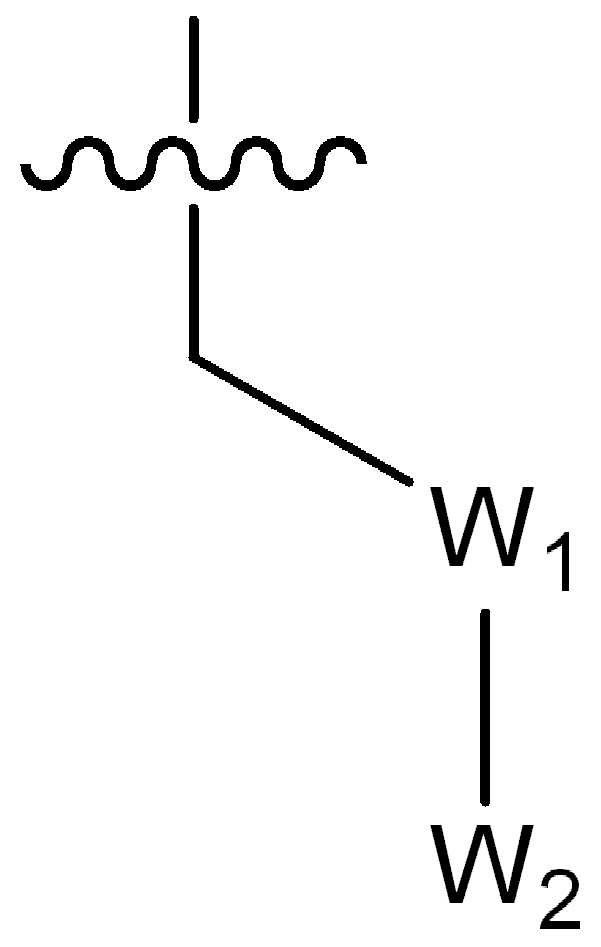
(식 중,(In the meal,

W1은 CR4R5 또는 C(O)로부터 선택되고, 여기서 R4 및 R5는 수소, (1-2C)알킬, 플루오로, 히드록시, 시아노, (1-2C)알콕시, (1-2C)할로알킬, (1-2C)할로알콕시 또는 NRjRk로부터 독립적으로 선택되고, 여기서 Rj 및 Rk는 수소 또는 (1-2C)알킬로부터 독립적으로 선택되거나; 또는W 1 is selected from CR 4 R 5 or C (O), wherein R 4 and R 5 are hydrogen, (1-2C) alkyl, fluoro, hydroxy, cyano, (1-2C) alkoxy, (1 -2C) haloalkyl, (1-2C) haloalkoxy or NR j R k , wherein R j and R k are independently selected from hydrogen or (1-2C) alkyl; or
R4와 R5는 이들이 부착된 탄소 원자와 함께, 이들이 3원 내지 6원의 카보시클릭 고리 또는 3원 내지 6원의 헤테로시클릭 고리를 형성하도록 연결될 수 있음); 또는R 4 and R 5 together with the carbon atom to which they are attached may be linked such that they form a 3-6 membered carbocyclic ring or a 3-6 membered heterocyclic ring; or
W2는 시아노, 5원 또는 6원의 헤테로아릴, 페닐, SO2Rl, C(O)OCH3, C(O)N(H)CH3, CR6R7R8 또는 NRlRm으로부터 선택되고, 여기서 Rl 및 Rm은 수소 또는 (1-2C)알킬로부터 독립적으로 선택되고; 여기서W 2 is cyano, 5- or 6-membered heteroaryl, phenyl, SO 2 R 1 , C (O) OCH 3 , C (O) N (H) CH 3 , CR 6 R 7 R 8 or NR 1 R m is selected from R 1 and R m are independently selected from hydrogen or (1-2C) alkyl; here
R6은 수소, (1-2C)알킬, 플루오로, 클로로, 브로모, 히드록시, 아미노, 시아노, (1-2C)알콕시, CH2F, CF2H 또는 CF3로부터 선택되고;R 6 is selected from hydrogen, (1-2C) alkyl, fluoro, chloro, bromo, hydroxy, amino, cyano, (1-2C) alkoxy, CH 2 F, CF 2 H or CF 3 ;
R7은 수소, (1-2C)알킬, 플루오로, 클로로, 브로모, 히드록시, 시아노, (1-2C)알콕시, (1-2C)할로알킬, (1-2C)할로알콕시 또는 하기 화학식의 기로부터 선택되고:R 7 is hydrogen, (1-2C) alkyl, fluoro, chloro, bromo, hydroxy, cyano, (1-2C) alkoxy, (1-2C) haloalkyl, (1-2C) haloalkoxy or Selected from the group of the formula:
-Y2-L2-Z2 -Y 2 -L 2 -Z 2
식 중,In the formula,
Y2는 존재하지 않거나 또는 O, N(Rn), C(O), C(O)O, OC(O), C(O)N(Rn) 또는 N(Rn)C(O로부터 선택되고, 여기서 Rn은 수소 또는 (1-2C)알킬로부터 선택되고; Y 2 is absent or from O, N (R n ), C (O), C (O) O, OC (O), C (O) N (R n ) or N (R n ) C (O selected and, where R n is selected from hydrogen or (1-2C) alkyl;
L2는 존재하지 않거나 또는 (1-2C)알킬렌이고;L 2 is absent or (1-2C) alkylene;
Z2는 수소, (1-6C)알킬, (2-4C)알켄일, 페닐, (3-6C)시클로알킬, 5원 내지 6원의 헤테로아릴 또는 4원 내지 6원의 헤테로시클릴이고; 여기서 Z2는 (1-2C)알킬, 할로, (1-2C)할로알킬, (1-2C)알콕시, 아미노, 시아노 또는 히드록시로부터 선택된 하나 이상의 치환체에 의해서 선택적으로 치환되고;Z 2 is hydrogen, (1-6C) alkyl, (2-4C) alkenyl, phenyl, (3-6C) cycloalkyl, 5- to 6-membered heteroaryl or 4- to 6-membered heterocyclyl; Wherein Z 2 is optionally substituted by one or more substituents selected from (1-2C) alkyl, halo, (1-2C) haloalkyl, (1-2C) alkoxy, amino, cyano or hydroxy;
R8은 (1-2C)알킬, -C(O)ORq , ORq, -C(O)NRq, NRqRr, 페닐 또는 5원의 헤테로아릴로부터 선택되고, 여기서 Rq 및 Rr은 수소 또는 (1-2C)알킬로부터 독립적으로 선택되거나;R 8 is (1-2C) alkyl, -C (O) OR q , OR q , -C (O) NR q , NR q R r , Phenyl or 5-membered heteroaryl, wherein R q and R r are independently selected from hydrogen or (1-2C) alkyl;
또는 R6과 R7은 이들이 부착된 탄소 원자와 함께, 이들이 3원 내지 6원의 카보시클릭 고리 또는 3원 내지 6원의 헤테로시클릭 고리를 형성하도록 연결될 수 있음); 또는Or R 6 and R 7 together with the carbon atom to which they are attached may be linked such that they form a 3-6 membered carbocyclic ring or a 3-6 membered heterocyclic ring; or
(iii) 하기 화학식의 기:(iii) a group of the formula:

(식 중,(In the meal,

고리 A는 4원 내지 6원의 시클로알킬 또는 헤테로시클릴 고리이고;Ring A is a 4-6 membered cycloalkyl or heterocyclyl ring;
W3은 NR100 또는 CR101R102로부터 선택되고, 여기서 R100은 수소, (1-2C)알킬, (1-2C)할로알킬, (1-2C)히드록시알킬, -C(O)-CH3 또는 -C(O)ORab로부터 선택되고, 여기서 Rab는 (1-2C)알킬이고, R101 및 R102는 각각 (1-2C)알킬, 플루오로, 클로로, 히드록시, (1-2C)알콕시, CH2F, CF2H, CF3, -C(O)ORac 또는 -NRacRad로부터 독립적으로 선택되고, 여기서 Rac 및 Rad는 수소 또는 메틸로부터 독립적으로 선택됨);W 3 is selected from NR 100 or CR 101 R 102 , wherein R 100 is hydrogen, (1-2C) alkyl, (1-2C) haloalkyl, (1-2C) hydroxyalkyl, -C (O)- CH 3 or —C (O) OR ab , wherein R ab is (1-2C) alkyl, R 101 and R 102 are each (1-2C) alkyl, fluoro, chloro, hydroxy, (1 Independently selected from -2C) alkoxy, CH 2 F, CF 2 H, CF 3 , -C (O) OR ac or -NR ac R ad , wherein R ac and R ad are independently selected from hydrogen or methyl) ;
(37) R2는 하기로부터 선택됨:(37) R 2 is selected from:
(i) 수소 또는 메틸;(i) hydrogen or methyl;
(ii) 하기 화학식의 기:(ii) groups of the formula

(식 중,(In the meal,

W1은 CR4R5 또는 C(O)로부터 선택되고, 여기서 R4 및 R5는 수소, (1-2C)알킬, 플루오로, 히드록시, 시아노, 니트로, (1-2C)알콕시, (1-2C)할로알킬, (1-2C)할로알콕시 또는 NRjRk로부터 독립적으로 선택되고, 여기서 Rj 및 Rk는 수소 또는 (1-2C)알킬로부터 독립적으로 선택되거나; 또는 W 1 is selected from CR 4 R 5 or C (O), wherein R 4 and R 5 are hydrogen, (1-2C) alkyl, fluoro, hydroxy, cyano, nitro, (1-2C) alkoxy, Independently selected from (1-2C) haloalkyl, (1-2C) haloalkoxy or NR j R k , wherein R j and R k are independently selected from hydrogen or (1-2C) alkyl; or
R4와 R5는, 이들이 부착된 탄소 원자와 함께, 이들이 (1-2C)알킬, 할로, (1-2C)할로알킬, (1-2C)할로알콕시, (1-2C)알콕시, (1-2C)알킬아미노, 아미노, 시아노 또는 히드록시로부터 선택된 하나 이상의 치환체에 의해서 선택적으로 치환된 3원 내지 6원의 카보시클릭 고리 또는 3원 내지 6원의 헤테로시클릭 고리를 형성하도록 연결될 수 있고;R 4 and R 5 together with the carbon atom to which they are attached are (1-2C) alkyl, halo, (1-2C) haloalkyl, (1-2C) haloalkoxy, (1-2C) alkoxy, (1 -2C) may be linked to form a 3-6 membered carbocyclic ring or a 3-6 membered heterocyclic ring optionally substituted by one or more substituents selected from alkylamino, amino, cyano or hydroxy There is;
W2는 시아노, 5원 또는 6원의 헤테로아릴, 페닐, C(O)OCH3, C(O)N(H)CH3, CR6R7R8 또는 NRlRm으로부터 선택되고, 여기서 Rl 및 Rm은 수소 또는 (1-2C)알킬로부터 독립적으로 선택되고, 여기서W 2 is selected from cyano, 5- or 6-membered heteroaryl, phenyl, C (O) OCH 3 , C (O) N (H) CH 3 , CR 6 R 7 R 8 or NR 1 R m , Wherein R l and R m are independently selected from hydrogen or (1-2C) alkyl, wherein
R6은 수소, (1-2C)알킬, 플루오로, 클로로, 브로모, 히드록시, 아미노, 시아노, 니트로, (1-2C)알콕시, (1-2C)할로알킬 또는 (1-2C)할로알콕시로부터 선택되고;R 6 is hydrogen, (1-2C) alkyl, fluoro, chloro, bromo, hydroxy, amino, cyano, nitro, (1-2C) alkoxy, (1-2C) haloalkyl or (1-2C) Selected from haloalkoxy;
R7은 수소, (1-2C)알킬, 플루오로, 클로로, 브로모, 히드록시, 시아노, 니트로, (1-2C)알콕시, (1-2C)할로알킬, (1-2C)할로알콕시 또는 하기 화학식의 기로부터 선택되고:R 7 is hydrogen, (1-2C) alkyl, fluoro, chloro, bromo, hydroxy, cyano, nitro, (1-2C) alkoxy, (1-2C) haloalkyl, (1-2C) haloalkoxy Or is selected from a group of the formula:
-Y2-L2-Z2 -Y 2 -L 2 -Z 2
식 중,In the formula,
Y2는 존재하지 않거나 또는 O, N(Rn), S, SO, SO2, C(O), C(O)O, OC(O), C(O)N(Rn), N(Rn)C(O), S(O)2N(Rn), 또는 N(Rn)SO2로부터 선택되고, 여기서 Rn은 수소 또는 (1-2C)알킬로부터 선택되고; Y 2 is absent or O, N (R n ), S, SO, SO 2 , C (O), C (O) O, OC (O), C (O) N (R n ), N ( R n ) C (O), S (O) 2 N (R n ), or N (R n ) SO 2 , wherein R n is selected from hydrogen or (1-2C) alkyl;
L2는 존재하지 않거나 또는 (1-2C)알킬렌이고;L 2 is absent or (1-2C) alkylene;
Z2는 수소, (1-6C)알킬, (2-4C)알켄일, (2-4C)알킨일, 페닐, (3-6C)시클로알킬, 5원 내지 6원의 헤테로아릴 또는 4원 내지 6원의 헤테로시클릴이고; 여기서 Z2는 (1-4C)알킬, 할로, (1-4C)할로알킬, (1-4C)할로알콕시, (1-4C)알콕시, (1-4C)알킬아미노, 아미노, 시아노, 니트로, 히드록시, C(O)Ro, C(O)ORo, OC(O)Ro, C(O)N(Ro)Rp, NRoC(O)Rp로부터 선택된 하나 이상의 치환체에 의해서 선택적으로 치환되고, 여기서 Ro 및 Rp는 수소 또는 (1-4C)알킬로부터 독립적으로 선택되고;Z 2 is hydrogen, (1-6C) alkyl, (2-4C) alkenyl, (2-4C) alkynyl, phenyl, (3-6C) cycloalkyl, 5- or 6-membered heteroaryl or 4- to 6 membered heterocyclyl; Wherein Z 2 is (1-4C) alkyl, halo, (1-4C) haloalkyl, (1-4C) haloalkoxy, (1-4C) alkoxy, (1-4C) alkylamino, amino, cyano, nitro One or more substituents selected from hydroxy, C (O) R o , C (O) OR o , OC (O) R o , C (O) N (R o ) R p , NR o C (O) R p Optionally substituted by wherein R o and R p are independently selected from hydrogen or (1-4C) alkyl;
R8은 (1-2C)알킬, -C(O)ORq , ORq, -C(O)NRq, NRqRr, 페닐 또는 5원의 헤테로아릴로부터 선택되고, 여기서 Rq 및 Rr은 수소 또는 (1-2C)알킬로부터 독립적으로 선택되거나; R 8 is (1-2C) alkyl, -C (O) OR q , OR q , -C (O) NR q , NR q R r , Phenyl or 5-membered heteroaryl, wherein R q and R r are independently selected from hydrogen or (1-2C) alkyl;
또는 R6과 R7은, 이들이 부착된 탄소 원자와 함께, 이들이 (1-2C)알킬, 할로, (1-2C)할로알킬, (1-2C)할로알콕시, (1-2C)알콕시, (1-2C)알킬아미노, 아미노, 시아노 또는 히드록실로부터 선택된 하나 이상의 치환체에 의해서 선택적으로 치환된 3원 내지 6원의 카보시클릭 고리 또는 3원 내지 6원의 헤테로시클릭 고리를 형성하도록 연결될 수 있음); 또는Or R 6 and R 7 together with the carbon atom to which they are attached are (1-2C) alkyl, halo, (1-2C) haloalkyl, (1-2C) haloalkoxy, (1-2C) alkoxy, ( 1-2C) to form a 3-6 membered carbocyclic ring or a 3-6 membered heterocyclic ring optionally substituted by one or more substituents selected from alkylamino, amino, cyano or hydroxyl Can be connected); or
(iii) 하기 화학식의 기:(iii) a group of the formula:

(식 중,(In the meal,

고리 A는 4원 내지 6원의 시클로알킬 또는 헤테로시클릴 고리이고;Ring A is a 4-6 membered cycloalkyl or heterocyclyl ring;
W3은 NR100 또는 CR101R102로부터 선택되고, 여기서 R100은 수소, (1-2C)알킬, -C(O)-CH3 또는 -C(O)ORab로부터 선택되고, 여기서 Rab는 (1-2C)알킬이고, R101 및 R102는 각각 수소, (1-2C)알킬, 플루오로, 클로로, 브로모, 히드록시, 아미노, 시아노, 니트로, (1-2C)알콕시, (1-2C)할로알킬, (1-2C)할로알콕시, -C(O)ORac, -NRacRad, 페닐 또는 5원의 헤테로아릴로부터 독립적으로 선택되고, 여기서 Rac 및 Rad는 수소 또는 (1-2C)알킬로부터 독립적으로 선택됨);W 3 is selected from NR 100 or CR 101 R 102 , wherein R 100 is selected from hydrogen, (1-2C) alkyl, —C (O) —CH 3 or —C (O) OR ab , wherein R ab Is (1-2C) alkyl, R 101 and R 102 are each hydrogen, (1-2C) alkyl, fluoro, chloro, bromo, hydroxy, amino, cyano, nitro, (1-2C) alkoxy, Independently selected from (1-2C) haloalkyl, (1-2C) haloalkoxy, —C (O) OR ac , —NR ac R ad , phenyl or a 5-membered heteroaryl, wherein R ac and R ad are Independently selected from hydrogen or (1-2C) alkyl);
(38) R2는 하기로부터 선택됨:(38) R 2 is selected from:
(i) 수소 또는 메틸;(i) hydrogen or methyl;
(ii) 하기 화학식의 기:(ii) groups of the formula
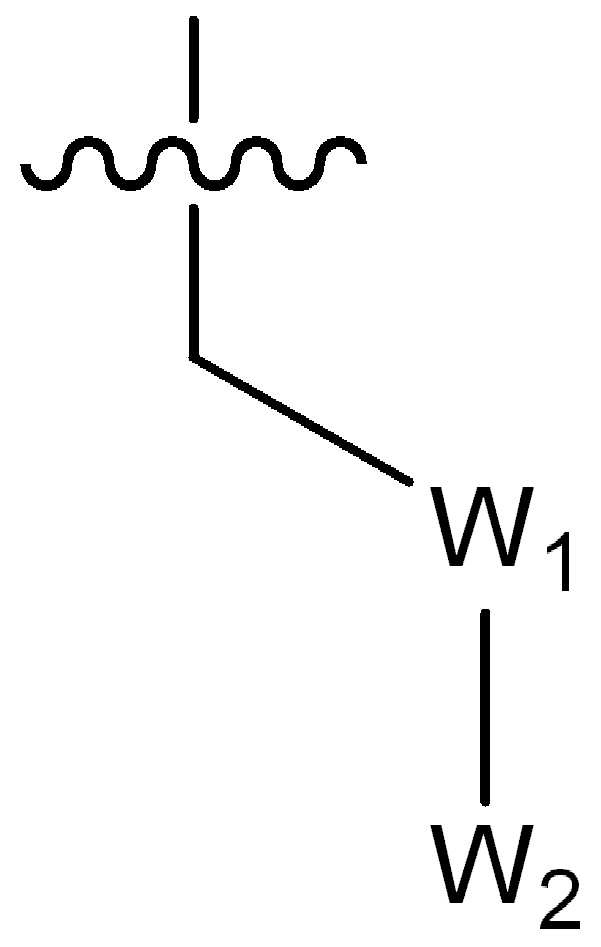
(식 중,(In the meal,

W1은 CR4R5 또는 C(O)로부터 선택되고, 여기서 R4 및 R5는 수소, (1-2C)알킬, 플루오로, 히드록시, 시아노, 니트로, (1-2C)알콕시, (1-2C)할로알킬, (1-2C)할로알콕시 또는 NRjRk로부터 독립적으로 선택되고, 여기서 Rj 및 Rk는 수소 또는 (1-2C)알킬로부터 독립적으로 선택되거나; 또는 W 1 is selected from CR 4 R 5 or C (O), wherein R 4 and R 5 are hydrogen, (1-2C) alkyl, fluoro, hydroxy, cyano, nitro, (1-2C) alkoxy, Independently selected from (1-2C) haloalkyl, (1-2C) haloalkoxy or NR j R k , wherein R j and R k are independently selected from hydrogen or (1-2C) alkyl; or
R4와 R5는, 이들이 부착된 탄소 원자와 함께, 이들이 (1-2C)알킬, 할로, (1-2C)할로알킬, (1-2C)할로알콕시, (1-2C)알콕시, (1-2C)알킬아미노, 아미노, 시아노 또는 히드록시로부터 선택된 하나 이상의 치환체에 의해서 선택적으로 치환된 3원 내지 6원의 카보시클릭 고리 또는 3원 내지 6원의 헤테로시클릭 고리를 형성하도록 연결될 수 있고;R 4 and R 5 together with the carbon atom to which they are attached are (1-2C) alkyl, halo, (1-2C) haloalkyl, (1-2C) haloalkoxy, (1-2C) alkoxy, (1 -2C) may be linked to form a 3-6 membered carbocyclic ring or a 3-6 membered heterocyclic ring optionally substituted by one or more substituents selected from alkylamino, amino, cyano or hydroxy There is;
W2는 시아노, 5원 또는 6원의 헤테로아릴, 페닐, C(O)OCH3, C(O)N(H)CH3, CR6R7R8 또는 NRlRm으로부터 선택되고, 여기서 Rl 및 Rm은 수소 또는 (1-2C)알킬로부터 독립적으로 선택되고, 여기서W 2 is selected from cyano, 5- or 6-membered heteroaryl, phenyl, C (O) OCH 3 , C (O) N (H) CH 3 , CR 6 R 7 R 8 or NR 1 R m , Wherein R l and R m are independently selected from hydrogen or (1-2C) alkyl, wherein
R6은 수소, (1-2C)알킬, 플루오로, 클로로, 브로모, 히드록시, 아미노, 시아노, 니트로, (1-2C)알콕시, (1-2C)할로알킬 또는 (1-2C)할로알콕시로부터 선택되고;R 6 is hydrogen, (1-2C) alkyl, fluoro, chloro, bromo, hydroxy, amino, cyano, nitro, (1-2C) alkoxy, (1-2C) haloalkyl or (1-2C) Selected from haloalkoxy;
R7은 수소, (1-2C)알킬, 플루오로, 클로로, 브로모, 히드록시, 시아노, 니트로, (1-2C)알콕시, (1-2C)할로알킬, (1-2C)할로알콕시 또는 하기 화학식의 기로부터 선택되고:R 7 is hydrogen, (1-2C) alkyl, fluoro, chloro, bromo, hydroxy, cyano, nitro, (1-2C) alkoxy, (1-2C) haloalkyl, (1-2C) haloalkoxy Or is selected from a group of the formula:
-Y2-L2-Z2 -Y 2 -L 2 -Z 2
식 중,In the formula,
Y2는 존재하지 않거나 또는 O, N(Rn), S, SO, SO2, C(O), C(O)O, OC(O), C(O)N(Rn), N(Rn)C(O), S(O)2N(Rn), 또는 N(Rn)SO2로부터 선택되고, 여기서 Rn은 수소 또는 (1-2C)알킬로부터 선택되고; Y 2 is absent or O, N (R n ), S, SO, SO 2 , C (O), C (O) O, OC (O), C (O) N (R n ), N ( R n ) C (O), S (O) 2 N (R n ), or N (R n ) SO 2 , wherein R n is selected from hydrogen or (1-2C) alkyl;
L2는 존재하지 않거나 또는 (1-2C)알킬렌이고;L 2 is absent or (1-2C) alkylene;
Z2는 수소, (1-6C)알킬, (2-4C)알켄일, (2-4C)알킨일, 페닐, (3-6C)시클로알킬, 5원 내지 6원의 헤테로아릴 또는 4원 내지 6원의 헤테로시클릴이고; 여기서 Z2는 (1-4C)알킬, 할로, (1-4C)할로알킬, (1-4C)할로알콕시, (1-4C)알콕시, (1-4C)알킬아미노, 아미노, 시아노, 니트로 또는 히드록시로부터 선택된 하나 이상의 치환체에 의해서 선택적으로 치환되고;Z 2 is hydrogen, (1-6C) alkyl, (2-4C) alkenyl, (2-4C) alkynyl, phenyl, (3-6C) cycloalkyl, 5- or 6-membered heteroaryl or 4- to 6 membered heterocyclyl; Wherein Z 2 is (1-4C) alkyl, halo, (1-4C) haloalkyl, (1-4C) haloalkoxy, (1-4C) alkoxy, (1-4C) alkylamino, amino, cyano, nitro Or optionally substituted by one or more substituents selected from hydroxy;
R8은 (1-2C)알킬, -C(O)ORq , ORq, NRqRr, 페닐 또는 5원의 헤테로아릴로부터 선택되고, 여기서 Rq 및 Rr은 수소 또는 (1-2C)알킬로부터 독립적으로 선택되고;R 8 is (1-2C) alkyl, —C (O) OR q , OR q , NR q R r , Phenyl or 5 membered heteroaryl, wherein R q and R r are independently selected from hydrogen or (1-2C) alkyl;
또는 R6과 R7은, 이들이 부착된 탄소 원자와 함께, 이들이 (1-2C)알킬, 플루오로, 클로로, CH2F, CF2H 또는 CF3, (1-2C)알콕시, 아미노, 시아노 또는 히드록시로부터 선택된 하나 이상의 치환체에 의해서 선택적으로 치환된 4원 내지 6원의 카보시클릭 고리 또는 4원 내지 6원의 헤테로시클릭 고리를 형성하도록 연결될 수 있음); 또는Or R 6 and R 7 together with the carbon atom to which they are attached are (1-2C) alkyl, fluoro, chloro, CH 2 F, CF 2 H or CF 3 , (1-2C) alkoxy, amino, cya Can be linked to form a 4-6 membered carbocyclic ring or a 4-6 membered heterocyclic ring optionally substituted by one or more substituents selected from o or hydroxy); or
(iii) 하기 화학식의 기:(iii) a group of the formula:
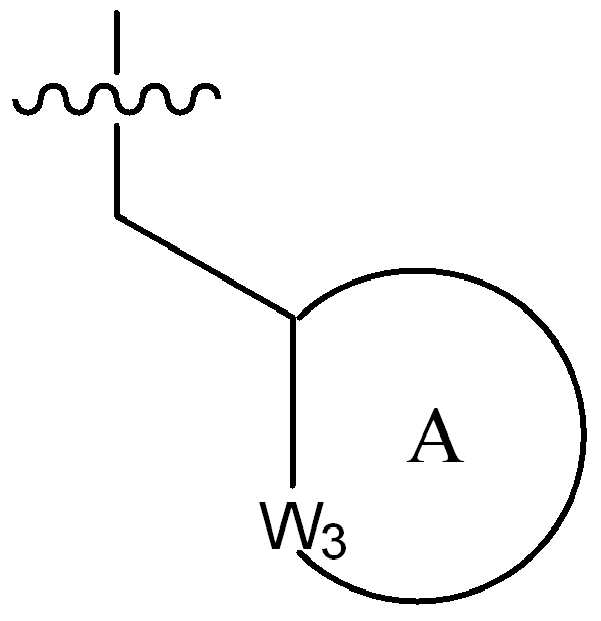
(식 중,(In the meal,

고리 A는 4원 내지 6원의 시클로알킬 또는 헤테로시클릴 고리이고;Ring A is a 4-6 membered cycloalkyl or heterocyclyl ring;
W3은 NR100 또는 CR101R102로부터 선택되고, 여기서 R100은 수소, (1-2C)알킬, -C(O)-CH3 또는 -C(O)ORab로부터 선택되고, 여기서 Rab는 (1-2C)알킬이고, R101 및 R102는 각각 수소, (1-2C)알킬, 플루오로, 클로로, 히드록시, 시아노, (1-2C)알콕시, (1-2C)할로알킬, (1-2C)할로알콕시, -C(O)ORac, -NRacRad, 페닐 또는 5원의 헤테로아릴로부터 독립적으로 선택되고, 여기서 Rac 및 Rad는 수소 또는 (1-2C)알킬로부터 독립적으로 선택됨); W 3 is selected from NR 100 or CR 101 R 102 , wherein R 100 is selected from hydrogen, (1-2C) alkyl, —C (O) —CH 3 or —C (O) OR ab , wherein R ab Is (1-2C) alkyl, R 101 and R 102 are hydrogen, (1-2C) alkyl, fluoro, chloro, hydroxy, cyano, (1-2C) alkoxy, (1-2C) haloalkyl , (1-2C) haloalkoxy, -C (O) OR ac , -NR ac R ad , phenyl or a 5-membered heteroaryl, wherein R ac and R ad are hydrogen or (1-2C) Independently selected from alkyl);
(39) R2는 하기로부터 선택됨:(39) R 2 is selected from:
(i) 수소 또는 메틸;(i) hydrogen or methyl;
(ii) 하기 화학식의 기:(ii) groups of the formula

(식 중,(In the meal,

W1은 CR4R5 또는 C(O)로부터 선택되고, 여기서 R4 및 R5는 수소, (1-2C)알킬, 플루오로, 히드록시, 시아노, 니트로, (1-2C)알콕시, (1-2C)할로알킬, (1-2C)할로알콕시 또는 NRjRk로부터 독립적으로 선택되고, 여기서 Rj 및 Rk는 수소 또는 (1-2C)알킬로부터 독립적으로 선택되거나; 또는 W 1 is selected from CR 4 R 5 or C (O), wherein R 4 and R 5 are hydrogen, (1-2C) alkyl, fluoro, hydroxy, cyano, nitro, (1-2C) alkoxy, Independently selected from (1-2C) haloalkyl, (1-2C) haloalkoxy or NR j R k , wherein R j and R k are independently selected from hydrogen or (1-2C) alkyl; or
R4와 R5는, 이들이 부착된 탄소 원자와 함께, 이들이 (1-2C)알킬, 플루오로, 클로로, CH2F, CF2H, CF3, (1-2C)알콕시, 아미노, 시아노 또는 히드록시로부터 선택된 하나 이상의 치환체에 의해서 선택적으로 치환된 3원 내지 6원의 카보시클릭 고리 또는 3원 내지 6원의 헤테로시클릭 고리를 형성하도록 연결될 수 있고;R 4 and R 5 , together with the carbon atom to which they are attached, are (1-2C) alkyl, fluoro, chloro, CH 2 F, CF 2 H, CF 3 , (1-2C) alkoxy, amino, cyano Or can be linked to form a 3-6 membered carbocyclic ring or a 3-6 membered heterocyclic ring optionally substituted by one or more substituents selected from hydroxy;
W2는 시아노, 5원 또는 6원의 헤테로아릴, 페닐, C(O)OCH3, C(O)N(H)CH3, CR6R7R8 또는 NRlRm으로부터 선택되고, 여기서 Rl 및 Rm은 수소 또는 (1-2C)알킬로부터 독립적으로 선택되고, 여기서W 2 is selected from cyano, 5- or 6-membered heteroaryl, phenyl, C (O) OCH 3 , C (O) N (H) CH 3 , CR 6 R 7 R 8 or NR 1 R m , Wherein R l and R m are independently selected from hydrogen or (1-2C) alkyl, wherein
R6은 수소, (1-2C)알킬, 플루오로, 클로로, 브로모, 히드록시, 아미노, 시아노, 니트로, (1-2C)알콕시, (1-2C)할로알킬 또는 (1-2C)할로알콕시로부터 선택되고;R 6 is hydrogen, (1-2C) alkyl, fluoro, chloro, bromo, hydroxy, amino, cyano, nitro, (1-2C) alkoxy, (1-2C) haloalkyl or (1-2C) Selected from haloalkoxy;
R7은 수소, (1-2C)알킬, 플루오로, 클로로, 브로모, 히드록시, 시아노, 니트로, (1-2C)알콕시, (1-2C)할로알킬, (1-2C)할로알콕시 또는 하기 화학식의 기로부터 선택되고:R 7 is hydrogen, (1-2C) alkyl, fluoro, chloro, bromo, hydroxy, cyano, nitro, (1-2C) alkoxy, (1-2C) haloalkyl, (1-2C) haloalkoxy Or is selected from a group of the formula:
-Y2-L2-Z2 -Y 2 -L 2 -Z 2
식 중,In the formula,
Y2는 존재하지 않거나 또는 O, N(Rn), S, SO, SO2, C(O), C(O)O, OC(O), C(O)N(Rn), N(Rn)C(O), S(O)2N(Rn), 또는 N(Rn)SO2로부터 선택되고, 여기서 Rn은 수소 또는 (1-2C)알킬로부터 선택되고;Y 2 is absent or O, N (R n ), S, SO, SO 2 , C (O), C (O) O, OC (O), C (O) N (R n ), N ( R n ) C (O), S (O) 2 N (R n ), or N (R n ) SO 2 , wherein R n is selected from hydrogen or (1-2C) alkyl;
L2는 존재하지 않거나 또는 (1-2C)알킬렌이고;L 2 is absent or (1-2C) alkylene;
Z2는 수소, (1-6C)알킬, (2-4C)알켄일, (2-4C)알킨일, 페닐, (3-6C)시클로알킬, 5원 내지 6원의 헤테로아릴 또는 4원 내지 6원의 헤테로시클릴이고; 여기서 Z2는 (1-2C)알킬, 할로, (1-2C)할로알킬, (1-2C)할로알콕시, (1-2C)알콕시, (1-2C)알킬아미노, 아미노, 시아노, 니트로 또는 히드록시로부터 선택된 하나 이상의 치환체에 의해서 선택적으로 치환되고;Z 2 is hydrogen, (1-6C) alkyl, (2-4C) alkenyl, (2-4C) alkynyl, phenyl, (3-6C) cycloalkyl, 5- or 6-membered heteroaryl or 4- to 6 membered heterocyclyl; Wherein Z 2 is (1-2C) alkyl, halo, (1-2C) haloalkyl, (1-2C) haloalkoxy, (1-2C) alkoxy, (1-2C) alkylamino, amino, cyano, nitro Or optionally substituted by one or more substituents selected from hydroxy;
R8은 (1-2C)알킬, -C(O)ORq , ORq, NRqRr, 페닐 또는 5원의 헤테로아릴로부터 선택되고, 여기서 Rq 및 Rr은 수소 또는 (1-2C)알킬로부터 독립적으로 선택되고;R 8 is (1-2C) alkyl, —C (O) OR q , OR q , NR q R r , Phenyl or 5 membered heteroaryl, wherein R q and R r are independently selected from hydrogen or (1-2C) alkyl;
또는 R6과 R7은 이들이 부착된 탄소 원자와 함께, 이들이 4원 내지 6원의 카보시클릭 고리 또는 4원 내지 6원의 헤테로시클릭 고리를 형성하도록 연결될 수 있음); 또는Or R 6 and R 7 together with the carbon atom to which they are attached may be linked such that they form a 4-6 membered carbocyclic ring or a 4-6 membered heterocyclic ring; or
(iii) 하기 화학식의 기:(iii) a group of the formula:

(식 중,(In the meal,

고리 A는 5원의 시클로알킬 또는 헤테로시클릴 고리이고;Ring A is a 5-membered cycloalkyl or heterocyclyl ring;
W3은 NR100 또는 CR101R102로부터 선택되고, 여기서 R100은 수소, (1-2C)알킬, -C(O)-CH3 또는 -C(O)ORab로부터 선택되고, 여기서 Rab는 (1-2C)알킬이고, R101 및 R102는 각각 수소, (1-2C)알킬, 플루오로, 클로로, 히드록시, 시아노, (1-2C)알콕시, (1-2C)할로알킬, (1-2C)할로알콕시, -C(O)ORac, -NRacRad, 페닐 또는 5원의 헤테로아릴로부터 독립적으로 선택되고, 여기서 Rac 및 Rad는 수소 또는 (1-2C)알킬로부터 독립적으로 선택됨); W 3 is selected from NR 100 or CR 101 R 102 , wherein R 100 is selected from hydrogen, (1-2C) alkyl, —C (O) —CH 3 or —C (O) OR ab , wherein R ab Is (1-2C) alkyl, R 101 and R 102 are hydrogen, (1-2C) alkyl, fluoro, chloro, hydroxy, cyano, (1-2C) alkoxy, (1-2C) haloalkyl , (1-2C) haloalkoxy, -C (O) OR ac , -NR ac R ad , phenyl or a 5-membered heteroaryl, wherein R ac and R ad are hydrogen or (1-2C) Independently selected from alkyl);
(40) R2는 하기로부터 선택됨:(40) R 2 is selected from:
(i) 수소 또는 메틸;(i) hydrogen or methyl;
(ii) 하기 화학식의 기:(ii) groups of the formula

(식 중,(In the meal,

W1은 CR4R5 또는 C(O)로부터 선택되고, 여기서 R4 및 R5는 수소, (1-2C)알킬, 플루오로, 히드록시, 시아노, 니트로, (1-2C)알콕시, (1-2C)할로알킬, (1-2C)할로알콕시 또는 NRjRk로부터 독립적으로 선택되고, 여기서 Rj 및 Rk는 수소 또는 (1-2C)알킬로부터 독립적으로 선택되거나; 또는 W 1 is selected from CR 4 R 5 or C (O), wherein R 4 and R 5 are hydrogen, (1-2C) alkyl, fluoro, hydroxy, cyano, nitro, (1-2C) alkoxy, Independently selected from (1-2C) haloalkyl, (1-2C) haloalkoxy or NR j R k , wherein R j and R k are independently selected from hydrogen or (1-2C) alkyl; or
R4와 R5는, 이들이 부착된 탄소 원자와 함께, 이들이 (1-2C)알킬, 플루오로, 클로로, CH2F, CF2H, CF3, (1-2C)알콕시, 아미노, 시아노 또는 히드록시로부터 선택된 하나 이상의 치환체에 의해서 선택적으로 치환된 3원 내지 6원의 카보시클릭 고리 또는 3원 내지 6원의 헤테로시클릭 고리를 형성하도록 연결될 수 있고;R 4 and R 5 , together with the carbon atom to which they are attached, are (1-2C) alkyl, fluoro, chloro, CH 2 F, CF 2 H, CF 3 , (1-2C) alkoxy, amino, cyano Or can be linked to form a 3-6 membered carbocyclic ring or a 3-6 membered heterocyclic ring optionally substituted by one or more substituents selected from hydroxy;
W2는 시아노, 5원 또는 6원의 헤테로아릴, 페닐, C(O)OCH3, C(O)N(H)CH3, CR6R7R8 또는 NRlRm으로부터 선택되고, 여기서 Rl 및 Rm은 수소 또는 (1-2C)알킬로부터 독립적으로 선택되고, 여기서W 2 is selected from cyano, 5- or 6-membered heteroaryl, phenyl, C (O) OCH 3 , C (O) N (H) CH 3 , CR 6 R 7 R 8 or NR 1 R m , Wherein R l and R m are independently selected from hydrogen or (1-2C) alkyl, wherein
R6은 수소, (1-2C)알킬, 플루오로, 클로로, 브로모, 히드록시, 아미노, 시아노, 니트로, (1-2C)알콕시, CH2F, CF2H 또는 CF3로부터 선택되고;R 6 is selected from hydrogen, (1-2C) alkyl, fluoro, chloro, bromo, hydroxy, amino, cyano, nitro, (1-2C) alkoxy, CH 2 F, CF 2 H or CF 3 ;
R7은 수소, (1-2C)알킬, 플루오로, 클로로, 브로모, 히드록시, 시아노, 니트로, (1-2C)알콕시, (1-2C)할로알킬, (1-2C)할로알콕시 또는 하기 화학식의 기로부터 선택되고:R 7 is hydrogen, (1-2C) alkyl, fluoro, chloro, bromo, hydroxy, cyano, nitro, (1-2C) alkoxy, (1-2C) haloalkyl, (1-2C) haloalkoxy Or is selected from a group of the formula:
-Y2-L2-Z2 -Y 2 -L 2 -Z 2
식 중,In the formula,
Y2는 존재하지 않거나 또는 O, N(Rn), C(O), C(O)O, OC(O), C(O)N(Rn), N(Rn)C(O로부터 선택되고, 여기서 Rn은 수소 또는 (1-2C)알킬로부터 선택되고;Y 2 is absent or from O, N (R n ), C (O), C (O) O, OC (O), C (O) N (R n ), N (R n ) C (O selected and, where R n is selected from hydrogen or (1-2C) alkyl;
L2는 존재하지 않거나 또는 (1-2C)알킬렌이고;L 2 is absent or (1-2C) alkylene;
Z2는 수소, (1-6C)알킬, (2-4C)알켄일, (2-4C)알킨일, 페닐, (3-6C)시클로알킬, 5원 내지 6원의 헤테로아릴 또는 4원 내지 6원의 헤테로시클릴이고; 여기서 Z2는 (1-2C)알킬, 할로, (1-2C)할로알킬, (1-2C)할로알콕시, (1-2C)알콕시, (1-2C)알킬아미노, 아미노, 시아노, 니트로 또는 히드록시로부터 선택된 하나 이상의 치환체에 의해서 선택적으로 치환되고;Z 2 is hydrogen, (1-6C) alkyl, (2-4C) alkenyl, (2-4C) alkynyl, phenyl, (3-6C) cycloalkyl, 5- or 6-membered heteroaryl or 4- to 6 membered heterocyclyl; Wherein Z 2 is (1-2C) alkyl, halo, (1-2C) haloalkyl, (1-2C) haloalkoxy, (1-2C) alkoxy, (1-2C) alkylamino, amino, cyano, nitro Or optionally substituted by one or more substituents selected from hydroxy;
R8은 (1-2C)알킬, -C(O)ORq , ORq, NRqRr, 페닐 또는 5원의 헤테로아릴로부터 선택되고, 여기서 Rq 및 Rr은 수소 또는 (1-2C)알킬로부터 독립적으로 선택됨);R 8 is (1-2C) alkyl, —C (O) OR q , OR q , NR q R r , Phenyl or 5 membered heteroaryl, wherein R q and R r are independently selected from hydrogen or (1-2C) alkyl);
또는 R6과 R7은 이들이 부착된 탄소 원자와 함께, 이들이 4원 내지 6원의 카보시클릭 고리 또는 4원 내지 6원의 헤테로시클릭 고리를 형성하도록 연결될 수 있음); 또는Or R 6 and R 7 together with the carbon atom to which they are attached may be linked such that they form a 4-6 membered carbocyclic ring or a 4-6 membered heterocyclic ring; or
(iii) 하기 화학식의 기:(iii) a group of the formula:

(식 중,(In the meal,

고리 A는 5원의 시클로알킬 또는 헤테로시클릴 고리이고;Ring A is a 5-membered cycloalkyl or heterocyclyl ring;
W3은 NR100 또는 CR101R102로부터 선택되고, 여기서 R100은 수소, (1-2C)알킬 또는 -C(O)ORab로부터 선택되고, 여기서 Rab는 (1-2C)알킬이고, R101 및 R102는 각각 수소, (1-2C)알킬, 플루오로, 클로로, 히드록시, (1-2C)알콕시, CH2F, CF2H, CF3, -C(O)ORac 또는-NRacRad로부터 독립적으로 선택되고, 여기서 Rac 및 Rad는 수소 또는 (1-2C)알킬로부터 독립적으로 선택됨);W 3 is selected from NR 100 or CR 101 R 102 , wherein R 100 is selected from hydrogen, (1-2C) alkyl or —C (O) OR ab , wherein R ab is (1-2C) alkyl, R 101 and R 102 each represent hydrogen, (1-2C) alkyl, fluoro, chloro, hydroxy, (1-2C) alkoxy, CH 2 F, CF 2 H, CF 3 , -C (O) OR ac or -NR ac R ad independently selected from where R ac and R ad are independently selected from hydrogen or (1-2C) alkyl);
(41) R2는 하기로부터 선택됨:(41) R 2 is selected from:
(i) 수소 또는 메틸;(i) hydrogen or methyl;
(ii) 하기 화학식의 기:(ii) groups of the formula

(식 중,(In the meal,

W1은 CR4R5 또는 C(O)로부터 선택되고, 여기서 R4 및 R5는 수소, (1-2C)알킬, 플루오로, 히드록시, 시아노, (1-2C)알콕시, CH2F, CF2H, CF3 또는 아미노로부터 독립적으로 선택되거나; 또는W 1 is selected from CR 4 R 5 or C (O), wherein R 4 and R 5 are hydrogen, (1-2C) alkyl, fluoro, hydroxy, cyano, (1-2C) alkoxy, CH 2 Independently selected from F, CF 2 H, CF 3 or amino; or
R4와 R5는, 이들이 부착된 탄소 원자와 함께, 이들이 (1-2C)알킬, 플루오로, 클로로, CH2F, CF2H, CF3, (1-2C)알콕시, 아미노, 시아노 또는 히드록시로부터 선택된 하나 이상의 치환체에 의해서 선택적으로 치환된 3원 내지 6원의 카보시클릭 고리 또는 3원 내지 6원의 헤테로시클릭 고리를 형성하도록 연결될 수 있고;R 4 and R 5 together with the carbon atom to which they are attached are (1-2C) alkyl, fluoro, chloro, CH 2 F, CF 2 H, CF 3 , (1-2C) alkoxy, amino, cyano Or can be linked to form a 3-6 membered carbocyclic ring or a 3-6 membered heterocyclic ring optionally substituted by one or more substituents selected from hydroxy;
W2는 시아노, 5원 또는 6원의 헤테로아릴, 페닐, C(O)OCH3, C(O)N(H)CH3, CR6R7R8 또는 NRlRm으로부터 선택되고, 여기서 Rl 및 Rm은 수소 또는 (1-2C)알킬로부터 독립적으로 선택되고, 여기서W 2 is selected from cyano, 5- or 6-membered heteroaryl, phenyl, C (O) OCH 3 , C (O) N (H) CH 3 , CR 6 R 7 R 8 or NR 1 R m , Wherein R l and R m are independently selected from hydrogen or (1-2C) alkyl, wherein
R6은 수소, (1-2C)알킬, 플루오로, 클로로, 히드록시, 아미노, 시아노, (1-2C)알콕시, CH2F 또는 CF2H로부터 선택되고;R 6 is selected from hydrogen, (1-2C) alkyl, fluoro, chloro, hydroxy, amino, cyano, (1-2C) alkoxy, CH 2 F or CF 2 H;
R7은 수소, (1-2C)알킬, 플루오로, 클로로, 히드록시, 시아노, (1-2C)알콕시, (1-2C)할로알킬, (1-2C)할로알콕시 또는 하기 화학식의 기로부터 선택되고:R 7 is hydrogen, (1-2C) alkyl, fluoro, chloro, hydroxy, cyano, (1-2C) alkoxy, (1-2C) haloalkyl, (1-2C) haloalkoxy or a group of formula Is selected from:
-Y2-L2-Z2 -Y 2 -L 2 -Z 2
식 중,In the formula,
Y2는 존재하지 않거나 또는 O, N(Rn), C(O), C(O)O, OC(O), C(O)N(Rn), N(Rn)C(O로부터 선택되고, 여기서 Rn은 수소 또는 (1-2C)알킬로부터 선택되고;Y 2 is absent or from O, N (R n ), C (O), C (O) O, OC (O), C (O) N (R n ), N (R n ) C (O selected and, where R n is selected from hydrogen or (1-2C) alkyl;
L2는 존재하지 않거나 또는 (1-2C)알킬렌이고;L 2 is absent or (1-2C) alkylene;
Z2는 수소, (1-6C)알킬, (2-4C)알켄일, (2-4C)알킨일, 페닐, (3-6C)시클로알킬, 5원 내지 6원의 헤테로아릴 또는 4원 내지 6원의 헤테로시클릴이고; 여기서 Z2는 (1-2C)알킬, 할로, (1-2C)할로알킬, (1-2C)할로알콕시, (1-2C)알콕시, (1-2C)알킬아미노, 아미노, 시아노, 니트로 또는 히드록시로부터 선택된 하나 이상의 치환체에 의해서 선택적으로 치환되고;Z 2 is hydrogen, (1-6C) alkyl, (2-4C) alkenyl, (2-4C) alkynyl, phenyl, (3-6C) cycloalkyl, 5- or 6-membered heteroaryl or 4- to 6 membered heterocyclyl; Wherein Z 2 is (1-2C) alkyl, halo, (1-2C) haloalkyl, (1-2C) haloalkoxy, (1-2C) alkoxy, (1-2C) alkylamino, amino, cyano, nitro Or optionally substituted by one or more substituents selected from hydroxy;
R8은 (1-2C)알킬, -C(O)ORq , ORq, NRqRr, 페닐 또는 5원의 헤테로아릴로부터 선택되고, 여기서 Rq 및 Rr은 수소 또는 (1-2C)알킬로부터 독립적으로 선택되고;R 8 is (1-2C) alkyl, —C (O) OR q , OR q , NR q R r , Phenyl or 5 membered heteroaryl, wherein R q and R r are independently selected from hydrogen or (1-2C) alkyl;
또는 R6과 R7은 이들이 부착된 탄소 원자와 함께, 이들이 4원 내지 6원의 카보시클릭 고리 또는 4원 내지 6원의 헤테로시클릭 고리를 형성하도록 연결될 수 있음); 또는Or R 6 and R 7 together with the carbon atom to which they are attached may be linked such that they form a 4-6 membered carbocyclic ring or a 4-6 membered heterocyclic ring; or
(iii) 하기 화학식의 기:(iii) a group of the formula:

(식 중,(In the meal,

R100은 수소, (1-2C)알킬, -C(O)-CH3 또는 -C(O)ORab로부터 선택되고, 여기서 Rab는 (1-2C)알킬임);R 100 is selected from hydrogen, (1-2C) alkyl, —C (O) —CH 3 or —C (O) OR ab , wherein R ab is (1-2C) alkyl;
(42) R2는 하기로부터 선택됨:(42) R 2 is selected from:
(i) 수소 또는 메틸;(i) hydrogen or methyl;
(ii) 하기 화학식의 기:(ii) groups of the formula

(식 중,(In the meal,

W1은 CR4R5 또는 C(O)로부터 선택되고, 여기서 R4 및 R5는 수소, (1-2C)알킬, 플루오로, 히드록시, 시아노, (1-2C)알콕시, CH2F, CF2H, CF3 또는 아미노로부터 독립적으로 선택되거나; 또는W 1 is selected from CR 4 R 5 or C (O), wherein R 4 and R 5 are hydrogen, (1-2C) alkyl, fluoro, hydroxy, cyano, (1-2C) alkoxy, CH 2 Independently selected from F, CF 2 H, CF 3 or amino; or
R4와 R5는, 이들이 부착된 탄소 원자와 함께, 이들이 (1-2C)알킬, 플루오로, 클로로, CH2F, CF2H, CF3, (1-2C)알콕시, 아미노, 시아노 또는 히드록시로부터 선택된 하나 이상의 치환체에 의해서 선택적으로 치환된 3원 내지 6원의 카보시클릭 고리 또는 3원 내지 6원의 헤테로시클릭 고리를 형성하도록 연결될 수 있고;R 4 and R 5 , together with the carbon atom to which they are attached, are (1-2C) alkyl, fluoro, chloro, CH 2 F, CF 2 H, CF 3 , (1-2C) alkoxy, amino, cyano Or can be linked to form a 3-6 membered carbocyclic ring or a 3-6 membered heterocyclic ring optionally substituted by one or more substituents selected from hydroxy;
W2는 시아노, 5원 또는 6원의 헤테로아릴, 페닐, C(O)OCH3, C(O)N(H)CH3, CR6R7R8 또는 NRlRm으로부터 선택되고, 여기서 Rl 및 Rm은 수소 또는 (1-2C)알킬로부터 독립적으로 선택되고, 여기서W 2 is selected from cyano, 5- or 6-membered heteroaryl, phenyl, C (O) OCH 3 , C (O) N (H) CH 3 , CR 6 R 7 R 8 or NR 1 R m , Wherein R l and R m are independently selected from hydrogen or (1-2C) alkyl, wherein
R6은 수소, (1-2C)알킬, 플루오로, 클로로, 히드록시, 아미노, 시아노, (1-2C)알콕시, CH2F 또는 CF2H로부터 선택되고;R 6 is selected from hydrogen, (1-2C) alkyl, fluoro, chloro, hydroxy, amino, cyano, (1-2C) alkoxy, CH 2 F or CF 2 H;
R7은 수소, (1-2C)알킬, 플루오로, 클로로, 히드록시, 시아노, (1-2C)알콕시, (1-2C)할로알킬, (1-2C)할로알콕시 또는 하기 화학식의 기로부터 선택되고:R 7 is hydrogen, (1-2C) alkyl, fluoro, chloro, hydroxy, cyano, (1-2C) alkoxy, (1-2C) haloalkyl, (1-2C) haloalkoxy or a group of formula Is selected from:
-Y2-L2-Z2 -Y 2 -L 2 -Z 2
식 중,In the formula,
Y2는 존재하지 않거나 또는 O, N(Rn), C(O), C(O)O, OC(O), C(O)N(Rn), N(Rn)C(O로부터 선택되고, 여기서 Rn은 수소 또는 (1-2C)알킬로부터 선택되고; Y 2 is absent or from O, N (R n ), C (O), C (O) O, OC (O), C (O) N (R n ), N (R n ) C (O selected and, where R n is selected from hydrogen or (1-2C) alkyl;
L2는 존재하지 않거나 또는 (1-2C)알킬렌이고;L 2 is absent or (1-2C) alkylene;
Z2는 수소, (1-6C)알킬, (2-4C)알켄일, (2-4C)알킨일, 페닐, (3-6C)시클로알킬, 5원 내지 6원의 헤테로아릴 또는 4원 내지 6원의 헤테로시클릴이고; 여기서 Z2는 (1-2C)알킬, 할로, (1-2C)할로알킬, (1-2C)할로알콕시, (1-2C)알콕시, (1-2C)알킬아미노, 아미노, 시아노, 니트로 또는 히드록시로부터 선택된 하나 이상의 치환체에 의해서 선택적으로 치환되고;Z 2 is hydrogen, (1-6C) alkyl, (2-4C) alkenyl, (2-4C) alkynyl, phenyl, (3-6C) cycloalkyl, 5- or 6-membered heteroaryl or 4- to 6 membered heterocyclyl; Wherein Z 2 is (1-2C) alkyl, halo, (1-2C) haloalkyl, (1-2C) haloalkoxy, (1-2C) alkoxy, (1-2C) alkylamino, amino, cyano, nitro Or optionally substituted by one or more substituents selected from hydroxy;
R8은 (1-2C)알킬, -C(O)ORq , ORq, NRqRr, 페닐 또는 5원의 헤테로아릴로부터 선택되고, 여기서 Rq 및 Rr은 수소 또는 (1-2C)알킬로부터 독립적으로 선택되고;R 8 is (1-2C) alkyl, —C (O) OR q , OR q , NR q R r , Phenyl or 5 membered heteroaryl, wherein R q and R r are independently selected from hydrogen or (1-2C) alkyl;
또는 R6과 R7은 이들이 부착된 탄소 원자와 함께, 이들이 4원 내지 6원의 카보시클릭 고리 또는 4원 내지 6원의 헤테로시클릭 고리를 형성하도록 연결될 수 있음); 또는Or R 6 and R 7 together with the carbon atom to which they are attached may be linked such that they form a 4-6 membered carbocyclic ring or a 4-6 membered heterocyclic ring; or
(iii) 하기 화학식의 기:(iii) a group of the formula:
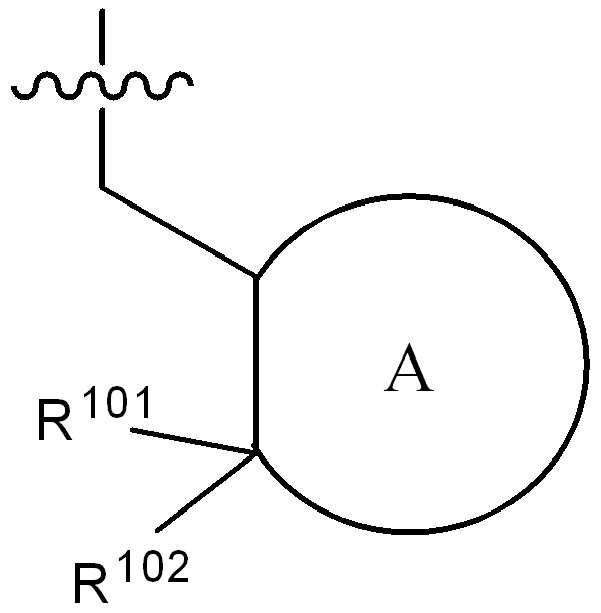
(식 중,(In the meal,

고리 A는 5원의 시클로알킬 또는 헤테로시클릴 고리이고;Ring A is a 5-membered cycloalkyl or heterocyclyl ring;
R101 및 R102는 각각 수소, (1-2C)알킬, 플루오로, 클로로, 히드록시, 시아노, (1-2C)알콕시, (1-2C)할로알킬, (1-2C)할로알콕시, -C(O)ORac, -NRacRad, 페닐 또는 5원의 헤테로아릴로부터 독립적으로 선택되고, 여기서 Rac 및 Rad는 수소 또는 (1-2C)알킬로부터 독립적으로 선택됨);R 101 and R 102 each represent hydrogen, (1-2C) alkyl, fluoro, chloro, hydroxy, cyano, (1-2C) alkoxy, (1-2C) haloalkyl, (1-2C) haloalkoxy, -C (O) oR ac, -NR ac ad R, are independently selected from heteroaryl, phenyl or 5, wherein R ac and R ad is selected independently from hydrogen or (1-2C) alkyl);
(43) R2는 하기로부터 선택됨:(43) R 2 is selected from:
(i) 수소 또는 메틸;(i) hydrogen or methyl;
(ii) 하기 화학식의 기:(ii) groups of the formula
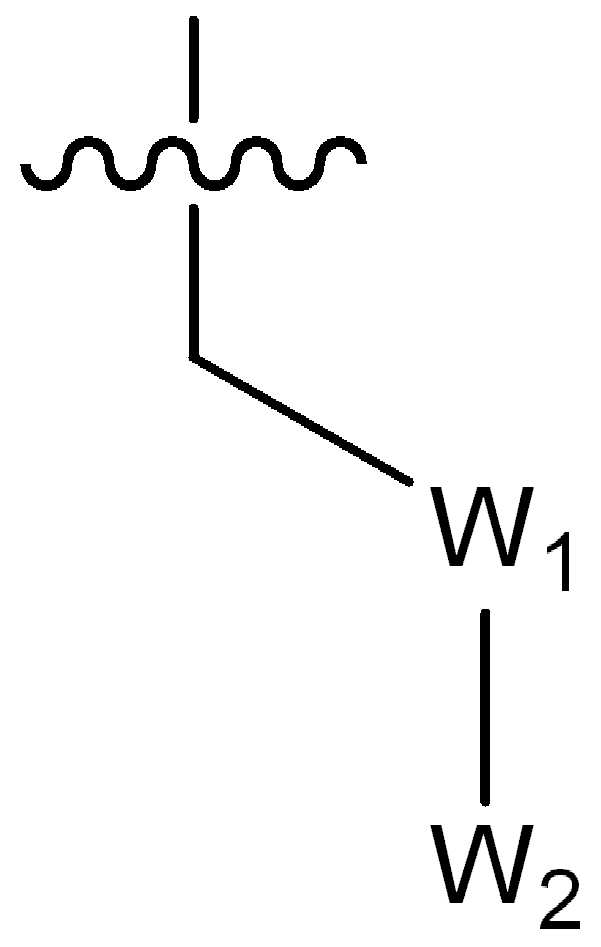
(식 중,(In the meal,

W1은 CR4R5 또는 C(O)로부터 선택되고, 여기서 R4 및 R5는 수소, (1-2C)알킬, 플루오로, 히드록시, 시아노, (1-2C)알콕시, CH2F, CF2H, CF3 또는 아미노로부터 독립적으로 선택되거나; 또는W 1 is selected from CR 4 R 5 or C (O), wherein R 4 and R 5 are hydrogen, (1-2C) alkyl, fluoro, hydroxy, cyano, (1-2C) alkoxy, CH 2 Independently selected from F, CF 2 H, CF 3 or amino; or
R4와 R5는, 이들이 부착된 탄소 원자와 함께, 이들이 (1-2C)알킬, 플루오로, 클로로, CH2F, CF2H, CF3, (1-2C)알콕시, 아미노, 시아노 또는 히드록시로부터 선택된 하나 이상의 치환체에 의해서 선택적으로 치환된 3원 내지 6원의 카보시클릭 고리 또는 3원 내지 6원의 헤테로시클릭 고리를 형성하도록 연결될 수 있고;R 4 and R 5 , together with the carbon atom to which they are attached, are (1-2C) alkyl, fluoro, chloro, CH 2 F, CF 2 H, CF 3 , (1-2C) alkoxy, amino, cyano Or can be linked to form a 3-6 membered carbocyclic ring or a 3-6 membered heterocyclic ring optionally substituted by one or more substituents selected from hydroxy;
W2는 시아노, 5원 또는 6원의 헤테로아릴, 페닐, C(O)OCH3, C(O)N(H)CH3, CR6R7R8 또는 NRlRm으로부터 선택되고, 여기서 Rl 및 Rm은 수소 또는 (1-2C)알킬로부터 독립적으로 선택되고, 여기서W 2 is selected from cyano, 5- or 6-membered heteroaryl, phenyl, C (O) OCH 3 , C (O) N (H) CH 3 , CR 6 R 7 R 8 or NR 1 R m , Wherein R l and R m are independently selected from hydrogen or (1-2C) alkyl, wherein
R6은 수소, (1-2C)알킬, 플루오로, 클로로, 히드록시, 아미노, 시아노, (1-2C)알콕시, CH2F 또는 CF2H로부터 선택되고;R 6 is selected from hydrogen, (1-2C) alkyl, fluoro, chloro, hydroxy, amino, cyano, (1-2C) alkoxy, CH 2 F or CF 2 H;
R7은 수소, (1-2C)알킬, 플루오로, 클로로, 히드록시, 시아노, (1-2C)알콕시, (1-2C)할로알킬, (1-2C)할로알콕시 또는 하기 화학식의 기로부터 선택되고:R 7 is hydrogen, (1-2C) alkyl, fluoro, chloro, hydroxy, cyano, (1-2C) alkoxy, (1-2C) haloalkyl, (1-2C) haloalkoxy or a group of formula Is selected from:
-Y2-L2-Z2 -Y 2 -L 2 -Z 2
식 중,In the formula,
Y2는 존재하지 않거나 또는 O, N(Rn), C(O), C(O)O, OC(O), C(O)N(Rn), N(Rn)C(O로부터 선택되고, 여기서 Rn은 수소 또는 (1-2C)알킬로부터 선택되고;Y 2 is absent or from O, N (R n ), C (O), C (O) O, OC (O), C (O) N (R n ), N (R n ) C (O selected and, where R n is selected from hydrogen or (1-2C) alkyl;
L2는 존재하지 않거나 또는 (1-2C)알킬렌이고;L 2 is absent or (1-2C) alkylene;
Z2는 수소, (1-6C)알킬, (2-4C)알켄일, (2-4C)알킨일, 페닐, (3-6C)시클로알킬, 5원 내지 6원의 헤테로아릴 또는 4원 내지 6원의 헤테로시클릴이고; 여기서 Z2는 (1-2C)알킬, 할로, (1-2C)할로알킬, (1-2C)할로알콕시, (1-2C)알콕시, (1-2C)알킬아미노, 아미노, 시아노, 니트로 또는 히드록시로부터 선택된 하나 이상의 치환체에 의해서 선택적으로 치환되고;Z 2 is hydrogen, (1-6C) alkyl, (2-4C) alkenyl, (2-4C) alkynyl, phenyl, (3-6C) cycloalkyl, 5- or 6-membered heteroaryl or 4- to 6 membered heterocyclyl; Wherein Z 2 is (1-2C) alkyl, halo, (1-2C) haloalkyl, (1-2C) haloalkoxy, (1-2C) alkoxy, (1-2C) alkylamino, amino, cyano, nitro Or optionally substituted by one or more substituents selected from hydroxy;
R8은 (1-2C)알킬, -C(O)ORq , ORq, NRqRr, 페닐 또는 5원의 헤테로아릴로부터 선택되고, 여기서 Rq 및 Rr은 수소 또는 (1-2C)알킬로부터 독립적으로 선택됨);R 8 is (1-2C) alkyl, —C (O) OR q , OR q , NR q R r , Phenyl or 5 membered heteroaryl, wherein R q and R r are independently selected from hydrogen or (1-2C) alkyl);
또는 R6과 R7은 이들이 부착된 탄소 원자와 함께, 이들이 4원 내지 6원의 카보시클릭 고리 또는 4원 내지 6원의 헤테로시클릭 고리를 형성하도록 연결될 수 있음); 또는Or R 6 and R 7 together with the carbon atom to which they are attached may be linked such that they form a 4-6 membered carbocyclic ring or a 4-6 membered heterocyclic ring; or
(iii) 하기 화학식의 기:(iii) a group of the formula:
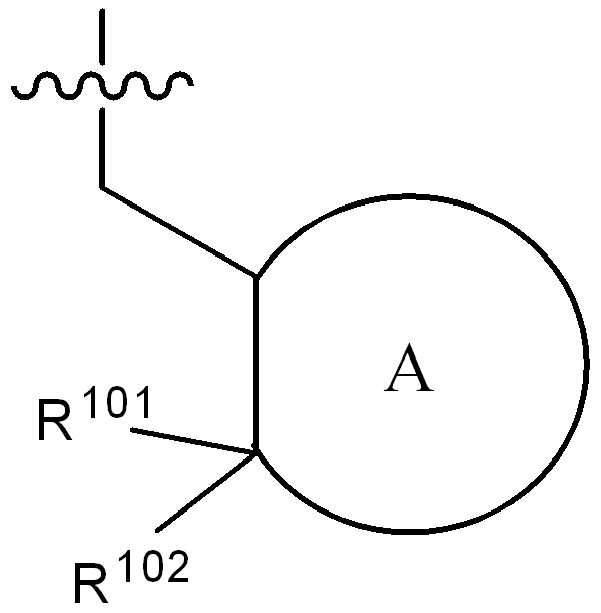
(식 중,(In the meal,

고리 A는 5원의 시클로알킬 또는 헤테로시클릴 고리이고;Ring A is a 5-membered cycloalkyl or heterocyclyl ring;
R101은 수소 또는 메틸로부터 선택되고; R 101 is selected from hydrogen or methyl;
R102는 (1-2C)알킬, 플루오로, 클로로, 히드록시, 시아노, (1-2C)알콕시, (1-2C)할로알킬, (1-2C)할로알콕시, -C(O)ORac, -NRacRad, 페닐 또는 5원의 헤테로아릴로부터 선택되고, 여기서 Rac 및 Rad는 수소 또는 (1-2C)알킬로부터 독립적으로 선택됨);R 102 is (1-2C) alkyl, fluoro, chloro, hydroxy, cyano, (1-2C) alkoxy, (1-2C) haloalkyl, (1-2C) haloalkoxy, -C (O) OR ac , -NR ac R ad , phenyl or 5-membered heteroaryl, wherein R ac and R ad are independently selected from hydrogen or (1-2C) alkyl);
(44) R2는 하기로부터 선택됨:(44) R 2 is selected from:
(i) 수소 또는 메틸;(i) hydrogen or methyl;
(ii) 하기 화학식의 기:(ii) groups of the formula

(식 중,(In the meal,

W1은 CR4R5 또는 C(O)로부터 선택되고, 여기서 R4 및 R5는 수소, (1-2C)알킬, 플루오로, 히드록시, 시아노, (1-2C)알콕시, CH2F, CF2H 또는 아미노로부터 독립적으로 선택되거나; 또는W 1 is selected from CR 4 R 5 or C (O), wherein R 4 and R 5 are hydrogen, (1-2C) alkyl, fluoro, hydroxy, cyano, (1-2C) alkoxy, CH 2 Independently selected from F, CF 2 H or amino; or
R4와 R5는, 이들이 부착된 탄소 원자와 함께, 이들이 메틸, 플루오로, 클로로, OCH3, 아미노, 시아노 또는 히드록시로부터 선택된 하나 이상의 치환체에 의해서 선택적으로 치환된 3원 내지 6원의 카보시클릭 고리 또는 3원 내지 6원의 헤테로시클릭 고리를 형성하도록 연결될 수 있고;R 4 and R 5 , together with the carbon atoms to which they are attached, are 3- to 6-membered optionally substituted by one or more substituents selected from methyl, fluoro, chloro, OCH 3 , amino, cyano or hydroxy; May be linked to form a carbocyclic ring or a 3-6 membered heterocyclic ring;
W2는 시아노, 5원 또는 6원의 헤테로아릴, 페닐, C(O)OCH3, C(O)N(H)CH3, CR6R7R8 또는 NRlRm으로부터 선택되고, 여기서 Rl 및 Rm은 수소 또는 (1-2C)알킬로부터 독립적으로 선택되고, 여기서W 2 is selected from cyano, 5- or 6-membered heteroaryl, phenyl, C (O) OCH 3 , C (O) N (H) CH 3 , CR 6 R 7 R 8 or NR 1 R m , Wherein R l and R m are independently selected from hydrogen or (1-2C) alkyl, wherein
R6은 수소, (1-2C)알킬, 플루오로, 클로로, 히드록시, 아미노, 시아노 또는 (1-2C)알콕시로부터 선택되고;R 6 is selected from hydrogen, (1-2C) alkyl, fluoro, chloro, hydroxy, amino, cyano or (1-2C) alkoxy;
R7은 수소, (1-2C)알킬, 플루오로, 클로로, 히드록시, 시아노, (1-2C)알콕시, (1-2C)할로알킬, (1-2C)할로알콕시 또는 하기 화학식의 기로부터 선택되고:R 7 is hydrogen, (1-2C) alkyl, fluoro, chloro, hydroxy, cyano, (1-2C) alkoxy, (1-2C) haloalkyl, (1-2C) haloalkoxy or a group of formula Is selected from:
-Y2-L2-Z2 -Y 2 -L 2 -Z 2
식 중,In the formula,
Y2는 존재하지 않거나 또는 O, C(O), C(O)O, OC(O), C(O)N(Rn) 또는 N(Rn)C(O로부터 선택되고, 여기서 Rn은 수소 또는 (1-2C)알킬로부터 선택되고;Y 2 is absent or is selected from O, C (O), C (O) O, OC (O), C (O) N (R n ) or N (R n ) C (O, wherein R n Is selected from hydrogen or (1-2C) alkyl;
L2는 존재하지 않거나 또는 (1-2C)알킬렌이고;L 2 is absent or (1-2C) alkylene;
Z2는 수소, (1-6C)알킬, (2-4C)알켄일, (2-4C)알킨일, 페닐, (3-6C)시클로알킬, 5원 내지 6원의 헤테로아릴 또는 4원 내지 6원의 헤테로시클릴이고; 여기서 Z2는 (1-2C)알킬, 할로, (1-2C)할로알킬, (1-2C)할로알콕시, (1-2C)알콕시, (1-2C)알킬아미노, 아미노, 시아노, 니트로 또는 히드록시로부터 선택된 하나 이상의 치환체에 의해서 선택적으로 치환되고;Z 2 is hydrogen, (1-6C) alkyl, (2-4C) alkenyl, (2-4C) alkynyl, phenyl, (3-6C) cycloalkyl, 5- or 6-membered heteroaryl or 4- to 6 membered heterocyclyl; Wherein Z 2 is (1-2C) alkyl, halo, (1-2C) haloalkyl, (1-2C) haloalkoxy, (1-2C) alkoxy, (1-2C) alkylamino, amino, cyano, nitro Or optionally substituted by one or more substituents selected from hydroxy;
R8은 (1-2C)알킬, -C(O)ORq , ORq, NRqRr, 페닐 또는 5원의 헤테로아릴로부터 선택되고, 여기서 Rq 및 Rr은 수소 또는 (1-2C)알킬로부터 독립적으로 선택됨); 또는R 8 is (1-2C) alkyl, —C (O) OR q , OR q , NR q R r , Phenyl or 5 membered heteroaryl, wherein R q and R r are independently selected from hydrogen or (1-2C) alkyl); or
(iii) 하기 화학식의 기:(iii) a group of the formula:

(식 중,(In the meal,

고리 A는 5원의 시클로알킬 또는 헤테로시클릴 고리이고;Ring A is a 5-membered cycloalkyl or heterocyclyl ring;
W3은 NR100 또는 CR101R102로부터 선택되고, 여기서 R100은 수소, (1-2C)알킬 또는 -C(O)ORab로부터 선택되고, 여기서 Rab는 (1-2C)알킬이고, R101 및 R102는 각각 수소, (1-2C)알킬, 플루오로, 클로로, 히드록시, (1-2C)알콕시, CH2F, CF2H, CF3, -C(O)ORac 또는-NRacRad로부터 독립적으로 선택되고, 여기서 Rac 및 Rad는 수소 또는 (1-2C)알킬로부터 독립적으로 선택됨);W 3 is selected from NR 100 or CR 101 R 102 , wherein R 100 is selected from hydrogen, (1-2C) alkyl or —C (O) OR ab , wherein R ab is (1-2C) alkyl, R 101 and R 102 each represent hydrogen, (1-2C) alkyl, fluoro, chloro, hydroxy, (1-2C) alkoxy, CH 2 F, CF 2 H, CF 3 , -C (O) OR ac or -NR ac R ad independently selected from where R ac and R ad are independently selected from hydrogen or (1-2C) alkyl);
(45) R2는 하기로부터 선택됨:(45) R 2 is selected from:
(i) 수소 또는 메틸;(i) hydrogen or methyl;
(ii) 하기 화학식의 기:(ii) groups of the formula

(식 중,(In the meal,

W1은 CR4R5 또는 C(O)로부터 선택되고, 여기서 R4 및 R5는 수소, (1-2C)알킬, 플루오로, 히드록시, 시아노, (1-2C)알콕시, CH2F, CF2H 또는 아미노로부터 독립적으로 선택되거나; 또는W 1 is selected from CR 4 R 5 or C (O), wherein R 4 and R 5 are hydrogen, (1-2C) alkyl, fluoro, hydroxy, cyano, (1-2C) alkoxy, CH 2 Independently selected from F, CF 2 H or amino; or
R4와 R5는, 이들이 부착된 탄소 원자와 함께, 이들이 메틸, 플루오로, 클로로, OCH3, 아미노, 시아노 또는 히드록시로부터 선택된 하나 이상의 치환체에 의해서 선택적으로 치환된 3원 내지 6원의 헤테로시클릭 고리를 형성하도록 연결될 수 있고;R 4 and R 5 , together with the carbon atoms to which they are attached, are 3- to 6-membered optionally substituted by one or more substituents selected from methyl, fluoro, chloro, OCH 3 , amino, cyano or hydroxy; May be linked to form a heterocyclic ring;
W2는 시아노, 5원 또는 6원의 헤테로아릴, 페닐, C(O)OCH3, C(O)N(H)CH3, CR6R7R8 또는 NRlRm으로부터 선택되고, 여기서 Rl 및 Rm은 수소 또는 (1-2C)알킬로부터 독립적으로 선택되고, 여기서W 2 is selected from cyano, 5- or 6-membered heteroaryl, phenyl, C (O) OCH 3 , C (O) N (H) CH 3 , CR 6 R 7 R 8 or NR 1 R m , Wherein R l and R m are independently selected from hydrogen or (1-2C) alkyl, wherein
R6은 수소, (1-2C)알킬, 플루오로, 클로로, 히드록시, 아미노, 시아노 또는 (1-2C)알콕시로부터 선택되고;R 6 is selected from hydrogen, (1-2C) alkyl, fluoro, chloro, hydroxy, amino, cyano or (1-2C) alkoxy;
R7은 수소, (1-2C)알킬, 플루오로, 클로로, 히드록시, 시아노, (1-2C)알콕시, (1-2C)할로알킬, (1-2C)할로알콕시 또는 하기 화학식의 기로부터 선택되고:R 7 is hydrogen, (1-2C) alkyl, fluoro, chloro, hydroxy, cyano, (1-2C) alkoxy, (1-2C) haloalkyl, (1-2C) haloalkoxy or a group of formula Is selected from:
-Y2-L2-Z2 -Y 2 -L 2 -Z 2
식 중,In the formula,
Y2는 존재하지 않거나 또는 O, C(O), C(O)O, OC(O), C(O)N(Rn) 또는 N(Rn)C(O로부터 선택되고, 여기서 Rn은 수소 또는 (1-2C)알킬로부터 선택되고;Y 2 is absent or is selected from O, C (O), C (O) O, OC (O), C (O) N (R n ) or N (R n ) C (O, wherein R n Is selected from hydrogen or (1-2C) alkyl;
L2는 존재하지 않거나 또는 (1-2C)알킬렌이고;L 2 is absent or (1-2C) alkylene;
Z2는 수소, (1-6C)알킬, (2-4C)알켄일, (2-4C)알킨일, 페닐, (3-6C)시클로알킬, 5원 내지 6원의 헤테로아릴 또는 4원 내지 6원의 헤테로시클릴이고; 여기서 Z2는 (1-2C)알킬, 할로, (1-2C)할로알킬, (1-2C)할로알콕시, (1-2C)알콕시, (1-2C)알킬아미노, 아미노, 시아노, 니트로 또는 히드록시로부터 선택된 하나 이상의 치환체에 의해서 선택적으로 치환되고;Z 2 is hydrogen, (1-6C) alkyl, (2-4C) alkenyl, (2-4C) alkynyl, phenyl, (3-6C) cycloalkyl, 5- or 6-membered heteroaryl or 4- to 6 membered heterocyclyl; Wherein Z 2 is (1-2C) alkyl, halo, (1-2C) haloalkyl, (1-2C) haloalkoxy, (1-2C) alkoxy, (1-2C) alkylamino, amino, cyano, nitro Or optionally substituted by one or more substituents selected from hydroxy;
R8은 (1-2C)알킬, -C(O)ORq , ORq, NRqRr, 페닐 또는 5원의 헤테로아릴로부터 선택되고, 여기서 Rq 및 Rr은 수소 또는 (1-2C)알킬로부터 독립적으로 선택됨); 또는R 8 is (1-2C) alkyl, —C (O) OR q , OR q , NR q R r , Phenyl or 5 membered heteroaryl, wherein R q and R r are independently selected from hydrogen or (1-2C) alkyl); or
(iii) 하기 화학식의 기:(iii) a group of the formula:

(식 중,(In the meal,

고리 A는 5원의 시클로알킬 또는 헤테로시클릴 고리이고;Ring A is a 5-membered cycloalkyl or heterocyclyl ring;
W3은 NR100 또는 CR101R102로부터 선택되고, 여기서 R100은 수소, (1-2C)알킬 또는 -C(O)ORab로부터 선택되고, 여기서 Rab는 (1-2C)알킬이고, R101 및 R102는 각각 수소, (1-2C)알킬, 플루오로, 클로로, 히드록시, (1-2C)알콕시, CH2F, CF2H, CF3, -C(O)ORac 또는-NRacRad로부터 독립적으로 선택되고, 여기서 Rac 및 Rad는 수소 또는 (1-2C)알킬로부터 독립적으로 선택됨);W 3 is selected from NR 100 or CR 101 R 102 , wherein R 100 is selected from hydrogen, (1-2C) alkyl or —C (O) OR ab , wherein R ab is (1-2C) alkyl, R 101 and R 102 each represent hydrogen, (1-2C) alkyl, fluoro, chloro, hydroxy, (1-2C) alkoxy, CH 2 F, CF 2 H, CF 3 , -C (O) OR ac or -NR ac R ad independently selected from where R ac and R ad are independently selected from hydrogen or (1-2C) alkyl);
(46) R2는 하기로부터 선택됨:(46) R 2 is selected from:
(i) 수소 또는 메틸;(i) hydrogen or methyl;
(ii) 하기 화학식의 기:(ii) groups of the formula

(식 중,(In the meal,

W1은 CHR4 또는 C(O)로부터 선택되고, 여기서 R4는 수소, (1-2C)알킬, 플루오로, 히드록시, 시아노, 니트로, (1-2C)알콕시, (1-2C)할로알킬, (1-2C)할로알콕시 또는 NRjRk로부터 선택되고, 여기서 Rj 및 Rk는 수소 또는 (1-2C)알킬로부터 독립적으로 선택되고;W 1 is selected from CHR 4 or C (O), wherein R 4 is hydrogen, (1-2C) alkyl, fluoro, hydroxy, cyano, nitro, (1-2C) alkoxy, (1-2C) Haloalkyl, (1-2C) haloalkoxy or NR j R k , wherein R j and R k are independently selected from hydrogen or (1-2C) alkyl;
W2는 시아노, 5원 또는 6원의 헤테로아릴, 페닐, C(O)OCH3, C(O)N(H)CH3, CR6R7R8 또는 NRlRm으로부터 선택되고, 여기서 Rl 및 Rm은 수소 또는 (1-2C)알킬로부터 독립적으로 선택되고, 여기서W 2 is selected from cyano, 5- or 6-membered heteroaryl, phenyl, C (O) OCH 3 , C (O) N (H) CH 3 , CR 6 R 7 R 8 or NR 1 R m , Wherein R l and R m are independently selected from hydrogen or (1-2C) alkyl, wherein
R6은 수소, (1-2C)알킬, 플루오로, 클로로, 히드록시, 아미노, 시아노, (1-2C)알콕시, CH2F, CF2H 또는 CF3로부터 선택되고;R 6 is selected from hydrogen, (1-2C) alkyl, fluoro, chloro, hydroxy, amino, cyano, (1-2C) alkoxy, CH 2 F, CF 2 H or CF 3 ;
R7은 수소, (1-2C)알킬, 플루오로, 클로로, 히드록시, 시아노, (1-2C)알콕시, (1-2C)할로알킬, (1-2C)할로알콕시 또는 하기 화학식의 기로부터 선택되고:R 7 is hydrogen, (1-2C) alkyl, fluoro, chloro, hydroxy, cyano, (1-2C) alkoxy, (1-2C) haloalkyl, (1-2C) haloalkoxy or a group of formula Is selected from:
-Y2-L2-Z2 -Y 2 -L 2 -Z 2
식 중,In the formula,
Y2는 존재하지 않거나 또는 O, N(Rn), SO2, C(O), C(O)O, OC(O), C(O)N(Rn), N(Rn)C(O), S(O)2N(Rn), 또는 N(Rn)SO2로부터 선택되고, 여기서 Rn은 수소 또는 (1-2C)알킬로부터 선택되고;Y 2 is absent or O, N (R n ), SO 2 , C (O), C (O) O, OC (O), C (O) N (R n ), N (R n ) C (O), S (O) 2 N (R n ), or N (R n ) SO 2 , wherein R n is selected from hydrogen or (1-2C) alkyl;
L2는 존재하지 않거나 또는 (1-2C)알킬렌이고;L 2 is absent or (1-2C) alkylene;
Z2는 수소, (1-6C)알킬, (2-4C)알켄일, (2-4C)알킨일, 페닐, (3-6C)시클로알킬, 5원 내지 6원의 헤테로아릴 또는 4원 내지 6원의 헤테로시클릴이고; 여기서 Z2는 (1-2C)알킬, 할로, (1-2C)할로알킬, (1-2C)할로알콕시, (1-2C)알콕시, (1-2C)알킬아미노, 아미노, 시아노, 니트로 또는 히드록시로부터 선택된 하나 이상의 치환체에 의해서 선택적으로 치환되고;Z 2 is hydrogen, (1-6C) alkyl, (2-4C) alkenyl, (2-4C) alkynyl, phenyl, (3-6C) cycloalkyl, 5- or 6-membered heteroaryl or 4- to 6 membered heterocyclyl; Wherein Z 2 is (1-2C) alkyl, halo, (1-2C) haloalkyl, (1-2C) haloalkoxy, (1-2C) alkoxy, (1-2C) alkylamino, amino, cyano, nitro Or optionally substituted by one or more substituents selected from hydroxy;
R8은 (1-2C)알킬, -C(O)ORq , ORq, NRqRr, 페닐 또는 5원의 헤테로아릴로부터 선택되고, 여기서 Rq 및 Rr은 수소 또는 (1-2C)알킬로부터 독립적으로 선택됨); 또는R 8 is (1-2C) alkyl, —C (O) OR q , OR q , NR q R r , Phenyl or 5 membered heteroaryl, wherein R q and R r are independently selected from hydrogen or (1-2C) alkyl); or
R6과 R7은, 이들이 부착된 탄소 원자와 함께, 이들이 (1-2C)알킬, 플루오로, 클로로, CH2F, CF2H 또는 CF3, (1-2C)알콕시, 아미노, 시아노 또는 히드록시로부터 선택된 하나 이상의 치환체에 의해서 선택적으로 치환된 4원 내지 6원의 카보시클릭 고리 또는 4원 내지 6원의 헤테로시클릭 고리를 형성하도록 연결될 수 있음); 또는R 6 and R 7 together with the carbon atom to which they are attached are (1-2C) alkyl, fluoro, chloro, CH 2 F, CF 2 H or CF 3 , (1-2C) alkoxy, amino, cyano Or a 4-6 membered carbocyclic ring or 4-6 membered heterocyclic ring optionally substituted by one or more substituents selected from hydroxy); or
(iii) 하기 화학식의 기:(iii) a group of the formula:

(식 중,(In the meal,

고리 A는 5원의 시클로알킬 또는 헤테로시클릴 고리이고;Ring A is a 5-membered cycloalkyl or heterocyclyl ring;
W3은 NR100 또는 CR101R102로부터 선택되고, 여기서 R100은 수소, (1-2C)알킬 또는 -C(O)ORab로부터 선택되고, 여기서 Rab는 (1-2C)알킬이고, R101 및 R102는 각각 수소, (1-2C)알킬, 플루오로, 클로로, 히드록시, (1-2C)알콕시, CH2F, CF2H, CF3, -C(O)ORac 또는-NRacRad로부터 독립적으로 선택되고, 여기서 Rac 및 Rad는 수소 또는 (1-2C)알킬로부터 독립적으로 선택됨);W 3 is selected from NR 100 or CR 101 R 102 , wherein R 100 is selected from hydrogen, (1-2C) alkyl or —C (O) OR ab , wherein R ab is (1-2C) alkyl, R 101 and R 102 each represent hydrogen, (1-2C) alkyl, fluoro, chloro, hydroxy, (1-2C) alkoxy, CH 2 F, CF 2 H, CF 3 , -C (O) OR ac or -NR ac R ad independently selected from where R ac and R ad are independently selected from hydrogen or (1-2C) alkyl);
(47) R2는 하기로부터 선택되고:(47) R 2 is selected from:
(i) 수소 또는 메틸;(i) hydrogen or methyl;
(ii) 하기 화학식의 기:(ii) groups of the formula
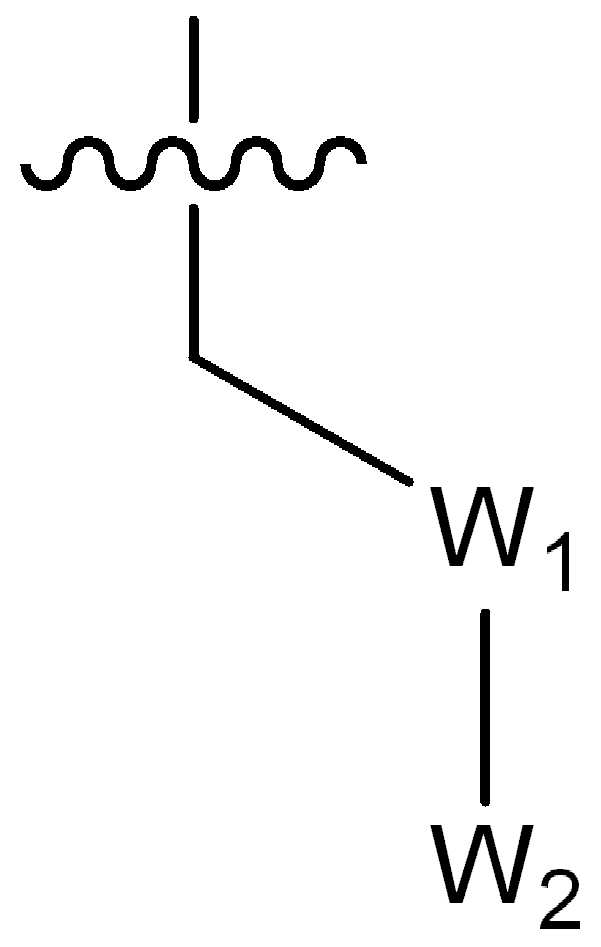
(식 중,(In the meal,

W1은 CHR4 또는 C(O)로부터 선택되고, 여기서 R4는 수소, (1-2C)알킬, 플루오로, 히드록시, 시아노, (1-2C)알콕시, CH2F, CF2H, CF3 또는 아미노로부터 선택되고;W 1 is selected from CHR 4 or C (O), wherein R 4 is hydrogen, (1-2C) alkyl, fluoro, hydroxy, cyano, (1-2C) alkoxy, CH 2 F, CF 2 H , CF 3 or amino;
W2는 시아노, 5원 또는 6원의 헤테로아릴, 페닐, C(O)OCH3, C(O)N(H)CH3, CR6R7R8 또는 NRlRm으로부터 선택되고, 여기서 Rl 및 Rm은 수소 또는 (1-2C)알킬로부터 독립적으로 선택되고, 여기서W 2 is selected from cyano, 5- or 6-membered heteroaryl, phenyl, C (O) OCH 3 , C (O) N (H) CH 3 , CR 6 R 7 R 8 or NR 1 R m , Wherein R l and R m are independently selected from hydrogen or (1-2C) alkyl, wherein
R6은 수소, (1-2C)알킬, 플루오로, 클로로, 히드록시, 아미노, 시아노, (1-2C)알콕시, CH2F, CF2H 또는 CF3로부터 선택되고;R 6 is selected from hydrogen, (1-2C) alkyl, fluoro, chloro, hydroxy, amino, cyano, (1-2C) alkoxy, CH 2 F, CF 2 H or CF 3 ;
R7은 수소, (1-2C)알킬, 플루오로, 클로로, 히드록시, 시아노, (1-2C)알콕시, (1-2C)할로알킬, (1-2C)할로알콕시 또는 하기 화학식의 기로부터 선택되고:R 7 is hydrogen, (1-2C) alkyl, fluoro, chloro, hydroxy, cyano, (1-2C) alkoxy, (1-2C) haloalkyl, (1-2C) haloalkoxy or a group of formula Is selected from:
-Y2-L2-Z2 -Y 2 -L 2 -Z 2
식 중,In the formula,
Y2는 존재하지 않거나 또는 O, N(Rn), SO2, C(O), C(O)O, OC(O), C(O)N(Rn) 또는 N(Rn)C(O로부터 선택되고, 여기서 Rn은 수소 또는 (1-2C)알킬로부터 선택되고;Y 2 is absent or O, N (R n ), SO 2 , C (O), C (O) O, OC (O), C (O) N (R n ) or N (R n ) C (Selected from O, wherein R n is selected from hydrogen or (1-2C) alkyl;
L2는 존재하지 않거나 또는 (1-2C)알킬렌이고;L 2 is absent or (1-2C) alkylene;
Z2는 수소, (1-6C)알킬, (2-4C)알켄일, (2-4C)알킨일, 페닐, (3-6C)시클로알킬, 5원 내지 6원의 헤테로아릴 또는 4원 내지 6원의 헤테로시클릴이고; 여기서 Z2는 (1-2C)알킬, 할로, (1-2C)할로알킬, (1-2C)할로알콕시, (1-2C)알콕시, (1-2C)알킬아미노, 아미노, 시아노, 니트로 또는 히드록시로부터 선택된 하나 이상의 치환체에 의해서 선택적으로 치환되고;Z 2 is hydrogen, (1-6C) alkyl, (2-4C) alkenyl, (2-4C) alkynyl, phenyl, (3-6C) cycloalkyl, 5- or 6-membered heteroaryl or 4- to 6 membered heterocyclyl; Wherein Z 2 is (1-2C) alkyl, halo, (1-2C) haloalkyl, (1-2C) haloalkoxy, (1-2C) alkoxy, (1-2C) alkylamino, amino, cyano, nitro Or optionally substituted by one or more substituents selected from hydroxy;
R8은 (1-2C)알킬, -C(O)ORq , ORq, NRqRr, 페닐 또는 5원의 헤테로아릴로부터 선택되고, 여기서 Rq 및 Rr은 수소 또는 (1-2C)알킬로부터 독립적으로 선택됨); 또는R 8 is (1-2C) alkyl, —C (O) OR q , OR q , NR q R r , Phenyl or 5 membered heteroaryl, wherein R q and R r are independently selected from hydrogen or (1-2C) alkyl); or
R6과 R7은, 이들이 부착된 탄소 원자와 함께, 이들이 (1-2C)알킬, 플루오로, 클로로, CH2F, CF2H 또는 CF3, (1-2C)알콕시, 아미노, 시아노 또는 히드록시로부터 선택된 하나 이상의 치환체에 의해서 선택적으로 치환된 4원 내지 6원의 카보시클릭 고리 또는 4원 내지 6원의 헤테로시클릭 고리를 형성하도록 연결될 수 있음); 또는R 6 and R 7 together with the carbon atom to which they are attached are (1-2C) alkyl, fluoro, chloro, CH 2 F, CF 2 H or CF 3 , (1-2C) alkoxy, amino, cyano Or a 4-6 membered carbocyclic ring or 4-6 membered heterocyclic ring optionally substituted by one or more substituents selected from hydroxy); or
(iii) 하기 화학식의 기:(iii) a group of the formula:

(식 중,(In the meal,

고리 A는 5원의 시클로알킬 또는 헤테로시클릴 고리이고;Ring A is a 5-membered cycloalkyl or heterocyclyl ring;
W3은 NR100 또는 CR101R102로부터 선택되고, 여기서 R100은 수소, (1-2C)알킬 또는 -C(O)ORab로부터 선택되고, 여기서 Rab는 (1-2C)알킬이고, R101 및 R102는 각각 수소, (1-2C)알킬, 플루오로, 클로로, 히드록시, (1-2C)알콕시, CH2F, CF2H, CF3, -C(O)ORac 또는-NRacRad로부터 독립적으로 선택되고, 여기서 Rac 및 Rad는 수소 또는 (1-2C)알킬로부터 독립적으로 선택됨);W 3 is selected from NR 100 or CR 101 R 102 , wherein R 100 is selected from hydrogen, (1-2C) alkyl or —C (O) OR ab , wherein R ab is (1-2C) alkyl, R 101 and R 102 each represent hydrogen, (1-2C) alkyl, fluoro, chloro, hydroxy, (1-2C) alkoxy, CH 2 F, CF 2 H, CF 3 , -C (O) OR ac or -NR ac R ad independently selected from where R ac and R ad are independently selected from hydrogen or (1-2C) alkyl);
(48) R2는 하기로부터 선택됨:(48) R 2 is selected from:
(i) 수소 또는 메틸;(i) hydrogen or methyl;
(ii) 하기 화학식의 기:(ii) groups of the formula

(식 중,(In the meal,

W1은 CHR4 또는 C(O)로부터 선택되고, 여기서 R4는 수소, (1-2C)알킬, 플루오로, 히드록시, 시아노, (1-2C)알콕시, CH2F, CF2H, CF3 또는 아미노로부터 선택되고;W 1 is selected from CHR 4 or C (O), wherein R 4 is hydrogen, (1-2C) alkyl, fluoro, hydroxy, cyano, (1-2C) alkoxy, CH 2 F, CF 2 H , CF 3 or amino;
W2는 시아노, 5원 또는 6원의 헤테로아릴, 페닐, C(O)OCH3, C(O)N(H)CH3, CR6R7R8 또는 NRlRm으로부터 선택되고, 여기서 Rl 및 Rm은 수소 또는 (1-2C)알킬로부터 독립적으로 선택되고, 여기서W 2 is selected from cyano, 5- or 6-membered heteroaryl, phenyl, C (O) OCH 3 , C (O) N (H) CH 3 , CR 6 R 7 R 8 or NR 1 R m , Wherein R l and R m are independently selected from hydrogen or (1-2C) alkyl, wherein
R6은 수소, (1-2C)알킬, 플루오로, 클로로, 히드록시, 아미노, 시아노, (1-2C)알콕시, CH2F, CF2H 또는 CF3로부터 선택되고;R 6 is selected from hydrogen, (1-2C) alkyl, fluoro, chloro, hydroxy, amino, cyano, (1-2C) alkoxy, CH 2 F, CF 2 H or CF 3 ;
R7은 수소, (1-2C)알킬, 플루오로, 클로로, 히드록시, 시아노, (1-2C)알콕시, (1-2C)할로알킬, (1-2C)할로알콕시 또는 하기 화학식의 기로부터 선택되고:R 7 is hydrogen, (1-2C) alkyl, fluoro, chloro, hydroxy, cyano, (1-2C) alkoxy, (1-2C) haloalkyl, (1-2C) haloalkoxy or a group of formula Is selected from:
-Y2-L2-Z2 -Y 2 -L 2 -Z 2
식 중,In the formula,
Y2는 존재하지 않거나 또는 O, C(O)O, C(O)N(Rn) 또는 N(Rn)C(O로부터 선택되고, 여기서 Rn은 수소 또는 (1-2C)알킬로부터 선택되고;Y 2 is absent or is selected from O, C (O) O, C (O) N (R n ) or N (R n ) C (O, wherein R n is from hydrogen or (1-2C) alkyl Selected;
L2는 존재하지 않거나 또는 (1-2C)알킬렌이고;L 2 is absent or (1-2C) alkylene;
Z2는 수소, (1-6C)알킬, (2-4C)알켄일, (2-4C)알킨일, 페닐, (3-6C)시클로알킬, 5원 내지 6원의 헤테로아릴 또는 4원 내지 6원의 헤테로시클릴이고; 여기서 Z2는 (1-2C)알킬, 할로, (1-2C)할로알킬, (1-2C)할로알콕시, (1-2C)알콕시, (1-2C)알킬아미노, 아미노, 시아노, 니트로 또는 히드록시로부터 선택된 하나 이상의 치환체에 의해서 선택적으로 치환됨;Z 2 is hydrogen, (1-6C) alkyl, (2-4C) alkenyl, (2-4C) alkynyl, phenyl, (3-6C) cycloalkyl, 5- or 6-membered heteroaryl or 4- to 6 membered heterocyclyl; Wherein Z 2 is (1-2C) alkyl, halo, (1-2C) haloalkyl, (1-2C) haloalkoxy, (1-2C) alkoxy, (1-2C) alkylamino, amino, cyano, nitro Or optionally substituted by one or more substituents selected from hydroxy;
R8은 (1-2C)알킬, -C(O)ORq , ORq, NRqRr, 페닐 또는 5원의 헤테로아릴로부터 선택되고, 여기서 Rq 및 Rr은 수소 또는 (1-2C)알킬로부터 독립적으로 선택됨); 또는R 8 is (1-2C) alkyl, —C (O) OR q , OR q , NR q R r , Phenyl or 5 membered heteroaryl, wherein R q and R r are independently selected from hydrogen or (1-2C) alkyl); or
R6과 R7은, 이들이 부착된 탄소 원자와 함께, 이들이 (1-2C)알킬, 플루오로, 클로로 또는 히드록시로부터 선택된 하나 이상의 치환체에 의해서 선택적으로 치환된 4원 내지 6원의 카보시클릭 고리 또는 4원 내지 6원의 헤테로시클릭 고리를 형성하도록 연결될 수 있음); 또는R 6 and R 7 together with the carbon atom to which they are attached are 4- to 6-membered carbocyclic groups which are optionally substituted by one or more substituents selected from (1-2C) alkyl, fluoro, chloro or hydroxy Ring or 4 to 6 membered heterocyclic ring); or
(iii) 하기 화학식의 기:(iii) a group of the formula:

(식 중,(In the meal,

고리 A는 5원의 시클로알킬 또는 헤테로시클릴 고리이고;Ring A is a 5-membered cycloalkyl or heterocyclyl ring;
W3은 NR100 또는 CR101R102로부터 선택되고, 여기서 R100은 수소, (1-2C)알킬 또는 -C(O)ORab로부터 선택되고, 여기서 Rab는 (1-2C)알킬이고, R101 및 R102는 각각 수소, (1-2C)알킬, 히드록시, (1-2C)알콕시 또는 -C(O)ORac로부터 독립적으로 선택되고, 여기서 Rac 는 수소 또는 (1-2C)알킬로부터 선택됨);W 3 is selected from NR 100 or CR 101 R 102 , wherein R 100 is selected from hydrogen, (1-2C) alkyl or -C (O) OR ab , wherein R ab is (1-2C) alkyl, R 101 and R 102 are each independently selected from hydrogen, (1-2C) alkyl, hydroxy, (1-2C) alkoxy or -C (O) OR ac , wherein R ac is hydrogen or (1-2C) Selected from alkyl);
(49) R2는 하기로부터 선택됨:(49) R 2 is selected from:
(i) 수소 또는 메틸;(i) hydrogen or methyl;
(ii) 하기 화학식의 기:(ii) groups of the formula

(식 중,(In the meal,

W1은 CHR4 또는 C(O)로부터 선택되고, 여기서 R4는 수소, (1-2C)알킬, 플루오로, 히드록시, 시아노, (1-2C)알콕시, CH2F, CF2H 또는 아미노로부터 선택되고;W 1 is selected from CHR 4 or C (O), wherein R 4 is hydrogen, (1-2C) alkyl, fluoro, hydroxy, cyano, (1-2C) alkoxy, CH 2 F, CF 2 H Or amino;
W2는 시아노, 5원 또는 6원의 헤테로아릴, 페닐, C(O)OCH3, C(O)N(H)CH3, CR6R7R8 또는 NRlRm으로부터 선택되고, 여기서 Rl 및 Rm은 수소 또는 (1-2C)알킬로부터 독립적으로 선택되고, 여기서W 2 is selected from cyano, 5- or 6-membered heteroaryl, phenyl, C (O) OCH 3 , C (O) N (H) CH 3 , CR 6 R 7 R 8 or NR 1 R m , Wherein R l and R m are independently selected from hydrogen or (1-2C) alkyl, wherein
R6은 수소, (1-2C)알킬, 플루오로, 클로로, 히드록시, 아미노, 시아노, (1-2C)알콕시, CH2F 또는 CF2H로부터 선택되고;R 6 is selected from hydrogen, (1-2C) alkyl, fluoro, chloro, hydroxy, amino, cyano, (1-2C) alkoxy, CH 2 F or CF 2 H;
R7은 수소, (1-2C)알킬, 플루오로, 클로로, 히드록시, 시아노, (1-2C)알콕시, (1-2C)할로알킬, (1-2C)할로알콕시 또는 하기 화학식의 기로부터 선택되고:R 7 is hydrogen, (1-2C) alkyl, fluoro, chloro, hydroxy, cyano, (1-2C) alkoxy, (1-2C) haloalkyl, (1-2C) haloalkoxy or a group of formula Is selected from:
-Y2-L2-Z2 -Y 2 -L 2 -Z 2
식 중,In the formula,
Y2는 존재하지 않거나 또는 O, C(O)O, C(O)N(Rn) 또는 N(Rn)C(O로부터 선택되고, 여기서 Rn은 수소 또는 (1-2C)알킬로부터 선택되고;Y 2 is absent or is selected from O, C (O) O, C (O) N (R n ) or N (R n ) C (O, wherein R n is from hydrogen or (1-2C) alkyl Selected;
L2는 존재하지 않거나 또는 (1-2C)알킬렌이고;L 2 is absent or (1-2C) alkylene;
Z2는 수소, (1-6C)알킬, (2-4C)알켄일, (2-4C)알킨일, 페닐, (3-6C)시클로알킬, 5원 내지 6원의 헤테로아릴 또는 4원 내지 6원의 헤테로시클릴이고; 여기서 Z2는 (1-2C)알킬, 할로, (1-2C)할로알킬, (1-2C)할로알콕시, (1-2C)알콕시, (1-2C)알킬아미노, 아미노, 시아노 또는 히드록시로부터 선택된 하나 이상의 치환체에 의해서 선택적으로 치환되고;Z 2 is hydrogen, (1-6C) alkyl, (2-4C) alkenyl, (2-4C) alkynyl, phenyl, (3-6C) cycloalkyl, 5- or 6-membered heteroaryl or 4- to 6 membered heterocyclyl; Wherein Z 2 is (1-2C) alkyl, halo, (1-2C) haloalkyl, (1-2C) haloalkoxy, (1-2C) alkoxy, (1-2C) alkylamino, amino, cyano or hydroxide Optionally substituted by one or more substituents selected from oxy;
R8은 (1-2C)알킬, -C(O)ORq , ORq, NRqRr, 페닐 또는 5원의 헤테로아릴로부터 선택되고, 여기서 Rq 및 Rr은 수소 또는 (1-2C)알킬로부터 독립적으로 선택되거나; 또는R 8 is (1-2C) alkyl, —C (O) OR q , OR q , NR q R r , Phenyl or 5-membered heteroaryl, wherein R q and R r are independently selected from hydrogen or (1-2C) alkyl; or
R6과 R7은 이들이 부착된 탄소 원자와 함께, 이들이 4원 내지 6원의 카보시클릭 고리 또는 4원 내지 6원의 헤테로시클릭 고리를 형성하도록 연결될 수 있음); 또는R 6 and R 7 together with the carbon atom to which they are attached may be linked such that they form a 4-6 membered carbocyclic ring or a 4-6 membered heterocyclic ring; or
(iii) 하기 화학식의 기:(iii) a group of the formula:
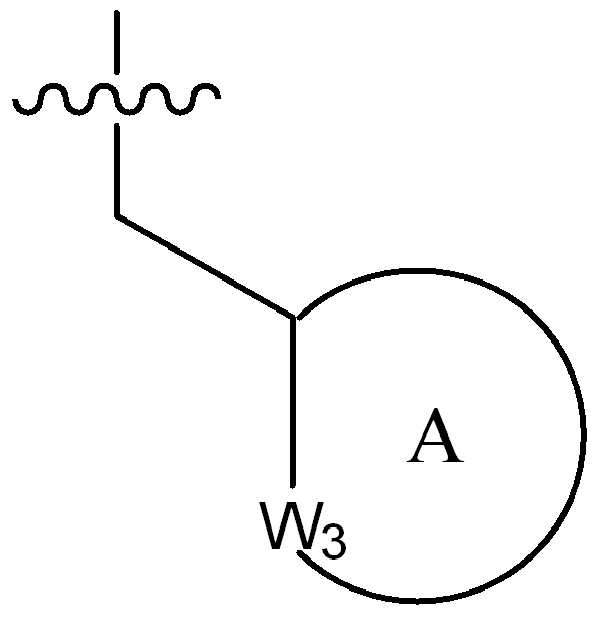
(식 중,(In the meal,

고리 A는 5원의 시클로알킬 또는 헤테로시클릴 고리이고;Ring A is a 5-membered cycloalkyl or heterocyclyl ring;
W3은 NR100 또는 CR101R102로부터 선택되고, 여기서 R100은 수소, (1-2C)알킬 또는 -C(O)ORab로부터 선택되고, 여기서 Rab는 (1-2C)알킬이고, R101은 수소 또는 메틸로부터 선택되고, R102는 (1-2C)알킬, 히드록시, (1-2C)알콕시, C(O)ORac 또는 -NRacRad로부터 선택되고, 여기서 Rac 및 Rad는 수소 또는 (1-2C)알킬로부터 독립적으로 선택됨)W 3 is selected from NR 100 or CR 101 R 102 , wherein R 100 is selected from hydrogen, (1-2C) alkyl or -C (O) OR ab , wherein R ab is (1-2C) alkyl, R 101 is selected from hydrogen or methyl and R 102 is selected from (1-2C) alkyl, hydroxy, (1-2C) alkoxy, C (O) OR ac or -NR ac R ad , wherein R ac and R ad is independently selected from hydrogen or (1-2C) alkyl)
(50) R2는 하기로부터 선택됨:(50) R 2 is selected from:
(i) 수소 또는 메틸;(i) hydrogen or methyl;
(ii) 하기 화학식의 기:(ii) groups of the formula

(식 중,(In the meal,

W1은 CHR4 또는 C(O)로부터 선택되고, 여기서 R4는 수소, (1-2C)알킬, 플루오로, 히드록시, 시아노 또는 (1-2C)알콕시로부터 선택되고;W 1 is selected from CHR 4 or C (O), wherein R 4 is selected from hydrogen, (1-2C) alkyl, fluoro, hydroxy, cyano or (1-2C) alkoxy;
W2는 시아노, 5원 또는 6원의 헤테로아릴, 페닐, C(O)OCH3, C(O)N(H)CH3, CR6R7R8 또는 NRlRm으로부터 선택되고, 여기서 Rl 및 Rm은 수소 또는 (1-2C)알킬로부터 독립적으로 선택되고, 여기서W 2 is selected from cyano, 5- or 6-membered heteroaryl, phenyl, C (O) OCH 3 , C (O) N (H) CH 3 , CR 6 R 7 R 8 or NR 1 R m , Wherein R l and R m are independently selected from hydrogen or (1-2C) alkyl, wherein
R6은 수소, (1-2C)알킬, 플루오로, 클로로, 히드록시, 아미노, 시아노 또는 (1-2C)알콕시로부터 선택되고;R 6 is selected from hydrogen, (1-2C) alkyl, fluoro, chloro, hydroxy, amino, cyano or (1-2C) alkoxy;
R7은 수소, (1-2C)알킬, 플루오로, 클로로, 히드록시, 시아노, (1-2C)알콕시, (1-2C)할로알킬, (1-2C)할로알콕시 또는 하기 화학식의 기로부터 선택되고:R 7 is hydrogen, (1-2C) alkyl, fluoro, chloro, hydroxy, cyano, (1-2C) alkoxy, (1-2C) haloalkyl, (1-2C) haloalkoxy or a group of formula Is selected from:
-Y2-L2-Z2 -Y 2 -L 2 -Z 2
식 중,In the formula,
Y2는 존재하지 않거나 또는 O, C(O)O, C(O)N(Rn) 또는 N(Rn)C(O로부터 선택되고, 여기서 Rn은 수소 또는 (1-2C)알킬로부터 선택되고;Y 2 is absent or is selected from O, C (O) O, C (O) N (R n ) or N (R n ) C (O, wherein R n is from hydrogen or (1-2C) alkyl Selected;
L2는 존재하지 않거나 또는 (1-2C)알킬렌이고;L 2 is absent or (1-2C) alkylene;
Z2는 수소, (1-6C)알킬, (2-4C)알켄일, (2-4C)알킨일, 페닐, (3-6C)시클로알킬, 5원 내지 6원의 헤테로아릴 또는 4원 내지 6원의 헤테로시클릴이고; 여기서 Z2는 (1-2C)알킬, 할로, (1-2C)할로알킬, (1-2C)할로알콕시, (1-2C)알콕시, (1-2C)알킬아미노, 아미노, 시아노 또는 히드록시로부터 선택된 하나 이상의 치환체에 의해서 선택적으로 치환되고;Z 2 is hydrogen, (1-6C) alkyl, (2-4C) alkenyl, (2-4C) alkynyl, phenyl, (3-6C) cycloalkyl, 5- or 6-membered heteroaryl or 4- to 6 membered heterocyclyl; Wherein Z 2 is (1-2C) alkyl, halo, (1-2C) haloalkyl, (1-2C) haloalkoxy, (1-2C) alkoxy, (1-2C) alkylamino, amino, cyano or hydroxide Optionally substituted by one or more substituents selected from oxy;
R8은 (1-2C)알킬, -C(O)ORq , ORq, NRqRr, 페닐 또는 피라졸릴부터 선택되고, 여기서 Rq 및 Rr은 수소 또는 (1-2C)알킬로부터 독립적으로 선택됨); 또는R 8 is (1-2C) alkyl, —C (O) OR q , OR q , NR q R r , Phenyl or pyrazolyl, wherein R q and R r are independently selected from hydrogen or (1-2C) alkyl); or
(iii) 하기 화학식의 기:(iii) a group of the formula:
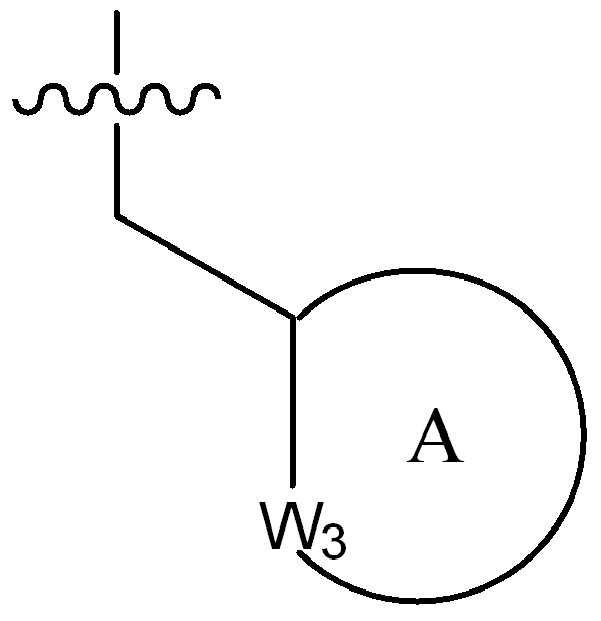
(식 중,(In the meal,

고리 A는 5원의 시클로알킬 또는 헤테로시클릴 고리이고;Ring A is a 5-membered cycloalkyl or heterocyclyl ring;
W3은 NR100 또는 CR101R102로부터 선택되고, 여기서 R100은 수소, (1-2C)알킬 또는 -C(O)ORab로부터 선택되고, 여기서 Rab는 (1-2C)알킬이고, R101은 수소 또는 메틸로부터 선택되고, R102는 (1-2C)알킬, 히드록시 또는 C(O)ORac로부터 선택되고, 여기서 Rac는 수소 또는 (1-2C)알킬로부터 선택됨);W 3 is selected from NR 100 or CR 101 R 102 , wherein R 100 is selected from hydrogen, (1-2C) alkyl or -C (O) OR ab , wherein R ab is (1-2C) alkyl, R 101 is selected from hydrogen or methyl, R 102 is selected from (1-2C) alkyl, hydroxy or C (O) OR ac , wherein R ac is selected from hydrogen or (1-2C) alkyl;
(51) R2는 하기 화학식의 기로부터 선택됨:(51) R 2 is selected from the group of formula:
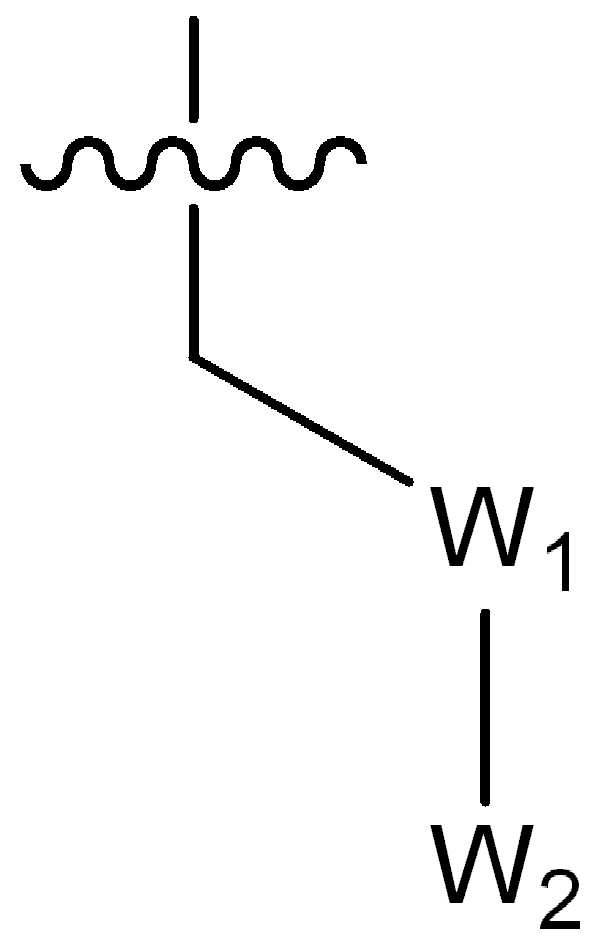
(식 중,(In the meal,

W1은 CHR4로부터 선택되고, 여기서 R4는 수소, (1-2C)알킬, 플루오로, 히드록시, 시아노 또는 (1-2C)알콕시로부터 선택되고;W 1 is selected from CHR 4 , wherein R 4 is selected from hydrogen, (1-2C) alkyl, fluoro, hydroxy, cyano or (1-2C) alkoxy;
W2는 CR6R7R8이고, 여기서W 2 is CR 6 R 7 R 8 , wherein
R6은 수소, (1-2C)알킬, 플루오로, 클로로, 히드록시, 아미노, 시아노 또는 (1-2C)알콕시로부터 선택되고;R 6 is selected from hydrogen, (1-2C) alkyl, fluoro, chloro, hydroxy, amino, cyano or (1-2C) alkoxy;
R7은 수소, (1-2C)알킬, 플루오로, 클로로, 히드록시, 시아노, (1-2C)알콕시, (1-2C)할로알킬, (1-2C)할로알콕시로부터 선택되고;R 7 is selected from hydrogen, (1-2C) alkyl, fluoro, chloro, hydroxy, cyano, (1-2C) alkoxy, (1-2C) haloalkyl, (1-2C) haloalkoxy;
R8은 (1-2C)알킬, -C(O)ORq , ORq, NRqRr, 페닐 또는 피라졸릴부터 선택되고, 여기서 Rq 및 Rr은 수소 또는 (1-2C)알킬로부터 독립적으로 선택됨);R 8 is (1-2C) alkyl, —C (O) OR q , OR q , NR q R r , Phenyl or pyrazolyl, wherein R q and R r are independently selected from hydrogen or (1-2C) alkyl);
(52) R2는 하기 화학식의 기로부터 선택됨:(52) R 2 is selected from the group of formula:

(식 중,(In the meal,

W2는 CR6R7R8이고, 여기서W 2 is CR 6 R 7 R 8 , wherein
R6은 (1-2C)알킬, 플루오로, 클로로, 히드록시, 아미노, 시아노 또는 (1-2C)알콕시로부터 선택되고;R 6 is selected from (1-2C) alkyl, fluoro, chloro, hydroxy, amino, cyano or (1-2C) alkoxy;
R7은 수소, (1-2C)알킬, 플루오로, 클로로, 히드록시, 시아노, (1-2C)알콕시, (1-2C)할로알킬, (1-2C)할로알콕시로부터 선택됨);R 7 is selected from hydrogen, (1-2C) alkyl, fluoro, chloro, hydroxy, cyano, (1-2C) alkoxy, (1-2C) haloalkyl, (1-2C) haloalkoxy);
(53) R2는 하기 화학식의 기임:(53) R 2 is a group of formula
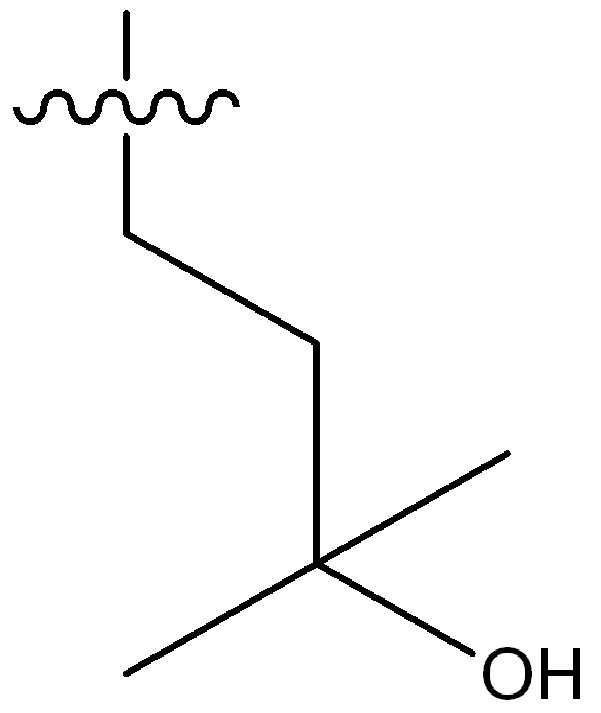
(식 중,(In the meal,

(54) R3은 하기로부터 선택됨:(54) R 3 is selected from:
i) 하기에 나타낸 화학식 A의 기:i) a group of formula A shown below:
[화학식 A][Formula A]

(식 중,(In the meal,

Xa 및 Xb는 N 또는 CRx1로부터 독립적으로 선택되고, 여기서 Rx1은 수소, 플루오로, 클로로, 브로모, (1-2C)알킬, (1-2C)알콕시, 시아노, 니트로, 아세틸렌일, CH2F, CF2H 또는 CF3로부터 선택되고;X a and X b are independently selected from N or CR x1 , wherein R x1 is hydrogen, fluoro, chloro, bromo, (1-2C) alkyl, (1-2C) alkoxy, cyano, nitro, acetylene One, CH 2 F, CF 2 H or CF 3 ;
R9는 수소, 플루오로, 클로로, 브로모, (1-2C)알킬, (1-2C)알콕시, 시아노, 니트로, 아세틸렌일, CH2F, CF2H 또는 CF3으로부터 선택되고;R 9 is selected from hydrogen, fluoro, chloro, bromo, (1-2C) alkyl, (1-2C) alkoxy, cyano, nitro, acetylenyl, CH 2 F, CF 2 H or CF 3 ;
R10은 수소, 할로, (1-4C)알킬, (1-4C)알콕시, (1-4C)할로알킬, (1-4C)할로알콕시, 시아노, 니트로, (2-4C)알켄일, (2-4C)알킨일 또는 하기 화학식의 기로부터 선택되고:R 10 is hydrogen, halo, (1-4C) alkyl, (1-4C) alkoxy, (1-4C) haloalkyl, (1-4C) haloalkoxy, cyano, nitro, (2-4C) alkenyl, (2-4C) alkynyl or a group of the formula:
-Y3-Z3 -Y 3 -Z 3
식 중,In the formula,
Y3은 존재하지 않거나 또는 O, N(Rs)(CRsRt)q1(여기서 q1은 0, 1 또는 2임), S, SO, SO2, C(O), C(O)O, OC(O), C(O)N(Rs), N(Rs)C(O), S(O)2N(Rs) 또는 N(Rs)SO2이고, 여기서 Rs는 수소 또는 (1-4C)알킬로부터 선택되고;Y 3 is not present or O, N (R s) ( CR s R t) q1 ( where q 1 is 0, 1 or 2), S, SO, SO 2, C (O), C (O) O, OC (O), C (O) N (R s ), N (R s ) C (O), S (O) 2 N (R s ) or N (R s ) SO 2 , where R s Is selected from hydrogen or (1-4C) alkyl;
Z3은 수소, (1-6C)알킬, 아릴, (3-6C)시클로알킬, (2-4C)알켄일, (2-4C)알킨일, (3-6C)시클로알켄일, 헤테로아릴 또는 4원 내지 11원의 헤테로시클릴이고; 여기서 Z3은 선택적으로 옥소, (1-4C)알킬, (3-6C)시클로알킬, 할로, (1-4C)할로알킬, (1-4C)할로알콕시, (1-4C)히드록시알킬, 아미노, 시아노, 히드록시, 아미도, 카르복시, 카르바모일, 설파모일, 머캅토, C(O)NRuRv, NRuRv 또는 ORu로부터 독립적으로 선택된 하나 이상의 치환기에 의해서 추가로 치환되고, 여기서 Ru 및 Rv는 각각 수소, (1-4C)알킬 또는 (3-6C)시클로알킬로부터 독립적으로 선택되고/되거나; Z3은 선택적으로 하기 화학식의 기에 의해서 추가로 치환되고:Z 3 is hydrogen, (1-6C) alkyl, aryl, (3-6C) cycloalkyl, (2-4C) alkenyl, (2-4C) alkynyl, (3-6C) cycloalkenyl, heteroaryl or 4-11 membered heterocyclyl; Wherein Z 3 is optionally oxo, (1-4C) alkyl, (3-6C) cycloalkyl, halo, (1-4C) haloalkyl, (1-4C) haloalkoxy, (1-4C) hydroxyalkyl, Further by one or more substituents independently selected from amino, cyano, hydroxy, amido, carboxy, carbamoyl, sulfamoyl, mercapto, C (O) NR u R v , NR u R v or OR u Substituted, wherein R u and R v are each independently selected from hydrogen, (1-4C) alkyl or (3-6C) cycloalkyl; Z 3 is optionally further substituted by a group of the formula:
-LZ-WZ -L Z -W Z
식 중,In the formula,
LZ는 존재하지 않거나 또는 하나 이상의 (1-2C)알킬 기에 의해서 선택적으로 치환된 (1-5C)알킬렌이고; L Z is (1-5C) alkylene, absent or optionally substituted by one or more (1-2C) alkyl groups;
WZ는 아릴, 5원 또는 6원의 헤테로아릴, 4원 내지 7원의 헤테로시클릴, 할로, (1-4C)할로알킬, (1-4C)할로알콕시, 시아노, 히드록시, (1-4C)알콕시, C(O)Rxa, COORxa, C(O)NRxaRxb 또는 NRxaRxb이고, 여기서 Rxa 및 Rxb는 각각 수소 또는 (1-4C)알킬로부터 독립적으로 선택되고; 여기서 각각의 아릴, 5원 또는 6원의 헤테로아릴 또는 4원 내지 7원의 헤테로시클릴은 선택적으로 (1-2C)알킬, 할로, (1-2C)할로알킬, 아미노, 시아노 또는 히드록시로부터 독립적으로 선택된 하나 이상의 치환기에 의해서 추가로 치환됨);W Z is aryl, 5- or 6-membered heteroaryl, 4--7 membered heterocyclyl, halo, (1-4C) haloalkyl, (1-4C) haloalkoxy, cyano, hydroxy, (1 -4C) alkoxy, C (O) R xa , COOR xa , C (O) NR xa R xb or NR xa R xb , wherein R xa and R xb are each independently selected from hydrogen or (1-4C) alkyl Become; Wherein each aryl, 5- or 6-membered heteroaryl or 4--7 membered heterocyclyl is optionally (1-2C) alkyl, halo, (1-2C) haloalkyl, amino, cyano or hydroxy Further substituted by one or more substituents independently selected from);
ii) 하기에 나타낸 화학식 B의 기:ii) a group of formula B represented below:
[화학식 B][Formula B]

(식 중,(In the meal,

Xc, Xd 및 Xe는 N, CH, CF, CCl, C-CN 또는 CCH3로부터 독립적으로 선택되고;X c, X d and X e are independently selected from N, CH, CF, CCI, C-CN or CCH 3 ;
R11은 수소, 할로, (1-4C)알킬, (1-4C)알콕시, (1-4C)할로알킬, (1-4C)할로알콕시, 시아노, 니트로, (2-4C)알켄일, (2-4C)알킨일 또는 하기 화학식의 기로부터 선택되고:R 11 is hydrogen, halo, (1-4C) alkyl, (1-4C) alkoxy, (1-4C) haloalkyl, (1-4C) haloalkoxy, cyano, nitro, (2-4C) alkenyl, (2-4C) alkynyl or a group of the formula:
-Y5-Z5 -Y 5 -Z 5
식 중,In the formula,
Y5는 존재하지 않거나 또는 O, N(Rw), C(O), C(O)O, OC(O), C(O)N(Rw), N(Rw)C(O), S(O)2N(Rw) 또는 N(Rw)SO2이고, 여기서 Rw는 수소 또는 (1-4C)알킬로부터 선택되고;Y 5 is absent or O, N (R w ), C (O), C (O) O, OC (O), C (O) N (R w ), N (R w ) C (O) , S (O) 2 N (R w ) or N (R w ) SO 2 , wherein R w is selected from hydrogen or (1-4C) alkyl;
Z5는 수소, (1-6C)알킬, 아릴, (3-8C)시클로알킬, (3-8C)시클로알켄일, 헤테로아릴 또는 헤테로시클릴이고; 여기서 Z5는 선택적으로 (1-4C)알킬, 할로, (1-4C)할로알킬, (1-4C)할로알콕시, (1-4C)히드록시알킬, 아미노, 시아노, 히드록시, 아미도, 카르복시, 카르바모일, 설파모일, 머캅토, NRyRz, ORy로부터 독립적으로 선택된 하나 이상의 치환기에 의해서 추가로 치환되고, 여기서 Ry 및 Rz는 각각 수소, (1-4C)알킬 또는 (3-6C)시클로알킬로부터 독립적으로 선택됨);Z 5 is hydrogen, (1-6C) alkyl, aryl, (3-8C) cycloalkyl, (3-8C) cycloalkenyl, heteroaryl or heterocyclyl; Wherein Z 5 is optionally (1-4C) alkyl, halo, (1-4C) haloalkyl, (1-4C) haloalkoxy, (1-4C) hydroxyalkyl, amino, cyano, hydroxy, amido Is further substituted by one or more substituents independently selected from carboxy, carbamoyl, sulfamoyl, mercapto, NR y R z , OR y , wherein R y and R z are each hydrogen, (1-4C) alkyl Or (3-6C) cycloalkyl independently);
iii) 하기에 나타낸 화학식 C의 기:iii) a group of formula C shown below:
[화학식 C][Formula C]

(식 중,(In the meal,

R12는 플루오로, 클로로, 브로모, (1-2C)알킬, (1-2C)알콕시, 시아노, 니트로, (2-4C)알킨일, CH2F, CF2H 또는 CF3로부터 선택되고;R 12 is selected from fluoro, chloro, bromo, (1-2C) alkyl, (1-2C) alkoxy, cyano, nitro, (2-4C) alkynyl, CH 2 F, CF 2 H or CF 3 Become;
Xf 및 Xg는 N 또는 CR13으로부터 독립적으로 선택되고, 여기서 R13은 수소, 플루오로, 클로로, (1-2C)알킬, (1-2C)할로알킬 또는 (1-2C)할로알콕시로부터 선택되고;X f and X g are independently selected from N or CR 13 , wherein R 13 is selected from hydrogen, fluoro, chloro, (1-2C) alkyl, (1-2C) haloalkyl or (1-2C) haloalkoxy Selected;
Xh, Xi 및 Xj는 N 또는 CR14로부터 독립적으로 선택되고, 여기서 R14는 수소, 할로, (1-2C)알킬, (1-2C)알콕시, (1-2C)할로알킬 또는 (1-2C)할로알콕시로부터 선택됨);X h , X i and X j are independently selected from N or CR 14 , wherein R 14 is hydrogen, halo, (1-2C) alkyl, (1-2C) alkoxy, (1-2C) haloalkyl or ( 1-2C) selected from haloalkoxy);
(55) R3은 하기로부터 선택됨:(55) R 3 is selected from:
i) 하기에 나타낸 화학식 A의 기:i) a group of formula A shown below:
[화학식 A][Formula A]

(식 중,(In the meal,

Xa 및 Xb는 N 또는 CRx1로부터 독립적으로 선택되고, 여기서 Rx1은 수소, 플루오로, 클로로, 브로모, (1-2C)알킬, (1-2C)알콕시, 시아노, 니트로, 아세틸렌일, CH2F, CF2H 또는 CF3로부터 선택되고;X a and X b are independently selected from N or CR x1 , wherein R x1 is hydrogen, fluoro, chloro, bromo, (1-2C) alkyl, (1-2C) alkoxy, cyano, nitro, acetylene One, CH 2 F, CF 2 H or CF 3 ;
R9는 수소, 플루오로, 클로로, 브로모, (1-2C)알킬, (1-2C)알콕시, 시아노, 니트로, 아세틸렌일, CH2F, CF2H 또는 CF3으로부터 선택되고;R 9 is selected from hydrogen, fluoro, chloro, bromo, (1-2C) alkyl, (1-2C) alkoxy, cyano, nitro, acetylenyl, CH 2 F, CF 2 H or CF 3 ;
R10은 수소, 할로, (1-4C)알킬, (1-4C)알콕시, (1-4C)할로알킬, (1-4C)할로알콕시, 시아노, 니트로, (2-4C)알켄일, (2-4C)알킨일 또는 하기 화학식의 기로부터 선택되고:R 10 is hydrogen, halo, (1-4C) alkyl, (1-4C) alkoxy, (1-4C) haloalkyl, (1-4C) haloalkoxy, cyano, nitro, (2-4C) alkenyl, (2-4C) alkynyl or a group of the formula:
-Y3-Z3 -Y 3 -Z 3
식 중,In the formula,
Y3은 존재하지 않거나 또는 O, N(Rs)(CRsRt)q1(여기서 q1은 0, 1 또는 2임), S, SO, SO2, C(O), C(O)O, OC(O), C(O)N(Rs), N(Rs)C(O), S(O)2N(Rs) 또는 N(Rs)SO2이고, 여기서 Rs는 수소 또는 (1-4C)알킬로부터 선택되고;Y 3 is not present or O, N (R s) ( CR s R t) q1 ( where q 1 is 0, 1 or 2), S, SO, SO 2, C (O), C (O) O, OC (O), C (O) N (R s ), N (R s ) C (O), S (O) 2 N (R s ) or N (R s ) SO 2 , where R s Is selected from hydrogen or (1-4C) alkyl;
Z3은 수소, (1-6C)알킬, 아릴, (3-6C)시클로알킬, (2-4C)알켄일, (2-4C)알킨일, (3-6C)시클로알켄일, 헤테로아릴 또는 4원 내지 11원의 헤테로시클릴이고; 여기서 Z3은 선택적으로 옥소, (1-4C)알킬, (3-6C)시클로알킬, 할로, (1-4C)할로알킬, (1-4C)할로알콕시, (1-4C)히드록시알킬, 아미노, 시아노, 히드록시, 아미도, 카르복시, 카르바모일, 설파모일, 머캅토, C(O)NRuRv, NRuRv 또는 ORu로부터 독립적으로 선택된 하나 이상의 치환기에 의해서 추가로 치환되고, 여기서 Ru 및 Rv는 각각 수소, (1-4C)알킬 또는 (3-6C)시클로알킬로부터 독립적으로 선택되고/되거나; Z3은 선택적으로 하기 화학식의 기에 의해서 추가로 치환되고:Z 3 is hydrogen, (1-6C) alkyl, aryl, (3-6C) cycloalkyl, (2-4C) alkenyl, (2-4C) alkynyl, (3-6C) cycloalkenyl, heteroaryl or 4-11 membered heterocyclyl; Wherein Z 3 is optionally oxo, (1-4C) alkyl, (3-6C) cycloalkyl, halo, (1-4C) haloalkyl, (1-4C) haloalkoxy, (1-4C) hydroxyalkyl, Further by one or more substituents independently selected from amino, cyano, hydroxy, amido, carboxy, carbamoyl, sulfamoyl, mercapto, C (O) NR u R v , NR u R v or OR u Substituted, wherein R u and R v are each independently selected from hydrogen, (1-4C) alkyl or (3-6C) cycloalkyl; Z 3 is optionally further substituted by a group of the formula:
-LZ-WZ -L Z -W Z
식 중,In the formula,
LZ는 존재하지 않거나 또는 하나 이상의 (1-2C)알킬 기에 의해서 선택적으로 치환된 (1-3C)알킬렌이고; L Z is (1-3C) alkylene, absent or optionally substituted by one or more (1-2C) alkyl groups;
WZ는 아릴, 5원 또는 6원의 헤테로아릴, 4원 내지 7원의 헤테로시클릴, 할로, (1-4C)할로알킬, (1-4C)할로알콕시, 시아노, 히드록시, (1-4C)알콕시, C(O)Rxa, COORxa, C(O)NRxaRxb 또는 NRxaRxb이고, 여기서 Rxa 및 Rxb는 각각 수소 또는 (1-4C)알킬로부터 독립적으로 선택됨); W Z is aryl, 5- or 6-membered heteroaryl, 4--7 membered heterocyclyl, halo, (1-4C) haloalkyl, (1-4C) haloalkoxy, cyano, hydroxy, (1 -4C) alkoxy, C (O) R xa , COOR xa , C (O) NR xa R xb or NR xa R xb , where R xa and R xb are each independently selected from hydrogen or (1-4C) alkyl );
ii) 하기에 나타낸 화학식 B의 기:ii) a group of formula B represented below:
[화학식 B][Formula B]

(식 중,(In the meal,

Xc, Xd 및 Xe는 N, CH, CF, CCl, C-CN 또는 CCH3로부터 독립적으로 선택되고;X c, X d and X e are independently selected from N, CH, CF, CCI, C-CN or CCH 3 ;
R11은 수소, 할로, (1-4C)알킬, (1-4C)알콕시, (1-4C)할로알킬, (1-4C)할로알콕시, 시아노, 니트로, (2-4C)알켄일, (2-4C)알킨일 또는 하기 화학식의 기로부터 선택되고:R 11 is hydrogen, halo, (1-4C) alkyl, (1-4C) alkoxy, (1-4C) haloalkyl, (1-4C) haloalkoxy, cyano, nitro, (2-4C) alkenyl, (2-4C) alkynyl or a group of the formula:
-Y5-Z5 -Y 5 -Z 5
식 중,In the formula,
Y5는 존재하지 않거나 또는 O, N(Rw), C(O), C(O)O, OC(O), C(O)N(Rw), N(Rw)C(O), S(O)2N(Rw) 또는 N(Rw)SO2이고, 여기서 Rw는 수소 또는 (1-4C)알킬로부터 선택되고;Y 5 is absent or O, N (R w ), C (O), C (O) O, OC (O), C (O) N (R w ), N (R w ) C (O) , S (O) 2 N (R w ) or N (R w ) SO 2 , wherein R w is selected from hydrogen or (1-4C) alkyl;
Z5는 수소, (1-6C)알킬, 아릴, (3-8C)시클로알킬, (3-8C)시클로알켄일, 헤테로아릴 또는 헤테로시클릴이고; 여기서 Z5는 선택적으로 (1-4C)알킬, 할로, (1-4C)할로알킬, (1-4C)할로알콕시, (1-4C)히드록시알킬, 아미노, 시아노, 히드록시, 아미도, 카르복시, 카르바모일, 설파모일, 머캅토, NRyRz, ORy로부터 독립적으로 선택된 하나 이상의 치환기에 의해서 추가로 치환되고, 여기서 Ry 및 Rz는 각각 수소, (1-4C)알킬 또는 (3-6C)시클로알킬로부터 독립적으로 선택됨);Z 5 is hydrogen, (1-6C) alkyl, aryl, (3-8C) cycloalkyl, (3-8C) cycloalkenyl, heteroaryl or heterocyclyl; Wherein Z 5 is optionally (1-4C) alkyl, halo, (1-4C) haloalkyl, (1-4C) haloalkoxy, (1-4C) hydroxyalkyl, amino, cyano, hydroxy, amido Is further substituted by one or more substituents independently selected from carboxy, carbamoyl, sulfamoyl, mercapto, NR y R z , OR y , wherein R y and R z are each hydrogen, (1-4C) alkyl Or (3-6C) cycloalkyl independently);
iii) 하기에 나타낸 화학식 C의 기:iii) a group of formula C shown below:
[화학식 C][Formula C]
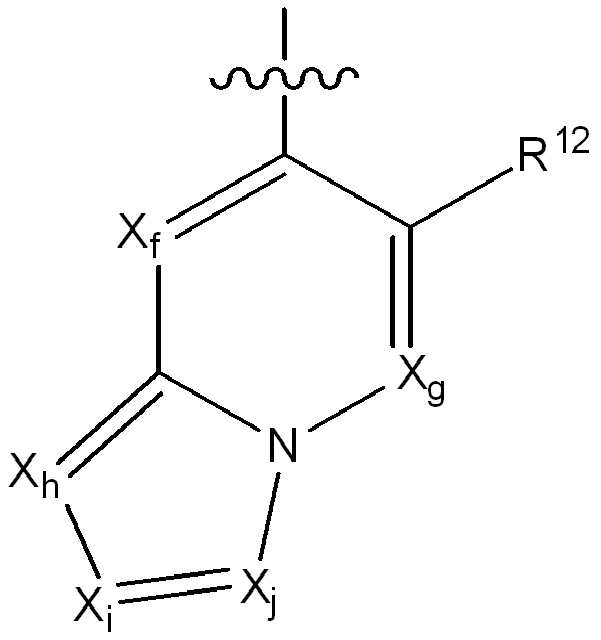
(식 중,(In the meal,

R12는 플루오로, 클로로, 브로모, (1-2C)알킬, (1-2C)알콕시, 시아노, 니트로, (2-4C)알킨일, CH2F, CF2H 또는 CF3로부터 선택되고;R 12 is selected from fluoro, chloro, bromo, (1-2C) alkyl, (1-2C) alkoxy, cyano, nitro, (2-4C) alkynyl, CH 2 F, CF 2 H or CF 3 Become;
Xf 및 Xg는 N 또는 CR13으로부터 독립적으로 선택되고, 여기서 R13은 수소, 플루오로, 클로로, (1-2C)알킬, (1-2C)할로알킬 또는 (1-2C)할로알콕시로부터 선택되고;X f and X g are independently selected from N or CR 13 , wherein R 13 is selected from hydrogen, fluoro, chloro, (1-2C) alkyl, (1-2C) haloalkyl or (1-2C) haloalkoxy Selected;
Xh, Xi 및 Xj는 N 또는 CR14로부터 독립적으로 선택되고, 여기서 R14는 수소, 할로, (1-2C)알킬, (1-2C)알콕시, (1-2C)할로알킬 또는 (1-2C)할로알콕시로부터 선택됨);X h , X i and X j are independently selected from N or CR 14 , wherein R 14 is hydrogen, halo, (1-2C) alkyl, (1-2C) alkoxy, (1-2C) haloalkyl or ( 1-2C) selected from haloalkoxy);
(56) R3은 하기로부터 선택됨:(56) R 3 is selected from:
i) 하기에 나타낸 화학식 A의 기:i) a group of formula A shown below:
[화학식 A][Formula A]
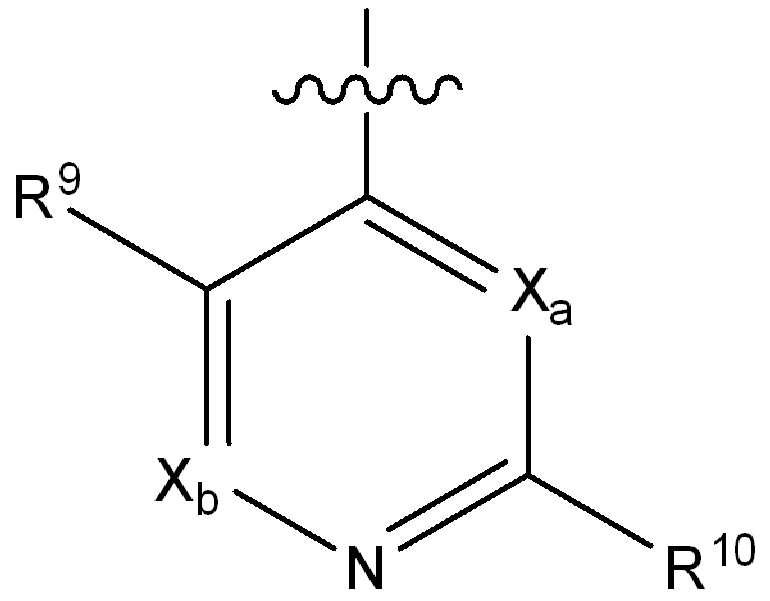
(식 중,(In the meal,

Xa 및 Xb는 N 또는 CRx1로부터 독립적으로 선택되고, 여기서 Rx1은 수소, 플루오로, 클로로, 브로모, (1-2C)알킬, (1-2C)알콕시, 시아노, 니트로, 아세틸렌일, CH2F, CF2H 또는 CF3로부터 선택되고;X a and X b are independently selected from N or CR x1 , wherein R x1 is hydrogen, fluoro, chloro, bromo, (1-2C) alkyl, (1-2C) alkoxy, cyano, nitro, acetylene One, CH 2 F, CF 2 H or CF 3 ;
R9는 수소, 플루오로, 클로로, 브로모, (1-2C)알킬, (1-2C)알콕시, 시아노, 니트로, 아세틸렌일, CH2F, CF2H 또는 CF3으로부터 선택되고;R 9 is selected from hydrogen, fluoro, chloro, bromo, (1-2C) alkyl, (1-2C) alkoxy, cyano, nitro, acetylenyl, CH 2 F, CF 2 H or CF 3 ;
R10은 수소, 할로, (1-4C)알킬, (1-4C)알콕시, (1-4C)할로알킬, (1-4C)할로알콕시, 시아노, 니트로, (2-4C)알켄일, (2-4C)알킨일 또는 하기 화학식의 기로부터 선택되고:R 10 is hydrogen, halo, (1-4C) alkyl, (1-4C) alkoxy, (1-4C) haloalkyl, (1-4C) haloalkoxy, cyano, nitro, (2-4C) alkenyl, (2-4C) alkynyl or a group of the formula:
-Y3-Z3 -Y 3 -Z 3
식 중,In the formula,
Y3은 존재하지 않거나 또는 O, N(Rs)(CRsRt)q1(여기서 q1은 0, 1 또는 2임), S, SO, SO2, C(O), C(O)O, OC(O), C(O)N(Rs), N(Rs)C(O), S(O)2N(Rs) 또는 N(Rs)SO2이고, 여기서 Rs는 수소 또는 (1-4C)알킬로부터 선택되고;Y 3 is not present or O, N (R s) ( CR s R t) q1 ( where q 1 is 0, 1 or 2), S, SO, SO 2, C (O), C (O) O, OC (O), C (O) N (R s ), N (R s ) C (O), S (O) 2 N (R s ) or N (R s ) SO 2 , where R s Is selected from hydrogen or (1-4C) alkyl;
Z3은 수소, (1-6C)알킬, 아릴, (3-6C)시클로알킬, (2-4C)알켄일, (2-4C)알킨일, (3-6C)시클로알켄일, 헤테로아릴 또는 4원 내지 11원의 헤테로시클릴이고; 여기서 Z3은 선택적으로 옥소, (1-4C)알킬, (3-6C)시클로알킬, 할로, (1-4C)할로알킬, (1-4C)할로알콕시, 아미노, 시아노, 히드록시, 아미도, 카르복시, 카르바모일, 설파모일, 머캅토, C(O)NRuRv, NRuRv 또는 ORu로부터 독립적으로 선택된 하나 이상의 치환기에 의해서 추가로 치환되고, 여기서 Ru 및 Rv는 각각 수소, (1-4C)알킬 또는 (3-6C)시클로알킬로부터 독립적으로 선택되거나; 또는 Z3은 선택적으로 하기 화학식의 기에 의해서 추가로 치환되고:Z 3 is hydrogen, (1-6C) alkyl, aryl, (3-6C) cycloalkyl, (2-4C) alkenyl, (2-4C) alkynyl, (3-6C) cycloalkenyl, heteroaryl or 4-11 membered heterocyclyl; Wherein Z 3 is optionally oxo, (1-4C) alkyl, (3-6C) cycloalkyl, halo, (1-4C) haloalkyl, (1-4C) haloalkoxy, amino, cyano, hydroxy, amino Or further substituted by one or more substituents independently selected from carboxy, carbamoyl, sulfamoyl, mercapto, C (O) NR u R v , NR u R v or OR u , wherein R u and R v Are each independently selected from hydrogen, (1-4C) alkyl or (3-6C) cycloalkyl; Or Z 3 is optionally further substituted by a group of the formula:
-LZ-WZ -L Z -W Z
식 중,In the formula,
LZ는 (1-2C)알킬 또는 옥소로부터 선택된 하나 이상의 치환체에 의해서 선택적으로 치환된 (1-5C)알킬렌이고; L Z is (1-5C) alkylene optionally substituted by one or more substituents selected from (1-2C) alkyl or oxo;
WZ는 할로, (1-4C)할로알킬, (1-4C)할로알콕시, 시아노, 히드록시, (1-4C)알콕시, C(O)Rxa, COORxa, C(O)NRxaRxb 또는 NRxaRxb이고, 여기서 Rxa 및 Rxb는 각각 수소 또는 (1-4C)알킬로부터 독립적으로 선택됨); W Z is halo, (1-4C) haloalkyl, (1-4C) haloalkoxy, cyano, hydroxy, (1-4C) alkoxy, C (O) R xa , COOR xa , C (O) NR xa R xb or NR xa R xb , wherein R xa and R xb are each independently selected from hydrogen or (1-4C) alkyl);
ii) 하기에 나타낸 화학식 B의 기:ii) a group of formula B represented below:
[화학식 B][Formula B]
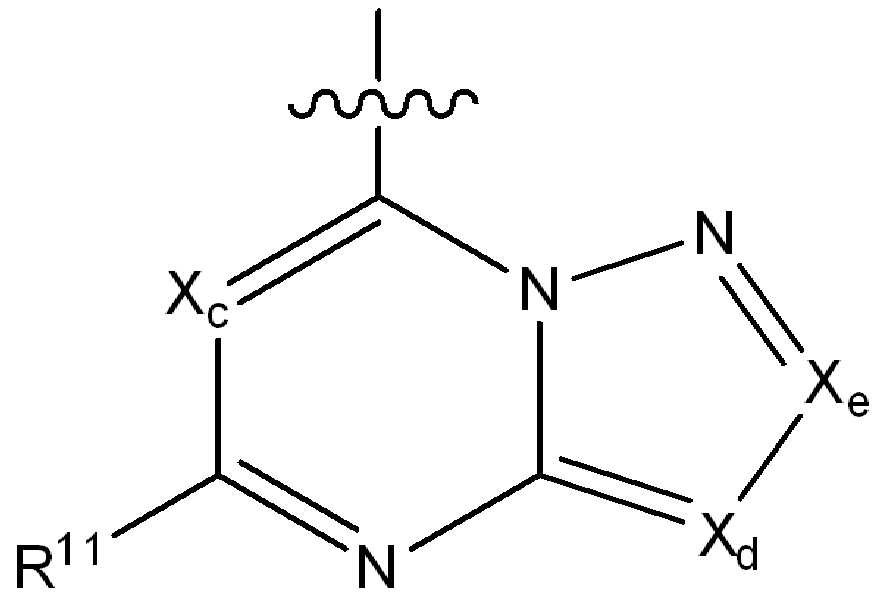
(식 중,(In the meal,

Xc, Xd 및 Xe는 N, CH, CF, CCl, C-CN 또는 CCH3로부터 독립적으로 선택되고;X c, X d and X e are independently selected from N, CH, CF, CCI, C-CN or CCH 3 ;
R11은 수소, 할로, (1-4C)알킬, (1-4C)알콕시, (1-4C)할로알킬, (1-4C)할로알콕시, 시아노, 니트로, (2-4C)알켄일, (2-4C)알킨일 또는 하기 화학식의 기로부터 선택되고:R 11 is hydrogen, halo, (1-4C) alkyl, (1-4C) alkoxy, (1-4C) haloalkyl, (1-4C) haloalkoxy, cyano, nitro, (2-4C) alkenyl, (2-4C) alkynyl or a group of the formula:
-Y5-Z5 -Y 5 -Z 5
식 중,In the formula,
Y5는 존재하지 않거나 또는 O, N(Rw), C(O), C(O)O, OC(O), C(O)N(Rw), N(Rw)C(O), S(O)2N(Rw) 또는 N(Rw)SO2이고, 여기서 Rw는 수소 또는 (1-4C)알킬로부터 선택되고;Y 5 is absent or O, N (R w ), C (O), C (O) O, OC (O), C (O) N (R w ), N (R w ) C (O) , S (O) 2 N (R w ) or N (R w ) SO 2 , wherein R w is selected from hydrogen or (1-4C) alkyl;
Z5는 수소, (1-6C)알킬, 아릴, (3-8C)시클로알킬, (3-8C)시클로알켄일, 헤테로아릴 또는 헤테로시클릴이고; 여기서 Z5는 선택적으로 (1-4C)알킬, 할로, (1-4C)할로알킬, (1-4C)할로알콕시, 아미노, 시아노, 히드록시, 아미도, 카르복시, 카르바모일, 설파모일, 머캅토, NRyRz, ORy로부터 독립적으로 선택된 하나 이상의 치환기에 의해서 추가로 치환되고, 여기서 Ry 및 Rz는 각각 수소, (1-4C)알킬 또는 (3-6C)시클로알킬로부터 독립적으로 선택됨);Z 5 is hydrogen, (1-6C) alkyl, aryl, (3-8C) cycloalkyl, (3-8C) cycloalkenyl, heteroaryl or heterocyclyl; Wherein Z 5 is optionally (1-4C) alkyl, halo, (1-4C) haloalkyl, (1-4C) haloalkoxy, amino, cyano, hydroxy, amido, carboxy, carbamoyl, sulfamoyl , Is further substituted by one or more substituents independently selected from mercapto, NR y R z , OR y , wherein R y and R z are each from hydrogen, (1-4C) alkyl or (3-6C) cycloalkyl Independently selected);
iii) 하기에 나타낸 화학식 C의 기:iii) a group of formula C shown below:
[화학식 C][Formula C]
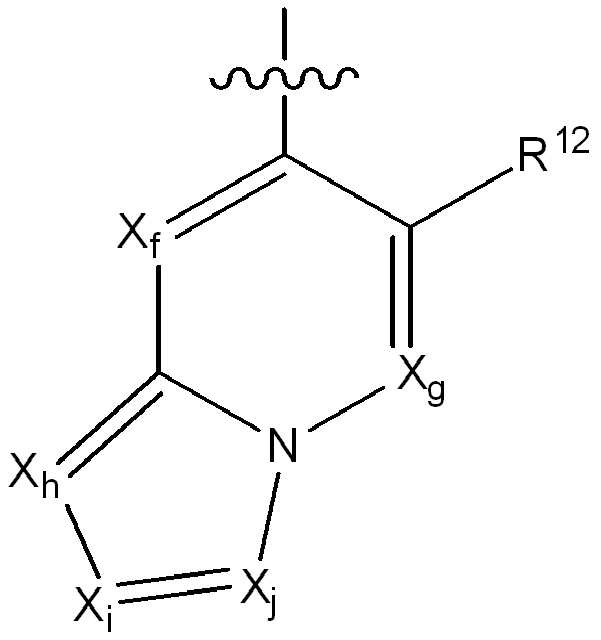
(식 중,(In the meal,

R12는 플루오로, 클로로, 브로모, (1-2C)알킬, (1-2C)알콕시, 시아노, 니트로, (2-4C)알킨일, CH2F, CF2H 또는 CF3로부터 선택되고;R 12 is selected from fluoro, chloro, bromo, (1-2C) alkyl, (1-2C) alkoxy, cyano, nitro, (2-4C) alkynyl, CH 2 F, CF 2 H or CF 3 Become;
Xf 및 Xg는 N 또는 CR13으로부터 독립적으로 선택되고, 여기서 R13은 수소, 플루오로, 클로로, (1-2C)알킬, (1-2C)할로알킬 또는 (1-2C)할로알콕시로부터 선택되고;X f and X g are independently selected from N or CR 13 , wherein R 13 is selected from hydrogen, fluoro, chloro, (1-2C) alkyl, (1-2C) haloalkyl or (1-2C) haloalkoxy Selected;
Xh, Xi 및 Xj는 N 또는 CR14로부터 독립적으로 선택되고, 여기서 R14는 수소, 할로, (1-2C)알킬, (1-2C)알콕시, (1-2C)할로알킬 또는 (1-2C)할로알콕시로부터 선택됨);X h , X i and X j are independently selected from N or CR 14 , wherein R 14 is hydrogen, halo, (1-2C) alkyl, (1-2C) alkoxy, (1-2C) haloalkyl or ( 1-2C) selected from haloalkoxy);
(57) R3은 하기로부터 선택됨:(57) R 3 is selected from:
i) 하기에 나타낸 화학식 A의 기:i) a group of formula A shown below:
[화학식 A][Formula A]

(식 중,(In the meal,

Xa 및 Xb는 N 또는 CRx1로부터 독립적으로 선택되고, 여기서 Rx1은 수소, 플루오로, 클로로, 브로모, (1-2C)알킬, (1-2C)알콕시, 시아노, 니트로, 아세틸렌일, CH2F, CF2H 또는 CF3로부터 선택되고;X a and X b are independently selected from N or CR x1 , wherein R x1 is hydrogen, fluoro, chloro, bromo, (1-2C) alkyl, (1-2C) alkoxy, cyano, nitro, acetylene One, CH 2 F, CF 2 H or CF 3 ;
R9는 수소, 플루오로, 클로로, 브로모, (1-2C)알킬, (1-2C)알콕시, 시아노, 니트로, 아세틸렌일, CH2F, CF2H 또는 CF3으로부터 선택되고;R 9 is selected from hydrogen, fluoro, chloro, bromo, (1-2C) alkyl, (1-2C) alkoxy, cyano, nitro, acetylenyl, CH 2 F, CF 2 H or CF 3 ;
R10은 수소, 할로, (1-4C)알킬, (1-4C)알콕시, (1-4C)할로알킬, (1-4C)할로알콕시, 시아노, 니트로, (2-4C)알켄일, (2-4C)알킨일 또는 하기 화학식의 기로부터 선택되고:R 10 is hydrogen, halo, (1-4C) alkyl, (1-4C) alkoxy, (1-4C) haloalkyl, (1-4C) haloalkoxy, cyano, nitro, (2-4C) alkenyl, (2-4C) alkynyl or a group of the formula:
-Y3-Z3 -Y 3 -Z 3
식 중,In the formula,
Y3은 존재하지 않거나 또는 N(Rs)(CRsRt)q1(여기서 q1은 0, 1 또는 2임), S, C(O), C(O)O, C(O)N(Rs), N(Rs)C(O), S(O)2N(Rs) 또는 N(Rs)SO2이고, 여기서 Rs는 수소 또는 (1-4C)알킬로부터 선택되고;Y 3 is absent or N (R s ) (CR s R t ) q1 (where q 1 is 0, 1 or 2), S, C (O), C (O) O, C (O) N (R s ), N (R s ) C (O), S (O) 2 N (R s ) or N (R s ) SO 2 , where R s is selected from hydrogen or (1-4C) alkyl ;
Z3은 수소, (1-6C)알킬, 아릴, (3-6C)시클로알킬, (2-4C)알켄일, (2-4C)알킨일, (3-6C)시클로알켄일, 5원 또는 6원의 헤테로아릴 또는 4원 내지 11원의 헤테로시클릴이고; 여기서 Z3은 선택적으로 옥소, (1-4C)알킬, (3-6C)시클로알킬, 할로, (1-4C)할로알킬, (1-4C)할로알콕시, 아미노, 시아노, 히드록시, 아미도, 카르복시, 카르바모일, 설파모일, 머캅토, C(O)NRuRv, NRuRv 또는 ORu로부터 독립적으로 선택된 하나 이상의 치환기에 의해서 추가로 치환되고, 여기서 Ru 및 Rv는 각각 수소, (1-4C)알킬 또는 (3-6C)시클로알킬로부터 독립적으로 선택되고/되거나; Z3은 선택적으로 하기 화학식의 기에 의해서 추가로 치환되고:Z 3 is hydrogen, (1-6C) alkyl, aryl, (3-6C) cycloalkyl, (2-4C) alkenyl, (2-4C) alkynyl, (3-6C) cycloalkenyl, 5-membered or 6 membered heteroaryl or 4 to 11 membered heterocyclyl; Wherein Z 3 is optionally oxo, (1-4C) alkyl, (3-6C) cycloalkyl, halo, (1-4C) haloalkyl, (1-4C) haloalkoxy, amino, cyano, hydroxy, amino Or further substituted by one or more substituents independently selected from carboxy, carbamoyl, sulfamoyl, mercapto, C (O) NR u R v , NR u R v or OR u , wherein R u and R v Are each independently selected from hydrogen, (1-4C) alkyl or (3-6C) cycloalkyl; Z 3 is optionally further substituted by a group of the formula:
-LZ-WZ -L Z -W Z
식 중,In the formula,
LZ는 존재하지 않거나 또는 (1-3C)알킬렌이고; L Z is absent or (1-3C) alkylene;
WZ는 페닐, 5원 또는 6원의 헤테로아릴, 6원의 헤테로시클릴, 할로, (1-4C)할로알킬, (1-4C)할로알콕시, 시아노, 히드록시, (1-4C)알콕시, C(O)Rxa, COORxa, C(O)NRxaRxb 또는 NRxaRxb이고, 여기서 Rxa 및 Rxb는 각각 수소 또는 (1-4C)알킬로부터 독립적으로 선택됨); W Z is phenyl, 5- or 6-membered heteroaryl, 6-membered heterocyclyl, halo, (1-4C) haloalkyl, (1-4C) haloalkoxy, cyano, hydroxy, (1-4C) Alkoxy, C (O) R xa , COOR xa , C (O) NR xa R xb or NR xa R xb , wherein R xa and R xb are each independently selected from hydrogen or (1-4C) alkyl);
ii) 하기에 나타낸 화학식 B의 기:ii) a group of formula B represented below:
[화학식 B][Formula B]
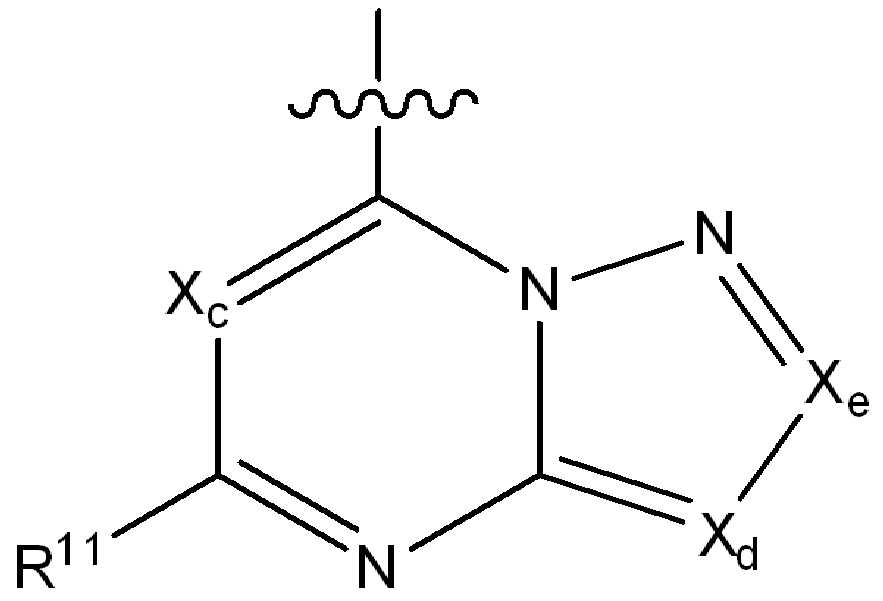
(식 중,(In the meal,

Xc, Xd 및 Xe는 N, CH, CF, CCl, C-CN 또는 CCH3로부터 독립적으로 선택되고;X c, X d and X e are independently selected from N, CH, CF, CCI, C-CN or CCH 3 ;
R11은 수소, 할로, (1-4C)알킬, (1-4C)알콕시, (1-4C)할로알킬, (1-4C)할로알콕시, 시아노, 니트로, (2-4C)알켄일, (2-4C)알킨일 또는 하기 화학식의 기로부터 선택되고:R 11 is hydrogen, halo, (1-4C) alkyl, (1-4C) alkoxy, (1-4C) haloalkyl, (1-4C) haloalkoxy, cyano, nitro, (2-4C) alkenyl, (2-4C) alkynyl or a group of the formula:
-Y5-Z5 -Y 5 -Z 5
식 중,In the formula,
Y5는 존재하지 않거나 또는 O, N(Rw), C(O), C(O)O, C(O)N(Rw) 또는 S(O)2N(Rw)이고, 여기서 Rw는 수소 또는 (1-4C)알킬로부터 선택되고;Y 5 is absent or is O, N (R w ), C (O), C (O) O, C (O) N (R w ) or S (O) 2 N (R w ), where R w is selected from hydrogen or (1-4C) alkyl;
Z5는 수소, (1-6C)알킬, 아릴, (3-8C)시클로알킬, (3-8C)시클로알켄일, 헤테로아릴 또는 헤테로시클릴이고; 여기서 Z5는 선택적으로 (1-4C)알킬, 할로, (1-4C)할로알킬, (1-4C)할로알콕시, (1-4C)히드록시알킬, 아미노, 시아노, 히드록시, 아미도, 카르복시, 카르바모일, 설파모일, 머캅토, NRyRz, ORy로부터 독립적으로 선택된 하나 이상의 치환기에 의해서 추가로 치환되고, 여기서 Ry 및 Rz는 각각 수소, (1-4C)알킬 또는 (3-6C)시클로알킬로부터 독립적으로 선택됨); Z 5 is hydrogen, (1-6C) alkyl, aryl, (3-8C) cycloalkyl, (3-8C) cycloalkenyl, heteroaryl or heterocyclyl; Wherein Z 5 is optionally (1-4C) alkyl, halo, (1-4C) haloalkyl, (1-4C) haloalkoxy, (1-4C) hydroxyalkyl, amino, cyano, hydroxy, amido Is further substituted by one or more substituents independently selected from carboxy, carbamoyl, sulfamoyl, mercapto, NR y R z , OR y , wherein R y and R z are each hydrogen, (1-4C) alkyl Or (3-6C) cycloalkyl independently);
iii) 하기에 나타낸 화학식 C의 기:iii) a group of formula C shown below:
[화학식 C][Formula C]
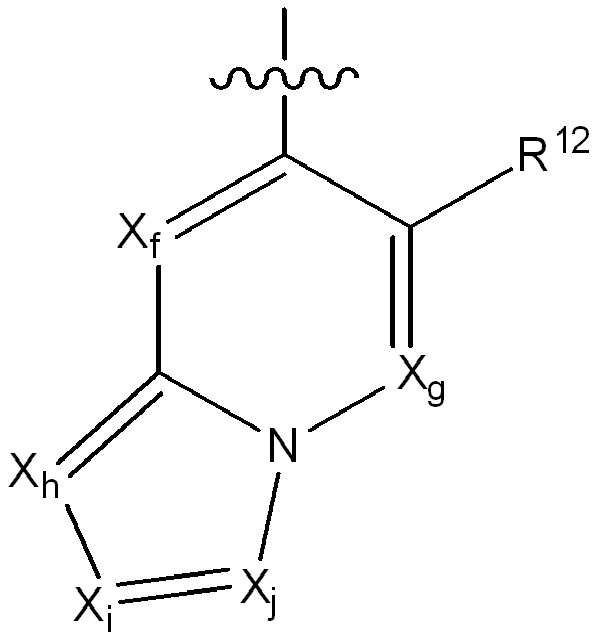
(식 중,(In the meal,

R12는 플루오로, 클로로, 브로모, (1-2C)알킬, (1-2C)알콕시, 시아노, 니트로, (2-4C)알킨일, CH2F, CF2H 또는 CF3로부터 선택되고;R 12 is selected from fluoro, chloro, bromo, (1-2C) alkyl, (1-2C) alkoxy, cyano, nitro, (2-4C) alkynyl, CH 2 F, CF 2 H or CF 3 Become;
Xf 및 Xg는 N 또는 CR13으로부터 독립적으로 선택되고, 여기서 R13은 수소, 플루오로, 클로로, 메틸, CH2F, CF2H 또는 CF3로부터 선택되고;X f and X g are independently selected from N or CR 13 , wherein R 13 is selected from hydrogen, fluoro, chloro, methyl, CH 2 F, CF 2 H or CF 3 ;
Xh, Xi 및 Xj는 N 또는 CR14로부터 독립적으로 선택되고, 여기서 R14는 수소, 할로, (1-2C)알킬, (1-2C)알콕시, (1-2C)할로알킬 또는 (1-2C)할로알콕시로부터 선택됨); X h , X i and X j are independently selected from N or CR 14 , wherein R 14 is hydrogen, halo, (1-2C) alkyl, (1-2C) alkoxy, (1-2C) haloalkyl or ( 1-2C) selected from haloalkoxy);
(58) R3은 하기로부터 선택됨:(58) R 3 is selected from:
i) 하기에 나타낸 화학식 A의 기:i) a group of formula A shown below:
[화학식 A][Formula A]

(식 중,(In the meal,

Xa 및 Xb는 N 또는 CRx1로부터 독립적으로 선택되고, 여기서 Rx1은 수소, 플루오로, 클로로, 브로모, (1-2C)알킬, (1-2C)알콕시, 시아노, 니트로, 아세틸렌일, CH2F, CF2H 또는 CF3로부터 선택되고;X a and X b are independently selected from N or CR x1 , wherein R x1 is hydrogen, fluoro, chloro, bromo, (1-2C) alkyl, (1-2C) alkoxy, cyano, nitro, acetylene One, CH 2 F, CF 2 H or CF 3 ;
R9는 수소, 플루오로, 클로로, 브로모, (1-2C)알킬, (1-2C)알콕시, 시아노, 니트로, 아세틸렌일, CH2F, CF2H 또는 CF3으로부터 선택되고;R 9 is selected from hydrogen, fluoro, chloro, bromo, (1-2C) alkyl, (1-2C) alkoxy, cyano, nitro, acetylenyl, CH 2 F, CF 2 H or CF 3 ;
R10은 수소, 할로, (1-4C)알킬, (1-4C)알콕시, (1-4C)할로알킬, (1-4C)할로알콕시, 시아노, 니트로, (2-4C)알켄일, (2-4C)알킨일 또는 하기 화학식의 기로부터 선택되고:R 10 is hydrogen, halo, (1-4C) alkyl, (1-4C) alkoxy, (1-4C) haloalkyl, (1-4C) haloalkoxy, cyano, nitro, (2-4C) alkenyl, (2-4C) alkynyl or a group of the formula:
-Y3-Z3 -Y 3 -Z 3
식 중,In the formula,
Y3은 존재하지 않거나 또는 N(Rs)(CRsRt)q1(여기서 q1은 0, 1 또는 2임), S, C(O), C(O)O, C(O)N(Rs), N(Rs)C(O), S(O)2N(Rs) 또는 N(Rs)SO2이고, 여기서 Rs는 수소 또는 (1-4C)알킬로부터 선택되고;Y 3 is absent or N (R s ) (CR s R t ) q1 (where q 1 is 0, 1 or 2), S, C (O), C (O) O, C (O) N (R s ), N (R s ) C (O), S (O) 2 N (R s ) or N (R s ) SO 2 , where R s is selected from hydrogen or (1-4C) alkyl ;
Z3은 수소, (1-6C)알킬, 아릴, (3-6C)시클로알킬, (2-4C)알켄일, (2-4C)알킨일, (3-6C)시클로알켄일, 5원 또는 6원의 헤테로아릴 또는 4원 내지 11원의 헤테로시클릴이고; 여기서 Z3은 선택적으로 옥소, (1-4C)알킬, (3-6C)시클로알킬, 할로, (1-4C)할로알킬, (1-4C)할로알콕시, 아미노, 시아노, 히드록시, 아미도, 카르복시, 카르바모일, 설파모일, 머캅토, C(O)NRuRv, NRuRv 또는 ORu로부터 독립적으로 선택된 하나 이상의 치환기에 의해서 추가로 치환되고, 여기서 Ru 및 Rv는 각각 수소, (1-4C)알킬 또는 (3-6C)시클로알킬로부터 독립적으로 선택되거나; Z3은 선택적으로 하기 화학식의 기에 의해서 추가로 치환되고:Z 3 is hydrogen, (1-6C) alkyl, aryl, (3-6C) cycloalkyl, (2-4C) alkenyl, (2-4C) alkynyl, (3-6C) cycloalkenyl, 5-membered or 6 membered heteroaryl or 4 to 11 membered heterocyclyl; Wherein Z 3 is optionally oxo, (1-4C) alkyl, (3-6C) cycloalkyl, halo, (1-4C) haloalkyl, (1-4C) haloalkoxy, amino, cyano, hydroxy, amino Or further substituted by one or more substituents independently selected from carboxy, carbamoyl, sulfamoyl, mercapto, C (O) NR u R v , NR u R v or OR u , wherein R u and R v Are each independently selected from hydrogen, (1-4C) alkyl or (3-6C) cycloalkyl; Z 3 is optionally further substituted by a group of the formula:
-LZ-WZ -L Z -W Z
식 중,In the formula,
LZ는 (1-3C)알킬렌이고; L Z is (1-3C) alkylene;
WZ는 할로, (1-4C)할로알킬, (1-4C)할로알콕시, 시아노, 히드록시, (1-4C)알콕시, C(O)Rxa, COORxa, C(O)NRxaRxb 또는 NRxaRxb이고, 여기서 Rxa 및 Rxb는 각각 수소 또는 (1-4C)알킬로부터 독립적으로 선택됨);W Z is halo, (1-4C) haloalkyl, (1-4C) haloalkoxy, cyano, hydroxy, (1-4C) alkoxy, C (O) R xa , COOR xa , C (O) NR xa R xb or NR xa R xb , wherein R xa and R xb are each independently selected from hydrogen or (1-4C) alkyl);
ii) 하기에 나타낸 화학식 B의 기:ii) a group of formula B represented below:
[화학식 B][Formula B]

(식 중,(In the meal,

Xc, Xd 및 Xe는 N, CH, CF, CCl, C-CN 또는 CCH3로부터 독립적으로 선택되고;X c, X d and X e are independently selected from N, CH, CF, CCI, C-CN or CCH 3 ;
R11은 수소, 할로, (1-4C)알킬, (1-4C)알콕시, (1-4C)할로알킬, (1-4C)할로알콕시, 시아노, 니트로, (2-4C)알켄일, (2-4C)알킨일 또는 하기 화학식의 기로부터 선택되고:R 11 is hydrogen, halo, (1-4C) alkyl, (1-4C) alkoxy, (1-4C) haloalkyl, (1-4C) haloalkoxy, cyano, nitro, (2-4C) alkenyl, (2-4C) alkynyl or a group of the formula:
-Y5-Z5 -Y 5 -Z 5
식 중,In the formula,
Y5는 존재하지 않거나 또는 O, N(Rw), C(O), C(O)O, C(O)N(Rw) 또는 S(O)2N(Rw)이고, 여기서 Rw는 수소 또는 (1-4C)알킬로부터 선택되고;Y 5 is absent or is O, N (R w ), C (O), C (O) O, C (O) N (R w ) or S (O) 2 N (R w ), where R w is selected from hydrogen or (1-4C) alkyl;
Z5는 수소, (1-6C)알킬, 아릴, (3-8C)시클로알킬, (3-8C)시클로알켄일, 헤테로아릴 또는 헤테로시클릴이고; 여기서 Z5는 선택적으로 (1-4C)알킬, 할로, (1-4C)할로알킬, (1-4C)할로알콕시, 아미노, 시아노, 히드록시, 아미도, 카르복시, 카르바모일, 설파모일, 머캅토, NRyRz, ORy로부터 독립적으로 선택된 하나 이상의 치환기에 의해서 추가로 치환되고, 여기서 Ry 및 Rz는 각각 수소, (1-4C)알킬 또는 (3-6C)시클로알킬로부터 독립적으로 선택됨); Z 5 is hydrogen, (1-6C) alkyl, aryl, (3-8C) cycloalkyl, (3-8C) cycloalkenyl, heteroaryl or heterocyclyl; Wherein Z 5 is optionally (1-4C) alkyl, halo, (1-4C) haloalkyl, (1-4C) haloalkoxy, amino, cyano, hydroxy, amido, carboxy, carbamoyl, sulfamoyl , Is further substituted by one or more substituents independently selected from mercapto, NR y R z , OR y , wherein R y and R z are each from hydrogen, (1-4C) alkyl or (3-6C) cycloalkyl Independently selected);
iii) 하기에 나타낸 화학식 C의 기:iii) a group of formula C shown below:
[화학식 C][Formula C]

(식 중,(In the meal,

R12는 플루오로, 클로로, 브로모, (1-2C)알킬, (1-2C)알콕시, 시아노, 니트로, (2-4C)알킨일, CH2F, CF2H 또는 CF3로부터 선택되고;R 12 is selected from fluoro, chloro, bromo, (1-2C) alkyl, (1-2C) alkoxy, cyano, nitro, (2-4C) alkynyl, CH 2 F, CF 2 H or CF 3 Become;
Xf 및 Xg는 N 또는 CR13으로부터 독립적으로 선택되고, 여기서 R13은 수소, 플루오로, 클로로, 메틸, CH2F, CF2H 또는 CF3로부터 선택되고;X f and X g are independently selected from N or CR 13 , wherein R 13 is selected from hydrogen, fluoro, chloro, methyl, CH 2 F, CF 2 H or CF 3 ;
Xh, Xi 및 Xj는 N 또는 CR14로부터 독립적으로 선택되고, 여기서 R14는 수소, 할로, (1-2C)알킬, (1-2C)알콕시, (1-2C)할로알킬 또는 (1-2C)할로알콕시로부터 선택됨);X h , X i and X j are independently selected from N or CR 14 , wherein R 14 is hydrogen, halo, (1-2C) alkyl, (1-2C) alkoxy, (1-2C) haloalkyl or ( 1-2C) selected from haloalkoxy);
(59) R3은 하기로부터 선택됨:(59) R 3 is selected from:
i) 하기에 나타낸 화학식 A의 기:i) a group of formula A shown below:
[화학식 A][Formula A]

(식 중,(In the meal,

Xa 및 Xb는 N 또는 CRx1로부터 독립적으로 선택되고, 여기서 Rx1은 수소, 플루오로, 클로로, 브로모, (1-2C)알킬, (1-2C)알콕시, 시아노, 니트로, 아세틸렌일, CH2F, CF2H 또는 CF3로부터 선택되고;X a and X b are independently selected from N or CR x1 , wherein R x1 is hydrogen, fluoro, chloro, bromo, (1-2C) alkyl, (1-2C) alkoxy, cyano, nitro, acetylene One, CH 2 F, CF 2 H or CF 3 ;
R9는 수소, 플루오로, 클로로, 브로모, (1-2C)알킬, (1-2C)알콕시, 시아노, 니트로, 아세틸렌일, CH2F, CF2H 또는 CF3으로부터 선택되고;R 9 is selected from hydrogen, fluoro, chloro, bromo, (1-2C) alkyl, (1-2C) alkoxy, cyano, nitro, acetylenyl, CH 2 F, CF 2 H or CF 3 ;
R10은 수소, 할로, (1-4C)알킬, (1-4C)알콕시, (1-4C)할로알킬, (1-4C)할로알콕시, 시아노, 니트로, (2-4C)알켄일, (2-4C)알킨일 또는 하기 화학식의 기로부터 선택되고:R 10 is hydrogen, halo, (1-4C) alkyl, (1-4C) alkoxy, (1-4C) haloalkyl, (1-4C) haloalkoxy, cyano, nitro, (2-4C) alkenyl, (2-4C) alkynyl or a group of the formula:
-Y3-Z3 -Y 3 -Z 3
식 중,In the formula,
Y3은 존재하지 않거나 또는 C(O), C(O)O, OC(O), C(O)N(Rs), N(Rs)C(O), N(Rs)C(O)N(Rt), N(Rs)C(O)O, OC(O)N(Rs), S(O)2N(Rs), N(Rs)SO2이고, 여기서 Rs 및 Rt는 각각 수소 또는 (1-4C)알킬로부터 독립적으로 선택되고;Y 3 is absent or C (O), C (O) O, OC (O), C (O) N (R s ), N (R s ) C (O), N (R s ) C ( O) N (R t ), N (R s ) C (O) O, OC (O) N (R s ), S (O) 2 N (R s ), N (R s ) SO 2 , where R s and R t are each independently selected from hydrogen or (1-4C) alkyl;
Z3은 수소, (1-6C)알킬, 아릴, (3-6C)시클로알킬, (2-4C)알켄일, (2-4C)알킨일, (3-6C)시클로알켄일, 5원 또는 6원의 헤테로아릴 또는 5원 또는 6원의 헤테로시클릴이고; 여기서 Z3은 선택적으로 (1-4C)알킬, 할로, (1-4C)할로알킬, (1-4C)할로알콕시, 아미노, 시아노, 히드록시, 아미도, 카르복시, 카르바모일, 설파모일, 머캅토, NRuRv 또는 ORu로부터 독립적으로 선택된 하나 이상의 치환기에 의해서 추가로 치환되고, 여기서 Ru 및 Rv는 각각 수소, (1-4C)알킬 또는 (3-6C)시클로알킬로부터 독립적으로 선택됨); Z 3 is hydrogen, (1-6C) alkyl, aryl, (3-6C) cycloalkyl, (2-4C) alkenyl, (2-4C) alkynyl, (3-6C) cycloalkenyl, 5-membered or 6 membered heteroaryl or 5 membered or 6 membered heterocyclyl; Wherein Z 3 is optionally (1-4C) alkyl, halo, (1-4C) haloalkyl, (1-4C) haloalkoxy, amino, cyano, hydroxy, amido, carboxy, carbamoyl, sulfamoyl , Further substituted by one or more substituents independently selected from mercapto, NR u R v or OR u , wherein R u and R v are each hydrogen, (1-4C) alkyl or (3-6C) cycloalkyl Independently selected);
ii) 하기에 나타낸 화학식 B의 기:ii) a group of formula B represented below:
[화학식 B][Formula B]
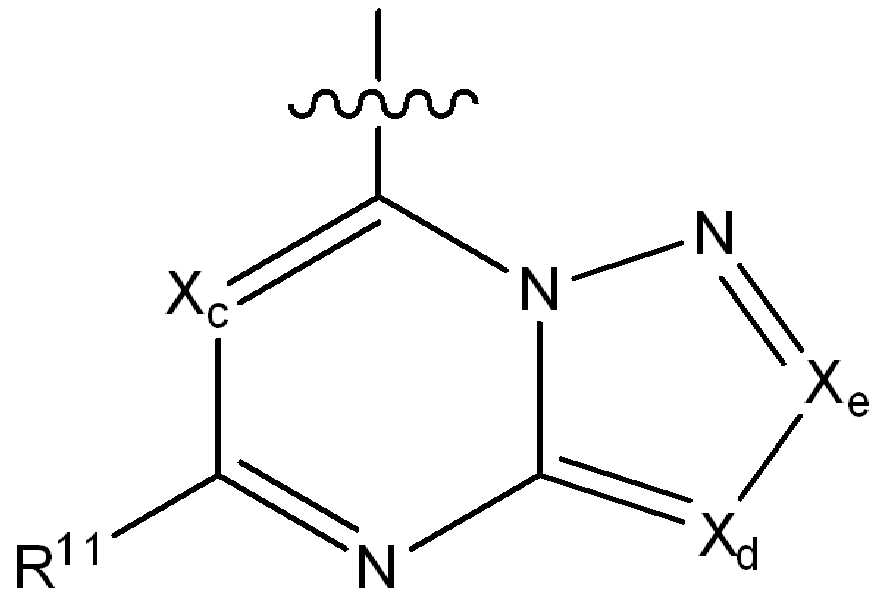
(식 중,(In the meal,

Xc, Xd 및 Xe는 N, CH, CF, CCl, C-CN 또는 CCH3로부터 독립적으로 선택되고;X c, X d and X e are independently selected from N, CH, CF, CCI, C-CN or CCH 3 ;
R11은 수소, 할로, (1-4C)알킬, (1-4C)알콕시, (1-4C)할로알킬, (1-4C)할로알콕시, 시아노, 니트로, (2-4C)알켄일, (2-4C)알킨일 또는 하기 화학식의 기로부터 선택되고:R 11 is hydrogen, halo, (1-4C) alkyl, (1-4C) alkoxy, (1-4C) haloalkyl, (1-4C) haloalkoxy, cyano, nitro, (2-4C) alkenyl, (2-4C) alkynyl or a group of the formula:
-Y5-Z5 -Y 5 -Z 5
식 중,In the formula,
Y5는 존재하지 않거나 또는 O, N(Rw), C(O), C(O)O, OC(O), C(O)N(Rw), N(Rw)C(O), N(Rw)C(O)N(Rx), N(Rw)C(O)O, OC(O)N(Rw), S(O)2N(Rw), N(Rw)SO2이고, 여기서 Rw 및 Rx는 각각 수소 또는 (1-4C)알킬로부터 독립적으로 선택되고;Y 5 is absent or O, N (R w ), C (O), C (O) O, OC (O), C (O) N (R w ), N (R w ) C (O) , N (R w ) C (O) N (R x ), N (R w ) C (O) O, OC (O) N (R w ), S (O) 2 N (R w ), N ( R w ) SO 2 , wherein R w and R x are each independently selected from hydrogen or (1-4C) alkyl;
Z5는 수소, (1-6C)알킬, 아릴, (3-8C)시클로알킬, (3-8C)시클로알켄일, 헤테로아릴 또는 헤테로시클릴이고; 여기서 Z5는 선택적으로 (1-4C)알킬, 할로, (1-4C)할로알킬, (1-4C)할로알콕시, 아미노, 시아노, 히드록시, 아미도, 카르복시, 카르바모일, 설파모일, 머캅토, NRyRz, ORy로부터 독립적으로 선택된 하나 이상의 치환기에 의해서 추가로 치환되고, 여기서 Ry 및 Rz는 각각 수소, (1-4C)알킬 또는 (3-6C)시클로알킬로부터 독립적으로 선택됨); Z 5 is hydrogen, (1-6C) alkyl, aryl, (3-8C) cycloalkyl, (3-8C) cycloalkenyl, heteroaryl or heterocyclyl; Wherein Z 5 is optionally (1-4C) alkyl, halo, (1-4C) haloalkyl, (1-4C) haloalkoxy, amino, cyano, hydroxy, amido, carboxy, carbamoyl, sulfamoyl , Is further substituted by one or more substituents independently selected from mercapto, NR y R z , OR y , wherein R y and R z are each from hydrogen, (1-4C) alkyl or (3-6C) cycloalkyl Independently selected);
iii) 하기에 나타낸 화학식 C의 기:iii) a group of formula C shown below:
[화학식 C][Formula C]

(식 중,(In the meal,

R12는 플루오로, 클로로, 브로모, (1-2C)알킬, (1-2C)알콕시, 시아노, 니트로, (2-4C)알켄일, (2-4C)알킨일, CH2F, CF2H 또는 CF3로부터 선택되고;R 12 is fluoro, chloro, bromo, (1-2C) alkyl, (1-2C) alkoxy, cyano, nitro, (2-4C) alkenyl, (2-4C) alkynyl, CH 2 F, Is selected from CF 2 H or CF 3 ;
Xf 및 Xg는 N 또는 CR13으로부터 독립적으로 선택되고, 여기서 R13은 수소, 플루오로, 클로로, (1-2C)알킬, (1-2C)할로알킬 또는 (1-2C)할로알콕시로부터 선택되고;X f and X g are independently selected from N or CR 13 , wherein R 13 is selected from hydrogen, fluoro, chloro, (1-2C) alkyl, (1-2C) haloalkyl or (1-2C) haloalkoxy Selected;
Xh, Xi 및 Xj는 N 또는 CR14로부터 독립적으로 선택되고, 여기서 R14는 수소, 할로, (1-2C)알킬, (1-2C)알콕시, (1-2C)할로알킬 또는 (1-2C)할로알콕시로부터 선택됨);X h , X i and X j are independently selected from N or CR 14 , wherein R 14 is hydrogen, halo, (1-2C) alkyl, (1-2C) alkoxy, (1-2C) haloalkyl or ( 1-2C) selected from haloalkoxy);
(60) R3은 하기로부터 선택됨:(60) R 3 is selected from:
i) 하기에 나타낸 화학식 A의 기:i) a group of formula A shown below:
[화학식 A][Formula A]

(식 중,(In the meal,

Xa 및 Xb는 N 또는 CRx1로부터 독립적으로 선택되고, 여기서 Rx1은 수소, 플루오로, 클로로, 브로모, (1-2C)알킬, (1-2C)알콕시, 시아노, 니트로, 아세틸렌일, CH2F, CF2H 또는 CF3로부터 선택되고;X a and X b are independently selected from N or CR x1 , wherein R x1 is hydrogen, fluoro, chloro, bromo, (1-2C) alkyl, (1-2C) alkoxy, cyano, nitro, acetylene One, CH 2 F, CF 2 H or CF 3 ;
R9는 플루오로, 클로로, 브로모, (1-2C)알킬, (1-2C)알콕시, 시아노, 니트로, 아세틸렌일, CH2F, CF2H 또는 CF3으로부터 선택되고;R 9 is selected from fluoro, chloro, bromo, (1-2C) alkyl, (1-2C) alkoxy, cyano, nitro, acetylenyl, CH 2 F, CF 2 H or CF 3 ;
R10은 수소, 할로, (1-2C)알킬, (1-2C)알콕시, (1-2C)할로알킬, (1-2C)할로알콕시, 시아노, 니트로, (2-4C)알켄일, (2-4C)알킨일 또는 하기 화학식의 기로부터 선택되고:R 10 is hydrogen, halo, (1-2C) alkyl, (1-2C) alkoxy, (1-2C) haloalkyl, (1-2C) haloalkoxy, cyano, nitro, (2-4C) alkenyl, (2-4C) alkynyl or a group of the formula:
-Y3-Z3 -Y 3 -Z 3
식 중,In the formula,
Y3은 존재하지 않거나 또는 C(O), C(O)O, OC(O), C(O)N(Rs), N(Rs)C(O), S(O)2N(Rs), N(Rs)SO2이고, 여기서 Rs는 수소 또는 (1-4C)알킬로부터 선택되고;Y 3 is absent or C (O), C (O) O, OC (O), C (O) N (R s ), N (R s ) C (O), S (O) 2 N ( R s ), N (R s ) SO 2 , wherein R s is selected from hydrogen or (1-4C) alkyl;
Z3은 수소, (1-6C)알킬, 아릴, (3-6C)시클로알킬, (2-4C)알켄일, (2-4C)알킨일, (3-6C)시클로알켄일, 5원 또는 6원의 헤테로아릴 또는 5원 또는 6원의 헤테로시클릴이고; 여기서 Z3은 선택적으로 (1-4C)알킬, 할로, (1-4C)할로알킬, (1-4C)할로알콕시, 아미노, 시아노, 히드록시, 아미도, 카르복시, 카르바모일, 설파모일, 머캅토, NRuRv 또는 ORu로부터 독립적으로 선택된 하나 이상의 치환기에 의해서 추가로 치환되고, 여기서 Ru 및 Rv는 각각 수소, (1-4C)알킬 또는 (3-6C)시클로알킬로부터 독립적으로 선택됨); Z 3 is hydrogen, (1-6C) alkyl, aryl, (3-6C) cycloalkyl, (2-4C) alkenyl, (2-4C) alkynyl, (3-6C) cycloalkenyl, 5-membered or 6 membered heteroaryl or 5 membered or 6 membered heterocyclyl; Wherein Z 3 is optionally (1-4C) alkyl, halo, (1-4C) haloalkyl, (1-4C) haloalkoxy, amino, cyano, hydroxy, amido, carboxy, carbamoyl, sulfamoyl , Further substituted by one or more substituents independently selected from mercapto, NR u R v or OR u , wherein R u and R v are each hydrogen, (1-4C) alkyl or (3-6C) cycloalkyl Independently selected);
ii) 하기에 나타낸 화학식 B의 기:ii) a group of formula B represented below:
[화학식 B][Formula B]
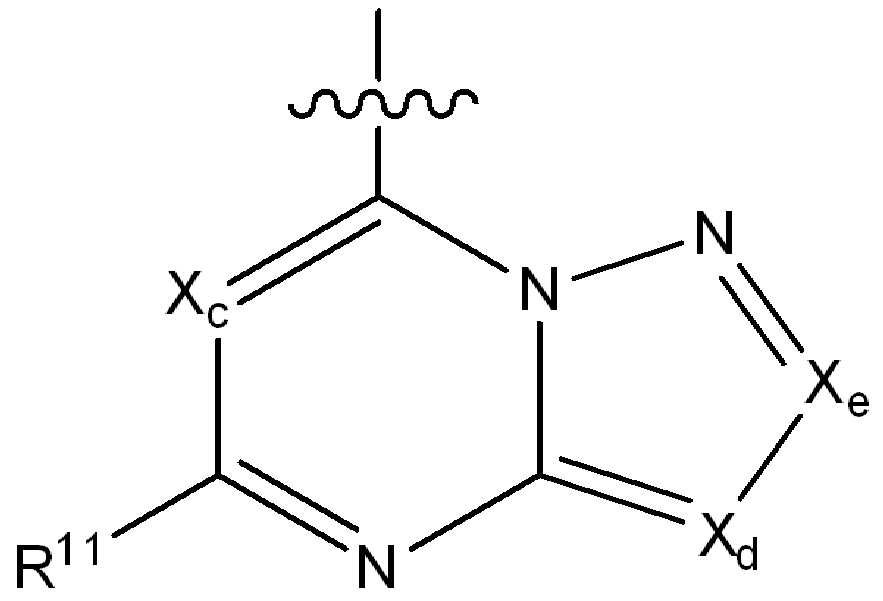
(식 중,(In the meal,

Xc, Xd 및 Xe는 N, CH, CF, CCl, C-CN 또는 CCH3로부터 독립적으로 선택되고; X c, X d and X e are independently selected from N, CH, CF, CCI, C-CN or CCH 3 ;
R11은 수소, 할로, (1-2C)알킬, (1-2C)알콕시, (1-2C)할로알킬, (1-2C)할로알콕시, 시아노, 니트로, (2-4C)알켄일, (2-4C)알킨일 또는 하기 화학식의 기로부터 선택되고:R 11 is hydrogen, halo, (1-2C) alkyl, (1-2C) alkoxy, (1-2C) haloalkyl, (1-2C) haloalkoxy, cyano, nitro, (2-4C) alkenyl, (2-4C) alkynyl or a group of the formula:
-Y5-Z5 -Y 5 -Z 5
식 중,In the formula,
Y5는 존재하지 않거나 또는 O, N(Rw), C(O), C(O)O, OC(O), C(O)N(Rw), N(Rw)C(O), S(O)2N(Rw), N(Rw)SO2이고, 여기서 Rw는 수소 또는 (1-4C)알킬로부터 선택되고;Y 5 is absent or O, N (R w ), C (O), C (O) O, OC (O), C (O) N (R w ), N (R w ) C (O) , S (O) 2 N (R w ), N (R w ) SO 2 , wherein R w is selected from hydrogen or (1-4C) alkyl;
Z5는 수소, (1-6C)알킬, 아릴, (3-8C)시클로알킬, (3-8C)시클로알켄일, 헤테로아릴 또는 헤테로시클릴이고; 여기서 Z5는 선택적으로 (1-4C)알킬, 할로, (1-4C)할로알킬, (1-4C)할로알콕시, 아미노, 시아노, 히드록시, 아미도, 카르복시, 카르바모일, 설파모일, 머캅토, NRyRz, ORy로부터 독립적으로 선택된 하나 이상의 치환기에 의해서 추가로 치환되고, 여기서 Ry 및 Rz는 각각 수소, (1-4C)알킬 또는 (3-6C)시클로알킬로부터 독립적으로 선택됨);Z 5 is hydrogen, (1-6C) alkyl, aryl, (3-8C) cycloalkyl, (3-8C) cycloalkenyl, heteroaryl or heterocyclyl; Wherein Z 5 is optionally (1-4C) alkyl, halo, (1-4C) haloalkyl, (1-4C) haloalkoxy, amino, cyano, hydroxy, amido, carboxy, carbamoyl, sulfamoyl , Is further substituted by one or more substituents independently selected from mercapto, NR y R z , OR y , wherein R y and R z are each from hydrogen, (1-4C) alkyl or (3-6C) cycloalkyl Independently selected);
iii) 하기에 나타낸 화학식 C의 기:iii) a group of formula C shown below:
[화학식 C][Formula C]

(식 중,(In the meal,

R12는 플루오로, 클로로, 브로모, (1-2C)알킬, (1-2C)알콕시, 시아노, 니트로, (2-4C)알킨일, CH2F, CF2H 또는 CF3로부터 선택되고;R 12 is selected from fluoro, chloro, bromo, (1-2C) alkyl, (1-2C) alkoxy, cyano, nitro, (2-4C) alkynyl, CH 2 F, CF 2 H or CF 3 Become;
Xf 및 Xg는 N 또는 CR13으로부터 독립적으로 선택되고, 여기서 R13은 수소, 플루오로, 클로로, (1-2C)알킬, (1-2C)할로알킬 또는 (1-2C)할로알콕시로부터 선택되고;X f and X g are independently selected from N or CR 13 , wherein R 13 is selected from hydrogen, fluoro, chloro, (1-2C) alkyl, (1-2C) haloalkyl or (1-2C) haloalkoxy Selected;
Xh, Xi 및 Xj는 N 또는 CR14로부터 독립적으로 선택되고, 여기서 R14는 수소, 할로, (1-2C)알킬, (1-2C)알콕시, (1-2C)할로알킬 또는 (1-2C)할로알콕시로부터 선택됨);X h , X i and X j are independently selected from N or CR 14 , wherein R 14 is hydrogen, halo, (1-2C) alkyl, (1-2C) alkoxy, (1-2C) haloalkyl or ( 1-2C) selected from haloalkoxy);
(61) R3은 하기로부터 선택됨:(61) R 3 is selected from:
i) 하기에 나타낸 화학식 A의 기:i) a group of formula A shown below:
[화학식 A][Formula A]
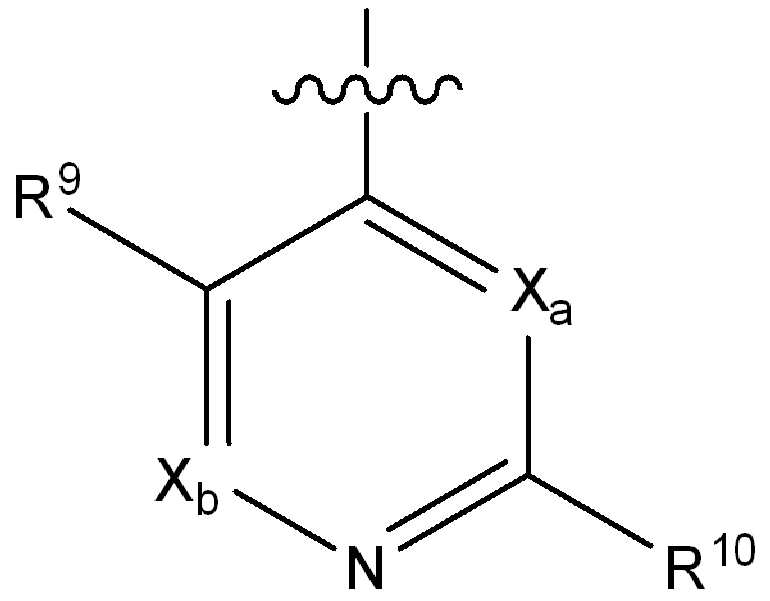
(식 중,(In the meal,

Xa 및 Xb는 N 또는 CRx1로부터 독립적으로 선택되고, 여기서 Rx1은 수소, 플루오로, 클로로, 브로모, 메틸, OCH3, 시아노, 니트로, 아세틸렌일, CH2F, CF2H 또는 CF3로부터 선택되고;X a and X b are independently selected from N or CR x1 , wherein R x1 is hydrogen, fluoro, chloro, bromo, methyl, OCH 3 , cyano, nitro, acetylenyl, CH 2 F, CF 2 H Or CF 3 ;
R9는 플루오로, 클로로, 브로모, 메틸, OCH3, 시아노, 니트로, 아세틸렌일, CH2F 또는 CF2H로부터 선택되고;R 9 is selected from fluoro, chloro, bromo, methyl, OCH 3 , cyano, nitro, acetylenyl, CH 2 F or CF 2 H;
R10은 수소, 할로, (1-2C)알킬, (1-2C)알콕시, (1-2C)할로알킬, (1-2C)할로알콕시, 시아노, 니트로, (2-4C)알켄일, (2-4C)알킨일 또는 하기 화학식의 기로부터 선택되고:R 10 is hydrogen, halo, (1-2C) alkyl, (1-2C) alkoxy, (1-2C) haloalkyl, (1-2C) haloalkoxy, cyano, nitro, (2-4C) alkenyl, (2-4C) alkynyl or a group of the formula:
-Y3-Z3 -Y 3 -Z 3
식 중,In the formula,
Y3은 존재하지 않거나 또는 C(O), C(O)O, OC(O), C(O)N(Rs), N(Rs)C(O), S(O)2N(Rs), N(Rs)SO2이고, 여기서 Rs는 수소 또는 (1-4C)알킬로부터 선택되고;Y 3 is absent or C (O), C (O) O, OC (O), C (O) N (R s ), N (R s ) C (O), S (O) 2 N ( R s ), N (R s ) SO 2 , wherein R s is selected from hydrogen or (1-4C) alkyl;
Z3은 수소, (1-6C)알킬, 아릴, (3-6C)시클로알킬, (2-4C)알켄일, (2-4C)알킨일, (3-6C)시클로알켄일, 5원 또는 6원의 헤테로아릴 또는 5원 또는 6원의 헤테로시클릴이고; 여기서 Z3은 선택적으로 (1-4C)알킬, 할로, (1-4C)할로알킬, (1-4C)할로알콕시, 아미노, 시아노, 히드록시, 아미도, 카르복시, NRuRv 또는 ORu로부터 독립적으로 선택된 하나 이상의 치환기에 의해서 추가로 치환되고, 여기서 Ru 및 Rv는 각각 수소 또는 (1-4C)알킬로부터 독립적으로 선택됨);Z 3 is hydrogen, (1-6C) alkyl, aryl, (3-6C) cycloalkyl, (2-4C) alkenyl, (2-4C) alkynyl, (3-6C) cycloalkenyl, 5-membered or 6 membered heteroaryl or 5 membered or 6 membered heterocyclyl; Wherein Z 3 is optionally (1-4C) alkyl, halo, (1-4C) haloalkyl, (1-4C) haloalkoxy, amino, cyano, hydroxy, amido, carboxy, NR u R v or OR further substituted by one or more substituents independently selected from u , wherein R u and R v are each independently selected from hydrogen or (1-4C) alkyl);
ii) 하기에 나타낸 화학식 B의 기:ii) a group of formula B represented below:
[화학식 B][Formula B]

(식 중,(In the meal,

Xc, Xd 및 Xe는 N, CH, CF, CCl, C-CN 또는 CCH3로부터 독립적으로 선택되고; X c, X d and X e are independently selected from N, CH, CF, CCI, C-CN or CCH 3 ;
R11은 수소, 할로, (1-2C)알킬, (1-2C)알콕시, (1-2C)할로알킬, (1-2C)할로알콕시, 시아노, 니트로, (2-4C)알켄일, (2-4C)알킨일 또는 하기 화학식의 기로부터 선택되고:R 11 is hydrogen, halo, (1-2C) alkyl, (1-2C) alkoxy, (1-2C) haloalkyl, (1-2C) haloalkoxy, cyano, nitro, (2-4C) alkenyl, (2-4C) alkynyl or a group of the formula:
-Y5-Z5 -Y 5 -Z 5
식 중,In the formula,
Y5는 존재하지 않거나 또는 O, N(Rw), C(O), C(O)O, OC(O), C(O)N(Rw), N(Rw)C(O), S(O)2N(Rw), N(Rw)SO2이고, 여기서 Rw는 수소 또는 (1-4C)알킬로부터 선택되고;Y 5 is absent or O, N (R w ), C (O), C (O) O, OC (O), C (O) N (R w ), N (R w ) C (O) , S (O) 2 N (R w ), N (R w ) SO 2 , wherein R w is selected from hydrogen or (1-4C) alkyl;
Z5는 수소, (1-6C)알킬, 아릴, (3-6C)시클로알킬, (3-6C)시클로알켄일, 5원 또는 6원의 헤테로아릴 또는 5원 또는 6원의 헤테로시클릴이고; 여기서 Z5는 선택적으로 (1-4C)알킬, 할로, (1-4C)할로알킬, (1-4C)할로알콕시, 아미노, 시아노, 히드록시, 아미도, 카르복시, NRyRz, ORy로부터 독립적으로 선택된 하나 이상의 치환기에 의해서 추가로 치환되고, 여기서 Ry 및 Rz는 각각 수소 또는 (1-4C)알킬로부터 독립적으로 선택됨);Z 5 is hydrogen, (1-6C) alkyl, aryl, (3-6C) cycloalkyl, (3-6C) cycloalkenyl, 5- or 6-membered heteroaryl or 5- or 6-membered heterocyclyl ; Wherein Z 5 is optionally (1-4C) alkyl, halo, (1-4C) haloalkyl, (1-4C) haloalkoxy, amino, cyano, hydroxy, amido, carboxy, NR y R z , OR further substituted by one or more substituents independently selected from y , wherein R y and R z are each independently selected from hydrogen or (1-4C) alkyl);
iii) 하기에 나타낸 화학식 C의 기:iii) a group of formula C shown below:
[화학식 C][Formula C]
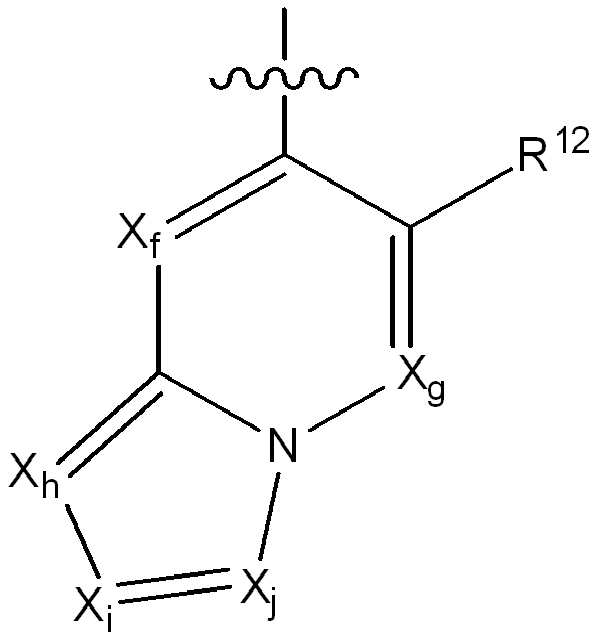
(식 중,(In the meal,

R12는 플루오로, 클로로, 브로모, 메틸, OCH3, 시아노, 니트로, 아세틸렌일, CH2F, CF2H 또는 CF3로부터 선택되고;R 12 is selected from fluoro, chloro, bromo, methyl, OCH 3 , cyano, nitro, acetylenyl, CH 2 F, CF 2 H or CF 3 ;
Xf 및 Xg는 N 또는 CR13으로부터 독립적으로 선택되고, 여기서 R13은 수소, 플루오로, 클로로, (1-2C)알킬, (1-2C)할로알킬 또는 (1-2C)할로알콕시로부터 선택되고;X f and X g are independently selected from N or CR 13 , wherein R 13 is selected from hydrogen, fluoro, chloro, (1-2C) alkyl, (1-2C) haloalkyl or (1-2C) haloalkoxy Selected;
Xh, Xi 및 Xj는 N 또는 CR14로부터 독립적으로 선택되고, 여기서 R14는 수소, 할로, (1-2C)알킬, (1-2C)알콕시, (1-2C)할로알킬 또는 (1-2C)할로알콕시로부터 선택됨);X h , X i and X j are independently selected from N or CR 14 , wherein R 14 is hydrogen, halo, (1-2C) alkyl, (1-2C) alkoxy, (1-2C) haloalkyl or ( 1-2C) selected from haloalkoxy);
(62) R3은 하기로부터 선택됨:(62) R 3 is selected from:
i) 하기에 나타낸 화학식 A의 기:i) a group of formula A shown below:
[화학식 A][Formula A]
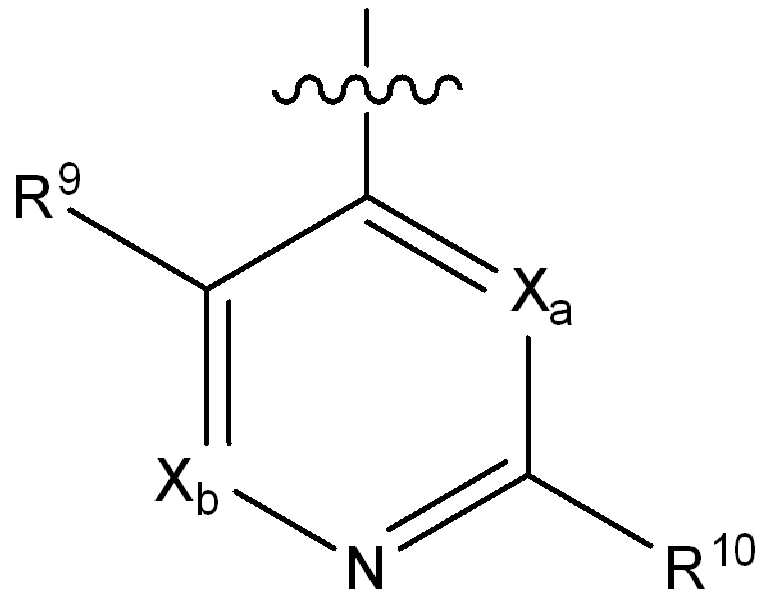
(식 중,(In the meal,

Xa 및 Xb는 N 또는 CRx1로부터 독립적으로 선택되고, 여기서 Rx1은 수소, 플루오로, 클로로, 브로모, 메틸, OCH3, 시아노, 아세틸렌일, CH2F, CF2H 또는 CF3로부터 선택되고;X a and X b are independently selected from N or CR x1 , wherein R x1 is hydrogen, fluoro, chloro, bromo, methyl, OCH 3 , cyano, acetylenyl, CH 2 F, CF 2 H or CF Selected from 3 ;
R9는 플루오로, 클로로, 브로모, 메틸, OCH3, 시아노, 니트로 또는 아세틸렌일로부터 선택되고;R 9 is selected from fluoro, chloro, bromo, methyl, OCH 3 , cyano, nitro or acetylenyl;
R10은 수소, 할로, (1-2C)알킬, (1-2C)알콕시, (1-2C)할로알킬, (1-2C)할로알콕시, 시아노, 니트로, (2-4C)알켄일, (2-4C)알킨일 또는 하기 화학식의 기로부터 선택되고:R 10 is hydrogen, halo, (1-2C) alkyl, (1-2C) alkoxy, (1-2C) haloalkyl, (1-2C) haloalkoxy, cyano, nitro, (2-4C) alkenyl, (2-4C) alkynyl or a group of the formula:
-Y3-Z3 -Y 3 -Z 3
식 중,In the formula,
Y3은 존재하지 않거나 또는 C(O), C(O)O, C(O)N(Rs), 또는 S(O)2N(Rs)이고, 여기서 Rs는 수소 또는 (1-4C)알킬로부터 선택되고;Y 3 is absent or is C (O), C (O) O, C (O) N (R s ), or S (O) 2 N (R s ), where R s is hydrogen or (1- 4C) alkyl;
Z3은 수소, (1-6C)알킬, 아릴, (3-6C)시클로알킬, (2-4C)알켄일, (2-4C)알킨일, (3-6C)시클로알켄일, 5원 또는 6원의 헤테로아릴 또는 5원 또는 6원의 헤테로시클릴이고; 여기서 Z3은 선택적으로 (1-2C)알킬, 할로, (1-2C)할로알킬, (1-2C)할로알콕시, 아미노, 시아노, 히드록시, 아미도, 카르복시, NRuRv 또는 ORu로부터 독립적으로 선택된 하나 이상의 치환기에 의해서 추가로 치환되고, 여기서 Ru 및 Rv는 각각 수소 또는 (1-2C)알킬로부터 독립적으로 선택됨); Z 3 is hydrogen, (1-6C) alkyl, aryl, (3-6C) cycloalkyl, (2-4C) alkenyl, (2-4C) alkynyl, (3-6C) cycloalkenyl, 5-membered or 6 membered heteroaryl or 5 membered or 6 membered heterocyclyl; Wherein Z 3 is optionally (1-2C) alkyl, halo, (1-2C) haloalkyl, (1-2C) haloalkoxy, amino, cyano, hydroxy, amido, carboxy, NR u R v or OR further substituted by one or more substituents independently selected from u , wherein R u and R v are each independently selected from hydrogen or (1-2C) alkyl);
ii) 하기에 나타낸 화학식 B의 기:ii) a group of formula B represented below:
[화학식 B][Formula B]

(식 중,(In the meal,

Xc, Xd 및 Xe는 N, CH, CF, CCl, C-CN 또는 CCH3로부터 독립적으로 선택되고; X c, X d and X e are independently selected from N, CH, CF, CCI, C-CN or CCH 3 ;
R11은 수소, 할로, (1-2C)알킬, (1-2C)알콕시, (1-2C)할로알킬, (1-2C)할로알콕시, 시아노, 니트로, (2-4C)알켄일, (2-4C)알킨일 또는 하기 화학식의 기로부터 선택되고:R 11 is hydrogen, halo, (1-2C) alkyl, (1-2C) alkoxy, (1-2C) haloalkyl, (1-2C) haloalkoxy, cyano, nitro, (2-4C) alkenyl, (2-4C) alkynyl or a group of the formula:
-Y5-Z5 -Y 5 -Z 5
식 중,In the formula,
Y5는 존재하지 않거나 또는 O, N(Rw), C(O), C(O)O, C(O)N(Rw) 또는 S(O)2N(Rw)이고, 여기서 Rw는 수소 또는 (1-4C)알킬로부터 선택되고;Y 5 is absent or is O, N (R w ), C (O), C (O) O, C (O) N (R w ) or S (O) 2 N (R w ), where R w is selected from hydrogen or (1-4C) alkyl;
Z5는 수소, (1-6C)알킬, 아릴, (3-6C)시클로알킬, (3-6C)시클로알켄일, 5원 또는 6원의 헤테로아릴 또는 5원 또는 6원의 헤테로시클릴이고; 여기서 Z5는 선택적으로 (1-2C)알킬, 할로, (1-2C)할로알킬, (1-2C)할로알콕시, 아미노, 시아노, 히드록시, 아미도, 카르복시, NRyRz, ORy로부터 독립적으로 선택된 하나 이상의 치환기에 의해서 추가로 치환되고, 여기서 Ry 및 Rz는 각각 수소 또는 (1-2C)알킬로부터 독립적으로 선택됨);Z 5 is hydrogen, (1-6C) alkyl, aryl, (3-6C) cycloalkyl, (3-6C) cycloalkenyl, 5- or 6-membered heteroaryl or 5- or 6-membered heterocyclyl ; Wherein Z 5 is optionally (1-2C) alkyl, halo, (1-2C) haloalkyl, (1-2C) haloalkoxy, amino, cyano, hydroxy, amido, carboxy, NR y R z , OR further substituted by one or more substituents independently selected from y , wherein R y and R z are each independently selected from hydrogen or (1-2C) alkyl);
iii) 하기에 나타낸 화학식 C의 기:iii) a group of formula C shown below:
[화학식 C][Formula C]

(식 중,(In the meal,

R9는 플루오로, 클로로, 브로모, 메틸, OCH3, 시아노, 아세틸렌일, CH2F, CF2H 또는 CF3로부터 선택되고;R 9 is selected from fluoro, chloro, bromo, methyl, OCH 3 , cyano, acetylenyl, CH 2 F, CF 2 H or CF 3 ;
Xf 및 Xg는 N 또는 CR13으로부터 독립적으로 선택되고, 여기서 R13은 수소, 플루오로, 클로로, 메틸, CH2F, CF2H 또는 CF3로부터 선택되고;X f and X g are independently selected from N or CR 13 , wherein R 13 is selected from hydrogen, fluoro, chloro, methyl, CH 2 F, CF 2 H or CF 3 ;
R14는 수소, 할로, (1-2C)알킬, (1-2C)알콕시, (1-2C)할로알킬 또는 (1-2C)할로알콕시로부터 선택됨);R 14 is selected from hydrogen, halo, (1-2C) alkyl, (1-2C) alkoxy, (1-2C) haloalkyl or (1-2C) haloalkoxy);
(63) R3은 하기로부터 선택됨:(63) R 3 is selected from:
i) 하기에 나타낸 화학식 A의 기:i) a group of formula A shown below:
[화학식 A][Formula A]
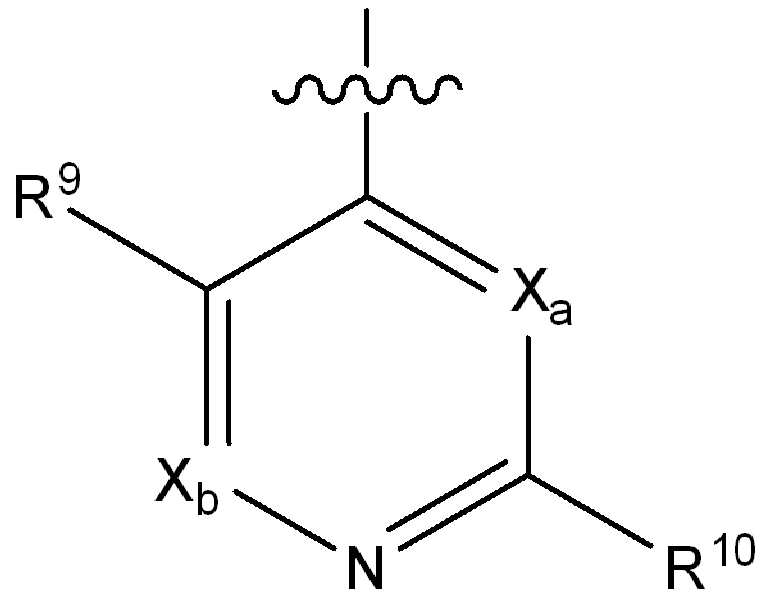
(식 중,(In the meal,

Xa 및 Xb는 N 또는 CRx1로부터 독립적으로 선택되고, 여기서 Rx1은 수소, 플루오로, 클로로, 브로모, 메틸, OCH3, 시아노, 아세틸렌일, CH2F, CF2H 또는 CF3로부터 선택되고;X a and X b are independently selected from N or CR x1 , wherein R x1 is hydrogen, fluoro, chloro, bromo, methyl, OCH 3 , cyano, acetylenyl, CH 2 F, CF 2 H or CF Selected from 3 ;
R9는 플루오로, 클로로, 브로모, 메틸, OCH3, 시아노, 니트로 또는 아세틸렌일로부터 선택되고;R 9 is selected from fluoro, chloro, bromo, methyl, OCH 3 , cyano, nitro or acetylenyl;
R10은 수소, 할로, (1-2C)알킬, (1-2C)알콕시, (1-2C)할로알킬, (1-2C)할로알콕시, 시아노, 니트로, (2-4C)알켄일, (2-4C)알킨일 또는 하기 화학식의 기로부터 선택되고:R 10 is hydrogen, halo, (1-2C) alkyl, (1-2C) alkoxy, (1-2C) haloalkyl, (1-2C) haloalkoxy, cyano, nitro, (2-4C) alkenyl, (2-4C) alkynyl or a group of the formula:
-Y3-Z3 -Y 3 -Z 3
식 중,In the formula,
Y3은 존재하지 않거나 또는 C(O), C(O)O, C(O)N(Rs), 또는 S(O)2N(Rs)이고, 여기서 Rs는 수소 또는 (1-4C)알킬로부터 선택되고;Y 3 is absent or is C (O), C (O) O, C (O) N (R s ), or S (O) 2 N (R s ), where R s is hydrogen or (1- 4C) alkyl;
Z3은 수소, (1-6C)알킬, 아릴, (3-6C)시클로알킬, (2-4C)알켄일, (2-4C)알킨일, (3-6C)시클로알켄일, 5원 또는 6원의 헤테로아릴 또는 5원 또는 6원의 헤테로시클릴이고; 여기서 Z3은 선택적으로 (1-2C)알킬, 할로, (1-2C)할로알킬, (1-2C)할로알콕시, 아미노, 시아노, 히드록시, 아미도, 카르복시, NRuRv 또는 ORu로부터 독립적으로 선택된 하나 이상의 치환기에 의해서 추가로 치환되고, 여기서 Ru 및 Rv는 각각 수소 또는 (1-2C)알킬로부터 독립적으로 선택됨); Z 3 is hydrogen, (1-6C) alkyl, aryl, (3-6C) cycloalkyl, (2-4C) alkenyl, (2-4C) alkynyl, (3-6C) cycloalkenyl, 5-membered or 6 membered heteroaryl or 5 membered or 6 membered heterocyclyl; Wherein Z 3 is optionally (1-2C) alkyl, halo, (1-2C) haloalkyl, (1-2C) haloalkoxy, amino, cyano, hydroxy, amido, carboxy, NR u R v or OR further substituted by one or more substituents independently selected from u , wherein R u and R v are each independently selected from hydrogen or (1-2C) alkyl);
ii) 하기에 나타낸 화학식 B의 기:ii) a group of formula B represented below:
[화학식 B][Formula B]

(식 중,(In the meal,

Xc, Xd 및 Xe는 N, CH, CF, CCl, C-CN 또는 CCH3로부터 독립적으로 선택되고; X c, X d and X e are independently selected from N, CH, CF, CCI, C-CN or CCH 3 ;
R11은 수소, 할로, (1-2C)알킬, (1-2C)알콕시, (1-2C)할로알킬, (1-2C)할로알콕시, 시아노, 니트로, (2-4C)알켄일, (2-4C)알킨일 또는 하기 화학식의 기로부터 선택되고:R 11 is hydrogen, halo, (1-2C) alkyl, (1-2C) alkoxy, (1-2C) haloalkyl, (1-2C) haloalkoxy, cyano, nitro, (2-4C) alkenyl, (2-4C) alkynyl or a group of the formula:
-Y5-Z5 -Y 5 -Z 5
식 중,In the formula,
Y5는 존재하지 않거나 또는 O, N(Rw), C(O), C(O)O, C(O)N(Rw) 또는 S(O)2N(Rw)이고, 여기서 Rw는 수소 또는 (1-4C)알킬로부터 선택되고;Y 5 is absent or is O, N (R w ), C (O), C (O) O, C (O) N (R w ) or S (O) 2 N (R w ), where R w is selected from hydrogen or (1-4C) alkyl;
Z5는 수소, (1-6C)알킬, 아릴, (3-6C)시클로알킬, (3-6C)시클로알켄일, 5원 또는 6원의 헤테로아릴 또는 5원 또는 6원의 헤테로시클릴이고; 여기서 Z5는 선택적으로 (1-2C)알킬, 할로, (1-2C)할로알킬, (1-2C)할로알콕시, 아미노, 시아노, 히드록시, 아미도, 카르복시, NRyRz, ORy로부터 독립적으로 선택된 하나 이상의 치환기에 의해서 추가로 치환되고, 여기서 Ry 및 Rz는 각각 수소 또는 (1-2C)알킬로부터 독립적으로 선택됨);Z 5 is hydrogen, (1-6C) alkyl, aryl, (3-6C) cycloalkyl, (3-6C) cycloalkenyl, 5- or 6-membered heteroaryl or 5- or 6-membered heterocyclyl ; Wherein Z 5 is optionally (1-2C) alkyl, halo, (1-2C) haloalkyl, (1-2C) haloalkoxy, amino, cyano, hydroxy, amido, carboxy, NR y R z , OR further substituted by one or more substituents independently selected from y , wherein R y and R z are each independently selected from hydrogen or (1-2C) alkyl);
iii) 하기에 나타낸 화학식 C의 기:iii) a group of formula C shown below:
[화학식 C][Formula C]

(식 중,(In the meal,

R12는 플루오로, 클로로, 브로모, 메틸, OCH3, 시아노, 아세틸렌일, CH2F, CF2H 또는 CF3로부터 선택되고;R 12 is selected from fluoro, chloro, bromo, methyl, OCH 3 , cyano, acetylenyl, CH 2 F, CF 2 H or CF 3 ;
Xf 및 Xg는 N 또는 CR13으로부터 독립적으로 선택되고, 여기서 R13은 수소, 플루오로, 클로로 또는 메틸로부터 선택되고;X f and X g are independently selected from N or CR 13 , wherein R 13 is selected from hydrogen, fluoro, chloro or methyl;
R14는 수소, 할로, 메틸, OCH3, CH2F, CF2H 또는 CF3로부터 선택됨);R 14 is selected from hydrogen, halo, methyl, OCH 3 , CH 2 F, CF 2 H or CF 3 ;
(64) R3은 하기로부터 선택됨:(64) R 3 is selected from:
i) 하기에 나타낸 화학식 A의 기:i) a group of formula A shown below:
[화학식 A][Formula A]

(식 중,(In the meal,

Xa 및 Xb 둘 모두는 CRx1이고, 여기서 Rx1 은 수소, 플루오로, 클로로, 브로모, 메틸, OCH3, 시아노 또는 아세틸렌일로부터 선택되고;X a and X b are both CR x1 , wherein R x1 is selected from hydrogen, fluoro, chloro, bromo, methyl, OCH 3 , cyano or acetylenyl;
R9는 플루오로, 클로로, 브로모, 메틸, OCH3, 시아노 또는 아세틸렌일로부터 선택되고;R 9 is selected from fluoro, chloro, bromo, methyl, OCH 3 , cyano or acetylenyl;
R10은 수소, 할로, (1-2C)알킬, (1-2C)알콕시, (1-2C)할로알킬, (1-2C)할로알콕시, 시아노, (2-4C)알켄일, (2-4C)알킨일 또는 하기 화학식의 기로부터 선택되고:R 10 is hydrogen, halo, (1-2C) alkyl, (1-2C) alkoxy, (1-2C) haloalkyl, (1-2C) haloalkoxy, cyano, (2-4C) alkenyl, (2 -4C) alkynyl or a group of formula:
-Y3-Z3 -Y 3 -Z 3
식 중,In the formula,
Y3은 존재하지 않거나 또는 C(O), C(O)O, C(O)N(Rs), 또는 S(O)2N(Rs)이고, 여기서 Rs는 수소 또는 (1-4C)알킬로부터 선택되고;Y 3 is absent or is C (O), C (O) O, C (O) N (R s ), or S (O) 2 N (R s ), where R s is hydrogen or (1- 4C) alkyl;
Z3은 수소, (1-6C)알킬, 아릴, (3-6C)시클로알킬, (2-4C)알켄일, (2-4C)알킨일, (3-6C)시클로알켄일, 5원 또는 6원의 헤테로아릴 또는 5원 또는 6원의 헤테로시클릴이고; 여기서 Z3은 선택적으로 (1-2C)알킬, 할로, (1-2C)할로알킬, (1-2C)할로알콕시, 아미노, 시아노, 히드록시, 아미도, 카르복시, NRuRv 또는 ORu로부터 독립적으로 선택된 하나 이상의 치환기에 의해서 추가로 치환되고, 여기서 Ru 및 Rv는 각각 수소 또는 (1-2C)알킬로부터 독립적으로 선택됨); Z 3 is hydrogen, (1-6C) alkyl, aryl, (3-6C) cycloalkyl, (2-4C) alkenyl, (2-4C) alkynyl, (3-6C) cycloalkenyl, 5-membered or 6 membered heteroaryl or 5 membered or 6 membered heterocyclyl; Wherein Z 3 is optionally (1-2C) alkyl, halo, (1-2C) haloalkyl, (1-2C) haloalkoxy, amino, cyano, hydroxy, amido, carboxy, NR u R v or OR further substituted by one or more substituents independently selected from u , wherein R u and R v are each independently selected from hydrogen or (1-2C) alkyl);
ii) 하기에 나타낸 화학식 B의 기:ii) a group of formula B represented below:
[화학식 B][Formula B]
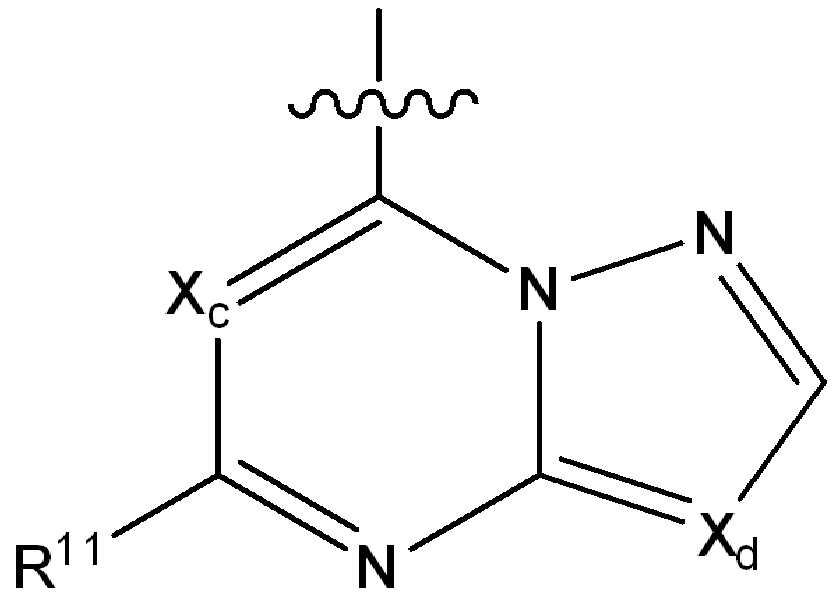
(식 중,(In the meal,

Xc 및 Xd는 N, CH, CF, CCl, C-CN 또는 CCH3로부터 독립적으로 선택되고; X c and X d are independently selected from N, CH, CF, CCI, C-CN or CCH 3 ;
R11은 수소, 할로, (1-2C)알킬, (1-2C)알콕시, (1-2C)할로알킬, (1-2C)할로알콕시, 시아노, (2-4C)알켄일, (2-4C)알킨일 또는 하기 화학식의 기로부터 선택되고:R 11 is hydrogen, halo, (1-2C) alkyl, (1-2C) alkoxy, (1-2C) haloalkyl, (1-2C) haloalkoxy, cyano, (2-4C) alkenyl, (2 -4C) alkynyl or a group of formula:
-Y5-Z5 -Y 5 -Z 5
식 중,In the formula,
Y5는 존재하지 않거나 또는 O, N(Rw), C(O), C(O)O, C(O)N(Rw) 또는 S(O)2N(Rw)이고, 여기서 Rw는 수소 또는 (1-4C)알킬로부터 선택되고;Y 5 is absent or is O, N (R w ), C (O), C (O) O, C (O) N (R w ) or S (O) 2 N (R w ), where R w is selected from hydrogen or (1-4C) alkyl;
Z5는 수소, (1-6C)알킬, 아릴, (3-6C)시클로알킬, (3-6C)시클로알켄일, 5원 또는 6원의 헤테로아릴 또는 5원 또는 6원의 헤테로시클릴이고; 여기서 Z5는 선택적으로 (1-2C)알킬, 할로, (1-2C)할로알킬, (1-2C)할로알콕시, 아미노, 시아노, 히드록시, 아미도, 카르복시, NRyRz, ORy로부터 독립적으로 선택된 하나 이상의 치환기에 의해서 추가로 치환되고, 여기서 Ry 및 Rz는 각각 수소 또는 (1-2C)알킬로부터 독립적으로 선택됨);Z 5 is hydrogen, (1-6C) alkyl, aryl, (3-6C) cycloalkyl, (3-6C) cycloalkenyl, 5- or 6-membered heteroaryl or 5- or 6-membered heterocyclyl ; Wherein Z 5 is optionally (1-2C) alkyl, halo, (1-2C) haloalkyl, (1-2C) haloalkoxy, amino, cyano, hydroxy, amido, carboxy, NR y R z , OR further substituted by one or more substituents independently selected from y , wherein R y and R z are each independently selected from hydrogen or (1-2C) alkyl);
iii) 하기에 나타낸 화학식 C의 기:iii) a group of formula C shown below:
[화학식 C][Formula C]
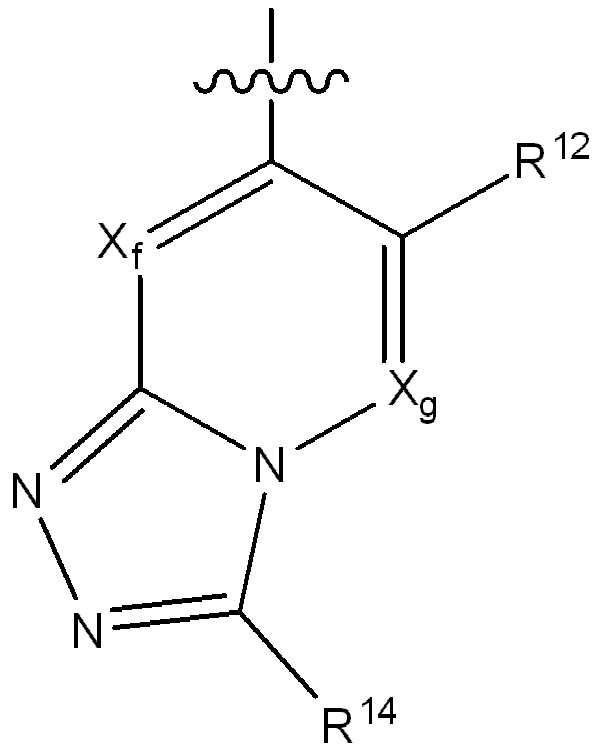
(식 중,(In the meal,

R12는 플루오로, 클로로, 브로모, 메틸, OCH3, 시아노 또는 아세틸렌일로부터 선택되고;R 12 is selected from fluoro, chloro, bromo, methyl, OCH 3 , cyano or acetylenyl;
Xf 및 Xg는 N 또는 CR13으로부터 독립적으로 선택되고, 여기서 R13은 수소, 플루오로, 클로로 또는 메틸로부터 선택되고;X f and X g are independently selected from N or CR 13 , wherein R 13 is selected from hydrogen, fluoro, chloro or methyl;
R14는 수소, 할로, 메틸, OCH3, CH2F, CF2H 또는 CF3로부터 선택됨);R 14 is selected from hydrogen, halo, methyl, OCH 3 , CH 2 F, CF 2 H or CF 3 ;
(65) R3은 하기로부터 선택됨:(65) R 3 is selected from:
i) 하기에 나타낸 화학식 A의 기:i) a group of formula A shown below:
[화학식 A][Formula A]
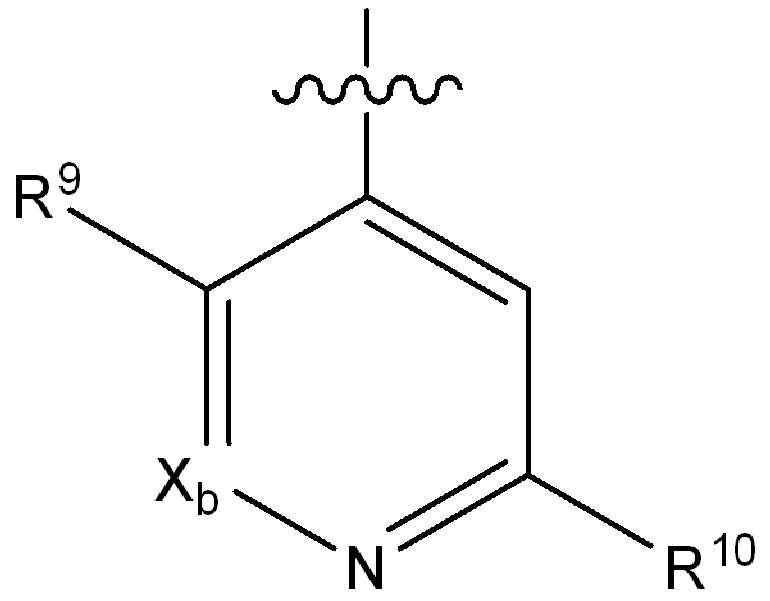
(식 중,(In the meal,

Xb는 CRx1이고, 여기서 Rx1은 수소 또는 클로로로부터 선택되고;X b is CR x1 , wherein R x1 is selected from hydrogen or chloro;
R9는 플루오로, 클로로, 브로모, 메틸, OCH3, 시아노 또는 아세틸렌일로부터 선택되고;R 9 is selected from fluoro, chloro, bromo, methyl, OCH 3 , cyano or acetylenyl;
R10은 수소, 할로, (1-2C)알킬, (1-2C)알콕시, (1-2C)할로알킬, (1-2C)할로알콕시, 시아노 또는 하기 화학식의 기로부터 선택되고:R 10 is selected from hydrogen, halo, (1-2C) alkyl, (1-2C) alkoxy, (1-2C) haloalkyl, (1-2C) haloalkoxy, cyano or a group of the formula:
-Y3-Z3 -Y 3 -Z 3
식 중,In the formula,
Y3은 존재하지 않거나 또는 C(O), C(O)O, C(O)N(Rs), 또는 S(O)2N(Rs)이고, 여기서 Rs는 수소 또는 (1-4C)알킬로부터 선택되고;Y 3 is absent or is C (O), C (O) O, C (O) N (R s ), or S (O) 2 N (R s ), where R s is hydrogen or (1- 4C) alkyl;
Z3은 수소, (1-6C)알킬, 아릴, (2-4C)알킨일, 5원 또는 6원의 헤테로아릴 또는 5원 또는 6원의 헤테로시클릴이고; 여기서 Z3은 선택적으로 (1-2C)알킬, 할로, (1-2C)할로알킬, (1-2C)할로알콕시, 아미노, 시아노, 히드록시, 아미도, 카르복시, NRuRv 또는 ORu로부터 독립적으로 선택된 하나 이상의 치환기에 의해서 추가로 치환되고, 여기서 Ru 및 Rv는 각각 수소 또는 (1-2C)알킬로부터 독립적으로 선택됨);Z 3 is hydrogen, (1-6C) alkyl, aryl, (2-4C) alkynyl, 5- or 6-membered heteroaryl or 5- or 6-membered heterocyclyl; Wherein Z 3 is optionally (1-2C) alkyl, halo, (1-2C) haloalkyl, (1-2C) haloalkoxy, amino, cyano, hydroxy, amido, carboxy, NR u R v or OR further substituted by one or more substituents independently selected from u , wherein R u and R v are each independently selected from hydrogen or (1-2C) alkyl);
ii) 하기에 나타낸 화학식 B의 기:ii) a group of formula B represented below:
[화학식 B][Formula B]

(식 중,(In the meal,

Xc는 N, CH, CF, CCl, C-CN 또는 CCH3로부터 선택되고; X c is selected from N, CH, CF, CCl, C-CN or CCH 3 ;
R11은 수소, 할로, (1-2C)알킬, (1-2C)알콕시, (1-2C)할로알킬, (1-2C)할로알콕시, 시아노, (2-4C)알켄일, (2-4C)알킨일 또는 하기 화학식의 기로부터 선택되고:R 11 is hydrogen, halo, (1-2C) alkyl, (1-2C) alkoxy, (1-2C) haloalkyl, (1-2C) haloalkoxy, cyano, (2-4C) alkenyl, (2 -4C) alkynyl or a group of formula:
-Y5-Z5 -Y 5 -Z 5
식 중,In the formula,
Y5는 존재하지 않거나 또는 O, N(Rw), C(O), C(O)O, C(O)N(Rw) 또는 S(O)2N(Rw)이고, 여기서 Rw는 수소 또는 (1-4C)알킬로부터 선택되고;Y 5 is absent or is O, N (R w ), C (O), C (O) O, C (O) N (R w ) or S (O) 2 N (R w ), where R w is selected from hydrogen or (1-4C) alkyl;
Z5는 수소, (1-6C)알킬, 아릴, 5원 또는 6원의 헤테로아릴 또는 5원 또는 6원의 헤테로시클릴이고; 여기서 Z5는 선택적으로 (1-2C)알킬, 할로, (1-2C)할로알킬, (1-2C)할로알콕시, 아미노, 시아노, 히드록시, 아미도, 카르복시, NRyRz, ORy로부터 독립적으로 선택된 하나 이상의 치환기에 의해서 추가로 치환되고, 여기서 Ry 및 Rz는 각각 수소 또는 (1-2C)알킬로부터 독립적으로 선택됨);Z 5 is hydrogen, (1-6C) alkyl, aryl, 5- or 6-membered heteroaryl or 5- or 6-membered heterocyclyl; Wherein Z 5 is optionally (1-2C) alkyl, halo, (1-2C) haloalkyl, (1-2C) haloalkoxy, amino, cyano, hydroxy, amido, carboxy, NR y R z , OR further substituted by one or more substituents independently selected from y , wherein R y and R z are each independently selected from hydrogen or (1-2C) alkyl);
iii) 하기에 나타낸 화학식 C의 기:iii) a group of formula C shown below:
[화학식 C][Formula C]
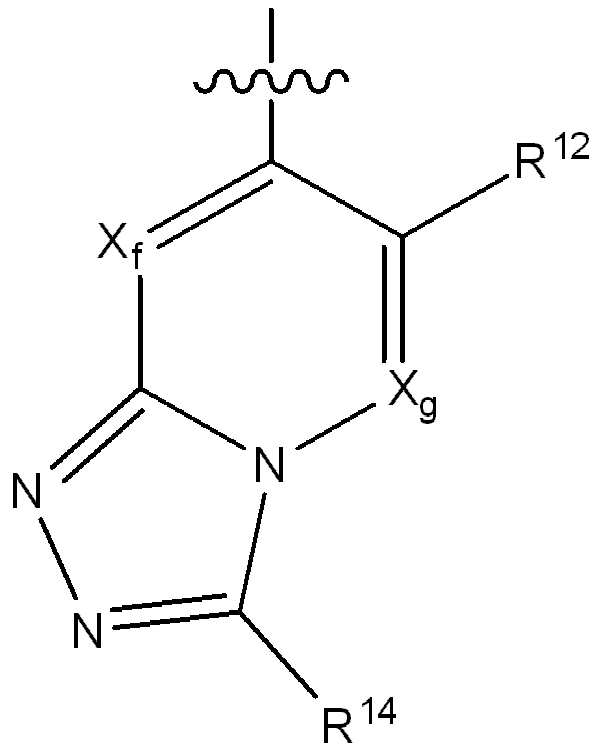
(식 중,(In the meal,

R12는 플루오로, 클로로, 브로모, 메틸, OCH3, 시아노 또는 아세틸렌일로부터 선택되고;R 12 is selected from fluoro, chloro, bromo, methyl, OCH 3 , cyano or acetylenyl;
Xf 및 Xg는 N 또는 CR13으로부터 독립적으로 선택되고, 여기서 R13은 수소, 플루오로, 클로로 또는 메틸로부터 선택되고;X f and X g are independently selected from N or CR 13 , wherein R 13 is selected from hydrogen, fluoro, chloro or methyl;
R14는 수소, 할로, 메틸, OCH3, CH2F, CF2H 또는 CF3로부터 선택됨);R 14 is selected from hydrogen, halo, methyl, OCH 3 , CH 2 F, CF 2 H or CF 3 ;
(66) R3은 하기로부터 선택됨:(66) R 3 is selected from:
i) 하기에 나타낸 화학식 A의 기:i) a group of formula A shown below:
[화학식 A][Formula A]

(식 중,(In the meal,

Xa 및 Xb는 N 또는 CRx1로부터 독립적으로 선택되고, 여기서 Rx1은 수소, 플루오로, 클로로, 브로모, (1-2C)알킬, (1-2C)알콕시, 시아노, 니트로, 아세틸렌일, CH2F, CF2H 또는 CF3로부터 선택되고;X a and X b are independently selected from N or CR x1 , wherein R x1 is hydrogen, fluoro, chloro, bromo, (1-2C) alkyl, (1-2C) alkoxy, cyano, nitro, acetylene One, CH 2 F, CF 2 H or CF 3 ;
R9는 수소, 플루오로, 클로로, 브로모, (1-2C)알킬, (1-2C)알콕시, 시아노, 니트로, 아세틸렌일, CH2F, CF2H 또는 CF3으로부터 선택되고;R 9 is selected from hydrogen, fluoro, chloro, bromo, (1-2C) alkyl, (1-2C) alkoxy, cyano, nitro, acetylenyl, CH 2 F, CF 2 H or CF 3 ;
R10은 수소, 할로, (1-4C)알킬, (1-4C)알콕시, (1-4C)할로알킬, (1-4C)할로알콕시, 시아노, 니트로, (2-4C)알켄일, (2-4C)알킨일 또는 하기 화학식의 기로부터 선택되고:R 10 is hydrogen, halo, (1-4C) alkyl, (1-4C) alkoxy, (1-4C) haloalkyl, (1-4C) haloalkoxy, cyano, nitro, (2-4C) alkenyl, (2-4C) alkynyl or a group of the formula:
-Y3-Z3 -Y 3 -Z 3
식 중,In the formula,
Y3은 존재하지 않거나 또는 O, N(Rs)(CRsRt)q1(여기서 q1은 0, 1 또는 2임), S, SO, SO2, C(O), C(O)O, OC(O), C(O)N(Rs), N(Rs)C(O), N(Rs)C(O)N(Rt), N(Rs)C(O)O, OC(O)N(Rs), S(O)2N(Rs), N(Rs)SO2이고, 여기서 Rs 및 Rt는 각각 수소 또는 (1-4C)알킬로부터 독립적으로 선택되고;Y 3 is not present or O, N (R s) ( CR s R t) q1 ( where q 1 is 0, 1 or 2), S, SO, SO 2, C (O), C (O) O, OC (O), C (O) N (R s ), N (R s ) C (O), N (R s ) C (O) N (R t ), N (R s ) C (O ) O, OC (O) N (R s ), S (O) 2 N (R s ), N (R s ) SO 2 , where R s and R t are each from hydrogen or (1-4C) alkyl Independently selected;
Z3은 수소, (1-6C)알킬, 아릴, (3-6C)시클로알킬, (2-4C)알켄일, (2-4C)알킨일, (3-6C)시클로알켄일, 헤테로아릴 또는 4원 내지 11원의 헤테로시클릴이고; 여기서 Z3은 선택적으로 옥소, (1-4C)알킬, (3-6C)시클로알킬, 할로, (1-4C)할로알킬, (1-4C)할로알콕시, (1-4C)히드록시알킬, 아미노, 시아노, 히드록시, 아미도, 카르복시, 카르바모일, 설파모일, 머캅토, C(O)NRuRv, NRuRv 또는 ORu로부터 독립적으로 선택된 하나 이상의 치환기에 의해서 추가로 치환되고, 여기서 Ru 및 Rv는 각각 수소, (1-4C)알킬 또는 (3-6C)시클로알킬로부터 독립적으로 선택되고/되거나; Z3은 선택적으로 하기 화학식의 기에 의해서 추가로 치환되고:Z 3 is hydrogen, (1-6C) alkyl, aryl, (3-6C) cycloalkyl, (2-4C) alkenyl, (2-4C) alkynyl, (3-6C) cycloalkenyl, heteroaryl or 4-11 membered heterocyclyl; Wherein Z 3 is optionally oxo, (1-4C) alkyl, (3-6C) cycloalkyl, halo, (1-4C) haloalkyl, (1-4C) haloalkoxy, (1-4C) hydroxyalkyl, Further by one or more substituents independently selected from amino, cyano, hydroxy, amido, carboxy, carbamoyl, sulfamoyl, mercapto, C (O) NR u R v , NR u R v or OR u Substituted, wherein R u and R v are each independently selected from hydrogen, (1-4C) alkyl or (3-6C) cycloalkyl; Z 3 is optionally further substituted by a group of the formula:
-LZ-WZ -L Z -W Z
식 중,In the formula,
LZ는 존재하지 않거나 또는 하나 이상의 (1-2C)알킬 기에 의해서 선택적으로 치환된 (1-5C)알킬렌이고; L Z is (1-5C) alkylene, absent or optionally substituted by one or more (1-2C) alkyl groups;
WZ는 아릴, 5원 또는 6원의 헤테로아릴, 4원 내지 7원의 헤테로시클릴, 할로, (1-4C)할로알킬, (1-4C)할로알콕시, 시아노, 히드록시, (1-4C)알콕시, C(O)Rxa, COORxa, C(O)NRxaRxb 또는 NRxaRxb이고, 여기서 Rxa 및 Rxb는 각각 수소 또는 (1-4C)알킬로부터 독립적으로 선택되고; 여기서 각각의 아릴, 5원 또는 6원의 헤테로아릴 또는 4원 내지 7원의 헤테로시클릴은 선택적으로 (1-2C)알킬, 할로, (1-2C)할로알킬, 아미노, 시아노 또는 히드록시로부터 독립적으로 선택된 하나 이상의 치환기에 의해서 추가로 치환됨);W Z is aryl, 5- or 6-membered heteroaryl, 4--7 membered heterocyclyl, halo, (1-4C) haloalkyl, (1-4C) haloalkoxy, cyano, hydroxy, (1 -4C) alkoxy, C (O) R xa , COOR xa , C (O) NR xa R xb or NR xa R xb , wherein R xa and R xb are each independently selected from hydrogen or (1-4C) alkyl Become; Wherein each aryl, 5- or 6-membered heteroaryl or 4--7 membered heterocyclyl is optionally (1-2C) alkyl, halo, (1-2C) haloalkyl, amino, cyano or hydroxy Further substituted by one or more substituents independently selected from);
ii) 하기에 나타낸 화학식 B의 기:ii) a group of formula B represented below:
[화학식 B][Formula B]

(식 중,(In the meal,

Xc, Xd 및 Xe는 N, CH, CF, CCl, C-CN 또는 CCH3로부터 독립적으로 선택되고;X c, X d and X e are independently selected from N, CH, CF, CCI, C-CN or CCH 3 ;
R11은 수소, 할로, (1-4C)알킬, (1-4C)알콕시, (1-4C)할로알킬, (1-4C)할로알콕시, 시아노, 니트로, (2-4C)알켄일, (2-4C)알킨일 또는 하기 화학식의 기로부터 선택되고:R 11 is hydrogen, halo, (1-4C) alkyl, (1-4C) alkoxy, (1-4C) haloalkyl, (1-4C) haloalkoxy, cyano, nitro, (2-4C) alkenyl, (2-4C) alkynyl or a group of the formula:
-Y5-Z5 -Y 5 -Z 5
식 중,In the formula,
Y5는 존재하지 않거나 또는 O, N(Rw), C(O), C(O)O, OC(O), C(O)N(Rw), N(Rw)C(O), N(Rw)C(O)N(Rx), N(Rw)C(O)O, OC(O)N(Rw), S(O)2N(Rw), N(Rw)SO2이고, 여기서 Rw 및 Rx는 각각 수소 또는 (1-4C)알킬로부터 독립적으로 선택되고;Y 5 is absent or O, N (R w ), C (O), C (O) O, OC (O), C (O) N (R w ), N (R w ) C (O) , N (R w ) C (O) N (R x ), N (R w ) C (O) O, OC (O) N (R w ), S (O) 2 N (R w ), N ( R w ) SO 2 , wherein R w and R x are each independently selected from hydrogen or (1-4C) alkyl;
Z5는 수소, (1-6C)알킬, 아릴, (3-8C)시클로알킬, (3-8C)시클로알켄일, 헤테로아릴 또는 헤테로시클릴이고; 여기서 Z5는 선택적으로 (1-4C)알킬, 할로, (1-4C)할로알킬, (1-4C)할로알콕시, (1-4C)할로알킬, 아미노, 시아노, 히드록시, 아미도, 카르복시, 카르바모일, 설파모일, 머캅토, NRyRz, ORy로부터 독립적으로 선택된 하나 이상의 치환기에 의해서 추가로 치환되고, 여기서 Ry 및 Rz는 각각 수소, (1-4C)알킬 또는 (3-6C)시클로알킬로부터 독립적으로 선택됨);Z 5 is hydrogen, (1-6C) alkyl, aryl, (3-8C) cycloalkyl, (3-8C) cycloalkenyl, heteroaryl or heterocyclyl; Wherein Z 5 is optionally (1-4C) alkyl, halo, (1-4C) haloalkyl, (1-4C) haloalkoxy, (1-4C) haloalkyl, amino, cyano, hydroxy, amido, Further substituted by one or more substituents independently selected from carboxy, carbamoyl, sulfamoyl, mercapto, NR y R z , OR y , wherein R y and R z are each hydrogen, (1-4C) alkyl or (3-6C) independently selected from cycloalkyl);
(67) R3은 하기로부터 선택됨:(67) R 3 is selected from:
i) 하기에 나타낸 화학식 A의 기:i) a group of formula A shown below:
[화학식 A][Formula A]

(식 중,(In the meal,

Xa 및 Xb는 N 또는 CRx1로부터 독립적으로 선택되고, 여기서 Rx1은 수소, 플루오로, 클로로, 브로모, (1-2C)알킬, (1-2C)알콕시, 시아노, 니트로, 아세틸렌일, CH2F, CF2H 또는 CF3로부터 선택되고;X a and X b are independently selected from N or CR x1 , wherein R x1 is hydrogen, fluoro, chloro, bromo, (1-2C) alkyl, (1-2C) alkoxy, cyano, nitro, acetylene One, CH 2 F, CF 2 H or CF 3 ;
R9는 수소, 플루오로, 클로로, 브로모, (1-2C)알킬, (1-2C)알콕시, 시아노, 니트로, 아세틸렌일, CH2F, CF2H 또는 CF3으로부터 선택되고;R 9 is selected from hydrogen, fluoro, chloro, bromo, (1-2C) alkyl, (1-2C) alkoxy, cyano, nitro, acetylenyl, CH 2 F, CF 2 H or CF 3 ;
R10은 수소, 할로, (1-4C)알킬, (1-4C)알콕시, (1-4C)할로알킬, (1-4C)할로알콕시, 시아노, 니트로, (2-4C)알켄일, (2-4C)알킨일 또는 하기 화학식의 기로부터 선택되고:R 10 is hydrogen, halo, (1-4C) alkyl, (1-4C) alkoxy, (1-4C) haloalkyl, (1-4C) haloalkoxy, cyano, nitro, (2-4C) alkenyl, (2-4C) alkynyl or a group of the formula:
-Y3-Z3 -Y 3 -Z 3
식 중,In the formula,
Y3은 존재하지 않거나 또는 O, N(Rs)(CRsRt)q1(여기서 q1은 0, 1 또는 2임), S, SO, SO2, C(O), C(O)O, OC(O), C(O)N(Rs), N(Rs)C(O), N(Rs)C(O)N(Rt), N(Rs)C(O)O, OC(O)N(Rs), S(O)2N(Rs), N(Rs)SO2이고, 여기서 Rs 및 Rt는 각각 수소 또는 (1-4C)알킬로부터 독립적으로 선택되고;Y 3 is not present or O, N (R s) ( CR s R t) q1 ( where q 1 is 0, 1 or 2), S, SO, SO 2, C (O), C (O) O, OC (O), C (O) N (R s ), N (R s ) C (O), N (R s ) C (O) N (R t ), N (R s ) C (O ) O, OC (O) N (R s ), S (O) 2 N (R s ), N (R s ) SO 2 , where R s and R t are each from hydrogen or (1-4C) alkyl Independently selected;
Z3은 수소, (1-6C)알킬, 아릴, (3-6C)시클로알킬, (2-4C)알켄일, (2-4C)알킨일, (3-6C)시클로알켄일, 헤테로아릴 또는 4원 내지 11원의 헤테로시클릴이고; 여기서 Z3은 선택적으로 옥소, (1-4C)알킬, (3-6C)시클로알킬, 할로, (1-4C)할로알킬, (1-4C)할로알콕시, (1-4C)히드록시알킬, 아미노, 시아노, 히드록시, 아미도, 카르복시, 카르바모일, 설파모일, 머캅토, C(O)NRuRv, NRuRv 또는 ORu로부터 독립적으로 선택된 하나 이상의 치환기에 의해서 추가로 치환되고, 여기서 Ru 및 Rv는 각각 수소, (1-4C)알킬 또는 (3-6C)시클로알킬로부터 독립적으로 선택되고/되거나; Z3은 선택적으로 하기 화학식의 기에 의해서 추가로 치환되고:Z 3 is hydrogen, (1-6C) alkyl, aryl, (3-6C) cycloalkyl, (2-4C) alkenyl, (2-4C) alkynyl, (3-6C) cycloalkenyl, heteroaryl or 4-11 membered heterocyclyl; Wherein Z 3 is optionally oxo, (1-4C) alkyl, (3-6C) cycloalkyl, halo, (1-4C) haloalkyl, (1-4C) haloalkoxy, (1-4C) hydroxyalkyl, Further by one or more substituents independently selected from amino, cyano, hydroxy, amido, carboxy, carbamoyl, sulfamoyl, mercapto, C (O) NR u R v , NR u R v or OR u Substituted, wherein R u and R v are each independently selected from hydrogen, (1-4C) alkyl or (3-6C) cycloalkyl; Z 3 is optionally further substituted by a group of the formula:
-LZ-WZ -L Z -W Z
식 중,In the formula,
LZ는 존재하지 않거나 또는 하나 이상의 (1-2C)알킬 기에 의해서 선택적으로 치환된 (1-5C)알킬렌이고; L Z is (1-5C) alkylene, absent or optionally substituted by one or more (1-2C) alkyl groups;
WZ는 아릴, 5원 또는 6원의 헤테로아릴, 4원 내지 7원의 헤테로시클릴, 할로, (1-4C)할로알킬, (1-4C)할로알콕시, 시아노, 히드록시, (1-4C)알콕시, C(O)Rxa, COORxa, C(O)NRxaRxb 또는 NRxaRxb이고, 여기서 Rxa 및 Rxb는 각각 수소 또는 (1-4C)알킬로부터 독립적으로 선택됨);W Z is aryl, 5- or 6-membered heteroaryl, 4--7 membered heterocyclyl, halo, (1-4C) haloalkyl, (1-4C) haloalkoxy, cyano, hydroxy, (1 -4C) alkoxy, C (O) R xa , COOR xa , C (O) NR xa R xb or NR xa R xb , where R xa and R xb are each independently selected from hydrogen or (1-4C) alkyl );
ii) 하기에 나타낸 화학식 B의 기:ii) a group of formula B represented below:
[화학식 B][Formula B]

(식 중,(In the meal,

Xc, Xd 및 Xe는 N, CH, CF, CCl, C-CN 또는 CCH3로부터 독립적으로 선택되고;X c, X d and X e are independently selected from N, CH, CF, CCI, C-CN or CCH 3 ;
R11은 수소, 할로, (1-4C)알킬, (1-4C)알콕시, (1-4C)할로알킬, (1-4C)할로알콕시, 시아노, 니트로, (2-4C)알켄일, (2-4C)알킨일 또는 하기 화학식의 기로부터 선택되고:R 11 is hydrogen, halo, (1-4C) alkyl, (1-4C) alkoxy, (1-4C) haloalkyl, (1-4C) haloalkoxy, cyano, nitro, (2-4C) alkenyl, (2-4C) alkynyl or a group of the formula:
-Y5-Z5 -Y 5 -Z 5
식 중,In the formula,
Y5는 존재하지 않거나 또는 O, N(Rw), C(O), C(O)O, OC(O), C(O)N(Rw), N(Rw)C(O), N(Rw)C(O)N(Rx), N(Rw)C(O)O, OC(O)N(Rw), S(O)2N(Rw), N(Rw)SO2이고, 여기서 Rw 및 Rx는 각각 수소 또는 (1-4C)알킬로부터 독립적으로 선택되고;Y 5 is absent or O, N (R w ), C (O), C (O) O, OC (O), C (O) N (R w ), N (R w ) C (O) , N (R w ) C (O) N (R x ), N (R w ) C (O) O, OC (O) N (R w ), S (O) 2 N (R w ), N ( R w ) SO 2 , wherein R w and R x are each independently selected from hydrogen or (1-4C) alkyl;
Z5는 수소, (1-6C)알킬, 아릴, (3-8C)시클로알킬, (3-8C)시클로알켄일, 헤테로아릴 또는 헤테로시클릴이고; 여기서 Z5는 선택적으로 (1-4C)알킬, 할로, (1-4C)할로알킬, (1-4C)할로알콕시, (1-4C)할로알킬, 아미노, 시아노, 히드록시, 아미도, 카르복시, 카르바모일, 설파모일, 머캅토, NRyRz, ORy로부터 독립적으로 선택된 하나 이상의 치환기에 의해서 추가로 치환되고, 여기서 Ry 및 Rz는 각각 수소, (1-4C)알킬 또는 (3-6C)시클로알킬로부터 독립적으로 선택됨);Z 5 is hydrogen, (1-6C) alkyl, aryl, (3-8C) cycloalkyl, (3-8C) cycloalkenyl, heteroaryl or heterocyclyl; Wherein Z 5 is optionally (1-4C) alkyl, halo, (1-4C) haloalkyl, (1-4C) haloalkoxy, (1-4C) haloalkyl, amino, cyano, hydroxy, amido, Further substituted by one or more substituents independently selected from carboxy, carbamoyl, sulfamoyl, mercapto, NR y R z , OR y , wherein R y and R z are each hydrogen, (1-4C) alkyl or (3-6C) independently selected from cycloalkyl);
(68) R3은 하기로부터 선택됨:(68) R 3 is selected from:
i) 하기에 나타낸 화학식 A의 기:i) a group of formula A shown below:
[화학식 A][Formula A]

(식 중,(In the meal,

Xa 및 Xb는 N 또는 CRx1로부터 독립적으로 선택되고, 여기서 Rx1은 수소, 플루오로, 클로로, 브로모, (1-2C)알킬, (1-2C)알콕시, 시아노, 니트로, 아세틸렌일, CH2F, CF2H 또는 CF3로부터 선택되고;X a and X b are independently selected from N or CR x1 , wherein R x1 is hydrogen, fluoro, chloro, bromo, (1-2C) alkyl, (1-2C) alkoxy, cyano, nitro, acetylene One, CH 2 F, CF 2 H or CF 3 ;
R9는 수소, 플루오로, 클로로, 브로모, (1-2C)알킬, (1-2C)알콕시, 시아노, 니트로, 아세틸렌일, CH2F, CF2H 또는 CF3으로부터 선택되고;R 9 is selected from hydrogen, fluoro, chloro, bromo, (1-2C) alkyl, (1-2C) alkoxy, cyano, nitro, acetylenyl, CH 2 F, CF 2 H or CF 3 ;
R10은 수소, 할로, (1-4C)알킬, (1-4C)알콕시, (1-4C)할로알킬, (1-4C)할로알콕시, 시아노, 니트로, (2-4C)알켄일, (2-4C)알킨일 또는 하기 화학식의 기로부터 선택되고:R 10 is hydrogen, halo, (1-4C) alkyl, (1-4C) alkoxy, (1-4C) haloalkyl, (1-4C) haloalkoxy, cyano, nitro, (2-4C) alkenyl, (2-4C) alkynyl or a group of the formula:
-Y3-Z3 -Y 3 -Z 3
식 중,In the formula,
Y3은 존재하지 않거나 또는 O, N(Rs)(CRsRt)q1(여기서 q1은 0, 1 또는 2임), S, SO, SO2, C(O), C(O)O, OC(O), C(O)N(Rs), N(Rs)C(O), N(Rs)C(O)N(Rt), N(Rs)C(O)O, OC(O)N(Rs), S(O)2N(Rs), N(Rs)SO2이고, 여기서 Rs 및 Rt는 각각 수소 또는 (1-4C)알킬로부터 독립적으로 선택되고;Y 3 is not present or O, N (R s) ( CR s R t) q1 ( where q 1 is 0, 1 or 2), S, SO, SO 2, C (O), C (O) O, OC (O), C (O) N (R s ), N (R s ) C (O), N (R s ) C (O) N (R t ), N (R s ) C (O ) O, OC (O) N (R s ), S (O) 2 N (R s ), N (R s ) SO 2 , where R s and R t are each from hydrogen or (1-4C) alkyl Independently selected;
Z3은 수소, (1-6C)알킬, 아릴, (3-6C)시클로알킬, (2-4C)알켄일, (2-4C)알킨일, (3-6C)시클로알켄일, 헤테로아릴 또는 4원 내지 11원의 헤테로시클릴이고; 여기서 Z3은 선택적으로 옥소, (1-4C)알킬, (3-6C)시클로알킬, 할로, (1-4C)할로알킬, (1-4C)할로알콕시, 아미노, 시아노, 히드록시, 아미도, 카르복시, 카르바모일, 설파모일, 머캅토, C(O)NRuRv, NRuRv 또는 ORu로부터 독립적으로 선택된 하나 이상의 치환기에 의해서 추가로 치환되고, 여기서 Ru 및 Rv는 각각 수소, (1-4C)알킬 또는 (3-6C)시클로알킬로부터 독립적으로 선택되거나; 또는 Z3은 선택적으로 하기 화학식의 기에 의해서 추가로 치환되고:Z 3 is hydrogen, (1-6C) alkyl, aryl, (3-6C) cycloalkyl, (2-4C) alkenyl, (2-4C) alkynyl, (3-6C) cycloalkenyl, heteroaryl or 4-11 membered heterocyclyl; Wherein Z 3 is optionally oxo, (1-4C) alkyl, (3-6C) cycloalkyl, halo, (1-4C) haloalkyl, (1-4C) haloalkoxy, amino, cyano, hydroxy, amino Or further substituted by one or more substituents independently selected from carboxy, carbamoyl, sulfamoyl, mercapto, C (O) NR u R v , NR u R v or OR u , wherein R u and R v Are each independently selected from hydrogen, (1-4C) alkyl or (3-6C) cycloalkyl; Or Z 3 is optionally further substituted by a group of the formula:
-LZ-WZ -L Z -W Z
식 중,In the formula,
LZ는 (1-2C)알킬 또는 옥소로부터 선택된 하나 이상의 치환체에 의해서 선택적으로 치환된 (1-5C)알킬렌이고; L Z is (1-5C) alkylene optionally substituted by one or more substituents selected from (1-2C) alkyl or oxo;
WZ는 할로, (1-4C)할로알킬, (1-4C)할로알콕시, 시아노, 히드록시, (1-4C)알콕시, C(O)Rxa, COORxa, C(O)NRxaRxb 또는 NRxaRxb이고, 여기서 Rxa 및 Rxb는 각각 수소 또는 (1-4C)알킬로부터 독립적으로 선택됨); W Z is halo, (1-4C) haloalkyl, (1-4C) haloalkoxy, cyano, hydroxy, (1-4C) alkoxy, C (O) R xa , COOR xa , C (O) NR xa R xb or NR xa R xb , wherein R xa and R xb are each independently selected from hydrogen or (1-4C) alkyl);
ii) 하기에 나타낸 화학식 B의 기:ii) a group of formula B represented below:
[화학식 B][Formula B]

(식 중,(In the meal,

Xc, Xd 및 Xe는 N, CH, CF, CCl, C-CN 또는 CCH3로부터 독립적으로 선택되고;X c, X d and X e are independently selected from N, CH, CF, CCI, C-CN or CCH 3 ;
R11은 수소, 할로, (1-4C)알킬, (1-4C)알콕시, (1-4C)할로알킬, (1-4C)할로알콕시, 시아노, 니트로, (2-4C)알켄일, (2-4C)알킨일 또는 하기 화학식의 기로부터 선택되고:R 11 is hydrogen, halo, (1-4C) alkyl, (1-4C) alkoxy, (1-4C) haloalkyl, (1-4C) haloalkoxy, cyano, nitro, (2-4C) alkenyl, (2-4C) alkynyl or a group of the formula:
-Y5-Z5 -Y 5 -Z 5
식 중,In the formula,
Y5는 존재하지 않거나 또는 O, N(Rw), C(O), C(O)O, OC(O), C(O)N(Rw), N(Rw)C(O), N(Rw)C(O)N(Rx), N(Rw)C(O)O, OC(O)N(Rw), S(O)2N(Rw), N(Rw)SO2이고, 여기서 Rw 및 Rx는 각각 수소 또는 (1-4C)알킬로부터 독립적으로 선택되고;Y 5 is absent or O, N (R w ), C (O), C (O) O, OC (O), C (O) N (R w ), N (R w ) C (O) , N (R w ) C (O) N (R x ), N (R w ) C (O) O, OC (O) N (R w ), S (O) 2 N (R w ), N ( R w ) SO 2 , wherein R w and R x are each independently selected from hydrogen or (1-4C) alkyl;
Z5는 수소, (1-6C)알킬, 아릴, (3-8C)시클로알킬, (3-8C)시클로알켄일, 헤테로아릴 또는 헤테로시클릴이고; 여기서 Z5는 선택적으로 (1-4C)알킬, 할로, (1-4C)할로알킬, (1-4C)할로알콕시, 아미노, 시아노, 히드록시, 아미도, 카르복시, 카르바모일, 설파모일, 머캅토, NRyRz, ORy로부터 독립적으로 선택된 하나 이상의 치환기에 의해서 추가로 치환되고, 여기서 Ry 및 Rz는 각각 수소, (1-4C)알킬 또는 (3-6C)시클로알킬로부터 독립적으로 선택됨);Z 5 is hydrogen, (1-6C) alkyl, aryl, (3-8C) cycloalkyl, (3-8C) cycloalkenyl, heteroaryl or heterocyclyl; Wherein Z 5 is optionally (1-4C) alkyl, halo, (1-4C) haloalkyl, (1-4C) haloalkoxy, amino, cyano, hydroxy, amido, carboxy, carbamoyl, sulfamoyl , Is further substituted by one or more substituents independently selected from mercapto, NR y R z , OR y , wherein R y and R z are each from hydrogen, (1-4C) alkyl or (3-6C) cycloalkyl Independently selected);
(69) R3은 하기로부터 선택됨:(69) R 3 is selected from:
i) 하기에 나타낸 화학식 A의 기:i) a group of formula A shown below:
[화학식 A][Formula A]
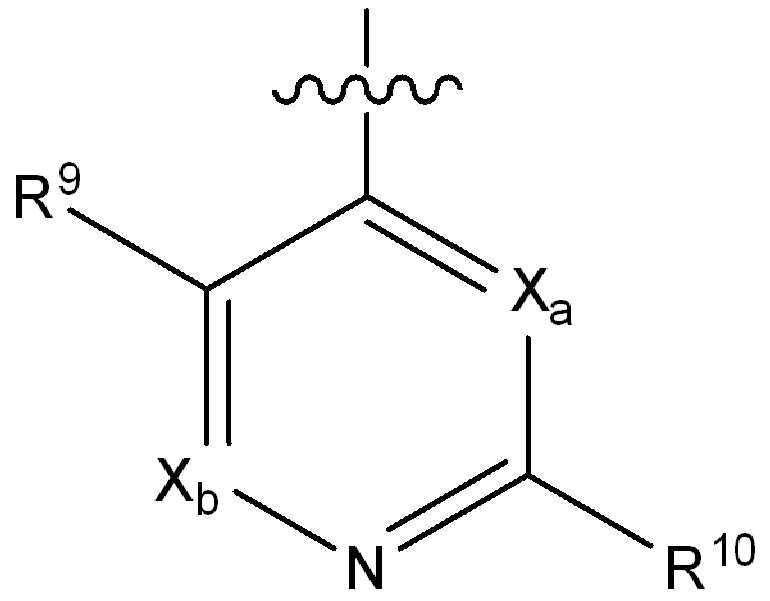
(식 중,(In the meal,

Xa 및 Xb는 N 또는 CRx1로부터 독립적으로 선택되고, 여기서 Rx1은 수소, 플루오로, 클로로, 브로모, (1-2C)알킬, (1-2C)알콕시, 시아노, 니트로, 아세틸렌일, CH2F, CF2H 또는 CF3로부터 선택되고;X a and X b are independently selected from N or CR x1 , wherein R x1 is hydrogen, fluoro, chloro, bromo, (1-2C) alkyl, (1-2C) alkoxy, cyano, nitro, acetylene One, CH 2 F, CF 2 H or CF 3 ;
R9는 수소, 플루오로, 클로로, 브로모, (1-2C)알킬, (1-2C)알콕시, 시아노, 니트로, 아세틸렌일, CH2F, CF2H 또는 CF3으로부터 선택되고;R 9 is selected from hydrogen, fluoro, chloro, bromo, (1-2C) alkyl, (1-2C) alkoxy, cyano, nitro, acetylenyl, CH 2 F, CF 2 H or CF 3 ;
R10은 수소, 할로, (1-4C)알킬, (1-4C)알콕시, (1-4C)할로알킬, (1-4C)할로알콕시, 시아노, 니트로, (2-4C)알켄일, (2-4C)알킨일 또는 하기 화학식의 기로부터 선택되고:R 10 is hydrogen, halo, (1-4C) alkyl, (1-4C) alkoxy, (1-4C) haloalkyl, (1-4C) haloalkoxy, cyano, nitro, (2-4C) alkenyl, (2-4C) alkynyl or a group of the formula:
-Y3-Z3 -Y 3 -Z 3
식 중,In the formula,
Y3은 존재하지 않거나 또는 N(Rs)(CRsRt)q1(여기서 q1은 0, 1 또는 2임), S, C(O), C(O)O, C(O)N(Rs), N(Rs)C(O) 또는 S(O)2N(Rs)이고, 여기서 Rs는 수소 또는 (1-4C)알킬로부터 선택되고;Y 3 is absent or N (R s ) (CR s R t ) q1 (where q 1 is 0, 1 or 2), S, C (O), C (O) O, C (O) N (R s ), N (R s ) C (O) or S (O) 2 N (R s ), wherein R s is selected from hydrogen or (1-4C) alkyl;
Z3은 수소, (1-6C)알킬, 아릴, (3-6C)시클로알킬, (2-4C)알켄일, (2-4C)알킨일, (3-6C)시클로알켄일, 헤테로아릴 또는 4원 내지 11원의 헤테로시클릴이고; 여기서 Z3은 선택적으로 옥소, (1-4C)알킬, (3-6C)시클로알킬, 할로, (1-4C)할로알킬, (1-4C)할로알콕시, 아미노, 시아노, 히드록시, 아미도, 카르복시, 카르바모일, 설파모일, 머캅토, C(O)NRuRv, NRuRv 또는 ORu로부터 독립적으로 선택된 하나 이상의 치환기에 의해서 추가로 치환되고, 여기서 Ru 및 Rv는 각각 수소, (1-4C)알킬 또는 (3-6C)시클로알킬로부터 독립적으로 선택되고/되거나; Z3은 선택적으로 하기 화학식의 기에 의해서 추가로 치환되고:Z 3 is hydrogen, (1-6C) alkyl, aryl, (3-6C) cycloalkyl, (2-4C) alkenyl, (2-4C) alkynyl, (3-6C) cycloalkenyl, heteroaryl or 4-11 membered heterocyclyl; Wherein Z 3 is optionally oxo, (1-4C) alkyl, (3-6C) cycloalkyl, halo, (1-4C) haloalkyl, (1-4C) haloalkoxy, amino, cyano, hydroxy, amino Or further substituted by one or more substituents independently selected from carboxy, carbamoyl, sulfamoyl, mercapto, C (O) NR u R v , NR u R v or OR u , wherein R u and R v Are each independently selected from hydrogen, (1-4C) alkyl or (3-6C) cycloalkyl; Z 3 is optionally further substituted by a group of the formula:
-LZ-WZ -L Z -W Z
식 중,In the formula,
LZ는 존재하지 않거나 또는 (1-3C)알킬렌이고;L Z is absent or (1-3C) alkylene;
WZ는 페닐, 5원 또는 6원의 헤테로아릴, 6원의 헤테로시클릴, 할로, (1-4C)할로알킬, (1-4C)할로알콕시, 시아노, 히드록시, (1-4C)알콕시, C(O)Rxa, COORxa, C(O)NRxaRxb 또는 NRxaRxb이고, 여기서 Rxa 및 Rxb는 각각 수소 또는 (1-4C)알킬로부터 독립적으로 선택됨); W Z is phenyl, 5- or 6-membered heteroaryl, 6-membered heterocyclyl, halo, (1-4C) haloalkyl, (1-4C) haloalkoxy, cyano, hydroxy, (1-4C) Alkoxy, C (O) R xa , COOR xa , C (O) NR xa R xb or NR xa R xb , wherein R xa and R xb are each independently selected from hydrogen or (1-4C) alkyl);
ii) 하기에 나타낸 화학식 B의 기:ii) a group of formula B represented below:
[화학식 B][Formula B]

(식 중,(In the meal,

Xc, Xd 및 Xe는 N, CH, CF, CCl, C-CN 또는 CCH3로부터 독립적으로 선택되고;X c, X d and X e are independently selected from N, CH, CF, CCI, C-CN or CCH 3 ;
R11은 수소, 할로, (1-4C)알킬, (1-4C)알콕시, (1-4C)할로알킬, (1-4C)할로알콕시, 시아노, 니트로, (2-4C)알켄일, (2-4C)알킨일 또는 하기 화학식의 기로부터 선택되고:R 11 is hydrogen, halo, (1-4C) alkyl, (1-4C) alkoxy, (1-4C) haloalkyl, (1-4C) haloalkoxy, cyano, nitro, (2-4C) alkenyl, (2-4C) alkynyl or a group of the formula:
-Y5-Z5 -Y 5 -Z 5
식 중,In the formula,
Y5는 존재하지 않거나 또는 O, N(Rw), C(O), C(O)O, C(O)N(Rw) 또는 S(O)2N(Rw)이고, 여기서 Rw는 수소 또는 (1-4C)알킬로부터 선택되고;Y 5 is absent or is O, N (R w ), C (O), C (O) O, C (O) N (R w ) or S (O) 2 N (R w ), where R w is selected from hydrogen or (1-4C) alkyl;
Z5는 수소, (1-6C)알킬, 아릴, (3-8C)시클로알킬, (3-8C)시클로알켄일, 헤테로아릴 또는 헤테로시클릴이고; 여기서 Z5는 선택적으로 (1-4C)알킬, 할로, (1-4C)할로알킬, (1-4C)할로알콕시, (1-4C)히드록시알킬, 아미노, 시아노, 히드록시, 아미도, 카르복시, 카르바모일, 설파모일, 머캅토, NRyRz, ORy로부터 독립적으로 선택된 하나 이상의 치환기에 의해서 추가로 치환되고, 여기서 Ry 및 Rz는 각각 수소, (1-4C)알킬 또는 시클로프로필로부터 독립적으로 선택됨);Z 5 is hydrogen, (1-6C) alkyl, aryl, (3-8C) cycloalkyl, (3-8C) cycloalkenyl, heteroaryl or heterocyclyl; Wherein Z 5 is optionally (1-4C) alkyl, halo, (1-4C) haloalkyl, (1-4C) haloalkoxy, (1-4C) hydroxyalkyl, amino, cyano, hydroxy, amido Is further substituted by one or more substituents independently selected from carboxy, carbamoyl, sulfamoyl, mercapto, NR y R z , OR y , wherein R y and R z are each hydrogen, (1-4C) alkyl Or independently selected from cyclopropyl);
(70) R3은 하기로부터 선택됨:(70) R 3 is selected from:
i) 하기에 나타낸 화학식 A의 기:i) a group of formula A shown below:
[화학식 A][Formula A]

(식 중,(In the meal,

Xa 및 Xb는 N 또는 CRx1로부터 독립적으로 선택되고, 여기서 Rx1은 수소, 플루오로, 클로로, 브로모, (1-2C)알킬, (1-2C)알콕시, 시아노, 니트로, 아세틸렌일, CH2F, CF2H 또는 CF3로부터 선택되고;X a and X b are independently selected from N or CR x1 , wherein R x1 is hydrogen, fluoro, chloro, bromo, (1-2C) alkyl, (1-2C) alkoxy, cyano, nitro, acetylene One, CH 2 F, CF 2 H or CF 3 ;
R9는 수소, 플루오로, 클로로, 브로모, (1-2C)알킬, (1-2C)알콕시, 시아노, 니트로, 아세틸렌일, CH2F, CF2H 또는 CF3으로부터 선택되고;R 9 is selected from hydrogen, fluoro, chloro, bromo, (1-2C) alkyl, (1-2C) alkoxy, cyano, nitro, acetylenyl, CH 2 F, CF 2 H or CF 3 ;
R10은 수소, 할로, (1-4C)알킬, (1-4C)알콕시, (1-4C)할로알킬, (1-4C)할로알콕시, 시아노, 니트로, (2-4C)알켄일, (2-4C)알킨일 또는 하기 화학식의 기로부터 선택되고:R 10 is hydrogen, halo, (1-4C) alkyl, (1-4C) alkoxy, (1-4C) haloalkyl, (1-4C) haloalkoxy, cyano, nitro, (2-4C) alkenyl, (2-4C) alkynyl or a group of the formula:
-Y3-Z3 -Y 3 -Z 3
식 중,In the formula,
Y3은 존재하지 않거나 또는 N(Rs)(CRsRt)q1(여기서 q1은 0, 1 또는 2임), S, C(O), C(O)O, C(O)N(Rs), N(Rs)C(O) 또는 S(O)2N(Rs)이고, 여기서 Rs는 수소 또는 (1-4C)알킬로부터 선택되고;Y 3 is absent or N (R s ) (CR s R t ) q1 (where q 1 is 0, 1 or 2), S, C (O), C (O) O, C (O) N (R s ), N (R s ) C (O) or S (O) 2 N (R s ), wherein R s is selected from hydrogen or (1-4C) alkyl;
Z3은 수소, (1-6C)알킬, 아릴, (3-6C)시클로알킬, (2-4C)알켄일, (2-4C)알킨일, (3-6C)시클로알켄일, 헤테로아릴 또는 4원 내지 11원의 헤테로시클릴이고; 여기서 Z3은 선택적으로 옥소, (1-4C)알킬, (3-6C)시클로알킬, 할로, (1-4C)할로알킬, (1-4C)할로알콕시, 아미노, 시아노, 히드록시, 아미도, 카르복시, 카르바모일, 설파모일, 머캅토, C(O)NRuRv, NRuRv 또는 ORu로부터 독립적으로 선택된 하나 이상의 치환기에 의해서 추가로 치환되고, 여기서 Ru 및 Rv는 각각 수소, (1-4C)알킬 또는 (3-6C)시클로알킬로부터 독립적으로 선택되거나; 또는 Z3은 선택적으로 하기 화학식의 기에 의해서 추가로 치환되고:Z 3 is hydrogen, (1-6C) alkyl, aryl, (3-6C) cycloalkyl, (2-4C) alkenyl, (2-4C) alkynyl, (3-6C) cycloalkenyl, heteroaryl or 4-11 membered heterocyclyl; Wherein Z 3 is optionally oxo, (1-4C) alkyl, (3-6C) cycloalkyl, halo, (1-4C) haloalkyl, (1-4C) haloalkoxy, amino, cyano, hydroxy, amino Or further substituted by one or more substituents independently selected from carboxy, carbamoyl, sulfamoyl, mercapto, C (O) NR u R v , NR u R v or OR u , wherein R u and R v Are each independently selected from hydrogen, (1-4C) alkyl or (3-6C) cycloalkyl; Or Z 3 is optionally further substituted by a group of the formula:
-LZ-WZ -L Z -W Z
식 중,In the formula,
LZ는 (1-2C)알킬 또는 옥소로부터 선택된 하나 이상의 치환체에 의해서 선택적으로 치환된 (1-5C)알킬렌이고; L Z is (1-5C) alkylene optionally substituted by one or more substituents selected from (1-2C) alkyl or oxo;
WZ는 할로, (1-4C)할로알킬, (1-4C)할로알콕시, 시아노, 히드록시, (1-4C)알콕시, C(O)Rxa, COORxa, C(O)NRxaRxb 또는 NRxaRxb이고, 여기서 Rxa 및 Rxb는 각각 수소 또는 (1-4C)알킬로부터 독립적으로 선택됨); W Z is halo, (1-4C) haloalkyl, (1-4C) haloalkoxy, cyano, hydroxy, (1-4C) alkoxy, C (O) R xa , COOR xa , C (O) NR xa R xb or NR xa R xb , wherein R xa and R xb are each independently selected from hydrogen or (1-4C) alkyl);
ii) 하기에 나타낸 화학식 B의 기:ii) a group of formula B represented below:
[화학식 B][Formula B]
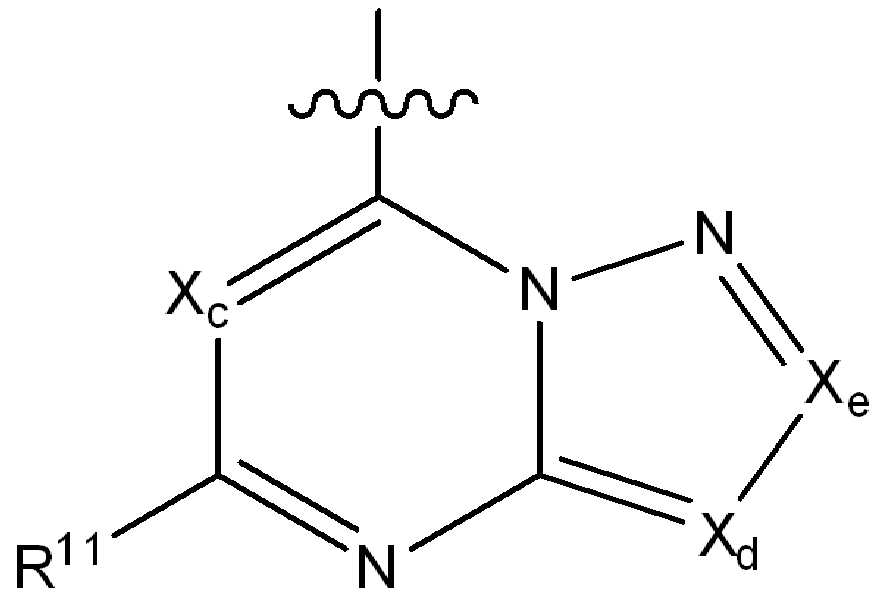
(식 중,(In the meal,

Xc, Xd 및 Xe는 N, CH, CF, CCl, C-CN 또는 CCH3로부터 독립적으로 선택되고;X c, X d and X e are independently selected from N, CH, CF, CCI, C-CN or CCH 3 ;
R11은 수소, 할로, (1-4C)알킬, (1-4C)알콕시, (1-4C)할로알킬, (1-4C)할로알콕시, 시아노, 니트로, (2-4C)알켄일, (2-4C)알킨일 또는 하기 화학식의 기로부터 선택되고:R 11 is hydrogen, halo, (1-4C) alkyl, (1-4C) alkoxy, (1-4C) haloalkyl, (1-4C) haloalkoxy, cyano, nitro, (2-4C) alkenyl, (2-4C) alkynyl or a group of the formula:
-Y5-Z5 -Y 5 -Z 5
식 중,In the formula,
Y5는 존재하지 않거나 또는 O, N(Rw), C(O), C(O)O, C(O)N(Rw) 또는 S(O)2N(Rw)이고, 여기서 Rw는 수소 또는 (1-4C)알킬로부터 선택되고;Y 5 is absent or is O, N (R w ), C (O), C (O) O, C (O) N (R w ) or S (O) 2 N (R w ), where R w is selected from hydrogen or (1-4C) alkyl;
Z5는 수소, (1-6C)알킬, 아릴, (3-8C)시클로알킬, (3-8C)시클로알켄일, 헤테로아릴 또는 헤테로시클릴이고; 여기서 Z5는 선택적으로 (1-4C)알킬, 할로, (1-4C)할로알킬, (1-4C)할로알콕시, 아미노, 시아노, 히드록시, 아미도, 카르복시, 카르바모일, 설파모일, 머캅토, NRyRz, ORy로부터 독립적으로 선택된 하나 이상의 치환기에 의해서 추가로 치환되고, 여기서 Ry 및 Rz는 각각 수소, (1-4C)알킬 또는 시클로프로필로부터 독립적으로 선택됨);Z 5 is hydrogen, (1-6C) alkyl, aryl, (3-8C) cycloalkyl, (3-8C) cycloalkenyl, heteroaryl or heterocyclyl; Wherein Z 5 is optionally (1-4C) alkyl, halo, (1-4C) haloalkyl, (1-4C) haloalkoxy, amino, cyano, hydroxy, amido, carboxy, carbamoyl, sulfamoyl , Is further substituted by one or more substituents independently selected from mercapto, NR y R z , OR y , wherein R y and R z are each independently selected from hydrogen, (1-4C) alkyl or cyclopropyl);
(71) R3은 하기로부터 선택됨:(71) R 3 is selected from:
i) 하기에 나타낸 화학식 A의 기:i) a group of formula A shown below:
[화학식 A][Formula A]

(식 중,(In the meal,

Xa 및 Xb는 N 또는 CRx1로부터 독립적으로 선택되고, 여기서 Rx1은 수소, 플루오로, 클로로, 브로모, 메틸, OCH3, 시아노 또는 아세틸렌일로부터 선택되고;X a and X b are independently selected from N or CR x1 , wherein R x1 is selected from hydrogen, fluoro, chloro, bromo, methyl, OCH 3 , cyano or acetylenyl;
R9는 플루오로, 클로로, 브로모, 메틸, OCH3, 시아노 또는 아세틸렌일로부터 선택되고;R 9 is selected from fluoro, chloro, bromo, methyl, OCH 3 , cyano or acetylenyl;
R10은 수소, 할로, (1-4C)알킬, (1-4C)알콕시, (1-4C)할로알킬, (1-4C)할로알콕시, 시아노, 니트로, (2-4C)알켄일, (2-4C)알킨일 또는 하기 화학식의 기로부터 선택되고:R 10 is hydrogen, halo, (1-4C) alkyl, (1-4C) alkoxy, (1-4C) haloalkyl, (1-4C) haloalkoxy, cyano, nitro, (2-4C) alkenyl, (2-4C) alkynyl or a group of the formula:
-Y3-Z3 -Y 3 -Z 3
식 중,In the formula,
Y3은 존재하지 않거나 또는 N(Rs)(CH2)q1 (여기서 q1은 0, 1 또는 2임), S, C(O), C(O)O, C(O)N(Rs) 또는 S(O)2N(Rs)이고, 여기서 Rs는 수소 또는 (1-4C)알킬로부터 선택되고;Y 3 is not present, or N (R s) (CH 2 ) q1 ( where q 1 is 0, 1 or 2), S, C (O) , C (O) O, C (O) N (R s ) or S (O) 2 N (R s ), wherein R s is selected from hydrogen or (1-4C) alkyl;
Z3은 수소, (1-6C)알킬, 아릴, (3-6C)시클로알킬, (2-4C)알켄일, (2-4C)알킨일, (3-6C)시클로알켄일, 헤테로아릴 또는 4원 내지 11원의 헤테로시클릴이고; 여기서 Z3은 선택적으로 옥소, (1-4C)알킬, (3-6C)시클로알킬, 할로, (1-4C)할로알킬, (1-4C)할로알콕시, 아미노, 시아노, 히드록시, 아미도, 카르복시, C(O)NRuRv, NRuRv 또는 ORu로부터 독립적으로 선택된 하나 이상의 치환기에 의해서 추가로 치환되고, 여기서 Ru 및 Rv는 각각 수소, (1-4C)알킬 또는 시클로프로필로부터 독립적으로 선택되거나; 또는 Z3은 선택적으로 하기 화학식의 기에 의해서 추가로 치환되고:Z 3 is hydrogen, (1-6C) alkyl, aryl, (3-6C) cycloalkyl, (2-4C) alkenyl, (2-4C) alkynyl, (3-6C) cycloalkenyl, heteroaryl or 4-11 membered heterocyclyl; Wherein Z 3 is optionally oxo, (1-4C) alkyl, (3-6C) cycloalkyl, halo, (1-4C) haloalkyl, (1-4C) haloalkoxy, amino, cyano, hydroxy, amino And further substituted by one or more substituents independently selected from carboxy, C (O) NR u R v , NR u R v or OR u , wherein R u and R v are each hydrogen, (1-4C) alkyl Or independently selected from cyclopropyl; Or Z 3 is optionally further substituted by a group of the formula:
-LZ-WZ -L Z -W Z
식 중,In the formula,
LZ는 (1-3C)알킬렌이고; L Z is (1-3C) alkylene;
WZ는 할로, (1-2C)할로알킬, (1-2C)할로알콕시, 시아노, 히드록시, (1-2C)알콕시, C(O)Rxa, COORxa, C(O)NRxaRxb 또는 NRxaRxb이고, 여기서 Rxa 및 Rxb는 각각 수소 또는 (1-2C)알킬로부터 독립적으로 선택됨);W Z is halo, (1-2C) haloalkyl, (1-2C) haloalkoxy, cyano, hydroxy, (1-2C) alkoxy, C (O) R xa , COOR xa , C (O) NR xa R xb or NR xa R xb , wherein R xa and R xb are each independently selected from hydrogen or (1-2C) alkyl);
ii) 하기에 나타낸 화학식 B의 기:ii) a group of formula B represented below:
[화학식 B][Formula B]

(식 중,(In the meal,

Xc 및 Xd는 N, CH, CF, CCl 또는 CCH3로부터 독립적으로 선택되고;X c and X d are independently selected from N, CH, CF, CCl or CCH 3 ;
R11은 수소, 할로, (1-4C)알킬, (1-4C)알콕시, (1-4C)할로알킬, (1-4C)할로알콕시, 시아노, 니트로, (2-4C)알켄일, (2-4C)알킨일 또는 하기 화학식의 기로부터 선택되고:R 11 is hydrogen, halo, (1-4C) alkyl, (1-4C) alkoxy, (1-4C) haloalkyl, (1-4C) haloalkoxy, cyano, nitro, (2-4C) alkenyl, (2-4C) alkynyl or a group of the formula:
-Y5-Z5 -Y 5 -Z 5
식 중,In the formula,
Y5는 존재하지 않거나 또는 O, N(Rw), C(O), C(O)O, C(O)N(Rw) 또는 S(O)2N(Rw)이고, 여기서 Rw는 수소 또는 (1-2C)알킬로부터 선택되고;Y 5 is absent or is O, N (R w ), C (O), C (O) O, C (O) N (R w ) or S (O) 2 N (R w ), where R w is selected from hydrogen or (1-2C) alkyl;
Z5는 수소, (1-6C)알킬, 아릴, (3-8C)시클로알킬, 5원 또는 6원의 헤테로아릴 또는 5원 또는 6원의 헤테로시클릴이고; 여기서 Z5는 선택적으로 (1-2C)알킬, 할로, (1-2C)할로알킬, (1-2C)할로알콕시, 아미노, 시아노, 히드록시, 아미도, 카르복시, 카르바모일, 설파모일, 머캅토, NRyRz, ORy로부터 독립적으로 선택된 하나 이상의 치환기에 의해서 추가로 치환되고, 여기서 Ry 및 Rz는 각각 수소 또는 (1-2C)알킬로부터 독립적으로 선택됨);Z 5 is hydrogen, (1-6C) alkyl, aryl, (3-8C) cycloalkyl, 5- or 6-membered heteroaryl or 5- or 6-membered heterocyclyl; Wherein Z 5 is optionally (1-2C) alkyl, halo, (1-2C) haloalkyl, (1-2C) haloalkoxy, amino, cyano, hydroxy, amido, carboxy, carbamoyl, sulfamoyl Is further substituted by one or more substituents independently selected from mercapto, NR y R z , OR y , wherein R y and R z are each independently selected from hydrogen or (1-2C) alkyl);
(72) R3은 하기로부터 선택됨:(72) R 3 is selected from:
i) 하기에 나타낸 화학식 A의 기:i) a group of formula A shown below:
[화학식 A][Formula A]

(식 중,(In the meal,

Xa 및 Xb는 N 또는 CRx1로부터 독립적으로 선택되고, 여기서 Rx1은 수소, 플루오로, 클로로, 브로모, (1-2C)알킬, (1-2C)알콕시, 시아노, 니트로, 아세틸렌일, CH2F 또는 CF2H로부터 선택되고;X a and X b are independently selected from N or CR x1 , wherein R x1 is hydrogen, fluoro, chloro, bromo, (1-2C) alkyl, (1-2C) alkoxy, cyano, nitro, acetylene One, CH 2 F or CF 2 H;
R9는 플루오로, 클로로, 브로모, (1-2C)알킬, (1-2C)알콕시, 시아노, 니트로, 아세틸렌일, CH2F, CF2H 또는 CF3으로부터 선택되고;R 9 is selected from fluoro, chloro, bromo, (1-2C) alkyl, (1-2C) alkoxy, cyano, nitro, acetylenyl, CH 2 F, CF 2 H or CF 3 ;
R10은 수소, 할로, (1-2C)알킬, (1-2C)알콕시, (1-2C)할로알킬, (1-2C)할로알콕시, 시아노, 니트로, (2-4C)알켄일, (2-4C)알킨일 또는 하기 화학식의 기로부터 선택되고:R 10 is hydrogen, halo, (1-2C) alkyl, (1-2C) alkoxy, (1-2C) haloalkyl, (1-2C) haloalkoxy, cyano, nitro, (2-4C) alkenyl, (2-4C) alkynyl or a group of the formula:
-Y3-Z3 -Y 3 -Z 3
식 중,In the formula,
Y3은 존재하지 않거나 또는 C(O), C(O)O, OC(O), C(O)N(Rs), N(Rs)C(O), S(O)2N(Rs), N(Rs)SO2이고, 여기서 Rs는 수소 또는 (1-4C)알킬로부터 선택되고;Y 3 is absent or C (O), C (O) O, OC (O), C (O) N (R s ), N (R s ) C (O), S (O) 2 N ( R s ), N (R s ) SO 2 , wherein R s is selected from hydrogen or (1-4C) alkyl;
Z3은 수소, (1-6C)알킬, 아릴, (3-6C)시클로알킬, (2-4C)알켄일, (2-4C)알킨일, (3-6C)시클로알켄일, 5원 또는 6원의 헤테로아릴 또는 5원 또는 6원의 헤테로시클릴이고; 여기서 Z3은 선택적으로 (1-4C)알킬, 할로, (1-4C)할로알킬, (1-4C)할로알콕시, 아미노, 시아노, 히드록시, 아미도, 카르복시, 카르바모일, 설파모일, 머캅토, NRuRv 또는 ORu로부터 독립적으로 선택된 하나 이상의 치환기에 의해서 추가로 치환되고, 여기서 Ru 및 Rv는 각각 수소, (1-4C)알킬 또는 (3-6C)시클로알킬로부터 독립적으로 선택됨);Z 3 is hydrogen, (1-6C) alkyl, aryl, (3-6C) cycloalkyl, (2-4C) alkenyl, (2-4C) alkynyl, (3-6C) cycloalkenyl, 5-membered or 6 membered heteroaryl or 5 membered or 6 membered heterocyclyl; Wherein Z 3 is optionally (1-4C) alkyl, halo, (1-4C) haloalkyl, (1-4C) haloalkoxy, amino, cyano, hydroxy, amido, carboxy, carbamoyl, sulfamoyl , Further substituted by one or more substituents independently selected from mercapto, NR u R v or OR u , wherein R u and R v are each hydrogen, (1-4C) alkyl or (3-6C) cycloalkyl Independently selected);
ii) 하기에 나타낸 화학식 B의 기:ii) a group of formula B represented below:
[화학식 B][Formula B]
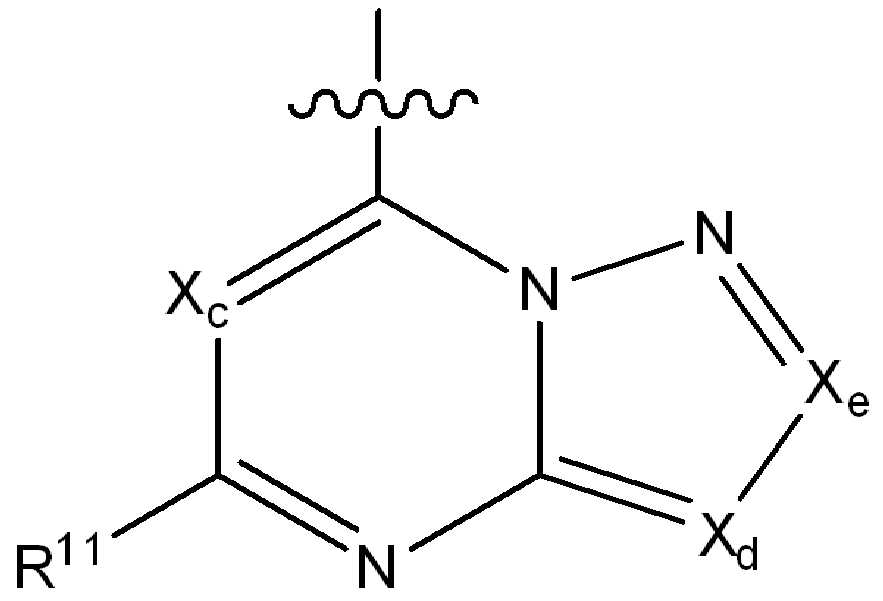
(식 중,(In the meal,

Xc, Xd 및 Xe는 N, CH, CF, CCl, C-CN 또는 CCH3로부터 독립적으로 선택되고; X c, X d and X e are independently selected from N, CH, CF, CCI, C-CN or CCH 3 ;
R11은 수소, 할로, (1-2C)알킬, (1-2C)알콕시, (1-2C)할로알킬, (1-2C)할로알콕시, 시아노, 니트로, (2-4C)알켄일, (2-4C)알킨일 또는 하기 화학식의 기로부터 선택되고:R 11 is hydrogen, halo, (1-2C) alkyl, (1-2C) alkoxy, (1-2C) haloalkyl, (1-2C) haloalkoxy, cyano, nitro, (2-4C) alkenyl, (2-4C) alkynyl or a group of the formula:
-Y5-Z5 -Y 5 -Z 5
식 중,In the formula,
Y5는 존재하지 않거나 또는 O, N(Rw), C(O), C(O)O, OC(O), C(O)N(Rw), N(Rw)C(O), S(O)2N(Rw), N(Rw)SO2이고, 여기서 Rw는 수소 또는 (1-4C)알킬로부터 선택되고;Y 5 is absent or O, N (R w ), C (O), C (O) O, OC (O), C (O) N (R w ), N (R w ) C (O) , S (O) 2 N (R w ), N (R w ) SO 2 , wherein R w is selected from hydrogen or (1-4C) alkyl;
Z5는 수소, (1-6C)알킬, 아릴, (3-8C)시클로알킬, (3-8C)시클로알켄일, 헤테로아릴 또는 헤테로시클릴이고; 여기서 Z5는 선택적으로 (1-4C)알킬, 할로, (1-4C)할로알킬, (1-4C)할로알콕시, 아미노, 시아노, 히드록시, 아미도, 카르복시, 카르바모일, 설파모일, 머캅토, NRyRz, ORy로부터 독립적으로 선택된 하나 이상의 치환기에 의해서 추가로 치환되고, 여기서 Ry 및 Rz는 각각 수소, (1-4C)알킬 또는 (3-6C)시클로알킬로부터 독립적으로 선택됨); Z 5 is hydrogen, (1-6C) alkyl, aryl, (3-8C) cycloalkyl, (3-8C) cycloalkenyl, heteroaryl or heterocyclyl; Wherein Z 5 is optionally (1-4C) alkyl, halo, (1-4C) haloalkyl, (1-4C) haloalkoxy, amino, cyano, hydroxy, amido, carboxy, carbamoyl, sulfamoyl , Is further substituted by one or more substituents independently selected from mercapto, NR y R z , OR y , wherein R y and R z are each from hydrogen, (1-4C) alkyl or (3-6C) cycloalkyl Independently selected);
(73) R3은 하기로부터 선택됨:(73) R 3 is selected from:
i) 하기에 나타낸 화학식 A의 기:i) a group of formula A shown below:
[화학식 A][Formula A]
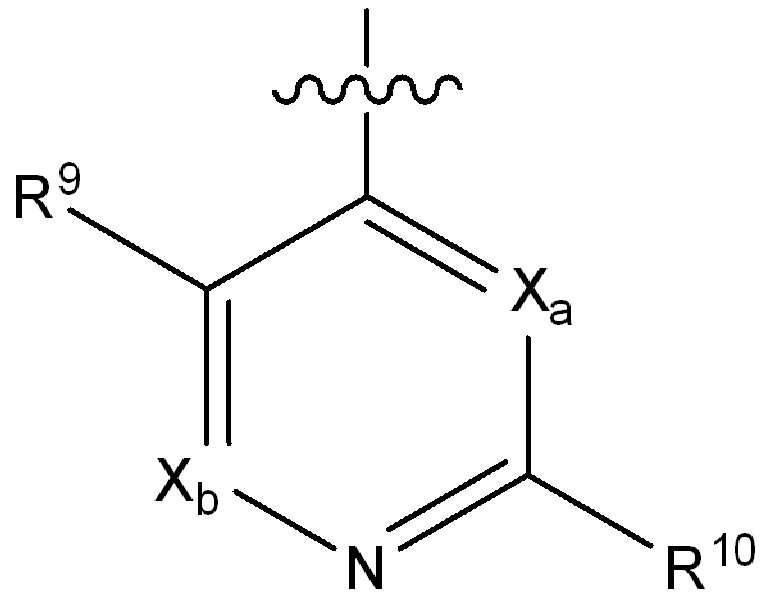
(식 중,(In the meal,

Xa 및 Xb는 N 또는 CRx1로부터 독립적으로 선택되고, 여기서 Rx1은 수소, 플루오로, 클로로, 브로모, 메틸, OCH3, 시아노 또는 아세틸렌일로부터 선택되고;X a and X b are independently selected from N or CR x1 , wherein R x1 is selected from hydrogen, fluoro, chloro, bromo, methyl, OCH 3 , cyano or acetylenyl;
R9는 플루오로, 클로로, 브로모, 메틸, OCH3, 시아노, 니트로 또는 아세틸렌일로부터 선택되고;R 9 is selected from fluoro, chloro, bromo, methyl, OCH 3 , cyano, nitro or acetylenyl;
R10은 수소, 할로, (1-2C)알킬, (1-2C)알콕시, (1-2C)할로알킬, (1-2C)할로알콕시, 시아노, 니트로, (2-4C)알켄일, (2-4C)알킨일 또는 하기 화학식의 기로부터 선택되고:R 10 is hydrogen, halo, (1-2C) alkyl, (1-2C) alkoxy, (1-2C) haloalkyl, (1-2C) haloalkoxy, cyano, nitro, (2-4C) alkenyl, (2-4C) alkynyl or a group of the formula:
-Y3-Z3 -Y 3 -Z 3
식 중,In the formula,
Y3은 존재하지 않거나 또는 C(O), C(O)O, C(O)N(Rs), 또는 S(O)2N(Rs)이고, 여기서 Rs는 수소 또는 (1-4C)알킬로부터 선택되고;Y 3 is absent or is C (O), C (O) O, C (O) N (R s ), or S (O) 2 N (R s ), where R s is hydrogen or (1- 4C) alkyl;
Z3은 수소, (1-6C)알킬, 아릴, (3-6C)시클로알킬, (2-4C)알켄일, (2-4C)알킨일, (3-6C)시클로알켄일, 5원 또는 6원의 헤테로아릴 또는 5원 또는 6원의 헤테로시클릴이고; 여기서 Z3은 선택적으로 (1-2C)알킬, 할로, (1-2C)할로알킬, (1-2C)할로알콕시, 아미노, 시아노, 히드록시, 아미도, 카르복시, NRuRv 또는 ORu로부터 독립적으로 선택된 하나 이상의 치환기에 의해서 추가로 치환되고, 여기서 Ru 및 Rv는 각각 수소 또는 (1-2C)알킬로부터 독립적으로 선택됨); Z 3 is hydrogen, (1-6C) alkyl, aryl, (3-6C) cycloalkyl, (2-4C) alkenyl, (2-4C) alkynyl, (3-6C) cycloalkenyl, 5-membered or 6 membered heteroaryl or 5 membered or 6 membered heterocyclyl; Wherein Z 3 is optionally (1-2C) alkyl, halo, (1-2C) haloalkyl, (1-2C) haloalkoxy, amino, cyano, hydroxy, amido, carboxy, NR u R v or OR further substituted by one or more substituents independently selected from u , wherein R u and R v are each independently selected from hydrogen or (1-2C) alkyl);
ii) 하기에 나타낸 화학식 B의 기:ii) a group of formula B represented below:
[화학식 B][Formula B]

(식 중,(In the meal,

Xc 및 Xd는 N, CH, CF, CCl 또는 CCH3로부터 독립적으로 선택되고; X c and X d are independently selected from N, CH, CF, CCl or CCH 3 ;
R11은 수소, 할로, (1-2C)알킬, (1-2C)알콕시, (1-2C)할로알킬, (1-2C)할로알콕시, 시아노, 니트로, (2-4C)알켄일, (2-4C)알킨일 또는 하기 화학식의 기로부터 선택되고:R 11 is hydrogen, halo, (1-2C) alkyl, (1-2C) alkoxy, (1-2C) haloalkyl, (1-2C) haloalkoxy, cyano, nitro, (2-4C) alkenyl, (2-4C) alkynyl or a group of the formula:
-Y5-Z5 -Y 5 -Z 5
식 중,In the formula,
Y5는 존재하지 않거나 또는 O, N(Rw), C(O), C(O)O, C(O)N(Rw) 또는 S(O)2N(Rw)이고, 여기서 Rw는 수소 또는 (1-4C)알킬로부터 선택되고;Y 5 is absent or is O, N (R w ), C (O), C (O) O, C (O) N (R w ) or S (O) 2 N (R w ), where R w is selected from hydrogen or (1-4C) alkyl;
Z5는 수소, (1-6C)알킬, 아릴, (3-6C)시클로알킬, (3-6C)시클로알켄일, 5원 또는 6원의 헤테로아릴 또는 5원 또는 6원의 헤테로시클릴이고; 여기서 Z5는 선택적으로 (1-2C)알킬, 할로, (1-2C)할로알킬, (1-2C)할로알콕시, 아미노, 시아노, 히드록시, 아미도, 카르복시, NRyRz, ORy로부터 독립적으로 선택된 하나 이상의 치환기에 의해서 추가로 치환되고, 여기서 Ry 및 Rz는 각각 수소 또는 (1-2C)알킬로부터 독립적으로 선택됨); Z 5 is hydrogen, (1-6C) alkyl, aryl, (3-6C) cycloalkyl, (3-6C) cycloalkenyl, 5- or 6-membered heteroaryl or 5- or 6-membered heterocyclyl ; Wherein Z 5 is optionally (1-2C) alkyl, halo, (1-2C) haloalkyl, (1-2C) haloalkoxy, amino, cyano, hydroxy, amido, carboxy, NR y R z , OR further substituted by one or more substituents independently selected from y , wherein R y and R z are each independently selected from hydrogen or (1-2C) alkyl);
(74) R3은 하기로부터 선택됨:(74) R 3 is selected from:
i) 하기에 나타낸 화학식 A의 기:i) a group of formula A shown below:
[화학식 A][Formula A]

(식 중,(In the meal,

Xa 및 Xb 둘 모두는 CRx1이고, 여기서 Rx1 은 수소, 플루오로, 클로로, 브로모 또는 메틸로부터 선택되고;X a and X b are both CR x1 , wherein R x1 is selected from hydrogen, fluoro, chloro, bromo or methyl;
R9는 플루오로, 클로로, 브로모, 메틸, OCH3, 시아노 또는 아세틸렌일로부터 선택되고;R 9 is selected from fluoro, chloro, bromo, methyl, OCH 3 , cyano or acetylenyl;
R10은 수소, 할로, (1-2C)알킬, (1-2C)알콕시, (1-2C)할로알킬, (1-2C)할로알콕시, 시아노, (2-4C)알켄일, (2-4C)알킨일 또는 하기 화학식의 기로부터 선택되고:R 10 is hydrogen, halo, (1-2C) alkyl, (1-2C) alkoxy, (1-2C) haloalkyl, (1-2C) haloalkoxy, cyano, (2-4C) alkenyl, (2 -4C) alkynyl or a group of formula:
-Y3-Z3 -Y 3 -Z 3
식 중,In the formula,
Y3은 존재하지 않거나 또는 C(O), C(O)O, C(O)N(Rs), 또는 S(O)2N(Rs)이고, 여기서 Rs는 수소 또는 (1-4C)알킬로부터 선택되고;Y 3 is absent or is C (O), C (O) O, C (O) N (R s ), or S (O) 2 N (R s ), where R s is hydrogen or (1- 4C) alkyl;
Z3은 수소, (1-6C)알킬, 아릴, (3-6C)시클로알킬, (2-4C)알켄일, (2-4C)알킨일, (3-6C)시클로알켄일, 5원 또는 6원의 헤테로아릴 또는 5원 또는 6원의 헤테로시클릴이고; 여기서 Z3은 선택적으로 (1-2C)알킬, 할로, (1-2C)할로알킬, (1-2C)할로알콕시, 아미노, 시아노, 히드록시, 아미도, 카르복시, NRuRv 또는 ORu로부터 독립적으로 선택된 하나 이상의 치환기에 의해서 추가로 치환되고, 여기서 Ru 및 Rv는 각각 수소 또는 (1-2C)알킬로부터 독립적으로 선택됨); Z 3 is hydrogen, (1-6C) alkyl, aryl, (3-6C) cycloalkyl, (2-4C) alkenyl, (2-4C) alkynyl, (3-6C) cycloalkenyl, 5-membered or 6 membered heteroaryl or 5 membered or 6 membered heterocyclyl; Wherein Z 3 is optionally (1-2C) alkyl, halo, (1-2C) haloalkyl, (1-2C) haloalkoxy, amino, cyano, hydroxy, amido, carboxy, NR u R v or OR further substituted by one or more substituents independently selected from u , wherein R u and R v are each independently selected from hydrogen or (1-2C) alkyl);
ii) 하기에 나타낸 화학식 B의 기:ii) a group of formula B represented below:
[화학식 B][Formula B]

(식 중,(In the meal,

Xc 및 Xd는 N, CH, CF, CCl 또는 CCH3로부터 독립적으로 선택되고; X c and X d are independently selected from N, CH, CF, CCl or CCH 3 ;
R11은 수소, 할로, (1-2C)알킬, (1-2C)알콕시, (1-2C)할로알킬, (1-2C)할로알콕시, 시아노, (2-4C)알켄일, (2-4C)알킨일 또는 하기 화학식의 기로부터 선택되고:R 11 is hydrogen, halo, (1-2C) alkyl, (1-2C) alkoxy, (1-2C) haloalkyl, (1-2C) haloalkoxy, cyano, (2-4C) alkenyl, (2 -4C) alkynyl or a group of formula:
-Y5-Z5 -Y 5 -Z 5
식 중,In the formula,
Y5는 존재하지 않거나 또는 O, N(Rw), C(O), C(O)O, C(O)N(Rw) 또는 S(O)2N(Rw)이고, 여기서 Rw는 수소 또는 (1-4C)알킬로부터 선택되고;Y 5 is absent or is O, N (R w ), C (O), C (O) O, C (O) N (R w ) or S (O) 2 N (R w ), where R w is selected from hydrogen or (1-4C) alkyl;
Z5는 수소, (1-6C)알킬, 아릴, (3-6C)시클로알킬, (3-6C)시클로알켄일, 5원 또는 6원의 헤테로아릴 또는 5원 또는 6원의 헤테로시클릴이고; 여기서 Z5는 선택적으로 (1-2C)알킬, 할로, (1-2C)할로알킬, (1-2C)할로알콕시, 아미노, 시아노, 히드록시, 아미도, 카르복시, NRyRz, ORy로부터 독립적으로 선택된 하나 이상의 치환기에 의해서 추가로 치환되고, 여기서 Ry 및 Rz는 각각 수소 또는 (1-2C)알킬로부터 독립적으로 선택됨); Z 5 is hydrogen, (1-6C) alkyl, aryl, (3-6C) cycloalkyl, (3-6C) cycloalkenyl, 5- or 6-membered heteroaryl or 5- or 6-membered heterocyclyl ; Wherein Z 5 is optionally (1-2C) alkyl, halo, (1-2C) haloalkyl, (1-2C) haloalkoxy, amino, cyano, hydroxy, amido, carboxy, NR y R z , OR further substituted by one or more substituents independently selected from y , wherein R y and R z are each independently selected from hydrogen or (1-2C) alkyl);
(75) R3은 하기로부터 선택됨:(75) R 3 is selected from:
i) 하기에 나타낸 화학식 A의 기:i) a group of formula A shown below:
[화학식 A][Formula A]

(식 중,(In the meal,

Xb는 CRx1이고, 여기서 Rx1 은 수소, 플루오로, 클로로, 브로모 또는 메틸로부터 선택되고;X b is CR x1 , wherein R x1 is selected from hydrogen, fluoro, chloro, bromo or methyl;
R9는 플루오로, 클로로, 브로모, 메틸, OCH3, 시아노 또는 아세틸렌일로부터 선택되고;R 9 is selected from fluoro, chloro, bromo, methyl, OCH 3 , cyano or acetylenyl;
R10은 수소, 할로, (1-2C)알킬, (1-2C)알콕시, (1-2C)할로알킬, (1-2C)할로알콕시, 시아노, (2-4C)알켄일, (2-4C)알킨일 또는 하기 화학식의 기로부터 선택되고:R 10 is hydrogen, halo, (1-2C) alkyl, (1-2C) alkoxy, (1-2C) haloalkyl, (1-2C) haloalkoxy, cyano, (2-4C) alkenyl, (2 -4C) alkynyl or a group of formula:
-Y3-Z3 -Y 3 -Z 3
식 중,In the formula,
Y3은 존재하지 않거나 또는 C(O), C(O)O, C(O)N(Rs), 또는 S(O)2N(Rs)이고, 여기서 Rs는 수소 또는 (1-4C)알킬로부터 선택되고;Y 3 is absent or is C (O), C (O) O, C (O) N (R s ), or S (O) 2 N (R s ), where R s is hydrogen or (1- 4C) alkyl;
Z3은 수소, (1-6C)알킬, 아릴, (3-6C)시클로알킬, (2-4C)알켄일, (2-4C)알킨일, (3-6C)시클로알켄일, 5원 또는 6원의 헤테로아릴 또는 5원 또는 6원의 헤테로시클릴이고; 여기서 Z3은 선택적으로 (1-2C)알킬, 할로, (1-2C)할로알킬, (1-2C)할로알콕시, 아미노, 시아노, 히드록시, 아미도, 카르복시, NRuRv 또는 ORu로부터 독립적으로 선택된 하나 이상의 치환기에 의해서 추가로 치환되고, 여기서 Ru 및 Rv는 각각 수소 또는 (1-2C)알킬로부터 독립적으로 선택됨); Z 3 is hydrogen, (1-6C) alkyl, aryl, (3-6C) cycloalkyl, (2-4C) alkenyl, (2-4C) alkynyl, (3-6C) cycloalkenyl, 5-membered or 6 membered heteroaryl or 5 membered or 6 membered heterocyclyl; Wherein Z 3 is optionally (1-2C) alkyl, halo, (1-2C) haloalkyl, (1-2C) haloalkoxy, amino, cyano, hydroxy, amido, carboxy, NR u R v or OR further substituted by one or more substituents independently selected from u , wherein R u and R v are each independently selected from hydrogen or (1-2C) alkyl);
ii) 하기에 나타낸 화학식 B의 기:ii) a group of formula B represented below:
[화학식 B][Formula B]

(식 중,(In the meal,

Xc는 N, CH, CF, CCl 또는 CCH3로부터 선택되고; X c is selected from N, CH, CF, CCl or CCH 3 ;
R11은 수소, 할로, (1-2C)알킬, (1-2C)알콕시, (1-2C)할로알킬, (1-2C)할로알콕시, 시아노, (2-4C)알켄일, (2-4C)알킨일 또는 하기 화학식의 기로부터 선택되고:R 11 is hydrogen, halo, (1-2C) alkyl, (1-2C) alkoxy, (1-2C) haloalkyl, (1-2C) haloalkoxy, cyano, (2-4C) alkenyl, (2 -4C) alkynyl or a group of formula:
-Y5-Z5 -Y 5 -Z 5
식 중,In the formula,
Y5는 존재하지 않거나 또는 O, N(Rw), C(O), C(O)O, C(O)N(Rw) 또는 S(O)2N(Rw)이고, 여기서 Rw는 수소 또는 (1-4C)알킬로부터 선택되고;Y 5 is absent or is O, N (R w ), C (O), C (O) O, C (O) N (R w ) or S (O) 2 N (R w ), where R w is selected from hydrogen or (1-4C) alkyl;
Z5는 수소, (1-6C)알킬, 아릴, (3-6C)시클로알킬, (3-6C)시클로알켄일, 5원 또는 6원의 헤테로아릴 또는 5원 또는 6원의 헤테로시클릴이고; 여기서 Z5는 선택적으로 (1-2C)알킬, 할로, (1-2C)할로알킬, (1-2C)할로알콕시, 아미노, 시아노, 히드록시, 아미도, 카르복시, NRyRz, ORy로부터 독립적으로 선택된 하나 이상의 치환기에 의해서 추가로 치환되고, 여기서 Ry 및 Rz는 각각 수소 또는 (1-2C)알킬로부터 독립적으로 선택됨); Z 5 is hydrogen, (1-6C) alkyl, aryl, (3-6C) cycloalkyl, (3-6C) cycloalkenyl, 5- or 6-membered heteroaryl or 5- or 6-membered heterocyclyl ; Wherein Z 5 is optionally (1-2C) alkyl, halo, (1-2C) haloalkyl, (1-2C) haloalkoxy, amino, cyano, hydroxy, amido, carboxy, NR y R z , OR further substituted by one or more substituents independently selected from y , wherein R y and R z are each independently selected from hydrogen or (1-2C) alkyl);
(76) R3은 하기로부터 선택됨:(76) R 3 is selected from:
i) 하기에 나타낸 화학식 A의 기:i) a group of formula A shown below:
[화학식 A][Formula A]
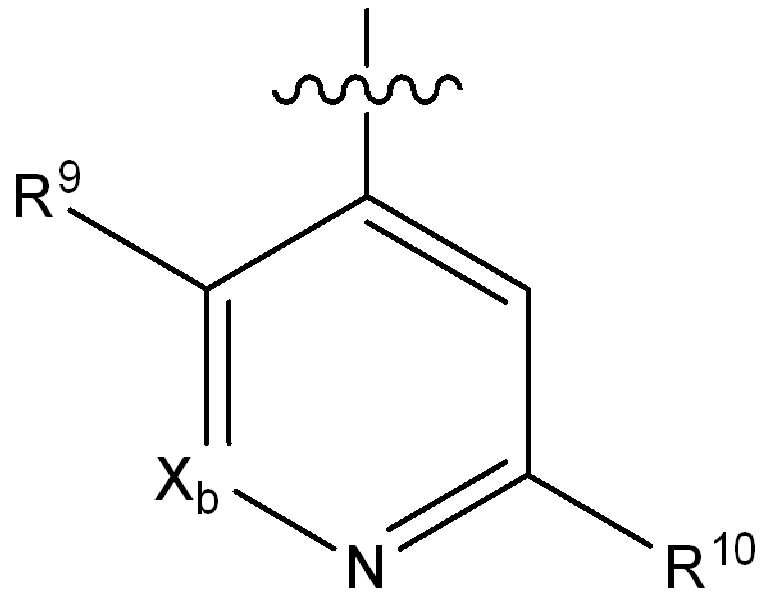
(식 중,(In the meal,

Xb는 CRx1이고, 여기서 Rx1은 수소 또는 클로로로부터 선택되고;X b is CR x1 , wherein R x1 is selected from hydrogen or chloro;
R9는 플루오로, 클로로, 브로모, 메틸, OCH3, 시아노 또는 아세틸렌일로부터 선택되고;R 9 is selected from fluoro, chloro, bromo, methyl, OCH 3 , cyano or acetylenyl;
R10은 수소, 할로, (1-2C)알킬, (1-2C)알콕시, (1-2C)할로알킬, (1-2C)할로알콕시, 시아노, (2-4C)알켄일, (2-4C)알킨일 또는 하기 화학식의 기로부터 선택되고:R 10 is hydrogen, halo, (1-2C) alkyl, (1-2C) alkoxy, (1-2C) haloalkyl, (1-2C) haloalkoxy, cyano, (2-4C) alkenyl, (2 -4C) alkynyl or a group of formula:
-Y3-Z3 -Y 3 -Z 3
식 중,In the formula,
Y3은 존재하지 않거나 또는 C(O), C(O)O, C(O)N(Rs), 또는 S(O)2N(Rs)이고, 여기서 Rs는 수소 또는 (1-4C)알킬로부터 선택되고;Y 3 is absent or is C (O), C (O) O, C (O) N (R s ), or S (O) 2 N (R s ), where R s is hydrogen or (1- 4C) alkyl;
Z3은 수소, (1-6C)알킬, 아릴, (2-4C)알킨일, 5원 또는 6원의 헤테로아릴 또는 5원 또는 6원의 헤테로시클릴이고; 여기서 Z3은 선택적으로 (1-2C)알킬, 할로, (1-2C)할로알킬, (1-2C)할로알콕시, 아미노, 시아노, 히드록시, 아미도, 카르복시, NRuRv 또는 ORu로부터 독립적으로 선택된 하나 이상의 치환기에 의해서 추가로 치환되고, 여기서 Ru 및 Rv는 각각 수소 또는 (1-2C)알킬로부터 독립적으로 선택됨);Z 3 is hydrogen, (1-6C) alkyl, aryl, (2-4C) alkynyl, 5- or 6-membered heteroaryl or 5- or 6-membered heterocyclyl; Wherein Z 3 is optionally (1-2C) alkyl, halo, (1-2C) haloalkyl, (1-2C) haloalkoxy, amino, cyano, hydroxy, amido, carboxy, NR u R v or OR further substituted by one or more substituents independently selected from u , wherein R u and R v are each independently selected from hydrogen or (1-2C) alkyl);
ii) 하기에 나타낸 화학식 B의 기:ii) a group of formula B represented below:
[화학식 B][Formula B]

(식 중,(In the meal,

Xc는 N, CH, CF, CCl 또는 CCH3로부터 선택되고; X c is selected from N, CH, CF, CCl or CCH 3 ;
R11은 수소, 할로, (1-2C)알킬, (1-2C)알콕시, (1-2C)할로알킬, (1-2C)할로알콕시, 시아노, (2-4C)알켄일, (2-4C)알킨일 또는 하기 화학식의 기로부터 선택되고:R 11 is hydrogen, halo, (1-2C) alkyl, (1-2C) alkoxy, (1-2C) haloalkyl, (1-2C) haloalkoxy, cyano, (2-4C) alkenyl, (2 -4C) alkynyl or a group of formula:
-Y5-Z5 -Y 5 -Z 5
식 중,In the formula,
Y5는 존재하지 않거나 또는 O, N(Rw), C(O), C(O)O, C(O)N(Rw) 또는 S(O)2N(Rw)이고, 여기서 Rw는 수소 또는 (1-4C)알킬로부터 선택되고;Y 5 is absent or is O, N (R w ), C (O), C (O) O, C (O) N (R w ) or S (O) 2 N (R w ), where R w is selected from hydrogen or (1-4C) alkyl;
Z5는 수소, (1-6C)알킬, 아릴, 5원 또는 6원의 헤테로아릴 또는 5원 또는 6원의 헤테로시클릴이고; 여기서 Z5는 선택적으로 (1-2C)알킬, 할로, (1-2C)할로알킬, (1-2C)할로알콕시, 아미노, 시아노, 히드록시, 아미도, 카르복시, NRyRz, ORy로부터 독립적으로 선택된 하나 이상의 치환기에 의해서 추가로 치환되고, 여기서 Ry 및 Rz는 각각 수소 또는 (1-2C)알킬로부터 독립적으로 선택됨); Z 5 is hydrogen, (1-6C) alkyl, aryl, 5- or 6-membered heteroaryl or 5- or 6-membered heterocyclyl; Wherein Z 5 is optionally (1-2C) alkyl, halo, (1-2C) haloalkyl, (1-2C) haloalkoxy, amino, cyano, hydroxy, amido, carboxy, NR y R z , OR further substituted by one or more substituents independently selected from y , wherein R y and R z are each independently selected from hydrogen or (1-2C) alkyl);
(77) R3은 하기에 나타낸 화학식 A의 기임:(77) R 3 is a group of formula A shown below:
[화학식 A][Formula A]
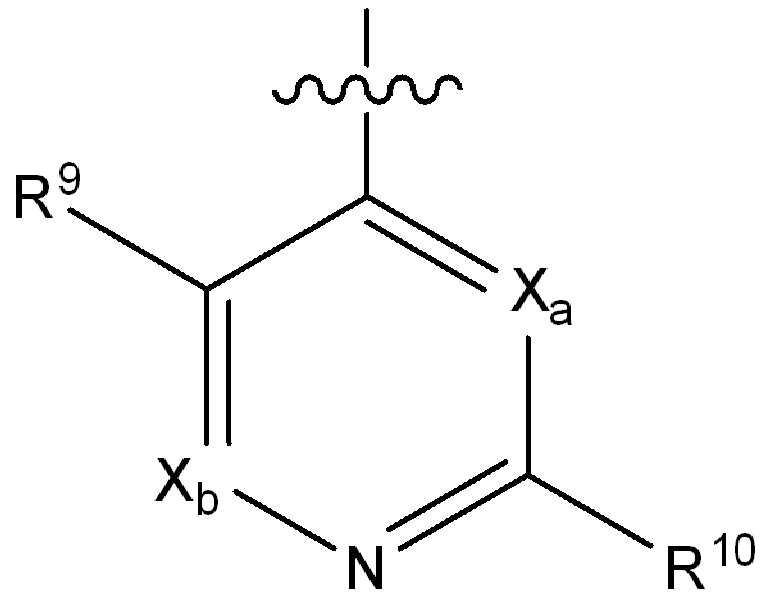
(식 중,(In the meal,

Xa 및 Xb는 N 또는 CRx1로부터 독립적으로 선택되고, 여기서 Rx1은 수소, 플루오로, 클로로, 브로모, (1-2C)알킬, (1-2C)알콕시, 시아노, 니트로, 아세틸렌일, CH2F, CF2H 또는 CF3로부터 선택되고;X a and X b are independently selected from N or CR x1 , wherein R x1 is hydrogen, fluoro, chloro, bromo, (1-2C) alkyl, (1-2C) alkoxy, cyano, nitro, acetylene One, CH 2 F, CF 2 H or CF 3 ;
R9는 수소, 플루오로, 클로로, 브로모, (1-2C)알킬, (1-2C)알콕시, 시아노, 니트로, 아세틸렌일, CH2F, CF2H 또는 CF3으로부터 선택되고;R 9 is selected from hydrogen, fluoro, chloro, bromo, (1-2C) alkyl, (1-2C) alkoxy, cyano, nitro, acetylenyl, CH 2 F, CF 2 H or CF 3 ;
R10은 수소, 할로, (1-4C)알킬, (1-4C)알콕시, (1-4C)할로알킬, (1-4C)할로알콕시, 시아노, 니트로, (2-4C)알켄일, (2-4C)알킨일 또는 하기 화학식의 기로부터 선택되고:R 10 is hydrogen, halo, (1-4C) alkyl, (1-4C) alkoxy, (1-4C) haloalkyl, (1-4C) haloalkoxy, cyano, nitro, (2-4C) alkenyl, (2-4C) alkynyl or a group of the formula:
-Y3-Z3 -Y 3 -Z 3
식 중,In the formula,
Y3은 존재하지 않거나 또는 O, N(Rs)(CRsRt)q1(여기서 q1은 0, 1 또는 2임), S, SO, SO2, C(O), C(O)O, OC(O), C(O)N(Rs), N(Rs)C(O), N(Rs)C(O)N(Rt), N(Rs)C(O)O, OC(O)N(Rs), S(O)2N(Rs), N(Rs)SO2이고, 여기서 Rs 및 Rt는 각각 수소 또는 (1-4C)알킬로부터 독립적으로 선택되고;Y 3 is not present or O, N (R s) ( CR s R t) q1 ( where q 1 is 0, 1 or 2), S, SO, SO 2, C (O), C (O) O, OC (O), C (O) N (R s ), N (R s ) C (O), N (R s ) C (O) N (R t ), N (R s ) C (O ) O, OC (O) N (R s ), S (O) 2 N (R s ), N (R s ) SO 2 , where R s and R t are each from hydrogen or (1-4C) alkyl Independently selected;
Z3은 수소, (1-6C)알킬, 아릴, (3-6C)시클로알킬, (2-4C)알켄일, (2-4C)알킨일, (3-6C)시클로알켄일, 헤테로아릴 또는 4원 내지 11원의 헤테로시클릴이고; 여기서 Z3은 선택적으로 옥소, (1-4C)알킬, (3-6C)시클로알킬, 할로, (1-4C)할로알킬, (1-4C)할로알콕시, (1-4C)히드록시알킬, 아미노, 시아노, 히드록시, 아미도, 카르복시, 카르바모일, 설파모일, 머캅토, C(O)NRuRv, NRuRv 또는 ORu로부터 독립적으로 선택된 하나 이상의 치환기에 의해서 추가로 치환되고, 여기서 Ru 및 Rv는 각각 수소, (1-4C)알킬 또는 (3-6C)시클로알킬로부터 독립적으로 선택되고/되거나; Z3은 선택적으로 하기 화학식의 기에 의해서 추가로 치환되고:Z 3 is hydrogen, (1-6C) alkyl, aryl, (3-6C) cycloalkyl, (2-4C) alkenyl, (2-4C) alkynyl, (3-6C) cycloalkenyl, heteroaryl or 4-11 membered heterocyclyl; Wherein Z 3 is optionally oxo, (1-4C) alkyl, (3-6C) cycloalkyl, halo, (1-4C) haloalkyl, (1-4C) haloalkoxy, (1-4C) hydroxyalkyl, Further by one or more substituents independently selected from amino, cyano, hydroxy, amido, carboxy, carbamoyl, sulfamoyl, mercapto, C (O) NR u R v , NR u R v or OR u Substituted, wherein R u and R v are each independently selected from hydrogen, (1-4C) alkyl or (3-6C) cycloalkyl; Z 3 is optionally further substituted by a group of the formula:
-LZ-WZ -L Z -W Z
식 중,In the formula,
LZ는 존재하지 않거나 또는 하나 이상의 (1-2C)알킬 기에 의해서 선택적으로 치환된 (1-5C)알킬렌이고; L Z is (1-5C) alkylene, absent or optionally substituted by one or more (1-2C) alkyl groups;
WZ는 아릴, 5원 또는 6원의 헤테로아릴, 4원 내지 7원의 헤테로시클릴, 할로, (1-4C)할로알킬, (1-4C)할로알콕시, 시아노, 히드록시, (1-4C)알콕시, C(O)Rxa, COORxa, C(O)NRxaRxb 또는 NRxaRxb이고, 여기서 Rxa 및 Rxb는 각각 수소 또는 (1-4C)알킬로부터 독립적으로 선택되고; 여기서 각각의 아릴, 5원 또는 6원의 헤테로아릴 또는 4원 내지 7원의 헤테로시클릴은 선택적으로 (1-2C)알킬, 할로, (1-2C)할로알킬, 아미노, 시아노 또는 히드록시로부터 독립적으로 선택된 하나 이상의 치환기에 의해서 추가로 치환됨);W Z is aryl, 5- or 6-membered heteroaryl, 4--7 membered heterocyclyl, halo, (1-4C) haloalkyl, (1-4C) haloalkoxy, cyano, hydroxy, (1 -4C) alkoxy, C (O) R xa , COOR xa , C (O) NR xa R xb or NR xa R xb , wherein R xa and R xb are each independently selected from hydrogen or (1-4C) alkyl Become; Wherein each aryl, 5- or 6-membered heteroaryl or 4--7 membered heterocyclyl is optionally (1-2C) alkyl, halo, (1-2C) haloalkyl, amino, cyano or hydroxy Further substituted by one or more substituents independently selected from);
(78) R3은 하기에 나타낸 화학식 A의 기임:(78) R 3 is a group of Formula A shown below:
[화학식 A][Formula A]

(식 중,(In the meal,

Xa 및 Xb는 N 또는 CRx1로부터 독립적으로 선택되고, 여기서 Rx1은 수소, 플루오로, 클로로, 브로모, (1-2C)알킬, (1-2C)알콕시, 시아노, 니트로, 아세틸렌일, CH2F, CF2H 또는 CF3로부터 선택되고;X a and X b are independently selected from N or CR x1 , wherein R x1 is hydrogen, fluoro, chloro, bromo, (1-2C) alkyl, (1-2C) alkoxy, cyano, nitro, acetylene One, CH 2 F, CF 2 H or CF 3 ;
R9는 수소, 플루오로, 클로로, 브로모, (1-2C)알킬, (1-2C)알콕시, 시아노, 니트로, 아세틸렌일, CH2F, CF2H 또는 CF3으로부터 선택되고;R 9 is selected from hydrogen, fluoro, chloro, bromo, (1-2C) alkyl, (1-2C) alkoxy, cyano, nitro, acetylenyl, CH 2 F, CF 2 H or CF 3 ;
R10은 수소, 할로, (1-4C)알킬, (1-4C)알콕시, (1-4C)할로알킬, (1-4C)할로알콕시, 시아노, 니트로, (2-4C)알켄일, (2-4C)알킨일 또는 하기 화학식의 기로부터 선택되고:R 10 is hydrogen, halo, (1-4C) alkyl, (1-4C) alkoxy, (1-4C) haloalkyl, (1-4C) haloalkoxy, cyano, nitro, (2-4C) alkenyl, (2-4C) alkynyl or a group of the formula:
-Y3-Z3 -Y 3 -Z 3
식 중,In the formula,
Y3은 존재하지 않거나 또는 O, N(Rs)(CRsRt)q1(여기서 q1은 0, 1 또는 2임), S, SO, SO2, C(O), C(O)O, OC(O), C(O)N(Rs), N(Rs)C(O), N(Rs)C(O)N(Rt), N(Rs)C(O)O, OC(O)N(Rs), S(O)2N(Rs), N(Rs)SO2이고, 여기서 Rs 및 Rt는 각각 수소 또는 (1-4C)알킬로부터 독립적으로 선택되고;Y 3 is not present or O, N (R s) ( CR s R t) q1 ( where q 1 is 0, 1 or 2), S, SO, SO 2, C (O), C (O) O, OC (O), C (O) N (R s ), N (R s ) C (O), N (R s ) C (O) N (R t ), N (R s ) C (O ) O, OC (O) N (R s ), S (O) 2 N (R s ), N (R s ) SO 2 , where R s and R t are each from hydrogen or (1-4C) alkyl Independently selected;
Z3은 수소, (1-6C)알킬, 아릴, (3-6C)시클로알킬, (2-4C)알켄일, (2-4C)알킨일, (3-6C)시클로알켄일, 헤테로아릴 또는 4원 내지 11원의 헤테로시클릴이고; 여기서 Z3은 선택적으로 옥소, (1-4C)알킬, (3-6C)시클로알킬, 할로, (1-4C)할로알킬, (1-4C)할로알콕시, 아미노, 시아노, 히드록시, 아미도, 카르복시, 카르바모일, 설파모일, 머캅토, C(O)NRuRv, NRuRv 또는 ORu로부터 독립적으로 선택된 하나 이상의 치환기에 의해서 추가로 치환되고, 여기서 Ru 및 Rv는 각각 수소, (1-4C)알킬 또는 (3-6C)시클로알킬로부터 독립적으로 선택되고/되거나; Z3은 선택적으로 하기 화학식의 기에 의해서 추가로 치환되고:Z 3 is hydrogen, (1-6C) alkyl, aryl, (3-6C) cycloalkyl, (2-4C) alkenyl, (2-4C) alkynyl, (3-6C) cycloalkenyl, heteroaryl or 4-11 membered heterocyclyl; Wherein Z 3 is optionally oxo, (1-4C) alkyl, (3-6C) cycloalkyl, halo, (1-4C) haloalkyl, (1-4C) haloalkoxy, amino, cyano, hydroxy, amino Or further substituted by one or more substituents independently selected from carboxy, carbamoyl, sulfamoyl, mercapto, C (O) NR u R v , NR u R v or OR u , wherein R u and R v Are each independently selected from hydrogen, (1-4C) alkyl or (3-6C) cycloalkyl; Z 3 is optionally further substituted by a group of the formula:
-LZ-WZ -L Z -W Z
식 중,In the formula,
LZ는 존재하지 않거나 또는 하나 이상의 (1-2C)알킬 기에 의해서 선택적으로 치환된 (1-5C)알킬렌이고; L Z is (1-5C) alkylene, absent or optionally substituted by one or more (1-2C) alkyl groups;
WZ는 아릴, 5원 또는 6원의 헤테로아릴, 4원 내지 7원의 헤테로시클릴, 할로, (1-4C)할로알킬, (1-4C)할로알콕시, 시아노, 히드록시, (1-4C)알콕시, C(O)Rxa, COORxa, C(O)NRxaRxb 또는 NRxaRxb이고, 여기서 Rxa 및 Rxb는 각각 수소 또는 (1-4C)알킬로부터 독립적으로 선택됨);W Z is aryl, 5- or 6-membered heteroaryl, 4--7 membered heterocyclyl, halo, (1-4C) haloalkyl, (1-4C) haloalkoxy, cyano, hydroxy, (1 -4C) alkoxy, C (O) R xa , COOR xa , C (O) NR xa R xb or NR xa R xb , where R xa and R xb are each independently selected from hydrogen or (1-4C) alkyl );
(79) R3은 하기에 나타낸 화학식 A의 기임:(79) R 3 is a group of formula A shown below:
[화학식 A][Formula A]
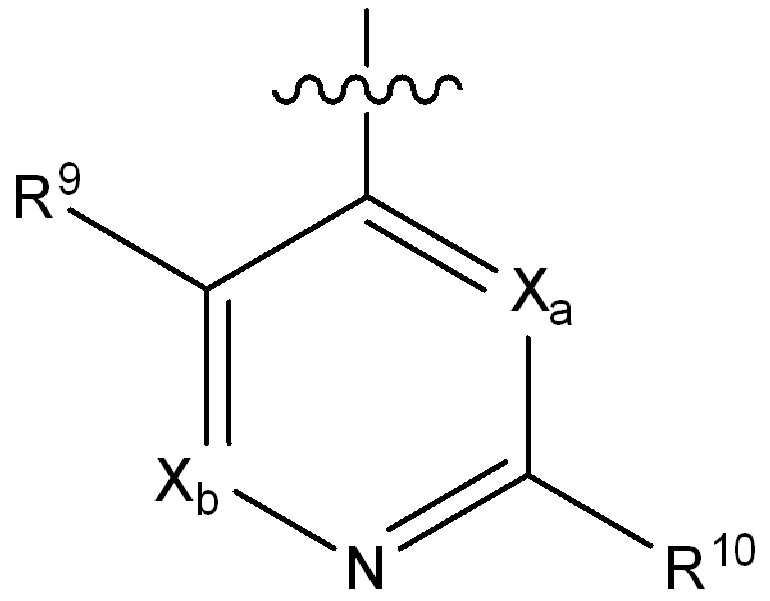
(식 중,(In the meal,

Xa 및 Xb는 N 또는 CRx1로부터 독립적으로 선택되고, 여기서 Rx1은 수소, 플루오로, 클로로, 브로모, (1-2C)알킬, (1-2C)알콕시, 시아노, 니트로, 아세틸렌일, CH2F, CF2H 또는 CF3로부터 선택되고;X a and X b are independently selected from N or CR x1 , wherein R x1 is hydrogen, fluoro, chloro, bromo, (1-2C) alkyl, (1-2C) alkoxy, cyano, nitro, acetylene One, CH 2 F, CF 2 H or CF 3 ;
R9는 수소, 플루오로, 클로로, 브로모, (1-2C)알킬, (1-2C)알콕시, 시아노, 니트로, 아세틸렌일, CH2F, CF2H 또는 CF3으로부터 선택되고;R 9 is selected from hydrogen, fluoro, chloro, bromo, (1-2C) alkyl, (1-2C) alkoxy, cyano, nitro, acetylenyl, CH 2 F, CF 2 H or CF 3 ;
R10은 수소, 할로, (1-4C)알킬, (1-4C)알콕시, (1-4C)할로알킬, (1-4C)할로알콕시, 시아노, 니트로, (2-4C)알켄일, (2-4C)알킨일 또는 하기 화학식의 기로부터 선택되고:R 10 is hydrogen, halo, (1-4C) alkyl, (1-4C) alkoxy, (1-4C) haloalkyl, (1-4C) haloalkoxy, cyano, nitro, (2-4C) alkenyl, (2-4C) alkynyl or a group of the formula:
-Y3-Z3 -Y 3 -Z 3
식 중,In the formula,
Y3은 존재하지 않거나 또는 O, N(Rs)(CRsRt)q1(여기서 q1은 0, 1 또는 2임), S, SO, SO2, C(O), C(O)O, OC(O), C(O)N(Rs), N(Rs)C(O), N(Rs)C(O)N(Rt), N(Rs)C(O)O, OC(O)N(Rs), S(O)2N(Rs), N(Rs)SO2이고, 여기서 Rs 및 Rt는 각각 수소 또는 (1-4C)알킬로부터 독립적으로 선택되고;Y 3 is not present or O, N (R s) ( CR s R t) q1 ( where q 1 is 0, 1 or 2), S, SO, SO 2, C (O), C (O) O, OC (O), C (O) N (R s ), N (R s ) C (O), N (R s ) C (O) N (R t ), N (R s ) C (O ) O, OC (O) N (R s ), S (O) 2 N (R s ), N (R s ) SO 2 , where R s and R t are each from hydrogen or (1-4C) alkyl Independently selected;
Z3은 수소, (1-6C)알킬, 아릴, (3-6C)시클로알킬, (2-4C)알켄일, (2-4C)알킨일, (3-6C)시클로알켄일, 헤테로아릴 또는 4원 내지 11원의 헤테로시클릴이고; 여기서 Z3은 선택적으로 옥소, (1-4C)알킬, (3-6C)시클로알킬, 할로, (1-4C)할로알킬, (1-4C)할로알콕시, 아미노, 시아노, 히드록시, 아미도, 카르복시, 카르바모일, 설파모일, 머캅토, C(O)NRuRv, NRuRv 또는 ORu로부터 독립적으로 선택된 하나 이상의 치환기에 의해서 추가로 치환되고, 여기서 Ru 및 Rv는 각각 수소, (1-4C)알킬 또는 (3-6C)시클로알킬로부터 독립적으로 선택되거나; 또는 Z3은 선택적으로 하기 화학식의 기에 의해서 추가로 치환되고:Z 3 is hydrogen, (1-6C) alkyl, aryl, (3-6C) cycloalkyl, (2-4C) alkenyl, (2-4C) alkynyl, (3-6C) cycloalkenyl, heteroaryl or 4-11 membered heterocyclyl; Wherein Z 3 is optionally oxo, (1-4C) alkyl, (3-6C) cycloalkyl, halo, (1-4C) haloalkyl, (1-4C) haloalkoxy, amino, cyano, hydroxy, amino Or further substituted by one or more substituents independently selected from carboxy, carbamoyl, sulfamoyl, mercapto, C (O) NR u R v , NR u R v or OR u , wherein R u and R v Are each independently selected from hydrogen, (1-4C) alkyl or (3-6C) cycloalkyl; Or Z 3 is optionally further substituted by a group of the formula:
-LZ-WZ -L Z -W Z
식 중,In the formula,
LZ는 (1-2C)알킬 또는 옥소로부터 선택된 하나 이상의 치환체에 의해서 선택적으로 치환된 (1-5C)알킬렌이고; L Z is (1-5C) alkylene optionally substituted by one or more substituents selected from (1-2C) alkyl or oxo;
WZ는 할로, (1-4C)할로알킬, (1-4C)할로알콕시, 시아노, 히드록시, (1-4C)알콕시, C(O)Rxa, COORxa, C(O)NRxaRxb 또는 NRxaRxb이고, 여기서 Rxa 및 Rxb는 각각 수소 또는 (1-4C)알킬로부터 독립적으로 선택됨); W Z is halo, (1-4C) haloalkyl, (1-4C) haloalkoxy, cyano, hydroxy, (1-4C) alkoxy, C (O) R xa , COOR xa , C (O) NR xa R xb or NR xa R xb , wherein R xa and R xb are each independently selected from hydrogen or (1-4C) alkyl);
(80) R3은 하기에 나타낸 화학식 A의 기임:(80) R 3 is a group of formula A shown below:
[화학식 A][Formula A]

(식 중,(In the meal,

Xa 및 Xb는 N 또는 CRx1로부터 독립적으로 선택되고, 여기서 Rx1은 수소, 플루오로, 클로로, 브로모, 메틸, OCH3, 시아노 또는 아세틸렌일로부터 선택되고;X a and X b are independently selected from N or CR x1 , wherein R x1 is selected from hydrogen, fluoro, chloro, bromo, methyl, OCH 3 , cyano or acetylenyl;
R9는 플루오로, 클로로, 브로모, 메틸, OCH3, 시아노 또는 아세틸렌일로부터 선택되고;R 9 is selected from fluoro, chloro, bromo, methyl, OCH 3 , cyano or acetylenyl;
R10은 수소, 할로, (1-4C)알킬, (1-4C)알콕시, (1-4C)할로알킬, (1-4C)할로알콕시, 시아노, 니트로, (2-4C)알켄일, (2-4C)알킨일 또는 하기 화학식의 기로부터 선택되고:R 10 is hydrogen, halo, (1-4C) alkyl, (1-4C) alkoxy, (1-4C) haloalkyl, (1-4C) haloalkoxy, cyano, nitro, (2-4C) alkenyl, (2-4C) alkynyl or a group of the formula:
-Y3-Z3 -Y 3 -Z 3
식 중,In the formula,
Y3은 존재하지 않거나 또는 N(Rs)(CH2)q1 (여기서 q1은 0, 1 또는 2임), S, C(O), C(O)O, C(O)N(Rs), N(Rs)C(O) 또는 S(O)2N(Rs)이고, 여기서 Rs는 수소 또는 (1-4C)알킬로부터 선택되고;Y 3 is not present, or N (R s) (CH 2 ) q1 ( where q 1 is 0, 1 or 2), S, C (O) , C (O) O, C (O) N (R s ), N (R s ) C (O) or S (O) 2 N (R s ), wherein R s is selected from hydrogen or (1-4C) alkyl;
Z3은 수소, (1-6C)알킬, 아릴, (3-6C)시클로알킬, (2-4C)알켄일, (2-4C)알킨일, (3-6C)시클로알켄일, 5원 또는 6원의 헤테로아릴 또는 4원 내지 11원의 헤테로시클릴이고; 여기서 Z3은 선택적으로 옥소, (1-4C)알킬, (3-6C)시클로알킬, 할로, (1-4C)할로알킬, (1-4C)할로알콕시, 아미노, 시아노, 히드록시, 아미도, 카르복시, C(O)NRuRv, NRuRv 또는 ORu로부터 독립적으로 선택된 하나 이상의 치환기에 의해서 추가로 치환되고, 여기서 Ru 및 Rv는 각각 수소, (1-4C)알킬 또는 시클로프로필로부터 독립적으로 선택되거나; 또는 Z3은 선택적으로 하기 화학식의 기에 의해서 추가로 치환되고:Z 3 is hydrogen, (1-6C) alkyl, aryl, (3-6C) cycloalkyl, (2-4C) alkenyl, (2-4C) alkynyl, (3-6C) cycloalkenyl, 5-membered or 6 membered heteroaryl or 4 to 11 membered heterocyclyl; Wherein Z 3 is optionally oxo, (1-4C) alkyl, (3-6C) cycloalkyl, halo, (1-4C) haloalkyl, (1-4C) haloalkoxy, amino, cyano, hydroxy, amino And further substituted by one or more substituents independently selected from carboxy, C (O) NR u R v , NR u R v or OR u , wherein R u and R v are each hydrogen, (1-4C) alkyl Or independently selected from cyclopropyl; Or Z 3 is optionally further substituted by a group of the formula:
-LZ-WZ -L Z -W Z
식 중,In the formula,
LZ는 (1-3C)알킬렌이고; L Z is (1-3C) alkylene;
WZ는 할로, (1-2C)할로알킬, (1-2C)할로알콕시, 시아노, 히드록시, (1-2C)알콕시, C(O)Rxa, COORxa, C(O)NRxaRxb 또는 NRxaRxb이고, 여기서 Rxa 및 Rxb는 각각 수소 또는 (1-2C)알킬로부터 독립적으로 선택됨); W Z is halo, (1-2C) haloalkyl, (1-2C) haloalkoxy, cyano, hydroxy, (1-2C) alkoxy, C (O) R xa , COOR xa , C (O) NR xa R xb or NR xa R xb , wherein R xa and R xb are each independently selected from hydrogen or (1-2C) alkyl);
(81) R3은 하기에 나타낸 화학식 A의 기임:(81) R 3 is a group of formula A shown below:
[화학식 A][Formula A]

(식 중,(In the meal,

Xa는 CH 또는 N이고;X a is CH or N;
Xb는 CH, CCl, CF, CBr 또는 CCH3로부터 선택되고;X b is selected from CH, CCl, CF, CBr or CCH 3 ;
R9는 클로로 또는 시아노로부터 선택되고;R 9 is selected from chloro or cyano;
R10은 수소, 할로, (1-4C)알킬, (1-4C)알콕시, (1-4C)할로알킬, (1-4C)할로알콕시, 시아노, 니트로, (2-4C)알켄일, (2-4C)알킨일 또는 하기 화학식의 기로부터 선택되고:R 10 is hydrogen, halo, (1-4C) alkyl, (1-4C) alkoxy, (1-4C) haloalkyl, (1-4C) haloalkoxy, cyano, nitro, (2-4C) alkenyl, (2-4C) alkynyl or a group of the formula:
-Y3-Z3 -Y 3 -Z 3
식 중,In the formula,
Y3은 존재하지 않거나 또는 N(Rs)(CH2)q1 (여기서 q1은 0, 1 또는 2임), S, C(O), C(O)O, C(O)N(Rs), N(Rs)C(O) 또는 S(O)2N(Rs)이고, 여기서 Rs는 수소 또는 (1-4C)알킬로부터 선택되고;Y 3 is not present, or N (R s) (CH 2 ) q1 ( where q 1 is 0, 1 or 2), S, C (O) , C (O) O, C (O) N (R s ), N (R s ) C (O) or S (O) 2 N (R s ), wherein R s is selected from hydrogen or (1-4C) alkyl;
Z3은 수소, (1-6C)알킬, 아릴, (3-6C)시클로알킬, (2-4C)알켄일, (2-4C)알킨일, (3-6C)시클로알켄일, 5원 또는 6원의 헤테로아릴 또는 4원 내지 11원의 헤테로시클릴이고; 여기서 Z3은 선택적으로 옥소, (1-4C)알킬, (3-6C)시클로알킬, 할로, (1-4C)할로알킬, (1-4C)할로알콕시, 아미노, 시아노, 히드록시, 아미도, 카르복시, C(O)NRuRv, NRuRv 또는 ORu로부터 독립적으로 선택된 하나 이상의 치환기에 의해서 추가로 치환되고, 여기서 Ru 및 Rv는 각각 수소, (1-4C)알킬 또는 시클로프로필로부터 독립적으로 선택되고/선택되거나; Z3은 선택적으로 하기 화학식의 기에 의해서 추가로 치환되고:Z 3 is hydrogen, (1-6C) alkyl, aryl, (3-6C) cycloalkyl, (2-4C) alkenyl, (2-4C) alkynyl, (3-6C) cycloalkenyl, 5-membered or 6 membered heteroaryl or 4 to 11 membered heterocyclyl; Wherein Z 3 is optionally oxo, (1-4C) alkyl, (3-6C) cycloalkyl, halo, (1-4C) haloalkyl, (1-4C) haloalkoxy, amino, cyano, hydroxy, amino And further substituted by one or more substituents independently selected from carboxy, C (O) NR u R v , NR u R v or OR u , wherein R u and R v are each hydrogen, (1-4C) alkyl Or independently selected from cyclopropyl; Z 3 is optionally further substituted by a group of the formula:
-LZ-WZ -L Z -W Z
식 중,In the formula,
LZ는 존재하지 않거나 또는 (1-3C)알킬렌이고; L Z is absent or (1-3C) alkylene;
WZ는 페닐, 5원 또는 6원의 헤테로아릴, 6원의 헤테로시클릴, 할로, (1-2C)할로알킬, (1-2C)할로알콕시, 시아노, 히드록시, (1-2C)알콕시, C(O)Rxa, COORxa, C(O)NRxaRxb 또는 NRxaRxb이고, 여기서 Rxa 및 Rxb는 각각 수소 또는 (1-2C)알킬로부터 독립적으로 선택됨);W Z is phenyl, 5- or 6-membered heteroaryl, 6-membered heterocyclyl, halo, (1-2C) haloalkyl, (1-2C) haloalkoxy, cyano, hydroxy, (1-2C) Alkoxy, C (O) R xa , COOR xa , C (O) NR xa R xb or NR xa R xb , wherein R xa and R xb are each independently selected from hydrogen or (1-2C) alkyl);
(82) R3은 하기에 나타낸 화학식 A의 기임:(82) R 3 is a group of formula A shown below:
[화학식 A][Formula A]

(식 중,(In the meal,

Xa는 CH 또는 N이고;X a is CH or N;
Xb는 N 또는 CRx1로부터 선택되고, 여기서 Rx1은 수소, 플루오로, 클로로, 브로모, 메틸, OCH3, 시아노 또는 아세틸렌일로부터 선택되고;X b is selected from N or CR x1 , wherein R x1 is selected from hydrogen, fluoro, chloro, bromo, methyl, OCH 3 , cyano or acetylenyl;
R9는 클로로 또는 시아노로부터 선택되고;R 9 is selected from chloro or cyano;
R10은 수소, 할로, (1-4C)알킬, (1-4C)알콕시, (1-4C)할로알킬, (1-4C)할로알콕시, 시아노 또는 하기 화학식의 기로부터 선택되고:R 10 is selected from hydrogen, halo, (1-4C) alkyl, (1-4C) alkoxy, (1-4C) haloalkyl, (1-4C) haloalkoxy, cyano or a group of the formula:
-Y3-Z3 -Y 3 -Z 3
식 중,In the formula,
Y3은 존재하지 않거나 또는 N(Rs)(CH2)q1(여기서 q1은 0 또는 1임), C(O), C(O)O 또는 C(O)N(Rs)이고, 여기서 Rs는 수소 또는 메틸로부터 선택되고;Y 3 is not present, or N (R s) (CH 2 ) q1 ( where q 1 is 0 or 1), C (O), C (O) O or C (O) N (R s ), Wherein R s is selected from hydrogen or methyl;
Z3은 수소, (1-6C)알킬, 아릴, (3-6C)시클로알킬, 5원 또는 6원의 헤테로아릴 또는 4원 내지 9원의 헤테로시클릴이고; 여기서 Z3은 선택적으로 옥소, (1-3C)알킬, 시클로프로필, 할로, (1-2C)할로알킬, (1-2C)할로알콕시, 아미노, 시아노, 히드록시, 아미도, 카르복시, C(O)NRuRv, NRuRv 또는 ORu로부터 독립적으로 선택된 하나 이상의 치환기에 의해서 추가로 치환되고, 여기서 Ru 및 Rv는 각각 수소 또는 메틸로부터 독립적으로 선택되거나; 또는 Z3은 선택적으로 하기 화학식의 기에 의해서 추가로 치환되고:Z 3 is hydrogen, (1-6C) alkyl, aryl, (3-6C) cycloalkyl, 5 or 6 membered heteroaryl or 4 to 9 membered heterocyclyl; Wherein Z 3 is optionally oxo, (1-3C) alkyl, cyclopropyl, halo, (1-2C) haloalkyl, (1-2C) haloalkoxy, amino, cyano, hydroxy, amido, carboxy, C (O) further substituted by one or more substituents independently selected from NR u R v , NR u R v or OR u , wherein R u and R v are each independently selected from hydrogen or methyl; Or Z 3 is optionally further substituted by a group of the formula:
-LZ-WZ -L Z -W Z
식 중,In the formula,
LZ는 (1-3C)알킬렌이고; L Z is (1-3C) alkylene;
WZ는 할로, (1-2C)할로알킬, (1-2C)할로알콕시, 시아노, 히드록시, (1-2C)알콕시, C(O)Rxa, COORxa, C(O)NRxaRxb 또는 NRxaRxb이고, 여기서 Rxa 및 Rxb는 각각 수소 또는 메틸로부터 독립적으로 선택됨); W Z is halo, (1-2C) haloalkyl, (1-2C) haloalkoxy, cyano, hydroxy, (1-2C) alkoxy, C (O) R xa , COOR xa , C (O) NR xa R xb or NR xa R xb , wherein R xa and R xb are each independently selected from hydrogen or methyl);
(83) R3은 하기에 나타낸 화학식 A의 기임:(83) R 3 is a group of formula A shown below:
[화학식 A][Formula A]

(식 중,(In the meal,

Xa는 CH 또는 N이고;X a is CH or N;
Xb는 N 또는 CRx1로부터 선택되고, 여기서 Rx1은 수소, 플루오로, 클로로, 브로모, 메틸, OCH3, 시아노 또는 아세틸렌일로부터 선택되고;X b is selected from N or CR x1 , wherein R x1 is selected from hydrogen, fluoro, chloro, bromo, methyl, OCH 3 , cyano or acetylenyl;
R9는 클로로 또는 시아노로부터 선택되고;R 9 is selected from chloro or cyano;
R10은 수소, 할로, (1-4C)알킬, (1-4C)알콕시, (1-4C)할로알킬, (1-4C)할로알콕시, 시아노 또는 하기 화학식의 기로부터 선택되고:R 10 is selected from hydrogen, halo, (1-4C) alkyl, (1-4C) alkoxy, (1-4C) haloalkyl, (1-4C) haloalkoxy, cyano or a group of the formula:
-Y3-Z3 -Y 3 -Z 3
식 중,In the formula,
Y3은 존재하지 않거나 또는 N(Rs)(CH2)q1(여기서 q1은 0 또는 1임), C(O), C(O)O 또는 C(O)N(Rs)이고, 여기서 Rs는 수소 또는 메틸로부터 선택되고;Y 3 is not present, or N (R s) (CH 2 ) q1 ( where q 1 is 0 or 1), C (O), C (O) O or C (O) N (R s ), Wherein R s is selected from hydrogen or methyl;
Z3은 수소, (1-6C)알킬, (3-6C)시클로알킬, 5원 또는 6원의 헤테로아릴 또는 4원 내지 9원의 헤테로시클릴이고; 여기서 Z3은 선택적으로 옥소, (1-3C)알킬, 시클로프로필, 할로, (1-2C)할로알킬, (1-2C)할로알콕시, 아미노, 시아노, 히드록시, 아미도, 카르복시, C(O)NRuRv, NRuRv 또는 ORu로부터 독립적으로 선택된 하나 이상의 치환기에 의해서 추가로 치환되고, 여기서 Ru 및 Rv는 각각 수소 또는 메틸로부터 독립적으로 선택됨);Z 3 is hydrogen, (1-6C) alkyl, (3-6C) cycloalkyl, 5 or 6 membered heteroaryl or 4 to 9 membered heterocyclyl; Wherein Z 3 is optionally oxo, (1-3C) alkyl, cyclopropyl, halo, (1-2C) haloalkyl, (1-2C) haloalkoxy, amino, cyano, hydroxy, amido, carboxy, C (O) further substituted by one or more substituents independently selected from NR u R v , NR u R v or OR u , wherein R u and R v are each independently selected from hydrogen or methyl);
(84) R3은 하기에 나타낸 화학식 A의 기임:(84) R 3 is a group of formula A shown below:
[화학식 A][Formula A]

(식 중,(In the meal,

Xa는 CH 또는 N이고;X a is CH or N;
Xb는 N 또는 CRx1로부터 선택되고, 여기서 Rx1은 수소, 플루오로, 클로로, 브로모, 메틸, OCH3, 시아노 또는 아세틸렌일로부터 선택되고;X b is selected from N or CR x1 , wherein R x1 is selected from hydrogen, fluoro, chloro, bromo, methyl, OCH 3 , cyano or acetylenyl;
R9는 클로로 또는 시아노로부터 선택되고;R 9 is selected from chloro or cyano;
R10은 수소, 할로, (1-4C)알킬, (1-4C)알콕시 또는 하기 화학식의 기로부터 선택되고:R 10 is selected from hydrogen, halo, (1-4C) alkyl, (1-4C) alkoxy or a group of formula:
-Y3-Z3 -Y 3 -Z 3
식 중,In the formula,
Y3은 존재하지 않거나 또는 C(O)N(Rs)이고, 여기서 Rs는 수소 또는 메틸로부터 선택되고;Y 3 is absent or C (O) N (R s ), wherein R s is selected from hydrogen or methyl;
Z3은 (3-6C)시클로알킬, 5원 또는 6원의 헤테로아릴 또는 4원 내지 9원의 헤테로시클릴이고; 여기서 Z3은 선택적으로 (1-2C)알킬, 할로, (1-2C)할로알킬, 시아노, 히드록시, C(O)NRuRv, NRuRv 또는 ORu로부터 독립적으로 선택된 하나 이상의 치환기에 의해서 추가로 치환되고, 여기서 Ru 및 Rv는 각각 수소 또는 메틸로부터 독립적으로 선택됨); Z 3 is (3-6C) cycloalkyl, 5- or 6-membered heteroaryl or 4- to 9-membered heterocyclyl; Wherein Z 3 is optionally one independently selected from (1-2C) alkyl, halo, (1-2C) haloalkyl, cyano, hydroxy, C (O) NR u R v , NR u R v or OR u Further substituted by the above substituents, wherein R u and R v are each independently selected from hydrogen or methyl);
(85) R3은 하기에 나타낸 화학식 A의 기임:(85) R 3 is a group of formula A shown below:
[화학식 A][Formula A]

(식 중,(In the meal,

Xa는 CH 또는 N이고;X a is CH or N;
Xb는 CH, CCl, CF, CBr 또는 CCH3로부터 선택되고;X b is selected from CH, CCl, CF, CBr or CCH 3 ;
R9는 클로로 또는 시아노로부터 선택되고;R 9 is selected from chloro or cyano;
R10은 (3-6C)시클로알킬, 5원 또는 6원의 헤테로아릴 또는 4원 내지 9원의 헤테로시클릴로부터 선택되고; 여기서 상기 (3-6C)시클로알킬, 5원 또는 6원의 헤테로아릴 또는 4원 내지 9원의 헤테로시클릴은 선택적으로 (1-2C)알킬, 할로, (1-2C)할로알킬, 시아노, 히드록시, C(O)NRuRv, NRuRv 또는 ORu로부터 독립적으로 선택된 하나 이상의 치환기에 의해서 추가로 치환되고, 여기서 Ru 및 Rv는 각각 수소 또는 메틸로부터 독립적으로 선택됨);R 10 is selected from (3-6C) cycloalkyl, 5- or 6-membered heteroaryl or 4- to 9-membered heterocyclyl; Wherein said (3-6C) cycloalkyl, 5- or 6-membered heteroaryl or 4- to 9-membered heterocyclyl is optionally (1-2C) alkyl, halo, (1-2C) haloalkyl, cyano Is further substituted by one or more substituents independently selected from hydroxy, C (O) NR u R v , NR u R v or OR u , wherein R u and R v are each independently selected from hydrogen or methyl) ;
(86) R3은 하기에 나타낸 화학식 A의 기임:(86) R 3 is a group of formula A shown below:
[화학식 A][Formula A]

(식 중,(In the meal,

Xa는 CH 또는 N이고;X a is CH or N;
Xb는 CH, CCl, CF, CBr 또는 CCH3로부터 선택되고;X b is selected from CH, CCl, CF, CBr or CCH 3 ;
R9는 클로로 또는 시아노로부터 선택되고;R 9 is selected from chloro or cyano;
R10은 5원 또는 6원의 헤테로아릴 또는 4원 내지 8원의 헤테로시클릴로부터 선택되고; 여기서 상기 5원 또는 6원의 헤테로아릴 또는 4원 내지 8원의 헤테로시클릴은 선택적으로 독립적으로 (1-4C)알킬, 할로, (1-4C)할로알킬, (1-4C)할로알콕시, (1-4C)알콕시알킬, 시아노 또는 히드록시인 하나 이상의 치환기에 의해서 추가로 치환됨);R 10 is selected from 5- or 6-membered heteroaryl or 4- to 8-membered heterocyclyl; Wherein said 5 or 6 membered heteroaryl or 4 to 8 membered heterocyclyl is optionally independently selected from (1-4C) alkyl, halo, (1-4C) haloalkyl, (1-4C) haloalkoxy, Further substituted by one or more substituents that are (1-4C) alkoxyalkyl, cyano or hydroxy);
(87) R3은 상기 단락 54 내지 86 중 어느 하나에 정의된 바와 같은 화학식 A의 화합물임;(87) R 3 is a compound of Formula A as defined in any one of paragraphs 54 to 86 above;
(88) R3은 상기 단락 54 내지 76 중 어느 하나에 정의된 바와 같은 화학식 B의 화합물임;(88) R 3 is a compound of Formula B as defined in any one of paragraphs 54 to 76 above;
(89) R3은 상기 단락 54 내지 65 중 어느 하나에 정의된 바와 같은 화학식 C의 화합물임. (89) R 3 is a compound of Formula C as defined in any one of paragraphs 54 to 65 above.
적합하게는, 헤테로아릴은 N, O 또는 S로부터 선택된 1개, 2개 또는 3개의 헤테로원자를 포함하는 5원 또는 6원의 헤테로아릴 고리이다.Suitably, heteroaryl is a 5 or 6 membered heteroaryl ring comprising 1, 2 or 3 heteroatoms selected from N, O or S.
적합하게는, 헤테로시클릴 기는 N, O 또는 S으로부터 선택된 1개, 2개 또는 3개의 헤테로원자를 포함하는 4, 5원 또는 6원의 헤테로시클릴 고리이다. 가장 적합하게는, 헤테로시클릴 기는 N, O 또는 S으로부터 선택된 1개, 2개 또는 3개의 헤테로원자를 포함하는 5, 6 또는 7원의 고리[예를 들어, 모르폴린일(예를 들어, 4-모르폴린일), 피리딘일, 피페라진일, 호모피페라진일 또는 피롤리디논일]이다.Suitably, the heterocyclyl group is a 4, 5 or 6 membered heterocyclyl ring containing 1, 2 or 3 heteroatoms selected from N, O or S. Most suitably, the heterocyclyl group is a 5, 6 or 7 membered ring containing one, two or three heteroatoms selected from N, O or S [eg, morpholinyl (eg 4-morpholinyl), pyridinyl, piperazinyl, homopiperazinyl or pyrrolidinoneyl].
적합하게는 아릴 기는 페닐이다.Suitably the aryl group is phenyl.
적합하게는, X1은 상기 단락 (1) 내지 (9) 중 어느 하나에 정의된 바와 같다. 가장 적합하게는, X1은 상기 단락 (9)에 정의된 바와 같다.Suitably, X 1 is as defined in any one of paragraphs (1) to (9) above. Most suitably, X 1 is as defined in paragraph (9) above.
적합하게는, X2는 상기 단락 (10) 내지 (14) 중 어느 하나에 정의된 바와 같다. 가장 적합하게는, X2는 상기 단락 (14)에 정의된 바와 같다.Suitably, X 2 is as defined in any one of paragraphs (10) to (14) above. Most suitably, X 2 is as defined in paragraph 14 above.
적합하게는, R1은 상기 단락 (15) 내지 (31) 중 어느 하나에 정의된 바와 같다. 가장 적합하게는, R1은 상기 단락 (31)에 정의된 바와 같다.Suitably, R 1 is as defined in any one of paragraphs (15) to (31) above. Most suitably, R 1 is as defined in paragraph 31 above.
적합하게는, R2는 상기 단락 (32) 내지 (53) 중 어느 하나에 정의된 바와 같다. 가장 적합하게는, R2는 상기 단락 (49) 또는 (53) 중 어느 하나에 정의된 바와 같다.Suitably, R 2 is as defined in any one of paragraphs (32) to (53) above. Most suitably, R 2 is as defined in any of paragraphs 49 or 53 above.
가장 적합하게는, R3은 상기 단락 (54) 내지 (86) 중 어느 하나에 정의된 바와 같다. 가장 적합하게는 R3은 상기 단락 (86)에 정의된 바와 같다.Most suitably, R 3 is as defined in any one of paragraphs (54) to (86) above. Most suitably R 3 is as defined in paragraph 86 above.
본 발명의 화합물의 특정 기에서, X2는 CH이고, 즉, 화합물은 하기에 나타낸 구조식 Ia(화학식 I의 하위 정의) 또는 이의 약제학적으로 허용 가능한 염, 수화물 및/또는 용매화물을 갖는다:In certain groups of compounds of the present invention, X 2 is CH, ie, the compound has the structural formula Ia (sub definition of formula I) or a pharmaceutically acceptable salt, hydrate and / or solvate thereof as shown below:
[화학식 Ia]Formula Ia

(식 중 X1, R1, R2 및 R3 각각은 상기에 정의된 바와 같음).Wherein X 1 , R 1 , R 2 and R 3 are each as defined above.
화학식 Ia의 화합물의 구현예에서:In an embodiment of the compound of formula (la):
X1은 상기 단락 (1) 내지 (9) 중 어느 하나에 정의된 바와 같고;X 1 is as defined in any one of paragraphs (1) to (9) above;
R1은 상기 단락 (15) 내지 (31) 중 어느 하나에 정의된 바와 같고;R 1 is as defined in any one of paragraphs (15) to (31) above;
R2는 상기 단락 (32) 내지 (53) 중 어느 하나에 정의된 바와 같고; R 2 is as defined in any one of paragraphs (32) to (53) above;
R3은 상기 단락 (54) 내지 (86) 중 어느 하나에 정의된 바와 같다.R 3 is as defined in any one of paragraphs (54) to (86) above.
화학식 Ia의 화합물의 또 다른 구현예에서:In another embodiment of the compound of formula (la):
X1은 상기 단락 (9)에 정의된 바와 같고;X 1 is as defined in paragraph (9) above;
R1은 상기 단락 (28) 내지 (31) 중 어느 하나에 정의된 바와 같고;R 1 is as defined in any one of paragraphs (28) to (31) above;
R2는 상기 단락 (49) 내지 (53) 중 어느 하나에 정의된 바와 같고;R 2 is as defined in any one of paragraphs (49) to (53) above;
R3은 상기 단락 (86)에 정의된 바와 같다.R 3 is as defined in paragraph 86 above.
본 발명의 화합물의 특정 기에서, X1 및 X2는 CH이고, 즉, 화합물은 하기에 나타낸 구조식 Ib(화학식 I의 하위 정의) 또는 이의 약제학적으로 허용 가능한 염, 수화물 및/또는 용매화물을 갖는다:In certain groups of compounds of the invention, X 1 and X 2 are CH, ie, the compound is represented by the formula Ib (sub definition of formula I) or a pharmaceutically acceptable salt, hydrate and / or solvate thereof Has:
[화학식 Ib]Formula Ib

(식 중 R1, R2 및 R3 각각은 상기에 정의된 바와 같음).Wherein each of R 1 , R 2 and R 3 is as defined above.
화학식 Ib의 화합물의 구현예에서:In an embodiment of the compound of formula (lb):
R1은 상기 단락 (15) 내지 (31) 중 어느 하나에 정의된 바와 같고;R 1 is as defined in any one of paragraphs (15) to (31) above;
R2는 상기 단락 (32) 내지 (53) 중 어느 하나에 정의된 바와 같고;R 2 is as defined in any one of paragraphs (32) to (53) above;
R3은 상기 단락 (54) 내지 (86) 중 어느 하나에 정의된 바와 같다.R 3 is as defined in any one of paragraphs (54) to (86) above.
화학식 Ib의 화합물의 또 다른 구현예에서:In another embodiment of the compound of formula (lb):
R1은 상기 단락 (28) 내지 (31) 중 어느 하나에 정의된 바와 같고;R 1 is as defined in any one of paragraphs (28) to (31) above;
R2는 상기 단락 (49) 내지 (53) 중 어느 하나에 정의된 바와 같고;R 2 is as defined in any one of paragraphs (49) to (53) above;
R3은 상기 단락 (86)에 정의된 바와 같다.R 3 is as defined in paragraph 86 above.
본 발명의 화합물의 특정 기에서, R2는 하기에 나타낸 화학식을 갖고, 즉, 화합물은 하기에 나타낸 구조식 Ic(화학식 I의 하위 정의) 또는 이의 약제학적으로 허용 가능한 염, 수화물 및/또는 용매화물을 갖는다:In certain groups of the compounds of the invention, R 2 has the formula shown below, ie the compound is of formula Ic (sub definition of formula I) or a pharmaceutically acceptable salt, hydrate and / or solvate thereof Has:
[화학식 Ic]Formula Ic

(식 중 X1, X2, R1, R3, W1 및 W2 각각은 상기에 정의된 바와 같음).Wherein X 1 , X 2 , R 1 , R 3 , W 1 and W 2 are each as defined above.
화학식 Ic의 화합물의 구현예에서:In an embodiment of the compound of formula Ic:
X1은 상기 단락 (1) 내지 (9) 중 어느 하나에 정의된 바와 같고;X 1 is as defined in any one of paragraphs (1) to (9) above;
X2는 상기 단락 (10) 내지 (14) 중 어느 하나에 정의된 바와 같고;X 2 is as defined in any one of paragraphs (10) to (14) above;
R1은 상기 단락 (15) 내지 (31) 중 어느 하나에 정의된 바와 같고;R 1 is as defined in any one of paragraphs (15) to (31) above;
W1 및 W2는 상기 단락 (32) 내지 (51) 중 어느 하나에 정의된 바와 같고;W 1 and W 2 are as defined in any one of paragraphs (32) to (51) above;
R3은 상기 단락 (54) 내지 (86) 중 어느 하나에 정의된 바와 같다.R 3 is as defined in any one of paragraphs (54) to (86) above.
화학식 Ic의 화합물의 또 다른 구현예에서:In another embodiment of the compound of formula (lc):
X1은 상기 단락 (9)에 정의된 바와 같고;X 1 is as defined in paragraph (9) above;
X2는 상기 단락 (14)에 정의된 바와 같고;X 2 is as defined in paragraph (14) above;
R1은 상기 단락 (28) 내지 (31) 중 어느 하나에 정의된 바와 같고;R 1 is as defined in any one of paragraphs (28) to (31) above;
W1 및 W2는 상기 단락 (51)에 정의된 바와 같고; W 1 and W 2 are as defined in paragraph 51 above;
R3은 상기 단락 (86)에 정의된 바와 같다.R 3 is as defined in paragraph 86 above.
본 발명의 화합물의 특정 기에서, X1 및 X2는 CH이고, R2는 하기에 나타낸 화학식을 갖고, 즉, 화합물은 하기에 나타낸 구조식 Id(화학식 I의 하위 정의) 또는 이의 약제학적으로 허용 가능한 염, 수화물 및/또는 용매화물을 갖는다:In certain groups of compounds of the invention, X 1 and X 2 are CH and R 2 has the formula shown below, ie the compound is of formula Id (sub definition of formula I) or a pharmaceutically acceptable thereof Possible salts, hydrates and / or solvates:
[화학식 Id]Formula Id

(식 중 R1, R3, W1 및 W2 각각은 상기에 정의된 바와 같음).Wherein R 1 , R 3 , W 1 and W 2 are each as defined above.
화학식 Id의 화합물의 구현예에서:In an embodiment of the compound of formula (Id):
R1은 상기 단락 (15) 내지 (31) 중 어느 하나에 정의된 바와 같고;R 1 is as defined in any one of paragraphs (15) to (31) above;
W1 및 W2는 상기 단락 (32) 내지 (51) 중 어느 하나에 정의된 바와 같고;W 1 and W 2 are as defined in any one of paragraphs (32) to (51) above;
R3은 상기 단락 (54) 내지 (86) 중 어느 하나에 정의된 바와 같다.R 3 is as defined in any one of paragraphs (54) to (86) above.
화학식 Id의 화합물의 또 다른 구현예에서:In another embodiment of the compound of formula (Id):
R1은 상기 단락 (28) 내지 (31) 중 어느 하나에 정의된 바와 같고;R 1 is as defined in any one of paragraphs (28) to (31) above;
W1 및 W2는 상기 단락 (51)에 정의된 바와 같고;W 1 and W 2 are as defined in paragraph 51 above;
R3은 상기 단락 (86)에 정의된 바와 같다.R 3 is as defined in paragraph 86 above.
본 발명의 화합물의 특정 기에서, X1 및 X2는 CH이고, R1은 메틸이고, R2는 하기에 나타낸 화학식을 갖고, 즉, 화합물은 하기에 나타낸 구조식 Ie(화학식 I의 하위 정의) 또는 이의 약제학적으로 허용 가능한 염, 수화물 및/또는 용매화물을 갖는다:In certain groups of compounds of the invention, X 1 and X 2 are CH, R 1 is methyl, and R 2 has the formula shown below, ie the compound is represented by the structural formula Ie shown below: Or pharmaceutically acceptable salts, hydrates and / or solvates thereof:
[화학식 Ie]Formula Ie

(식 중 R3, W1 및 W2 각각은 상기에 정의된 바와 같음).Wherein R 3 , W 1 and W 2 are each as defined above.
화학식 Ie의 화합물의 구현예에서:In an embodiment of the compound of formula (Ie):
W1 및 W2는 상기 단락 (32) 내지 (51) 중 어느 하나에 정의된 바와 같고;W 1 and W 2 are as defined in any one of paragraphs (32) to (51) above;
R3은 상기 단락 (54) 내지 (86) 중 어느 하나에 정의된 바와 같다.R 3 is as defined in any one of paragraphs (54) to (86) above.
화학식 Ie의 화합물의 또 다른 구현예에서:In another embodiment of the compound of formula (Ie):
W1 및 W2는 상기 단락 (51)에 정의된 바와 같고;W 1 and W 2 are as defined in paragraph 51 above;
R3은 상기 단락 (86)에 정의된 바와 같다.R 3 is as defined in paragraph 86 above.
본 발명의 화합물의 특정 기에서, X1 및 X2는 CH이고, R2는 하기에 나타낸 화학식을 갖고, 즉, 화합물은 하기에 나타낸 구조식 If(화학식 I의 하위 정의) 또는 이의 약제학적으로 허용 가능한 염, 수화물 및/또는 용매화물을 갖는다:In certain groups of compounds of the invention, X 1 and X 2 are CH and R 2 has the formula shown below, ie the compound is represented by the structural formula If (sub definition of Formula I) or a pharmaceutically acceptable thereof: Possible salts, hydrates and / or solvates:
[화학식 If][Formula If]

(식 중 R1, R3 및 R100 각각은 상기에 정의된 바와 같음).Wherein each of R 1 , R 3 and R 100 is as defined above.
화학식 If의 화합물의 구현예에서:In an embodiment of the compound of Formula If:
R1은 상기 단락 (15) 내지 (31) 중 어느 하나에 정의된 바와 같고;R 1 is as defined in any one of paragraphs (15) to (31) above;
R3은 상기 단락 (54) 내지 (86) 중 어느 하나에 정의된 바와 같고;R 3 is as defined in any one of paragraphs (54) to (86) above;
R100은 단락 상기 (39) 내지 (41), 또는 (45) 내지 (50) 중 어느 하나에 정의된 바와 같다.R 100 is as defined in any of paragraphs (39) to (41), or (45) to (50) above.
화학식 If의 화합물의 또 다른 구현예에서:In another embodiment of the compound of Formula If:
R1은 상기 단락 (28) 내지 (31) 중 어느 하나에 정의된 바와 같고;R 1 is as defined in any one of paragraphs (28) to (31) above;
R3은 상기 단락 (86)에 정의된 바와 같고;R 3 is as defined in paragraph 86 above;
R100은 -C(O)ORab이고, 여기서 Rab는 (1-2C)알킬로부터 선택된다.R 100 is —C (O) OR ab , wherein R ab is selected from (1-2C) alkyl.
본 발명의 화합물의 특정 기에서, X1 및 X2는 CH이고, R2는 하기에 나타낸 화학식을 갖고, 즉, 화합물은 하기에 나타낸 구조식 Ig(화학식 I의 하위 정의) 또는 이의 약제학적으로 허용 가능한 염, 수화물 및/또는 용매화물을 갖는다:In certain groups of compounds of the invention, X 1 and X 2 are CH and R 2 has the formula shown below, ie the compound is of formula Ig (a sub-defined of formula I) or a pharmaceutically acceptable thereof Possible salts, hydrates and / or solvates:
[화학식 Ig][Formula Ig]
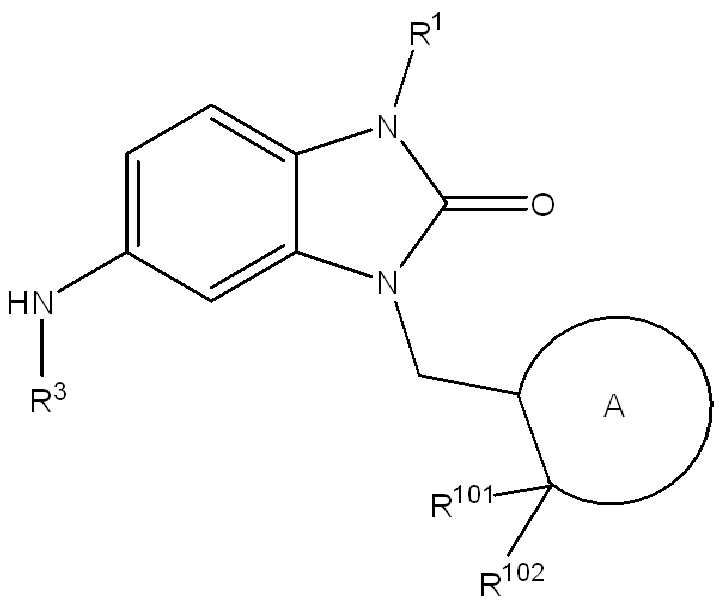
(식 중 R1, R3, R101, R102 및 고리 A 각각은 상기에 정의된 바와 같음).Wherein R 1 , R 3 , R 101 , Each of R 102 and Ring A is as defined above).
화학식 Ig의 화합물의 구현예에서:In an embodiment of the compound of formula (Ig):
R1은 상기 단락 (15) 내지 (31) 중 어느 하나에 정의된 바와 같고;R 1 is as defined in any one of paragraphs (15) to (31) above;
R3은 상기 단락 (54) 내지 (86) 중 어느 하나에 정의된 바와 같고;R 3 is as defined in any one of paragraphs (54) to (86) above;
R101, R102 및 고리 A는 단락 (39) 내지 (41), 또는 상기 (43) 내지 (50) 중 어느 하나에 정의된 바와 같다.R 101 , R 102 and ring A are as defined in paragraphs (39) to (41), or any of (43) to (50) above.
화학식 Ig의 화합물의 또 다른 구현예에서:In another embodiment of the compound of formula (Ig):
R1은 상기 단락 (28) 내지 (31) 중 어느 하나에 정의된 바와 같고;R 1 is as defined in any one of paragraphs (28) to (31) above;
R3은 상기 단락 (86)에 정의된 바와 같고;R 3 is as defined in paragraph 86 above;
R101, R102 및 고리 A는 상기 단락 (49) 또는 (50)에 정의된 바와 같다.R 101 , R 102 and ring A are as defined in paragraph (49) or (50) above.
본 발명의 화합물의 특정 기에서, 화합물은 하기에 나타낸 구조식 Ih(화학식 I의 하위 정의) 또는 이의 약제학적으로 허용 가능한 염, 수화물 및/또는 용매화물을 갖는다:In certain groups of compounds of the invention, the compounds have the structure Ih (sub definition of Formula I) or a pharmaceutically acceptable salt, hydrate and / or solvate thereof, shown below:
[화학식 Ih]Formula Ih

(식 중 X1, X2, Xa, Xb, R1, R2 , R9 및 R10 각각은 상기에 정의된 바와 같음).Wherein X 1 , X 2 , X a , X b , R 1 , R 2 , R 9 and R 10 are each as defined above.
화학식 Ih의 화합물의 구현예에서:In an embodiment of the compound of formula (Ih):
X1은 상기 단락 (1) 내지 (9) 중 어느 하나에 정의된 바와 같고;X 1 is as defined in any one of paragraphs (1) to (9) above;
X2는 상기 단락 (10) 내지 (14) 중 어느 하나에 정의된 바와 같고;X 2 is as defined in any one of paragraphs (10) to (14) above;
Xa 및 Xb는 상기 단락 (54) 내지 (86) 중 어느 하나에 정의된 바와 같고;X a and X b are as defined in any one of paragraphs (54) to (86) above;
R1은 상기 단락 (15) 내지 (31) 중 어느 하나에 정의된 바와 같고;R 1 is as defined in any one of paragraphs (15) to (31) above;
R2는 상기 단락 (32) 내지 (53) 중 어느 하나에 정의된 바와 같고;R 2 is as defined in any one of paragraphs (32) to (53) above;
R9는 상기 단락 (54) 내지 (86) 중 어느 하나에 정의된 바와 같고;R 9 is as defined in any one of paragraphs (54) to (86) above;
R10은 상기 단락 (54) 내지 (86) 중 어느 하나에 정의된 바와 같다.R 10 is as defined in any one of paragraphs (54) to (86) above.
화학식 Ih의 화합물의 또 다른 구현예에서:In another embodiment of the compound of formula (Ih):
X1은 상기 단락 (9)에 정의된 바와 같고;X 1 is as defined in paragraph (9) above;
X2는 상기 단락 (14)에 정의된 바와 같고;X 2 is as defined in paragraph (14) above;
Xa 및 Xb는 상기 단락 (83)에 정의된 바와 같고;X a and X b are as defined in paragraph 83 above;
R1은 상기 단락 (28) 내지 (31) 중 어느 하나에 정의된 바와 같고;R 1 is as defined in any one of paragraphs (28) to (31) above;
R2는 상기 단락 (51) 내지 (53) 중 어느 하나에 정의된 바와 같고;R 2 is as defined in any one of paragraphs (51) to (53) above;
R9는 상기 단락 (86)에 정의된 바와 같고;R 9 is as defined in paragraph 86 above;
R10은 상기 단락 (86)에 정의된 바와 같다.R 10 is as defined in paragraph 86 above.
본 발명의 화합물의 특정 기에서, 화합물은 하기에 나타낸 구조식 Ij(화학식 I의 하위 정의) 또는 이의 약제학적으로 허용 가능한 염, 수화물 및/또는 용매화물을 갖는다:In certain groups of the compounds of the present invention, the compounds have the structure Ij (sub definition of Formula I) or a pharmaceutically acceptable salt, hydrate and / or solvate thereof as shown below:
[화학식 Ij]Formula Ij

(식 중 X1, X2, Xa, Xb, R1, R6 , R7, R8, R9 및 R10 각각은 상기에 정의된 바와 같음).Wherein X 1 , X 2 , X a , X b , R 1 , R 6 , R 7 , R 8 , Each of R 9 and R 10 is as defined above).
화학식 Ij의 화합물의 구현예에서:In an embodiment of the compound of formula (Ij):
X1은 상기 단락 (1) 내지 (9) 중 어느 하나에 정의된 바와 같고;X 1 is as defined in any one of paragraphs (1) to (9) above;
X2는 상기 단락 (10) 내지 (14) 중 어느 하나에 정의된 바와 같고;X 2 is as defined in any one of paragraphs (10) to (14) above;
Xa 및 Xb는 상기 단락 (54) 내지 (86) 중 어느 하나에 정의된 바와 같고;X a and X b are as defined in any one of paragraphs (54) to (86) above;
R1은 상기 단락 (15) 내지 (31) 중 어느 하나에 정의된 바와 같고;R 1 is as defined in any one of paragraphs (15) to (31) above;
R6, R7 및 R8은 각각 상기 단락 (50) 내지 (51) 중 어느 하나에 정의된 바와 같고;R 6 , R 7 and R 8 are each as defined in any one of paragraphs (50) to (51) above;
R9는 상기 단락 (54) 내지 (86) 중 어느 하나에 정의된 바와 같고;R 9 is as defined in any one of paragraphs (54) to (86) above;
R10은 상기 단락 (54) 내지 (86) 중 어느 하나에 정의된 바와 같다.R 10 is as defined in any one of paragraphs (54) to (86) above.
화학식 Ij의 화합물의 또 다른 구현예에서:In another embodiment of the compound of formula (Ij):
X1은 상기 단락 (9)에 정의된 바와 같고;X 1 is as defined in paragraph (9) above;
X2는 상기 단락 (14)에 정의된 바와 같고;X 2 is as defined in paragraph (14) above;
Xa 및 Xb는 상기 단락 (86)에 정의된 바와 같고;X a and X b are as defined in paragraph 86 above;
R1은 상기 단락 (28) 내지 (31) 중 어느 하나에 정의된 바와 같고;R 1 is as defined in any one of paragraphs (28) to (31) above;
R6은 OH이고;R 6 is OH;
R7 및 R8은 CH3이고;R 7 and R 8 are CH 3 ;
R9는 상기 단락 (86)에 정의된 바와 같고;R 9 is as defined in paragraph 86 above;
R10은 상기 단락 (86)에 정의된 바와 같다.R 10 is as defined in paragraph 86 above.
본 발명의 특정 화합물은 본 출원에 예시된 화합물 또는 이의 약제학적으로 허용 가능한 염 또는 용매화물 중 임의의 것, 및 특히 하기 중 임의의 것을 포함한다:Certain compounds of the present invention include any of the compounds exemplified in the present application or pharmaceutically acceptable salts or solvates thereof, and in particular any of the following:
6-클로로-5-시아노-4-[[3-(3-히드록시-3-메틸-부틸)-1-메틸-2-옥소-벤즈이미다졸-5-일]아미노]-N-메틸-피리딘-2-카르복스아미드;6-chloro-5-cyano-4-[[3- (3-hydroxy-3-methyl-butyl) -1-methyl-2-oxo-benzimidazol-5-yl] amino] -N -methyl -Pyridine-2-carboxamide;
2-클로로-4-[[3-(3-히드록시-3-메틸-부틸)-1-메틸-2-옥소-벤즈이미다졸-5-일]아미노]-6-메틸-피리딘-3-카르보니트릴;2-Chloro-4-[[3- (3-hydroxy-3-methyl-butyl) -1-methyl-2-oxo-benzimidazol-5-yl] amino] -6-methyl-pyridine-3- Carbonitrile;
6-클로로-5-시아노-4-[(1,3-디메틸-2-옥소-벤즈이미다졸-5-일)아미노]피리딘-2-카르복실산;6-chloro-5-cyano-4-[(1,3-dimethyl-2-oxo-benzimidazol-5-yl) amino] pyridine-2-carboxylic acid;
6-클로로-5-시아노-N-메틸-4-[[1-메틸-2-옥소-3-[(3S)-3-피라졸-1-일부틸]벤즈이미다졸-5-일]아미노]피리딘-2-카르복스아미드;6-chloro-5-cyano- N -methyl-4-[[1-methyl-2-oxo-3-[( 3S ) -3-pyrazol-1-ylbutyl] benzimidazol-5-yl ] Amino] pyridine-2-carboxamide;
6-클로로-5-시아노-4-[[3-[(3R)-3-히드록시부틸]-1-메틸-2-옥소-벤즈이미다졸-5-일]아미노]피리딘-2-카르복실산;6-chloro-5-cyano-4-[[3-[( 3R ) -3-hydroxybutyl] -1-methyl-2-oxo-benzimidazol-5-yl] amino] pyridine-2- Carboxylic acid;
6-클로로-5-시아노-N-메틸-4-[(1-메틸-2-옥소-3H-벤즈이미다졸-5-일)아미노]피리딘-2-카르복스아미드;6-chloro-5-cyano- N -methyl-4-[(1-methyl-2-oxo- 3H -benzimidazol-5-yl) amino] pyridine-2-carboxamide;
6-클로로-5-시아노-4-[[3-(3-히드록시-3-메틸-부틸)-2-옥소-1-(테트라히드로피란-4-일메틸)벤즈이미다졸-5-일]아미노]-N-메틸-피리딘-2-카르복스아미드;6-chloro-5-cyano-4-[[3- (3-hydroxy-3-methyl-butyl) -2-oxo-1- (tetrahydropyran-4-ylmethyl) benzimidazole-5- Yl] amino] -N -methyl-pyridine-2-carboxamide;
에틸 7-[[3-(3-히드록시-3-메틸-부틸)-1-메틸-2-옥소-벤즈이미다졸-5-일]아미노]피라졸로[1,5-a]피리미딘-5-카르복실레이트;Ethyl 7-[[3- (3-hydroxy-3-methyl-butyl) -1-methyl-2-oxo-benzimidazol-5-yl] amino] pyrazolo [1,5-a] pyrimidine- 5-carboxylate;
2-클로로-4-[[3-(3-히드록시-3-메틸-부틸)-1-메틸-2-옥소-벤즈이미다졸-5-일]아미노]피리딘-3-카르보니트릴;2-chloro-4-[[3- (3-hydroxy-3-methyl-butyl) -1-methyl-2-oxo-benzimidazol-5-yl] amino] pyridine-3-carbonitrile;
메틸 4-[6-[(2-클로로-3-시아노-4-피리딜)아미노]-3- 메틸-2-옥소-벤즈이미다졸-1-일]-2-메틸-부탄오에이트;Methyl 4- [6-[(2-chloro-3-cyano-4-pyridyl) amino] -3-methyl-2-oxo-benzimidazol-1-yl] -2-methyl-butanoate;
2-브로모-4-[[3-(3-히드록시-3-메틸-부틸)-1-메틸-2-옥소-벤즈이미다졸-5-일]아미노]피리딘-3-카르보니트릴;2-bromo-4-[[3- (3-hydroxy-3-methyl-butyl) -1-methyl-2-oxo-benzimidazol-5-yl] amino] pyridine-3-carbonitrile;
2-클로로-4-[[3-[(3R)-3-히드록시부틸]-1-메틸-2-옥소-벤즈이미다졸-5-일]아미노]-6-메틸-피리딘-3-카르보니트릴;2-Chloro-4-[[3-[( 3R ) -3-hydroxybutyl] -1-methyl-2-oxo-benzimidazol-5-yl] amino] -6-methyl-pyridine-3- Carbonitrile;
5-[(2,5-디클로로-4-피리딜)아미노]-3-[(3R)-3-히드록시부틸]-1-메틸-벤즈이미다졸-2-온;5-[(2,5-dichloro-4-pyridyl) amino] -3-[( 3R ) -3-hydroxybutyl] -1-methyl-benzimidazol-2-one;
5-[(2,5-디클로로피리미딘-4-일)아미노]-3-(3-히드록시-3-메틸-부틸)-1-메틸-벤즈이미다졸-2-온;5-[(2,5-dichloropyrimidin-4-yl) amino] -3- (3-hydroxy-3-methyl-butyl) -1-methyl-benzimidazol-2-one;
에틸 7-[[3-[(3R)-3-히드록시부틸]-1-메틸-2-옥소-벤즈이미다졸-5-일]아미노]피라졸로[1,5-a]피리미딘-5-카르복실레이트;Ethyl 7-[[3-[( 3R ) -3-hydroxybutyl] -1-methyl-2-oxo-benzimidazol-5-yl] amino] pyrazolo [1,5-a] pyrimidine- 5-carboxylate;
4-클로로-6-[[3-(3-히드록시-3-메틸-부틸)-1-메틸-2-옥소-벤즈이미다졸-5-일]아미노]피리미딘-5-카르보니트릴;4-chloro-6-[[3- (3-hydroxy-3-methyl-butyl) -1-methyl-2-oxo-benzimidazol-5-yl] amino] pyrimidine-5-carbonitrile;
5-[(2,3-디클로로-4-피리딜)아미노]-3-[(3R)-3-히드록시부틸]-1-메틸-벤즈이미다졸-2-온;5-[(2,3-dichloro-4-pyridyl) amino] -3-[( 3R ) -3-hydroxybutyl] -1-methyl-benzimidazol-2-one;
에틸 3-플루오로-7-((3-(2-히드록시부틸)-1-메틸-2-옥소-2,3-디히드로-1H-벤조[d]이미다졸-5-일)아미노)피라졸로[1,5-a]피리미딘-5-카르복실레이트;Ethyl 3-fluoro-7-((3- (2-hydroxybutyl) -1-methyl-2-oxo-2,3-dihydro-1 H -benzo [d] imidazol-5-yl) amino ) Pyrazolo [1,5-a] pyrimidine-5-carboxylate;
메틸 6-클로로-5-시아노-4-[[3-(4-메톡시-3-메틸-4-옥소-부틸)-1-메틸-2-옥소-벤즈이미다졸-5-일]아미노]피리딘-2-카르복실레이트;Methyl 6-chloro-5-cyano-4-[[3- (4-methoxy-3-methyl-4-oxo-butyl) -1-methyl-2-oxo-benzimidazol-5-yl] amino ] Pyridine-2-carboxylate;
에틸 6-클로로-5-시아노-4-[[3-(4-메톡시-3-메틸-4-옥소-부틸)-1-메틸-2-옥소-벤즈이미다졸-5-일]아미노]피리딘-2-카르복실레이트;Ethyl 6-chloro-5-cyano-4-[[3- (4-methoxy-3-methyl-4-oxo-butyl) -1-methyl-2-oxo-benzimidazol-5-yl] amino ] Pyridine-2-carboxylate;
이소프로필 6-클로로-5-시아노-4-[[3-(4-메톡시-3-메틸-4-옥소-부틸)-1-메틸-2-옥소-벤즈이미다졸-5-일]아미노]피리딘-2-카르복실레이트;Isopropyl 6-chloro-5-cyano-4-[[3- (4-methoxy-3-methyl-4-oxo-butyl) -1-methyl-2-oxo-benzimidazol-5-yl] Amino] pyridine-2-carboxylate;
에틸 6-클로로-5-시아노-4-[[3-[(3R)-3-히드록시부틸]-1-메틸-2-옥소-벤즈이미다졸-5-일]아미노]피리딘-2-카르복실레이트;Ethyl 6-chloro-5-cyano-4-[[3-[( 3R ) -3-hydroxybutyl] -1-methyl-2-oxo-benzimidazol-5-yl] amino] pyridine-2 Carboxylates;
6-클로로-5-시아노-4-[[3-(4-메톡시-3-메틸-4-옥소-부틸)-1-메틸-2-옥소-벤즈이미다졸-5-일]아미노]피리딘-2-카르복실산;6-chloro-5-cyano-4-[[3- (4-methoxy-3-methyl-4-oxo-butyl) -1-methyl-2-oxo-benzimidazol-5-yl] amino] Pyridine-2-carboxylic acid;
메틸 3-[6-[(2-클로로-3-시아노-4-피리딜)아미노]-3-메틸-2-옥소-벤즈이미다졸-1-일]-2-메틸-프로판오에이트;Methyl 3- [6-[(2-chloro-3-cyano-4-pyridyl) amino] -3-methyl-2-oxo-benzimidazol-1-yl] -2-methyl-propanoate;
메틸 4-[6-[(5-클로로-2-메틸-피리미딘-4-일)아미노]-3-메틸-2-옥소-벤즈이미다졸-1-일]-2-메틸-부탄오에이트;Methyl 4- [6-[(5-chloro-2-methyl-pyrimidin-4-yl) amino] -3-methyl-2-oxo-benzimidazol-1-yl] -2-methyl-butanoate ;
6-클로로-5-시아노-4-[[3-[(3R)-3-히드록시부틸]-1-메틸-2-옥소-벤즈이미다졸-5-일]아미노]-N-메틸-피리딘-2-카르복스아미드;6-chloro-5-cyano-4-[[3-[( 3R ) -3-hydroxybutyl] -1-methyl-2-oxo-benzimidazol-5-yl] amino] -N-methyl -Pyridine-2-carboxamide;
메틸 4-[6-[[2-클로로-3-시아노-6-(3-메틸-1,2,4-옥사디아졸-5-일)-4-피리딜]아미노]-3-메틸-2-옥소-벤즈이미다졸-1-일]-2-메틸-부탄오에이트;Methyl 4- [6-[[2-chloro-3-cyano-6- (3-methyl-1,2,4-oxadiazol-5-yl) -4-pyridyl] amino] -3-methyl -2-oxo-benzimidazol-1-yl] -2-methyl-butanoate;
메틸 (2S)-2-아미노-4-[6-[(2-클로로-3-시아노-4-피리딜)아미노]-3-메틸-2-옥소-벤즈이미다졸-1-일]부탄오에이트;Methyl (2S) -2-amino-4- [6-[(2-chloro-3-cyano-4-pyridyl) amino] -3-methyl-2-oxo-benzimidazol-1-yl] butane Oate;
메틸 4-[6-[[2-클로로-3-시아노-6-(메틸카르바모일)-4-피리딜]아미노]-3-메틸-2-옥소-벤즈이미다졸-1-일]-2-메틸-부탄오에이트;Methyl 4- [6-[[2-chloro-3-cyano-6- (methylcarbamoyl) -4-pyridyl] amino] -3-methyl-2-oxo-benzimidazol-1-yl] 2-methyl-butanoate;
메틸 4-[6-[[6-(부트-3-인일카르바모일)-2-클로로-3-시아노-4-피리딜]아미노]-3-메틸-2-옥소-벤즈이미다졸-1-일]-2-메틸-부탄오에이트;Methyl 4- [6-[[6- (but-3-ynylcarbamoyl) -2-chloro-3-cyano-4-pyridyl] amino] -3-methyl-2-oxo-benzimidazole- 1-yl] -2-methyl-butanoate;
메틸 4-[6-[[2-클로로-3-시아노-6-(디메틸카르바모일)-4-피리딜]아미노]-3-메틸-2-옥소-벤즈이미다졸-1-일]-2-메틸-부탄오에이트;Methyl 4- [6-[[2-chloro-3-cyano-6- (dimethylcarbamoyl) -4-pyridyl] amino] -3-methyl-2-oxo-benzimidazol-1-yl] 2-methyl-butanoate;
6-클로로-5-시아노-N-[2-(디메틸아미노)에틸]-4-[(1,3-디메틸-2-옥소-벤즈이미다졸-5-일)아미노]피리딘-2-카르복스아미드;6-chloro-5-cyano-N- [2- (dimethylamino) ethyl] -4-[(1,3-dimethyl-2-oxo-benzimidazol-5-yl) amino] pyridine-2-car Boxamide;
에틸 7-[[3-(4-메톡시-3-메틸-4-옥소-부틸)-1-메틸-2-옥소-벤즈이미다졸-5-일]아미노]피라졸로[1,5-a]피리미딘-5-카르복실레이트;Ethyl 7-[[3- (4-methoxy-3-methyl-4-oxo-butyl) -1-methyl-2-oxo-benzimidazol-5-yl] amino] pyrazolo [1,5-a ] Pyrimidine-5-carboxylate;
메틸 4-[6-[(2-클로로-3-시아노-4-피리딜)아미노]-3-메틸-2-옥소-벤즈이미다졸-1-일]-2-히드록시-부탄오에이트;Methyl 4- [6-[(2-chloro-3-cyano-4-pyridyl) amino] -3-methyl-2-oxo-benzimidazol-1-yl] -2-hydroxy-butanoate ;
2-클로로-4-[[3-(2,3-디히드록시-3-메틸-부틸)-1-메틸-2-옥소-벤즈이미다졸-5-일]아미노]피리딘-3-카르보니트릴;2-chloro-4-[[3- (2,3-dihydroxy-3-methyl-butyl) -1-methyl-2-oxo-benzimidazol-5-yl] amino] pyridine-3-carbonitrile ;
메틸 4-[6-[(2-클로로-3-시아노-4-피리딜)아미노]-3-메틸-2-옥소-벤즈이미다졸-1-일]-2-메톡시-부탄오에이트;Methyl 4- [6-[(2-chloro-3-cyano-4-pyridyl) amino] -3-methyl-2-oxo-benzimidazol-1-yl] -2-methoxy-butanoate ;
메틸 4-[6-[(2-클로로-3-시아노-4-피리딜)아미노]-3-메틸-2-옥소-벤즈이미다졸-1-일]-2-에톡시-부탄오에이트;Methyl 4- [6-[(2-chloro-3-cyano-4-pyridyl) amino] -3-methyl-2-oxo-benzimidazol-1-yl] -2-ethoxy-butanoate ;
메틸 4-[6-[(2-클로로-3-시아노-4-피리딜)아미노]-3-메틸-2-옥소-벤즈이미다졸-1-일]부탄오에이트;Methyl 4- [6-[(2-chloro-3-cyano-4-pyridyl) amino] -3-methyl-2-oxo-benzimidazol-1-yl] butanoate;
메틸 4-[6-[(2-클로로-3-시아노-4-피리딜)아미노]-3-메틸-2-옥소-벤즈이미다졸-1-일]-2-(시클로프로필메톡시)부탄오에이트;Methyl 4- [6-[(2-chloro-3-cyano-4-pyridyl) amino] -3-methyl-2-oxo-benzimidazol-1-yl] -2- (cyclopropylmethoxy) Butaneoate;
2-클로로-4-[[3-(2-히드록시-3-피라졸-1-일-프로필)-1-메틸-2-옥소-벤즈이미다졸-5-일]아미노]피리딘-3-카르보니트릴;2-chloro-4-[[3- (2-hydroxy-3-pyrazol-1-yl-propyl) -1-methyl-2-oxo-benzimidazol-5-yl] amino] pyridine-3- Carbonitrile;
2-클로로-4-[[3-(2-시아노부틸)-1-메틸-2-옥소-벤즈이미다졸-5-일]아미노]피리딘-3-카르보니트릴;2-chloro-4-[[3- (2-cyanobutyl) -1-methyl-2-oxo-benzimidazol-5-yl] amino] pyridine-3-carbonitrile;
2-클로로-4-[[3-[(3S)-3-히드록시부틸]-1-메틸-2-옥소-벤즈이미다졸-5-일]아미노]피리딘-3-카르보니트릴;2-Chloro -4 - [[3 - [( 3 S) -3- hydroxybutyl] -l-methyl-2-oxo-benzimidazol-5-yl] amino] pyridine-3-carbonitrile;
메틸 2-[[6-[(2-클로로-3-시아노-4-피리딜)아미노]-3-메틸-2-옥소-벤즈이미다졸-1-일]메틸]시클로펜탄카르복실레이트;Methyl 2-[[6-[(2-chloro-3-cyano-4-pyridyl) amino] -3-methyl-2-oxo-benzimidazol-1-yl] methyl] cyclopentanecarboxylate;
메틸 (2R)-2-아미노-4-[6-[(2-클로로-3-시아노-4-피리딜)아미노]-3-메틸-2-옥소-벤즈이미다졸-1-일]부탄오에이트;Methyl ( 2R ) -2-amino-4- [6-[(2-chloro-3-cyano-4-pyridyl) amino] -3-methyl-2-oxo-benzimidazol-1-yl] Butaneoate;
N-[3-[6-[(2-클로로-3-시아노-4-피리딜)아미노]-3-메틸-2-옥소-벤즈이미다졸-1-일]-1-메틸-프로필]아세트아미드; N- [3- [6-[(2-chloro-3-cyano-4-pyridyl) amino] -3-methyl-2-oxo-benzimidazol-1-yl] -1-methyl-propyl] Acetamide;
5-클로로-N-에틸-4-[[3-(3-히드록시-3-메틸-부틸)-1-메틸-2-옥소-벤즈이미다졸-5-일]아미노]피리딘-2-카르복스아미드; 5-chloro- N -ethyl-4-[[3- (3-hydroxy-3-methyl-butyl) -1-methyl-2-oxo-benzimidazol-5-yl] amino] pyridine-2-car Boxamide;
5-[[5-클로로-2-(3,5-디메틸피라졸-1-일)피리미딘-4-일]아미노]-3-(3-히드록시-3-메틸-부틸)-1-메틸-벤즈이미다졸-2-온; 5-[[5-chloro-2- (3,5-dimethylpyrazol-1-yl) pyrimidin-4-yl] amino] -3- (3-hydroxy-3-methyl-butyl) -1- Methyl-benzimidazol-2-one;
5-((5-클로로-2-((3R,5S)-4,4-디플루오로-3,5-디메틸피페리딘-1-일)피리미딘-4-일)아미노)-3-(3-히드록시-3-메틸부틸)-1-메틸-1,3-디히드로-2H-벤조[d]이미다졸-2-온;5-((5-chloro-2-((3R, 5S) -4,4-difluoro-3,5-dimethylpiperidin-1-yl) pyrimidin-4-yl) amino) -3- (3-hydroxy-3-methylbutyl) -1-methyl-1,3-dihydro-2H-benzo [d] imidazol-2-one;
에틸 1-(5-클로로-4-((3-(3-히드록시-3-메틸부틸)-1-메틸-2-옥소-2,3-디히드로-1H-벤조[d]이미다졸-5-일)아미노)피리미딘-2-일)-1H-피라졸-4-카르복실레이트;Ethyl 1- (5-chloro-4-((3- (3-hydroxy-3-methylbutyl) -1-methyl-2-oxo-2,3-dihydro-1H-benzo [d] imidazole- 5-yl) amino) pyrimidin-2-yl) -1H-pyrazole-4-carboxylate;
에틸 1-(5-클로로-4-((3-(3-히드록시-3-메틸부틸)-1-메틸-2-옥소-2,3-디히드로-1H-벤조[d]이미다졸-5-일)아미노)피리미딘-2-일)-3,5-디메틸-1H-피라졸-4-카르복실레이트;Ethyl 1- (5-chloro-4-((3- (3-hydroxy-3-methylbutyl) -1-methyl-2-oxo-2,3-dihydro-1H-benzo [d] imidazole- 5-yl) amino) pyrimidin-2-yl) -3,5-dimethyl-1H-pyrazole-4-carboxylate;
5-((5-클로로-2-(3-(트리플루오로메틸)-1H-피라졸-1-일)피리미딘-4-일)아미노)-3-(3-히드록시-3-메틸부틸)-1-메틸-1,3-디히드로-2H-벤조[d]이미다졸-2-온;5-((5-chloro-2- (3- (trifluoromethyl) -1H-pyrazol-1-yl) pyrimidin-4-yl) amino) -3- (3-hydroxy-3-methyl Butyl) -1-methyl-1,3-dihydro-2H-benzo [d] imidazol-2-one;
5-((5-클로로-2-(3,5-디메틸-1H-피라졸-1-일)피리미딘-4-일)아미노)-3-(3,5-디히드록시-3-메틸펜틸)-1-메틸-1,3-디히드로-2H-벤조[d]이미다졸-2-온;5-((5-chloro-2- (3,5-dimethyl-1H-pyrazol-1-yl) pyrimidin-4-yl) amino) -3- (3,5-dihydroxy-3-methyl Pentyl) -1-methyl-1,3-dihydro-2H-benzo [d] imidazol-2-one;
5-((5-클로로-2-(3,5-디메틸-1H-피라졸-1-일)피리미딘-4-일)아미노)-3-(3-히드록시-3-메틸펜틸)-1-메틸-1,3-디히드로-2H-벤조[d]이미다졸-2-온;5-((5-chloro-2- (3,5-dimethyl-1H-pyrazol-1-yl) pyrimidin-4-yl) amino) -3- (3-hydroxy-3-methylpentyl)- 1-methyl-1,3-dihydro-2H-benzo [d] imidazol-2-one;
5-((5-클로로-2-(디메틸아미노)피리미딘-4-일)아미노)-3-(3-히드록시-3-메틸부틸)-1-메틸-1,3-디히드로-2H-벤조[d]이미다졸-2-온;5-((5-chloro-2- (dimethylamino) pyrimidin-4-yl) amino) -3- (3-hydroxy-3-methylbutyl) -1-methyl-1,3-dihydro-2H -Benzo [d] imidazol-2-one;
5-((5-클로로-2-(3,5-디메틸-1H-피라졸-1-일)피리미딘-4-일)아미노)-1-메틸-1,3-디히드로-2H-벤조[d]이미다졸-2-온;5-((5-chloro-2- (3,5-dimethyl-1H-pyrazol-1-yl) pyrimidin-4-yl) amino) -1-methyl-1,3-dihydro-2H-benzo [d] imidazol-2-one;
1-(5-클로로-4-((3-(3-히드록시-4-메톡시-3-메틸부틸)-1-메틸-2-옥소-2,3-디히드로-1H-벤조[d]이미다졸-5-일)아미노)피리미딘-2-일)-N,N-디메틸피페리딘-4-카르복스아미드;1- (5-chloro-4-((3- (3-hydroxy-4-methoxy-3-methylbutyl) -1-methyl-2-oxo-2,3-dihydro-1H-benzo [d ] Imidazol-5-yl) amino) pyrimidin-2-yl) -N, N-dimethylpiperidine-4-carboxamide;
5-((5-클로로-2-(3,5-디메틸-1H-피라졸-1-일)피리미딘-4-일)아미노)-3-(3-히드록시-4-메톡시-3-메틸부틸)-1-메틸-1,3-디히드로-2H-벤조[d]이미다졸-2-온;5-((5-chloro-2- (3,5-dimethyl-1H-pyrazol-1-yl) pyrimidin-4-yl) amino) -3- (3-hydroxy-4-methoxy-3 -Methylbutyl) -1-methyl-1,3-dihydro-2H-benzo [d] imidazol-2-one;
1-(5-클로로-4-((3-(3,5-디히드록시-3-메틸펜틸)-1-메틸-2-옥소-2,3-디히드로-1H-벤조[d]이미다졸-5-일)아미노)피리미딘-2-일)-N,N-디메틸피페리딘-4-카르복스아미드;1- (5-chloro-4-((3- (3,5-dihydroxy-3-methylpentyl) -1-methyl-2-oxo-2,3-dihydro-1H-benzo [d] Dazol-5-yl) amino) pyrimidin-2-yl) -N, N-dimethylpiperidine-4-carboxamide;
1-(5-클로로-4-((3-(3-히드록시-3-메틸펜틸)-1-메틸-2-옥소-2,3-디히드로-1H-벤조[d]이미다졸-5-일)아미노)피리미딘-2-일)-N,N-디메틸피페리딘-4-카르복스아미드;1- (5-chloro-4-((3- (3-hydroxy-3-methylpentyl) -1-methyl-2-oxo-2,3-dihydro-1H-benzo [d] imidazole-5 -Yl) amino) pyrimidin-2-yl) -N, N-dimethylpiperidine-4-carboxamide;
5-((5-클로로-2-(1H-피라졸-1-일)피리미딘-4-일)아미노)-3-(3-히드록시-3-메틸부틸)-1-메틸-1,3-디히드로-2H-벤조[d]이미다졸-2-온;5-((5-chloro-2- (1H-pyrazol-1-yl) pyrimidin-4-yl) amino) -3- (3-hydroxy-3-methylbutyl) -1-methyl-1, 3-dihydro-2H-benzo [d] imidazol-2-one;
5-((5-클로로-2-(4-클로로-3,5-디메틸-1H-피라졸-1-일)피리미딘-4-일)아미노)-3-(3-히드록시-3-메틸부틸)-1-메틸-1,3-디히드로-2H-벤조[d]이미다졸-2-온;5-((5-chloro-2- (4-chloro-3,5-dimethyl-1H-pyrazol-1-yl) pyrimidin-4-yl) amino) -3- (3-hydroxy-3- Methylbutyl) -1-methyl-1,3-dihydro-2H-benzo [d] imidazol-2-one;
6-(3,5-디메틸-1H-피라졸-1-일)-4-((3-(3-히드록시-3-메틸부틸)-1-메틸-2-옥소-2,3-디히드로-1H-벤조[d]이미다졸-5-일)아미노)니코티노니트릴;6- (3,5-dimethyl-1H-pyrazol-1-yl) -4-((3- (3-hydroxy-3-methylbutyl) -1-methyl-2-oxo-2,3-di Hydro-1H-benzo [d] imidazol-5-yl) amino) nicotinonitrile;
5-((5-클로로-2-(3,5-디메틸-1H-피라졸-1-일)-6-메틸피리미딘-4-일)아미노)-3-(3-히드록시-3-메틸부틸)-1-메틸-1,3-디히드로-2H-벤조[d]이미다졸-2-온;5-((5-chloro-2- (3,5-dimethyl-1H-pyrazol-1-yl) -6-methylpyrimidin-4-yl) amino) -3- (3-hydroxy-3- Methylbutyl) -1-methyl-1,3-dihydro-2H-benzo [d] imidazol-2-one;
5-((5-브로모-2-(3,5-디메틸-1H-피라졸-1-일)피리미딘-4-일)아미노)-3-(3-히드록시-3-메틸부틸)-1-메틸-1,3-디히드로-2H-벤조[d]이미다졸-2-온;5-((5-Bromo-2- (3,5-dimethyl-1H-pyrazol-1-yl) pyrimidin-4-yl) amino) -3- (3-hydroxy-3-methylbutyl) -1-methyl-1,3-dihydro-2H-benzo [d] imidazol-2-one;
5-((5-클로로-2-(3-메틸-1H-피라졸-1-일)피리미딘-4-일)아미노)-3-(3-히드록시-3-메틸부틸)-1-메틸-1,3-디히드로-2H-벤조[d]이미다졸-2-온;5-((5-chloro-2- (3-methyl-1H-pyrazol-1-yl) pyrimidin-4-yl) amino) -3- (3-hydroxy-3-methylbutyl) -1- Methyl-1,3-dihydro-2H-benzo [d] imidazol-2-one;
5-((5-클로로-2-(5-메틸-1H-피라졸-1-일)피리미딘-4-일)아미노)-3-(3-히드록시-3-메틸부틸)-1-메틸-1,3-디히드로-2H-벤조[d]이미다졸-2-온;5-((5-chloro-2- (5-methyl-1H-pyrazol-1-yl) pyrimidin-4-yl) amino) -3- (3-hydroxy-3-methylbutyl) -1- Methyl-1,3-dihydro-2H-benzo [d] imidazol-2-one;
5-((5-클로로-2-(1H-인다졸-3-일)피리미딘-4-일)아미노)-3-(3-히드록시-3-메틸부틸)-1-메틸-1,3-디히드로-2H-벤조[d]이미다졸-2-온;5-((5-chloro-2- (1H-indazol-3-yl) pyrimidin-4-yl) amino) -3- (3-hydroxy-3-methylbutyl) -1-methyl-1, 3-dihydro-2H-benzo [d] imidazol-2-one;
5-((5-클로로-2-(1H-인다졸-1-일)피리미딘-4-일)아미노)-3-(3-히드록시-3-메틸부틸)-1-메틸-1,3-디히드로-2H-벤조[d]이미다졸-2-온;5-((5-chloro-2- (1H-indazol-1-yl) pyrimidin-4-yl) amino) -3- (3-hydroxy-3-methylbutyl) -1-methyl-1, 3-dihydro-2H-benzo [d] imidazol-2-one;
2-클로로-4-((3-(2-(1-히드록시시클로부틸)에틸)-1-메틸-2-옥소-2,3-디히드로-1H-벤조[d]이미다졸-5-일)아미노)니코티노니트릴;2-chloro-4-((3- (2- (1-hydroxycyclobutyl) ethyl) -1-methyl-2-oxo-2,3-dihydro-1H-benzo [d] imidazole-5- (I) amino) nicotinonitrile;
2-클로로-4-((1-메틸-3-(2-(메틸설포닐)에틸)-2-옥소-2,3-디히드로-1H-벤조[d]이미다졸-5-일)아미노)니코티노니트릴;2-chloro-4-((1-methyl-3- (2- (methylsulfonyl) ethyl) -2-oxo-2,3-dihydro-1H-benzo [d] imidazol-5-yl) amino ) Nicotinonitrile;
2-클로로-4-((1-메틸-2-옥소-3-(3-옥소펜틸)-2,3-디히드로-1H-벤조[d]이미다졸-5-일)아미노)니코티노니트릴;2-chloro-4-((1-methyl-2-oxo-3- (3-oxopentyl) -2,3-dihydro-1H-benzo [d] imidazol-5-yl) amino) nicotinonitrile ;
2-클로로-4-((1-메틸-3-((2-메틸테트라히드로푸란-3-일)메틸)-2-옥소-2,3-디히드로-1H-벤조[d]이미다졸-5-일)아미노)니코티노니트릴;2-chloro-4-((1-methyl-3-((2-methyltetrahydrofuran-3-yl) methyl) -2-oxo-2,3-dihydro-1H-benzo [d] imidazole- 5-yl) amino) nicotinonitrile;
2-클로로-4-((1-메틸-3-(2-(2-메틸-1,3-디옥솔란-2-일)에틸)-2-옥소-2,3-디히드로-1H-벤조[d]이미다졸-5-일)아미노)니코티노니트릴;2-chloro-4-((1-methyl-3- (2- (2-methyl-1,3-dioxolan-2-yl) ethyl) -2-oxo-2,3-dihydro-1H-benzo [d] imidazol-5-yl) amino) nicotinonitrile;
tert-부틸 2-((6-((2-클로로-3-시아노피리딘-4-일)아미노)-3-메틸-2-옥소-2,3-디히드로-1H-벤조[d]이미다졸-1-일)메틸)아제티딘-1-카르복실레이트;tert-butyl 2-((6-((2-chloro-3-cyanopyridin-4-yl) amino) -3-methyl-2-oxo-2,3-dihydro-1H-benzo [d] Dazol-1-yl) methyl) azetidine-1-carboxylate;
5-((6-((5-클로로-2-(2,2,6,6-테트라메틸모르폴리노)피리미딘-4-일)아미노)-3-메틸-2-옥소-2,3-디히드로-1H-벤조[d]이미다졸-1-일)메틸)-5-(2-히드록시프로판-2-일)-3-메틸옥사졸리딘-2-온;5-((6-((5-chloro-2- (2,2,6,6-tetramethylmorpholino) pyrimidin-4-yl) amino) -3-methyl-2-oxo-2,3 -Dihydro-1H-benzo [d] imidazol-1-yl) methyl) -5- (2-hydroxypropan-2-yl) -3-methyloxazolidin-2-one;
1-(5-클로로-4-((3-(3-히드록시-3-메틸부틸)-1-메틸-2-옥소-2,3-디히드로-1H-벤조[d]이미다졸-5-일)아미노)피리미딘-2-일)-N,N-디메틸피페리딘-4-카르복스아미드;1- (5-chloro-4-((3- (3-hydroxy-3-methylbutyl) -1-methyl-2-oxo-2,3-dihydro-1H-benzo [d] imidazole-5 -Yl) amino) pyrimidin-2-yl) -N, N-dimethylpiperidine-4-carboxamide;
5-((5-클로로-2-(피페리딘-1-일)피리미딘-4-일)아미노)-3-(3-히드록시-3-메틸부틸)-1-메틸-1,3-디히드로-2H-벤조[d]이미다졸-2-온;5-((5-chloro-2- (piperidin-1-yl) pyrimidin-4-yl) amino) -3- (3-hydroxy-3-methylbutyl) -1-methyl-1,3 -Dihydro-2H-benzo [d] imidazol-2-one;
5-((5-클로로-2-((3S,5R)-3,5-디메틸피페리딘-1-일)피리미딘-4-일)아미노)-3-(3-히드록시-3-메틸부틸)-1-메틸-1,3-디히드로-2H-벤조[d]이미다졸-2-온;5-((5-chloro-2-((3S, 5R) -3,5-dimethylpiperidin-1-yl) pyrimidin-4-yl) amino) -3- (3-hydroxy-3- Methylbutyl) -1-methyl-1,3-dihydro-2H-benzo [d] imidazol-2-one;
5-((5-클로로-2-(이소프로필아미노)피리미딘-4-일)아미노)-3-(3-히드록시-3-메틸부틸)-1-메틸-1,3-디히드로-2H-벤조[d]이미다졸-2-온;5-((5-chloro-2- (isopropylamino) pyrimidin-4-yl) amino) -3- (3-hydroxy-3-methylbutyl) -1-methyl-1,3-dihydro- 2H-benzo [d] imidazol-2-one;
5-((5-클로로-2-(3-메틸피페리딘-1-일)피리미딘-4-일)아미노)-3-(3-히드록시-3-메틸부틸)-1-메틸-1,3-디히드로-2H-벤조[d]이미다졸-2-온;5-((5-chloro-2- (3-methylpiperidin-1-yl) pyrimidin-4-yl) amino) -3- (3-hydroxy-3-methylbutyl) -1-methyl- 1,3-dihydro-2H-benzo [d] imidazol-2-one;
5-((5-클로로-2-(3-(트리플루오로메틸)피페리딘-1-일)피리미딘-4-일)아미노)-3-(3-히드록시-3-메틸부틸)-1-메틸-1,3-디히드로-2H-벤조[d]이미다졸-2-온;5-((5-chloro-2- (3- (trifluoromethyl) piperidin-1-yl) pyrimidin-4-yl) amino) -3- (3-hydroxy-3-methylbutyl) -1-methyl-1,3-dihydro-2H-benzo [d] imidazol-2-one;
5-((5-클로로-2-(에틸(메틸)아미노)피리미딘-4-일)아미노)-3-(3-히드록시-3-메틸부틸)-1-메틸-1,3-디히드로-2H-벤조[d]이미다졸-2-온;5-((5-chloro-2- (ethyl (methyl) amino) pyrimidin-4-yl) amino) -3- (3-hydroxy-3-methylbutyl) -1-methyl-1,3-di Hydro-2H-benzo [d] imidazol-2-one;
5-((5-클로로-2-((2R,6S)-2,6-디메틸모르폴리노)피리미딘-4-일)아미노)-3-(3-히드록시-3-메틸부틸)-1-메틸-1,3-디히드로-2H-벤조[d]이미다졸-2-온;5-((5-chloro-2-((2R, 6S) -2,6-dimethylmorpholino) pyrimidin-4-yl) amino) -3- (3-hydroxy-3-methylbutyl)- 1-methyl-1,3-dihydro-2H-benzo [d] imidazol-2-one;
5-((5-클로로-2-(2,2-디메틸-6-(트리플루오로메틸)모르폴리노)피리미딘-4-일)아미노)-3-(3-히드록시-3-메틸부틸)-1-메틸-1,3-디히드로-2H-벤조[d]이미다졸-2-온;5-((5-chloro-2- (2,2-dimethyl-6- (trifluoromethyl) morpholino) pyrimidin-4-yl) amino) -3- (3-hydroxy-3-methyl Butyl) -1-methyl-1,3-dihydro-2H-benzo [d] imidazol-2-one;
5-((6-((5-클로로-2-((2R,6S)-2,6-디메틸모르폴리노)피리미딘-4-일)아미노)-3-메틸-2-옥소-2,3-디히드로-1H-벤조[d]이미다졸-1-일)메틸)-5-에틸-3-메틸옥사졸리딘-2-온;5-((6-((5-chloro-2-((2R, 6S) -2,6-dimethylmorpholino) pyrimidin-4-yl) amino) -3-methyl-2-oxo-2, 3-dihydro-1H-benzo [d] imidazol-1-yl) methyl) -5-ethyl-3-methyloxazolidin-2-one;
5-((6-((5-클로로-2-(3-(트리플루오로메틸)-1H-피라졸-1-일)피리미딘-4-일)아미노)-3-메틸-2-옥소-2,3-디히드로-1H-벤조[d]이미다졸-1-일)메틸)-5-에틸-3-메틸옥사졸리딘-2-온;5-((6-((5-chloro-2- (3- (trifluoromethyl) -1H-pyrazol-1-yl) pyrimidin-4-yl) amino) -3-methyl-2-oxo -2,3-dihydro-1H-benzo [d] imidazol-1-yl) methyl) -5-ethyl-3-methyloxazolidin-2-one;
5-((6-((5-클로로-2-((2R,6S)-2,6-디메틸모르폴리노)피리미딘-4-일)아미노)-3-메틸-2-옥소-2,3-디히드로-1H-벤조[d]이미다졸-1-일)메틸)-5-에틸옥사졸리딘-2-온;5-((6-((5-chloro-2-((2R, 6S) -2,6-dimethylmorpholino) pyrimidin-4-yl) amino) -3-methyl-2-oxo-2, 3-dihydro-1H-benzo [d] imidazol-1-yl) methyl) -5-ethyloxazolidin-2-one;
5-((6-((5-클로로-2-(3-(트리플루오로메틸)-1H-피라졸-1-일)피리미딘-4-일)아미노)-3-메틸-2-옥소-2,3-디히드로-1H-벤조[d]이미다졸-1-일)메틸)-5-에틸옥사졸리딘-2-온;5-((6-((5-chloro-2- (3- (trifluoromethyl) -1H-pyrazol-1-yl) pyrimidin-4-yl) amino) -3-methyl-2-oxo -2,3-dihydro-1H-benzo [d] imidazol-1-yl) methyl) -5-ethyloxazolidin-2-one;
5-((5-클로로-2-((2R,6S)-2,6-디메틸모르폴리노)피리미딘-4-일)아미노)-6-플루오로-3-(3-히드록시-3-메틸부틸)-1-메틸-1,3-디히드로-2H-벤조[d]이미다졸-2-온;5-((5-chloro-2-((2R, 6S) -2,6-dimethylmorpholino) pyrimidin-4-yl) amino) -6-fluoro-3- (3-hydroxy-3 -Methylbutyl) -1-methyl-1,3-dihydro-2H-benzo [d] imidazol-2-one;
5-((5-클로로-2-((3S,5R)-3,5-디메틸피페리딘-1-일)피리미딘-4-일)아미노)-6-플루오로-3-(3-히드록시-3-메틸부틸)-1-메틸-1,3-디히드로-2H-벤조[d]이미다졸-2-온;5-((5-chloro-2-((3S, 5R) -3,5-dimethylpiperidin-1-yl) pyrimidin-4-yl) amino) -6-fluoro-3- (3- Hydroxy-3-methylbutyl) -1-methyl-1,3-dihydro-2H-benzo [d] imidazol-2-one;
5-((5-클로로-2-(3-(트리플루오로메틸)-1H-피라졸-1-일)피리미딘-4-일)아미노)-6-플루오로-3-(3-히드록시-3-메틸부틸)-1-메틸-1,3-디히드로-2H-벤조[d]이미다졸-2-온;5-((5-chloro-2- (3- (trifluoromethyl) -1H-pyrazol-1-yl) pyrimidin-4-yl) amino) -6-fluoro-3- (3-hydrate Oxy-3-methylbutyl) -1-methyl-1,3-dihydro-2H-benzo [d] imidazol-2-one;
5-((5-클로로-2-(4-(트리플루오로메틸)-1H-피라졸-1-일)피리미딘-4-일)아미노)-3-(3-히드록시-3-메틸부틸)-1-메틸-1,3-디히드로-2H-벤조[d]이미다졸-2-온;5-((5-chloro-2- (4- (trifluoromethyl) -1H-pyrazol-1-yl) pyrimidin-4-yl) amino) -3- (3-hydroxy-3-methyl Butyl) -1-methyl-1,3-dihydro-2H-benzo [d] imidazol-2-one;
5-((5-클로로-2-모르폴리노피리미딘-4-일)아미노)-3-(3-히드록시-3-메틸부틸)-1-메틸-1,3-디히드로-2H-벤조[d]이미다졸-2-온;5-((5-chloro-2-morpholinopyrimidin-4-yl) amino) -3- (3-hydroxy-3-methylbutyl) -1-methyl-1,3-dihydro-2H- Benzo [d] imidazol-2-one;
5-((5-클로로-2-((2S,6R)-2-시클로프로필-6-메틸모르폴리노)피리미딘-4-일)아미노)-3-(3-히드록시-3-메틸부틸)-1-메틸-1,3-디히드로-2H-벤조[d]이미다졸-2-온;5-((5-chloro-2-((2S, 6R) -2-cyclopropyl-6-methylmorpholino) pyrimidin-4-yl) amino) -3- (3-hydroxy-3-methyl Butyl) -1-methyl-1,3-dihydro-2H-benzo [d] imidazol-2-one;
5-((5-클로로-2-((2R,6R)-2-시클로프로필-6-메틸모르폴리노)피리미딘-4-일)아미노)-3-(3-히드록시-3-메틸부틸)-1-메틸-1,3-디히드로-2H-벤조[d]이미다졸-2-온;5-((5-chloro-2-((2R, 6R) -2-cyclopropyl-6-methylmorpholino) pyrimidin-4-yl) amino) -3- (3-hydroxy-3-methyl Butyl) -1-methyl-1,3-dihydro-2H-benzo [d] imidazol-2-one;
5-((5-클로로-2-(메틸티오)피리미딘-4-일)아미노)-3-(3-히드록시-3-메틸부틸)-1-메틸-1,3-디히드로-2H-벤조[d]이미다졸-2-온;5-((5-chloro-2- (methylthio) pyrimidin-4-yl) amino) -3- (3-hydroxy-3-methylbutyl) -1-methyl-1,3-dihydro-2H -Benzo [d] imidazol-2-one;
5-((2-브로모-5-클로로피리딘-4-일)아미노)-3-(3-히드록시-3-메틸부틸)-1-메틸-1,3-디히드로-2H-벤조[d]이미다졸-2-온;5-((2-bromo-5-chloropyridin-4-yl) amino) -3- (3-hydroxy-3-methylbutyl) -1-methyl-1,3-dihydro-2H-benzo [ d] imidazol-2-one;
2-클로로-4-((3-((5-에틸-2-옥소옥사졸리딘-5-일)메틸)-1-메틸-2-옥소-2,3-디히드로-1H-벤조[d]이미다졸-5-일)아미노)니코티노니트릴;2-chloro-4-((3-((5-ethyl-2-oxooxazolidin-5-yl) methyl) -1-methyl-2-oxo-2,3-dihydro-1H-benzo [d ] Imidazol-5-yl) amino) nicotinonitrile;
4-클로로-6-((6-플루오로-3-(3-히드록시-3-메틸부틸)-1-메틸-2-옥소-2,3-디히드로-1H-벤조[d]이미다졸-5-일)아미노)피리미딘-5-카르보니트릴;4-chloro-6-((6-fluoro-3- (3-hydroxy-3-methylbutyl) -1-methyl-2-oxo-2,3-dihydro-1H-benzo [d] imidazole -5-yl) amino) pyrimidine-5-carbonitrile;
2-클로로-4-((3-((5-에틸-3-메틸-2-옥소옥사졸리딘-5-일)메틸)-1-메틸-2-옥소-2,3-디히드로-1H-벤조[d]이미다졸-5-일)아미노)니코티노니트릴;2-chloro-4-((3-((5-ethyl-3-methyl-2-oxooxazolidin-5-yl) methyl) -1-methyl-2-oxo-2,3-dihydro-1H -Benzo [d] imidazol-5-yl) amino) nicotinonitrile;
2-클로로-4-((6-플루오로-3-(3-히드록시-3-메틸부틸)-1-메틸-2-옥소-2,3-디히드로-1H-벤조[d]이미다졸-5-일)아미노)니코티노니트릴;2-chloro-4-((6-fluoro-3- (3-hydroxy-3-methylbutyl) -1-methyl-2-oxo-2,3-dihydro-1H-benzo [d] imidazole -5-yl) amino) nicotinonitrile;
5-((2,5-디클로로피리미딘-4-일)아미노)-3-(3-히드록시-3-메틸펜틸)-1-메틸-1,3-디히드로-2H-벤조[d]이미다졸-2-온;5-((2,5-dichloropyrimidin-4-yl) amino) -3- (3-hydroxy-3-methylpentyl) -1-methyl-1,3-dihydro-2H-benzo [d] Imidazol-2-one;
5-((5-클로로피라졸로[1,5-a]피리미딘-7-일)아미노)-3-(3-히드록시-3-메틸부틸)-1-메틸-1,3-디히드로-2H-벤조[d]이미다졸-2-온;5-((5-chloropyrazolo [1,5-a] pyrimidin-7-yl) amino) -3- (3-hydroxy-3-methylbutyl) -1-methyl-1,3-dihydro -2H-benzo [d] imidazol-2-one;
3-(3-히드록시-3-메틸부틸)-1-메틸-5-((2,5,6-트리클로로피리미딘-4-일)아미노)-1,3-디히드로-2H-벤조[d]이미다졸-2-온;3- (3-hydroxy-3-methylbutyl) -1-methyl-5-((2,5,6-trichloropyrimidin-4-yl) amino) -1,3-dihydro-2H-benzo [d] imidazol-2-one;
(R)-6-클로로-5-시아노-4-((3-(3-메톡시부틸)-1-메틸-2-옥소-2,3-디히드로-1H-벤조[d]이미다졸-5-일)아미노)-N-메틸피콜린아미드;(R) -6-chloro-5-cyano-4-((3- (3-methoxybutyl) -1-methyl-2-oxo-2,3-dihydro-1H-benzo [d] imidazole -5-yl) amino) -N-methylpicolinamide;
4-((3-(3-아세트아미도-3-메틸부틸)-1-메틸-2-옥소-2,3-디히드로-1H-벤조[d]이미다졸-5-일)아미노)-6-클로로-5-시아노-N-메틸피콜린아미드;4-((3- (3-acetamido-3-methylbutyl) -1-methyl-2-oxo-2,3-dihydro-1H-benzo [d] imidazol-5-yl) amino)- 6-chloro-5-cyano-N-methylpicolinamide;
5-((5,6-디클로로피리미딘-4-일)아미노)-3-(3-히드록시-3-메틸부틸)-1-메틸-1,3-디히드로-2H-벤조[d]이미다졸-2-온;5-((5,6-dichloropyrimidin-4-yl) amino) -3- (3-hydroxy-3-methylbutyl) -1-methyl-1,3-dihydro-2H-benzo [d] Imidazol-2-one;
2-클로로-4-((3-(((1S,2S)-2-에틸-2-히드록시시클로펜틸)메틸)-1-메틸-2-옥소-2,3-디히드로-1H-벤조[d]이미다졸-5-일)아미노)니코티노니트릴;2-chloro-4-((3-(((1S, 2S) -2-ethyl-2-hydroxycyclopentyl) methyl) -1-methyl-2-oxo-2,3-dihydro-1H-benzo [d] imidazol-5-yl) amino) nicotinonitrile;
2-클로로-4-((3-(((1S,2S)-2-히드록시-2-메틸시클로펜틸)메틸)-1-메틸-2-옥소-2,3-디히드로-1H-벤조[d]이미다졸-5-일)아미노)니코티노니트릴;2-chloro-4-((3-(((1S, 2S) -2-hydroxy-2-methylcyclopentyl) methyl) -1-methyl-2-oxo-2,3-dihydro-1H-benzo [d] imidazol-5-yl) amino) nicotinonitrile;
5-((5-클로로-2-(1-메틸-1H-피라졸-3-일)피리미딘-4-일)아미노)-3-(3-히드록시-3-메틸부틸)-1-메틸-1,3-디히드로-2H-벤조[d]이미다졸-2-온;5-((5-chloro-2- (1-methyl-1H-pyrazol-3-yl) pyrimidin-4-yl) amino) -3- (3-hydroxy-3-methylbutyl) -1- Methyl-1,3-dihydro-2H-benzo [d] imidazol-2-one;
5-((5-클로로-2-(1,3-디메틸-1H-피라졸-5-일)피리미딘-4-일)아미노)-3-(3-히드록시-3-메틸부틸)-1-메틸-1,3-디히드로-2H-벤조[d]이미다졸-2-온;5-((5-chloro-2- (1,3-dimethyl-1H-pyrazol-5-yl) pyrimidin-4-yl) amino) -3- (3-hydroxy-3-methylbutyl)- 1-methyl-1,3-dihydro-2H-benzo [d] imidazol-2-one;
5-((5-클로로-2-(2,4-디메틸티아졸-5-일)피리미딘-4-일)아미노)-3-(3-히드록시-3-메틸부틸)-1-메틸-1,3-디히드로-2H-벤조[d]이미다졸-2-온;5-((5-chloro-2- (2,4-dimethylthiazol-5-yl) pyrimidin-4-yl) amino) -3- (3-hydroxy-3-methylbutyl) -1-methyl -1,3-dihydro-2H-benzo [d] imidazol-2-one;
5-((5-클로로-2-(티오펜-2-일)피리미딘-4-일)아미노)-3-(3-히드록시-3-메틸부틸)-1-메틸-1,3-디히드로-2H-벤조[d]이미다졸-2-온;5-((5-chloro-2- (thiophen-2-yl) pyrimidin-4-yl) amino) -3- (3-hydroxy-3-methylbutyl) -1-methyl-1,3- Dihydro-2H-benzo [d] imidazol-2-one;
5-((5-클로로-2-(1-메틸-1H-이미다졸-2-일)피리미딘-4-일)아미노)-3-(3-히드록시-3-메틸부틸)-1-메틸-1,3-디히드로-2H-벤조[d]이미다졸-2-온;5-((5-chloro-2- (1-methyl-1H-imidazol-2-yl) pyrimidin-4-yl) amino) -3- (3-hydroxy-3-methylbutyl) -1- Methyl-1,3-dihydro-2H-benzo [d] imidazol-2-one;
2-클로로-4-((1-메틸-2-옥소-3-((4-(2,2,2-트리플루오로에틸)모르폴린-3-일)메틸)-2,3-디히드로-1H-벤조[d]이미다졸-5-일)아미노)니코티노니트릴;2-chloro-4-((1-methyl-2-oxo-3-((4- (2,2,2-trifluoroethyl) morpholin-3-yl) methyl) -2,3-dihydro -1H-benzo [d] imidazol-5-yl) amino) nicotinonitrile;
2-클로로-4-((3-(2-(디메틸아미노)부틸)-1-메틸-2-옥소-2,3-디히드로-1H-벤조[d]이미다졸-5-일)아미노)니코티노니트릴;2-chloro-4-((3- (2- (dimethylamino) butyl) -1-methyl-2-oxo-2,3-dihydro-1H-benzo [d] imidazol-5-yl) amino) Nicotinonitrile;
(S)-2-클로로-4-((3-((1-에틸피롤리딘-2-일)메틸)-1-메틸-2-옥소-2,3-디히드로-1H-벤조[d]이미다졸-5-일)아미노)니코티노니트릴;(S) -2-chloro-4-((3-((1-ethylpyrrolidin-2-yl) methyl) -1-methyl-2-oxo-2,3-dihydro-1H-benzo [d ] Imidazol-5-yl) amino) nicotinonitrile;
2-클로로-4-((1-메틸-2-옥소-3-((1-(2,2,2-트리플루오로에틸)피페리딘-2-일)메틸)-2,3-디히드로-1H-벤조[d]이미다졸-5-일)아미노)니코티노니트릴;2-chloro-4-((1-methyl-2-oxo-3-((1- (2,2,2-trifluoroethyl) piperidin-2-yl) methyl) -2,3-di Hydro-1H-benzo [d] imidazol-5-yl) amino) nicotinonitrile;
(S)-2-클로로-4-((3-((1-(2-플루오로에틸)피롤리딘-2-일)메틸)-1-메틸-2-옥소-2,3-디히드로-1H-벤조[d]이미다졸-5-일)아미노)니코티노니트릴;(S) -2-chloro-4-((3-((1- (2-fluoroethyl) pyrrolidin-2-yl) methyl) -1-methyl-2-oxo-2,3-dihydro -1H-benzo [d] imidazol-5-yl) amino) nicotinonitrile;
(S)-2-클로로-4-((3-((1-(2-히드록시에틸)피롤리딘-2-일)메틸)-1-메틸-2-옥소-2,3-디히드로-1H-벤조[d]이미다졸-5-일)아미노)니코티노니트릴;(S) -2-chloro-4-((3-((1- (2-hydroxyethyl) pyrrolidin-2-yl) methyl) -1-methyl-2-oxo-2,3-dihydro -1H-benzo [d] imidazol-5-yl) amino) nicotinonitrile;
2-클로로-4-((3-(((2R,4S)-4-플루오로-1-(2,2,2-트리플루오로에틸)피롤리딘-2-일)메틸)-1-메틸-2-옥소-2,3-디히드로-1H-벤조[d]이미다졸-5-일)아미노)니코티노니트릴;2-chloro-4-((3-(((2R, 4S) -4-fluoro-1- (2,2,2-trifluoroethyl) pyrrolidin-2-yl) methyl) -1- Methyl-2-oxo-2,3-dihydro-1H-benzo [d] imidazol-5-yl) amino) nicotinonitrile;
2-클로로-4-((3-(3-(에틸아미노)부틸)-1-메틸-2-옥소-2,3-디히드로-1H-벤조[d]이미다졸-5-일)아미노)니코티노니트릴;2-chloro-4-((3- (3- (ethylamino) butyl) -1-methyl-2-oxo-2,3-dihydro-1H-benzo [d] imidazol-5-yl) amino) Nicotinonitrile;
2-클로로-4-((3-(3-히드록시-3-메틸헥스-5-인-1-일)-1-메틸-2-옥소-2,3-디히드로-1H-벤조[d]이미다졸-5-일)아미노)니코티노니트릴;2-chloro-4-((3- (3-hydroxy-3-methylhex-5-yn-1-yl) -1-methyl-2-oxo-2,3-dihydro-1H-benzo [d ] Imidazol-5-yl) amino) nicotinonitrile;
2-클로로-4-((3-(3-히드록시-4-메톡시-3-메틸부틸)-1-메틸-2-옥소-2,3-디히드로-1H-벤조[d]이미다졸-5-일)아미노)니코티노니트릴;2-chloro-4-((3- (3-hydroxy-4-methoxy-3-methylbutyl) -1-methyl-2-oxo-2,3-dihydro-1H-benzo [d] imidazole -5-yl) amino) nicotinonitrile;
2-클로로-4-((3-(3-히드록시-3-메틸펜틸)-1-메틸-2-옥소-2,3-디히드로-1H-벤조[d]이미다졸-5-일)아미노)니코티노니트릴;2-chloro-4-((3- (3-hydroxy-3-methylpentyl) -1-methyl-2-oxo-2,3-dihydro-1H-benzo [d] imidazol-5-yl) Amino) nicotinonitrile;
2-클로로-4-((1-메틸-2-옥소-3-(4,4,4-트리플루오로-3-히드록시-3-메틸부틸)-2,3-디히드로-1H-벤조[d]이미다졸-5-일)아미노)니코티노니트릴;2-chloro-4-((1-methyl-2-oxo-3- (4,4,4-trifluoro-3-hydroxy-3-methylbutyl) -2,3-dihydro-1H-benzo [d] imidazol-5-yl) amino) nicotinonitrile;
2-클로로-4-((3-(3-히드록시-2,3-디메틸부틸)-1-메틸-2-옥소-2,3-디히드로-1H-벤조[d]이미다졸-5-일)아미노)니코티노니트릴;2-chloro-4-((3- (3-hydroxy-2,3-dimethylbutyl) -1-methyl-2-oxo-2,3-dihydro-1H-benzo [d] imidazole-5- (I) amino) nicotinonitrile;
2-클로로-4-((3-(3-히드록시-3,4-디메틸펜틸)-1-메틸-2-옥소-2,3-디히드로-1H-벤조[d]이미다졸-5-일)아미노)니코티노니트릴;2-chloro-4-((3- (3-hydroxy-3,4-dimethylpentyl) -1-methyl-2-oxo-2,3-dihydro-1H-benzo [d] imidazole-5- (I) amino) nicotinonitrile;
5-((5-클로로-2-(2,2,6,6-테트라메틸모르폴리노)피리미딘-4-일)아미노)-3-(3-히드록시-3-메틸부틸)-1-메틸-1,3-디히드로-2H-벤조[d]이미다졸-2-온;5-((5-chloro-2- (2,2,6,6-tetramethylmorpholino) pyrimidin-4-yl) amino) -3- (3-hydroxy-3-methylbutyl) -1 -Methyl-1,3-dihydro-2H-benzo [d] imidazol-2-one;
5-((5-클로로-2-(2-(트리플루오로메틸)모르폴리노)피리미딘-4-일)아미노)-3-(3-히드록시-3-메틸부틸)-1-메틸-1,3-디히드로-2H-벤조[d]이미다졸-2-온;5-((5-chloro-2- (2- (trifluoromethyl) morpholino) pyrimidin-4-yl) amino) -3- (3-hydroxy-3-methylbutyl) -1-methyl -1,3-dihydro-2H-benzo [d] imidazol-2-one;
5-((3-클로로-2-플루오로피리딘-4-일)아미노)-3-(3-히드록시-3-메틸부틸)-1-메틸-1,3-디히드로-2H-벤조[d]이미다졸-2-온;5-((3-chloro-2-fluoropyridin-4-yl) amino) -3- (3-hydroxy-3-methylbutyl) -1-methyl-1,3-dihydro-2H-benzo [ d] imidazol-2-one;
5-((2,3-디클로로피리딘-4-일)아미노)-3-(3-히드록시-3-메틸부틸)-1-메틸-1,3-디히드로-2H-벤조[d]이미다졸-2-온;5-((2,3-dichloropyridin-4-yl) amino) -3- (3-hydroxy-3-methylbutyl) -1-methyl-1,3-dihydro-2H-benzo [d] Dazol-2-one;
5-((3-브로모피리딘-4-일)아미노)-3-(3-히드록시-3-메틸부틸)-1-메틸-1,3-디히드로-2H-벤조[d]이미다졸-2-온;5-((3-bromopyridin-4-yl) amino) -3- (3-hydroxy-3-methylbutyl) -1-methyl-1,3-dihydro-2H-benzo [d] imidazole 2-one;
5-((5-클로로-2-(트리플루오로메틸)피리딘-4-일)아미노)-3-(3-히드록시-3-메틸부틸)-1-메틸-1,3-디히드로-2H-벤조[d]이미다졸-2-온;5-((5-chloro-2- (trifluoromethyl) pyridin-4-yl) amino) -3- (3-hydroxy-3-methylbutyl) -1-methyl-1,3-dihydro- 2H-benzo [d] imidazol-2-one;
5-((3-클로로피리딘-4-일)아미노)-3-(3-히드록시-3-메틸부틸)-1-메틸-1,3-디히드로-2H-벤조[d]이미다졸-2-온;5-((3-chloropyridin-4-yl) amino) -3- (3-hydroxy-3-methylbutyl) -1-methyl-1,3-dihydro-2H-benzo [d] imidazole- 2-one;
5-((5-클로로-2-(3,5-디메틸-1H-피라졸-1-일)피리딘-4-일)아미노)-3-(3-히드록시-3-메틸부틸)-1-메틸-1,3-디히드로-2H-벤조[d]이미다졸-2-온;5-((5-chloro-2- (3,5-dimethyl-1H-pyrazol-1-yl) pyridin-4-yl) amino) -3- (3-hydroxy-3-methylbutyl) -1 -Methyl-1,3-dihydro-2H-benzo [d] imidazol-2-one;
5-((5-클로로-2-(2-옥소피롤리딘-1-일)피리미딘-4-일)아미노)-3-(3-히드록시-3-메틸부틸)-1-메틸-1,3-디히드로-2H-벤조[d]이미다졸-2-온;5-((5-chloro-2- (2-oxopyrrolidin-1-yl) pyrimidin-4-yl) amino) -3- (3-hydroxy-3-methylbutyl) -1-methyl- 1,3-dihydro-2H-benzo [d] imidazol-2-one;
(S)-5-((5-클로로-2-(2-(히드록시메틸)피롤리딘-1-일)피리미딘-4-일)아미노)-3-(3-히드록시-3-메틸부틸)-1-메틸-1,3-디히드로-2H-벤조[d]이미다졸-2-온;(S) -5-((5-chloro-2- (2- (hydroxymethyl) pyrrolidin-1-yl) pyrimidin-4-yl) amino) -3- (3-hydroxy-3- Methylbutyl) -1-methyl-1,3-dihydro-2H-benzo [d] imidazol-2-one;
(S)-7-((3-(3-히드록시-3-메틸부틸)-1-메틸-2-옥소-2,3-디히드로-1H-벤조[d]이미다졸-5-일)아미노)-5-(2-(히드록시메틸)피롤리딘-1-일)피라졸로[1,5-a]피리미딘-3-카르보니트릴;(S) -7-((3- (3-hydroxy-3-methylbutyl) -1-methyl-2-oxo-2,3-dihydro-1H-benzo [d] imidazol-5-yl) Amino) -5- (2- (hydroxymethyl) pyrrolidin-1-yl) pyrazolo [1,5-a] pyrimidine-3-carbonitrile;
2-클로로-4-((1-메틸-3-(2-(2-메틸옥시란-2-일)에틸)-2-옥소-2,3-디히드로-1H-벤조[d]이미다졸-5-일)아미노)니코티노니트릴;2-chloro-4-((1-methyl-3- (2- (2-methyloxiran-2-yl) ethyl) -2-oxo-2,3-dihydro-1H-benzo [d] imidazole -5-yl) amino) nicotinonitrile;
2-클로로-4-((3-(2-(3,5-디메틸-2-옥소옥사졸리딘-5-일)에틸)-1-메틸-2-옥소-2,3-디히드로-1H-벤조[d]이미다졸-5-일)아미노)니코티노니트릴;2-chloro-4-((3- (2- (3,5-dimethyl-2-oxooxazolidin-5-yl) ethyl) -1-methyl-2-oxo-2,3-dihydro-1H -Benzo [d] imidazol-5-yl) amino) nicotinonitrile;
2-클로로-4-((1-메틸-3-((5-메틸-2-옥소옥사졸리딘-4-일)메틸)-2-옥소-2,3-디히드로-1H-벤조[d]이미다졸-5-일)아미노)니코티노니트릴;2-chloro-4-((1-methyl-3-((5-methyl-2-oxooxazolidin-4-yl) methyl) -2-oxo-2,3-dihydro-1H-benzo [d ] Imidazol-5-yl) amino) nicotinonitrile;
(S)-5-((5-클로로-2-(2,2,6,6-테트라메틸모르폴리노)피리미딘-4-일)아미노)-1-메틸-3-((1-(2,2,2-트리플루오로에틸)피롤리딘-2-일)메틸)-1,3-디히드로-2H-벤조[d]이미다졸-2-온;(S) -5-((5-chloro-2- (2,2,6,6-tetramethylmorpholino) pyrimidin-4-yl) amino) -1-methyl-3-((1- ( 2,2,2-trifluoroethyl) pyrrolidin-2-yl) methyl) -1,3-dihydro-2H-benzo [d] imidazol-2-one;
5-((5-클로로-2-((3R,5S)-4,4-디플루오로-3,5-디메틸피페리딘-1-일)피리미딘-4-일)아미노)-1,3-비스(3-히드록시-3-메틸부틸)-1,3-디히드로-2H-벤조[d]이미다졸-2-온;5-((5-chloro-2-((3R, 5S) -4,4-difluoro-3,5-dimethylpiperidin-1-yl) pyrimidin-4-yl) amino) -1, 3-bis (3-hydroxy-3-methylbutyl) -1,3-dihydro-2H-benzo [d] imidazol-2-one;
5-((5-클로로-2-(2,2,6,6-테트라메틸모르폴리노)피리미딘-4-일)아미노)-1,3-비스(3-히드록시-3-메틸부틸)-1,3-디히드로-2H-벤조[d]이미다졸-2-온;5-((5-chloro-2- (2,2,6,6-tetramethylmorpholino) pyrimidin-4-yl) amino) -1,3-bis (3-hydroxy-3-methylbutyl ) -1,3-dihydro-2H-benzo [d] imidazol-2-one;
5-((5-클로로-2-(4,4-디플루오로피페리딘-1-일)피리미딘-4-일)아미노)-3-(3-히드록시-3-메틸부틸)-1-메틸-1,3-디히드로-2H-벤조[d]이미다졸-2-온;5-((5-chloro-2- (4,4-difluoropiperidin-1-yl) pyrimidin-4-yl) amino) -3- (3-hydroxy-3-methylbutyl)- 1-methyl-1,3-dihydro-2H-benzo [d] imidazol-2-one;
5-((5-클로로-2-(3,3-디플루오로-8-아자바이시클로[3.2.1]옥탄-8-일)피리미딘-4-일)아미노)-3-(3-히드록시-3-메틸부틸)-1-메틸-1,3-디히드로-2H-벤조[d]이미다졸-2-온;5-((5-chloro-2- (3,3-difluoro-8-azabicyclo [3.2.1] octan-8-yl) pyrimidin-4-yl) amino) -3- (3- Hydroxy-3-methylbutyl) -1-methyl-1,3-dihydro-2H-benzo [d] imidazol-2-one;
5-((5-클로로-2-(2,2-디플루오로-7-아자스피로[3.5]노난-7-일)피리미딘-4-일)아미노)-3-(3-히드록시-3-메틸부틸)-1-메틸-1,3-디히드로-2H-벤조[d]이미다졸-2-온;5-((5-chloro-2- (2,2-difluoro-7-azaspiro [3.5] nonan-7-yl) pyrimidin-4-yl) amino) -3- (3-hydroxy- 3-methylbutyl) -1-methyl-1,3-dihydro-2H-benzo [d] imidazol-2-one;
5-((5-클로로-2-(4-(트리플루오로메틸)피페리딘-1-일)피리미딘-4-일)아미노)-3-(3-히드록시-3-메틸부틸)-1-메틸-1,3-디히드로-2H-벤조[d]이미다졸-2-온;5-((5-chloro-2- (4- (trifluoromethyl) piperidin-1-yl) pyrimidin-4-yl) amino) -3- (3-hydroxy-3-methylbutyl) -1-methyl-1,3-dihydro-2H-benzo [d] imidazol-2-one;
5-((5-클로로-2-(4,4-디플루오로피페리딘-1-일)피리딘-4-일)아미노)-3-(3-히드록시-3-메틸부틸)-1-메틸-1,3-디히드로-2H-벤조[d]이미다졸-2-온;5-((5-chloro-2- (4,4-difluoropiperidin-1-yl) pyridin-4-yl) amino) -3- (3-hydroxy-3-methylbutyl) -1 -Methyl-1,3-dihydro-2H-benzo [d] imidazol-2-one;
5-((5-클로로-2-((2R,6S)-2,6-디메틸모르폴리노)피리딘-4-일)아미노)-3-(3-히드록시-3-메틸부틸)-1-메틸-1,3-디히드로-2H-벤조[d]이미다졸-2-온; 5-((5-chloro-2-((2R, 6S) -2,6-dimethylmorpholino) pyridin-4-yl) amino) -3- (3-hydroxy-3-methylbutyl) -1 -Methyl-1,3-dihydro-2H-benzo [d] imidazol-2-one;
1-(5-클로로-4-((3-(3-히드록시-3-메틸부틸)-1-메틸-2-옥소-2,3-디히드로-1H-벤조[d]이미다졸-5-일)아미노)피리딘-2-일)-N,N-디메틸피페리딘-4-카르복스아미드;1- (5-chloro-4-((3- (3-hydroxy-3-methylbutyl) -1-methyl-2-oxo-2,3-dihydro-1H-benzo [d] imidazole-5 -Yl) amino) pyridin-2-yl) -N, N-dimethylpiperidine-4-carboxamide;
(R)-2-클로로-4-((3-(3-히드록시부틸)-1-메틸-2-옥소-2,3-디히드로-1H-벤조[d]이미다졸-5-일)아미노)니코티노니트릴;(R) -2-chloro-4-((3- (3-hydroxybutyl) -1-methyl-2-oxo-2,3-dihydro-1H-benzo [d] imidazol-5-yl) Amino) nicotinonitrile;
(S)-2-클로로-4-((3-((1-(2,2-디플루오로에틸)피롤리딘-2-일)메틸)-1-메틸-2-옥소-2,3-디히드로-1H-벤조[d]이미다졸-5-일)아미노)니코티노니트릴;(S) -2-chloro-4-((3-((1- (2,2-difluoroethyl) pyrrolidin-2-yl) methyl) -1-methyl-2-oxo-2,3 -Dihydro-1H-benzo [d] imidazol-5-yl) amino) nicotinonitrile;
5-((5-클로로-2-(4,4-디플루오로-3-(히드록시메틸)피페리딘-1-일)피리미딘-4-일)아미노)-3-(3-히드록시-3-메틸부틸)-1-메틸-1,3-디히드로-2H-벤조[d]이미다졸-2-온;5-((5-chloro-2- (4,4-difluoro-3- (hydroxymethyl) piperidin-1-yl) pyrimidin-4-yl) amino) -3- (3-hydrate Oxy-3-methylbutyl) -1-methyl-1,3-dihydro-2H-benzo [d] imidazol-2-one;
5-((5-클로로-2-(4,4-디플루오로-3-(메톡시메틸)피페리딘-1-일)피리미딘-4-일)아미노)-3-(3-히드록시-3-메틸부틸)-1-메틸-1,3-디히드로-2H-벤조[d]이미다졸-2-온;5-((5-chloro-2- (4,4-difluoro-3- (methoxymethyl) piperidin-1-yl) pyrimidin-4-yl) amino) -3- (3-hydrate Oxy-3-methylbutyl) -1-methyl-1,3-dihydro-2H-benzo [d] imidazol-2-one;
5-((5-클로로-2-(4,4-디플루오로-3-메틸피페리딘-1-일)피리미딘-4-일)아미노)-3-(3-히드록시-3-메틸부틸)-1-메틸-1,3-디히드로-2H-벤조[d]이미다졸-2-온;5-((5-chloro-2- (4,4-difluoro-3-methylpiperidin-1-yl) pyrimidin-4-yl) amino) -3- (3-hydroxy-3- Methylbutyl) -1-methyl-1,3-dihydro-2H-benzo [d] imidazol-2-one;
5-((5-클로로-2-((3R,4S)-3,4-디플루오로피롤리딘-1-일)피리미딘-4-일)아미노)-3-(3-히드록시-3-메틸부틸)-1-메틸-1,3-디히드로-2H-벤조[d]이미다졸-2-온;5-((5-chloro-2-((3R, 4S) -3,4-difluoropyrrolidin-1-yl) pyrimidin-4-yl) amino) -3- (3-hydroxy- 3-methylbutyl) -1-methyl-1,3-dihydro-2H-benzo [d] imidazol-2-one;
5-((5-클로로-2-((3S,5R)-3,4,5-트리메틸피페라진-1-일)피리미딘-4-일)아미노)-3-(3-히드록시-3-메틸부틸)-1-메틸-1,3-디히드로-2H-벤조[d]이미다졸-2-온;5-((5-chloro-2-((3S, 5R) -3,4,5-trimethylpiperazin-1-yl) pyrimidin-4-yl) amino) -3- (3-hydroxy-3 -Methylbutyl) -1-methyl-1,3-dihydro-2H-benzo [d] imidazol-2-one;
5-((2-((1R,5S)-8-아자바이시클로[3.2.1]옥탄-8-일)-5-클로로피리미딘-4-일)아미노)-3-(3-히드록시-3-메틸부틸)-1-메틸-1,3-디히드로-2H-벤조[d]이미다졸-2-온;5-((2-((1R, 5S) -8-azabicyclo [3.2.1] octan-8-yl) -5-chloropyrimidin-4-yl) amino) -3- (3-hydroxy -3-methylbutyl) -1-methyl-1,3-dihydro-2H-benzo [d] imidazol-2-one;
5-((2-((1R,5S)-3-아자바이시클로[3.2.1]옥탄-3-일)-5-클로로피리미딘-4-일)아미노)-3-(3-히드록시-3-메틸부틸)-1-메틸-1,3-디히드로-2H-벤조[d]이미다졸-2-온;5-((2-((1R, 5S) -3-azabicyclo [3.2.1] octan-3-yl) -5-chloropyrimidin-4-yl) amino) -3- (3-hydroxy -3-methylbutyl) -1-methyl-1,3-dihydro-2H-benzo [d] imidazol-2-one;
5-((5-클로로-2-((3aR,7aS)-옥타히드로-2H-이소인돌-2-일)피리미딘-4-일)아미노)-3-(3-히드록시-3-메틸부틸)-1-메틸-1,3-디히드로-2H-벤조[d]이미다졸-2-온;5-((5-chloro-2-((3aR, 7aS) -octahydro-2H-isoindol-2-yl) pyrimidin-4-yl) amino) -3- (3-hydroxy-3-methyl Butyl) -1-methyl-1,3-dihydro-2H-benzo [d] imidazol-2-one;
5-((5-클로로-2-((3R,4S)-3,4-디메틸피롤리딘-1-일)피리미딘-4-일)아미노)-3-(3-히드록시-3-메틸부틸)-1-메틸-1,3-디히드로-2H-벤조[d]이미다졸-2-온;5-((5-chloro-2-((3R, 4S) -3,4-dimethylpyrrolidin-1-yl) pyrimidin-4-yl) amino) -3- (3-hydroxy-3- Methylbutyl) -1-methyl-1,3-dihydro-2H-benzo [d] imidazol-2-one;
6-((5-클로로-2-(2,2,6,6-테트라메틸모르폴리노)피리미딘-4-일)아미노)-1,3-비스(3-히드록시-3-메틸부틸)-1,3-디히드로-2H-이미다조[4,5-b]피리딘-2-온;6-((5-chloro-2- (2,2,6,6-tetramethylmorpholino) pyrimidin-4-yl) amino) -1,3-bis (3-hydroxy-3-methylbutyl ) -1,3-dihydro-2H-imidazo [4,5-b] pyridin-2-one;
6-((5-클로로-2-((3R,5S)-4,4-디플루오로-3,5-디메틸피페리딘-1-일)피리미딘-4-일)아미노)-1,3-비스(3-히드록시-3-메틸부틸)-1,3-디히드로-2H-이미다조[4,5-b]피리딘-2-온;6-((5-chloro-2-((3R, 5S) -4,4-difluoro-3,5-dimethylpiperidin-1-yl) pyrimidin-4-yl) amino) -1, 3-bis (3-hydroxy-3-methylbutyl) -1,3-dihydro-2H-imidazo [4,5-b] pyridin-2-one;
5-((5-클로로-2-(8,8-디플루오로-3-아자바이시클로[3.2.1]옥탄-3-일)피리미딘-4-일)아미노)-3-(3-히드록시-3-메틸부틸)-1-메틸-1,3-디히드로-2H-벤조[d]이미다졸-2-온;5-((5-chloro-2- (8,8-difluoro-3-azabicyclo [3.2.1] octan-3-yl) pyrimidin-4-yl) amino) -3- (3- Hydroxy-3-methylbutyl) -1-methyl-1,3-dihydro-2H-benzo [d] imidazol-2-one;
5-((2-((1r,3r,5r,7r)-2-아자아다만탄-2-일)-5-클로로피리미딘-4-일)아미노)-3-(3-히드록시-3-메틸부틸)-1-메틸-1,3-디히드로-2H-벤조[d]이미다졸-2-온;5-((2-((1r, 3r, 5r, 7r) -2-azaadamantan-2-yl) -5-chloropyrimidin-4-yl) amino) -3- (3-hydroxy- 3-methylbutyl) -1-methyl-1,3-dihydro-2H-benzo [d] imidazol-2-one;
4-클로로-6-((5-클로로-2-(2,2,6,6-테트라메틸모르폴리노)피리미딘-4-일)아미노)-1,3-비스(3-히드록시-3-메틸부틸)-1,3-디히드로-2H-벤조[d]이미다졸-2-온;4-chloro-6-((5-chloro-2- (2,2,6,6-tetramethylmorpholino) pyrimidin-4-yl) amino) -1,3-bis (3-hydroxy- 3-methylbutyl) -1,3-dihydro-2H-benzo [d] imidazol-2-one;
5-((5-클로로-2-(3-(메톡시메틸)피페리딘-1-일)피리미딘-4-일)아미노)-3-(3-히드록시-3-메틸부틸)-1-메틸-1,3-디히드로-2H-벤조[d]이미다졸-2-온;5-((5-chloro-2- (3- (methoxymethyl) piperidin-1-yl) pyrimidin-4-yl) amino) -3- (3-hydroxy-3-methylbutyl)- 1-methyl-1,3-dihydro-2H-benzo [d] imidazol-2-one;
5-((5-클로로-2-(6,6-디플루오로-3-아자바이시클로[3.1.1]헵탄-3-일)피리미딘-4-일)아미노)-3-(3-히드록시-3-메틸부틸)-1-메틸-1,3-디히드로-2H-벤조[d]이미다졸-2-온;5-((5-chloro-2- (6,6-difluoro-3-azabicyclo [3.1.1] heptan-3-yl) pyrimidin-4-yl) amino) -3- (3- Hydroxy-3-methylbutyl) -1-methyl-1,3-dihydro-2H-benzo [d] imidazol-2-one;
5-((5-클로로-2-((3S,5R)-3-히드록시-5-메틸피페리딘-1-일)피리미딘-4-일)아미노)-3-(3-히드록시-3-메틸부틸)-1-메틸-1,3-디히드로-2H-벤조[d]이미다졸-2-온;5-((5-chloro-2-((3S, 5R) -3-hydroxy-5-methylpiperidin-1-yl) pyrimidin-4-yl) amino) -3- (3-hydroxy -3-methylbutyl) -1-methyl-1,3-dihydro-2H-benzo [d] imidazol-2-one;
5-((5-클로로-2-((3R,5S)-3,5-디메틸아제판-1-일)피리미딘-4-일)아미노)-3-(3-히드록시-3-메틸부틸)-1-메틸-1,3-디히드로-2H-벤조[d]이미다졸-2-온;5-((5-chloro-2-((3R, 5S) -3,5-dimethylazepan-1-yl) pyrimidin-4-yl) amino) -3- (3-hydroxy-3-methyl Butyl) -1-methyl-1,3-dihydro-2H-benzo [d] imidazol-2-one;
5-((5-클로로-2-(3-페닐피페리딘-1-일)피리미딘-4-일)아미노)-3-(3-히드록시-3-메틸부틸)-1-메틸-1,3-디히드로-2H-벤조[d]이미다졸-2-온;5-((5-chloro-2- (3-phenylpiperidin-1-yl) pyrimidin-4-yl) amino) -3- (3-hydroxy-3-methylbutyl) -1-methyl- 1,3-dihydro-2H-benzo [d] imidazol-2-one;
5-((2-(4-((1H-피라졸-1-일)메틸)피페리딘-1-일)-5-클로로피리미딘-4-일)아미노)-3-(3-히드록시-3-메틸부틸)-1-메틸-1,3-디히드로-2H-벤조[d]이미다졸-2-온;5-((2- (4-((1H-pyrazol-1-yl) methyl) piperidin-1-yl) -5-chloropyrimidin-4-yl) amino) -3- (3-hydrate Oxy-3-methylbutyl) -1-methyl-1,3-dihydro-2H-benzo [d] imidazol-2-one;
5-((5-클로로-2-((3S,5R)-3,5-디메틸피페리딘-1-일)피리딘-4-일)아미노)-3-(3-히드록시-3-메틸부틸)-1-메틸-1,3-디히드로-2H-벤조[d]이미다졸-2-온;5-((5-chloro-2-((3S, 5R) -3,5-dimethylpiperidin-1-yl) pyridin-4-yl) amino) -3- (3-hydroxy-3-methyl Butyl) -1-methyl-1,3-dihydro-2H-benzo [d] imidazol-2-one;
5-((5-클로로-2-((3R,5S)-3,5-디메틸피페리딘-1-카르보닐)피리딘-4-일)아미노)-3-(3-히드록시-3-메틸부틸)-1-메틸-1,3-디히드로-2H-벤조[d]이미다졸-2-온;5-((5-chloro-2-((3R, 5S) -3,5-dimethylpiperidine-1-carbonyl) pyridin-4-yl) amino) -3- (3-hydroxy-3- Methylbutyl) -1-methyl-1,3-dihydro-2H-benzo [d] imidazol-2-one;
5-((5-클로로-2-((3S,5R)-4,4-디플루오로-3,5-디메틸피페리딘-1-카르보닐)피리딘-4-일)아미노)-3-(3-히드록시-3-메틸부틸)-1-메틸-1,3-디히드로-2H-벤조[d]이미다졸-2-온;5-((5-chloro-2-((3S, 5R) -4,4-difluoro-3,5-dimethylpiperidine-1-carbonyl) pyridin-4-yl) amino) -3- (3-hydroxy-3-methylbutyl) -1-methyl-1,3-dihydro-2H-benzo [d] imidazol-2-one;
5-((5-클로로-2-((3S,5R)-4,4-디플루오로-3,5-디메틸피페리딘-1-일)피리미딘-4-일)아미노)-1-(2-(디메틸아미노)에틸)-3-(3-히드록시-3-메틸부틸)-1,3-디히드로-2H-벤조[d]이미다졸-2-온;5-((5-chloro-2-((3S, 5R) -4,4-difluoro-3,5-dimethylpiperidin-1-yl) pyrimidin-4-yl) amino) -1- (2- (dimethylamino) ethyl) -3- (3-hydroxy-3-methylbutyl) -1,3-dihydro-2H-benzo [d] imidazol-2-one;
5-((5-클로로-2-((3S,5R)-4,4-디플루오로-3,5-디메틸피페리딘-1-일)피리미딘-4-일)아미노)-3-(3-히드록시-3-메틸부틸)-1-(2-모르폴리노에틸)-1,3-디히드로-2H-벤조[d]이미다졸-2-온;5-((5-chloro-2-((3S, 5R) -4,4-difluoro-3,5-dimethylpiperidin-1-yl) pyrimidin-4-yl) amino) -3- (3-hydroxy-3-methylbutyl) -1- (2-morpholinoethyl) -1,3-dihydro-2H-benzo [d] imidazol-2-one;
에틸 (E)-4-(5-((5-클로로-2-((3S,5R)-4,4-디플루오로-3,5-디메틸피페리딘-1-일)피리미딘-4-일)아미노)-3-(3-히드록시-3-메틸부틸)-2-옥소-2,3-디히드로-1H-벤조[d]이미다졸-1-일)부트-2-엔오에이트;Ethyl (E) -4- (5-((5-chloro-2-((3S, 5R) -4,4-difluoro-3,5-dimethylpiperidin-1-yl) pyrimidine-4 -Yl) amino) -3- (3-hydroxy-3-methylbutyl) -2-oxo-2,3-dihydro-1H-benzo [d] imidazol-1-yl) but-2-enoate ;
5-((5-클로로-2-(2,2,2-트리플루오로에톡시)피리미딘-4-일)아미노)-3-(3-히드록시-3-메틸부틸)-1-메틸-1,3-디히드로-2H-벤조[d]이미다졸-2-온;5-((5-chloro-2- (2,2,2-trifluoroethoxy) pyrimidin-4-yl) amino) -3- (3-hydroxy-3-methylbutyl) -1-methyl -1,3-dihydro-2H-benzo [d] imidazol-2-one;
5-[[5-클로로-2-[(3S,5R)-4,4-디플루오로-3,5-디메틸-1-피페리딜]피리미딘-4-일]아미노]-1-(2-히드록시에틸)-3-(3-히드록시-3-메틸-부틸)벤즈이미다졸-2-온; 5-[[5-chloro-2-[(3S, 5R) -4,4-difluoro-3,5-dimethyl-1-piperidyl] pyrimidin-4-yl] amino] -1- ( 2-hydroxyethyl) -3- (3-hydroxy-3-methyl-butyl) benzimidazol-2-one;
5-((5-클로로-2-((3S,5R)-4,4-디플루오로-3,5-디메틸피페리딘-1-일)피리미딘-4-일)아미노)-1-(2,2-디메톡시에틸)-3-(3-히드록시-3-메틸부틸)-1,3-디히드로-2H-벤조[d]이미다졸-2-온;5-((5-chloro-2-((3S, 5R) -4,4-difluoro-3,5-dimethylpiperidin-1-yl) pyrimidin-4-yl) amino) -1- (2,2-dimethoxyethyl) -3- (3-hydroxy-3-methylbutyl) -1,3-dihydro-2H-benzo [d] imidazol-2-one;
1-(5-클로로-4-((3-(3-히드록시-3-메틸부틸)-1-메틸-2-옥소-2,3-디히드로-1H-벤조[d]이미다졸-5-일)아미노)피리미딘-2-일)피페리딘-4-카르보니트릴;1- (5-chloro-4-((3- (3-hydroxy-3-methylbutyl) -1-methyl-2-oxo-2,3-dihydro-1H-benzo [d] imidazole-5 -Yl) amino) pyrimidin-2-yl) piperidine-4-carbonitrile;
1-(5-클로로-4-((3-(3-히드록시-3-메틸부틸)-1-메틸-2-옥소-2,3-디히드로-1H-벤조[d]이미다졸-5-일)아미노)피리미딘-2-일)피페리딘-3-카르보니트릴;1- (5-chloro-4-((3- (3-hydroxy-3-methylbutyl) -1-methyl-2-oxo-2,3-dihydro-1H-benzo [d] imidazole-5 -Yl) amino) pyrimidin-2-yl) piperidine-3-carbonitrile;
5-((5-클로로-2-(4-(모르폴리노메틸)피페리딘-1-일)피리미딘-4-일)아미노)-3-(3-히드록시-3-메틸부틸)-1-메틸-1,3-디히드로-2H-벤조[d]이미다졸-2-온;5-((5-chloro-2- (4- (morpholinomethyl) piperidin-1-yl) pyrimidin-4-yl) amino) -3- (3-hydroxy-3-methylbutyl) -1-methyl-1,3-dihydro-2H-benzo [d] imidazol-2-one;
5-((5-클로로-2-(3-(모르폴리노메틸)피페리딘-1-일)피리미딘-4-일)아미노)-3-(3-히드록시-3-메틸부틸)-1-메틸-1,3-디히드로-2H-벤조[d]이미다졸-2-온;5-((5-chloro-2- (3- (morpholinomethyl) piperidin-1-yl) pyrimidin-4-yl) amino) -3- (3-hydroxy-3-methylbutyl) -1-methyl-1,3-dihydro-2H-benzo [d] imidazol-2-one;
5-((5-클로로-2-(2-메틸-2,4,5,7-테트라히드로-6H-피라졸로[3,4-c]피리딘-6-일)피리미딘-4-일)아미노)-3-(3-히드록시-3-메틸부틸)-1-메틸-1,3-디히드로-2H-벤조[d]이미다졸-2-온;5-((5-chloro-2- (2-methyl-2,4,5,7-tetrahydro-6H-pyrazolo [3,4-c] pyridin-6-yl) pyrimidin-4-yl) Amino) -3- (3-hydroxy-3-methylbutyl) -1-methyl-1,3-dihydro-2H-benzo [d] imidazol-2-one;
5-((5-클로로-2-(1-메틸-1,4,5,7-테트라히드로-6H-피라졸로[3,4-c]피리딘-6-일)피리미딘-4-일)아미노)-3-(3-히드록시-3-메틸부틸)-1-메틸-1,3-디히드로-2H-벤조[d]이미다졸-2-온;5-((5-chloro-2- (1-methyl-1,4,5,7-tetrahydro-6H-pyrazolo [3,4-c] pyridin-6-yl) pyrimidin-4-yl) Amino) -3- (3-hydroxy-3-methylbutyl) -1-methyl-1,3-dihydro-2H-benzo [d] imidazol-2-one;
5-((5-클로로-2-(3-(히드록시메틸)피페리딘-1-일)피리미딘-4-일)아미노)-3-(3-히드록시-3-메틸부틸)-1-메틸-1,3-디히드로-2H-벤조[d]이미다졸-2-온;5-((5-chloro-2- (3- (hydroxymethyl) piperidin-1-yl) pyrimidin-4-yl) amino) -3- (3-hydroxy-3-methylbutyl)- 1-methyl-1,3-dihydro-2H-benzo [d] imidazol-2-one;
5-((5-클로로-2-(4-모르폴리노피페리딘-1-일)피리미딘-4-일)아미노)-3-(3-히드록시-3-메틸부틸)-1-메틸-1,3-디히드로-2H-벤조[d]이미다졸-2-온;5-((5-chloro-2- (4-morpholinopiperidin-1-yl) pyrimidin-4-yl) amino) -3- (3-hydroxy-3-methylbutyl) -1-methyl -1,3-dihydro-2H-benzo [d] imidazol-2-one;
5-((2-(4-(1H-피라졸-1-일)피페리딘-1-일)-5-클로로피리미딘-4-일)아미노)-3-(3-히드록시-3-메틸부틸)-1-메틸-1,3-디히드로-2H-벤조[d]이미다졸-2-온; or5-((2- (4- (1H-pyrazol-1-yl) piperidin-1-yl) -5-chloropyrimidin-4-yl) amino) -3- (3-hydroxy-3 -Methylbutyl) -1-methyl-1,3-dihydro-2H-benzo [d] imidazol-2-one; or
5-((5-클로로-2-(2-(히드록시메틸)모르폴리노)피리미딘-4-일)아미노)-3-(3-히드록시-3-메틸부틸)-1-메틸-1,3-디히드로-2H-벤조[d]이미다졸-2-온.5-((5-chloro-2- (2- (hydroxymethyl) morpholino) pyrimidin-4-yl) amino) -3- (3-hydroxy-3-methylbutyl) -1-methyl- 1,3-dihydro-2H-benzo [d] imidazol-2-one.
본 발명의 특정 화합물은 본 출원에 예시된 화합물 또는 이의 약제학적으로 허용 가능한 염 또는 용매화물 중 임의의 것, 및 특히 하기 중 임의의 것을 포함한다:Certain compounds of the present invention include any of the compounds exemplified in the present application or pharmaceutically acceptable salts or solvates thereof, and in particular any of the following:
6-클로로-5-시아노-4-[[3-(3-히드록시-3-메틸-부틸)-1-메틸-2-옥소-벤즈이미다졸-5-일]아미노]-N-메틸-피리딘-2-카르복스아미드;6-chloro-5-cyano-4-[[3- (3-hydroxy-3-methyl-butyl) -1-methyl-2-oxo-benzimidazol-5-yl] amino] -N -methyl -Pyridine-2-carboxamide;
2-클로로-4-[[3-(3-히드록시-3-메틸-부틸)-1-메틸-2-옥소-벤즈이미다졸-5-일]아미노]-6-메틸-피리딘-3-카르보니트릴;2-Chloro-4-[[3- (3-hydroxy-3-methyl-butyl) -1-methyl-2-oxo-benzimidazol-5-yl] amino] -6-methyl-pyridine-3- Carbonitrile;
6-클로로-5-시아노-4-[(1,3-디메틸-2-옥소-벤즈이미다졸-5-일)아미노]피리딘-2-카르복실산;6-chloro-5-cyano-4-[(1,3-dimethyl-2-oxo-benzimidazol-5-yl) amino] pyridine-2-carboxylic acid;
6-클로로-5-시아노-N-메틸-4-[[1-메틸-2-옥소-3-[(3S)-3-피라졸-1-일부틸]벤즈이미다졸-5-일]아미노]피리딘-2-카르복스아미드;6-chloro-5-cyano- N -methyl-4-[[1-methyl-2-oxo-3-[( 3S ) -3-pyrazol-1-ylbutyl] benzimidazol-5-yl ] Amino] pyridine-2-carboxamide;
6-클로로-5-시아노-4-[[3-[(3R)-3-히드록시부틸]-1-메틸-2-옥소-벤즈이미다졸-5-일]아미노]피리딘-2-카르복실산;6-chloro-5-cyano-4-[[3-[( 3R ) -3-hydroxybutyl] -1-methyl-2-oxo-benzimidazol-5-yl] amino] pyridine-2- Carboxylic acid;
6-클로로-5-시아노-N-메틸-4-[(1-메틸-2-옥소-3H-벤즈이미다졸-5-일)아미노]피리딘-2-카르복스아미드;6-chloro-5-cyano- N -methyl-4-[(1-methyl-2-oxo- 3H -benzimidazol-5-yl) amino] pyridine-2-carboxamide;
6-클로로-5-시아노-4-[[3-(3-히드록시-3-메틸-부틸)-2-옥소-1-(테트라히드로피란-4-일메틸)벤즈이미다졸-5-일]아미노]-N-메틸-피리딘-2-카르복스아미드;6-chloro-5-cyano-4-[[3- (3-hydroxy-3-methyl-butyl) -2-oxo-1- (tetrahydropyran-4-ylmethyl) benzimidazole-5- Yl] amino] -N -methyl-pyridine-2-carboxamide;
에틸 7-[[3-(3-히드록시-3-메틸-부틸)-1-메틸-2-옥소-벤즈이미다졸-5-일]아미노]-피라졸로[1,5-a]피리미딘-5-카르복실레이트;Ethyl 7-[[3- (3-hydroxy-3-methyl-butyl) -1-methyl-2-oxo-benzimidazol-5-yl] amino] -pyrazolo [1,5-a] pyrimidine -5-carboxylate;
2-클로로-4-[[3-(3-히드록시-3-메틸-부틸)-1-메틸-2-옥소-벤즈이미다졸-5-일]아미노]피리딘-3-카르보니트릴;2-chloro-4-[[3- (3-hydroxy-3-methyl-butyl) -1-methyl-2-oxo-benzimidazol-5-yl] amino] pyridine-3-carbonitrile;
메틸 4-[6-[(2-클로로-3-시아노-4-피리딜)아미노]-3- 메틸-2-옥소-벤즈이미다졸-1-일]-2-메틸-부탄오에이트;Methyl 4- [6-[(2-chloro-3-cyano-4-pyridyl) amino] -3-methyl-2-oxo-benzimidazol-1-yl] -2-methyl-butanoate;
2-브로모-4-[[3-(3-히드록시-3-메틸-부틸)-1-메틸-2-옥소-벤즈이미다졸-5-일]아미노]피리딘-3-카르보니트릴;2-bromo-4-[[3- (3-hydroxy-3-methyl-butyl) -1-methyl-2-oxo-benzimidazol-5-yl] amino] pyridine-3-carbonitrile;
2-클로로-4-[[3-[(3R)-3-히드록시부틸]-1-메틸-2-옥소-벤즈이미다졸-5-일]아미노]-6-메틸-피리딘-3-카르보니트릴;2-Chloro-4-[[3-[( 3R ) -3-hydroxybutyl] -1-methyl-2-oxo-benzimidazol-5-yl] amino] -6-methyl-pyridine-3- Carbonitrile;
5-[(2,5-디클로로-4-피리딜)아미노]-3-[(3R)-3-히드록시부틸]-1-메틸-벤즈이미다졸-2-온;5-[(2,5-dichloro-4-pyridyl) amino] -3-[( 3R ) -3-hydroxybutyl] -1-methyl-benzimidazol-2-one;
5-[(2,5-디클로로피리미딘-4-일)아미노]-3-(3-히드록시-3-메틸-부틸)-1-메틸-벤즈이미다졸-2-온;5-[(2,5-dichloropyrimidin-4-yl) amino] -3- (3-hydroxy-3-methyl-butyl) -1-methyl-benzimidazol-2-one;
에틸 7-[[3-[(3R)-3-히드록시부틸]-1-메틸-2-옥소-벤즈이미다졸-5-일]아미노]피라졸로-[1,5-a]피리미딘-5-카르복실레이트;Ethyl 7-[[3-[( 3R ) -3-hydroxybutyl] -1-methyl-2-oxo-benzimidazol-5-yl] amino] pyrazolo- [1,5-a] pyrimidine -5-carboxylate;
4-클로로-6-[[3-(3-히드록시-3-메틸-부틸)-1-메틸-2-옥소-벤즈이미다졸-5-일]아미노]피리미딘-5-카르보니트릴;4-chloro-6-[[3- (3-hydroxy-3-methyl-butyl) -1-methyl-2-oxo-benzimidazol-5-yl] amino] pyrimidine-5-carbonitrile;
5-[(2,3-디클로로-4-피리딜)아미노]-3-[(3R)-3-히드록시부틸]-1-메틸-벤즈이미다졸-2-온;5-[(2,3-dichloro-4-pyridyl) amino] -3-[( 3R ) -3-hydroxybutyl] -1-methyl-benzimidazol-2-one;
에틸 3-플루오로-7-((3-(2-히드록시부틸)-1-메틸-2-옥소-2,3-디히드로-1H-벤조[d]-이미다졸-5-일)아미노)피라졸로[1,5-a]피리미딘-5-카르복실레이트;Ethyl 3-fluoro-7-((3- (2-hydroxybutyl) -1-methyl-2-oxo-2,3-dihydro-1 H -benzo [d] -imidazol-5-yl) Amino) pyrazolo [1,5-a] pyrimidine-5-carboxylate;
메틸 6-클로로-5-시아노-4-[[3-(4-메톡시-3-메틸-4-옥소-부틸)-1-메틸-2-옥소-벤즈이미다졸-5-일]아미노]피리딘-2-카르복실레이트;Methyl 6-chloro-5-cyano-4-[[3- (4-methoxy-3-methyl-4-oxo-butyl) -1-methyl-2-oxo-benzimidazol-5-yl] amino ] Pyridine-2-carboxylate;
에틸 6-클로로-5-시아노-4-[[3-(4-메톡시-3-메틸-4-옥소-부틸)-1-메틸-2-옥소-벤즈이미다졸-5-일]아미노]피리딘-2-카르복실레이트;Ethyl 6-chloro-5-cyano-4-[[3- (4-methoxy-3-methyl-4-oxo-butyl) -1-methyl-2-oxo-benzimidazol-5-yl] amino ] Pyridine-2-carboxylate;
이소프로필 6-클로로-5-시아노-4-[[3-(4-메톡시-3-메틸-4-옥소-부틸)-1-메틸-2-옥소-벤즈이미다졸-5-일]아미노]피리딘-2-카르복실레이트;Isopropyl 6-chloro-5-cyano-4-[[3- (4-methoxy-3-methyl-4-oxo-butyl) -1-methyl-2-oxo-benzimidazol-5-yl] Amino] pyridine-2-carboxylate;
에틸 6-클로로-5-시아노-4-[[3-[(3R)-3-히드록시부틸]-1-메틸-2-옥소-벤즈이미다졸-5-일]아미노]피리딘-2-카르복실레이트;Ethyl 6-chloro-5-cyano-4-[[3-[( 3R ) -3-hydroxybutyl] -1-methyl-2-oxo-benzimidazol-5-yl] amino] pyridine-2 Carboxylates;
6-클로로-5-시아노-4-[[3-(4-메톡시-3-메틸-4-옥소-부틸)-1-메틸-2-옥소-벤즈이미다졸-5-일]아미노]피리딘-2-카르복실산;6-chloro-5-cyano-4-[[3- (4-methoxy-3-methyl-4-oxo-butyl) -1-methyl-2-oxo-benzimidazol-5-yl] amino] Pyridine-2-carboxylic acid;
메틸 3-[6-[(2-클로로-3-시아노-4-피리딜)아미노]-3-메틸-2-옥소-벤즈이미다졸-1-일]-2-메틸-프로판오에이트;Methyl 3- [6-[(2-chloro-3-cyano-4-pyridyl) amino] -3-methyl-2-oxo-benzimidazol-1-yl] -2-methyl-propanoate;
메틸 4-[6-[(5-클로로-2-메틸-피리미딘-4-일)아미노]-3-메틸-2-옥소-벤즈이미다졸-1-일]-2-메틸-부탄오에이트;Methyl 4- [6-[(5-chloro-2-methyl-pyrimidin-4-yl) amino] -3-methyl-2-oxo-benzimidazol-1-yl] -2-methyl-butanoate ;
6-클로로-5-시아노-4-[[3-[(3R)-3-히드록시부틸]-1-메틸-2-옥소-벤즈이미다졸-5-일]아미노]-N-메틸-피리딘-2-카르복스아미드;6-chloro-5-cyano-4-[[3-[( 3R ) -3-hydroxybutyl] -1-methyl-2-oxo-benzimidazol-5-yl] amino] -N-methyl -Pyridine-2-carboxamide;
메틸 4-[6-[[2-클로로-3-시아노-6-(3-메틸-1,2,4-옥사디아졸-5-일)-4-피리딜]아미노]-3-메틸-2-옥소-벤즈이미다졸-1-일]-2-메틸-부탄오에이트;Methyl 4- [6-[[2-chloro-3-cyano-6- (3-methyl-1,2,4-oxadiazol-5-yl) -4-pyridyl] amino] -3-methyl -2-oxo-benzimidazol-1-yl] -2-methyl-butanoate;
메틸 (2S)-2-아미노-4-[6-[(2-클로로-3-시아노-4-피리딜)아미노]-3-메틸-2-옥소-벤즈이미다졸-1-일]부탄오에이트;Methyl (2S) -2-amino-4- [6-[(2-chloro-3-cyano-4-pyridyl) amino] -3-methyl-2-oxo-benzimidazol-1-yl] butane Oate;
메틸 4-[6-[[2-클로로-3-시아노-6-(메틸카르바모일)-4-피리딜]아미노]-3-메틸-2-옥소-벤즈이미다졸-1-일]-2-메틸-부탄오에이트;Methyl 4- [6-[[2-chloro-3-cyano-6- (methylcarbamoyl) -4-pyridyl] amino] -3-methyl-2-oxo-benzimidazol-1-yl] 2-methyl-butanoate;
메틸 4-[6-[[6-(부트-3-인일카르바모일)-2-클로로-3-시아노-4-피리딜]아미노]-3-메틸-2-옥소-벤즈이미다졸-1-일]-2-메틸-부탄오에이트;Methyl 4- [6-[[6- (but-3-ynylcarbamoyl) -2-chloro-3-cyano-4-pyridyl] amino] -3-methyl-2-oxo-benzimidazole- 1-yl] -2-methyl-butanoate;
메틸 4-[6-[[2-클로로-3-시아노-6-(디메틸카르바모일)-4-피리딜]아미노]-3-메틸-2-옥소-벤즈이미다졸-1-일]-2-메틸-부탄오에이트;Methyl 4- [6-[[2-chloro-3-cyano-6- (dimethylcarbamoyl) -4-pyridyl] amino] -3-methyl-2-oxo-benzimidazol-1-yl] 2-methyl-butanoate;
6-클로로-5-시아노-N-[2-(디메틸아미노)에틸]-4-[(1,3-디메틸-2-옥소-벤즈이미다졸-5-일)아미노]피리딘-2-카르복스아미드;6-chloro-5-cyano-N- [2- (dimethylamino) ethyl] -4-[(1,3-dimethyl-2-oxo-benzimidazol-5-yl) amino] pyridine-2-car Boxamide;
에틸 7-[[3-(4-메톡시-3-메틸-4-옥소-부틸)-1-메틸-2-옥소-벤즈이미다졸-5-일]아미노]피라졸로[1,5-a]피리미딘-5-카르복실레이트;Ethyl 7-[[3- (4-methoxy-3-methyl-4-oxo-butyl) -1-methyl-2-oxo-benzimidazol-5-yl] amino] pyrazolo [1,5-a ] Pyrimidine-5-carboxylate;
메틸 4-[6-[(2-클로로-3-시아노-4-피리딜)아미노]-3-메틸-2-옥소-벤즈이미다졸-1-일]-2-히드록시-부탄오에이트;Methyl 4- [6-[(2-chloro-3-cyano-4-pyridyl) amino] -3-methyl-2-oxo-benzimidazol-1-yl] -2-hydroxy-butanoate ;
2-클로로-4-[[3-(2,3-디히드록시-3-메틸-부틸)-1-메틸-2-옥소-벤즈이미다졸-5-일]아미노]피리딘-3-카르보니트릴;2-chloro-4-[[3- (2,3-dihydroxy-3-methyl-butyl) -1-methyl-2-oxo-benzimidazol-5-yl] amino] pyridine-3-carbonitrile ;
메틸 4-[6-[(2-클로로-3-시아노-4-피리딜)아미노]-3-메틸-2-옥소-벤즈이미다졸-1-일]-2-메톡시-부탄오에이트;Methyl 4- [6-[(2-chloro-3-cyano-4-pyridyl) amino] -3-methyl-2-oxo-benzimidazol-1-yl] -2-methoxy-butanoate ;
메틸 4-[6-[(2-클로로-3-시아노-4-피리딜)아미노]-3-메틸-2-옥소-벤즈이미다졸-1-일]-2-에톡시-부탄오에이트;Methyl 4- [6-[(2-chloro-3-cyano-4-pyridyl) amino] -3-methyl-2-oxo-benzimidazol-1-yl] -2-ethoxy-butanoate ;
메틸 4-[6-[(2-클로로-3-시아노-4-피리딜)아미노]-3-메틸-2-옥소-벤즈이미다졸-1-일]부탄오에이트;Methyl 4- [6-[(2-chloro-3-cyano-4-pyridyl) amino] -3-methyl-2-oxo-benzimidazol-1-yl] butanoate;
메틸 4-[6-[(2-클로로-3-시아노-4-피리딜)아미노]-3-메틸-2-옥소-벤즈이미다졸-1-일]-2-(시클로프로필메톡시)부탄오에이트;Methyl 4- [6-[(2-chloro-3-cyano-4-pyridyl) amino] -3-methyl-2-oxo-benzimidazol-1-yl] -2- (cyclopropylmethoxy) Butaneoate;
2-클로로-4-[[3-(2-히드록시-3-피라졸-1-일-프로필)-1-메틸-2-옥소-벤즈이미다졸-5-일]아미노]피리딘-3-카르보니트릴;2-chloro-4-[[3- (2-hydroxy-3-pyrazol-1-yl-propyl) -1-methyl-2-oxo-benzimidazol-5-yl] amino] pyridine-3- Carbonitrile;
2-클로로-4-[[3-(2-시아노부틸)-1-메틸-2-옥소-벤즈이미다졸-5-일]아미노]피리딘-3-카르보니트릴;2-chloro-4-[[3- (2-cyanobutyl) -1-methyl-2-oxo-benzimidazol-5-yl] amino] pyridine-3-carbonitrile;
2-클로로-4-[[3-[(3S)-3-히드록시부틸]-1-메틸-2-옥소-벤즈이미다졸-5-일]아미노]피리딘-3-카르보니트릴;2-Chloro -4 - [[3 - [( 3 S) -3- hydroxybutyl] -l-methyl-2-oxo-benzimidazol-5-yl] amino] pyridine-3-carbonitrile;
메틸 2-[[6-[(2-클로로-3-시아노-4-피리딜)아미노]-3-메틸-2-옥소-벤즈이미다졸-1-일]메틸]시클로펜탄카르복실레이트;Methyl 2-[[6-[(2-chloro-3-cyano-4-pyridyl) amino] -3-methyl-2-oxo-benzimidazol-1-yl] methyl] cyclopentanecarboxylate;
메틸 (2R)-2-아미노-4-[6-[(2-클로로-3-시아노-4-피리딜)아미노]-3-메틸-2-옥소-벤즈이미다졸-1-일]부탄오에이트;Methyl ( 2R ) -2-amino-4- [6-[(2-chloro-3-cyano-4-pyridyl) amino] -3-methyl-2-oxo-benzimidazol-1-yl] Butaneoate;
N-[3-[6-[(2-클로로-3-시아노-4-피리딜)아미노]-3-메틸-2-옥소-벤즈이미다졸-1-일]-1-메틸-프로필]아세트아미드; N- [3- [6-[(2-chloro-3-cyano-4-pyridyl) amino] -3-methyl-2-oxo-benzimidazol-1-yl] -1-methyl-propyl] Acetamide;
5-클로로-N-에틸-4-[[3-(3-히드록시-3-메틸-부틸)-1-메틸-2-옥소-벤즈이미다졸-5-일]아미노]피리딘-2-카르복스아미드; 5-chloro- N -ethyl-4-[[3- (3-hydroxy-3-methyl-butyl) -1-methyl-2-oxo-benzimidazol-5-yl] amino] pyridine-2-car Boxamide;
5-[[5-클로로-2-(3,5-디메틸피라졸-1-일)피리미딘-4-일]아미노]-3-(3-히드록시-3-메틸-부틸)-1-메틸-벤즈이미다졸-2-온; 5-[[5-chloro-2- (3,5-dimethylpyrazol-1-yl) pyrimidin-4-yl] amino] -3- (3-hydroxy-3-methyl-butyl) -1- Methyl-benzimidazol-2-one;
5-((5-클로로-2-((3R,5S)-4,4-디플루오로-3,5-디메틸피페리딘-1-일)피리미딘-4-일)아미노)-3-(3-히드록시-3-메틸부틸)-1-메틸-1,3-디히드로-2H-벤조[d]이미다졸-2-온;5-((5-chloro-2-((3R, 5S) -4,4-difluoro-3,5-dimethylpiperidin-1-yl) pyrimidin-4-yl) amino) -3- (3-hydroxy-3-methylbutyl) -1-methyl-1,3-dihydro-2H-benzo [d] imidazol-2-one;
에틸 1-(5-클로로-4-((3-(3-히드록시-3-메틸부틸)-1-메틸-2-옥소-2,3-디히드로-1H-벤조[d]이미다졸-5-일)아미노)피리미딘-2-일)-1H-피라졸-4-카르복실레이트;Ethyl 1- (5-chloro-4-((3- (3-hydroxy-3-methylbutyl) -1-methyl-2-oxo-2,3-dihydro-1H-benzo [d] imidazole- 5-yl) amino) pyrimidin-2-yl) -1H-pyrazole-4-carboxylate;
에틸 1-(5-클로로-4-((3-(3-히드록시-3-메틸부틸)-1-메틸-2-옥소-2,3-디히드로-1H-벤조[d]이미다졸-5-일)아미노)피리미딘-2-일)-3,5-디메틸-1H-피라졸-4-카르복실레이트;Ethyl 1- (5-chloro-4-((3- (3-hydroxy-3-methylbutyl) -1-methyl-2-oxo-2,3-dihydro-1H-benzo [d] imidazole- 5-yl) amino) pyrimidin-2-yl) -3,5-dimethyl-1H-pyrazole-4-carboxylate;
5-((5-클로로-2-(3-(트리플루오로메틸)-1H-피라졸-1-일)피리미딘-4-일)아미노)-3-(3-히드록시-3-메틸부틸)-1-메틸-1,3-디히드로-2H-벤조[d]이미다졸-2-온;5-((5-chloro-2- (3- (trifluoromethyl) -1H-pyrazol-1-yl) pyrimidin-4-yl) amino) -3- (3-hydroxy-3-methyl Butyl) -1-methyl-1,3-dihydro-2H-benzo [d] imidazol-2-one;
5-((5-클로로-2-(3,5-디메틸-1H-피라졸-1-일)피리미딘-4-일)아미노)-3-(3,5-디히드록시-3-메틸펜틸)-1-메틸-1,3-디히드로-2H-벤조[d]이미다졸-2-온;5-((5-chloro-2- (3,5-dimethyl-1H-pyrazol-1-yl) pyrimidin-4-yl) amino) -3- (3,5-dihydroxy-3-methyl Pentyl) -1-methyl-1,3-dihydro-2H-benzo [d] imidazol-2-one;
5-((5-클로로-2-(3,5-디메틸-1H-피라졸-1-일)피리미딘-4-일)아미노)-3-(3-히드록시-3-메틸펜틸)-1-메틸-1,3-디히드로-2H-벤조[d]이미다졸-2-온;5-((5-chloro-2- (3,5-dimethyl-1H-pyrazol-1-yl) pyrimidin-4-yl) amino) -3- (3-hydroxy-3-methylpentyl)- 1-methyl-1,3-dihydro-2H-benzo [d] imidazol-2-one;
5-((5-클로로-2-(디메틸아미노)피리미딘-4-일)아미노)-3-(3-히드록시-3-메틸부틸)-1-메틸-1,3-디히드로-2H-벤조[d]이미다졸-2-온;5-((5-chloro-2- (dimethylamino) pyrimidin-4-yl) amino) -3- (3-hydroxy-3-methylbutyl) -1-methyl-1,3-dihydro-2H -Benzo [d] imidazol-2-one;
5-((5-클로로-2-(3,5-디메틸-1H-피라졸-1-일)피리미딘-4-일)아미노)-1-메틸-1,3-디히드로-2H-벤조[d]이미다졸-2-온;5-((5-chloro-2- (3,5-dimethyl-1H-pyrazol-1-yl) pyrimidin-4-yl) amino) -1-methyl-1,3-dihydro-2H-benzo [d] imidazol-2-one;
1-(5-클로로-4-((3-(3-히드록시-4-메톡시-3-메틸부틸)-1-메틸-2-옥소-2,3-디히드로-1H-벤조[d]이미다졸-5-일)아미노)피리미딘-2-일)-N,N-디메틸피페리딘-4-카르복스아미드;1- (5-chloro-4-((3- (3-hydroxy-4-methoxy-3-methylbutyl) -1-methyl-2-oxo-2,3-dihydro-1H-benzo [d ] Imidazol-5-yl) amino) pyrimidin-2-yl) -N, N-dimethylpiperidine-4-carboxamide;
5-((5-클로로-2-(3,5-디메틸-1H-피라졸-1-일)피리미딘-4-일)아미노)-3-(3-히드록시-4-메톡시-3-메틸부틸)-1-메틸-1,3-디히드로-2H-벤조[d]이미다졸-2-온;5-((5-chloro-2- (3,5-dimethyl-1H-pyrazol-1-yl) pyrimidin-4-yl) amino) -3- (3-hydroxy-4-methoxy-3 -Methylbutyl) -1-methyl-1,3-dihydro-2H-benzo [d] imidazol-2-one;
1-(5-클로로-4-((3-(3,5-디히드록시-3-메틸펜틸)-1-메틸-2-옥소-2,3-디히드로-1H-벤조[d]이미다졸-5-일)아미노)피리미딘-2-일)-N,N-디메틸피페리딘-4-카르복스아미드;1- (5-chloro-4-((3- (3,5-dihydroxy-3-methylpentyl) -1-methyl-2-oxo-2,3-dihydro-1H-benzo [d] Dazol-5-yl) amino) pyrimidin-2-yl) -N, N-dimethylpiperidine-4-carboxamide;
1-(5-클로로-4-((3-(3-히드록시-3-메틸펜틸)-1-메틸-2-옥소-2,3-디히드로-1H-벤조[d]이미다졸-5-일)아미노)피리미딘-2-일)-N,N-디메틸피페리딘-4-카르복스아미드;1- (5-chloro-4-((3- (3-hydroxy-3-methylpentyl) -1-methyl-2-oxo-2,3-dihydro-1H-benzo [d] imidazole-5 -Yl) amino) pyrimidin-2-yl) -N, N-dimethylpiperidine-4-carboxamide;
5-((5-클로로-2-(1H-피라졸-1-일)피리미딘-4-일)아미노)-3-(3-히드록시-3-메틸부틸)-1-메틸-1,3-디히드로-2H-벤조[d]이미다졸-2-온;5-((5-chloro-2- (1H-pyrazol-1-yl) pyrimidin-4-yl) amino) -3- (3-hydroxy-3-methylbutyl) -1-methyl-1, 3-dihydro-2H-benzo [d] imidazol-2-one;
5-((5-클로로-2-(4-클로로-3,5-디메틸-1H-피라졸-1-일)피리미딘-4-일)아미노)-3-(3-히드록시-3-메틸부틸)-1-메틸-1,3-디히드로-2H-벤조[d]이미다졸-2-온;5-((5-chloro-2- (4-chloro-3,5-dimethyl-1H-pyrazol-1-yl) pyrimidin-4-yl) amino) -3- (3-hydroxy-3- Methylbutyl) -1-methyl-1,3-dihydro-2H-benzo [d] imidazol-2-one;
6-(3,5-디메틸-1H-피라졸-1-일)-4-((3-(3-히드록시-3-메틸부틸)-1-메틸-2-옥소-2,3-디히드로-1H-벤조[d]이미다졸-5-일)아미노)니코티노니트릴;6- (3,5-dimethyl-1H-pyrazol-1-yl) -4-((3- (3-hydroxy-3-methylbutyl) -1-methyl-2-oxo-2,3-di Hydro-1H-benzo [d] imidazol-5-yl) amino) nicotinonitrile;
5-((5-클로로-2-(3,5-디메틸-1H-피라졸-1-일)-6-메틸피리미딘-4-일)아미노)-3-(3-히드록시-3-메틸부틸)-1-메틸-1,3-디히드로-2H-벤조[d]이미다졸-2-온;5-((5-chloro-2- (3,5-dimethyl-1H-pyrazol-1-yl) -6-methylpyrimidin-4-yl) amino) -3- (3-hydroxy-3- Methylbutyl) -1-methyl-1,3-dihydro-2H-benzo [d] imidazol-2-one;
5-((5-브로모-2-(3,5-디메틸-1H-피라졸-1-일)피리미딘-4-일)아미노)-3-(3-히드록시-3-메틸부틸)-1-메틸-1,3-디히드로-2H-벤조[d]이미다졸-2-온;5-((5-Bromo-2- (3,5-dimethyl-1H-pyrazol-1-yl) pyrimidin-4-yl) amino) -3- (3-hydroxy-3-methylbutyl) -1-methyl-1,3-dihydro-2H-benzo [d] imidazol-2-one;
5-((5-클로로-2-(3-메틸-1H-피라졸-1-일)피리미딘-4-일)아미노)-3-(3-히드록시-3-메틸부틸)-1-메틸-1,3-디히드로-2H-벤조[d]이미다졸-2-온;5-((5-chloro-2- (3-methyl-1H-pyrazol-1-yl) pyrimidin-4-yl) amino) -3- (3-hydroxy-3-methylbutyl) -1- Methyl-1,3-dihydro-2H-benzo [d] imidazol-2-one;
5-((5-클로로-2-(5-메틸-1H-피라졸-1-일)피리미딘-4-일)아미노)-3-(3-히드록시-3-메틸부틸)-1-메틸-1,3-디히드로-2H-벤조[d]이미다졸-2-온;5-((5-chloro-2- (5-methyl-1H-pyrazol-1-yl) pyrimidin-4-yl) amino) -3- (3-hydroxy-3-methylbutyl) -1- Methyl-1,3-dihydro-2H-benzo [d] imidazol-2-one;
5-((5-클로로-2-(1H-인다졸-3-일)피리미딘-4-일)아미노)-3-(3-히드록시-3-메틸부틸)-1-메틸-1,3-디히드로-2H-벤조[d]이미다졸-2-온;5-((5-chloro-2- (1H-indazol-3-yl) pyrimidin-4-yl) amino) -3- (3-hydroxy-3-methylbutyl) -1-methyl-1, 3-dihydro-2H-benzo [d] imidazol-2-one;
5-((5-클로로-2-(1H-인다졸-1-일)피리미딘-4-일)아미노)-3-(3-히드록시-3-메틸부틸)-1-메틸-1,3-디히드로-2H-벤조[d]이미다졸-2-온;5-((5-chloro-2- (1H-indazol-1-yl) pyrimidin-4-yl) amino) -3- (3-hydroxy-3-methylbutyl) -1-methyl-1, 3-dihydro-2H-benzo [d] imidazol-2-one;
2-클로로-4-((3-(2-(1-히드록시시클로부틸)에틸)-1-메틸-2-옥소-2,3-디히드로-1H-벤조[d]이미다졸-5-일)아미노)니코티노니트릴;2-chloro-4-((3- (2- (1-hydroxycyclobutyl) ethyl) -1-methyl-2-oxo-2,3-dihydro-1H-benzo [d] imidazole-5- (I) amino) nicotinonitrile;
2-클로로-4-((1-메틸-3-(2-(메틸설포닐)에틸)-2-옥소-2,3-디히드로-1H-벤조[d]이미다졸-5-일)아미노)니코티노니트릴;2-chloro-4-((1-methyl-3- (2- (methylsulfonyl) ethyl) -2-oxo-2,3-dihydro-1H-benzo [d] imidazol-5-yl) amino ) Nicotinonitrile;
2-클로로-4-((1-메틸-2-옥소-3-(3-옥소펜틸)-2,3-디히드로-1H-벤조[d]이미다졸-5-일)아미노)니코티노니트릴;2-chloro-4-((1-methyl-2-oxo-3- (3-oxopentyl) -2,3-dihydro-1H-benzo [d] imidazol-5-yl) amino) nicotinonitrile ;
2-클로로-4-((1-메틸-3-((2-메틸테트라히드로푸란-3-일)메틸)-2-옥소-2,3-디히드로-1H-벤조[d]이미다졸-5-일)아미노)니코티노니트릴;2-chloro-4-((1-methyl-3-((2-methyltetrahydrofuran-3-yl) methyl) -2-oxo-2,3-dihydro-1H-benzo [d] imidazole- 5-yl) amino) nicotinonitrile;
2-클로로-4-((1-메틸-3-(2-(2-메틸-1,3-디옥솔란-2-일)에틸)-2-옥소-2,3-디히드로-1H-벤조[d]이미다졸-5-일)아미노)니코티노니트릴;2-chloro-4-((1-methyl-3- (2- (2-methyl-1,3-dioxolan-2-yl) ethyl) -2-oxo-2,3-dihydro-1H-benzo [d] imidazol-5-yl) amino) nicotinonitrile;
tert-부틸 2-((6-((2-클로로-3-시아노피리딘-4-일)아미노)-3-메틸-2-옥소-2,3-디히드로-1H-벤조[d]이미다졸-1-일)메틸)아제티딘-1-카르복실레이트;tert-butyl 2-((6-((2-chloro-3-cyanopyridin-4-yl) amino) -3-methyl-2-oxo-2,3-dihydro-1H-benzo [d] Dazol-1-yl) methyl) azetidine-1-carboxylate;
5-((6-((5-클로로-2-(2,2,6,6-테트라메틸모르폴리노)피리미딘-4-일)아미노)-3-메틸-2-옥소-2,3-디히드로-1H-벤조[d]이미다졸-1-일)메틸)-5-(2-히드록시프로판-2-일)-3-메틸옥사졸리딘-2-온;5-((6-((5-chloro-2- (2,2,6,6-tetramethylmorpholino) pyrimidin-4-yl) amino) -3-methyl-2-oxo-2,3 -Dihydro-1H-benzo [d] imidazol-1-yl) methyl) -5- (2-hydroxypropan-2-yl) -3-methyloxazolidin-2-one;
1-(5-클로로-4-((3-(3-히드록시-3-메틸부틸)-1-메틸-2-옥소-2,3-디히드로-1H-벤조[d]이미다졸-5-일)아미노)피리미딘-2-일)-N,N-디메틸피페리딘-4-카르복스아미드;1- (5-chloro-4-((3- (3-hydroxy-3-methylbutyl) -1-methyl-2-oxo-2,3-dihydro-1H-benzo [d] imidazole-5 -Yl) amino) pyrimidin-2-yl) -N, N-dimethylpiperidine-4-carboxamide;
5-((5-클로로-2-(피페리딘-1-일)피리미딘-4-일)아미노)-3-(3-히드록시-3-메틸부틸)-1-메틸-1,3-디히드로-2H-벤조[d]이미다졸-2-온;5-((5-chloro-2- (piperidin-1-yl) pyrimidin-4-yl) amino) -3- (3-hydroxy-3-methylbutyl) -1-methyl-1,3 -Dihydro-2H-benzo [d] imidazol-2-one;
5-((5-클로로-2-((3S,5R)-3,5-디메틸피페리딘-1-일)피리미딘-4-일)아미노)-3-(3-히드록시-3-메틸부틸)-1-메틸-1,3-디히드로-2H-벤조[d]이미다졸-2-온;5-((5-chloro-2-((3S, 5R) -3,5-dimethylpiperidin-1-yl) pyrimidin-4-yl) amino) -3- (3-hydroxy-3- Methylbutyl) -1-methyl-1,3-dihydro-2H-benzo [d] imidazol-2-one;
5-((5-클로로-2-(이소프로필아미노)피리미딘-4-일)아미노)-3-(3-히드록시-3-메틸부틸)-1-메틸-1,3-디히드로-2H-벤조[d]이미다졸-2-온;5-((5-chloro-2- (isopropylamino) pyrimidin-4-yl) amino) -3- (3-hydroxy-3-methylbutyl) -1-methyl-1,3-dihydro- 2H-benzo [d] imidazol-2-one;
5-((5-클로로-2-(3-메틸피페리딘-1-일)피리미딘-4-일)아미노)-3-(3-히드록시-3-메틸부틸)-1-메틸-1,3-디히드로-2H-벤조[d]이미다졸-2-온;5-((5-chloro-2- (3-methylpiperidin-1-yl) pyrimidin-4-yl) amino) -3- (3-hydroxy-3-methylbutyl) -1-methyl- 1,3-dihydro-2H-benzo [d] imidazol-2-one;
5-((5-클로로-2-(3-(트리플루오로메틸)피페리딘-1-일)피리미딘-4-일)아미노)-3-(3-히드록시-3-메틸부틸)-1-메틸-1,3-디히드로-2H-벤조[d]이미다졸-2-온;5-((5-chloro-2- (3- (trifluoromethyl) piperidin-1-yl) pyrimidin-4-yl) amino) -3- (3-hydroxy-3-methylbutyl) -1-methyl-1,3-dihydro-2H-benzo [d] imidazol-2-one;
5-((5-클로로-2-(에틸(메틸)아미노)피리미딘-4-일)아미노)-3-(3-히드록시-3-메틸부틸)-1-메틸-1,3-디히드로-2H-벤조[d]이미다졸-2-온;5-((5-chloro-2- (ethyl (methyl) amino) pyrimidin-4-yl) amino) -3- (3-hydroxy-3-methylbutyl) -1-methyl-1,3-di Hydro-2H-benzo [d] imidazol-2-one;
5-((5-클로로-2-((2R,6S)-2,6-디메틸모르폴리노)피리미딘-4-일)아미노)-3-(3-히드록시-3-메틸부틸)-1-메틸-1,3-디히드로-2H-벤조[d]이미다졸-2-온;5-((5-chloro-2-((2R, 6S) -2,6-dimethylmorpholino) pyrimidin-4-yl) amino) -3- (3-hydroxy-3-methylbutyl)- 1-methyl-1,3-dihydro-2H-benzo [d] imidazol-2-one;
5-((5-클로로-2-(2,2-디메틸-6-(트리플루오로메틸)모르폴리노)피리미딘-4-일)아미노)-3-(3-히드록시-3-메틸부틸)-1-메틸-1,3-디히드로-2H-벤조[d]이미다졸-2-온;5-((5-chloro-2- (2,2-dimethyl-6- (trifluoromethyl) morpholino) pyrimidin-4-yl) amino) -3- (3-hydroxy-3-methyl Butyl) -1-methyl-1,3-dihydro-2H-benzo [d] imidazol-2-one;
5-((6-((5-클로로-2-((2R,6S)-2,6-디메틸모르폴리노)피리미딘-4-일)아미노)-3-메틸-2-옥소-2,3-디히드로-1H-벤조[d]이미다졸-1-일)메틸)-5-에틸-3-메틸옥사졸리딘-2-온;5-((6-((5-chloro-2-((2R, 6S) -2,6-dimethylmorpholino) pyrimidin-4-yl) amino) -3-methyl-2-oxo-2, 3-dihydro-1H-benzo [d] imidazol-1-yl) methyl) -5-ethyl-3-methyloxazolidin-2-one;
5-((6-((5-클로로-2-(3-(트리플루오로메틸)-1H-피라졸-1-일)피리미딘-4-일)아미노)-3-메틸-2-옥소-2,3-디히드로-1H-벤조[d]이미다졸-1-일)메틸)-5-에틸-3-메틸옥사졸리딘-2-온;5-((6-((5-chloro-2- (3- (trifluoromethyl) -1H-pyrazol-1-yl) pyrimidin-4-yl) amino) -3-methyl-2-oxo -2,3-dihydro-1H-benzo [d] imidazol-1-yl) methyl) -5-ethyl-3-methyloxazolidin-2-one;
5-((6-((5-클로로-2-((2R,6S)-2,6-디메틸모르폴리노)피리미딘-4-일)아미노)-3-메틸-2-옥소-2,3-디히드로-1H-벤조[d]이미다졸-1-일)메틸)-5-에틸옥사졸리딘-2-온;5-((6-((5-chloro-2-((2R, 6S) -2,6-dimethylmorpholino) pyrimidin-4-yl) amino) -3-methyl-2-oxo-2, 3-dihydro-1H-benzo [d] imidazol-1-yl) methyl) -5-ethyloxazolidin-2-one;
5-((6-((5-클로로-2-(3-(트리플루오로메틸)-1H-피라졸-1-일)피리미딘-4-일)아미노)-3-메틸-2-옥소-2,3-디히드로-1H-벤조[d]이미다졸-1-일)메틸)-5-에틸옥사졸리딘-2-온;5-((6-((5-chloro-2- (3- (trifluoromethyl) -1H-pyrazol-1-yl) pyrimidin-4-yl) amino) -3-methyl-2-oxo -2,3-dihydro-1H-benzo [d] imidazol-1-yl) methyl) -5-ethyloxazolidin-2-one;
5-((5-클로로-2-((2R,6S)-2,6-디메틸모르폴리노)피리미딘-4-일)아미노)-6-플루오로-3-(3-히드록시-3-메틸부틸)-1-메틸-1,3-디히드로-2H-벤조[d]이미다졸-2-온;5-((5-chloro-2-((2R, 6S) -2,6-dimethylmorpholino) pyrimidin-4-yl) amino) -6-fluoro-3- (3-hydroxy-3 -Methylbutyl) -1-methyl-1,3-dihydro-2H-benzo [d] imidazol-2-one;
5-((5-클로로-2-((3S,5R)-3,5-디메틸피페리딘-1-일)피리미딘-4-일)아미노)-6-플루오로-3-(3-히드록시-3-메틸부틸)-1-메틸-1,3-디히드로-2H-벤조[d]이미다졸-2-온;5-((5-chloro-2-((3S, 5R) -3,5-dimethylpiperidin-1-yl) pyrimidin-4-yl) amino) -6-fluoro-3- (3- Hydroxy-3-methylbutyl) -1-methyl-1,3-dihydro-2H-benzo [d] imidazol-2-one;
5-((5-클로로-2-(3-(트리플루오로메틸)-1H-피라졸-1-일)피리미딘-4-일)아미노)-6-플루오로-3-(3-히드록시-3-메틸부틸)-1-메틸-1,3-디히드로-2H-벤조[d]이미다졸-2-온;5-((5-chloro-2- (3- (trifluoromethyl) -1H-pyrazol-1-yl) pyrimidin-4-yl) amino) -6-fluoro-3- (3-hydrate Oxy-3-methylbutyl) -1-methyl-1,3-dihydro-2H-benzo [d] imidazol-2-one;
5-((5-클로로-2-(4-(트리플루오로메틸)-1H-피라졸-1-일)피리미딘-4-일)아미노)-3-(3-히드록시-3-메틸부틸)-1-메틸-1,3-디히드로-2H-벤조[d]이미다졸-2-온;5-((5-chloro-2- (4- (trifluoromethyl) -1H-pyrazol-1-yl) pyrimidin-4-yl) amino) -3- (3-hydroxy-3-methyl Butyl) -1-methyl-1,3-dihydro-2H-benzo [d] imidazol-2-one;
5-((5-클로로-2-모르폴리노피리미딘-4-일)아미노)-3-(3-히드록시-3-메틸부틸)-1-메틸-1,3-디히드로-2H-벤조[d]이미다졸-2-온;5-((5-chloro-2-morpholinopyrimidin-4-yl) amino) -3- (3-hydroxy-3-methylbutyl) -1-methyl-1,3-dihydro-2H- Benzo [d] imidazol-2-one;
5-((5-클로로-2-((2S,6R)-2-시클로프로필-6-메틸모르폴리노)피리미딘-4-일)아미노)-3-(3-히드록시-3-메틸부틸)-1-메틸-1,3-디히드로-2H-벤조[d]이미다졸-2-온;5-((5-chloro-2-((2S, 6R) -2-cyclopropyl-6-methylmorpholino) pyrimidin-4-yl) amino) -3- (3-hydroxy-3-methyl Butyl) -1-methyl-1,3-dihydro-2H-benzo [d] imidazol-2-one;
5-((5-클로로-2-((2R,6R)-2-시클로프로필-6-메틸모르폴리노)피리미딘-4-일)아미노)-3-(3-히드록시-3-메틸부틸)-1-메틸-1,3-디히드로-2H-벤조[d]이미다졸-2-온;5-((5-chloro-2-((2R, 6R) -2-cyclopropyl-6-methylmorpholino) pyrimidin-4-yl) amino) -3- (3-hydroxy-3-methyl Butyl) -1-methyl-1,3-dihydro-2H-benzo [d] imidazol-2-one;
5-((5-클로로-2-(메틸티오)피리미딘-4-일)아미노)-3-(3-히드록시-3-메틸부틸)-1-메틸-1,3-디히드로-2H-벤조[d]이미다졸-2-온;5-((5-chloro-2- (methylthio) pyrimidin-4-yl) amino) -3- (3-hydroxy-3-methylbutyl) -1-methyl-1,3-dihydro-2H -Benzo [d] imidazol-2-one;
5-((2-브로모-5-클로로피리딘-4-일)아미노)-3-(3-히드록시-3-메틸부틸)-1-메틸-1,3-디히드로-2H-벤조[d]이미다졸-2-온;5-((2-bromo-5-chloropyridin-4-yl) amino) -3- (3-hydroxy-3-methylbutyl) -1-methyl-1,3-dihydro-2H-benzo [ d] imidazol-2-one;
2-클로로-4-((3-((5-에틸-2-옥소옥사졸리딘-5-일)메틸)-1-메틸-2-옥소-2,3-디히드로-1H-벤조[d]이미다졸-5-일)아미노)니코티노니트릴;2-chloro-4-((3-((5-ethyl-2-oxooxazolidin-5-yl) methyl) -1-methyl-2-oxo-2,3-dihydro-1H-benzo [d ] Imidazol-5-yl) amino) nicotinonitrile;
4-클로로-6-((6-플루오로-3-(3-히드록시-3-메틸부틸)-1-메틸-2-옥소-2,3-디히드로-1H-벤조[d]이미다졸-5-일)아미노)피리미딘-5-카르보니트릴;4-chloro-6-((6-fluoro-3- (3-hydroxy-3-methylbutyl) -1-methyl-2-oxo-2,3-dihydro-1H-benzo [d] imidazole -5-yl) amino) pyrimidine-5-carbonitrile;
2-클로로-4-((3-((5-에틸-3-메틸-2-옥소옥사졸리딘-5-일)메틸)-1-메틸-2-옥소-2,3-디히드로-1H-벤조[d]이미다졸-5-일)아미노)니코티노니트릴;2-chloro-4-((3-((5-ethyl-3-methyl-2-oxooxazolidin-5-yl) methyl) -1-methyl-2-oxo-2,3-dihydro-1H -Benzo [d] imidazol-5-yl) amino) nicotinonitrile;
2-클로로-4-((6-플루오로-3-(3-히드록시-3-메틸부틸)-1-메틸-2-옥소-2,3-디히드로-1H-벤조[d]이미다졸-5-일)아미노)니코티노니트릴;2-chloro-4-((6-fluoro-3- (3-hydroxy-3-methylbutyl) -1-methyl-2-oxo-2,3-dihydro-1H-benzo [d] imidazole -5-yl) amino) nicotinonitrile;
5-((2,5-디클로로피리미딘-4-일)아미노)-3-(3-히드록시-3-메틸펜틸)-1-메틸-1,3-디히드로-2H-벤조[d]이미다졸-2-온;5-((2,5-dichloropyrimidin-4-yl) amino) -3- (3-hydroxy-3-methylpentyl) -1-methyl-1,3-dihydro-2H-benzo [d] Imidazol-2-one;
5-((5-클로로피라졸로[1,5-a]피리미딘-7-일)아미노)-3-(3-히드록시-3-메틸부틸)-1-메틸-1,3-디히드로-2H-벤조[d]이미다졸-2-온;5-((5-chloropyrazolo [1,5-a] pyrimidin-7-yl) amino) -3- (3-hydroxy-3-methylbutyl) -1-methyl-1,3-dihydro -2H-benzo [d] imidazol-2-one;
3-(3-히드록시-3-메틸부틸)-1-메틸-5-((2,5,6-트리클로로피리미딘-4-일)아미노)-1,3-디히드로-2H-벤조[d]이미다졸-2-온;3- (3-hydroxy-3-methylbutyl) -1-methyl-5-((2,5,6-trichloropyrimidin-4-yl) amino) -1,3-dihydro-2H-benzo [d] imidazol-2-one;
(R)-6-클로로-5-시아노-4-((3-(3-메톡시부틸)-1-메틸-2-옥소-2,3-디히드로-1H-벤조[d]이미다졸-5-일)아미노)-N-메틸피콜린아미드;(R) -6-chloro-5-cyano-4-((3- (3-methoxybutyl) -1-methyl-2-oxo-2,3-dihydro-1H-benzo [d] imidazole -5-yl) amino) -N-methylpicolinamide;
4-((3-(3-아세트아미도-3-메틸부틸)-1-메틸-2-옥소-2,3-디히드로-1H-벤조[d]이미다졸-5-일)아미노)-6-클로로-5-시아노-N-메틸피콜린아미드;4-((3- (3-acetamido-3-methylbutyl) -1-methyl-2-oxo-2,3-dihydro-1H-benzo [d] imidazol-5-yl) amino)- 6-chloro-5-cyano-N-methylpicolinamide;
5-((5,6-디클로로피리미딘-4-일)아미노)-3-(3-히드록시-3-메틸부틸)-1-메틸-1,3-디히드로-2H-벤조[d]이미다졸-2-온;5-((5,6-dichloropyrimidin-4-yl) amino) -3- (3-hydroxy-3-methylbutyl) -1-methyl-1,3-dihydro-2H-benzo [d] Imidazol-2-one;
2-클로로-4-((3-(((1S,2S)-2-에틸-2-히드록시시클로펜틸)메틸)-1-메틸-2-옥소-2,3-디히드로-1H-벤조[d]이미다졸-5-일)아미노)니코티노니트릴;2-chloro-4-((3-(((1S, 2S) -2-ethyl-2-hydroxycyclopentyl) methyl) -1-methyl-2-oxo-2,3-dihydro-1H-benzo [d] imidazol-5-yl) amino) nicotinonitrile;
2-클로로-4-((3-(((1S,2S)-2-히드록시-2-메틸시클로펜틸)메틸)-1-메틸-2-옥소-2,3-디히드로-1H-벤조[d]이미다졸-5-일)아미노)니코티노니트릴;2-chloro-4-((3-(((1S, 2S) -2-hydroxy-2-methylcyclopentyl) methyl) -1-methyl-2-oxo-2,3-dihydro-1H-benzo [d] imidazol-5-yl) amino) nicotinonitrile;
5-((5-클로로-2-(1-메틸-1H-피라졸-3-일)피리미딘-4-일)아미노)-3-(3-히드록시-3-메틸부틸)-1-메틸-1,3-디히드로-2H-벤조[d]이미다졸-2-온;5-((5-chloro-2- (1-methyl-1H-pyrazol-3-yl) pyrimidin-4-yl) amino) -3- (3-hydroxy-3-methylbutyl) -1- Methyl-1,3-dihydro-2H-benzo [d] imidazol-2-one;
5-((5-클로로-2-(1,3-디메틸-1H-피라졸-5-일)피리미딘-4-일)아미노)-3-(3-히드록시-3-메틸부틸)-1-메틸-1,3-디히드로-2H-벤조[d]이미다졸-2-온;5-((5-chloro-2- (1,3-dimethyl-1H-pyrazol-5-yl) pyrimidin-4-yl) amino) -3- (3-hydroxy-3-methylbutyl)- 1-methyl-1,3-dihydro-2H-benzo [d] imidazol-2-one;
5-((5-클로로-2-(2,4-디메틸티아졸-5-일)피리미딘-4-일)아미노)-3-(3-히드록시-3-메틸부틸)-1-메틸-1,3-디히드로-2H-벤조[d]이미다졸-2-온;5-((5-chloro-2- (2,4-dimethylthiazol-5-yl) pyrimidin-4-yl) amino) -3- (3-hydroxy-3-methylbutyl) -1-methyl -1,3-dihydro-2H-benzo [d] imidazol-2-one;
5-((5-클로로-2-(티오펜-2-일)피리미딘-4-일)아미노)-3-(3-히드록시-3-메틸부틸)-1-메틸-1,3-디히드로-2H-벤조[d]이미다졸-2-온;5-((5-chloro-2- (thiophen-2-yl) pyrimidin-4-yl) amino) -3- (3-hydroxy-3-methylbutyl) -1-methyl-1,3- Dihydro-2H-benzo [d] imidazol-2-one;
5-((5-클로로-2-(1-메틸-1H-이미다졸-2-일)피리미딘-4-일)아미노)-3-(3-히드록시-3-메틸부틸)-1-메틸-1,3-디히드로-2H-벤조[d]이미다졸-2-온;5-((5-chloro-2- (1-methyl-1H-imidazol-2-yl) pyrimidin-4-yl) amino) -3- (3-hydroxy-3-methylbutyl) -1- Methyl-1,3-dihydro-2H-benzo [d] imidazol-2-one;
2-클로로-4-((1-메틸-2-옥소-3-((4-(2,2,2-트리플루오로에틸)모르폴린-3-일)메틸)-2,3-디히드로-1H-벤조[d]이미다졸-5-일)아미노)니코티노니트릴;2-chloro-4-((1-methyl-2-oxo-3-((4- (2,2,2-trifluoroethyl) morpholin-3-yl) methyl) -2,3-dihydro -1H-benzo [d] imidazol-5-yl) amino) nicotinonitrile;
2-클로로-4-((3-(2-(디메틸아미노)부틸)-1-메틸-2-옥소-2,3-디히드로-1H-벤조[d]이미다졸-5-일)아미노)니코티노니트릴;2-chloro-4-((3- (2- (dimethylamino) butyl) -1-methyl-2-oxo-2,3-dihydro-1H-benzo [d] imidazol-5-yl) amino) Nicotinonitrile;
(S)-2-클로로-4-((3-((1-에틸피롤리딘-2-일)메틸)-1-메틸-2-옥소-2,3-디히드로-1H-벤조[d]이미다졸-5-일)아미노)니코티노니트릴;(S) -2-chloro-4-((3-((1-ethylpyrrolidin-2-yl) methyl) -1-methyl-2-oxo-2,3-dihydro-1H-benzo [d ] Imidazol-5-yl) amino) nicotinonitrile;
2-클로로-4-((1-메틸-2-옥소-3-((1-(2,2,2-트리플루오로에틸)피페리딘-2-일)메틸)-2,3-디히드로-1H-벤조[d]이미다졸-5-일)아미노)니코티노니트릴;2-chloro-4-((1-methyl-2-oxo-3-((1- (2,2,2-trifluoroethyl) piperidin-2-yl) methyl) -2,3-di Hydro-1H-benzo [d] imidazol-5-yl) amino) nicotinonitrile;
(S)-2-클로로-4-((3-((1-(2-플루오로에틸)피롤리딘-2-일)메틸)-1-메틸-2-옥소-2,3-디히드로-1H-벤조[d]이미다졸-5-일)아미노)니코티노니트릴;(S) -2-chloro-4-((3-((1- (2-fluoroethyl) pyrrolidin-2-yl) methyl) -1-methyl-2-oxo-2,3-dihydro -1H-benzo [d] imidazol-5-yl) amino) nicotinonitrile;
(S)-2-클로로-4-((3-((1-(2-히드록시에틸)피롤리딘-2-일)메틸)-1-메틸-2-옥소-2,3-디히드로-1H-벤조[d]이미다졸-5-일)아미노)니코티노니트릴;(S) -2-chloro-4-((3-((1- (2-hydroxyethyl) pyrrolidin-2-yl) methyl) -1-methyl-2-oxo-2,3-dihydro -1H-benzo [d] imidazol-5-yl) amino) nicotinonitrile;
2-클로로-4-((3-(((2R,4S)-4-플루오로-1-(2,2,2-트리플루오로에틸)피롤리딘-2-일)메틸)-1-메틸-2-옥소-2,3-디히드로-1H-벤조[d]이미다졸-5-일)아미노)니코티노니트릴;2-chloro-4-((3-(((2R, 4S) -4-fluoro-1- (2,2,2-trifluoroethyl) pyrrolidin-2-yl) methyl) -1- Methyl-2-oxo-2,3-dihydro-1H-benzo [d] imidazol-5-yl) amino) nicotinonitrile;
2-클로로-4-((3-(3-(에틸아미노)부틸)-1-메틸-2-옥소-2,3-디히드로-1H-벤조[d]이미다졸-5-일)아미노)니코티노니트릴;2-chloro-4-((3- (3- (ethylamino) butyl) -1-methyl-2-oxo-2,3-dihydro-1H-benzo [d] imidazol-5-yl) amino) Nicotinonitrile;
2-클로로-4-((3-(3-히드록시-3-메틸헥스-5-인-1-일)-1-메틸-2-옥소-2,3-디히드로-1H-벤조[d]이미다졸-5-일)아미노)니코티노니트릴;2-chloro-4-((3- (3-hydroxy-3-methylhex-5-yn-1-yl) -1-methyl-2-oxo-2,3-dihydro-1H-benzo [d ] Imidazol-5-yl) amino) nicotinonitrile;
2-클로로-4-((3-(3-히드록시-4-메톡시-3-메틸부틸)-1-메틸-2-옥소-2,3-디히드로-1H-벤조[d]이미다졸-5-일)아미노)니코티노니트릴;2-chloro-4-((3- (3-hydroxy-4-methoxy-3-methylbutyl) -1-methyl-2-oxo-2,3-dihydro-1H-benzo [d] imidazole -5-yl) amino) nicotinonitrile;
2-클로로-4-((3-(3-히드록시-3-메틸펜틸)-1-메틸-2-옥소-2,3-디히드로-1H-벤조[d]이미다졸-5-일)아미노)니코티노니트릴;2-chloro-4-((3- (3-hydroxy-3-methylpentyl) -1-methyl-2-oxo-2,3-dihydro-1H-benzo [d] imidazol-5-yl) Amino) nicotinonitrile;
2-클로로-4-((1-메틸-2-옥소-3-(4,4,4-트리플루오로-3-히드록시-3-메틸부틸)-2,3-디히드로-1H-벤조[d]이미다졸-5-일)아미노)니코티노니트릴;2-chloro-4-((1-methyl-2-oxo-3- (4,4,4-trifluoro-3-hydroxy-3-methylbutyl) -2,3-dihydro-1H-benzo [d] imidazol-5-yl) amino) nicotinonitrile;
2-클로로-4-((3-(3-히드록시-2,3-디메틸부틸)-1-메틸-2-옥소-2,3-디히드로-1H-벤조[d]이미다졸-5-일)아미노)니코티노니트릴;2-chloro-4-((3- (3-hydroxy-2,3-dimethylbutyl) -1-methyl-2-oxo-2,3-dihydro-1H-benzo [d] imidazole-5- (I) amino) nicotinonitrile;
2-클로로-4-((3-(3-히드록시-3,4-디메틸펜틸)-1-메틸-2-옥소-2,3-디히드로-1H-벤조[d]이미다졸-5-일)아미노)니코티노니트릴;2-chloro-4-((3- (3-hydroxy-3,4-dimethylpentyl) -1-methyl-2-oxo-2,3-dihydro-1H-benzo [d] imidazole-5- (I) amino) nicotinonitrile;
5-((5-클로로-2-(2,2,6,6-테트라메틸모르폴리노)피리미딘-4-일)아미노)-3-(3-히드록시-3-메틸부틸)-1-메틸-1,3-디히드로-2H-벤조[d]이미다졸-2-온;5-((5-chloro-2- (2,2,6,6-tetramethylmorpholino) pyrimidin-4-yl) amino) -3- (3-hydroxy-3-methylbutyl) -1 -Methyl-1,3-dihydro-2H-benzo [d] imidazol-2-one;
5-((5-클로로-2-(2-(트리플루오로메틸)모르폴리노)피리미딘-4-일)아미노)-3-(3-히드록시-3-메틸부틸)-1-메틸-1,3-디히드로-2H-벤조[d]이미다졸-2-온;5-((5-chloro-2- (2- (trifluoromethyl) morpholino) pyrimidin-4-yl) amino) -3- (3-hydroxy-3-methylbutyl) -1-methyl -1,3-dihydro-2H-benzo [d] imidazol-2-one;
5-((3-클로로-2-플루오로피리딘-4-일)아미노)-3-(3-히드록시-3-메틸부틸)-1-메틸-1,3-디히드로-2H-벤조[d]이미다졸-2-온;5-((3-chloro-2-fluoropyridin-4-yl) amino) -3- (3-hydroxy-3-methylbutyl) -1-methyl-1,3-dihydro-2H-benzo [ d] imidazol-2-one;
5-((2,3-디클로로피리딘-4-일)아미노)-3-(3-히드록시-3-메틸부틸)-1-메틸-1,3-디히드로-2H-벤조[d]이미다졸-2-온;5-((2,3-dichloropyridin-4-yl) amino) -3- (3-hydroxy-3-methylbutyl) -1-methyl-1,3-dihydro-2H-benzo [d] Dazol-2-one;
5-((3-브로모피리딘-4-일)아미노)-3-(3-히드록시-3-메틸부틸)-1-메틸-1,3-디히드로-2H-벤조[d]이미다졸-2-온;5-((3-bromopyridin-4-yl) amino) -3- (3-hydroxy-3-methylbutyl) -1-methyl-1,3-dihydro-2H-benzo [d] imidazole 2-one;
5-((5-클로로-2-(트리플루오로메틸)피리딘-4-일)아미노)-3-(3-히드록시-3-메틸부틸)-1-메틸-1,3-디히드로-2H-벤조[d]이미다졸-2-온;5-((5-chloro-2- (trifluoromethyl) pyridin-4-yl) amino) -3- (3-hydroxy-3-methylbutyl) -1-methyl-1,3-dihydro- 2H-benzo [d] imidazol-2-one;
5-((3-클로로피리딘-4-일)아미노)-3-(3-히드록시-3-메틸부틸)-1-메틸-1,3-디히드로-2H-벤조[d]이미다졸-2-온;5-((3-chloropyridin-4-yl) amino) -3- (3-hydroxy-3-methylbutyl) -1-methyl-1,3-dihydro-2H-benzo [d] imidazole- 2-one;
5-((5-클로로-2-(3,5-디메틸-1H-피라졸-1-일)피리딘-4-일)아미노)-3-(3-히드록시-3-메틸부틸)-1-메틸-1,3-디히드로-2H-벤조[d]이미다졸-2-온;5-((5-chloro-2- (3,5-dimethyl-1H-pyrazol-1-yl) pyridin-4-yl) amino) -3- (3-hydroxy-3-methylbutyl) -1 -Methyl-1,3-dihydro-2H-benzo [d] imidazol-2-one;
5-((5-클로로-2-(2-옥소피롤리딘-1-일)피리미딘-4-일)아미노)-3-(3-히드록시-3-메틸부틸)-1-메틸-1,3-디히드로-2H-벤조[d]이미다졸-2-온;5-((5-chloro-2- (2-oxopyrrolidin-1-yl) pyrimidin-4-yl) amino) -3- (3-hydroxy-3-methylbutyl) -1-methyl- 1,3-dihydro-2H-benzo [d] imidazol-2-one;
(S)-5-((5-클로로-2-(2-(히드록시메틸)피롤리딘-1-일)피리미딘-4-일)아미노)-3-(3-히드록시-3-메틸부틸)-1-메틸-1,3-디히드로-2H-벤조[d]이미다졸-2-온;(S) -5-((5-chloro-2- (2- (hydroxymethyl) pyrrolidin-1-yl) pyrimidin-4-yl) amino) -3- (3-hydroxy-3- Methylbutyl) -1-methyl-1,3-dihydro-2H-benzo [d] imidazol-2-one;
(S)-7-((3-(3-히드록시-3-메틸부틸)-1-메틸-2-옥소-2,3-디히드로-1H-벤조[d]이미다졸-5-일)아미노)-5-(2-(히드록시메틸)피롤리딘-1-일)피라졸로[1,5-a]피리미딘-3-카르보니트릴;(S) -7-((3- (3-hydroxy-3-methylbutyl) -1-methyl-2-oxo-2,3-dihydro-1H-benzo [d] imidazol-5-yl) Amino) -5- (2- (hydroxymethyl) pyrrolidin-1-yl) pyrazolo [1,5-a] pyrimidine-3-carbonitrile;
2-클로로-4-((1-메틸-3-(2-(2-메틸옥시란-2-일)에틸)-2-옥소-2,3-디히드로-1H-벤조[d]이미다졸-5-일)아미노)니코티노니트릴;2-chloro-4-((1-methyl-3- (2- (2-methyloxiran-2-yl) ethyl) -2-oxo-2,3-dihydro-1H-benzo [d] imidazole -5-yl) amino) nicotinonitrile;
2-클로로-4-((3-(2-(3,5-디메틸-2-옥소옥사졸리딘-5-일)에틸)-1-메틸-2-옥소-2,3-디히드로-1H-벤조[d]이미다졸-5-일)아미노)니코티노니트릴;2-chloro-4-((3- (2- (3,5-dimethyl-2-oxooxazolidin-5-yl) ethyl) -1-methyl-2-oxo-2,3-dihydro-1H -Benzo [d] imidazol-5-yl) amino) nicotinonitrile;
2-클로로-4-((1-메틸-3-((5-메틸-2-옥소옥사졸리딘-4-일)메틸)-2-옥소-2,3-디히드로-1H-벤조[d]이미다졸-5-일)아미노)니코티노니트릴;2-chloro-4-((1-methyl-3-((5-methyl-2-oxooxazolidin-4-yl) methyl) -2-oxo-2,3-dihydro-1H-benzo [d ] Imidazol-5-yl) amino) nicotinonitrile;
(S)-5-((5-클로로-2-(2,2,6,6-테트라메틸모르폴리노)피리미딘-4-일)아미노)-1-메틸-3-((1-(2,2,2-트리플루오로에틸)피롤리딘-2-일)메틸)-1,3-디히드로-2H-벤조[d]이미다졸-2-온;(S) -5-((5-chloro-2- (2,2,6,6-tetramethylmorpholino) pyrimidin-4-yl) amino) -1-methyl-3-((1- ( 2,2,2-trifluoroethyl) pyrrolidin-2-yl) methyl) -1,3-dihydro-2H-benzo [d] imidazol-2-one;
5-((5-클로로-2-((3R,5S)-4,4-디플루오로-3,5-디메틸피페리딘-1-일)피리미딘-4-일)아미노)-1,3-비스(3-히드록시-3-메틸부틸)-1,3-디히드로-2H-벤조[d]이미다졸-2-온;5-((5-chloro-2-((3R, 5S) -4,4-difluoro-3,5-dimethylpiperidin-1-yl) pyrimidin-4-yl) amino) -1, 3-bis (3-hydroxy-3-methylbutyl) -1,3-dihydro-2H-benzo [d] imidazol-2-one;
5-((5-클로로-2-(2,2,6,6-테트라메틸모르폴리노)피리미딘-4-일)아미노)-1,3-비스(3-히드록시-3-메틸부틸)-1,3-디히드로-2H-벤조[d]이미다졸-2-온;5-((5-chloro-2- (2,2,6,6-tetramethylmorpholino) pyrimidin-4-yl) amino) -1,3-bis (3-hydroxy-3-methylbutyl ) -1,3-dihydro-2H-benzo [d] imidazol-2-one;
5-((5-클로로-2-(4,4-디플루오로피페리딘-1-일)피리미딘-4-일)아미노)-3-(3-히드록시-3-메틸부틸)-1-메틸-1,3-디히드로-2H-벤조[d]이미다졸-2-온;5-((5-chloro-2- (4,4-difluoropiperidin-1-yl) pyrimidin-4-yl) amino) -3- (3-hydroxy-3-methylbutyl)- 1-methyl-1,3-dihydro-2H-benzo [d] imidazol-2-one;
5-((5-클로로-2-(3,3-디플루오로-8-아자바이시클로[3.2.1]옥탄-8-일)피리미딘-4-일)아미노)-3-(3-히드록시-3-메틸부틸)-1-메틸-1,3-디히드로-2H-벤조[d]이미다졸-2-온;5-((5-chloro-2- (3,3-difluoro-8-azabicyclo [3.2.1] octan-8-yl) pyrimidin-4-yl) amino) -3- (3- Hydroxy-3-methylbutyl) -1-methyl-1,3-dihydro-2H-benzo [d] imidazol-2-one;
5-((5-클로로-2-(2,2-디플루오로-7-아자스피로[3.5]노난-7-일)피리미딘-4-일)아미노)-3-(3-히드록시-3-메틸부틸)-1-메틸-1,3-디히드로-2H-벤조[d]이미다졸-2-온;5-((5-chloro-2- (2,2-difluoro-7-azaspiro [3.5] nonan-7-yl) pyrimidin-4-yl) amino) -3- (3-hydroxy- 3-methylbutyl) -1-methyl-1,3-dihydro-2H-benzo [d] imidazol-2-one;
5-((5-클로로-2-(4-(트리플루오로메틸)피페리딘-1-일)피리미딘-4-일)아미노)-3-(3-히드록시-3-메틸부틸)-1-메틸-1,3-디히드로-2H-벤조[d]이미다졸-2-온;5-((5-chloro-2- (4- (trifluoromethyl) piperidin-1-yl) pyrimidin-4-yl) amino) -3- (3-hydroxy-3-methylbutyl) -1-methyl-1,3-dihydro-2H-benzo [d] imidazol-2-one;
5-((5-클로로-2-(4,4-디플루오로피페리딘-1-일)피리딘-4-일)아미노)-3-(3-히드록시-3-메틸부틸)-1-메틸-1,3-디히드로-2H-벤조[d]이미다졸-2-온;5-((5-chloro-2- (4,4-difluoropiperidin-1-yl) pyridin-4-yl) amino) -3- (3-hydroxy-3-methylbutyl) -1 -Methyl-1,3-dihydro-2H-benzo [d] imidazol-2-one;
5-((5-클로로-2-((2R,6S)-2,6-디메틸모르폴리노)피리딘-4-일)아미노)-3-(3-히드록시-3-메틸부틸)-1-메틸-1,3-디히드로-2H-벤조[d]이미다졸-2-온; 또는5-((5-chloro-2-((2R, 6S) -2,6-dimethylmorpholino) pyridin-4-yl) amino) -3- (3-hydroxy-3-methylbutyl) -1 -Methyl-1,3-dihydro-2H-benzo [d] imidazol-2-one; or
1-(5-클로로-4-((3-(3-히드록시-3-메틸부틸)-1-메틸-2-옥소-2,3-디히드로-1H-벤조[d]이미다졸-5-일)아미노)피리딘-2-일)-N,N-디메틸피페리딘-4-카르복스아미드.1- (5-chloro-4-((3- (3-hydroxy-3-methylbutyl) -1-methyl-2-oxo-2,3-dihydro-1H-benzo [d] imidazole-5 -Yl) amino) pyridin-2-yl) -N, N-dimethylpiperidine-4-carboxamide.
본 발명의 특정 화합물은 본 출원에 예시된 화합물 또는 이의 약제학적으로 허용 가능한 염 또는 용매화물 중 임의의 것, 및 특히 하기 중 임의의 것을 포함한다:Certain compounds of the present invention include any of the compounds exemplified in the present application or pharmaceutically acceptable salts or solvates thereof, and in particular any of the following:
6-클로로-5-시아노-4-[[3-(3-히드록시-3-메틸-부틸)-1-메틸-2-옥소-벤즈이미다졸-5-일]아미노]-N-메틸-피리딘-2-카르복스아미드;6-chloro-5-cyano-4-[[3- (3-hydroxy-3-methyl-butyl) -1-methyl-2-oxo-benzimidazol-5-yl] amino] -N -methyl -Pyridine-2-carboxamide;
2-클로로-4-[[3-(3-히드록시-3-메틸-부틸)-1-메틸-2-옥소-벤즈이미다졸-5-일]아미노]-6-메틸-피리딘-3-카르보니트릴;2-Chloro-4-[[3- (3-hydroxy-3-methyl-butyl) -1-methyl-2-oxo-benzimidazol-5-yl] amino] -6-methyl-pyridine-3- Carbonitrile;
6-클로로-5-시아노-4-[(1,3-디메틸-2-옥소-벤즈이미다졸-5-일)아미노]피리딘-2-카르복실산;6-chloro-5-cyano-4-[(1,3-dimethyl-2-oxo-benzimidazol-5-yl) amino] pyridine-2-carboxylic acid;
6-클로로-5-시아노-N-메틸-4-[[1-메틸-2-옥소-3-[(3S)-3-피라졸-1-일부틸]벤즈이미다졸-5-일]아미노]피리딘-2-카르복스아미드;6-chloro-5-cyano- N -methyl-4-[[1-methyl-2-oxo-3-[( 3S ) -3-pyrazol-1-ylbutyl] benzimidazol-5-yl ] Amino] pyridine-2-carboxamide;
6-클로로-5-시아노-4-[[3-[(3R)-3-히드록시부틸]-1-메틸-2-옥소-벤즈이미다졸-5-일]아미노]피리딘-2-카르복실산;6-chloro-5-cyano-4-[[3-[( 3R ) -3-hydroxybutyl] -1-methyl-2-oxo-benzimidazol-5-yl] amino] pyridine-2- Carboxylic acid;
6-클로로-5-시아노-N-메틸-4-[(1-메틸-2-옥소-3H-벤즈이미다졸-5-일)아미노]피리딘-2-카르복스아미드;6-chloro-5-cyano- N -methyl-4-[(1-methyl-2-oxo- 3H -benzimidazol-5-yl) amino] pyridine-2-carboxamide;
6-클로로-5-시아노-4-[[3-(3-히드록시-3-메틸-부틸)-2-옥소-1-(테트라히드로피란-4-일메틸)벤즈이미다졸-5-일]아미노]-N-메틸-피리딘-2-카르복스아미드;6-chloro-5-cyano-4-[[3- (3-hydroxy-3-methyl-butyl) -2-oxo-1- (tetrahydropyran-4-ylmethyl) benzimidazole-5- Yl] amino] -N -methyl-pyridine-2-carboxamide;
에틸 7-[[3-(3-히드록시-3-메틸-부틸)-1-메틸-2-옥소-벤즈이미다졸-5-일]아미노]-피라졸로[1,5-a]피리미딘-5-카르복실레이트;Ethyl 7-[[3- (3-hydroxy-3-methyl-butyl) -1-methyl-2-oxo-benzimidazol-5-yl] amino] -pyrazolo [1,5-a] pyrimidine -5-carboxylate;
2-클로로-4-[[3-(3-히드록시-3-메틸-부틸)-1-메틸-2-옥소-벤즈이미다졸-5-일]아미노]피리딘-3-카르보니트릴;2-chloro-4-[[3- (3-hydroxy-3-methyl-butyl) -1-methyl-2-oxo-benzimidazol-5-yl] amino] pyridine-3-carbonitrile;
메틸 4-[6-[(2-클로로-3-시아노-4-피리딜)아미노]-3- 메틸-2-옥소-벤즈이미다졸-1-일]-2-메틸-부탄오에이트;Methyl 4- [6-[(2-chloro-3-cyano-4-pyridyl) amino] -3-methyl-2-oxo-benzimidazol-1-yl] -2-methyl-butanoate;
2-브로모-4-[[3-(3-히드록시-3-메틸-부틸)-1-메틸-2-옥소-벤즈이미다졸-5-일]아미노]피리딘-3-카르보니트릴;2-bromo-4-[[3- (3-hydroxy-3-methyl-butyl) -1-methyl-2-oxo-benzimidazol-5-yl] amino] pyridine-3-carbonitrile;
2-클로로-4-[[3-[(3R)-3-히드록시부틸]-1-메틸-2-옥소-벤즈이미다졸-5-일]아미노]-6-메틸-피리딘-3-카르보니트릴;2-Chloro-4-[[3-[( 3R ) -3-hydroxybutyl] -1-methyl-2-oxo-benzimidazol-5-yl] amino] -6-methyl-pyridine-3- Carbonitrile;
5-[(2,5-디클로로-4-피리딜)아미노]-3-[(3R)-3-히드록시부틸]-1-메틸-벤즈이미다졸-2-온;5-[(2,5-dichloro-4-pyridyl) amino] -3-[( 3R ) -3-hydroxybutyl] -1-methyl-benzimidazol-2-one;
5-[(2,5-디클로로피리미딘-4-일)아미노]-3-(3-히드록시-3-메틸-부틸)-1-메틸-벤즈이미다졸-2-온;5-[(2,5-dichloropyrimidin-4-yl) amino] -3- (3-hydroxy-3-methyl-butyl) -1-methyl-benzimidazol-2-one;
에틸 7-[[3-[(3R)-3-히드록시부틸]-1-메틸-2-옥소-벤즈이미다졸-5-일]아미노]피라졸로-[1,5-a]피리미딘-5-카르복실레이트;Ethyl 7-[[3-[( 3R ) -3-hydroxybutyl] -1-methyl-2-oxo-benzimidazol-5-yl] amino] pyrazolo- [1,5-a] pyrimidine -5-carboxylate;
4-클로로-6-[[3-(3-히드록시-3-메틸-부틸)-1-메틸-2-옥소-벤즈이미다졸-5-일]아미노]피리미딘-5-카르보니트릴;4-chloro-6-[[3- (3-hydroxy-3-methyl-butyl) -1-methyl-2-oxo-benzimidazol-5-yl] amino] pyrimidine-5-carbonitrile;
5-[(2,3-디클로로-4-피리딜)아미노]-3-[(3R)-3-히드록시부틸]-1-메틸-벤즈이미다졸-2-온;5-[(2,3-dichloro-4-pyridyl) amino] -3-[( 3R ) -3-hydroxybutyl] -1-methyl-benzimidazol-2-one;
에틸 3-플루오로-7-((3-(2-히드록시부틸)-1-메틸-2-옥소-2,3-디히드로-1H-벤조[d]-이미다졸-5-일)아미노)피라졸로[1,5-a]피리미딘-5-카르복실레이트;Ethyl 3-fluoro-7-((3- (2-hydroxybutyl) -1-methyl-2-oxo-2,3-dihydro-1 H -benzo [d] -imidazol-5-yl) Amino) pyrazolo [1,5-a] pyrimidine-5-carboxylate;
메틸 6-클로로-5-시아노-4-[[3-(4-메톡시-3-메틸-4-옥소-부틸)-1-메틸-2-옥소-벤즈이미다졸-5-일]아미노]피리딘-2-카르복실레이트;Methyl 6-chloro-5-cyano-4-[[3- (4-methoxy-3-methyl-4-oxo-butyl) -1-methyl-2-oxo-benzimidazol-5-yl] amino ] Pyridine-2-carboxylate;
에틸 6-클로로-5-시아노-4-[[3-(4-메톡시-3-메틸-4-옥소-부틸)-1-메틸-2-옥소-벤즈이미다졸-5-일]아미노]피리딘-2-카르복실레이트;Ethyl 6-chloro-5-cyano-4-[[3- (4-methoxy-3-methyl-4-oxo-butyl) -1-methyl-2-oxo-benzimidazol-5-yl] amino ] Pyridine-2-carboxylate;
이소프로필 6-클로로-5-시아노-4-[[3-(4-메톡시-3-메틸-4-옥소-부틸)-1-메틸-2-옥소-벤즈이미다졸-5-일]아미노]피리딘-2-카르복실레이트;Isopropyl 6-chloro-5-cyano-4-[[3- (4-methoxy-3-methyl-4-oxo-butyl) -1-methyl-2-oxo-benzimidazol-5-yl] Amino] pyridine-2-carboxylate;
에틸 6-클로로-5-시아노-4-[[3-[(3R)-3-히드록시부틸]-1-메틸-2-옥소-벤즈이미다졸-5-일]아미노]피리딘-2-카르복실레이트;Ethyl 6-chloro-5-cyano-4-[[3-[( 3R ) -3-hydroxybutyl] -1-methyl-2-oxo-benzimidazol-5-yl] amino] pyridine-2 Carboxylates;
6-클로로-5-시아노-4-[[3-(4-메톡시-3-메틸-4-옥소-부틸)-1-메틸-2-옥소-벤즈이미다졸-5-일]아미노]피리딘-2-카르복실산;6-chloro-5-cyano-4-[[3- (4-methoxy-3-methyl-4-oxo-butyl) -1-methyl-2-oxo-benzimidazol-5-yl] amino] Pyridine-2-carboxylic acid;
메틸 3-[6-[(2-클로로-3-시아노-4-피리딜)아미노]-3-메틸-2-옥소-벤즈이미다졸-1-일]-2-메틸-프로판오에이트;Methyl 3- [6-[(2-chloro-3-cyano-4-pyridyl) amino] -3-methyl-2-oxo-benzimidazol-1-yl] -2-methyl-propanoate;
메틸 4-[6-[(5-클로로-2-메틸-피리미딘-4-일)아미노]-3-메틸-2-옥소-벤즈이미다졸-1-일]-2-메틸-부탄오에이트;Methyl 4- [6-[(5-chloro-2-methyl-pyrimidin-4-yl) amino] -3-methyl-2-oxo-benzimidazol-1-yl] -2-methyl-butanoate ;
6-클로로-5-시아노-4-[[3-[(3R)-3-히드록시부틸]-1-메틸-2-옥소-벤즈이미다졸-5-일]아미노]-N-메틸-피리딘-2-카르복스아미드;6-chloro-5-cyano-4-[[3-[( 3R ) -3-hydroxybutyl] -1-methyl-2-oxo-benzimidazol-5-yl] amino] -N-methyl -Pyridine-2-carboxamide;
메틸 4-[6-[[2-클로로-3-시아노-6-(3-메틸-1,2,4-옥사디아졸-5-일)-4-피리딜]아미노]-3-메틸-2-옥소-벤즈이미다졸-1-일]-2-메틸-부탄오에이트;Methyl 4- [6-[[2-chloro-3-cyano-6- (3-methyl-1,2,4-oxadiazol-5-yl) -4-pyridyl] amino] -3-methyl -2-oxo-benzimidazol-1-yl] -2-methyl-butanoate;
메틸 (2S)-2-아미노-4-[6-[(2-클로로-3-시아노-4-피리딜)아미노]-3-메틸-2-옥소-벤즈이미다졸-1-일]부탄오에이트;Methyl (2S) -2-amino-4- [6-[(2-chloro-3-cyano-4-pyridyl) amino] -3-methyl-2-oxo-benzimidazol-1-yl] butane Oate;
메틸 4-[6-[[2-클로로-3-시아노-6-(메틸카르바모일)-4-피리딜]아미노]-3-메틸-2-옥소-벤즈이미다졸-1-일]-2-메틸-부탄오에이트;Methyl 4- [6-[[2-chloro-3-cyano-6- (methylcarbamoyl) -4-pyridyl] amino] -3-methyl-2-oxo-benzimidazol-1-yl] 2-methyl-butanoate;
메틸 4-[6-[[6-(부트-3-인일카르바모일)-2-클로로-3-시아노-4-피리딜]아미노]-3-메틸-2-옥소-벤즈이미다졸-1-일]-2-메틸-부탄오에이트;Methyl 4- [6-[[6- (but-3-ynylcarbamoyl) -2-chloro-3-cyano-4-pyridyl] amino] -3-methyl-2-oxo-benzimidazole- 1-yl] -2-methyl-butanoate;
메틸 4-[6-[[2-클로로-3-시아노-6-(디메틸카르바모일)-4-피리딜]아미노]-3-메틸-2-옥소-벤즈이미다졸-1-일]-2-메틸-부탄오에이트;Methyl 4- [6-[[2-chloro-3-cyano-6- (dimethylcarbamoyl) -4-pyridyl] amino] -3-methyl-2-oxo-benzimidazol-1-yl] 2-methyl-butanoate;
6-클로로-5-시아노-N-[2-(디메틸아미노)에틸]-4-[(1,3-디메틸-2-옥소-벤즈이미다졸-5-일)아미노]피리딘-2-카르복스아미드;6-chloro-5-cyano-N- [2- (dimethylamino) ethyl] -4-[(1,3-dimethyl-2-oxo-benzimidazol-5-yl) amino] pyridine-2-car Boxamide;
에틸 7-[[3-(4-메톡시-3-메틸-4-옥소-부틸)-1-메틸-2-옥소-벤즈이미다졸-5-일]아미노]피라졸로[1,5-a]피리미딘-5-카르복실레이트;Ethyl 7-[[3- (4-methoxy-3-methyl-4-oxo-butyl) -1-methyl-2-oxo-benzimidazol-5-yl] amino] pyrazolo [1,5-a ] Pyrimidine-5-carboxylate;
메틸 4-[6-[(2-클로로-3-시아노-4-피리딜)아미노]-3-메틸-2-옥소-벤즈이미다졸-1-일]-2-히드록시-부탄오에이트;Methyl 4- [6-[(2-chloro-3-cyano-4-pyridyl) amino] -3-methyl-2-oxo-benzimidazol-1-yl] -2-hydroxy-butanoate ;
2-클로로-4-[[3-(2,3-디히드록시-3-메틸-부틸)-1-메틸-2-옥소-벤즈이미다졸-5-일]아미노]피리딘-3-카르보니트릴;2-chloro-4-[[3- (2,3-dihydroxy-3-methyl-butyl) -1-methyl-2-oxo-benzimidazol-5-yl] amino] pyridine-3-carbonitrile ;
메틸 4-[6-[(2-클로로-3-시아노-4-피리딜)아미노]-3-메틸-2-옥소-벤즈이미다졸-1-일]-2-메톡시-부탄오에이트;Methyl 4- [6-[(2-chloro-3-cyano-4-pyridyl) amino] -3-methyl-2-oxo-benzimidazol-1-yl] -2-methoxy-butanoate ;
메틸 4-[6-[(2-클로로-3-시아노-4-피리딜)아미노]-3-메틸-2-옥소-벤즈이미다졸-1-일]-2-에톡시-부탄오에이트;Methyl 4- [6-[(2-chloro-3-cyano-4-pyridyl) amino] -3-methyl-2-oxo-benzimidazol-1-yl] -2-ethoxy-butanoate ;
메틸 4-[6-[(2-클로로-3-시아노-4-피리딜)아미노]-3-메틸-2-옥소-벤즈이미다졸-1-일]부탄오에이트;Methyl 4- [6-[(2-chloro-3-cyano-4-pyridyl) amino] -3-methyl-2-oxo-benzimidazol-1-yl] butanoate;
메틸 4-[6-[(2-클로로-3-시아노-4-피리딜)아미노]-3-메틸-2-옥소-벤즈이미다졸-1-일]-2-(시클로프로필메톡시)부탄오에이트;Methyl 4- [6-[(2-chloro-3-cyano-4-pyridyl) amino] -3-methyl-2-oxo-benzimidazol-1-yl] -2- (cyclopropylmethoxy) Butaneoate;
2-클로로-4-[[3-(2-히드록시-3-피라졸-1-일-프로필)-1-메틸-2-옥소-벤즈이미다졸-5-일]아미노]피리딘-3-카르보니트릴;2-chloro-4-[[3- (2-hydroxy-3-pyrazol-1-yl-propyl) -1-methyl-2-oxo-benzimidazol-5-yl] amino] pyridine-3- Carbonitrile;
2-클로로-4-[[3-(2-시아노부틸)-1-메틸-2-옥소-벤즈이미다졸-5-일]아미노]피리딘-3-카르보니트릴;2-chloro-4-[[3- (2-cyanobutyl) -1-methyl-2-oxo-benzimidazol-5-yl] amino] pyridine-3-carbonitrile;
2-클로로-4-[[3-[(3S)-3-히드록시부틸]-1-메틸-2-옥소-벤즈이미다졸-5-일]아미노]피리딘-3-카르보니트릴;2-Chloro -4 - [[3 - [( 3 S) -3- hydroxybutyl] -l-methyl-2-oxo-benzimidazol-5-yl] amino] pyridine-3-carbonitrile;
메틸 2-[[6-[(2-클로로-3-시아노-4-피리딜)아미노]-3-메틸-2-옥소-벤즈이미다졸-1-일]메틸]시클로펜탄카르복실레이트;Methyl 2-[[6-[(2-chloro-3-cyano-4-pyridyl) amino] -3-methyl-2-oxo-benzimidazol-1-yl] methyl] cyclopentanecarboxylate;
메틸 (2R)-2-아미노-4-[6-[(2-클로로-3-시아노-4-피리딜)아미노]-3-메틸-2-옥소-벤즈이미다졸-1-일]부탄오에이트;Methyl ( 2R ) -2-amino-4- [6-[(2-chloro-3-cyano-4-pyridyl) amino] -3-methyl-2-oxo-benzimidazol-1-yl] Butaneoate;
N-[3-[6-[(2-클로로-3-시아노-4-피리딜)아미노]-3-메틸-2-옥소-벤즈이미다졸-1-일]-1-메틸-프로필]아세트아미드; N- [3- [6-[(2-chloro-3-cyano-4-pyridyl) amino] -3-methyl-2-oxo-benzimidazol-1-yl] -1-methyl-propyl] Acetamide;
5-클로로-N-에틸-4-[[3-(3-히드록시-3-메틸-부틸)-1-메틸-2-옥소-벤즈이미다졸-5-일]아미노]피리딘-2-카르복스아미드; 또는5-chloro- N -ethyl-4-[[3- (3-hydroxy-3-methyl-butyl) -1-methyl-2-oxo-benzimidazol-5-yl] amino] pyridine-2-car Boxamide; or
5-[[5-클로로-2-(3,5-디메틸피라졸-1-일)피리미딘-4-일]아미노]-3-(3-히드록시-3-메틸-부틸)-1-메틸-벤즈이미다졸-2-온.5-[[5-chloro-2- (3,5-dimethylpyrazol-1-yl) pyrimidin-4-yl] amino] -3- (3-hydroxy-3-methyl-butyl) -1- Methyl-benzimidazol-2-one.
화학식 I 또는 하위-화학식 Ia 내지 하위-화학식 Ij의 화합물을 구성하는 다양한 작용기 및 치환체는 전형적으로 화학식 I의 화합물의 분자량이 1000을 초과하지 않도록 선택된다. 보다 통상적으로는, 상기 화합물의 분자량은 900 미만, 예컨대, 800 미만, 또는 750 미만, 또는 700 미만, 또는 650 미만일 것이다. 보다 바람직하게는, 분자량은 600 미만, 예컨대, 550 이하이다.The various functional groups and substituents that make up the compounds of Formula I or Sub-Formulas Ia to Sub-Formula Ij are typically selected so that the molecular weight of the compound of Formula I does not exceed 1000. More typically, the molecular weight of the compound will be less than 900, such as less than 800, or less than 750, or less than 700, or less than 650. More preferably, the molecular weight is less than 600, such as 550 or less.
본 발명의 화합물의 적합한 약제학적으로 허용 가능한 염은, 예컨대, 충분히 염기성인 본 발명의 화합물의 산-부가 염, 예를들어, 예컨대, 무기 또는 유기 산, 예컨대, 염산, 브롬화수소, 황산, 인산, 트리플루오로아세트산, 포름산, 시트르산, 메탄 설포네이트 또는 말레산과의 산-부가 염이다. 또한, 충분히 산성인 본 발명의 화합물의 적합한 약제학적으로 허용 가능한 염은, 알칼리 금속 염, 예컨대, 소듐 또는 포타슘 염, 알칼리 토금속 염, 예컨대, 칼슘 또는 마그네슘 염, 암모늄 염 또는 약제학적으로 허용 가능한 양이온을 생성하는 유기 염기, 예컨대, 메틸아민, 디메틸아민, 트리메틸아민, 피페리딘, 모르폴린 또는 트리스-(2-히드록시에틸)아민과의 염이다.Suitable pharmaceutically acceptable salts of the compounds of the invention are, for example, acid-addition salts of sufficiently basic compounds of the invention, for example inorganic or organic acids, such as hydrochloric acid, hydrogen bromide, sulfuric acid, phosphoric acid. Acid-addition salts with trifluoroacetic acid, formic acid, citric acid, methane sulfonate or maleic acid. In addition, suitable pharmaceutically acceptable salts of the compounds of the present invention that are sufficiently acidic are alkali metal salts such as sodium or potassium salts, alkaline earth metal salts such as calcium or magnesium salts, ammonium salts or pharmaceutically acceptable cations. Salts with organic bases, such as methylamine, dimethylamine, trimethylamine, piperidine, morpholine or tris- (2-hydroxyethyl) amine, which produce
동일한 분자식을 갖지만 이의 원자의 결합의 특성 또는 순서, 또는 공간에서 이의 원자의 배열이 다른 화합물은 "이성질체"라고 지칭한다. 공간에서 이의 원자의 배열이 다른 이성질체를 "입체이성질체"라고 한다. 서로 거울상이 아닌 입체이성질체를 "부분입체이성질체"라고 하고, 서로 겹쳐지지 않는 거울상 입체이성질체를 "거울상 이성질체"라고 한다. 화합물이 비대칭 중심을 갖는 경우, 이는, 예컨대, 4개의 상이한 기에 결합하며 한 쌍의 거울상 이성질체가 가능하다. 거울상 이성질체는 이의 비대칭 중심의 절대적 배열(configuration)을 특징으로 할 수 있으며, Cahn 및 Prelog의 R-및 S-시퀀싱 규칙에 의해 기술되거나, 분자가 우회전성 또는 좌회전성(즉, 각각(+) 또는 (-)-이성질체와 같이)과 같이 편광된 빛의 면을 회전시키는 방식으로 기술된다. 키랄 화합물은 개별적인 거울상 이성질체로서 또는 이들의 혼합물로서 존재할 수 있다. 동일한 비율의 거울상 이성질체를 함유하는 혼합물을 "라세미체 혼합물"이라고 한다.Compounds having the same molecular formula but differing in the nature or sequence of their bonds, or in the arrangement of their atoms in space, are referred to as "isomers". Isomers that differ in the arrangement of their atoms in space are called "stereoisomers". Stereoisomers that are not mirror images of one another are called "diastereomers" and enantiomers that do not overlap each other are called "enantiomers". If the compound has an asymmetric center, it is, for example, bound to four different groups and a pair of enantiomers are possible. Enantiomers can be characterized by the absolute configuration of their asymmetric centers, described by Cahn and Prelog's R- and S-sequencing rules, or the molecule can be turned right or left (i.e. As in the (-)-isomer). Chiral compounds may exist as individual enantiomers or as mixtures thereof. Mixtures containing equal proportions of the enantiomers are referred to as "racemic mixtures".
본 발명의 화합물은 하나 이상의 비대칭 중심을 가질 수 있다; 이러한 화합물은 따라서 개별적인 (R)- 또는 (S)-입체이성질체로서 또는 이들의 혼합물로서 생산될 수 있다. 달리 지시되지 않는 한, 본 명세서 및 청구범위에서 특정 화합물의 설명 또는 명칭은 개별적인 거울상 이성질체 및 이의 혼합물, 이의 라세미체 또는 다른것들 모두를 포함하는 것으로 의도된다. 입체화학의 결정 및 입체이성질체의 분리에 대한 방법이 당업계에 잘-공지되어 있으며(문헌[Chapter 4 of "Advanced Organic Chemistry", 4th edition J. March, John Wiley and Sons, New York, 2001]의 논의 참조), 예컨대, 광학적으로 활성인 출발 물질로부터의 합성에 의해, 또는 라세미 형태의 분해에 의한 것이다. 본 발명의 일부 화합물은 기하 이성질체 중심(E- 및 Z-이성질체)을 가질 수 있다. 본 발명은 항증식 활성을 갖는 모든 광학, 부분입체이성질체, 및 기하 이성질체 및 이들의 혼합물을 포함하는 것으로 이해되어야 한다.Compounds of the invention may have one or more asymmetric centers; Such compounds can thus be produced as individual (R)-or (S) -stereoisomers or as mixtures thereof. Unless otherwise indicated, the description or name of a particular compound in this specification and claims is intended to include the individual enantiomers and mixtures thereof, racemates thereof, or both. Methods for the determination of stereochemistry and separation of stereoisomers are well-known in the art (see Chapter 4 of "Advanced Organic Chemistry", 4th edition J. March, John Wiley and Sons, New York, 2001). Discussion)), for example, by synthesis from optically active starting materials or by resolution of racemic forms. Some compounds of the present invention may have geometric isomeric centers (E- and Z-isomers). It is to be understood that the present invention includes all optical, diastereomers, and geometric isomers and mixtures thereof having antiproliferative activity.
본 발명은 또한 하나 이상의 동위원소 치환을 포함하는 본 명세서에 정의된 바와 같은 본 발명의 화합물을 포함한다. 예를 들어, H는 1H, 2H(D), 및 3H(T)를 포함하여 임의의 동위원소 형태일 수 있고; C는 12C, 13C, 및 14C를 포함하여 임의의 동위원소 형태일 수 있고; O는 16O 및 18O를 포함하여 임의의 동위원소 형태일 수 있다.The invention also includes a compound of the invention as defined herein comprising one or more isotopic substitutions. For example, H can be in any isotopic form, including 1 H, 2 H (D), and 3 H (T); C may be in any isotopic form, including 12 C, 13 C, and 14 C; O can be in any isotopic form, including 16 O and 18 O.
화학식 I 또는 하위 구조식 Ia 내지 구조식 Ij의 특정 화합물은 용매화 및 비용매화된 형태, 예컨대, 수화된 형태로 존재할 수 있음이 또한 이해되어야 한다. 본 발명은 항증식 활성을 갖는 모든 이와 같은 용매화된 형태를 포함하는 것으로 이해되어야 한다.It should also be understood that certain compounds of Formula (I) or substructures (Ia) to (Ij) may exist in solvated and unsolvated forms, such as hydrated forms. It is to be understood that the present invention includes all such solvated forms having antiproliferative activity.
화학식 I 또는 하위 구조식 Ia 내지 구조식 Ij의 특정 화합물은 다형성을 나타낼 수 있고, 본 발명은 항증식 활성을 갖는 이와 같은 모든 형태를 포함하는 것으로 이해되어야 한다.Certain compounds of formula (I) or substructures (Ia) to (Ij) may exhibit polymorphisms and the present invention is to be understood to include all such forms having antiproliferative activity.
화학식 I 또는 하위 구조식 Ia 내지 구조식 Ij의 화합물은 다수의 상이한 호변이성질체 형태로 존재할 수 있고, 화학식 I 또는 하위 구조식 Ia 내지 구조식 Ij의 화합물에 대한 언급은 모든 이러한 형태를 포함한다. 의심을 피하기 위해, 화합물이 다수의 호변이성질체 형태 중 하나로 존재할 수 있는 경우, 그리고 단 하나가 특이적으로 기술되거나 도시된 경우, 모든 다른 것들은 그럼에도 불구하고 화학식 I 또는 하위 구조식 Ia 내지 구조식 Ij에 포함된다. 호변이성질체 형태의 예는 케토-, 엔올- 및 엔올레이트-형태, 예컨대, 다음의 호변이성 쌍을 포함한다: 케토/엔올(아래 도시됨), 이민/엔아민, 아미드/이미노 알코올, 아미딘/아미딘, 니트로소/옥심, 테오케톤/엔에티올, 및 니트로/아시-니트로.Compounds of formula (I) or substructures (Ia) to (Ij) may exist in a number of different tautomeric forms, and references to compounds of formula (I) or substructures (Ia) to (Ij) include all such forms. For the avoidance of doubt, when a compound can exist in one of a number of tautomeric forms, and only one is specifically described or depicted, all others are nevertheless included in formula (I) or substructures (Ia) to (Ij). . Examples of tautomeric forms include keto-, enol- and enoleate-forms, such as the following tautomeric pairs: keto / enol (shown below), imines / enamines, amides / imino alcohols, amidines Amidine, nitroso / oxime, theoketone / enethiol, and nitro / aci-nitro.

아민 작용을 함유하는 화학식 I 또는 하위 구조식 Ia 내지 구조식 Ij의 화합물은 또한 N-옥시드를 형성할 수 있다. 본 명세서에서 아민 작용을 함유하는 화학식 I 또는 하위 구조식 Ia 내지 구조식 Ij의 화합물에 대한 지칭은 또한 N-옥시드를 포함한다. 화합물이 일부 아민 작용을 함유하는 경우, 하나 이상의 질소 원자는 산화되어 N-옥시드를 형성할 수 있다. N-옥시드의 특정 예는 3차 아민의 N-옥시드 또는 질소-함유 헤테로사이클의 질소 원자이다. N-옥시드는 상응하는 아민을 산화제, 예컨대, 과산화수소 또는 과-산(예컨대, 퍼옥시카복실산)으로 처리함으로써 형성될 수 있고, 예컨대, 문헌 [Advanced Organic Chemistry, by Jerry March, 4th Edition, Wiley Interscience, pages]을 참조하라. 보다 특히, N-옥시드는, 예컨대, 불활성 용매, 예컨대, 디클로로메탄 중에서 아민 화합물을 m-클로로퍼옥시 벤조산(mCPBA)으로 반응시키는 문헌 [L. W. Deady(Syn. Comm. 1977, 7, 509-514)]의 방법에 의해 제조될 수 있다.Compounds of formula (I) or substructures (Ia) to (Ij) containing amine functionality may also form N-oxides. References herein to compounds of Formula (I) or substructures (Ia) to (Ij) that contain amine functionality also include N-oxides. If the compound contains some amine functionality, one or more nitrogen atoms can be oxidized to form N-oxides. Particular examples of N-oxides are N-oxides of tertiary amines or nitrogen atoms of nitrogen-containing heterocycles. N-oxides can be formed by treating the corresponding amine with an oxidizing agent such as hydrogen peroxide or per-acid (eg, peroxycarboxylic acid), for example, Advanced Organic Chemistry , by Jerry March, 4 th Edition, Wiley Interscience. , pages]. More particularly, N-oxides can be prepared by reacting amine compounds with m-chloroperoxy benzoic acid (mCPBA), for example in an inert solvent such as dichloromethane . LW Deady ( Syn. Comm . 1977, 7, 509-514) It can be prepared by the method of].
화학식 I 및 하위 구조식 Ia 내지 구조식 Ij의 화합물은 인간 또는 동물의 체내에서 분해되어 본 발명의 화합물을 방출하는 전구-약물 형태로 투여될 수 있다. 전구-약물은 본 발명의 화합물의 물리적 특성 및/또는 약물동태학적 특성을 변경시키기 위해 사용될 수 있다. 전구-약물은 본 발명의 화합물이 특성-변형 기가 부착될 수 있는 적합한 기 또는 치환체를 함유하는 경우 형성될 수 있다. 전구-약물의 예는 화학식 I 또는 하위 구조식 Ia 내지 구조식 Ij의 화합물에서 카르복시 기 또는 히드록시 기에서 형성될 수 있는 생체내에서 절단 가능한 에스테르 유도체, 및 화학식 I 또는 하위 구조식 Ia 내지 구조식 Ij의 화합물의 카르복시 기 또는 아미노 기에서 형성될 수 있는 생체내에서 절단 가능한 아미드 유도체를 포함한다.The compounds of formula (I) and substructures (Ia) to (Ij) can be administered in pro-drug form that degrades in the human or animal body to release the compounds of the present invention. Prodrugs can be used to alter the physical and / or pharmacokinetic properties of the compounds of the invention. Prodrugs may be formed when the compounds of the invention contain suitable groups or substituents to which the property-modifying groups may be attached. Examples of pro-drugs include, but are not limited to, in vivo cleavable ester derivatives that may be formed at the carboxy or hydroxy groups in the compounds of formula (I) or substructures (Ia) to (Ij), and compounds of formula (I) or (Ia) In vivo cleavable amide derivatives which may be formed from carboxy or amino groups.
따라서, 본 발명은 유기 합성에 의해 제조 가능한 경우, 및 인간 또는 동물의 체내에서 이의 전구-약물의 절단에 의해 제조 가능한 경우, 본 명세서에서 앞서 정의된 바와 같은 화학식 I 또는 하위 구조식 Ia 내지 구조식 Ij의 화합물을 포함한다. 따라서, 본 발명은 유기 합성 방법에 의해 생산된 화학식 I 및 하위 구조식 Ia 내지 구조식 Ij의 화합물, 및 또한 인간 또는 동물의 체내에서 전구 화합물의 대사에 의해 생산되는 화합물을 포함하며, 즉, 화학식 I 또는 하위 구조식 Ia 내지 구조식 Ij의 화합물은 합성적으로-생산되는 화합물 또는 대사적으로 생산되는 화합물일 수 있다.Accordingly, the present invention is directed to formula (I) or sub-formula (Ia) to (Ij) as previously defined herein, when it is preparable by organic synthesis, and when it is preparable by cleavage of its pro-drug in the human or animal body. Compound. Accordingly, the present invention includes compounds of formula (I) and substructures (Ia) to (Ij) produced by organic synthesis methods, and also compounds produced by metabolism of prodrugs in the body of humans or animals, ie, formula (I) The compounds of substructures Ia to Ij may be synthetically-produced or metabolically produced compounds.
화학식 I 또는 하위 구조식 Ia 내지 구조식 Ij의 화합물의 적합한 약제학적으로 허용 가능한 전구-약물은 바람직하지 않은 약리학적 활성이 없고 과도한 독성이 없는, 인간 또는 동물의 체내에 투여하기에 적합한 것으로 합리적인 의학적 판단에 기초한 것이다.Suitable pharmaceutically acceptable pro-drugs of the compounds of formula (I) or substructures (Ia) to (Ij) are suitable for administration in the human or animal body, having no undesirable pharmacological activity and no excessive toxicity. It is based.
다양한 형태의 전구-약물이, 예컨대, 다음의 문헌에 기술되어 있다:-Various forms of prodrugs are described, for example, in the literature:
카르복시 기를 갖는 화학식 I 또는 하위 구조식 Ia 내지 구조식 Ij의 화합물의 적합한 약제학적으로 허용 가능한 전구-약물은, 예컨대, 생체내에서 절단 가능한 이의 에스테르이다. 카르복시 기를 함유하는 화학식 I 또는 하위 구조식 Ia 내지 구조식 Ij의 화합물의 생체내에서 절단 가능한 에스테르는, 예컨대, 인간 또는 동물의 체내에서 절단되어 모(parent) 산을 생성하는 약제학적으로 허용 가능한 에스테르이다. 카르복시에 대한 적합한 약제학적으로 허용 가능한 에스테르는 C1-6알킬 에스테르, 예컨대, 메틸, 에틸 및 tert-부틸, C1-6알콕시메틸 에스테르, 예컨대, 메톡시메틸 에스테르, C1-6알칸오일옥시메틸 에스테르, 예컨대, 피발로일옥시메틸 에스테르, 3-프탈리딜 에스테르, C3-8사이클로알킬카르보닐옥시-C1-6알킬 에스테르, 예컨대, 사이클로펜틸카르보닐옥시메틸 및 1-사이클로헥실카르보닐옥시에틸 에스테르, 2-옥소-1,3-디옥솔레닐메틸 에스테르, 예컨대, 5-메틸-2-옥소-1,3-디옥솔렌-4-일메틸 에스테르 및 C1-6알콕시카르보닐옥시-C1-6알킬 에스테르, 예컨대, 메톡시카르보닐옥시메틸 및 1-메톡시카르보닐옥시에틸 에스테르를 포함한다.Suitable pharmaceutically acceptable pro-drugs of compounds of formula (I) or substructures (la) to (Ij) having a carboxyl group are, for example, esters thereof which are cleavable in vivo. In vivo cleavable esters of compounds of formula (I) or substructures (Ia) to (Ij) containing a carboxyl group are, for example, pharmaceutically acceptable esters that are cleaved in the body of a human or animal to produce a parent acid. Suitable pharmaceutically acceptable esters for carboxy are C 1-6 alkyl esters such as methyl, ethyl and tert- butyl, C 1-6 alkoxymethyl esters such as methoxymethyl esters, C 1-6 alkanoyloxymethyl Esters such as pivaloyloxymethyl ester, 3-phthalidyl ester, C3-8 cycloalkylcarbonyloxy-C1-6 alkyl esters such as cyclopentylcarbonyloxymethyl and 1-cyclohexylcarbonyloxyethyl Esters, 2-oxo-1,3-dioxolenylmethyl esters such as 5-methyl-2-oxo-1,3-dioxolen-4-ylmethyl ester and C 1-6 alkoxycarbonyloxy-C 1-6 Alkyl esters such as methoxycarbonyloxymethyl and 1-methoxycarbonyloxyethyl ester.
히드록시 기를 포함하는 화학식 I 또는 하위 구조식 Ia 내지 구조식 Ij의 화합물의 적합한 약제학적으로 허용 가능한 전구-약물은, 예를 들어 생체내에서 절단 가능한 이의 에스테르 또는 에테르이다. 히드록시 기를 함유하는 화학식 I 또는 하위 구조식 Ia 내지 구조식 Ij의 화합물의 생체내에서 절단 가능한 에스테르 또는 에테르는, 예를 들어 인간 또는 동물의 체내에서 절단되어 모 히드록시 화합물을 생성하는 약제학적으로 허용 가능한 에스테르 또는 에테르이다. 히드록시 기에 대한 적합한 약제학적으로 허용 가능한 에스테르 형성 기는, 무기 에스테르, 예컨대, 포스페이트 에스테르(포스포아미드 사이클 에스테르 포함)를 포함한다. 히드록시 기에 대한 추가의 적합한 약제학적으로 허용 가능한 에스테르 형성 기는 C1-10알칸오일 기, 예컨대, 아세틸, 벤조일, 페닐아세틸 및 치환된 벤조일 및 페닐아세틸 기, C1-10알콕시카르보닐 기, 예컨대, 에톡시카르보닐, N,N-(C1-6)2카바모일, 2-디알킬아미노아세틸 및 2-카르복시아세틸 기를 포함한다. 페닐아세틸 및 벤조일 기 상의 고리 치환체의 예는 아미노메틸, N-알킬아미노메틸, N,N-디알킬아미노메틸, 모폴리노메틸, 피페라진-1-일메틸 및 4-(C1-4알킬)피페라진-1-일메틸을 포함한다. 히드록시 기에 대한 적합한 약제학적으로 허용 가능한 에테르 형성 기는 α-아실옥시알킬 기, 예컨대, 아세톡시메틸 및 피발로일옥시메틸 기를 포함한다.Suitable pharmaceutically acceptable pro-drugs of the compounds of formula (I) or substructures (la) to (Ij) comprising a hydroxy group are, for example, esters or ethers thereof which are cleavable in vivo. In vivo cleavable esters or ethers of compounds of formula (I) or substructures (Ia) to (Ij) containing a hydroxy group are, for example, pharmaceutically acceptable, which are cleaved in the human or animal body to produce the parent hydroxy compound. Ester or ether. Suitable pharmaceutically acceptable ester forming groups for hydroxy groups include inorganic esters such as phosphate esters (including phosphoamide cycle esters). Further suitable pharmaceutically acceptable ester forming groups for hydroxy groups are C 1-10 alkanoyl groups such as acetyl, benzoyl, phenylacetyl and substituted benzoyl and phenylacetyl groups, C 1-10 alkoxycarbonyl groups such as , Ethoxycarbonyl, N , N- (C 1-6 ) 2 carbamoyl, 2-dialkylaminoacetyl and 2-carboxyacetyl groups. Examples of ring substituents on phenylacetyl and benzoyl groups include aminomethyl, N -alkylaminomethyl, N , N -dialkylaminomethyl, morpholinomethyl, piperazin-1-ylmethyl and 4- (C 1-4 alkyl Piperazin-1-ylmethyl. Suitable pharmaceutically acceptable ether forming groups for hydroxy groups include α-acyloxyalkyl groups such as acetoxymethyl and pivaloyloxymethyl groups.
카르복시 기를 포함하는 화학식 I 또는 하위 구조식 Ia 내지 구조식 Ij의 화합물의 적합한 약제학적으로 허용 가능한 전구-약물은, 예를 들어 생체내에서 절단 가능한 이의 아미드, 예를 들어 아민, 예컨대, 암모니아, C1-4알킬아민, 예컨대, 메틸아민, (C1-4알킬)2아민, 예컨대, 디메틸아민, N-에틸-N-메틸아민 또는 디에틸아민, C1-4알콕시-C2-4알킬아민, 예컨대, 2-메톡시에틸아민, 페닐-C1-4알킬아민, 예컨대, 벤질아민 및 아미노산, 예컨대, 글리신 또는 이의 에스테르로 형성된 아미드이다.Suitable pharmaceutically acceptable prodrugs of compounds of formula (I) or substructures (Ia) to (Ij) comprising a carboxyl group are, for example, amides thereof, for example amines such as ammonia, C1-4, which are cleavable in vivo Alkylamines such as methylamine, (C 1-4 alkyl) 2 amines such as dimethylamine, N -ethyl- N -methylamine or diethylamine, C 1-4 alkoxy-C 2-4 alkylamines such as 2- Amides formed from methoxyethylamine, phenyl-C 1-4 alkylamines such as benzylamine and amino acids such as glycine or esters thereof.
아미노 기를 포함하는 화학식 I의 화합물의 적합한 약제학적으로 허용 가능한 전구-약물은, 예를 들어 생체내에서 절단 가능한 이의 아미드 유도체이다. 아미노 기로부터의 적합한 약제학적으로 허용 가능한 아미드는, 예를 들어 C1-10알칸오일 기, 예컨대, 아세틸, 벤조일, 페닐아세틸 및 치환된 벤조일 및 페닐아세틸 기로 형성된 아미드를 포함한다. 페닐아세틸 및 벤조일 기 상의 고리 치환체의 예는 아미노메틸, N-알킬아미노메틸, N,N-디알킬아미노메틸, 모폴리노메틸, 피페라진-1-일메틸 및 4-(C1-4알킬)피페라진-1-일메틸을 포함한다.Suitable pharmaceutically acceptable pro-drugs of compounds of formula (I) comprising amino groups are, for example, amide derivatives thereof which are cleavable in vivo. Suitable pharmaceutically acceptable amides from amino groups include, for example, amides formed from C 1-10 alkanoyl groups such as acetyl, benzoyl, phenylacetyl and substituted benzoyl and phenylacetyl groups. Examples of ring substituents on phenylacetyl and benzoyl groups include aminomethyl, N -alkylaminomethyl, N , N -dialkylaminomethyl, morpholinomethyl, piperazin-1-ylmethyl and 4- (C 1-4 alkyl) Piperazin-1-ylmethyl.
화학식 I 또는 하위 구조식 Ia 내지 구조식 Ij의 화합물의 생체내 효능은 화학식 I 또는 하위 구조식 Ia 내지 구조식 Ij의 화합물을 투여한 후 인간 또는 동물의 체내에서 형성되는 하나 이상의 대사물질에 의해 부분적으로 작용될 수 있다. 전술한 바와 같이, 화학식 I 또는 하위 구조식 Ia 내지 구조식 Ij의 화합물의 생체내 효능은 또한 전구 화합물(전구-약물)의 대사에 의해 작용될 수 있다.The in vivo efficacy of a compound of Formula (I) or Substructures (Ia)-(Ij) may be partially acted upon by one or more metabolites formed in the human or animal body after administration of the compound of Formula (I) or Substructures (Ia)-(Ij). have. As mentioned above, the in vivo potency of the compounds of Formula I or substructures Ia to Ij may also be acted by metabolism of the prodrug (prodrug-drug).
본 발명은 선택적인, 바람직한 또는 적합한 형태에 의해 또는 특정 구현예의 관점에서 다른 방식으로 본 명세서에 정의된 바와 같은 임의의 화합물 또는 화합물의 특정 기에 관한 것이지만, 본 발명은 또한 상기 선택적인, 바람직한 또는 적합한 형태 또는 특정 구현예를 특이적으로 제외한 임의의 화합물 또는 화합물의 특정 기에 관한 것일 수 있다.Although the present invention relates to any compound or to particular groups of compounds as defined herein by selective, preferred or suitable forms or in other ways in view of certain embodiments, the present invention also relates to such selective, preferred or suitable It may be directed to any compound or specific group of compounds, except specifically in the form or specific embodiment.
적절하게는, 본 발명은 본 명세서에 정의된 바와 같은 생물학적 활성을 갖지 않는 임의의 개별적인 화합물을 제외한다.Suitably, the present invention excludes any individual compound that does not have a biological activity as defined herein.
합성synthesis
본 발명의 화합물은 당업계에 공지된 임의의 적합한 기법으로 제조될 수 있다. 이러한 화합물의 특정 제조 방법이 첨부의 실시예에 추가로 기술되어 있다.The compounds of the present invention can be prepared by any suitable technique known in the art. Specific methods for the preparation of such compounds are further described in the accompanying examples.
본 명세서에 기술된 합성 방법 및 출발 물질을 제조하는 데 사용된 임의의 언급된 합성 방법에 대한 기술에서, 용매, 반응 대기, 반응 온도, 실험 지속 기간 및 후처리 방법을 포함하여 모든 제안된 반응 조건은 당업자에 의해 선택될 수 있는 것으로 이해되어야 한다.In the descriptions of the synthetic methods described herein and any of the mentioned synthetic methods used to prepare the starting materials, all proposed reaction conditions including solvents, reaction atmospheres, reaction temperatures, experimental durations and workup methods It should be understood that can be selected by those skilled in the art.
유기 합성 분야의 당업자는 분자의 다양한 부분에 존재하는 작용기가 사용되는 시약 및 반응 조건과 호환 가능해야 한다는 것을 이해할 것이다.Those skilled in the art of organic synthesis will understand that functional groups present in various parts of the molecule must be compatible with the reagents and reaction conditions used.
본 명세서에서 정의된 방법에서, 본 발명의 화합물의 합성 동안 또는 특정 출발 물질의 합성 동안, 바람직하지 않은 반응을 방지하기 위해 특정 치환 기를 보호하는 것이 바람직할 수 있음을 이해할 것이다. 숙련된 화학자는 이러한 보호가 요구되는 경우, 그리고 이러한 보호 기가 어떻게 놓이고 나중에 제거될 수 있는 지를 인지할 것이다.In the methods defined herein, it will be appreciated that during the synthesis of the compounds of the invention or during the synthesis of certain starting materials, it may be desirable to protect certain substituents to prevent undesirable reactions. The skilled chemist will recognize when such protection is required and how such a protecting group can be placed and later removed.
보호기의 예는 본 주제에 대한 다양한 일반적인 문헌 중 하나, 예를 들어 문헌['Protective Groups in Organic Synthesis' by Theodora Green(출판사: John Wiley & Sons)]을 참고하기 바란다. 보호기는 문제의 보호기의 제거에 적합한 문헌에 기술되어 있거나 숙련된 화학자에게 공지된 임의의 편리한 방법에 의해 제거될 수 있으며, 이러한 방법은 분자 내의 다른 곳에서 기를 최소한으로 방해하며 보호기를 제거하도록 선택된다.Examples of protecting groups can be found in one of a variety of general literature on the subject, for example, 'Protective Groups in Organic Synthesis' by Theodora Green (published by John Wiley & Sons). The protecting group can be removed by any convenient method described in the literature suitable for the removal of the protecting group in question or known to the skilled chemist, which method is chosen to remove the protecting group with minimal disruption of the group elsewhere in the molecule. .
따라서, 반응물이, 예를 들어 기, 예컨대, 아미노, 카르복시 또는 히드록시를 포함하는 경우, 본 명세서에 언급된 반응물 중 일부에서 기를 보호하는 것이 바람직할 수 있다.Thus, when the reactants include, for example, groups such as amino, carboxy or hydroxy, it may be desirable to protect the groups in some of the reactants mentioned herein.
예시로서, 아미노 또는 알킬아미노 기에 대한 적합한 보호기는, 예를 들어 아실 기, 예를 들어 알칸오일 기, 예컨대, 아세틸, 알콕시카르보닐 기, 예를 들어 메톡시카르보닐, 에톡시카르보닐 또는 t-부톡시카르보닐 기, 아릴메톡시카르보닐 기, 예를 들어 벤질옥시카르보닐, 또는 아로일 기, 예를 들어 벤조일이다. 위의 보호기에 대한 탈보호 조건은 보호기의 선택에 따라 필수적으로 다르다. 따라서, 예를 들어 아실 기, 예컨대, 알칸오일 또는 알콕시카르보닐 기 또는 아로일 기는, 예를 들어, 적합한 염기, 예컨대, 알칼리 금속 수산화물, 예를 들어 리튬 또는 소듐 히드록시드로 가수분해하여 제거될 수 있다. 대안적으로, 아실 기, 예컨대, tert-부톡시카르보닐 기는, 예를 들어 적합한 산, 예컨대, 염산, 황산 또는 인산 또는 트리플루오로아세트산으로 처리함으로써 제거될 수 있고, 아릴메톡시카르보닐 기, 예컨대, 벤질옥시카르보닐 기는, 예를 들어 촉매, 예컨대, 탄소-상-팔라듐 상에서 수소화에 의해 또는 루이스 산, 예를 들어 보론 트리스(트리플루오로아세테이트)의 처리에 의해 제거될 수 있다. 1차 아미노 기의 적합한 다른 보호기는, 예를 들어 알킬아민, 예를 들어 디메틸아미노프로필 아민, 또는 히드라진으로 처리하여 제거될 수 있는 프탈로일 기이다.By way of example, suitable protecting groups for amino or alkylamino groups are, for example, acyl groups such as alkanoyl groups such as acetyl, alkoxycarbonyl groups such as methoxycarbonyl, ethoxycarbonyl or t- Butoxycarbonyl groups, arylmethoxycarbonyl groups such as benzyloxycarbonyl, or aroyl groups such as benzoyl. The deprotection conditions for the above protecting groups depend essentially on the choice of protecting group. Thus, for example, acyl groups such as alkanoyl or alkoxycarbonyl groups or aroyl groups can be removed, for example, by hydrolysis with suitable bases such as alkali metal hydroxides such as lithium or sodium hydroxide. have. Alternatively, acyl groups such as tert -butoxycarbonyl groups can be removed, for example, by treatment with suitable acids such as hydrochloric acid, sulfuric acid or phosphoric acid or trifluoroacetic acid, arylmethoxycarbonyl groups, For example, the benzyloxycarbonyl group can be removed, for example, by hydrogenation on a catalyst such as carbon-phase-palladium or by treatment of a Lewis acid such as boron tris (trifluoroacetate). Other suitable protecting groups for primary amino groups are, for example, phthaloyl groups which can be removed by treatment with alkylamines such as dimethylaminopropyl amine, or hydrazine.
히드록시 기의 적합한 보호기는, 예를 들어 아실 기, 예를 들어 알칸오일 기, 예컨대, 아세틸, 아로일 기, 예를 들어 벤조일, 또는 아릴메틸 기, 예를 들어 벤질이다. 위의 보호기의 탈보호 조건은 보호기의 선택에 따라 필수적으로 달라질 것이다. 따라서, 예를 들어 아실 기, 예컨대, 알칸오일 또는 아로일 기는, 예를 들어 적합한 염기, 예컨대, 알칼리 금속 수산화물, 예를 들어 리튬, 소듐 히드록시드 또는 암모니아로 가수분해하여 제거될 수 있다. 대안적으로, 아릴메틸 기, 예컨대, 벤질 기는, 예를 들어 촉매, 예컨대, 탄소-상-팔라듐 상에서 수소화함으로서 제거될 수 있다.Suitable protecting groups for hydroxy groups are, for example, acyl groups, for example alkanoyl groups such as acetyl, aroyl groups such as benzoyl, or arylmethyl groups such as benzyl. The deprotection conditions of the above protecting groups will necessarily vary with the choice of protecting group. Thus, for example, acyl groups such as alkanoyl or aroyl groups can be removed, for example, by hydrolysis with suitable bases such as alkali metal hydroxides such as lithium, sodium hydroxide or ammonia. Alternatively, arylmethyl groups, such as benzyl groups, can be removed, for example, by hydrogenating on a catalyst such as carbon-phase-palladium.
카르복시 기에 대한 적합한 보호기는, 예를 들어 에스테르화 기, 예를 들어, 예를 들어 염기, 예컨대, 소듐 히드록시드로 가수분해하여 제거될 수 있는 메틸 또는 에틸 기, 또는 예를 들어, 예를 들어 산, 예를 들어, 유기 산, 예컨대, 트리플루오로아세트산으로 처리하여 제거될 수 있는 t-부틸 기, 또는 예를 들어, 예를 들어 촉매, 예컨대, 탄소-상-팔라듐 상에서 수소화하여 제거될 수 있는 벤질 기이다.Suitable protecting groups for carboxy groups are, for example, methyl or ethyl groups which can be removed by hydrolysis with esterification groups such as, for example, bases such as sodium hydroxide, or for example acids For example, a t-butyl group which can be removed by treatment with an organic acid such as trifluoroacetic acid, or can be removed by hydrogenation, for example, on a catalyst such as carbon-phase-palladium. Benzyl group.
수지가 또한 보호기로 사용될 수 있다.Resins can also be used as protecting groups.
화학식 I 또는 하위-화학식 Ia 내지 하위-화학식 Ij의 화합물의 합성에 사용되는 방법은 X1, X2, R1, R2, R3의 성질 및 이와 관련된 임의의 치환기에 따라 달라질 것이다. 이들의 제조를 위한 적합한 방법이 첨부의 실시예에 추가로 기술되어 있다.The method used for the synthesis of the compounds of formula (I) or sub-formula (Ia) to sub-formula (Ij) will depend on the nature of X 1 , X 2 , R 1 , R 2 , R 3 and any substituents associated therewith. Suitable methods for their preparation are further described in the accompanying examples.
화학식 I 또는 하위-화학식 Ia 내지 하위-화학식 Ij의 화합물이 본 명세서에 정의된 방법 중 임의의 하나에 의해서 합성되면, 방법은 이어서 하기 추가 단계를 추가로 포함할 수 있다:If the compound of Formula I or Sub-Formulas Ia to Sub-Formula Ij is synthesized by any one of the methods defined herein, the method may then further comprise the following additional steps:
(i) 존재하는 임의의 보호 기를 제거하는 단계;(i) removing any protecting groups present;
(ii) 화학식 I의 화합물을 화학식 I의 또 다른 화합물로 전환시키는 단계;(ii) converting the compound of formula I to another compound of formula I;
(iii) 이의 약제학적으로 허용 가능한 염, 수화물 또는 용매화물을 형성하는 단계; 및/또는(iii) forming a pharmaceutically acceptable salt, hydrate or solvate thereof; And / or
(iv) 이의 전구 약물을 형성하는 단계. (iv) forming a prodrug thereof.
상기 (ii)의 예는, 화학식 I의 화합물을 합성하고, 이어서 X1, X2, R1, R2, R3의 기 중 하나 이상을 추가로 반응시켜 기의 특성을 변화시키고, 화학식 I의 대안적인 화합물을 제공할 수 있는 경우이다. 예를 들어, 화합물을 반응시켜 임의의 R 기를 수소 이외의 치환기로 전환시킬 수 있다.Examples of (ii) above synthesize a compound of formula (I), and then further react one or more of the groups of X 1 , X 2 , R 1 , R 2 , R 3 to change the properties of the group, Where alternative compounds of can be provided. For example, the compound can be reacted to convert any R group to a substituent other than hydrogen.
화학식 I 또는 하위-화학식 Ia 내지 하위-화학식 Ij의 생성된 화합물을 단리하고, 당업계에 널리 공지된 기술을 사용하여 정제할 수 있다. The resulting compounds of formula (I) or sub-formula (Ia) to sub-formula (Ij) can be isolated and purified using techniques well known in the art.
화학식 I의 화합물은 하기 일반 합성 경로(예를 들어, 반응식 1 내지 반응식 7)에 의해서 합성될 수 있고, 이의 예는 실시예에 보다 상세하게 기재되어 있다.Compounds of formula (I) can be synthesized by the following general synthetic routes (e.g., Schemes 1-7), examples of which are described in more detail in the Examples.
[반응식 1]Scheme 1

식 중, Y는 할로겐, 예컨대, Cl, Br, I 또는 적합한 대안, 예컨대, OTf이고, R1, R2, R3, X1, X2는 상기에 정의된 것으로부터 선택된 적합한 기이다.Wherein Y is halogen such as Cl, Br, I or a suitable alternative such as OTf and R 1 , R 2 , R 3 , X 1 , X 2 are suitable groups selected from those defined above.
방향족 아민 II과 아릴 할라이드 또는 적합한 등가의 시약 III을 반응시켜 반응식 1에 도시된 바와 같은 화학식 I의 화합물을 형성하는 것은, 종래의 또는 마이크로웨이브 가열을 사용하여, 적합한 용매 또는 용매 혼합물, 예컨대, NMP, DMA, DMF, 디옥산 또는 아세토니트릴 중에서 승온(예를 들어, 60℃ 내지 180℃)에서 수행될 수 있다. 반응은 염기(예컨대, 트리에틸아민 또는 DIPEA)의 존재 하에서 또는 염기 없이 수행된다. 대안적인 반응 조건은 적합한 용매 또는 용매 혼합물, 예컨대, 톨루엔 또는 톨루엔와 DMF 또는 NMP의 혼합물을 사용하여 승온(예컨대, 140℃)에서 염기, 예컨대, 탄산세슘의 존재 하에서, 적합한 리간드, 예컨대, Xantphos와 조합된 전이 금속 촉매, 예컨대, Pd2(dba)3의 사용을 포함한다.Reacting the aromatic amine II with an aryl halide or a suitable equivalent reagent III to form a compound of formula I as shown in Scheme 1, using conventional or microwave heating, can be carried out with a suitable solvent or solvent mixture, such as NMP , DMA, DMF, dioxane or acetonitrile can be performed at elevated temperatures (eg, from 60 ° C. to 180 ° C.). The reaction is carried out in the presence of a base (eg triethylamine or DIPEA) or without a base. Alternative reaction conditions are combined with a suitable ligand such as Xantphos in the presence of a base such as cesium carbonate at elevated temperatures (eg 140 ° C.) using a suitable solvent or mixture of solvents such as toluene or a mixture of toluene and DMF or NMP. A transition metal catalyst such as Pd 2 (dba) 3 .
화학식 I의 화합물은 당업자에게 일반적으로 공지된 방법에 의해서 화학식 I의 또 다른 화합물로 전환될 수 있다. Compounds of formula (I) can be converted to another compound of formula (I) by methods generally known to those skilled in the art.
화학식 II의 화합물은 상업적인 공급원으로부터 입수되거나, 반응식 2에 기술된 바와 같이 또는 당업계에 공지된 다른 방법에 의해서 제조될 수 있다. 화합물 III은 상업적인 공급원으로부터 입수되거나 또는 보고된 방법에 의해서 제조될 수 있다. Compounds of formula (II) can be obtained from commercial sources, or can be prepared as described in Scheme 2 or by other methods known in the art. Compound III can be prepared by methods obtained or reported from commercial sources.
[반응식 2]Scheme 2

식 중, R1, R2, R3, X1, X2는 상기에 정의된 것으로부터 선택된 적합한 기이다.Wherein R 1 , R 2 , R 3 , X 1 , X 2 are suitable groups selected from those defined above.
니트로 화합물 IV에서 방향족 아민 II으로의 환원은 당업자에게 널리 공지된 다수의 방법에 의해서 수행될 수 있다. 수소화는 종래의 가열 또는 마이크로웨이브 가열을 사용하여 주변 온도 또는 승온(예컨대, 60℃ 내지 75℃)에서 적합한 용매 또는 용매, 예컨대, 에탄올, 메탄올, 에틸 아세테이트 또는 에탄올/NMP의 혼합물 중에서 전형적으로, 탄소 지지체 상의 금속 촉매, 예컨대, 팔라듐의 존재 하에서 수행될 수 있다. 이러한 반응은 수소 분위기 하에서, 또는 대안적으로 시약, 예컨대, 포름산암모늄 또는 트리에틸실란을 사용한 "이동 수소화(transfer hydrogenation)"에 의해서 수행된다. 염화주석, 철 또는 아연 금속 매개된 환원의 사용을 비롯한 다른 접근법은 당업계에 공지되어 있다. 화학식 IV의 화합물은 상업적인 공급원으로부터 입수되거나, 반응식 3에 나타낸 방법에 의해서 또는 당업계에 공지된 다른 방법에 의해서 제조될 수 있다.Reduction of nitro compound IV to aromatic amine II can be carried out by a number of methods well known to those skilled in the art. Hydrogenation is typically performed in conventional solvents or mixtures of solvents such as ethanol, methanol, ethyl acetate or ethanol / NMP at ambient or elevated temperatures (eg, from 60 ° C. to 75 ° C.) using conventional heating or microwave heating. It can be carried out in the presence of a metal catalyst such as palladium on the support. This reaction is carried out under a hydrogen atmosphere, or alternatively by "transfer hydrogenation" using reagents such as ammonium formate or triethylsilane. Other approaches are known in the art, including the use of tin chloride, iron or zinc metal mediated reduction. Compounds of formula IV can be obtained from commercial sources, or prepared by the methods shown in Scheme 3 or by other methods known in the art.
[반응식 3]Scheme 3

식 중, Y2는 할로겐, 예컨대, Cl, Br, I 또는 적합한 대안, 예컨대, OTs, OMs이고, R1, R2, W2, X1, X2는 상기에 정의된 것으로부터 선택된 적합한 기이다.Wherein Y 2 is halogen such as Cl, Br, I or a suitable alternative such as OTs, OMs and R 1 , R 2 , W 2 , X 1 , X 2 are suitable groups selected from those defined above to be.
알킬화에 의해서 화합물 V에 대한 R2 기의 도입을 수행하여 화합물 IV를 형성할 수 있다. 알킬화 조건은 당업계에 널리 공지되어 있고, 염기, 예컨대, 탄산세슘의 존재 하에서 주변 온도 또는 승온(예를 들어, 60℃ 내지 100℃)에서 적합한 용매, 예컨대, 아세토니트릴 또는 DMF 중에서의 알킬 할라이드, 토실레이트 또는 등가물(Y2-R2, 예컨대, 아이오도메탄 또는 3-히드록시-3-메틸-부틸 4-메틸벤젠설포네이트)의 사용을 포함한다. Y2가 아이오다이드가 아닌 경우, 아이오딘화칼륨을 반응 조건에 첨가하여 반응 속도를 증가시킬 수 있다. 대안적인 알킬화제, 예컨대, 에폭시드는 화학식 IV의 화합물, 구체적으로 구조식 IVa를 갖는 것을 형성하기 위해서 사용될 수 있다. 유사하게, 화합물 IV은 알킬화제 Y2-R1, 또는 에폭시드 또는 다른 적합한 시약을 사용한 화합물 VI의 알킬화에 의해서 형성될 수 있다. 특히, R1 = R2인 경우, 화합물 IV는 R1=R2=H인 화합물로부터 출발한 연속적인 알킬화에 의해서 형성될 수 있다. R1과 R2가 상이한 경우, 이러한 접근법은 화합물의 혼합물을 생성할 수 있고, 이것은 공지된 방법을 사용하여 분리될 수 있다. 대안적으로, 널리 공지된 미츠노부(Mitsunobu) 반응을 적용하여 적합한 알코올 R2-OH을 사용하여 화합물 V 또는 화합물 VI을 화합물 IV로 전환시킬 수 있다. 공지된 방법에 의한 화합물 IV의 추가 조작을 사용하여 R1, R2를 개질시킬 수 있다. 예를 들어, 암모니아 또는 아민을 사용한 개환을 비롯한 공지된 방법에 의한 에폭시드 기의 옥사졸리디논 기로의 고리 확장, 이어서 포스젠 등가물, 예컨대, 트리포스젠 또는 디석신이미딜 카르보네이트로의 고리화가 사용된다. 화학식 V 및 화학식 VI의 특정 화합물은 상업적으로 입수 가능하거나, 공지된 방법을 사용하여 제조될 수 있다. 니트로 화합물, 예컨대, 화합물 IV, 화합물 V 및 화합물 V(특히 X2 = F, 할로, 알킬인 경우)는 공지된 방법을 사용한 니트로화에 의해서 제조될 수 있다. 화합물 V는 또한 반응식 4에 기재된 바와 같이 제조될 수 있다. 알킬화제 Y2-R1, Y2-R2는 상업적으로 입수 가능하거나 또는 반응식 6에 기재된 바와 같이 제조되거나 또는 공지된 방법, 예컨대, 알코올의 토실화 또는 메실화 또는 알코올의 할라이드로의 전환에 의해서 제조된다. 에폭시드는 상업적인 공급원으로부터 입수되거나 또는 공지된 방법, 예컨대, m-CPBA로의 알켄의 산화에 의해서 제조될 수 있다.Introduction of the R 2 groups to compound V may be effected by alkylation to form compound IV. Alkylating conditions are well known in the art and include alkyl halides in a suitable solvent such as acetonitrile or DMF at ambient temperature or elevated temperature (eg, from 60 ° C. to 100 ° C.) in the presence of a base such as cesium carbonate, The use of tosylate or equivalents (Y 2 -R 2 such as iodomethane or 3-hydroxy-3-methyl-butyl 4-methylbenzenesulfonate). If Y 2 is not iodide, potassium iodide can be added to the reaction conditions to increase the reaction rate. Alternative alkylating agents, such as epoxides, can be used to form compounds of formula IV, specifically those having structure IVa. Similarly, compound IV can be formed by alkylation of compound VI using alkylating agent Y 2 -R 1 , or epoxide or other suitable reagent. In particular, when R 1 = R 2 , compound IV can be formed by continuous alkylation starting from the compound where R 1 = R 2 = H. If R 1 and R 2 are different, this approach can produce a mixture of compounds, which can be separated using known methods. Alternatively, the well-known Mitsunobu reaction can be applied to convert Compound V or Compound VI to Compound IV using a suitable alcohol R 2 —OH. Further manipulation of compound IV by known methods can be used to modify R 1 , R 2 . Ring expansion of epoxide groups to oxazolidinone groups by known methods, including, for example, ring opening with ammonia or amines, followed by ring to phosgene equivalents such as triphosphene or disuccinimidyl carbonate Painter is used. Certain compounds of Formula (V) and Formula (VI) are commercially available or can be prepared using known methods. Nitro compounds such as Compound IV, Compound V and Compound V (particularly where X 2 = F, halo, alkyl) can be prepared by nitration using known methods. Compound V can also be prepared as described in Scheme 4. Alkylating agents Y 2 -R 1 , Y 2 -R 2 are commercially available or prepared as described in Scheme 6 or by known methods, such as tosylation or mesylation of alcohols or conversion of alcohols to halides. Are manufactured. Epoxides can be obtained from commercial sources or prepared by known methods such as oxidation of alkenes to m-CPBA.
[반응식 4]Scheme 4

식 중, Y는 할로겐, 예컨대, Cl, Br, I 또는 적합한 대안, 예컨대, OTs, OTf이고, R1, X1, X2는 상기에 정의된 것으로부터 선택된 적합한 기이다.Wherein Y is halogen such as Cl, Br, I or a suitable alternative such as OTs, OTf and R 1 , X 1 , X 2 are suitable groups selected from those defined above.
화합물 V는 디아미노 화합물 VII의 고리화에 의해서 형성될 수 있다. 가능한 조건은 주변 온도에서 아세토니트릴 중에서의 비스(2,5-디옥소피롤리딘-1-일) 카르보네이트의 사용을 포함하지만, 시약, 예컨대, 카르보닐 디이미다졸, 트리포스젠 및 우레아를 사용한 이러한 고리화를 위한 대안적인 조건은 당업계에 널리 공지되어 있다. 화합물 VII은 화합물 VIII과 적합한 아민 R1-NH2의 반응에 의해서 형성될 수 있다. 이러한 전환에 적합한 조건은 승온(예컨대, 180℃)에서 적합한 용매(예컨대, NMP) 중에서의 염기(예컨대, DIPEA)의 사용을 포함하지만, 금속-촉매화 커플링을 비롯한 이러한 부류의 전환에 대한 다수의 대안적인 조건은 당업자에게 공지되어 있다. 대안적으로, 보다 반응성인 디-니트로 화합물 IX을 사용하여, 문헌, 예를 들어, 문헌[Freitag et al, Bioorg. Med. Chem. 2011 p3669-3677]에 기재된 바와 같이 할로겐화 치환, 그 다음 니트로 환원에 의해서 VII을 제조할 수 있다. 아민 R1-NH2. 및 니트로-화합물 IX 및 VIII은 공지된 방법에 의해서 제조되거나 상업적인 공급원으로부터 입수될 수 있다.Compound V may be formed by cyclization of diamino compound VII. Possible conditions include the use of bis (2,5-dioxopyrrolidin-1-yl) carbonate in acetonitrile at ambient temperature, but reagents such as carbonyl diimidazole, triphosgene and urea Alternative conditions for such cyclization which are used are well known in the art. Compound VII can be formed by reaction of compound VIII with a suitable amine R 1 -NH 2 . Conditions suitable for such conversion include the use of a base (eg DIPEA) in a suitable solvent (eg NMP) at elevated temperature (eg 180 ° C.), but many of these classes of conversion, including metal-catalyzed couplings. Alternative conditions of are known to those skilled in the art. Alternatively, the more reactive di-nitro compound IX can be used, for example, in Freitag et al, Bioorg. Med. Chem. VII can be prepared by halogenation substitution followed by nitro reduction as described in 2011 p3669-3677. Amine R 1 -NH 2 . And nitro-compounds IX and VIII can be prepared by known methods or obtained from commercial sources.
[반응식 5]Scheme 5

식 중, Y는 할로겐, 예컨대, Cl, Br, I 또는 적합한 대안, 예컨대, OTf, OTs이고, R1, R2, R3, X1, X2는 상기에 정의된 것으로부터 선택된 적합한 기이다.Wherein Y is halogen such as Cl, Br, I or a suitable alternative such as OTf, OTs and R 1 , R 2 , R 3 , X 1 , X 2 are suitable groups selected from those defined above .
화합물 X에 대한 R2 기의 도입은 조건, 예컨대, 반응식 3에 기술된 것 또는 당업계에 공지된 다른 것을 사용하여, 화합물 XI을 사용한 알킬화에 의해서 수행하여 화합물 I을 형성할 수 있다. 유사한 시약, 예컨대, 에폭시드를 또한 사용하여 화합물 X로부터 화합물 I을 형성할 수 있다. 반응식 3에 기재된 바와 같은 미츠노부 반응을 또한 사용하여 알코올 R2-OH를 사용하여 화합물 X로부터 특정 화합물 I을 형성할 수 있다. 특히, 문헌[Pure Appl. Chem. 1999,(71), 6, 1053-1057]에 기재된 바와 같은 미츠노부 시약 CMBP(TCI Chemicals로부터 입수 가능함)의 사용은 화합물 X의 비교적 약한 산성에도 불구하고, 이러한 반응을 효과적으로 작용하게 할 수 있다. 전형적으로, 이러한 반응은 적합한 용매 또는 용매 혼합물, 예컨대, DMF 및 THF 중에서 승온(예컨대, 60℃ 내지 100℃)에서 수행된다.Introduction of the R 2 group to Compound X can be carried out by alkylation with Compound XI to form Compound I using conditions such as those described in Scheme 3 or others known in the art. Similar reagents such as epoxides can also be used to form Compound I from Compound X. Mitsunobu reactions as described in Scheme 3 can also be used to form certain compounds I from compound X using alcohol R 2 —OH. In particular, Pure Appl. Chem . The use of the Mitsunobu reagent CMBP (available from TCI Chemicals) as described in 1999, (71), 6, 1053-1057 can effectively effect this reaction despite the relatively weak acidity of compound X. Typically, this reaction is carried out at elevated temperatures (eg, from 60 ° C. to 100 ° C.) in a suitable solvent or solvent mixture, such as DMF and THF.
알킬화는 목적하는 위치 또는 다른 위치에서 일어날 수 있고, 반응 조건의 적합한 선택은 선택성을 개질시키고, 형성되는 위치이성질체는 공지된 정제 기술, 예컨대, HPLC, 플래시 크로마토그래피 및 결정화의 적합한 사용에 의해서 분기 가능할 수 있다. 화합물 X는 반응식 1에 기재된 것을 비롯한 방법에 의해서 제조될 수 있다. 화합물 XI는 상업적으로 입수 가능하거나, 반응식 6에 기재된 바와 같이 제조되거나 또는 공지된 방법, 예컨대, 알코올의 토실화 또는 메실화 또는 알코올의 할라이드로의 전환에 의해서 제조될 수 있다. 에폭시드는 상업적인 공급원으로부터 입수되거나 또는 공지된 방법에 의해서 제조될 수 있다. R2 상의 작용기는 보호 기의 사용에 의해서 화합물 XI에서 마스킹되며, 이것은 합성의 추후 단계에서 제거될 수 있다. 보호 기의 응용은 당업계에 널리 공지되어 있다. 예를 들어, 문헌[Ma et al J. Org. Chem., 2001, pp 4525-4542]에 기재된 바와 같이 스콜코프(Schollkopf) 보조제(auxiliary)가 아미노산 유도체의 보호된 형태로서 사용될 수 있다.The alkylation can take place at the desired position or at other positions, suitable choice of reaction conditions modify the selectivity and the regioisomers formed will be branchable by suitable use of known purification techniques such as HPLC, flash chromatography and crystallization. Can be. Compound X can be prepared by methods including those described in Scheme 1. Compound XI is commercially available or can be prepared as described in Scheme 6 or by known methods such as tosylation or mesylation of alcohols or conversion of alcohols to halides. Epoxides can be obtained from commercial sources or prepared by known methods. The functional groups on R2 are masked in compound XI by the use of protecting groups, which can be removed at a later stage of the synthesis. The application of protecting groups is well known in the art. See, eg, Ma et al J. Org. Chem., 2001 , pp 4525-4542, Scholkopf auxiliary may be used as a protected form of amino acid derivatives.
[반응식 6]Scheme 6

식 중, Y는 할로겐, 예컨대, Br, I이고, W1, R6, R7, Rq, Rac 및 A는 상기에 정의된 것으로부터 선택된 적합한 기이다.Wherein Y is halogen such as Br, I and W 1 , R 6 , R 7 , R q , R ac and A are suitable groups selected from those defined above.
일반 화학식 XII 또는 화학식 XIII(특정 R2 기의 경우 화합물 XI에 대한 등가물)(식 중 Y=아이오도임)의 알킬화제는 문헌[Bartrum et al, Synlett 2009 p2257-2260]에 보고된 것과 유사한 조건을 사용하여, 락톤 XIV 또는 락톤 XV의 아이오도트리메틸실란-매개된 개환을 통해서 그리고 생성된 실릴 에스테르를 알코올 Rq-OH 또는 Rac-OH로 켄칭시킴으로써 제조될 수 있다. 대안적으로, 알코올, 예컨대, 메탄올을 사용한 XIV 또는 XV의 개환을 사용하여, Y = OH인 것을 제외하고, XII 및 XIII에 유사한 에스테르를 형성할 수 있고, 이어서 공지된 방법에 의해서 알킬화제로 추가로 전환시킬 수 있다. 이러한 경로는 국제 특허 WO 2009/097578 A1, 2009, p.244-245에 예시되어 있다. XIV 및 XV는 상업적인 공급원으로부터 입수되거나 또는 당업계에 공지된 방법에 의해서 제조될 수 있다.Alkylating agents of general formula XII or formula XIII (equivalent to compound XI for certain R 2 groups), wherein Y = iodo, are subjected to conditions similar to those reported in Bartrum et al, Synlett 2009 p2257-2260. Can be prepared via iodotrimethylsilane-mediated ring opening of lactone XIV or lactone XV and by quenching the resulting silyl ester with alcohol Rq-OH or Rac-OH. Alternatively, the ring opening of XIV or XV with an alcohol such as methanol can be used to form esters similar to XII and XIII, except that Y = OH, and then further into the alkylating agent by known methods. You can switch. Such a route is illustrated in international patent WO 2009/097578 A1, 2009 , p.244-245. XIV and XV can be obtained from commercial sources or prepared by methods known in the art.
[반응식 7]Scheme 7
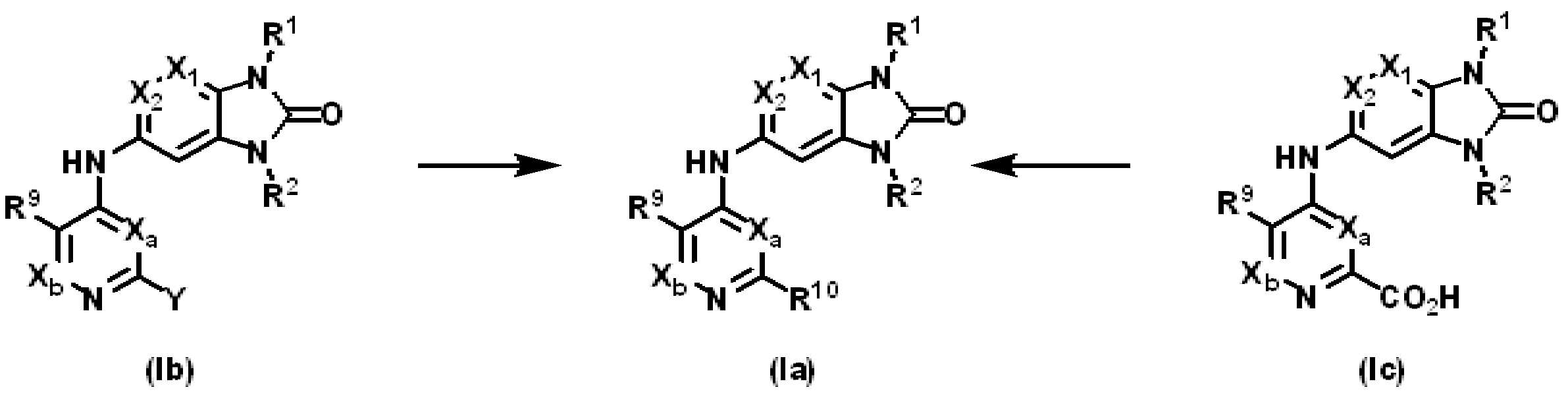
식 중, Y는 할로겐, 예컨대, Cl, Br, I 또는 적합한 대안, 예컨대, OTf, OTs이고, R1, R2, R3, R9, R10, X1, X2, Xa, Xb는 상기에 정의된 것으로부터 선택된 적합한 기이다.Wherein Y is a halogen such as Cl, Br, I or a suitable alternative such as OTf, OTs and R 1 , R 2 , R 3 , R 9 , R 10 , X 1 , X 2 , X a , X b is a suitable group selected from those defined above.
화학식 I의 화합물은 당업자에게 일반적으로 공지된 방법에 의해서 화학식 I의 또 다른 화합물로 전환될 수 있다. 이의 일부 예를 이 반응식에 나타낸다. 화학식 Ia로 표현된 화학식 I의 화합물의 하위세트는, 적합한 아민 또는 NH를 함유하는 헤테로사이클(예컨대, 피페리딘 또는 모르폴린) 또는 NH를 함유하는 헤테로아릴(예컨대, 피라졸), 또는 알코올을 비롯한, 공지된 방법에 의해서 화학식 Ib의 화합물로부터 형성될 수 있다. 이러한 반응은 전형적으로 승온에서, 적합한 용매(예컨대, DMF, NMP, 에탄올 또는 아세토니트릴) 중에서 수행되고, 염기(예컨대, 세슘 또는 다른 금속 탄산염, DIPEA, 트리에틸아민 또는 수소화나트륨)의 첨가로부터, 일부 경우에 적합한 금속 촉매 및 리간드의 첨가에 의해서 이익이 있을 수 있다. 금속 촉매작용은 또한 널리 공지된 스즈키(Suzuki) 반응을 통한 Ib와 보론산 또는 에스테르의 반응 또는 유사한 반응(스틸레(Stille) 반응 포함)의 Ib와 다른 유기금속 화합물(예컨대, 유기주석 종)의 반응을 위해서 사용될 수 있다. 산 Ic은 공지된 방법, 예컨대, 아미드 또는 에스테르 형성을 사용하여 화학식 Ia의 화합물로 전환될 수 있다. 이러한 화합물로부터 헤테로아릴이 또한 제조될 수 있다(예를 들어, 커플링 또는 탈수 시약, 예컨대, T3P의 존재 하에서의 1c와 아미독심의 축합에 의한 R10 = 옥사디아졸의 형성). 화학식 I의 분자의 다른 위치, 예컨대, 구현예에 기재된 바와 같은 화학식 B 하위구조를 함유하는 화합물의 R11 기를 개질시키기 위해서 이러한 반응식에 기재된 것과 유사한 절차를 또한 사용할 수 있다.Compounds of formula (I) may be converted to another compound of formula (I) by methods generally known to those skilled in the art. Some examples thereof are shown in this scheme. Subsets of compounds of formula (I) represented by formula (Ia) include heterocycles (e.g. piperidine or morpholine) containing suitable amines or NH or heteroaryls (e.g. pyrazole) containing NH, or alcohols. It may be formed from a compound of formula (Ib) by known methods, including. This reaction is typically carried out in an appropriate solvent (eg DMF, NMP, ethanol or acetonitrile) at elevated temperature, and from the addition of a base (eg cesium or other metal carbonate, DIPEA, triethylamine or sodium hydride), In this case it may be beneficial to add suitable metal catalysts and ligands. Metal catalysis may also be achieved by the reaction of Ib with boronic acids or esters or the similar reactions (including the Steille reaction) and other organometallic compounds (eg organotin species) via the well known Suzuki reaction. Can be used for the reaction. The acid Ic can be converted to the compound of formula Ia using known methods such as amide or ester formation. Heteroaryls can also be prepared from these compounds (eg, R 10 = oxadiazole formation by condensation of 1c with amidoxime in the presence of a coupling or dehydration reagent such as T3P). Similar procedures to those described in this scheme can also be used to modify R 11 groups of compounds containing other positions of the molecules of Formula (I), such as Formula B substructures as described in the embodiments.
생물학적 활성Biological activity
본 명세서의 실시예 부분에 기술된 생물학적 검정을 사용하여 본 발명의 화합물의 약리학적 효과를 측정할 수 있다.The biological assays described in the Examples section of this specification can be used to determine the pharmacological effects of the compounds of the present invention.
예상되는 바와 같이, 화학식 I의 화합물의 약리학적 특성이 구조적 변화에 따라 다양하지만, 본 발명의 화합물은 실시예 부분에 기재된 HTRF 시험관내 검정에서 활성인 것으로 밝혀졌다.As expected, although the pharmacological properties of the compounds of formula I vary with structural changes, the compounds of the present invention have been found to be active in the HTRF in vitro assays described in the Examples section.
일반적으로, 실시예 부분에 기재된 HTRF 검정에서 표 1a 또는 표 1b의 실시예 화합물 데이터에 의해서 예시되는 바와 같이, 본 발명의 화합물은 5 μM 이하의 IC50을 나타내는데, 이것은 5.3 이상의 pIC50에 상응하며, 바람직한 본 발명의 화합물은 1 μM 이하의 IC50을 나타내는데, 이것은 6.0 이상의 pIC50에 상응한다.In general, as exemplified by the example compound data of Table 1a or Table 1b in the HTRF assay described in the Examples section, the compounds of the present invention exhibit an IC 50 of 5 μM or less, which corresponds to a pIC 50 of 5.3 or greater and Preferred compounds of the invention exhibit an IC 50 of 1 μM or less, which corresponds to a pIC 50 of 6.0 or greater.
실시예 부분에 본 명세서에 기재된 NanoBRET 세포 검정에서, 표 2a 또는 표 2b의 실시예 화합물 데이터에 의해서 예시되는 바와 같이, 화학식 I의 화합물은 전형적으로 5.0 이상의 pIC50을 나타낸다.In the NanoBRET cell assay described herein in the Examples section, as illustrated by the example compound data in Table 2a or Table 2b, the compounds of Formula I typically exhibit a pIC 50 of at least 5.0.
실시예 부분에 본 명세서에 기재된 면역형광 검정에서, 본 발명의 특정 화합물은 BCL6의 분해를 가능하게 하는 것으로 밝혀졌다. 이것은 표 2c에 나타낸 실시예 화합물 데이터에 의해서 예시된다.In the immunofluorescence assay described herein in the Examples section, it has been found that certain compounds of the invention allow the degradation of BCL6. This is illustrated by the example compound data shown in Table 2c.
일반적으로, 표 2d의 실시예 화합물 데이터에 의해서 예시되는 바와 같이, 본 발명의 화합물은 실시예 부분에 본 명세서에 기재된 검정으로 시험되는 경우 세포 증식의 저해를 나타낸다.In general, as exemplified by the example compound data in Table 2d, the compounds of the present invention exhibit inhibition of cell proliferation when tested in the assays described herein in the Examples section.
하기 데이터는 예를 위해서 제공되었다.The following data is provided for example.
[표 1a]TABLE 1a

[표 1b]TABLE 1b

[표 2a]TABLE 2a
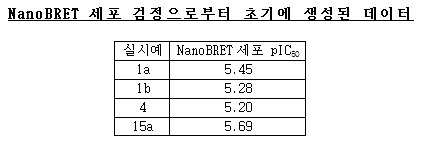
[표 2b]TABLE 2b

[표 2c]TABLE 2c

[표 2d]TABLE 2d

하기 화합물을 시험하였지만, 실시예 부분에 기재된 HTRF 검정에서 목적하는 활성도를 나타내지 않았다:The following compounds were tested but did not exhibit the desired activity in the HTRF assay described in the Examples section:
1,3-디메틸-5-((3-(트리플루오로메틸)피리딘-4-일)아미노)-1,3-디히드로-2H-벤조[d]이미다졸-2-온1,3-dimethyl-5-((3- (trifluoromethyl) pyridin-4-yl) amino) -1,3-dihydro-2H-benzo [d] imidazol-2-one
1,3-디메틸-5-((5-메틸피리미딘-4-일)아미노)-1,3-디히드로-2H-벤조[d]이미다졸-2-온1,3-dimethyl-5-((5-methylpyrimidin-4-yl) amino) -1,3-dihydro-2H-benzo [d] imidazol-2-one
5-((6-클로로-5-메톡시피리미딘-4-일)아미노)-1,3-디메틸-1,3-디히드로-2H-벤조[d]이미다졸-2-온5-((6-chloro-5-methoxypyrimidin-4-yl) amino) -1,3-dimethyl-1,3-dihydro-2H-benzo [d] imidazol-2-one
4-((1,3-디메틸-2-옥소-2,3-디히드로-1H-벤조[d]이미다졸-5-일)아미노)피리미딘-5-카르보니트릴4-((1,3-dimethyl-2-oxo-2,3-dihydro-1H-benzo [d] imidazol-5-yl) amino) pyrimidine-5-carbonitrile
2-클로로-4-((1-메틸-3-(2-모르폴리노에틸)-2-옥소-2,3-디히드로-1H-벤조[d]이미다졸-5-일)아미노)니코티노니트릴2-chloro-4-((1-methyl-3- (2-morpholinoethyl) -2-oxo-2,3-dihydro-1H-benzo [d] imidazol-5-yl) amino) nico Tinonitrile
2-클로로-4-((3-(2-(디에틸아미노)에틸)-1-메틸-2-옥소-2,3-디히드로-1H-벤조[d]이미다졸-5-일)아미노)니코티노니트릴2-chloro-4-((3- (2- (diethylamino) ethyl) -1-methyl-2-oxo-2,3-dihydro-1H-benzo [d] imidazol-5-yl) amino Nicotinonitrile
1-메틸-3-펜에틸-5-(피라졸로[1,5-a]피리미딘-7-일아미노)-1,3-디히드로-2H-벤조[d]이미다졸-2-온1-methyl-3-phenethyl-5- (pyrazolo [1,5-a] pyrimidin-7-ylamino) -1,3-dihydro-2H-benzo [d] imidazol-2-one
4-((1,3-디메틸-2-옥소-2,3-디히드로-1H-벤조[d]이미다졸-5-일)아미노)-2-메틸니코티노니트릴4-((1,3-dimethyl-2-oxo-2,3-dihydro-1H-benzo [d] imidazol-5-yl) amino) -2-methylnicotinonitrile
2-클로로-4-((1-메틸-2-옥소-3-((테트라히드로-2H-피란-4-일)메틸)-2,3-디히드로-1H-벤조[d]이미다졸-5-일)아미노)니코티노니트릴2-Chloro-4-((1-methyl-2-oxo-3-((tetrahydro-2H-pyran-4-yl) methyl) -2,3-dihydro-1H-benzo [d] imidazole- 5-yl) amino) nicotinonitrile
2-클로로-4-((1-메틸-2-옥소-3-(피페리딘-4-일메틸)-2,3-디히드로-1H-벤조[d]이미다졸-5-일)아미노)니코티노니트릴2-chloro-4-((1-methyl-2-oxo-3- (piperidin-4-ylmethyl) -2,3-dihydro-1H-benzo [d] imidazol-5-yl) amino Nicotinonitrile
2-클로로-4-((3-(2-히드록시-3,3-디메틸부틸)-1-메틸-2-옥소-2,3-디히드로-1H-벤조[d]이미다졸-5-일)아미노)니코티노니트릴2-chloro-4-((3- (2-hydroxy-3,3-dimethylbutyl) -1-methyl-2-oxo-2,3-dihydro-1H-benzo [d] imidazole-5- 1) amino) nicotinonitrile
1,3-디메틸-5-((5-(트리플루오로메틸)-[1,2,4]트리아졸로[1,5-a]피리미딘-7-일)아미노)-1,3-디히드로-2H-벤조[d]이미다졸-2-온1,3-dimethyl-5-((5- (trifluoromethyl)-[1,2,4] triazolo [1,5-a] pyrimidin-7-yl) amino) -1,3-di Hydro-2H-benzo [d] imidazol-2-one
4-((1,3-디메틸-2-옥소-2,3-디히드로-1H-벤조[d]이미다졸-5-일)아미노)-2-(트리플루오로메틸)니코티노니트릴4-((1,3-dimethyl-2-oxo-2,3-dihydro-1H-benzo [d] imidazol-5-yl) amino) -2- (trifluoromethyl) nicotinonitrile
5-((5-((2-메톡시에틸)아미노)피라졸로[1,5-a]피리미딘-7-일)아미노)-1,3-디메틸-1,3-디히드로-2H-벤조[d]이미다졸-2-온5-((5-((2-methoxyethyl) amino) pyrazolo [1,5-a] pyrimidin-7-yl) amino) -1,3-dimethyl-1,3-dihydro-2H- Benzo [d] imidazol-2-one
2-클로로-4-((3-(2-히드록시-2-메틸부틸)-1-메틸-2-옥소-2,3-디히드로-1H-벤조[d]이미다졸-5-일)아미노)니코티노니트릴2-chloro-4-((3- (2-hydroxy-2-methylbutyl) -1-methyl-2-oxo-2,3-dihydro-1H-benzo [d] imidazol-5-yl) Amino) nicotinonitrile
5-((2-클로로-5-(디플루오로메틸)피리딘-4-일)아미노)-3-(3-히드록시-3-메틸부틸)-1-메틸-1,3-디히드로-2H-벤조[d]이미다졸-2-온5-((2-chloro-5- (difluoromethyl) pyridin-4-yl) amino) -3- (3-hydroxy-3-methylbutyl) -1-methyl-1,3-dihydro- 2H-benzo [d] imidazol-2-one
5-((2-클로로-3-(트리플루오로메틸)피리딘-4-일)아미노)-3-(3-히드록시-3-메틸부틸)-1-메틸-1,3-디히드로-2H-벤조[d]이미다졸-2-온5-((2-chloro-3- (trifluoromethyl) pyridin-4-yl) amino) -3- (3-hydroxy-3-methylbutyl) -1-methyl-1,3-dihydro- 2H-benzo [d] imidazol-2-one
5-((2-클로로-3-(디플루오로메틸)피리딘-4-일)아미노)-3-(3-히드록시-3-메틸부틸)-1-메틸-1,3-디히드로-2H-벤조[d]이미다졸-2-온5-((2-chloro-3- (difluoromethyl) pyridin-4-yl) amino) -3- (3-hydroxy-3-methylbutyl) -1-methyl-1,3-dihydro- 2H-benzo [d] imidazol-2-one
6-((5-클로로-2-(4,4-디플루오로피페리딘-1-일)피리미딘-4-일)아미노)-1-(3-히드록시-3-메틸부틸)-3-메틸-1,3-디히드로-2H-이미다조[4,5-c]피리딘-2-온6-((5-chloro-2- (4,4-difluoropiperidin-1-yl) pyrimidin-4-yl) amino) -1- (3-hydroxy-3-methylbutyl)- 3-methyl-1,3-dihydro-2H-imidazo [4,5-c] pyridin-2-one
6-((5-클로로-2-(3-(트리플루오로메틸)-1H-피라졸-1-일)피리딘-4-일)아미노)-1-(3-히드록시-3-메틸부틸)-3-메틸-1,3-디히드로-2H-이미다조[4,5-c]피리딘-2-온6-((5-chloro-2- (3- (trifluoromethyl) -1H-pyrazol-1-yl) pyridin-4-yl) amino) -1- (3-hydroxy-3-methylbutyl ) -3-methyl-1,3-dihydro-2H-imidazo [4,5-c] pyridin-2-one
6-((5-클로로-2-(3-(트리플루오로메틸)-1H-피라졸-1-일)피리미딘-4-일)아미노)-1-(3-히드록시-3-메틸부틸)-3-메틸-1,3-디히드로-2H-이미다조[4,5-c]피리딘-2-온6-((5-chloro-2- (3- (trifluoromethyl) -1H-pyrazol-1-yl) pyrimidin-4-yl) amino) -1- (3-hydroxy-3-methyl Butyl) -3-methyl-1,3-dihydro-2H-imidazo [4,5-c] pyridin-2-one
6-((2,5-디클로로피리미딘-4-일)아미노)-1-(3-히드록시-3-메틸부틸)-3-메틸-1,3-디히드로-2H-이미다조[4,5-c]피리딘-2-온6-((2,5-dichloropyrimidin-4-yl) amino) -1- (3-hydroxy-3-methylbutyl) -3-methyl-1,3-dihydro-2H-imidazo [4 , 5-c] pyridin-2-one
6-((3-클로로피리딘-4-일)아미노)-1-(3-히드록시-3-메틸부틸)-3-메틸-1,3-디히드로-2H-이미다조[4,5-c]피리딘-2-온6-((3-chloropyridin-4-yl) amino) -1- (3-hydroxy-3-methylbutyl) -3-methyl-1,3-dihydro-2H-imidazo [4,5- c] pyridin-2-one
6-((5-클로로-2-(4,4-디플루오로피페리딘-1-일)피리딘-4-일)아미노)-1-(3-히드록시-3-메틸부틸)-3-메틸-1,3-디히드로-2H-이미다조[4,5-c]피리딘-2-온6-((5-chloro-2- (4,4-difluoropiperidin-1-yl) pyridin-4-yl) amino) -1- (3-hydroxy-3-methylbutyl) -3 -Methyl-1,3-dihydro-2H-imidazo [4,5-c] pyridin-2-one
(R)-2-클로로-4-((1-메틸-3-((1-메틸피롤리딘-2-일)메틸)-2-옥소-2,3-디히드로-1H-벤조[d]이미다졸-5-일)아미노)니코티노니트릴(R) -2-chloro-4-((1-methyl-3-((1-methylpyrrolidin-2-yl) methyl) -2-oxo-2,3-dihydro-1H-benzo [d Imidazol-5-yl) amino) nicotinonitrile
5-((3,5-디클로로피리딘-4-일)아미노)-3-(3-히드록시-3-메틸부틸)-1-메틸-1,3-디히드로-2H-벤조[d]이미다졸-2-온5-((3,5-dichloropyridin-4-yl) amino) -3- (3-hydroxy-3-methylbutyl) -1-methyl-1,3-dihydro-2H-benzo [d] Dazol-2-one
5-((6-클로로이미다조[1,2-a]피리딘-7-일)아미노)-3-(3-히드록시-3-메틸부틸)-1-메틸-1,3-디히드로-2H-벤조[d]이미다졸-2-온5-((6-chloroimidazo [1,2-a] pyridin-7-yl) amino) -3- (3-hydroxy-3-methylbutyl) -1-methyl-1,3-dihydro- 2H-benzo [d] imidazol-2-one
2-클로로-4-((3-((3-(히드록시메틸)옥세탄-3-일)메틸)-1-메틸-2-옥소-2,3-디히드로-1H-벤조[d]이미다졸-5-일)아미노)니코티노니트릴2-chloro-4-((3-((3- (hydroxymethyl) oxetan-3-yl) methyl) -1-methyl-2-oxo-2,3-dihydro-1H-benzo [d] Imidazol-5-yl) amino) nicotinonitrile
2-클로로-4-((3-((4-시아노테트라히드로-2H-피란-4-일)메틸)-1-메틸-2-옥소-2,3-디히드로-1H-벤조[d]이미다졸-5-일)아미노)니코티노니트릴2-chloro-4-((3-((4-cyanotetrahydro-2H-pyran-4-yl) methyl) -1-methyl-2-oxo-2,3-dihydro-1H-benzo [d Imidazol-5-yl) amino) nicotinonitrile
2-클로로-4-((1-메틸-2-옥소-3-(피페리딘-3-일메틸)-2,3-디히드로-1H-벤조[d]이미다졸-5-일)아미노)니코티노니트릴2-chloro-4-((1-methyl-2-oxo-3- (piperidin-3-ylmethyl) -2,3-dihydro-1H-benzo [d] imidazol-5-yl) amino Nicotinonitrile
4-((3-(아제티딘-2-일메틸)-1-메틸-2-옥소-2,3-디히드로-1H-벤조[d]이미다졸-5-일)아미노)-2-클로로니코티노니트릴4-((3- (azetidin-2-ylmethyl) -1-methyl-2-oxo-2,3-dihydro-1H-benzo [d] imidazol-5-yl) amino) -2-chloro Nicotinonitrile
2-클로로-4-((3-((3,3-디메틸시클로부틸)메틸)-1-메틸-2-옥소-2,3-디히드로-1H-벤조[d]이미다졸-5-일)아미노)니코티노니트릴2-chloro-4-((3-((3,3-dimethylcyclobutyl) methyl) -1-methyl-2-oxo-2,3-dihydro-1H-benzo [d] imidazol-5-yl ) Amino) nicotinonitrile
5-((2,5-디클로로피리미딘-4-일)아미노)-3-(3,5-디히드록시-3-메틸펜틸)-1-메틸-1,3-디히드로-2H-벤조[d]이미다졸-2-온5-((2,5-dichloropyrimidin-4-yl) amino) -3- (3,5-dihydroxy-3-methylpentyl) -1-methyl-1,3-dihydro-2H-benzo [d] imidazol-2-one
tert-부틸 3-((6-((2-클로로-3-시아노피리딘-4-일)아미노)-3-메틸-2-옥소-2,3-디히드로-1H-벤조[d]이미다졸-1-일)메틸)피페리딘-1-카르복실레이트tert-butyl 3-((6-((2-chloro-3-cyanopyridin-4-yl) amino) -3-methyl-2-oxo-2,3-dihydro-1H-benzo [d] Dazol-1-yl) methyl) piperidine-1-carboxylate
(S)-2-클로로-4-((3-((1-(시클로프로필메틸)피롤리딘-2-일)메틸)-1-메틸-2-옥소-2,3-디히드로-1H-벤조[d]이미다졸-5-일)아미노)니코티노니트릴(S) -2-chloro-4-((3-((1- (cyclopropylmethyl) pyrrolidin-2-yl) methyl) -1-methyl-2-oxo-2,3-dihydro-1H -Benzo [d] imidazol-5-yl) amino) nicotinonitrile
2-클로로-4-((3-((2,2-디메틸테트라히드로푸란-3-일)메틸)-1-메틸-2-옥소-2,3-디히드로-1H-벤조[d]이미다졸-5-일)아미노)니코티노니트릴2-chloro-4-((3-((2,2-dimethyltetrahydrofuran-3-yl) methyl) -1-methyl-2-oxo-2,3-dihydro-1H-benzo [d] Dazol-5-yl) amino) nicotinonitrile
구현예에서, 본 발명의 화합물은 상기에 정의된 바와 같은 화학식 I의 화합물이되, 단 상기 단락에 열거된 화합물 중 하나가 아니다.In an embodiment, the compound of the invention is a compound of formula I as defined above, provided that it is not one of the compounds listed in the paragraphs above.
약제학적 조성물Pharmaceutical composition
본 발명의 추가 양태에 따르면, 약제학적으로 허용 가능한 희석제 또는 담체와 함께, 본 명세서에서 앞서 정의된 바와 같은 본 발명의 화합물 또는 이의 약제학적으로 허용 가능한 염, 수화물 또는 용매화물을 포함하는 약제학적 조성물이 제공된다.According to a further aspect of the present invention, there is provided a pharmaceutical composition comprising a compound of the present invention, or a pharmaceutically acceptable salt, hydrate or solvate thereof, as previously defined herein, with a pharmaceutically acceptable diluent or carrier. This is provided.
본 발명의 조성물은 경구용에 적합한 형태(예컨대, 정제, 로젠지, 경질 또는 연질 캡슐, 수성 또는 유성 현탁액, 에멀전, 분산가능한 분말 또는 과립, 시럽 또는 엘릭시르제), 국소용에 적합한 형태(예컨대, 크림, 연고, 겔, 또는 수성 또는 유성 용액 또는 현탁액), 흡입(inhalation)에 의한 투여에 적합한 형태(예컨대, 미분된 분말 또는 액체 에어로졸), 흡기(insufflation)에 적합한 형태(예컨대, 미분된 분말) 또는 비경구적 투여에 적합한 형태(예컨대, 정맥, 피하, 근육내, 복강내 또는 근육내 투여를 위한 멸균된 수성 또는 유성 용액, 또는 직장 투여를 위한 좌약)일 수 있다.The compositions of the present invention may be in a form suitable for oral use (eg, tablets, lozenges, hard or soft capsules, aqueous or oily suspensions, emulsions, dispersible powders or granules, syrups or elixirs), forms suitable for topical use (eg, Creams, ointments, gels, or aqueous or oily solutions or suspensions), forms suitable for administration by inhalation (e.g. finely divided powders or liquid aerosols), forms suitable for insufflation (e.g. finely divided powders) Or in a form suitable for parenteral administration (eg, sterile aqueous or oily solutions for intravenous, subcutaneous, intramuscular, intraperitoneal or intramuscular administration, or suppositories for rectal administration).
본 발명의 조성물은 당업계에 널리 공지된 전통적인 약학 부형제를 사용하여 전통적인 방법에 의해 수득될수 있다. 따라서, 경구용으로 의도된 조성물은, 예컨대, 하나 이상의 착색제, 감미제, 풍미제 및/또는 보존제를 함유할 수 있다.The compositions of the present invention can be obtained by conventional methods using conventional pharmaceutical excipients well known in the art. Thus, a composition intended for oral use may, for example, contain one or more colorants, sweeteners, flavors and / or preservatives.
치료에 사용하기 위한 본 발명의 화합물의 유효량은 본 명세서에 언급된 증식성 질환의 치료 또는 예방에 충분한 양, 이의 진행을 늦추고/늦추거나 이러한 질환과 관련된 증상을 감소시키기에 충분한 양이다.An effective amount of a compound of the invention for use in therapy is an amount sufficient to treat or prevent the proliferative disease referred to herein, an amount sufficient to slow its progress and / or reduce the symptoms associated with such disease.
단일 투여 형태를 생성하기 위한 하나 이상의 부형제와 조합된 활성 성분의 양은 치료되는 개인 및 특정 투여 경로에 따라 필수적으로 달라질 것이다. 예컨대, 인간에 경구투여하기 위해 의도된 제형은 일반적으로 총 조성물의 약 5 중량% 내지 약 98 중량%로 변할 수 있는 적절하고 편리한 양의 부형제와 함께 배합된 0.5 mg 내지 0.5 g의 활성제(보다 적절하게는 0.5 mg 내지 100 mg, 예컨대, 1 mg 내지 30 mg)를 함유할 것이다.The amount of active ingredient combined with one or more excipients to produce a single dosage form will necessarily vary depending upon the individual treated and the particular route of administration. For example, formulations intended for oral administration to humans generally range from 0.5 mg to 0.5 g of active agent (more appropriate) in combination with an appropriate and convenient amount of excipient that may vary from about 5% to about 98% by weight of the total composition. Preferably from 0.5 mg to 100 mg, such as from 1 mg to 30 mg).
화학식 I의 화합물의 치료적 또는 예방적 목적을 위한 투여량의 크기는 널리 알려진 의학적 원리에 따라 상태의 성질 및 중증도, 동물 또는 환자의 연령 및 성별, 및 투여 경로에 따라 자연적으로 달라질 것이다.The size of the dosage for therapeutic or prophylactic purposes of a compound of formula (I) will naturally vary depending on the nature and severity of the condition, the age and sex of the animal or patient, and the route of administration, according to well-known medical principles.
치료적 또는 예방적 목적을 위해 본 발명의 화합물을 사용하는 경우, 분할된 투여량이 요구되는 경우, 예컨대, 0.1 mg/kg 내지 75 mg/kg 체중의 범위의 일일 투여량이 수용되도록 일반적으로 투여될 것이다. 비경구적 경로가 사용되는 경우 일반적으로 보다 낮은 투여량이 투여될 것이다. 따라서, 예컨대, 정맥 내 또는 복강 내 투여에서, 예컨대, 0.1 mg/kg 내지 30 mg/kg 체중의 범위의 투여량이 일반적으로 사용될 것이다. 유사하게, 흡입에 의한 투여에서, 예컨대, 0.05 mg/kg 내지 25 mg/kg 체중의 범위의 투여량이 사용될 것이다. 경구 투여는 특히 정제 형태가 또한 적절할 수 있다. 전형적으로, 단위 투여량 형태는 약 0.5 mg 내지 0.5 g의 본 발명의 화합물을 함유할 것이다.When using a compound of the invention for therapeutic or prophylactic purposes, a divided dose will generally be administered so that a daily dose in the range of, eg, 0.1 mg / kg to 75 mg / kg body weight is acceptable. . Lower doses will generally be administered when the parenteral route is used. Thus, for example, in intravenous or intraperitoneal administration, dosages ranging from 0.1 mg / kg to 30 mg / kg body weight will generally be used. Similarly, in administration by inhalation, a dosage ranging from 0.05 mg / kg to 25 mg / kg body weight will be used, for example. Oral administration may also be particularly suitable in tablet form. Typically, unit dosage forms will contain about 0.5 mg to 0.5 g of a compound of the present invention.
치료적 용도 및 적용Therapeutic Uses and Applications
본 발명은 BCL6의 저해제로서 기능하는 화합물을 제공한다.The present invention provides compounds that function as inhibitors of BCL6.
따라서 본 발명은 시험관내 또는 생체내에서 BCL6 활성을 저해하는 방법을 제공하며, 상기 방법은 세포를 유효량의 본 명세서에 정의된 바와 같은 화합물, 또는 이의 약제학적으로 허용 가능한 염, 수화물 또는 용매화물과 접촉시키는 단계를 포함한다.Accordingly, the present invention provides a method of inhibiting BCL6 activity in vitro or in vivo, wherein the method comprises the steps of combining the cells with an effective amount of a compound as defined herein, or a pharmaceutically acceptable salt, hydrate or solvate thereof. Contacting.
본 발명은 또한 BCL6 활성과 관련된 질병 또는 장애의 치료를 필요로 하는 환자에서 이를 치료하는 방법을 제공하며, 상기 방법은 상기 환자에게 치료 유효량의 본 명세서에 정의된 바와 같은 화합물, 또는 이의 약제학적으로 허용 가능한 염, 수화물 또는 용매화물, 또는 약제학적 조성물을 투여하는 단계를 포함한다.The present invention also provides a method of treating a patient in need thereof for the treatment of a disease or disorder associated with BCL6 activity, the method comprising administering to said patient a therapeutically effective amount of a compound as defined herein, or a pharmaceutically thereof. Administering an acceptable salt, hydrate or solvate, or pharmaceutical composition.
본 발명은 시험관내 또는 생체내에서 세포 증식을 저해하는 방법을 제공하며, 상기 방법은 세포를 유효량의 본 명세서에 정의된 바와 같은 화합물, 또는 이의 약제학적으로 허용 가능한 염, 수화물 또는 용매화물과 접촉시키는 단계를 포함한다.The present invention provides a method of inhibiting cell proliferation in vitro or in vivo, said method comprising contacting a cell with an effective amount of a compound as defined herein, or a pharmaceutically acceptable salt, hydrate or solvate thereof. It comprises the step of.
본 발명은 증식성 장애의 치료를 필요로 하는 환자에서 이를 치료하는 방법을 제공하며, 상기 방법은 상기 환자에게 치료 유효량의 본 명세서에 정의된 바와 같은 화합물, 또는 이의 약제학적으로 허용 가능한 염, 수화물 또는 용매화물, 또는 약제학적 조성물을 투여하는 단계를 포함한다.The present invention provides a method of treating it in a patient in need of treatment of a proliferative disorder, wherein the method comprises a therapeutically effective amount of a compound as defined herein, or a pharmaceutically acceptable salt, hydrate thereof, in the patient. Or administering a solvate, or pharmaceutical composition.
본 발명은 암의 치료를 필요로 하는 환자에서 이를 치료하는 방법을 제공하며, 상기 방법은 상기 환자에게 치료 유효량의 본 명세서에 정의된 바와 같은 화합물, 또는 이의 약제학적으로 허용 가능한 염, 수화물 또는 용매화물, 또는 약제학적 조성물을 투여하는 단계를 포함한다.The present invention provides a method of treating a cancer in a patient in need thereof, wherein the method comprises a therapeutically effective amount of a compound as defined herein, or a pharmaceutically acceptable salt, hydrate or solvent thereof. Administering the cargo, or pharmaceutical composition.
본 발명은 요법에 사용하기 위한 본 명세서에 정의된 바와 같은 화합물, 또는 이의 약제학적으로 허용 가능한 염, 수화물 또는 용매화물, 또는 약제학적 조성물을 제공한다.The present invention provides a compound as defined herein for use in therapy, or a pharmaceutically acceptable salt, hydrate or solvate thereof, or pharmaceutical composition.
본 발명은 증식성 질환의 치료에 사용하기 위한 본 명세서에 정의된 바와 같은 화합물, 또는 이의 약제학적으로 허용 가능한 염, 수화물 또는 용매화물, 또는 약제학적 조성물을 제공한다.The present invention provides a compound as defined herein, or a pharmaceutically acceptable salt, hydrate or solvate thereof, or pharmaceutical composition as defined herein for use in the treatment of proliferative disease.
본 발명은 암의 치료에 사용하기 위한 본 명세서에 정의된 바와 같은 화합물, 또는 이의 약제학적으로 허용 가능한 염, 수화물 또는 용매화물, 또는 약제학적 조성물을 제공한다. 특정 구현예에서, 암은 인간 암이다.The present invention provides a compound as defined herein, or a pharmaceutically acceptable salt, hydrate or solvate thereof, or pharmaceutical composition as defined herein for use in the treatment of cancer. In certain embodiments, the cancer is human cancer.
본 발명은 BCL6 활성의 저해(즉, BCL6 전사 저해 및/또는 코리프레서 결합의 저해)에 사용하기 위한 본 명세서에 정의된 바와 같은 화합물, 또는 이의 약제학적으로 허용 가능한 염, 수화물 또는 용매화물을 제공한다.The present invention relates to a compound as defined herein, or a pharmaceutically acceptable salt, hydrate or solvate thereof, for use in the inhibition of BCL6 activity (ie, inhibition of BCL6 transcription and / or inhibition of corepressor binding). to provide.
본 발명의 특정 화합물은 BCL6에 결합하여 BCL6의 분해를 개시하는 것을 발견하였다. 따라서, 본 발명은 또한 BCL6의 분해에 사용하기 위한 본 명세서에 정의된 바와 같은 화합물, 또는 이의 약제학적으로 허용 가능한 염, 수화물 또는 용매화물을 제공한다.Certain compounds of the present invention have been found to bind BCL6 to initiate the degradation of BCL6. Accordingly, the present invention also provides a compound as defined herein, or a pharmaceutically acceptable salt, hydrate or solvate thereof, for use in the degradation of BCL6.
본 발명은 BCL6 활성이 연관된 질병 또는 장애의 치료에 사용하기 위한 본 명세서에 정의된 바와 같은 화합물, 또는 이의 약제학적으로 허용 가능한 염, 수화물 또는 용매화물을 제공한다.The present invention provides a compound as defined herein, or a pharmaceutically acceptable salt, hydrate or solvate thereof, for use in the treatment of a disease or disorder associated with BCL6 activity.
본 발명은 증식성 질환의 치료를 위한 약제의 제조에서의 본 명세서에 정의된 바와 같은 화합물, 또는 이의 약제학적으로 허용 가능한 염, 수화물 또는 용매화물의 용도를 제공한다.The present invention provides the use of a compound as defined herein, or a pharmaceutically acceptable salt, hydrate or solvate thereof, in the manufacture of a medicament for the treatment of proliferative disease.
본 발명은 암의 치료를 위한 약제의 제조에서의 본 명세서에 정의된 바와 같은 화합물, 또는 이의 약제학적으로 허용 가능한 염, 수화물 또는 용매화물의 용도를 제공한다. 적합하게는, 약제는 인간 암의 치료에 사용하기 위한 것이다.The present invention provides the use of a compound as defined herein, or a pharmaceutically acceptable salt, hydrate or solvate thereof, in the manufacture of a medicament for the treatment of cancer. Suitably the medicament is for use in the treatment of human cancer.
본 발명은 BCL6 활성의 저해(즉, BCL6 전사 저해 및/또는 코리프레서 결합의 저해)를 위한 약제의 제조에서의 본 명세서에 정의된 바와 같은 화합물, 또는 이의 약제학적으로 허용 가능한 염, 수화물 또는 용매화물의 용도를 제공한다.The present invention provides a compound as defined herein, or a pharmaceutically acceptable salt, hydrate thereof, in the manufacture of a medicament for inhibiting BCL6 activity (ie, inhibiting BCL6 transcription and / or inhibiting coripressor binding). It provides the use of solvates.
본 발명은 BCL6의 분해를 위한 약제의 제조에서의 본 명세서에 정의된 바와 같은 화합물, 또는 이의 약제학적으로 허용 가능한 염, 수화물 또는 용매화물의 용도를 제공한다.The present invention provides the use of a compound as defined herein, or a pharmaceutically acceptable salt, hydrate or solvate thereof, in the manufacture of a medicament for the degradation of BCL6.
본 발명은 BCL6 활성이 연관된 질병 또는 장애의 치료를 위한 약제의 제조에서의 본 명세서에 정의된 바와 같은 화합물, 또는 이의 약제학적으로 허용 가능한 염, 수화물 또는 용매화물의 용도를 제공한다.The present invention provides the use of a compound as defined herein, or a pharmaceutically acceptable salt, hydrate or solvate thereof, in the manufacture of a medicament for the treatment of a disease or disorder associated with BCL6 activity.
용어 "증식성 장애"는 및 "증식성 질환"은 본 명세서에서 상호교환적으로 사용되며, 시험관내 또는 생체내에서의 신생 또는 증식성 발육과 같은 바람직하지 않은 과량 또는 비정상 세포의 원치 않거나 제어되지 않은 세포 증식과 관련 있다. 증식성 질환의 예는 악성 신생물 및 종양, 암(유방암, 비소세포 폐암(NSCLC) 및 편평 세포 암종(SCC)(두경부, 식도, 폐 및 난소의 SCC 포함) 포함), 백혈병(급성 림프아구 백혈병(ALL) 및 만성 골수성 백혈병(CML) 포함), 림프종(급성 림프아구 백혈병(ALL) 및 만성 골수성 백혈병(CML) 포함), 건선, 골 질병, (예를 들어, 결합 조직의) 섬유 증식성(fibroproliferative) 장애 및 죽상 경화증을 포함하지만 이들로 제한되지 않는 전암성 및 악성 세포 증식을 포함하지만 이들로 제한되지 않는다. 림프, 혈액, 폐, 결장, 유방, 난소, 전립선, 간, 췌장, 뇌 및 피부를 포함하지만 이들로 제한되지 않는 임의의 유형의 세포가 치료될 수 있다.The terms "proliferative disorder" and "proliferative disorder" are used interchangeably herein and are unwanted or uncontrolled of undesirable excess or abnormal cells such as neoplastic or proliferative development in vitro or in vivo. Not cell proliferation. Examples of proliferative diseases include malignant neoplasms and tumors, cancer (including breast cancer, non-small cell lung cancer (NSCLC) and squamous cell carcinoma (SCC) (including SCCs of the head, esophagus, lungs and ovaries)), leukemia (acute lymphoblastic leukemia) (ALL) and chronic myeloid leukemia (CML)), lymphoma (including acute lymphoblastic leukemia (ALL) and chronic myeloid leukemia (CML)), psoriasis, bone disease, fibrotic proliferative (eg, of connective tissue) ( fibroproliferative) includes, but is not limited to, precancerous and malignant cell proliferation, including but not limited to disorders and atherosclerosis. Any type of cells can be treated, including but not limited to lymph, blood, lung, colon, breast, ovary, prostate, liver, pancreas, brain and skin.
항암 효과는, 세포 증식의 조절, 혈관 신생(새로운 혈관의 형성)의 저해, 전이(기원으로부터의 종양의 확산)의 저해, 침입(종양 세포의 이웃하는 정상 구조로의 확산)의 저해 또는 아포토시스(세포예정사)의 촉진을 포함하지만 이들로 제한되지 않는 하나 이상의 기전을 통해서 일어날 수 있다.The anti-cancer effect may include regulation of cell proliferation, inhibition of angiogenesis (formation of new blood vessels), inhibition of metastasis (proliferation of tumors from the source), inhibition of invasion (diffusion of tumor cells into neighboring normal structures) or apoptosis ( Can occur through one or more mechanisms, including but not limited to, promoting cell death.
BCL6의 저해제인, 화학식 I의 화합물, 또는 이의 약제학적으로 허용 가능한 염은 다양한 BCL6-매개된 질병 상태에서 잠재적인 치료 용도를 갖는다. BCL6 발현은 다양한 림프종과 연관되어 있다(Wagner et al., British J Haematology, 2010, 152, 3-12). BCL6은 미만성 거대 B-세포 림프종(DLBCL)에서 염색체 전좌에 관여되며, BCL6의 저해제는 DLBCL 세포(Cerchietti et al., Cancer Cell, 2010, 17, 400-411), 원발성 저급 소포성 림프종 세포(Cardenas et al., Clin Cancer Res, 2017, 23(4), 885-893) 및 버킷 림프종 세포(Polo et al., Nat Med, 2004, 10, 1329-1335)를 사멸시키는 것으로 보고되어 있다. BCL6은 소포성 헬퍼 T 세포의 형성에 필요하며(Hatzi et al., J Exp Med, 2015, 212(4), 539-553), 이것은 BCL6 저해제가 BCL6이 강하게 발현되는 혈관면역모구 T-세포 림프종(AITL)의 치료에 사용될 수 있는 가능성을 제기한다(Cortes & Palomero, Curr Opin Hematol, 2016, 23, 434-443).Compounds of formula (I), or pharmaceutically acceptable salts thereof, which are inhibitors of BCL6, have potential therapeutic uses in various BCL6-mediated disease states. BCL6 expression is associated with various lymphomas (Wagner et al., British J Haematology , 2010, 152 , 3-12). BCL6 is involved in chromosomal translocation in diffuse large B-cell lymphoma (DLBCL), and inhibitors of BCL6 are DLBCL cells (Cerchietti et al., Cancer Cell , 2010, 17 , 400-411), primary lower vesicular lymphoma cells (Cardenas) et al., Clin Cancer Res , 2017, 23 (4) , 885-893) and Burkitt's lymphoma cells (Polo et al., Nat Med , 2004, 10 , 1329-1335). BCL6 is required for the formation of vesicular helper T cells (Hatzi et al., J Exp Med , 2015, 212 (4) , 539-553), which suggests that the BCL6 inhibitor is an angiogenic blastocyst T-cell lymphoma in which BCL6 is strongly expressed. Raises the possibility of use in the treatment of (AITL) (Cortes & Palomero, Curr Opin Hematol , 2016, 23 , 434-443).
BCL6은 또한 티로신 키나제 저해제(TKI)에 대한 내성을 획득한 백혈병 세포에 연관되어 있다. TKI는 전형적으로 백혈병-개시 세포를 근절하는 데 실패하며, 이것은 보통 초기 치료 이후에 백혈병의 재발을 유발할 수 있다. BCL6은 Ph+ 급성 림프아구 백혈병(ALL)(Duy et al., Nature, 2011, 473, 384-388) 및 Ph+ 만성 골수성 백혈병(CML)(Hurtz et al., J Exp Med, 2011, 208(11), 2163-2174) 둘 모두에서 TKI 약물 내성 경로의 중요한 성분으로서 식별되어 왔다. 따라서 BCL6의 저해제가 TKI와 조합하여 ALL 및 CML을 치료하는 데 사용될 수 있다.BCL6 is also associated with leukemia cells that have acquired resistance to tyrosine kinase inhibitors (TKIs). TKIs typically fail to eradicate leukemia-initiating cells, which can usually lead to relapse of leukemia after initial treatment. BCL6 is available for Ph + acute lymphoblastic leukemia (ALL) (Duy et al., Nature , 2011, 473 , 384-388) and Ph + chronic myeloid leukemia (CML) (Hurtz et al., J Exp Med , 2011, 208 (11) , 2163-2174) have been identified as important components of the TKI drug resistance pathway in both. Thus inhibitors of BCL6 can be used to treat ALL and CML in combination with TKI.
추가로 비-혈액 고형 종양이 BCL6의 저해제로 치료될 수 있다. BCL6은 유방 종양의 대략 50%에서 증폭되고, 삼중 음성 유방암 세포주를 비롯한, 다수의 유방암 세포주에서 발현된다(Walker et al., Oncogene, 2015, 34, 1073-1082). BCL6은 또한 주로 DNA 손상 수선에 관여된 유전자의 억압으로 인해서 비소세포 폐암(NSCLC) 세포의 생존 및 증식에 중요하다(문헌[Marullo et al., Proc 107 th Annual Meeting AACR, 2016, Abstract nr 1271] 및 [Deb et al., Cancer Res., 2017, Apr. 4, doi: 10.1158/0008-5472.CAN-15-3052]). BCL6 증폭은 또한 편평 세포 암종(SCC)(두경부, 식도, 폐 및 난소의 SCC 포함)에서 일반적이다. 추가로, BCL6의 저해는 최근에 신경교종 및 교모세포종에 대한 적합한 치료 표적인 것으로 보고되었다(Xu et al., Proc. Natl. Acad. Sci. U.S.A, 2017, 114(15), 3981-3986).In addition, non-blood solid tumors can be treated with inhibitors of BCL6. BCL6 is amplified in approximately 50% of breast tumors and is expressed in many breast cancer cell lines, including triple negative breast cancer cell lines (Walker et al., Oncogene , 2015, 34 , 1073-1082). BCL6 is also important for the survival and proliferation of non-small cell lung cancer (NSCLC) cells, mainly due to the repression of genes involved in DNA damage repair (Marullo et al., Proc 107 th Annual Meeting AACR , 2016, Abstract nr 1271). And Deb et al., Cancer Res., 2017, Apr. 4 , doi: 10.1158 / 0008-5472. CAN-15-3052). BCL6 amplification is also common in squamous cell carcinoma (SCC), including SCCs of the head, neck, esophagus, lungs and ovaries. In addition, inhibition of BCL6 has recently been reported as a suitable therapeutic target for glioma and glioblastoma (Xu et al., Proc. Natl. Acad. Sci. USA, 2017, 114 (15) , 3981-3986). .
본 명세서의 추가 양태에 따라서, 혈액암, 예컨대, 림프종(미만성 거대 B-세포 림프종(DLBCL), 소포성 림프종(FL), 버킷 림프종(BL) 및 혈관면역모구 T-세포 림프종(AITL) 포함), 백혈병(급성 림프아구 백혈병(ALL) 및 만성 골수성 백혈병(CML) 포함) 및 다발성 골수종, 및 고형 종양(신경교종, 유방암, 비소세포 폐암(NSCLC) 및 편평 세포 암종(SCC)(두경부, 식도, 폐 및 난소의 SCC 포함) 포함)의 치료에 사용하기 위한 상기에 정의된 바와 같은 화학식 I의 화합물, 또는 이의 약제학적으로 허용 가능한 염이 제공된다.According to a further aspect of the present disclosure, hematological cancers, such as lymphomas, including subacute giant B-cell lymphoma (DLBCL), vesicular lymphoma (FL), Burkitt lymphoma (BL), and angioimmunoblast T-cell lymphoma (AITL) , Leukemia (including acute lymphoblastic leukemia (ALL) and chronic myeloid leukemia (CML)) and multiple myeloma, and solid tumors (glioma, breast, non-small cell lung cancer (NSCLC) and squamous cell carcinoma (SCC) (head and neck, esophagus, Is provided above for use in the treatment of pulmonary and ovary (including SCC), or a pharmaceutically acceptable salt thereof.
본 명세서의 이러한 양태의 추가 특징부에 따라서 DLBCL, FL, BL 및 AITL을 비롯한 림프종의 치료에 사용하기 위한 상기에 정의된 바와 같은 화학식 I의 화합물, 또는 이의 약제학적으로 허용 가능한 염이 제공된다.According to further features of this aspect of the present specification there is provided a compound of formula (I), or a pharmaceutically acceptable salt thereof, as defined above for use in the treatment of lymphomas, including DLBCL, FL, BL and AITL.
본 명세서의 이러한 양태의 추가 특징부에 따라서 DLBCL 및 FL의 치료에 사용하기 위한 상기에 정의된 바와 같은 화학식 I의 화합물, 또는 이의 약제학적으로 허용 가능한 염이 제공된다.According to further features of this aspect of the present specification there is provided a compound of formula (I), or a pharmaceutically acceptable salt thereof, as defined above for use in the treatment of DLBCL and FL.
본 명세서의 이러한 양태의 추가 특징부에 따라서 ALL 및 CML을 비롯한 백혈병의 치료에 사용하기 위한 상기에 정의된 바와 같은 화학식 I의 화합물, 또는 이의 약제학적으로 허용 가능한 염이 제공된다.According to further features of this aspect of the present specification there is provided a compound of formula (I), or a pharmaceutically acceptable salt thereof, as defined above for use in the treatment of leukemia, including ALL and CML.
본 명세서의 이러한 양태의 추가 특징부에 따라서 신경교종, 유방암, NSCLC 및 SCC를 비롯한 고형 종양의 치료에 사용하기 위한 상기에 정의된 바와 같은 화학식 I의 화합물, 또는 이의 약제학적으로 허용 가능한 염이 제공된다.According to further features of this aspect of the present specification there is provided a compound of formula (I), or a pharmaceutically acceptable salt thereof, as defined above for use in the treatment of solid tumors including glioma, breast cancer, NSCLC and SCC do.
본 명세서의 이러한 양태의 추가 특징부에 따라서 하기의 치료를 필요로 하는 온혈 동물, 예컨대, 인간에서 혈액암, 예컨대, 림프종(DLBCL, FL, BL 및 AITL 포함), 백혈병(ALL 및 CML 포함) 및 다발성 골수종, 및 고형 종양(신경교종, 유방암, NSCLC 및 SCC(두경부, 식도, 폐 및 난소의 SCC 포함) 포함)을 치료하기 위한 방법이 제공되며, 이 방법은 유효량의 상기에 정의된 바와 같은 화학식 I의 화합물, 또는 이의 약제학적으로 허용 가능한 염을 투여하는 것을 포함한다.Hematological cancers such as lymphomas (including DLBCL, FL, BL and AITL), leukemias (including ALL and CML) in warm-blooded animals, such as humans, which require the following treatment in accordance with further features of this aspect of the present disclosure, and Methods are provided for treating multiple myeloma, and solid tumors (including gliomas, breast cancer, NSCLC, and SCCs, including SCCs of the head, esophagus, lungs, and ovaries), wherein the methods comprise an effective amount of a formula as defined above Administering a compound of I, or a pharmaceutically acceptable salt thereof.
본 명세서의 이러한 양태의 추가 특징부에 따라서 하기의 치료를 필요로 하는 온혈 동물, 예컨대, 인간에서 DLBCL, FL, BL 및 AITL을 비롯한 림프종을 치료하기 위한 방법이 제공되며, 이 방법은 유효량의 상기에 정의된 바와 같은 화학식 I의 화합물, 또는 이의 약제학적으로 허용 가능한 염을 투여하는 것을 포함한다.According to further features of this aspect of the present disclosure there is provided a method for treating lymphoma, including DLBCL, FL, BL and AITL, in a warm blooded animal, such as a human, in need thereof, the method comprising an effective amount of the above Administering a compound of formula (I), or a pharmaceutically acceptable salt thereof, as defined herein.
본 명세서의 이러한 양태의 추가 특징부에 따라서 하기의 치료를 필요로 하는 온혈 동물, 예컨대, 인간에서 DLBCL 및 FL을 치료하기 위한 방법이 제공되며, 이 방법은 유효량의 상기에 정의된 바와 같은 화학식 I의 화합물, 또는 이의 약제학적으로 허용 가능한 염을 투여하는 것을 포함한다.According to further features of this aspect of the present disclosure there is provided a method for treating DLBCL and FL in a warm blooded animal, such as a human, in need thereof, wherein the method comprises an effective amount of Formula I as defined above Administering a compound of, or a pharmaceutically acceptable salt thereof.
본 명세서의 이러한 양태의 추가 특징부에 따라서 하기의 치료를 필요로 하는 온혈 동물, 예컨대, 인간에서 ALL 및 CML을 비롯한 백혈병을 치료하기 위한 방법이 제공되며, 이 방법은 유효량의 상기에 정의된 바와 같은 화학식 I의 화합물, 또는 이의 약제학적으로 허용 가능한 염을 투여하는 것을 포함한다.According to further features of this aspect of the present disclosure there is provided a method for treating leukemia, including ALL and CML, in warm-blooded animals, such as humans, which require the following treatment, wherein the method comprises an effective amount as defined above. Administering the same compound of formula (I), or a pharmaceutically acceptable salt thereof.
본 명세서의 이러한 양태의 추가 특징부에 따라서 하기의 치료를 필요로 하는 온혈 동물, 예컨대, 인간에서 고형 종양(신경교종, 유방암, NSCLC 및 SCC(두경부, 식도, 폐 및 난소의 SCC 포함) 포함)을 치료하기 위한 방법이 제공되며, 이 방법은 유효량의 상기에 정의된 바와 같은 화학식 I의 화합물, 또는 이의 약제학적으로 허용 가능한 염을 투여하는 것을 포함한다.Solid tumors (including glioma, breast cancer, NSCLC and SCC (including head and neck, esophagus, lung and ovary) of SCC) in warm-blooded animals, such as humans, in need of the following treatment according to further features of this aspect of the present disclosure A method for treating is provided, the method comprising administering an effective amount of a compound of Formula (I), or a pharmaceutically acceptable salt thereof, as defined above.
본 명세서의 이러한 양태의 추가 특징부에 따라서 혈액암, 예컨대, 림프종(DLBCL, FL, BL 및 AITL 포함), 백혈병(ALL 및 CML 포함) 및 다발성 골수종, 및 고형 종양(신경교종, 유방암, NSCLC 및 SCC(두경부, 식도, 폐 및 난소의 SCC 포함) 포함)의 치료에 사용하기 위한 약제의 제조에서의 상기에 정의된 바와 같은 화학식 I의 화합물, 또는 이의 약제학적으로 허용 가능한 염의 용도가 제공된다.According to further features of this aspect of the present disclosure hematological cancers such as lymphoma (including DLBCL, FL, BL and AITL), leukemia (including ALL and CML) and multiple myeloma, and solid tumors (glioma, breast cancer, NSCLC and Use of a compound of formula (I) as defined above, or a pharmaceutically acceptable salt thereof, in the manufacture of a medicament for use in the treatment of an SCC (including SCC of the head, esophagus, lung and ovary) is provided.
본 명세서의 이러한 양태의 추가 특징부에 따라서 DLBCL, FL, BL 및 AITL을 비롯한 림프종의 치료에 사용하기 위한 약제의 제조에서의 상기에 정의된 바와 같은 화학식 I의 화합물, 또는 이의 약제학적으로 허용 가능한 염의 용도가 제공된다.Compounds of formula (I), or a pharmaceutically acceptable thereof, as defined above in the manufacture of a medicament for use in the treatment of lymphoma, including DLBCL, FL, BL and AITL, according to further features of this embodiment herein The use of salts is provided.
본 명세서의 이러한 양태의 추가 특징부에 따라서 DLBCL 및 FL의 치료에 사용하기 위한 약제의 제조에서의 상기에 정의된 바와 같은 화학식 I의 화합물, 또는 이의 약제학적으로 허용 가능한 염의 용도가 제공된다.According to further features of this aspect of the present specification there is provided the use of a compound of formula (I), or a pharmaceutically acceptable salt thereof, as defined above in the manufacture of a medicament for use in the treatment of DLBCL and FL.
본 명세서의 이러한 양태의 추가 특징부에 따라서 ALL 및 CML을 비롯한 백혈병의 치료에 사용하기 위한 약제의 제조에서의 상기에 정의된 바와 같은 화학식 I의 화합물, 또는 이의 약제학적으로 허용 가능한 염의 용도가 제공된다.According to further features of this aspect of the present specification there is provided the use of a compound of formula (I), or a pharmaceutically acceptable salt thereof, as defined above in the manufacture of a medicament for use in the treatment of leukemia, including ALL and CML. do.
본 명세서의 이러한 양태의 추가 특징부에 따라서 고형 종양(신경교종, 유방암, NSCLC 및 SCC(두경부, 식도, 폐 및 난소의 SCC 포함) 포함)의 치료에 사용하기 위한 약제의 제조에서의 상기에 정의된 바와 같은 화학식 I의 화합물, 또는 이의 약제학적으로 허용 가능한 염의 용도가 제공된다.Definitions above in the manufacture of a medicament for use in the treatment of solid tumors (including glioma, breast cancer, NSCLC and SCC (including head and neck, esophagus, lung and ovary)) according to further features of this embodiment herein The use of a compound of formula (I), or a pharmaceutically acceptable salt thereof, as provided above is provided.
상기 본 명세서에 정의된 바와 같은 화학식 I의 화합물과 관련하여 언급된 단서는 그 자체로 특정 화합물을 배제하지만, 본 명세서에 정의된 치료 응용, 방법 및/또는 병용 치료 중 임의의 것에서 이러한 화합물의 사용은 여전히 본 발명에 포함됨이 인지될 것이다.The proviso mentioned in connection with a compound of formula (I) as defined herein above excludes certain compounds by themselves, but the use of such compounds in any of the therapeutic applications, methods and / or combination treatments defined herein. Will still be included in the present invention.
투여 경로Route of administration
본 발명의 화합물 또는 이러한 화합물을 포함하는 약제학적 조성물은 전신적/말초적 또는 국소적(즉, 원하는 작용 부위)의 임의의 편리한 투여 경로에 의해 대상에 투여될 수 있다.Compounds of the invention or pharmaceutical compositions comprising such compounds may be administered to a subject by any convenient route of administration, systemic / peripheral or topical (ie, desired site of action).
투여 경로는, 비제한적으로 경구(예컨대, 섭취에 의해); 협측; 설하; 경피(예컨대, 패치, 플라스터 등 포함); 경점막(예컨대, 패치, 플라스터 등 포함); 비내(예컨대, 비강 분무에 의해); 안내(예컨대, 점안에 의해); 폐(예컨대, 예를 들어 입 또는 코를 통해, 예컨대, 에어로졸을 통한 흡입 또는 흡기 치료의 사용에 의해); 직장(예컨대, 좌약 또는 관장에 의해; 질(예컨대, 페서리(pessary)에 의해); 비경구, 예컨대, 피하, 피내, 근육내, 정맥내, 관절내, 심장내, 척추강내, 척수내, 피막내(intracapsular), 피막하, 안와내, 복강내, 기관내(intratracheal), 피하, 관절내, 지주막하, 및 흉골내;, 예컨대, 피하 또는 근육내 투여로 데포 또는 저장조(reservoir)의 이식에 의한 것을 포함한다.Routes of administration may include, but are not limited to oral (eg, by ingestion); Buccal; Sublingual; Transdermal (including patches, plasters, etc.); Transmucosal membranes (eg, including patches, plasters, etc.); Nasal (eg, by nasal spray); Guidance (eg, by eye drops); Lungs (eg, by use of inhalation or inhalation therapy, eg, through the mouth or nose, such as through an aerosol); Rectal (eg, by suppository or enema; vaginal (eg, by pessary); parenteral, such as subcutaneous, intradermal, intramuscular, intravenous, intraarticular, intracardiac, intrathecal, spinal cord, capsular Intracapsular, subcapsular, intraorbital, intraperitoneal, intratracheal, subcutaneous, intraarticular, subarachnoid, and intrasternal; for example, implantation of a depot or reservoir by subcutaneous or intramuscular administration It includes by.
병용 치료Combination therapy
앞서 정의된 항증식 치료는 단독 요법으로 적용될 수 있거나, 본 발명의 화합물 이외에 통상적인 수술 또는 방사선 요법 또는 화학 요법을 포함할 수 있다. 이러한 화학 요법은 다음 범주의 항-종양제 중 하나 이상을 포함할 수 있다:-The antiproliferative treatment defined above may be applied as a monotherapy or may include conventional surgery or radiation therapy or chemotherapy in addition to the compounds of the present invention. Such chemotherapy may include one or more of the following categories of anti-tumor agents:
(i) 의학적 종양학에서 사용되는 바와 같은 다른 항증식/항신생물 약물 및 이들의 조합, 예컨대, 알킬화제(예컨대, 시스-플라틴, 옥살리플라틴, 카보플라틴, 사이클로포스파미드, 질소 머스터드, 멜팔란, 클로람부실, 부설판, 테모졸아미드 및 니트로소우레아); 대사길항제(예컨대, 젬시타빈 및 엽산 길항제, 예컨대, 플루오로피리미딘 유사 5-플루오로우라실 및 테가푸르, 랄티트렉세드, 메토트렉세이트, 시토신 아라비노시드, 및 히드록시우레아); 항종양 항생제(예컨대, 안트라사이클린, 예컨대, 아드리아마이신, 블레오마이신, 독소루비신, 다우노마이신, 에피루비신, 이다루비신, 미토마이신-C, 닥티노마이신 및 미트라마이신); 항세포분열제(예컨대, 빈카 알칼로이드, 예컨대, 빈크리스틴, 빈블라스틴, 빈데신 및 비노렐빈 및 탁소이드, 예컨대, 탁솔 및 탁소티어 및 폴로키나제 저해제); 및 토포아이소머라아제 저해제(예컨대, 에피포도필로톡신, 예컨대, 에토포시드 및 테니포시드, 암사크린, 토포테칸 및 캄프토테신);(i) other anti-proliferative / anti-neoplastic drugs as used in medical oncology and combinations thereof, such as alkylating agents (eg cis-platin, oxaliplatin, carboplatin, cyclophosphamide, nitrogen mustard, melphalan, Chlorambucil, busulfan, temozolamide and nitrosourea); Metabolic antagonists (eg, gemcitabine and folic acid antagonists such as fluoropyrimidine-like 5-fluorouracil and tegapur, raltitrexed, methotrexate, cytosine arabinoside, and hydroxyurea); Anti-tumor antibiotics (eg, anthracyclines, such as adriamycin, bleomycin, doxorubicin, daunomycin, epirubicin, idarubicin, mitomycin-C, dactinomycin and mitramycin); Anticystic agents (eg vinca alkaloids such as vincristine, vinblastine, vindesine and vinorelbine and taxoids such as taxol and taxotere and polokinase inhibitors); And topoisomerase inhibitors (eg epipodophyllotoxins such as etoposide and teniposide, amsacrine, topotecan and camptothecin);
(ii) 세포성장 저해제(cytostatic agent), 예컨대, 항에스트로겐(예컨대, 타목시펜, 풀베스트란트, 토레미펜, 라록시펜, 드로록시펜 및 요오독시펜), 항안드로겐(예컨대, 바이칼루타미드, 플루타미드, 니루타미드 및 사이프로테론 아세테이트), LHRH 길항제 또는 LHRH 작용제(예컨대, 고세렐린, 류프로렐린 및 부세렐린), 프로게스테론(예컨대, 메게스트롤 아세테이트), 방향족화효소 저해제(예컨대, 아나스트로졸, 레트로졸, 보라졸 및 엑세메스탄) 및 피나스테리드와 같은 5α-환원효소 저해제;(ii) cytostatic agents such as antiestrogens (such as tamoxifen, fulvestrant, toremifene, raloxifene, droxyfen and iodoxifen), antiandrogens (such as bicalutamide, Flutamide, nirutamide and cyproterone acetate), LHRH antagonists or LHRH agonists (eg goserelin, leuprorelin and buserelin), progesterone (eg megestrol acetate), aromatase inhibitors (eg 5α-reductase inhibitors such as anastrozole, letrozole, borazol and exemestane) and finasteride;
(iii) 항-침습제[예컨대, c-Src 키나제 패밀리 저해제 예컨대, 4-(6-클로로-2,3-메틸렌디옥시아닐리노)-7-[2-(4-메틸피페라진-1-일)에톡시]-5-테트라히드로피란-4-일옥시퀴나졸린(AZD0530; 국제 특허 출원 WO 01/94341), N-(2-클로로-6-메틸페닐)-2-{6-[4-(2-히드록시에틸)피페라진-1-일]-2-메틸피리미딘-4-일아미노}티아졸-5-카복사미드(다사티닙, BMS-354825; J. Med. Chem., 2004, 47, 6658-6661) 및 보수티닙(SKI-606), 및 메탈로프로티나제 저해제 예컨대, 마리마스타트, 유로키나제 플라스미노겐 활성화제 수용체 기능 저해제 또는 헤파라나제에 대한 항체];(iii) anti-invasive agents [eg c-Src kinase family inhibitors such as 4- (6-chloro-2,3-methylenedioxyanilino) -7- [2- (4-methylpiperazin-1- Yl) ethoxy] -5-tetrahydropyran-4-yloxyquinazolin (AZD0530; International Patent Application WO 01/94341), N- (2-chloro-6-methylphenyl) -2- {6- [4- (2-hydroxyethyl) piperazin-1-yl] -2-methylpyrimidin-4-ylamino} thiazole-5-carboxamide (dasatinib, BMS-354825; J. Med. Chem., 2004, 47, 6658-6661) and conservinib (SKI-606), and metalloproteinase inhibitors such as marimastat, urokinase plasminogen activator receptor function inhibitors or antibodies to heparanase];
(iv) 성장 인자 기능 저해제: 예컨대, 이러한 저해제는 성장 인자 항체 및 성장 인자 수용체 항체(예컨대, 항-erbB2 항체인 트라스투주맙[허셉틴™], 항-EGFR 항체인 파니투무맙, 항-erbB1 항체인 세툭시맙[에르비툭스, C225] 및 Stern 등(Critical reviews in oncology/haematology, 2005, Vol. 54, pp11-29)에 개시되어 있는 임의의 성장 인자 또는 성장 인자 수용체 항체)를 포함하며; 이러한 저해제는 또한 티로신 키나제 저해제, 예컨대, 상피세포 성장인자 패밀리 저해제(예컨대, EGFR 패밀리 티로신 키나제 저해제 예컨대, N-(3-클로로-4-플루오로페닐)-7-메톡시-6-(3-모폴리노프로폭시)퀴나졸린-4-아민(제피티닙, ZD1839), N-(3-에티닐페닐)-6,7-비스(2-메톡시에톡시)퀴나졸린-4-아민(에르로티닙, OSI-774) 및 6-아크릴아미도-N-(3-클로로-4-플루오로페닐)-7-(3-모폴리노프로폭시)-퀴나졸린-4-아민(CI 1033), erbB2 티로신 키나제 저해제 예컨대, 라파티닙); 간세포 성장 인자 패밀리 저해제; 인슐린 성장 인자 패밀리 저해제; 혈소판-유래 성장 인자 패밀리 저해제 예컨대, 이마티닙 및/또는 닐로티닙(AMN107); 세린/트레오닌 키나제 저해제(예컨대, Ras/Raf 신호전달 저해제 예컨대, 파르네실 트랜스퍼라제 저해제, 예컨대, 소라페닙(BAY 43-9006), 티피파르닙(R115777) 및 로나파르닙(SCH66336)), MEK 및/또는 AKT 키나제를 통한 세포 신호전달 저해제, c-kit 저해제, abl 키나제 저해제, PI3 키나제 저해제, Plt3 키나제 저해제, CSF-1R 키나제 저해제, IGF 수용체(인슐린-유사 성장 인자) 키나제 저해제; 오로라 키나제 저해제(예컨대, AZD1152, PH739358, VX-680, MLN8054, R763, MP235, MP529, VX-528 및 AX39459) 및 사이클린 의존적 키나제 저해제 예컨대, CDK2 및/또는 CDK4 저해제를 포함한다;(iv) Growth Factor Function Inhibitors: For example, such inhibitors are growth factor antibodies and growth factor receptor antibodies (eg, trastuzumab [Herceptin ™], an anti-erbB2 antibody, panitumumab, an anti-EGFR antibody, anti-erbB1 antibody Phosphorus cetuximab [erbitux, C225] and any growth factor or growth factor receptor antibody disclosed in Stern et al. (Critical reviews in oncology / haematology, 2005, Vol. 54, pp 11-29); Such inhibitors may also be tyrosine kinase inhibitors, such as epidermal growth factor family inhibitors (eg, EGFR family tyrosine kinase inhibitors such as N- (3-chloro-4-fluorophenyl) -7-methoxy-6- (3- Morpholinopropoxy) quinazolin-4-amine (zefitinib, ZD1839), N- (3-ethynylphenyl) -6,7-bis (2-methoxyethoxy) quinazolin-4-amine ( Erlotinib, OSI-774) and 6-acrylamido-N- (3-chloro-4-fluorophenyl) -7- (3-morpholinopropoxy) -quinazolin-4-amine (CI 1033 ), erbB2 tyrosine kinase inhibitors such as lapatinib); Hepatocyte growth factor family inhibitors; Insulin growth factor family inhibitors; Platelet-derived growth factor family inhibitors such as imatinib and / or nilotinib (AMN107); Serine / threonine kinase inhibitors (eg Ras / Raf signaling inhibitors such as farnesyl transferase inhibitors such as sorafenib (BAY 43-9006), Tipifarnib (R115777) and Ronaparib (SCH66336), MEK and Cell signaling inhibitors via cit kinase, c-kit inhibitors, abl kinase inhibitors, PI3 kinase inhibitors, Plt3 kinase inhibitors, CSF-1R kinase inhibitors, IGF receptor (insulin-like growth factor) kinase inhibitors; Aurora kinase inhibitors (eg, AZD1152, PH739358, VX-680, MLN8054, R763, MP235, MP529, VX-528 and AX39459) and cyclin dependent kinase inhibitors such as CDK2 and / or CDK4 inhibitors;
(v) 혈관 내피세포 성장 인자의 효능을 저해하는 것들과 같은 항신생혈관생성제, [예컨대, 항-혈관 내피세포 성장 인자 항체인 베바시주맙(아바스틴™) 및 예컨대, VEGF 수용체 티로신 키나제 저해제 예컨대, 반데타닙(ZD6474), 바탈라닙(PTK787), 수니티닙(SU11248), 악시티닙(AG-013736), 파조파닙(GW 786034) 및 4-(4-플루오로-2-메틸인돌-5-일옥시)-6-메톡시-7-(3-피롤리딘-1-일프로폭시)퀴나졸린(AZD2171; WO 00/47212의 실시예 240), 국제 특허 출원 WO97/22596, WO 97/30035, WO 97/32856 및 WO 98/13354에 개시된 것들과 같은 화합물 및 다른 메커니즘에 의해 작동하는 화합물(예컨대, 리노미드, 인테그린 αv3 기능 저해제 및 안지오스타틴)];(v) anti-angiogenic agents such as those that inhibit the efficacy of vascular endothelial growth factor, such as bevacizumab (Avastin ™), an anti-vascular endothelial growth factor antibody, and, for example, VEGF receptor tyrosine kinase inhibitors such as , Vandetanib (ZD6474), batalanib (PTK787), sunitinib (SU11248), axitinib (AG-013736), pazopanib (GW 786034) and 4- (4-fluoro-2-methylindole -5-yloxy) -6-methoxy-7- (3-pyrrolidin-1-ylpropoxy) quinazolin (AZD2171; Example 240 of WO 00/47212), International Patent Application WO97 / 22596, WO Compounds such as those disclosed in 97/30035, WO 97/32856 and WO 98/13354, and compounds acting by other mechanisms (eg, linomides, integrin αv3 function inhibitors and angiostatin);
(vi) 혈관 손상제 예컨대, 콤브레타스타틴 A4 및 국제 특허 출원 WO 99/02166, WO 00/40529, WO 00/41669, WO 01/92224, WO 02/04434 및 WO 02/08213에 개시된 화합물;(vi) vascular damaging agents such as combretastatin A4 and compounds disclosed in international patent applications WO 99/02166, WO 00/40529, WO 00/41669, WO 01/92224, WO 02/04434 and WO 02/08213;
(vii) 엔도텔린 수용체 길항제, 예컨대, 지보텐탄(ZD4054) 또는 아트라센탄;(vii) endothelin receptor antagonists such as zibothetane (ZD4054) or atracenetan;
(viii) 안티센스 치료, 예컨대, 항-ras 안티센스인 ISIS 2503과 같이 위에 열거된 표적에 지시된 것;(viii) directed to the targets listed above, such as antisense treatment, such as ISIS 2503, an anti-ras antisense;
(ix) 예컨대, 비정상 p53 또는 비정상 BRCA1 또는 BRCA2, GDEPT(유전자-지시된 효소 전구-약물 치료법)과 같은 비정상 유전자를 대체하는 접근법, 예컨대, 사이토신 디아미나아제, 티미딘 키나제 또는 박테리아 니트로리덕타아제 효소를 사용하는 것과 같은 접근법, 및 예컨대, 다중-약물 내성 유전자 치료와 같은 화학 요법 또는 방사선 요법에 대한 환자의 관용을 증가시키는 접근법을 포함하는, 유전자 치료 접근법; 및(ix) Approaches to replace abnormal genes, such as, for example, abnormal p53 or abnormal BRCA1 or BRCA2, GDEPT (gene-directed enzyme pro-drug therapy), such as cytosine deaminase, thymidine kinase or bacterial nitroducta Gene therapy approaches, including approaches such as using an enzyme enzyme, and approaches that increase patient tolerance for chemotherapy or radiation therapy, such as, for example, multi-drug resistance gene therapy; And
(x) 예컨대, 사이토카인, 예컨대, 인터류킨 2, 인터류킨 4 또는 과립구-대식세포 콜로니 자극 인자로 형질감염시키는 것과 같이 환자의 종양 세포의 면역원성을 증가시키기 위한 생체외 및 생체내 접근법, T-세포 에너지를 감소시키는 접근법, 사이토카인-형질감염된 수지상세포와 같은 형질감염된 면역 세포를 사용하는 접근법, 사이토카인-형질감염된 종양 세포주를 사용하는 접근법 및 항-유전자 항체(anti-idiotypic antibody)를 사용하는 접근법을 포함하는, 면역치료 접근법.(x) in vitro and in vivo approaches to increase the immunogenicity of tumor cells in a patient, such as transfecting with cytokines such as interleukin 2, interleukin 4 or granulocyte-macrophage colony stimulating factors, T-cells An approach to reducing energy, an approach using transfected immune cells, such as cytokine-transfected dendritic cells, an approach using cytokine-transfected tumor cell lines, and an approach using anti-idiotypic antibodies Comprising, an immunotherapy approach.
특정 구현예에서, 앞서 정의된 항증식 치료는 본 발명의 화합물 이외에 통상적인 수술 또는 방사선 요법 또는 화학요법을 포함할 수 있으며, 상기 화학요법은 프로카르바진, 카르무스틴, 로무스틴, 이리노테칸, 테모졸로미드, 시스플라틴, 카보플라틴, 메토트렉세이트, 에토포시드, 사이클로포스파미드, 이포스파미드 및 빈크리스틴으로부터 선택된 하나 이상의 항-종양 제제를 포함할 수 있다.In certain embodiments, the antiproliferative treatment defined above may comprise conventional surgery or radiation therapy or chemotherapy in addition to the compounds of the invention, wherein the chemotherapy is procarbazine, carmustine, romustine, irinotecan, temo One or more anti-tumor agents selected from zolomid, cisplatin, carboplatin, methotrexate, etoposide, cyclophosphamide, ifosfamide and vincristine.
또 다른 특정 구현예에서, 상기에 정의된 항증식성 치료는 본 발명의 화합물 이외에 통상적인 수술, 또는 방사선 요법 또는 화학요법을 포함할 수 있으며, 상기 화학요법은 BCL-2 패밀리 저해제(예를 들어, 베네토클랙스 및/또는 나비토클랙스), BTK 저해제(예를 들어, 이브루티닙, 아칼라브루티닙, 티라브루티닙(ONO/GS-4059), BGB-3111 또는 스페브루티닙(CC-292) 또는 TNF 저해제(예를 들어, 레날리도미드)로부터 선택된 하나 이상의 화학치료제를 포함할 수 있다.In another specific embodiment, the antiproliferative treatment defined above may comprise conventional surgery, or radiation therapy or chemotherapy, in addition to the compounds of the invention, wherein the chemotherapy is a BCL-2 family inhibitor (eg, , Venetoclax and / or Navitoclax), BTK inhibitors (eg ibrutinib, acalabrutinib, tyrabrutinib (ONO / GS-4059), BGB-3111 or sperbrutinib (CC-292) ) Or one or more chemotherapeutic agents selected from TNF inhibitors (eg lenalidomide).
이러한 결합적 치료는 치료의 개별적 구성 성분을 동시에, 순차적으로 또는 개별적으로 투여함으로써 달성될 수 있다. 이러한 병용 제품은 본 명세서에 앞서 기술된 투여량 범위 내에서 본 발명의 화합물 및 이의 승인된 투여량 범위 내의 다른 약제학적-활성제를 사용한다.Such combinatorial treatment can be accomplished by administering the individual components of the treatment simultaneously, sequentially or separately. Such combination products use the compounds of the present invention and other pharmaceutical-active agents within their approved dosage ranges within the dosage ranges previously described herein.
본 발명의 이러한 양태에 따르면, 앞서 정의된 바와 같은 본 발명의 화합물, 또는 이의 약제학적으로 허용 가능한 염, 수화물 또는 용매화물, 및 또 다른 항-종양제를 포함하는, 암(예컨대, 고형 종양을 포함하는 암) 치료에 사용하기 위한 병용이 제공된다.According to this aspect of the invention, a cancer (eg, solid tumor), comprising a compound of the invention as defined above, or a pharmaceutically acceptable salt, hydrate or solvate thereof, and another anti-tumor agent Including cancer) is provided for use in the treatment.
본 발명의 이러한 양태에 따르면, 앞서 정의된 바와 같은 본 발명의 화합물, 또는 이의 약제학적으로 허용 가능한 염, 수화물 또는 용매화물, 및 위에 열거된 임의의 하나의 항-종양제를 포함하는, 암(예컨대, 고형 종양을 포함하는 암)과 같은 증식성 질환의 치료에 사용하기 위한 병용이 제공된다.According to this aspect of the invention, a cancer, comprising a compound of the invention as defined above, or a pharmaceutically acceptable salt, hydrate or solvate thereof, and any one anti-tumor agent listed above Combinations are provided for use in the treatment of proliferative diseases such as, for example, cancer, including solid tumors.
본 발명의 이러한 양태에 따르면, 상기에 본 명세서에 정의된 바와 같은 본 발명의 화합물 또는 이의 약제학적으로 허용 가능한 염, 수화물 또는 용매화물, 및 티로신 키나제 저해제를 포함하는, 암의 치료에 사용하기 위한 병용이 제공된다.According to this aspect of the invention, there is provided a compound for use in the treatment of cancer comprising a compound of the invention as defined herein above, or a pharmaceutically acceptable salt, hydrate or solvate thereof, and a tyrosine kinase inhibitor. Combination is provided.
본 발명의 이러한 양태에 따르면, 상기에 본 명세서에 정의된 바와 같은 본 발명의 화합물 또는 이의 약제학적으로 허용 가능한 염, 수화물 또는 용매화물, 및 티로신 키나제 저해제를 포함하는, 백혈병(예컨대, ALL 또는 CML)의 치료에 사용하기 위한 병용이 제공된다.According to this aspect of the invention, leukemia (eg ALL or CML) comprising a compound of the invention as defined herein above or a pharmaceutically acceptable salt, hydrate or solvate thereof, and a tyrosine kinase inhibitor Combinations for use in the treatment of) are provided.
본 발명의 추가의 양태에서, 상기 본 명세서에 열거된 것으로부터 선택적으로 선택된 또 다른 항-종양제와 병용하여 암을 치료하는 데 사용하기 위한 본 발명의 화합물 또는 이의 약제학적으로 허용 가능한 염, 수화물 또는 용매화물이 제공된다.In a further aspect of the invention, a compound of the invention or a pharmaceutically acceptable salt, hydrate thereof for use in treating cancer in combination with another anti-tumor agent optionally selected from those listed herein above Or solvates are provided.
본 발명의 추가의 양태에서, 상기 본 명세서에 열거된 것으로부터 선택적으로 선택된 티로신 키나제와 병용하여 암을 치료하는 데 사용하기 위한 본 발명의 화합물 또는 이의 약제학적으로 허용 가능한 염, 수화물 또는 용매화물이 제공된다.In a further aspect of the invention, a compound of the invention or a pharmaceutically acceptable salt, hydrate or solvate thereof for use in treating cancer in combination with a tyrosine kinase optionally selected from those listed herein above Is provided.
본 발명의 추가의 양태에서, 상기 본 명세서에 열거된 것으로부터 선택적으로 선택된 티로신 키나제와 병용하여 백혈병(예컨대, ALL 또는 CML)을 치료하는 데 사용하기 위한 본 발명의 화합물 또는 이의 약제학적으로 허용 가능한 염, 수화물 또는 용매화물이 제공된다.In a further aspect of the invention, a compound of the invention or a pharmaceutically acceptable thereof for use in treating leukemia (eg ALL or CML) in combination with a tyrosine kinase optionally selected from those listed herein above Salts, hydrates or solvates are provided.
본 명세서에서, 용어 "병용"이 사용되는 경우, 이는 동시, 개별 또는 순차적 투여를 지칭하는 것으로 이해되어야 한다. 본 발명의 하나의 양태에서, "병용"은 동시 투여를 지칭한다. 본 발명의 또 다른 양태에서, "병용"은 개별 투여를 지칭한다. 본 발명의 추가의 양태에서, "병용"은 순차적 투여를 지칭한다. 투여가 순차 또는 개별적인 경우에, 제2 구성성분의 투여 지연은 병용의 유익한 효과를 잃는 것이어서는 안 된다.In the present specification, when the term “combination” is used, it should be understood to refer to simultaneous, separate or sequential administration. In one embodiment of the invention “combination” refers to simultaneous administration. In another embodiment of the invention “combination” refers to individual administration. In a further aspect of the invention “combination” refers to sequential administration. If administration is sequential or separate, the delay in administration of the second component should not be to lose the beneficial effect of the combination.
본 발명의 추가의 양태에 따르면, 약제학적으로 허용 가능한 희석제 또는 담체와 함께 항-종양제(상기 본 명세서에 열거된 것으로부터 선택적으로 선택됨)와 병용하여, 본 발명의 화합물 또는 이의 약제학적으로 허용 가능한 염, 수화물 또는 용매화물을 포함하는 약제학적 조성물이 제공된다.According to a further aspect of the invention, a compound of the invention or a pharmaceutically acceptable thereof, in combination with an anti-tumor agent (optionally selected from those listed herein above), together with a pharmaceutically acceptable diluent or carrier Pharmaceutical compositions comprising possible salts, hydrates or solvates are provided.
실시예Example
약어Abbreviation
APCI 대기압 화학적 이온화APCI Atmospheric pressure chemical ionization
AcOH 아세트산AcOH Acetic acid
aq. 수성aq. Mercury
br 넓은(NMR 스펙트럼에서)br Wide (in NMR spectrum)
n-BuLi n-부틸 리튬n-BuLi n-butyl lithium
conc. 진한conc. thick
d 이중항(NMR 스펙트럼에서)d Doublet (in NMR spectrum)
dba 디벤질리덴아세톤dba Dibenzylidene Acetone
DCM 디클로로메탄DCM Dichloromethane
DIPEA 디이소프로필에틸아민DIPEA Diisopropylethylamine
DMA 디메틸아세트아미드DMA Dimethylacetamide
DME 1,2-디메톡시에탄DME 1,2-dimethoxyethane
DMF N,N-디메틸포름아미드DMF N, N-dimethylformamide
DMSO 디메틸설폭시드DMSO Dimethyl sulfoxide
ESI 전기분무 이온화ESI Electrospray ionization
Et2O 디에틸 에테르Et2O Diethyl ether
EtOAc 에틸 아세테이트EtOAc Ethyl acetate
EtOH 에탄올EtOH ethanol
h 시간h time
HATU N-[(디메틸아미노)-1H-1,2,3-트리아졸로-[4,5-b]피리딘-1-일메틸렌]-N-메틸메탄아미늄 헥사플루오로포스페이트 N-옥시드HATU N-[(dimethylamino) -1H-1,2,3-triazolo- [4,5-b] pyridin-1-ylmethylene] -N-methylmethaneamino hexafluorophosphate N-oxide
Hex 헥산Hex Hexane
HPLC 고성능 액체 크로마토그래피HPLC High Performance Liquid Chromatography
HRMS 고 분해능 질량 분석법HRMS High Resolution Mass Spectrometry
IPA 이소-프로필 알코올IPA Iso-propyl alcohol
KOAc 아세트산칼륨KOAc Potassium acetate
KP-Sil Biotage KP-Sil(50uM 불규칙적 실리카)KP-Sil Biotage KP-Sil (50uM Irregular Silica)
LCMS 액체 크로마토그래피 및 질량 분석법LCMS Liquid Chromatography and Mass Spectrometry
m-CPBA 3-클로로퍼벤조산m-CPBA 3-chloroperbenzoic acid
MeOH 메탄올MeOH Methanol
MeCN 아세토니트릴MeCN Acetonitrile
MS 질량 분석법MS Mass spectrometry
Ms 메실(메탄설포닐)Ms Mesyl (methanesulfonyl)
m 다중항(NMR 스펙트럼에서)m Multiple term (in NMR spectrum)
MHz 메가헤르츠MHz Megahertz
min 분min minute
mins 분mins minute
mL 밀리리터mL milliliter
MP 다공성 폴리스티렌(중합체-결합 시약, 예컨대, Biotage MP-탄산염을 위한 고체 지지체)MP Porous polystyrene (solid support for polymer-binding reagents such as Biotage MP-carbonate)
m/z 질량 대 전하 비m / z Mass-to-charge ratio
NMP N-메틸피롤리디논NMP N-methylpyrrolidinone
NMR 핵자기 공명NMR Nuclear magnetic resonance
NOESY 핵 오버하우저 효과 분광학NOESY Nuclear Overhauser Effect Spectroscopy
Pd/C 활성 차콜 상의 팔라듐Pd / C Palladium on Active Charcoal
PL-HCO3 폴리스티렌 지지된 수소 탄산염(고체 지지된 시약)PL-HCO3 Polystyrene Supported Hydrogen Carbonate (Solid Supported Reagent)
ppm 백만부당 부ppm Wealth per million
q 사중항(NMR 스펙트럼에서)q Quadruple term (in NMR spectrum)
quin. 오중항(NMR 스펙트럼에서)quin. Quintet (in NMR spectrum)
Rt 체류 시간(LCMS에서)Rt Retention time (in LCMS)
rt 실온rt Room temperature
s 단일항(NMR 스펙트럼에서)s Singlet (in NMR spectrum)
sat. 포화sat. saturation
SCX-2 강한 양이온 교환(예를 들어, Isolute® SCX-2 컬럼)SCX-2 Strong cation exchange (eg Isolute® SCX-2 columns)
sex. 육중항(NMR 스펙트럼에서)sex. Heavy term (in NMR spectrum)
Si-DMT 2,4,6-트리머캅토트리아진의 실리카 결합된 등가물, 예를 들어, Silicycle 또는 Biotage로부터 상업적으로 입수 가능함. Si-TMT라고도 공지됨Si-DMT Silica bonded equivalents of 2,4,6-trimercaptotriazine, commercially available from Silicycle or Biotage. Also known as Si-TMT
t 삼중항(NMR 스펙트럼에서)t Triplet (in NMR spectrum)
TBAF 테트라부틸암모늄 플루오라이드TBAF Tetrabutylammonium Fluoride
TEA 트리에틸아민TEA Triethylamine
Tf 트리플레이트(트리플루오로메탄 설포네이트)Tf Triflate (trifluoromethane sulfonate)
TFA 트리플루오로아세트산TFA Trifluoroacetic acid
TFE 2,2,2-트리플루오로에탄올TFE 2,2,2-trifluoroethanol
THF 테트라히드로푸란THF Tetrahydrofuran
T3P 프로필포스폰산 무수물T3P Propylphosphonic acid anhydride
Ts 토실(4-톨루엔설포닐)Ts Tosyl (4-toluenesulfonyl)
uL 마이크로리터uL Microliter
Xantphos 4,5-비스(디페닐포스피노)-9,9-디메틸잔텐Xantphos 4,5-bis (diphenylphosphino) -9,9-dimethylxanthene
분석 방법: LCMSAnalytical Method: LCMS
방법 T2Method T2
LC/MS 및 HRMS 분석은 이중 다중모드 APCI/ESI 소스가 구비된 6210 비행 시간형 질량 분석기(time of flight mass spectrometer)에 커플링된 다이오드 어레이 검출기 및 Agilent 1200 시리즈 HPLC 상에서 수행하였다. 분석 분리는 254 nm에서의 검출과 함께 2분의 구배 용리로 1.5 mL/min의 유량을 사용하여 40℃에서 Merck Chromolith 플래시 컬럼(RP-18e, 25 x 2 mm) 상에서 수행하였다. 이동상은 메탄올(용매 A)과 물(용매 B)의 혼합물이었고, 둘 모두는 0.1%의 포름산을 함유한다. 구배 용리는 다음과 같았다: 1.25min에 걸쳐서 5:95(A/B)에서 100:0(A/B)로, 0.5min 동안 100:0(A/B), 및 이어서 0.05min에 걸쳐서 5:95(A/B)로 다시 복귀, 마지막으로 0.2min 동안 5:95(A/B)LC / MS and HRMS analyzes were performed on an Agilent 1200 Series HPLC and diode array detector coupled to a 6210 time of flight mass spectrometer equipped with a dual multimode APCI / ESI source. Analytical separation was performed on a Merck Chromolith flash column (RP-18e, 25 × 2 mm) at 40 ° C. using a flow rate of 1.5 mL / min with a gradient elution of 2 minutes with detection at 254 nm. The mobile phase was a mixture of methanol (solvent A) and water (solvent B), both containing 0.1% formic acid. The gradient elution was as follows: from 5:95 (A / B) to 100: 0 (A / B) over 1.25 min, 100: 0 (A / B) for 0.5 min, and then 5: over 0.05 min. Back to 95 (A / B), finally 5:95 (A / B) for 0.2min
방법 T4Method T4
30℃에서, 하기와 같이 4분 구배 용리로 0.75 mL/min의 유량을 사용한 것을 제외하고는 방법 T2에 대해서와 같음: 2.5min에 걸쳐서 5:95(A/B)에서 100:0(A/B)로, 1min 동안 100:0(A/B), 및 이어서 0.1min에 걸쳐서 5:95(A/B)로 다시 복귀, 마지막으로 0.4min 동안 5:95(A/B).At 30 ° C., as for Method T2, except that a flow rate of 0.75 mL / min was used as a 4 minute gradient elution as follows: 100: 0 (A / B) at 5:95 (A / B) over 2.5 min. B), 100: 0 (A / B) for 1 min, then back to 5:95 (A / B) over 0.1 min, finally 5:95 (A / B) for 0.4 min.
방법 X2Method X2
LC/MS 및 HRMS 분석은 다중모드 ESI/APCI 소스가 장치된 Waters G2 QToF 질량 분석기에 커플링된 다이오드 어레이 검출기 및 Waters Acquity UPLC 상에서 수행하였다. 분석 분리는 254 nm에서의 검출과 함께 2분의 구배 용리로 0.5 mL/min의 유량을 사용하여 30℃에서 Phenomenex Kinetex C18 컬럼(30 x 2.1 mm, 2.6u, 100A) 상에서 수행하였다. 이동상은 메탄올(용매 A)과 물(용매 B)의 혼합물이었고, 둘 모두는 0.1%의 포름산을 함유한다. 구배 용리는 다음과 같았다: 1.25min에 걸쳐서 10:90(A/B)에서 90:10(A/B), 0.5min 동안 90:10(A/B), 및 이어서 0.15min에 걸쳐서 10:90(A/B)으로 다시 복귀, 마지막으로 0.1min 동안 10:90(A/B). LC / MS and HRMS analyzes were performed on Waters Acquity UPLC and diode array detector coupled to a Waters G2 QToF mass spectrometer equipped with a multimode ESI / APCI source. Analytical separation was performed on a Phenomenex Kinetex C18 column (30 × 2.1 mm, 2.6u, 100A) at 30 ° C. using a flow rate of 0.5 mL / min with a gradient elution of 2 minutes with detection at 254 nm. The mobile phase was a mixture of methanol (solvent A) and water (solvent B), both containing 0.1% formic acid. The gradient elution was as follows: 10:90 (A / B) at 1.25 min to 90:10 (A / B), 90:10 (A / B) for 0.5 min, and then 10:90 over 0.15 min. Back to (A / B), finally 10:90 (A / B) for 0.1 min.
방법 X4Method X4
하기와 같이 4분 구배 용리로 0.3 mL/min의 유량을 사용한 것을 제외하고는 방법 T2에 대해서와 같음: 3min에 걸쳐서 10:90(A/B)에서 90:10(A/B), 0.5min 동안 90:10(A/B), 및 이어서 0.3min에 걸쳐서 10:90(A/B)으로 다시 복귀, 마지막으로 0.2min 동안 10:90(A/B). Same as for Method T2 except that a flow rate of 0.3 mL / min was used as a 4 minute gradient elution as follows: 10:90 (A / B) to 90:10 (A / B), 0.5 min over 3 min. 90:10 (A / B), followed by a return to 10:90 (A / B) over 0.3 min, finally 10:90 (A / B) for 0.2 min.
분석 방법: NMRAnalytical Method: NMR
NMR 데이터는 5 mm BBO/QNP 프로브가 장치된 Bruker Avance 500 분석기 또는 5 mm TCI Cryo-Probe이 장치된 Bruker Avance Neo 600 분석기에서 수행하였다. 1H 및 13C 스펙트럼은 내부 중수소화된 용매를 기준으로 하였다. 모든 NMR 데이터는 298K의 온도에서 획득되었다. 모든 데이터는 Bruker Topspin 2.1 또는 Bruker Topspin 4를 사용하여 획득 및 처리되었다.NMR data were performed on either a Bruker Avance 500 analyzer equipped with a 5 mm BBO / QNP probe or a Bruker Avance Neo 600 analyzer equipped with a 5 mm TCI Cryo-Probe. 1 H and 13 C spectra were based on internal deuterated solvents. All NMR data were obtained at a temperature of 298K. All data were acquired and processed using Bruker Topspin 2.1 or Bruker Topspin 4.
1H-NMR 스펙트럼은 16회 스캔을 사용한 Bruker 표준 1D zg30 펄스 시퀀스를 사용하여 획득하였다. 스윕 폭은 20.5 ppm이었고, FID는 64k 시간-도메인 데이터 지점을 함유하였다. 1 H-NMR spectra were acquired using a Bruker standard 1D zg30 pulse sequence using 16 scans. The sweep width was 20.5 ppm and the FID contained 64k time-domain data points.
당업계에 널리 공지된 바와 같이, 특정 경우에 교환 가능한 (OH, NH) 양성자는 (예를 들어, 메탄올-d4 중의) 중수소와의 교환으로 인해서 NMR 스펙트럼에서 관찰되지 않거나 또는 (예를 들어, 클로로포름-d 중의 잔류하는 물과의) 신속한 교환으로 인해서 매우 넓고 명확하게 관찰되지 않는다. 특정 용매, 예컨대, 아세톤-d 6 에서, 더 느린 교환이 일어날 수 있어서, 이러한 양성자에 대한 적분값이 감소된다.As is well known in the art, in certain cases exchangeable (OH, NH) protons are not observed in the NMR spectrum due to exchange with deuterium (eg in methanol- d4 ) or (eg, chloroform very wide and clearly not observed due to rapid exchange with residual water in d . In certain solvents, such as acetone- d 6 , slower exchange can occur such that the integral value for this proton is reduced.
정제 방법Purification method
문맥에서 달리 기재되지 않는 한, HPLC 정제는 분당 20 mL의 유량에서, 물:메탄올(둘 모두 0.1% 포름산으로 개질됨), 예를 들어, 10% 내지 100%, 40% 내지 100%, 60% 내지 100% 또는 55% 내지 80%의 15min 구배를 사용하는 ACE 5 C18-PFP 250 x 21.2 mm 컬럼을 사용하여 Agilent 6120 MS-Prep LC에서 수행하였다. 정베 규모에 따라서 ACE 5 C18-PFP 250 x 10 mm(분당 유량 5mL) 또는 ACE 5 C18-PFP 250 x 30 mm(분당 유량 40 mL)로부터 선택된 대안적인 컬럼 크기 및 유량을 사용하였다.Unless stated otherwise in the context, HPLC purification is performed at a flow rate of 20 mL per minute, water: methanol (both modified with 0.1% formic acid), for example 10% to 100%, 40% to 100%, 60%. Performed on an Agilent 6120 MS-Prep LC using an ACE 5 C18-PFP 250 × 21.2 mm column using a 15min gradient of from 100% or 55% to 80%. Alternative column sizes and flow rates were used, selected from ACE 5 C18-PFP 250 x 10 mm (flow rate 5 mL) or ACE 5 C18-PFP 250 x 30 mm (flow rate 40 mL).
사전패킹된 BiotageTM SNAP KP-Sil 컬럼을 사용하여 플래시 컬럼 크로마토그래피를 수행하였다. 물:메탄올(둘 모두 0.1% 포름산으로 개질됨)의 구배를 사용하는, BiotageTM SNAP Ultra C18 12 g 또는 30g 컬럼을 사용하여 역상 크로마토그래피를 수행하였다.Flash column chromatography was performed using a prepackaged Biotage ™ SNAP KP-Sil column. Reverse phase chromatography was performed using a Biotage ™ SNAP Ultra C18 12 g or 30 g column using a gradient of water: methanol (both modified with 0.1% formic acid).
실시예 화합물Example Compound
실시예 1a: 6-클로로-5-시아노-4-[[3-(3-히드록시-3-메틸-부틸)-1-메틸-2-옥소-벤즈이미다졸-5-일]아미노]-N-메틸-피리딘-2-카르복스아미드 Example 1a: 6-Chloro-5-cyano-4-[[3- (3-hydroxy-3-methyl-butyl) -1-methyl-2-oxo-benzimidazol-5-yl] amino] -N-methyl-pyridine-2-carboxamide
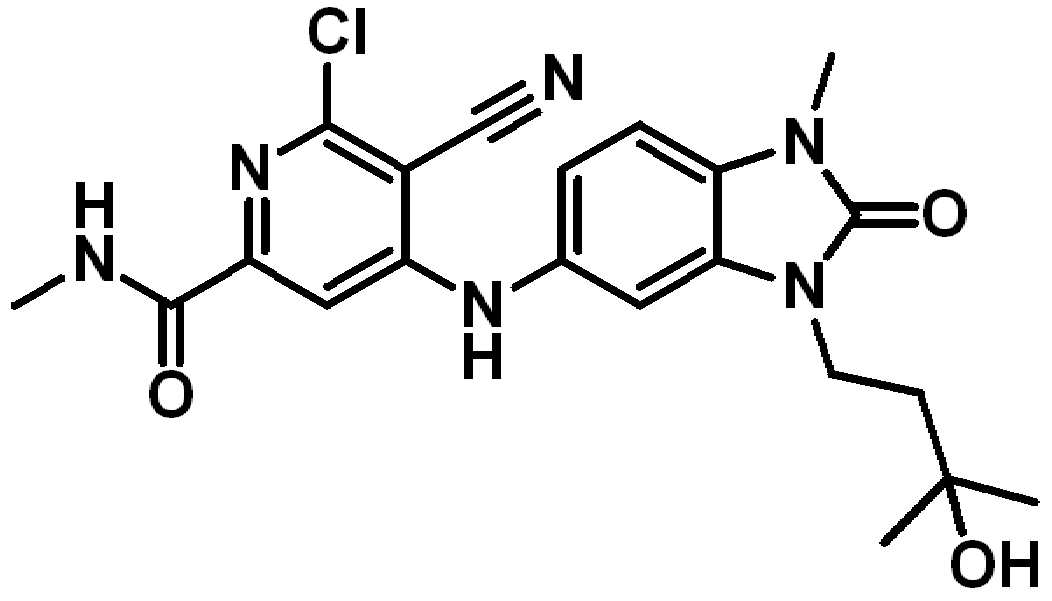
NMP(0.5 mL) 중의 4,6-디클로로-5-시아노-N-메틸-피리딘-2-카르복스아미드(중간체 E1, 9 mg, 0.039 mmol), 5-아미노-3-(3-히드록시-3-메틸-부틸)-1-메틸-벤즈이미다졸-2-온(중간체 A1, 10mg, 0.04 mmol) 및 N-에틸-N-이소프로필-프로판-2-아민(10 uL, 0.057 mmol)의 혼합물을 마이크로웨이브에서 80℃까지 30분 동안 가열하였다. 2:1 DMSO:MeCN(0.5mL)로 희석시키고, 정제용 HPLC(ACE 5 C18-PFP 컬럼(5 μ, 250x30 mm), 40 mL/min의 유량에서 60:40에서 0:100 물:메탄올(둘 모두 0.1% 포름산으로 개질됨)로의 15분 구배 용리)에 의한 정제는 표제 화합물(10 mg)을 황색 고체로서 제공하였다. LCMS(방법 X4) Rt 2.49min; m/z 465.1416 C21H23ClN6O3Na [M+Na]+에 대한 예측치 465.1418. 1H NMR (500MHz, 클로로포름-d) δ 7.82 (br q, J=5.0 Hz, 1H), 7.75 (s, 1H), 7.12 (s, 1H), 7.10 (d, J=1.9 Hz, 1H), 7.01 (d, J=8.2 Hz, 1H), 6.93 (dd, J=1.9, 8.2 Hz, 1H), 4.04 (t, J=7.3 Hz, 2H), 3.46 (s, 3H), 2.99 (d, J=5.4 Hz, 3H), 1.94 (t, J=7.3 Hz, 2H), 1.61 (br s, 1H,), 1.29 (s, 6H).4,6-dichloro-5-cyano- N -methyl-pyridine-2-carboxamide (intermediate E1, 9 mg, 0.039 mmol) in NMP (0.5 mL), 5-amino-3- (3-hydroxy -3-methyl-butyl) -1-methyl-benzimidazol-2-one (intermediate A1, 10 mg, 0.04 mmol) and N -ethyl- N -isopropyl-propan-2-amine (10 uL, 0.057 mmol) The mixture of was heated in microwave to 80 ° C. for 30 minutes. Dilute with 2: 1 DMSO: MeCN (0.5 mL) and preparative HPLC (ACE 5 C18-PFP column (5 μ, 250 × 30 mm), 0: 100 water: methanol at 60:40 at a flow rate of 40 mL / min Purification by 15 minute gradient elution with both modified with 0.1% formic acid) provided the title compound (10 mg) as a yellow solid. LCMS (Method X4) Rt 2.49 min; m / z 465.1416 Predicted for C 21 H 23 ClN 6 O 3 Na [M + Na] + 465.1418. 1 H NMR (500 MHz, Chloroform-d) δ 7.82 (br q, J = 5.0 Hz, 1H), 7.75 (s, 1H), 7.12 (s, 1H), 7.10 (d, J = 1.9 Hz, 1H), 7.01 (d, J = 8.2 Hz, 1H), 6.93 (dd, J = 1.9, 8.2 Hz, 1H), 4.04 (t, J = 7.3 Hz, 2H), 3.46 (s, 3H), 2.99 (d, J = 5.4 Hz, 3H), 1.94 (t, J = 7.3 Hz, 2H), 1.61 (br s, 1H,), 1.29 (s, 6H).
표 3에 나타낸 중간체로부터 출발하여, 실시예 1a의 제조를 위해서 사용된 것과 유사한 방법에 의해서 하기 표로 나타낸 실시예를 제조하였다. 실시예 1b, 1e, 1i, 1j, 1k, 1n 및 1o의 경우, 120℃의 온도를 사용하였다. 실시예 1l의 경우 140℃의 온도를 사용하였다. 실시예 1m 및 1q의 경우, 180℃의 온도를 사용하였다.Starting from the intermediates shown in Table 3, the examples shown in the table below were prepared by methods similar to those used for the preparation of Example 1a. For Examples 1b, 1e, 1i, 1j, 1k, 1n and 1o, temperatures of 120 ° C. were used. For Example 1 l a temperature of 140 ° C. was used. For Examples 1m and 1q, temperatures of 180 ° C were used.
[표 3]TABLE 3


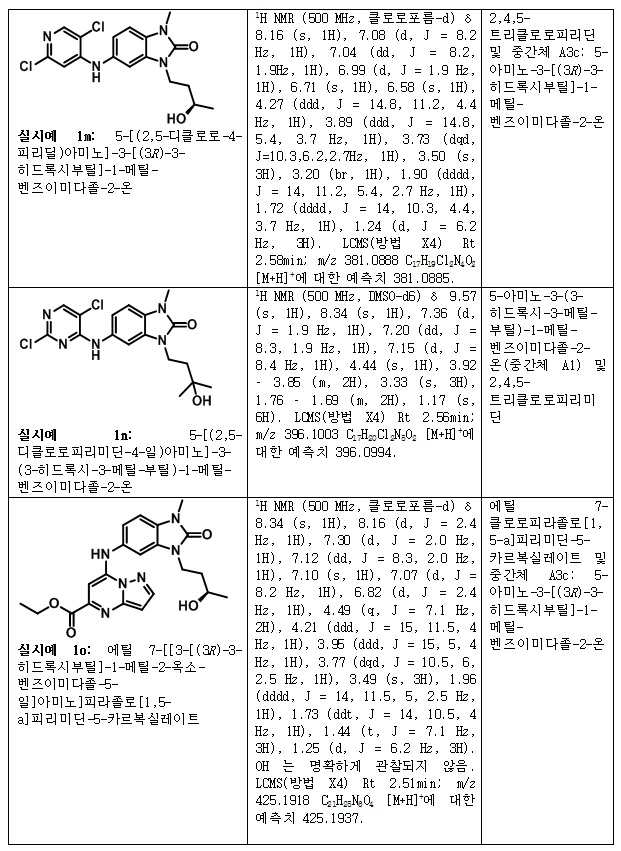

실시예 1r: 에틸 3-플루오로-7-((3-(2-히드록시부틸)-1-메틸-2-옥소-2,3-디히드로-1H-벤조[d]이미다졸-5-일)아미노)피라졸로[1,5-a]피리미딘-5-카르복실레이트 Example 1r: ethyl 3-fluoro-7-((3- (2-hydroxybutyl) -1-methyl-2-oxo-2,3-dihydro-1 H -benzo [d] imidazole-5 -Yl) amino) pyrazolo [1,5-a] pyrimidine-5-carboxylate

단계 1: 에틸 7-클로로-3-플루오로피라졸로[1,5-a]피리미딘-5-카르복실레이트 Step 1: ethyl 7-chloro-3-fluoropyrazolo [1,5-a] pyrimidine-5-carboxylate
물(9 mL) 중의 에틸 7-클로로피라졸로[1,5-a]피리미딘-5-카르복실레이트(0.09 g, 0.4 mmol)의 현탁액에 Selectfluor(0.124 g, 0.35 mmol)를 첨가하고, 생성된 혼합물을 50℃까지 24h 동안, 이어서 60℃까지 18h 동안 가열하였다. 모두 용액이 될 때까지 아세토니트릴(약 6 mL)을 첨가하였다. 추가의 Selectfluor(0.124 g, 0.35 mmol)를 첨가하고, 67℃까지 밤새 가열하였다. 실온까지 냉각시키고, 이어서 포화 중탄산나트륨(6 mL)을 첨가하고, DCM으로 추출하였다. 합한 유기물을 상 분리기 카트리지에 통과시키고, 감압 하에서 증발시키고, 이어서 플래시 컬럼 크로마토그래피(10g KP-SIL, 시클로헥산 중의 5-15% 에틸 아세테이트)에 의해서 정제하여 목적하는 에틸 7-클로로-3-플루오로피라졸로[1,5-a]피리미딘-5-카르복실레이트 및 또한 에틸 3,7-디클로로피라졸로[1,5-a]피리미딘-5-카르복실레이트 둘 모두를 함유하는 황색 고무 같은 고체(20 mg)를 제공하였다.Selectfluor (0.124 g, 0.35 mmol) was added to a suspension of ethyl 7-chloropyrazolo [1,5-a] pyrimidine-5-carboxylate (0.09 g, 0.4 mmol) in water (9 mL), resulting in The resulting mixture was heated to 50 ° C. for 24 h and then to 60 ° C. for 18 h. Acetonitrile (about 6 mL) was added until all was in solution. Additional Selectfluor (0.124 g, 0.35 mmol) was added and heated to 67 ° C. overnight. Cool to room temperature, then add saturated sodium bicarbonate (6 mL) and extract with DCM. The combined organics are passed through a phase separator cartridge, evaporated under reduced pressure and then purified by flash column chromatography (10 g KP-SIL, 5-15% ethyl acetate in cyclohexane) to give the desired ethyl 7-chloro-3-fluoro. Yellow rubber containing both ropyrazolo [1,5-a] pyrimidine-5-carboxylate and also ethyl 3,7-dichloropyrazolo [1,5-a] pyrimidine-5-carboxylate The same solid (20 mg) was provided.
단계 2: 에틸 3-플루오로-7-((3-(2-히드록시부틸)-1-메틸-2-옥소-2,3-디히드로-1H-벤조[d]이미다졸-5-일)아미노)피라졸로[1,5-a]피리미딘-5-카르복실레이트Step 2: ethyl 3-fluoro-7-((3- (2-hydroxybutyl) -1-methyl-2-oxo-2,3-dihydro-1H-benzo [d] imidazol-5-yl ) Amino) pyrazolo [1,5-a] pyrimidine-5-carboxylate
중간체 A5: 5-아미노-3-(2-히드록시부틸)-1-메틸-1H-벤조[d]이미다졸-2(3H)-온을 사용하여, 120℃에서 가열하면서, 단계 1로부터의 혼합물을 사용하여 실시예 1a의 제조를 위해서 사용된 것과 유사한 방법을 사용하여 표제 화합물을 제조하였다. LCMS(방법 T4) Rt 2.71min; m/z 443.1805 C21H24FN6O4 [M+H]+에 대한 예측치 443.1838. 1H NMR (500MHz, 클로로포름-d) δ 8.19 (s, 1H), 8.09 (d, J = 3.6 Hz, 1H), 7.33 (d, J = 1.9Hz, 1H), 7.13 (dd, J = 8, 1.9 Hz, 1H), 7.08 (d, J = 8.0Hz, 1H) 7.07 (s, 1H)과 중첩됨, 4.48 (q, J = 7.1 Hz, 2H), 4.06 (dd, J = 2.5, 14.3 Hz, 1H), 3.98 (br m, 1H), 3.90 (dd, J = 14.3, 7.3 Hz, 1H), 3.51 (s, 3H), 2.79 (br s, 1H), 1.72 - 1.53 (m, 2H), 1.46 (t, J = 7.2 Hz, 3H), 1.07 (t, J = 7.4 Hz, 3H). 19F NMR (471 MHz, 클로로포름-d) δ -179.0 (d, J = 3.5 Hz).Intermediate A5: From Step 1, heating at 120 ° C., using 5-amino-3- (2-hydroxybutyl) -1-methyl-1H-benzo [d] imidazol-2 ( 3H ) -one The title compound was prepared using a method analogous to that used for the preparation of Example 1a using a mixture of. LCMS (Method T4) Rt 2.71 min; m / z 443.1805 Predicted for C 21 H 24 FN 6 O 4 [M + H] + 443.1838. 1 H NMR (500 MHz, Chloroform-d) δ 8.19 (s, 1H), 8.09 (d, J = 3.6 Hz, 1H), 7.33 (d, J = 1.9 Hz, 1H), 7.13 (dd, J = 8, 1.9 Hz, 1H), 7.08 (d, J = 8.0 Hz, 1H) Overlaid with 7.07 (s, 1H), 4.48 (q, J = 7.1 Hz, 2H), 4.06 (dd, J = 2.5, 14.3 Hz, 1H), 3.98 (br m, 1H), 3.90 (dd, J = 14.3, 7.3 Hz, 1H), 3.51 (s, 3H), 2.79 (br s, 1H), 1.72-1.53 (m, 2H), 1.46 (t, J = 7.2 Hz, 3H), 1.07 (t, J = 7.4 Hz, 3H). 19 F NMR (471 MHz, Chloroform-d) δ −179.0 (d, J = 3.5 Hz).
실시예 2a: 메틸 6-클로로-5-시아노-4-[[3-(4-메톡시-3-메틸-4-옥소-부틸)-1-메틸-2-옥소-벤즈이미다졸-5-일]아미노]피리딘-2-카르복실레이트 Example 2a: Methyl 6-chloro-5-cyano-4-[[3- (4-methoxy-3-methyl-4-oxo-butyl) -1-methyl-2-oxo-benzimidazole-5 -Yl] amino] pyridine-2-carboxylate
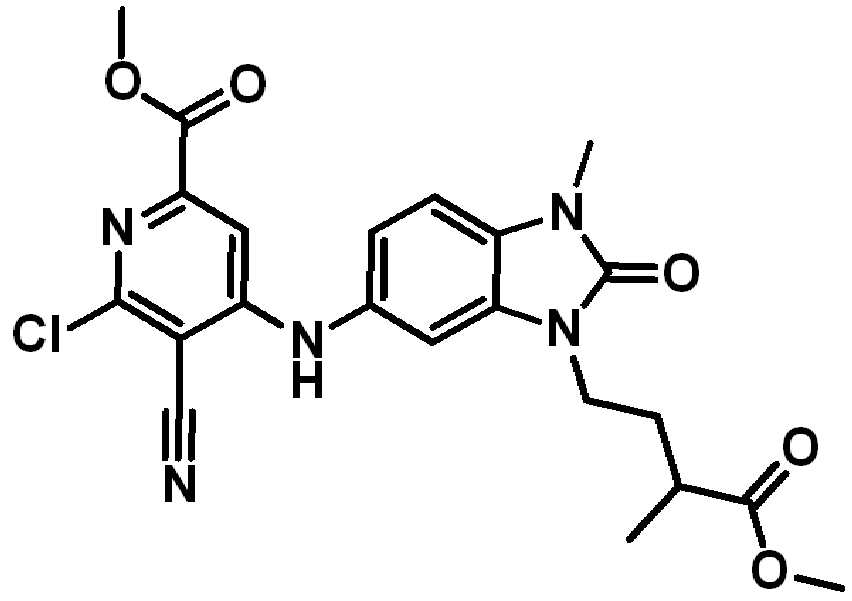
황산(1 방울)을 무수 메탄올(1 mL) 중의 6-클로로-5-시아노-4-[[3-(4-메톡시-3-메틸-4-옥소-부틸)-1-메틸-2-옥소-벤즈이미다졸-5-일]아미노]피리딘-2-카르복실산(실시예 3a, 12 mg, 0.025 mmol)의 교반되는 용액에 첨가하였다. 반응 혼합물을 rt에서 21h 동안 교반하였고, 그 동안 백색 침전물이 형성되었다. 침전물을 여과하고, 디에틸 에테르(6 mL)로 세척하고, 밤새 공기 건조시켜, 표제 화합물을 회백색 고체로서 제공하였다(6 mg). LCMS(방법 T4) Rt 2.71min; m/z 472.1372, C22H23ClN5O5 + [M+H]+에 대한 예측치 472.1382; 1H NMR (500 MHz, DMSO-d 6 ) δ 9.91 (br s, 1H), 7.29 (s, 1H), 7.23 (d, J = 8.3 Hz, 1H), 7.21 (d, J = 1.8 Hz, 1H), 7.04 (dd, J = 8.3, 1.8 Hz, 1H), 3.84 (t, J = 7.0 Hz, 2H), 3.79 (s, 3H), 3.50 (s, 3H), 3.35 (s, 3H), 2.49-2.45 (m, 1H), 2.03 - 1.94 (m, 1H), 1.74-1.65 (m, 1H), 1.13 (d, J = 7.1 Hz, 3H).Sulfuric acid (1 drop) was added to 6-chloro-5-cyano-4-[[3- (4-methoxy-3-methyl-4-oxo-butyl) -1-methyl-2 in anhydrous methanol (1 mL). -Oxo-benzimidazol-5-yl] amino] pyridine-2-carboxylic acid (Example 3a, 12 mg, 0.025 mmol) was added to a stirred solution. The reaction mixture was stirred at rt for 21 h during which time a white precipitate formed. The precipitate was filtered off, washed with diethyl ether (6 mL) and air dried overnight to provide the title compound as an off-white solid (6 mg). LCMS (Method T4) Rt 2.71 min; m / z 472.1372, predicted C 22 H 23 ClN 5 O 5 + [M + H] + 472.1382; 1 H NMR (500 MHz, DMSO- d 6 ) δ 9.91 (br s, 1H), 7.29 (s, 1H), 7.23 (d, J = 8.3 Hz, 1H), 7.21 (d, J = 1.8 Hz, 1H ), 7.04 (dd, J = 8.3, 1.8 Hz, 1H), 3.84 (t, J = 7.0 Hz, 2H), 3.79 (s, 3H), 3.50 (s, 3H), 3.35 (s, 3H), 2.49 -2.45 (m, 1H), 2.03-1.94 (m, 1H), 1.74-1.65 (m, 1H), 1.13 (d, J = 7.1 Hz, 3H).
실시예 2b: 에틸 6-클로로-5-시아노-4-[[3-(4-메톡시-3-메틸-4-옥소-부틸)-1-메틸-2-옥소-벤즈이미다졸-5-일]아미노]피리딘-2-카르복실레이트 Example 2b: ethyl 6-chloro-5-cyano-4-[[3- (4-methoxy-3-methyl-4-oxo-butyl) -1-methyl-2-oxo-benzimidazole-5 -Yl] amino] pyridine-2-carboxylate
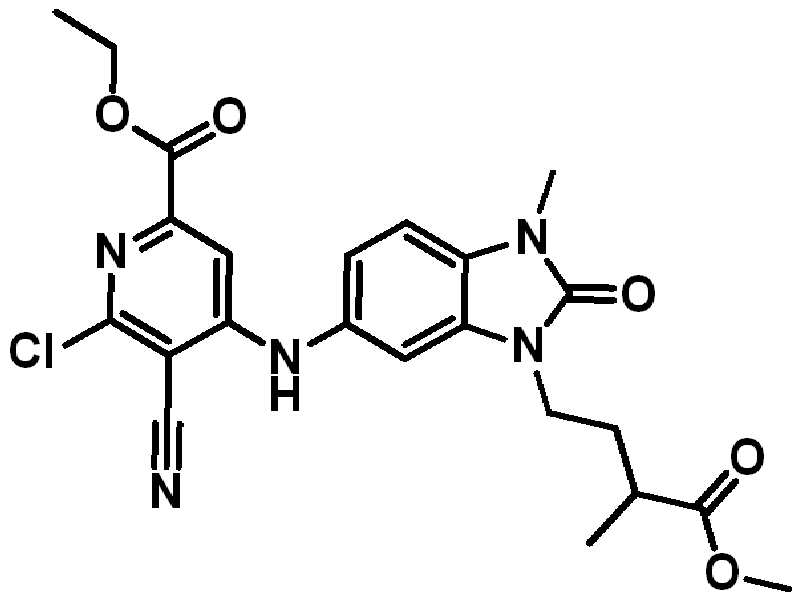
실시예 2a의 제조를 위해서 사용된 것과 유사한 방법에 의해서 제조하였다. LCMS(방법 T4) Rt 2.82min; m/z 486.1530, C23H25ClN5O5 + [M+H]+에 대한 예측치 486.1539; 1H NMR (500 MHz, 클로로포름-d) δ 7.44 (s, 1 H), 7.06 (br s, 1H), 7.05 - 7.03 (m, 1H), 7.01 - 6.99 (m, 2H), 4.40 (q, J = 7.1 Hz, 2H), 4.00 - 3.93 (m, 1H), 3.91 - 3.85 (m, 1H), 3.66 (s, 3H), 3.47 (s, 3H), 2.58 - 2.50 (m, 1H), 2.18 - 2.10 (m, 1H), 1.88 - 1.81 (m, 1H), 1.37 (t, J = 7.1 Hz, 3H), 1.26 (d, J = 7.1 Hz, 3H).Prepared by a method similar to that used for the preparation of Example 2a. LCMS (Method T4) Rt 2.82 min; m / z 486.1530, predicted C 23 H 25 ClN 5 O 5 + [M + H] + 486.1539. 1 H NMR (500 MHz, Chloroform- d ) δ 7.44 (s, 1 H), 7.06 (br s, 1 H), 7.05-7.03 (m, 1H), 7.01-6.99 (m, 2H), 4.40 (q, J = 7.1 Hz, 2H), 4.00-3.93 (m, 1H), 3.91-3.85 (m, 1H), 3.66 (s, 3H), 3.47 (s, 3H), 2.58-2.50 (m, 1H), 2.18 2.10 (m, 1 H), 1.88-1.81 (m, 1 H), 1.37 (t, J = 7.1 Hz, 3H), 1.26 (d, J = 7.1 Hz, 3H).
실시예 2c: 이소프로필 6-클로로-5-시아노-4-[[3-(4-메톡시-3-메틸-4-옥소-부틸)-1-메틸-2-옥소-벤즈이미다졸-5-일]아미노]피리딘-2-카르복실레이트 Example 2c: Isopropyl 6-chloro-5-cyano-4-[[3- (4-methoxy-3-methyl-4-oxo-butyl) -1-methyl-2-oxo-benzimidazole- 5-yl] amino] pyridine-2-carboxylate
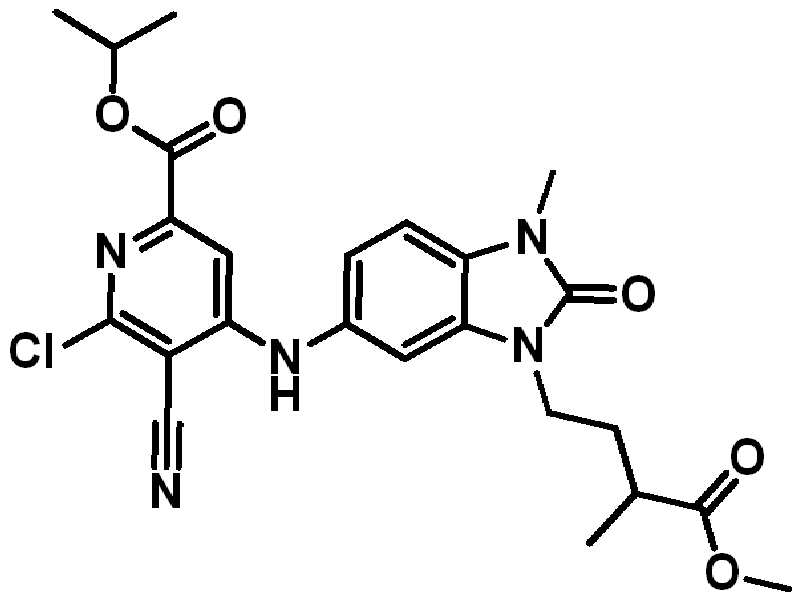
실시예 2a의 제조를 위해서 사용된 것과 유사한 방법에 의해서 제조하였다. HPLC(ACE 5 C18-PFP 250 x 21.2 mm 컬럼; 60:40에서 0:100 물:메탄올(둘 모두 0.1% 포름산으로 개질됨)의 15min 구배; 유량 20 mLmin-1; Agilent 6120 MS-Prep LC)에 의한 정제는 표제 화합물을 제공하였다. LCMS(방법 T4) Rt 2.97min; m/z 500.1687, C24H27ClN5O5 + [M+H]+에 대한 예측치 500.1695; 1H NMR (500MHz, 클로로포름-d) δ 7.43 (s, 1H), 7.06 - 7.02 (m, 2H), 7.01 - 6.98 (m, 2H), 5.19 (pent, J = 6.3 Hz, 1H), 4.00-3.92 (m, 1H), 3.91 - 3.84 (m, 1H), 3.66 (s, 3H), 3.47 (s, 3H), 2.59 - 2.51 (m, 1H), 2.18 - 2.09 (m, 1H), 1.89 - 1.81 (m, 1H), 1.36 (d, J = 6.3 Hz, 6H), 1.26 (d, J = 7.1 Hz, 3H). Prepared by a method similar to that used for the preparation of Example 2a. HPLC (ACE 5 C18-PFP 250 x 21.2 mm column; 15 min gradient from 60:40 to 0: 100 water: methanol (both modified with 0.1% formic acid); flow rate 20 mLmin -1 ; Agilent 6120 MS-Prep LC) Purification by gave the title compound. LCMS (Method T4) Rt 2.97 min; m / z 500.1687, Prediction 500.1695 for C 24 H 27 ClN 5 O 5 + [M + H] + ; 1 H NMR (500 MHz, Chloroform-d) δ 7.43 (s, 1H), 7.06-7.02 (m, 2H), 7.01-6.98 (m, 2H), 5.19 (pent, J = 6.3 Hz, 1H), 4.00- 3.92 (m, 1H), 3.91-3.84 (m, 1H), 3.66 (s, 3H), 3.47 (s, 3H), 2.59-2.51 (m, 1H), 2.18-2.09 (m, 1H), 1.89- 1.81 (m, 1 H), 1.36 (d, J = 6.3 Hz, 6H), 1.26 (d, J = 7.1 Hz, 3H).
실시예 2d: 에틸 6-클로로-5-시아노-4-[[3-[(3R)-3-히드록시부틸]-1-메틸-2-옥소-벤즈이미다졸-5-일]아미노]피리딘-2-카르복실레이트 Example 2d: ethyl 6-chloro-5-cyano-4-[[3-[( 3R ) -3-hydroxybutyl] -1-methyl-2-oxo-benzimidazol-5-yl] amino ] Pyridine-2-carboxylate

6-클로로-5-시아노-4-[[3-[(3R)-3-히드록시부틸]-1-메틸-2-옥소-벤즈이미다졸-5-일]아미노]피리딘-2-카르복실산(실시예 1e)으로부터 출발하여, 실시예 2a의 제조를 위해서 사용된 것과 유사한 방법에 의해서 제조하였다. LCMS(방법 X4) Rt 2.55min; m/z 444.1437 C21H23ClN5O4 [M+H]+에 대한 예측치 444.1438. 1H NMR (500 MHz, 클로로포름-d) δ 7.53 (s, 1H), 7.15 (s, 1H), 7.10 - 7.04 (m, 2H), 7.00 (dd, J = 8.3, 2.0 Hz, 1H), 4.43 (q, J = 7.1 Hz, 2H), 4.20 (ddd, J = 15, 11.3, 4 Hz, 1H), 3.92 (ddd, J = 15, 5.3, 4 Hz, 1H), 3.72 (dqd, J = 10.4, 6.2, 2.7 Hz, 1H), 3.49 (s, 3H), 3.45 - 3.25 (br, 1H, OH), 1.95 (dddd, J = 14.0, 11.3, 5.3, 2.7 Hz, 1H), 1.71 (ddt, J = 14, 10.4, 4 Hz, 1H), 1.39 (t, J = 7.1 Hz, 3H), 1.24 (d, J = 6.2 Hz, 3H).6-chloro-5-cyano-4-[[3-[( 3R ) -3-hydroxybutyl] -1-methyl-2-oxo-benzimidazol-5-yl] amino] pyridine-2- Starting from the carboxylic acid (Example 1e), it was prepared by a method analogous to that used for the preparation of Example 2a. LCMS (Method X4) Rt 2.55 min; m / z 444.1437 predicted for C 21 H 23 ClN 5 O 4 [M + H] + 444.1438. 1 H NMR (500 MHz, Chloroform-d) δ 7.53 (s, 1H), 7.15 (s, 1H), 7.10-7.04 (m, 2H), 7.00 (dd, J = 8.3, 2.0 Hz, 1H), 4.43 (q, J = 7.1 Hz, 2H), 4.20 (ddd, J = 15, 11.3, 4 Hz, 1H), 3.92 (ddd, J = 15, 5.3, 4 Hz, 1H), 3.72 (dqd, J = 10.4 , 6.2, 2.7 Hz, 1H), 3.49 (s, 3H), 3.45-3.25 (br, 1H, OH), 1.95 (dddd, J = 14.0, 11.3, 5.3, 2.7 Hz, 1H), 1.71 (ddt, J = 14, 10.4, 4 Hz, 1H), 1.39 (t, J = 7.1 Hz, 3H), 1.24 (d, J = 6.2 Hz, 3H).
실시예 3a: 6-클로로-5-시아노-4-[[3-(4-메톡시-3-메틸-4-옥소-부틸)-1-메틸-2-옥소-벤즈이미다졸-5-일]아미노]피리딘-2-카르복실산 Example 3a: 6-Chloro-5-cyano-4-[[3- (4-methoxy-3-methyl-4-oxo-butyl) -1-methyl-2-oxo-benzimidazole-5- Ill] amino] pyridine-2-carboxylic acid
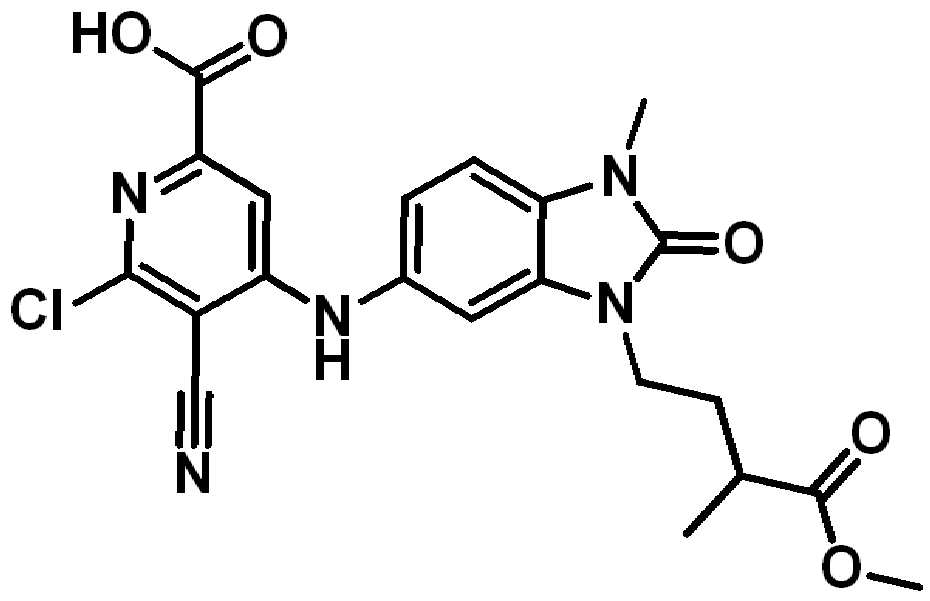
마이크로웨이브 바이알(0.5 mL 내지 2.0 mL 부피)에 중간체 A3a 메틸 4-(6-아미노-3-메틸-2-옥소-벤즈이미다졸-1-일)-2-메틸-부탄오에이트(34 mg, 0.12 mmol) 및 4,6-디클로로-5-시아노-피리딘-2-카르복실산(25 mg, 0.11 mmol)을 충전시켰다. 반응 바이알을 Ar으로 플러싱하고, 마개로 닫고, 이어서 Ar으로 플러싱하였다. 무수 DMF(1.1 mL), 그 다음 DIPEA(43.00 uL, 0.25 mmol)를 첨가하였다. 반응 혼합물을 80℃에서 마이크로웨이브 조사 하에서 90min 동안 가열하였다. 반응 혼합물을 rt까지 냉각시켰다. 반응 혼합물을 DMSO:MeCN 1:1 혼합물(0.3 mL)로 희석시키고, HPLC(ACE 5 C18-PFP 250 x 30 mm 컬럼; 60:40에서 0:100 물:메탄올(둘 모두 0.1% 포름산으로 개질됨)의 15min 구배; 유량 40 mL min-1; Agilent 6120 MS-Prep LC)에 의한 정제는 표제 화합물을 황색 고체로서 제공하였다(13 mg, 25%). LCMS(방법 T4) Rt 2.58min; m/z 458.1216, C21H21ClN5O5 + [M+H]+에 대한 예측치 458.1226; 1H NMR (500 MHz, 메탄올-d 4 ) δ 7.39 (s, 1 H), 7.24 (d, J = 8.3 Hz, 1 H), 7.21 (d, J = 1.9 Hz, 1H), 7.11 (dd, J = 8.3, 1.9 Hz, 1H), 4.00 - 3.92 (m, 2H), 3.54 (s, 3H), 3.46 (s, 3H), 2.57 - 2.49 (m, 1H), 2.19 - 2.10 (m, 1H), 1.87-1.80 (m, 1H), 1.20 (d, J = 7.1 Hz, 3H).In a microwave vial (0.5 mL to 2.0 mL volume) intermediate A3a methyl 4- (6-amino-3-methyl-2-oxo-benzimidazol-1-yl) -2-methyl-butanoate (34 mg, 0.12 mmol) and 4,6-dichloro-5-cyano-pyridine-2-carboxylic acid (25 mg, 0.11 mmol) were charged. The reaction vial was flushed with Ar, closed with a stopper and then flushed with Ar. Anhydrous DMF (1.1 mL), then DIPEA (43.00 uL, 0.25 mmol) was added. The reaction mixture was heated at 80 ° C. under microwave irradiation for 90 min. The reaction mixture was cooled to rt. The reaction mixture was diluted with a DMSO: MeCN 1: 1 mixture (0.3 mL) and HPLC (ACE 5 C18-PFP 250 × 30 mm column; 0: 100 water: methanol at 60:40 (both modified with 0.1% formic acid) 15 min gradient; flow rate 40 mL min −1 ; purification by Agilent 6120 MS-Prep LC) provided the title compound as a yellow solid (13 mg, 25%). LCMS (Method T4) Rt 2.58 min; m / z 458.1216, predicted C21 H 21 ClN 5 O 5 + [M + H] + 458.1226; 1 H NMR (500 MHz, Methanol- d 4 ) δ 7.39 (s, 1 H), 7.24 (d, J = 8.3 Hz, 1 H), 7.21 (d, J = 1.9 Hz, 1H), 7.11 (dd, J = 8.3, 1.9 Hz, 1H), 4.00-3.92 (m, 2H), 3.54 (s, 3H), 3.46 (s, 3H), 2.57-2.49 (m, 1H), 2.19-2.10 (m, 1H) , 1.87-1.80 (m, 1 H), 1.20 (d, J = 7.1 Hz, 3 H).
실시예 3b: 메틸 3-[6-[(2-클로로-3-시아노-4-피리딜)아미노]-3-메틸-2-옥소-벤즈이미다졸-1-일]-2-메틸-프로판오에이트 Example 3b Methyl 3- [6-[(2-chloro-3-cyano-4-pyridyl) amino] -3-methyl-2-oxo-benzimidazol-1-yl] -2-methyl- Propanoate

2,4-디클로로피리딘-3-카르보니트릴 및 메틸 3-(6-아미노-3-메틸-2-옥소-벤즈이미다졸-1-일)-2-메틸-프로판오에이트(중간체 A3b)로부터 출발하여, 120℃에서 가열하면서, 실시예 3a의 제조를 위해서 사용된 것과 유사한 방법에 의해서 제조하였다. LCMS(방법 T4) Rt 2.62min; m/z 400.1162, C19H19ClN5O3 + [M+H]+에 대한 예측치 400.1171; 1H NMR (500MHz, 클로로포름-d) δ 8.04 (d, J = 6.1 Hz, 1H), 7.03 - 6.95 (m, 3H), 6.94 (br s, 1H), 6.64 (d, J = 6.1 Hz, 1H), 4.09 (dd, J = 14.3, 8.1 Hz, 1H), 3.95 (dd, J = 14.3, 6.4 Hz, 1H), 3.62 (s, 3H), 3.45 (s, 3H), 3.13 - 3.05 (m, 1H), 1.26 (d, J = 7.1 Hz, 3H).Starting from 2,4-dichloropyridine-3-carbonitrile and methyl 3- (6-amino-3-methyl-2-oxo-benzimidazol-1-yl) -2-methyl-propanoate (intermediate A3b) Thus, it was prepared by a method similar to that used for the preparation of Example 3a, while heating at 120 ° C. LCMS (Method T4) Rt 2.62 min; m / z 400.1162, predicted 400.1171 for C 19 H 19 ClN 5 O 3 + [M + H] + ; 1 H NMR (500 MHz, Chloroform- d ) δ 8.04 (d, J = 6.1 Hz, 1H), 7.03-6.95 (m, 3H), 6.94 (br s, 1H), 6.64 (d, J = 6.1 Hz, 1H ), 4.09 (dd, J = 14.3, 8.1 Hz, 1H), 3.95 (dd, J = 14.3, 6.4 Hz, 1H), 3.62 (s, 3H), 3.45 (s, 3H), 3.13-3.05 (m, 1H), 1.26 (d, J = 7.1 Hz, 3H).
실시예 3c: 메틸 4-[6-[(5-클로로-2-메틸-피리미딘-4-일)아미노]-3-메틸-2-옥소-벤즈이미다졸-1-일]-2-메틸-부탄오에이트 Example 3c Methyl 4- [6-[(5-chloro-2-methyl-pyrimidin-4-yl) amino] -3-methyl-2-oxo-benzimidazol-1-yl] -2-methyl Butane Oate

120℃에서 가열하면서, 4,5-디클로로-2-메틸-피리미딘을 사용하여, 실시예 3a의 제조를 위해서 사용된 것과 유사한 방법에 의해서 제조하였다. LCMS(방법 T4) Rt 2.31min; m/z 404.1454, 에 대한 예측치 404.1484 for C19H23ClN3O3 + [M+H]+; 1H NMR (500 MHz, 클로로포름-d) δ 8.25 (s, 1H), 7.66 (d, J = 1.8 Hz, 1H), 7.15 (dd, J = 8.3, 1.8 Hz, 1H), 7.13 (br s, 1H), 6.95 (d, J = 8.3 Hz, 1H), 4.01 - 3.89 (m, 2H), 3.66 (s, 3H). 3.43 (s, 3H), 2.62 - 2.53 (m, 4H), 2.26 - 2.17 (m, 1H), 1.91 - 1.83 (m, 1H), 1.28 (d, J = 7.1 Hz, 3H).Prepared by a method similar to that used for the preparation of Example 3a, using 4,5-dichloro-2-methyl-pyrimidine, while heating at 120 ° C. LCMS (Method T4) Rt 2.31 min; m / z 404.1454, for 404.1484 for C 19 H 23 ClN 3 O 3 + [M + H] + ; 1 H NMR (500 MHz, Chloroform-d) δ 8.25 (s, 1H), 7.66 (d, J = 1.8 Hz, 1H), 7.15 (dd, J = 8.3, 1.8 Hz, 1H), 7.13 (br s, 1H), 6.95 (d, J = 8.3 Hz, 1H), 4.01-3.89 (m, 2H), 3.66 (s, 3H). 3.43 (s, 3H), 2.62-2.53 (m, 4H), 2.26-2.17 (m, 1H), 1.91-1.83 (m, 1H), 1.28 (d, J = 7.1 Hz, 3H).
실시예 4: 6-클로로-5-시아노-4-[[3-[(3R)-3-히드록시부틸]-1-메틸-2-옥소-벤즈이미다졸-5-일]아미노]-N-메틸-피리딘-2-카르복스아미드 Example 4: 6-chloro-5-cyano-4-[[3-[( 3R ) -3-hydroxybutyl] -1-methyl-2-oxo-benzimidazol-5-yl] amino] -N-methyl-pyridine-2-carboxamide
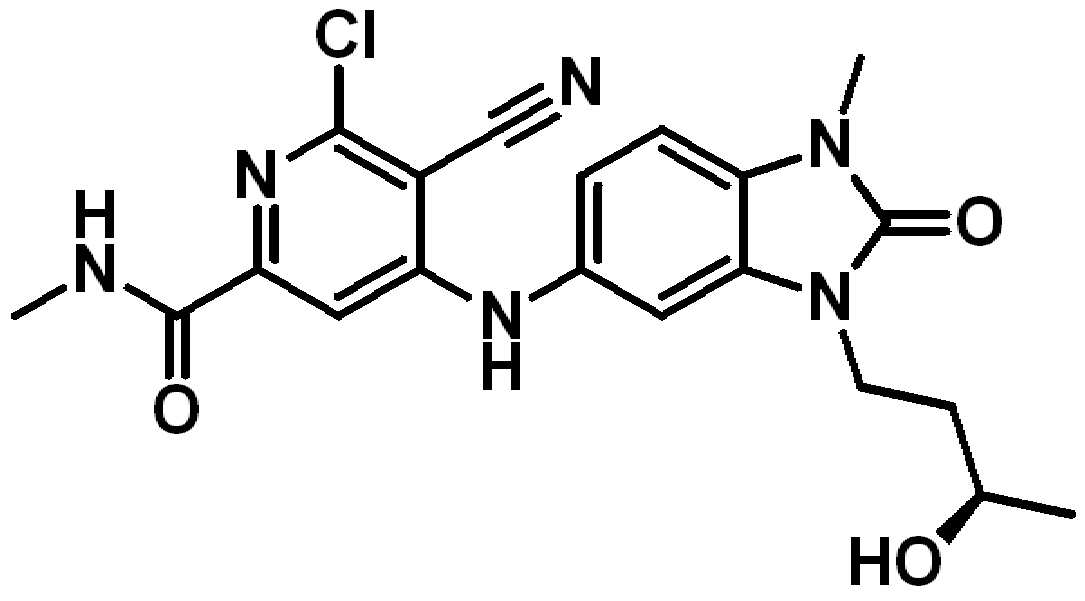
에틸 6-클로로-5-시아노-4-[[3-[(3R)-3-히드록시부틸]-1-메틸-2-옥소-벤즈이미다졸-5-일]아미노]피리딘-2-카르복실레이트(실시예 2d, 3 mg, 0.0068 mmol)를 THF 중의 메탄아민 2 M(0.50 mL, 1 mmol) 중에 용해시키고, 생성된 혼합물을 밀폐된 용기에서 밤새 실온에서 교반하고, 이어서 감압 하에서 증발시키고, 디에틸 에테르로 배산처리하여 표제 화합물(2.5 mg)을 황색 고체로서 제공하였다. 1H NMR (500 MHz, 클로로포름-d) δ 7.86 (br q, J = 5.4 Hz, 1H), 7.74 (s, 1H), 7.23 (d, J = 2.1 Hz, 1H), 7.16 (s, 1H), 7.02 (d, J = 8.2 Hz, 1H), 6.92 (dd, J = 8.2, 2.1 Hz, 1H), 4.12 (ddd, J = 14.8, 11.7, 3.6 Hz, 1H), 3.96 (ddd, J = 14.8, 5, 3.6 Hz, 1H), 3.71 (dqd, J = 10.6, 6.0, 2.7 Hz, 1H), 3.48 (s, 3H), 3.00 (d, J = 5.2 Hz, 3H), 2.02 (dddd, J = 14.2, 11.7, 5.0, 2.7 Hz, 1H), 1.70 (ddt, J = 14.2, 10.6, 3.6 Hz, 1H), 1.27 (d, J = 6.0 Hz, 3H). OH는 명확하게 관찰되지 않음. LCMS(방법 X4) Rt 2.42 min; m.z 451.1263 C20H21ClN6O3Na [M+Na]+에 대한 예측치 451.1262Ethyl 6-chloro-5-cyano-4-[[3-[( 3R ) -3-hydroxybutyl] -1-methyl-2-oxo-benzimidazol-5-yl] amino] pyridine-2 Carboxylate (Example 2d, 3 mg, 0.0068 mmol) was dissolved in methaneamine 2 M (0.50 mL, 1 mmol) in THF, and the resulting mixture was stirred overnight in a closed vessel at room temperature and then under reduced pressure Evaporation and trituration with diethyl ether gave the title compound (2.5 mg) as a yellow solid. 1 H NMR (500 MHz, Chloroform-d) δ 7.86 (br q, J = 5.4 Hz, 1H), 7.74 (s, 1H), 7.23 (d, J = 2.1 Hz, 1H), 7.16 (s, 1H) , 7.02 (d, J = 8.2 Hz, 1H), 6.92 (dd, J = 8.2, 2.1 Hz, 1H), 4.12 (ddd, J = 14.8, 11.7, 3.6 Hz, 1H), 3.96 (ddd, J = 14.8 , 5, 3.6 Hz, 1H), 3.71 (dqd, J = 10.6, 6.0, 2.7 Hz, 1H), 3.48 (s, 3H), 3.00 (d, J = 5.2 Hz, 3H), 2.02 (dddd, J = 14.2, 11.7, 5.0, 2.7 Hz, 1H), 1.70 (ddt, J = 14.2, 10.6, 3.6 Hz, 1H), 1.27 (d, J = 6.0 Hz, 3H). OH is not clearly observed. LCMS (Method X4) Rt 2.42 min; mz 451.1263 C 20 H 21 ClN 6 O 3 Na [M + Na] + off 4545262262
실시예 5: 메틸 4-[6-[[2-클로로-3-시아노-6-(3-메틸-1,2,4-옥사디아졸-5-일)-4-피리딜]아미노]-3-메틸-2-옥소-벤즈이미다졸-1-일]-2-메틸-부탄오에이트 Example 5: Methyl 4- [6-[[2-chloro-3-cyano-6- (3-methyl-1,2,4-oxadiazol-5-yl) -4-pyridyl] amino] -3-methyl-2-oxo-benzimidazol-1-yl] -2-methyl-butanoate

마이크로웨이브 바이알(0.5 내지 2.0 mL 부피)에 6-클로로-5-시아노-4-[[3-(4-메톡시-3-메틸-4-옥소-부틸)-1-메틸-2-옥소-벤즈이미다졸-5-일]아미노]피리딘-2-카르복실산(실시예 3a, 7 mg, 0.014 mmol)을 충전시켰다. 반응 바이알을 아르곤으로 플러싱하였다. THF(0.13 mL), 그 다음 T3P(EtOAc 중의 50 wt%; 11 uL, 0.019 mmol), DIPEA(7.00 uL, 0.040 mmol) 및 아세트아미드 옥심(1.60 mg, 0.022 mmol)을 첨가하였다. 반응 혼합물을 rt에서 3h 동안 아르곤 하에서 교반하고, 이어서 17h 동안 75℃까지 가열하였다. 반응 혼합물을 rt까지 냉각시켰다. 물(5 mL)을 첨가하고, 반응 혼합물을 5min 동안 교반하였다. 생성된 침전물을 여과하고, 물(2 x 5 mL)로 세척하였다. 침전물을 메탄올(10 mL)로 용해시키고, 진공에서 농축시켜, 표제 화합물을 황색 고체(1.7 mg)로서 제공하였다. 1H NMR (500 MHz, 클로로포름-d) δ 7.49 (s, 1H), 7.18 (br s, 1H), 7.09 - 7.06 (m, 1H), 7.05 - 7.01 (m, 2H), 4.01 - 3.93 (m, 1H), 3.91 - 3.85 (m, 1H), 3.63 (s, 3H), 3.48 (s, 3H), 2.59 - 2.52 (m, 1H), 2.45 (s, 3H), 2.19 - 2.10 (m, 1H), 1.89 - 1.81 (m, 1H), 1.25 (d, J = 7.1 Hz, 3H). LCMS(방법 T4) Rt 2.86min; m/z 496.1490, C23H23ClN7O4 + [M+H]+에 대한 예측치 496.1495.6-chloro-5-cyano-4-[[3- (4-methoxy-3-methyl-4-oxo-butyl) -1-methyl-2-oxo in a microwave vial (0.5-2.0 mL volume) -Benzimidazol-5-yl] amino] pyridine-2-carboxylic acid (Example 3a, 7 mg, 0.014 mmol) was charged. The reaction vial was flushed with argon. THF (0.13 mL), then T3P (50 wt% in EtOAc; 11 uL, 0.019 mmol), DIPEA (7.00 uL, 0.040 mmol) and acetamide oxime (1.60 mg, 0.022 mmol) were added. The reaction mixture was stirred at rt under argon for 3 h and then heated to 75 ° C. for 17 h. The reaction mixture was cooled to rt. Water (5 mL) was added and the reaction mixture was stirred for 5 min. The resulting precipitate was filtered off and washed with water (2 × 5 mL). The precipitate was dissolved in methanol (10 mL) and concentrated in vacuo to give the title compound as a yellow solid (1.7 mg). 1 H NMR (500 MHz, Chloroform- d ) δ 7.49 (s, 1H), 7.18 (br s, 1H), 7.09-7.06 (m, 1H), 7.05-7.01 (m, 2H), 4.01-3.93 (m , 1H), 3.91-3.85 (m, 1H), 3.63 (s, 3H), 3.48 (s, 3H), 2.59-2.52 (m, 1H), 2.45 (s, 3H), 2.19-2.10 (m, 1H ), 1.89-1.81 (m, 1 H), 1.25 (d, J = 7.1 Hz, 3 H). LCMS (Method T4) Rt 2.86 min; m / z 496.1490, predicted C 23 H 23 ClN 7 O 4 + [M + H] + 496.1495.
실시예 6: 메틸 (2S)-2-아미노-4-[6-[(2-클로로-3-시아노-4-피리딜)아미노]-3-메틸-2-옥소-벤즈이미다졸-1-일]부탄오에이트 Example 6: Methyl ( 2S ) -2-amino-4- [6-[(2-chloro-3-cyano-4-pyridyl) amino] -3-methyl-2-oxo-benzimidazole- 1-Sun] Butane Oate

단계 1: 메틸 (2S)-2-(tert-부톡시카르보닐아미노)-4-[6-[(2-클로로-3-시아노-4-피리딜)아미노]-3-메틸-2-옥소-벤즈이미다졸-1-일]부탄오에이트Step 1: methyl (2S) -2- (tert-butoxycarbonylamino) -4- [6-[(2-chloro-3-cyano-4-pyridyl) amino] -3-methyl-2- Oxo-benzimidazol-1-yl] butanoate
오븐 건조된 마이크로웨이브 바이알(0.5 mL 내지 2.0 mL 부피)에 2-클로로-4-[(1-메틸-2-옥소-3H-벤즈이미다졸-5-일)아미노]피리딘-3-카르보니트릴(중간체 D1, 30 mg, 0.10 mmol), 메틸 (2S)-4-브로모-2-(tert-부톡시카르보닐아미노)-부탄오에이트(31 mg, 0.11 mmol) 및 탄산세슘(39 mg, 0.12 mmol)을 충전시켰다. 반응 바이알을 아르곤으로 플러싱하고, 마개로 닫고, 이어서 추가의 아르곤으로 플러싱하였다. DMF(1.00 mL)를 첨가하였다. 반응 혼합물을 마이크로웨이브 조사 하에서 1h 동안 140℃에서 가열하였다. 반응 혼합물을 rt까지 냉각시켰다. 물(10 mL)을 첨가하였다. 수성 혼합물을 1 M HCl로 pH 5까지 산성화시켰다. 수성 혼합물을 EtOAc(4 x 10 mL)로 추출하였다. 유기 추출물을 합하고, 건조하고(황산나트륨), 진공에서 농축시켰다. HPLC(2회 주입; ACE 5 C18-PFP 250 x 21.2 mm 컬럼; 45:55에서 20:80 물:메탄올(둘 모두 0.1 % 포름산으로 개질됨)의 15 min 구배; 유량 20 mL min-1; Agilent 6120 MS-Prep LC)에 의한 정제는 메틸 (2S)-2-(tert-부톡시카르보닐아미노)-4-[6-[(2-클로로-3-시아노-4-피리딜)아미노]-3-메틸-2-옥소-벤즈이미다졸-1-일]부탄오에이트(15 mg)를 회백색 고체로서 제공하였다. LCMS(방법 T2) Rt 1.27min; m/z 415.08 [M-Boc+H]+; 1H NMR (500MHz, 클로로포름-d) δ 8.06 (d, J = 6.1 Hz, 1H), 7.03 (d, J = 8.2 Hz, 1H), 6.99 (dd, J = 8.2, 1.9 Hz, 1H), 6.95 - 6.92 (m, 1H), 6.86 (br s, 1H), 6.63 (d, J = 6.1 Hz, 1H), 5.54 - 5.49 (m, 1H), 4.43 - 4.37 (m, 1H), 4.12 - 4.05 (m, 1H), 3.95 - 3.88 (m, 1H), 3.54 (s, 3H), 3.46 (s, 3H), 2.34 - 2.27 (m, 1H), 2.26 - 2.18 (m, 1H), 1.43 (s, 9H). In an oven dried microwave vial (0.5 mL to 2.0 mL volume) 2-chloro-4-[(1-methyl-2-oxo-3H-benzimidazol-5-yl) amino] pyridine-3-carbonitrile ( Intermediate D1, 30 mg, 0.10 mmol), methyl ( 2S ) -4-bromo-2- (tert-butoxycarbonylamino) -butanoate (31 mg, 0.11 mmol) and cesium carbonate (39 mg, 0.12 mmol) was charged. The reaction vial was flushed with argon, capped and then flushed with additional argon. DMF (1.00 mL) was added. The reaction mixture was heated at 140 ° C. for 1 h under microwave irradiation. The reaction mixture was cooled to rt. Water (10 mL) was added. The aqueous mixture was acidified to pH 5 with 1 M HCl. The aqueous mixture was extracted with EtOAc (4 x 10 mL). The organic extracts were combined, dried (sodium sulfate) and concentrated in vacuo. HPLC (2 injections; ACE 5 C18-PFP 250 x 21.2 mm column; 15 min gradient from 45:55 to 20:80 water: methanol, both modified with 0.1% formic acid); flow rate 20 mL min -1 ; Agilent Purification by 6120 MS-Prep LC) gave methyl ( 2S ) -2- (tert-butoxycarbonylamino) -4- [6-[(2-chloro-3-cyano-4-pyridyl) amino ] -3-methyl-2-oxo-benzimidazol-1-yl] butanoate (15 mg) was provided as an off-white solid. LCMS (Method T2) Rt 1.27 min; m / z 415.08 [M-Boc + H] + ; 1 H NMR (500 MHz, Chloroform-d) δ 8.06 (d, J = 6.1 Hz, 1H), 7.03 (d, J = 8.2 Hz, 1H), 6.99 (dd, J = 8.2, 1.9 Hz, 1H), 6.95 -6.92 (m, 1H), 6.86 (br s, 1H), 6.63 (d, J = 6.1 Hz, 1H), 5.54-5.49 (m, 1H), 4.43-4.37 (m, 1H), 4.12-4.05 ( m, 1H), 3.95-3.88 (m, 1H), 3.54 (s, 3H), 3.46 (s, 3H), 2.34-2.27 (m, 1H), 2.26-2.18 (m, 1H), 1.43 (s, 9H).
단계 2: 메틸 (2S)-2-아미노-4-[6-[(2-클로로-3-시아노-4-피리딜)아미노]-3-메틸-2-옥소-벤즈이미다졸-1-일]부탄오에이트Step 2: methyl (2S) -2-amino-4- [6-[(2-chloro-3-cyano-4-pyridyl) amino] -3-methyl-2-oxo-benzimidazole-1- Japan] Butan Oate
TFA(0.25 mL, 3.3 mmol)를 0℃에서 DCM(2 mL) 중의 메틸 (2S)-2-(tert-부톡시카르보닐아미노)-4-[6-[(2-클로로-3-시아노-4-피리딜)아미노]-3-메틸-2-옥소-벤즈이미다졸-1-일]부탄오에이트(13 mg, 0.025 mmol, 단계 1로부터)의 용액에 적가하였다. 반응 혼합물을 90min에 걸쳐서 rt까지 가온시켰다. 반응 혼합물을 진공에서 농축시키고, 생성된 잔류물을 DCM(5 mL)으로 희석시키고, 진공에서 추가로 농축시켰다. 잔류물을 메탄올 중에 용해시키고, 메탄올(20 mL) 그 다음 2N 메탄올성 암모니아(20 mL)로 용리시키는 SCX-2 카트리지(2 g)를 사용하여 정제하였다. 메탄올성 암모니아 분획을 수집하고, 진공에서 농축시켜 표제 화합물을 황색 고체(10 mg, 93%)로서 제공하였다. LCMS(방법 T4) Rt 1.96min; m/z 415.1269, C19H20ClN6O3 + [M+H]+에 대한 예측치 415.1280; 1H NMR (500 MHz, 클로로포름-d) δ 8.05 (d, J = 6.1 Hz, 1H), 7.05 - 7.02 (m, 2H), 6.99 (dd, J = 8.4, 1.7 Hz, 1H), 6.88 (br s, 1H), 6.63 (d, J = 6.1 Hz, 1H), 5.7 - 5.0 (v br, 2H), 4.16 - 4.03 (m, 2H), 3.64 (s, 3H), 3.49 - 3.42 (m, 4H), 2.31 - 2.23 (m, 1H), 1.96 - 1.87 (m, 1H).TFA (0.25 mL, 3.3 mmol) was added methyl ( 2S ) -2- (tert-butoxycarbonylamino) -4- [6-[(2-chloro-3-cya) in DCM (2 mL) at 0 ° C. No-4-pyridyl) amino] -3-methyl-2-oxo-benzimidazol-1-yl] butanoate (13 mg, 0.025 mmol, from step 1) was added dropwise. The reaction mixture was warmed to rt over 90 min. The reaction mixture was concentrated in vacuo and the resulting residue was diluted with DCM (5 mL) and further concentrated in vacuo. The residue was dissolved in methanol and purified using an SCX-2 cartridge (2 g) eluting with methanol (20 mL) then 2N methanolic ammonia (20 mL). The methanolic ammonia fractions were collected and concentrated in vacuo to give the title compound as a yellow solid (10 mg, 93%). LCMS (Method T4) Rt 1.96 min; m / z 415.1269, predicted C 19 H 20 ClN 6 O 3 + [M + H] + 415.1280; 1 H NMR (500 MHz, Chloroform- d ) δ 8.05 (d, J = 6.1 Hz, 1H), 7.05-7.02 (m, 2H), 6.99 (dd, J = 8.4, 1.7 Hz, 1H), 6.88 (br s, 1H), 6.63 (d, J = 6.1 Hz, 1H), 5.7-5.0 (v br, 2H), 4.16-4.03 (m, 2H), 3.64 (s, 3H), 3.49-3.42 (m, 4H ), 2.31-2.23 (m, 1 H), 1.96-1.87 (m, 1 H).
실시예 7a: 메틸 4-[6-[[2-클로로-3-시아노-6-(메틸카르바모일)-4-피리딜]아미노]-3-메틸-2-옥소-벤즈이미다졸-1-일]-2-메틸-부탄오에이트 Example 7a: Methyl 4- [6-[[2-chloro-3-cyano-6- (methylcarbamoyl) -4-pyridyl] amino] -3-methyl-2-oxo-benzimidazole- 1-yl] -2-methyl-butanoate

오븐 건조된 마이크로웨이브 바이알(0.5 mL 내지 2.0 mL 부피)에 6-클로로-5-시아노-4-[[3-(4-메톡시-3-메틸-4-옥소-부틸)-1-메틸-2-옥소-벤즈이미다졸-5-일]아미노]피리딘-2-카르복실산(실시예 3a, 6 mg, 0.013 mmol)을 충전시켰다. 반응 바이알을 아르곤으로 플러싱하고, 마개로 닫고, 이어서 추가의 아르곤으로 플러싱하였다. THF(0.13 mL), 그 다음 T3P(EtOAc 중의 50 wt%; 10 uL, 0.017 mmol), DIPEA(6 uL, 0.034 mmol) 및 메틸아민(THF 중의 2 M; 10 uL, 0.020 mmol)을 첨가하였다. 반응 혼합물을 rt에서 4h 동안 교반하였다. 물(3 mL)을 반응 혼합물에 첨가하고, 생성된 황색 침전물을 여과하고, 물(2 x 5 mL)로 세척하고, 밤새 공기 건조시켰다. 침전물을 메탄올 중에 용해시키고, 이어서 진공에서 농축시켜 표제 화합물을 황색 고체(2 mg)로서 제공하였다. LCMS(방법 T4) Rt 2.73min; m/z 471.1542, C22H24ClN6O4 + [M+H]+에 대한 예측치 471.1542; 1H NMR (500 MHz, 클로로포름-d) δ 7.76 (br q, J = 5.2 Hz, 1H), 7.49 (s, 1H), 7.07 (br s, 1H), 7.02 (d, J = 8.2 Hz, 1H), 6.99 (dd, J = 8.2, 1.8 Hz, 1H), 6.96 (d, J = 1.8 Hz, 1H), 3.99 - 3.92 (m, 1H), 3.90 - 3.83 (m, 1H), 3.66 (s, 3H), 3.46 (s, 3H), 2.97 (d, J = 5.2 Hz, 3H), 2.59 - 2.51 (m, 1H), 2.18 - 2.09 (m, 1H), 1.88 - 1.79 (m, 1H), 1.26 (d, J = 7.1 Hz, 3H).In an oven dried microwave vial (0.5 mL to 2.0 mL volume) 6-chloro-5-cyano-4-[[3- (4-methoxy-3-methyl-4-oxo-butyl) -1-methyl 2-oxo-benzimidazol-5-yl] amino] pyridine-2-carboxylic acid (Example 3a, 6 mg, 0.013 mmol) was charged. The reaction vial was flushed with argon, capped and then flushed with additional argon. THF (0.13 mL), then T3P (50 wt% in EtOAc; 10 uL, 0.017 mmol), DIPEA (6 uL, 0.034 mmol) and methylamine (2 M in THF; 10 uL, 0.020 mmol) were added. The reaction mixture was stirred at rt for 4 h. Water (3 mL) was added to the reaction mixture and the resulting yellow precipitate was filtered off, washed with water (2 × 5 mL) and air dried overnight. The precipitate was dissolved in methanol and then concentrated in vacuo to give the title compound as a yellow solid (2 mg). LCMS (Method T4) Rt 2.73 min; m / z 471.1542, predicted 47 ° C. for C 22 H 24 ClN 6 O 4 + [M + H] + ; 1 H NMR (500 MHz, Chloroform- d ) δ 7.76 (br q, J = 5.2 Hz, 1H), 7.49 (s, 1H), 7.07 (br s, 1H), 7.02 (d, J = 8.2 Hz, 1H ), 6.99 (dd, J = 8.2, 1.8 Hz, 1H), 6.96 (d, J = 1.8 Hz, 1H), 3.99-3.92 (m, 1H), 3.90-3.83 (m, 1H), 3.66 (s, 3H), 3.46 (s, 3H), 2.97 (d, J = 5.2 Hz, 3H), 2.59-2.51 (m, 1H), 2.18-2.09 (m, 1H), 1.88-1.79 (m, 1H), 1.26 (d, J = 7.1 Hz, 3H).
실시예 7b: 메틸 4-[6-[[6-(부트-3-인일카르바모일)-2-클로로-3-시아노-4-피리딜]아미노]-3-메틸-2-옥소-벤즈이미다졸-1-일]-2-메틸-부탄오에이트 Example 7b Methyl 4- [6-[[6- (but-3-ynylcarbamoyl) -2-chloro-3-cyano-4-pyridyl] amino] -3-methyl-2-oxo- Benzimidazol-1-yl] -2-methyl-butanoate

실시예 7a의 제조를 위해서 사용된 것과 유사한 방법에 의해서 제조하였다. LCMS(방법 T4) Rt 2.86min; m/z 509.1709, C25H26ClN6O4 + [M+H]+에 대한 예측치 509.1699; 1H NMR (500 MHz, 클로로포름-d) δ 8.05 (br t, J = 6.2 Hz, 1H), 7.49 (s, 1H), 7.07 (br s, 1H), 7.02 (d, J = 8.2 Hz, 1H), 6.99 (dd, J = 8.2, 1.8 Hz, 1H), 6.96 (d, J = 1.8 Hz, 1H), 3.99 - 3.92 (m, 1H), 3.90 - 3.84 (m, 1H), 3.66 (s, 3H), 3.58 (d, J = 6.6 Hz, 1H), 3.55 (d, J = 6.6 Hz, 1H), 3.46 (s, 3H), 2.58 - 2.52 (m, 1H), 2.49 (dt, J = 6.6, 2.7 Hz, 2H), 2.17 - 2.09 (m, 1H), 2.05 (t, J = 2.7 Hz, 1H), 1.87 - 1.82 (m, 1H), 1.26 (d, J = 7.1 Hz, 3H).Prepared by a method similar to that used for the preparation of Example 7a. LCMS (Method T4) Rt 2.86 min; m / z 509.1709, predicted C 25 H 26 ClN 6 O 4 + [M + H] + 509.1699; 1 H NMR (500 MHz, Chloroform-d) δ 8.05 (br t, J = 6.2 Hz, 1H), 7.49 (s, 1H), 7.07 (br s, 1H), 7.02 (d, J = 8.2 Hz, 1H ), 6.99 (dd, J = 8.2, 1.8 Hz, 1H), 6.96 (d, J = 1.8 Hz, 1H), 3.99-3.92 (m, 1H), 3.90-3.84 (m, 1H), 3.66 (s, 3H), 3.58 (d, J = 6.6 Hz, 1H), 3.55 (d, J = 6.6 Hz, 1H), 3.46 (s, 3H), 2.58-2.52 (m, 1H), 2.49 (dt, J = 6.6 , 2.7 Hz, 2H), 2.17-2.09 (m, 1H), 2.05 (t, J = 2.7 Hz, 1H), 1.87-1.82 (m, 1H), 1.26 (d, J = 7.1 Hz, 3H).
실시예 7c: 메틸 4-[6-[[2-클로로-3-시아노-6-(디메틸카르바모일)-4-피리딜]아미노]-3-메틸-2-옥소-벤즈이미다졸-1-일]-2-메틸-부탄오에이트 Example 7c Methyl 4- [6-[[2-chloro-3-cyano-6- (dimethylcarbamoyl) -4-pyridyl] amino] -3-methyl-2-oxo-benzimidazole- 1-yl] -2-methyl-butanoate
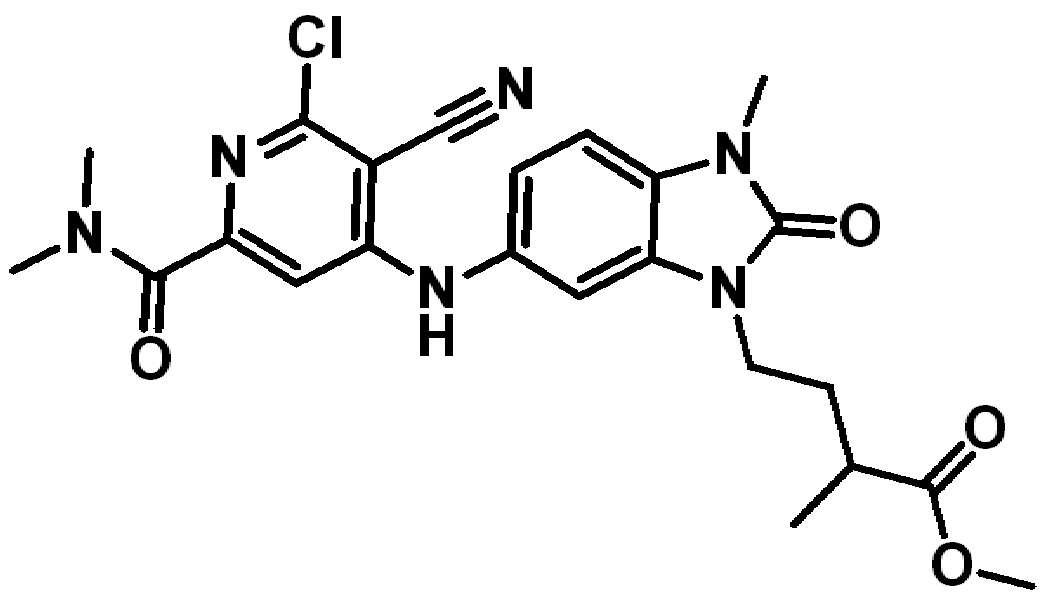
실시예 7a의 제조를 위해서 사용된 것과 유사한 방법에 의해서 제조하였다. LCMS(방법 T4) Rt 2.59min; m/z 485.1695, C23H26ClN6O4 + [M+H]+에 대한 예측치 485.1699; 1H NMR (500 MHz, 클로로포름-d) δ 7.02 - 6.98 (m, 3H), 6.95 (br s, 1H), 6.90 (s, 1H), 3.99 - 3.91 (m, 1H), 3.90 - 3.83 (m, 1H), 3.67 (s, 3H), 3.45 (s, 3H), 3.05 (s, 3H), 3.03 (s, 3H), 2.59 - 2.51 (m, 1H), 2.17 - 2.09 (m, 1H), 1.87 - 1.79 (m, 1H), 1.26 (d, J = 7.1 Hz, 3H).Prepared by a method similar to that used for the preparation of Example 7a. LCMS (Method T4) Rt 2.59 min; m / z 485.1695, C 23 H 26 ClN 6 O 4 + [M + H] + 485.1699 predicted value for; 1 H NMR (500 MHz, Chloroform- d ) δ 7.02-6.98 (m, 3H), 6.95 (br s, 1H), 6.90 (s, 1H), 3.99-3.91 (m, 1H), 3.90-3.83 (m , 1H), 3.67 (s, 3H), 3.45 (s, 3H), 3.05 (s, 3H), 3.03 (s, 3H), 2.59-2.51 (m, 1H), 2.17-2.09 (m, 1H), 1.87-1.79 (m, 1 H), 1.26 (d, J = 7.1 Hz, 3 H).
실시예 7d: 6-클로로-5-시아노-N-[2-(디메틸아미노)에틸]-4-[(1,3-디메틸-2-옥소-벤즈이미다졸-5-일)아미노]피리딘-2-카르복스아미드:포름산(1:1) Example 7d: 6-Chloro-5-cyano-N- [2- (dimethylamino) ethyl] -4-[(1,3-dimethyl-2-oxo-benzimidazol-5-yl) amino] pyridine 2-Carboxamide: formic acid (1: 1)
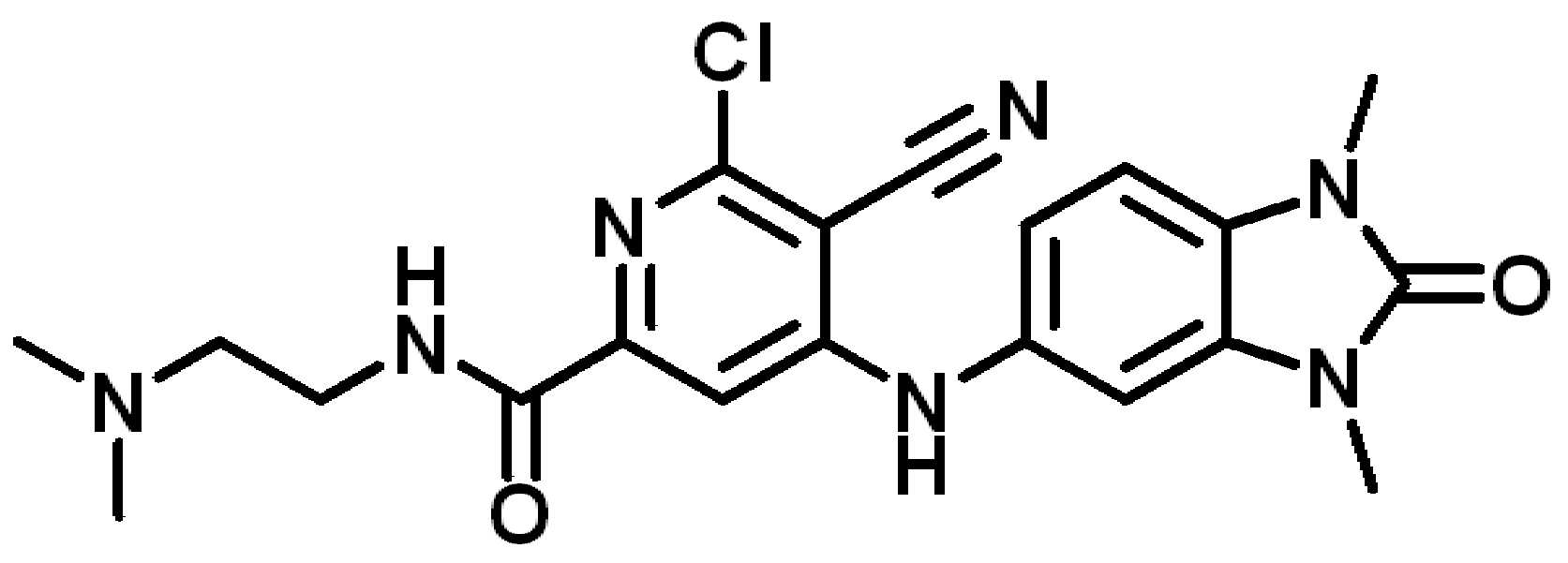
6-클로로-5-시아노-4-[(1,3-디메틸-2-옥소-벤즈이미다졸-5-일)아미노]피리딘-2-카르복실산(실시예 1c)으로부터 출발하여, 실시예 7a의 제조를 위해서 사용된 것과 유사한 방법에 의해서 제조하였다. LCMS(방법 X2) Rt 0.84min; m/z 428.1592 C20H23ClN7O2 [M+H]+에 대한 예측치 428.1602; 1H NMR (500MHz, 클로로포름-d) δ 8.48 (t, J = 5.7 Hz, 1H), 8.35 (1H, s), 7.42 (s, 1H), 7.14 (s, 1H), 7.03 (d, J = 8.2 Hz, 1H), 7.00 (dd, J = 8.2, 2 Hz, 1H), 6.89 (d, J = 2 Hz, 1H), 3.69 (q, J = 6.0 Hz, 2H), 3.48 (s, 3H), 3.44 (s, 3H), 2.93 (t, J = 6.0 Hz, 2H), 2.57 (s, 6H).6-chloro-5-cyano-4-[(1,3-dimethyl-2-oxo-benzimidazol-5-yl) amino] pyridine-2-carboxylic acid (Example 1c) Prepared by a method similar to that used for the preparation of Example 7a. LCMS (Method X2) Rt 0.84 min; m / z Prediction for 428.1592 C 20 H 23 ClN 7 O 2 [M + H] + 428.1602; 1 H NMR (500 MHz, Chloroform-d) δ 8.48 (t, J = 5.7 Hz, 1H), 8.35 (1H, s), 7.42 (s, 1H), 7.14 (s, 1H), 7.03 (d, J = 8.2 Hz, 1H), 7.00 (dd, J = 8.2, 2 Hz, 1H), 6.89 (d, J = 2 Hz, 1H), 3.69 (q, J = 6.0 Hz, 2H), 3.48 (s, 3H) , 3.44 (s, 3H), 2.93 (t, J = 6.0 Hz, 2H), 2.57 (s, 6H).
실시예 8: 에틸 7-[[3-(4-메톡시-3-메틸-4-옥소-부틸)-1-메틸-2-옥소-벤즈이미다졸-5-일]아미노]피라졸로[1,5-a]피리미딘-5-카르복실레이트 Example 8 ethyl 7-[[3- (4-methoxy-3-methyl-4-oxo-butyl) -1-methyl-2-oxo-benzimidazol-5-yl] amino] pyrazolo [1 , 5-a] pyrimidine-5-carboxylate

오븐 건조된 마이크로웨이브 바이알(0.5 mL 내지 2.0 mL 부피)에 메틸 4-(6-아미노-3-메틸-2-옥소-벤즈이미다졸-1-일)-2-메틸-부탄오에이트(중간체 A3a, 22 mg, 0.08 mmol) 및 에틸 7-클로로피라졸로[1,5-a]피리미딘-5-카르복실레이트(14 mg, 0.06 mmol)를 충전시켰다. 반응 바이알을 아르곤으로 플러싱하고, 마개로 닫고, 이어서 추가의 아르곤으로 플러싱하였다. 무수 1,4-디옥산(0.6 mL), 그 다음 트리에틸아민(22 uL, 0.16 mmol)을 첨가하였다. 반응 혼합물을 마이크로웨이브 조사 하에서 7h 동안 120℃에서 가열하였다. 반응 혼합물을 rt까지 냉각시켰다. 물(5 mL)을 첨가하였다. 수성 혼합물을 1 M HCl로 산성화시키고, EtOAc(4 x 5 mL)로 추출하였다. 유기 추출물을 합하고, 건조하고(황산나트륨), 진공에서 농축시켰다. 플래시 크로마토그래피(10 g KP-SIL; 시클로헥산 중의 20%에서 90% EtOAc)에 의한 정제는 표제 화합물을 황색 고체(21 mg, 73%)로서 제공하였다. LCMS(방법 T4) Rt 2.77min; m/z 467.2012, C23H27N6O5 + [M+H]+에 대한 예측치 467.2037; 1H NMR (500 MHz, 클로로포름-d) δ 8.26 (br s, 1H), 8.15 (s, 1H), 7.16 (d, J = 8.2 Hz, 1H), 7.12 (s, 1H), 7.05 (d, J = 8.2 Hz, 1H), 6.98 (s, 1H), 6.81 (s, 1H), 4.46 (q, J = 7.1 Hz, 2H), 4.01 - 3.93 (m, 1H), 3.93 - 3.86 (m, 1H), 3.63 (s, 3H), 3.47 (s, 3H), 2.60 - 2.50 (m, 1H), 2.21 - 2.10 (m, 1H), 1.90 - 1.81 (m, 1H), 1.41 (t, J = 7.1 Hz, 3H), 1.25 (d, J = 7.0 Hz, 3H).In an oven dried microwave vial (0.5 mL to 2.0 mL volume) methyl 4- (6-amino-3-methyl-2-oxo-benzimidazol-1-yl) -2-methyl-butanoate (intermediate A3a , 22 mg, 0.08 mmol) and ethyl 7-chloropyrazolo [1,5-a] pyrimidine-5-carboxylate (14 mg, 0.06 mmol). The reaction vial was flushed with argon, capped and then flushed with additional argon. Anhydrous 1,4-dioxane (0.6 mL) was added followed by triethylamine (22 uL, 0.16 mmol). The reaction mixture was heated at 120 ° C. for 7 h under microwave irradiation. The reaction mixture was cooled to rt. Water (5 mL) was added. The aqueous mixture was acidified with 1 M HCl and extracted with EtOAc (4 × 5 mL). The organic extracts were combined, dried (sodium sulfate) and concentrated in vacuo. Purification by flash chromatography (10 g KP-SIL; 20% to 90% EtOAc in cyclohexane) gave the title compound as a yellow solid (21 mg, 73%). LCMS (Method T4) Rt 2.77 min; m / z 467.2012, predicted 467.2037 for C 23 H 27 N 6 O 5 + [M + H] + ; 1 H NMR (500 MHz, Chloroform- d ) δ 8.26 (br s, 1H), 8.15 (s, 1H), 7.16 (d, J = 8.2 Hz, 1H), 7.12 (s, 1H), 7.05 (d, J = 8.2 Hz, 1H), 6.98 (s, 1H), 6.81 (s, 1H), 4.46 (q, J = 7.1 Hz, 2H), 4.01-3.93 (m, 1H), 3.93-3.86 (m, 1H ), 3.63 (s, 3H), 3.47 (s, 3H), 2.60-2.50 (m, 1H), 2.21-2.10 (m, 1H), 1.90-1.81 (m, 1H), 1.41 (t, J = 7.1 Hz, 3H), 1.25 (d, J = 7.0 Hz, 3H).
실시예 9: 메틸 4-[6-[(2-클로로-3-시아노-4-피리딜)아미노]-3-메틸-2-옥소-벤즈이미다졸-1-일]-2-히드록시-부탄오에이트 Example 9: Methyl 4- [6-[(2-chloro-3-cyano-4-pyridyl) amino] -3-methyl-2-oxo-benzimidazol-1-yl] -2-hydroxy Butane Oate
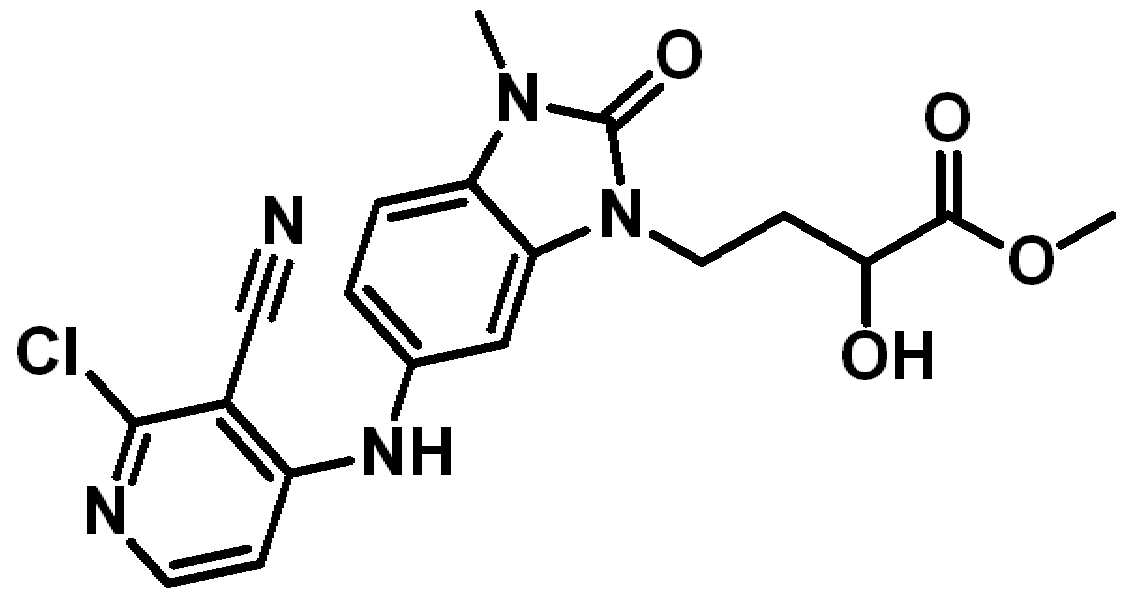
단계 1: 3-[tert-부틸(디메틸)실릴]옥시테트라히드로푸란-2-온Step 1: 3- [tert-butyl (dimethyl) silyl] oxytetrahydrofuran-2-one
tert-부틸디메틸실릴 클로라이드(508 mg, 3.4 mmol)를 0℃에서 아르곤 하에서 DMF(4 mL) 중의 3-히드록시테트라히드로푸란-2-온(0.2 mL, 2.6 mmol) 및 이미다졸(357 mg, 5.2 mmol)의 교반되는 혼합물에 나누어 첨가하였다. 반응 혼합물을 rt까지 가온시키고, 그 온도에서 3h 동안 교반하였다. 포화 aq. 염화암모늄(10 mL)을 첨가하였다. 수성 혼합물을 DCM(3 x 10 mL)으로 추출하였다. 유기 추출물을 합하고, 황산나트륨 상에서 건조하고, 진공에서 농축시켰다. 플래시 크로마토그래피(50 g KP-SIL, 시클로헥산 중의 0%에서 30% EtOAc)에 의한 정제는 3-[tert-부틸(디메틸)실릴]옥시테트라히드로푸란-2-온(527 mg, 95%)을 무색 오일로서 제공하였다. 1H NMR (500 MHz, 클로로포름-d) δ 4.44 - 4.37 (m, 2H), 4.23 - 4.18 (m, 1H), 2.50 - 2.43 (m, 1H), 2.28 - 2.19 (m, 1H), 0.93 (s, 9H), 0.18 (s, 3H), 0.16 (s, 3H). tert -Butyldimethylsilyl chloride (508 mg, 3.4 mmol) was added 3-hydroxytetrahydrofuran-2-one (0.2 mL, 2.6 mmol) and imidazole (357 mg, in DMF (4 mL) under argon at 0 ° C. 5.2 mmol) was added in portions to the stirred mixture. The reaction mixture was warmed up to rt and stirred at that temperature for 3 h. Saturated aq. Ammonium chloride (10 mL) was added. The aqueous mixture was extracted with DCM (3 x 10 mL). The organic extracts were combined, dried over sodium sulfate and concentrated in vacuo. Purification by flash chromatography (50 g KP-SIL, 0% to 30% EtOAc in cyclohexane) gave 3- [ tert -butyl (dimethyl) silyl] oxytetrahydrofuran-2-one (527 mg, 95%) Was provided as a colorless oil. 1 H NMR (500 MHz, Chloroform- d ) δ 4.44-4.37 (m, 2H), 4.23-4.18 (m, 1H), 2.50-2.43 (m, 1H), 2.28-2.19 (m, 1H), 0.93 ( s, 9H), 0.18 (s, 3H), 0.16 (s, 3H).
단계 2: 메틸 2-[tert-부틸(디메틸)실릴]옥시-4-히드록시-부탄오에이트Step 2: Methyl 2- [tert-butyl (dimethyl) silyl] oxy-4-hydroxy-butanoate
메탄올(1 mL) 중의 3-[tert-부틸(디메틸)실릴]옥시테트라히드로푸란-2-온(101 mg, 0.47 mmol, 단계 1로부터) 및 탄산칼륨(15 mg, 0.11 mmol)의 혼합물을 60℃에서 20h 동안 아르곤 하에서 가열하였다. 반응 혼합물을 rt까지 냉각시키고, 메탄올(10 mL)로 희석시키고, 실리카겔 상에 직접 드라이 로딩하였다. 플래시 크로마토그래피(25 g KP-SIL; 시클로헥산 중의 10%에서 50% EtOAc)에 의한 정제는 메틸 2-[tert-부틸(디메틸)실릴]옥시-4-히드록시-부탄오에이트(38 mg)를 무색 오일로서 제공하였다. 1H NMR (500 MHz, 클로로포름-d) δ 4.46 (dd, J = 6.7, 4.7 Hz, 1H), 3.83 - 3.76 (m, 2H), 3.75 (s, 3H), 2.07 - 1.94 (m, 3H), 0.93 (s, 9H), 0.12 (s, 3H), 0.09 (s, 3H).A mixture of 3- [ tert -butyl (dimethyl) silyl] oxytetrahydrofuran-2-one (101 mg, 0.47 mmol, from step 1) and potassium carbonate (15 mg, 0.11 mmol) in methanol (1 mL) was added 60 Heated under argon at 20 ° C. for 20 h. The reaction mixture was cooled to rt, diluted with methanol (10 mL) and dry loaded directly onto silica gel. Purification by flash chromatography (25 g KP-SIL; 10% to 50% EtOAc in cyclohexane) gave methyl 2- [ tert -butyl (dimethyl) silyl] oxy-4-hydroxy-butanoate (38 mg). Was provided as a colorless oil. 1 H NMR (500 MHz, Chloroform-d) δ 4.46 (dd, J = 6.7, 4.7 Hz, 1H), 3.83-3.76 (m, 2H), 3.75 (s, 3H), 2.07-1.94 (m, 3H) , 0.93 (s, 9H), 0.12 (s, 3H), 0.09 (s, 3H).
단계 3: 메틸 2-[tert-부틸(디메틸)실릴]옥시-4-(p-톨릴설포닐옥시)부탄오에이트Step 3: Methyl 2- [tert-butyl (dimethyl) silyl] oxy-4- (p-tolylsulfonyloxy) butanoate
트리에틸아민(30 uL, 0.22 mmol), 피리딘(5 uL, 0.06 mmol) 및 토실 클로라이드(33 mg, 0.17 mmol)를 Ar 하에서 DCM(1.5 mL) 중의 메틸 2-[tert-부틸(디메틸)실릴]옥시-4-히드록시-부탄오에이트(36 mg, 0.14 mmol 단계 2로부터)의 교반되는 용액에 순차적으로 첨가하였다. 반응 혼합물을 30℃에서 6h 동안 교반하였다. 물(10 mL)을 반응 혼합물에 첨가하였다. 층을 분리하고, 수성 층을 DCM으로 추가로 추출하였다(2 x 10 mL). 유기 추출물을 합하고, 건조하고(황산나트륨), 진공에서 농축시켰다. 플래시 크로마토그래피(10 g KP-SIL; 시클로헥산 중의 0%에서 40% EtOA)에 의한 정제는 메틸 2-[tert-부틸(디메틸)실릴]옥시-4-(p-톨릴설포닐옥시)부탄오에이트(33.2 mg)를 연황색 오일로서 제공하였다. 1H NMR (500 MHz, 클로로포름-d) δ 7.82 - 7.78 (m, 2H), 7.38 - 7.34 (m, 2H), 4.31 (dd, J = 7.9, 4.2 Hz, 1H), 4.21 - 4.12 (m, 2H), 3.71 (s, 3H), 2.46 (s, 3H), 2.15 - 2.07 (m, 1H), 2.06 - 1.98 (m, 1H), 0.85 (s, 9H), 0.06 (s, 3H), 0.01 (s, 3H).Triethylamine (30 uL, 0.22 mmol), pyridine (5 uL, 0.06 mmol) and tosyl chloride (33 mg, 0.17 mmol) were added methyl 2- [ tert -butyl (dimethyl) silyl] in DCM (1.5 mL) under Ar. To the stirred solution of oxy-4-hydroxy-butanoate (36 mg, from 0.14 mmol step 2) was added sequentially. The reaction mixture was stirred at 30 ° C. for 6 h. Water (10 mL) was added to the reaction mixture. The layers were separated and the aqueous layer was further extracted with DCM (2 × 10 mL). The organic extracts were combined, dried (sodium sulfate) and concentrated in vacuo. Purification by flash chromatography (10 g KP-SIL; 0% to 40% EtOA in cyclohexane) was carried out using methyl 2- [ tert -butyl (dimethyl) silyl] oxy-4- ( p -tolylsulfonyloxy) butano Eight (33.2 mg) was provided as light yellow oil. 1 H NMR (500 MHz, Chloroform- d ) δ 7.82-7.78 (m, 2H), 7.38-7.34 (m, 2H), 4.31 (dd, J = 7.9, 4.2 Hz, 1H), 4.21-4.12 (m, 2H), 3.71 (s, 3H), 2.46 (s, 3H), 2.15-2.07 (m, 1H), 2.06-1.98 (m, 1H), 0.85 (s, 9H), 0.06 (s, 3H), 0.01 (s, 3 H).
단계 4: 메틸 2-[tert-부틸(디메틸)실릴]옥시-4-[6-[(2-클로로-3-시아노-4-피리딜)아미노]-3-메틸-2-옥소-벤즈이미다졸-1-일]부탄오에이트Step 4: Methyl 2- [tert-butyl (dimethyl) silyl] oxy-4- [6-[(2-chloro-3-cyano-4-pyridyl) amino] -3-methyl-2-oxo-benz Imidazol-1-yl] butane oate
마이크로웨이브 바이알(0.5 mL 내지 2.0 mL 부피)에 메틸 2-[tert-부틸(디메틸)실릴]옥시-4-(p-톨릴설포닐옥시)부탄오에이트(31 mg, 0.08 mmol, 단계 3으로부터), 2-클로로-4-[(1-메틸-2-옥소-3H-벤즈이미다졸-5-일)아미노]피리딘-3-카르보니트릴(중간체 D1, 20 mg, 0.07 mmol) 및 탄산세슘(36 mg, 0.11 mmol)을 충전시켰다. 반응 바이알을 아르곤으로 플러싱하고, 마개로 닫고, 이어서 추가의 아르곤으로 플러싱하였다. DMF(0.66 mL)을 첨가하고, 반응 혼합물을 120℃에서 마이크로웨이브 조사 하에서 1h 동안 가열하였다. 반응 혼합물을 rt까지 냉각시켰다. 물(10 mL)을 첨가하였다. 수성 혼합물을 1 M HCl로 pH 4까지 산성화시켰다. 수성 혼합물을 EtOAc(4 x 10 mL)로 추출하였다. 유기 추출물을 합하고, 건조하고(황산나트륨), 진공에서 농축시켰다. HPLC(ACE 5 C18-PFP 250 x 21.2 mm 컬럼; 45:55에서 20:80 물:메탄올(둘 모두 0.1 % 포름산으로 개질됨)의 15min 구배; 유량 20 mLmin-1; Agilent 6120 MS-Prep LC)에 의한 정제는 메틸 2-[tert-부틸(디메틸)실릴]옥시-4-[6-[(2-클로로-3-시아노-4-피리딜)아미노]-3-메틸-2-옥소-벤즈이미다졸-1-일]부탄오에이트(23 mg)를 점성의 암황색 고체로서 제공하였다. LCMS(방법 T2) Rt 1.64min; m/z 530.1958 [M+H]+; 1H NMR (500 MHz, 클로로포름-d) δ 8.04 (d, J = 6.1 Hz, 1H), 7.01 (d, J = 8.2 Hz, 1H), 6.97 (dd, J = 8.2, 1.9 Hz, 1H), 6.93 (d, J = 1.9 Hz, 1H), 6.86 (br s, 1H), 6.64 (d, J = 6.1 Hz, 1H), 4.36 (dd, J = 6.4, 4.7 Hz, 1H), 4.08 - 4.01 (m, 1H), 3.98 - 3.91 (m, 1H), 3.66 (s, 3H), 3.45 (s, 3H), 2.26 - 2.14 (m, 2H), 0.90 (s, 9H), 0.07 (s, 3H), 0.07 (s, 3H).Methyl 2- [ tert -butyl (dimethyl) silyl] oxy-4- (p-tolylsulfonyloxy) butanate (31 mg, 0.08 mmol, from step 3) in a microwave vial (0.5 mL to 2.0 mL volume) , 2-chloro-4-[(1-methyl-2-oxo-3 H -benzimidazol-5-yl) amino] pyridine-3-carbonitrile (intermediate D1, 20 mg, 0.07 mmol) and cesium carbonate ( 36 mg, 0.11 mmol) was charged. The reaction vial was flushed with argon, capped and then flushed with additional argon. DMF (0.66 mL) was added and the reaction mixture was heated at 120 ° C. for 1 h under microwave irradiation. The reaction mixture was cooled to rt. Water (10 mL) was added. The aqueous mixture was acidified to pH 4 with 1 M HCl. The aqueous mixture was extracted with EtOAc (4 x 10 mL). The organic extracts were combined, dried (sodium sulfate) and concentrated in vacuo. HPLC (ACE 5 C18-PFP 250 x 21.2 mm column; 45:55 to 20:80 water: methanol, both modified with 0.1% formic acid); flow rate 20 mLmin -1 ; Agilent 6120 MS-Prep LC) Purification by methyl 2- [ tert -butyl (dimethyl) silyl] oxy-4- [6-[(2-chloro-3-cyano-4-pyridyl) amino] -3-methyl-2-oxo- Benzimidazol-1-yl] butanoate (23 mg) was provided as a viscous dark yellow solid. LCMS (Method T2) Rt 1.64 min; m / z 530.1958 [M + H] + ; 1 H NMR (500 MHz, Chloroform-d) δ 8.04 (d, J = 6.1 Hz, 1H), 7.01 (d, J = 8.2 Hz, 1H), 6.97 (dd, J = 8.2, 1.9 Hz, 1H), 6.93 (d, J = 1.9 Hz, 1H), 6.86 (br s, 1H), 6.64 (d, J = 6.1 Hz, 1H), 4.36 (dd, J = 6.4, 4.7 Hz, 1H), 4.08-4.01 ( m, 1H), 3.98-3.91 (m, 1H), 3.66 (s, 3H), 3.45 (s, 3H), 2.26-2.14 (m, 2H), 0.90 (s, 9H), 0.07 (s, 3H) , 0.07 (s, 3 H).
단계 5: 메틸 4-[6-[(2-클로로-3-시아노-4-피리딜)아미노]-3-메틸-2-옥소-벤즈이미다졸-1-일]-2-히드록시-부탄오에이트Step 5: Methyl 4- [6-[(2-chloro-3-cyano-4-pyridyl) amino] -3-methyl-2-oxo-benzimidazol-1-yl] -2-hydroxy- Butane Oate
0℃에서 아르곤 하에서 TBAF(THF 중의 1 M)(60 uL, 0.06 mmol)의 교반되는 용액에 THF(0.6 mL) 중의 메틸 2-[tert-부틸(디메틸)실릴]옥시-4-[6-[(2-클로로-3-시아노-4-피리딜)아미노]-3-메틸-2-옥소-벤즈이미다졸-1-일]부탄오에이트(21 mg, 0.04 mmol, 단계 4로부터)를 첨가하였다. 반응 혼합물을 rt까지 가온시키고, 2.5h 동안 교반하였다. 포화 aq. NH4Cl(5 mL)을 첨가하고, 수성 혼합물을 EtOAc(4 x 10 mL)로 추출하였다. 유기 추출물을 합하고, 건조하고(황산나트륨), 진공에서 농축시켰다. HPLC(ACE 5 C18-PFP 250 x 21.2 mm 컬럼; 45:55에서 20:80 물:메탄올(둘 모두 0.1 % 포름산으로 개질됨)의 15min 구배; 유량 20 mLmin-1; Agilent 6120 MS-Prep LC)에 의한 정제는 표제 화합물을 연황색 고체(8 mg, 45%)로서 제공하였다. LCMS(방법 T4) Rt 2.48min; m/z 416.1097, C19H19ClN5O4 + [M+H]+에 대한 예측치 416.1120; 1H NMR (500 MHz, 클로로포름-d) δ 8.03 (d, J = 6.1 Hz, 1H), 7.04 (d, J = 8.1 Hz, 1H), 7.02 - 6.97 (m, 3H), 6.64 (d, J = 6.1 Hz, 1H), 4.19 (dd, J = 8.9, 3.6 Hz, 1H), 4.11 - 4.06 (m, 2H), 3.67 (s, 3H), 3.47 (s, 3H), 2.36 - 2.25 (m, 1H), 2.11 - 2.02 (m, 1H), 1.70 (br s, 1H).To a stirred solution of TBAF (1 M in THF) (60 uL, 0.06 mmol) under argon at 0 ° C. methyl 2- [ tert -butyl (dimethyl) silyl] oxy-4- [6- [in THF (0.6 mL). (2-chloro-3-cyano-4-pyridyl) amino] -3-methyl-2-oxo-benzimidazol-1-yl] butanoate (21 mg, 0.04 mmol, from step 4) was added It was. The reaction mixture was warmed up to rt and stirred for 2.5 h. Saturated aq. NH 4 Cl (5 mL) was added and the aqueous mixture was extracted with EtOAc (4 × 10 mL). The organic extracts were combined, dried (sodium sulfate) and concentrated in vacuo. HPLC (ACE 5 C18-PFP 250 x 21.2 mm column; 45:55 to 20:80 water: methanol, both modified with 0.1% formic acid); flow rate 20 mLmin -1 ; Agilent 6120 MS-Prep LC) Purification by gave the title compound as a light yellow solid (8 mg, 45%). LCMS (Method T4) Rt 2.48 min; m / z 416.1097, predicted 416.1120 for C 19 H 19 ClN 5 O 4 + [M + H] + ; 1 H NMR (500 MHz, Chloroform- d ) δ 8.03 (d, J = 6.1 Hz, 1H), 7.04 (d, J = 8.1 Hz, 1H), 7.02-6.97 (m, 3H), 6.64 (d, J = 6.1 Hz, 1H), 4.19 (dd, J = 8.9, 3.6 Hz, 1H), 4.11-4.06 (m, 2H), 3.67 (s, 3H), 3.47 (s, 3H), 2.36-2.25 (m, 1H), 2.11-2.02 (m, 1H), 1.70 (br s, 1H).
실시예 10a: 2-클로로-4-[[3-(2,3-디히드록시-3-메틸-부틸)-1-메틸-2-옥소-벤즈이미다졸-5-일]아미노]피리딘-3-카르보니트릴 Example 10a: 2-Chloro-4-[[3- (2,3-dihydroxy-3-methyl-butyl) -1-methyl-2-oxo-benzimidazol-5-yl] amino] pyridine- 3-carbonitrile

DMF(0.60 mL)중의 2-클로로-4-[(1-메틸-2-옥소-3H-벤즈이미다졸-5-일)아미노]피리딘-3-카르보니트릴(중간체 D1, 30 mg, 0.10 mmol) 및 탄산세슘(45 mg, 0.14 mmol)의 혼합물에 2-(옥시란-2-일)프로판-2-올(중간체 F1, DCM과의 약 1:1 w/w 혼합물, 30 mg, 0.15 mmol)을 첨가하고, 생성된 혼합물을 마이크로웨이브에서 120℃까지 1h 동안 가열하고, 이어서 DCM(3 mL) 및 물(2 mL)로 희석시켰다. 2상 혼합물을 10% 시트르산으로 pH 5까지 산성화시키고, 철저히 혼합하고, 이어서 DCM으로 추출하고, 합한 유기물을 상 분리기에 통과시키고, 감압 하에서 증발시켰다. 생성된 조 혼합물을 정제용 HPLC(2회 주입, ACE 5 C18-PFP 컬럼(5 μ, 250x21.2 mm), 45:55에서 20:80 물: 메탄올(둘 모두 0.1% 포름산으로 개질됨)로의 15분 구배 용리, 20 mL/min의 유량)에 의해서 정제하여 2-클로로-4-[[3-(2,3-디히드록시-3-메틸-부틸)-1-메틸-2-옥소-벤즈이미다졸-5-일]아미노]피리딘-3-카르보니트릴(8 mg)을 회백색 고체로서 제공하였다. LCMS(방법 X4) Rt 2.25min; m/z 402.1329 C19H21ClN5O3 [M+H]+에 대한 예측치 402.1333. 1H NMR (500 MHz, 메탄올-d 4 ) δ 7.94 (d, J = 6.3 Hz, 1H), 7.24 (d, J = 2.0 Hz, 1H), 7.22 (d, J = 8.3 Hz, 1H), 7.07 (dd, J = 8.3, 2.0 Hz, 1H), 6.71 (d, J = 6.3 Hz, 1H), 4.18 (dd, J = 14.4, 2.4 Hz, 1H), 3.91 (dd, J = 14.4, 10.0 Hz, 1H), 3.70 (dd, J = 10.0, 2.3 Hz, 1H), 3.47 (s, 3H), 1.29 (s, 3H), 1.27 (s, 3H).2-chloro-4-[(1-methyl-2-oxo- 3H -benzimidazol-5-yl) amino] pyridine-3-carbonitrile (Intermediate D1, 30 mg, 0.10 mmol in DMF (0.60 mL) ) And cesium carbonate (45 mg, 0.14 mmol) in a mixture of 2- (oxirane-2-yl) propan-2-ol (intermediate F1, about 1: 1 w / w mixture with DCM, 30 mg, 0.15 mmol ) Was added and the resulting mixture was heated in microwave to 120 ° C. for 1 h and then diluted with DCM (3 mL) and water (2 mL). The biphasic mixture was acidified with 10% citric acid to pH 5, mixed thoroughly, then extracted with DCM, and the combined organics passed through a phase separator and evaporated under reduced pressure. The resulting crude mixture was purified by preparative HPLC (twice injection, ACE 5 C18-PFP column (5 μ, 250 × 21.2 mm), 45:55 to 20:80 water: methanol (both modified with 0.1% formic acid). Purification by 15 minute gradient elution, flow rate of 20 mL / min) yields 2-chloro-4-[[3- (2,3-dihydroxy-3-methyl-butyl) -1-methyl-2-oxo- Benzimidazol-5-yl] amino] pyridine-3-carbonitrile (8 mg) was provided as an off-white solid. LCMS (Method X4) Rt 2.25 min; m / z 403.333 for C 19 H 21 ClN 5 O 3 [M + H] + . 1 H NMR (500 MHz, Methanol- d 4 ) δ 7.94 (d, J = 6.3 Hz, 1H), 7.24 (d, J = 2.0 Hz, 1H), 7.22 (d, J = 8.3 Hz, 1H), 7.07 (dd, J = 8.3, 2.0 Hz, 1H), 6.71 (d, J = 6.3 Hz, 1H), 4.18 (dd, J = 14.4, 2.4 Hz, 1H), 3.91 (dd, J = 14.4, 10.0 Hz, 1H), 3.70 (dd, J = 10.0, 2.3 Hz, 1H), 3.47 (s, 3H), 1.29 (s, 3H), 1.27 (s, 3H).
표 4에 나타낸 중간체를 사용하여, 실시예 10a의 제조를 위해서 사용된 것과 유사한 방법에 의해서 하기 표로 나타낸 실시예를 제조하였다. 실시예 10d의 경우, 반응물을 120℃ 대신에 140℃에서 1h 동안 가열하였다. 실시예 10g의 경우, 반응물을 마이크로웨이브 가열을 사용한 것 대신에 60℃까지 3일 동안 가열하였다.Using the intermediates shown in Table 4, the examples shown in the table below were prepared by methods analogous to those used for the preparation of Example 10a. For Example 10d, the reaction was heated at 140 ° C. for 1 h instead of 120 ° C. For Example 10 g, the reaction was heated to 60 ° C. for 3 days instead of using microwave heating.
[표 4]TABLE 4
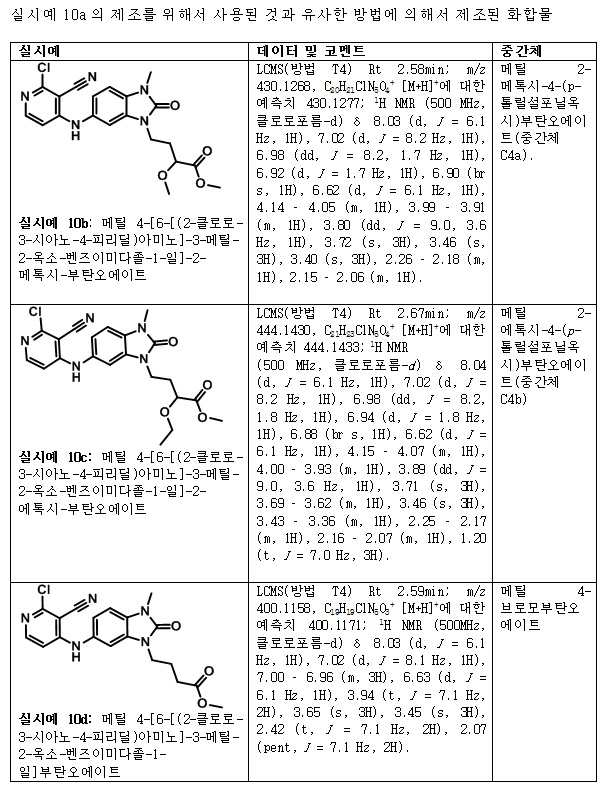


실시예 11: 메틸 2-[[6-[(2-클로로-3-시아노-4-피리딜)아미노]-3-메틸-2-옥소-벤즈이미다졸-1-일]메틸]시클로펜탄카르복실레이트(부분입체이성질체의 2:1 혼합물로서) Example 11: Methyl 2-[[6-[(2-chloro-3-cyano-4-pyridyl) amino] -3-methyl-2-oxo-benzimidazol-1-yl] methyl] cyclopentane Carboxylate (as a 2: 1 mixture of diastereomers)

단계 1: 메틸 2-(아이오도메틸)시클로펜탄카르복실레이트Step 1: Methyl 2- (iodomethyl) cyclopentanecarboxylate
0℃에서 아르곤 하에서 트리메틸실릴 아이오다이드(0.14 mL, 0.98 mmol)를 DCM(1.6 mL) 중의 헥사히드로-1H-시클로펜타[c]푸란-1-온(42 mg, 0.33 mmol) 및 메탄올(70 uL, 1.73 mmol)의 교반되는 용액에 적가하였다. 반응 혼합물을 rt까지 가온시키고, 20h 동안 교반하였다. 물(5 mL)을 첨가하였다. 수성 혼합물을 DCM(3 x 10 mL)으로 추출하였다. 유기 추출물을 합하고, 건조하고(황산나트륨), 진공에서 농축시켰다. 플래시 크로마토그래피(10 g KP-SIL; 시클로헥산 중의 0%에서 30% EtOA)에 의한 정제는 메틸 2-(아이오도메틸)시클로펜탄카르복실레이트(31 mg, 35%)를 연황색 오일로서 제공하였다. 1H NMR (500 MHz, 클로로포름-d) δ 3.69 (s, 3H), 3.30 (dd, J = 9.6, 6.6 Hz, 1H), 3.11 (t, J = 9.3 Hz, 1H), 2.99 - 2.92 (m, 1H), 2.60 - 2.51 (m, 1H), 2.05 - 1.85 (m, 4H), 1.71 - 1.57 (m, 2H).Trimethylsilyl iodide (0.14 mL, 0.98 mmol) under argon at 0 ° C. was dissolved in hexahydro-1 H -cyclopenta [c] furan-1-one (42 mg, 0.33 mmol) and methanol in DCM (1.6 mL). 70 uL, 1.73 mmol) was added dropwise to the stirred solution. The reaction mixture was warmed up to rt and stirred for 20 h. Water (5 mL) was added. The aqueous mixture was extracted with DCM (3 x 10 mL). The organic extracts were combined, dried (sodium sulfate) and concentrated in vacuo. Purification by flash chromatography (10 g KP-SIL; 0% to 30% EtOA in cyclohexane) provided methyl 2- (iodomethyl) cyclopentanecarboxylate (31 mg, 35%) as light yellow oil. It was. 1 H NMR (500 MHz, Chloroform-d) δ 3.69 (s, 3H), 3.30 (dd, J = 9.6, 6.6 Hz, 1H), 3.11 (t, J = 9.3 Hz, 1H), 2.99-2.92 (m , 1H), 2.60-2.51 (m, 1H), 2.05-1.85 (m, 4H), 1.71-1.57 (m, 2H).
단계 2: 2-[[6-[(2-클로로-3-시아노-4-피리딜)아미노]-3-메틸-2-옥소-벤즈이미다졸-1-일]메틸]시클로펜탄카르복실산Step 2: 2-[[6-[(2-chloro-3-cyano-4-pyridyl) amino] -3-methyl-2-oxo-benzimidazol-1-yl] methyl] cyclopentanecarboxyl mountain
마이크로웨이브 바이알(0.5 mL 내지 2.0 mL 부피)에 메틸 2-(아이오도메틸)시클로펜탄카르복실레이트(31 mg, 0.12 mmol, 단계 1로부터), 2-클로로-4-[(1-메틸-2-옥소-3H-벤즈이미다졸-5-일)아미노]피리딘-3-카르보니트릴(중간체 D1, 30 mg, 0.10 mmol) 및 탄산세슘(58 mg, 0.18 mmol)을 충전시켰다. 아르곤 반응 바이알을 아르곤으로 플러싱하고, 마개로 닫고, 이어서 Ar으로 추가로 플러싱하였다. DMF(1.0 mL)를 첨가하고, 반응 혼합물을 120℃에서 마이크로웨이브 조사 하에서 1h 동안 가열하고, 그 다음 160℃에서 마이크로웨이브 조사 하에서 추가로 6h 동안 가열하였다. 조 반응 혼합물을 MeCN:DMSO의 1:1 혼합물(1.2 mL)로 희석시키고, HPLC(2회 주입; ACE 5 C18-PFP 250 x 21.2 mm 컬럼; 60:40에서 0:100 물:메탄올(둘 모두 0.1 % 포름산으로 개질됨)의 15min 구배; 유량 20 mLmin-1; Agilent 6120 MS-Prep LC)에 의해서 직접 정제하여 표제 화합물(7 mg)을 회백색 고체로서 제공하였다. LCMS(방법 T2) Rt 1.43min; m/z 426.1318 [M+H]+; 1H NMR (500 MHz, 메탄올-d 4 ) δ 7.95 (d, J = 6.2 Hz, 1H), 7.23 (d, J = 8.3 Hz, 1H), 7.15 (d, J = 1.9 Hz, 1H), 7.09 (dd, J = 8.3, 1.9 Hz, 1H), 6.70 (d, J = 6.2 Hz, 1H), 3.98 - 3.92 (m, 2H), 3.46 (s, 3H), 2.96 - 2.89 (m, 1H), 2.77 - 2.69 (m, 1H), 2.04 - 1.96 (m, 1H), 1.96 - 1.87 (m, 2H), 1.68 - 1.58 (m, 3H).In a microwave vial (0.5 mL to 2.0 mL volume) methyl 2- (iodomethyl) cyclopentanecarboxylate (31 mg, 0.12 mmol, from step 1), 2-chloro-4-[(1-methyl-2 -Oxo- 3H -benzimidazol-5-yl) amino] pyridine-3-carbonitrile (intermediate D1, 30 mg, 0.10 mmol) and cesium carbonate (58 mg, 0.18 mmol) were charged. The argon reaction vial was flushed with argon, capped and then further flushed with Ar. DMF (1.0 mL) was added and the reaction mixture was heated for 1 h under microwave irradiation at 120 ° C. and then further 6 h under microwave irradiation at 160 ° C. The crude reaction mixture was diluted with a 1: 1 mixture of MeCN: DMSO (1.2 mL), HPLC (2 injections; ACE 5 C18-PFP 250 x 21.2 mm column; 60:40 to 0: 100 water: methanol (both) 15 min gradient of 0.1% formic acid); flow 20 mLmin-1; purified directly by Agilent 6120 MS-Prep LC) to provide the title compound (7 mg) as off-white solid. LCMS (Method T2) Rt 1.43 min; m / z 426.1318 [M + H] + ; 1 H NMR (500 MHz, Methanol- d 4 ) δ 7.95 (d, J = 6.2 Hz, 1H), 7.23 (d, J = 8.3 Hz, 1H), 7.15 (d, J = 1.9 Hz, 1H), 7.09 (dd, J = 8.3, 1.9 Hz, 1H), 6.70 (d, J = 6.2 Hz, 1H), 3.98-3.92 (m, 2H), 3.46 (s, 3H), 2.96-2.89 (m, 1H), 2.77-2.69 (m, 1H), 2.04-1.96 (m, 1H), 1.96-1.87 (m, 2H), 1.68-1.58 (m, 3H).
단계 3: 메틸 2-[[6-[(2-클로로-3-시아노-4-피리딜)아미노]-3-메틸-2-옥소-벤즈이미다졸-1-일]메틸]시클로펜탄카르복실레이트Step 3: Methyl 2-[[6-[(2-chloro-3-cyano-4-pyridyl) amino] -3-methyl-2-oxo-benzimidazol-1-yl] methyl] cyclopentanecar Carboxylate
황산(1 방울)을 무수 메탄올(3.0 mL) 중의 2-[[6-[(2-클로로-3-시아노-4-피리딜)아미노]-3-메틸-2-옥소-벤즈이미다졸-1-일]메틸]시클로펜탄카르복실산(7 mg, 0.02 mmol, 단계 2로부터)의 교반되는 혼합물에 첨가하였다. 반응 혼합물을 rt에서 3d 동안 교반하였다. 반응 혼합물을 진공에서 농축시켰다. 생성된 잔류물을 디에틸 에테르(6 mL)로 세척하고, 건조하여, 표제 화합물 메틸 2-[[6-[(2-클로로-3-시아노-4-피리딜)아미노]-3-메틸-2-옥소-벤즈이미다졸-1-일]메틸]시클로펜탄카르복실레이트(5 mg, 부분입체이성질체의 2:1 혼합물)를 황색 고체로서 제공하였다. LCMS(방법 T4) Rt 2.80min; m/z 440.1489, C22H23ClN5O3 + [M+H]+에 대한 예측치 440.1484; 주 부분입체이성질체: 1H NMR (500 MHz, 메탄올-d 4 ) δ 8.13 (d, J = 7.3 Hz, 1H), 7.31 (d, J = 8.3 Hz, 1H), 7.24 - 7.22 (m, 1H), 7.19 - 7.15 (m, 1H), 6.97 (d, J = 7.3 Hz, 1H), 3.96 (dd, J = 14.9, 6.0 Hz, 2H), 3.69 (s, 3H), 3.46 (s, 3H), 2.98 - 2.91 (m, 1H), 2.84 - 2.71 (m, 1H), 2.05 - 1.86 (m, 3H), 1.72 - 1.60 (m, 3H); 부 부분입체이성질체: 1H NMR (500 MHz, 메탄올-d 4 ) δ 8.12 (d, J = 7.3 Hz, 1H), 7.31 (d, J = 8.3 Hz, 1H), 7.24 - 7.22 (m, 1H), 7.19 - 7.15 (m, 1H), 6.96 (d, J = 7.3 Hz, 1H), 3.86 (dd, J = 14.3, 9.7 Hz, 2H), 3.62 (s, 3H), 3.47 (s, 3H), 2.98 - 2.91 (m, 1H), 2.84 - 2.71 (m, 1H), 2.05 - 1.86 (m, 3H), 1.72 - 1.60 (m, 3H).Sulfuric acid (1 drop) was added 2-[[6-[(2-chloro-3-cyano-4-pyridyl) amino] -3-methyl-2-oxo-benzimidazole in anhydrous methanol (3.0 mL). To a stirred mixture of 1-yl] methyl] cyclopentanecarboxylic acid (7 mg, 0.02 mmol, from step 2). The reaction mixture was stirred at rt for 3d. The reaction mixture was concentrated in vacuo. The resulting residue was washed with diethyl ether (6 mL) and dried to give the title compound methyl 2-[[6-[(2-chloro-3-cyano-4-pyridyl) amino] -3-methyl -2-oxo-benzimidazol-1-yl] methyl] cyclopentanecarboxylate (5 mg, 2: 1 mixture of diastereomers ) was provided as a yellow solid. LCMS (Method T4) Rt 2.80 min; m / z 440.1489, Found 440.1484 for C 22 H 23 ClN 5 O 3 + [M + H] + ; Major diastereomers: 1 H NMR (500 MHz, Methanol- d 4 ) δ 8.13 (d, J = 7.3 Hz, 1H), 7.31 (d, J = 8.3 Hz, 1H), 7.24-7.22 (m, 1H), 7.19-7.15 ( m, 1H), 6.97 (d, J = 7.3 Hz, 1H), 3.96 (dd, J = 14.9, 6.0 Hz, 2H), 3.69 (s, 3H), 3.46 (s, 3H), 2.98-2.91 (m , 1H), 2.84-2.71 (m, 1H), 2.05-1.86 (m, 3H), 1.72-1.60 (m, 3H); Part diastereomers: 1 H NMR (500 MHz, Methanol- d 4 ) δ 8.12 (d, J = 7.3 Hz, 1H), 7.31 (d, J = 8.3 Hz, 1H), 7.24-7.22 (m, 1H), 7.19-7.15 ( m, 1H), 6.96 (d, J = 7.3 Hz, 1H), 3.86 (dd, J = 14.3, 9.7 Hz, 2H), 3.62 (s, 3H), 3.47 (s, 3H), 2.98-2.91 (m , 1H), 2.84-2.71 (m, 1H), 2.05-1.86 (m, 3H), 1.72-1.60 (m, 3H).
실시예 12: 메틸 (2R)-2-아미노-4-[6-[(2-클로로-3-시아노-4-피리딜)아미노]-3-메틸-2-옥소-벤즈이미다졸-1-일]부탄오에이트 Example 12 Methyl ( 2R ) -2-Amino-4- [6-[(2-chloro-3-cyano-4-pyridyl) amino] -3-methyl-2-oxo-benzimidazole- 1-Sun] Butane Oate
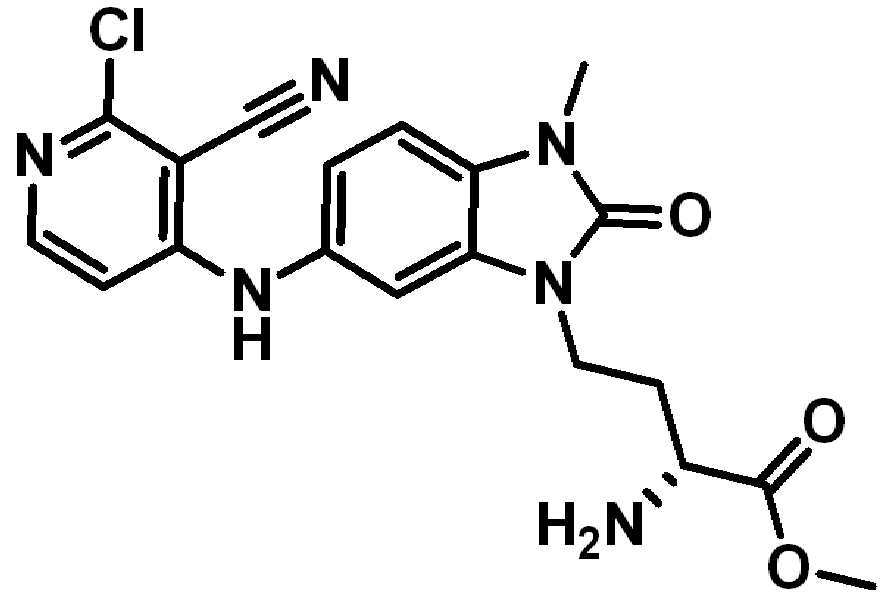
단계 1: 2-[(2R,5S)-5-이소프로필-3,6-디메톡시-2,5-디히드로피라진-2-일]에틸 4-메틸벤젠설포네이트Step 1: 2-[(2R, 5S) -5-isopropyl-3,6-dimethoxy-2,5-dihydropyrazin-2-yl] ethyl 4-methylbenzenesulfonate
오븐 건조된 마이크로웨이브 바이알(2.0 mL 내지 5.0 mL 부피)에 (2S)-2-이소프로필-3,6-디메톡시-2,5-디히드로피라진(100 uL, 0.56 mmol)을 충전시켰다. 반응 바이알을 아르곤으로 플러싱하고, 마개로 닫고, 이어서 추가의 아르곤으로 플러싱하였다. 무수 THF(2 mL)를 첨가하였다. 반응 용기를 -78℃까지 냉각시키고, n-BuLi(헥산 중의 1.59 M; 0.74 mL, 1.18 mmol)을 적가하였다. 반응 혼합물을 -78℃에서 30 min 동안 교반하였다. 2-브로모에탄올(40 uL, 0.56 mmol)을 적가하고, 반응 혼합물을 rt까지 가온시키고, 4h 동안 교반하였다. 반응 혼합물을 0℃까지 냉각시키고, THF(1 mL) 중의 4-메틸벤젠설포닐 클로라이드(106 mg, 0.56 mmol)의 용액을 첨가하였다. 반응 혼합물을 rt까지 가온시키고, 2h 동안 교반하였다. 반응 혼합물을 포화 aq. NH4Cl(5 mL)로 켄칭시키고, 수성 혼합물을 DCM(3 x 10 mL)으로 추출하였다. 유기 추출물을 합하고, 건조하고(Na2SO4), 진공에서 농축시켰다. 플래시 크로마토그래피(25 g KP-SIL; 시클로헥산 중의 0%에서 40% EtOAc)에 의한 정제는 2-[(2R,5S)-5-이소프로필-3,6-디메톡시-2,5-디히드로피라진-2-일]에틸 4-메틸벤젠설포네이트(d.r. >20:1, 107 mg)를 점성 황색 오일로서 제공하였다. LCMS(방법 T2) Rt 1.60min; m/z 383.1639 [M+H]+ In an oven-dried microwave vial (2.0 mL to 5.0 mL volume) (2 S) was charged with 2-isopropyl-3,6-dimethoxy-2,5-dihydro-pyrazine (100 uL, 0.56 mmol). The reaction vial was flushed with argon, capped and then flushed with additional argon. Anhydrous THF (2 mL) was added. The reaction vessel was cooled to −78 ° C. and n- BuLi (1.59 M in hexane; 0.74 mL, 1.18 mmol) was added dropwise. The reaction mixture was stirred at -78 ° C for 30 min. 2-bromoethanol (40 uL, 0.56 mmol) was added dropwise and the reaction mixture was warmed to rt and stirred for 4 h. The reaction mixture was cooled to 0 ° C. and a solution of 4-methylbenzenesulfonyl chloride (106 mg, 0.56 mmol) in THF (1 mL) was added. The reaction mixture was warmed up to rt and stirred for 2 h. The reaction mixture was saturated with aq. Quench with NH 4 Cl (5 mL) and extract the aqueous mixture with DCM (3 × 10 mL). The organic extracts were combined, dried (Na 2 SO 4 ) and concentrated in vacuo. Flash chromatography (25 g KP-SIL; bicyclo 0% 40% EtOAc in hexanes) to give due to the 2 - [(2 R, 5 S) -5- isopropyl-3,6-dimethoxy-2,5 -Dihydropyrazin-2-yl] ethyl 4-methylbenzenesulfonate ( dr > 20: 1, 107 mg) was provided as a viscous yellow oil. LCMS (Method T2) Rt 1.60 min; m / z 383.1639 [M + H] +
단계 2: 2-클로로-4-[[3-[2-[(2R,5S)-5-이소프로필-3,6-디메톡시-2,5-디히드로피라진-2-일]에틸]-1-메틸-2-옥소-벤즈이미다졸-5-일]아미노]피리딘-3-카르보니트릴Step 2: 2-chloro-4-[[3- [2-[(2R, 5S) -5-isopropyl-3,6-dimethoxy-2,5-dihydropyrazin-2-yl] ethyl]- 1-methyl-2-oxo-benzimidazol-5-yl] amino] pyridine-3-carbonitrile
오븐 건조된 마이크로웨이브 바이알(0.5 mL 내지 2.0 mL 부피)에 2-클로로-4-[(1-메틸-2-옥소-3H-벤즈이미다졸-5-일)아미노]피리딘-3-카르보니트릴(중간체 D1, 30 mg, 0.1 mmol), 2-[(2R,5S)-5-이소프로필-3,6-디메톡시-2,5-디히드로피라진-2-일]에틸 4-메틸벤젠설포네이트(41 mg, 0.11 mmol, 단계 1로부터) 및 탄산세슘(39 mg, 0.12 mmol)을 충전시켰다.In an oven dried microwave vial (0.5 mL to 2.0 mL volume) 2-chloro-4-[(1-methyl-2-oxo-3 H -benzimidazol-5-yl) amino] pyridine-3-carbonitrile (intermediate D1, 30 mg, 0.1 mmol) , 2 - [(2 R, 5 S) -5- isopropyl-3,6-dimethoxy-2,5-dihydro-2-yl] ethyl 4-methyl Benzenesulfonate (41 mg, 0.11 mmol, from step 1) and cesium carbonate (39 mg, 0.12 mmol) were charged.
반응 바이알을 아르곤으로 플러싱하고, 마개로 닫고, 이어서 추가의 아르곤으로 플러싱하였다. DMF(1 mL)를 첨가하고, 반응 혼합물을 140℃에서 마이크로웨이브 조사 하에서 2h 동안 교반하였다. 반응 혼합물을 rt까지 냉각시켰다. 물(10 mL)을 첨가하였다. 수성 혼합물을 1 M HCl로 산성화시켰다. 수성 혼합물을 EtOAc(5 x 10 mL)로 추출하였다. 유기 추출물을 합하고, 건조하고(황산나트륨), 진공에서 농축시켰다. HPLC(ACE 5 C18-PFP 250 x 30 mm 컬럼; 40:60에서 0:100 물:메탄올(둘 모두 0.1 % 포름산으로 개질됨)의 15min 구배; 유량 40 mLmin-1; Agilent 6120 MS-Prep LC)에 의한 정제는 2-클로로-4-[[3-[2-[(2R,5S)-5-이소프로필-3,6-디메톡시-2,5-디히드로피라진-2-일]에틸]-1-메틸-2-옥소-벤즈이미다졸-5-일]아미노]피리딘-3-카르보니트릴(14 mg, 28%)을 연황색 고체로서 제공하였다. LCMS(방법 T2) Rt 1.57min; m/z 510.2028 [M+H]+ . The reaction vial was flushed with argon, capped and then flushed with additional argon. DMF (1 mL) was added and the reaction mixture was stirred at 140 ° C. for 2 h under microwave irradiation. The reaction mixture was cooled to rt. Water (10 mL) was added. The aqueous mixture was acidified with 1 M HCl. The aqueous mixture was extracted with EtOAc (5 x 10 mL). The organic extracts were combined, dried (sodium sulfate) and concentrated in vacuo. HPLC (ACE 5 C18-PFP 250 × 30 mm column; 15min gradient from 40:60 to 0: 100 water: methanol (both modified with 0.1% formic acid); flow rate 40 mLmin −1 ; Agilent 6120 MS-Prep LC) purification by the 2-chloro -4 - [[3- [2 - [(2 R, 5 S) -5- isopropyl-3,6-dimethoxy-2,5-dihydro-2-yl; Ethyl] -1-methyl-2-oxo-benzimidazol-5-yl] amino] pyridine-3-carbonitrile (14 mg, 28%) was provided as a light yellow solid. LCMS (Method T2) Rt 1.57 min; m / z 510.2028 [M + H] + .
단계 3: 메틸 (2R)-2-아미노-4-[6-[(2-클로로-3-시아노-4-피리딜)아미노]-3-메틸-2-옥소-벤즈이미다졸-1-일]부탄오에이트Step 3: Methyl (2R) -2-Amino-4- [6-[(2-chloro-3-cyano-4-pyridyl) amino] -3-methyl-2-oxo-benzimidazole-1- Japan] Butan Oate
rt에서 물(1 mL) 중의 TFA(0.16 mL, 2.1 mmol)를 아세토니트릴(2 mL) 중의 2-클로로-4-[[3-[2-[(2R,5S)-5-이소프로필-3,6-디메톡시-2,5-디히드로피라진-2-일]에틸]-1-메틸-2-옥소-벤즈이미다졸-5-일]아미노]피리딘-3-카르보니트릴(14 mg, 0.03 mmol, 단계 2로부터)의 용액에 적가하였다. 반응 혼합물을 rt에서 3h 동안 교반하였다. 반응 혼합물을 진공에서 농축시키고, 생성된 잔류물을 DCM(5 mL)으로 희석시키고, 진공에서 추가로 농축시켰다. HPLC(ACE 5 C18-PFP 250 x 21.2 mm 컬럼; 60:40에서 0:100 물:메탄올(둘 모두 0.1% 포름산으로 개질됨)로의 15min 구배; 유량 20 mLmin-1; Agilent 6120 MS-Prep LC)에 의한 정제는 표제 화합물 메틸 (2R)-2-아미노-4-[6-[(2-클로로-3-시아노-4-피리딜)아미노]-3-메틸-2-옥소-벤즈이미다졸-1-일]부탄오에이트(5 mg, 46%)를 연황색 고체로서 제공하였다. LCMS(방법 T4) Rt 2.06min; m/z 415.1271, C19H20ClN6O3 + [M+H]+에 대한 예측치 415.1280; 1H NMR (500 MHz, 클로로포름-d) δ 8.04 (d, J = 6.1 Hz, 1H), 7.05 - 7.02 (m, 2H), 7.02 - 6.96 (m, 2H), 6.63 (d, J = 6.1 Hz, 1H), 4.15 - 4.04 (m, 2H), 3.62 (s, 3H), 3.57 - 3.51 (m, 1H), 3.46 (s, 3H), 2.34 - 2.24 (m, 1H), 2.06 - 1.96 (m, 1H).At rt, TFA (0.16 mL, 2.1 mmol) in water (1 mL) was added 2-chloro-4-[[3- [2-[(2 R , 5 S ) -5-isopropyl in acetonitrile (2 mL). -3,6-dimethoxy-2,5-dihydropyrazin-2-yl] ethyl] -1-methyl-2-oxo-benzimidazol-5-yl] amino] pyridine-3-carbonitrile (14 mg , 0.03 mmol, from step 2) was added dropwise. The reaction mixture was stirred at rt for 3 h. The reaction mixture was concentrated in vacuo and the resulting residue was diluted with DCM (5 mL) and further concentrated in vacuo. HPLC (ACE 5 C18-PFP 250 × 21.2 mm column; 15min gradient from 60:40 to 0: 100 water: methanol (both modified with 0.1% formic acid); flow rate 20 mLmin −1 ; Agilent 6120 MS-Prep LC) Purification by the title compound methyl ( 2R ) -2-amino-4- [6-[(2-chloro-3-cyano-4-pyridyl) amino] -3-methyl-2-oxo-benzimi Dazol-1-yl] butanoate (5 mg, 46%) was provided as a light yellow solid. LCMS (Method T4) Rt 2.06 min; m / z 415.1271, predicted C 19 H 20 ClN 6 O 3 + [M + H] + 415.1280; 1 H NMR (500 MHz, Chloroform- d ) δ 8.04 (d, J = 6.1 Hz, 1H), 7.05-7.02 (m, 2H), 7.02-6.96 (m, 2H), 6.63 (d, J = 6.1 Hz , 1H), 4.15-4.04 (m, 2H), 3.62 (s, 3H), 3.57-3.51 (m, 1H), 3.46 (s, 3H), 2.34-2.24 (m, 1H), 2.06-1.96 (m , 1H).
실시예 13: N-[3-[6-[(2-클로로-3-시아노-4-피리딜)아미노]-3-메틸-2-옥소-벤즈이미다졸-1-일]-1-메틸-프로필]아세트아미드 Example 13: N- [3- [6-[(2-chloro-3-cyano-4-pyridyl) amino] -3-methyl-2-oxo-benzimidazol-1-yl] -1- Methyl-propyl] acetamide

단계 1: 3-(tert-부톡시카르보닐아미노)부틸 메탄설포네이트Step 1: 3- (tert-butoxycarbonylamino) butyl methanesulfonate
오븐 건조된 마이크로웨이브 바이알(2.0 mL 내지 5.0 mL 부피)에 tert-부틸 N-(3-히드록시-1-메틸-프로필)카르바메이트(100 mg, 0.53 mmol)를 충전시켰다. 반응 바이알을 아르곤으로 플러싱하고, 마개로 닫고, 이어서 추가의 아르곤으로 플러싱하였다. THF(1.5 mL), 그 다음 트리에틸아민(0.15 mL, 1.08 mmol)을 첨가하였다. 메탄설포닐 클로라이드(50 uL, 0.65 mmol)를 반응 혼합물에 적가하였다. 반응 혼합물을 rt에서 1h 동안 교반하였다. 반응 혼합물을 포화 aq. NaHCO3(3 mL)로 켄칭시켰다. 수성 혼합물을 에틸 아세테이트(4 x 5 mL)로 추출하였다. 유기 추출물을 합하고, 건조하고(황산나트륨), 진공에서 농축시켰다. 조 생성물을 추가로 정제하지 않고 다음 단계에 사용하였다.An oven dried microwave vial (2.0 mL to 5.0 mL volume) was charged with tert -butyl N- (3-hydroxy-1-methyl-propyl) carbamate (100 mg, 0.53 mmol). The reaction vial was flushed with argon, capped and then flushed with additional argon. THF (1.5 mL), then triethylamine (0.15 mL, 1.08 mmol) was added. Methanesulfonyl chloride (50 uL, 0.65 mmol) was added dropwise to the reaction mixture. The reaction mixture was stirred at rt for 1 h. The reaction mixture was saturated with aq. Quench with NaHCO 3 (3 mL). The aqueous mixture was extracted with ethyl acetate (4 x 5 mL). The organic extracts were combined, dried (sodium sulfate) and concentrated in vacuo. The crude product was used for next step without further purification.
단계 2: tert-부틸 N-[3-[6-[(2-클로로-3-시아노-4-피리딜)아미노]-3-메틸-2-옥소-벤즈이미다졸-1-일]-1-메틸-프로필]카르바메이트Step 2: tert-Butyl N- [3- [6-[(2-chloro-3-cyano-4-pyridyl) amino] -3-methyl-2-oxo-benzimidazol-1-yl]- 1-methyl-propyl] carbamate
마이크로웨이브 바이알(2.0 mL 내지 5.0 mL 부피)에 조물질 3-(tert-부톡시카르보닐아미노)부틸 메탄설포네이트(141 mg, 단계 1로부터), 2-클로로-4-[(1-메틸-2-옥소-3H-벤즈이미다졸-5-일)아미노]피리딘-3-카르보니트릴(중간체 D1, 131 mg, 0.44 mmol) 및 탄산세슘(171 mg, 0.53 mmol)을 충전시켰다. 반응 바이알을 아르곤으로 플러싱하고, 마개로 닫고, 이어서 추가의 아르곤으로 플러싱하였다. DMF(4 mL)를 첨가하고, 반응 혼합물을 140℃에서 마이크로웨이브 조사 하에서 1h 동안 교반하였다. 반응 혼합물을 rt까지 냉각시켰다. 물(20 mL)을 첨가하였다. 수성 혼합물을 1 M HCl로 pH 6까지 산성화시켰다. 수성 혼합물을 EtOAc(4 x 20 mL)로 추출하였다. 유기 추출물을 합하고, 건조하고(Na2SO4), 진공에서 농축시켰다. HPLC(3회 주입; ACE 5 C18-PFP 250 x 30 mm 컬럼; 45:55에서 20:80 물:메탄올(둘 모두 0.1% 포름산으로 개질됨)의 15min 구배; 유량 40 mLmin-1; Agilent 6120 MS-Prep LC)에 의한 정제는 tert-부틸 N-[3-[6-[(2-클로로-3-시아노-4-피리딜)아미노]-3-메틸-2-옥소-벤즈이미다졸-1-일]-1-메틸-프로필]카르바메이트(62 mg, 2 단계에 걸쳐서 30%)를 황색 고체로서 제공하였다. LCMS(방법 T2) Rt 1.31min; m/z 371.1391 [M-Boc+H]+; 1H NMR (500 MHz, 클로로포름-d) δ 8.04 (dd, J = 6.1, 0.7 Hz, 1H), 7.02 (d, J = 8.2 Hz, 1H), 6.98 (dd, J = 8.2, 1.7 Hz, 1H), 6.92 (br s, 1H), 6.87 (br s, 1H), 6.62 (d, J = 6.1 Hz, 1H), 4.52 (br s, 1H), 4.01 - 3.89 (m, 2H), 3.78 - 3.66 (m, 1H), 3.46 (s, 3H), 1.98 - 1.89 (m, 1H), 1.89 - 1.81 (m, 1H), 1.39 (s, 9H), 1.21 (d, J = 6.7 Hz, 3H).In a microwave vial (2.0 mL to 5.0 mL volume) crude 3- ( tert -butoxycarbonylamino) butyl methanesulfonate (141 mg, from step 1), 2-chloro-4-[(1-methyl- 2-oxo- 3H -benzimidazol-5-yl) amino] pyridine-3-carbonitrile (intermediate D1, 131 mg, 0.44 mmol) and cesium carbonate (171 mg, 0.53 mmol) were charged. The reaction vial was flushed with argon, capped and then flushed with additional argon. DMF (4 mL) was added and the reaction mixture was stirred at 140 ° C. for 1 h under microwave irradiation. The reaction mixture was cooled to rt. Water (20 mL) was added. The aqueous mixture was acidified to pH 6 with 1 M HCl. The aqueous mixture was extracted with EtOAc (4 x 20 mL). The organic extracts were combined, dried (Na 2 SO 4 ) and concentrated in vacuo. HPLC (3 injections; ACE 5 C18-PFP 250 x 30 mm column; 45:55 to 20:80 water: methanol, both modified with 0.1% formic acid); flow 40 mLmin -1 ; Agilent 6120 MS -Prep LC) purified by tert -butyl N- [3- [6-[(2-chloro-3-cyano-4-pyridyl) amino] -3-methyl-2-oxo-benzimidazole- 1-yl] -1-methyl-propyl] carbamate (62 mg, 30% over 2 steps) provided as a yellow solid. LCMS (Method T2) Rt 1.31 min; m / z 371.1391 [M-Boc + H] + ; 1 H NMR (500 MHz, Chloroform- d ) δ 8.04 (dd, J = 6.1, 0.7 Hz, 1H), 7.02 (d, J = 8.2 Hz, 1H), 6.98 (dd, J = 8.2, 1.7 Hz, 1H ), 6.92 (br s, 1H), 6.87 (br s, 1H), 6.62 (d, J = 6.1 Hz, 1H), 4.52 (br s, 1H), 4.01-3.89 (m, 2H), 3.78-3.66 (m, 1H), 3.46 (s, 3H), 1.98-1.89 (m, 1H), 1.89-1.81 (m, 1H), 1.39 (s, 9H), 1.21 (d, J = 6.7 Hz, 3H).
단계 3: 4-[[3-(3-아미노부틸)-1-메틸-2-옥소-벤즈이미다졸-5-일]아미노]-2-클로로-피리딘-3-카르보니트릴Step 3: 4-[[3- (3-aminobutyl) -1-methyl-2-oxo-benzimidazol-5-yl] amino] -2-chloro-pyridine-3-carbonitrile
0℃에서 TFA(1.20 mL, 15.67 mmol)를 DCM(8 mL) 중의 tert-부틸 N-[3-[6-[(2-클로로-3-시아노-4-피리딜)아미노]-3-메틸-2-옥소-벤즈이미다졸-1-일]-1-메틸-프로필]카르바메이트(60 mg, 0.13 mmol, 단계 2로부터)의 용액에 적가하였다. 반응 혼합물을 90min에 걸쳐서 rt까지 가온시켰다. 반응 혼합물을 진공에서 농축시키고, 생성된 잔류물을 DCM(10 mL)으로 희석시키고, 진공에서 추가로 농축시켰다. 잔류물을 메탄올 중에 용해시키고, 메탄올(2x20 mL) 그 다음 2 N 메탄올성 암모니아(2x 20 mL)로 용리시키는 SCX-2 카트리지(2 g)를 사용하여 정제하였다. 메탄올성 암모니아 분획을 수집하고, 진공에서 농축시켜 4-[[3-(3-아미노부틸)-1-메틸-2-옥소-벤즈이미다졸-5-일]아미노]-2-클로로-피리딘-3-카르보니트릴(39 mg)을 황색 고체로서 제공하였다. LCMS(방법 T4) Rt 1.99min; m/z 371.1363, C18H20ClN6O+ [M+H]+에 대한 예측치 371.1382; 1H NMR (500 MHz, 클로로포름-d) δ 8.01 (d, J = 6.1 Hz, 1H), 7.14 (br s, 1H), 7.02 (d, J = 8.2 Hz, 1H), 6.99 (dd, J = 8.2, 1.7 Hz, 1H), 6.96 (d, J = 1.7 Hz, 1H), 6.60 (d, J = 6.1 Hz, 1H), 4.13 - 4.02 (m, 1H), 3.95 - 3.86 (m, 1H), 3.45 (s, 3H), 2.94 - 2.86 (m, 1H), 1.88 - 1.77 (m, 1H), 1.67 - 1.58 (m, 1H), 1.12 (d, J = 6.3 Hz, 3H).TFA (1.20 mL, 15.67 mmol) at 0 ° C. was converted to tert -butyl N- [3- [6-[(2-chloro-3-cyano-4-pyridyl) amino] -3- in DCM (8 mL). Methyl-2-oxo-benzimidazol-1-yl] -1-methyl-propyl] carbamate (60 mg, 0.13 mmol, from step 2) was added dropwise. The reaction mixture was warmed to rt over 90 min. The reaction mixture was concentrated in vacuo and the resulting residue was diluted with DCM (10 mL) and further concentrated in vacuo. The residue was dissolved in methanol and purified using an SCX-2 cartridge (2 g) eluting with methanol (2x20 mL) then 2N methanolic ammonia (2x 20 mL). The methanolic ammonia fractions were collected and concentrated in vacuo to afford 4-[[3- (3-aminobutyl) -1-methyl-2-oxo-benzimidazol-5-yl] amino] -2-chloro-pyridine- 3-carbonitrile (39 mg) was provided as a yellow solid. LCMS (Method T4) Rt 1.99 min; m / z 371.1363, predicted 371.1382 for C 18 H 20 ClN 6 O + [M + H] + ; 1 H NMR (500 MHz, Chloroform- d ) δ 8.01 (d, J = 6.1 Hz, 1H), 7.14 (br s, 1H), 7.02 (d, J = 8.2 Hz, 1H), 6.99 (dd, J = 8.2, 1.7 Hz, 1H), 6.96 (d, J = 1.7 Hz, 1H), 6.60 (d, J = 6.1 Hz, 1H), 4.13-4.02 (m, 1H), 3.95-3.86 (m, 1H), 3.45 (s, 3H), 2.94-2.86 (m, 1H), 1.88-1.77 (m, 1H), 1.67-1.58 (m, 1H), 1.12 (d, J = 6.3 Hz, 3H).
단계 4: N-[3-[6-[(2-클로로-3-시아노-4-피리딜)아미노]-3-메틸-2-옥소-벤즈이미다졸-1-일]-1-메틸-프로필]아세트아미드Step 4: N- [3- [6-[(2-chloro-3-cyano-4-pyridyl) amino] -3-methyl-2-oxo-benzimidazol-1-yl] -1-methyl -Propyl] acetamide
0℃에서 아세틸 클로라이드(4 uL, 0.056 mmol)를 DCM(0.25 mL) 중의 4-[[3-(3-아미노부틸)-1-메틸-2-옥소-벤즈이미다졸-5-일]아미노]-2-클로로-피리딘-3-카르보니트릴(18 mg, 0.048 mmol, 단계 3으로부터) 및 트리메틸아민(14 uL, 0.100 mmol)의 교반되는 용액에 첨가하였다. 반응 혼합물을 0℃에서 1h 동안 격렬하게 교반하였다. 반응 혼합물을 DCM으로 희석시키고, 진공에서 농축시켰다. 조 반응 혼합물을 DCM(8 mL)으로 희석시키고, 물(3 mL), 포화 aq. NH4Cl(3 mL) 및 염수(3 mL)로 세척하였다. 유기층을 건조하고(황산나트륨), 진공에서 농축시켜 표제 화합물(9 mg, 46%)을 황색 고체로서 제공하였다. LCMS(방법 T4) Rt 2.50min; m/z 413.1466, C20H22ClN6O2 + [M+H]+에 대한 예측치 413.1487; 1H NMR (500 MHz, 클로로포름-d) δ 8.04 (d, J = 6.1 Hz, 1H), 7.14 (br s, 1H), 7.03 (d, J = 8.2 Hz, 1H), 7.00 (dd, J = 8.2, 1.6 Hz, 1H), 6.91 (d, J = 1.6 Hz, 1H), 6.65 (d, J = 6.1 Hz, 1H), 5.82 (d, J = 8.2 Hz, 1H), 4.09 - 4.00 (m, 1H), 3.97 - 3.89 (m, 2H), 3.45 (s, 3H), 1.95 - 1.89 (m, 2H), 1.93 (s, 3H), 1.20 (d, J = 6.8 Hz, 3H).Acetyl chloride (4 uL, 0.056 mmol) was added 4-[[3- (3-aminobutyl) -1-methyl-2-oxo-benzimidazol-5-yl] amino] in DCM (0.25 mL) at 0 ° C. To a stirred solution of -2-chloro-pyridine-3-carbonitrile (18 mg, 0.048 mmol, from step 3) and trimethylamine (14 uL, 0.100 mmol) was added. The reaction mixture was stirred vigorously at 0 ° C. for 1 h. The reaction mixture was diluted with DCM and concentrated in vacuo. The crude reaction mixture was diluted with DCM (8 mL), water (3 mL), saturated aq. Wash with NH 4 Cl (3 mL) and brine (3 mL). The organic layer was dried (sodium sulfate) and concentrated in vacuo to give the title compound (9 mg, 46%) as a yellow solid. LCMS (Method T4) Rt 2.50 min; m / z 413.1466, predicted C 20 H 22 ClN 6 O 2 + [M + H] + 413.1487; 1 H NMR (500 MHz, Chloroform- d ) δ 8.04 (d, J = 6.1 Hz, 1H), 7.14 (br s, 1H), 7.03 (d, J = 8.2 Hz, 1H), 7.00 (dd, J = 8.2, 1.6 Hz, 1H), 6.91 (d, J = 1.6 Hz, 1H), 6.65 (d, J = 6.1 Hz, 1H), 5.82 (d, J = 8.2 Hz, 1H), 4.09-4.00 (m, 1H), 3.97-3.89 (m, 2H), 3.45 (s, 3H), 1.95-1.89 (m, 2H), 1.93 (s, 3H), 1.20 (d, J = 6.8 Hz, 3H).
실시예 14: 5-클로로-N-에틸-4-[[3-(3-히드록시-3-메틸-부틸)-1-메틸-2-옥소-벤즈이미다졸-5-일]아미노]피리딘-2-카르복스아미드 Example 14 5-Chloro- N -ethyl-4-[[3- (3-hydroxy-3-methyl-butyl) -1-methyl-2-oxo-benzimidazol-5-yl] amino] pyridine 2-carboxamide

NMP(0.3 mL) 및 톨루엔(0.3 mL) 중의 4,5-디클로로-N-에틸-피리딘-2-카르복스아미드(중간체 E2, 9 mg, 0.041 mmol), 5-아미노-3-(3-히드록시-3-메틸-부틸)-1-메틸-벤즈이미다졸-2-온(중간체 A1, 9 mg, 0.036 mmol), Xantphos(10 mg, 0.0173 mmol), Pd2(dba)3(2 mg, 0.0035 mmol), 탄산세슘(30 mg, 0.092 mmol)을 탈기시키고, 마이크로웨이브에서 질소 분위기 하에서 140℃까지 1h 동안 가열하였다. NMP(0.3mL) 중의 추가의 5-아미노-3-(3-히드록시-3-메틸-부틸)-1-메틸-벤즈이미다졸-2-온(9 mg, 0.036 mmol)을 첨가하고, 마이크로웨이브에서 질소 분위기 하에서 140℃까지 1h 동안 가열하였다. DCM과 물 사이에 분배시키고, 10% 시트르산으로 수성 층을 pH5까지 산성화시켰다. 유기층을 수집하고, Si-DMT 컬럼에 통과시키고, 이어서 감압 하에서 증발시키고, 정제용 HPLC(ACE 5 C18-PFP 컬럼(5 μ, 250x21.2 mm), 20 mL/min의 유량에서 45:55에서 20:80 물: 메탄올(둘 모두 0.1% 포름산으로 개질됨)로의 15분 구배 용리)에 의해서 정제하여 표제 화합물(4 mg)을 백색 고체로서 제공하였다. LCMS(방법 T4) Rt 2.70min; m/z 432.1788 C21H27ClN5O3 [M+H]+에 대한 예측치 432.1797. 1H NMR (500 MHz, 클로로포름-d) δ 8.28 (s, 1H), 7.97 (t, J = 6.2 Hz, 1H), 7.94 (s, 1H), 7.20 (d, J = 2.0 Hz, 1H), 6.97 (d, J = 8.2 Hz, 1H), 6.89 (dd, J = 8.2, 2.0 Hz, 1H), 6.69 (s, 1H), 4.08 - 4.01 (m, 2H), 3.50 - 3.42 (m, 5H), 2.01 - 1.94 (m, 2H), 1.30 (s, 6H), 1.24 (t, J = 7.3 Hz, 3H). OH는 명확하게 관찰되지 않음.4,5-dichloro- N -ethyl-pyridine-2-carboxamide (intermediate E2, 9 mg, 0.041 mmol) in NMP (0.3 mL) and toluene (0.3 mL), 5-amino-3- (3-hydride) Oxy-3-methyl-butyl) -1-methyl-benzimidazol-2-one (intermediate A1, 9 mg, 0.036 mmol), Xantphos (10 mg, 0.0173 mmol), Pd 2 (dba) 3 (2 mg, 0.0035 mmol), cesium carbonate (30 mg, 0.092 mmol) were degassed and heated in a microwave to 140 ° C. under nitrogen atmosphere for 1 h. Additional 5-amino-3- (3-hydroxy-3-methyl-butyl) -1-methyl-benzimidazol-2-one (9 mg, 0.036 mmol) in NMP (0.3 mL) was added and micro Heated for 1 h to 140 ° C. under nitrogen atmosphere in a wave. Partitioned between DCM and water, the aqueous layer was acidified to pH 5 with 10% citric acid. The organic layer was collected, passed through a Si-DMT column, then evaporated under reduced pressure, and preparative HPLC (ACE 5 C18-PFP column (5 μ, 250 × 21.2 mm) at 45:55 at a flow rate of 20 mL / min). 20:80 Water: Purification by 15 minute gradient elution with methanol (both modified with 0.1% formic acid) provided the title compound (4 mg) as a white solid. LCMS (Method T4) Rt 2.70 min; m / z 432.1788 C 21 H 27 ClN 5 O 3 [M + H] + calc'd for 432.1797. 1 H NMR (500 MHz, Chloroform-d) δ 8.28 (s, 1H), 7.97 (t, J = 6.2 Hz, 1H), 7.94 (s, 1H), 7.20 (d, J = 2.0 Hz, 1H), 6.97 (d, J = 8.2 Hz, 1H), 6.89 (dd, J = 8.2, 2.0 Hz, 1H), 6.69 (s, 1H), 4.08-4.01 (m, 2H), 3.50-3.42 (m, 5H) , 2.01-1.94 (m, 2H), 1.30 (s, 6H), 1.24 (t, J = 7.3 Hz, 3H). OH is not clearly observed.
실시예 15a: 5-[[5-클로로-2-(3,5-디메틸피라졸-1-일)피리미딘-4-일]아미노]-3-(3-히드록시-3-메틸-부틸)-1-메틸-벤즈이미다졸-2-온 Example 15a: 5-[[5-chloro-2- (3,5-dimethylpyrazol-1-yl) pyrimidin-4-yl] amino] -3- (3-hydroxy-3-methyl-butyl ) -1-methyl-benzimidazol-2-one
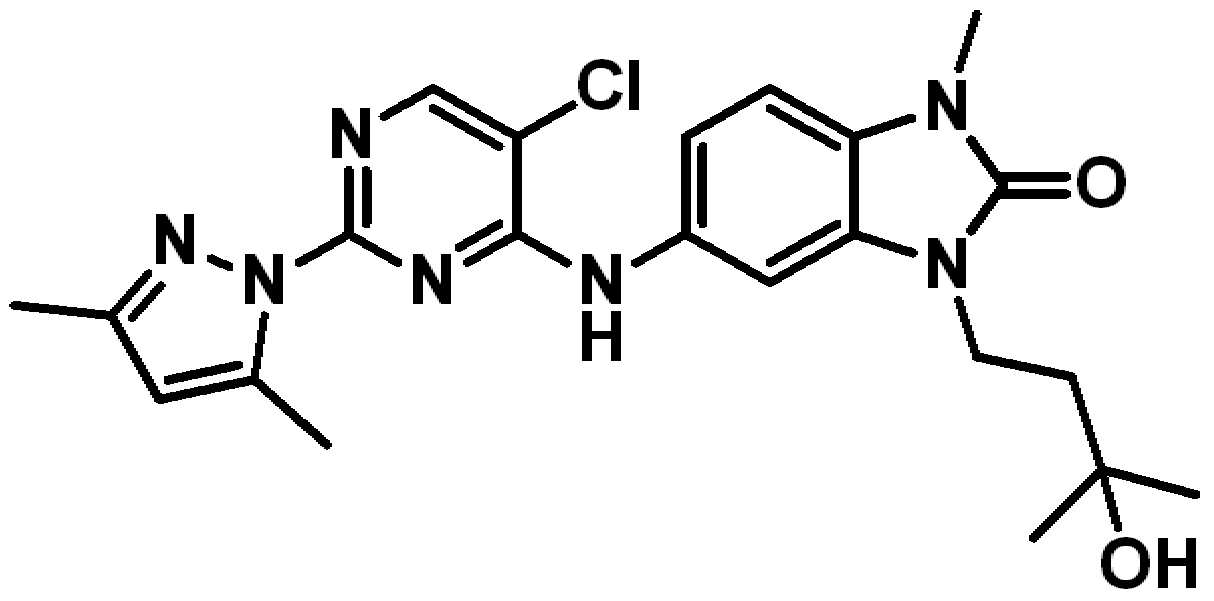
NMP(0.5 mL) 중의 5-[(2,5-디클로로피리미딘-4-일)아미노]-3-(3-히드록시-3-메틸-부틸)-1-메틸-벤즈이미다졸-2-온(중간체 D2a, 12.7 mg, 0.032 mmol), 3,5-디메틸-1H-피라졸(30 mg, 0.31 mmol) 및 탄산세슘(100 mg, 0.31 mmol)의 혼합물을 마이크로웨이브에서 170℃까지 1h 동안 가열하고, 이어서 DCM과 물 사이에 분배시키고, pH를 10% 시트르산을 사용하여 5까지 조정하고, 그 다음 분리하고, 추가의 DCM으로 추출하였다. 유기 층을 합하고, 증발시키고, 먼저 정제용 HPLC(ACE 5 C18-PFP 컬럼(5 μ, 250x21.2 mm), 20 mL/min의 유량에서 40:60에서 25:75 물: 메탄올(둘 모두 0.1% 포름산으로 개질됨)로의 15분 구배 용리)에 의해서 생성된 NMP 용액을 정제하고, 이어서 플래시 컬럼 크로마토그래피(12 g KP-SIL, DCM 중의 0% 내지 6% 메탄올)에 의해서 추가로 정제하여 표제 화합물(6 mg)을 백색 고체로서 제공하였다. LCMS(방법 X4) Rt 2.71min; m/z 456.1928 C22H27ClN7O2 [M+H]+에 대한 예측치 456.1915. 1H NMR (500MHz, 클로로포름-d) δ 8.37 (s, 1H), 7.44 (d, J = 1.9 Hz, 1H), 7.22 (s, 1H), 7.13 (dd, J = 1.9, 8.2 Hz, 1H), 6.98 (d, J = 8.2 Hz, 1H), 5.95 (s, 1H), 4.08 (t, J = 7.3 Hz, 2H), 3.45 (s, 3H), 2.36 (br m, 1H), 2.33 (s, 3H), 2.31 (s, 3H), 1.89 (t, J = 7.4 Hz, 2H), 1.35 - 1.22 (m, 6H).5-[(2,5-dichloropyrimidin-4-yl) amino] -3- (3-hydroxy-3-methyl-butyl) -1-methyl-benzimidazole-2- in NMP (0.5 mL) A mixture of warm (intermediate D2a, 12.7 mg, 0.032 mmol), 3,5-dimethyl-1 H -pyrazole (30 mg, 0.31 mmol) and cesium carbonate (100 mg, 0.31 mmol) in microwave at 170 ° C. for 1 h. Was heated, then partitioned between DCM and water, the pH was adjusted to 5 with 10% citric acid, then separated and extracted with further DCM. Combine the organic layers, evaporate and first preparative HPLC (ACE 5 C18-PFP column (5 μ, 250 × 21.2 mm), 40:60 to 25:75 water: methanol (both 0.1) at a flow rate of 20 mL / min Purified NMP solution) by 15 minute gradient elution with% formic acid), and then further purified by flash column chromatography (12 g KP-SIL, 0% to 6% methanol in DCM). Compound (6 mg) was provided as a white solid. LCMS (Method X4) Rt 2.71 min; m / z 456.1928 C 22 H 27 ClN 7 O 2 [M + H] + calcd for 456.1915. 1 H NMR (500 MHz, Chloroform-d) δ 8.37 (s, 1H), 7.44 (d, J = 1.9 Hz, 1H), 7.22 (s, 1H), 7.13 (dd, J = 1.9, 8.2 Hz, 1H) , 6.98 (d, J = 8.2 Hz, 1H), 5.95 (s, 1H), 4.08 (t, J = 7.3 Hz, 2H), 3.45 (s, 3H), 2.36 (br m, 1H), 2.33 (s , 3H), 2.31 (s, 3H), 1.89 (t, J = 7.4 Hz, 2H), 1.35-1.22 (m, 6H).
표 5에 나타낸 중간체를 사용하여, 실시예 15a의 제조를 위해서 사용된 것과 유사한 방법에 의해서 하기 표로 나타낸 실시예를 제조하였고, 적합한 아민 또는 헤테로사이클은 상업적인 공급원으로부터 입수하였다. Using the intermediates shown in Table 5, the examples shown in the table below were prepared by methods similar to those used for the preparation of Example 15a, and suitable amines or heterocycles were obtained from commercial sources.
[표 5]TABLE 5


실시예 16a: 5-((5-클로로-2-(3-메틸-1H-피라졸-1-일)피리미딘-4-일)아미노)-3-(3-히드록시-3-메틸부틸)-1-메틸-1,3-디히드로-2H-벤조[d]이미다졸-2-온 및 실시예 16b: 5-((5-클로로-2-(5-메틸-1H-피라졸-1-일)피리미딘-4-일)아미노)-3-(3-히드록시-3-메틸부틸)-1-메틸-1,3-디히드로-2H-벤조[d]이미다졸-2-온 Example 16a: 5-((5-chloro-2- (3-methyl-1H-pyrazol-1-yl) pyrimidin-4-yl) amino) -3- (3-hydroxy-3-methylbutyl ) -1-methyl-1,3-dihydro-2H-benzo [d] imidazol-2-one and Example 16b: 5-((5-chloro-2- (5-methyl-1H-pyrazole- 1-yl) pyrimidin-4-yl) amino) -3- (3-hydroxy-3-methylbutyl) -1-methyl-1,3-dihydro-2H-benzo [d] imidazol-2- On


NMP(0.5 mL) 중의 5-[(2,5-디클로로피리미딘-4-일)아미노]-3-(3-히드록시-3-메틸-부틸)-1-메틸-벤즈이미다졸-2-온(중간체 D2a, 25 mg, 0.063 mmol), 3-메틸피라졸(0.05 mL, 0.62 mmol) 및 디세슘 카르보네이트(100 mg, 0.31 mmol)의 혼합물을 마이크로웨이브에서 170℃까지 1시간 동안 가열하고, 이어서 DCM과 물 사이에 분배시키고, pH를 10% 시트르산을 사용하여 5까지 조정하고, 그 다음 분리하고, 추가의 DCM으로 추출하였다. 유기 층을 합하고, 증발시켜 조 물질을 NMP 중의 용액으로서 제공하였다. 정제용 HPLC(ACE 5 C18-PFP 컬럼(5 μ, 250x21.2 mm), 20 mL/min의 유량에서 45:55에서 20:80 물: 메탄올(둘 모두 0.1% 포름산으로 개질됨)로의 15분 구배 용리)에 의해서 위치이성질체를 분리하였다. 나중에 용리된 주 생성물을 실시예 16a 5-[[5-클로로-2-(3-메틸피라졸-1-일)피리미딘-4-일]아미노]-3-(3-히드록시-3-메틸-부틸)-1-메틸-벤즈이미다졸-2-온(18 mg)으로서 배정하였다.5-[(2,5-dichloropyrimidin-4-yl) amino] -3- (3-hydroxy-3-methyl-butyl) -1-methyl-benzimidazole-2- in NMP (0.5 mL) A mixture of warm (intermediate D2a, 25 mg, 0.063 mmol), 3-methylpyrazole (0.05 mL, 0.62 mmol) and cesium carbonate (100 mg, 0.31 mmol) was heated in a microwave at 170 ° C. for 1 hour. And then partitioned between DCM and water, pH was adjusted to 5 with 10% citric acid, then separated and extracted with further DCM. The organic layers were combined and evaporated to give the crude material as a solution in NMP. Preparative HPLC (ACE 5 C18-PFP column (5 μ, 250 × 21.2 mm), 15:45 with 45:55 to 20:80 water: methanol (both modified with 0.1% formic acid) at a flow rate of 20 mL / min) Gradient isomers were separated by gradient elution. The main product eluted later was Example 16a 5-[[5-chloro-2- (3-methylpyrazol-1-yl) pyrimidin-4-yl] amino] -3- (3-hydroxy-3- Assigned as methyl-butyl) -1-methyl-benzimidazol-2-one (18 mg).
1H NMR (500 MHz, 클로로포름-d) δ 8.34 (s, 1H), 8.27 (d, J = 2.6 Hz, 1H), 7.63 (d, J = 2.0 Hz, 1H), 7.32 (s, 1H, NH), 7.18 (dd, J = 8.3, 2.0 Hz, 1H), 7.02 (d, J = 8.3 Hz, 1H), 6.23 (d, J = 2.6 Hz, 1H), 4.15 - 4.08 (m, 2H), 3.47 (s, 3H), 2.40 (s, 3H), 1.94 (t, J = 7.3 Hz, 2H), 1.30 (s, 6H). OH는 명확하게 관찰되지 않음. LCMS(방법 X2) Rt 1.33min; m/z 442.1755 C21H25ClN7O2 [M+H]+에 대한 예측치 442.1758. 1 H NMR (500 MHz, Chloroform-d) δ 8.34 (s, 1H), 8.27 (d, J = 2.6 Hz, 1H), 7.63 (d, J = 2.0 Hz, 1H), 7.32 (s, 1H, NH ), 7.18 (dd, J = 8.3, 2.0 Hz, 1H), 7.02 (d, J = 8.3 Hz, 1H), 6.23 (d, J = 2.6 Hz, 1H), 4.15-4.08 (m, 2H), 3.47 (s, 3H), 2.40 (s, 3H), 1.94 (t, J = 7.3 Hz, 2H), 1.30 (s, 6H). OH is not clearly observed. LCMS (Method X2) Rt 1.33 min; m / z 442.1755 Predicted for C 21 H 25 ClN 7 O 2 [M + H] + 442.1758.
먼저 용리된 부 생성물을 실시예 16b 5-[[5-클로로-2-(5-메틸피라졸-1-일)피리미딘-4-일]아미노]-3-(3-히드록시-3-메틸-부틸)-1-메틸-벤즈이미다졸-2-온(2.5 mg)으로서 배정하였다. The first eluted side product was Example 16b 5-[[5-chloro-2- (5-methylpyrazol-1-yl) pyrimidin-4-yl] amino] -3- (3-hydroxy-3- It was assigned as methyl-butyl) -1-methyl-benzimidazol-2-one (2.5 mg).
1H NMR (500 MHz, 클로로포름-d) δ 8.37 (s, 1H), 7.74 (d, J = 2.0 Hz, 1H), 7.63 (m, 1H), 7.29 (s, 1H, NH), 7.08 (dd, J = 8.3, 2.0 Hz, 1H), 6.98 (d, J = 8.3 Hz, 1H), 6.16 (s, 1H), 4.13 - 4.06 (m, 2H), 3.45 (s, 3H), 2.46 (s, 3H), 1.97 - 1.91 (m, 2H), 1.29 (s, 6H). OH는 명확하게 관찰되지 않음. LCMS(방법 X2) Rt 1.26min m/z 442.1756 C21H25ClN7O2 [M+H]+에 대한 예측치 442.1758. 1 H NMR (500 MHz, Chloroform-d) δ 8.37 (s, 1H), 7.74 (d, J = 2.0 Hz, 1H), 7.63 (m, 1H), 7.29 (s, 1H, NH), 7.08 (dd , J = 8.3, 2.0 Hz, 1H), 6.98 (d, J = 8.3 Hz, 1H), 6.16 (s, 1H), 4.13-4.06 (m, 2H), 3.45 (s, 3H), 2.46 (s, 3H), 1.97-1.91 (m, 2H), 1.29 (s, 6H). OH is not clearly observed. LCMS (Method X2) Rt 1.26 min m / z 442.1756 C 21 H 25 ClN 7 O 2 [M + H] + predicted for 442.1758.
실시예 17a : 5-((5-클로로-2-(1H-인다졸-3-일)피리미딘-4-일)아미노)-3-(3-히드록시-3-메틸부틸)-1-메틸-1,3-디히드로-2H-벤조[d]이미다졸-2-온 및 실시예 17b: 5-((5-클로로-2-(1H-인다졸-1-일)피리미딘-4-일)아미노)-3-(3-히드록시-3-메틸부틸)-1-메틸-1,3-디히드로-2H-벤조[d]이미다졸-2-온 Example 17a: 5-((5-chloro-2- (1H-indazol-3-yl) pyrimidin-4-yl) amino) -3- (3-hydroxy-3-methylbutyl) -1- Methyl-1,3-dihydro-2H-benzo [d] imidazol-2-one and Example 17b: 5-((5-chloro-2- (1H-indazol-1-yl) pyrimidin-4 -Yl) amino) -3- (3-hydroxy-3-methylbutyl) -1-methyl-1,3-dihydro-2H-benzo [d] imidazol-2-one


NMP(0.63 mL) 중의 5-[(2,5-디클로로피리미딘-4-일)아미노]-3-(3-히드록시-3-메틸-부틸)-1-메틸-벤즈이미다졸-2-온(중간체 D2a, 20 mg, 0.05 mmol), 인다졸(60 mg, 0.50 mmol) 및 탄산세슘(164 mg, 0.50 mmol)의 혼합물을 마이크로웨이브에서 180℃까지 1시간 동안 가열하였다. 혼합물을 냉각시키고, DMSO(0.5 mL)로 희석시키고, 이어서 물 중의 10% 내지 100% 메탄올(각각 0.1% 포름산 함유)로 용리하는 역상 C18 컬럼을 사용하여 정제하였다. 나중에 용리된 생성물을 실시예 17b 5-[(5-클로로-2-인다졸-1-일-피리미딘-4-일)아미노]-3-(3-히드록시-3-메틸-부틸)-1-메틸-벤즈이미다졸-2-온(4 mg)으로서 배정하였다.5-[(2,5-dichloropyrimidin-4-yl) amino] -3- (3-hydroxy-3-methyl-butyl) -1-methyl-benzimidazole-2- in NMP (0.63 mL) A mixture of warm (intermediate D2a, 20 mg, 0.05 mmol), indazole (60 mg, 0.50 mmol) and cesium carbonate (164 mg, 0.50 mmol) was heated in microwave to 180 ° C. for 1 hour. The mixture was cooled, diluted with DMSO (0.5 mL) and then purified using a reverse phase C18 column eluting with 10% to 100% methanol in water (each containing 0.1% formic acid). The product eluted later was Example 17b 5-[(5-chloro-2-indazol-1-yl-pyrimidin-4-yl) amino] -3- (3-hydroxy-3-methyl-butyl)- Assigned as 1-methyl-benzimidazol-2-one (4 mg).
1H NMR (500 MHz, 메탄올-d 4) δ 8.34 (s, 1H), 8.26 (s, 1H), 8.01 - 7.95 (m, 1H), 7.79 - 7.72 (m, 1H), 7.51 (d, J = 1.8 Hz, 1H), 7.30 (dd, J = 8.3, 1.8 Hz, 1H), 7.25 (d, J = 8.3 Hz, 1H), 7.25 - 7.16 (m, 1H), 7.07 - 6.99 (m, 1H), 3.99 - 3.92 (m, 2H), 3.51 (s, 3H), 1.74 - 1.67 (m, 2H), 1.05 (s, 6H). LCMS(방법 T4) Rt 2.88min m/z 478.1737 C24H25ClN7O2 [M+H]+에 대한 예측치 478.1753. 1 H NMR (500 MHz, Methanol- d 4 ) δ 8.34 (s, 1H), 8.26 (s, 1H), 8.01-7.95 (m, 1H), 7.79-7.72 (m, 1H), 7.51 (d, J = 1.8 Hz, 1H), 7.30 (dd, J = 8.3, 1.8 Hz, 1H), 7.25 (d, J = 8.3 Hz, 1H), 7.25-7.16 (m, 1H), 7.07-6.99 (m, 1H) , 3.99-3.92 (m, 2H), 3.51 (s, 3H), 1.74-1.67 (m, 2H), 1.05 (s, 6H). LCMS (method T4) R t 2.88 min m / z 478.1737 C 24 H 25 ClN 7 O 2 [M + H] + . 47.1753.
먼저 용리된 화합물은 정제용 HPLC(ACE 5 C18-PFP 컬럼(5 μ, 250x21.2 mm), 20 mL/min의 유량에서 60:40에서 0:100 물:메탄올(둘 모두 0.1% 포름산으로 개질됨)로의 15분 구배 용리)에 의한 추가 정제가 필요하였다. 이 화합물을 실시예 17a 5-[[5-클로로-2-(1H-인다졸-3-일)피리미딘-4-일]아미노]-3-(3-히드록시-3-메틸-부틸)-1-메틸-벤즈이미다졸-2-온(3 mg)으로서 배정하였다.The first eluted compound was purified by preparative HPLC (ACE 5 C18-PFP column (5 μ, 250 × 21.2 mm), 60:40 to 0: 100 water: methanol (both with 0.1% formic acid) at a flow rate of 20 mL / min 15 minutes gradient elution). This compound was prepared in Example 17a 5-[[5-chloro-2- (1H-indazol-3-yl) pyrimidin-4-yl] amino] -3- (3-hydroxy-3-methyl-butyl) Assigned as -1-methyl-benzimidazol-2-one (3 mg).
1H NMR (500 MHz, DMSO-d 6) δ 9.16 (s, 1H), 8.92 (s, 1H), 8.10 (s, 1H), 7.68 (dd, J = 7.8, 1.6 Hz, 1H), 7.63 - 7.58 (m, 1H), 7.53 - 7.48 (m, 1H), 7.31 - 7.26 (m, 2H), 7.22 - 7.17 (m, 1H), 7.07 - 7.01 (m, 1H), 3.83 - 3.76 (m, 2H), 3.32 (s, 3H), 1.68 - 1.61 (m, 2H), 1.12 (s, 6H). OH는 명확하게 관찰되지 않음. LCMS(방법 T4) Rt 2.30min m/z 478.1750 C24H25ClN7O2 [M+H]+에 대한 예측치 478.1753. 1 H NMR (500 MHz, DMSO- d 6 ) δ 9.16 (s, 1H), 8.92 (s, 1H), 8.10 (s, 1H), 7.68 (dd, J = 7.8, 1.6 Hz, 1H), 7.63- 7.58 (m, 1H), 7.53-7.48 (m, 1H), 7.31-7.26 (m, 2H), 7.22-7.17 (m, 1H), 7.07-7.01 (m, 1H), 3.83-3.76 (m, 2H ), 3.32 (s, 3H), 1.68-1.61 (m, 2H), 1.12 (s, 6H). OH is not clearly observed. LCMS (Method T4) Rt 2.30 min m / z 478.1750 C 24 H 25 ClN 7 O 2 [M + H] + predicted 478.1753.
실시예 18a: 2-클로로-4-((3-(2-(1-히드록시시클로부틸)에틸)-1-메틸-2-옥소-2,3-디히드로-1H-벤조[d]이미다졸-5-일)아미노)니코티노니트릴 Example 18a: 2-chloro-4-((3- (2- (1-hydroxycyclobutyl) ethyl) -1-methyl-2-oxo-2,3-dihydro-1H-benzo [d] Dazol-5-yl) amino) nicotinonitrile

아세토니트릴(1 mL) 및 DMF(0.2 mL) 중의 2-클로로-4-[(1-메틸-2-옥소-3H-벤즈이미다졸-5-일)아미노]피리딘-3-카르보니트릴(중간체 D1, 25 mg, 0.083 mmol)의 현탁액에 디세슘 카르보네이트(60 mg, 0.18 mmol) 및 1-(2-브로모에틸)시클로부탄-1-올(20 mg, 0.11 mmol)을 첨가하고, 생성된 혼합물을 100℃까지 마이크로웨이브에서 1h 동안 가열하였다. 생성된 혼합물을 물과 DCM 사이에 분배시키고, 이어서 10% 시트르산으로 pH6까지 산성화시키고, 상 분리기에 통과시켜 상을 분리하였다. 유기층을 증발시키고, 이어서 DMSO 중에 재용해시키고, 역상 플래시 크로마토그래피(12 g SNAP Ultra C18, 물 50% 내지 65% 메탄올, 0.1% 포름산 개질제)를 사용하여 정제하여 2-클로로-4-[[3-[2-(1-히드록시시클로부틸)에틸]-1-메틸-2-옥소-벤즈이미다졸-5-일]아미노]피리딘-3-카르보니트릴(19mg)을 제공하였다. 1H NMR (600 MHz, 클로로포름-d) δ 8.05 (d, J = 6.1 Hz, 1H), 7.06 (d, J = 8.2 Hz, 1H), 7.04 - 7.01 (m, 2H), 7.00 (d, J = 1.9 Hz, 1H), 6.63 (d, J = 6.1 Hz, 1H), 4.07 (t, J = 6.7 Hz, 2H), 3.48 (s, 3H, NMe), 2.14 - 1.87 (m, 6H), 1.82 (m, 1H) 및 1.56 (m, 1H). OH는 명확하게 관찰되지 않음. LCMS (2min) Rt 1.26min; m/z 398.1372 C20H21N5O2Cl [M+H]+에 대한 예측치 398.1384. 2-chloro-4-[(1-methyl-2-oxo-3H-benzimidazol-5-yl) amino] pyridine-3-carbonitrile (intermediate D1) in acetonitrile (1 mL) and DMF (0.2 mL) To a suspension of 25 mg, 0.083 mmol) was added cesium carbonate (60 mg, 0.18 mmol) and 1- (2-bromoethyl) cyclobutan-1-ol (20 mg, 0.11 mmol) The resulting mixture was heated in microwave at 100 ° C. for 1 h. The resulting mixture was partitioned between water and DCM, then acidified with 10% citric acid to pH6 and passed through a phase separator to separate the phases. The organic layer was evaporated and then redissolved in DMSO and purified using reverse phase flash chromatography (12 g SNAP Ultra C18, water 50% -65% methanol, 0.1% formic acid modifier) to 2-chloro-4-[[3 -[2- (1-hydroxycyclobutyl) ethyl] -1-methyl-2-oxo-benzimidazol-5-yl] amino] pyridine-3-carbonitrile (19 mg) was provided. 1 H NMR (600 MHz, Chloroform- d ) δ 8.05 (d, J = 6.1 Hz, 1H), 7.06 (d, J = 8.2 Hz, 1H), 7.04-7.01 (m, 2H), 7.00 (d, J = 1.9 Hz, 1H), 6.63 (d, J = 6.1 Hz, 1H), 4.07 (t, J = 6.7 Hz, 2H), 3.48 (s, 3H, NMe), 2.14-1.87 (m, 6H), 1.82 (m, 1 H) and 1.56 (m, 1 H). OH is not clearly observed. LCMS (2 min) Rt 1.26 min; m / z 398.1372 C 20 H 21 N 5 0 2 Cl [M + H] + calcd for 398.1384.
실시예 18b: 2-클로로-4-((1-메틸-3-(2-(메틸설포닐)에틸)-2-옥소-2,3-디히드로-1H-벤조[d]이미다졸-5-일)아미노)니코티노니트릴 Example 18b: 2-chloro-4-((1-methyl-3- (2- (methylsulfonyl) ethyl) -2-oxo-2,3-dihydro-1H-benzo [d] imidazole-5 -Yl) amino) nicotinonitrile

실시예 18a의 제조를 위해서 사용된 것과 유사한 방법을 사용하여 2-브로모에틸 메틸 설폰으로부터 제조하였다.Prepared from 2-bromoethyl methyl sulfone using a method similar to that used for the preparation of Example 18a.
1H NMR (600 MHz, 클로로포름-d) δ 8.07 (d, J = 6.1 Hz, 1H), 7.11 (d, J = 1.9 Hz, 1H), 7.07 (d, J = 8.2 Hz, 1H), 7.02 (dd, J = 8.2, 1.9 Hz, 1H), 6.91 (s, 1H, NH), 6.71 (d, J = 6.1 Hz, 1H), 4.40 (t, J = 6.3 Hz, 2H), 3.54 (t, J = 6.3 Hz, 2H), 3.48 (s, 3H), 2.95 (s, 3H). LCMS(방법 X2) Rt 1.05min; m/z 406.0742 C17H17ClN5O3S [M+H]+에 대한 예측치 406.0741. 1 H NMR (600 MHz, Chloroform-d) δ 8.07 (d, J = 6.1 Hz, 1H), 7.11 (d, J = 1.9 Hz, 1H), 7.07 (d, J = 8.2 Hz, 1H), 7.02 ( dd, J = 8.2, 1.9 Hz, 1H), 6.91 (s, 1H, NH), 6.71 (d, J = 6.1 Hz, 1H), 4.40 (t, J = 6.3 Hz, 2H), 3.54 (t, J = 6.3 Hz, 2H), 3.48 (s, 3H), 2.95 (s, 3H). LCMS (Method X2) Rt 1.05 min; m / z 406.0742 C predicted C 17 H 17 ClN 5 O 3 S [M + H] + 406.0741.
실시예 19a: 2-클로로-4-((1-메틸-2-옥소-3-(3-옥소펜틸)-2,3-디히드로-1H-벤조[d]이미다졸-5-일)아미노)니코티노니트릴 Example 19a : 2-Chloro-4-((1-methyl-2-oxo-3- (3-oxopentyl) -2,3-dihydro-1H-benzo [d] imidazol-5-yl) amino Nicotinonitrile

DMF(0.5 mL) 중의 2-클로로-4-[(1-메틸-2-옥소-3H-벤즈이미다졸-5-일)아미노]피리딘-3-카르보니트릴(중간체 D1, 20 mg, 0.067 mmol)의 용액에 중합체-결합된 다공성 테트라알킬탄산암모늄, 18-50 메시(2.5 mmol/g 내지 3.5 mmol/g 로딩, 50 mg)을 첨가하였다. 15분 후, 1-브로모펜탄-3-온(14 mg, 0.085 mmol)을 첨가하고, 생성된 혼합물을 90℃까지 4일 동안 가열하였다. 물(0.1 mL)을 첨가하고, 용액을 주사기에 의해서 제거하고, DMSO로 희석시켜 1 mL의 총 부피를 제공하고, 여과하고, 이어서 역상 플래시 크로마토그래피(Biotage SNAP Ultra C18, 물 중의 50% 내지 80% 메탄올(각각 0.1% 포름산 개질제를 함유함))에 의해서 정제하여, 표제 화합물을 백색 고체(20 mg)로서 제공하였다. 1H NMR (600 MHz, 클로로포름-d) δ 8.06 (d, J = 6.1 Hz, 1H), 7.16 (d, J = 1.9 Hz, 1H), 7.03 (br m, 1H), 7.01 (d, J=8.2 Hz, 1H), 6.98 (dd, J = 8.2, 1.9 Hz, 1H), 6.73 (d, J = 6.1 Hz, 1H), 4.13 (t, J = 6.3 Hz, 2H), 3.45 (s, 3H), 2.97 (t, J = 6.3 Hz, 2H), 2.45 (q, J = 7.3 Hz, 2H), 1.04 (t, J = 7.3 Hz, 3H). LCMS(방법 X4) Rt 2.52min; m/z 384.1212 C19H19ClN5O2 [M+H]+에 대한 예측치 384.1227. 2-chloro-4-[(1-methyl-2-oxo-3H-benzimidazol-5-yl) amino] pyridine-3-carbonitrile (Intermediate D1, 20 mg, 0.067 mmol) in DMF (0.5 mL) To a solution of polymer-bonded porous tetraalkyl ammonium carbonate, 18-50 mesh (2.5 mmol / g to 3.5 mmol / g loading, 50 mg) was added. After 15 minutes, 1-bromopentan-3-one (14 mg, 0.085 mmol) was added and the resulting mixture was heated to 90 ° C. for 4 days. Water (0.1 mL) was added and the solution removed by syringe, diluted with DMSO to give a total volume of 1 mL, filtered and then reversed phase flash chromatography (Biotage SNAP Ultra C18, 50% to 80 in water). Purification by% methanol (each containing 0.1% formic acid modifier) provided the title compound as a white solid (20 mg). 1 H NMR (600 MHz, Chloroform-d) δ 8.06 (d, J = 6.1 Hz, 1H), 7.16 (d, J = 1.9 Hz, 1H), 7.03 (br m, 1H), 7.01 (d, J = 8.2 Hz, 1H), 6.98 (dd, J = 8.2, 1.9 Hz, 1H), 6.73 (d, J = 6.1 Hz, 1H), 4.13 (t, J = 6.3 Hz, 2H), 3.45 (s, 3H) , 2.97 (t, J = 6.3 Hz, 2H), 2.45 (q, J = 7.3 Hz, 2H), 1.04 (t, J = 7.3 Hz, 3H). LCMS (Method X4) Rt 2.52 min; m / z 384.1212 C 19 H 19 ClN 5 O 2 [M + H] + calcd for 384.1227 .
상업적인 공급원으로부터 입수된 적합한 알킬 브로마이드를 사용하여, 실시예 19a의 제조를 위해서 사용된 것과 유사한 방법에 의해서 하기 표로 나타낸 실시예를 제조하였다.Using the appropriate alkyl bromide obtained from a commercial source, the examples shown in the table below were prepared by methods similar to those used for the preparation of Example 19a.
[표 6]TABLE 6

실시예 20a: 5-((5-클로로-2-((3R,5S)-4,4-디플루오로-3,5-디메틸피페리딘-1-일)피리미딘-4-일)아미노)-3-(3-히드록시-3-메틸부틸)-1-메틸-1,3-디히드로-2H-벤조[d]이미다졸-2-온 Example 20a: 5-((5-chloro-2-((3R, 5S) -4,4-difluoro-3,5-dimethylpiperidin-1-yl) pyrimidin-4-yl) amino ) -3- (3-hydroxy-3-methylbutyl) -1-methyl-1,3-dihydro-2H-benzo [d] imidazol-2-one

NMP(1 mL) 중의 (3R,5S)-4,4-디플루오로-3,5-디메틸-피페리딘 (0.03 mL, 0.13 mmol), 5-[(2,5-디클로로피리미딘-4-일)아미노]-3-(3-히드록시-3-메틸-부틸)-1-메틸-벤즈이미다졸-2-온(중간체 D2a, 20 mg, 0.05 mmol) 및 N,N-디이소프로필에틸아민 (0.04 mL, 0.25 mmol)의 혼합물을 마이크로웨이브에서 170℃까지 1시간 동안 가열하였다. 혼합물을 DCM과 물 사이에 분배시키고, 수성 층을 DCM으로 추출하고, 합한 유기물을 염수로 세척하였다. 유기 층을 합하고, 증발시키고, 생성된 NMP 용액을 정제용 HPLC(ACE 5 C18-PFP 컬럼(5 μ, 250x21.2 mm), 20 mL/min의 유량에서 40:60에서 25:75 물: 메탄올(둘 모두 0.1% 포름산으로 개질됨)로의 15분 구배 용리)에 의해서 정제하여 표제 화합물(19 mg)을 고체로서 제공하였다. LCMS(방법 T4): Rt 3.15min, m/z 509.2212, C24H32ClF2N6O2 [M+H]+에 대한 예측치 509.2238. 1H NMR (아세톤-d 6 , 500 MHz): δ 8.14 (1H, s), 8.00 (1H, s), 7.46 (1H, d, J 1.4 Hz), 7.37 (1H, dd, J 8.0, 1.4 Hz), 7.09 (1H, d, J 8.0 Hz), 4.65 (2H, br d, J 11.4 Hz), 4.03 (2H, m), 3.38 (3H, s), 2.71 (2H, t, J 11.3 Hz), 1.99 (2H, m), 1.85 (2H, m), 1.26 (6H, s), 1.02 (6H, d, J 6.6 Hz). OH는 관찰되지 않음. 19F NMR (아세톤-d6, 471 MHz): δ -108.7 (dt, J 235, 3 Hz), -135.3 (dt, J 235, 27 Hz).(3R, 5S) -4,4-Difluoro-3,5-dimethyl-piperidine (0.03 mL, 0.13 mmol) in NMP (1 mL), 5-[(2,5-dichloropyrimidine-4 -Yl) amino] -3- (3-hydroxy-3-methyl-butyl) -1-methyl-benzimidazol-2-one (intermediate D2a, 20 mg, 0.05 mmol) and N, N-diisopropyl A mixture of ethylamine (0.04 mL, 0.25 mmol) was heated in a microwave to 170 ° C. for 1 h. The mixture was partitioned between DCM and water, the aqueous layer was extracted with DCM and the combined organics washed with brine. The organic layers were combined, evaporated and the resulting NMP solution was purified by preparative HPLC (ACE 5 C18-PFP column (5 μ, 250 × 21.2 mm), 40:60 to 25:75 water: methanol at a flow rate of 20 mL / min). (15 min gradient elution with both modified with 0.1% formic acid) to give the title compound (19 mg) as a solid. LCMS (method T4): Rt 3.15 min, m / z 509.2212, predicted C 24 H 32 ClF 2 N 6 O 2 [M + H] + 509.2238. 1 H NMR (acetone- d 6 , 500 MHz): δ 8.14 (1H, s), 8.00 (1H, s), 7.46 (1H, d, J 1.4 Hz), 7.37 (1H, dd, J 8.0, 1.4 Hz ), 7.09 (1H, d, J 8.0 Hz), 4.65 (2H, br d, J 11.4 Hz), 4.03 (2H, m), 3.38 (3H, s), 2.71 (2H, t, J 11.3 Hz), 1.99 (2H, m), 1.85 (2H, m), 1.26 (6H, s), 1.02 (6H, d, J 6.6 Hz). OH not observed. 19 F NMR (acetone-d 6, 471 MHz): δ −108.7 (dt, J 235, 3 Hz), −135.3 (dt, J 235, 27 Hz).
표 7에 나타낸 중간체를 사용하여, 실시예 20a의 제조를 위해서 사용된 것과 유사한 방법에 의해서 하기 표로 나타낸 실시예를 제조하였고, 적합한 아민 또는 헤테로사이클은 상업적인 공급원으로부터 입수하였다.Using the intermediates shown in Table 7, the examples shown in the table below were prepared by methods similar to those used for the preparation of Example 20a, and suitable amines or heterocycles were obtained from commercial sources.
[표 7]TABLE 7


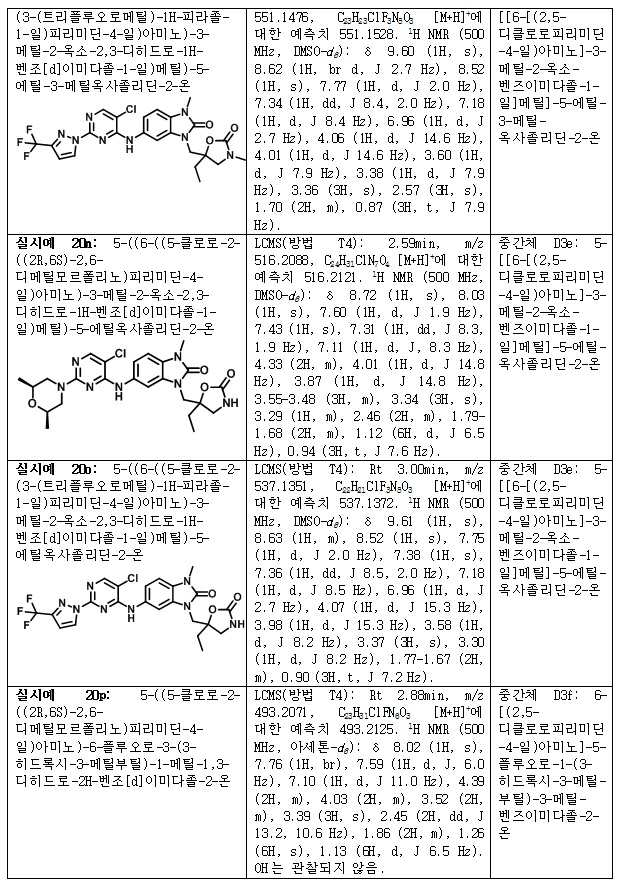
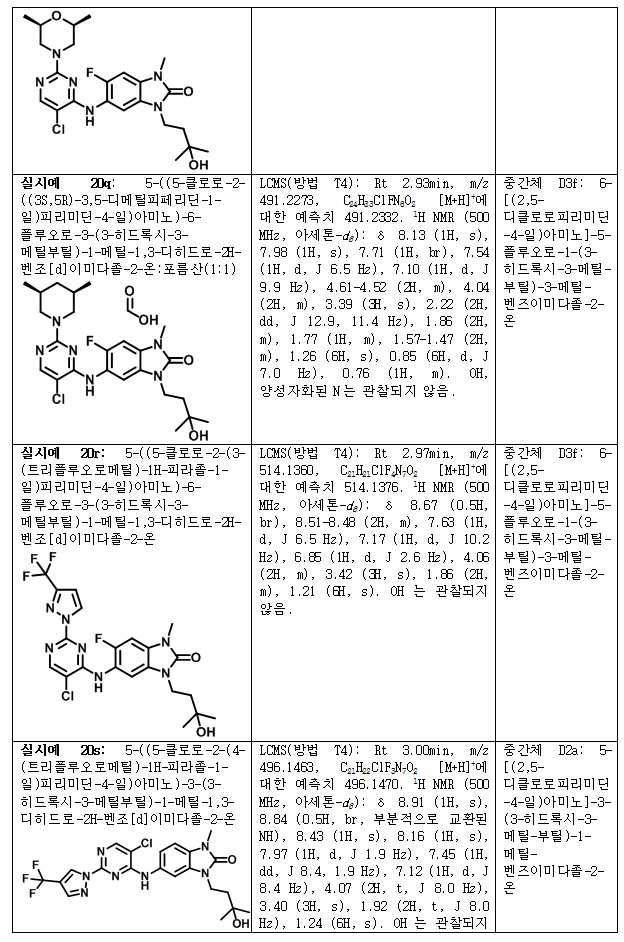

실시예 21a: 5-((5-클로로-2-((2S,6R)-2-시클로프로필-6-메틸모르폴리노)피리미딘-4-일)아미노)-3-(3-히드록시-3-메틸부틸)-1-메틸-1,3-디히드로-2H-벤조[d]이미다졸-2-온 및 실시예 21b: 5-((5-클로로-2-((2R,6R)-2-시클로프로필-6-메틸모르폴리노)피리미딘-4-일)아미노)-3-(3-히드록시-3-메틸부틸)-1-메틸-1,3-디히드로-2H-벤조[d]이미다졸-2-온 Example 21a: 5-((5-chloro-2-((2S, 6R) -2-cyclopropyl-6-methylmorpholino) pyrimidin-4-yl) amino) -3- (3-hydroxy -3-methylbutyl) -1-methyl-1,3-dihydro-2H-benzo [d] imidazol-2-one and Example 21b: 5-((5-chloro-2-((2R, 6R) ) -2-cyclopropyl-6-methylmorpholino) pyrimidin-4-yl) amino) -3- (3-hydroxy-3-methylbutyl) -1-methyl-1,3-dihydro-2H -Benzo [d] imidazol-2-one
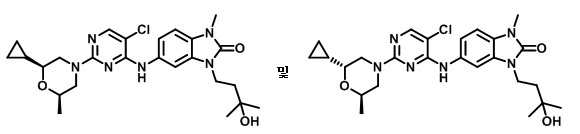
NMP(1 mL) 중의 2-시클로프로필-6-메틸-모르폴린(36 mg, 0.25 mmol, 부분입체이성질체의 혼합물), 5-[(2,5-디클로로피리미딘-4-일)아미노]-3-(3-히드록시-3-메틸-부틸)-1-메틸-벤즈이미다졸-2-온(중간체 D2a, 20 mg, 0.05 mmol) 및 N,N-디이소프로필에틸아민(0.04 mL, 0.25 mmol)의 혼합물을 마이크로웨이브에서 170℃까지 1시간 동안 가열하였다. 혼합물을 DCM과 물 사이에 분배시키고, 수성 층을 DCM으로 추출하고, 합한 유기물을 염수로 세척하였다. 유기 층을 합하고, 증발시키고, 생성된 NMP 용액을 정제용 HPLC(ACE 5 C18-PFP 컬럼(5 μ, 250x21.2 mm), 20 mL/min의 유량에서 40:60에서 25:75 물: 메탄올(둘 모두 0.1% 포름산으로 개질됨)로의 15분 구배 용리)에 의해서 정제하였다.2-cyclopropyl-6-methyl-morpholine (36 mg, 0.25 mmol, mixture of diastereomers), 5-[(2,5-dichloropyrimidin-4-yl) amino]-in NMP (1 mL) 3- (3-hydroxy-3-methyl-butyl) -1-methyl-benzimidazol-2-one (intermediate D2a, 20 mg, 0.05 mmol) and N, N-diisopropylethylamine (0.04 mL, 0.25 mmol) was heated in microwave to 170 ° C. for 1 h. The mixture was partitioned between DCM and water, the aqueous layer was extracted with DCM and the combined organics washed with brine. The organic layers were combined, evaporated and the resulting NMP solution was purified by preparative HPLC (ACE 5 C18-PFP column (5 μ, 250 × 21.2 mm), 40:60 to 25:75 water: methanol at a flow rate of 20 mL / min). Purification by 15 minute gradient elution with (both modified with 0.1% formic acid).
먼저 용리된 생성물을 실시예 21b: 5-((5-클로로-2-((2R,6R)-2-시클로프로필-6-메틸모르폴리노)피리미딘-4-일)아미노)-3-(3-히드록시-3-메틸부틸)-1-메틸-1,3-디히드로-2H-벤조[d]이미다졸-2-온(7 mg, 24%, 0.012 mmol)로서 배정하였다.The product eluted first was Example 21b: 5-((5-chloro-2-((2R, 6R) -2-cyclopropyl-6-methylmorpholino) pyrimidin-4-yl) amino) -3- Assigned as (3-hydroxy-3-methylbutyl) -1-methyl-1,3-dihydro-2H-benzo [d] imidazol-2-one (7 mg, 24%, 0.012 mmol).
1H NMR (500 MHz, 메탄올-d 4 ) δ 7.92 (1H, s), 7.43 (1H, d, J 1.9 Hz), 7.39 (1H, dd, J 8.1, 1.9 Hz), 7.12 (1H, d, J 8.1 Hz), 4.10 (1H, m), 4.03 (2H, t, J 8.3 Hz), 3.90 (1H, dd, J 12.5, 3.3 Hz), 3.77 (1H, dd, J 13.0, 5.0 Hz), 3.71 (1H, dd, J 13.0, 3.7 Hz), 3.44 (3H, s), 3.29 (1H, dd, J 12.5, 7.0 Hz), 2.99 (1H, m), 1.86 (2H, t, J 8.3 Hz), 1.29 (6H, s), 1.15 (3H, d, J 6.1 Hz), 1.08 (1H, m), 0.52 (1H, m), 0.47 (1H, m), 0.31 (1H, m), 0.18 (1H, m). LCMS(방법 T4) Rt 2.78min, m/z 501.2316, C25H34ClN6O3 [M+H]+에 대한 예측치 501.2375. 1 H NMR (500 MHz, Methanol- d 4 ) δ 7.92 (1H, s), 7.43 (1H, d, J 1.9 Hz), 7.39 (1H, dd, J 8.1, 1.9 Hz), 7.12 (1H, d, J 8.1 Hz), 4.10 (1H, m), 4.03 (2H, t, J 8.3 Hz), 3.90 (1H, dd, J 12.5, 3.3 Hz), 3.77 (1H, dd, J 13.0, 5.0 Hz), 3.71 (1H, dd, J 13.0, 3.7 Hz), 3.44 (3H, s), 3.29 (1H, dd, J 12.5, 7.0 Hz), 2.99 (1H, m), 1.86 (2H, t, J 8.3 Hz), 1.29 (6H, s), 1.15 (3H, d, J 6.1 Hz), 1.08 (1H, m), 0.52 (1H, m), 0.47 (1H, m), 0.31 (1H, m), 0.18 (1H, m). LCMS (method T4) R t 2.78 min, m / z 501.2316, predicted C 25 H 34 ClN 6 O 3 [M + H] + 501.2375.
나중에 용리된 생성물을 실시예 21a: 5-((5-클로로-2-((2S,6R)-2-시클로프로필-6-메틸모르폴리노)피리미딘-4-일)아미노)-3-(3-히드록시-3-메틸부틸)-1-메틸-1,3-디히드로-2H-벤조[d]이미다졸-2-온(9 mg, 30%, 0.015 mmol)으로서 배정하였다.The product eluted later was Example 21a: 5-((5-chloro-2-((2S, 6R) -2-cyclopropyl-6-methylmorpholino) pyrimidin-4-yl) amino) -3- Assigned as (3-hydroxy-3-methylbutyl) -1-methyl-1,3-dihydro-2H-benzo [d] imidazol-2-one (9 mg, 30%, 0.015 mmol).
1H NMR (500 MHz, 메탄올-d 4 ) δ 7.91 (1H s), 7.45 (1H, d, J 1.8 Hz), 7.33 (1H, dd, J 8.4, 1.8 Hz), 7.11 (1H, d, J 8.4 Hz), 4.48 (1H, m), 4.34 (1H, m), 4.03 (2H, m), 3.50 (1H, m), 3.44 (3H, s), 2.75-2.66 (2H, m), 2.53 (1H, dd, J 13.0, 10.7 Hz), 1.86 (2H, m), 1.29 (6H, s), 1.18 (3H, d, J 6.3 Hz), 0.85 (1H, m), 0.53 (1H, m), 0.47 (1H, m), 0.35 (1H, m), 0.16 (1H, m). LCMS(방법 T4) Rt 2.82min, m/z 501.2306, C25H34ClN6O3 [M+H]+에 대한 예측치 501.2375. 1 H NMR (500 MHz, Methanol- d 4 ) δ 7.91 (1H s), 7.45 (1H, d, J 1.8 Hz), 7.33 (1H, dd, J 8.4, 1.8 Hz), 7.11 (1H, d, J 8.4 Hz), 4.48 (1H, m), 4.34 (1H, m), 4.03 (2H, m), 3.50 (1H, m), 3.44 (3H, s), 2.75-2.66 (2H, m), 2.53 ( 1H, dd, J 13.0, 10.7 Hz), 1.86 (2H, m), 1.29 (6H, s), 1.18 (3H, d, J 6.3 Hz), 0.85 (1H, m), 0.53 (1H, m), 0.47 (1 H, m), 0.35 (1 H, m), 0.16 (1 H, m). LCMS (Method T4) Rt 2.82 min, m / z 501.2306, Predicted for C 25 H 34 ClN 6 O 3 [M + H] + 501.2375.
실시예 22a: 5-((5-클로로-2-(메틸티오)피리미딘-4-일)아미노)-3-(3-히드록시-3-메틸부틸)-1-메틸-1,3-디히드로-2H-벤조[d]이미다졸-2-온 Example 22a: 5-((5-chloro-2- (methylthio) pyrimidin-4-yl) amino) -3- (3-hydroxy-3-methylbutyl) -1-methyl-1,3- Dihydro-2H-benzo [d] imidazol-2-one

DMF(0.50 mL, 0.16 M) 중의 4,5-디클로로-2-메틸설파닐-피리미딘(18 mg, 0.09 mmol), 5-아미노-3-(3-히드록시-3-메틸-부틸)-1-메틸-벤즈이미다졸-2-온(중간체 A1, 20 mg, 0.08 mmol) 및 N-에틸-N-이소프로필-프로판-2-아민 (20.5 □L, 0.12 mmol)의 혼합물을 120℃까지 30분 동안 마이크로웨이브에서 가열하였다. 혼합물을 물로 희석시키고, 10% 시트르산의 첨가에 의해서 pH 5까지 산성화시키고, DCM(5 mL x 3)으로 추출하였다. 합한 유기물을 감압 하에서 증발시켰다. 생성물을 정제용 HPLC(ACE 5 C18-PFP 컬럼(5 μ, 250x21.2 mm), 20 mL/min의 유량에서 40:60에서 25:75 물: 메탄올(둘 모두 0.1% 포름산으로 개질됨)로의 15분 구배 용리)에 의해서 정제하여 5-[(5-클로로-2-메틸설파닐-피리미딘-4-일)아미노]-3-(3-히드록시-3-메틸-부틸)-1-메틸-벤즈이미다졸-2-온(27 mg)을 백색 고체로서 제공하였다. 1H NMR (DMSO-d 6 , 500 MHz): δ 8.43 (1H, br s), 8.24 (1H, s), 7.41 (1H, d, J 1.6 Hz), 7.27 (1H, dd, J 8.4, 1.6 Hz), 7.13 (1H, d, J 8.4 Hz), 3.87 (2H, m), 3.32 (3H, s), 2.38 (3H, s), 1.72 (2H, m), 1.17 (6H, s). OH는 관찰되지 않음. LCMS(방법 T4) Rt 2.80min, m/z 408.1208, C18H23ClN5O2S [M+H]+에 대한 예측치 408.1255.4,5-dichloro-2-methylsulfanyl-pyrimidine (18 mg, 0.09 mmol), 5-amino-3- (3-hydroxy-3-methyl-butyl)-in DMF (0.50 mL, 0.16 M) A mixture of 1-methyl-benzimidazol-2-one (intermediate A1, 20 mg, 0.08 mmol) and N-ethyl-N-isopropyl-propan-2-amine (20.5 L, 0.12 mmol) to 120 ° C. Heat in microwave for 30 minutes. The mixture was diluted with water, acidified to pH 5 by the addition of 10% citric acid and extracted with DCM (5 mL × 3). The combined organics were evaporated under reduced pressure. The product was purified by preparative HPLC (ACE 5 C18-PFP column (5 μ, 250 × 21.2 mm), 40:60 to 25:75 water: both modified with 0.1% formic acid) at a flow rate of 20 mL / min. Purification by 15 minutes gradient elution) yields 5-[(5-chloro-2-methylsulfanyl-pyrimidin-4-yl) amino] -3- (3-hydroxy-3-methyl-butyl) -1- Methyl-benzimidazol-2-one (27 mg) was provided as a white solid. 1 H NMR (DMSO- d 6, 500 MHz): δ 8.43 (1H, br s), 8.24 (1H, s), 7.41 (1H, d, J 1.6 Hz), 7.27 (1H, dd, J 8.4, 1.6 Hz), 7.13 (1H, d, J 8.4 Hz), 3.87 (2H, m), 3.32 (3H, s), 2.38 (3H, s), 1.72 (2H, m), 1.17 (6H, s). OH not observed. LCMS (Method T4) Rt 2.80 min, m / z 408.1208, predicted C 18 H 23 ClN 5 O 2 S [M + H] + 408.1255.
NMP, DMA 또는 DMF 중에서 표 8에 나타낸 중간체를 사용하여, 그리고 염기로서 DIPEA 또는 트리에틸아민을 사용하여 실시예 22a의 제조를 위해서 사용된 것과 유사한 방법에 의해서 하기 표로 나타낸 실시예를 제조하였다. 실시예 22b 및 실시예 22g의 경우, 반응을 180℃까지 1시간 동안 가열하였다. 실시예 22f의 경우, 130℃까지 2시간 동안 그리고 140℃까지 2시간 동안의 추가 가열이 필요하였다. 실시예 22i, 22j, 22k의 경우, 80℃의 더 낮은 온도를 사용하였다. 실시예 22m 및 실시예 22n의 경우, 160℃의 온도를 사용하였다.The examples shown in the table below were prepared using the intermediates shown in Table 8 in NMP, DMA or DMF, and by similar methods to those used for the preparation of Example 22a using DIPEA or triethylamine as base. For Example 22b and Example 22g, the reaction was heated to 180 ° C. for 1 hour. For Example 22f, additional heating was required for 2 hours up to 130 ° C and for 2 hours up to 140 ° C. For Examples 22i, 22j, 22k, lower temperatures of 80 ° C. were used. In the case of Example 22m and Example 22n, a temperature of 160 ° C was used.
[표 8]TABLE 8


실시예 23a: 5-((5-클로로-2-(1-메틸-1H-피라졸-3-일)피리미딘-4-일)아미노)-3-(3-히드록시-3-메틸부틸)-1-메틸-1,3-디히드로-2H-벤조[d]이미다졸-2-온 Example 23a: 5-((5-chloro-2- (1-methyl-1H-pyrazol-3-yl) pyrimidin-4-yl) amino) -3- (3-hydroxy-3-methylbutyl ) -1-methyl-1,3-dihydro-2H-benzo [d] imidazol-2-one

디옥산:물 1:1(총 1 mL) 중의 5-[(2,5-디클로로피리미딘-4-일)아미노]-3-(3-히드록시-3-메틸-부틸)-1-메틸-벤즈이미다졸-2-온(중간체 D2a, 20 mg, 0.05 mmol), 1-메틸-3-(4,4,5,5-테트라메틸-1,3,2-디옥사보로란-2-일)-1H-피라졸(12.6 mg, 0.06 mmol), 탄산나트륨(11 mg, 0.10 mmol) 및 비스(트리페닐포스핀)팔라듐(II) 클로라이드(1.8 mg, 0.0025 mmol)의 혼합물을 마이크로웨이브에서 130℃에서 30min 동안 가열하였다. 혼합물을 DCM과 물 사이에 분배시키고, 10% 시트르산을 사용하여 pH를 5로 조정하고, 그 다음 분리하고, 추가의 DCM으로 추출하였다. 유기 층을 합하고, 증발시키고, 생성된 용액을 정제용 HPLC(ACE 5 C18-PFP 컬럼(5 μ, 250x21.2 mm), 20 mL/min의 유량에서 40:60에서 25:75 물:메탄올(둘 모두 0.1% 포름산으로 개질됨)로의 15분 구배 용리)에 의해서 정제하여 황색 고체를 제공하였고, 이것은 정상 크로마토그래피(DCM 중의 0에서 6% MeOH, 10 g 컬럼)에 의한 추가 정제가 필요하였고, 5-[[5-클로로-2-(1-메틸피라졸-3-일)피리미딘-4-일]아미노]-3-(3-히드록시-3-메틸-부틸)-1-메틸-벤즈이미다졸-2-온(10 mg, 40%, 0.0204 mmol)을 고체로서 수득하였다. LCMS(방법 T4) Rt 2.63min, m/z 442.1738, C21H25ClN7O2 [M+H]+에 대한 예측치 442.1753. 1H NMR (500 MHz, 아세톤-d 6 ): δ 8.42-8.36 (1.4H, br m, 부분적으로 교환된 NH 포함), 8.00 (1H, d, J 2.0 Hz), 7.65 (1H, br s), 7.48 (1H, dd, J 8.4, 2.0 Hz), 7.08 (1H, d, J 8.4 Hz), 6.88 (1H, br s), 4.09 (2H, m), 3.98 (3H, s), 3.39 (3H, s), 1.90 (2H, m), 1.22 (6H, s). OH는 관찰되지 않음.Dioxane: 5-[(2,5-dichloropyrimidin-4-yl) amino] -3- (3-hydroxy-3-methyl-butyl) -1-methyl in water 1: 1 (1 mL total) -Benzimidazol-2-one (intermediate D2a, 20 mg, 0.05 mmol), 1-methyl-3- (4,4,5,5-tetramethyl-1,3,2-dioxaborolane-2 A mixture of -yl) -1H-pyrazole (12.6 mg, 0.06 mmol), sodium carbonate (11 mg, 0.10 mmol) and bis (triphenylphosphine) palladium (II) chloride (1.8 mg, 0.0025 mmol) in a microwave Heated at 130 ° C. for 30 min. The mixture was partitioned between DCM and water, the pH was adjusted to 5 with 10% citric acid, then separated and extracted with further DCM. The organic layers were combined, evaporated and the resulting solution was purified by preparative HPLC (ACE 5 C18-PFP column (5 μ, 250 × 21.2 mm), 40:60 to 25:75 water: methanol (20 μm / min) Purification by 15 minute gradient elution with both modified with 0.1% formic acid) to give a yellow solid, which required further purification by normal chromatography (0-6% MeOH, 10 g column in DCM), 5-[[5-chloro-2- (1-methylpyrazol-3-yl) pyrimidin-4-yl] amino] -3- (3-hydroxy-3-methyl-butyl) -1-methyl- Benzimidazol-2-one (10 mg, 40%, 0.0204 mmol) was obtained as a solid. LCMS (method T4) R t 2.63 min, m / z 442.1738, predicted C 21 H 25 ClN 7 O 2 [M + H] + 442.1753. 1 H NMR (500 MHz, Acetone- d 6 ): δ 8.42-8.36 (1.4H, br m, with partially exchanged NH), 8.00 (1H, d, J 2.0 Hz), 7.65 (1H, br s) , 7.48 (1H, dd, J 8.4, 2.0 Hz), 7.08 (1H, d, J 8.4 Hz), 6.88 (1H, br s), 4.09 (2H, m), 3.98 (3H, s), 3.39 (3H , s), 1.90 (2H, m), 1.22 (6H, s). OH not observed.
상업적인 공급원으로부터 입수된 적합한 보론산 또는 에스테르를 사용하여, 실시예 23a의 제조를 위해서 사용된 것과 유사한 방법에 의해서 하기 표로 나타낸 실시예를 제조하였다.The examples shown in the table below were prepared by similar methods used for the preparation of Example 23a, using suitable boronic acids or esters obtained from commercial sources.
[표 9]TABLE 9

실시예 24a: 5-((5-클로로-2-(1-메틸-1H-이미다졸-2-일)피리미딘-4-일)아미노)-3-(3-히드록시-3-메틸부틸)-1-메틸-1,3-디히드로-2H-벤조[d]이미다졸-2-온:포름산(1:1) Example 24a : 5-((5-chloro-2- (1-methyl-1H-imidazol-2-yl) pyrimidin-4-yl) amino) -3- (3-hydroxy-3-methylbutyl ) -1-methyl-1,3-dihydro-2H-benzo [d] imidazol-2-one: formic acid (1: 1)

1,4-디옥산(1 mL) 중의 1-메틸-2-(트리-n-부틸스탄일)이미다졸(21 mg, 0.06 mmol), 5-[(2,5-디클로로피리미딘-4-일)아미노]-3-(3-히드록시-3-메틸-부틸)-1-메틸-벤즈이미다졸-2-온(중간체 D2a, 20 mg, 0.05 mmol) 및 비스(트리페닐포스핀)팔라듐(II) 클로라이드(3.5 mg, 0.005 mmol)의 혼합물을 대기압에서 18h 동안 90℃에서 가열하였다. 혼합물을 DCM과 물 사이에 분배시키고, 10% 시트르산을 사용하여 pH를 5까지 조정하고, 그 다음 분리하고, 추가의 DCM을 사용하여 추출하였다. 유기 층을 합하고, 증발시키고, 생성된 용액을 정제용 HPLC(ACE 5 C18-PFP 컬럼(5 μ, 250x21.2 mm), 20 mL/min의 유량에서 40:60에서 25:75 물: 메탄올(둘 모두 0.1% 포름산으로 개질됨)로의 15분 구배 용리)에 의해서 정제하여 생성물(3 mg, 13%, 0.0068 mmol)을 고체로서 제공하였다. LCMS(방법 T4) Rt 2.20min, m/z 442.1740, C21H25ClN7O2 [M+H]+에 대한 예측치 442.1753. 1H NMR (500 MHz, 아세톤-d 6 ): δ 8.50 (1H, br), 8.37 (1H, s), 8.12 (1H, s), 7.74 (1H, br s), 7.64 (1H, br s), 7.55 (1H, d, J 2.0 Hz), 7.35 (1H, dd, J 8.6, 2.0 Hz), 7.14 (1H, d, J 8.6 Hz), 4.04 (2H, t, J 8.3 Hz), 3.91 (3H, s), 3.40 (3H, s), 1.88 (2H, t, J 8.3 Hz), 1.24 (6H, s). OH는 관찰되지 않음.1-methyl-2- (tri-n-butylstanyl) imidazole (21 mg, 0.06 mmol), 5-[(2,5-dichloropyrimidine-4- in 1,4-dioxane (1 mL) Yl) amino] -3- (3-hydroxy-3-methyl-butyl) -1-methyl-benzimidazol-2-one (intermediate D2a, 20 mg, 0.05 mmol) and bis (triphenylphosphine) palladium (II) A mixture of chloride (3.5 mg, 0.005 mmol) was heated at 90 ° C. for 18 h at atmospheric pressure. The mixture was partitioned between DCM and water, the pH was adjusted to 5 with 10% citric acid, then separated and extracted with additional DCM. The organic layers were combined, evaporated and the resulting solution was purified by preparative HPLC (ACE 5 C18-PFP column (5 μ, 250 × 21.2 mm), 40:60 to 25:75 water: methanol (at a flow rate of 20 mL / min). Both by 15 minute gradient elution with 0.1% formic acid) to give the product (3 mg, 13%, 0.0068 mmol) as a solid. LCMS (Method T4) Rt 2.20 min, m / z 442.1740, predicted C 21 H 25 ClN 7 O 2 [M + H] + 442.1753. 1 H NMR (500 MHz, Acetone- d 6 ): δ 8.50 (1H, br), 8.37 (1H, s), 8.12 (1H, s), 7.74 (1H, br s), 7.64 (1H, br s) , 7.55 (1H, d, J 2.0 Hz), 7.35 (1H, dd, J 8.6, 2.0 Hz), 7.14 (1H, d, J 8.6 Hz), 4.04 (2H, t, J 8.3 Hz), 3.91 (3H , s), 3.40 (3H, s), 1.88 (2H, t, J 8.3 Hz), 1.24 (6H, s). OH not observed.
실시예 25a: 2-클로로-4-((1-메틸-2-옥소-3-((4-(2,2,2-트리플루오로에틸)모르폴린-3-일)메틸)-2,3-디히드로-1H-벤조[d]이미다졸-5-일)아미노)니코티노니트릴 Example 25a : 2-chloro-4-((1-methyl-2-oxo-3-((4- (2,2,2-trifluoroethyl) morpholin-3-yl) methyl) -2, 3-dihydro-1H-benzo [d] imidazol-5-yl) amino) nicotinonitrile
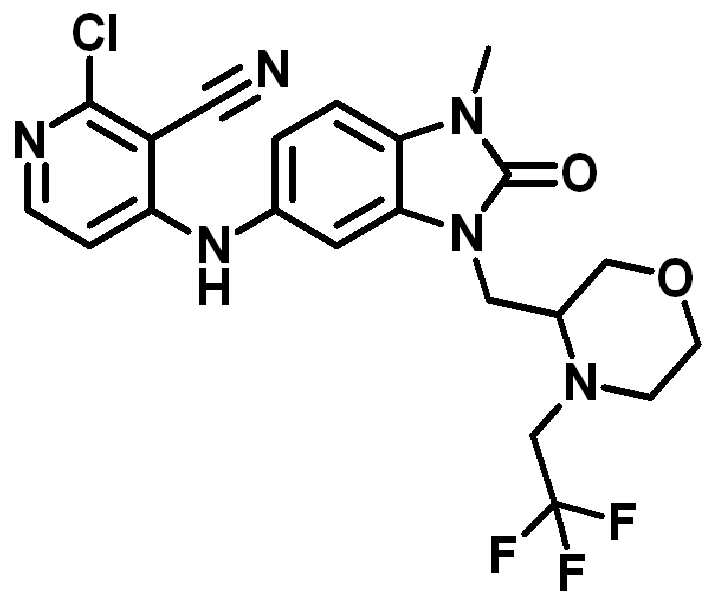
THF(0.5mL) 중의 4-(2,2,2-트리플루오로에틸)모르폴린-3-일]메탄올(15 mg, 0.076 mmol) 및 시아노메틸트리부틸포스포란(THF 중의 33% w/v 용액, 135 uL, 0.19 mmol)을 DMF(0.2 mL) 중의 2-클로로-4-[(1-메틸-2-옥소-3H-벤즈이미다졸-5-일)아미노]피리딘-3-카르보니트릴(중간체 D1, 20 mg, 0.067 mmol)의 현탁액에 순차적으로 첨가하였다. 생성된 혼합물을 마이크로웨이브에서 100℃까지 1시간 동안 가열하였다. 물(0.1 mL)을 첨가하고, 용매를 제거하고, 역상 플래시 크로마토그래피(Biotage 12 g SNAP Ultra C18, 물 중의 20% 내지 100% 메탄올, 0.1% 포름산 개질제)에 의해서 정제하고, 이어서 플래시 컬럼 크로마토그래피(10 g KP-SIL, DCM 중의 2-4% 메탄올)에 의해서 추가로 정제하여 표제 화합물(5.3 mg)을 제공하였다. 1H NMR (600 MHz, 클로로포름-d) δ 8.05 (d, J = 6.1 Hz, 1H), 7.05 (d, J = 8.2 Hz, 1H), 7.01 (dd, J = 8.3, 2.0 Hz, 1H), 6.99 (d, J = 1.9 Hz, 1H), 6.91 (s, 1H, NH), 6.64 (d, J = 6.1 Hz, 1H), 4.13 - 4.02 (m, 2H), 3.84 (dt, J = 11.3, 3.4 Hz, 1H), 3.76 - 3.69 (m, 2H), 3.55 (dd, J = 11.7, 3.2 Hz, 1H), 3.48 (s, 3H, NMe), 3.40 - 3.20 (m, 2H), 3.16 (ddd, J = 12.4, 9.6, 3.4 Hz, 1H), 3.09 (m, 1H), 2.73 (dt, J = 12.2, 3.3 Hz, 1H). LCMS(방법 X2) Rt 1.34min; m/z 481.1381 C21H21N6O2F3Cl [M+H]+에 대한 예측치 481.1367.4- (2,2,2-trifluoroethyl) morpholin-3-yl] methanol (15 mg, 0.076 mmol) in THF (0.5 mL) and cyanomethyltributylphosphorane (33% w / in THF) v solution, 135 uL, 0.19 mmol) was added 2-chloro-4-[(1-methyl-2-oxo-3H-benzimidazol-5-yl) amino] pyridine-3-carbonitrile in DMF (0.2 mL). (Intermediate D1, 20 mg, 0.067 mmol) was added sequentially. The resulting mixture was heated in microwave to 100 ° C. for 1 hour. Water (0.1 mL) is added, the solvent is removed and purified by reverse phase flash chromatography (Biotage 12 g SNAP Ultra C18, 20% to 100% methanol in water, 0.1% formic acid modifier) followed by flash column chromatography Further purification by (10 g KP-SIL, 2-4% methanol in DCM) provided the title compound (5.3 mg). 1 H NMR (600 MHz, Chloroform-d) δ 8.05 (d, J = 6.1 Hz, 1H), 7.05 (d, J = 8.2 Hz, 1H), 7.01 (dd, J = 8.3, 2.0 Hz, 1H), 6.99 (d, J = 1.9 Hz, 1H), 6.91 (s, 1H, NH), 6.64 (d, J = 6.1 Hz, 1H), 4.13-4.02 (m, 2H), 3.84 (dt, J = 11.3, 3.4 Hz, 1H), 3.76-3.69 (m, 2H), 3.55 (dd, J = 11.7, 3.2 Hz, 1H), 3.48 (s, 3H, NMe), 3.40-3.20 (m, 2H), 3.16 (ddd , J = 12.4, 9.6, 3.4 Hz, 1H), 3.09 (m, 1H), 2.73 (dt, J = 12.2, 3.3 Hz, 1H). LCMS (Method X2) Rt 1.34 min; m / z 481.1381 Predicted for C 21 H 21 N 6 O 2 F 3 Cl [M + H] + 481.1367.
표 10에 나타낸 알코올 중간체를 사용하여, 실시예 25a의 제조를 위해서 사용된 것과 유사한 방법에 의해서 하기 표로 나타낸 실시예를 제조하였다.Using the alcohol intermediates shown in Table 10, the examples shown in the table below were prepared by methods analogous to those used for the preparation of Example 25a.
[표 10]TABLE 10


실시예 26a: 2-클로로-4-((3-(3-(에틸아미노)부틸)-1-메틸-2-옥소-2,3-디히드로-1H-벤조[d]이미다졸-5-일)아미노)니코티노니트릴 히드로클로라이드 Example 26a: 2-chloro-4-((3- (3- (ethylamino) butyl) -1-methyl-2-oxo-2,3-dihydro-1H-benzo [d] imidazole-5- I) amino) nicotinonitrile hydrochloride

시아노메틸트리부틸포스포란(50 mg, 0.21 mmol, THF 중의 33% 용액 0.15mL로서)을 DMF(0.2mL) 및 THF(0.4mL) 중의 tert-부틸 N-에틸-N-(3-히드록시-1-메틸-프로필)카르바메이트(중간체 G5, 19 mg, 0.09 mmol) 및 2-클로로-4-[(1-메틸-2-옥소-3H-벤즈이미다졸-5-일)아미노]피리딘-3-카르보니트릴(중간체 D1, 20 mg, 0.067 mmol)의 혼합물에 적가하였다. 생성된 혼합물을 마이크로웨이브에서 100℃까지 1시간 동안 가열하였다. 물(0.1mL)을 첨가하고, 감압 하에서 증발시키고, 역상 플래시 크로마토그래피(Biotage 12 g SNAP Ultra C18, 물 중의 20% 내지 100% 메탄올, 0.1% 포름산 개질제)를 사용하여 정제하였다. 생성된 물질을 THF 중에 용해시키고, 실온에서 밤새 디옥산 중의 염화수소(4 M, 1 mL)로 처리하였다. 생성된 침전물을 여과에 의해서 수집하고, THF로 세척하고, 필터 상에서 진공 하에서 건조하여 표제 화합물(3 mg)을 제공하였다. 1H NMR (600 MHz, DMSO-d 6 ) δ 9.54 (s, 1H), 8.63 (s, 1H), 8.53 (s, 1H), 8.03 (d, J = 6.2 Hz, 1H), 7.28 (d, J = 1.9 Hz, 1H), 7.24 (d, J = 8.3 Hz, 1H), 7.03 (dd, J = 8.2, 1.9 Hz, 1H), 6.71 (d, J = 6.2 Hz, 1H), 3.94 (t, J = 7.1 Hz, 2H), 3.37 (s, 3H), 3.17 (m, 1H), 3.00 - 2.85 (m, 2H), 2.17 - 2.08 (m, 1H), 1.77 (m, 1H), 1.31 (d, J = 6.5 Hz, 3H), 1.17 (t, J = 7.2 Hz, 3H). LCMS(방법 T4) Rt 2.03min; m/z 399.1690 C20H24ClN6O [M+H]+에 대한 예측치 399.1700.Cyanomethyltributylphosphorane (50 mg, 0.21 mmol, as 0.15 mL of a 33% solution in THF) was added to tert-butyl N-ethyl-N- (3-hydroxy in DMF (0.2 mL) and THF (0.4 mL). -1-methyl-propyl) carbamate (intermediate G5, 19 mg, 0.09 mmol) and 2-chloro-4-[(1-methyl-2-oxo-3H-benzimidazol-5-yl) amino] pyridine To the mixture was added dropwise to 3-carbonitrile (intermediate D1, 20 mg, 0.067 mmol). The resulting mixture was heated in microwave to 100 ° C. for 1 hour. Water (0.1 mL) was added, evaporated under reduced pressure and purified using reverse phase flash chromatography (Biotage 12 g SNAP Ultra C18, 20% to 100% methanol in water, 0.1% formic acid modifier). The resulting material was dissolved in THF and treated with hydrogen chloride (4 M, 1 mL) in dioxane overnight at room temperature. The resulting precipitate was collected by filtration, washed with THF and dried under vacuum on filter to give the title compound (3 mg). 1 H NMR (600 MHz, DMSO- d 6 ) δ 9.54 (s, 1H), 8.63 (s, 1H), 8.53 (s, 1H), 8.03 (d, J = 6.2 Hz, 1H), 7.28 (d, J = 1.9 Hz, 1H), 7.24 (d, J = 8.3 Hz, 1H), 7.03 (dd, J = 8.2, 1.9 Hz, 1H), 6.71 (d, J = 6.2 Hz, 1H), 3.94 (t, J = 7.1 Hz, 2H), 3.37 (s, 3H), 3.17 (m, 1H), 3.00-2.85 (m, 2H), 2.17-2.08 (m, 1H), 1.77 (m, 1H), 1.31 (d , J = 6.5 Hz, 3H), 1.17 (t, J = 7.2 Hz, 3H). LCMS (Method T4) Rt 2.03 min; m / z 399.1690 C 20 H 24 ClN 6 O [M + H] + calcd for 399.1700.
실시예 27a: 2-클로로-4-((3-(3-히드록시-3-메틸헥스-5-인-1-일)-1-메틸-2-옥소-2,3-디히드로-1H-벤조[d]이미다졸-5-일)아미노)니코티노니트릴 Example 27a: 2-chloro-4-((3- (3-hydroxy-3-methylhex-5-yn-1-yl) -1-methyl-2-oxo-2,3-dihydro-1H -Benzo [d] imidazol-5-yl) amino) nicotinonitrile

아세토니트릴(1 mL) 중의 (3-히드록시-3-메틸-헥스-5-인일) 4-메틸벤젠설포네이트(중간체 C5c, 38 mg, 0.11 mmol)의 용액에 2-클로로-4-[(1-메틸-2-옥소-3H-벤즈이미다졸-5-일)아미노]피리딘-3-카르보니트릴(중간체 D1, 25 mg, 0.08 mmol) 및 탄산세슘(60 mg, 0.18 mmol)을 첨가하고, 생성된 혼합물을 85℃까지 18h 동안 가열하였다. 혼합물을 DCM과 물 사이에 분배시키고, 시트르산으로 pH 6까지 중화시키고, 분리하고, 수성 층을 추가로 DCM으로 추출하였다. 합한 유기물을 염수로 세척하고, MgSO4 상에서 건조하고, 감압 하에서 증발시켰다. 정제용 HPLC(ACE 5 C18-PFP 컬럼(5 μ, 250x21.2 mm), 20 mL/min의 유량에서 40:60에서 25:75 물: 메탄올(둘 모두 0.1% 포름산으로 개질됨)로의 15분 구배 용리)정제는 표제 화합물(22 mg, 64%, 0.0537 mmol)을 고체로서 제공하였다. LCMS(방법 T4) Rt 2.81min; m/z 414.1676, C21H21ClN5O2 [M+H]+에 대한 예측치 414.1691. 1H NMR (500 MHz, 아세톤-d 6 ) δ 8.51 (1H, br), 8.03 (1H, d, J 6.1 Hz), 7.24 (1H, d, J 1.9 Hz), 7.20 (1H, d, J 8.7 Hz), 7.11 (1H, dd, J 8.7, 1.9 Hz), 6.79 (1H, d, J 6.1 Hz), 4.06 (2H, m), 3.41 (3H, s), 2.47 (1H, m), 2.42-2.38 (2H, m), 2.04-1.93 (2H, m), 1.34 (3H, s). OH는 관찰되지 않음.To a solution of (3-hydroxy-3-methyl-hex-5-ynyl) 4-methylbenzenesulfonate (intermediate C5c, 38 mg, 0.11 mmol) in acetonitrile (1 mL) 2-chloro-4-[( 1-methyl-2-oxo-3H-benzimidazol-5-yl) amino] pyridine-3-carbonitrile (intermediate D1, 25 mg, 0.08 mmol) and cesium carbonate (60 mg, 0.18 mmol) are added, The resulting mixture was heated to 85 ° C. for 18 h. The mixture was partitioned between DCM and water, neutralized with citric acid to pH 6, separated and the aqueous layer further extracted with DCM. The combined organics were washed with brine, dried over MgSO 4 and evaporated under reduced pressure. Preparative HPLC (ACE 5 C18-PFP column (5 μ, 250 × 21.2 mm), 40:60 to 25:75 water at a flow rate of 20 mL / min: 15 minutes with methanol (both modified with 0.1% formic acid) Gradient elution) gave the title compound (22 mg, 64%, 0.0537 mmol) as a solid. LCMS (Method T4) Rt 2.81 min; m / z 414.1676, predicted C 21 H 21 ClN 5 O 2 [M + H] + 414.1691. 1 H NMR (500 MHz, Acetone- d 6 ) δ 8.51 (1H, br), 8.03 (1H, d, J 6.1 Hz), 7.24 (1H, d, J 1.9 Hz), 7.20 (1H, d, J 8.7 Hz), 7.11 (1H, dd, J 8.7, 1.9 Hz), 6.79 (1H, d, J 6.1 Hz), 4.06 (2H, m), 3.41 (3H, s), 2.47 (1H, m), 2.42- 2.38 (2H, m), 2.04-1.93 (2H, m), 1.34 (3H, s). OH not observed.
표 11에 나타낸 토실레이트 중간체를 사용하여, 실시예 27a의 제조를 위해서 사용된 것과 유사한 방법에 의해서 하기 표로 나타낸 실시예를 제조하였다. 실시예 27d를 마이크로웨이브 가열을 사용하여 100℃에서 30분 동안 수행하였다.Using the tosylate intermediates shown in Table 11, the examples shown in the table below were prepared by methods similar to those used for the preparation of Example 27a. Example 27d was performed at 100 ° C. for 30 minutes using microwave heating.
[표 11]TABLE 11
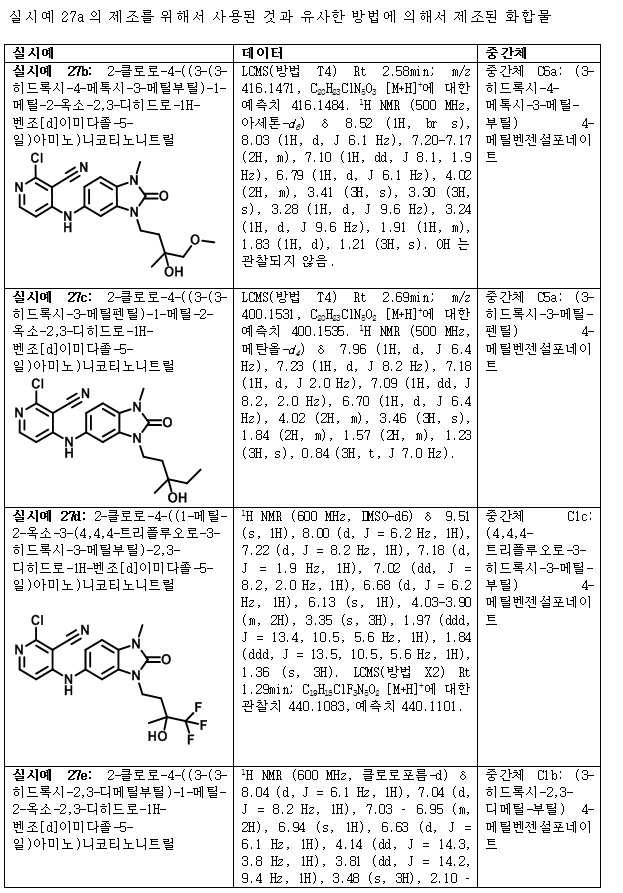

실시예 28a: 5-((5-클로로-2-(2,2,6,6-테트라메틸모르폴리노)피리미딘-4-일)아미노)-3-(3-히드록시-3-메틸부틸)-1-메틸-1,3-디히드로-2H-벤조[d]이미다졸-2-온 Example 28a : 5-((5-chloro-2- (2,2,6,6-tetramethylmorpholino) pyrimidin-4-yl) amino) -3- (3-hydroxy-3-methyl Butyl) -1-methyl-1,3-dihydro-2H-benzo [d] imidazol-2-one

NMP(0.67 mL) 중의 5-[(2,5-디클로로피리미딘-4-일)아미노]-3-(3-히드록시-3-메틸-부틸)-1-메틸-벤즈이미다졸-2-온(중간체 D2a, 30 mg, 0.076 mmol), 2,2,6,6-테트라메틸모르폴린(22 mg, 0.15 mmol) 및 DIPEA(40 uL, 0.23 mmol)의 혼합물을 마이크로웨이브에서 140℃까지 2시간 동안 가열하였다. 혼합물을 냉각시키고, DMSO(0.5 mL)로 희석시키고, 이어서 물 중의 30% 내지 100% 메탄올(각각 0.1% 포름산 함유)로 용리하는 역상 C18 컬럼을 사용하여 정제하여 표제 화합물(32 mg)을 연갈색 고체로서 제공하였다. 1H NMR (600 MHz, 클로로포름-d) δ 7.97 (s, 1H), 7.36 (d, J = 2.0 Hz, 1H), 7.24 (dd, J = 8.4, 2.0 Hz, 1H), 7.00 (s, 1H), 6.93 (d, J = 8.4 Hz, 1H), 4.04 (t, J = 7.2 Hz, 2H), 3.58 (s, 4H), 3.42 (s, 3H), 1.89 (t, J = 7.2 Hz, 2H), 1.28 (s, 6H), 1.23 (s, 12H). OH는 명확하게 관찰되지 않음. LCMS(방법 X4) Rt 3.08min, m/z 503.2521 C25H36ClN6O3 [M+H]+에 대한 예측치 503.2537.5-[(2,5-dichloropyrimidin-4-yl) amino] -3- (3-hydroxy-3-methyl-butyl) -1-methyl-benzimidazole-2- in NMP (0.67 mL) A mixture of warm (intermediate D2a, 30 mg, 0.076 mmol), 2,2,6,6-tetramethylmorpholine (22 mg, 0.15 mmol) and DIPEA (40 uL, 0.23 mmol) in a microwave at 140 ° C. Heated for hours. The mixture was cooled, diluted with DMSO (0.5 mL) and then purified using a reverse phase C18 column eluting with 30% to 100% methanol in water (each containing 0.1% formic acid) to give the title compound (32 mg) as a light brown solid. Served as. 1 H NMR (600 MHz, Chloroform- d ) δ 7.97 (s, 1H), 7.36 (d, J = 2.0 Hz, 1H), 7.24 (dd, J = 8.4, 2.0 Hz, 1H), 7.00 (s, 1H ), 6.93 (d, J = 8.4 Hz, 1H), 4.04 (t, J = 7.2 Hz, 2H), 3.58 (s, 4H), 3.42 (s, 3H), 1.89 (t, J = 7.2 Hz, 2H ), 1.28 (s, 6 H), 1.23 (s, 12 H). OH is not clearly observed. LCMS (Method X4) Rt 3.08 min, m / z 503.2521 C 25 H 36 ClN 6 O 3 [M + H] + predicted 503.2537.
실시예 28b: 5-((5-클로로-2-(2-(트리플루오로메틸)모르폴리노)피리미딘-4-일)아미노)-3-(3-히드록시-3-메틸부틸)-1-메틸-1,3-디히드로-2H-벤조[d]이미다졸-2-온 Example 28b : 5-((5-chloro-2- (2- (trifluoromethyl) morpholino) pyrimidin-4-yl) amino) -3- (3-hydroxy-3-methylbutyl) -1-methyl-1,3-dihydro-2H-benzo [d] imidazol-2-one
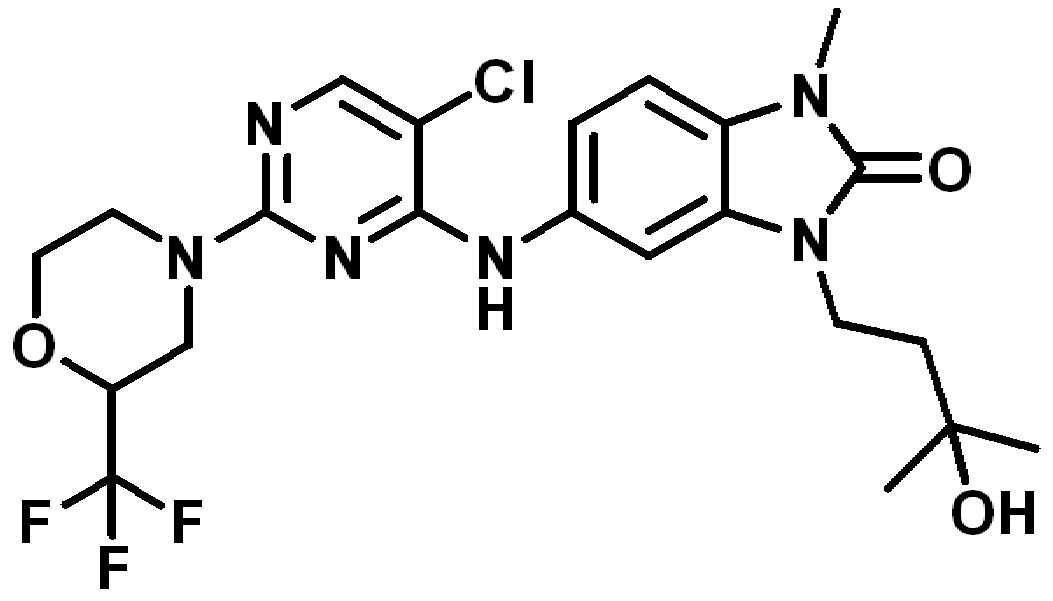
NMP(0.67 mL) 중의 5-[(2,5-디클로로피리미딘-4-일)아미노]-3-(3-히드록시-3-메틸-부틸)-1-메틸-벤즈이미다졸-2-온(중간체 D2a, 30 mg, 0.076 mmol), 2-(트리플루오로메틸)모르폴린 히드로클로라이드(29 mg, 0.15 mmol) 및 DIPEA(53 uL, 0.30 mmol)의 혼합물을 마이크로웨이브에서 140℃까지 2시간 동안 가열하였다. 혼합물을 냉각시키고, DMSO(0.5 mL)로 희석시키고, 이어서 물 중의 30% 내지 100% 메탄올(각각 0.1% 포름산 함유)로 용리하는 역상 C18 컬럼을 사용하여 정제하여 표제 화합물(34 mg)을 연갈색 고체로서 제공하였다. 1H NMR (600 MHz, 클로로포름-d) δ 8.00 (s, 1H), 7.35 (d, J = 2.0 Hz, 1H), 7.16 (dd, J = 8.3, 2.0 Hz, 1H), 7.05 (s, 1H), 6.94 (d, J = 8.3 Hz, 1H), 4.67 (d, J = 13.0 Hz, 1H), 4.40 (d, J = 13.4 Hz, 1H), 4.10 - 3.97 (m, 3H), 3.93 - 3.85 (m, 1H), 3.64 (td, J = 11.6, 2.9 Hz, 1H), 3.42 (s, 3H), 3.15 - 3.08 (m, 1H), 3.04 (dd, J = 13.0, 10.7 Hz, 1H), 2.35 (s, 1H), 1.87 (t, J = 7.4 Hz, 2H), 1.29 (s, 6H). LCMS(방법 X4) Rt 3.16min, m/z 515.1773 C22H27ClF3N6O3 [M+H]+에 대한 예측치 515.1785.5-[(2,5-dichloropyrimidin-4-yl) amino] -3- (3-hydroxy-3-methyl-butyl) -1-methyl-benzimidazole-2- in NMP (0.67 mL) A mixture of warm (intermediate D2a, 30 mg, 0.076 mmol), 2- (trifluoromethyl) morpholine hydrochloride (29 mg, 0.15 mmol) and DIPEA (53 uL, 0.30 mmol) in a microwave to 140 ° C. Heated for hours. The mixture was cooled, diluted with DMSO (0.5 mL) and then purified using a reverse phase C18 column eluting with 30% to 100% methanol in water (each containing 0.1% formic acid) to afford the title compound (34 mg) as a light brown solid. Served as. 1 H NMR (600 MHz, Chloroform- d ) δ 8.00 (s, 1H), 7.35 (d, J = 2.0 Hz, 1H), 7.16 (dd, J = 8.3, 2.0 Hz, 1H), 7.05 (s, 1H ), 6.94 (d, J = 8.3 Hz, 1H), 4.67 (d, J = 13.0 Hz, 1H), 4.40 (d, J = 13.4 Hz, 1H), 4.10-3.97 (m, 3H), 3.93-3.85 (m, 1H), 3.64 (td, J = 11.6, 2.9 Hz, 1H), 3.42 (s, 3H), 3.15-3.08 (m, 1H), 3.04 (dd, J = 13.0, 10.7 Hz, 1H), 2.35 (s, 1 H), 1.87 (t, J = 7.4 Hz, 2 H), 1.29 (s, 6 H). LCMS (Method X4) Rt 3.16 min, m / z 515.1773 Predicted for C 22 H 27 ClF 3 N 6 O 3 [M + H] + 515.1785.
실시예 29a: 5-((3-클로로-2-플루오로피리딘-4-일)아미노)-3-(3-히드록시-3-메틸부틸)-1-메틸-1,3-디히드로-2H-벤조[d]이미다졸-2-온 Example 29a: 5-((3-chloro-2-fluoropyridin-4-yl) amino) -3- (3-hydroxy-3-methylbutyl) -1-methyl-1,3-dihydro- 2H-benzo [d] imidazol-2-one

NMP(0.9 mL), 및 톨루엔(0.9 mL) 중의 5-아미노-3-(3-히드록시-3-메틸-부틸)-1-메틸-벤즈이미다졸-2-온(중간체 A1, 20 mg, 0.08 mmol), Xantphos(12 mg, 0.02 mmol), 4-브로모-3-클로로-2-플루오로피리딘(24 mg, 0.11 mmol), 트리스(디벤질리덴아세톤)디팔라듐(0)(2.3 mg, 0.004 mmol) 및 4-브로모-3-클로로-2-플루오로피리딘(24.00 mg, 0.1141 mmol)의 혼합물을 탈기시키고, 마이크로웨이브에서 질소 분위기 하에서 140℃까지 1시간 동안 가열하고, 이어서 DCM, 메탄올 이어서 메탄올성 암모니아로 용리시키는 SCX-2 컬럼에 의해서 정제하였다. 비염기성 분획 중에 용리된 화합물을 역상 크로마토그래피(Biotage Snap Ultra C18 12 g, 물 중의 40% 내지 80% 메탄올, 0.1% 포름산 개질제)에 의해서 정제하여 5-[(3-클로로-2-플루오로-4-피리딜)아미노]-3-(3-히드록시-3-메틸-부틸)-1-메틸-벤즈이미다졸-2-온(20 mg, 66%, 0.053 mmol)을 제공하였다.5-amino-3- (3-hydroxy-3-methyl-butyl) -1-methyl-benzimidazol-2-one (Intermediate A1, 20 mg, in NMP (0.9 mL), and toluene (0.9 mL) 0.08 mmol), Xantphos (12 mg, 0.02 mmol), 4-bromo-3-chloro-2-fluoropyridine (24 mg, 0.11 mmol), tris (dibenzylideneacetone) dipalladium (0) (2.3 mg , 0.004 mmol) and 4-bromo-3-chloro-2-fluoropyridine (24.00 mg, 0.1141 mmol) were degassed and heated in a microwave to 140 ° C. under nitrogen atmosphere for 1 hour, followed by DCM, Methanol was then purified by SCX-2 column eluting with methanolic ammonia. The compound eluted in the non-basic fraction was purified by reverse phase chromatography (Biotage Snap Ultra C18 12 g, 40% to 80% methanol in water, 0.1% formic acid modifier) to give 5-[(3-chloro-2-fluoro- 4-pyridyl) amino] -3- (3-hydroxy-3-methyl-butyl) -1-methyl-benzimidazol-2-one (20 mg, 66%, 0.053 mmol) was provided.
1H NMR (500 MHz, 클로로포름-d) δ 7.73 (d, J=6.0 Hz, 1H), 7.02 (app s, 2H), 6.94 (s, 1H), 6.64 (s, 1H, NH), 6.59 (d, J=6 Hz, 1H), 4.09 - 4.02 (m, 2H), 3.46 (s, 3H), 2.18 (v br, 1H, OH), 1.92 - 1.86 (m, 2H), 1.31 (s, 6H). LCMS(방법 X4) Rt 2.57min; m/z 379.1336 C18H21ClFN4O2 [M+H]+에 대한 예측치 379.1337. 1 H NMR (500 MHz, Chloroform- d ) δ 7.73 (d, J = 6.0 Hz, 1H), 7.02 (app s, 2H), 6.94 (s, 1H), 6.64 (s, 1H, NH), 6.59 ( d, J = 6 Hz, 1H), 4.09-4.02 (m, 2H), 3.46 (s, 3H), 2.18 (v br, 1H, OH), 1.92-1.86 (m, 2H), 1.31 (s, 6H ). LCMS (Method X4) Rt 2.57 min; m / z Estimated for 379.1336 C 18 H 21 ClFN 4 O 2 [M + H] + 379.1337.
표 12에 나타낸 헤테로아릴 할라이드를 사용하여, 실시예 29a의 제조를 위해서 사용된 것과 유사한 방법에 의해서 하기 표로 나타낸 실시예를 제조하였다.Using the heteroaryl halides shown in Table 12, the examples shown in the table below were prepared by similar methods used for the preparation of Example 29a.
[표 12]TABLE 12

표 13에 나타낸 커플링 파트너를 사용하여, 실시예 29a의 제조를 위해서 사용된 것과 유사한 방법에 의해서 하기 표로 나타낸 실시예를 제조하였다. Using the coupling partners shown in Table 13, the examples shown in the table below were prepared by methods similar to those used for the preparation of Example 29a.
[표 13]TABLE 13

실시예 31a: (S)-5-((5-클로로-2-(2-(히드록시메틸)피롤리딘-1-일)피리미딘-4-일)아미노)-3-(3-히드록시-3-메틸부틸)-1-메틸-1,3-디히드로-2H-벤조[d]이미다졸-2-온 Example 31a: (S) -5-((5-chloro-2- (2- (hydroxymethyl) pyrrolidin-1-yl) pyrimidin-4-yl) amino) -3- (3-hydrate Oxy-3-methylbutyl) -1-methyl-1,3-dihydro-2H-benzo [d] imidazol-2-one

DMF(0.5mL) 중의 5-[(2,5-디클로로피리미딘-4-일)아미노]-3-(3-히드록시-3-메틸-부틸)-1-메틸-벤즈이미다졸-2-온(중간체 D2a, 7.4 mg, 0.019 mmol), [(2S)-피롤리딘-2-일]메탄올(7 uL, 0.07 mmol), N-에틸-N-이소프로필-프로판-2-아민(13 uL, 0.075 mmol)의 혼합물을 100℃까지 1h 동안 마이크로웨이브에서 가열하고, 이어서 DCM과 물 사이에 분배시키고, 10% 시트르산의 첨가에 의해서 pH 5까지 조정하고, 층을 분리하고, 수성의 추가의 DCM으로 추출하였다. 합한 유기물을 증발시키고, 정제용 HPLC(ACE 5 C18-PFP 컬럼(5 μ, 250x21.2 mm), 20 mL/min의 유량에서 60:40에서 0:100 물: 메탄올(둘 모두 0.1% 포름산으로 개질됨)으로의 15분 구배 용리)에 의해서 정제하여, 5-[[5-클로로-2-[(2S)-2-(히드록시메틸)피롤리딘-1-일]피리미딘-4-일]아미노]-3-(3-히드록시-3-메틸-부틸)-1-메틸-벤즈이미다졸-2-온(5 mg)을 수득하였다. 1H NMR (500 MHz, 메탄올-d4) δ 7.91 (s, 1H), 7.59 (br s, 1H), 7.37 (dd, J = 8.4, 1.9 Hz, 1H), 7.12 (d, J = 8.5 Hz, 1H), 4.12 (m, 1H), 4.08 - 4.00 (m, 2H), 3.66-3.60 (m, 1H), 3.60-3.50 (m, 3H), 3.43 (s, 3H), 2.08-1.9 (m, 4H), 1.87 (m, 2H), 1.29 (s, 6H). LCMS(방법 T4) Rt 2.22min; m/z 461.2050 C22H30ClN6O3 [M+H]+에 대한 예측치 461.2062.5-[(2,5-dichloropyrimidin-4-yl) amino] -3- (3-hydroxy-3-methyl-butyl) -1-methyl-benzimidazole-2- in DMF (0.5 mL) On (intermediate D2a, 7.4 mg, 0.019 mmol), [(2S) -pyrrolidin-2-yl] methanol (7 uL, 0.07 mmol), N-ethyl-N-isopropyl-propan-2-amine (13 uL, 0.075 mmol) was heated in a microwave to 100 ° C. for 1 h, then partitioned between DCM and water, adjusted to pH 5 by addition of 10% citric acid, layers separated and aqueous further Extracted with DCM. Combined organics were evaporated and purified HPLC (ACE 5 C18-PFP column (5 μ, 250 × 21.2 mm), 60:40 to 0: 100 water at a flow rate of 20 mL / min: methanol with both 0.1% formic acid) 15 minute gradient elution) to 5-[[5-chloro-2-[(2S) -2- (hydroxymethyl) pyrrolidin-1-yl] pyrimidin-4- Il] amino] -3- (3-hydroxy-3-methyl-butyl) -1-methyl-benzimidazol-2-one (5 mg) was obtained. 1 H NMR (500 MHz, Methanol-d4) δ 7.91 (s, 1H), 7.59 (br s, 1H), 7.37 (dd, J = 8.4, 1.9 Hz, 1H), 7.12 (d, J = 8.5 Hz, 1H), 4.12 (m, 1H), 4.08-4.00 (m, 2H), 3.66-3.60 (m, 1H), 3.60-3.50 (m, 3H), 3.43 (s, 3H), 2.08-1.9 (m, 4H), 1.87 (m, 2H), 1.29 (s, 6H). LCMS (Method T4) Rt 2.22 min; m / z 461.2050 Predicted for C 22 H 30 ClN 6 O 3 [M + H] + 461.2062.
실시예 31b: (S)-7-((3-(3-히드록시-3-메틸부틸)-1-메틸-2-옥소-2,3-디히드로-1H-벤조[d]이미다졸-5-일)아미노)-5-(2-(히드록시메틸)피롤리딘-1-일)피라졸로[1,5-a]피리미딘-3-카르보니트릴 Example 31b: (S) -7-((3- (3-hydroxy-3-methylbutyl) -1-methyl-2-oxo-2,3-dihydro-1H-benzo [d] imidazole- 5-yl) amino) -5- (2- (hydroxymethyl) pyrrolidin-1-yl) pyrazolo [1,5-a] pyrimidine-3-carbonitrile
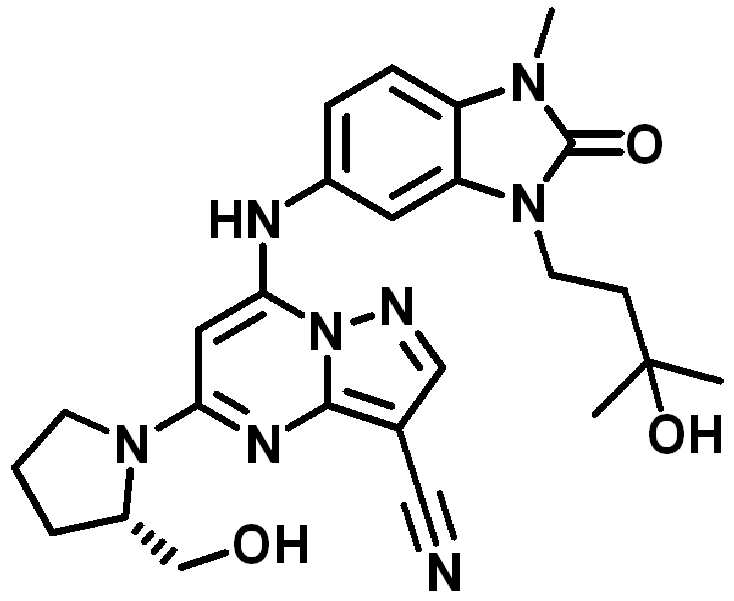
5-클로로-7-[[3-(3-히드록시-3-메틸-부틸)-1-메틸-2-옥소-벤즈이미다졸-5-일]아미노]피라졸로[1,5-a]피리미딘-3-카르보니트릴(중간체 D3i, 8 mg)로부터 출발하여 실시예 31a의 제조를 위해서 사용된 것과 유사한 방법에 의해서 제조하고, 표제 화합물(7 mg)을 수득하였다. 피롤리딘을 헤테로방향족 고리에 연결하는 C-N 결합 주변의 회전으로 인해서 NMR 신호는 매우 넓고 불량하게 규정됨. 1H NMR (600 MHz, DMSO-d6) δ 9.64 (s, 1H), 8.38 (s, 1H), 7.26 (d, J = 1.9 Hz, 1H), 7.21 (d, J = 8.3 Hz, 1H), 7.13 (dd, J = 8.2, 2.0 Hz, 1H), 5.9-5.3 및 4.4-4.2 (br m, total 2H), 4.81 (1H, br m), 4.45 (1H, s), 3.90 (2H, m), 3.85 - 3.0 (4H, v br), 3.35 (3H, s), 2.04-1.91 (2H, br m), 1.90-1.82 (2H, br m,), 1.72 (2H, t, J=8.2Hz), 1.16 (6H, s). LCMS(방법 T4) Rt 2.73min; m/z 491.2508 C25H31N8O3 [M+H]+에 대한 예측치 491.2514.5-chloro-7-[[3- (3-hydroxy-3-methyl-butyl) -1-methyl-2-oxo-benzimidazol-5-yl] amino] pyrazolo [1,5-a] Prepared by a method similar to that used for the preparation of Example 31a starting from pyrimidine-3-carbonitrile (intermediate D3i, 8 mg), the title compound (7 mg) was obtained. The NMR signal is very broad and poorly defined due to the rotation around the CN bond connecting pyrrolidin to the heteroaromatic ring. 1 H NMR (600 MHz, DMSO-d6) δ 9.64 (s, 1H), 8.38 (s, 1H), 7.26 (d, J = 1.9 Hz, 1H), 7.21 (d, J = 8.3 Hz, 1H), 7.13 (dd, J = 8.2, 2.0 Hz, 1H), 5.9-5.3 and 4.4-4.2 (br m, total 2H), 4.81 (1H, br m), 4.45 (1H, s), 3.90 (2H, m) , 3.85-3.0 (4H, v br), 3.35 (3H, s), 2.04-1.91 (2H, br m), 1.90-1.82 (2H, br m,), 1.72 (2H, t, J = 8.2 Hz) , 1.16 (6H, s). LCMS (Method T4) Rt 2.73 min; m / z 491.2508 C 25 H 31 N 8 0 3 [M + H] + calcd for 491.2514.
실시예 32: 2-클로로-4-((1-메틸-3-(2-(2-메틸옥시란-2-일)에틸)-2-옥소-2,3-디히드로-1H-벤조[d]이미다졸-5-일)아미노)니코티노니트릴 Example 32 2-chloro-4-((1-methyl-3- (2- (2-methyloxiran-2-yl) ethyl) -2-oxo-2,3-dihydro-1H-benzo [ d] imidazol-5-yl) amino) nicotinonitrile
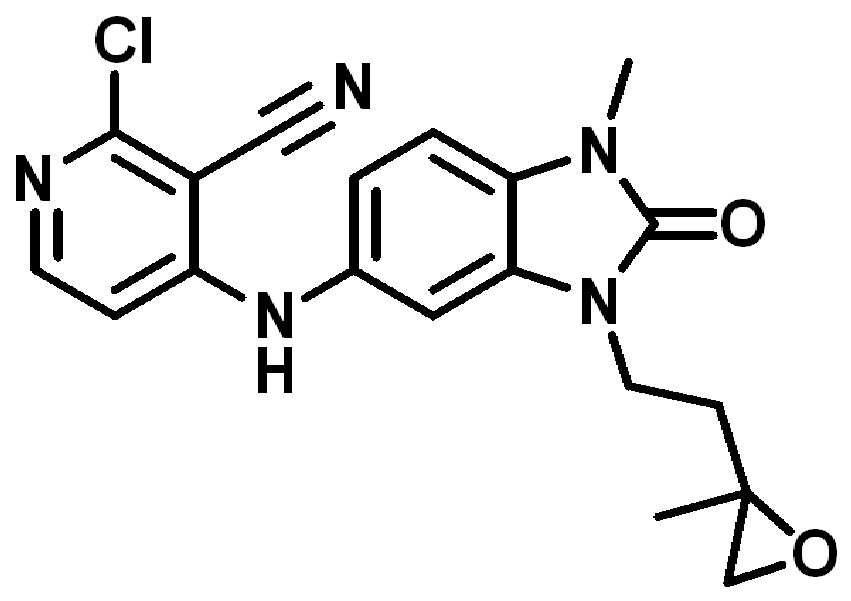
단계 1: 2-클로로-4-[[1-메틸-3-(3-메틸부트-3-엔일)-2-옥소-벤즈이미다졸-5-일]아미노]피리딘-3-카르보니트릴Step 1: 2-Chloro-4-[[1-methyl-3- (3-methylbut-3-enyl) -2-oxo-benzimidazol-5-yl] amino] pyridine-3-carbonitrile
아세토니트릴(5 mL) 중의 3-메틸부트-3-엔일 4-메틸벤젠설포네이트(중간체 C6b,156 mg, 0.65 mmol)의 용액에 2-클로로-4-[(1-메틸-2-옥소-3H-벤즈이미다졸-5-일)아미노]피리딘-3-카르보니트릴(중간체 D1, 150 mg, 0.50 mmol) 및 탄산세슘(360 mg, 1.11 mmol)을 첨가하고, 생성된 혼합물을을 6h 동안 환류 하에서 가열하였다. 혼합물을 DCM과 물 사이에 분배시키고, 시트르산으로 pH 6까지 중화시키고, 분리하고, 수성 층을 추가로 DCM으로 추출하였다. 합한 유기물을 염수로 세척하고, MgSO4 상에서 건조하고, 감압 하에서 증발시켰다. 역상 크로마토그래피(Biotage Snap Ultra C18 12g, 물 중의 30% 내지 80% 메탄올, 0.1% 포름산 개질제)에 의한 정제는 2-클로로-4-[[1-메틸-3-(3-메틸부트-3-엔일)-2-옥소-벤즈이미다졸-5-일]아미노]피리딘-3-카르보니트릴(80 mg, 37%, 0.1849 mmol)을 오일로서 제공하였다. LCMS(방법 T2) Rt 1.47min; m/z 368.1247, C19H18ClN5O [M+H]+에 대한 예측치 368.1273.To a solution of 3-methylbut-3-enyl 4-methylbenzenesulfonate (intermediate C6b, 156 mg, 0.65 mmol) in acetonitrile (5 mL) 2-chloro-4-[(1-methyl-2-oxo- 3H-benzimidazol-5-yl) amino] pyridine-3-carbonitrile (intermediate D1, 150 mg, 0.50 mmol) and cesium carbonate (360 mg, 1.11 mmol) were added and the resulting mixture was refluxed for 6 h. Heated under. The mixture was partitioned between DCM and water, neutralized with citric acid to pH 6, separated and the aqueous layer further extracted with DCM. The combined organics were washed with brine, dried over MgSO 4 and evaporated under reduced pressure. Purification by reverse phase chromatography (Biotage Snap Ultra C18 12 g, 30% to 80% methanol in water, 0.1% formic acid modifier) yielded 2-chloro-4-[[1-methyl-3- (3-methylbut-3- Enyl) -2-oxo-benzimidazol-5-yl] amino] pyridine-3-carbonitrile (80 mg, 37%, 0.1849 mmol) was provided as an oil. LCMS (Method T2) Rt 1.47 min; m / z 368.1247, predicted C 19 H 18 ClN 5 O [M + H] + 368.1273.
단계 2: 2-클로로-4-((1-메틸-3-(2-(2-메틸옥시란-2-일)에틸)-2-옥소-2,3-디히드로-1H-벤조 [d]이미다졸-5-일)아미노)니코티노니트릴Step 2: 2-chloro-4-((1-methyl-3- (2- (2-methyloxiran-2-yl) ethyl) -2-oxo-2,3-dihydro-1H-benzo [d Imidazol-5-yl) amino) nicotinonitrile
DCM(2 mL) 중의 2-클로로-4-[[1-메틸-3-(3-메틸부트-3-엔일)-2-옥소-벤즈이미다졸-5-일]아미노]피리딘-3-카르보니트릴(80 mg, 0.22 mmol)의 용액에 m-CPBA(56 mg, 0.33 mmol)를 첨가하였다. 혼합물을 교반하고 2h 동안 실온에서, 이어서 m-CPBA의 제2 분획(37.5 mg, 0.22 mmol)을 첨가하고, 혼합물을 추가 시간 동안 교반하였다. 포화 수성 Na2S2O3를 첨가하고, 층을 분리하고, 유기층을 수성 NaHCO3로 세척하였다. 합한 수성 층을 추가의 DCM으로 추출하고, 합한 유기 층을 MgSO4 상에서 건조하고, 진공 하에서 여과 및 농축시켜, 표제 화합물을 주황색 고체로서 제공하였다. LCMS(방법 T2) Rt 1.33min; m/z 384.1179, C19H19ClN5O2 [M+H]+에 대한 예측치 384.1222. 1H NMR (500 MHz, 메탄올-d 4 ) δ 7.96 (1H, d, J 6.4 Hz), 7.25 (1H, d, J 8.2 Hz), 7.17 (1H, d, J 1.6 Hz), 7.11 (1H, dd, J 8.2, 1.6 Hz), 6.70 (1H, d, J 6.4 Hz), 4.08 (2H, m), 3.47 (3H, s), 2.56 (2H, s), 2.00 (2H, m), 1.41 (3H, s).2-chloro-4-[[1-methyl-3- (3-methylbut-3-enyl) -2-oxo-benzimidazol-5-yl] amino] pyridine-3-carboni in DCM (2 mL) To a solution of tril (80 mg, 0.22 mmol) was added m-CPBA (56 mg, 0.33 mmol). The mixture was stirred and at room temperature for 2 h, then a second fraction of m-CPBA (37.5 mg, 0.22 mmol) was added and the mixture was stirred for an additional hour. Saturated aqueous Na 2 S 2 O 3 was added, the layers were separated and the organic layer was washed with aqueous NaHCO 3 . The combined aqueous layers were extracted with additional DCM and the combined organic layers were dried over MgSO 4 , filtered and concentrated in vacuo to give the title compound as an orange solid. LCMS (Method T2) Rt 1.33 min; m / z 384.1179, predicted for C 19 H 19 ClN 5 O 2 [M + H] + 384.1222. 1 H NMR (500 MHz, Methanol- d 4 ) δ 7.96 (1H, d, J 6.4 Hz), 7.25 (1H, d, J 8.2 Hz), 7.17 (1H, d, J 1.6 Hz), 7.11 (1H, dd, J 8.2, 1.6 Hz), 6.70 (1H, d, J 6.4 Hz), 4.08 (2H, m), 3.47 (3H, s), 2.56 (2H, s), 2.00 (2H, m), 1.41 ( 3H, s).
실시예 33: 2-클로로-4-((3-(2-(3,5-디메틸-2-옥소옥사졸리딘-5-일)에틸)-1-메틸-2-옥소-2,3-디히드로-1H-벤조[d]이미다졸-5-일)아미노)니코티노니트릴 Example 33: 2-chloro-4-((3- (2- (3,5-dimethyl-2-oxooxazolidin-5-yl) ethyl) -1-methyl-2-oxo-2,3- Dihydro-1H-benzo [d] imidazol-5-yl) amino) nicotinonitrile

밀폐된 튜브 내의 EtOH(1.00 mL) 중의 2-클로로-4-((1-메틸-3-(2-(2-메틸옥시란-2-일)에틸)-2-옥소-2,3-디히드로-1H-벤조[d]이미다졸-5-일)아미노)니코티노니트릴(실시예 32, 10 mg, 0.03 mmol)의 용액에 메틸아민(HF 중의 2 M, 0.07 mL, 0.13 mmol)을 첨가하였다. 혼합물을 78℃에서 4h 동안 교반하고, 이어서 그것을 실온까지 냉각시키고, 용매를 증발시키고, 혼합물을 THF(1 mL) 중에 용해시켰다. 디석신이미딜 카르보네이트(33 mg, 0.13 mmol) 및 트리에틸아민(0.02 mL, 0.13 mmol)을 첨가하고, 혼합물을 66℃까지 26h 동안 가열하였다. 수성 NH4Cl 및 EtOAc를 첨가하고, 층을 분리하고, 수성 층을 추가의 EtOAc로 추출하였다. 정제용 HPLC(ACE 5 C18-PFP 컬럼(5 μ, 250x21.2 mm), 20 mL/min의 유량에서 60:40에서 0:100 물: 메탄올(둘 모두 0.1% 포름산으로 개질됨)로의 15분 구배 용리)정제는 표제 화합물(3 mg)을 백색 고체로서 제공하였다. LCMS(방법 T4) Rt 2.47min; m/z 441.1424, C21H22ClN6O3 [M+H]+에 대한 예측치 441.1436. 1H NMR (500 MHz, 메탄올-d 4 ) δ 7.95 (1H, d, J 7.2 Hz), 7.24 (1H, d, J 8.4 Hz), 7.17 (1H, d, J 1.7 Hz), 7.10 (1H, dd, J 8.4, 1.7 Hz), 6.70 (1H, d, J 7.2 Hz), 4.08 (2H, m), 3.55 (1H, d, J 8.8 Hz), 3.46 (3H, s), 3.38 (1H. d, J 8.8 Hz), 2.84 (3H, s), 2.16 (2H, m), 1.50 (3H, s).2-chloro-4-((1-methyl-3- (2- (2-methyloxiran-2-yl) ethyl) -2-oxo-2,3-di in EtOH (1.00 mL) in a closed tube To a solution of hydro-1H-benzo [d] imidazol-5-yl) amino) nicotinonitrile (Example 32, 10 mg, 0.03 mmol) was added methylamine (2M in HF, 0.07 mL, 0.13 mmol) It was. The mixture was stirred at 78 ° C. for 4 h, then it was cooled to room temperature, the solvent was evaporated and the mixture was dissolved in THF (1 mL). Disuccinimidyl carbonate (33 mg, 0.13 mmol) and triethylamine (0.02 mL, 0.13 mmol) were added and the mixture was heated to 66 ° C. for 26 h. Aqueous NH 4 Cl and EtOAc were added, the layers were separated and the aqueous layer was extracted with additional EtOAc. Preparative HPLC (ACE 5 C18-PFP column (5 μ, 250 × 21.2 mm), 15 min with 60:40 to 0: 100 water: methanol (both modified with 0.1% formic acid) at a flow rate of 20 mL / min) Gradient Elution) gave the title compound (3 mg) as a white solid. LCMS (Method T4) Rt 2.47 min; m / z 441.1424, predicted C 21 H 22 ClN 6 O 3 [M + H] + 441.1436. 1 H NMR (500 MHz, Methanol- d 4 ) δ 7.95 (1H, d, J 7.2 Hz), 7.24 (1H, d, J 8.4 Hz), 7.17 (1H, d, J 1.7 Hz), 7.10 (1H, dd, J 8.4, 1.7 Hz), 6.70 (1H, d, J 7.2 Hz), 4.08 (2H, m), 3.55 (1H, d, J 8.8 Hz), 3.46 (3H, s), 3.38 (1H.d , J 8.8 Hz), 2.84 (3H, s), 2.16 (2H, m), 1.50 (3H, s).
실시예 34: 2-클로로-4-((1-메틸-3-((5-메틸-2-옥소옥사졸리딘-4-일)메틸)-2-옥소-2,3-디히드로-1H-벤조[d]이미다졸-5-일)아미노)니코티노니트릴 Example 34: 2-chloro-4-((1-methyl-3-((5-methyl-2-oxooxazolidin-4-yl) methyl) -2-oxo-2,3-dihydro-1H -Benzo [d] imidazol-5-yl) amino) nicotinonitrile
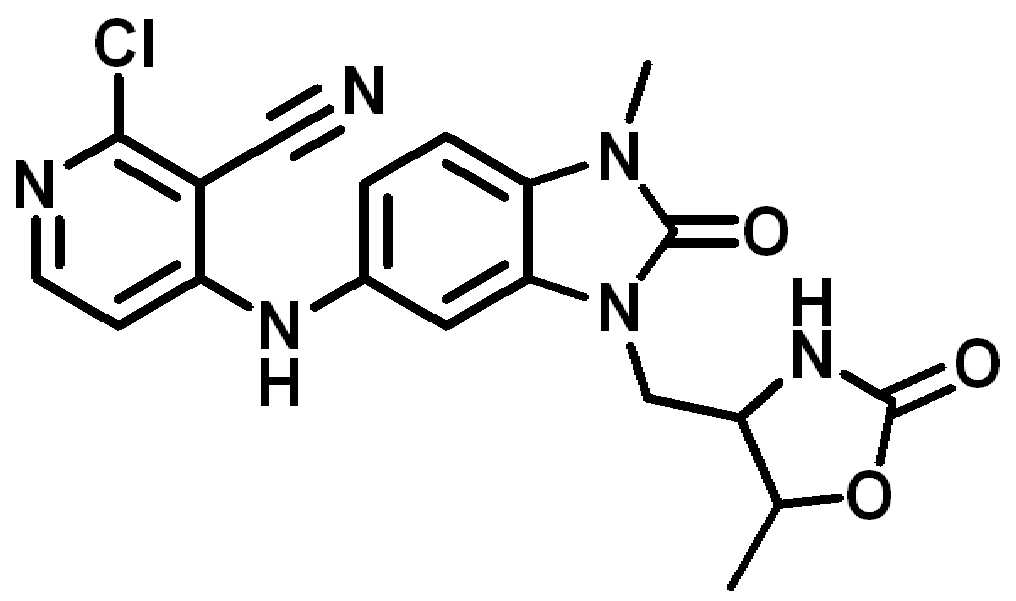
단계 1: tert-부틸 4-[[6-[(2-클로로-3-시아노-4-피리딜)아미노]-3-메틸-2-옥소-벤즈이미다졸-1-일]메틸]-2,2,5-트리메틸-옥사졸리딘-3-카르복실레이트 Step 1: tert-Butyl 4-[[6-[(2-chloro-3-cyano-4-pyridyl) amino] -3-methyl-2-oxo-benzimidazol-1-yl] methyl]- 2,2,5 - trimethyl-oxazolidine-3-carboxylate
시아노메틸트리부틸포스포란(90 mg, 0.37 mmol, THF 중의 33% 용액 135 uL로서)을 DMF(0.5 mL) 중의 2-클로로-4-[(1-메틸-2-옥소-3H-벤즈이미다졸-5-일)아미노]피리딘-3-카르보니트릴(중간체 D1, 40 mg, 0.13 mmol) 및 tert-부틸 4-(히드록시메틸)-2,2,5-트리메틸-옥사졸리딘-3-카르복실레이트(43 mg, 0.17 mmol)의 혼합물에 적가하였다. 생성된 혼합물을 마이크로웨이브에서 100℃까지 1시간 동안 가열하였다. 물(0.1 mL)을 첨가하고, 용매를 감압 하에서 증발시켰다. 생성된 DMF 용액을 DMSO로 희석시키고, 이어서 역상 플래시 크로마토그래피(Biotage 10g SNAP Ultra C18, 물 중의 10% 내지 100% 메탄올, 0.1% 포름산 개질제)를 사용하여 정제하여 표제 화합물(70 mg, 85%, 0.1129 mmol)을 고체로서 제공하였다. LCMS(방법 T2) Rt 1.56min; m/z 427.1633 [M-Boc+H]+.Cyanomethyltributylphosphorane (90 mg, 0.37 mmol, as 135 uL of a 33% solution in THF) was added 2-chloro-4-[(1-methyl-2-oxo-3H-benzimi) in DMF (0.5 mL). Dazol-5-yl) amino] pyridine-3-carbonitrile (intermediate D1, 40 mg, 0.13 mmol) and tert-butyl 4- (hydroxymethyl) -2,2,5-trimethyl-oxazolidine-3- To the mixture of carboxylate (43 mg, 0.17 mmol) was added dropwise. The resulting mixture was heated in microwave to 100 ° C. for 1 hour. Water (0.1 mL) was added and the solvent was evaporated under reduced pressure. The resulting DMF solution was diluted with DMSO and then purified using reverse phase flash chromatography (Biotage 10g SNAP Ultra C18, 10% to 100% methanol in water, 0.1% formic acid modifier) to give the title compound (70 mg, 85%, 0.1129 mmol) was provided as a solid. LCMS (Method T2) Rt 1.56 min; m / z 427.1633 [M-Boc + H] + .
단계 2: 4-[[3-(2-아미노-3-히드록시-부틸)-1-메틸-2-옥소-벤즈이미다졸-5-일]아미노]-2-클로로-피리딘-3-카르보니트릴Step 2: 4-[[3- (2-amino-3-hydroxy-butyl) -1-methyl-2-oxo-benzimidazol-5-yl] amino] -2-chloro-pyridine-3-carboni Trill
DCM(2 mL) 중의 tert-부틸 4-[[6-[(2-클로로-3-시아노-4-피리딜)아미노]-3-메틸-2-옥소-벤즈이미다졸-1-일]메틸]-2,2,5-트리메틸-옥사졸리딘-3-카르복실레이트(70 mg, 0.13 mmol)의 용액에 TFA(0.1 mL, 1.33 mmol)를 실온에서 적가하였다. 혼합물을 2h 동안 실온에서 교반하였다. 혼합물을 0℃까지 냉각시키고, 염기성 pH까지 암모니아(MeOH 중의 7 M)를 적가하였다. 물 및 DCM을 첨가하고, 층을 분리하고, 수성 층을 추가의 DCM(아미노 알코올의 추출을 돕기 위해서 MeOH을 몇 방울 첨가함)으로 추출하였다. 용매를 증발시키고, 조물질을 추가로 정제하지 않고 다음 단계를 위해서 취하였다. LCMS(방법 T2) Rt 1.01min; m/z 387.1330 [M+H]+.Tert-butyl 4-[[6-[(2-chloro-3-cyano-4-pyridyl) amino] -3-methyl-2-oxo-benzimidazol-1-yl] in DCM (2 mL) To a solution of methyl] -2,2,5-trimethyl-oxazolidine-3-carboxylate (70 mg, 0.13 mmol) was added dropwise TFA (0.1 mL, 1.33 mmol) at room temperature. The mixture was stirred for 2 h at room temperature. The mixture was cooled to 0 ° C. and ammonia (7 M in MeOH) was added dropwise to basic pH. Water and DCM were added, the layers were separated and the aqueous layer was extracted with additional DCM (adding a few drops of MeOH to help extract the amino alcohol). The solvent was evaporated and the crude was taken for next step without further purification. LCMS (Method T2) Rt 1.01 min; m / z 387.1330 [M + H] + .
단계 3: 2-클로로-4-[[1-메틸-3-[(5-메틸-2-옥소-옥사졸리딘-4-일)메틸]-2-옥소-벤즈이미다졸-5-일]아미노]피리딘-3-카르보니트릴Step 3: 2-Chloro-4-[[1-methyl-3-[(5-methyl-2-oxo-oxazolidin-4-yl) methyl] -2-oxo-benzimidazol-5-yl] Amino] pyridine-3-carbonitrile
THF(2 mL) 중의 4-[[3-(2-아미노-3-히드록시-부틸)-1-메틸-2-옥소-벤즈이미다졸-5-일]아미노]-2-클로로-피리딘-3-카르보니트릴(50 mg, 0.13 mmol)의 용액에 트리포스젠(107 mg, 0.36 mmol)을 첨가하였다. 혼합물을 실온에서 밀폐된 튜브에서 18h 동안 교반하였다. 2 M NaOH를 서서히 적가함으로써 반응을 켄칭시키고, 이어서 EtOAc를 첨가하고, 층을 분리하였다. 수성 층을 추가의 EtOAc로 추출하고, 합한 유기 층을 염수로 세척하고, MgSO4 상에서 건조하고, 감압 하에서 농축시켰다. 정제용 HPLC(ACE 5 C18-PFP 컬럼(5 μ, 250x21.2 mm), 20 mL/min의 유량에서 60:40에서 0:100 물: 메탄올(둘 모두 0.1% 포름산으로 개질됨)로의 15분 구배 용리)에 의한 정제는 1H NMR에 의해서 부분입체이성질체의 3:1 혼합물인 고체로서 표제 화합물(7 mg, 13%, 0.017 mmol)을 제공하였다. LCMS(방법 T4) Rt 2.36min; m/z 413.1115, C19H18ClN6O3 [M+H]+에 대한 예측치 413.1123. 1H NMR (500 MHz, 아세톤-d6, 주 부분입체이성질체) δ 8.53 (0.5H, br, 부분적으로 교환된 NH), 8.02 (1H, d, J 6.0 Hz), 7.39 (1H, d, J 2.1 Hz), 7.21 (1H, d, J 8.5 Hz), 7.12 (1H, dd, J 8.5, 2.1 Hz), 6.82 (1H, d, J 6.0 Hz), 6.79 (0.4H, br, 부분적으로 교환된 NH), 4.60 (1H, m), 4.14 (1H, dd, J 14.7, 5.8 Hz), 4.08 (1H, dd, J 14.7, 4.4 Hz), 3.94 (1H, m), 3.43 (3H, s), 1.38 (3H, d, J 6.5 Hz).4-[[3- (2-amino-3-hydroxy-butyl) -1-methyl-2-oxo-benzimidazol-5-yl] amino] -2-chloro-pyridine- in THF (2 mL) Triphosphene (107 mg, 0.36 mmol) was added to a solution of 3-carbonitrile (50 mg, 0.13 mmol). The mixture was stirred for 18 h in a closed tube at room temperature. The reaction was quenched by the slow dropwise addition of 2 M NaOH followed by the addition of EtOAc and the layers separated. The aqueous layer was extracted with more EtOAc and the combined organic layers were washed with brine, dried over MgSO 4 and concentrated under reduced pressure. Preparative HPLC (ACE 5 C18-PFP column (5 μ, 250 × 21.2 mm), 15 min with 60:40 to 0: 100 water: methanol (both modified with 0.1% formic acid) at a flow rate of 20 mL / min) Purification by gradient elution) provided the title compound (7 mg, 13%, 0.017 mmol) as a solid that was a 3: 1 mixture of diastereomers by 1 H NMR. LCMS (Method T4) Rt 2.36 min; m / z 413.1115, predicted for C 19 H 18 ClN 6 O 3 [M + H] + 413.1123. 1 H NMR (500 MHz, Acetone-d6, major diastereomer) δ 8.53 (0.5H, br, partially exchanged NH), 8.02 (1H, d, J 6.0 Hz), 7.39 (1H, d, J 2.1 Hz), 7.21 (1H, d, J 8.5 Hz), 7.12 (1H, dd, J 8.5, 2.1 Hz), 6.82 (1H, d, J 6.0 Hz), 6.79 (0.4H, br, partially exchanged NH ), 4.60 (1H, m), 4.14 (1H, dd, J 14.7, 5.8 Hz), 4.08 (1H, dd, J 14.7, 4.4 Hz), 3.94 (1H, m), 3.43 (3H, s), 1.38 (3H, doublet, J 6.5 Hz).
실시예 35a: 5-((5-클로로-2-(4,4-디플루오로-3-(히드록시메틸)피페리딘-1-일)피리미딘-4-일)아미노)-3-(3-히드록시-3-메틸부틸)-1-메틸-1,3-디히드로-2H-벤조[d]이미다졸-2-온: 포름산(1:1) Example 35a: 5-((5-chloro-2- (4,4-difluoro-3- (hydroxymethyl) piperidin-1-yl) pyrimidin-4-yl) amino) -3- (3-hydroxy-3-methylbutyl) -1-methyl-1,3-dihydro-2H-benzo [d] imidazol-2-one: formic acid (1: 1)
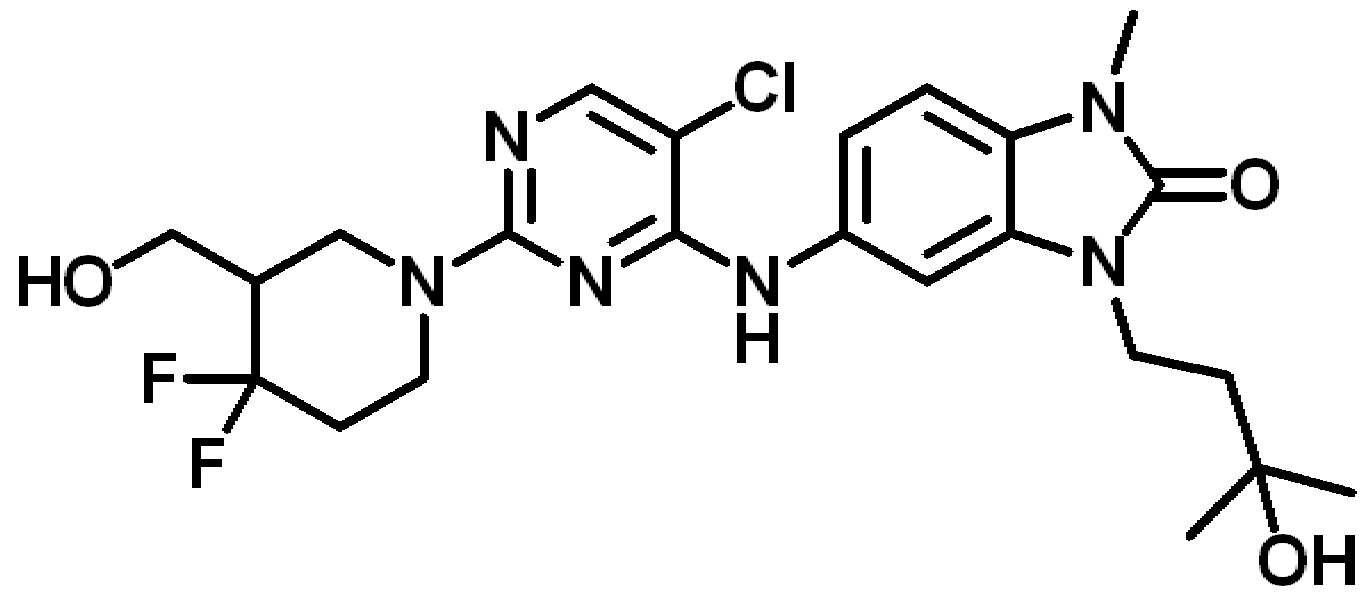
NMP(1.5 mL) 중의 5-[(2,5-디클로로피리미딘-4-일)아미노]-3-(3-히드록시-3-메틸-부틸)-1-메틸-벤즈이미다졸-2-온(중간체 D2a, 15.4 mg, 0.039 mmol) 및 (4,4-디플루오로-3-피페리딜)메탄올(에탄올 중의 수산화팔라듐을 사용하여 상업적인 (1-벤질-4,4-디플루오로-3-피페리딜)메탄올의 수소화에 의해서 제조됨, 17.6 mg, 0.117 mmol)의 혼합물을 마이크로웨이브 조사 하에서 140℃에서 1h 동안 교반하였다. HPLC 정제는 5-[[5-클로로-2-[4,4-디플루오로-3-(히드록시메틸)-1-피페리딜]피리미딘-4-일]아미노]-3-(3-히드록시-3-메틸-부틸)-1-메틸-벤즈이미다졸-2-온(13 mg)을 황색 왁스로서 제공하였다. 1H NMR (600 MHz, 메탄올-d 4 ) δ 8.22 (s, ~1H), 7.95 (s, 1H), 7.43 (d, J = 1.9 Hz, 1H), 7.41 (dd, J = 8.4, 1.9 Hz, 1H), 7.12 (d, J = 8.4 Hz, 1H), 4.55 - 4.44 (m, 1H), 4.31 - 4.23 (m, 1H), 4.12 - 3.95 (m, 2H), 3.88 (dd, J = 11.2, 4.1 Hz, 1H), 3.48 (dd, J = 11.2, 9.2 Hz, 1H), 3.46 - 3.44 (m, 1H), 3.43 (s, 3H), 3.31 - 3.28 (m, 1H), 2.20 - 2.06 (m, 1H), 2.06 - 1.96 (m, 1H), 1.96 - 1.89 (m, 1H), 1.93 - 1.73 (m, 2H), 1.30 (s, 6H). LCMS(방법 T4) Rt = 2.70min, m/z 511.2097.2108 [M+H]+ C23H30ClF2N6O3에 대한 예측치 511.2030.5-[(2,5-dichloropyrimidin-4-yl) amino] -3- (3-hydroxy-3-methyl-butyl) -1-methyl-benzimidazole-2- in NMP (1.5 mL) Commercial (1-benzyl-4,4-difluoro- with on (intermediate D2a, 15.4 mg, 0.039 mmol) and (4,4-difluoro-3-piperidyl) methanol (palladium hydroxide in ethanol) Prepared by hydrogenation of 3-piperidyl) methanol, 17.6 mg, 0.117 mmol) was stirred at 140 ° C. for 1 h under microwave irradiation. HPLC purification was performed on 5-[[5-chloro-2- [4,4-difluoro-3- (hydroxymethyl) -1-piperidyl] pyrimidin-4-yl] amino] -3- (3 -Hydroxy-3-methyl-butyl) -1-methyl-benzimidazol-2-one (13 mg) was provided as a yellow wax. 1 H NMR (600 MHz, Methanol- d 4 ) δ 8.22 (s, ˜1H), 7.95 (s, 1H), 7.43 (d, J = 1.9 Hz, 1H), 7.41 (dd, J = 8.4, 1.9 Hz , 1H), 7.12 (d, J = 8.4 Hz, 1H), 4.55-4.44 (m, 1H), 4.31-4.23 (m, 1H), 4.12-3.95 (m, 2H), 3.88 (dd, J = 11.2 , 4.1 Hz, 1H), 3.48 (dd, J = 11.2, 9.2 Hz, 1H), 3.46-3.44 (m, 1H), 3.43 (s, 3H), 3.31-3.28 (m, 1H), 2.20-2.06 ( m, 1H), 2.06-1.96 (m, 1H), 1.96-1.89 (m, 1H), 1.93-1.73 (m, 2H), 1.30 (s, 6H). LCMS (Method T4) Rt = 2.70 min, m / z 511.2097.2108 [M + H] + calc'd for C 23 H 30 ClF 2 N 6 O 3 511.2030.
실시예 35a의 제조를 위해서 사용된 것과 유사한 방법에 의해서 하기 표로 나타낸 실시예를 제조하였다. 실시예 35b는 DMF 중에서 수소화나트륨 및 디메틸설페이트를 사용한 상업적인 (1-벤질-4,4-디플루오로-3-피페리딜)메탄올의 메틸화, 그 다음 에탄올 중의 수산화팔라듐의 수소화에 의해서 제조된 4,4-디플루오로-3-(메톡시메틸)피페리딘을 사용하였다. 실시예 35e 및 실시예 35t의 경우는, 8h 가열이 필요하였다. 실시예 35m 및 실시예 35n의 경우는 4h 가열이 필요하였다.The examples shown in the table below were prepared by methods similar to those used for the preparation of Example 35a. Example 35b is prepared by methylation of commercial (1-benzyl-4,4-difluoro-3-piperidyl) methanol with sodium hydride and dimethylsulfate in DMF, followed by hydrogenation of palladium hydroxide in ethanol. , 4-difluoro-3- (methoxymethyl) piperidine was used. In the case of Example 35e and Example 35t, 8h heating was required. In the case of Example 35m and Example 35n, 4h heating was required.
[표 14]TABLE 14

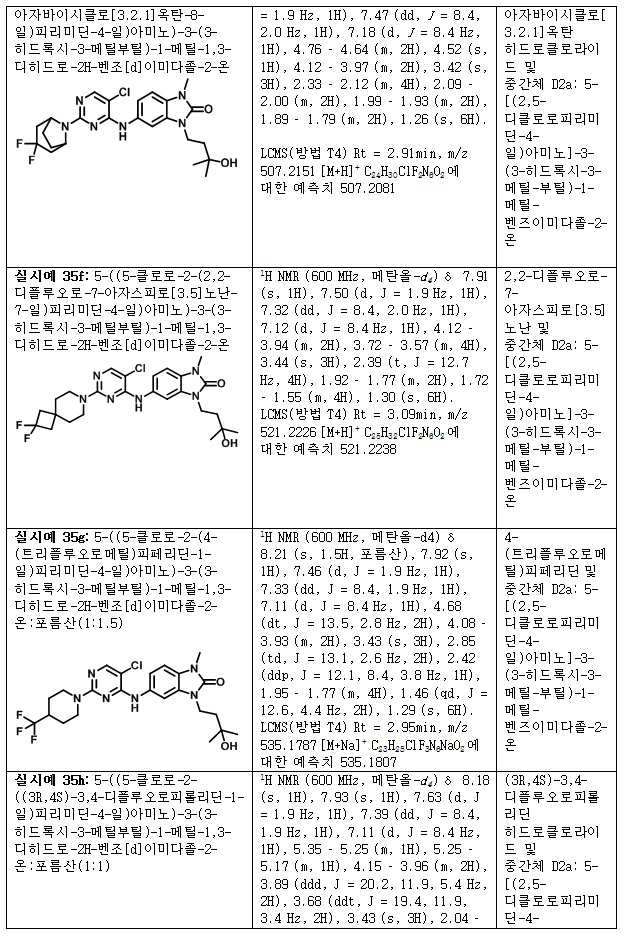
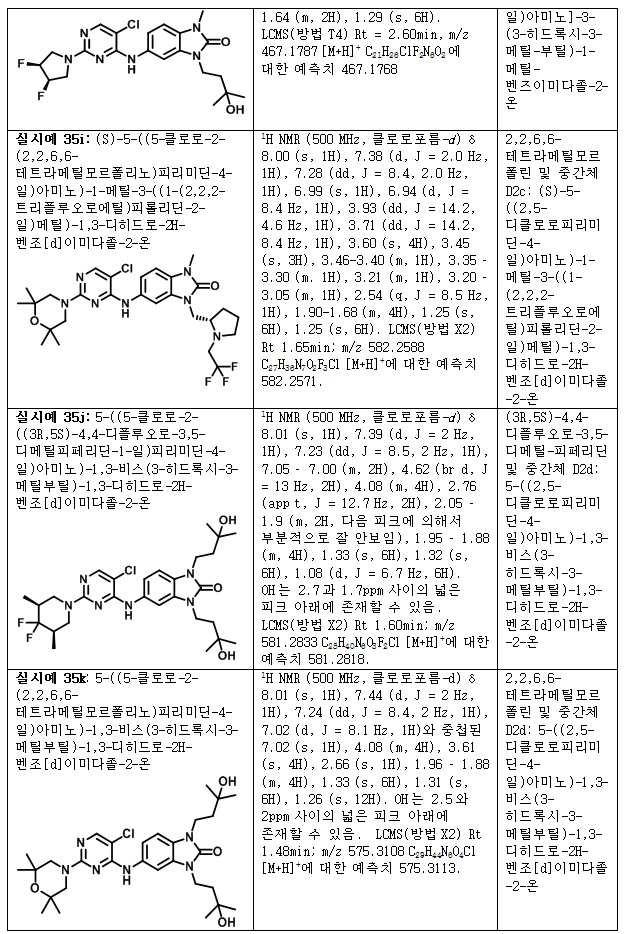


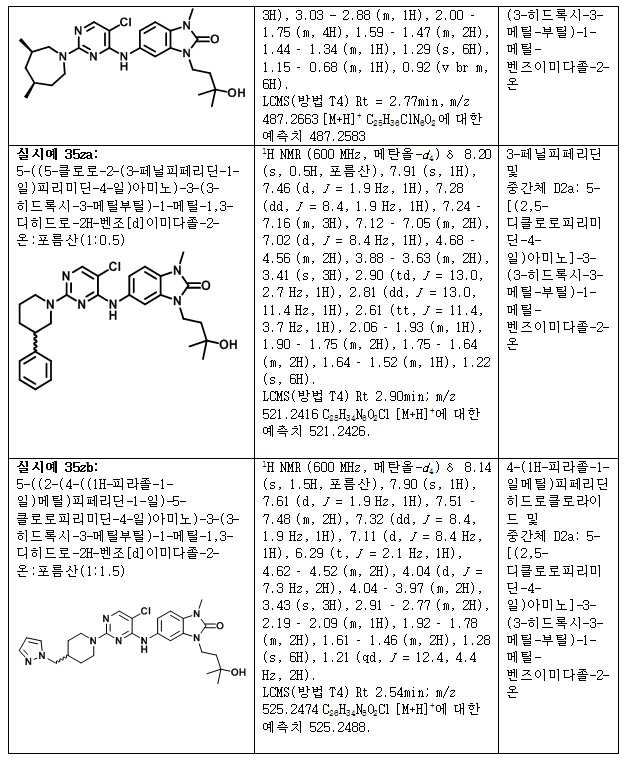
실시예 36a: 5-((5-클로로-2-(4,4-디플루오로피페리딘-1-일)피리딘-4-일)아미노)-3-(3-히드록시-3-메틸부틸)-1-메틸-1,3-디히드로-2H-벤조[d]이미다졸-2-온 Example 36a: 5-((5-chloro-2- (4,4-difluoropiperidin-1-yl) pyridin-4-yl) amino) -3- (3-hydroxy-3-methyl Butyl) -1-methyl-1,3-dihydro-2H-benzo [d] imidazol-2-one
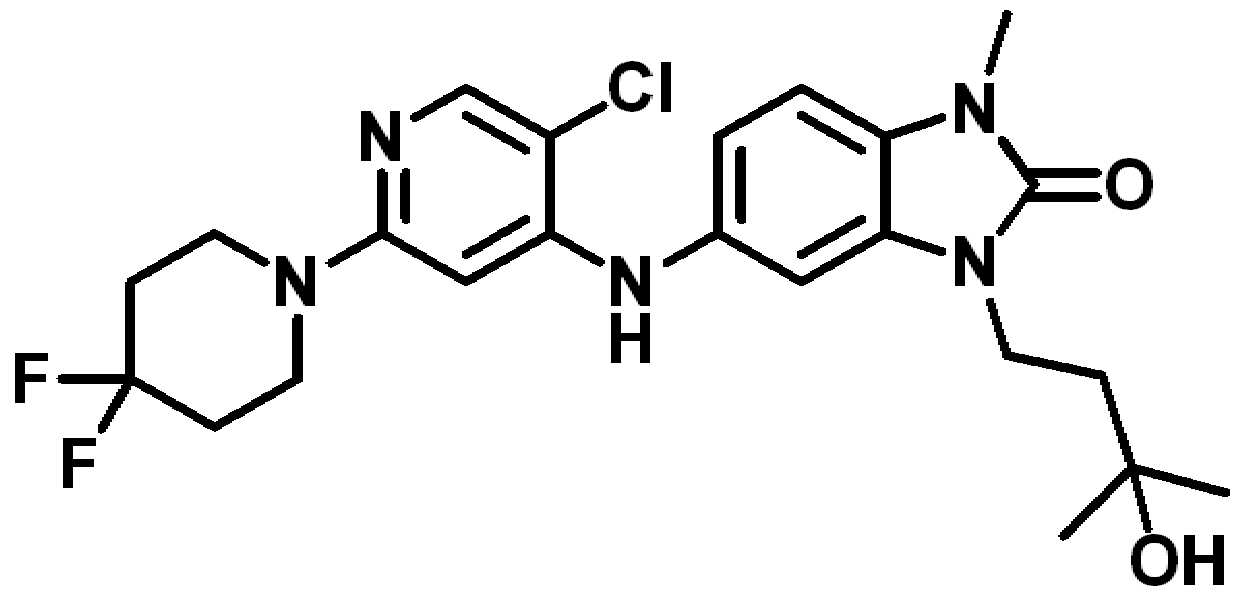
톨루엔:DMF(3:1 v/v, 0.80 mL, 0.08 M) 중의 5-아미노-3-(3-히드록시-3-메틸-부틸)-1-메틸-벤즈이미다졸-2-온(중간체 A1, 15 mg, 0.06 mmol), 5-클로로-2-(4,4-디플루오로-1-피페리딜)-4-아이오도-피리딘(중간체 E3b, 26 mg, 0.07 mmol), 탄산세슘(157 mg, 0.48 mmol), Xantphos(21 mg, 0.04 mmol) 및 트리스(디벤질리덴아세톤)디팔라듐(0)(5.5 mg, 0.006 mmol)의 혼합물을 80℃에서 마이크로웨이브 조사 하에서 1h 동안 가열하였다. 물(10 mL)을 첨가하고, 수성 혼합물을 EtOAc(3 x 10 mL)로 추출하였다. 유기 추출물을 합하고, 염수(10 mL)로 세척하고, 건조하고(MgSO4), 진공에서 농축시켰다. 컬럼 크로마토그래피(Biotage 10 g KP-Sil 컬럼, DCM 중의 0에서 10% MeOH)에 의한 정제는 미지의 불순물을 함유하는 목적하는 생성물을 제공하였고, 이것을 정제용 HPLC 정제(20 mL/min의 유량에서 ACE 5 C18-PFP 컬럼(5 μ, 250x21.2 mm), 40:60에서 25:75 물:메탄올(둘 모두 0.1% 포름산으로 개질됨)로의 15분 구배 용리)에 의해서 제거하여 표제 화합물(4 mg, 14%, 0.0083 mmol)을 고체로서 제공하였다. LCMS(방법 T4): Rt 2.35min, m/z 480.1959, C23H29ClF2N5O3 [M+H]+에 대한 예측치 480.1972. 1H NMR (500 MHz, 메탄올-d4): δ 7.87 (1H, s), 7.20 (1H, d, J 8.4 Hz), 7.16 (1H, d, J 1.8 Hz), 7.09 (1H, dd, J 8.4, 1.8 Hz), 6.20 (1H, s), 4.03 (2H, m), 3.50-3.46 (4H, m), 3.45 (3H, s), 1.99-1.89 (4H, m), 1.86 (2H, m), 1.28 (6H, s).5-amino-3- (3-hydroxy-3-methyl-butyl) -1-methyl-benzimidazol-2-one (intermediate) in toluene: DMF (3: 1 v / v, 0.80 mL, 0.08 M) A1, 15 mg, 0.06 mmol), 5-chloro-2- (4,4-difluoro-1-piperidyl) -4-iodo-pyridine (intermediate E3b, 26 mg, 0.07 mmol), cesium carbonate (157 mg, 0.48 mmol), a mixture of Xantphos (21 mg, 0.04 mmol) and tris (dibenzylideneacetone) dipalladium (0) (5.5 mg, 0.006 mmol) was heated at 80 ° C. for 1 h under microwave irradiation. . Water (10 mL) was added and the aqueous mixture was extracted with EtOAc (3 x 10 mL). The organic extracts were combined, washed with brine (10 mL), dried (MgSO 4) and concentrated in vacuo. Purification by column chromatography (Biotage 10 g KP-Sil column, 0 to 10% MeOH in DCM) gave the desired product containing unknown impurities, which was purified by preparative HPLC purification (at a flow rate of 20 mL / min). Removed by ACE 5 C18-PFP column (5 μ, 250 × 21.2 mm), 40:60 to 25:75 water: methanol (15 minute gradient elution with both modified with 0.1% formic acid) to remove the title compound (4 mg, 14%, 0.0083 mmol) was provided as a solid. LCMS (method T4): Rt 2.35 min, m / z 480.1959, predicted C 23 H 29 ClF 2 N 5 O 3 [M + H] + 480.1972. 1 H NMR (500 MHz, Methanol-d4): δ 7.87 (1H, s), 7.20 (1H, d, J 8.4 Hz), 7.16 (1H, d, J 1.8 Hz), 7.09 (1H, dd, J 8.4 , 1.8 Hz), 6.20 (1H, s), 4.03 (2H, m), 3.50-3.46 (4H, m), 3.45 (3H, s), 1.99-1.89 (4H, m), 1.86 (2H, m) , 1.28 (6H, s).
나타낸 중간체를 사용하여, 실시예 36a의 제조를 위해서 사용된 것과 유사한 방법에 의해서 하기 표로 나타낸 실시예를 제조하였다. 실시예 36e 및 실시예 36f를 140℃까지 가열하였다.Using the intermediates shown, the examples shown in the table below were prepared by methods analogous to those used for the preparation of example 36a. Example 36e and Example 36f were heated to 140 ° C.
[표 15]TABLE 15
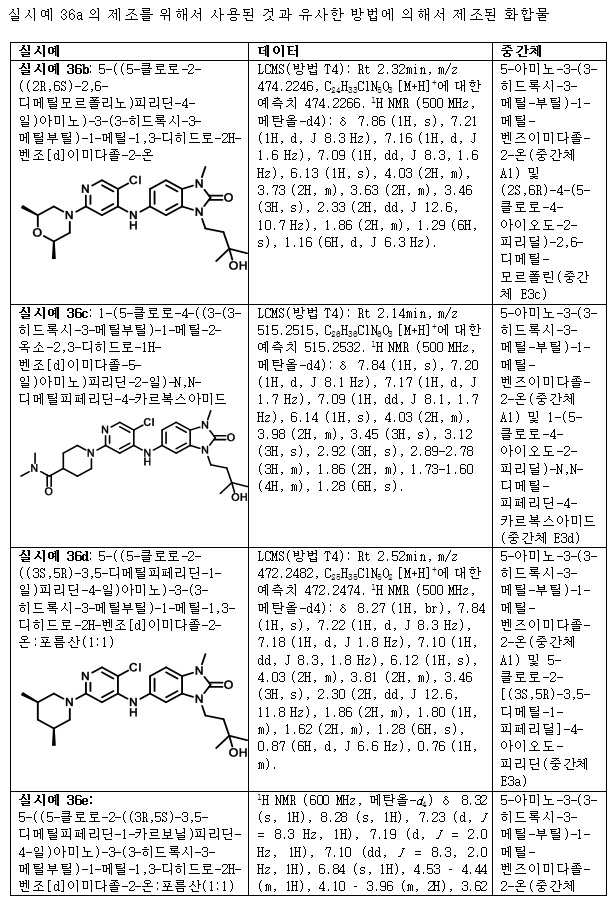
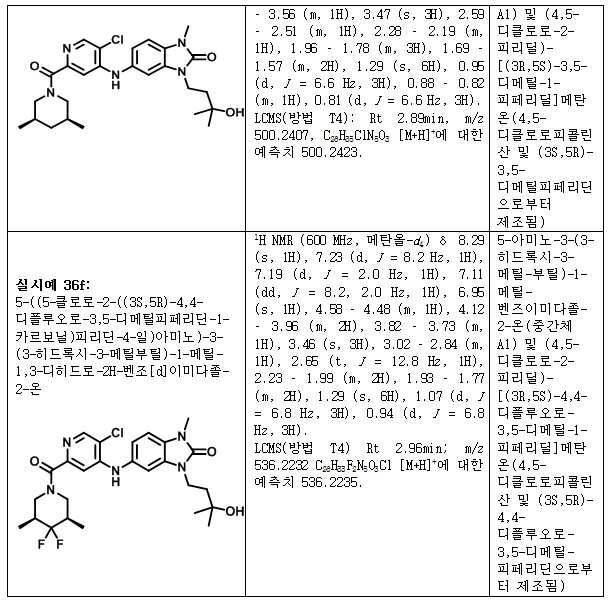
실시예 37a: 5-((5-클로로-2-((3S,5R)-4,4-디플루오로-3,5-디메틸피페리딘-1-일)피리미딘-4-일)아미노)-1-(2-(디메틸아미노)에틸)-3-(3-히드록시-3-메틸부틸)-1,3-디히드로-2H-벤조[d]이미다졸-2-온:포름산(1:2) Example 37a: 5-((5-chloro-2-((3S, 5R) -4,4-difluoro-3,5-dimethylpiperidin-1-yl) pyrimidin-4-yl) amino ) -1- (2- (dimethylamino) ethyl) -3- (3-hydroxy-3-methylbutyl) -1,3-dihydro-2H-benzo [d] imidazol-2-one: formic acid ( 1: 2)

THF(1.1 mL) 중의 2-(5-((5-클로로-2-((3S,5R)-4,4-디플루오로-3,5-디메틸피페리딘-1-일)피리미딘-4-일)아미노)-3-(3-히드록시-3-메틸부틸)-2-옥소-2,3-디히드로-1H-벤조[d]이미다졸-1-일)아세트알데히드(중간체 H1, 30 mg, 0.056 mmol)의 용액에 THF 중의 디메틸아민 용액(56 uL, 0.11 mmol)을 첨가하였다. 반응 혼합물을 rt에서 20min 동안 교반하였다. 이어서 소듐 트리아세톡시보로히드리드(18 mg, 0.084 mmol)를 첨가하였다. 반응 혼합물을 rt에서 24h 동안 교반하였다. 몇 방울의 물을 반응 혼합물에 첨가하고, 그 다음 진공에서 농축시켰다. 이어서 잔류물을 DMSO(1 mL) 중에 취하고, 물 중의 10% 내지 100% MeOH(각각 0.1% 포름산 함유)로 용리시키는 Biotage 역상 12 g C-18 컬럼을 사용하여 직접 정제하여 표제 화합물(19 mg)을 연황색 고체로서 제공하였다. 1H NMR (600 MHz, 클로로포름-d) δ 8.26 (s, 2H, formic), 7.98 (s, 1H), 7.39 (d, J = 2.0 Hz, 1H), 7.22 (dd, J = 8.4, 2.0 Hz, 1H), 7.15 (d, J = 8.4 Hz, 1H), 7.06 (s, 1H), 4.58 (dt, J = 13.1, 4.0 Hz, 2H), 4.26 (t, J = 7.2 Hz, 2H), 4.02 (t, J = 7.4 Hz, 2H), 3.22 (t, J = 7.2 Hz, 2H), 2.79 - 2.68 (m, 8H), 2.01 - 1.85 (m, 4H), 1.29 (s, 6H), 1.04 (d, J = 6.8 Hz, 6H). OH는 관찰되지 않음; LCMS(방법 X4) Rt = 2.71min, m/z 566.2831 [M+H]+ C27H39ClF2N7O2 +에 대한 예측치 566.2822.2- (5-((5-chloro-2-((3S, 5R) -4,4-difluoro-3,5-dimethylpiperidin-1-yl) pyrimidine- in THF (1.1 mL) 4-yl) amino) -3- (3-hydroxy-3-methylbutyl) -2-oxo-2,3-dihydro-1H-benzo [d] imidazol-1-yl) acetaldehyde (intermediate H1 , 30 mg, 0.056 mmol) was added a solution of dimethylamine (56 uL, 0.11 mmol) in THF. The reaction mixture was stirred at rt for 20 min. Sodium triacetoxyborohydride (18 mg, 0.084 mmol) was added. The reaction mixture was stirred at rt for 24 h. A few drops of water were added to the reaction mixture and then concentrated in vacuo. The residue was then taken up in DMSO (1 mL) and purified directly using a Biotage reversed-phase 12 g C-18 column eluting with 10% to 100% MeOH (each containing 0.1% formic acid) in water to give the title compound (19 mg). Was provided as a pale yellow solid. 1 H NMR (600 MHz, Chloroform- d ) δ 8.26 (s, 2H, formic), 7.98 (s, 1H), 7.39 (d, J = 2.0 Hz, 1H), 7.22 (dd, J = 8.4, 2.0 Hz , 1H), 7.15 (d, J = 8.4 Hz, 1H), 7.06 (s, 1H), 4.58 (dt, J = 13.1, 4.0 Hz, 2H), 4.26 (t, J = 7.2 Hz, 2H), 4.02 (t, J = 7.4 Hz, 2H), 3.22 (t, J = 7.2 Hz, 2H), 2.79-2.68 (m, 8H), 2.01-1.85 (m, 4H), 1.29 (s, 6H), 1.04 ( d, J = 6.8 Hz, 6H). OH was not observed; LCMS (Method X4) Rt = 2.71 min, m / z 566.2831 [M + H] + calc'd for C 27 H 39 ClF 2 N 7 O 2 + 566.2822.
실시예 37b: 5-((5-클로로-2-((3S,5R)-4,4-디플루오로-3,5-디메틸피페리딘-1-일)피리미딘-4-일)아미노)-3-(3-히드록시-3-메틸부틸)-1-(2-모르폴리노에틸)-1,3-디히드로-2H-벤조[d]이미다졸-2-온:포름산(1:2) Example 37b: 5-((5-chloro-2-((3S, 5R) -4,4-difluoro-3,5-dimethylpiperidin-1-yl) pyrimidin-4-yl) amino ) -3- (3-hydroxy-3-methylbutyl) -1- (2-morpholinoethyl) -1,3-dihydro-2H-benzo [d] imidazol-2-one: formic acid (1 :2)

모르폴린을 사용하여, 실시예 37a의 제조에 사용된 것과 유사한 방법에 의해서 제조하였다.Using morpholine, it was prepared by a method similar to that used for the preparation of Example 37a.
1H NMR (600 MHz, 클로로포름-d) δ 8.13 (s, 2H, 포르메이트), 7.99 (s, 1H), 7.37 (d, J = 2.0 Hz, 1H), 7.22 (dd, J = 8.4, 2.0 Hz, 1H), 7.09 - 7.03 (m, 2H), 4.59 - 4.54 (m, 2H), 4.17 (t, J = 7.1 Hz, 2H), 4.03 (t, J = 7.3 Hz, 2H), 3.81 (t, J = 4.7 Hz, 4H), 3.01 (t, J = 7.1 Hz, 2H), 2.91 (br. s, 4H), 2.73 (t, J = 12.7 Hz, 2H), 2.02 - 1.86 (m, 4H), 1.30 (s, 6H), 1.04 (d, J = 6.7 Hz, 6H), OH는 관찰되지 않음; LCMS(방법 X4) Rt = 2.77min, m/z 608.2951 [M+H]+ C29H41ClF2N7O3 +에 대한 예측치 608.2927. 1 H NMR (600 MHz, Chloroform- d ) δ 8.13 (s, 2H, formate), 7.99 (s, 1H), 7.37 (d, J = 2.0 Hz, 1H), 7.22 (dd, J = 8.4, 2.0 Hz, 1H), 7.09-7.03 (m, 2H), 4.59-4.54 (m, 2H), 4.17 (t, J = 7.1 Hz, 2H), 4.03 (t, J = 7.3 Hz, 2H), 3.81 (t , J = 4.7 Hz, 4H), 3.01 (t, J = 7.1 Hz, 2H), 2.91 (br. S, 4H), 2.73 (t, J = 12.7 Hz, 2H), 2.02-1.86 (m, 4H) , 1.30 (s, 6H), 1.04 (d, J = 6.7 Hz, 6H), OH not observed; LCMS (method X4) Rt = 2.77 min, m / z 608.2951 [M + H] + calc'd for C 29 H 41 ClF 2 N 7 O 3 + 608.2927.
실시예 38a: 에틸 (E)-4-(5-((5-클로로-2-((3S,5R)-4,4-디플루오로-3,5-디메틸피페리딘-1-일)피리미딘-4-일)아미노)-3-(3-히드록시-3-메틸부틸)-2-옥소-2,3-디히드로-1H-벤조[d]이미다졸-1-일)부트-2-엔오에이트 Example 38a: ethyl (E) -4- (5-((5-chloro-2-((3S, 5R) -4,4-difluoro-3,5-dimethylpiperidin-1-yl) Pyrimidin-4-yl) amino) -3- (3-hydroxy-3-methylbutyl) -2-oxo-2,3-dihydro-1H-benzo [d] imidazol-1-yl) but- 2-enoate

THF(1.1 mL) 중의 2-(5-((5-클로로-2-((3S,5R)-4,4-디플루오로-3,5-디메틸피페리딘-1-일)피리미딘-4-일)아미노)-3-(3-히드록시-3-메틸부틸)-2-옥소-2,3-디히드로-1H-벤조[d]이미다졸-1-일)아세트알데히드(중간체 H1, 30 mg, 0.056 mmol) 및 카르브에톡시메틸렌)트리페닐포스포란(23 mg, 0.067 mmol)의 혼합물을 16h 동안 환류시켰다. 용매를 진공 하에서 제거하고, 이어서 잔류물을 DMSO(1 mL) 중에 취하고, 물 중의 10% 내지 100% MeOH(각각 0.1% 포름산 함유)로 용리시키는 Biotage 역상 12 g C-18 컬럼을 사용하여 직접 정제하여 표제 화합물(16 mg)을 황색 고체로서 제공하였다.2- (5-((5-chloro-2-((3S, 5R) -4,4-difluoro-3,5-dimethylpiperidin-1-yl) pyrimidine- in THF (1.1 mL) 4-yl) amino) -3- (3-hydroxy-3-methylbutyl) -2-oxo-2,3-dihydro-1H-benzo [d] imidazol-1-yl) acetaldehyde (intermediate H1 , 30 mg, 0.056 mmol) and a mixture of carbuethoxymethylene) triphenylphosphorane (23 mg, 0.067 mmol) were refluxed for 16 h. The solvent is removed under vacuum, then the residue is taken up directly in DMSO (1 mL) and purified directly using a Biotage reverse phase 12 g C-18 column eluted with 10% to 100% MeOH (each containing 0.1% formic acid) in water. To give the title compound (16 mg) as a yellow solid.
1H NMR (500 MHz, 클로로포름-d) δ 7.98 (s, 1H), 7.37 (d, J = 2.0 Hz, 1H), 7.19 (dd, J = 8.4, 2.0 Hz, 1H), 7.03 - 6.95 (m, 2H), 6.86 (d, J = 8.4 Hz, 1H), 5.81 (dt, J = 15.7, 1.9 Hz, 1H), 4.66 (dd, J = 4.8, 1.9 Hz, 2H), 4.62 - 4.56 (m, 2H), 4.17 (q, J = 7.1 Hz, 2H), 4.08 - 4.04 (m, 2H), 2.73 (t, J = 12.7 Hz, 2H), 2.03 - 1.87 (m, 4H), 1.30 (s, 6H), 1.25 (t, J = 7.1 Hz, 3H), 1.04 (d, J = 6.7 Hz, 6H), OH는 관찰되지 않음; LCMS(방법 X4) Rt = 3.47min, m/z 607.2627 [M+H]+ C29H38ClF2N6O4 +에 대한 예측치 607.2611. 1 H NMR (500 MHz, Chloroform- d ) δ 7.98 (s, 1H), 7.37 (d, J = 2.0 Hz, 1H), 7.19 (dd, J = 8.4, 2.0 Hz, 1H), 7.03-6.95 (m , 2H), 6.86 (d, J = 8.4 Hz, 1H), 5.81 (dt, J = 15.7, 1.9 Hz, 1H), 4.66 (dd, J = 4.8, 1.9 Hz, 2H), 4.62-4.56 (m, 2H), 4.17 (q, J = 7.1 Hz, 2H), 4.08-4.04 (m, 2H), 2.73 (t, J = 12.7 Hz, 2H), 2.03-1.87 (m, 4H), 1.30 (s, 6H ), 1.25 (t, J = 7.1 Hz, 3H), 1.04 (d, J = 6.7 Hz, 6H), OH not observed; LCMS (Method X4) Rt = 3.47 min, m / z 607.2627 [M + H] + calc'd for C 29 H 38 ClF 2 N 6 O 4 + 607.2611.
실시예 39a: 5-((5-클로로-2-(2,2,2-트리플루오로에톡시)피리미딘-4-일)아미노)-3-(3-히드록시-3-메틸부틸)-1-메틸-1,3-디히드로-2H-벤조[d]이미다졸-2-온 Example 39a: 5-((5-chloro-2- (2,2,2-trifluoroethoxy) pyrimidin-4-yl) amino) -3- (3-hydroxy-3-methylbutyl) -1-methyl-1,3-dihydro-2H-benzo [d] imidazol-2-one

NMP(1.5 mL) 중의 5-[(2,5-디클로로피리미딘-4-일)아미노]-3-(3-히드록시-3-메틸-부틸)-1-메틸-벤즈이미다졸-2-온(11.5 mg, 0.029 mmol), 수소화나트륨(3.5 mg, 0.087 mmol) 및 2,2,2 트리플루오로에탄올 (100 uL)의 혼합물을 rt에서 15min 동안 교반하고, 이어서 마이크로웨이브 조사 하에서 120℃에서 30min 동안 교반하였다. Hplc 정제는 5-[[5-클로로-2-(2,2,2-트리플루오로에톡시)-피리미딘-4-일]아미노]-3-(3-히드록시-3-메틸-부틸)-1-메틸-벤즈이미다졸-2-온(7 mg, 52%, 0.015 mmol)을 백색 고체로서 제공하였다.5-[(2,5-dichloropyrimidin-4-yl) amino] -3- (3-hydroxy-3-methyl-butyl) -1-methyl-benzimidazole-2- in NMP (1.5 mL) A mixture of warm (11.5 mg, 0.029 mmol), sodium hydride (3.5 mg, 0.087 mmol) and 2,2,2 trifluoroethanol (100 uL) was stirred at rt for 15 min and then at 120 ° C. under microwave irradiation. Stir for 30 min. Hplc tablets were purified from 5-[[5-chloro-2- (2,2,2-trifluoroethoxy) -pyrimidin-4-yl] amino] -3- (3-hydroxy-3-methyl-butyl ) -1-methyl-benzimidazol-2-one (7 mg, 52%, 0.015 mmol) was provided as a white solid.
1H NMR (600 MHz, 메탄올-d 4) δ 8.15 (s, 1H), 7.47 (d, J = 2.0 Hz, 1H), 7.32 (dd, J = 8.4, 2.0 Hz, 1H), 7.17 (d, J = 8.4 Hz, 1H), 4.75 (q, J = 8.7 Hz, 2H), 4.14 - 3.85 (m, 2H), 3.45 (s, 3H), 2.01 - 1.70 (m, 2H), 1.30 (s, 6H). 1 H NMR (600 MHz, Methanol- d 4 ) δ 8.15 (s, 1H), 7.47 (d, J = 2.0 Hz, 1H), 7.32 (dd, J = 8.4, 2.0 Hz, 1H), 7.17 (d, J = 8.4 Hz, 1H), 4.75 (q, J = 8.7 Hz, 2H), 4.14-3.85 (m, 2H), 3.45 (s, 3H), 2.01-1.70 (m, 2H), 1.30 (s, 6H ).
LCMS(방법 T4) Rt = 2.86min, m/z 460.1375 [M+H]+ C19H22ClF3N5O3에 대한 예측치 460.1358.LCMS (Method T4) Rt = 2.86 min, m / z 460.1375 [M + H] + calc'd for C 19 H 22 ClF 3 N 5 O 3 , 460.1358.
실시예 40a: 5-[[5-클로로-2-[(3S,5R)-4,4-디플루오로-3,5-디메틸-1-피페리딜]피리미딘-4-일]아미노]-1-(2-히드록시에틸)-3-(3-히드록시-3-메틸-부틸)벤즈이미다졸-2-온 Example 40a: 5-[[5-chloro-2-[(3S, 5R) -4,4-difluoro-3,5-dimethyl-1-piperidyl] pyrimidin-4-yl] amino] -1- (2-hydroxyethyl) -3- (3-hydroxy-3-methyl-butyl) benzimidazol-2-one
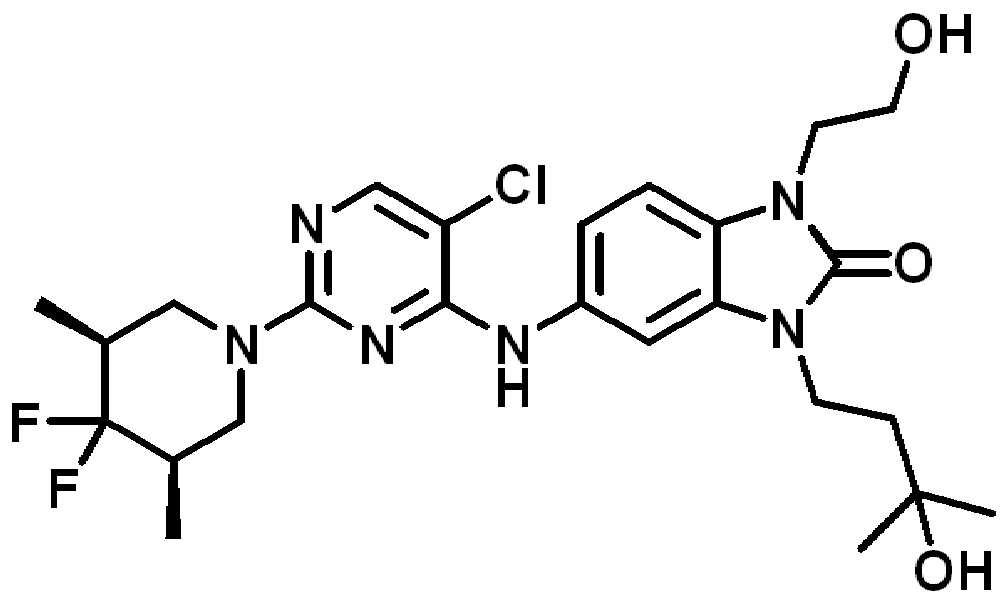
MeOH(1 mL) 중의 2-[5-[[5-클로로-2-[(3S,5R)-4,4-디플루오로-3,5-디메틸-1-피페리딜]피리미딘-4-일]아미노]-3-(3-히드록시-3-메틸-부틸)-2-옥소-벤즈이미다졸-1-일]아세트알데히드(중간체 H1, 20 mg, 0.034 mmol)의 용액에 rt에서 소듐 보로히드리드(3 mg, 0.07 mmol)를 첨가하였다. 혼합물을 2h 동안 교반하였다. 2 M 수성 HCl의 적가에 의해서 혼합물을 켄칭시키고, 이어서 EtOAc를 첨가하고, 층을 분리하고, 수성 층을 추가의 EtOAc로 추출하였다. 합한 유기 층을 염수로 세척하고, MgSO4 상에서 건조하고, 감압 하에서 여과 및 농축시켰다. 정제용 HPLC(ACE 5 C18-PFP 컬럼(5 μ, 250x21.2 mm), 20 mL/min의 유량에서 60:40에서 0:100 물: 메탄올(둘 모두 0.1% 포름산으로 개질됨)로의 15분 구배 용리)정제는 5-[[5-클로로-2-[(3S,5R)-4,4-디플루오로-3,5-디메틸-1-피페리딜]피리미딘-4-일]아미노]-1-(2-히드록시에틸)-3-(3-히드록시-3-메틸-부틸)벤즈이미다졸-2-온(7 mg)을 백색 고체로서 제공하였다.2- [5-[[5-chloro-2-[(3S, 5R) -4,4-difluoro-3,5-dimethyl-1-piperidyl] pyrimidine-4 in MeOH (1 mL) -Yl] amino] -3- (3-hydroxy-3-methyl-butyl) -2-oxo-benzimidazol-1-yl] acetaldehyde (intermediate H1, 20 mg, 0.034 mmol) in rt Sodium borohydride (3 mg, 0.07 mmol) was added. The mixture was stirred for 2 h. The mixture was quenched by the dropwise addition of 2 M aqueous HCl, then EtOAc was added, the layers separated and the aqueous layer extracted with additional EtOAc. The combined organic layers were washed with brine, dried over MgSO 4, filtered and concentrated under reduced pressure. Preparative HPLC (ACE 5 C18-PFP column (5 μ, 250 × 21.2 mm), 15 min with 60:40 to 0: 100 water: methanol (both modified with 0.1% formic acid) at a flow rate of 20 mL / min) Gradient elution) tablets are 5-[[5-chloro-2-[(3S, 5R) -4,4-difluoro-3,5-dimethyl-1-piperidyl] pyrimidin-4-yl] amino ] -1- (2-hydroxyethyl) -3- (3-hydroxy-3-methyl-butyl) benzimidazol-2-one (7 mg) was provided as a white solid.
LCMS(방법 X4): Rt 3.17min, m/z 539.2350, C25H34ClF2N6O3 [M+H]+에 대한 예측치 539.2349. 1H NMR (500 MHz, 메탄올-d4): δ 7.94 (1H, s), 7.38 (1H, d, J 1.6 Hz), 7.35 (1H, dd, J 8.5, 1.6 Hz), 7.21 (1H, d, J 8.5 Hz), 4.54 (2H, br d, J 13.3 Hz), 4.08-3.99 (4H, m), 3.85 (2H, t, J 5.5 Hz), 2.70 (2H, t, J 12.6 Hz), 2.02-1.84 (4H, m), 1.29 (6H, s), 1.01 (6H, d, J 6.6 Hz).LCMS (Method X4): Rt 3.17 min, m / z 539.2350, predicted C 25 H 34 ClF 2 N 6 O 3 [M + H] + 539.2349. 1 H NMR (500 MHz, Methanol-d4): δ 7.94 (1H, s), 7.38 (1H, d, J 1.6 Hz), 7.35 (1H, dd, J 8.5, 1.6 Hz), 7.21 (1H, d, J 8.5 Hz), 4.54 (2H, br d, J 13.3 Hz), 4.08-3.99 (4H, m), 3.85 (2H, t, J 5.5 Hz), 2.70 (2H, t, J 12.6 Hz), 2.02- 1.84 (4H, m), 1.29 (6H, s), 1.01 (6H, d, J 6.6 Hz).
실시예 41a: 5-((5-클로로-2-((3S,5R)-4,4-디플루오로-3,5-디메틸피페리딘-1-일)피리미딘-4-일)아미노)-1-(2,2-디메톡시에틸)-3-(3-히드록시-3-메틸부틸)-1,3-디히드로-2H-벤조[d]이미다졸-2-온 Example 41a: 5-((5-chloro-2-((3S, 5R) -4,4-difluoro-3,5-dimethylpiperidin-1-yl) pyrimidin-4-yl) amino ) -1- (2,2-dimethoxyethyl) -3- (3-hydroxy-3-methylbutyl) -1,3-dihydro-2H-benzo [d] imidazol-2-one

단계 1: N1-(2,2-디메톡시에틸)-4-니트로벤젠-1,2-디아민 Step 1: N1- (2,2-dimethoxyethyl) -4-nitrobenzene-1,2-diamine
NMP(13.5 mL) 중의 2-플루오로-5-니트로아닐린(2.1 g, 13.5 mmol), 아미노아세트알데히드 디메틸 아세탈(2.18 mL, 20.2 mmol) 및 DIPEA(4.7 mL, 26.9 mmol)의 혼합물을 180℃에서 밤새 가열하였다. LCMS(방법 T2) Rt = 1.10min, m/z 242.11 [M+H]+. 혼합물을 rt까지 냉각시키고, 이어서 빙수 중에 붓고, 이어서 EtOAc로 추출하였다. 합한 유기 추출물을 물로 철저히 세척하여 NMP를 제거하고, 이어서 염수, 이어서 MgSO4 상에서 건조하였다. 추가의 정제를 수행하지 않았다.A mixture of 2-fluoro-5-nitroaniline (2.1 g, 13.5 mmol), aminoacetaldehyde dimethyl acetal (2.18 mL, 20.2 mmol) and DIPEA (4.7 mL, 26.9 mmol) in NMP (13.5 mL) at 180 ° C Heated overnight. LCMS (Method T2) Rt = 1.10 min, m / z 242.11 [M + H] < + >. The mixture was cooled to rt and then poured into ice water and then extracted with EtOAc. The combined organic extracts were washed thoroughly with water to remove NMP and then dried over brine and then MgSO 4 . No further purification was done.
단계 2: 1-(2,2-디메톡시에틸)-5-니트로-1,3-디히드로-2H-벤조[d]이미다졸-2-온Step 2: 1- (2,2-dimethoxyethyl) -5-nitro-1,3-dihydro-2H-benzo [d] imidazol-2-one
아세토니트릴(110 mL) 중의 N1-(2,2-디메톡시에틸)-4-니트로벤젠-1,2-디아민 (단계 1, 3.25 g)의 용액에 디석신이미딜 카르보네이트(10.3 g, 40.4 mmol) 그 다음 트리에틸아민(7.5 mL, 54 mmol)을 첨가하였다. 혼합물을 rt에서 2h 동안 교반하였다. 혼합물을 빙수 중에 붓고, 이어서 MeCN을 제거하기 위해서 진공에서 농축시키고, 그 다음 EtOAc로 추출하였다. 유기 추출물을 염수로 세척하고, MgSO4 상에서 건조하였다. 조 잔류물을 시클로헥산 중의 20% 내지 100% EtOAc로 용리시키는 Biotage KP-Sil 340 g에 의해서 정제하여 표제 화합물(0.77 g, 21%, 2.8888 mmol)을 연황색 고체로서 제공하였다. 1H NMR (500 MHz, DMSO-d 6) δ 11.49 (s, 1H), 8.00 (dd, J = 8.8, 2.3 Hz, 1H), 7.76 (d, J = 2.3 Hz, 1H), 7.37 (d, J = 8.8 Hz, 1H), 4.65 (t, J = 5.3 Hz, 1H), 3.96 (d, J = 5.3 Hz, 2H), 3.29 (s, 6H).To a solution of N1- (2,2-dimethoxyethyl) -4-nitrobenzene-1,2-diamine (step 1, 3.25 g) in acetonitrile (110 mL) was dixicinimidyl carbonate (10.3 g, 40.4 mmol) Triethylamine (7.5 mL, 54 mmol) was then added. The mixture was stirred at rt for 2 h. The mixture was poured into ice water and then concentrated in vacuo to remove MeCN and then extracted with EtOAc. The organic extract was washed with brine and dried over MgSO 4 . The crude residue was purified by 340 g Biotage KP-Sil eluting with 20% to 100% EtOAc in cyclohexane to give the title compound (0.77 g, 21%, 2.8888 mmol) as a pale yellow solid. 1 H NMR (500 MHz, DMSO- d 6 ) δ 11.49 (s, 1H), 8.00 (dd, J = 8.8, 2.3 Hz, 1H), 7.76 (d, J = 2.3 Hz, 1H), 7.37 (d, J = 8.8 Hz, 1H), 4.65 (t, J = 5.3 Hz, 1H), 3.96 (d, J = 5.3 Hz, 2H), 3.29 (s, 6H).
단계 3: 1-(2,2-디메톡시에틸)-3-(3-히드록시-3-메틸부틸)-5-니트로-1,3-디히드로-2H-벤조[d]이미다졸-2-온 Step 3: 1- (2,2-dimethoxyethyl) -3- (3-hydroxy-3-methylbutyl) -5-nitro-1,3-dihydro-2H-benzo [d] imidazole-2 -On
(3-히드록시-3-메틸-부틸) 4-메틸벤젠설포네이트(중간체 C1a, 1.12 g, 4.3 mmol), 탄산세슘(1.88 g, 5.8 mmol), 3-(2,2-디메톡시에틸)-6-니트로-1H-벤즈이미다졸-2-온(단계 2, 0.77 g, 2.88 mmol) 및 아세토니트릴(14.4 mL)의 혼합물을 1시간 동안 환류시켰다. 혼합물을 진공에서 농축시켜 MeCN을 제거하였다. 이어서 잔류물을 물로 희석시키고, EtOAc로 추출하였다. 유기 추출물을 MgSO4 상에서 건조하고, 농축시켰다. 이어서 잔류물을 시클로헥산 중의 40% 내지 80% EtOAc로 용리시키는 Biotage KP-Sil 25g에 의해서 정제하여 1-(2,2-디메톡시에틸)-3-(3-히드록시-3-메틸-부틸)-5-니트로-벤즈이미다졸-2-온(1 g)을 황색 점성 오일로서 제공하였고, 이것을 진공 하에서 결정화하였다. 1H NMR (500 MHz, 클로로포름-d) δ 8.07 (dd, J = 8.7, 2.2 Hz, 1H), 7.92 (d, J = 2.2 Hz, 1H), 7.20 (d, J = 8.7 Hz, 1H), 4.58 (t, J = 5.2 Hz, 1H), 4.14 - 4.08 (m, 2H), 4.01 (d, J = 5.1 Hz, 2H), 3.40 (s, 6H), 1.95 - 1.89 (m, 2H), 1.31 (s, 6H); LCMS(방법 T2) Rt = 1.34min, m/z 354.17 [M+H]+.(3-hydroxy-3-methyl-butyl) 4-methylbenzenesulfonate (intermediate C1a, 1.12 g, 4.3 mmol), cesium carbonate (1.88 g, 5.8 mmol), 3- (2,2-dimethoxyethyl) A mixture of -6-nitro-1H-benzimidazol-2-one (step 2, 0.77 g, 2.88 mmol) and acetonitrile (14.4 mL) was refluxed for 1 hour. The mixture was concentrated in vacuo to remove MeCN. The residue was then diluted with water and extracted with EtOAc. The organic extract was dried over MgSO 4 and concentrated. The residue was then purified by 25 g Biotage KP-Sil eluting with 40% to 80% EtOAc in cyclohexane to give 1- (2,2-dimethoxyethyl) -3- (3-hydroxy-3-methyl-butyl ) -5-nitro-benzimidazol-2-one (1 g) was provided as a yellow viscous oil, which crystallized under vacuum. 1 H NMR (500 MHz, Chloroform- d ) δ 8.07 (dd, J = 8.7, 2.2 Hz, 1H), 7.92 (d, J = 2.2 Hz, 1H), 7.20 (d, J = 8.7 Hz, 1H), 4.58 (t, J = 5.2 Hz, 1H), 4.14-4.08 (m, 2H), 4.01 (d, J = 5.1 Hz, 2H), 3.40 (s, 6H), 1.95-1.89 (m, 2H), 1.31 (s, 6H); LCMS (Method T2) Rt = 1.34 min, m / z 354.17 [M + H] + .
단계 4: 5-아미노-1-(2,2-디메톡시에틸)-3-(3-히드록시-3-메틸부틸)-1,3-디히드로-2H-벤조[d]이미다졸-2-온 Step 4: 5-amino-1- (2,2-dimethoxyethyl) -3- (3-hydroxy-3-methylbutyl) -1,3-dihydro-2H-benzo [d] imidazole-2 -On
Pd/C(10 wt%)(50 mg, 0.047 mmol)를 에틸 아세테이트(8.8 mL) 중의 1-(2,2-디메톡시에틸)-3-(3-히드록시-3-메틸-부틸)-5-니트로-벤즈이미다졸-2-온(단계 3, 0.62 g, 1.77 mmol)의 용액에 첨가하고, 이어서 수소 분위기 하에 두고, 60℃에서 밤새 교반하였다. 혼합물을 질소 분위기에 재도입하고, 이어서 CeliteTM 패드를 통해서 여과하고, 에틸 아세테이트로 세척하고, 이어서 진공에서 농축시켜 약간의 잔류하는 용매가 존재하는 5-아미노-1-(2,2-디메톡시에틸)-3-(3-히드록시-3-메틸-부틸)벤즈이미다졸-2-온(598 mg)을 연갈색 오일로서 제공하였다. LCMS(방법 T2) Rt = 0.74min, m/z 324.22 [M+H]+.Pd / C (10 wt%) (50 mg, 0.047 mmol) was dissolved in 1- (2,2-dimethoxyethyl) -3- (3-hydroxy-3-methyl-butyl)-in ethyl acetate (8.8 mL). To a solution of 5-nitro-benzimidazol-2-one (step 3, 0.62 g, 1.77 mmol) was then added under hydrogen atmosphere and stirred at 60 ° C. overnight. The mixture is reintroduced into a nitrogen atmosphere, then filtered through a Celite ™ pad, washed with ethyl acetate and then concentrated in vacuo to afford 5-amino-1- (2,2-dimethoxy with some residual solvent. Ethyl) -3- (3-hydroxy-3-methyl-butyl) benzimidazol-2-one (598 mg) was provided as a light brown oil. LCMS (Method T2) Rt = 0.74 min, m / z 324.22 [M + H] + .
단계 5: 5-((5-클로로-2-((3S,5R)-4,4-디플루오로-3,5-디메틸피페리딘-1-일)피리미딘-4-일)아미노)-1-(2,2-디메톡시에틸)-3-(3-히드록시-3-메틸부틸)-1,3-디히드로-2H-벤조[d]이미다졸-2-온 Step 5: 5-((5-chloro-2-((3S, 5R) -4,4-difluoro-3,5-dimethylpiperidin-1-yl) pyrimidin-4-yl) amino) -1- (2,2-dimethoxyethyl) -3- (3-hydroxy-3-methylbutyl) -1,3-dihydro-2H-benzo [d] imidazol-2-one
NMP(4.4 mL) 중의 5-아미노-1-(2,2-디메톡시에틸)-3-(3-히드록시-3-메틸-부틸)벤즈이미다졸-2-온(단계 4, 284 mg, 0.88 mmol), 2,4,5-트리클로로피리미딘(0.24 g, 1.32 mmol), 및 DIPEA(0.38 mL, 2.2 mmol)의 혼합물을 마이크로웨이브에서 1h 동안 140℃에서 가열하였다. (3R,5S)-4,4-디플루오로-3,5-디메틸-피페리딘히드로클로라이드(0.36 g, 1.93 mmol)를 혼합물에 첨가하고, 이어서 이것을 추가의 마이크로웨이브에서 2h 동안 140℃에서 가열하였다. 생성된 혼합물을 역상 크로마토그래피(물 중의 10% 내지 100% MeOH로 용리시키는 30 g C18 컬럼(0.1% 포름산 함유))을 사용하여 2개의 배치로 정제하여 표제 화합물(375 mg)을 황색 고체로서 제공하였다.5-amino-1- (2,2-dimethoxyethyl) -3- (3-hydroxy-3-methyl-butyl) benzimidazol-2-one (step 4, 284 mg, in NMP (4.4 mL), 0.88 mmol), 2,4,5-trichloropyrimidine (0.24 g, 1.32 mmol), and DIPEA (0.38 mL, 2.2 mmol) were heated in a microwave at 140 ° C. for 1 h. (3R, 5S) -4,4-Difluoro-3,5-dimethyl-piperidine hydrochloride (0.36 g, 1.93 mmol) was added to the mixture, which was then added at 140 ° C. for 2 h in a further microwave. Heated. The resulting mixture was purified in two batches using reverse phase chromatography (30 g C18 column eluting with 10% to 100% MeOH in water) containing 0.1% formic acid to give the title compound (375 mg) as a yellow solid. It was.
1H NMR (600 MHz, 클로로포름-d) δ 7.98 (s, 1H), 7.32 (d, J = 2.0 Hz, 1H), 7.20 (dd, J = 8.4, 2.0 Hz, 1H), 7.10 (d, J = 8.4 Hz, 1H), 7.00 (s, 1H), 4.63 (t, J = 5.3 Hz, 1H), 4.61 - 4.55 (m, 2H), 4.05 (t, J = 7.3 Hz, 2H), 3.98 (d, J = 5.3 Hz, 2H), 3.41 (s, 6H), 2.73 (t, J = 12.7 Hz, 2H), 2.02 - 1.86 (m, 4H), 1.29 (s, 6H), 1.05 (d, J = 6.8 Hz, 6H), OH는 관찰되지 않음; LCMS(방법 X4) Rt = 3.47min, m/z 583.2621 [M+H]+ C27H38ClF2N6O4 +에 대한 예측치 583.2611. 1 H NMR (600 MHz, Chloroform- d ) δ 7.98 (s, 1H), 7.32 (d, J = 2.0 Hz, 1H), 7.20 (dd, J = 8.4, 2.0 Hz, 1H), 7.10 (d, J = 8.4 Hz, 1H), 7.00 (s, 1H), 4.63 (t, J = 5.3 Hz, 1H), 4.61-4.55 (m, 2H), 4.05 (t, J = 7.3 Hz, 2H), 3.98 (d , J = 5.3 Hz, 2H), 3.41 (s, 6H), 2.73 (t, J = 12.7 Hz, 2H), 2.02-1.86 (m, 4H), 1.29 (s, 6H), 1.05 (d, J = 6.8 Hz, 6H), OH not observed; LCMS (Method X4) Rt = 3.47 min, m / z 583.2621 [M + H] + calc'd for C 27 H 38 ClF 2 N 6 O 4 + 583.2611.
중간체 D2a (5-[(2,5-디클로로피리미딘-4-일)아미노]-3-(3-히드록시-3-메틸-부틸)-1-메틸-벤즈이미다졸-2-온) 및 상업적인 공급원으로부터 입수되거나 공지된 방법에 의해서 제조된 유리 염기 또는 염으로서의 적합한 아민을 사용하여, 실시예 35a의 제조를 위해서 사용된 것과 유사한 방법에 의해서 하기 표로 나타낸 실시예를 제조하였다.Intermediate D2a (5-[(2,5-dichloropyrimidin-4-yl) amino] -3- (3-hydroxy-3-methyl-butyl) -1-methyl-benzimidazol-2-one) and Using the appropriate amines as free bases or salts obtained from commercial sources or prepared by known methods, the examples shown in the table below were prepared by methods similar to those used for the preparation of Example 35a.
[표 15b]Table 15b


실시예의 제조에 사용된 중간체Intermediates Used in the Preparation of the Examples
중간체 A1: 5-아미노-3-(3-히드록시-3-메틸-부틸)-1-메틸-벤즈이미다졸-2-온Intermediate A1: 5-Amino-3- (3-hydroxy-3-methyl-butyl) -1-methyl-benzimidazol-2-one
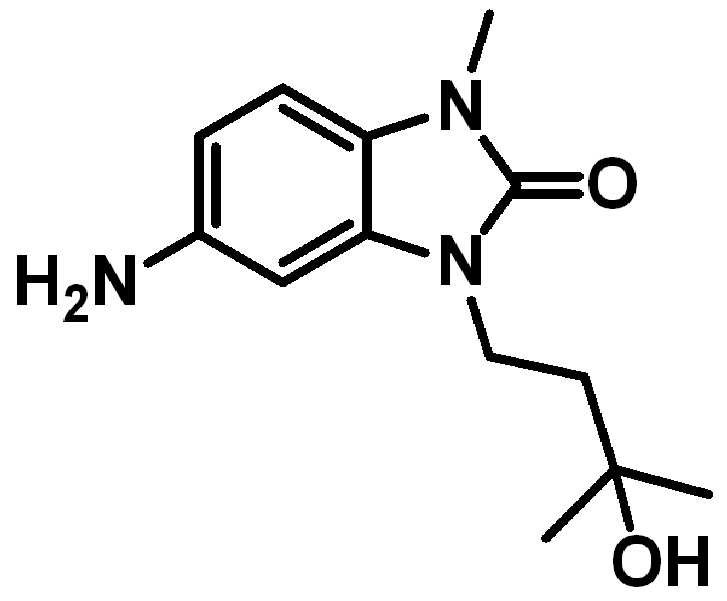
아르곤 분위기 하에서 활성화 차콜 상의 팔라듐(10% Pd, 28 mg, 0.27 mmol)을 에탄올(20 mL) 중의 포름산암모늄(4.0 g, 63.4 mmol) 및 3-(3-히드록시-3-메틸-부틸)-1-메틸-5-니트로-벤즈이미다졸-2-온(중간체 B1a, 2.53 g, 9.1 mmol)의 교반 혼합물에 첨가하였다. 생성된 혼합물을 60℃까지 45분 가열하고, 이어서 실온까지 냉각시키고, 추가의 에탄올(60 mL)로 세척하면서 (아르곤 하에서) CeliteTM 패드로 여과하였다. 생성된 용액을 감압 하에서 증발시켰다. Et2O:EtOAc(1:1)를 첨가하고, 생성된 침전물을 여과에 의해서 제거하였다. 용매를 감압 하에서 증발시키고, 표제 화합물(2.15 g)을 황색 발포체로서 제공하였다. 1H NMR (500 MHz, 메탄올-d 4 ): δ 6.90 (1H, d, J, 8.1 Hz), 6.63 (1H, d, J 1.9 Hz), 6.58 (1H, dd, J 8.1, 1.9 Hz), 3.95 (2H, m), 3.36 (3H, s), 1.84 (2H, m), 1.29 (6H, s). LCMS(방법 T2) Rt 0.18min; m/z 250.1543 [M+H]+.Palladium on activated charcoal (10% Pd, 28 mg, 0.27 mmol) under argon atmosphere was added ammonium formate (4.0 g, 63.4 mmol) and 3- (3-hydroxy-3-methyl-butyl)-in ethanol (20 mL). To a stirred mixture of 1-methyl-5-nitro-benzimidazol-2-one (Intermediate Bla, 2.53 g, 9.1 mmol) was added. The resulting mixture was heated to 60 ° C. for 45 minutes, then cooled to room temperature and filtered through a Celite ™ pad (under argon) washing with additional ethanol (60 mL). The resulting solution was evaporated under reduced pressure. Et 2 O: EtOAc (1: 1) was added and the resulting precipitate was removed by filtration. The solvent was evaporated under reduced pressure and the title compound (2.15 g) provided as a yellow foam. 1 H NMR (500 MHz, Methanol- d 4 ): δ 6.90 (1H, d, J, 8.1 Hz), 6.63 (1H, d, J 1.9 Hz), 6.58 (1H, dd, J 8.1, 1.9 Hz), 3.95 (2H, m), 3.36 (3H, s), 1.84 (2H, m), 1.29 (6H, s). LCMS (Method T2) Rt 0.18 min; m / z 250.1543 [M + H] + .
중간체 A2: 5-아미노-1-메틸-3-[(3S)-3-피라졸-1-일부틸]벤즈이미다졸-2-온 Intermediate A2: 5-amino-1-methyl-3-[( 3S ) -3-pyrazol-1-ylbutyl] benzimidazol-2-one

질소 분위기 하에서 에탄올(0.5 mL) 중의 1-메틸-5-니트로-3-[(3S)-3-피라졸-1-일부틸]벤즈이미다졸-2-온(중간체 B2, 15mg, 0.048 mmol)을 Pd/C(10 wt%)(2 mg) 및 포름산암모늄(30 mg, 0.48 mmol)이 충전된 오븐 건조된 밀폐된 바이알에 적가하였다. 생성된 혼합물을 60℃까지 60min 동안 가열하고, 이어서 냉각시키고, 추가의 에탄올(12 mL)로 세척하면서 CeliteTM 패드 및 PL-HCO3 컬럼(200 mg)에 통과시키고, 이어서 감압 하에서 증발시켰다. 혼합물을 DCM 중에 재용해시키고, sat. aq 중탄산나트륨으로 세척하여 모든 포름산의 제거를 보장하였다. 증발 후, 물질을 추가의 정제 없이 사용하였다. LCMS(방법 T2) Rt 0.58min; m/z 286.17 [M+H]+.1-Methyl-5-nitro-3-[( 3S ) -3-pyrazol-1-ylbutyl] benzimidazol-2-one (intermediate B2, 15 mg, 0.048 mmol in ethanol (0.5 mL) under nitrogen atmosphere) ) Was added dropwise to an oven dried closed vial filled with Pd / C (10 wt%) (2 mg) and ammonium formate (30 mg, 0.48 mmol). The resulting mixture was heated to 60 ° C. for 60 min, then cooled, passed through a Celite ™ pad and PL-HCO 3 column (200 mg), washed with additional ethanol (12 mL), and then evaporated under reduced pressure. The mixture was redissolved in DCM and sat. Washing with aq sodium bicarbonate ensured removal of all formic acid. After evaporation, the material was used without further purification. LCMS (Method T2) Rt 0.58 min; m / z 286.17 [M + H] + .
중간체 A3a: 메틸 4-(6-아미노-3-메틸-2-옥소-벤즈이미다졸-1-일)-2-메틸-부탄오에이트Intermediate A3a: Methyl 4- (6-amino-3-methyl-2-oxo-benzimidazol-1-yl) -2-methyl-butanoate

아르곤 하에서 메탄올(10 mL) 중의 메틸 2-메틸-4-(3-메틸-6-니트로-2-옥소-벤즈이미다졸-1-일)부탄오에이트(중간체 B3a, 309 mg, 1.0 mmol), 포름산암모늄 (379 mg, 6.0 mmol) 및 10 wt% Pd/C(29 mg, 0.03 mmol)의 혼합물을 100℃에서 마이크로웨이브 조사 하에서 90min 동안 가열하였다. 조 반응 혼합물을 CeliteTM를 통해서 여과하고, 침전물을 메탄올(120 mL)로 세척하였다. 여과액을 진공에서 농축시켜 표제 화합물(275 mg)을 갈색 고체로서 제공하였고, 이를 추가의 정제 없이 사용하였다. 1H NMR (500 MHz, 메탄올-d 4 ) δ 6.89 (d, J = 8.3 Hz, 1H), 6.61 (d, J = 2.0 Hz, 1H), 6.57 (dd, J = 8.3, 2.0 Hz, 1H), 3.93 - 3.82 (m, 2H), 3.58 (s, 3H), 3.35 (s, 3H), 2.55 - 2.47 (m, 1H), 2.16 - 2.07 (m, 1H), 1.85 - 1.76 (m, 1H), 1.21 (d, J = 7.1 Hz, 3H).Methyl 2-methyl-4- (3-methyl-6-nitro-2-oxo-benzimidazol-1-yl) butanoate (intermediate B3a, 309 mg, 1.0 mmol) in methanol (10 mL) under argon, A mixture of ammonium formate (379 mg, 6.0 mmol) and 10 wt% Pd / C (29 mg, 0.03 mmol) was heated at 100 ° C. for 90 min under microwave irradiation. The crude reaction mixture was filtered through Celite ™ and the precipitate was washed with methanol (120 mL). The filtrate was concentrated in vacuo to give the title compound (275 mg) as a brown solid which was used without further purification. 1 H NMR (500 MHz, Methanol- d 4 ) δ 6.89 (d, J = 8.3 Hz, 1H), 6.61 (d, J = 2.0 Hz, 1H), 6.57 (dd, J = 8.3, 2.0 Hz, 1H) , 3.93-3.82 (m, 2H), 3.58 (s, 3H), 3.35 (s, 3H), 2.55-2.47 (m, 1H), 2.16-2.07 (m, 1H), 1.85-1.76 (m, 1H) , 1.21 (d, J = 7.1 Hz, 3H).
중간체 A3b: 메틸 3-(6-아미노-3-메틸-2-옥소-벤즈이미다졸-1-일)-2-메틸-프로판오에이트Intermediate A3b: Methyl 3- (6-amino-3-methyl-2-oxo-benzimidazol-1-yl) -2-methyl-propanoate

120℃에서 45min 동안 가열하면서, 메틸 2-메틸-3-(3-메틸-6-니트로-2-옥소-벤즈이미다졸-1-일)프로판오에이트(중간체 B3b)를 사용하여, 실시예 A3a의 제조를 위해서 사용된 것과 유사한 방법에 의해서 제조하였다. 1H NMR (500 MHz, 메탄올-d 4 ) δ 6.89 (d, J = 8.2 Hz, 1H), 6.60 (d, J = 2.0 Hz, 1H), 6.57 (dd, J = 8.2, 2.0 Hz, 1H), 4.06 (dd, J = 14.4, 7.9 Hz, 1H), 3.91 (dd, J = 14.4, 6.8 Hz, 1H), 3.59 (s, 3H), 3.34 (s, 3H), 3.05 - 2.97 (m, 1H), 1.18 (d, J = 7.1 Hz, 3H).Example A3a using methyl 2-methyl-3- (3-methyl-6-nitro-2-oxo-benzimidazol-1-yl) propanoate (Intermediate B3b) while heating at 120 ° C. for 45 min. It was prepared by a method similar to that used for the preparation of. 1 H NMR (500 MHz, Methanol- d 4 ) δ 6.89 (d, J = 8.2 Hz, 1H), 6.60 (d, J = 2.0 Hz, 1H), 6.57 (dd, J = 8.2, 2.0 Hz, 1H) , 4.06 (dd, J = 14.4, 7.9 Hz, 1H), 3.91 (dd, J = 14.4, 6.8 Hz, 1H), 3.59 (s, 3H), 3.34 (s, 3H), 3.05-2.97 (m, 1H ), 1.18 (d, J = 7.1 Hz, 3H).
중간체 A3c: 5-아미노-3-[(3R)-3-히드록시부틸]-1-메틸-벤즈이미다졸-2-온 Intermediate A3c: 5-Amino-3-[( 3R ) -3-hydroxybutyl] -1-methyl-benzimidazol-2-one

중간체 B1b 3-[(3R)-3-히드록시부틸]-1-메틸-5-니트로-벤즈이미다졸-2-온 및 용매로서 에탄올을 사용하여 실시예 A3a의 제조를 위해서 사용된 것과 유사한 방법에 의해서 제조하였다. LCMS(방법 X2) Rt 0.47min; m/z 258.12 [M+Na]+.Intermediate Blb 3-[( 3R ) -3-hydroxybutyl] -1-methyl-5-nitro-benzimidazol-2-one and similar to that used for the preparation of Example A3a using ethanol as solvent It was prepared by the method. LCMS (Method X2) Rt 0.47 min; m / z 258.12 [M + Na] + .
중간체 A4a: 5-아미노-3-(3-히드록시-3-메틸-부틸)-1-(테트라히드로피란-4-일메틸)벤즈이미다졸-2-온Intermediate A4a: 5-amino-3- (3-hydroxy-3-methyl-butyl) -1- (tetrahydropyran-4-ylmethyl) benzimidazol-2-one

아르곤 분위기 하에서 에탄올(3 mL) 중의 3-(3-히드록시-3-메틸-부틸)-5-니트로-1-(테트라히드로피란-4-일메틸)벤즈이미다졸-2-온(중간체 B7, 50 mg, 0.14 mmol)를 Pd/C(10 wt%)(3.7 mg, 0.0035 mmol) 및 포름산암모늄(40 mg, 0.63 mmol)이 충전된 오븐 건조된 밀폐된 바이알에 적가하였다. 생성된 혼합물을 아르곤으로 3회 진공화 및 재충전시키고, 이어서 60℃까지 30min 동안 가열하였다. 실온까지 냉각시키고, 추가의 에탄올로 세척하면서 CeliteTM를 통해서 MP-탄산염 수지(100 mg)를 함유하는 플라스크 내로 여과하였다. 10min 정치 후, 액체를 경사분리하여 수지를 제거하고, 감압 하에서 증발시켜 표제 화합물(42 mg)을 투명한 오일로서 제공하였고, 이것은 정치 시 서서히 갈색으로 변했다. LCMS(방법 X2) Rt 0.70min; m/z 334.21.3- (3-hydroxy-3-methyl-butyl) -5-nitro-1- (tetrahydropyran-4-ylmethyl) benzimidazol-2-one (intermediate B7 in ethanol (3 mL) under argon atmosphere , 50 mg, 0.14 mmol) was added dropwise to an oven dried closed vial filled with Pd / C (10 wt%) (3.7 mg, 0.0035 mmol) and ammonium formate (40 mg, 0.63 mmol). The resulting mixture was evacuated and backfilled with argon three times and then heated to 60 ° C. for 30 min. Cool to room temperature and filter through a Celite ™ into a flask containing MP-carbonate resin (100 mg) while washing with additional ethanol. After 10 min standing, the liquid was decanted to remove the resin and evaporated under reduced pressure to give the title compound (42 mg) as a clear oil which slowly turned brown upon standing. LCMS (Method X2) Rt 0.70 min; m / z 334.21.
중간체 A4b: N-[3-(6-아미노-3-메틸-2-옥소-벤즈이미다졸-1-일)-1,1-디메틸-프로필]아세트아미드 N5041-91 bbellenieIntermediate A4b: N- [3- (6-Amino-3-methyl-2-oxo-benzimidazol-1-yl) -1,1-dimethyl-propyl] acetamide N5041-91 bbellenie
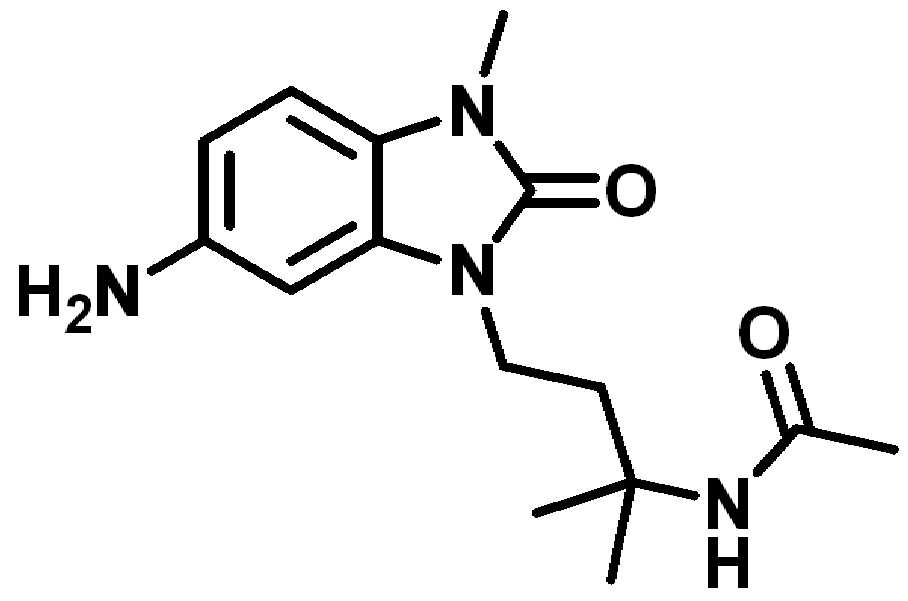
70℃에서 20분 동안 가열하면서, 중간체 A4a의 제조를 위해서 사용된 것과 유사한 방법을 사용하여, N-[1,1-디메틸-3-(3-메틸-6-니트로-2-옥소-벤즈이미다졸-1-일)프로필]아세트아미드(중간체 B11)로부터 제조하였다. LCMS(방법 X2) Rt 0.63min; m/z 291.18.While heating at 70 ° C. for 20 minutes, N- [1,1-dimethyl-3- (3-methyl-6-nitro-2-oxo-benzimimi) using a method similar to that used for preparation of intermediate A4a Dazol-1-yl) propyl] acetamide (intermediate B11). LCMS (Method X2) Rt 0.63 min; m / z 291.18.
중간체 A5: 5-아미노-3-(2-히드록시부틸)-1-메틸-1H-벤조[d]이미다졸-2(3H)-온 Intermediate A5: 5-Amino-3- (2-hydroxybutyl) -1-methyl-1 H -benzo [d] imidazol-2 ( 3H ) -one

에탄올(10 mL) 중의 3-(2-히드록시부틸)-1-메틸-5-니트로-1H-벤조[d]이미다졸-2(3H)-온(중간체 B5, 100 mg, 0.38 mmol)의 용액에 Pd/C(2 mg)를 첨가하고, 생성된 혼합물을 수소 분위기 하에서 3h 동안 교반하고, 이어서 CeliteTM를 통해서 여과하고, 감압 하에서 농축시켜 표제 화합물(76 mg)을 제공하였다. 1H NMR (500 MHz, 메탄올-d4) δ 6.90 (d, J = 8.5 Hz, 1H), 6.67 (d, J = 2.1 Hz, 1H), 6.58 (dd, J = 8.5, 2.1 Hz, 1H), 3.87 - 3.76 (m, 3H), 3.37 (s, 3H), 1.59 (m, 1H), 1.47 (m, 1H), 1.02 (t, J = 7.6 Hz, 3H).3- (2-hydroxybutyl) -1-methyl-5-nitro-1 H -benzo [d] imidazol-2 ( 3H ) -one (intermediate B5, 100 mg, 0.38 mmol in ethanol (10 mL) Pd / C (2 mg) was added to the solution, and the resulting mixture was stirred for 3 h under hydrogen atmosphere, then filtered through Celite ™ and concentrated under reduced pressure to give the title compound (76 mg). 1 H NMR (500 MHz, Methanol-d4) δ 6.90 (d, J = 8.5 Hz, 1H), 6.67 (d, J = 2.1 Hz, 1H), 6.58 (dd, J = 8.5, 2.1 Hz, 1H), 3.87-3.76 (m, 3H), 3.37 (s, 3H), 1.59 (m, 1H), 1.47 (m, 1H), 1.02 (t, J = 7.6 Hz, 3H).
중간체 A6a: 6-아미노-5-플루오로-1-(3-히드록시-3-메틸-부틸)-3-메틸-벤즈이미다졸-2-온Intermediate A6a: 6-Amino-5-fluoro-1- (3-hydroxy-3-methyl-butyl) -3-methyl-benzimidazol-2-one

탈기되고, 질소 하에 둔 에탄올(2 mL) 중의 5-플루오로-1-(3-히드록시-3-메틸-부틸)-3-메틸-6-니트로-벤즈이미다졸-2-온(중간체 B10, 115 mg, 0.39 mmol)의 현탁액에 Pd/C(10 wt%)(14 mg, 0.013 mmol)를 첨가하였다. 질소를 수소로 대체하고, 생성된 혼합물을 H2 분위기 하에서 5시간 동안 교반하였다. 수소 분위기를 질소로 대체하고, EtOAc 및 MeOH로 세척하면서 현탁액을 CeliteTM 통해서 여과시켰다. 용매를 감압 하에서 증발시켜 표제 화합물(85 mg)을 발포체로서 제공하였다. LCMS(방법 T2) Rt 0.89min, m/z 268 [M+H]+ Degassed, 5-fluoro-1- (3-hydroxy-3-methyl-butyl) -3-methyl-6-nitro-benzimidazol-2-one (intermediate B10) in ethanol (2 mL) placed under nitrogen , 115 mg, 0.39 mmol) was added Pd / C (10 wt%) (14 mg, 0.013 mmol). Nitrogen was replaced with hydrogen and the resulting mixture was stirred for 5 hours under H 2 atmosphere. The hydrogen atmosphere was replaced with nitrogen and the suspension was filtered through Celite ™ , washing with EtOAc and MeOH. The solvent was evaporated under reduced pressure to give the title compound (85 mg) as a foam. LCMS (Method T2) Rt 0.89 min, m / z 268 [M + H] +
표 16에 나타낸 니트로 중간체를 사용하여, 중간체 A6a의 제조를 위해서 사용된 것과 유사한 방법에 의해서 하기 표로 나타낸 중간체를 제조하였다. 중간체 A6i의 경우 35분의 짧은 반응 시간을 사용하여 클로로 기의 환원을 회피하였다.Using the nitro intermediates shown in Table 16, the intermediates shown in the following table were prepared by similar methods to those used for the preparation of intermediate A6a. For intermediate A6i a short reaction time of 35 minutes was used to avoid the reduction of chloro groups.
[표 16]TABLE 16
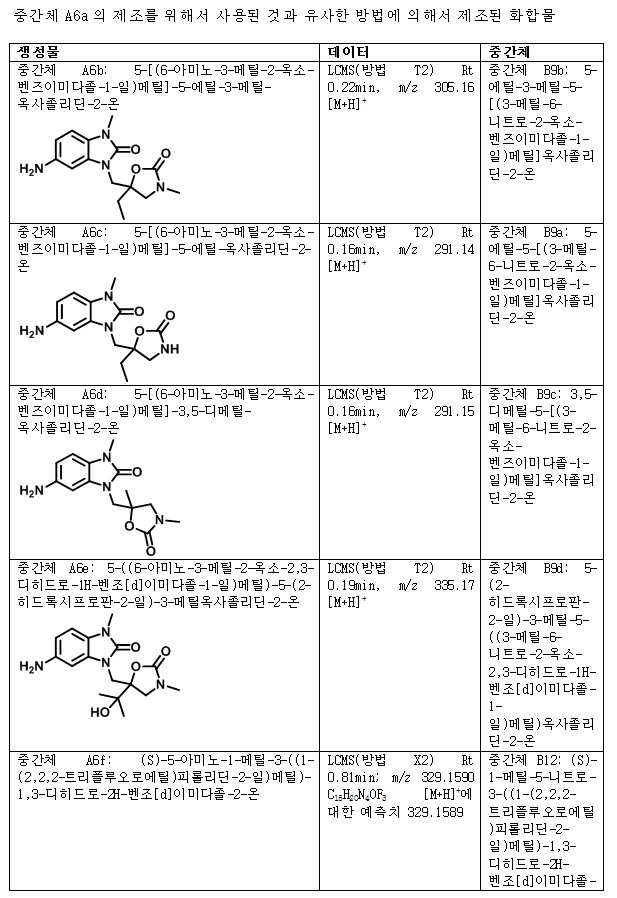

중간체 A7a: 5-아미노-3-(3-히드록시-3-메틸-펜틸)-1-메틸-벤즈이미다졸-2-온Intermediate A7a: 5-Amino-3- (3-hydroxy-3-methyl-pentyl) -1-methyl-benzimidazol-2-one

Ar 분위기 하에서 활성화 차콜 상의 팔라듐(10% wt Pd, 39 mg, 0.04 mmol)을 에탄올(20 mL) 중의 포름산암모늄(534 mg, 8.47 mmol) 및 3-(3-히드록시-3-메틸-펜틸)-1-메틸-5-니트로-벤즈이미다졸-2-온(중간체 B1d, 355 mg, 1.21 mmol)의 교반 혼합물에 첨가하였다. 생성된 혼합물을 60℃까지 45분 가열하고, 이어서 실온까지 냉각시키고, 추가의 에탄올(60 mL)로 세척하면서 (아르곤 하에서) CeliteTM 패드로 여과하였다. 생성된 용액을 감압 하에서 증발시켜 황색 오일을 제공하였다. Et2O:EtOAc(1:1)를 첨가하고, 생성된 침전물을 여과에 의해서 제거하고, 용매를 증발시켜 표제 화합물(314 mg)을 발포체로서 제공하였다. LCMS(방법 T2): Rt 0.51min, m/z 264.17 [M+H]+. 표 17에 나타낸 니트로 중간체를 사용하여, 중간체 A7a의 제조를 위해서 사용된 것과 유사한 방법에 의해서 하기 표로 나타낸 중간체를 제조하였다. Palladium (10% wt Pd, 39 mg, 0.04 mmol) on activated charcoal under Ar atmosphere was added ammonium formate (534 mg, 8.47 mmol) and 3- (3-hydroxy-3-methyl-pentyl) in ethanol (20 mL). To a stirred mixture of -1-methyl-5-nitro-benzimidazol-2-one (Intermediate B1d, 355 mg, 1.21 mmol) was added. The resulting mixture was heated to 60 ° C. for 45 minutes, then cooled to room temperature and filtered through a Celite ™ pad (under argon) washing with additional ethanol (60 mL). The resulting solution was evaporated under reduced pressure to give a yellow oil. Et 2 O: EtOAc (1: 1) was added and the resulting precipitate was removed by filtration and the solvent was evaporated to give the title compound (314 mg) as a foam. LCMS (Method T2): Rt 0.51 min, m / z 264.17 [M + H] + . Using the nitro intermediates shown in Table 17, the intermediates shown in the table below were prepared by methods similar to those used for the preparation of intermediate A7a.
[표 17]TABLE 17

중간체 A8a: 5-아미노-3-[[(1S,2S)-2-히드록시-2-메틸-시클로펜틸]메틸]-1-메틸-벤즈이미다졸-2-온Intermediate A8a: 5-Amino-3-[[(1S, 2S) -2-hydroxy-2-methyl-cyclopentyl] methyl] -1-methyl-benzimidazol-2-one
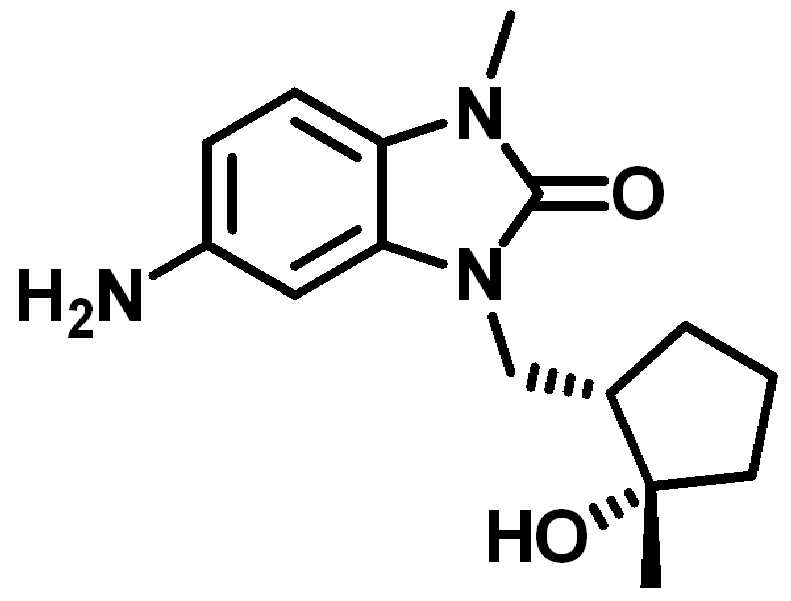
단계 1: 2-[[tert-부틸(디메틸)실릴]옥시메틸]시클로펜트-2-엔-1-온Step 1: 2-[[tert-butyl (dimethyl) silyl] oxymethyl] cyclopent-2-en-1-one
0℃까지 냉각된 DCM(45 mL) 중의 2-(히드록시메틸)시클로펜트-2-엔-1-온(0.5 g, 4.5 mmol)의 용액에 TBSCl(0.94 g, 6.2 mmol), 그 다음 이미다졸(0.67 g, 9.8 mmol)을 첨가하였다. 용액은 즉시 탁해졌고, 밤새 rt까지 가온시키면서 교반하였다. TLC 분석은 완전 전환을 나타내었다. 혼합물을 10% aq. 시트르산 및 염수로 세척하였다. 유기 추출물을 MgSO4 상에서 건조하고, 여과시키고, 농축시켰다. 잔류물을 시클로헥산 중의 5% 내지 30% EtOAc로 용리시키는 Biotage KP-Sil 25g에 의해서 정제하였다. 2-[[tert-부틸(디메틸)실릴]옥시메틸]시클로펜트-2-엔-1-온(1 g)을 무색 오일로서 수득하였다. 1H NMR (500 MHz, 클로로포름-d) δ 7.53 - 7.50 (m, 1H), 4.36 - 4.34 (m, 2H), 2.62 - 2.57 (m, 2H), 2.44 - 2.41 (m, 2H), 0.90 (s, 9H), 0.06 (s, 6H).TBSCl (0.94 g, 6.2 mmol) in a solution of 2- (hydroxymethyl) cyclopent-2-en-1-one (0.5 g, 4.5 mmol) in DCM (45 mL) cooled to 0 ° C., followed by Dozol (0.67 g, 9.8 mmol) was added. The solution immediately became turbid and stirred overnight with warming to rt. TLC analysis indicated complete conversion. The mixture was washed with 10% aq. Wash with citric acid and brine. The organic extract was dried over MgSO 4 , filtered and concentrated. The residue was purified by 25 g of Biotage KP-Sil eluting with 5% to 30% EtOAc in cyclohexane. 2-[[tert-butyl (dimethyl) silyl] oxymethyl] cyclopent-2-en-1-one (1 g) was obtained as a colorless oil. 1 H NMR (500 MHz, Chloroform- d ) δ 7.53-7.50 (m, 1H), 4.36-4.34 (m, 2H), 2.62-2.57 (m, 2H), 2.44-2.41 (m, 2H), 0.90 ( s, 9H), 0.06 (s, 6H).
단계 2: 2-[[tert-부틸(디메틸)실릴]옥시메틸]시클로펜탄온 Step 2: 2-[[tert-butyl (dimethyl) silyl] oxymethyl] cyclopentanone
Pd/C(10 wt%)(0.24 g, 0.22 mmol) 및 교반 막대를 함유하는 용기를 진공 하에 두고, 온화하게 가열하였다. 이어서 용기를 아르곤으로 재충전시켰다. EtOAc(20 mL) 중의 2-[[tert-부틸(디메틸)실릴]옥시메틸]시클로펜트-2-엔-1-온(단계 1, 1 g, 4.4 mmol)의 용액을 첨가하고, 이어서 수소의 분위기 하에서 1시간 동안 25℃에서 교반하였다. 이어서 분취물을 취하고, 여과하고, 진공에서 농축시켰다. 조 혼합물의 1H NMR 분석은 완전환 전환을 나타내었다. 나머지 혼합물을 질소 분위기에 다시 적용하고, 이어서 CeliteTM 패드를 통해서 여과하고, EtOAc로 세척하였다. 여과액을 진공에서 농축시켜 2-[[tert-부틸(디메틸)실릴]옥시메틸]시클로펜탄온(0.99 g)을 무색 오일로서 제공하였다. 1H NMR (500 MHz, 클로로포름-d) δ 3.84 (dd, J = 9.9, 4.9 Hz, 1H), 3.72 (dd, J = 9.9, 3.4 Hz, 1H), 2.31 - 1.89 (m, 6H), 1.85 - 1.70 (m, 1H), 0.85 (s, 9H), 0.02 (s, 3H), 0.01 (s, 3H).The vessel containing Pd / C (10 wt%) (0.24 g, 0.22 mmol) and the stir bar was placed under vacuum and heated gently. The vessel was then refilled with argon. A solution of 2-[[tert-butyl (dimethyl) silyl] oxymethyl] cyclopent-2-en-1-one (step 1, 1 g, 4.4 mmol) in EtOAc (20 mL) was added, followed by Stir at 25 ° C. for 1 h under atmosphere. An aliquot was then taken, filtered and concentrated in vacuo. 1 H NMR analysis of the crude mixture showed complete ring conversion. The remaining mixture was again subjected to a nitrogen atmosphere, then filtered through a Celite ™ pad and washed with EtOAc. The filtrate was concentrated in vacuo to give 2-[[tert-butyl (dimethyl) silyl] oxymethyl] cyclopentanone (0.99 g) as a colorless oil. 1 H NMR (500 MHz, Chloroform- d ) δ 3.84 (dd, J = 9.9, 4.9 Hz, 1H), 3.72 (dd, J = 9.9, 3.4 Hz, 1H), 2.31-1.89 (m, 6H), 1.85 1.70 (m, 1H), 0.85 (s, 9H), 0.02 (s, 3H), 0.01 (s, 3H).
단계 3: (1R,2R)-2-[[tert-부틸(디메틸)실릴]옥시메틸]-1-메틸-시클로펜탄올 Step 3: (1R, 2R) -2-[[tert-butyl (dimethyl) silyl] oxymethyl] -1-methyl-cyclopentanol
디에틸 에테르(11 mL) 중의 2-[[tert-부틸(디메틸)실릴]옥시메틸]시클로펜탄온(0.5 g, 2.2 mmol)의 용액을 0℃까지 냉각시켰다. 메틸마그네슘 브로마이드(0.44 mL, 디에틸 에테르 중의 3 M 용액)를 첨가하고, 용액을 rt까지 가온시켰다. 2h 동안 교반한 후 메틸마그네슘 브로마이드(1 mL, 3 M)의 추가 첨가를 수행하였다. 추가 1시간 동안 교반한 후, 혼합물을 조심스럽게 켄칭시키고, 물을 서서히 첨가하였다. 혼합물을 DCM으로 추출하고, 유기 추출물을 염수로 세척하고 이어서 MgSO4 상에서 건조하였다. 용매를 진공 하에서 제거하고, 조 잔류물을 시클로헥산 중의 1-10% EtOAc로 용리시키는 Biotage KP-Sil 25 g를 사용하여 정제하였다. (1R,2R)-2-[[tert-부틸(디메틸)실릴]옥시메틸]-1-메틸-시클로펜탄올(150 mg)을 R/R 부분입체이성질체가 선호되는 부분입체이성질체, 약 3.5:1의 혼합물로서 수득하였다. 특징규명 데이터를 수득하기 위해서 소량의 샘플을 상기와 같이 다시 정제하였다.A solution of 2-[[tert-butyl (dimethyl) silyl] oxymethyl] cyclopentanone (0.5 g, 2.2 mmol) in diethyl ether (11 mL) was cooled to 0 ° C. Methylmagnesium bromide (0.44 mL, 3 M solution in diethyl ether) was added and the solution was warmed up to rt. After stirring for 2 h further addition of methylmagnesium bromide (1 mL, 3 M) was performed. After stirring for an additional hour, the mixture was quenched carefully and water was added slowly. The mixture was extracted with DCM and the organic extracts were washed with brine and then dried over MgSO 4 . The solvent was removed under vacuum and the crude residue was purified using 25 g Biotage KP-Sil eluting with 1-10% EtOAc in cyclohexane. (1R, 2R) -2-[[tert-butyl (dimethyl) silyl] oxymethyl] -1-methyl-cyclopentanol (150 mg) was added to the R / R diastereomer of the preferred diastereomer, about 3.5: Obtained as a mixture of 1. A small amount of sample was purified again as above to obtain characterization data.
(1S,2S)-2-[[tert-부틸(디메틸)실릴]옥시메틸]-1-메틸-시클로펜탄올: 1H NMR (500 MHz, 클로로포름-d) δ 3.93 - 3.88 (m, 1H), 3.77 - 3.72 (m, 1H), 3.56 (s, 1H), 1.79 - 1.64 (m, 5H), 1.61 - 1.49 (m, 2H), 1.32 (s, 3H), 0.89 (s, 9H), 0.07 (s, 3H), 0.06 (s, 3H).(1S, 2S) -2-[[tert-butyl (dimethyl) silyl] oxymethyl] -1-methyl-cyclopentanol: 1 H NMR (500 MHz, Chloroform- d ) δ 3.93-3.88 (m, 1H) , 3.77-3.72 (m, 1H), 3.56 (s, 1H), 1.79-1.64 (m, 5H), 1.61-1.49 (m, 2H), 1.32 (s, 3H), 0.89 (s, 9H), 0.07 (s, 3 H), 0.06 (s, 3 H).
(1R,2S)-2-[[tert-부틸(디메틸)실릴]옥시메틸]-1-메틸-시클로펜탄올: 1H NMR (500 MHz, 클로로포름-d) δ 3.73 (dd, J = 10.0, 5.4 Hz, 1H), 3.57 (app. t, J = 10.0 Hz, 1H), 2.62 (br. s, 1H), 2.13 - 2.02 (m, 1H), 1.81 - 1.62 (m, 4H), 1.61 - 1.49 (m, 1H), 1.21 (s, 3H), 1.19 - 1.10 (m, 1H), 0.89 (s, 9H), 0.07 (s, 3H), 0.06 (s, 3H).(1R, 2S) -2-[[tert-Butyl (dimethyl) silyl] oxymethyl] -1-methyl-cyclopentanol: 1 H NMR (500 MHz, Chloroform- d ) δ 3.73 (dd, J = 10.0, 5.4 Hz, 1H), 3.57 (app.t, J = 10.0 Hz, 1H), 2.62 (br.s, 1H), 2.13-2.02 (m, 1H), 1.81-1.62 (m, 4H), 1.61-1.49 (m, 1H), 1.21 (s, 3H), 1.19-1.10 (m, 1H), 0.89 (s, 9H), 0.07 (s, 3H), 0.06 (s, 3H).
단계 4: (1S,2S)-2-(히드록시메틸)-1-메틸-시클로펜탄올 Step 4: (1S, 2S) -2- (hydroxymethyl) -1-methyl-cyclopentanol
아르곤 하의 0℃까지 냉각된 THF(6.1 mL) 중의 (1S,2S)-2-[[tert-부틸(디메틸)실릴]옥시메틸]-1-메틸-시클로펜탄올(부분입체이성질체의 3.5:1 혼합물, 150 mg, 0.61 mmol)의 용액에 TBAF(THF 중의 1.0 M, 1.84 mL, 1.84 mmol)를 적가하였다. 용액을 rt까지 가온시키고, 2시간 동안 교반하였다. 반응을 sat. aq. NH4Cl(10 mL)로 켄칭시키고, EtOAc로 추출하였다. 합한 유기 추출물을 MgSO4 상에서 건조하고, 진공에서 농축시켰다. 잔류물을 컬럼 크로마토그래피(시클로헥산 중의 20% 내지 80% EtOAc로 용리시키는 Biotage KP-Sil 10 g)에 의해서 정제하여 (1S,2S)-2-(히드록시메틸)-1-메틸-시클로펜탄올(52 mg)을 단일 부분입체이성질체로서, 무색 오일로서 제공하였다. 1H NMR (500 MHz, 클로로포름-d) δ 3.90 - 3.84 (m, 1H), 3.76 - 3.69 (m, 1H), 2.92 (s, 1H), 2.44 (s, 1H), 1.81 - 1.63 (m, 6H), 1.62 - 1.51 (m, 1H), 1.36 (s, 3H).(1S, 2S) -2-[[tert-butyl (dimethyl) silyl] oxymethyl] -1-methyl-cyclopentanol (3.5: 1 of diastereomer) in THF (6.1 mL) cooled to 0 ° C. under argon. To the mixture, 150 mg, 0.61 mmol) was added dropwise TBAF (1.0 M in THF, 1.84 mL, 1.84 mmol). The solution was warmed up to rt and stirred for 2 h. Sat reaction. aq. Quench with NH 4 Cl (10 mL) and extract with EtOAc. The combined organic extracts were dried over MgSO 4 and concentrated in vacuo. The residue was purified by column chromatography (10 g Biotage KP-Sil eluting with 20% to 80% EtOAc in cyclohexane) to (1S, 2S) -2- (hydroxymethyl) -1-methyl-cyclopentane All (52 mg) served as single diastereomer as colorless oil. 1 H NMR (500 MHz, Chloroform-d) δ 3.90-3.84 (m, 1H), 3.76-3.69 (m, 1H), 2.92 (s, 1H), 2.44 (s, 1H), 1.81-1.63 (m, 6H), 1.62-1.51 (m, 1H), 1.36 (s, 3H).
단계 5: [(1S,2S)-2-히드록시-2-메틸-시클로펜틸]메틸 4-메틸벤젠설포네이트Step 5: [(1S, 2S) -2-Hydroxy-2-methyl-cyclopentyl] methyl 4-methylbenzenesulfonate
피리딘(3 mL) 중의 (1S,2S)-2-(히드록시메틸)-1-메틸-시클로펜탄올(54 mg, 0.41 mmol), p-톨루엔-설포닐-클로라이드(0.12 g, 0.62 mmol)의 혼합물을 0℃에서 2시간 동안 교반하였다. p-톨루엔-설포닐-클로라이드(80 mg)의 추가 첨가를 수행하고, 용액을 추가로 1시간 동안 교반하였다. 반응 혼합물을 5% aq. HCl 중에 붓고, 이어서 DCM으로 추출하였다. 합한 유기 상을 HCl, 염수로 세척하고, MgSO4 상에서 건조하고, 농축시켰다. 잔류물을 컬럼 크로마토그래피(시클로헥산 중의 20% 내지 50% EtOAc로 용리시키는 Biotage KP-Sil 10 g)에 의해서 정제하여 [(1S,2S)-2-히드록시-2-메틸-시클로펜틸]메틸 4-메틸벤젠설포네이트(85 mg)를 무색 오일로서 제공하였다. 1H NMR (500 MHz, 클로로포름-d) δ 7.81 - 7.74 (m, 2H), 7.36 - 7.30 (m, 2H), 4.24 (dd, J = 9.8, 7.2 Hz, 1H), 3.98 (dd, J = 9.8, 6.8 Hz, 1H), 2.43 (s, 3H), 2.00 - 1.90 (m, 1H), 1.84 - 1.74 (m, 1H), 1.77 - 1.64 (m, 3H), 1.59 - 1.48 (m, 1H), 1.46 (s, 1H), 1.45 - 1.33 (m, 1H), 1.32 (s, 3H).(1S, 2S) -2- (hydroxymethyl) -1-methyl-cyclopentanol (54 mg, 0.41 mmol), p-toluene-sulfonyl-chloride (0.12 g, 0.62 mmol) in pyridine (3 mL) The mixture was stirred at 0 ° C for 2 h. Further addition of p-toluene-sulfonyl-chloride (80 mg) was performed and the solution was stirred for an additional hour. The reaction mixture was washed with 5% aq. Poured into HCl, then extracted with DCM. The combined organic phases were washed with HCl, brine, dried over MgSO 4 and concentrated. The residue was purified by column chromatography (10 g Biotage KP-Sil eluting with 20% to 50% EtOAc in cyclohexane) to [(1S, 2S) -2-hydroxy-2-methyl-cyclopentyl] methyl 4-Methylbenzenesulfonate (85 mg) was provided as a colorless oil. 1 H NMR (500 MHz, Chloroform- d ) δ 7.81-7.74 (m, 2H), 7.36-7.30 (m, 2H), 4.24 (dd, J = 9.8, 7.2 Hz, 1H), 3.98 (dd, J = 9.8, 6.8 Hz, 1H), 2.43 (s, 3H), 2.00-1.90 (m, 1H), 1.84-1.74 (m, 1H), 1.77-1.64 (m, 3H), 1.59-1.48 (m, 1H) , 1.46 (s, 1 H), 1.45-1.33 (m, 1 H), 1.32 (s, 3 H).
단계 6: 3-[[(1S,2S)-2-히드록시-2-메틸-시클로펜틸]메틸]-1-메틸-5-니트로-벤즈이미다졸-2-온Step 6: 3-[[(1S, 2S) -2-hydroxy-2-methyl-cyclopentyl] methyl] -1-methyl-5-nitro-benzimidazol-2-one
[(1S,2S)-2-히드록시-2-메틸-시클로펜틸]메틸 4-메틸벤젠설포네이트(85 mg, 0.30 mmol), 1-메틸-5-니트로-1,3-디히드로-2H-벤조[d]이미다졸-2-온(45 mg, 0.23 mmol), 탄산세슘(0.19 g, 0.58 mmol) 및 아세토니트릴(2.3 mL)의 혼합물을 마이크로웨이브에서 80℃까지 2h 동안 가열하였다. 혼합물을 물로 희석시키고, DCM으로 추출하고, 합한 유기 추출물을 농축시켰다. (1 mL DMSO 중에 용해된) 잔류물을 물 중의 10% 내지 100% 메탄올(각각 0.1% 포름산을 함유함)로 용리시키는 역상 C18 컬럼을 사용하여 정제하였다. 제1 용리 화합물, 3-[[(1S,2S)-2-히드록시-2-메틸-시클로펜틸]메틸]-1-메틸-5-니트로-벤즈이미다졸-2-온(18 mg)을 황색 오일로서 수득하였다. 1H NMR (500 MHz, 클로로포름-d) δ 8.14 (dd, J = 8.6, 2.2 Hz, 1H), 7.97 (d, J = 2.2 Hz, 1H), 7.08 (d, J = 8.6 Hz, 1H), 4.22 (dd, J = 14.9, 9.1 Hz, 1H), 3.92 (dd, J = 14.9, 5.6 Hz, 1H), 3.52 (s, 3H), 2.20 - 2.09 (m, 1H), 1.94 - 1.79 (m, 3H), 1.76 - 1.54 (m, 3H), 1.13 (s, 3H).[(1S, 2S) -2-hydroxy-2-methyl-cyclopentyl] methyl 4-methylbenzenesulfonate (85 mg, 0.30 mmol), 1-methyl-5-nitro-1,3-dihydro-2H A mixture of benzo [d] imidazol-2-one (45 mg, 0.23 mmol), cesium carbonate (0.19 g, 0.58 mmol) and acetonitrile (2.3 mL) was heated in microwave to 80 ° C. for 2 h. The mixture was diluted with water, extracted with DCM and the combined organic extracts were concentrated. The residue (dissolved in 1 mL DMSO) was purified using a reverse phase C18 column eluting with 10% to 100% methanol in water (each containing 0.1% formic acid). First eluting compound, 3-[[(1S, 2S) -2-hydroxy-2-methyl-cyclopentyl] methyl] -1-methyl-5-nitro-benzimidazol-2-one (18 mg) Obtained as a yellow oil. 1 H NMR (500 MHz, Chloroform- d ) δ 8.14 (dd, J = 8.6, 2.2 Hz, 1H), 7.97 (d, J = 2.2 Hz, 1H), 7.08 (d, J = 8.6 Hz, 1H), 4.22 (dd, J = 14.9, 9.1 Hz, 1H), 3.92 (dd, J = 14.9, 5.6 Hz, 1H), 3.52 (s, 3H), 2.20-2.09 (m, 1H), 1.94-1.79 (m, 3H), 1.76-1.54 (m, 3H), 1.13 (s, 3H).
단계 7: 5-아미노-3-[[(1S,2S)-2-히드록시-2-메틸-시클로펜틸]메틸]-1-메틸-벤즈이미다졸-2-온Step 7: 5-Amino-3-[[(1S, 2S) -2-hydroxy-2-methyl-cyclopentyl] methyl] -1-methyl-benzimidazol-2-one
에탄올(1.5 mL) 중의 3-[[(1S,2S)-2-히드록시-2-메틸-시클로펜틸]메틸]-1-메틸-5-니트로-벤즈이미다졸-2-온(18 mg, 0.06 mmol)의 용액에 포름산암모늄(37 mg, 0.59 mmol) 및 Pd/C(10 wt%)(10 mg, 0.0094 mmol)을 첨가하였다. 바이알을 밀폐 및 진공화시키고, 이어서 아르곤을 3회 재충전시켰다. 이어서 바이알을 60℃까지 예열된 드라이신(drysyn) 블록에 넣고, 1시간 동안 교반하였다. 냉각시킨 후, 혼합물을 2 g SCX 컬럼을 사용하여 정제하여 5-아미노-3-[[(1S,2S)-2-히드록시-2-메틸-시클로펜틸]메틸]-1-메틸-벤즈이미다졸-2-온(중간체 A8a, 16 mg)을 연주황색 고체로서 제공하였다. LCMS(방법 T2) Rt 0.80min; m/z 276.1698 [M+H]+.3-[[(1S, 2S) -2-hydroxy-2-methyl-cyclopentyl] methyl] -1-methyl-5-nitro-benzimidazol-2-one (18 mg, in ethanol (1.5 mL) 0.06 mmol) was added ammonium formate (37 mg, 0.59 mmol) and Pd / C (10 wt%) (10 mg, 0.0094 mmol). The vial was sealed and evacuated and then argon was refilled three times. The vial was then placed in a drysyn block preheated to 60 ° C. and stirred for 1 hour. After cooling, the mixture was purified using a 2 g SCX column to give 5-amino-3-[[(1S, 2S) -2-hydroxy-2-methyl-cyclopentyl] methyl] -1-methyl-benzimi Dazol-2-one (Intermediate A8a, 16 mg) was provided as a yellowish yellow solid. LCMS (Method T2) Rt 0.80 min; m / z 276.1698 [M + H] + .
중간체 A8b: 5-아미노-3-(((1S,2S)-2-에틸-2-히드록시시클로펜틸)메틸)-1-메틸-1,3-디히드로-2H-벤조[d]이미다졸-2-온Intermediate A8b: 5-amino-3-(((1S, 2S) -2-ethyl-2-hydroxycyclopentyl) methyl) -1-methyl-1,3-dihydro-2H-benzo [d] imidazole 2-on

중간체 A8a의 제조에 사용된 것과 유사한 방법에 의해서 제조하였다. LCMS(방법 T2) Rt 0.93min; m/z 290.1832 [M+H]+. Prepared by a method similar to that used for the preparation of intermediate A8a. LCMS (Method T2) Rt 0.93 min; m / z 290.1832 [M + H] + .
중간체 B1a: 3-(3-히드록시-3-메틸-부틸)-1-메틸-5-니트로-벤즈이미다졸-2-온Intermediate B1a: 3- (3-hydroxy-3-methyl-butyl) -1-methyl-5-nitro-benzimidazol-2-one
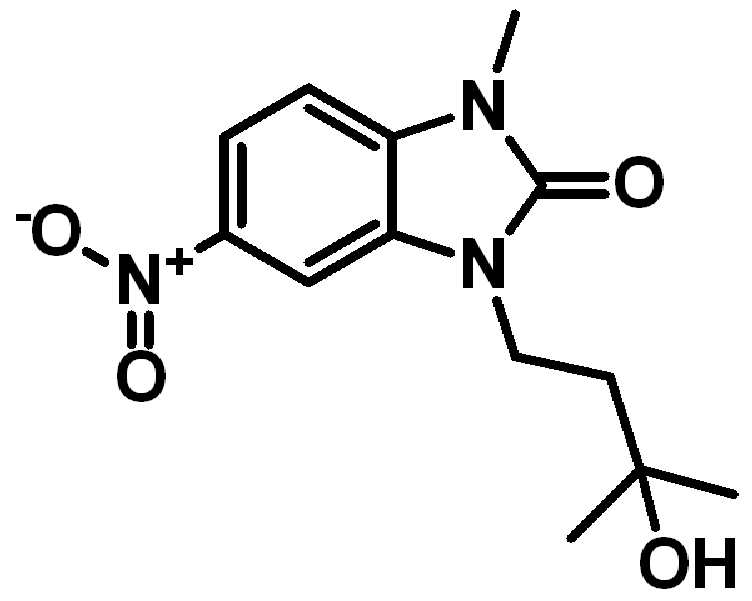
아세토니트릴(20 mL) 중의 3-메틸-6-니트로-1H-벤즈이미다졸-2-온(2.50 g, 12.94 mmol) 및 탄산세슘(11.4 g, 35.10 mmol)의 혼합물에 아세토니트릴(10 mL) 중의 (3-히드록시-3-메틸-부틸) 4-메틸벤젠설포네이트(중간체 C1a, 5.9 g, 22.63 mmol)의 용액을 첨가하고, 생성된 혼합물을 85℃까지 18h 동안 가열하였다. 실온까지 냉각시킨 후, 혼합물을 DCM으로 희석시키고, 고체를 여과지를 통해서 여과하였다. 생성된 용액을 DCM과 물 사이에 분배시키고, 시트르산으로 pH 6까지 중화시키고, 분리하고, 수성층을 추가로 DCM으로 추출하였다. 합한 유기물을 염수로 세척하고, MgSO4 상에서 건조하고, 감압 하에서 증발시켰다. 컬럼 크로마토그래피(100 g 컬럼, DCM:MeOH 0% 내지 5%)에 의한 정제는 표제 화합물(2.11 g, 58%, 7.55 mmol)을 주황색 고체로서 제공하였다. LCMS(방법 T2): Rt 1.25min, m/z 262.12 [M-물+H]+. 1H NMR (500 MHz, 클로로포름-d): δ 8.13 (1H, dd, J 8.7, 2.0 Hz), 7.95 (1H, d, J 2.0 Hz), 7.04 (1H, d, J 8.7 Hz), 4.13 (2H, m), 3.50 (3H, s), 1.93 (2H, m), 1.34 (6H, s).Acetonitrile (10 mL) in a mixture of 3-methyl-6-nitro-1H-benzimidazol-2-one (2.50 g, 12.94 mmol) and cesium carbonate (11.4 g, 35.10 mmol) in acetonitrile (20 mL) A solution of (3-hydroxy-3-methyl-butyl) 4-methylbenzenesulfonate (intermediate C1a, 5.9 g, 22.63 mmol) in was added and the resulting mixture was heated to 85 ° C. for 18 h. After cooling to room temperature, the mixture was diluted with DCM and the solid was filtered through filter paper. The resulting solution was partitioned between DCM and water, neutralized with citric acid to pH 6, separated and the aqueous layer was further extracted with DCM. The combined organics were washed with brine, dried over MgSO 4 and evaporated under reduced pressure. Purification by column chromatography (100 g column, DCM: MeOH 0% to 5%) provided the title compound (2.11 g, 58%, 7.55 mmol) as an orange solid. LCMS (Method T2): Rt 1.25 min, m / z 262.12 [M-water + H] + . 1 H NMR (500 MHz, Chloroform-d): δ 8.13 (1H, dd, J 8.7, 2.0 Hz), 7.95 (1H, d, J 2.0 Hz), 7.04 (1H, d, J 8.7 Hz), 4.13 ( 2H, m), 3.50 (3H, s), 1.93 (2H, m), 1.34 (6H, s).
표 18에 나타낸 알킬토실레이트를 사용하여, 중간체 B1a의 제조를 위해서 사용된 것과 유사한 방법에 의해서 하기 표로 나타낸 중간체를 제조하였다. 중간체 B1f의 제조를 위해서, 3-메틸-6-니트로-1H-벤즈이미다졸-2-온 대신에 5-플루오로-3-메틸-6-니트로-1H-벤즈이미다졸-2-온(중간체 B10)을 사용하였다.Using the alkyltosylates shown in Table 18, the intermediates shown in the table below were prepared by similar methods to those used for the preparation of intermediate Bla. For the preparation of intermediate B1f, 5-fluoro-3-methyl-6-nitro-1H-benzimidazol-2-one (intermediate instead of 3-methyl-6-nitro-1H-benzimidazol-2-one B10) was used.
[표 18]TABLE 18

중간체 B2: 1-메틸-5-니트로-3-[(3S)-3-피라졸-1-일부틸]벤즈이미다졸-2-온 Intermediate B2: 1-methyl-5-nitro-3-[( 3S ) -3-pyrazol-1-ylbutyl] benzimidazol-2-one
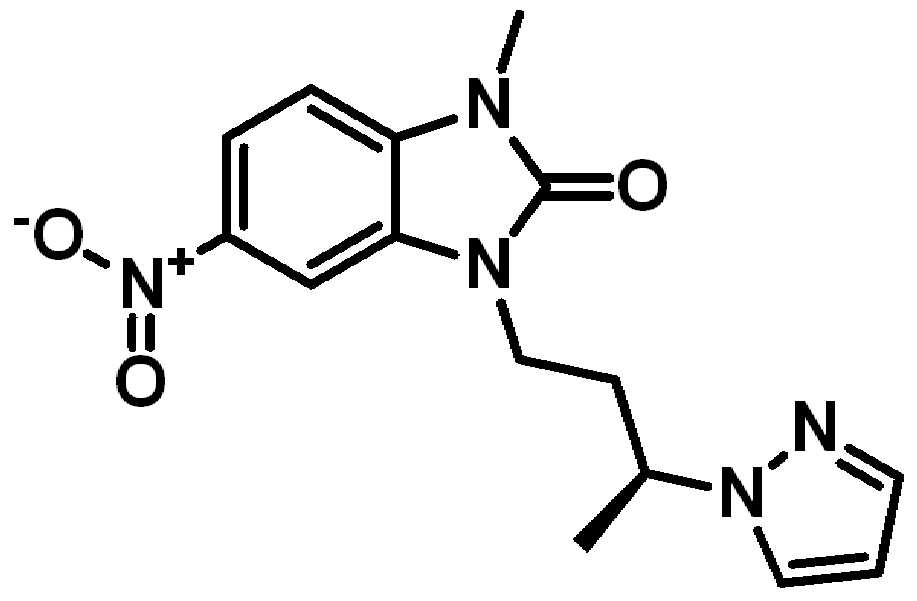
단계 1: [(1R)-1-메틸-3-(3-메틸-6-니트로-2-옥소-벤즈이미다졸-1-일)프로필] 4-메틸벤젠설포네이트Step 1: [(1R) -1-Methyl-3- (3-methyl-6-nitro-2-oxo-benzimidazol-1-yl) propyl] 4-methylbenzenesulfonate
아세토니트릴(1 mL) 중의 3-메틸-6-니트로-1H-벤즈이미다졸-2-온(59 mg, 0.3 mmol) 및 탄산세슘(232 mg, 0.71 mmol)의 혼합물에 아세토니트릴(1 mL) 중의 [(3R)-3-(p-톨릴설포닐옥시)부틸] 4-메틸벤젠설포네이트(중간체 C3, 155 mg, 0.39 mmol)의 용액을 첨가하고, 생성된 혼합물을 60℃까지 2h 동안 가열하였다. 생성된 혼합물을 DCM과 물 사이에 분배시키고, 10% 시트르산을 사용하여 pH 4까지 산성화시키고, 상 분리기를 사용하여 분리 및 건조하였다. 생성된 밝은 주황색 용액을 실리카젤 상에서 감압 하에서 증발시키고, 플래시 컬럼 크로마토그래피(10g KP-SIL, 시클로헥산 중의 20% 내지 60% 에틸 아세테이트)에 의해서 정제하여 [(1R)-1-메틸-3-(3-메틸-6-니트로-2-옥소-벤즈이미다졸-1-일)프로필] 4-메틸벤젠설포네이트(42 mg, 대략 70% 순도)를 제공하였다. LCMS(방법 T2) Rt 1.47min; m/z 420.12.Acetonitrile (1 mL) in a mixture of 3-methyl-6-nitro-1 H -benzimidazol-2-one (59 mg, 0.3 mmol) and cesium carbonate (232 mg, 0.71 mmol) in acetonitrile (1 mL). Solution of [( 3R ) -3- ( p -tolylsulfonyloxy) butyl] 4-methylbenzenesulfonate (intermediate C3, 155 mg, 0.39 mmol) in 1), and the resulting mixture was heated to 60 ° C for 2 h. Heated during. The resulting mixture was partitioned between DCM and water, acidified with 10% citric acid to pH 4, separated and dried using a phase separator. The resulting bright orange solution was evaporated under reduced pressure on silica gel and purified by flash column chromatography (10 g KP-SIL, 20% to 60% ethyl acetate in cyclohexane) to [(1 R ) -1-methyl-3 -(3-methyl-6-nitro-2-oxo-benzimidazol-1-yl) propyl] 4-methylbenzenesulfonate (42 mg, approximately 70% pure) was provided. LCMS (Method T2) Rt 1.47 min; m / z 420.12.
단계 2: 1-메틸-5-니트로-3-[(3S)-3-피라졸-1-일부틸]벤즈이미다졸-2-온Step 2: 1-methyl-5-nitro-3-[(3S) -3-pyrazol-1-ylbutyl] benzimidazol-2-one
DMF(0.5 mL) 중의 [(1R)-1-메틸-3-(3-메틸-6-니트로-2-옥소-벤즈이미다졸-1-일)프로필] 4-메틸벤젠설포네이트(20 mg, 단계 1로부터)의 용액에 1H-피라졸(20 mg, 0.29 mmol)을 첨가하였다. 혼합물을 마이크로웨이브에서 120℃까지 1h 동안 가열하고, 이어서 DCM과 물 사이에 분배시키고(10% aq 시트르산을 사용하여 pH를 5까지 조정함), 상 분리기를 사용하여 분리하고, 추가의 DCM으로 추출하였다. 합한 유기물을 감압 하에서 증발시켜 표제 화합물을 황색 오일(15 mg)로서 제공하였다. LCMS(방법 T2) Rt 1.31min; m/z 316.14.[( 1R ) -1-Methyl-3- (3-methyl-6-nitro-2-oxo-benzimidazol-1-yl) propyl] 4-methylbenzenesulfonate (20 mg in DMF (0.5 mL) 1 H -pyrazole (20 mg, 0.29 mmol) was added to the solution, from step 1). The mixture is heated in microwave to 120 ° C. for 1 h, then partitioned between DCM and water (adjust the pH to 5 using 10% aq citric acid), separated using a phase separator and extracted with additional DCM It was. The combined organics were evaporated under reduced pressure to give the title compound as a yellow oil (15 mg). LCMS (Method T2) Rt 1.31 min; m / z 316.14.
중간체 B3a: 메틸 2-메틸-4-(3-메틸-6-니트로-2-옥소-벤즈이미다졸-1-일)부탄오에이트Intermediate B3a: Methyl 2-methyl-4- (3-methyl-6-nitro-2-oxo-benzimidazol-1-yl) butanoate

100℃에서 메틸 4-클로로-2-메틸-부탄오에이트(0.26 mL, 1.86 mmol)를 DMF(15 mL) 중의 3-메틸-6-니트로-1H-벤즈이미다졸-2-온(300 mg, 1.55 mmol), 탄산세슘(603 mg, 1.85 mmol) 및 아이오딘화칼륨(23 mg, 0.14 mmol)의 교반되는 용액에 적가하였다. 1시간 후 반응 혼합물을 rt까지 냉각시켰다. 물(100 mL)을 첨가하고, 수성 혼합물을 에틸 아세테이트(4 x 25 mL)로 추출하였다. 유기 추출물을 합하고, 건조하고(황산나트륨), 진공에서 농축시켰다. 플래시 크로마토그래피(50 g KP-SIL; 시클로헥산 중의 0% 내지 70% EtOAc)에 의한 정제는 표제 화합물(456 mg)을 황색 고체로서 제공하였다. 1H NMR (500 MHz, 클로로포름-d) δ 8.13 (dd, J = 8.7, 2.2 Hz, 1H), 7.95 (d, J = 2.2 Hz, 1H), 7.03 (d, J = 8.7 Hz, 1H), 3.99 (t, J = 7.0 Hz, 2H), 3.73 (s, 3H), 3.49 (s, 3H), 2.58 - 2.50 (m, 1H), 2.22 - 2.13 (m, 1H), 1.94 - 1.86 (m, 1H), 1.27 (d, J = 7.2 Hz, 3H).Methyl 4-chloro-2-methyl-butanoate (0.26 mL, 1.86 mmol) at 100 ° C. was added 3-methyl-6-nitro-1 H -benzimidazol-2-one (300 mg) in DMF (15 mL). , 1.55 mmol), cesium carbonate (603 mg, 1.85 mmol) and potassium iodide (23 mg, 0.14 mmol) were added dropwise to a stirred solution. After 1 hour the reaction mixture was cooled to rt. Water (100 mL) was added and the aqueous mixture was extracted with ethyl acetate (4 x 25 mL). The organic extracts were combined, dried (sodium sulfate) and concentrated in vacuo. Purification by flash chromatography (50 g KP-SIL; 0% to 70% EtOAc in cyclohexane) gave the title compound (456 mg) as a yellow solid. 1 H NMR (500 MHz, Chloroform-d) δ 8.13 (dd, J = 8.7, 2.2 Hz, 1H), 7.95 (d, J = 2.2 Hz, 1H), 7.03 (d, J = 8.7 Hz, 1H), 3.99 (t, J = 7.0 Hz, 2H), 3.73 (s, 3H), 3.49 (s, 3H), 2.58-2.50 (m, 1H), 2.22-2.13 (m, 1H), 1.94-1.86 (m, 1H), 1.27 (d, J = 7.2 Hz, 3H).
중간체 B3b: 메틸 2-메틸-3-(3-메틸-6-니트로-2-옥소-벤즈이미다졸-1-일)프로판오에이트Intermediate B3b: Methyl 2-methyl-3- (3-methyl-6-nitro-2-oxo-benzimidazol-1-yl) propanoate

중간체 B3a의 제조를 위해서 사용된 것과 유사한 방법에 의해서 메틸 3-브로모-2-메틸-프로판오에이트를 제조하였다. 1H NMR (500 MHz, 클로로포름-d) δ 8.12 (dd, J = 8.7, 2.2 Hz, 1H), 7.97 (d, J = 2.2 Hz, 1H), 7.03 (d, J = 8.7 Hz, 1H), 4.19 (dd, J = 14.4, 8.0 Hz, 1H), 4.03 (dd, J = 14.4, 6.3 Hz, 1H), 3.66 (s, 3H), 3.49 (s, 3H), 3.15 - 3.07 (m, 1H), 1.29 (d, J = 7.2 Hz, 3H).Methyl 3-bromo-2-methyl-propanoate was prepared by a method similar to that used for the preparation of intermediate B3a. 1 H NMR (500 MHz, Chloroform-d) δ 8.12 (dd, J = 8.7, 2.2 Hz, 1H), 7.97 (d, J = 2.2 Hz, 1H), 7.03 (d, J = 8.7 Hz, 1H), 4.19 (dd, J = 14.4, 8.0 Hz, 1H), 4.03 (dd, J = 14.4, 6.3 Hz, 1H), 3.66 (s, 3H), 3.49 (s, 3H), 3.15-3.07 (m, 1H) , 1.29 (d, J = 7.2 Hz, 3H).
중간체 B4a: 1-메틸-3-(2-메틸렌부틸)-5-니트로-벤즈이미다졸-2-온 Intermediate B4a: 1-Methyl-3- (2-methylenebutyl) -5-nitro-benzimidazol-2-one

단계 1: 1-메틸-3-(2-메틸렌부틸)-5-니트로-벤즈이미다졸-2-온Step 1: 1-methyl-3- (2-methylenebutyl) -5-nitro-benzimidazol-2-one
아세토니트릴(5.00 mL)에서 1-메틸-5-니트로-2,3-디히드로-1H-1,3-벤조디아졸-2-온(325 mg, 1.68 mmol), 2-(브로모메틸)부트-1-엔(251 mg, 1.68 mmol) 및 탄산세슘(658 mg, 2.02 mmol)의 용액을 실온에서 18h 동안 교반하였다. DCM 및 10% 시트르산을 첨가하고, 층을 분리하고, 수성 층을 추가의 DCM으로 추출하였다. 컬럼 크로마토그래피(50 g 컬럼, DCM 중의 0% 내지 10% MeOH)에 의한 정제는 표제 화합물(379 mg, 86%, 1.4506 mmol)을 황색 고체로서 제공하였다. LCMS(방법 T2): Rt 1.43min, m/z 262.12 [M+H]+.1-methyl-5-nitro-2,3-dihydro-1H-1,3-benzodiazol-2-one (325 mg, 1.68 mmol), 2- (bromomethyl) in acetonitrile (5.00 mL) A solution of but-1-ene (251 mg, 1.68 mmol) and cesium carbonate (658 mg, 2.02 mmol) was stirred at rt for 18 h. DCM and 10% citric acid were added, the layers separated and the aqueous layer extracted with further DCM. Purification by column chromatography (50 g column, 0% to 10% MeOH in DCM) provided the title compound (379 mg, 86%, 1.4506 mmol) as a yellow solid. LCMS (Method T2): Rt 1.43 min, m / z 262.12 [M + H] + .
단계 2: 3-[(2-에틸옥시란-2-일)메틸]-1-메틸-5-니트로-벤즈이미다졸-2-온Step 2: 3-[(2-ethyloxan-2-yl) methyl] -1-methyl-5-nitro-benzimidazol-2-one
DCM(10.00 mL) 중의 1-메틸-3-(2-메틸렌부틸)-5-니트로-벤즈이미다졸-2-온(이전 단계로부터, 379 mg, 1.45 mmol)의 용액에 m-CPBA(626 mg, 3.63 mmol)를 첨가하였다. 혼합물을 18h 동안 실온에서 교반하고, 이어서 그것을 포화 수성 Na2S2O3로 켄칭시키고, 층을 분리하였다. 유기층을 NaHCO3로 세척하고; 수성 층을 합하고, DCM으로 추출하였다. 유기 층을 합하고, MgSO4 상에서 건조하고, 감압 하에서 여과 및 농축시켜 표제 화합물(374 mg, 93%, 1.35 mmol)을 주황색 고체로서 제공하였다. LCMS(방법 T2): Rt 1.27min, m/z 278.12 [M+H]+.M-CPBA (626 mg) in a solution of 1-methyl-3- (2-methylenebutyl) -5-nitro-benzimidazol-2-one (from previous step, 379 mg, 1.45 mmol) in DCM (10.00 mL) , 3.63 mmol) was added. The mixture was stirred for 18 h at room temperature, then it was quenched with saturated aqueous Na 2 S 2 O 3 and the layers were separated. The organic layer was washed with NaHCO 3 ; The aqueous layers were combined and extracted with DCM. The organic layers were combined, dried over MgSO 4 , filtered and concentrated under reduced pressure to give the title compound (374 mg, 93%, 1.35 mmol) as an orange solid. LCMS (Method T2): Rt 1.27 min, m / z 278.12 [M + H] + .
중간체 B4b: 1-메틸-3-[(2-메틸옥시란-2-일)메틸]-5-니트로-벤즈이미다졸-2-온Intermediate B4b: 1-methyl-3-[(2-methyloxiran-2-yl) methyl] -5-nitro-benzimidazol-2-one

3-브로모-2-메틸프로펜으로부터 출발하여, 중간체 B4a의 합성에 사용된 것과 유사한 2 단계 절차에 의해서 제조하였다. LCMS(방법 T2): Rt 1.35min, m/z 264.09 [M+H]+.Starting from 3-bromo-2-methylpropene, it was prepared by a two step procedure similar to that used for the synthesis of intermediate B4a. LCMS (Method T2): Rt 1.35 min, m / z 264.09 [M + H] + .
중간체 B4c: 3-((2-(2-히드록시프로판-2-일)옥시란-2-일)메틸)-1-메틸-5-니트로-1,3-디히드로-2H-벤조[d]이미다졸-2-온Intermediate B4c: 3-((2- (2-hydroxypropan-2-yl) oxalan-2-yl) methyl) -1-methyl-5-nitro-1,3-dihydro-2H-benzo [d Imidazol-2-one

중간체 C6d로부터 출발하여, 중간체 B4a의 합성에 사용된 것과 유사한 2단계 절차에 의해서 제조하였다. LCMS(방법 T2): Rt 1.18min, m/z 308.12 [M+H]+.Starting from intermediate C6d, it was prepared by a two step procedure similar to that used for the synthesis of intermediate B4a. LCMS (Method T2): Rt 1.18 min, m / z 308.12 [M + H] + .
중간체 B5: 3-(2-히드록시부틸)-1-메틸-5-니트로-1H-벤조[d]이미다졸-2(3H)-온Intermediate B5: 3- (2-hydroxybutyl) -1-methyl-5-nitro-1 H -benzo [d] imidazol-2 ( 3H ) -one
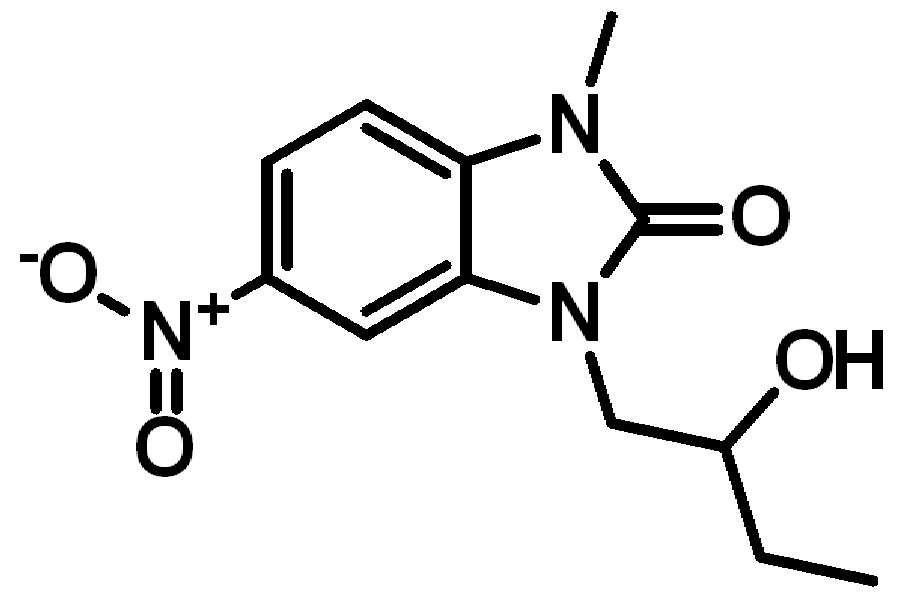
DMF(3 mL) 중의 1-메틸-5-니트로-1H-벤조[d]이미다졸-2(3H)-온(240 mg, 1.242 mmol) 및 탄산세슘(485 mg, 1.489 mmol)의 혼합물에 2-에틸옥시란(0.119 ml, 1.367 mmol)을 첨가하고, 생성된 혼합물을 마이크로웨이브에서 120℃까지 1h 동안 가열하고, 이어서 물(10 mL)을 첨가하였다. 생성된 혼합물을 DCM으로 추출하고, 합한 유기물을 황산나트륨 상에서 건조하고, 여과하고, 플래시 컬럼 크로마토그래피(10g 실리카, 시클로헥산 중의 40% 내지 60% 에틸 아세테이트)에 의한 정제를 위해서 실리카젤 상에서 증발시켰다. 분획을 합하고, 증발시켜 표제 화합물(200 mg)을 황색-주황색 오일로서 제공하였고, 이것은 정치 시 고화되었다. 1H NMR (500 MHz, DMSO-d6) δ 8.13 (d, J = 2.2 Hz, 1H), 8.05 (dd, J = 8.7, 2.3 Hz, 1H), 7.36 (d, J = 8.8 Hz, 1H), 4.90 (d, J = 5.4 Hz, 1H), 3.88 (dd, J = 14.2, 4.2 Hz, 1H), 3.82 (dd, J = 14.2, 7.4 Hz, 1H), 3.70 (m, 1H), 3.41 (s, 3H), 1.49 (m, 1H), 1.37 (m, 1H), 0.92 (t, J = 7.4 Hz, 3H).Mixture of 1-methyl-5-nitro-1 H -benzo [d] imidazol-2 ( 3H ) -one (240 mg, 1.242 mmol) and cesium carbonate (485 mg, 1.489 mmol) in DMF (3 mL) To 2-ethyloxirane (0.119 ml, 1.367 mmol) was added, the resulting mixture was heated in microwave to 120 ° C. for 1 h and then water (10 mL) was added. The resulting mixture was extracted with DCM and the combined organics were dried over sodium sulfate, filtered and evaporated onto silica gel for purification by flash column chromatography (10 g silica, 40% to 60% ethyl acetate in cyclohexane). Fractions were combined and evaporated to give the title compound (200 mg) as a yellow-orange oil, which solidified upon standing. 1 H NMR (500 MHz, DMSO-d 6 ) δ 8.13 (d, J = 2.2 Hz, 1H), 8.05 (dd, J = 8.7, 2.3 Hz, 1H), 7.36 (d, J = 8.8 Hz, 1H) , 4.90 (d, J = 5.4 Hz, 1H), 3.88 (dd, J = 14.2, 4.2 Hz, 1H), 3.82 (dd, J = 14.2, 7.4 Hz, 1H), 3.70 (m, 1H), 3.41 ( s, 3H), 1.49 (m, 1H), 1.37 (m, 1H), 0.92 (t, J = 7.4 Hz, 3H).
중간체 B6: 3-[(3R)-3-메톡시부틸]-1-메틸-5-니트로-벤즈이미다졸-2-온Intermediate B6: 3-[( 3R ) -3-methoxybutyl] -1-methyl-5-nitro-benzimidazol-2-one

질소 하에서 광유 중의 수소화나트륨 60%(7.6 mg, 0.19 mmol)를 무수 THF(1 mL) 중에 현탁시키고, 0℃까지 냉각시켰다. 5분 후, 무수 THF(2 mL) 중의 3-[(3R)-3-히드록시부틸]-1-메틸-5-니트로-벤즈이미다졸-2-온(중간체 B1B, 40 mg, 0.1508 mmol)의 용액을 10분에 걸쳐서 적가하였다. 아이오도메탄(13 uL, 0.21 mmol)를 첨가하고, 혼합물을 실온까지 가온시키고, 이어서 밤새 교반하였다. 공기에 개방시키고, 0℃까지 냉각시키고, 물을 첨가하고, 이어서 묽은 HCl로 pH 약 7까지 중화시키고, DCM으로 추출하였다. 플래시 컬럼 크로마토그래피(10 g 실리카, DCM, 이어서 DCM 중의 6% 에틸 아세테이트, 이어서 100% 에틸 아세테이트)에 의해서 정제하여 표제 화합물(24 mg)을 제공하였다. LCMS(방법 X2) Rt 1.16min; m/z 302.11 [M+Na]+.Sodium hydride 60% (7.6 mg, 0.19 mmol) in mineral oil under nitrogen was suspended in anhydrous THF (1 mL) and cooled to 0 ° C. After 5 minutes, 3-[( 3R ) -3-hydroxybutyl] -1-methyl-5-nitro-benzimidazol-2-one (intermediate B1B, 40 mg, 0.1508 mmol in anhydrous THF (2 mL)) ) Was added dropwise over 10 minutes. Iodomethane (13 uL, 0.21 mmol) was added and the mixture was allowed to warm to room temperature and then stirred overnight. Open to air, cool to 0 ° C., add water, then neutralize with dilute HCl to pH about 7 and extract with DCM. Purification by flash column chromatography (10 g silica, DCM, then 6% ethyl acetate in DCM, then 100% ethyl acetate) gave the title compound (24 mg). LCMS (Method X2) Rt 1.16 min; m / z 302.11 [M + Na] + .
중간체 B7: 3-(3-히드록시-3-메틸-부틸)-5-니트로-1-(테트라히드로피란-4-일메틸)벤즈이미다졸-2-온Intermediate B7: 3- (3-hydroxy-3-methyl-butyl) -5-nitro-1- (tetrahydropyran-4-ylmethyl) benzimidazol-2-one
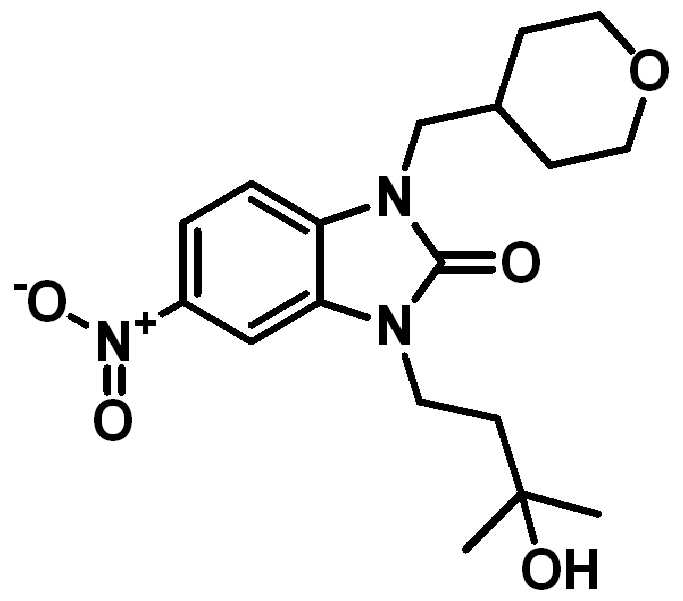
5-니트로-1-((테트라히드로-2H-피란-4-일)메틸)-1H-벤조[d]이미다졸-2(3H)-온(중간체 B8)으로부터 출발하여, 100℃에서 30분 동안 마이크로웨이브 가열을 사용하여, 중간체 B1a의 제조를 위해서 사용된 것과 유사한 방법에 의해서 제조하였다. 1H NMR (500 MHz, DMSO-d6) δ 8.06 (dd, J = 8.7, 2.2 Hz, 1H), 8.02 (d, J = 2.2 Hz, 1H), 7.49 (d, J = 8.7 Hz, 1H), 4.51 (s, 1H), 4.04 - 3.96 (m, 2H), 3.81 (m, 4H), 3.21 (td, J = 11.7, 2.1 Hz, 2H), 2.02 (br m, 1H), 1.77 - 1.70 (m, 2H), 1.46 (d, J = 11.7 Hz, 2H), 1.29 (qd, J = 12.1, 4.5 Hz, 2H), 1.17 (s, 6H).30 min at 100 ° C. starting from 5-nitro-1-((tetrahydro-2H-pyran-4-yl) methyl) -1H-benzo [d] imidazol-2 (3H) -one (intermediate B8) Using microwave heating, by a method similar to that used for the preparation of intermediate B1a. 1 H NMR (500 MHz, DMSO-d 6 ) δ 8.06 (dd, J = 8.7, 2.2 Hz, 1H), 8.02 (d, J = 2.2 Hz, 1H), 7.49 (d, J = 8.7 Hz, 1H) , 4.51 (s, 1H), 4.04-3.96 (m, 2H), 3.81 (m, 4H), 3.21 (td, J = 11.7, 2.1 Hz, 2H), 2.02 (br m, 1H), 1.77-1.70 ( m, 2H), 1.46 (d, J = 11.7 Hz, 2H), 1.29 (qd, J = 12.1, 4.5 Hz, 2H), 1.17 (s, 6H).
중간체 B8: 5-니트로-1-((테트라히드로-2H-피란-4-일)메틸)-1H-벤조[d]이미다졸-2(3H)-온Intermediate B8: 5-nitro-1-((tetrahydro-2H-pyran-4-yl) methyl) -1H-benzo [d] imidazol-2 ( 3H ) -one
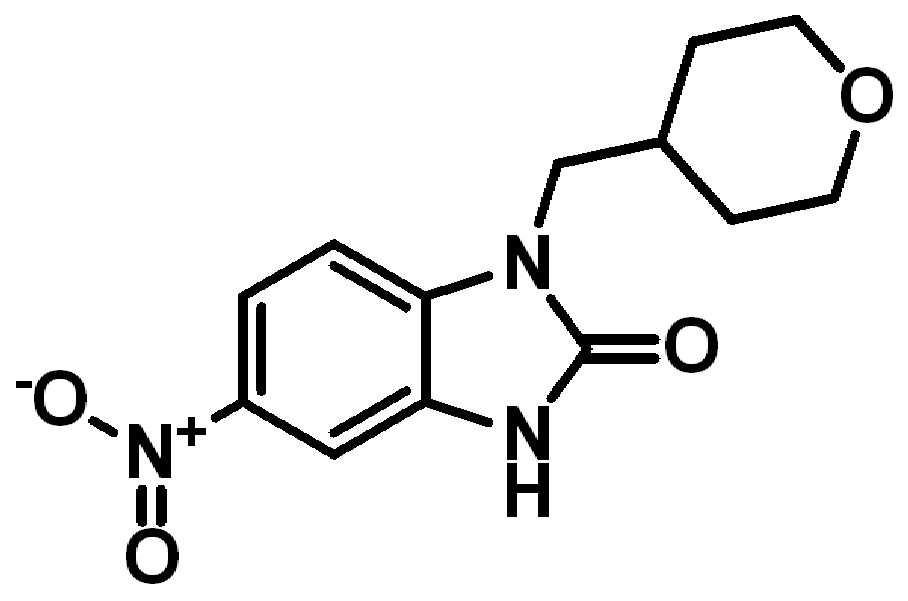
NMP(3.5 mL) 중의 (테트라히드로-2H-피란-4-일)메탄아민(0.43 mL, 3.52 mmol), 2-플루오로-5-니트로아닐린(539 mg, 3.45 mmol) 및 DIPEA(0.60 mL, 3.4 mmol)의 혼합물을 마이크로웨이브에서 180℃까지 2.5h 동안 가열하였다. 추가의 (테트라히드로-2H-피란-4-일)메탄아민(0.21 mL, 1.72 mmol)을 첨가하고, 혼합물을 180℃에서 2h 동안 마이크로웨이브에 다시 넣었다. 냉각 후, 반응물을 DCM과 포화 중탄산나트륨 사이에 분배시켰다. 유기 상을 물로 2회 세척하고, 황산나트륨 상에서 건조하고, 여과하고, 감압 하에서 증발시켜 NMP 중의 4-니트로-N1-((테트라히드로-2H-피란-4-일)메틸)벤젠-1,2-디아민과 부산물의 조 혼합물을 제공하였다. 이것을 아세토니트릴(10 mL)로 희석시키고, 비스(2,5-디옥소피롤리딘-1-일) 카르보네이트(810 mg, 3.16 mmol)를 첨가하였다. 생성된 혼합물을 20h 동안 실온에서 교반하고, 이어서 물(15 mL) 중에 붓고, 생성된 침전물을 여과에 의해서 수집하고, 물, 디에틸 에테르 및 DCM로 세척하여 표제 화합물(0.38 g)을 베이지색 고체로서 제공하였다. LCMS(방법 T2) Rt 1.21, m/z 278.11.(Tetrahydro-2 H -pyran-4-yl) methanamine (0.43 mL, 3.52 mmol), 2-fluoro-5-nitroaniline (539 mg, 3.45 mmol) and DIPEA (0.60 mL) in NMP (3.5 mL) , 3.4 mmol) was heated in a microwave to 180 ° C. for 2.5 h. Additional (tetrahydro-2 H -pyran-4-yl) methanamine (0.21 mL, 1.72 mmol) was added and the mixture was returned to the microwave at 180 ° C. for 2 h. After cooling, the reaction was partitioned between DCM and saturated sodium bicarbonate. The organic phase is washed twice with water, dried over sodium sulphate, filtered and evaporated under reduced pressure to give 4-nitro- N 1-((tetrahydro-2 H -pyran-4-yl) methyl) benzene-1 in NMP, A crude mixture of 2-diamine and byproducts was provided. It was diluted with acetonitrile (10 mL) and bis (2,5-dioxopyrrolidin-1-yl) carbonate (810 mg, 3.16 mmol) was added. The resulting mixture was stirred for 20 h at room temperature, then poured into water (15 mL) and the resulting precipitate was collected by filtration and washed with water, diethyl ether and DCM to give the title compound (0.38 g) as a beige solid. Served as. LCMS (Method T2) Rt 1.21, m / z 278.11.
중간체 B9a: 5-에틸-5-[(3-메틸-6-니트로-2-옥소-벤즈이미다졸-1-일)메틸]옥사졸리딘-2-온 Intermediate B9a: 5-ethyl-5-[(3-methyl-6-nitro-2-oxo-benzimidazol-1-yl) methyl] oxazolidin-2-one
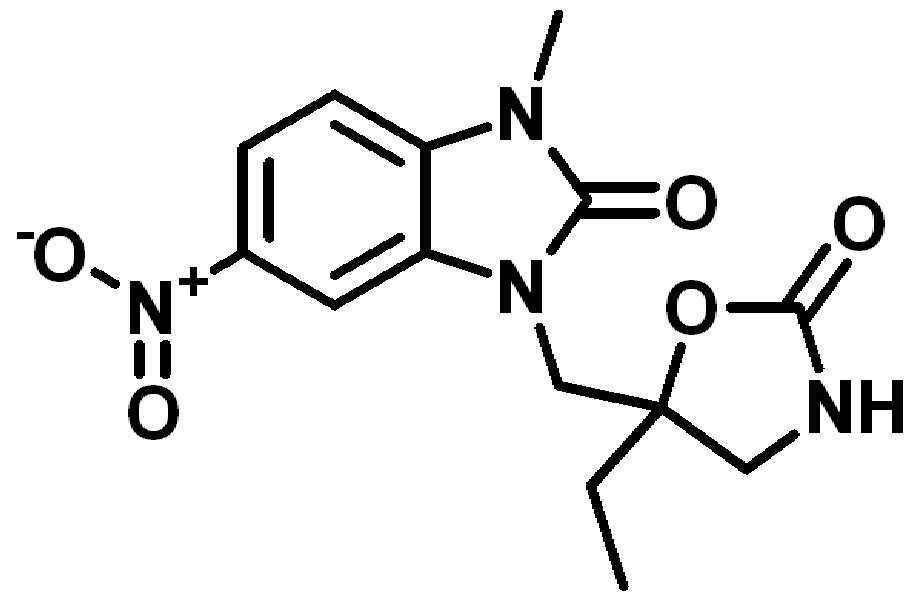
밀폐된 튜브 내의 EtOH(2 mL) 중의 3-((2-에틸옥시란-2-일)메틸)-1-메틸-5-니트로-1,3-디히드로-2H-벤조[d]이미다졸-2-온(중간체 B4a, 142 mg, 0.51 mmol)의 용액에 암모니아(MeOH 중의 7 M, 0.59 mL, 4.10 mmol)를 첨가하였다. 혼합물을 100 C에서 1h 동안 마이크로웨이브에서 교반하였다. 실온까지 냉각시키고, 용매를 감압 하에서 증발시키고, 혼합물을 THF(3 mL) 중에 용해시켰다. 트리포스젠(760 mg, 2.56 mmol)을 첨가하고, 밀폐된 튜브에서 혼합물을 실온에서 18h 동안 교반하였다. 2 M NaOH를 서서히 첨가하여 반응을 켄칭시키고, 층을 분리하고, 수성 층을 EtOAc로 추출하였다. 컬럼 크로마토그래피(25 g 컬럼, DCM 중의 0% 내지 10% MeOH)에 의한 정제는 표제 화합물(136 mg, 83%, 0.42 mmol)을 오일로서 제공하였다. LCMS(방법 T2): Rt 1.13min, m/z 321.12 [M+H]+.3-((2-ethyloxan-2-yl) methyl) -1-methyl-5-nitro-1,3-dihydro-2H-benzo [d] imidazole in EtOH (2 mL) in a closed tube To a solution of 2-one (intermediate B4a, 142 mg, 0.51 mmol) was added ammonia (7 M in MeOH, 0.59 mL, 4.10 mmol). The mixture was stirred at 100 C for 1 h in microwave. Cool to room temperature, evaporate the solvent under reduced pressure and dissolve the mixture in THF (3 mL). Triphosgene (760 mg, 2.56 mmol) was added and the mixture was stirred for 18 h at room temperature in a closed tube. The reaction was quenched by the slow addition of 2 M NaOH, the layers were separated and the aqueous layer was extracted with EtOAc. Purification by column chromatography (25 g column, 0% to 10% MeOH in DCM) provided the title compound (136 mg, 83%, 0.42 mmol) as an oil. LCMS (Method T2): Rt 1.13 min, m / z 321.12 [M + H] + .
표 19에 나타낸 에폭시드 및 메틸아민을 사용하여, 중간체 B9a의 제조를 위해서 사용된 것과 유사한 방법에 의해서 하기 표로 나타낸 중간체를 제조하였다.Using the epoxides and methylamines shown in Table 19, the intermediates shown in the table below were prepared by similar methods to those used for the preparation of intermediate B9a.
[표 19]TABLE 19

중간체 B10: 5-플루오로-3-메틸-6-니트로-1H-벤즈이미다졸-2-온Intermediate B10: 5-Fluoro-3-methyl-6-nitro-1H-benzimidazol-2-one

N2 하에서 아세트산 무수물(7.5 mL)5-플루오로-3-메틸-1H-벤즈이미다졸-2-온(0.5 g, 3 mmol)의 현탁액을 -30℃까지 냉각시키고, 퓨밍 질산(0.14 mL, 3.04 mmol)을 적가하였다. 혼합물을 1h 동안 교반하고, 0℃까지 서서히 가온시켰다. 혼합물을 이어서 빙수(10 mL) 및 EtOAc(1 mL)의 교반 혼합물 중에 붓고, 혼합물을 30min 동안 실온에서 교반하였다. 추가의 EtOAc를 첨가하고, 층을 분리하였다. 수성 층을 추가의 EtOAc로 추출하였다. 유기 층을 합하고, MgSO4 상에서 건조하고, 감압 하에서 증발시켜 표제 화합물(500 mg)을 흑색 고체로서 제공하였다. LCMS(방법 T2): Rt 0.97min, m/z 212.04 [M+H]+.Cool a suspension of acetic anhydride (7.5 mL) 5-fluoro-3-methyl-1 H-benzimidazol-2-one (0.5 g, 3 mmol) under N 2 to -30 ° C. and purify nitric acid (0.14 mL, 3.04 mmol) was added dropwise. The mixture was stirred for 1 h and slowly warmed up to 0 ° C. The mixture was then poured into a stirred mixture of ice water (10 mL) and EtOAc (1 mL) and the mixture was stirred for 30 min at room temperature. Additional EtOAc was added and the layers separated. The aqueous layer was extracted with additional EtOAc. The organic layers were combined, dried over MgSO 4 and evaporated under reduced pressure to give the title compound (500 mg) as a black solid. LCMS (Method T2): Rt 0.97 min, m / z 212.04 [M + H] + .
중간체 B11: N-(2-메틸-4-(3-메틸-6-니트로-2-옥소-2,3-디히드로-1H-벤조[d]이미다졸-1-일)부탄-2-일)아세트아미드Intermediate B11: N- (2-methyl-4- (3-methyl-6-nitro-2-oxo-2,3-dihydro-1H-benzo [d] imidazol-1-yl) butan-2-yl Acetamide

3-(3-히드록시-3-메틸-부틸)-1-메틸-5-니트로-벤즈이미다졸-2-온(중간체 B1a, 50 mg, 0.18 mmol)을 MeCN(1mL) 중에 용해시키고, 황산(0.10 mL, 1.876 mmol)을 0℃에서 적가하고, 생성된 혼합물을 밤새 rt에서 교반하였다. 물(2 mL)을 적가하고, 이어서 pH 6에 도달할 때까지 sat. aq. 중탄산염을 조심스럽게 첨가하였다. DCM으로 2회 추출하고, 합한 유기물을 건조하고, 증발시키고, 플래시 컬럼 크로마토그래피(10g KP-SIL, DCM 중의 0% 내지 3% 메탄올)에 의해서 정제하여 표제 화합물(32 mg, 56%, 0.1 mmol)을 제공하였다. LCMS(방법 X2) Rt 1.10min; m/z 321.1564 C15H21N4O4 [M+H]+에 대한 예측치 321.1563.3- (3-hydroxy-3-methyl-butyl) -1-methyl-5-nitro-benzimidazol-2-one (intermediate B1a, 50 mg, 0.18 mmol) is dissolved in MeCN (1 mL) and sulfuric acid (0.10 mL, 1.876 mmol) was added dropwise at 0 ° C. and the resulting mixture was stirred at rt overnight. Water (2 mL) was added dropwise, followed by sat. Until pH 6 was reached. aq. Bicarbonate was added carefully. Extract twice with DCM, combine organics, dry, evaporate and purify by flash column chromatography (10 g KP-SIL, 0% to 3% methanol in DCM) to give the title compound (32 mg, 56%, 0.1 mmol). ). LCMS (Method X2) Rt 1.10 min; m / z 321.1564 C 15 H 21 N 4 0 4 [M + H] + calcd for 321.1563.
중간체 B12: (S)-1-메틸-5-니트로-3-((1-(2,2,2-트리플루오로에틸)피롤리딘-2-일)메틸)-1,3-디히드로-2H-벤조[d]이미다졸-2-온Intermediate B12: (S) -1-Methyl-5-nitro-3-((1- (2,2,2-trifluoroethyl) pyrrolidin-2-yl) methyl) -1,3-dihydro -2H-benzo [d] imidazol-2-one

아르곤 하에서 THF(2mL) 중의 [(2S)-1-(2,2,2-트리플루오로에틸)피롤리딘-2-일]메탄올(중간체 G4a, 90 mg, 0.49 mmol) 및 시아노메틸트리부틸포스포란(THF 중의 33% w/v 용액)(0.75 mL, 1.04 mmol)을 DMF(0.3mL) 중의 1-메틸-5-니트로-2,3-디히드로-1H-1,3-벤조디아졸-2-온(80 mg, 0.41 mmol)의 현탁액에 순차적으로 첨가하였다. 생성된 혼합물을 60℃까지 2시간 동안 가열하고, 이어서 마이크로웨이브에서 100℃에서 1h 동안 가열하였다. 냉각 후, 혼합물을 DCM과 물 사이에 분배시키고, 10% 시트르산으로 pH 4까지 산성화시키고, 층을 분리하였다. 유기층을 실리카 상에서 증발시키고, 플래시 컬럼 크로마토그래피(10 g KP-SIL, 시클로헥산 중의 20% 내지 60% 에틸 아세테이트)에 의해서 정제하였다. 생성된 적색 검을 디에틸 에테르로 배산처리하고, 이어서 생성된 고체를 DCM 중에 용해시키고, 재증발시키고, 건조하여 베이지색 고체를 제공하였다. LCMS(방법 X2) Rt 1.37min m/z 359.1325 C15H18N4O3F3 [M+H]+에 대한 예측치 359.1331.[(2S) -1- (2,2,2-trifluoroethyl) pyrrolidin-2-yl] methanol (intermediate G4a, 90 mg, 0.49 mmol) and cyanomethyltri in THF (2 mL) under argon Butylphosphorane (33% w / v solution in THF) (0.75 mL, 1.04 mmol) was added 1-methyl-5-nitro-2,3-dihydro-1H-1,3-benzodia in DMF (0.3 mL). To the suspension of sol-2-one (80 mg, 0.41 mmol) was added sequentially. The resulting mixture was heated to 60 ° C. for 2 hours and then heated in microwave at 100 ° C. for 1 h. After cooling, the mixture was partitioned between DCM and water, acidified to pH 4 with 10% citric acid and the layers separated. The organic layer was evaporated on silica and purified by flash column chromatography (10 g KP-SIL, 20% to 60% ethyl acetate in cyclohexane). The resulting red gum was redeployed with diethyl ether, and the resulting solid was dissolved in DCM, redevaporated and dried to give a beige solid. LCMS (Method X2) Rt 1.37 min m / z 359.1325 C 15 H 18 N 4 O 3 F 3 [M + H] + predicted for 359.1331.
중간체 B13a: 1,3-비스(3-히드록시-3-메틸부틸)-5-니트로-1,3-디히드로-2H-벤조[d]이미다졸-2-온Intermediate B13a: 1,3-bis (3-hydroxy-3-methylbutyl) -5-nitro-1,3-dihydro-2H-benzo [d] imidazol-2-one

아세토니트릴(8 mL) 및 DMF(2mL) 중의 5-니트로-2-벤즈이미다졸린온(300 mg, 1.62 mmol) 및 디세슘 카르보네이트(0.75 g, 2.3 mmol)의 혼합물에 (3-히드록시-3-메틸-부틸) 4-메틸벤젠설포네이트(중간체 C1a, 450 mg, 1.74 mmol)를 첨가하고, 생성된 혼합물을 100℃까지 1h 동안 마이크로웨이브에서 가열하였다. 냉각 후, 혼합물을 DCM과 물 사이에 분배시키고, 10% 시트르산으로 pH 8까지 산성화시키고, 층을 분리하였다. 유기상을 감압 하에서 증발시키고, 이어서 역상 플래시 크로마토그래피(Biotage 12 g SNAP Ultra C18, 물 중의 30% 내지 65% 메탄올, 0.1% 포름산 개질제)를 사용하여 정제하였다. 1H NMR (600 MHz, 클로로포름-d) δ 8.13 (dd, J = 8.6, 2.2 Hz, 1H), 7.97 (d, J = 2.2 Hz, 1H), 7.12 (d, J = 8.7 Hz, 1H), 4.16 - 4.09 (m, 4H), 1.96 - 1.88 (m, 4H), 1.34 (s, 6H), 1.33 (s, 6H).To a mixture of 5-nitro-2-benzimidazolinone (300 mg, 1.62 mmol) and cesium carbonate (0.75 g, 2.3 mmol) in acetonitrile (8 mL) and DMF (2 mL) (3-hydrate Oxy-3-methyl-butyl) 4-methylbenzenesulfonate (intermediate C1a, 450 mg, 1.74 mmol) was added and the resulting mixture was heated in microwave for 1 h to 100 ° C. After cooling, the mixture was partitioned between DCM and water, acidified to pH 8 with 10% citric acid and the layers separated. The organic phase was evaporated under reduced pressure and then purified using reverse phase flash chromatography (Biotage 12 g SNAP Ultra C18, 30% to 65% methanol in water, 0.1% formic acid modifier). 1 H NMR (600 MHz, Chloroform-d) δ 8.13 (dd, J = 8.6, 2.2 Hz, 1H), 7.97 (d, J = 2.2 Hz, 1H), 7.12 (d, J = 8.7 Hz, 1H), 4.16-4.09 (m, 4H), 1.96-1.88 (m, 4H), 1.34 (s, 6H), 1.33 (s, 6H).
중간체 B13b: 1,3-비스(3-히드록시-3-메틸부틸)-6-니트로-1,3-디히드로-2H-이미다조[4,5-b]피리딘-2-온Intermediate B13b: 1,3-bis (3-hydroxy-3-methylbutyl) -6-nitro-1,3-dihydro-2H-imidazo [4,5-b] pyridin-2-one
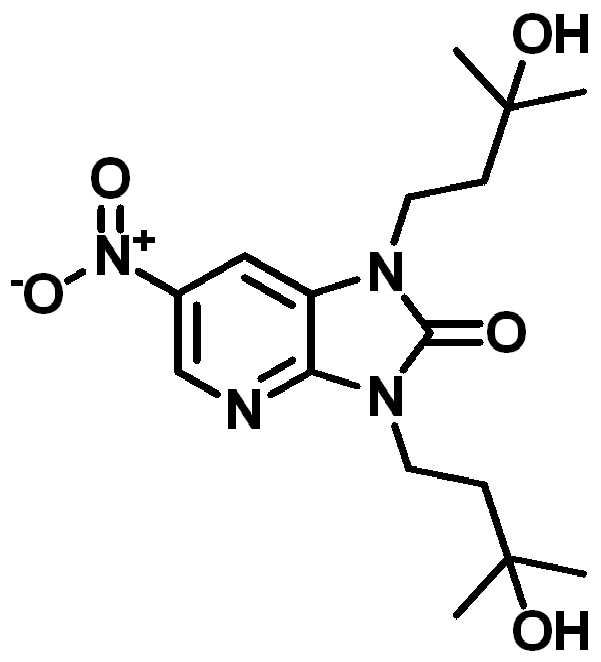
실온에서 아세토니트릴(15mL) 중의 5-니트로피리딘-2,3-디아민(125 mg, 0.81 mmol)에 비스(2,5-디옥소피롤리딘-1-일) 카르보네이트(0.30 g, 1.17 mmol)를 3분에 걸쳐서 나누어 첨가하여 제조된 6-니트로-1,3-디히드로-2H-이미다조[4,5-b]피리딘-2-온으로부터 출발하여, 용매로서 DMF를 사용하고, 120℃까지 가열하여, 중간체 B13a의 제조를 위해서 사용된 것과 유사한 방법에 의해서 제조하였다. 생성된 혼합물을 실온에서 10분 동안 교반하고, 이어서 마이크로웨이브에서 120℃까지 1시간 동안 가열하였다. 고체 물질을 여과에 의해서 수집하고, 아세토니트릴로 세척하고, 필터 상에서 건조하여 6-니트로-1,3-디히드로이미다조[4,5-b]피리딘-2-온(0.09 g)을 갈색 고체로서 제공하였다. LCMS(방법 X2) Rt 1.39min; m/z 408.13 [M+Na]+.Bis (2,5-dioxopyrrolidin-1-yl) carbonate (0.30 g, 1.17 mmol) in 5-nitropyridin-2,3-diamine (125 mg, 0.81 mmol) in acetonitrile (15 mL) at room temperature ) Was added in portions over 3 minutes, starting from 6-nitro-1,3-dihydro-2H-imidazo [4,5-b] pyridin-2-one, using DMF as solvent, 120 Heated to C, it was prepared by a method similar to that used for the preparation of intermediate B13a. The resulting mixture was stirred at rt for 10 min and then heated in microwave to 120 ° C. for 1 h. The solid material was collected by filtration, washed with acetonitrile and dried over a filter to give 6-nitro-1,3-dihydroimidazo [4,5-b] pyridin-2-one (0.09 g) as a brown solid. Served as. LCMS (Method X2) Rt 1.39 min; m / z 408.13 [M + Na] + .
중간체 B13c: 4-클로로-1,3-비스(3-히드록시-3-메틸-부틸)-6-니트로-벤즈이미다졸-2-온Intermediate B13c: 4-Chloro-1,3-bis (3-hydroxy-3-methyl-butyl) -6-nitro-benzimidazol-2-one

용매로서 DMF를 사용하고, 4-클로로-6-니트로-1,3-디히드로-2H-벤조[d]이미다졸-2-온으로부터 출발하여 중간체 B13a의 제조를 위해 사용된 것과 유사한 방법에 의해서 제조하였다. LCMS(방법 X2) Rt 1.39min; m/z 408.13 [M+Na]+.Using DMF as the solvent and starting from 4-chloro-6-nitro-1,3-dihydro-2H-benzo [d] imidazol-2-one by a similar method as used for the preparation of intermediate B13a Prepared. LCMS (Method X2) Rt 1.39 min; m / z 408.13 [M + Na] + .
중간체 C1a: (3-히드록시-3-메틸-부틸) 4-메틸벤젠설포네이트 Intermediate C1a: (3-hydroxy-3-methyl-butyl) 4-methylbenzenesulfonate

3-메틸부탄-1,3-디올(6.6 g, 63.4 mmol), 무수 피리딘(60 mL) 중의 4-메틸벤젠설포닐 클로라이드(18 g, 94 mmol)의 혼합물을 0℃에서 2시간 동안 교반하고, 이어서 차가운 HCl(2 M, 150 mL) 중에 붓고, 에틸 아세테이트(3 x 180 mL)로 추출하였다. 합한 유기 상을 HCl(2 M, 4 x 180 mL), 염수 (90 mL)로 세척하고, 황산마그네슘 상에서 건조하고, 건조물로 증발시켰다. 플래시 컬럼 크로마토그래피(물질을 2개의 절반부로 나누고, 각각 100 g 실리카, 시클로헥산 중의 0% 내지 50% 에틸 아세테이트를 사용하여 정제함)에 의해서 정제하고, 각각의 컬럼으로부터의 순수한 분획을 다시 합하여 표제 화합물(12 g, 73%, 46.5 mmol)을 투명한 오일로서 제공하였다. 1H NMR (500 MHz, 클로로포름-d) δ 7.81 (d, J = 8.2 Hz, 2H), 7.34 (d, J = 7.6 Hz, 2H), 4.22 (t, J = 6.9 Hz, 2H), 2.46 (s, 3H), 1.87 (t, J = 6.9 Hz, 2H), 1.23 (s, 6H). A mixture of 3-methylbutane-1,3-diol (6.6 g, 63.4 mmol), 4-methylbenzenesulfonyl chloride (18 g, 94 mmol) in anhydrous pyridine (60 mL) was stirred at 0 ° C. for 2 hours Then poured into cold HCl (2 M, 150 mL) and extracted with ethyl acetate (3 × 180 mL). The combined organic phases were washed with HCl (2 M, 4 × 180 mL), brine (90 mL), dried over magnesium sulphate and evaporated to dryness. Purification by flash column chromatography (dividing material into two halves, each purified using 100 g silica, 0% to 50% ethyl acetate in cyclohexane), and again adding pure fractions from each column to the title Compound (12 g, 73%, 46.5 mmol) was provided as a clear oil. 1 H NMR (500 MHz, Chloroform-d) δ 7.81 (d, J = 8.2 Hz, 2H), 7.34 (d, J = 7.6 Hz, 2H), 4.22 (t, J = 6.9 Hz, 2H), 2.46 ( s, 3H), 1.87 (t, J = 6.9 Hz, 2H), 1.23 (s, 6H).
중간체 C1b: (3-히드록시-2,3-디메틸-부틸) 4-메틸벤젠설포네이트Intermediate C1b: (3-hydroxy-2,3-dimethyl-butyl) 4-methylbenzenesulfonate

중간체 C1a의 제조를 위해서 사용된 것과 유사한 방법을 사용하여 2,3-디메틸부탄-1,3-디올(중간체 G6a)로부터 제조하였다. LCMS(방법 X2) Rt 1.23min; m/z 295.0977 [M+Na]+.Prepared from 2,3-dimethylbutane-1,3-diol (intermediate G6a) using a method similar to that used for the preparation of intermediate C1a. LCMS (Method X2) Rt 1.23 min; m / z 295.0977 [M + Na] + .
중간체 C1c: (4,4,4-트리플루오로-3-히드록시-3-메틸-부틸) 4-메틸벤젠설포네이트 Intermediate C1c: (4,4,4-trifluoro-3-hydroxy-3-methyl-butyl) 4-methylbenzenesulfonate

중간체 C1a의 제조를 위해서 사용된 것과 유사한 방법을 사용하여 4,4,4-트리플루오로-3-메틸-부탄-1,3-디올(중간체 G6b)로부터 제조하였다. 1H NMR (500 MHz, 클로로포름-d) δ 7.81 (d, J=8Hz, 2H), 7.38 (d, J = 8.1 Hz, 2H), 4.31 (dt, J = 10.4, 6.8 Hz, 1H), 4.23 (dt, J = 10.4, 6.3 Hz, 1H), 2.48 (s, 3H), 2.18 - 1.97 (m, 3H), 1.39 (s, 3H).Prepared from 4,4,4-trifluoro-3-methyl-butane-1,3-diol (intermediate G6b) using a method similar to that used for the preparation of intermediate C1a. 1 H NMR (500 MHz, Chloroform-d) δ 7.81 (d, J = 8 Hz, 2H), 7.38 (d, J = 8.1 Hz, 2H), 4.31 (dt, J = 10.4, 6.8 Hz, 1H), 4.23 (dt, J = 10.4, 6.3 Hz, 1H), 2.48 (s, 3H), 2.18-1.97 (m, 3H), 1.39 (s, 3H).
중간체 C2: [(3R)-3-히드록시부틸] 4-메틸벤젠설포네이트 및Intermediate C2: [( 3R ) -3-hydroxybutyl] 4-methylbenzenesulfonate and
중간체 C3: [(3R)-3-(p-톨릴설포닐옥시)부틸] 4-메틸벤젠설포네이트Intermediate C3: [( 3R ) -3- ( p -tolylsulfonyloxy) butyl] 4-methylbenzenesulfonate

질소 분위기 하에서 무수 디클로로메탄(10 mL) 중의 (3R)-부탄-1,3-디올(0.86 mL, 9.5 mmol)의 용액을 염-얼음 조(조 온도 -12℃) 중에서 냉각시켰다. 트리에틸아민(2.25 mL, 16.1 mmol), 그 다음 무수 디클로로메탄(6 mL) 중의 4-메틸벤젠설포닐 클로라이드(2 g, 10.5 mmol)의 용액을 10분에 걸쳐 첨가하였다. 생성된 혼합물을 실온까지 서서히 가온시키고, 20h 동안 교반하고, 이어서 DCM으로 희석시키고, 10% 시트르산, sat. 중탄산나트륨 용액, 염수로 세척하고, 황산나트륨 상에서 건조하고, 여과하고, 감압 하에서 증발시켜 투명한 오일을 제공하였다. 이것을 플래시 컬럼 크로마토그래피(50 g 실리카, 시클로헥산 중의 10% 내지 30% 에틸 아세테이트)에 의해서 정제하였다. 두 개의 생성물을 수득하였다: 중간체 C2: 투명한 오일로서의 [(3R)-3-히드록시부틸] 4-메틸벤젠설포네이트(1.65 g)[1H NMR (500 MHz, 클로로포름-d) δ 7.82 (br d, J = 8.3Hz, 2H), 7.37 (br d, J = 7.9Hz, 2H), 4.26 (ddd, J = 10.0, 8.7, 5.0 Hz, 1H), 4.13 (dt, J = 10.0, 5.5 Hz, 1H), 3.96 (dqd, J = 9.7, 6.2, 3.5 Hz, 1H), 2.47 (s, 3H), 1.85 (dddd, J = 14.5, 8.7, 5.8, 3.6 Hz, 1H), 1.71 (ddt, J = 14.2, 8.9, 5.0 Hz, 1H), 1.21 (d, J = 6.3 Hz, 3H)] 및 중간체 C3: 투명한 오일로서의 [(3R)-3-(p-톨릴설포닐옥시)부틸] 4-메틸벤젠설포네이트(155 mg). [1H NMR (500 MHz, 클로로포름-d) δ 7.80 - 7.73 (m, 4H), 7.40 - 7.32 (m, 4H), 4.71 (dqd, J = 8.0, 6.3, 4.5 Hz, 1H), 4.04 (dt, J = 10.2, 5.8 Hz, 1H), 3.94 (ddd, J = 10.4, 7.7, 5.6 Hz, 1H), 2.48 (s, 3H), 2.47 (s, 3H), 2.02 - 1.85 (m, 2H), 1.26 (d, J = 6.3 Hz, 3H). A solution of ( 3R ) -butane-1,3-diol (0.86 mL, 9.5 mmol) in anhydrous dichloromethane (10 mL) was cooled in a salt-ice bath (crude temperature -12 ° C) under a nitrogen atmosphere. Triethylamine (2.25 mL, 16.1 mmol), then a solution of 4-methylbenzenesulfonyl chloride (2 g, 10.5 mmol) in anhydrous dichloromethane (6 mL) was added over 10 minutes. The resulting mixture was slowly warmed up to room temperature, stirred for 20 h, then diluted with DCM, 10% citric acid, sat. Sodium bicarbonate solution, washed with brine, dried over sodium sulfate, filtered and evaporated under reduced pressure to give a clear oil. This was purified by flash column chromatography (50 g silica, 10% to 30% ethyl acetate in cyclohexane). Two products were obtained: Intermediate C2: [( 3R ) -3-hydroxybutyl] 4-methylbenzenesulfonate (1.65 g) as a clear oil [ 1 H NMR (500 MHz, Chloroform-d) δ 7.82 ( br d, J = 8.3 Hz, 2H), 7.37 (br d, J = 7.9 Hz, 2H), 4.26 (ddd, J = 10.0, 8.7, 5.0 Hz, 1H), 4.13 (dt, J = 10.0, 5.5 Hz , 1H), 3.96 (dqd, J = 9.7, 6.2, 3.5 Hz, 1H), 2.47 (s, 3H), 1.85 (dddd, J = 14.5, 8.7, 5.8, 3.6 Hz, 1H), 1.71 (ddt, J = 14.2, 8.9, 5.0 Hz, 1H), 1.21 (d, J = 6.3 Hz, 3H)] and intermediate C3: [( 3R ) -3- ( p -tolylsulfonyloxy) butyl] as a clear oil] 4- Methylbenzenesulfonate (155 mg). [ 1 H NMR (500 MHz, Chloroform-d) δ 7.80-7.73 (m, 4H), 7.40-7.32 (m, 4H), 4.71 (dqd, J = 8.0, 6.3, 4.5 Hz, 1H), 4.04 (dt , J = 10.2, 5.8 Hz, 1H), 3.94 (ddd, J = 10.4, 7.7, 5.6 Hz, 1H), 2.48 (s, 3H), 2.47 (s, 3H), 2.02-1.85 (m, 2H), 1.26 (d, J = 6.3 Hz, 3H).
중간체 C4a: 메틸 2-메톡시-4-(p-톨릴설포닐옥시)부탄오에이트 Intermediate C4a: Methyl 2-methoxy-4- ( p -tolylsulfonyloxy) butanoate

단계 1:Step 1: 3-메톡시테트라히드로푸란-2-온3-methoxytetrahydrofuran-2-one
rt에서 Ar 하에서 산화은(520 mg, 2.2 mmol)을 아세토니트릴(5 mL) 중의 3-히드록시테트라히드로푸란-2-온(0.15 mL, 1.9 mmol) 및 아이오도메탄(0.36 mL, 5.8 mmol)의 교반되는 용액에 나누어 첨가하였다. 그 다음 반응 혼합물을 75℃에서 4h 동안 교반하였다. 반응 혼합물을 rt까지 냉각시키고, 여과하고, 고체 잔류물을 Et2O(3 x 15 mL)로 세척하였다. 여과액을 진공에서 농축시키고, 실리카젤 상에 직접 건조 로딩하였다. 플래시 크로마토그래피(50 g KP-SIL; 시클로헥산 중의 60% EtOAc에서 100% EtOAc)에 의한 정제는 3-메톡시테트라히드로푸란-2-온(168 mg, 75%)을 무색 오일로서 제공하였다. 1H NMR (500 MHz, 클로로포름-d) δ 4.43 (ddd, J = 9.1, 8.1, 4.3 Hz, 1H), 4.26 (ddd, J = 9.1, 8.0, 6.9 Hz, 1H), 4.03 (t, J = 7.6 Hz, 1H), 3.59 (s, 3H), 2.56 - 2.48 (m, 1H), 2.30 - 2.21 (m, 1H).rt of silver oxide (520 mg, 2.2 mmol) under Ar at rt of 3-hydroxytetrahydrofuran-2-one (0.15 mL, 1.9 mmol) and iodomethane (0.36 mL, 5.8 mmol) in acetonitrile (5 mL). It was added in portions to the stirred solution. The reaction mixture was then stirred at 75 ° C. for 4 h. The reaction mixture was cooled to rt, filtered and the solid residue was washed with Et 2 O (3 × 15 mL). The filtrate was concentrated in vacuo and dry loaded directly onto silica gel. Purification by flash chromatography (50 g KP-SIL; 100% EtOAc to 60% EtOAc in cyclohexane) provided 3-methoxytetrahydrofuran-2-one (168 mg, 75%) as a colorless oil. 1 H NMR (500 MHz, Chloroform-d) δ 4.43 (ddd, J = 9.1, 8.1, 4.3 Hz, 1H), 4.26 (ddd, J = 9.1, 8.0, 6.9 Hz, 1H), 4.03 (t, J = 7.6 Hz, 1H), 3.59 (s, 3H), 2.56-2.48 (m, 1H), 2.30-2.21 (m, 1H).
단계 2: 메틸 4-히드록시-2-메톡시-부탄오에이트Step 2: Methyl 4-hydroxy-2-methoxy-butanoate
Ar 하에서 디옥산(50 uL, 0.2 mmol) 중의 4 N HCl을 무수 메탄올(4.5 mL) 중의 3-메톡시테트라히드로푸란-2-온(166 mg, 1.4 mmol, 단계 1로부터)의 교반되는 용액에 첨가하였다. 반응 혼합물을 60℃에서 3h 동안 교반하였다. 반응 혼합물을 rt까지 냉각시키고, 진공에서 농축시키고, 실리카젤 상에 직접 건조 로딩하였다. 플래시 크로마토그래피(KP-SIL 25 g; 시클로헥산 중의 50% EtOAc에서 100% EtOAc)에 의한 정제는 메틸 4-히드록시-2-메톡시-부탄오에이트(117 mg, 55%)를 무색 오일로서 제공하였다. 1H NMR (500 MHz, 클로로포름-d) δ 4.01 (dd, J = 7.7, 4.6 Hz, 1H), 3.81 - 3.77 (m, 5H), 3.44 (s, 3H), 2.08 - 1.95 (m, 3H).4N HCl in dioxane (50 uL, 0.2 mmol) under Ar was added to a stirred solution of 3-methoxytetrahydrofuran-2-one (166 mg, 1.4 mmol, from step 1) in anhydrous methanol (4.5 mL). Added. The reaction mixture was stirred at 60 ° C. for 3 h. The reaction mixture was cooled to rt, concentrated in vacuo and dry loaded directly on silica gel. Purification by flash chromatography (KP-SIL 25 g; 100% EtOAc to 50% EtOAc in cyclohexane) gave methyl 4-hydroxy-2-methoxy-butanoate (117 mg, 55%) as a colorless oil. Provided. 1 H NMR (500 MHz, Chloroform-d) δ 4.01 (dd, J = 7.7, 4.6 Hz, 1H), 3.81-3.77 (m, 5H), 3.44 (s, 3H), 2.08-1.95 (m, 3H) .
단계 3: 메틸 2-메톡시-4-(p-톨릴설포닐옥시)부탄오에이트Step 3: Methyl 2-methoxy-4- (p-tolylsulfonyloxy) butanoate
Ar 하에서 트리에틸아민(0.16 mL, 1.17 mmol), 피리딘(10 uL, 0.12 mmol) 및 토실 클로라이드(179 mg, 0.94 mmol)를 DCM(2 mL) 중의 메틸 4-히드록시-2-메톡시-부탄오에이트(115 mg, 0.78 mmol, 단계 2로부터)의 교반되는 용액에 순차적으로 첨가하였다. 이어서 반응 혼합물을 30℃에서 5h 동안 교반하였다. 물을 반응 혼합물에 첨가하였다. 층을 분리하고, 수성 층을 추가의 DCM(3 x 10 mL)으로 추출하였다. 유기 추출물을 합하고, 염수(5 mL)로 세척하고, 건조하고(황산나트륨)하고, 진공에서 농축시켰다. 플래시 크로마토그래피(25 g KP-SIL; 시클로헥산 중의 0%에서 60% EtOAc)에 의한 정제는 메틸 2-메톡시-4-(p-톨릴설포닐옥시)부탄오에이트(204 mg, 87%)를 연황색 오일로서 제공하였다. 1H NMR (500 MHz, 클로로포름-d) δ 7.83 - 7.79 (m, 2H), 7.39 - 7.34 (m, 2H), 4.24 - 4.18 (m, 1H), 4.14 - 4.09 (m, 1H), 3.85 (dd, J = 9.1, 3.9 Hz, 1H), 3.75 (s, 3H), 3.33 (s, 3H), 2.46 (s, 3H), 2.19 - 2.10 (m, 1H), 2.01 - 1.92 (m, 1H).Triethylamine (0.16 mL, 1.17 mmol), pyridine (10 uL, 0.12 mmol) and tosyl chloride (179 mg, 0.94 mmol) under Ar were methyl 4-hydroxy-2-methoxy-butane in DCM (2 mL). To the stirred solution of oate (115 mg, 0.78 mmol, from step 2) was added sequentially. The reaction mixture was then stirred at 30 ° C. for 5 h. Water was added to the reaction mixture. The layers were separated and the aqueous layer was extracted with additional DCM (3 x 10 mL). The organic extracts were combined, washed with brine (5 mL), dried (sodium sulfate) and concentrated in vacuo. Purification by flash chromatography (25 g KP-SIL; 0% to 60% EtOAc in cyclohexane) gave methyl 2-methoxy-4- ( p -tolylsulfonyloxy) butanoate (204 mg, 87%) Was provided as a pale yellow oil. 1 H NMR (500 MHz, Chloroform-d) δ 7.83-7.79 (m, 2H), 7.39-7.34 (m, 2H), 4.24-4.18 (m, 1H), 4.14-4.09 (m, 1H), 3.85 ( dd, J = 9.1, 3.9 Hz, 1H), 3.75 (s, 3H), 3.33 (s, 3H), 2.46 (s, 3H), 2.19-2.10 (m, 1H), 2.01-1.92 (m, 1H) .
중간체 C4b: 메틸 2-에톡시-4-(p-톨릴설포닐옥시)부탄오에이트 Intermediate C4b: Methyl 2-ethoxy-4- ( p -tolylsulfonyloxy) butanoate

중간체 C4a의 제조를 위해서 사용된 것과 유사한 방법에 의해서 제조하였다. 1H NMR (500 MHz, 클로로포름-d) δ 7.82 - 7.79 (m, 2H), 7.38 - 7.34 (m, 2H), 4.25 - 4.19 (m, 1H), 4.15 - 4.09 (m, 1H), 3.94 (dd, J = 9.5, 3.7 Hz, 1H), 3.73 (s, 3H), 3.63 (dq, J = 9.0, 7.0 Hz, 1H), 3.28 (dq, J = 9.0, 7.0 Hz, 1H), 2.46 (s, 3H), 2.18 - 2.09 (m, 1H), 1.99 - 1.91 (m, 1H), 1.13 (t, J = 7.0 Hz, 3H).Prepared by a method similar to that used for the preparation of intermediate C4a. 1 H NMR (500 MHz, Chloroform-d) δ 7.82-7.79 (m, 2H), 7.38-7.34 (m, 2H), 4.25-4.19 (m, 1H), 4.15-4.09 (m, 1H), 3.94 ( dd, J = 9.5, 3.7 Hz, 1H), 3.73 (s, 3H), 3.63 (dq, J = 9.0, 7.0 Hz, 1H), 3.28 (dq, J = 9.0, 7.0 Hz, 1H), 2.46 (s , 3H), 2.18-2.09 (m, 1H), 1.99-1.91 (m, 1H), 1.13 (t, J = 7.0 Hz, 3H).
중간체 C4c: 메틸 2-(시클로프로필메톡시)-4-(p-톨릴설포닐옥시)부탄오에이트Intermediate C4c: Methyl 2- (cyclopropylmethoxy) -4- ( p -tolylsulfonyloxy) butanoate

중간체 C4a의 제조를 위해서 사용된 것과 유사한 방법에 의해서 제조하였다. NaH 및 (브로모메틸)시클로프로판을 사용하여 단계 1에서의 3-히드록시테트라히드로푸란-2-온의 알킬화를 달성하였다. 1H NMR (500 MHz, 클로로포름-d) δ 7.82 - 7.79 (m, 2H), 7.38 - 7.34 (m, 2H), 4.29 - 4.22 (m, 1H), 4.15 - 4.10 (m, 1H), 3.99 (dd, J = 9.7, 3.6 Hz, 1H), 3.73 (s, 3H), 3.34 (dd, J = 10.0, 7.2 Hz, 1H), 3.17 (dd, J = 10.0, 6.8 Hz, 1H), 2.46 (s, 3H), 2.19 - 2.10 (m, 1H), 2.01 - 1.93 (m, 1H), 1.02 - 0.93 (m, 1H), 0.54 - 0.47 (m, 2H), 0.22 - 0.10 (m, 2H).Prepared by a method similar to that used for the preparation of intermediate C4a. The alkylation of 3-hydroxytetrahydrofuran-2-one in step 1 was achieved using NaH and (bromomethyl) cyclopropane. 1 H NMR (500 MHz, Chloroform-d) δ 7.82-7.79 (m, 2H), 7.38-7.34 (m, 2H), 4.29-4.22 (m, 1H), 4.15-4.10 (m, 1H), 3.99 ( dd, J = 9.7, 3.6 Hz, 1H), 3.73 (s, 3H), 3.34 (dd, J = 10.0, 7.2 Hz, 1H), 3.17 (dd, J = 10.0, 6.8 Hz, 1H), 2.46 (s , 3H), 2.19-2.10 (m, 1H), 2.01-1.93 (m, 1H), 1.02-0.93 (m, 1H), 0.54-0.47 (m, 2H), 0.22-0.10 (m, 2H).
중간체 C5a: (3-히드록시-3-메틸-펜틸) 4-메틸벤젠설포네이트Intermediate C5a: (3-hydroxy-3-methyl-pentyl) 4-methylbenzenesulfonate

단계 1: 3-메틸펜탄-1,3-디올Step 1: 3-methylpentane-1,3-diol
MeOH(25 mL) 중의 1-[tert-부틸(디메틸)실릴]옥시-3-메틸-펜탄-3-올(중간체 G1a, 570 mg, 2.45 mmol)의 용액에 HCl(5.70 mL, 11.4 mmol)을 실온에서 적가하였다. 혼합물을 2h 동안 교반하고, 이어서 고체 NaHCO3의 첨가에 의해서 그것을 켄칭시켰다. DCM으로 세척하면서 염을 여과하고, 용매를 감압 하에서 제거하여 표제 화합물(290 mg, 100% 수율, 2.45 mmol)을 투명한 오일로서 제공하였고, 이것을 추가의 정제 없이 다음 단계에 사용하였다.To a solution of 1- [tert-butyl (dimethyl) silyl] oxy-3-methyl-pentan-3-ol (intermediate G1a, 570 mg, 2.45 mmol) in MeOH (25 mL) was diluted with HCl (5.70 mL, 11.4 mmol). Dropwise at room temperature. The mixture was stirred for 2 h and then quenched by the addition of solid NaHCO 3 . The salt was filtered off while washing with DCM and the solvent was removed under reduced pressure to give the title compound (290 mg, 100% yield, 2.45 mmol) as a clear oil which was used for the next step without further purification.
단계 2: (3-히드록시-3-메틸-펜틸) 4-메틸벤젠설포네이트Step 2: (3-hydroxy-3-methyl-pentyl) 4-methylbenzenesulfonate
DCM(12 mL) 중의 4-메틸벤젠설포닐 클로라이드(515 mg, 2.70 mmol), 3-메틸펜탄-1,3-디올(단계 1로부터, 290 mg, 2.45 mmol), 트리에틸아민(0.68 mL, 4.91 mmol) 및 DMAP(30 mg, 0.25 mmol)의 혼합물을 0℃에서 2시간 동안 교반하였다. 수성 10% 시트르산을 첨가하고, 층을 분리하고, 수성 층을 DCM으로 추출하였다. 유기 층을 합하고, MgSO4 상에서 건조하고, 감압 하에서 농축시켰다. 플래시 컬럼 크로마토그래피(50g KP-SIL, 시클로헥산 중의 0% 내지 50% 에틸 아세테이트)에 의한 정제는 표제 화합물(426 mg, 64%, 1.5 mmol)을 무색 오일로서 제공하였다. 1H NMR (500 MHz, 클로로포름-d): d 7.81 (2H, d, J 8.8 Hz), 7.36 (2H, d, J 8.8 Hz), 4.25-4.19 (2H, m), 2.46 (3H, s), 1.90-1.80 (2H, m), 1.48 (2H, q, J 7.6 Hz), 1.15 (3H, s), 0.88 (3H, t, d, J 7.6 Hz).4-methylbenzenesulfonyl chloride (515 mg, 2.70 mmol), 3-methylpentane-1,3-diol (from step 1, 290 mg, 2.45 mmol) in DCM (12 mL), triethylamine (0.68 mL, 4.91 mmol) and DMAP (30 mg, 0.25 mmol) were stirred at 0 ° C. for 2 hours. Aqueous 10% citric acid was added, the layers were separated and the aqueous layer was extracted with DCM. The organic layers were combined, dried over MgSO 4 and concentrated under reduced pressure. Purification by flash column chromatography (50 g KP-SIL, 0% to 50% ethyl acetate in cyclohexane) provided the title compound (426 mg, 64%, 1.5 mmol) as a colorless oil. 1 H NMR (500 MHz, Chloroform-d): d 7.81 (2H, d, J 8.8 Hz), 7.36 (2H, d, J 8.8 Hz), 4.25-4.19 (2H, m), 2.46 (3H, s) , 1.90-1.80 (2H, m), 1.48 (2H, q, J 7.6 Hz), 1.15 (3H, s), 0.88 (3H, t, d, J 7.6 Hz).
표 20에 나타낸 알코올을 사용하여, 중간체 C5a의 제조를 위해서 사용된 것과 유사한 방법에 의해서 하기 표로 나타낸 중간체를 제조하였다.Using the alcohols shown in Table 20, the intermediates shown in the table below were prepared by methods similar to those used for the preparation of intermediate C5a.
[표 20]TABLE 20

표 21에 나타낸 알코올을 사용하여, 중간체 C5a의 제조를 위해서 기재된 제2 단계와 유사한 방법에 의해서 하기 표에 나타낸 중간체를 제조하였다.Using the alcohols shown in Table 21, the intermediates shown in the table below were prepared by a method analogous to the second step described for the preparation of intermediate C5a.
[표 21]TABLE 21
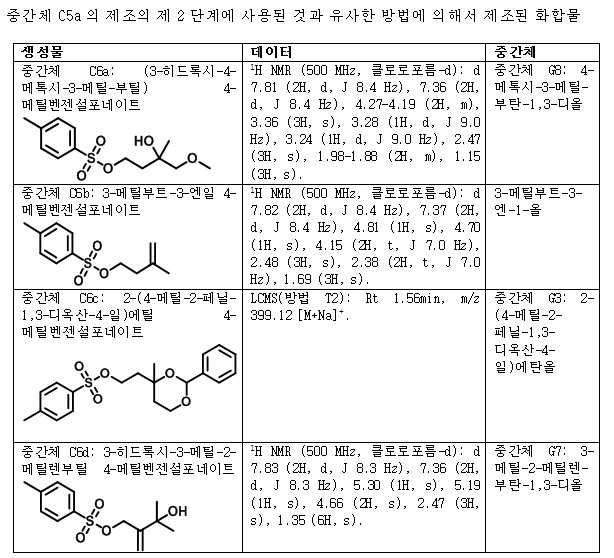
중간체 D1: 2-클로로-4-[(1-메틸-2-옥소-3H-벤즈이미다졸-5-일)아미노]피리딘-3-카르보니트릴Intermediate D1: 2-Chloro-4-[(1-methyl-2-oxo- 3H -benzimidazol-5-yl) amino] pyridine-3-carbonitrile

아르곤 하에서 5-아미노-1-메틸-1H-벤조[d]이미다졸-2(3H)-온(750 mg, 4.6 mmol) 및 2,4-디클로로피리딘-3-카르보니트릴(760 mg, 4.4 mmol)의 혼합물에 DMA(10 mL) 그 다음 DIPEA(0.90 mL, 5.19 mmol)를 첨가하였다 . 반응 혼합물을 120℃에서 마이크로웨이브 조사 하에서 45min 동안 가열하고, 이어서 rt까지 냉각시키고, 메탄올:물의 교반 혼합물(1:1; 120 mL)에 적가하였다. 생성된 침전물을 여과하고, 물(2 x 25 mL) 및 디에틸 에테르(2 x 30 mL)로 세척하여 2-클로로-4-[(1-메틸-2-옥소-3H-벤즈이미다졸-5-일)아미노]피리딘-3-카르보니트릴(1297 mg, 99%, 4.3 mmol)을 베이지색 고체로서 제공하였다. 1H NMR (500 MHz, DMSO-d 6 ) δ 10.95 (br s, 1H), 9.39 (br s, 1H), 7.99 (d, J = 6.2 Hz, 1H), 7.13 (d, J = 8.3 Hz, 1H), 6.95 (dd, J = 8.3, 1.9 Hz, 1H), 6.90 (d, J = 1.9 Hz, 1H), 6.65 (d, J = 6.2 Hz, 1H).Under argon 5-amino-1-methyl-1 H -benzo [d] imidazol-2 ( 3H ) -one (750 mg, 4.6 mmol) and 2,4-dichloropyridine-3-carbonitrile (760 mg, 4.4 mmol) was added DMA (10 mL) followed by DIPEA (0.90 mL, 5.19 mmol). The reaction mixture was heated at 120 ° C. under microwave irradiation for 45 min, then cooled to rt and added dropwise to a stirred mixture of methanol: water (1: 1; 120 mL). The resulting precipitate was filtered and washed with water (2 x 25 mL) and diethyl ether (2 x 30 mL) to give 2-chloro-4-[(1-methyl-2-oxo-3 H -benzimidazole- 5-yl) amino] pyridine-3-carbonitrile (1297 mg, 99%, 4.3 mmol) was provided as a beige solid. 1 H NMR (500 MHz, DMSO- d 6 ) δ 10.95 (br s, 1H), 9.39 (br s, 1H), 7.99 (d, J = 6.2 Hz, 1H), 7.13 (d, J = 8.3 Hz, 1H), 6.95 (dd, J = 8.3, 1.9 Hz, 1H), 6.90 (d, J = 1.9 Hz, 1H), 6.65 (d, J = 6.2 Hz, 1H).
중간체 D2a: 5-[(2,5-디클로로피리미딘-4-일)아미노]-3-(3-히드록시-3-메틸-부틸)-1-메틸-벤즈이미다졸-2-온Intermediate D2a: 5-[(2,5-dichloropyrimidin-4-yl) amino] -3- (3-hydroxy-3-methyl-butyl) -1-methyl-benzimidazol-2-one

DMF(15 mL) 중의 5-아미노-3-(3-히드록시-3-메틸-부틸)-1-메틸-벤즈이미다졸-2-온(중간체 A1, 1.61 g, 6.47 mmol), 2,4,5-트리클로로피리미딘(0.88 mL, 7.69 mmol) 및 탄산세슘(4.21 g, 12.93 mmol)의 혼합물을 마이크로웨이브에서 120℃까지 30분 동안 가열하였다. 생성된 혼합물을 물로 희석시키고, 10% 시트르산의 첨가에 의해서 pH 5까지 산성화시키고, DCM으로 추출하였다. 합한 유기물을 감압 하에서 증발시키고, 생성된 점성 고체를 최소 부피의 에틸 아세테이트 중에 용해시키고, 디에틸 에테르에 첨가에 의해서 침전시켰다. 생성된 고체를 여과에 의해서 수집하고, 디에틸 에테르로 세척하고, 감압 하에서 건조하여, 표제 생성물(1.96 mg, 72%, 4.69 mmol)을 고체로서 제공하였다. 1H NMR (500 MHz, DMSO-d6): d 9.57 (1H, s), 8.34 (1H, s), 7.35 (1H, d, J 1.9 Hz), 7.19 (1H, dd, J 8.4, 1.9 Hz), 7.15 (1H, d, J = 8.4 Hz), 4.44 (1H, s), 3.92 - 3.86 (2H, m), 3.33 (3H, s), 1.76 - 1.69 (2H, m), 1.17 (6H, s). LCMS(방법 T2): Rt 1.43min, m/z 396.10 [M+H]+.5-amino-3- (3-hydroxy-3-methyl-butyl) -1-methyl-benzimidazol-2-one (Intermediate A1, 1.61 g, 6.47 mmol) in DMF (15 mL), 2,4 A mixture of, 5-trichloropyrimidine (0.88 mL, 7.69 mmol) and cesium carbonate (4.21 g, 12.93 mmol) was heated in a microwave to 120 ° C. for 30 minutes. The resulting mixture was diluted with water, acidified to pH 5 by the addition of 10% citric acid and extracted with DCM. The combined organics were evaporated under reduced pressure and the resulting viscous solid was dissolved in minimal volume of ethyl acetate and precipitated by addition to diethyl ether. The resulting solid was collected by filtration, washed with diethyl ether and dried under reduced pressure to give the title product (1.96 mg, 72%, 4.69 mmol) as a solid. 1 H NMR (500 MHz, DMSO-d6): d 9.57 (1H, s), 8.34 (1H, s), 7.35 (1H, d, J 1.9 Hz), 7.19 (1H, dd, J 8.4, 1.9 Hz) , 7.15 (1H, d, J = 8.4 Hz), 4.44 (1H, s), 3.92-3.86 (2H, m), 3.33 (3H, s), 1.76-1.69 (2H, m), 1.17 (6H, s ). LCMS (Method T2): Rt 1.43 min, m / z 396.10 [M + H] + .
중간체 D2b: 5-[(2,5-디클로로피리미딘-4-일)아미노]-3-(3-히드록시-4-메톡시-3-메틸-부틸)-1-메틸-벤즈이미다졸-2-온 N5092-29 avarelaIntermediate D2b: 5-[(2,5-Dichloropyrimidin-4-yl) amino] -3- (3-hydroxy-4-methoxy-3-methyl-butyl) -1-methyl-benzimidazole- 2-on N5092-29 avarela
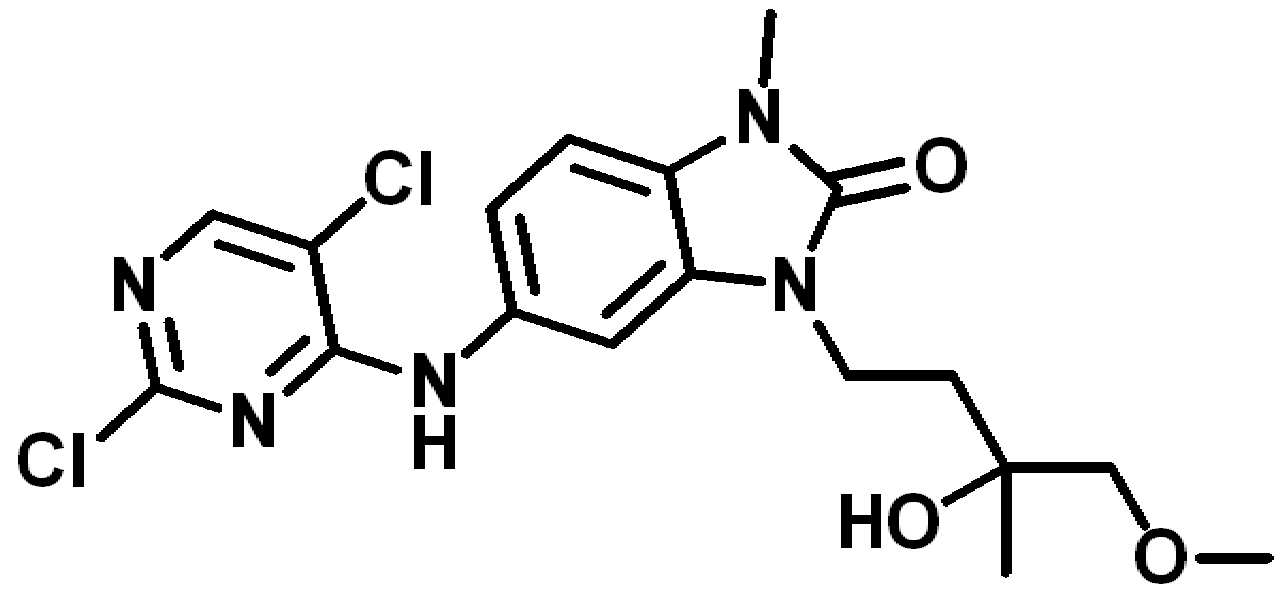
중간체 D2a의 제조를 위해서 사용된 것과 유사한 방법에 의해서 5-아미노-3-(3-히드록시-4-메톡시-3-메틸-부틸)-1-메틸-벤즈이미다졸-2-온(중간체 A7b)으로부터 제조하였다. LCMS(방법 T2): Rt 1.39min, m/z 426.11 [M+H]+.5-amino-3- (3-hydroxy-4-methoxy-3-methyl-butyl) -1-methyl-benzimidazol-2-one (intermediate) by a method analogous to that used for the preparation of intermediate D2a From A7b). LCMS (Method T2): Rt 1.39 min, m / z 426.11 [M + H] + .
중간체 D2c: (S)-5-((2,5-디클로로피리미딘-4-일)아미노)-1-메틸-3-((1-(2,2,2-트리플루오로에틸)피롤리딘-2-일)메틸)-1,3-디히드로-2H-벤조[d]이미다졸-2-온 N5127-12Intermediate D2c: (S) -5-((2,5-dichloropyrimidin-4-yl) amino) -1-methyl-3-((1- (2,2,2-trifluoroethyl) pyrroli Din-2-yl) methyl) -1,3-dihydro-2H-benzo [d] imidazol-2-one N5127-12

중간체 D2a의 제조를 위해서 사용된 것과 유사한 방법에 의해서 5-아미노-1-메틸-3-[[(2S)-1-(2,2,2-트리플루오로에틸)피롤리딘-2-일]메틸]벤즈이미다졸-2-온(중간체 A6f)으로부터 제조하였다. LCMS(방법 X2) Rt 1.47min; m/z 475.1033 C19H20N6OF3Cl2 [M+H]+에 대한 예측치 475.1028.5-amino-1-methyl-3-[[(2S) -1- (2,2,2-trifluoroethyl) pyrrolidin-2-yl by a method similar to that used for the preparation of intermediate D2a ] Methyl] benzimidazol-2-one (intermediate A6f). LCMS (Method X2) Rt 1.47 min; m / z 475.1033 Predicted for C 19 H 20 N 6 OF 3 Cl 2 [M + H] + 475.1028.
중간체 D2d: 5-((2,5-디클로로피리미딘-4-일)아미노)-1,3-비스(3-히드록시-3-메틸부틸)-1,3-디히드로-2H-벤조[d]이미다졸-2-온Intermediate D2d: 5-((2,5-dichloropyrimidin-4-yl) amino) -1,3-bis (3-hydroxy-3-methylbutyl) -1,3-dihydro-2H-benzo [ d] imidazol-2-one

중간체 D2a의 제조를 위해서 사용된 것과 유사한 방법에 의해서 5-아미노-1,3-비스(3-히드록시-3-메틸-부틸)벤즈이미다졸-2-온(중간체 A6g)으로부터 제조하였다. 1H NMR (500 MHz, 클로로포름-d) δ 8.21 (s, 1H), 7.64 (d, J = 2.0 Hz, 1H), 7.31 (s, 1H), 7.09 (dd, J = 8.4, 2.0 Hz, 1H), 7.04 (d, J = 8.3 Hz, 1H), 4.12 - 4.03 (m, 4H), 1.99 - 1.88 (m, 4H), 1.33 (s, 6H), 1.32 (s, 6H).Prepared from 5-amino-1,3-bis (3-hydroxy-3-methyl-butyl) benzimidazol-2-one (intermediate A6g) by a method similar to that used for the preparation of intermediate D2a. 1 H NMR (500 MHz, Chloroform-d) δ 8.21 (s, 1H), 7.64 (d, J = 2.0 Hz, 1H), 7.31 (s, 1H), 7.09 (dd, J = 8.4, 2.0 Hz, 1H ), 7.04 (d, J = 8.3 Hz, 1H), 4.12-4.03 (m, 4H), 1.99-1.88 (m, 4H), 1.33 (s, 6H), 1.32 (s, 6H).
표 22에 나타낸 중간체를 사용하여, 실시예 22a의 제조를 위해서 사용된 것과 유사한 방법에 의해서 하기 표로 나타낸 중간체를 제조하였다. NMP, DMA 또는 DMF를 용매로서 사용하였다. 중간체 D3a의 제조의 경우, NMP 중에서 140℃에서 1시간 가열을 사용하였다. 중간체 D3b의 제조의 경우, NMP 중에서 180℃에서 1시간 가열을 사용하였다.Using the intermediates shown in Table 22, the intermediates shown in the table below were prepared by similar methods to those used for the preparation of Example 22a. NMP, DMA or DMF was used as solvent. For the preparation of intermediate D3a, heating was used for 1 hour at 140 ° C. in NMP. For the preparation of intermediate D3b, heating was used for 1 hour at 180 ° C. in NMP.
[표 22]TABLE 22

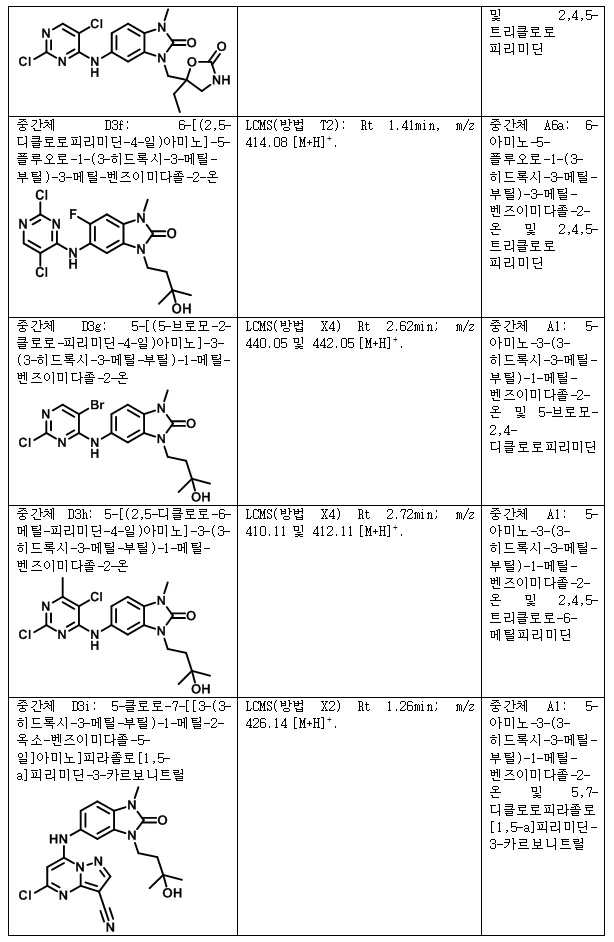
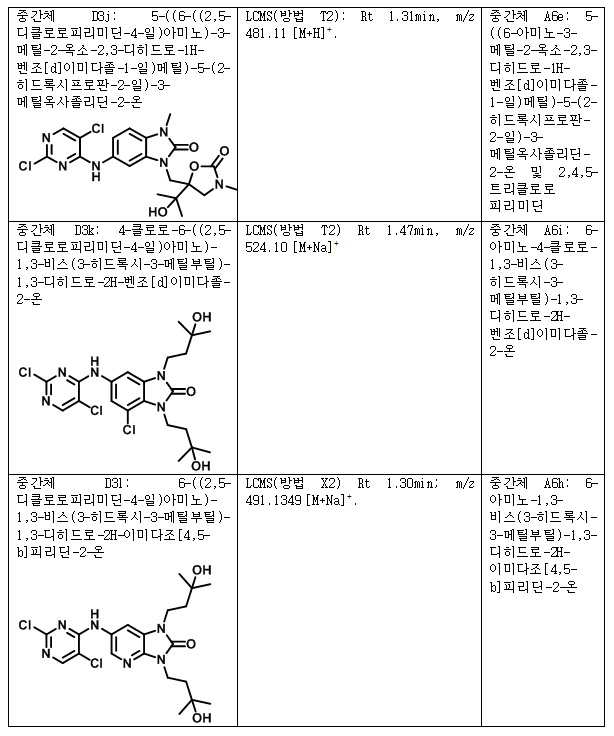
중간체 D4: 5-[(2,5-디클로로피리미딘-4-일)아미노]-3-(3,5-디히드록시-3-메틸-펜틸)-1-메틸-벤즈이미다졸-2-온Intermediate D4: 5-[(2,5-dichloropyrimidin-4-yl) amino] -3- (3,5-dihydroxy-3-methyl-pentyl) -1-methyl-benzimidazole-2- On

DCM(2.3 mL) 중의 5-[(2,5-디클로로피리미딘-4-일)아미노]-1-메틸-3-[2-(4-메틸-2-페닐-1,3-디옥산-4-일)에틸]벤즈이미다졸-2-온(중간체 D3b, 60 mg, 0.12 mmol)의 용액에 트리플루오로아세트산(0.01 mL, 0.14 mmol)을 실온에서 적가하였다. 혼합물을 1h 동안 교반하고, 이어서 그것을 0℃까지 냉각시키고, 2 M NaOH(2.5 mL)를 적가하였다. 혼합물을 20min 동안 실온에서 교반하고, 이어서 층을 분리하고, 수성 층을 추가의 DCM으로 추출하였다. 역상 크로마토그래피(12 g 컬럼, 물 중의 30% 내지 80% MeOH의 구배, 둘 모두 0.1% 포름산으로 개질됨)에 의한 정제는 표제 화합물(28 mg, 56%, 0.0657 mmol)을 백색 고체로서 제공하였다. LCMS(방법 T2): Rt 1.33min, m/z 426.11 [M+H]+.5-[(2,5-dichloropyrimidin-4-yl) amino] -1-methyl-3- [2- (4-methyl-2-phenyl-1,3-dioxane- in DCM (2.3 mL) To a solution of 4-yl) ethyl] benzimidazol-2-one (intermediate D3b, 60 mg, 0.12 mmol) was added dropwise trifluoroacetic acid (0.01 mL, 0.14 mmol) at room temperature. The mixture was stirred for 1 h, then cooled to 0 ° C and 2 M NaOH (2.5 mL) was added dropwise. The mixture was stirred for 20 min at room temperature, then the layers were separated and the aqueous layer was extracted with additional DCM. Purification by reverse phase chromatography (12 g column, gradient of 30% to 80% MeOH in water, both modified with 0.1% formic acid) provided the title compound (28 mg, 56%, 0.0657 mmol) as a white solid. . LCMS (Method T2): Rt 1.33 min, m / z 426.11 [M + H] + .
중간체 E1: 4,6-디클로로-5-시아노-N-메틸-피리딘-2-카르복스아미드 Intermediate E1: 4,6-Dichloro-5-cyano-N-methyl-pyridine-2-carboxamide

아르곤 하에서 4,6-디클로로-5-시아노-피리딘-2-카르복실산(310 mg, 1.43 mmol)을 DCM(15 mL) 및 DMF(0.06 mL) 중에 현탁시키고, 0℃까지 냉각시켰다. DCM 중의 옥살릴 클로라이드 2 M(1.50 mL, 3 mmol)을 15분에 걸쳐서 적가하였다. 혼합물을 실온에서 1h 동안 질소 하에서 교반하고, 그 시간 후 모든 물질이 용액으로 존재하였고, 이어서 다시 0℃까지 냉각시켰다. THF 중의 메탄아민 2 M(3.50 mL, 7 mmol)을 10min에 걸쳐서 적가하고, 생성된 혼합물을 0℃에서 1.5h 동안 계속 교반하고, 이어서 실온까지 가온시키고, 공기에 개방시켰다. 1h 후, 필요한 경우 pH를 10% 시트르산/sat 중탄산나트륨을 사용하여 pH 6까지 조정하고, 이어서 생성된 혼합물을 DCM으로 추출하고 상 분리기 카트리지를 사용하여 분리하고, 수성 물질을 건조하였다. 생성된 용액을 감압 하에서 증발시켜 4,6-디클로로-5-시아노-N-메틸-피리딘-2-카르복스아미드를 베이지색 고체(280 mg)로서 제공하였다. 1H NMR (500MHz, DMSO-d6) δ 8.98 (q, J = 4.4 Hz, 1H), 8.25 (s, 1H), 2.82 (d, J = 4.7 Hz, 3H).Under argon 4,6-dichloro-5-cyano-pyridine-2-carboxylic acid (310 mg, 1.43 mmol) was suspended in DCM (15 mL) and DMF (0.06 mL) and cooled to 0 ° C. Oxalyl chloride 2 M (1.50 mL, 3 mmol) in DCM was added dropwise over 15 minutes. The mixture was stirred at room temperature under nitrogen for 1 h, after which time all material was in solution and then cooled back to 0 ° C. Methaneamine 2 M (3.50 mL, 7 mmol) in THF was added dropwise over 10 min, and the resulting mixture was continued to stir at 0 ° C. for 1.5 h, then warmed to room temperature and opened to air. After 1 h, the pH was adjusted to pH 6 with 10% citric acid / sat sodium bicarbonate if necessary, then the resulting mixture was extracted with DCM and separated using a phase separator cartridge and the aqueous material dried. The resulting solution was evaporated under reduced pressure to give 4,6-dichloro-5-cyano- N -methyl-pyridine-2-carboxamide as a beige solid (280 mg). 1 H NMR (500 MHz, DMSO-d 6 ) δ 8.98 (q, J = 4.4 Hz, 1H), 8.25 (s, 1H), 2.82 (d, J = 4.7 Hz, 3H).
중간체 E2: 4,5-디클로로-N-에틸-피리딘-2-카르복스아미드Intermediate E2: 4,5-Dichloro-N-ethyl-pyridine-2-carboxamide
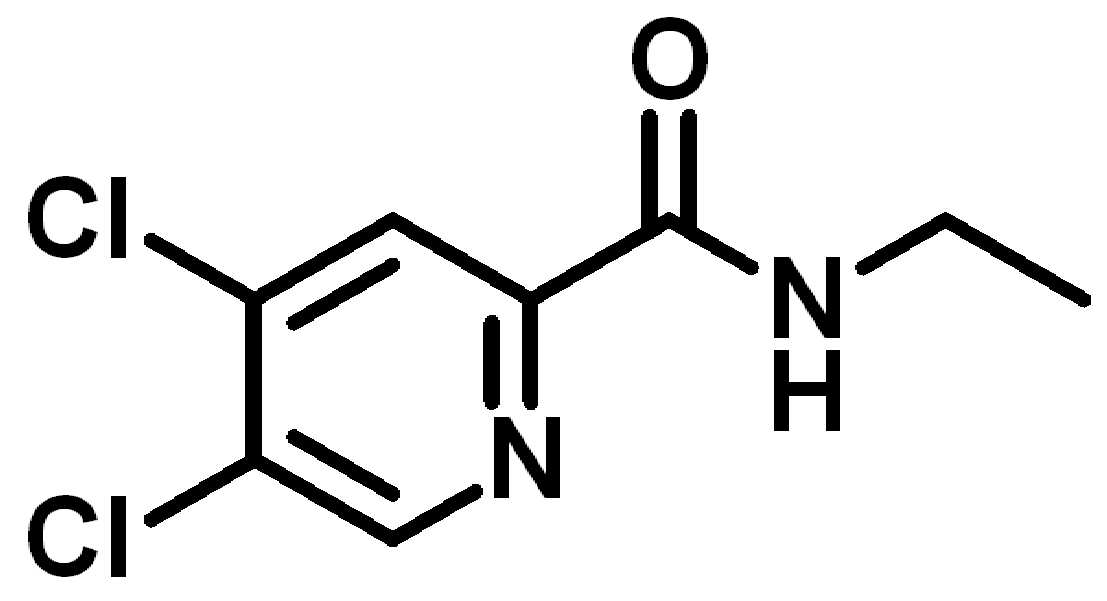
DMF(3 mL) 중의 4,5-디클로로피리딘-2-카르복실산(90 mg, 0.47mmol), HATU(250 mg, 0.66 mmol) 및 에틸아민(106 mg, 2.34 mmol)의 혼합물을 rt에서 밤새 교반하였다. 물을 첨가하고, 생성된 용액을 rt에서 밤새 교반하였다. 침전물을 여과에 의해서 수집하고, 건조하여 표제 화합물(24 mg)을 제공하였다. 1H NMR (500 MHz, DMSO-d6) δ 8.93 (br m, 1H), 8.83 (s, 1H), 8.17 (s, 1H), 3.38 - 3.27 (m, 2H), 1.11 (t, J = 7.2 Hz, 3H).A mixture of 4,5-dichloropyridine-2-carboxylic acid (90 mg, 0.47 mmol), HATU (250 mg, 0.66 mmol) and ethylamine (106 mg, 2.34 mmol) in DMF (3 mL) overnight at rt Stirred Water was added and the resulting solution was stirred at rt overnight. The precipitate was collected by filtration and dried to give the title compound (24 mg). 1 H NMR (500 MHz, DMSO-d 6 ) δ 8.93 (br m, 1H), 8.83 (s, 1H), 8.17 (s, 1H), 3.38-3.27 (m, 2H), 1.11 (t, J = 7.2 Hz, 3H).
중간체 E3a: 5-클로로-2-[(3S,5R)-3,5-디메틸-1-피페리딜]-4-아이오도-피리딘Intermediate E3a: 5-Chloro-2-[(3S, 5R) -3,5-dimethyl-1-piperidyl] -4-iodo-pyridine
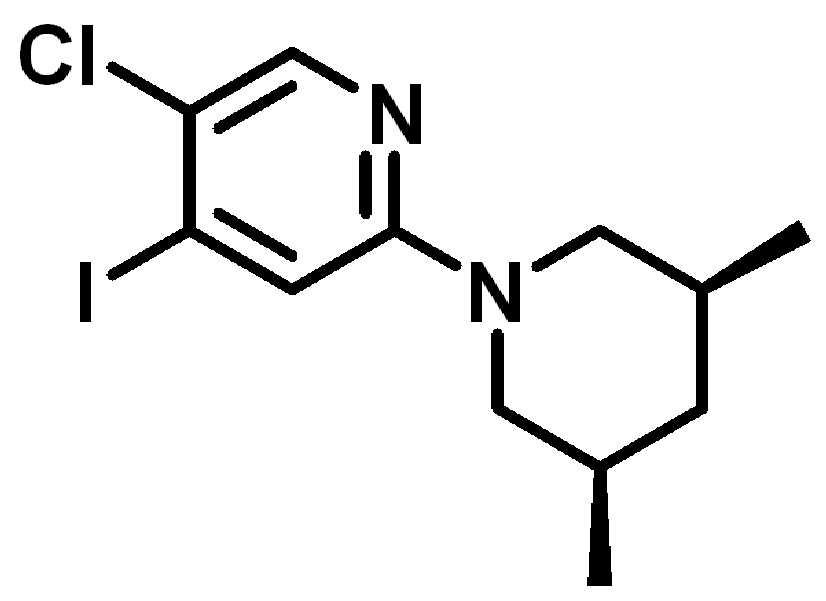
THF(8 mL) 중의 시스-3,5-디메틸피페리딘(0.23 g, 2.0 mmol), 5-클로로-2-플루오로-4-아이오도-피리딘(0.53 g, 2.0 mmol) 및 N,N-디이소프로필에틸아민(0.53 mL, 3.1 mmol)의 용액을 밀폐된 바이알 내에서 100℃까지 16h 동안 가열하였다. 냉각시키는 경우, 물을 THF 용액에 첨가하고, EtOAc로 추출하였다. 합한 유기 층을 물로 2회 세척하고, Na2SO4로 건조하였다. 플래시 컬럼 크로마토그래피(시클로헥산 중의 4% 에틸 아세테이트)는 5-클로로-2-[(3S,5R)-3,5-디메틸-1-피페리딜]-4-아이오도-피리딘(488 mg)을 백색 고체로서 제공하였다. LCMS(방법 T2) Rt = 1.48min, m/z 351.0 [M+H]+.Cis-3,5-dimethylpiperidine (0.23 g, 2.0 mmol), 5-chloro-2-fluoro-4-iodo-pyridine (0.53 g, 2.0 mmol) and N, N in THF (8 mL) A solution of diisopropylethylamine (0.53 mL, 3.1 mmol) was heated for 16 h to 100 ° C. in a closed vial. When cooled, water was added to the THF solution and extracted with EtOAc. The combined organic layers were washed twice with water and dried over Na 2 S0 4 . Flash column chromatography (4% ethyl acetate in cyclohexane) gave 5-chloro-2-[(3S, 5R) -3,5-dimethyl-1-piperidyl] -4-iodo-pyridine (488 mg) Was provided as a white solid. LCMS (Method T2) Rt = 1.48 min, m / z 351.0 [M + H] + .
중간체 E3a의 제조를 위해서 사용된 것과 유사한 방법에 의해서 하기 표로 나타낸 중간체를 제조하였다. 하기와 같은 연장된 가열을 사용하였다: 중간체 E3b의 경우 32h, 중간체 E3c의 경우 56h, 및 중간체 E3d의 경우 5일.The intermediates shown in the table below were prepared by methods similar to those used for the preparation of intermediate E3a. Extended heating was used as follows: 32 h for intermediate E3b, 56 h for intermediate E3c, and 5 days for intermediate E3d.
[표 23]TABLE 23

중간체 F1: 2-(옥시란-2-일)프로판-2-올Intermediate F1: 2- (oxirane-2-yl) propan-2-ol

0℃에서 DCM(25 mL) 중의 2-메틸부트-3-엔-2-올(1.05 mL, 10.0 mmol)의 교반되는 용액에 m-CPBA(2.50 g, 11.2 mmol)를 나누어 첨가하고, 생성된 혼합물을 실온에서 밤새 교반하였다. 백색 침전물을 DCM으로 세척하면서, 여과에 의해서 제거하였다. 합한 여과액 및 세척액을 소듐 설파이트의 10% aq 용액(3 x 15 mL), sat. 중탄산염(2 x 15 mL)으로 세척하고, 상 분리기를 통해 통과시키고, 감압 하에서 증발시켜(수조 25℃, 500 mbar, 이어서 300 mbar에서 2min) DCM과의 1:1 혼합물로서 표제 화합물(560 mg, 투명한 액체)을 제공하였다. 1H NMR (500 MHz, 클로로포름-d) 2.96 (dd, J = 4.0, 2.8 Hz, 1H), 2.82 (dd, J = 5.0, 2.8 Hz, 1H), 2.74 (dd, J = 5.0, 4.0 Hz, 1H), 1.69 (s, 1H), 1.35 (s, 3H), 1.25 (s, 3H). 또한 5.31(2H, 잔류하는 DCM).To a stirred solution of 2-methylbut-3-en-2-ol (1.05 mL, 10.0 mmol) in DCM (25 mL) at 0 ° C. was added in portions m-CPBA (2.50 g, 11.2 mmol), resulting The mixture was stirred at rt overnight. The white precipitate was removed by filtration, washing with DCM. The combined filtrates and washes were washed with 10% aq solution of sodium sulfite (3 × 15 mL), sat. Washed with bicarbonate (2 x 15 mL), passed through a phase separator and evaporated under reduced pressure (water bath 25 ° C., 500 mbar, then 2 min at 300 mbar) as a 1: 1 mixture with DCM (560 mg, Transparent liquid). 1 H NMR (500 MHz, Chloroform-d) 2.96 (dd, J = 4.0, 2.8 Hz, 1H), 2.82 (dd, J = 5.0, 2.8 Hz, 1H), 2.74 (dd, J = 5.0, 4.0 Hz, 1H), 1.69 (s, 1H), 1.35 (s, 3H), 1.25 (s, 3H). Also 5.31 (2H, remaining DCM).
중간체 F2: tert-부틸-디메틸-[2-(2-메틸옥시란-2-일)에톡시]실란Intermediate F2: tert-Butyl-dimethyl- [2- (2-methyloxiran-2-yl) ethoxy] silane
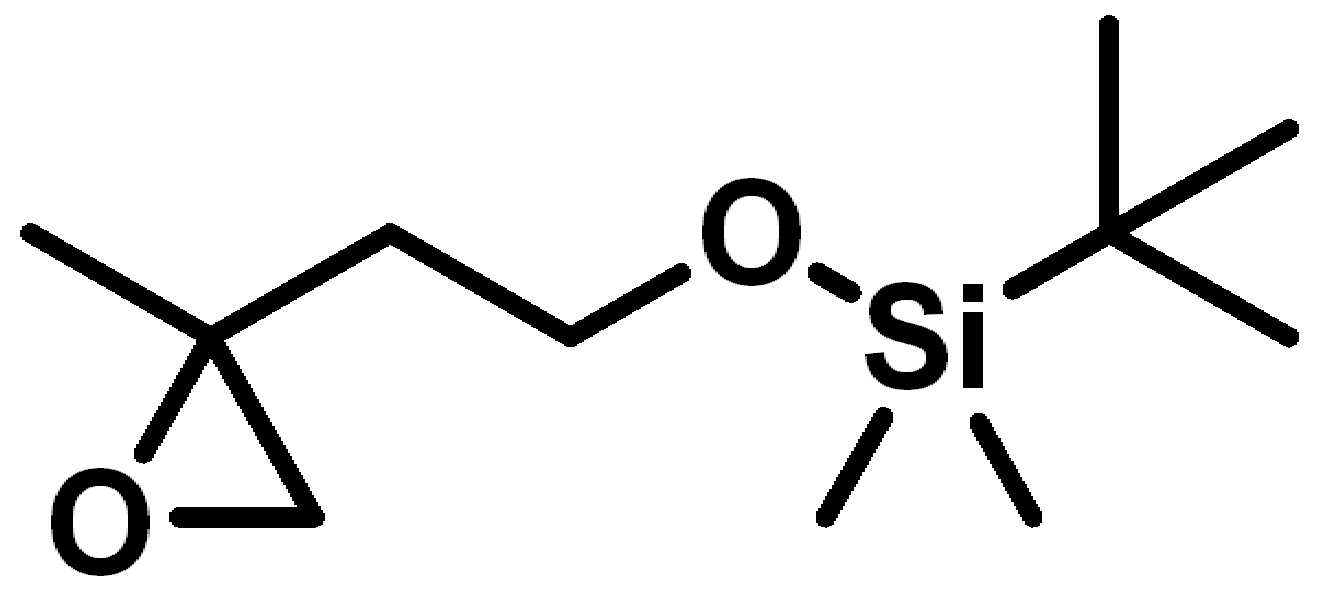
단계 1: tert-부틸-디메틸-(3-메틸부트-3-en옥시)실란Step 1: tert-butyl-dimethyl- (3-methylbut-3-enoxy) silane
DCM(113 mL) 중의 3-메틸부트-3-엔-1-올(3.52 mL, 34.83 mmol), tert-부틸디메틸실릴 클로라이드(6.3 g, 41.80 mmol) 및 이미다졸(4.75 g, 69.66 mmol)의 혼합물을 실온에서 18h 동안 교반하였다. 반응을 수성 NH4Cl로 켄칭시키고, 층을 분리하고, 수성 층을 DCM으로 추출하였다. 컬럼 크로마토그래피(100g 컬럼, cHex 중의 1에서 10% EtOAc, 15 CV)에 의한 정제는 표제 화합물(6.85 g, 98%, 34.18 mmol)을 무색 오일로서 제공하였다. 1H NMR (클로로포름-d, 500 MHz): d 4.77 (1H, s), 4.71 (1H, s), 3.73 (2H, t, J 7.3 Hz), 2.26 (2H, t, J 7.3 Hz), 1.75 (3H, s), 0.91 (9H, s), 0.07 (6H, s).Of 3-methylbut-3-en-1-ol (3.52 mL, 34.83 mmol), tert -butyldimethylsilyl chloride (6.3 g, 41.80 mmol) and imidazole (4.75 g, 69.66 mmol) in DCM (113 mL) The mixture was stirred at rt for 18 h. The reaction was quenched with aqueous NH 4 Cl, the layers were separated and the aqueous layer was extracted with DCM. Purification by column chromatography (100 g column, 1 to 10% EtOAc in cHex, 15 CV) provided the title compound (6.85 g, 98%, 34.18 mmol) as a colorless oil. 1 H NMR (chloroform-d, 500 MHz): d 4.77 (1H, s), 4.71 (1H, s), 3.73 (2H, t, J 7.3 Hz), 2.26 (2H, t, J 7.3 Hz), 1.75 (3H, s), 0.91 (9H, s), 0.07 (6H, s).
단계 2: tert-부틸-디메틸-[2-(2-메틸옥시란-2-일)에톡시]실란Step 2: tert-Butyl-dimethyl- [2- (2-methyloxiran-2-yl) ethoxy] silane
실온에서 DCM(100 mL) 중의 tert-부틸-디메틸-(3-메틸부트-3-엔옥시)실란(이전 단계로부터, 2.0 g, 10 mmol)의 용액에 m-CPBA(2.58 g, 15 mmol)를 첨가하고, 이어서 그것을 포화 수성 Na2S2O3(100 mL)의 첨가에 의해서 켄칭시켰다. 층을 분리하고, 유기층을 포화 수성 NaHCO3로 세척하고, 합한 수성 층을 DCM으로 추출하였다. 유기 층을 합하고, MgSO4 상에서 건조하고, 감압 하에서 농축시켜, 표제 화합물(2.1 g, 97%, 9.7 mmol)을 오일로서 제공하였다. 1H NMR (클로로포름-d, 500 MHz): d 3.78-3.70 (2H, m), 2.70 (1H, d, J 5.0 Hz), 2.60 (1H, d, J 5.0 Hz), 1.88 (1H, m), 1.71 (1H, m), 1.36 (3H, s), 0.90 (9H, s), 0.06 (6H, s).M-CPBA (2.58 g, 15 mmol) in a solution of tert-butyl-dimethyl- (3-methylbut-3-enoxy) silane (2.0 g, 10 mmol from previous step) in DCM (100 mL) at room temperature. Was added and it was then quenched by addition of saturated aqueous Na 2 S 2 O 3 (100 mL). The layers were separated, the organic layer was washed with saturated aqueous NaHCO 3 and the combined aqueous layers were extracted with DCM. The organic layers were combined, dried over MgSO 4 and concentrated under reduced pressure to give the title compound (2.1 g, 97%, 9.7 mmol) as an oil. 1 H NMR (chloroform-d, 500 MHz): d 3.78-3.70 (2H, m), 2.70 (1H, d, J 5.0 Hz), 2.60 (1H, d, J 5.0 Hz), 1.88 (1H, m) , 1.71 (1H, m), 1.36 (3H, s), 0.90 (9H, s), 0.06 (6H, s).
중간체 G1a: 1-[tert-부틸(디메틸)실릴]옥시-3-메틸-펜탄-3-올Intermediate Gla: 1- [tert-butyl (dimethyl) silyl] oxy-3-methyl-pentan-3-ol
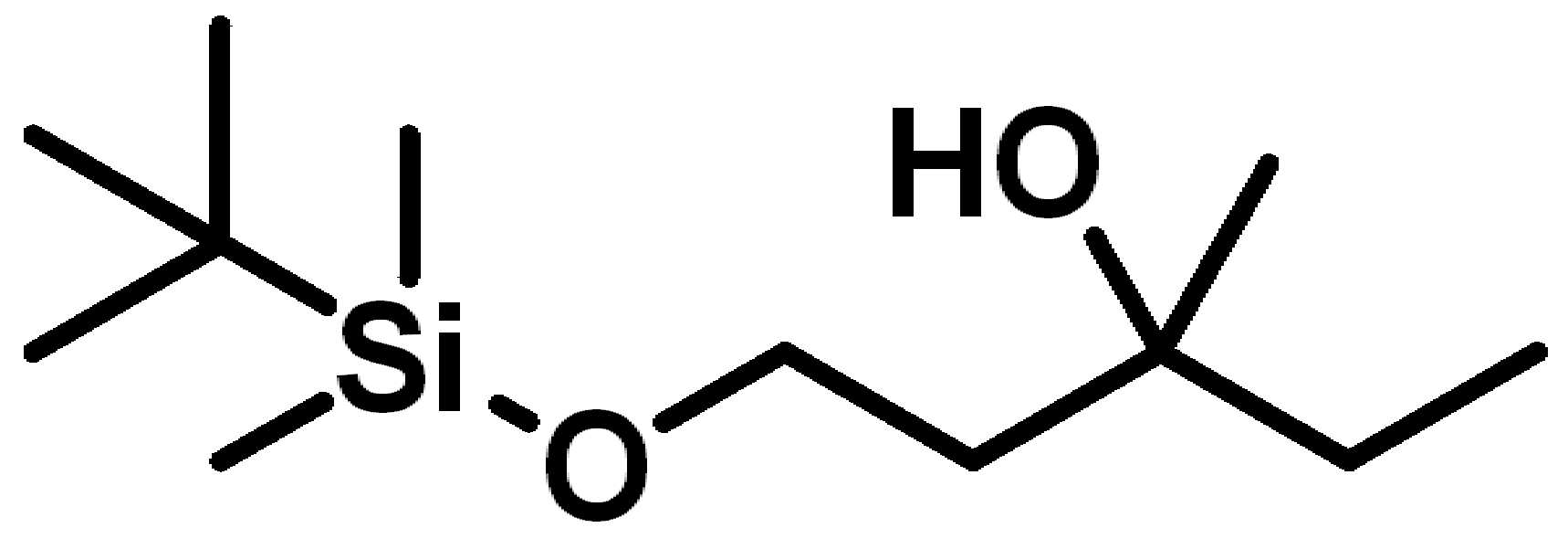
단계 1: 4-[tert-부틸(디메틸)실릴]옥시부탄-2-온Step 1: 4- [tert-butyl (dimethyl) silyl] oxybutan-2-one
DCM(100 mL) 중의 4-히드록시-2-부탄온(1.0 g, 11.35 mmol), tert-부틸디메틸실릴 클로라이드(2.05 g, 13.62 mmol) 및 이미다졸(1.55 g, 22.70 mmol)의 혼합물을 실온에서 18h 동안 교반하였다. 반응을 수성 NH4Cl로 켄칭시키고, 층을 분리하고, 수성 층을 DCM으로 추출하였다. 컬럼 크로마토그래피(50g 컬럼, cHex 중의 5에서 15% EtOAc, 15 CV)는 4-[tert-부틸(디메틸)실릴]옥시부탄-2-온(2.29 g, 100%, 11.32 mmol)을 무색 오일로서 제공하였다. 1H NMR (클로로포름-d, 500 MHz): d 3.90 (2H, t, J 6.1 Hz), 2.63 (2H, t, J 6.1 Hz), 2.19 (3H, s), 0.89 (9H, s), 0.06 (6H, s).A mixture of 4-hydroxy-2-butanone (1.0 g, 11.35 mmol), tert -butyldimethylsilyl chloride (2.05 g, 13.62 mmol) and imidazole (1.55 g, 22.70 mmol) in DCM (100 mL) was stirred at room temperature. Stirred for 18 h. The reaction was quenched with aqueous NH 4 Cl, the layers were separated and the aqueous layer was extracted with DCM. Column chromatography (50 g column, 5 to 15% EtOAc in cHex, 15 CV) showed 4- [tert-butyl (dimethyl) silyl] oxybutan-2-one (2.29 g, 100%, 11.32 mmol) as a colorless oil. Provided. 1 H NMR (chloroform-d, 500 MHz): d 3.90 (2H, t, J 6.1 Hz), 2.63 (2H, t, J 6.1 Hz), 2.19 (3H, s), 0.89 (9H, s), 0.06 (6H, s).
단계 2: 1-[tert-부틸(디메틸)실릴]옥시-3-메틸-펜탄-3-올Step 2: 1- [tert-butyl (dimethyl) silyl] oxy-3-methyl-pentan-3-ol
N2 분위기 하의 THF(25 mL) 중의 4-[tert-부틸(디메틸)실릴]옥시부탄-2-온(이전 단계로부터, 560 mg, 2.77 mmol)의 용액을 0 C까지 냉각시키고, 에틸마그네슘 클로라이드(THF 중의 2 M, 2.08 mL, 4.15 mmol)를 적가하였다. 혼합물을 3h 동안 0 C에서 교반하였다. 반응을 포화 수성 NH4Cl로 켄칭시키고, EtOAc를 첨가하고, 층을 분리하였다. 수성 층을 추가의 EtOAc로 추출하고, 유기 층을 합하고, MgSO4 상에서 건조하고, 감압 하에서 농축시켰다. 컬럼 크로마토그래피(50 g 컬럼, cHex 중의 5% 내지 25% EtOAc, 13 CV)에 의한 정제는는 1-[tert-부틸(디메틸)실릴]옥시-3-메틸-펜탄-3-올(570 mg, 80%, 2.21 mmol)을 투명한 오일로서 제공하였다. 1H NMR (클로로포름-d, 500 MHz): d 3.95-3.87 (2H, m), 1.75 (1H, m), 1.64 (1H, m), 1.59-1.50 (2H, m), 1.19 (3H, s), 0.93-0.90 (12H, m), 0.10 (6H, s).A solution of 4- [tert-butyl (dimethyl) silyl] oxybutan-2-one (560 mg, 2.77 mmol from the previous step) in THF (25 mL) under N 2 atmosphere was cooled to 0 C and ethylmagnesium chloride (2 M in THF, 2.08 mL, 4.15 mmol) was added dropwise. The mixture was stirred at 0 C for 3 h. The reaction was quenched with saturated aqueous NH 4 Cl, EtOAc was added and the layers were separated. The aqueous layer was extracted with more EtOAc, the organic layers combined, dried over MgSO 4 and concentrated under reduced pressure. Purification by column chromatography (50 g column, 5% to 25% EtOAc in cHex, 13 CV) yielded 1- [tert-butyl (dimethyl) silyl] oxy-3-methyl-pentan-3-ol (570 mg, 80%, 2.21 mmol) was provided as a clear oil. 1 H NMR (chloroform-d, 500 MHz): d 3.95-3.87 (2H, m), 1.75 (1H, m), 1.64 (1H, m), 1.59-1.50 (2H, m), 1.19 (3H, s ), 0.93-0.90 (12H, m), 0.10 (6H, s).
중간체 G1b: 1-((tert-부틸디메틸실릴)옥시)-3,4-디메틸펜탄-3-올Intermediate Glb: 1-((tert-butyldimethylsilyl) oxy) -3,4-dimethylpentan-3-ol

중간체 G1a와 유사하게 2 단계 방법에 의해서 제조하였다. 1H NMR (클로로포름-d, 500 MHz) d 3.95-3.88 (2H, m), 1.85-1.75 (2H, m), 1.62 (1H, ddd, J 14.5, 5.6, 4.2 Hz), 1.12 (3H, s), 0.96 (3H, d, J 7.2 Hz), 0.93-0.91 (12H, m), 0.10 (6H, s).Similar to Intermediate Gla was made by a two step method. 1 H NMR (chloroform-d, 500 MHz) d 3.95-3.88 (2H, m), 1.85-1.75 (2H, m), 1.62 (1H, ddd, J 14.5, 5.6, 4.2 Hz), 1.12 (3H, s ), 0.96 (3H, d, J 7.2 Hz), 0.93-0.91 (12H, m), 0.10 (6H, s).
중간체 G2: 1-((tert-부틸디메틸실릴)옥시)-3-메틸-6-(트리메틸실릴)헥스-5-인-3-올Intermediate G2: 1-((tert-butyldimethylsilyl) oxy) -3-methyl-6- (trimethylsilyl) hex-5-yn-3-ol

- 78℃에서 THF(8 mL) 중의 2-트리메틸실릴에틸렌(0.32 mL, 2.31 mmol)의 용액에 n-BuLi(1.44 mL, 2.31 mmol)을 적가하였다. 혼합물을 -78℃에서 30min 동안 교반하고, 이어서 tert-부틸-디메틸-[2-(2-메틸옥시란-2-일)에톡시]실란(중간체 F2, 250 mg, 1.16 mmol)을 적가하고(2 mL THF 중에 용해됨), 그 다음 BF3-Et2O(0.21 mL, 1.73 mmol)를 적가하였다. 혼합물을 1h 동안 -78℃에서 교반하였다. 반응을 포화 수성 NH4Cl로 켄칭시키고, EtOAc를 첨가하고, 층을 분리하였다. 수성 층을 EtOAc로 추출하였다. 유기 층을 합하고, MgSO4 상에서 건조하고, 감압 하에서 농축시켰다. 컬럼 크로마토그래피 (25 g 컬럼, cHex 중의 5% 내지 50% EtOAc)에 의한 정제는 표제 화합물(246 mg, 68%, 0.78 mmol)을 무색 오일로서 제공하였다. 1H NMR (클로로포름-d, 500 MHz): d 3.97-3.89 (2H, m), 2.50 (1H, d, J 16.7 Hz), 2.46 (1H, d, J 16.7 Hz), 1.90 (1H, ddd, J 14.1, 6.4, 4.9 Hz), 1.81 (1H, ddd, J 14.1, 7.0, 5.1 Hz), 1.33 (3H, s), 0.91 (9H, s), 0.16 (9H, s), 0.11 (6H, s). N- BuLi (1.44 mL, 2.31 mmol) was added dropwise to a solution of 2-trimethylsilylethylene (0.32 mL, 2.31 mmol) in THF (8 mL) at 78 ° C. The mixture was stirred at −78 ° C. for 30 min, followed by the dropwise addition of tert -butyl-dimethyl- [2- (2-methyloxiran-2-yl) ethoxy] silane (Intermediate F2, 250 mg, 1.16 mmol) ( Dissolved in 2 mL THF), then BF 3 -Et 2 O (0.21 mL, 1.73 mmol) was added dropwise. The mixture was stirred at -78 ° C for 1 h. The reaction was quenched with saturated aqueous NH 4 Cl, EtOAc was added and the layers were separated. The aqueous layer was extracted with EtOAc. The organic layers were combined, dried over MgSO 4 and concentrated under reduced pressure. Purification by column chromatography (25 g column, 5% to 50% EtOAc in cHex) provided the title compound (246 mg, 68%, 0.78 mmol) as a colorless oil. 1 H NMR (chloroform-d, 500 MHz): d 3.97-3.89 (2H, m), 2.50 (1H, d, J 16.7 Hz), 2.46 (1H, d, J 16.7 Hz), 1.90 (1H, ddd, J 14.1, 6.4, 4.9 Hz), 1.81 (1H, ddd, J 14.1, 7.0, 5.1 Hz), 1.33 (3H, s), 0.91 (9H, s), 0.16 (9H, s), 0.11 (6H, s ).
중간체 G3: 2-(4-메틸-2-페닐-1,3-디옥산-4-일)에탄올Intermediate G3: 2- (4-methyl-2-phenyl-1,3-dioxan-4-yl) ethanol

톨루엔(35 mL) 중의 3-메틸-1,3,5-펜탄트리올(1.0 g, 0.89 mL, 7.45 mmol), 벤즈알데히드(2.27 mL, 22.36 mmol) 및 p-톨루엔설폰산 일수화물(14 mg, 0.07 mmol)의 용액을 60 C까지 18h 동안 가열하고, 2 M NaOH 및 EtOAc를 첨가하고, 층을 분리하고, 수성 층을 추가의 EtOAc로 추출하였다. 유기 층을 합하고, MgSO4 상에서 건조하고, 감압 하에서 농축시켜, 표제 화합물(1.65 g, 100%, 7.45 mmol)을 투명한 오일로서 제공하였다. 1H NMR (클로로포름-d, 500 MHz): d 7.48-7.45 (2H, m), 7.38-7.33 (3H, m), 5.75 (1H, s), 4.19-4.10 (2H, m), 3.94-3.85 (2H, m), 2.28-2.03 (4H, m), 1.54 (3H, s).3-methyl-1,3,5-pentanetriol (1.0 g, 0.89 mL, 7.45 mmol) in toluene (35 mL), benzaldehyde (2.27 mL, 22.36 mmol) and p-toluenesulfonic acid monohydrate (14 mg, 0.07 mmol) was heated to 60 C for 18 h, 2 M NaOH and EtOAc were added, the layers were separated and the aqueous layer was extracted with additional EtOAc. The organic layers were combined, dried over MgSO 4 and concentrated under reduced pressure to give the title compound (1.65 g, 100%, 7.45 mmol) as a clear oil. 1 H NMR (chloroform-d, 500 MHz): d 7.48-7.45 (2H, m), 7.38-7.33 (3H, m), 5.75 (1H, s), 4.19-4.10 (2H, m), 3.94-3.85 (2H, m), 2.28-2.03 (4H, m), 1.54 (3H, s).
중간체 G4a: [(2S)-1-(2,2,2-트리플루오로에틸)피롤리딘-2-일]메탄올 N5104-51 bbellenieIntermediate G4a: [(2S) -1- (2,2,2-trifluoroethyl) pyrrolidin-2-yl] methanol N5104-51 bbellenie

아세토니트릴(2 mL) 중의 (S)-(+)-2-(히드록시메틸)피롤리딘 (0.1 mL, 1.0 mmol)[L-프롤린올]의 용액에 탄산칼륨(150 mg, 1.1 mmol)을 첨가하였다. 생성된 혼합물을 질소 하에서 빙조 중에서 냉각시키고, 이어서 2,2,2-트리플루오로에틸 트리플루오로메탄설포네이트(0.15 mL, 1.04 mmol)를 적가하고, 생성된 혼합물을 0℃에서 1h 동안 교반하고, 이어서 실온까지 가온시키고, 밤새 교반하였다. 물(약 2mL)을 첨가하고, DCM(3 x 2mL)으로 추출하고, 상 분리기를 사용하여 분리 및 건조하였다. 유기물을 증발시키고, 플래시 컬럼 크로마토그래피(10g KP-SIL, 시클로헥산 중의 10% 내지 40% 에틸 아세테이트)에 의해서 정제하여 투명한 오일 [(2S)-1-(2,2,2-트리플루오로에틸)피롤리딘-2-일]메탄올(106 mg, 51%)을 제공하였다. 1H NMR (600 MHz, 클로로포름-d) δ 3.63 (dd, J = 11.3, 3.5 Hz, 1H), 3.49 - 3.43 (m, 1H), 3.41 - 3.21 (m, 2H), 3.08 (dq, J = 14.7, 8.8 Hz, 1H), 2.86 (m, 1H), 2.56 (app q, J = 8.3 Hz, 1H), 2.32 (s, 1H, OH), 1.98 - 1.86 (m, 1H), 1.88 - 1.76 (m, 3H).Potassium carbonate (150 mg, 1.1 mmol) in a solution of ( S )-( + ) -2- (hydroxymethyl) pyrrolidine (0.1 mL, 1.0 mmol) [L-prolinol] in acetonitrile (2 mL) Was added. The resulting mixture was cooled in an ice bath under nitrogen, then 2,2,2-trifluoroethyl trifluoromethanesulfonate (0.15 mL, 1.04 mmol) was added dropwise and the resulting mixture was stirred at 0 ° C. for 1 h and Then warmed to room temperature and stirred overnight. Water (about 2 mL) was added, extracted with DCM (3 × 2 mL), separated and dried using a phase separator. The organics were evaporated and purified by flash column chromatography (10 g KP-SIL, 10% to 40% ethyl acetate in cyclohexane) to give a clear oil [(2S) -1- (2,2,2-trifluoroethyl ) Pyrrolidin-2-yl] methanol (106 mg, 51%). 1 H NMR (600 MHz, Chloroform-d) δ 3.63 (dd, J = 11.3, 3.5 Hz, 1H), 3.49-3.43 (m, 1H), 3.41-3.21 (m, 2H), 3.08 (dq, J = 14.7, 8.8 Hz, 1H), 2.86 (m, 1H), 2.56 (app q, J = 8.3 Hz, 1H), 2.32 (s, 1H, OH), 1.98-1.86 (m, 1H), 1.88-1.76 ( m, 3H).
표 24에 나타낸 중간체를 사용하여, 중간체 G4a의 제조를 위해서 사용된 것과 유사한 방법에 의해서 하기 표로 나타낸 중간체를 제조하였다. 중간체 G4g의 제조의 경우, 반응을 60℃까지 밤새 가열하였다.Using the intermediates shown in Table 24, the intermediates shown in the table below were prepared by methods analogous to those used for the preparation of intermediate G4a. For the preparation of intermediate G4g, the reaction was heated to 60 ° C. overnight.
[표 24]TABLE 24
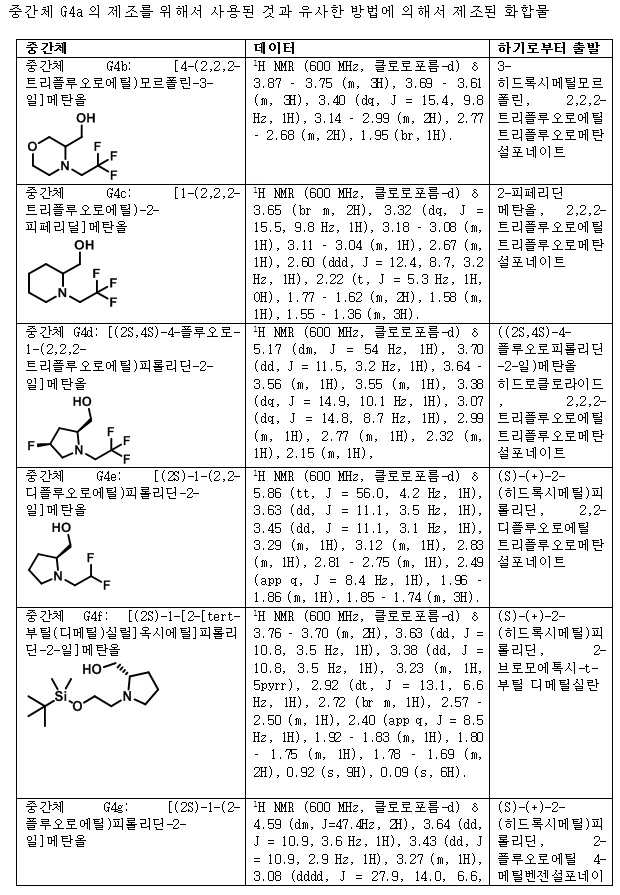

중간체 G5: tert-부틸 N-에틸-N-(3-히드록시-1-메틸-프로필)카르바메이트 Intermediate G5: tert-butyl N-ethyl-N- (3-hydroxy-1-methyl-propyl) carbamate
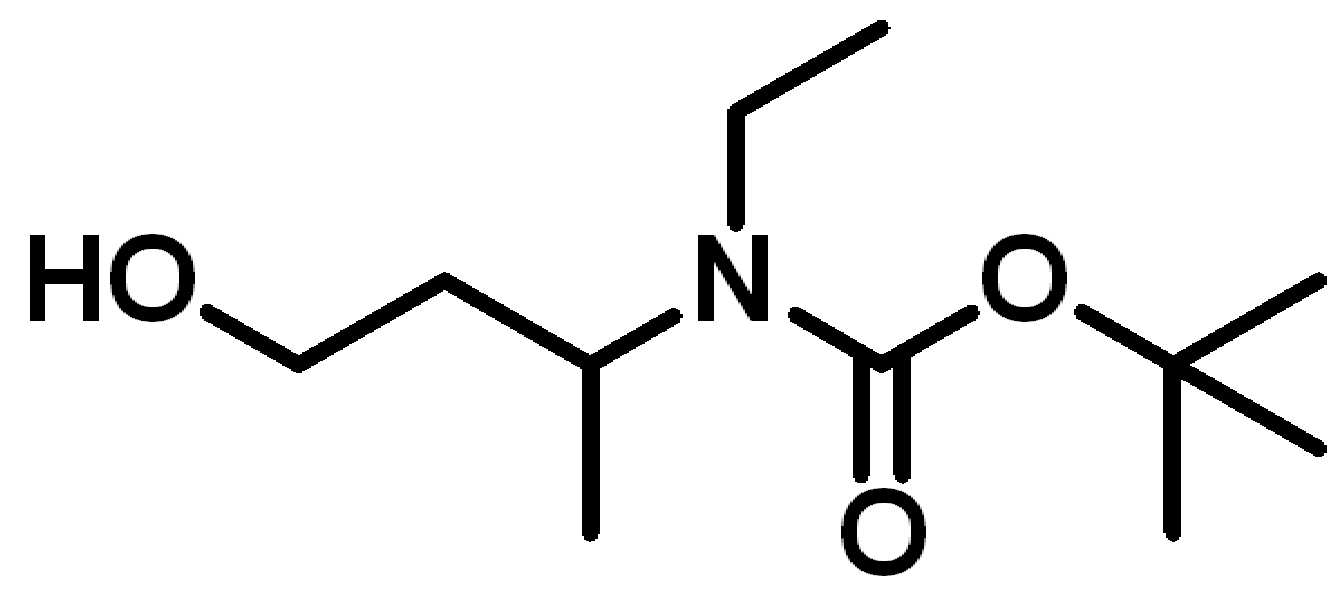
질소 하에서 DCM(5 mL) 중의 3-(에틸아미노)-1-부탄올(500 mg, 4.3 mmol)의 용액에 트리에틸아민(0.7 mL, 5 mmol)을 첨가하였다. 생성된 혼합물을 0℃까지 냉각시키고, DCM(2 mL) 중의 디-tert-부틸 디카르보네이트(1.15g, 5.1 mmol)의 용액을 적가하고, 생성된 혼합물을 실온에서 2일 동안 교반하고, 이어서 중탄산나트륨의 포화 용액을 첨가하여 켄칭시켰다. 유기층을 분리하고, 황산나트륨 상에서 건조하고, 여과하고, 진공에서 농축시켰다. 잔류물을 플래시 컬럼 크로마토그래피(25g KP-SIL, 시클로헥산 중의 5% 내지 40% 에틸 아세테이트)에 의해서 정제하여 tert-부틸 N-에틸-N-(3-히드록시-1-메틸-프로필)카르바메이트(750 mg, 81%, 3.4513 mmol)를 투명한 오일로서 제공하였다. 1H NMR (500 MHz, 클로로포름-d) δ 4.45 (br m, 1H), 3.58 (dt, J = 12.0, 4.1 Hz, 1H), 3.42 (br m, 1H), 3.18 (dq, J = 14.0, 7.0 Hz, 1H), 2.96 (br m, 1H), 1.71 (m, 1H), 1.51 (s, 9H) 약 1.5 (br m, 1H)와 중첩, 1.22 (d, J = 7.0 Hz, 3H), 1.16 (t, J = 7.0 Hz, 3H).Triethylamine (0.7 mL, 5 mmol) was added to a solution of 3- (ethylamino) -1-butanol (500 mg, 4.3 mmol) in DCM (5 mL) under nitrogen. The resulting mixture was cooled to 0 ° C., a solution of di- tert -butyl dicarbonate (1.15 g, 5.1 mmol) in DCM (2 mL) was added dropwise and the resulting mixture was stirred at room temperature for 2 days, then It was quenched by the addition of a saturated solution of sodium bicarbonate. The organic layer was separated, dried over sodium sulfate, filtered and concentrated in vacuo. The residue was purified by flash column chromatography (25 g KP-SIL, 5% to 40% ethyl acetate in cyclohexane) to give tert-butyl N-ethyl-N- (3-hydroxy-1-methyl-propyl) carb Barmate (750 mg, 81%, 3.4513 mmol) was provided as a clear oil. 1 H NMR (500 MHz, Chloroform-d) δ 4.45 (br m, 1H), 3.58 (dt, J = 12.0, 4.1 Hz, 1H), 3.42 (br m, 1H), 3.18 (dq, J = 14.0, 7.0 Hz, 1H), 2.96 (br m, 1H), 1.71 (m, 1H), 1.51 (s, 9H) overlap with about 1.5 (br m, 1H), 1.22 (d, J = 7.0 Hz, 3H), 1.16 (t, J = 7.0 Hz, 3H).
중간체 G6a: 2,3-디메틸부탄-1,3-디올 Intermediate G6a: 2,3-dimethylbutane-1,3-diol

질소 하에서 0℃에서 THF 중의 리튬 알루미늄 히드리드 1 M(3.5 mL, 3.5 mmol)을 무수 디에틸 에테르(5 mL)로 희석시켰다. 무수 디에틸 에테르(5 mL) 중의 에틸 3-히드록시-2,3-디메틸-부탄오에이트(250 mg, 1.56 mmol)의 용액을 20분에 걸쳐서 적가하고, 생성된 혼합물을 실온까지 가온시키고, 2시간 동안 교반하였다. 0C까지 냉각시키고, 물(0.13mL); 2 M aq 수산화나트륨 용액(0.13 mL); 및 물(0.4 mL)의 첨가에 의해서 매우 조심스럽게 켄칭시켰다. 30min 동안 실온에서 교반하고 이어서 디에틸 에테르로 세척하면서 여과하여 백색 침전물을 제거하였다. 용매를 감압 하에서 증발시켜 표제 화합물을 투명한 액체(214 mg)로서 수득하였다. 1H NMR (500 MHz, 클로로포름-d) δ 3.80 - 3.68 (m, 2H), 2.88 (s, 1H, OH), 2.55 (s, 1H, OH), 1.91 - 1.78 (m, 1H), 1.29 (s, 3H), 1.21 (s, 3H), 0.89 (d, J = 7.1 Hz, 3H).Lithium aluminum hydride 1 M (3.5 mL, 3.5 mmol) in THF at 0 ° C. under nitrogen was diluted with anhydrous diethyl ether (5 mL). A solution of ethyl 3-hydroxy-2,3-dimethyl-butanoate (250 mg, 1.56 mmol) in anhydrous diethyl ether (5 mL) was added dropwise over 20 minutes and the resulting mixture was allowed to warm to room temperature, Stir for 2 hours. Cooled to 0 C and water (0.13 mL); 2 M aq sodium hydroxide solution (0.13 mL); And quench very carefully by addition of water (0.4 mL). Stir for 30 min at room temperature and then filter while washing with diethyl ether to remove the white precipitate. The solvent was evaporated under reduced pressure to give the title compound as a clear liquid (214 mg). 1 H NMR (500 MHz, Chloroform-d) δ 3.80-3.68 (m, 2H), 2.88 (s, 1H, OH), 2.55 (s, 1H, OH), 1.91-1.78 (m, 1H), 1.29 ( s, 3H), 1.21 (s, 3H), 0.89 (d, J = 7.1 Hz, 3H).
중간체 G6b: 4,4,4-트리플루오로-3-메틸-부탄-1,3-디올Intermediate G6b: 4,4,4-trifluoro-3-methyl-butane-1, 3-diol

중간체 G6a와 유사하게 에틸 4,4,4-트리플루오로-3-히드록시-3-메틸-부탄오에이트로부터 제조하였다. 1H NMR (500 MHz, 클로로포름-d) δ 4.02 (m, 2H), 2.14 - 2.04 (m, 1H), 1.92 - 1.81 (m, 1H), 1.43 (s, 3H).Similar to intermediate G6a, it was prepared from ethyl 4,4,4-trifluoro-3-hydroxy-3-methyl-butanoate. 1 H NMR (500 MHz, Chloroform-d) δ 4.02 (m, 2H), 2.14-2.04 (m, 1H), 1.92-1.81 (m, 1H), 1.43 (s, 3H).
중간체 G7: 3-메틸-2-메틸렌-부탄-1,3-디올 Intermediate G7: 3-Methyl-2-methylene-butane-1,3-diol

단계 1: 에틸 2-(히드록시메틸)프로프-2-엔오에이트Step 1: ethyl 2- (hydroxymethyl) prop-2-enoate
H2O:디옥산 1:1(총 50 ML) 중의 에틸 아크릴레이트(1.08 mL, 10 mmol), 포름알데히드(H2O 중의 37%, 2.5 mL, 30 mmol) 및 DABCO(3.36 g, 30 mmol)의 용액을 실온에서 3일 동안 교반하였다. 수성 NH4Cl 및 Et2O를 첨가하고, 층을 분리하였다. 수성 층을 추가의 Et2O로 추출하였다. 유기 층을 합하고, MgSO4 상에서 건조하고, 감압 하에서 농축시켰다. 컬럼 크로마토그래피(50 g 컬럼, cHex 중의 10% 내지 50% EtOAc)에 의한 정제는 표제 화합물(1.0 g, 77%, 7.68 mmol)을 투명한 오일로서 제공하였다. 1H NMR (클로로포름-d, 500 MHz): d 6.27 (1H, s), 5.84 (1H, q, J 1.3 Hz), 4.36-4.33 (2H, m), 4.26 (2H, q, J 7.2 Hz), 1.33 (3H, t, J 7.2 Hz).H 2 O: ethyl acrylate (1.08 mL, 10 mmol) in dioxane 1: 1 (50 mL total), formaldehyde (37% in H 2 O, 2.5 mL, 30 mmol) and DABCO (3.36 g, 30 mmol) ) Solution was stirred at room temperature for 3 days. Aqueous NH 4 Cl and Et 2 O were added and the layers were separated. The aqueous layer was extracted with additional Et 2 O. The organic layers were combined, dried over MgSO 4 and concentrated under reduced pressure. Purification by column chromatography (50 g column, 10% to 50% EtOAc in cHex) provided the title compound (1.0 g, 77%, 7.68 mmol) as a clear oil. 1 H NMR (chloroform-d, 500 MHz): d 6.27 (1H, s), 5.84 (1H, q, J 1.3 Hz), 4.36-4.33 (2H, m), 4.26 (2H, q, J 7.2 Hz) , 1.33 (3H, t, J 7.2 Hz).
단계 2: 3-메틸-2-메틸렌-부탄-1,3-디올Step 2: 3-methyl-2-methylene-butane-1,3-diol
N2 분위기 하에서 THF(40 mL) 중의 에틸 2-(히드록시메틸)프로프-2-엔오에이트(이전 단계로부터, 900 mg, 6.92 mmol)의 용액을 0℃까지 냉각시키고, 메틸마그네슘 브로마이드(Et2O 중의 3 M, 8.07 mL, 24.21 mmol)를 적가하였다. 혼합물을 18h 동안 교반하고, 실온까지 서서히 가온시켰다. 물 및 EtOAc를 첨가하고, 층을 분리하고, 수성 층을 추가의 EtOAc로 추출하였다. 유기 층을 합하고, MgSO4 상에서 건조하고, 감압 하에서 농축시켰다. 컬럼 크로마토그래피(25 g 컬럼, cHex 중의 20에서 80% EtOAc)에 의한 정제는 표제 화합물(312 mg, 39%, 2.69 mmol)을 투명한 오일로서 제공하였다. 1H NMR (클로로포름-d, 500 MHz): d 5.13 (1H, s), 5.09 (1H, s), 4.31 (2H, s), 1.44 (6H, s).A solution of ethyl 2- (hydroxymethyl) prop-2-enoate (from 900 mg, 6.92 mmol) in THF (40 mL) under N 2 atmosphere was cooled to 0 ° C. and methylmagnesium bromide (Et 3 M in 2 0, 8.07 mL, 24.21 mmol) was added dropwise. The mixture was stirred for 18 h and slowly warmed up to room temperature. Water and EtOAc were added, the layers separated and the aqueous layer extracted with additional EtOAc. The organic layers were combined, dried over MgSO 4 and concentrated under reduced pressure. Purification by column chromatography (25 g column, 20 to 80% EtOAc in cHex) provided the title compound (312 mg, 39%, 2.69 mmol) as a clear oil. 1 H NMR (chloroform-d, 500 MHz): d 5.13 (1H, s), 5.09 (1H, s), 4.31 (2H, s), 1.44 (6H, s).
중간체 G8: 4-메톡시-3-메틸-부탄-1,3-디올 Intermediate G8: 4-methoxy-3-methyl-butane-1,3-diol

tert-부틸-디메틸-[2-(2-메틸옥시란-2-일)에톡시]실란(중간체 F2, 500 mg, 2.31 mmol)에 NaOMe(MeOH 중의 0.5 M, 11.55 mL, 5.78 mmol)를 첨가하였다. 혼합물을 65℃까지 18h 동안 가열하였다. EtOAc 및 수성 NH4Cl을 첨가하고, 층을 분리하고, 수성 층을 추가의 EtOAc로 추출하였다. 유기 층을 합하고, MgSO4 상에서 건조하고, 감압 하에서 농축시켜, 표제 화합물(300 mg, 97%, 2.24 mmol)을 투명한 오일로서 제공하였다. 1H NMR (클로로포름-d, 500 MHz): d 3.90 (1H, m), 3.80 (1H, m), 3.42 (3H, s), 3.33 (1H, d, J 9.1 Hz), 3.27 (1H, d, J 9.1 Hz), 1.83 (1H, m), 1.69 (1H, m), 1.26 (3H, s).To tert-butyl-dimethyl- [2- (2-methyloxiran-2-yl) ethoxy] silane (Intermediate F2, 500 mg, 2.31 mmol) was added NaOMe (0.5 M in MeOH, 11.55 mL, 5.78 mmol). It was. The mixture was heated to 65 ° C. for 18 h. EtOAc and aqueous NH 4 Cl were added, the layers were separated and the aqueous layer was extracted with additional EtOAc. The organic layers were combined, dried over MgSO 4 and concentrated under reduced pressure to give the title compound (300 mg, 97%, 2.24 mmol) as a clear oil. 1 H NMR (chloroform-d, 500 MHz): d 3.90 (1H, m), 3.80 (1H, m), 3.42 (3H, s), 3.33 (1H, d, J 9.1 Hz), 3.27 (1H, d , J 9.1 Hz), 1.83 (1H, m), 1.69 (1H, m), 1.26 (3H, s).
중간체 H1: 2-(5-((5-클로로-2-((3S,5R)-4,4-디플루오로-3,5-디메틸피페리딘-1-일)피리미딘-4-일)아미노)-3-(3-히드록시-3-메틸부틸)-2-옥소-2,3-디히드로-1H-벤조[d]이미다졸-1-일)아세트알데히드Intermediate H1: 2- (5-((5-chloro-2-((3S, 5R) -4,4-difluoro-3,5-dimethylpiperidin-1-yl) pyrimidin-4-yl ) Amino) -3- (3-hydroxy-3-methylbutyl) -2-oxo-2,3-dihydro-1H-benzo [d] imidazol-1-yl) acetaldehyde

TFA(3.00 mL, 0.5008 mmol)를 THF (4 mL) 및 물(2 mL) 중의 5-((5-클로로-2-((3S,5R)-4,4-디플루오로-3,5-디메틸피페리딘-1-일)피리미딘-4-일)아미노)-1-(2,2-디메톡시에틸)-3-(3-히드록시-3-메틸부틸)-1,3-디히드로-2H-벤조[d]이미다졸-2-온(실시예 41a, 292 mg, 0.5 mmol)의 용액에 적가하였다. 용액을 rt에서 1시간 동안, 이어서 70℃에서 2.5시간 동안 교반하였다. LCMS(방법 T2) Rt = 1.58min, m/z. 혼합물을 진공에서 농축시켜 과량의 TFA 및 THF를 제거하였다. 이어서 잔류물을 물 및 DCM 중에 취하고, 이어서 sat. aq. NaHCO3로 세척하여 잔류하는 TFA를 켄칭시켰다. 혼합물을 DCM으로 추출하고, 합한 유기 추출물을 염수로 세척하고 이어서 MgSO4 상에서 건조하고, 여과 및 농축시켰다. 생성물을 추가의 정제 없이 사용하였다. LCMS(방법 T2) Rt = 1.58min, m/z 537.21 [M+H]+ 및 569.23 [M+MeOH2]+.TFA (3.00 mL, 0.5008 mmol) was added 5-((5-chloro-2-((3S, 5R) -4,4-difluoro-3,5- in THF (4 mL) and water (2 mL). Dimethylpiperidin-1-yl) pyrimidin-4-yl) amino) -1- (2,2-dimethoxyethyl) -3- (3-hydroxy-3-methylbutyl) -1,3-di To the solution of hydro-2H-benzo [d] imidazol-2-one (Example 41a, 292 mg, 0.5 mmol) was added dropwise. The solution was stirred at rt for 1 hour and then at 70 ° C. for 2.5 hours. LCMS (Method T2) Rt = 1.58 min, m / z. The mixture was concentrated in vacuo to remove excess TFA and THF. The residue is then taken up in water and DCM, followed by sat. aq. The remaining TFA was quenched by washing with NaHCO 3 . The mixture was extracted with DCM and the combined organic extracts were washed with brine and then dried over MgSO 4 , filtered and concentrated. The product was used without further purification. LCMS (Method T2) Rt = 1.58 min, m / z 537.21 [M + H] + and 569.23 [M + MeOH 2 ] + .
HTRF 검정HTRF black
384 웰 블랙 Proxiplate(Perkin Elmer) 내의 각각의 15 μL의 HTRF 반응물은 검정 완충액(25 mM Hepes pH8, 100 mM NaCl, 0.05% Tween20, 0.5 mM TCEP, 0.05% 우 혈청 알부민) 중에 1 nM(표 1b의 데이터) 또는 10 nM(표 1a의 데이터)의 Trx-6xHis-BCL6(인-하우스 제조, 아미노산 서열 5 내지 129를 포괄하는 인간 BCL6 BTB 도메인), 300 nM의 BCOR-AF633 펩타이드(RSEIISTAPSSWVVPGP-Cys-AlexaFluor 633-아미드, Cambridge Research Biochemical) 및 0.5nM(표 1b의 데이터) 또는 1 nM(표 1a의 데이터)의 항-6xHis-터븀 크립테이트(CisBio Bioassys, 프랑스 소재)를 함유하였다. DMSO 중의 시험 화합물 또는 DMSO 단독을 ECHO550 어코스틱 디스펜서(acoustic dispenser)(Labcyte Inc)를 사용하여 웰에 첨가하여 0.7% v/v DMSO 최종의 적합한 시험 농도를 제공하였다. 실온에서 2시간 인큐베이션시킨 후, 플레이트를 Envision 플레이트 리더((Perkin Elmer) 상에서 337 nm 레이저 여기, 제1 방출 필터 APC 665 nm 및 제2 방출 필터 유로퓸 615 nm를 사용하여 판독하였다. FRET 비를 적합한 높은(모든 시약이 있는 DMSO) 및 낮은(BCL6이 없는 DMSO) 대조군에 정규화시킴으로써 각각의 농도에서의 저해%를 계산하였다. 정규화된 데이터를 s형의 4-파라미터 로지스틱 맞춤식에 피팅시킴으로써 GraphPad Prism 6.0 또는 Dotmatics(Bishops Stortford, 영국 소재)를 사용하여 화합물 IC50을 결정하였다.Each 15 μL of HTRF reactant in a 384 well black Proxiplate (Perkin Elmer) was subjected to 1 nM in assay buffer (25 mM Hepes pH8, 100 mM NaCl, 0.05% Tween20, 0.5 mM TCEP, 0.05% bovine serum albumin). Data) or 10 nM (data of Table 1a) Trx-6xHis-BCL6 (in-house preparation, human BCL6 BTB domain covering amino acid sequences 5 to 129), 300 nM BCOR-AF633 peptide (RSEIISTAPSSWVVPGP-Cys-AlexaFluor) 633-amide, Cambridge Research Biochemical) and 0.5 nM (data in Table 1b) or 1 nM (data in Table 1a) of anti-6 × His-terbium cryptate (CisBio Bioassys, France). Test compound in DMSO or DMSO alone was added to the wells using an ECHO550 acoustic dispenser (Labcyte Inc) to provide a suitable test concentration of 0.7% v / v DMSO final. After 2 hours incubation at room temperature, the plates were read using a 337 nm laser excitation, a first emission filter APC 665 nm and a second emission filter europium 615 nm on an Envision plate reader (Perkin Elmer). The percent inhibition at each concentration was calculated by normalizing (DMSO with all reagents) and low (DMSO without BCL6) controls, GraphPad Prism 6.0 or Dotmatics by fitting the normalized data to a 4-parameter logistic customization of type s. Compound Bi 50 was determined using (Bishops Stortford, UK).
이러한 검정 결과를 상기 표 1a 및 표 1b에 나타낸다.The results of this assay are shown in Tables 1A and 1B above.
NanoBRET 검정 NanoBRET Black
세포 나노-생물발광 공명 에너지 에너지 전달(nanoBRET) 검정(Promega NanoBRET Nano-Glo Detection System, 카탈로그 번호 N1662)을 사용하여 BCL6-NCOR2(SMRT) 코리프레서 단백질-단백질 상호작용의 저해를 검출하였다. 전장 BCL6 및 NCOR2를 암호화하는 DNA를 pFC32K.NanoLuc 및 pFC14K.HaloTag 벡터(Promega)에 삽입하여 각각 C-말단 태깅된 융합 단백질 BCL6-nanoLuc 및 NCOR2-HaloTag를 생산하였다. HEK293T 세포를 T75 조직 배양 플라스크에 플레이팅하고(5x10⁵), 1:25의 도너:억셉터 DNA 비로, 도너로서 BCL6-nanoLuc를 암호화하고 억셉터로서 NCOR2-HaloTag를 암호화하는 전체 DNA 플라스미드 18 μg 및 Fugene 6(Promega cat.# E2691) 시약으로 48시간 후에 벌크 형질주입시켰다. 형질주입 24시간 후, HEK293T 세포를 수집하고, 90% FBS(PAN Biotech UK) 및 10% DMSO 중의 액체 질소 중에 저장하였다. 검정 시에, 화합물(100nL/웰) 및 NanoBRET 618 리간드(1 mg/ml의 웰당 스톡 용액 10nL)를 Echo550 어코스틱 분배기(Labcyte Inc.)를 사용하여 건조된 384 웰 NUNC 백색 검정 플레이트(ThermoScientific NUNC cat.#10080681)에 분배하였다. 동결된 형질주입된 HEK293T 세포를 해동시키고, 원심분리시키고, 동결 배지를 페놀 레드 무함유 OptiMEM+4% FBS(Life Technology)로 대체하였다. 세포 밀도를 3x10⁵개 세포/ml로 조정하고, 20 μL(6000개 세포)를, 0.55% v/v DMSO 최종 농도로, DMSO 중에 시험 화합물(0.0125 내지 50 μM) 또는 DMSO 단독 및 0.5 μg/ml의 NanoBRET 618 형광 리간드를 함유하는 각각의 웰 플레이트에 플레이팅하였다. 세포를 37℃/5% CO2에서 6hr 동안 인큐베이션시키고, 이어서 NanoBRET 푸리마진 기질(Promega)을 첨가하여 10 μM의 최종 농도를 제공하였다. 짧은 원심분리 후, 플레이트를 LUM/D600 이중 거울, Lum 450/40 nm 밴드 패스 및 D605 nm 롱패스 필터가 장치된 Envision(Perkin Elmer) 플레이트 판독기 상에서 0.2 sec 판독으로 판독하여 BRET 비를 결정하였다. BRET 비를 적합한 높은 대조군 및 낮은 대조군에 정규화시킴으로써 각각의 시험 농도에서 저해%를 계산하였다. 정규화된 데이터를 s형의 4-파라미터 로지스틱 맞춤식에 피팅시킴으로써 GraphPad Prism 6.0 또는 Dotmatics 소프트웨어를 사용하여 화합물 IC50을 결정하였다.Inhibition of BCL6-NCOR2 (SMRT) co-repressor protein-protein interactions was detected using the Cell Nano-Bioluminescent Resonance Energy Energy Transfer (nanoBRET) assay (Promega NanoBRET Nano-Glo Detection System, Cat # N1662). DNA encoding full length BCL6 and NCOR2 was inserted into the pFC32K.NanoLuc and pFC14K.HaloTag vectors (Promega) to produce the C-terminal tagged fusion proteins BCL6-nanoLuc and NCOR2-HaloTag, respectively. Plate HEK293T cells into a T75 tissue culture flask ( 5 × 10 5 ), 18 μg total DNA plasmid encoding BCL6-nanoLuc as donor and NCOR2-HaloTag as acceptor with a donor: acceptor DNA ratio of 1:25, and Bulk transfection was performed after 48 hours with Fugene 6 (Promega cat. # E2691) reagent. 24 hours after transfection, HEK293T cells were collected and stored in liquid nitrogen in 90% FBS (PAN Biotech UK) and 10% DMSO. In the assay, compounds (100 nL / well) and NanoBRET 618 ligand (10 nL of stock solution per well of 1 mg / ml) were dried using an Echo550 acoustic distributor (Labcyte Inc.) in a 384 well NUNC white assay plate (ThermoScientific NUNC cat). # 10080681). Frozen transfected HEK293T cells were thawed, centrifuged and frozen media replaced with OptiMEM + 4% FBS (Life Technology) without phenol red. Adjust the cell density to 3 × 10 5 cells / ml and 20 μL (6000 cells) at 0.55% v / v DMSO final concentration, test compound (0.0125-50 μM) or DMSO alone and 0.5 μg / ml in DMSO Each well plate containing NanoBRET 618 fluorescent ligand was plated. Cells were incubated at 37 ° C./5% CO 2 for 6hr, followed by the addition of NanoBRET furimazine substrate (Promega) to give a final concentration of 10 μM. After short centrifugation, the plates were read with 0.2 sec readings on an Envision (Perkin Elmer) plate reader equipped with LUM / D600 double mirror, Lum 450/40 nm band pass and D605 nm long pass filter to determine the BRET ratio. Percent inhibition was calculated at each test concentration by normalizing the BRET ratio to the appropriate high and low controls. Compound IC 50 was determined using GraphPad Prism 6.0 or Dotmatics software by fitting the normalized data to a four-parameter logistic customization of type s.
이러한 검정을 사용하여 수득된 결과를 상기 표 2a 및 표 2b에 나타낸다.The results obtained using this assay are shown in Tables 2A and 2B above.
면역형광-기반 BCL6 분해 검정Immunofluorescence-Based BCL6 Degradation Assay
InCell2200 고 함량 영상화 시스템(GE Healthcare)을 사용하여 면역형광-기반 검정으로 SUDHL-4 세포(American Type Culture Collection)에서 DC50 값(내인성 BCL6 단백질의 50%가 분해되는 화합물 농도)을 결정하였다. 간략하면, RPMI 1640-10% FBS(Sigma-Aldrich 또는 PAN Biotech UK Ltd) 중에서 배양된 40 μL의 림프종 현탁 세포를 피브로넥틴(Sigma catalogue F1141)-코팅된 384 웰 Cell Carrier Ultra 플레이트(Perkin Elmer 카탈로그 6057300) 상에 1.2 104개 세포/웰로 플레이팅하였다. 37℃/CO2 인큐베이터에서 20시간 세포 배양한 후, 화합물을 ECHO550 어코스틱 분배기(Labcyte, Inc.)를 사용하여, 8개 지점 농도 반응(5 nM 내지 10μM의 범위)으로서, 0.67% 최종 DMSO 농도로, 세포 배양 플레이트에 분배하였다. 세포를 37℃/CO2 인큐베이터에서 2시간 동안 화합물과 함께 인큐베이션시키고, 그 다음 실온에서 4.5% 포름알데히드(37% 포름알데히드 용액, Sigma 카탈로그 F8775) 중에서 15min 동안 고정시켰다. 고정 후, 세포를 Power Washer 384(Tecan Group Ltd)를 사용하여 1xTBS (Tris 완충 염수) 중에서 세척하였다. 고정된 세포를 1시간 동안 실온에서 1xTBS, 5% BSA, 1% Triton X100 중에서 인큐베이션시키고, 그 다음 PW384 플레이트 세척기 상에서 3회 세척함으로써 차단 및 세포 투과화를 수행하였다. 1xTBS, 1% BSA, 0.2% Triton X100 중에서 일차 항체 및 이차 항체를 제조하였다. 세포를 1:250, 0.8 μg/ml의 BCL6 토끼 다클론성 항체(Sigma 카탈로그 HPA004899)로 1시간 30분 동안, 그 다음 1:500의 닭 항-토끼 Alexa 488 접합된 항체(Life Technology)로 1시간 동안 인큐베이션시킴으로써 BCL6 발현을 검출하였다. 각각의 항체 중에서 인큐베이션시킨 후, 세포를 PW384 플레이트 세척기 상에서 1xTBS-0.05% tween 중에서 4회 세척하였다. 세포를 마지막으로 1xTBS 중의 0.5x 스톡 농도로 핵 염색 RedDot2 염료(Biotium)와 함께 60분 동안 인큐베이션시켰다. InCell2200 상에서 20x 배율로 화합물의 존재 또는 부재 하에서 BCL6 발현을 검출하였고, InCell Analyser 3.7.2 워크스테이션(GE Healthcare) 상에서 정량하였다. 화합물의 존재 하에서의 BCL6 발현을 적합한 높은(DMSO) 및 낮은(7 μM의 CCT369260이 있는 DMSO) 대조군에 정규화시킴으로써 각각의 농도에서 반응%를 계산하였다. 정규화된 데이터를 s형의 4-파라미터 로지스틱 맞춤식에 피팅시킴으로써 GraphPad Prism 6.0 또는 Dotmatics(Bishops Stortford, 영국 소재) 소프트웨어를 사용하여 화합물 IC50을 결정하였다.DC 50 values (compound concentrations at which 50% of endogenous BCL6 protein degrades) in SUDHL-4 cells (American Type Culture Collection) were determined by immunofluorescence-based assay using an InCell2200 high content imaging system (GE Healthcare). Briefly, 40 μL of lymphoma suspension cells cultured in RPMI 1640-10% FBS (Sigma-Aldrich or PAN Biotech UK Ltd) were fibronectin (Sigma catalog F1141) -coated 384 well Cell Carrier Ultra plates (Perkin Elmer catalog 6057300). Plated at 1.2 104 cells / well on phase. After 20 hours of cell incubation in a 37 ° C./CO 2 incubator, the compounds were subjected to an eight point concentration reaction (range from 5 nM to 10 μM) using an ECHO550 acoustic distributor (Labcyte, Inc.) at 0.67% final DMSO concentration. The cell culture plates were dispensed. Cells were incubated with compound for 2 hours in a 37 ° C./CO 2 incubator and then fixed for 15 min in 4.5% formaldehyde (37% formaldehyde solution, Sigma catalog F8775) at room temperature. After fixation, cells were washed in 1 × TBS (Tris buffered saline) using Power Washer 384 (Tecan Group Ltd). Immobilized cells were incubated in lxTBS, 5% BSA, 1% Triton X100 for 1 hour at room temperature and then blocked and cell permeation by washing three times on a PW384 plate washer. Primary and secondary antibodies were prepared in 1 × TBS, 1% BSA, 0.2% Triton X100. Cells were 1: 250, 0.8 μg / ml of BCL6 rabbit polyclonal antibody (Sigma catalog HPA004899) for 1 hour 30 minutes, followed by 1: 500 chicken anti-rabbit Alexa 488 conjugated antibody (Life Technology). BCL6 expression was detected by incubation for hours. After incubation in each antibody, cells were washed four times in 1 × TBS-0.05% tween on a PW384 plate washer. Cells were finally incubated with nuclear stain RedDot2 dye (Biotium) for 60 minutes at 0.5 × stock concentration in 1 × TBS. BCL6 expression was detected in the presence or absence of compound at 20 × magnification on InCell2200 and quantified on InCell Analyser 3.7.2 workstation (GE Healthcare). Percent response was calculated at each concentration by normalizing BCL6 expression in the presence of the compound to a suitable high (DMSO) and low (DMSO with 7 μM CCT369260) control. Compound IC 50 was determined using GraphPad Prism 6.0 or Dotmatics (Bishops Stortford, UK) software by fitting the normalized data to a four-parameter logistic customization of type s.
14일 세포 증식 검정14 day cell proliferation assay
SU-DHL-4 세포를 10% FBS(Gibco)가 보충된 RPMI-1640 배지(Sigma-Aldrich) 중에 2000 세포/웰의 밀도로 96 웰 배양 플레이트에 시딩하였다. 먼저 Echo 550 어코스틱 분배기(Labcyte Inc.)를 사용하여 화합물을 96 웰 U-바닥 플레이트에 분배하고, 이어서 RPMI-1640 배지 중에 희석시키고, 세포로 옮겼다. 세포를 0.1%의 최종 DMSO 농도 및 100 μl의 최종 부피의 1 nM 내지 10 μM의 범위의 8개의 화합물 농도의 2회 반복물로 처리하였다. 3, 7 및 10일의 배지 교환을 하기와 같이 수행하면서 세포를 14일 동안 화합물과 함께 인큐베이션시켰다: 검정 농도의 화합물 및 100 μl의 배지를 함유하는 새로운 96 웰 세포 배양 플레이트를 준비하였다(백색 플레이트를 10일에 사용하여 발광 측정을 최대화시켰다). 세포를 함유하는 검정 플레이트를 보텍싱시켜 혼합하고, Coulter Z2 세포 계수계(Beckman Coulter)를 사용하여 하나의 대조군 웰의 세포 밀도를 계수하였다. 대조군 웰 내의 2000개의 세포를 함유하는 배지의 부피를 계산하고, 이러한 부피의 세포를, 검정 플레이트의 모든 웰로부터 화합물을 함유하는 새로운 플레이트의 상응하는 웰로 옮겼다. 14일 후, CellTiter Glo 시약(Promega)을 1:2의 비로 검정 플레이트의 각각의 웰의 배지에 첨가하고, 플레이트 진탕기 상에서 혼합하고, 이어서 실온에서 10분 동안 인큐베이션시켰다. Envision 플레이트 판독기(Perkin Elmer)를 사용하여 발광을 측정하였고, DMSO 단독과 비교하여 각각의 화합물 농도에서 상대 발광을 계산하였다. 4-파라미터 곡선 피트를 사용하여 Dotmatics(Bishops Stortford, 영국 소재)로 GI50을 결정하였다.SU-DHL-4 cells were seeded in 96 well culture plates at a density of 2000 cells / well in RPMI-1640 medium (Sigma-Aldrich) supplemented with 10% FBS (Gibco). Compounds were first distributed into 96 well U-bottom plates using an Echo 550 acoustic dispenser (Labcyte Inc.), then diluted in RPMI-1640 medium and transferred to cells. Cells were treated with two replicates of 8 compound concentrations ranging from 1 nM to 10 μM with a final DMSO concentration of 0.1% and a final volume of 100 μl. Cells were incubated with compounds for 14 days with medium exchange of 3, 7 and 10 days as follows: Prepare new 96 well cell culture plates containing assay concentration of compound and 100 μl of medium (white plate) Was used on day 10 to maximize luminescence measurements). Assay plates containing cells were vortexed and mixed and the cell density of one control well was counted using a Coulter Z2 cell counter (Beckman Coulter). The volume of medium containing 2000 cells in the control wells was calculated and this volume of cells was transferred from all wells of the assay plate to the corresponding wells of the new plate containing the compound. After 14 days, CellTiter Glo reagent (Promega) was added to the medium of each well of the assay plate in a ratio of 1: 2, mixed on a plate shaker and then incubated for 10 minutes at room temperature. Luminescence was measured using an Envision plate reader (Perkin Elmer) and relative luminescence was calculated at each compound concentration compared to DMSO alone. GI50 was determined by Dotmatics (Bishops Stortford, UK) using a four-parameter curve fit.
본 발명의 구체적인 구현예는 참고 및 예시의 목적을 위해서 본 명세서에 기재되어 있지만, 다앙한 변형이 첨부된 청구범위에 의해서 정의된 바와 같은 본 발명의 범주로부터 벗어나지 않으면서 당업자에게 자명할 것이다.While specific embodiments of the invention have been described herein for purposes of reference and illustration, various modifications will be apparent to those skilled in the art without departing from the scope of the invention as defined by the appended claims.
Claims (18)
[화학식 I]

(식 중,
X1은 N 또는 CRa로부터 선택되고, 여기서 Ra는 수소, (1-2C)알킬, 할로겐, 히드록시, (1-2C)알콕시, (1-2C)할로알킬, (1-2C)할로알콕시, (2-4C)알켄일, (2-4C)알킨일, 니트로, 시아노 또는 NRbRc로부터 선택되고, 여기서 Rb 및 Rc는 수소 또는 (1-2C)알킬로부터 독립적으로 선택되고;
X2는 N 또는 CRd로부터 선택되고, 여기서 Rd는 수소, (1-2C)알킬, 플루오로, 클로로, 브로모, 히드록시, (1-2C)알콕시, (1-2C)할로알킬 또는 (1-2C)할로알콕시로부터 선택되고;
R1은 수소 또는 하기 화학식의 기로부터 선택되고:
-L-Y-Z
(식 중,
L은 존재하지 않거나 또는 (1-2C)알킬 또는 옥소로부터 선택된 하나 이상의 치환체에 의해서 선택적으로 치환된 (1-5C)알킬렌이고;
Y는 존재하지 않거나 또는 O, S, SO, SO2, N(Re), C(O), C(O)O, OC(O), C(O)N(Re), N(Re)C(O), N(Re)C(O)N(Rf), N(Re)C(O)O, OC(O)N(Re), S(O)2N(Re) 또는 N(Re)SO2이고, 여기서 Re 및 Rf는 각각 수소 또는 (1-4C)알킬로부터 독립적으로 선택되고;
Z는 수소, (1-6C)알킬, (2-6C)알켄일, (2-6C)알킨일, 아릴, (3-10C)시클로알킬, (3-10C)시클로알켄일, 헤테로아릴 또는 헤테로시클릴이고; 여기서 Z는 선택적으로 (1-4C)알킬, 할로, (1-4C)할로알킬, (1-4C)할로알콕시, 아미노, (1-4C)아미노알킬, 시아노, 히드록시, 카르복시, 카르바모일, 설파모일, 머캅토, 우레이도, NRgRh, ORg, C(O)Rg, C(O)ORg, OC(O)Rg, C(O)N(Rg)Rh, N(Rg)C(O)Rh, S(O)yRg(여기서 y는 0, 1 또는 2임), SO2N(Rg)Rh, N(Rg)SO2Rg, Si(Rg)(Rh)Ri 또는 (CH2)zNRgRh(여기서 z는 1, 2 또는 3임)로부터 독립적으로 선택된 하나 이상의 치환기에 의해서 추가로 치환되고; 여기서 Rg , Rh 및 Ri는 각각 수소, (1-6C)알킬 또는 (3-6C)시클로알킬로부터 독립적으로 선택되거나; 또는 Rg와 Rh는, 이들이 부착된 질소 원자와 함께, 이들이 (1-4C)알킬, 할로, (1-4C)할로알킬, (1-4C)할로알콕시, (1-4C)알콕시, (1-4C)알킬아미노, 아미노, 시아노 또는 히드록시로부터 선택된 하나 이상의 치환체에 의해서 선택적으로 치환된 4원 내지 9원의 헤테로시클릭 고리를 형성하도록 연결될 수 있음);
R2는 하기로부터 선택되고:
(i) 수소 또는 메틸;
(ii) 하기 화학식의 기:

(식 중,

W1은 CR4R5 또는 C(O)로부터 선택되고, 여기서 R4 및 R5는 수소, (1-2C)알킬, 플루오로, 히드록시, 시아노, 니트로, (1-2C)알콕시, (1-2C)할로알킬, (1-2C)할로알콕시 또는 NRjRk로부터 독립적으로 선택되고, 여기서 Rj 및 Rk는 수소 또는 (1-2C)알킬로부터 독립적으로 선택되거나; 또는
R4와 R5는, 이들이 부착된 탄소 원자와 함께, 이들이 (1-2C)알킬, 할로, (1-2C)할로알킬, (1-2C)할로알콕시, (1-2C)알콕시, (1-2C)알킬아미노, 아미노, 시아노 또는 히드록시로부터 선택된 하나 이상의 치환체에 의해서 선택적으로 치환된 3원 내지 6원의 카보시클릭 고리 또는 3원 내지 6원의 헤테로시클릭 고리를 형성하도록 연결될 수 있고;
W2는 시아노, 5원 또는 6원의 헤테로아릴, 페닐, C(O)Rl, SO2Rl, C(O)OCH3, C(O)N(H)CH3, CR6R7R8 또는 NRlRm으로부터 선택되고, 여기서 Rl 및 Rm은 수소 또는 (1-4C)알킬로부터 독립적으로 선택되고; 여기서
R6은 수소, (1-2C)알킬, 플루오로, 클로로, 브로모, 히드록시, 아미노, 시아노, 니트로, (1-2C)알콕시, (1-2C)할로알킬 또는 (1-2C)할로알콕시로부터 선택되고;
R7은 수소, (1-2C)알킬, 플루오로, 클로로, 브로모, 히드록시, 시아노, 니트로, (1-2C)알콕시, (1-2C)할로알킬, (1-2C)할로알콕시 또는 하기 화학식의 기로부터 선택되고:
-Y2-L2-Z2
(식 중,
Y2는 존재하지 않거나 또는 O, N(Rn), S, SO, SO2, C(O), C(O)O, OC(O), C(O)N(Rn), N(Rn)C(O), S(O)2N(Rn), 또는 N(Rn)SO2로부터 선택되고, 여기서 Rn은 수소 또는 (1-2C)알킬로부터 선택되고;
L2는 존재하지 않거나 또는 (1-2C)알킬렌이고;
Z2는 수소, (1-6C)알킬, (2-4C)알켄일, (2-4C)알킨일, 페닐, (3-6C)시클로알킬, 5원 내지 6원의 헤테로아릴 또는 4원 내지 6원의 헤테로시클릴이고; 여기서 Z2는 (1-4C)알킬, 할로, (1-4C)할로알킬, (1-4C)할로알콕시, (1-4C)알콕시, (1-4C)알킬아미노, 아미노, 시아노, 니트로, 히드록시, C(O)Ro, C(O)ORo, OC(O)Ro, C(O)N(Ro)Rp, NRoC(O)Rp로부터 선택된 하나 이상의 치환체에 의해서 선택적으로 치환되고, 여기서 Ro 및 Rp는 수소 또는 (1-4C)알킬로부터 독립적으로 선택됨);
R8은 (1-2C)알킬, -C(O)ORq , ORq, -C(O)NRq, NRqRr, 페닐 또는 5원의 헤테로아릴로부터 선택되고, 여기서 Rq 및 Rr은 수소 또는 (1-2C)알킬로부터 독립적으로 선택되거나;
또는 R6과 R7은, 이들이 부착된 탄소 원자와 함께, 이들이 (1-2C)알킬, 할로, (1-2C)할로알킬, (1-2C)할로알콕시, (1-2C)알콕시, (1-2C)알킬아미노, 아미노, 시아노 또는 히드록실로부터 선택된 하나 이상의 치환체에 의해서 선택적으로 치환된 3원 내지 6원의 카보시클릭 고리 또는 3원 내지 6원의 헤테로시클릭 고리를 형성하도록 연결될 수 있음); 또는
(iii) 하기 화학식의 기:
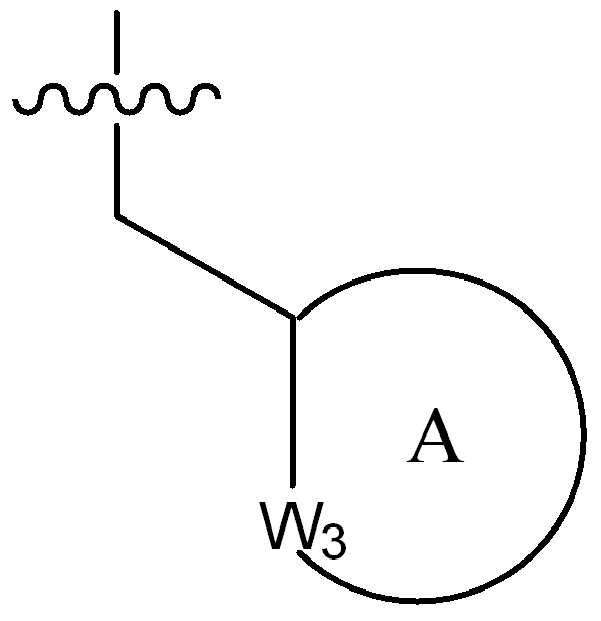
(식 중,

고리 A는 (1-2C)알킬, 할로, 히드록시, 시아노 또는 (1-2C)알콕시로부터 선택된 하나 이상의 치환기로 선택적으로 치환된, 4원 내지 6원의 시클로알킬 또는 헤테로시클릴 고리이고;
W3은 NR100 또는 CR101R102로부터 선택되고, 여기서 R100은 수소, (1-2C)알킬, (1-4C)할로알킬, (1-4C)히드록시알킬, -C(O)-CH3 또는 -C(O)ORab로부터 선택되고, 여기서 Rab는 (1-4C)알킬이고, R101 및 R102는 각각 수소, (1-2C)알킬, 시클로프로필, 플루오로, 클로로, 브로모, 히드록시, 아미노, 시아노, 니트로, (1-2C)알콕시, (1-2C)할로알킬, (1-2C)할로알콕시, -C(O)ORac, -NRacRad, 페닐 또는 5원의 헤테로아릴로부터 독립적으로 선택되고, 여기서 Rac 및 Rad는 수소 또는 (1-2C)알킬로부터 독립적으로 선택됨); 및
R3은 하기로부터 선택되되:
i) 하기에 나타낸 화학식 A의 기:
[화학식 A]

(식 중,

Xa 및 Xb는 N 또는 CRx1로부터 독립적으로 선택되고, 여기서 Rx1은 수소, 플루오로, 클로로, 브로모, (1-2C)알킬, (1-2C)알콕시, 시아노, 니트로, 아세틸렌일, CH2F, CF2H 또는 CF3로부터 선택되고;
R9는 수소, 플루오로, 클로로, 브로모, (1-2C)알킬, (1-2C)알콕시, 시아노, 니트로, 아세틸렌일, CH2F, CF2H 또는 CF3으로부터 선택되고;
R10은 수소, 할로, (1-4C)알킬, (1-4C)알콕시, (1-4C)할로알킬, (1-4C)할로알콕시, 시아노, 니트로, (2-4C)알켄일, (2-4C)알킨일 또는 하기 화학식의 기로부터 선택됨):
-Y3-Z3
(식 중,
Y3은 존재하지 않거나 또는 O, N(Rs)(CRsRt)q1(여기서 q1은 0, 1 또는 2임), S, SO, SO2, C(O), C(O)O, OC(O), C(O)N(Rs), N(Rs)C(O), N(Rs)C(O)N(Rt), N(Rs)C(O)O, OC(O)N(Rs), S(O)2N(Rs), N(Rs)SO2이고, 여기서 Rs 및 Rt는 각각 수소 또는 (1-4C)알킬로부터 독립적으로 선택되고;
Z3은 수소, (1-6C)알킬, 아릴, (3-6C)시클로알킬, (2-4C)알켄일, (2-4C)알킨일, (3-6C)시클로알켄일, 헤테로아릴 또는 4원 내지 11원의 헤테로시클릴이고; 여기서 Z3은 선택적으로 옥소, (1-4C)알킬, (3-6C)시클로알킬, 할로, (1-4C)할로알킬, (1-4C)할로알콕시, (1-4C)히드록시알킬, 아미노, 시아노, 히드록시, 아미도, 카르복시, 카르바모일, 설파모일, 머캅토, C(O)NRuRv, NRuRv 또는 ORu로부터 독립적으로 선택된 하나 이상의 치환기에 의해서 추가로 치환되고, 여기서 Ru 및 Rv는 각각 수소, (1-4C)알킬 또는 (3-6C)시클로알킬로부터 독립적으로 선택되고/되거나; Z3은 선택적으로 하기 화학식의 기에 의해서 추가로 치환됨):
-LZ-WZ
(식 중,
LZ는 존재하지 않거나 또는 (1-2C)알킬 또는 옥소로부터 선택된 하나 이상의 치환체에 의해서 선택적으로 치환된 (1-5C)알킬렌이고;
WZ는 아릴, 헤테로아릴, 4원 내지 7원의 헤테로시클릴, 3원 내지 6원의 카르보시클릴, 할로, (1-4C)할로알킬, (1-4C)할로알콕시, 시아노, 히드록시, (1-4C)알콕시, C(O)Rxa, COORxa, C(O)NRxaRxb 또는 NRxaRxb이고, 여기서 Rxa 및 Rxb는 각각 수소 또는 (1-4C)알킬로부터 독립적으로 선택되고; 여기서 각각의 아릴, 헤테로아릴, 4원 내지 7원의 헤테로시클릴 또는 3원 내지 6원의 카르보시클릴은 선택적으로 (1-4C)알킬, 할로, (1-4C)할로알킬, 아미노, 시아노 또는 히드록시로부터 독립적으로 선택된 하나 이상의 치환기에 의해서 추가로 치환됨);
ii) 하기에 나타낸 화학식 B의 기:
[화학식 B]
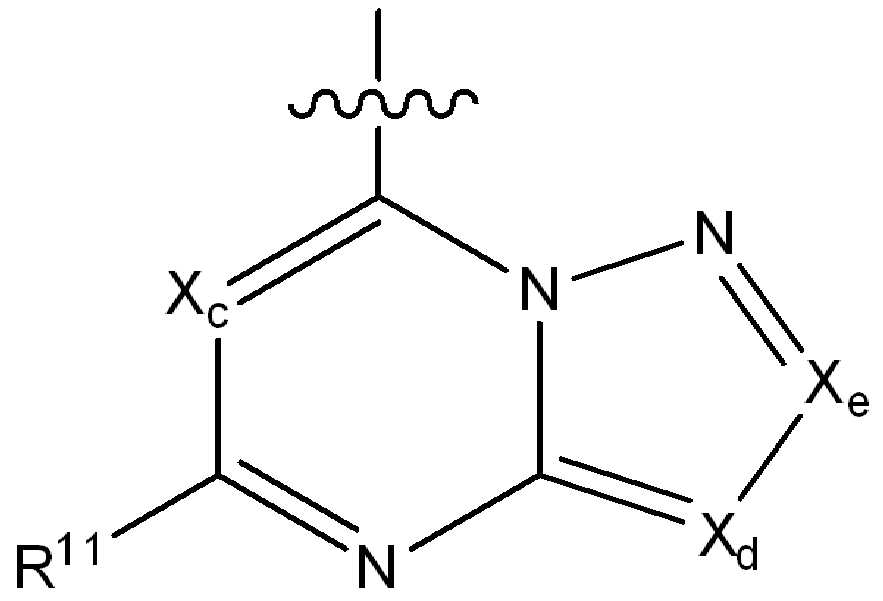
(식 중,

Xc, Xd 및 Xe는 N, CH, CF, CCl, C-CN 또는 CCH3로부터 독립적으로 선택되고;
R11은 수소, 할로, (1-4C)알킬, (1-4C)알콕시, (1-4C)할로알킬, (1-4C)할로알콕시, 시아노, 니트로, (2-4C)알켄일, (2-4C)알킨일 또는 하기 화학식의 기로부터 선택됨):
-Y5-Z5
(식 중,
Y5는 존재하지 않거나 또는 O, N(Rw), C(O), C(O)O, OC(O), C(O)N(Rw), N(Rw)C(O), N(Rw)C(O)N(Rx), N(Rw)C(O)O, OC(O)N(Rw), S(O)2N(Rw), N(Rw)SO2이고, 여기서 Rw 및 Rx는 각각 수소 또는 (1-4C)알킬로부터 독립적으로 선택되고;
Z5는 수소, (1-6C)알킬, 아릴, (3-8C)시클로알킬, (3-8C)시클로알켄일, 헤테로아릴 또는 헤테로시클릴이고; 여기서 Z5는 선택적으로 (1-4C)알킬, 할로, (1-4C)할로알킬, (1-4C)할로알콕시, (1-4C)히드록시알킬, 아미노, 시아노, 히드록시, 아미도, 카르복시, 카르바모일, 설파모일, 머캅토, NRyRz, ORy로부터 독립적으로 선택된 하나 이상의 치환기에 의해서 추가로 치환되고, 여기서 Ry 및 Rz는 각각 수소, (1-4C)알킬 또는 (3-6C)시클로알킬로부터 독립적으로 선택됨);
iii) 하기에 나타낸 화학식 C의 기:
[화학식 C]
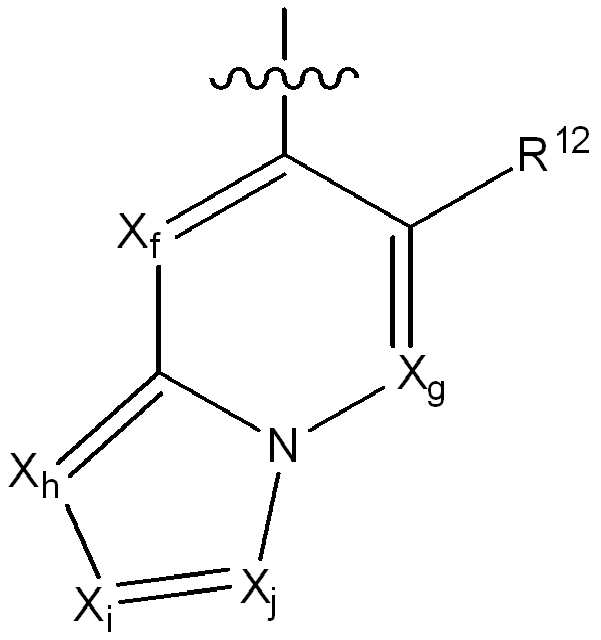
(식 중,

R12는 플루오로, 클로로, 브로모, (1-2C)알킬, (1-2C)알콕시, 시아노, 니트로, (2-4C)알켄일, (2-4C)알킨일, CH2F, CF2H 또는 CF3로부터 선택되고;
Xf 및 Xg는 N 또는 CR13으로부터 독립적으로 선택되고, 여기서 R13은 수소, 플루오로, 클로로, (1-2C)알킬, (1-2C)할로알킬 또는 (1-2C)할로알콕시로부터 선택되고;
Xh, Xi 및 Xj는 N 또는 CR14로부터 독립적으로 선택되고, 여기서 R14는 수소, 할로, (1-2C)알킬, (1-2C)알콕시, (1-2C)할로알킬 또는 (1-2C)할로알콕시로부터 선택됨);
단,
(i) R3이 화학식 B의 기인 경우, Xc, Xd 및 Xe 중 2개 이하는 질소이고;
(ii) R3이 화학식 C의 기인 경우, Xf, Xg, Xh, Xi 및 Xj 중 3개 이하는 질소이고;
(iii) X1 및 X2가 CH이고, R1 및 R2가 수소 또는 메틸이고, R3이 화학식 A의 기이고, Xa가 N이고, Xb가 CH이고, R9가 메틸 또는 플루오로인 경우, R10은 메틸설포닐아미노페닐 또는 아미노설포닐페닐이 아니고;
(iv) Y3이 NH인 경우, R1 및 R2 각각은 수소 또는 메틸이 아니고;
(v) 화합물은 하기 화합물 중 하나가 아님:

[Formula I]
(In the meal,
X 1 is selected from N or CR a , wherein R a is hydrogen, (1-2C) alkyl, halogen, hydroxy, (1-2C) alkoxy, (1-2C) haloalkyl, (1-2C) halo Alkoxy, (2-4C) alkenyl, (2-4C) alkynyl, nitro, cyano or NR b R c , wherein R b and R c are independently selected from hydrogen or (1-2C) alkyl Become;
X 2 is selected from N or CR d , wherein R d is hydrogen, (1-2C) alkyl, fluoro, chloro, bromo, hydroxy, (1-2C) alkoxy, (1-2C) haloalkyl or (1-2C) haloalkoxy;
R 1 is selected from hydrogen or a group of the formula:
-LYZ
(In the meal,
L is (1-5C) alkylene which is absent or optionally substituted by one or more substituents selected from (1-2C) alkyl or oxo;
Y is absent or O, S, SO, SO 2 , N (R e ), C (O), C (O) O, OC (O), C (O) N (R e ), N (R e ) C (O), N (R e ) C (O) N (R f ), N (R e ) C (O) O, OC (O) N (R e ), S (O) 2 N ( R e ) or N (R e ) SO 2 , wherein R e and R f are each independently selected from hydrogen or (1-4C) alkyl;
Z is hydrogen, (1-6C) alkyl, (2-6C) alkenyl, (2-6C) alkynyl, aryl, (3-10C) cycloalkyl, (3-10C) cycloalkenyl, heteroaryl or hetero Cyclyl; Wherein Z is optionally (1-4C) alkyl, halo, (1-4C) haloalkyl, (1-4C) haloalkoxy, amino, (1-4C) aminoalkyl, cyano, hydroxy, carboxy, carba Mole, sulfamoyl, mercapto, ureido, NR g R h , OR g , C (O) R g , C (O) OR g , OC (O) R g , C (O) N (R g ) R h , N (R g ) C (O) R h , S (O) y R g , where y is 0, 1 or 2, SO 2 N (R g ) R h , N (R g ) SO 2 Further substituted by one or more substituents independently selected from R g , Si (R g ) (R h ) R i or (CH 2 ) z NR g R h , wherein z is 1, 2 or 3; Wherein R g , R h and R i are each independently selected from hydrogen, (1-6C) alkyl or (3-6C) cycloalkyl; Or R g and R h together with the nitrogen atom to which they are attached are (1-4C) alkyl, halo, (1-4C) haloalkyl, (1-4C) haloalkoxy, (1-4C) alkoxy, ( 1-4C) may be linked to form a 4 to 9 membered heterocyclic ring optionally substituted by one or more substituents selected from alkylamino, amino, cyano or hydroxy);
R 2 is selected from:
(i) hydrogen or methyl;
(ii) groups of the formula
(In the meal,
W 1 is selected from CR 4 R 5 or C (O), wherein R 4 and R 5 are hydrogen, (1-2C) alkyl, fluoro, hydroxy, cyano, nitro, (1-2C) alkoxy, Independently selected from (1-2C) haloalkyl, (1-2C) haloalkoxy or NR j R k , wherein R j and R k are independently selected from hydrogen or (1-2C) alkyl; or
R 4 and R 5 together with the carbon atom to which they are attached are (1-2C) alkyl, halo, (1-2C) haloalkyl, (1-2C) haloalkoxy, (1-2C) alkoxy, (1 -2C) may be linked to form a 3-6 membered carbocyclic ring or a 3-6 membered heterocyclic ring optionally substituted by one or more substituents selected from alkylamino, amino, cyano or hydroxy There is;
W 2 is cyano, 5- or 6-membered heteroaryl, phenyl, C (O) R 1 , SO 2 R 1 , C (O) OCH 3 , C (O) N (H) CH 3 , CR 6 R 7 R 8 or NR 1 R m , wherein R 1 and R m are independently selected from hydrogen or (1-4C) alkyl; here
R 6 is hydrogen, (1-2C) alkyl, fluoro, chloro, bromo, hydroxy, amino, cyano, nitro, (1-2C) alkoxy, (1-2C) haloalkyl or (1-2C) Selected from haloalkoxy;
R 7 is hydrogen, (1-2C) alkyl, fluoro, chloro, bromo, hydroxy, cyano, nitro, (1-2C) alkoxy, (1-2C) haloalkyl, (1-2C) haloalkoxy Or is selected from a group of the formula:
-Y 2 -L 2 -Z 2
(In the meal,
Y 2 is absent or O, N (R n ), S, SO, SO 2 , C (O), C (O) O, OC (O), C (O) N (R n ), N ( R n ) C (O), S (O) 2 N (R n ), or N (R n ) SO 2 , wherein R n is selected from hydrogen or (1-2C) alkyl;
L 2 is absent or (1-2C) alkylene;
Z 2 is hydrogen, (1-6C) alkyl, (2-4C) alkenyl, (2-4C) alkynyl, phenyl, (3-6C) cycloalkyl, 5- or 6-membered heteroaryl or 4- to 6 membered heterocyclyl; Wherein Z 2 is (1-4C) alkyl, halo, (1-4C) haloalkyl, (1-4C) haloalkoxy, (1-4C) alkoxy, (1-4C) alkylamino, amino, cyano, nitro One or more substituents selected from hydroxy, C (O) R o , C (O) OR o , OC (O) R o , C (O) N (R o ) R p , NR o C (O) R p Optionally substituted by wherein R o and R p are independently selected from hydrogen or (1-4C) alkyl);
R 8 is (1-2C) alkyl, -C (O) OR q , OR q , -C (O) NR q , NR q R r , Phenyl or 5-membered heteroaryl, wherein R q and R r are independently selected from hydrogen or (1-2C) alkyl;
Or R 6 and R 7 together with the carbon atom to which they are attached are (1-2C) alkyl, halo, (1-2C) haloalkyl, (1-2C) haloalkoxy, (1-2C) alkoxy, ( 1-2C) to form a 3-6 membered carbocyclic ring or a 3-6 membered heterocyclic ring optionally substituted by one or more substituents selected from alkylamino, amino, cyano or hydroxyl Can be connected); or
(iii) a group of the formula:
(In the meal,
Ring A is a 4-6 membered cycloalkyl or heterocyclyl ring optionally substituted with one or more substituents selected from (1-2C) alkyl, halo, hydroxy, cyano or (1-2C) alkoxy;
W 3 is selected from NR 100 or CR 101 R 102 , wherein R 100 is hydrogen, (1-2C) alkyl, (1-4C) haloalkyl, (1-4C) hydroxyalkyl, -C (O)- CH 3 or —C (O) OR ab , wherein R ab is (1-4C) alkyl, R 101 and R 102 are each hydrogen, (1-2C) alkyl, cyclopropyl, fluoro, chloro, Bromo, hydroxy, amino, cyano, nitro, (1-2C) alkoxy, (1-2C) haloalkyl, (1-2C) haloalkoxy, -C (O) OR ac , -NR ac R ad , Independently selected from phenyl or 5-membered heteroaryl, wherein R ac and R ad are independently selected from hydrogen or (1-2C) alkyl); And
R 3 is selected from:
i) a group of formula A shown below:
[Formula A]
(In the meal,
X a and X b are independently selected from N or CR x1 , wherein R x1 is hydrogen, fluoro, chloro, bromo, (1-2C) alkyl, (1-2C) alkoxy, cyano, nitro, acetylene One, CH 2 F, CF 2 H or CF 3 ;
R 9 is selected from hydrogen, fluoro, chloro, bromo, (1-2C) alkyl, (1-2C) alkoxy, cyano, nitro, acetylenyl, CH 2 F, CF 2 H or CF 3 ;
R 10 is hydrogen, halo, (1-4C) alkyl, (1-4C) alkoxy, (1-4C) haloalkyl, (1-4C) haloalkoxy, cyano, nitro, (2-4C) alkenyl, (2-4C) alkynyl or selected from the group of formula:
-Y 3 -Z 3
(In the meal,
Y 3 is not present or O, N (R s) ( CR s R t) q1 ( where q 1 is 0, 1 or 2), S, SO, SO 2, C (O), C (O) O, OC (O), C (O) N (R s ), N (R s ) C (O), N (R s ) C (O) N (R t ), N (R s ) C (O ) O, OC (O) N (R s ), S (O) 2 N (R s ), N (R s ) SO 2 , where R s and R t are each from hydrogen or (1-4C) alkyl Independently selected;
Z 3 is hydrogen, (1-6C) alkyl, aryl, (3-6C) cycloalkyl, (2-4C) alkenyl, (2-4C) alkynyl, (3-6C) cycloalkenyl, heteroaryl or 4-11 membered heterocyclyl; Wherein Z 3 is optionally oxo, (1-4C) alkyl, (3-6C) cycloalkyl, halo, (1-4C) haloalkyl, (1-4C) haloalkoxy, (1-4C) hydroxyalkyl, Further by one or more substituents independently selected from amino, cyano, hydroxy, amido, carboxy, carbamoyl, sulfamoyl, mercapto, C (O) NR u R v , NR u R v or OR u Substituted, wherein R u and R v are each independently selected from hydrogen, (1-4C) alkyl or (3-6C) cycloalkyl; Z 3 is optionally further substituted by a group of the formula:
-L Z -W Z
(In the meal,
L Z is (1-5C) alkylene which is absent or optionally substituted by one or more substituents selected from (1-2C) alkyl or oxo;
W Z is aryl, heteroaryl, 4- to 7-membered heterocyclyl, 3- to 6-membered carbocyclyl, halo, (1-4C) haloalkyl, (1-4C) haloalkoxy, cyano, hydroxide Roxy, (1-4C) alkoxy, C (O) R xa , COOR xa , C (O) NR xa R xb or NR xa R xb , where R xa and R xb are each hydrogen or (1-4C) alkyl Independently selected from; Wherein each aryl, heteroaryl, 4- to 7-membered heterocyclyl or 3- to 6-membered carbocyclyl is optionally (1-4C) alkyl, halo, (1-4C) haloalkyl, amino, cya Further substituted by one or more substituents independently selected from no or hydroxy);
ii) a group of formula B represented below:
[Formula B]
(In the meal,
X c, X d and X e are independently selected from N, CH, CF, CCI, C-CN or CCH 3 ;
R 11 is hydrogen, halo, (1-4C) alkyl, (1-4C) alkoxy, (1-4C) haloalkyl, (1-4C) haloalkoxy, cyano, nitro, (2-4C) alkenyl, (2-4C) alkynyl or selected from the group of formula:
-Y 5 -Z 5
(In the meal,
Y 5 is absent or O, N (R w ), C (O), C (O) O, OC (O), C (O) N (R w ), N (R w ) C (O) , N (R w ) C (O) N (R x ), N (R w ) C (O) O, OC (O) N (R w ), S (O) 2 N (R w ), N ( R w ) SO 2 , wherein R w and R x are each independently selected from hydrogen or (1-4C) alkyl;
Z 5 is hydrogen, (1-6C) alkyl, aryl, (3-8C) cycloalkyl, (3-8C) cycloalkenyl, heteroaryl or heterocyclyl; Wherein Z 5 is optionally (1-4C) alkyl, halo, (1-4C) haloalkyl, (1-4C) haloalkoxy, (1-4C) hydroxyalkyl, amino, cyano, hydroxy, amido Is further substituted by one or more substituents independently selected from carboxy, carbamoyl, sulfamoyl, mercapto, NR y R z , OR y , wherein R y and R z are each hydrogen, (1-4C) alkyl Or (3-6C) cycloalkyl independently);
iii) a group of formula C shown below:
[Formula C]
(In the meal,
R 12 is fluoro, chloro, bromo, (1-2C) alkyl, (1-2C) alkoxy, cyano, nitro, (2-4C) alkenyl, (2-4C) alkynyl, CH 2 F, Is selected from CF 2 H or CF 3 ;
X f and X g are independently selected from N or CR 13 , wherein R 13 is selected from hydrogen, fluoro, chloro, (1-2C) alkyl, (1-2C) haloalkyl or (1-2C) haloalkoxy Selected;
X h , X i and X j are independently selected from N or CR 14 , wherein R 14 is hydrogen, halo, (1-2C) alkyl, (1-2C) alkoxy, (1-2C) haloalkyl or ( 1-2C) selected from haloalkoxy);
only,
(i) when R 3 is a group of formula B, then no more than two of X c , X d and X e are nitrogen;
(ii) when R 3 is a group of formula C, then no more than three of X f, X g , X h , X i and X j are nitrogen;
(iii) X 1 and X 2 are CH, R 1 and R 2 are hydrogen or methyl, R 3 is a group of formula A, X a is N, X b is CH, R 9 is methyl or fluorine When, R 10 is not methylsulfonylaminophenyl or aminosulfonylphenyl;
(iv) when Y 3 is NH, each of R 1 and R 2 is not hydrogen or methyl;
(v) the compound is not one of the following compounds:
-L-Y-Z
(식 중,
L은 존재하지 않거나 또는 (1-2C)알킬로부터 선택된 하나 이상의 치환체에 의해서 선택적으로 치환된 (1-5C)알킬렌이고;
Y는 존재하지 않거나 또는 O, S, SO, SO2, N(Re), C(O), C(O)O, OC(O), C(O)N(Re), N(Re)C(O), S(O)2N(Re), 또는 N(Re)SO2이고, 여기서 Re는 수소 또는 (1-4C)알킬로부터 선택되고;
Z는 수소, (1-6C)알킬, (2-6C)알켄일, (2-6C)알킨일, 아릴, (3-10C)시클로알킬, (3-10C)시클로알켄일, 헤테로아릴 또는 헤테로시클릴이고; 여기서 Z는 선택적으로 (1-4C)알킬, 할로, (1-4C)할로알킬, (1-4C)할로알콕시, 아미노, (1-4C)아미노알킬, 시아노, 히드록시, 카르복시, 카르바모일, 설파모일, 머캅토, 우레이도, NRgRh, ORg, C(O)Rg, C(O)ORg, OC(O)Rg, C(O)N(Rg)Rh, N(Rg)C(O)Rh, S(O)yRg(여기서 y는 0, 1 또는 2임), SO2N(Rg)Rh, N(Rg)SO2Rg, Si(Rg)(Rh)Ri 또는 (CH2)zNRgRh(여기서 z는 1, 2 또는 3임)로부터 독립적으로 선택된 하나 이상의 치환기에 의해서 추가로 치환되고; 여기서 Rg, Rh 및 Ri는 각각 수소, (1-6C)알킬 또는 (3-6C)시클로알킬로부터 독립적으로 선택되거나; 또는 Rg와 Rh는, 이들이 부착된 질소 원자와 함께, 이들이 4원 내지 9원의 헤테로시클릭 고리를 형성하도록 연결될 수 있음).The compound of formula I, or a pharmaceutically acceptable salt or solvate thereof, according to any one of claims 1 to 4, wherein R 1 is selected from hydrogen or a group of the formula
-LYZ
(In the meal,
L is (1-5C) alkylene which is absent or optionally substituted by one or more substituents selected from (1-2C) alkyl;
Y is absent or O, S, SO, SO 2 , N (R e ), C (O), C (O) O, OC (O), C (O) N (R e ), N (R e ) C (O), S (O) 2 N (R e ), or N (R e ) SO 2 , wherein R e is selected from hydrogen or (1-4C) alkyl;
Z is hydrogen, (1-6C) alkyl, (2-6C) alkenyl, (2-6C) alkynyl, aryl, (3-10C) cycloalkyl, (3-10C) cycloalkenyl, heteroaryl or hetero Cyclyl; Wherein Z is optionally (1-4C) alkyl, halo, (1-4C) haloalkyl, (1-4C) haloalkoxy, amino, (1-4C) aminoalkyl, cyano, hydroxy, carboxy, carba Mole, sulfamoyl, mercapto, ureido, NR g R h , OR g , C (O) R g , C (O) OR g , OC (O) R g , C (O) N (R g ) R h , N (R g ) C (O) R h , S (O) y R g , where y is 0, 1 or 2, SO 2 N (R g ) R h , N (R g ) SO 2 Further substituted by one or more substituents independently selected from R g , Si (R g ) (R h ) R i or (CH 2 ) z NR g R h , wherein z is 1, 2 or 3; Wherein R g, R h and R i are each independently selected from hydrogen, (1-6C) alkyl or (3-6C) cycloalkyl; Or R g and R h , together with the nitrogen atom to which they are attached, may be linked such that they form a 4- to 9-membered heterocyclic ring).
-L-Y-Z
(식 중,
L은 존재하지 않거나 또는 (1-5C)알킬렌이고;
Y는 존재하지 않거나 또는 O, SO2, C(O), C(O)O, C(O)N(Re) 또는 S(O)2N(Re)이고, 여기서 Re는 수소 또는 (1-4C)알킬로부터 선택되고;
Z는 수소, (1-6C)알킬, (2-6C)알켄일, (2-6C)알킨일, 아릴, (3-10C)시클로알킬, (3-10C)시클로알켄일, 헤테로아릴 또는 헤테로시클릴이고; 여기서 Z는 선택적으로 (1-2C)알킬, 할로, (1-2C)할로알킬, (1-2C)할로알콕시, 아미노, (1-2C)아미노알킬, 시아노, 히드록시, NRgRh 또는 ORg로부터 독립적으로 선택된 하나 이상의 치환기에 의해서 추가로 치환되고; 여기서 Rg, Rh 및 Ri는 각각 수소 또는 (1-4C)알킬로부터 독립적으로 선택됨).The compound of formula (I), or a pharmaceutically acceptable salt or solvate thereof, according to any one of claims 1 to 5, wherein R 1 is selected from hydrogen or a group of formula
-LYZ
(In the meal,
L is absent or (1-5C) alkylene;
Y is absent or is O, SO 2 , C (O), C (O) O, C (O) N (R e ) or S (O) 2 N (R e ), where R e is hydrogen or (1-4C) alkyl;
Z is hydrogen, (1-6C) alkyl, (2-6C) alkenyl, (2-6C) alkynyl, aryl, (3-10C) cycloalkyl, (3-10C) cycloalkenyl, heteroaryl or hetero Cyclyl; Wherein Z is optionally (1-2C) alkyl, halo, (1-2C) haloalkyl, (1-2C) haloalkoxy, amino, (1-2C) aminoalkyl, cyano, hydroxy, NR g R h Or further substituted by one or more substituents independently selected from OR g ; Wherein R g, R h and R i are each independently selected from hydrogen or (1-4C) alkyl).
(i) 수소 또는 메틸;
(ii) 하기 화학식의 기:
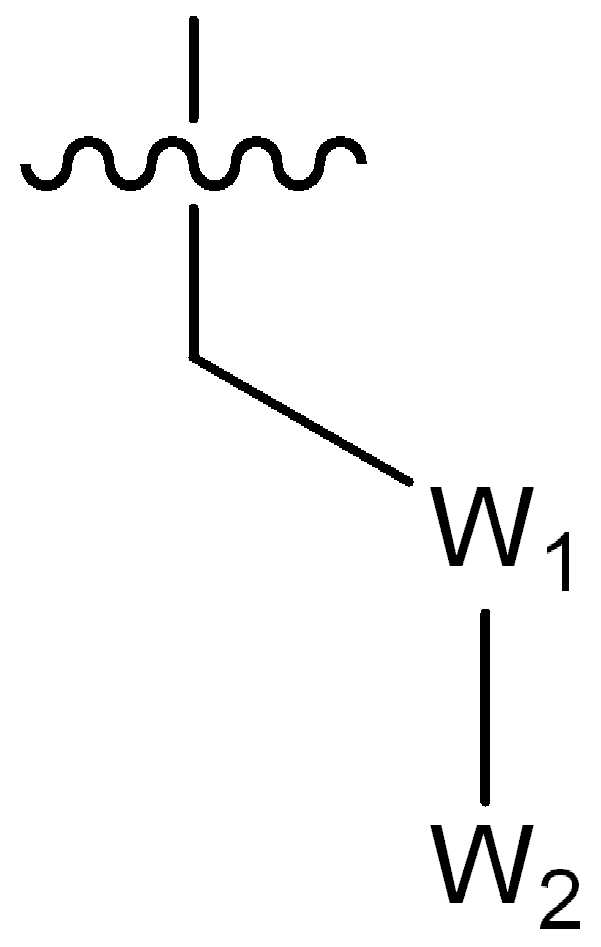
(식 중,

W1은 CR4R5 또는 C(O)로부터 선택되고, 여기서 R4 및 R5는 수소, (1-2C)알킬, 플루오로, 히드록시, 시아노, (1-2C)알콕시, CH2F, CF2H 또는 아미노로부터 독립적으로 선택되거나; 또는
R4와 R5는, 이들이 부착된 탄소 원자와 함께, 이들이 메틸, 플루오로, 클로로, OCH3, 아미노, 시아노 또는 히드록시로부터 선택된 하나 이상의 치환체에 의해서 선택적으로 치환된 3원 내지 6원의 카보시클릭 고리 또는 3원 내지 6원의 헤테로시클릭 고리를 형성하도록 연결될 수 있고;
W2는 시아노, 5원 또는 6원의 헤테로아릴, 페닐, C(O)OCH3, C(O)N(H)CH3, CR6R7R8 또는 NRlRm으로부터 선택되고, 여기서 Rl 및 Rm은 수소 또는 (1-2C)알킬로부터 독립적으로 선택되고, 여기서
R6은 수소, (1-2C)알킬, 플루오로, 클로로, 히드록시, 아미노, 시아노 또는 (1-2C)알콕시로부터 선택되고;
R7은 수소, (1-2C)알킬, 플루오로, 클로로, 히드록시, 시아노, (1-2C)알콕시, (1-2C)할로알킬, (1-2C)할로알콕시 또는 하기 화학식의 기로부터 선택되고:
-Y2-L2-Z2
(식 중,
Y2는 존재하지 않거나 또는 O, C(O), C(O)O, OC(O), C(O)N(Rn) 또는 N(Rn)C(O로부터 선택되고, 여기서 Rn은 수소 또는 (1-2C)알킬로부터 선택되고;
L2는 존재하지 않거나 또는 (1-2C)알킬렌이고;
Z2는 수소, (1-6C)알킬, (2-4C)알켄일, (2-4C)알킨일, 페닐, (3-6C)시클로알킬, 5원 내지 6원의 헤테로아릴 또는 4원 내지 6원의 헤테로시클릴이고; 여기서 Z2는 (1-2C)알킬, 할로, (1-2C)할로알킬, (1-2C)할로알콕시, (1-2C)알콕시, (1-2C)알킬아미노, 아미노, 시아노, 니트로 또는 히드록시로부터 선택된 하나 이상의 치환체에 의해서 선택적으로 치환됨);
R8은 (1-2C)알킬, -C(O)ORq , ORq, NRqRr, 페닐 또는 5원의 헤테로아릴로부터 선택되고, 여기서 Rq 및 Rr은 수소 또는 (1-2C)알킬로부터 독립적으로 선택됨); 또는
(iii) 하기 화학식의 기:
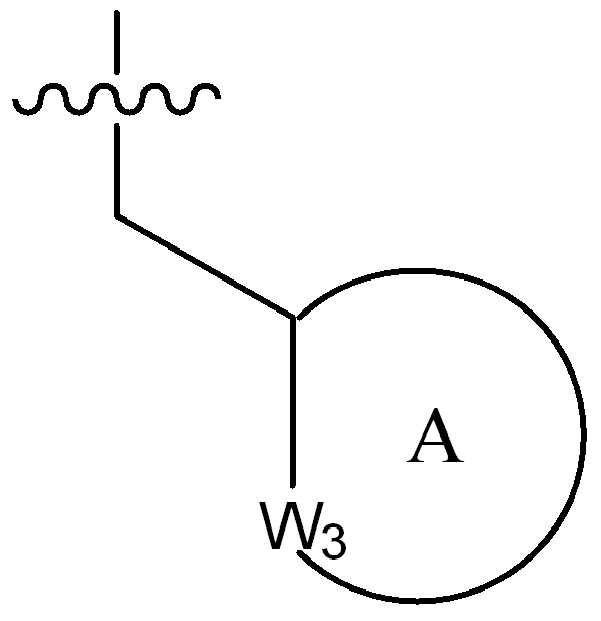
(식 중,

고리 A는 5원의 시클로알킬 또는 헤테로시클릴 고리이고;
W3은 NR100 또는 CR101R102로부터 선택되고, 여기서 R100은 수소, (1-2C)알킬 또는 -C(O)ORab로부터 선택되고, 여기서 Rab는 (1-2C)알킬이고, R101 및 R102는 각각 수소, (1-2C)알킬, 플루오로, 클로로, 히드록시, (1-2C)알콕시, CH2F, CF2H, CF3, -C(O)ORac 또는-NRacRad로부터 독립적으로 선택되고, 여기서 Rac 및 Rad는 수소 또는 (1-2C)알킬로부터 독립적으로 선택됨).The compound of formula (I), or a pharmaceutically acceptable salt or solvate thereof, according to any one of claims 1 to 6, wherein R 2 is selected from:
(i) hydrogen or methyl;
(ii) groups of the formula
(In the meal,
W 1 is selected from CR 4 R 5 or C (O), wherein R 4 and R 5 are hydrogen, (1-2C) alkyl, fluoro, hydroxy, cyano, (1-2C) alkoxy, CH 2 Independently selected from F, CF 2 H or amino; or
R 4 and R 5 , together with the carbon atoms to which they are attached, are 3- to 6-membered optionally substituted by one or more substituents selected from methyl, fluoro, chloro, OCH 3 , amino, cyano or hydroxy; May be linked to form a carbocyclic ring or a 3-6 membered heterocyclic ring;
W 2 is selected from cyano, 5- or 6-membered heteroaryl, phenyl, C (O) OCH 3 , C (O) N (H) CH 3 , CR 6 R 7 R 8 or NR 1 R m , Wherein R l and R m are independently selected from hydrogen or (1-2C) alkyl, wherein
R 6 is selected from hydrogen, (1-2C) alkyl, fluoro, chloro, hydroxy, amino, cyano or (1-2C) alkoxy;
R 7 is hydrogen, (1-2C) alkyl, fluoro, chloro, hydroxy, cyano, (1-2C) alkoxy, (1-2C) haloalkyl, (1-2C) haloalkoxy or a group of formula Is selected from:
-Y 2 -L 2 -Z 2
(In the meal,
Y 2 is absent or is selected from O, C (O), C (O) O, OC (O), C (O) N (R n ) or N (R n ) C (O, wherein R n Is selected from hydrogen or (1-2C) alkyl;
L 2 is absent or (1-2C) alkylene;
Z 2 is hydrogen, (1-6C) alkyl, (2-4C) alkenyl, (2-4C) alkynyl, phenyl, (3-6C) cycloalkyl, 5- or 6-membered heteroaryl or 4- to 6 membered heterocyclyl; Wherein Z 2 is (1-2C) alkyl, halo, (1-2C) haloalkyl, (1-2C) haloalkoxy, (1-2C) alkoxy, (1-2C) alkylamino, amino, cyano, nitro Or optionally substituted by one or more substituents selected from hydroxy);
R 8 is (1-2C) alkyl, —C (O) OR q , OR q , NR q R r , Phenyl or 5 membered heteroaryl, wherein R q and R r are independently selected from hydrogen or (1-2C) alkyl); or
(iii) a group of the formula:
(In the meal,
Ring A is a 5-membered cycloalkyl or heterocyclyl ring;
W 3 is selected from NR 100 or CR 101 R 102 , wherein R 100 is selected from hydrogen, (1-2C) alkyl or -C (O) OR ab , where R ab is (1-2C) alkyl R 101 and R 102 each represent hydrogen, (1-2C) alkyl, fluoro, chloro, hydroxy, (1-2C) alkoxy, CH 2 F, CF 2 H, CF 3 , -C (O) OR ac or -NR ac R ad independently selected from where R ac and R ad are independently selected from hydrogen or (1-2C) alkyl).
(i) 수소 또는 메틸;
(ii) 하기 화학식의 기:

(식 중,

W1은 CHR4 또는 C(O)로부터 선택되고, 여기서 R4는 수소, (1-2C)알킬, 플루오로, 히드록시, 시아노, (1-2C)알콕시, CH2F, CF2H 또는 아미노로부터 선택되고;
W2는 시아노, 5원 또는 6원의 헤테로아릴, 페닐, C(O)OCH3, C(O)N(H)CH3, CR6R7R8 또는 NRlRm으로부터 선택되고, 여기서 Rl 및 Rm은 수소 또는 (1-2C)알킬로부터 독립적으로 선택되고, 여기서
R6은 수소, (1-2C)알킬, 플루오로, 클로로, 히드록시, 아미노, 시아노, (1-2C)알콕시, CH2F 또는 CF2H로부터 선택되고;
R7은 수소, (1-2C)알킬, 플루오로, 클로로, 히드록시, 시아노, (1-2C)알콕시, (1-2C)할로알킬, (1-2C)할로알콕시 또는 하기 화학식의 기로부터 선택되고:
-Y2-L2-Z2
(식 중,
Y2는 존재하지 않거나 또는 O, C(O)O, C(O)N(Rn) 또는 N(Rn)C(O로부터 선택되고, 여기서 Rn은 수소 또는 (1-2C)알킬로부터 선택되고;
L2는 존재하지 않거나 또는 (1-2C)알킬렌이고;
Z2는 수소, (1-6C)알킬, (2-4C)알켄일, (2-4C)알킨일, 페닐, (3-6C)시클로알킬, 5원 내지 6원의 헤테로아릴 또는 4원 내지 6원의 헤테로시클릴이고; 여기서 Z2는 (1-2C)알킬, 할로, (1-2C)할로알킬, (1-2C)할로알콕시, (1-2C)알콕시, (1-2C)알킬아미노, 아미노, 시아노 또는 히드록시로부터 선택된 하나 이상의 치환체에 의해서 선택적으로 치환됨);
R8은 (1-2C)알킬, -C(O)ORq , ORq, NRqRr, 페닐 또는 5원의 헤테로아릴로부터 선택되고, 여기서 Rq 및 Rr은 수소 또는 (1-2C)알킬로부터 독립적으로 선택되거나; 또는
R4와 R7은 이들이 부착된 탄소 원자와 함께, 이들이 4원 내지 6원의 카보시클릭 고리 또는 4원 내지 6원의 헤테로시클릭 고리를 형성하도록 연결될 수 있음); 또는
(iii) 하기 화학식의 기:

(식 중,

고리 A는 5원의 시클로알킬 또는 헤테로시클릴 고리이고;
W3은 NR100 또는 CR101R102로부터 선택되고, 여기서 R100은 수소, (1-2C)알킬 또는 -C(O)ORab로부터 선택되고, 여기서 Rab는 (1-2C)알킬이고, R101은 수소 또는 메틸로부터 선택되고, R102는 (1-2C)알킬, 히드록시, (1-2C)알콕시, C(O)ORac 또는 -NRacRad로부터 선택되고, 여기서 Rac 및 Rad는 수소 또는 (1-2C)알킬로부터 독립적으로 선택됨).8. A compound of formula (I), or a pharmaceutically acceptable salt or solvate thereof, according to any one of claims 1 to 7, wherein R 2 is selected from:
(i) hydrogen or methyl;
(ii) groups of the formula
(In the meal,
W 1 is selected from CHR 4 or C (O), wherein R 4 is hydrogen, (1-2C) alkyl, fluoro, hydroxy, cyano, (1-2C) alkoxy, CH 2 F, CF 2 H Or amino;
W 2 is selected from cyano, 5- or 6-membered heteroaryl, phenyl, C (O) OCH 3 , C (O) N (H) CH 3 , CR 6 R 7 R 8 or NR 1 R m , Wherein R l and R m are independently selected from hydrogen or (1-2C) alkyl, wherein
R 6 is selected from hydrogen, (1-2C) alkyl, fluoro, chloro, hydroxy, amino, cyano, (1-2C) alkoxy, CH 2 F or CF 2 H;
R 7 is hydrogen, (1-2C) alkyl, fluoro, chloro, hydroxy, cyano, (1-2C) alkoxy, (1-2C) haloalkyl, (1-2C) haloalkoxy or a group of formula Is selected from:
-Y 2 -L 2 -Z 2
(In the meal,
Y 2 is absent or is selected from O, C (O) O, C (O) N (R n ) or N (R n ) C (O, wherein R n is from hydrogen or (1-2C) alkyl Selected;
L 2 is absent or (1-2C) alkylene;
Z 2 is hydrogen, (1-6C) alkyl, (2-4C) alkenyl, (2-4C) alkynyl, phenyl, (3-6C) cycloalkyl, 5- or 6-membered heteroaryl or 4- to 6 membered heterocyclyl; Wherein Z 2 is (1-2C) alkyl, halo, (1-2C) haloalkyl, (1-2C) haloalkoxy, (1-2C) alkoxy, (1-2C) alkylamino, amino, cyano or hydroxide Optionally substituted by one or more substituents selected from hydroxy);
R 8 is (1-2C) alkyl, —C (O) OR q , OR q , NR q R r , Phenyl or 5-membered heteroaryl, wherein R q and R r are independently selected from hydrogen or (1-2C) alkyl; or
R 4 and R 7 together with the carbon atom to which they are attached may be linked such that they form a 4-6 membered carbocyclic ring or a 4-6 membered heterocyclic ring; or
(iii) a group of the formula:
(In the meal,
Ring A is a 5-membered cycloalkyl or heterocyclyl ring;
W 3 is selected from NR 100 or CR 101 R 102 , wherein R 100 is selected from hydrogen, (1-2C) alkyl or -C (O) OR ab , where R ab is (1-2C) alkyl R 101 is selected from hydrogen or methyl and R 102 is selected from (1-2C) alkyl, hydroxy, (1-2C) alkoxy, C (O) OR ac or -NR ac R ad , wherein R ac and R ad is independently selected from hydrogen or (1-2C) alkyl.
i) 하기에 나타낸 화학식 A의 기:
[화학식 A]

(식 중,

Xa 및 Xb는 N 또는 CRx1로부터 독립적으로 선택되고, 여기서 Rx1은 수소, 플루오로, 클로로, 브로모, (1-2C)알킬, (1-2C)알콕시, 시아노, 니트로, 아세틸렌일, CH2F, CF2H 또는 CF3로부터 선택되고;
R9는 수소, 플루오로, 클로로, 브로모, (1-2C)알킬, (1-2C)알콕시, 시아노, 니트로, 아세틸렌일, CH2F, CF2H 또는 CF3으로부터 선택되고;
R10은 수소, 할로, (1-4C)알킬, (1-4C)알콕시, (1-4C)할로알킬, (1-4C)할로알콕시, 시아노, 니트로, (2-4C)알켄일, (2-4C)알킨일 또는 하기 화학식의 기로부터 선택됨):
-Y3-Z3
(식 중,
Y3은 존재하지 않거나 또는 N(Rs)(CRsRt)q1(여기서 q1은 0, 1 또는 2임), S, C(O), C(O)O, C(O)N(Rs), N(Rs)C(O), S(O)2N(Rs) 또는 N(Rs)SO2이고, 여기서 Rs는 수소 또는 (1-4C)알킬로부터 선택되고;
Z3은 수소, (1-6C)알킬, 아릴, (3-6C)시클로알킬, (2-4C)알켄일, (2-4C)알킨일, (3-6C)시클로알켄일, 5원 또는 6원의 헤테로아릴 또는 4원 내지 11원의 헤테로시클릴이고; 여기서 Z3은 선택적으로 옥소, (1-4C)알킬, (3-6C)시클로알킬, 할로, (1-4C)할로알킬, (1-4C)할로알콕시, 아미노, 시아노, 히드록시, 아미도, 카르복시, 카르바모일, 설파모일, 머캅토, C(O)NRuRv, NRuRv 또는 ORu로부터 독립적으로 선택된 하나 이상의 치환기에 의해서 추가로 치환되고, 여기서 Ru 및 Rv는 각각 수소, (1-4C)알킬 또는 (3-6C)시클로알킬로부터 독립적으로 선택되고/되거나; Z3은 선택적으로 하기 화학식의 기에 의해서 추가로 치환됨):
-LZ-WZ
(식 중,
LZ는 존재하지 않거나 또는 (1-3C)알킬렌이고;
WZ는 페닐, 5원 또는 6원의 헤테로아릴, 6원의 헤테로시클릴, 할로, (1-4C)할로알킬, (1-4C)할로알콕시, 시아노, 히드록시, (1-4C)알콕시, C(O)Rxa, COORxb, C(O)NRxaRxb 또는 NRxaRxb이고, 여기서 Rxa 및 Rxb는 각각 수소 또는 (1-4C)알킬로부터 독립적으로 선택됨);
ii) 하기에 나타낸 화학식 B의 기:
[화학식 B]

(식 중,

Xc, Xd 및 Xe는 N, CH, CF, CCl, C-CN 또는 CCH3로부터 독립적으로 선택되고;
R11은 수소, 할로, (1-4C)알킬, (1-4C)알콕시, (1-4C)할로알킬, (1-4C)할로알콕시, 시아노, 니트로, (2-4C)알켄일, (2-4C)알킨일 또는 하기 화학식의 기로부터 선택됨):
-Y5-Z5
(식 중,
Y5는 존재하지 않거나 또는 O, N(Rw), C(O), C(O)O, C(O)N(Rw) 또는 S(O)2N(Rw)이고, 여기서 Rw는 수소 또는 (1-4C)알킬로부터 선택되고;
Z5는 수소, (1-6C)알킬, 아릴, (3-8C)시클로알킬, (3-8C)시클로알켄일, 헤테로아릴 또는 헤테로시클릴이고; 여기서 Z5는 선택적으로 (1-4C)알킬, 할로, (1-4C)할로알킬, (1-4C)할로알콕시, 아미노, 시아노, 히드록시, 아미도, 카르복시, 카르바모일, 설파모일, 머캅토, NRyRz, ORy로부터 독립적으로 선택된 하나 이상의 치환기에 의해서 추가로 치환되고, 여기서 Ry 및 Rz는 각각 수소, (1-4C)알킬 또는 (3-6C)시클로알킬로부터 독립적으로 선택됨);
iii) 하기에 나타낸 화학식 C의 기:
[화학식 C]

(식 중,

R12는 플루오로, 클로로, 브로모, (1-2C)알킬, (1-2C)알콕시, 시아노, 니트로, (2-4C)알킨일, CH2F, CF2H 또는 CF3로부터 선택되고;
Xf 및 Xg는 N 또는 CR13으로부터 독립적으로 선택되고, 여기서 R13은 수소, 플루오로, 클로로, 메틸, CH2F, CF2H 또는 CF3로부터 선택되고;
Xh, Xi 및 Xj는 N 또는 CR14로부터 독립적으로 선택되고, 여기서 R14는 수소, 할로, (1-2C)알킬, (1-2C)알콕시, (1-2C)할로알킬 또는 (1-2C)할로알콕시로부터 선택됨).The compound of formula (I), or a pharmaceutically acceptable salt or solvate thereof, according to any one of claims 1 to 8, wherein R 3 is selected from:
i) a group of formula A shown below:
[Formula A]
(In the meal,
X a and X b are independently selected from N or CR x1 , wherein R x1 is hydrogen, fluoro, chloro, bromo, (1-2C) alkyl, (1-2C) alkoxy, cyano, nitro, acetylene One, CH 2 F, CF 2 H or CF 3 ;
R 9 is selected from hydrogen, fluoro, chloro, bromo, (1-2C) alkyl, (1-2C) alkoxy, cyano, nitro, acetylenyl, CH 2 F, CF 2 H or CF 3 ;
R 10 is hydrogen, halo, (1-4C) alkyl, (1-4C) alkoxy, (1-4C) haloalkyl, (1-4C) haloalkoxy, cyano, nitro, (2-4C) alkenyl, (2-4C) alkynyl or selected from the group of formula:
-Y 3 -Z 3
(In the meal,
Y 3 is absent or N (R s ) (CR s R t ) q1 (where q 1 is 0, 1 or 2), S, C (O), C (O) O, C (O) N (R s ), N (R s ) C (O), S (O) 2 N (R s ) or N (R s ) SO 2 , where R s is selected from hydrogen or (1-4C) alkyl ;
Z 3 is hydrogen, (1-6C) alkyl, aryl, (3-6C) cycloalkyl, (2-4C) alkenyl, (2-4C) alkynyl, (3-6C) cycloalkenyl, 5-membered or 6 membered heteroaryl or 4 to 11 membered heterocyclyl; Wherein Z 3 is optionally oxo, (1-4C) alkyl, (3-6C) cycloalkyl, halo, (1-4C) haloalkyl, (1-4C) haloalkoxy, amino, cyano, hydroxy, amino Or further substituted by one or more substituents independently selected from carboxy, carbamoyl, sulfamoyl, mercapto, C (O) NR u R v , NR u R v or OR u , wherein R u and R v Are each independently selected from hydrogen, (1-4C) alkyl or (3-6C) cycloalkyl; Z 3 is optionally further substituted by a group of the formula:
-L Z -W Z
(In the meal,
L Z is absent or (1-3C) alkylene;
W Z is phenyl, 5- or 6-membered heteroaryl, 6-membered heterocyclyl, halo, (1-4C) haloalkyl, (1-4C) haloalkoxy, cyano, hydroxy, (1-4C) Alkoxy, C (O) R xa , COOR xb , C (O) NR xa R xb or NR xa R xb , wherein R xa and R xb are each independently selected from hydrogen or (1-4C) alkyl);
ii) a group of formula B represented below:
[Formula B]
(In the meal,
X c, X d and X e are independently selected from N, CH, CF, CCI, C-CN or CCH 3 ;
R 11 is hydrogen, halo, (1-4C) alkyl, (1-4C) alkoxy, (1-4C) haloalkyl, (1-4C) haloalkoxy, cyano, nitro, (2-4C) alkenyl, (2-4C) alkynyl or selected from the group of formula:
-Y 5 -Z 5
(In the meal,
Y 5 is absent or is O, N (R w ), C (O), C (O) O, C (O) N (R w ) or S (O) 2 N (R w ), where R w is selected from hydrogen or (1-4C) alkyl;
Z 5 is hydrogen, (1-6C) alkyl, aryl, (3-8C) cycloalkyl, (3-8C) cycloalkenyl, heteroaryl or heterocyclyl; Wherein Z 5 is optionally (1-4C) alkyl, halo, (1-4C) haloalkyl, (1-4C) haloalkoxy, amino, cyano, hydroxy, amido, carboxy, carbamoyl, sulfamoyl , Is further substituted by one or more substituents independently selected from mercapto, NR y R z , OR y , wherein R y and R z are each from hydrogen, (1-4C) alkyl or (3-6C) cycloalkyl Independently selected);
iii) a group of formula C shown below:
[Formula C]
(In the meal,
R 12 is selected from fluoro, chloro, bromo, (1-2C) alkyl, (1-2C) alkoxy, cyano, nitro, (2-4C) alkynyl, CH 2 F, CF 2 H or CF 3 Become;
X f and X g are independently selected from N or CR 13 , wherein R 13 is selected from hydrogen, fluoro, chloro, methyl, CH 2 F, CF 2 H or CF 3 ;
X h , X i and X j are independently selected from N or CR 14 , wherein R 14 is hydrogen, halo, (1-2C) alkyl, (1-2C) alkoxy, (1-2C) haloalkyl or ( 1-2C) selected from haloalkoxy).
i) 하기에 나타낸 화학식 A의 기:
[화학식 A]

(식 중,

Xa 및 Xb는 N 또는 CRx1로부터 독립적으로 선택되고, 여기서 Rx1은 수소, 플루오로, 클로로, 브로모, (1-2C)알킬, (1-2C)알콕시, 시아노, 니트로, 아세틸렌일, CH2F, CF2H 또는 CF3로부터 선택되고;
R9는 수소, 플루오로, 클로로, 브로모, (1-2C)알킬, (1-2C)알콕시, 시아노, 니트로, 아세틸렌일, CH2F, CF2H 또는 CF3으로부터 선택되고;
R10은 수소, 할로, (1-4C)알킬, (1-4C)알콕시, (1-4C)할로알킬, (1-4C)할로알콕시, 시아노, 니트로, (2-4C)알켄일, (2-4C)알킨일 또는 하기 화학식의 기로부터 선택됨):
-Y3-Z3
(식 중,
Y3은 존재하지 않거나 또는 N(Rs)(CRsRt)q1(여기서 q1은 0, 1 또는 2임), S, C(O), C(O)O, C(O)N(Rs), N(Rs)C(O) 또는 S(O)2N(Rs)이고, 여기서 Rs는 수소 또는 (1-4C)알킬로부터 선택되고;
Z3은 수소, (1-6C)알킬, 아릴, (3-6C)시클로알킬, (2-4C)알켄일, (2-4C)알킨일, (3-6C)시클로알켄일, 헤테로아릴 또는 4원 내지 11원의 헤테로시클릴이고; 여기서 Z3은 선택적으로 옥소, (1-4C)알킬, (3-6C)시클로알킬, 할로, (1-4C)할로알킬, (1-4C)할로알콕시, 아미노, 시아노, 히드록시, 아미도, 카르복시, 카르바모일, 설파모일, 머캅토, C(O)NRuRv, NRuRv 또는 ORu로부터 독립적으로 선택된 하나 이상의 치환기에 의해서 추가로 치환되고, 여기서 Ru 및 Rv는 각각 수소, (1-4C)알킬 또는 (3-6C)시클로알킬로부터 독립적으로 선택되고/되거나; Z3은 선택적으로 하기 화학식의 기에 의해서 추가로 치환됨):
-LZ-WZ
(식 중,
LZ는 존재하지 않거나 또는 (1-2C)알킬 또는 옥소로부터 선택된 하나 이상의 치환체에 의해서 선택적으로 치환된 (1-5C)알킬렌이고;
WZ는 페닐, 5원 또는 6원의 헤테로아릴, 6원의 헤테로시클릴, 할로, (1-4C)할로알킬, (1-4C)할로알콕시, 시아노, 히드록시, (1-4C)알콕시, C(O)Rxa, COORxa, C(O)NRxaRxb 또는 NRxaRxb이고, 여기서 Rxa 및 Rxb는 각각 수소 또는 (1-4C)알킬로부터 독립적으로 선택됨);
ii) 하기에 나타낸 화학식 B의 기:
[화학식 B]

(식 중,

Xc, Xd 및 Xe는 N, CH, CF, CCl, C-CN 또는 CCH3로부터 독립적으로 선택되고;
R11은 수소, 할로, (1-4C)알킬, (1-4C)알콕시, (1-4C)할로알킬, (1-4C)할로알콕시, 시아노, 니트로, (2-4C)알켄일, (2-4C)알킨일 또는 하기 화학식의 기로부터 선택됨):
-Y5-Z5
(식 중,
Y5는 존재하지 않거나 또는 O, N(Rw), C(O), C(O)O, C(O)N(Rw) 또는 S(O)2N(Rw)이고, 여기서 Rw는 수소 또는 (1-4C)알킬로부터 선택되고;
Z5는 수소, (1-6C)알킬, 아릴, (3-8C)시클로알킬, (3-8C)시클로알켄일, 헤테로아릴 또는 헤테로시클릴이고; 여기서 Z5는 선택적으로 (1-4C)알킬, 할로, (1-4C)할로알킬, (1-4C)할로알콕시, 아미노, 시아노, 히드록시, 아미도, 카르복시, 카르바모일, 설파모일, 머캅토, NRyRz, ORy로부터 독립적으로 선택된 하나 이상의 치환기에 의해서 추가로 치환되고, 여기서 Ry 및 Rz는 각각 수소, (1-4C)알킬 또는 시클로프로필로부터 독립적으로 선택됨).The compound of formula (I), or a pharmaceutically acceptable salt or solvate thereof, according to any one of claims 1 to 9, wherein R 3 is selected from:
i) a group of formula A shown below:
[Formula A]
(In the meal,
X a and X b are independently selected from N or CR x1 , wherein R x1 is hydrogen, fluoro, chloro, bromo, (1-2C) alkyl, (1-2C) alkoxy, cyano, nitro, acetylene One, CH 2 F, CF 2 H or CF 3 ;
R 9 is selected from hydrogen, fluoro, chloro, bromo, (1-2C) alkyl, (1-2C) alkoxy, cyano, nitro, acetylenyl, CH 2 F, CF 2 H or CF 3 ;
R 10 is hydrogen, halo, (1-4C) alkyl, (1-4C) alkoxy, (1-4C) haloalkyl, (1-4C) haloalkoxy, cyano, nitro, (2-4C) alkenyl, (2-4C) alkynyl or selected from the group of formula:
-Y 3 -Z 3
(In the meal,
Y 3 is absent or N (R s ) (CR s R t ) q1 (where q 1 is 0, 1 or 2), S, C (O), C (O) O, C (O) N (R s ), N (R s ) C (O) or S (O) 2 N (R s ), wherein R s is selected from hydrogen or (1-4C) alkyl;
Z 3 is hydrogen, (1-6C) alkyl, aryl, (3-6C) cycloalkyl, (2-4C) alkenyl, (2-4C) alkynyl, (3-6C) cycloalkenyl, heteroaryl or 4-11 membered heterocyclyl; Wherein Z 3 is optionally oxo, (1-4C) alkyl, (3-6C) cycloalkyl, halo, (1-4C) haloalkyl, (1-4C) haloalkoxy, amino, cyano, hydroxy, amino Or further substituted by one or more substituents independently selected from carboxy, carbamoyl, sulfamoyl, mercapto, C (O) NR u R v , NR u R v or OR u , wherein R u and R v Are each independently selected from hydrogen, (1-4C) alkyl or (3-6C) cycloalkyl; Z 3 is optionally further substituted by a group of the formula:
-L Z -W Z
(In the meal,
L Z is (1-5C) alkylene which is absent or optionally substituted by one or more substituents selected from (1-2C) alkyl or oxo;
W Z is phenyl, 5- or 6-membered heteroaryl, 6-membered heterocyclyl, halo, (1-4C) haloalkyl, (1-4C) haloalkoxy, cyano, hydroxy, (1-4C) Alkoxy, C (O) R xa , COOR xa , C (O) NR xa R xb or NR xa R xb , wherein R xa and R xb are each independently selected from hydrogen or (1-4C) alkyl);
ii) a group of formula B represented below:
[Formula B]
(In the meal,
X c, X d and X e are independently selected from N, CH, CF, CCI, C-CN or CCH 3 ;
R 11 is hydrogen, halo, (1-4C) alkyl, (1-4C) alkoxy, (1-4C) haloalkyl, (1-4C) haloalkoxy, cyano, nitro, (2-4C) alkenyl, (2-4C) alkynyl or selected from the group of formula:
-Y 5 -Z 5
(In the meal,
Y 5 is absent or is O, N (R w ), C (O), C (O) O, C (O) N (R w ) or S (O) 2 N (R w ), where R w is selected from hydrogen or (1-4C) alkyl;
Z 5 is hydrogen, (1-6C) alkyl, aryl, (3-8C) cycloalkyl, (3-8C) cycloalkenyl, heteroaryl or heterocyclyl; Wherein Z 5 is optionally (1-4C) alkyl, halo, (1-4C) haloalkyl, (1-4C) haloalkoxy, amino, cyano, hydroxy, amido, carboxy, carbamoyl, sulfamoyl , Is further substituted by one or more substituents independently selected from mercapto, NR y R z , OR y , wherein R y and R z are each independently selected from hydrogen, (1-4C) alkyl or cyclopropyl).
[화학식 A]

(식 중,

Xa는 CH 또는 N이고;
Xb는 N 또는 CRx1로부터 선택되고, 여기서 Rx1은 수소, 플루오로, 클로로, 브로모, 메틸, OCH3, 시아노 또는 아세틸렌일로부터 선택되고;
R9는 클로로 또는 시아노로부터 선택되고;
R10은 수소, 할로, (1-4C)알킬, (1-4C)알콕시, (1-4C)할로알킬, (1-4C)할로알콕시, 시아노 또는 하기 화학식의 기로부터 선택됨):
-Y3-Z3
(식 중,
Y3은 존재하지 않거나 또는 N(Rs)(CH2)q1(여기서 q1은 0 또는 1임), C(O), C(O)O 또는 C(O)N(Rs)이고, 여기서 Rs는 수소 또는 메틸로부터 선택되고;
Z3은 수소, (1-6C)알킬, 아릴, (3-6C)시클로알킬, 5원 또는 6원의 헤테로아릴 또는 4원 내지 9원의 헤테로시클릴이고; 여기서 Z3은 선택적으로 옥소, (1-3C)알킬, 시클로프로필, 할로, (1-2C)할로알킬, (1-2C)할로알콕시, 아미노, 시아노, 히드록시, 아미도, 카르복시, C(O)NRuRv, NRuRv 또는 ORu로부터 독립적으로 선택된 하나 이상의 치환기에 의해서 추가로 치환되고, 여기서 Ru 및 Rv는 각각 수소 또는 메틸로부터 독립적으로 선택되거나; 또는 Z3은 선택적으로 하기 화학식의 기에 의해서 추가로 치환됨):
-LZ-WZ
(식 중,
LZ는 존재하지 않거나 또는 (1-3C)알킬렌이고;
WZ는 페닐, 5원 또는 6원의 헤테로아릴, 6원의 헤테로시클릴, 할로, (1-2C)할로알킬, (1-2C)할로알콕시, 시아노, 히드록시, (1-2C)알콕시, C(O)Rxa, COORxa, C(O)NRxaRxb 또는 NRxaRxb이고, 여기서 Rxa 및 Rxb는 각각 수소 또는 메틸로부터 독립적으로 선택됨).The compound of formula I, or a pharmaceutically acceptable salt or solvate thereof, according to any one of claims 1 to 10, wherein R 3 is a group of formula A shown below:
[Formula A]
(In the meal,
X a is CH or N;
X b is selected from N or CR x1 , wherein R x1 is selected from hydrogen, fluoro, chloro, bromo, methyl, OCH 3 , cyano or acetylenyl;
R 9 is selected from chloro or cyano;
R 10 is selected from hydrogen, halo, (1-4C) alkyl, (1-4C) alkoxy, (1-4C) haloalkyl, (1-4C) haloalkoxy, cyano or a group of formula:
-Y 3 -Z 3
(In the meal,
Y 3 is not present, or N (R s) (CH 2 ) q1 ( where q 1 is 0 or 1), C (O), C (O) O or C (O) N (R s ), Wherein R s is selected from hydrogen or methyl;
Z 3 is hydrogen, (1-6C) alkyl, aryl, (3-6C) cycloalkyl, 5 or 6 membered heteroaryl or 4 to 9 membered heterocyclyl; Wherein Z 3 is optionally oxo, (1-3C) alkyl, cyclopropyl, halo, (1-2C) haloalkyl, (1-2C) haloalkoxy, amino, cyano, hydroxy, amido, carboxy, C (O) further substituted by one or more substituents independently selected from NR u R v , NR u R v or OR u , wherein R u and R v are each independently selected from hydrogen or methyl; Or Z 3 is optionally further substituted by a group of the formula:
-L Z -W Z
(In the meal,
L Z is absent or (1-3C) alkylene;
W Z is phenyl, 5- or 6-membered heteroaryl, 6-membered heterocyclyl, halo, (1-2C) haloalkyl, (1-2C) haloalkoxy, cyano, hydroxy, (1-2C) Alkoxy, C (O) R xa , COOR xa , C (O) NR xa R xb or NR xa R xb , wherein R xa and R xb are each independently selected from hydrogen or methyl).
6-클로로-5-시아노-4-[[3-(3-히드록시-3-메틸-부틸)-1-메틸-2-옥소-벤즈이미다졸-5-일]아미노]-N-메틸-피리딘-2-카르복스아미드;
2-클로로-4-[[3-(3-히드록시-3-메틸-부틸)-1-메틸-2-옥소-벤즈이미다졸-5-일]아미노]-6-메틸-피리딘-3-카르보니트릴;
6-클로로-5-시아노-4-[(1,3-디메틸-2-옥소-벤즈이미다졸-5-일)아미노]피리딘-2-카르복실산;
6-클로로-5-시아노-N-메틸-4-[[1-메틸-2-옥소-3-[(3S)-3-피라졸-1-일부틸]벤즈이미다졸-5-일]아미노]피리딘-2-카르복스아미드;
6-클로로-5-시아노-4-[[3-[(3R)-3-히드록시부틸]-1-메틸-2-옥소-벤즈이미다졸-5-일]아미노]피리딘-2-카르복실산;
6-클로로-5-시아노-N-메틸-4-[(1-메틸-2-옥소-3H-벤즈이미다졸-5-일)아미노]피리딘-2-카르복스아미드;
6-클로로-5-시아노-4-[[3-(3-히드록시-3-메틸-부틸)-2-옥소-1-(테트라히드로피란-4-일메틸)벤즈이미다졸-5-일]아미노]-N-메틸-피리딘-2-카르복스아미드;
에틸 7-[[3-(3-히드록시-3-메틸-부틸)-1-메틸-2-옥소-벤즈이미다졸-5-일]아미노]피라졸로[1,5-a]피리미딘-5-카르복실레이트;
2-클로로-4-[[3-(3-히드록시-3-메틸-부틸)-1-메틸-2-옥소-벤즈이미다졸-5-일]아미노]피리딘-3-카르보니트릴;
메틸 4-[6-[(2-클로로-3-시아노-4-피리딜)아미노]-3- 메틸-2-옥소-벤즈이미다졸-1-일]-2-메틸-부탄오에이트;
2-브로모-4-[[3-(3-히드록시-3-메틸-부틸)-1-메틸-2-옥소-벤즈이미다졸-5-일]아미노]피리딘-3-카르보니트릴;
2-클로로-4-[[3-[(3R)-3-히드록시부틸]-1-메틸-2-옥소-벤즈이미다졸-5-일]아미노]-6-메틸-피리딘-3-카르보니트릴;
5-[(2,5-디클로로-4-피리딜)아미노]-3-[(3R)-3-히드록시부틸]-1-메틸-벤즈이미다졸-2-온;
5-[(2,5-디클로로피리미딘-4-일)아미노]-3-(3-히드록시-3-메틸-부틸)-1-메틸-벤즈이미다졸-2-온;
에틸 7-[[3-[(3R)-3-히드록시부틸]-1-메틸-2-옥소-벤즈이미다졸-5-일]아미노]피라졸로[1,5-a]피리미딘-5-카르복실레이트;
4-클로로-6-[[3-(3-히드록시-3-메틸-부틸)-1-메틸-2-옥소-벤즈이미다졸-5-일]아미노]피리미딘-5-카르보니트릴;
5-[(2,3-디클로로-4-피리딜)아미노]-3-[(3R)-3-히드록시부틸]-1-메틸-벤즈이미다졸-2-온;
에틸 3-플루오로-7-((3-(2-히드록시부틸)-1-메틸-2-옥소-2,3-디히드로-1H-벤조[d]이미다졸-5-일)아미노)피라졸로[1,5-a]피리미딘-5-카르복실레이트;
메틸 6-클로로-5-시아노-4-[[3-(4-메톡시-3-메틸-4-옥소-부틸)-1-메틸-2-옥소-벤즈이미다졸-5-일]아미노]피리딘-2-카르복실레이트;
에틸 6-클로로-5-시아노-4-[[3-(4-메톡시-3-메틸-4-옥소-부틸)-1-메틸-2-옥소-벤즈이미다졸-5-일]아미노]피리딘-2-카르복실레이트;
이소프로필 6-클로로-5-시아노-4-[[3-(4-메톡시-3-메틸-4-옥소-부틸)-1-메틸-2-옥소-벤즈이미다졸-5-일]아미노]피리딘-2-카르복실레이트;
에틸 6-클로로-5-시아노-4-[[3-[(3R)-3-히드록시부틸]-1-메틸-2-옥소-벤즈이미다졸-5-일]아미노]피리딘-2-카르복실레이트;
6-클로로-5-시아노-4-[[3-(4-메톡시-3-메틸-4-옥소-부틸)-1-메틸-2-옥소-벤즈이미다졸-5-일]아미노]피리딘-2-카르복실산;
메틸 3-[6-[(2-클로로-3-시아노-4-피리딜)아미노]-3-메틸-2-옥소-벤즈이미다졸-1-일]-2-메틸-프로판오에이트;
메틸 4-[6-[(5-클로로-2-메틸-피리미딘-4-일)아미노]-3-메틸-2-옥소-벤즈이미다졸-1-일]-2-메틸-부탄오에이트;
6-클로로-5-시아노-4-[[3-[(3R)-3-히드록시부틸]-1-메틸-2-옥소-벤즈이미다졸-5-일]아미노]-N-메틸-피리딘-2-카르복스아미드;
메틸 4-[6-[[2-클로로-3-시아노-6-(3-메틸-1,2,4-옥사디아졸-5-일)-4-피리딜]아미노]-3-메틸-2-옥소-벤즈이미다졸-1-일]-2-메틸-부탄오에이트;
메틸 (2S)-2-아미노-4-[6-[(2-클로로-3-시아노-4-피리딜)아미노]-3-메틸-2-옥소-벤즈이미다졸-1-일]부탄오에이트;
메틸 4-[6-[[2-클로로-3-시아노-6-(메틸카르바모일)-4-피리딜]아미노]-3-메틸-2-옥소-벤즈이미다졸-1-일]-2-메틸-부탄오에이트;
메틸 4-[6-[[6-(부트-3-인일카르바모일)-2-클로로-3-시아노-4-피리딜]아미노]-3-메틸-2-옥소-벤즈이미다졸-1-일]-2-메틸-부탄오에이트;
메틸 4-[6-[[2-클로로-3-시아노-6-(디메틸카르바모일)-4-피리딜]아미노]-3-메틸-2-옥소-벤즈이미다졸-1-일]-2-메틸-부탄오에이트;
6-클로로-5-시아노-N-[2-(디메틸아미노)에틸]-4-[(1,3-디메틸-2-옥소-벤즈이미다졸-5-일)아미노]피리딘-2-카르복스아미드;
에틸 7-[[3-(4-메톡시-3-메틸-4-옥소-부틸)-1-메틸-2-옥소-벤즈이미다졸-5-일]아미노]피라졸로[1,5-a]피리미딘-5-카르복실레이트;
메틸 4-[6-[(2-클로로-3-시아노-4-피리딜)아미노]-3-메틸-2-옥소-벤즈이미다졸-1-일]-2-히드록시-부탄오에이트;
2-클로로-4-[[3-(2,3-디히드록시-3-메틸-부틸)-1-메틸-2-옥소-벤즈이미다졸-5-일]아미노]피리딘-3-카르보니트릴;
메틸 4-[6-[(2-클로로-3-시아노-4-피리딜)아미노]-3-메틸-2-옥소-벤즈이미다졸-1-일]-2-메톡시-부탄오에이트;
메틸 4-[6-[(2-클로로-3-시아노-4-피리딜)아미노]-3-메틸-2-옥소-벤즈이미다졸-1-일]-2-에톡시-부탄오에이트;
메틸 4-[6-[(2-클로로-3-시아노-4-피리딜)아미노]-3-메틸-2-옥소-벤즈이미다졸-1-일]부탄오에이트;
메틸 4-[6-[(2-클로로-3-시아노-4-피리딜)아미노]-3-메틸-2-옥소-벤즈이미다졸-1-일]-2-(시클로프로필메톡시)부탄오에이트;
2-클로로-4-[[3-(2-히드록시-3-피라졸-1-일-프로필)-1-메틸-2-옥소-벤즈이미다졸-5-일]아미노]피리딘-3-카르보니트릴;
2-클로로-4-[[3-(2-시아노부틸)-1-메틸-2-옥소-벤즈이미다졸-5-일]아미노]피리딘-3-카르보니트릴;
2-클로로-4-[[3-[(3S)-3-히드록시부틸]-1-메틸-2-옥소-벤즈이미다졸-5-일]아미노]피리딘-3-카르보니트릴;
메틸 2-[[6-[(2-클로로-3-시아노-4-피리딜)아미노]-3-메틸-2-옥소-벤즈이미다졸-1-일]메틸]시클로펜탄카르복실레이트;
메틸 (2R)-2-아미노-4-[6-[(2-클로로-3-시아노-4-피리딜)아미노]-3-메틸-2-옥소-벤즈이미다졸-1-일]부탄오에이트;
N-[3-[6-[(2-클로로-3-시아노-4-피리딜)아미노]-3-메틸-2-옥소-벤즈이미다졸-1-일]-1-메틸-프로필]아세트아미드;
5-클로로-N-에틸-4-[[3-(3-히드록시-3-메틸-부틸)-1-메틸-2-옥소-벤즈이미다졸-5-일]아미노]피리딘-2-카르복스아미드;
5-[[5-클로로-2-(3,5-디메틸피라졸-1-일)피리미딘-4-일]아미노]-3-(3-히드록시-3-메틸-부틸)-1-메틸-벤즈이미다졸-2-온;
5-((5-클로로-2-((3R,5S)-4,4-디플루오로-3,5-디메틸피페리딘-1-일)피리미딘-4-일)아미노)-3-(3-히드록시-3-메틸부틸)-1-메틸-1,3-디히드로-2H-벤조[d]이미다졸-2-온;
에틸 1-(5-클로로-4-((3-(3-히드록시-3-메틸부틸)-1-메틸-2-옥소-2,3-디히드로-1H-벤조[d]이미다졸-5-일)아미노)피리미딘-2-일)-1H-피라졸-4-카르복실레이트;
에틸 1-(5-클로로-4-((3-(3-히드록시-3-메틸부틸)-1-메틸-2-옥소-2,3-디히드로-1H-벤조[d]이미다졸-5-일)아미노)피리미딘-2-일)-3,5-디메틸-1H-피라졸-4-카르복실레이트;
5-((5-클로로-2-(3-(트리플루오로메틸)-1H-피라졸-1-일)피리미딘-4-일)아미노)-3-(3-히드록시-3-메틸부틸)-1-메틸-1,3-디히드로-2H-벤조[d]이미다졸-2-온;
5-((5-클로로-2-(3,5-디메틸-1H-피라졸-1-일)피리미딘-4-일)아미노)-3-(3,5-디히드록시-3-메틸펜틸)-1-메틸-1,3-디히드로-2H-벤조[d]이미다졸-2-온;
5-((5-클로로-2-(3,5-디메틸-1H-피라졸-1-일)피리미딘-4-일)아미노)-3-(3-히드록시-3-메틸펜틸)-1-메틸-1,3-디히드로-2H-벤조[d]이미다졸-2-온;
5-((5-클로로-2-(디메틸아미노)피리미딘-4-일)아미노)-3-(3-히드록시-3-메틸부틸)-1-메틸-1,3-디히드로-2H-벤조[d]이미다졸-2-온;
5-((5-클로로-2-(3,5-디메틸-1H-피라졸-1-일)피리미딘-4-일)아미노)-1-메틸-1,3-디히드로-2H-벤조[d]이미다졸-2-온;
1-(5-클로로-4-((3-(3-히드록시-4-메톡시-3-메틸부틸)-1-메틸-2-옥소-2,3-디히드로-1H-벤조[d]이미다졸-5-일)아미노)피리미딘-2-일)-N,N-디메틸피페리딘-4-카르복스아미드;
5-((5-클로로-2-(3,5-디메틸-1H-피라졸-1-일)피리미딘-4-일)아미노)-3-(3-히드록시-4-메톡시-3-메틸부틸)-1-메틸-1,3-디히드로-2H-벤조[d]이미다졸-2-온;
1-(5-클로로-4-((3-(3,5-디히드록시-3-메틸펜틸)-1-메틸-2-옥소-2,3-디히드로-1H-벤조[d]이미다졸-5-일)아미노)피리미딘-2-일)-N,N-디메틸피페리딘-4-카르복스아미드;
1-(5-클로로-4-((3-(3-히드록시-3-메틸펜틸)-1-메틸-2-옥소-2,3-디히드로-1H-벤조[d]이미다졸-5-일)아미노)피리미딘-2-일)-N,N-디메틸피페리딘-4-카르복스아미드;
5-((5-클로로-2-(1H-피라졸-1-일)피리미딘-4-일)아미노)-3-(3-히드록시-3-메틸부틸)-1-메틸-1,3-디히드로-2H-벤조[d]이미다졸-2-온;
5-((5-클로로-2-(4-클로로-3,5-디메틸-1H-피라졸-1-일)피리미딘-4-일)아미노)-3-(3-히드록시-3-메틸부틸)-1-메틸-1,3-디히드로-2H-벤조[d]이미다졸-2-온;
6-(3,5-디메틸-1H-피라졸-1-일)-4-((3-(3-히드록시-3-메틸부틸)-1-메틸-2-옥소-2,3-디히드로-1H-벤조[d]이미다졸-5-일)아미노)니코티노니트릴;
5-((5-클로로-2-(3,5-디메틸-1H-피라졸-1-일)-6-메틸피리미딘-4-일)아미노)-3-(3-히드록시-3-메틸부틸)-1-메틸-1,3-디히드로-2H-벤조[d]이미다졸-2-온;
5-((5-브로모-2-(3,5-디메틸-1H-피라졸-1-일)피리미딘-4-일)아미노)-3-(3-히드록시-3-메틸부틸)-1-메틸-1,3-디히드로-2H-벤조[d]이미다졸-2-온;
5-((5-클로로-2-(3-메틸-1H-피라졸-1-일)피리미딘-4-일)아미노)-3-(3-히드록시-3-메틸부틸)-1-메틸-1,3-디히드로-2H-벤조[d]이미다졸-2-온;
5-((5-클로로-2-(5-메틸-1H-피라졸-1-일)피리미딘-4-일)아미노)-3-(3-히드록시-3-메틸부틸)-1-메틸-1,3-디히드로-2H-벤조[d]이미다졸-2-온;
5-((5-클로로-2-(1H-인다졸-3-일)피리미딘-4-일)아미노)-3-(3-히드록시-3-메틸부틸)-1-메틸-1,3-디히드로-2H-벤조[d]이미다졸-2-온;
5-((5-클로로-2-(1H-인다졸-1-일)피리미딘-4-일)아미노)-3-(3-히드록시-3-메틸부틸)-1-메틸-1,3-디히드로-2H-벤조[d]이미다졸-2-온;
2-클로로-4-((3-(2-(1-히드록시시클로부틸)에틸)-1-메틸-2-옥소-2,3-디히드로-1H-벤조[d]이미다졸-5-일)아미노)니코티노니트릴;
2-클로로-4-((1-메틸-3-(2-(메틸설포닐)에틸)-2-옥소-2,3-디히드로-1H-벤조[d]이미다졸-5-일)아미노)니코티노니트릴;
2-클로로-4-((1-메틸-2-옥소-3-(3-옥소펜틸)-2,3-디히드로-1H-벤조[d]이미다졸-5-일)아미노)니코티노니트릴;
2-클로로-4-((1-메틸-3-((2-메틸테트라히드로푸란-3-일)메틸)-2-옥소-2,3-디히드로-1H-벤조[d]이미다졸-5-일)아미노)니코티노니트릴;
2-클로로-4-((1-메틸-3-(2-(2-메틸-1,3-디옥솔란-2-일)에틸)-2-옥소-2,3-디히드로-1H-벤조[d]이미다졸-5-일)아미노)니코티노니트릴;
tert-부틸 2-((6-((2-클로로-3-시아노피리딘-4-일)아미노)-3-메틸-2-옥소-2,3-디히드로-1H-벤조[d]이미다졸-1-일)메틸)아제티딘-1-카르복실레이트;
5-((6-((5-클로로-2-(2,2,6,6-테트라메틸모르폴리노)피리미딘-4-일)아미노)-3-메틸-2-옥소-2,3-디히드로-1H-벤조[d]이미다졸-1-일)메틸)-5-(2-히드록시프로판-2-일)-3-메틸옥사졸리딘-2-온;
1-(5-클로로-4-((3-(3-히드록시-3-메틸부틸)-1-메틸-2-옥소-2,3-디히드로-1H-벤조[d]이미다졸-5-일)아미노)피리미딘-2-일)-N,N-디메틸피페리딘-4-카르복스아미드;
5-((5-클로로-2-(피페리딘-1-일)피리미딘-4-일)아미노)-3-(3-히드록시-3-메틸부틸)-1-메틸-1,3-디히드로-2H-벤조[d]이미다졸-2-온;
5-((5-클로로-2-((3S,5R)-3,5-디메틸피페리딘-1-일)피리미딘-4-일)아미노)-3-(3-히드록시-3-메틸부틸)-1-메틸-1,3-디히드로-2H-벤조[d]이미다졸-2-온;
5-((5-클로로-2-(이소프로필아미노)피리미딘-4-일)아미노)-3-(3-히드록시-3-메틸부틸)-1-메틸-1,3-디히드로-2H-벤조[d]이미다졸-2-온;
5-((5-클로로-2-(3-메틸피페리딘-1-일)피리미딘-4-일)아미노)-3-(3-히드록시-3-메틸부틸)-1-메틸-1,3-디히드로-2H-벤조[d]이미다졸-2-온;
5-((5-클로로-2-(3-(트리플루오로메틸)피페리딘-1-일)피리미딘-4-일)아미노)-3-(3-히드록시-3-메틸부틸)-1-메틸-1,3-디히드로-2H-벤조[d]이미다졸-2-온;
5-((5-클로로-2-(에틸(메틸)아미노)피리미딘-4-일)아미노)-3-(3-히드록시-3-메틸부틸)-1-메틸-1,3-디히드로-2H-벤조[d]이미다졸-2-온;
5-((5-클로로-2-((2R,6S)-2,6-디메틸모르폴리노)피리미딘-4-일)아미노)-3-(3-히드록시-3-메틸부틸)-1-메틸-1,3-디히드로-2H-벤조[d]이미다졸-2-온;
5-((5-클로로-2-(2,2-디메틸-6-(트리플루오로메틸)모르폴리노)피리미딘-4-일)아미노)-3-(3-히드록시-3-메틸부틸)-1-메틸-1,3-디히드로-2H-벤조[d]이미다졸-2-온;
5-((6-((5-클로로-2-((2R,6S)-2,6-디메틸모르폴리노)피리미딘-4-일)아미노)-3-메틸-2-옥소-2,3-디히드로-1H-벤조[d]이미다졸-1-일)메틸)-5-에틸-3-메틸옥사졸리딘-2-온;
5-((6-((5-클로로-2-(3-(트리플루오로메틸)-1H-피라졸-1-일)피리미딘-4-일)아미노)-3-메틸-2-옥소-2,3-디히드로-1H-벤조[d]이미다졸-1-일)메틸)-5-에틸-3-메틸옥사졸리딘-2-온;
5-((6-((5-클로로-2-((2R,6S)-2,6-디메틸모르폴리노)피리미딘-4-일)아미노)-3-메틸-2-옥소-2,3-디히드로-1H-벤조[d]이미다졸-1-일)메틸)-5-에틸옥사졸리딘-2-온;
5-((6-((5-클로로-2-(3-(트리플루오로메틸)-1H-피라졸-1-일)피리미딘-4-일)아미노)-3-메틸-2-옥소-2,3-디히드로-1H-벤조[d]이미다졸-1-일)메틸)-5-에틸옥사졸리딘-2-온;
5-((5-클로로-2-((2R,6S)-2,6-디메틸모르폴리노)피리미딘-4-일)아미노)-6-플루오로-3-(3-히드록시-3-메틸부틸)-1-메틸-1,3-디히드로-2H-벤조[d]이미다졸-2-온;
5-((5-클로로-2-((3S,5R)-3,5-디메틸피페리딘-1-일)피리미딘-4-일)아미노)-6-플루오로-3-(3-히드록시-3-메틸부틸)-1-메틸-1,3-디히드로-2H-벤조[d]이미다졸-2-온;
5-((5-클로로-2-(3-(트리플루오로메틸)-1H-피라졸-1-일)피리미딘-4-일)아미노)-6-플루오로-3-(3-히드록시-3-메틸부틸)-1-메틸-1,3-디히드로-2H-벤조[d]이미다졸-2-온;
5-((5-클로로-2-(4-(트리플루오로메틸)-1H-피라졸-1-일)피리미딘-4-일)아미노)-3-(3-히드록시-3-메틸부틸)-1-메틸-1,3-디히드로-2H-벤조[d]이미다졸-2-온;
5-((5-클로로-2-모르폴리노피리미딘-4-일)아미노)-3-(3-히드록시-3-메틸부틸)-1-메틸-1,3-디히드로-2H-벤조[d]이미다졸-2-온;
5-((5-클로로-2-((2S,6R)-2-시클로프로필-6-메틸모르폴리노)피리미딘-4-일)아미노)-3-(3-히드록시-3-메틸부틸)-1-메틸-1,3-디히드로-2H-벤조[d]이미다졸-2-온;
5-((5-클로로-2-((2R,6R)-2-시클로프로필-6-메틸모르폴리노)피리미딘-4-일)아미노)-3-(3-히드록시-3-메틸부틸)-1-메틸-1,3-디히드로-2H-벤조[d]이미다졸-2-온;
5-((5-클로로-2-(메틸티오)피리미딘-4-일)아미노)-3-(3-히드록시-3-메틸부틸)-1-메틸-1,3-디히드로-2H-벤조[d]이미다졸-2-온;
5-((2-브로모-5-클로로피리딘-4-일)아미노)-3-(3-히드록시-3-메틸부틸)-1-메틸-1,3-디히드로-2H-벤조[d]이미다졸-2-온;
2-클로로-4-((3-((5-에틸-2-옥소옥사졸리딘-5-일)메틸)-1-메틸-2-옥소-2,3-디히드로-1H-벤조[d]이미다졸-5-일)아미노)니코티노니트릴;
4-클로로-6-((6-플루오로-3-(3-히드록시-3-메틸부틸)-1-메틸-2-옥소-2,3-디히드로-1H-벤조[d]이미다졸-5-일)아미노)피리미딘-5-카르보니트릴;
2-클로로-4-((3-((5-에틸-3-메틸-2-옥소옥사졸리딘-5-일)메틸)-1-메틸-2-옥소-2,3-디히드로-1H-벤조[d]이미다졸-5-일)아미노)니코티노니트릴;
2-클로로-4-((6-플루오로-3-(3-히드록시-3-메틸부틸)-1-메틸-2-옥소-2,3-디히드로-1H-벤조[d]이미다졸-5-일)아미노)니코티노니트릴;
5-((2,5-디클로로피리미딘-4-일)아미노)-3-(3-히드록시-3-메틸펜틸)-1-메틸-1,3-디히드로-2H-벤조[d]이미다졸-2-온;
5-((5-클로로피라졸로[1,5-a]피리미딘-7-일)아미노)-3-(3-히드록시-3-메틸부틸)-1-메틸-1,3-디히드로-2H-벤조[d]이미다졸-2-온;
3-(3-히드록시-3-메틸부틸)-1-메틸-5-((2,5,6-트리클로로피리미딘-4-일)아미노)-1,3-디히드로-2H-벤조[d]이미다졸-2-온;
(R)-6-클로로-5-시아노-4-((3-(3-메톡시부틸)-1-메틸-2-옥소-2,3-디히드로-1H-벤조[d]이미다졸-5-일)아미노)-N-메틸피콜린아미드;
4-((3-(3-아세트아미도-3-메틸부틸)-1-메틸-2-옥소-2,3-디히드로-1H-벤조[d]이미다졸-5-일)아미노)-6-클로로-5-시아노-N-메틸피콜린아미드;
5-((5,6-디클로로피리미딘-4-일)아미노)-3-(3-히드록시-3-메틸부틸)-1-메틸-1,3-디히드로-2H-벤조[d]이미다졸-2-온;
2-클로로-4-((3-(((1S,2S)-2-에틸-2-히드록시시클로펜틸)메틸)-1-메틸-2-옥소-2,3-디히드로-1H-벤조[d]이미다졸-5-일)아미노)니코티노니트릴;
2-클로로-4-((3-(((1S,2S)-2-히드록시-2-메틸시클로펜틸)메틸)-1-메틸-2-옥소-2,3-디히드로-1H-벤조[d]이미다졸-5-일)아미노)니코티노니트릴;
5-((5-클로로-2-(1-메틸-1H-피라졸-3-일)피리미딘-4-일)아미노)-3-(3-히드록시-3-메틸부틸)-1-메틸-1,3-디히드로-2H-벤조[d]이미다졸-2-온;
5-((5-클로로-2-(1,3-디메틸-1H-피라졸-5-일)피리미딘-4-일)아미노)-3-(3-히드록시-3-메틸부틸)-1-메틸-1,3-디히드로-2H-벤조[d]이미다졸-2-온;
5-((5-클로로-2-(2,4-디메틸티아졸-5-일)피리미딘-4-일)아미노)-3-(3-히드록시-3-메틸부틸)-1-메틸-1,3-디히드로-2H-벤조[d]이미다졸-2-온;
5-((5-클로로-2-(티오펜-2-일)피리미딘-4-일)아미노)-3-(3-히드록시-3-메틸부틸)-1-메틸-1,3-디히드로-2H-벤조[d]이미다졸-2-온;
5-((5-클로로-2-(1-메틸-1H-이미다졸-2-일)피리미딘-4-일)아미노)-3-(3-히드록시-3-메틸부틸)-1-메틸-1,3-디히드로-2H-벤조[d]이미다졸-2-온;
2-클로로-4-((1-메틸-2-옥소-3-((4-(2,2,2-트리플루오로에틸)모르폴린-3-일)메틸)-2,3-디히드로-1H-벤조[d]이미다졸-5-일)아미노)니코티노니트릴;
2-클로로-4-((3-(2-(디메틸아미노)부틸)-1-메틸-2-옥소-2,3-디히드로-1H-벤조[d]이미다졸-5-일)아미노)니코티노니트릴;
(S)-2-클로로-4-((3-((1-에틸피롤리딘-2-일)메틸)-1-메틸-2-옥소-2,3-디히드로-1H-벤조[d]이미다졸-5-일)아미노)니코티노니트릴;
2-클로로-4-((1-메틸-2-옥소-3-((1-(2,2,2-트리플루오로에틸)피페리딘-2-일)메틸)-2,3-디히드로-1H-벤조[d]이미다졸-5-일)아미노)니코티노니트릴;
(S)-2-클로로-4-((3-((1-(2-플루오로에틸)피롤리딘-2-일)메틸)-1-메틸-2-옥소-2,3-디히드로-1H-벤조[d]이미다졸-5-일)아미노)니코티노니트릴;
(S)-2-클로로-4-((3-((1-(2-히드록시에틸)피롤리딘-2-일)메틸)-1-메틸-2-옥소-2,3-디히드로-1H-벤조[d]이미다졸-5-일)아미노)니코티노니트릴;
2-클로로-4-((3-(((2R,4S)-4-플루오로-1-(2,2,2-트리플루오로에틸)피롤리딘-2-일)메틸)-1-메틸-2-옥소-2,3-디히드로-1H-벤조[d]이미다졸-5-일)아미노)니코티노니트릴;
2-클로로-4-((3-(3-(에틸아미노)부틸)-1-메틸-2-옥소-2,3-디히드로-1H-벤조[d]이미다졸-5-일)아미노)니코티노니트릴;
2-클로로-4-((3-(3-히드록시-3-메틸헥스-5-인-1-일)-1-메틸-2-옥소-2,3-디히드로-1H-벤조[d]이미다졸-5-일)아미노)니코티노니트릴;
2-클로로-4-((3-(3-히드록시-4-메톡시-3-메틸부틸)-1-메틸-2-옥소-2,3-디히드로-1H-벤조[d]이미다졸-5-일)아미노)니코티노니트릴;
2-클로로-4-((3-(3-히드록시-3-메틸펜틸)-1-메틸-2-옥소-2,3-디히드로-1H-벤조[d]이미다졸-5-일)아미노)니코티노니트릴;
2-클로로-4-((1-메틸-2-옥소-3-(4,4,4-트리플루오로-3-히드록시-3-메틸부틸)-2,3-디히드로-1H-벤조[d]이미다졸-5-일)아미노)니코티노니트릴;
2-클로로-4-((3-(3-히드록시-2,3-디메틸부틸)-1-메틸-2-옥소-2,3-디히드로-1H-벤조[d]이미다졸-5-일)아미노)니코티노니트릴;
2-클로로-4-((3-(3-히드록시-3,4-디메틸펜틸)-1-메틸-2-옥소-2,3-디히드로-1H-벤조[d]이미다졸-5-일)아미노)니코티노니트릴;
5-((5-클로로-2-(2,2,6,6-테트라메틸모르폴리노)피리미딘-4-일)아미노)-3-(3-히드록시-3-메틸부틸)-1-메틸-1,3-디히드로-2H-벤조[d]이미다졸-2-온;
5-((5-클로로-2-(2-(트리플루오로메틸)모르폴리노)피리미딘-4-일)아미노)-3-(3-히드록시-3-메틸부틸)-1-메틸-1,3-디히드로-2H-벤조[d]이미다졸-2-온;
5-((3-클로로-2-플루오로피리딘-4-일)아미노)-3-(3-히드록시-3-메틸부틸)-1-메틸-1,3-디히드로-2H-벤조[d]이미다졸-2-온;
5-((2,3-디클로로피리딘-4-일)아미노)-3-(3-히드록시-3-메틸부틸)-1-메틸-1,3-디히드로-2H-벤조[d]이미다졸-2-온;
5-((3-브로모피리딘-4-일)아미노)-3-(3-히드록시-3-메틸부틸)-1-메틸-1,3-디히드로-2H-벤조[d]이미다졸-2-온;
5-((5-클로로-2-(트리플루오로메틸)피리딘-4-일)아미노)-3-(3-히드록시-3-메틸부틸)-1-메틸-1,3-디히드로-2H-벤조[d]이미다졸-2-온;
5-((3-클로로피리딘-4-일)아미노)-3-(3-히드록시-3-메틸부틸)-1-메틸-1,3-디히드로-2H-벤조[d]이미다졸-2-온;
5-((5-클로로-2-(3,5-디메틸-1H-피라졸-1-일)피리딘-4-일)아미노)-3-(3-히드록시-3-메틸부틸)-1-메틸-1,3-디히드로-2H-벤조[d]이미다졸-2-온;
5-((5-클로로-2-(2-옥소피롤리딘-1-일)피리미딘-4-일)아미노)-3-(3-히드록시-3-메틸부틸)-1-메틸-1,3-디히드로-2H-벤조[d]이미다졸-2-온;
(S)-5-((5-클로로-2-(2-(히드록시메틸)피롤리딘-1-일)피리미딘-4-일)아미노)-3-(3-히드록시-3-메틸부틸)-1-메틸-1,3-디히드로-2H-벤조[d]이미다졸-2-온;
(S)-7-((3-(3-히드록시-3-메틸부틸)-1-메틸-2-옥소-2,3-디히드로-1H-벤조[d]이미다졸-5-일)아미노)-5-(2-(히드록시메틸)피롤리딘-1-일)피라졸로[1,5-a]피리미딘-3-카르보니트릴;
2-클로로-4-((1-메틸-3-(2-(2-메틸옥시란-2-일)에틸)-2-옥소-2,3-디히드로-1H-벤조[d]이미다졸-5-일)아미노)니코티노니트릴;
2-클로로-4-((3-(2-(3,5-디메틸-2-옥소옥사졸리딘-5-일)에틸)-1-메틸-2-옥소-2,3-디히드로-1H-벤조[d]이미다졸-5-일)아미노)니코티노니트릴;
2-클로로-4-((1-메틸-3-((5-메틸-2-옥소옥사졸리딘-4-일)메틸)-2-옥소-2,3-디히드로-1H-벤조[d]이미다졸-5-일)아미노)니코티노니트릴;
(S)-5-((5-클로로-2-(2,2,6,6-테트라메틸모르폴리노)피리미딘-4-일)아미노)-1-메틸-3-((1-(2,2,2-트리플루오로에틸)피롤리딘-2-일)메틸)-1,3-디히드로-2H-벤조[d]이미다졸-2-온;
5-((5-클로로-2-((3R,5S)-4,4-디플루오로-3,5-디메틸피페리딘-1-일)피리미딘-4-일)아미노)-1,3-비스(3-히드록시-3-메틸부틸)-1,3-디히드로-2H-벤조[d]이미다졸-2-온;
5-((5-클로로-2-(2,2,6,6-테트라메틸모르폴리노)피리미딘-4-일)아미노)-1,3-비스(3-히드록시-3-메틸부틸)-1,3-디히드로-2H-벤조[d]이미다졸-2-온;
5-((5-클로로-2-(4,4-디플루오로피페리딘-1-일)피리미딘-4-일)아미노)-3-(3-히드록시-3-메틸부틸)-1-메틸-1,3-디히드로-2H-벤조[d]이미다졸-2-온;
5-((5-클로로-2-(3,3-디플루오로-8-아자바이시클로[3.2.1]옥탄-8-일)피리미딘-4-일)아미노)-3-(3-히드록시-3-메틸부틸)-1-메틸-1,3-디히드로-2H-벤조[d]이미다졸-2-온;
5-((5-클로로-2-(2,2-디플루오로-7-아자스피로[3.5]노난-7-일)피리미딘-4-일)아미노)-3-(3-히드록시-3-메틸부틸)-1-메틸-1,3-디히드로-2H-벤조[d]이미다졸-2-온;
5-((5-클로로-2-(4-(트리플루오로메틸)피페리딘-1-일)피리미딘-4-일)아미노)-3-(3-히드록시-3-메틸부틸)-1-메틸-1,3-디히드로-2H-벤조[d]이미다졸-2-온;
5-((5-클로로-2-(4,4-디플루오로피페리딘-1-일)피리딘-4-일)아미노)-3-(3-히드록시-3-메틸부틸)-1-메틸-1,3-디히드로-2H-벤조[d]이미다졸-2-온;
5-((5-클로로-2-((2R,6S)-2,6-디메틸모르폴리노)피리딘-4-일)아미노)-3-(3-히드록시-3-메틸부틸)-1-메틸-1,3-디히드로-2H-벤조[d]이미다졸-2-온;
1-(5-클로로-4-((3-(3-히드록시-3-메틸부틸)-1-메틸-2-옥소-2,3-디히드로-1H-벤조[d]이미다졸-5-일)아미노)피리딘-2-일)-N,N-디메틸피페리딘-4-카르복스아미드;
(R)-2-클로로-4-((3-(3-히드록시부틸)-1-메틸-2-옥소-2,3-디히드로-1H-벤조[d]이미다졸-5-일)아미노)니코티노니트릴;
(S)-2-클로로-4-((3-((1-(2,2-디플루오로에틸)피롤리딘-2-일)메틸)-1-메틸-2-옥소-2,3-디히드로-1H-벤조[d]이미다졸-5-일)아미노)니코티노니트릴;
5-((5-클로로-2-(4,4-디플루오로-3-(히드록시메틸)피페리딘-1-일)피리미딘-4-일)아미노)-3-(3-히드록시-3-메틸부틸)-1-메틸-1,3-디히드로-2H-벤조[d]이미다졸-2-온;
5-((5-클로로-2-(4,4-디플루오로-3-(메톡시메틸)피페리딘-1-일)피리미딘-4-일)아미노)-3-(3-히드록시-3-메틸부틸)-1-메틸-1,3-디히드로-2H-벤조[d]이미다졸-2-온;
5-((5-클로로-2-(4,4-디플루오로-3-메틸피페리딘-1-일)피리미딘-4-일)아미노)-3-(3-히드록시-3-메틸부틸)-1-메틸-1,3-디히드로-2H-벤조[d]이미다졸-2-온;
5-((5-클로로-2-(4-(트리플루오로메틸)피페리딘-1-일)피리미딘-4-일)아미노)-3-(3-히드록시-3-메틸부틸)-1-메틸-1,3-디히드로-2H-벤조[d]이미다졸-2-온;
5-((5-클로로-2-((3R,4S)-3,4-디플루오로피롤리딘-1-일)피리미딘-4-일)아미노)-3-(3-히드록시-3-메틸부틸)-1-메틸-1,3-디히드로-2H-벤조[d]이미다졸-2-온;
5-((5-클로로-2-((3S,5R)-3,4,5-트리메틸피페라진-1-일)피리미딘-4-일)아미노)-3-(3-히드록시-3-메틸부틸)-1-메틸-1,3-디히드로-2H-벤조[d]이미다졸-2-온;
5-((2-((1R,5S)-8-아자바이시클로[3.2.1]옥탄-8-일)-5-클로로피리미딘-4-일)아미노)-3-(3-히드록시-3-메틸부틸)-1-메틸-1,3-디히드로-2H-벤조[d]이미다졸-2-온;
5-((2-((1R,5S)-3-아자바이시클로[3.2.1]옥탄-3-일)-5-클로로피리미딘-4-일)아미노)-3-(3-히드록시-3-메틸부틸)-1-메틸-1,3-디히드로-2H-벤조[d]이미다졸-2-온;
5-((5-클로로-2-((3aR,7aS)-옥타히드로-2H-이소인돌-2-일)피리미딘-4-일)아미노)-3-(3-히드록시-3-메틸부틸)-1-메틸-1,3-디히드로-2H-벤조[d]이미다졸-2-온;
5-((5-클로로-2-((3R,4S)-3,4-디메틸피롤리딘-1-일)피리미딘-4-일)아미노)-3-(3-히드록시-3-메틸부틸)-1-메틸-1,3-디히드로-2H-벤조[d]이미다졸-2-온;
6-((5-클로로-2-(2,2,6,6-테트라메틸모르폴리노)피리미딘-4-일)아미노)-1,3-비스(3-히드록시-3-메틸부틸)-1,3-디히드로-2H-이미다조[4,5-b]피리딘-2-온;
6-((5-클로로-2-((3R,5S)-4,4-디플루오로-3,5-디메틸피페리딘-1-일)피리미딘-4-일)아미노)-1,3-비스(3-히드록시-3-메틸부틸)-1,3-디히드로-2H-이미다조[4,5-b]피리딘-2-온;
5-((5-클로로-2-(8,8-디플루오로-3-아자바이시클로[3.2.1]옥탄-3-일)피리미딘-4-일)아미노)-3-(3-히드록시-3-메틸부틸)-1-메틸-1,3-디히드로-2H-벤조[d]이미다졸-2-온;
5-((2-((1r,3r,5r,7r)-2-아자아다만탄-2-일)-5-클로로피리미딘-4-일)아미노)-3-(3-히드록시-3-메틸부틸)-1-메틸-1,3-디히드로-2H-벤조[d]이미다졸-2-온;
4-클로로-6-((5-클로로-2-(2,2,6,6-테트라메틸모르폴리노)피리미딘-4-일)아미노)-1,3-비스(3-히드록시-3-메틸부틸)-1,3-디히드로-2H-벤조[d]이미다졸-2-온;
5-((5-클로로-2-(3-(메톡시메틸)피페리딘-1-일)피리미딘-4-일)아미노)-3-(3-히드록시-3-메틸부틸)-1-메틸-1,3-디히드로-2H-벤조[d]이미다졸-2-온;
5-((5-클로로-2-(6,6-디플루오로-3-아자바이시클로[3.1.1]헵탄-3-일)피리미딘-4-일)아미노)-3-(3-히드록시-3-메틸부틸)-1-메틸-1,3-디히드로-2H-벤조[d]이미다졸-2-온;
5-((5-클로로-2-((3S,5R)-3-히드록시-5-메틸피페리딘-1-일)피리미딘-4-일)아미노)-3-(3-히드록시-3-메틸부틸)-1-메틸-1,3-디히드로-2H-벤조[d]이미다졸-2-온;
5-((5-클로로-2-((3R,5S)-3,5-디메틸아제판-1-일)피리미딘-4-일)아미노)-3-(3-히드록시-3-메틸부틸)-1-메틸-1,3-디히드로-2H-벤조[d]이미다졸-2-온;
5-((5-클로로-2-(3-페닐피페리딘-1-일)피리미딘-4-일)아미노)-3-(3-히드록시-3-메틸부틸)-1-메틸-1,3-디히드로-2H-벤조[d]이미다졸-2-온;
5-((2-(4-((1H-피라졸-1-일)메틸)피페리딘-1-일)-5-클로로피리미딘-4-일)아미노)-3-(3-히드록시-3-메틸부틸)-1-메틸-1,3-디히드로-2H-벤조[d]이미다졸-2-온;
5-((5-클로로-2-((3S,5R)-3,5-디메틸피페리딘-1-일)피리딘-4-일)아미노)-3-(3-히드록시-3-메틸부틸)-1-메틸-1,3-디히드로-2H-벤조[d]이미다졸-2-온;
5-((5-클로로-2-((3R,5S)-3,5-디메틸피페리딘-1-카르보닐)피리딘-4-일)아미노)-3-(3-히드록시-3-메틸부틸)-1-메틸-1,3-디히드로-2H-벤조[d]이미다졸-2-온;
5-((5-클로로-2-((3S,5R)-4,4-디플루오로-3,5-디메틸피페리딘-1-카르보닐)피리딘-4-일)아미노)-3-(3-히드록시-3-메틸부틸)-1-메틸-1,3-디히드로-2H-벤조[d]이미다졸-2-온;
5-((5-클로로-2-((3S,5R)-4,4-디플루오로-3,5-디메틸피페리딘-1-일)피리미딘-4-일)아미노)-1-(2-(디메틸아미노)에틸)-3-(3-히드록시-3-메틸부틸)-1,3-디히드로-2H-벤조[d]이미다졸-2-온;
5-((5-클로로-2-((3S,5R)-4,4-디플루오로-3,5-디메틸피페리딘-1-일)피리미딘-4-일)아미노)-3-(3-히드록시-3-메틸부틸)-1-(2-모르폴리노에틸)-1,3-디히드로-2H-벤조[d]이미다졸-2-온;
에틸 (E)-4-(5-((5-클로로-2-((3S,5R)-4,4-디플루오로-3,5-디메틸피페리딘-1-일)피리미딘-4-일)아미노)-3-(3-히드록시-3-메틸부틸)-2-옥소-2,3-디히드로-1H-벤조[d]이미다졸-1-일)부트-2-엔오에이트;
5-((5-클로로-2-(2,2,2-트리플루오로에톡시)피리미딘-4-일)아미노)-3-(3-히드록시-3-메틸부틸)-1-메틸-1,3-디히드로-2H-벤조[d]이미다졸-2-온;
5-[[5-클로로-2-[(3S,5R)-4,4-디플루오로-3,5-디메틸-1-피페리딜]피리미딘-4-일]아미노]-1-(2-히드록시에틸)-3-(3-히드록시-3-메틸-부틸)벤즈이미다졸-2-온;
5-((5-클로로-2-((3S,5R)-4,4-디플루오로-3,5-디메틸피페리딘-1-일)피리미딘-4-일)아미노)-1-(2,2-디메톡시에틸)-3-(3-히드록시-3-메틸부틸)-1,3-디히드로-2H-벤조[d]이미다졸-2-온;
1-(5-클로로-4-((3-(3-히드록시-3-메틸부틸)-1-메틸-2-옥소-2,3-디히드로-1H-벤조[d]이미다졸-5-일)아미노)피리미딘-2-일)피페리딘-4-카르보니트릴;
1-(5-클로로-4-((3-(3-히드록시-3-메틸부틸)-1-메틸-2-옥소-2,3-디히드로-1H-벤조[d]이미다졸-5-일)아미노)피리미딘-2-일)피페리딘-3-카르보니트릴;
5-((5-클로로-2-(4-(모르폴리노메틸)피페리딘-1-일)피리미딘-4-일)아미노)-3-(3-히드록시-3-메틸부틸)-1-메틸-1,3-디히드로-2H-벤조[d]이미다졸-2-온;
5-((5-클로로-2-(3-(모르폴리노메틸)피페리딘-1-일)피리미딘-4-일)아미노)-3-(3-히드록시-3-메틸부틸)-1-메틸-1,3-디히드로-2H-벤조[d]이미다졸-2-온;
5-((5-클로로-2-(2-메틸-2,4,5,7-테트라히드로-6H-피라졸로[3,4-c]피리딘-6-일)피리미딘-4-일)아미노)-3-(3-히드록시-3-메틸부틸)-1-메틸-1,3-디히드로-2H-벤조[d]이미다졸-2-온;
5-((5-클로로-2-(1-메틸-1,4,5,7-테트라히드로-6H-피라졸로[3,4-c]피리딘-6-일)피리미딘-4-일)아미노)-3-(3-히드록시-3-메틸부틸)-1-메틸-1,3-디히드로-2H-벤조[d]이미다졸-2-온;
5-((5-클로로-2-(3-(히드록시메틸)피페리딘-1-일)피리미딘-4-일)아미노)-3-(3-히드록시-3-메틸부틸)-1-메틸-1,3-디히드로-2H-벤조[d]이미다졸-2-온;
5-((5-클로로-2-(4-모르폴리노피페리딘-1-일)피리미딘-4-일)아미노)-3-(3-히드록시-3-메틸부틸)-1-메틸-1,3-디히드로-2H-벤조[d]이미다졸-2-온;
5-((2-(4-(1H-피라졸-1-일)피페리딘-1-일)-5-클로로피리미딘-4-일)아미노)-3-(3-히드록시-3-메틸부틸)-1-메틸-1,3-디히드로-2H-벤조[d]이미다졸-2-온; 또는
5-((5-클로로-2-(2-(히드록시메틸)모르폴리노)피리미딘-4-일)아미노)-3-(3-히드록시-3-메틸부틸)-1-메틸-1,3-디히드로-2H-벤조[d]이미다졸-2-온. A compound, or a pharmaceutically acceptable salt or solvate thereof, selected from one of the following:
6-chloro-5-cyano-4-[[3- (3-hydroxy-3-methyl-butyl) -1-methyl-2-oxo-benzimidazol-5-yl] amino]- N -Methyl-pyridine-2-carboxamide;
2-Chloro-4-[[3- (3-hydroxy-3-methyl-butyl) -1-methyl-2-oxo-benzimidazol-5-yl] amino] -6-methyl-pyridine-3- Carbonitrile;
6-chloro-5-cyano-4-[(1,3-dimethyl-2-oxo-benzimidazol-5-yl) amino] pyridine-2-carboxylic acid;
6-chloro-5-cyano- N -Methyl-4-[[1-methyl-2-oxo-3-[(3 S ) -3-pyrazol-1-ylbutyl] benzimidazol-5-yl] amino] pyridine-2-carboxamide;
6-chloro-5-cyano-4-[[3-[(3 R ) -3-hydroxybutyl] -1-methyl-2-oxo-benzimidazol-5-yl] amino] pyridine-2-carboxylic acid;
6-chloro-5-cyano- N -Methyl-4-[(1-methyl-2-oxo-3 H -Benzimidazol-5-yl) amino] pyridine-2-carboxamide;
6-chloro-5-cyano-4-[[3- (3-hydroxy-3-methyl-butyl) -2-oxo-1- (tetrahydropyran-4-ylmethyl) benzimidazole-5- General] amino]- N -Methyl-pyridine-2-carboxamide;
Ethyl 7-[[3- (3-hydroxy-3-methyl-butyl) -1-methyl-2-oxo-benzimidazol-5-yl] amino] pyrazolo [1,5-a] pyrimidine- 5-carboxylate;
2-chloro-4-[[3- (3-hydroxy-3-methyl-butyl) -1-methyl-2-oxo-benzimidazol-5-yl] amino] pyridine-3-carbonitrile;
Methyl 4- [6-[(2-chloro-3-cyano-4-pyridyl) amino] -3-methyl-2-oxo-benzimidazol-1-yl] -2-methyl-butanoate;
2-bromo-4-[[3- (3-hydroxy-3-methyl-butyl) -1-methyl-2-oxo-benzimidazol-5-yl] amino] pyridine-3-carbonitrile;
2-chloro-4-[[3-[(3 R ) -3-hydroxybutyl] -1-methyl-2-oxo-benzimidazol-5-yl] amino] -6-methyl-pyridine-3-carbonitrile;
5-[(2,5-dichloro-4-pyridyl) amino] -3-[(3 R ) -3-hydroxybutyl] -1-methyl-benzimidazol-2-one;
5-[(2,5-dichloropyrimidin-4-yl) amino] -3- (3-hydroxy-3-methyl-butyl) -1-methyl-benzimidazol-2-one;
Ethyl 7-[[3-[(3 R ) -3-hydroxybutyl] -1-methyl-2-oxo-benzimidazol-5-yl] amino] pyrazolo [1,5-a] pyrimidine-5-carboxylate;
4-chloro-6-[[3- (3-hydroxy-3-methyl-butyl) -1-methyl-2-oxo-benzimidazol-5-yl] amino] pyrimidine-5-carbonitrile;
5-[(2,3-dichloro-4-pyridyl) amino] -3-[(3 R ) -3-hydroxybutyl] -1-methyl-benzimidazol-2-one;
Ethyl 3-fluoro-7-((3- (2-hydroxybutyl) -1-methyl-2-oxo-2,3-dihydro-1 H -Benzo [d] imidazol-5-yl) amino) pyrazolo [1,5-a] pyrimidine-5-carboxylate;
Methyl 6-chloro-5-cyano-4-[[3- (4-methoxy-3-methyl-4-oxo-butyl) -1-methyl-2-oxo-benzimidazol-5-yl] amino ] Pyridine-2-carboxylate;
Ethyl 6-chloro-5-cyano-4-[[3- (4-methoxy-3-methyl-4-oxo-butyl) -1-methyl-2-oxo-benzimidazol-5-yl] amino ] Pyridine-2-carboxylate;
Isopropyl 6-chloro-5-cyano-4-[[3- (4-methoxy-3-methyl-4-oxo-butyl) -1-methyl-2-oxo-benzimidazol-5-yl] Amino] pyridine-2-carboxylate;
Ethyl 6-chloro-5-cyano-4-[[3-[(3 R ) -3-hydroxybutyl] -1-methyl-2-oxo-benzimidazol-5-yl] amino] pyridine-2-carboxylate;
6-chloro-5-cyano-4-[[3- (4-methoxy-3-methyl-4-oxo-butyl) -1-methyl-2-oxo-benzimidazol-5-yl] amino] Pyridine-2-carboxylic acid;
Methyl 3- [6-[(2-chloro-3-cyano-4-pyridyl) amino] -3-methyl-2-oxo-benzimidazol-1-yl] -2-methyl-propanoate;
Methyl 4- [6-[(5-chloro-2-methyl-pyrimidin-4-yl) amino] -3-methyl-2-oxo-benzimidazol-1-yl] -2-methyl-butanoate ;
6-chloro-5-cyano-4-[[3-[(3 R ) -3-hydroxybutyl] -1-methyl-2-oxo-benzimidazol-5-yl] amino] -N-methyl-pyridine-2-carboxamide;
Methyl 4- [6-[[2-chloro-3-cyano-6- (3-methyl-1,2,4-oxadiazol-5-yl) -4-pyridyl] amino] -3-methyl -2-oxo-benzimidazol-1-yl] -2-methyl-butanoate;
Methyl (2S) -2-amino-4- [6-[(2-chloro-3-cyano-4-pyridyl) amino] -3-methyl-2-oxo-benzimidazol-1-yl] butane Oate;
Methyl 4- [6-[[2-chloro-3-cyano-6- (methylcarbamoyl) -4-pyridyl] amino] -3-methyl-2-oxo-benzimidazol-1-yl] 2-methyl-butanoate;
Methyl 4- [6-[[6- (but-3-ynylcarbamoyl) -2-chloro-3-cyano-4-pyridyl] amino] -3-methyl-2-oxo-benzimidazole- 1-yl] -2-methyl-butanoate;
Methyl 4- [6-[[2-chloro-3-cyano-6- (dimethylcarbamoyl) -4-pyridyl] amino] -3-methyl-2-oxo-benzimidazol-1-yl] 2-methyl-butanoate;
6-chloro-5-cyano-N- [2- (dimethylamino) ethyl] -4-[(1,3-dimethyl-2-oxo-benzimidazol-5-yl) amino] pyridine-2-car Boxamide;
Ethyl 7-[[3- (4-methoxy-3-methyl-4-oxo-butyl) -1-methyl-2-oxo-benzimidazol-5-yl] amino] pyrazolo [1,5-a ] Pyrimidine-5-carboxylate;
Methyl 4- [6-[(2-chloro-3-cyano-4-pyridyl) amino] -3-methyl-2-oxo-benzimidazol-1-yl] -2-hydroxy-butanoate ;
2-chloro-4-[[3- (2,3-dihydroxy-3-methyl-butyl) -1-methyl-2-oxo-benzimidazol-5-yl] amino] pyridine-3-carbonitrile ;
Methyl 4- [6-[(2-chloro-3-cyano-4-pyridyl) amino] -3-methyl-2-oxo-benzimidazol-1-yl] -2-methoxy-butanoate ;
Methyl 4- [6-[(2-chloro-3-cyano-4-pyridyl) amino] -3-methyl-2-oxo-benzimidazol-1-yl] -2-ethoxy-butanoate ;
Methyl 4- [6-[(2-chloro-3-cyano-4-pyridyl) amino] -3-methyl-2-oxo-benzimidazol-1-yl] butanoate;
Methyl 4- [6-[(2-chloro-3-cyano-4-pyridyl) amino] -3-methyl-2-oxo-benzimidazol-1-yl] -2- (cyclopropylmethoxy) Butaneoate;
2-chloro-4-[[3- (2-hydroxy-3-pyrazol-1-yl-propyl) -1-methyl-2-oxo-benzimidazol-5-yl] amino] pyridine-3- Carbonitrile;
2-chloro-4-[[3- (2-cyanobutyl) -1-methyl-2-oxo-benzimidazol-5-yl] amino] pyridine-3-carbonitrile;
2-chloro-4-[[3-[(3 S ) -3-hydroxybutyl] -1-methyl-2-oxo-benzimidazol-5-yl] amino] pyridine-3-carbonitrile;
Methyl 2-[[6-[(2-chloro-3-cyano-4-pyridyl) amino] -3-methyl-2-oxo-benzimidazol-1-yl] methyl] cyclopentanecarboxylate;
Methyl (2 R ) -2-amino-4- [6-[(2-chloro-3-cyano-4-pyridyl) amino] -3-methyl-2-oxo-benzimidazol-1-yl] butanoate;
N -[3- [6-[(2-chloro-3-cyano-4-pyridyl) amino] -3-methyl-2-oxo-benzimidazol-1-yl] -1-methyl-propyl] acet amides;
5-chloro- N -Ethyl-4-[[3- (3-hydroxy-3-methyl-butyl) -1-methyl-2-oxo-benzimidazol-5-yl] amino] pyridine-2-carboxamide;
5-[[5-chloro-2- (3,5-dimethylpyrazol-1-yl) pyrimidin-4-yl] amino] -3- (3-hydroxy-3-methyl-butyl) -1- Methyl-benzimidazol-2-one;
5-((5-chloro-2-((3R, 5S) -4,4-difluoro-3,5-dimethylpiperidin-1-yl) pyrimidin-4-yl) amino) -3- (3-hydroxy-3-methylbutyl) -1-methyl-1,3-dihydro-2H-benzo [d] imidazol-2-one;
Ethyl 1- (5-chloro-4-((3- (3-hydroxy-3-methylbutyl) -1-methyl-2-oxo-2,3-dihydro-1H-benzo [d] imidazole- 5-yl) amino) pyrimidin-2-yl) -1H-pyrazole-4-carboxylate;
Ethyl 1- (5-chloro-4-((3- (3-hydroxy-3-methylbutyl) -1-methyl-2-oxo-2,3-dihydro-1H-benzo [d] imidazole- 5-yl) amino) pyrimidin-2-yl) -3,5-dimethyl-1H-pyrazole-4-carboxylate;
5-((5-chloro-2- (3- (trifluoromethyl) -1H-pyrazol-1-yl) pyrimidin-4-yl) amino) -3- (3-hydroxy-3-methyl Butyl) -1-methyl-1,3-dihydro-2H-benzo [d] imidazol-2-one;
5-((5-chloro-2- (3,5-dimethyl-1H-pyrazol-1-yl) pyrimidin-4-yl) amino) -3- (3,5-dihydroxy-3-methyl Pentyl) -1-methyl-1,3-dihydro-2H-benzo [d] imidazol-2-one;
5-((5-chloro-2- (3,5-dimethyl-1H-pyrazol-1-yl) pyrimidin-4-yl) amino) -3- (3-hydroxy-3-methylpentyl)- 1-methyl-1,3-dihydro-2H-benzo [d] imidazol-2-one;
5-((5-chloro-2- (dimethylamino) pyrimidin-4-yl) amino) -3- (3-hydroxy-3-methylbutyl) -1-methyl-1,3-dihydro-2H -Benzo [d] imidazol-2-one;
5-((5-chloro-2- (3,5-dimethyl-1H-pyrazol-1-yl) pyrimidin-4-yl) amino) -1-methyl-1,3-dihydro-2H-benzo [d] imidazol-2-one;
1- (5-chloro-4-((3- (3-hydroxy-4-methoxy-3-methylbutyl) -1-methyl-2-oxo-2,3-dihydro-1H-benzo [d ] Imidazol-5-yl) amino) pyrimidin-2-yl) -N, N-dimethylpiperidine-4-carboxamide;
5-((5-chloro-2- (3,5-dimethyl-1H-pyrazol-1-yl) pyrimidin-4-yl) amino) -3- (3-hydroxy-4-methoxy-3 -Methylbutyl) -1-methyl-1,3-dihydro-2H-benzo [d] imidazol-2-one;
1- (5-chloro-4-((3- (3,5-dihydroxy-3-methylpentyl) -1-methyl-2-oxo-2,3-dihydro-1H-benzo [d] Dazol-5-yl) amino) pyrimidin-2-yl) -N, N-dimethylpiperidine-4-carboxamide;
1- (5-chloro-4-((3- (3-hydroxy-3-methylpentyl) -1-methyl-2-oxo-2,3-dihydro-1H-benzo [d] imidazole-5 -Yl) amino) pyrimidin-2-yl) -N, N-dimethylpiperidine-4-carboxamide;
5-((5-chloro-2- (1H-pyrazol-1-yl) pyrimidin-4-yl) amino) -3- (3-hydroxy-3-methylbutyl) -1-methyl-1, 3-dihydro-2H-benzo [d] imidazol-2-one;
5-((5-chloro-2- (4-chloro-3,5-dimethyl-1H-pyrazol-1-yl) pyrimidin-4-yl) amino) -3- (3-hydroxy-3- Methylbutyl) -1-methyl-1,3-dihydro-2H-benzo [d] imidazol-2-one;
6- (3,5-dimethyl-1H-pyrazol-1-yl) -4-((3- (3-hydroxy-3-methylbutyl) -1-methyl-2-oxo-2,3-di Hydro-1H-benzo [d] imidazol-5-yl) amino) nicotinonitrile;
5-((5-chloro-2- (3,5-dimethyl-1H-pyrazol-1-yl) -6-methylpyrimidin-4-yl) amino) -3- (3-hydroxy-3- Methylbutyl) -1-methyl-1,3-dihydro-2H-benzo [d] imidazol-2-one;
5-((5-Bromo-2- (3,5-dimethyl-1H-pyrazol-1-yl) pyrimidin-4-yl) amino) -3- (3-hydroxy-3-methylbutyl) -1-methyl-1,3-dihydro-2H-benzo [d] imidazol-2-one;
5-((5-chloro-2- (3-methyl-1H-pyrazol-1-yl) pyrimidin-4-yl) amino) -3- (3-hydroxy-3-methylbutyl) -1- Methyl-1,3-dihydro-2H-benzo [d] imidazol-2-one;
5-((5-chloro-2- (5-methyl-1H-pyrazol-1-yl) pyrimidin-4-yl) amino) -3- (3-hydroxy-3-methylbutyl) -1- Methyl-1,3-dihydro-2H-benzo [d] imidazol-2-one;
5-((5-chloro-2- (1H-indazol-3-yl) pyrimidin-4-yl) amino) -3- (3-hydroxy-3-methylbutyl) -1-methyl-1, 3-dihydro-2H-benzo [d] imidazol-2-one;
5-((5-chloro-2- (1H-indazol-1-yl) pyrimidin-4-yl) amino) -3- (3-hydroxy-3-methylbutyl) -1-methyl-1, 3-dihydro-2H-benzo [d] imidazol-2-one;
2-chloro-4-((3- (2- (1-hydroxycyclobutyl) ethyl) -1-methyl-2-oxo-2,3-dihydro-1H-benzo [d] imidazole-5- (I) amino) nicotinonitrile;
2-chloro-4-((1-methyl-3- (2- (methylsulfonyl) ethyl) -2-oxo-2,3-dihydro-1H-benzo [d] imidazol-5-yl) amino ) Nicotinonitrile;
2-chloro-4-((1-methyl-2-oxo-3- (3-oxopentyl) -2,3-dihydro-1H-benzo [d] imidazol-5-yl) amino) nicotinonitrile ;
2-chloro-4-((1-methyl-3-((2-methyltetrahydrofuran-3-yl) methyl) -2-oxo-2,3-dihydro-1H-benzo [d] imidazole- 5-yl) amino) nicotinonitrile;
2-chloro-4-((1-methyl-3- (2- (2-methyl-1,3-dioxolan-2-yl) ethyl) -2-oxo-2,3-dihydro-1H-benzo [d] imidazol-5-yl) amino) nicotinonitrile;
tert-butyl 2-((6-((2-chloro-3-cyanopyridin-4-yl) amino) -3-methyl-2-oxo-2,3-dihydro-1H-benzo [d] Dazol-1-yl) methyl) azetidine-1-carboxylate;
5-((6-((5-chloro-2- (2,2,6,6-tetramethylmorpholino) pyrimidin-4-yl) amino) -3-methyl-2-oxo-2,3 -Dihydro-1H-benzo [d] imidazol-1-yl) methyl) -5- (2-hydroxypropan-2-yl) -3-methyloxazolidin-2-one;
1- (5-chloro-4-((3- (3-hydroxy-3-methylbutyl) -1-methyl-2-oxo-2,3-dihydro-1H-benzo [d] imidazole-5 -Yl) amino) pyrimidin-2-yl) -N, N-dimethylpiperidine-4-carboxamide;
5-((5-chloro-2- (piperidin-1-yl) pyrimidin-4-yl) amino) -3- (3-hydroxy-3-methylbutyl) -1-methyl-1,3 -Dihydro-2H-benzo [d] imidazol-2-one;
5-((5-chloro-2-((3S, 5R) -3,5-dimethylpiperidin-1-yl) pyrimidin-4-yl) amino) -3- (3-hydroxy-3- Methylbutyl) -1-methyl-1,3-dihydro-2H-benzo [d] imidazol-2-one;
5-((5-chloro-2- (isopropylamino) pyrimidin-4-yl) amino) -3- (3-hydroxy-3-methylbutyl) -1-methyl-1,3-dihydro- 2H-benzo [d] imidazol-2-one;
5-((5-chloro-2- (3-methylpiperidin-1-yl) pyrimidin-4-yl) amino) -3- (3-hydroxy-3-methylbutyl) -1-methyl- 1,3-dihydro-2H-benzo [d] imidazol-2-one;
5-((5-chloro-2- (3- (trifluoromethyl) piperidin-1-yl) pyrimidin-4-yl) amino) -3- (3-hydroxy-3-methylbutyl) -1-methyl-1,3-dihydro-2H-benzo [d] imidazol-2-one;
5-((5-chloro-2- (ethyl (methyl) amino) pyrimidin-4-yl) amino) -3- (3-hydroxy-3-methylbutyl) -1-methyl-1,3-di Hydro-2H-benzo [d] imidazol-2-one;
5-((5-chloro-2-((2R, 6S) -2,6-dimethylmorpholino) pyrimidin-4-yl) amino) -3- (3-hydroxy-3-methylbutyl)- 1-methyl-1,3-dihydro-2H-benzo [d] imidazol-2-one;
5-((5-chloro-2- (2,2-dimethyl-6- (trifluoromethyl) morpholino) pyrimidin-4-yl) amino) -3- (3-hydroxy-3-methyl Butyl) -1-methyl-1,3-dihydro-2H-benzo [d] imidazol-2-one;
5-((6-((5-chloro-2-((2R, 6S) -2,6-dimethylmorpholino) pyrimidin-4-yl) amino) -3-methyl-2-oxo-2, 3-dihydro-1H-benzo [d] imidazol-1-yl) methyl) -5-ethyl-3-methyloxazolidin-2-one;
5-((6-((5-chloro-2- (3- (trifluoromethyl) -1H-pyrazol-1-yl) pyrimidin-4-yl) amino) -3-methyl-2-oxo -2,3-dihydro-1H-benzo [d] imidazol-1-yl) methyl) -5-ethyl-3-methyloxazolidin-2-one;
5-((6-((5-chloro-2-((2R, 6S) -2,6-dimethylmorpholino) pyrimidin-4-yl) amino) -3-methyl-2-oxo-2, 3-dihydro-1H-benzo [d] imidazol-1-yl) methyl) -5-ethyloxazolidin-2-one;
5-((6-((5-chloro-2- (3- (trifluoromethyl) -1H-pyrazol-1-yl) pyrimidin-4-yl) amino) -3-methyl-2-oxo -2,3-dihydro-1H-benzo [d] imidazol-1-yl) methyl) -5-ethyloxazolidin-2-one;
5-((5-chloro-2-((2R, 6S) -2,6-dimethylmorpholino) pyrimidin-4-yl) amino) -6-fluoro-3- (3-hydroxy-3 -Methylbutyl) -1-methyl-1,3-dihydro-2H-benzo [d] imidazol-2-one;
5-((5-chloro-2-((3S, 5R) -3,5-dimethylpiperidin-1-yl) pyrimidin-4-yl) amino) -6-fluoro-3- (3- Hydroxy-3-methylbutyl) -1-methyl-1,3-dihydro-2H-benzo [d] imidazol-2-one;
5-((5-chloro-2- (3- (trifluoromethyl) -1H-pyrazol-1-yl) pyrimidin-4-yl) amino) -6-fluoro-3- (3-hydrate Oxy-3-methylbutyl) -1-methyl-1,3-dihydro-2H-benzo [d] imidazol-2-one;
5-((5-chloro-2- (4- (trifluoromethyl) -1H-pyrazol-1-yl) pyrimidin-4-yl) amino) -3- (3-hydroxy-3-methyl Butyl) -1-methyl-1,3-dihydro-2H-benzo [d] imidazol-2-one;
5-((5-chloro-2-morpholinopyrimidin-4-yl) amino) -3- (3-hydroxy-3-methylbutyl) -1-methyl-1,3-dihydro-2H- Benzo [d] imidazol-2-one;
5-((5-chloro-2-((2S, 6R) -2-cyclopropyl-6-methylmorpholino) pyrimidin-4-yl) amino) -3- (3-hydroxy-3-methyl Butyl) -1-methyl-1,3-dihydro-2H-benzo [d] imidazol-2-one;
5-((5-chloro-2-((2R, 6R) -2-cyclopropyl-6-methylmorpholino) pyrimidin-4-yl) amino) -3- (3-hydroxy-3-methyl Butyl) -1-methyl-1,3-dihydro-2H-benzo [d] imidazol-2-one;
5-((5-chloro-2- (methylthio) pyrimidin-4-yl) amino) -3- (3-hydroxy-3-methylbutyl) -1-methyl-1,3-dihydro-2H -Benzo [d] imidazol-2-one;
5-((2-bromo-5-chloropyridin-4-yl) amino) -3- (3-hydroxy-3-methylbutyl) -1-methyl-1,3-dihydro-2H-benzo [ d] imidazol-2-one;
2-chloro-4-((3-((5-ethyl-2-oxooxazolidin-5-yl) methyl) -1-methyl-2-oxo-2,3-dihydro-1H-benzo [d ] Imidazol-5-yl) amino) nicotinonitrile;
4-chloro-6-((6-fluoro-3- (3-hydroxy-3-methylbutyl) -1-methyl-2-oxo-2,3-dihydro-1H-benzo [d] imidazole -5-yl) amino) pyrimidine-5-carbonitrile;
2-chloro-4-((3-((5-ethyl-3-methyl-2-oxooxazolidin-5-yl) methyl) -1-methyl-2-oxo-2,3-dihydro-1H -Benzo [d] imidazol-5-yl) amino) nicotinonitrile;
2-chloro-4-((6-fluoro-3- (3-hydroxy-3-methylbutyl) -1-methyl-2-oxo-2,3-dihydro-1H-benzo [d] imidazole -5-yl) amino) nicotinonitrile;
5-((2,5-dichloropyrimidin-4-yl) amino) -3- (3-hydroxy-3-methylpentyl) -1-methyl-1,3-dihydro-2H-benzo [d] Imidazol-2-one;
5-((5-chloropyrazolo [1,5-a] pyrimidin-7-yl) amino) -3- (3-hydroxy-3-methylbutyl) -1-methyl-1,3-dihydro -2H-benzo [d] imidazol-2-one;
3- (3-hydroxy-3-methylbutyl) -1-methyl-5-((2,5,6-trichloropyrimidin-4-yl) amino) -1,3-dihydro-2H-benzo [d] imidazol-2-one;
(R) -6-chloro-5-cyano-4-((3- (3-methoxybutyl) -1-methyl-2-oxo-2,3-dihydro-1H-benzo [d] imidazole -5-yl) amino) -N-methylpicolinamide;
4-((3- (3-acetamido-3-methylbutyl) -1-methyl-2-oxo-2,3-dihydro-1H-benzo [d] imidazol-5-yl) amino)- 6-chloro-5-cyano-N-methylpicolinamide;
5-((5,6-dichloropyrimidin-4-yl) amino) -3- (3-hydroxy-3-methylbutyl) -1-methyl-1,3-dihydro-2H-benzo [d] Imidazol-2-one;
2-chloro-4-((3-(((1S, 2S) -2-ethyl-2-hydroxycyclopentyl) methyl) -1-methyl-2-oxo-2,3-dihydro-1H-benzo [d] imidazol-5-yl) amino) nicotinonitrile;
2-chloro-4-((3-(((1S, 2S) -2-hydroxy-2-methylcyclopentyl) methyl) -1-methyl-2-oxo-2,3-dihydro-1H-benzo [d] imidazol-5-yl) amino) nicotinonitrile;
5-((5-chloro-2- (1-methyl-1H-pyrazol-3-yl) pyrimidin-4-yl) amino) -3- (3-hydroxy-3-methylbutyl) -1- Methyl-1,3-dihydro-2H-benzo [d] imidazol-2-one;
5-((5-chloro-2- (1,3-dimethyl-1H-pyrazol-5-yl) pyrimidin-4-yl) amino) -3- (3-hydroxy-3-methylbutyl)- 1-methyl-1,3-dihydro-2H-benzo [d] imidazol-2-one;
5-((5-chloro-2- (2,4-dimethylthiazol-5-yl) pyrimidin-4-yl) amino) -3- (3-hydroxy-3-methylbutyl) -1-methyl -1,3-dihydro-2H-benzo [d] imidazol-2-one;
5-((5-chloro-2- (thiophen-2-yl) pyrimidin-4-yl) amino) -3- (3-hydroxy-3-methylbutyl) -1-methyl-1,3- Dihydro-2H-benzo [d] imidazol-2-one;
5-((5-chloro-2- (1-methyl-1H-imidazol-2-yl) pyrimidin-4-yl) amino) -3- (3-hydroxy-3-methylbutyl) -1- Methyl-1,3-dihydro-2H-benzo [d] imidazol-2-one;
2-chloro-4-((1-methyl-2-oxo-3-((4- (2,2,2-trifluoroethyl) morpholin-3-yl) methyl) -2,3-dihydro -1H-benzo [d] imidazol-5-yl) amino) nicotinonitrile;
2-chloro-4-((3- (2- (dimethylamino) butyl) -1-methyl-2-oxo-2,3-dihydro-1H-benzo [d] imidazol-5-yl) amino) Nicotinonitrile;
(S) -2-chloro-4-((3-((1-ethylpyrrolidin-2-yl) methyl) -1-methyl-2-oxo-2,3-dihydro-1H-benzo [d ] Imidazol-5-yl) amino) nicotinonitrile;
2-chloro-4-((1-methyl-2-oxo-3-((1- (2,2,2-trifluoroethyl) piperidin-2-yl) methyl) -2,3-di Hydro-1H-benzo [d] imidazol-5-yl) amino) nicotinonitrile;
(S) -2-chloro-4-((3-((1- (2-fluoroethyl) pyrrolidin-2-yl) methyl) -1-methyl-2-oxo-2,3-dihydro -1H-benzo [d] imidazol-5-yl) amino) nicotinonitrile;
(S) -2-chloro-4-((3-((1- (2-hydroxyethyl) pyrrolidin-2-yl) methyl) -1-methyl-2-oxo-2,3-dihydro -1H-benzo [d] imidazol-5-yl) amino) nicotinonitrile;
2-chloro-4-((3-(((2R, 4S) -4-fluoro-1- (2,2,2-trifluoroethyl) pyrrolidin-2-yl) methyl) -1- Methyl-2-oxo-2,3-dihydro-1H-benzo [d] imidazol-5-yl) amino) nicotinonitrile;
2-chloro-4-((3- (3- (ethylamino) butyl) -1-methyl-2-oxo-2,3-dihydro-1H-benzo [d] imidazol-5-yl) amino) Nicotinonitrile;
2-chloro-4-((3- (3-hydroxy-3-methylhex-5-yn-1-yl) -1-methyl-2-oxo-2,3-dihydro-1H-benzo [d ] Imidazol-5-yl) amino) nicotinonitrile;
2-chloro-4-((3- (3-hydroxy-4-methoxy-3-methylbutyl) -1-methyl-2-oxo-2,3-dihydro-1H-benzo [d] imidazole -5-yl) amino) nicotinonitrile;
2-chloro-4-((3- (3-hydroxy-3-methylpentyl) -1-methyl-2-oxo-2,3-dihydro-1H-benzo [d] imidazol-5-yl) Amino) nicotinonitrile;
2-chloro-4-((1-methyl-2-oxo-3- (4,4,4-trifluoro-3-hydroxy-3-methylbutyl) -2,3-dihydro-1H-benzo [d] imidazol-5-yl) amino) nicotinonitrile;
2-chloro-4-((3- (3-hydroxy-2,3-dimethylbutyl) -1-methyl-2-oxo-2,3-dihydro-1H-benzo [d] imidazole-5- (I) amino) nicotinonitrile;
2-chloro-4-((3- (3-hydroxy-3,4-dimethylpentyl) -1-methyl-2-oxo-2,3-dihydro-1H-benzo [d] imidazole-5- (I) amino) nicotinonitrile;
5-((5-chloro-2- (2,2,6,6-tetramethylmorpholino) pyrimidin-4-yl) amino) -3- (3-hydroxy-3-methylbutyl) -1 -Methyl-1,3-dihydro-2H-benzo [d] imidazol-2-one;
5-((5-chloro-2- (2- (trifluoromethyl) morpholino) pyrimidin-4-yl) amino) -3- (3-hydroxy-3-methylbutyl) -1-methyl -1,3-dihydro-2H-benzo [d] imidazol-2-one;
5-((3-chloro-2-fluoropyridin-4-yl) amino) -3- (3-hydroxy-3-methylbutyl) -1-methyl-1,3-dihydro-2H-benzo [ d] imidazol-2-one;
5-((2,3-dichloropyridin-4-yl) amino) -3- (3-hydroxy-3-methylbutyl) -1-methyl-1,3-dihydro-2H-benzo [d] Dazol-2-one;
5-((3-bromopyridin-4-yl) amino) -3- (3-hydroxy-3-methylbutyl) -1-methyl-1,3-dihydro-2H-benzo [d] imidazole 2-one;
5-((5-chloro-2- (trifluoromethyl) pyridin-4-yl) amino) -3- (3-hydroxy-3-methylbutyl) -1-methyl-1,3-dihydro- 2H-benzo [d] imidazol-2-one;
5-((3-chloropyridin-4-yl) amino) -3- (3-hydroxy-3-methylbutyl) -1-methyl-1,3-dihydro-2H-benzo [d] imidazole- 2-one;
5-((5-chloro-2- (3,5-dimethyl-1H-pyrazol-1-yl) pyridin-4-yl) amino) -3- (3-hydroxy-3-methylbutyl) -1 -Methyl-1,3-dihydro-2H-benzo [d] imidazol-2-one;
5-((5-chloro-2- (2-oxopyrrolidin-1-yl) pyrimidin-4-yl) amino) -3- (3-hydroxy-3-methylbutyl) -1-methyl- 1,3-dihydro-2H-benzo [d] imidazol-2-one;
(S) -5-((5-chloro-2- (2- (hydroxymethyl) pyrrolidin-1-yl) pyrimidin-4-yl) amino) -3- (3-hydroxy-3- Methylbutyl) -1-methyl-1,3-dihydro-2H-benzo [d] imidazol-2-one;
(S) -7-((3- (3-hydroxy-3-methylbutyl) -1-methyl-2-oxo-2,3-dihydro-1H-benzo [d] imidazol-5-yl) Amino) -5- (2- (hydroxymethyl) pyrrolidin-1-yl) pyrazolo [1,5-a] pyrimidine-3-carbonitrile;
2-chloro-4-((1-methyl-3- (2- (2-methyloxiran-2-yl) ethyl) -2-oxo-2,3-dihydro-1H-benzo [d] imidazole -5-yl) amino) nicotinonitrile;
2-chloro-4-((3- (2- (3,5-dimethyl-2-oxooxazolidin-5-yl) ethyl) -1-methyl-2-oxo-2,3-dihydro-1H -Benzo [d] imidazol-5-yl) amino) nicotinonitrile;
2-chloro-4-((1-methyl-3-((5-methyl-2-oxooxazolidin-4-yl) methyl) -2-oxo-2,3-dihydro-1H-benzo [d ] Imidazol-5-yl) amino) nicotinonitrile;
(S) -5-((5-chloro-2- (2,2,6,6-tetramethylmorpholino) pyrimidin-4-yl) amino) -1-methyl-3-((1- ( 2,2,2-trifluoroethyl) pyrrolidin-2-yl) methyl) -1,3-dihydro-2H-benzo [d] imidazol-2-one;
5-((5-chloro-2-((3R, 5S) -4,4-difluoro-3,5-dimethylpiperidin-1-yl) pyrimidin-4-yl) amino) -1, 3-bis (3-hydroxy-3-methylbutyl) -1,3-dihydro-2H-benzo [d] imidazol-2-one;
5-((5-chloro-2- (2,2,6,6-tetramethylmorpholino) pyrimidin-4-yl) amino) -1,3-bis (3-hydroxy-3-methylbutyl ) -1,3-dihydro-2H-benzo [d] imidazol-2-one;
5-((5-chloro-2- (4,4-difluoropiperidin-1-yl) pyrimidin-4-yl) amino) -3- (3-hydroxy-3-methylbutyl)- 1-methyl-1,3-dihydro-2H-benzo [d] imidazol-2-one;
5-((5-chloro-2- (3,3-difluoro-8-azabicyclo [3.2.1] octan-8-yl) pyrimidin-4-yl) amino) -3- (3- Hydroxy-3-methylbutyl) -1-methyl-1,3-dihydro-2H-benzo [d] imidazol-2-one;
5-((5-chloro-2- (2,2-difluoro-7-azaspiro [3.5] nonan-7-yl) pyrimidin-4-yl) amino) -3- (3-hydroxy- 3-methylbutyl) -1-methyl-1,3-dihydro-2H-benzo [d] imidazol-2-one;
5-((5-chloro-2- (4- (trifluoromethyl) piperidin-1-yl) pyrimidin-4-yl) amino) -3- (3-hydroxy-3-methylbutyl) -1-methyl-1,3-dihydro-2H-benzo [d] imidazol-2-one;
5-((5-chloro-2- (4,4-difluoropiperidin-1-yl) pyridin-4-yl) amino) -3- (3-hydroxy-3-methylbutyl) -1 -Methyl-1,3-dihydro-2H-benzo [d] imidazol-2-one;
5-((5-chloro-2-((2R, 6S) -2,6-dimethylmorpholino) pyridin-4-yl) amino) -3- (3-hydroxy-3-methylbutyl) -1 -Methyl-1,3-dihydro-2H-benzo [d] imidazol-2-one;
1- (5-chloro-4-((3- (3-hydroxy-3-methylbutyl) -1-methyl-2-oxo-2,3-dihydro-1H-benzo [d] imidazole-5 -Yl) amino) pyridin-2-yl) -N, N-dimethylpiperidine-4-carboxamide;
(R) -2-chloro-4-((3- (3-hydroxybutyl) -1-methyl-2-oxo-2,3-dihydro-1H-benzo [d] imidazol-5-yl) Amino) nicotinonitrile;
(S) -2-chloro-4-((3-((1- (2,2-difluoroethyl) pyrrolidin-2-yl) methyl) -1-methyl-2-oxo-2,3 -Dihydro-1H-benzo [d] imidazol-5-yl) amino) nicotinonitrile;
5-((5-chloro-2- (4,4-difluoro-3- (hydroxymethyl) piperidin-1-yl) pyrimidin-4-yl) amino) -3- (3-hydrate Oxy-3-methylbutyl) -1-methyl-1,3-dihydro-2H-benzo [d] imidazol-2-one;
5-((5-chloro-2- (4,4-difluoro-3- (methoxymethyl) piperidin-1-yl) pyrimidin-4-yl) amino) -3- (3-hydrate Oxy-3-methylbutyl) -1-methyl-1,3-dihydro-2H-benzo [d] imidazol-2-one;
5-((5-chloro-2- (4,4-difluoro-3-methylpiperidin-1-yl) pyrimidin-4-yl) amino) -3- (3-hydroxy-3- Methylbutyl) -1-methyl-1,3-dihydro-2H-benzo [d] imidazol-2-one;
5-((5-chloro-2- (4- (trifluoromethyl) piperidin-1-yl) pyrimidin-4-yl) amino) -3- (3-hydroxy-3-methylbutyl) -1-methyl-1,3-dihydro-2H-benzo [d] imidazol-2-one;
5-((5-chloro-2-((3R, 4S) -3,4-difluoropyrrolidin-1-yl) pyrimidin-4-yl) amino) -3- (3-hydroxy- 3-methylbutyl) -1-methyl-1,3-dihydro-2H-benzo [d] imidazol-2-one;
5-((5-chloro-2-((3S, 5R) -3,4,5-trimethylpiperazin-1-yl) pyrimidin-4-yl) amino) -3- (3-hydroxy-3 -Methylbutyl) -1-methyl-1,3-dihydro-2H-benzo [d] imidazol-2-one;
5-((2-((1R, 5S) -8-azabicyclo [3.2.1] octan-8-yl) -5-chloropyrimidin-4-yl) amino) -3- (3-hydroxy -3-methylbutyl) -1-methyl-1,3-dihydro-2H-benzo [d] imidazol-2-one;
5-((2-((1R, 5S) -3-azabicyclo [3.2.1] octan-3-yl) -5-chloropyrimidin-4-yl) amino) -3- (3-hydroxy -3-methylbutyl) -1-methyl-1,3-dihydro-2H-benzo [d] imidazol-2-one;
5-((5-chloro-2-((3aR, 7aS) -octahydro-2H-isoindol-2-yl) pyrimidin-4-yl) amino) -3- (3-hydroxy-3-methyl Butyl) -1-methyl-1,3-dihydro-2H-benzo [d] imidazol-2-one;
5-((5-chloro-2-((3R, 4S) -3,4-dimethylpyrrolidin-1-yl) pyrimidin-4-yl) amino) -3- (3-hydroxy-3- Methylbutyl) -1-methyl-1,3-dihydro-2H-benzo [d] imidazol-2-one;
6-((5-chloro-2- (2,2,6,6-tetramethylmorpholino) pyrimidin-4-yl) amino) -1,3-bis (3-hydroxy-3-methylbutyl ) -1,3-dihydro-2H-imidazo [4,5-b] pyridin-2-one;
6-((5-chloro-2-((3R, 5S) -4,4-difluoro-3,5-dimethylpiperidin-1-yl) pyrimidin-4-yl) amino) -1, 3-bis (3-hydroxy-3-methylbutyl) -1,3-dihydro-2H-imidazo [4,5-b] pyridin-2-one;
5-((5-chloro-2- (8,8-difluoro-3-azabicyclo [3.2.1] octan-3-yl) pyrimidin-4-yl) amino) -3- (3- Hydroxy-3-methylbutyl) -1-methyl-1,3-dihydro-2H-benzo [d] imidazol-2-one;
5-((2-((1r, 3r, 5r, 7r) -2-azaadamantan-2-yl) -5-chloropyrimidin-4-yl) amino) -3- (3-hydroxy- 3-methylbutyl) -1-methyl-1,3-dihydro-2H-benzo [d] imidazol-2-one;
4-chloro-6-((5-chloro-2- (2,2,6,6-tetramethylmorpholino) pyrimidin-4-yl) amino) -1,3-bis (3-hydroxy- 3-methylbutyl) -1,3-dihydro-2H-benzo [d] imidazol-2-one;
5-((5-chloro-2- (3- (methoxymethyl) piperidin-1-yl) pyrimidin-4-yl) amino) -3- (3-hydroxy-3-methylbutyl)- 1-methyl-1,3-dihydro-2H-benzo [d] imidazol-2-one;
5-((5-chloro-2- (6,6-difluoro-3-azabicyclo [3.1.1] heptan-3-yl) pyrimidin-4-yl) amino) -3- (3- Hydroxy-3-methylbutyl) -1-methyl-1,3-dihydro-2H-benzo [d] imidazol-2-one;
5-((5-chloro-2-((3S, 5R) -3-hydroxy-5-methylpiperidin-1-yl) pyrimidin-4-yl) amino) -3- (3-hydroxy -3-methylbutyl) -1-methyl-1,3-dihydro-2H-benzo [d] imidazol-2-one;
5-((5-chloro-2-((3R, 5S) -3,5-dimethylazepan-1-yl) pyrimidin-4-yl) amino) -3- (3-hydroxy-3-methyl Butyl) -1-methyl-1,3-dihydro-2H-benzo [d] imidazol-2-one;
5-((5-chloro-2- (3-phenylpiperidin-1-yl) pyrimidin-4-yl) amino) -3- (3-hydroxy-3-methylbutyl) -1-methyl- 1,3-dihydro-2H-benzo [d] imidazol-2-one;
5-((2- (4-((1H-pyrazol-1-yl) methyl) piperidin-1-yl) -5-chloropyrimidin-4-yl) amino) -3- (3-hydrate Oxy-3-methylbutyl) -1-methyl-1,3-dihydro-2H-benzo [d] imidazol-2-one;
5-((5-chloro-2-((3S, 5R) -3,5-dimethylpiperidin-1-yl) pyridin-4-yl) amino) -3- (3-hydroxy-3-methyl Butyl) -1-methyl-1,3-dihydro-2H-benzo [d] imidazol-2-one;
5-((5-chloro-2-((3R, 5S) -3,5-dimethylpiperidine-1-carbonyl) pyridin-4-yl) amino) -3- (3-hydroxy-3- Methylbutyl) -1-methyl-1,3-dihydro-2H-benzo [d] imidazol-2-one;
5-((5-chloro-2-((3S, 5R) -4,4-difluoro-3,5-dimethylpiperidine-1-carbonyl) pyridin-4-yl) amino) -3- (3-hydroxy-3-methylbutyl) -1-methyl-1,3-dihydro-2H-benzo [d] imidazol-2-one;
5-((5-chloro-2-((3S, 5R) -4,4-difluoro-3,5-dimethylpiperidin-1-yl) pyrimidin-4-yl) amino) -1- (2- (dimethylamino) ethyl) -3- (3-hydroxy-3-methylbutyl) -1,3-dihydro-2H-benzo [d] imidazol-2-one;
5-((5-chloro-2-((3S, 5R) -4,4-difluoro-3,5-dimethylpiperidin-1-yl) pyrimidin-4-yl) amino) -3- (3-hydroxy-3-methylbutyl) -1- (2-morpholinoethyl) -1,3-dihydro-2H-benzo [d] imidazol-2-one;
Ethyl (E) -4- (5-((5-chloro-2-((3S, 5R) -4,4-difluoro-3,5-dimethylpiperidin-1-yl) pyrimidine-4 -Yl) amino) -3- (3-hydroxy-3-methylbutyl) -2-oxo-2,3-dihydro-1H-benzo [d] imidazol-1-yl) but-2-enoate ;
5-((5-chloro-2- (2,2,2-trifluoroethoxy) pyrimidin-4-yl) amino) -3- (3-hydroxy-3-methylbutyl) -1-methyl -1,3-dihydro-2H-benzo [d] imidazol-2-one;
5-[[5-chloro-2-[(3S, 5R) -4,4-difluoro-3,5-dimethyl-1-piperidyl] pyrimidin-4-yl] amino] -1- ( 2-hydroxyethyl) -3- (3-hydroxy-3-methyl-butyl) benzimidazol-2-one;
5-((5-chloro-2-((3S, 5R) -4,4-difluoro-3,5-dimethylpiperidin-1-yl) pyrimidin-4-yl) amino) -1- (2,2-dimethoxyethyl) -3- (3-hydroxy-3-methylbutyl) -1,3-dihydro-2H-benzo [d] imidazol-2-one;
1- (5-chloro-4-((3- (3-hydroxy-3-methylbutyl) -1-methyl-2-oxo-2,3-dihydro-1H-benzo [d] imidazole-5 -Yl) amino) pyrimidin-2-yl) piperidine-4-carbonitrile;
1- (5-chloro-4-((3- (3-hydroxy-3-methylbutyl) -1-methyl-2-oxo-2,3-dihydro-1H-benzo [d] imidazole-5 -Yl) amino) pyrimidin-2-yl) piperidine-3-carbonitrile;
5-((5-chloro-2- (4- (morpholinomethyl) piperidin-1-yl) pyrimidin-4-yl) amino) -3- (3-hydroxy-3-methylbutyl) -1-methyl-1,3-dihydro-2H-benzo [d] imidazol-2-one;
5-((5-chloro-2- (3- (morpholinomethyl) piperidin-1-yl) pyrimidin-4-yl) amino) -3- (3-hydroxy-3-methylbutyl) -1-methyl-1,3-dihydro-2H-benzo [d] imidazol-2-one;
5-((5-chloro-2- (2-methyl-2,4,5,7-tetrahydro-6H-pyrazolo [3,4-c] pyridin-6-yl) pyrimidin-4-yl) Amino) -3- (3-hydroxy-3-methylbutyl) -1-methyl-1,3-dihydro-2H-benzo [d] imidazol-2-one;
5-((5-chloro-2- (1-methyl-1,4,5,7-tetrahydro-6H-pyrazolo [3,4-c] pyridin-6-yl) pyrimidin-4-yl) Amino) -3- (3-hydroxy-3-methylbutyl) -1-methyl-1,3-dihydro-2H-benzo [d] imidazol-2-one;
5-((5-chloro-2- (3- (hydroxymethyl) piperidin-1-yl) pyrimidin-4-yl) amino) -3- (3-hydroxy-3-methylbutyl)- 1-methyl-1,3-dihydro-2H-benzo [d] imidazol-2-one;
5-((5-chloro-2- (4-morpholinopiperidin-1-yl) pyrimidin-4-yl) amino) -3- (3-hydroxy-3-methylbutyl) -1-methyl -1,3-dihydro-2H-benzo [d] imidazol-2-one;
5-((2- (4- (1H-pyrazol-1-yl) piperidin-1-yl) -5-chloropyrimidin-4-yl) amino) -3- (3-hydroxy-3 -Methylbutyl) -1-methyl-1,3-dihydro-2H-benzo [d] imidazol-2-one; or
5-((5-chloro-2- (2- (hydroxymethyl) morpholino) pyrimidin-4-yl) amino) -3- (3-hydroxy-3-methylbutyl) -1-methyl- 1,3-dihydro-2H-benzo [d] imidazol-2-one.
Priority Applications (1)
| Application Number | Priority Date | Filing Date | Title |
|---|---|---|---|
| KR1020247002176A KR102828518B1 (en) | 2017-05-26 | 2018-05-25 | Benzimidazolone derived inhibitors of bcl6 |
Applications Claiming Priority (5)
| Application Number | Priority Date | Filing Date | Title |
|---|---|---|---|
| GBGB1708502.8A GB201708502D0 (en) | 2017-05-26 | 2017-05-26 | Inhibitor compounds |
| GB1708502.8 | 2017-05-26 | ||
| GB1806130.9 | 2018-04-13 | ||
| GBGB1806130.9A GB201806130D0 (en) | 2018-04-13 | 2018-04-13 | Inhibitor compounds |
| PCT/GB2018/051447 WO2018215801A1 (en) | 2017-05-26 | 2018-05-25 | Benzimidazolone derived inhibitors of bcl6 |
Related Child Applications (1)
| Application Number | Title | Priority Date | Filing Date |
|---|---|---|---|
| KR1020247002176A Division KR102828518B1 (en) | 2017-05-26 | 2018-05-25 | Benzimidazolone derived inhibitors of bcl6 |
Publications (2)
| Publication Number | Publication Date |
|---|---|
| KR20200014341A true KR20200014341A (en) | 2020-02-10 |
| KR102628675B1 KR102628675B1 (en) | 2024-01-25 |
Family
ID=62563184
Family Applications (2)
| Application Number | Title | Priority Date | Filing Date |
|---|---|---|---|
| KR1020247002176A Active KR102828518B1 (en) | 2017-05-26 | 2018-05-25 | Benzimidazolone derived inhibitors of bcl6 |
| KR1020197038091A Active KR102628675B1 (en) | 2017-05-26 | 2018-05-25 | Inhibitor of BCL6 derived from benzimidazolone |
Family Applications Before (1)
| Application Number | Title | Priority Date | Filing Date |
|---|---|---|---|
| KR1020247002176A Active KR102828518B1 (en) | 2017-05-26 | 2018-05-25 | Benzimidazolone derived inhibitors of bcl6 |
Country Status (12)
| Country | Link |
|---|---|
| US (2) | US12110286B2 (en) |
| EP (2) | EP4374858A3 (en) |
| JP (2) | JP7202315B2 (en) |
| KR (2) | KR102828518B1 (en) |
| CN (2) | CN111163839B (en) |
| AU (2) | AU2018274723B2 (en) |
| CA (1) | CA3065005A1 (en) |
| ES (1) | ES2975690T3 (en) |
| IL (2) | IL302300A (en) |
| MX (1) | MX2023005636A (en) |
| WO (1) | WO2018215801A1 (en) |
| ZA (1) | ZA202405646B (en) |
Families Citing this family (27)
| Publication number | Priority date | Publication date | Assignee | Title |
|---|---|---|---|---|
| KR102828518B1 (en) * | 2017-05-26 | 2025-07-04 | 캔써 리서치 테크놀로지 리미티드 | Benzimidazolone derived inhibitors of bcl6 |
| IL315310A (en) | 2017-12-26 | 2024-10-01 | Kymera Therapeutics Inc | IRAK joints and used in them |
| WO2019140380A1 (en) | 2018-01-12 | 2019-07-18 | Kymera Therapeutics, Inc. | Protein degraders and uses thereof |
| WO2019178364A2 (en) * | 2018-03-14 | 2019-09-19 | Elstar Therapeutics, Inc. | Multifunctional molecules and uses thereof |
| KR20250105504A (en) * | 2018-04-13 | 2025-07-08 | 캔써 리서치 테크놀로지 리미티드 | Bcl6 inhibitors |
| EP3817822A4 (en) | 2018-07-06 | 2022-07-27 | Kymera Therapeutics, Inc. | PROTEIN DEGRADING AGENTS AND THEIR USES |
| GB201819126D0 (en) * | 2018-11-23 | 2019-01-09 | Cancer Research Tech Ltd | Inhibitor compounds |
| CA3119773A1 (en) | 2018-11-30 | 2020-06-04 | Kymera Therapeutics, Inc. | Irak degraders and uses thereof |
| AU2020272937B2 (en) * | 2019-04-09 | 2024-09-26 | Nurix Therapeutics, Inc. | 3-substituted piperidine compounds for Cbl-b inhibition, and use of a Cbl-b inhibitor in combination with a cancer vaccine and/or oncolytic virus |
| GB201909573D0 (en) | 2019-07-03 | 2019-08-14 | Cancer Research Tech Ltd | Modulation of T cell cytotoxicity and related therapy |
| GB201914860D0 (en) | 2019-10-14 | 2019-11-27 | Cancer Research Tech Ltd | Inhibitor compounds |
| CN115397821B (en) * | 2019-10-17 | 2024-09-03 | 阿尔维纳斯运营股份有限公司 | Bifunctional molecules comprising an E3 ubiquitin ligase binding moiety linked to a BCL6 targeting moiety |
| JP2023509366A (en) | 2019-12-17 | 2023-03-08 | カイメラ セラピューティクス, インコーポレイテッド | IRAK dissolving agents and their uses |
| AU2021346954A1 (en) * | 2020-09-24 | 2023-05-25 | Auckland Uniservices Limited | Novel aminopyridines and their use in treating cancer |
| TW202241891A (en) | 2020-12-30 | 2022-11-01 | 美商凱麥拉醫療公司 | Irak degraders and uses thereof |
| US12171768B2 (en) | 2021-02-15 | 2024-12-24 | Kymera Therapeutics, Inc. | IRAK4 degraders and uses thereof |
| JP2024514836A (en) | 2021-04-08 | 2024-04-03 | ニューリックス セラピューティクス,インコーポレイテッド | Combination Therapy with CBL-B Inhibitor Compounds |
| CR20230516A (en) | 2021-04-16 | 2024-01-23 | Arvinas Operations Inc | Modulators of bcl6 proteolysis and associated methods of use |
| AR127505A1 (en) | 2021-10-29 | 2024-01-31 | Kymera Therapeutics Inc | IRAQ-4 DEGRADERS AND SYNTHESIS THEREOF |
| US20230277519A1 (en) * | 2022-01-14 | 2023-09-07 | Kymera Therapeutics, Inc. | Irak4 degraders and uses thereof |
| WO2023147594A2 (en) | 2022-01-31 | 2023-08-03 | Kymera Therapeutics, Inc. | Irak degraders and uses thereof |
| IL317218A (en) | 2022-06-06 | 2025-01-01 | Treeline Biosciences Inc | Tricyclic quinolone bcl6 bifunctional degraders |
| KR20250023481A (en) | 2022-06-13 | 2025-02-18 | 트리라인 바이오사이언시스, 인크. | 1,8-naphthyridin-2-one heterobifunctional BCL6 degrader |
| CA3258325A1 (en) | 2022-06-13 | 2023-12-21 | Treeline Biosciences, Inc. | Quinolone bcl6 bifunctional degraders |
| JP2025534769A (en) * | 2022-10-17 | 2025-10-17 | ダナ-ファーバー キャンサー インスティテュート,インコーポレイテッド | Alkylamine-containing small molecule degraders of BCL6 |
| TW202430152A (en) | 2022-11-30 | 2024-08-01 | 美商纜圖藥品公司 | Wild type kit inhibitors |
| WO2024191788A1 (en) * | 2023-03-10 | 2024-09-19 | Kymera Therapeutics, Inc. | Irak4 degraders and uses thereof |
Citations (3)
| Publication number | Priority date | Publication date | Assignee | Title |
|---|---|---|---|---|
| JPH0259572A (en) * | 1988-08-23 | 1990-02-28 | Mitsubishi Kasei Corp | Benzimidazolone derivatives or salts thereof |
| WO2008066887A2 (en) * | 2006-11-30 | 2008-06-05 | Albert Einstein College Of Medicine Of Yeshiva University | Small molecule inhibitors of bcl6 |
| WO2016033416A1 (en) * | 2014-08-29 | 2016-03-03 | Board Of Regents, University Of Texas System | Bromodomain inhibitors for treating disease |
Family Cites Families (27)
| Publication number | Priority date | Publication date | Assignee | Title |
|---|---|---|---|---|
| GB9624482D0 (en) | 1995-12-18 | 1997-01-15 | Zeneca Phaema S A | Chemical compounds |
| AU719434B2 (en) | 1996-02-13 | 2000-05-11 | Astrazeneca Ab | Quinazoline derivatives as VEGF inhibitors |
| ES2169355T3 (en) | 1996-03-05 | 2002-07-01 | Astrazeneca Ab | DERIVATIVES OF 4-ANILINOQUINAZOLINA. |
| GB9718972D0 (en) | 1996-09-25 | 1997-11-12 | Zeneca Ltd | Chemical compounds |
| GB9714249D0 (en) | 1997-07-08 | 1997-09-10 | Angiogene Pharm Ltd | Vascular damaging agents |
| GB9900334D0 (en) | 1999-01-07 | 1999-02-24 | Angiogene Pharm Ltd | Tricylic vascular damaging agents |
| GB9900752D0 (en) | 1999-01-15 | 1999-03-03 | Angiogene Pharm Ltd | Benzimidazole vascular damaging agents |
| MXPA01008182A (en) | 1999-02-10 | 2003-08-20 | Astrazeneca Ab | Quinazoline derivatives as angiogenesis inhibitors. |
| EP1289952A1 (en) | 2000-05-31 | 2003-03-12 | AstraZeneca AB | Indole derivatives with vascular damaging activity |
| UA73993C2 (en) | 2000-06-06 | 2005-10-17 | Астразенека Аб | Quinazoline derivatives for the treatment of tumours and a pharmaceutical composition |
| CA2411160A1 (en) | 2000-07-07 | 2002-01-17 | Angiogene Pharmaceuticals Limited | Colchinol derivatives as vascular damaging agents |
| MXPA02012903A (en) | 2000-07-07 | 2004-07-30 | Angiogene Pharm Ltd | Colchinol derivatives as angiogenesis inhibitors. |
| WO2003095448A1 (en) | 2002-05-06 | 2003-11-20 | Bayer Pharmaceuticals Corporation | Pyridinyl amino pyrimidine derivatives useful for treating hyper-proliferative disorders |
| US20050256157A1 (en) | 2002-08-23 | 2005-11-17 | Chiron Corporation | Combination therapy with CHK1 inhibitors |
| WO2009063240A1 (en) * | 2007-11-16 | 2009-05-22 | Arrow Therapeutics Limited | 2,4-diaminopyrimidine derivatives useful as inhibitors of aurora kinase |
| WO2009097578A1 (en) | 2008-02-01 | 2009-08-06 | Takeda Pharmaceutical Company Limited | Oxim derivatives as hsp90 inhibitors |
| PE20110924A1 (en) * | 2009-01-23 | 2011-12-24 | Rigel Pharmaceuticals Inc | DERIVATIVES OF 2,4-DIAMINE-PYRIMIDINE N2, N4-DISUSTITUTED AS JAK3 INHIBITORS |
| CN102791131A (en) * | 2010-01-13 | 2012-11-21 | 葛兰素史密斯克莱有限责任公司 | Compounds and methods |
| US9199962B2 (en) * | 2011-07-07 | 2015-12-01 | Merck Patent Gmbh | Substituted azaheterocycles for the treatment of cancer |
| CN102503896A (en) * | 2011-10-25 | 2012-06-20 | 西北农林科技大学 | Methylacryloyl-benzimidazole (sulfur) ketone derivative and application of serving as antibacterial agent thereof |
| CN104922116B (en) * | 2014-03-23 | 2020-08-11 | 上海诗丹德生物技术有限公司 | Use of methacryloyl benzimidazolone derivatives |
| CN105017159B (en) | 2014-04-28 | 2019-05-17 | 四川大学 | Fluoro- 2,4- disubstituted amido pyrimidine derivatives of 5- and its preparation method and application |
| WO2016033100A1 (en) | 2014-08-25 | 2016-03-03 | Salk Institute For Biological Studies | Novel ulk1 inhibitors and methods using same |
| WO2017007658A1 (en) * | 2015-07-07 | 2017-01-12 | Rigel Pharmaceuticals, Inc. | A combination for immune mediated cancer treatment |
| JP6999688B2 (en) | 2016-12-13 | 2022-02-10 | ベーリンガー インゲルハイム インターナショナル ゲゼルシャフト ミット ベシュレンクテル ハフツング | Novel 6-aminoquinolinone compounds and derivatives as BCL6 inhibitors |
| KR102828518B1 (en) | 2017-05-26 | 2025-07-04 | 캔써 리서치 테크놀로지 리미티드 | Benzimidazolone derived inhibitors of bcl6 |
| EP3630749B9 (en) | 2017-05-26 | 2024-05-29 | Cancer Research Technology Limited | 2-quinolone derived inhibitors of bcl6 |
-
2018
- 2018-05-25 KR KR1020247002176A patent/KR102828518B1/en active Active
- 2018-05-25 EP EP24150697.1A patent/EP4374858A3/en active Pending
- 2018-05-25 CN CN201880047061.XA patent/CN111163839B/en active Active
- 2018-05-25 IL IL302300A patent/IL302300A/en unknown
- 2018-05-25 CN CN202410618580.4A patent/CN118561812A/en active Pending
- 2018-05-25 US US16/616,901 patent/US12110286B2/en active Active
- 2018-05-25 CA CA3065005A patent/CA3065005A1/en active Pending
- 2018-05-25 IL IL270869A patent/IL270869B2/en unknown
- 2018-05-25 KR KR1020197038091A patent/KR102628675B1/en active Active
- 2018-05-25 JP JP2019565443A patent/JP7202315B2/en active Active
- 2018-05-25 WO PCT/GB2018/051447 patent/WO2018215801A1/en not_active Ceased
- 2018-05-25 ES ES18730042T patent/ES2975690T3/en active Active
- 2018-05-25 EP EP18730042.1A patent/EP3630291B9/en active Active
- 2018-05-25 AU AU2018274723A patent/AU2018274723B2/en active Active
-
2019
- 2019-11-25 MX MX2023005636A patent/MX2023005636A/en unknown
-
2022
- 2022-12-23 JP JP2022207230A patent/JP7534379B2/en active Active
-
2024
- 2024-04-17 AU AU2024202525A patent/AU2024202525B2/en active Active
- 2024-07-19 ZA ZA2024/05646A patent/ZA202405646B/en unknown
- 2024-08-08 US US18/798,355 patent/US20240417388A1/en active Pending
Patent Citations (3)
| Publication number | Priority date | Publication date | Assignee | Title |
|---|---|---|---|---|
| JPH0259572A (en) * | 1988-08-23 | 1990-02-28 | Mitsubishi Kasei Corp | Benzimidazolone derivatives or salts thereof |
| WO2008066887A2 (en) * | 2006-11-30 | 2008-06-05 | Albert Einstein College Of Medicine Of Yeshiva University | Small molecule inhibitors of bcl6 |
| WO2016033416A1 (en) * | 2014-08-29 | 2016-03-03 | Board Of Regents, University Of Texas System | Bromodomain inhibitors for treating disease |
Non-Patent Citations (1)
| Title |
|---|
| STN RN 1436344-98-7 (2013.6.9) * |
Also Published As
| Publication number | Publication date |
|---|---|
| IL270869B2 (en) | 2023-09-01 |
| ZA202405646B (en) | 2025-04-30 |
| IL270869B1 (en) | 2023-05-01 |
| BR112019024830A2 (en) | 2020-06-09 |
| CA3065005A1 (en) | 2018-11-29 |
| AU2024202525A1 (en) | 2024-05-09 |
| JP7202315B2 (en) | 2023-01-11 |
| CN111163839A (en) | 2020-05-15 |
| EP3630291A1 (en) | 2020-04-08 |
| EP4374858A2 (en) | 2024-05-29 |
| KR102828518B1 (en) | 2025-07-04 |
| JP2020521771A (en) | 2020-07-27 |
| MX2023005636A (en) | 2023-05-24 |
| EP3630291B1 (en) | 2024-01-10 |
| JP2023052069A (en) | 2023-04-11 |
| AU2018274723A1 (en) | 2019-12-19 |
| US12110286B2 (en) | 2024-10-08 |
| IL270869A (en) | 2020-01-30 |
| ES2975690T3 (en) | 2024-07-11 |
| WO2018215801A1 (en) | 2018-11-29 |
| CN111163839B (en) | 2024-05-28 |
| AU2018274723B2 (en) | 2024-01-18 |
| IL302300A (en) | 2023-06-01 |
| AU2024202525B2 (en) | 2025-12-04 |
| US20240417388A1 (en) | 2024-12-19 |
| EP4374858A3 (en) | 2024-08-21 |
| EP3630291B9 (en) | 2024-05-29 |
| CN118561812A (en) | 2024-08-30 |
| US20210147382A1 (en) | 2021-05-20 |
| KR102628675B1 (en) | 2024-01-25 |
| KR20240016442A (en) | 2024-02-06 |
| JP7534379B2 (en) | 2024-08-14 |
Similar Documents
| Publication | Publication Date | Title |
|---|---|---|
| JP7534379B2 (en) | Benzimidazolone-derived BCL6 inhibitors | |
| US11897877B2 (en) | Inhibitor compounds | |
| JP7493454B2 (en) | BCL6 inhibitors | |
| CN106459035B (en) | N2 the phenylpyridines simultaneously diamine derivative of [3,4 D] pyrimidine 2,8 and its purposes as MPS1 inhibitor | |
| HK40111504A (en) | Benzimidazolone derived inhibitors of bcl6 | |
| HK40025715A (en) | Benzimidazolone derived inhibitors of bcl6 | |
| HK40025715B (en) | Benzimidazolone derived inhibitors of bcl6 | |
| BR112019024830B1 (en) | BCL6 INHIBITORS DERIVED FROM BENZIMIDAZOLONE, THEIR USES AND PHARMACEUTICAL COMPOSITION | |
| EA048198B1 (en) | BCL6 INHIBITORS DRIVEN FROM BENZIMIDAZOLE |
Legal Events
| Date | Code | Title | Description |
|---|---|---|---|
| PA0105 | International application |
St.27 status event code: A-0-1-A10-A15-nap-PA0105 |
|
| R18-X000 | Changes to party contact information recorded |
St.27 status event code: A-3-3-R10-R18-oth-X000 |
|
| P11-X000 | Amendment of application requested |
St.27 status event code: A-2-2-P10-P11-nap-X000 |
|
| P13-X000 | Application amended |
St.27 status event code: A-2-2-P10-P13-nap-X000 |
|
| PG1501 | Laying open of application |
St.27 status event code: A-1-1-Q10-Q12-nap-PG1501 |
|
| E13-X000 | Pre-grant limitation requested |
St.27 status event code: A-2-3-E10-E13-lim-X000 |
|
| P11-X000 | Amendment of application requested |
St.27 status event code: A-2-2-P10-P11-nap-X000 |
|
| P13-X000 | Application amended |
St.27 status event code: A-2-2-P10-P13-nap-X000 |
|
| PA0201 | Request for examination |
St.27 status event code: A-1-2-D10-D11-exm-PA0201 |
|
| E902 | Notification of reason for refusal | ||
| PE0902 | Notice of grounds for rejection |
St.27 status event code: A-1-2-D10-D21-exm-PE0902 |
|
| T11-X000 | Administrative time limit extension requested |
St.27 status event code: U-3-3-T10-T11-oth-X000 |
|
| P11-X000 | Amendment of application requested |
St.27 status event code: A-2-2-P10-P11-nap-X000 |
|
| P13-X000 | Application amended |
St.27 status event code: A-2-2-P10-P13-nap-X000 |
|
| E701 | Decision to grant or registration of patent right | ||
| PE0701 | Decision of registration |
St.27 status event code: A-1-2-D10-D22-exm-PE0701 |
|
| PA0104 | Divisional application for international application |
St.27 status event code: A-0-1-A10-A18-div-PA0104 St.27 status event code: A-0-1-A10-A16-div-PA0104 |
|
| PR0701 | Registration of establishment |
St.27 status event code: A-2-4-F10-F11-exm-PR0701 |
|
| PR1002 | Payment of registration fee |
St.27 status event code: A-2-2-U10-U12-oth-PR1002 Fee payment year number: 1 |
|
| PG1601 | Publication of registration |
St.27 status event code: A-4-4-Q10-Q13-nap-PG1601 |