KR20190141211A - Humanized Antigen-Binding Domain for CD19 and Methods of Use - Google Patents
Humanized Antigen-Binding Domain for CD19 and Methods of Use Download PDFInfo
- Publication number
- KR20190141211A KR20190141211A KR1020197034220A KR20197034220A KR20190141211A KR 20190141211 A KR20190141211 A KR 20190141211A KR 1020197034220 A KR1020197034220 A KR 1020197034220A KR 20197034220 A KR20197034220 A KR 20197034220A KR 20190141211 A KR20190141211 A KR 20190141211A
- Authority
- KR
- South Korea
- Prior art keywords
- seq
- cells
- cell
- antibody
- ser
- Prior art date
- Legal status (The legal status is an assumption and is not a legal conclusion. Google has not performed a legal analysis and makes no representation as to the accuracy of the status listed.)
- Granted
Links
Images


Classifications
-
- C—CHEMISTRY; METALLURGY
- C07—ORGANIC CHEMISTRY
- C07K—PEPTIDES
- C07K16/00—Immunoglobulins [IGs], e.g. monoclonal or polyclonal antibodies
- C07K16/18—Immunoglobulins [IGs], e.g. monoclonal or polyclonal antibodies against material from animals or humans
- C07K16/28—Immunoglobulins [IGs], e.g. monoclonal or polyclonal antibodies against material from animals or humans against receptors, cell surface antigens or cell surface determinants
- C07K16/2803—Immunoglobulins [IGs], e.g. monoclonal or polyclonal antibodies against material from animals or humans against receptors, cell surface antigens or cell surface determinants against the immunoglobulin superfamily
-
- A—HUMAN NECESSITIES
- A61—MEDICAL OR VETERINARY SCIENCE; HYGIENE
- A61K—PREPARATIONS FOR MEDICAL, DENTAL OR TOILETRY PURPOSES
- A61K35/00—Medicinal preparations containing materials or reaction products thereof with undetermined constitution
- A61K35/12—Materials from mammals; Compositions comprising non-specified tissues or cells; Compositions comprising non-embryonic stem cells; Genetically modified cells
- A61K35/14—Blood; Artificial blood
- A61K35/17—Lymphocytes; B-cells; T-cells; Natural killer cells; Interferon-activated or cytokine-activated lymphocytes
-
- A—HUMAN NECESSITIES
- A61—MEDICAL OR VETERINARY SCIENCE; HYGIENE
- A61K—PREPARATIONS FOR MEDICAL, DENTAL OR TOILETRY PURPOSES
- A61K40/00—Cellular immunotherapy
- A61K40/10—Cellular immunotherapy characterised by the cell type used
- A61K40/11—T-cells, e.g. tumour infiltrating lymphocytes [TIL] or regulatory T [Treg] cells; Lymphokine-activated killer [LAK] cells
-
- A—HUMAN NECESSITIES
- A61—MEDICAL OR VETERINARY SCIENCE; HYGIENE
- A61K—PREPARATIONS FOR MEDICAL, DENTAL OR TOILETRY PURPOSES
- A61K40/00—Cellular immunotherapy
- A61K40/30—Cellular immunotherapy characterised by the recombinant expression of specific molecules in the cells of the immune system
- A61K40/31—Chimeric antigen receptors [CAR]
-
- A—HUMAN NECESSITIES
- A61—MEDICAL OR VETERINARY SCIENCE; HYGIENE
- A61K—PREPARATIONS FOR MEDICAL, DENTAL OR TOILETRY PURPOSES
- A61K40/00—Cellular immunotherapy
- A61K40/40—Cellular immunotherapy characterised by antigens that are targeted or presented by cells of the immune system
- A61K40/41—Vertebrate antigens
- A61K40/42—Cancer antigens
- A61K40/4202—Receptors, cell surface antigens or cell surface determinants
- A61K40/421—Immunoglobulin superfamily
- A61K40/4211—CD19 or B4
-
- A—HUMAN NECESSITIES
- A61—MEDICAL OR VETERINARY SCIENCE; HYGIENE
- A61P—SPECIFIC THERAPEUTIC ACTIVITY OF CHEMICAL COMPOUNDS OR MEDICINAL PREPARATIONS
- A61P35/00—Antineoplastic agents
-
- A—HUMAN NECESSITIES
- A61—MEDICAL OR VETERINARY SCIENCE; HYGIENE
- A61P—SPECIFIC THERAPEUTIC ACTIVITY OF CHEMICAL COMPOUNDS OR MEDICINAL PREPARATIONS
- A61P35/00—Antineoplastic agents
- A61P35/02—Antineoplastic agents specific for leukemia
-
- C—CHEMISTRY; METALLURGY
- C07—ORGANIC CHEMISTRY
- C07K—PEPTIDES
- C07K14/00—Peptides having more than 20 amino acids; Gastrins; Somatostatins; Melanotropins; Derivatives thereof
- C07K14/435—Peptides having more than 20 amino acids; Gastrins; Somatostatins; Melanotropins; Derivatives thereof from animals; from humans
- C07K14/705—Receptors; Cell surface antigens; Cell surface determinants
- C07K14/70503—Immunoglobulin superfamily
- C07K14/7051—T-cell receptor (TcR)-CD3 complex
-
- C—CHEMISTRY; METALLURGY
- C07—ORGANIC CHEMISTRY
- C07K—PEPTIDES
- C07K14/00—Peptides having more than 20 amino acids; Gastrins; Somatostatins; Melanotropins; Derivatives thereof
- C07K14/435—Peptides having more than 20 amino acids; Gastrins; Somatostatins; Melanotropins; Derivatives thereof from animals; from humans
- C07K14/705—Receptors; Cell surface antigens; Cell surface determinants
- C07K14/70503—Immunoglobulin superfamily
- C07K14/70521—CD28, CD152
-
- A—HUMAN NECESSITIES
- A61—MEDICAL OR VETERINARY SCIENCE; HYGIENE
- A61K—PREPARATIONS FOR MEDICAL, DENTAL OR TOILETRY PURPOSES
- A61K39/00—Medicinal preparations containing antigens or antibodies
- A61K2039/505—Medicinal preparations containing antigens or antibodies comprising antibodies
-
- A—HUMAN NECESSITIES
- A61—MEDICAL OR VETERINARY SCIENCE; HYGIENE
- A61K—PREPARATIONS FOR MEDICAL, DENTAL OR TOILETRY PURPOSES
- A61K39/00—Medicinal preparations containing antigens or antibodies
- A61K2039/57—Medicinal preparations containing antigens or antibodies characterised by the type of response, e.g. Th1, Th2
- A61K2039/572—Medicinal preparations containing antigens or antibodies characterised by the type of response, e.g. Th1, Th2 cytotoxic response
-
- C—CHEMISTRY; METALLURGY
- C07—ORGANIC CHEMISTRY
- C07K—PEPTIDES
- C07K2317/00—Immunoglobulins specific features
- C07K2317/20—Immunoglobulins specific features characterized by taxonomic origin
- C07K2317/24—Immunoglobulins specific features characterized by taxonomic origin containing regions, domains or residues from different species, e.g. chimeric, humanized or veneered
-
- C—CHEMISTRY; METALLURGY
- C07—ORGANIC CHEMISTRY
- C07K—PEPTIDES
- C07K2317/00—Immunoglobulins specific features
- C07K2317/30—Immunoglobulins specific features characterized by aspects of specificity or valency
- C07K2317/31—Immunoglobulins specific features characterized by aspects of specificity or valency multispecific
-
- C—CHEMISTRY; METALLURGY
- C07—ORGANIC CHEMISTRY
- C07K—PEPTIDES
- C07K2317/00—Immunoglobulins specific features
- C07K2317/50—Immunoglobulins specific features characterized by immunoglobulin fragments
- C07K2317/55—Fab or Fab'
-
- C—CHEMISTRY; METALLURGY
- C07—ORGANIC CHEMISTRY
- C07K—PEPTIDES
- C07K2317/00—Immunoglobulins specific features
- C07K2317/50—Immunoglobulins specific features characterized by immunoglobulin fragments
- C07K2317/56—Immunoglobulins specific features characterized by immunoglobulin fragments variable (Fv) region, i.e. VH and/or VL
-
- C—CHEMISTRY; METALLURGY
- C07—ORGANIC CHEMISTRY
- C07K—PEPTIDES
- C07K2317/00—Immunoglobulins specific features
- C07K2317/50—Immunoglobulins specific features characterized by immunoglobulin fragments
- C07K2317/56—Immunoglobulins specific features characterized by immunoglobulin fragments variable (Fv) region, i.e. VH and/or VL
- C07K2317/565—Complementarity determining region [CDR]
-
- C—CHEMISTRY; METALLURGY
- C07—ORGANIC CHEMISTRY
- C07K—PEPTIDES
- C07K2317/00—Immunoglobulins specific features
- C07K2317/60—Immunoglobulins specific features characterized by non-natural combinations of immunoglobulin fragments
- C07K2317/62—Immunoglobulins specific features characterized by non-natural combinations of immunoglobulin fragments comprising only variable region components
- C07K2317/622—Single chain antibody (scFv)
-
- C—CHEMISTRY; METALLURGY
- C07—ORGANIC CHEMISTRY
- C07K—PEPTIDES
- C07K2317/00—Immunoglobulins specific features
- C07K2317/70—Immunoglobulins specific features characterized by effect upon binding to a cell or to an antigen
- C07K2317/73—Inducing cell death, e.g. apoptosis, necrosis or inhibition of cell proliferation
-
- C—CHEMISTRY; METALLURGY
- C07—ORGANIC CHEMISTRY
- C07K—PEPTIDES
- C07K2317/00—Immunoglobulins specific features
- C07K2317/90—Immunoglobulins specific features characterized by (pharmaco)kinetic aspects or by stability of the immunoglobulin
- C07K2317/92—Affinity (KD), association rate (Ka), dissociation rate (Kd) or EC50 value
-
- C—CHEMISTRY; METALLURGY
- C07—ORGANIC CHEMISTRY
- C07K—PEPTIDES
- C07K2317/00—Immunoglobulins specific features
- C07K2317/90—Immunoglobulins specific features characterized by (pharmaco)kinetic aspects or by stability of the immunoglobulin
- C07K2317/94—Stability, e.g. half-life, pH, temperature or enzyme-resistance
-
- C—CHEMISTRY; METALLURGY
- C07—ORGANIC CHEMISTRY
- C07K—PEPTIDES
- C07K2319/00—Fusion polypeptide
- C07K2319/01—Fusion polypeptide containing a localisation/targetting motif
- C07K2319/03—Fusion polypeptide containing a localisation/targetting motif containing a transmembrane segment
-
- C—CHEMISTRY; METALLURGY
- C07—ORGANIC CHEMISTRY
- C07K—PEPTIDES
- C07K2319/00—Fusion polypeptide
- C07K2319/30—Non-immunoglobulin-derived peptide or protein having an immunoglobulin constant or Fc region, or a fragment thereof, attached thereto
-
- C—CHEMISTRY; METALLURGY
- C07—ORGANIC CHEMISTRY
- C07K—PEPTIDES
- C07K2319/00—Fusion polypeptide
- C07K2319/33—Fusion polypeptide fusions for targeting to specific cell types, e.g. tissue specific targeting, targeting of a bacterial subspecies
Landscapes
- Health & Medical Sciences (AREA)
- Life Sciences & Earth Sciences (AREA)
- Chemical & Material Sciences (AREA)
- Immunology (AREA)
- General Health & Medical Sciences (AREA)
- Organic Chemistry (AREA)
- Animal Behavior & Ethology (AREA)
- Public Health (AREA)
- Veterinary Medicine (AREA)
- Medicinal Chemistry (AREA)
- Epidemiology (AREA)
- Pharmacology & Pharmacy (AREA)
- Cell Biology (AREA)
- Proteomics, Peptides & Aminoacids (AREA)
- Biochemistry (AREA)
- Biophysics (AREA)
- Genetics & Genomics (AREA)
- Molecular Biology (AREA)
- Nuclear Medicine, Radiotherapy & Molecular Imaging (AREA)
- General Chemical & Material Sciences (AREA)
- Chemical Kinetics & Catalysis (AREA)
- Zoology (AREA)
- Hematology (AREA)
- Toxicology (AREA)
- Gastroenterology & Hepatology (AREA)
- Oncology (AREA)
- Engineering & Computer Science (AREA)
- Biomedical Technology (AREA)
- Biotechnology (AREA)
- Developmental Biology & Embryology (AREA)
- Virology (AREA)
- Peptides Or Proteins (AREA)
- Micro-Organisms Or Cultivation Processes Thereof (AREA)
- Medicines Containing Material From Animals Or Micro-Organisms (AREA)
- Medicines That Contain Protein Lipid Enzymes And Other Medicines (AREA)
- Medicines Containing Antibodies Or Antigens For Use As Internal Diagnostic Agents (AREA)
- Preparation Of Compounds By Using Micro-Organisms (AREA)
- Medicinal Preparation (AREA)
- Pharmaceuticals Containing Other Organic And Inorganic Compounds (AREA)
Abstract
본 발명은 경쇄 가변 (VL) 영역 및 중쇄 가변 (VH) 영역을 포함하는 인간화 항-CD19 항체 또는 그의 항원 결합 단편을 제공하며, 여기서 인간화 VL 및 VL 영역은 마우스 항-CD19 클론 FMC63 항체로부터 유래되고; 인간화 VL 및/또는 인간화 VH 영역은 프레임워크 영역 내에 1개 이상의 아미노산 치환을 포함한다. 인간화 항-CD19 항체 또는 항원 결합 단편은 단일 쇄 가변 단편 (scFv), 키메라 항원 수용체 (CAR) 또는 T 세포 수용체 (TCR)의 일부일 수 있다. 본 발명의 다른 측면은 CAR 또는 TCR을 포함하는 세포 및 T 세포 요법에서의 그의 용도에 관한 것이다.The present invention provides a humanized anti-CD19 antibody or antigen binding fragment thereof comprising a light chain variable (VL) region and a heavy chain variable (VH) region, wherein the humanized VL and VL regions are derived from a mouse anti-CD19 clone FMC63 antibody and ; Humanized VL and / or humanized VH regions comprise one or more amino acid substitutions within the framework region. The humanized anti-CD19 antibody or antigen binding fragment may be part of a single chain variable fragment (scFv), chimeric antigen receptor (CAR) or T cell receptor (TCR). Another aspect of the invention relates to cells comprising a CAR or TCR and their use in T cell therapy.
Description
관련 출원에 대한 상호 참조Cross Reference to Related Application
본 출원은 2017년 4월 24일에 출원된 미국 가출원 번호 62/489,258을 우선권 주장하며, 이는 그 전문이 본원에 참조로 포함된다.This application claims priority to US Provisional Application No. 62 / 489,258, filed April 24, 2017, which is incorporated herein by reference in its entirety.
서열 목록Sequence list
본 출원은 ASCII 포맷으로 전자적으로 제출된 서열 목록을 함유하며, 이는 그 전문이 본원에 참조로 포함된다. 2017년 4월 24일에 생성된 상기 ASCII 카피는 K-1046_01SL_ST25.txt로 명명되고, 43,305 바이트 크기이다.This application contains a list of sequences submitted electronically in ASCII format, which is hereby incorporated by reference in its entirety. The ASCII copy, created on April 24, 2017, is named K-1046_01SL_ST25.txt and is 43,305 bytes in size.
인간 암은, 그의 실제 속성상, 유전적 또는 후성적 전환을 겪어 비정상적 암 세포가 된 정상 세포로 구성된다. 이로서, 암 세포는 정상 세포에 의해 발현되는 것과 구분되는 단백질 및 다른 항원을 발현하기 시작하고/거나 단백질은 정상 세포에 의해 발현되는 것보다 유의하게 더 많은 양으로 발현된다.Human cancers, by their actual nature, consist of normal cells that have undergone genetic or epigenetic conversion and have become abnormal cancer cells. As such, cancer cells begin to express proteins and other antigens that are distinct from those expressed by normal cells and / or the proteins are expressed in significantly greater amounts than those expressed by normal cells.
암 세포-발현 단백질과 상호작용할 수 있는 결합 도메인을 포함하는 키메라 항원 수용체 (CAR) 및 조작된 T 세포 수용체 (TCR)는 T 세포가 특정한 단백질을 발현하는 암 세포를 표적화하고 사멸시키는 것을 가능하게 한다. 유사하게, 치료제에 접합된 항체는 특정한 단백질을 발현하는 암 세포에 치료제를 선택적으로 제공할 수 있고, 이들 암 세포를 사멸시킬 수 있다.Chimeric antigen receptors (CARs) and engineered T cell receptors (TCRs) comprising binding domains capable of interacting with cancer cell-expressing proteins allow T cells to target and kill cancer cells expressing specific proteins. . Similarly, an antibody conjugated to a therapeutic agent can selectively provide the therapeutic agent to cancer cells expressing a particular protein and can kill those cancer cells.
암 세포를 표적화하고 사멸시키기 위한, 인간화 항원-결합 도메인을 포함하는 CAR, TCR, 및 항체에 대한 필요가 존재한다.There is a need for CARs, TCRs, and antibodies comprising humanized antigen-binding domains for targeting and killing cancer cells.
본 발명은 인간화 항원-결합 도메인을 갖는 키메라 항원 수용체 (CAR) 또는 T 세포 수용체 (TCR)를 발현하는 조작된 면역 세포를 포함하는 조성물 및 방법을 제공함으로써 이러한 필요를 다루고; 이들 CAR 및 TCR은 암 세포를 특이적으로 표적화하고 사멸시킨다. 본 발명은 또한 암 세포를 특이적으로 표적화하고 사멸시키는 항체를 포함하는 조성물 및 방법을 제공함으로써 이러한 필요를 다룬다.The present invention addresses this need by providing compositions and methods comprising engineered immune cells expressing a chimeric antigen receptor (CAR) or T cell receptor (TCR) having a humanized antigen-binding domain; These CARs and TCRs specifically target and kill cancer cells. The present invention also addresses this need by providing compositions and methods comprising antibodies that specifically target and kill cancer cells.
본 발명의 측면은 인간화 항-CD19 항체 또는 그의 항원 결합 단편이다. 항체는 경쇄 가변 (VL) 영역 및 중쇄 가변 (VH) 영역을 포함하며, 여기서 VL 영역은 VL 상보성 결정 영역 (CDR) 1 (VL CDR1), VL CDR2, 및 VL CDR3을 포함하고, VH 영역은 VH CDR1, VL CDR2, 및 VL CDR3을 포함한다. VL 영역은 서열식별번호(SEQ ID NO): 36으로부터 유래될 수 있고 VH 영역은 서열식별번호: 37로부터 유래되고, VL 및/또는 VH 영역은 프레임워크 영역 내에 1개 이상의 아미노산 치환을 포함한다.Aspects of the invention are humanized anti-CD19 antibodies or antigen binding fragments thereof. The antibody comprises a light chain variable (VL) region and a heavy chain variable (VH) region, wherein the VL region comprises VL complementarity determining region (CDR) 1 (VL CDR1), VL CDR2, and VL CDR3, and the VH region is VH CDR1, VL CDR2, and VL CDR3. The VL region may be derived from SEQ ID NO: 36 and the VH region is derived from SEQ ID NO: 37, and the VL and / or VH region may comprise one or more amino acid substitutions within the framework region.
일부 실시양태에서, 제1항의 인간화 항-CD19 항체 또는 그의 항원 결합 단편에서, VL 영역은 서열식별번호: 36과 비교하여 최대 5, 10, 15, 20, 25 또는 30개의 아미노산 치환을 포함한다.In some embodiments, in the humanized anti-CD19 antibody of
일부 실시양태에서, VL 영역 내의 1개 이상의 아미노산 치환은 서열식별번호: 36의 7, 8, 10, 15, 22, 41, 42, 43, 44, 49, 71, 72, 77, 79, 80, 83, 87, 100 및/또는 107에 상응하는 위치에서 이루어진다.In some embodiments, at least one amino acid substitution in the VL region is 7, 8, 10, 15, 22, 41, 42, 43, 44, 49, 71, 72, 77, 79, 80, of SEQ ID NO: 36, At positions corresponding to 83, 87, 100 and / or 107.
일부 실시양태에서, VL 영역 내의 1개 이상의 아미노산 치환은 서열식별번호: 36의 위치 7의 Ser, 위치 8의 Pro, 위치 15의 Val, 위치 22의 Thr, 위치 41의 Gln, 위치 42의 Lys, 위치 43의 Ala, 위치 72의 Thr, 위치 77의 Ser, 위치 79의 Gln, 위치 80의 Pro, 및/또는 위치 107의 Lys로부터 선택된다.In some embodiments, the one or more amino acid substitutions in the VL region may comprise a Ser at SEQ ID NO: 36, a Ser at
일부 실시양태에서, VH 영역은 서열식별번호: 37과 비교하여 최대 5, 10, 15, 20, 25, 30, 35, 40, 45 또는 50개의 아미노산 치환을 포함한다.In some embodiments, the VH region comprises at most 5, 10, 15, 20, 25, 30, 35, 40, 45 or 50 amino acid substitutions compared to SEQ ID NO: 37.
일부 실시양태에서, VH 영역 내의 1개 이상의 아미노산 치환은 서열식별번호: 37의 1, 3, 5, 9, 13, 15, 16, 17, 19, 20, 21, 23, 24, 37, 42, 48, 67, 69, 70, 71, 73, 76, 77, 78, 79, 81, 83, 86, 87, 88, 92, 및/또는 115에 상응하는 위치에서 이루어진다.In some embodiments, the one or more amino acid substitutions in the VH region are 1, 3, 5, 9, 13, 15, 16, 17, 19, 20, 21, 23, 24, 37, 42, of SEQ ID NO: 37, At positions corresponding to 48, 67, 69, 70, 71, 73, 76, 77, 78, 79, 81, 83, 86, 87, 88, 92, and / or 115.
일부 실시양태에서, VH 영역 내의 1개 이상의 아미노산 치환은 서열식별번호: 37의 위치 1의 Gln, 위치 3의 Gln, 위치 5의 Val, 위치 9의 Gly, 위치 13의 Lys, 위치 13의 Gln, 위치 15의 Gly, 위치 16의 Arg, 위치 16의 Thr, 위치 17의 Thr, 위치 19의 Arg, 위치 20의 Leu, 위치 21의 Ser, 위치 24의 Ala, 위치 42의 Gly, 위치 48의 Ile, 위치 67의 Phe, 위치 70의 Ser, 위치 71의 Arg, 위치 73의 Thr, 위치 76의 Asn, 위치 77의 Thr, 위치 78의 Leu, 위치 79의 Tyr, 위치 81의 Gln, 위치 83의 Ser, 위치 86의 Thr, 위치 86의 Arg, 위치 87의 Ala, 위치 88의 Glu, 위치 88의 Ala, 위치 92의 Val, 및/또는 Leu로부터 선택된다.In some embodiments, the one or more amino acid substitutions in the VH region comprise Gln of
본 발명의 또 다른 측면은 경쇄 가변 (VL) 영역 및 중쇄 가변 (VH) 영역을 포함하는 인간화 항-CD19 항체 또는 그의 항원 결합 단편이다. VL 영역은 VL 상보성 결정 영역 (CDR) 1 (VL CDR1), VL CDR2, 및 VL CDR3을 포함하고, VH 영역은 VH CDR1, VL CDR2, 및 VL CDR3을 포함한다. VL 영역은 서열식별번호: 14, 서열식별번호: 20, 서열식별번호: 11, 또는 서열식별번호: 17과 적어도 85% 동일한 아미노산 서열을 갖고/거나; VH 영역은 서열식별번호: 15, 서열식별번호: 21, 서열식별번호: 12, 또는 서열식별번호: 18과 적어도 85% 동일한 아미노산 서열을 갖는다.Another aspect of the invention is a humanized anti-CD19 antibody or antigen binding fragment thereof comprising a light chain variable (VL) region and a heavy chain variable (VH) region. The VL region comprises VL complementarity determining region (CDR) 1 (VL CDR1), VL CDR2, and VL CDR3, and the VH region comprises VH CDR1, VL CDR2, and VL CDR3. The VL region has an amino acid sequence that is at least 85% identical to SEQ ID NO: 14, SEQ ID NO: 20, SEQ ID NO: 11, or SEQ ID NO: 17; The VH region has an amino acid sequence that is at least 85% identical to SEQ ID NO: 15, SEQ ID NO: 21, SEQ ID NO: 12, or SEQ ID NO: 18.
일부 실시양태에서, 항체 또는 그의 항원 결합 단편은 IgG, Fab, Fab', F(ab')2, Fv, scFv, 및 단일-도메인 항체 (dAB)로 이루어진 군으로부터 선택된다. 일부 실시양태에서, 항체 또는 그의 항원 결합 단편은 scFv이다.In some embodiments, the antibody or antigen-binding fragment thereof is selected from the group consisting of IgG, Fab, Fab ', F (ab') 2 , Fv, scFv, and single-domain antibody (dAB). In some embodiments, the antibody or antigen binding fragment thereof is scFv.
일부 실시양태에서, VL CDR1은 서열식별번호: 27과 적어도 80% 동일하고, VL CDR2는 서열식별번호: 28과 적어도 80% 동일하고, VL CDR3은 서열식별번호: 29와 적어도 80% 동일하다.In some embodiments, VL CDR1 is at least 80% identical to SEQ ID NO: 27, VL CDR2 is at least 80% identical to SEQ ID NO: 28, and VL CDR3 is at least 80% identical to SEQ ID NO: 29.
일부 실시양태에서, VL CDR1은 서열식별번호: 27을 포함하고, VL CDR2는 서열식별번호: 28을 포함하고, VL CDR3은 서열식별번호: 29를 포함한다.In some embodiments, VL CDR1 comprises SEQ ID NO: 27, VL CDR2 comprises SEQ ID NO: 28, and VL CDR3 comprises SEQ ID NO: 29.
일부 실시양태에서, VH CDR1은 서열식별번호: 30 또는 33과 적어도 80% 동일하고, VH CDR2는 서열식별번호: 31 또는 34와 적어도 80% 동일하고, VH CDR3은 서열식별번호: 32와 적어도 80% 동일하다.In some embodiments, the VH CDR1 is at least 80% identical to SEQ ID NO: 30 or 33, the VH CDR2 is at least 80% identical to SEQ ID NO: 31 or 34, and the VH CDR3 is at least 80 equal to SEQ ID NO: 32 % same.
일부 실시양태에서, VH CDR1은 서열식별번호: 30 또는 33을 포함하고, VH CDR2는 서열식별번호: 31 또는 34를 포함하고, VH CDR3은 서열식별번호: 32를 포함한다.In some embodiments, VH CDR1 comprises SEQ ID NO: 30 or 33, VH CDR2 comprises SEQ ID NO: 31 or 34, and VH CDR3 comprises SEQ ID NO: 32.
일부 실시양태에서, VL CDR1은 서열식별번호: 27과 적어도 80% 동일하고, VL CDR2는 서열식별번호: 28과 적어도 80% 동일하고, VL CDR3은 서열식별번호: 29와 적어도 80% 동일하고, VH CDR1은 서열식별번호: 30 또는 33과 적어도 80% 동일하고, VH CDR2는 서열식별번호: 31 또는 34와 적어도 80% 동일하고, VH CDR3은 서열식별번호: 32와 적어도 80% 동일하다.In some embodiments, VL CDR1 is at least 80% identical to SEQ ID NO: 27, VL CDR2 is at least 80% identical to SEQ ID NO: 28, VL CDR3 is at least 80% identical to SEQ ID NO: 29, VH CDR1 is at least 80% identical to SEQ ID NO: 30 or 33, VH CDR2 is at least 80% identical to SEQ ID NO: 31 or 34, and VH CDR3 is at least 80% identical to SEQ ID NO: 32.
일부 실시양태에서, VL CDR1은 서열식별번호: 27을 포함하고, VL CDR2는 서열식별번호: 28을 포함하고, VL CDR3은 서열식별번호: 29를 포함하고, VH CDR1은 서열식별번호: 30 또는 33을 포함하고, VH CDR2는 서열식별번호: 31 또는 34를 포함하고, VH CDR3은 서열식별번호: 32를 포함한다.In some embodiments, VL CDR1 comprises SEQ ID NO: 27, VL CDR2 comprises SEQ ID NO: 28, VL CDR3 comprises SEQ ID NO: 29, and VH CDR1 is SEQ ID NO: 30 or 33, wherein the VH CDR2 comprises SEQ ID NO: 31 or 34, and the VH CDR3 comprises SEQ ID NO: 32.
일부 실시양태에서, VL CDR1은 서열식별번호: 27을 포함하고, VL CDR2는 서열식별번호: 28을 포함하고, VL CDR3은 서열식별번호: 29를 포함하고, VH CDR1은 서열식별번호: 30을 포함하고, VH CDR2는 서열식별번호: 31을 포함하고, VH CDR3은 서열식별번호: 32를 포함한다.In some embodiments, VL CDR1 comprises SEQ ID NO: 27, VL CDR2 comprises SEQ ID NO: 28, VL CDR3 comprises SEQ ID NO: 29, and VH CDR1 comprises SEQ ID NO: 30 And, VH CDR2 comprises SEQ ID NO: 31, and VH CDR3 comprises SEQ ID NO: 32.
일부 실시양태에서, VL CDR1은 서열식별번호: 27을 포함하고, VL CDR2는 서열식별번호: 28을 포함하고, VL CDR3은 서열식별번호: 29를 포함하고, VH CDR1은 서열식별번호: 33을 포함하고, VH CDR2는 서열식별번호: 34를 포함하고, VH CDR3은 서열식별번호: 32를 포함한다.In some embodiments, VL CDR1 comprises SEQ ID NO: 27, VL CDR2 comprises SEQ ID NO: 28, VL CDR3 comprises SEQ ID NO: 29, and VH CDR1 comprises SEQ ID NO: 33 VH CDR2 comprises SEQ ID NO: 34, and VH CDR3 comprises SEQ ID NO: 32.
일부 실시양태에서, VL CDR1은 서열식별번호: 27을 포함하고, VL CDR2는 서열식별번호: 28을 포함하고, VL CDR3은 서열식별번호: 29를 포함하고, VH CDR1은 서열식별번호: 30을 포함하고, VH CDR2는 서열식별번호: 34를 포함하고, VH CDR3은 서열식별번호: 32를 포함한다.In some embodiments, VL CDR1 comprises SEQ ID NO: 27, VL CDR2 comprises SEQ ID NO: 28, VL CDR3 comprises SEQ ID NO: 29, and VH CDR1 comprises SEQ ID NO: 30 VH CDR2 comprises SEQ ID NO: 34, and VH CDR3 comprises SEQ ID NO: 32.
일부 실시양태에서, VL은 서열식별번호: 14와 적어도 85% 동일하다.In some embodiments, the VL is at least 85% identical to SEQ ID NO: 14.
일부 실시양태에서, VH는 서열식별번호: 15와 적어도 85% 동일하다.In some embodiments, the VH is at least 85% identical to SEQ ID NO: 15.
일부 실시양태에서, VL은 서열식별번호: 14와 적어도 85% 동일하고, VH는 서열식별번호: 15와 적어도 85% 동일하다. 일부 실시양태에서, VL은 서열식별번호: 14와 적어도 90% 동일하고, VH는 서열식별번호: 15와 적어도 90% 동일하다. 일부 실시양태에서, VL은 서열식별번호: 14와 적어도 95% 동일하고, VH는 서열식별번호: 15와 적어도 95% 동일하다. 일부 실시양태에서, VL은 서열식별번호: 14와 적어도 99% 동일하고, VH는 서열식별번호: 15와 적어도 99% 동일하다. 일부 실시양태에서, VL은 서열식별번호: 14를 포함하고, VH는 서열식별번호: 15를 포함한다.In some embodiments, the VL is at least 85% identical to SEQ ID NO: 14 and the VH is at least 85% identical to SEQ ID NO: 15. In some embodiments, the VL is at least 90% identical to SEQ ID NO: 14 and the VH is at least 90% identical to SEQ ID NO: 15. In some embodiments, the VL is at least 95% identical to SEQ ID NO: 14 and the VH is at least 95% identical to SEQ ID NO: 15. In some embodiments, the VL is at least 99% identical to SEQ ID NO: 14 and the VH is at least 99% identical to SEQ ID NO: 15. In some embodiments, the VL comprises SEQ ID NO: 14 and the VH comprises SEQ ID NO: 15.
일부 실시양태에서, 폴리펩티드는 서열식별번호: 24를 포함한다.In some embodiments, the polypeptide comprises SEQ ID NO: 24.
일부 실시양태에서, VL은 서열식별번호: 20과 적어도 85% 동일하다.In some embodiments, the VL is at least 85% identical to SEQ ID NO: 20.
일부 실시양태에서, VH는 서열식별번호: 21과 적어도 85% 동일하다.In some embodiments, the VH is at least 85% identical to SEQ ID NO: 21.
일부 실시양태에서, VL은 서열식별번호: 20과 적어도 85% 동일하고, VH는 서열식별번호: 21과 적어도 85% 동일하다. 일부 실시양태에서, VL은 서열식별번호: 20과 적어도 90% 동일하고, VH는 서열식별번호: 21과 적어도 90% 동일하다. 일부 실시양태에서, VL은 서열식별번호: 20과 적어도 95% 동일하고, VH는 서열식별번호: 21과 적어도 95% 동일하다. 일부 실시양태에서, VL은 서열식별번호: 20과 적어도 99% 동일하고, VH는 서열식별번호: 21과 적어도 99% 동일하다. 일부 실시양태에서, VL은 서열식별번호: 20을 포함하고, VH는 서열식별번호: 21을 포함한다.In some embodiments, the VL is at least 85% identical to SEQ ID NO: 20 and the VH is at least 85% identical to SEQ ID NO: 21. In some embodiments, the VL is at least 90% identical to SEQ ID NO: 20 and the VH is at least 90% identical to SEQ ID NO: 21. In some embodiments, the VL is at least 95% identical to SEQ ID NO: 20 and the VH is at least 95% identical to SEQ ID NO: 21. In some embodiments, the VL is at least 99% identical to SEQ ID NO: 20 and the VH is at least 99% identical to SEQ ID NO: 21. In some embodiments, the VL comprises SEQ ID NO: 20 and the VH comprises SEQ ID NO: 21.
일부 실시양태에서, 폴리펩티드는 서열식별번호: 26을 포함한다.In some embodiments, the polypeptide comprises SEQ ID NO: 26.
일부 실시양태에서, VL은 서열식별번호: 11과 적어도 85% 동일하다.In some embodiments, the VL is at least 85% identical to SEQ ID NO: 11.
일부 실시양태에서, VH는 서열식별번호: 12와 적어도 85% 동일하다.In some embodiments, the VH is at least 85% identical to SEQ ID NO: 12.
일부 실시양태에서, VL은 서열식별번호: 11과 적어도 85% 동일하고, VH는 서열식별번호: 12와 적어도 85% 동일하다. 일부 실시양태에서, VL은 서열식별번호: 11과 적어도 90% 동일하고, VH는 서열식별번호: 12와 적어도 90% 동일하다. 일부 실시양태에서, VL은 서열식별번호: 11과 적어도 95% 동일하고, VH는 서열식별번호: 12와 적어도 95% 동일하다. 일부 실시양태에서, VL은 서열식별번호: 11과 적어도 99% 동일하고, VH는 서열식별번호: 12와 적어도 99% 동일하다. 일부 실시양태에서, VL은 서열식별번호: 11을 포함하고, VH는 서열식별번호: 12를 포함한다.In some embodiments, the VL is at least 85% identical to SEQ ID NO: 11 and the VH is at least 85% identical to SEQ ID NO: 12. In some embodiments, the VL is at least 90% identical to SEQ ID NO: 11 and the VH is at least 90% identical to SEQ ID NO: 12. In some embodiments, the VL is at least 95% identical to SEQ ID NO: 11 and the VH is at least 95% identical to SEQ ID NO: 12. In some embodiments, the VL is at least 99% identical to SEQ ID NO: 11 and the VH is at least 99% identical to SEQ ID NO: 12. In some embodiments, the VL comprises SEQ ID NO: 11 and the VH comprises SEQ ID NO: 12.
일부 실시양태에서, 폴리펩티드는 서열식별번호: 23을 포함한다.In some embodiments, the polypeptide comprises SEQ ID NO: 23.
일부 실시양태에서, VL은 서열식별번호: 17과 적어도 85% 동일하다.In some embodiments, the VL is at least 85% identical to SEQ ID NO: 17.
일부 실시양태에서, VH는 서열식별번호: 18과 적어도 85% 동일하다.In some embodiments, the VH is at least 85% identical to SEQ ID NO: 18.
일부 실시양태에서, VL은 서열식별번호: 17과 적어도 85% 동일하고, VH는 서열식별번호: 18과 적어도 85% 동일하다. 일부 실시양태에서, VL은 서열식별번호: 17과 적어도 90% 동일하고, VH는 서열식별번호: 18과 적어도 90% 동일하다. 일부 실시양태에서, VL은 서열식별번호: 17과 적어도 95% 동일하고, VH는 서열식별번호: 18과 적어도 95% 동일하다. 일부 실시양태에서, VL은 서열식별번호: 17과 적어도 99% 동일하고, VH는 서열식별번호: 18과 적어도 99% 동일하다. 일부 실시양태에서, VL은 서열식별번호: 17을 포함하고, VH는 서열식별번호: 18을 포함한다.In some embodiments, the VL is at least 85% identical to SEQ ID NO: 17 and the VH is at least 85% identical to SEQ ID NO: 18. In some embodiments, the VL is at least 90% identical to SEQ ID NO: 17 and the VH is at least 90% identical to SEQ ID NO: 18. In some embodiments, the VL is at least 95% identical to SEQ ID NO: 17 and the VH is at least 95% identical to SEQ ID NO: 18. In some embodiments, the VL is at least 99% identical to SEQ ID NO: 17 and the VH is at least 99% identical to SEQ ID NO: 18. In some embodiments, the VL comprises SEQ ID NO: 17 and the VH comprises SEQ ID NO: 18.
일부 실시양태에서, 폴리펩티드는 서열식별번호: 25를 포함한다.In some embodiments, the polypeptide comprises SEQ ID NO: 25.
본 발명의 또 다른 측면은 상기 측면 또는 실시양태의 인간화 항-CD19 항체에 의해 코딩된 폴리펩티드이다.Another aspect of the invention is a polypeptide encoded by the humanized anti-CD19 antibody of the above aspect or embodiment.
일부 실시양태에서, 폴리펩티드는 서열식별번호: 8의 아미노산 서열을 포함하는 His 태그를 포함한다.In some embodiments, the polypeptide comprises a His tag comprising the amino acid sequence of SEQ ID NO: 8.
일부 실시양태에서, 폴리펩티드는 서열식별번호: 10, 서열식별번호: 13, 서열식별번호: 16, 또는 서열식별번호: 19와 적어도 85% 동일하다. 일부 실시양태에서, 폴리펩티드는 서열식별번호: 10, 서열식별번호: 13, 서열식별번호: 16, 또는 서열식별번호: 19와 적어도 90% 동일하다. 일부 실시양태에서, 폴리펩티드는 서열식별번호: 10, 서열식별번호: 13, 서열식별번호: 16, 또는 서열식별번호: 19와 적어도 95% 동일하다. 일부 실시양태에서, 폴리펩티드는 서열식별번호: 10, 서열식별번호: 13, 서열식별번호: 16, 또는 서열식별번호: 19와 적어도 99% 동일하다. 일부 실시양태에서, 폴리펩티드는 서열식별번호: 10, 서열식별번호: 13, 서열식별번호: 16 또는 서열식별번호: 19를 포함한다.In some embodiments, the polypeptide is at least 85% identical to SEQ ID NO: 10, SEQ ID NO: 13, SEQ ID NO: 16, or SEQ ID NO: 19. In some embodiments, the polypeptide is at least 90% identical to SEQ ID NO: 10, SEQ ID NO: 13, SEQ ID NO: 16, or SEQ ID NO: 19. In some embodiments, the polypeptide is at least 95% identical to SEQ ID NO: 10, SEQ ID NO: 13, SEQ ID NO: 16, or SEQ ID NO: 19. In some embodiments, the polypeptide is at least 99% identical to SEQ ID NO: 10, SEQ ID NO: 13, SEQ ID NO: 16, or SEQ ID NO: 19. In some embodiments, the polypeptide comprises SEQ ID NO: 10, SEQ ID NO: 13, SEQ ID NO: 16 or SEQ ID NO: 19.
일부 실시양태에서, 폴리펩티드는 치료제에 연결된다. 일부 실시양태에서, 치료제는 화학요법제, 시토카인, 방사성 원자, siRNA 또는 독소이다. 일부 실시양태에서, 치료제는 화학요법제이다.In some embodiments, the polypeptide is linked to a therapeutic agent. In some embodiments, the therapeutic agent is a chemotherapeutic agent, cytokine, radioactive atom, siRNA or toxin. In some embodiments, the therapeutic agent is a chemotherapeutic agent.
일부 실시양태에서, 작용제는 방사성 원자이다.In some embodiments, the agent is a radioactive atom.
본 발명의 또 다른 측면은 키메라 항원 수용체 (CAR) 또는 T 세포 수용체 (TCR)이다. CAR 또는 TCR은 (i) 항원 결합 도메인, (ii) 공동자극 도메인, 및 (iii) 활성화 도메인을 포함한다. 공동자극 도메인은 세포외 도메인, 막횡단 도메인, 및 세포내 도메인을 포함하고, 항원 결합 도메인은 제52항의 폴리펩티드를 적어도 포함한다.Another aspect of the invention is a chimeric antigen receptor (CAR) or T cell receptor (TCR). The CAR or TCR comprises (i) an antigen binding domain, (ii) a costimulatory domain, and (iii) an activation domain. The costimulatory domain comprises an extracellular domain, a transmembrane domain, and an intracellular domain, and the antigen binding domain comprises at least the polypeptide of claim 52.
일부 실시양태에서, 공동자극 도메인은 CD2, CD3 델타, CD3 엡실론, CD3 감마, CD4, CD7, CD8α, CD8β, CD11a (ITGAL), CD11b (ITGAM), CD11c (ITGAX), CD11d (ITGAD), CD18 (ITGB2), CD19 (B4), CD27 (TNFRSF7), CD28, CD29 (ITGB1), CD30 (TNFRSF8), CD40 (TNFRSF5), CD48 (SLAMF2), CD49a (ITGA1), CD49d (ITGA4), CD49f (ITGA6), CD66a (CEACAM1), CD66b (CEACAM8), CD66c (CEACAM6), CD66d (CEACAM3), CD66e (CEACAM5), CD69 (CLEC2), CD79A (B-세포 항원 수용체 복합체-연관 알파 쇄), CD79B (B-세포 항원 수용체 복합체-연관 베타 쇄), CD84 (SLAMF5), CD96 (Tactile), CD100 (SEMA4D), CD103 (ITGAE), CD134 (OX40), CD137 (4-1BB), CD150 (SLAMF1), CD158A (KIR2DL1), CD158B1 (KIR2DL2), CD158B2 (KIR2DL3), CD158C (KIR3DP1), CD158D (KIRDL4), CD158F1 (KIR2DL5A), CD158F2 (KIR2DL5B), CD158K (KIR3DL2), CD160 (BY55), CD162 (SELPLG), CD226 (DNAM1), CD229 (SLAMF3), CD244 (SLAMF4), CD247 (CD3-제타), CD258 (LIGHT), CD268 (BAFFR), CD270 (TNFSF14), CD272 (BTLA), CD276 (B7-H3), CD279 (PD-1), CD314 (NKG2D), CD319 (SLAMF7), CD335 (NK-p46), CD336 (NK-p44), CD337 (NK-p30), CD352 (SLAMF6), CD353 (SLAMF8), CD355 (CRTAM), CD357 (TNFRSF18), 유도성 T 세포 공동-자극제 (ICOS), LFA-1 (CD11a/CD18), NKG2C, DAP-10, ICAM-1, NKp80 (KLRF1), IL-2R 베타, IL-2R 감마, IL-7R 알파, LFA-1, SLAMF9, LAT, GADS (GrpL), SLP-76 (LCP2), PAG1/CBP, CD83 리간드, Fc 감마 수용체, MHC 부류 1 분자, MHC 부류 2 분자, TNF 수용체 단백질, 이뮤노글로불린 단백질, 시토카인 수용체, 인테그린, 활성화 NK 세포 수용체, 톨 리간드 수용체, 및 그의 단편 또는 조합으로부터의 것이거나, 또는 그로부터 유래된다.In some embodiments, the costimulatory domain is CD2, CD3 delta, CD3 epsilon, CD3 gamma, CD4, CD7, CD8α, CD8β, CD11a (ITGAL), CD11b (ITGAM), CD11c (ITGAX), CD11d (ITGAD), CD18 ( ITGB2), CD19 (B4), CD27 (TNFRSF7), CD28, CD29 (ITGB1), CD30 (TNFRSF8), CD40 (TNFRSF5), CD48 (SLAMF2), CD49a (ITGA1), CD49d (ITGA4), CD49f (ITGA6), CD66a (CEACAM1), CD66b (CEACAM8), CD66c (CEACAM6), CD66d (CEACAM3), CD66e (CEACAM5), CD69 (CLEC2), CD79A (B-cell antigen receptor complex-associated alpha chain), CD79B (B-cell antigen Receptor complex-associated beta chain), CD84 (SLAMF5), CD96 (Tactile), CD100 (SEMA4D), CD103 (ITGAE), CD134 (OX40), CD137 (4-1BB), CD150 (SLAMF1), CD158A (KIR2DL1), CD158B1 (KIR2DL2), CD158B2 (KIR2DL3), CD158C (KIR3DP1), CD158D (KIRDL4), CD158F1 (KIR2DL5A), CD158F2 (KIR2DL5B), CD158K (KIR3DL2), CD160 (BY55), CD162 (SELPLDN), 226PL226 CD229 (SLAMF3), CD244 (SLAMF4), CD247 (CD3-Zeta), CD258 (LIGHT), CD268 (BAFFR), CD270 (TNFSF14), CD272 (BTLA), CD276 (B7-H3), CD279 (PD-1) , CD314 (NKG2D), CD319 (SLAMF7), CD335 (NK-p46), CD336 (NK-p44), CD337 (NK-p30), CD352 (SLAMF6), CD353 (SLAMF8), CD355 (CRTAM), CD357 (TNFRSF18 ), Inducible T cell co-stimulator (ICOS), LFA-1 (CD11a / CD18), NKG2C, DAP-10, ICAM-1, NKp80 (KLRF1), IL-2R beta, IL-2R gamma, IL-7R Alpha, LFA-1, SLAMF9, LAT, GADS (GrpL), SLP-76 (LCP2), PAG1 / CBP, CD83 ligand, Fc gamma receptor, MHC class 1 molecule, MHC class 2 molecule, TNF receptor protein, immunoglobulin Or are derived from proteins, cytokine receptors, integrins, activated NK cell receptors, toll ligand receptors, and fragments or combinations thereof.
일부 실시양태에서, 막횡단 도메인은 4-1BB/CD137, T 세포 수용체의 알파 쇄, T 세포 수용체의 베타 쇄, CD2, CD3 델타, CD3 엡실론, CD3 감마, CD4, CD7, CD8α, CD8β, CD11a (ITGAL), CD11b (ITGAM), CD11c (ITGAX), CD11d (ITGAD), CD18 (ITGB2), CD19 (B4), CD27 (TNFRSF7), CD28, CD29 (ITGB1), CD30 (TNFRSF8), CD40 (TNFRSF5), CD48 (SLAMF2), CD49a (ITGA1), CD49d (ITGA4), CD49f (ITGA6), CD66a (CEACAM1), CD66b (CEACAM8), CD66c (CEACAM6), CD66d (CEACAM3), CD66e (CEACAM5), CD69 (CLEC2), CD79A (B-세포 항원 수용체 복합체-연관 알파 쇄), CD79B (B-세포 항원 수용체 복합체-연관 베타 쇄), CD84 (SLAMF5), CD96 (Tactile), CD100 (SEMA4D), CD103 (ITGAE), CD134 (OX40), CD137 (4-1BB), CD150 (SLAMF1), CD158A (KIR2DL1), CD158B1 (KIR2DL2), CD158B2 (KIR2DL3), CD158C (KIR3DP1), CD158D (KIRDL4), CD158F1 (KIR2DL5A), CD158F2 (KIR2DL5B), CD158K (KIR3DL2), CD160 (BY55), CD162 (SELPLG), CD226 (DNAM1), CD229 (SLAMF3), CD244 (SLAMF4), CD247 (CD3-제타), CD258 (LIGHT), CD268 (BAFFR), CD270 (TNFSF14), CD272 (BTLA), CD276 (B7-H3), CD279 (PD-1), CD314 (NKG2D), CD319 (SLAMF7), CD335 (NK-p46), CD336 (NK-p44), CD337 (NK-p30), CD352 (SLAMF6), CD353 (SLAMF8), CD355 (CRTAM), CD357 (TNFRSF18), 유도성 T 세포 공동-자극제 (ICOS), LFA-1 (CD11a/CD18), NKG2C, DAP-10, ICAM-1, NKp80 (KLRF1), IL-2R 베타, IL-2R 감마, IL-7R 알파, LFA-1, SLAMF9, LAT, GADS (GrpL), SLP-76 (LCP2), PAG1/CBP, CD83 리간드, Fc 감마 수용체, MHC 부류 1 분자, MHC 부류 2 분자, TNF 수용체 단백질, 이뮤노글로불린 단백질, 시토카인 수용체, 인테그린, 활성화 NK 세포 수용체, 톨 리간드 수용체, 및 그의 조합으로부터의 것이거나, 또는 그로부터 유래된다.In some embodiments, the transmembrane domain is 4-1BB / CD137, alpha chain of T cell receptor, beta chain of T cell receptor, CD2, CD3 delta, CD3 epsilon, CD3 gamma, CD4, CD7, CD8α, CD8β, CD11a ( ITGAL), CD11b (ITGAM), CD11c (ITGAX), CD11d (ITGAD), CD18 (ITGB2), CD19 (B4), CD27 (TNFRSF7), CD28, CD29 (ITGB1), CD30 (TNFRSF8), CD40 (TNFRSF5), CD48 (SLAMF2), CD49a (ITGA1), CD49d (ITGA4), CD49f (ITGA6), CD66a (CEACAM1), CD66b (CEACAM8), CD66c (CEACAM6), CD66d (CEACAM3), CD66e (CEACAM5), CD69 (CLEC2), CD79A (B-cell antigen receptor complex-associated alpha chain), CD79B (B-cell antigen receptor complex-associated beta chain), CD84 (SLAMF5), CD96 (Tactile), CD100 (SEMA4D), CD103 (ITGAE), CD134 ( OX40), CD137 (4-1BB), CD150 (SLAMF1), CD158A (KIR2DL1), CD158B1 (KIR2DL2), CD158B2 (KIR2DL3), CD158C (KIR3DP1), CD158D (KIRDL4), CD158F1 (KIR2DL5A), CD158F5 (KIR2DLB) CD158K (KIR3DL2), CD160 (BY55), CD162 (SELPLG), CD226 (DNAM1), CD229 (SLAMF3), CD244 (SLAMF4), CD247 (CD3-Zeta), CD258 (LIG HT), CD268 (BAFFR), CD270 (TNFSF14), CD272 (BTLA), CD276 (B7-H3), CD279 (PD-1), CD314 (NKG2D), CD319 (SLAMF7), CD335 (NK-p46), CD336 (NK-p44), CD337 (NK-p30), CD352 (SLAMF6), CD353 (SLAMF8), CD355 (CRTAM), CD357 (TNFRSF18), inducible T cell co-stimulator (ICOS), LFA-1 (CD11a / CD18), NKG2C, DAP-10, ICAM-1, NKp80 (KLRF1), IL-2R beta, IL-2R gamma, IL-7R alpha, LFA-1, SLAMF9, LAT, GADS (GrpL), SLP-76 ( LCP2), PAG1 / CBP, CD83 ligand, Fc gamma receptor, MHC class 1 molecule, MHC class 2 molecule, TNF receptor protein, immunoglobulin protein, cytokine receptor, integrin, activated NK cell receptor, toll ligand receptor, and combinations thereof From or derived therefrom.
일부 실시양태에서, 세포내 도메인은 4-1BB/CD137, 활성화 NK 세포 수용체, B7-H3, BAFFR, BLAME (SLAMF8), BTLA, CD100 (SEMA4D), CD103, CD160 (BY55), CD18, CD19, CD19a, CD2, CD247, CD27, CD276 (B7-H3), CD28, CD29, CD3 델타, CD3 엡실론, CD3 감마, CD30, CD4, CD40, CD49a, CD49D, CD49f, CD69, CD7, CD84, CD8알파, CD8베타, CD96 (Tactile), CDl la, CDl lb, CDl lc, CDl ld, CDS, CEACAM1, CRT AM, 시토카인 수용체, DAP-10, DNAM1 (CD226), Fc 감마 수용체, GADS, GITR, HVEM (LIGHTR), IA4, ICAM-1, ICAM-1, Ig 알파 (CD79a), IL2R 베타, IL2R 감마, IL7R 알파, 이뮤노글로불린-유사 단백질, 유도성 T 세포 공동자극제 (ICOS), 인테그린, ITGA4, ITGA4, ITGA6, ITGAD, ITGAE, ITGAL, ITGAM, ITGAX, ITGB2, ITGB7, ITGBl, KIRDS2, LAT, LFA-1, LFA-1, CD83과 특이적으로 결합하는 리간드, LIGHT, LIGHT (종양 괴사 인자 슈퍼패밀리 구성원 14; TNFSF14), LTBR, Ly9 (CD229), 림프구 기능-연관 항원-1 (LFA-1 (CDl la/CD18), MHC 부류 I 분자, NKG2C, NKG2D, NKp30, NKp44, NKp46, NKp80 (KLRF1), OX-40, PAG/Cbp, 프로그램화된 사멸-1 (PD-1), PSGL1, SELPLG (CD162), 신호전달 림프구성 활성화 분자 (SLAM 단백질), SLAM (SLAMF1; CD150; IPO-3), SLAMF4 (CD244; 2B4), SLAMF6 (NTB-A; Lyl08), SLAMF7, SLP-76, TNF 수용체 단백질, TNFR2, 톨 리간드 수용체, TRANCE/RANKL, VLA1, 또는 VLA-6, 또는 그의 조합으로부터의 것이거나, 또는 그로부터 유래된다.In some embodiments, the intracellular domain is 4-1BB / CD137, activated NK cell receptor, B7-H3, BAFFR, BLAME (SLAMF8), BTLA, CD100 (SEMA4D), CD103, CD160 (BY55), CD18, CD19, CD19a , CD2, CD247, CD27, CD276 (B7-H3), CD28, CD29, CD3 Delta, CD3 Epsilon, CD3 Gamma, CD30, CD4, CD40, CD49a, CD49D, CD49f, CD69, CD7, CD84, CD8 Alpha, CD8 Beta , CD96 (Tactile), CDl la, CDl lb, CDl lc, CDl ld, CDS, CEACAM1, CRT AM, cytokine receptor, DAP-10, DNAM1 (CD226), Fc gamma receptor, GADS, GITR, HVEM (LIGHTR), IA4, ICAM-1, ICAM-1, Ig alpha (CD79a), IL2R beta, IL2R gamma, IL7R alpha, immunoglobulin-like protein, inducible T cell costimulator (ICOS), integrin, ITGA4, ITGA4, ITGA6, Ligand specifically binding to ITGAD, ITGAE, ITGAL, ITGAM, ITGAX, ITGB2, ITGB7, ITGBl, KIRDS2, LAT, LFA-1, LFA-1, CD83, LIGHT, LIGHT (Tumor Necrosis Factor Superfamily Member 14; TNFSF14 ), LTBR, Ly9 (CD229), lymphocyte function-associated antigen-1 (LFA-1 (CDl la / CD18), MHC class I molecule, NKG2C, NKG2D, NKp30, NKp44, NKp46, NKp80 (KLRF1), OX-40, PAG / Cbp, programmed death-1 (PD-1), PSGL1, SELPLG (CD162), signaling lymphocytic activation Molecule (SLAM protein), SLAM (SLAMF1; CD150; IPO-3), SLAMF4 (CD244; 2B4), SLAMF6 (NTB-A; Lyl08), SLAMF7, SLP-76, TNF receptor protein, TNFR2, tall ligand receptor, TRANCE / RANKL, VLA1, or VLA-6, or a combination thereof, or derived therefrom.
일부 실시양태에서, 세포외 도메인이 CD2, CD3 델타, CD3 엡실론, CD3 감마, CD4, CD7, CD8α, CD8β, CD11a (ITGAL), CD11b (ITGAM), CD11c (ITGAX), CD11d (ITGAD), CD18 (ITGB2), CD19 (B4), CD27 (TNFRSF7), CD28, CD29 (ITGB1), CD30 (TNFRSF8), CD40 (TNFRSF5), CD48 (SLAMF2), CD49a (ITGA1), CD49d (ITGA4), CD49f (ITGA6), CD66a (CEACAM1), CD66b (CEACAM8), CD66c (CEACAM6), CD66d (CEACAM3), CD66e (CEACAM5), CD69 (CLEC2), CD79A (B-세포 항원 수용체 복합체-연관 알파 쇄), CD79B (B-세포 항원 수용체 복합체-연관 베타 쇄), CD84 (SLAMF5), CD96 (Tactile), CD100 (SEMA4D), CD103 (ITGAE), CD134 (OX40), CD137 (4-1BB), CD150 (SLAMF1), CD158A (KIR2DL1), CD158B1 (KIR2DL2), CD158B2 (KIR2DL3), CD158C (KIR3DP1), CD158D (KIRDL4), CD158F1 (KIR2DL5A), CD158F2 (KIR2DL5B), CD158K (KIR3DL2), CD160 (BY55), CD162 (SELPLG), CD226 (DNAM1), CD229 (SLAMF3), CD244 (SLAMF4), CD247 (CD3-제타), CD258 (LIGHT), CD268 (BAFFR), CD270 (TNFSF14), CD272 (BTLA), CD276 (B7-H3), CD279 (PD-1), CD314 (NKG2D), CD319 (SLAMF7), CD335 (NK-p46), CD336 (NK-p44), CD337 (NK-p30), CD352 (SLAMF6), CD353 (SLAMF8), CD355 (CRTAM), CD357 (TNFRSF18), 유도성 T 세포 공동-자극제 (ICOS), LFA-1 (CD11a/CD18), NKG2C, DAP-10, ICAM-1, NKp80 (KLRF1), IL-2R 베타, IL-2R 감마, IL-7R 알파, LFA-1, SLAMF9, LAT, GADS (GrpL), SLP-76 (LCP2), PAG1/CBP, CD83 리간드, Fc 감마 수용체, MHC 부류 1 분자, MHC 부류 2 분자, TNF 수용체 단백질, 이뮤노글로불린 단백질, 시토카인 수용체, 인테그린, 활성화 NK 세포 수용체, 톨 리간드 수용체, 및 그의 단편 또는 조합으로부터의 것이거나, 또는 그로부터 유래된다.In some embodiments, the extracellular domain is CD2, CD3 delta, CD3 epsilon, CD3 gamma, CD4, CD7, CD8α, CD8β, CD11a (ITGAL), CD11b (ITGAM), CD11c (ITGAX), CD11d (ITGAD), CD18 ( ITGB2), CD19 (B4), CD27 (TNFRSF7), CD28, CD29 (ITGB1), CD30 (TNFRSF8), CD40 (TNFRSF5), CD48 (SLAMF2), CD49a (ITGA1), CD49d (ITGA4), CD49f (ITGA6), CD66a (CEACAM1), CD66b (CEACAM8), CD66c (CEACAM6), CD66d (CEACAM3), CD66e (CEACAM5), CD69 (CLEC2), CD79A (B-cell antigen receptor complex-associated alpha chain), CD79B (B-cell antigen Receptor complex-associated beta chain), CD84 (SLAMF5), CD96 (Tactile), CD100 (SEMA4D), CD103 (ITGAE), CD134 (OX40), CD137 (4-1BB), CD150 (SLAMF1), CD158A (KIR2DL1), CD158B1 (KIR2DL2), CD158B2 (KIR2DL3), CD158C (KIR3DP1), CD158D (KIRDL4), CD158F1 (KIR2DL5A), CD158F2 (KIR2DL5B), CD158K (KIR3DL2), CD160 (BY55), CD162 (SELPLDN), 226PL226 CD229 (SLAMF3), CD244 (SLAMF4), CD247 (CD3-Zeta), CD258 (LIGHT), CD268 (BAFFR), CD270 (TNFSF14), CD272 (BTLA), CD276 (B7-H3), CD279 (PD-1) , C D314 (NKG2D), CD319 (SLAMF7), CD335 (NK-p46), CD336 (NK-p44), CD337 (NK-p30), CD352 (SLAMF6), CD353 (SLAMF8), CD355 (CRTAM), CD357 (TNFRSF18) , Inducible T cell co-stimulator (ICOS), LFA-1 (CD11a / CD18), NKG2C, DAP-10, ICAM-1, NKp80 (KLRF1), IL-2R beta, IL-2R gamma, IL-7R alpha , LFA-1, SLAMF9, LAT, GADS (GrpL), SLP-76 (LCP2), PAG1 / CBP, CD83 ligand, Fc gamma receptor, MHC class 1 molecule, MHC class 2 molecule, TNF receptor protein, immunoglobulin protein Or from, or are derived from, cytokine receptors, integrins, activated NK cell receptors, toll ligand receptors, and fragments or combinations thereof.
일부 실시양태에서, 활성화 도메인은 CD3-제타 또는 CD3-엡실론으로부터의 것이거나, 또는 그로부터 유래된다.In some embodiments, the activation domain is from or is derived from CD3-Zeta or CD3-epsilon.
본 발명의 측면은 상기 측면 또는 실시양태의 CAR 또는 TCR을 코딩하는 인간화 항-CD19 항체 또는 그의 항원 결합 단편이다.Aspects of the invention are humanized anti-CD19 antibodies or antigen binding fragments thereof that encode a CAR or TCR of the above aspect or embodiment.
본 발명의 또 다른 측면은 상기 측면 또는 실시양태의 인간화 항-CD19 항체 또는 항원 결합 단편을 포함하는 벡터이다.Another aspect of the invention is a vector comprising a humanized anti-CD19 antibody or antigen binding fragment of said aspect or embodiment.
일부 실시양태에서, 벡터는 아데노바이러스 벡터, 아데노바이러스-연관 벡터, DNA 벡터, 렌티바이러스 벡터, 플라스미드, 레트로바이러스 벡터 또는 RNA 벡터이다. 일부 실시양태에서, 벡터는 레트로바이러스 벡터이다. 일부 실시양태에서, 레트로바이러스 벡터는 렌티바이러스 벡터이다.In some embodiments, the vector is an adenovirus vector, adenovirus-associated vector, DNA vector, lentiviral vector, plasmid, retroviral vector or RNA vector. In some embodiments, the vector is a retroviral vector. In some embodiments, the retroviral vector is a lentiviral vector.
본 발명의 또 다른 측면은 상기 측면 또는 실시양태의 벡터에 의해 코딩된 키메라 항원 수용체 (CAR) 또는 T 세포 수용체 (TCR)이다.Another aspect of the invention is a chimeric antigen receptor (CAR) or T cell receptor (TCR) encoded by a vector of said aspect or embodiment.
본 발명의 또 다른 측면은 상기 측면 또는 실시양태의 인간화 항-CD19 항체 또는 그의 항원 결합 단편, 상기 측면 또는 실시양태의 벡터, 또는 상기 측면 또는 실시양태의 키메라 항원 수용체 (CAR) 또는 T 세포 수용체 (TCR)를 포함하는 세포이다.Another aspect of the invention provides a humanized anti-CD19 antibody or antigen-binding fragment thereof of the above aspect or embodiment, a vector of said aspect or embodiment, or a chimeric antigen receptor (CAR) or a T cell receptor of said aspect or embodiment ( TCR) cells.
일부 실시양태에서, 세포는 T 세포이다.In some embodiments, the cell is a T cell.
일부 실시양태에서, T 세포는 동종 T 세포, 자가 T 세포, 조작된 자가 T 세포 (eACT) 또는 종양-침윤 림프구 (TIL)이다.In some embodiments, the T cells are allogeneic T cells, autologous T cells, engineered autologous T cells (eACT) or tumor-infiltrating lymphocytes (TIL).
일부 실시양태에서, T 세포는 CD4+ T 세포이다.In some embodiments, the T cells are CD4 + T cells.
일부 실시양태에서, T 세포는 CD8+ T 세포이다.In some embodiments, the T cells are CD8 + T cells.
일부 실시양태에서, 세포는 시험관내 세포이다.In some embodiments, the cell is an in vitro cell.
일부 실시양태에서, T 세포는 자가 T 세포이다.In some embodiments, the T cells are autologous T cells.
일부 실시양태에서, 세포는 인간 CD19에의 결합 시 적어도 인터페론 감마 (IFNγ)를 생산한다.In some embodiments, the cells produce at least interferon gamma (IFNγ) upon binding to human CD19.
본 발명의 측면은 상기 측면 또는 실시양태의 복수의 세포를 포함하는 조성물이다.Aspects of the invention are compositions comprising a plurality of cells of said aspects or embodiments.
일부 실시양태에서, 조성물은 CD4+ 또는 CD8+ 세포를 포함한다. 일부 실시양태에서, 조성물은 CD4+ 및 CD8+ 세포를 포함한다. 일부 실시양태에서, T 세포의 약 20% 내지 80%는 CD4+ 세포이고, T 세포의 나머지는 CD8+ 세포이다. 일부 실시양태에서, T 세포의 약 30% 내지 70%는 CD4+ 세포이고, T 세포의 나머지는 CD8+ 세포이다. 일부 실시양태에서, T 세포의 약 40% 내지 60%는 CD4+ 세포이고, T 세포의 나머지는 CD8+ 세포이다. 일부 실시양태에서, T 세포의 약 50%는 CD4+ 세포이고, T 세포의 약 50%는 CD8+ 세포이다.In some embodiments, the composition comprises CD4 + or CD8 + cells. In some embodiments, the composition comprises CD4 + and CD8 + cells. In some embodiments, about 20% to 80% of T cells are CD4 + cells and the remainder of T cells is CD8 + cells. In some embodiments, about 30% to 70% of the T cells are CD4 + cells and the remainder of the T cells are CD8 + cells. In some embodiments, about 40% to 60% of the T cells are CD4 + cells and the remainder of the T cells is CD8 + cells. In some embodiments, about 50% of T cells are CD4 + cells and about 50% of T cells are CD8 + cells.
일부 실시양태에서, 복수의 세포 중 각각의 세포는 자가 T 세포이다.In some embodiments, each cell of the plurality of cells is an autologous T cell.
일부 실시양태에서, 조성물은 적어도 1종의 제약상 허용되는 부형제를 포함한다.In some embodiments, the composition comprises at least one pharmaceutically acceptable excipient.
본 발명의 또 다른 측면은 상기 측면 또는 실시양태의 인간화 항-CD19 항체 또는 그의 항원 결합 단편, 상기 측면 또는 실시양태의 벡터, 또는 상기 측면 또는 실시양태의 키메라 항원 수용체 (CAR) 또는 T 세포 수용체 (TCR)를 포함하는 조성물이다.Another aspect of the invention provides a humanized anti-CD19 antibody or antigen-binding fragment thereof of the above aspect or embodiment, a vector of said aspect or embodiment, or a chimeric antigen receptor (CAR) or a T cell receptor of said aspect or embodiment ( TCR).
본 발명의 또 다른 측면은 키메라 항원 수용체 (CAR) 또는 T 세포 수용체 (TCR)를 발현하는 세포를 제조하는 방법이다. 방법은 세포를 상기 측면 또는 실시양태의 인간화 항-CD19 항체 또는 그의 항원 결합 단편 또는 상기 측면 또는 실시양태의 벡터로 형질도입하는 단계를 포함한다.Another aspect of the invention is a method of making a cell expressing a chimeric antigen receptor (CAR) or a T cell receptor (TCR). The method comprises transducing a cell with a humanized anti-CD19 antibody or antigen binding fragment thereof of the above aspect or embodiment or a vector of the above aspect or embodiment.
일부 실시양태에서, 세포는 치료를 필요로 하는 환자로부터 단리된 림프구이다.In some embodiments, the cells are lymphocytes isolated from a patient in need of treatment.
일부 실시양태에서, 림프구는 자연 킬러 세포, T 세포 또는 B 세포이다.In some embodiments, the lymphocytes are natural killer cells, T cells or B cells.
일부 실시양태에서, 방법은 세포 증식 및/또는 T 세포 활성화를 촉진하는 조건 하에 세포를 배양하는 단계를 추가로 포함한다.In some embodiments, the method further comprises culturing the cells under conditions that promote cell proliferation and / or T cell activation.
일부 실시양태에서, 방법은 목적하는 T 세포를 단리하는 단계를 추가로 포함한다.In some embodiments, the method further comprises isolating the T cells of interest.
일부 실시양태에서, 목적하는 T 세포를 단리하는 단계는 배양의 약 6일 후에 이루어진다.In some embodiments, isolating the desired T cells occurs after about 6 days of culture.
일부 실시양태에서, 목적하는 T 세포는 CD4+ 및/또는 CD8+를 발현한다.In some embodiments, the desired T cells express CD4 + and / or CD8 +.
본 발명의 또 다른 측면은 상기 측면 또는 실시양태의 세포 또는 상기 측면 또는 실시양태의 조성물을 B-세포 림프종의 치료를 필요로 하는 대상체에게 투여하는 것을 포함하는, B-세포 림프종을 치료하는 방법이다.Another aspect of the invention is a method of treating B-cell lymphoma, comprising administering a cell of said aspect or embodiment or a composition of said aspect or embodiment to a subject in need thereof. .
일부 실시양태에서, B-세포 림프종은 급성 림프모구성 백혈병 (ALL), AIDS-관련 림프종, ALK-양성 대 B-세포 림프종, 버킷 림프종, 만성 림프구성 백혈병, CLL), 전형적 호지킨 림프종, 미만성 대 B-세포 림프종 (DLBCL), 여포성 림프종, 혈관내 대 B-세포 림프종, HHV8-연관 다중심성 캐슬만병에 기인한 대 B-세포 림프종, 림프종성 육아종증, 림프형질세포성 림프종, 외투 세포 림프종 (MCL), 변연부 B-세포 림프종 (MZL), 점막-연관 림프 조직 림프종 (MALT), 결절성 변연부 B 세포 림프종 (NMZL), 결절성 림프구 우세형 호지킨 림프종, 비-호지킨 림프종, 형질모구성 림프종, 원발성 중추 신경계 림프종, 원발성 삼출 림프종, 비장 변연부 림프종 (SMZL), 및 발덴스트롬 마크로글로불린혈증으로 이루어진 군으로부터 선택된다. 일부 실시양태에서, B-세포 림프종은 급성 림프모구성 백혈병 (ALL), 만성 림프구성 백혈병, CLL), 미만성 대 B-세포 림프종 (DLBCL), 여포성 림프종, 외투 세포 림프종 (MCL), 변연부 B-세포 림프종 (MZL), 점막-연관 림프 조직 림프종 (MALT), 및 비-호지킨 림프종으로 이루어진 군으로부터 선택된다. 일부 실시양태에서, B-세포 림프종은 비-호지킨 림프종이다.In some embodiments, the B-cell lymphoma is acute lymphoblastic leukemia (ALL), AIDS-related lymphoma, ALK-positive versus B-cell lymphoma, Burkitt's lymphoma, chronic lymphocytic leukemia, CLL), typical Hodgkin's lymphoma, diffuse Large B-cell lymphoma (DLBCL), follicular lymphoma, intravascular large B-cell lymphoma, large B-cell lymphoma due to HHV8-associated multicardial Castleman's disease, lymphoma granulomatosis, lymphoid cytoplasmic lymphoma, mantle cell Lymphoma (MCL), marginal B-cell lymphoma (MZL), mucosal-associated lymphoid tissue lymphoma (MALT), nodular marginal B-cell lymphoma (NMZL), nodular lymphocyte predominant Hodgkin's lymphoma, non-Hodgkin's lymphoma, phenotypic Lymphoma, primary central nervous system lymphoma, primary exudative lymphoma, splenic marginal lymphoma (SMZL), and Waldenstrom's macroglobulinemia. In some embodiments, the B-cell lymphoma is acute lymphoblastic leukemia (ALL), chronic lymphocytic leukemia (CLL), diffuse large B-cell lymphoma (DLBCL), follicular lymphoma, mantle cell lymphoma (MCL), marginal region B -Cell lymphoma (MZL), mucosal-associated lymphoid tissue lymphoma (MALT), and non-Hodgkin's lymphoma. In some embodiments, the B-cell lymphoma is non-Hodgkin's lymphoma.
일반적으로, 본 발명은 "eACT™"로 약칭되는, 입양 세포 전달로도 공지되어 있는 조작된 자가 세포 요법에 관한 것이다. eACT™은 환자 자신의 T 세포를 수집하고, 이어서 이를 1종 이상의 특정 암 적응증의 세포 표면 상에서 발현되는 1개 이상의 항원을 인식하고 표적화하도록 유전자 조작하는 방법이다. T 세포는, 예를 들어, 키메라 항원 수용체 (CAR) 또는 T 세포 수용체 (TCR)를 발현하도록 조작될 수 있다. 도 1a, 도 1b, 및 도 2를 참조한다. CAR 양성 (CAR+) T 세포는 CAR을 발현하도록 조작된다. CAR은, 예를 들어, 특정한 종양 항원, 예를 들어, 인간 CD19에 대해 특이성을 갖는 인간화 단일 쇄 가변 단편 (scFv)을 포함할 수 있다. scFV는 적어도 1개의 공동자극 도메인을 포함하는 세포내 신호전달 부분에 직접 또는 간접적으로 연결되고, 이는 차례로 적어도 1개의 활성화 도메인에 직접 또는 간접적으로 연결될 수 있다. CAR의 성분은 임의의 순서로 배열될 수 있다. CAR T 세포 요법 및 구축물의 예는 미국 특허 공개 번호 2013/0287748, 2014/0227237, 2014/0099309, 및 2014/0050708; 미국 가출원 번호 62/470,703 및 62/317,258; 국제 특허 공개 번호 WO2012033885, WO2012079000, WO2014127261, WO2014186469, WO2015080981, WO2015142675, WO2016044745, 및 WO2016090369; 및 문헌 [Rosenberg and Restifo, Cancer Immunology and Immunotherapy, 348: 62-68 (2015)]에 기재되어 있고, 이들 각각은 그 전문이 참조로 포함된다.In general, the present invention relates to engineered autologous cell therapies, also known as adoptive cell delivery, abbreviated as "eACT ™". eACT ™ is a method of collecting a patient's own T cells and then genetically engineering them to recognize and target one or more antigens expressed on the cell surface of one or more specific cancer indications. T cells can be engineered to express, for example, chimeric antigen receptors (CAR) or T cell receptors (TCR). See FIGS. 1A, 1B, and 2. CAR positive (CAR +) T cells are engineered to express CAR. The CAR may comprise, for example, a humanized single chain variable fragment (scFv) having specificity for a particular tumor antigen, eg, human CD19. The scFV is directly or indirectly linked to an intracellular signaling moiety comprising at least one costimulatory domain, which in turn may be directly or indirectly linked to at least one activation domain. The components of the CAR may be arranged in any order. Examples of CAR T cell therapies and constructs are described in US Patent Publication Nos. 2013/0287748, 2014/0227237, 2014/0099309, and 2014/0050708; US Provisional Application Nos. 62 / 470,703 and 62 / 317,258; International Patent Publication Nos. WO2012033885, WO2012079000, WO2014127261, WO2014186469, WO2015080981, WO2015142675, WO2016044745, and WO2016090369; And Rosenberg and Restifo, Cancer Immunology and Immunotherapy, 348: 62-68 (2015), each of which is incorporated by reference in its entirety.
추가적으로, 본 발명은 일반적으로 인간 CD19에 대한 특이성을 갖는 인간화 단일 쇄 가변 단편 (scFv)에 관한 것이다. 인간화 scFV 항-인간 CD19 scFV는 암 세포에 결합하는 치료제 (예를 들어, 화학요법제 및 방사성 원자)에 접합 (예를 들어, 연결)될 수 있고, 치료제는 암 세포에 전달되어, 인간 CD19를 발현하는 암 세포를 사멸시킬 수 있다.Additionally, the present invention relates generally to humanized single chain variable fragments (scFv) having specificity for human CD19. Humanized scFV anti-human CD19 scFV can be conjugated (eg, linked) to therapeutic agents (eg, chemotherapeutic agents and radioactive atoms) that bind to cancer cells, and the therapeutic agent is delivered to cancer cells to It can kill the expressing cancer cells.
본원에 기재된 임의의 측면 또는 실시양태는 본원에 개시된 바와 같은 임의의 다른 측면 또는 실시양태와 조합될 수 있다. 본 발명을 그의 상세한 설명과 함께 기재하였지만, 상기 상세한 설명은 예시를 위해 의도되고 본 발명의 범주를 제한하고자 하는 것이 아니며, 본 발명의 범주는 첨부된 청구범위의 범주에 의해 규정된다. 다른 측면, 이점 및 변형은 하기 청구범위의 범주 내에 있다.Any aspect or embodiment described herein can be combined with any other aspect or embodiment as disclosed herein. Although the invention has been described in conjunction with the description thereof, the description is intended for purposes of illustration and is not intended to limit the scope of the invention, which is defined by the scope of the appended claims. Other aspects, advantages and modifications are within the scope of the following claims.
본원에 언급된 특허 및 과학 문헌은 관련 기술분야의 통상의 기술자에게 이용가능한 지식을 확립한다. 본원에 인용된 모든 미국 특허 및 공개되거나 비공개된 미국 특허 출원은 참조로 포함된다. 본원에 인용된 모든 공개된 해외 특허 및 특허 출원은 본원에 참조로 포함된다. 본원에 인용된 모든 다른 공개된 참고문헌, 사전, 문헌, 원고, 및 과학 문헌은 본원에 참조로 포함된다.The patents and scientific literature referred to herein establish knowledge available to those of ordinary skill in the art. All US patents and published or unlisted US patent applications cited herein are incorporated by reference. All published foreign patents and patent applications cited herein are hereby incorporated by reference. All other published references, dictionaries, literature, manuscripts, and scientific literature cited herein are hereby incorporated by reference.
본 발명의 다른 특색 및 이점은 도면, 및 실시예를 포함한 하기 상세한 설명, 및 청구범위로부터 명백해질 것이다.Other features and advantages of the invention will be apparent from the following detailed description, including the drawings and examples, and from the claims.
상기 및 추가의 특색은 하기 상세한 설명을 첨부 도면과 함께 참조할 때 보다 분명하게 인지될 것이다. 그러나 도면은 단지 예시를 위한 것이고, 제한을 위한 것이 아니다.
도 1a 및 도 1b는 키메라 항원 수용체 (CAR) 제조 및 사용의 특색을 도시한 카툰이다. 도 1a는 CAR을 코딩하는 예시적인 폴리뉴클레오티드, CAR-코딩 폴리뉴클레오티드를 포함하는 바이러스 벡터, 바이러스 벡터의 환자의 T 세포 내로의 형질도입, 숙주 게놈 내로의 통합, 및 형질도입된 ("CAR-조작된") T 세포의 표면 상에서의 CAR의 발현을 보여주고, 도 1b는 암 세포의 표면 상에 위치한 표적 항원을 인식한 CAR-조작된 T 세포를 보여준다. 표적 항원의 인식 및 결합은 세포용해 활성, 시토카인 방출, 및 T 세포 증식을 포함한 T 세포에서의 메카니즘을 활성화하고; 이들 메카니즘은 암 세포의 사멸을 촉진한다.
도 2는 조작된 자가 세포 요법 (eACT™) 동안 수행되는 주요 단계를 보여주는 카툰이다.
도 3a 및 도 3b는 Raji (CD19+ 호모 사피엔스 버킷 림프종) 세포에의 결합에 대한 7개의 선택된 인간화 scFv에 대한 유동 세포측정 데이터를 보여주는 그래프이다. RS, CS, BS, SS, JS, AS, AS-R, 및 NS는 인간화 항체에 대한 발명자의 내부 명명 규정을 나타내고; WT는 야생형을 나타낸다.
도 4a 내지 도 4d는 NS, SS, JS, 및 AS 인간화 scFV의 크기 배제 크로마토그래피 (SEC) 분석을 보여주는 그래프이다. 이러한 검정은 이들 항체의 가용성 응집 성향을 반영한다.
도 5a 및 도 5b는 NS, SS, JS, 및 AS 인간화 scFV를 포함하는 CAR의 폴리펩티드 안정성을 결정하기 위한 열 램핑을 보여주는 그래프이다. 도 5a에서 열안정성은 50 mM NaCl의 존재 하에 결정되었고, 도 5b에서 NaCl은 생략되었다. scFV AS ("□"), SS ("△"), JS ("◇"), 및 NS ("X")로부터 유래된 CAR이 제시된다.
도 6a 및 도 6b는 2명의 공여자 대상체 5244 (도 6a) 및 5273 (도 6b)으로부터 수득된 T 세포의 표면 상에서 발현된 본 발명의 SS-, JS-, AS-, 및 NS-포함 CAR의 검출을 보여주는 일련의 플롯을 포함한다. 모의-CAR 발현 공여자 세포 및 모 항체 ("FMC63") scFV를 포함하는 CAR을 발현하는 공여자 세포를 또한 제조하였다.
도 7a 내지 도 7d는 공여자 5244로부터의 CAR- 또는 모의-형질도입된 공여자 세포에 의한 본 발명의 CAR의 세포용해 활성을 입증하는 일련의 막대 그래프를 포함한다. CAR- 또는 모의-형질도입된 공여자 세포를 1:1 또는 4:1의 이펙터 대 표적 비로 첨가하였다. 4종의 표적 세포 유형이 사용되었다: Raji (CD19+ 호모 사피엔스 버킷 림프종 세포; 도 7a), 나말바 (CD19+ 호모 사피엔스 버킷 림프종 세포; 도 7b), Eol-1 (CD19- 호모 사피엔스 급성 골수성 (호산구성) 백혈병 세포; 도 7c), 및 Mv411 (CD19- 호모 사피엔스 이중표현형 B 골수단핵구성 백혈병 세포; 도 7d). 스타우로스포린 ("Stauro")을 종양 세포 사멸에 대한 양성 대조군으로서 사용하였다.
도 8a 내지 도 8d는 공여자 5273으로부터의 CAR- 또는 모의-형질도입된 공여자 세포에 의한 본 발명의 CAR의 세포용해 활성을 입증하는 일련의 막대 그래프를 포함한다. CAR- 또는 모의-형질도입된 공여자 세포를 1:1 또는 4:1의 이펙터 대 표적 비로 첨가하였다. 4종의 표적 세포 유형이 사용되었다: Raji 세포 (도 8a), 나말바 세포 (도 8b), Eol-1 세포 (도 8c), 및 Mv411 세포 (도 8d)가 사용되었다. Stauro를 종양 세포 사멸에 대한 양성 대조군으로서 사용하였다.
도 9a 및 9b는 OKT3에 의한 초기 자극 후 10일에 걸쳐 측정된 추가의 공여자로부터의 CAR- 또는 모의-형질도입된 T 세포의 성장 동역학을 보여준다. 각각의 CAR에 대해 관찰된 성장 프로파일은 도 9a에 제시된다. 이어서, CAR- 또는 모의-형질도입된 T 세포를 두번째 자극하였고, 도 9b에 제시된 바와 같이 성장 동역학에서 차이가 관찰되었다.
도 10a는 항-CAR 항체 및 CD3을 사용한 제10일의 T 세포 집단의 특징화를 보여준다. 도 10b는 CAR T 세포 생산 동안 CD4/CD8 염색을 보여준다.
도 11a 및 11b는 CD19+ 나말바 (도 11a) 또는 CD19- EOL-1 (도 11b) 세포에서 수행된 세포독성 검정을 보여준다.These and further features will be more clearly appreciated when reference is made to the following detailed description in conjunction with the accompanying drawings. The drawings, however, are for illustrative purposes only and are not intended to be limiting.
1A and 1B are cartoons showing features of chimeric antigen receptor (CAR) preparation and use. 1A shows an exemplary polynucleotide encoding a CAR, a viral vector comprising a CAR-encoding polynucleotide, transduction of a viral vector into a T cell of a patient, integration into a host genome, and transduced (“CAR-engineering) 1) shows CAR-engineered T cells that recognize a target antigen located on the surface of cancer cells. Recognition and binding of target antigens activates mechanisms in T cells, including cytolytic activity, cytokine release, and T cell proliferation; These mechanisms promote the death of cancer cells.
2 is a cartoon showing the main steps performed during engineered autologous cell therapy (eACT ™).
3A and 3B are graphs showing flow cytometry data for seven selected humanized scFvs for binding to Raji (CD19 + Homo sapiens Burkitt's lymphoma) cells. RS, CS, BS, SS, JS, AS, AS-R, and NS represent the inventor's internal naming convention for humanized antibodies; WT represents wild type.
4A-4D are graphs showing size exclusion chromatography (SEC) analysis of NS, SS, JS, and AS humanized scFVs. This assay reflects the soluble aggregation propensity of these antibodies.
5A and 5B are graphs showing thermal ramping to determine polypeptide stability of CARs including NS, SS, JS, and AS humanized scFVs. Thermal stability was determined in the presence of 50 mM NaCl in FIG. 5A, and NaCl was omitted in FIG. 5B. CARs derived from scFV AS (“□”), SS (“Δ”), JS (“◇”), and NS (“X”) are shown.
6A and 6B show detection of SS-, JS-, AS-, and NS-containing CARs of the invention expressed on the surface of T cells obtained from two donor subjects 5244 (FIG. 6A) and 5273 (FIG. 6B). It contains a series of plots showing. Donor cells expressing a CAR comprising a mock-CAR expressing donor cell and a parent antibody (“FMC63”) scFV were also prepared.
7A-7D include a series of bar graphs demonstrating cytolytic activity of CARs of the invention by CAR- or mock-transformed donor cells from donor 5244. CAR- or mock-transduced donor cells were added at an effector to target ratio of 1: 1 or 4: 1. Four target cell types were used: Raji (CD19 + Homo sapiens Burkitt lymphoma cells; FIG. 7A), Namalva (CD19 + Homo sapiens Burkitt lymphoma cells; FIG. 7B), Eol-1 (CD19 - Homo sapiens acute myeloid (eosinophilic) ) Leukemia cells; FIG. 7C), and Mv411 (CD19 − Homo sapiens dual phenotype B osteosarcoma leukemia cell; FIG. 7D). Staurosporin ("Stauro") was used as a positive control for tumor cell death.
8A-8D include a series of bar graphs demonstrating cytolytic activity of CARs of the invention by CAR- or mock-transformed donor cells from donor 5273. CAR- or mock-transduced donor cells were added at an effector to target ratio of 1: 1 or 4: 1. Four target cell types were used: Raji cells (FIG. 8A), Namalba cells (FIG. 8B), Eol-1 cells (FIG. 8C), and Mv411 cells (FIG. 8D). Stauro was used as a positive control for tumor cell death.
9A and 9B show growth kinetics of CAR- or mock-transduced T cells from additional donors measured over 10 days after initial stimulation with OKT3. The growth profile observed for each CAR is shown in FIG. 9A. Subsequently, CAR- or mock-transduced T cells were stimulated second, and differences in growth kinetics were observed as shown in FIG. 9B.
10A shows characterization of the T cell population at
11A and 11B show cytotoxicity assays performed in CD19 + Namalba (FIG. 11A) or CD19- EOL-1 (FIG. 11B) cells.
본 발명은 인간 CD19를 인식하고 이에 결합하는 인간화 항원 결합 도메인을 포함하는 신규 폴리펩티드 및 그를 코딩하는 폴리뉴클레오티드에 관한 것이다. 본 발명의 일부 측면은 인간화 항-인간 CD19 항원 결합 도메인을 포함하는 키메라 항원 수용체 (CAR) 또는 T 세포 수용체 (TCR)를 코딩하는 폴리뉴클레오티드에 관한 것이다. 본 발명은 또한 이러한 폴리뉴클레오티드를 포함하는 벡터 (예를 들어, 바이러스 벡터) 및 이러한 벡터를 포함하는 조성물을 제공한다. 본 발명은 추가로 이러한 CAR 또는 TCR을 코딩하는 폴리뉴클레오티드 및 이러한 폴리뉴클레오티드를 포함하는 조성물을 제공한다. 본 발명은 추가적으로 이러한 폴리뉴클레오티드를 포함하고/거나 이러한 바이러스 벡터로 형질도입된, 조작된 세포 (예를 들어, T 세포) 및 이러한 조작된 세포를 포함하는 조성물을 제공한다. 본 발명은 복수의 조작된 T 세포를 포함하는 조성물 (예를 들어, 제약 조성물)을 제공한다. 본 발명은 이러한 조작된 T 세포 및 조성물을 제조하는 방법 및 이러한 조작된 T 세포 및 조성물의 (예를 들어, B 세포 림프종을 치료하는데 있어서의) 용도를 제공한다. 그리고, 본 발명은 본 발명의 폴리뉴클레오티드, 벡터, 또는 폴리펩티드를 포함하는 세포의 유효량을 대상체에게 투여하는 것을 포함하는, 종양에 대한 면역을 유도하는 방법을 제공한다. 본 발명의 다른 측면은 CAR 또는 TCR을 포함하는 세포, 및 암을 앓고 있는 환자를 치료하기 위한, T 세포 요법, 예를 들어, 자가 세포 요법 (eACT™)에서의 그의 용도에 관한 것이다.The present invention relates to novel polypeptides comprising a humanized antigen binding domain that recognizes and binds human CD19 and to polynucleotides encoding the same. Some aspects of the invention relate to polynucleotides encoding a chimeric antigen receptor (CAR) or T cell receptor (TCR) comprising a humanized anti-human CD19 antigen binding domain. The invention also provides vectors comprising such polynucleotides (eg viral vectors) and compositions comprising such vectors. The invention further provides polynucleotides encoding such CARs or TCRs and compositions comprising such polynucleotides. The present invention additionally provides engineered cells (eg, T cells) and compositions comprising such engineered cells, comprising such polynucleotides and / or transduced with such viral vectors. The present invention provides a composition (eg, a pharmaceutical composition) comprising a plurality of engineered T cells. The present invention provides methods of making such engineered T cells and compositions and uses of such engineered T cells and compositions (eg, in treating B cell lymphomas). In addition, the present invention provides a method of inducing immunity against a tumor comprising administering to a subject an effective amount of a cell comprising a polynucleotide, vector, or polypeptide of the invention. Another aspect of the invention relates to a cell comprising a CAR or TCR and its use in T cell therapy, eg, autologous cell therapy (eACT ™), for treating a patient suffering from cancer.
정의Justice
본 발명이 보다 용이하게 이해되도록, 먼저 특정 용어를 하기에 정의한다. 하기 용어 및 다른 용어에 대한 추가의 정의는 본 명세서 전반에 걸쳐 제시된다.In order that the present invention may be more readily understood, certain terms are first defined below. Further definitions of the following terms and other terms are provided throughout this specification.
본 명세서 및 첨부된 청구범위에 사용된 단수 형태는 문맥이 달리 명백하게 지시하지 않는 한 복수 지시대상을 포함한다.As used in this specification and the appended claims, the singular forms “a,” “an,” and “the” include plural referents unless the context clearly dictates otherwise.
구체적으로 언급되거나 문맥으로부터 명백하지 않는 한, 본원에 사용된 용어 "또는"은 "또는"과 "및" 둘 다를 포함하고 포괄하는 것으로 이해된다.Unless specifically stated or apparent from the context, the term "or" as used herein is understood to include and encompass both "or" and "and".
용어 "및/또는"이 본원에서 사용되는 경우 2개의 명시된 특색 또는 성분 각각을 함께 또는 따로 구체적으로 개시하는 것으로서 받아들여져야 한다. 따라서, 본원에서 "A 및/또는 B"와 같은 어구에서 사용된 용어 "및/또는"은 A 및 B; A 또는 B; A (단독); 및 B (단독)를 포함하는 것으로 의도된다. 마찬가지로, "A, B, 및/또는 C"와 같은 어구에서 사용된 용어 "및/또는"은 하기 측면 각각을 포괄하도록 의도된다: A, B, 및 C; A, B, 또는 C; A 또는 C; A 또는 B; B 또는 C; A 및 C; A 및 B; B 및 C; A (단독); B (단독); 및 C (단독).When the term "and / or" is used herein, it is to be taken as specifically describing each of the two specified features or components together or separately. Thus, the term "and / or" as used herein in phrases such as "A and / or B", means A and B; A or B; A (alone); And B (alone). Likewise, the term “and / or” as used in phrases such as “A, B, and / or C” is intended to encompass each of the following aspects: A, B, and C; A, B, or C; A or C; A or B; B or C; A and C; A and B; B and C; A (alone); B (alone); And C (alone).
본원에 사용된 용어 "예를 들어" 및 "즉"은 단지 예로서 사용되고, 제한하는 것으로 의도되지 않으며, 명세서에서 명시적으로 열거된 항목들 만을 지칭하는 것으로 해석되지 않아야 한다.As used herein, the terms "for example" and "ie" are used only as examples, and are not intended to be limiting, and should not be construed as referring to only those items that are explicitly listed in the specification.
용어 "또는 그 초과", "적어도", "보다 더" 등, 예를 들어, "적어도 하나"는 언급된 값보다 적어도 1, 2, 3, 4, 5, 6, 7, 8, 9, 10, 11, 12, 13, 14, 15, 16, 17, 18, 19 20, 21, 22, 23, 24, 25, 26, 27, 28, 29, 30, 31, 32, 33, 34, 35, 36, 37, 38, 39, 40, 41, 42, 43, 44, 45, 46, 47, 48, 49, 50, 51, 52, 53, 54, 55, 56, 57, 58, 59, 60, 61, 62, 63, 64, 65, 66, 67, 68, 69, 70, 71, 72, 73, 74, 75, 76, 77, 78, 79, 80, 81, 82, 83, 84, 85, 86, 87, 88, 89, 90, 91, 92, 93, 94, 95, 96, 97, 98, 99, 100, 101, 102, 103, 104, 105, 106, 107, 108, 109, 110, 111, 112, 113, 114, 115, 116, 117, 118, 119, 120, 121, 122, 123, 124, 125, 126, 127, 128, 129, 130, 131, 132, 133, 134, 135, 136, 137, 138, 139, 140, 141, 142, 143, 144, 145, 146, 147, 148, 149 또는 150, 200, 300, 400, 500, 600, 700, 800, 900, 1000, 2000, 3000, 4000, 5000 또는 그 초과를 포함하나 이에 제한되지는 않는 것으로 이해된다. 또한 임의의 더 큰 수 또는 그 사이의 분율도 포함된다.The term "or more", "at least", "more than", and the like, for example, "at least one" is at least 1, 2, 3, 4, 5, 6, 7, 8, 9, 10 greater than the stated value. , 11, 12, 13, 14, 15, 16, 17, 18, 19 20, 21, 22, 23, 24, 25, 26, 27, 28, 29, 30, 31, 32, 33, 34, 35, 36, 37, 38, 39, 40, 41, 42, 43, 44, 45, 46, 47, 48, 49, 50, 51, 52, 53, 54, 55, 56, 57, 58, 59, 60, 61, 62, 63, 64, 65, 66, 67, 68, 69, 70, 71, 72, 73, 74, 75, 76, 77, 78, 79, 80, 81, 82, 83, 84, 85, 86, 87, 88, 89, 90, 91, 92, 93, 94, 95, 96, 97, 98, 99, 100, 101, 102, 103, 104, 105, 106, 107, 108, 109, 110, 111, 112, 113, 114, 115, 116, 117, 118, 119, 120, 121, 122, 123, 124, 125, 126, 127, 128, 129, 130, 131, 132, 133, 134, 135, 136, 137, 138, 139, 140, 141, 142, 143, 144, 145, 146, 147, 148, 149 or 150, 200, 300, 400, 500, 600, 700, 800, 900, 1000, 2000, It is understood to include, but is not limited to 3000, 4000, 5000 or more. Also included are any larger numbers or fractions in between.
반대로, 용어 "이하"는 언급된 값보다 적은 각각의 값을 포함한다. 예를 들어, "100개 이하의 뉴클레오티드"는 100, 99, 98, 97, 96, 95, 94, 93, 92, 91, 90, 89, 88, 87, 86, 85, 84, 83, 82, 81, 80, 79, 78, 77, 76, 75, 74, 73, 72, 71, 70, 69, 68, 67, 66, 65, 64, 63, 62, 61, 60, 59, 58, 57, 56, 55, 54, 53, 52, 51, 50, 49, 48, 47, 46, 45, 44, 43, 42, 41, 40, 39, 38, 37, 36, 35, 34, 33, 32, 31, 30, 29, 28, 27, 26, 25, 24, 23, 22, 21, 20, 19, 18, 17, 16, 15, 14, 13, 12, 11, 10, 9, 8, 7, 6, 5, 4, 3, 2, 1, 및 0개의 뉴클레오티드를 포함한다. 또한 임의의 더 적은 수 또는 그 사이의 분율도 포함된다.In contrast, the term "less than" includes each value less than the stated value. For example, "up to 100 nucleotides" means 100, 99, 98, 97, 96, 95, 94, 93, 92, 91, 90, 89, 88, 87, 86, 85, 84, 83, 82, 81, 80, 79, 78, 77, 76, 75, 74, 73, 72, 71, 70, 69, 68, 67, 66, 65, 64, 63, 62, 61, 60, 59, 58, 57, 56, 55, 54, 53, 52, 51, 50, 49, 48, 47, 46, 45, 44, 43, 42, 41, 40, 39, 38, 37, 36, 35, 34, 33, 32, 31, 30, 29, 28, 27, 26, 25, 24, 23, 22, 21, 20, 19, 18, 17, 16, 15, 14, 13, 12, 11, 10, 9, 8, 7, 6, 5, 4, 3, 2, 1, and 0 nucleotides. Also included are any fewer numbers or fractions in between.
용어 "복수의", "적어도 2", "2 이상", "적어도 두번째" 등은 적어도 2, 3, 4, 5, 6, 7, 8, 9, 10, 11, 12, 13, 14, 15, 16, 17, 18, 19 20, 21, 22, 23, 24, 25, 26, 27, 28, 29, 30, 31, 32, 33, 34, 35, 36, 37, 38, 39, 40, 41, 42, 43, 44, 45, 46, 47, 48, 49, 50, 51, 52, 53, 54, 55, 56, 57, 58, 59, 60, 61, 62, 63, 64, 65, 66, 67, 68, 69, 70, 71, 72, 73, 74, 75, 76, 77, 78, 79, 80, 81, 82, 83, 84, 85, 86, 87, 88, 89, 90, 91, 92, 93, 94, 95, 96, 97, 98, 99, 100, 101, 102, 103, 104, 105, 106, 107, 108, 109, 110, 111, 112, 113, 114, 115, 116, 117, 118, 119, 120, 121, 122, 123, 124, 125, 126, 127, 128, 129, 130, 131, 132, 133, 134, 135, 136, 137, 138, 139, 140, 141, 142, 143, 144, 145, 146, 147, 148, 149 또는 150, 200, 300, 400, 500, 600, 700, 800, 900, 1000, 2000, 3000, 4000, 5000 또는 그 초과를 포함하나 이에 제한되지는 않는 것으로 이해된다. 또한 임의의 더 큰 수 또는 그 사이의 분율도 포함된다.The terms "plurality", "at least 2", "at least two", "at least second", and the like, are at least 2, 3, 4, 5, 6, 7, 8, 9, 10, 11, 12, 13, 14, 15 , 16, 17, 18, 19 20, 21, 22, 23, 24, 25, 26, 27, 28, 29, 30, 31, 32, 33, 34, 35, 36, 37, 38, 39, 40, 41, 42, 43, 44, 45, 46, 47, 48, 49, 50, 51, 52, 53, 54, 55, 56, 57, 58, 59, 60, 61, 62, 63, 64, 65, 66, 67, 68, 69, 70, 71, 72, 73, 74, 75, 76, 77, 78, 79, 80, 81, 82, 83, 84, 85, 86, 87, 88, 89, 90, 91, 92, 93, 94, 95, 96, 97, 98, 99, 100, 101, 102, 103, 104, 105, 106, 107, 108, 109, 110, 111, 112, 113, 114, 115, 116, 117, 118, 119, 120, 121, 122, 123, 124, 125, 126, 127, 128, 129, 130, 131, 132, 133, 134, 135, 136, 137, 138, 139, 140, 141, 142, 143, 144, 145, 146, 147, 148, 149 or 150, 200, 300, 400, 500, 600, 700, 800, 900, 1000, 2000, 3000, 4000, 5000 or more However, it is understood that the present invention is not limited thereto. Also included are any larger numbers or fractions in between.
명세서 전체에 걸쳐 단어 "포함하는" 또는 변형 예컨대 "포함한다" 또는 "포함하는"은 언급된 요소, 정수 또는 단계, 또는 요소들, 정수들 또는 단계들의 군을 포함하지만, 임의의 다른 요소, 정수 또는 단계, 또는 요소들, 정수들 또는 단계들의 군을 배제하지는 않는다는 것을 의미하는 것으로 이해될 것이다. 측면이 언어 "포함하는"을 사용하여 본원에 기재된 경우에, "로 이루어진" 및/또는 "로 본질적으로 이루어진"과 관련하여 기재된 다른 유사한 측면이 또한 제공되는 것으로 이해된다. 구체적으로 언급되거나 문맥으로부터 입증되지 않는 한, 본원에 사용된 용어 "약"은 관련 기술분야의 통상의 기술자에 의해 결정된 바와 같은 특정한 값 또는 조성에 대한 허용 오차 범위 내의 값 또는 조성을 지칭하며, 이는 부분적으로 값 또는 조성이 측정 또는 결정되는 방법, 즉 측정 시스템의 한계에 좌우될 것이다. 예를 들어, "약" 또는 "본질적으로 포함하는"은 관련 기술분야에서의 실시에 따라 1 또는 1 초과의 표준 편차 내에 있음을 의미할 수 있다. "약" 또는 "본질적으로 포함하는"은 최대 10%의 범위 (즉, ±10%)를 의미할 수 있다. 따라서, "약"은 언급된 값보다 10%, 9%, 8%, 7%, 6%, 5%, 4%, 3%, 2%, 1%, 0.5%, 0.1%, 0.05%, 0.01%, 또는 0.001% 초과 또는 미만 내인 것으로 이해될 수 있다. 예를 들어, 약 5 mg은 4.5 mg 및 5.5 mg 사이의 임의의 양을 포함할 수 있다. 또한, 특히 생물학적 시스템 또는 프로세스와 관련하여, 상기 용어는 값의 최대 한 자릿수 또는 최대 5-배를 의미할 수 있다. 특정한 값 또는 조성이 본 개시내용에서 제공되는 경우에, 달리 언급되지 않는 한, "약" 또는 "본질적으로 포함하는"의 의미는 그러한 특정한 값 또는 조성에 대한 허용 오차 범위 내에 있는 것으로 가정되어야 한다.Throughout the specification the word “comprising” or variation such as “comprises” or “comprising” includes the element, integer or step, or group of elements, integers, or steps mentioned, but any other element, integer Or it does not exclude a step or a group of elements, integers or steps. Where aspects are described herein using the language “comprising”, it is understood that other similar aspects described in connection with “consisting of” and / or “consisting essentially of” are also provided. Unless specifically stated or proven from the context, the term “about” as used herein refers to a value or composition within a tolerance range for a particular value or composition as determined by one of ordinary skill in the art, which is partially It will depend on how the value or composition is measured or determined, i. For example, "about" or "comprising essentially" can mean within 1 or more than 1 standard deviations, depending on the practice in the art. “About” or “comprising essentially” can mean a range up to 10% (ie, ± 10%). Thus, "about" means 10%, 9%, 8%, 7%, 6%, 5%, 4%, 3%, 2%, 1%, 0.5%, 0.1%, 0.05%, 0.01 It can be understood to be within%, or above or below 0.001%. For example, about 5 mg may comprise any amount between 4.5 mg and 5.5 mg. In addition, especially with respect to biological systems or processes, the term may mean a maximum of one digit or a maximum of five times the value. Where a particular value or composition is provided in the present disclosure, unless otherwise stated, the meaning of “about” or “essentially containing” should be assumed to be within the tolerance for that particular value or composition.
본원에 기재된 바와 같이, 임의의 농도 범위, 백분율 범위, 비 범위 또는 정수 범위는, 달리 나타내지 않는 한, 언급된 범위 내의 임의의 정수 값, 및 적절한 경우에, 그의 분율 (예컨대 정수의 1/10 및 1/100)을 포함하는 것으로 이해되어야 한다.As described herein, any concentration range, percentage range, ratio range, or integer range, unless indicated otherwise, is any integer value within the stated range, and, where appropriate, fractions thereof (e.g., 1/10 of an integer and 1/100).
본원에 사용된 단위, 접두어, 및 기호는 시스템 인터내셔날 드 유니테스(Systeme International de Unites) (SI) 허용 형태를 사용하여 나타내어진다. 수치 범위는 범위를 규정하는 수를 포함한다.As used herein, units, prefixes, and symbols are represented using Systeme International de Unites (SI) accepted forms. The numerical range includes the numbers that define the range.
달리 정의되지 않는 한, 본원에 사용된 모든 기술 과학 용어는 본 개시내용이 관련된 관련 기술분야의 통상의 기술자에 의해 통상적으로 이해되는 것과 동일한 의미를 갖는다. 예를 들어, 문헌 [Juo, "The Concise Dictionary of Biomedicine and Molecular Biology", 2nd ed., (2001), CRC Press; "The Dictionary of Cell & Molecular Biology", 5th ed., (2013), Academic Press; 및 "The Oxford Dictionary Of Biochemistry And Molecular Biology", Cammack et al. eds., 2nd ed, (2006), Oxford University Press]은 관련 기술분야의 통상의 기술자에게 본 개시내용에 사용된 많은 용어에 대한 일반 사전을 제공한다.Unless defined otherwise, all technical and scientific terms used herein have the same meaning as commonly understood by one of ordinary skill in the art to which this disclosure relates. See, eg, Juo, "The Concise Dictionary of Biomedicine and Molecular Biology", 2 nd ed., (2001), CRC Press; "The Dictionary of Cell & Molecular Biology", 5 th ed., (2013), Academic Press; And "The Oxford Dictionary Of Biochemistry And Molecular Biology", Cammack et al. eds., 2 nd ed, (2006), Oxford University Press, provides a person of ordinary skill in the art with a general dictionary of many terms used in the present disclosure.
"투여하는"은 관련 기술분야의 통상의 기술자에게 공지된 다양한 방법 및 전달 시스템 중 임의의 것을 사용하여 작용제를 대상체에게 물리적으로 도입하는 것을 지칭한다. 본원에 개시된 제제에 대한 예시적인 투여 경로는 예를 들어 주사 또는 주입에 의한 정맥내, 근육내, 피하, 복막내, 척수 또는 다른 비경구 투여 경로를 포함한다. 본원에 사용된 어구 "비경구 투여"는 통상적으로 주사에 의한, 경장 및 국소 투여 이외의 다른 투여 방식을 의미하고, 비제한적으로, 정맥내, 근육내, 동맥내, 척수강내, 림프내, 병변내, 피막내, 안와내, 심장내, 피내, 복강내, 경기관, 피하, 각피하, 관절내, 피막하, 지주막하, 척수내, 경막외 및 흉골내 주사 및 주입, 뿐만 아니라 생체내 전기천공을 포함한다. 일부 실시양태에서, 제제은 비경구 경로를 통해, 예를 들어, 경구로 투여된다. 다른 비-비경구 경로는 국소, 표피 또는 점막 투여 경로, 예를 들어 비강내, 질, 직장, 설하 또는 국소 투여를 포함한다. 투여는 또한, 예를 들어 1회, 복수회, 및/또는 1회 이상의 연장된 기간에 걸쳐 수행될 수 있다.“Administering” refers to physically introducing an agent into a subject using any of a variety of methods and delivery systems known to those skilled in the art. Exemplary routes of administration for the formulations disclosed herein include intravenous, intramuscular, subcutaneous, intraperitoneal, spinal cord or other parenteral routes of administration, eg, by injection or infusion. As used herein, the phrase “parenteral administration” means a mode of administration other than enteral and topical administration, typically by injection, including but not limited to intravenous, intramuscular, intraarterial, intrathecal, lymphatic, lesions Intradermal, intracapsular, intraorbital, intracardiac, intradermal, intraperitoneal, coronal, subcutaneous, subcutaneous, intraarticular, subcapsular, subarachnoid, intrathecal, epidural and intrasternal injections, as well as in vivo electrical Perforation. In some embodiments, the formulation is administered via the parenteral route, eg, orally. Other parenteral routes include topical, epidermal or mucosal routes of administration, such as intranasal, vaginal, rectal, sublingual or topical administration. Administration can also be performed, for example, over one, multiple, and / or one or more extended periods.
용어 "항체" (Ab)는, 비제한적으로, 항원에 특이적으로 결합하는 당단백질 이뮤노글로불린을 포함한다. 일반적으로, 항체는 디술피드 결합에 의해 상호연결된 적어도 2개의 중쇄 (H) 및 2개의 경쇄 (L), 또는 그의 항원-결합 분자를 포함할 수 있다. 각각의 H 쇄는 중쇄 가변 영역 (본원에서 VH로서 약칭됨) 및 중쇄 불변 영역을 포함한다. 중쇄 불변 영역은 3개의 불변 도메인, CH1, CH2 및 CH3을 포함한다. 각각의 경쇄는 경쇄 가변 영역 (본원에서 VL로서 약칭됨) 및 경쇄 불변 영역을 포함한다. 경쇄 불변 영역은 1개의 불변 도메인, CL을 포함한다. VH 및 VL 영역은 프레임워크 영역 (FR)으로 불리는 보다 보존된 영역 사이에 배치된 상보성 결정 영역 (CDR)으로 불리는 초가변 영역으로 추가로 세분될 수 있다. 각각의 VH 및 VL은 아미노-말단으로부터 카르복시-말단으로 하기 순서로 배열된 3개의 CDR 및 4개의 FR을 포함한다: FR1, CDR1, FR2, CDR2, FR3, CDR3, 및 FR4. 중쇄 및 경쇄의 가변 영역은 항원과 상호작용하는 결합 도메인을 함유한다. Ab의 불변 영역은 이뮤노글로불린이 면역계의 다양한 세포 (예를 들어, 이펙터 세포) 및 전형적 보체계의 제1 성분 (C1q)을 포함한 숙주 조직 또는 인자에 결합하는 것을 매개할 수 있다.The term “antibody” (Ab) includes, but is not limited to, glycoprotein immunoglobulins that specifically bind to an antigen. In general, an antibody may comprise at least two heavy chains (H) and two light chains (L), or antigen-binding molecules thereof, interconnected by disulfide bonds. Each H chain comprises a heavy chain variable region (abbreviated herein as VH) and a heavy chain constant region. The heavy chain constant region contains three constant domains, CH1, CH2 and CH3. Each light chain comprises a light chain variable region (abbreviated herein as VL) and a light chain constant region. The light chain constant region contains one constant domain, CL. The VH and VL regions can be further subdivided into hypervariable regions called complementarity determining regions (CDRs) disposed between more conserved regions called framework regions (FR). Each VH and VL comprises three CDRs and four FRs arranged in the following order from amino-terminus to carboxy-terminus: FR1, CDR1, FR2, CDR2, FR3, CDR3, and FR4. The variable regions of the heavy and light chains contain binding domains that interact with the antigen. The constant region of Ab may mediate the binding of immunoglobulins to host tissues or factors, including various cells of the immune system (eg, effector cells) and the first component of the typical complement system (C1q).
항체는 예를 들어 모노클로날 항체, 재조합적으로 생산된 항체, 단일특이적 항체, 다중특이적 항체 (이중특이적 항체 포함), 인간 항체, 조작된 항체, 인간화 항체, 키메라 항체, 이뮤노글로불린, 합성 항체, 2개의 중쇄 및 2개의 경쇄 분자를 포함하는 사량체 항체, 항체 경쇄 단량체, 항체 중쇄 단량체, 항체 경쇄 이량체, 항체 중쇄 이량체, 항체 경쇄- 항체 중쇄 쌍, 인트라바디, 항체 융합체 (때때로 본원에서 "항체 접합체"로서 지칭됨), 이종접합체 항체, 단일 도메인 항체, 1가 항체, 단일 쇄 항체 또는 단일-쇄 Fv (scFv), 낙타화 항체, 아피바디, Fab 단편, F(ab')2 단편, 디술피드-연결된 Fv (sdFv), 항-이디오타입 (항-Id) 항체 (예를 들어 항-항-Id 항체 포함), 미니바디, 도메인 항체, 합성 항체 (때때로 본원에서 "항체 모방체"로서 지칭됨), 상기 중 임의의 것의 및 항원-결합 단편을 포함할 수 있다. 특정 실시양태에서, 본원에 기재된 항체는 폴리클로날 항체 집단을 지칭한다.Antibodies include, for example, monoclonal antibodies, recombinantly produced antibodies, monospecific antibodies, multispecific antibodies (including bispecific antibodies), human antibodies, engineered antibodies, humanized antibodies, chimeric antibodies, immunoglobulins , A tetrameric antibody comprising two heavy and two light chain molecules, an antibody light chain monomer, an antibody heavy chain monomer, an antibody light chain dimer, an antibody heavy chain dimer, an antibody light chain-antibody heavy chain pair, an intrabody, an antibody fusion ( Sometimes referred to herein as “antibody conjugates”), heteroconjugate antibodies, single domain antibodies, monovalent antibodies, single chain antibodies or single-chain Fv (scFv), camelized antibodies, affibodies, Fab fragments, F (ab ′) ) 2 fragment, disulfide-linked Fv (sdFv), anti-idiotype (anti-Id) antibody (including eg anti-anti-Id antibody), minibody, domain antibody, synthetic antibody (sometimes herein Antibody mimetics ", and any of the above One-binding fragments. In certain embodiments, an antibody described herein refers to a polyclonal antibody population.
이뮤노글로불린은 IgA, 분비형 IgA, IgG, IgE 및 IgM을 포함하나 이에 제한되지는 않는 통상적으로 공지된 이소형 중 임의의 것으로부터 유래할 수 있다. IgG 하위부류가 또한 관련 기술분야의 통상의 기술자에게 널리 공지되어 있고, 인간 IgG1, IgG2, IgG3 및 IgG4를 포함하나 이에 제한되지는 않는다. "이소형"은 중쇄 불변 영역 유전자에 의해 코딩된 Ab 부류 또는 하위부류 (예를 들어, IgM 또는 IgG1)를 지칭한다. 용어 "항체"는, 예로서, 자연 발생 및 비-자연 발생 Ab 둘 다; 모노클로날 및 폴리클로날 Ab; 키메라 및 인간화 Ab; 인간 또는 비인간 Ab; 완전 합성 Ab; 및 단일 쇄 Ab를 포함한다. 비인간 Ab는 인간에서의 그의 면역원성을 감소시키기 위해 재조합 방법에 의해 인간화될 수 있다. 분명하게 언급되지 않는 경우에, 문맥상 달리 나타내지 않는 한, 용어 "항체"는 또한 상기 언급된 이뮤노글로불린 중 임의의 것의 항원-결합 단편 또는 항원-결합 부분을 포함하고, 1가 및 2가 단편 또는 부분, 및 단일 쇄 Ab를 포함한다.Immunoglobulins may be derived from any of the commonly known isotypes, including but not limited to IgA, secreted IgA, IgG, IgE and IgM. IgG subclasses are also well known to those skilled in the art and include, but are not limited to, human IgGl, IgG2, IgG3 and IgG4. "Isotype" refers to the Ab class or subclass (eg, IgM or IgG1) encoded by the heavy chain constant region gene. The term “antibody” includes, for example, both naturally occurring and non-naturally occurring Abs; Monoclonal and polyclonal Ab; Chimeric and humanized Ab; Human or nonhuman Ab; Fully synthetic Ab; And single chain Ab. Non-human Abs can be humanized by recombinant methods to reduce their immunogenicity in humans. Unless explicitly stated otherwise, unless otherwise indicated in the context, the term “antibody” also includes antigen-binding fragments or antigen-binding portions of any of the aforementioned immunoglobulins, and monovalent and divalent fragments. Or part, and single chain Ab.
"항체로부터 유래된 아미노산 서열"은 항체를 코딩하는 폴리뉴클레오티드의 단편으로부터 물리적으로 유래될 수 있거나, 예를 들어 그로부터 발현될 수 있나, 또는 인 실리코 유래될 수 있고, 예를 들어 항체 (또는 그의 단편)를 코딩하는 것으로 결정된 뉴클레오티드 서열은 인공 폴리뉴클레오티드 서열 (또는 단편)을 합성하는데 사용되고 인공 폴리뉴클레오티드 서열은 항체 또는 그의 단편으로서 발현된다.An “amino acid sequence derived from an antibody” may be physically derived from, or may be expressed from, eg, a fragment of a polynucleotide encoding an antibody, or may be in silico derived, for example an antibody (or a fragment thereof). The nucleotide sequence determined to encode) is used to synthesize an artificial polynucleotide sequence (or fragment) and the artificial polynucleotide sequence is expressed as an antibody or fragment thereof.
"항원 결합 분자", "항원 결합 부분" 또는 "항체 단편"은 분자가 유래된 항체의 항원 결합 부분 (예를 들어, CDR)을 포함하는 임의의 분자를 지칭한다. 항원 결합 분자는 항원 상보성 결정 영역 (CDR)을 포함할 수 있다. 항체 단편의 예는 Fab, Fab', F(ab')2, 및 Fv 단편, dAb, 선형 항체, scFv 항체, 및 항원 결합 분자로 형성된 다중특이적 항체를 포함하나, 이에 제한되지는 않는다. 펩티바디 (즉, 펩티드 결합 도메인을 포함하는 Fc 융합 분자)는 적합한 항원 결합 분자의 또 다른 예이다. 일부 실시양태에서, 항원 결합 분자는 종양 세포 상의 항원에 결합한다. 일부 실시양태에서, 항원 결합 분자는 과다증식성 질환에 수반되는 세포 상의 항원 또는 바이러스 또는 박테리아 항원에 결합한다. 특정 실시양태에서, 항원 결합 분자는 CD19에 결합한다. 추가 실시양태에서, 항원 결합 분자는 그의 상보성 결정 영역 (CDR) 중 1개 이상을 포함하는, 항원에 특이적으로 결합하는 항체 단편이다.An “antigen binding molecule”, “antigen binding portion” or “antibody fragment” refers to any molecule comprising an antigen binding portion (eg, CDR) of an antibody from which the molecule is derived. The antigen binding molecule may comprise an antigen complementarity determining region (CDR). Examples of antibody fragments include, but are not limited to, Fab, Fab ', F (ab') 2, and Fv fragments, dAbs, linear antibodies, scFv antibodies, and multispecific antibodies formed with antigen binding molecules. Peptibodies (ie, Fc fusion molecules comprising peptide binding domains) are another example of a suitable antigen binding molecule. In some embodiments, the antigen binding molecule binds to an antigen on tumor cells. In some embodiments, the antigen binding molecule binds to an antigen on a cell or viral or bacterial antigen involved in a hyperproliferative disease. In certain embodiments, the antigen binding molecule binds to CD19. In further embodiments, the antigen binding molecule is an antibody fragment that specifically binds to an antigen, comprising one or more of its complementarity determining regions (CDRs).
추가 실시양태에서, 항원 결합 분자는 단일 쇄 가변 단편 (scFv)이다. scFv 폴리펩티드 분자는 공유 연결된 VH :: VL 이종이량체이고, 이는 펩티드-코딩 링커에 의해 연결된 VH- 및 VL-코딩 유전자를 포함하는 유전자 융합체로부터 발현될 수 있다 (문헌 [Huston et al. (1988) Proc Nat Acad Sci USA 85(16):5879-5883] 참조). 링커 펩티드 (예를 들어, 약 10 내지 약 25개 아미노산)는 통상적으로 가요성을 위해 글리신이 풍부하고, 뿐만 아니라 용해도를 위해 세린 또는 트레오닌이 풍부하다. 링커는 VH의 N-말단을 VL의 C-말단과 연결할 수 있거나 VH의 C-말단을 VL의 N-말단과 연결할 수 있다. 이러한 단백질은, 불변 영역의 제거 및 링커의 도입에도 불구하고, 본래 이뮤노글로불린의 특이성을 보유한다. scFv는 또한 때때로 "신호 펩티드" 또는 "리더 서열"로 지칭되는 N-말단 펩티드 서열을 포함할 수 있다. 항체 V 영역으로부터의 자연적으로 응집되었으나 화학적으로 분리된 폴리펩티드 경쇄 및 중쇄를, 항원-결합 부위의 구조와 실질적으로 유사한 3차원 구조로 폴딩될 scFv 분자로 전환시키기 위한 화학 구조를 식별하기 위한 수많은 방법이 기재된 바 있다. 예를 들어, 미국 특허 번호 5,091,513; 5,132,405; 및 4,946,778을 참조한다.In further embodiments, the antigen binding molecule is a single chain variable fragment (scFv). scFv polypeptide molecules are covalently linked V H :: V L heterodimers, which can be expressed from gene fusions comprising V H − and V L -coding genes linked by peptide-coding linkers (Huston et al. (1988) Proc Nat Acad Sci USA 85 (16): 5879-5883). Linker peptides (eg, about 10 to about 25 amino acids) are typically rich in glycine for flexibility, as well as rich in serine or threonine for solubility. The linker may connect the N-terminus of the VH with the C-terminus of the VL or the C-terminus of the VH with the N-terminus of the VL. Such proteins retain the specificity of intact immunoglobulins despite the removal of the constant regions and the introduction of linkers. The scFv may also comprise an N-terminal peptide sequence, sometimes referred to as a "signal peptide" or "leader sequence". Numerous methods for identifying chemical structures for converting naturally aggregated but chemically isolated polypeptide light and heavy chains from the antibody V region into scFv molecules to be folded into three-dimensional structures substantially similar to those of the antigen-binding site It has been described. See, for example, US Pat. No. 5,091,513; 5,132,405; And 4,946,778.
다량의 표적 분자에 대한 재배열된 항체 유전자의 대형 공급원을 제공하기 위한 초 대규모의 나이브 인간 scFv 라이브러리가 존재하며, 생성될 수 있다. 질환-특이적 항체를 단리하기 위해 감염성 질환을 가진 개체로부터 더 작은 라이브러리가 구축될 수 있다 (문헌 [Barbas et al., Proc. Natl. Acad. Sci. USA 89:9339-43 (1992); Zebedee et al., Proc. Natl. Acad. Sci. USA 89:3175-79 (1992)] 참조).Ultra-large naïve human scFv libraries exist to provide a large source of rearranged antibody genes for large amounts of target molecules and can be generated. Smaller libraries can be constructed from individuals with infectious diseases to isolate disease-specific antibodies (Barbas et al., Proc. Natl. Acad. Sci. USA 89: 9339-43 (1992); Zebedee et al., Proc. Natl. Acad. Sci. USA 89: 3175-79 (1992).
본원에 사용된 용어 "가변 영역" 또는 "가변 도메인"은 상호교환가능하게 사용되고 관련 기술분야에서 통상적이다. 가변 영역은 전형적으로, 항체마다 서열상 광범위하게 상이하고 특정한 항체의 그의 특정한 항원에 대한 결합 및 특이성에서 사용되는 항체의 부분, 일반적으로, 경쇄 또는 중쇄의 부분, 전형적으로 성숙 중쇄에서 약 아미노-말단 110 내지 120개의 아미노산 및 성숙 경쇄에서 약 90 내지 115개의 아미노산을 지칭한다. 서열의 가변성은 상보성 결정 영역 (CDR)으로 불리는 영역에서 집중되고, 한편 가변 도메인에서 보다 고도로 보존된 영역은 프레임워크 영역 (FR)으로 불린다. 어떠한 특정한 메카니즘 또는 이론에 얽매이는 것을 원하지는 않지만, 경쇄 및 중쇄의 CDR이 주로 항체의 항원과의 상호작용 및 특이성에 관여하는 것으로 여겨진다. 특정 실시양태에서, 가변 영역은 인간 가변 영역이다. 특정 실시양태에서, 가변 영역은 설치류 또는 뮤린 CDR 및 인간 프레임워크 영역 (FR)을 포함한다. 특정한 실시양태에서, 가변 영역은 영장류 (예를 들어, 비-인간 영장류) 가변 영역이다. 특정 실시양태에서, 가변 영역은 설치류 또는 뮤린 CDR 및 영장류 (예를 들어, 비-인간 영장류) 프레임워크 영역 (FR)을 포함한다.As used herein, the terms “variable region” or “variable domain” are used interchangeably and are conventional in the art. Variable regions typically vary widely in sequence from antibody to antibody and are used in the binding and specificity of a particular antibody to its specific antigen, generally the portion of the light or heavy chain, typically about amino-terminal in the mature heavy chain. 110-120 amino acids and about 90-115 amino acids in the mature light chain. The variability of the sequence is concentrated in a region called the complementarity determining region (CDR), while the region that is more highly conserved in the variable domain is called the framework region (FR). While not wishing to be bound by any particular mechanism or theory, it is believed that the CDRs of the light and heavy chains are primarily involved in the interaction and specificity of the antibody with the antigen. In certain embodiments, the variable region is a human variable region. In certain embodiments, the variable region comprises a rodent or murine CDR and human framework region (FR). In a particular embodiment, the variable region is a primate (eg, non-human primate) variable region. In certain embodiments, the variable region comprises rodent or murine CDRs and primate (eg, non-human primate) framework regions (FR).
용어 "VL", "VL 영역", 및 "VL 도메인"은 항체 또는 그의 항원-결합 단편과 같은 항원 결합 도메인의 경쇄 가변 영역을 지칭하는데 상호교환가능하게 사용되고, 1, 2, 또는 모든 3개의 CDR을 포함한다.The terms "VL", "VL region", and "VL domain" are used interchangeably to refer to the light chain variable region of an antigen binding domain, such as an antibody or antigen-binding fragment thereof, and one, two, or all three CDRs. It includes.
용어 "VH", "VH 영역", 및 "VH 도메인"은 항체 또는 그의 항원-결합 단편과 같은 항원 결합 도메인의 중쇄 가변 영역을 지칭하는데 상호교환가능하게 사용되고, 1, 2, 또는 모든 3개의 CDR을 포함한다.The terms "VH", "VH region", and "VH domain" are used interchangeably to refer to the heavy chain variable region of an antigen binding domain, such as an antibody or antigen-binding fragment thereof, and one, two, or all three CDRs. It includes.
CDR의 수많은 정의가 통상적으로 사용되고 있다: 카바트(Kabat) 넘버링, 코티아 넘버링, AbM 넘버링, 또는 접촉 넘버링. AbM 정의는 옥스포드 몰레큘라(Oxford Molecular)의 AbM 항체 모델링 소프트웨어에 의해 사용되는 2개 사이의 절충안이다. 접촉 정의는 이용가능한 복합체 결정 구조의 분석을 기초로 한다.Numerous definitions of CDRs are commonly used: Kabat numbering, Chothia numbering, AbM numbering, or contact numbering. The AbM definition is a compromise between the two used by the AbM antibody modeling software from Oxford Molecular. Contact definition is based on the analysis of available complex crystal structures.
표 1. CDR 넘버링Table 1. CDR Numbering

용어 "카바트 넘버링" 등의 용어는 관련 기술분야에서 인식되고, 항체 또는 그의 항원-결합 분자의 중쇄 및 경쇄 가변 영역 내의 아미노산 잔기를 넘버링하는 시스템을 지칭한다. 특정 측면에서, 항체의 CDR은 카바트 넘버링 시스템에 따라 결정될 수 있다 (예를 들어, 문헌 [Kabat EA & Wu TT (1971) Ann NY Acad Sci 190: 382-391 및 Kabat EA et al., (1991) Sequences of Proteins of Immunological Interest, Fifth Edition, U.S. Department of Health and Human Services, NIH Publication No. 91-3242] 참조). 카바트 넘버링 시스템을 사용하면, 항체 중쇄 분자 내의 CDR은 전형적으로 아미노산 위치 31 내지 35 (이는 임의로 35 다음에 1 또는 2개의 추가의 아미노산 (카바트 넘버링 스킴에서 35A 및 35B로 지칭됨)을 포함할 수 있음) (CDR1), 아미노산 위치 50 내지 65 (CDR2), 및 아미노산 위치 95 내지 102 (CDR3)에 존재한다. 카바트 넘버링 시스템을 사용하면, 항체 경쇄 분자 내의 CDR은 전형적으로 아미노산 위치 24 내지 34 (CDR1), 아미노산 위치 50 내지 56 (CDR2), 및 아미노산 위치 89 내지 97 (CDR3)에 존재한다. 구체적 실시양태에서, 본원에 기재된 항체의 CDR은 카바트 넘버링 스킴에 따라 결정되었다.The terms “Kabat numbering” and the like refer to those in the art and refer to a system for numbering amino acid residues in the heavy and light chain variable regions of an antibody or antigen-binding molecule thereof. In certain aspects, the CDRs of an antibody can be determined according to the Kabat numbering system (eg, Kabat EA & Wu TT (1971) Ann NY Acad Sci 190: 382-391 and Kabat EA et al., (1991). ) Sequences of Proteins of Immunological Interest, Fifth Edition, US Department of Health and Human Services, NIH Publication No. 91-3242. Using the Kabat numbering system, the CDRs within the antibody heavy chain molecule will typically comprise amino acid positions 31 to 35 (optionally 35 followed by 1 or 2 additional amino acids (referred to as 35A and 35B in the Kabat numbering scheme)). (CDR1), amino acid positions 50 to 65 (CDR2), and amino acid positions 95 to 102 (CDR3). Using the Kabat numbering system, CDRs in antibody light chain molecules are typically present at amino acid positions 24 to 34 (CDR1), amino acid positions 50 to 56 (CDR2), and amino acid positions 89 to 97 (CDR3). In specific embodiments, the CDRs of the antibodies described herein were determined according to the Kabat numbering scheme.
특정 측면에서, 항체의 CDR은 코티아 넘버링 스킴에 따라 결정될 수 있고, 이는 이뮤노글로불린 구조적 루프의 위치를 언급한다 (예를 들어, 문헌 [Chothia C & Lesk AM, (1987), J Mol Biol 196: 901-917; Al-Lazikani B et al., (1997) J Mol Biol 273: 927-948; Chothia C et al., (1992) J Mol Biol 227: 799-817; Tramontano A et al., (1990) J Mol Biol 215(1): 175-82]; 및 미국 특허 번호 7,709,226 참조). 전형적으로, 카바트 넘버링 규정을 사용할 때, 코티아 CDR-H1 루프는 중쇄 아미노산 26 내지 32, 33, 또는 34에 존재하고, 코티아 CDR-H2 루프는 중쇄 아미노산 52 내지 56에 존재하고, 및 코티아 CDR-H3 루프는 중쇄 아미노산 95 내지 102에 존재하는 한편, 코티아 CDR-L1 루프는 경쇄 아미노산 24 내지 34에 존재하고, 코티아 CDR-L2 루프는 경쇄 아미노산 50 내지 56에 존재하고, 코티아 CDR-L3 루프는 경쇄 아미노산 89 내지 97에 존재한다. 코티아 CDR-HI 루프의 말단은 카바트 넘버링 규정을 사용하여 넘버링할 경우 루프의 길이에 따라 H32 및 H34 사이에서 달라진다 (이는 카바트 넘버링 스킴이 H35A 및 H35B에 삽입을 두기 때문이고; 35A도 존재하지 않고 35B도 존재하지 않으면, 루프는 32에서 종결되고; 35A만이 존재하면, 루프는 33에서 종결되고; 35A와 35B 둘 다가 존재하면, 루프는 34에서 종결된다). 구체적 실시양태에서, 본원에 기재된 항체의 CDR은 코티아 넘버링 스킴에 따라 결정되었다.In certain aspects, the CDRs of an antibody can be determined according to the chothia numbering scheme, which refers to the location of immunoglobulin structural loops (see, eg, Chothia C & Lesk AM, (1987), J Mol Biol 196). : (901-917; Al-Lazikani B et al., (1997) J Mol Biol 273: 927-948; Chothia C et al., (1992) J Mol Biol 227: 799-817; Tramontano A et al., ( 1990) J Mol Biol 215 (1): 175-82; and US Pat. No. 7,709,226). Typically, when using the Kabat numbering convention, the Chothia CDR-H1 loop is present at heavy chain amino acids 26-32, 33, or 34, the Chothia CDR-H2 loop is present at heavy chain amino acids 52-56, and nasal The thia CDR-H3 loop is present at heavy chain amino acids 95-102, while the chothia CDR-L1 loop is present at light chain amino acids 24-34, the thiathia CDR-L2 loop is present at light chain amino acids 50-56, and The CDR-L3 loop is present at light chain amino acids 89-97. The end of the Chothia CDR-HI loop varies between H32 and H34 depending on the length of the loop when numbering using the Kabat numbering convention (because the Kabat numbering scheme places insertions in H35A and H35B; 35A is also present) If no 35B is present, the loop terminates at 32; if only 35A is present, the loop terminates at 33; if both 35A and 35B are present, the loop terminates at 34). In specific embodiments, the CDRs of the antibodies described herein were determined according to the chothia numbering scheme.
표 2. FMC63 항-CD19 항체 또는 그의 단편의 경쇄 가변 (VL) 영역에 대한 CDRTable 2. CDRs for the light chain variable (VL) region of the FMC63 anti-CD19 antibody or fragment thereof
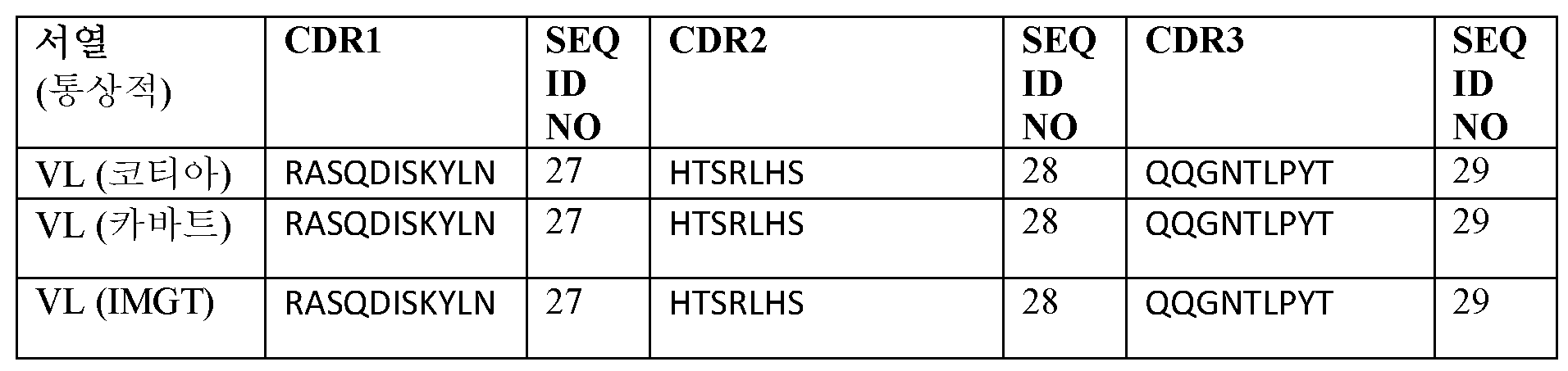
표 3. FMC63 항-CD19 항체 또는 그의 단편의 중쇄 가변 (VH) 영역에 대한 CDRTable 3. CDRs for the heavy chain variable (VH) region of the FMC63 anti-CD19 antibody or fragment thereof
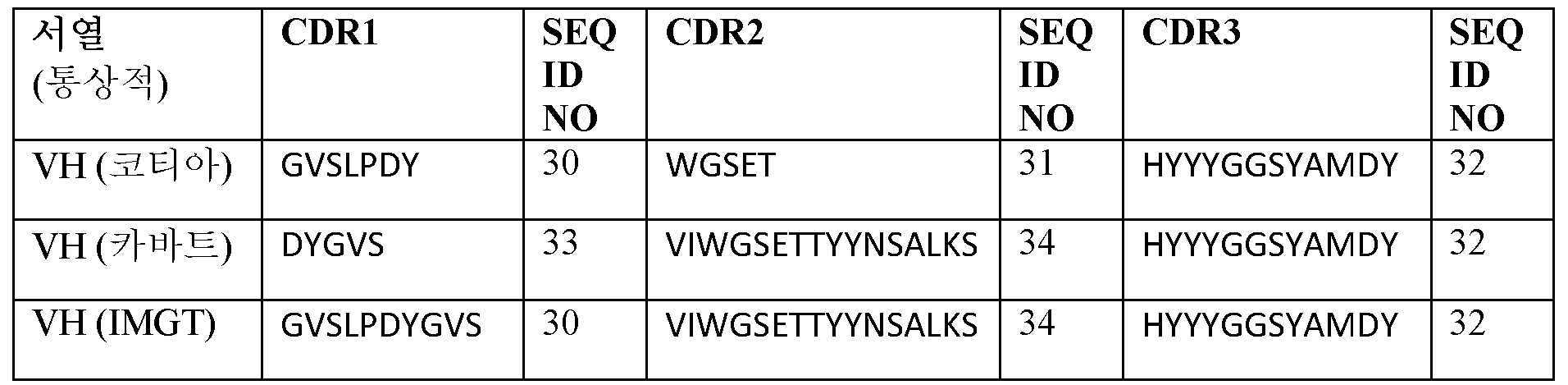
본원에 사용된 용어 "불변 영역" 및 "불변 도메인"은 상호교환가능하고, 관련 기술분야에서의 통상적인 의미를 갖는다. 불변 영역은 항체 부분, 예를 들어, 항체의 항원에 대한 결합에 직접 수반되지는 않지만 다양한 이펙터 기능, 예컨대 Fc 수용체와의 상호작용을 나타낼 수 있는 경쇄 및/또는 중쇄의 카르복실 말단 부분이다. 이뮤노글로불린 분자의 불변 영역은 일반적으로 이뮤노글로불린 가변 도메인에 비해 보다 보존된 아미노산 서열을 갖는다.As used herein, the terms "constant domain" and "constant domain" are interchangeable and have common meaning in the art. The constant region is the carboxyl terminus portion of the light and / or heavy chains that are not directly involved in binding the antibody portion, eg, the antibody, to the antigen but may exhibit various effector functions such as interaction with the Fc receptor. The constant region of an immunoglobulin molecule generally has a more conserved amino acid sequence compared to an immunoglobulin variable domain.
본원에 사용된 용어 "중쇄"가 항체와 관련하여 사용될 때, 이는 불변 도메인의 아미노산 서열에 기초하여 임의의 별개의 유형, 예를 들어, 알파 (α), 델타 (δ), 엡실론 (ε), 감마 (γ) 및 뮤 (μ)로 지칭될 수 있고, 이는 IgG의 하위부류, 예를 들어, IgG1, IgG2, IgG3 및 IgG4를 포함하여, 각각 항체의 IgA, IgD, IgE, IgG 및 IgM 부류를 생성한다.When the term “heavy chain” as used herein is used in connection with an antibody, it is based on the amino acid sequences of the constant domains, such as any distinct type such as alpha (α), delta (δ), epsilon (ε), Gamma (γ) and mu (μ), which may be referred to as subclasses of IgG such as IgG 1 , IgG 2 , IgG 3 and IgG 4 , respectively, of IgA, IgD, IgE, IgG of the antibody. And the IgM class.
본원에 사용된 용어 "경쇄"가 항체와 관련하여 사용될 때, 이는 불변 도메인의 아미노산 서열에 기초하여 임의의 별개의 유형, 예를 들어, 카파 (κ) 또는 람다 (λ)로 지칭될 수 있다. 경쇄 아미노산 서열은 관련 기술분야에 널리 공지되어 있다. 구체적 실시양태에서, 경쇄는 인간 경쇄이다.When the term “light chain” as used herein is used in connection with an antibody, it may be referred to any distinct type, for example kappa (κ) or lambda (λ), based on the amino acid sequence of the constant domain. Light chain amino acid sequences are well known in the art. In specific embodiments, the light chain is a human light chain.
"결합 친화도"는 일반적으로, 분자 (예를 들어, 항체)의 단일 결합 부위와 그의 결합 파트너 (예를 들어, 항원) 사이의 비-공유 상호작용의 총 합계의 강도를 지칭한다. 달리 나타내지 않는 한, 본원에 사용된 "결합 친화도"는 결합 쌍의 구성원들 (예를 들어, 항체 및 항원) 사이의 1:1 상호작용을 반영하는 고유의 결합 친화도를 지칭한다. 분자 X의 그의 파트너 Y에 대한 친화도는 일반적으로 해리 상수 (KD)로 나타내어질 수 있다. 친화도는 평형 해리 상수 (KD) 및 평형 회합 상수 (KA)를 포함하나 이에 제한되지는 않는, 관련 기술분야에 공지된 수많은 방식으로 측정되고/거나 표현될 수 있다. KD는 koff/kon의 비율로부터 계산되고, 반면에 KA는 kon/koff의 비율로부터 계산된다. kon은 예를 들어, 항체의 항원에 대한 회합률 상수를 지칭하고, koff는 예를 들어, 항체의 항원에 대한 해리율 상수를 지칭한다. kon 및 koff는 관련 기술분야의 통상의 기술자에게 공지된 기술, 예컨대 비아코어(BIACORE)® 또는 키넥사(KinExA)에 의해 결정될 수 있다."Binding affinity" generally refers to the strength of the total sum of non-covalent interactions between a single binding site of a molecule (eg, an antibody) and its binding partner (eg, an antigen). Unless indicated otherwise, as used herein, “binding affinity” refers to intrinsic binding affinity that reflects a 1: 1 interaction between members of a binding pair (eg, antibody and antigen). The affinity of the molecule X for its partner Y can generally be represented by the dissociation constant (K D ). Affinity can be measured and / or expressed in a number of ways known in the art, including, but not limited to, the equilibrium dissociation constant (K D ) and the equilibrium association constant (K A ). K D is calculated from the ratio of k off / k on , while K A is calculated from the ratio of k on / k off . k on refers to, for example, the association rate constant for the antigen of the antibody, and k off refers to, for example, the dissociation rate constant for the antigen of the antibody. k on and k off can be determined by techniques known to those of ordinary skill in the art, such as BIACORE® or KinExA.
CD19 (또한 분화 클러스터 19, B-림프구 항원 CD19, B-림프구 표면 항원 B4, B4, CVID3, 분화 항원 CD19로도 공지됨)는 인간에서 CD19 유전자에 의해 코딩된 단백질이다. 이는 B 세포의 표면에서 발견된다. CD19는 B 세포의 특징이기 때문에, 이는 이러한 유형의 B 세포로부터 발생한 암 세포, 즉 B-세포 림프종을 인식하는데 유용한 항원일 수 있다.CD19 (also known as differentiation cluster 19, B-lymphocyte antigen CD19, B-lymphocyte surface antigen B4, B4, CVID3, differentiation antigen CD19) is a protein encoded by the CD19 gene in humans. It is found on the surface of B cells. Since CD19 is characteristic of B cells, it may be a useful antigen for recognizing cancer cells, ie B-cell lymphomas, originating from this type of B cells.
본원에 사용된 "보존적 아미노산 치환"은 아미노산 잔기가 유사한 측쇄를 갖는 아미노산 잔기로 대체된 것이다. 측쇄를 갖는 아미노산 잔기의 패밀리는 관련 기술분야에 정의되어 있다. 이들 패밀리는 염기성 측쇄 (예를 들어, 리신, 아르기닌, 히스티딘), 산성 측쇄 (예를 들어, 아스파르트산, 글루탐산), 비하전된 극성 측쇄 (예를 들어, 글리신, 아스파라긴, 글루타민, 세린, 트레오닌, 티로신, 시스테인, 트립토판), 비극성 측쇄 (예를 들어, 알라닌, 발린, 류신, 이소류신, 프롤린, 페닐알라닌, 메티오닌), 베타-분지형 측쇄 (예를 들어, 트레오닌, 발린, 이소류신) 및 방향족 측쇄 (예를 들어, 티로신, 페닐알라닌, 트립토판, 히스티딘)를 갖는 아미노산을 포함한다. 특정 실시양태에서, 항체 또는 그의 항원-결합 분자의 CDR(들) 내 또는 프레임워크 영역(들) 내의 1개 이상의 아미노산 잔기는 유사한 측쇄를 갖는 아미노산 잔기로 대체될 수 있다.As used herein, "conservative amino acid substitutions" are those wherein the amino acid residues are replaced with amino acid residues having similar side chains. Family of amino acid residues having side chains are defined in the art. These families include basic side chains (eg lysine, arginine, histidine), acidic side chains (eg aspartic acid, glutamic acid), uncharged polar side chains (eg glycine, asparagine, glutamine, serine, threonine, Tyrosine, cysteine, tryptophan), nonpolar side chains (e.g. alanine, valine, leucine, isoleucine, proline, phenylalanine, methionine), beta-branched side chains (e.g. threonine, valine, isoleucine) and aromatic side chains (e.g. For example, tyrosine, phenylalanine, tryptophan, histidine). In certain embodiments, one or more amino acid residues in the CDR (s) of the antibody or antigen-binding molecule thereof or in the framework region (s) may be replaced with amino acid residues having similar side chains.
본원에 사용된 용어 "이종"은 자연 발생 서열 이외의 다른 임의의 공급원으로부터의 것을 의미한다. 예를 들어, 서열식별번호: 1의 아미노산 서열을 갖는 공동자극 단백질의 일부로서 포함된 이종 서열, 예를 들어, 상응하는 인간 공동자극 단백질은 자연 발생한 것이 아닌, 즉 야생형 인간 공동자극 단백질과 정렬되지 않는 아미노산이다. 예를 들어, 이종 뉴클레오티드 서열은 야생형 인간 공동자극 단백질-코딩 서열의 것 이외의 다른 뉴클레오티드 서열을 지칭한다.As used herein, the term “heterologous” means from any source other than naturally occurring sequences. For example, a heterologous sequence included as part of a costimulatory protein having the amino acid sequence of SEQ ID NO: 1, eg, the corresponding human costimulatory protein, is not naturally occurring, ie is not aligned with a wild type human costimulatory protein. Is not an amino acid. For example, heterologous nucleotide sequences refer to nucleotide sequences other than those of wild-type human costimulatory protein-coding sequences.
본원에 사용된 "에피토프"는 관련 기술분야의 용어로, 항체가 특이적으로 결합할 수 있는 항원의 국부 영역을 지칭한다. 에피토프는 예를 들어 폴리펩티드의 인접 아미노산일 수 있거나 (선형 또는 인접 에피토프), 또는 에피토프는 예를 들어 폴리펩티드 또는 폴리펩티드들의 2개 이상의 비-인접 영역으로부터 함께 모일 수 있다 (입체형태적, 비-선형, 불연속적, 또는 비-인접 에피토프). 특정 실시양태에서, 항체가 결합하는 에피토프는 예를 들어 NMR 분광분석법, X선 회절 결정학 연구, ELISA 검정, 질량 분광측정법과 커플링된 수소/중수소 교환 (예를 들어, 액체 크로마토그래피 전기분무 질량 분광측정법), 어레이-기반 올리고-펩티드 스캐닝 검정, 및/또는 돌연변이유발 맵핑 (예를 들어, 부위-지정 돌연변이유발 맵핑)에 의해 결정될 수 있다. X선 결정학의 경우에, 결정화는 관련 기술분야에 공지된 방법 중 임의의 것을 사용하여 달성될 수 있다 (예를 들어, Giege R et al., (1994) Acta Crystallogr D Biol Crystallogr 50(Pt 4): 339-350; McPherson A (1990) Eur J Biochem 189: 1-23; Chayen NE (1997) Structure 5: 1269-1274; McPherson A (1976) J Biol Chem 251: 6300-6303). 항체:항원 결정은 널리 공지된 X선 회절 기술을 사용하여 연구될 수 있고, 관련 기술분야에 공지된 컴퓨터 소프트웨어, 예를 들어 레프맥(Refmac) 및 페닉스(Phenix)를 사용하여 정밀화될 수있다. 돌연변이유발 맵핑 연구는 관련 기술분야의 통상의 기술자에게 공지된 임의의 방법을 사용하여 달성될 수 있다. 예를 들어, 알라닌 스캐닝 돌연변이유발 기술을 포함한 돌연변이유발 기술의 설명에 대해 문헌 [Champe M et al., (1995) J Biol Chem 270: 1388-1394 및 Cunningham BC & Wells JA (1989) Science 244: 1081-1085]을 참조한다.As used herein, “epitope” is a term in the art and refers to a local region of an antigen to which an antibody can specifically bind. Epitopes can be, for example, contiguous amino acids of a polypeptide (linear or contiguous epitopes), or epitopes can be gathered together from, for example, two or more non-contiguous regions of a polypeptide or polypeptides (stereoscopic, non-linear, Discontinuous, or non-adjacent epitopes). In certain embodiments, the epitope to which the antibody binds is a hydrogen / deuterium exchange (e.g., liquid chromatography electrospray mass spectrometry coupled with, for example, NMR spectroscopy, X-ray diffraction crystallography studies, ELISA assays, mass spectrometry). Assay), array-based oligo-peptide scanning assays, and / or mutagenesis mapping (eg, site-directed mutagenesis mapping). In the case of X-ray crystallography, crystallization can be achieved using any of the methods known in the art (eg, Giege R et al., (1994) Acta Crystallogr D Biol Crystallogr 50 (Pt 4) 339-350; McPherson A (1990) Eur J Biochem 189: 1-23; Chayen NE (1997) Structure 5: 1269-1274; McPherson A (1976) J Biol Chem 251: 6300-6303). Antibody: antigen crystals can be studied using well known X-ray diffraction techniques and can be refined using computer software known in the art, such as Refmac and Fenix. Mutagenesis mapping studies can be accomplished using any method known to those of skill in the art. For a description of mutagenesis techniques, including, for example, alanine scanning mutagenesis techniques, see Champe M et al., (1995) J Biol Chem 270: 1388-1394 and Cunningham BC & Wells JA (1989) Science 244: 1081. -1085.
본원에 사용된 항원 결합 분자, 항체, 또는 그의 항원 결합 분자는, 항원 및 제1 결합 분자, 항체, 또는 그의 항원 결합 분자 사이의 상호작용이 참조 결합 분자, 참조 항체, 또는 그의 항원 결합 분자가 항원과 상호작용하는 능력을 차단, 제한, 억제, 또는 달리 감소시키는 경우에, 참조 항체 또는 그의 항원 결합 분자와 "교차-경쟁"한다. 교차 경쟁은 완전할 수 있고, 예를 들어, 결합 분자의 항원에 대한 결합이 참조 결합 분자가 항원에 결합하는 능력을 완전히 차단하거나, 또는 이는 부분적일 수 있고, 예를 들어, 결합 분자의 항원에 대한 결합이 참조 결합 분자가 항원에 결합하는 능력을 감소시킨다. 특정 실시양태에서, 참조 항원 결합 분자와 교차-경쟁하는 항원 결합 분자는 참조 항원 결합 분자와 동일한 또는 중첩되는 에피토프에 결합한다. 다른 실시양태에서, 참조 항원 결합 분자와 교차-경쟁하는 항원 결합 분자는 참조 항원 결합 분자와 상이한 에피토프에 결합한다. 수많은 유형의 경쟁적 결합 검정, 예를 들어: 고체 상 직접 또는 간접 방사선면역검정 (RIA); 고체 상 직접 또는 간접 효소 면역검정 (EIA); 샌드위치 경쟁 검정 (Stahli et al., 1983, Methods in Enzymology 9:242-253); 고체 상 직접 비오틴-아비딘 EIA (Kirkland et al., 1986, J. Immunol. 137:3614-3619); 고체 상 직접 표지된 검정, 고체 상 직접 표지된 샌드위치 검정 (Harlow and Lane, 1988, Antibodies, A Laboratory Manual, Cold Spring Harbor Press); 1-125 표지를 사용하는 고체 상 직접 표지 RIA (Morel et al., 1988, Molec. Immunol. 25:7-15); 고체 상 직접 비오틴-아비딘 EIA (Cheung, et al., 1990, Virology 176:546-552); 및 직접 표지된 RIA (Moldenhauer et al., 1990, Scand. J. Immunol. 32:77-82)를 사용하여 하나의 항원 결합 분자가 또 다른 것과 경쟁하는지 여부를 결정할 수 있다. As used herein, an antigen binding molecule, an antibody, or an antigen binding molecule thereof may be used such that the interaction between the antigen and the first binding molecule, antibody, or antigen binding molecule thereof is a reference binding molecule, a reference antibody, or an antigen binding molecule thereof. In the case of blocking, limiting, inhibiting, or otherwise reducing the ability to interact with, "cross-compete" with a reference antibody or antigen binding molecule thereof. Cross-competition may be complete and, for example, binding of the binding molecule to the antigen may completely block the ability of the reference binding molecule to bind to the antigen, or it may be partial, for example, to the antigen of the binding molecule. Binding reduces the ability of the reference binding molecule to bind antigen. In certain embodiments, an antigen binding molecule that cross-competes with a reference antigen binding molecule binds to an epitope that is the same or overlaps with the reference antigen binding molecule. In other embodiments, the antigen binding molecule that cross-competes with the reference antigen binding molecule binds to a different epitope than the reference antigen binding molecule. Numerous types of competitive binding assays, such as: solid phase direct or indirect radioimmunoassay (RIA); Solid phase direct or indirect enzyme immunoassay (EIA); Sandwich competition assay (Stahli et al., 1983, Methods in Enzymology 9: 242-253); Solid phase direct biotin-avidin EIA (Kirkland et al., 1986, J. Immunol. 137: 3614-3619); Solid phase direct labeled assay, solid phase direct labeled sandwich assay (Harlow and Lane, 1988, Antibodies, A Laboratory Manual, Cold Spring Harbor Press); Solid phase direct label RIA using 1-125 label (Morel et al., 1988, Molec. Immunol. 25: 7-15); Solid phase direct biotin-avidin EIA (Cheung, et al., 1990, Virology 176: 546-552); And directly labeled RIA (Moldenhauer et al., 1990, Scand. J. Immunol. 32: 77-82) can be used to determine whether one antigen binding molecule competes with another.
본원에 사용된 용어 "면역특이적으로 결합하다," "면역특이적으로 인식하다," "특이적으로 결합하다," 및 "특이적으로 인식하다"는 항체와 관련하여 유사한 용어이고, 항원 (예를 들어, 에피토프 또는 면역 복합체)에 결합하는 분자를 지칭하며, 이러한 결합은 관련 기술분야의 통상의 기술자에 의해 이해되는 바와 같다. 예를 들어, 항원에 특이적으로 결합하는 분자는 일반적으로, 예를 들어, 면역검정, 비아코어®, 키넥사 3000 기기 (사피디네 인스트루먼츠(Sapidyne Instruments), 아이다호주 보이시), 또는 관련 기술분야에 공지된 다른 검정에 의해 결정된 바와 같은 보다 낮은 친화도로 다른 펩티드 또는 폴리펩티드에 결합할 수 있다. 구체적 실시양태에서, 항원에 특이적으로 결합하는 분자는, 분자가 또 다른 항원에 결합하는 경우의 KA 보다 적어도 2 log, 2.5 log, 3 log, 4 log 또는 그 초과인 KA로 항원에 결합한다.As used herein, the terms “immunospecifically bind,” “immunospecifically recognize,” “specifically bind,” and “specifically recognize” are similar terms with respect to antibodies and antigens ( Molecules, for example, epitopes or immune complexes, as understood by one of ordinary skill in the art. For example, a molecule that specifically binds to an antigen is generally, for example, an immunoassay, Biacore®,
구체적 실시양태에서, 표적 인간 항원, 예를 들어, 인간 CD19에 또 다른 종의 표적 항원, 예를 들어, 비-인간 CD19에 대한 것보다 더 높은 친화도로 결합하는 항체 또는 그의 항원 결합 분자가 본원에 제공된다. 특정 실시양태에서, 표적 인간 항원, 예를 들어, 인간 CD19에, 예를 들어, 방사선면역검정, 표면 플라즈몬 공명, 또는 동역학적 배제 검정에 의해 측정 시, 또 다른 종의 표적 항원에 대한 것보다 5%, 10%, 15%, 20%, 25%, 30%, 35%, 40%, 45%, 50%, 55%, 60%, 65%, 70% 또는 그 초과의 친화도로 결합하는 항체 또는 그의 항원 결합 분자가 본원에 제공된다. 구체적 실시양태에서, 표적 인간 항원에 결합하는 본원에 기재된 항체 또는 그의 항원 결합 분자는, 예를 들어, 방사선면역검정, 표면 플라즈몬 공명, 또는 동역학적 배제 검정에 의해 측정 시, 항체 또는 그의 항원 결합 분자의 인간 항원에 대한 결합의 10%, 15%, 또는 20% 미만으로 또 다른 종의 표적 항원에 결합할 것이다.In specific embodiments, herein disclosed are antibodies or antigen binding molecules thereof that bind to a target human antigen, eg, human CD19, with a higher affinity than that of another species of target antigen, eg, non-human CD19. Is provided. In certain embodiments, the target human antigen, eg, human CD19, is greater than that for another species of target antigen, as measured by, for example, radioimmunoassay, surface plasmon resonance, or kinetic exclusion assay. An antibody that binds with an affinity of%, 10%, 15%, 20%, 25%, 30%, 35%, 40%, 45%, 50%, 55%, 60%, 65%, 70% or more, or Provided herein are antigen binding molecules thereof. In specific embodiments, an antibody or antigen-binding molecule described herein that binds to a target human antigen is an antibody or antigen-binding molecule thereof, as measured, for example, by radioimmunoassay, surface plasmon resonance, or kinetic exclusion assay. Less than 10%, 15%, or 20% of the binding to the human antigen of will bind to another species of target antigen.
"항원"은 면역 반응을 촉발하거나 또는 항체 또는 항원 결합 분자가 결합할 수 있는 임의의 분자를 지칭한다. 면역 반응은 항체 생산, 또는 특정 면역학적-적격 세포의 활성화, 또는 둘 다를 수반할 수 있다. 관련 분야의 통상의 기술자는 실질적으로 모든 단백질 또는 펩티드를 포함하는 임의의 거대분자가 항원으로서의 역할을 할 수 있다는 것을 용이하게 이해할 것이다. 항원은 내인성으로 발현될 수 있고, 즉 게놈 DNA에 의해 발현될 수 있거나, 또는 재조합적으로 발현될 수 있다. 항원은 특정 조직, 예컨대 암 세포에 특이적일 수 있거나, 또는 광범위하게 발현될 수 있다. 또한, 보다 큰 분자의 단편이 항원으로서 작용할 수 있다. 한 실시양태에서, 항원은 종양 항원이다. 하나의 특정한 실시양태에서, 항원은 인간 CD19 전체 또는 단편이다."Antigen" refers to any molecule that triggers an immune response or to which an antibody or antigen binding molecule can bind. Immune responses may involve antibody production, or activation of certain immunologically-competent cells, or both. Those skilled in the art will readily understand that any macromolecule, including virtually any protein or peptide, can serve as an antigen. The antigen may be expressed endogenously, ie it may be expressed by genomic DNA or may be expressed recombinantly. The antigen may be specific for certain tissues, such as cancer cells, or may be expressed broadly. In addition, fragments of larger molecules can act as antigens. In one embodiment, the antigen is a tumor antigen. In one particular embodiment, the antigen is human CD19 whole or fragment.
용어 "중화"는 리간드에 결합하여 그러한 리간드의 생물학적 효과를 막거나 감소시키는 항원 결합 분자, scFv, 항체, 또는 그의 단편을 지칭한다. 일부 실시양태에서, 항원 결합 분자, scFv, 항체, 또는 그의 단편은 리간드 상의 결합 부위를 직접 차단하거나, 또는 달리 간접적 수단 (리간드의 구조적 또는 에너지적 변경)을 통해 리간드의 결합 능력을 변경한다. 일부 실시양태에서, 항원 결합 분자, scFv, 항체, 또는 그의 단편은 그것이 결합하는 단백질이 생물학적 기능을 수행하는 것을 막는다.The term “neutralization” refers to an antigen binding molecule, scFv, antibody, or fragment thereof that binds to a ligand and prevents or reduces the biological effects of that ligand. In some embodiments, the antigen binding molecule, scFv, antibody, or fragment thereof directly blocks the binding site on the ligand or otherwise alters the binding ability of the ligand through indirect means (structural or energetic alteration of the ligand). In some embodiments, the antigen binding molecule, scFv, antibody, or fragment thereof prevents the protein to which it binds from performing a biological function.
본원에 사용된 용어 "자가"는 이후에 재도입될 동일한 개체로부터 유래된 임의의 물질을 의미한다. 예를 들어, 입양 세포 전달로도 공지되어 있는 조작된 자가 세포 요법 (eACT™)은, 환자 자신의 T 세포를 수집하고, 후속적으로 폴리뉴클레오티드, 예를 들어 1종 이상의 특이적 종양 세포 또는 악성종양의 세포 표면 상에 발현된 1개 이상의 항원을 인식하고 표적화하는 CAR을 코딩하는 폴리뉴클레오티드를 발현하도록 유전자 조작한 다음, 동일한 환자에게 다시 투여하는 과정이다.As used herein, the term "self" means any material derived from the same individual that will subsequently be reintroduced. For example, engineered autologous cell therapy (eACT ™), also known as adoptive cell delivery, collects patient's own T cells and subsequently polynucleotides, such as one or more specific tumor cells or malignant The process is genetically engineered to express a polynucleotide encoding a CAR that recognizes and targets one or more antigens expressed on the cell surface of a tumor and then administered back to the same patient.
용어 "동종"은 한 개체로부터 유래되고 이어서 동일한 종의 또 다른 개체에 도입되는 임의의 물질, 예를 들어, 동종 T 세포 이식을 지칭한다.The term “homologous” refers to any substance, eg, allogeneic T cell transplant, that originates from one individual and then is introduced into another individual of the same species.
용어 "형질도입" 및 "형질도입된"은 외래 DNA를 바이러스 벡터를 통해 세포 내로 도입하는 방법을 지칭한다 (문헌 [Jones et al., "Genetics: principles and analysis," Boston: Jones & Bartlett Publ. (1998)] 참조). 일부 실시양태에서, 벡터는 레트로바이러스 벡터, DNA 벡터, RNA 벡터, 아데노바이러스 벡터, 바큘로바이러스 벡터, 엡스타인 바르 바이러스 벡터, 파포바바이러스 벡터, 백시니아 바이러스 벡터, 단순 포진 바이러스 벡터, 아데노바이러스 연관 벡터, 렌티바이러스 벡터, 또는 그의 임의의 조합이다.The terms “transduced” and “transduced” refer to a method of introducing foreign DNA into a cell through a viral vector (Jones et al., “Genetics: principles and analysis,” Boston: Jones & Bartlett Publ. (1998). In some embodiments, the vector is a retroviral vector, a DNA vector, an RNA vector, an adenovirus vector, a baculovirus vector, an Epstein Barr virus vector, a papovavirus vector, a vaccinia virus vector, a herpes simplex virus vector, an adenovirus associated vector. , Lentiviral vector, or any combination thereof.
본원에 사용된 용어 "유전자 조작" 또는 "조작"은 상호교환가능하게 사용되고, 코딩 또는 비-코딩 영역 또는 그의 부분의 결실 또는 코딩 영역 또는 그의 부분의 삽입을 포함하나 이에 제한되지는 않는, 세포의 게놈을 변형시키는 방법을 의미한다. 일부 실시양태에서, 변형되는 세포는 림프구, 예를 들어 T 세포이며, 이는 환자 또는 공여자로부터 수득될 수 있다. 세포는 세포의 게놈 내로 혼입된 외인성 구축물, 예컨대 예를 들어, 키메라 항원 수용체 (CAR)를 발현하도록 변형될 수 있다.As used herein, the term “genetic manipulation” or “manipulation” is used interchangeably and includes, but is not limited to, deletion of a coding or non-coding region or portion thereof or insertion of a coding region or portion thereof. Means a method of modifying the genome. In some embodiments, the cells to be modified are lymphocytes, eg, T cells, which can be obtained from a patient or donor. The cell may be modified to express an exogenous construct, such as, for example, a chimeric antigen receptor (CAR) incorporated into the genome of the cell.
"암"은 신체 내에서의 비정상 세포의 비제어된 성장을 특징으로 하는 다양한 질환의 광범위한 군을 지칭한다. 조절되지 않는 세포 분열 및 성장은 이웃 조직을 침습하는 악성 종양의 형성을 야기하고, 또한 림프계 또는 혈류를 통해 신체의 원위 부분으로 전이될 수 있다. "암" 또는 "암 조직"은 종양을 포함할 수 있다. 본 발명의 방법에 의해 치료될 수 있는 암의 예는 림프종, 백혈병, 골수종, 및 다른 백혈구 악성종양을 포함한 면역계의 암을 포함하나 이에 제한되지는 않는다."Cancer" refers to a broad group of various diseases characterized by uncontrolled growth of abnormal cells in the body. Unregulated cell division and growth leads to the formation of malignant tumors that invade neighboring tissues and can also metastasize to the distal part of the body via the lymphatic system or blood flow. "Cancer" or "cancer tissue" may include tumors. Examples of cancers that can be treated by the methods of the invention include, but are not limited to, cancers of the immune system, including lymphomas, leukemias, myeloma, and other leukocyte malignancies.
치료될 수 있는 암은 B-세포 림프종, 급성 림프모구성 백혈병 (ALL), AIDS-관련 림프종, ALK-양성 대 B-세포 림프종, 버킷 림프종, 만성 림프구성 백혈병, CLL), 전형적 호지킨 림프종, 미만성 대 B-세포 림프종 (DLBCL), 여포성 림프종, 혈관내 대 B-세포 림프종, HHV8-연관 다중심성 캐슬만병에 기인한 대 B-세포 림프종, 림프종성 육아종증, 림프형질세포성 림프종, 외투 세포 림프종 (MCL), 변연부 B-세포 림프종 (MZL), 점막-연관 림프 조직 림프종 (MALT), 결절성 변연부 B 세포 림프종 (NMZL), 결절성 림프구 우세형 호지킨 림프종, 비-호지킨 림프종, 형질모구성 림프종, 원발성 중추 신경계 림프종, 원발성 삼출 림프종, 비장 변연부 림프종 (SMZL), 및 발덴스트롬 마크로글로불린혈증, 또는 그의 조합을 포함한다. 한 실시양태에서, B-세포 림프종은 급성 림프모구성 백혈병 (ALL), 만성 림프구성 백혈병, CLL), 미만성 대 B-세포 림프종 (DLBCL), 여포성 림프종, 외투 세포 림프종 (MCL), 변연부 B-세포 림프종 (MZL), 점막-연관 림프 조직 림프종 (MALT), 및 비-호지킨 림프종이다. 한 실시양태에서, B-세포 림프종은 비-호지킨 림프종이다.Cancers that can be treated include B-cell lymphoma, acute lymphoblastic leukemia (ALL), AIDS-related lymphoma, ALK-positive versus B-cell lymphoma, Burkitt's lymphoma, chronic lymphocytic leukemia, CLL), typical Hodgkin's lymphoma, Diffuse large B-cell lymphoma (DLBCL), follicular lymphoma, intravascular large B-cell lymphoma, large B-cell lymphoma due to HHV8-associated multicardial Castleman's disease, lymphoma granulomatosis, lymphoid cytoplasmic lymphoma, mantle Cell lymphoma (MCL), marginal B-cell lymphoma (MZL), mucosal-associated lymphoid tissue lymphoma (MALT), nodular marginal B cell lymphoma (NMZL), nodular lymphocyte predominant Hodgkin's lymphoma, non-Hodgkin's lymphoma, plasma Constitutive lymphoma, primary central nervous system lymphoma, primary exudative lymphoma, splenic marginal lymphoma (SMZL), and Waldenstrom's macroglobulinemia, or a combination thereof. In one embodiment, the B-cell lymphoma is acute lymphoblastic leukemia (ALL), chronic lymphocytic leukemia (CLL), diffuse large B-cell lymphoma (DLBCL), follicular lymphoma, mantle cell lymphoma (MCL), marginal zone B -Cell lymphoma (MZL), mucosal-associated lymphoid tissue lymphoma (MALT), and non-Hodgkin's lymphoma. In one embodiment, the B-cell lymphoma is non-Hodgkin's lymphoma.
특정한 암은 화학요법 또는 방사선 요법에 대해 반응성일 수 있거나, 또는 암은 불응성일 수 있다. 불응성 암은 수술적 개입으로 수정될 수 없는 암을 지칭하고, 이러한 암은 처음부터 화학요법 또는 방사선 요법에 대해 비반응성이거나 또는 암이 시간의 경과에 따라 비반응성이게 된다.Certain cancers may be reactive to chemotherapy or radiation therapy, or the cancer may be refractory. Refractory cancer refers to a cancer that cannot be fertilized by surgical intervention, and such cancer is initially unresponsive to chemotherapy or radiation therapy or the cancer becomes unresponsive over time.
본원에 사용된 "항종양 효과"는 종양 부피의 감소, 종양 세포 수의 감소, 종양 세포 증식의 감소, 전이 수의 감소, 전체 또는 무진행 생존의 증가, 기대 수명의 증가, 또는 종양과 연관된 다양한 생리학적 증상의 호전으로서 나타날 수 있는 생물학적 효과를 지칭한다. 항종양 효과는 또한 종양 발생의 방지, 예를 들어, 백신을 지칭할 수 있다.As used herein, an “antitumor effect” includes a decrease in tumor volume, a decrease in the number of tumor cells, a decrease in tumor cell proliferation, a decrease in the number of metastases, an increase in overall or progression free survival, an increase in life expectancy, or a variety of tumor-associated It refers to a biological effect that can appear as an improvement in physiological symptoms. Antitumor effects may also refer to the prevention of tumor development, eg, vaccines.
본원에 사용된 "시토카인"은 특정 항원과의 접촉에 반응하여 한 세포가 방출하는 비-항체 단백질을 지칭하고, 여기서 시토카인은 제2 세포와 상호작용하여 제2 세포에서의 반응을 매개한다. 시토카인은 세포에 의해 내인성으로 발현될 수 있거나, 또는 대상체에게 투여될 수 있다. 시토카인은 대식세포, B 세포, T 세포, 및 비만 세포를 포함하는 면역 세포에 의해 방출되어 면역 반응을 전파할 수 있다. 시토카인은 수용자 세포에서 다양한 반응울 유도할 수 있다. 시토카인은 항상성 시토카인, 케모카인, 염증유발성 시토카인, 이펙터, 및 급성기 단백질을 포함할 수 있다. 예를 들어, 인터류킨 (IL) 7 및 IL-15를 포함하는 항상성 시토카인은 면역 세포 생존 및 증식을 촉진하고, 염증유발성 시토카인은 염증성 반응을 촉진할 수 있다. 항상성 시토카인의 예는 IL-2, IL-4, IL-5, IL-7, IL-10, IL-12p40, IL-12p70, IL-15, 및 인터페론 (IFN) 감마를 포함하나 이에 제한되지는 않는다. 염증유발성 시토카인의 예는 IL-1a, IL-1b, IL-6, IL-13, IL-17a, 종양 괴사 인자 (TNF)-알파, TNF-베타, 섬유모세포 성장 인자 (FGF) 2, 과립구 대식세포 콜로니-자극 인자 (GM-CSF), 가용성 세포간 부착 분자 1 (sICAM-1), 가용성 혈관 부착 분자 1 (sVCAM-1), 혈관 내피 성장 인자 (VEGF), VEGF-C, VEGF-D, 및 태반 성장 인자 (PLGF)를 포함하나 이에 제한되지는 않는다. 이펙터의 예는 그랜자임 A, 그랜자임 B, 가용성 Fas 리간드 (sFasL), 및 퍼포린을 포함하나 이에 제한되지는 않는다. 급성기-단백질의 예는 C-반응성 단백질 (CRP) 및 혈청 아밀로이드 A (SAA)를 포함하나 이에 제한되지는 않는다.As used herein, “cytokine” refers to a non-antibody protein that one cell releases in response to contact with a particular antigen, where the cytokine interacts with the second cell to mediate a response in the second cell. Cytokines can be expressed endogenously by cells or can be administered to a subject. Cytokines can be released by immune cells, including macrophages, B cells, T cells, and mast cells, to propagate the immune response. Cytokines can induce a variety of responses in recipient cells. Cytokines may include homeostatic cytokines, chemokines, proinflammatory cytokines, effectors, and acute phase proteins. For example, homeostatic cytokines, including interleukin (IL) 7 and IL-15, can promote immune cell survival and proliferation, and proinflammatory cytokines can promote inflammatory responses. Examples of homeostatic cytokines include, but are not limited to, IL-2, IL-4, IL-5, IL-7, IL-10, IL-12p40, IL-12p70, IL-15, and interferon (IFN) gamma Do not. Examples of proinflammatory cytokines include IL-1a, IL-1b, IL-6, IL-13, IL-17a, Tumor Necrosis Factor (TNF) -alpha, TNF-beta, Fibroblast Growth Factor (FGF) 2, Granulocytes Macrophage colony-stimulating factor (GM-CSF), soluble intercellular adhesion molecule 1 (sICAM-1), soluble vascular adhesion molecule 1 (sVCAM-1), vascular endothelial growth factor (VEGF), VEGF-C, VEGF-D , And placental growth factor (PLGF). Examples of effectors include, but are not limited to granzyme A, granzyme B, soluble Fas ligand (sFasL), and perforin. Examples of acute phase-proteins include, but are not limited to, C-reactive protein (CRP) and serum amyloid A (SAA).
"케모카인"은 세포 화학주성 또는 지향성 이동을 매개하는 시토카인 유형이다. 케모카인의 예는 IL-8, IL-16, 에오탁신, 에오탁신-3, 대식세포-유래 케모카인 (MDC 또는 CCL22), 단핵구 화학주성 단백질 1 (MCP-1 또는 CCL2), MCP-4, 대식세포 염증 단백질 1α (MIP-1α, MIP-1a), MIP-1β (MIP-1b), 감마-유도된 단백질 10 (IP-10), 및 흉선 및 활성화 조절 케모카인 (TARC 또는 CCL17)을 포함하나 이에 제한되지는 않는다."Chemocaine" is a type of cytokine that mediates cell chemotaxis or directional migration. Examples of chemokines include IL-8, IL-16, eotaxin, eotaxin-3, macrophage-derived chemokine (MDC or CCL22), monocyte chemotactic protein 1 (MCP-1 or CCL2), MCP-4, macrophages Inflammatory proteins 1α (MIP-1α, MIP-1a), MIP-1β (MIP-1b), gamma-derived protein 10 (IP-10), and thymus and activation modulating chemokines (TARC or CCL17) It doesn't work.
치료제, 예를 들어, 조작된 CAR T 세포의 "치료 유효량", "유효 용량", "유효량", 또는 "치료 유효 투여량"은 단독으로 또는 또 다른 치료제와 조합되어 사용될 때 대상체를 질환 발병으로부터 보호하거나, 또는 질환 증상의 중증도에서의 감소, 질환 무증상 기간의 빈도 또는 지속기간의 증가, 또는 질환 고통으로 인한 손상 또는 장애의 방지에 의해 입증되는 질환 퇴행을 촉진하는 임의의 양이다. 질환 퇴행을 촉진하는 치료제의 능력은 숙련된 진료의에게 공지되어 있는 다양한 방법을 사용하여, 예컨대 임상 시험 동안 인간 대상체에서, 인간에서의 효능을 예측하는 동물 모델 시스템에서, 또는 시험관내 검정에서 작용제의 활성을 검정함으로써 평가될 수 있다.A therapeutic agent, eg, a “therapeutically effective amount”, “effective dose”, “effective amount”, or “therapeutically effective dose” of an engineered CAR T cell, when used alone or in combination with another therapeutic agent, may cause a subject to develop a disease Any amount that protects or promotes disease regression as evidenced by a reduction in the severity of disease symptoms, an increase in the frequency or duration of disease free symptoms, or prevention of injury or disorder due to disease pain. The ability of a therapeutic agent to promote disease regression can be achieved using a variety of methods known to skilled practitioners, such as in human subjects during clinical trials, in animal model systems that predict efficacy in humans, or in vitro assays. It can be evaluated by assaying the activity.
본원에 사용된 용어 "림프구"는 자연 킬러 (NK) 세포, T 세포, 또는 B 세포를 포함한다. NK 세포는 선천성 면역계의 주요 성분을 대표하는 세포독성 (세포 독성) 림프구 유형이다. NK 세포는 종양 및 바이러스에 감염된 세포를 거부한다. 이는 아폽토시스 또는 프로그램화된 세포 사멸의 과정을 통해 작용한다. 이들은 세포를 사멸시키기 위해 활성화를 필요로 하지 않기 때문에 "자연 킬러"로 명명된다. T 세포는 세포-매개-면역 (어떠한 항체도 수반되지 않음)에서 주요 역할을 한다. 그의 T-세포 수용체 (TCR)가 이들을 다른 림프구 유형으로부터 구별한다. 면역계의 특수 기관인 흉선은 T 세포의 성숙을 주로 담당한다. 6가지의 공지된 유형의 T-세포, 즉 헬퍼 T-세포 (예를 들어, CD4+ 세포), 세포독성 T-세포 (또한 TC, 세포독성 T 림프구, CTL, T-킬러 세포, 세포용해 T 세포, CD8+ T-세포 또는 킬러 T 세포로도 알려짐), 기억 T-세포 ((i) 줄기 기억 TSCM 세포, 예컨대 나이브 세포는 CD45RO-, CCR7+, CD45RA+, CD62L+ (L-셀렉틴), CD27+, CD28+ 및 IL-7Rα+이지만, 또한 다량의 CD95, IL-2Rβ, CXCR3, 및 LFA-1을 발현하고, 기억 세포 특유의 수많은 기능 속성을 나타냄; (ii) 중심 기억 TCM 세포는 L-셀렉틴 및 CCR7을 발현하고, IL-2를 분비하지만 IFNγ 또는 IL-4는 분비하지 않음, (iii) 그러나, 이펙터 기억 TEM 세포는 L-셀렉틴 또는 CCR7을 발현하지 않지만, 이펙터 시토카인 예컨대 IFNγ 및 IL-4를 생산함), 조절 T-세포 (Treg, 억제자 T 세포, 또는 CD4+CD25+ 조절 T 세포), 자연 킬러 T 세포 (NKT) 및 감마 델타 T 세포가 존재한다. 다른 한편으로는, B 세포는 체액성 면역 (항체가 수반됨)에서 주요한 역할을 한다. B 세포는 항체를 제조하고, 항원을 프로세싱하여 항원-제시 세포 (APC)의 역할을 수행하고, 항원 상호작용에 의한 활성화 후에 기억 B 세포로 발달한다. 포유동물에서, 미성숙 B 세포는 그의 명칭이 유래되는 골수에서 발달한다.The term “lymphocyte” as used herein includes natural killer (NK) cells, T cells, or B cells. NK cells are a cytotoxic (cytotoxic) lymphocyte type that represents a major component of the innate immune system. NK cells reject cells infected with tumors and viruses. It acts through the process of apoptosis or programmed cell death. They are termed "natural killer" because they do not require activation to kill cells. T cells play a major role in cell-mediated-immunity (without any antibody). Its T-cell receptor (TCR) distinguishes them from other lymphocyte types. The thymus, a special organ of the immune system, is mainly responsible for the maturation of T cells. Six known types of T-cells, namely helper T-cells (eg CD4 + cells), cytotoxic T-cells (also TC, cytotoxic T lymphocytes, CTL, T-killer cells, cytolytic T cells , Also known as CD8 + T-cells or killer T cells), memory T-cells ((i) stem memory T SCM cells, such as naïve cells, include CD45RO-, CCR7 +, CD45RA +, CD62L + (L-selectin), CD27 +, CD28 + and IL-7Rα +, but also expresses large amounts of CD95, IL-2Rβ, CXCR3, and LFA-1, and exhibits numerous functional properties specific to memory cells; (ii) central memory T CM cells display L-selectin and CCR7 Express, and secrete IL-2 but not IFNγ or IL-4, (iii) However, effector memory T EM cells do not express L-selectin or CCR7, but produce effector cytokines such as IFNγ and IL-4 Regulatory T-cells (Treg, suppressor T cells, or CD4 + CD25 + regulatory T cells), natural killer T cells (NKT) and gamma delta T cells. On the other hand, B cells play a major role in humoral immunity (with antibodies). B cells produce antibodies, process antigens to play the role of antigen-presenting cells (APCs), and develop into memory B cells after activation by antigen interaction. In mammals, immature B cells develop in the bone marrow from which their name derives.
용어 "유전자 조작된" 또는 "조작된"은 코딩 또는 비-코딩 영역 또는 그의 부분을 결실시키거나 또는 코딩 영역 또는 그의 부분을 삽입하는 것을 포함하나 이에 제한되지는 않는, 세포의 게놈을 변형시키는 방법을 지칭한다. 일부 실시양태에서, 변형되는 세포는 림프구, 예를 들어, T 세포이며, 이는 환자 또는 공여자로부터 수득될 수 있다. 외인성 구축물, 예컨대, 예를 들어, 키메라 항원 수용체 (CAR) 또는 T 세포 수용체 (TCR)를 발현하도록 세포가 변형될 수 있고, 이는 세포의 게놈 내로 혼입된다.The term “genetically engineered” or “engineered” refers to a method of modifying the genome of a cell, including but not limited to deleting a coding or non-coding region or portion thereof or inserting a coding region or portion thereof. Refers to. In some embodiments, the cells to be modified are lymphocytes, eg, T cells, which can be obtained from a patient or donor. Cells may be modified to express exogenous constructs such as, for example, chimeric antigen receptors (CAR) or T cell receptors (TCR), which are incorporated into the genome of the cells.
"면역 반응"은 침입 병원체, 병원체로 감염된 세포 또는 조직, 암성 또는 다른 비정상 세포, 또는 자가면역 또는 병리학적 염증의 경우에 정상 인간 세포 또는 조직을 선택적으로 표적화하고/거나, 이에 결합하고/거나, 이에 대해 손상을 입히고/거나, 이를 파괴시키고/거나, 이를 척추동물의 신체로부터 제거하는, 면역계의 세포 (예를 들어, T 림프구, B 림프구, 자연 킬러 (NK) 세포, 대식세포, 호산구, 비만 세포, 수지상 세포 및 호중구), 및 이들 세포 중 임의의 것 또는 간에 의해 생산된 가용성 거대분자 (Ab, 시토카인, 및 보체 포함)의 작용을 지칭한다.An "immune response" selectively targets and / or binds to invading pathogens, cells or tissues infected with the pathogen, cancerous or other abnormal cells, or normal human cells or tissues in case of autoimmune or pathological inflammation, Cells of the immune system (eg, T lymphocytes, B lymphocytes, natural killer (NK) cells, macrophages, eosinophils, obesity) that damage and / or destroy them and / or remove them from the body of vertebrates Cells, dendritic cells and neutrophils), and the action of soluble macromolecules (including Ab, cytokines, and complement) produced by any of these cells or liver.
용어 "면역요법"은 면역 반응을 유도하거나, 증진시키거나, 억제하거나 또는 달리 변형시키는 것을 포함하는 방법에 의한, 질환을 앓고 있거나 또는 질환에 걸릴 위험이 있거나 또는 질환의 재발로 인해 고통받을 위험이 있는 대상체의 치료를 지칭한다. 면역요법의 예는 T 세포 요법을 포함하나 이에 제한되지는 않는다. T 세포 요법은 입양 T 세포 요법, 종양-침윤 림프구 (TIL) 면역요법, 자가 세포 요법, 조작된 자가 세포 요법 (eACT™), 및 동종 T 세포 이식을 포함할 수 있다. 그러나, 관련 분야의 통상의 기술자는 본원에 개시된 조건화 방법이 임의의 이식된 T 세포 요법의 유효성을 증진시킬 것임을 인식할 것이다. T 세포 요법의 예는 미국 특허 공개 번호 2014/0154228 및 2002/0006409, 미국 특허 번호 5,728,388, 및 국제 공개 번호 WO 2008/081035에 기재되어 있다.The term “immunotherapy” refers to a person suffering from, or at risk of suffering from, or suffering from a disease recurrence, by a method comprising inducing, enhancing, inhibiting or otherwise modifying an immune response. Refers to treatment of a subject. Examples of immunotherapy include, but are not limited to, T cell therapy. T cell therapy can include adoptive T cell therapy, tumor-infiltrating lymphocyte (TIL) immunotherapy, autologous cell therapy, engineered autologous cell therapy (eACT ™), and allogeneic T cell transplantation. However, one of ordinary skill in the art will recognize that the conditioning methods disclosed herein will enhance the effectiveness of any implanted T cell therapy. Examples of T cell therapy are described in US Patent Publication Nos. 2014/0154228 and 2002/0006409, US Patent No. 5,728,388, and International Publication No. WO 2008/081035.
면역요법의 T 세포는 관련 기술분야에 공지된 임의의 공급원으로부터 유래될 수 있다. 예를 들어, T 세포는 조혈 줄기 세포 집단으로부터 시험관내 분화될 수 있거나, 또는 T 세포는 대상체로부터 수득될 수 있다. T 세포는 예를 들어, 말초 혈액 단핵 세포 (PBMC), 골수, 림프절 조직, 제대혈, 흉선 조직, 감염 부위로부터의 조직, 복수, 흉막 삼출, 비장 조직, 및 종양으로부터 수득될 수 있다. 또한, T 세포는 관련 기술분야에서 입수가능한 1종 이상의 T 세포주로부터 유래될 수 있다. T 세포는 또한 통상의 기술자에게 공지된 다수의 기술, 예컨대 피콜(FICOLL)™ 분리 및/또는 분리반출술을 사용하여 대상체로부터 수집된 단위 혈액으로부터 수득될 수 있다. T 세포 요법을 위한 T 세포를 단리하는 추가의 방법은 미국 특허 공개 번호 2013/0287748에 개시되어 있고, 이는 그 전문이 본원에 참조로 포함된다.T cells of immunotherapy may be derived from any source known in the art. For example, T cells can be differentiated in vitro from a hematopoietic stem cell population, or T cells can be obtained from a subject. T cells can be obtained, for example, from peripheral blood mononuclear cells (PBMC), bone marrow, lymph node tissue, umbilical cord blood, thymic tissue, tissue from the site of infection, ascites, pleural effusion, spleen tissue, and tumors. In addition, T cells may be derived from one or more T cell lines available in the art. T cells can also be obtained from unit blood collected from a subject using a number of techniques known to those of skill in the art, such as FICOLL ™ separation and / or dissociation. Further methods of isolating T cells for T cell therapy are disclosed in US Patent Publication No. 2013/0287748, which is incorporated herein by reference in its entirety.
"eACT™"로 약칭될 수 있고 또한 입양 세포 전달로도 공지되어 있는 용어 "조작된 자가 세포 요법"은 환자 자신의 T 세포를 수집하고, 후속하여 1종 이상의 특정 종양 세포 또는 악성종양의 세포 표면에서 발현된 1종 이상의 항원을 인식하고 표적화하도록 이를 유전자 변경하는 방법이다. T 세포는 예를 들어, 키메라 항원 수용체 (CAR) 또는 T 세포 수용체 (TCR) 또는 둘 다를 발현하도록 조작될 수 있다. CAR 양성 (+) T 세포는 적어도 1개의 공동자극 도메인 및 적어도 1개의 활성화 도메인을 포함하는 세포내 신호전달 부분에 연결된, 특정한 종양 항원에 대한 특이성을 갖는 1개 이상의 세포외 단일 쇄 가변 단편 (scFv)을 발현하도록 조작된다. 공동자극 도메인은 자연-발생 공동자극 도메인 또는 그의 변이체로부터 유래될 수 있고, 활성화 도메인은, 예를 들어, CD3-제타 및 CD3-엡실론으로부터 유래될 수 있다. 특정 실시양태에서, CAR은 2, 3, 4개, 또는 그 초과의 공동자극 도메인을 갖도록 설계된다. CAR scFv는 모든 정상 B 세포, 및 NHL, CLL, 및 비-T 세포 ALL을 포함하나 이에 제한되지는 않는 B 세포 악성종양을 포함한 B 세포 계통 내 세포에 의해 발현되는 막횡단 단백질인, 예를 들어, 인간 CD19를 표적화하도록 설계될 수 있다. 일부 실시양태에서, CAR은 공동자극 도메인이 개별 폴리펩티드 쇄로서 발현되도록 조작된다. 예시적인 CAR T 세포 요법 및 구축물은 미국 특허 공개 번호 2013/0287748, 2014/0227237, 2014/0099309, 및 2014/0050708 및 미국 가출원 번호 62/470,703 및 62/317,258에 기재되어 있고, 이들 참고문헌은 그 전문이 참조로 포함된다.The term “engineered autologous cell therapy”, which may be abbreviated as “eACT ™” and also known as adoptive cell delivery, collects the patient's own T cells and subsequently cell surface of one or more specific tumor cells or malignancies. It is a method of genetic alteration to recognize and target one or more antigens expressed in. T cells can be engineered to express, for example, chimeric antigen receptors (CAR) or T cell receptors (TCR) or both. One or more extracellular single chain variable fragments (scFv) having specificity for a particular tumor antigen are linked to an intracellular signaling moiety comprising at least one costimulatory domain and at least one activation domain. Engineered to express). Costimulatory domains can be derived from naturally-occurring costimulatory domains or variants thereof, and activation domains can be derived, for example, from CD3-zeta and CD3-epsilon. In certain embodiments, the CAR is designed to have 2, 3, 4, or more costimulatory domains. CAR scFv is a transmembrane protein expressed by all normal B cells and cells in the B cell lineage including B cell malignancies including but not limited to NHL, CLL, and non-T cell ALL, for example Can be designed to target human CD19. In some embodiments, the CAR is engineered such that the costimulatory domains are expressed as individual polypeptide chains. Exemplary CAR T cell therapies and constructs are described in US Patent Publication Nos. 2013/0287748, 2014/0227237, 2014/0099309, and 2014/0050708 and US Provisional Application Nos. 62 / 470,703 and 62 / 317,258, the references of which are incorporated herein by reference. The full text is incorporated by reference.
본원에 사용된 "환자"는 암 (예를 들어, 림프종 또는 백혈병)을 앓고 있는 임의의 인간을 포함한다. 용어 "대상체" 및 "환자"는 본원에서 상호교환가능하게 사용된다.As used herein, “patient” includes any human suffering from cancer (eg, lymphoma or leukemia). The terms "subject" and "patient" are used interchangeably herein.
본원에 사용된 용어 "시험관내 세포"는 생체외 배양된 임의의 세포를 지칭한다. 특히, 시험관내 세포는 T 세포를 포함할 수 있다.As used herein, the term “in vitro cell” refers to any cell cultured ex vivo. In particular, the in vitro cells may comprise T cells.
용어 "펩티드", "폴리펩티드" 및 "단백질"은 상호교환가능하게 사용되고, 펩티드 결합에 의해 공유 연결된 아미노산 잔기를 포함하는 화합물을 지칭한다. 단백질 또는 펩티드는 적어도 2개의 아미노산을 함유하고, 단백질 또는 펩티드 서열을 구성할 수 있는 아미노산의 최대 수에 대한 어떠한 제한도 존재하지 않는다. 폴리펩티드는 펩티드 결합에 의해 서로 연결된 2개 이상의 아미노산을 포함하는 임의의 펩티드 또는 단백질을 포함한다. 본원에 사용된 용어는 통상적으로 관련 기술분야에서 예를 들어 펩티드, 올리고펩티드 및 올리고머로도 지칭되는 단쇄, 및 많은 유형이 존재하는, 일반적으로 관련 기술분야에서 단백질로 지칭되는 보다 장쇄 둘 다를 지칭한다. "폴리펩티드"는 특히, 예를 들어 생물학적 활성 단편, 실질적으로 상동인 폴리펩티드, 올리고펩티드, 동종이량체, 이종이량체, 폴리펩티드의 변이체, 변형된 폴리펩티드, 유도체, 유사체, 융합 단백질을 포함한다. 폴리펩티드는 천연 펩티드, 재조합 펩티드, 합성 펩티드, 또는 그의 조합을 포함한다.The terms "peptide", "polypeptide" and "protein" are used interchangeably and refer to compounds comprising amino acid residues covalently linked by peptide bonds. A protein or peptide contains at least two amino acids and there are no restrictions on the maximum number of amino acids that can constitute a protein or peptide sequence. Polypeptides include any peptide or protein comprising two or more amino acids linked to each other by peptide bonds. The term, as used herein, refers both to the short chain, commonly referred to in the art as, for example, peptides, oligopeptides and oligomers, and to the longer chain, generally referred to in the art as many types, exist. . “Polypeptides” especially include, for example, biologically active fragments, substantially homologous polypeptides, oligopeptides, homodimers, heterodimers, variants of polypeptides, modified polypeptides, derivatives, analogs, fusion proteins. Polypeptides include natural peptides, recombinant peptides, synthetic peptides, or combinations thereof.
본원에 사용된 "자극"은 자극 분자와 그의 동족 리간드의 결합에 의해 유도되는 1차 반응을 지칭하고, 여기서 결합은 신호 전달 사건을 매개한다. "자극 분자"는 항원 제시 세포 상에 존재하는 동족 자극 리간드와 특이적으로 결합하는 T 세포 상의 분자, 예를 들어, T 세포 수용체 (TCR)/CD3 복합체이다. "자극 리간드"는 항원 제시 세포 (예를 들어, APC, 수지상 세포, B-세포 등) 상에 존재할 때 T 세포 상의 자극 분자와 특이적으로 결합함으로써, 활성화, 면역 반응의 개시, 증식 등을 포함하나 이에 제한되지는 않는 T 세포에 의한 1차 반응을 매개할 수 있는 리간드이다. 자극 리간드는 항-CD3 항체 (예컨대 OKT3), 펩티드가 로딩된 MHC 부류 I 분자, 초효능제 항-CD2 항체, 및 초효능제 항-CD28 항체를 포함하나 이에 제한되지는 않는다.As used herein, “stimulus” refers to a primary response induced by the binding of a stimulatory molecule with its cognate ligand, where the binding mediates a signal transduction event. A "stimulatory molecule" is a molecule on a T cell, such as a T cell receptor (TCR) / CD3 complex, that specifically binds to a cognate stimulating ligand present on an antigen presenting cell. A “stimulatory ligand” includes activation, initiation of an immune response, proliferation, etc. by specifically binding to a stimulatory molecule on T cells when present on antigen presenting cells (eg, APCs, dendritic cells, B-cells, etc.). But not limited to a ligand that can mediate the primary response by T cells. Stimulating ligands include, but are not limited to, anti-CD3 antibodies (such as OKT3), MHC Class I molecules loaded with peptides, superagonist anti-CD2 antibodies, and superagonist anti-CD28 antibodies.
본원에 사용된 "공동자극 신호"는 1차 신호, 예컨대 TCR/CD3 라이게이션과 조합되어, T 세포 반응, 예컨대 비제한적으로, 증식 및/또는 핵심 분자의 상향조절 또는 하향 조절로 이어지는 신호를 지칭한다.As used herein, “co-stimulatory signal” refers to a signal that, in combination with a primary signal, such as TCR / CD3 ligation, leads to a T cell response, such as but not limited to proliferation and / or upregulation or downregulation of key molecules. do.
본원에 사용된 "공동자극 리간드"는 T 세포 상의 동족 공동자극 분자에 특이적으로 결합하는 항원 제시 세포 (APC) 상의 분자를 포함한다. 대안적으로/추가적으로, 항체 (예를 들어, 항-CD28 항체)는 플레이트, 비드, APC에 결합된 경우, 또는 용액 중에 존재하는 경우 공동자극 리간드일 수 있다. 공동자극 리간드의 결합은 증식, 활성화, 분화 등을 포함하나 이에 제한되지는 않는 T 세포 반응을 매개하는 신호를 제공한다. 공동자극 리간드는 자극 분자에 의해, 예를 들어, T 세포 수용체 (TCR)/CD3 복합체와 펩티드가 로딩된 주요 조직적합성 복합체 (MHC) 분자의 결합에 의해 제공되는 1차 신호에 더하여 신호를 유도한다. 공동자극 리간드는 3/TR6, 4-1BB 리간드, 톨 리간드 수용체에 결합하는 효능제 또는 항체, B7-1 (CD80), B7-2 (CD86), CD30 리간드, CD40, CD7, CD70, CD83, 포진 바이러스 진입 매개자 (HVEM), 인간 백혈구 항원 G (HLA-G), ILT4, 이뮤노글로불린-유사 전사체 (ILT) 3, 유도성 공동자극 리간드 (ICOS-L), 세포간 부착 분자 (ICAM), B7-H3과 특이적으로 결합하는 리간드, 림프독소 베타 수용체, MHC 부류 I 쇄-관련 단백질 A (MICA), MHC 부류 I 쇄-관련 단백질 B (MICB), OX40 리간드, PD-L2, 또는 프로그램화된 사멸 (PD) L1을 포함할 수 있으나, 이에 제한되지는 않는다. 공동-자극 리간드는, 제한 없이, T 세포 상에 존재하는 공동-자극 분자, 예컨대 비제한적으로 4-1BB, B7-H3, CD2, CD27, CD28, CD30, CD40, CD7, ICOS, CD83과 특이적으로 결합하는 리간드, 림프구 기능-연관 항원-1 (LFA-1), 자연 킬러 세포 수용체 C (NKG2C), OX40, PD-1, 또는 종양 괴사 인자 슈퍼패밀리 구성원 14 (TNFSF14 또는 LIGHT)와 특이적으로 결합하는 항체를 포함한다.As used herein, “costimulatory ligand” includes molecules on antigen presenting cells (APCs) that specifically bind to cognate costimulatory molecules on T cells. Alternatively / in addition, the antibody (eg, anti-CD28 antibody) may be a costimulatory ligand when bound to a plate, bead, APC, or when present in solution. Binding of costimulatory ligands provides signals that mediate T cell responses, including but not limited to proliferation, activation, differentiation, and the like. Costimulatory ligands induce signals in addition to the primary signal provided by a stimulatory molecule, eg, by binding of a T cell receptor (TCR) / CD3 complex with a major histocompatibility complex (MHC) molecule loaded with a peptide. . Costimulatory ligands are 3 / TR6, 4-1BB ligand, agonists or antibodies that bind to toll ligand receptor, B7-1 (CD80), B7-2 (CD86), CD30 ligand, CD40, CD7, CD70, CD83, Herpes Virus entry mediator (HVEM), human leukocyte antigen G (HLA-G), ILT4, immunoglobulin-like transcript (ILT) 3, inducible costimulatory ligand (ICOS-L), intercellular adhesion molecule (ICAM), Ligands that specifically bind to B7-H3, lymphotoxin beta receptors, MHC class I chain-related protein A (MICA), MHC class I chain-related protein B (MICB), OX40 ligand, PD-L2, or programmed Killed (PD) L1, but is not limited thereto. Co-stimulatory ligands are specific to co-stimulatory molecules present on T cells, including but not limited to 4-1BB, B7-H3, CD2, CD27, CD28, CD30, CD40, CD7, ICOS, CD83 Specifically with ligand binding to lymphocytes, lymphocyte function-associated antigen-1 (LFA-1), natural killer cell receptor C (NKG2C), OX40, PD-1, or tumor necrosis factor superfamily member 14 (TNFSF14 or LIGHT) Antibodies that bind.
"공동자극 분자"는 공동자극 리간드와 특이적으로 결합함으로써 T 세포에 의한 공동자극 반응, 예컨대 비제한적으로 증식을 매개하는 T 세포 상의 동족 결합 파트너이다. 공동자극 분자는 4-1BB/CD137, B7-H3, BAFFR, BLAME (SLAMF8), BTLA, CD 33, CD 45, CD100 (SEMA4D), CD103, CD134, CD137, CD154, CD16, CD160 (BY55), CD18, CD19, CD19a, CD2, CD22, CD247, CD27, CD276 (B7-H3), CD28, CD29, CD3 (알파; 베타; 델타; 엡실론; 감마; 제타), CD30, CD37, CD4, CD4, CD40, CD49a, CD49D, CD49f, CD5, CD64, CD69, CD7, CD80, CD83 리간드, CD84, CD86, CD8알파, CD8베타, CD9, CD96 (Tactile), CDl-la, CDl-lb, CDl-lc, CDl-ld, CDS, CEACAM1, CRT AM, DAP-10, DNAM1 (CD226), Fc 감마 수용체, GADS, GITR, HVEM (LIGHTR), IA4, ICAM-1, ICAM-1, ICOS, Ig 알파 (CD79a), IL2R 베타, IL2R 감마, IL7R 알파, 인테그린, ITGA4, ITGA4, ITGA6, ITGAD, ITGAE, ITGAL, ITGAM, ITGAX, ITGB2, ITGB7, ITGBl, KIRDS2, LAT, LFA-1, LFA-1, LIGHT, LIGHT (종양 괴사 인자 슈퍼패밀리 구성원 14; TNFSF14), LTBR, Ly9 (CD229), 림프구 기능-연관 항원-1 (LFA-1 (CDl la/CD18), MHC 부류 I 분자, NKG2C, NKG2D, NKp30, NKp44, NKp46, NKp80 (KLRF1), OX40, PAG/Cbp, PD-1, PSGL1, SELPLG (CD162), 신호전달 림프구성 활성화 분자, SLAM (SLAMF1; CD150; IPO-3), SLAMF4 (CD244; 2B4), SLAMF6 (NTB-A; Lyl08), SLAMF7, SLP-76, TNF, TNFr, TNFR2, 톨 리간드 수용체, TRANCE/RANKL, VLA1, 또는 VLA-6, 또는 그의 단편, 말단절단물, 또는 조합을 포함하나, 이에 제한되지는 않는다.A "costimulatory molecule" is a cognate binding partner on a T cell that mediates costimulatory response by T cells, such as but not limited to proliferation, by specifically binding to a costimulatory ligand. Costimulatory molecules are 4-1BB / CD137, B7-H3, BAFFR, BLAME (SLAMF8), BTLA, CD 33, CD 45, CD100 (SEMA4D), CD103, CD134, CD137, CD154, CD16, CD160 (BY55), CD18 , CD19, CD19a, CD2, CD22, CD247, CD27, CD276 (B7-H3), CD28, CD29, CD3 (alpha; beta; delta; epsilon; gamma; zeta), CD30, CD37, CD4, CD4, CD40, CD49a , CD49D, CD49f, CD5, CD64, CD69, CD7, CD80, CD83 ligand, CD84, CD86, CD8alpha, CD8beta, CD9, CD96 (Tactile), CDl-la, CDl-lb, CDl-lc, CDl-ld , CDS, CEACAM1, CRT AM, DAP-10, DNAM1 (CD226), Fc gamma receptor, GADS, GITR, HVEM (LIGHTR), IA4, ICAM-1, ICAM-1, ICOS, Ig alpha (CD79a), IL2R Beta , IL2R gamma, IL7R alpha, integrin, ITGA4, ITGA4, ITGA6, ITGAD, ITGAE, ITGAL, ITGAM, ITGAX, ITGB2, ITGB7, ITGBl, KIRDS2, LAT, LFA-1, LFA-1, LIGHT, LIGHT Superfamily member 14; TNFSF14), LTBR, Ly9 (CD229), lymphocyte function-associated antigen-1 (LFA-1 (CDl la / CD18), MHC class I molecule, NKG2C, NKG2D, NKp30, NKp44, NKp46, NKp80 ( KLRF1), OX40, PAG / Cbp, PD-1, PSGL1, SELPLG (CD162), signaling lymphocytic activating molecule, SLAM (SLAMF1; CD150; IPO-3), SLAMF4 (CD244; 2B4), SLAMF6 (NTB-A; Lyl08), SLAMF7, SLP-76, TNF, TNFr, TNFR2 , Toll ligand receptor, TRANCE / RANKL, VLA1, or VLA-6, or fragments, truncations, or combinations thereof.
용어 "저하시키는" 및 "감소시키는"은 본원에서 상호교환가능하게 사용되고, 원래의 것보다 낮은 임의의 변화를 나타낸다. "저하시키는" 및 "감소시키는"은 상대적인 용어이며, 이전-측정과 이후-측정 사이의 비교를 필요로 한다. "저하시키는" 및 "감소시키는"은 완전한 고갈을 포함한다.The terms "degrading" and "reducing" are used interchangeably herein and refer to any change that is lower than the original. "Degrading" and "reducing" are relative terms and require a comparison between before-measurement and after-measurement. "Degrading" and "reducing" include complete depletion.
대상체의 "치료" 또는 "치료하는"은 증상, 합병증 또는 상태의 발병, 진행, 발달, 중증도 또는 재발, 또는 질환과 연관된 생화학적 지표를 역전시키거나, 경감시키거나, 호전시키거나, 억제하거나, 느리게 하거나 또는 방지할 목적으로 대상체에게 수행되는 임의의 유형의 개입 또는 프로세스 또는 대상체에의 활성제의 투여를 지칭한다. 한 실시양태에서, "치료" 또는 "치료하는"은 부분 완화를 포함한다. 또 다른 실시양태에서, "치료" 또는 "치료하는"은 완전 완화를 포함한다.“Treating” or “treating” a subject reverses, alleviates, improves, or inhibits the development, progression, development, severity or relapse of a symptom, complication or condition, or a biochemical indicator associated with a disease, Refers to any type of intervention or process performed on a subject for the purpose of slowing or preventing it or the administration of an active agent to a subject. In one embodiment, “treating” or “treating” includes partial relief. In another embodiment, “treating” or “treating” includes complete relief.
퍼센트 동일성을 계산하기 위해, 비교되는 서열은 전형적으로 서열 사이의 최대 매치를 제공하는 방식으로 정렬된다. 퍼센트 동일성을 결정하기 위해 사용될 수 있는 컴퓨터 프로그램의 한 예는 GCG 프로그램 패키지이고, 이는 GAP (Devereux et al., 1984, Nucl. Acid Res. 12:387; 제네틱스 컴퓨터 그룹(Genetics Computer Group), 위스콘신주 매디슨 소재의 위스콘신 대학교)를 포함한다. 컴퓨터 알고리즘 GAP는 퍼센트 서열 동일성을 결정할 2개의 폴리펩티드 또는 폴리뉴클레오티드를 정렬시키는데 사용된다. 서열은 그의 각각의 아미노산 또는 뉴클레오티드의 최적 매칭 (알고리즘에 의한 결정 시 "매칭된 폭")을 위해 정렬된다. 특정 실시양태에서, 표준 비교 행렬 (PAM 250 비교 행렬에 대해 문헌 [Dayhoff et al., 1978, Atlas of Protein Sequence and Structure 5:345-352]; BLOSUM 62 비교 행렬에 대해 문헌 [Henikoff et al., 1992, Proc. Natl. Acad. Sci. U.S.A. 89:10915-10919] 참조)이 또한 알고리즘에 의해 사용한다.To calculate percent identity, the sequences being compared are typically aligned in a manner that provides the maximum match between the sequences. One example of a computer program that can be used to determine percent identity is the GCG program package, which includes GAP (Devereux et al., 1984, Nucl. Acid Res. 12: 387; Genetics Computer Group, Wisconsin) University of Wisconsin, Madison. The computer algorithm GAP is used to align two polypeptides or polynucleotides to determine percent sequence identity. The sequence is aligned for optimal matching of its respective amino acid or nucleotide ("matched width" as determined by the algorithm). In certain embodiments, the standard comparison matrix (Dayhoff et al., 1978, Atlas of Protein Sequence and Structure 5: 345-352) for the PAM 250 comparison matrix; for the BLOSUM 62 comparison matrix, Henikoff et al., 1992, Proc. Natl. Acad. Sci. USA 89: 10915-10919, is also used by the algorithm.
본 발명의 다양한 측면이 하기 서브섹션에서 추가로 상세하게 기재된다.Various aspects of the invention are described in further detail in the following subsections.
I. 키메라 항원 수용체 및 T 세포 수용체I. Chimeric Antigen Receptors and T Cell Receptors
키메라 항원 수용체 (CAR 또는 CAR-T) 및 T 세포 수용체 (TCR)는 유전자 조작된 수용체이다. 이들 조작된 수용체는 관련 기술분야에 공지된 기술에 따라 T 세포를 포함한 면역 세포 내로 용이하게 삽입될 수 있고, 그에 의해 발현될 수 있다. CAR에 의해, 단일 수용체는 특정 항원을 인식하고, 뿐만 아니라 그러한 항원에 결합되었을 때 면역 세포를 활성화하여 그러한 항원을 보유하는 세포를 공격 및 파괴시키도록 프로그램화될 수 있다. 이들 항원이 종양 세포 상에 존재할 때, CAR을 발현하는 면역 세포는 종양 세포를 표적화하고 사멸시킬 수 있다.Chimeric antigen receptors (CAR or CAR-T) and T cell receptors (TCR) are genetically engineered receptors. These engineered receptors can be readily inserted into and expressed by immune cells, including T cells, according to techniques known in the art. By the CAR, a single receptor can be programmed to recognize a particular antigen, as well as activate immune cells when bound to such antigen to attack and destroy cells bearing those antigens. When these antigens are present on tumor cells, immune cells expressing CARs can target and kill tumor cells.
CAR을 발현하는 세포를 제조하는데 수행되는 단계는 도 1a에 제시되고, 종양 세포 상의 표적의 인식을 통해 매개되는 CAR-매개 사멸의 메카니즘은 도 1b에 제시된다.The steps performed to prepare a cell expressing a CAR are shown in FIG. 1A, and the mechanism of CAR-mediated killing mediated through the recognition of a target on tumor cells is shown in FIG. 1B.
본 발명은 인간 CD19에 특이적으로 결합하는 항원 결합 도메인, 예컨대 scFv를 포함하는 키메라 항원 수용체 (CAR) 및 T 세포 수용체 (TCR) 및 인간 CD19에 특이적으로 결합하는 항원 결합 도메인을 포함하는 조작된 T 세포에 관한 것이다. 일부 실시양태에서, 본 발명의 항원 결합 도메인은 항체, 예를 들어 FMC63 항체로부터 유래된 scFv이다. 인간 CD19에 대해 지시된 다른 항체가 사용될 수 있다.The invention provides an engineered antigen comprising an antigen binding domain that specifically binds human CD19, such as a chimeric antigen receptor (CAR) and T cell receptor (TCR) comprising a scFv and an antigen binding domain that specifically binds human CD19. Relates to T cells. In some embodiments, the antigen binding domain of the invention is an scFv derived from an antibody, eg, an FMC63 antibody. Other antibodies directed against human CD19 can be used.
본 발명의 항-인간 CD19 CAR 또는 TCR은 인간 CD19에 특이적으로 결합하는 항원 결합 도메인을 포함한다. 일부 실시양태에서, 항-인간 CD19 CAR 또는 TCR은 공동자극 도메인, 및/또는 세포외 도메인 (즉, "힌지" 또는 "스페이서" 영역), 및/또는 막횡단 도메인, 및/또는 세포내 (신호전달) 도메인, 및/또는 CD3-제타 또는 CD3-엡실론 활성화 도메인을 추가로 포함한다. 일부 실시양태에서, 항-인간 CD19 CAR 또는 TCR은 인간 CD19에 특이적으로 결합하는 scFv 항원 결합 도메인, 공동자극 도메인, 세포외 도메인, 막횡단 도메인, 및 CD3-제타 또는 CD3-엡실론 활성화 도메인을 포함한다.The anti-human CD19 CAR or TCR of the present invention comprises an antigen binding domain that specifically binds human CD19. In some embodiments, the anti-human CD19 CAR or TCR is a costimulatory domain, and / or an extracellular domain (ie, a “hinge” or “spacer” region), and / or a transmembrane domain, and / or intracellular (signaling Delivery) domain, and / or the CD3-zeta or CD3-epsilon activating domain. In some embodiments, the anti-human CD19 CAR or TCR comprises an scFv antigen binding domain, a costimulatory domain, an extracellular domain, a transmembrane domain, and a CD3-zeta or CD3-epsilon activating domain that specifically binds human CD19. do.
일부 실시양태에서, 본 발명에 따른 CAR의 배향은 항원 결합 도메인 (예컨대 scFv)을 공동자극 도메인 및 활성화 도메인과 탠덤으로 포함한다. 공동자극 도메인은 세포외 부분, 막횡단 부분, 및 세포내 부분 중 1개 이상을 포함할 수 있다. 다른 실시양태에서, 다중 공동자극 도메인은 탠덤으로 사용될 수 있다.In some embodiments, the orientation of the CAR according to the invention comprises an antigen binding domain (such as scFv) in tandem with a costimulatory domain and an activation domain. The costimulatory domain may comprise one or more of an extracellular portion, a transmembrane portion, and an intracellular portion. In other embodiments, multiple costimulatory domains can be used as tandem.
I.A. 항원 결합 도메인I.A. Antigen binding domain
CAR은, 특정 표적화된 항원과 상호작용하는 항원 결합 분자를 혼입시킴으로써 그러한 항원 (예컨대 세포-표면 항원)에 결합하도록 조작될 수 있다. 일부 실시양태에서, 항원 결합 분자는 그의 항체 단편, 예를 들어, 1개 이상의 단일 쇄 항체 단편 ("scFv")이다. scFv는 함께 연결된 항체의 중쇄 및 경쇄의 가변 영역을 갖는 단일 쇄 항체 단편이다. 미국 특허 번호 7,741,465, 및 6,319,494 뿐만 아니라 문헌 [Eshhar et al., Cancer Immunol Immunotherapy (1997) 45: 131-136]을 참조한다. scFv는 표적 항원과 특이적으로 상호작용하는 모 항체의 능력을 보유한다. scFv는 다른 CAR 성분과 함께 단일 쇄의 일부로서 발현되도록 조작될 수 있기 때문에 키메라 항원 수용체에서 유용하다. Id. 또한, 문헌 [Krause et al., J. Exp. Med., Volume 188, No. 4, 1998 (619-626); Finney et al., Journal of Immunology, 1998, 161: 2791-2797]을 참조한다. 항원 결합 분자는 전형적으로, 관심 항원을 인식하고 이에 결합할 수 있도록 CAR의 세포외 부분 내에 함유되는 것으로 인지될 것이다. 1종 초과의 관심 표적에 대한 특이성을 갖는 이중특이적 및 다중특이적 CAR이 본 발명의 범주 내에서 고려된다.CARs can be engineered to bind such antigens (such as cell-surface antigens) by incorporating antigen binding molecules that interact with specific targeted antigens. In some embodiments, the antigen binding molecule is an antibody fragment thereof, eg, one or more single chain antibody fragments (“scFv”). scFv is a single chain antibody fragment having variable regions of the heavy and light chains of antibodies linked together. See US Pat. Nos. 7,741,465, and 6,319,494, as well as Eshhar et al., Cancer Immunol Immunotherapy (1997) 45: 131-136. scFv retains the ability of the parent antibody to specifically interact with the target antigen. scFvs are useful in chimeric antigen receptors because they can be engineered to be expressed as part of a single chain with other CAR components. Id. See also Krause et al., J. Exp. Med., Volume 188, No. 4, 1998 (619-626); Finney et al., Journal of Immunology, 1998, 161: 2791-2797. It will be appreciated that the antigen binding molecule will typically be contained within the extracellular portion of the CAR so that it can recognize and bind the antigen of interest. Bispecific and multispecific CARs having specificities for more than one target of interest are contemplated within the scope of the present invention.
본 발명은 인간화 항원 결합 도메인을 갖는 항-인간 CD19 항체, 그의 단편, 예를 들어, scFv, 키메라 항원 수용체 (CAR), 및 T 세포 수용체 (TCR)에 관한 것이다.The present invention relates to anti-human CD19 antibodies having humanized antigen binding domains, fragments thereof such as scFv, chimeric antigen receptor (CAR), and T cell receptor (TCR).
하기 뉴클레오티드 서열은 "리더 서열-VL-링커-VH- His 태그 -정지 코돈"의 포맷으로 제시되며, 즉, "리더 서열"은 볼드체이고, "링커"는 이탤릭체이고, "His 태그"는 볼드체 이탤릭체이고, VL, VH, 및 "정지 코돈"은 표준 폰트이다.The following nucleotide sequences are presented in the format of " leader sequence -VL- linker -VH- His tag -stop codon", ie, "leader sequence" is bold, "linker" is italic, and "His tag" is bold italic And VL, VH, and "Stop Codon" are standard fonts.
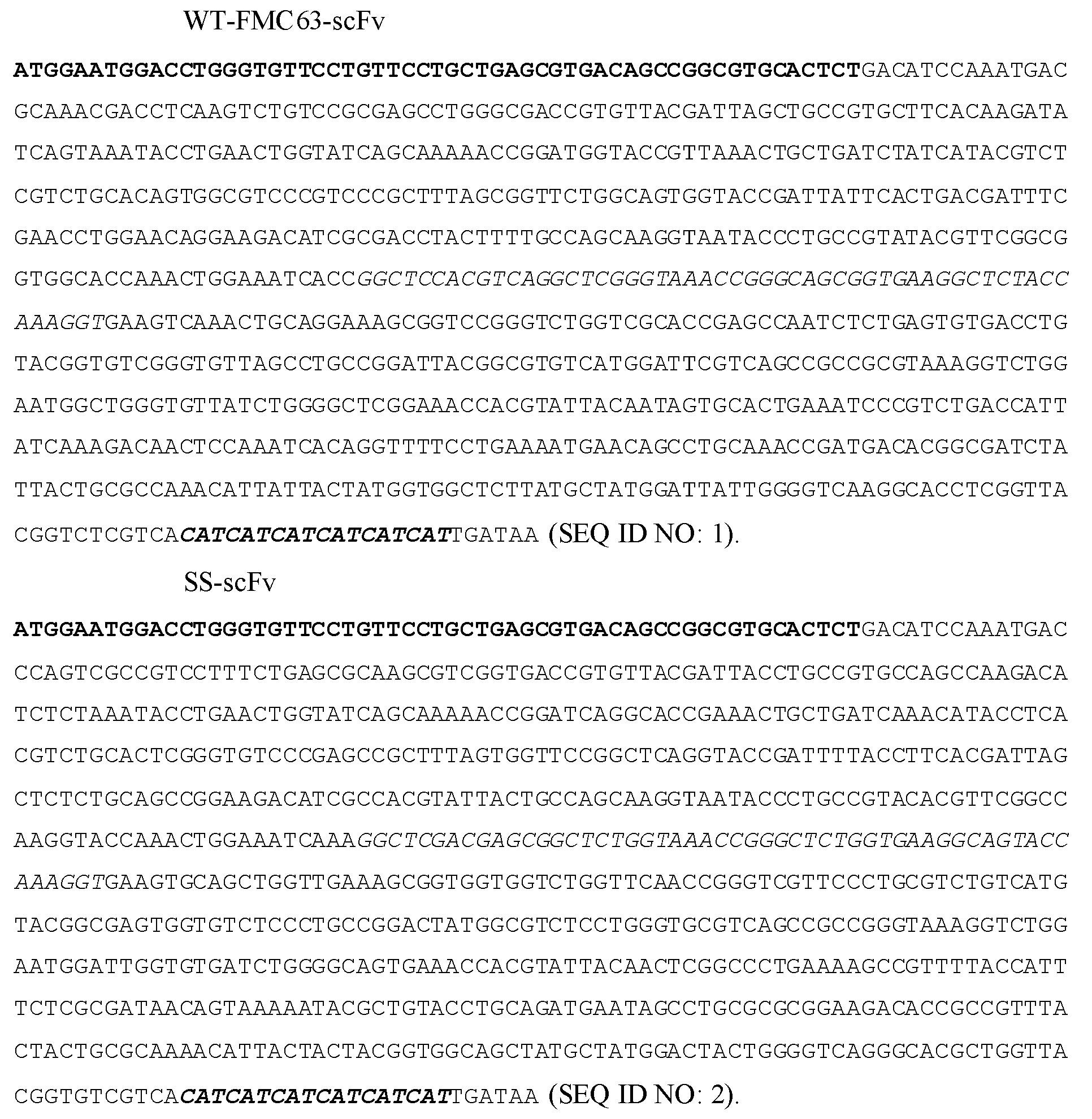
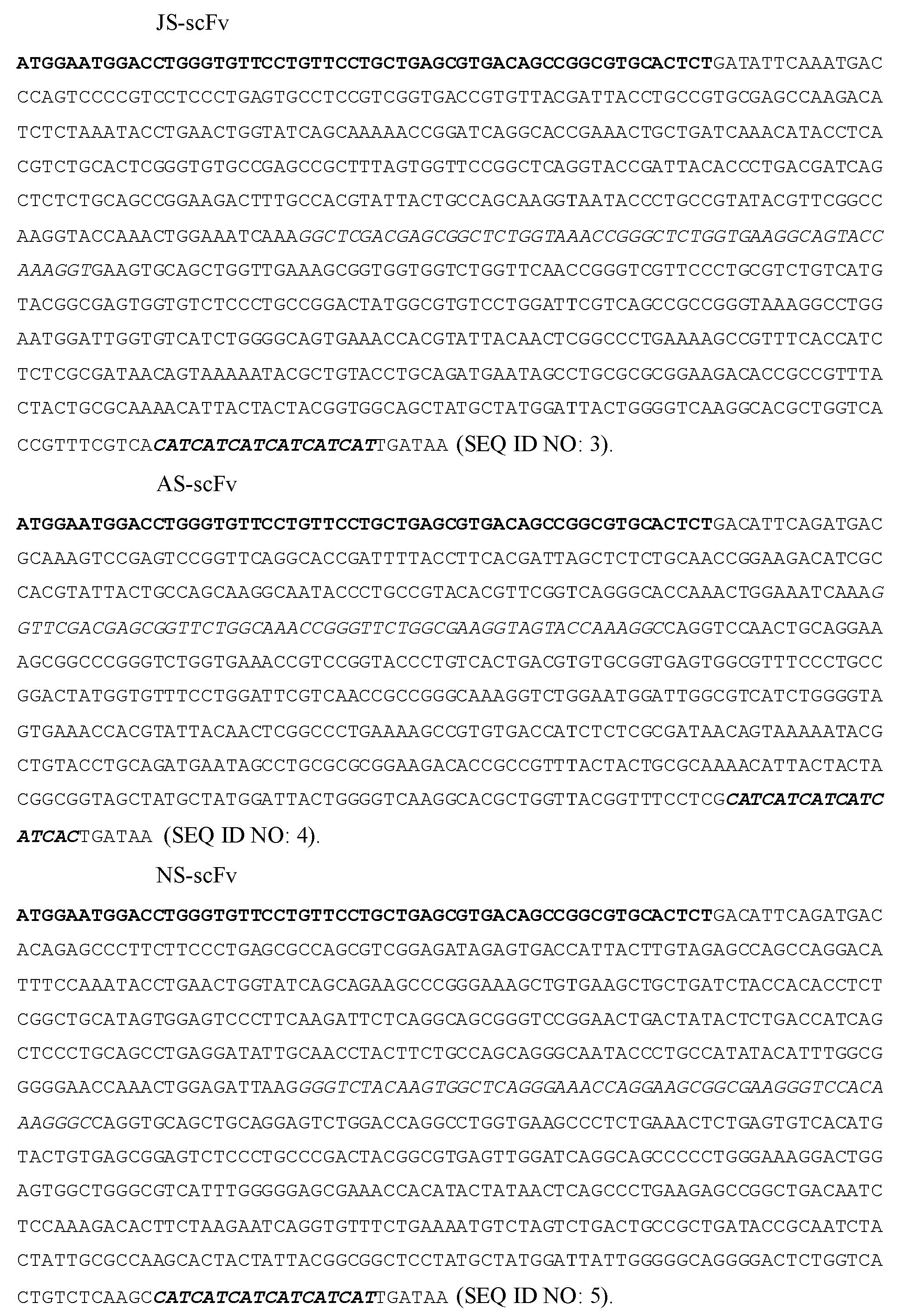
일부 실시양태에서, 폴리뉴클레오티드 서열은 상기 언급된 폴리뉴클레오티드 서열과 적어도 약 70%, 적어도 약 75%, 적어도 약 80%, 적어도 약 85%, 적어도 약 90%, 적어도 약 95%, 적어도 약 96%, 적어도 약 97%, 적어도 약 98%, 적어도 약 99%, 또는 약 100% 동일할 수 있다.In some embodiments, the polynucleotide sequence is at least about 70%, at least about 75%, at least about 80%, at least about 85%, at least about 90%, at least about 95%, at least about 96% with the aforementioned polynucleotide sequences. , At least about 97%, at least about 98%, at least about 99%, or about 100%.
야생형 scFv 및 7개의 선택된 인간화 scFv 중 4개에 대한 아미노산 서열Amino acid sequence for 4 of wild-type scFv and 7 selected humanized scFv
하기 폴리펩티드 서열은 "리더 서열-VL-링커-VH- His 태그 "의 포맷으로 제시되며, 즉, "리더 서열"은 볼드체이고, "링커"는 이탤릭체이고, "His 태그"는 볼드체 이탤릭체이다.The following polypeptide sequences are shown in the format of " leader sequence- VL- linker- VH- His tag ", ie, "leader sequence" is bold, "linker" is italic, and "His tag" is bold italic.
각각의 하기 scFv에 사용된 리더 서열은 MEWTWVFLFLLSVTAGVHS (서열식별번호: 6)의 아미노산 서열을 갖는다. 각각의 하기 scFv에 사용된 링커 서열은 GSTSGSGKPGSGEGSTKG (서열식별번호: 7)의 아미노산 서열을 갖는다. 각각의 하기 scFv에 사용된 His 태그 서열은 HHHHHH (서열식별번호: 8)의 아미노산 서열을 갖는다.The leader sequence used for each scFv below has the amino acid sequence of MEWTWVFLFLLSVTAGVHS (SEQ ID NO: 6). The linker sequence used for each scFv below has the amino acid sequence of GSTSGSGKPGSGEGSTKG (SEQ ID NO: 7). The His tag sequence used for each scFv below has the amino acid sequence of HHHHHH (SEQ ID NO: 8).
WT-FMC63-scFvWT-FMC63-scFv

WT-FMC63-scFV의 VL 서열은 하기 아미노산 서열을 갖는다.The VL sequence of WT-FMC63-scFV has the following amino acid sequence.

WT-FMC63-scFV의 VH 서열은 하기 아미노산 서열을 갖는다.The VH sequence of WT-FMC63-scFV has the following amino acid sequence.

SS-scFvSS-scFv

SS-scFV의 VL 서열은 하기 아미노산 서열을 갖는다.The VL sequence of SS-scFV has the following amino acid sequence.

SS-scFV의 VH 서열은 하기 아미노산 서열을 갖는다.The VH sequence of SS-scFV has the following amino acid sequence.

JS-scFvJS-scFv

JS-scFV의 VL 서열은 하기 아미노산 서열을 갖는다.The VL sequence of JS-scFV has the following amino acid sequence.

JS-scFV의 VH 서열은 하기 아미노산 서열을 갖는다.The VH sequence of JS-scFV has the following amino acid sequence.

AS-scFvAS-scFv

AS-scFV의 VL 서열은 하기 아미노산 서열을 갖는다.The VL sequence of AS-scFV has the following amino acid sequence.

AS-scFV의 VH 서열은 하기 아미노산 서열을 갖는다.The VH sequence of AS-scFV has the following amino acid sequence.

NS-scFvNS-scFv

NS-scFV의 VL 서열은 하기 아미노산 서열을 갖는다.The VL sequence of NS-scFV has the following amino acid sequence.

NS-scFV의 VH 서열은 하기 아미노산 서열을 갖는다.The VH sequence of NS-scFV has the following amino acid sequence.

상기 기재된 WT-FMC63-, SS-, JS-, AS-, 및 NS-scFv 아미노산 서열에서 His 태그 (서열식별번호: 8)가 결여될 수 있다. 따라서, scFv는 하기 아미노산 서열을 가질 것이다:His tag (SEQ ID NO: 8) may be lacking in the WT-FMC63-, SS-, JS-, AS-, and NS-scFv amino acid sequences described above. Thus, the scFv will have the following amino acid sequence:
WT-FMC63-scFv (His 태그 부재)WT-FMC63-scFv (without His tag)

SS-scFv (His 태그 부재)SS-scFv (without His tag)

JS-scFv (His 태그 부재)JS-scFv (without His tag)

AS-scFv (His 태그 부재)AS-scFv (without His tag)

NS scFv (His 태그 부재)NS scFv (without His tag)

일부 실시양태에서, 폴리펩티드 서열은 상기 언급된 펩티드 서열 중 어느 하나와 적어도 약 70%, 적어도 약 75%, 적어도 약 80%, 적어도 약 85%, 적어도 약 90%, 적어도 약 95%, 적어도 약 96%, 적어도 약 97%, 적어도 약 98%, 적어도 약 99%, 또는 약 100% 동일할 수 있다.In some embodiments, the polypeptide sequence is at least about 70%, at least about 75%, at least about 80%, at least about 85%, at least about 90%, at least about 95%, at least about 96 with any of the aforementioned peptide sequences. %, At least about 97%, at least about 98%, at least about 99%, or about 100%.
인간화 항체, 예를 들어 scFv는 서열식별번호: 36과 적어도 1개의 아미노산, 예를 들어, 1, 2, 3, 4, 5, 6, 7, 8, 9, 10, 11, 12, 13, 14, 15, 16, 17, 18, 19, 20 21, 22, 23, 24, 25개, 또는 그 초과의 아미노산만큼 상이한 VL 영역을 갖는다. 예를 들어, 인간화 항체, 예를 들어 scFv는 위치 7의 Ser, 위치 8의 Pro, 위치 15의 Val, 위치 22의 Thr, 위치 41의 Gln, 위치 42의 Lys, 위치 42의 Gln, 위치 43의 Ala, 위치 44의 Pro, 위치 49의 Lys, 위치 72의 Thr, 위치 77의 Ser, 위치 79의 Gln, 위치 80의 Pro, 위치 83의 Phe, 위치 87의 Tyr, 위치 100의 Gln, 및/또는 위치 107의 Lys를 가짐으로써 서열식별번호: 36과 상이한 VL 영역을 가질 수 있다. 일부 실시양태에서, 인간화 항체, 예를 들어 scFv는 위치 7의 Ser, 위치 8의 Pro, 위치 15의 Val, 위치 22의 Thr, 위치 42의 Gln, 위치 43의 Ala, 위치 44의 Pro, 위치 49의 Lys, 위치 72의 Thr, 위치 77의 Ser, 위치 79의 Gln, 위치 80의 Pro, 위치 83의 Phe, 위치 87의 Tyr, 위치 100의 Gln, 및/또는 위치 107의 Lys를 가짐으로써 서열식별번호: 36과 상이한 VL 영역을 가질 수 있다. 다른 실시양태에서, 인간화 항체, 예를 들어 scFv는 위치 7의 Ser, 위치 8의 Pro, 위치 15의 Val, 위치 22의 Thr, 위치 41의 Gln, 위치 42의 Lys, 위치 43의 Ala, 위치 72의 Thr, 위치 77의 Ser, 위치 79의 Gln, 위치 80의 Pro, 및 위치 107의 Lys를 가짐으로써 서열식별번호: 36과 상이한 VL 영역을 가질 수 있다.Humanized antibodies, such as scFv, may comprise SEQ ID NO: 36 and at least one amino acid, for example 1, 2, 3, 4, 5, 6, 7, 8, 9, 10, 11, 12, 13, 14 , 15, 16, 17, 18, 19, 20 21, 22, 23, 24, 25, or more amino acids having different VL regions. For example, a humanized antibody, eg, scFv, may comprise a Ser at
인간화 항체, 예를 들어 scFv는 서열식별번호: 37과 적어도 1개의 아미노산, 예를 들어, 1, 2, 3, 4, 5, 6, 7, 8, 9, 10, 11, 12, 13, 14, 15, 16, 17, 18, 19, 20 21, 22, 23, 24, 25개, 또는 그 초과의 아미노산만큼 상이한 VH 영역을 갖는다. 예를 들어, 인간화 항체, 예를 들어 scFv는 위치 1의 Gln, 위치 3의 Gln, 위치 5의 Val, 위치 9의 Gly, 위치 13의 Lys, 위치 13의 Gln, 위치 15의 Gly, 위치 16의 Arg, 위치 16의 Thr, 위치 17의 Thr, 위치 19의 Arg, 위치 20의 Leu, 위치 21의 Ser, 위치 24의 Ala, 위치 42의 Gly, 위치 48의 Ile, 위치 67의 Phe, 위치 70의 Ser, 위치 71의 Arg, 위치 73의 Thr, 위치 76의 Asn, 위치 77의 Thr, 위치 78의 Leu, 위치 79의 Tyr, 위치 81의 Gln, 위치 83의 Ser, 위치 86의 Thr, 위치 86의 Arg, 위치 87의 Ala, 위치 88의 Glu, 위치 88의 Ala, 위치 92의 Val, 및/또는 위치 115의 Leu를 가짐으로써 서열식별번호: 37과 상이한 VH 영역을 가질 수 있다. 일부 실시양태에서, 인간화 항체, 예를 들어 scFv는 위치 3의 Gln, 위치 5의 Val, 위치 9의 Gly, 위치 13의 Gln, 위치 15의 Gly, 위치 16의 Arg, 위치 19의 Arg, 위치 20의 Leu, 위치 21의 Ser, 위치 24의 Ala, 위치 42의 Gly, 위치 48의 Ile, 위치 67의 Phe, 위치 70의 Ser, 위치 71의 Arg, 위치 76의 Asn, 위치 77의 Thr, 위치 78의 Leu, 위치 79의 Tyr, 위치 81의 Gln, 위치 86의 Arg, 위치 87의 Ala, 위치 88의 Glu, 위치 92의 Val, 및/또는 위치 115의 Leu를 가짐으로써 서열식별번호: 37과 상이한 VH 영역을 가질 수 있다. 다른 실시양태에서, 인간화 항체, 예를 들어 scFv는 위치 1의 Gln, 위치 3의 Gln, 위치 13의 Lys, 위치 16의 Thr, 위치 17의 Thr, 위치 42의 Gly, 위치 70의 Ser, 위치 73의 Thr, 위치 76의 Asn, 위치 83의 Ser, 위치 86의 Thr, 위치 87의 Ala, 위치 88의 Ala, 및/또는 위치 115의 Leu를 가짐으로써 서열식별번호: 37과 상이한 VH 영역을 가질 수 있다.Humanized antibodies, such as scFv, may comprise SEQ ID NO: 37 and at least one amino acid, for example 1, 2, 3, 4, 5, 6, 7, 8, 9, 10, 11, 12, 13, 14 , 15, 16, 17, 18, 19, 20 21, 22, 23, 24, 25, or more amino acids having a different VH region. For example, a humanized antibody, eg, an scFv, may comprise Gln at
일부 실시양태에서, 항원 결합 분자는 표적 항원 (예를 들어, 인간 CD19)에 1 x 10⁻⁶ M 미만, 1 x 10⁻⁷ M 미만, 1 x 10⁻⁸ M 미만, 또는 1 x 10⁻⁹ M 미만의 KD로 결합한다. 일부 실시양태에서, 항원 결합 분자는 표적 항원 (예를 들어, 인간 CD19)에 약 1 x 10⁻⁸ M, 약 2 x 10⁻⁸ M, 약 3 x 10⁻⁸ M, 약 4 x 10⁻⁸ M, 약 5 x 10⁻⁸ M, 약 6 x 10⁻⁸ M, 약 7 x 10⁻⁸ M, 약 8 x 10⁻⁸ M, 약 9 x 10⁻⁸ M, 약 1 x 10⁻⁹ M, 약 2 x 10⁻⁹ M, 약 3 x 10⁻⁹ M, 약 4 x 10⁻⁹ M, 약 5 x 10⁻⁹ M, 약 6 x 10⁻⁹ M, 약 7 x 10⁻⁹ M, 약 8 x 10⁻⁹ M, 또는 약 9 x 10⁻⁹ M의 KD로 결합한다. 특정 실시양태에서, KD는 koff/kon의 비율로서 계산되고, kon 및 koff는 1가 항체, 예컨대 Fab 단편을 사용하여, 예를 들어 비아코어® 표면 플라즈몬 공명 기술에 의해 측정되는 바와 같이 결정된다. 다른 실시양태에서, KD는 koff/kon의 비율로서 계산되고, kon 및 koff는 2가 항체, 예컨대 Fab 단편을 사용하여, 예를 들어 비아코어® 표면 플라즈몬 공명 기술에 의해 측정되는 바와 같이 결정된다.In some embodiments, the antigen binding molecule is 1 × 10 −6 to the target antigen (eg, human CD19). Less than M, 1 x 10 -7 Less than M, 1 x 10 -8 Less than M, or 1 x 10 -9 Binds to K D less than M; In some embodiments, the antigen binding molecule comprises about 1 x 10 -8 M, about 2 x 10 -8 M, about 3 x 10 -8 M, about 4 x 10 -8 to the target antigen (eg, human CD19) M, about 5 x 10 -8 M, about 6 x 10 -8 M, about 7 x 10 -8 M, about 8 x 10 -8 M, about 9 x 10 -8 M, about 1 x 10 -9 M, About 2 x 10 -9 M, about 3 x 10 -9 M, about 4 x 10 -9 M, about 5 x 10 -9 M, about 6 x 10 -9 M, about 7 x 10 -9 M, about 8 bind with a K D of x 10 -9 M, or about 9 x 10 -9 M. In certain embodiments, K D is calculated as the ratio k off / k on and k on and k off are measured using monovalent antibodies such as Fab fragments, eg, by Biacore® surface plasmon resonance techniques. As determined. In other embodiments, K D is calculated as the ratio k off / k on and k on and k off are measured using a bivalent antibody such as a Fab fragment, eg, by Biacore® surface plasmon resonance techniques. As determined.
일부 실시양태에서, 항원 결합 분자는 표적 항원 (예를 들어, 인간 CD19)에 1 x 10⁻⁴ M-1 s-1 미만, 2 x 10⁻⁴ M-1 s-1 미만, 3 x 10⁻⁴ M-1 s-1 미만, 4 x 10⁻⁴ M-1 s-1 미만, 5 x 10⁻⁴ M-1 s-1 미만, 6 x 10⁻⁴ M-1 s-1 미만, 7 x 10⁻⁴ M-1 s-1 미만, 8 x 10⁻⁴ M-1 s-1 미만, 9 x 10⁻⁴ M-1 s-1 미만, 1 x 10⁻⁵ M-1 s-1 미만, 2 x 10⁻⁵ M-1 s-1 미만, 3 x 10⁻⁵ M-1 s-1 미만, 4 x 10⁻⁵ M-1 s-1 미만, 5 x 10⁻⁵ M-1 s-1 미만, 6 x 10⁻⁵ M-1 s-1 미만, 7 x 10⁻⁵ M-1 s-1 미만, 8 x 10⁻⁵ M-1 s-1 미만, 9 x 10⁻⁵ M-1 s-1 미만, 1 x 10⁻⁶ M-1 s-1 미만, 2 x 10⁻⁶ M-1 s-1 미만, 3 x 10⁻⁶ M-1 s-1 미만, 4 x 10⁻⁶ M-1 s-1 미만, 5 x 10⁻⁶ M-1 s-1 미만, 6 x 10⁻⁶ M-1 s-1 미만, 7 x 10⁻⁶ M-1 s-1 미만, 8 x 10⁻⁶ M-1 s-1 미만, 9 x 10⁻⁶ M-1 s-1 미만, 또는 1 x 10⁻⁷ M-1 s-1 미만의 회합률 (kon)로 결합한다. 특정 실시양태에서, kon은 1가 항체, 예컨대 Fab 단편을 사용하여, 예를 들어 비아코어® 표면 플라즈몬 공명 기술에 의해 측정되는 바와 같이 결정된다. 다른 실시양태에서, kon은 2가 항체를 사용하여, 예를 들어 비아코어® 표면 플라즈몬 공명 기술에 의해 측정되는 바와 같이 결정된다.In some embodiments, the antigen binding molecule is less than 1 × 10 −4 M −1 s −1, less than 2 × 10 −4 M −1 s −1 , 3 × 10 − to the target antigen (eg, human CD19). Less than 4 M -1 s -1, less than 4 x 10 -4 M -1 s -1, less than 5 x 10 -4 M -1 s -1, less than 6 x 10 -4 M -1 s -1 , 7 x Less than 10 -4 M -1 s -1, less than 8 x 10 -4 M -1 s -1, less than 9 x 10 -4 M -1 s -1, less than 1 x 10 -5 M -1 s -1 , Less than 2 x 10 -5 M -1 s -1, Less than 3 x 10 -5 M -1 s -1, Less than 4 x 10 -5 M -1 s -1 , 5 x 10 -5 M -1 s -1 Less than 6 x 10 -5 M -1 s -1, less than 7 x 10 -5 M -1 s -1, less than 8 x 10 -5 M -1 s -1 , 9 x 10 -5 M -1 s less than -1, 1 x 10 -6 M -1 s -1 is less than, 2 x 10 -6 M -1 s -1 is less than, 3 x 10 -6 M -1 s -1 is less than, 4 x 10 -6 M - Less than 1 s -1 , 5 x 10 -6 M -1 less than s -1 , 6 x 10 -6 M -1 s -1 less than, 7 x 10 -6 M -1 s -1, less than 8 x 10 -6 Bind at an association rate (k on ) of less than M −1 s −1, less than 9 × 10 −6 M −1 s −1 , or less than 1 × 10 −7 M −1 s −1 . In certain embodiments, k on is determined using a monovalent antibody, such as a Fab fragment, as measured by, for example, Biacore® surface plasmon resonance techniques. In other embodiments, k on is determined using a bivalent antibody, eg, as measured by Biacore® surface plasmon resonance technique.
일부 실시양태에서, 항원 결합 분자는 표적 항원 (예를 들어, 인간 CD19)에 1 x 10⁻² s-1 미만, 2 x 10⁻² s-1 미만, 3 x 10⁻² s-1 미만, 4 x 10⁻² s-1 미만, 5 x 10⁻² s-1 미만, 6 x 10⁻² s-1 미만, 7 x 10⁻² s-1 미만, 8 x 10⁻² s-1 미만, 9 x 10⁻² s-1 미만, 1 x 10⁻³ s-1 미만, 2 x 10⁻³ s-1 미만, 3 x 10⁻³ s-1 미만, 4 x 10⁻³ s-1 미만, 5 x 10⁻³ s-1 미만, 6 x 10⁻³ s-1 미만, 7 x 10⁻³ s-1 미만, 8 x 10⁻³ s-1 미만, 9 x 10⁻³ s-1 미만, 1 x 10⁻⁴ s-1 미만, 2 x 10⁻⁴ s-1 미만, 3 x 10⁻⁴ s-1 미만, 4 x 10⁻⁴ s-1 미만, 5 x 10⁻⁴ s-1 미만, 6 x 10⁻⁴ s-1 미만, 7 x 10⁻⁴ s-1 미만, 8 x 10⁻⁴ s-1 미만, 9 x 10⁻⁴ s-1 미만, 1 x 10⁻⁴ s-1 미만, 또는 5 x 10⁻⁴ s-1 미만의 해리율 (koff)로 결합한다. 특정 실시양태에서, koff는 1가 항체, 예컨대 Fab 단편을 사용하여, 예를 들어 비아코어® 표면 플라즈몬 공명 기술에 의해 측정되는 바와 같이 결정된다. 다른 실시양태에서, koff는 2가 항체를 사용하여, 예를 들어 비아코어® 표면 플라즈몬 공명 기술에 의해 측정되는 바와 같이 결정된다.In some embodiments, the antigen binding molecule is less than 1 × 10 −2 s −1, less than 2 × 10 −2 s −1, less than 3 × 10 −2 s −1 , to the target antigen (eg, human CD19), Less than 4 x 10 -2 s -1, less than 5 x 10 -2 s -1, less than 6 x 10 -2 s -1, less than 7 x 10 -2 s -1, less than 8 x 10 -2 s -1 , Less than 9 x 10 -2 s -1, less than 1 x 10 -3 s -1, less than 2 x 10 -3 s -1, less than 3 x 10 -3 s -1, less than 4 x 10 -3 s -1 , Less than 5 x 10 -3 s -1, less than 6 x 10 -3 s -1, less than 7 x 10 -3 s -1, less than 8 x 10 -3 s -1, less than 9 x 10 -3 s -1 , Less than 1 x 10 -4 s -1, less than 2 x 10 -4 s -1, less than 3 x 10 -4 s -1, less than 4 x 10 -4 s -1, less than 5 x 10 -4 s -1 , Less than 6 x 10 -4 s -1, less than 7 x 10 -4 s -1, less than 8 x 10 -4 s -1, less than 9 x 10 -4 s -1, less than 1 x 10 -4 s -1 , Or a dissociation rate (k off ) of less than 5 × 10 −4 s −1 . In certain embodiments, k off is determined using a monovalent antibody, such as a Fab fragment, as measured, eg, by Biacore® surface plasmon resonance techniques. In other embodiments, k off is determined using a bivalent antibody, eg, as measured by Biacore® Surface Plasmon Resonance Technique.
일부 실시양태에서, 폴리뉴클레오티드는 TCR을 코딩하며, 여기서 TCR은 제4 상보성 결정 영역 (CDR4)을 추가로 포함한다. 특정 실시양태에서, 폴리뉴클레오티드는 TCR을 코딩하며, 여기서 TCR은 불변 영역을 추가로 포함한다. 일부 실시양태에서, 불변 영역은 IgG1, IgG2, IgG3, IgG4, IgA, IgD, IgE, 및 IgM의 불변 영역으로부터 선택된다.In some embodiments, the polynucleotides encode a TCR, wherein the TCR further comprises a fourth complementarity determining region (CDR4). In certain embodiments, the polynucleotides encode a TCR, wherein the TCR further comprises a constant region. In some embodiments, the constant region is selected from constant regions of IgG1, IgG2, IgG3, IgG4, IgA, IgD, IgE, and IgM.
I.B. 공동자극 도메인I.B. Co-stimulation domain
키메라 항원 수용체에는 그의 효력을 증가시키기 위해 공동자극 (신호전달) 도메인이 혼입된다. 미국 특허 번호 7,741,465, 및 6,319,494, 뿐만 아니라 문헌 [Krause et al. and Finney et al. (supra), Song et al., Blood 119:696-706 (2012); Kalos et al., Sci Transl. Med. 3:95 (2011); Porter et al., N. Engl. J. Med. 365:725-33 (2011), 및 Gross et al., Annu. Rev. Pharmacol. Toxicol. 56:59-83 (2016)]을 참조한다. 예시적인 공동자극 단백질은 T 세포 상에서 자연에서 발견되는공동자극 단백질의 아미노산 서열을 갖는다. 이러한 공동자극 단백질의 완전한 천연 아미노산 서열은 NCBI 참조 서열: NP_006130.1에 기재되어 있다.Chimeric antigen receptors incorporate costimulatory (signaling) domains to increase their potency. U.S. Pat.Nos. 7,741,465, and 6,319,494, as well as Krause et al. and Finney et al. (supra), Song et al., Blood 119: 696-706 (2012); Kalos et al., Sci Transl. Med. 3:95 (2011); Porter et al., N. Engl. J. Med. 365: 725-33 (2011), and Gross et al., Annu. Rev. Pharmacol. Toxicol. 56: 59-83 (2016). Exemplary costimulatory proteins have the amino acid sequence of costimulatory proteins found in nature on T cells. The fully native amino acid sequence of this costimulatory protein is described in NCBI Reference Sequence: NP_006130.1.
다른 공동자극 도메인의 폴리뉴클레오티드 및 폴리펩티드 서열은 관련 기술분야에 공지되어 있다. 일부 실시양태에서, 공동자극 도메인을 코딩하는 폴리뉴클레오티드는 관련 기술분야에 공지된 뉴클레오티드 서열과 적어도 약 60%, 적어도 약 65%, 적어도 약 70%, 적어도 약 75%, 적어도 약 80%, 적어도 약 85%, 적어도 약 90%, 적어도 약 95%, 적어도 약 96%, 적어도 약 97%, 적어도 약 98%, 적어도 약 99%, 또는 약 100% 동일한 뉴클레오티드 서열을 포함한다. 일부 실시양태에서, 공동자극 도메인의 폴리펩티드 서열은 관련 기술분야에 공지된 폴리펩티드 서열과 적어도 약 60%, 적어도 약 65%, 적어도 약 70%, 적어도 약 75%, 적어도 약 80%, 적어도 약 85%, 적어도 약 90%, 적어도 약 95%, 적어도 약 96%, 적어도 약 97%, 적어도 약 98%, 적어도 약 99%, 또는 약 100% 동일한 폴리펩티드 서열을 포함한다.Polynucleotide and polypeptide sequences of other costimulatory domains are known in the art. In some embodiments, the polynucleotide encoding the costimulatory domain is at least about 60%, at least about 65%, at least about 70%, at least about 75%, at least about 80%, at least about about nucleotide sequences known in the art. 85%, at least about 90%, at least about 95%, at least about 96%, at least about 97%, at least about 98%, at least about 99%, or about 100% identical nucleotide sequences. In some embodiments, the polypeptide sequence of the costimulatory domain is at least about 60%, at least about 65%, at least about 70%, at least about 75%, at least about 80%, at least about 85% with polypeptide sequences known in the art. At least about 90%, at least about 95%, at least about 96%, at least about 97%, at least about 98%, at least about 99%, or about 100% identical polypeptide sequences.
I.B.1 세포외 또는 "힌지" 도메인I.B.1 Extracellular or "Hinge" Domains
한 실시양태에서, 본 개시내용의 CAR 또는 TCR은 "세포외" 또는 "힌지" 또는 "스페이서" 도메인 또는 영역을 포함하며, 이들 용어는 본원에서 상호교환가능하게 사용된다. 또 다른 실시양태에서, 세포외 도메인은 CD2, CD3 델타, CD3 엡실론, CD3 감마, CD4, CD7, CD8α, CD8β, CD11a (ITGAL), CD11b (ITGAM), CD11c (ITGAX), CD11d (ITGAD), CD18 (ITGB2), CD19 (B4), CD27 (TNFRSF7), CD28, CD28T, CD29 (ITGB1), CD30 (TNFRSF8), CD40 (TNFRSF5), CD48 (SLAMF2), CD49a (ITGA1), CD49d (ITGA4), CD49f (ITGA6), CD66a (CEACAM1), CD66b (CEACAM8), CD66c (CEACAM6), CD66d (CEACAM3), CD66e (CEACAM5), CD69 (CLEC2), CD79A (B-세포 항원 수용체 복합체-연관 알파 쇄), CD79B (B-세포 항원 수용체 복합체-연관 베타 쇄), CD84 (SLAMF5), CD96 (Tactile), CD100 (SEMA4D), CD103 (ITGAE), CD134 (OX40), CD137 (4-1BB), CD150 (SLAMF1), CD158A (KIR2DL1), CD158B1 (KIR2DL2), CD158B2 (KIR2DL3), CD158C (KIR3DP1), CD158D (KIRDL4), CD158F1 (KIR2DL5A), CD158F2 (KIR2DL5B), CD158K (KIR3DL2), CD160 (BY55), CD162 (SELPLG), CD226 (DNAM1), CD229 (SLAMF3), CD244 (SLAMF4), CD247 (CD3-제타), CD258 (LIGHT), CD268 (BAFFR), CD270 (TNFSF14), CD272 (BTLA), CD276 (B7-H3), CD279 (PD-1), CD314 (NKG2D), CD319 (SLAMF7), CD335 (NK-p46), CD336 (NK-p44), CD337 (NK-p30), CD352 (SLAMF6), CD353 (SLAMF8), CD355 (CRTAM), CD357 (TNFRSF18), 유도성 T 세포 공동-자극제 (ICOS), LFA-1 (CD11a/CD18), NKG2C, DAP-10, ICAM-1, NKp80 (KLRF1), IL-2R 베타, IL-2R 감마, IL-7R 알파, LFA-1, SLAMF9, LAT, GADS (GrpL), SLP-76 (LCP2), PAG1/CBP, CD83 리간드, Fc 감마 수용체, MHC 부류 1 분자, MHC 부류 2 분자, TNF 수용체 단백질, 이뮤노글로불린 단백질, 시토카인 수용체, 인테그린, 활성화 NK 세포 수용체, 톨 리간드 수용체, 및 그의 단편 또는 조합으로부터의 것이거나, 또는 그로부터 유래된다 (예를 들어, 그의 모두 또는 그의 단편을 포함함). "세포외" 또는 "힌지" 또는 "스페이서" 도메인 또는 영역은 천연 또는 합성 공급원으로부터 유래될 수 있다. 이들 힌지 도메인의 폴리뉴클레오티드 및 폴리펩티드 서열은 관련 기술분야에 공지되어 있다.In one embodiment, a CAR or TCR of the present disclosure includes an "extracellular" or "hinge" or "spacer" domain or region, which terms are used interchangeably herein. In another embodiment, the extracellular domain is CD2, CD3 delta, CD3 epsilon, CD3 gamma, CD4, CD7, CD8α, CD8β, CD11a (ITGAL), CD11b (ITGAM), CD11c (ITGAX), CD11d (ITGAD), CD18 (ITGB2), CD19 (B4), CD27 (TNFRSF7), CD28, CD28T, CD29 (ITGB1), CD30 (TNFRSF8), CD40 (TNFRSF5), CD48 (SLAMF2), CD49a (ITGA1), CD49d (ITGA4), CD49f ( ITGA6), CD66a (CEACAM1), CD66b (CEACAM8), CD66c (CEACAM6), CD66d (CEACAM3), CD66e (CEACAM5), CD69 (CLEC2), CD79A (B-cell antigen receptor complex-associated alpha chain), CD79B (B -Cell antigen receptor complex-associated beta chain), CD84 (SLAMF5), CD96 (Tactile), CD100 (SEMA4D), CD103 (ITGAE), CD134 (OX40), CD137 (4-1BB), CD150 (SLAMF1), CD158A ( KIR2DL1), CD158B1 (KIR2DL2), CD158B2 (KIR2DL3), CD158C (KIR3DP1), CD158D (KIRDL4), CD158F1 (KIR2DL5A), CD158F2 (KIR2DL5B), CD158K (KIR3DL2), CD160 (BYSELPL) DNAM1), CD229 (SLAMF3), CD244 (SLAMF4), CD247 (CD3-Zeta), CD258 (LIGHT), CD268 (BAFFR), CD270 (TNFSF14), CD272 (BTLA), CD276 (B7-H3), CD27 9 (PD-1), CD314 (NKG2D), CD319 (SLAMF7), CD335 (NK-p46), CD336 (NK-p44), CD337 (NK-p30), CD352 (SLAMF6), CD353 (SLAMF8), CD355 ( CRTAM), CD357 (TNFRSF18), inducible T cell co-stimulator (ICOS), LFA-1 (CD11a / CD18), NKG2C, DAP-10, ICAM-1, NKp80 (KLRF1), IL-2R beta, IL- 2R gamma, IL-7R alpha, LFA-1, SLAMF9, LAT, GADS (GrpL), SLP-76 (LCP2), PAG1 / CBP, CD83 ligand, Fc gamma receptor, MHC class 1 molecule, MHC class 2 molecule, TNF Receptor protein, immunoglobulin protein, cytokine receptor, integrin, activated NK cell receptor, toll ligand receptor, and fragments or combinations thereof, or derived from (including, for example, all or fragments thereof) . "Extracellular" or "hinge" or "spacer" domains or regions can be derived from natural or synthetic sources. Polynucleotide and polypeptide sequences of these hinge domains are known in the art.
일부 실시양태에서, 힌지 도메인을 코딩하는 폴리뉴클레오티드는 관련 기술분야에 공지된 뉴클레오티드 서열과 적어도 약 60%, 적어도 약 65%, 적어도 약 70%, 적어도 약 75%, 적어도 약 80%, 적어도 약 85%, 적어도 약 90%, 적어도 약 95%, 적어도 약 96%, 적어도 약 97%, 적어도 약 98%, 적어도 약 99%, 또는 약 100% 동일한 뉴클레오티드 서열을 포함한다. 일부 실시양태에서, 힌지 도메인의 폴리펩티드 서열은 관련 기술분야에 공지된 폴리펩티드 서열과 적어도 약 60%, 적어도 약 65%, 적어도 약 70%, 적어도 약 75%, 적어도 약 80%, 적어도 약 85%, 적어도 약 90%, 적어도 약 95%, 적어도 약 96%, 적어도 약 97%, 적어도 약 98%, 적어도 약 99%, 또는 약 100% 동일한 폴리펩티드 서열을 포함한다.In some embodiments, the polynucleotide encoding the hinge domain is at least about 60%, at least about 65%, at least about 70%, at least about 75%, at least about 80%, at least about 85 with a nucleotide sequence known in the art. %, At least about 90%, at least about 95%, at least about 96%, at least about 97%, at least about 98%, at least about 99%, or about 100% identical nucleotide sequences. In some embodiments, the polypeptide sequence of the hinge domain is at least about 60%, at least about 65%, at least about 70%, at least about 75%, at least about 80%, at least about 85%, and polypeptide sequences known in the art. At least about 90%, at least about 95%, at least about 96%, at least about 97%, at least about 98%, at least about 99%, or about 100% identical polypeptide sequences.
일부 실시양태에서, 힌지 도메인은 항원 결합 도메인 (예를 들어, scFv) 및 막횡단 도메인 사이에 위치한다. 이러한 배향에서, 힌지 도메인은 항원 결합 도메인 및 CAR이 발현되는 세포 막의 표면 사이에 거리를 제공한다. 일부 실시양태에서, 힌지 도메인은 이뮤노글로불린으로부터의 것이거나, 또는 그로부터 유래된다. 일부 실시양태에서, 힌지 도메인은 IgG1, IgG2, IgG3, IgG4, IgA, IgD, IgE, 및 IgM의 힌지 영역, 또는 그의 단편으로부터 선택된다. 다른 실시양태에서, 힌지 도메인은 CD8 알파의 힌지 영역을 포함하거나, 그로부터의 것이거나, 또는 그로부터 유래된다. 일부 실시양태에서 힌지 도메인은 CD28의 힌지 영역을 포함하거나, 그로부터의 것이거나, 또는 그로부터 유래된다. 일부 실시양태에서, 힌지 도메인은 CD8 알파의 힌지 영역의 단편 또는 CD28의 힌지 영역의 단편을 포함하며, 여기서 단편은 전체 힌지 영역보다 작은 임의의 것이다. 일부 실시양태에서, CD8 알파 힌지 영역의 단편 또는 CD28 힌지 영역의 단편은 CD8 알파 힌지 영역 또는 CD28 힌지 영역의 N-말단 또는 C-말단, 또는 둘 다에서 적어도 1, 적어도 2, 적어도 3, 적어도 4, 적어도 5, 적어도 6, 적어도 7, 적어도 8, 적어도 9, 적어도 10, 적어도 11, 적어도 12, 적어도 13, 적어도 14, 적어도 15, 적어도 16, 적어도 17, 적어도 18, 적어도 19, 또는 적어도 20개의 아미노산이 제외된 아미노산 서열을 포함한다.In some embodiments, the hinge domain is located between the antigen binding domain (eg scFv) and the transmembrane domain. In this orientation, the hinge domain provides the distance between the antigen binding domain and the surface of the cell membrane in which the CAR is expressed. In some embodiments, the hinge domain is from or is derived from an immunoglobulin. In some embodiments, the hinge domain is selected from hinge regions of IgG1, IgG2, IgG3, IgG4, IgA, IgD, IgE, and IgM, or fragments thereof. In other embodiments, the hinge domain comprises, is from, or is derived from the hinge region of CD8 alpha. In some embodiments the hinge domain comprises, is from, or is derived from the hinge region of CD28. In some embodiments, the hinge domain comprises a fragment of the hinge region of CD8 alpha or a fragment of the hinge region of CD28, wherein the fragment is any smaller than the entire hinge region. In some embodiments, the fragment of the CD8 alpha hinge region or the fragment of the CD28 hinge region is at least 1, at least 2, at least 3, at least 4 at the N-terminus or C-terminus, or both of the CD8 alpha hinge region or the CD28 hinge region. , At least 5, at least 6, at least 7, at least 8, at least 9, at least 10, at least 11, at least 12, at least 13, at least 14, at least 15, at least 16, at least 17, at least 18, at least 19, or at least 20 Amino acid sequences that exclude amino acids.
I.B.2 막횡단 도메인I.B.2 Transmembrane Domains
본 발명의 CAR 또는 TCR에 대한 공동자극 도메인은 막횡단 도메인 및/또는 세포내 신호전달 도메인을 추가로 포함할 수 있다. 막횡단 도메인은 CAR의 세포외 도메인에 융합되도록 설계될 수 있다. 이는 CAR의 세포내 도메인에 유사하게 융합될 수 있다. 한 실시양태에서, CAR 내의 도메인 중 하나와 자연적으로 회합되는 막횡단 도메인이 사용된다. 일부 경우에, 막횡단 도메인은 이러한 도메인이 동일한 또는 상이한 표면 막 단백질의 막횡단 도메인에 결합하는 것을 피하게 하여 수용체 복합체의 다른 구성원과의 상호작용을 최소화하기 위해 선택되거나 또는 아미노산 치환에 의해 변형될 수 있다. 막횡단 도메인은 천연 또는 합성 공급원으로부터 유래될 수 있다. 공급원이 천연인 경우에, 도메인은 임의의 막-결합 또는 막횡단 단백질로부터 유래될 수 있다. 본 발명에 특히 유용한 막횡단 영역은 4-1BB/CD137, 활성화 NK 세포 수용체, 이뮤노글로불린 단백질, B7-H3, BAFFR, BLAME (SLAMF8), BTLA, CD100 (SEMA4D), CD103, CD160 (BY55), CD18, CD19, CD19a, CD2, CD247, CD27, CD276 (B7-H3), CD28, CD29, CD3 델타, CD3 엡실론, CD3 감마, CD30, CD4, CD40, CD49a, CD49D, CD49f, CD69, CD7, CD84, CD8알파, CD8베타, CD96 (Tactile), CDl la, CDl lb, CDl lc, CDl ld, CDS, CEACAM1, CRT AM, 시토카인 수용체, DAP-10, DNAM1 (CD226), Fc 감마 수용체, GADS, GITR, HVEM (LIGHTR), IA4, ICAM-1, ICAM-1, Ig 알파 (CD79a), IL-2R 베타, IL-2R 감마, IL-7R 알파, 유도성 T 세포 공동자극제 (ICOS), 인테그린, ITGA4, ITGA4, ITGA6, ITGAD, ITGAE, ITGAL, ITGAM, ITGAX, ITGB2, ITGB7, ITGBl, KIRDS2, LAT, LFA-1, LFA-1, CD83과 특이적으로 결합하는 리간드, LIGHT, LIGHT, LTBR, Ly9 (CD229), 림프구 기능-연관 항원-1 (LFA-1; CDl-la/CD18), MHC 부류 1 분자, NKG2C, NKG2D, NKp30, NKp44, NKp46, NKp80 (KLRF1), OX-40, PAG/Cbp, 프로그램화된 사멸-1 (PD-1), PSGL1, SELPLG (CD162), 신호전달 림프구성 활성화 분자 (SLAM 단백질), SLAM (SLAMF1; CD150; IPO-3), SLAMF4 (CD244; 2B4), SLAMF6 (NTB-A; Lyl08), SLAMF7, SLP-76, TNF 수용체 단백질, TNFR2, TNFSF14, 톨 리간드 수용체, TRANCE/RANKL, VLA1, 또는 VLA-6, 또는 그의 단편, 말단절단물, 또는 조합으로부터 유래될 수 있다 (즉, 이를 포함한다). 이들 막횡단 도메인의 폴리뉴클레오티드 및 폴리펩티드 서열은 관련 기술분야에 공지되어 있다.The costimulatory domain for a CAR or TCR of the invention may further comprise a transmembrane domain and / or an intracellular signaling domain. The transmembrane domain can be designed to fuse to the extracellular domain of the CAR. It can be similarly fused to the intracellular domain of the CAR. In one embodiment, transmembrane domains are used that are naturally associated with one of the domains in the CAR. In some cases, the transmembrane domain is selected to be modified by amino acid substitutions or to minimize interaction with other members of the receptor complex by avoiding such domains from binding to the transmembrane domains of the same or different surface membrane proteins. Can be. The transmembrane domain can be derived from natural or synthetic sources. If the source is natural, the domain can be derived from any membrane-binding or transmembrane protein. Particularly useful transmembrane regions for the present invention are 4-1BB / CD137, activated NK cell receptor, immunoglobulin protein, B7-H3, BAFFR, BLAME (SLAMF8), BTLA, CD100 (SEMA4D), CD103, CD160 (BY55), CD18, CD19, CD19a, CD2, CD247, CD27, CD276 (B7-H3), CD28, CD29, CD3 Delta, CD3 Epsilon, CD3 Gamma, CD30, CD4, CD40, CD49a, CD49D, CD49f, CD69, CD7, CD84, CD8alpha, CD8beta, CD96 (Tactile), CDl la, CDl lb, CDl lc, CDl ld, CDS, CEACAM1, CRT AM, Cytokine Receptor, DAP-10, DNAM1 (CD226), Fc Gamma Receptor, GADS, GITR, HVEM (LIGHTR), IA4, ICAM-1, ICAM-1, Ig alpha (CD79a), IL-2R beta, IL-2R gamma, IL-7R alpha, inducible T cell costimulator (ICOS), integrin, ITGA4, Ligands that specifically bind to ITGA4, ITGA6, ITGAD, ITGAE, ITGAL, ITGAM, ITGAX, ITGB2, ITGB7, ITGBl, KIRDS2, LAT, LFA-1, LFA-1, CD83, LIGHT, LIGHT, LTBR, Ly9 (CD229 ), Lymphocyte function-associated antigen-1 (LFA-1; CDl-la / CD18), MHC class 1 molecule, NKG2C, NKG2D, NKp30, NKp44, NKp46, NKp80 (KLRF1), OX-4 0, PAG / Cbp, programmed death-1 (PD-1), PSGL1, SELPLG (CD162), signaling lymphocytic activating molecule (SLAM protein), SLAM (SLAMF1; CD150; IPO-3), SLAMF4 (CD244 2B4), SLAMF6 (NTB-A; Lyl08), SLAMF7, SLP-76, TNF receptor protein, TNFR2, TNFSF14, tall ligand receptor, TRANCE / RANKL, VLA1, or VLA-6, or fragments thereof, truncations, Or from combinations (ie, including). Polynucleotide and polypeptide sequences of these transmembrane domains are known in the art.
일부 실시양태에서, 막횡단 도메인을 코딩하는 폴리뉴클레오티드는 관련 기술분야에 공지된 뉴클레오티드 서열과 적어도 약 60%, 적어도 약 65%, 적어도 약 70%, 적어도 약 75%, 적어도 약 80%, 적어도 약 85%, 적어도 약 90%, 적어도 약 95%, 적어도 약 96%, 적어도 약 97%, 적어도 약 98%, 적어도 약 99%, 또는 약 100% 동일한 뉴클레오티드 서열을 포함한다. 일부 실시양태에서, 막횡단 도메인의 폴리펩티드 서열은 관련 기술분야에 공지된 폴리펩티드 서열과 적어도 약 60%, 적어도 약 65%, 적어도 약 70%, 적어도 약 75%, 적어도 약 80%, 적어도 약 85%, 적어도 약 90%, 적어도 약 95%, 적어도 약 96%, 적어도 약 97%, 적어도 약 98%, 적어도 약 99%, 또는 약 100% 동일한 폴리펩티드 서열을 포함한다.In some embodiments, the polynucleotide encoding the transmembrane domain is at least about 60%, at least about 65%, at least about 70%, at least about 75%, at least about 80%, at least about nucleotide sequences known in the art. 85%, at least about 90%, at least about 95%, at least about 96%, at least about 97%, at least about 98%, at least about 99%, or about 100% identical nucleotide sequences. In some embodiments, the polypeptide sequence of the transmembrane domain is at least about 60%, at least about 65%, at least about 70%, at least about 75%, at least about 80%, at least about 85% with polypeptide sequences known in the art. At least about 90%, at least about 95%, at least about 96%, at least about 97%, at least about 98%, at least about 99%, or about 100% identical polypeptide sequences.
임의로, 짧은 링커는 CAR의 임의의 또는 일부 세포외, 막횡단, 및 세포내 도메인 사이에 연결을 형성할 수 있다.Optionally, the short linker may form a link between any or some extracellular, transmembrane, and intracellular domains of the CAR.
I.B.3. 세포내 (신호전달) 도메인I.B.3. Intracellular (signaling) domain
본 발명의 조작된 T 세포의 세포내 (신호전달) 도메인은 활성화 도메인에게 신호전달을 제공할 수 있고, 이는 이어서 면역 세포의 정상 이펙터 기능 중 적어도 1종을 활성화한다. T 세포의 이펙터 기능은, 예를 들어, 시토카인의 분비를 포함한 세포용해 활성 또는 헬퍼 활성일 수 있다.The intracellular (signaling) domain of the engineered T cells of the invention can provide signaling to the activation domain, which then activates at least one of the normal effector functions of the immune cell. Effector function of T cells may be cytolytic activity or helper activity, including, for example, secretion of cytokines.
특정 실시양태에서, 적합한 세포내 신호전달 도메인은 4-1BB/CD137, 활성화 NK 세포 수용체, 이뮤노글로불린 단백질, B7-H3, BAFFR, BLAME (SLAMF8), BTLA, CD100 (SEMA4D), CD103, CD160 (BY55), CD18, CD19, CD19a, CD2, CD247, CD27, CD276 (B7-H3), CD28, CD29, CD3 델타, CD3 엡실론, CD3 감마, CD30, CD4, CD40, CD49a, CD49D, CD49f, CD69, CD7, CD84, CD8알파, CD8베타, CD96 (Tactile), CDl la, CDl lb, CDl lc, CDl ld, CDS, CEACAM1, CRT AM, 시토카인 수용체, DAP-10, DNAM1 (CD226), Fc 감마 수용체, GADS, GITR, HVEM (LIGHTR), IA4, ICAM-1, ICAM-1, Ig 알파 (CD79a), IL-2R 베타, IL-2R 감마, IL-7R 알파, 유도성 T 세포 공동자극제 (ICOS), 인테그린, ITGA4, ITGA4, ITGA6, ITGAD, ITGAE, ITGAL, ITGAM, ITGAX, ITGB2, ITGB7, ITGBl, KIRDS2, LAT, LFA-1, LFA-1, CD83과 특이적으로 결합하는 리간드, LIGHT, LIGHT, LTBR, Ly9 (CD229), Lyl08), 림프구 기능-연관 항원-1 (LFA-1; CDl-la/CD18), MHC 부류 1 분자, NKG2C, NKG2D, NKp30, NKp44, NKp46, NKp80 (KLRF1), OX-40, PAG/Cbp, 프로그램화된 사멸-1 (PD-1), PSGL1, SELPLG (CD162), 신호전달 림프구성 활성화 분자 (SLAM 단백질), SLAM (SLAMF1; CD150; IPO-3), SLAMF4 (CD244; 2B4), SLAMF6 (NTB-A, SLAMF7, SLP-76, TNF 수용체 단백질, TNFR2, TNFSF14, 톨 리간드 수용체, TRANCE/RANKL, VLA1, 또는 VLA-6, 또는 그의 단편, 말단절단물, 또는 조합을 포함 (즉, 포괄)하나, 이에 제한되지는 않는다. 이들 세포내 신호전달 도메인의 폴리뉴클레오티드 및 폴리펩티드 서열은 관련 기술분야에 공지되어 있다.In certain embodiments, suitable intracellular signaling domains include 4-1BB / CD137, an activated NK cell receptor, immunoglobulin protein, B7-H3, BAFFR, BLAME (SLAMF8), BTLA, CD100 (SEMA4D), CD103, CD160 ( BY55), CD18, CD19, CD19a, CD2, CD247, CD27, CD276 (B7-H3), CD28, CD29, CD3 Delta, CD3 Epsilon, CD3 Gamma, CD30, CD4, CD40, CD49a, CD49D, CD49f, CD69, CD7 , CD84, CD8 alpha, CD8 beta, CD96 (Tactile), CDl la, CDl lb, CDl lc, CDl ld, CDS, CEACAM1, CRT AM, cytokine receptor, DAP-10, DNAM1 (CD226), Fc gamma receptor, GADS , GITR, HVEM (LIGHTR), IA4, ICAM-1, ICAM-1, Ig alpha (CD79a), IL-2R beta, IL-2R gamma, IL-7R alpha, inducible T cell costimulator (ICOS), integrin Ligands specifically binding to, ITGA4, ITGA4, ITGA6, ITGAD, ITGAE, ITGAL, ITGAM, ITGAX, ITGB2, ITGB7, ITGBl, KIRDS2, LAT, LFA-1, LFA-1, CD83, LIGHT, LIGHT, LTBR, Ly9 (CD229), Lyl08), lymphocyte function-associated antigen-1 (LFA-1; CDl-la / CD18), MHC class 1 molecule, NKG2C, NKG2D, NKp30, NKp 44, NKp46, NKp80 (KLRF1), OX-40, PAG / Cbp, programmed death-1 (PD-1), PSGL1, SELPLG (CD162), signaling lymphocytic activating molecule (SLAM protein), SLAM (SLAMF1 CD150; IPO-3), SLAMF4 (CD244; 2B4), SLAMF6 (NTB-A, SLAMF7, SLP-76, TNF receptor protein, TNFR2, TNFSF14, tall ligand receptor, TRANCE / RANKL, VLA1, or VLA-6, Or fragments, truncations, or combinations thereof (ie, but not limited to). Polynucleotide and polypeptide sequences of these intracellular signaling domains are known in the art.
일부 실시양태에서, 세포내 신호전달 도메인을 코딩하는 폴리뉴클레오티드는 관련 기술분야에 공지된 뉴클레오티드 서열과 적어도 약 60%, 적어도 약 65%, 적어도 약 70%, 적어도 약 75%, 적어도 약 80%, 적어도 약 85%, 적어도 약 90%, 적어도 약 95%, 적어도 약 96%, 적어도 약 97%, 적어도 약 98%, 적어도 약 99%, 또는 약 100% 동일한 뉴클레오티드 서열을 포함한다. 일부 실시양태에서, 세포내 신호전달 도메인의 폴리펩티드 서열은 관련 기술분야에 공지된 폴리펩티드 서열과 적어도 약 60%, 적어도 약 65%, 적어도 약 70%, 적어도 약 75%, 적어도 약 80%, 적어도 약 85%, 적어도 약 90%, 적어도 약 95%, 적어도 약 96%, 적어도 약 97%, 적어도 약 98%, 적어도 약 99%, 또는 약 100% 동일한 폴리펩티드 서열을 포함한다.In some embodiments, the polynucleotide encoding the intracellular signaling domain is at least about 60%, at least about 65%, at least about 70%, at least about 75%, at least about 80%, and nucleotide sequences known in the art. At least about 85%, at least about 90%, at least about 95%, at least about 96%, at least about 97%, at least about 98%, at least about 99%, or about 100% identical nucleotide sequences. In some embodiments, the polypeptide sequence of the intracellular signaling domain is at least about 60%, at least about 65%, at least about 70%, at least about 75%, at least about 80%, at least about about a polypeptide sequence known in the art. 85%, at least about 90%, at least about 95%, at least about 96%, at least about 97%, at least about 98%, at least about 99%, or about 100% identical polypeptide sequences.
I.C. 활성화 도메인I.C. Activation domain
CD3은 천연 T 세포 상의 T 세포 수용체의 요소이고, CAR의 중요한 세포내 활성화 요소인 것으로 제시되어 왔다. 일부 실시양태에서, CD3은 CD3-제타 또는 CD3-엡실론이고, 각각의 폴리뉴클레오티드 및 폴리펩티드 서열은 관련 기술분야에 공지되어 있다.CD3 is an element of T cell receptors on natural T cells and has been shown to be an important intracellular activating element of CAR. In some embodiments, CD3 is CD3-zeta or CD3-epsilon, and each polynucleotide and polypeptide sequence is known in the art.
일부 실시양태에서, 활성화 도메인을 코딩하는 폴리뉴클레오티드는 관련 기술분야에 공지된 뉴클레오티드 서열과 적어도 약 60%, 적어도 약 65%, 적어도 약 70%, 적어도 약 75%, 적어도 약 80%, 적어도 약 85%, 적어도 약 90%, 적어도 약 95%, 적어도 약 96%, 적어도 약 97%, 적어도 약 98%, 적어도 약 99%, 또는 약 100% 동일한 뉴클레오티드 서열을 포함한다. 일부 실시양태에서, 활성화 도메인의 폴리펩티드 서열은 관련 기술분야에 공지된 폴리펩티드 서열과 적어도 약 60%, 적어도 약 65%, 적어도 약 70%, 적어도 약 75%, 적어도 약 80%, 적어도 약 85%, 적어도 약 90%, 적어도 약 95%, 적어도 약 96%, 적어도 약 97%, 적어도 약 98%, 적어도 약 99%, 또는 약 100% 동일한 폴리펩티드 서열을 포함한다.In some embodiments, the polynucleotide encoding the activation domain is at least about 60%, at least about 65%, at least about 70%, at least about 75%, at least about 80%, at least about 85 with a nucleotide sequence known in the art. %, At least about 90%, at least about 95%, at least about 96%, at least about 97%, at least about 98%, at least about 99%, or about 100% identical nucleotide sequences. In some embodiments, the polypeptide sequence of the activation domain is at least about 60%, at least about 65%, at least about 70%, at least about 75%, at least about 80%, at least about 85%, and polypeptide sequences known in the art. At least about 90%, at least about 95%, at least about 96%, at least about 97%, at least about 98%, at least about 99%, or about 100% identical polypeptide sequences.
I.D. 스위치 도메인I.D. Switch domain
면역 세포 (1개 이상의 CAR 또는 TCR을 함유함)를 자살 유전자로 형질도입하는 것에 의해 유해 사건이 최소화될 수 있다는 것이 인지될 것이다. 또한 유도성 "온" 또는 "가속" 스위치를 면역 세포 내로 혼입시키는 것이 바람직할 수 있다. 적합한 기술은 세포에 본 발명의 CAR 구축물을 형질도입하기 전, 후 또는 그와 동시에 유도성 카스파제-9 (미국 출원 2011/0286980) 또는 티미딘 키나제를 사용하는 것을 포함한다. 자살 유전자 및/또는 "온" 스위치를 도입하기 위한 추가의 방법은 TALENS, 아연 핑거, RNAi, siRNA, shRNA, 안티센스 기술, 및 관련 기술분야에 공지된 다른 기술을 포함한다.It will be appreciated that adverse events can be minimized by transducing immune cells (containing one or more CARs or TCRs) with suicide genes. It may also be desirable to incorporate inducible "on" or "accelerated" switches into immune cells. Suitable techniques include using inducible caspase-9 (US Application 2011/0286980) or thymidine kinase before, after or concurrently with transducing the CAR construct of the invention into cells. Additional methods for introducing suicide genes and / or “on” switches include TALENS, zinc fingers, RNAi, siRNA, shRNA, antisense techniques, and other techniques known in the art.
본 발명에 따르면, 추가의 온-오프 또는 다른 유형의 제어 스위치 기술이 본원에 포함될 수 있다. 이들 기술은 이량체화 도메인 및 이러한 도메인 이량체화의 임의적 활성화제의 사용을 활용할 수 있다. 이들 기술은, 예를 들어, 특정 세포에서 FKBP/라파로그 이량체화 시스템을 사용하는, 문헌 [Wu et al., Science 2014 350 (6258)]에 기재된 것을 포함하며, 그의 내용은 그 전문이 본원에 참조로 포함된다. 추가의 이량체화 기술이, 예를 들어, 문헌 [Fegan et al. Chem. Rev. 2010, 110, 3315-3336] 뿐만 아니라 미국 특허 번호 5,830,462; 5,834,266; 5,869,337; 및 6,165,787에 기재되어 있고, 그의 내용은 그 전문이 본원에 참조로 포함된다. 추가의 이량체화 쌍은 시클로스포린-A/시클로필린, 수용체, 에스트로겐/에스트로겐 수용체 (임의로 타목시펜을 사용함), 글루코코르티코이드/글루코코르티코이드 수용체, 테트라시클린/테트라시클린 수용체, 비타민 D/비타민 D 수용체를 포함할 수 있다. 이량체화 기술의 추가의 예는 예를 들어, WO 2014/127261, WO 2015/090229, US 2014/0286987, US 2015/0266973, US 2016/0046700, 미국 특허 번호 8,486,693, US 2014/0171649, 및 US 2012/0130076에서 찾아볼 수 있고, 그의 내용은 그 전문이 본원에 참조로 추가로 포함된다.According to the present invention, further on-off or other types of control switch technology can be included herein. These techniques may utilize the use of dimerization domains and optional activators of such domain dimerization. These techniques include, for example, those described in Wu et al., Science 2014 350 (6258), using the FKBP / Rapalog dimerization system in certain cells, the contents of which are herein incorporated by reference in their entirety. Included by reference. Additional dimerization techniques are described, for example, in Fegan et al. Chem. Rev. 2010, 110, 3315-3336 as well as US Pat. No. 5,830,462; 5,834,266; 5,869,337; And 6,165,787, the contents of which are incorporated herein by reference in their entirety. Additional dimerization pairs include cyclosporin-A / cyclophilin, receptors, estrogen / estrogen receptor (optionally using tamoxifen), glucocorticoid / glucocorticoid receptor, tetracycline / tetracycline receptor, vitamin D / vitamin D receptor It may include. Further examples of dimerization techniques are described, for example, in WO 2014/127261, WO 2015/090229, US 2014/0286987, US 2015/0266973, US 2016/0046700, US Patent No. 8,486,693, US 2014/0171649, and US 2012 / 0130076, the contents of which are further incorporated herein by reference in their entirety.
I.E. 리더 펩티드 또는 리더 서열I.E. Leader peptide or leader sequence
일부 실시양태에서, 본 발명의 폴리뉴클레오티드는, 추가로 리더 펩티드 (또한 본원에서 "신호 펩티드" 또는 "리더 서열"로도 지칭됨)를 포함할 수 있는 CAR 또는 TCR을 코딩한다. 특정 실시양태에서, 리더 펩티드는 아미노산 서열 MEWTWVFLFLLSVTAGVHS (서열식별번호: 6) 또는 MALPVTALLLPLALLLHAARP (서열식별번호: 35)와 적어도 약 75%, 적어도 약 80%, 적어도 약 85%, 적어도 약 90%, 적어도 약 95%, 적어도 약 96%, 적어도 약 97%, 적어도 약 98%, 적어도 약 99%, 또는 100% 동일한 아미노산 서열을 포함한다. 일부 실시양태에서, 리더 펩티드는 서열식별번호: 6 또는 서열식별번호: 35의 아미노산 서열을 포함한다.In some embodiments, the polynucleotides of the invention further encode a CAR or TCR, which may comprise a leader peptide (also referred to herein as a "signal peptide" or "leader sequence"). In certain embodiments, the leader peptide is at least about 75%, at least about 80%, at least about 85%, at least about 90%, at least about with the amino acid sequence MEWTWVFLFLLSVTAGVHS (SEQ ID NO: 6) or MALPVTALLLPLALLLHAARP (SEQ ID NO: 35) 95%, at least about 96%, at least about 97%, at least about 98%, at least about 99%, or 100% identical amino acid sequences. In some embodiments, the leader peptide comprises the amino acid sequence of SEQ ID NO: 6 or SEQ ID NO: 35.
다른 리더 펩티드의 폴리뉴클레오티드 및 폴리펩티드 서열은 관련 기술분야에 공지되어 있다.Polynucleotide and polypeptide sequences of other leader peptides are known in the art.
일부 실시양태에서, 리더 펩티드를 코딩하는 폴리뉴클레오티드는 관련 기술분야에 공지된 뉴클레오티드 서열과 적어도 약 60%, 적어도 약 65%, 적어도 약 70%, 적어도 약 75%, 적어도 약 80%, 적어도 약 85%, 적어도 약 90%, 적어도 약 95%, 적어도 약 96%, 적어도 약 97%, 적어도 약 98%, 적어도 약 99%, 또는 약 100% 동일한 뉴클레오티드 서열을 포함한다. 일부 실시양태에서, 리더 펩티드의 폴리펩티드 서열은 관련 기술분야에 공지된 폴리펩티드 서열과 적어도 약 60%, 적어도 약 65%, 적어도 약 70%, 적어도 약 75%, 적어도 약 80%, 적어도 약 85%, 적어도 약 90%, 적어도 약 95%, 적어도 약 96%, 적어도 약 97%, 적어도 약 98%, 적어도 약 99%, 또는 약 100% 동일한 폴리펩티드 서열을 포함한다.In some embodiments, the polynucleotide encoding the leader peptide is at least about 60%, at least about 65%, at least about 70%, at least about 75%, at least about 80%, at least about 85 with a nucleotide sequence known in the art. %, At least about 90%, at least about 95%, at least about 96%, at least about 97%, at least about 98%, at least about 99%, or about 100% identical nucleotide sequences. In some embodiments, the polypeptide sequence of a leader peptide is at least about 60%, at least about 65%, at least about 70%, at least about 75%, at least about 80%, at least about 85%, and polypeptide sequences known in the art. At least about 90%, at least about 95%, at least about 96%, at least about 97%, at least about 98%, at least about 99%, or about 100% identical polypeptide sequences.
일부 실시양태에서, 본 발명의 폴리뉴클레오티드는 CAR 또는 TCR을 코딩하고, 여기서 CAR 또는 TCR은 리더 펩티드 (P), 항원 결합 분자 (B), 공동자극 단백질의 세포외 도메인 (E), 막횡단 도메인 (T), 공동자극 영역 (C), 및 활성화 도메인 (A)을 포함하고, 여기서 CAR은 하기: P-B-E-T-C-A에 따라 구성된다. 일부 실시양태에서, 항원 결합 분자는 VH 및 VL을 포함하고, 여기서 CAR은 하기: P-VH-VL-E-T-C-A 또는 P-VL-VH-E-T-C-A에 따라 구성된다. 일부 실시양태에서, VH 및 VL은 링커 (L)에 의해 연결되고, 여기서 CAR은 N-말단에서 C-말단으로 하기: P-VH-L-VL-E-T-C-A 또는 P-VH-L-VL-E-T-C-A에 따라 구성된다.In some embodiments, a polynucleotide of the invention encodes a CAR or TCR, wherein the CAR or TCR is a leader peptide (P), antigen binding molecule (B), extracellular domain of costimulatory protein (E), transmembrane domain (T), a costimulatory region (C), and an activation domain (A), wherein the CAR is constructed according to the following: PBETCA. In some embodiments, the antigen binding molecule comprises VH and VL, wherein the CAR is constructed according to: P-VH-VL-E-T-C-A or P-VL-VH-E-T-C-A. In some embodiments, the VH and VL are linked by a linker (L), wherein the CAR is from the N-terminus to the C-terminus: P-VH-L-VL-ETCA or P-VH-L-VL-ETCA It is configured according to.
일부 실시양태에서, 본 발명의 폴리뉴클레오티드는 CAR 또는 TCR을 코딩하고, 여기서 CAR 또는 TCR은 관련 기술분야에 공지된 CAR 또는 TCR에 대한 아미노산 서열과 적어도 약 75%, 적어도 약 85%, 적어도 약 85%, 적어도 약 90%, 적어도 약 95%, 적어도 약 96%, 적어도 약 97%, 적어도 약 98%, 적어도 약 99%, 또는 100% 동일한 아미노산 서열을 포함한다. 예를 들어, US 62/470,703 및 US 62/317,258을 참조한다.In some embodiments, a polynucleotide of the invention encodes a CAR or TCR, wherein the CAR or TCR is at least about 75%, at least about 85%, at least about 85 with an amino acid sequence for a CAR or TCR known in the art. %, At least about 90%, at least about 95%, at least about 96%, at least about 97%, at least about 98%, at least about 99%, or 100% identical amino acid sequences. See, for example, US 62 / 470,703 and US 62 / 317,258.
II. 벡터, 세포, 및 제약 조성물II. Vectors, Cells, and Pharmaceutical Compositions
특정 측면에서, 본 발명의 폴리뉴클레오티드를 포함하는 벡터가 본원에 제공된다. 일부 실시양태에서, 본 발명은 상기 기재된 바와 같은 항원-결합 도메인을 포함하는 CAR 또는 TCR을 코딩하는 폴리뉴클레오티드를 포함하는 벡터 또는 벡터의 세트에 관한 것이다.In certain aspects, provided herein are vectors comprising a polynucleotide of the invention. In some embodiments, the invention relates to a vector or set of vectors comprising a polynucleotide encoding a CAR or TCR comprising an antigen-binding domain as described above.
관련 기술분야에 공지되어 있는 임의의 벡터가 본 발명에 적합할 수 있다. 일부 실시양태에서, 벡터는 바이러스 벡터이다. 일부 실시양태에서, 벡터는 레트로바이러스 벡터, DNA 벡터, 뮤린 백혈병 바이러스 벡터, SFG 벡터, 플라스미드, RNA 벡터, 아데노바이러스 벡터, 바큘로바이러스 벡터, 엡스타인 바르 바이러스 벡터, 파포바바이러스 벡터, 백시니아 바이러스 벡터, 단순 포진 바이러스 벡터, 아데노바이러스 연관 벡터 (AAV), 렌티바이러스 벡터, 또는 그의 임의의 조합이다.Any vector known in the art may be suitable for the present invention. In some embodiments, the vector is a viral vector. In some embodiments, the vector is a retroviral vector, a DNA vector, a murine leukemia virus vector, a SFG vector, a plasmid, an RNA vector, an adenovirus vector, a baculovirus vector, an Epstein Barr virus vector, a papovavirus vector, a vaccinia virus vector. , Herpes simplex virus vector, adenovirus associated vector (AAV), lentiviral vector, or any combination thereof.
다른 측면에서, 본 발명의 폴리뉴클레오티드 또는 벡터를 포함하는 세포가 본원에 제공된다. 일부 실시양태에서, 본 발명은 본원에 기재된 바와 같은 항원-결합 도메인을 포함하는 CAR을 코딩하는 폴리뉴클레오티드를 포함하는 세포, 예를 들어, 시험관내 세포에 관한 것이다. 다른 실시양태에서, 본 발명은 본원에 기재된 바와 같은 항원-결합 도메인을 포함하는 CAR 또는 TCR에 의해 코딩된 폴리펩티드를 포함하는 세포, 예를 들어, 시험관내 세포에 관한 것이다.In another aspect, provided herein are cells comprising a polynucleotide or vector of the invention. In some embodiments, the invention relates to a cell comprising a polynucleotide encoding a CAR comprising an antigen-binding domain as described herein, eg, an in vitro cell. In another embodiment, the present invention relates to a cell comprising a polypeptide encoded by a CAR or TCR comprising an antigen-binding domain as described herein, eg, an in vitro cell.
임의의 세포가 본 발명의 폴리뉴클레오티드, 벡터 또는 폴리펩티드를 위한 숙주 세포로서 사용될 수 있다. 일부 실시양태에서, 세포는 원핵 세포, 진균 세포, 효모 세포 또는 보다 고등의 진핵 세포 예컨대 포유동물 세포일 수 있다. 적합한 원핵 세포는, 비제한적으로, 유박테리움, 예컨대 그람-음성 또는 그람-양성 유기체, 예를 들어, 엔테로박테리아세아에(Enterobacteriaceae) 예컨대 에스케리키아(Escherichia), 예를 들어, 이. 콜라이(E. coli); 엔테로박터(Enterobacter); 에르위니아(Erwinia); 클레브시엘라(Klebsiella); 프로테우스(Proteus); 살모넬라(Salmonella), 예를 들어, 살모넬라 티피무리움(Salmonella typhimurium); 세라티아(Serratia), 예를 들어, 세라티아 마르세스칸스(Serratia marcescans) 및 시겔라(Shigella); 바실루스(Bacilli) 예컨대 비. 서브틸리스(B. subtilis) 및 비. 리케니포르미스(B. licheniformis); 슈도모나스(Pseudomonas) 예컨대 피. 아에루기노사(P. aeruginosa); 및 스트렙토미세스(Streptomyces)를 포함한다. 일부 실시양태에서, 세포는 인간 세포이다. 일부 실시양태에서, 세포는 면역 세포이다. 일부 실시양태에서, 면역 세포는 T 세포, B 세포, 종양 침윤 림프구 (TIL), TCR 발현 세포, 자연 킬러 (NK) 세포, 수지상 세포, 과립구, 선천성 림프성 세포, 거핵구, 단핵구, 대식세포, 혈소판, 흉선세포, 및 골수 세포로 이루어진 군으로부터 선택된다. 한 실시양태에서, 면역 세포는 T 세포이다. 또 다른 실시양태에서, 면역 세포는 NK 세포이다. 특정 실시양태에서, T 세포는 종양-침윤 림프구 (TIL), 자가 T 세포, 조작된 자가 T 세포 (eACT™), 동종 T 세포, 이종 T 세포 또는 그의 임의의 조합이다.Any cell can be used as the host cell for the polynucleotide, vector or polypeptide of the invention. In some embodiments, the cells can be prokaryotic cells, fungal cells, yeast cells or higher eukaryotic cells such as mammalian cells. Suitable prokaryotic cells include, but are not limited to, eubacteria, such as Gram-negative or Gram-positive organisms such as Enterobacteriaceae such as Escherichia, such as E. coli. E. coli; Enterobacter; Erwinia; Klebsiella; Proteus; Salmonella, for example Salmonella typhimurium; Serratia, eg, Serratia marcescans and Shigella; Bacillus such as b. B. subtilis and b. Rickeniformis; Pseudomonas such as blood. Aeruginosa; And Streptomyces. In some embodiments, the cell is a human cell. In some embodiments, the cell is an immune cell. In some embodiments, immune cells are T cells, B cells, tumor infiltrating lymphocytes (TILs), TCR expressing cells, natural killer (NK) cells, dendritic cells, granulocytes, congenital lymphoid cells, megakaryocytes, monocytes, macrophages, platelets , Thymic cells, and bone marrow cells. In one embodiment, the immune cell is a T cell. In another embodiment, the immune cell is an NK cell. In certain embodiments, the T cells are tumor-infiltrating lymphocytes (TILs), autologous T cells, engineered autologous T cells (eACT ™), allogeneic T cells, heterologous T cells, or any combination thereof.
본 발명의 세포는 관련 기술분야에 공지된 임의의 공급원을 통해 수득될 수 있다. 예를 들어, T 세포는 조혈 줄기 세포 집단으로부터 시험관내 분화될 수 있거나, 또는 T 세포는 대상체로부터 수득될 수 있다. T 세포는 예를 들어, 말초 혈액 단핵 세포, 골수, 림프절 조직, 제대혈, 흉선 조직, 감염 부위로부터의 조직, 복수, 흉막 삼출, 비장 조직, 및 종양으로부터 수득될 수 있다. 또한, T 세포는 관련 기술분야에서 입수가능한 1종 이상의 T 세포주로부터 유래될 수 있다. T 세포는 또한 통상의 기술자에게 공지된 다수의 기술, 예컨대 피콜™ 분리 및/또는 분리반출술을 사용하여 대상체로부터 수집된 단위 혈액으로부터 수득될 수 있다. 특정 실시양태에서, 분리반출술에 의해 수집된 세포를 세척하여 혈장 분획을 제거하고, 후속 프로세싱을 위해 적절한 완충제 또는 배지 중에 둔다. 일부 실시양태에서, 세포는 PBS로 세척된다. 인지될 바와 같이, 예컨대 반자동화된 관통 원심분리, 예를 들어, 코브(Cobe)™ 2991 세포 프로세서, 백스터 시토메이트(Baxter CytoMate)™ 등을 사용함으로써 세척 단계가 사용될 수 있다. 일부 실시양태에서, 세척된 세포는 1종 이상의 생체적합성 완충제, 또는 완충제의 존재 또는 부재 하의 다른 염수 용액 중에 재현탁된다. 특정 실시양태에서, 분리반출술 샘플의 바람직하지 않은 성분은 제거된다. T 세포 요법을 위한 T 세포를 단리하는 추가의 방법은 미국 특허 공개 번호 2013/0287748에 개시되어 있고, 이는 그 전문이 본원에 참조로 포함된다.Cells of the invention can be obtained through any source known in the art. For example, T cells can be differentiated in vitro from a hematopoietic stem cell population, or T cells can be obtained from a subject. T cells can be obtained, for example, from peripheral blood mononuclear cells, bone marrow, lymph node tissue, umbilical cord blood, thymic tissue, tissue from the site of infection, ascites, pleural effusion, spleen tissue, and tumors. In addition, T cells may be derived from one or more T cell lines available in the art. T cells can also be obtained from unit blood collected from a subject using a number of techniques known to those of skill in the art, such as Ficoll ™ separation and / or dissociation. In certain embodiments, the cells collected by Isolation are washed to remove plasma fractions and placed in appropriate buffer or medium for subsequent processing. In some embodiments, the cells are washed with PBS. As will be appreciated, washing steps can be used, such as by using semi-automated through centrifugation such as a Cobe ™ 2991 cell processor, Baxter CytoMate ™, and the like. In some embodiments, the washed cells are resuspended in one or more biocompatible buffers, or other saline solutions with or without buffers. In certain embodiments, undesirable components of the dissociation sample are removed. Further methods of isolating T cells for T cell therapy are disclosed in US Patent Publication No. 2013/0287748, which is incorporated herein by reference in its entirety.
특정 실시양태에서, T 세포는 적혈구를 용해시키고 단핵구를 고갈시킴으로써, 예를 들어, 퍼콜(PERCOLL)™ 구배를 통해 원심분리를 사용함으로써 PBMC로부터 단리된다. 일부 실시양태에서, T 세포의 특정 하위집단, 예컨대 CD4+, CD8+, CD28+, CD45RA+, 및 CD45RO+ T 세포는 관련 기술분야에 공지된 양성 또는 음성 선택 기술에 의해 추가로 단리된다. 예를 들어, 음성 선택에 의한 T 세포 집단의 풍부화는 음성 선택된 세포에 고유한 표면 마커로 지시된 항체의 조합에 의해 달성될 수 있다. 일부 실시양태에서, 음성 선택된 세포 상에 존재하는 세포 표면 마커로 지시된 모노클로날 항체의 칵테일을 사용하는 음성 자기 면역부착 또는 유동 세포측정법을 통한 세포 분류 및/또는 선택이 사용될 수 있다. 예를 들어, 음성 선택에 의해 CD4+ 세포를 풍부화하기 위해, 모노클로날 항체 칵테일은 전형적으로 CD8, CD11b, CD14, CD16, CD20, 및 HLA-DR에 대한 항체를 포함한다. 특정 실시양태에서, 유동 세포측정법 및 세포 분류는 본 발명에 사용하기 위한 관심 세포 집단을 단리하는데 사용된다.In certain embodiments, T cells are isolated from PBMC by lysing red blood cells and depleting monocytes, eg, using centrifugation via a PERCOLL ™ gradient. In some embodiments, certain subpopulations of T cells, such as CD4 + , CD8 + , CD28 + , CD45RA + , and CD45RO + T cells, are further isolated by positive or negative selection techniques known in the art. For example, enrichment of a T cell population by negative selection can be achieved by a combination of antibodies directed to surface markers unique to negative selected cells. In some embodiments, cell sorting and / or selection via negative autoimmunoassay or flow cytometry using a cocktail of monoclonal antibodies directed to cell surface markers present on negative selected cells can be used. For example, to enrich CD4 + cells by negative selection, monoclonal antibody cocktails typically include antibodies against CD8, CD11b, CD14, CD16, CD20, and HLA-DR. In certain embodiments, flow cytometry and cell sorting are used to isolate a cell population of interest for use in the present invention.
일부 실시양태에서, PBMC는 본원에 기재된 바와 같은 방법을 사용한 면역 세포 (예컨대 CAR 또는 TCR)에 의한 유전자 변형을 위해 직접 사용된다. 특정 실시양태에서, PBMC의 단리 후, T 림프구가 추가로 단리되고, 둘 다의 세포독성 및 헬퍼 T 림프구가 유전자 변형 및/또는 확장 전 또는 그 후에 나이브, 기억, 및 이펙터 T 세포 하위집단으로 분류된다.In some embodiments, PBMCs are used directly for genetic modification by immune cells (such as CAR or TCR) using the methods as described herein. In certain embodiments, after isolation of PBMCs, T lymphocytes are further isolated, and both cytotoxic and helper T lymphocytes are classified into naïve, memory, and effector T cell subpopulations before or after genetic modification and / or expansion. do.
일부 실시양태에서, CD8+ 세포는 이들 CD8+ 세포 유형 각각과 연관된 세포 표면 항원을 확인함으로써 나이브, 중심 기억, 및 이펙터 세포로 추가로 분류된다. 일부 실시양태에서, 중심 기억 T 세포의 표현형 마커의 발현은 CCR7, CD3, CD28, CD45RO, CD62L, 및 CD127을 포함하고, 이는 그랜자임 B에 대해 음성이다. 일부 실시양태에서, 중심 기억 T 세포는 CD8+, CD45RO+, 및 CD62L+ T 세포이다. 일부 실시양태에서, 이펙터 T 세포는 CCR7, CD28, CD62L, 및 CD127에 대해 음성이고, 그랜자임 B 및 퍼포린에 대해 양성이다. 특정 실시양태에서, CD4+ T 세포는 하위집단으로 추가로 분류된다. 예를 들어, CD4+ T 헬퍼 세포는 세포 표면 항원을 갖는 세포 집단을 확인함으로써 나이브, 중심 기억, 및 이펙터 세포로 분류될 수 있다.In some embodiments, CD8 + cells are further classified into naïve, central memory, and effector cells by identifying cell surface antigens associated with each of these CD8 + cell types. In some embodiments, expression of a phenotypic marker of central memory T cells comprises CCR7, CD3, CD28, CD45RO, CD62L, and CD127, which is negative for Granzyme B. In some embodiments, the central memory T cells are CD8 + , CD45RO + , and CD62L + T cells. In some embodiments, effector T cells are negative for CCR7, CD28, CD62L, and CD127 and positive for Granzyme B and Perforin. In certain embodiments, CD4 + T cells are further classified into subpopulations. For example, CD4 + T helper cells can be classified into naive, central memory, and effector cells by identifying cell populations with cell surface antigens.
일부 실시양태에서, 면역 세포, 예를 들어, T 세포는 공지된 방법을 사용하여 단리 후 유전자 변형되거나, 또는 면역 세포는 유전자 변형 전에 시험관내 활성화 및 확장된다 (또는 전구세포의 경우에 분화됨). 또 다른 실시양태에서, 면역 세포, 예를 들어, T 세포는 본원에 기재된 키메라 항원 수용체에 의해 유전자 변형되고 (예를 들어, CAR을 코딩하는 1개 이상의 뉴클레오티드 서열을 포함하는 바이러스 벡터에 의해 형질도입되고), 시험관내 활성화 및/또는 확장된다. T 세포를 활성화 및 확장하는 방법은 관련 기술분야에 공지되어 있고, 예를 들어, 미국 특허 번호 6,905,874; 6,867,041; 및 6,797,514; 및 PCT 공개 번호 WO 2012/079000에 기재되어 있고, 그의 내용은 그 전문이 본원에 참조로 포함된다. 일반적으로, 이러한 방법은 적절한 시토카인, 예컨대 IL-2를 함유하는 배양 배지 중에서 PBMC 또는 단리된 T 세포를, 일반적으로 비드 또는 다른 표면에 부착된 자극제 및 공동자극제, 예컨대 항-CD3 및 항-CD28 항체와 접촉시키는 것을 포함한다. 동일한 비드에 부착된 항-CD3 및 항-CD28 항체는 "대용물" 항원 제시 세포 (APC)로서의 역할을 한다. 하나의 예는 인간 T 세포의 생리학적 활성화를 위한 CD3/CD28 활성화제/자극제 시스템인 디나비즈(Dynabeads)® 시스템이다. 다른 실시양태에서, T 세포는 미국 특허 번호 6,040,177 및 5,827,642 및 PCT 공개 번호 WO 2012/129514에 기재된 것과 같은 방법을 사용하여, 피더 세포 및 적절한 항체 및 시토카인에 의해 활성화되고 증식하도록 자극되며, 상기 문헌의 내용은 그 전문이 본원에 참조로 포함된다.In some embodiments, immune cells, eg, T cells, are genetically modified after isolation using known methods, or immune cells are activated and expanded in vitro prior to genetic modification (or differentiated in the case of progenitor cells). . In another embodiment, immune cells, eg, T cells, are genetically modified by a chimeric antigen receptor described herein (eg, transduced with a viral vector comprising one or more nucleotide sequences encoding a CAR). And, in vitro activation and / or expansion. Methods of activating and expanding T cells are known in the art and are described, for example, in US Pat. No. 6,905,874; 6,867,041; And 6,797,514; And PCT Publication No. WO 2012/079000, the contents of which are incorporated herein by reference in their entirety. In general, such methods may involve stimulating and co-stimulating agents, such as anti-CD3 and anti-CD28 antibodies, attached to PBMCs or isolated T cells, usually on beads or other surfaces, in a culture medium containing appropriate cytokines such as IL-2. And contacting with. Anti-CD3 and anti-CD28 antibodies attached to the same beads serve as "substitute" antigen presenting cells (APCs). One example is the Dynabeads® system, a CD3 / CD28 activator / stimulator system for physiological activation of human T cells. In other embodiments, T cells are stimulated to be activated and proliferated by feeder cells and appropriate antibodies and cytokines, using methods such as those described in US Pat. Nos. 6,040,177 and 5,827,642 and PCT Publication No. WO 2012/129514. The contents are incorporated herein by reference in their entirety.
특정 실시양태에서, T 세포는 공여자 대상체로부터 수득된다. 일부 실시양태에서, 공여자 대상체는 암 또는 종양을 앓고 있는 인간 환자이다. 다른 실시양태에서, 공여자 대상체는 암 또는 종양을 앓고 있지 않는 인간 환자이다.In certain embodiments, T cells are obtained from a donor subject. In some embodiments, the donor subject is a human patient suffering from cancer or a tumor. In other embodiments, the donor subject is a human patient who does not suffer from cancer or a tumor.
본 발명의 다른 측면은 본원에 기재된 폴리뉴클레오티드, 본원에 기재된 벡터, 본원에 기재된 폴리펩티드, 또는 본원에 기재된 시험관내 세포를 포함하는 조성물에 관한 것이다. 일부 실시양태에서, 조성물은 제약상 허용되는 담체, 희석제, 가용화제, 유화제, 보존제 및/또는 아주반트를 포함한다. 일부 실시양태에서, 조성물은 부형제를 포함한다. 한 실시양태에서, 조성물은 본원에 기재된 바와 같은 항원-결합 도메인을 포함하는 CAR 또는 TCR을 코딩하는 폴리뉴클레오티드를 포함한다. 또 다른 실시양태에서, 조성물은 본 발명의 폴리뉴클레오티드에 의해 코딩된, 본원에 기재된 바와 같은 항원-결합 도메인을 포함하는 CAR 또는 TCR을 포함한다. 또 다른 실시양태에서, 조성물은 본원에 기재된 바와 같은 항원-결합 도메인을 포함하는 CAR 또는 TCR을 포함하는 T 세포를 포함한다.Another aspect of the invention relates to a composition comprising a polynucleotide described herein, a vector described herein, a polypeptide described herein, or an in vitro cell described herein. In some embodiments, the composition comprises a pharmaceutically acceptable carrier, diluent, solubilizer, emulsifier, preservative and / or adjuvant. In some embodiments, the composition comprises an excipient. In one embodiment, the composition comprises a polynucleotide encoding a CAR or TCR comprising an antigen-binding domain as described herein. In another embodiment, the composition comprises a CAR or TCR comprising an antigen-binding domain as described herein, encoded by a polynucleotide of the present invention. In another embodiment, the composition comprises a T cell comprising a CAR or TCR comprising an antigen-binding domain as described herein.
III. 본 발명의 방법III. Method of the invention
본 발명의 또 다른 측면은 본원에 개시된 폴리뉴클레오티드에 의해 적합한 조건 하에 형질도입된 세포를 포함하는, CAR 또는 TCR을 발현하는 세포를 제조하는 방법에 관한 것이다. 일부 실시양태에서, 방법은 세포를 본원에 개시된 바와 같은 CAR 또는 TCR을 코딩하는 폴리뉴클레오티드로 형질도입하는 것을 포함한다. 일부 실시양태에서, 방법은 세포를 CAR 또는 TCR을 코딩하는 폴리뉴클레오티드를 포함하는 벡터로 형질도입하는 것을 포함한다.Another aspect of the invention relates to a method of making a cell expressing a CAR or TCR, comprising a cell transduced under suitable conditions with a polynucleotide disclosed herein. In some embodiments, the method comprises transducing a cell with a polynucleotide encoding a CAR or TCR as disclosed herein. In some embodiments, the method comprises transducing a cell with a vector comprising a polynucleotide encoding a CAR or TCR.
본 발명의 또 다른 측면은 본원에 기재된 폴리뉴클레오티드, 본원에 기재된 벡터, 또는 본원에 기재된 CAR 또는 TCR을 포함하는 세포의 유효량을 대상체에게 투여하는 것을 포함하는, 종양에 대한 면역을 유도하는 방법에 관한 것이다. 한 실시양태에서, 방법은 본원에 개시된 CAR 또는 TCR을 코딩하는 폴리뉴클레오티드를 포함하는 세포의 유효량을 대상체에게 투여하는 것을 포함한다. 또 다른 실시양태에서, 방법은 본원에 개시된 CAR 또는 TCR을 코딩하는 폴리뉴클레오티드를 포함하는 벡터를 포함하는 세포의 유효량을 대상체에게 투여하는 것을 포함한다. 또 다른 실시양태에서, 방법은 본원에 개시된 폴리뉴클레오티드에 의해 코딩된 CAR 또는 TCR을 포함하는 세포의 유효량을 대상체에게 투여하는 것을 포함한다.Another aspect of the invention relates to a method of inducing immunity to a tumor comprising administering to a subject an effective amount of a cell comprising a polynucleotide described herein, a vector described herein, or a CAR or TCR described herein will be. In one embodiment, the method comprises administering to the subject an effective amount of a cell comprising a polynucleotide encoding a CAR or TCR disclosed herein. In another embodiment, the method comprises administering to the subject an effective amount of a cell comprising a vector comprising a polynucleotide encoding a CAR or TCR disclosed herein. In another embodiment, the method comprises administering to the subject an effective amount of a cell comprising a CAR or TCR encoded by a polynucleotide disclosed herein.
본 발명의 또 다른 측면은 본 출원의 조작된 면역 세포의 유효량을 투여하는 것을 포함하는, 대상체에서 면역 반응을 유도하는 방법에 관한 것이다. 일부 실시양태에서, 면역 반응은 T 세포-매개된 면역 반응이다. 일부 실시양태에서, T 세포-매개된 면역 반응은 1개 이상의 표적 세포에 대해 지시된다. 일부 실시양태에서, 조작된 면역 세포는 CAR 또는 TCR을 포함하며, 여기서 CAR 또는 TCR은 본원에 기재된 바와 같은 항원-결합 도메인을 포함한다. 일부 실시양태에서, 표적 세포는 종양 세포이다.Another aspect of the invention relates to a method of inducing an immune response in a subject comprising administering an effective amount of the engineered immune cells of the present application. In some embodiments, the immune response is a T cell-mediated immune response. In some embodiments, the T cell-mediated immune response is directed against one or more target cells. In some embodiments, the engineered immune cell comprises a CAR or TCR, wherein the CAR or TCR comprises an antigen-binding domain as described herein. In some embodiments, the target cell is a tumor cell.
본 발명의 또 다른 측면은 유효량의 적어도 1종의 면역 세포를 악성종양의 치료 또는 예방을 필요로 하는 대상체에게 투여하는 것을 포함하는, 악성종양을 치료 또는 예방하는 방법에 관한 것이며, 여기서 면역 세포는 적어도 1종의 CAR 또는 TCR을 포함하고, 여기서 CAR 또는 TCR은 본원에 기재된 바와 같은 항원-결합 도메인을 포함한다.Another aspect of the invention relates to a method of treating or preventing malignancies comprising administering an effective amount of at least one immune cell to a subject in need thereof. At least one CAR or TCR, wherein the CAR or TCR comprises an antigen-binding domain as described herein.
본 발명의 또 다른 측면은 본원에 개시된 폴리뉴클레오티드, 벡터, CAR 또는 TCR, 세포, 또는 조성물을 암의 치료를 필요로 하는 대상체에게 투여하는 것을 포함하는, 상기 대상체에서 암을 치료하는 방법에 관한 것이다. 한 실시양태에서, 방법은 CAR 또는 TCR을 코딩하는 폴리뉴클레오티드를 투여하는 것을 포함한다. 또 다른 실시양태에서, 방법은 CAR 또는 TCR을 코딩하는 폴리뉴클레오티드를 포함하는 벡터를 투여하는 것을 포함한다. 또 다른 실시양태에서, 방법은 본원에 개시된 폴리뉴클레오티드에 의해 코딩된 CAR 또는 TCR을 투여하는 것을 포함한다. 또 다른 실시양태에서, 방법은 CAR 또는 TCR을 코딩하는 폴리뉴클레오티드를 포함하는 세포, 또는 CAR 또는 TCR을 코딩하는 폴리뉴클레오티드를 포함하는 벡터를 투여하는 것을 포함한다.Another aspect of the invention relates to a method of treating cancer in a subject comprising administering a polynucleotide, vector, CAR or TCR, cell, or composition disclosed herein to a subject in need thereof. . In one embodiment, the method comprises administering a polynucleotide encoding a CAR or TCR. In another embodiment, the method comprises administering a vector comprising a polynucleotide encoding a CAR or TCR. In another embodiment, the method comprises administering a CAR or TCR encoded by the polynucleotide disclosed herein. In another embodiment, the method comprises administering a cell comprising a polynucleotide encoding a CAR or TCR, or a vector comprising a polynucleotide encoding a CAR or TCR.
일부 실시양태에서, 암의 치료를 필요로 하는 대상체에서 암을 치료하는 방법은 T 세포 요법을 포함한다. 한 실시양태에서, 본 발명의 T 세포 요법은 조작된 자가 세포 요법 (eACT™)이다. 이러한 실시양태에 따르면, 방법은 환자로부터 혈액 세포를 수집하는 것을 포함할 수 있다. 단리된 혈액 세포 (예를 들어, T 세포)는 이어서 본 발명의 CAR 또는 TCR을 발현하도록 조작될 수 있다. 특정한 실시양태에서, CAR T 세포 또는 TCR T 세포는 환자에게 투여된다. 일부 실시양태에서, CAR T 세포 또는 TCR T 세포는 환자에서 종양 또는 암을 치료한다. 한 실시양태에서 CAR T 세포 또는 TCR T 세포는 종양 또는 암의 크기를 감소시킨다.In some embodiments, the method of treating cancer in a subject in need thereof comprises T cell therapy. In one embodiment, the T cell therapy of the invention is an engineered autologous cell therapy (eACT ™). According to this embodiment, the method may comprise collecting blood cells from the patient. Isolated blood cells (eg, T cells) can then be engineered to express the CAR or TCR of the invention. In particular embodiments, CAR T cells or TCR T cells are administered to a patient. In some embodiments, the CAR T cells or TCR T cells treat a tumor or cancer in a patient. In one embodiment the CAR T cells or TCR T cells reduce the size of the tumor or cancer.
일부 실시양태에서, T 세포 요법에 사용하기 위한 공여자 T 세포는 (예를 들어, 자가 T 세포 요법을 위해) 환자로부터 수득된다. 다른 실시양태에서, T 세포 요법에 사용하기 위한 공여자 T 세포는 환자가 아닌 대상체로부터 수득된다.In some embodiments, donor T cells for use in T cell therapy are obtained from a patient (eg, for autologous T cell therapy). In other embodiments, donor T cells for use in T cell therapy are obtained from a subject that is not a patient.
T 세포는 치료 유효량으로 투여될 수 있다. 예를 들어, T 세포의 치료 유효량은 적어도 약 104개 세포, 적어도 약 105개 세포, 적어도 약 106개 세포, 적어도 약 107개 세포, 적어도 약 108개 세포, 적어도 약 109개, 또는 적어도 약 1010개일 수 있다. 또 다른 실시양태에서, T 세포의 치료 유효량은 약 104개 세포, 약 105개 세포, 약 106개 세포, 약 107개 세포, 또는 약 108개 세포이다. 하나의 특정한 실시양태에서, CAR T 세포 또는 TCR T 세포의 치료 유효량은 약 2 X 10⁶ 세포/kg, 약 3 X 10⁶ 세포/kg, 약 4 X 10⁶ 세포/kg, 약 5 X 10⁶ 세포/kg, 약 6 X 10⁶ 세포/kg, 약 7 X 10⁶ 세포/kg, 약 8 X 10⁶ 세포/kg, 약 9 X 10⁶ 세포/kg, 약 1 X 10⁷ 세포/kg, 약 2 X 10⁷ 세포/kg, 약 3 X 10⁷ 세포/kg, 약 4 X 10⁷ 세포/kg, 약 5 X 10⁷ 세포/kg, 약 6 X 10⁷ 세포/kg, 약 7 X 10⁷ 세포/kg, 약 8 X 10⁷ 세포/kg, 또는 약 9 X 10⁷ 세포/kg이다.T cells may be administered in a therapeutically effective amount. For example, a therapeutically effective amount of T cells may be at least about 10 4 cells, at least about 10 5 cells, at least about 10 6 cells, at least about 10 7 cells, at least about 10 8 cells, at least about 10 9 cells. Or at least about 10 10 . In another embodiment, the therapeutically effective amount of T cells is about 10 4 cells, about 10 5 cells, about 10 6 cells, about 10 7 cells, or about 10 8 cells. In one specific embodiment, the therapeutically effective amount of CAR T cells or TCR T cells is about 2 X 10 6 cells / kg, about 3 X 10 6 cells / kg, about 4 X 10 6 cells / kg, about 5 X 10 6 Cells / kg, about 6 X 10 6 cells / kg, about 7 X 10 6 cells / kg, about 8 X 10 6 cells / kg, about 9 X 10 6 cells / kg, about 1 X 10 7 cells / kg, about 2 X 10 7 cells / kg, about 3 X 10 7 cells / kg, about 4 X 10 7 cells / kg, about 5 X 10 7 cells / kg, about 6 X 10 7 cells / kg, about 7 X 10 7 cells / kg, about 8 X 10 7 cells / kg, or about 9 X 10 7 cells / kg.
IV. 암 치료IV. Cancer treatment
본 발명의 방법은 대상체에서 암을 치료하거나, 종양의 크기를 감소시키거나, 종양 세포를 사멸시키거나, 종양 세포 증식을 방지하거나, 종양의 성장을 방지하거나, 환자로부터 종양을 제거하거나, 종양의 재발을 방지하거나, 종양 전이를 방지하거나, 환자에서 완화를 유도하거나, 또는 그의 임의의 조합을 위해 사용될 수 있다. 특정 실시양태에서, 방법은 완전 반응을 유도한다. 다른 실시양태에서, 방법은 부분 반응을 유도한다.The methods of the invention treat cancer in a subject, reduce tumor size, kill tumor cells, prevent tumor cell proliferation, prevent tumor growth, remove tumors from a patient, It can be used to prevent relapse, prevent tumor metastasis, induce remission in a patient, or any combination thereof. In certain embodiments, the method induces a complete response. In other embodiments, the method induces a partial response.
치료될 수 있는 암은 B-세포 림프종을 포함한다. 특정 실시양태에서, B-세포 림프종은 급성 림프모구성 백혈병 (ALL), AIDS-관련 림프종, ALK-양성 대 B-세포 림프종, 버킷 림프종, 만성 림프구성 백혈병, CLL), 전형적 호지킨 림프종, 미만성 대 B-세포 림프종 (DLBCL), 여포성 림프종, 혈관내 대 B-세포 림프종, HHV8-연관 다중심성 캐슬만병에 기인한 대 B-세포 림프종, 림프종성 육아종증, 림프형질세포성 림프종, 외투 세포 림프종 (MCL), 변연부 B-세포 림프종 (MZL), 점막-연관 림프 조직 림프종 (MALT), 결절성 변연부 B 세포 림프종 (NMZL), 결절성 림프구 우세형 호지킨 림프종, 비-호지킨 림프종, 형질모구성 림프종, 원발성 중추 신경계 림프종, 원발성 삼출 림프종, 비장 변연부 림프종 (SMZL), 및 발덴스트롬 마크로글로불린혈증, 또는 그의 조합이다. 한 실시양태에서, B-세포 림프종은 급성 림프모구성 백혈병 (ALL), 만성 림프구성 백혈병, CLL), 미만성 대 B-세포 림프종 (DLBCL), 여포성 림프종, 외투 세포 림프종 (MCL), 변연부 B-세포 림프종 (MZL), 점막-연관 림프 조직 림프종 (MALT), 및 비-호지킨 림프종이다. 한 실시양태에서, B-세포 림프종은 비-호지킨 림프종이다.Cancers that can be treated include B-cell lymphoma. In certain embodiments, the B-cell lymphoma is acute lymphoblastic leukemia (ALL), AIDS-related lymphoma, ALK-positive versus B-cell lymphoma, Burkitt's lymphoma, chronic lymphocytic leukemia, CLL), typical Hodgkin's lymphoma, diffuse Large B-cell lymphoma (DLBCL), follicular lymphoma, intravascular large B-cell lymphoma, large B-cell lymphoma due to HHV8-associated multicardial castleman disease, lymphoma granulomatosis, lymphoblastoma lymphoma, mantle cell Lymphoma (MCL), marginal B-cell lymphoma (MZL), mucosal-associated lymphoid tissue lymphoma (MALT), nodular marginal B-cell lymphoma (NMZL), nodular lymphocyte predominant Hodgkin's lymphoma, non-Hodgkin's lymphoma, phenotypic Lymphoma, primary central nervous system lymphoma, primary exudative lymphoma, splenic marginal lymphoma (SMZL), and Waldenstrom's macroglobulinemia, or a combination thereof. In one embodiment, the B-cell lymphoma is acute lymphoblastic leukemia (ALL), chronic lymphocytic leukemia (CLL), diffuse large B-cell lymphoma (DLBCL), follicular lymphoma, mantle cell lymphoma (MCL), marginal zone B -Cell lymphoma (MZL), mucosal-associated lymphoid tissue lymphoma (MALT), and non-Hodgkin's lymphoma. In one embodiment, the B-cell lymphoma is non-Hodgkin's lymphoma.
일부 실시양태에서, 방법은 화학요법제를 투여하는 것을 추가로 포함한다.In some embodiments, the method further comprises administering a chemotherapeutic agent.
다른 실시양태에서, 항원 결합 분자, 형질도입된 (또는 달리 조작된) 세포 (예컨대 CAR 또는 TCR), 및 화학요법제는 각각 대상체에서 질환 또는 상태를 치료하는데 효과적인 양으로 투여된다.In other embodiments, the antigen binding molecule, transduced (or otherwise engineered) cells (such as CAR or TCR), and chemotherapeutic agent are each administered in an amount effective to treat the disease or condition in the subject.
특정 실시양태에서, 본원에 개시된 CAR- 및/또는 TCR-발현 면역 이펙터 세포를 포함하는 조성물은 임의의 수의 화학요법제 전에, 그와 함께, 및/또는 그에 후속하여 투여될 수 있다. 화학요법제의 예는 알킬화제 예컨대 티오테파 및 시클로포스파미드 (시톡산(CYTOXAN)™); 알킬 술포네이트 예컨대 부술판, 임프로술판 및 피포술판; 아지리딘 예컨대 벤조도파, 카르보쿠온, 메투레도파, 및 우레도파; 에틸렌이민 및 메틸라멜라민 예컨대 알트레타민, 트리에틸렌멜라민, 트리에틸렌포스포르아미드, 트리에틸렌티오포스포르아미드 및 트리메틸올로멜라민 레주메; 질소 머스타드 예컨대 클로람부실, 클로르나파진, 클로르프로마진, 콜로포스파미드, 에스트라무스틴, 이포스파미드, 메클로레타민, 메클로레타민 옥시드 히드로클로라이드, 멜팔란, 노벰비킨, 페네스테린, 프레드니무스틴, 트로포스파미드, 우라실 머스타드; 니트로스우레아 예컨대 카르무스틴, 클로로조토신, 포테무스틴, 로무스틴, 니무스틴, 라니무스틴; 항생제 예컨대 아클라시노마이신, 악티노마이신, 아우트라마이신, 아자세린, 블레오마이신, 칵티노마이신, 칼리케아미신, 카라비신, 카르미노마이신, 카르지노필린, 크로모마이신, 닥티노마이신, 다우노루비신, 데토루비신, 6-디아조-5-옥소-L-노르류신, 독소루비신, 에피루비신, 에소루비신, 이다루비신, 마르셀로마이신, 미토마이신, 미코페놀산, 노갈라마이신, 올리보마이신, 페플로마이신, 포트피로마이신, 퓨로마이신, 쿠엘라마이신, 로도루비신, 스트렙토니그린, 스트렙토조신, 투베르시딘, 우베니멕스, 지노스타틴, 조루비신; 항대사물 예컨대 메토트렉세이트 및 5-플루오로우라실 (5-FU); 폴산 유사체 예컨대 데노프테린, 메토트렉세이트, 프테로프테린, 트리메트렉세이트; 퓨린 유사체 예컨대 플루다라빈, 6-메르캅토퓨린, 티아미프린, 티오구아닌; 피리미딘 유사체 예컨대 안시타빈, 아자시티딘, 6-아자우리딘, 카르모푸르, 시타라빈, 디데옥시우리딘, 독시플루리딘, 에노시타빈, 플록수리딘, 5-FU; 안드로겐 예컨대 칼루스테론, 드로모스타놀론 프로피오네이트, 에피티오스타놀, 메피티오스탄, 테스토락톤; 항부신제 예컨대 아미노글루테티미드, 미토탄, 트릴로스탄; 폴산 보충제 예컨대 프롤린산; 아세글라톤; 알도포스파미드 글리코시드; 아미노레불린산; 암사크린; 베스트라부실; 비산트렌; 에다트락세이트; 데포파민; 데메콜신; 디아지쿠온; 엘포르미틴; 엘립티늄 아세테이트; 에토글루시드; 질산갈륨; 히드록시우레아; 렌티난; 로니다민; 미토구아존; 미톡산트론; 모피다몰; 니트라크린; 펜토스타틴; 페나메트; 피라루비신; 포도필린산; 2-에틸히드라지드; 프로카르바진; PSK®; 라족산; 시조피란; 스피로게르마늄; 테누아존산; 트리아지쿠온; 2,2',2"-트리클로로트리에틸아민; 우레탄; 빈데신; 다카르바진; 만노무스틴; 미토브로니톨; 미토락톨; 피포브로만; 가시토신; 아라비노시드 ("Ara-C"); 시클로포스파미드; 티오테파; 탁소이드, 예를 들어 파클리탁셀 (탁솔(TAXOL)™, 브리스톨-마이어스 스큅(Bristol-Myers Squibb)) 및 도세탁셀 (탁소테레(TAXOTERE)®, 롱-프랑 로러(Rhone-Poulenc Rorer)); 클로람부실; 겜시타빈; 6-티오구아닌; 메르캅토퓨린; 메토트렉세이트; 백금 유사체 예컨대 시스플라틴 및 카르보플라틴; 빈블라스틴; 백금; 에토포시드 (VP-16); 이포스파미드; 미토마이신 C; 미톡산트론; 빈크리스틴; 비노렐빈; 나벨빈; 노반트론; 테니포시드; 다우노마이신; 아미노프테린; 젤로다; 이반드로네이트; CPT-11; 토포이소머라제 억제제 RFS2000; 디플루오로메틸로미틴 (DMFO); 레티노산 유도체 예컨대 탈그레틴(Targretin)™ (벡사로텐), 판레틴(Panretin)™, (알리트레티노인); 온탁(ONTAK)™ (데니류킨 디프티톡스); 에스페라미신; 카페시타빈; 및 상기 중 임의의 것의 제약상 허용되는 염, 산 또는 유도체를 포함한다. 일부 실시양태에서, 본원에 개시된 CAR- 및/또는 TCR-발현 면역 이펙터 세포를 포함하는 조성물은 종양에 대한 호르몬 작용을 조절하거나 억제하는 작용을 하는 항호르몬제, 예컨대 항에스트로겐 예컨대 예를 들어 타목시펜, 랄록시펜, 아로마타제 억제 4(5)-이미다졸, 4-히드록시타목시펜, 트리옥시펜, 케옥시펜, LY117018, 오나프리스톤, 및 토레미펜 (파레스톤); 및 항안드로겐 예컨대 플루타미드, 닐루타미드, 비칼루타미드, 류프롤리드, 및 고세렐린; 및 상기 중 임의의 것의 제약상 허용되는 염, 산 또는 유도체와 함께 투여될 수 있다. 또한, CHOP, 즉, 시클로포스파미드 (시톡산(Cytoxan)®), 독소루비신 (히드록시독소루비신), 빈크리스틴 (온코빈(Oncovin)®), 및 프레드니손을 포함하나 이에 제한되지는 않는 화학요법제의 조합이 적절한 경우에 투여된다.In certain embodiments, a composition comprising a CAR- and / or TCR-expressing immune effector cell disclosed herein may be administered before, with, and / or after any number of chemotherapeutic agents. Examples of chemotherapeutic agents include alkylating agents such as thiotepa and cyclophosphamide (CYTOXAN ™); Alkyl sulfonates such as busulfan, improsulfan and pifosulfan; Aziridine such as benzodopa, carbocuone, meturedopa, and uredopa; Ethyleneimine and methyllamelamine such as altretamine, triethylenemelamine, triethylenephosphoramide, triethylenethiophosphoramide and trimethylolomelamine rejume; Nitrogen mustards such as chlorambucil, chlornaphazine, chlorpromazine, colophosphamide, esthramustine, ifosfamide, mechloretamine, mechloretamine oxide hydrochloride, melphalan, normovicin, feneste Lean, prednismustine, trophosphamide, uracil mustard; Nitrosureas such as carmustine, chlorozotocin, potemustine, lomustine, nimustine, rannimustine; Antibiotics such as alaccinomycin, actinomycin, autamycin, azaserine, bleomycin, cocktinomycin, calicheamicin, carabicin, carminomycin, carcinophylline, chromomycin, dactinomycin, daunorucin Bisine, detorrubicin, 6-diazo-5-oxo-L-norleucine, doxorubicin, epirubicin, esorubicin, idarubicin, marcelomycin, mitomycin, mycophenolic acid, nogalamycin, olibomycin , Peplomycin, port pyromycin, puromycin, quelamycin, rhorubicin, streptonigrin, streptozosin, tubercidin, ubenymex, ginostatin, zorubicin; Anti metabolites such as methotrexate and 5-fluorouracil (5-FU); Folic acid analogs such as denophtherin, methotrexate, pterophtherin, trimetrexate; Purine analogs such as fludarabine, 6-mercaptopurine, thiamiprine, thioguanine; Pyrimidine analogs such as ancitabine, azacytidine, 6-azauridine, carmopur, cytarabine, dideoxyuridine, doxyfluidine, enositabine, phloxuridine, 5-FU; Androgens such as calusosterone, dromostanolone propionate, epithiostanol, mepitiostane, testosterone; Antiadreners such as aminoglutetimides, mitotans, trilostane; Folic acid supplements such as proline acid; Aceglaton; Aldophosphamide glycosides; Aminolevulinic acid; Amsacrine; Vestravusyl; Bisantrene; Edatraxate; Depopamine; Demecolsin; Diajikuon; Elformitin; Elliptinium acetate; Etogluside; Gallium nitrate; Hydroxyurea; Lentinane; Rodidamine; Mitoguazone; Mitoxantrone; Fur mallet; Nitracrine; Pentostatin; Penammet; Pyrarubicin; Grape filinic acid; 2-ethylhydrazide; Procarbazine; PSK®; Lakamic acid; Sizopyran; Spirogermanium; Tenuazone acid; Triazcuone; 2,2 ', 2 "-trichlorotriethylamine; urethane; bindesin; dacarbazine; mannosemustine; mitobronitol; mitolactol; pipobroman; pricktocin; arabinoxide (" Ara-C "); Cyclophosphamide; thiotepa; taxoids such as paclitaxel (TAXOL ™, Bristol-Myers Squibb) and docetaxel (TAXOTERE®, Long-Frane Lorr Poulenc Rorer)); chlorambucil; gemcitabine; 6-thioguanine; mercaptopurine; methotrexate; platinum analogs such as cisplatin and carboplatin; vinblastine; platinum; etoposide (VP-16); phosphamide ; Mitomycin C; mitoxantrone; vincristine; vinorelbine; nabelbin; norvantron; teniposide; daunomycin; aminopterin; geloda; ibandronate; CPT-11; topoisomerase inhibitor RFS2000 Difluoromethylromitine (DMFO); retinoic acid derivatives such as Targretin ™ ( Bexarotene), Panretin ™, (alitretinoin); ONTAK ™ (denyleukin diphthytox); esperamicin; capecitabine; and pharmaceutically acceptable salts of any of the above, Acids or derivatives In some embodiments, a composition comprising a CAR- and / or TCR-expressing immune effector cell disclosed herein is an anti-hormonal agent, such as an antitumor agent that acts to modulate or inhibit hormonal action on a tumor. Estrogens such as tamoxifen, raloxifene, aromatase inhibitory 4 (5) -imidazole, 4-hydroxytamoxifen, trioxyphene, keoxyphene, LY117018, onafristone, and toremifene (pareston); and antiandrogens; and Such as flutamide, nilutamide, bicalutamide, leuprolide, and goserelin, and pharmaceutically acceptable salts, acids or derivatives of any of the above, and also CHOP, ie cyclo Phosphamide ( Toksan (Cytoxan) ®), doxorubicin (hydroxy doxorubicin), vincristine (on Corbin (Oncovin) ®), and the case including, prednisone is limited to a combination of chemotherapeutic agents that are not suitable to be administered.
특정 실시양태에서, 본원에 개시된 CAR- 및/또는 TCR-발현 면역 이펙터 세포를 포함하는 조성물은 CHOP 전에, 그와 함께, 및/또는 그에 후속하여 투여될 수 있다. CHOP은 DNA에 결합하고 가교의 형성을 유발함으로써 DNA를 손상시키는 알킬화제인 (C)시클로포스파미드; DNA 염기 사이에 그 자체로 삽입되어 DNA를 손상시키는 삽입제인 (H)히드록시다우노루비신 (또한 독소루비신 또는 아드리아마이신으로도 불림); 단백질 튜불린에 결합함으로써 세포가 복제되는 것을 막는 (O)온코빈 (빈크리스틴); 및 코르티코스테로이드인 (P)프레드니손 또는 (P)프레드니솔론으로 이루어진다.In certain embodiments, a composition comprising CAR- and / or TCR-expressing immune effector cells disclosed herein may be administered before, with, and / or after CHOP. CHOP is (C) cyclophosphamide, an alkylating agent that binds to DNA and damages DNA by causing the formation of crosslinks; (H) hydroxydaunorubicin (also called doxorubicin or adriamycin), an insertion agent which itself is inserted between DNA bases and damages DNA; (O) oncorbin (vincristine), which binds to protein tubulin and prevents cells from replicating; And (P) prednisone or (P) prednisolone, which is a corticosteroid.
일부 실시양태에서, 화학요법제는 조작된 세포 또는 핵산의 투여와 동시에 또는 투여 후 1주 내에 투여된다. 다른 실시양태에서, 화학요법제는 조작된 세포 또는 핵산을 투여하고 1 내지 4주 또는 1주 내지 1개월, 1주 내지 2개월, 1주 내지 3개월, 1주 내지 6개월, 1주 내지 9개월, 또는 1주 내지 12개월 후에 투여된다. 일부 실시양태에서, 화학요법제는 세포 또는 핵산을 투여하기 적어도 1개월 전에 투여된다. 일부 실시양태에서, 방법은 2종 이상의 화학요법제를 투여하는 것을 추가로 포함한다.In some embodiments, the chemotherapeutic agent is administered concurrently with or within 1 week of administration of the engineered cell or nucleic acid. In other embodiments, the chemotherapeutic agent is administered 1 to 4 weeks or 1 to 1 month, 1 to 2 months, 1 to 3 months, 1 to 6 months, 1 to 9 after administration of the engineered cell or nucleic acid. Months, or from 1 week to 12 months. In some embodiments, the chemotherapeutic agent is administered at least one month before the cell or nucleic acid. In some embodiments, the method further comprises administering two or more chemotherapeutic agents.
본 발명과 조합하여 사용하기에 적합한 추가의 치료제는 이브루티닙 (임브루비카(IMBRUVICA)®), 오파투무맙 (아르제라(ARZERRA)®), 리툭시맙 (리툭산(RITUXAN)®), 베바시주맙 (아바스틴(AVASTIN)®), 트라스투주맙 (헤르셉틴(HERCEPTIN)®), 트라스투주맙 엠탄신 (카드실라(KADCYLA)®), 이마티닙 (글리벡(GLEEVEC)®), 세툭시맙 (에르비툭스(ERBITUX)®), 파니투무맙 (벡티빅스(VECTIBIX)®), 카투막소맙, 이브리투모맙, 오파투무맙, 토시투모맙, 브렌툭시맙, 알렘투주맙, 겜투주맙, 에를로티닙, 게피티닙, 반데타닙, 아파티닙, 라파티닙, 네라티닙, 악시티닙, 마시티닙, 파조파닙, 수니티닙, 소라페닙, 토세라닙, 레스타우르티닙, 악시티닙, 세디라닙, 렌바티닙, 닌테다닙, 파조파닙, 레고라페닙, 세막사닙, 소라페닙, 수니티닙, 티보자닙, 토세라닙, 반데타닙, 엔트렉티닙, 카보잔티닙, 이마티닙, 다사티닙, 닐로티닙, 포나티닙, 라도티닙, 보수티닙, 레스타우르티닙, 룩솔리티닙, 파크리티닙, 코비메티닙, 셀루메티닙, 트라메티닙, 비니메티닙, 알렉티닙, 세리티닙, 크리조티닙, 아플리베르셉트, 아디포티드, 데니류킨 디프티톡스, mTOR 억제제 예컨대 에베롤리무스 및 템시롤리무스, 헷지호그 억제제 예컨대 소니데깁 및 비스모데깁, CDK 억제제 예컨대 CDK 억제제 (팔보시클립)를 포함하나, 이에 제한되지는 않는다.Additional therapeutic agents suitable for use in combination with the present invention are ibrutinib (IMBRUVICA®), opatumumab (ARZERRA®), rituximab (RITUXAN®), beva Shizumab (AVASTIN®), trastuzumab (HERCEPTIN®), trastuzumab emtansine (KADCYLA®), imatinib (GLEEVEC®), cetuximab (er) ITBITUX®), Panitumumab (VECTIBIX®), Catummaksomma, Ibritumumab, Opatumumab, Tocitumumab, Brentuximab, Alemtuzumab, Gemtuzumab, Er Rotinib, gefitinib, vandetanib, apatinib, lapatinib, neratinib, axitinib, masitibini, pazopanib, sunitinib, sorafenib, toceranib, restaurtinib, axitinib , Cediranib, renbatinib, nintandanib, pazopanib, regorafenib, cemaksanib, sorafenib, sunitinib, tibozanib, toseranib, vandetanib, entretinib, cabozantinib, forehead Nip, Dasatinib, Nilotinib, Ponatinib, Radotinib, Conservinib, Restautinib, Luxortinib, Parctinib, Cobimetinib, Cellumetinib, Trametinib, Vinimetinib, Alectinib , Seritinib, crizotinib, aflibercept, adipotide, denileukin diptytox, mTOR inhibitors such as everolimus and temsirolimus, hedgehog inhibitors such as sonidecib and bismodib, CDK inhibitors such as CDK inhibitors (Falbosciclip), including but not limited to.
본 발명에서 사용하기에 적합한 추가의 치료제는 방사성 원자를 포함한다. 이러한 방사성 원자의 예는 131 I, 90 Y, 212 Bi, 186 Re, 221 At, 99m Tc 및 그의 혼합물을 포함한다. 그러나, 다른 방사성 원자가 또한 관련 기술분야에 공지된 바와 같이 사용될 수 있다.Further therapeutic agents suitable for use in the present invention include radioactive atoms. Examples of such radioactive atoms include 131 I, 90 Y, 212 Bi, 186 Re, 221 At, 99m Tc and mixtures thereof. However, other radioactive atoms can also be used as known in the art.
추가의 실시양태에서, CAR- 및/또는 TCR-발현 T 세포, scFV를 포함하는 접합체, 또는 scFV 그 자체를 포함하는 조성물은 항염증제와 함께 투여된다. 항염증제 또는 약물은 스테로이드 및 글루코코르티코이드 (베타메타손, 부데소니드, 덱사메타손, 히드로코르티손 아세테이트, 히드로코르티손, 히드로코르티손, 메틸프레드니솔론, 프레드니솔론, 프레드니손, 트리암시놀론 포함), 비스테로이드성 항염증 약물 (NSAID) 예컨대 아스피린, 이부프로펜, 나프록센, 메토트렉세이트, 술파살라진, 레플루노미드, 항-TNF 의약, 시클로포스파미드 및 미코페놀레이트를 포함할 수 있으나 이에 제한되지는 않는다. 예시적인 NSAID는 이부프로펜, 나프록센, 나프록센 소듐, Cox-2 억제제 및 시알릴에이트를 포함한다. 예시적인 진통제는 아세트아미노펜, 옥시코돈, 프로폭시펜 히드로클로라이드의 트라마돌을 포함한다. 예시적인 글루코코르티코이드는 코르티손, 덱사메타손, 히드로코르티손, 메틸프레드니솔론, 프레드니솔론 또는 프레드니손을 포함한다. 예시적인 생물학적 반응 조절제는 세포 표면 마커 (예를 들어, CD4, CD5 등)에 대해 지시된 분자, 시토카인 억제제, 예컨대 TNF 길항제 (예를 들어, 에타네르셉트 (엔브렐(ENBREL)®), 아달리무맙 (휴미라(HUMIRA)®) 및 인플릭시맙 (레미케이드(REMICADE)®), 케모카인 억제제 및 부착 분자 억제제를 포함한다. 생물학적 반응 조절제는 모노클로날 항체 뿐만 아니라 분자의 재조합 형태를 포함한다. 예시적인 DMARD는 아자티오프린, 시클로포스파미드, 시클로스포린, 메토트렉세이트, 페니실라민, 레플루노미드, 술파살라진, 히드록시클로로퀸, 금 (경구 (아우라노핀) 및 근육내), 및 미노시클린을 포함한다.In further embodiments, CAR- and / or TCR-expressing T cells, conjugates comprising scFV, or compositions comprising scFV itself are administered with an anti-inflammatory agent. Anti-inflammatory agents or drugs include steroids and glucocorticoids (including betamethasone, budesonide, dexamethasone, hydrocortisone acetate, hydrocortisone, hydrocortisone, methylprednisolone, prednisolone, prednisone, triamcinolone), nonsteroidal anti-inflammatory drugs such as aspirin, NSAID, NSAID Naproxen, methotrexate, sulfasalazine, leflunomide, anti-TNF medicament, cyclophosphamide and mycophenolate. Exemplary NSAIDs include ibuprofen, naproxen, naproxen sodium, Cox-2 inhibitors and sialylate. Exemplary analgesics include tramadol of acetaminophen, oxycodone, propoxyphen hydrochloride. Exemplary glucocorticoids include cortisone, dexamethasone, hydrocortisone, methylprednisolone, prednisolone or prednisone. Exemplary biological response modifiers include molecules directed against cell surface markers (eg, CD4, CD5, etc.), cytokine inhibitors such as TNF antagonists (eg, etanercept (ENBREL®), adalimumab (HUMIRA®) and infliximab (REMICADE®), chemokine inhibitors and adhesion molecule inhibitors. Biological response modulators include monoclonal antibodies as well as recombinant forms of molecules. DMARD includes azathioprine, cyclophosphamide, cyclosporin, methotrexate, penicillamine, leflunomide, sulfasalazine, hydroxychloroquine, gold (oral (auranopine) and intramuscular), and minocycline Include.
특정 실시양태에서, 본원에 기재된 조성물은 시토카인과 함께 투여된다. 본원에 사용된 "시토카인"은 세포간 매개체로서 또 다른 세포에 대해 작용하는, 하나의 세포 집단에 의해 방출되는 단백질을 지칭하는 것으로 의도된다. 시토카인의 예는 림포카인, 모노카인, 및 전통적인 폴리펩티드 호르몬이다. 시토카인에는 성장 호르몬 예컨대 인간 성장 호르몬, N-메티오닐 인간 성장 호르몬, 및 소 성장 호르몬; 부갑상선 호르몬; 티록신; 인슐린; 프로인슐린; 렐락신; 프로렐락신; 당단백질 호르몬 예컨대 여포 자극 호르몬 (FSH), 갑상선 자극 호르몬 (TSH), 및 황체형성 호르몬 (LH); 간 성장 인자 (HGF); 섬유모세포 성장 인자 (FGF); 프로락틴; 태반 락토겐; 뮬러-억제 물질; 마우스 고나도트로핀-연관 펩티드; 인히빈; 액티빈; 혈관 내피 성장 인자; 인테그린; 트롬보포이에틴 (TPO); 신경 성장 인자 (NGF) 예컨대 NGF-베타; 혈소판-성장 인자; 형질전환 성장 인자 (TGF) 예컨대 TGF-알파 및 TGF-베타; 인슐린-유사 성장 인자-I 및 -II; 에리트로포이에틴 (EPO); 골유도 인자; 인터페론 예컨대 인터페론-알파, 베타, 및 -감마; 콜로니 자극 인자 (CSF) 예컨대 대식세포-CSF (M-CSF); 과립구-대식세포-CSF (GM-CSF); 및 과립구-CSF (G-CSF); 인터류킨 (IL) 예컨대 IL-1, IL-1알파, IL-2, IL-3, IL-4, IL-5, IL-6, IL-7, IL-8, IL-9, IL-10, IL-11, IL-12; IL-15, 종양 괴사 인자 예컨대 TNF-알파 또는 TNF-베타; 및 LIF 및 kit 리간드 (KL)를 포함한 다른 폴리펩티드 인자가 포함된다. 본원에 사용된 용어 시토카인은 천연 공급원으로부터의 또는 재조합 세포 배양으로부터의 단백질, 및 천연 서열 시토카인의 생물학적 활성 등가물을 포함한다.In certain embodiments, the compositions described herein are administered with cytokines. As used herein, "cytokine" is intended to refer to a protein released by one cell population that acts on another cell as an intercellular mediator. Examples of cytokines are lymphokine, monocaine, and traditional polypeptide hormones. Cytokines include growth hormones such as human growth hormone, N-methionyl human growth hormone, and bovine growth hormone; Parathyroid hormone; Thyroxine; insulin; Proinsulin; Relaxine; Prorelaxin; Glycoprotein hormones such as follicle stimulating hormone (FSH), thyroid stimulating hormone (TSH), and luteinizing hormone (LH); Liver growth factor (HGF); Fibroblast growth factor (FGF); Prolactin; Placental lactogen; Muller-inhibiting substance; Mouse gonadotropin-associated peptide; Inhibin; Activin; Vascular endothelial growth factor; Integrin; Thrombopoietin (TPO); Nerve growth factor (NGF) such as NGF-beta; Platelet-growth factor; Transforming growth factors (TGF) such as TGF-alpha and TGF-beta; Insulin-like growth factor-I and -II; Erythropoietin (EPO); Osteoinduction factors; Interferons such as interferon-alpha, beta, and -gamma; Colony stimulating factors (CSF) such as macrophage-CSF (M-CSF); Granulocyte-macrophage-CSF (GM-CSF); And granulocyte-CSF (G-CSF); Interleukin (IL) such as IL-1, IL-1alpha, IL-2, IL-3, IL-4, IL-5, IL-6, IL-7, IL-8, IL-9, IL-10, IL-11, IL-12; IL-15, tumor necrosis factor such as TNF-alpha or TNF-beta; And other polypeptide factors including LIF and kit ligand (KL). As used herein, the term cytokine includes proteins from natural sources or from recombinant cell culture, and biologically active equivalents of native sequence cytokines.
V. 접합체V. Conjugate
본 발명의 항원 결합 도메인 (예를 들어, 항-인간 CD19 scFV)은 본원에 기재된 바와 같이 치료제 (예를 들어, 화학요법제 및 방사성 원자)에 접합 (예를 들어, 연결)될 수 있다.Antigen binding domains (eg, anti-human CD19 scFV) of the invention can be conjugated (eg, linked) to a therapeutic agent (eg, chemotherapeutic agent and radioactive atom) as described herein.
이러한 치료제를 항체, 예를 들어 scFv에 접합시키기 위한 기술는 널리 공지되어 있고; 예를 들어 문헌 [Arnon et al., "Monoclonal Antibodies For Immunotargeting Of Drugs In Cancer Therapy", in Monoclonal Antibodies And Cancer Therapy, Reisfeld et al. (eds.), 1985, pp. 243-56, Alan R. Liss, Inc.); Hellstrom et al., "Antibodies For Drug Delivery", in Controlled Drug Delivery (2nd Ed.), Robinson et al. (eds.), 1987, pp. 623-53, Marcel Dekker, Inc.); Thorpe, "Antibody Carriers Of Cytotoxic Agents In Cancer Therapy: A Review", in Monoclonal Antibodies '84: Biological And Clinical Applications, Pinchera et al. (eds.), 1985, pp. 475-506); "Analysis, Results, And Future Prospective Of The Therapeutic Use Of Radiolabeled Antibody In Cancer Therapy", in Monoclonal Antibodies For Cancer Detection And Therapy, Baldwin et al. (eds.), 1985, pp. 303-16, Academic Press; 및 Thorpe et al., Immunol. Rev., 62:119-58, 1982]을 참조한다. 상기 언급된 참고문헌 각각은 그 전문이 참조로 포함된다.Techniques for conjugating such therapeutic agents to antibodies, eg scFv, are well known; See, eg, Arnon et al., "Monoclonal Antibodies For Immunotargeting Of Drugs In Cancer Therapy", in Monoclonal Antibodies And Cancer Therapy, Reisfeld et al. (eds.), 1985, pp. 243-56, Alan R. Liss, Inc.); Hellstrom et al., "Antibodies For Drug Delivery", in Controlled Drug Delivery (2nd Ed.), Robinson et al. (eds.), 1987, pp. 623-53, Marcel Dekker, Inc.); Thorpe, "Antibody® Carriers Of Cytotoxic Agents In Cancer Therapy: A Review", in Monoclonal Antibodies '84: Biological And Clinical Applications, Pinchera et al. (eds.), 1985, pp. 475-506); "Analysis, Results, And Future Prospective Of The Therapeutic Use Of Radiolabeled Antibody® In Cancer Therapy", in Monoclonal Antibodies For Cancer Detection And Therapy, Baldwin et al. (eds.), 1985, pp. 303-16, Academic Press; And Thorpe et al., “Immunol. Rev. 62: 119-58, 1982. Each of the aforementioned references is incorporated by reference in its entirety.
VI. 항체 인간화VI. Antibody Humanization
항체 인간화는 비-인간 항체, 예를 들어 scFv, 프레임워크를 인간의 것으로 대체하는 공정이다. 성공적인 항체 인간화는 잔기를 대체한 후 친화도를 유지하는 것에 좌우된다. 일부 실시양태에서, 인간화 항체는 경쇄 및 중쇄 둘 다의 서열의 적어도 일부가 인간 유전자로부터 발생한 항체 분자이다. 이러한 항체는 본원에서 "인간화 항체", "인간 항체", 또는 "완전 인간 항체"로 불린다. 인간 모노클로날 항체는 트리오마 기술; 인간 B-세포 하이브리도마 기술 (문헌 [Kozbor, et al., 1983 Immunol Today 4: 72] 참조); 및 인간 모노클로날 항체를 생산하기 위한 EBV 하이브리도마 기술 (문헌 [Cole, et al., 1985 In: Monoclonal Antibodies and Cancer Therapy, Alan R. Liss, Inc., pp. 77-96] 참조)을 사용하여 제조할 수 있다. 인간 모노클로날 항체는 인간 하이브리도마 (문헌 [Cote, et al., 1983. Proc Natl Acad Sci USA 80: 2026-2030] 참조)를 사용하거나, 또는 인간 B 세포를 엡스타인 바르 바이러스를 사용하여 시험관내 형질전환시킴으로써 (문헌 [Cole, et al., 1985 In: Monoclonal Antibodies and Cancer Therapy, Alan R. Liss, Inc., pp. 77-96] 참조) 생산할 수 있다.Antibody humanization is a process that replaces non-human antibodies such as scFv, frameworks with humans. Successful antibody humanization depends on maintaining affinity after replacing residues. In some embodiments, a humanized antibody is an antibody molecule in which at least a portion of the sequences of both light and heavy chains originate from a human gene. Such antibodies are referred to herein as "humanized antibodies", "human antibodies", or "complete human antibodies". Human monoclonal antibodies include trioma technology; Human B-cell hybridoma technology (see Kozbor, et al., 1983 Immunol Today 4: 72); And EBV hybridoma technology (see Cole, et al., 1985 In: Monoclonal Antibodies and Cancer Therapy, Alan R. Liss, Inc., pp. 77-96) to produce human monoclonal antibodies. Can be prepared. Human monoclonal antibodies are tested using human hybridomas (see Cote, et al., 1983. Proc Natl Acad Sci USA 80: 2026-2030), or human B cells using Epstein Barr virus. By in vitro transformation (see Cole, et al., 1985 In: Monoclonal Antibodies and Cancer Therapy, Alan R. Liss, Inc., pp. 77-96).
추가적으로, 인간 항체, 예를 들어 scFv는 파지 디스플레이 라이브러리 (문헌 [Hoogenboom and Winter, J. Mol. Biol., 227:381 (1991); Marks et al., J. Mol. Biol., 222:581 (1991)] 참조)를 포함한 추가의 기술을 사용하여 생산할 수 있다. 유사하게, 인간 항체는 인간 이뮤노글로불린 유전자좌를 트랜스제닉 동물, 예를 들어, 내인성 이뮤노글로불린 유전자가 부분적으로 또는 완전히 불활성화된 마우스 내로 도입함으로써 제조할 수 있다. 챌린지 시, 인간 항체 생산이 관찰되고, 이는 유전자 재배열, 어셈블리, 및 항체 레퍼토리를 포함한 모든 측면에서 인간에서 관찰되는 것과 매우 유사하다. 이러한 접근법은 미국 특허 번호 5,545,807; 5,545,806; 5,569,825; 5,625,126; 5,633,425; 5,661,016, 및 문헌 [Marks et al., Bio/Technology 10, 779-783 (1992); Lonberg et al., Nature 368 856-859 (1994); Morrison, Nature 368, 812-13 (1994); Fishwild et al., Nature Biotechnology 14, 845-51 (1996); Neuberger, Nature Biotechnology 14, 826 (1996); 및 Lonberg and Huszar, Intern. Rev. Immunol. 13 65-93 (1995)]에 기재되어 있다.Additionally, human antibodies, such as scFvs, can be found in phage display libraries (Hoogenboom and Winter, J. Mol. Biol., 227: 381 (1991); Marks et al., J. Mol. Biol., 222: 581 ( 1991). Similarly, human antibodies can be prepared by introducing human immunoglobulin loci into transgenic animals, eg, mice in which the endogenous immunoglobulin genes have been partially or completely inactivated. Upon challenge, human antibody production is observed, which is very similar to that observed in humans in all respects, including gene rearrangement, assembly, and antibody repertoire. This approach is described in US Pat. No. 5,545,807; 5,545,806; 5,569,825; 5,625,126; 5,633,425; 5,661,016, and Marks et al., Bio /
젠스크립트(GenScript)®는 항체를 인간화하는 방법을 제공한다. 방법은 친화도 및 최적화된 특성을 갖는 인간화 항체, 예를 들어 scFv를 생성하는 조합 CDR-그라프팅, 구조-기반 복귀 돌연변이 방법, 및 발현 수준, 생물물리학적 특성, 및 친화도에 대한 신속 스크리닝 기술 (FASEBA)을 따른다. FASEBA 기술은 최적의 제조 및 생체내 거동을 위해 중요한 인간화 항체의 특성, 예컨대 발현 수준 및 열-안정성을 최적화하는데 사용된다. 젠스크립트® 방법에 대한 추가의 세부사항은 월드 와이드 웹 (www) genscript.com/Antibody-Humanization.html에서 확인된다. 본 출원의 개시내용에서 이용가능한 그의 내용은 그 전문이 참조로 포함된다.GenScript® provides a way to humanize antibodies. The method is a combination CDR-grafting, structure-based reverse mutation method that produces humanized antibodies with affinity and optimized properties, such as scFvs, and rapid screening techniques for expression levels, biophysical properties, and affinity. Follow (FASEBA). FASEBA technology is used to optimize the properties of humanized antibodies, such as expression levels and heat-stability, which are important for optimal manufacturing and in vivo behavior. Further details on the ZenScript® method can be found on the World Wide Web at www.genscript.com/Antibody-Humanization.html. Its contents available in the disclosure of this application are incorporated by reference in their entirety.
본 명세서에 언급된 모든 공개, 특허 및 특허 출원은, 각각의 개별 공개, 특허 또는 특허 출원이 참조로 포함되는 것으로 구체적이고 개별적으로 명시된 바와 동일한 정도로 본원에 참조로 포함된다. 그러나, 본원의 참고문헌의 인용은 이러한 참고문헌이 본 발명에 대한 선행 기술이라는 것을 인정하는 것으로서 해석되어서는 안된다. 참조로 포함된 참고문헌에 제공된 임의의 정의 또는 용어가 본원에서 제공되는 용어 및 논의와 상이한 경우에는, 본원의 용어 및 정의가 적용된다.All publications, patents, and patent applications mentioned in this specification are herein incorporated by reference to the same extent as if each individual publication, patent or patent application was specifically and individually indicated. However, citations of references herein should not be construed as an admission that such references are prior art to the present invention. In the event that any definition or terminology provided in the references incorporated by reference differs from the terminology and discussion provided herein, the terms and definitions herein apply.
본 발명은 하기 실시예에 의해 추가로 예시되며, 이는 추가의 제한으로 해석되어서는 안된다. 본 출원 전반에 걸쳐 인용된 모든 참고문헌의 내용은 명백히 본원에 참조로 포함된다.The invention is further illustrated by the following examples, which should not be construed as further limitations. The contents of all references cited throughout this application are expressly incorporated herein by reference.
실시예Example
실시예 1: FMC63 항체의 scFv의 인간화Example 1: Humanization of scFv of FMC63 Antibody
본 실시예의 목적은 모 (야생형) 항체의 결합 친화도를 희생시키지 않으면서 CDR 그라프팅 플러스 복귀 돌연변이를 사용하여 항-CD19 마우스 모노클로날 항체 (mAb) 클론 FMC63을 인간화하는 것이었다.The purpose of this example was to humanize anti-CD19 mouse monoclonal antibody (mAb) clone FMC63 using CDR grafting plus return mutations without sacrificing the binding affinity of the parental (wild-type) antibody.
항원 세포 및 참조 항체의 결합 검증Validation of Binding of Antigen Cells and Reference Antibodies
Raji (호모 사피엔스 버킷 림프종) 세포를 배양하고, 원심분리에 의해 수확하였다. 웰당 약 3x10⁵개 세포를 PBS로 2회 세척하고, 참조 항체 (FMC63: 마우스 항-인간 B 세포 (CD19) IgG 항체)의 연속 희석물 200 μl 중에서 4℃에서 30분 동안 인큐베이션하였다. PBS로 세척한 후, 2차 항체 (5 μg/ml 염소 항-마우스 IgG [FITC])를 세포에 첨가하고, 4℃에서 30분 동안 인큐베이션하였다. PBS로 세척한 후, FACS칼리버(FACSCalibur)™ (비디 바이오사이언스(BD Bioscience), 캘리포니아주 산호세) 및 플로우조(FlowJo) 소프트웨어 (오리건주 앳슈랜드)를 사용하여 결합 EC50에 대해 세포를 분석하였다.Raji (Homo Sapiens Burkitt's Lymphoma) cells were cultured and harvested by centrifugation. About 3 × 10 5 cells per well were washed twice with PBS and incubated for 30 minutes at 4 ° C. in 200 μl serial dilutions of reference antibody (FMC63: mouse anti-human B cell (CD19) IgG antibody). After washing with PBS, secondary antibody (5 μg / ml goat anti-mouse IgG [FITC]) was added to the cells and incubated at 4 ° C. for 30 minutes. After washing with PBS, cells were analyzed for bound EC50 using FACSSCalibur ™ (BD Bioscience, San Jose, Calif.) And FlowJo software (Ashland, Oregon).
참조 항체 (FMC63)는 Raji 세포에 결합하였지만, Eol-1 세포 (호모 사피엔스 급성 골수성 (호산구성) 백혈병)에는 결합하지 않았다 (데이터는 제시되지 않음).Reference antibody (FMC63) bound Raji cells but not Eol-1 cells (Homo sapiens acute myeloid (eosinophilic) leukemia) (data not shown).
인간화 FMC63 라이브러리의 생성Generation of Humanized FMC63 Library
FMC63에 대한 중쇄 및 경쇄에 대한 조합 인간화 복귀 돌연변이 (BM) 스크리닝 라이브러리를 설계하였다. 젠스크립트(GenScript) 표준 작업 절차에 따라 라이브러리의 구축을 수행하였다.Combination humanized back mutation (BM) screening libraries for heavy and light chains for FMC63 were designed. The library was built using the GenScript standard workflow.
파지 디스플레이 라이브러리로부터의 인간화 FMC63 scFv의 단리Isolation of Humanized FMC63 scFv from Phage Display Library
상기 언급된 인간화 라이브러리로부터 수득된 인간화 scFv 파지 디스플레이 라이브러리를 Raji (호모 사피엔스 버킷 림프종) 세포에 대해 패닝하였다. 투입 파지 입자를 Eol-1 (호모 사피엔스 급성 골수성 (호산구성) 백혈병) 세포의 존재 및 부재 하에 사전-인큐베이션하고, 결합된 파지를 야생형 항체에 의한 선행 경쟁 용리와 함께 TEA에 의해 용리하여, 다양화되고 높은 친화도의 결합체를 수득하였다.Humanized scFv phage display libraries obtained from the above mentioned humanized libraries were panned against Raji (Homo Sapiens Burkitt's Lymphoma) cells. Input phage particles were pre-incubated in the presence and absence of Eol-1 (homo sapiens acute myeloid (eosinophilic) leukemia) cells, and the bound phage eluted by TEA with prior competitive elution with wild-type antibodies to diversify And a high affinity conjugate was obtained.
개별 산출 파지 클론을 96-딥-웰 플레이트에서 증폭시키고, 증폭된 파지를 세포 기반 ELISA 및 유동 세포측정법 검증에 의해 검정하였다. 결합된 파지를 HRP/항-M13 모노클로날 항체에 의해 프로빙하였다.Individual resulting phage clones were amplified in 96-deep-well plates and the amplified phages were assayed by cell based ELISA and flow cytometry validation. Bound phage was probed by HRP / anti-M13 monoclonal antibody.
패닝은 양호한 백분율의 파지 클론이 Raji 세포에는 결합하지만 Eol-1 세포에는 결합하지 않는 것으로 확인되었을 때 종결하였다. 젠스크립트 표준 작업 절차에 따라 패닝 및 파지 ELISA를 수행하였다.Panning was terminated when a good percentage of phage clones were found to bind to Raji cells but not to Eol-1 cells. Panning and phage ELISA were performed according to the GenScript standard operating procedure.
발현, 생물물리학적-특성, 및 친화도에 대한 신속 스크리닝 (FASEBA)Rapid Screening for Expression, Biophysio-Characteristics, and Affinity (FASEBA)
선택된 산출 파지를 사용하여 지수 성장 TG1 (파지-디스플레이 적격) 세포를 감염시켰다. 형질감염된 세포를 성장시키고, 이로부터 dsDNA를 추출하였다. 인간화 scFv 단편을 이중 가닥 파지미드로부터 소화시키고, 최상의 인간화 항체 클론의 스크리닝을 위해 pFASEBA 벡터 내로 삽입하였다.Selected output phage was used to infect exponentially growing TG1 (phage-display eligible) cells. Transfected cells were grown and dsDNA was extracted from them. Humanized scFv fragments were digested from double stranded phagemids and inserted into the pFASEBA vector for screening of the best humanized antibody clones.
개별 클론을 96-딥-웰 플레이트에서 발현시키고, 이. 콜라이(E. coli)에 의해 배지로 분비된 조 단백질을, 각각 발현 및 결합 활성의 평가를 위해, BSA에 대해서는 ELISA에 의해 및 Raji 세포에 대해서는 FACS 검증에 의해 검정하였다.Individual clones are expressed in 96-deep-well plates and e. Crude protein secreted into the medium by E. coli was assayed by ELISA for BSA and FACS validation for Raji cells, respectively, for evaluation of expression and binding activity.
인간화 FMC63 scFv의 구축 및 생산Construction and Production of Humanized FMC63 scFv
FMC63 (마우스 항-인간 B 세포 (CD19) IgG 항체)에 대한 인간화 중쇄 및 경쇄를 코딩하는 DNA 서열을 합성하고, pTT5 발현 벡터 내로 삽입하여, scFv- (단일 쇄 가변 단편) 발현 벡터를 구축하였다. 100 ml HEK293 세포 배양물에서 인간화 항체의 발현을 수행하였고, 상청액을 Ni-킬레이트화 친화도 칼럼에 의해 정제하였다. 정제된 항체를 PD-10 탈염 칼럼을 사용하여 PBS 내로 완충제-교환하였다. 정제된 단백질의 농도 및 순도를 각각 OD280 및 SDS-PAGE에 의해 결정하였다.DNA sequences encoding humanized heavy and light chains for FMC63 (mouse anti-human B cell (CD19) IgG antibody) were synthesized and inserted into pTT5 expression vectors to construct scFv- (single chain variable fragment) expression vectors. Expression of humanized antibodies was performed in 100 ml HEK293 cell culture, and the supernatants were purified by Ni-chelated affinity column. Purified antibodies were buffer-exchanged into PBS using PD-10 desalting column. The concentration and purity of the purified protein were determined by OD280 and SDS-PAGE, respectively.
인간화 FMC63 scFv의 유동 세포측정 적정Flow cytometry titration of humanized FMC63 scFv
Raji 세포에 대한 인간화 FMC63 항체의 친화도 순위화를 위해, 정제된 항체를 유동 세포측정 적정에 적용하였다. 간략하게, Raji 세포를 배양하고, 원심분리에 의해 수확하였다. 웰당 약 3x10⁵개 세포를 PBS로 2회 세척하고, scFV의 연속 희석물 200 μl 중에서 4℃에서 30분 동안 인큐베이션하였다. PBS로 세척한 후, 2차 항체 (5 μg/ml His 태그 항체 [FITC])를 세포에 첨가하고, 4℃에서 30분 동안 인큐베이션하였다. PBS로 세척한 후, FACS칼리버™ 및 플로우조 소프트웨어를 사용하여 결합 EC50에 대해 세포를 분석하였다.For ranking affinity of humanized FMC63 antibodies for Raji cells, purified antibodies were subjected to flow cytometry titrations. Briefly, Raji cells were cultured and harvested by centrifugation. About 3 × 10 5 cells per well were washed twice with PBS and incubated for 30 minutes at 4 ° C. in 200 μl of serial dilutions of scFV. After washing with PBS, secondary antibody (5 μg / ml His tag antibody [FITC]) was added to the cells and incubated at 4 ° C. for 30 minutes. After washing with PBS, cells were analyzed for bound EC50 using FACSCaliber ™ and flow bath software.
파지 디스플레이 라이브러리로부터 인간화 FMC63 scFv 클론의 단리Isolation of Humanized FMC63 scFv Clones from Phage Display Library
Eol-1 세포의 존재 및 부재 하에 사전-인큐베이션된 인간화 scFv 파지 라이브러리의 패닝을 수행하였다 (표 4).Panning of the humanized scFv phage library pre-incubated with and without Eol-1 cells was performed (Table 4).
표 4: 세포 패닝 및 파지 ELISA 검증의 세부사항Table 4: Details of Cell Panning and Phage ELISA Validation
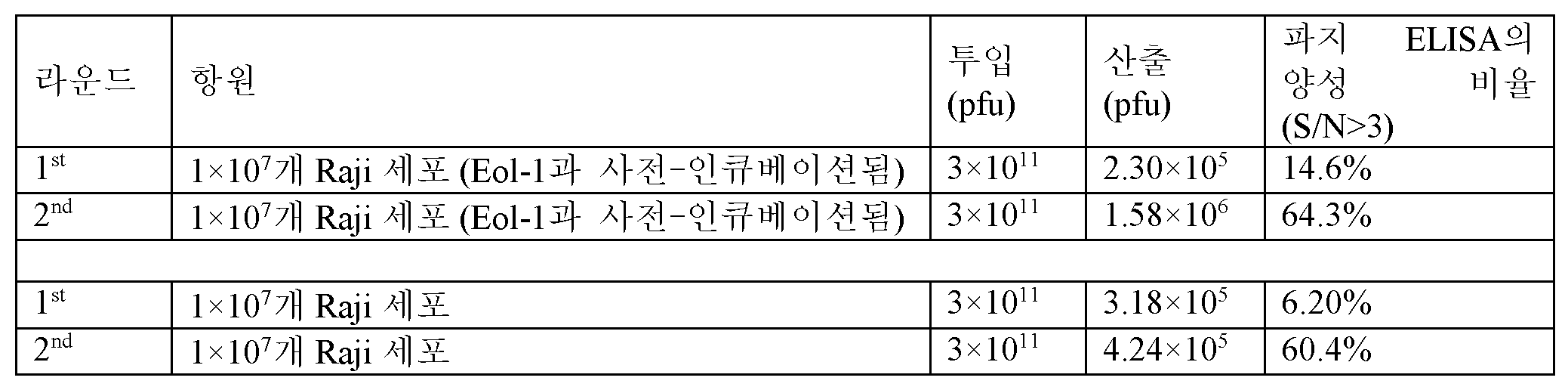
제2 라운드의 양성 비율 (무작위로 골라낸 클론의 총수 대비 항원-특이적 인간화 클론의 수)은 ~40%였다. Raji 및 Eol-1 세포에 대한 세포-기반 ELISA의 결과는 일관되게 관찰되었고, 이어서 유동 세포측정법에 의한 검증이 이루어졌다.The positive rate of the second round (number of antigen-specific humanized clones to the total number of randomly picked clones) was ˜40%. The results of cell-based ELISA on Raji and Eol-1 cells were observed consistently, followed by validation by flow cytometry.
FASEBA 스크리닝FASEBA Screening
제2 산출 파지의 scFv 단편을 코딩하는 DNA를 증폭시키고, 리드 항체의 스크리닝을 위해 pFASEBA 벡터 내로 삽입하였다. 96-딥-웰 플레이트에서 개별 FASEBA 라이브러리 클론을 접종하고, 발현을 유도하였다. FACS 스크리닝을 수행하여 Raji 세포를 특이적으로 인식하는 scFv를 단리하였다.DNA encoding the scFv fragment of the second resulting phage was amplified and inserted into the pFASEBA vector for screening of the read antibody. Individual FASEBA library clones were inoculated in 96-deep-well plates and expression was induced. FACS screening was performed to isolate scFv that specifically recognize Raji cells.
결과에 따라, 7개의 클론 (RS, CS, BS, SS, JS, AS 및 NS로 명명됨)을 발현, 정제 및 친화도 측정을 위해 선택하였다.According to the results, seven clones (named RS, CS, BS, SS, JS, AS and NS) were selected for expression, purification and affinity measurements.
인간화 FMC63 scFv의 발현 및 정제Expression and Purification of Humanized FMC63 scFv
상기 언급된 7개의 인간화 scFv 및 야생형 scFv를 100 ml HEK293 세포에서 발현시키고, NTA-Ni 수지에 의해 정제하였다. 각각의 scFv의 순도는 SDS-PAGE에 의해 평가 시 90% 초과였다.The seven humanized scFv and wild-type scFv mentioned above were expressed in 100 ml HEK293 cells and purified by NTA-Ni resin. The purity of each scFv was greater than 90% as assessed by SDS-PAGE.
인간화 FMC63 scFv의 유동 세포측정 적정Flow cytometry titration of humanized FMC63 scFv
인간화 scFv와 Raji 세포의 결합을 먼저, 사용 중인 3 μM 정제된 항체로 출발하여 FACS에 의해 조사하였다. 2 라운드의 유동 세포측정법 동안 7개의 상기 언급된 인간화 scFv 클론에 대해 양성 결합 신호가 일관되게 관찰되었다.The binding of humanized scFv and Raji cells was first examined by FACS starting with the 3 μM purified antibody in use. Positive binding signals were consistently observed for the seven aforementioned humanized scFv clones during two rounds of flow cytometry.
마지막으로, 이들 7개의 인간화 scFv를 유동 세포측정법에 의한 분석을 위해 선택하였다. 7개의 선택된 인간화 항체의 기하 평균 및 EC50을 도 3a 및 도 3b 및 표 5에 제시하였다. 주목할 것으로, scFv 클론 SS, JS, AS/AS-R, 및 NS의 EC50은 각각 72.76 nM, 65.98 nM, 53.06/61.97 nM 및 34.02 nM로, 야생형 항체의 27.11nM과 대등하였다.Finally, these seven humanized scFvs were selected for analysis by flow cytometry. Geometric mean and
표 5: FACS 적정에 의한 7개의 선택된 인간화 scFv의 기하 평균Table 5: Geometric Means of Seven Selected Humanized scFvs by FACS Titration
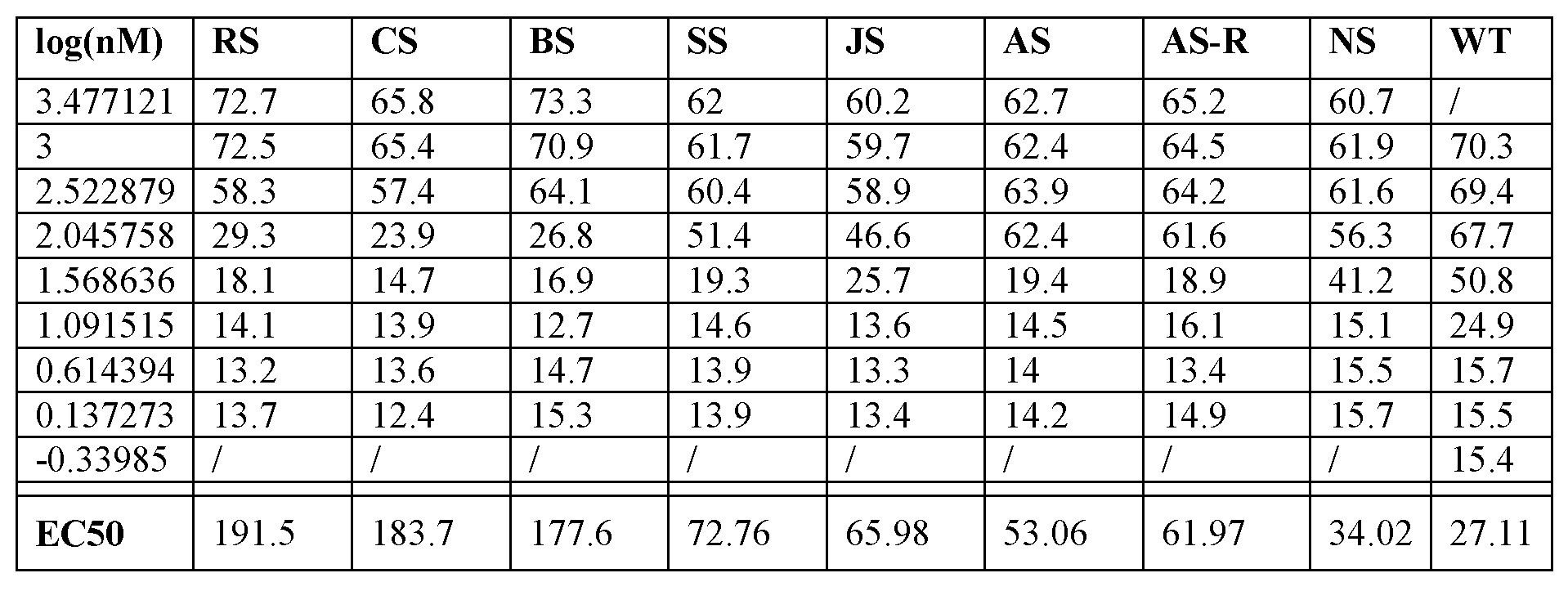
7개의 선택된 scFV 중 4개의 특징화.Characterization of 4 of 7 selected scFVs.
야생형 scFv 및 7개의 선택된 인간화 scFv 중 4개를 코딩하는 뉴클레오티드 서열이 상기 상세한 설명에 기재되어 있다. 마찬가지로, 야생형 scFv 및 7개의 선택된 인간화 scFv 중 4개에 대한 아미노산 서열이 상기 상세한 설명에 기재되어 있다.Nucleotide sequences encoding four of the wild type scFv and seven selected humanized scFvs are described in the detailed description above. Likewise, the amino acid sequences for the wild type scFv and four of the seven selected humanized scFvs are described in the detailed description above.
야생형 scFv에 대해 대등한 결합 EC50을 갖는 4개의 인간화 scFv (SS, JS, AS, 및 NS로 명명된 클론)를 추가의 특징화를 위해 선택하였다.Four humanized scFv (clones named SS, JS, AS, and NS) with comparable binding EC50 for wild type scFv were selected for further characterization.
4개의 클론의 크기-배제 크로마토그래피 (SEC) 분석을 수행하여 scFv가 가용성 응집체를 형성하는 성향을 부분적으로 확인하였다. 도 4a 및 도 4b에 제시된 바와 같이, NS 및 JS 클론은 SEC에서 단일 피크를 나타내고; 따라서, NS 및 JS scFv는 검정 조건에서 응집체를 형성하지 않는다. 다른 한편으로는, 도 4c 및 도 4d에 제시된 바와 같이, SS 및 AS 클론은 SEC에서 이중 피크를 나타내며; 각각의 도면 내의 삽도를 참조한다. 따라서, SS 및 AS scFv는 시험된 조건에서 인지가능한 양의 가용성 응집체를 형성한다.Size-exclusion chromatography (SEC) analysis of four clones was performed to partially confirm the propensity of scFv to form soluble aggregates. As shown in Figures 4A and 4B, NS and JS clones show a single peak in SEC; Thus, NS and JS scFv do not form aggregates under assay conditions. On the other hand, as shown in FIGS. 4C and 4D, the SS and AS clones exhibit a double peak in SEC; See inset in each figure. Thus, SS and AS scFv form an appreciable amount of soluble aggregates under the conditions tested.
결론conclusion
본 실시예에서, 항-CD19 마우스 모노클로날 항체 (mAb) 클론 FMC63은 성공적으로 인간화되었다. 7개의 인간화 scFv를 FASEBA 고처리량 스크리닝 및 파지 디스플레이 기술로부터 수득하였다. 4개의 인간화 scFv (SS, JS, AS, 및 NS로 명명된 클론)는 야생형 FMC63 scFv와 대등한 결합 (EC50 값)을 나타내었다.In this example, anti-CD19 mouse monoclonal antibody (mAb) clone FMC63 was successfully humanized. Seven humanized scFvs were obtained from FASEBA high throughput screening and phage display techniques. Four humanized scFv (clones named SS, JS, AS, and NS) showed comparable binding (EC50 value) with wild type FMC63 scFv.
실시예 2: 각각의 선택된 scFV를 포함하는 키메라 항원 수용체 (CAR)의 특징화Example 2: Characterization of Chimeric Antigen Receptor (CAR) Including Each Selected scFV
4개의 선택된 scFV (SS, JS, AS, 및 NS) 중 하나를 그의 항원 결합 분자로서 발현하는 키메라 항원 수용체 (CAR)를 설계하였다.A chimeric antigen receptor (CAR) was designed that expresses one of four selected scFVs (SS, JS, AS, and NS) as its antigen binding molecule.
열-램핑 검정을 수행하여 CAR 결합 도메인을 포함하는 4개의 scFv의 열안정성을 결정하였다.Heat-lamping assays were performed to determine the thermostability of the four scFvs comprising the CAR binding domain.
증진된 안정성은 단백질의 목적하는 특성이다. 이는 종종 단백질의 용융 온도를 다양한 조건 하에 결정함으로써 평가된다. 보다 높은 용융 온도를 갖는 단백질은 일반적으로 보다 긴 시간 동안 안정하다. CAR이 보다 열안정성인 경우, 이는 세포의 표면 상에서 보다 긴 기간 동안 기능적으로 활성일 수 있다.Enhanced stability is the desired property of the protein. This is often assessed by determining the melting temperature of the protein under various conditions. Proteins with higher melting temperatures are generally stable for longer periods of time. If the CAR is more thermostable, it may be functionally active for a longer period of time on the surface of the cell.
본 발명의 CAR의 결합 도메인을 포함하는 scFv의 열 안정성을 바이오-라드(Bio-Rad) C1000 써멀 사이클러, CFx96 실시간 시스템을 사용하여 측정하였다. 단백질이 언폴딩됨에 따라 노출되는 소수성 아미노산에 결합하는 형광 염료 SYPRO® 오렌지 (인비트로젠(Invitrogen))를 사용하여 단백질의 언폴딩을 모니터링하였다. 온도 구배는 25℃에서 95℃까지 1℃ /분의 단계적 증분으로 설정하였다. 각각의 샘플은 10 μM의 CAR scFv 및 5X SYPRO® 오렌지 단백질 겔 염색 (몰레큘라 프로브스(Molecular Probes)™; DMSO 중 5,000X 농축)을 함유하였다. 50 mM NaCl이 도 5a에 제시된 샘플에 포함되었다.The thermal stability of the scFv comprising the binding domain of the CAR of the present invention was measured using a Bio-Rad C1000 thermal cycler, CFx96 real time system. Unfolding of the protein was monitored using the fluorescent dye SYPRO® Orange (Invitrogen), which binds to the hydrophobic amino acids exposed as the protein is unfolded. The temperature gradient was set in increments of 1 ° C./min from 25 ° C. to 95 ° C. Each sample contained 10 μM of CAR scFv and 5X SYPRO® Orange Protein Gel Staining (Molecular Probes ™; 5,000 × Concentration in DMSO). 50 mM NaCl was included in the sample shown in FIG. 5A.
본 검정에서, CAR에 대한 허용되는 용융 온도는 이상적으로는 60℃를 초과하였다.In this assay, the acceptable melting temperature for the CAR ideally exceeded 60 ° C.
도 5a에 제시된 바와 같이, 인간화 scFv를 포함하는 CAR은 50 mM NaCl의 존재 하에 다양한 열안정성을 나타내었고, NaCl이 생략된 경우에는 거의 차이가 없었다 (도 5b에 제시된 바와 같음). 또한, 본 발명의 CAR의 scFv는 다른 CAR에서 사용된 다른 연구된 scFv에 비해 매우 안정하였다. AS ("□") scFv는 약 58℃의 최저 용융 온도를 가졌고; SS 클론 ("△"; 65℃), JS 클론 ("◇"; 67℃), 및 NS 클론 ("X"; 73℃)의 scFV에 대해 용융 온도 증가가 관찰되었다.As shown in FIG. 5A, the CAR comprising humanized scFv showed various thermostability in the presence of 50 mM NaCl, with little difference when NaCl was omitted (as shown in FIG. 5B). In addition, the scFv of the CAR of the present invention was very stable compared to other studied scFv used in other CARs. AS (“□”) scFv had a minimum melt temperature of about 58 ° C .; An increase in melting temperature was observed for the scFV of SS clones (“Δ”; 65 ° C.), JS clones (“◇”; 67 ° C.), and NS clones (“X”; 73 ° C.).
2개의 세포주에서의 CAR 발현CAR expression in two cell lines
SS-, JS-, AS-, 및 NS-scFv-포함 CAR을 2개의 T 세포 공여자 세포: 5244 (도 6a) 및 5273 (도 6b)에서 발현시켰다. 모의-CAR 발현 공여자 세포 샘플 및 FMC63 (모) scFV를 포함하는 CAR을 발현하는 공여자 세포를 또한 제조하였다.SS-, JS-, AS-, and NS-scFv-containing CARs were expressed in two T cell donor cells: 5244 (FIG. 6A) and 5273 (FIG. 6B). Donor cells expressing a CAR comprising a mock-CAR expressing donor cell sample and FMC63 (parent) scFV were also prepared.
세포를 PE-접합된 항-CAR-항체와 함께 인큐베이션하는 것에 의해 공여자 세포의 표면 상에서 CAR이 검출되었다. 유동 세포측정법에 의해 CAR 양성의 백분율 및 형광 강도를 측정하였다.CARs were detected on the surface of donor cells by incubating the cells with PE-conjugated anti-CAR-antibodies. Percentage of CAR positive and fluorescence intensity were determined by flow cytometry.
도 6a 및 도 6b는 CAR이 모의-형질도입된 T 세포에서 발현되지 않았음을 보여준다. 어느 하나의 공여자의 세포에서, 다른 3개의 선택된 인간화 scFv 클론보다 더 많은 SS CAR이 발현되었고; AS CAR이 가장 적은 양으로 발현되었다.6A and 6B show that CAR was not expressed in mock-transduced T cells. In the cells of either donor, more SS CARs were expressed than the other three selected humanized scFv clones; AS CAR was expressed in the least amount.
실시예 3: 선택된 scFV를 각각 포함하는 CAR은 종양 세포를 선택적으로 사멸시킨다Example 3: CARs Containing Each of the Selected scFVs selectively Kill Tumor Cells
공여자 5244 (도 7a 내지 7d) 또는 5273 (도 8a 내지 8d)으로부터의 CAR- 또는 모의-형질도입된 T 세포를 표적 세포주에 1:1 또는 4:1의 이펙터 대 표적 비로 첨가하였다. 4종의 표적 세포 유형을 사용하였다: Raji (CD19+ 호모 사피엔스 버킷 림프종 세포; 도 7a 및 도 8a), 나말바 (CD19+ 호모 사피엔스 버킷 림프종 세포; 도 7b 및 도 8b), Eol-1 (CD19- 호모 사피엔스 급성 골수성 (호산구성) 백혈병 세포; 도 7c 및 도 8c), 및 Mv411 (CD19- 호모 사피엔스 이중표현형 B 골수단핵구성 백혈병 세포; 도 7d 및 도 8d). 스타우로스포린 ("Stauro")을 종양 세포 사멸에 대한 양성 대조군으로서 사용하였다.CAR- or mock-transduced T cells from donor 5244 (FIGS. 7A-7D) or 5273 (FIGS. 8A-8D) were added to a target cell line at an effector to target ratio of 1: 1 or 4: 1. Four target cell types were used: Raji (CD19 + Homo sapiens Burkitt's lymphoma cells; FIGS. 7A and 8A), Namalba (CD19 + Homo sapiens Burkitt's lymphoma cells; FIGS. 7B and 8B), Eol-1 (CD19 − Homo Sapiens acute myeloid (eosinophilic) leukemia cells; FIGS. 7C and 8C), and Mv411 (CD19 - Homo sapiens dual phenotype B osteosarcoma leukemia cell; FIGS. 7D and 8D). Staurosporin ("Stauro") was used as a positive control for tumor cell death.
37℃에서 18시간 동안 공동-배양한 후, R10 배지 중 스테디-글로 루시페린 시약 50 μL를 각 웰에 첨가하고, 플레이트를 37℃에서 10분 동안 인큐베이션하였다. 루시페라제 활성을 세포 생존율의 척도로서 사용하였다. 발광을 바리오스칸 플래쉬(Varioskan Flash) 플레이트 판독기에서 판독하였다.After co-incubation at 37 ° C. for 18 hours, 50 μL of Steady-Glo Luciferin Reagent in R10 medium was added to each well and the plate was incubated at 37 ° C. for 10 minutes. Luciferase activity was used as a measure of cell viability. Luminescence was read on a Varioskan Flash plate reader.
도 7a-7d 및 8a-8d는 표적 세포와 함께 인큐베이션된 CAR-형질도입된 공여자 세포에 대해 측정된 발광을 보여준다. 본 발명의 CAR 각각은 CD19+ 표적 세포를 사멸시킬 수 있다.7A-7D and 8A-8D show luminescence measured on CAR-transduced donor cells incubated with target cells. Each of the CARs of the invention can kill CD19 + target cells.
추가의 공여자로부터의 CAR- 또는 모의-형질도입된 T 세포의 성장 동역학을 OKT3에 의한 초기 자극 후 10일에 걸쳐 측정하였다. 각각의 CAR에 대해 관찰된 성장 프로파일을 도 9a에 제시한다. 이어서, CAR- 또는 모의-형질도입된 T 세포를 두번째 자극하였고, 도 9b에 제시된 바와 같이 성장 동역학에서 차이가 관찰되었다. 제10일에, 항-CAR 항체 및 CD3을 사용하여 T 세포 집단의 특징화를 수행하였다 (도 10a). CD4/CD8 염색을 또한 수행하여 도 10b에 제시된 CAR T 세포 생산 동안 CD8 세포의 풍부화를 모니터링하였다. 세포독성 검정은 CD19+ 나말바 (도 11a) 또는 CD19- EOL-1 (도 11b)에 대해 1:1의 이펙터 대 표적 비로 수행하였다.Growth kinetics of CAR- or mock-transduced T cells from additional donors were measured over 10 days after initial stimulation with OKT3. The growth profile observed for each CAR is shown in FIG. 9A. Subsequently, CAR- or mock-transduced T cells were stimulated second, and differences in growth kinetics were observed as shown in FIG. 9B. On
SEQUENCE LISTING <110> Kite Pharma, Inc. Wiltzius, Jed J.W. Sievers, Stuart A. <120> HUMANIZED ANTIGEN-BINDING DOMAINS AND METHODS OF USE <130> K-1046.01 <160> 37 <170> PatentIn version 3.5 <210> 1 <211> 816 <212> DNA <213> Artificial Sequence <220> <223> Synthetic Polynucleotide <400> 1 atggaatgga cctgggtgtt cctgttcctg ctgagcgtga cagccggcgt gcactctgac 60 atccaaatga cgcaaacgac ctcaagtctg tccgcgagcc tgggcgaccg tgttacgatt 120 agctgccgtg cttcacaaga tatcagtaaa tacctgaact ggtatcagca aaaaccggat 180 ggtaccgtta aactgctgat ctatcatacg tctcgtctgc acagtggcgt cccgtcccgc 240 tttagcggtt ctggcagtgg taccgattat tcactgacga tttcgaacct ggaacaggaa 300 gacatcgcga cctacttttg ccagcaaggt aataccctgc cgtatacgtt cggcggtggc 360 accaaactgg aaatcaccgg ctccacgtca ggctcgggta aaccgggcag cggtgaaggc 420 tctaccaaag gtgaagtcaa actgcaggaa agcggtccgg gtctggtcgc accgagccaa 480 tctctgagtg tgacctgtac ggtgtcgggt gttagcctgc cggattacgg cgtgtcatgg 540 attcgtcagc cgccgcgtaa aggtctggaa tggctgggtg ttatctgggg ctcggaaacc 600 acgtattaca atagtgcact gaaatcccgt ctgaccatta tcaaagacaa ctccaaatca 660 caggttttcc tgaaaatgaa cagcctgcaa accgatgaca cggcgatcta ttactgcgcc 720 aaacattatt actatggtgg ctcttatgct atggattatt ggggtcaagg cacctcggtt 780 acggtctcgt cacatcatca tcatcatcat tgataa 816 <210> 2 <211> 816 <212> DNA <213> Artificial Sequence <220> <223> Synthetic Polynucleotide <400> 2 atggaatgga cctgggtgtt cctgttcctg ctgagcgtga cagccggcgt gcactctgac 60 atccaaatga cccagtcgcc gtcctttctg agcgcaagcg tcggtgaccg tgttacgatt 120 acctgccgtg ccagccaaga catctctaaa tacctgaact ggtatcagca aaaaccggat 180 caggcaccga aactgctgat caaacatacc tcacgtctgc actcgggtgt cccgagccgc 240 tttagtggtt ccggctcagg taccgatttt accttcacga ttagctctct gcagccggaa 300 gacatcgcca cgtattactg ccagcaaggt aataccctgc cgtacacgtt cggccaaggt 360 accaaactgg aaatcaaagg ctcgacgagc ggctctggta aaccgggctc tggtgaaggc 420 agtaccaaag gtgaagtgca gctggttgaa agcggtggtg gtctggttca accgggtcgt 480 tccctgcgtc tgtcatgtac ggcgagtggt gtctccctgc cggactatgg cgtctcctgg 540 gtgcgtcagc cgccgggtaa aggtctggaa tggattggtg tgatctgggg cagtgaaacc 600 acgtattaca actcggccct gaaaagccgt tttaccattt ctcgcgataa cagtaaaaat 660 acgctgtacc tgcagatgaa tagcctgcgc gcggaagaca ccgccgttta ctactgcgca 720 aaacattact actacggtgg cagctatgct atggactact ggggtcaggg cacgctggtt 780 acggtgtcgt cacatcatca tcatcatcat tgataa 816 <210> 3 <211> 816 <212> DNA <213> Artificial Sequence <220> <223> Synthetic Polynucleotide <400> 3 atggaatgga cctgggtgtt cctgttcctg ctgagcgtga cagccggcgt gcactctgat 60 attcaaatga cccagtcccc gtcctccctg agtgcctccg tcggtgaccg tgttacgatt 120 acctgccgtg cgagccaaga catctctaaa tacctgaact ggtatcagca aaaaccggat 180 caggcaccga aactgctgat caaacatacc tcacgtctgc actcgggtgt gccgagccgc 240 tttagtggtt ccggctcagg taccgattac accctgacga tcagctctct gcagccggaa 300 gactttgcca cgtattactg ccagcaaggt aataccctgc cgtatacgtt cggccaaggt 360 accaaactgg aaatcaaagg ctcgacgagc ggctctggta aaccgggctc tggtgaaggc 420 agtaccaaag gtgaagtgca gctggttgaa agcggtggtg gtctggttca accgggtcgt 480 tccctgcgtc tgtcatgtac ggcgagtggt gtctccctgc cggactatgg cgtgtcctgg 540 attcgtcagc cgccgggtaa aggcctggaa tggattggtg tcatctgggg cagtgaaacc 600 acgtattaca actcggccct gaaaagccgt ttcaccatct ctcgcgataa cagtaaaaat 660 acgctgtacc tgcagatgaa tagcctgcgc gcggaagaca ccgccgttta ctactgcgca 720 aaacattact actacggtgg cagctatgct atggattact ggggtcaagg cacgctggtc 780 accgtttcgt cacatcatca tcatcatcat tgataa 816 <210> 4 <211> 650 <212> DNA <213> Artificial Sequence <220> <223> Synthetic Polynucleotide <400> 4 atggaatgga cctgggtgtt cctgttcctg ctgagcgtga cagccggcgt gcactctgac 60 attcagatga cgcaaagtcc gagtccggtt caggcaccga ttttaccttc acgattagct 120 ctctgcaacc ggaagacatc gccacgtatt actgccagca aggcaatacc ctgccgtaca 180 cgttcggtca gggcaccaaa ctggaaatca aaggttcgac gagcggttct ggcaaaccgg 240 gttctggcga aggtagtacc aaaggccagg tccaactgca ggaaagcggc ccgggtctgg 300 tgaaaccgtc cggtaccctg tcactgacgt gtgcggtgag tggcgtttcc ctgccggact 360 atggtgtttc ctggattcgt caaccgccgg gcaaaggtct ggaatggatt ggcgtcatct 420 ggggtagtga aaccacgtat tacaactcgg ccctgaaaag ccgtgtgacc atctctcgcg 480 ataacagtaa aaatacgctg tacctgcaga tgaatagcct gcgcgcggaa gacaccgccg 540 tttactactg cgcaaaacat tactactacg gcggtagcta tgctatggat tactggggtc 600 aaggcacgct ggttacggtt tcctcgcatc atcatcatca tcactgataa 650 <210> 5 <211> 816 <212> DNA <213> Artificial Sequence <220> <223> Synthetic Polynucleotide <400> 5 atggaatgga cctgggtgtt cctgttcctg ctgagcgtga cagccggcgt gcactctgac 60 attcagatga cacagagccc ttcttccctg agcgccagcg tcggagatag agtgaccatt 120 acttgtagag ccagccagga catttccaaa tacctgaact ggtatcagca gaagcccggg 180 aaagctgtga agctgctgat ctaccacacc tctcggctgc atagtggagt cccttcaaga 240 ttctcaggca gcgggtccgg aactgactat actctgacca tcagctccct gcagcctgag 300 gatattgcaa cctacttctg ccagcagggc aataccctgc catatacatt tggcggggga 360 accaaactgg agattaaggg gtctacaagt ggctcaggga aaccaggaag cggcgaaggg 420 tccacaaagg gccaggtgca gctgcaggag tctggaccag gcctggtgaa gccctctgaa 480 actctgagtg tcacatgtac tgtgagcgga gtctccctgc ccgactacgg cgtgagttgg 540 atcaggcagc cccctgggaa aggactggag tggctgggcg tcatttgggg gagcgaaacc 600 acatactata actcagccct gaagagccgg ctgacaatct ccaaagacac ttctaagaat 660 caggtgtttc tgaaaatgtc tagtctgact gccgctgata ccgcaatcta ctattgcgcc 720 aagcactact attacggcgg ctcctatgct atggattatt gggggcaggg gactctggtc 780 actgtctcaa gccatcatca tcatcatcat tgataa 816 <210> 6 <211> 19 <212> PRT <213> Artificial Sequence <220> <223> Synthetic Polypeptide <400> 6 Met Glu Trp Thr Trp Val Phe Leu Phe Leu Leu Ser Val Thr Ala Gly 1 5 10 15 Val His Ser <210> 7 <211> 18 <212> PRT <213> Artificial Sequence <220> <223> Synthetic Polypeptide <400> 7 Gly Ser Thr Ser Gly Ser Gly Lys Pro Gly Ser Gly Glu Gly Ser Thr 1 5 10 15 Lys Gly <210> 8 <211> 6 <212> PRT <213> Artificial Sequence <220> <223> Synthetic Polypeptide <400> 8 His His His His His His 1 5 <210> 9 <211> 270 <212> PRT <213> Artificial Sequence <220> <223> Synthetic Polypeptide <400> 9 Met Glu Trp Thr Trp Val Phe Leu Phe Leu Leu Ser Val Thr Ala Gly 1 5 10 15 Val His Ser Asp Ile Gln Met Thr Gln Thr Thr Ser Ser Leu Ser Ala 20 25 30 Ser Leu Gly Asp Arg Val Thr Ile Ser Cys Arg Ala Ser Gln Asp Ile 35 40 45 Ser Lys Tyr Leu Asn Trp Tyr Gln Gln Lys Pro Asp Gly Thr Val Lys 50 55 60 Leu Leu Ile Tyr His Thr Ser Arg Leu His Ser Gly Val Pro Ser Arg 65 70 75 80 Phe Ser Gly Ser Gly Ser Gly Thr Asp Tyr Ser Leu Thr Ile Ser Asn 85 90 95 Leu Glu Gln Glu Asp Ile Ala Thr Tyr Phe Cys Gln Gln Gly Asn Thr 100 105 110 Leu Pro Tyr Thr Phe Gly Gly Gly Thr Lys Leu Glu Ile Thr Gly Ser 115 120 125 Thr Ser Gly Ser Gly Lys Pro Gly Ser Gly Glu Gly Ser Thr Lys Gly 130 135 140 Glu Val Lys Leu Gln Glu Ser Gly Pro Gly Leu Val Ala Pro Ser Gln 145 150 155 160 Ser Leu Ser Val Thr Cys Thr Val Ser Gly Val Ser Leu Pro Asp Tyr 165 170 175 Gly Val Ser Trp Ile Arg Gln Pro Pro Arg Lys Gly Leu Glu Trp Leu 180 185 190 Gly Val Ile Trp Gly Ser Glu Thr Thr Tyr Tyr Asn Ser Ala Leu Lys 195 200 205 Ser Arg Leu Thr Ile Ile Lys Asp Asn Ser Lys Ser Gln Val Phe Leu 210 215 220 Lys Met Asn Ser Leu Gln Thr Asp Asp Thr Ala Ile Tyr Tyr Cys Ala 225 230 235 240 Lys His Tyr Tyr Tyr Gly Gly Ser Tyr Ala Met Asp Tyr Trp Gly Gln 245 250 255 Gly Thr Ser Val Thr Val Ser Ser His His His His His His 260 265 270 <210> 10 <211> 270 <212> PRT <213> Artificial Sequence <220> <223> Synthetic Polypeptide <400> 10 Met Glu Trp Thr Trp Val Phe Leu Phe Leu Leu Ser Val Thr Ala Gly 1 5 10 15 Val His Ser Asp Ile Gln Met Thr Gln Ser Pro Ser Phe Leu Ser Ala 20 25 30 Ser Val Gly Asp Arg Val Thr Ile Thr Cys Arg Ala Ser Gln Asp Ile 35 40 45 Ser Lys Tyr Leu Asn Trp Tyr Gln Gln Lys Pro Asp Gln Ala Pro Lys 50 55 60 Leu Leu Ile Lys His Thr Ser Arg Leu His Ser Gly Val Pro Ser Arg 65 70 75 80 Phe Ser Gly Ser Gly Ser Gly Thr Asp Phe Thr Phe Thr Ile Ser Ser 85 90 95 Leu Gln Pro Glu Asp Ile Ala Thr Tyr Tyr Cys Gln Gln Gly Asn Thr 100 105 110 Leu Pro Tyr Thr Phe Gly Gln Gly Thr Lys Leu Glu Ile Lys Gly Ser 115 120 125 Thr Ser Gly Ser Gly Lys Pro Gly Ser Gly Glu Gly Ser Thr Lys Gly 130 135 140 Glu Val Gln Leu Val Glu Ser Gly Gly Gly Leu Val Gln Pro Gly Arg 145 150 155 160 Ser Leu Arg Leu Ser Cys Thr Ala Ser Gly Val Ser Leu Pro Asp Tyr 165 170 175 Gly Val Ser Trp Val Arg Gln Pro Pro Gly Lys Gly Leu Glu Trp Ile 180 185 190 Gly Val Ile Trp Gly Ser Glu Thr Thr Tyr Tyr Asn Ser Ala Leu Lys 195 200 205 Ser Arg Phe Thr Ile Ser Arg Asp Asn Ser Lys Asn Thr Leu Tyr Leu 210 215 220 Gln Met Asn Ser Leu Arg Ala Glu Asp Thr Ala Val Tyr Tyr Cys Ala 225 230 235 240 Lys His Tyr Tyr Tyr Gly Gly Ser Tyr Ala Met Asp Tyr Trp Gly Gln 245 250 255 Gly Thr Leu Val Thr Val Ser Ser His His His His His His 260 265 270 <210> 11 <211> 107 <212> PRT <213> Artificial Sequence <220> <223> Synthetic Polypeptide <400> 11 Asp Ile Gln Met Thr Gln Ser Pro Ser Phe Leu Ser Ala Ser Val Gly 1 5 10 15 Asp Arg Val Thr Ile Thr Cys Arg Ala Ser Gln Asp Ile Ser Lys Tyr 20 25 30 Leu Asn Trp Tyr Gln Gln Lys Pro Asp Gln Ala Pro Lys Leu Leu Ile 35 40 45 Lys His Thr Ser Arg Leu His Ser Gly Val Pro Ser Arg Phe Ser Gly 50 55 60 Ser Gly Ser Gly Thr Asp Phe Thr Phe Thr Ile Ser Ser Leu Gln Pro 65 70 75 80 Glu Asp Ile Ala Thr Tyr Tyr Cys Gln Gln Gly Asn Thr Leu Pro Tyr 85 90 95 Thr Phe Gly Gln Gly Thr Lys Leu Glu Ile Lys 100 105 <210> 12 <211> 120 <212> PRT <213> Artificial Sequence <220> <223> Synthetic Polypeptide <400> 12 Glu Val Gln Leu Val Glu Ser Gly Gly Gly Leu Val Gln Pro Gly Arg 1 5 10 15 Ser Leu Arg Leu Ser Cys Thr Ala Ser Gly Val Ser Leu Pro Asp Tyr 20 25 30 Gly Val Ser Trp Val Arg Gln Pro Pro Gly Lys Gly Leu Glu Trp Ile 35 40 45 Gly Val Ile Trp Gly Ser Glu Thr Thr Tyr Tyr Asn Ser Ala Leu Lys 50 55 60 Ser Arg Phe Thr Ile Ser Arg Asp Asn Ser Lys Asn Thr Leu Tyr Leu 65 70 75 80 Gln Met Asn Ser Leu Arg Ala Glu Asp Thr Ala Val Tyr Tyr Cys Ala 85 90 95 Lys His Tyr Tyr Tyr Gly Gly Ser Tyr Ala Met Asp Tyr Trp Gly Gln 100 105 110 Gly Thr Leu Val Thr Val Ser Ser 115 120 <210> 13 <211> 270 <212> PRT <213> Artificial Sequence <220> <223> Synthetic Polypeptide <400> 13 Met Glu Trp Thr Trp Val Phe Leu Phe Leu Leu Ser Val Thr Ala Gly 1 5 10 15 Val His Ser Asp Ile Gln Met Thr Gln Ser Pro Ser Ser Leu Ser Ala 20 25 30 Ser Val Gly Asp Arg Val Thr Ile Thr Cys Arg Ala Ser Gln Asp Ile 35 40 45 Ser Lys Tyr Leu Asn Trp Tyr Gln Gln Lys Pro Asp Gln Ala Pro Lys 50 55 60 Leu Leu Ile Lys His Thr Ser Arg Leu His Ser Gly Val Pro Ser Arg 65 70 75 80 Phe Ser Gly Ser Gly Ser Gly Thr Asp Tyr Thr Leu Thr Ile Ser Ser 85 90 95 Leu Gln Pro Glu Asp Phe Ala Thr Tyr Tyr Cys Gln Gln Gly Asn Thr 100 105 110 Leu Pro Tyr Thr Phe Gly Gln Gly Thr Lys Leu Glu Ile Lys Gly Ser 115 120 125 Thr Ser Gly Ser Gly Lys Pro Gly Ser Gly Glu Gly Ser Thr Lys Gly 130 135 140 Glu Val Gln Leu Val Glu Ser Gly Gly Gly Leu Val Gln Pro Gly Arg 145 150 155 160 Ser Leu Arg Leu Ser Cys Thr Ala Ser Gly Val Ser Leu Pro Asp Tyr 165 170 175 Gly Val Ser Trp Ile Arg Gln Pro Pro Gly Lys Gly Leu Glu Trp Ile 180 185 190 Gly Val Ile Trp Gly Ser Glu Thr Thr Tyr Tyr Asn Ser Ala Leu Lys 195 200 205 Ser Arg Phe Thr Ile Ser Arg Asp Asn Ser Lys Asn Thr Leu Tyr Leu 210 215 220 Gln Met Asn Ser Leu Arg Ala Glu Asp Thr Ala Val Tyr Tyr Cys Ala 225 230 235 240 Lys His Tyr Tyr Tyr Gly Gly Ser Tyr Ala Met Asp Tyr Trp Gly Gln 245 250 255 Gly Thr Leu Val Thr Val Ser Ser His His His His His His 260 265 270 <210> 14 <211> 107 <212> PRT <213> Artificial Sequence <220> <223> Synthetic Polypeptide <400> 14 Asp Ile Gln Met Thr Gln Ser Pro Ser Ser Leu Ser Ala Ser Val Gly 1 5 10 15 Asp Arg Val Thr Ile Thr Cys Arg Ala Ser Gln Asp Ile Ser Lys Tyr 20 25 30 Leu Asn Trp Tyr Gln Gln Lys Pro Asp Gln Ala Pro Lys Leu Leu Ile 35 40 45 Lys His Thr Ser Arg Leu His Ser Gly Val Pro Ser Arg Phe Ser Gly 50 55 60 Ser Gly Ser Gly Thr Asp Tyr Thr Leu Thr Ile Ser Ser Leu Gln Pro 65 70 75 80 Glu Asp Phe Ala Thr Tyr Tyr Cys Gln Gln Gly Asn Thr Leu Pro Tyr 85 90 95 Thr Phe Gly Gln Gly Thr Lys Leu Glu Ile Lys 100 105 <210> 15 <211> 120 <212> PRT <213> Artificial Sequence <220> <223> Synthetic Polypeptide <400> 15 Glu Val Gln Leu Val Glu Ser Gly Gly Gly Leu Val Gln Pro Gly Arg 1 5 10 15 Ser Leu Arg Leu Ser Cys Thr Ala Ser Gly Val Ser Leu Pro Asp Tyr 20 25 30 Gly Val Ser Trp Ile Arg Gln Pro Pro Gly Lys Gly Leu Glu Trp Ile 35 40 45 Gly Val Ile Trp Gly Ser Glu Thr Thr Tyr Tyr Asn Ser Ala Leu Lys 50 55 60 Ser Arg Phe Thr Ile Ser Arg Asp Asn Ser Lys Asn Thr Leu Tyr Leu 65 70 75 80 Gln Met Asn Ser Leu Arg Ala Glu Asp Thr Ala Val Tyr Tyr Cys Ala 85 90 95 Lys His Tyr Tyr Tyr Gly Gly Ser Tyr Ala Met Asp Tyr Trp Gly Gln 100 105 110 Gly Thr Leu Val Thr Val Ser Ser 115 120 <210> 16 <211> 270 <212> PRT <213> Artificial Sequence <220> <223> Synthetic Polypeptide <400> 16 Met Glu Trp Thr Trp Val Phe Leu Phe Leu Leu Ser Val Thr Ala Gly 1 5 10 15 Val His Ser Asp Ile Gln Met Thr Gln Ser Pro Ser Thr Leu Ser Ala 20 25 30 Ser Val Gly Asp Arg Val Thr Ile Thr Cys Arg Ala Ser Gln Asp Ile 35 40 45 Ser Lys Tyr Leu Asn Trp Tyr Gln Gln Lys Pro Asp Gln Ala Pro Lys 50 55 60 Leu Leu Ile Lys His Thr Ser Arg Leu His Ser Gly Val Pro Ser Arg 65 70 75 80 Phe Ser Gly Ser Gly Ser Gly Thr Asp Phe Thr Phe Thr Ile Ser Ser 85 90 95 Leu Gln Pro Glu Asp Ile Ala Thr Tyr Tyr Cys Gln Gln Gly Asn Thr 100 105 110 Leu Pro Tyr Thr Phe Gly Gln Gly Thr Lys Leu Glu Ile Lys Gly Ser 115 120 125 Thr Ser Gly Ser Gly Lys Pro Gly Ser Gly Glu Gly Ser Thr Lys Gly 130 135 140 Gln Val Gln Leu Gln Glu Ser Gly Pro Gly Leu Val Lys Pro Ser Gly 145 150 155 160 Thr Leu Ser Leu Thr Cys Ala Val Ser Gly Val Ser Leu Pro Asp Tyr 165 170 175 Gly Val Ser Trp Ile Arg Gln Pro Pro Gly Lys Gly Leu Glu Trp Ile 180 185 190 Gly Val Ile Trp Gly Ser Glu Thr Thr Tyr Tyr Asn Ser Ala Leu Lys 195 200 205 Ser Arg Val Thr Ile Ser Arg Asp Asn Ser Lys Asn Thr Leu Tyr Leu 210 215 220 Gln Met Asn Ser Leu Arg Ala Glu Asp Thr Ala Val Tyr Tyr Cys Ala 225 230 235 240 Lys His Tyr Tyr Tyr Gly Gly Ser Tyr Ala Met Asp Tyr Trp Gly Gln 245 250 255 Gly Thr Leu Val Thr Val Ser Ser His His His His His His 260 265 270 <210> 17 <211> 107 <212> PRT <213> Artificial Sequence <220> <223> Synthetic Polypeptide <400> 17 Asp Ile Gln Met Thr Gln Ser Pro Ser Thr Leu Ser Ala Ser Val Gly 1 5 10 15 Asp Arg Val Thr Ile Thr Cys Arg Ala Ser Gln Asp Ile Ser Lys Tyr 20 25 30 Leu Asn Trp Tyr Gln Gln Lys Pro Asp Gln Ala Pro Lys Leu Leu Ile 35 40 45 Lys His Thr Ser Arg Leu His Ser Gly Val Pro Ser Arg Phe Ser Gly 50 55 60 Ser Gly Ser Gly Thr Asp Phe Thr Phe Thr Ile Ser Ser Leu Gln Pro 65 70 75 80 Glu Asp Ile Ala Thr Tyr Tyr Cys Gln Gln Gly Asn Thr Leu Pro Tyr 85 90 95 Thr Phe Gly Gln Gly Thr Lys Leu Glu Ile Lys 100 105 <210> 18 <211> 120 <212> PRT <213> Artificial Sequence <220> <223> Synthetic Polypeptide <400> 18 Gln Val Gln Leu Gln Glu Ser Gly Pro Gly Leu Val Lys Pro Ser Gly 1 5 10 15 Thr Leu Ser Leu Thr Cys Ala Val Ser Gly Val Ser Leu Pro Asp Tyr 20 25 30 Gly Val Ser Trp Ile Arg Gln Pro Pro Gly Lys Gly Leu Glu Trp Ile 35 40 45 Gly Val Ile Trp Gly Ser Glu Thr Thr Tyr Tyr Asn Ser Ala Leu Lys 50 55 60 Ser Arg Val Thr Ile Ser Arg Asp Asn Ser Lys Asn Thr Leu Tyr Leu 65 70 75 80 Gln Met Asn Ser Leu Arg Ala Glu Asp Thr Ala Val Tyr Tyr Cys Ala 85 90 95 Lys His Tyr Tyr Tyr Gly Gly Ser Tyr Ala Met Asp Tyr Trp Gly Gln 100 105 110 Gly Thr Leu Val Thr Val Ser Ser 115 120 <210> 19 <211> 270 <212> PRT <213> Artificial Sequence <220> <223> Synthetic Polypeptide <400> 19 Met Glu Trp Thr Trp Val Phe Leu Phe Leu Leu Ser Val Thr Ala Gly 1 5 10 15 Val His Ser Asp Ile Gln Met Thr Gln Ser Pro Ser Ser Leu Ser Ala 20 25 30 Ser Val Gly Asp Arg Val Thr Ile Thr Cys Arg Ala Ser Gln Asp Ile 35 40 45 Ser Lys Tyr Leu Asn Trp Tyr Gln Gln Lys Pro Gly Lys Ala Val Lys 50 55 60 Leu Leu Ile Tyr His Thr Ser Arg Leu His Ser Gly Val Pro Ser Arg 65 70 75 80 Phe Ser Gly Ser Gly Ser Gly Thr Asp Tyr Thr Leu Thr Ile Ser Ser 85 90 95 Leu Gln Pro Glu Asp Ile Ala Thr Tyr Phe Cys Gln Gln Gly Asn Thr 100 105 110 Leu Pro Tyr Thr Phe Gly Gly Gly Thr Lys Leu Glu Ile Lys Gly Ser 115 120 125 Thr Ser Gly Ser Gly Lys Pro Gly Ser Gly Glu Gly Ser Thr Lys Gly 130 135 140 Gln Val Gln Leu Gln Glu Ser Gly Pro Gly Leu Val Lys Pro Ser Glu 145 150 155 160 Thr Leu Ser Val Thr Cys Thr Val Ser Gly Val Ser Leu Pro Asp Tyr 165 170 175 Gly Val Ser Trp Ile Arg Gln Pro Pro Gly Lys Gly Leu Glu Trp Leu 180 185 190 Gly Val Ile Trp Gly Ser Glu Thr Thr Tyr Tyr Asn Ser Ala Leu Lys 195 200 205 Ser Arg Leu Thr Ile Ser Lys Asp Thr Ser Lys Asn Gln Val Phe Leu 210 215 220 Lys Met Ser Ser Leu Thr Ala Ala Asp Thr Ala Ile Tyr Tyr Cys Ala 225 230 235 240 Lys His Tyr Tyr Tyr Gly Gly Ser Tyr Ala Met Asp Tyr Trp Gly Gln 245 250 255 Gly Thr Leu Val Thr Val Ser Ser His His His His His His 260 265 270 <210> 20 <211> 107 <212> PRT <213> Artificial Sequence <220> <223> Synthetic Polypeptide <400> 20 Asp Ile Gln Met Thr Gln Ser Pro Ser Ser Leu Ser Ala Ser Val Gly 1 5 10 15 Asp Arg Val Thr Ile Thr Cys Arg Ala Ser Gln Asp Ile Ser Lys Tyr 20 25 30 Leu Asn Trp Tyr Gln Gln Lys Pro Gly Lys Ala Val Lys Leu Leu Ile 35 40 45 Tyr His Thr Ser Arg Leu His Ser Gly Val Pro Ser Arg Phe Ser Gly 50 55 60 Ser Gly Ser Gly Thr Asp Tyr Thr Leu Thr Ile Ser Ser Leu Gln Pro 65 70 75 80 Glu Asp Ile Ala Thr Tyr Phe Cys Gln Gln Gly Asn Thr Leu Pro Tyr 85 90 95 Thr Phe Gly Gly Gly Thr Lys Leu Glu Ile Lys 100 105 <210> 21 <211> 120 <212> PRT <213> Artificial Sequence <220> <223> Synthetic Polypeptide <400> 21 Gln Val Gln Leu Gln Glu Ser Gly Pro Gly Leu Val Lys Pro Ser Glu 1 5 10 15 Thr Leu Ser Val Thr Cys Thr Val Ser Gly Val Ser Leu Pro Asp Tyr 20 25 30 Gly Val Ser Trp Ile Arg Gln Pro Pro Gly Lys Gly Leu Glu Trp Leu 35 40 45 Gly Val Ile Trp Gly Ser Glu Thr Thr Tyr Tyr Asn Ser Ala Leu Lys 50 55 60 Ser Arg Leu Thr Ile Ser Lys Asp Thr Ser Lys Asn Gln Val Phe Leu 65 70 75 80 Lys Met Ser Ser Leu Thr Ala Ala Asp Thr Ala Ile Tyr Tyr Cys Ala 85 90 95 Lys His Tyr Tyr Tyr Gly Gly Ser Tyr Ala Met Asp Tyr Trp Gly Gln 100 105 110 Gly Thr Leu Val Thr Val Ser Ser 115 120 <210> 22 <211> 264 <212> PRT <213> Artificial Sequence <220> <223> Synthetic Polypeptide <400> 22 Met Glu Trp Thr Trp Val Phe Leu Phe Leu Leu Ser Val Thr Ala Gly 1 5 10 15 Val His Ser Asp Ile Gln Met Thr Gln Thr Thr Ser Ser Leu Ser Ala 20 25 30 Ser Leu Gly Asp Arg Val Thr Ile Ser Cys Arg Ala Ser Gln Asp Ile 35 40 45 Ser Lys Tyr Leu Asn Trp Tyr Gln Gln Lys Pro Asp Gly Thr Val Lys 50 55 60 Leu Leu Ile Tyr His Thr Ser Arg Leu His Ser Gly Val Pro Ser Arg 65 70 75 80 Phe Ser Gly Ser Gly Ser Gly Thr Asp Tyr Ser Leu Thr Ile Ser Asn 85 90 95 Leu Glu Gln Glu Asp Ile Ala Thr Tyr Phe Cys Gln Gln Gly Asn Thr 100 105 110 Leu Pro Tyr Thr Phe Gly Gly Gly Thr Lys Leu Glu Ile Thr Gly Ser 115 120 125 Thr Ser Gly Ser Gly Lys Pro Gly Ser Gly Glu Gly Ser Thr Lys Gly 130 135 140 Glu Val Lys Leu Gln Glu Ser Gly Pro Gly Leu Val Ala Pro Ser Gln 145 150 155 160 Ser Leu Ser Val Thr Cys Thr Val Ser Gly Val Ser Leu Pro Asp Tyr 165 170 175 Gly Val Ser Trp Ile Arg Gln Pro Pro Arg Lys Gly Leu Glu Trp Leu 180 185 190 Gly Val Ile Trp Gly Ser Glu Thr Thr Tyr Tyr Asn Ser Ala Leu Lys 195 200 205 Ser Arg Leu Thr Ile Ile Lys Asp Asn Ser Lys Ser Gln Val Phe Leu 210 215 220 Lys Met Asn Ser Leu Gln Thr Asp Asp Thr Ala Ile Tyr Tyr Cys Ala 225 230 235 240 Lys His Tyr Tyr Tyr Gly Gly Ser Tyr Ala Met Asp Tyr Trp Gly Gln 245 250 255 Gly Thr Ser Val Thr Val Ser Ser 260 <210> 23 <211> 264 <212> PRT <213> Artificial Sequence <220> <223> Synthetic Polypeptide <400> 23 Met Glu Trp Thr Trp Val Phe Leu Phe Leu Leu Ser Val Thr Ala Gly 1 5 10 15 Val His Ser Asp Ile Gln Met Thr Gln Ser Pro Ser Phe Leu Ser Ala 20 25 30 Ser Val Gly Asp Arg Val Thr Ile Thr Cys Arg Ala Ser Gln Asp Ile 35 40 45 Ser Lys Tyr Leu Asn Trp Tyr Gln Gln Lys Pro Asp Gln Ala Pro Lys 50 55 60 Leu Leu Ile Lys His Thr Ser Arg Leu His Ser Gly Val Pro Ser Arg 65 70 75 80 Phe Ser Gly Ser Gly Ser Gly Thr Asp Phe Thr Phe Thr Ile Ser Ser 85 90 95 Leu Gln Pro Glu Asp Ile Ala Thr Tyr Tyr Cys Gln Gln Gly Asn Thr 100 105 110 Leu Pro Tyr Thr Phe Gly Gln Gly Thr Lys Leu Glu Ile Lys Gly Ser 115 120 125 Thr Ser Gly Ser Gly Lys Pro Gly Ser Gly Glu Gly Ser Thr Lys Gly 130 135 140 Glu Val Gln Leu Val Glu Ser Gly Gly Gly Leu Val Gln Pro Gly Arg 145 150 155 160 Ser Leu Arg Leu Ser Cys Thr Ala Ser Gly Val Ser Leu Pro Asp Tyr 165 170 175 Gly Val Ser Trp Val Arg Gln Pro Pro Gly Lys Gly Leu Glu Trp Ile 180 185 190 Gly Val Ile Trp Gly Ser Glu Thr Thr Tyr Tyr Asn Ser Ala Leu Lys 195 200 205 Ser Arg Phe Thr Ile Ser Arg Asp Asn Ser Lys Asn Thr Leu Tyr Leu 210 215 220 Gln Met Asn Ser Leu Arg Ala Glu Asp Thr Ala Val Tyr Tyr Cys Ala 225 230 235 240 Lys His Tyr Tyr Tyr Gly Gly Ser Tyr Ala Met Asp Tyr Trp Gly Gln 245 250 255 Gly Thr Leu Val Thr Val Ser Ser 260 <210> 24 <211> 264 <212> PRT <213> Artificial Sequence <220> <223> Synthetic Polypeptide <400> 24 Met Glu Trp Thr Trp Val Phe Leu Phe Leu Leu Ser Val Thr Ala Gly 1 5 10 15 Val His Ser Asp Ile Gln Met Thr Gln Ser Pro Ser Ser Leu Ser Ala 20 25 30 Ser Val Gly Asp Arg Val Thr Ile Thr Cys Arg Ala Ser Gln Asp Ile 35 40 45 Ser Lys Tyr Leu Asn Trp Tyr Gln Gln Lys Pro Asp Gln Ala Pro Lys 50 55 60 Leu Leu Ile Lys His Thr Ser Arg Leu His Ser Gly Val Pro Ser Arg 65 70 75 80 Phe Ser Gly Ser Gly Ser Gly Thr Asp Tyr Thr Leu Thr Ile Ser Ser 85 90 95 Leu Gln Pro Glu Asp Phe Ala Thr Tyr Tyr Cys Gln Gln Gly Asn Thr 100 105 110 Leu Pro Tyr Thr Phe Gly Gln Gly Thr Lys Leu Glu Ile Lys Gly Ser 115 120 125 Thr Ser Gly Ser Gly Lys Pro Gly Ser Gly Glu Gly Ser Thr Lys Gly 130 135 140 Glu Val Gln Leu Val Glu Ser Gly Gly Gly Leu Val Gln Pro Gly Arg 145 150 155 160 Ser Leu Arg Leu Ser Cys Thr Ala Ser Gly Val Ser Leu Pro Asp Tyr 165 170 175 Gly Val Ser Trp Ile Arg Gln Pro Pro Gly Lys Gly Leu Glu Trp Ile 180 185 190 Gly Val Ile Trp Gly Ser Glu Thr Thr Tyr Tyr Asn Ser Ala Leu Lys 195 200 205 Ser Arg Phe Thr Ile Ser Arg Asp Asn Ser Lys Asn Thr Leu Tyr Leu 210 215 220 Gln Met Asn Ser Leu Arg Ala Glu Asp Thr Ala Val Tyr Tyr Cys Ala 225 230 235 240 Lys His Tyr Tyr Tyr Gly Gly Ser Tyr Ala Met Asp Tyr Trp Gly Gln 245 250 255 Gly Thr Leu Val Thr Val Ser Ser 260 <210> 25 <211> 264 <212> PRT <213> Artificial Sequence <220> <223> Synthetic Polypeptide <400> 25 Met Glu Trp Thr Trp Val Phe Leu Phe Leu Leu Ser Val Thr Ala Gly 1 5 10 15 Val His Ser Asp Ile Gln Met Thr Gln Ser Pro Ser Thr Leu Ser Ala 20 25 30 Ser Val Gly Asp Arg Val Thr Ile Thr Cys Arg Ala Ser Gln Asp Ile 35 40 45 Ser Lys Tyr Leu Asn Trp Tyr Gln Gln Lys Pro Asp Gln Ala Pro Lys 50 55 60 Leu Leu Ile Lys His Thr Ser Arg Leu His Ser Gly Val Pro Ser Arg 65 70 75 80 Phe Ser Gly Ser Gly Ser Gly Thr Asp Phe Thr Phe Thr Ile Ser Ser 85 90 95 Leu Gln Pro Glu Asp Ile Ala Thr Tyr Tyr Cys Gln Gln Gly Asn Thr 100 105 110 Leu Pro Tyr Thr Phe Gly Gln Gly Thr Lys Leu Glu Ile Lys Gly Ser 115 120 125 Thr Ser Gly Ser Gly Lys Pro Gly Ser Gly Glu Gly Ser Thr Lys Gly 130 135 140 Gln Val Gln Leu Gln Glu Ser Gly Pro Gly Leu Val Lys Pro Ser Gly 145 150 155 160 Thr Leu Ser Leu Thr Cys Ala Val Ser Gly Val Ser Leu Pro Asp Tyr 165 170 175 Gly Val Ser Trp Ile Arg Gln Pro Pro Gly Lys Gly Leu Glu Trp Ile 180 185 190 Gly Val Ile Trp Gly Ser Glu Thr Thr Tyr Tyr Asn Ser Ala Leu Lys 195 200 205 Ser Arg Val Thr Ile Ser Arg Asp Asn Ser Lys Asn Thr Leu Tyr Leu 210 215 220 Gln Met Asn Ser Leu Arg Ala Glu Asp Thr Ala Val Tyr Tyr Cys Ala 225 230 235 240 Lys His Tyr Tyr Tyr Gly Gly Ser Tyr Ala Met Asp Tyr Trp Gly Gln 245 250 255 Gly Thr Leu Val Thr Val Ser Ser 260 <210> 26 <211> 264 <212> PRT <213> Artificial Sequence <220> <223> Synthetic Polypeptide <400> 26 Met Glu Trp Thr Trp Val Phe Leu Phe Leu Leu Ser Val Thr Ala Gly 1 5 10 15 Val His Ser Asp Ile Gln Met Thr Gln Ser Pro Ser Ser Leu Ser Ala 20 25 30 Ser Val Gly Asp Arg Val Thr Ile Thr Cys Arg Ala Ser Gln Asp Ile 35 40 45 Ser Lys Tyr Leu Asn Trp Tyr Gln Gln Lys Pro Gly Lys Ala Val Lys 50 55 60 Leu Leu Ile Tyr His Thr Ser Arg Leu His Ser Gly Val Pro Ser Arg 65 70 75 80 Phe Ser Gly Ser Gly Ser Gly Thr Asp Tyr Thr Leu Thr Ile Ser Ser 85 90 95 Leu Gln Pro Glu Asp Ile Ala Thr Tyr Phe Cys Gln Gln Gly Asn Thr 100 105 110 Leu Pro Tyr Thr Phe Gly Gly Gly Thr Lys Leu Glu Ile Lys Gly Ser 115 120 125 Thr Ser Gly Ser Gly Lys Pro Gly Ser Gly Glu Gly Ser Thr Lys Gly 130 135 140 Gln Val Gln Leu Gln Glu Ser Gly Pro Gly Leu Val Lys Pro Ser Glu 145 150 155 160 Thr Leu Ser Val Thr Cys Thr Val Ser Gly Val Ser Leu Pro Asp Tyr 165 170 175 Gly Val Ser Trp Ile Arg Gln Pro Pro Gly Lys Gly Leu Glu Trp Leu 180 185 190 Gly Val Ile Trp Gly Ser Glu Thr Thr Tyr Tyr Asn Ser Ala Leu Lys 195 200 205 Ser Arg Leu Thr Ile Ser Lys Asp Thr Ser Lys Asn Gln Val Phe Leu 210 215 220 Lys Met Ser Ser Leu Thr Ala Ala Asp Thr Ala Ile Tyr Tyr Cys Ala 225 230 235 240 Lys His Tyr Tyr Tyr Gly Gly Ser Tyr Ala Met Asp Tyr Trp Gly Gln 245 250 255 Gly Thr Leu Val Thr Val Ser Ser 260 <210> 27 <211> 11 <212> PRT <213> Artificial Sequence <220> <223> Synthetic Polypeptide <400> 27 Arg Ala Ser Gln Asp Ile Ser Lys Tyr Leu Asn 1 5 10 <210> 28 <211> 7 <212> PRT <213> Artificial Sequence <220> <223> Synthetic Polypeptide <400> 28 His Thr Ser Arg Leu His Ser 1 5 <210> 29 <211> 9 <212> PRT <213> Artificial Sequence <220> <223> Synthetic Polypeptide <400> 29 Gln Gln Gly Asn Thr Leu Pro Tyr Thr 1 5 <210> 30 <211> 7 <212> PRT <213> Artificial Sequence <220> <223> Synthetic Polypeptide <400> 30 Gly Val Ser Leu Pro Asp Tyr 1 5 <210> 31 <211> 5 <212> PRT <213> Artificial Sequence <220> <223> Synthetic Polypeptide <400> 31 Trp Gly Ser Glu Thr 1 5 <210> 32 <211> 12 <212> PRT <213> Artificial Sequence <220> <223> Synthetic Polypeptide <400> 32 His Tyr Tyr Tyr Gly Gly Ser Tyr Ala Met Asp Tyr 1 5 10 <210> 33 <211> 5 <212> PRT <213> Artificial Sequence <220> <223> Synthetic Polypeptide <400> 33 Asp Tyr Gly Val Ser 1 5 <210> 34 <211> 16 <212> PRT <213> Artificial Sequence <220> <223> Synthetic Polypeptide <400> 34 Val Ile Trp Gly Ser Glu Thr Thr Tyr Tyr Asn Ser Ala Leu Lys Ser 1 5 10 15 <210> 35 <211> 10 <212> PRT <213> Artificial Sequence <220> <223> Synthetic Polypeptide <400> 35 Gly Val Ser Leu Pro Asp Tyr Gly Val Ser 1 5 10 <210> 36 <211> 107 <212> PRT <213> Artificial Sequence <220> <223> Synthetic Polypeptide <400> 36 Asp Ile Gln Met Thr Gln Thr Thr Ser Ser Leu Ser Ala Ser Leu Gly 1 5 10 15 Asp Arg Val Thr Ile Ser Cys Arg Ala Ser Gln Asp Ile Ser Lys Tyr 20 25 30 Leu Asn Trp Tyr Gln Gln Lys Pro Asp Gly Thr Val Lys Leu Leu Ile 35 40 45 Tyr His Thr Ser Arg Leu His Ser Gly Val Pro Ser Arg Phe Ser Gly 50 55 60 Ser Gly Ser Gly Thr Asp Tyr Ser Leu Thr Ile Ser Asn Leu Glu Gln 65 70 75 80 Glu Asp Ile Ala Thr Tyr Phe Cys Gln Gln Gly Asn Thr Leu Pro Tyr 85 90 95 Thr Phe Gly Gly Gly Thr Lys Leu Glu Ile Thr 100 105 <210> 37 <211> 120 <212> PRT <213> Artificial Sequence <220> <223> Synthetic Polypeptide <400> 37 Glu Val Lys Leu Gln Glu Ser Gly Pro Gly Leu Val Ala Pro Ser Gln 1 5 10 15 Ser Leu Ser Val Thr Cys Thr Val Ser Gly Val Ser Leu Pro Asp Tyr 20 25 30 Gly Val Ser Trp Ile Arg Gln Pro Pro Arg Lys Gly Leu Glu Trp Leu 35 40 45 Gly Val Ile Trp Gly Ser Glu Thr Thr Tyr Tyr Asn Ser Ala Leu Lys 50 55 60 Ser Arg Leu Thr Ile Ile Lys Asp Asn Ser Lys Ser Gln Val Phe Leu 65 70 75 80 Lys Met Asn Ser Leu Gln Thr Asp Asp Thr Ala Ile Tyr Tyr Cys Ala 85 90 95 Lys His Tyr Tyr Tyr Gly Gly Ser Tyr Ala Met Asp Tyr Trp Gly Gln 100 105 110 Gly Thr Ser Val Thr Val Ser Ser 115 120 SEQUENCE LISTING <110> Kite Pharma, Inc. Wiltzius, Jed J.W. Sievers, Stuart A. <120> HUMANIZED ANTIGEN-BINDING DOMAINS AND METHODS OF USE <130> K-1046.01 <160> 37 <170> PatentIn version 3.5 <210> 1 <211> 816 <212> DNA <213> Artificial Sequence <220> <223> Synthetic Polynucleotide <400> 1 atggaatgga cctgggtgtt cctgttcctg ctgagcgtga cagccggcgt gcactctgac 60 atccaaatga cgcaaacgac ctcaagtctg tccgcgagcc tgggcgaccg tgttacgatt 120 agctgccgtg cttcacaaga tatcagtaaa tacctgaact ggtatcagca aaaaccggat 180 ggtaccgtta aactgctgat ctatcatacg tctcgtctgc acagtggcgt cccgtcccgc 240 tttagcggtt ctggcagtgg taccgattat tcactgacga tttcgaacct ggaacaggaa 300 gacatcgcga cctacttttg ccagcaaggt aataccctgc cgtatacgtt cggcggtggc 360 accaaactgg aaatcaccgg ctccacgtca ggctcgggta aaccgggcag cggtgaaggc 420 tctaccaaag gtgaagtcaa actgcaggaa agcggtccgg gtctggtcgc accgagccaa 480 tctctgagtg tgacctgtac ggtgtcgggt gttagcctgc cggattacgg cgtgtcatgg 540 attcgtcagc cgccgcgtaa aggtctggaa tggctgggtg ttatctgggg ctcggaaacc 600 acgtattaca atagtgcact gaaatcccgt ctgaccatta tcaaagacaa ctccaaatca 660 caggttttcc tgaaaatgaa cagcctgcaa accgatgaca cggcgatcta ttactgcgcc 720 aaacattatt actatggtgg ctcttatgct atggattatt ggggtcaagg cacctcggtt 780 acggtctcgt cacatcatca tcatcatcat tgataa 816 <210> 2 <211> 816 <212> DNA <213> Artificial Sequence <220> <223> Synthetic Polynucleotide <400> 2 atggaatgga cctgggtgtt cctgttcctg ctgagcgtga cagccggcgt gcactctgac 60 atccaaatga cccagtcgcc gtcctttctg agcgcaagcg tcggtgaccg tgttacgatt 120 acctgccgtg ccagccaaga catctctaaa tacctgaact ggtatcagca aaaaccggat 180 caggcaccga aactgctgat caaacatacc tcacgtctgc actcgggtgt cccgagccgc 240 tttagtggtt ccggctcagg taccgatttt accttcacga ttagctctct gcagccggaa 300 gacatcgcca cgtattactg ccagcaaggt aataccctgc cgtacacgtt cggccaaggt 360 accaaactgg aaatcaaagg ctcgacgagc ggctctggta aaccgggctc tggtgaaggc 420 agtaccaaag gtgaagtgca gctggttgaa agcggtggtg gtctggttca accgggtcgt 480 tccctgcgtc tgtcatgtac ggcgagtggt gtctccctgc cggactatgg cgtctcctgg 540 gtgcgtcagc cgccgggtaa aggtctggaa tggattggtg tgatctgggg cagtgaaacc 600 acgtattaca actcggccct gaaaagccgt tttaccattt ctcgcgataa cagtaaaaat 660 acgctgtacc tgcagatgaa tagcctgcgc gcggaagaca ccgccgttta ctactgcgca 720 aaacattact actacggtgg cagctatgct atggactact ggggtcaggg cacgctggtt 780 acggtgtcgt cacatcatca tcatcatcat tgataa 816 <210> 3 <211> 816 <212> DNA <213> Artificial Sequence <220> <223> Synthetic Polynucleotide <400> 3 atggaatgga cctgggtgtt cctgttcctg ctgagcgtga cagccggcgt gcactctgat 60 attcaaatga cccagtcccc gtcctccctg agtgcctccg tcggtgaccg tgttacgatt 120 acctgccgtg cgagccaaga catctctaaa tacctgaact ggtatcagca aaaaccggat 180 caggcaccga aactgctgat caaacatacc tcacgtctgc actcgggtgt gccgagccgc 240 tttagtggtt ccggctcagg taccgattac accctgacga tcagctctct gcagccggaa 300 gactttgcca cgtattactg ccagcaaggt aataccctgc cgtatacgtt cggccaaggt 360 accaaactgg aaatcaaagg ctcgacgagc ggctctggta aaccgggctc tggtgaaggc 420 agtaccaaag gtgaagtgca gctggttgaa agcggtggtg gtctggttca accgggtcgt 480 tccctgcgtc tgtcatgtac ggcgagtggt gtctccctgc cggactatgg cgtgtcctgg 540 attcgtcagc cgccgggtaa aggcctggaa tggattggtg tcatctgggg cagtgaaacc 600 acgtattaca actcggccct gaaaagccgt ttcaccatct ctcgcgataa cagtaaaaat 660 acgctgtacc tgcagatgaa tagcctgcgc gcggaagaca ccgccgttta ctactgcgca 720 aaacattact actacggtgg cagctatgct atggattact ggggtcaagg cacgctggtc 780 accgtttcgt cacatcatca tcatcatcat tgataa 816 <210> 4 <211> 650 <212> DNA <213> Artificial Sequence <220> <223> Synthetic Polynucleotide <400> 4 atggaatgga cctgggtgtt cctgttcctg ctgagcgtga cagccggcgt gcactctgac 60 attcagatga cgcaaagtcc gagtccggtt caggcaccga ttttaccttc acgattagct 120 ctctgcaacc ggaagacatc gccacgtatt actgccagca aggcaatacc ctgccgtaca 180 cgttcggtca gggcaccaaa ctggaaatca aaggttcgac gagcggttct ggcaaaccgg 240 gttctggcga aggtagtacc aaaggccagg tccaactgca ggaaagcggc ccgggtctgg 300 tgaaaccgtc cggtaccctg tcactgacgt gtgcggtgag tggcgtttcc ctgccggact 360 atggtgtttc ctggattcgt caaccgccgg gcaaaggtct ggaatggatt ggcgtcatct 420 ggggtagtga aaccacgtat tacaactcgg ccctgaaaag ccgtgtgacc atctctcgcg 480 ataacagtaa aaatacgctg tacctgcaga tgaatagcct gcgcgcggaa gacaccgccg 540 tttactactg cgcaaaacat tactactacg gcggtagcta tgctatggat tactggggtc 600 aaggcacgct ggttacggtt tcctcgcatc atcatcatca tcactgataa 650 <210> 5 <211> 816 <212> DNA <213> Artificial Sequence <220> <223> Synthetic Polynucleotide <400> 5 atggaatgga cctgggtgtt cctgttcctg ctgagcgtga cagccggcgt gcactctgac 60 attcagatga cacagagccc ttcttccctg agcgccagcg tcggagatag agtgaccatt 120 acttgtagag ccagccagga catttccaaa tacctgaact ggtatcagca gaagcccggg 180 aaagctgtga agctgctgat ctaccacacc tctcggctgc atagtggagt cccttcaaga 240 ttctcaggca gcgggtccgg aactgactat actctgacca tcagctccct gcagcctgag 300 gatattgcaa cctacttctg ccagcagggc aataccctgc catatacatt tggcggggga 360 accaaactgg agattaaggg gtctacaagt ggctcaggga aaccaggaag cggcgaaggg 420 tccacaaagg gccaggtgca gctgcaggag tctggaccag gcctggtgaa gccctctgaa 480 actctgagtg tcacatgtac tgtgagcgga gtctccctgc ccgactacgg cgtgagttgg 540 atcaggcagc cccctgggaa aggactggag tggctgggcg tcatttgggg gagcgaaacc 600 acatactata actcagccct gaagagccgg ctgacaatct ccaaagacac ttctaagaat 660 caggtgtttc tgaaaatgtc tagtctgact gccgctgata ccgcaatcta ctattgcgcc 720 aagcactact attacggcgg ctcctatgct atggattatt gggggcaggg gactctggtc 780 actgtctcaa gccatcatca tcatcatcat tgataa 816 <210> 6 <211> 19 <212> PRT <213> Artificial Sequence <220> <223> Synthetic Polypeptide <400> 6 Met Glu Trp Thr Trp Val Phe Leu Phe Leu Leu Ser Val Thr Ala Gly 1 5 10 15 Val his ser <210> 7 <211> 18 <212> PRT <213> Artificial Sequence <220> <223> Synthetic Polypeptide <400> 7 Gly Ser Thr Ser Gly Ser Gly Lys Pro Gly Ser Gly Glu Gly Ser Thr 1 5 10 15 Lys gly <210> 8 <211> 6 <212> PRT <213> Artificial Sequence <220> <223> Synthetic Polypeptide <400> 8 His His His His His His 1 5 <210> 9 <211> 270 <212> PRT <213> Artificial Sequence <220> <223> Synthetic Polypeptide <400> 9 Met Glu Trp Thr Trp Val Phe Leu Phe Leu Leu Ser Val Thr Ala Gly 1 5 10 15 Val His Ser Asp Ile Gln Met Thr Gln Thr Thr Ser Ser Leu Ser Ala 20 25 30 Ser Leu Gly Asp Arg Val Thr Ile Ser Cys Arg Ala Ser Gln Asp Ile 35 40 45 Ser Lys Tyr Leu Asn Trp Tyr Gln Gln Lys Pro Asp Gly Thr Val Lys 50 55 60 Leu Leu Ile Tyr His Thr Ser Arg Leu His Ser Gly Val Pro Ser Arg 65 70 75 80 Phe Ser Gly Ser Gly Ser Gly Thr Asp Tyr Ser Leu Thr Ile Ser Asn 85 90 95 Leu Glu Gln Glu Asp Ile Ala Thr Tyr Phe Cys Gln Gln Gly Asn Thr 100 105 110 Leu Pro Tyr Thr Phe Gly Gly Gly Thr Lys Leu Glu Ile Thr Gly Ser 115 120 125 Thr Ser Gly Ser Gly Lys Pro Gly Ser Gly Glu Gly Ser Thr Lys Gly 130 135 140 Glu Val Lys Leu Gln Glu Ser Gly Pro Gly Leu Val Ala Pro Ser Gln 145 150 155 160 Ser Leu Ser Val Thr Cys Thr Val Ser Gly Val Ser Leu Pro Asp Tyr 165 170 175 Gly Val Ser Trp Ile Arg Gln Pro Pro Arg Lys Gly Leu Glu Trp Leu 180 185 190 Gly Val Ile Trp Gly Ser Glu Thr Thr Tyr Tyr Asn Ser Ala Leu Lys 195 200 205 Ser Arg Leu Thr Ile Ile Lys Asp Asn Ser Lys Ser Gln Val Phe Leu 210 215 220 Lys Met Asn Ser Leu Gln Thr Asp Asp Thr Ala Ile Tyr Tyr Cys Ala 225 230 235 240 Lys His Tyr Tyr Tyr Gly Gly Ser Tyr Ala Met Asp Tyr Trp Gly Gln 245 250 255 Gly Thr Ser Val Thr Val Ser Ser His His His His His His 260 265 270 <210> 10 <211> 270 <212> PRT <213> Artificial Sequence <220> <223> Synthetic Polypeptide <400> 10 Met Glu Trp Thr Trp Val Phe Leu Phe Leu Leu Ser Val Thr Ala Gly 1 5 10 15 Val His Ser Asp Ile Gln Met Thr Gln Ser Pro Ser Phe Leu Ser Ala 20 25 30 Ser Val Gly Asp Arg Val Thr Ile Thr Cys Arg Ala Ser Gln Asp Ile 35 40 45 Ser Lys Tyr Leu Asn Trp Tyr Gln Gln Lys Pro Asp Gln Ala Pro Lys 50 55 60 Leu Leu Ile Lys His Thr Ser Arg Leu His Ser Gly Val Pro Ser Arg 65 70 75 80 Phe Ser Gly Ser Gly Ser Gly Thr Asp Phe Thr Phe Thr Ile Ser Ser 85 90 95 Leu Gln Pro Glu Asp Ile Ala Thr Tyr Tyr Cys Gln Gln Gly Asn Thr 100 105 110 Leu Pro Tyr Thr Phe Gly Gln Gly Thr Lys Leu Glu Ile Lys Gly Ser 115 120 125 Thr Ser Gly Ser Gly Lys Pro Gly Ser Gly Glu Gly Ser Thr Lys Gly 130 135 140 Glu Val Gln Leu Val Glu Ser Gly Gly Gly Leu Val Gln Pro Gly Arg 145 150 155 160 Ser Leu Arg Leu Ser Cys Thr Ala Ser Gly Val Ser Leu Pro Asp Tyr 165 170 175 Gly Val Ser Trp Val Arg Gln Pro Pro Gly Lys Gly Leu Glu Trp Ile 180 185 190 Gly Val Ile Trp Gly Ser Glu Thr Thr Tyr Tyr Asn Ser Ala Leu Lys 195 200 205 Ser Arg Phe Thr Ile Ser Arg Asp Asn Ser Lys Asn Thr Leu Tyr Leu 210 215 220 Gln Met Asn Ser Leu Arg Ala Glu Asp Thr Ala Val Tyr Tyr Cys Ala 225 230 235 240 Lys His Tyr Tyr Tyr Gly Gly Ser Tyr Ala Met Asp Tyr Trp Gly Gln 245 250 255 Gly Thr Leu Val Thr Val Ser Ser His His His His His His 260 265 270 <210> 11 <211> 107 <212> PRT <213> Artificial Sequence <220> <223> Synthetic Polypeptide <400> 11 Asp Ile Gln Met Thr Gln Ser Pro Ser Phe Leu Ser Ala Ser Val Gly 1 5 10 15 Asp Arg Val Thr Ile Thr Cys Arg Ala Ser Gln Asp Ile Ser Lys Tyr 20 25 30 Leu Asn Trp Tyr Gln Gln Lys Pro Asp Gln Ala Pro Lys Leu Leu Ile 35 40 45 Lys His Thr Ser Arg Leu His Ser Gly Val Pro Ser Arg Phe Ser Gly 50 55 60 Ser Gly Ser Gly Thr Asp Phe Thr Phe Thr Ile Ser Ser Leu Gln Pro 65 70 75 80 Glu Asp Ile Ala Thr Tyr Tyr Cys Gln Gln Gly Asn Thr Leu Pro Tyr 85 90 95 Thr Phe Gly Gln Gly Thr Lys Leu Glu Ile Lys 100 105 <210> 12 <211> 120 <212> PRT <213> Artificial Sequence <220> <223> Synthetic Polypeptide <400> 12 Glu Val Gln Leu Val Glu Ser Gly Gly Gly Leu Val Gln Pro Gly Arg 1 5 10 15 Ser Leu Arg Leu Ser Cys Thr Ala Ser Gly Val Ser Leu Pro Asp Tyr 20 25 30 Gly Val Ser Trp Val Arg Gln Pro Pro Gly Lys Gly Leu Glu Trp Ile 35 40 45 Gly Val Ile Trp Gly Ser Glu Thr Thr Tyr Tyr Asn Ser Ala Leu Lys 50 55 60 Ser Arg Phe Thr Ile Ser Arg Asp Asn Ser Lys Asn Thr Leu Tyr Leu 65 70 75 80 Gln Met Asn Ser Leu Arg Ala Glu Asp Thr Ala Val Tyr Tyr Cys Ala 85 90 95 Lys His Tyr Tyr Tyr Gly Gly Ser Tyr Ala Met Asp Tyr Trp Gly Gln 100 105 110 Gly Thr Leu Val Thr Val Ser Ser 115 120 <210> 13 <211> 270 <212> PRT <213> Artificial Sequence <220> <223> Synthetic Polypeptide <400> 13 Met Glu Trp Thr Trp Val Phe Leu Phe Leu Leu Ser Val Thr Ala Gly 1 5 10 15 Val His Ser Asp Ile Gln Met Thr Gln Ser Pro Ser Ser Leu Ser Ala 20 25 30 Ser Val Gly Asp Arg Val Thr Ile Thr Cys Arg Ala Ser Gln Asp Ile 35 40 45 Ser Lys Tyr Leu Asn Trp Tyr Gln Gln Lys Pro Asp Gln Ala Pro Lys 50 55 60 Leu Leu Ile Lys His Thr Ser Arg Leu His Ser Gly Val Pro Ser Arg 65 70 75 80 Phe Ser Gly Ser Gly Ser Gly Thr Asp Tyr Thr Leu Thr Ile Ser Ser 85 90 95 Leu Gln Pro Glu Asp Phe Ala Thr Tyr Tyr Cys Gln Gln Gly Asn Thr 100 105 110 Leu Pro Tyr Thr Phe Gly Gln Gly Thr Lys Leu Glu Ile Lys Gly Ser 115 120 125 Thr Ser Gly Ser Gly Lys Pro Gly Ser Gly Glu Gly Ser Thr Lys Gly 130 135 140 Glu Val Gln Leu Val Glu Ser Gly Gly Gly Leu Val Gln Pro Gly Arg 145 150 155 160 Ser Leu Arg Leu Ser Cys Thr Ala Ser Gly Val Ser Leu Pro Asp Tyr 165 170 175 Gly Val Ser Trp Ile Arg Gln Pro Pro Gly Lys Gly Leu Glu Trp Ile 180 185 190 Gly Val Ile Trp Gly Ser Glu Thr Thr Tyr Tyr Asn Ser Ala Leu Lys 195 200 205 Ser Arg Phe Thr Ile Ser Arg Asp Asn Ser Lys Asn Thr Leu Tyr Leu 210 215 220 Gln Met Asn Ser Leu Arg Ala Glu Asp Thr Ala Val Tyr Tyr Cys Ala 225 230 235 240 Lys His Tyr Tyr Tyr Gly Gly Ser Tyr Ala Met Asp Tyr Trp Gly Gln 245 250 255 Gly Thr Leu Val Thr Val Ser Ser His His His His His His 260 265 270 <210> 14 <211> 107 <212> PRT <213> Artificial Sequence <220> <223> Synthetic Polypeptide <400> 14 Asp Ile Gln Met Thr Gln Ser Pro Ser Ser Leu Ser Ala Ser Val Gly 1 5 10 15 Asp Arg Val Thr Ile Thr Cys Arg Ala Ser Gln Asp Ile Ser Lys Tyr 20 25 30 Leu Asn Trp Tyr Gln Gln Lys Pro Asp Gln Ala Pro Lys Leu Leu Ile 35 40 45 Lys His Thr Ser Arg Leu His Ser Gly Val Pro Ser Arg Phe Ser Gly 50 55 60 Ser Gly Ser Gly Thr Asp Tyr Thr Leu Thr Ile Ser Ser Leu Gln Pro 65 70 75 80 Glu Asp Phe Ala Thr Tyr Tyr Cys Gln Gln Gly Asn Thr Leu Pro Tyr 85 90 95 Thr Phe Gly Gln Gly Thr Lys Leu Glu Ile Lys 100 105 <210> 15 <211> 120 <212> PRT <213> Artificial Sequence <220> <223> Synthetic Polypeptide <400> 15 Glu Val Gln Leu Val Glu Ser Gly Gly Gly Leu Val Gln Pro Gly Arg 1 5 10 15 Ser Leu Arg Leu Ser Cys Thr Ala Ser Gly Val Ser Leu Pro Asp Tyr 20 25 30 Gly Val Ser Trp Ile Arg Gln Pro Pro Gly Lys Gly Leu Glu Trp Ile 35 40 45 Gly Val Ile Trp Gly Ser Glu Thr Thr Tyr Tyr Asn Ser Ala Leu Lys 50 55 60 Ser Arg Phe Thr Ile Ser Arg Asp Asn Ser Lys Asn Thr Leu Tyr Leu 65 70 75 80 Gln Met Asn Ser Leu Arg Ala Glu Asp Thr Ala Val Tyr Tyr Cys Ala 85 90 95 Lys His Tyr Tyr Tyr Gly Gly Ser Tyr Ala Met Asp Tyr Trp Gly Gln 100 105 110 Gly Thr Leu Val Thr Val Ser Ser 115 120 <210> 16 <211> 270 <212> PRT <213> Artificial Sequence <220> <223> Synthetic Polypeptide <400> 16 Met Glu Trp Thr Trp Val Phe Leu Phe Leu Leu Ser Val Thr Ala Gly 1 5 10 15 Val His Ser Asp Ile Gln Met Thr Gln Ser Pro Ser Thr Leu Ser Ala 20 25 30 Ser Val Gly Asp Arg Val Thr Ile Thr Cys Arg Ala Ser Gln Asp Ile 35 40 45 Ser Lys Tyr Leu Asn Trp Tyr Gln Gln Lys Pro Asp Gln Ala Pro Lys 50 55 60 Leu Leu Ile Lys His Thr Ser Arg Leu His Ser Gly Val Pro Ser Arg 65 70 75 80 Phe Ser Gly Ser Gly Ser Gly Thr Asp Phe Thr Phe Thr Ile Ser Ser 85 90 95 Leu Gln Pro Glu Asp Ile Ala Thr Tyr Tyr Cys Gln Gln Gly Asn Thr 100 105 110 Leu Pro Tyr Thr Phe Gly Gln Gly Thr Lys Leu Glu Ile Lys Gly Ser 115 120 125 Thr Ser Gly Ser Gly Lys Pro Gly Ser Gly Glu Gly Ser Thr Lys Gly 130 135 140 Gln Val Gln Leu Gln Glu Ser Gly Pro Gly Leu Val Lys Pro Ser Gly 145 150 155 160 Thr Leu Ser Leu Thr Cys Ala Val Ser Gly Val Ser Leu Pro Asp Tyr 165 170 175 Gly Val Ser Trp Ile Arg Gln Pro Pro Gly Lys Gly Leu Glu Trp Ile 180 185 190 Gly Val Ile Trp Gly Ser Glu Thr Thr Tyr Tyr Asn Ser Ala Leu Lys 195 200 205 Ser Arg Val Thr Ile Ser Arg Asp Asn Ser Lys Asn Thr Leu Tyr Leu 210 215 220 Gln Met Asn Ser Leu Arg Ala Glu Asp Thr Ala Val Tyr Tyr Cys Ala 225 230 235 240 Lys His Tyr Tyr Tyr Gly Gly Ser Tyr Ala Met Asp Tyr Trp Gly Gln 245 250 255 Gly Thr Leu Val Thr Val Ser Ser His His His His His His 260 265 270 <210> 17 <211> 107 <212> PRT <213> Artificial Sequence <220> <223> Synthetic Polypeptide <400> 17 Asp Ile Gln Met Thr Gln Ser Pro Ser Thr Leu Ser Ala Ser Val Gly 1 5 10 15 Asp Arg Val Thr Ile Thr Cys Arg Ala Ser Gln Asp Ile Ser Lys Tyr 20 25 30 Leu Asn Trp Tyr Gln Gln Lys Pro Asp Gln Ala Pro Lys Leu Leu Ile 35 40 45 Lys His Thr Ser Arg Leu His Ser Gly Val Pro Ser Arg Phe Ser Gly 50 55 60 Ser Gly Ser Gly Thr Asp Phe Thr Phe Thr Ile Ser Ser Leu Gln Pro 65 70 75 80 Glu Asp Ile Ala Thr Tyr Tyr Cys Gln Gln Gly Asn Thr Leu Pro Tyr 85 90 95 Thr Phe Gly Gln Gly Thr Lys Leu Glu Ile Lys 100 105 <210> 18 <211> 120 <212> PRT <213> Artificial Sequence <220> <223> Synthetic Polypeptide <400> 18 Gln Val Gln Leu Gln Glu Ser Gly Pro Gly Leu Val Lys Pro Ser Gly 1 5 10 15 Thr Leu Ser Leu Thr Cys Ala Val Ser Gly Val Ser Leu Pro Asp Tyr 20 25 30 Gly Val Ser Trp Ile Arg Gln Pro Pro Gly Lys Gly Leu Glu Trp Ile 35 40 45 Gly Val Ile Trp Gly Ser Glu Thr Thr Tyr Tyr Asn Ser Ala Leu Lys 50 55 60 Ser Arg Val Thr Ile Ser Arg Asp Asn Ser Lys Asn Thr Leu Tyr Leu 65 70 75 80 Gln Met Asn Ser Leu Arg Ala Glu Asp Thr Ala Val Tyr Tyr Cys Ala 85 90 95 Lys His Tyr Tyr Tyr Gly Gly Ser Tyr Ala Met Asp Tyr Trp Gly Gln 100 105 110 Gly Thr Leu Val Thr Val Ser Ser 115 120 <210> 19 <211> 270 <212> PRT <213> Artificial Sequence <220> <223> Synthetic Polypeptide <400> 19 Met Glu Trp Thr Trp Val Phe Leu Phe Leu Leu Ser Val Thr Ala Gly 1 5 10 15 Val His Ser Asp Ile Gln Met Thr Gln Ser Pro Ser Ser Leu Ser Ala 20 25 30 Ser Val Gly Asp Arg Val Thr Ile Thr Cys Arg Ala Ser Gln Asp Ile 35 40 45 Ser Lys Tyr Leu Asn Trp Tyr Gln Gln Lys Pro Gly Lys Ala Val Lys 50 55 60 Leu Leu Ile Tyr His Thr Ser Arg Leu His Ser Gly Val Pro Ser Arg 65 70 75 80 Phe Ser Gly Ser Gly Ser Gly Thr Asp Tyr Thr Leu Thr Ile Ser Ser 85 90 95 Leu Gln Pro Glu Asp Ile Ala Thr Tyr Phe Cys Gln Gln Gly Asn Thr 100 105 110 Leu Pro Tyr Thr Phe Gly Gly Gly Thr Lys Leu Glu Ile Lys Gly Ser 115 120 125 Thr Ser Gly Ser Gly Lys Pro Gly Ser Gly Glu Gly Ser Thr Lys Gly 130 135 140 Gln Val Gln Leu Gln Glu Ser Gly Pro Gly Leu Val Lys Pro Ser Glu 145 150 155 160 Thr Leu Ser Val Thr Cys Thr Val Ser Gly Val Ser Leu Pro Asp Tyr 165 170 175 Gly Val Ser Trp Ile Arg Gln Pro Pro Gly Lys Gly Leu Glu Trp Leu 180 185 190 Gly Val Ile Trp Gly Ser Glu Thr Thr Tyr Tyr Asn Ser Ala Leu Lys 195 200 205 Ser Arg Leu Thr Ile Ser Lys Asp Thr Ser Lys Asn Gln Val Phe Leu 210 215 220 Lys Met Ser Ser Leu Thr Ala Ala Asp Thr Ala Ile Tyr Tyr Cys Ala 225 230 235 240 Lys His Tyr Tyr Tyr Gly Gly Ser Tyr Ala Met Asp Tyr Trp Gly Gln 245 250 255 Gly Thr Leu Val Thr Val Ser Ser His His His His His His 260 265 270 <210> 20 <211> 107 <212> PRT <213> Artificial Sequence <220> <223> Synthetic Polypeptide <400> 20 Asp Ile Gln Met Thr Gln Ser Pro Ser Ser Leu Ser Ala Ser Val Gly 1 5 10 15 Asp Arg Val Thr Ile Thr Cys Arg Ala Ser Gln Asp Ile Ser Lys Tyr 20 25 30 Leu Asn Trp Tyr Gln Gln Lys Pro Gly Lys Ala Val Lys Leu Leu Ile 35 40 45 Tyr His Thr Ser Arg Leu His Ser Gly Val Pro Ser Arg Phe Ser Gly 50 55 60 Ser Gly Ser Gly Thr Asp Tyr Thr Leu Thr Ile Ser Ser Leu Gln Pro 65 70 75 80 Glu Asp Ile Ala Thr Tyr Phe Cys Gln Gln Gly Asn Thr Leu Pro Tyr 85 90 95 Thr Phe Gly Gly Gly Thr Lys Leu Glu Ile Lys 100 105 <210> 21 <211> 120 <212> PRT <213> Artificial Sequence <220> <223> Synthetic Polypeptide <400> 21 Gln Val Gln Leu Gln Glu Ser Gly Pro Gly Leu Val Lys Pro Ser Glu 1 5 10 15 Thr Leu Ser Val Thr Cys Thr Val Ser Gly Val Ser Leu Pro Asp Tyr 20 25 30 Gly Val Ser Trp Ile Arg Gln Pro Pro Gly Lys Gly Leu Glu Trp Leu 35 40 45 Gly Val Ile Trp Gly Ser Glu Thr Thr Tyr Tyr Asn Ser Ala Leu Lys 50 55 60 Ser Arg Leu Thr Ile Ser Lys Asp Thr Ser Lys Asn Gln Val Phe Leu 65 70 75 80 Lys Met Ser Ser Leu Thr Ala Ala Asp Thr Ala Ile Tyr Tyr Cys Ala 85 90 95 Lys His Tyr Tyr Tyr Gly Gly Ser Tyr Ala Met Asp Tyr Trp Gly Gln 100 105 110 Gly Thr Leu Val Thr Val Ser Ser 115 120 <210> 22 <211> 264 <212> PRT <213> Artificial Sequence <220> <223> Synthetic Polypeptide <400> 22 Met Glu Trp Thr Trp Val Phe Leu Phe Leu Leu Ser Val Thr Ala Gly 1 5 10 15 Val His Ser Asp Ile Gln Met Thr Gln Thr Thr Ser Ser Leu Ser Ala 20 25 30 Ser Leu Gly Asp Arg Val Thr Ile Ser Cys Arg Ala Ser Gln Asp Ile 35 40 45 Ser Lys Tyr Leu Asn Trp Tyr Gln Gln Lys Pro Asp Gly Thr Val Lys 50 55 60 Leu Leu Ile Tyr His Thr Ser Arg Leu His Ser Gly Val Pro Ser Arg 65 70 75 80 Phe Ser Gly Ser Gly Ser Gly Thr Asp Tyr Ser Leu Thr Ile Ser Asn 85 90 95 Leu Glu Gln Glu Asp Ile Ala Thr Tyr Phe Cys Gln Gln Gly Asn Thr 100 105 110 Leu Pro Tyr Thr Phe Gly Gly Gly Thr Lys Leu Glu Ile Thr Gly Ser 115 120 125 Thr Ser Gly Ser Gly Lys Pro Gly Ser Gly Glu Gly Ser Thr Lys Gly 130 135 140 Glu Val Lys Leu Gln Glu Ser Gly Pro Gly Leu Val Ala Pro Ser Gln 145 150 155 160 Ser Leu Ser Val Thr Cys Thr Val Ser Gly Val Ser Leu Pro Asp Tyr 165 170 175 Gly Val Ser Trp Ile Arg Gln Pro Pro Arg Lys Gly Leu Glu Trp Leu 180 185 190 Gly Val Ile Trp Gly Ser Glu Thr Thr Tyr Tyr Asn Ser Ala Leu Lys 195 200 205 Ser Arg Leu Thr Ile Ile Lys Asp Asn Ser Lys Ser Gln Val Phe Leu 210 215 220 Lys Met Asn Ser Leu Gln Thr Asp Asp Thr Ala Ile Tyr Tyr Cys Ala 225 230 235 240 Lys His Tyr Tyr Tyr Gly Gly Ser Tyr Ala Met Asp Tyr Trp Gly Gln 245 250 255 Gly Thr Ser Val Thr Val Ser Ser 260 <210> 23 <211> 264 <212> PRT <213> Artificial Sequence <220> <223> Synthetic Polypeptide <400> 23 Met Glu Trp Thr Trp Val Phe Leu Phe Leu Leu Ser Val Thr Ala Gly 1 5 10 15 Val His Ser Asp Ile Gln Met Thr Gln Ser Pro Ser Phe Leu Ser Ala 20 25 30 Ser Val Gly Asp Arg Val Thr Ile Thr Cys Arg Ala Ser Gln Asp Ile 35 40 45 Ser Lys Tyr Leu Asn Trp Tyr Gln Gln Lys Pro Asp Gln Ala Pro Lys 50 55 60 Leu Leu Ile Lys His Thr Ser Arg Leu His Ser Gly Val Pro Ser Arg 65 70 75 80 Phe Ser Gly Ser Gly Ser Gly Thr Asp Phe Thr Phe Thr Ile Ser Ser 85 90 95 Leu Gln Pro Glu Asp Ile Ala Thr Tyr Tyr Cys Gln Gln Gly Asn Thr 100 105 110 Leu Pro Tyr Thr Phe Gly Gln Gly Thr Lys Leu Glu Ile Lys Gly Ser 115 120 125 Thr Ser Gly Ser Gly Lys Pro Gly Ser Gly Glu Gly Ser Thr Lys Gly 130 135 140 Glu Val Gln Leu Val Glu Ser Gly Gly Gly Leu Val Gln Pro Gly Arg 145 150 155 160 Ser Leu Arg Leu Ser Cys Thr Ala Ser Gly Val Ser Leu Pro Asp Tyr 165 170 175 Gly Val Ser Trp Val Arg Gln Pro Pro Gly Lys Gly Leu Glu Trp Ile 180 185 190 Gly Val Ile Trp Gly Ser Glu Thr Thr Tyr Tyr Asn Ser Ala Leu Lys 195 200 205 Ser Arg Phe Thr Ile Ser Arg Asp Asn Ser Lys Asn Thr Leu Tyr Leu 210 215 220 Gln Met Asn Ser Leu Arg Ala Glu Asp Thr Ala Val Tyr Tyr Cys Ala 225 230 235 240 Lys His Tyr Tyr Tyr Gly Gly Ser Tyr Ala Met Asp Tyr Trp Gly Gln 245 250 255 Gly Thr Leu Val Thr Val Ser Ser 260 <210> 24 <211> 264 <212> PRT <213> Artificial Sequence <220> <223> Synthetic Polypeptide <400> 24 Met Glu Trp Thr Trp Val Phe Leu Phe Leu Leu Ser Val Thr Ala Gly 1 5 10 15 Val His Ser Asp Ile Gln Met Thr Gln Ser Pro Ser Ser Leu Ser Ala 20 25 30 Ser Val Gly Asp Arg Val Thr Ile Thr Cys Arg Ala Ser Gln Asp Ile 35 40 45 Ser Lys Tyr Leu Asn Trp Tyr Gln Gln Lys Pro Asp Gln Ala Pro Lys 50 55 60 Leu Leu Ile Lys His Thr Ser Arg Leu His Ser Gly Val Pro Ser Arg 65 70 75 80 Phe Ser Gly Ser Gly Ser Gly Thr Asp Tyr Thr Leu Thr Ile Ser Ser 85 90 95 Leu Gln Pro Glu Asp Phe Ala Thr Tyr Tyr Cys Gln Gln Gly Asn Thr 100 105 110 Leu Pro Tyr Thr Phe Gly Gln Gly Thr Lys Leu Glu Ile Lys Gly Ser 115 120 125 Thr Ser Gly Ser Gly Lys Pro Gly Ser Gly Glu Gly Ser Thr Lys Gly 130 135 140 Glu Val Gln Leu Val Glu Ser Gly Gly Gly Leu Val Gln Pro Gly Arg 145 150 155 160 Ser Leu Arg Leu Ser Cys Thr Ala Ser Gly Val Ser Leu Pro Asp Tyr 165 170 175 Gly Val Ser Trp Ile Arg Gln Pro Pro Gly Lys Gly Leu Glu Trp Ile 180 185 190 Gly Val Ile Trp Gly Ser Glu Thr Thr Tyr Tyr Asn Ser Ala Leu Lys 195 200 205 Ser Arg Phe Thr Ile Ser Arg Asp Asn Ser Lys Asn Thr Leu Tyr Leu 210 215 220 Gln Met Asn Ser Leu Arg Ala Glu Asp Thr Ala Val Tyr Tyr Cys Ala 225 230 235 240 Lys His Tyr Tyr Tyr Gly Gly Ser Tyr Ala Met Asp Tyr Trp Gly Gln 245 250 255 Gly Thr Leu Val Thr Val Ser Ser 260 <210> 25 <211> 264 <212> PRT <213> Artificial Sequence <220> <223> Synthetic Polypeptide <400> 25 Met Glu Trp Thr Trp Val Phe Leu Phe Leu Leu Ser Val Thr Ala Gly 1 5 10 15 Val His Ser Asp Ile Gln Met Thr Gln Ser Pro Ser Thr Leu Ser Ala 20 25 30 Ser Val Gly Asp Arg Val Thr Ile Thr Cys Arg Ala Ser Gln Asp Ile 35 40 45 Ser Lys Tyr Leu Asn Trp Tyr Gln Gln Lys Pro Asp Gln Ala Pro Lys 50 55 60 Leu Leu Ile Lys His Thr Ser Arg Leu His Ser Gly Val Pro Ser Arg 65 70 75 80 Phe Ser Gly Ser Gly Ser Gly Thr Asp Phe Thr Phe Thr Ile Ser Ser 85 90 95 Leu Gln Pro Glu Asp Ile Ala Thr Tyr Tyr Cys Gln Gln Gly Asn Thr 100 105 110 Leu Pro Tyr Thr Phe Gly Gln Gly Thr Lys Leu Glu Ile Lys Gly Ser 115 120 125 Thr Ser Gly Ser Gly Lys Pro Gly Ser Gly Glu Gly Ser Thr Lys Gly 130 135 140 Gln Val Gln Leu Gln Glu Ser Gly Pro Gly Leu Val Lys Pro Ser Gly 145 150 155 160 Thr Leu Ser Leu Thr Cys Ala Val Ser Gly Val Ser Leu Pro Asp Tyr 165 170 175 Gly Val Ser Trp Ile Arg Gln Pro Pro Gly Lys Gly Leu Glu Trp Ile 180 185 190 Gly Val Ile Trp Gly Ser Glu Thr Thr Tyr Tyr Asn Ser Ala Leu Lys 195 200 205 Ser Arg Val Thr Ile Ser Arg Asp Asn Ser Lys Asn Thr Leu Tyr Leu 210 215 220 Gln Met Asn Ser Leu Arg Ala Glu Asp Thr Ala Val Tyr Tyr Cys Ala 225 230 235 240 Lys His Tyr Tyr Tyr Gly Gly Ser Tyr Ala Met Asp Tyr Trp Gly Gln 245 250 255 Gly Thr Leu Val Thr Val Ser Ser 260 <210> 26 <211> 264 <212> PRT <213> Artificial Sequence <220> <223> Synthetic Polypeptide <400> 26 Met Glu Trp Thr Trp Val Phe Leu Phe Leu Leu Ser Val Thr Ala Gly 1 5 10 15 Val His Ser Asp Ile Gln Met Thr Gln Ser Pro Ser Ser Leu Ser Ala 20 25 30 Ser Val Gly Asp Arg Val Thr Ile Thr Cys Arg Ala Ser Gln Asp Ile 35 40 45 Ser Lys Tyr Leu Asn Trp Tyr Gln Gln Lys Pro Gly Lys Ala Val Lys 50 55 60 Leu Leu Ile Tyr His Thr Ser Arg Leu His Ser Gly Val Pro Ser Arg 65 70 75 80 Phe Ser Gly Ser Gly Ser Gly Thr Asp Tyr Thr Leu Thr Ile Ser Ser 85 90 95 Leu Gln Pro Glu Asp Ile Ala Thr Tyr Phe Cys Gln Gln Gly Asn Thr 100 105 110 Leu Pro Tyr Thr Phe Gly Gly Gly Thr Lys Leu Glu Ile Lys Gly Ser 115 120 125 Thr Ser Gly Ser Gly Lys Pro Gly Ser Gly Glu Gly Ser Thr Lys Gly 130 135 140 Gln Val Gln Leu Gln Glu Ser Gly Pro Gly Leu Val Lys Pro Ser Glu 145 150 155 160 Thr Leu Ser Val Thr Cys Thr Val Ser Gly Val Ser Leu Pro Asp Tyr 165 170 175 Gly Val Ser Trp Ile Arg Gln Pro Pro Gly Lys Gly Leu Glu Trp Leu 180 185 190 Gly Val Ile Trp Gly Ser Glu Thr Thr Tyr Tyr Asn Ser Ala Leu Lys 195 200 205 Ser Arg Leu Thr Ile Ser Lys Asp Thr Ser Lys Asn Gln Val Phe Leu 210 215 220 Lys Met Ser Ser Leu Thr Ala Ala Asp Thr Ala Ile Tyr Tyr Cys Ala 225 230 235 240 Lys His Tyr Tyr Tyr Gly Gly Ser Tyr Ala Met Asp Tyr Trp Gly Gln 245 250 255 Gly Thr Leu Val Thr Val Ser Ser 260 <210> 27 <211> 11 <212> PRT <213> Artificial Sequence <220> <223> Synthetic Polypeptide <400> 27 Arg Ala Ser Gln Asp Ile Ser Lys Tyr Leu Asn 1 5 10 <210> 28 <211> 7 <212> PRT <213> Artificial Sequence <220> <223> Synthetic Polypeptide <400> 28 His Thr Ser Arg Leu His Ser 1 5 <210> 29 <211> 9 <212> PRT <213> Artificial Sequence <220> <223> Synthetic Polypeptide <400> 29 Gln Gln Gly Asn Thr Leu Pro Tyr Thr 1 5 <210> 30 <211> 7 <212> PRT <213> Artificial Sequence <220> <223> Synthetic Polypeptide <400> 30 Gly Val Ser Leu Pro Asp Tyr 1 5 <210> 31 <211> 5 <212> PRT <213> Artificial Sequence <220> <223> Synthetic Polypeptide <400> 31 Trp Gly Ser Glu Thr 1 5 <210> 32 <211> 12 <212> PRT <213> Artificial Sequence <220> <223> Synthetic Polypeptide <400> 32 His Tyr Tyr Tyr Gly Gly Ser Tyr Ala Met Asp Tyr 1 5 10 <210> 33 <211> 5 <212> PRT <213> Artificial Sequence <220> <223> Synthetic Polypeptide <400> 33 Asp Tyr Gly Val Ser 1 5 <210> 34 <211> 16 <212> PRT <213> Artificial Sequence <220> <223> Synthetic Polypeptide <400> 34 Val Ile Trp Gly Ser Glu Thr Thr Tyr Tyr Asn Ser Ala Leu Lys Ser 1 5 10 15 <210> 35 <211> 10 <212> PRT <213> Artificial Sequence <220> <223> Synthetic Polypeptide <400> 35 Gly Val Ser Leu Pro Asp Tyr Gly Val Ser 1 5 10 <210> 36 <211> 107 <212> PRT <213> Artificial Sequence <220> <223> Synthetic Polypeptide <400> 36 Asp Ile Gln Met Thr Gln Thr Thr Ser Ser Leu Ser Ala Ser Leu Gly 1 5 10 15 Asp Arg Val Thr Ile Ser Cys Arg Ala Ser Gln Asp Ile Ser Lys Tyr 20 25 30 Leu Asn Trp Tyr Gln Gln Lys Pro Asp Gly Thr Val Lys Leu Leu Ile 35 40 45 Tyr His Thr Ser Arg Leu His Ser Gly Val Pro Ser Arg Phe Ser Gly 50 55 60 Ser Gly Ser Gly Thr Asp Tyr Ser Leu Thr Ile Ser Asn Leu Glu Gln 65 70 75 80 Glu Asp Ile Ala Thr Tyr Phe Cys Gln Gln Gly Asn Thr Leu Pro Tyr 85 90 95 Thr Phe Gly Gly Gly Thr Lys Leu Glu Ile Thr 100 105 <210> 37 <211> 120 <212> PRT <213> Artificial Sequence <220> <223> Synthetic Polypeptide <400> 37 Glu Val Lys Leu Gln Glu Ser Gly Pro Gly Leu Val Ala Pro Ser Gln 1 5 10 15 Ser Leu Ser Val Thr Cys Thr Val Ser Gly Val Ser Leu Pro Asp Tyr 20 25 30 Gly Val Ser Trp Ile Arg Gln Pro Pro Arg Lys Gly Leu Glu Trp Leu 35 40 45 Gly Val Ile Trp Gly Ser Glu Thr Thr Tyr Tyr Asn Ser Ala Leu Lys 50 55 60 Ser Arg Leu Thr Ile Ile Lys Asp Asn Ser Lys Ser Gln Val Phe Leu 65 70 75 80 Lys Met Asn Ser Leu Gln Thr Asp Asp Thr Ala Ile Tyr Tyr Cys Ala 85 90 95 Lys His Tyr Tyr Tyr Gly Gly Ser Tyr Ala Met Asp Tyr Trp Gly Gln 100 105 110 Gly Thr Ser Val Thr Val Ser Ser 115 120
Claims (106)
여기서 VL 영역은 서열식별번호: 36으로부터 유래되고 VH 영역은 서열식별번호: 37로부터 유래되고, 여기서 VL 및/또는 VH 영역은 프레임워크 영역 내에 1개 이상의 아미노산 치환을 포함하는 것인 인간화 항-CD19 항체 또는 그의 항원 결합 단편.Humanized anti-CD19 antibody or antigen binding fragment thereof comprising a light chain variable (VL) region and a heavy chain variable (VH) region, wherein the VL region is a VL complementarity determining region (CDR) 1 (VL CDR1), VL CDR2, and VL CDR3, the VH region comprises VH CDR1, VL CDR2, and VL CDR3,
Wherein the VL region is derived from SEQ ID NO: 36 and the VH region is derived from SEQ ID NO: 37, wherein the VL and / or VH region comprises one or more amino acid substitutions within the framework region. Antibodies or antigen binding fragments thereof.
여기서 VL 영역은 서열식별번호: 14, 서열식별번호: 20, 서열식별번호: 11, 또는 서열식별번호: 17과 적어도 85% 동일한 아미노산 서열을 갖고/거나;
여기서 VH 영역은 서열식별번호: 15, 서열식별번호: 21, 서열식별번호: 12, 또는 서열식별번호: 18과 적어도 85% 동일한 아미노산 서열을 갖는 것인
인간화 항-CD19 항체 또는 그의 항원 결합 단편.Humanized anti-CD19 antibody or antigen binding fragment thereof comprising a light chain variable (VL) region and a heavy chain variable (VH) region, wherein the VL region is a VL complementarity determining region (CDR) 1 (VL CDR1), VL CDR2, and VL CDR3, the VH region comprises VH CDR1, VL CDR2, and VL CDR3,
Wherein the VL region has an amino acid sequence that is at least 85% identical to SEQ ID NO: 14, SEQ ID NO: 20, SEQ ID NO: 11, or SEQ ID NO: 17;
Wherein the VH region has an amino acid sequence that is at least 85% identical to SEQ ID NO: 15, SEQ ID NO: 21, SEQ ID NO: 12, or SEQ ID NO: 18
Humanized anti-CD19 antibody or antigen binding fragment thereof.
여기서 공동자극 도메인은 세포외 도메인, 막횡단 도메인, 및 세포내 도메인을 포함하고,
여기서 항원 결합 도메인은 제52항의 폴리펩티드를 적어도 포함하는 것인 CAR 또는 TCR.a chimeric antigen receptor (CAR) or T cell receptor (TCR) comprising (i) an antigen binding domain, (ii) a costimulatory domain, and (iii) an activation domain,
Wherein the costimulatory domain comprises an extracellular domain, a transmembrane domain, and an intracellular domain,
Wherein the antigen binding domain comprises at least the polypeptide of claim 52.
Priority Applications (1)
| Application Number | Priority Date | Filing Date | Title |
|---|---|---|---|
| KR1020227004726A KR102481262B1 (en) | 2017-04-24 | 2018-04-24 | Humanized antigen-binding domains against cd19 and methods of use |
Applications Claiming Priority (3)
| Application Number | Priority Date | Filing Date | Title |
|---|---|---|---|
| US201762489258P | 2017-04-24 | 2017-04-24 | |
| US62/489,258 | 2017-04-24 | ||
| PCT/US2018/029107 WO2018200496A1 (en) | 2017-04-24 | 2018-04-24 | Humanized antigen-binding domains against cd19 and methods of use |
Related Child Applications (1)
| Application Number | Title | Priority Date | Filing Date |
|---|---|---|---|
| KR1020227004726A Division KR102481262B1 (en) | 2017-04-24 | 2018-04-24 | Humanized antigen-binding domains against cd19 and methods of use |
Publications (2)
| Publication Number | Publication Date |
|---|---|
| KR20190141211A true KR20190141211A (en) | 2019-12-23 |
| KR102363742B1 KR102363742B1 (en) | 2022-02-17 |
Family
ID=62117162
Family Applications (3)
| Application Number | Title | Priority Date | Filing Date |
|---|---|---|---|
| KR1020197034220A Active KR102363742B1 (en) | 2017-04-24 | 2018-04-24 | Humanized antigen-binding domains for CD19 and methods of use |
| KR1020227044928A Ceased KR20230006027A (en) | 2017-04-24 | 2018-04-24 | Humanized antigen-binding domains against cd19 and methods of use |
| KR1020227004726A Active KR102481262B1 (en) | 2017-04-24 | 2018-04-24 | Humanized antigen-binding domains against cd19 and methods of use |
Family Applications After (2)
| Application Number | Title | Priority Date | Filing Date |
|---|---|---|---|
| KR1020227044928A Ceased KR20230006027A (en) | 2017-04-24 | 2018-04-24 | Humanized antigen-binding domains against cd19 and methods of use |
| KR1020227004726A Active KR102481262B1 (en) | 2017-04-24 | 2018-04-24 | Humanized antigen-binding domains against cd19 and methods of use |
Country Status (16)
| Country | Link |
|---|---|
| US (2) | US10844120B2 (en) |
| EP (2) | EP3615146B1 (en) |
| JP (3) | JP6975841B2 (en) |
| KR (3) | KR102363742B1 (en) |
| CN (1) | CN110545883B (en) |
| AR (1) | AR111418A1 (en) |
| AU (3) | AU2018257894A1 (en) |
| BR (1) | BR102018008260A2 (en) |
| ES (1) | ES2963598T3 (en) |
| IL (2) | IL270029B2 (en) |
| JO (1) | JOP20180042A1 (en) |
| PT (1) | PT3615146T (en) |
| SG (2) | SG10201912400VA (en) |
| TW (2) | TWI835141B (en) |
| UY (1) | UY37694A (en) |
| WO (1) | WO2018200496A1 (en) |
Families Citing this family (34)
| Publication number | Priority date | Publication date | Assignee | Title |
|---|---|---|---|---|
| PH12016502010B1 (en) | 2014-04-10 | 2023-08-16 | Seattle Childrens Hospital Dba Seattle Childrens Res Inst | Drug related transgene expression |
| CA2994829A1 (en) | 2015-08-07 | 2017-02-16 | Seattle Children's Hospital (dba Seattle Children's Research Institute) | Bispecific car t-cells for solid tumor targeting |
| US11390655B2 (en) * | 2017-11-16 | 2022-07-19 | Kite Pharma, Inc. | Modified chimeric antigen receptors and methods of use |
| US20210355199A1 (en) | 2018-06-28 | 2021-11-18 | University Of Virginia Patent Foundation | Compositions and methods for detecting and regulating fibronectin-integrin interaction and signaling |
| CN113166253B (en) * | 2018-11-29 | 2023-04-28 | 浙江瑞加美生物科技有限公司 | CAR-T cells with humanized CD19 scFv mutated in CDR1 region |
| CN109575143B (en) * | 2018-12-29 | 2022-06-17 | 博生吉医药科技(苏州)有限公司 | Bispecific CD20-CD19-CAR and application thereof |
| AU2020206329A1 (en) * | 2019-01-08 | 2021-08-05 | Labyrx Immunologic Therapeutics (Usa) Limited | Constructs targeting Labyrinthin or a portion thereof and uses thereof |
| CN109734813B (en) | 2019-01-28 | 2022-06-17 | 广东昭泰体内生物医药科技有限公司 | Chimeric antigen receptor and application thereof |
| US12241061B2 (en) * | 2019-02-04 | 2025-03-04 | National University Corporation Ehime University | CAR library and scFv manufacturing method |
| EP3924464A4 (en) | 2019-02-11 | 2022-11-23 | University of Virginia Patent Foundation | Selection and blockade of fertilization competent male and female gametes |
| CN113710705B (en) | 2019-03-05 | 2023-07-21 | 湖南远泰生物技术有限公司 | CAR-T cells with humanized CD19 SCFV |
| CA3131533A1 (en) | 2019-03-05 | 2020-09-10 | Nkarta, Inc. | Cd19-directed chimeric antigen receptors and uses thereof in immunotherapy |
| WO2020186247A1 (en) | 2019-03-13 | 2020-09-17 | University Of Virginia Patent Foundation | Compositions and methods for promoting islet viability and enhancing insulin secretion |
| EP3953385A4 (en) * | 2019-04-08 | 2022-12-21 | Memorial Sloan Kettering Cancer Center | CD19 ANTIBODIES AND METHODS OF USE THEREOF |
| WO2020213972A1 (en) * | 2019-04-17 | 2020-10-22 | 주식회사 차바이오텍 | Natural killer cells exhibiting increased anticancer activity and immunotherapeutic use thereof |
| JP2022532865A (en) * | 2019-05-03 | 2022-07-20 | カイト ファーマ インコーポレイテッド | Administration method of chimeric antigen receptor immunotherapy |
| CN112204135A (en) * | 2019-07-06 | 2021-01-08 | 苏州克睿基因生物科技有限公司 | Immune cell expressing CD3 antibody receptor complex and use thereof |
| WO2021004400A1 (en) * | 2019-07-06 | 2021-01-14 | 苏州克睿基因生物科技有限公司 | Immune cell expressing cd3 antibody-receptor complex and use thereof |
| EP4021485A1 (en) | 2019-08-28 | 2022-07-06 | King's College London | B cell targeted parallel car (pcar) therapeutic agents |
| CN111187352B (en) * | 2020-01-17 | 2020-11-03 | 南京蓝盾生物科技有限公司 | Chimeric antigen receptor targeting human CD19 and its application |
| EP4103620A1 (en) * | 2020-02-11 | 2022-12-21 | Crispr Therapeutics AG | Anti-idiotype antibodies targeting anti-cd19 chimeric antigen receptor |
| CN113307871B (en) * | 2020-02-27 | 2023-05-02 | 福州拓新天成生物科技有限公司 | Preparation and application of novel anti-CD 19 antibody and CD19-CAR-T cell |
| IL295993A (en) * | 2020-03-03 | 2022-10-01 | Systimmune Inc | Antibodies against cd19 and methods of their use and production |
| CN113402612A (en) | 2020-03-17 | 2021-09-17 | 西比曼生物科技(香港)有限公司 | Combined chimeric antigen receptor targeting CD19 and CD20 and application thereof |
| CN111518219B (en) * | 2020-05-08 | 2021-06-22 | 浙江大学 | Chimeric antigen receptors and macrophages expressing the same, methods and applications for modulating macrophage polarization |
| US20230250188A1 (en) * | 2020-06-11 | 2023-08-10 | National University Corporation Kochi University | Humanized Anti-GPC-1 Antibody |
| CN114163532A (en) * | 2020-09-10 | 2022-03-11 | 南京北恒生物科技有限公司 | Chimeric antigen receptors comprising novel costimulatory domains and uses thereof |
| CN112375146B (en) * | 2021-01-07 | 2021-04-13 | 北京百普赛斯生物科技股份有限公司 | Anti-idiotypic antibody for detecting Anti-CD19 CAR expression level and application thereof |
| CN114957481A (en) * | 2021-02-25 | 2022-08-30 | 华夏英泰(北京)生物技术有限公司 | Dual-target STAR for CD19 and CD22 |
| EP4337227A2 (en) * | 2021-05-14 | 2024-03-20 | Kite Pharma, Inc. | Chimeric antigen receptor t cell therapy |
| EP4516909A1 (en) * | 2022-04-29 | 2025-03-05 | Shanghai Simnova Biotechnology Co., Ltd. | Cd19-targeting chimeric antigen receptor and use thereof |
| US20240189425A1 (en) * | 2022-06-24 | 2024-06-13 | Orgenesis Inc. | Chimeric antigen receptor with modified hinge and transmembrane domain and uses thereof |
| WO2024020063A2 (en) * | 2022-07-19 | 2024-01-25 | La Jolla Institute For Immunology | Anti-hrf antibodies |
| TW202448956A (en) | 2023-06-09 | 2024-12-16 | 大陸商上海藥明巨諾生物醫藥研發有限公司 | Fusion protein and medical use thereof |
Citations (4)
| Publication number | Priority date | Publication date | Assignee | Title |
|---|---|---|---|---|
| WO2010095031A2 (en) * | 2009-02-23 | 2010-08-26 | Glenmark Pharmaceuticals S.A. | Humanized antibodies that bind to cd19 and their uses |
| WO2014153270A1 (en) * | 2013-03-16 | 2014-09-25 | Novartis Ag | Treatment of cancer using humanized anti-cd19 chimeric antigen receptor |
| WO2016033570A1 (en) * | 2014-08-28 | 2016-03-03 | Juno Therapeutics, Inc. | Antibodies and chimeric antigen receptors specific for cd19 |
| WO2017015783A1 (en) * | 2015-07-24 | 2017-02-02 | Shanghai Sidansai Biotechnology Co., Ltd | Humanized anti-cd19 antibody and use thereof |
Family Cites Families (45)
| Publication number | Priority date | Publication date | Assignee | Title |
|---|---|---|---|---|
| US4946778A (en) | 1987-09-21 | 1990-08-07 | Genex Corporation | Single polypeptide chain binding molecules |
| US5091513A (en) | 1987-05-21 | 1992-02-25 | Creative Biomolecules, Inc. | Biosynthetic antibody binding sites |
| US5132405A (en) | 1987-05-21 | 1992-07-21 | Creative Biomolecules, Inc. | Biosynthetic antibody binding sites |
| GB8823869D0 (en) | 1988-10-12 | 1988-11-16 | Medical Res Council | Production of antibodies |
| US5728388A (en) | 1989-10-03 | 1998-03-17 | Terman; David S. | Method of cancer treatment |
| US5545806A (en) | 1990-08-29 | 1996-08-13 | Genpharm International, Inc. | Ransgenic non-human animals for producing heterologous antibodies |
| US5625126A (en) | 1990-08-29 | 1997-04-29 | Genpharm International, Inc. | Transgenic non-human animals for producing heterologous antibodies |
| US5661016A (en) | 1990-08-29 | 1997-08-26 | Genpharm International Inc. | Transgenic non-human animals capable of producing heterologous antibodies of various isotypes |
| JP2938569B2 (en) | 1990-08-29 | 1999-08-23 | ジェンファーム インターナショナル,インコーポレイティド | Method for producing xenogeneic immunoglobulin and transgenic mouse |
| US5633425A (en) | 1990-08-29 | 1997-05-27 | Genpharm International, Inc. | Transgenic non-human animals capable of producing heterologous antibodies |
| US6319494B1 (en) | 1990-12-14 | 2001-11-20 | Cell Genesys, Inc. | Chimeric chains for receptor-associated signal transduction pathways |
| IL104570A0 (en) | 1992-03-18 | 1993-05-13 | Yeda Res & Dev | Chimeric genes and cells transformed therewith |
| US5869337A (en) | 1993-02-12 | 1999-02-09 | President And Fellows Of Harvard College | Regulated transcription of targeted genes and other biological events |
| US5830462A (en) | 1993-02-12 | 1998-11-03 | President & Fellows Of Harvard College | Regulated transcription of targeted genes and other biological events |
| US5834266A (en) | 1993-02-12 | 1998-11-10 | President & Fellows Of Harvard College | Regulated apoptosis |
| US20030036654A1 (en) | 1994-08-18 | 2003-02-20 | Holt Dennis A. | Synthetic multimerizing agents |
| US5827642A (en) | 1994-08-31 | 1998-10-27 | Fred Hutchinson Cancer Research Center | Rapid expansion method ("REM") for in vitro propagation of T lymphocytes |
| US6406699B1 (en) | 1999-10-05 | 2002-06-18 | Gary W. Wood | Composition and method of cancer antigen immunotherapy |
| US6867041B2 (en) | 2000-02-24 | 2005-03-15 | Xcyte Therapies, Inc. | Simultaneous stimulation and concentration of cells |
| ES2302726T3 (en) | 2000-02-24 | 2008-08-01 | Invitrogen Corporation | STIMULATION AND SIMULTANEOUS CONCENTRATION OF CELLS. |
| US6797514B2 (en) | 2000-02-24 | 2004-09-28 | Xcyte Therapies, Inc. | Simultaneous stimulation and concentration of cells |
| EP1539233B1 (en) | 2001-07-12 | 2011-04-27 | FOOTE, Jefferson | Super humanized antibodies |
| US20100196336A1 (en) | 2006-05-23 | 2010-08-05 | Dongsu Park | Modified dendritic cells having enhanced survival and immunogenicity and related compositions and methods |
| CL2007003622A1 (en) * | 2006-12-13 | 2009-08-07 | Medarex Inc | Human anti-cd19 monoclonal antibody; composition comprising it; and tumor cell growth inhibition method. |
| GB0700058D0 (en) | 2007-01-03 | 2007-02-07 | Scancell Aps | Anti-tumor vaccine based on normal cells |
| WO2011146862A1 (en) | 2010-05-21 | 2011-11-24 | Bellicum Pharmaceuticals, Inc. | Methods for inducing selective apoptosis |
| EP2614143B1 (en) | 2010-09-08 | 2018-11-07 | Baylor College Of Medicine | Immunotherapy of non-small lung cancer using genetically engineered gd2-specific t cells |
| PH12013501201A1 (en) | 2010-12-09 | 2013-07-29 | Univ Pennsylvania | Use of chimeric antigen receptor-modified t cells to treat cancer |
| KR20140004174A (en) | 2011-01-18 | 2014-01-10 | 더 트러스티스 오브 더 유니버시티 오브 펜실바니아 | Compositions and methods for treating cancer |
| US9024028B2 (en) | 2011-01-26 | 2015-05-05 | Ariad Pharmaceuticals, Inc. | Methods and compositions for the synthesis of multimerizing agents |
| CN106074601A (en) | 2011-03-23 | 2016-11-09 | 弗雷德哈钦森癌症研究中心 | Method and composition for cellular immunotherapy |
| EP2532740A1 (en) | 2011-06-11 | 2012-12-12 | Michael Schmück | Antigen-specific CD4+ and CD8+ central-memory T cell preparations for adoptive T cell therapy |
| EA201490636A1 (en) | 2011-09-16 | 2014-08-29 | Дзе Трастиз Оф Дзе Юниверсити Оф Пенсильвания | T-CELLS DESIGNED WITH THE HELP OF RNA FOR THE TREATMENT OF MALIGNOUS NON-FORMATIONS |
| US10117896B2 (en) | 2012-10-05 | 2018-11-06 | The Trustees Of The University Of Pennsylvania | Use of a trans-signaling approach in chimeric antigen receptors |
| KR102332790B1 (en) | 2013-02-15 | 2021-12-01 | 더 리젠츠 오브 더 유니버시티 오브 캘리포니아 | Chimeric Antigen Receptor and Methods of Use Thereof |
| WO2014151960A2 (en) | 2013-03-14 | 2014-09-25 | Bellicum Pharmaceuticals, Inc. | Methods for controlling t cell proliferation |
| EP3783098A1 (en) | 2013-05-14 | 2021-02-24 | Board Of Regents, The University Of Texas System | Human application of engineered chimeric antigen receptor (car) t-cells |
| EP3925618A1 (en) | 2013-07-29 | 2021-12-22 | 2seventy bio, Inc. | Multipartite signaling proteins and uses thereof |
| EP3074025A1 (en) | 2013-11-27 | 2016-10-05 | Baylor College Of Medicine | Csgp4-specific chimeric antigen receptor for cancer |
| WO2015090229A1 (en) | 2013-12-20 | 2015-06-25 | Novartis Ag | Regulatable chimeric antigen receptor |
| JP6772063B2 (en) | 2014-02-14 | 2020-10-21 | ベリカム ファーマシューティカルズ, インコーポレイテッド | Methods for activating cells using inducible chimeric polypeptides |
| CN106163547A (en) | 2014-03-15 | 2016-11-23 | 诺华股份有限公司 | Use Chimeric antigen receptor treatment cancer |
| KR20170083534A (en) | 2014-09-19 | 2017-07-18 | 리제너론 파마슈티칼스 인코포레이티드 | Chimeric antigen receptors |
| CN114085856A (en) | 2014-12-05 | 2022-02-25 | 希望之城公司 | CS1-targeted chimeric antigen receptor-modified T cells |
| US10493139B2 (en) * | 2015-07-24 | 2019-12-03 | Innovative Cellular Therapeutics CO., LTD. | Humanized anti-CD19 antibody and use thereof with chimeric antigen receptor |
-
2017
- 2017-04-24 JO JOP/2018/0042A patent/JOP20180042A1/en unknown
-
2018
- 2018-04-24 EP EP18723320.0A patent/EP3615146B1/en active Active
- 2018-04-24 KR KR1020197034220A patent/KR102363742B1/en active Active
- 2018-04-24 ES ES18723320T patent/ES2963598T3/en active Active
- 2018-04-24 AR ARP180101041A patent/AR111418A1/en unknown
- 2018-04-24 PT PT187233200T patent/PT3615146T/en unknown
- 2018-04-24 BR BR102018008260A patent/BR102018008260A2/en unknown
- 2018-04-24 TW TW111118633A patent/TWI835141B/en active
- 2018-04-24 AU AU2018257894A patent/AU2018257894A1/en not_active Abandoned
- 2018-04-24 US US15/961,562 patent/US10844120B2/en active Active
- 2018-04-24 IL IL270029A patent/IL270029B2/en unknown
- 2018-04-24 SG SG10201912400VA patent/SG10201912400VA/en unknown
- 2018-04-24 TW TW107113912A patent/TWI768034B/en active
- 2018-04-24 UY UY0001037694A patent/UY37694A/en not_active Application Discontinuation
- 2018-04-24 WO PCT/US2018/029107 patent/WO2018200496A1/en not_active Ceased
- 2018-04-24 EP EP23200491.1A patent/EP4286415A3/en active Pending
- 2018-04-24 IL IL315804A patent/IL315804A/en unknown
- 2018-04-24 JP JP2020507516A patent/JP6975841B2/en active Active
- 2018-04-24 KR KR1020227044928A patent/KR20230006027A/en not_active Ceased
- 2018-04-24 SG SG11201909499Q patent/SG11201909499QA/en unknown
- 2018-04-24 KR KR1020227004726A patent/KR102481262B1/en active Active
- 2018-04-24 CN CN201880026644.4A patent/CN110545883B/en active Active
-
2020
- 2020-11-10 US US17/094,335 patent/US20210061910A1/en not_active Abandoned
-
2021
- 2021-08-05 AU AU2021212061A patent/AU2021212061B2/en active Active
- 2021-11-08 JP JP2021181622A patent/JP7434250B2/en active Active
-
2024
- 2024-02-07 JP JP2024016748A patent/JP2024056792A/en active Pending
- 2024-08-30 AU AU2024216479A patent/AU2024216479A1/en active Pending
Patent Citations (4)
| Publication number | Priority date | Publication date | Assignee | Title |
|---|---|---|---|---|
| WO2010095031A2 (en) * | 2009-02-23 | 2010-08-26 | Glenmark Pharmaceuticals S.A. | Humanized antibodies that bind to cd19 and their uses |
| WO2014153270A1 (en) * | 2013-03-16 | 2014-09-25 | Novartis Ag | Treatment of cancer using humanized anti-cd19 chimeric antigen receptor |
| WO2016033570A1 (en) * | 2014-08-28 | 2016-03-03 | Juno Therapeutics, Inc. | Antibodies and chimeric antigen receptors specific for cd19 |
| WO2017015783A1 (en) * | 2015-07-24 | 2017-02-02 | Shanghai Sidansai Biotechnology Co., Ltd | Humanized anti-cd19 antibody and use thereof |
Also Published As
Similar Documents
| Publication | Publication Date | Title |
|---|---|---|
| JP7434250B2 (en) | Humanized antigen-binding domain for CD19 and methods of use | |
| US20230146195A1 (en) | Bcma binding molecules and methods of use thereof | |
| CA3060426C (en) | Humanized antigen-binding domains against cd19 and methods of use | |
| HK40103525A (en) | Humanized antigen-binding domains against cd19 and methods of use | |
| HK40011814B (en) | Humanized antigen-binding domains against cd19 and methods of use | |
| HK40011814A (en) | Humanized antigen-binding domains against cd19 and methods of use | |
| BR122024021333A2 (en) | HUMANIZED ANTI-CD19 ANTIBODY OR ANTIGEN-BINDING FRAGMENT THEREOF, PEPTIDE, CHIMERIC ANTIGEN RECEPTOR (CAR), T-CELL RECEPTOR (TCR), VECTOR, CELL, COMPOSITION, ITS USES AND METHOD FOR MANUFACTURING A CELL EXPRESSING CAR OR TCR | |
| HK40024504A (en) | Humanized antigen-binding domains against cd19 and methods of use | |
| HK40024504B (en) | Humanized antigen-binding domains against cd19 and methods of use | |
| OA19499A (en) | Chimeric antigen and T cell receptors and methods of use. |
Legal Events
| Date | Code | Title | Description |
|---|---|---|---|
| A201 | Request for examination | ||
| AMND | Amendment | ||
| E13-X000 | Pre-grant limitation requested |
St.27 status event code: A-2-3-E10-E13-lim-X000 |
|
| P11-X000 | Amendment of application requested |
St.27 status event code: A-2-2-P10-P11-nap-X000 |
|
| P13-X000 | Application amended |
St.27 status event code: A-2-2-P10-P13-nap-X000 |
|
| PA0105 | International application |
St.27 status event code: A-0-1-A10-A15-nap-PA0105 |
|
| PA0201 | Request for examination |
St.27 status event code: A-1-2-D10-D11-exm-PA0201 |
|
| PG1501 | Laying open of application |
St.27 status event code: A-1-1-Q10-Q12-nap-PG1501 |
|
| E902 | Notification of reason for refusal | ||
| PE0902 | Notice of grounds for rejection |
St.27 status event code: A-1-2-D10-D21-exm-PE0902 |
|
| T11-X000 | Administrative time limit extension requested |
St.27 status event code: U-3-3-T10-T11-oth-X000 |
|
| AMND | Amendment | ||
| E13-X000 | Pre-grant limitation requested |
St.27 status event code: A-2-3-E10-E13-lim-X000 |
|
| P11-X000 | Amendment of application requested |
St.27 status event code: A-2-2-P10-P11-nap-X000 |
|
| P13-X000 | Application amended |
St.27 status event code: A-2-2-P10-P13-nap-X000 |
|
| E601 | Decision to refuse application | ||
| PE0601 | Decision on rejection of patent |
St.27 status event code: N-2-6-B10-B15-exm-PE0601 |
|
| AMND | Amendment | ||
| P11-X000 | Amendment of application requested |
St.27 status event code: A-2-2-P10-P11-nap-X000 |
|
| P13-X000 | Application amended |
St.27 status event code: A-2-2-P10-P13-nap-X000 |
|
| PX0901 | Re-examination |
St.27 status event code: A-2-3-E10-E12-rex-PX0901 |
|
| PX0701 | Decision of registration after re-examination |
St.27 status event code: A-3-4-F10-F13-rex-PX0701 |
|
| X701 | Decision to grant (after re-examination) | ||
| PA0104 | Divisional application for international application |
St.27 status event code: A-0-1-A10-A18-div-PA0104 St.27 status event code: A-0-1-A10-A16-div-PA0104 |
|
| PR0701 | Registration of establishment |
St.27 status event code: A-2-4-F10-F11-exm-PR0701 |
|
| PR1002 | Payment of registration fee |
St.27 status event code: A-2-2-U10-U12-oth-PR1002 Fee payment year number: 1 |
|
| PG1601 | Publication of registration |
St.27 status event code: A-4-4-Q10-Q13-nap-PG1601 |
|
| R18-X000 | Changes to party contact information recorded |
St.27 status event code: A-5-5-R10-R18-oth-X000 |
|
| P22-X000 | Classification modified |
St.27 status event code: A-4-4-P10-P22-nap-X000 |
|
| PR1001 | Payment of annual fee |
St.27 status event code: A-4-4-U10-U11-oth-PR1001 Fee payment year number: 4 |
|
| P22-X000 | Classification modified |
St.27 status event code: A-4-4-P10-P22-nap-X000 |
|
| R18 | Changes to party contact information recorded |
Free format text: ST27 STATUS EVENT CODE: A-5-5-R10-R18-OTH-X000 (AS PROVIDED BY THE NATIONAL OFFICE) |
|
| R18-X000 | Changes to party contact information recorded |
St.27 status event code: A-5-5-R10-R18-oth-X000 |
|
| PR1001 | Payment of annual fee |
St.27 status event code: A-4-4-U10-U11-oth-PR1001 Fee payment year number: 5 |
|
| U11 | Full renewal or maintenance fee paid |
Free format text: ST27 STATUS EVENT CODE: A-4-4-U10-U11-OTH-PR1001 (AS PROVIDED BY THE NATIONAL OFFICE) Year of fee payment: 5 |