KR20190117622A - Antibodies to Alpha-Synuclein and Their Uses - Google Patents
Antibodies to Alpha-Synuclein and Their Uses Download PDFInfo
- Publication number
- KR20190117622A KR20190117622A KR1020197026580A KR20197026580A KR20190117622A KR 20190117622 A KR20190117622 A KR 20190117622A KR 1020197026580 A KR1020197026580 A KR 1020197026580A KR 20197026580 A KR20197026580 A KR 20197026580A KR 20190117622 A KR20190117622 A KR 20190117622A
- Authority
- KR
- South Korea
- Prior art keywords
- antibody
- synuclein
- seq
- amino acid
- antibodies
- Prior art date
- Legal status (The legal status is an assumption and is not a legal conclusion. Google has not performed a legal analysis and makes no representation as to the accuracy of the status listed.)
- Granted
Links
Images



Classifications
-
- A—HUMAN NECESSITIES
- A61—MEDICAL OR VETERINARY SCIENCE; HYGIENE
- A61K—PREPARATIONS FOR MEDICAL, DENTAL OR TOILETRY PURPOSES
- A61K39/00—Medicinal preparations containing antigens or antibodies
- A61K39/395—Antibodies; Immunoglobulins; Immune serum, e.g. antilymphocytic serum
-
- A—HUMAN NECESSITIES
- A61—MEDICAL OR VETERINARY SCIENCE; HYGIENE
- A61K—PREPARATIONS FOR MEDICAL, DENTAL OR TOILETRY PURPOSES
- A61K39/00—Medicinal preparations containing antigens or antibodies
- A61K39/395—Antibodies; Immunoglobulins; Immune serum, e.g. antilymphocytic serum
- A61K39/39533—Antibodies; Immunoglobulins; Immune serum, e.g. antilymphocytic serum against materials from animals
- A61K39/3955—Antibodies; Immunoglobulins; Immune serum, e.g. antilymphocytic serum against materials from animals against proteinaceous materials, e.g. enzymes, hormones, lymphokines
-
- A—HUMAN NECESSITIES
- A61—MEDICAL OR VETERINARY SCIENCE; HYGIENE
- A61P—SPECIFIC THERAPEUTIC ACTIVITY OF CHEMICAL COMPOUNDS OR MEDICINAL PREPARATIONS
- A61P25/00—Drugs for disorders of the nervous system
- A61P25/14—Drugs for disorders of the nervous system for treating abnormal movements, e.g. chorea, dyskinesia
- A61P25/16—Anti-Parkinson drugs
-
- A—HUMAN NECESSITIES
- A61—MEDICAL OR VETERINARY SCIENCE; HYGIENE
- A61P—SPECIFIC THERAPEUTIC ACTIVITY OF CHEMICAL COMPOUNDS OR MEDICINAL PREPARATIONS
- A61P25/00—Drugs for disorders of the nervous system
- A61P25/28—Drugs for disorders of the nervous system for treating neurodegenerative disorders of the central nervous system, e.g. nootropic agents, cognition enhancers, drugs for treating Alzheimer's disease or other forms of dementia
-
- C—CHEMISTRY; METALLURGY
- C07—ORGANIC CHEMISTRY
- C07K—PEPTIDES
- C07K16/00—Immunoglobulins [IGs], e.g. monoclonal or polyclonal antibodies
- C07K16/18—Immunoglobulins [IGs], e.g. monoclonal or polyclonal antibodies against material from animals or humans
-
- A—HUMAN NECESSITIES
- A61—MEDICAL OR VETERINARY SCIENCE; HYGIENE
- A61K—PREPARATIONS FOR MEDICAL, DENTAL OR TOILETRY PURPOSES
- A61K39/00—Medicinal preparations containing antigens or antibodies
- A61K2039/505—Medicinal preparations containing antigens or antibodies comprising antibodies
-
- C—CHEMISTRY; METALLURGY
- C07—ORGANIC CHEMISTRY
- C07K—PEPTIDES
- C07K2317/00—Immunoglobulins specific features
- C07K2317/20—Immunoglobulins specific features characterized by taxonomic origin
- C07K2317/21—Immunoglobulins specific features characterized by taxonomic origin from primates, e.g. man
-
- C—CHEMISTRY; METALLURGY
- C07—ORGANIC CHEMISTRY
- C07K—PEPTIDES
- C07K2317/00—Immunoglobulins specific features
- C07K2317/20—Immunoglobulins specific features characterized by taxonomic origin
- C07K2317/24—Immunoglobulins specific features characterized by taxonomic origin containing regions, domains or residues from different species, e.g. chimeric, humanized or veneered
-
- C—CHEMISTRY; METALLURGY
- C07—ORGANIC CHEMISTRY
- C07K—PEPTIDES
- C07K2317/00—Immunoglobulins specific features
- C07K2317/30—Immunoglobulins specific features characterized by aspects of specificity or valency
- C07K2317/31—Immunoglobulins specific features characterized by aspects of specificity or valency multispecific
-
- C—CHEMISTRY; METALLURGY
- C07—ORGANIC CHEMISTRY
- C07K—PEPTIDES
- C07K2317/00—Immunoglobulins specific features
- C07K2317/30—Immunoglobulins specific features characterized by aspects of specificity or valency
- C07K2317/33—Crossreactivity, e.g. for species or epitope, or lack of said crossreactivity
-
- C—CHEMISTRY; METALLURGY
- C07—ORGANIC CHEMISTRY
- C07K—PEPTIDES
- C07K2317/00—Immunoglobulins specific features
- C07K2317/30—Immunoglobulins specific features characterized by aspects of specificity or valency
- C07K2317/34—Identification of a linear epitope shorter than 20 amino acid residues or of a conformational epitope defined by amino acid residues
-
- C—CHEMISTRY; METALLURGY
- C07—ORGANIC CHEMISTRY
- C07K—PEPTIDES
- C07K2317/00—Immunoglobulins specific features
- C07K2317/50—Immunoglobulins specific features characterized by immunoglobulin fragments
- C07K2317/56—Immunoglobulins specific features characterized by immunoglobulin fragments variable (Fv) region, i.e. VH and/or VL
- C07K2317/565—Complementarity determining region [CDR]
-
- C—CHEMISTRY; METALLURGY
- C07—ORGANIC CHEMISTRY
- C07K—PEPTIDES
- C07K2317/00—Immunoglobulins specific features
- C07K2317/90—Immunoglobulins specific features characterized by (pharmaco)kinetic aspects or by stability of the immunoglobulin
- C07K2317/92—Affinity (KD), association rate (Ka), dissociation rate (Kd) or EC50 value
-
- C—CHEMISTRY; METALLURGY
- C07—ORGANIC CHEMISTRY
- C07K—PEPTIDES
- C07K2317/00—Immunoglobulins specific features
- C07K2317/90—Immunoglobulins specific features characterized by (pharmaco)kinetic aspects or by stability of the immunoglobulin
- C07K2317/94—Stability, e.g. half-life, pH, temperature or enzyme-resistance
Landscapes
- Health & Medical Sciences (AREA)
- Chemical & Material Sciences (AREA)
- Medicinal Chemistry (AREA)
- Life Sciences & Earth Sciences (AREA)
- Organic Chemistry (AREA)
- General Health & Medical Sciences (AREA)
- Engineering & Computer Science (AREA)
- Bioinformatics & Cheminformatics (AREA)
- Neurology (AREA)
- Neurosurgery (AREA)
- Biomedical Technology (AREA)
- Immunology (AREA)
- Veterinary Medicine (AREA)
- Public Health (AREA)
- Pharmacology & Pharmacy (AREA)
- Animal Behavior & Ethology (AREA)
- Genetics & Genomics (AREA)
- Proteomics, Peptides & Aminoacids (AREA)
- Molecular Biology (AREA)
- Biophysics (AREA)
- Biochemistry (AREA)
- Chemical Kinetics & Catalysis (AREA)
- Nuclear Medicine, Radiotherapy & Molecular Imaging (AREA)
- General Chemical & Material Sciences (AREA)
- Microbiology (AREA)
- Mycology (AREA)
- Epidemiology (AREA)
- Psychology (AREA)
- Hospice & Palliative Care (AREA)
- Psychiatry (AREA)
- Endocrinology (AREA)
- Peptides Or Proteins (AREA)
- Medicines Containing Antibodies Or Antigens For Use As Internal Diagnostic Agents (AREA)
- Medicines That Contain Protein Lipid Enzymes And Other Medicines (AREA)
- Preparation Of Compounds By Using Micro-Organisms (AREA)
- Micro-Organisms Or Cultivation Processes Thereof (AREA)
Abstract
단량체 α-시뉴클레인보다 올리고머 α-시뉴클레인에 우선적으로 결합하는 항-α-시뉴클레인 항체, 항체를 포함하는 치료 조성물, 및 항체를 사용하여 시뉴클레인병증을 치료하는 방법이 본원에 개시된다.Disclosed herein are anti-α-synuclein antibodies that preferentially bind to oligomeric α-synuclein over monomeric α-synuclein, therapeutic compositions comprising antibodies, and methods of treating cynucleosis using antibodies.
Description
관련 출원 정보Related Application Information
본 특허 출원은 2017년 2월 17일에 출원된 미국 특허 가출원 번호 62/460,416의 이익을 청구한다. 상기 언급된 가출원의 전체 내용은 본원에 참조로 포함된다.This patent application claims the benefit of US Provisional Application No. 62 / 460,416, filed February 17, 2017. The entire contents of the aforementioned provisional application are incorporated herein by reference.
α-시뉴클레인 (αSyn)은 뉴런의 시냅스-전 말단에서 우선적으로 발현되는 140개의 아미노산 단백질이고, 여기서 시냅스 전달을 조절하는데 있어서 역할을 하는 것으로 생각된다 (Bendor et al., Neuron 2013;79:1044-66). 이는 천연적으로 언폴딩된 단량체 (Fauvet et al., JBC 2012;287:15345-64) 및 α-나선의 안정한 사량체 (Bartels et al., Nature 2011;477:107-10; Wang et al., PNAS 2011;108:17797-802) 둘 다로서 존재하는 것으로 제안되었고, 여러 번역후 변형을 거치는 것으로 밝혀졌다 (Beyer and Ariza, Mol Neurobiol 2013;47:509-24). 광범위하게 연구된 하나의 변형은 αSyn의 아미노산 잔기 세린 129 (S129)에서의 인산화이다. 통상적으로, 단지 적은 백분율의 αSyn이 S129에서 구성적으로 인산화 (pS129)되는 반면에, 병리학적 세포내 함유물에서 발견되는 대다수의 αSyn은 pS129 αSyn이다 (Oueslati, J Parkinsons Dis 2016;6:39-51). 이들 병리학적 함유물은 미스폴딩된 αSyn 단백질의 응집된 불용성 축적으로 이루어지고, 이는 집합적으로 시뉴클레인병증으로 공지되어 있는 신경변성 질환 군의 특징적인 특색이다 (Galvin et al., Arch Neurol 2001;58:186-90).α-synuclein (αSyn) is a 140 amino acid protein that is preferentially expressed at the presynaptic end of neurons and is believed to play a role in regulating synaptic transmission (Bendor et al., Neuron 2013; 79: 1044). -66). It is a naturally unfolded monomer (Fauvet et al., JBC 2012; 287: 15345-64) and a stable tetramer of α-helix (Bartels et al., Nature 2011; 477: 107-10; Wang et al. , PNAS 2011; 108: 17797-802), and has been shown to undergo several post-translational modifications (Beyer and Ariza, Mol Neurobiol 2013; 47: 509-24). One modification that has been extensively studied is phosphorylation at the amino acid residue serine 129 (S129) of αSyn. Typically, only a small percentage of αSyn is constitutively phosphorylated (pS129) at S129, whereas the majority of αSyn found in pathological intracellular inclusions is pS129 αSyn (Oueslati, J Parkinsons Dis 2016; 6: 39- 51). These pathological inclusions consist of aggregated insoluble accumulation of misfolded αSyn protein, which is a characteristic feature of the group of neurodegenerative diseases collectively known as synucleinosis (Galvin et al., Arch Neurol 2001; 58: 186-90).
시뉴클레인병증에서, αSyn은 파킨슨병 (PD) 및 루이 소체 치매 (DLB) 둘 다의 특징인, 루이 소체로 공지된 뉴런에서의 병리학적 응집체를 형성할 수 있다. 추가적으로, 신경교 세포질 함유물 (GCI)로 불리는 비정상적인 αSyn-풍부 병변이 핍지교세포에서 발견되고, 이는 다계통 위축 (MSA)으로 공지된 신속하게 진행되는 치명적인 시뉴클레인병증의 병리학적 특징을 대표한다. 뇌 전체에 걸친 병리학적 αSyn의 전파에 대한 초기 증거는 PD에 기재된 뇌 병리학의 상동증적 진행 (Braak et al., 2003) 및 PD 환자에서의 αSyn 응집체의 숙주-대-이식편 확산의 증거 (Kordower et al., 2008)로부터 유래된다. 흥미롭게도, 핍지교세포에서의 검출불가능한 (Ozawa et al., Acta Neuropathologica 2001;102:188-190; Miller et al., J Neural Transm (Vienna) 2005;112:1613-24; Jin et al., Journal of Medical and Dental Sciences 2008;555:145-53) 또는 낮은 수준 (Asi et al., Glia 2014;62:964-70)의 αSyn mRNA 발현에 대한 보고는, αSyn의 일부 병리학적 형태가 그것이 고도로 발현되는 뉴런으로부터 핍지교세포로 전파된다는 것을 시사한다. 최근의 연구는 αSyn 전파의 이러한 아이디어를 지지하며, 이는 αSyn이 핍지교세포에 의해 흡수되고 (Reyes et al., Glia 2014;62:387-98) 뉴런에 의해 흡수된다 (Volpicelli-Daley et al., Neuron 2011; 72:57-71; Luk et al., Science 2012; 338: 949-953)는 것을 입증한다. 또한, MSA 환자로부터 인간 뇌 균질물의 αSyn 트랜스제닉 마우스에의 접종 또는 PD 뇌로부터의 정제된 LB 추출물의 마우스 및 비인간 영장류에의 접종은 신경계 기능장애 및 광범위한 pS129 뉴런 침착을 초래한다 (Watts et al., PNAS 2013;110:19555-60; Prusiner et al., PNAS 2015;112:E5308-17; Recasens et al., Annals Neurology 2014;75:351-62).In synucleinopathy, αSyn can form pathological aggregates in neurons known as Lewy bodies, characterized by both Parkinson's disease (PD) and Lewy body dementia (DLB). In addition, abnormal αSyn-rich lesions called glial cytoplasmic content (GCI) are found in oligodendrocytes, which represent the pathological characteristics of rapidly progressing fatal synnucleosis known as multiline atrophy (MSA). Initial evidence for the propagation of pathological αSyn throughout the brain includes homologous progression of brain pathology described in PD (Braak et al., 2003) and evidence of host-to-graft spread of αSyn aggregates in PD patients (Kordower et. al., 2008). Interestingly, undetectable in oligodendrocytes (Ozawa et al., Acta Neuropathologica 2001; 102: 188-190; Miller et al., J Neural Transm (Vienna) 2005; 112: 1613-24; Jin et al., Journal of Medical and Dental Sciences 2008; 555: 145-53) or low levels (Asi et al., Glia 2014; 62: 964-70) report on αSyn mRNA expression, suggesting that some pathological forms of αSyn may be highly Suggests propagation from expressed neurons to oligodendrocytes. Recent studies support this idea of αSyn propagation, in which αSyn is taken up by oligodendrocytes (Reyes et al., Glia 2014; 62: 387-98) and by neurons (Volpicelli-Daley et al. , Neuron 2011; 72: 57-71; Luk et al., Science 2012; 338: 949-953). In addition, the inoculation of human brain homogenates into αSyn transgenic mice from MSA patients or the inoculation of purified LB extracts from PD brains into mice and nonhuman primates results in nervous system dysfunction and extensive pS129 neuronal deposition (Watts et al. , PNAS 2013; 110: 19555-60; Prusiner et al., PNAS 2015; 112: E5308-17; Recasens et al., Annals Neurology 2014; 75: 351-62).
현재 αSyn 전파의 관점에서 시뉴클레인병증을 표적화하는 치료제는 부족하다. 따라서, 병리학적 형태의 αSyn을 우선적으로 표적화하는 치료제가 시뉴클레인병증, 예컨대 PD, DLB 및 MSA를 갖는 환자의 치료에서 바람직할 것이다.There is currently a lack of therapeutic agents that target synucleinopathy in terms of αSyn propagation. Thus, a therapeutic agent that preferentially targets a pathological form of αSyn would be desirable in the treatment of patients with synnucleosis, such as PD, DLB and MSA.
α-시뉴클레인에 특이적으로 결합하고 바람직한 기능적 특성을 갖는 단리된 항체, 예컨대 모노클로날 항체가 본원에 제공된다. 이들 특성은 단량체 α-시뉴클레인과 비교하여 올리고머 α-시뉴클레인에 우선적으로 결합하는 것, 및 시험관내 및 생체내에서 가용성 또는 불용성 α-시뉴클레인 응집체 (예를 들어, 세린-129 인산화된 α-시뉴클레인 응집체)의 생성을 억제하는 능력을 포함한다. 본원에 기재된 항-α-시뉴클레인 항체는 뇌 내 루이 소체 또는 α-시뉴클레인의 병리학적 응집체의 존재를 특징으로 하는 질환의 패밀리인 시뉴클레인병증을 치료하고, 그의 중증도를 경감시키고, 그의 진행을 지연시키고, 발생할 위험을 감소시키고, 그의 발병을 지연시키고, 진단하는데 사용될 수 있다.Provided herein are isolated antibodies, such as monoclonal antibodies, that specifically bind to α-synuclein and possess desirable functional properties. These properties favor preferential binding to oligomeric α-synuclein compared to monomeric α-synuclein, and soluble or insoluble α-synuclein aggregates (eg, serine-129 phosphorylated α-in vitro and in vivo). Synuclein aggregates). The anti-α-synuclein antibodies described herein treat, reduce the severity of, and reduce its severity, a family of diseases characterized by the presence of Lewy bodies or pathological aggregates of α-synuclein in the brain. It can be used to delay, reduce the risk of occurrence, delay its onset, and diagnose.
한 측면에서, α-시뉴클레인에 결합하고 하기 특성:In one aspect, it binds to α-synuclein and has the following properties:
(a) 마우스 및 래트 α-시뉴클레인에 결합함;(a) binds to mouse and rat α-synuclein;
(b) 인간 β-시뉴클레인 및 인간 γ-시뉴클레인에 결합함;(b) binds to human β-synuclein and human γ-synuclein;
(c) α-시뉴클레인 단량체보다 α-시뉴클레인 올리고머에 대해 더 큰 친화도를 가짐;(c) has a greater affinity for the α-synuclein oligomer than the α-synuclein monomer;
(d) α-시뉴클레인 올리고머-유도된 불용성 α-시뉴클레인 응집체 (예를 들어, 세린-129 인산화된 α-시뉴클레인 응집체)의 생성을 억제함;(d) inhibits the production of α-synuclein oligomer-induced insoluble α-synuclein aggregates (eg, serine-129 phosphorylated α-synuclein aggregates);
(e) 뇌 내 α-시뉴클레인의 병리학적 응집체를 갖는 환자로부터 제조된 PFF 및/또는 뇌 용해물로부터 가용성 또는 불용성 α-시뉴클레인 응집체 (예를 들어, 세린-129 인산화된 α-시뉴클레인 응집체)를 생산하는 분자 종을 고갈시킴;(e) Soluble or insoluble α-synuclein aggregates (eg, serine-129 phosphorylated α-synuclein aggregates from PFF and / or brain lysates prepared from patients with pathological aggregates of α-synuclein in the brain) Depletion of molecular species producing);
(f) 인간 α-시뉴클레인 (서열식별번호(SEQ ID NO): 1)의 아미노산 위치 123-128의 전부 또는 일부에 결합함;(f) binds all or part of amino acid positions 123-128 of human α-synuclein (SEQ ID NO: 1);
(g) 인간 α-시뉴클레인 (서열식별번호: 1)의 아미노산 위치 125-128의 전부 또는 일부에 결합함;(g) binds to all or part of amino acid positions 125-128 of human α-synuclein (SEQ ID NO: 1);
(h) 인간 α-시뉴클레인 (서열식별번호: 1)의 아미노산 위치 130-139의 전부 또는 일부에 결합함;(h) binds to all or part of amino acid positions 130-139 of human α-synuclein (SEQ ID NO: 1);
(i) 인간 α-시뉴클레인 (서열식별번호: 1)의 아미노산 위치 119-126의 전부 또는 일부에 결합함; 및(i) binds to all or part of amino acid positions 119-126 of human α-synuclein (SEQ ID NO: 1); And
(j) 인간 α-시뉴클레인 (서열식별번호: 1)의 아미노산 위치 130-138의 전부 또는 일부에 결합함(j) binds to all or part of amino acid positions 130-138 of human α-synuclein (SEQ ID NO: 1)
중 1개 이상을 나타내는, 항체 또는 그의 항원-결합 부분이 본원에 제공된다.Provided herein are antibodies or antigen-binding portions thereof, which represent one or more of them.
특정 실시양태에서, α-시뉴클레인 올리고머는, 예를 들어 실시예 3에 기재된 바와 같이 제조된 PFF이다. 일부 실시양태에서, α-시뉴클레인 올리고머는 가용성 α-시뉴클레인 올리고머이다. 다른 실시양태에서, α-시뉴클레인 올리고머는 불용성 α-시뉴클레인 올리고머이다.In certain embodiments, the α-synuclein oligomer is PFF prepared as described, for example, in Example 3. In some embodiments, the α-synuclein oligomer is a soluble α-synuclein oligomer. In other embodiments, the α-synuclein oligomer is an insoluble α-synuclein oligomer.
일부 실시양태에서, 항-α-시뉴클레인 항체, 또는 그의 항원-결합 부분은, 예를 들어 실시예 3에 기재된 바와 같이, 예를 들어 α-시뉴클레인 단량체/α-시뉴클레인 PFF 결합 비에 의해 평가된 바와 같이, α-시뉴클레인 단량체보다 α-시뉴클레인 PFF, 가용성 응집체 (올리고머) 또는 불용성 응집체에 대해 더 큰 친화도를 갖는다. 일부 실시양태에서, 항-α-시뉴클레인 항체, 또는 그의 항원-결합 부분은 100 이상, 예를 들어, 500 이상, 700 이상, 1500 이상, 3000 이상, 또는 5000 이상의 α-시뉴클레인 단량체/α-시뉴클레인 PFF 결합 비를 갖는다.In some embodiments, the anti-α-synuclein antibody, or antigen-binding portion thereof, is, for example, as described in Example 3, for example by an α-synuclein monomer / α-synuclein PFF binding ratio. As assessed, they have greater affinity for α-synuclein PFF, soluble aggregates (oligomers) or insoluble aggregates than α-synuclein monomers. In some embodiments, the anti-α-synuclein antibody, or antigen-binding portion thereof, is at least 100, for example at least 500, at least 700, at least 1500, at least 3000, or at least at least α-synuclein monomer / α- Have a ratio of synuclein PFF binding.
일부 실시양태에서, 항-α-시뉴클레인 항체, 또는 그의 항원-결합 부분은 단량체 α-시뉴클레인에 500 nM 이상의 EC50으로 결합하고, PFF에 0.5 nM 이하의 EC50으로 결합한다. 일부 실시양태에서, 항-α-시뉴클레인 항체, 또는 그의 항원-결합 부분은, 예를 들어 실시예 10에 기재된 검정을 사용하여 평가된 바와 같이, PFF-유도된 α-시뉴클레인 세린-129 인산화를 0.1 nM 이하의 IC50으로 억제한다.In some embodiments, the anti-α-synuclein antibody, or antigen-binding portion thereof, binds monomer α-synuclein with an EC 50 of at least 500 nM and binds PFF with an EC 50 of 0.5 nM or less. In some embodiments, the anti-α-synuclein antibody, or antigen-binding portion thereof, is PFF-derived α-synuclein serine-129 phosphorylation, eg, as assessed using the assay described in Example 10. Is suppressed with an IC 50 of 0.1 nM or less.
또 다른 측면에서, α-시뉴클레인에 특이적으로 결합하고, 서열식별번호: 8 및 9, 18 및 19, 28 및 29, 38 및 39, 48 및 49, 58 및 59, 68 및 69, 78 및 79, 94 및 95, 94 및 96, 94 및 97, 및 106 및 107로 이루어진 군으로부터 선택된 가변 중쇄 및 가변 경쇄 쌍으로 3개의 가변 중쇄 CDR 및 3개의 가변 경쇄 CDR을 포함하는 단리된 모노클로날 항체, 또는 그의 항원-결합 부분이 본원에 제공된다.In another aspect, it binds specifically to α-synuclein and SEQ ID NOs: 8 and 9, 18 and 19, 28 and 29, 38 and 39, 48 and 49, 58 and 59, 68 and 69, 78 and Isolated monoclonal antibody comprising three variable heavy CDRs and three variable light CDRs in variable heavy and variable light pairs selected from the group consisting of 79, 94 and 95, 94 and 96, 94 and 97, and 106 and 107 , Or antigen-binding portions thereof are provided herein.
또 다른 측면에서, 하기를 포함하는, α-시뉴클레인에 결합하는 단리된 모노클로날 항체 또는 그의 항원-결합 부분이 본원에 제공된다:In another aspect, provided herein is an isolated monoclonal antibody or antigen-binding portion thereof that binds to α-synuclein, comprising:
(a) 각각 서열식별번호: 2-4를 포함하는 중쇄 가변 영역 CDR1, CDR2, 및 CDR3, 및 각각 서열식별번호: 5-7을 포함하는 경쇄 가변 영역 CDR1, CDR2, 및 CDR3;(a) heavy chain variable regions CDR1, CDR2, and CDR3, each comprising SEQ ID NOs: 2-4, and light chain variable regions CDR1, CDR2, and CDR3, respectively comprising SEQ ID NOs: 5-7;
(b) 각각 서열식별번호: 22-24를 포함하는 중쇄 가변 영역 CDR1, CDR2, 및 CDR3, 및 각각 서열식별번호: 25-27을 포함하는 경쇄 가변 영역 CDR1, CDR2, 및 CDR3;(b) heavy chain variable regions CDR1, CDR2, and CDR3, each comprising SEQ ID NOs: 22-24, and light chain variable regions CDR1, CDR2, and CDR3, respectively comprising SEQ ID NOs: 25-27;
(c) 각각 서열식별번호: 22-24를 포함하는 중쇄 가변 영역 CDR1, CDR2, 및 CDR3, 및 각각 서열식별번호: 28-30을 포함하는 경쇄 가변 영역 CDR1, CDR2, 및 CDR3;(c) heavy chain variable regions CDR1, CDR2, and CDR3, each comprising SEQ ID NOs: 22-24, and light chain variable regions CDR1, CDR2, and CDR3, each comprising SEQ ID NOs: 28-30;
(d) 각각 서열식별번호: 37-39를 포함하는 중쇄 가변 영역 CDR1, CDR2, 및 CDR3, 및 각각 서열식별번호: 40-42를 포함하는 경쇄 가변 영역 CDR1, CDR2, 및 CDR3;(d) heavy chain variable regions CDR1, CDR2, and CDR3, each comprising SEQ ID NOs: 37-39, and light chain variable regions CDR1, CDR2, and CDR3, respectively comprising SEQ ID NOs: 40-42;
(e) 각각 서열식별번호: 47-49를 포함하는 중쇄 가변 영역 CDR1, CDR2, 및 CDR3, 및 각각 서열식별번호: 50-52를 포함하는 경쇄 가변 영역 CDR1, CDR2, 및 CDR3;(e) heavy chain variable regions CDR1, CDR2, and CDR3, respectively comprising SEQ ID NOs: 47-49, and light chain variable regions CDR1, CDR2, and CDR3 comprising SEQ ID NOs: 50-52, respectively;
(f) 각각 서열식별번호: 57-59를 포함하는 중쇄 가변 영역 CDR1, CDR2, 및 CDR3, 및 각각 서열식별번호: 60-62를 포함하는 경쇄 가변 영역 CDR1, CDR2, 및 CDR3;(f) heavy chain variable regions CDR1, CDR2, and CDR3, respectively comprising SEQ ID NOs: 57-59, and light chain variable regions CDR1, CDR2, and CDR3 comprising SEQ ID NOs: 60-62, respectively;
(g) 각각 서열식별번호: 67-69를 포함하는 중쇄 가변 영역 CDR1, CDR2, 및 CDR3, 및 각각 서열식별번호: 70-72를 포함하는 경쇄 가변 영역 CDR1, CDR2, 및 CDR3;(g) heavy chain variable regions CDR1, CDR2, and CDR3, each comprising SEQ ID NOs: 67-69, and light chain variable regions CDR1, CDR2, and CDR3, respectively comprising SEQ ID NOs: 70-72;
(h) 각각 서열식별번호: 77-79를 포함하는 중쇄 가변 영역 CDR1, CDR2, 및 CDR3, 및 각각 서열식별번호: 80-82를 포함하는 경쇄 가변 영역 CDR1, CDR2, 및 CDR3;(h) heavy chain variable regions CDR1, CDR2, and CDR3, each comprising SEQ ID NOs: 77-79, and light chain variable regions CDR1, CDR2, and CDR3, respectively comprising SEQ ID NOs: 80-82;
(i) 각각 서열식별번호: 87-89를 포함하는 중쇄 가변 영역 CDR1, CDR2, 및 CDR3, 및 각각 서열식별번호: 90-92를 포함하는 경쇄 가변 영역 CDR1, CDR2, 및 CDR3;(i) heavy chain variable regions CDR1, CDR2, and CDR3, each comprising SEQ ID NOs: 87-89, and light chain variable regions CDR1, CDR2, and CDR3, each comprising SEQ ID NOs: 90-92;
(j) 각각 서열식별번호: 87-89를 포함하는 중쇄 가변 영역 CDR1, CDR2, 및 CDR3, 및 각각 서열식별번호: 93-95를 포함하는 경쇄 가변 영역 CDR1, CDR2, 및 CDR3;(j) heavy chain variable regions CDR1, CDR2, and CDR3, each comprising SEQ ID NOs: 87-89, and light chain variable regions CDR1, CDR2, and CDR3, respectively comprising SEQ ID NOs: 93-95;
(k) 각각 서열식별번호: 87-89를 포함하는 중쇄 가변 영역 CDR1, CDR2, 및 CDR3, 및 각각 서열식별번호: 96-98을 포함하는 경쇄 가변 영역 CDR1, CDR2, 및 CDR3; 또는(k) heavy chain variable regions CDR1, CDR2, and CDR3, each comprising SEQ ID NOs: 87-89, and light chain variable regions CDR1, CDR2, and CDR3, respectively comprising SEQ ID NOs: 96-98; or
(l) 각각 서열식별번호: 107-109를 포함하는 중쇄 가변 영역 CDR1, CDR2, 및 CDR3, 및 각각 서열식별번호: 110-112를 포함하는 경쇄 가변 영역 CDR1, CDR2, 및 CDR3.(l) heavy chain variable regions CDR1, CDR2, and CDR3, respectively comprising SEQ ID NOs: 107-109, and light chain variable regions CDR1, CDR2, and CDR3 comprising SEQ ID NOs: 110-112, respectively.
또 다른 측면에서, α-시뉴클레인에 결합하고, 중쇄 및 경쇄 가변 영역을 포함하며, 여기서 중쇄 가변 영역은 서열식별번호: 8, 18, 31, 43, 53, 63, 73, 83, 99, 및 113으로 이루어진 군으로부터 선택된 아미노산 서열과 적어도 90% 동일한 아미노산 서열을 포함하는 것인 단리된 모노클로날 항체, 또는 그의 항원-결합 부분이 본원에 제공된다.In another aspect, it binds to α-synuclein and comprises heavy and light chain variable regions, wherein the heavy chain variable regions are SEQ ID NOs: 8, 18, 31, 43, 53, 63, 73, 83, 99, and Provided herein is an isolated monoclonal antibody, or antigen-binding portion thereof, comprising an amino acid sequence at least 90% identical to an amino acid sequence selected from the group consisting of 113.
또 다른 측면에서, α-시뉴클레인에 결합하고, 중쇄 및 경쇄 가변 영역을 포함하며, 여기서 경쇄 가변 영역은 서열식별번호: 9, 19, 32, 33, 44, 54, 64, 74, 84, 100, 101, 102, 및 114로 이루어진 군으로부터 선택된 아미노산 서열과 적어도 90% 동일한 아미노산 서열을 포함하는 것인 단리된 모노클로날 항체, 또는 그의 항원-결합 부분이 본원에 제공된다.In another aspect, binds to α-synuclein and comprises heavy and light chain variable regions, wherein the light chain variable regions are SEQ ID NOs: 9, 19, 32, 33, 44, 54, 64, 74, 84, 100 Provided herein is an isolated monoclonal antibody, or antigen-binding portion thereof, comprising an amino acid sequence that is at least 90% identical to an amino acid sequence selected from the group consisting of 101, 102, and 114.
또 다른 측면에서, α-시뉴클레인에 결합하고, (a) 서열식별번호: 8 및 9, 18 및 19, 31 및 32, 31 및 33, 43 및 44, 53 및 54, 63 및 64, 73 및 74, 83 및 84, 99 및 100, 99 및 101, 99 및 102; 및 서열식별번호: 113 및 114로 이루어진 군으로부터 선택된 아미노산 서열과 적어도 90%, 95%, 98%, 99%, 또는 100% 동일한 중쇄 및 경쇄 가변 영역 서열을 포함하는 단리된 모노클로날 항체, 또는 그의 항원-결합 부분이 본원에 제공된다.In another aspect, it binds to α-synuclein and (a) SEQ ID NOs: 8 and 9, 18 and 19, 31 and 32, 31 and 33, 43 and 44, 53 and 54, 63 and 64, 73 and 74, 83 and 84, 99 and 100, 99 and 101, 99 and 102; And an isolated monoclonal antibody comprising a heavy and light chain variable region sequence that is at least 90%, 95%, 98%, 99%, or 100% identical to an amino acid sequence selected from the group consisting of SEQ ID NOs: 113 and 114, or Provided herein are antigen-binding portions thereof.
또 다른 측면에서, α-시뉴클레인에 결합하고, 서열식별번호: 10 및 11, 20 및 21, 34 및 35, 34 및 36, 45 및 46, 55 및 56, 65 및 66, 75 및 76, 85 및 86, 103 및 104, 103 및 105, 103 및 106, 및 115 및 116으로 이루어진 군으로부터 선택된 아미노산 서열과 적어도 80%, 85%, 90%, 95%, 96%, 97%, 98% 99%, 또는 100% 동일한 중쇄 및 경쇄 서열을 포함하는 단리된 모노클로날 항체, 또는 그의 항원-결합 부분이 본원에 제공된다. 일부 실시양태에서, 항-α-시뉴클레인 항체, 또는 그의 항원-결합 부분은 인간 α-시뉴클레인 (서열식별번호: 1)의 아미노산 위치 123-128의 전부 또는 일부에 결합한다. 일부 실시양태에서, 항-α-시뉴클레인 항체, 또는 그의 항원-결합 부분은 인간 α-시뉴클레인 (서열식별번호: 1)의 아미노산 위치 125-128의 전부 또는 일부에 결합한다. 항-α-시뉴클레인 항체, 또는 그의 항원-결합 부분은 인간 α-시뉴클레인 (서열식별번호: 1)의 아미노산 위치 130-139의 전부 또는 일부에 결합한다. 항-α-시뉴클레인 항체, 또는 그의 항원-결합 부분은 인간 α-시뉴클레인 (서열식별번호: 1)의 아미노산 위치 119-126의 전부 또는 일부에 결합한다. 항-α-시뉴클레인 항체, 또는 그의 항원-결합 부분은 인간 α-시뉴클레인 (서열식별번호: 1)의 아미노산 위치 130-138의 전부 또는 일부에 결합한다.In another aspect, binds to α-synuclein and SEQ ID NOs: 10 and 11, 20 and 21, 34 and 35, 34 and 36, 45 and 46, 55 and 56, 65 and 66, 75 and 76, 85 And 86, 103 and 104, 103 and 105, 103 and 106, and 115 and 116 and at least 80%, 85%, 90%, 95%, 96%, 97%, 98% 99% , Or an isolated monoclonal antibody, or antigen-binding portion thereof, comprising 100% identical heavy and light chain sequences is provided herein. In some embodiments, the anti-α-synuclein antibody, or antigen-binding portion thereof, binds all or a portion of amino acid positions 123-128 of human α-synuclein (SEQ ID NO: 1). In some embodiments, the anti-α-synuclein antibody, or antigen-binding portion thereof, binds all or a portion of amino acid positions 125-128 of human α-synuclein (SEQ ID NO: 1). The anti-α-synuclein antibody, or antigen-binding portion thereof, binds to all or a portion of amino acid positions 130-139 of human α-synuclein (SEQ ID NO: 1). The anti-α-synuclein antibody, or antigen-binding portion thereof, binds to all or a portion of amino acid positions 119-126 of human α-synuclein (SEQ ID NO: 1). The anti-α-synuclein antibody, or antigen-binding portion thereof, binds to all or a portion of amino acid positions 130-138 of human α-synuclein (SEQ ID NO: 1).
일부 실시양태에서, 항-α-시뉴클레인 항체, 또는 그의 항원-결합 부분은 래트 및 마우스 α-시뉴클레인에 결합한다. 일부 실시양태에서, 항-α-시뉴클레인 항체, 또는 그의 항원-결합 부분은 인간 β-시뉴클레인 및 인간 γ-시뉴클레인에 결합한다. 일부 실시양태에서, 항-α-시뉴클레인 항체, 또는 그의 항원-결합 부분은 예를 들어 실시예 3에 기재된 바와 같이, α-시뉴클레인 단량체/α-시뉴클레인 PFF 결합 비 (단량체:PFF 결합 비)에 의해 평가된 바와 같이 α-시뉴클레인 단량체보다 α-시뉴클레인 PFF, 가용성 응집체 (올리고머) 또는 불용성 응집체에 대해 더 큰 친화도를 갖는다. 일부 실시양태에서, 단량체:PFF 결합 비는 100 이상, 500 이상, 700 이상, 1500 이상, 3000 이상, 또는 5000 이상이다.In some embodiments, the anti-α-synuclein antibody, or antigen-binding portion thereof, binds to rat and mouse α-synuclein. In some embodiments, the anti-α-synuclein antibody, or antigen-binding portion thereof, binds to human β-synuclein and human γ-synuclein. In some embodiments, the anti-α-synuclein antibody, or antigen-binding portion thereof, comprises an α-synuclein monomer / α-synuclein PFF binding ratio (monomer: PFF binding ratio, for example, as described in Example 3). Have a greater affinity for α-synuclein PFF, soluble aggregates (oligomers) or insoluble aggregates than evaluated for α-synuclein monomers. In some embodiments, the monomer: PFF binding ratio is at least 100, at least 500, at least 700, at least 1500, at least 3000, or at least 5000.
일부 실시양태에서, 항-α-시뉴클레인 항체, 또는 그의 항원-결합 부분은 본원에 기재된 항-α-시뉴클레인 항체 (예를 들어, 항체 7A10, 7A10-T93A, 11H11-1, 11H11-2, 15A5, 21A3, 36A3, 44B11, 2E2, 23H8-1, 23H8-2, 23H8-3, 및 1E8)와 동일한 에피토프에 결합한다. 일부 실시양태에서, 항-α-시뉴클레인 항체, 또는 그의 항원-결합 부분은 본원에 기재된 항-α-시뉴클레인 항체 (예를 들어, 항체 7A10, 7A10-T93A, 11H11-1, 11H11-2, 15A5, 21A3, 36A3, 44B11, 2E2, 23H8-1, 23H8-2, 23H8-3, 및 1E8)와 인간 α-시뉴클레인에의 결합에 대해 경쟁한다.In some embodiments, the anti-α-synuclein antibody, or antigen-binding portion thereof, may comprise an anti-α-synuclein antibody described herein (eg, antibodies 7A10, 7A10-T93A, 11H11-1, 11H11-2, 15A5, 21A3, 36A3, 44B11, 2E2, 23H8-1, 23H8-2, 23H8-3, and 1E8). In some embodiments, the anti-α-synuclein antibody, or antigen-binding portion thereof, may comprise an anti-α-synuclein antibody described herein (eg, antibodies 7A10, 7A10-T93A, 11H11-1, 11H11-2, 15A5, 21A3, 36A3, 44B11, 2E2, 23H8-1, 23H8-2, 23H8-3, and 1E8) compete for binding to human α-synuclein.
일부 실시양태에서, 항-α-시뉴클레인 항체, 또는 그의 항원-결합 부분은 IgG1, IgG2, IgG3, 또는 IgG4 항체, 또는 그의 변이체이다. 일부 실시양태에서, 항-α-시뉴클레인 항체는 이펙터 기능이 감소되거나 부재하는 Fc 영역, 예를 들어 하기 돌연변이: L234A, L235E, 및 G257A를 갖는 무이펙터 IgG1 Fc를 포함한다.In some embodiments, the anti-α-synuclein antibody, or antigen-binding portion thereof, is an IgG1, IgG2, IgG3, or IgG4 antibody, or variant thereof. In some embodiments, the anti-α-synuclein antibody comprises an effector IgG1 Fc having an Fc region with reduced or no effector function, eg, the following mutations: L234A, L235E, and G257A.
일부 실시양태에서, 항-α-시뉴클레인 항체, 또는 그의 항원-결합 부분은 키메라, 인간화 또는 인간 항체이다. 일부 실시양태에서, 항-α-시뉴클레인 항체, 또는 그의 항원-결합 부분은 인간에서의 면역원성을 감소시키기 위해 변형된다. 한 실시양태에서, 항-α-시뉴클레인 항체, 또는 그의 항원-결합 부분은 각각 서열식별번호: 18 및 19에 제시된 중쇄 및 경쇄 가변 영역을 포함한다.In some embodiments, the anti-α-synuclein antibody, or antigen-binding portion thereof, is a chimeric, humanized or human antibody. In some embodiments, the anti-α-synuclein antibody, or antigen-binding portion thereof, is modified to reduce immunogenicity in humans. In one embodiment, the anti-α-synuclein antibody, or antigen-binding portion thereof, comprises the heavy and light chain variable regions set forth in SEQ ID NOs: 18 and 19, respectively.
또 다른 측면에서, 제2 결합 특이성을 갖는 분자에 연결된 항-α-시뉴클레인 항체를 포함하는 이중특이적 분자가 본원에 제공된다.In another aspect, provided herein is a bispecific molecule comprising an anti-α-synuclein antibody linked to a molecule having a second binding specificity.
또 다른 측면에서, 본원에 기재된 항-α-시뉴클레인 항체, 또는 그의 항원-결합 부분의 CDR, 또는 중쇄 및/또는 경쇄 가변 영역, 또는 중쇄 및/또는 경쇄를 코딩하는 핵산, 핵산 분자를 포함하는 발현 벡터, 및 발현 벡터로 형질전환된 세포가 본원에 제공된다.In another aspect, an anti-α-synuclein antibody described herein, or a CDR of an antigen-binding portion thereof, or a nucleic acid encoding a heavy and / or light chain variable region, or a heavy and / or light chain, a nucleic acid molecule Expression vectors, and cells transformed with the expression vectors are provided herein.
또 다른 측면에서, 모이어티, 예컨대 결합 모이어티, 표지 모이어티, 생물학적 활성 모이어티 또는 치료제에 연결된 항-α-시뉴클레인 항체를 포함하는 면역접합체가 본원에 제공된다.In another aspect, provided herein is an immunoconjugate comprising an anti-α-synuclein antibody linked to a moiety such as a binding moiety, a label moiety, a biologically active moiety or a therapeutic agent.
또 다른 측면에서, 항-α-시뉴클레인 항체, 또는 그의 항원-결합 부분, 및 담체를 포함하는 조성물이 본원에 제공된다. 또한 항-α-시뉴클레인 항체, 또는 그의 항원-결합 부분, 및 사용에 대한 지침서를 포함하는 키트가 본원에 제공된다.In another aspect, provided herein is a composition comprising an anti-α-synuclein antibody, or antigen-binding portion thereof, and a carrier. Also provided herein are kits comprising an anti-α-synuclein antibody, or antigen-binding portion thereof, and instructions for use.
또 다른 측면에서, 세포에서 항-α-시뉴클레인 항체 또는 그의 항원 결합 부분을 발현시키는 단계 및 세포로부터 상기 항체 또는 그의 항원 결합 부분을 단리하는 단계를 포함하는, 항-α-시뉴클레인 항체, 또는 그의 항원-결합 부분을 제조하는 방법이 본원에 제공된다.In another aspect, an anti-α-synuclein antibody comprising expressing an anti-α-synuclein antibody or antigen binding portion thereof in a cell and isolating the antibody or antigen binding portion thereof from a cell, or Provided herein are methods of making antigen-binding portions thereof.
또 다른 측면에서, 본원에 기재된 항-α-시뉴클레인 항체, 또는 그의 항원-결합 부분, 이중특이적 항체, 또는 면역접합체와 샘플을, 항체 또는 그의 항원-결합 부분 및 α-시뉴클레인 사이에 복합체의 형성을 가능하게 하는 조건 하에 접촉시키는 단계, 및 복합체의 형성을 검출하는 단계를 포함하는, 샘플에서 α-시뉴클레인을 검출하는 방법이 본원에 제공된다.In another aspect, an anti-α-synuclein antibody, or antigen-binding portion, bispecific antibody, or immunoconjugate and sample described herein are complexed between an antibody or antigen-binding portion thereof and α-synuclein Provided herein are methods of detecting α-synuclein in a sample comprising contacting under conditions that allow the formation of a, and detecting the formation of a complex.
또 다른 측면에서, 본원에 기재된 항-α-시뉴클레인 항체, 또는 그의 항원-결합 부분, 이중특이적 항체, 또는 면역접합체의 유효량과 세포를 접촉시키는 것을 포함하는, 세포에서 불용성 또는 가용성 α-시뉴클레인 응집체 (예를 들어, 세린-129 인산화된 α-시뉴클레인 응집체)의 생성을 억제하는 방법이 본원에 제공된다. 일부 실시양태에서, 항체는 세린-129 인산화된 α-시뉴클레인을 함유하지 않는 불용성 또는 가용성 α-시뉴클레인 응집체의 생성을 억제한다. 일부 실시양태에서, 세린-129의 인산화는 α-시뉴클레인 올리고머에 의해 유도된다. 일부 실시양태에서, α-시뉴클레인 올리고머는 사전-형성된 α-시뉴클레인 피브릴이다. 다른 실시양태에서, α-시뉴클레인 올리고머는 시뉴클레인병증을 갖는 환자로부터의 뇌 샘플로부터 유래된다.In another aspect, an insoluble or soluble α-synthesis in a cell, comprising contacting the cell with an effective amount of an anti-α-synuclein antibody, or antigen-binding portion, bispecific antibody, or immunoconjugate described herein Provided herein are methods of inhibiting the production of clay aggregates (eg, serine-129 phosphorylated α-synuclein aggregates). In some embodiments, the antibody inhibits the production of insoluble or soluble α-synuclein aggregates that do not contain serine-129 phosphorylated α-synuclein. In some embodiments, phosphorylation of serine-129 is induced by α-synuclein oligomers. In some embodiments, the α-synuclein oligomer is pre-formed α-synuclein fibrils. In other embodiments, the α-synuclein oligomer is derived from a brain sample from a patient with synucleinopathy.
또 다른 측면에서, 뇌 내 루이 소체 또는 α-시뉴클레인의 병리학적 응집체의 존재를 특징으로 하는 질환을 갖는 대상체에게 본원에 기재된 항-α-시뉴클레인 항체, 또는 그의 항원-결합 부분, 이중특이적 항체, 또는 면역접합체의 유효량을 투여하는 것을 포함하는, 상기 질환을 치료하고/거나, 그의 중증도를 경감시키고/거나, 그의 진행을 지연시키고/거나, 발생할 위험을 감소시키고/거나, 그의 발병을 지연시키는 방법이 본원에 제공된다.In another aspect, an anti-α-synuclein antibody described herein, or an antigen-binding portion thereof, bispecific to a subject having a disease characterized by the presence of a Lewis body or a pathological aggregate of α-synuclein in the brain Treating the disease, reducing its severity, delaying its progression, reducing the risk of developing, and delaying its onset, comprising administering an effective amount of an antibody, or immunoconjugate Provided herein are methods.
또 다른 측면에서,In another aspect,
(a) 본원에 기재된 항-α-시뉴클레인 항체, 또는 그의 항원-결합 부분, 이중특이적 항체, 또는 면역접합체와 대상체로부터의 샘플을 접촉시켜 항체-항원 복합체가 형성되도록 하는 단계;(a) contacting a sample from a subject with an anti-α-synuclein antibody, or antigen-binding portion thereof, bispecific antibody, or immunoconjugate described herein to form an antibody-antigen complex;
(b) 형성된 복합체의 양을 측정하는 단계; 및(b) measuring the amount of the complex formed; And
(c) 샘플에서의 복합체의 양과 대조군에서의 양을 비교하는 단계이며, 여기서 대조군에 비해 샘플에서의 복합체의 상승된 수준은 대상체가 루이 소체 또는 α-시뉴클레인의 병리학적 응집체의 존재를 특징으로 하는 질환을 갖는다는 것을 나타내는 것인 단계(c) comparing the amount of the complex in the sample with the amount in the control, wherein the elevated level of the complex in the sample relative to the control is characterized by the presence of a subject in the presence of pathological aggregates of Lewy bodies or α-synuclein Indicating that they have a disease
를 포함하는, 대상체에서 루이 소체 또는 α-시뉴클레인의 병리학적 응집체의 존재를 특징으로 하는 질환을 진단하는 방법이 본원에 제공된다. 일부 실시양태에서, 샘플은 뇌척수액, 뇌 조직 추출물, 소변 또는 혈액이다.Provided herein is a method of diagnosing a disease characterized by the presence of a Lewis body or a pathological aggregate of α-synuclein in a subject. In some embodiments, the sample is cerebrospinal fluid, brain tissue extract, urine or blood.
일부 실시양태에서, 상기 기재된 방법에서 질환은 파킨슨병, 파킨슨병 치매, 루이 소체 치매, 루이 소체 질환, 다계통 위축, 또는 순수 자율신경부전이다. 일부 실시양태에서, 상기 기재된 방법은 1종 이상의 추가의 치료제를 투여하는 것을 추가로 포함한다.In some embodiments, the disease in the methods described above is Parkinson's disease, Parkinson's disease dementia, Lewy body dementia, Lewy body disease, multisystem atrophy, or pure autonomic dysfunction. In some embodiments, the methods described above further comprise administering one or more additional therapeutic agents.
도 1은 상이한 αSyn 펩티드로 코팅된 플레이트 상에서 인큐베이션된 7A10, 21A3, 15A5, 36A3, 11H11-1, 44B11, 1E8, 2E2, 및 23H8에 대한 에피토프 결합 데이터를 보여주는 일련의 그래프이다. 결합된 항체는 1-측 ELISA에 의해 측정하였다. 데이터는 단일 결정을 나타낸다.
도 2는 전장 인간 재조합 야생형 αSyn 단량체, αSyn PFF 또는 A53T αSyn PFF에 대한 7A10, 21A3, 15A5, 36A3, 11H11-1, 및 44B11의 결합의 일련의 그래프이다. αSyn 단량체, αSyn PFF 또는 A53T αSyn PFF의 농도를 증가시키면서 용액 중에서 항체를 인큐베이션하였다. 비결합 항체를 PFF-코팅된 플레이트 상에 포획하고, 1-측 ELISA에 의해 측정하였다. 데이터는 중복 결정에 대한 평균±sd를 나타낸다.
도 3은 전장 인간 재조합 야생형 αSyn 단량체, αSyn PFF 또는 A53T αSyn PFF에 대한 항체 1 (αSyn에 결합하는 것으로 공지된 항체)의 결합을 보여주는 그래프이다. 비결합 항체를 PFF-코팅된 플레이트 상에 포획하고, 1-측 ELISA에 의해 측정하였다. 데이터는 중복 결정에 대한 평균±sd를 나타낸다.
도 4는 7A10의 중쇄 (VH) 및 경쇄 (VK)의 면역원성 핫스팟 분석을 나타낸다. 아미노산의 넘버링은 카바트(Kabat) 규정에 따른다. 3개의 CDR 영역은 각각의 2개의 쇄에 대해 직사각형 상자로 표시되는 반면, 프레임워크 잔기는 FW1, FW2 및 FW3에 의해 표시된다. 각각의 아미노산 아래의 숫자는 그 아미노산을 중심으로 하는 15-mer 펩티드에 결합하는 대립유전자의 비율을 나타낸다. 예를 들어, 7A10_VH에서 Y52에서의 "5"는 Y52를 중심으로 한 15-mer 펩티드, 즉, LEWIGYI Y YSGRTKY를 지칭하고, 이는 (i) 이러한 펩티드가 인간 배선 매칭을 갖지 않고 (따라서 비-자기), (ii) 27개의 대립유전자의 50-60%는 이러한 펩티드에 대해 높은 결합 친화도를 나타낸다는 것을 표시한다. 숫자는 도면에서 관찰되는 바와 같이 색상의 정도가 다양한, 밝은 것 (면역원성일 가능성이 최소)으로부터 어두운 것 (면역원성 핫스팟일 가능성이 최고)으로 그레이스케일 상의 색상으로 할당된다. 3개의 굵은 화살표는 돌연변이체 선택의 결정을 보여준다: R56S, K58N, T93A.
도 5A 및 5B는 시험 항체에 대한 노출 7일 후에 양성 CD4+ 증식 반응을 갖는 건강한 지원자 인간 PBMC 공여자의 백분율의 그래프이다. 각각의 수평 막대는 1명의 양성 공여자를 나타낸다. 7A10 및 7A10 T93A를 상이한 검정 실행에서 시험하였다. 아바스틴은 항 VEGF A 모노클로날 항체이고, 음성 대조군으로서 사용된다. αIL-21R mAb는 완전 인간 항-IL-21R 모노클로날 항체이고, 양성 대조군으로서 사용된다.
도 6A 및 6B는 증가하는 농도의 마우스, 래트 및 인간 αSyn 펩티드 및 WT PFF에 대한 7A10 (도 6A) 및 7A10-T93A (도 6B)의 결합을 보여주는 그래프이다. 비결합 항체를 PFF-코팅된 플레이트 상에 포획하고, 1-측 ELISA에 의해 측정하였다. 데이터는 중복 결정에 대한 평균±sd를 나타낸다.
도 7은 전장 인간 재조합 야생형 αSyn, βSyn, γSyn 단량체에 대한 7A10, 21A3, 15A5, 36A3, 11H11-1, 및 44B11의 결합을 보여주는 일련의 그래프이고; αSyn PFF는 양성 대조군으로서 포함된다. 비결합 항체를 PFF-코팅된 플레이트 상에 포획하고, 1-측 ELISA에 의해 측정하였다. 데이터는 중복 결정에 대한 평균±sd를 나타낸다.
도 8A 및 8B는 야생형 단량체 αSyn 또는 PFF에 대한 7A10 및 항체 1의 결합의 표면 플라즈몬 공명 (SPR) 분석을 보여주는 그래프이다. 도 8A는 하부 곡선으로서 표면 포획된 7A10에 대한 단량체 wt αSyn의 결합, 및 7A10에 대한 다량체 PFF (상부 곡선)의 증진된 결합을 보여준다. 특히 wt αSyn의 해리 속도는 매우 빠른 반면에, PFF 해리는 매우 느리다. 도 8B는 항체 1에 대한 동일한 포맷의 데이터를 보여준다 (하부 곡선은 PFF에 상응하고, 상부 곡선은 wt αSyn에 상응함). 7A10과 대조적으로, 항체 1은 PFF 형태 대비 wt αSyn의 결합에서 인식가능한 선택성을 나타내지 않았다.
도 9A 및 9B는 7A10 및 7A10-T93A의 PFF에 대한 결합력을 추정하기 위한, 정밀화된 SPR 검정의 결과를 보여주는 그래프이다. 도 9A는 표면 상에 고정된 PFF에 대한 7A10-IgG1.3f의 여러 농도 (100 nM에서 0.4 nM까지 3-배 희석)의 결합력-영향 결합 동역학을 보여준다 (ka (1/Ms): 5.811E+7, kd (1/s): 0.009834, KD: 1.692E-10 M). 도 9B는 7A10-T93A-IgG1.3f에 대한 동일한 데이터 포맷을 보여준다 (ka (1/Ms): 8.946E+7, kd (1/s): 0.03873, KD: 4.329E-10 M).
도 10A는 증가하는 AAV-hA53T-αSyn MOI로 형질도입된 래트 해마 뉴런에서의 10 nM PFF를 사용한 처리 11일 후의 pS129의 유도 (비처리 대조군에 대해 정규화됨)를 보여주는 그래프이다. 도 10B는 11일 동안 hA53T-αSyn PFF (상부 (상승) 선) 또는 단량체 (하부 (편평) 선)로 처리된 형질도입된 (3K MOI AAV-hA53T αSyn) 래트 해마 뉴런에서의 pS129의 유도 (비처리 대조군에 대해 정규화됨)에 대한 농도 반응 곡선을 보여주는 그래프이다. 도 10C는 형질도입된 (3K MOI AAV-hA53T- αSyn) 래트 해마 뉴런의 9개의 상이한 MSA-환자 유래 뇌 샘플로부터의 용해물을 사용한 처리 11일 후의 pS129의 유도 (10 nM PFF 대조군에 대해 정규화됨)를 보여주는 그래프이다. 막대는 좌측으로부터 우측으로 10 nM PFF, MSA#1, MSA#2, MSA#3, MSA#4, MSA#5, MSA#6, MSA#7, MSA#8, 및 MSA#9에 상응한다. 도 10D는 완충제, 10nM PFF, 대조군 뇌로부터의 용해물, 또는 MSA 뇌로부터의 용해물을 사용한 처리 11일 후에 형질도입된 (3K MOI AAV-hA53T- αSyn) 래트 해마 뉴런에서 유도된 pS129 신호의 면역형광 영상을 보여준다. 뇌 용해물을 1:300 희석으로 적용하였다. 도 10E는 증가하는 농도의 PFF를 사용한 처리 11일 후에 형질도입된 (3K MOI AAV-hA53T- αSyn) 래트 해마 뉴런에서의 pS129 αSyn 유도 (비처리 대조군에 대해 정규화됨; 상승 선) 및 분지점 (비처리 대조군에 대해 정규화됨; 하행 선) 사이의 역 상관관계를 보여주는 그래프이다. 도 10F는 PFF, MSA 및 대조군 뇌 용해물 및 MSA 및 대조군 뇌 용해물로부터의 단리된 고속 원심분리 펠릿 및 남아있는 상청액을 사용한 처리 11일 후에 형질도입된 (3K MOI AAV-hA53T- αSyn) 래트 해마 뉴런에서의 pS129 αSyn의 유도 (비처리 대조군에 대해 정규화됨)를 보여주는 그래프이다. 막대는 좌측으로부터 우측으로 대조군, 1 nM PFF, MSA 뇌 (용해물), MSA (펠릿), MSA (상청액), 대조군 (용해물), 대조군 (펠릿), 및 대조군 (상청액)에 상응한다. 도 10G는 MSA 뇌 조직 용해물로부터 재현탁된 펠릿을 사용한 처리 후의 pS129 αSyn의 시간-의존성 유도 (10nM PFF 양성 대조군에 대해 정규화됨)를 보여주는 그래프이다. 막대는 좌측으로부터 우측으로 인큐베이션 7일 후, 인큐베이션 14일 후, 및 인큐베이션 18일 후에 상응한다. 도 10H는 10 nM PFF 및 MSA 뇌 조직 용해물 둘 다를 사용한 처리 11일 후의 pS129 유도 (비처리 대조군에 대해 정규화됨) 및 분지점 (비처리 대조군에 대해 정규화됨)을 보여주는 그래프이다. 대조군 (pS129 유도 막대는 부재하며, 이는 유도의 결여를 나타냄), PFF, 및 MSA 각각에 대해 제시된 막대 쌍은 pS129 유도 및 분지점의 순서이다.
도 11은 3명의 상이한 MSA 환자 (12-18, 01-03, 04-51)로부터 생성된 PFF 및 뇌 용해물의 항체 1 면역고갈에 대한 누적 농도 반응 곡선을 보여주는 일련의 그래프이다. 면역고갈된 샘플을 3K MOI hA53T αSyn AAV로 형질도입된 래트 해마 뉴런에서의 pS129의 유도에 대해 시험하였다. Y-축 값은 비고갈된 샘플에 대해 정규화된 pS129 강도를 나타낸다. 누적 데이터 세트를 사용하여 데이터 포인트 (평균± 95% CI) 및 피팅 곡선을 생성하였다. IC50을 각각의 실험에 대해 계산하였고, 평균±sd로 나타내었다.
도 12는 3명의 상이한 MSA 환자 (12-18, 01-03, 04-51)로부터 생성된 PFF 및 뇌 용해물의 7A10 면역고갈에 대한 누적 농도 반응 곡선을 보여주는 일련의 그래프이다. 면역고갈된 샘플을 3K MOI hA53T αSyn AAV로 형질도입된 래트 해마 뉴런에서의 pS129의 유도에 대해 시험하였다. Y-축 값은 비고갈된 샘플에 대해 정규화된 pS129 강도를 나타낸다. 누적 데이터 세트를 사용하여 데이터 포인트 (평균± 95% CI) 및 피팅 곡선을 생성하였다. IC50을 각각의 실험에 대해 계산하였고, 평균±sd로 나타내었다.
도 13은 3명의 상이한 MSA 환자 (12-18, 01-03, 04-51)로부터 생성된 PFF 및 뇌 용해물의 21A3 면역고갈에 대한 누적 농도 반응 곡선을 보여주는 일련의 그래프이다. 면역고갈된 샘플을 3K MOI hA53T αSyn AAV로 형질도입된 래트 해마 뉴런에서의 pS129의 유도에 대해 시험하였다. Y-축 값은 비고갈된 샘플에 대해 정규화된 pS129 강도를 나타낸다. 누적 데이터 세트를 사용하여 데이터 포인트 (평균± 95% CI) 및 피팅 곡선을 생성하였다. IC50을 각각의 실험에 대해 계산하였고, 평균±sd로 나타내었다.
도 14는 3명의 상이한 MSA 환자 (12-18, 01-03, 04-51)로부터 생성된 PFF 및 뇌 용해물의 36A3 면역고갈에 대한 누적 농도 반응 곡선을 보여주는 일련의 그래프이다. 면역고갈된 샘플을 3K MOI hA53T αSyn AAV로 형질도입된 래트 해마 뉴런에서의 pS129의 유도에 대해 시험하였다. Y-축 값은 비고갈된 샘플에 대해 정규화된 pS129 강도를 나타낸다. 누적 데이터 세트를 사용하여 데이터 포인트 (평균± 95% CI) 및 피팅 곡선을 생성하였다. IC50을 각각의 실험에 대해 계산하였고, 평균±sd로 나타내었다.
도 15는 3명의 상이한 MSA 환자 (12-18, 01-03, 04-51)로부터 생성된 PFF 및 뇌 용해물의 15A5 면역고갈에 대한 누적 농도 반응 곡선을 보여주는 일련의 그래프이다. 면역고갈된 샘플을 3K MOI hA53T αSyn AAV로 형질도입된 래트 해마 뉴런에서의 pS129의 유도에 대해 시험하였다. Y-축 값은 비고갈된 샘플에 대해 정규화된 pS129 강도를 나타낸다. 누적 데이터 세트를 사용하여 데이터 포인트 (평균± 95% CI) 및 피팅 곡선을 생성하였다. IC50을 각각의 실험에 대해 계산하였고, 평균±sd로 나타내었다.
도 16은 3명의 상이한 MSA 환자 (12-18, 01-03, 04-51)로부터 생성된 PFF 및 뇌 용해물의 11H11-1 면역고갈에 대한 누적 농도 반응 곡선을 보여주는 일련의 그래프이다. 면역고갈된 샘플을 3K MOI hA53T αSyn AAV로 형질도입된 래트 해마 뉴런에서의 pS129의 유도에 대해 시험하였다. Y-축 값은 비고갈된 샘플에 대해 정규화된 pS129 강도를 나타낸다. 누적 데이터 세트를 사용하여 데이터 포인트 (평균± 95% CI) 및 피팅 곡선을 생성하였다. IC50을 각각의 실험에 대해 계산하였고, 평균±sd로 나타내었다.
도 17은 3명의 상이한 MSA 환자 (12-18, 01-03, 04-51)로부터 생성된 PFF 및 뇌 용해물의 44B11 면역고갈에 대한 누적 농도 반응 곡선을 보여주는 일련의 그래프이다. Y-축 값은 비고갈된 샘플에 대해 정규화된 pS129 강도를 나타낸다. 면역고갈된 샘플을 3K MOI hA53T αSyn AAV로 형질도입된 래트 해마 뉴런에서의 pS129의 유도에 대해 시험하였다. 누적 데이터 세트를 사용하여 데이터 포인트 (평균± 95% CI) 및 피팅 곡선을 생성하였다. IC50을 각각의 실험에 대해 계산하였고, 평균±sd로 나타내었다.
도 18은 제1주-제3주에 최저점에서 및 제4주에 투여 24시간 후 수거시 채취된 혈장 샘플에서의 항체 3 (αSyn에 결합하는 것으로 공지된 항체), 항체 1, 7A10, 11H11-1, 15A5, 21A3, 36A3, 및 44B11의 혈장 농도를 보여주는 일련의 그래프이다. 상부 좌측 (제1주 혈장 최저), 상부 우측 (제2주 혈장 최저), 하부 좌측 (제3주 혈장 최저), 및 하부 우측 (제4주 혈장 투여 24시간 후).
도 19는 PFF 주사 부위에 대한 동측 및 대측의, 7A10, 21A3, 11H11-1, 15A5, 36A3, 44B11, 및 항체 1의 뇌 농도를 보여주는 그래프이다.
도 20은 ADA 활성이 부재 (원형) 및 존재 (삼각형)하는 샘플에 대한 제4주의 항체 3, 항체 1, 7A10, 21A3, 15A5, 및 44B11의 혈장 수준을 보여주는 그래프이다.
도 21은 마우스의 동측 편도체에서의 pS129 αSyn 병리상태의 유도를 입증하는 대표적인 면역조직화학 영상을 보여준다. 마우스에게 PBS 또는 A53T-PFF를 접종한 후, 4주 동안 매주 PBS 또는 하기 항체를 10 mg/kg으로 투여하였다: 항체 1, 7A10, 21A3, 항체 3, 15A5, 36A3, 44B11 및 11H11-1. 뇌 절편을 pS129 αSyn에 대해 염색하였다. 화살표는 A53T-PFF 대조군 절편에서 검출된 pS129 αSyn 응집체의 예를 강조표시한다. 영상은 10X 대물렌즈를 사용하여 획득하였다.
도 22A-22D는 선조체 A53T-PFF 주사 부위에 대해 동측인 운동 피질 (도 22A 및 22B) 및 편도체 (도 22C 및 22D)에서 pS129 염색에 대해 양성인 세포의 수를 보여주는 그래프이다. 군 평균 및 통계적 유의성 (도 22A 및 22C) 및 개별 동물 데이터 (도 22B 및 22D)가 제시된다. 통계적 분석은 대조군으로서 PFF 군을 사용하여 던넷 사후 검정과 함께 일원 ANOVA에 기초하였다 (*p<0.05, **p<0.01, ***p<0.001).
도 23A-23D는 2개의 독립적 ELISA 검정을 사용하여 뇌 조직에서 측정된 αSyn 올리고머 수준을 보여주는 그래프이다. 주사 부위에 대해 대측 및 동측의 뇌 반구로부터의 가용성 추출물을 분석하였다. 군 평균 및 통계적 유의성 (도 23A 및 23C) 및 개별 동물 데이터 (도 23B 및 23D)가 제시된다. 통계적 분석은 대조군으로서 PFF 군을 사용하여 던넷 사후 검정과 함께 일원 ANOVA에 기초하였다 (**p<0.01, ***p<0.001).
도 24A-24D는 ELISA를 사용하여 뇌 조직에서 측정된 pS129 aSyn (도 24A 및 24B) 및 총 aSyn (도 24C 및 24D)의 수준을 보여주는 일련의 그래프이다. 주사 부위에 대해 대측 및 동측의 뇌 반구로부터의 가용성 추출물을 분석하였다. 군 평균 (도 24A 및 24C) 및 개별 동물 데이터 (도 24B 및 24D)가 제시된다. 군 사이에 통계적으로 유의한 차이는 없었다 (통계적 분석은 대조군으로서 PFF 군을 사용하여 던넷 사후 검정과 함께 일원 ANOVA에 기초함).
도 25는 αSyn 단량체 또는 αSyn PFF의 적정에 대한 지시된 항체의 결합을 보여주는 일련의 그래프이다. 비결합 항체를 PFF-코팅된 플레이트 상에 포획하고, 1-측 ELISA에 의해 측정하였다. 데이터는 중복 결정에 대한 평균±sd를 나타낸다.
도 26은 αSyn 단량체 또는 αSyn PFF의 적정에 대한 지시된 항체의 결합을 보여주는 일련의 그래프이다. 비결합 항체를 PFF-코팅된 플레이트 상에 포획하고, 1-측 ELISA에 의해 측정하였다. 데이터는 중복 결정에 대한 평균±sd를 나타낸다.
도 27은 ELISA 1E8.10+2E2.2 (1E8 포획 항체, 2E2 검출 항체) 및 MJFR14642+23H8.G3 (MJFR14642 포획 항체, 23H8 검출 항체)에 의한 aSyn 단량체 및 PFF의 검출을 보여주는 일련의 그래프이다. 실시예 농도 반응 곡선을 나타낸다. ELISA 전에 단량체 및 PFF 샘플을 초음파처리로 전처리하였다. 단량체 및 PFF 시뉴클레인 수준은 단량체 당량 ng/ml로서 표현된다. 데이터는 삼중 결정으로부터의 평균±sd를 나타낸다. CPS = 초당 계수.
도 28은 ELISA에 의한 αSyn 단량체 및 PFF의 검출을 보여주는 일련의 그래프이다. 실시예 농도 반응 곡선을 나타낸다. 포획 항체는 열거된 제1 항체이고, 검출 항체는 열거된 제2 항체이다. ELISA 전에 단량체 및 PFF 샘플을 초음파처리로 전처리하였다. 단량체 및 PFF 시뉴클레인 수준은 단량체 당량 ng/ml로서 표현된다. pS129 αSyn 펩티드의 검출을 MJFR1+MJFR13 ELISA로 평가하였다. 데이터는 삼중 결정으로부터의 평균±sd를 나타낸다. CPS = 초당 계수.
도 29는 ELISA에 의한 αSyn 및 αSyn 패밀리 구성원 β-시뉴클레인 및 γ-시뉴클레인의 검출을 보여주는 일련의 그래프이다. 포획 항체는 열거된 제1 항체이고, 검출 항체는 열거된 제2 항체이다. 실시예 농도 반응 곡선을 나타낸다. 데이터는 중복 결정으로부터의 평균±sd를 나타낸다. CPS = 초당 계수.
도 30은 1E8.10+2E2.2 올리고머 ELISA, MJFR14642+23H8.G3 올리고머 ELISA, MJFR1+4B12 총 ELISA 및 MJFR1+MJFR13 (pS129) ELISA를 사용하여 대조군, PD, AD 및 PSP 추출물에서 측정된 αSyn 수준을 보여주는 일련의 그래프이다. 포획 항체는 열거된 제1 항체이고, 검출 항체는 열거된 제2 항체이다. 수준은 총 단백질에 대해 정규화된 αSyn 단량체 당량 또는 pS129 펩티드 당량 (MJFR1+MJFR13)으로서 표현된다 (pg/mg 단백질). 통계는 대조군 대비 던넷 다중 비교와 함께 일원 ANOVA에 기초한다. 대조군 샘플의 대부분은 <LLQ였기 때문에 올리고머 검정 결과에 대해 통계를 수행하지 않았음을 주목한다. *p<0.05.
도 31은 1E8.10+2E2.2 올리고머 ELISA, MJFR14642+23H8.G3 올리고머 ELISA, MJFR1+4B12 총 ELISA 및 MJFR1+MJFR13 (pS129) ELISA를 사용하여 대조군, MSA, DLB 및 PD 추출물에서 측정된 αSyn 수준을 보여주는 일련의 그래프이다. 포획 항체는 열거된 제1 항체이고, 검출 항체는 열거된 제2 항체이다. 수준은 총 단백질에 대해 정규화된 αSyn 단량체 당량 또는 pS129 펩티드 당량 (MJFR1+MJFR13)으로서 표현된다 (pg/mg 단백질). 통계는 대조군 대비 던넷 다중 비교와 함께 일원 ANOVA에 기초한다. 대조군 샘플의 대부분은 <LLQ였기 때문에 올리고머 검정 결과에 대해 통계를 수행하지 않았음을 주목한다. **p<0.01, ***p<0.001.
도 32는 MJFR1+Syn303 N-말단 ELISA 및 MJFR1+4D6 C-말단 ELISA를 사용하여 대조군 MSA, DLB 및 PD 추출물에서 측정된 αSyn 수준을 보여주는 일련의 그래프이다. 포획 항체는 열거된 제1 항체이고, 검출 항체는 열거된 제2 항체이다. 수준은 총 단백질에 대해 정규화된 αSyn 단량체 당량으로서 표현된다 (pg/mg 단백질). 유의한 차이가 관찰되지 않았다 (통계는 대조군 대비 던넷 다중 비교와 함께 일원 ANOVA에 기초함).
도 33은 1E8+2E2 올리고머 ELISA, MJFR14642+23H8 올리고머 ELISA, MJFR1+4B12 총 ELISA 및 MJFR1+MJFR13 (pS129) ELISA를 사용하여 MSA, DLB 및 PD 추출물에서 측정된 αSyn 수준의 상관관계를 보여주는 일련의 그래프이다. 포획 항체는 열거된 제1 항체이고, 검출 항체는 열거된 제2 항체이다. 수준은 αSyn 단량체 당량 또는 pS129 펩티드 당량 (MJFR1+MJFR13)으로서 표현된다. 1E8+2E2, MJFR14642+23H8, MJFR1+4B12 검정에서 단위는 ng/ml로서 표현된다는 것을 주목한다. 파선은 1:1 상관관계를 나타낸다.
도 34는 MJFR1+4B12 총 ELISA, MJFR1+Syn303 N-말단 ELISA, MJFR1+4D6 C-말단 ELISA 및 MJFR1+MJFR13 (pS129) ELISA를 사용하여 대조군, MSA, DLB 및 PD 추출물에서 측정된 αSyn 수준의 상관관계를 보여주는 일련의 그래프이다. 포획 항체는 열거된 제1 항체이고, 검출 항체는 열거된 제2 항체이다. 수준은 αSyn 단량체 당량 또는 pS129 펩티드 당량 (MJFR1+MJFR13)으로서 표현된다. MJFR1+4B12, MJFR1+Syn303, MJFR1+4D6 검정에서 단위는 ng/ml로서 표현된다는 것을 주목한다. 파선은 1:1 상관관계를 나타낸다.
도 35는 대조군, MSA, DLB 및 PD 추출물로부터 고속 단리된 펠릿에서의 올리고머의 검출 및 회수를 보여주는 일련의 그래프이다. 수준은 1E8+2E2 올리고머 ELISA 및 MJFR14642+23H8 올리고머 ELISA를 사용하여 측정되고, 이는 αSyn 단량체 당량으로서 표현된다. 포획 항체는 열거된 제1 항체이고, 검출 항체는 열거된 제2 항체이다. 파선은 1:1 상관관계를 나타낸다. % 회수는 출발 올리고머 수준에 기초하여 계산되고, 1E8+2E2 검정에 대해 제시된다.
도 36은 대조군 대상체 (11-46) 및 MSA 환자 (11-46) 뇌 조직 샘플로부터 생성된 추출물로부터 단리된 펠릿 및 상청액 (sup) 분획의 이뮤노블롯을 보여준다. 뇌 추출물을 SEC에 적용하고, 이어서 분획 5-14를 SDS-PAGE/이뮤노블롯에 의해 분석하였다. αSyn 단량체 표준물 (레인 A) 및 분자량 표준물을 또한 각 이뮤노블롯에 포함시켰다. 상청액 분획 내의 대부분의 αSyn은 ~60 kDa의 분자 반경에 상응하는 분획 10에서 용리되었고, SDS-PAGE/이뮤노블롯에 의해 단량체 및 절단 단편으로 분해되었다. 대조군 및 MSA 샘플 둘 다에 대해 유사한 결과가 관찰되었다. 펠릿 내의 대부분의 αSyn은 >670 kDa의 분자 반경에 상응하는 공극 부피 (분획 6)에서 용리되었고, SDS-PAGE/이뮤노블롯에 의해 단량체 및 절단 단편으로 분해되었다. aSyn 항체 4B12를 이뮤노블롯에 사용하였다.
도 37은 대조군, MSA, DLB 및 PD 환자 뇌 조직 샘플로부터 단리된 뇌 추출물 펠릿의 이뮤노블롯을 나타낸다. <20 kDa 분자량 영역에 대한 결과를 나타낸다. αSyn 항체 4B12, 4D6, EP1536Y 및 항-액틴 항체 대조군을 사용하여 샘플을 분석하였다.
도 38은 대조군, MSA, DLB 및 PD 환자 뇌 조직 샘플로부터 단리된 뇌 추출물 펠릿의 이뮤노블롯을 나타낸다. 30-40 kDa 분자량 영역에 대한 결과를 나타낸다. αSyn 항체 Syn303, 4B12, LB509, 81A, 4D6 및 IgG 항체 대조군을 사용하여 샘플을 분석하였다.
도 39는 대조군, MSA, DLB 및 PD 환자 뇌 조직 샘플로부터 단리된 뇌 추출물 펠릿의 이뮤노블롯을 나타낸다. 60-100 kDa 분자량 영역에 대한 결과를 나타낸다. αSyn 항체 Syn303, 4B12, LB509, 4D6 및 IgG 항체 대조군을 사용하여 샘플을 분석하였다.
도 40은 형질도입된 (AAV-hA53T-αSyn 3K MOI) 1차 래트 해마 뉴런에서의 pS129 αSyn의 유도를 보여주는 일련의 그래프이다. 추출 및 고정 전 11일 동안 뉴런을 대조군, PD, DLB 및 MSA 뇌 추출물로부터의 뇌 추출물 펠릿으로 처리하였다. 불용성 pS129 신호를 고함량 (HC) 분석에 의해 측정하고, PFF 처리 대조군 (10 nM)에 대해 정규화하였다. 대조군 추출물 펠릿에 의해 검출된 HC 신호는 배경 신호와 유사하였다. 각각의 펠릿에 대한 HC 신호의 수준은 1E8+2E2 ELISA를 사용하여 측정된 바와 같은 올리고머 신호와 상관되었다. 수준은 αSyn 단량체 당량으로서 표현된다.
도 41은 MSA, 진행성 핵상 마비 (PSP) 및 건강한 대조군으로부터의 인간 CSF 샘플로부터의 aSyn 올리고머 (1E8+2E2 및 MJFR14642+23H8) 및 총 aSyn (MJFR1+4B12) 수준을 보여주는 일련의 그래프이다. 포획 항체는 열거된 제1 항체이고, 검출 항체는 열거된 제2 항체이다. 분석 전에 CSF를 4-배 (1E8+2E2 및 MJFR14642+23H8) 및 20-배 (MJFR1+4B12) 희석하였다. 데이터는 희석 보정된, αSyn 단량체 당량 (pg/ml)으로서 표현된다. LLQ는 2 x 검정 배경으로 정의되고, 희석 보정된 LLQ가 각각의 검정에 표시된다. MJFR1+4B12 수준에 대한 평균 및 SD가 표에 제시된다.
도 42는 MSA 및 건강한 대조군으로부터의 인간 CSF 샘플로부터의 aSyn 올리고머 (1E8+2E2 및 MJFR14642+23H8) 및 총 aSyn (MJFR1+4B12) 수준을 보여주는 일련의 그래프이다. 분석 전에 CSF를 4-배 (1E8+2E2 및 MJFR14642+23H8) 및 20-배 (MJFR1+4B12) 희석하였다. 데이터는 희석 보정된, αSyn 단량체 당량 (pg/ml)으로서 표현된다. LLQ는 2 x 검정 배경으로 정의되고, 희석 보정된 LLQ가 각각의 검정에 표시된다. MJFR1+4B12 수준에 대한 평균 및 SD가 표에 제시된다.1 is a series of graphs showing epitope binding data for 7A10, 21A3, 15A5, 36A3, 11H11-1, 44B11, 1E8, 2E2, and 23H8 incubated on plates coated with different αSyn peptides. Bound antibodies were measured by 1-side ELISA. The data represents a single crystal.
2 is a series of graphs of binding of 7A10, 21A3, 15A5, 36A3, 11H11-1, and 44B11 to full length human recombinant wild type αSyn monomer, αSyn PFF or A53T αSyn PFF. Antibodies were incubated in solution with increasing concentrations of αSyn monomer, αSyn PFF or A53T αSyn PFF. Unbound antibodies were captured on PFF-coated plates and measured by 1-side ELISA. Data represent mean ± sd for duplicate determinations.
3 is a graph showing binding of antibody 1 (an antibody known to bind to αSyn) to full length human recombinant wild type αSyn monomer, αSyn PFF or A53T αSyn PFF. Unbound antibodies were captured on PFF-coated plates and measured by 1-side ELISA. Data represent mean ± sd for duplicate determinations.
4 shows immunogenic hotspot analysis of heavy chain (VH) and light chain (VK) of 7A10. The numbering of amino acids is according to Kabat regulations. Three CDR regions are represented by rectangular boxes for each of the two strands, while framework residues are represented by FW1, FW2 and FW3. The numbers below each amino acid indicate the percentage of alleles that bind to the 15-mer peptide around that amino acid. For example, “5” at Y52 in 7A10_VH refers to a 15-mer peptide centered on Y52, ie LEWIGYI Y YSGRTKY, which means that (i) these peptides do not have human germline matching (and thus are non-magnetic) ), (ii) 50-60% of the 27 alleles show high binding affinity for these peptides. Numbers are assigned colors on a grayscale from bright (most likely to be immunogenic) to dark (most likely to be immunogenic hotspots), with varying degrees of color as observed in the figure. Three bold arrows show the determination of mutant selection: R56S, K58N, T93A.
5A and 5B are graphs of the percentage of healthy volunteer human PBMC donors with positive CD4 + proliferative response after 7 days of exposure to test antibodies. Each horizontal bar represents one positive donor. 7A10 and 7A10 T93A were tested in different assay runs. Avastin is an anti VEGF A monoclonal antibody and is used as a negative control. αIL-21R mAb is a fully human anti-IL-21R monoclonal antibody and is used as a positive control.
6A and 6B are graphs showing binding of 7A10 (FIG. 6A) and 7A10-T93A (FIG. 6B) to increasing concentrations of mouse, rat and human αSyn peptides and WT PFF. Unbound antibodies were captured on PFF-coated plates and measured by 1-side ELISA. Data represent mean ± sd for duplicate determinations.
7 is a series of graphs showing binding of 7A10, 21A3, 15A5, 36A3, 11H11-1, and 44B11 to full length human recombinant wild type αSyn, βSyn, γSyn monomers; αSyn PFF is included as a positive control. Unbound antibodies were captured on PFF-coated plates and measured by 1-side ELISA. Data represent mean ± sd for duplicate determinations.
8A and 8B are graphs showing surface plasmon resonance (SPR) analysis of the binding of 7A10 and
9A and 9B are graphs showing the results of refined SPR assays for estimating binding forces for PFF of 7A10 and 7A10-T93A. 9A shows the avidity-effect binding kinetics of various concentrations of 7A10-IgG1.3f (3-fold dilution from 100 nM to 0.4 nM) on PFF immobilized on the surface (ka (1 / Ms): 5.811E + 7, kd (1 / s): 0.009834, K D : 1.692E-10 M). 9B shows the same data format for 7A10-T93A-IgG1.3f (ka (1 / Ms): 8.946E + 7, kd (1 / s): 0.03873, K D : 4.329E-10 M).
10A is a graph showing induction of pS129 (normalized to untreated control) 11 days after treatment with 10 nM PFF in rat hippocampal neurons transduced with increasing AAV-hA53T-αSyn MOI. 10B shows the induction of pS129 (ratio) in transduced (3K MOI AAV-hA53T αSyn) rat hippocampal neurons treated with hA53T-αSyn PFF (top (rising) line) or monomer (bottom (flat) line) for 11 days Graph showing concentration response curves for normalized to control controls. 10C shows induction of
FIG. 11 is a series of graphs showing cumulative concentration response curves for
12 is a series of graphs showing cumulative concentration response curves for 7A10 immunodepletion of PFF and brain lysates generated from three different MSA patients (12-18, 01-03, 04-51). Immunodepleted samples were tested for induction of pS129 in rat hippocampal neurons transduced with 3K MOI hA53T αSyn AAV. Y-axis values represent normalized pS129 intensities for undepleted samples. Cumulative data sets were used to generate data points (mean ± 95% CI) and fitting curves. IC50 was calculated for each experiment and expressed as mean ± sd.
FIG. 13 is a series of graphs showing cumulative concentration response curves for 21A3 immunodepletion of PFF and brain lysates generated from three different MSA patients (12-18, 01-03, 04-51). Immunodepleted samples were tested for induction of pS129 in rat hippocampal neurons transduced with 3K MOI hA53T αSyn AAV. Y-axis values represent normalized pS129 intensities for undepleted samples. Cumulative data sets were used to generate data points (mean ± 95% CI) and fitting curves. IC50 was calculated for each experiment and expressed as mean ± sd.
FIG. 14 is a series of graphs showing cumulative concentration response curves for 36A3 immunodepletion of PFF and brain lysates generated from three different MSA patients (12-18, 01-03, 04-51). Immunodepleted samples were tested for induction of pS129 in rat hippocampal neurons transduced with 3K MOI hA53T αSyn AAV. Y-axis values represent normalized pS129 intensities for undepleted samples. Cumulative data sets were used to generate data points (mean ± 95% CI) and fitting curves. IC50 was calculated for each experiment and expressed as mean ± sd.
FIG. 15 is a series of graphs showing cumulative concentration response curves for 15A5 immunodepletion of PFF and brain lysates generated from three different MSA patients (12-18, 01-03, 04-51). Immunodepleted samples were tested for induction of pS129 in rat hippocampal neurons transduced with 3K MOI hA53T αSyn AAV. Y-axis values represent normalized pS129 intensities for undepleted samples. Cumulative data sets were used to generate data points (mean ± 95% CI) and fitting curves. IC50 was calculated for each experiment and expressed as mean ± sd.
FIG. 16 is a series of graphs showing cumulative concentration response curves for 11H11-1 immunodepletion of PFF and brain lysate generated from three different MSA patients (12-18, 01-03, 04-51). Immunodepleted samples were tested for induction of pS129 in rat hippocampal neurons transduced with 3K MOI hA53T αSyn AAV. Y-axis values represent normalized pS129 intensities for undepleted samples. Cumulative data sets were used to generate data points (mean ± 95% CI) and fitting curves. IC50 was calculated for each experiment and expressed as mean ± sd.
17 is a series of graphs showing cumulative concentration response curves for 44B11 immunodepletion of PFF and brain lysate generated from three different MSA patients (12-18, 01-03, 04-51). Y-axis values represent normalized pS129 intensities for undepleted samples. Immunodepleted samples were tested for induction of pS129 in rat hippocampal neurons transduced with 3K MOI hA53T αSyn AAV. Cumulative data sets were used to generate data points (mean ± 95% CI) and fitting curves. IC50 was calculated for each experiment and expressed as mean ± sd.
FIG. 18 shows antibody 3 (antibodies known to bind αSyn),
19 is a graph showing brain concentrations of 7A10, 21A3, 11H11-1, 15A5, 36A3, 44B11, and
20 is a graph showing plasma levels of
21 shows representative immunohistochemistry images demonstrating the induction of pS129 αSyn pathology in the ipsilateral amygdala of mice. Mice were inoculated with PBS or A53T-PFF and then weekly administered PBS or the following antibodies at 10 mg / kg for 4 weeks:
22A-22D are graphs showing the number of cells positive for pS129 staining in motor cortex (FIGS. 22A and 22B) and amygdala (FIGS. 22C and 22D) ipsilateral to the striatum A53T-PFF injection site. Group mean and statistical significance (FIGS. 22A and 22C) and individual animal data (FIGS. 22B and 22D) are shown. Statistical analysis was based on one-way ANOVA with Dunnett's post test using the PFF group as a control (* p <0.05, ** p <0.01, *** p <0.001).
23A-23D are graphs showing αSyn oligomer levels measured in brain tissue using two independent ELISA assays. Soluble extracts from the contralateral and ipsilateral cerebral hemispheres were analyzed for the injection site. Group mean and statistical significance (FIGS. 23A and 23C) and individual animal data (FIGS. 23B and 23D) are shown. Statistical analysis was based on one-way ANOVA with Dunnett's post test using the PFF group as a control (** p <0.01, *** p <0.001).
24A-24D are a series of graphs showing levels of pS129 aSyn (FIGS. 24A and 24B) and total aSyn (FIGS. 24C and 24D) measured in brain tissue using ELISA. Soluble extracts from the contralateral and ipsilateral cerebral hemispheres were analyzed for the injection site. Group mean (FIGS. 24A and 24C) and individual animal data (FIGS. 24B and 24D) are shown. There was no statistically significant difference between groups (statistical analysis based on one-way ANOVA with Dunnett's post test using the PFF group as a control).
25 is a series of graphs showing the binding of indicated antibodies to the titration of αSyn monomer or αSyn PFF. Unbound antibodies were captured on PFF-coated plates and measured by 1-side ELISA. Data represent mean ± sd for duplicate determinations.
FIG. 26 is a series of graphs showing binding of indicated antibodies to titration of αSyn monomer or αSyn PFF. Unbound antibodies were captured on PFF-coated plates and measured by 1-side ELISA. Data represent mean ± sd for duplicate determinations.
27 is a series of graphs showing detection of aSyn monomer and PFF by ELISA 1E8.10 + 2E2.2 (1E8 capture antibody, 2E2 detection antibody) and MJFR14642 + 23H8.G3 (MJFR14642 capture antibody, 23H8 detection antibody). Example concentration response curves are shown. Monomer and PFF samples were pretreated by sonication prior to ELISA. Monomer and PFF synuclein levels are expressed as monomer equivalents ng / ml. Data represent mean ± sd from triplet crystals. CPS = count per second.
28 is a series of graphs showing detection of αSyn monomer and PFF by ELISA. Example concentration response curves are shown. The capture antibody is the first antibody listed and the detection antibody is the second antibody listed. Monomer and PFF samples were pretreated by sonication prior to ELISA. Monomer and PFF synuclein levels are expressed as monomer equivalents ng / ml. Detection of pS129 αSyn peptide was evaluated by MJFR1 + MJFR13 ELISA. Data represent mean ± sd from triplet crystals. CPS = count per second.
29 is a series of graphs showing detection of αSyn and αSyn family members β-synuclein and γ-synuclein by ELISA. The capture antibody is the first antibody listed and the detection antibody is the second antibody listed. Example concentration response curves are shown. Data represent mean ± sd from duplicate determinations. CPS = count per second.
Figure 30 shows αSyn levels measured in control, PD, AD and PSP extracts using 1E8.10 + 2E2.2 oligomer ELISA, MJFR14642 + 23H8.G3 oligomer ELISA, MJFR1 + 4B12 total ELISA and MJFR1 + MJFR13 (pS129) ELISA. Is a series of graphs showing: The capture antibody is the first antibody listed and the detection antibody is the second antibody listed. Levels are expressed as αSyn monomer equivalents or pS129 peptide equivalents (MJFR1 + MJFR13) normalized to total protein (pg / mg protein). Statistics are based on one-way ANOVA with Dunnett's multiple comparisons versus control. Note that no statistics were performed on the oligomer assay results as most of the control samples were <LLQ. * p <0.05.
FIG. 31 shows αSyn levels measured in control, MSA, DLB and PD extracts using 1E8.10 + 2E2.2 oligomer ELISA, MJFR14642 + 23H8.G3 oligomer ELISA, MJFR1 + 4B12 total ELISA and MJFR1 + MJFR13 (pS129) ELISA Is a series of graphs showing: The capture antibody is the first antibody listed and the detection antibody is the second antibody listed. Levels are expressed as αSyn monomer equivalents or pS129 peptide equivalents (MJFR1 + MJFR13) normalized to total protein (pg / mg protein). Statistics are based on one-way ANOVA with Dunnett's multiple comparisons versus control. Note that no statistics were performed on the oligomer assay results as most of the control samples were <LLQ. ** p <0.01, *** p <0.001.
32 is a series of graphs showing αSyn levels measured in control MSA, DLB and PD extracts using MJFR1 + Syn303 N-terminal ELISA and MJFR1 + 4D6 C-terminal ELISA. The capture antibody is the first antibody listed and the detection antibody is the second antibody listed. Levels are expressed as αSyn monomer equivalents normalized to total protein (pg / mg protein). No significant difference was observed (statistics based on one-way ANOVA with Dunnett's multiple comparisons versus control).
33 is a series of graphs showing the correlation of αSyn levels measured in MSA, DLB and PD extracts using 1E8 + 2E2 oligomer ELISA, MJFR14642 + 23H8 oligomeric ELISA, MJFR1 + 4B12 total ELISA and MJFR1 + MJFR13 (pS129) ELISA to be. The capture antibody is the first antibody listed and the detection antibody is the second antibody listed. Levels are expressed as αSyn monomer equivalents or pS129 peptide equivalents (MJFR1 + MJFR13). Note that the units are expressed as ng / ml in the 1E8 + 2E2, MJFR14642 + 23H8, MJFR1 + 4B12 assays. Dashed lines indicate a 1: 1 correlation.
Figure 34 Correlation of αSyn levels measured in control, MSA, DLB and PD extracts using MJFR1 + 4B12 total ELISA, MJFR1 + Syn303 N-terminal ELISA, MJFR1 + 4D6 C-terminal ELISA and MJFR1 + MJFR13 (pS129) ELISA A series of graphs showing relationships. The capture antibody is the first antibody listed and the detection antibody is the second antibody listed. Levels are expressed as αSyn monomer equivalents or pS129 peptide equivalents (MJFR1 + MJFR13). Note that the units are expressed as ng / ml in the MJFR1 + 4B12, MJFR1 + Syn303, MJFR1 + 4D6 assays. Dashed lines indicate a 1: 1 correlation.
FIG. 35 is a series of graphs showing the detection and recovery of oligomers in pellets fast isolated from control, MSA, DLB and PD extracts. Levels are measured using 1E8 + 2E2 oligomeric ELISA and MJFR14642 + 23H8 oligomeric ELISA, which are expressed as αSyn monomer equivalents. The capture antibody is the first antibody listed and the detection antibody is the second antibody listed. Dashed lines indicate a 1: 1 correlation. % Recovery is calculated based on the starting oligomer level and is presented for the 1E8 + 2E2 assay.
FIG. 36 shows immunoblots of pellet and supernatant (sup) fractions isolated from extracts generated from control subjects (11-46) and MSA patients (11-46) brain tissue samples. Brain extracts were applied to SEC and fractions 5-14 were then analyzed by SDS-PAGE / immunoblot. αSyn monomer standard (lane A) and molecular weight standard were also included in each immunoblot. Most of the αSyn in the supernatant fraction eluted in
37 shows immunoblots of brain extract pellets isolated from control, MSA, DLB and PD patient brain tissue samples. Results for a <20 kDa molecular weight region are shown. Samples were analyzed using αSyn antibody 4B12, 4D6, EP1536Y and anti-actin antibody controls.
38 shows immunoblots of brain extract pellets isolated from control, MSA, DLB and PD patient brain tissue samples. Results for the 30-40 kDa molecular weight region are shown. Samples were analyzed using αSyn antibody Syn303, 4B12, LB509, 81A, 4D6 and IgG antibody controls.
39 shows immunoblots of brain extract pellets isolated from control, MSA, DLB and PD patient brain tissue samples. Results for the 60-100 kDa molecular weight range are shown. Samples were analyzed using αSyn antibody Syn303, 4B12, LB509, 4D6 and IgG antibody controls.
40 is a series of graphs showing the induction of pS129 αSyn in transduced (AAV-hA53T-αSyn 3K MOI) primary rat hippocampal neurons. Neurons were treated with brain extract pellets from control, PD, DLB and MSA brain extracts for 11 days prior to extraction and fixation. Insoluble pS129 signal was measured by high content (HC) analysis and normalized to PFF treated control (10 nM). The HC signal detected by the control extract pellets was similar to the background signal. The level of HC signal for each pellet was correlated with oligomer signal as measured using 1E8 + 2E2 ELISA. Levels are expressed as αSyn monomer equivalents.
41 is a series of graphs showing aSyn oligomers (1E8 + 2E2 and MJFR14642 + 23H8) and total aSyn (MJFR1 + 4B12) levels from MSA, advanced nuclear palsy (PSP) and human CSF samples from healthy controls. The capture antibody is the first antibody listed and the detection antibody is the second antibody listed. CSF was diluted 4-fold (1E8 + 2E2 and MJFR14642 + 23H8) and 20-fold (MJFR1 + 4B12) prior to analysis. Data are expressed as αSyn monomer equivalents (pg / ml), with dilution correction. LLQ is defined with a 2 × assay background, and dilution corrected LLQ is shown in each assay. Means and SDs for MJFR1 + 4B12 levels are shown in the table.
42 is a series of graphs showing aSyn oligomers (1E8 + 2E2 and MJFR14642 + 23H8) and total aSyn (MJFR1 + 4B12) levels from MSA and human CSF samples from healthy controls. CSF was diluted 4-fold (1E8 + 2E2 and MJFR14642 + 23H8) and 20-fold (MJFR1 + 4B12) prior to analysis. Data are expressed as αSyn monomer equivalents (pg / ml), with dilution correction. LLQ is defined with a 2 × assay background, and dilution corrected LLQ is shown in each assay. Means and SDs for MJFR1 + 4B12 levels are shown in the table.
단량체 α-시뉴클레인보다 올리고머α-시뉴클레인에 대해 우선적으로 결합하는 단리된 항체, 특히 모노클로날 항체, 특히 인간 모노클로날 항체가 본원에 기재된다. 특정 실시양태에서, 본원에 기재된 항체는 특정한 중쇄 및 경쇄 배선 서열로부터 유래되고/거나, 특정한 아미노산 서열을 포함하는 CDR 영역과 같은 특정한 구조적 특색을 포함한다. 단리된 항체, 이러한 항체, 이러한 항체를 포함하는 면역접합체 및 이중특이적 분자를 제조하는 방법, 및 항체를 함유하도록 제제화된 제약 조성물이 본원에 제공된다. 또한, α-시뉴클레인의 불용성 응집체의 생성을 억제하기 위해 항체를 사용하는 방법이 본원에 제공된다. 따라서, 본원에 기재된 α-시뉴클레인 항체는 예를 들어 루이 소체 질환 및 시뉴클레인병증의 치료, 및 진단 검정을 포함한 매우 다양한 치료적 적용에서의 치료에 사용될 수 있다. Described herein are isolated antibodies, in particular monoclonal antibodies, in particular human monoclonal antibodies, which bind preferentially to oligomerα-synuclein over monomeric α-synuclein. In certain embodiments, the antibodies described herein comprise specific structural features, such as CDR regions, derived from specific heavy and light chain germline sequences, and / or comprising specific amino acid sequences. Provided herein are isolated antibodies, such antibodies, methods of making immunoconjugates and bispecific molecules comprising such antibodies, and pharmaceutical compositions formulated to contain the antibodies. Also provided herein are methods of using antibodies to inhibit the production of insoluble aggregates of α-synuclein. Thus, the α-synuclein antibodies described herein may be used for the treatment in a wide variety of therapeutic applications, including, for example, treatment of Lewy body disease and synnucleosis, and diagnostic assays.
정의Justice
본 기재내용이 보다 용이하게 이해될 수 있도록, 특정 용어가 먼저 정의된다. 추가의 정의는 상세한 설명 전반에 걸쳐 제시된다.In order that the present disclosure may be more readily understood, certain terms are first defined. Further definitions are given throughout the detailed description.
용어 "α-시뉴클레인" 및 "αSyn"은 본원에서 상호교환가능하게 사용되고, 하기 아미노산 서열 (야생형 인간 α-시뉴클레인)을 갖는 140개의 아미노산 폴리펩티드를 지칭한다:The terms “α-synuclein” and “αSyn” are used interchangeably herein and refer to 140 amino acid polypeptides having the following amino acid sequence (wild-type human α-synuclein):

단백질은 3개의 인식되는 도메인, 아미노산 1-61을 커버하는 KTKE 반복 도메인, 약 아미노산 60-95에 걸쳐 이어지는 NAC (비-아밀로이드 성분) 도메인, 및 약 아미노산 98 내지 140에 걸쳐 이어지는 C-말단 산성 도메인을 갖는다. 달리 명시되지 않는 한, α-시뉴클레인 또는 그의 단편은 상기 천연 인간 야생형 아미노산 서열 및 그의 대립유전자 변이체를 포함한다. 예를 들어, 루이 소체 질환과 연관된 변이체 (예를 들어, E46K, A30P 및 A53T)가 또한 포괄된다. α-시뉴클레인 응집을 증진시키는 유도된 돌연변이 E83Q, A90V, A76T는 또한 개별적으로 또는 서로 및/또는 인간 대립유전자 변이체 E46K, A30P 및 A53T와 조합되어 존재할 수 있다.The protein comprises three recognized domains, a KTKE repeat domain covering amino acids 1-61, a NAC (non-amyloid component) domain spanning about amino acids 60-95, and a C-terminal acidic domain spanning about amino acids 98-140 Has Unless otherwise specified, α-synuclein or fragment thereof comprises the natural human wild type amino acid sequence and allelic variants thereof. For example, variants associated with Lewy body disease (eg, E46K, A30P and A53T) are also encompassed. Induced mutations E83Q, A90V, A76T that enhance α-synuclein aggregation may also be present individually or in combination with each other and / or with the human allelic variants E46K, A30P and A53T.
본원에 사용된 "시뉴클레인병증"은 뉴런 및 신경교에서의 비정상적인 α-시뉴클레인 응집체의 축적의 존재를 특징으로 하는 신경변성 장애를 지칭하고, 예를 들어 파킨슨병 (PD), 치매 동반 PD (PDD), 루이 소체 치매 (DLB), 다계통 위축 (MSA), 고셔병 (GD), 뇌 철 축적을 동반한 신경변성 (NBIA), 알츠하이머병 (AD), 및 산필리포 증후군, 헌터 증후군, 테이-작스 및 샌드호프병 및 니만-픽 유형 C를 포함한 리소솜 축적 장애 (LSD)를 포함한다. 뉴런의 세포체 또는 신경돌기에서 발견되는 α-시뉴클레인 응집체의 축적은 각각 루이 소체 및 루이 신경돌기로 불리고, PD 및 DLB의 병리학적 특징이다. 핍지교세포에서 발견되는 α-시뉴클레인의 신경교 세포질 함유물 (GCI)의 존재는 MSA의 병리학적 특징이다.As used herein, “synucleinopathy” refers to a neurodegenerative disorder characterized by the presence of abnormal accumulation of α-synuclein aggregates in neurons and glial, for example Parkinson's disease (PD), PD with dementia (PDD ), Lewy body dementia (DLB), multisystem atrophy (MSA), Gaucher disease (GD), neurodegeneration with brain iron accumulation (NBIA), Alzheimer's disease (AD), and San Filippo syndrome, Hunter syndrome, Tay-Sax And lysosomal accumulation disorders (LSD), including Sandhof disease and Neiman-Pick type C. The accumulation of α-synuclein aggregates found in the cell bodies or neurites of neurons is called Lewy bodies and Lewy neurites, respectively, and is a pathological feature of PD and DLB. The presence of glial cytoplasmic content (GCI) of α-synuclein found in oligodendrocytes is a pathological feature of MSA.
"다계통 위축" 또는 "MSA"는 증상의 조합에 의해 나타내어지는 신경변성 질환이고; 운동, 혈압 및 다른 신체 기능에 영향을 미친다. MSA의 증상은 사람마다 발병의 분포 및 중증도가 다르다. 이 때문에, 이러한 범위의 증상을 달성하기 위해 초기에 3가지의 상이한 질환이 기재되었다; 샤이-드래거 증후군, 선조체흑질 변성 (SD), 및 올리브교뇌소뇌 위축 (OPCA)."Multiline atrophy" or "MSA" is a neurodegenerative disease represented by a combination of symptoms; Affects exercise, blood pressure and other physical functions. Symptoms of MSA vary from person to person in the distribution and severity of the disease. Because of this, three different diseases were initially described to achieve this range of symptoms; Shire-Dragger syndrome, striatal degenerative degeneration (SD), and olive cerebellar atrophy (OPCA).
본원에 사용된 용어 "α-시뉴클레인 올리고머"는 2개 이상의 α-시뉴클레인 단량체의 응집체를 지칭하고, 이는 소정 범위의 분자량을 가질 수 있다. 일반적으로 올리고머는 덜 가용성인 피브릴과 비교하여 가용성인 응집체의 종인 것으로 이해된다. 가용성 올리고머는 α-시뉴클레인 병리상태의 세포-대-세포 전파를 담당하는 α-시뉴클레인의 소위 "전달성 종"을 부분적으로 포함하는 것으로 여겨진다. 달리 명시되지 않는 한, "사전-형성된 피브릴" 또는 "PFF"는 α-시뉴클레인 올리고머, 예를 들어, 실시예 3에 기재된 바와 같이 제조된 α-시뉴클레인 올리고머의 종이다. PFF는 재조합 인간 단량체 α-시뉴클레인으로부터 응집 및 원섬유화를 선호하는 조건 하에 제조되는 것으로 이해된다. The term “α-synuclein oligomer” as used herein refers to an aggregate of two or more α-synuclein monomers, which may have a range of molecular weights. It is generally understood that oligomers are species of aggregates that are soluble compared to less soluble fibrils. Soluble oligomers are believed to partially comprise the so-called "transmitted species" of α-synuclein responsible for cell-to-cell propagation of α-synuclein pathology. Unless otherwise specified, “pre-formed fibrils” or “PFF” are species of α-synuclein oligomers, eg, α-synuclein oligomers prepared as described in Example 3. It is understood that PFF is prepared from recombinant human monomer α-synuclein under conditions that favor aggregation and fibrosis.
본원에 사용된 "단량체/PFF 결합 비"는 α-시뉴클레인 단량체에 대한 항-α-시뉴클레인 항체의 결합 친화도 대 PFF에 대한 항체의 결합 친화도의 비를 지칭한다. 1 초과의 비는 단량체 α-시뉴클레인보다 PFF에의 결합에 대한 더 큰 선호도를 나타낸다. 예를 들어, 항체가, 예를 들어 실시예 3에 기재된 ELISA를 사용하여, 단량체 α-시뉴클레인에 291 nM의 EC50으로 및 PFF에 0.16 nM의 EC50으로 결합하는 경우에, 그러한 항체의 단량체/PFF 결합 비는 291/0.16= 1819일 것이다. 일부 실시양태에서, ELISA 이외의 검정을 사용하여 단량체/PFF 결합 비를 생성할 수 있다. 일부 실시양태에서, PFF는 실시예 3에 기재된 방법을 사용하여 제조된다. 일부 실시양태에서, PFF 이외의 α-시뉴클레인 올리고머를 사용하여 단량체 대 올리고머 결합 친화도의 비를 생성한다. As used herein, “monomer / PFF binding ratio” refers to the ratio of the binding affinity of an anti-α-synuclein antibody to an α-synuclein monomer to the binding affinity of the antibody for PFF. Ratios above 1 indicate greater preference for binding to PFF than monomer α-synuclein. For example, when an antibody binds with monomeric α-synuclein at EC 50 of 291 nM and PFF at 0.16 nM EC 50 , for example using the ELISA described in Example 3, the monomer of such antibody The / PFF binding ratio would be 291 / 0.16 = 1819. In some embodiments, assays other than ELISA can be used to generate monomer / PFF binding ratios. In some embodiments, the PFF is prepared using the method described in Example 3. In some embodiments, α-synuclein oligomers other than PFF are used to generate a ratio of monomer to oligomer binding affinity.
본원에 사용된 용어 "항체"는 전체 항체 및 그의 임의의 항원 결합 단편 (즉, "항원-결합 부분") 또는 단일 쇄를 포함한다. "항체"는, 한 실시양태에서, 디술피드 결합에 의해 상호-연결된 적어도 2개의 중쇄 (H) 및 2개의 경쇄 (L)를 포함하는 당단백질, 또는 그의 항원 결합 부분을 지칭한다. 각각의 중쇄는 중쇄 가변 영역 (본원에서 VH로 약기됨) 및 중쇄 불변 영역으로 구성된다. 특정 자연 발생 항체에서, 중쇄 불변 영역은 3개의 도메인, CH1, CH2 및 CH3으로 구성된다. 특정 자연 발생 항체에서, 각각의 경쇄는 경쇄 가변 영역 (본원에서 VL로 약칭됨) 및 경쇄 불변 영역으로 구성된다. 경쇄 불변 영역은 1개의 도메인, CL로 구성된다. VH 및 VL 영역은 프레임워크 영역 (FR)으로 불리는 보다 보존된 영역이 산재되어 있는 상보성 결정 영역 (CDR)으로 불리는 초가변 영역으로 추가로 세분될 수 있다. 각각의 VH 및 VL은 아미노-말단으로부터 카르복시-말단으로 하기 순서로 배열된 3개의 CDR 및 4개의 FR로 구성된다: FR1, CDR1, FR2, CDR2, FR3, CDR3, FR4. 중쇄 및 경쇄의 가변 영역은 항원과 상호작용하는 결합 도메인을 함유한다. 항체의 불변 영역은 면역계의 다양한 세포 (예를 들어, 이펙터 세포) 및 전형적 보체계의 제1 성분 (Clq)을 포함한 숙주 조직 또는 인자에 대한 이뮤노글로불린의 결합을 매개할 수 있다.As used herein, the term “antibody” includes whole antibodies and any antigen binding fragments thereof (ie “antigen-binding portion”) or single chains. An “antibody” refers, in one embodiment, to a glycoprotein comprising at least two heavy chains (H) and two light chains (L), or antigen binding portions thereof, interconnected by disulfide bonds. Each heavy chain consists of a heavy chain variable region (abbreviated herein as V H ) and a heavy chain constant region. In certain naturally occurring antibodies, the heavy chain constant region consists of three domains, CH1, CH2 and CH3. In certain naturally occurring antibodies, each light chain consists of a light chain variable region (abbreviated herein as V L ) and a light chain constant region. The light chain constant region consists of one domain, CL. The V H and V L regions can be further subdivided into hypervariable regions called complementarity determining regions (CDRs) interspersed with more conserved regions called framework regions (FR). Each V H and V L consists of three CDRs and four FRs arranged in the following order from amino-terminus to carboxy-terminus: FR1, CDR1, FR2, CDR2, FR3, CDR3, FR4. The variable regions of the heavy and light chains contain binding domains that interact with the antigen. The constant region of the antibody may mediate the binding of immunoglobulins to host tissues or factors, including various cells of the immune system (eg, effector cells) and the first component of the typical complement system (Clq).
항체는 전형적으로 10-5 내지 10-11 M 또는 그 미만의 해리 상수 (KD)에 의해 반영되는 고친화도로 그의 동족 항원에 특이적으로 결합한다. 약 10-4 M 초과의 임의의 KD는 일반적으로 비특이적 결합을 나타내는 것으로 간주된다. 본원에 사용된 항원에 "특이적으로 결합하는" 항체는 항원 및 실질적으로 동일한 항원에 고친화도로 결합하지만 (이는 10-7 M 이하, 바람직하게는 10-8 M 이하, 보다 더 바람직하게는 5 x 10⁻⁹ M 이하, 및 가장 바람직하게는 10-8 M 내지 10-10 M 또는 그 미만의 KD를 갖는 것을 의미함), 비관련 항원에는 고친화도로 결합하지 않는 항체를 지칭한다. 항원이 주어진 항원에 대해 고도의 서열 동일성을 나타내는 경우에, 예를 들어 주어진 항원의 서열에 대해 적어도 80%, 적어도 90%, 바람직하게는 적어도 95%, 보다 바람직하게는 적어도 97%, 또는 보다 더 바람직하게는 적어도 99% 서열 동일성을 나타내는 경우에, 항원은 주어진 항원과 "실질적으로 동일"하다.An antibody specifically binds its cognate antigen with a high affinity, typically reflected by a dissociation constant (K D ) of 10 −5 to 10 −11 M or less. Any K D above about 10 −4 M is generally considered to indicate nonspecific binding. As used herein, an antibody that "specifically binds" an antigen binds the antigen and substantially the same antigen with high affinity (which is 10 −7 M or less, preferably 10 −8 M or less, even more preferably 5 x 10 -9 means that it has a M or less, and most preferably from 10 -8 M to 10 -10 M or less of a K D), refer to antibodies that do not bind to unrelated antigens, the degree of repaired. If the antigen exhibits high sequence identity for a given antigen, for example at least 80%, at least 90%, preferably at least 95%, more preferably at least 97%, or even more Preferably, when exhibiting at least 99% sequence identity, the antigen is "substantially identical" to a given antigen.
이뮤노글로불린은 IgA, 분비형 IgA, IgG 및 IgM을 포함하나 이에 제한되지는 않는 통상적으로 공지된 이소형 중 임의의 것으로부터의 것일 수 있다. IgG 이소형은 특정 종에서 하위부류로 나뉜다: 인간에서 IgG1, IgG2, IgG3 및 IgG4, 및 마우스에서 IgG1, IgG2a, IgG2b 및 IgG3. 이뮤노글로불린, 예를 들어 IgG1은 최대 수개의 아미노산이 서로 상이한 여러 동종이형으로 존재한다. "항체"는 예로서, 자연 발생 및 비-자연 발생 항체 둘 다, 모노클로날 및 폴리클로날 항체; 키메라 및 인간화 항체; 인간 및 비인간 항체; 완전 합성 항체; 및 단일 쇄 항체를 포함한다.Immunoglobulins can be from any of the commonly known isotypes including, but not limited to, IgA, secreted IgA, IgG and IgM. IgG isotypes are divided into subclasses in certain species: IgG1, IgG2, IgG3 and IgG4 in humans, and IgG1, IgG2a, IgG2b and IgG3 in mice. Immunoglobulins, for example IgG1, exist in several allotypes that differ from one another in up to several amino acids. "Antibodies" include, for example, both naturally occurring and non-naturally occurring antibodies, monoclonal and polyclonal antibodies; Chimeric and humanized antibodies; Human and non-human antibodies; Fully synthetic antibodies; And single chain antibodies.
본원에 사용된 용어 항체의 "항원-결합 부분"은 항원 (예를 들어, 인간 α-시뉴클레인)에 특이적으로 결합하는 능력을 보유하는 항체의 1개 이상의 단편을 지칭한다. 이러한 "단편"은, 예를 들어 약 8 내지 약 1500개 아미노산 길이, 적합하게는 약 8 내지 약 745개 아미노산 길이, 적합하게는 약 8 내지 약 300개, 예를 들어 약 8 내지 약 200개 아미노산, 또는 약 10 내지 약 50 또는 100개 아미노산 길이이다. 항체의 항원-결합 기능은 전장 항체의 단편에 의해 수행될 수 있다는 것이 제시된 바 있다. 용어 항체의 "항원-결합 부분"에 포괄되는 결합 단편의 예는 (i) VL, VH, CL, 및 CH1 도메인으로 이루어지는 1가 단편인 Fab 단편; (ii) 힌지 영역에서 디술피드 가교에 의해 연결되는 2개의 Fab 단편을 포함하는 2가 단편인 F(ab')2 단편; (iii) VH 및 CH1 도메인으로 이루어지는 Fd 단편; (iv) 항체의 단일 아암의 VL 및 VH 도메인으로 이루어지는 Fv 단편; (v) VH 도메인으로 이루어지는 dAb 단편 (Ward et al., (1989) Nature 341:544-546); 및 (vi) 단리된 상보성 결정 영역 (CDR) 또는 (vii) 합성 링커에 의해 임의로 연결될 수 있는 2개 이상의 단리된 CDR의 조합을 포함한다. 추가로, Fv 단편의 2개의 도메인, VL 및 VH는 개별 유전자에 의해 코딩되지만, 이들은 VL 및 VH 영역이 쌍을 이루어 1가 분자를 형성한 단일 단백질 쇄 (단일 쇄 Fv (scFv)로 공지됨; 예를 들어, 문헌 [Bird et al. (1988) Science 242:423-426; 및 Huston et al. (1988) Proc. Natl. Acad. Sci. USA 85:5879-5883] 참조)로 제조될 수 있게 하는 합성 링커에 의해 재조합 방법으로 연결될 수 있다. 이러한 단일 쇄 항체도 또한 용어 항체의 "항원-결합 부분" 내에 포괄되는 것으로 의도된다. 이들 항체 단편은 관련 기술분야의 통상의 기술자에게 공지된 통상적인 기술을 사용하여 수득되고, 단편은 무손상 항체와 동일한 방식으로 유용성에 대해 스크리닝된다. 항원-결합 부분은 재조합 DNA 기술에 의해, 또는 무손상 이뮤노글로불린의 효소적 또는 화학적 절단에 의해 생산될 수 있다.As used herein, the term “antigen-binding portion” of an antibody refers to one or more fragments of the antibody that retain the ability to specifically bind an antigen (eg, human α-synuclein). Such “fragments” are, for example, about 8 to about 1500 amino acids in length, suitably about 8 to about 745 amino acids in length, suitably about 8 to about 300, for example about 8 to about 200 amino acids. Or about 10 to about 50 or 100 amino acids in length. It has been shown that the antigen-binding function of antibodies can be performed by fragments of full length antibodies. Examples of binding fragments encompassed by the term “antigen-binding portion” of an antibody include (i) a Fab fragment that is a monovalent fragment consisting of V L , V H , CL, and CH1 domains; (ii) a F (ab ′) 2 fragment that is a bivalent fragment comprising two Fab fragments linked by disulfide bridges in the hinge region; (iii) a Fd fragment consisting of the V H and CH1 domains; (iv) a Fv fragment consisting of the V L and V H domains of a single arm of an antibody; (v) dAb fragment consisting of the V H domain (Ward et al., (1989) Nature 341: 544-546); And (vi) an isolated complementarity determining region (CDR) or (vii) a combination of two or more isolated CDRs that may be optionally linked by a synthetic linker. In addition, the two domains of the Fv fragment, V L and V H , are encoded by separate genes, but they are a single protein chain (single chain Fv (scFv) in which the V L and V H regions are paired to form a monovalent molecule). Known for example, see Bird et al. (1988) Science 242: 423-426; and Huston et al. (1988) Proc. Natl. Acad. Sci. USA 85: 5879-5883). It can be linked in a recombinant manner by synthetic linkers that allow for production. Such single chain antibodies are also intended to be encompassed within the term "antigen-binding portion" of an antibody. These antibody fragments are obtained using conventional techniques known to those skilled in the art, and the fragments are screened for utility in the same manner as intact antibodies. Antigen-binding portions may be produced by recombinant DNA techniques or by enzymatic or chemical cleavage of intact immunoglobulins.
"이중특이적" 또는 "이중기능적 항체"는 2개의 상이한 중쇄/경쇄 쌍 및 2개의 상이한 결합 부위를 갖는 인공 하이브리드 항체이다. 이중특이적 항체는 하이브리도마의 융합 또는 Fab' 단편의 연결을 포함한 다양한 방법에 의해 생산될 수 있다. 예를 들어, 문헌 [Songsivilai & Lachmann, Clin. Exp. Immunol. 79:315-321 (1990); Kostelny et al., J. Immunol. 148, 1547-1553 (1992)]을 참조한다.A "bispecific" or "bifunctional antibody" is an artificial hybrid antibody having two different heavy / light chain pairs and two different binding sites. Bispecific antibodies can be produced by a variety of methods, including fusion of hybridomas or ligation of Fab ′ fragments. See, eg, Songsivilai & Lachmann, Clin. Exp. Immunol. 79: 315-321 (1990); Kostelny et al., J. Immunol. 148, 1547-1553 (1992).
본원에 사용된 용어 "모노클로날 항체"는 특정한 에피토프에 대한 단일 결합 특이성 및 친화도를 디스플레이하는 항체 또는 모든 항체가 특정한 에피토프에 대한 단일 결합 특이성 및 친화도를 디스플레이하는 항체의 조성물을 지칭한다. 따라서, 용어 "인간 모노클로날 항체"는 단일 결합 특이성을 나타내고 인간 배선 이뮤노글로불린 서열로부터 유래된 가변 및 임의적인 불변 영역을 갖는 항체 또는 항체 조성을 지칭한다. 한 실시양태에서, 인간 모노클로날 항체는, 불멸화 세포에 융합된 인간 중쇄 트랜스진 및 경쇄 트랜스진을 포함하는 게놈을 갖는 트랜스제닉 비-인간 동물, 예를 들어 트랜스제닉 마우스로부터 수득된 B 세포를 포함하는 하이브리도마에 의해 생산된다.As used herein, the term “monoclonal antibody” refers to an antibody that displays a single binding specificity and affinity for a particular epitope or a composition of an antibody in which all antibodies display a single binding specificity and affinity for a particular epitope. Thus, the term “human monoclonal antibody” refers to an antibody or antibody composition that exhibits single binding specificity and has variable and optional constant regions derived from human germline immunoglobulin sequences. In one embodiment, the human monoclonal antibody comprises B cells obtained from a transgenic non-human animal, eg, a transgenic mouse, having a genome comprising a human heavy chain transgene and a light chain transgene fused to immortalized cells. It is produced by the hybridoma containing.
본원에 사용된 용어 "재조합 인간 항체"는 재조합 수단에 의해 제조, 발현, 생성 또는 단리된 모든 인간 항체, 예컨대 (a) 인간 이뮤노글로불린 유전자에 대해 트랜스제닉 또는 트랜스크로모소말인 동물 (예를 들어, 마우스) 또는 그로부터 제조된 하이브리도마로부터 단리된 항체, (b) 항체를 발현하도록 형질전환된 숙주 세포, 예를 들어 트랜스펙토마로부터 단리된 항체, (c) 재조합, 조합 인간 항체 라이브러리로부터 단리된 항체, 및 (d) 인간 이뮤노글로불린 유전자 서열을 다른 DNA 서열로 스플라이싱하는 것을 수반하는 임의의 다른 수단에 의해 제조, 발현, 생성 또는 단리된 항체를 포함한다. 이러한 재조합 인간 항체는, 배선 유전자에 의해 코딩되지만, 예를 들어 항체 성숙 동안 발생하는 후속 재배열 및 돌연변이를 포함하는 특정한 인간 배선 이뮤노글로불린 서열을 이용하는 가변 및 불변 영역을 포함한다. 관련 기술분야에 공지된 바와 같이 (예를 들어, 문헌 [Lonberg (2005) Nature Biotech. 23(9):1117-1125] 참조), 가변 영역은, 재배열되어 외래 항원에 특이적인 항체를 형성하는, 다양한 유전자에 의해 코딩된 항원 결합 도메인을 함유한다. 재배열 이외에도, 가변 영역은 외래 항원에 대한 항체의 친화도를 증가시키기 위해 다중 단일 아미노산 변화 (체세포 돌연변이 또는 과다돌연변이로 지칭됨)에 의해 추가로 변형될 수 있다. 불변 영역은 항원에 대해 추가로 반응하여 변화할 것이다 (즉, 이소형 스위치). 따라서, 항원에 반응하여 경쇄 및 중쇄 이뮤노글로불린 폴리펩티드를 코딩하는, 재배열되고 체세포 돌연변이된 핵산 분자는 원래의 핵산 분자와 서열 동일성을 갖지 않을 수 있지만, 그 대신 실질적으로 동일하거나 유사할 것이다 (즉, 적어도 80% 동일성을 가짐).As used herein, the term “recombinant human antibody” refers to any human antibody produced, expressed, produced or isolated by recombinant means, such as (a) an animal that is transgenic or transchromosomal to a human immunoglobulin gene (eg , Mouse) or an antibody isolated from a hybridoma prepared therefrom, (b) an antibody isolated from a host cell transformed to express the antibody, eg, transfectoma, (c) isolated from a recombinant, combinatorial human antibody library Antibody, and (d) an antibody prepared, expressed, produced or isolated by any other means involving splicing a human immunoglobulin gene sequence into another DNA sequence. Such recombinant human antibodies include variable and constant regions that are encoded by germline genes but utilize specific human germline immunoglobulin sequences, including, for example, subsequent rearrangements and mutations that occur during antibody maturation. As is known in the art (see, eg, Lonberg (2005) Nature Biotech. 23 (9): 1117-1125), the variable regions are rearranged to form antibodies specific for foreign antigens. , Antigen binding domains encoded by various genes. In addition to rearrangements, the variable regions can be further modified by multiple single amino acid changes (referred to as somatic mutations or overmutations) to increase the affinity of the antibody for foreign antigens. The constant region will change in further response to the antigen (ie, isotype switch). Thus, rearranged and somatically mutated nucleic acid molecules encoding light and heavy chain immunoglobulin polypeptides in response to an antigen may not have sequence identity with the original nucleic acid molecule, but will instead be substantially identical or similar (ie , At least 80% identity).
"인간" 항체 (HuMAb)는 프레임워크 및 CDR 영역 둘 다가 인간 배선 이뮤노글로불린 서열로부터 유래된 가변 영역을 갖는 항체를 지칭한다. 추가로, 항체가 불변 영역을 함유하는 경우에, 불변 영역은 또한 인간 배선 이뮤노글로불린 서열로부터 유래된다. 본원에 기재된 항체는 인간 배선 이뮤노글로불린 서열에 의해 코딩되지 않는 아미노산 잔기 (예를 들어, 시험관내 무작위 또는 부위-특이적 돌연변이유발에 의해 또는 생체내 체세포 돌연변이에 의해 도입된 돌연변이)를 포함할 수 있다. 그러나, 본원에 사용된 용어 "인간 항체"는 또 다른 포유동물 종, 예컨대 마우스의 배선으로부터 유래된 CDR 서열이 인간 프레임워크 서열 상에 그라프팅된 항체를 포함하는 것으로 의도되지 않는다. 용어 "인간" 항체 및 "완전 인간" 항체는 동의어로 사용된다.A “human” antibody (HuMAb) refers to an antibody in which both the framework and CDR regions have variable regions derived from human germline immunoglobulin sequences. In addition, where the antibody contains constant regions, the constant regions are also derived from human germline immunoglobulin sequences. The antibodies described herein may comprise amino acid residues that are not encoded by human germline immunoglobulin sequences (e.g., mutations introduced by random or site-specific mutagenesis in vitro or by somatic mutation in vivo). have. However, as used herein, the term “human antibody” is not intended to include antibodies in which CDR sequences derived from the germline of another mammalian species, such as a mouse, are grafted onto human framework sequences. The terms "human" antibody and "fully human" antibody are used synonymously.
"인간화" 항체는 비-인간 항체의 CDR 도메인 외부의 아미노산 중 일부, 대부분 또는 모두가 인간 이뮤노글로불린으로부터 유래된 상응하는 아미노산으로 대체된 항체를 지칭한다. 인간화 형태의 항체의 한 실시양태에서, CDR 도메인 외부의 아미노산 중 일부, 대부분 또는 모두는 인간 이뮤노글로불린으로부터의 아미노산으로 대체된 반면에, 1개 이상의 CDR 영역 내의 일부, 대부분 또는 모든 아미노산은 변화되지 않는다. 아미노산의 작은 부가, 결실, 삽입, 치환 또는 변형은, 이들이 특정한 항원에 결합하는 항체의 능력을 제거하지 않는 한, 허용가능하다. "인간화" 항체는 원래 항체의 것과 유사한 항원 특이성을 보유한다.A “humanized” antibody refers to an antibody in which some, most or all of the amino acids outside the CDR domain of a non-human antibody have been replaced with corresponding amino acids derived from human immunoglobulins. In one embodiment of an antibody in a humanized form, some, most or all of the amino acids outside the CDR domain are replaced with amino acids from human immunoglobulins, while some, most or all of the amino acids in one or more CDR regions are not changed. Do not. Small additions, deletions, insertions, substitutions, or modifications of amino acids are acceptable unless they remove the antibody's ability to bind a particular antigen. "Humanized" antibodies possess antigen specificity similar to that of the original antibody.
"키메라 항체"는, 가변 영역은 한 종으로부터 유래되고, 불변 영역은 또 다른 종으로부터 유래된 항체, 예컨대 가변 영역은 마우스 항체로부터 유래되고, 불변 영역은 인간 항체로부터 유래된 항체를 지칭한다.A “chimeric antibody” refers to an antibody from which a variable region is derived from one species, a constant region is derived from another species, such as a variable region is derived from a mouse antibody, and a constant region is derived from a human antibody.
본원에 사용된 "이소형"은 중쇄 불변 영역 유전자에 의해 코딩되는 항체 부류 (예를 들어, IgG1, IgG2, IgG3, IgG4, IgM, IgA1, IgA2, IgD, 및 IgE 항체)를 지칭한다.As used herein, “isotype” refers to an antibody class (eg, IgG1, IgG2, IgG3, IgG4, IgM, IgA1, IgA2, IgD, and IgE antibodies) encoded by heavy chain constant region genes.
"동종이형"은 소수의 아미노산이 상이한, 특정 이소형 군 내의 자연 발생 변이체를 지칭한다 (예를 들어, 문헌 [Jefferis et al. (2009) mAbs 1:1] 참조). 본원에 기재된 항체는 임의의 동종이형을 가질 수 있다. 본원에 사용된 "IgG1f" 또는 "IgG1.3f" 이소형으로 지칭되는 항체는 각각 동종이형 "f"의, 즉 예를 들어 서열식별번호: 119에 제시된 바와 같은, 카바트에서와 같이 EU 인덱스에 따라 L234A, L235E, 및 G237A를 갖는, IgG1 및 무이펙터 IgG1.3 항체이다."Allotype" refers to naturally occurring variants within a particular isotype group that differ in minority of amino acids (see, eg, Jefferis et al. (2009) mAbs 1: 1). The antibodies described herein may have any allotype. As used herein, antibodies referred to as “IgG1f” or “IgG1.3f” isotypes are each assigned to the EU index, as in Kabat, of allotype “f”, ie, as shown, for example, in SEQ ID NO: 119. Accordingly are IgG1 and effector IgG1.3 antibodies with L234A, L235E, and G237A.
어구 "항원을 인식하는 항체" 및 "항원에 특이적인 항체"는 본원에서 용어 "항원에 특이적으로 결합하는 항체"와 상호교환가능하게 사용된다.The phrases "antibodies that recognize antigens" and "antigen-specific antibodies" are used interchangeably herein with the term "antibodies that specifically bind to antigens."
본원에 사용된 "단리된 항체"는 상이한 항원 특이성을 갖는 다른 항체가 실질적으로 없는 항체를 지칭하는 것으로 의도된다 (예를 들어, α-시뉴클레인에 특이적으로 결합하는 단리된 항체는 α-시뉴클레인 이외의 항원에 특이적으로 결합하는 항체가 실질적으로 없음). 그러나 α-시뉴클레인의 에피토프에 특이적으로 결합하는 단리된 항체는 상이한 종으로부터의 다른 α-시뉴클레인 단백질 (예를 들어, 마우스 또는 래트로부터의 α-시뉴클레인)과 교차-반응성을 가질 수 있다.As used herein, “isolated antibody” is intended to refer to an antibody substantially free of other antibodies with different antigen specificity (eg, an isolated antibody that specifically binds to α-synuclein Substantially free of antibodies that specifically bind to antigens other than claims). However, isolated antibodies that specifically bind to epitopes of α-synuclein may have cross-reactivity with other α-synuclein proteins from different species (eg, α-synuclein from mice or rats). .
"이펙터 기능"은 항체 Fc 영역과 Fc 수용체 또는 리간드의 상호작용, 또는 그로부터 유발되는 생화학적 사건을 지칭한다. 예시적인 "이펙터 기능"은 Clq 결합, 보체 의존성 세포독성 (CDC), Fc 수용체 결합, FcγR-매개 이펙터 기능 예컨대 ADCC 및 항체 의존성 세포-매개 식세포작용 (ADCP), 및 세포 표면 수용체 (예를 들어, B 세포 수용체; BCR)의 하향조절을 포함한다. 이러한 이펙터 기능은 일반적으로 Fc 영역이 결합 도메인 (예를 들어, 항체 가변 도메인)과 조합될 것을 필요로 한다."Effector function" refers to the interaction of an antibody Fc region with an Fc receptor or ligand, or a biochemical event resulting therefrom. Exemplary “effector functions” include Clq binding, complement dependent cytotoxicity (CDC), Fc receptor binding, FcγR-mediated effector functions such as ADCC and antibody dependent cell-mediated phagocytosis (ADCP), and cell surface receptors (eg, Downregulation of B cell receptor (BCR). Such effector functions generally require that the Fc region be combined with a binding domain (eg, an antibody variable domain).
"Fc 수용체" 또는 "FcR"은 이뮤노글로불린의 Fc 영역에 결합하는 수용체이다. IgG 항체에 결합하는 FcR은 이들 수용체의 대립유전자 변이체 및 대안적으로 스플라이싱된 형태를 포함한, FcγR 패밀리의 수용체를 포함한다. FcγR 패밀리는 3종의 활성화 (마우스에서 FcγRI, FcγRIII, 및 FcγRIV; 인간에서 FcγRIA, FcγRIIA, 및 FcγRIIIA) 및 1종의 억제 (FcγRIIB) 수용체로 이루어진다. 대다수의 선천성 이펙터 세포 유형은 1종 이상의 활성화 FcγR 및 억제 FcγRIIB를 공발현하고, 반면에 자연 킬러 (NK) 세포는 1종의 활성화 Fc 수용체 (마우스에서 FcγRIII 및 인간에서 FcγRIIIA)를 선택적으로 발현하지만 마우스 및 인간에서 억제 FcγRIIB는 발현하지 않는다. 인간 IgG1은 대부분의 인간 Fc 수용체에 결합하고, 그것이 결합하는 활성화 Fc 수용체의 유형과 관련하여 뮤린 IgG2a와 동등한 것으로 간주된다."Fc receptor" or "FcR" is a receptor that binds to the Fc region of an immunoglobulin. FcRs that bind IgG antibodies include receptors of the FcγR family, including allelic variants of these receptors and alternatively spliced forms. The FcγR family consists of three activations (FcγRI, FcγRIII, and FcγRIV in mice; FcγRIA, FcγRIIA, and FcγRIIIA in humans) and one inhibitory (FcγRIIB) receptor. Most congenital effector cell types co-express one or more activating FcγR and inhibitory FcγRIIB, whereas natural killer (NK) cells selectively express one activating Fc receptor (FcγRIII in mice and FcγRIIIA in humans), but mice And does not express inhibitory FcγRIIB in humans. Human IgG1 binds to most human Fc receptors and is considered equivalent to murine IgG2a with respect to the type of activating Fc receptor to which it binds.
"Fc 영역" (결정화가능 단편 영역) 또는 "Fc 도메인" 또는 "Fc"는, 면역계의 다양한 세포 (예를 들어, 이펙터 세포) 상에 위치하는 Fc 수용체 또는 전형적 보체계의 제1 성분 (C1q)에 대한 결합을 포함한, 숙주 조직 또는 인자에 대한 이뮤노글로불린의 결합을 매개하는 항체의 중쇄의 C-말단 영역을 지칭한다. 따라서, Fc 영역은 제1 불변 영역 이뮤노글로불린 도메인 (예를 들어, CH1 또는 CL)을 제외한 항체의 불변 영역을 포함한다. IgG, IgA 및 IgD 항체 이소형에서, Fc 영역은 항체의 2개의 중쇄의 제2 (CH2) 및 제3 (CH3) 불변 도메인으로부터 유래된, 2개의 동일한 단백질 단편을 포함하고; IgM 및 IgE Fc 영역은 각각의 폴리펩티드 쇄에 3개의 중쇄 불변 도메인 (CH 도메인 2-4)을 포함한다. IgG의 경우에, Fc 영역은 이뮤노글로불린 도메인 Cγ2 및 Cγ3, 및 Cγ1과 Cγ2 사이의 힌지를 포함한다. 이뮤노글로불린 중쇄의 Fc 영역의 경계는 달라질 수 있지만, 인간 IgG 중쇄 Fc 영역은 통상적으로 위치 C226 또는 P230에서의 아미노산 잔기 (또는 이들 2종의 아미노산 사이의 아미노산)로부터 중쇄의 카르복시-말단까지의 스트레치로 정의되고, 여기서 넘버링은 카바트에서와 같은 EU 인덱스에 따른다. 인간 IgG Fc 영역의 CH2 도메인은 약 아미노산 231로부터 약 아미노산 340까지 연장되는 반면에, CH3 도메인은 Fc 영역의 CH2 도메인의 C-말단 측에 위치하며, 즉, IgG의 약 아미노산 341로부터 약 아미노산 447까지 연장된다. 본원에 사용된 Fc 영역은 임의의 동종이형 변이체를 포함한 천연 서열 Fc, 또는 변이체 Fc (예를 들어, 비-자연 발생 Fc)일 수 있다. Fc는 또한 단리된 상태의 또는 Fc-포함 단백질 폴리펩티드 예컨대 "Fc 융합 단백질" (예를 들어, 항체 또는 이뮤노어드헤신)로도 지칭되는 "Fc 영역을 포함하는 결합 단백질"의 문맥에서의 이러한 영역을 지칭할 수 있다.An "Fc region" (crystallizable fragment region) or "Fc domain" or "Fc" may be used to direct the first component (C1q) of an Fc receptor or typical complement system located on various cells (eg, effector cells) of the immune system. Refers to the C-terminal region of the heavy chain of an antibody that mediates binding of an immunoglobulin to host tissue or factor, including binding to. Thus, the Fc region includes the constant region of the antibody except for the first constant region immunoglobulin domain (eg, CH1 or CL). In IgG, IgA and IgD antibody isotypes, the Fc region comprises two identical protein fragments derived from the second (C H2 ) and third (C H3 ) constant domains of the two heavy chains of the antibody; The IgM and IgE Fc regions comprise three heavy chain constant domains (C H domains 2-4) in each polypeptide chain. In the case of IgG, the Fc region comprises the immunoglobulin domains Cγ2 and Cγ3, and a hinge between Cγ1 and Cγ2. While the boundaries of the Fc region of an immunoglobulin heavy chain may vary, the human IgG heavy chain Fc region is typically stretched from the amino acid residues at positions C226 or P230 (or amino acids between these two amino acids) to the carboxy-terminus of the heavy chain. Where numbering follows the same EU index as in Kabat. The C H2 domain of the human IgG Fc region extends from about amino acid 231 to about amino acid 340, while the C H3 domain is located on the C-terminal side of the C H2 domain of the Fc region, ie, from about amino acid 341 of IgG Extends to amino acid 447; As used herein, an Fc region may be a native sequence Fc, including any allotype variant, or variant Fc (eg, non-naturally occurring Fc). Fc also refers to this region in the context of an isolated state or in the context of an “binding protein comprising an Fc region”, also referred to as an “Fc fusion protein” such as an “Fc fusion protein” (eg, an antibody or immunoadhesin). May be referred to.
용어 "에피토프" 또는 "항원 결정기"는 이뮤노글로불린 또는 항체가 특이적으로 결합하는 항원 상의 부위를 지칭한다. 에피토프는 인접 아미노산 (통상적으로 선형 에피토프) 또는 단백질의 3차 폴딩에 의해 병치되는 비인접 아미노산 (통상적으로 입체형태적 에피토프) 둘 다로부터 형성될 수 있다. 인접 아미노산으로부터 형성된 에피토프는 항상 그러한 것은 아니지만 전형적으로 변성 용매에의 노출 시 유지되고, 반면에 3차 폴딩에 의해 형성된 에피토프는 전형적으로 변성 용매에 의한 처리 시 상실된다. 에피토프는 고유한 공간 입체형태에 전형적으로 적어도 3, 4, 5, 6, 7, 8, 9, 10, 11, 12, 13, 14 또는 15개의 아미노산을 포함한다. 어떠한 에피토프가 주어진 항체에 의해 결합되는지 결정하는 방법 (즉, 에피토프 맵핑)은 관련 기술분야에 널리 공지되어 있고, 예를 들어 이뮤노블롯팅 및 면역침전 검정을 포함하고, 여기서 중첩 또는 인접 펩티드는 주어진 항체와의 반응성에 대해 시험된다. 에피토프의 공간 입체형태를 결정하는 방법은 관련 기술분야의 기술 및 본원에 기재된 기술, 예를 들어 X선 결정학, 2-차원 핵 자기 공명 및 HDX-MS를 포함한다 (예를 들어, 문헌 [에피토프 Mapping Protocols in Methods in Molecular Biology, Vol. 66, G. E. Morris, Ed. (1996)] 참조).The term “epitope” or “antigen determinant” refers to the site on an antigen to which an immunoglobulin or antibody specifically binds. Epitopes may be formed from both contiguous amino acids (usually linear epitopes) or nonadjacent amino acids (usually conformational epitopes) juxtaposed by tertiary folding of proteins. Epitopes formed from adjacent amino acids are typically, but not always, retained upon exposure to denaturing solvents, whereas epitopes formed by tertiary folding are typically lost upon treatment with denaturing solvents. Epitopes typically comprise at least 3, 4, 5, 6, 7, 8, 9, 10, 11, 12, 13, 14 or 15 amino acids in a unique spatial conformation. Methods of determining which epitopes are bound by a given antibody (ie epitope mapping) are well known in the art and include, for example, immunoblotting and immunoprecipitation assays, wherein overlapping or contiguous peptides are given antibodies Tested for reactivity with. Methods for determining the spatial conformation of epitopes include those in the art and those described herein, such as X-ray crystallography, two-dimensional nuclear magnetic resonance and HDX-MS (see, for example, Epitope Mapping Protocols in Methods in Molecular Biology, Vol. 66, GE Morris, Ed. (1996).
용어 "에피토프 맵핑"은 항체-항원 인식을 위한 분자 결정기의 확인 과정을 지칭한다.The term “epitope mapping” refers to the identification of molecular determinants for antibody-antigen recognition.
2종 이상의 항체와 관련하여 용어 "동일한 에피토프에 결합하다"는 항체가 주어진 방법에 의해 결정 시 동일한 아미노산 잔기의 절편에 결합한다는 것을 의미한다. 항체가 본원에 기재된 항체와 "α-시뉴클레인 상의 동일한 에피토프"에 결합하는지 여부를 결정하는 기술은, 예를 들어 에피토프 맵핑 방법, 예컨대 에피토프의 원자 해상도를 제공하는 항원:항체 복합체의 결정의 X선 분석, 및 수소/중수소 교환 질량 분광측정법 (HDX-MS)을 포함한다. 다른 방법은 항원 단편 또는 항원의 돌연변이된 변이에 대한 항체의 결합을 모니터링하는 것이며, 여기서 항원 서열 내의 아미노산 잔기의 변형으로 인한 결합의 상실은 종종 에피토프 성분의 지표로 간주된다. 또한, 에피토프 맵핑에 대한 컴퓨터 조합 방법이 또한 사용될 수 있다. 이들 방법은 관심 항체가 조합 파지 디스플레이 펩티드 라이브러리로부터 특이적인 짧은 펩티드를 친화성 단리하는 능력에 의존한다. 동일한 VH 및 VL 또는 동일한 CDR1, 2 및 3 서열을 갖는 항체는 동일한 에피토프에 결합할 것으로 예상된다.The term "binds to the same epitope" with respect to two or more antibodies means that the antibody binds to segments of the same amino acid residue as determined by a given method. Techniques for determining whether an antibody binds to an antibody described herein and "the same epitope on α-synuclein" include, for example, epitope mapping methods, such as X-rays of crystals of antigen: antibody complexes that provide atomic resolution of the epitope. Analysis, and hydrogen / deuterium exchange mass spectrometry (HDX-MS). Another method is to monitor the binding of the antibody to antigen fragments or to mutated variations of the antigen, where loss of binding due to modification of amino acid residues in the antigen sequence is often considered an indicator of epitope components. In addition, computer combinatorial methods for epitope mapping may also be used. These methods rely on the ability of the antibody of interest to affinity isolate specific short peptides from a combinatorial phage display peptide library. Antibodies with identical VH and VL or identical CDR1, 2 and 3 sequences are expected to bind to the same epitope.
"표적에의 결합에 대해 또 다른 항체와 경쟁하는" 항체는 다른 항체의 표적에 대한 결합을 (부분적으로 또는 완전히) 억제하는 항체를 지칭한다. 2종의 항체가 표적에 대한 결합에 대해 서로 경쟁하는지 여부, 즉 하나의 항체가 다른 항체가 표적에 결합하는 것을 억제하는지 여부 및 억제하는 정도는 공지된 경쟁 실험을 사용하여 결정될 수 있다. 특정 실시양태에서, 항체는 적어도 10%, 20%, 30%, 40%, 50%, 60%, 70%, 80%, 90% 또는 100%만큼 또 다른 항체가 표적에 결합하는 것과 경쟁하고, 그의 결합을 억제한다. 경쟁 검정은 예를 들어, 문헌 [Ed Harlow and David Lane, Cold Spring Harb Protoc ; 2006; doi:10.1101/pdb.prot4277 또는 Chapter 11 of "Using Antibodies" by Ed Harlow and David Lane, Cold Spring Harbor Laboratory Press, Cold Spring Harbor, NY, USA 1999]에 기재된 바와 같이 수행될 수 있다. 경쟁 항체는 동일한 에피토프, 중첩 에피토프 또는 인접한 에피토프에 결합한다 (예를 들어, 입체 장애에 의해 입증되는 바와 같음).An antibody that “competes with another antibody for binding to a target” refers to an antibody that inhibits (partially or completely) binding of another antibody to a target. Whether two antibodies compete with each other for binding to the target, ie whether one antibody inhibits the binding of another antibody to the target and the extent of inhibition can be determined using known competition experiments. In certain embodiments, the antibody competes with binding of another antibody to the target by at least 10%, 20%, 30%, 40%, 50%, 60%, 70%, 80%, 90% or 100%, Inhibits its binding. Competition assays are described, for example, in Ed Harlow and David Lane, Cold Spring Harb Protoc; 2006; doi: 10.1101 / pdb.prot4277 or
다른 경쟁적 결합 검정은 하기를 포함한다: 고체상 직접 또는 간접 방사선면역검정 (RIA), 고체상 직접 또는 간접 효소 면역검정 (EIA), 샌드위치 경쟁 검정 (문헌 [Stahli et al., Methods in Enzymology 9:242 (1983)] 참조); 고체상 직접 비오틴-아비딘 EIA (문헌 [Kirkland et al., J. Immunol. 137:3614 (1986)] 참조); 고체상 직접 표지된 검정, 고체상 직접 표지된 샌드위치 검정 (문헌 [Harlow and Lane, Antibodies: A Laboratory Manual, Cold Spring Harbor Press (1988)] 참조); I-125 표지를 사용한 고체상 직접 표지 RIA (문헌 [Morel et al., Mol. Immunol. 25(1):7 (1988)] 참조); 고체상 직접 비오틴-아비딘 EIA (문헌 [Cheung et al., Virology 176:546 (1990)]); 및 직접 표지된 RIA. (Moldenhauer et al., Scand. J. Immunol. 32:77 (1990)).Other competitive binding assays include: solid phase direct or indirect radioimmunoassay (RIA), solid phase direct or indirect enzyme immunoassay (EIA), sandwich competition assay (Stahli et al., Methods in Enzymology 9: 242 ( 1983)); Solid phase direct biotin-avidin EIA (see Kirkland et al., J. Immunol. 137: 3614 (1986)); Solid phase direct labeled assay, solid phase direct labeled sandwich assay (see Harlow and Lane, Antibodies: A Laboratory Manual, Cold Spring Harbor Press (1988)); Solid phase direct label RIA using I-125 label (see Morel et al., Mol. Immunol. 25 (1): 7 (1988)); Solid phase direct biotin-avidin EIA (Cheung et al., Virology 176: 546 (1990)); And directly labeled RIA. (Moldenhauer et al., Scand. J. Immunol. 32:77 (1990)).
본원에 사용된 용어 "특이적 결합", "선택적 결합", "선택적으로 결합하다" 및 "특이적으로 결합하다"는 미리 결정된 항원 상의 에피토프에 대한 항체 결합을 지칭한다. 전형적으로, 항체는 (i) 예를 들어 분석물로서 미리 결정된 항원을 사용하고 리간드로서 항체를 사용하는 비아코어(BIACORE) 2000 기기에서의 표면 플라즈몬 공명 (SPR) 기술에 의해, 또는 항원 양성 세포에 대한 항체의 결합의 스캐차드 분석에 의해 결정하였을 때, 대략 10-7 M 미만, 예컨대 대략 10 -8 M, 10-9 M 또는 10-10 M 미만 또는 심지어 그 미만의 평형 해리 상수 (KD)로 결합하고, (ii) 미리 결정된 항원 또는 밀접하게-관련된 항원 이외의 비-특이적 항원 (예를 들어, BSA, 카세인)에 대한 결합에 대한 그의 친화도보다 적어도 2-배 더 큰 친화도로 미리 결정된 항원에 결합한다.As used herein, the terms “specific binding”, “selective binding”, “selectively binds” and “specifically binds” refer to antibody binding to an epitope on a predetermined antigen. Typically, the antibody is (i) by surface plasmon resonance (SPR) techniques in a
본원에 사용된 용어 "kassoc" 또는 "ka"는 특정한 항체-항원 상호작용의 회합률을 지칭하는 것으로 의도되는 한편, 본원에 사용된 용어 "kdis" 또는 "kd"는 특정한 항체-항원 상호작용의 해리율을 지칭하는 것으로 의도된다. 본원에 사용된 용어 "KD"는 kd 대 ka의 비 (즉, kd/ka)로부터 수득되는 해리 상수를 지칭하는 것으로 의도되고, 몰 농도 (M)로서 표현된다. 항체에 대한 KD 값은 관련 기술분야에 널리 확립된 방법을 사용하여 결정될 수 있다. 항체의 KD를 결정하는 바람직한 방법은 표면 플라즈몬 공명을 사용하는 것, 바람직하게는 바이오센서 시스템 예컨대 비아코어® 시스템 또는 유동 세포측정법 및 스캐차드 분석을 사용하는 것에 의한다.As used herein, the term “kassoc” or “k a ” is intended to refer to the association rate of a particular antibody-antigen interaction, while the term “kdis” or “k d ” as used herein refers to a specific antibody-antigen interaction. It is intended to refer to the dissociation rate of action. As used herein, the term “K D ” is intended to refer to the dissociation constant obtained from the ratio of k d to k a (ie, k d / k a ) and is expressed as molar concentration (M). K D values for antibodies can be determined using methods well established in the art. Preferred methods for determining the K D of an antibody are by using surface plasmon resonance, preferably by using a biosensor system such as a Biacore® system or flow cytometry and scaffold analysis.
항체 또는 그의 항원 결합 단편을 사용하는 시험관내 또는 생체내 검정과 관련하여 용어 "EC50"은 최대 반응의 50%, 즉, 최대 반응과 기준선 사이의 중간인 반응을 유도하는 항체 또는 그의 항원-결합 부분의 농도를 지칭한다.In the context of in vitro or in vivo assays using an antibody or antigen binding fragment thereof, the term “EC50” refers to an antibody or antigen-binding portion thereof that induces 50% of the maximal response, ie a reaction that is intermediate between the maximal response and baseline. Refers to the concentration of.
"폴리펩티드"는 쇄의 길이에 대한 상한치 없이, 적어도 2개의 연속적으로 연결된 아미노산 잔기를 포함하는 쇄를 지칭한다. 단백질 내의 1개 이상의 아미노산 잔기는 변형 예컨대, 비제한적으로, 글리코실화, 인산화 또는 디술피드 결합 형성을 함유할 수 있다. "단백질"은 1개 이상의 폴리펩티드를 포함할 수 있다."Polypeptide" refers to a chain comprising at least two consecutively linked amino acid residues, without an upper limit on the length of the chain. One or more amino acid residues in a protein may contain modifications such as, but not limited to, glycosylation, phosphorylation or disulfide bond formation. A "protein" can include one or more polypeptides.
본원에 사용된 용어 "핵산 분자"는 DNA 분자 및 RNA 분자를 포함하는 것으로 의도된다. 핵산 분자는 단일-가닥 또는 이중-가닥일 수 있고, cDNA일 수 있다.The term "nucleic acid molecule" as used herein is intended to include DNA molecules and RNA molecules. The nucleic acid molecule can be single-stranded or double-stranded and can be cDNA.
또한, 본원에 제시된 서열의 "보존적 서열 변형", 즉 뉴클레오티드 서열에 의해 코딩되거나 또는 아미노산 서열을 함유하는 항체의 항원에 대한 결합을 제거하지 않는 뉴클레오티드 및 아미노산 서열 변형이 제공된다. 이러한 보존적 서열 변형은 보존적 뉴클레오티드 및 아미노산 치환, 뿐만 아니라 뉴클레오티드 및 아미노산 부가 및 결실을 포함한다. 보존적 아미노산 치환은 아미노산 잔기가 유사한 측쇄를 갖는 아미노산 잔기로 대체된 것을 포함한다. 유사한 측쇄를 갖는 아미노산 잔기의 패밀리는 관련 기술분야에서 정의되었다. 이들 패밀리는 염기성 측쇄 (예를 들어, 리신, 아르기닌, 히스티딘), 산성 측쇄 (예를 들어, 아스파르트산, 글루탐산), 비하전된 극성 측쇄 (예를 들어, 글리신, 아스파라긴, 글루타민, 세린, 트레오닌, 티로신, 시스테인, 트립토판), 비극성 측쇄 (예를 들어, 알라닌, 발린, 류신, 이소류신, 프롤린, 페닐알라닌, 메티오닌), 베타-분지형 측쇄 (예를 들어, 트레오닌, 발린, 이소류신) 및 방향족 측쇄 (예를 들어, 티로신, 페닐알라닌, 트립토판, 히스티딘)를 갖는 아미노산을 포함한다. 따라서, 항-α-시뉴클레인 항체에서 예측되는 비필수 아미노산 잔기는 바람직하게는 동일한 측쇄 패밀리로부터의 또 다른 아미노산 잔기로 대체된다. 항원 결합을 제거하지 않는 뉴클레오티드 및 아미노산 보존적 치환을 확인하는 방법은 관련 기술분야에 널리 공지되어 있다 (예를 들어, 문헌 [Brummell et al., Biochem. 32:1180-1187 (1993); Kobayashi et al. Protein Eng. 12(10):879-884 (1999); 및 Burks et al. Proc. Natl. Acad. Sci. USA 94:412-417 (1997)] 참조).Also provided are “conservative sequence modifications” of the sequences set forth herein, ie, nucleotide and amino acid sequence modifications that do not eliminate binding to the antigen of an antibody encoded by or containing an amino acid sequence. Such conservative sequence modifications include conservative nucleotide and amino acid substitutions, as well as nucleotide and amino acid additions and deletions. Conservative amino acid substitutions include the replacement of amino acid residues with amino acid residues having similar side chains. Family of amino acid residues with similar side chains have been defined in the art. These families include basic side chains (eg lysine, arginine, histidine), acidic side chains (eg aspartic acid, glutamic acid), uncharged polar side chains (eg glycine, asparagine, glutamine, serine, threonine, Tyrosine, cysteine, tryptophan), nonpolar side chains (e.g. alanine, valine, leucine, isoleucine, proline, phenylalanine, methionine), beta-branched side chains (e.g. threonine, valine, isoleucine) and aromatic side chains (e.g. For example, tyrosine, phenylalanine, tryptophan, histidine). Thus, non-essential amino acid residues predicted in anti-α-synuclein antibodies are preferably replaced with another amino acid residue from the same side chain family. Methods of identifying nucleotide and amino acid conservative substitutions that do not eliminate antigen binding are well known in the art (see, eg, Brumell et al., Biochem. 32: 1180-1187 (1993); Kobayashi et. al. Protein Eng. 12 (10): 879-884 (1999); and Burks et al. Proc. Natl. Acad. Sci. USA 94: 412-417 (1997).
핵산의 경우에, 용어 "실질적 상동성"은 2개의 핵산 또는 그의 지정된 서열이 최적으로 정렬되고 비교된 경우에, 적절한 뉴클레오티드 삽입 또는 결실에 의해 적어도 약 80%의 뉴클레오티드, 통상적으로 적어도 약 90% 내지 95%, 및 보다 바람직하게는 적어도 약 98% 내지 99.5%의 뉴클레오티드에서 동일한 것을 나타낸다. 대안적으로, 실질적 상동성은 절편이 선택적 혼성화 조건 하에 가닥의 상보체에 혼성화될 경우에 존재한다.In the case of nucleic acids, the term “substantial homology” refers to at least about 80% of nucleotides, typically at least about 90%, by appropriate nucleotide insertion or deletion, when two nucleic acids or their designated sequences are optimally aligned and compared. 95%, and more preferably at least about 98% to 99.5% nucleotides. Alternatively, substantial homology exists when the fragment hybridizes to the complement of the strand under selective hybridization conditions.
폴리펩티드의 경우, 용어 "실질적 상동성"은 2개의 폴리펩티드 또는 그의 지정된 서열이 최적으로 정렬되고 비교된 경우에, 적절한 아미노산 삽입 또는 결실에 의해 적어도 약 80%의 아미노산, 통상적으로 적어도 약 90% 내지 95%, 및 보다 바람직하게는 적어도 약 98% 내지 99.5%의 아미노산에서 동일한 것을 나타낸다.For polypeptides, the term “substantial homology” refers to at least about 80% amino acids, typically at least about 90% to 95, by appropriate amino acid insertions or deletions when two polypeptides or their designated sequences are optimally aligned and compared. %, And more preferably the same at least about 98% to 99.5% amino acid.
2개의 서열 사이의 퍼센트 동일성은 2개의 서열의 최적 정렬을 위해 도입될 필요가 있는 갭의 수 및 각각의 갭의 길이를 고려한, 서열에 의해 공유되는 동일한 위치의 수의 함수이다 (즉, % 상동성 = 동일한 위치의 #/위치의 총 # x 100). 2개의 서열 사이의 서열 비교 및 퍼센트 동일성의 결정은 하기 비제한적 예에 기재된 바와 같이 수학적 알고리즘을 사용하여 달성될 수 있다.Percent identity between two sequences is a function of the number of identical positions shared by the sequences (ie, in% phase), taking into account the number of gaps that need to be introduced for optimal alignment of the two sequences and the length of each gap Homosexual = # total of # / locations in the same location # x 100). Sequence comparison and determination of percent identity between two sequences can be accomplished using a mathematical algorithm as described in the non-limiting examples below.
2개의 뉴클레오티드 서열 사이의 퍼센트 동일성은 NWSgapdna.CMP 매트릭스 및 40, 50, 60, 70 또는 80의 갭 가중치 및 1, 2, 3, 4, 5 또는 6의 길이 가중치를 사용하는 GCG 소프트웨어 패키지 내의 GAP 프로그램 (http://www.gcg.com에서 이용가능)을 사용하여 결정될 수 있다. PAM120 가중치 잔기 표, 갭 길이 페널티 12 및 갭 페널티 4를 사용하여 ALIGN 프로그램 (버젼 2.0) 내로 혼입된 문헌 [E. Meyers and W. Miller (CABIOS, 4:11-17 (1989))]의 알고리즘을 사용하여 2개의 뉴클레오티드 또는 아미노산 서열 사이의 퍼센트 동일성을 또한 결정할 수 있다. 또한, 2개의 아미노산 서열 사이의 퍼센트 동일성은 블로섬(Blossum) 62 매트릭스 또는 PAM250 매트릭스 및 갭 가중치 16, 14, 12, 10, 8, 6, 또는 4 및 길이 가중치 1, 2, 3, 4, 5, 또는 6을 사용하는 GCG 소프트웨어 패키지 내의 GAP 프로그램 (http://www.gcg.com에서 이용가능) 내로 혼입된 문헌 [Needleman and Wunsch (J. Mol. Biol. (48):444-453 (1970))] 알고리즘을 사용하여 결정할 수 있다.Percent identity between two nucleotide sequences is the GAP program in the GCG software package using the NWSgapdna.CMP matrix and a gap weight of 40, 50, 60, 70 or 80 and a length weight of 1, 2, 3, 4, 5 or 6 (available at http://www.gcg.com). Incorporated into the ALIGN program (version 2.0) using the PAM120 weight residue table,
본원에 기재된 핵산 및 단백질 서열은 추가로, 예를 들어 관련 서열을 확인하기 위해 공중 데이터베이스에 대한 검색을 수행하기 위한 "질의 서열"로서 사용될 수 있다. 이러한 검색은 문헌 [Altschul, et al. (1990) J. Mol. Biol. 215:403-10]의 NBLAST 및 XBLAST 프로그램 (버전 2.0)을 사용하여 수행될 수 있다. NBLAST 프로그램, 점수 = 100, 워드길이 = 12로 BLAST 뉴클레오티드 검색을 수행하여 본원에 기재된 핵산 분자에 상동인 뉴클레오티드 서열을 수득할 수 있다. XBLAST 프로그램, 점수 = 50, 워드길이 = 3으로 BLAST 단백질 검색을 수행하여 본원에 기재된 단백질 분자에 상동인 아미노산 서열을 수득할 수 있다. 비교 목적으로 갭이 있는 정렬을 수득하기 위해, 갭드 BLAST(Gapped BLAST)를 문헌 [Altschul et al., (1997) Nucleic Acids Res. 25(17):3389-3402]에 기재된 바와 같이 사용할 수 있다. BLAST 및 갭드 BLAST 프로그램을 이용하는 경우에, 각각의 프로그램 (예를 들어, XBLAST 및 NBLAST)의 디폴트 파라미터가 사용될 수 있다. www.ncbi.nlm.nih.gov를 참조한다.The nucleic acid and protein sequences described herein may further be used as "query sequences" for performing searches against public databases, for example to identify related sequences. Such searches are described in Altschul, et al. (1990) J. Mol. Biol. 215: 403-10, which can be performed using the NBLAST and XBLAST programs (version 2.0). BLAST nucleotide searches with the NBLAST program, score = 100, wordlength = 12 can be performed to obtain nucleotide sequences homologous to the nucleic acid molecules described herein. A BLAST protein search can be performed with the XBLAST program, score = 50, wordlength = 3 to obtain amino acid sequences homologous to the protein molecules described herein. To obtain a gapped alignment for comparison purposes, Gapped BLAST is described in Altschul et al., (1997) Nucleic Acids Res. 25 (17): 3389-3402]. In the case of using the BLAST and gapped BLAST programs, the default parameters of the respective programs (eg, XBLAST and NBLAST) can be used. See www.ncbi.nlm.nih.gov.
핵산은 전세포 중에, 세포 용해물 중에, 또는 부분적으로 정제되거나 실질적으로 순수한 형태로 존재할 수 있다. 핵산은 다른 세포 성분 또는 다른 오염물, 예를 들어 다른 세포 핵산 (예를 들어, 염색체의 다른 부분) 또는 단백질로부터, 알칼리/SDS 처리, CsCl 밴딩, 칼럼 크로마토그래피, 아가로스 겔 전기영동 및 관련 기술분야에 널리 공지된 다른 것들을 포함한 표준 기술에 의해 정제되었을 때 "단리되거나" 또는 "실질적으로 순수해진다". 문헌 [F. Ausubel, et al., ed. Current Protocols in Molecular Biology, Greene Publishing and Wiley Interscience, New York (1987)]을 참조한다.Nucleic acids can be present in whole cells, in cell lysates, or in partially purified or substantially pure form. Nucleic acids can be obtained from other cellular components or other contaminants, such as other cellular nucleic acids (eg, other parts of the chromosome) or proteins, alkali / SDS treatment, CsCl banding, column chromatography, agarose gel electrophoresis and related art. "Isolated" or "substantially pure" when purified by standard techniques, including those well known in the art. F. Ausubel, et al., Ed. Current Protocols in Molecular Biology, Greene Publishing and Wiley Interscience, New York (1987).
핵산, 예를 들어, cDNA는 유전자 서열을 제공하는 표준 기술에 따라 돌연변이될 수 있다. 코딩 서열의 경우에, 이들 돌연변이는 목적하는 바와 같이 아미노산 서열에 영향을 미칠 수 있다. 특히, 천연 V, D, J, 불변, 스위치 및 본원에 기재된 다른 이러한 서열에 실질적으로 상동이거나 또는 그로부터 유래된 DNA 서열이 고려된다 (여기서 "유래된"은 서열이 또 다른 서열과 동일하거나 또는 이로부터 변형된 것임을 나타냄).Nucleic acids such as cDNA can be mutated according to standard techniques for providing gene sequences. In the case of coding sequences, these mutations can affect the amino acid sequence as desired. In particular, DNA sequences that are substantially homologous to or derived from native V, D, J, constant, switches, and other such sequences described herein are contemplated (wherein “derived” is such that the sequence is the same as or different from another sequence). From variations).
본원에 사용된 용어 "벡터"는 그에 연결된 또 다른 핵산을 운반할 수 있는 핵산 분자를 지칭하는 것으로 의도된다. 한 유형의 벡터는 추가의 DNA 절편이 라이게이션될 수 있는 원형 이중 가닥 DNA 루프를 지칭하는 "플라스미드"이다. 또 다른 유형의 벡터는 추가의 DNA 절편이 바이러스 게놈 내로 라이게이션될 수 있는 바이러스 벡터이다. 특정 벡터는 그것이 도입되는 숙주 세포에서 자율 복제될 수 있다 (예를 들어, 박테리아 복제 기점을 갖는 박테리아 벡터 및 에피솜 포유동물 벡터). 다른 벡터 (예를 들어, 비-에피솜 포유동물 벡터)는 숙주 세포 내로의 도입 시 숙주 세포의 게놈 내로 통합될 수 있고, 이에 의해 숙주 게놈과 함께 복제된다. 또한, 특정 벡터는 작동가능하게 연결된 유전자의 발현을 지시할 수 있다. 이러한 벡터는 본원에서 "재조합 발현 벡터" (또는 간단하게, "발현 벡터")로 지칭된다. 일반적으로 재조합 DNA 기술에서 유용성이 있는 발현 벡터는 종종 플라스미드 형태로 존재하는 것이다. 본 명세서에서, "플라스미드" 및 "벡터"는 상호교환가능하게 사용될 수 있으며, 이는 플라스미드가 가장 통상적으로 사용되는 벡터의 형태이기 때문이다. 그러나, 동등한 기능을 수행하는 다른 형태의 발현 벡터, 예컨대 바이러스 벡터 (예를 들어, 복제 결함 레트로바이러스, 아데노바이러스 및 아데노-연관 바이러스)가 또한 포함된다.The term "vector" as used herein is intended to refer to a nucleic acid molecule capable of carrying another nucleic acid linked thereto. One type of vector is a "plasmid" which refers to a circular double stranded DNA loop into which additional DNA segments can be ligated. Another type of vector is a viral vector in which additional DNA segments can be ligated into the viral genome. Certain vectors can be autonomously replicated in the host cell into which they are introduced (eg, bacterial vectors and episomal mammalian vectors with bacterial origins of replication). Other vectors (eg, non-episomal mammalian vectors) can be integrated into the genome of the host cell upon introduction into the host cell and thereby replicate with the host genome. In addition, certain vectors may direct the expression of genes to which they are operatively linked. Such vectors are referred to herein as "recombinant expression vectors" (or simply, "expression vectors"). In general, expression vectors of utility in recombinant DNA techniques are often in the form of plasmids. In the present specification, "plasmid" and "vector" can be used interchangeably because the plasmid is in the form of the vector most commonly used. However, other forms of expression vectors such as viral vectors (eg, replication defective retroviruses, adenoviruses and adeno-associated viruses) that perform equivalent functions are also included.
본원에 사용된 용어 "재조합 숙주 세포" (또는 간단히 "숙주 세포")는 세포에 자연적으로 존재하지 않는 핵산을 포함하는 세포를 지칭하는 것으로 의도되고, 이는 재조합 발현 벡터가 도입된 세포일 수 있다. 이러한 용어는 특정한 대상 세포, 뿐만 아니라 이러한 세포의 자손까지 지칭하는 것으로 의도된다는 것이 이해되어야 한다. 돌연변이 또는 환경적 영향으로 인해 후속 세대에서 특정 변형이 발생할 수 있기 때문에, 이러한 자손은 실제로는 모 세포와 동일하지 않을 수 있지만, 여전히 본원에 사용된 용어 "숙주 세포"의 범주 내에 포함된다.As used herein, the term “recombinant host cell” (or simply “host cell”) is intended to refer to a cell comprising a nucleic acid that is not naturally present in the cell, which may be a cell into which a recombinant expression vector has been introduced. It is to be understood that such term is intended to refer to the particular subject cell, as well as to the progeny of such cell. Such progeny may not actually be identical to the parent cell because mutations or environmental influences may cause certain modifications in subsequent generations, but are still included within the scope of the term “host cell” as used herein.
본원에 사용된 용어 "항원"은 임의의 천연 또는 합성 면역원성 물질, 예컨대 단백질, 펩티드 또는 합텐을 지칭한다. 항원은 α-시뉴클레인 또는 그의 단편일 수 있다.As used herein, the term “antigen” refers to any natural or synthetic immunogenic substance, such as a protein, peptide or hapten. The antigen can be an α-synuclein or a fragment thereof.
본원에 사용된 용어 "연결된"은 2개 이상의 분자의 회합을 지칭한다. 연결은 공유 또는 비-공유일 수 있다. 연결은 또한 유전자적일 수 있다 (즉, 재조합적으로 융합됨). 이러한 연결은 관련 기술분야에 인지된 매우 다양한 기술, 예컨대 화학적 접합 및 재조합 단백질 생산을 사용하여 달성될 수 있다.As used herein, the term "linked" refers to the association of two or more molecules. The connection can be shared or non-shared. The linkage can also be genetic (ie, recombinantly fused). Such linkage can be achieved using a wide variety of techniques known in the art, such as chemical conjugation and recombinant protein production.
본원에 사용된 "투여"는 관련 기술분야의 통상의 기술자에게 공지된 다양한 방법 및 전달 시스템 중 임의의 것을 사용하여 대상체에게 치료제를 포함하는 조성물을 물리적으로 도입하는 것을 지칭한다. 본원에 기재된 항체의 바람직한 투여 경로는 정맥내, 복강내, 근육내, 피하, 척추 또는 다른 비경구 투여 경로, 예를 들어 주사 또는 주입에 의한 것을 포함한다. 본원에 사용된 어구 "비경구 투여"는 통상적으로 주사에 의한, 경장 및 국소 투여 이외의 투여 방식을 의미하며, 비제한적으로, 정맥내, 복강내, 근육내, 동맥내, 척수강내, 림프내, 병변내, 피막내, 안와내, 심장내, 피내, 경기관, 피하, 각피하, 관절내, 피막하, 지주막하, 척수내, 경막외 및 흉골내 주사 및 주입, 뿐만 아니라 생체내 전기천공을 포함한다. 대안적으로, 본원에 기재된 항체는 비-비경구 경로, 예컨대 국소, 표피 또는 점막 투여 경로를 통해, 예를 들어 비강내로, 경구로, 질로, 직장으로, 설하로 또는 국소로 투여될 수 있다. 또한, 투여는 예를 들어 1회, 복수회, 및/또는 1회 이상의 연장된 기간에 걸쳐 수행될 수 있다.As used herein, “administration” refers to physically introducing a composition comprising a therapeutic agent to a subject using any of a variety of methods and delivery systems known to those of skill in the art. Preferred routes of administration of the antibodies described herein include intravenous, intraperitoneal, intramuscular, subcutaneous, spinal or other parenteral routes of administration, for example by injection or infusion. As used herein, the phrase “parenteral administration” refers to a mode of administration other than enteral and topical administration, usually by injection, including but not limited to intravenous, intraperitoneal, intramuscular, intraarterial, intrathecal, lymphatic Intralesional, intracapsular, intraorbital, intracardiac, intradermal, coronal, subcutaneous, subcutaneous, intraarticular, subcapsular, subarachnoid, intraspinal, epidural and intrasternal injections, as well as in vivo electroporation It includes. Alternatively, the antibodies described herein may be administered via non-parenteral routes such as topical, epidermal or mucosal routes of administration, for example intranasally, orally, vaginally, rectally, sublingually or topically. In addition, administration can be performed, for example, over one, multiple, and / or one or more extended periods.
본원에 사용된 용어 "치료하다", "치료하는" 및 "치료"는 질환과 연관된 증상, 합병증, 상태 또는 생화학적 징후의 진행, 발달, 중증도 또는 재발을 역전, 완화, 호전, 억제 또는 지연 또는 예방할 목적으로 대상체에 대해 수행되는 임의의 유형의 개입 또는 과정, 또는 대상체에게 활성제를 투여하는 것을 지칭한다. 치료는 질환을 갖는 대상체 또는 질환을 갖지 않는 대상체 (예를 들어, 예방용)에 대한 것일 수 있다.As used herein, the terms “treat”, “treating” and “treatment” are used to reverse, alleviate, ameliorate, inhibit, or delay the progression, development, severity, or recurrence of symptoms, complications, conditions, or biochemical signs associated with a disease It refers to any type of intervention or process performed on a subject for the purpose of prophylaxis, or to administering an active agent to a subject. Treatment can be for a subject with a disease or a subject without a disease (eg, for prophylaxis).
용어 "유효 용량" 또는 "유효 투여량"은 목적하는 효과를 달성하거나 또는 적어도 부분적으로 달성하기에 충분한 양으로 정의된다. 약물 또는 치료제의 "치료 유효량" 또는 "치료 유효 투여량"은 단독으로 또는 또 다른 치료제와 조합되어 사용되는 경우에, 질환 증상의 중증도의 감소, 질환 증상-부재 기간의 빈도 및 지속기간의 증가, 또는 질환 고통으로 인한 손상 또는 장애의 방지에 의해 입증되는 질환 퇴행을 촉진하는 약물의 임의의 양이다. 약물의 치료 유효량 또는 투여량은 "예방 유효량" 또는 "예방 유효 투여량"을 포함하며, 이는 질환이 발생할 위험 또는 질환의 재발을 겪을 위험이 있는 대상체에게 단독으로 또는 또 다른 치료제와 조합되어 투여되는 경우에, 질환의 발생 또는 재발을 억제하는 약물의 임의의 양이다. 질환 퇴행을 촉진하거나 질환의 발생 또는 재발을 억제하는 치료제의 능력은 숙련된 진료의에게 공지된 다양한 방법을 사용하여, 예컨대 임상 시험 동안 인간 대상체에서, 인간에서의 효능을 예측해주는 동물 모델 시스템에서, 또는 시험관내 검정에서 작용제의 활성을 검정함으로써 평가될 수 있다.The term “effective dose” or “effective dose” is defined as an amount sufficient to achieve or at least partially achieve the desired effect. A "therapeutically effective amount" or "therapeutically effective dose" of a drug or therapeutic agent, when used alone or in combination with another therapeutic agent, reduces the severity of disease symptoms, increases the frequency and duration of disease symptom-free periods, Or any amount of drug that promotes disease regression as evidenced by the prevention of injury or disorder due to disease pain. A therapeutically effective amount or dosage of a drug includes a "prophylactically effective amount" or "prophylactically effective dose", which is administered alone or in combination with another therapeutic agent to a subject at risk of developing the disease or of recurring disease. In any case, any amount of drug that inhibits the occurrence or recurrence of the disease. The ability of a therapeutic agent to promote disease regression or to prevent the occurrence or recurrence of a disease can be achieved using a variety of methods known to the skilled practitioner, such as in animal model systems that predict efficacy in humans, such as in human subjects during clinical trials, Or by assaying the activity of the agent in an in vitro assay.
본원에 사용된 용어 "대상체"는 임의의 인간 또는 비-인간 동물을 포함한다. 예를 들어, 본원에 기재된 방법 및 조성물은 뇌 내 루이 소체 또는 응집된 α-시뉴클레인의 존재를 특징으로 하는 질환을 갖는 대상체를 치료하기 위해 사용될 수 있다.The term "subject" as used herein includes any human or non-human animal. For example, the methods and compositions described herein can be used to treat a subject having a disease characterized by the presence of Lewy bodies or aggregated α-synuclein in the brain.
용어 "환자"는 예방적 또는 치유적 치료를 받는 인간 및 다른 포유동물 대상체를 포함한다.The term “patient” includes human and other mammalian subjects that are undergoing prophylactic or curative treatment.
대상체가 적어도 하나의 공지된 위험-인자 (예를 들어, 유전적, 생화학적, 가족력, 상황 노출)를 가져서, 개체가 위험 인자를 갖지 않는 개체보다 통계적으로 유의하게 더 높은 질환 발생 위험이 있는 그러한 위험 인자를 갖는 것으로 평가된 경우에, 개체는 증가된 질환 위험에 있다.The subject has at least one known risk-factor (eg, genetic, biochemical, family history, situational exposure) such that the subject is at statistically significantly higher risk of developing the disease than the subject does not have a risk factor. When assessed to have a risk factor, the subject is at increased disease risk.
용어 "증상"은 환자에 의해 지각되는 바와 같은, 변경된 걸음걸이와 같은 질환의 주관적 증거를 지칭한다. "징후"는 의사에 의해 관찰되는 바와 같은 질환의 객관적 증거를 지칭한다.The term "symptom" refers to subjective evidence of a disease, such as altered gait, as perceived by the patient. "Signs" refer to objective evidence of the disease as observed by the physician.
통계적 유의성은 p≤0.05를 의미한다.Statistical significance means p ≦ 0.05.
용어 "샘플" 은 환자 또는 대상체로부터 채취한 조직, 체액, 또는 세포 (또는 임의의 상기한 것들의 분획)를 지칭한다. 통상적으로, 조직 또는 세포가 환자로부터 제거될 것이지만, 생체내 진단이 또한 고려된다.The term “sample” refers to tissue, bodily fluids, or cells (or fractions of any of the foregoing) taken from a patient or subject. Typically, tissue or cells will be removed from the patient, but in vivo diagnostics are also contemplated.
본원에 사용된 용어 "약"은 명시된 값의 플러스 또는 마이너스 10%를 의미한다.As used herein, the term "about" means plus or minus 10% of the specified value.
본원에 사용된 용어 "및/또는"은 1개 이상의 연관된 열거된 항목 중 임의의 것 및 모든 조합을 포함한다.The term "and / or" as used herein includes any and all combinations of one or more associated listed items.
본 발명 및 첨부된 청구범위의 기재에 사용된 바와 같이, 단수 형태는 문맥이 달리 명백하게 나타내지 않는 한 복수 형태도 포함하는 것으로 의도된다.As used in the description of the present invention and the appended claims, the singular forms are intended to include the plural forms as well, unless the context clearly indicates otherwise.
개시내용의 다양한 측면이 하기 서브섹션에 추가로 상세하게 기재되어 있다.Various aspects of the disclosure are described in further detail in the following subsections.
I. 항-α-시뉴클레인 (αSyn) 항체I. Anti-α-Synuclein (αSyn) Antibodies
특정한 기능적 특색 또는 특성을 특징으로 하는 항체, 예를 들어 단리된 항체, 예를 들어 완전 인간 단리된 항체가 본원에 기재된다. 예를 들어, 항체는 인간 α-시뉴클레인, 즉 단량체 인간 α-시뉴클레인 및 올리고머 인간 α-시뉴클레인 둘 다에 특이적으로 결합한다. 추가적으로, 항체는 하나 이상의 비-인간 종으로부터α-시뉴클레인, 예컨대 마우스 또는 래트 α-시뉴클레인, 또는 시뉴클레인의 상이한 이소형, 예컨대 β-시뉴클레인 및 γ-시뉴클레인과 교차 반응할 수 있다.Described herein are antibodies, eg, isolated antibodies, eg, fully human isolated antibodies, which are characterized by particular functional features or properties. For example, the antibody specifically binds to both human α-synucleins, ie monomeric human α-synuclein and oligomeric human α-synuclein. Additionally, the antibody may cross react with α-synuclein, such as mouse or rat α-synuclein, or different isotypes of synuclein, such as β-synuclein and γ-synuclein, from one or more non-human species.
따라서, 본원에 기재된 항-α-시뉴클레인 항체는 하기 기능적 특성 중 하나 이상을 나타낸다:Thus, the anti-α-synuclein antibodies described herein exhibit one or more of the following functional properties:
(a) 마우스 및 래트 α-시뉴클레인에 결합함;(a) binds to mouse and rat α-synuclein;
(b) β-시뉴클레인 및 γ-시뉴클레인에 결합함;(b) binds β-synuclein and γ-synuclein;
(c) α-시뉴클레인 단량체보다 α-시뉴클레인 올리고머 (예를 들어, PFF)에 대해 더 큰 친화도를 가짐;(c) has a greater affinity for α-synuclein oligomers (eg, PFF) than α-synuclein monomers;
(d) α-시뉴클레인 올리고머 (예를 들어, PFF)-유도된 가용성 또는 불용성 α-시뉴클레인 응집체 (예를 들어, 세린-129 인산화된 α-시뉴클레인 응집체)의 생성을 억제함;(d) inhibits the production of α-synuclein oligomers (eg, PFF) -derived soluble or insoluble α-synuclein aggregates (eg, serine-129 phosphorylated α-synuclein aggregates);
(e) 뇌 내 α-시뉴클레인의 병리학적 응집체를 갖는 환자로부터 제조된 PFF 및/또는 뇌 용해물로부터 가용성 또는 불용성 α-시뉴클레인 응집체 (예를 들어, 세린-129 인산화된 α-시뉴클레인 응집체)를 생산하는 분자 종을 고갈시킴;(e) Soluble or insoluble α-synuclein aggregates (eg, serine-129 phosphorylated α-synuclein aggregates from PFF and / or brain lysates prepared from patients with pathological aggregates of α-synuclein in the brain) Depletion of molecular species producing);
(f) 인간 α-시뉴클레인 (서열식별번호: 1)의 아미노산 위치 123-128의 전부 또는 일부에 결합함;(f) binds all or a portion of amino acid positions 123-128 of human α-synuclein (SEQ ID NO: 1);
(g) 인간 α-시뉴클레인 (서열식별번호: 1)의 아미노산 위치 125-128의 전부 또는 일부에 결합함;(g) binds to all or part of amino acid positions 125-128 of human α-synuclein (SEQ ID NO: 1);
(h) 인간 α-시뉴클레인 (서열식별번호: 1)의 아미노산 위치 130-139의 전부 또는 일부에 결합함;(h) binds to all or part of amino acid positions 130-139 of human α-synuclein (SEQ ID NO: 1);
(i) 인간 α-시뉴클레인 (서열식별번호: 1)의 아미노산 위치 119-126의 전부 또는 일부에 결합함; 및(i) binds to all or part of amino acid positions 119-126 of human α-synuclein (SEQ ID NO: 1); And
(j) 인간 α-시뉴클레인 (서열식별번호: 1)의 아미노산 위치 130-138의 전부 또는 일부에 결합함.(j) binds all or part of amino acid positions 130-138 of human α-synuclein (SEQ ID NO: 1).
일부 실시양태에서, α-시뉴클레인 올리고머는 PFF이다. 일부 실시양태에서, PFF는 실시예 3에 기재된 방법을 사용하여 제조된다. 일부 실시양태에서, α-시뉴클레인 올리고머는 가용성이다. 다른 실시양태에서, α-시뉴클레인 올리고머는 불용성이다. 일부 실시양태에서, 항체는 불용성 또는 가용성 세린-129 인산화된 α-시뉴클레인 응집체의 생성을 억제한다. 다른 실시양태에서, 항체는 세린-129 인산화된 α-시뉴클레인을 함유하지 않는 불용성 또는 가용성 α-시뉴클레인 응집체의 생성을 억제한다.In some embodiments, the α-synuclein oligomer is PFF. In some embodiments, the PFF is prepared using the method described in Example 3. In some embodiments, the α-synuclein oligomer is soluble. In other embodiments, the α-synuclein oligomer is insoluble. In some embodiments, the antibody inhibits the production of insoluble or soluble serine-129 phosphorylated α-synuclein aggregates. In other embodiments, the antibody inhibits the production of insoluble or soluble α-synuclein aggregates that do not contain serine-129 phosphorylated α-synuclein.
일부 실시양태에서, 본원에 기재된 항-α-시뉴클레인 항체는 α-시뉴클레인 단량체보다 α-시뉴클레인 올리고머 (예를 들어, PFF)에 우선적으로 결합하고, 이는 α-시뉴클레인 단량체에 대한 결합 친화도 대 α-시뉴클레인 올리고머 (예를 들어, PFF)에 대한 결합 친화도의 비로 제시될 수 있으며, 이는 또한 본원에서 α-시뉴클레인 단량체/α-시뉴클레인 올리고머 결합 비로 지칭될 수 있다. PFF가 α-시뉴클레인 올리고머 종인 경우에, 비는 α-시뉴클레인 단량체/PFF 결합 비 또는 "M/P 비"로 지칭되고, 이는 실시예 3에 기재된 바와 같이 결정될 수 있다.In some embodiments, the anti-α-synuclein antibodies described herein preferentially bind to α-synuclein oligomers (eg, PFF) over α-synuclein monomers, which bind binding affinity to α-synuclein monomers. It may also be presented as the ratio of binding affinity to α-synuclein oligomer (eg, PFF), which may also be referred to herein as α-synuclein monomer / α-synuclein oligomer binding ratio. If PFF is an α-synuclein oligomer species, the ratio is referred to as α-synuclein monomer / PFF binding ratio or “M / P ratio”, which may be determined as described in Example 3.
일부 실시양태에서, 본원에 기재된 항-α-시뉴클레인 항체는 10 이상, 20 이상, 30 이상, 40 이상, 50 이상, 75 이상, 100 이상, 150 이상 200 이상, 250 이상, 300 이상, 350 이상, 400 이상, 450 이상, 500 이상, 600 이상, 700 이상, 800 이상, 900 이상, 1000 이상, 1500 이상, 2000 이상, 2500 이상, 3000 이상, 3500 이상, 4000 이상, 5000 이상, 6000 이상, 7000 이상, 8000 이상, 9000 이상, 10000 이상, 10 내지 10000, 50 내지 10000, 100 내지 10000, 500 내지 10000, 700 내지 10000, 1500 내지 10000, 3000 내지 10000, 5000 내지 10000, 7000 내지 10000, 100 내지 7000, 500 내지 7000, 700 내지 7000, 1500 내지 7000, 3000 내지 7000, 5000 내지 7000, 100 내지 5000, 500 내지 5000, 700 내지 5000, 700 내지 1500, 700 내지 3000, 700 내지 5000, 100 내지 3000, 500 내지 3000, 700 내지 3000, 1500 내지 3000, 100 내지 1500, 500 내지 1500, 700 내지 1500, 100 내지 700, 500 내지 700, 또는 100 내지 500의 M/P 비를 갖는다. 일부 실시양태에서, 단량체 및 올리고머 α-시뉴클레인에 대한 항체의 결합 친화도는 M/P 비를 계산하기 위해 ELISA를 사용하여, 예를 들어 실시예 3에 기재된 바와 같이 결정된다.In some embodiments, an anti-α-synuclein antibody described herein has at least 10, at least 20, at least 30, at least 40, at least 50, at least 75, at least 100, at least 150, at least 200, at least 250, at least 300, at least 350 More than 400, more than 450, more than 500, more than 600, more than 700, more than 800, more than 900, more than 1000, more than 1500, more than 2000, more than 2500, more than 3000, more than 3500, more than 4000, more than 5000, more than 6000, more than 7000 Or more, 8000 or more, 9000 or more, 10000 or more, 10 to 10000, 50 to 10000, 100 to 10000, 500 to 10000, 700 to 10000, 1500 to 10000, 3000 to 10000, 5000 to 10000, 7000 to 10000, 100 to 7000 , 500 to 7000, 700 to 7000, 1500 to 7000, 3000 to 7000, 5000 to 7000, 100 to 5000, 500 to 5000, 700 to 5000, 700 to 1500, 700 to 3000, 700 to 5000, 100 to 3000, 500 To 3000, 700 to 3000, 1500 to 3000, 100 to 1500, 500 to 1500, 700 to 1500, 100 to 700, 500 to 700, or Have an M / P ratio of 100 to 500. In some embodiments, the binding affinity of the antibody for monomer and oligomer α-synuclein is determined using an ELISA to calculate the M / P ratio, for example as described in Example 3.
일부 실시양태에서, 항-α-시뉴클레인 항체는 단량체 α-시뉴클레인에 100 nM 이상의 EC50으로 결합하고, PFF에 2 nM 이하의 EC50으로 결합한다. 일부 실시양태에서, 항-α-시뉴클레인 항체는 단량체 α-시뉴클레인에 500 nM 이상의 EC50으로 결합하고, PFF에 1 nM 이하의 EC50으로 결합한다. 일부 실시양태에서, 항-α-시뉴클레인 항체는 단량체 α-시뉴클레인에 500 nM 이상의 EC50으로 결합하고, PFF에 0.5 nM 이하의 EC50으로 결합한다. 일부 실시양태에서, 항-α-시뉴클레인 항체는 단량체 α-시뉴클레인에 500 nM 이상의 EC50으로 결합하고, PFF에 0.3 nM 이하의 EC50으로 결합한다. 일부 실시양태에서, 항-α-시뉴클레인 항체는 단량체 α-시뉴클레인에 500 nM 이상의 EC50으로 결합하고, PFF에 0.2 nM 이하의 EC50으로 결합한다. 일부 실시양태에서, 항-α-시뉴클레인 항체는 단량체 α-시뉴클레인에 700 nM 이상의 EC50으로 결합하고, PFF에 1 nM 이하의 EC50으로 결합한다. 일부 실시양태에서, 항-α-시뉴클레인 항체는 단량체 α-시뉴클레인에 700 nM 이상의 EC50으로 결합하고, PFF에 0.5 nM 이하의 EC50으로 결합한다. 일부 실시양태에서, 항-α-시뉴클레인 항체는 단량체 α-시뉴클레인에 700 nM 이상의 EC50으로 결합하고, PFF에 0.3 nM 이하의 EC50으로 결합한다. 일부 실시양태에서, 항-α-시뉴클레인 항체는 단량체 α-시뉴클레인에 700 nM 이상의 EC50으로 결합하고, PFF에 0.2 nM 이하의 EC50으로 결합한다. 일부 실시양태에서, 올리고머 및 단량체 α-시뉴클레인에 대한 EC50 값은 ELISA를 사용하여, 예를 들어 실시예 3에 기재된 바와 같이 결정된다.In some embodiments, the anti-α-synuclein antibody binds to monomeric α-synuclein with an EC 50 of at least 100 nM and binds PFF with an EC 50 of 2 nM or less. In some embodiments, the anti-α-synuclein antibody binds to monomeric α-synuclein with an EC 50 of at least 500 nM and binds PFF with an EC 50 of 1 nM or less. In some embodiments, the anti-α-synuclein antibody binds monomeric α-synuclein with an EC 50 of at least 500 nM and binds PFF with an EC 50 of 0.5 nM or less. In some embodiments, the anti-α-synuclein antibody binds to monomeric α-synuclein with an EC 50 of at least 500 nM and binds PFF with an EC 50 of 0.3 nM or less. In some embodiments, the anti-α-synuclein antibody binds monomeric α-synuclein with an EC 50 of at least 500 nM and binds PFF with an EC 50 of 0.2 nM or less. In some embodiments, the anti-α-synuclein antibody binds to monomeric α-synuclein with an EC 50 of at least 700 nM and binds PFF with an EC 50 of 1 nM or less. In some embodiments, the anti-α-synuclein antibody binds monomeric α-synuclein with an EC 50 of at least 700 nM and binds PFF with an EC 50 of 0.5 nM or less. In some embodiments, the anti-α-synuclein antibody binds monomeric α-synuclein with an EC 50 of at least 700 nM and binds PFF with an EC 50 of 0.3 nM or less. In some embodiments, the anti-α-synuclein antibody binds to monomeric α-synuclein with an EC 50 of at least 700 nM and binds PFF with an EC 50 of 0.2 nM or less. In some embodiments, EC 50 values for oligomers and monomers α-synuclein are determined using ELISA, for example as described in Example 3.
일부 실시양태에서, 본원에 기재된 항-α-시뉴클레인 항체는 올리고머 α-시뉴클레인, 예를 들어, PFF (예를 들어, 실시예 3에 기재된 바와 같이 제조된 PFF)에, ELISA에 의해 결정된 바와 같이, 예를 들어 실시예 3에 기재된 바와 같이, 50 nM 이하, 40 nM 이하, 30 nM 이하, 20 nM 이하, 10 nM 이하, 5 nM 이하, 4 nM 이하, 3 nM 이하, 2 nM 이하, 1 nM 이하, 0.9 nM 이하, 0.8 nM 이하, 0.7 nM 이하, 0.6 nM 이하, 0.5 nM 이하, 0.4 nM 이하, 0.3 nM 이하, 0.2 nM 이하, 0.1 nM 이하, 0.07 nM 이하, 0.05 nM 이하, 0.03 nM 이하, 또는 0.01 이하의 EC50으로 결합한다.In some embodiments, the anti-α-synuclein antibodies described herein are oligomeric α-synuclein, eg, as determined by ELISA, in PFF (eg, PFF prepared as described in Example 3). Similarly, for example, as described in Example 3, 50 nM or less, 40 nM or less, 30 nM or less, 20 nM or less, 10 nM or less, 5 nM or less, 4 nM or less, 3 nM or less, 2 nM or less, 1 nM or less, 0.9 nM or less, 0.8 nM or less, 0.7 nM or less, 0.6 nM or less, 0.5 nM or less, 0.4 nM or less, 0.3 nM or less, 0.2 nM or less, 0.1 nM or less, 0.07 nM or less, 0.05 nM or less, 0.03 nM or less Or EC 50 of 0.01 or less.
일부 실시양태에서, 본원에 기재된 항-α-시뉴클레인 항체는 PFF-유도된 불용성 α-시뉴클레인 응집체 (예를 들어, 세린-129 인산화된 α-시뉴클레인 응집체)의 생성을 억제할 수 있다. 따라서, 일부 실시양태에서, 항체는 PFF-유도된 α-시뉴클레인 세린-129 인산화를, 예를 들어 실시예 10에 기재된 고함량 면역형광 검정을 사용하여 평가된 바와 같이, 0.2 nM 이하, 0.15 nM 이하, 0.1 nM 이하, 0.09 nM 이하, 0.08 nM 이하, 0.07 nM 이하, 0.06 nM 이하, 0.05 nM 이하, 0.04 nM 이하, 0.03 nM 이하, 0.02 nM 이하, 0.01 nM 이하, 또는 0.005 nM 이하의 IC50으로 억제한다.In some embodiments, the anti-α-synuclein antibodies described herein may inhibit the production of PFF-induced insoluble α-synuclein aggregates (eg, serine-129 phosphorylated α-synuclein aggregates). Thus, in some embodiments, the antibody has a PFF-induced α-synuclein serine-129 phosphorylation, as assessed using, for example, the high content immunofluorescence assay described in Example 10, up to 0.2 nM, 0.15 nM With an IC 50 of 0.1 nM or less, 0.09 nM or less, 0.08 nM or less, 0.07 nM or less, 0.06 nM or less, 0.05 nM or less, 0.04 nM or less, 0.03 nM or less, 0.02 nM or less, 0.01 nM or less, or 0.005 nM or less Suppress
일부 실시양태에서, 본원에 기재된 항-α-시뉴클레인 항체는 뇌 내에 루이 소체 또는 α-시뉴클레인 응집을 갖는 환자로부터 제조된 PFF 및/또는 뇌 용해물의 α-시뉴클레인 세린-129 인산화된 유도 활성을 고갈시킬 수 있다.In some embodiments, an anti-α-synuclein antibody described herein comprises α-synuclein serine-129 phosphorylated induction of PFF and / or brain lysate prepared from a patient having Lewy bodies or α-synuclein aggregation in the brain. Can deplete activity.
일부 실시양태에서, 본원에 기재된 항-α-시뉴클레인 항체는 α-시뉴클레인의 C-말단 영역의 에피토프에 결합할 수 있다. 예를 들어, 항-α-시뉴클레인 항체는, 예를 들어 인간 α-시뉴클레인의 중첩 펩티드에의 항체의 결합에 의해 결정된 바와 같이 (실시예 2 참조), 인간 α-시뉴클레인 (서열식별번호: 1)의 아미노산 123-128의 전부 또는 일부에 결합할 수 있다. 또 다른 실시양태에서, 항-α-시뉴클레인 항체는, 예를 들어 인간 α-시뉴클레인의 중첩 펩티드에의 항체의 결합에 의해 결정된 바와 같이 (실시예 2 참조), 인간 α-시뉴클레인 (서열식별번호: 1)의 아미노산 위치 125-128의 전부 또는 일부에 결합할 수 있다. 또 다른 실시양태에서, 항-α-시뉴클레인 항체는, 예를 들어 인간 α-시뉴클레인의 중첩 펩티드에의 항체의 결합에 의해 결정된 바와 같이 (실시예 2 참조), 인간 α-시뉴클레인 (서열식별번호: 1)의 아미노산 위치 130-139의 전부 또는 일부에 결합할 수 있다. 또 다른 실시양태에서, 항-α-시뉴클레인 항체는, 예를 들어 인간 α-시뉴클레인의 중첩 펩티드에의 항체의 결합에 의해 결정된 바와 같이 (실시예 2 참조), 인간 α-시뉴클레인 (서열식별번호: 1)의 아미노산 위치 119-126의 전부 또는 일부에 결합할 수 있다. 또 다른 실시양태에서, 항-α-시뉴클레인 항체는, 예를 들어 인간 α-시뉴클레인의 중첩 펩티드에의 항체의 결합에 의해 결정된 바와 같이 (실시예 2 참조), 인간 α-시뉴클레인 (서열식별번호: 1)의 아미노산 위치 130-138의 전부 또는 일부에 결합할 수 있다.In some embodiments, the anti-α-synuclein antibodies described herein may bind to epitopes of the C-terminal region of α-synuclein. For example, an anti-α-synuclein antibody may be a human α-synuclein (SEQ ID NO), as determined, for example, by binding of the antibody to an overlapping peptide of human α-synuclein (see Example 2). It may bind to all or part of amino acids 123-128 of 1). In another embodiment, the anti-α-synuclein antibody is human α-synuclein (SEQ ID NO: SEQ ID NO: 2), as determined, for example, by binding of the antibody to overlapping peptides of human α-synuclein (see Example 2). And all or part of amino acid positions 125-128 of SEQ ID NO: 1). In another embodiment, the anti-α-synuclein antibody is human α-synuclein (SEQ ID NO: SEQ ID NO: 2), as determined, for example, by binding of the antibody to overlapping peptides of human α-synuclein (see Example 2). And all or a portion of amino acid positions 130-139 of SEQ ID NO: 1). In another embodiment, the anti-α-synuclein antibody is human α-synuclein (SEQ ID NO: SEQ ID NO: 2), as determined, for example, by binding of the antibody to overlapping peptides of human α-synuclein (see Example 2). May bind to all or part of amino acid positions 119-126 of SEQ ID NO: 1). In another embodiment, the anti-α-synuclein antibody is human α-synuclein (SEQ ID NO: SEQ ID NO: 2), as determined, for example, by binding of the antibody to overlapping peptides of human α-synuclein (see Example 2). And all or part of amino acid positions 130-138 of SEQ ID NO: 1).
관련 기술분야에 공지되고 본원에 기재된 방법론에 따라 결정된 바와 같은 상기 기재된 기능적 특성 (예를 들어, 생화학적, 면역화학적, 세포적, 생리학적 또는 다른 생물학적 활성 등) 중 1종 이상을 나타내는 항체는, 항체의 부재 하에 (예를 들어, 또는 비관련 특이성의 대조군 항체가 존재하는 경우) 관찰되는 것에 비해 특정한 활성에 있어서의 통계적으로 유의한 차이와 관련된다는 것이 이해될 것이다. 바람직하게는, 측정된 파라미터에서의 항-α-시뉴클레인 항체-유도된 증가는 적어도 10%, 보다 바람직하게는 적어도 20%, 30%, 40%, 50%, 60%, 70%, 80%, 90%, 95%, 또는 100% (즉 2배), 3배, 5배 또는 10배 증가이다. 반대로, 측정된 파라미터에서의 항-α-시뉴클레인 항체-유도된 감소는 적어도 10%, 20%, 30%, 40%, 50%, 60%, 70%, 80%, 90%, 95%, 97%, 98%, 99%, 또는 100% 감소이다.Antibodies that exhibit one or more of the functional properties described above (eg, biochemical, immunochemical, cellular, physiological or other biological activity, etc.) as known in the art and determined according to the methodology described herein, It will be appreciated that it is associated with a statistically significant difference in specific activity compared to that observed in the absence of the antibody (eg, when a control antibody of unrelated specificity is present). Preferably, the anti-α-synuclein antibody-induced increase in measured parameters is at least 10%, more preferably at least 20%, 30%, 40%, 50%, 60%, 70%, 80% , 90%, 95%, or 100% (ie, 2x), 3x, 5x or 10x increase. In contrast, anti-α-synuclein antibody-induced decreases in measured parameters are at least 10%, 20%, 30%, 40%, 50%, 60%, 70%, 80%, 90%, 95%, 97%, 98%, 99%, or 100% reduction.
예를 들어 ELISA, 웨스턴 블롯 및 RIA를 포함한, α-시뉴클레인 (예를 들어, 단량체 α-시뉴클레인 및 올리고머 α-시뉴클레인)에 대한 항체의 결합 능력을 평가하기 위한 표준 검정이 관련 기술분야에 공지되어 있다. 적합한 검정은 실시예에 상세하게 기재된다. 항체의 결합 동역학 (예를 들어, 결합 친화도)은 또한, 관련 기술분야에 공지된 표준 검정, 예컨대 비아코어 분석에 의해 평가될 수 있다. α-시뉴클레인의 기능적 특성에 대한 항체의 효과를 평가하기 위한 검정은 하기 및 실시예에 추가로 상세하게 기재된다.Standard assays for assessing the binding ability of antibodies to α-synuclein (eg, monomer α-synuclein and oligomer α-synuclein), including, for example, ELISA, Western blot and RIA, are known in the art. Known. Suitable assays are described in detail in the Examples. Binding kinetics (eg, binding affinity) of the antibodies can also be assessed by standard assays known in the art, such as Biacore assays. Assays for assessing the effect of antibodies on the functional properties of α-synuclein are described in further detail below and in the Examples.
특정 실시양태에서, 본원에 기재된 α-시뉴클레인 항체는 천연 항체가 아니거나, 또는 자연 발생 항체가 아니다.In certain embodiments, the α-synuclein antibodies described herein are not native antibodies or are not naturally occurring antibodies.
II. 예시적인 항-α-시뉴클레인 (αSyn) 항체II. Exemplary Anti-α-Synuclein (αSyn) Antibodies
본원에 기재된 특정한 항체는 실시예 1에 기재된 바와 같이 단리되고 구조적으로 특징화된 항체 7A10, 7A10-T93A, 11H11 (11H11-1 및 11H11-2), 15A5, 21A3, 36A3, 44B11, 2E2, 23H8 (23H8-1, 23H8-2, 23H8-3), 및 1E8의 CDR 및/또는 가변 영역 서열을 갖는 항체, 예를 들어 모노클로날 항체, 뿐만 아니라 그의 가변 영역 또는 CDR 서열에 대해 적어도 80% 동일성 (예를 들어, 적어도 85%, 적어도 90%, 적어도 95%, 또는 적어도 99% 동일성)을 갖는 항체이다. 7A10, 7A10-T93A, 11H11 (11H11-1 및 11H11-2), 15A5, 21A3, 36A3, 44B11, 2E2, 23H8, 및 1E8의 VH 아미노산 서열은 각각 서열식별번호: 8, 18, 31, 43, 53, 63, 73, 83, 99, 및 113에 제시된다. 7A10, 7A10-T93A, 11H11-1, 11H11-2, 15A5, 21A3, 36A3, 44B11, 2E2, 23H8-1, 23H8-2, 23H8-3, 및 1E8의 VL 아미노산 서열은 각각 서열식별번호: 9, 19, 32, 33, 44, 54, 64, 74, 84, 100, 101, 102, 및 114에 제시된다.Certain antibodies described herein are isolated and structurally characterized antibodies 7A10, 7A10-T93A, 11H11 (11H11-1 and 11H11-2), 15A5, 21A3, 36A3, 44B11, 2E2, 23H8 (as described in Example 1). 23H8-1, 23H8-2, 23H8-3), and at least 80% identity to antibodies having a CDR and / or variable region sequence of 1E8, eg, monoclonal antibodies, as well as variable region or CDR sequences thereof ( Eg, at least 85%, at least 90%, at least 95%, or at least 99% identity). The V H amino acid sequences of 7A10, 7A10-T93A, 11H11 (11H11-1 and 11H11-2), 15A5, 21A3, 36A3, 44B11, 2E2, 23H8, and 1E8, respectively, are SEQ ID NOs: 8, 18, 31, 43, 53, 63, 73, 83, 99, and 113. The V L amino acid sequences of 7A10, 7A10-T93A, 11H11-1, 11H11-2, 15A5, 21A3, 36A3, 44B11, 2E2, 23H8-1, 23H8-2, 23H8-3, and 1E8 are each represented by SEQ ID NO: 9 , 19, 32, 33, 44, 54, 64, 74, 84, 100, 101, 102, and 114.
따라서, 중쇄 및 경쇄 가변 영역을 포함하고, 여기서 중쇄 가변 영역은 서열식별번호: 8, 18, 31, 43, 53, 63, 73, 83, 99, 및 113으로 이루어진 군으로부터 선택된 아미노산 서열을 포함하는 것인 단리된 항체 또는 그의 항원 결합 부분이 본원에 제공된다.Thus, heavy and light chain variable regions are included, wherein the heavy chain variable region comprises an amino acid sequence selected from the group consisting of SEQ ID NOs: 8, 18, 31, 43, 53, 63, 73, 83, 99, and 113. Provided herein are isolated antibodies or antigen binding portions thereof.
또한, 중쇄 및 경쇄 가변 영역을 포함하고, 여기서 경쇄 가변 영역은 서열식별번호: 9, 19, 32, 33, 44, 54, 64, 74, 84, 100, 101, 102, 및 114로 이루어진 군으로부터 선택된 아미노산 서열을 포함하는 것인 단리된 항체 또는 그의 항원 결합 부분이 제공된다.Also included are heavy and light chain variable regions, wherein the light chain variable regions are from the group consisting of SEQ ID NOs: 9, 19, 32, 33, 44, 54, 64, 74, 84, 100, 101, 102, and 114 An isolated antibody or antigen binding portion thereof is provided that comprises a selected amino acid sequence.
또한 하기를 포함하는 단리된 항체 또는 그의 항원-결합 부분이 본원에 제공된다:Also provided herein are isolated antibodies or antigen-binding portions thereof, comprising:
(a) 각각 서열식별번호: 8 및 9를 포함하는 중쇄 및 경쇄 가변 영역 서열;(a) a heavy and light chain variable region sequence comprising SEQ ID NOs: 8 and 9, respectively;
(b) 각각 서열식별번호: 18 및 19를 포함하는 중쇄 및 경쇄 가변 영역 서열;(b) a heavy and light chain variable region sequence comprising SEQ ID NOs: 18 and 19, respectively;
(c) 각각 서열식별번호: 31 및 32를 포함하는 중쇄 및 경쇄 가변 영역 서열;(c) a heavy and light chain variable region sequence comprising SEQ ID NOs: 31 and 32, respectively;
(d) 각각 서열식별번호: 31 및 33을 포함하는 중쇄 및 경쇄 가변 영역 서열;(d) heavy and light chain variable region sequences comprising SEQ ID NOs: 31 and 33, respectively;
(e) 각각 서열식별번호: 43 및 44를 포함하는 중쇄 및 경쇄 가변 영역 서열;(e) heavy and light chain variable region sequences comprising SEQ ID NOs: 43 and 44, respectively;
(f) 각각 서열식별번호: 53 및 54를 포함하는 중쇄 및 경쇄 가변 영역 서열;(f) heavy and light chain variable region sequences comprising SEQ ID NOs: 53 and 54, respectively;
(g) 각각 서열식별번호: 63 및 64를 포함하는 중쇄 및 경쇄 가변 영역 서열;(g) heavy and light chain variable region sequences comprising SEQ ID NOs: 63 and 64, respectively;
(h) 각각 서열식별번호: 73 및 74를 포함하는 중쇄 및 경쇄 가변 영역 서열;(h) heavy and light chain variable region sequences comprising SEQ ID NOs: 73 and 74, respectively;
(i) 각각 서열식별번호: 83 및 84를 포함하는 중쇄 및 경쇄 가변 영역 서열;(i) heavy and light chain variable region sequences comprising SEQ ID NOs: 83 and 84, respectively;
(j) 각각 서열식별번호: 99 및 100을 포함하는 중쇄 및 경쇄 가변 영역 서열;(j) heavy and light chain variable region sequences comprising SEQ ID NOs: 99 and 100, respectively;
(k) 각각 서열식별번호: 99 및 101을 포함하는 중쇄 및 경쇄 가변 영역 서열;(k) heavy and light chain variable region sequences comprising SEQ ID NOs: 99 and 101, respectively;
(l) 각각 서열식별번호: 99 및 102를 포함하는 중쇄 및 경쇄 가변 영역 서열; 및(l) heavy and light chain variable region sequences comprising SEQ ID NOs: 99 and 102, respectively; And
(m) 각각 서열식별번호: 113 및 114를 포함하는 중쇄 및 경쇄 가변 영역 서열.(m) Heavy and light chain variable region sequences comprising SEQ ID NOs: 113 and 114, respectively.
항-α-시뉴클레인 항체는 7A10 (및 7A10-T93A, 7A10과 VHCDR1-3 및 VLCDR1-3 서열을 공유함), 11H11 (11H11-1 및 11H11-2는 공통 VH를 공유하지만 상이한 VL을 가짐), 15A5, 21A3, 36A3, 44B11, 2E2, 23H8 (23H8-1, 23H8-2, 23H8-3, 이는 공통 VH를 공유하지만 상이한 VL을 가짐), 및 1E8, 또는 그의 조합의 중쇄 및 경쇄 CDR1, CDR2 및 CDR3을 포함할 수 있다. 7A10 (및 7A10-T93A), 11H11, 15A5, 21A3, 36A3, 44B11, 2E2, 23H8, 및 1E8의 VH CDR1의 아미노산 서열은 각각 서열식별번호: 2, 22, 37, 47, 57, 67, 77, 87, 및 107에 제시된다. 7A10 (및 7A10-T93A), 11H11, 15A5, 21A3, 36A3, 44B11, 2E2, 23H8, 및 1E8의 VH CDR2의 아미노산 서열은 각각 서열식별번호: 3, 23, 38, 48, 58, 68, 78, 88, 및 108에 제시된다. 7A10 (및 7A10-T93A), 11H11, 15A5, 21A3, 36A3, 44B11, 2E2, 23H8, 및 1E8의 VH CDR3의 아미노산 서열은 서열식별번호: 4, 24, 39, 49, 59, 69, 79, 89, 및 109에 제시된다. 7A10 (및 7A10-T93A), 11H11-1, 11H11-2, 15A5, 21A3, 36A3, 44B11, 2E2, 23H8-1, 23H8-2, 23H8-3, 및 1E8의 VL CDR1의 아미노산 서열은 각각 서열식별번호: 5, 25, 28, 40, 50, 60, 70, 80, 90, 93, 96, 및 110에 제시된다. 7A10 (및 7A10-T93A), 11H11-1, 11H11-2, 15A5, 21A3, 36A3, 44B11, 2E2, 23H8-1, 23H8-2, 23H8-3, 및 1E8의 VL CDR2의 아미노산 서열은 각각 서열식별번호: 6, 26, 29, 41, 51, 61, 71, 81, 91, 94, 97, 및 111에 제시된다. 7A10 (및 7A10-T93A), 11H11-1, 11H11-2, 15A5, 21A3, 36A3, 44B11, 2E2, 23H8-1, 23H8-2, 23H8-3, 및 1E8의 VL CDR3의 아미노산 서열은 각각 서열식별번호: 7, 27, 30, 42, 52, 62, 72, 82, 92, 95, 98, 및 112에 제시된다. CDR 영역은 카바트 시스템 (Kabat, E. A., et al. (1991) Sequences of Proteins of Immunological Interest, Fifth Edition, U.S. Department of Health and Human Services, NIH Publication No. 91-3242)을 사용하여 서술된다.Anti-α-synuclein antibodies share 7A10 (and 7A10-T93A, 7A10 and VHCDR1-3 and VLCDR1-3 sequences), 11H11 (11H11-1 and 11H11-2 share a common VH but have different VLs) , 15A5, 21A3, 36A3, 44B11, 2E2, 23H8 (23H8-1, 23H8-2, 23H8-3, which share a common VH but have different VLs), and 1E8, or combinations of heavy and light chain CDR1, CDR2 And CDR3. The amino acid sequences of the V H CDR1s of 7A10 (and 7A10-T93A), 11H11, 15A5, 21A3, 36A3, 44B11, 2E2, 23H8, and 1E8, respectively, are SEQ ID NOs: 2, 22, 37, 47, 57, 67, 77 , 87, and 107. The amino acid sequences of the V H CDR2s of 7A10 (and 7A10-T93A), 11H11, 15A5, 21A3, 36A3, 44B11, 2E2, 23H8, and 1E8, respectively, are SEQ ID NOs: 3, 23, 38, 48, 58, 68, 78 , 88, and 108. The amino acid sequences of the V H CDR3s of 7A10 (and 7A10-T93A), 11H11, 15A5, 21A3, 36A3, 44B11, 2E2, 23H8, and 1E8 have SEQ ID NOs: 4, 24, 39, 49, 59, 69, 79, 89, and 109. The amino acid sequences of the V L CDR1s of 7A10 (and 7A10-T93A), 11H11-1, 11H11-2, 15A5, 21A3, 36A3, 44B11, 2E2, 23H8-1, 23H8-2, 23H8-3, and 1E8 are each sequence Identification numbers: 5, 25, 28, 40, 50, 60, 70, 80, 90, 93, 96, and 110. The amino acid sequences of the V L CDR2s of 7A10 (and 7A10-T93A), 11H11-1, 11H11-2, 15A5, 21A3, 36A3, 44B11, 2E2, 23H8-1, 23H8-2, 23H8-3, and 1E8 are each sequence Identification numbers: 6, 26, 29, 41, 51, 61, 71, 81, 91, 94, 97, and 111. The amino acid sequences of the V L CDR3s of 7A10 (and 7A10-T93A), 11H11-1, 11H11-2, 15A5, 21A3, 36A3, 44B11, 2E2, 23H8-1, 23H8-2, 23H8-3, and 1E8 are each represented by the sequence Identification numbers: 7, 27, 30, 42, 52, 62, 72, 82, 92, 95, 98, and 112. CDR regions are described using the Kabat system (Kabat, EA, et al. (1991) Sequences of Proteins of Immunological Interest, Fifth Edition, US Department of Health and Human Services, NIH Publication No. 91-3242).
이들 항체 각각이 α-시뉴클레인에 결합하고 항원-결합 특이성이 주로 CDR1, 2 및 3 영역에 의해 제공된다는 것을 고려하면, VH CDR1, 2 및 3 서열 및 VL CDR1, 2 및 3 서열은 "혼합 및 매칭"되어 (즉, 상이한 항체로부터의 CDR이 혼합 및 매칭될 수 있지만, 각각의 항체는 VH CDR1, 2 및 3 및 VL CDR1, 2 및 3을 함유하여야 함) 본원에 기재된 다른 항-α-시뉴클레인 결합 분자를 생성할 수 있다. 이러한 "혼합 및 매칭"된 항체의 α-시뉴클레인 결합은 상기 및 실시예에 기재된 결합 검정 (예를 들어, ELISA)을 사용하여 시험될 수 있다. 바람직하게는, VH CDR 서열이 혼합 및 매칭되는 경우에, 특정한 VH 서열로부터의 CDR1, CDR2 및/또는 CDR3 서열은 구조적으로 유사한 CDR 서열(들)로 대체된다. 마찬가지로, VL CDR 서열이 혼합 및 매칭되는 경우에, 특정한 VL 서열로부터의 CDR1, CDR2 및/또는 CDR3 서열은 바람직하게는, 구조적으로 유사한 CDR 서열(들)로 대체된다. 1개 이상의 VH 및/또는 VL CDR 영역 서열을 모노클로날 항체 7A10 (및 7A10-T93A), 11H11-1, 11H11-2, 15A5, 21A3, 36A3, 44B11, 2E2, 23H8-1, 23H8-2, 23H8-3, 및 1E8에 대한 본원에 개시된 CDR 서열과 구조적으로 유사한 서열로 치환하는 것에 의해 신규 VH 및 VL 서열이 생성될 수 있다는 것은 통상의 기술자에게 용이하게 명백할 것이다.Given that each of these antibodies binds to α-synuclein and antigen-binding specificity is provided primarily by CDR1, 2 and 3 regions, the V H CDR1, 2 and 3 sequences and the V L CDR1, 2 and 3 sequences are " Mixed and matched "(ie, CDRs from different antibodies may be mixed and matched, but each antibody must contain V H CDR1, 2 and 3 and V L CDR1, 2 and 3). -α-synuclein binding molecules can be generated. Α-synuclein binding of such "mixed and matched" antibodies can be tested using the binding assays (eg, ELISA) described above and in the Examples. Preferably, when the V H CDR sequences are mixed and matched, the CDR1, CDR2 and / or CDR3 sequences from the particular V H sequence are replaced with structurally similar CDR sequence (s). Likewise, where V L CDR sequences are mixed and matched, CDR1, CDR2 and / or CDR3 sequences from a particular V L sequence are preferably replaced with structurally similar CDR sequence (s). The one or more V H and / or V L CDR region sequences may comprise monoclonal antibodies 7A10 (and 7A10-T93A), 11H11-1, 11H11-2, 15A5, 21A3, 36A3, 44B11, 2E2, 23H8-1, 23H8- It will be readily apparent to one skilled in the art that novel V H and V L sequences can be generated by substitution with sequences structurally similar to the CDR sequences disclosed herein for 2, 23H8-3, and 1E8.
따라서, 하기를 포함하는 단리된 항체 또는 그의 항원 결합 부분이 본원에 제공되며:Thus, provided herein is an isolated antibody or antigen binding portion thereof, comprising:
(a) 서열식별번호: 2, 22, 37, 47, 57, 67, 77, 87, 및 107로 이루어진 군으로부터 선택된 아미노산 서열을 포함하는 중쇄 가변 영역 CDR1;(a) a heavy chain variable region CDR1 comprising an amino acid sequence selected from the group consisting of SEQ ID NOs: 2, 22, 37, 47, 57, 67, 77, 87, and 107;
(b) 서열식별번호: 3, 23, 38, 48, 58, 68, 78, 88, 및 108로 이루어진 군으로부터 선택된 아미노산 서열을 포함하는 중쇄 가변 영역 CDR2;(b) a heavy chain variable region CDR2 comprising an amino acid sequence selected from the group consisting of SEQ ID NOs: 3, 23, 38, 48, 58, 68, 78, 88, and 108;
(c) 서열식별번호: 4, 24, 39, 49, 59, 69, 79, 89, 및 109로 이루어진 군으로부터 선택된 아미노산 서열을 포함하는 중쇄 가변 영역 CDR3;(c) a heavy chain variable region CDR3 comprising an amino acid sequence selected from the group consisting of SEQ ID NOs: 4, 24, 39, 49, 59, 69, 79, 89, and 109;
(d) 서열식별번호: 5, 25, 28, 40, 50, 60, 70, 80, 90, 93, 96, 및 110으로 이루어진 군으로부터 선택된 아미노산 서열을 포함하는 경쇄 가변 영역 CDR1;(d) a light chain variable region CDR1 comprising an amino acid sequence selected from the group consisting of SEQ ID NOs: 5, 25, 28, 40, 50, 60, 70, 80, 90, 93, 96, and 110;
(e) 서열식별번호: 6, 26, 29, 41, 51, 61, 71, 81, 91, 94, 97, 및 111로 이루어진 군으로부터 선택된 아미노산 서열을 포함하는 경쇄 가변 영역 CDR2; 및(e) a light chain variable region CDR2 comprising an amino acid sequence selected from the group consisting of SEQ ID NOs: 6, 26, 29, 41, 51, 61, 71, 81, 91, 94, 97, and 111; And
(f) 서열식별번호: 7, 27, 30, 42, 52, 62, 72, 82, 92, 95, 98, 및 112로 이루어진 군으로부터 선택된 아미노산 서열을 포함하는 경쇄 가변 영역 CDR3;(f) a light chain variable region CDR3 comprising an amino acid sequence selected from the group consisting of SEQ ID NOs: 7, 27, 30, 42, 52, 62, 72, 82, 92, 95, 98, and 112;
여기서 항체는 인간 α-시뉴클레인에 특이적으로 결합한다.Wherein the antibody specifically binds to human α-synuclein.
한 실시양태에서, 항체는 중쇄 및 경쇄 가변 영역을 포함하고, 여기서 중쇄 가변 영역 CDR1, CDR2, 및 CDR3 영역은 하기를 포함하며;In one embodiment, the antibody comprises heavy and light chain variable regions, wherein the heavy chain variable region CDR1, CDR2, and CDR3 regions comprise:
(a) 서열식별번호: 2-4;(a) SEQ ID NOs: 2-4;
(b) 서열식별번호: 22-24;(b) SEQ ID NOs: 22-24;
(c) 서열식별번호: 37-39;(c) SEQ ID NOs: 37-39;
(d) 서열식별번호: 47-49;(d) SEQ ID NOs: 47-49;
(e) 서열식별번호: 57-59;(e) SEQ ID NOs: 57-59;
(f) 서열식별번호: 67-69;(f) SEQ ID NOs: 67-69;
(g) 서열식별번호: 77-79;(g) SEQ ID NOs: 77-79;
(h) 서열식별번호: 87-89; 또는(h) SEQ ID NOs: 87-89; or
(i) 서열식별번호: 107-109,(i) SEQ ID NOs: 107-109,
여기서 항체는 인간 α-시뉴클레인에 특이적으로 결합한다.Wherein the antibody specifically binds to human α-synuclein.
또 다른 실시양태에서, 항체는 중쇄 및 경쇄 가변 영역을 포함하고, 여기서 경쇄 가변 영역 CDR1, CDR2, 및 CDR3 영역은 하기를 포함하며;In another embodiment, the antibody comprises heavy and light chain variable regions, wherein the light chain variable regions CDR1, CDR2, and CDR3 regions comprise:
(a) 서열식별번호: 5-7;(a) SEQ ID NOs: 5-7;
(b) 서열식별번호: 25-27;(b) SEQ ID NOs: 25-27;
(c) 서열식별번호: 28-30;(c) SEQ ID NOs: 28-30;
(d) 서열식별번호: 40-42;(d) SEQ ID NOs: 40-42;
(e) 서열식별번호: 50-52;(e) SEQ ID NOs: 50-52;
(f) 서열식별번호: 60-62;(f) SEQ ID NOs: 60-62;
(g) 서열식별번호: 70-72;(g) SEQ ID NOs: 70-72;
(h) 서열식별번호: 80-82;(h) SEQ ID NOs: 80-82;
(i) 서열식별번호: 90-92;(i) SEQ ID NOs: 90-92;
(j) 서열식별번호: 93-92(j) SEQ ID NOs: 93-92
(k) 서열식별번호: 96-98; 또는(k) SEQ ID NOs: 96-98; or
(l) 서열식별번호: 110-112,(l) SEQ ID NOs: 110-112,
여기서 항체는 인간 α-시뉴클레인에 특이적으로 결합한다.Wherein the antibody specifically binds to human α-synuclein.
특정한 실시양태에서, 항체는 중쇄 및 경쇄 가변 영역을 포함하며, 여기서In particular embodiments, the antibody comprises heavy and light chain variable regions, wherein
(a) 중쇄 가변 영역 CDR1, CDR2, 및 CDR3은 각각 서열식별번호: 2-4를 포함하고, 경쇄 가변 영역 CDR1, CDR2, 및 CDR3은 각각 서열식별번호: 5-7을 포함하거나;(a) the heavy chain variable region CDR1, CDR2, and CDR3 each comprise SEQ ID NOs: 2-4, and the light chain variable region CDR1, CDR2, and CDR3 each comprise SEQ ID NOs: 5-7;
(b) 중쇄 가변 영역 CDR1, CDR2, 및 CDR3은 각각 서열식별번호: 22-24를 포함하고, 경쇄 가변 영역 CDR1, CDR2, 및 CDR3은 각각 서열식별번호: 25-27을 포함하거나;(b) the heavy chain variable region CDR1, CDR2, and CDR3 each comprise SEQ ID NOs: 22-24, and the light chain variable region CDR1, CDR2, and CDR3 each comprise SEQ ID NOs: 25-27;
(c) 중쇄 가변 영역 CDR1, CDR2, 및 CDR3은 각각 서열식별번호: 22-24를 포함하고, 경쇄 가변 영역 CDR1, CDR2, 및 CDR3은 각각 서열식별번호: 28-30을 포함하거나;(c) the heavy chain variable region CDR1, CDR2, and CDR3 each comprise SEQ ID NOs: 22-24, and the light chain variable region CDR1, CDR2, and CDR3 each comprise SEQ ID NOs: 28-30;
(d) 중쇄 가변 영역 CDR1, CDR2, 및 CDR3은 각각 서열식별번호: 37-39를 포함하고, 경쇄 가변 영역 CDR1, CDR2, 및 CDR3은 각각 서열식별번호: 40-42를 포함하거나;(d) the heavy chain variable region CDR1, CDR2, and CDR3 each comprise SEQ ID NOs: 37-39, and the light chain variable region CDR1, CDR2, and CDR3 each comprise SEQ ID NOs: 40-42;
(e) 중쇄 가변 영역 CDR1, CDR2, 및 CDR3은 각각 서열식별번호: 47-49를 포함하고, 경쇄 가변 영역 CDR1, CDR2, 및 CDR3은 각각 서열식별번호: 50-52를 포함하거나;(e) the heavy chain variable region CDR1, CDR2, and CDR3 each comprise SEQ ID NOs: 47-49 and the light chain variable region CDR1, CDR2, and CDR3 each comprise SEQ ID NOs: 50-52;
(f) 중쇄 가변 영역 CDR1, CDR2, 및 CDR3은 각각 서열식별번호: 57-59를 포함하고, 경쇄 가변 영역 CDR1, CDR2, 및 CDR3은 각각 서열식별번호: 60-62를 포함하거나;(f) the heavy chain variable region CDR1, CDR2, and CDR3 each comprise SEQ ID NOs: 57-59, and the light chain variable region CDR1, CDR2, and CDR3 each comprise SEQ ID NOs: 60-62;
(g) 중쇄 가변 영역 CDR1, CDR2, 및 CDR3은 각각 서열식별번호: 67-69를 포함하고, 경쇄 가변 영역 CDR1, CDR2, 및 CDR3은 각각 서열식별번호: 70-72를 포함하거나;(g) the heavy chain variable region CDR1, CDR2, and CDR3 each comprise SEQ ID NOs: 67-69, and the light chain variable region CDR1, CDR2, and CDR3 each comprise SEQ ID NOs: 70-72;
(h) 중쇄 가변 영역 CDR1, CDR2, 및 CDR3은 각각 서열식별번호: 77-79를 포함하고, 경쇄 가변 영역 CDR1, CDR2, 및 CDR3은 각각 서열식별번호: 80-82를 포함하거나;(h) the heavy chain variable regions CDR1, CDR2, and CDR3 each comprise SEQ ID NOs: 77-79, and the light chain variable regions CDR1, CDR2, and CDR3 each comprise SEQ ID NOs: 80-82;
(i) 중쇄 가변 영역 CDR1, CDR2, 및 CDR3은 각각 서열식별번호: 87-89를 포함하고, 경쇄 가변 영역 CDR1, CDR2, 및 CDR3은 각각 서열식별번호: 90-92를 포함하거나;(i) the heavy chain variable region CDR1, CDR2, and CDR3 each comprise SEQ ID NOs: 87-89, and the light chain variable region CDR1, CDR2, and CDR3 each comprise SEQ ID NOs: 90-92;
(j) 중쇄 가변 영역 CDR1, CDR2, 및 CDR3은 각각 서열식별번호: 87-89를 포함하고, 경쇄 가변 영역 CDR1, CDR2, 및 CDR3은 각각 서열식별번호: 93-95를 포함하거나;(j) the heavy chain variable region CDR1, CDR2, and CDR3 each comprise SEQ ID NOs: 87-89, and the light chain variable region CDR1, CDR2, and CDR3 each comprise SEQ ID NOs: 93-95;
(k) 중쇄 가변 영역 CDR1, CDR2, 및 CDR3은 각각 서열식별번호: 87-89를 포함하고, 경쇄 가변 영역 CDR1, CDR2, 및 CDR3은 각각 서열식별번호: 96-98을 포함하거나; 또는(k) the heavy chain variable region CDR1, CDR2, and CDR3 each comprise SEQ ID NOs: 87-89, and the light chain variable region CDR1, CDR2, and CDR3 each comprise SEQ ID NOs: 96-98; or
(l) 중쇄 가변 영역 CDR1, CDR2, 및 CDR3은 각각 서열식별번호: 107-109를 포함하고, 경쇄 가변 영역 CDR1, CDR2, 및 CDR3은 각각 서열식별번호: 110-112를 포함하며,(l) the heavy chain variable regions CDR1, CDR2, and CDR3 each comprise SEQ ID NOs: 107-109, and the light chain variable regions CDR1, CDR2, and CDR3 each comprise SEQ ID NOs: 110-112,
여기서 항체는 인간 α-시뉴클레인에 특이적으로 결합한다.Wherein the antibody specifically binds to human α-synuclein.
본원에 기재된 VH 도메인, 또는 그의 1개 이상의 CDR은 중쇄, 예를 들어 전장 중쇄를 형성하기 위해 불변 도메인에 연결될 수 있다. 유사하게, 본원에 기재된 VL 도메인, 또는 그의 1개 이상의 CDR은 경쇄, 예를 들어 전장 경쇄를 형성하기 위해 불변 도메인에 연결될 수 있다. 전장 중쇄 (C-말단 리신 (K) 제외 또는 C-말단 글리신 및 리신 (GK) 제외, 이는 부재할 수 있음) 및 전장 경쇄는 조합되어 전장 항체를 형성한다.The VH domain described herein, or one or more CDRs thereof, may be linked to a constant domain to form a heavy chain, eg, a full length heavy chain. Similarly, the VL domains described herein, or one or more CDRs thereof, can be linked to constant domains to form a light chain, eg, a full length light chain. The full length heavy chain (except C-terminal lysine (K) or C-terminal glycine and lysine (GK), which may be absent) and the full length light chain combine to form a full length antibody.
본원에 기재된 VH 도메인은, 예를 들어 본원에 추가로 기재된 바와 같이 자연 발생된 또는 변형된 인간 IgG, 예를 들어 IgG1, IgG2, IgG3 또는 IgG4의 불변 도메인에 융합될 수 있다. 예를 들어, VH 도메인은 하기 인간 IgG1 아미노산 서열에 융합된, 본원에 기재된 임의의 VH 도메인의 아미노산 서열을 포함할 수 있다:The VH domains described herein may be fused to the constant domains of naturally occurring or modified human IgGs, eg, IgG1, IgG2, IgG3 or IgG4, as further described herein. For example, the VH domain may comprise the amino acid sequence of any of the VH domains described herein fused to the following human IgG1 amino acid sequence:

인간 IgG1 불변 도메인은 또한 동종이형 변이체의 것일 수 있다. 예를 들어, IgG1의 동종이형 변이체는 R107K, E189D 및 M191L (상기 밑줄표시됨)을 포함한다. 전장 중쇄 영역 내에서, 이들 아미노산 치환은 R214K, E356D 및 M358L로 넘버링된다.Human IgG1 constant domains may also be of allotypic variants. For example, allotypic variants of IgG1 include R107K, E189D and M191L (underlined above). Within the full length heavy chain region, these amino acid substitutions are numbered R214K, E356D and M358L.
본원에 기재된 VL 도메인은 인간 카파 또는 람다 경쇄의 불변 도메인에 융합될 수 있다. 예를 들어, VL 도메인은 하기 인간 IgG1 카파 경쇄 아미노산 서열에 융합된, 본원에 기재된 임의의 VL 도메인의 아미노산 서열을 포함할 수 있다:The VL domains described herein may be fused to the constant domain of human kappa or lambda light chains. For example, the VL domain may comprise the amino acid sequence of any of the VL domains described herein fused to the following human IgG1 kappa light chain amino acid sequence:

특정 실시양태에서, 중쇄 불변 영역은 C-말단에 리신 또는 또 다른 아미노산을 포함한다. 특정 실시양태에서, 중쇄 불변 영역은 C-말단에 1개 이상의 아미노산이 결여되어 있고, 예를 들어 C-말단 서열 LSPG (서열식별번호: 127) 또는 LSP를 갖는다.In certain embodiments, the heavy chain constant region comprises lysine or another amino acid at the C-terminus. In certain embodiments, the heavy chain constant region lacks one or more amino acids at the C-terminus, eg, has a C-terminal sequence LSPG (SEQ ID NO: 127) or LSP.
본원에 기재된 항-α-시뉴클레인 항체의 예시적인 중쇄 및 경쇄의 아미노산 서열이 표 22에 제시된다.The amino acid sequences of exemplary heavy and light chains of the anti-α-synuclein antibodies described herein are shown in Table 22.
일부 실시양태에서, 항-α-시뉴클레인 항체는 중쇄 및 경쇄를 포함하며, 여기서 중쇄는 서열식별번호: 10, 20, 34, 45, 55, 65, 75, 85, 103 및 115에 제시된 아미노산 서열을 포함한다.In some embodiments, the anti-α-synuclein antibody comprises heavy and light chains, wherein the heavy chain is the amino acid sequence set forth in SEQ ID NOs: 10, 20, 34, 45, 55, 65, 75, 85, 103, and 115 It includes.
일부 실시양태에서, 항-α-시뉴클레인 항체는 중쇄 및 경쇄를 포함하며, 여기서 경쇄는 서열식별번호: 11, 21, 35, 36, 46, 56, 66, 76, 86, 104, 105, 106 및 116에 제시된 아미노산 서열을 포함한다.In some embodiments, the anti-α-synuclein antibody comprises a heavy chain and a light chain, wherein the light chain is SEQ ID NO: 11, 21, 35, 36, 46, 56, 66, 76, 86, 104, 105, 106 And the amino acid sequence set forth in 116.
일부 실시양태에서, 항-α-시뉴클레인 항체는 중쇄 및 경쇄를 포함하며, 여기서 중쇄 및 경쇄는 하기로 이루어진 군으로부터 선택된 아미노산 서열을 포함한다:In some embodiments, the anti-α-synuclein antibody comprises heavy and light chains, wherein the heavy and light chains comprise amino acid sequences selected from the group consisting of:
(a) 10 및 11,(a) 10 and 11,
(b) 20 및 21,(b) 20 and 21,
(c) 34 및 35,(c) 34 and 35,
(d) 34 및 36,(d) 34 and 36,
(e) 45 및 46,(e) 45 and 46,
(f) 55 및 56,(f) 55 and 56,
(g) 65 및 66,(g) 65 and 66,
(h) 75 및 76,(h) 75 and 76,
(i) 85 및 86,(i) 85 and 86,
(j) 103 및 104,(j) 103 and 104,
(k) 103 및 105,(k) 103 and 105,
(l) 103 및 106, 및(l) 103 and 106, and
(m) 115 및 116.(m) 115 and 116.
표 22에 제시된 중쇄 또는 경쇄 중 임의의 것 (또는 그의 가변 영역)과 적어도 99%, 98%, 97%, 96%, 95%, 90%, 85%, 80%, 75% 또는 70% 동일한 아미노산 서열을 포함하는 중쇄 및 경쇄, 예를 들어, 서열식별번호: 10, 11, 20, 21, 34, 35, 36, 45, 46, 55, 56, 65, 66, 75, 76, 85, 86, 103, 104, 105, 106, 115, 및 116이 목적하는 특징, 예를 들어 본원에 추가로 기재된 것을 갖는 항-인간 α-시뉴클레인 항체를 형성하는데 사용될 수 있다. 예시적인 변이체는, 예를 들어 불변 도메인에서의 동종이형 변이, 및/또는 가변 또는 불변 영역에서의 돌연변이, 예컨대 본원에 개시된 돌연변이를 포함하는 것이다. 표 22에 제시된 중쇄 또는 경쇄 중 임의의 것 (또는 그의 가변 영역)과 최대 1-30, 1-25, 1-20, 1-15, 1-10, 1-5, 1-4, 1-3, 1-2 또는 1개의 아미노산이 상이한 (치환, 부가 또는 결실에 의함) 아미노산 서열을 포함하는 중쇄 및 경쇄가 목적하는 특징, 예를 들어 본원에 추가로 기재된 것을 갖는 항-α-시뉴클레인 항체를 형성하는데 사용될 수 있다.Amino acids at least 99%, 98%, 97%, 96%, 95%, 90%, 85%, 80%, 75% or 70% identical to any of the heavy or light chains set forth in Table 22 Heavy and light chains comprising the sequence, for example SEQ ID NOs: 10, 11, 20, 21, 34, 35, 36, 45, 46, 55, 56, 65, 66, 75, 76, 85, 86, 103, 104, 105, 106, 115, and 116 can be used to form anti-human α-synuclein antibodies having the desired features, such as those described further herein. Exemplary variants are those that include, for example, allotypic variations in constant domains, and / or mutations in variable or constant regions, such as those disclosed herein. Any of the heavy or light chains (or variable regions thereof) shown in Table 22 and up to 1-30, 1-25, 1-20, 1-15, 1-10, 1-5, 1-4, 1-3 Anti-α-synuclein antibodies having the desired characteristics, for example those described further herein, wherein the heavy and light chains comprise amino acid sequences of which 1-2 or 1 amino acid differs (by substitution, addition or deletion); Can be used to form.
다양한 실시양태에서, 상기 기재된 항체는 하기 기능적 특성 중 하나 이상을 나타낸다:In various embodiments, the antibodies described above exhibit one or more of the following functional properties:
(a) 마우스 및 래트 α-시뉴클레인에 결합함;(a) binds to mouse and rat α-synuclein;
(b) β-시뉴클레인 및 γ-시뉴클레인에 결합함;(b) binds β-synuclein and γ-synuclein;
(c) α-시뉴클레인 단량체보다 α-시뉴클레인 올리고머 (예를 들어, PFF)에 대해 더 큰 친화도를 가짐;(c) has a greater affinity for α-synuclein oligomers (eg, PFF) than α-synuclein monomers;
(d) α-시뉴클레인 올리고머 (예를 들어, PFF)-유도된 불용성 α-시뉴클레인 응집체 (예를 들어, 세린-129 인산화된 α-시뉴클레인 응집체)의 생성을 억제함;(d) inhibits the production of α-synuclein oligomers (eg, PFF) -induced insoluble α-synuclein aggregates (eg, serine-129 phosphorylated α-synuclein aggregates);
(e) 뇌 내 α-시뉴클레인의 병리학적 응집체를 갖는 환자로부터 제조된 PFF 및/또는 뇌 용해물로부터 가용성 또는 불용성 α-시뉴클레인 응집체 (예를 들어, 세린-129 인산화된 α-시뉴클레인 응집체)를 생산하는 분자 종을 고갈시킴;(e) Soluble or insoluble α-synuclein aggregates (eg, serine-129 phosphorylated α-synuclein aggregates from PFF and / or brain lysates prepared from patients with pathological aggregates of α-synuclein in the brain) Depletion of molecular species producing);
(f) 인간 α-시뉴클레인 (서열식별번호: 1)의 아미노산 위치 123-128의 전부 또는 일부에 결합함;(f) binds all or a portion of amino acid positions 123-128 of human α-synuclein (SEQ ID NO: 1);
(g) 인간 α-시뉴클레인 (서열식별번호: 1)의 아미노산 위치 125-128의 전부 또는 일부에 결합함;(g) binds to all or part of amino acid positions 125-128 of human α-synuclein (SEQ ID NO: 1);
(h) 인간 α-시뉴클레인 (서열식별번호: 1)의 아미노산 위치 130-139의 전부 또는 일부에 결합함;(h) binds to all or part of amino acid positions 130-139 of human α-synuclein (SEQ ID NO: 1);
(i) 인간 α-시뉴클레인 (서열식별번호: 1)의 아미노산 위치 119-126의 전부 또는 일부에 결합함; 및(i) binds to all or part of amino acid positions 119-126 of human α-synuclein (SEQ ID NO: 1); And
(j) 인간 α-시뉴클레인 (서열식별번호: 1)의 아미노산 위치 130-138의 전부 또는 일부에 결합함.(j) binds all or part of amino acid positions 130-138 of human α-synuclein (SEQ ID NO: 1).
일부 실시양태에서, α-시뉴클레인 올리고머는 PFF이다. 일부 실시양태에서, PFF는 실시예 3에 기재된 방법을 사용하여 제조된다. 일부 실시양태에서, α-시뉴클레인 올리고머는 가용성이다. 다른 실시양태에서, α-시뉴클레인 올리고머는 불용성이다.In some embodiments, the α-synuclein oligomer is PFF. In some embodiments, the PFF is prepared using the method described in Example 3. In some embodiments, the α-synuclein oligomer is soluble. In other embodiments, the α-synuclein oligomer is insoluble.
이러한 항체는, 예를 들어 인간 항체, 인간화 항체 또는 키메라 항체를 포함한다.Such antibodies include, for example, human antibodies, humanized antibodies or chimeric antibodies.
한 실시양태에서, 본원에 기재된 항-α-시뉴클레인 항체는 인간 α-시뉴클레인 (서열식별번호: 1)의 하기 서열의 전부 또는 일부에 결합하고:In one embodiment, the anti-α-synuclein antibodies described herein bind to all or a portion of the following sequences of human α-synuclein (SEQ ID NO: 1):
EAYEMP (서열식별번호: 121),EAYEMP (SEQ ID NO: 121),
이는 인간 α-시뉴클레인 (서열식별번호: 1)의 아미노산 잔기 123-128에 상응한다.This corresponds to amino acid residues 123-128 of human α-synuclein (SEQ ID NO: 1).
또 다른 실시양태에서, 본원에 기재된 항-α-시뉴클레인 항체는 인간 α-시뉴클레인 (서열식별번호: 1)의 하기 서열의 전부 또는 일부에 결합하고:In another embodiment, the anti-α-synuclein antibodies described herein bind to all or a portion of the following sequences of human α-synuclein (SEQ ID NO: 1):
YEMP (서열식별번호: 122),YEMP (SEQ ID NO: 122),
이는 인간 α-시뉴클레인 (서열식별번호: 1)의 아미노산 잔기 125-128에 상응한다.This corresponds to amino acid residues 125-128 of human α-synuclein (SEQ ID NO: 1).
또 다른 실시양태에서, 본원에 기재된 항-α-시뉴클레인 항체는 인간 α-시뉴클레인 (서열식별번호: 1)의 하기 서열의 전부 또는 일부에 결합하고:In another embodiment, the anti-α-synuclein antibodies described herein bind to all or a portion of the following sequences of human α-synuclein (SEQ ID NO: 1):
EEGYQDYEPE (서열식별번호: 124),EEGYQDYEPE (SEQ ID NO: 124),
이는 인간 α-시뉴클레인 (서열식별번호: 1)의 아미노산 잔기 130-139에 상응한다.This corresponds to amino acid residues 130-139 of human α-synuclein (SEQ ID NO: 1).
또 다른 실시양태에서, 본원에 기재된 항-α-시뉴클레인 항체는 인간 α-시뉴클레인 (서열식별번호: 1)의 하기 서열의 전부 또는 일부에 결합하고:In another embodiment, the anti-α-synuclein antibodies described herein bind to all or a portion of the following sequences of human α-synuclein (SEQ ID NO: 1):
DPDNEAYE (서열식별번호: 125),DPDNEAYE (SEQ ID NO: 125),
이는 인간 α-시뉴클레인 (서열식별번호: 1)의 아미노산 잔기 119-126에 상응한다.This corresponds to amino acid residues 119-126 of human α-synuclein (SEQ ID NO: 1).
또 다른 실시양태에서, 본원에 기재된 항-α-시뉴클레인 항체는 인간 α-시뉴클레인 (서열식별번호: 1)의 하기 서열의 전부 또는 일부에 결합하고:In another embodiment, the anti-α-synuclein antibodies described herein bind to all or a portion of the following sequences of human α-synuclein (SEQ ID NO: 1):
EEGYQDYEP (서열식별번호: 123),EEGYQDYEP (SEQ ID NO: 123),
이는 인간 α-시뉴클레인 (서열식별번호: 1)의 아미노산 잔기 130-138에 상응한다.This corresponds to amino acid residues 130-138 of human α-synuclein (SEQ ID NO: 1).
또한 본원에 기재된 CDR 또는 가변 영역을 포함하는 항-α-시뉴클레인 항체, 예를 들어, 7A10, 7A10-T93A, 11H11-1, 11H11-2, 15A5, 21A3, 36A3, 44B11, 2E2, 23H8-1, 23H8-2, 23H8-3, 및 1E8 중 임의의 것과 α-시뉴클레인에의 결합에 대해 경쟁하는 항-α-시뉴클레인 항체가 본원에 제공된다. 일부 실시양태에서, 항-α-시뉴클레인 항체는 인간 α-시뉴클레인 (예를 들어, 단량체 α-시뉴클레인 또는 올리고머 α-시뉴클레인)에 대한 7A10, 7A10-T93A, 11H11-1, 11H11-2, 15A5, 21A3, 36A3, 44B11, 2E2, 23H8-1, 23H8-2, 23H8-3, 및 1E8 중 임의의 것의 결합을 적어도 10%, 20%, 30%, 40%, 50%, 60%, 70%, 80%, 90% 또는 100% 억제한다. 경쟁 항체는 관련 기술분야에 공지된 표준 결합 검정 (예를 들어, 경쟁적 ELISA 검정)을 사용하여 α-시뉴클레인에 대한 결합을 경쟁적으로 억제하는 그의 능력에 기초하여 확인될 수 있다.Anti-α-synuclein antibodies also comprising the CDRs or variable regions described herein, eg, 7A10, 7A10-T93A, 11H11-1, 11H11-2, 15A5, 21A3, 36A3, 44B11, 2E2, 23H8-1 Provided herein are anti-α-synuclein antibodies that compete for binding to α-synuclein with any of 23H8-2, 23H8-3, and 1E8. In some embodiments, the anti-α-synuclein antibody is 7A10, 7A10-T93A, 11H11-1, 11H11-2 directed against human α-synuclein (eg, monomer α-synuclein or oligomeric α-synuclein). At least 10%, 20%, 30%, 40%, 50%, 60%, a combination of any of 15A5, 21A3, 36A3, 44B11, 2E2, 23H8-1, 23H8-2, 23H8-3, and 1E8; 70%, 80%, 90% or 100% inhibition. Competing antibodies can be identified based on their ability to competitively inhibit binding to α-synuclein using standard binding assays (eg, competitive ELISA assays) known in the art.
또한 본원에 기재된 CDR 또는 가변 영역을 포함하는 항-α-시뉴클레인 항체, 예를 들어, 7A10, 7A10-T93A, 11H11-1, 11H11-2, 15A5, 21A3, 36A3, 44B11, 2E2, 23H8-1, 23H8-2, 23H8-3, 및 1E8 중 임의의 것과 α-시뉴클레인 상의 동일한 에피토프에 결합하는 항-α-시뉴클레인 항체가 본원에 제공된다. 항체가 본원에 기재된 항체와 α-시뉴클레인 상의 동일한 에피토프에 결합하는지 결정하는 방법은, 예를 들어 에피토프 맵핑 방법, 항원 단편 또는 항원의 돌연변이된 변이에 대한 항체의 결합을 모니터링하는 방법으로 여기서 항원 서열 내의 아미노산 잔기의 변형으로 인한 결합의 상실은 에피토프 성분의 지표로 간주되는 것인 방법; MS-기반 단백질 풋프린팅, 및 조합 파지 디스플레이 펩티드 라이브러리로부터 특정 짧은 펩티드 (천연 3차원 형태 또는 변성된 형태)를 친화도 단리하는 관심 항체의 능력을 평가하는 방법을 포함한다.Anti-α-synuclein antibodies also comprising the CDRs or variable regions described herein, eg, 7A10, 7A10-T93A, 11H11-1, 11H11-2, 15A5, 21A3, 36A3, 44B11, 2E2, 23H8-1 Provided herein are anti-α-synuclein antibodies that bind to the same epitope on α-synuclein with any of 23H8-2, 23H8-3, and 1E8. Methods for determining whether an antibody binds to the same epitope on α-synuclein with an antibody described herein can be used, for example, by epitope mapping methods, antigen fragments or by monitoring the binding of the antibody to mutated variations of the antigen. Loss of binding due to modification of amino acid residues within is considered an indicator of epitope components; MS-based protein footprinting, and methods for assessing the ability of an antibody of interest to affinity isolate a particular short peptide (natural three-dimensional or denatured form) from a combinatorial phage display peptide library.
본원에 개시된 항체는 모든 공지된 형태의 항체 및 항체-유사 특성을 갖는 다른 단백질 스캐폴드를 포함한다. 예를 들어, 항체는 인간 항체, 인간화 항체, 이중특이적 분자, 면역접합체, 키메라 항체, 또는 항체-유사 특성을 갖는 단백질 스캐폴드, 예컨대 피브로넥틴 또는 안키린 반복물일 수 있다. 항체는 또한 Fab, Fab'2, scFv, 아피바디(affibody)®, 아비머, 나노바디, 또는 도메인 항체일 수 있다. 항체는 또한 하기 이소형: IgG1, IgG2, IgG3, IgG4, IgM, IgA1, IgA2, IgAsec, IgD, 및 IgE 중 임의의 것을 포함한, 임의의 이소형을 가질 수 있다. IgG 항체가 바람직하다. 전장 항체는 표준 재조합 DNA 기술 및 가변 영역 서열에 작동가능하게 연결될 목적하는 불변 영역 서열을 코딩하는 핵산을 사용하여 VH 및 VL 서열로부터 제조될 수 있다.Antibodies disclosed herein include all known forms of antibodies and other protein scaffolds having antibody-like properties. For example, the antibody may be a human antibody, humanized antibody, bispecific molecule, immunoconjugate, chimeric antibody, or protein scaffold with antibody-like properties such as fibronectin or ankyrin repeat. The antibody may also be a Fab, Fab'2, scFv, affibody®, avimer, nanobody, or domain antibody. The antibody may also have any isotype, including any of the following isotypes: IgG1, IgG2, IgG3, IgG4, IgM, IgA1, IgA2, IgAsec, IgD, and IgE. IgG antibodies are preferred. Full length antibodies can be prepared from V H and V L sequences using nucleic acid encoding standard constant DNA techniques and constant region sequences of interest that are operably linked to variable region sequences.
III. 특정한 배선 서열을 갖는 항체III. Antibodies with specific germline sequences
특정 실시양태에서, 본원에 기재된 항-α-시뉴클레인 항체는 특정한 배선 중쇄 이뮤노글로불린 유전자로부터의 중쇄 가변 영역 및/또는 특정한 배선 경쇄 이뮤노글로불린 유전자로부터의 경쇄 가변 영역을 포함한다.In certain embodiments, an anti-α-synuclein antibody described herein comprises a heavy chain variable region from a particular germline heavy chain immunoglobulin gene and / or a light chain variable region from a particular germline light chain immunoglobulin gene.
본원에 사용된 바와 같은 인간 항체는, 항체의 가변 영역이 인간 배선 이뮤노글로불린 유전자를 사용한 시스템으로부터 수득되는 경우에, 특정한 배선 서열"의 생성물"이거나 "그로부터 유래된" 중쇄 또는 경쇄 가변 영역을 포함한다. 이러한 시스템은 인간 이뮤노글로불린 유전자를 보유하는 트랜스제닉 마우스를 관심 항원으로 면역화시키거나 또는 파지 상에 디스플레이된 인간 이뮤노글로불린 유전자 라이브러리를 관심 항원으로 스크리닝하는 것을 포함한다. 인간 배선 이뮤노글로불린 서열"의 생성물"이거나 "그로부터 유래된" 인간 항체는 인간 항체의 아미노산 서열을 인간 배선 이뮤노글로불린의 아미노산 서열과 비교하고, 인간 항체의 서열과 서열 면에서 가장 근접한 (즉, 최대 % 동일성) 인간 배선 이뮤노글로불린 서열을 선택함으로써 확인될 수 있다. 특정한 인간 배선 이뮤노글로불린 서열"의 생성물"이거나 "그로부터 유래된" 인간 항체는, 예를 들어 자연 발생 체세포 돌연변이 또는 부위-지정 돌연변이의 의도적 도입으로 인해, 배선 서열과 비교 시 아미노산 차이를 함유할 수 있다. 그러나, 선택된 인간 항체는 전형적으로 인간 배선 이뮤노글로불린 유전자에 의해 코딩되는 아미노산 서열에 대해 아미노산 서열이 적어도 90% 동일하고, 다른 종의 배선 이뮤노글로불린 아미노산 서열 (예를 들어, 뮤린 배선 서열)과 비교하였을 때 인간 항체를 인간의 것으로 확인시켜 주는 아미노산 잔기를 함유한다. 특정 경우에, 인간 항체는 배선 이뮤노글로불린 유전자에 의해 코딩된 아미노산 서열과 아미노산 서열 면에서 적어도 95%, 또는 심지어 적어도 96%, 97%, 98%, 또는 99% 동일할 수 있다. 전형적으로, 특정한 인간 배선 서열로부터 유래된 인간 항체는 인간 배선 이뮤노글로불린 유전자에 의해 코딩되는 아미노산 서열과 10개 이하의 아미노산 차이를 나타낼 것이다. 특정 경우에, 인간 항체는 배선 이뮤노글로불린 유전자에 의해 코딩된 아미노산 서열과 5개 이하 또는 심지어 4, 3, 2 또는 1개 이하의 아미노산 차이를 디스플레이할 수 있다.Human antibodies, as used herein, include heavy or light chain variable regions that are "products of" or "derived from" specific germline sequences when the variable region of the antibody is obtained from a system using a human germline immunoglobulin gene. do. Such systems include immunizing transgenic mice carrying a human immunoglobulin gene with the antigen of interest or screening a human immunoglobulin gene library displayed on phage with the antigen of interest. A human antibody "or" derived from "a human germline immunoglobulin sequence" compares an amino acid sequence of a human antibody to an amino acid sequence of a human germline immunoglobulin and is closest to the sequence of the human antibody (ie Maximum% identity) can be identified by selecting human germline immunoglobulin sequences. Human antibodies "or" derived from "certain human germline immunoglobulin sequences may contain amino acid differences when compared to germline sequences, for example, due to the intentional introduction of naturally occurring somatic mutations or site-directed mutations. have. However, selected human antibodies are typically at least 90% identical in amino acid sequence to the amino acid sequence encoded by the human germline immunoglobulin gene, and have different genotype immunoglobulin amino acid sequences (eg, murine germline sequences) from other species. When compared, it contains amino acid residues that identify human antibodies as human. In certain cases, the human antibody may be at least 95%, or even at least 96%, 97%, 98%, or 99% identical in amino acid sequence with the amino acid sequence encoded by the germline immunoglobulin gene. Typically, human antibodies derived from specific human germline sequences will exhibit up to 10 amino acid differences from the amino acid sequence encoded by the human germline immunoglobulin gene. In certain cases, human antibodies may display up to 5 or even 4, 3, 2 or 1 amino acid differences with the amino acid sequence encoded by the germline immunoglobulin gene.
IV. 상동 항체IV. Homologous antibodies
본원에 기재된 바람직한 항체의 아미노산 서열과 상동인 아미노산 서열을 포함하는 중쇄 및 경쇄 가변 영역을 갖는 항-α-시뉴클레인 항체가 본원에 포괄되고, 여기서 항체는 본원에 기재된 항-α-시뉴클레인 항체의 목적하는 기능적 특성을 보유한다.Anti-α-synuclein antibodies having heavy and light chain variable regions comprising amino acid sequences homologous to the amino acid sequences of preferred antibodies described herein are encompassed herein, wherein the antibodies of the anti-α-synuclein antibodies described herein It has the desired functional properties.
예를 들어, 단리된 항-α-시뉴클레인 항체 또는 그의 항원 결합 부분은 중쇄 가변 영역 및 경쇄 가변 영역을 포함할 수 있고, 여기서:For example, an isolated anti-α-synuclein antibody or antigen binding portion thereof may comprise a heavy chain variable region and a light chain variable region, wherein:
(a) 중쇄 가변 영역은 서열식별번호: 8, 18, 31, 43, 53, 63, 73, 83, 99, 및 113으로 이루어진 군으로부터 선택된 아미노산 서열과 적어도 80%, 85%, 90%, 95%, 96%, 97%, 98% 또는 99% 동일하거나, 또는 서열식별번호: 8, 18, 31, 43, 53, 63, 73, 83, 99, 및 113으로 이루어진 군으로부터 선택된 아미노산 서열에 비해 1, 2, 3, 4, 5, 1-2, 1-3, 1-4, 1-5, 1-10, 1-15, 1-20, 1-25, 또는 1-50개의 아미노산 변화 (즉, 아미노산 치환, 부가 또는 결실)를 포함하는 아미노산 서열을 포함하고;(a) the heavy chain variable region is at least 80%, 85%, 90%, 95 with an amino acid sequence selected from the group consisting of SEQ ID NOs: 8, 18, 31, 43, 53, 63, 73, 83, 99, and 113; %, 96%, 97%, 98% or 99% identical or compared to an amino acid sequence selected from the group consisting of SEQ ID NOs: 8, 18, 31, 43, 53, 63, 73, 83, 99, and 113 1, 2, 3, 4, 5, 1-2, 1-3, 1-4, 1-5, 1-10, 1-15, 1-20, 1-25, or 1-50 amino acid changes ( Ie amino acid substitutions, additions or deletions);
(b) 경쇄 가변 영역은 서열식별번호: 9, 19, 32, 33, 44, 54, 64, 74, 84, 100, 101, 102, 및 114로 이루어진 군으로부터 선택된 아미노산 서열과 적어도 80%, 85%, 90%, 95%, 96%, 97%, 98% 또는 99% 동일하거나, 또는 서열식별번호: 9, 19, 32, 33, 44, 54, 64, 74, 84, 100, 101, 102, 및 114로 이루어진 군으로부터 선택된 아미노산 서열에 비해 1, 2, 3, 4, 5, 1-2, 1-3, 1-4, 1-5, 1-10, 1-15, 1-20, 1-25, 또는 1-50개의 아미노산 변화 (즉, 아미노산 치환, 부가 또는 결실)를 포함하는 아미노산 서열을 포함하고;(b) the light chain variable region is at least 80%, 85 and amino acid sequence selected from the group consisting of SEQ ID NOs: 9, 19, 32, 33, 44, 54, 64, 74, 84, 100, 101, 102, and 114; %, 90%, 95%, 96%, 97%, 98% or 99% identical or SEQ ID NOs: 9, 19, 32, 33, 44, 54, 64, 74, 84, 100, 101, 102 1, 2, 3, 4, 5, 1-2, 1-3, 1-4, 1-5, 1-10, 1-15, 1-20, compared to amino acid sequences selected from the group consisting of An amino acid sequence comprising 1-25, or 1-50 amino acid changes (ie, amino acid substitutions, additions, or deletions);
(c) 항체는 α-시뉴클레인에 특이적으로 결합하고,(c) the antibody specifically binds to α-synuclein,
(d) 항체는 하기 기능적 특성 중 하나 이상을 나타낸다:(d) The antibody exhibits one or more of the following functional properties:
(1) 마우스 및 래트 α-시뉴클레인에 결합함; (1) binds to mouse and rat α-synuclein;
(2) β-시뉴클레인 및 γ-시뉴클레인에 결합함; (2) binds to β-synuclein and γ-synuclein;
(3) α-시뉴클레인 단량체보다 α-시뉴클레인 올리고머 (예를 들어, PFF)에 대해 더 큰 친화도를 가짐; (3) has a greater affinity for α-synuclein oligomers (eg, PFF) than α-synuclein monomers;
(4) α-시뉴클레인 올리고머 (예를 들어, PFF)-유도된 불용성 α-시뉴클레인 응집체 (예를 들어, 세린-129 인산화된 α-시뉴클레인 응집체)의 생성을 억제함; (4) inhibits the production of α-synuclein oligomers (eg, PFF) -induced insoluble α-synuclein aggregates (eg, serine-129 phosphorylated α-synuclein aggregates);
(5) 뇌 내 α-시뉴클레인의 병리학적 응집체를 갖는 환자로부터 제조된 PFF 및/또는 뇌 용해물로부터 불용성 α-시뉴클레인 응집체 (예를 들어, 세린-129 인산화된 α-시뉴클레인 응집체)를 생산하는 분자 종을 고갈시킴; (5) insoluble α-synuclein aggregates (eg, serine-129 phosphorylated α-synuclein aggregates) from PFF and / or brain lysates prepared from patients with pathological aggregates of α-synuclein in the brain; Deplete the molecular species it produces;
(6) 인간 α-시뉴클레인의 아미노산 위치 123-128 (서열식별번호: 121)의 전부 또는 일부에 결합함; (6) binds all or a portion of amino acid positions 123-128 (SEQ ID NO: 121) of human α-synuclein;
(7) 인간 α-시뉴클레인의 아미노산 위치 125-128 (서열식별번호: 122)의 전부 또는 일부에 결합함; (7) binds to all or a portion of amino acid positions 125-128 (SEQ ID NO: 122) of human α-synuclein;
(8) 인간 α-시뉴클레인의 아미노산 위치 130-139 (서열식별번호: 124)의 전부 또는 일부에 결합함; (8) binds all or part of amino acid positions 130-139 (SEQ ID NO: 124) of human α-synuclein;
(9) 인간 α-시뉴클레인의 아미노산 위치 119-126 (서열식별번호: 125)의 전부 또는 일부에 결합함; 및 (9) binds all or part of amino acid positions 119-126 (SEQ ID NO: 125) of human α-synuclein; And
(10) 인간 α-시뉴클레인의 아미노산 위치 130-138 (서열식별번호: 123)의 전부 또는 일부에 결합함. (10) binds to all or part of amino acid positions 130-138 (SEQ ID NO: 123) of human α-synuclein.
일부 실시양태에서, α-시뉴클레인 올리고머는 PFF이다. 일부 실시양태에서, PFF는 실시예 3에 기재된 방법을 사용하여 제조된다. 일부 실시양태에서, α-시뉴클레인 올리고머는 가용성이다. 다른 실시양태에서, α-시뉴클레인 올리고머는 불용성이다.In some embodiments, the α-synuclein oligomer is PFF. In some embodiments, the PFF is prepared using the method described in Example 3. In some embodiments, the α-synuclein oligomer is soluble. In other embodiments, the α-synuclein oligomer is insoluble.
일부 실시양태에서, 하기로 이루어진 군으로부터 선택된 중쇄 및 경쇄 가변 영역 서열과 적어도 80%, 85%, 90%, 95%, 96%, 97%, 98% 또는 99% 동일한 중쇄 및 경쇄 가변 영역 서열을 포함하는 단리된 모노클로날 항체 또는 그의 항원 결합 부분이 본원에 제공되며:In some embodiments, the heavy and light chain variable region sequences are at least 80%, 85%, 90%, 95%, 96%, 97%, 98% or 99% identical to the heavy and light chain variable region sequences selected from the group consisting of Provided herein are isolated monoclonal antibodies or antigen binding portions thereof:
(a) 서열식별번호: 8 및 9;(a) SEQ ID NOs: 8 and 9;
(b) 서열식별번호: 18 및 19;(b) SEQ ID NOs: 18 and 19;
(c) 서열식별번호: 31 및 32;(c) SEQ ID NOs: 31 and 32;
(d) 서열식별번호: 31 및 33;(d) SEQ ID NOs: 31 and 33;
(e) 서열식별번호: 43 및 44;(e) SEQ ID NOs: 43 and 44;
(f) 서열식별번호: 53 및 54;(f) SEQ ID NOs: 53 and 54;
(g) 서열식별번호: 63 및 64;(g) SEQ ID NOs: 63 and 64;
(h) 서열식별번호: 73 및 74;(h) SEQ ID NOs: 73 and 74;
(i) 서열식별번호: 83 및 84;(i) SEQ ID NOs: 83 and 84;
(j) 서열식별번호: 99 및 100;(j) SEQ ID NOs: 99 and 100;
(k) 서열식별번호: 99 및 101;(k) SEQ ID NOs: 99 and 101;
(l) 서열식별번호: 99 및 102; 및(l) SEQ ID NOs: 99 and 102; And
(m) 서열식별번호: 113 및 114,(m) SEQ ID NOs: 113 and 114,
여기서 항체는 α-시뉴클레인에 결합한다.Wherein the antibody binds to α-synuclein.
한 실시양태에서, 각각 서열식별번호: 8 및 9에 제시된 아미노산 서열과 적어도 80%, 85%, 90%, 95%, 96%, 97%, 98% 또는 99% 동일한 중쇄 및 경쇄 가변 영역 서열을 포함하는 항체 (예를 들어, 단리된 모노클로날 항체)가 제공되며, 여기서:In one embodiment, the heavy and light chain variable region sequences are at least 80%, 85%, 90%, 95%, 96%, 97%, 98% or 99% identical to the amino acid sequences set forth in SEQ ID NOs: 8 and 9, respectively. Antibodies (eg, isolated monoclonal antibodies) are provided, wherein:
항체의 중쇄 가변 영역은 하기 CDR을 포함하고:The heavy chain variable region of the antibody comprises the following CDRs:
i. 서열식별번호: 2의 아미노산 서열을 갖는 CDR1;i. CDR1 having the amino acid sequence of SEQ ID NO: 2;
ii. 서열식별번호: 3의 아미노산 서열을 갖는 CDR2; 및ii. CDR2 having the amino acid sequence of SEQ ID NO: 3; And
iii. 서열식별번호: 4의 아미노산 서열을 갖는 CDR3;iii. CDR3 having the amino acid sequence of SEQ ID NO: 4;
항체의 경쇄 가변 영역은 하기 CDR을 포함하고:The light chain variable region of the antibody comprises the following CDRs:
i. 서열식별번호: 5의 아미노산 서열을 갖는 CDR1;i. CDR1 having the amino acid sequence of SEQ ID NO: 5;
ii. 서열식별번호: 6의 아미노산 서열을 갖는 CDR2; 및ii. CDR2 having the amino acid sequence of SEQ ID NO: 6; And
iii. 서열식별번호: 7의 아미노산 서열을 갖는 CDR3;iii. CDR3 having the amino acid sequence of SEQ ID NO: 7;
여기서 항체는 인간 α-시뉴클레인 (서열식별번호: 1)에 결합한다.Wherein the antibody binds to human α-synuclein (SEQ ID NO: 1).
한 실시양태에서, 각각 서열식별번호: 18 및 19에 제시된 아미노산 서열과 적어도 80%, 85%, 90%, 95%, 96%, 97%, 98% 또는 99% 동일한 중쇄 및 경쇄 가변 영역 서열을 포함하는 항체 (예를 들어, 단리된 모노클로날 항체)가 제공되며, 여기서:In one embodiment, the heavy and light chain variable region sequences are at least 80%, 85%, 90%, 95%, 96%, 97%, 98% or 99% identical to the amino acid sequences set forth in SEQ ID NOs: 18 and 19, respectively; Antibodies (eg, isolated monoclonal antibodies) are provided, wherein:
항체의 중쇄 가변 영역은 하기 CDR을 포함하고:The heavy chain variable region of the antibody comprises the following CDRs:
i. 서열식별번호: 12의 아미노산 서열을 갖는 CDR1;i. CDR1 having the amino acid sequence of SEQ ID NO: 12;
ii. 서열식별번호: 13의 아미노산 서열을 갖는 CDR2; 및ii. CDR2 having the amino acid sequence of SEQ ID NO: 13; And
iii. 서열식별번호: 14의 아미노산 서열을 갖는 CDR3;iii. CDR3 having the amino acid sequence of SEQ ID NO: 14;
항체의 경쇄 가변 영역은 하기 CDR을 포함하고:The light chain variable region of the antibody comprises the following CDRs:
i. 서열식별번호: 15의 아미노산 서열을 갖는 CDR1;i. CDR1 having the amino acid sequence of SEQ ID NO: 15;
ii. 서열식별번호: 16의 아미노산 서열을 갖는 CDR2; 및ii. CDR2 having the amino acid sequence of SEQ ID NO: 16; And
iii. 서열식별번호: 17의 아미노산 서열을 갖는 CDR3;iii. CDR3 having the amino acid sequence of SEQ ID NO: 17;
여기서 항체는 인간 α-시뉴클레인 (서열식별번호: 1)에 결합한다.Wherein the antibody binds to human α-synuclein (SEQ ID NO: 1).
한 실시양태에서, 각각 서열식별번호: 31 및 32에 제시된 아미노산 서열과 적어도 80%, 85%, 90%, 95%, 96%, 97%, 98% 또는 99% 동일한 중쇄 및 경쇄 가변 영역 서열을 포함하는 항체 (예를 들어, 단리된 모노클로날 항체)가 제공되며, 여기서:In one embodiment, the heavy and light chain variable region sequences are at least 80%, 85%, 90%, 95%, 96%, 97%, 98% or 99% identical to the amino acid sequences set forth in SEQ ID NOs: 31 and 32, respectively; Antibodies (eg, isolated monoclonal antibodies) are provided, wherein:
항체의 중쇄 가변 영역은 하기 CDR을 포함하고:The heavy chain variable region of the antibody comprises the following CDRs:
i. 서열식별번호: 22의 아미노산 서열을 갖는 CDR1;i. CDR1 having the amino acid sequence of SEQ ID NO: 22;
ii. 서열식별번호: 23의 아미노산 서열을 갖는 CDR2; 및ii. CDR2 having the amino acid sequence of SEQ ID NO: 23; And
iii. 서열식별번호: 24의 아미노산 서열을 갖는 CDR3;iii. CDR3 having the amino acid sequence of SEQ ID NO: 24;
항체의 경쇄 가변 영역은 하기 CDR을 포함하고:The light chain variable region of the antibody comprises the following CDRs:
i. 서열식별번호: 25의 아미노산 서열을 갖는 CDR1;i. CDR1 having the amino acid sequence of SEQ ID NO: 25;
ii. 서열식별번호: 26의 아미노산 서열을 갖는 CDR2; 및ii. CDR2 having the amino acid sequence of SEQ ID NO: 26; And
iii. 서열식별번호: 27의 아미노산 서열을 갖는 CDR3;iii. CDR3 having the amino acid sequence of SEQ ID NO: 27;
여기서 항체는 인간 α-시뉴클레인 (서열식별번호: 1)에 결합한다.Wherein the antibody binds to human α-synuclein (SEQ ID NO: 1).
한 실시양태에서, 각각 서열식별번호: 31 및 33에 제시된 아미노산 서열과 적어도 80%, 85%, 90%, 95%, 96%, 97%, 98% 또는 99% 동일한 중쇄 및 경쇄 가변 영역 서열을 포함하는 항체 (예를 들어, 단리된 모노클로날 항체)가 제공되며, 여기서:In one embodiment, the heavy and light chain variable region sequences are at least 80%, 85%, 90%, 95%, 96%, 97%, 98% or 99% identical to the amino acid sequences set forth in SEQ ID NOs: 31 and 33, respectively; Antibodies (eg, isolated monoclonal antibodies) are provided, wherein:
항체의 중쇄 가변 영역은 하기 CDR을 포함하고:The heavy chain variable region of the antibody comprises the following CDRs:
i. 서열식별번호: 22의 아미노산 서열을 갖는 CDR1;i. CDR1 having the amino acid sequence of SEQ ID NO: 22;
ii. 서열식별번호: 23의 아미노산 서열을 갖는 CDR2; 및ii. CDR2 having the amino acid sequence of SEQ ID NO: 23; And
iii. 서열식별번호: 24의 아미노산 서열을 갖는 CDR3;iii. CDR3 having the amino acid sequence of SEQ ID NO: 24;
항체의 경쇄 가변 영역은 하기 CDR을 포함하고:The light chain variable region of the antibody comprises the following CDRs:
i. 서열식별번호: 28의 아미노산 서열을 갖는 CDR1;i. CDR1 having the amino acid sequence of SEQ ID NO: 28;
ii. 서열식별번호: 29의 아미노산 서열을 갖는 CDR2; 및ii. CDR2 having the amino acid sequence of SEQ ID NO: 29; And
iii. 서열식별번호: 30의 아미노산 서열을 갖는 CDR3;iii. CDR3 having the amino acid sequence of SEQ ID NO: 30;
여기서 항체는 인간 α-시뉴클레인 (서열식별번호: 1)에 결합한다.Wherein the antibody binds to human α-synuclein (SEQ ID NO: 1).
한 실시양태에서, 각각 서열식별번호: 43 및 44에 제시된 아미노산 서열과 적어도 80%, 85%, 90%, 95%, 96%, 97%, 98% 또는 99% 동일한 중쇄 및 경쇄 가변 영역 서열을 포함하는 항체 (예를 들어, 단리된 모노클로날 항체)가 제공되며, 여기서:In one embodiment, the heavy and light chain variable region sequences are at least 80%, 85%, 90%, 95%, 96%, 97%, 98% or 99% identical to the amino acid sequences set forth in SEQ ID NOs: 43 and 44, respectively; Antibodies (eg, isolated monoclonal antibodies) are provided, wherein:
항체의 중쇄 가변 영역은 하기 CDR을 포함하고:The heavy chain variable region of the antibody comprises the following CDRs:
i. 서열식별번호: 37의 아미노산 서열을 갖는 CDR1;i. CDR1 having the amino acid sequence of SEQ ID NO: 37;
ii. 서열식별번호: 38의 아미노산 서열을 갖는 CDR2; 및ii. CDR2 having the amino acid sequence of SEQ ID NO: 38; And
iii. 서열식별번호: 39의 아미노산 서열을 갖는 CDR3;iii. CDR3 having the amino acid sequence of SEQ ID NO: 39;
항체의 경쇄 가변 영역은 하기 CDR을 포함하고:The light chain variable region of the antibody comprises the following CDRs:
i. 서열식별번호: 40의 아미노산 서열을 갖는 CDR1;i. CDR1 having the amino acid sequence of SEQ ID NO: 40;
ii. 서열식별번호: 41의 아미노산 서열을 갖는 CDR2; 및ii. CDR2 having the amino acid sequence of SEQ ID NO: 41; And
iii. 서열식별번호: 42의 아미노산 서열을 갖는 CDR3;iii. CDR3 having the amino acid sequence of SEQ ID NO: 42;
여기서 항체는 인간 α-시뉴클레인 (서열식별번호: 1)에 결합한다.Wherein the antibody binds to human α-synuclein (SEQ ID NO: 1).
한 실시양태에서, 각각 서열식별번호: 53 및 54에 제시된 아미노산 서열과 적어도 80%, 85%, 90%, 95%, 96%, 97%, 98% 또는 99% 동일한 중쇄 및 경쇄 가변 영역 서열을 포함하는 항체 (예를 들어, 단리된 모노클로날 항체)가 제공되며, 여기서:In one embodiment, the heavy and light chain variable region sequences are at least 80%, 85%, 90%, 95%, 96%, 97%, 98% or 99% identical to the amino acid sequences set forth in SEQ ID NOs: 53 and 54, respectively; Antibodies (eg, isolated monoclonal antibodies) are provided, wherein:
항체의 중쇄 가변 영역은 하기 CDR을 포함하고:The heavy chain variable region of the antibody comprises the following CDRs:
i. 서열식별번호: 47의 아미노산 서열을 갖는 CDR1;i. CDR1 having the amino acid sequence of SEQ ID NO: 47;
ii. 서열식별번호: 48의 아미노산 서열을 갖는 CDR2; 및ii. CDR2 having the amino acid sequence of SEQ ID NO: 48; And
iii. 서열식별번호: 49의 아미노산 서열을 갖는 CDR3;iii. CDR3 having the amino acid sequence of SEQ ID NO: 49;
항체의 경쇄 가변 영역은 하기 CDR을 포함하고:The light chain variable region of the antibody comprises the following CDRs:
i. 서열식별번호: 50의 아미노산 서열을 갖는 CDR1;i. CDR1 having the amino acid sequence of SEQ ID NO: 50;
ii. 서열식별번호: 51의 아미노산 서열을 갖는 CDR2; 및ii. CDR2 having the amino acid sequence of SEQ ID NO: 51; And
iii. 서열식별번호: 52의 아미노산 서열을 갖는 CDR3;iii. CDR3 having the amino acid sequence of SEQ ID NO: 52;
여기서 항체는 인간 α-시뉴클레인 (서열식별번호: 1)에 결합한다.Wherein the antibody binds to human α-synuclein (SEQ ID NO: 1).
한 실시양태에서, 각각 서열식별번호: 63 및 64에 제시된 아미노산 서열과 적어도 80%, 85%, 90%, 95%, 96%, 97%, 98% 또는 99% 동일한 중쇄 및 경쇄 가변 영역 서열을 포함하는 항체 (예를 들어, 단리된 모노클로날 항체)가 제공되며, 여기서:In one embodiment, the heavy and light chain variable region sequences are at least 80%, 85%, 90%, 95%, 96%, 97%, 98% or 99% identical to the amino acid sequences set forth in SEQ ID NOs: 63 and 64, respectively; Antibodies (eg, isolated monoclonal antibodies) are provided, wherein:
항체의 중쇄 가변 영역은 하기 CDR을 포함하고:The heavy chain variable region of the antibody comprises the following CDRs:
i. 서열식별번호: 57의 아미노산 서열을 갖는 CDR1;i. CDR1 having the amino acid sequence of SEQ ID NO: 57;
ii. 서열식별번호: 58의 아미노산 서열을 갖는 CDR2; 및ii. CDR2 having the amino acid sequence of SEQ ID NO: 58; And
iii. 서열식별번호: 59의 아미노산 서열을 갖는 CDR3;iii. CDR3 having the amino acid sequence of SEQ ID NO: 59;
항체의 경쇄 가변 영역은 하기 CDR을 포함하고:The light chain variable region of the antibody comprises the following CDRs:
i. 서열식별번호: 60의 아미노산 서열을 갖는 CDR1;i. CDR1 having the amino acid sequence of SEQ ID NO: 60;
ii. 서열식별번호: 61의 아미노산 서열을 갖는 CDR2; 및ii. CDR2 having the amino acid sequence of SEQ ID NO: 61; And
iii. 서열식별번호: 62의 아미노산 서열을 갖는 CDR3;iii. CDR3 having the amino acid sequence of SEQ ID NO: 62;
여기서 항체는 인간 α-시뉴클레인 (서열식별번호: 1)에 결합한다.Wherein the antibody binds to human α-synuclein (SEQ ID NO: 1).
한 실시양태에서, 각각 서열식별번호: 73 및 74에 제시된 아미노산 서열과 적어도 80%, 85%, 90%, 95%, 96%, 97%, 98% 또는 99% 동일한 중쇄 및 경쇄 가변 영역 서열을 포함하는 항체 (예를 들어, 단리된 모노클로날 항체)가 제공되며, 여기서:In one embodiment, the heavy and light chain variable region sequences are at least 80%, 85%, 90%, 95%, 96%, 97%, 98% or 99% identical to the amino acid sequences set forth in SEQ ID NOs: 73 and 74, respectively; Antibodies (eg, isolated monoclonal antibodies) are provided, wherein:
항체의 중쇄 가변 영역은 하기 CDR을 포함하고:The heavy chain variable region of the antibody comprises the following CDRs:
i. 서열식별번호: 67의 아미노산 서열을 갖는 CDR1;i. CDR1 having the amino acid sequence of SEQ ID NO: 67;
ii. 서열식별번호: 68의 아미노산 서열을 갖는 CDR2; 및ii. CDR2 having the amino acid sequence of SEQ ID NO: 68; And
iii. 서열식별번호: 69의 아미노산 서열을 갖는 CDR3;iii. CDR3 having the amino acid sequence of SEQ ID NO: 69;
항체의 경쇄 가변 영역은 하기 CDR을 포함하고:The light chain variable region of the antibody comprises the following CDRs:
i. 서열식별번호: 70의 아미노산 서열을 갖는 CDR1;i. CDR1 having the amino acid sequence of SEQ ID NO: 70;
ii. 서열식별번호: 71의 아미노산 서열을 갖는 CDR2; 및ii. CDR2 having the amino acid sequence of SEQ ID NO: 71; And
iii. 서열식별번호: 72의 아미노산 서열을 갖는 CDR3;iii. CDR3 having the amino acid sequence of SEQ ID NO: 72;
여기서 항체는 인간 α-시뉴클레인 (서열식별번호: 1)에 결합한다.Wherein the antibody binds to human α-synuclein (SEQ ID NO: 1).
한 실시양태에서, 각각 서열식별번호: 83 및 84에 제시된 아미노산 서열과 적어도 80%, 85%, 90%, 95%, 96%, 97%, 98% 또는 99% 동일한 중쇄 및 경쇄 가변 영역 서열을 포함하는 항체 (예를 들어, 단리된 모노클로날 항체)가 제공되며, 여기서:In one embodiment, the heavy and light chain variable region sequences are at least 80%, 85%, 90%, 95%, 96%, 97%, 98% or 99% identical to the amino acid sequences set forth in SEQ ID NOs: 83 and 84, respectively; Antibodies (eg, isolated monoclonal antibodies) are provided, wherein:
항체의 중쇄 가변 영역은 하기 CDR을 포함하고:The heavy chain variable region of the antibody comprises the following CDRs:
i. 서열식별번호: 77의 아미노산 서열을 갖는 CDR1;i. CDR1 having the amino acid sequence of SEQ ID NO: 77;
ii. 서열식별번호: 78의 아미노산 서열을 갖는 CDR2; 및ii. CDR2 having the amino acid sequence of SEQ ID NO: 78; And
iii. 서열식별번호: 79의 아미노산 서열을 갖는 CDR3;iii. CDR3 having the amino acid sequence of SEQ ID NO: 79;
항체의 경쇄 가변 영역은 하기 CDR을 포함하고:The light chain variable region of the antibody comprises the following CDRs:
i. 서열식별번호: 80의 아미노산 서열을 갖는 CDR1;i. CDR1 having the amino acid sequence of SEQ ID NO: 80;
ii. 서열식별번호: 81의 아미노산 서열을 갖는 CDR2; 및ii. CDR2 having the amino acid sequence of SEQ ID NO: 81; And
iii. 서열식별번호: 82의 아미노산 서열을 갖는 CDR3;iii. CDR3 having the amino acid sequence of SEQ ID NO: 82;
여기서 항체는 인간 α-시뉴클레인 (서열식별번호: 1)에 결합한다.Wherein the antibody binds to human α-synuclein (SEQ ID NO: 1).
한 실시양태에서, 각각 서열식별번호: 99 및 100에 제시된 아미노산 서열과 적어도 80%, 85%, 90%, 95%, 96%, 97%, 98% 또는 99% 동일한 중쇄 및 경쇄 가변 영역 서열을 포함하는 항체 (예를 들어, 단리된 모노클로날 항체)가 제공되며, 여기서:In one embodiment, the heavy and light chain variable region sequences are at least 80%, 85%, 90%, 95%, 96%, 97%, 98% or 99% identical to the amino acid sequences set forth in SEQ ID NOs: 99 and 100, respectively; Antibodies (eg, isolated monoclonal antibodies) are provided, wherein:
항체의 중쇄 가변 영역은 하기 CDR을 포함하고:The heavy chain variable region of the antibody comprises the following CDRs:
i. 서열식별번호: 87의 아미노산 서열을 갖는 CDR1;i. CDR1 having the amino acid sequence of SEQ ID NO: 87;
ii. 서열식별번호: 88의 아미노산 서열을 갖는 CDR2; 및ii. CDR2 having the amino acid sequence of SEQ ID NO: 88; And
iii. 서열식별번호: 89의 아미노산 서열을 갖는 CDR3;iii. CDR3 having the amino acid sequence of SEQ ID NO: 89;
항체의 경쇄 가변 영역은 하기 CDR을 포함하고:The light chain variable region of the antibody comprises the following CDRs:
i. 서열식별번호: 90의 아미노산 서열을 갖는 CDR1;i. CDR1 having the amino acid sequence of SEQ ID NO: 90;
ii. 서열식별번호: 91의 아미노산 서열을 갖는 CDR2; 및ii. CDR2 having the amino acid sequence of SEQ ID NO: 91; And
iii. 서열식별번호: 92의 아미노산 서열을 갖는 CDR3;iii. CDR3 having the amino acid sequence of SEQ ID NO: 92;
여기서 항체는 인간 α-시뉴클레인 (서열식별번호: 1)에 결합한다.Wherein the antibody binds to human α-synuclein (SEQ ID NO: 1).
한 실시양태에서, 각각 서열식별번호: 99 및 101에 제시된 아미노산 서열과 적어도 80%, 85%, 90%, 95%, 96%, 97%, 98% 또는 99% 동일한 중쇄 및 경쇄 가변 영역 서열을 포함하는 항체 (예를 들어, 단리된 모노클로날 항체)가 제공되며, 여기서:In one embodiment, the heavy and light chain variable region sequences are at least 80%, 85%, 90%, 95%, 96%, 97%, 98% or 99% identical to the amino acid sequences set forth in SEQ ID NOs: 99 and 101, respectively; Antibodies (eg, isolated monoclonal antibodies) are provided, wherein:
항체의 중쇄 가변 영역은 하기 CDR을 포함하고:The heavy chain variable region of the antibody comprises the following CDRs:
i. 서열식별번호: 87의 아미노산 서열을 갖는 CDR1;i. CDR1 having the amino acid sequence of SEQ ID NO: 87;
ii. 서열식별번호: 88의 아미노산 서열을 갖는 CDR2; 및ii. CDR2 having the amino acid sequence of SEQ ID NO: 88; And
iii. 서열식별번호: 89의 아미노산 서열을 갖는 CDR3;iii. CDR3 having the amino acid sequence of SEQ ID NO: 89;
항체의 경쇄 가변 영역은 하기 CDR을 포함하고:The light chain variable region of the antibody comprises the following CDRs:
i. 서열식별번호: 93의 아미노산 서열을 갖는 CDR1;i. CDR1 having the amino acid sequence of SEQ ID NO: 93;
ii. 서열식별번호: 94의 아미노산 서열을 갖는 CDR2; 및ii. CDR2 having the amino acid sequence of SEQ ID NO: 94; And
iii. 서열식별번호: 95의 아미노산 서열을 갖는 CDR3;iii. CDR3 having the amino acid sequence of SEQ ID NO: 95;
여기서 항체는 인간 α-시뉴클레인 (서열식별번호: 1)에 결합한다.Wherein the antibody binds to human α-synuclein (SEQ ID NO: 1).
한 실시양태에서, 각각 서열식별번호: 99 및 102에 제시된 아미노산 서열과 적어도 80%, 85%, 90%, 95%, 96%, 97%, 98% 또는 99% 동일한 중쇄 및 경쇄 가변 영역 서열을 포함하는 항체 (예를 들어, 단리된 모노클로날 항체)가 제공되며, 여기서:In one embodiment, the heavy and light chain variable region sequences are at least 80%, 85%, 90%, 95%, 96%, 97%, 98% or 99% identical to the amino acid sequences set forth in SEQ ID NOs: 99 and 102, respectively; Antibodies (eg, isolated monoclonal antibodies) are provided, wherein:
항체의 중쇄 가변 영역은 하기 CDR을 포함하고:The heavy chain variable region of the antibody comprises the following CDRs:
i. 서열식별번호: 87의 아미노산 서열을 갖는 CDR1;i. CDR1 having the amino acid sequence of SEQ ID NO: 87;
ii. 서열식별번호: 88의 아미노산 서열을 갖는 CDR2; 및ii. CDR2 having the amino acid sequence of SEQ ID NO: 88; And
iii. 서열식별번호: 89의 아미노산 서열을 갖는 CDR3;iii. CDR3 having the amino acid sequence of SEQ ID NO: 89;
항체의 경쇄 가변 영역은 하기 CDR을 포함하고:The light chain variable region of the antibody comprises the following CDRs:
i. 서열식별번호: 96의 아미노산 서열을 갖는 CDR1;i. CDR1 having the amino acid sequence of SEQ ID NO: 96;
ii. 서열식별번호: 97의 아미노산 서열을 갖는 CDR2; 및ii. CDR2 having the amino acid sequence of SEQ ID NO: 97; And
iii. 서열식별번호: 98의 아미노산 서열을 갖는 CDR3;iii. CDR3 having the amino acid sequence of SEQ ID NO: 98;
여기서 항체는 인간 α-시뉴클레인 (서열식별번호: 1)에 결합한다.Wherein the antibody binds to human α-synuclein (SEQ ID NO: 1).
한 실시양태에서, 각각 서열식별번호: 113 및 114에 제시된 아미노산 서열과 적어도 80%, 85%, 90%, 95%, 96%, 97%, 98% 또는 99% 동일한 중쇄 및 경쇄 가변 영역 서열을 포함하는 항체 (예를 들어, 단리된 모노클로날 항체)가 제공되며, 여기서:In one embodiment, the heavy and light chain variable region sequences are at least 80%, 85%, 90%, 95%, 96%, 97%, 98% or 99% identical to the amino acid sequences set forth in SEQ ID NOs: 113 and 114, respectively; Antibodies (eg, isolated monoclonal antibodies) are provided, wherein:
항체의 중쇄 가변 영역은 하기 CDR을 포함하고:The heavy chain variable region of the antibody comprises the following CDRs:
i. 서열식별번호: 107의 아미노산 서열을 갖는 CDR1;i. CDR1 having the amino acid sequence of SEQ ID NO: 107;
ii. 서열식별번호: 108의 아미노산 서열을 갖는 CDR2; 및ii. CDR2 having the amino acid sequence of SEQ ID NO: 108; And
iii. 서열식별번호: 109의 아미노산 서열을 갖는 CDR3;iii. CDR3 having the amino acid sequence of SEQ ID NO: 109;
항체의 경쇄 가변 영역은 하기 CDR을 포함하고:The light chain variable region of the antibody comprises the following CDRs:
i. 서열식별번호: 110의 아미노산 서열을 갖는 CDR1;i. CDR1 having the amino acid sequence of SEQ ID NO: 110;
ii. 서열식별번호: 111의 아미노산 서열을 갖는 CDR2; 및ii. CDR2 having the amino acid sequence of SEQ ID NO: 111; And
iii. 서열식별번호: 112의 아미노산 서열을 갖는 CDR3;iii. CDR3 having the amino acid sequence of SEQ ID NO: 112;
여기서 항체는 인간 α-시뉴클레인 (서열식별번호: 1)에 결합한다.Wherein the antibody binds to human α-synuclein (SEQ ID NO: 1).
일부 실시양태에서, 항체는 인간 항체, 인간화 항체 또는 키메라 항체이다.In some embodiments, the antibody is a human antibody, humanized antibody or chimeric antibody.
일부 실시양태에서, 단리된 항-α-시뉴클레인 항체 또는 그의 항원 결합 부분은 중쇄 및 경쇄를 포함할 수 있으며, 여기서:In some embodiments, an isolated anti-α-synuclein antibody or antigen binding portion thereof may comprise a heavy chain and a light chain, wherein:
(a) 중쇄는 서열식별번호: 10, 20, 34, 45, 55, 65, 75, 85, 103, 및 115로 이루어진 군으로부터 선택된 아미노산 서열과 적어도 80%, 85%, 90%, 95%, 96%, 97%, 98% 또는 99% 동일하거나, 또는 서열식별번호: 10, 20, 34, 45, 55, 65, 75, 85, 103, 및 115로 이루어진 군으로부터 선택된 아미노산 서열에 비해 1, 2, 3, 4, 5, 1-2, 1-3, 1-4, 1-5, 1-10, 1-15, 1-20, 1-25, 또는 1-50개의 아미노산 변화 (즉, 아미노산 치환, 부가 또는 결실)를 포함하는 아미노산 서열을 포함하고, 단 특정 실시양태에서, 서열이 무이펙터 중쇄의 것이면, 중쇄를 무이펙터로 만드는 돌연변이는 변형되지 않고;(a) the heavy chain comprises an amino acid sequence selected from the group consisting of SEQ ID NOs: 10, 20, 34, 45, 55, 65, 75, 85, 103, and 115 and at least 80%, 85%, 90%, 95%, 96%, 97%, 98% or 99% identical or SEQ ID NOs: 10, 20, 34, 45, 55, 65, 75, 85, 103, and 115 compared to an amino acid sequence selected from the group consisting of 1, 2, 3, 4, 5, 1-2, 1-3, 1-4, 1-5, 1-10, 1-15, 1-20, 1-25, or 1-50 amino acid changes (ie Amino acid substitutions, additions or deletions), provided that in certain embodiments, if the sequence is of an effector heavy chain, the mutation that renders the heavy chain non-effector is unmodified;
(b) 경쇄는 서열식별번호: 11, 21, 35, 36, 46, 56, 66, 76, 86, 104, 105, 106, 및 116으로 이루어진 군으로부터 선택된 아미노산 서열과 적어도 80%, 85%, 90%, 95%, 96%, 97%, 98% 또는 99% 동일하거나, 또는 서열식별번호: 11, 21, 35, 36, 46, 56, 66, 76, 86, 104, 105, 106, 및 116으로 이루어진 군으로부터 선택된 아미노산 서열에 비해 1, 2, 3, 4, 5, 1-2, 1-3, 1-4, 1-5, 1-10, 1-15, 1-20, 1-25, 또는 1-50개의 아미노산 변화 (즉, 아미노산 치환, 부가 또는 결실)를 포함하는 아미노산 서열을 포함하고;(b) the light chain comprises an amino acid sequence selected from the group consisting of SEQ ID NOs: 11, 21, 35, 36, 46, 56, 66, 76, 86, 104, 105, 106, and 116 and at least 80%, 85%, 90%, 95%, 96%, 97%, 98% or 99% identical or SEQ ID NOs: 11, 21, 35, 36, 46, 56, 66, 76, 86, 104, 105, 106, and 1, 2, 3, 4, 5, 1-2, 1-3, 1-4, 1-5, 1-10, 1-15, 1-20, 1- compared to amino acid sequences selected from the group consisting of 116 Comprises an amino acid sequence comprising 25, or 1-50 amino acid changes (ie, amino acid substitutions, additions, or deletions);
(c) 항체는 α-시뉴클레인에 특이적으로 결합하고,(c) the antibody specifically binds to α-synuclein,
(d) 항체는 하기 기능적 특성 중 하나 이상을 나타낸다:(d) The antibody exhibits one or more of the following functional properties:
(1) 마우스 및 래트 α-시뉴클레인에 결합함; (1) binds to mouse and rat α-synuclein;
(2) β-시뉴클레인 및 γ-시뉴클레인에 결합함; (2) binds to β-synuclein and γ-synuclein;
(3) α-시뉴클레인 단량체보다 α-시뉴클레인 올리고머 (예를 들어, PFF)에 대해 더 큰 친화도를 가짐; (3) has a greater affinity for α-synuclein oligomers (eg, PFF) than α-synuclein monomers;
(4) α-시뉴클레인 올리고머 (예를 들어, PFF)-유도된 불용성 α-시뉴클레인 응집체 (예를 들어, 세린-129 인산화된 α-시뉴클레인 응집체)의 생성을 억제함; (4) inhibits the production of α-synuclein oligomers (eg, PFF) -induced insoluble α-synuclein aggregates (eg, serine-129 phosphorylated α-synuclein aggregates);
(5) 뇌 내 α-시뉴클레인의 병리학적 응집체를 갖는 환자로부터 제조된 PFF 및/또는 뇌 용해물로부터 불용성 α-시뉴클레인 응집체 (예를 들어, 세린-129 인산화된 α-시뉴클레인 응집체)를 생산하는 분자 종을 고갈시킴; (5) insoluble α-synuclein aggregates (eg, serine-129 phosphorylated α-synuclein aggregates) from PFF and / or brain lysates prepared from patients with pathological aggregates of α-synuclein in the brain; Deplete the molecular species it produces;
(6) 인간 α-시뉴클레인의 아미노산 위치 123-128 (서열식별번호: 121)의 전부 또는 일부에 결합함; (6) binds all or a portion of amino acid positions 123-128 (SEQ ID NO: 121) of human α-synuclein;
(7) 인간 α-시뉴클레인의 아미노산 위치 125-128 (서열식별번호: 122)의 전부 또는 일부에 결합함; (7) binds to all or a portion of amino acid positions 125-128 (SEQ ID NO: 122) of human α-synuclein;
(8) 인간 α-시뉴클레인의 아미노산 위치 130-139 (서열식별번호: 124)의 전부 또는 일부에 결합함; (8) binds all or part of amino acid positions 130-139 (SEQ ID NO: 124) of human α-synuclein;
(9) 인간 α-시뉴클레인의 아미노산 위치 119-126 (서열식별번호: 125)의 전부 또는 일부에 결합함; 및 (9) binds all or part of amino acid positions 119-126 (SEQ ID NO: 125) of human α-synuclein; And
(10) 인간 α-시뉴클레인의 아미노산 위치 130-138 (서열식별번호: 123)의 전부 또는 일부에 결합함. (10) binds to all or part of amino acid positions 130-138 (SEQ ID NO: 123) of human α-synuclein.
일부 실시양태에서, α-시뉴클레인 올리고머는 PFF이다. 일부 실시양태에서, PFF는 실시예 3에 기재된 방법을 사용하여 제조된다. 일부 실시양태에서, α-시뉴클레인 올리고머는 가용성이다. 다른 실시양태에서, α-시뉴클레인 올리고머는 불용성이다.In some embodiments, the α-synuclein oligomer is PFF. In some embodiments, the PFF is prepared using the method described in Example 3. In some embodiments, the α-synuclein oligomer is soluble. In other embodiments, the α-synuclein oligomer is insoluble.
일부 실시양태에서, 하기로 이루어진 군으로부터 선택된 아미노산 서열과 적어도 80%, 85%, 90%, 95%, 96%, 97%, 98%, 또는 99% 동일한 중쇄 및 경쇄 서열을 포함하는 항체 또는 그의 항원 결합 부분이 제공되며:In some embodiments, an antibody comprising a heavy and light chain sequence at least 80%, 85%, 90%, 95%, 96%, 97%, 98%, or 99% identical to an amino acid sequence selected from the group consisting of: An antigen binding moiety is provided:
(a) 서열식별번호: 10 및 11,(a) SEQ ID NOs: 10 and 11,
(b) 서열식별번호: 20 및 21,(b) SEQ ID NOs: 20 and 21,
(c) 서열식별번호: 34 및 35,(c) SEQ ID NOs: 34 and 35,
(d) 서열식별번호: 34 및 36,(d) SEQ ID NOs: 34 and 36,
(e) 서열식별번호: 45 및 46,(e) SEQ ID NOs: 45 and 46,
(f) 서열식별번호: 55 및 56,(f) SEQ ID NOs: 55 and 56,
(g) 서열식별번호: 65 및 66,(g) SEQ ID NOs: 65 and 66,
(h) 서열식별번호: 75 및 76,(h) SEQ ID NOs: 75 and 76,
(i) 서열식별번호: 85 및 86,(i) SEQ ID NOs: 85 and 86,
(j) 서열식별번호: 103 및 104,(j) SEQ ID NOs: 103 and 104,
(k) 서열식별번호: 103 및 105,(k) SEQ ID NOs: 103 and 105,
(l) 서열식별번호: 103 및 106, 및(l) SEQ ID NOs: 103 and 106, and
(m) 서열식별번호: 115 및 116,(m) SEQ ID NOs: 115 and 116,
여기서 항체는 α-시뉴클레인에 결합한다.Wherein the antibody binds to α-synuclein.
또한, 7A10, 7A10-T93A, 11H11-1, 11H11-2, 15A5, 21A3, 36A3, 44B11, 2E2, 23H8-1, 23H8-2, 23H8-3, 및/또는 1E8의 상응하는 CDR과 1, 2, 3, 4, 5, 1-2, 1-3, 1-4, 또는 1-5개의 아미노산 변화 (즉, 아미노산 치환, 부가 또는 결실)에서 상이한 VHCDR1, VHCDR2, VHCDR3, VLCDR1, VLCDR2, 및/또는 VLCDR3을 포함하는 항-α-시뉴클레인 항체가 제공된다. 특정 실시양태에서, 항-α-시뉴클레인 항체는 7A10, 7A10-T93A, 11H11-1, 11H11-2, 15A5, 21A3, 36A3, 44B11, 2E2, 23H8-1, 23H8-2, 23H8-3, 및/또는 1E8에서 상응하는 서열에 비해 1, 2, 3, 4, 5 또는 6개의 CDR 각각에서 1-5개의 아미노산 변화를 포함한다. 특정 실시양태에서, 항-α-시뉴클레인 항체는 7A10, 7A10-T93A, 11H11-1, 11H11-2, 15A5, 21A3, 36A3, 44B11, 2E2, 23H8-1, 23H8-2, 23H8-3, 및/또는 1E8의 CDR에 비해 모든 CDR에 걸쳐 총 1-5개의 아미노산 변화를 포함한다. 이들 변경된 항체는 이들이 상기 열거된 기능적 특성 중 하나 이상을 보유하는지 결정하기 위해, 본원 및 실시예에 기재된 시험관내 및 생체내 검정을 사용하여 시험될 수 있다.In addition, 1, 2 with corresponding CDRs of 7A10, 7A10-T93A, 11H11-1, 11H11-2, 15A5, 21A3, 36A3, 44B11, 2E2, 23H8-1, 23H8-2, 23H8-3, and / or 1E8 VHCDR1, VHCDR2, VHCDR3, VLCDR1, VLCDR2, and / or different in 3, 4, 5, 1-2, 1-3, 1-4, or 1-5 amino acid changes (ie, amino acid substitutions, additions or deletions) Or an anti-α-synuclein antibody comprising VLCDR3. In certain embodiments, the anti-α-synuclein antibodies are 7A10, 7A10-T93A, 11H11-1, 11H11-2, 15A5, 21A3, 36A3, 44B11, 2E2, 23H8-1, 23H8-2, 23H8-3, and And / or 1-5 amino acid changes in each of 1, 2, 3, 4, 5 or 6 CDRs relative to the corresponding sequence in 1E8. In certain embodiments, the anti-α-synuclein antibodies are 7A10, 7A10-T93A, 11H11-1, 11H11-2, 15A5, 21A3, 36A3, 44B11, 2E2, 23H8-1, 23H8-2, 23H8-3, and And / or a total of 1-5 amino acid changes across all CDRs relative to CDRs of 1E8. These altered antibodies can be tested using the in vitro and in vivo assays described herein and in the Examples to determine if they possess one or more of the functional properties listed above.
7A10, 11H11 (11H11-1 및 11H11-2), 15A5, 21A3, 36A3, 44B11, 2E2, 23H8 (23H8-1, 23H8-2, 및 23H8-3), 및/또는 1E8의 것과 상동성을 갖는 서열, 예를 들어 각각 서열식별번호: 8, 18, 31, 43, 53, 63, 73, 83, 99, 및 113, 및 서열식별번호: 9, 19, 32, 33, 44, 54, 64, 74, 84, 100, 101, 102, 및 114의 VH 및 VL 영역, 또는 각각 서열식별번호: 10, 20, 34, 45, 55, 65, 75, 85, 103, 및 115, 및 서열식별번호: 11, 21, 35, 36, 46, 56, 66, 76, 86, 104, 105, 106, 및 116의 중쇄 및 경쇄, 또는 CDR을 갖는 항체는 아미노산 서열을 코딩하는 핵산 분자의 돌연변이유발 (예를 들어, 부위-지정 또는 PCR-매개 돌연변이유발)에 이어, 본원에 기재된 기능적 검정을 사용하여 보유 기능에 대해 코딩된 변경된 항체를 시험하는 것에 의해 수득될 수 있다.Sequences having homology with those of 7A10, 11H11 (11H11-1 and 11H11-2), 15A5, 21A3, 36A3, 44B11, 2E2, 23H8 (23H8-1, 23H8-2, and 23H8-3), and / or 1E8 , Eg, SEQ ID NOs: 8, 18, 31, 43, 53, 63, 73, 83, 99, and 113, and SEQ ID NOs: 9, 19, 32, 33, 44, 54, 64, 74, respectively , V H and V L regions of 84, 100, 101, 102, and 114, or SEQ ID NOs: 10, 20, 34, 45, 55, 65, 75, 85, 103, and 115, and SEQ ID NO: : Antibodies with heavy and light chains, or CDRs of 11, 21, 35, 36, 46, 56, 66, 76, 86, 104, 105, 106, and 116 may be subjected to mutagenesis of nucleic acid molecules encoding amino acid sequences (eg For example, site-directed or PCR-mediated mutagenesis), followed by testing the modified antibodies encoded for retention function using the functional assays described herein.
V. 보존적 변형을 갖는 항체V. Antibodies with Conservative Modifications
항-α-시뉴클레인 항체는 CDR1, CDR2 및 CDR3 서열을 포함하는 중쇄 가변 영역 및 CDR1, CDR2 및 CDR3 서열을 포함하는 경쇄 가변 영역을 포함할 수 있고, 여기서 이들 CDR 서열 중 하나 이상은 본원에 기재된 바람직한 항체에 기초한 명시된 아미노산 서열 또는 그의 보존적 변형을 포함하고, 여기서 항체는 본원에 기재된 항-α-시뉴클레인 항체의 목적하는 기능적 특성을 보유한다. 따라서, 단리된 항-α-시뉴클레인 항체, 또는 그의 항원 결합 부분은 CDR1, CDR2, 및 CDR3 서열을 포함하는 중쇄 가변 영역 및 CDR1, CDR2, 및 CDR3 서열을 포함하는 경쇄 가변 영역을 포함할 수 있으며, 여기서:The anti-α-synuclein antibody may comprise a heavy chain variable region comprising CDR1, CDR2 and CDR3 sequences and a light chain variable region comprising CDR1, CDR2 and CDR3 sequences, wherein one or more of these CDR sequences is described herein A specified amino acid sequence based on a preferred antibody or conservative modifications thereof, wherein the antibody retains the desired functional properties of the anti-α-synuclein antibodies described herein. Thus, an isolated anti-α-synuclein antibody, or antigen binding portion thereof, may comprise a heavy chain variable region comprising CDR1, CDR2, and CDR3 sequences and a light chain variable region comprising CDR1, CDR2, and CDR3 sequences and , here:
(a) 중쇄 가변 영역 CDR3 서열은 서열식별번호: 4, 24, 39, 49, 59, 69, 79, 89, 및 109로 이루어진 군으로부터 선택된 아미노산 서열, 및 그의 보존적 변형, 예를 들어, 1, 2, 3, 4, 5, 1-2, 1-3, 1-4 또는 1-5개의 보존적 아미노산 치환을 포함하고;(a) the heavy chain variable region CDR3 sequence is an amino acid sequence selected from the group consisting of SEQ ID NOs: 4, 24, 39, 49, 59, 69, 79, 89, and 109, and conservative modifications thereof, eg, 1 , 2, 3, 4, 5, 1-2, 1-3, 1-4 or 1-5 conservative amino acid substitutions;
(b) 경쇄 가변 영역 CDR3 서열은 서열식별번호: 7, 27, 30, 42, 52, 62, 72, 82, 92, 95, 98, 및 102로 이루어진 군으로부터 선택된 아미노산 서열, 및 그의 보존적 변형, 예를 들어, 1, 2, 3, 4, 5, 1-2, 1-3, 1-4 또는 1-5개의 보존적 아미노산 치환을 포함하고;(b) the light chain variable region CDR3 sequence is an amino acid sequence selected from the group consisting of SEQ ID NOs: 7, 27, 30, 42, 52, 62, 72, 82, 92, 95, 98, and 102, and conservative modifications thereof For example, 1, 2, 3, 4, 5, 1-2, 1-3, 1-4 or 1-5 conservative amino acid substitutions;
(c) 항체는 α-시뉴클레인에 특이적으로 결합하고,(c) the antibody specifically binds to α-synuclein,
(d) 항체는 하기 기능적 특성 중 하나 이상을 나타낸다:(d) The antibody exhibits one or more of the following functional properties:
(1) 마우스 및 래트 α-시뉴클레인에 결합함; (1) binds to mouse and rat α-synuclein;
(2) β-시뉴클레인 및 γ-시뉴클레인에 결합함; (2) binds to β-synuclein and γ-synuclein;
(3) α-시뉴클레인 단량체보다 α-시뉴클레인 올리고머 (예를 들어, PFF)에 대해 더 큰 친화도를 가짐; (3) has a greater affinity for α-synuclein oligomers (eg, PFF) than α-synuclein monomers;
(4) α-시뉴클레인 올리고머 (예를 들어, PFF)-유도된 불용성 α-시뉴클레인 응집체 (예를 들어, 세린-129 인산화된 α-시뉴클레인 응집체)의 생성을 억제함; (4) inhibits the production of α-synuclein oligomers (eg, PFF) -induced insoluble α-synuclein aggregates (eg, serine-129 phosphorylated α-synuclein aggregates);
(5) 뇌 내 α-시뉴클레인의 병리학적 응집체를 갖는 환자로부터 제조된 PFF 및/또는 뇌 용해물로부터 불용성 α-시뉴클레인 응집체 (예를 들어, 세린-129 인산화된 α-시뉴클레인 응집체)를 생산하는 분자 종을 고갈시킴; (5) insoluble α-synuclein aggregates (eg, serine-129 phosphorylated α-synuclein aggregates) from PFF and / or brain lysates prepared from patients with pathological aggregates of α-synuclein in the brain; Deplete the molecular species it produces;
(6) 인간 α-시뉴클레인의 아미노산 위치 123-128 (서열식별번호: 121)의 전부 또는 일부에 결합함; (6) binds all or a portion of amino acid positions 123-128 (SEQ ID NO: 121) of human α-synuclein;
(7) 인간 α-시뉴클레인의 아미노산 위치 125-128 (서열식별번호: 122)의 전부 또는 일부에 결합함; (7) binds to all or a portion of amino acid positions 125-128 (SEQ ID NO: 122) of human α-synuclein;
(8) 인간 α-시뉴클레인의 아미노산 위치 130-139 (서열식별번호: 124)의 전부 또는 일부에 결합함; (8) binds all or part of amino acid positions 130-139 (SEQ ID NO: 124) of human α-synuclein;
(9) 인간 α-시뉴클레인의 아미노산 위치 119-126 (서열식별번호: 125)의 전부 또는 일부에 결합함; 및 (9) binds all or part of amino acid positions 119-126 (SEQ ID NO: 125) of human α-synuclein; And
(10) 인간 α-시뉴클레인의 아미노산 위치 130-138 (서열식별번호: 123)의 전부 또는 일부에 결합함. (10) binds to all or part of amino acid positions 130-138 (SEQ ID NO: 123) of human α-synuclein.
일부 실시양태에서, α-시뉴클레인 올리고머는 PFF이다. 일부 실시양태에서, PFF는 실시예 3에 기재된 방법을 사용하여 제조된다. 일부 실시양태에서, α-시뉴클레인 올리고머는 가용성이다. 다른 실시양태에서, α-시뉴클레인 올리고머는 불용성이다.In some embodiments, the α-synuclein oligomer is PFF. In some embodiments, the PFF is prepared using the method described in Example 3. In some embodiments, the α-synuclein oligomer is soluble. In other embodiments, the α-synuclein oligomer is insoluble.
바람직한 실시양태에서, 중쇄 가변 영역 CDR2 서열은 서열식별번호: 3, 23, 38, 48, 58, 68, 78, 88, 및 108로 이루어진 군으로부터 선택된 아미노산 서열, 및 그의 보존적 변형, 예를 들어, 1, 2, 3, 4, 5, 1-2, 1-3, 1-4 또는 1-5개의 보존적 아미노산 치환을 포함하고; 경쇄 가변 영역 CDR2 서열은 서열식별번호: 6, 26, 29, 41, 51, 61, 71, 81, 91, 94, 97, 및 111로 이루어진 군으로부터 선택된 아미노산 서열, 및 그의 보존적 변형, 예를 들어, 1, 2, 3, 4, 5, 1-2, 1-3, 1-4 또는 1-5개의 보존적 아미노산 치환을 포함한다. 또 다른 바람직한 실시양태에서, 중쇄 가변 영역 CDR1 서열은 서열식별번호: 2, 22, 37, 47, 57, 67, 77, 87, 및 107로 이루어진 군으로부터 선택된 아미노산 서열, 및 그의 보존적 변형, 예를 들어, 1, 2, 3, 4, 5, 1-2, 1-3, 1-4 또는 1-5개의 보존적 아미노산 치환을 포함하고; 경쇄 가변 영역 CDR1 서열은 서열식별번호: 5, 25, 28, 40, 50, 60, 70, 80, 90, 93, 96, 및 110으로 이루어진 군으로부터 선택된 아미노산 서열, 및 그의 보존적 변형, 예를 들어, 1, 2, 3, 4, 5, 1-2, 1-3, 1-4 또는 1-5개의 보존적 아미노산 치환을 포함한다.In a preferred embodiment, the heavy chain variable region CDR2 sequence is an amino acid sequence selected from the group consisting of SEQ ID NOs: 3, 23, 38, 48, 58, 68, 78, 88, and 108, and conservative modifications thereof, eg , 1, 2, 3, 4, 5, 1-2, 1-3, 1-4 or 1-5 conservative amino acid substitutions; The light chain variable region CDR2 sequence is an amino acid sequence selected from the group consisting of SEQ ID NOs: 6, 26, 29, 41, 51, 61, 71, 81, 91, 94, 97, and 111, and conservative modifications thereof, eg For example, 1, 2, 3, 4, 5, 1-2, 1-3, 1-4 or 1-5 conservative amino acid substitutions. In another preferred embodiment, the heavy chain variable region CDR1 sequence is an amino acid sequence selected from the group consisting of SEQ ID NOs: 2, 22, 37, 47, 57, 67, 77, 87, and 107, and conservative modifications thereof, eg For example, 1, 2, 3, 4, 5, 1-2, 1-3, 1-4 or 1-5 conservative amino acid substitutions; The light chain variable region CDR1 sequence is an amino acid sequence selected from the group consisting of SEQ ID NOs: 5, 25, 28, 40, 50, 60, 70, 80, 90, 93, 96, and 110, and conservative modifications thereof, eg For example, 1, 2, 3, 4, 5, 1-2, 1-3, 1-4 or 1-5 conservative amino acid substitutions.
다양한 실시양태에서, 항체는 상기 열거된 기능적 특성 중 하나 이상을 나타낼 수 있다. 이러한 항체는, 예를 들어 인간 항체, 인간화 항체 또는 키메라 항체일 수 있다.In various embodiments, the antibody may exhibit one or more of the functional properties listed above. Such antibodies can be, for example, human antibodies, humanized antibodies or chimeric antibodies.
보존적 아미노산 치환은 또한, CDR 이외의, 또는 CDR에 더하여, 항체의 부분들에서 이루어질 수 있다. 예를 들어, 보존적 아미노산 변형은 프레임워크 영역에서 또는 Fc 영역에서 이루어질 수 있다. 가변 영역 또는 중쇄 또는 경쇄는 본원에 제공된 항-α-시뉴클레인 항체 서열에 비해, 1, 2, 3, 4, 5, 1-2, 1-3, 1-4, 1-5, 1-10, 1-15, 1-20, 1-25, 또는 1-50개의 보존적 아미노산 치환을 포함할 수 있다. 특정 실시양태에서, 항-α-시뉴클레인 항체는 보존적 및 비-보존적 아미노산 변형의 조합을 포함한다.Conservative amino acid substitutions may also be made in portions of the antibody other than or in addition to the CDRs. For example, conservative amino acid modifications can be made in the framework region or in the Fc region. The variable region or heavy or light chain is 1, 2, 3, 4, 5, 1-2, 1-3, 1-4, 1-5, 1-10 as compared to the anti-α-synuclein antibody sequence provided herein. , 1-15, 1-20, 1-25, or 1-50 conservative amino acid substitutions. In certain embodiments, the anti-α-synuclein antibody comprises a combination of conservative and non-conservative amino acid modifications.
VI. 조작 및 변형된 항체VI. Engineered and Modified Antibodies
VH 및 VL 영역VH and VL regions
또한, 변형된 항체를 조작하기 위해 출발 물질로서 본원에 개시된 VH 및/또는 VL 서열 중 1개 이상을 갖는 항체를 사용하여 제조될 수 있는 조작 및 변형된 항체가 제공되며, 변형된 항체는 출발 항체로부터 변경된 특성을 가질 수 있다. 항체는 하나 또는 둘 다의 가변 영역 (즉, VH 및/또는 VL) 내, 예를 들어 1개 이상의 CDR 영역 내 및/또는 1개 이상의 프레임워크 영역 내의 1개 이상의 잔기를 변형시킴으로써 조작될 수 있다. 추가적으로 또는 대안적으로, 항체는, 예를 들어 항체의 이펙터 기능(들)을 변경시키기 위해 불변 영역(들) 내의 잔기를 변형시킴으로써 조작될 수 있다.Also provided are engineered and modified antibodies that can be prepared using antibodies having one or more of the V H and / or V L sequences disclosed herein as starting materials to engineer the modified antibodies, wherein the modified antibodies are It may have altered properties from the starting antibody. An antibody can be engineered by modifying one or more residues in one or both variable regions (ie, V H and / or V L ), for example in one or more CDR regions and / or in one or more framework regions. Can be. Additionally or alternatively, the antibody can be engineered by modifying residues in the constant region (s), for example to alter the effector function (s) of the antibody.
수행될 수 있는 가변 영역 조작의 한 유형은 CDR 그라프팅이다. 항체는 6개의 중쇄 및 경쇄 상보성 결정 영역 (CDR)에 위치하는 아미노산 잔기를 통해 우세하게 표적 항원과 상호작용한다. 이러한 이유로, CDR 내의 아미노산 서열은 CDR 외부의 서열보다 개별 항체 사이에서 더 다양하다. CDR 서열은 대부분의 항체-항원 상호작용을 담당하기 때문에, 상이한 특성을 갖는 상이한 항체로부터의 프레임워크 서열 상에 그라프팅된 특정 자연 발생 항체로부터의 CDR 서열을 포함하는 발현 벡터를 구축함으로써 특정 자연 발생 항체의 특성을 모방한 재조합 항체를 발현시키는 것이 가능하다 (예를 들어, 문헌 [Riechmann, L. et al. (1998) Nature 332:323-327; Jones, P. et al. (1986) Nature 321:522-525; Queen, C. et al. (1989) Proc. Natl. Acad. See. U.S.A. 86:10029-10033]; 미국 특허 번호 5,225,539 (Winter), 및 미국 특허 번호 5,530,101; 5,585,089; 5,693,762 및 6,180,370 (Queen et al.) 참조).One type of variable region manipulation that can be performed is CDR grafting. The antibody interacts predominantly with the target antigen via amino acid residues located in six heavy and light chain complementarity determining regions (CDRs). For this reason, amino acid sequences within CDRs are more diverse between individual antibodies than sequences outside of CDRs. Because CDR sequences are responsible for most antibody-antigen interactions, certain naturally occurring genes can be constructed by constructing expression vectors comprising CDR sequences from certain naturally occurring antibodies grafted onto framework sequences from different antibodies with different characteristics. It is possible to express recombinant antibodies that mimic the properties of antibodies (see, eg, Riechmann, L. et al. (1998) Nature 332: 323-327; Jones, P. et al. (1986) Nature 321). : 522-525; Queen, C. et al. (1989) Proc. Natl. Acad. See. USA 86: 10029-10033; US Pat. Nos. 5,225,539 (Winter), and US Pat. Nos. 5,530,101; 5,585,089; 5,693,762 and 6,180,370 (Queen et al.).
따라서, 본원에 기재된 또 다른 실시양태는 각각 서열식별번호: 2, 22, 37, 47, 57, 67, 77, 87, 및 107; 서열식별번호: 3, 23, 38, 48, 58, 68, 78, 88, 및 108; 및 서열식별번호: 4, 24, 39, 49, 59, 69, 79, 89, 및 109로 이루어진 군으로부터 선택된 아미노산 서열을 포함하는 CDR1, CDR2, 및 CDR3 서열을 포함하는 중쇄 가변 영역, 및 각각 서열식별번호: 5, 25, 28, 40, 50, 60, 70, 80, 90, 93, 96, 및 110; 서열식별번호: 6, 26, 29, 41, 51, 61, 71, 81, 91, 94, 97, 및 111; 및 서열식별번호: 7, 27, 30, 42, 52, 62, 72, 82, 92, 95, 98, 및 102로 이루어진 군으로부터 선택된 아미노산 서열을 포함하는 CDR1, CDR2, 및 CDR3 서열을 포함하는 경쇄 가변 영역을 포함하는 단리된 모노클로날 항체 또는 그의 항원 결합 부분에 관한 것이다. 따라서, 이러한 항체는 모노클로날 항체 7A10, 7A10-T93A, 11H11-1, 11H11-2, 15A5, 21A3, 36A3, 44B11, 2E2, 23H8-1, 23H8-2, 23H8-3, 및 1E8의 VH 및 VL CDR 서열을 함유하지만, 이들 항체로부터의 상이한 프레임워크 서열을 함유할 수 있다.Thus, other embodiments described herein include SEQ ID NOs: 2, 22, 37, 47, 57, 67, 77, 87, and 107, respectively; SEQ ID NOs: 3, 23, 38, 48, 58, 68, 78, 88, and 108; And a heavy chain variable region comprising CDR1, CDR2, and CDR3 sequences comprising amino acid sequences selected from the group consisting of SEQ ID NOs: 4, 24, 39, 49, 59, 69, 79, 89, and 109, and sequences respectively Identification numbers: 5, 25, 28, 40, 50, 60, 70, 80, 90, 93, 96, and 110; SEQ ID NOs: 6, 26, 29, 41, 51, 61, 71, 81, 91, 94, 97, and 111; And a light chain comprising CDR1, CDR2, and CDR3 sequences comprising amino acid sequences selected from the group consisting of SEQ ID NOs: 7, 27, 30, 42, 52, 62, 72, 82, 92, 95, 98, and 102. An isolated monoclonal antibody or antigen binding portion thereof comprising a variable region. Thus, such antibodies include the V H of monoclonal antibodies 7A10, 7A10-T93A, 11H11-1, 11H11-2, 15A5, 21A3, 36A3, 44B11, 2E2, 23H8-1, 23H8-2, 23H8-3, and 1E8. And V L CDR sequences, but may contain different framework sequences from these antibodies.
이러한 프레임워크 서열은 배선 항체 유전자 서열을 포함하는 공중 DNA 데이터베이스 또는 공개된 참고문헌으로부터 수득될 수 있다. 예를 들어, 인간 중쇄 및 경쇄 가변 영역 유전자에 대한 배선 DNA 서열은 "VBase" 인간 배선 서열 데이터베이스 (인터넷상 www.mrc-cpe.cam.ac.uk/vbase에서 이용가능함), 뿐만 아니라 문헌 [Kabat, E. A., et al. (1991) Sequences of Proteins of Immunological Interest, Fifth Edition, U.S. Department of Health and Human Services, NIH Publication No. 91-3242; Tomlinson, I. M., et al. (1992) "The Repertoire of Human Germline VH Sequences Reveals about Fifty Groups of V-H Segments with Different Hypervariable Loops" J. Mol. Biol. 227:776-798; and Cox, J. P. L. et al. (1994) "A Directory of Human Germ-line VH Segments Reveals a Strong Bias in their Usage" Eur. J. Immunol. 24:827-836]에서 확인할 수 있고; 그의 각각의 내용은 명백하게 참조로 포함된다.Such framework sequences can be obtained from public DNA databases or published references that include germline antibody gene sequences. For example, germline DNA sequences for human heavy and light chain variable region genes can be found in the "VBase" human germline sequence database (available on the Internet at www.mrc-cpe.cam.ac.uk/vbase), as well as Kabat. , EA, et al. (1991) Sequences of Proteins of Immunological Interest, Fifth Edition, US Department of Health and Human Services, NIH Publication No. 91-3242; Tomlinson, IM, et al. (1992) "The Repertoire of Human Germline V H Sequences Reveals about Fifty Groups of V- H Segments with Different Hypervariable Loops" J. Mol. Biol. 227: 776-798; and Cox, JPL et al. (1994) "A Directory of Human Germ-line V H Segments Reveals a Strong Bias in their Usage" Eur. J. Immunol. 24: 827-836; The contents of each of which are expressly incorporated by reference.
본원에 기재된 항체에 사용하기에 바람직한 프레임워크 서열은 본원에 기재된 항체에 의해 사용되는 프레임워크 서열과 구조적으로 유사한 것이다. VH CDR1, 2 및 3 서열, 및 VL CDR1, 2 및 3 서열은 프레임워크 서열이 유래되는 배선 이뮤노글로불린 유전자에서 발견되는 것과 동일한 서열을 갖는 프레임워크 영역 상에 그라프팅될 수 있거나, 또는 CDR 서열은 배선 서열과 비교하여 1개 이상의 돌연변이를 함유하는 프레임워크 영역 상에 그라프팅될 수 있다. 예를 들어, 특정 경우에 프레임워크 영역 내의 잔기를 돌연변이시켜 항체의 항원 결합 능력을 유지 또는 증진시키는 것이 유익한 것으로 밝혀졌다 (예를 들어, 미국 특허 번호 5,530,101; 5,585,089; 5,693,762 및 6,180,370 (Queen et al.) 참조).Preferred framework sequences for use in the antibodies described herein are those that are structurally similar to the framework sequences used by the antibodies described herein. The V H CDR1, 2 and 3 sequences, and the V L CDR1, 2 and 3 sequences may be grafted onto a framework region having the same sequence as found in the germline immunoglobulin gene from which the framework sequence is derived, or CDR sequences may be grafted onto framework regions containing one or more mutations as compared to germline sequences. For example, it has been found to be beneficial in certain cases to maintain or enhance the antigen binding capacity of antibodies by mutating residues within the framework regions (eg, US Pat. Nos. 5,530,101; 5,585,089; 5,693,762 and 6,180,370 (Queen et al. ) Reference).
본원에 기재된 조작된 항체는, 예를 들어 항체의 특성을 개선시키기 위해 VH 및/또는 VL 내의 프레임워크 잔기에 대한 변형이 이루어진 것을 포함한다. 전형적으로 이러한 프레임워크 변형은 항체의 면역원성을 감소시키기 위해 이루어진다. 예를 들어, 하나의 접근법은 1개 이상의 프레임워크 잔기를 상응하는 배선 서열로 "복귀돌연변이"시키는 것이다. 보다 구체적으로, 체세포 돌연변이가 일어난 항체는 항체가 유래된 배선 서열과 상이한 프레임워크 잔기를 함유할 수 있다. 이러한 잔기는 항체 프레임워크 서열을 항체가 유래된 배선 서열과 비교함으로써 확인될 수 있다. 프레임워크 영역 서열을 그의 배선 구성으로 되돌리기 위해, 예를 들어 부위-지정 돌연변이유발 또는 PCR-매개 돌연변이유발에 의해 체세포 돌연변이를 배선 서열로 "복귀돌연변이"시킬 수 있다. 이러한 "복귀돌연변이"된 항체가 또한 포괄되는 것으로 의도된다.Engineered antibodies described herein include those in which modifications to framework residues in V H and / or V L have been made, for example, to improve the properties of the antibody. Typically such framework modifications are made to reduce the immunogenicity of the antibody. For example, one approach is to “backmutate” one or more framework residues into corresponding germline sequences. More specifically, an antibody that has undergone somatic mutation may contain framework residues that are different from the germline sequence from which the antibody is derived. Such residues can be identified by comparing the antibody framework sequences with the germline sequences from which the antibody is derived. To return the framework region sequences to their germline constructs, somatic mutations can be “backmuted” into the germline sequence, eg, by site-directed mutagenesis or PCR-mediated mutagenesis. Such "back mutations" are also intended to be encompassed.
또 다른 유형의 프레임워크 변형은 프레임워크 영역 내의, 또는 심지어 1개 이상의 CDR 영역 내의 1개 이상의 잔기를 돌연변이시켜 T 세포 에피토프를 제거함으로써 항체의 잠재적 면역원성을 감소시키는 것을 수반한다. 이러한 접근법은 또한 "탈면역화"로도 지칭되고, 미국 특허 공개 번호 20030153043 (Carr et al.)에 추가로 상세하게 기재되어 있다.Another type of framework modification involves reducing the potential immunogenicity of the antibody by mutating one or more residues in the framework region or even in one or more CDR regions to remove T cell epitopes. This approach is also referred to as “de-immunization” and is described in further detail in US Patent Publication No. 20030153043 (Carr et al.).
또 다른 유형의 가변 영역 변형은 VH 및/또는 VL CDR1, CDR2 및/또는 CDR3 영역 내의 아미노산 잔기를 돌연변이시킴으로써 관심 항체의 1개 이상의 결합 특성 (예를 들어, 친화도)을 개선시키는 것이다. 부위-지정 돌연변이유발 또는 PCR-매개 돌연변이유발을 수행하여 돌연변이(들)를 도입할 수 있고, 항체 결합에 대한 효과 또는 다른 관심 기능적 특성이 본원에 기재되고 실시예에 제공된 바와 같이 시험관내 또는 생체내 검정에서 평가될 수 있다. 바람직하게는, 보존적 변형 (상기 논의된 바와 같음)이 도입된다. 돌연변이는 아미노산 치환, 부가 또는 결실일 수 있지만, 바람직하게는 치환이다. 더욱이, 전형적으로 CDR 영역 내의 1, 2, 3, 4 또는 5개 이하의 잔기가 변경된다.Another type of variable region modification is to improve one or more binding properties (eg, affinity) of the antibody of interest by mutating amino acid residues within the V H and / or V L CDR1, CDR2 and / or CDR3 regions. Site-directed mutagenesis or PCR-mediated mutagenesis may be performed to introduce the mutation (s), and effects on antibody binding or other functional properties of interest are described in vitro or in vivo as described herein and provided in the Examples. Can be evaluated in the assay. Preferably, conservative modifications (as discussed above) are introduced. Mutations may be amino acid substitutions, additions or deletions, but are preferably substitutions. Moreover, typically no more than one, two, three, four or five residues within the CDR regions are altered.
따라서, 또한 (a) 서열식별번호: 2, 22, 37, 47, 57, 67, 77, 87, 및 107로 이루어진 군으로부터 선택된 아미노산 서열, 또는 서열식별번호: 2, 22, 37, 47, 57, 67, 77, 87, 및 107과 비교하여 1, 2, 3, 4 또는 5개의 아미노산 치환, 결실 또는 부가를 갖는 아미노산 서열을 포함하는 VH CDR1 영역; (b) 서열식별번호: 3, 23, 38, 48, 58, 68, 78, 88, 및 108로 이루어진 군으로부터 선택된 아미노산 서열, 또는 서열식별번호: 3, 23, 38, 48, 58, 68, 78, 88, 및 108과 비교하여 1, 2, 3, 4 또는 5개의 아미노산 치환, 결실 또는 부가를 갖는 아미노산 서열을 포함하는 VH CDR2 영역; (c) 서열식별번호: 4, 24, 39, 49, 59, 69, 79, 89, 및 109로 이루어진 군으로부터 선택된 아미노산 서열, 또는 서열식별번호: 4, 24, 39, 49, 59, 69, 79, 89, 및 109와 비교하여 1, 2, 3, 4 또는 5개의 아미노산 치환, 결실 또는 부가를 갖는 아미노산 서열을 포함하는 VH CDR3 영역; (d) 서열식별번호: 5, 25, 28, 40, 50, 60, 70, 80, 90, 93, 96, 및 110으로 이루어진 군으로부터 선택된 아미노산 서열, 또는 서열식별번호: 5, 25, 28, 40, 50, 60, 70, 80, 90, 93, 96, 및 110과 비교하여 1, 2, 3, 4 또는 5개의 아미노산 치환, 결실 또는 부가를 갖는 아미노산 서열을 포함하는 VL CDR1 영역; (e) 서열식별번호: 6, 26, 29, 41, 51, 61, 71, 81, 91, 94, 97, 및 111로 이루어진 군으로부터 선택된 아미노산 서열, 또는 서열식별번호: 6, 26, 29, 41, 51, 61, 71, 81, 91, 94, 97, 및 111과 비교하여 1, 2, 3, 4 또는 5개의 아미노산 치환, 결실 또는 부가를 갖는 아미노산 서열을 포함하는 VL CDR2 영역; 및 (f) 서열식별번호: 7, 27, 30, 42, 52, 62, 72, 82, 92, 95, 98, 및 102로 이루어진 군으로부터 선택된 아미노산 서열, 또는 서열식별번호: 7, 27, 30, 42, 52, 62, 72, 82, 92, 95, 98, 및 102와 비교하여 1, 2, 3, 4 또는 5개의 아미노산 치환, 결실 또는 부가를 갖는 아미노산 서열을 포함하는 VL CDR3 영역을 포함하는 중쇄 가변 영역을 포함하는, 단리된 항-α-시뉴클레인 모노클로날 항체, 또는 그의 항원 결합 부분이 제공된다.Thus, (a) the amino acid sequence selected from the group consisting of SEQ ID NOs: 2, 22, 37, 47, 57, 67, 77, 87, and 107, or SEQ ID NOs: 2, 22, 37, 47, 57 A V H CDR1 region comprising an amino acid sequence having 1, 2, 3, 4 or 5 amino acid substitutions, deletions or additions as compared to 67, 77, 87, and 107; (b) an amino acid sequence selected from the group consisting of SEQ ID NOs: 3, 23, 38, 48, 58, 68, 78, 88, and 108, or SEQ ID NOs: 3, 23, 38, 48, 58, 68, A V H CDR2 region comprising an amino acid sequence having 1, 2, 3, 4 or 5 amino acid substitutions, deletions or additions as compared to 78, 88, and 108; (c) an amino acid sequence selected from the group consisting of SEQ ID NOs: 4, 24, 39, 49, 59, 69, 79, 89, and 109, or SEQ ID NOs: 4, 24, 39, 49, 59, 69, A V H CDR3 region comprising an amino acid sequence having 1, 2, 3, 4 or 5 amino acid substitutions, deletions or additions as compared to 79, 89, and 109; (d) an amino acid sequence selected from the group consisting of SEQ ID NOs: 5, 25, 28, 40, 50, 60, 70, 80, 90, 93, 96, and 110, or SEQ ID NOs: 5, 25, 28, A V L CDR1 region comprising an amino acid sequence having 1, 2, 3, 4 or 5 amino acid substitutions, deletions or additions as compared to 40, 50, 60, 70, 80, 90, 93, 96, and 110; (e) an amino acid sequence selected from the group consisting of SEQ ID NOs: 6, 26, 29, 41, 51, 61, 71, 81, 91, 94, 97, and 111, or SEQ ID NOs: 6, 26, 29, A V L CDR2 region comprising an amino acid sequence having 1, 2, 3, 4 or 5 amino acid substitutions, deletions or additions as compared to 41, 51, 61, 71, 81, 91, 94, 97, and 111; And (f) SEQ ID NO: 7, 27, 30, 42, 52, 62, 72, 82, 92, 95, 98, and 102, or SEQ ID NO: 7, 27, 30 A V L CDR3 region comprising an amino acid sequence having 1, 2, 3, 4 or 5 amino acid substitutions, deletions or additions as compared to 42, 52, 62, 72, 82, 92, 95, 98, and 102 An isolated anti-α-synuclein monoclonal antibody, or antigen binding portion thereof, is provided, comprising a heavy chain variable region comprising.
항체의 CDR 내의 메티오닌 잔기는 산화되어, 잠재적인 화학적 분해 및 이에 따른 항체의 효력의 감소를 발생시킬 수 있다. 따라서, 중쇄 및/또는 경쇄 CDR 내의 1개 이상의 메티오닌 잔기가 산화성 분해를 겪지 않은 아미노산 잔기로 대체된 항-α-시뉴클레인 항체가 또한 제공된다.Methionine residues in the CDRs of antibodies can be oxidized, resulting in potential chemical degradation and thus a reduction in the potency of the antibody. Thus, there is also provided an anti-α-synuclein antibody in which one or more methionine residues in the heavy and / or light chain CDRs have been replaced with amino acid residues that have not undergone oxidative degradation.
유사하게, 탈아미드화 부위가 항-α-시뉴클레인 항체로부터, 특히 CDR에서 제거될 수 있다.Similarly, deamidation sites can be removed from anti-α-synuclein antibodies, particularly in CDRs.
Fc 및 변형된 FcFc and modified Fc
본원에 기재된 항-α-시뉴클레인 항체 가변 영역은 Fc, 예를 들어, IgG1, IgG2, IgG3 또는 IgG4 Fc에 연결 (예를 들어, 공유 연결 또는 융합)될 수 있고, 이는 임의의 동종이형 또는 이소동종이형, 예를 들어 IgG1의 경우에: G1m, G1m1(a), G1m2(x), G1m3(f), G1m17(z); IgG2의 경우에: G2m, G2m23(n); IgG3의 경우에: G3m, G3m21(g1), G3m28(g5), G3m11(b0), G3m5(b1), G3m13(b3), G3m14(b4), G3m10(b5), G3m15(s), G3m16(t), G3m6(c3), G3m24(c5), G3m26(u), G3m27(v); 및 K의 경우에: Km, Km1, Km2, Km3일 수 있다 (예를 들어, 문헌 [Jefferies et al. (2009) mAbs 1:1] 참조).Anti-α-synuclein antibody variable regions described herein may be linked (eg, covalently linked or fused) to an Fc, eg, IgG1, IgG2, IgG3, or IgG4 Fc, which is either allotype or iso For allotypes, eg, IgG1: G1m, G1m1 (a), G1m2 (x), G1m3 (f), G1m17 (z); For IgG2: G2m, G2m23 (n); For IgG3: G3m, G3m21 (g1), G3m28 (g5), G3m11 (b0), G3m5 (b1), G3m13 (b3), G3m14 (b4), G3m10 (b5), G3m15 (s), G3m16 (t) ), G3m6 (c3), G3m24 (c5), G3m26 (u), G3m27 (v); And in the case of K: Km, Km1, Km2, Km3 (see, eg, Jefferies et al. (2009) mAbs 1: 1).
특정 실시양태에서, 항-α-시뉴클레인 항체는 FcR 결합을 갖지 않는, 또는 감소된 FcR 결합, 예를 들어 활성화 FcR에 대한 감소된 결합을 갖는 Fc 수용체를 갖는다.In certain embodiments, the anti-α-synuclein antibody has no FcR binding, or has an Fc receptor with reduced FcR binding, eg, a reduced binding to activating FcR.
특정 실시양태에서, 본원에 기재된 항-α-시뉴클레인 항체 가변 영역은 무이펙터 또는 거의 무이펙터 Fc, 예를 들어 IgG2 또는 IgG4에 연결된다.In certain embodiments, the anti-α-synuclein antibody variable region described herein is linked to a no effector or nearly no effector Fc, eg, IgG2 or IgG4.
일반적으로, 본원에 기재된 가변 영역은, 전형적으로 항체의 1종 이상의 기능적 특성, 예컨대 혈청 반감기, 보체 고정, Fc 수용체 결합, 및/또는 항원-의존성 세포성 세포독성을 변경시키기 위해 1종 이상의 변형을 포함하는 Fc에 연결될 수 있다. 추가로, 본원에 기재된 항체는 항체의 1종 이상의 기능적 특성을 변경시키기 위해 화학적으로 변형될 수 있거나 (예를 들어, 1개 이상의 화학적 모이어티가 항체에 부착될 수 있음) 또는 그의 글리코실화가 변경되도록 변형될 수 있다. 각각의 이들 실시양태가 하기에 추가로 상세하게 기재된다. Fc 영역에서의 잔기의 넘버링은 카바트의 EU 인덱스의 것이다.In general, the variable regions described herein typically modify one or more modifications to alter one or more functional properties of the antibody, such as serum half-life, complement fixation, Fc receptor binding, and / or antigen-dependent cellular cytotoxicity. It may be connected to the containing Fc. In addition, the antibodies described herein may be chemically modified to alter one or more functional properties of the antibody (eg, one or more chemical moieties may be attached to the antibody) or its glycosylation is altered. May be modified as much as possible. Each of these embodiments is described in further detail below. The numbering of residues in the Fc region is from Kabat's EU index.
Fc 영역은 불변 영역의 단편, 유사체, 변이체, 돌연변이체 또는 유도체를 포함하는, 이뮤노글로불린, 바람직하게는 인간 이뮤노글로불린의 불변 영역으로부터 유래된 도메인을 포괄한다. 적합한 이뮤노글로불린은 IgG1, IgG2, IgG3, IgG4, 및 다른 부류, 예컨대 IgA, IgD, IgE 및 IgM을 포함한다. 이뮤노글로불린의 불변 영역은 이뮤노글로불린 C-말단 영역과 상동인 자연 발생 또는 합성 제조된 폴리펩티드로서 정의되고, CH1 도메인, 힌지, CH2 도메인, CH3 도메인, 또는 CH4 도메인을 개별적으로 또는 조합하여 포함할 수 있다.The Fc region encompasses domains derived from the constant regions of immunoglobulins, preferably human immunoglobulins, including fragments, analogs, variants, mutants or derivatives of the constant regions. Suitable immunoglobulins include IgG1, IgG2, IgG3, IgG4, and other classes such as IgA, IgD, IgE, and IgM. The constant region of an immunoglobulin is defined as a naturally occurring or synthetically produced polypeptide that is homologous to an immunoglobulin C-terminal region and may comprise a CH1 domain, a hinge, a CH2 domain, a CH3 domain, or a CH4 domain individually or in combination. Can be.
이뮤노글로불린의 불변 영역은 Fc 수용체 (FcR) 결합 및 보체 고정을 포함한 많은 중요한 항체 기능을 담당한다. IgA, IgG, IgD, IgE, IgM으로 분류되는, 중쇄 불변 영역의 5종의 주요 부류가 존재하며, 각각은 이소형에 의해 지정된 특징적인 이펙터 기능을 갖는다. 예를 들어, IgG는 IgG1, IgG2, IgG3 및 IgG4로 공지된 4종의 하위부류로 분류된다.The constant region of immunoglobulins is responsible for many important antibody functions, including Fc receptor (FcR) binding and complement fixation. There are five main classes of heavy chain constant regions, classified as IgA, IgG, IgD, IgE, IgM, each having the characteristic effector function designated by the isotype. For example, IgG is classified into four subclasses known as IgG1, IgG2, IgG3 and IgG4.
Ig 분자는 세포 수용체의 다중 부류와 상호작용한다. 예를 들어 IgG 분자는 항체의 IgG 부류에 특이적인 Fcγ 수용체 (FcγR)의 3종의 부류, 즉 FcγRI, FcγRII 및 FcγRIII과 상호작용한다. FcγR 수용체에 대한 IgG의 결합을 위해 중요한 서열은 CH2 및 CH3 도메인에 위치하는 것으로 보고되었다. 항체의 혈청 반감기는 Fc 수용체 (FcR)에 결합하는 항체의 능력에 의해 영향을 받는다.Ig molecules interact with multiple classes of cellular receptors. For example, IgG molecules interact with three classes of Fcγ receptors (FcγR) specific to the IgG class of antibodies, namely FcγRI, FcγRII and FcγRIII. Important sequences for binding of IgG to the FcγR receptor have been reported to be located in the CH2 and CH3 domains. The serum half-life of the antibody is influenced by the ability of the antibody to bind to the Fc receptor (FcR).
특정 실시양태에서, Fc 영역은 변이체 Fc 영역, 예를 들어 바람직한 구조적 특색 및/또는 생물학적 활성을 제공하기 위해 모 Fc 서열 (예를 들어, 변이체를 생성하기 위해 후속 변형되는 비변형된 Fc 폴리펩티드)에 비해 변형된 (예를 들어, 아미노산 치환, 결실 및/또는 삽입에 의함) Fc 서열이다.In certain embodiments, the Fc region is assigned to a variant Fc region, eg, a parent Fc sequence (eg, an unmodified Fc polypeptide that is subsequently modified to produce a variant) to provide the desired structural features and / or biological activity. Comparatively modified (eg, by amino acid substitutions, deletions and / or insertions).
예를 들어, (a) 감소된 항체-의존성 세포-매개 세포독성 (ADCC)을 갖고/거나, (b) 감소된 보체 매개 세포독성 (CDC)을 갖고/거나, (c) 감소된 C1q에 대한 친화도를 갖고/거나, (d) 모 Fc에 비해 Fc 수용체에 대해 감소된 친화도를 갖는 Fc 변이체를 생성하기 위해 Fc 영역에서 변형이 이루어질 수 있다. 이러한 Fc 영역 변이체는 일반적으로 Fc 영역에서 적어도 1개의 아미노산 변형을 포함할 것이다. 아미노산 변형을 조합하는 것은 특히 바람직한 것으로 생각된다. 예를 들어, 변이체 Fc 영역은 그 안에, 예를 들어 본원에서 확인된 특정 Fc 영역 위치의 2, 3, 4, 5개 등의 치환을 포함할 수 있다.For example, (a) have reduced antibody-dependent cell-mediated cytotoxicity (ADCC), (b) have reduced complement mediated cytotoxicity (CDC), and / or (c) have reduced C1q. Modifications can be made in the Fc region to have affinity and / or (d) generate Fc variants with reduced affinity for the Fc receptor compared to the parent Fc. Such Fc region variants will generally comprise at least one amino acid modification in the Fc region. Combining amino acid modifications is considered particularly preferred. For example, variant Fc regions may include substitutions therein, eg, 2, 3, 4, 5, etc., of specific Fc region positions identified herein.
변이체 Fc 영역은 또한 디술피드 결합 형성에 수반되는 아미노산이 제거되거나 또는 다른 아미노산으로 대체되는 서열 변경을 포함할 수 있다. 이러한 제거는 본원에 기재된 항체를 생산하기 위해 사용되는 숙주 세포에 존재하는 다른 시스테인-함유 단백질과의 반응을 피할 수 있다. 시스테인 잔기가 제거된 경우에도, 단일 쇄 Fc 도메인은 여전히 비-공유적으로 함께 유지되는 이량체 Fc 도메인을 형성할 수 있다. 다른 실시양태에서, Fc 영역은 선택된 숙주 세포와 보다 상용성이도록 변형될 수 있다. 예를 들어, 이. 콜라이(E. coli)의 소화 효소, 예컨대 프롤린 이미노펩티다제에 의해 인식될 수 있는, 전형적인 천연 Fc 영역의 N-말단 근처의 PA 서열을 제거할 수 있다. 다른 실시양태에서, Fc 도메인 내 1개 이상의 글리코실화 부위가 제거될 수 있다. 전형적으로 글리코실화되는 잔기 (예를 들어, 아스파라긴)는 세포용해 반응을 부여할 수 있다. 이러한 잔기는 결실되거나 비글리코실화된 잔기 (예를 들어, 알라닌)로 치환될 수 있다. 다른 실시양태에서, 보체와의 상호작용에 수반되는 부위, 예컨대 C1q 결합 부위가 Fc 영역으로부터 제거될 수 있다. 예를 들어, 인간 IgG1의 EKK 서열을 결실시키거나 치환할 수 있다. 특정 실시양태에서, Fc 수용체에 대한 결합에 영향을 미치는 부위, 바람직하게는 샐비지 수용체 결합 부위 이외의 부위가 제거될 수 있다. 다른 실시양태에서, Fc 영역은 ADCC 부위가 제거되도록 변형될 수 있다. ADCC 부위는 관련 기술분야에 공지되어 있고; 예를 들어, IgG1 내 ADCC 부위에 관한 문헌 [Molec. Immunol. 29 (5): 633-9 (1992)]을 참조한다. 변이체 Fc 도메인의 구체적 예는, 예를 들어, WO 97/34631 및 WO 96/32478에 개시되어 있다.Variant Fc regions may also include sequence changes in which the amino acids involved in disulfide bond formation are removed or replaced with other amino acids. Such removal may avoid reaction with other cysteine-containing proteins present in the host cell used to produce the antibodies described herein. Even when cysteine residues are removed, single chain Fc domains can still form dimeric Fc domains that remain together non-covalently. In other embodiments, the Fc region can be modified to be more compatible with the selected host cell. For example, this. It is possible to remove the PA sequence near the N-terminus of a typical native Fc region, which may be recognized by E. coli digestive enzymes such as proline iminopeptidase. In other embodiments, one or more glycosylation sites in the Fc domain can be removed. Residues that are typically glycosylated (eg, asparagine) can impart a cytolytic response. Such residues may be deleted or substituted with aglycosylated residues (eg alanine). In other embodiments, sites involved in interaction with the complement, such as C1q binding sites, can be removed from the Fc region. For example, the EKK sequence of human IgG1 can be deleted or substituted. In certain embodiments, sites that affect binding to the Fc receptor, preferably sites other than salvage receptor binding sites, can be removed. In other embodiments, the Fc region can be modified such that the ADCC site is removed. ADCC sites are known in the art; See, eg, Molec. Immunol. 29 (5): 633-9 (1992). Specific examples of variant Fc domains are disclosed, for example, in WO 97/34631 and WO 96/32478.
한 실시양태에서, Fc의 힌지 영역은 힌지 영역에서의 시스테인 잔기의 수가 변경, 예를 들어 증가 또는 감소되도록 변형된다. 이러한 접근법은 미국 특허 번호 5,677,425 (Bodmer et al.)에 추가로 기재되어 있다. Fc의 힌지 영역에서의 시스테인 잔기의 수는 예를 들어, 경쇄와 중쇄의 어셈블리를 용이하게 하거나 또는 항체의 안정성을 증가 또는 감소시키도록 변경된다. 한 실시양태에서, 항체의 Fc 힌지 영역은 항체의 생물학적 반감기를 감소시키도록 돌연변이된다. 보다 구체적으로, 항체가 천연 Fc-힌지 도메인 스타필로코실 단백질 A (SpA) 결합에 비해 손상된 SpA 결합을 갖도록 Fc-힌지 단편의 CH2-CH3 도메인 계면 영역 내에 1개 이상의 아미노산 돌연변이가 도입된다. 이러한 접근법은 미국 특허 번호 6,165,745 (Ward et al.)에 추가로 상세하게 기재되어 있다.In one embodiment, the hinge region of the Fc is modified such that the number of cysteine residues in the hinge region is altered, eg increased or decreased. This approach is further described in US Pat. No. 5,677,425 to Bodmer et al. The number of cysteine residues in the hinge region of the Fc is altered, for example, to facilitate assembly of the light and heavy chains or to increase or decrease the stability of the antibody. In one embodiment, the Fc hinge region of the antibody is mutated to reduce the biological half life of the antibody. More specifically, one or more amino acid mutations are introduced into the CH2-CH3 domain interface region of the Fc-hinge fragment so that the antibody has an impaired SpA bond compared to native Fc-hinge domain staphylocosyl protein A (SpA) binding. This approach is described in further detail in US Pat. No. 6,165,745 to Ward et al.
또 다른 실시양태에서, Fc 영역은, 항체의 이펙터 기능(들)을 변경시키기 위해 적어도 1개의 아미노산 잔기를 상이한 아미노산 잔기로 대체하는 것에 의해 변경된다. 예를 들어, 항체가 이펙터 리간드에 대해 변경된 친화도를 갖지만 모 항체의 항원-결합 능력은 보유하도록, 아미노산 잔기 234, 235, 236, 237, 297, 318, 320 및 322로부터 선택된 1개 이상의 아미노산이 상이한 아미노산 잔기로 대체될 수 있다. 친화도가 변경된 이펙터 리간드는, 예를 들어, Fc 수용체 또는 보체의 C1 성분일 수 있다. 이러한 접근법은 미국 특허 번호 5,624,821 및 5,648,260 (둘 다 Winter et al.)에 추가로 상세하게 기재되어 있다.In another embodiment, the Fc region is altered by replacing at least one amino acid residue with a different amino acid residue to alter the effector function (s) of the antibody. For example, one or more amino acids selected from amino acid residues 234, 235, 236, 237, 297, 318, 320 and 322 may be used such that the antibody has altered affinity for the effector ligand but retains the antigen-binding ability of the parent antibody. May be replaced with a different amino acid residue. Effector ligands with altered affinity can be, for example, the C1 component of the Fc receptor or complement. This approach is described in further detail in US Pat. Nos. 5,624,821 and 5,648,260 (both Winter et al.).
또 다른 예에서, 항체가 변경된 C1q 결합 및/또는 감소되거나 제거된 보체 의존성 세포독성 (CDC)을 갖도록 아미노산 잔기 329, 331 및 322로부터 선택되는 1개 이상의 아미노산을 상이한 아미노산 잔기로 대체할 수 있다. 이러한 접근법은 미국 특허 번호 6,194,551 (Idusogie et al.)에 추가로 상세하게 기재되어 있다.In another example, one or more amino acids selected from amino acid residues 329, 331 and 322 can be replaced with different amino acid residues such that the antibody has altered C1q binding and / or reduced or eliminated complement dependent cytotoxicity (CDC). This approach is described in further detail in US Pat. No. 6,194,551 to Idusogie et al.
또 다른 예에서, 아미노산 위치 231 및 239 내의 1개 이상의 아미노산 잔기를 변경시킴으로써 보체를 고정시키는 항체의 능력이 변경된다. 이러한 접근법은 PCT 공개 WO 94/29351 (Bodmer et al.)에 추가로 기재되어 있다.In another example, the ability of the antibody to fix complement is altered by altering one or more amino acid residues within amino acid positions 231 and 239. This approach is further described in PCT Publication WO 94/29351 to Bodmer et al.
Fc에 대해 이루어질 수 있는 다른 Fc 변형은 FcγR 및/또는 보체 단백질에 대한 결합을 감소 또는 제거하여, Fc-매개 이펙터 기능, 예컨대 ADCC, ADCP 및 CDC를 감소 또는 제거하는 것이다. 예시적인 변형은 위치 234, 235, 236, 237, 267, 269, 325, 및 328에서의 치환, 삽입 및 결실을 포함하나 이에 제한되지는 않으며, 넘버링은 EU 인덱스에 따른다. 예시적인 치환은 234G, 235G, 236R, 237K, 267R, 269R, 325L, 및 328R을 포함하나 이에 제한되지는 않으며, 넘버링은 EU 인덱스에 따른다. Fc 변이체는 236R/328R을 포함할 수 있다. FcyR 및 보체 상호작용을 감소시키기 위한 다른 변형은 치환 297A, 234A, 235A, 237A, 318A, 228P, 236E, 268Q, 309L, 330S, 331 S, 220S, 226S, 229S, 238S, 233P, 및 234V, 뿐만 아니라 돌연변이적 또는 효소적 수단에 의한 또는 단백질을 글리코실화하지 않는 유기체, 예컨대 박테리아에서의 생산에 의한 위치 297에서의 글리코실화의 제거를 포함한다. 이들 및 다른 변형은 문헌 [Strohl, 2009, Current Opinion in Biotechnology 20:685-691]에 검토되어 있다.Another Fc modification that can be made to the Fc is to reduce or eliminate binding to FcγR and / or complement protein, thereby reducing or eliminating Fc-mediated effector functions such as ADCC, ADCP and CDC. Exemplary variations include, but are not limited to, substitutions, insertions, and deletions at positions 234, 235, 236, 237, 267, 269, 325, and 328, the numbering being in accordance with the EU index. Exemplary substitutions include, but are not limited to, 234G, 235G, 236R, 237K, 267R, 269R, 325L, and 328R, the numbering being in accordance with the EU index. Fc variants may comprise 236R / 328R. Other modifications to reduce FcyR and complement interactions include substitutions 297A, 234A, 235A, 237A, 318A, 228P, 236E, 268Q, 309L, 330S, 331 S, 220S, 226S, 229S, 238S, 233P, and 234V, as well. But also elimination of glycosylation at position 297 by mutant or enzymatic means or by production in an organism that does not glycosylate the protein, such as bacteria. These and other variations are reviewed in Strohl, 2009, Current Opinion in Biotechnology 20: 685-691.
임의로, Fc 영역은 관련 기술분야의 통상의 기술자에게 공지된 추가의 및/또는 대안적 위치에서의 비-자연 발생 아미노산 잔기를 포함할 수 있다 (예를 들어, 미국 특허 번호 5,624,821; 6,277,375; 6,737,056; 6,194,551; 7,317,091; 8,101,720; PCT 특허 공개 WO 00/42072; WO 01/58957; WO 02/06919; WO 04/016750; WO 04/029207; WO 04/035752; WO 04/074455; WO 04/099249; WO 04/063351; WO 05/070963; WO 05/040217, WO 05/092925 및 WO 06/020114 참조).Optionally, the Fc region may comprise non-naturally occurring amino acid residues at additional and / or alternative positions known to those of skill in the art (eg, US Pat. Nos. 5,624,821; 6,277,375; 6,737,056; 6,194,551; 7,317,091; 8,101,720; PCT Patent Publication WO 00/42072; WO 01/58957; WO 02/06919; WO 04/016750; WO 04/029207; WO 04/035752; WO 04/074455; WO 04/099249; WO 04/063351; WO 05/070963; WO 05/040217, WO 05/092925 and WO 06/020114).
Fc 영역의 그의 리간드에 대한 친화도 및 결합 특성은 관련 기술분야에 공지된 다양한 시험관내 검정 방법 (생화학적 또는 면역학적 기반 검정)에 의해 결정될 수 있고, 이는 평형 방법 (예를 들어, 효소-연결된 면역흡착 검정 (ELISA) 또는 방사선면역검정 (RIA)) 또는 동역학적 (예를 들어, 비아코어 분석), 및 다른 방법, 예컨대 간접 결합 검정, 경쟁적 억제 검정, 형광 공명 에너지 전달 (FRET), 겔 전기영동 및 크로마토그래피 (예를 들어, 겔 여과)를 포함하나 이에 제한되지는 않는다. 이들 및 다른 방법은 검사되는 성분 중 1종 이상에 대한 표지를 이용할 수 있고/거나, 발색, 형광, 발광, 또는 동위원소 표지를 포함하나 이에 제한되지는 않는 다양한 검출 방법을 사용할 수 있다. 결합 친화도 및 동역학의 상세한 설명은 문헌 [Paul, W. E., ed., Fundamental Immunology, 4th Ed., Lippincott-Raven, Philadelphia (1999)]에서 찾아볼 수 있으며, 이는 항체-면역원 상호작용에 초점을 맞춘다.The affinity and binding properties for its ligands of the Fc region can be determined by various in vitro assay methods (biochemical or immunologically based assays) known in the art, which are equilibrium methods (eg, enzyme-linked Immunosorbent assay (ELISA) or radioimmunoassay (RIA)) or kinetic (eg, Biacore assay), and other methods such as indirect binding assay, competitive inhibition assay, fluorescence resonance energy transfer (FRET), gel electrolysis Including, but not limited to, electrophoresis and chromatography (eg, gel filtration). These and other methods may utilize a label for one or more of the components tested and / or may use a variety of detection methods, including but not limited to color development, fluorescence, luminescence, or isotope labels. A detailed description of binding affinity and kinetics can be found in Paul, WE, ed., Fundamental Immunology, 4th Ed., Lippincott-Raven, Philadelphia (1999), which focuses on antibody-immunogen interactions. .
특정 실시양태에서, 항체는 그의 생물학적 반감기를 증가시키기 위해 변형된다. 다양한 접근법이 가능하다. 예를 들어, 이는 FcRn에 대한 Fc 영역의 결합 친화도를 증가시킴으로 이루어질 수 있다. 예를 들어, 미국 특허 번호 6,277,375에 기재된 바와 같이, 하기 잔기 중 1개 이상 또는 그 초과가 돌연변이 될 수 있다: 252, 254, 256, 433, 435, 436. 구체적인 예시적 치환은 하기 중 1개 이상을 포함한다: T252L, T254S 및/또는 T256F. 대안적으로, 생물학적 반감기를 증가시키기 위해, 항체는 미국 특허 번호 5,869,046 및 6,121,022 (Presta et al.)에 기재된 바와 같이, IgG의 Fc 영역의 CH2 도메인의 2개의 루프로부터 취한 샐비지 수용체 결합 에피토프를 함유하도록 CH1 또는 CL 영역 내에서 변경될 수 있다. FcRn에 대한 결합을 증가시키고/거나 약동학적 특성을 개선시키는 다른 예시적인 변이체는 위치 259, 308, 428, 및 434에서의 치환을 포함하고, 이는 예를 들어 259I, 308F, 428L, 428M, 434S, 434H, 434F, 434Y, 및 434M을 포함한다. FcRn에 대한 Fc 결합을 증가시키는 다른 변이체는 하기를 포함한다: 250E, 250Q, 428L, 428F, 250Q/428L (Hinton et al., 2004, J. Biol. Chem. 279(8): 6213-6216, Hinton et al. 2006 Journal of Immunology 176:346-356), 256A, 272A, 286A, 305A, 307A, 307Q, 31 1A, 312A, 376A, 378Q, 380A, 382A, 434A (Shields et al., Journal of Biological Chemistry, 2001, 276(9):6591-6604), 252F, 252T, 252Y, 252W, 254T, 256S, 256R, 256Q, 256E, 256D, 256T, 309P, 31 1 S, 433R, 433S, 433I, 433P, 433Q, 434H, 434F, 434Y, 252Y/254T/256E, 433K/434F/436H, 308T/309P/311S (Dall Acqua et al. Journal of Immunology, 2002, 169:5171-5180, Dall'Acqua et al., 2006, Journal of Biological Chemistry 281:23514-23524). FcRn 결합을 조정하기 위한 다른 변형은 문헌 [Yeung et al., 2010, J Immunol, 182:7663-7671]에 기재되어 있다. 특정 실시양태에서, 특정한 생물학적 특징을 갖는 하이브리드 IgG 이소형이 사용될 수 있다. 예를 들어, CH2 및/또는 CH3 영역 내 IgG1 위치를 2종의 이소형이 상이한 위치에서의 IgG3으로부터의 아미노산으로 치환함으로써 IgG1/IgG3 하이브리드 변이체를 구축할 수 있다. 그에 따라, 1개 이상의 치환, 예를 들어 274Q, 276K, 300F, 339T, 356E, 358M, 384S, 392N, 397M, 4221, 435R, 및 436F를 포함하는 하이브리드 변이체 IgG 항체가 구축될 수 있다. 본원에 기재된 다른 실시양태에서, CH2 및/또는 CH3 영역 내 IgG2 위치를 2종의 이소형이 상이한 위치에서의 IgG1로부터의 아미노산으로 치환함으로써 IgG1/IgG2 하이브리드 변이체를 구축할 수 있다. 따라서 1개 이상의 치환, 예를 들어 하기 아미노산 치환: 233E, 234L, 235L, -236G (위치 236에서의 글리신의 삽입을 지칭함) 및 327A 중 1개 이상을 포함하는 하이브리드 변이체 IgG 항체가 구축될 수 있다.In certain embodiments, an antibody is modified to increase its biological half life. Various approaches are possible. For example, this can be done by increasing the binding affinity of the Fc region for FcRn. For example, as described in US Pat. No. 6,277,375, one or more or more of the following residues may be mutated: 252, 254, 256, 433, 435, 436. Specific exemplary substitutions include one or more of the following: Includes: T252L, T254S and / or T256F. Alternatively, to increase the biological half-life, the antibody contains salvage receptor binding epitopes taken from two loops of the CH2 domain of the Fc region of IgG, as described in US Pat. Nos. 5,869,046 and 6,121,022 (Presta et al.). To be changed within the CH1 or CL region. Other exemplary variants that increase binding to FcRn and / or improve pharmacokinetic properties include substitutions at positions 259, 308, 428, and 434, which include, for example, 259I, 308F, 428L, 428M, 434S, 434H, 434F, 434Y, and 434M. Other variants that increase Fc binding to FcRn include: 250E, 250Q, 428L, 428F, 250Q / 428L (Hinton et al., 2004, J. Biol. Chem. 279 (8): 6213-6216, Hinton et al. 2006 Journal of Immunology 176: 346-356), 256A, 272A, 286A, 305A, 307A, 307Q, 31 1A, 312A, 376A, 378Q, 380A, 382A, 434A (Shields et al., Journal of Biological Chemistry, 2001, 276 (9): 6591-6604), 252F, 252T, 252Y, 252W, 254T, 256S, 256R, 256Q, 256E, 256D, 256T, 309P, 31 1 S, 433R, 433S, 433I, 433P, 433Q, 434H, 434F, 434Y, 252Y / 254T / 256E, 433K / 434F / 436H, 308T / 309P / 311S (Dall Acqua et al. Journal of Immunology, 2002, 169: 5171-5180, Dall'Acqua et al., 2006, Journal of Biological Chemistry 281: 23514-23524. Other modifications to modulate FcRn binding are described in Yeung et al., 2010, J Immunol, 182: 7663-7671. In certain embodiments, hybrid IgG isotypes having specific biological characteristics can be used. For example, IgG1 / IgG3 hybrid variants can be constructed by substituting IgG1 positions in the CH2 and / or CH3 regions with amino acids from IgG3 at two different isotype positions. Thus, hybrid variant IgG antibodies can be constructed that include one or more substitutions, eg, 274Q, 276K, 300F, 339T, 356E, 358M, 384S, 392N, 397M, 4221, 435R, and 436F. In other embodiments described herein, IgG1 / IgG2 hybrid variants can be constructed by replacing IgG2 positions in the CH2 and / or CH3 regions with amino acids from IgG1 at two different isotype positions. Thus, hybrid variant IgG antibodies can be constructed that comprise one or more substitutions, eg, one or more of the following amino acid substitutions: 233E, 234L, 235L, -236G (referring to the insertion of glycine at position 236) and 327A. .
특정 실시양태에서, FcγR에 대해 감소된 결합을 갖는 Fc가 선택된다. 감소된 FcγR 결합을 갖는 예시적인 Fc, 예를 들어 IgG1 Fc는 하기 3개의 아미노산 치환: L234A, L235E 및 G237A를 포함한다. 이러한 삼중 돌연변이체 IgG1 Fc는 본원에서 "IgG1.3f"로 지칭된다.In certain embodiments, Fc with reduced binding to FcγR is selected. Exemplary Fc, eg, IgG1 Fc, with reduced FcγR binding include the following three amino acid substitutions: L234A, L235E and G237A. Such triple mutant IgG1 Fc is referred to herein as "IgG1.3f".
특정 실시양태에서, 감소된 보체 고정을 갖는 Fc가 선택된다. 감소된 보체 고정을 갖는 예시적인 Fc, 예를 들어 IgG1 Fc는 하기의 2개의 아미노산 치환: A330S 및 P331S를 갖는다.In certain embodiments, Fc with reduced complement fixation is selected. Exemplary Fc, eg, IgGl Fc, with reduced complement fixation have the following two amino acid substitutions: A330S and P331S.
특정 실시양태에서, 이펙터 기능을 본질적으로 갖지 않는, 즉 FcγR에 대해 감소된 결합 및 감소된 보체 고정을 갖는 Fc가 선택된다. 무이펙터인 예시적인 Fc, 예를 들어, IgG1 Fc는 하기 5개의 돌연변이: L234A, L235E, G237A, A330S 및 P331S를 포함한다.In certain embodiments, Fc are selected that have essentially no effector function, that is, have reduced binding to FcγR and reduced complement fixation. Exemplary Fc, eg, IgG1 Fc, which is effector-free, comprises the following five mutations: L234A, L235E, G237A, A330S, and P331S.
IgG4 불변 도메인을 사용하는 경우에, IgG1의 힌지 서열을 모방함으로써 IgG4 분자를 안정화하는 치환 S228P를 포함시키는 것이 통상적으로 바람직하다.When using IgG4 constant domains, it is usually preferred to include a substitution S228P that stabilizes IgG4 molecules by mimicking the hinge sequence of IgG1.
또 다른 실시양태에서, 항체의 글리코실화가 변형된다. 예를 들어, 비-글리코실화된 항체가 제조될 수 있다 (즉, 항체는 글리코실화가 결여됨). 글리코실화를 변경하여, 예를 들어 항원에 대한 항체의 친화도를 증가시킬 수 있다. 이러한 탄수화물 변형은, 예를 들어 항체 서열 내에 1개 이상의 글리코실화 부위를 변경함으로써 달성될 수 있다. 예를 들어, 1개 이상의 가변 영역 프레임워크 글리코실화 부위의 제거를 발생시키는 1개 이상의 아미노산 치환을 행하여 그 부위에서 글리코실화를 제거할 수 있다. 이러한 비-글리코실화는 항원에 대한 항체의 친화도를 증가시킬 수 있다. 이러한 접근법은 미국 특허 번호 5,714,350 및 6,350,861 (Co et al.)에 추가로 상세하게 기재되어 있다.In another embodiment, glycosylation of the antibody is modified. For example, non-glycosylated antibodies can be prepared (ie, the antibodies lack glycosylation). Glycosylation can be altered to, for example, increase the affinity of the antibody for antigen. Such carbohydrate modifications can be achieved, for example, by altering one or more glycosylation sites in the antibody sequence. For example, one or more amino acid substitutions that result in the removal of one or more variable region framework glycosylation sites can be made to remove glycosylation at that site. Such aglycosylation can increase the affinity of the antibody for antigen. This approach is described in further detail in US Pat. Nos. 5,714,350 and 6,350,861 (Co et al.).
불변 영역의 N297 상에서의 글리코실화는 N297 잔기를 또 다른 잔기로, 예를 들어, N297A로 돌연변이시킴으로써 및/또는 인접한 아미노산, 예를 들어 298을 돌연변이시켜 N297 상의 글리코실화를 감소시킴으로써 방지될 수 있다.Glycosylation of the constant region on N297 can be prevented by mutating the N297 residue to another residue, eg, N297A, and / or by mutating an adjacent amino acid such as 298 to reduce glycosylation on N297.
추가적으로 또는 대안적으로, 변경된 글리코실화 유형을 갖는 항체, 예컨대 감소된 양의 푸코실 잔기를 갖는 저푸코실화 항체 또는 증가된 양분성 GlcNac 구조를 갖는 항체가 제조될 수 있다. 이러한 변경된 글리코실화 패턴은 항체의 ADCC 능력을 증가시키는 것으로 입증된 바 있다. 이러한 탄수화물 변형은, 예를 들어 변경된 글리코실화 기구를 갖는 숙주 세포에서 항체를 발현시킴으로써 달성될 수 있다. 변경된 글리코실화 기구를 갖는 세포는 관련 기술분야에 기재되어 있고, 본원에 기재된 재조합 항체를 발현시켜 변경된 글리코실화를 갖는 항체를 생산하기 위한 숙주 세포로서 사용할 수 있다. 예를 들어, EP 1,176,195 (Hanai et al.)는 푸코실 트랜스퍼라제를 코딩하는, 기능적으로 파괴된 FUT8 유전자를 갖는 세포주를 기재하며, 이러한 세포주에서 발현된 항체는 저푸코실화를 나타낸다. PCT 공개 WO 03/035835 (Presta)는 푸코스를 Asn(297)-연결된 탄수화물에 부착시키는 능력이 감소되어, 또한 숙주 세포에서 발현된 항체를 저푸코실화시키는 변이체 CHO 세포주, Lec13 세포를 기재한다 (또한, 문헌 [Shields, R.L. et al. (2002) J. Biol. Chem. 277:26733-26740] 참조). PCT 공개 WO 99/54342 (Umana et al.)는 당단백질-변형 글리코실 트랜스퍼라제 (예를 들어, 베타(1,4)-N-아세틸글루코사미닐트랜스퍼라제 III (GnTIII))를 발현하도록 조작된 세포주를 기재하며, 조작된 세포주에서 발현된 항체는 증가된 양분성 GlcNac 구조를 나타내고 이는 항체의 증가된 ADCC 활성을 발생시킨다 (또한, 문헌 [Umana et al. (1999) Nat. Biotech. 17:176-180] 참조).Additionally or alternatively, antibodies with altered glycosylation types, such as low fucosylated antibodies with reduced amounts of fucosyl residues or antibodies with increased bisected GlcNac structures, can be prepared. Such altered glycosylation patterns have been demonstrated to increase the ADCC ability of antibodies. Such carbohydrate modifications can be achieved, for example, by expressing antibodies in host cells with altered glycosylation machinery. Cells with altered glycosylation machinery are described in the art and can be used as host cells to express the recombinant antibodies described herein to produce antibodies with altered glycosylation. For example, EP 1,176,195 (Hanai et al.) Describes cell lines with functionally disrupted FUT8 genes encoding fucosyl transferases, and antibodies expressed in such cell lines exhibit hypofucosylation. PCT publication WO 03/035835 (Presta) describes a variant CHO cell line, Lec13 cells, which reduces the ability to attach fucose to Asn (297) -linked carbohydrates, and also hypofucosylates antibodies expressed in host cells ( See also Shields, RL et al. (2002) J. Biol. Chem. 277: 26733-26740). PCT publication WO 99/54342 (Umana et al.) Has been engineered to express glycoprotein-modified glycosyl transferases (eg, beta (1,4) -N-acetylglucosaminyltransferase III (GnTIII)). Cell lines are described, and antibodies expressed in engineered cell lines show increased bispecific GlcNac structure, which results in increased ADCC activity of the antibody (see also Umana et al. (1999) Nat. Biotech. 17: 176-180).
본원에 기재된 항체의 또 다른 변형은 PEG화이다. 항체는 예를 들어, 항체의 생물학적 (예를 들어, 혈청) 반감기를 증가시키기 위해 PEG화될 수 있다. 항체를 PEG화하기 위해, 항체 또는 그의 단편은 전형적으로 1개 이상의 폴리에틸렌 글리콜 (PEG) 기가 항체 또는 항체 단편에 부착되도록 하는 조건 하에 PEG, 예컨대 PEG의 반응성 에스테르 또는 알데히드 유도체와 반응된다. 바람직하게는, PEG화는 반응성 PEG 분자 (또는 유사한 반응성 수용성 중합체)와의 아실화 반응 또는 알킬화 반응을 통해 수행된다. 본원에 사용된 용어 "폴리에틸렌 글리콜"은 다른 단백질을 유도체화하는데 사용되는 임의의 형태의 PEG, 예컨대 모노 (C1-C10) 알콕시- 또는 아릴옥시-폴리에틸렌 글리콜 또는 폴리에틸렌 글리콜-말레이미드를 포괄하는 것으로 의도된다. 특정 실시양태에서, PEG화되는 항체는 비-글리코실화된 항체이다. 단백질을 PEG화하는 방법은 관련 기술분야에 공지되어 있고, 본원에 기재된 항체에 적용될 수 있다. 예를 들어, EP 0 154 316 (Nishimura et al.) 및 EP 0 401 384 (Ishikawa et al.)를 참조한다.Another modification of the antibodies described herein is PEGylation. Antibodies can be PEGylated, for example, to increase the biological (eg, serum) half-life of the antibody. To PEGylate an antibody, the antibody or fragment thereof is typically reacted with a PEG, such as a reactive ester or aldehyde derivative of PEG, under conditions such that at least one polyethylene glycol (PEG) group is attached to the antibody or antibody fragment. Preferably, PEGylation is carried out via acylation or alkylation with a reactive PEG molecule (or similar reactive water soluble polymer). The term "polyethylene glycol" as used herein is intended to encompass any form of PEG, such as mono (C1-C10) alkoxy- or aryloxy-polyethylene glycol or polyethylene glycol-maleimide, used to derivatize other proteins. do. In certain embodiments, the antibody to be PEGylated is a non-glycosylated antibody. Methods of PEGylating proteins are known in the art and can be applied to the antibodies described herein. See, for example,
VII. 핵산 분자VII. Nucleic acid molecules
본원에 기재된 또 다른 측면은 본원에 기재된 항-α-시뉴클레인 항체를 코딩하는 핵산 분자에 관한 것이다. 핵산은 전세포 중에, 세포 용해물 중에, 또는 부분적으로 정제되거나 실질적으로 순수한 형태로 존재할 수 있다. 핵산은 다른 세포 성분 또는 다른 오염물, 예를 들어 다른 세포 핵산 (예를 들어, 다른 염색체 DNA, 예를 들어 자연에서 단리된 DNA에 연결된 염색체 DNA) 또는 단백질로부터, 알칼리/SDS 처리, CsCl 밴딩, 칼럼 크로마토그래피, 제한 효소, 아가로스 겔 전기영동 및 관련 기술분야에 널리 공지된 다른 것을 포함하는 표준 기술에 의해 정제되었을 때 "단리되거나" 또는 "실질적으로 순수하게 된다". 문헌 [F. Ausubel, et al., ed. (1987) Current Protocols in Molecular Biology, Greene Publishing and Wiley Interscience, New York]을 참조한다. 본원에 기재된 핵산은 예를 들어 DNA 또는 RNA일 수 있고, 인트론 서열을 함유할 수 있거나 또는 함유하지 않을 수 있다. 특정 실시양태에서, 핵산은 cDNA 분자이다.Another aspect described herein relates to a nucleic acid molecule encoding an anti-α-synuclein antibody described herein. Nucleic acids can be present in whole cells, in cell lysates, or in partially purified or substantially pure form. Nucleic acid is alkaline / SDS treated, CsCl banding, column, from other cellular components or other contaminants, for example from other cellular nucleic acids (eg, chromosomal DNA linked to other chromosomal DNA, eg, DNA isolated in nature) or proteins. "Isolated" or "substantially pure" when purified by standard techniques, including chromatography, restriction enzymes, agarose gel electrophoresis and others well known in the art. F. Ausubel, et al., Ed. (1987) Current Protocols in Molecular Biology, Greene Publishing and Wiley Interscience, New York. The nucleic acids described herein may be, for example, DNA or RNA, and may or may not contain intron sequences. In certain embodiments, the nucleic acid is a cDNA molecule.
본원에 기재된 핵산은 표준 분자 생물학 기술을 사용하여 수득될 수 있다. 하이브리도마 (예를 들어, 하기에 추가로 기재된 바와 같은 인간 이뮤노글로불린 유전자를 보유하는 트랜스제닉 마우스로부터 제조된 하이브리도마)에 의해 발현되는 항체의 경우에, 하이브리도마에 의해 제조되는 항체의 경쇄 및 중쇄를 코딩하는 cDNA는 표준 PCR 증폭 또는 cDNA 클로닝 기술에 의해 수득될 수 있다. 이뮤노글로불린 유전자 라이브러리로부터 수득되는 항체의 경우에 (예를 들어, 파지 디스플레이 기술 사용), 항체를 코딩하는 핵산은 라이브러리로부터 회수될 수 있다.Nucleic acids described herein can be obtained using standard molecular biology techniques. In the case of an antibody expressed by a hybridoma (eg, a hybridoma prepared from a transgenic mouse carrying a human immunoglobulin gene as further described below), the antibody produced by the hybridoma CDNA encoding the light and heavy chains of can be obtained by standard PCR amplification or cDNA cloning techniques. In the case of an antibody obtained from an immunoglobulin gene library (eg, using phage display technology), the nucleic acid encoding the antibody can be recovered from the library.
본원에 기재된 바람직한 핵산 분자는 7A10, 7A10-T93A, 11H11-1, 11H11-2, 15A5, 21A3, 36A3, 44B11, 2E2, 23H8-1, 23H8-2, 23H8-3, 및 1E8 모노클로날 항체의 VH 및 VL 서열을 코딩하는 것이다 (예를 들어, 표 22 참조).Preferred nucleic acid molecules described herein include 7A10, 7A10-T93A, 11H11-1, 11H11-2, 15A5, 21A3, 36A3, 44B11, 2E2, 23H8-1, 23H8-2, 23H8-3, and 1E8 monoclonal antibodies. Coding for the VH and VL sequences (see, eg, Table 22).
항-α-시뉴클레인 항체를 제조하는 방법은 각각 중쇄 및 경쇄를 코딩하는 뉴클레오티드 서열을 포함하는 세포주에서 중쇄 및 경쇄를 발현시키는 것을 포함할 수 있다. 이들 뉴클레오티드 서열 (예를 들어, 또는 이들 뉴클레오티드 서열을 포함하는 벡터)를 포함하는 숙주 세포는 본원에 포괄된다.Methods of making anti-α-synuclein antibodies may include expressing heavy and light chains in a cell line comprising nucleotide sequences encoding heavy and light chains, respectively. Host cells comprising these nucleotide sequences (eg, or vectors comprising these nucleotide sequences) are encompassed herein.
VH 및 VL 절편을 코딩하는 DNA 단편이 수득되면, 예를 들어 가변 영역 유전자를 전장 항체 쇄 유전자, Fab 단편 유전자 또는 scFv 유전자로 전환시키기 위해 이들 DNA 단편을 표준 재조합 DNA 기술에 의해 추가로 조작할 수 있다. 이들 조작에서, VL- 또는 VH-코딩 DNA 단편은 또 다른 단백질, 예컨대 항체 불변 영역 또는 가요성 링커를 코딩하는 또 다른 DNA 단편에 작동가능하게 연결된다. 이러한 문맥에 사용된 용어 "작동가능하게 연결된"은 2개의 DNA 단편에 의해 코딩된 아미노산 서열이 인-프레임으로 유지되도록 2개의 DNA 단편이 연결된 것을 의미하는 것으로 의도된다.Once DNA fragments encoding VH and VL fragments are obtained, these DNA fragments can be further manipulated by standard recombinant DNA techniques, for example, to convert the variable region genes into full length antibody chain genes, Fab fragment genes or scFv genes. have. In these manipulations, the VL- or VH-encoding DNA fragment is operably linked to another DNA fragment encoding another protein, such as an antibody constant region or a flexible linker. The term "operably linked" as used in this context is intended to mean that two DNA fragments are linked such that the amino acid sequence encoded by the two DNA fragments is maintained in-frame.
VH 영역을 코딩하는 단리된 DNA는 VH-코딩 DNA를 중쇄 불변 영역 (힌지, CH1, CH2 및/또는 CH3)을 코딩하는 또 다른 DNA 분자에 작동가능하게 연결함으로써 전장 중쇄 유전자로 전환될 수 있다. 인간 중쇄 불변 영역 유전자의 서열은 관련 기술분야에 공지되어 있고 (예를 들어, 문헌 [Kabat, E. A., et al. (1991) Sequences of Proteins of Immunological Interest, Fifth Edition, U.S. Department of Health and Human Services, NIH Publication No. 91-3242] 참조), 이들 영역을 포괄하는 DNA 단편은 표준 PCR 증폭에 의해 수득될 수 있다. 중쇄 불변 영역은 IgG1, IgG2, IgG3, IgG4, IgA, IgE, IgM 또는 IgD 불변 영역, 예를 들어 IgG1 영역일 수 있다. Fab 단편 중쇄 유전자의 경우에, VH-코딩 DNA는 중쇄 CH1 불변 영역만을 코딩하는 또 다른 DNA 분자에 작동가능하게 연결될 수 있다.Isolated DNA encoding the VH region can be converted to the full length heavy chain gene by operably linking the VH-encoding DNA to another DNA molecule encoding the heavy chain constant region (hinge, CH1, CH2 and / or CH3). The sequences of human heavy chain constant region genes are known in the art (see, eg, Kabat, EA, et al. (1991) Sequences of Proteins of Immunological Interest, Fifth Edition, US Department of Health and Human Services, NIH Publication No. 91-3242), DNA fragments covering these regions can be obtained by standard PCR amplification. The heavy chain constant region may be an IgG1, IgG2, IgG3, IgG4, IgA, IgE, IgM or IgD constant region, eg an IgG1 region. In the case of Fab fragment heavy chain genes, the VH-encoding DNA may be operably linked to another DNA molecule encoding only the heavy chain CH1 constant region.
VL 영역을 코딩하는 단리된 DNA는 VL-코딩 DNA를 경쇄 불변 영역, CL을 코딩하는 또 다른 DNA 분자에 작동가능하게 연결함으로써 전장 경쇄 유전자 (뿐만 아니라 Fab 경쇄 유전자)로 전환될 수 있다. 인간 경쇄 불변 영역 유전자의 서열은 관련 기술분야에 공지되어 있고 (예를 들어, 문헌 [Kabat, E. A., et al. (1991) Sequences of Proteins of Immunological Interest, Fifth Edition, U.S. Department of Health and Human Services, NIH Publication No. 91-3242] 참조), 이들 영역을 포괄하는 DNA 단편은 표준 PCR 증폭에 의해 수득될 수 있다. 경쇄 불변 영역은 카파 또는 람다 불변 영역일 수 있다.Isolated DNA encoding the VL region can be converted to full length light chain genes (as well as Fab light chain genes) by operably linking the VL-encoding DNA to the light chain constant region, another DNA molecule encoding CL. The sequences of human light chain constant region genes are known in the art (see, eg, Kabat, EA, et al. (1991) Sequences of Proteins of Immunological Interest, Fifth Edition, US Department of Health and Human Services, NIH Publication No. 91-3242), DNA fragments covering these regions can be obtained by standard PCR amplification. The light chain constant region may be a kappa or lambda constant region.
scFv 유전자를 생성하기 위해, VH- 및 VL-코딩 DNA 단편을 가요성 링커를 코딩하는, 예를 들어 아미노산 서열 (Gly4 -Ser)3을 코딩하는 또 다른 단편에 작동가능하게 연결하여, VL 및 VH 영역이 가요성 링커에 의해 연결되어 VH 및 VL 서열이 연속 단일-쇄 단백질로서 발현될 수 있도록 한다 (예를 들어, 문헌 [Bird et al. (1988) Science 242:423-426; Huston et al. (1988) Proc. Natl. Acad. Sci. USA 85:5879-5883; McCafferty et al., (1990) Nature 348:552-554] 참조).To generate the scFv gene, the VH- and VL-encoding DNA fragments are operably linked to another fragment encoding a flexible linker, eg, encoding the amino acid sequence (Gly 4 -Ser) 3 , to form a VL and VH regions are linked by flexible linkers to allow VH and VL sequences to be expressed as continuous single-chain proteins (eg, Bird et al. (1988) Science 242: 423-426; Huston et al. (1988) Proc. Natl. Acad. Sci. USA 85: 5879-5883; McCafferty et al., (1990) Nature 348: 552-554).
또한, 7A10, 7A10-T93A, 11H11-1, 11H11-2, 15A5, 21A3, 36A3, 44B11, 2E2, 23H8-1, 23H8-2, 23H8-3, 및 1E8 모노클로날 항체의 것 (예를 들어, 표 22에 제시된 것)과 상동인 VH 및 VL 서열을 코딩하는 핵산 분자가 본원에 제공된다. 예시적인 핵산 분자는 7A10, 7A10-T93A, 11H11-1, 11H11-2, 15A5, 21A3, 36A3, 44B11, 2E2, 23H8-1, 23H8-2, 23H8-3, 및 1E8 모노클로날 항체의 VH 및 VL 서열 (예를 들어, 표 22에 제시된 것)을 코딩하는 핵산 분자와 적어도 70% 동일한, 예를 들어 적어도 75%, 적어도 80%, 적어도 85%, 적어도 90%, 적어도 95%, 또는 적어도 99% 동일한 VH 및 VL 서열을 코딩한다. 또한, 벡터, 예를 들어 핵산을 코딩하는 발현 벡터, 뿐만 아니라 상기 기재된 벡터 또는 핵산을 포함하는 숙주 세포가 본원에 제공된다. 또한, 예를 들어 코돈 최적화를 위해, 침묵 치환 (즉, 핵산 분자의 번역시 생성되는 아미노산 서열을 변경시키지 않는 치환)을 갖는 핵산 분자가 본원에 제공된다.Furthermore, those of 7A10, 7A10-T93A, 11H11-1, 11H11-2, 15A5, 21A3, 36A3, 44B11, 2E2, 23H8-1, 23H8-2, 23H8-3, and 1E8 monoclonal antibodies (eg Provided herein are nucleic acid molecules encoding VH and VL sequences that are homologous to those shown in Table 22). Exemplary nucleic acid molecules include the VH of 7A10, 7A10-T93A, 11H11-1, 11H11-2, 15A5, 21A3, 36A3, 44B11, 2E2, 23H8-1, 23H8-2, 23H8-3, and 1E8 monoclonal antibodies. At least 70% identical to, for example, at least 75%, at least 80%, at least 85%, at least 90%, at least 95%, or at least 99 % Encode the same VH and VL sequences. Also provided herein are expression vectors encoding vectors, such as nucleic acids, as well as host cells comprising the vectors or nucleic acids described above. Also provided herein are nucleic acid molecules with silent substitutions (ie, substitutions that do not alter the amino acid sequence produced upon translation of the nucleic acid molecule), for example for codon optimization.
VIII. 항체 생산VIII. Antibody production
본원에 기재된 모노클로날 항체는 다양한 공지된 기술, 예컨대 문헌 [Kohler and Milstein, Nature 256: 495 (1975)]에 기재된 표준 체세포 혼성화 기술을 사용하여 생산될 수 있다. 체세포 혼성화 절차가 바람직하지만, 원칙적으로는, 모노클로날 항체를 생산하는 다른 기술, 예를 들어 B 림프구의 바이러스성 또는 종양원성 형질전환, 인간 항체 유전자의 라이브러리를 사용하는 파지 디스플레이 기술이 또한 이용될 수 있다.The monoclonal antibodies described herein can be produced using various known techniques, such as standard somatic cell hybridization techniques described in Kohler and Milstein, Nature 256: 495 (1975). While somatic hybridization procedures are preferred, in principle other techniques for producing monoclonal antibodies, such as viral or oncogenic transformation of B lymphocytes, phage display techniques using libraries of human antibody genes may also be used. Can be.
하이브리도마를 제조하는데 바람직한 동물 시스템은 뮤린 시스템이다. 마우스에서의 하이브리도마 생산은 매우 널리 확립된 절차이다. 면역화 프로토콜, 및 융합을 위한 면역화된 비장세포의 단리를 위한 기술은 관련 기술분야에 공지되어 있다. 융합 파트너 (예를 들어, 뮤린 골수종 세포) 및 융합 절차가 또한 공지되어 있다.Preferred animal systems for making hybridomas are murine systems. Hybridoma production in mice is a very well established procedure. Immunization protocols, and techniques for isolation of immunized splenocytes for fusion, are known in the art. Fusion partners (eg, murine myeloma cells) and fusion procedures are also known.
본원에 기재된 키메라 또는 인간화 항체는 상기 기재된 바와 같이 제조된 뮤린 모노클로날 항체의 서열에 기초하여 제조될 수 있다. 표준 분자 생물학 기술을 사용하여, 중쇄 및 경쇄 이뮤노글로불린을 코딩하는 DNA는 관심 뮤린 하이브리도마로부터 수득되고 비-뮤린 (예를 들어, 인간) 이뮤노글로불린 서열을 함유하도록 조작될 수 있다. 예를 들어, 키메라 항체를 생성하기 위해, 관련 기술분야에 공지된 방법을 사용하여 뮤린 가변 영역을 인간 불변 영역에 연결할 수 있다 (예를 들어, 미국 특허 번호 4,816,567 (Cabilly et al.) 참조). 인간화 항체를 생성하기 위해, 뮤린 CDR 영역은 관련 기술분야에 공지된 방법을 사용하여 인간 프레임워크 내로 삽입될 수 있다 (예를 들어, 미국 특허 번호 5,225,539 (Winter), 및 미국 특허 번호 5,530,101; 5,585,089; 5,693,762 및 6,180,370 (Queen et al.) 참조)).Chimeric or humanized antibodies described herein can be prepared based on the sequences of murine monoclonal antibodies prepared as described above. Using standard molecular biology techniques, DNA encoding heavy and light chain immunoglobulins can be obtained from murine hybridomas of interest and engineered to contain non-murine (eg, human) immunoglobulin sequences. For example, to generate chimeric antibodies, murine variable regions can be linked to human constant regions using methods known in the art (see, eg, US Pat. No. 4,816,567 (Cabilly et al.)). To generate humanized antibodies, murine CDR regions can be inserted into the human framework using methods known in the art (eg, US Pat. Nos. 5,225,539 (Winter), and US Pat. Nos. 5,530,101; 5,585,089; 5,693,762 and 6,180,370 (Queen et al.))).
한 실시양태에서, 본원에 기재된 항체는 인간 모노클로날 항체이다. α-시뉴클레인에 대해 지시된 이러한 인간 모노클로날 항체는 마우스 시스템보다는 인간 면역계의 일부를 보유하는 트랜스제닉 또는 트랜스크로모소믹 마우스를 사용하여 생성할 수 있다. 이들 트랜스제닉 및 트랜스크로모소믹 마우스는 본원에서 각각 HuMAb 마우스 및 KM 마우스로 지칭되는 마우스를 포함하며, 이는 본원에서 집합적으로 "인간 Ig 마우스"로 지칭된다.In one embodiment, the antibody described herein is a human monoclonal antibody. Such human monoclonal antibodies directed against α-synuclein can be produced using transgenic or transchromosomic mice that carry part of the human immune system rather than the mouse system. These transgenic and transchromosomic mice include mice referred to herein as HuMAb mice and KM mice, respectively, which are collectively referred to herein as "human Ig mice."
HuMAb 마우스® (메다렉스, 인크.(Medarex, Inc.))는 내인성 μ 및 κ 쇄 유전자좌를 불활성화시키는 표적화 돌연변이와 함께, 재배열되지 않은 인간 중쇄 (μ 및 γ) 및 κ 경쇄 이뮤노글로불린 서열을 코딩하는 인간 이뮤노글로불린 유전자 미니유전자좌를 함유한다 (예를 들어, 문헌 [Lonberg, et al. (1994) Nature 368(6474): 856-859] 참조). 따라서, 마우스는 마우스 IgM 또는 κ의 감소된 발현을 나타내고, 면역화에 대한 반응으로, 도입된 인간 중쇄 및 경쇄 트랜스진은 부류 전환 및 체세포 돌연변이를 거쳐 높은 친화도의 인간 IgGκ 모노클로날을 생성한다 (Lonberg, N. et al. (1994), 상기 문헌; 문헌 [Lonberg, N. (1994) Handbook of Experimental Pharmacology 113:49-101; Lonberg, N. and Huszar, D. (1995) Intern. Rev. Immunol. 13: 65-93, 및 Harding, F. and Lonberg, N. (1995) Ann. N.Y. Acad. Sci. 764:536-546]에서 검토됨). HuMab 마우스의 제조 및 용도, 및 이러한 마우스가 보유하는 게놈 변형은 문헌 [Taylor, L. et al. (1992) Nucleic Acids Research 20:6287-6295; Chen, J. et al. (1993) International Immunology 5: 647-656; Tuaillon et al. (1993) Proc. Natl. Acad. Sci. USA 90:3720-3724; Choi et al. (1993) Nature Genetics 4:117-123; Chen, J. et al. (1993) EMBO J. 12: 821-830; Tuaillon et al. (1994) J. Immunol. 152:2912-2920; Taylor, L. et al. (1994) International Immunology 6: 579-591; 및 Fishwild, D. et al. (1996) Nature Biotechnology 14: 845-851]에 추가로 기재되어 있고, 이들 모두의 내용은 구체적으로 그 전문이 본원에 참조로 포함된다. 추가로 미국 특허 번호 5,545,806; 5,569,825; 5,625,126; 5,633,425; 5,789,650; 5,877,397; 5,661,016; 5,814,318; 5,874,299; 및 5,770,429 (모두 Lonberg 및 Kay); 미국 특허 번호 5,545,807 (Surani et al.); PCT 공개 번호 WO 92/03918, WO 93/12227, WO 94/25585, WO 97/13852, WO 98/24884 및 WO 99/45962 (모두 Lonberg 및 Kay); 및 PCT 공개 번호 WO 01/14424 (Korman et al.)를 참조한다.HuMAb mice® (Medarex, Inc.) display unrearranged human heavy (μ and γ) and κ light chain immunoglobulin sequences with targeting mutations that inactivate endogenous μ and κ chain loci. It contains the coding human immunoglobulin gene minigene locus (see, eg, Lonberg, et al. (1994) Nature 368 (6474): 856-859). Thus, mice exhibit reduced expression of mouse IgM or κ, and in response to immunization, the introduced human heavy and light chain transgenes produce high affinity human IgGκ monoclonal via class conversion and somatic mutations ( Lonberg, N. et al. (1994), supra; Lonberg, N. (1994) Handbook of Experimental Pharmacology 113: 49-101; Lonberg, N. and Huszar, D. (1995) Intern. Rev. Immunol 13: 65-93, and Harding, F. and Lonberg, N. (1995) Ann. NY Acad. Sci. 764: 536-546). The manufacture and use of HuMab mice, and the genome modifications possessed by these mice, are described in Taylor, L. et al. (1992) Nucleic Acids Research 20: 6287-6295; Chen, J. et al. (1993) International Immunology 5: 647-656; Tuaillon et al. (1993) Proc. Natl. Acad. Sci. USA 90: 3720-3724; Choi et al. (1993) Nature Genetics 4: 117-123; Chen, J. et al. (1993) EMBO J. 12: 821-830; Tuaillon et al. (1994) J. Immunol. 152: 2912-2920; Taylor, L. et al. (1994) International Immunology 6: 579-591; And Fishwild, D. et al. (1996) Nature Biotechnology 14: 845-851, the contents of all of which are specifically incorporated herein by reference in their entirety. Further US Pat. No. 5,545,806; 5,569,825; 5,625,126; 5,633,425; 5,789,650; 5,877,397; 5,661,016; 5,814,318; 5,874,299; And 5,770,429 (both Lonberg and Kay); US Pat. No. 5,545,807 to Surani et al .; PCT Publication Nos. WO 92/03918, WO 93/12227, WO 94/25585, WO 97/13852, WO 98/24884 and WO 99/45962 (both Lonberg and Kay); And PCT Publication No. WO 01/14424 to Korman et al.
특정 실시양태에서, 본원에 기재된 항체는 트랜스진 및 트랜스크로모솜 상에 인간 이뮤노글로불린 서열을 보유하는 마우스, 예컨대 인간 중쇄 트랜스진 및 인간 경쇄 트랜스크로모솜을 보유하는 마우스를 사용하여 생성된다. 이러한 마우스는 본원에서 "KM 마우스"로 지칭되며, PCT 공개 WO 02/43478 (Ishida et al.)에 상세하게 기재되어 있다.In certain embodiments, the antibodies described herein are produced using mice bearing human immunoglobulin sequences on transgenes and transchromosomes, such as mice carrying human heavy chain transgenes and human light chain transchromosomes. Such mice are referred to herein as "KM mice" and are described in detail in PCT Publication WO 02/43478 (Ishida et al.).
추가로, 인간 이뮤노글로불린 유전자를 발현하는 대안의 트랜스제닉 동물 시스템이 관련 기술분야에서 이용가능하고 본원에 기재된 항-α-시뉴클레인 항체를 생성하는데 사용될 수 있다. 예를 들어, 제노마우스 (아브게닉스, 인크.(Abgenix, Inc.))로 지칭되는 대안적 트랜스제닉 시스템이 사용될 수 있으며; 이러한 마우스는 예를 들어 미국 특허 번호 5,939,598; 6,075,181; 6,114,598; 6, 150,584 및 6,162,963 (Kucherlapati et al.)에 기재되어 있다.In addition, alternative transgenic animal systems expressing human immunoglobulin genes are available in the art and may be used to generate the anti-α-synuclein antibodies described herein. For example, an alternative transgenic system called Xenomouse (Abgenix, Inc.) can be used; Such mice are described, for example, in US Pat. No. 5,939,598; 6,075,181; 6,114,598; 6, 150,584 and 6,162,963 (Kucherlapati et al.).
또한, 인간 이뮤노글로불린 유전자를 발현하는 대안적 트랜스크로모소믹 동물 시스템이 관련 기술분야에서 이용가능하고 본원에 기재된 항-α-시뉴클레인 항체를 생성하는데 사용될 수 있다. 예를 들어, "TC 마우스"로 지칭되는 인간 중쇄 트랜스크로모솜 및 인간 경쇄 트랜스크로모솜 둘 다를 보유하는 마우스가 사용될 수 있으며; 이러한 마우스는 문헌 [Tomizuka et al. (2000) Proc. Natl. Acad. Sci. USA 97:722-727]에 기재되어 있다. 추가로, 인간 중쇄 및 경쇄 트랜스크로모솜을 보유하는 소가 관련 기술분야에 기재되어 있고 (Kuroiwa et al. (2002) Nature Biotechnology 20:889-894), 본원에 기재된 항-α-시뉴클레인 항체를 생성하는데 사용될 수 있다.In addition, alternative transchromosomal animal systems expressing human immunoglobulin genes are available in the art and may be used to generate the anti-α-synuclein antibodies described herein. For example, mice bearing both human heavy chain transchromosomes and human light chain transchromosomes referred to as “TC mice” can be used; Such mice are described in Tomizuka et al. (2000) Proc. Natl. Acad. Sci. USA 97: 722-727. In addition, cows bearing human heavy and light chain transchromosomes are described in the art (Kuroiwa et al. (2002) Nature Biotechnology 20: 889-894) and the anti-α-synuclein antibodies described herein Can be used to generate
인간 항체를 생성하기 위한, 관련 기술분야에 기재된 추가의 마우스 시스템은 (i) 내인성 마우스 중쇄 및 경쇄 가변 영역이, 상동 재조합을 통해, 내인성 마우스 불변 영역에 작동가능하게 연결된 인간 중쇄 및 경쇄 가변 영역으로 대체되어, 키메라 항체 (인간 V/마우스 C)가 마우스에서 생성되고, 이어서 표준 재조합 DNA 기술을 사용하여 완전 인간 항체로 후속 전환되는, 벨로크이뮨(VelocImmune)® 마우스 (레게네론 파마슈티칼스, 인크.(Regeneron Pharmaceuticals, Inc.)); 및 (ii) 재배열되지 않은 인간 중쇄 가변 영역 및 단일 재배열된 인간 공통 경쇄 가변 영역을 함유하는 마우스인 메모(MeMo)® 마우스 (메루스 바이오파마슈티칼스, 인크.(Merus Biopharmaceuticals, Inc.))를 포함한다. 이러한 마우스, 및 항체를 생성하기 위한 그의 용도가, 예를 들어, WO 2009/15777, US 2010/0069614, WO 2011/072204, WO 2011/097603, WO 2011/163311, WO 2011/163314, WO 2012/148873, US 2012/0070861 및 US 2012/0073004에 기재되어 있다.Additional mouse systems described in the art for producing human antibodies include (i) endogenous mouse heavy and light chain variable regions into human heavy and light chain variable regions operably linked to endogenous mouse constant regions, via homologous recombination. Replaced, the chimeric antibody (human V / mouse C) is generated in the mouse and subsequently converted to fully human antibody using standard recombinant DNA techniques (VelocImmune® mouse (Regeneron Palmasticals, Inc.) Regeneron Pharmaceuticals, Inc.); And (ii) MeMo® mice (Merus Biopharmaceuticals, Inc.), mice that contain unrearranged human heavy chain variable regions and single rearranged human common light chain variable regions. ). Such mice and their use to generate antibodies are described, for example, in WO 2009/15777, US 2010/0069614, WO 2011/072204, WO 2011/097603, WO 2011/163311, WO 2011/163314, WO 2012 / 148873, US 2012/0070861 and US 2012/0073004.
본원에 기재된 인간 모노클로날 항체는 또한 인간 이뮤노글로불린 유전자의 라이브러리를 스크리닝하는 파지 디스플레이 방법을 사용하여 제조될 수 있다. 인간 항체를 단리하기 위한 이러한 파지 디스플레이 방법은 관련 기술분야에 확립되어 있다. 예를 들어 미국 특허 번호 5,223,409; 5,403,484; 및 5,571,698 (Ladner et al.); 미국 특허 번호 5,427,908 및 5,580,717 (Dower et al.); 미국 특허 번호 5,969,108 및 6,172,197 (McCafferty et al.); 및 미국 특허 번호 5,885,793; 6,521,404; 6,544,731; 6,555,313; 6,582,915 및 6,593,081 (Griffiths et al.)을 참조한다.Human monoclonal antibodies described herein can also be prepared using phage display methods that screen libraries of human immunoglobulin genes. Such phage display methods for isolating human antibodies have been established in the art. See, for example, US Pat. No. 5,223,409; 5,403,484; And 5,571,698 to Ladner et al .; U.S. Patent Nos. 5,427,908 and 5,580,717 (Dower et al.); US Patent Nos. 5,969,108 and 6,172,197 to McCafferty et al .; And US Patent No. 5,885,793; 6,521,404; 6,544,731; 6,555,313; See 6,582,915 and 6,593,081 (Griffiths et al.).
본원에 기재된 인간 모노클로날 항체는 또한 면역화 시 인간 항체 반응이 생성될 수 있도록 인간 면역 세포가 재구성된 SCID 마우스를 사용하여 제조될 수 있다. 이러한 마우스는, 예를 들어 미국 특허 번호 5,476,996 및 5,698,767 (Wilson et al.)에 기재되어 있다.Human monoclonal antibodies described herein can also be prepared using SCID mice in which human immune cells have been reconstituted such that a human antibody response can be generated upon immunization. Such mice are described, for example, in US Pat. Nos. 5,476,996 and 5,698,767 (Wilson et al.).
면역화Immunization
α-시뉴클레인에 대한 완전 인간 항체를 생성하기 위해, 인간 이뮤노글로불린 유전자를 함유하는 트랜스제닉 또는 트랜스크로모소믹 마우스 (예를 들어, HCo12, HCo7 또는 KM 마우스)는, 다른 항원에 대해 예를 들어 문헌 [Lonberg et al. (1994) Nature 368(6474): 856-859; Fishwild et al. (1996) Nature Biotechnology 14: 845-851 및 WO 98/24884]에 기재된 바와 같이, α-시뉴클레인 항원 및/또는 α-시뉴클레인 또는 그의 단편을 발현하는 세포의 정제된 또는 풍부화된 제제로 면역화될 수 있다. 예를 들어, 한 실시양태에서, 마우스는 재조합 인간 αSyn WT로 면역화된다. 또 다른 실시양태에서, 마우스는 αSyn A53T-PFF 돌연변이체 단백질로 면역화된다. 또 다른 실시양태에서, 마우스는 αSyn WT-PFF로 면역화된다. 또 다른 실시양태에서, 마우스는 가교된 αSyn WT로 면역화된다. 또 다른 실시양태에서, 마우스는 가교된 A53T PFF로 면역화된다. 또 다른 실시양태에서, 마우스는 αSyn WT-PFF, αSyn A53T-PFF, 가교된 αSyn WT-PFF, 및 가교된 αSyn A53T-PFF의 혼합물로 면역화된다. 대안적으로, 마우스는 인간 α-시뉴클레인을 코딩하는 DNA 또는 그의 단편으로 면역화될 수 있다. 바람직하게는, 마우스는 제1 주입 시 6-16주령일 것이다. 예를 들어, 재조합 α-시뉴클레인 항원의 정제된 또는 풍부화된 제제 (5-50 μg)가 HuMAb 마우스를 복강내로 면역화시키는데 사용될 수 있다. α-시뉴클레인 항원의 정제된 또는 풍부화된 제제를 사용한 면역화가 항체를 발생시키지 않는 사건에서, 마우스는 또한 면역 반응을 촉진하기 위해 α-시뉴클레인을 발현하는 세포, 예를 들어 세포주로 면역화될 수 있다. 예시적인 세포주는 α-시뉴클레인-과다발현 안정한 CHO 및 Raji 세포주를 포함한다.To generate fully human antibodies against α-synuclein, transgenic or transchromosomic mice containing a human immunoglobulin gene (eg, HCo12, HCo7 or KM mice) may, for example, be directed to other antigens. See, for example, Lonberg et al. (1994) Nature 368 (6474): 856-859; Fishwild et al. (1996) Nature Biotechnology 14: 845-851 and WO 98/24884, to be immunized with purified or enriched preparations of cells expressing α-synuclein antigens and / or α-synuclein or fragments thereof. Can be. For example, in one embodiment, the mice are immunized with recombinant human αSyn WT. In another embodiment, mice are immunized with αSyn A53T-PFF mutant protein. In another embodiment, the mice are immunized with αSyn WT-PFF. In another embodiment, mice are immunized with crosslinked αSyn WT. In another embodiment, mice are immunized with crosslinked A53T PFF. In another embodiment, the mice are immunized with a mixture of αSyn WT-PFF, αSyn A53T-PFF, crosslinked αSyn WT-PFF, and crosslinked αSyn A53T-PFF. Alternatively, mice can be immunized with DNA or fragments thereof encoding human α-synuclein. Preferably, mice will be 6-16 weeks of age upon the first infusion. For example, purified or enriched preparations (5-50 μg) of recombinant α-synuclein antigen can be used to immunize HuMAb mice intraperitoneally. In cases where immunization with purified or enriched preparations of α-synuclein antigens does not give rise to antibodies, mice may also be immunized with cells, eg cell lines, expressing α-synuclein to promote an immune response. have. Exemplary cell lines include α-synuclein-overexpressing stable CHO and Raji cell lines.
다양한 항원을 사용한 누적 경험은 HuMAb 트랜스제닉 마우스가 리비(Ribi) 아주반트 중의 항원에 의해 복강내로 (IP) 또는 피하로 (SC) 초기 면역화된 다음, 격주로 리비 아주반트 중의 항원에 의해 IP/SC 면역화 (최대 총 10회)되는 경우에 최상으로 반응한다는 것을 제시한 바 있다. 면역 반응은 안와후 채혈에 의해 수득되는 혈장 샘플을 사용하여 면역화 프로토콜 과정에 걸쳐 모니터링될 수 있다. 혈장은 ELISA 및 FACS (하기 기재된 바와 같음)에 의해 스크리닝될 수 있고, 충분한 역가의 항-α-시뉴클레인 인간 이뮤노글로불린을 갖는 마우스가 융합을 위해 사용될 수 있다. 마우스는 희생 및 비장 및 림프절 제거 3일 전에 항원으로 정맥내로 부스팅될 수 있다. 각각의 면역화를 위해 2-3회 융합이 수행될 필요가 있을 수 있는 것으로 예상된다. 각각의 항원에 대해 전형적으로 6 내지 24마리의 마우스를 면역화한다. 통상적으로, HCo7, HCo12, 및 KM 계통이 사용된다. 또한, HCo7 및 HCo12 둘 다의 트랜스진이 2종의 상이한 인간 중쇄 트랜스진을 갖는 단일 마우스로 함께 교배될 수 있다 (HCo7/HCo12).Cumulative experience with various antigens has shown that HuMAb transgenic mice are initially immunized intraperitoneally (IP) or subcutaneously (SC) with antigens in the Ribi adjuvant, and then every other week with IP / SC by antigen in the ribi adjuvant. It has been shown to respond best when immunized (up to 10 total). The immune response can be monitored over the course of the immunization protocol using plasma samples obtained by post-orbital blood collection. Plasma can be screened by ELISA and FACS (as described below) and mice with sufficient titers of anti-a-synuclein human immunoglobulin can be used for fusion. Mice can be boosted intravenously with antigen three days before sacrifice and spleen and lymph node removal. It is expected that 2-3 fusions may need to be performed for each immunization. Typically 6 to 24 mice are immunized for each antigen. Typically, HCo7, HCo12, and KM strains are used. In addition, transgenes of both HCo7 and HCo12 can be crossed together in a single mouse with two different human heavy chain transgenes (HCo7 / HCo12).
α-시뉴클레인에 대한 모노클로날 항체를 생산하는 하이브리도마의 생성Generation of Hybridomas Producing Monoclonal Antibodies to α-synuclein
본원에 기재된 인간 모노클로날 항체를 생산하는 하이브리도마를 생성하기 위해, 면역화된 마우스로부터 비장세포 및/또는 림프절 세포를 단리하고 적절한 불멸화 세포주, 예컨대 마우스 골수종 세포주에 융합시킬 수 있다. 생성되는 하이브리도마는 항원-특이적 항체의 생산에 대해 스크리닝될 수 있다. 예를 들어, 면역화된 마우스로부터의 비장 림프구의 단세포 현탁액을 50% PEG를 갖는 Sp2/0 비분비 마우스 골수종 세포 (ATCC, CRL 1581)에 융합시킬 수 있다. 세포를 대략 2 x 10⁵개로 편평 바닥 마이크로타이터 플레이트에 플레이팅하고, 이어서 10% 태아 클론 혈청, 18% "653" 조건화 배지, 5% 오리겐 (IGEN), 4 mM L-글루타민, 1 mM 피루브산나트륨, 5mM HEPES, 0.055 mM 2-메르캅토에탄올, 50 단위/ml 페니실린, 50 mg/ml 스트렙토마이신, 50 mg/ml 겐타마이신 및 1X HAT (시그마)를 함유하는 선택 배지에서 2주 인큐베이션한다. 대략 2주 후에, HAT를 HT로 대체한 배지에서 세포를 배양할 수 있다. 이어서, 개별 웰을 인간 모노클로날 IgM 및 IgG 항체에 대해 ELISA에 의해 스크리닝할 수 있다. 광범위한 하이브리도마 성장이 일어나면, 통상적으로 10-14일 후에 배지를 관찰할 수 있다. 항체 분비 하이브리도마를 재플레이팅하고, 다시 스크리닝하고, 인간 IgG에 대해 여전히 양성인 경우에는, 모노클로날 항체를 한계 희석함으로써 적어도 2회 서브클로닝할 수 있다. 이어서, 안정한 서브클론을 시험관내 배양하여 조직 배양 배지 중에 특징화를 위한 소량의 항체를 생성할 수 있다.To generate hybridomas that produce the human monoclonal antibodies described herein, splenocytes and / or lymph node cells from immunized mice can be isolated and fused to appropriate immortalized cell lines, such as mouse myeloma cell lines. The resulting hybridomas can be screened for the production of antigen-specific antibodies. For example, single cell suspensions of splenic lymphocytes from immunized mice can be fused to Sp2 / 0 nonsecreting mouse myeloma cells (ATCC, CRL 1581) with 50% PEG. Cells are plated in flat bottom microtiter plates with approximately 2 × 10 5 cells, followed by 10% fetal clone serum, 18% “653” conditioned medium, 5% origen (IGEN), 4 mM L-glutamine, 1 mM pyruvic acid Incubate for 2 weeks in selection medium containing sodium, 5 mM HEPES, 0.055 mM 2-mercaptoethanol, 50 units / ml penicillin, 50 mg / ml streptomycin, 50 mg / ml gentamicin and 1 × HAT (Sigma). After approximately two weeks, cells can be cultured in medium in which the HAT is replaced with HT. Individual wells can then be screened by ELISA for human monoclonal IgM and IgG antibodies. If extensive hybridoma growth occurs, medium can be observed, typically after 10-14 days. Anticlonal hybridomas can be replated, screened again and, if still positive for human IgG, can be subcloned at least twice by limiting dilution of monoclonal antibodies. Stable subclones can then be cultured in vitro to produce small amounts of antibodies for characterization in tissue culture medium.
인간 모노클로날 항체를 정제하기 위해, 선택된 하이브리도마를 모노클로날 항체 정제를 위한 2-리터 스피너-플라스크에서 성장시킬 수 있다. 상청액을 여과하고 농축시킨 후, 단백질 A-세파로스 (파마시아(Pharmacia), 뉴저지주 피스카타웨이)로 친화성 크로마토그래피할 수 있다. 순도를 보장하기 위해 용리된 IgG를 겔 전기영동 및 고성능 액체 크로마토그래피에 의해 체크할 수 있다. 완충 용액을 PBS로 교환하고, 흡광 계수 1.43을 사용하여 OD280에 의해 농도를 결정할 수 있다. 모노클로날 항체를 분취하고, -80℃에서 저장할 수 있다.To purify human monoclonal antibodies, selected hybridomas can be grown in a 2-liter spinner-flask for monoclonal antibody purification. The supernatant can be filtered and concentrated, followed by affinity chromatography with Protein A-Sepharose (Pharmacia, Piscataway, NJ). Eluted IgG can be checked by gel electrophoresis and high performance liquid chromatography to ensure purity. The buffer solution can be exchanged with PBS and the concentration can be determined by OD280 using an extinction coefficient of 1.43. Monoclonal antibodies can be aliquoted and stored at -80 ° C.
α-시뉴클레인에 대한 모노클로날 항체를 생산하는 트랜스펙토마의 생성Generation of Transfectomas Producing Monoclonal Antibodies to α-synuclein
항체는, 예를 들어 관련 기술분야에 널리 공지된 바와 같은 재조합 DNA 기술 및 유전자 형질감염 방법의 조합을 사용하여 숙주 세포 트랜스펙토마에서 생산될 수 있다 (Morrison, S. (1985) Science 229:1202).Antibodies can be produced, for example, in host cell transfectomas using a combination of recombinant DNA techniques and gene transfection methods as is well known in the art (Morrison, S. (1985) Science 229: 1202 ).
예를 들어, 항체 또는 그의 항체 단편을 발현시키기 위해, 부분 또는 전장 경쇄 및 중쇄를 코딩하는 DNA를 표준 분자 생물학 기술 (예를 들어, 관심 항체를 발현하는 하이브리도마를 사용하는 PCR 증폭 또는 cDNA 클로닝)에 의해 수득할 수 있고, 유전자가 전사 및 번역 제어 서열에 작동가능하게 연결되도록 DNA를 발현 벡터 내로 삽입할 수 있다. 이러한 문맥에서, 용어 "작동가능하게 연결된"은 벡터 내의 전사 및 번역 제어 서열이 항체 유전자의 전사 및 번역을 조절하는 그의 의도된 기능을 제공하도록, 항체 유전자가 벡터 내로 라이게이션된 것을 의미하는 것으로 의도된다. 발현 벡터 및 발현 제어 서열은 사용되는 발현 숙주 세포와 상용성이도록 선택된다. 항체 경쇄 유전자 및 항체 중쇄 유전자는 별개의 벡터 내로 삽입될 수 있거나 또는 둘 다의 유전자는 동일한 발현 벡터 내로 삽입된다. 항체 유전자는 표준 방법 (예를 들어, 항체 유전자 단편 및 벡터 상의 상보적 제한 부위의 라이게이션, 또는 제한 부위가 존재하지 않는 경우 평활 말단 라이게이션)에 의해 발현 벡터(들) 내로 삽입된다. 본원에 기재된 항체의 경쇄 및 중쇄 가변 영역을 사용하여, 이들을 목적하는 이소형의 중쇄 불변 및 경쇄 불변 영역을 이미 코딩하는 발현 벡터 내로 삽입하여 VH 절편이 벡터 내 CH 절편(들)에 작동가능하게 연결되고 VL 절편이 벡터 내 CL 절편에 작동가능하게 연결되도록 함으로써 임의의 항체 이소형의 전장 항체 유전자를 생성할 수 있다.For example, to express an antibody or antibody fragment thereof, DNA encoding partial or full-length light and heavy chains can be PCR amplified or cDNA cloning using standard molecular biology techniques (e.g., hybridomas expressing the antibody of interest). ) And DNA can be inserted into an expression vector so that the gene is operably linked to transcriptional and translational control sequences. In this context, the term "operably linked" is intended to mean that the antibody gene is ligated into the vector such that the transcriptional and translational control sequences in the vector provide their intended function of regulating the transcription and translation of the antibody gene. do. The expression vector and expression control sequences are chosen to be compatible with the expression host cell used. The antibody light chain gene and the antibody heavy chain gene may be inserted into separate vectors or both genes may be inserted into the same expression vector. The antibody gene is inserted into the expression vector (s) by standard methods (eg, ligation of complementary restriction sites on antibody gene fragments and vectors, or blunt terminal ligation if no restriction sites are present). Using the light and heavy chain variable regions of the antibodies described herein, they can be inserted into an expression vector that already encodes the heavy and light chain constant regions of the desired isotype so that the V H fragment is operable to the C H fragment (s) in the vector. it can be connected and generate a full-length antibody genes of any antibody isotype by ensuring that the vector V L fragment operably linked to the C L segment within.
추가적으로 또는 대안적으로, 재조합 발현 벡터는 숙주 세포로부터 항체 쇄의 분비를 용이하게 하는 신호 펩티드를 코딩할 수 있다. 항체 쇄 유전자는 신호 펩티드가 항체 쇄 유전자의 아미노 말단에 인-프레임으로 연결되도록 벡터 내로 클로닝될 수 있다. 신호 펩티드는 이뮤노글로불린 신호 펩티드 또는 이종 신호 펩티드 (즉, 비-이뮤노글로불린 단백질로부터의 신호 펩티드)일 수 있다.Additionally or alternatively, the recombinant expression vector can encode a signal peptide that facilitates secretion of the antibody chain from the host cell. The antibody chain gene can be cloned into the vector such that the signal peptide is linked in-frame to the amino terminus of the antibody chain gene. The signal peptide may be an immunoglobulin signal peptide or a heterologous signal peptide (ie, a signal peptide from a non-immunoglobulin protein).
항체 쇄 유전자에 더하여, 재조합 발현 벡터는 숙주 세포에서의 항체 쇄 유전자의 발현을 제어하는 조절 서열을 보유할 수 있다. 용어 "조절 서열"은 항체 쇄 유전자의 전사 또는 번역을 제어하는 프로모터, 인핸서 및 다른 발현 제어 요소 (예를 들어, 폴리아데닐화 신호)를 포함하는 것으로 의도된다. 이러한 조절 서열은 예를 들어 문헌 [Goeddel (Gene Expression Technology. Methods in Enzymology 185, Academic Press, San Diego, CA (1990))]에 기재되어 있다. 관련 기술분야의 통상의 기술자는 조절 서열의 선택을 포함한 발현 벡터의 설계가 형질전환시킬 숙주 세포의 선택, 목적하는 단백질의 발현 수준 등과 같은 인자에 의존할 수 있다는 것을 인지할 것이다. 포유동물 숙주 세포 발현을 위해 바람직한 조절 서열은 포유동물 세포에서 높은 수준의 단백질 발현을 지시하는 바이러스 요소, 예컨대 시토메갈로바이러스 (CMV), 원숭이 바이러스 40 (SV40), 아데노바이러스 (예를 들어, 아데노바이러스 주요 후기 프로모터 (AdMLP)) 및 폴리오마로부터 유래된 프로모터 및/또는 인핸서를 포함한다. 대안적으로, 비바이러스 조절 서열, 예컨대 유비퀴틴 프로모터 또는 β-글로빈 프로모터가 사용될 수 있다. 추가로, 조절 요소는 상이한 공급원으로부터의 서열, 예컨대 SV40초기 프로모터 및 인간 T 세포 백혈병 바이러스 유형 1의 긴 말단 반복부로부터의 서열을 함유하는 SRα 프로모터 시스템으로 구성된다 (Takebe, Y. et al. (1988) Mol. Cell. Biol. 8:466-472).In addition to the antibody chain genes, the recombinant expression vector can carry regulatory sequences that control the expression of the antibody chain genes in the host cell. The term “regulatory sequence” is intended to include promoters, enhancers and other expression control elements (eg, polyadenylation signals) that control the transcription or translation of the antibody chain genes. Such regulatory sequences are described, for example, in Goeddel (Gene Expression Technology. Methods in Enzymology 185, Academic Press, San Diego, CA (1990)). Those skilled in the art will appreciate that the design of the expression vector, including the selection of regulatory sequences, may depend on factors such as the choice of host cell to be transformed, the level of expression of the protein of interest, and the like. Preferred regulatory sequences for mammalian host cell expression include viral elements that direct high levels of protein expression in mammalian cells, such as cytomegalovirus (CMV), monkey virus 40 (SV40), adenoviruses (eg, adenoviruses). Major late promoters (AdMLP)) and promoters and / or enhancers derived from polyomas. Alternatively, nonviral regulatory sequences such as the ubiquitin promoter or β-globin promoter can be used. In addition, regulatory elements consist of the SRα promoter system containing sequences from different sources, such as the SV40 early promoter and the sequences from the long terminal repeats of human T cell leukemia virus type 1 (Takebe, Y. et al. 1988) Mol. Cell. Biol. 8: 466-472).
항체 쇄 유전자 및 조절 서열에 더하여, 재조합 발현 벡터는 추가의 서열, 예컨대 숙주 세포에서 벡터의 복제를 조절하는 서열 (예를 들어, 복제 기점) 및 선택 마커 유전자를 보유할 수 있다. 선택 마커 유전자는 벡터가 도입된 숙주 세포의 선택을 용이하게 한다 (예를 들어, 미국 특허 번호 4,399,216, 4,634,665 및 5,179,017 (모두 Axel et al.) 참조). 예를 들어, 전형적으로 선택 마커 유전자는 벡터가 도입된 숙주 세포에 약물, 예컨대 G418, 히그로마이신 또는 메토트렉세이트에 대한 저항성을 부여한다. 바람직한 선택 마커 유전자는 디히드로폴레이트 리덕타제 (DHFR) 유전자 (메토트렉세이트 선택/증폭과 함께 dhfr- 숙주 세포에서의 사용을 위함) 및 neo 유전자 (G418 선택을 위함)를 포함한다.In addition to antibody chain genes and regulatory sequences, recombinant expression vectors can carry additional sequences, such as sequences that control the replication of the vector in a host cell (eg, origin of replication) and selection marker genes. The selection marker gene facilitates the selection of host cells into which the vector has been introduced (see, eg, US Pat. Nos. 4,399,216, 4,634,665 and 5,179,017 (all of Axel et al.)). For example, selection marker genes typically confer resistance to drugs such as G418, hygromycin or methotrexate to host cells into which the vector has been introduced. Preferred selection marker genes include the dihydrofolate reductase (DHFR) gene (for use in dhfr-host cells with methotrexate selection / amplification) and the neo gene (for G418 selection).
경쇄 및 중쇄의 발현을 위해, 중쇄 및 경쇄를 코딩하는 발현 벡터(들)를 표준 기술에 의해 숙주 세포 내로 형질감염시킨다. 다양한 형태의 용어 "형질감염"은 원핵 또는 진핵 숙주 세포 내로의 외인성 DNA의 도입을 위해 통상적으로 사용되는 매우 다양한 기술, 예를 들어 전기천공, 인산칼슘 침전, DEAE-덱스트란 형질감염 등을 포괄하는 것으로 의도된다. 본원에 기재된 항체를 원핵 또는 진핵 숙주 세포에서 발현시키는 것은 이론상 가능하지만, 진핵 세포, 및 가장 바람직하게는 포유동물 숙주 세포에서의 항체의 발현이 가장 바람직하며, 이는 이러한 진핵 세포, 및 특히 포유동물 세포가 적절하게 폴딩되고 면역학적으로 활성인 항체를 어셈블리하고 분비할 가능성이 원핵 세포보다 높기 때문이다. 항체 유전자의 원핵 발현은 높은 수율의 활성 항체의 생산에 비효과적인 것으로 보고된 바 있다 (Boss, M. A. and Wood, C. R. (1985) Immunology Today 6:12-13).For expression of the light and heavy chains, the expression vector (s) encoding the heavy and light chains are transfected into host cells by standard techniques. The term “transfection” in various forms encompasses a wide variety of techniques commonly used for the introduction of exogenous DNA into prokaryotic or eukaryotic host cells, such as electroporation, calcium phosphate precipitation, DEAE-dextran transfection, and the like. It is intended to be. While it is theoretically possible to express the antibodies described herein in prokaryotic or eukaryotic host cells, the expression of antibodies in eukaryotic cells, and most preferably in mammalian host cells, is most preferred, which is eukaryotic cells, and in particular mammalian cells. This is because the probability of assembling and secreting properly folded and immunologically active antibodies is higher than that of prokaryotic cells. Prokaryotic expression of antibody genes has been reported to be ineffective in the production of high yields of active antibodies (Boss, M. A. and Wood, C. R. (1985) Immunology Today 6: 12-13).
본원에 기재된 재조합 항체의 발현을 위한 바람직한 포유동물 숙주 세포는 차이니즈 햄스터 난소 (CHO 세포) (예를 들어 문헌 [R. J. Kaufman and P. A. Sharp (1982) Mol. Biol. 159:601-621]에 기재된 바와 같이 DHFR 선택 마커와 함께 사용되는, 문헌 [Urlaub and Chasin, (1980) Proc. Natl. Acad. Sci. USA 77:4216-4220]에 기재된 dhfr- CHO 세포 포함), NSO 골수종 세포, COS 세포 및 SP2 세포를 포함한다. 특히, NSO 골수종 세포와 함께 사용하기 위한, 또 다른 바람직한 발현 시스템은 WO 87/04462, WO 89/01036 및 EP 338,841에 개시된 GS 유전자 발현 시스템이다. 항체 유전자를 코딩하는 재조합 발현 벡터를 포유동물 숙주 세포 내로 도입한 경우에, 항체는, 숙주 세포에서 항체의 발현을 허용하는데, 또는 보다 바람직하게는 숙주 세포가 성장되는 배양 배지 내로 항체의 분비를 허용하는데 충분한 기간 동안 숙주 세포를 배양함으로써 생성된다. 항체는 표준 단백질 정제 방법을 사용하여 배양 배지로부터 회수될 수 있다.Preferred mammalian host cells for the expression of the recombinant antibodies described herein include Chinese hamster ovary (CHO cells) (see, eg, RJ Kaufman and PA Sharp (1982) Mol. Biol. 159: 601-621). Used with DHFR selection markers, including dhfr-CHO cells described in Urlaub and Chasin, (1980) Proc. Natl. Acad. Sci. USA 77: 4216-4220), NSO myeloma cells, COS cells and SP2 cells It includes. In particular, another preferred expression system for use with NSO myeloma cells is the GS gene expression system disclosed in WO 87/04462, WO 89/01036 and EP 338,841. When a recombinant expression vector encoding an antibody gene is introduced into a mammalian host cell, the antibody allows expression of the antibody in the host cell, or more preferably allows secretion of the antibody into the culture medium in which the host cell is grown. It is produced by incubating the host cell for a sufficient time period. Antibodies can be recovered from the culture medium using standard protein purification methods.
IX. 검정IX. black
본원에 기재된 항체는, 예를 들어 표준 ELISA에 의해, 실시예에 기재된 것과 같은 표준 기술을 사용하여 α-시뉴클레인에의 결합에 대해 시험될 수 있다.The antibodies described herein can be tested for binding to α-synuclein using standard techniques such as those described in the Examples, for example by standard ELISA.
상기 기재된 바와 같은 ELISA 검정을 사용하여 α-시뉴클레인 면역원과의 양성 반응성을 제시하는 항체, 및 그에 따라 항체를 생산하는 하이브리도마가 스크리닝될 수 있다. 이어서 바람직하게는 높은 친화도로 α-시뉴클레인에 결합하는 항체를 생산하는 하이브리도마를 서브클로닝하고 추가로 특징화할 수 있다. 이어서 (ELISA에 의해) 모 세포의 반응성을 보유하는 각각의 하이브리도마로부터의 1종의 클론이 세포 은행의 제조를 위해, 및 항체 정제를 위해 선택될 수 있다.Antibodies that display positive reactivity with the α-synuclein immunogen using the ELISA assay as described above, and, accordingly, the hybridomas that produce the antibodies, can be screened. The hybridomas that produce antibodies that bind to α-synuclein, preferably with high affinity, can then be subcloned and further characterized. One clone from each hybridoma that retains the reactivity of the parent cells (by ELISA) can then be selected for the preparation of cell banks and for antibody purification.
선택된 항-α-시뉴클레인 모노클로날 항체가 고유한 에피토프에 결합하는지 여부를 결정하기 위해, 각각의 항체를 상업적으로 입수가능한 시약 (피어스(Pierce), 일리노이주 록포드)을 사용하여 비오티닐화할 수 있다. 비오티닐화된 MAb 결합은 스트렙타비딘 표지된 프로브로 검출할 수 있다. 비표지된 모노클로날 항체 및 비오티닐화된 모노클로날 항체를 사용하는 경쟁 연구를 상기 기재된 바와 같이 α-시뉴클레인 코팅된-ELISA 플레이트를 사용하여 수행할 수 있다.To determine whether the selected anti-α-synuclein monoclonal antibodies bind to unique epitopes, each antibody was biotinyl using commercially available reagents (Pierce, Rockford, Ill.). Can be mad. Biotinylated MAb binding can be detected with streptavidin labeled probes. Competition studies using unlabeled monoclonal antibodies and biotinylated monoclonal antibodies can be performed using α-synuclein coated-ELISA plates as described above.
항체 사이의 경쟁을 평가하기 위한 기술은, 예를 들어 표적 항원에 대한 또 다른 항체의 결합을 차단하는 (또는 차단하지 않는) 항체의 능력을 보여주는 면역검정, 즉 경쟁적 결합 검정을 포함한다. 경쟁적 결합은 시험 하의 이뮤노글로불린이 공통 항원, 예컨대 α-시뉴클레인에 대한 참조 항체의 특이적 결합을 억제하는 검정에서 결정된다. 수많은 유형의 경쟁적 결합 검정, 예를 들어: 고체 상 직접 또는 간접 방사선면역검정 (RIA), 고체 상 직접 또는 간접 효소 면역검정 (EIA), 샌드위치 경쟁 검정; 고체 상 직접 비오틴-아비딘 EIA; 고체 상 직접 표지된 검정, 고체 상 직접 표지된 샌드위치 검정; 고체 상 직접 125I 표지된 RIA; 고체 상 직접 비오틴-아비딘 EIA; 및 직접 표지된 RIA가 공지되어 있다. 표면 플라즈몬 공명이 또한 이러한 목적에 사용될 수 있다. 전형적으로, 이러한 검정은 이들, 비표지된 시험 이뮤노글로불린, 및 표지된 참조 이뮤노글로불린 중 어느 하나를 보유하는 고체 표면 또는 세포에 결합된 정제된 항원의 사용을 수반한다. 경쟁적 억제는 시험 이뮤노글로불린의 존재 하에 고체 표면 또는 세포에 결합된 표지의 양을 결정함으로써 측정된다. 시험 이뮤노글로불린은 전형적으로 과량으로 존재한다. 통상적으로, 경쟁 항체가 과량으로 존재하는 경우에, 이는 공통 항원에 대한 참조 항체의 특이적 결합을 적어도 30%, 적어도 40%, 적어도 50%, 적어도 60%, 적어도 70%, 적어도 80%, 적어도 90%, 적어도 95%, 또는 그 초과만큼 억제할 것이다.Techniques for assessing competition between antibodies include, for example, immunoassays, ie, competitive binding assays, which demonstrate the ability of an antibody to block (or not block) the binding of another antibody to a target antigen. Competitive binding is determined in assays in which immunoglobulins under test inhibit specific binding of a reference antibody to a common antigen, such as α-synuclein. Numerous types of competitive binding assays, such as: solid phase direct or indirect radioimmunoassay (RIA), solid phase direct or indirect enzyme immunoassay (EIA), sandwich competition assay; Solid phase direct biotin-avidin EIA; Solid phase direct labeled assay, solid phase direct labeled sandwich assay; Solid phase direct 125 I labeled RIA; Solid phase direct biotin-avidin EIA; And directly labeled RIAs are known. Surface plasmon resonance can also be used for this purpose. Typically, such assays involve the use of purified antigen bound to a solid surface or cell bearing any of these, unlabeled test immunoglobulins, and labeled reference immunoglobulins. Competitive inhibition is measured by determining the amount of label bound to a solid surface or cell in the presence of test immunoglobulins. Test immunoglobulins are typically present in excess. Typically, where excess competition antibody is present, this results in at least 30%, at least 40%, at least 50%, at least 60%, at least 70%, at least 80%, at least specific binding of the reference antibody to the common antigen. 90%, at least 95%, or more.
본원에 개시된 항체에 의해 결합되는 에피토프를 결정하기 위한 다른 스크리닝 기술은, 예를 들어 에피토프의 원자 해상도를 제공하는 항원:항체 복합체의 결정의 X-선 분석을 포함한다. 다른 방법은 항원 단편 또는 항원의 돌연변이된 변이에 대한 항체의 결합을 모니터링하는 것으로, 항원 서열 내의 아미노산 잔기의 변형으로 인한 결합의 상실은 종종 에피토프 성분의 지표로 간주된다. 또한, 에피토프 맵핑을 위한 컴퓨터 조합 방법이 또한 사용될 수 있다. 이들 방법은 조합 파지 디스플레이 펩티드 라이브러리로부터 특정 짧은 펩티드를 친화도 단리하는 관심 항체의 능력에 의존한다. 이어서, 펩티드는 펩티드 라이브러리를 스크리닝하는데 사용된 항체에 상응하는 에피토프를 정의하기 위한 리드로서 간주된다. 에피토프 맵핑을 위해 컴퓨터 알고리즘이 또한 개발되어 있고, 이는 입체형태적 불연속 에피토프를 맵핑하는 것으로 제시된 바 있다.Other screening techniques for determining epitopes bound by the antibodies disclosed herein include, for example, X-ray analysis of crystals of antigen: antibody complexes that provide atomic resolution of epitopes. Another method is to monitor the binding of the antibody to antigen fragments or to mutated variations of the antigen, wherein loss of binding due to modification of amino acid residues in the antigen sequence is often considered an indicator of epitope components. In addition, computer combination methods for epitope mapping may also be used. These methods rely on the ability of the antibody of interest to affinity isolate a particular short peptide from a combinatorial phage display peptide library. The peptide is then considered as a lead to define an epitope corresponding to the antibody used to screen the peptide library. Computer algorithms have also been developed for epitope mapping, which have been suggested to map conformational discrete epitopes.
정제된 항체의 이소형을 결정하기 위해, 특정한 이소형의 항체에 특이적인 시약을 사용하여 이소형 ELISA를 수행할 수 있다.To determine the isotype of purified antibodies, isotype ELISAs can be performed using reagents specific for antibodies of a particular isotype.
항-α-시뉴클레인 항체는 웨스턴 블롯팅에 의해 α-시뉴클레인 항원과의 반응성에 대해 추가로 시험될 수 있다. 간략하게, α-시뉴클레인을 발현하는 세포로부터의 세포 추출물을 제조하여 소듐 도데실 술페이트 폴리아크릴아미드 겔 전기영동에 적용할 수 있다. 전기영동 후에, 분리된 항원을 니트로셀룰로스 막으로 옮기고, 20% 마우스 혈청으로 차단하고, 시험할 모노클로날 항체로 프로빙할 것이다. IgG 결합은 항-IgG 알칼리성 포스파타제를 사용하여 검출하고 BCIP/NBT 기질 정제 (시그마 켐. 캄파니(Sigma Chem. Co.), 미주리주 세인트 루이스)로 발색시킬 수 있다.Anti-α-synuclein antibodies may be further tested for reactivity with α-synuclein antigen by western blotting. Briefly, cell extracts from cells expressing α-synuclein can be prepared and subjected to sodium dodecyl sulfate polyacrylamide gel electrophoresis. After electrophoresis, the isolated antigens will be transferred to nitrocellulose membranes, blocked with 20% mouse serum and probed with the monoclonal antibodies to be tested. IgG binding can be detected using anti-IgG alkaline phosphatase and developed with BCIP / NBT substrate purification (Sigma Chem. Co., St. Louis, MO).
다양한 항-α-시뉴클레인 항체의 결합 친화도, 교차-반응성, 및 결합 동역학을 분석하는 방법은 관련 기술분야에 공지된 표준 검정, 예를 들어 비아코어™ 2000 표면 플라즈몬 공명 (SPR) 기기 (비아코어 아베, 스웨덴 웁살라)를 사용하는 비아코어™ SPR 분석을 포함한다.Methods for analyzing the binding affinity, cross-reactivity, and binding kinetics of various anti-α-synuclein antibodies are standard assays known in the art, such as the
항-α-시뉴클레인 항체는 또한 α-시뉴클레인 단량체보다 α-시뉴클레인 올리고머에 대한 그의 우선적 결합에 대해 시험될 수 있다. "단량체/PFF 결합 비"는 본원에서 항-α-시뉴클레인 항체의 PFF 및 α-시뉴클레인 단량체에 대한 결합 거동을 기재하기 위한 인덱스로서 사용된다. 1 초과의 비는 α-시뉴클레인 단량체보다 PFF에 대한 결합의 더 큰 선호도를 나타낸다. 예를 들어, 항체가 예를 들어 실시예 3에 기재된 바와 같이 ELISA에 의할 때 단량체 α-시뉴클레인에 291 nM의 EC50으로 결합하고 PFF에 0.16 nM의 EC50으로 결합하는 경우, 그러한 항체의 단량체/PFF 결합 비는 291/0.16 = 1819일 것이다. 일부 실시양태에서, PFF는 실시예 3에 기재된 방법에 따라 제조된다.Anti-α-synuclein antibodies may also be tested for their preferential binding to α-synuclein oligomers over α-synuclein monomers. The “monomer / PFF binding ratio” is used herein as an index to describe the binding behavior of P- and α-synuclein monomers of anti-α-synuclein antibodies. Ratios above 1 indicate greater preference for binding to PFF than the α-synuclein monomer. For example, if an antibody binds to monomeric α-synuclein with an
항-α-시뉴클레인 항체는, 예를 들어 실시예 11에 기재된 검정, 또는 실시예 12에 기재된 올리고머 ELISA를 사용하여, 뇌 내 α-시뉴클레인 올리고머의 응집체를 소거하는 그의 능력에 대해 시험될 수 있다. 항체는 또한 예를 들어 실시예 10 및 11에 기재된 방법을 사용하여 α-시뉴클레인의 S129의 α-시뉴클레인 올리고머 (PFF)-유도된 인산화를 감소시키거나 억제하는 그의 능력, 또는 뇌 내 α-시뉴클레인의 병리학적 응집체를 갖는 환자로부터 제조된 PFF 및/또는 뇌 용해물 (예를 들어, 시뉴클레인병증, 예를 들어, MSA를 갖는 환자로부터 제조된 뇌 용해물)로부터 불용성 α-시뉴클레인 응집체 (예를 들어, 세린-129 인산화된 α-시뉴클레인 응집체)를 생산하는 분자 종을 고갈시키는 능력에 대해 시험될 수 있다.Anti-α-synuclein antibodies can be tested for their ability to erase aggregates of α-synuclein oligomers in the brain, for example using the assay described in Example 11, or the oligomeric ELISA described in Example 12. have. Antibodies also have the ability to reduce or inhibit the α-synuclein oligomer (PFF) -induced phosphorylation of S129 of α-synuclein, for example using the methods described in Examples 10 and 11, or α- in the brain. Insoluble α-synuclein aggregates from PFF and / or brain lysates prepared from patients with pathological aggregates of synuclein (eg, brain lysates prepared from patients with cynucleosis, eg MSA) (Eg, serine-129 phosphorylated α-synuclein aggregates) can be tested for the ability to deplete molecular species.
X. 면역접합체, 항체 유도체 및 진단X. Immunoconjugates, Antibody Derivatives, and Diagnostics
본원에 기재된 항체는 샘플 시험 및 생체내 영상화를 포함한 진단 목적에 사용될 수 있고, 이러한 목적을 위해 항체 (또는 그의 결합 단편)를 적절한 검출가능한 작용제에 접합시켜 면역접합체를 형성할 수 있다. 진단 목적을 위한 적절한 작용제는 전신 영상화를 위한 방사성동위원소, 및 샘플 시험을 위한 방사성동위원소, 효소, 형광 표지 및 다른 적합한 항체 태그를 포함하는 검출가능한 표지이다.The antibodies described herein can be used for diagnostic purposes, including sample testing and in vivo imaging, and for this purpose the antibodies (or binding fragments thereof) can be conjugated to appropriate detectable agents to form immunoconjugates. Suitable agents for diagnostic purposes are radioisotopes for systemic imaging, and detectable labels including radioisotopes, enzymes, fluorescent labels, and other suitable antibody tags for sample testing.
검출가능한 표지는, 금속 졸, 예컨대 콜로이드성 금, 동위원소 예컨대 예를 들어 N2S2, N3S 또는 N4 유형의 펩티드성 킬레이트화제와 함께 제공되는 I125 또는 Tc99, 형광 마커, 발광 마커, 인광 마커 등을 포함한 발색단을 포함한 미립자 표지, 뿐만 아니라 주어진 기질을 검출가능한 마커로 전환시키는 효소 표지, 및 예컨대 폴리머라제 연쇄 반응에 의한 증폭 후에 나타나는 폴리뉴클레오티드 태그를 포함하는, 시험관내 진단학 분야에서 현재 사용되는 임의의 다양한 유형일 수 있다. 적합한 효소 표지는 양고추냉이 퍼옥시다제, 알칼리성 포스파타제 등을 포함한다. 예를 들어, 표지는 1,2 디옥세탄 기질 예컨대 아다만틸 메톡시 포스포릴옥시 페닐 디옥세탄 (AMPPD), 디소듐 3-(4-(메톡시스피로{1,2-디옥세탄-3,2'-(5'-클로로)트리시클로{3.3.1.1 3,7}데칸}-4-일) 페닐 포스페이트 (CSPD), 뿐만 아니라 CDP 및 CDP-스타(CDP-star)® 또는 관련 기술분야의 통상의 기술자에게 널리 공지된 다른 발광 기질, 예를 들어 적합한 란타나이드 예컨대 테르븀(III) 및 유로퓸(III)의 킬레이트의 전환 후에 화학발광의 존재 또는 형성을 측정함으로써 검출되는, 효소 알칼리성 포스파타제일 수 있다. 검출 수단은 선택된 표지에 의해 결정된다. 표지 또는 그의 반응 생성물의 출현은 표지가 미립자이고 적절한 수준으로 축적된 경우에는 육안을 사용하여, 또는 분광광도계, 발광측정기, 형광계 등과 같은 기기를 모두 표준 관례에 따라 사용하여 달성할 수 있다.Detectable labels include I 125 or Tc 99 , fluorescent markers, luminescence, provided with metal sols such as colloidal gold, isotopes such as for example N 2 S 2 , N 3 S or N 4 types of peptidic chelating agents In the field of in vitro diagnostics, including particulate labels including chromophores, including markers, phosphorescent markers, etc., as well as enzyme labels for converting a given substrate into detectable markers, and polynucleotide tags that appear after amplification by, for example, polymerase chain reactions. It can be of any of a variety of types currently used. Suitable enzyme labels include horseradish peroxidase, alkaline phosphatase and the like. For example, the label may be a 1,2 dioxetane substrate such as adamantyl methoxy phosphoryloxy phenyl dioxetane (AMPPD), disodium 3- (4- (methoxyspiro {1,2-dioxetane-3,2 '-(5'-chloro) tricyclo {3.3.1.1 3,7} decan} -4-yl) phenyl phosphate (CSPD), as well as CDP and CDP-star® or in the art Other luminescent substrates well known to those skilled in the art can be, for example, enzyme alkaline phosphatase, which is detected by measuring the presence or formation of chemiluminescence after conversion of chelates of suitable lanthanides such as terbium (III) and europium (III). The means of detection is determined by the label selected: The appearance of the label or its reaction product is standard practice using the naked eye if the label is particulate and has accumulated at an appropriate level, or with instruments such as spectrophotometers, luminometers, fluorometers, etc. all standard practice. Using according to All.
바람직하게는, 접합 방법은 실질적으로 (또는 거의) 비-면역원성인 연결, 예를 들어 펩티드- (즉 아미드-), 술피드-, (입체 장애), 디술피드-, 히드라존-, 및 에테르 연결을 발생시킨다. 이들 연결은 거의 비-면역원성이고, 혈청 내에서 합리적인 안정성을 나타낸다 (예를 들어, 문헌 [Senter, P. D., Curr. Opin. Chem. Biol. 13 (2009) 235-244]; WO 2009/059278; WO 95/17886 참조).Preferably, the conjugation method is a substantially (or nearly) non-immunogenic linkage, for example peptide- (ie amide-), sulfide-, (stereo disorders), disulfide-, hydrazone-, and ether linkages. Generates. These linkages are almost non-immunogenic and exhibit reasonable stability in serum (see, eg, Senter, PD, Curr. Opin. Chem. Biol. 13 (2009) 235-244; WO 2009/059278; See WO 95/17886).
모이어티 및 항체의 생화학적 성질에 따라, 상이한 접합 전략이 사용될 수 있다. 모이어티가 50 내지 500개 아미노산의 자연 발생 또는 재조합인 경우에, 단백질 접합체의 합성을 위한 화학을 기재한 텍스트 북에 표준 절차가 존재하고, 이는 통상의 기술자가 용이하게 따를 수 있다 (예를 들어, 문헌 [Hackenberger, C. P. R., and Schwarzer, D., Angew. Chem. Int. Ed. Engl. 47 (2008) 10030-10074] 참조). 한 실시양태에서, 말레인이미도 모이어티와 항체 또는 모이어티 내의 시스테인 잔기의 반응이 사용된다. 이는, 예를 들어 항체의 Fab 또는 Fab'-단편이 사용되는 경우에, 특히 적합한 커플링 화학이다. 대안적으로 한 실시양태에서, 항체 또는 모이어티의 C-말단 단부에의 커플링이 수행된다. 예를 들어 Fab-단편의 단백질의 C-말단 변형이 예를 들어 기재된 바와 같이 수행될 수 있다 (Sunbul, M. and Yin, J., Org. Biomol. Chem. 7 (2009) 3361-3371).Depending on the biochemical nature of the moiety and antibody, different conjugation strategies can be used. If the moiety is naturally occurring or recombinant of 50 to 500 amino acids, standard procedures exist in a text book describing the chemistry for the synthesis of the protein conjugate, which can be easily followed by one skilled in the art (eg , Hackenberger, CPR, and Schwarzer, D., Angew. Chem. Int. Ed. Engl. 47 (2008) 10030-10074). In one embodiment, the reaction of a maleimido moiety with a cysteine residue in an antibody or moiety is used. This is a particularly suitable coupling chemistry, for example when Fab or Fab'-fragments of antibodies are used. Alternatively, in one embodiment, coupling of the antibody or moiety to the C-terminal end is performed. For example, the C-terminal modification of the protein of the Fab-fragment can be performed as described, for example (Sunbul, M. and Yin, J., Org. Biomol. Chem. 7 (2009) 3361-3371).
일반적으로, 부위 특이적 반응 및 공유 커플링은 천연 아미노산을, 존재하는 다른 관능기의 반응성과 직교하는 반응성을 갖는 아미노산으로 변환하는 것에 기초한다. 예를 들어, 드문 서열 맥락 내의 특정 시스테인은 알데히드에서 효소적으로 전환될 수 있다 (문헌 [Frese, M. A., and Dierks, T., ChemBioChem. 10 (2009) 425-427] 참조). 또한, 주어진 서열 맥락에서 천연 아미노산과 함께 특정 효소의 특이적 효소 반응성을 사용함으로써 목적하는 아미노산 변형을 수득하는 것이 가능하다 (예를 들어, 문헌 [Taki, M. et al., Prot. Eng. Des. Sel. 17 (2004) 119-126; Gautier, A. et al. Chem. Biol. 15 (2008) 128-136] 참조; 문헌 [Bordusa, F., Highlights in Bioorganic Chemistry (2004) 389-403]에는 프로테아제-촉매된 C--N 결합의 형성이 사용됨).In general, site specific reactions and covalent coupling are based on the conversion of natural amino acids into amino acids having a reactivity that is orthogonal to the reactivity of other functional groups present. For example, certain cysteines within a rare sequence context can be enzymatically converted in aldehydes (see Frese, M. A., and Dierks, T., Chem BioChem. 10 (2009) 425-427). It is also possible to obtain the desired amino acid modifications by using the specific enzymatic reactivity of certain enzymes with natural amino acids in a given sequence context (see, eg, Taki, M. et al., Prot. Eng. Des Sel. 17 (2004) 119-126; Gautier, A. et al. Chem. Biol. 15 (2008) 128-136; Bordusa, F., Highlights in Bioorganic Chemistry (2004) 389-403. In the formation of protease-catalyzed C-N bonds).
부위 특이적 반응 및 공유 커플링은 또한 말단 아미노산과 적절한 변형 시약의 선택적 반응에 의해 달성될 수 있다.Site specific reactions and covalent coupling can also be achieved by selective reaction of terminal amino acids with appropriate modification reagents.
N-말단 시스테인과 벤조니트릴의 반응성 (문헌 [Ren, H. et al., Angew. Chem. Int. Ed. Engl. 48 (2009) 9658-9662] 참조)을 사용하여 부위-특이적 공유 커플링을 달성할 수 있다.Site-specific covalent coupling using N-terminal cysteine and reactivity of benzonitrile (see Ren, H. et al., Angew. Chem. Int. Ed. Engl. 48 (2009) 9658-9662) Can be achieved.
천연 화학적 라이게이션은 또한 C-말단 시스테인 잔기에 의존할 수 있다 (Taylor, E. Vogel; Imperiali, B, Nucleic Acids and Molecular Biology (2009), 22 (Protein Engineering), 65-96).Natural chemical ligation can also depend on C-terminal cysteine residues (Taylor, E. Vogel; Imperiali, B, Nucleic Acids and Molecular Biology (2009), 22 (Protein Engineering), 65-96).
EP 1 074 563은 양으로 하전된 아미노산의 스트레치에 위치하는 시스테인보다 음으로 하전된 아미노산의 스트레치 내의 시스테인의 보다 신속한 반응에 기초한 접합 방법을 기재한다.
모이어티는 또한 합성 펩티드 또는 펩티드 모방체일 수 있다. 폴리펩티드가 화학적으로 합성되는 경우에, 직교 화학적 반응성을 갖는 아미노산이 이러한 합성 동안 혼입될 수 있다 (예를 들어, 문헌 [de Graaf, A. J. et al., Bioconjug. Chem. 20 (2009) 1281-1295] 참조). 매우 다양한 직교 관능기가 존재하고 합성 펩티드 내로 도입될 수 있기 때문에, 이러한 펩티드의 링커에의 접합은 표준 화학이다.The moiety can also be a synthetic peptide or peptide mimetic. If the polypeptide is chemically synthesized, amino acids having orthogonal chemical reactivity may be incorporated during this synthesis (eg, de Graaf, AJ et al., Bioconjug. Chem. 20 (2009) 1281-1295). Reference). Since a wide variety of orthogonal functional groups exist and can be introduced into synthetic peptides, the conjugation of such peptides to linkers is standard chemistry.
단일-표지된 폴리펩티드를 수득하기 위해, 1:1 화학량론을 갖는 접합체를 크로마토그래피에 의해 다른 접합 부산물로부터 분리할 수 있다. 이러한 절차는 염료 표지된 결합 쌍 구성원 및 하전된 링커를 사용함으로써 용이해질 수 있다. 전하 및 분자량의 차이가 분리를 위해 사용될 수 있기 때문에, 이러한 종류의 표지되고 고도로 음으로 하전된 결합 쌍 구성원을 사용함으로써, 단일 접합된 폴리펩티드는 비-표지된 폴리펩티드 및 1개 초과의 링커를 보유하는 폴리펩티드로부터 용이하게 분리된다. 형광 염료는 표지된 1가 결합제와 같이, 비-결합 성분으로부터 복합체를 정제하는데 유용할 수 있다.To obtain single-labeled polypeptides, conjugates with 1: 1 stoichiometry can be separated from other conjugate byproducts by chromatography. This procedure can be facilitated by using dye labeled binding pair members and charged linkers. Since differences in charge and molecular weight can be used for separation, by using this kind of labeled and highly negatively charged binding pair members, a single conjugated polypeptide has a non-labeled polypeptide and more than one linker. It is easily separated from the polypeptide. Fluorescent dyes may be useful for purifying complexes from non-binding components, such as labeled monovalent binders.
한 실시양태에서, 항-α-시뉴클레인 항체에 부착되는 모이어티는 결합 모이어티, 표지 모이어티, 및 생물학적 활성 모이어티로 이루어진 군으로부터 선택된다.In an embodiment, the moiety attached to the anti-α-synuclein antibody is selected from the group consisting of binding moieties, label moieties, and biologically active moieties.
본원에 기재된 항체는 또한 치료제에 접합되어 면역접합체, 예컨대 항체-약물 접합체 (ADC)를 형성할 수 있다. 적합한 치료제는 항대사물, 알킬화제, DNA 작은 홈 결합제, DNA 삽입제, DNA 가교제, 히스톤 데아세틸라제 억제제, 핵 유출 억제제, 프로테아솜 억제제, 토포이소머라제 I 또는 II 억제제, 열 쇼크 단백질 억제제, 티로신 키나제 억제제, 항생제 및 항유사분열제를 포함한다. ADC에서, 항체 및 치료제는 바람직하게는 절단가능한 링커, 예컨대 펩티딜, 디술피드, 또는 히드라존 링커를 통해 접합된다. 보다 바람직하게는, 링커는 펩티딜 링커, 예컨대 Val-Cit, Ala-Val, Val-Ala-Val, Lys-Lys, Pro-Val-Gly-Val-Val (서열식별번호: 128), Ala-Asn-Val, Val-Leu-Lys, Ala-Ala-Asn, Cit-Cit, Val-Lys, Lys, Cit, Ser, 또는 Glu이다. ADC는 미국 특허 번호 7,087,600; 6,989,452; 및 7,129,261; PCT 공개 WO 02/096910; WO 07/038658; WO 07/051081; WO 07/059404; WO 08/083312; 및 WO 08/103693; 미국 특허 공개 20060024317; 20060004081; 및 20060247295에 기재된 바와 같이 제조될 수 있고, 이들의 개시내용은 본원에 참조로 포함된다.The antibodies described herein may also be conjugated to a therapeutic agent to form immunoconjugates such as antibody-drug conjugates (ADCs). Suitable therapeutic agents include anti-metabolites, alkylating agents, DNA small groove binders, DNA inserters, DNA crosslinkers, histone deacetylase inhibitors, nuclear outflow inhibitors, proteasome inhibitors, topoisomerase I or II inhibitors, heat shock protein inhibitors, Tyrosine kinase inhibitors, antibiotics and antimitotic agents. In ADCs, antibodies and therapeutic agents are preferably conjugated via cleavable linkers such as peptidyl, disulfide, or hydrazone linkers. More preferably, the linker is a peptidyl linker such as Val-Cit, Ala-Val, Val-Ala-Val, Lys-Lys, Pro-Val-Gly-Val-Val (SEQ ID NO: 128), Ala-Asn -Val, Val-Leu-Lys, Ala-Ala-Asn, Cit-Cit, Val-Lys, Lys, Cit, Ser, or Glu. ADCs are described in US Pat. No. 7,087,600; 6,989,452; And 7,129,261; PCT Publication WO 02/096910; WO 07/038658; WO 07/051081; WO 07/059404; WO 08/083312; And WO 08/103693; US Patent Publication 20060024317; 20060004081; And 20060247295, the disclosures of which are incorporated herein by reference.
항-α-시뉴클레인 항체, 예를 들어 본원에 기재된 것은 또한 α-시뉴클레인, 예컨대 인간 α-시뉴클레인, 예를 들어 조직 또는 조직 샘플 내 인간 α-시뉴클레인을 검출하는데 사용될 수 있다. 항체는 예를 들어, ELISA 검정 또는 유동 세포측정법에서 사용될 수 있다. 특정 실시양태에서, 항-α-시뉴클레인 항체는 세포, 예를 들어 조직 내 세포와, 특이적 결합이 발생하는 적절한 시간 동안 접촉되고, 이어서 시약, 예를 들어 항-α-시뉴클레인 항체를 검출하는 항체가 첨가된다. 항-α-시뉴클레인 항체는 완전 인간 항체일 수 있거나, 또는 키메라 항체, 예컨대 인간 가변 영역 및 뮤린 불변 영역을 갖는 항체 또는 그의 부분일 수 있다. 샘플 (세포 또는 조직 샘플)에서 α-시뉴클레인, 예를 들어 인간 α-시뉴클레인을 검출하는 예시적인 방법은 (i) 샘플을 항-α-시뉴클레인 항체와, 샘플에서 항-α-시뉴클레인 항체의 α-시뉴클레인에 대한 특이적 결합을 허용하는 충분한 시간 동안 접촉시키고, (2) 샘플을 검출 시약, 예를 들어 항-α-시뉴클레인 항체, 예컨대 항-α-시뉴클레인 항체의 Fc 영역에 특이적으로 결합하는 항체와 접촉시켜, 항-α-시뉴클레인 항체에 의해 결합된 α-시뉴클레인을 검출하는 것을 포함한다. 세척 단계가 항체 및/또는 검출 시약과의 인큐베이션 후에 포함될 수 있다. 별개의 검출 작용제가 사용될 수 있기 때문에, 이들 방법에 사용하기 위한 항-α-시뉴클레인 항체는 표지 또는 검출 작용제에 연결되어야 하는 것은 아니다.Anti-α-synuclein antibodies, such as those described herein, may also be used to detect α-synuclein, such as human α-synuclein, eg, human α-synuclein in tissue or tissue samples. Antibodies can be used, for example, in ELISA assays or flow cytometry. In certain embodiments, the anti-α-synuclein antibody is contacted with a cell, eg, a cell in tissue, for a suitable time period at which specific binding occurs, followed by detection of a reagent, eg, an anti-α-synuclein antibody. The antibody to add is added. The anti-α-synuclein antibody may be a fully human antibody or may be a chimeric antibody such as an antibody having a human variable region and a murine constant region or a portion thereof. Exemplary methods of detecting α-synuclein, eg, human α-synuclein, in a sample (cell or tissue sample) include (i) the sample comprising an anti-α-synuclein antibody and an anti-α-synuclein in the sample. Contacting the antibody for a sufficient time to allow specific binding to the α-synuclein, and (2) the sample is contacted with an Fc region of a detection reagent such as an anti-α-synuclein antibody, such as an anti-α-synuclein antibody Contacting an antibody that specifically binds to the antibody, thereby detecting the α-synuclein bound by the anti-α-synuclein antibody. Wash steps may be included after incubation with the antibody and / or detection reagent. Since separate detection agents may be used, the anti-α-synuclein antibodies for use in these methods do not have to be linked to a label or detection agent.
XI. 이중특이적 분자XI. Bispecific molecules
본원에 기재된 항체는 이중특이적 분자를 형성하는데 사용될 수 있다. 항-α-시뉴클레인 항체 또는 그의 항원-결합 부분은 또 다른 기능적 분자, 예를 들어 또 다른 펩티드 또는 단백질 (예를 들어, 또 다른 항체 또는 수용체에 대한 리간드)로 유도체화되거나 또는 이에 연결되어, 적어도 2개의 상이한 결합 부위 또는 표적 분자에 결합하는 이중특이적 분자를 생성할 수 있다. 예를 들어, 항-α-시뉴클레인 항체는 조합 치료를 위한 잠재적 표적으로서 사용될 수 있는 임의의 단백질, 예컨대 본원에 기재된 단백질에 특이적으로 결합하는 항체 또는 scFv에 연결될 수 있다. 본원에 기재된 항체는 실제로, 1종 초과의 다른 기능적 분자로 유도체화되거나 또는 이에 연결되어, 2개 초과의 상이한 결합 부위 및/또는 표적 분자에 결합하는 다중특이적 분자를 생성할 수 있고, 이러한 다중특이적 분자도 또한 본원에 사용된 용어 "이중특이적 분자"에 포괄되는 것으로 의도된다. 본원에 기재된 이중특이적 분자를 생성하기 위해, 본원에 기재된 항체는 1종 이상의 다른 결합 분자, 예컨대 또 다른 항체, 항체 단편, 펩티드 또는 결합 모방체에 기능적으로 연결되어 (예를 들어, 화학적 커플링, 유전적 융합, 비공유 회합 또는 그 이외의 것에 의함) 이중특이적 분자를 발생시킬 수 있다.The antibodies described herein can be used to form bispecific molecules. The anti-α-synuclein antibody or antigen-binding portion thereof is derivatized or linked to another functional molecule, such as another peptide or protein (eg, a ligand for another antibody or receptor), Bispecific molecules that bind to at least two different binding sites or target molecules can be generated. For example, an anti-α-synuclein antibody may be linked to any protein that can be used as a potential target for combination therapy, such as an antibody or scFv that specifically binds to a protein described herein. Antibodies described herein may, in fact, be derivatized or linked to more than one other functional molecule to produce multispecific molecules that bind to more than two different binding sites and / or target molecules, such multiples Specific molecules are also intended to be encompassed by the term "bispecific molecule" as used herein. To produce a bispecific molecule described herein, an antibody described herein is functionally linked to (eg, chemically coupled to) one or more other binding molecules such as another antibody, antibody fragment, peptide or binding mimetic. , By genetic fusion, non-covalent association, or else).
따라서, α-시뉴클레인에 대한 적어도 1종의 제1 결합 특이성 및 제2 표적 에피토프에 대한 제2 결합 특이성을 포함하는 이중특이적 분자가 본원에 제공된다. 이중특이적 분자가 다중특이적인 본원에 기재된 한 실시양태에서, 분자는 제3 결합 특이성을 추가로 포함할 수 있다.Accordingly, provided herein is a bispecific molecule comprising at least one first binding specificity for a-synuclein and a second binding specificity for a second target epitope. In one embodiment described herein where the bispecific molecule is multispecific, the molecule can further comprise a third binding specificity.
한 실시양태에서, 본원에 기재된 이중특이적 분자는 결합 특이성으로서 적어도 1종의 항체, 또는 예를 들어 Fab, Fab', F(ab')2, Fv, 또는 단일 쇄 Fv (scFv)를 포함한 그의 항체 단편을 포함한다. 항체는 또한 미국 특허 번호 4,946,778 (Ladner et al.)에 기재된 바와 같은 경쇄 또는 중쇄 이량체, 또는 그의 임의의 최소 단편 예컨대 Fv 또는 단일 쇄 구축물일 수 있고, 그의 내용은 명확하게 참조로 포함된다.In one embodiment, the bispecific molecule described herein comprises at least one antibody, or eg, Fab, Fab ', F (ab') 2 , Fv, or single chain Fv (scFv) as binding specificity. Antibody fragments. The antibody may also be a light or heavy chain dimer, or any minimal fragment thereof such as Fv or a single chain construct as described in US Pat. No. 4,946,778 to Ladner et al., The contents of which are expressly incorporated by reference.
인간 모노클로날 항체가 바람직하지만, 본원에 기재된 이중특이적 분자에 사용될 수 있는 다른 항체는 뮤린, 키메라 및 인간화 모노클로날 항체이다.Although human monoclonal antibodies are preferred, other antibodies that can be used in the bispecific molecules described herein are murine, chimeric and humanized monoclonal antibodies.
본원에 기재된 이중특이적 분자는 구성성분 결합 특이체를 관련 기술분야에 공지된 방법을 사용하여 접합시킴으로써 제조될 수 있다. 예를 들어, 이중특이적 분자의 각각의 결합 특이체를 개별적으로 생성한 다음 서로 접합시킬 수 있다. 결합 특이체가 단백질 또는 펩티드인 경우에, 공유 접합을 위해 다양한 커플링제 또는 가교제가 사용될 수 있다. 가교결합제의 예는 단백질 A, 카르보디이미드, N-숙신이미딜-S-아세틸-티오아세테이트 (SATA), 5,5'-디티오비스(2-니트로벤조산) (DTNB), o-페닐렌디말레이미드 (oPDM), N-숙신이미딜-3-(2-피리딜디티오)프로피오네이트 (SPDP), 및 술포숙신이미딜 4-(N-말레이미도메틸) 시클로헥산-1-카르복실레이트 (술포-SMCC)를 포함한다 (예를 들어, 문헌 [Karpovsky et al. (1984) J. Exp. Med. 160:1686; Liu, MA et al. (1985) Proc. Natl. Acad. Sci. USA 82:8648] 참조). 다른 방법은 문헌 [Paulus (1985) Behring Ins. Mitt. No. 78, 118-132; Brennan et al. (1985) Science 229:81-83), 및 Glennie et al. (1987) J. Immunol. 139: 2367-2375]에 기재된 것을 포함한다. 바람직한 접합제는 SATA 및 술포-SMCC이며, 둘 다는 피어스 케미칼 캄파니(Pierce Chemical Co.) (일리노이주 록포드)로부터 입수가능하다.Bispecific molecules described herein can be prepared by conjugating component binding specificities using methods known in the art. For example, each binding specificity of the bispecific molecule can be generated separately and then conjugated to each other. Where the binding specificity is a protein or peptide, various coupling or crosslinking agents can be used for covalent conjugation. Examples of crosslinkers include protein A, carbodiimide, N-succinimidyl-S-acetyl-thioacetate (SATA), 5,5'-dithiobis (2-nitrobenzoic acid) (DTNB), o-phenylenedimaleic Mead (oPDM), N-succinimidyl-3- (2-pyridyldithio) propionate (SPDP), and sulfosuccinimidyl 4- (N-maleimidomethyl) cyclohexane-1-carboxylate (Sulfo-SMCC) (see, eg, Karlovovsky et al. (1984) J. Exp. Med. 160: 1686; Liu, MA et al. (1985) Proc. Natl. Acad. Sci. USA). 82: 8648). Another method is described in Paulus (1985) Behring Ins. Mitt. No. 78, 118-132; Brennan et al. (1985) Science 229: 81-83), and Glennie et al. (1987) J. Immunol. 139: 2367-2375. Preferred binders are SATA and sulfo-SMCC, both of which are available from Pierce Chemical Co. (Rockford, Ill.).
일부 실시양태에서, 본원에 기재된 이중특이적 분자는 뇌 내로의, 예를 들어, 혈액-뇌-장벽을 가로지르는 분자의 수송을 증가시키는 제2 결합 특이성을 갖는다.In some embodiments, the bispecific molecules described herein have a second binding specificity that increases the transport of molecules into the brain, eg, across the blood-brain-barrier.
결합 특이체가 항체인 경우에, 이들을 2개의 중쇄의 C-말단 힌지 영역을 술프히드릴 결합을 통해 접합시킬 수 있다. 특히 바람직한 실시양태에서, 힌지 영역은 접합 전에 홀수, 바람직하게는 1개의 술프히드릴 잔기를 함유하도록 변형된다.If the binding specificity is an antibody, they can be conjugated via sulfhydryl binding to the C-terminal hinge region of the two heavy chains. In a particularly preferred embodiment, the hinge region is modified to contain an odd number, preferably one sulfhydryl residue, prior to conjugation.
대안적으로, 둘 다의 결합 특이체가 동일한 벡터 내에 코딩되어 동일한 숙주 세포에서 발현 및 어셈블리될 수 있다. 이러한 방법은 이중특이적 분자가 mAb x mAb, mAb x Fab, mAb x (scFv)2, Fab x F(ab')2 또는 리간드 x Fab 융합 단백질인 경우에 특히 유용하다. 이중특이적 항체는 각각의 중쇄의 C-말단에 scFv를 포함하는 항체를 포함할 수 있다. 본원에 기재된 이중특이적 분자는 1개의 단일 쇄 항체 및 결합 결정기를 포함하는 단일 쇄 분자, 또는 2개의 결합 결정기를 포함하는 단일 쇄 이중특이적 분자일 수 있다. 이중특이적 분자는 적어도 2개의 단일 쇄 분자를 포함할 수 있다. 이중특이적 분자를 제조하는 방법은 예를 들어 미국 특허 번호 5,260,203; 미국 특허 번호 5,455,030; 미국 특허 번호 4,881,175; 미국 특허 번호 5,132,405; 미국 특허 번호 5,091,513; 미국 특허 번호 5,476,786; 미국 특허 번호 5,013,653; 미국 특허 번호 5,258,498; 및 미국 특허 번호 5,482,858에 기재되어 있다.Alternatively, both binding specificities can be encoded in the same vector to be expressed and assembled in the same host cell. This method is particularly useful when the bispecific molecule is mAb x mAb, mAb x Fab, mAb x (scFv) 2 , Fab x F (ab ') 2 or Ligand x Fab fusion protein. Bispecific antibodies may comprise antibodies comprising a scFv at the C-terminus of each heavy chain. Bispecific molecules described herein can be single chain molecules comprising one single chain antibody and binding determinant, or single chain bispecific molecules comprising two binding determinants. Bispecific molecules may comprise at least two single chain molecules. Methods for making bispecific molecules are described, for example, in US Pat. No. 5,260,203; US Patent No. 5,455,030; US Patent No. 4,881,175; US Patent No. 5,132,405; US Patent No. 5,091,513; US Patent No. 5,476,786; US Patent No. 5,013,653; US Patent No. 5,258,498; And US Pat. No. 5,482,858.
이중특이적 분자가 그의 특이적 표적에 결합하는 것은 관련 기술분야-인식 방법, 예컨대 효소-연결된 면역흡착 검정 (ELISA), 방사선면역검정 (RIA), FACS 분석, 생물검정 (예를 들어, 성장 억제), 또는 웨스턴 블롯 검정을 사용하여 확인될 수 있다. 각각의 이들 검정은 일반적으로 관심 복합체에 특이적인 표지된 시약 (예를 들어, 항체)을 사용하여 특정한 관심 단백질-항체 복합체의 존재를 검출한다.The binding of a bispecific molecule to its specific target is known in the art-recognition methods such as enzyme-linked immunosorbent assay (ELISA), radioimmunoassay (RIA), FACS analysis, bioassay (eg, growth inhibition) ), Or western blot assays. Each of these assays generally uses labeled reagents (eg, antibodies) specific for the complex of interest to detect the presence of a particular protein-antibody complex of interest.
XII. 조성물XII. Composition
제약상 허용되는 담체와 함께 제제화된, 본원에 기재된 항-α-시뉴클레인 항체 중 1종 또는 그의 조합 또는 다른 표적에 대한 항체 또는 그의 항원-결합 부분(들)과의 조합을 함유하는 조성물, 예를 들어 제약 조성물이 추가로 제공된다. 이러한 조성물은 (예를 들어, 2종 이상의 상이한) 항체 중 1종 또는 그의 조합, 또는 본원에 기재된 면역접합체 또는 이중특이적 분자를 포함할 수 있다. 예를 들어, 본원에 기재된 제약 조성물은 표적 항원 상의 상이한 에피토프에 결합하거나 또는 상보적 활성을 갖는 항체 (또는 면역접합체 또는 이중특이체)의 조합을 포함할 수 있다.Compositions containing one or a combination of the anti-α-synuclein antibodies described herein or a combination with an antibody or antigen-binding portion (s) thereof against another target, formulated with a pharmaceutically acceptable carrier, eg For example, a pharmaceutical composition is further provided. Such compositions may comprise one or a combination of (eg, two or more different) antibodies, or an immunoconjugate or bispecific molecule described herein. For example, the pharmaceutical compositions described herein can comprise a combination of antibodies (or immunoconjugates or bispecifics) that bind to different epitopes on the target antigen or have complementary activity.
특정 실시양태에서, 조성물은 항-α-시뉴클레인 항체를 적어도 1 mg/ml, 5 mg/ml, 10 mg/ml, 50 mg/ml, 100 mg/ml, 150 mg/ml, 200 mg/ml, 1-300 mg/ml, 또는 100-300 mg/ml의 농도로 포함한다.In certain embodiments, the composition comprises at least 1 mg / ml, 5 mg / ml, 10 mg / ml, 50 mg / ml, 100 mg / ml, 150 mg / ml, 200 mg / ml anti-α-synuclein antibody. , 1-300 mg / ml, or 100-300 mg / ml.
본원에 기재된 제약 조성물은 또한 조합 요법으로, 즉 다른 작용제와 조합되어 (동일한 조성물 또는 개별 조성물로) 투여될 수 있다. 조합 요법에 사용될 수 있는 치료제의 예는, 예를 들어 레보도파, 아만타딘 (시메트렐(Symmetrel)), 항콜린제 (트리헥시페니딜, 벤즈트로핀 메실레이트, 프로시클리딘, 아르탄, 코젠틴), 브로모크립틴 (팔로델(Parlodel)), 페르골리드 (페르맥스(Permax)), 로피니롤 (레큅(Requip)), 프라미펙솔 (미라펙스(Mirapex)), 모노아미녹시다제-B 억제제 (MAO) 예컨대 셀레길린 (데프레닐(Deprenyl) 또는 엘데프릴(Eldepryl)), 카테콜-O-메틸트랜스퍼라제 억제제 (COMT) 예컨대 엔타카폰, 타스마르 또는 톨카폰, 콜린에스테라제 억제제, D2 수용체 길항제, DA 효능제, 안티센스 올리고뉴클레오티드, (예를 들어, α-시뉴클레인에 대해 지시된 안티센스 올리고뉴클레오티드), 키나제 억제제, 및 류신-풍부 반복 키나제 2 (LRRK2) 억제제를 포함한다. 추가의 작용제는 예를 들어 시뉴클레인병증의 병리상태에 수반되는 것으로 공지된 치료 표적화 분자, 예컨대 핑크(PINK), 파킨(PARKIN), DJ1, 글루코세레브로시다제 (GBA), 및 반응성 산소 종을 표적화하는 작용제를 포함한다.The pharmaceutical compositions described herein may also be administered in combination therapy, ie in combination with other agents (in the same composition or in separate compositions). Examples of therapeutic agents that can be used in combination therapy include, for example, levodopa, amantadine (Symmetrel), anticholinergic agents (trihexhenidyl, benztropin mesylate, procclidine, artan, cogen Tin), bromocriptine (Parlodel), pergolide (Permax), lopinirol (Requip), pramipexole (Mirapex), monoaminox Sidase-B inhibitors (MAO) such as selegiline (Deprenyl or Eldepryl), catechol-O-methyltransferase inhibitors (COMT) such as entacapone, tasmar or tolcapone, choline Esterase inhibitors, D2 receptor antagonists, DA agonists, antisense oligonucleotides (eg, antisense oligonucleotides directed against α-synuclein), kinase inhibitors, and leucine-rich repeat kinase 2 (LRRK2) inhibitors Include. Additional agents include, for example, therapeutic targeting molecules known to be involved in the pathology of synnucleosis, such as pink (PINK), Parkin (PARKIN), DJ1, glucocerebrosidase (GBA), and reactive oxygen species. Agents that target.
본원에 사용된 "제약상 허용되는 담체"는 생리학상 상용성인 임의의 및 모든 용매, 분산 매질, 코팅, 항박테리아제 및 항진균제, 등장화제 및 흡수 지연제 등을 포함한다. 바람직하게는, 담체는 정맥내, 근육내, 피하, 비경구, 척수 또는 표피 투여 (예를 들어, 주사 또는 주입에 의함)에 적합하다. 투여 경로에 의존하여, 활성 화합물, 즉 항체, 면역접합체, 또는 이중특이적 분자는 화합물을 불활성화시킬 수 있는 산 및 다른 천연 조건의 작용으로부터 화합물을 보호하는 물질로 코팅될 수 있다.As used herein, “pharmaceutically acceptable carrier” includes any and all solvents, dispersion media, coatings, antibacterial and antifungal agents, isotonic and absorption delaying agents, and the like that are physiologically compatible. Preferably, the carrier is suitable for intravenous, intramuscular, subcutaneous, parenteral, spinal or epidermal administration (eg by injection or infusion). Depending on the route of administration, the active compound, ie antibody, immunoconjugate, or bispecific molecule, may be coated with a substance that protects the compound from the action of acids and other natural conditions that may inactivate the compound.
본원에 기재된 제약 화합물은 1종 이상의 제약상 허용되는 염을 포함할 수 있다. "제약상 허용되는 염"은 모 화합물의 목적하는 생물학적 활성을 보유하고 바람직하지 않은 어떠한 독성학적 효과도 제공하지 않는 염을 지칭한다 (예를 들어, 문헌 [Berge, S.M., et al. (1977) J. Pharm. Sci. 66:1-19] 참조). 이러한 염의 예는 산 부가염 및 염기 부가염을 포함한다. 산 부가염은 비독성 무기 산, 예컨대 염산, 질산, 인산, 황산, 브로민화수소산, 아이오딘화수소산, 아인산 등으로부터 유래된 것, 뿐만 아니라 비독성 유기 산, 예컨대 지방족 모노- 및 디카르복실산, 페닐-치환된 알칸산, 히드록시 알칸산, 방향족 산, 지방족 및 방향족 술폰산 등으로부터 유래된 것을 포함한다. 염기 부가염은 알칼리 토금속, 예컨대 나트륨, 칼륨, 마그네슘, 칼슘 등으로부터 유래된 것, 뿐만 아니라 비독성 유기 아민, 예컨대 N,N'-디벤질에틸렌디아민, N-메틸글루카민, 클로로프로카인, 콜린, 디에탄올아민, 에틸렌디아민, 프로카인 등으로부터 유래된 것을 포함한다.Pharmaceutical compounds described herein may include one or more pharmaceutically acceptable salts. “Pharmaceutically acceptable salts” refers to salts that retain the desired biological activity of the parent compound and do not provide any undesirable toxicological effects (eg, Berge, SM, et al. (1977). J. Pharm. Sci. 66: 1-19). Examples of such salts include acid addition salts and base addition salts. Acid addition salts are those derived from nontoxic inorganic acids such as hydrochloric acid, nitric acid, phosphoric acid, sulfuric acid, hydrobromic acid, hydroiodic acid, phosphorous acid, and the like, as well as nontoxic organic acids such as aliphatic mono- and dicarboxylic acids. , Phenyl-substituted alkanoic acid, hydroxy alkanoic acid, aromatic acid, aliphatic and aromatic sulfonic acid and the like. Base addition salts are derived from alkaline earth metals such as sodium, potassium, magnesium, calcium and the like, as well as nontoxic organic amines such as N, N'-dibenzylethylenediamine, N-methylglucamine, chloroprocaine, choline And those derived from diethanolamine, ethylenediamine, procaine and the like.
본원에 기재된 제약 조성물은 또한 제약상 허용되는 항산화제를 포함할 수 있다. 제약상 허용되는 항산화제의 예는 (1) 수용성 항산화제, 예컨대 아스코르브산, 시스테인 히드로클로라이드, 중황산나트륨, 메타중아황산나트륨, 아황산나트륨 등; (2) 유용성 항산화제, 예컨대 아스코르빌 팔미테이트, 부틸화 히드록시아니솔 (BHA), 부틸화 히드록시톨루엔 (BHT), 레시틴, 프로필 갈레이트, 알파-토코페롤 등; 및 (3) 금속 킬레이트화제, 예컨대 시트르산, 에틸렌디아민 테트라아세트산 (EDTA), 소르비톨, 타르타르산, 인산 등을 포함한다.The pharmaceutical compositions described herein may also include pharmaceutically acceptable antioxidants. Examples of pharmaceutically acceptable antioxidants include (1) water soluble antioxidants such as ascorbic acid, cysteine hydrochloride, sodium bisulfate, sodium metabisulfite, sodium sulfite and the like; (2) oil soluble antioxidants such as ascorbyl palmitate, butylated hydroxyanisole (BHA), butylated hydroxytoluene (BHT), lecithin, propyl gallate, alpha-tocopherol and the like; And (3) metal chelating agents such as citric acid, ethylenediamine tetraacetic acid (EDTA), sorbitol, tartaric acid, phosphoric acid and the like.
본원에 기재된 제약 조성물에 사용될 수 있는 적합한 수성 및 비수성 담체의 예는 물, 에탄올, 폴리올 (예컨대, 글리세롤, 프로필렌 글리콜, 폴리에틸렌 글리콜 등), 및 그의 적합한 혼합물, 식물성 오일, 예컨대 올리브 오일, 및 주사가능한 유기 에스테르, 예컨대 에틸 올리에이트를 포함한다. 적절한 유동성은, 예를 들어 코팅 물질, 예컨대 레시틴의 사용에 의해, 분산액의 경우에는 요구되는 입자 크기의 유지에 의해, 및 계면활성제의 사용에 의해 유지될 수 있다.Examples of suitable aqueous and non-aqueous carriers that may be used in the pharmaceutical compositions described herein include water, ethanol, polyols (eg, glycerol, propylene glycol, polyethylene glycol, and the like), and suitable mixtures thereof, vegetable oils such as olive oil, and injections Possible organic esters such as ethyl oleate. Proper fluidity can be maintained, for example, by the use of coating materials such as lecithin, by the maintenance of the required particle size in the case of dispersions, and by the use of surfactants.
이들 조성물은 또한, 아주반트, 예컨대 보존제, 습윤제, 유화제 및 분산제를 함유할 수 있다. 미생물의 존재를 방지하는 것은 상기의 멸균 절차, 및 다양한 항박테리아제 및 항진균제, 예를 들어 파라벤, 클로로부탄올, 페놀 소르브산 등을 포함시키는 것 둘 다에 의해 보장될 수 있다. 등장화제, 예컨대 당, 염화나트륨 등을 조성물 내로 포함시키는 것이 또한 바람직할 수 있다. 또한, 흡수를 지연시키는 작용제, 예컨대 알루미늄 모노스테아레이트 및 젤라틴을 포함시킴으로써, 주사가능한 제약 형태의 지속 흡수를 달성할 수 있다.These compositions may also contain adjuvant such as preservatives, wetting agents, emulsifiers and dispersants. Prevention of the presence of microorganisms can be ensured both by the sterilization procedure described above and by the inclusion of various antibacterial and antifungal agents such as parabens, chlorobutanol, phenol sorbic acid and the like. It may also be desirable to include isotonic agents, such as sugars, sodium chloride, and the like into the compositions. In addition, sustained absorption of the injectable pharmaceutical form can be achieved by including agents that delay absorption, such as aluminum monostearate and gelatin.
제약상 허용되는 담체는 멸균 수용액 또는 분산액, 및 멸균 주사가능한 용액 또는 분산액의 즉석 제조를 위한 멸균 분말을 포함한다. 제약 활성 물질을 위한 이러한 매질 및 작용제의 용도가 관련 기술분야에 공지되어 있다. 임의의 통상적인 매질 또는 작용제가 활성 화합물과 비상용성인 경우를 제외하고는, 본원에 기재된 제약 조성물에서의 그의 용도가 고려된다. 제약 조성물은 보존제를 포함할 수 있거나, 보존제가 없을 수 있다. 보충 활성 화합물이 조성물 내로 혼입될 수 있다.Pharmaceutically acceptable carriers include sterile aqueous solutions or dispersions, and sterile powders for the instant preparation of sterile injectable solutions or dispersions. The use of such media and agents for pharmaceutically active substances is known in the art. Except insofar as any conventional media or agent is incompatible with the active compound, its use in the pharmaceutical compositions described herein is contemplated. The pharmaceutical composition may comprise a preservative or may be free of a preservative. Supplementary active compounds can be incorporated into the compositions.
치료 조성물은 전형적으로, 제작 및 저장 조건 하에 멸균이고 안정적이어야 한다. 이러한 조성물은 용액, 마이크로에멀젼, 리포솜, 또는 높은 약물 농도에 적합한 다른 정렬된 구조로서 제제화될 수 있다. 담체는, 예를 들어 물, 에탄올, 폴리올 (예를 들어, 글리세롤, 프로필렌 글리콜, 및 액체 폴리에틸렌 글리콜 등), 및 그의 적합한 혼합물을 함유하는 용매 또는 분산 매질일 수 있다. 예를 들어, 코팅, 예컨대 레시틴을 사용하고, 분산액의 경우에 요구되는 입자 크기를 유지하고, 계면활성제를 사용함으로써, 적절한 유동성을 유지할 수 있다. 다수의 경우에, 등장화제, 예를 들어 당, 폴리알콜, 예컨대 만니톨, 소르비톨, 또는 염화나트륨을 조성물 내에 포함시키는 것이 바람직할 것이다. 흡수를 지연시키는 작용제, 예를 들어 모노스테아레이트 염 및 젤라틴을 조성물에 포함시킴으로써, 주사가능한 조성물의 지속 흡수를 달성할 수 있다.Therapeutic compositions typically must be sterile and stable under the conditions of manufacture and storage. Such compositions may be formulated as solutions, microemulsions, liposomes, or other ordered structures suitable for high drug concentrations. The carrier can be, for example, a solvent or dispersion medium containing water, ethanol, polyols (eg, glycerol, propylene glycol, liquid polyethylene glycols, and the like), and suitable mixtures thereof. Proper fluidity can be maintained, for example, by using a coating such as lecithin, by maintaining the required particle size in the case of dispersions and by using surfactants. In many cases, it will be preferable to include isotonic agents, for example, sugars, polyalcohols such as mannitol, sorbitol, or sodium chloride in the composition. Sustained absorption of the injectable composition can be achieved by including in the composition an agent that delays absorption, such as a monostearate salt and gelatin.
적절한 용매 중의 필요한 양의 활성 화합물을, 필요에 따라 상기 열거된 성분 중 1종 또는 그의 조합과 함께 혼입시킨 다음, 멸균 마이크로여과함으로써, 멸균 주사가능한 용액을 제조할 수 있다. 일반적으로, 활성 화합물을, 기본 분산 매질 및 본원에 열거된 것으로부터의 필요한 다른 성분을 함유하는 멸균 비히클 내로 혼입시킴으로써 분산액을 제조한다. 멸균 주사가능한 용액을 제조하기 위한 멸균 분말의 경우에, 바람직한 제조 방법은 활성 성분의 분말 플러스 이전의 그의 멸균-여과된 용액으로부터의 임의의 추가의 목적하는 성분을 생성하는 진공 건조 및 냉동-건조 (동결건조)이다.Sterile injectable solutions can be prepared by incorporating the active compound in the required amount in the appropriate solvent with one or a combination of ingredients enumerated above, as required, followed by sterile microfiltration. Generally, dispersions are prepared by incorporating the active compound into a sterile vehicle that contains a basic dispersion medium and the required other ingredients from those enumerated herein. In the case of sterile powders for the preparation of sterile injectable solutions, preferred methods of preparation include vacuum drying and freeze-drying to produce any additional desired ingredients from the powder of the active ingredient plus its sterile-filtered solution before. Lyophilization).
단일 투여 형태를 생성하기 위해 담체 물질과 조합될 수 있는 활성 성분의 양은 치료하고자 하는 대상체, 및 특정한 투여 방식에 따라 달라질 것이다. 단일 투여 형태를 생성하기 위해 담체 물질과 조합될 수 있는 활성 성분의 양은 일반적으로, 치료 효과를 생성하는 조성물의 양일 것이다. 일반적으로, 이러한 양은 100 퍼센트 중에서, 제약상 허용되는 담체와 조합되는 활성 성분 약 0.01% 내지 약 99 퍼센트의 범위, 바람직하게는 활성 성분 약 0.1% 내지 약 70 퍼센트, 가장 바람직하게는 약 1% 내지 약 30%의 범위일 것이다.The amount of active ingredient that can be combined with the carrier materials to produce a single dosage form will vary depending upon the subject being treated and the particular mode of administration. The amount of active ingredient that can be combined with a carrier material to produce a single dosage form will generally be that amount of the composition that produces a therapeutic effect. Generally, such amounts range from about 0.01% to about 99% of the active ingredient in combination with a pharmaceutically acceptable carrier, preferably from about 0.1% to about 70%, most preferably from about 1% to 100% of the active ingredient in combination with a pharmaceutically acceptable carrier. In the range of about 30%.
투여 요법은 목적하는 최적의 반응 (예를 들어, 치료 반응)을 제공하도록 조정된다. 예를 들어, 단일 볼루스를 투여할 수 있거나, 여러 분할 용량을 시간의 경과에 따라 투여할 수 있거나 또는 용량은 치료 상황의 위급성에 의해 제시되는 바와 같이 비례하여 감소 또는 증가될 수 있다. 투여의 용이성 및 투여량의 균일성을 위해 비경구 조성물을 투여 단위 형태로 제제화하는 것이 특히 유리하다. 본원에 사용된 바와 같은 투여 단위 형태는 치료될 대상체에 대한 단일 투여량으로서 적합한 물리적 이산 단위를 지칭하며; 각 단위는 목적하는 제약 담체와 연합하여 목적하는 치료 효과를 생성하도록 계산된 활성 화합물의 미리 결정된 양을 함유한다. 본원에 기재된 투여 단위 형태에 대한 세부사항은 (a) 활성 화합물의 고유한 특징 및 달성하고자 하는 특정한 치료 효과, 및 (b) 개체에서의 감수성을 치료하기 위해 이러한 활성 화합물의 배합 기술분야에 내재된 제한사항에 의해 좌우되고 직접적으로 그에 의존한다.Dosage regimens are adjusted to provide the optimum desired response (eg, a therapeutic response). For example, a single bolus may be administered, several divided doses may be administered over time, or the dose may be proportionally reduced or increased as indicated by the exigencies of the therapeutic situation. It is particularly advantageous to formulate parenteral compositions in dosage unit form for ease of administration and uniformity of dosage. Dosage unit form as used herein refers to physically discrete units suited as a single dosage for the subject to be treated; Each unit contains a predetermined amount of active compound calculated to produce the desired therapeutic effect in association with the desired pharmaceutical carrier. Details of dosage unit forms described herein are inherent in the art of combining these active compounds to treat (a) the inherent characteristics of the active compound and the particular therapeutic effect to be achieved, and (b) the sensitivity in the subject. It depends on the constraints and depends directly on them.
항체를 투여하는 경우에, 투여량은 숙주 체중의 약 0.0001 내지 100 mg/kg, 및 보다 통상적으로 0.01 내지 5 또는 10 mg/kg 범위이다. 예를 들어 투여량은 0.3 mg/kg 체중, 1 mg/kg 체중, 3 mg/kg 체중, 5 mg/kg 체중 또는 10 mg/kg 체중, 또는 1-10 mg/kg의 범위 내일 수 있다. 예시적인 치료 요법은 1주에 1회, 2주마다 1회, 3주마다 1회, 4주마다 1회, 1개월 1회, 3개월마다 1회 또는 3 내지 6개월마다 1회 투여하는 것을 수반한다. 일부 실시양태에서, 항-α-시뉴클레인 항체는 균일 용량으로 투여될 수 있다 (균일 용량 요법).When administering an antibody, the dosage ranges from about 0.0001 to 100 mg / kg of host body weight, and more typically 0.01 to 5 or 10 mg / kg. For example, the dosage can be in the range of 0.3 mg / kg body weight, 1 mg / kg body weight, 3 mg / kg body weight, 5 mg / kg body weight or 10 mg / kg body weight, or 1-10 mg / kg. Exemplary treatment regimens include administration once a week, once every two weeks, once every three weeks, once every four weeks, once a month, once every three months, or once every three to six months. Entails. In some embodiments, the anti-α-synuclein antibody can be administered at a uniform dose (uniform dose therapy).
일부 방법에서, 상이한 결합 특이성을 갖는 2종 이상의 모노클로날 항체를 동시에 투여하며, 이 경우에 투여되는 각 항체의 투여량은 표시된 범위 내에 속한다. 항체는 통상적으로 다중 투여된다. 단일 투여 사이의 간격은, 예를 들어 매주, 매월, 3개월마다 또는 매년일 수 있다. 간격은 또한, 환자에서 표적 항원에 대한 항체의 혈액 수준을 측정함으로써 제시되는 바와 같이 불규칙적일 수 있다. 일부 방법에서, 약 1-1000 μg/ml의 혈장 항체 농도 및 일부 방법에서 약 25-300 μg/ml를 달성하도록 투여량이 조정된다.In some methods, two or more monoclonal antibodies with different binding specificities are administered simultaneously, in which case the dosage of each antibody administered is within the indicated ranges. Antibodies are usually multiple dosed. Intervals between single administrations can be, for example, weekly, monthly, every three months or annually. Intervals can also be irregular as shown by measuring blood levels of the antibody against the target antigen in the patient. In some methods, the dosage is adjusted to achieve a plasma antibody concentration of about 1-1000 μg / ml and in some methods about 25-300 μg / ml.
항체는 지속 방출 제제로서 투여될 수 있고, 이러한 경우에 덜 빈번한 투여가 요구된다. 투여량 및 빈도는 환자에서의 항체의 반감기에 따라 달라진다. 일반적으로, 인간 항체가 가장 긴 반감기를 제시하고, 이어서 인간화 항체, 키메라 항체, 및 비인간 항체이다. 투여량 및 투여 빈도는 치료가 예방적인지 또는 치료적인지에 따라 달라질 수 있다. 예방적 적용에서는, 비교적 적은 투여량이 장기간에 걸쳐 비교적 드문 간격으로 투여된다. 일부 환자는 그의 나머지 여생 동안 계속 치료받는다. 치료적 적용에서는, 질환의 진행이 감소되거나 종결될 때까지, 바람직하게는 환자가 질환 증상의 부분적 또는 완전한 호전을 제시할 때까지 비교적 짧은 간격으로의 비교적 높은 투여량이 때때로 요구된다. 그 후, 환자에게 예방적 요법이 투여될 수 있다.The antibody may be administered as a sustained release formulation, in which case less frequent administration is required. Dosage and frequency vary depending on the half-life of the antibody in the patient. In general, human antibodies show the longest half-life, followed by humanized antibodies, chimeric antibodies, and nonhuman antibodies. Dosage and frequency of administration may vary depending on whether the treatment is prophylactic or therapeutic. In prophylactic applications, relatively small doses are administered at relatively rare intervals over a long period of time. Some patients continue to be treated for the rest of their lives. In therapeutic applications, relatively high doses are sometimes required at relatively short intervals until the progression of the disease is reduced or terminated, preferably until the patient presents partial or complete improvement of the disease symptoms. Thereafter, the patient can be administered prophylactic therapy.
본원에 기재된 제약 조성물 중의 활성 성분의 실제 투여량 수준은 환자에게 독성이 아니면서, 특정한 환자, 조성물 및 투여 방식에 대해 목적하는 치료 반응을 달성하는데 유효한 활성 성분의 양을 수득하도록 달라질 수 있다. 선택되는 투여량 수준은 사용된 본원에 기재된 특정한 조성물, 또는 그의 에스테르, 염 또는 아미드의 활성, 투여 경로, 투여 시간, 사용되는 특정한 화합물의 배출 속도, 치료 지속기간, 사용된 특정한 조성물과 조합되어 사용되는 다른 약물, 화합물 및/또는 물질, 치료될 환자의 연령, 성별, 체중, 상태, 전반적 건강 및 과거 병력, 및 의학 기술분야에 널리 공지된 다른 인자를 포함한 다양한 약동학적 인자에 의존할 것이다.The actual dosage level of the active ingredient in the pharmaceutical compositions described herein can be varied to obtain an amount of active ingredient that is not toxic to the patient and that is effective for achieving the desired therapeutic response for the particular patient, composition, and mode of administration. The dosage level selected is used in combination with the specific composition described herein used, or the activity of the ester, salt or amide thereof, route of administration, time of administration, rate of release of the particular compound used, duration of treatment, specific composition used And other drugs, compounds and / or substances, the age, sex, weight, condition, general health and history of the patient to be treated, and other factors well known in the medical art.
본원에 기재된 조성물은 관련 기술분야에 공지된 다양한 방법 중 1종 이상을 사용하여 1종 이상의 투여 경로를 통해 투여될 수 있다. 통상의 기술자에 의해 인지될 바와 같이, 투여 경로 및/또는 방식은 목적하는 결과에 따라 달라질 것이다. 본원에 기재된 항체에 대한 바람직한 투여 경로는 정맥내, 근육내, 피내, 복강내, 피하, 척수 또는 다른 비경구 투여 경로, 예를 들어 주사 또는 주입에 의한 것을 포함한다. 본원에 사용된 어구 "비경구 투여"는 경장 및 국소 투여 이외의, 통상적으로 주사에 의한 투여 방식을 의미하고, 비제한적으로 정맥내, 근육내, 동맥내, 척추강내, 피막내, 안와내, 심장내, 피내, 복강내, 경기관, 피하, 각피하, 관절내, 피막하, 지주막하, 척수내, 경막외 및 흉골내 주사 및 주입을 포함한다.The compositions described herein can be administered via one or more routes of administration using one or more of the various methods known in the art. As will be appreciated by those skilled in the art, the route and / or mode of administration will vary depending upon the desired result. Preferred routes of administration for the antibodies described herein include intravenous, intramuscular, intradermal, intraperitoneal, subcutaneous, spinal or other parenteral routes of administration, for example by injection or infusion. As used herein, the phrase “parenteral administration” refers to a mode of administration, usually by injection, other than enteral and topical, including but not limited to intravenous, intramuscular, intraarterial, intrathecal, intracapsular, intraocular, Intracardiac, intradermal, intraperitoneal, coronal, subcutaneous, subcutaneous, intraarticular, subcapsular, subarachnoid, intrathecal, epidural and intrasternal injections and infusions.
대안적으로, 본원에 기재된 항체는 비-비경구 경로를 통해, 예컨대 국소, 표피 또는 점막 투여 경로, 예를 들어 비강내로, 경구로, 질내로, 직장으로, 설하로 또는 국소로 투여될 수 있다.Alternatively, the antibodies described herein may be administered via a non-parenteral route, such as a topical, epidermal or mucosal route of administration, such as intranasally, orally, orally, vaginally, rectally, sublingually or topically. .
활성 화합물은 화합물의 급속 방출을 방지할 담체와 함께, 예컨대 이식물, 경피 패치 및 마이크로캡슐화 전달 시스템을 포함한 제어 방출 제제로 제조될 수 있다. 생분해성, 생체적합성 중합체, 예컨대 에틸렌 비닐 아세테이트, 폴리무수물, 폴리글리콜산, 콜라겐, 폴리오르토에스테르, 및 폴리락트산이 사용될 수 있다. 이러한 제제를 제조하기 위한 많은 방법이 특허되었거나 또는 일반적으로 관련 기술분야의 통상의 기술자에게 공지되어 있다. 예를 들어, 문헌 [Sustained and Controlled Release Drug Delivery Systems, J.R. Robinson, ed., Marcel Dekker, Inc., New York, 1978]을 참조한다.The active compounds can be prepared in controlled release formulations, including, for example, implants, transdermal patches, and microencapsulated delivery systems, with a carrier that will prevent rapid release of the compound. Biodegradable, biocompatible polymers can be used, such as ethylene vinyl acetate, polyanhydrides, polyglycolic acid, collagen, polyorthoesters, and polylactic acid. Many methods for preparing such formulations are patented or generally known to those skilled in the art. See, eg, Sustained and Controlled Release Drug Delivery Systems, J.R. Robinson, ed., Marcel Dekker, Inc., New York, 1978.
치료 조성물은 관련 기술분야에 공지된 의료 장치를 사용하여 투여될 수 있다. 예를 들어, 바람직한 실시양태에서, 본원에 기재된 치료 조성물은 무바늘 피하 주사 장치, 예컨대 미국 특허 번호 5,399,163; 5,383,851; 5,312,335; 5,064,413; 4,941,880; 4,790,824; 또는 4,596,556에 개시된 장치를 사용하여 투여될 수 있다. 본원에 기재된 항-α-시뉴클레인 항체와 함께 사용하기 위한 널리 공지된 이식물 및 모듈의 예는 의약을 제어된 속도로 분배하기 위한 이식가능한 마이크로-주입 펌프를 개시한 미국 특허 번호 4,487,603; 피부를 통해 의약을 투여하기 위한 치료 장치를 개시한 미국 특허 번호 4,486,194; 정확한 주입 속도로 의약을 전달하기 위한 의약 주입 펌프를 개시한 미국 특허 번호 4,447,233; 연속 약물 전달을 위한 가변 유동 이식가능 주입 장치를 개시한 미국 특허 번호 4,447,224; 다중-챔버 구획을 갖는 삼투 약물 전달 시스템을 개시한 미국 특허 번호 4,439,196; 및 삼투 약물 전달 시스템을 개시한 미국 특허 번호 4,475,196을 포함한다. 이들 특허는 본원에 참조로 포함된다. 많은 다른 이러한 이식물, 전달 시스템 및 모듈이 관련 기술분야의 통상의 기술자에게 공지되어 있다.Therapeutic compositions can be administered using medical devices known in the art. For example, in a preferred embodiment, the therapeutic compositions described herein include needleless subcutaneous injection devices such as US Pat. No. 5,399,163; 5,383,851; 5,312,335; 5,064,413; 4,941,880; 4,790,824; Or using the devices disclosed in 4,596,556. Examples of well known implants and modules for use with the anti-α-synuclein antibodies described herein include US Pat. No. 4,487,603, which discloses an implantable micro-infusion pump for dispensing a medicament at a controlled rate; US Patent No. 4,486,194, which discloses a therapeutic device for administering a medicament through the skin; US Patent No. 4,447,233 which discloses a medication infusion pump for delivering medication at an accurate infusion rate; US Patent No. 4,447,224, which discloses a variable flow implantable infusion device for continuous drug delivery; US Patent No. 4,439, 196, which discloses an osmotic drug delivery system having a multi-chamber compartment; And US Pat. No. 4,475,196, which discloses an osmotic drug delivery system. These patents are incorporated herein by reference. Many other such implants, delivery systems, and modules are known to those skilled in the art.
특정 실시양태에서, 본원에 기재된 항-α-시뉴클레인 항체는 생체 내에서 적당한 분포를 보장하도록 제제화될 수 있다. 예를 들어, 혈액-뇌 장벽 (BBB)은 고도로 친수성인 많은 화합물을 배제시킨다. 본원에 기재된 치료 화합물이 (경우에 따라, 예를 들어 뇌암의 경우에) BBB를 가로지르기 위해서는, 이들을, 예를 들어 리포솜에 제제화시킬 수 있다. 리포솜을 제작하는 방법에 관해서는, 예를 들어 미국 특허 번호 4,522,811; 5,374,548; 및 5,399,331을 참조할 수 있다. 리포솜은 특이적 세포 또는 기관 내로 선택적으로 수송되는 1종 이상의 모이어티를 포함할 수 있으므로, 표적화된 약물 전달을 증강시킬 수 있다 (예를 들어, 문헌 [V.V. Ranade (1989) J. Clin. Pharmacol. 29:685] 참조). 예시적인 표적화 모이어티는 엽산 또는 비오틴 [예를 들어, 미국 특허 5,416,016 (Low et al.) 참조]; 만노시드 (Umezawa et al., (1988) Biochem. Biophys. Res. Commun. 153:1038); 항체 (P.G. Bloeman et al. (1995) FEBS Lett. 357:140; M. Owais et al. (1995) Antimicrob. Agents Chemother. 39:180); 계면활성제 단백질 A 수용체 (Briscoe et al. (1995) Am. J. Physiol. 1233:134); p120 (Schreier et al. (1994) J. Biol. Chem. 269:9090)을 포함하며; 또한 문헌 [K. Keinanen; M.L. Laukkanen (1994) FEBS Lett. 346:123; J.J. Killion; I.J. Fidler (1994) Immunomethods 4:273]을 참조한다.In certain embodiments, the anti-α-synuclein antibodies described herein may be formulated to ensure proper distribution in vivo. For example, the blood-brain barrier (BBB) excludes many highly hydrophilic compounds. In order for the therapeutic compounds described herein to cross BBB (if desired, for example in the case of brain cancer), they may be formulated, for example, in liposomes. As for the method of making liposomes, see, for example, US Pat. No. 4,522,811; 5,374,548; And 5,399,331. Liposomes can include one or more moieties that are selectively transported into specific cells or organs, thereby enhancing targeted drug delivery (eg, VV Ranade (1989) J. Clin. Pharmacol. 29: 685). Exemplary targeting moieties include folic acid or biotin (see, eg, US Pat. No. 5,416,016 to Low et al.); Mannoside (Umezawa et al., (1988) Biochem. Biophys. Res. Commun. 153: 1038); Antibodies (P. G. Bloeman et al. (1995) FEBS Lett. 357: 140; M. Owais et al. (1995) Antimicrob. Agents Chemother. 39: 180); Surfactant protein A receptor (Briscoe et al. (1995) Am. J. Physiol. 1233: 134); p120 (Schreier et al. (1994) J. Biol. Chem. 269: 9090); See also K. Keinanen; M.L. Laukkanen (1994) FEBS Lett. 346: 123; J.J. Killion; I.J. Fidler (1994) Immunomethods 4: 273.
XIII. 키트XIII. Kit
또한 임의로 단일 바이알 또는 용기 내에 담긴 본원에 개시된 항-α-시뉴클레인 항체, 이중특이적 항체, 또는 면역접합체를 포함하고, 예를 들어, 뇌 내 루이 소체 또는 α-시뉴클레인의 응집체의 존재와 연관된 질환을 치료 또는 진단하는데 있어서의 사용에 대한 지침서를 포함하는 키트가 제공된다. 키트는 키트의 내용물의 의도되는 용도를 표시한 라벨을 포함할 수 있다. 용어 라벨은 키트 상에 또는 키트와 함께 공급되거나, 또는 달리 키트에 동봉되는 임의의 기록물, 마케팅 자료 또는 기록 자료를 포함한다. 이러한 키트는 단위 투여 형태의, 예컨대 단일 용량 바이알 또는 단일 용량 사전-로딩 시린지의 항체, 이중특이적 항체 또는 면역접합체를 포함할 수 있다.Also included herein are anti-α-synuclein antibodies, bispecific antibodies, or immunoconjugates, optionally contained in a single vial or container, and associated with, for example, the presence of leucine or aggregates of α-synuclein in the brain. Kits are provided that include instructions for use in treating or diagnosing a disease. The kit may include a label indicating the intended use of the contents of the kit. The term label includes any record, marketing material or record material supplied on or with the kit, or otherwise enclosed with the kit. Such kits may comprise antibodies, bispecific antibodies or immunoconjugates in unit dosage form, such as single dose vials or single dose pre-loading syringes.
XIV. 용도 및 방법XIV. Use and method
뇌 내 루이 소체 또는 α-시뉴클레인의 병리학적 응집체의 존재를 특징으로 하는 질환을 갖는 대상체 (예를 들어, 인간 환자)를 치료하는 방법, 뿐만 아니라 이들 질환을 예방하는 방법이 본원에 제공된다.Provided herein are methods of treating a subject (eg, a human patient) having a disease characterized by the presence of Louis bodies or pathological aggregates of α-synuclein in the brain, as well as methods of preventing these diseases.
따라서, 한 측면에서, 뇌 내 루이 소체 또는 α-시뉴클레인의 병리학적 응집체의 존재를 특징으로 하는 질환을 갖는 대상체에게 본원에 기재된 항-α-시뉴클레인 항체, 또는 항원-결합 부분의 유효량을 투여하는 것을 포함하는, 상기 질환을 치료하는 방법이 본원에 제공된다.Thus, in one aspect, a subject having a disease characterized by the presence of Louis bodies or pathological aggregates of α-synuclein in the brain is administered an effective amount of an anti-α-synuclein antibody, or antigen-binding portion described herein Provided herein are methods of treating the disease, including.
또 다른 측면에서, 뇌 내 루이 소체 또는 α-시뉴클레인의 병리학적 응집체의 존재를 특징으로 하는 질환을 갖는 대상체에게 본원에 기재된 항-α-시뉴클레인 항체, 또는 항원-결합 부분의 유효량을 투여하는 것을 포함하는, 상기 질환의 중증도를 경감시키는 방법이 본원에 제공된다.In another aspect, administering an effective amount of an anti-α-synuclein antibody, or antigen-binding portion, described herein to a subject having a disease characterized by the presence of a Lewis body or a pathological aggregate of α-synuclein in the brain. Provided herein are methods of alleviating the severity of the disease, including.
또 다른 측면에서, 뇌 내 루이 소체 또는 α-시뉴클레인의 병리학적 응집체의 존재를 특징으로 하는 질환을 갖는 대상체에게 본원에 기재된 항-α-시뉴클레인 항체, 또는 항원-결합 부분의 유효량을 투여하는 것을 포함하는, 상기 질환의 진행을 지연시키는 방법이 본원에 제공된다.In another aspect, administering an effective amount of an anti-α-synuclein antibody, or antigen-binding portion, described herein to a subject having a disease characterized by the presence of a Lewis body or a pathological aggregate of α-synuclein in the brain. Provided herein are methods of delaying the progression of the disease, including.
또 다른 측면에서, 뇌 내 루이 소체 또는 α-시뉴클레인의 병리학적 응집체의 존재를 특징으로 하는 질환이 발생할 위험이 있는 대상체에게 본원에 기재된 항-α-시뉴클레인 항체, 또는 항원-결합 부분의 유효량을 투여하는 것을 포함하는, 상기 질환이 발생할 위험을 감소시키는 방법이 본원에 제공된다.In another aspect, an effective amount of an anti-α-synuclein antibody, or antigen-binding portion described herein, to a subject at risk of developing a disease characterized by the presence of Lewy bodies or pathological aggregates of α-synuclein in the brain. Provided herein is a method of reducing the risk of developing the disease, comprising administering a.
또 다른 측면에서, 뇌 내 루이 소체 또는 α-시뉴클레인의 병리학적 응집체의 존재를 특징으로 하는 질환이 발생할 위험이 있는 대상체에게 본원에 기재된 항-α-시뉴클레인 항체, 또는 항원-결합 부분의 유효량을 투여하는 것을 포함하는, 상기 질환의 발병을 지연시키는 방법이 본원에 제공된다.In another aspect, an effective amount of an anti-α-synuclein antibody, or antigen-binding portion described herein, to a subject at risk of developing a disease characterized by the presence of Lewy bodies or pathological aggregates of α-synuclein in the brain. Provided herein is a method of delaying the onset of the disease, comprising administering a.
일부 실시양태에서, 치료될 대상체는 시뉴클레인병증의 증상 (징후), 예컨대 신경정신적 징후 (우울증, 치매, 환각, 불안, 무감동, 무쾌감증), 자율신경성 변화 (기립성 저혈압, 방광 장애, 변비, 변실금, 타액과다증, 연하곤란, 성 기능장애, 뇌 혈류에서의 변화), 감각 변화 (후각, 통증, 색 구별 비정상적 감각), 수면 장애 (REM 수면 행동 장애 (RBD), 하지 불안 증후군/주기성 사지 운동, 과다수면, 불면증), 및 다른 징후 및 증상 (피로, 복시, 흐린 시각, 지루, 체중 감소/증가)을 나타낸다.In some embodiments, the subject to be treated is a symptom (symptom) of synnucleosis, such as neuropsychiatric signs (depression, dementia, hallucinations, anxiety, numbness, numbness), autonomic neurological changes (orthostatic hypotension, bladder disorders, constipation) , Faecal incontinence, hypersaliva, dysphagia, sexual dysfunction, changes in cerebral blood flow), sensory changes (smell, pain, abnormal color sensation), sleep disorders (REM sleep behavior disorder (RBD), restless leg syndrome / periodic limbs Exercise, hypersleep, insomnia), and other signs and symptoms (fatigue, diplopia, blurred vision, seborrhea, weight loss / increase).
일부 실시양태에서, 치료될 대상체는 질환의 증상을 나타내지는 않지만, 뇌 내 루이 소체 또는 α-시뉴클레인의 병리학적 응집체의 존재를 특징으로 하는 질환이 발생할 유전적 위험을 갖는 것으로 공지된다. 예를 들어, 이러한 개체는 질환과 관련성을 가질 수 있거나, 또는 그의 위험은 유전적 또는 생화학적 마커의 분석에 의해 결정된다. 예를 들어, A30P, E46K, H50Q, G51D, 및 A53T를 포함한 SNCA (PARK1, α-시뉴클레인을 코딩함)에서의 돌연변이, 뿐만 아니라 전체 SNCA 유전자의 중복 및 삼중복은 PD의 상염색체 우성 형태를 유발한다. LRRK2 (PARK8, 류신-풍부 반복 키나제 2)에서의 돌연변이 및 VPS35 (PARK17, 공포성 단백질 분류 35)에서의 돌연변이도 또한 PD의 상염색체 우성 형태를 유발한다 (Hernandez et al., (2016) Genetics in Parkinson disease: Mendelial versus non-Medndelian inheritance. Journal of Neurochemistry 10.1111/jnc.13593). PINK1 (PARK6, PTEN-유도된 키나제 1), DJ-1 (PARK7), Parkin (PARK2), ATP13A2 (PARK9, ATPase 유형 13A2), FBXO7 (PARK15, F-박스 단독 단백질 7), 및 PLA2GB (PARK14, 포스포리파제 A2, 군 VI)에서의 돌연변이는 상염색체 열성 PD/파킨슨증을 유발하는 것으로 밝혀졌다. 또한, SNCA, LRRK2, GBA/SYT11, MAPT, HLA-DRB5, GAK, GCH1, NUCKS1/RAB7L1, SLC41A1, BST1, SIPA1L2, ACMSD/TMEM163, STK39, MCCC1, TMEM175/GAK/DGKQ, FAM47E/SCARB2, GPNMB, FGF20, INPP5F, MIR4697, CCDC62, GCH1, VPS13C, BCKDK/STX1B, SREBF/RAI1, RIT2 및 DDRGK1을 포함하여, PD 및 관련 시뉴클레인병증과 연관된 28종의 상이한 유전적 위험 유전자좌가 확인되었다 (Nalls et al. (2014) Large-scale meta-analysis of genome-wide association data identifies six new risk loci for Parkinson's disease. Nature Genetics 46(9): 989-993). 따라서, 예방 용도에서, 본원에 기재된 항체, 또는 이를 포함하는 제약 조성물은 질환에 감수성이 있거나 달리 질환의 위험이 있는 환자에게 질환의 위험을 감소시키거나, 중증도를 경감시키거나, 또는 질환의 적어도 1종의 징후 또는 증상의 발병을 지연시키는데 효과적인 요법 (용량, 빈도 및 투여 경로)으로 투여된다. 일부 예방 용도에서, 요법은 뇌 내 α-시뉴클레인의 축적을 억제 또는 지연시키는데, 및/또는 그의 독성 효과를 억제 또는 지연시키는데 및/또는 환자의 거동 결함의 발생을 억제 또는 지연시키는데 효과적이다.In some embodiments, the subject to be treated does not exhibit symptoms of the disease, but is known to have a genetic risk of developing a disease characterized by the presence of Lewy bodies or pathological aggregates of α-synuclein in the brain. For example, such an individual may be associated with a disease, or the risk thereof is determined by analysis of genetic or biochemical markers. For example, mutations in SNCA (coding for PARK1, α-synuclein), including, for example, A30P, E46K, H50Q, G51D, and A53T, as well as the overlap and triple of the entire SNCA gene can lead to an autosomal dominant form of PD. cause. Mutations in LRRK2 (PARK8, Leucine-Rich Repeat Kinase 2) and mutations in VPS35 (PARK17, Fear Protein Classification 35) also cause an autosomal dominant form of PD (Hernandez et al., (2016) Genetics in Parkinson disease: Mendelial versus non-Medndelian inheritance.Journal of Neurochemistry 10.1111 / jnc.13593). PINK1 (PARK6, PTEN-induced kinase 1), DJ-1 (PARK7), Parkin (PARK2), ATP13A2 (PARK9, ATPase type 13A2), FBXO7 (PARK15, F-box alone protein 7), and PLA2GB (PARK14, Mutations in phospholipase A2, group VI) have been shown to cause autosomal recessive PD / Parkinsonism. In addition, SNCA, LRRK2, GBA / SYT11, MAPT, HLA-DRB5, GAK, GCH1, NUCKS1 / RAB7L1, SLC41A1, BST1, SIPA1L2, ACMSD / TMEM163, STK39, MCCC1, TMEM175 / GAK / DGKQ, FAM47E / SCARB2 Twenty-eight different genetic risk loci associated with PD and associated synnucleosis have been identified, including FGF20, INPP5F, MIR4697, CCDC62, GCH1, VPS13C, BCKDK / STX1B, SREBF / RAI1, RIT2 and DDRGK1 (Nalls et al (2014) Large-scale meta-analysis of genome-wide association data identifies six new risk loci for Parkinson's disease.Nature Genetics 46 (9): 989-993). Thus, in prophylactic use, the antibodies described herein, or pharmaceutical compositions comprising the same, reduce the risk of, reduce the severity, or at least one of the diseases in a patient susceptible to or otherwise at risk of the disease. It is administered in a therapy (dose, frequency and route of administration) effective for delaying the onset of the signs or symptoms of the species. In some prophylactic uses, the therapy is effective to inhibit or delay the accumulation of α-synuclein in the brain, and / or to inhibit or delay its toxic effects and / or to inhibit or delay the occurrence of behavioral defects in a patient.
일부 실시양태에서, 상기 기재된 방법은 환자에서 유익한 치료 반응 (대상체에서 예를 들어, 뇌 내 α-시뉴클레인 응집체의 감소, 개선된 인지 기능, 및/또는 인지 저하의 반전, 치료 또는 방지)을 생성한다. 따라서, 일부 실시양태에서, 본원에 기재된 항체는 뇌 내 루이 소체 또는 α-시뉴클레인의 병리학적 응집체의 존재를 특징으로 하는 질환이 의심되거나 이미 이를 앓고 있는 환자에게 질환의 적어도 1종의 징후 또는 증상의 추가의 악화를 완화시키거나 또는 적어도 억제하는데 효과적인 요법 (용량, 빈도 및 투여 경로)으로 투여된다. 일부 치료 용도에서, 요법은 α-시뉴클레인의 수준, 연관 독성, 및/또는 거동 결함의 추가의 증가를 감소시키거나 또는 적어도 억제하는데 효과적이다. 특정 실시양태에서, 치료는 치료 개시 전에 비해 또는 비치료 대조군 환자의 집단과 비교하여, 예를 들어 10% 이상, 20% 이상, 30% 이상, 40% 이상, 50% 이상, 60% 이상, 70% 이상, 80% 이상, 또는 90% 이상의 뇌 내 α-시뉴클레인 응집체의 감소를 발생시킬 수 있다.In some embodiments, the methods described above produce a beneficial therapeutic response in a patient (eg, reduction of α-synuclein aggregates in the subject, improved cognitive function, and / or reversal, treatment or prevention of cognitive decline) in a subject. do. Thus, in some embodiments, an antibody described herein is at least one sign or symptom of a disease in a patient suspected or already suffering from a disease characterized by the presence of Lewy bodies or pathological aggregates of α-synuclein in the brain. Administration in a regimen (dose, frequency and route of administration) effective to alleviate or at least inhibit further exacerbation of the drug. In some therapeutic uses, the therapy is effective to reduce or at least inhibit further increases in the levels of α-synuclein, associated toxicity, and / or behavioral defects. In certain embodiments, the treatment is, for example, at least 10%, at least 20%, at least 30%, at least 40%, at least 50%, at least 60%, 70, as compared to prior to initiation of treatment or to a population of untreated control patients. A reduction of at least 80%, at least 80%, or at least 90% of the α-synuclein aggregates in the brain can occur.
일부 실시양태에서, 뇌 내 루이 소체 또는 α-시뉴클레인의 병리학적 응집체의 존재를 특징으로 하는 질환은 파킨슨병 (특발성 파킨슨병 포함), DLB, DLBD, LBVAD, 순수 자율신경부전, 루이 소체 연하곤란, 비증상 LBD, 유전성 LBD (예를 들어, SNCA (PARK1), LRRK2 (PARK8), VPS35 (PARK17), PINK1 (PARK6), DJ-1 (PARK7), 파킨 (PARK2), ATP13A2 (PARK9), FBXO7 (PARK15) 및 PLA2GB (PARK14)의 돌연변이), 또는 다계통 위축 (MSA; 예를 들어, 올리브교뇌소뇌 위축, 선조체흑질 변성 및 샤이-드래거 증후군)이다.In some embodiments, the disease characterized by the presence of Lewy bodies or pathological aggregates of α-synuclein in the brain may include Parkinson's disease (including idiopathic Parkinson's disease), DLB, DLBD, LBVAD, pure autonomic dysfunction, and Lewis body dysphagia , Asymptomatic LBD, hereditary LBD (e.g., SNCA (PARK1), LRRK2 (PARK8), VPS35 (PARK17), PINK1 (PARK6), DJ-1 (PARK7), Parkin (PARK2), ATP13A2 (PARK9), FBXO7 (PARK15) and PLA2GB (PARK14) mutations), or multisystem atrophy (MSA; eg, olive cerebellar atrophy, striatal degeneration and Shy-Dragger syndrome).
또한 본원에 기재된 항-α-시뉴클레인 항체, 또는 그의 항원-결합 부분의 유효량과 세포를 접촉시키는 것을 포함하는, 세포에서 (시험관내 또는 생체내) 불용성 α-시뉴클레인 응집체 (예를 들어, 세린-129 인산화된 α-시뉴클레인 응집체)의 생성을 억제하는 방법이 제공된다. 일부 실시양태에서, 세린-129의 인산화는 α-시뉴클레인 올리고머 (예를 들어, PFF)에 의해 유도된다.Also insoluble α-synuclein aggregates (eg, serine) in cells (in vitro or in vivo), comprising contacting the cells with an effective amount of an anti-α-synuclein antibody, or antigen-binding portion thereof, described herein -129 phosphorylated α-synuclein aggregates) are provided. In some embodiments, phosphorylation of serine-129 is induced by an α-synuclein oligomer (eg, PFF).
또한 시냅스 형성 (시냅토피신) 및/또는 수상돌기 (MAP2)의 마커를 사용하여 측정되는 바와 같은, 시냅스 밀도 및/또는 수지상 밀도를 보존하거나 증가시키는 방법이 제공된다. 따라서, 일부 실시양태에서, 본원에 기재된 항체로 치료된 대상체는 치료 개시 전에 비해 또는 비치료 대조군 환자의 집단과 비교하여, 10% 이상, 20% 이상, 30% 이상, 40% 이상, 또는 50% 이상의 시냅스 또는 수지상 밀도의 상승을 나타낸다.Also provided are methods of preserving or increasing synaptic density and / or dendritic density, as measured using markers of synapse formation (synaptopycin) and / or dendrites (MAP2). Thus, in some embodiments, a subject treated with an antibody described herein is at least 10%, at least 20%, at least 30%, at least 40%, or 50% as compared to prior to initiation of treatment or to a population of untreated control patients. The above synapse or dendritic density increase is shown.
본원에 개시된 항체는 또한, 예를 들어 본원에 개시된 항체와 (예를 들어, 생체외 또는 생체내에서) 대상체로부터의 세포를 접촉시키고, 세포 상의 α-시뉴클레인에 대한 결합 수준을 측정하는 것에 의해 뇌 내 루이 소체 또는 α-시뉴클레인의 병리학적 응집체의 존재를 특징으로 하는 질환을 진단하거나 예후하는데 사용될 수 있고, 여기서 α-시뉴클레인에 대한 비정상적으로 높은 결합 수준은 대상체가 뇌 내 루이 소체 또는 α-시뉴클레인의 병리학적 응집체의 존재를 특징으로 하는 질환을 갖는다는 것을 나타낸다. 진단 또는 예후 목적상, 본원에 기재된 항체는 환자의 신체 내로 정맥내 주사에 의해, 또는 두개내 주사에 의해 또는 두개골을 통해 구멍을 뚫음으로써 직접 뇌 내로 투여될 수 있다. 시약의 투여량은 치료 방법과 동일한 범위 내에 있어야 한다. 적합한 표지는, 예를 들어 형광 표지 (예를 들어, 광학 검출을 위함), 상자성 표지 (예를 들어, 외과적 개입 없이 단층촬영 검출을 위함), 및 방사성 표지 (예를 들어, PET 또는 SPECT를 사용하는 검출을 위함)를 포함한다. 표지된 유전자좌의 수, 크기 및/또는 강도를 상응하는 기준선 값과 비교함으로써 진단을 수행한다. 기준선 값은 비이환된 개체의 집단에서의 평균 수준을 나타낼 수 있다. 기준선 값은 또한 동일한 환자에서 결정된 이전 수준을 나타낼 수 있다. 예를 들어, 기준선 값은 치료 시작 전에 환자에서 결정될 수 있고, 그 후 측정 값은 기준선 값과 비교될 수 있다. 기준선 대비 값의 감소는 치료에 대한 양성 반응을 시사한다.Antibodies disclosed herein may also be employed, for example, by contacting a cell from a subject (eg, ex vivo or in vivo) with an antibody disclosed herein and determining the level of binding to α-synuclein on the cell. It can be used to diagnose or prognose a disease characterized by the presence of Louis bodies or pathological aggregates of α-synuclein, wherein an abnormally high level of binding to α-synuclein results in the subject having -Have a disease characterized by the presence of pathological aggregates of synuclein. For diagnostic or prognostic purposes, the antibodies described herein may be administered directly into the brain by intravenous injection into the patient's body, or by intracranial injection or by punching through the skull. The dose of reagent should be within the same range as the method of treatment. Suitable labels include, for example, fluorescent labels (eg for optical detection), paramagnetic labels (eg for tomography detection without surgical intervention), and radiolabels (eg PET or SPECT). For detection). Diagnosis is performed by comparing the number, size, and / or intensity of labeled loci with the corresponding baseline values. Baseline values may indicate average levels in a population of non-morbid individuals. Baseline values may also represent previous levels determined in the same patient. For example, the baseline value can be determined in the patient before the start of treatment, and then the measured value can be compared with the baseline value. Decreasing values relative to baseline suggests a positive response to treatment.
한 실시양태에서,In one embodiment,
(a) 본원에 기재된 항체, 또는 그의 항원-결합 부분과 대상체로부터의 샘플을 접촉시켜 항체-항원 복합체가 형성되도록 하는 단계;(a) contacting a sample from a subject with an antibody, or antigen-binding portion thereof, described herein to form an antibody-antigen complex;
(b) 형성된 복합체의 양을 측정하는 단계; 및(b) measuring the amount of the complex formed; And
(c) 샘플에서의 복합체의 양과 대조군에서의 양을 비교하는 단계이며, 여기서 대조군에 비해 샘플에서의 복합체의 상승된 수준은 대상체가 루이 소체 또는 α-시뉴클레인의 병리학적 응집체의 존재를 특징으로 하는 질환을 갖는다는 것을 나타내는 것인 단계(c) comparing the amount of the complex in the sample with the amount in the control, wherein the elevated level of the complex in the sample relative to the control is characterized by the presence of a subject in the presence of pathological aggregates of Lewy bodies or α-synuclein Indicating that they have a disease
를 포함하는, 대상체에서 루이 소체 또는 α-시뉴클레인의 병리학적 응집체의 존재를 특징으로 하는 질환을 진단하는 방법이 본원에 제공된다. 일부 실시양태에서, 샘플은 뇌척수액, 뇌 조직 추출물, 소변 또는 혈액이다. 일부 실시양태에서, 대조군은 질환의 증상을 나타내지 않고 질환 (예를 들어, 시뉴클레인병증)에 대한 유전적 소인이 없는 건강한 대상체의 집단이다.Provided herein is a method of diagnosing a disease characterized by the presence of a Lewis body or a pathological aggregate of α-synuclein in a subject. In some embodiments, the sample is cerebrospinal fluid, brain tissue extract, urine or blood. In some embodiments, the control group is a population of healthy subjects who do not exhibit symptoms of the disease and do not have a genetic predisposition to the disease (eg, synucleinosis).
바람직한 실시양태에서, 본원에 기재된 항-α-시뉴클레인 항체는 유의하게 독성이 아니다. 예를 들어, 항-α-시뉴클레인 항체는, 예를 들어 임상 시험에서 결정된 바와 같이, 인간의 기관, 예를 들어 간, 신장, 뇌, 폐 및 심장 중 하나 이상에 대해 유의하게 독성이 아니다. 특정 실시양태에서, 항-α-시뉴클레인 항체는 바람직하지 않은 면역 반응, 예를 들어 자가면역 또는 염증을 유의하게 촉발시키지 않는다.In a preferred embodiment, the anti-α-synuclein antibodies described herein are not significantly toxic. For example, anti-α-synuclein antibodies are not significantly toxic to one or more of human organs, such as liver, kidney, brain, lung and heart, as determined, for example, in clinical trials. In certain embodiments, anti-α-synuclein antibodies do not significantly trigger an undesirable immune response, such as autoimmunity or inflammation.
항체는 단독으로, 또는 뇌 내 루이 소체 또는 α-시뉴클레인 응집체와 연관된 질환 (예를 들어, 다계통 위축)을 치료하기 위해 항체와 협력하거나 상승작용적으로 작용하는 또 다른 치료제와 함께 투여될 수 있다.The antibody may be administered alone or in combination with another therapeutic agent that cooperates or synergistically works with the antibody to treat diseases associated with leucine or α-synuclein aggregates in the brain (eg, multisystem atrophy). have.
본원에 기재된 항체와 조합하여 사용하는데 적합한 예시적인 치료 작용제는, 예를 들어, 레보도파, 아만타딘 (시메트렐), 항콜린제 (트리헥시페니딜, 벤즈트로핀 메실레이트, 프로시클리딘, 아르탄, 코젠틴), 브로모크립틴 (팔로델), 페르골리드 (페르맥스), 로피니롤 (레큅), 프라미펙솔 (미라펙스), 모노아미녹시다제-B 억제제 (MAO) 예컨대 셀레길린 (데프레닐 또는 엘데프릴), 카테콜-O-메틸트랜스퍼라제 억제제 (COMT) 예컨대 엔타카폰, 타스마르 또는 톨카폰, 콜린에스테라제 억제제, D2 수용체 길항제, DA 효능제, 안티센스 올리고뉴클레오티드, (예를 들어, α-시뉴클레인에 대해 지시된 안티센스 올리고뉴클레오티드), 키나제 억제제, 및 류신-풍부 반복 키나제 2 (LRRK2) 억제제를 포함한다. 추가의 작용제는 예를 들어 시뉴클레인병증의 병리상태에 수반되는 것으로 공지된 치료 표적화 분자, 예컨대 핑크, 파킨, DJ1, 글루코세레브로시다제 (GBA), 및 반응성 산소 종을 표적화하는 작용제를 포함한다.Exemplary therapeutic agents suitable for use in combination with the antibodies described herein include, for example, levodopa, amantadine (cymetrel), anticholinergic agents (trihexifenidyl, benztropin mesylate, procclidine, Tan, cogentine), bromocriptine (pallodel), pergolide (Permax), ropinillol (lesham), pramipexole (mirapex), monoamioxidase-B inhibitor (MAO) such as Selegiline (deprenyl or eldepril), catechol-O-methyltransferase inhibitors (COMT) such as entacapone, tasmar or tolcapone, cholinesterase inhibitors, D2 receptor antagonists, DA agonists, antisense oligos Nucleotides (eg, antisense oligonucleotides directed against α-synuclein), kinase inhibitors, and leucine-rich repeat kinase 2 (LRRK2) inhibitors. Additional agents include, for example, therapeutic targeting molecules known to be involved in the pathology of synnucleosis, such as pink, Parkin, DJ1, glucocerebrosidase (GBA), and agents that target reactive oxygen species. .
추가의 치료제는 본원에 기재된 항체와 함께 (예를 들어, 공동으로 또는 순차적으로) 또는 개별적으로 (예를 들어, 시간 또는 일 간격으로) 투여될 수 있다.Additional therapeutic agents can be administered with the antibodies described herein (eg, jointly or sequentially) or separately (eg, at time or daily intervals).
또한, 인간 α-시뉴클레인에 특이적으로 결합하는 모노클로날 항체, 예를 들어 인간 모노클로날 항체 또는 그의 항원 결합 부분과 샘플 및 대조군 샘플을, 항체 또는 그의 부분과 인간 α-시뉴클레인 사이에 복합체의 형성을 가능하게 하는 조건 하에 접촉시키는 것을 포함하는, 샘플에서 인간 α-시뉴클레인 항원의 존재를 검출하거나 또는 인간 α-시뉴클레인 항원의 양을 측정하는 방법이 포괄된다. 이어서, 복합체의 형성이 검출되며, 여기서 대조군 샘플과 비교하여 샘플 사이의 복합체 형성에서의 차이는 샘플 중 인간 α-시뉴클레인 항원의 존재를 나타낸다. 한 실시양태에서, 본원에 기재된 항-α-시뉴클레인 항체는 면역친화성 정제를 통해 인간 α-시뉴클레인을 정제하는데 사용될 수 있다. 또 다른 실시양태에서, 본원에 기재된 항-α-시뉴클레인 항체는 생물학적 샘플 (예를 들어, 생검)에서 α-시뉴클레인 단백질의 양을 검출하는데 사용될 수 있다. 또 다른 실시양태에서, 본원에 기재된 항-α-시뉴클레인 항체는 α-시뉴클레인 단백질을 검출하기 위해 시험관내 검정 (예를 들어, 면역검정 예컨대 웨스턴 블롯, 방사선면역검정, ELISA)에서 사용될 수 있다.In addition, monoclonal antibodies that specifically bind to human α-synuclein, such as human monoclonal antibodies or antigen binding portions thereof and samples and control samples, may be added between the antibody or portions thereof and human α-synuclein. Methods for detecting the presence of human α-synuclein antigen or measuring the amount of human α-synuclein antigen in a sample, including contacting under conditions that allow the formation of the complex, are encompassed. Formation of the complex is then detected, where the difference in complex formation between the samples compared to the control sample indicates the presence of a human α-synuclein antigen in the sample. In one embodiment, the anti-α-synuclein antibodies described herein may be used to purify human α-synuclein via immunoaffinity purification. In another embodiment, the anti-α-synuclein antibodies described herein may be used to detect the amount of α-synuclein protein in a biological sample (eg, biopsy). In another embodiment, the anti-α-synuclein antibodies described herein can be used in an in vitro assay (eg, immunoassays such as Western blot, radioimmunoassay, ELISA) to detect α-synuclein proteins. .
XV. 예시적 실시양태XV. Exemplary Embodiments
1. α-시뉴클레인에 결합하고 하기 특성:1. Binding to α-synuclein and having the following properties:
(a) 마우스 및 래트 α-시뉴클레인에 결합함;(a) binds to mouse and rat α-synuclein;
(b) 인간 β-시뉴클레인 및 인간 γ-시뉴클레인에 결합함;(b) binds to human β-synuclein and human γ-synuclein;
(c) α-시뉴클레인 단량체보다 α-시뉴클레인 올리고머에 대해 더 큰 친화도를 가짐;(c) has a greater affinity for the α-synuclein oligomer than the α-synuclein monomer;
(d) α-시뉴클레인 올리고머-유도된 불용성 세린-129 인산화된 α-시뉴클레인 응집체의 생성을 억제함;(d) inhibits the production of α-synuclein oligomer-induced insoluble serine-129 phosphorylated α-synuclein aggregates;
(e) 뇌 내 α-시뉴클레인의 병리학적 응집체를 갖는 환자로부터 제조된 PFF 및/또는 뇌 용해물로부터 세린-129 인산화를 특징으로 하는 가용성 불용성 α-시뉴클레인 응집체를 생산하는 분자 종을 고갈시킴;(e) Depletes molecular species producing soluble insoluble α-synuclein aggregates characterized by serine-129 phosphorylation from PFF and / or brain lysates prepared from patients with pathological aggregates of α-synuclein in the brain. ;
(f) 인간 α-시뉴클레인 (서열식별번호: 1)의 아미노산 위치 123-128의 전부 또는 일부에 결합함;(f) binds all or a portion of amino acid positions 123-128 of human α-synuclein (SEQ ID NO: 1);
(g) 인간 α-시뉴클레인 (서열식별번호: 1)의 아미노산 위치 125-128의 전부 또는 일부에 결합함;(g) binds to all or part of amino acid positions 125-128 of human α-synuclein (SEQ ID NO: 1);
(h) 인간 α-시뉴클레인 (서열식별번호: 1)의 아미노산 위치 130-139의 전부 또는 일부에 결합함;(h) binds to all or part of amino acid positions 130-139 of human α-synuclein (SEQ ID NO: 1);
(i) 인간 α-시뉴클레인 (서열식별번호: 1)의 아미노산 위치 119-126의 전부 또는 일부에 결합함; 및(i) binds to all or part of amino acid positions 119-126 of human α-synuclein (SEQ ID NO: 1); And
(j) 인간 α-시뉴클레인 (서열식별번호: 1)의 아미노산 위치 130-138의 전부 또는 일부에 결합함(j) binds to all or part of amino acid positions 130-138 of human α-synuclein (SEQ ID NO: 1)
중 1개 이상을 나타내는, 단리된 항체, 또는 그의 항원-결합 부분.An isolated antibody, or antigen-binding portion thereof, that represents one or more of them.
2. 실시양태 1에 있어서, α-시뉴클레인 올리고머가 PFF인 항체 또는 그의 항원-결합 부분.2. The antibody or antigen-binding portion thereof of
3. 실시양태 2에 있어서, PFF가 실시예 3에 기재된 바와 같이 제조된 것인 항체 또는 그의 항원-결합 부분.3. The antibody or antigen-binding portion thereof of
4. 실시양태 1-3 중 어느 하나에 있어서, α-시뉴클레인 올리고머가 가용성 α-시뉴클레인 올리고머인 항체 또는 그의 항원-결합 부분.4. The antibody or antigen-binding portion thereof of any one of embodiments 1-3, wherein the α-synuclein oligomer is a soluble α-synuclein oligomer.
5. 실시양태 1-3 중 어느 하나에 있어서, α-시뉴클레인 올리고머가 불용성 α-시뉴클레인 올리고머인 항체 또는 그의 항원-결합 부분.5. The antibody or antigen-binding portion thereof of any one of embodiments 1-3, wherein the α-synuclein oligomer is an insoluble α-synuclein oligomer.
6. 실시양태 1-5 중 어느 하나에 있어서, α-시뉴클레인 단량체보다 α-시뉴클레인 PFF에 대한 더 큰 친화도가 발광-기반 결합 검정 (예를 들어, 실시예 3에 기재된 바와 같음)에 의해 결정되는 바와 같은 α-시뉴클레인 단량체/α-시뉴클레인 PFF 결합 비를 사용하여 측정되는 것인 항체 또는 그의 항원-결합 부분.6. The method of any of embodiments 1-5, wherein a greater affinity for the α-synuclein PFF than the α-synuclein monomer is in the luminescence-based binding assay (eg, as described in Example 3). An antibody or antigen-binding portion thereof, as measured using an α-synuclein monomer / α-synuclein PFF binding ratio as determined by.
7. 실시양태 6에 있어서, 100 이상의 α-시뉴클레인 단량체/α-시뉴클레인 PFF 결합 비를 갖는 항체 또는 그의 항원-결합 부분.7. The antibody or antigen-binding portion thereof of
8. 실시양태 7에 있어서, 단량체/PFF 결합 비가 500 이상인 항체 또는 그의 항원-결합 부분.8. The antibody or antigen-binding portion thereof of
9. 실시양태 8에 있어서, 단량체/PFF 결합 비가 700 이상인 항체 또는 그의 항원-결합 부분.9. The antibody or antigen-binding portion thereof of
10. 실시양태 9에 있어서, 단량체/PFF 결합 비가 1500 이상인 항체 또는 그의 항원-결합 부분.10. The antibody or antigen-binding portion thereof of
11. 실시양태 10에 있어서, 단량체/PFF 결합 비가 3000 이상인 항체 또는 그의 항원-결합 부분.11. The antibody or antigen-binding portion thereof of
12. 실시양태 11에 있어서, 단량체/PFF 결합 비가 5000 이상인 항체 또는 그의 항원-결합 부분.12. The antibody or antigen-binding portion thereof of
13. 상기 실시양태 중 어느 하나에 있어서, ELISA에 의해 측정된 바와 같이, 단량체 α-시뉴클레인에 100 nM 이상의 EC50으로 결합하고, PFF에 2 nM 이하의 EC50으로 결합하는 항체 또는 그의 항원-결합 부분.13. The antibody or antigen-binding thereof according to any one of the preceding embodiments, which binds monomeric α-synuclein with an EC 50 of at least 100 nM and binds PFF with an EC 50 of 2 nM or less, as measured by ELISA. part.
14. 실시양태 13에 있어서, 단량체 α-시뉴클레인에 500 nM 이상의 EC50으로 결합하고, PFF에 0.5 nM 이하의 EC50으로 결합하는 항체 또는 그의 항원-결합 부분.14. The antibody or antigen-binding portion thereof of
15. 상기 실시양태 중 어느 하나에 있어서, 실시예 10에 기재된 검정을 사용하여 평가된 바와 같이, PFF-유도된 α-시뉴클레인 세린-129 인산화를 0.1 nM 이하의 IC50으로 억제하는 항체 또는 그의 항원-결합 부분.15. The antibody or any one of the preceding embodiments, wherein the antibody inhibits PFF-induced α-synuclein serine-129 phosphorylation with an IC 50 of 0.1 nM or less, as assessed using the assay described in Example 10. Antigen-binding portion.
16. α-시뉴클레인에 특이적으로 결합하고, 하기로 이루어진 군으로부터 선택된 가변 중쇄 및 가변 경쇄 쌍으로 3개의 가변 중쇄 CDR 및 3개의 가변 경쇄 CDR을 포함하는 단리된 모노클로날 항체 또는 그의 항원 결합 부분:16. Isolated monoclonal antibody or antigen binding thereof that specifically binds to α-synuclein and comprises three variable heavy CDRs and three variable light CDRs in variable heavy and variable light pairs selected from the group consisting of part:
(a) 서열식별번호: 8 및 9;(a) SEQ ID NOs: 8 and 9;
(b) 서열식별번호: 18 및 19;(b) SEQ ID NOs: 18 and 19;
(c) 서열식별번호: 20 및 21;(c) SEQ ID NOs: 20 and 21;
(d) 서열식별번호: 31 및 32;(d) SEQ ID NOs: 31 and 32;
(e) 서열식별번호: 31 및 33;(e) SEQ ID NOs: 31 and 33;
(f) 서열식별번호: 43 및 44;(f) SEQ ID NOs: 43 and 44;
(g) 서열식별번호: 53 및 54;(g) SEQ ID NOs: 53 and 54;
(h) 서열식별번호: 63 및 64;(h) SEQ ID NOs: 63 and 64;
(i) 서열식별번호: 73 및 74;(i) SEQ ID NOs: 73 and 74;
(j) 서열식별번호: 83 및 84;(j) SEQ ID NOs: 83 and 84;
(k) 서열식별번호: 99 및 100;(k) SEQ ID NOs: 99 and 100;
(l) 서열식별번호: 99 및 101;(l) SEQ ID NOs: 99 and 101;
(m) 서열식별번호: 99 및 102; 및(m) SEQ ID NOs: 99 and 102; And
(n) 서열식별번호: 113 및 114.(n) SEQ ID NOs: 113 and 114.
17. 하기를 포함하는, α-시뉴클레인에 결합하는 단리된 모노클로날 항체 또는 그의 항원 결합 부분:17. Isolated monoclonal antibody or antigen binding portion thereof that binds to α-synuclein, comprising:
(a) 각각 서열식별번호: 2-4를 포함하는 중쇄 가변 영역 CDR1, CDR2, 및 CDR3, 및 각각 서열식별번호: 5-7을 포함하는 경쇄 가변 영역 CDR1, CDR2, 및 CDR3;(a) heavy chain variable regions CDR1, CDR2, and CDR3, each comprising SEQ ID NOs: 2-4, and light chain variable regions CDR1, CDR2, and CDR3, respectively comprising SEQ ID NOs: 5-7;
(b) 각각 서열식별번호: 12-14를 포함하는 중쇄 가변 영역 CDR1, CDR2, 및 CDR3, 및 각각 서열식별번호: 15-17을 포함하는 경쇄 가변 영역 CDR1, CDR2, 및 CDR3;(b) heavy chain variable regions CDR1, CDR2, and CDR3, each comprising SEQ ID NOs: 12-14, and light chain variable regions CDR1, CDR2, and CDR3, each comprising SEQ ID NOs: 15-17;
(c) 각각 서열식별번호: 22-24를 포함하는 중쇄 가변 영역 CDR1, CDR2, 및 CDR3, 및 각각 서열식별번호: 25-27을 포함하는 경쇄 가변 영역 CDR1, CDR2, 및 CDR3;(c) heavy chain variable regions CDR1, CDR2, and CDR3, each comprising SEQ ID NOs: 22-24, and light chain variable regions CDR1, CDR2, and CDR3, respectively comprising SEQ ID NOs: 25-27;
(d) 각각 서열식별번호: 22-24를 포함하는 중쇄 가변 영역 CDR1, CDR2, 및 CDR3, 및 각각 서열식별번호: 28-30을 포함하는 경쇄 가변 영역 CDR1, CDR2, 및 CDR3;(d) heavy chain variable regions CDR1, CDR2, and CDR3, respectively comprising SEQ ID NOs: 22-24, and light chain variable regions CDR1, CDR2, and CDR3 comprising SEQ ID NOs: 28-30, respectively;
(e) 각각 서열식별번호: 37-39를 포함하는 중쇄 가변 영역 CDR1, CDR2, 및 CDR3, 및 각각 서열식별번호: 40-42를 포함하는 경쇄 가변 영역 CDR1, CDR2, 및 CDR3;(e) heavy chain variable regions CDR1, CDR2, and CDR3, each comprising SEQ ID NOs: 37-39, and light chain variable regions CDR1, CDR2, and CDR3, each comprising SEQ ID NOs: 40-42;
(f) 각각 서열식별번호: 47-49를 포함하는 중쇄 가변 영역 CDR1, CDR2, 및 CDR3, 및 각각 서열식별번호: 50-52를 포함하는 경쇄 가변 영역 CDR1, CDR2, 및 CDR3;(f) heavy chain variable regions CDR1, CDR2, and CDR3, each comprising SEQ ID NOs: 47-49, and light chain variable regions CDR1, CDR2, and CDR3, each comprising SEQ ID NOs: 50-52;
(g) 각각 서열식별번호: 57-59를 포함하는 중쇄 가변 영역 CDR1, CDR2, 및 CDR3, 및 각각 서열식별번호: 60-62를 포함하는 경쇄 가변 영역 CDR1, CDR2, 및 CDR3;(g) heavy chain variable regions CDR1, CDR2, and CDR3, respectively comprising SEQ ID NOs: 57-59, and light chain variable regions CDR1, CDR2, and CDR3 comprising SEQ ID NOs: 60-62, respectively;
(h) 각각 서열식별번호: 67-69를 포함하는 중쇄 가변 영역 CDR1, CDR2, 및 CDR3, 및 각각 서열식별번호: 70-72를 포함하는 경쇄 가변 영역 CDR1, CDR2, 및 CDR3;(h) heavy chain variable regions CDR1, CDR2, and CDR3, each comprising SEQ ID NOs: 67-69, and light chain variable regions CDR1, CDR2, and CDR3, respectively comprising SEQ ID NOs: 70-72;
(i) 각각 서열식별번호: 77-79를 포함하는 중쇄 가변 영역 CDR1, CDR2, 및 CDR3, 및 각각 서열식별번호: 80-82를 포함하는 경쇄 가변 영역 CDR1, CDR2, 및 CDR3;(i) heavy chain variable regions CDR1, CDR2, and CDR3, each comprising SEQ ID NOs: 77-79, and light chain variable regions CDR1, CDR2, and CDR3, respectively comprising SEQ ID NOs: 80-82;
(j) 각각 서열식별번호: 87-89를 포함하는 중쇄 가변 영역 CDR1, CDR2, 및 CDR3, 및 각각 서열식별번호: 90-92를 포함하는 경쇄 가변 영역 CDR1, CDR2, 및 CDR3;(j) heavy chain variable regions CDR1, CDR2, and CDR3, each comprising SEQ ID NOs: 87-89, and light chain variable regions CDR1, CDR2, and CDR3, each comprising SEQ ID NOs: 90-92;
(k) 각각 서열식별번호: 87-89를 포함하는 중쇄 가변 영역 CDR1, CDR2, 및 CDR3, 및 각각 서열식별번호: 93-95를 포함하는 경쇄 가변 영역 CDR1, CDR2, 및 CDR3;(k) heavy chain variable regions CDR1, CDR2, and CDR3, each comprising SEQ ID NOs: 87-89, and light chain variable regions CDR1, CDR2, and CDR3, respectively comprising SEQ ID NOs: 93-95;
(l) 각각 서열식별번호: 87-89를 포함하는 중쇄 가변 영역 CDR1, CDR2, 및 CDR3, 및 각각 서열식별번호: 96-98을 포함하는 경쇄 가변 영역 CDR1, CDR2, 및 CDR3; 또는(l) heavy chain variable regions CDR1, CDR2, and CDR3, each comprising SEQ ID NOs: 87-89, and light chain variable regions CDR1, CDR2, and CDR3, each comprising SEQ ID NOs: 96-98; or
(m) 각각 서열식별번호: 107-109를 포함하는 중쇄 가변 영역 CDR1, CDR2, 및 CDR3, 및 각각 서열식별번호: 110-112를 포함하는 경쇄 가변 영역 CDR1, CDR2, 및 CDR3.(m) heavy chain variable regions CDR1, CDR2, and CDR3, each comprising SEQ ID NOs: 107-109, and light chain variable regions CDR1, CDR2, and CDR3, each comprising SEQ ID NOs: 110-112.
18. α-시뉴클레인에 결합하고, 중쇄 및 경쇄 가변 영역을 포함하며, 여기서 중쇄 가변 영역은 서열식별번호: 8, 18, 31, 43, 53, 63, 73, 83, 99, 및 113으로 이루어진 군으로부터 선택된 아미노산 서열과 적어도 90% 동일한 아미노산 서열을 포함하는 것인 단리된 모노클로날 항체 또는 그의 항원 결합 부분.18. Binds to α-synuclein and comprises heavy and light chain variable regions, wherein the heavy chain variable region consists of SEQ ID NOs: 8, 18, 31, 43, 53, 63, 73, 83, 99, and 113 An isolated monoclonal antibody or antigen binding portion thereof, comprising an amino acid sequence that is at least 90% identical to an amino acid sequence selected from the group.
19. α-시뉴클레인에 결합하고, 중쇄 및 경쇄 가변 영역을 포함하며, 여기서 경쇄 가변 영역은 서열식별번호: 9, 19, 32, 33, 44, 54, 64, 74, 84, 100, 101, 102, 및 114로 이루어진 군으로부터 선택된 아미노산 서열과 적어도 90% 동일한 아미노산 서열을 포함하는 것인 단리된 모노클로날 항체 또는 그의 항원 결합 부분.19. Binds to α-synuclein and includes heavy and light chain variable regions, wherein the light chain variable regions are SEQ ID NOs: 9, 19, 32, 33, 44, 54, 64, 74, 84, 100, 101, An isolated monoclonal antibody or antigen binding portion thereof, comprising an amino acid sequence that is at least 90% identical to an amino acid sequence selected from the group consisting of 102, and 114.
20. α-시뉴클레인에 결합하고, 하기로 이루어진 군으로부터 선택된 아미노산 서열과 적어도 90% 동일한 중쇄 및 경쇄 가변 영역 서열을 포함하는 단리된 모노클로날 항체 또는 그의 항원 결합 부분:20. Isolated monoclonal antibody or antigen binding portion thereof, which binds to α-synuclein and comprises a heavy and light chain variable region sequence that is at least 90% identical to an amino acid sequence selected from the group consisting of:
(a) 서열식별번호: 8 및 9;(a) SEQ ID NOs: 8 and 9;
(b) 서열식별번호: 18 및 19;(b) SEQ ID NOs: 18 and 19;
(c) 서열식별번호: 31 및 32;(c) SEQ ID NOs: 31 and 32;
(d) 서열식별번호: 31 및 33;(d) SEQ ID NOs: 31 and 33;
(e) 서열식별번호: 43 및 44;(e) SEQ ID NOs: 43 and 44;
(f) 서열식별번호: 53 및 54;(f) SEQ ID NOs: 53 and 54;
(g) 서열식별번호: 63 및 64;(g) SEQ ID NOs: 63 and 64;
(h) 서열식별번호: 73 및 74;(h) SEQ ID NOs: 73 and 74;
(i) 서열식별번호: 83 및 84;(i) SEQ ID NOs: 83 and 84;
(j) 서열식별번호: 99 및 100;(j) SEQ ID NOs: 99 and 100;
(k) 서열식별번호: 99 및 101;(k) SEQ ID NOs: 99 and 101;
(l) 서열식별번호: 99 및 102; 및(l) SEQ ID NOs: 99 and 102; And
(m) 서열식별번호: 113 및 114.(m) SEQ ID NOs: 113 and 114.
21. 실시양태 20에 있어서, 중쇄 및 경쇄 가변 영역이 (a)-(m)으로 이루어진 군으로부터 선택된 중쇄 및 경쇄 가변 영역과 적어도 95%, 98%, 99%, 또는 100% 동일한 아미노산 서열을 포함하는 것인 항체 또는 그의 항원 결합 부분.21. The amino acid sequence of
22. α-시뉴클레인에 결합하고, 하기로 이루어진 군으로부터 선택된 아미노산 서열과 적어도 80%, 85%, 90%, 95%, 96%, 97%, 98%, 99%, 또는 100% 동일한 중쇄 및 경쇄 서열을 포함하는 단리된 모노클로날 항체 또는 그의 항원 결합 부분:22. A heavy chain that binds to α-synuclein and is at least 80%, 85%, 90%, 95%, 96%, 97%, 98%, 99%, or 100% identical to an amino acid sequence selected from the group consisting of: Isolated monoclonal antibody or antigen binding portion thereof comprising a light chain sequence:
(n) 서열식별번호: 10 및 11,(n) SEQ ID NOs: 10 and 11,
(o) 서열식별번호: 20 및 21,(o) SEQ ID NOs: 20 and 21,
(p) 서열식별번호: 34 및 35,(p) SEQ ID NOs: 34 and 35,
(q) 서열식별번호: 34 및 36,(q) SEQ ID NOs: 34 and 36,
(r) 서열식별번호: 45 및 46,(r) SEQ ID NOs: 45 and 46,
(s) 서열식별번호: 55 및 56,(s) SEQ ID NOs: 55 and 56,
(t) 서열식별번호: 65 및 66,(t) SEQ ID NOs: 65 and 66,
(u) 서열식별번호: 75 및 76,(u) SEQ ID NOs: 75 and 76,
(v) 서열식별번호: 85 및 86,(v) SEQ ID NOs: 85 and 86,
(w) 서열식별번호: 103 및 104,(w) SEQ ID NOs: 103 and 104,
(x) 서열식별번호: 103 및 105,(x) SEQ ID NOs: 103 and 105,
(y) 서열식별번호: 103 및 106, 및(y) SEQ ID NOs: 103 and 106, and
(z) 서열식별번호: 115 및 116.(z) SEQ ID NOs: 115 and 116.
23. 상기 실시양태 중 어느 하나에 있어서, 펩티드 맵핑 (예를 들어, 실시예 1에 기재된 바와 같음)에 의해 결정된 바와 같이, 인간 α-시뉴클레인 (서열식별번호: 1)의 아미노산 위치 123-128의 전부 또는 일부에 결합하는 항체 또는 그의 항원-결합 부분.23. Amino acid positions 123-128 of human a-synuclein (SEQ ID NO: 1), as determined by peptide mapping (eg, as described in Example 1) An antibody or antigen-binding portion thereof that binds to all or part of a.
24. 실시양태 23에 있어서, 펩티드 맵핑 (예를 들어, 실시예 1에 기재된 바와 같음)에 의해 결정된 바와 같이, 인간 α-시뉴클레인 (서열식별번호: 1)의 아미노산 위치 125-128의 전부 또는 일부에 결합하는 항체 또는 그의 항원-결합 부분.24. All of amino acid positions 125-128 of human a-synuclein (SEQ ID NO: 1) as determined by peptide mapping (eg, as described in Example 1) or An antibody or antigen-binding portion thereof that binds to a portion.
25. 실시양태 1-22 중 어느 하나에 있어서, 펩티드 맵핑 (예를 들어, 실시예 1에 기재된 바와 같음)에 의해 결정된 바와 같이, 인간 α-시뉴클레인 (서열식별번호: 1)의 아미노산 위치 130-139의 전부 또는 일부에 결합하는 항체 또는 그의 항원-결합 부분.25. Amino acid position 130 of human α-synuclein (SEQ ID NO: 1) as described in any one of embodiments 1-22, as determined by peptide mapping (eg, as described in Example 1). An antibody or antigen-binding portion thereof that binds all or a portion of -139.
26. 실시양태 1-22 중 어느 하나에 있어서, 펩티드 맵핑 (예를 들어, 실시예 1에 기재된 바와 같음)에 의해 결정된 바와 같이, 인간 α-시뉴클레인 (서열식별번호: 1)의 아미노산 위치 119-126의 전부 또는 일부에 결합하는 항체 또는 그의 항원-결합 부분.26. Amino acid position 119 of human α-synuclein (SEQ ID NO: 1), as determined by peptide mapping (eg, as described in Example 1) An antibody or antigen-binding portion thereof that binds to all or a portion of -126.
27. 실시양태 1-22 중 어느 하나에 있어서, 펩티드 맵핑 (예를 들어, 실시예 1에 기재된 바와 같음)에 의해 결정된 바와 같이, 인간 α-시뉴클레인 (서열식별번호: 1)의 아미노산 위치 130-138의 전부 또는 일부에 결합하는 항체 또는 그의 항원-결합 부분.27. Amino acid position 130 of human α-synuclein (SEQ ID NO: 1) as determined by peptide mapping (eg, as described in Example 1) An antibody or antigen-binding portion thereof that binds all or a portion of -138.
28. 상기 실시양태 중 어느 하나에 있어서, 래트 및 마우스 α-시뉴클레인에 결합하는 항체 또는 그의 항원-결합 부분.28. The antibody or antigen-binding portion thereof of any of the preceding embodiments, which binds to rat and mouse α-synuclein.
29. 상기 실시양태 중 어느 하나에 있어서, 인간 β-시뉴클레인 및 인간 γ-시뉴클레인에 결합하는 항체 또는 그의 항원-결합 부분.29. The antibody or antigen-binding portion thereof of any one of the preceding embodiments, which binds to human β-synuclein and human γ-synuclein.
30. 상기 실시양태 중 어느 하나에 있어서, 발광-기반 결합 검정 (예를 들어, 실시예 3에 기재된 바와 같음)에 의해 결정된 바와 같은 α-시뉴클레인 단량체/α-시뉴클레인 PFF 결합 비 (단량체:PFF 결합 비)에 의해 평가된 바와 같이, α-시뉴클레인 단량체보다 α-시뉴클레인 PFF에 대해 더 큰 친화도를 갖는 항체 또는 그의 항원-결합 부분.30. The α-synuclein monomer / α-synuclein PFF binding ratio according to any one of the preceding embodiments, as determined by an emission-based binding assay (eg, as described in Example 3) (monomer: An antibody or antigen-binding portion thereof having a greater affinity for α-synuclein PFF than the α-synuclein monomer, as assessed by PFF binding ratio).
31. 실시양태 30에 있어서, 단량체:PFF 결합 비가 100 이상, 500 이상, 700 이상, 1500 이상, 3000 이상, 또는 5000 이상인 항체 또는 그의 항원-결합 부분.31. The antibody or antigen-binding portion thereof of
32. 실시양태 21의 항체와 동일한 에피토프에 결합하는 항체 또는 그의 항원-결합 부분.32. An antibody or antigen-binding portion thereof that binds to the same epitope as the antibody of Embodiment 21.
33. 실시양태 21의 항체와 인간 α-시뉴클레인에의 결합에 대해 경쟁하는 항체 또는 그의 항원-결합 부분.33. An antibody or antigen-binding portion thereof that competes for binding to human α-synuclein with the antibody of Embodiment 21.
34. 상기 실시양태 중 어느 하나에 있어서, IgG1, IgG2, IgG3, IgG4 또는 그의 변이체로 이루어진 군으로부터 선택된 항체 또는 그의 항원 결합 부분.34. The antibody or antigen binding portion thereof of any one of the preceding embodiments selected from the group consisting of IgG1, IgG2, IgG3, IgG4 or variants thereof.
35. 실시양태 34에 있어서, IgG1 항체인 항체 또는 그의 항원 결합 부분.35. The antibody or antigen binding portion thereof of embodiment 34, wherein the antibody is an IgG1 antibody.
36. 상기 실시양태 중 어느 하나에 있어서, 이펙터 기능이 감소되거나 부재하는 Fc 영역을 포함하는 항체 또는 그의 항원 결합 부분.36. The antibody or antigen binding portion thereof of any one of the preceding embodiments, comprising an Fc region with reduced or absent effector function.
37. 실시양태 36에 있어서, 하기 돌연변이: L234A, L235E, 및 G257A를 포함하는 무이펙터 IgG1 Fc를 포함하는 항체 또는 그의 항원 결합 부분.37. The antibody or antigen binding portion thereof of embodiment 36, wherein the antibody comprises an effector IgG1 Fc comprising L234A, L235E, and G257A.
38. 상기 실시양태 중 어느 하나에 있어서, 키메라, 인간화 또는 인간 항체인 항체 또는 그의 항원 결합 부분.38. The antibody or antigen binding portion thereof of any one of the preceding embodiments, which is a chimeric, humanized or human antibody.
39. 상기 실시양태 중 어느 하나에 있어서, 인간에서의 면역원성을 감소시키기 위해 변형된 항체 또는 그의 항원-결합 부분.39. The antibody or antigen-binding portion thereof of any one of the preceding embodiments, modified to reduce immunogenicity in humans.
40. 실시양태 39에 있어서, 각각 서열식별번호: 18 및 19에 제시된 중쇄 및 경쇄 가변 영역을 포함하는 항체 또는 그의 항원-결합 부분.40. The antibody or antigen-binding portion thereof of embodiment 39, comprising the heavy and light chain variable regions set forth in SEQ ID NOs: 18 and 19, respectively.
41. 상기 실시양태 중 어느 하나에 있어서, 모노클로날 항체인 항체 또는 그의 항원-결합 부분.41. The antibody or antigen-binding portion thereof of any one of the preceding embodiments, which is a monoclonal antibody.
42. 제2 결합 특이성을 갖는 분자에 연결된 상기 실시양태 중 어느 하나의 항체를 포함하는 이중특이적 분자.42. A bispecific molecule comprising the antibody of any one of the preceding embodiments linked to a molecule having a second binding specificity.
43. 실시양태 42에 있어서, 제2 결합 특이성이 뇌 내로의 분자의 수송을 증가시키는 것인 이중특이적 분자.43. The bispecific molecule of embodiment 42, wherein the second binding specificity increases transport of the molecule into the brain.
44. 실시양태 1-43 중 어느 하나의 항체 또는 그의 항원 결합 부분, 또는 이중특이적 항체의 중쇄 및/또는 경쇄 가변 영역을 코딩하는 핵산.44. A nucleic acid encoding the heavy and / or light chain variable region of an antibody or antigen binding portion thereof of any one of embodiments 1-43, or a bispecific antibody.
45. 실시양태 44의 핵산 분자를 포함하는 발현 벡터.45. An expression vector comprising the nucleic acid molecule of embodiment 44.
46. 실시양태 45의 발현 벡터로 형질전환된 세포.46. Cells transformed with the expression vector of
47. 모이어티에 연결된 실시양태 1-43 중 어느 하나의 항체 또는 이중특이적 항체를 포함하는 면역접합체.47. An immunoconjugate comprising the antibody or bispecific antibody of any one of embodiments 1-43 linked to a moiety.
48. 실시양태 47에 있어서, 모이어티가 결합 모이어티, 표지 모이어티, 생물학적 활성 모이어티 또는 치료제인 면역접합체.48. The immunoconjugate of embodiment 47, wherein the moiety is a binding moiety, label moiety, biologically active moiety or therapeutic agent.
49. 실시양태 1-43, 47 및 48 중 어느 하나의 항체, 또는 그의 항원 결합 부분, 이중특이적 분자, 또는 면역접합체, 및 제약상 허용되는 담체를 포함하는 조성물.49. A composition comprising an antibody of any one of embodiments 1-43, 47, and 48, or an antigen binding portion thereof, a bispecific molecule, or an immunoconjugate, and a pharmaceutically acceptable carrier.
50. 실시양태 1-43, 47 및 48 중 어느 하나의 항체, 또는 그의 항원 결합 부분, 또는 이중특이적 분자, 또는 면역접합체, 및 사용에 대한 지침서를 포함하는 키트.50. A kit comprising the antibody of any one of embodiments 1-43, 47, and 48, or an antigen binding portion thereof, or a bispecific molecule, or an immunoconjugate, and instructions for use.
51. 실시양태 46의 세포에서 항체 또는 그의 항원 결합 부분을 발현시키는 단계 및 세포로부터 항체 또는 그의 항원 결합 부분을 단리하는 단계를 포함하는, 항-α-시뉴클레인 항체 또는 그의 항원-결합 부분을 제조하는 방법.51. Preparing an anti-α-synuclein antibody or antigen-binding portion thereof comprising expressing an antibody or antigen-binding portion thereof in a cell of embodiment 46 and isolating the antibody or antigen-binding portion thereof from a cell How to.
52. 실시양태 1-43, 47 및 48 중 어느 하나의 항체, 또는 항원-결합 부분, 이중특이적 분자, 또는 면역접합체의 유효량과 세포를 접촉시키는 것을 포함하는, 세포에서 불용성 세린-129 인산화된 α-시뉴클레인 응집체의 생성을 억제하는 방법.52. Insoluble serine-129 phosphorylated in cells, comprising contacting the cell with an effective amount of the antibody, or antigen-binding portion, bispecific molecule, or immunoconjugate of any one of embodiments 1-43, 47, and 48 A method of inhibiting the production of α-synuclein aggregates.
53. 실시양태 52에 있어서, 세린-129의 인산화가 α-시뉴클레인 올리고머에 의해 유도되는 것인 방법.53. The method of embodiment 52, wherein phosphorylation of serine-129 is induced by an α-synuclein oligomer.
54. 실시양태 53에 있어서, α-시뉴클레인 올리고머가 사전-형성된 α-시뉴클레인 피브릴인 방법.54. The method of embodiment 53, wherein the α-synuclein oligomer is pre-formed α-synuclein fibrils.
55. 실시양태 53에 있어서, α-시뉴클레인 올리고머가 시뉴클레인병증을 갖는 환자로부터의 뇌 샘플로부터 유래된 것인 방법.55. The method of embodiment 53, wherein the α-synuclein oligomer is derived from a brain sample from a patient with synnucleosis.
56. 뇌 내 루이 소체 또는 α-시뉴클레인의 병리학적 응집체의 존재를 특징으로 하는 질환을 갖는 대상체에게 실시양태 1-43, 47 및 48 중 어느 하나의 항체, 또는 항원-결합 부분, 이중특이적 분자, 또는 면역접합체의 유효량을 투여하는 것을 포함하는, 상기 질환을 치료하는 방법.56. The antibody, or antigen-binding portion, bispecific of any one of embodiments 1-43, 47, and 48, for a subject having a disease characterized by the presence of Lewy bodies or pathological aggregates of α-synuclein in the brain. A method of treating said disease, comprising administering an effective amount of a molecule, or immunoconjugate.
57. 뇌 내 루이 소체 또는 α-시뉴클레인의 병리학적 응집체의 존재를 특징으로 하는 질환을 갖는 대상체에게 실시양태 1-43, 47 및 48 중 어느 하나의 항체, 또는 항원-결합 부분, 이중특이적 분자, 또는 면역접합체의 유효량을 투여하는 것을 포함하는, 상기 질환의 중증도를 경감시키는 방법.57. The antibody, or antigen-binding portion, bispecific of any one of embodiments 1-43, 47, and 48, for a subject having a disease characterized by the presence of Lewy bodies or pathological aggregates of α-synuclein in the brain. A method of alleviating the severity of a disease comprising administering an effective amount of a molecule, or immunoconjugate.
58. 뇌 내 루이 소체 또는 α-시뉴클레인의 병리학적 응집체의 존재를 특징으로 하는 질환을 갖는 대상체에게 실시양태 1-43, 47 및 48 중 어느 하나의 항체, 또는 항원-결합 부분, 이중특이적 분자, 또는 면역접합체의 유효량을 투여하는 것을 포함하는, 상기 질환의 진행을 지연시키는 방법.58. The antibody, or antigen-binding portion, bispecific of any one of embodiments 1-43, 47, and 48, for a subject having a disease characterized by the presence of Lewy bodies or pathological aggregates of α-synuclein in the brain. A method of delaying the progression of a disease comprising administering an effective amount of a molecule, or immunoconjugate.
59. 뇌 내 루이 소체 또는 α-시뉴클레인의 병리학적 응집체의 존재를 특징으로 하는 질환이 발생할 위험이 있는 대상체에게 실시양태 1-43, 47 및 48 중 어느 하나의 항체, 또는 항원-결합 부분, 이중특이적 분자, 또는 면역접합체의 유효량을 투여하는 것을 포함하는, 상기 질환이 발생할 위험을 감소시키는 방법.59. The antibody, or antigen-binding portion of any one of embodiments 1-43, 47, and 48, in a subject at risk of developing a disease characterized by the presence of Lewy bodies or pathological aggregates of α-synuclein in the brain, A method of reducing the risk of developing the disease comprising administering an effective amount of a bispecific molecule, or immunoconjugate.
60. 뇌 내 루이 소체 또는 α-시뉴클레인의 병리학적 응집체의 존재를 특징으로 하는 질환이 발생할 위험이 있는 대상체에게 실시양태 1-43, 47 및 48 중 어느 하나의 항체, 또는 항원-결합 부분, 이중특이적 분자, 또는 면역접합체의 유효량을 투여하는 것을 포함하는, 상기 질환의 발병을 지연시키는 방법.60. The antibody, or antigen-binding portion of any one of embodiments 1-43, 47, and 48, in a subject at risk of developing a disease characterized by the presence of Louis bodies or pathological aggregates of α-synuclein in the brain, A method of delaying the onset of the disease, comprising administering an effective amount of a bispecific molecule, or immunoconjugate.
61. 61.
(a) 실시양태 1-43, 47 및 48 중 어느 하나의 항체, 또는 그의 항원-결합 부분, 이중특이적 분자, 또는 면역접합체와 대상체로부터의 샘플을 접촉시켜 항체-항원 복합체가 형성되도록 하는 단계;(a) contacting a sample from a subject with an antibody, or antigen-binding portion, bispecific molecule, or immunoconjugate of any one of embodiments 1-43, 47, and 48, such that an antibody-antigen complex is formed ;
(b) 형성된 복합체의 양을 측정하는 단계; 및(b) measuring the amount of the complex formed; And
(c) 샘플에서의 복합체의 양과 대조군에서의 양을 비교하는 단계이며, 여기서 대조군에 비해 샘플에서의 복합체의 상승된 수준은 대상체가 루이 소체 또는 α-시뉴클레인의 병리학적 응집체의 존재를 특징으로 하는 질환을 갖는다는 것을 나타내는 것인 단계(c) comparing the amount of the complex in the sample with the amount in the control, wherein the elevated level of the complex in the sample relative to the control is characterized by the presence of a subject in the presence of pathological aggregates of Lewy bodies or α-synuclein Indicating that they have a disease
를 포함하는, 대상체에서 루이 소체 또는 α-시뉴클레인의 병리학적 응집체의 존재를 특징으로 하는 질환을 진단하는 방법.A method for diagnosing a disease characterized by the presence of pathogenic aggregates of Lewy bodies or α-synuclein in a subject.
62. 실시양태 61에 있어서, 샘플이 뇌척수액, 뇌 조직 추출물, 소변 또는 혈액인 방법.62. The method of embodiment 61, wherein the sample is cerebrospinal fluid, brain tissue extract, urine or blood.
63. 실시양태 56-62 중 어느 하나에 있어서, 질환이 파킨슨병, 파킨슨병 치매, 루이 소체 치매, 루이 소체 질환, 다계통 위축, 또는 순수 자율신경부전인 방법.63. The method of any one of embodiments 56-62, wherein the disease is Parkinson's disease, Parkinson's disease dementia, Lewy body dementia, Lewy body disease, multisystem atrophy, or pure autonomic dysfunction.
64. 실시양태 56-63 중 어느 하나에 있어서, 1종 이상의 추가의 치료제를 투여하는 것을 포함하는 방법.64. The method of any one of embodiments 56-63, comprising administering one or more additional therapeutic agents.
65. 실시양태 1-43, 47 및 48 중 어느 하나의 항체, 또는 그의 항원-결합 부분, 이중특이적 분자, 또는 면역접합체와 샘플을, 항체 또는 그의 항원-결합 부분 및 α-시뉴클레인 사이에 복합체의 형성을 가능하게 하는 조건 하에 접촉시키는 단계, 및 복합체의 형성을 검출하는 단계를 포함하는, 샘플에서 α-시뉴클레인을 검출하는 방법.65. An antibody, or antigen-binding portion, bispecific molecule, or immunoconjugate and a sample of any one of embodiments 1-43, 47, and 48, is placed between the antibody or its antigen-binding portion and α-synuclein Contacting under conditions that enable the formation of the complex, and detecting the formation of the complex.
본 개시내용은 하기 실시예에 의해 추가로 예시되며, 이는 추가로 제한하는 것으로 해석되어서는 안된다. 본 출원 전반에 걸쳐 인용되는 모든 도면 및 모든 참고문헌, 진뱅크 서열, 특허 및 공개 특허 출원의 내용은 명확하게 본원에 참조로 포함된다. 특히, PCT 공개 WO 09/045957, WO 09/073533, WO 09/073546, WO 09/054863 및 PCT/US2013/072918, 및 미국 특허 공개 번호 2011/0150892의 개시내용은 명확하게 본원에 참조로 포함된다.The present disclosure is further illustrated by the following examples, which should not be construed as further limiting. The contents of all figures and all references, gene bank sequences, patents, and published patent applications cited throughout this application are expressly incorporated herein by reference. In particular, the disclosures of PCT Publications WO 09/045957, WO 09/073533, WO 09/073546, WO 09/054863 and PCT / US2013 / 072918, and US Patent Publication No. 2011/0150892 are expressly incorporated herein by reference. .
실시예Example
하기 실시예에서 언급되는 상업적으로 입수가능한 시약을, 달리 나타내지 않는 한, 제조업체의 지침에 따라 사용하였다. 달리 나타내지 않는 한, 본 발명은 재조합 DNA 기술의 표준 절차, 예컨대 상기 및 하기 문헌: [Sambrook et al., 상기 문헌; Ausubel et al., Current Protocols in Molecular Biology (Green Publishing Associates and Wiley Interscience, N.Y., 1989); Innis et al., PCR Protocols: A Guide to Methods and Applications (Academic Press, Inc.: N.Y., 1990); Harlow et al., Antibodies: A Laboratory Manual (Cold Spring Harbor Press: Cold Spring Harbor, 1988); Gait, Oligonucleotide Synthesis (IRL Press: Oxford, 1984); Freshney, Animal Cell Culture, 1987; Coligan et al., Current Protocols in Immunology, 1991]에 기재된 것을 사용한다.The commercially available reagents mentioned in the examples below were used according to the manufacturer's instructions unless otherwise indicated. Unless otherwise indicated, the invention provides standard procedures for recombinant DNA techniques, such as those described above and in Sambrook et al., Supra; Ausubel et al., Current Protocols in Molecular Biology (Green Publishing Associates and Wiley Interscience, N.Y., 1989); Innis et al., PCR Protocols: A Guide to Methods and Applications (Academic Press, Inc .: N.Y., 1990); Harlow et al., Antibodies: A Laboratory Manual (Cold Spring Harbor Press: Cold Spring Harbor, 1988); Gait, Oligonucleotide Synthesis (IRL Press: Oxford, 1984); Freshney, Animal Cell Culture, 1987; Coligan et al., Current Protocols in Immunology, 1991].
실시예 1: 항-알파-시뉴클레인 (항-αSyn) 항체의 생성Example 1 Generation of Anti-Alpha-Synuclein (Anti-αSyn) Antibodies
본 실시예는 αSyn 단량체보다 인간 재조합 야생형 αSyn으로 구성된 사전형성된 피브릴 (PFF)에 우선적으로 결합하는 완전 인간 항-αSyn 모노클로날 항체 (mAb)의 생성을 기재한다.This example describes the generation of fully human anti-αSyn monoclonal antibodies (mAb) that preferentially bind to preformed fibrils (PFF) composed of human recombinant wild type αSyn over αSyn monomers.
인간 항-αSyn 모노클로날 항체를 HuMAb® 트랜스제닉 마우스 ("HuMAb"는 뉴저지주 프린스턴 소재의 메다렉스, 인크.(Medarex, Inc.)의 상표임)의 HCo42 계통 및 KM 마우스 (KM 마우스® 계통은 PCT 공개 WO 02/43478에 기재된 바와 같은 SC20 트랜스크로모솜을 함유함)에서 생성하였다.Human anti-αSyn monoclonal antibodies were applied to HuCob® transgenic mice (“HuMAb” is a trademark of Medarex, Inc., Princeton, NJ) and KM mice (KM mouse® strain). Is contained in the SCT transchromosome as described in PCT publication WO 02/43478).
재조합 인간 αSyn WT 또는 αSyn A53T-PFF 돌연변이체 단백질 및 가교된 αSyn WT 또는 A53T PFF를 사용하여 재조합 인간 트랜스제닉 마우스를 면역화하였다. 융합 5448에 사용된 마우스는 리비(Ribi) 아주반트 중 αSyn A53T-PFF의 마우스당 25 μg의 복강내 (IP) 및 피하 (SC) 주사를 통해 면역화하였다. 융합 5450에 사용된 HCo42 마우스는 αSyn WT-PFF, αSyn A53T-PFF, αSyn WT-PFF 가교된 것, 및 αSyn A53T-PFF 가교된 것의 혼합물 (1:1:1:1)의 마우스당 25 μg의 IP + Sc + Hock으로 면역화하였다. 각각의 1 mg/mL 스톡 PFF (WT, A53T, 및 가교된 WT 및 A53T) 200 μL를 혼합하여 스톡 PFF 항원 믹스를 제조하였다. 항원을 리비 아주반트 중에 현탁시켰다. 융합 및 하이브리도마 생성을 위해 선택된 마우스에게 융합 3일 전 둘베코 포스페이트-완충 염수 (DPBS) 중 항원의 추가의 정맥내/복강내 (IV/IP) 부스트를 제공하였다.Recombinant human transgenic mice were immunized with recombinant human αSyn WT or αSyn A53T-PFF mutant protein and crosslinked αSyn WT or A53T PFF. Mice used for fusion 5448 were immunized via intraperitoneal (IP) and subcutaneous (SC) injections of 25 μg per mouse of αSyn A53T-PFF in Ribi adjuvant. HCo42 mice used for fusion 5450 were 25 μg per mouse of a mixture of αSyn WT-PFF, αSyn A53T-PFF, αSyn WT-PFF crosslinked, and αSyn A53T-PFF crosslinked (1: 1: 1: 1: 1) Immunized with IP + Sc + Hock. A stock PFF antigen mix was prepared by mixing 200 μL of each 1 mg / mL stock PFF (WT, A53T, and crosslinked WT and A53T). Antigens were suspended in livi adjuvant. Mice selected for fusion and hybridoma production received an additional intravenous / intraperitoneal (IV / IP) boost of antigen in Dulbecco's phosphate-buffered saline (DPBS) 3 days prior to fusion.
비장세포 또는 림프절과 P3x63Ag8.653 세포의 융합 후, 융합 플레이트를 인간 감마/인간 카파 mAb의 존재에 대해 시험함으로써 항원-특이적 항체에 대해 스크리닝하였다. 융합 플레이트로부터의 세포를 αSyn PFF 또는 천연 αSyn 단량체에 대한 결합 특이성에 대해 시험하였다. 기능적 스크리닝으로부터 선택된 αSyn PFF-양성 하이브리도마를 세포주 안정성 및 하이브리도마 모노클로날성을 보장하기 위해 단일 세포 서브클로닝에 의해 서브클로닝하였다. 각각의 서브클론을 ELISA에 의해 항원-특이적 결합 (즉, αSyn PFF 결합)에 대해 다시 시험하여, 하기 서브클론: 11H11-1, 11H11-2, 15A5, 7A10, 36A3, 44B11, 및 21A3을 수득하였다. 이소형 분석은 ELISA에 의해 모든 6종의 항체가 인간 IgG1/카파라는 것을 밝혀내었다. 중쇄 및 경쇄, 중쇄 및 경쇄 가변 영역, 및 중쇄 및 경쇄 CDR1-3의 아미노산 및 뉴클레오티드 서열을 표 22에 제공한다.After fusion of splenocytes or lymph nodes with P3x63Ag8.653 cells, the fusion plates were screened for antigen-specific antibodies by testing for the presence of human gamma / human kappa mAb. Cells from fusion plates were tested for binding specificity for αSyn PFF or native αSyn monomers. ΑSyn PFF-positive hybridomas selected from functional screening were subcloned by single cell subcloning to ensure cell line stability and hybridoma monoclonality. Each subclone was tested again for antigen-specific binding (ie αSyn PFF binding) by ELISA to yield the following subclones: 11H11-1, 11H11-2, 15A5, 7A10, 36A3, 44B11, and 21A3. It was. Isotype analysis revealed that all six antibodies were human IgG1 / kappa by ELISA. The amino acid and nucleotide sequences of the heavy and light chains, the heavy and light chain variable regions, and the heavy and light chain CDR1-3 are provided in Table 22.
7A10의 중쇄 및 경쇄 가변 영역은 각각 아미노산 서열 8 및 9로 이루어진다. 11H11-1의 중쇄 및 경쇄 가변 영역은 각각 아미노산 서열 28 및 29로 이루어진다. 11H11-2의 중쇄 및 경쇄 가변 영역은 각각 아미노산 서열 28 및 29로 이루어진다. 15A5의 중쇄 및 경쇄 가변 영역은 각각 아미노산 서열 38 및 39로 이루어진다. 21A3의 중쇄 및 경쇄 가변 영역은 각각 아미노산 서열 48 및 49로 이루어진다. 36A3의 중쇄 및 경쇄 가변 영역은 각각 아미노산 서열 58 및 59로 이루어진다. 44B11의 중쇄 및 경쇄 가변 영역은 각각 아미노산 서열 68 및 69로 이루어진다. 2E2의 중쇄 및 경쇄 가변 영역은 각각 아미노산 서열 78 및 79로 이루어진다. 23H8-1의 중쇄 및 경쇄 가변 영역은 각각 아미노산 서열 94 및 95로 이루어진다. 23H8-2의 중쇄 및 경쇄 가변 영역은 각각 아미노산 서열 94 및 96으로 이루어진다. 23H8-3의 중쇄 및 경쇄 가변 영역은 각각 아미노산 서열 94 및 97로 이루어진다. 1E8의 중쇄 및 경쇄 가변 영역은 각각 아미노산 서열 106 및 107로 이루어진다.The heavy and light chain variable regions of 7A10 consist of
상기 기재된 항-αSyn 항체의 무-이펙터 기능 버전을 또한 생성하였다. 본원에 사용된 바와 같이, hIgG1f는 서열식별번호: 117에 제시된 아미노산 서열을 갖는 IgG1의 동종이형을 지칭하고, hIgG1.3f는 Fc 감마 수용체 결합 및 이펙터 기능이 결여된 hIgG1f (L234A, L235E, G237A)의 삼중 돌연변이체 버전을 지칭한다. hIgG1.3f는 서열식별번호: 119에 제시된 아미노산 서열을 갖는다.An effector-free version of the anti-αSyn antibody described above was also generated. As used herein, hIgG1f refers to allotypes of IgG1 having the amino acid sequence set forth in SEQ ID NO: 117, and hIgG1.3f refers to hIgG1f lacking Fc gamma receptor binding and effector function (L234A, L235E, G237A) Refers to the triple mutant version of. hIgG1.3f has the amino acid sequence set forth in SEQ ID NO: 119.
실시예 2: 항-αSyn 항체의 에피토프 맵핑Example 2: Epitope Mapping of Anti-αSyn Antibodies
실시예 1에 기재된 항-αSyn 항체의 에피토프 결합 부위를 일련의 중첩 αSyn 펩티드를 사용하여 결정하였다.The epitope binding sites of the anti-αSyn antibodies described in Example 1 were determined using a series of overlapping αSyn peptides.
N-말단 비오틴 기 및 PEG4 링커 및 C-말단 CONH2를 사용하여 인간 αSyn 서열의 10개의 a.a.를 갖는 일련의 중첩 펩티드를 생성하였다 (표 1). 펩티드를 DPBS 중에 1 mg/ml로 가용화시켰다. 맵핑 연구를 위해, DPBS 중 0.25 μg/ml α-시뉴클레인 펩티드 100 μL를 뉴트라비딘(NeutrAvidin) 코팅된 고용량 96-웰 플레이트 (써모 피셔 사이언티픽(Thermo Fisher Scientific), 매사추세츠주 월섬)에 첨가하고, RT에서 2시간 동안 (또는 4℃에서 밤새) 인큐베이션하였다. 플레이트를 ~300 μL의 세척 완충제 (DPBS 중 0.05% 트윈(Tween))로 3회 세척하였다. 이어서, 플레이트를 RT에서 ~2시간 동안 (또는 4℃에서 밤새) DPBS 중 3% BSA (시그마-알드리치, 미주리주 세인트 루이스) 150 μl 로 차단하였다. 샘플 완충제 (0.1% BSA/0.05% 트윈/dPBS, 50 ml 완충제 중 프로테아제 억제제-(로슈 컴플리트(Roche complete), 시그마-알드리치, 미주리주 세인트 루이스)의 2개의 펠릿) 중에 희석된 시험 샘플 100 μL를 플레이트 상에서 RT에서 2시간 동안 인큐베이션하였다. 플레이트를 3회 세척하였다. PBSTB (1% BSA/0.2% 트윈/DPBS) 중에 1:1000으로 희석된 2차 항체 100 μL를 첨가하고, RT에서 1시간 동안 인큐베이션하였다. 플레이트를 각각의 세척에 대해 5~10분 동안 3회 세척하였다. 100 μL의 AP 기질 (트로픽스 CDP 스타 레디-투-유즈 위드 사파이어 II(Tropix CDP Star Ready-to-Use with Sapphire II), 써모 피셔 사이언티픽, 매사추세츠주 월섬)을 첨가하고, RT에서 30분 동안 발색시켰다. 발광 계수를 퍼킨 엘머 엔비전(Perkin Elmer EnVision) (2102 멀티라벨 리더(2102 Multilabel Reader), 퍼킨엘머, 매사추세츠주 월섬)으로 판독하였다. 플레이트를 검정 동안 일정한 진탕 (적정 플레이트 진탕기) 하에 유지시켰다. 사용된 2차 항체는 알칼리성 포스파타제-아피니퓨어 당나귀 항-인간 IgG (잭슨 이뮤노리서치(Jackson ImmunoResearch), 펜실베니아주 웨스트 그로브), 알칼리성 포스파타제-아피니퓨어 당나귀 항-토끼 IgG (잭슨 이뮤노리서치, 펜실베니아주 웨스트 그로브), 알칼리성 포스파타제-아피니퓨어 당나귀 항-마우스 IgG (잭슨 이뮤노리서치, 펜실베니아주 웨스트 그로브)를 포함하였다. 모든 2차 항체를 50% 글리세롤 최종 농도로 희석하였다.N-terminal biotin group and PEG4 linker and C-terminal CONH2 were used to generate a series of overlapping peptides having 10 a.a. of human αSyn sequence (Table 1). Peptides were solubilized at 1 mg / ml in DPBS. For the mapping study, 100 μL of 0.25 μg / ml α-synuclein peptide in DPBS was added to a high-dose 96-well plate (Thermo Fisher Scientific, Waltham, Mass.) Coated with Neutravidin (Thermo Fisher Scientific, Incubate at RT for 2 hours (or overnight at 4 ° C.). Plates were washed three times with ˜300 μL of wash buffer (0.05% Tween in DPBS). Plates were then blocked with 150 μl of 3% BSA (Sigma-Aldrich, St. Louis, MO) in DPBS for ˜2 hours at RT (or overnight at 4 ° C.). 100 μL of test sample diluted in sample buffer (0.1% BSA / 0.05% Tween / dPBS, protease inhibitor— (2 pellets of Roche complete, Sigma-Aldrich, St. Louis, MO) in 50 ml buffer) Incubate on plate for 2 hours at RT. Plates were washed three times. 100 μL of secondary antibody diluted 1: 1000 in PBSTB (1% BSA / 0.2% Tween / DPBS) was added and incubated for 1 hour at RT. Plates were washed three times for 5-10 minutes for each wash. Add 100 μL of AP substrate (Tropix CDP Star Ready-to-Use with Sapphire II, Thermo Fisher Scientific, Waltham, Mass.) And develop for 30 minutes at RT I was. Luminescence coefficients were read with Perkin Elmer EnVision (2102 Multilabel Reader, Perkin Elmer, Waltham, Mass.). The plate was kept under constant shaking (titration plate shaker) during the assay. Secondary antibodies used were alkaline phosphatase-affinure donkey anti-human IgG (Jackson ImmunoResearch, West Grove, Pennsylvania), alkaline phosphatase-affinure donkey anti-rabbit IgG (Jackson Immunosearch , West Grove, Pennsylvania, alkaline phosphatase-affinure donkey anti-mouse IgG (Jackson Immunoresearch, West Grove, Pennsylvania). All secondary antibodies were diluted to 50% glycerol final concentration.
초기 실험은 모든 항체가 αSyn의 C-말단 영역 내에 위치한 에피토프를 인식한다는 것을 결정하였다. 표 1에 제시된 중첩 펩티드를 사용하여 각각의 항체의 에피토프 결합 부위를 추가로 정밀화하였다.Initial experiments determined that all antibodies recognized epitopes located within the C-terminal region of αSyn. The overlapping peptides shown in Table 1 were used to further refine the epitope binding sites of each antibody.
표 1: 에피토프 맵핑 펩티드Table 1: Epitope Mapping Peptides

a N-말단 비오틴 기 및 PEG4 링커 및 C-말단 CONH2를 사용하여 인간 αSyn 서열의 10개의 a.a.를 갖는 중첩 펩티드를 생성하였다. a N-terminal biotin group and PEG4 linker and C-terminal CONH2 were used to generate overlapping peptides having 10 aa of human αSyn sequence.
에피토프 맵핑의 결과를 도 1에 제시한다. 데이터는 7A10, 21A3, 15A5, 36A3, 및 1E8이 아미노산 서열 EAYEMP (서열식별번호: 121)에 상응하는 αSyn의 아미노산 123-128 내에 결합하고; 11H11-1은 아미노산 서열 YEMP (서열식별번호: 122)에 상응하는 αSyn의 아미노산 125-128 내에 결합하고; 44B11은 아미노산 서열 EEGYQDYEPE (서열식별번호: 124)에 상응하는 αSyn의 아미노산 130-139 내에 결합하고; 2E2는 아미노산 서열 DPDNEAYE (서열식별번호: 125)에 상응하는 αSyn의 아미노산 119-126 내에 결합하고; 23H8은 아미노산 서열 EEGYQDYEP (서열식별번호: 123)에 상응하는 αSyn의 아미노산 130-138 내에 결합한다는 것을 보여준다.The results of epitope mapping are shown in FIG. 1. The data show that 7A10, 21A3, 15A5, 36A3, and 1E8 bind within amino acids 123-128 of αSyn corresponding to amino acid sequence EAYEMP (SEQ ID NO: 121); 11H11-1 binds within amino acids 125-128 of αSyn corresponding to amino acid sequence YEMP (SEQ ID NO: 122); 44B11 binds within amino acids 130-139 of αSyn corresponding to amino acid sequence EEGYQDYEPE (SEQ ID NO: 124); 2E2 binds within amino acids 119-126 of αSyn corresponding to amino acid sequence DPDNEAYE (SEQ ID NO: 125); 23H8 shows binding to amino acids 130-138 of αSyn corresponding to amino acid sequence EEGYQDYEP (SEQ ID NO: 123).
실시예 3: αSyn 단량체 대비 αSyn-PFF에 대한 항-αSyn 항체의 선택성Example 3: Selectivity of Anti-αSyn Antibody to αSyn-PFF over αSyn Monomer
본 실시예는 항-αSyn 항체가 αSyn 단량체보다 αSyn-PFF에 대해 우선적으로 결합한다는 것을 입증한다.This example demonstrates that anti-αSyn antibodies bind preferentially to αSyn-PFF over αSyn monomers.
재조합 야생형 인간 αSyn (알펩티드(rPeptide), 조지아주 보가트) 및 A53T 돌연변이를 함유하는 인간 αSyn (알펩티드, 조지아주 보가트)을 20mM 트리스/HCl, 100 mM NaCl, PH7.4 중에 1 mg/ml로 재구성하였다. PFF를 표준 프로토콜을 사용하여 생성하였다 (Luk et al., PNAS 2007;106:20051-6). 간략하게, 단량체를 2 ml 안전-잠금 에펜도르프 튜브 (~1ml/바이알)에서 37℃에서 일정한 진탕 (적정 플레이트 진탕기) 하에 4일 동안 인큐베이션하고, 이어서 100,000g에서 RT에서 20분 동안 원심분리하였다. 펠릿을 PBS로 1 mg/ml의 최종 PFF 농도로 재현탁시켰다.Recombinant wild-type human αSyn (rPeptide, Bogart, GA) and human αSyn (Alpeptide, Bogart, GA) containing A53T mutations at 1 mg / ml in 20 mM Tris / HCl, 100 mM NaCl, PH7.4 Reconstituted. PFF was generated using standard protocols (Luk et al., PNAS 2007; 106: 20051-6). Briefly, the monomers were incubated for 4 days under constant shaking (titration plate shaker) at 37 ° C. in 2 ml safety-locked eppendorf tubes (˜1 ml / vial) and then centrifuged at 100,000 g for 20 minutes at RT. . The pellet was resuspended in PBS to a final PFF concentration of 1 mg / ml.
αSyn의 원섬유화를 티오플라빈 T 결합 검정, 변성 (SDS-PAGE) 및 비-변성 (천연) 겔 전기영동, 및 크기 배제 크로마토그래피 (SEC-HPLC)에 의해 모니터링하였다. 티오플라빈-T 검정의 경우, 샘플을 PBS 중 0.5 mg/ml로 희석하고, 동등 부피의 25 μM 티오플라빈-T에 첨가하였다. 이어서, 여기 및 방출 파장이 485 및 535 nm로 각각 설정된 엔비전 멀티라벨 플레이트 판독기 (퍼킨엘머, 매사추세츠주 월섬)를 사용하여 샘플을 측정하였다. 총 단백질 수준을 마이크로 BCA 단백질 검정 키트 (써모 피셔 사이언티픽, 매사추세츠주 월섬) 및 임페리얼 단백질 염색 검정 (써모 피셔 사이언티픽, 매사추세츠주 월섬) 둘 다로 평가하였다.Fibrosis of αSyn was monitored by thioflavin T binding assay, denaturation (SDS-PAGE) and non-denaturation (natural) gel electrophoresis, and size exclusion chromatography (SEC-HPLC). For the Thioflavin-T assay, samples were diluted to 0.5 mg / ml in PBS and added to equal volume of 25 μM Thioflavin-T. The samples were then measured using an Envision multilabel plate reader (PerkinElmer, Waltham, Mass.) With excitation and emission wavelengths set to 485 and 535 nm, respectively. Total protein levels were assessed with both the Micro BCA Protein Assay Kit (Thermo Fisher Scientific, Waltham, Mass.) And Imperial Protein Staining Assay (Thermo Fisher Scientific, Waltham, Mass.).
SDS-PAGE 분석의 경우, NuPAGE 샘플 환원제 (써모 피셔 사이언티픽, 매사추세츠주 월섬) 중의 PFF 샘플을 10분 동안 가열 블록 (70℃)에서 인큐베이션하고, 200V의 정전압 하에 4-12% 비스-트리스 겔을 사용하는 SDS-PAGE (1μg/10μl/레인) (써모 피셔 사이언티픽, 매사추세츠주 월섬)에 의해 MES SDS 구동 완충제 (써모 피셔 사이언티픽, 매사추세츠주 월섬)를 사용하여 분리하고, 이어서 정전압 50V 하에, 1.5시간에 10% 메탄올을 함유하는 트리스/글리신 완충제 (써모 피셔 사이언티픽, 매사추세츠주 월섬)를 사용하여 니트로셀룰로스 막 (0.45um 세공 크기, 써모 피셔 사이언티픽, 매사추세츠주 월섬)으로 옮겼다. 네이티브-PAGE(Native-PAGE)의 경우, PFF 샘플을 정전압 150V 하에 3-12% 비스-트리스 단백질 겔을 사용하는 네이티브PAGE (1 μg/10 μl/레인) (써모 피셔 사이언티픽, 매사추세츠주 월섬)에 의해 네이티브PAGE 구동 완충제 (써모 피셔 사이언티픽, 매사추세츠주 월섬)를 사용하여 분리하고, 이어서 정전압 50V 하에, 1.5시간에 NuPAGE 전송 완충제 (써모 피셔 사이언티픽, 매사추세츠주 월섬)를 사용하여 PVDF 막 (0.45um 세공 크기, 써모 피셔 사이언티픽, 매사추세츠주 월섬)으로 옮겼다. PVDF 막을 메탄올로 30초, dH20로 2분 및 전송 완충제로 10분 동안 전처리하였다. 막을 0.1% 트윈/TBS 중의 5% 탈지 분유 (써모 피셔 사이언티픽, 월섬)로 RT에서 2시간 동안 차단한 후, 1% BSA/0.1% 트윈/TBS 중에 1:1000으로 희석된 1차 항체 4B12 (바이오레전드(BioLegend), 캘리포니아주 샌디에고)와 함께 4℃에서 밤새 인큐베이션하였다. 이어서, 막을 0.1% 트윈/TBS로 3회 세척한 후 (각각 5~10분 세척), 1% BSA/0.1% 트윈/TBS 중에 1:10,000으로 희석된 항-마우스 IgG (잭슨 이뮤노리서치, 펜실베니아주 웨스트 그로브, 퍼옥시다제 접합된 친화도 정제된 Fab2)와 함께 RT에서 1시간 동안 인큐베이션하였다. 이어서, 막을 상기와 같이 3회 세척한 다음, 슈퍼시그널 웨스트 펨토 맥시멈(SuperSignal West Femto Maximum) 감수성 기질 (써모 피셔 사이언티픽, 매사추세츠주 월섬)과 함께 5분 동안 인큐베이션하였다. 검출은 GE 아머샴(GE Amersham) 이미저 600을 사용하여 수행하였다. 매직마크(MagicMark)™ XP 웨스턴 단백질 표준물 (써모 피셔 사이언티픽, 매사추세츠주 월섬) 및 시블루 플러스 2(SeeBlue plus 2) (써모 피셔 사이언티픽, 매사추세츠주 월섬)를 SDS-PAGE에 사용하였다. 네이티브마크 비염색 단백질 표준물 (인비트로젠(Invitrogen))을 천연 겔에 사용하였다. 세척 완충제 (TBST)는 트리스 완충 염수 중 0.1% 트윈-20으로 이루어졌다.For SDS-PAGE analysis, PFF samples in NuPAGE sample reducing agent (Thermo Fisher Scientific, Waltham, Mass.) Were incubated for 10 minutes in a heating block (70 ° C.) and 4-12% bis-tris gels were applied under a constant voltage of 200 V. Isolate using MES SDS drive buffer (Thermo Fisher Scientific, Waltham, Mass.) By using SDS-PAGE (1 μg / 10 μl / lane) (Thermo Fisher Scientific, Waltham, Mass.), And then under a constant voltage of 50 V, 1.5 Transfer to nitrocellulose membrane (0.45 um pore size, Thermo Fisher Scientific, Waltham, Mass.) Using Tris / Glycine buffer (Thermo Fisher Scientific, Waltham, Mass.) Containing 10% methanol at time. For Native-PAGE, PFF samples were prepared using native PAGE (1 μg / 10 μl / lane) using 3-12% bis-tris protein gel under constant voltage 150V (Thermo Fisher Scientific, Waltham, Mass.) By using native PAGE driven buffer (Thermo Fisher Scientific, Waltham, Mass.), Followed by PVDF membrane (0.45) using NuPAGE transfer buffer (Thermo Fisher Scientific, Waltham, Mass.) At 1.5 h under constant voltage. um pore size, Thermo Fisher Scientific, Waltham, Mass.). PVDF membranes were pretreated for 30 seconds with methanol, 2 minutes with dH20 and 10 minutes with transfer buffer. The membrane was blocked for 2 hours at RT with 5% skim milk powder (Thermo Fisher Scientific, Waltham) in 0.1% Tween / TBS, followed by primary antibody 4B12 (diluted 1: 1000 in 1% BSA / 0.1% Tween / TBS) Incubated overnight at 4 ° C. with BioLegend, San Diego, CA. The membranes were then washed three times with 0.1% Tween / TBS (5-10 minutes each) and then anti-mouse IgG diluted 1: 10,000 in 1% BSA / 0.1% Tween / TBS (Jackson Immunoresearch, Pennsylvania). Incubated for 1 hour at RT with Main West Grove, peroxidase conjugated affinity purified Fab2). The membrane was then washed three times as above and then incubated with SuperSignal West Femto Maximum sensitive substrate (Thermo Fisher Scientific, Waltham, Mass.) For 5 minutes. Detection was performed using a
결합 검정을 위해, 96 웰 플레이트 (높은 결합 마이크로플레이트)를 RT에서 2시간 동안 (또는 4℃에서 밤새) DPBS 중 1 μg/ml αSyn WT PFF 100 μL로 코팅하였다. 플레이트를 ~300 μL의 세척 완충제 (DPBS 중 0.05% 트윈)로 3회 세척하였다. 플레이트를 150 μl의 3% BSA/DPBS로 RT에서 2시간 동안 (또는 4℃에서 밤새) 차단하였다. PFF (2 μg/ml로부터 출발함) 및 α-syn WT 단량체 (20 μg/ml로부터 출발함)의 3-배 연속 희석물을 샘플 완충제 (0.1% BSA/0.05% 트윈/DPBS, 50ml 완충제 중 프로테아제 억제제 (로슈 컴플리트, 시그마-알드리치, 미주리주 세인트 루이스)의 2개의 펠릿) 중에서 제조하였다. 항체 인큐베이션의 경우, 동등 부피의 2-배 검정 농도의 αSyn PFF 또는 단량체를 BD 팔콘 낮은 결합 플레이트에서 2-배 검정 농도의 항체와 혼합하고, RT에서 ~2시간 동안 인큐베이션하였다. 항체 및 PFF 또는 단량체의 혼합물 100 μL를 PFF 코팅된 플레이트에 첨가하고, RT에서 10분 동안 인큐베이션하였다. 플레이트를 3회 세척하였다. PBSTB (1% BSA/0.2% 트윈/dPBS) 중에 1:1000으로 희석된 당나귀 항-인간 IgG (잭슨 이뮤노리서치, 펜실베니아주 웨스트 그로브, 50% 글리세롤 함유) 100 μL를 첨가하고, 플레이트를 RT에서 1시간 동안 인큐베이션하였다. 플레이트를 세척당 5~10분 동안 3회 세척하였다. 100 μL의 AP 기질 (트로픽스 CDP 스타 레디-투-유즈 위드 사파이어 II, 써모 피셔 사이언티픽, 매사추세츠주 월섬)을 첨가하고, RT에서 30분 동안 발색시켰다. 발광 계수를 퍼킨 엘머 엔비전 (2102 멀티라벨 리더, 퍼킨엘머, 매사추세츠주 월섬)으로 판독하였다. PFF를 항체에 의한 코팅 또는 항체와의 혼합 전 1초 펄스로 15회 초음파처리하였다. 플레이트를 검정 동안 일정한 진탕 (적정 플레이트 진탕기) 하에 유지시켰다.For binding assays, 96 well plates (high binding microplates) were coated with 100 μL of 1 μg / ml αSyn WT PFF in DPBS for 2 hours at RT (or overnight at 4 ° C.). Plates were washed three times with ˜300 μL of wash buffer (0.05% Tween in DPBS). Plates were blocked with 150
도 2에 제시된 바와 같이, 항-αSyn 항체를 αSyn 단량체에 대한, 및 WT 또는 A53T αSyn PFF에 대한 결합 효력에 대해 평가하였다. 대조군 항체 1에 대한 데이터를 또한 도 3에 제시한다. WT PFF 및 A53T PFF에 대한 유사한 결합이 시험된 모든 항체에 대해 관찰되었다. 대조군 항체 항체 1 및 항체 2를 제외하고, 모든 6종의 항-αSyn 항체는 αSyn 단량체보다 αSyn PFF에, 적어도 500의 M/P 비로 우선적으로 결합하였다. 결합 데이터의 요약을 표 2에 제시한다.As shown in FIG. 2, anti-αSyn antibodies were evaluated for binding potency against αSyn monomers and for WT or A53T αSyn PFF. Data for
표 2: 결합 검정 결과의 요약Table 2: Summary of Join Test Results

a M/P = 단량체/PFF 결합 비 (더 낮은 비는 PFF에 대한 더 높은 선호도를 의미함) a M / P = monomer / PFF binding ratio (lower ratio means higher affinity for PFF)
b 항체 1 및 항체 2는 항체 대조군이다. b
실시예 4: 항-αSyn 항체의 탈면역화Example 4 Deimmunization of Anti-αSyn Antibodies
본 실시예는 항-αSyn 항체의 하위세트를 탈면역화하는 것이 αSyn 단량체 및 αSyn PFF에의 결합에 대해 미치는 효과를 결정하였다.This example determined the effect of deimmunizing a subset of anti-αSyn antibodies on binding to αSyn monomers and αSyn PFF.
인간화를 통해 가능한 면역원성 핫스팟을 제거하기 위해, 7A10의 중쇄 및 경쇄의 서열을 면역원성에 대해 분석하였다. 세계 인구 대립유전자에서 통상적으로 발견되는 27종의 HLA에의 결합에 대한 7A10의 분석 및 비-배선 절편의 확인을 수행하여 가능한 면역원성 핫스팟을 결정하였다.In order to eliminate possible immunogenic hotspots through humanization, the sequences of the heavy and light chains of 7A10 were analyzed for immunogenicity. Analysis of 7A10 and binding of non-germline fragments for binding to 27 HLAs commonly found in the world population allele were performed to determine possible immunogenic hotspots.
동족 펩티드 (세포내이입 및 수지상 세포에 의한 생물제제의 분해의 부산물로서 형성됨)의 MHC-II 대립유전자에 대한 결합, 이어서 수지상 세포의 표면 상에의 제시는 적응 면역 반응에 중요하다. 그러나, MHC-II 대립유전자에 대한 결합에 더하여, 제시된 펩티드는 CD4+ T-세포 수용체가 그에 결합하고 (T-세포 인식) 이에 따라 활성화 및 T-세포 증식으로 이어지기 위해 비-고유 (비-자기)이어야 한다. 이들 효과를 컴퓨터적으로 시뮬레이션하고 다양한 공여자의 효과를 모델링하기 위해, 항체를 먼저 N-말단으로부터 출발하여 한 번에 1개의 아미노산씩 C-말단을 향해 체계적으로 이동시켜 15-mer 펩티드로 분해하였다. 수득된 각각의 15-mer 펩티드를 (i) 세계 인구에서 통상적으로 발견되는 27종의 HLA 각각에 대한 결합, 및 (ii) 인간 면역글로불린 배선 서열에 대한 완벽한 서열 매칭에 대해 평가하였다. 완벽한 배선 매칭의 경우에, 15-mer 펩티드는 "자기"로 간주되고, 따라서 항원성인 것으로 간주되지 않는다. 다른 한편으로는, "비-자기" (완벽한 배선 매칭의 부재)로 결정되는 경우, 27종의 대립유전자 중 일부에 충분한 친화도로 결합한다면 잠재적으로 항원성인 것으로 간주된다.Binding of cognate peptides (formed as byproducts of endocytosis and degradation of biologics by dendritic cells) to the MHC-II allele, followed by presentation on the surface of dendritic cells is important for an adaptive immune response. However, in addition to binding to the MHC-II allele, the peptides presented are non-unique (non-magnetic) in order for the CD4 + T-cell receptor to bind to it (T-cell recognition) and thus lead to activation and T-cell proliferation. Should be) To computerly simulate these effects and model the effects of various donors, antibodies were first degraded into 15-mer peptides, starting from the N-terminus and systematically shifted one C amino acid at a time toward the C-terminus. Each 15-mer peptide obtained was evaluated for (i) binding to each of the 27 HLAs commonly found in the world population, and (ii) perfect sequence matching to human immunoglobulin germline sequences. In the case of perfect germline matching, the 15-mer peptide is considered “self” and therefore not antigenic. On the other hand, when determined to be "non-magnetic" (the absence of perfect wiring matching), it is considered potentially antigenic if it binds to some of the 27 alleles with sufficient affinity.
IEDB (면역 에피토프 데이터베이스) 분석 자원 컨센서스 도구를 사용하여 펩티드/MHCII 결합 친화도 예측을 수행하였다. 예측된 친화도는 5종의 상이한 펩티드 MHC-II 결합 예측 방법의 컨센서스에 기초한 백분위수 등급으로서 보고되었다.Peptide / MHCII binding affinity prediction was performed using the IEDB (Immune Epitope Database) analysis resource consensus tool. Predicted affinity was reported as percentile grade based on the consensus of five different peptide MHC-II binding prediction methods.
7A10의 중쇄 및 경쇄의 면역원성 분석을 도 4에 제시한다. 분석 결과는 경쇄 (VK)가 대부분 비-면역원성인 것으로 예측되고, 전형적으로 에피토프 결합에 수반되는 CDR3에 유일하게 핫스팟이 있다는 것을 보여준다. 중쇄 (VH)는 핫스팟이 넓은 영역, 즉, CDR2 (잔기 49-65) 및 FW3-CDR3 (잔기 90-98)에 걸쳐 퍼져있는 것으로 제시된 2개의 영역을 갖는다. 8개 미만의 스트레치 길이인 핫스팟을 무시하면, VH 쇄에 오직 2개의 영역 (49-65, 90-98)만이 돌연변이유발을 통한 위험제거 영역으로 간주되었다.Immunogenicity analysis of the heavy and light chains of 7A10 is shown in FIG. 4. The analysis results predict that the light chain (VK) is mostly non-immunogenic and typically has a hotspot unique to CDR3 involved in epitope binding. The heavy chain (VH) has two regions where hotspots are shown spread across a broad region, CDR2 (residues 49-65) and FW3-CDR3 (residues 90-98). Disregarding hotspots with stretch lengths less than eight, only two regions (49-65, 90-98) in the VH chain were considered mutagenesis sites through mutagenesis.
도 4에서 각각의 아미노산 아래의 숫자는 그러한 아미노산의 중심의 15-mer 펩티드에 결합하는 대립유전자의 비율을 나타낸다. 예를 들어, 7A10_VH의 Y52에서 "5"는 Y52 중심의 15-mer 펩티드, 즉, LEWIGYI Y YSGRTKY를 지칭하고, (i) 이러한 펩티드가 인간 배선 매칭을 갖지 않고 (따라서 비-자기), (ii) 27 대립유전자의 50-60% 사이가 이러한 펩티드에 대해 높은 결합 친화도를 나타낸다는 것을 보여준다. 숫자는 척도상 담회색 (면역원성일 가능성이 최소)에서 암회색 (면역원성 핫스팟일 가능성이 최고)의 색상으로 배정된다. 3개의 굵은 화살표는 돌연변이체 선택을 위한 위치를 나타낸다: R56S, K58N, 및 T93A.The numbers below each amino acid in FIG. 4 indicate the proportion of alleles that bind to the 15-mer peptide at the center of that amino acid. For example, "5" in Y52 of 7A10_VH refers to the 15-mer peptide of the Y52 center, i.e., LEWIGYI Y YSGRTKY, (i) such peptide does not have human germline matching (and thus non-magnetic), (ii ) Between 50-60% of the 27 alleles show high binding affinity for these peptides. Numbers are assigned on a scale from light gray (most likely to be immunogenic) to dark gray (most likely to be immunogenic hotspots). Three bold arrows indicate positions for mutant selection: R56S, K58N, and T93A.
시험관내 인간 PBMC 증식 검정을 사용하여 7A10 및 탈면역화된 7A10-T93A에 대해 인간 면역원성 위험을 평가하였다. 아바스틴 및 αIL-21R mAb는 그의 임상 면역원성이 시험관내 면역원성 검정 결과와 양으로 상관되었기 때문에 음성 및 양성 검정 대조군으로서 사용하였다. 피콜(Ficoll) (지이 헬스케어(GE Healthcare)) 구배 원심분리에 의해 건강한 지원자로부터 PBMC를 단리하고, 올리고뉴클레오티드 프로브 (프로이뮨(ProImmune))에 의한 폴리머라제 연쇄 반응 증폭 및 혼성화를 사용하여 인간 백혈구 항원 (HLA) 부류 II를 특징화하였다. 세계 인구 빈도와 근접하게 매칭되는 HLA 부류 II 유형으로 구성된 40명의 PBMC 공여자 패널을 각각의 검정 실행에 사용하였다. PBMC를 CFSE (카르복시플루오레세인 숙신이미딜 에스테르, 인비트로젠)로 표지하여 증식을 모니터링하고, 10% 인간 AB 혈청 (바이오리클레메이션(Bioreclamation)), 비-필수 아미노산 (깁코(Gibco)), 및 페니실린-스트렙토마이신 (깁코)을 함유하는 RPMI (론자(Lonza)) 중 웰당 200,000개의 세포로 96 웰 플레이트에 6회 반복 플레이팅하였다. α 시뉴클레인 항체 및 대조군 단백질을 PBMC와 함께 1 μM로 7일 동안 배양한 후, 배지를 세척하고, 세포를 APC (알로피코시아닌, 비디 바이오사이언시스(BD Biosciences))에 접합된 항-인간 CD4 mAb로 표지하였다. 세척 단계에 의해 미결합 항-CD4 mAb를 제거한 후, 나머지 세포를 PBS 중의 3.7% 포르말린 (시그마)으로 고정시키고, 유동 세포측정법에 의해 분석하여 증식 CD4+ T 세포의 백분율을 결정하였다. 특정한 항체에 대한 증식 CD4+ T 세포의 백분율이 배지 단독에 의한 증식 CD4+ T 세포의 백분율보다 플러스 2 표준 편차 더 큰 경우에 공여자는 양성으로 간주된다. 데이터는 양성 증식 신호를 나타낸 40명의 공여자의 백분율로서 제시된다.Human immunogenicity risk was assessed for 7A10 and de-immunized 7A10-T93A using the in vitro human PBMC proliferation assay. Avastin and αIL-21R mAb were used as negative and positive assay controls because their clinical immunogenicity was positively correlated with the results of in vitro immunogenicity assays. PBMCs are isolated from healthy volunteers by Ficoll (GE Healthcare) gradient centrifugation and polymerase chain reaction amplification and hybridization with oligonucleotide probes (ProImmune) using human leukocytes Antigen (HLA) class II was characterized. A panel of 40 PBMC donors consisting of HLA Class II types that closely match the world population frequency were used for each assay run. PBMCs were labeled with CFSE (carboxyfluorescein succinimidyl ester, Invitrogen) to monitor proliferation, 10% human AB serum (Bioeclamation), non-essential amino acids (Gibco), And 6 replicates in 96 well plates at 200,000 cells per well in RPMI (Lonza) containing penicillin-streptomycin (Gibco). After incubating the α-synuclein antibody and control protein with PBMC for 7 days at 1 μM, the medium is washed and the cells are anti-human conjugated to APC (Allophycocyanin, BD Biosciences). Labeled with CD4 mAb. After removal of unbound anti-CD4 mAb by washing step, the remaining cells were fixed with 3.7% formalin (Sigma) in PBS and analyzed by flow cytometry to determine the percentage of proliferating CD4 + T cells. The donor is considered positive if the percentage of proliferating CD4 + T cells for a particular antibody is plus 2 standard deviations greater than the percentage of proliferating CD4 + T cells by medium alone. The data is presented as a percentage of 40 donors that showed a positive proliferation signal.
이들 항체와의 인큐베이션 후 유의한 CD4+ T 세포 증식 반응을 나타내는 공여자의 백분율을 도 5에 한다. 7A10은 PBMC 공여자의 40명 중 21명 (52.5%)에서 증식 반응을 발생시켰고, 7A10-T93A는 40명의 공여자 중 5명 (12.5%)에서 증식 반응을 나타내었다.The percentage of donors exhibiting a significant CD4 + T cell proliferative response after incubation with these antibodies is shown in FIG. 5. 7A10 developed a proliferative response in 21 out of 40 (52.5%) of PBMC donors and 7A10-T93A showed a proliferative response in 5 out of 40 donors (12.5%).
실시예 5: αSyn 단량체 및 αSyn PFF에 대한 탈면역화된 항-αSyn 항체의 결합Example 5: Binding of De-immunized Anti-αSyn Antibodies to αSyn Monomers and αSyn PFF
본 실시예는 실시예 3에 기재된 바와 같은 ELISA에 의해 실시예 4에 기재된 7A10의 탈면역화된 버전, 뿐만 아니라 21A3의 탈면역화된 버전, 즉, 21A3-V82L의 αSyn 단량체 및 αSyn PFF에 대한 결합을 평가하였다.This example demonstrates the binding of the de-immunized version of 7A10 described in Example 4, as well as the de-immunized version of 21A3, ie 21A3-V82L, αSyn monomer and αSyn PFF by ELISA as described in Example 3. Evaluated.
표 3에 제시된 바와 같이, 7A10-T93A 및 21A3-V82L 복귀는 모 항체에 대해 측정된 효력의 2-배 내의 PFF 결합 효력을 나타내었고; 단량체 결합 값은 이들 상대적으로 약한 효력에 대해 정확한 농도-반응 곡선을 생성하는 것에 대한 어려움으로 인해 보다 가변적이었다. K58Y-T93A 복귀는 PFF 결합에 대해 7A10 모 항체와 비교하여 >10X 더 약했고, 한편 R56S-T93A 및 R56S-K58N-T93A의 PFF 결합 효력은 7A10의 2X 내였다.As shown in Table 3, 7A10-T93A and 21A3-V82L reversion showed PFF binding potency within 2-fold of the potency measured for the parent antibody; The monomer binding values were more variable due to the difficulty in generating accurate concentration-response curves for these relatively weak potencies. K58Y-T93A reversion was> 10X weaker for PFF binding compared to the 7A10 parent antibody, while the PFF binding potency of R56S-T93A and R56S-K58N-T93A was within 2X of 7A10.
표 3: 탈면역화된 αSyn 변이체의 결합 요약Table 3: Binding Summary of De-immunized αSyn Variants

a 제시된 데이터는 표시된 바와 같은 Fc 불활성 인간 이소형 IgG1.3에 대한 것이다. a Data presented are for Fc inactive human isotype IgG1.3 as indicated.
b 허용되는 대조군 신호를 생성하는데 필요한 항체의 농도 b the concentration of antibody required to produce an acceptable control signal
실시예 6: 항-αSyn 항체와 래트, 마우스, 및 인간 αSyn의 교차-종 반응성Example 6: Cross-species Reactivity of Anti-αSyn Antibody with Rat, Mouse, and Human αSyn
종 교차-반응성을 평가하기 위해, 항-αSyn 항체를 래트, 마우스 및 인간 αSyn의 a.a. 111-140으로 나타내어지는 펩티드에의 결합에 대해 시험하였다 (표 4). 위치 121-122의 αSyn 서열은 인간, 래트 및 마우스 사이에 상이하다. 결합 검정을 실시예 3에 기재된 바와 같이 수행하였다.To assess species cross-reactivity, anti-αSyn antibodies were assayed for a.a. The binding to the peptides represented by 111-140 was tested (Table 4). The αSyn sequence at positions 121-122 is different between human, rat, and mouse. Binding assays were performed as described in Example 3.
표 4: 인간, 래트, 및 마우스 αSyn 111-140 펩티드Table 4: Human, Rat, and Mouse αSyn 111-140 Peptides

*마우스 111-140 (서열식별번호: 156), 래트 111-140 (서열식별번호: 157), 인간 111-140 (서열식별번호: 158)* Mouse 111-140 (SEQ ID NO: 156), Rat 111-140 (SEQ ID NO: 157), Human 111-140 (SEQ ID NO: 158)
항-αSyn 항체는 상응하는 인간 펩티드와 비교하여 래트 및 마우스 αSyn 111-140 펩티드에 유사한 결합을 나타내었다 (도 6). 펩티드 결합 결과의 요약을 표 5에 제시한다. 전체적으로, 항-αSyn 항체는 상응하는 인간 펩티드와 비교하여 설치류 111-140 펩티드에의 결합에 대해 2-3-배 더 약한 효력을 나타내었다.Anti-αSyn antibodies showed similar binding to rat and mouse αSyn 111-140 peptides compared to corresponding human peptides (FIG. 6). A summary of the peptide binding results is shown in Table 5. Overall, anti-αSyn antibodies showed 2-3-fold weaker potency on binding to rodent 111-140 peptide compared to the corresponding human peptide.
표 5: 인간, 래트, 및 마우스 αSyn 111-140 펩티드에 대한 결합의 요약Table 5: Summary of Binding to Human, Rat, and Mouse αSyn 111-140 Peptides

실시예 7: 항-αSyn 항체와 인간 αSyn, βSyn, 및 γSyn의 교차-반응성Example 7: Cross-reactivity of Anti-αSyn Antibodies with Human αSyn, βSyn, and γSyn
본 실시예에서, 항-αSyn 항체를 실시예 3에 기재된 바와 같이 ELISA에 의해 인간 βSyn 및 인간 γSyn에 대한 결합 및 그와의 교차-반응성에 대해 시험하였다.In this example, anti-αSyn antibodies were tested for binding to and cross-reactivity with human βSyn and human γSyn by ELISA as described in Example 3.
도 7에 제시된 바와 같이, 항체는 인간 αSyn, βSyn, 또는 γSyn 사이를 구별하지 않았다. PFF에 결합하는 것은 양성 대조군으로 포함시켰다.As shown in FIG. 7, the antibodies did not distinguish between human αSyn, βSyn, or γSyn. Binding to PFF was included as a positive control.
실시예 8: 항-αSyn 항체의 생물물리학적 특징화Example 8: Biophysical Characterization of Anti-αSyn Antibodies
본 실시예는 다양한 방법을 사용한 항-αSyn 항체의 생물물리학적 특성의 특징화를 기재한다. 열적 안정성, 분자량, pI, 소수성 분석의 결과를 표 6에 요약한다.This example describes the characterization of the biophysical properties of anti-αSyn antibodies using various methods. The results of thermal stability, molecular weight, pi, hydrophobicity analysis are summarized in Table 6.
표 6: 생물물리학적 특성Table 6: Biophysical Properties

시차 주사 열량측정 (DSC)을 위해, 샘플을 1 mg/ml 항체로 60℃/hr의 온도로 스캐닝하였다. 표 6에 제시된 바와 같이, 모든 7A10 항체는 바람직한 폴딩 안정성을 나타내었다.For differential scanning calorimetry (DSC), samples were scanned at a temperature of 60 ° C./hr with 1 mg / ml antibody. As shown in Table 6, all 7A10 antibodies showed the desired folding stability.
표 6에 제시된 모든 3종의 7A10 항체의 정체를 무손상 질량 분광분석법 (MS) 분석에 의해 평가하였다. 분석은 액퀴티(ACQUITY) UPLC/워터스 시냅트(Waters Synapt) G2 질량 분광계를 사용하였다. 샘플을 DTT (100 mM)에 의해 1 mg/mL로 환원시켰다. UPLC/MS 조건: BEH C4 RP 칼럼 상에의 1 μg 샘플 주입, 2.1 x 150 mm, 300 Å, 1.7 mm 입자, 60℃, 20분 구배: 10분 내 10%에서 38% (이동상 B), LC 유량 200 μL/분, 양성 MS 이온 모드. 이러한 방법을 또한 글리코실화 프로파일 분석에 사용하였다.The identity of all three 7A10 antibodies presented in Table 6 was evaluated by intact mass spectrometry (MS) analysis. Analysis was performed using an ACQUITY UPLC / Waters Synapt G2 mass spectrometer. Samples were reduced to 1 mg / mL by DTT (100 mM). UPLC / MS conditions: 1 μg sample injection on BEH C4 RP column, 2.1 × 150 mm, 300 μs, 1.7 mm particles, 60 ° C., 20 min gradient: 10% to 38% (mobile phase B) in 10 minutes,
모든 3종의 7A10 항체의 정체를, 측정된 질량과 아미노산 서열로부터 이론적으로 예측되는 질량 사이의 일치에 기초하여, 무손상 질량 분광분석법 (MS) 분석에 의해 확인하였다. 추가적으로, 글리코실화 프로파일을 결정하였고, 이는 N297에서 글리코실화된 mAb에 대해 전형적인 것으로 확인되었다.The identity of all three 7A10 antibodies was confirmed by intact mass spectroscopy (MS) analysis based on the agreement between the measured mass and the mass theoretically predicted from the amino acid sequence. In addition, a glycosylation profile was determined, which was found to be typical for glycosylated mAbs in N297.
다음으로, 전하 균질성을 iCIEF에 의해 하기 조건: 프로테인심플 iCE3 기기; 1분 1500V 프리-포커스, 10분 3000V 포커스를 사용하여 측정하였고, 샘플을 0.35% 메틸 셀룰로스, 2.0 M 우레아, 1% v/v 파마라이트 5-8, 및 3% v/v 파마라이트 8-10.5 중 0.2 mg/mL로 실행시켰다. pI 마커 5.8 및 10.10. 표 6은 측정된 pI 값이 거의 9이고, 84-87%가 주요 피크로서 나타나며, 11-13%는 산성 변이체이고, 나머지는 염기성이다.Next, charge homogeneity was determined by iCIEF under the following conditions: ProteinSimple iCE3 instrument; Measured using 1 minute 1500V pre-focus, 10 minute 3000V focus, samples were 0.35% methyl cellulose, 2.0 M urea, 1% v / v Pharmalite 5-8, and 3% v / v Pharmalite 8-10.5 Run at 0.2 mg / mL. pi markers 5.8 and 10.10. Table 6 shows that the measured pI values are almost 9, 84-87% appear as the main peak, 11-13% are acidic variants, and the rest are basic.
항체의 동질성을 또한 소수성 상호작용 크로마토그래피 (HIC)에 의해 하기 조건: 도소 TSKgel 부틸 NPR 칼럼, 이동상 A: 0.1M 인산나트륨 pH 7.0, 2M 황산암모늄, 이동상 B: 0.1M 인산나트륨 pH 7.0, 유량: 1.0 mL/분을 사용하여 프로빙하였다. 표 6에 제시된 바와 같이, 모든 3종의 항체는 100%가 주요 피크로서 나타났다.Homogeneity of the antibody is also determined by hydrophobic interaction chromatography (HIC) under the following conditions: Doso TSKgel butyl NPR column, mobile phase A: 0.1M sodium phosphate pH 7.0, 2M ammonium sulfate pH, mobile phase B: 0.1M sodium phosphate pH 7.0, flow rate: Probed using 1.0 mL / min. As shown in Table 6, all three antibodies showed 100% as the main peak.
항체가 응집되었는지 또는 말단절단되었는지 평가하기 위해, 분석 SEC를 하기 조건: 쇼덱스 K403-4F 칼럼, 완충제 = 100 mM 인산나트륨 150 mM 염화나트륨, pH7.3, 유량 = 0.3 mL/분을 사용하여 수행하였다. 표 6에 제시된 바와 같이, 7A10의 모든 버전은 어떠한 검출가능한 HMW 종도 나타내지 않았다.To assess whether the antibody was aggregated or truncated, assay SEC was performed using the following conditions: Shodex K403-4F column, buffer = 100
7A10-IgG1f, 7A10-IgG1.3f, 및 7A10-T93A-IgG1.3f의 안정성을 또한, 고농도 및 고온을 포함한, 강제 안정성 조건 하에 시험하였다. 항체를 20 mM 히스티딘, 250 mM 수크로스, pH 6.0 중에 100 mg/ml 초과로 농축시키고, 4주 동안 4℃에서 저장하였다. 이어서, 항체를 HMW 또는 LMW 종의 증가에 대해 분석하였다. 표 7에 제시된 바와 같이, 어떠한 유형의 종에서도 거의 증가가 없었고, 이는 7A10이 매우 유리한 농축력 거동을 갖는다는 것을 나타낸다.The stability of 7A10-IgG1f, 7A10-IgG1.3f, and 7A10-T93A-IgG1.3f were also tested under forced stability conditions, including high concentrations and high temperatures. The antibody was concentrated to greater than 100 mg / ml in 20 mM histidine, 250 mM sucrose, pH 6.0 and stored at 4 ° C. for 4 weeks. The antibody was then analyzed for an increase in HMW or LMW species. As shown in Table 7, there was little increase in any type of species, indicating that 7A10 has a very favorable enrichment behavior.
항체를 또한 동일한 히스티딘 완충제 내로 10 mg/ml의 최종 항체 농도로 투석하고, 40℃에서 4주 동안 인큐베이션하여, 임의의 잠재적인 화학적 또는 물리적 분해를 강제하였다. 표 7에 제시된 바와 같이, 검사된 3종의 7A10 항체 중 어떠한 것에서도 HMW 종의 증가는 없었다. 소량의 LMW 종 (2.5-5%)의 출현이 존재하였다.Antibodies were also dialyzed at the final antibody concentration of 10 mg / ml into the same histidine buffer and incubated at 40 ° C. for 4 weeks to force any potential chemical or physical degradation. As shown in Table 7, there was no increase in HMW species in any of the three 7A10 antibodies tested. There was the appearance of small amounts of LMW species (2.5-5%).
항체의 전하 프로파일을 또한 CIEF에 의해 측정하였다. 항체는 대부분 주요 피크의 전형적인 분포를 나타내었고, 산성 종은 다음으로 가장 큰 집단이었고, 염기성은 가장 작았다. 4주 동안 40℃에 노출 시 이들 하전된 종의 비율에 있어서의 변화도 또한 항체에 대해 전형적이다.The charge profile of the antibody was also measured by CIEF. Antibodies mostly showed a typical distribution of major peaks, acidic species being the next largest population, with the lowest basicity. Changes in the proportion of these charged species upon exposure to 40 ° C. for 4 weeks are also typical for antibodies.
표 7: 강제 안정성Table 7: Forced Stability

실시예 9: 사전형성된 αSyn 피브릴에 대한 항-αSyn 항체의 결합력Example 9: Avidity of Anti-αSyn Antibodies to Preformed αSyn Fibrils
본 실시예는 표면 플라즈몬 공명 (SPR)을 사용한 7A10의 αSyn 결합 거동을 기재한다.This example describes the αSyn binding behavior of 7A10 using surface plasmon resonance (SPR).
도 8은 표면 상에 포획된 항체 및 용액 중의 야생형 단량체 αSyn을 사용한 결합 거동을 보여준다. 이러한 포맷은 1가 친화도를 측정가능하게 한다. 야생형 αSyn은 매우 낮고 약한 결합을 나타내었다. 대조적으로, PFF를 용액 분석물로서 시험하였을 때, 훨씬 더 큰 질량의 αSyn이 결합한 것으로 관찰되었다. 이는 다가 PFF의 2가 결합력으로 인한 견고함의 증가와 일치한다. 대조군 항-인간 αSyn 항체 1을 또한 시험하였다. 도 8에 제시된 바와 같이, 항체 1은 단량체 및 PFF αSyn에 유사한 회합률 및 해리율로 결합하였고, 이는 이러한 항체와 2가/결합력으로 인한 어떠한 검출가능한 결합 증진도 없다는 것을 시사한다.8 shows binding behavior with wild type monomer αSyn in solution and solution captured on the surface. This format makes it possible to measure monovalent affinity. Wild type αSyn showed very low and weak binding. In contrast, when PFF was tested as a solution analyte, much larger masses of αSyn bound. This is consistent with the increase in robustness due to the divalent binding force of the multivalent PFF. Control anti-human
다음으로, 결합력의 추정을 용이하게 하기 위해 SPR 검정의 포맷을 최적화하였다. PFF는 다량체이고, 7A10은 정상 2가 모노클로날 항체임을 주목한다. 따라서, 결합 데이터는 결합력 효과로 인한 결합 친화도의 증진을 반영한다 (도 8 참조).Next, the format of the SPR test was optimized to facilitate the estimation of binding force. Note that PFF is a multimer and 7A10 is a normal bivalent monoclonal antibody. Thus, binding data reflects the enhancement of binding affinity due to the binding force effect (see FIG. 8).
도 9에 제시된 바와 같이, 7A10 및 7A10-T93A는 표면 상에 고정된 PFF에 유사한 결합력으로 결합하였다 (7A10: ka (1/Ms): 5.811E+7, kd (1/s): 0.009834, KD: 1.692E-10 M; 7A10-T93A: ka (1/Ms): 8.946E+7, kd (1/s): 0.03873, KD: 4.329E-10 M). 둘 다에 대한 회합 동역학은 매우 빠른 것으로 확인되었다. 그럼에도 불구하고, 이러한 검정 포맷에서 결합력에 있어서 식별가능한 차이가 존재하는지 결정하기 위해 2개의 데이터 세트를 가능한 한 정확하게 1:1 결합 모델로 분석하였다. 곡선-피팅에 기초하여, 항체는 표면에 고정된 PFF에 4-배 이내인 결합력으로 결합하는 것으로 보인다.As shown in FIG. 9, 7A10 and 7A10-T93A bound with similar binding force to PFF immobilized on the surface (7A10: ka (1 / Ms): 5.811E + 7, kd (1 / s): 0.009834, K D : 1.692E-10 M; 7A10-T93A: ka (1 / Ms): 8.946E + 7, kd (1 / s): 0.03873, K D : 4.329E-10 M). The association kinetics for both were found to be very fast. Nevertheless, the two data sets were analyzed with a 1: 1 binding model as accurately as possible to determine if there was an discernible difference in binding force in this assay format. Based on the curve-fitting, the antibody appears to bind with binding force within 4-fold to PFF immobilized on the surface.
실시예 10: 시험관내 항-αSyn 항체에 의한 불용성, 응집된 αSyn의 차단 유도Example 10: Induction of blocking of insoluble, aggregated αSyn by in vitro anti-αSyn antibodies
본 실시예는 항-αSyn 항체가 시험관내 유도된 PFF 또는 MSA 뇌 용해물에 의한 αSyn의 세포내, 세제 불용성, 인산화된 (pS129) 응집체의 생성을 차단하는 능력을 기재한다.This example describes the ability of anti-αSyn antibodies to block the production of intracellular, detergent insoluble, phosphorylated (pS129) aggregates of αSyn by in vitro induced PFF or MSA brain lysates.
αSyn의 세포내, 세제 불용성, 인산화된 (pS129) 응집체는 배양된 세포에서 PFF 또는 MSA 뇌 용해물에 의한 처리 후에 유도될 수 있다 (Prusiner et al., PNAS 2015:112:E5308-17; Luk et al., PNAS 2007;106:20051-6). 유사한 시스템을 래트 해마 뉴런을 사용하여, 인간 A53T αSyn을 과다발현시키고, 세포를 11일 동안 PFF 또는 MSA 뇌 용해물 샘플에 노출시킨 후 불용성 pS129 αSyn의 유도를 측정함으로써 개발하였다.Intracellular, detergent insoluble, phosphorylated (pS129) aggregates of αSyn can be induced after treatment with PFF or MSA brain lysate in cultured cells (Prusiner et al., PNAS 2015: 112: E5308-17; Luk et. al., PNAS 2007; 106: 20051-6). A similar system was developed by using rat hippocampal neurons to overexpress human A53T αSyn and measuring the induction of insoluble pS129 αSyn after exposure of cells to PFF or MSA brain lysate samples for 11 days.
방법Way
a. PFF의 제조 및 원섬유화의 분석a. Preparation of PFF and Analysis of Fibrosis
PFF를 제조하고, 실시예 3에 기재된 방법을 사용하여 분석하였다.PFF was prepared and analyzed using the method described in Example 3.
b. 인간 뇌 용해물의 제조b. Preparation of Human Brain Lysate
피질 뇌 샘플을 배너 헬스 리서치 인스티튜트(Banner Health Research Institute) (애리조나주 선 시티)로부터 입수하였다. 환자 12-18, 01-03 및 04-51로부터의 MSA 뇌 조직을 면역고갈 실험에 사용하였다. 뇌 샘플을 여과된 PBS (1 ml PBS/100 mg 조직 습윤 중량) 중에서 콘테스 마이크로(KONTES Micro) 초음파 세포 교란기 (출력 40, 튠 50)를 사용하여 2 x 10초 동안 초음파처리하였다. 샘플을 2 ml 에펜도르프 튜브에 넣고, 튜브를 초음파처리 동안 습식 얼음 상에 유지시켰다. 뇌 용해물을 3,000 g, 4℃에서 5분 동안 원심분리하였다. 상청액 분취물을 액체 질소 중에서 동결시키고, -80℃에서 저장하였다. αSyn ELISA (총 & pS129)를 포함한 QC 검정을 수행하였다. 펠릿을 고속-회전 단리하기 위해, PBS 중 100 mg/ml로 이전에 제조된 뇌 균질물을 빙냉 PBS 중에서 33.3 mg/ml로 3-배 희석한 후, 4℃에서 30분 동안 100,000 x g에서 원심분리하였다. 상청액을 제거하고 폐기하였다. 펠릿을 출발 샘플과 동일한 부피로 빙냉 PBS 중에 재현탁시켰다.Cortical brain samples were obtained from the Banner Health Research Institute (Sun City, Arizona). MSA brain tissues from patients 12-18, 01-03 and 04-51 were used for immunodepletion experiments. Brain samples were sonicated in filtered PBS (1 ml PBS / 100 mg tissue wet weight) using a KONTES Micro ultrasonic cell disruptor (
c. 1차 세포 배양 단리c. Primary Cell Culture Isolation
1차 래트 해마 뉴런 배양물을 ~7마리의 한배새끼로부터 배아 제19일 (E19)째에 파파인 해리 시스템을 사용하여 제조업체의 지침 (워팅턴 바이오케미칼(Worthington Biochemical))에 따라 매주 제조하였다. 래트 해마 세포를 PDL 코팅된 96 웰 BD 영상화 플레이트 (주당 ~16개 플레이트) 상에 1X B-27 (써모피셔 사이언티픽, 매사추세츠주 월섬)이 보충된 신경 기초 배지 (써모피셔 사이언티픽, 매사추세츠주 월섬) 및 0.5mM 글루타맥스 (써모피셔 사이언티픽, 매사추세츠주 월섬)를 함유하는 뉴런 배양 배지 중 30,000/웰로 플레이팅하였다.Primary rat hippocampal neuron cultures were prepared weekly from ˜7 litters using the Papain dissociation system on day 19 (E19) of embryos, according to the manufacturer's instructions (Worthington Biochemical). Rat hippocampal cells were neuronal basal medium (Thermofisher Scientific, Waltham, Mass.) Supplemented with 1X B-27 (Thermofisher Scientific, Waltham, Mass.) On PDL coated 96 well BD imaging plates (~ 16 plates per week) ) And 30,000 / well in neuronal culture medium containing 0.5 mM Glutamax (Thermofisher Scientific, Waltham, Mass.).
d. 면역침전d. Immunoprecipitation
이전에 제조된 뇌 균질물 (100 mg/ml)을 완전 뉴로베이슬 배지 (NBM) (pen/strep, 글루타맥스, 및 B-27 보충물을 함유하는 뉴로베이슬 배지) (써모피셔 사이언티픽, 매사추세츠주 월섬) 중에 150-배 희석하였다. 항체의 시험 농도를 희석된 뇌 균질물의 분취물에 첨가함으로써 시뉴클레인 항체의 농도 반응 함수를 시험하였다. 샘플을 4℃에서 엔드 오버 엔드 인큐베이션에 의해 2시간 동안 인큐베이션하고, 이어서 1:10 희석된 세척 및 차단된 단백질 A/G 아가로스 비드 슬러리를 샘플에 첨가하고, 이어서 4℃에서 엔드 오버 엔드 인큐베이션에 의해 밤새 인큐베이션하였다. 단백질 A/G 아가로스 비드 (써모피셔 사이언티픽, 매사추세츠주 월섬)를 PBS + 0.05% 트윈-20으로 1회, PBS로 3-회 세척한 다음, PBS + 1% BSA 중에서 4℃에서 2시간 동안 차단하였고; 각 단계의 경우 2 비드 부피였고; 최종 비드 샘플 슬러리는 PBS:비드 펠릿으로 1:1이었다. 인큐베이션 후, 샘플을 1500g에서 2분 동안 원심분리하여 비드를 펠릿화하였다. 고갈된 상청액을 빼내어, 면역형광 검정에서 처리에 사용하였다.Previously prepared brain homogenate (100 mg / ml) was converted to complete NeuroBasic Medium (NBM) (Nurobassel medium containing pen / strep, glutamax, and B-27 supplement) (Thermofisher Scientific , Waltham, Mass.). The concentration response function of the synuclein antibody was tested by adding a test concentration of the antibody to an aliquot of diluted brain homogenate. Samples are incubated for 2 hours by end over end incubation at 4 ° C., followed by addition of 1:10 diluted washed and blocked Protein A / G agarose bead slurry to the sample, followed by end over end incubation at 4 ° C. Incubated overnight. Protein A / G agarose beads (Thermofisher Scientific, Waltham, Mass.) Were washed once with PBS + 0.05% Tween-20, three times with PBS, then at 4 ° C. in PBS + 1% BSA for 2 hours. Blocked; 2 beads volume for each step; The final bead sample slurry was 1: 1 with PBS: bead pellets. After incubation, the samples were centrifuged at 1500 g for 2 minutes to pellet the beads. Depleted supernatants were removed and used for treatment in immunofluorescence assays.
e. 면역형광 검정e. Immunofluorescence Assay
시험관내 (DIV) 제4일에, 래트 해마 뉴런을 A53T 돌연변이를 보유하는 인간 αSyn에 대한 cDNA를 함유하는 아데노-연관 바이러스 벡터, AAV1 (진디텍트(GeneDetect), 플로리다주 브레이든턴)로 MOI 3,000으로 형질도입하였다. DIV 제7일에 세포를 시험 샘플로 처리하였다 (처리당 6개의 웰). 모든 처리는 절반 배지 교환에 의해 행하였다. 각각의 플레이트는 음성 대조군 (비처리 상태), 양성 대조군 (10 nM PFF) 및 비-고갈된 유도인자 대조군을 함유하였다. DIV 제18일에 (처리 11일 후), 세포를 고정시키고, 불용성 αSyn에 대해 염색하였다. 고정을 위해, 4% 파라포름알데히드 및 4% 수크로스 및 1% 트리톤을 함유하는 용액을 15분 동안 첨가하였다. 고정 후, DPBS 플러스 0.05% 트윈을 함유하는 세척 완충제로 세포를 3회 세척하였다. 이어서, 세포를 DPBS 중 3% BSA 및 0.3% 트리톤으로 1-2시간 동안 차단하여 비-특이적 신호를 차단하였다. 차단 단계 후, 세포를 차단 완충제 중에서 밤새 1차 항체로 처리하였다. 사용된 1차 항체는 항-aSyn 및 베타 시뉴클레인 (EP1646Y, 밀리포어(Millipore)/압캠(Abcam); 영국 캠브리지; N-말단 토끼 모노클로날, 1:100 희석), 항-αSyn, 포스포 S129 (81A, 코반스(Covance)/바이오레전드(Biolegend), 보가르트(Bogart), GA마우스 모노클로날, 1:1000 희석), 및 항-MAP2 (ab5392, 압캠; 영국 캠브리지; 닭 폴리클로날, 1:10,000 희석)이었다. 다음 날, 플레이트를 0.05% 트윈을 함유하는 DPBS로 3회 세척한 후 형광-접합된 2차 항체와 1시간 인큐베이션하였다. 사용된 2차 항체는 알렉사 플루오르(Alexa Fluor) 647 염소 항-마우스 IgG, 1:500 희석; 알렉사 플루오르 488 염소 항-토끼 IgG, 1:500 희석, 알렉사 플루오르 568 염소 항-닭 IgG, 1:500 희석 및 훽스트, 1:800 희석이었다. 모든 2차 항체는 인비트로젠으로부터 입수하였다. 이어서 플레이트를 DPBS 플러스 0.05% 트윈으로 각각 15분 동안 3회 세척하였고, DPBS 단독으로 최종 세척하였다.On
f. 고함량 면역형광 분석f. High Content Immunofluorescence Analysis
영상을 어레이스캔(ArrayScan)™ VTi 자동화 현미경 및 영상 분석 시스템 (셀로믹스 인크.(Cellomics Inc.), 펜실베니아주 피츠버그) 상에서 x10 대물렌즈로 획득하였다. 영상화된 플레이트를 하이 콘텐트 스튜디오 3.0(High Content Studio 3.0) 소프트웨어 패키지 (셀로믹스, 미국)에 의해 뉴런 프로파일링 어플리케이션을 사용하여 분석하였다. 세포를 핵 영역을 규정하는 훽스트 형광에 의해 확인하고, 신경돌기를 MAP2 염색에 의해 확인하였다. 핵 및 MAP2 염색을 중첩시켜 세포 몸체를 확인하였다. 총 불용성 αSyn 및 S129에서의 총 인산화된 αSyn (pS129)을 2개의 추가의 채널에서 형광 강도에 의해 확인하였다. 유도는 신경돌기에 공동국재화된 총 pS129 스팟 강도에 의해 정량화하였다. 배수 유도는 음성 대조군 웰의 평균에 대해 정규화함으로써 결정하였다. 정규화된 핵 계수, 정규화된 뉴런 계수, 및 정규화된 신경돌기 길이를 곱하여 독성 인덱스를 계산하였고, 각각의 웰을 음성 대조군 웰의 각각의 평균 값에 대해 정규화하였다. 독성 점수가 0.6 미만인 웰은 분석에서 제외하였다. 각각의 항체 시험 농도에 대한 배수 유도 값을 비고갈된 유도인자로 처리된 웰의 평균에 대해 정규화하였다. 방정식 Y=최저 + (최고-최저)/ (1+10^((X-LogIC50))) 및 각각의 실험에 대해 계산된 IC50을 사용하여 프리즘 (그래프패드(GraphPad))에서 최소 제곱에 의해 농도 반응 곡선을 생성하였다.Images were acquired with an x10 objective on an ArrayScan ™ VTi automated microscope and image analysis system (Cellomics Inc., Pittsburgh, Pennsylvania). The imaged plates were analyzed using a neuron profiling application by the High Content Studio 3.0 software package (Celomix, USA). Cells were identified by Hoechst fluorescence defining nuclear regions and neurites were identified by MAP2 staining. Nuclear and MAP2 staining were overlapped to confirm cell body. Total phosphorylated αSyn (pS129) at total insoluble αSyn and S129 was confirmed by fluorescence intensity in two additional channels. Induction was quantified by total pS129 spot intensity colocalized to neurites. Fold induction was determined by normalizing to the mean of negative control wells. Toxicity indexes were calculated by multiplying the normalized nuclear count, normalized neuron count, and normalized neurite length, and each well was normalized to each mean value of the negative control wells. Wells with a toxicity score less than 0.6 were excluded from the analysis. Fold induction values for each antibody test concentration were normalized to the mean of wells treated with non-depleted inducers. Concentration by least squares in a prism (GraphPad) using the equation Y = lowest + (highest-lowest) / (1 + 10 ^ ((X-LogIC50))) and the IC50 calculated for each experiment Response curves were generated.
결과result
도 10A에 제시된 바와 같이, AAV-hA53T-αSyn을 사용한 A53T αSyn의 과다발현은 고함량 면역형광 분석에 의해 측정된 바와 같이 PFF-유도된 pS129 신호에서 강건한 증가를 발생시켰다. PFF-유도된 pS129 신호는 용량 의존적이었고, 이는 최고 300 nM까지의 다양한 농도의 hA53T-αSyn 단량체에 의해서는 도출될 수 없었다 (도 10B). 추가적으로, 9개의 상이한 MSA 뇌 용해물 샘플에 의한 처리는 또한 pS129 신호 (도 10C)를 유도하였지만; 대조군 뇌 용해물에 의해서는 유도가 관찰되지 않았다 (도 10D). pS129 신호의 PFF-의존성 증가는 MAP2-양성 뉴런의 감소된 분지점과 상관되었다 (도 10E). MSA 용해물에서의 유도 활성은 고속 원심분리에 의해 단리될 수 있었고 (도 10F), 이는 이들 샘플에서의 유도인자가 고분자량 응집체임을 시사한다. 또한, pS129 신호의 시간-의존성 증가가 MSA 펠릿에 의한 처리 후에 관찰되었다 (7일 인큐베이션: 10nM PFF의 0.22±0.06, n=6; 14일 인큐베이션: 10nM PFF의 0.32±0.05, n=6; 18일 인큐베이션: 10nM PFF의 0.52±0.08, n=6) (도 10G). 마지막으로, hA53T-aSyn PFF에 의해 관찰된 유도된 병리상태와 유사하게, MSA 뇌 용해물 샘플에 의한 처리 후 분지점의 감소가 또한 관찰되었다 (10nM PFF: 0.50±0.16, n=4300; MSA: 0.58±0.17, n=1842; 도 10H).As shown in FIG. 10A, overexpression of A53T αSyn using AAV-hA53T-αSyn resulted in a robust increase in PFF-induced pS129 signal as measured by high content immunofluorescence analysis. PFF-induced pS129 signal was dose dependent, which could not be derived with various concentrations of hA53T-αSyn monomer up to 300 nM (FIG. 10B). In addition, treatment with nine different MSA brain lysate samples also induced the pS129 signal (FIG. 10C); No induction was observed with control brain lysates (FIG. 10D). PFF-dependent increase in pS129 signal was correlated with reduced branching points of MAP2-positive neurons (FIG. 10E). Inducible activity in MSA lysates could be isolated by high speed centrifugation (FIG. 10F), suggesting that the inducers in these samples are high molecular weight aggregates. In addition, a time-dependent increase in pS129 signal was observed after treatment with MSA pellets (7 days incubation: 0.22 ± 0.06 of 10 nM PFF, n = 6; 14 days incubation: 0.32 ± 0.05 of 10 nM PFF, n = 6; 18 One incubation: 0.52 ± 0.08 of 10 nM PFF, n = 6) (FIG. 10G). Finally, similar to the induced pathology observed by hA53T-aSyn PFF, a decrease in branching points after treatment with MSA brain lysate samples was also observed (10 nM PFF: 0.50 ± 0.16, n = 4300; MSA: 0.58 ± 0.17, n = 1842; FIG. 10H).
다음으로, 고함량 검정을 사용하여, 상이한 αSyn 항체가 PFF 및 MSA 뇌 용해물 샘플로부터 유도 활성 (즉, S129의 PFF-유도된 인산화)을 면역고갈시키는 능력을 평가하였다. 3명의 상이한 MSA 환자, 12-18, 01-03, 04-51로부터 제조된 용해물을 시험하였다. 면역고갈을 위해, 샘플을 일정 범위의 항체 농도와 함께 밤새 인큐베이션하였다. 이어서, 면역-복합체를 제거하고, 고갈된 샘플을 뉴런 배양물과 함께 11d 동안 인큐베이션하였다. 유도는 비고갈된 대조군 웰의 평균에 대해 정규화된 pS129 강도에 의해 측정하였다. 벤치마크 항-αSyn 항체 항체 1을 사용한 면역결핍에 대한 예시적인 농도 반응 곡선을 도 11에 제시하고, IC50을 표 8-11에 요약한다. 항체 1은 PFF 및 MSA 뇌 용해물 둘 다로부터 유도인자의 강력하고 완전한 고갈을 나타내었다. 이들 결과는 MSA 용해물에서의 유도 활성이 αSyn에 의존한다는 것을 확인시켜준다. 항체 1은 MSA 용해물 (5.47 nM, 2.48 nM 및 0.43 nM, 표 9-11)과 비교하여 PFF (0.032 nM, 표 8)로부터 유도 활성을 고갈시키는데 더 강력하였고, 이는 이들 유도 종의 수준 또는 입체형태에서 차이가 있을 수 있다는 것을 시사한다.Next, a high content assay was used to assess the ability of different αSyn antibodies to immunodeplete the inducing activity (ie, PFF-induced phosphorylation of S129) from PFF and MSA brain lysate samples. Lysates prepared from three different MSA patients, 12-18, 01-03, 04-51 were tested. For immunodepletion, samples were incubated overnight with a range of antibody concentrations. The immune-complex was then removed and the depleted sample was incubated for 11 d with neuronal culture. Induction was determined by pS129 intensity normalized to the mean of undepleted control wells. Benchmark Anti-αSyn Antibodies Exemplary concentration response curves for immunodeficiency with
다음으로, 항체 7A10, 21A3, 36A3, 15A5, 11H11-1, 및 44B11을 PFF 및 MSA 뇌 용해물로부터의 유도 활성의 면역고갈에 대해 시험하였다. 7A10, 21A3, 36A3, 15A5, 11H11-1, 및 44B11에 대한 예시적인 농도 반응 곡선을 각각 도 12-17에 제시한다. PFF, MSA 12-18, MSA 01-03, MSA 04-51에 대한 평균 IC50 값의 요약은 각각 표 8-11에 요약한다. 항체 1과 유사하게, 모든 6종의 항체는 PFF로부터의 유도 활성을 농도-의존적 방식으로 고갈시켰다 (도 12-17). 평균 IC50은 0.018 nM 내지 0.066 nM 범위였고, 항체 1에 대한 IC50과 유의하게 상이하지 않았다 (표 8). 모든 6종의 항체는 또한 MSA 용해물을 농도-의존적 방식으로 완전히 고갈시켰지만; PFF에 의한 결과와 대조적으로, 일부 항체는 항체 1보다 유의하게 더 강력하였다 (표 9-11). 예를 들어, 7A10은 모든 3종의 MSA 용해물로부터의 유도 활성의 고갈에 대해 항체 1보다 유의하게 더 강력하였고: 7A10은 MSA 12-18 고갈에 대해 항체 1보다 14-배 더 강력하였고 (p < 0.001, 표 9), MSA 01-03에 대해 9-배 (p < 0.05, 표 10) 및 MSA 04-51에 대해 12-배 (p < 0.01, 표 11) 더 강력하였다. 유사하게, 21A3은 MSA 12-18에 대해 항체 1보다 34-배 더 강력하였고 (p < 0.01, 표 9), MSA 01-03에 대해 7-배 (유의하지 않음, 표 10), 및 MSA 04-51에 대해 10-배 (p < 0.01) 더 강력하였다. 관련 항체 15A5 및 36A3은 유사한 경향을 나타내었다 (표 9-11). 11H11-1은 항체 1과 비교하여 효력에서 덜 강건한 차이를 나타내었다 (표 9-11). 별개의 에피토프에 결합하는 44B11은 MSA 용해물 12-18의 면역고갈에 대해 9E4보다 3-배 더 강력하였고 (p < 0.05, 표 9) 및 MSA 용해물 01-03 (표 10) 및 MSA 용해물 04-51 (표 11) 고갈에 대해 항체 1과 동등효력이었다. 관찰된 효력에서의 상대적인 차이는 항체 에피토프의 노출 또는 접근성에 영향을 미치는 유도인자의 입체형태 또는 계통의 차이와 연관될 수 있다.Next, antibodies 7A10, 21A3, 36A3, 15A5, 11H11-1, and 44B11 were tested for immunodepletion of induced activity from PFF and MSA brain lysates. Exemplary concentration response curves for 7A10, 21A3, 36A3, 15A5, 11H11-1, and 44B11 are shown in FIGS. 12-17, respectively. Summary of average IC50 values for PFF, MSA 12-18, MSA 01-03, MSA 04-51 are summarized in Tables 8-11, respectively. Similar to
표 8: PFF IC50 데이터의 요약Table 8: Summary of PFF IC50 Data

a 항체 1에 상대적이고 대응표본 t-검정에 기초한 통계. ns: p>0.05; * p < 0.05; **p < 0.01; ***p < 0.001. t-검정 결과는 달리 나타내지 않는 한 ns이다. a Statistics relative to
표 9: MSA 12-18 용해물에 대한 IC50 데이터의 요약Table 9: Summary of IC50 Data for MSA 12-18 Lysates

a 항체 1에 상대적이고 대응표본 t-검정에 기초한 통계. ns: p>0.05; * p < 0.05; **p < 0.01; ***p < 0.001. t-검정 결과는 달리 나타내지 않는 한 ns이다. a Statistics relative to
표 10: MSA 01-03 용해물에 대한 IC50 데이터의 요약Table 10: Summary of IC50 Data for MSA 01-03 Lysates

a 항체 1에 상대적이고 대응표본 t-검정에 기초한 통계. ns: p>0.05; * p < 0.05; **p < 0.01; ***p < 0.001. t-검정 결과는 달리 나타내지 않는 한 ns이다. a Statistics relative to
표 11: MSA 04-51 용해물에 대한 IC50 데이터의 요약Table 11: Summary of IC50 Data for MSA 04-51 Lysates

a 항체 1에 상대적이고 대응표본 t-검정에 기초한 통계. ns: p>0.05; * p < 0.05; **p < 0.01; ***p < 0.001. t-검정 결과는 달리 나타내지 않는 한 ns이다. a Statistics relative to
7A10 및 21A3의 탈면역화된 변이체를 또한 MSA 12-18 추출물의 면역고갈에 대해 시험하여 항체 활성에 대한 아미노산 변형의 영향을 평가하였다. 표 12에 제시된 바와 같이, 7A10-T93A는 7A10 모 항체 (0.52 nM)와 비교하여 MSA 12-18로부터의 유도 활성을 고갈시키는데 유사한 효력을 나타내었고 (0.66 nM); 대조적으로, 다른 7A10 변이체는 7A10 모 항체보다 10-100-배 더 약했다. 21A3의 V82L 변이체는 21A3 모 항체와 유사한 효력을 나타내었다 (표 12). 종합하면, 이들 결과는 7A10-T93A 및 21A3-V82L에서의 변형이 전반적인 항체 활성에 영향을 미치지 않는다는 것을 시사한다.De-immunized variants of 7A10 and 21A3 were also tested for immunodepletion of MSA 12-18 extracts to assess the effect of amino acid modifications on antibody activity. As shown in Table 12, 7A10-T93A showed similar potency in depleting inducible activity from MSA 12-18 as compared to 7A10 parent antibody (0.52 nM) (0.66 nM); In contrast, the other 7A10 variants were 10-100-fold weaker than the 7A10 parent antibody. V82L variants of 21A3 showed similar potency as the 21A3 parent antibody (Table 12). Taken together, these results suggest that modifications at 7A10-T93A and 21A3-V82L do not affect the overall antibody activity.
표 12: MSA 12-18 용해물에 의한 IC50 데이터의 요약Table 12: Summary of IC50 Data by MSA 12-18 Lysate

a 7A10 또는 21A3 모 항체에 상대적이고 대응표본 t-검정에 기초한 통계. ns: p>0.05; * p < 0.05; **p < 0.01; ***p < 0.001. t-검정 결과는 달리 나타내지 않는 한 ns이다. a Statistics relative to 7A10 or 21A3 parent antibody and based on the corresponding sample t-test. ns: p>0.05; * p <0.05; ** p <0.01; *** p <0.001. The t-test result is ns unless otherwise indicated.
결론적으로, 7A10, 21A3, 36A3, 15A5, 11H11-1, 및 44B11은 PFF 및 3종의 상이한 MSA 용해물로부터의 응집체-유도 활성의 강력하고 완전한 고갈을 나타내었다. 이들 결과는, 이전의 실시예로부터의 결과와 함께, 항체가 병리상태의 확산에 기여할 수 있는 이들 질환 뇌 추출물에서 발견되는 αSyn의 형태에 우선적으로 결합하고, 이에 따라 생체내 αSyn 병리상태의 전파를 차단하는데 효과적일 수 있다는 것을 시사한다.In conclusion, 7A10, 21A3, 36A3, 15A5, 11H11-1, and 44B11 showed potent and complete depletion of aggregate-induced activity from PFF and three different MSA lysates. These results, in combination with the results from the previous examples, preferentially bind to the forms of αSyn found in these disease brain extracts, in which the antibody may contribute to the spread of the pathology, thus preserving the propagation of αSyn pathology in vivo. Suggests that it can be effective in blocking.
실시예 11: 생체내 항-αSyn 항체에 의한 αSyn 병리상태의 차단Example 11 Blocking αSyn Pathology by In Vivo Anti-αSyn Antibodies
본 실시예는 마우스 모델에서 αSyn 병리상태의 확산 및 전파를 억제하는 항-αSyn 항체의 능력을 기재한다.This example describes the ability of anti-αSyn antibodies to inhibit the spread and spread of αSyn pathology in a mouse model.
방법Way
a. 마우스a. mouse
연구에 사용된 마우스는 마우스 Snca 녹아웃 배경에 인간 A53T 돌연변이를 보유하는 2-3-개월령, 수컷 및 암컷 [PAC-Tg(SNCAA53T)+/+;Snca-/-] (PAC-A53T) 마우스였고 (Kuo et al., Human Molecular Genetics 2010:19:1633-50), 이를 생체내 효능 연구에 사용하였다. 마우스를 음식물 및 물을 자유롭게 이용가능한 온도 제어 수용 룸에 4마리의 군으로 수용하였다.Mice used in the study were 2-3-month old, male and female [PAC-Tg (SNCA A53T ) + / +; carrying human A53T mutations on mouse Snca knockout background ; Snca -/- ] (PAC-A53T) mice (Kuo et al., Human Molecular Genetics 2010: 19: 1633-50) and were used for in vivo efficacy studies. Mice were housed in four groups in a temperature controlled storage room where food and water were freely available.
b. 항체 처리 및 정위 수술b. Antibody Treatment and Stereotactic Surgery
수컷 및 암컷 PAC-A53T 마우스의 하위세트로부터 안와후 채혈을 통해 대략 40 μl 혈액을 수집하여 항체 및 항-약물-항체 (ADA) 수준에 대한 기준선을 설정하였다. 마우스의 전체 코호트를 2개의 군: 대조군 및 처리군으로 나누었다. 대조군의 마우스에 복강내 (i.p) 염수 주사를 행한 후, 선조체 내로 PBS 주사하고, 실험 완료시까지 4회 추가의 매주 염수 주사를 수행하였다 (n= 8). 제2 군의 마우스를 9개의 하위 치료군으로 나누었다: 염수 (n=11), 항체 1 (n=12), 7A10 (n=12), 11AH11 (n=12), 15A5 (n=11), 21A3 (n=11), 36A3 (n=11), 44B11 (n=12), 및 항체 3 (n=5). 제2 군 내의 모든 마우스에게 먼저 염수 또는 선택된 항체의 i.p. 투여 후 재조합 A53T-PFF를 접종하였다. 대조군과 유사하게, 처리군에게 염수 또는 선택된 항체의 4회의 추가의 매주 i.p. 주사를 제공하였다. 모든 처리군에서 항체 용량은 10 mg/kg이었다. 항체 용량의 선택은 연구 I의 결과에 기초하였고, 여기서 항체 3 항체는 PAC-A53T 마우스에서 pSer129 병리상태를 효과적으로 감소시켰다. 모든 처리군에서 약동학 (PK) 및 가능한 ADA 수준을 평가하기 위해 마우스 하위세트에서 안와후 채혈에 의해 매주 항체 처리를 선행하였다. 마우스를 A53T-PFF 접종 30일 후 및 마지막 항체 처리로부터 24시간 후에 희생시켰다.Approximately 40 μl blood was collected via post-orbital bleeding from a subset of male and female PAC-A53T mice to establish baselines for antibody and anti-drug-antibody (ADA) levels. The whole cohort of mice was divided into two groups: control and treatment groups. Mice in the control group received intraperitoneal (i.p) saline injections followed by PBS injection into the striatum and four additional weekly saline injections were performed until completion of the experiment (n = 8).
정위 주사: 일측 선조체 주사를 위해, 마우스를 이소플루란 (1-4%) 흡입을 통해 마취시키고, 절차 전반에 걸쳐 이소플루란-유도된 마취를 유지하기 위해 노즈 콘을 부착시켜 정위 프레임으로 위치시켰다. 수술 부위를 베타딘에 이어서 70% 이소프로필 알콜로 준비하고, 1-2 cm 피부 절개를 만들어 두개골 및 참조 표지점 위치를 노출시켰다. 멸균 면봉을 사용하여 두개골을 부드럽게 세정하였다. 멸균 카바이드 마이크로-버 비트를 사용하여 두개골 표면을 통해 0.5-1 mm 깊이의 구멍을 뚫었다. 마우스에게 10 ug A53T-PFF 또는 PBS (대조군)를 외측 선조체로 일측 주사하였다 (AP 0.2, ML -2.0, DV-3.6). 물질을 해밀턴 시린지를 통해 분당 0.25 μl의 속도 (마우스당 총 2.5 μl)로 주사하였고, 바늘을 표적에 ≥10분 동안 그대로 두었다. 마우스가 수술로부터 완전히 회복되면 마우스를 그의 수용 룸으로 옮겼다.Stereotactic injection: For unilateral striatum injection, mice are anesthetized via isoflurane (1-4%) inhalation and a nose cone is attached to the stereotactic frame to maintain isoflurane-induced anesthesia throughout the procedure I was. The surgical site was prepared with betadine followed by 70% isopropyl alcohol and a 1-2 cm skin incision was made to expose the skull and reference mark site locations. The skull was gently washed using sterile swabs. Sterile carbide micro-burr bits were used to drill holes 0.5-1 mm deep through the skull surface. Mice were unilaterally injected with 10 ug A53T-PFF or PBS (control) into the lateral striatum (AP 0.2, ML -2.0, DV-3.6). The material was injected via a Hamilton syringe at a rate of 0.25 μl per minute (2.5 μl total per mouse) and the needle was left on the target for ≧ 10 minutes. Once the mouse had fully recovered from the surgery, the mouse was transferred to its receiving room.
c. 면역조직화학 (IHC)c. Immunohistochemistry (IHC)
A53T-PFF 주사 30일 후에 병리상태의 평가를 위해 마우스를 희생시켰다. 조직학적 연구를 위해, 뇌를 4% 파라포름알데히드 (PFA) 중에서 48시간 동안, 이어서 15% 수크로스 중에서 24시간 동안, 이어서 30% 수크로스 용액 중에서 48시간 동안 (또는 사용시까지) 고정시켰다. 슬라이딩 마이크로톰 (레이카 마이크로시스템즈(Leica Microsystems), 일리노이주 버팔로 그로브) 상에서 관상, 40 μm 연속 뇌 절편을 제조하고, IHC 분석 시까지 동결보호제 중에 두었다. IHC 절차는 하기 단계를 포함하였다: 뇌 절편을 염색 디쉬로 이동시키고, 포스페이트 완충 염수 (PBS, 써모 피셔 사이언티픽, 매사추세츠주 월섬)에서 3회 (5분/헹굼) 헹구었다. 이어서, 절편을 (PBS 중) 3.7% 포름알데히드 중에서 10분 동안 후고정시켰다. 이어서, 이들을 PBS (10분/헹굼)에서 2회 헹구었다. 다음으로, 절편을 30분 동안 PBS 중 신선한 3% H2O2, 10% 메탄올 중에서 인큐베이션하여 내인성 퍼옥시다제 활성을 제거하였다. 절편을 PBS 중에서 3회 헹구고 (10분/헹굼), 이어서 실온에서 PBS 중의 10% 정상 혈청 (2차 항체의 종으로부터의 혈청 사용) 플러스 0.3% 트리톤 X-100 중에서 1시간 차단 단계를 수행하였다. 이어서, 슬라이스를 PBS (10분/헹굼)에서 3회 헹구었다. 뇌 슬라이스를, 부드럽지만 균일하게 절편을 교반하는 속도의 마이크로-타이터 플레이트 진탕기 상에서 4℃에서 1차 항체 [항-알파-syn pSer129 (압캠, 영국 캠브리지; ab51253), 1:100,000 희석] 중에서 밤새 인큐베이션하였다. IHC의 제2일에, 뇌 절편을 PBS (10분/헹굼)에서 x4회 헹군 후, 비오티닐화된 2차 항체 (PBS 중 1:500 염소 항-토끼, 벡터 BA-1000)에서 60분 동안 인큐베이션하였다. 이어서, 절편을 PBS에서 헹구고 (4회, 10분/헹굼), 후속해서 PBS 중에서 제조된 ABC 복합체에서 60분 동안 실온에서 인큐베이션하였다 (엘리트 ABC 키트(Elite ABC kit), 벡터 래보러토리즈(Vector laboratories), 캘리포니아주 벌링게임). PBS에서 헹군 후 (4회, 10분/헹굼), 절편을 퍼옥시다제 기질 (벡터 Cat. # SK-4100, 벡터 래보러토리즈, 캘리포니아주 벌링게임)에서 10분 동안 인큐베이션하였다. 마지막으로, 뇌 절편을 PBS에서 헹구고 (4회, 10분/헹굼), 슈퍼프로스트 플러스 마이크로 슬라이드 (VWR, 펜실베니아주 라드너) 상에 마운팅하였다. 슬라이드를 공기-건조시킨 후, 헤마톡실린 및 스코트의 청색 용액에서 대조염색하고, 이어서 일련의 에탄올 헹굼하였다. 슬라이드를 최종적으로 페르마운트(Permount) 및 마이크로 커버 유리 (VWR, 미국 펜실베니아주 라드더)를 사용하여 커버 슬립하고, 스캐닝 및 IHC 정량화 분석을 위해 건조되게 하였다.Mice were sacrificed for evaluation of
IHC 정량화: 유리 슬라이드 상에 마운팅된 뇌 절편을 아페리오(Aperio) AT2 슬라이드 스캐너를 사용하여 영상화하였다. 각각의 연구 내의 모든 슬라이드를 동일한 조명력 및 카메라 노출을 사용하여 영상화하였다. 각각의 동물로부터 대략 2개의 슬라이드를 분석하였고, 각각은 ~20개의 마운팅된 관상 뇌 절편을 갖는다. 영상 획득 후에, 관심 영역 (ROI), a) 대상회 영역과 함께 1차 피질 (이간 5.48 mm-2.96 mm, 전정 1.69 mm-0.83 mm, 6-10 절편) 및 b) 편도체 영역 (이간 2.72 mm-1.76 mm, 전정 1.07 mm-2.03 mm, 4-6 절편)을 함유하는 뇌 절편을, 할로(HALO) 영상 분석 소프트웨어를 사용하여 각각의 동물에 대해 확인하였다. ROI는 동측 측면 (주사 측면) 및 둘 다의 영역에 대해 상응하는 대측 측면 상의 pS129 염색에 의해 점유된 전체 면적에 대해 개략화되었다. 이어서, 각 동물에 대한 모든 ROI 개략화된 절편으로부터의 평균 염색을 알고리즘 (인디카 랩스(Indica Labs)) - 면적 정량화를 사용하여 정량화하였다. 모든 영상을 동일한 역치 설정을 사용하여 동시에 분석하여 양성 염색된 영역을 확인하였다. 조직 면적 (μm2), 총 염색 면적 (μm2), 염색이 약한 면적 & 강한 면적 (μm2), % 염색 양성 조직, % 염색이 약한 및 % 염색이 강한 양성 조직을 분석하였다. 일원 ANOVA에 이은 던넷 사후 검정을 사용하여 처리 효과를 결정하였다.IHC Quantification: Brain sections mounted on glass slides were imaged using an Aperio AT2 slide scanner. All slides in each study were imaged using the same illumination and camera exposure. Approximately two slides were analyzed from each animal, each with ˜20 mounted coronary brain sections. After image acquisition, the region of interest (ROI), a) primary cortex with 5.48 mm-2.96 mm, vestibular 1.69 mm-0.83 mm, 6-10 sections) and b) amygdala area (2.72 mm-space) Brain sections containing 1.76 mm, vestibular 1.07 mm-2.03 mm, 4-6 sections) were identified for each animal using HALO image analysis software. ROI was outlined for the total area occupied by pS129 staining on the corresponding contralateral side for the region of the ipsilateral side (scan side) and both. The mean staining from all ROI outlined sections for each animal was then quantified using the algorithm (Indica Labs)-area quantification. All images were analyzed simultaneously using the same threshold setting to identify positive stained areas. Tissue area (μm 2 ), total staining area (μm 2 ), weak staining & strong area (μm 2 ),% staining positive tissue,% staining weak and% staining positive tissue were analyzed. Treatment effects were determined using a one-way ANOVA followed by a Dunnett's post test.
d. 혈장 및 뇌에서의 항체 수준의 측정d. Measurement of Antibody Levels in Plasma and Brain
ELISA 플레이트 (코스타 3925(Costar 3925))를 PBS (깁코 cat#14190) 중에 희석된 1 μg/ml PFF (α-시뉴클레인 WT로부터 제조됨, 프로테오스(PROTEOS)) 100 μl로 실온 (RT)에서 2시간 동안 코팅하였다. PFF를 코팅 전 매초 일시정지하면서 15초 초음파처리하였다. 플레이트를 둘베코 PBS (라이프 테크놀로지스(Life Technologies), #14040-117) 중의 0.05% 트윈으로 4회 세척하고, DPBS 중의 3% BSA (소 혈청 알부민, 프로테아제 무함유, 분획 V, 로슈 다이아그노스틱(Roch Diagnostic) #03117332001) 150 μl로 2~3시간 동안 RT에서 또는 4℃에서 밤새 차단하였다. 표준물, 혈장 및 뇌 샘플을 로슈 프로테아제 억제제 (로슈 11836145001, 1 펠릿/25 ml)를 함유하는 1% BSA/0.05% 트윈/DPBS 중에 희석하였다. 샘플 (3~4 희석) 100 μL/웰을 이중으로 로딩하고, RT에서 ~2시간 동안 인큐베이션하였다. 플레이트를 0.05% 트윈/DPBS로 4회 세척한 후, 1% BSA/0.2% 트윈/DPBS 중에 1:1000으로 희석된 100 μl의 2차 항체 (알칼리성 포스파타제-아피니퓨어 당나귀 항-인간 IgG, 잭슨이뮤노(JacksonImmuno) #709-055-149, 50% 글리세롤 함유)를 첨가하고, 1시간 동안 RT에서 인큐베이션하였다. 4회 세척 후, 플레이트를 100 μL의 알칼리성 포스파타제 기질 (트로픽스 CDP 스타 레디-투-유즈 위드 사파이어 II, T-2214, 라이프 테크놀로지스)로 30분 동안 발색시켰다. 발광 계수를 퍼킨 엘머 엔비전 (2102 멀티라벨 리더)으로 측정하였다. 플레이트를 검정 동안 일정한 진탕 (적정 플레이트 진탕기, 속도 3) 하에 유지시켰다.ELISA plates (Costar 3925) were diluted to 100 μl of 1 μg / ml PFF (α-synuclein WT, PROTEOS) diluted in PBS (Gibco cat # 14190) at room temperature (RT). Coating for 2 hours. PFF was sonicated for 15 seconds with pauses every second before coating. Plates were washed four times with 0.05% Tween in Dulbecco's PBS (Life Technologies, # 14040-117) and 3% BSA in DPBS (bovine serum albumin, without protease, fraction V, Roche Diagnostics) Roch Diagnostic) # 03117332001) were blocked at 150 μl for 2 to 3 hours at RT or at 4 ° C. overnight. Standards, plasma and brain samples were diluted in 1% BSA / 0.05% Tween / DPBS containing Roche protease inhibitors (
e. 항-약물 항체 (ADA)의 측정e. Measurement of Anti-Drug Antibodies (ADA)
항체 1, 7A10, 11AH11, 15A5, 21A3, 36A3, 44B11 및 항체 3으로 처리된 마우스에서 항체 1, 항-7A10 항체, 항-11AH11 항체, 항-15A5 항체, 항-21A3 항체, 항-36A3 항체, 항-44B11 항체, 및 항체 3의 가능한 발생을 검출하기 위해 비-정량적 면역원성 검정을 개발하였다. 이러한 효소-연결된 면역흡착 검정에서, 항체 1, 7A10, 11AH11, 15A5, 21A3, 36A3, 44B11 및 항체 3을 맥시소르프 편평-바닥 96-웰 플레이트 상에 4℃에서 밤새 코팅하였다. 1:100으로 희석된 혈청 샘플을 실온에서 밤새 인큐베이션하여 잠재적 항-약물 항체 (ADA)를 포획하였다. 포획된 항체를 염소 항-마우스 이뮤노글로불린 G (IgG) 및 이뮤노글로불린 M (IgM) 양고추냉이 퍼옥시다제 효소 (HRP) 접합된 항체로 검출하였다. 염소 항-인간 이뮤노글로불린 G (IgG) 및 이뮤노글로불린 M (IgM) 양고추냉이 퍼옥시다제 효소 (HRP) 접합된 항체를 양성 대조군으로서 사용하였다. 테트라메틸벤지딘 (TMB)은 혈청 샘플에 존재하는 항체 1, 항-7A10 항체, 항-11AH11 항체, 항-15A5 항체, 항-21A 항체 3, 항-36A3 항체, 항-44B11 항체, 및 항체 3의 양에 비례하여 광학 밀도 (OD450)를 생성하는 HRP에 대한 비색 기질로서 첨가하였다.In mice treated with
f. 뇌 조직에서의 αSyn 수준의 측정f. Measurement of αSyn Levels in Brain Tissue
간략하게, ELISA 플레이트 (코스타 3925)를 BupH 카르보네이트-비카르보네이트 완충제, pH 9.4 (써모 피셔 사이언티픽 # 28382) 중에 희석된 100 μl의 각각의 포획 항체로 4℃에서 밤새 코팅하였다. 포획 항체 MJFR1 (압캠 ab138501)을 0.1 μg/ml (총 α-시뉴클레인 검정) 또는 0.35 μg/ml (pS129 검정)의 농도로 사용하고, MJFR14-6-4-2 (압캠 ab209538)는 0.1 μg/ml, 및 1E8 (BMS 5446.1E8.10)은 0.3 μg/ml의 농도로 사용하였다. 플레이트를 둘베코 PBS (써모 피셔 사이언티픽, #14040-117)로 4회 세척하고, DPBS 중의 3% BSA (소 혈청 알부민, 프로테아제 무함유, 분획 V, 써모 피셔 사이언티픽)로 2~3시간 동안 실온 (RT)에서 또는 4℃에서 밤새 차단하였다. 표준물, 뇌 샘플 및 QC 샘플을 로슈 프로테아제 억제제 (써모 피셔 사이언티픽, 1 펠릿/25ml) 및 포스파타제 억제제 2&3 (시그마 알드리치, P5726 & P0044, 1:100)을 함유하는 1% BSA/0.05% 트윈/DPBS로 희석하였다. 표준물은 α-시뉴클레인 WT (알펩티드 S-1001), pS129 (aa89-140, AATGFVKKDQLGKNEEGAPQEGILEDMPVDPDNEAYEMP-pS-EEGYQDYEPEAHHHHHH-CONH2; 서열식별번호: 129) 또는 PFF (α-시뉴클레인 WT로부터 제조됨, 프로테오스)였다. 샘플 50 μL/웰을 이중으로 로딩하고, 4℃에서 밤새 인큐베이션하였다. 플레이트를 RT로 평형화한 후, 1% BSA/0.1% 트윈/DPBS 중에 1:4000으로 희석된 50 μl 검출 항체를 첨가하고, 샘플과 RT에서 ~2시간 동안 공동-인큐베이션하였다. 검출 항체 (바이오레전드 SIG39730로부터의 4B12, 압캠 ab168381로부터의 MBJR13, 2E2, 및 23H8)를 알칼리성 포스파타제 (노부스 바이올로지칼스(Novus Biologicals)로부터의 AP 키트 #702-0010)와 사전-접합시켰다. 이어서 플레이트를 0.05% 트윈/PBS로 4회 세척하고, 100 μL의 알칼리성 포스파타제 기질 (트로픽스 CDP 스타 레디-투-유즈 위드 사파이어 II, T-2214, 써모 피셔 사이언티픽)로 30분 동안 발색시켰다. 발광 계수를 퍼킨 엘머 엔비전 (2102 멀티라벨 리더)으로 측정하였다. 플레이트를 검정 동안 일정한 진탕 (적정 플레이트 진탕기, 속도 3) 하에 유지시켰다.Briefly, ELISA plates (Costa 3925) were coated overnight at 4 ° C. with 100 μl of each capture antibody diluted in BupH carbonate-bicarbonate buffer, pH 9.4 (Thermo Fisher Scientific # 28382). Capture antibody MJFR1 (Abcam ab138501) is used at a concentration of 0.1 μg / ml (total α-synuclein assay) or 0.35 μg / ml (pS129 assay) and MJFR14-6-4-2 (Abcam ab209538) is 0.1 μg / ml, and 1E8 (BMS 5446.1E8.10) were used at a concentration of 0.3 μg / ml. Plates were washed four times with Dulbecco's PBS (Thermo Fisher Scientific, # 14040-117) and for 2 to 3 hours with 3% BSA (bovine serum albumin, protease free, Fraction V, Thermo Fisher Scientific) in DPBS Block at room temperature (RT) or at 4 ° C. overnight. Standards, brain samples and QC samples contained 1% BSA / 0.05% Tween / containing Roche protease inhibitors (Thermo Fisher Scientific, 1 pellet / 25 ml) and
결과result
PFF-접종된 마우스에게 PBS (n=11) 또는 항체 1 (n=12), 7A10 (n=12), 11AH11 (n=12), 15A5 (n=11), 21A3 (n=11), 36A3 (n=11), 44B11 (n=12), 및 항체 3(n=5)을 4주 동안 IP 주사에 의해 매주 투여하였다. PBS-접종된 마우스에게 음성 대조군으로서 PBS (n= 8)를 IP 주사에 의해 투여하였다. 모든 항체는 10 mg/kg으로 투여하였다. 약동학 (PK) 및 가능한 ADA 수준을 평가하기 위해, 마우스 하위세트에서 안와후 채혈에 의해 매주 항체 처리를 선행하였다. 마우스를 접종 30일 후 및 마지막 항체 처리 24시간 후에 수거하였다. 항체 수준을 마우스의 하위세트로부터의 뇌 조직에서 측정하였다. pS129 αSyn 병리상태를 선택된 뇌 영역에서 면역조직화학에 의해 측정하였다.In PFF-vaccinated mice, PBS (n = 11) or antibody 1 (n = 12), 7A10 (n = 12), 11AH11 (n = 12), 15A5 (n = 11), 21A3 (n = 11), 36A3 (n = 11), 44B11 (n = 12), and antibody 3 (n = 5) were administered weekly by IP injection for 4 weeks. PBS-inoculated mice were administered by IP injection with PBS (n = 8) as a negative control. All antibodies were administered at 10 mg / kg. To assess pharmacokinetics (PK) and possible ADA levels, antibody treatment was preceded weekly by post-orbital bleeding in mouse subsets. Mice were harvested 30 days after inoculation and 24 hours after the last antibody treatment. Antibody levels were measured in brain tissue from a subset of mice. pS129 αSyn pathology was measured by immunohistochemistry in selected brain regions.
혈장 항체 노출을 도 18에 요약한다. 혈장 노출은 항체 사이에서 ~100-배 달랐고, 1 μg/ml 내지 100 μg/ml 범위였다. 일부 항체 (특히 21A3 및 항체 1)의 낮은 노출은 아마도 ADA로 인한 것일 수 있었다. 항체 3 대조군 항체의 혈장 농도는 제1 처리 연구에서 관찰된 수준과 유사하였다. 뇌 조직 추출물에서의 항체 수준을 도 19에 제시한다. 뇌 노출은 항체 사이에서 ~10-배 달랐고, ~ 25 ng/ml 내지 250 ng/ml 범위였다. 유사한 항체 수준이 뇌 반구에서 주사 부위에 대해 동측 및 대측에서 관찰되었다. ADA를 혈장 샘플에서 측정하였다 (표 13 및 14). ADA는 일부 동물에서 항체 3 (n=3), 항체 1 (n=6), 7A10 (n=1), 21A3 (n=7), 15A5 (n=1), 36A3 (n=1), 및 44B11 (n=1)에 대해 관찰되었다. ADA는 항체 11H11-1에 의해서는 관찰되지 않았다. 보다 낮은 혈장 항체 수준은 항체 1- 및 21A3-처리된 경우 ADA와 연관되었다 (도 20). 대조적으로, 혈장 항체 수준은 항체 3, 7A10, 15A5 및 44B11의 경우 ADA의 존재에 의해 유해한 영향을 받지 않았다.Plasma antibody exposure is summarized in FIG. 18. Plasma exposure varied ˜100-fold between antibodies and ranged from 1 μg / ml to 100 μg / ml. Low exposure of some antibodies (particularly 21A3 and antibody 1) may be due to ADA. Plasma concentrations of
표 13: 혈장 샘플에서의 항-약물 항체 활성a Table 13: Anti-Drug Antibody Activities in Plasma Samples a

a 유의한 ADA 활성을 갖는 샘플만을 제시한다. 11H11-1의 경우에 ADA가 관찰되지 않았다. a Only samples with significant ADA activity are presented. No ADA was observed for 11H11-1.
b ID#은 샘플 수집 주수 (wk1, wk2, wk3 또는 wk4) 및 동물 ID#를 나타낸다. b ID # indicates sample collection week (wk1, wk2, wk3 or wk4) and animal ID #.
c 450 nm에서 비색 기질의 광학 밀도 측정. c Optical density measurement of colorimetric substrate at 450 nm.
d 비히클 대조군 샘플의 2X 평균 OD에 기초한 컷오프. 컷오프 한계를 초과하는 OD 값을 유의한 것으로 간주하였다. 각각의 검정 플레이트에 대해 계산된 컷오프를 제시한다. d Cutoff based on 2X mean OD of vehicle control sample. OD values above the cutoff limit were considered significant. The calculated cutoffs are shown for each assay plate.
표 14: 항체 1 및 항체 3 대조군 항체에 대한 항-약물 항체 활성a Table 14 Anti-Drug Antibody Activities for

a 유의한 ADA 활성을 갖는 샘플만을 제시한다. a Only samples with significant ADA activity are presented.
b ID#은 샘플 수집 주수 (wk1, wk2, wk3 또는 wk4) 및 동물 ID#를 나타낸다. b ID # indicates sample collection week (wk1, wk2, wk3 or wk4) and animal ID #.
c 450 nm에서 비색 기질의 광학 밀도 측정. c Optical density measurement of colorimetric substrate at 450 nm.
d 비히클 대조군 샘플의 2X 평균 OD에 기초한 컷오프. 컷오프 한계를 초과하는 OD 값을 유의한 것으로 간주하였다. 각각의 검정 플레이트에 대해 계산된 컷오프를 제시한다. d Cutoff based on 2X mean OD of vehicle control sample. OD values above the cutoff limit were considered significant. The calculated cutoffs are shown for each assay plate.
병리상태의 전파 및 확산에 대한 수동 면역화의 효과를 평가하기 위해, aSyn pS129를 운동 피질 및 편도체에서 면역조직화학에 의해 측정하였다. 대표적인 영상을 도 21에 제시하고, 그래프 요약을 도 22에 제시한다. A53T-PFF가 주사된 PAC 마우스는 PBS 대조군과 비교하여 운동 피질 (일원 ANOVA, p<0.05) 및 편도체 (일원 ANOVA, p<0.001) 둘 다에서 pS129 병리상태의 유의한 증가를 나타내었다 (도 22). 대조군 항체 항체 3에 의한 수동 면역화는 동측 편도체 (일원 ANOVA, p<0.001)에서 병리상태의 유의한 감소를 발생시켰고 동측 운동 피질에 감소된 병리상태 경향을 발생시켰다. 항체 3에 더하여, 편도체에서 병리상태를 유의하게 감소시키는 다른 항체는 7A10 (p<0.01), 11H11-1 (p<0.001), 15A5 (p<0.01), 21A3 (p<0.05), 36A3 (p<0.01), 및 44B11 (p<0.05)이었다. 오직 항체 1만이 편도체에서 병리상태의 유의한 감소를 나타내지 않았다. 운동 피질에서, 오직 44B11만이 병리상태의 유의한 감소를 나타낸 한편 (p<0.05), 다른 항체는 감소 경향을 나타내었다. 운동 피질에서의 유의한 효과의 결여는 아마도 관찰된 가변 PFF-매개 유도로 인한 것일 수 있다.To assess the effect of passive immunization on propagation and spread of pathology, aSyn pS129 was measured by immunohistochemistry in motor cortex and amygdala. A representative image is shown in FIG. 21 and a graph summary is shown in FIG. PAC mice injected with A53T-PFF showed a significant increase in pS129 pathology in both motor cortex (one-way ANOVA, p <0.05) and amygdala (one-way ANOVA, p <0.001) compared to PBS control (FIG. 22 ). Passive immunization with
다음으로, 뇌 추출물 중 αSyn의 가용성 수준에 대한 수동 면역화의 효과를 결정하였다. 뇌 추출물을 ELISA에 의해 aSyn 올리고머, pS129 αSyn, 및 총 αSyn 수준에 대해 측정하였고, 이를 도 23 및 24에 제시한다. αSyn 올리고머의 유의한 증가가 PBS (Veh) 대조군과 비교하여 A53T-PFF를 접종한 동물에서 관찰되었고; 유사한 결과가 2회의 독립적인 αSyn 올리고머 ELISA (1E8+2E2 및 MJFR14642+23H8, 둘 다 실시예 12에 기재됨)에 의해 수득되었다 (도 23). A53T-PFF 군과 비교하여 감소된 올리고머 수준의 경향이 항체 처리된 동물 모두에 대해 관찰되었다. 올리고머 결과와 대조적으로, pS129 αSyn 및 총 αSyn 수준은 A53T-PFF 접종 또는 수동 면역화에 의해 영향을 받지 않았다 (도 24). IHC에 의해 관찰된 pS129 신호에서의 변화는 추출물에 존재하는 상대적으로 높은 수준의 배경 pS129로 인해 pS129 ELISA에 의해 검출되지 않을 수 있다.Next, the effect of passive immunization on soluble levels of αSyn in brain extracts was determined. Brain extracts were measured for aSyn oligomer, pS129 αSyn, and total αSyn levels by ELISA, which are shown in FIGS. 23 and 24. significant increase in αSyn oligomer was observed in animals inoculated with A53T-PFF compared to PBS (Veh) control; Similar results were obtained by two independent αSyn oligomeric ELISAs (1E8 + 2E2 and MJFR14642 + 23H8, both described in Example 12) (FIG. 23). A trend of reduced oligomer levels compared to the A53T-PFF group was observed for all antibody treated animals. In contrast to oligomer results, pS129 αSyn and total αSyn levels were not affected by A53T-PFF inoculation or passive immunization (FIG. 24). Changes in the pS129 signal observed by IHC may not be detected by the pS129 ELISA due to the relatively high level of background pS129 present in the extract.
실시예 11에 기재된 방법을 사용한 90일 지속기간의 제2 연구에서, 7A10-Vh-T93A-IgG1.3f를 3, 10, 및 30 mg/kg의 용량으로 매주 복강내 주사를 통해 투여하였다. 명확성을 위해, 실시예 11에서 시험된 항체는 7A10 hIgG1.3f였다. 7A10-Vh-T93A-IgG1.3f를 사용한 제2 연구에서, 항-약물 항체의 존재는 처리된 동물의 44%에서 검출되었다. 이러한 연구의 결과는 고도로 가변적이었고, 병리상태에 대한 어떠한 유의한 효과도 관찰되지 않았다.In a second study of 90 days duration using the method described in Example 11, 7A10-Vh-T93A-IgG1.3f was administered via weekly intraperitoneal injection at doses of 3, 10, and 30 mg / kg. For clarity, the antibody tested in Example 11 was 7A10 hIgG1.3f. In a second study with 7A10-Vh-T93A-IgG1.3f, the presence of anti-drug antibodies was detected in 44% of treated animals. The results of these studies were highly variable and no significant effect on the pathology was observed.
요약하면, 항-αSyn 항체 7A10, 11H11-1, 15A5, 21A3, 36A3 및 44B11은 생체내 αSyn 병리상태의 전파를 차단하는데 효과적이다.In summary, anti-αSyn antibodies 7A10, 11H11-1, 15A5, 21A3, 36A3 and 44B11 are effective at blocking the propagation of αSyn pathology in vivo.
실시예 12: 올리고머-특이적 ELISA를 사용한 뇌 추출물 및 CSF에서의 αSyn 올리고머 수준의 평가Example 12 Evaluation of αSyn Oligomer Levels in Brain Extracts and CSF Using Oligomer-Specific ELISA
본 실시예는 인간 뇌 용해물 및 CSF에서 αSyn 올리고머 수준을 측정하기 위한 올리고머-특이적 ELISA의 개발을 기재한다.This example describes the development of oligomer-specific ELISAs for measuring αSyn oligomer levels in human brain lysate and CSF.
방법Way
a. 에피토프 맵핑a. Epitope mapping
에피토프 맵핑 연구를 위한 αSyn 펩티드를 이노셉(InnoPep) (캘리포니아주 샌디에고)에서 구입하였다. N-말단 바이오틴 기 및 PEG4 링커 및 C-말단을 사용하여 인간 αSyn 서열의 중첩 펩티드의 2개 세트를 생성하였다. 펩티드를 PBS 중에서 1mg/ml로 가용화시켰다. 맵핑 연구를 위해, PBS 중 0.25μg/ml α-시뉴클레인 펩티드 100μL를 뉴트라비딘 코팅된 고용량 96 웰 플레이트 (써모 피셔 사이언티픽)에 첨가하고, 실온 (RT)에서 2시간 동안 (또는 4℃에서 밤새 (O/N)) 인큐베이션하였다. 플레이트를 ~300μL의 세척 완충제 (PBS 중 0.05%트윈)로 3-회 세척하였다. 이어서, 플레이트를 RT에서 ~2시간 동안 (또는 4℃에서 O/N) PBS 중 3% BSA 150μl 로 차단하였다. 샘플 완충제 (0.1% BSA/0.05% 트윈/PBS, 50ml 완충제 중 로슈 프로테아제 억제제의 2개의 펠릿) 중에 희석된 시험 샘플 100μL를 플레이트 상에서 RT에서 2시간 동안 인큐베이션하였다. 이어서 플레이트를 3회 세척하였다. PBSTB (1% BSA/0.2% 트윈/dPBS) 중에 1:1000으로 희석된 2차 항체 100μL를 첨가하고, RT에서 1시간 동안 인큐베이션하였다. 플레이트를 세척당 5~10분 동안 3회 세척하였다. 100μL의 AP 기질 (트로픽스 CDP 스타 레디-투-유즈 위드 사파이어 II, 어플라이드 바이오시스템즈(Applied Biosystems); Cat #T-2214)을 첨가하고, RT에서 30분 동안 발색시켰다. 발광 계수를 퍼킨 엘머 엔비전 (2102 멀티라벨 리더)으로 판독하였다. 플레이트를 검정 동안 일정한 진탕 (적정 플레이트 진탕기, 속도 3) 하에 유지시켰다. 사용된 2차 항체는 알칼리성 포스파타제-아피니퓨어 당나귀 항-인간 IgG (잭슨이뮤노 #709-055-149), 알칼리성 포스파타제-아피니퓨어 당나귀 항-토끼 IgG (잭슨이뮤노 #711-055-152), 알칼리성 포스파타제-아피니퓨어 당나귀 항-마우스 IgG (잭슨이뮤노 #715-055-151)를 포함하였다. 모든 2차 항체를 50% 글리세롤 최종 농도로 희석하였다.ΑSyn peptides for epitope mapping studies were purchased from InnoPep (San Diego, Calif.). Two sets of overlapping peptides of the human αSyn sequence were generated using the N-terminal biotin group and PEG4 linker and C-terminus. Peptides were solubilized at 1 mg / ml in PBS. For mapping studies, 100 μL of 0.25 μg / ml α-synuclein peptide in PBS was added to neutravidin coated high dose 96 well plates (Thermo Fisher Scientific) and for 2 hours at room temperature (RT) (or overnight at 4 ° C.). (O / N)) incubated. Plates were washed three times with ˜300 μL of wash buffer (0.05% twin in PBS). Plates were then blocked with 150 μl of 3% BSA in PBS for ˜2 hours at RT (or O / N at 4 ° C.). 100 μL of the test sample diluted in sample buffer (0.1% BSA / 0.05% Tween / PBS, two pellets of Roche protease inhibitor in 50 ml buffer) were incubated for 2 hours at RT on a plate. The plate was then washed three times. 100 μL of a secondary antibody diluted 1: 1000 in PBSTB (1% BSA / 0.2% Tween / dPBS) was added and incubated for 1 hour at RT. Plates were washed three times for 5-10 minutes per wash. 100 μL of AP substrate (Trofix CDP Star Ready-to-Use with Sapphire II, Applied Biosystems; Cat # T-2214) was added and developed for 30 minutes at RT. Luminescence coefficients were read with Perkin Elmer Envision (2102 Multilabel Reader). The plate was kept under constant shaking (titration plate shaker, speed 3) during the assay. Secondary antibodies used were alkaline phosphatase-affinure donkey anti-human IgG (JacksonImmuno # 709-055-149), alkaline phosphatase-affinure donkey anti-rabbit IgG (JacksonImmuno # 711-055-152 ), Alkaline phosphatase-affinifure donkey anti-mouse IgG (JacksonImmuno # 715-055-151). All secondary antibodies were diluted to 50% glycerol final concentration.
b. PFF의 제조 및 피브릴화의 분석b. Preparation of PFF and Analysis of Fibrillation
PFF를 제조하고, 실시예 3에 기재된 방법을 사용하여 분석하였다.PFF was prepared and analyzed using the method described in Example 3.
c. αSyn 결합 검정c. αSyn binding assay
항체를 인간 αSyn 단량체, 인간 βSyn 단량체, 인간 γSyn 단량체, 인간 αSyn으로부터 생성된 PFF, 인간 A53T αSyn으로부터 생성된 PFF, 및 인간, 래트 및 마우스 서열을 함유하는 αSyn 펩티드 a.a. 111-140에의 결합에 대해 시험하였다. 인간, 래트 및 마우스 서열을 함유하는 αSyn 펩티드 a.a. 111-140은 인노펩(InnoPep)(캘리포니아주 샌디에고)에서 구입하였다. 인간 αSyn 단량체, 인간 βSyn 단량체, 및 인간 γSyn 단량체는 알펩티드 (조지아주 보가트)에서 구입하였다.ΑSyn peptides comprising human αSyn monomer, human βSyn monomer, human γSyn monomer, PFF generated from human αSyn, PFF generated from human A53T αSyn, and human, rat and mouse sequences a.a. Test for binding to 111-140. ΑSyn peptides containing human, rat and mouse sequences a.a. 111-140 was purchased from InnoPep (San Diego, Calif.). Human αSyn monomer, human βSyn monomer, and human γSyn monomer were purchased from Alpeptide (Bogart, GA).
결합 검정을 위해, 96 웰 플레이트 (코스타 #3925, 높은 결합 마이크로플레이트)를 RT에서 2시간 동안 (또는 4℃에서 O/N) PBS 중 1μg/ml αSyn WT PFF 100μL로 코팅하였다. 플레이트를 ~300μL의 세척 완충제 (dPBS 중 0.05%트윈)로 3-회 세척하였다. 플레이트를 150μl의 3% BSA/PBS로 RT에서 2시간 동안 (또는 4℃에서 O/N) 차단하였다. PFF (2μg/ml로부터 출발함) 및 α-syn WT 단량체 (20μg/ml로부터 출발함)의 3-배 연속 희석물을 샘플 완충제 (0.1% BSA/0.05% 트윈/PBS, 50ml 완충제 중 로슈 컴플리트 프로테아제 억제제의 2개의 펠릿) 중에서 제조하였다. 항체 인큐베이션의 경우, 동등 부피의 2-배 검정 농도의 αSyn PFF 또는 단량체를 BD 팔콘 낮은 결합 플레이트에서 2-배 검정 농도의 항체와 혼합하고, RT에서 ~2시간 동안 인큐베이션하였다. 항체 및 PFF 또는 단량체의 혼합물 100μL를 PFF 코팅된 플레이트에 첨가하고, RT에서 10분 동안 인큐베이션하였다. 플레이트를 3-회 세척하였다. PBSTB (1% BSA/0.2% 트윈/dPBS) 중에 1:1000으로 희석된 당나귀 항-인간 IgG (잭슨이뮤노 #709-055-149, 50% 글리세롤 함유) 100μL를 첨가하고, 플레이트를 RT에서 1시간 동안 인큐베이션하였다. 플레이트를 세척당 5~10분 동안 3-회 세척하였다. 100μL의 AP 기질 (트로픽스 CDP 스타 레디-투-유즈 위드 사파이어 II, 어플라이드 바이오시스템즈)을 첨가하고, 플레이트를 RT에서 30분 동안 발색시켰다. 발광 계수를 퍼킨 엘머 엔비전 (2102 멀티라벨 리더)을 사용하여 측정하였다. PFF를 항체에 의한 코팅 또는 항체와의 혼합 전 1초 펄스로 15-회 초음파처리하였다. 플레이트를 검정 동안 일정한 진탕 (적정 플레이트 진탕기, 속도 3) 하에 유지시켰다.For binding assays, 96 well plates (Costa # 3925, high binding microplates) were coated with 100 μL of 1 μg / ml αSyn WT PFF in PBS for 2 hours at RT (or O / N at 4 ° C.). Plates were washed three times with ˜300 μL of wash buffer (0.05% twin in dPBS). Plates were blocked with 150
d. ELISAd. ELISA
ELISA 플레이트 (코스타)를 BupH 카르보네이트-비카르보네이트 완충제, pH 9.4 (써모 피셔 사이언티픽) 중에 희석된 100μl의 각각의 포획 항체로 4℃에서 밤새 코팅하였다. 포획 항체 MJFR1 (압캠)을 0.1μg/ml (총 α-시뉴클레인 검정) 또는 0.35μg/ml (pS129 검정)의 농도로 사용하고, MJFR14642 (압캠)는 0.1μg/ml 및 1E8은 0.3μg/ml의 농도로 사용하였다. 플레이트를 둘베코 PBS (써모 피셔 사이언티픽)로 4-회 세척하고, PBS 중의 3% BSA (소 혈청 알부민, 프로테아제 무함유, 분획 V)로 2~3시간 동안 RT에서 또는 4℃에서 밤새 차단하였다. 표준물, 뇌 샘플 및 QC 샘플을 로슈 컴플리트 프로테아제 억제제 (1 펠릿/25ml) 및 포스파타제 억제제 2&3 (시그마 알드리치, 1:100)을 함유하는 1% BSA/0.05% 트윈/PBS로 희석하였다. 표준물은 α-시뉴클레인 WT (알펩티드), pS129 (aa89-140,AATGFVKKDQLGKNEEGAPQEGILEDMPVDPDNEAYEMP-pS-EEGYQDYEPEAHHHHHH-CONH2; 서열식별번호: 129) 또는 PFF였다. PFF 및 단량체의 초음파처리는 콘테스 마이크로 초음파 세포 교란기 (출력 40, 튠 50)를 사용하여 수행하였다. 샘플을 1초/펄스로 15-회 초음파처리하였다. 샘플 50μL/웰을 이중으로 로딩하고, 4℃에서 O/N 인큐베이션하였다. 플레이트를 RT로 평형화한 후, 1% BSA/0.1% 트윈/DPBS 중에 1:4000으로 희석된 50μl 검출 항체를 첨가하고, 샘플과 RT에서 ~2시간 동안 공동-인큐베이션하였다. 검출 항체 (코반스(Covance)로부터의 4B12, 압캠으로부터의 MBJR13, 2E2, 및 23H8)를 알칼리성 포스파타제 (노부스 바이올로지칼스로부터의 AP 키트)와 사전-접합시켰다. 이어서 플레이트를 0.05% 트윈/PBS로 4-회 세척하고, 100μL의 알칼리성 포스파타제 기질 (트로픽스 CDP 스타 레디-투-유즈 위드 사파이어 II, T-2214, 써모 피셔 사이언티픽)로 30분 동안 발색시켰다. 발광 계수를 퍼킨 엘머 엔비전 (2102 멀티라벨 리더)으로 측정하였다. 플레이트를 검정 동안 일정한 진탕 (적정 플레이트 진탕기, 속도 3) 하에 유지시켰다. 데이터를 그래프패드 프리즘(GraphPad Prism)을 사용하여 분석하였다.ELISA plates (Costa) were coated overnight at 4 ° C. with 100 μl of each capture antibody diluted in BupH carbonate-bicarbonate buffer, pH 9.4 (Thermo Fisher Scientific). Capture antibody MJFR1 (Abcam) is used at a concentration of 0.1 μg / ml (total α-synuclein assay) or 0.35 μg / ml (pS129 assay), MJFR14642 (Abcam) is 0.1 μg / ml and 1E8 is 0.3 μg / ml It was used at a concentration of. Plates were washed four times with Dulbecco's PBS (Thermo Fisher Scientific) and blocked with 3% BSA (bovine serum albumin, without protease, fraction V) in PBS for 2-3 hours at RT or 4 ° C. overnight. . Standards, brain samples and QC samples were diluted with 1% BSA / 0.05% Tween / PBS containing Roche Complete Protease Inhibitor (1 pellet / 25 ml) and
e. 인간 뇌 용해물의 제조e. Preparation of Human Brain Lysate
뇌 샘플을 여과된 PBS (깁코, #70011, 1 ml PBS/100 mg 조직 습윤 중량) 중에서 콘테스 마이크로 초음파 세포 교란기 (출력 40, 튠 50)를 사용하여 2 x 10초/펄스로 초음파처리하였다. 샘플을 2 ml 에펜도르프 튜브에 넣고, 튜브를 초음파처리 동안 습식 얼음 상에 유지시켰다. 뇌 용해물을 3,000 g, 4℃에서 5분 동안 회전시켰다. 상청액 분취물을 액체 질소 중에서 동결시키고, -80℃에서 저장하였다. αSyn ELISA (총 & pS129) 및 BCA를 포함한 QC 검정을 수행하였다.Brain samples were sonicated at 2 × 10 seconds / pulse using filtered Microsonic cell disruptor (
펠릿을 고속-회전 단리하기 위해, 1XPBS 중 100mg/ml로 이전에 제조된 뇌 균질물을 빙냉 1X PBS 중에서 33.3mg/ml로 3-배 희석한 후, 4℃에서 30분 동안 100,000Xg에서 원심분리하였다. 상청액을 제거하고 폐기하였다. 펠릿을 출발 샘플과 동일한 부피로 빙냉 1X PBS 중에 재현탁시켰다.For high-speed isolation of pellets, brain homogenates previously prepared at 100 mg / ml in 1 XPBS were diluted 3-fold to 33.3 mg / ml in ice cold 1 × PBS, then centrifuged at 100,000 × g for 30 minutes at 4 ° C. It was. The supernatant was removed and discarded. The pellet was resuspended in ice cold 1 × PBS at the same volume as the starting sample.
f. 뇌 추출물의 면역침전f. Immunoprecipitation of Brain Extracts
하기 샘플을 동등 비율로 조합하여 풀링된 인간 뇌 추출물을 제조하였다: PD (PD1, PD3 및 PD5), MSA (12-18, 01-03 및 14-49), 및 DLB (13-37, 05-31 및 08-26). 풀링된 샘플을 PBSTB 완충제 (1%BSA + 0.05% 트윈 + PBS)로 100-배 희석하였다. 면역침전을 위해, 뇌 추출물을 항체와 함께 4℃에서 2시간 동안 엔드 오버 엔드 회전에 의해 인큐베이션하였다. 이어서 단백질 A/G 아가로스 비드 (써모 피셔 사이언티픽)를 첨가하고, 샘플을 4℃에서 밤새 인큐베이션하였다. 단백질 A/G 비드를 제조하기 위해, 1.2ml 비드 슬러리를 1000 x g에서 2분 동안 4℃에서 원심분리하였다. 저장 완충제를 제거하고, 비드를 0.05% 트윈-20을 함유하는 PBS 0.6ml로 1-회 세척하고, 상기와 같이 원심분리하고, 비드를 0.6ml PBS로 3-회 세척하였다. 최종 회전 후, 비드를 PBS 중 1% BSA 0.6ml의 첨가에 의해 차단하고, 4℃에서 2시간 동안 엔드 오버 엔드 인큐베이션에 의해 인큐베이션하였다. 차단 후, 비드를 원심분리에 의해 단리하고, 0.6ml PBS 중에 1.2ml의 최종 부피로 재현탁시켰다. 비드 슬러리를 1:10 (vol:vol) 희석으로 각각의 뇌 추출물에 첨가하였다. 밤샘 면역침전 후, 샘플을 원심분리하여 비드를 제거하고, 고갈된 뇌 샘플을 단리하고, ELISA에 의해 평가하였다. 하기 항체를 면역침전에 사용하였다: 26D6 (인간 A베타에 특이적인 마우스 IgG 대조군 항체 (a.a. 1-12), MJFR-14642 (압캠), LB509 (코반스), 클론 42 (BD), 7A10, 및 1E8.Pooled human brain extracts were prepared by combining the following samples in equal proportions: PD (PD1, PD3 and PD5), MSA (12-18, 01-03 and 14-49), and DLB (13-37, 05- 31 and 08-26). Pooled samples were diluted 100-fold with PBSTB buffer (1% BSA + 0.05% Tween + PBS). For immunoprecipitation, brain extracts were incubated with the antibody by end over end rotation at 4 ° C. for 2 hours. Protein A / G agarose beads (Thermo Fisher Scientific) were then added and the samples were incubated at 4 ° C. overnight. To prepare Protein A / G beads, 1.2 ml bead slurry was centrifuged at 1000 x g for 2 minutes at 4 ° C. Storage buffer was removed, beads were washed one-time with 0.6 ml PBS containing 0.05% Tween-20, centrifuged as above and beads washed three times with 0.6 ml PBS. After the final rotation, the beads were blocked by addition of 0.6 ml of 1% BSA in PBS and incubated by end over end incubation at 4 ° C. for 2 hours. After blocking, the beads were isolated by centrifugation and resuspended to a final volume of 1.2 ml in 0.6 ml PBS. Bead slurry was added to each brain extract at 1:10 (vol: vol) dilution. After overnight immunoprecipitation, the samples were centrifuged to remove beads, depleted brain samples were isolated and evaluated by ELISA. The following antibodies were used for immunoprecipitation: 26D6 (mouse IgG control antibody specific for human Abeta (aa 1-12), MJFR-14642 (Abcam), LB509 (Covans), clone 42 (BD), 7A10, and 1E8.
g. 1차 세포 배양 단리g. Primary Cell Culture Isolation
1차 래트 해마 뉴런을 실시예 10에 기재된 바와 같이 제조하였다.Primary rat hippocampal neurons were prepared as described in Example 10.
h. 면역형광 검정h. Immunofluorescence Assay
면역형광을 실시예 10에 기재된 바와 같이 수행하였다.Immunofluorescence was performed as described in Example 10.
i. 고함량 면역형광 검정i. High Content Immunofluorescence Assay
고함량 면역형광 검정을 실시예 10에 기재된 바와 같이 수행하였다.High content immunofluorescence assays were performed as described in Example 10.
j. SDS-PAGE/이뮤노블롯 분석j. SDS-PAGE / Immunoblot Analysis
MSA 및 PD 뇌 조직으로부터의 뇌 균질물을 상기 기재된 바와 같이 생성하였다. 각각의 뇌 균질물의 200 μl를, PBS (써모 피셔 사이언티픽)의 첨가에 의해 400 μl의 총 부피가 되게 하였다. 희석된 샘플을 100,000 x g에서 30분 동안 4℃에서 원심분리하여 고분자량 응집체를 단리하였다. 펠릿을 200 μl PBS 중에 재현탁시켰다. 4X NuPAGE 로딩 염료 (써모 피셔 사이언티픽) 50 μl 및 NuPAGE 10X 환원제 (써모 피셔 사이언티픽) 20 μl를 펠릿 균질물 130 μl에 첨가하였다. 샘플을 95℃에서의 5분 인큐베이션에 의해 변성시킨 다음, 샘플 10 μl를 4-12% NuPAGE 비스-트리스 겔 상에서 1X MES 구동 완충제 (써모 피셔 사이언티픽)를 사용하여 분획화하였다. 겔을 200 V에서 50분 동안 전개시킨 후, 0.4 μm 니트로셀룰로스 (써모 피셔 사이언티픽)로 30 V에서 1시간 동안 옮겼다. 이어서, 블롯을 TBST (0.1% 트윈-20 함유 TBS (프로메가(Promega))) 중 5% 우유 중에서 차단하였다. 이어서, 블롯을 TBST 중 1% BSA (바이오라드(BioRad)) 중에 1:5000으로 희석된 하기 항체와 함께 진탕하면서 4℃에서 밤새 프로빙하였다: 4B12 (바이오레전드), 4D6 (바이오레전드), Syn-303 (바이오레전드), 81A (바이오레전드), EP1536Y (압캠), LB509 (바이오레전드), 마우스 IgG (써모 피셔 사이언티픽), 항-액틴 (시그마). 모든 항체를 바이오라드 EZ-연결 접합 키트를 사용하여 HRP에 접합시켰다. 밤샘 인큐베이션 후, 블롯을 TBST로 세척하였다. HRP-표지된 항체를 슈퍼시그널 웨스트 펨토 맥시멈 (써모 피셔 사이언티픽) 검출 시약을 사용하여 검출하였고, GE AI600 CCD 카메라를 사용하여 영상을 포획하였다.Brain homogenates from MSA and PD brain tissue were generated as described above. 200 μl of each brain homogenate was brought to a total volume of 400 μl by the addition of PBS (Thermo Fisher Scientific). The high molecular weight aggregates were isolated by centrifuging the diluted samples at 100,000 x g for 30 minutes at 4 ° C. The pellet was resuspended in 200 μl PBS. 50 μl of the 4 × NuPAGE loading dye (Thermo Fisher Scientific) and 20 μl of the NuPAGE 10X reducing agent (Thermo Fisher Scientific) were added to 130 μl of the pellet homogenate. Samples were denatured by 5 minute incubation at 95 ° C., then 10 μl of samples were fractionated using 1 × MES driven buffer (Thermo Fisher Scientific) on 4-12% NuPAGE bis-tris gels. The gel was run at 200 V for 50 minutes and then transferred to 0.4 μm nitrocellulose (Thermo Fisher Scientific) at 30 V for 1 hour. The blot was then blocked in 5% milk in TBST (0.1% Tween-20 containing TBS (Promega)). The blot was then probed overnight at 4 ° C. with shaking with the following antibody diluted 1: 5000 in 1% BSA (BioRad) in TBST: 4B12 (BioLegend), 4D6 (BioLegend), Syn- 303 (BioLegend), 81A (BioLegend), EP1536Y (Abcam), LB509 (BioLegend), Mouse IgG (Thermo Fisher Scientific), Anti-Actin (Sigma). All antibodies were conjugated to HRP using the Biorad EZ-linked conjugation kit. After overnight incubation, the blots were washed with TBST. HRP-labeled antibodies were detected using a SuperSignal West femto maximum (Thermo Fisher Scientific) detection reagent and images were captured using a GE AI600 CCD camera.
k. SEC-HPLC 분석k. SEC-HPLC Analysis
100 μl의 MSA 뇌 균질물 11-46 및 대조군 뇌 균질물 11-49를 PBS 400 μl에 첨가하고, 샘플을 100,000 x g에서 30분 동안 4℃에서 원심분리하였다. 상청액 (sup)을 보관하고, 나머지 펠릿을 120 μl PBS 중에 재현탁시켰다. 크기 배제 크로마토그래피를 위해, sup 또는 펠릿 100 μl를 애질런트(Agilent) 1100 HPLC 상의 바이오세크(BioSec)-5 300Å SEC 칼럼 (7.8mm 직경 x 300mm, 애질런트)에 주입하였다. 1 ml 분획을 20 ml 실행 시간에 걸쳐 수집하였다. 사용된 이동상은 PBS였다. 칼럼을 1 ml/분 및 37℃ 칼럼 온도에서 실행시켰다. SEC 분획을 농축시키기 위해, 샘플을 워터스 오아시스(Waters Oasis) SPE HLB 카트리지를 사용하여 고체 상 추출 (SPE)에 적용하였다. 1 ml의 각각의 SEC 분획을 1000 μl 4% 인산으로 희석하였다. SPE 칼럼을 1 ml 메탄올로 조건화한 다음, 1 ml H2O로 평형화시켰다. 이어서, 산성화된 샘플을 첨가하였다. 로딩된 칼럼을 1 ml 5% 메탄올로 세척하고, 샘플을 1 ml 100% 메탄올로 용리시켰다. 용리액을 밤새 신속 진공 하에 건조시켰다. SPE 정제된 SEC-HPLC 분획을 SDS-PAGE/이뮤노블롯 분석 시까지 -20℃에서 건조 저장하였다.100 μl of MSA brain homogenate 11-46 and control brain homogenate 11-49 were added to 400 μl of PBS, and the samples were centrifuged at 100,000 × g for 30 minutes at 4 ° C. The supernatant (sup) was stored and the remaining pellets were resuspended in 120 μl PBS. For size exclusion chromatography, 100 μl of sup or pellets were injected into a BioSec-5 300 mm SEC column (7.8 mm diameter × 300 mm, Agilent) on an
결과result
a. 항체의 특징화a. Characterization of Antibodies
본 연구에 사용된 항체의 요약을 표 15에 제공한다.A summary of the antibodies used in this study is provided in Table 15.
표 15: 항체 요약Table 15: Antibody Summary

a 실시예 2에 기재된 것과 유사한 방식으로 맵핑된 에피토프; 도 1 참조. a epitope mapped in a similar manner as described in Example 2; See FIG. 1.
b 판매업체에 의해 제공된 에피토프 b Epitopes provided by the vendor
c J Duda, et al., Ann Neurol 2002; H Tran, et al., Cell Reports, 2014 c J Duda, et al., Ann Neurol 2002; H Tran, et al., Cell Reports, 2014
d M Baba, et al., Am J Path 1998; R Jakes, et al., Neurosci Letts 1999 d M Baba, et al., Am J Path 1998; R Jakes, et al., Neurosci Letts 1999
e Waxman and B Giasson, J Neuropath Exp Neurol 2008 e Waxman and B Giasson, J Neuropath Exp Neurol 2008
상기 기재된 항체를 αSyn 단량체 및 αSyn PFF에 대한 결합 효력에 대해 평가하였다. αSyn 단량체 또는 PFF의 농도를 증가시키면서 용액 중에서 항체를 인큐베이션하였다. 비결합 항체를 PFF로 코팅된 플레이트 상에 포획하고, 항체 수준을 1-측 ELISA에 의해 측정하였다. 도 25에 제시된 바와 같이, 항체 1E8, 2E2, 23H8, 및 MJFR14642는 단량체와 비교하여 PFF에 대해 더 강력한 결합을 나타내었고, 단량체-PFF 결합 효력 비는 각각 902, 236, 3258 및 7234였다 (표 16). 대조적으로, 항체 MJFR1, 4B12, 및 Syn303은 PFF와 비교하여 단량체에의 결합이 더 강력하였고 (도 26), 단량체-PFF 결합 효력 비는 각각 0.27, 0.24 및 0.47이었다 (표 16). 항체 4D6 및 LB509는 보통정도로 PFF-선택적이었고, 단량체-PFF 결합 효력 비는 각각 26 및 34였다. 종합하면, 이들 결과는 항체 1E8, 2E2, 23H8, 및 MJFR14642가 고도로 PFF/올리고머-선택적이라는 것을 나타낸다.The antibodies described above were evaluated for binding potency to αSyn monomer and αSyn PFF. Antibodies were incubated in solution with increasing concentrations of αSyn monomer or PFF. Unbound antibodies were captured on PFF coated plates and antibody levels were measured by 1-side ELISA. As shown in FIG. 25, antibodies 1E8, 2E2, 23H8, and MJFR14642 showed stronger binding to PFF compared to monomers, and monomer-PFF binding potency ratios were 902, 236, 3258, and 7234, respectively (Table 16). ). In contrast, antibodies MJFR1, 4B12, and Syn303 had stronger binding to monomers as compared to PFF (FIG. 26) and monomer-PFF binding potency ratios were 0.27, 0.24 and 0.47, respectively (Table 16). Antibodies 4D6 and LB509 were moderately PFF-selective and monomer-PFF binding potency ratios were 26 and 34, respectively. Taken together, these results indicate that antibodies 1E8, 2E2, 23H8, and MJFR14642 are highly PFF / oligomer-selective.
표 16: 항체 결합 요약Table 16: Antibody Binding Summary

b. 올리고머-특이적 ELISA의 개발b. Development of Oligomer-Specific ELISA
상기 기재된 단량체 및 PFF 결합 데이터에 기초하여, 다양한 항체 쌍 조합을 개발하여, aSyn 단량체 및 aSyn PFF/올리고머의 검출을 위한 샌드위치 ELISA에서 평가하였고; 확인된 최적 ELISA 쌍 및 이들 검정의 특이성의 요약을 표 17에 제시한다.Based on the monomer and PFF binding data described above, various antibody pair combinations were developed and evaluated in a sandwich ELISA for detection of aSyn monomer and aSyn PFF / oligomer; A summary of the optimal ELISA pairs identified and the specificity of these assays is shown in Table 17.
표 17: ELISA 요약Table 17: ELISA Summary

a 검출 항체는 알칼리성 포스파타제 (AP)와 접합되었다. a detection antibody was conjugated with alkaline phosphatase (AP).
b LLQ (최저 정량화 수준)는 검정 배경의 2-배에 의해 규정된다. 단량체 LLQ는 초음파처리된 단량체에 대한 결과에 기초하였고; 유사한 결과가 비-초음파처리된 단량체에 의해 관찰되었다. PFF LLQ는 초음파처리된 PFF에 대한 결과에 기초하였다. pS129 ELISA (MJFR1+MJFR13)의 경우 LLQ는 2 pg/ml였다 (pS129 펩티드). b LLQ (lowest level of quantification) is defined by 2-fold of assay background. Monomer LLQ was based on the results for the sonicated monomers; Similar results were observed with non-ultrasonated monomers. PFF LLQ was based on the results for the sonicated PFF. For pS129 ELISA (MJFR1 + MJFR13) the LLQ was 2 pg / ml (pS129 peptide).
ELISA 쌍 1E8.10+2E2.2 및 MJFR14642+23H8.G3은 PFF/올리고머의 민감하고 특이적인 검출을 나타내었지만 αSyn 단량체는 그렇지 않았다 (표 17; 도 27). PFF의 초음파처리는 둘 다의 검정에서 전반적인 신호를 증진시켰고, 이는 검정이 응집체 크기에 민감하고, 초음파처리가 추가의 항체 결합 부위를 노출시킬 수 있다는 것을 시사한다. 대조적으로, 초음파처리는 항체가 단량체를 검출하는 능력에는 어떠한 영향도 미치지 않았다. 둘 다의 검정은 초음파처리된 PFF를 검출하는데 대략 30 pg/ml (단량체 당량)의 유사한 감도를 나타내었다. 시험된 최고 농도인 최대 10 ng/ml의 단량체 농도에 의해서는 단지 배경 신호만이 관찰되었다. 종합하면, 이들 결과는 1E8+2E2 및 MJFR14642+23H8을 사용한 ELISA가 PFF/올리고머-특이적이라는 것을 확립한다.ELISA pairs 1E8.10 + 2E2.2 and MJFR14642 + 23H8.G3 showed sensitive and specific detection of PFF / oligomers but not αSyn monomers (Table 17; FIG. 27). Sonication of PFF enhanced the overall signal in both assays, suggesting that the assay is sensitive to aggregate size, and that sonication may expose additional antibody binding sites. In contrast, sonication had no effect on the antibody's ability to detect monomers. Both assays showed a similar sensitivity of approximately 30 pg / ml (monomer equivalent) to detect sonicated PFF. Only background signal was observed with the highest concentration tested, the monomer concentration of up to 10 ng / ml. Taken together, these results establish that ELISA with 1E8 + 2E2 and MJFR14642 + 23H8 is PFF / oligomer-specific.
또한, αSyn의 N-말단 도메인 (Syn303), 중간 도메인 (4B12), C-말단 (4D6), 및 pS129 (MJFR13)에 특이적인 항체를 포함한 상이한 검출 항체와 커플링된 동일한 포획 항체 (MJFR1)를 혼입하여 추가의 ELISA 쌍 조합을 개발하였다. ELISA 쌍 MJFR1+Syn303, MJFR1+4B12 및 MJFR1+4D6은 αSyn 단량체 및 αSyn PFF 둘 다의 민감한 검출을 나타내었다 (표 17; 도 28). 모든 3종의 검정은 초음파처리된 PFF를 올리고머 ELISA와 유사한 감도로 검출하였다 (표 17). 올리고머 검정과 달리, MJFR1+Syn303 및 MJFR1+4B12에 의한 PFF의 검출은 초음파처리에 의해 영향을 받지 않았고, 이는 이들 에피토프의 노출이 응집체 크기에 덜 민감하다는 것을 시사한다. 흥미롭게도, 초음파처리는 MJFR1+4D6에 의한 PFF의 검출을 증진시켰고, 이는 4D6이 올리고머-선택성 항체와 유사하게 C-말단 에피토프에 결합한다는 사실과 잠재적으로 관련된다. 올리고머-특이적 검정과 대조적으로, MJFR1+Syn303, MJFR1+4B12 및 MJFR1+4D6은 각각 23, 8, 및 27 pg/ml의 LLQ로 αSyn 단량체의 민감한 검출을 나타내었다. 단량체의 검출은 초음파처리에 의해 영향을 받지 않았다. MJFR1+MJFR13 ELISA는 pS129 αSyn 펩티드의 민감하고 특이적인 검출을 입증하였고, 오직 그의 pS129 특이성만을 확인시켜주었다.In addition, the same capture antibody (MJFR1) coupled with different detection antibodies, including antibodies specific for the N-terminal domain (Syn303), intermediate domain (4B12), C-terminal (4D6), and pS129 (MJFR13) of αSyn Incorporation developed additional ELISA pair combinations. ELISA pairs MJFR1 + Syn303, MJFR1 + 4B12 and MJFR1 + 4D6 showed sensitive detection of both αSyn monomer and αSyn PFF (Table 17; FIG. 28). All three assays detected sonicated PFF with similar sensitivity to oligomeric ELISA (Table 17). Unlike oligomeric assays, detection of PFF by MJFR1 + Syn303 and MJFR1 + 4B12 was not affected by sonication, suggesting that exposure of these epitopes is less sensitive to aggregate size. Interestingly, sonication enhanced the detection of PFF by MJFR1 + 4D6, which is potentially associated with the fact that 4D6 binds to C-terminal epitopes similarly to oligomer-selective antibodies. In contrast to oligomer-specific assays, MJFR1 + Syn303, MJFR1 + 4B12 and MJFR1 + 4D6 showed sensitive detection of αSyn monomer with LLQ of 23, 8, and 27 pg / ml, respectively. Detection of monomer was not affected by sonication. The MJFR1 + MJFR13 ELISA demonstrated sensitive and specific detection of pS129 αSyn peptide and confirmed only its pS129 specificity.
특이성을 추가로 평가하기 위해, MJFR1+Syn303, MJFR1+4B12, 및 MJFR1+4D6을 또한 αSyn 패밀리 구성원, β-시뉴클레인 및 γ-시뉴클레인의 검출에 대해 시험하였다. 도 29에 제시된 바와 같이, 모든 3종의 검정은 β-시뉴클레인 또는 γ-시뉴클레인과 거의 교차-반응성을 나타내지 않았고, 이는 그의 αSyn 특이성을 확인시켜준다. 종합하면, 이들 결과는 MJFR1+Syn303, MJFR1+4B12 및 MJFR1+4D6이 αSyn에 특이적이고, 단량체 및 올리고머 둘 다를 검출할 수 있으므로, "총" αSyn 검정으로서 그의 유용성을 지지한다는 것을 나타낸다.To further assess specificity, MJFR1 + Syn303, MJFR1 + 4B12, and MJFR1 + 4D6 were also tested for detection of αSyn family members, β-synuclein and γ-synuclein. As shown in FIG. 29, all three assays showed little cross-reactivity with β-synuclein or γ-synuclein, confirming their αSyn specificity. Taken together, these results indicate that MJFR1 + Syn303, MJFR1 + 4B12 and MJFR1 + 4D6 are specific for αSyn and support both their monomer and oligomers, thus supporting their usefulness as a “total” αSyn assay.
c. 뇌 추출물에서의 αSyn 수준의 측정c. Measurement of αSyn Levels in Brain Extracts
ELISA를 사용하여 대조군 및 질환 조직 (AD, PSP, MSA, PD, DLB)으로부터 생성된 뇌 추출물에서 올리고머, pS129, 및 총 αSyn 수준을 측정하였다. 뇌 추출물 ELISA 신호 특이성을 희석-선형성 및 면역고갈 연구에 의해 확인하였다. 도 30에 제시된 바와 같이, 다른 신경변성 질환 (AD, PSP) 및 대조군으로부터의 추출물과 비교하여 PD 뇌 추출물에서 강건한 수준의 αSyn 올리고머 (1E8+2E2 및 MJFR14642+23H8)가 검출되었다. PD 추출물에서의 평균 올리고머 수준은 1E8+2E2 ELISA에서 36 ng/mg 총 단백질이었고, MJFR14642+23H8.G2 ELISA에서 40 ng/mg 총 단백질이었다 (표 18). 대부분의 AD, PSP 및 대조군 추출물의 경우에 올리고머 수준은 <LLQ였다. 올리고머 결과와 대조적으로, MJFR1+4B12 검정을 사용하여 측정 시 모든 추출물에 걸쳐 유사한 수준의 총 aSyn이 관찰되었다 (도 30; 표 18). pS129 αSyn은 모든 추출물에서 검출되었지만, 그 수준은 PD에서 상승되었고, 대조군과 비교하여 유의하게 더 높았다 (도 30; 표 18).ELISA was used to measure oligomer, pS129, and total αSyn levels in brain extracts generated from control and diseased tissues (AD, PSP, MSA, PD, DLB). Brain extract ELISA signal specificity was confirmed by dilution-linearity and immunodepletion studies. As shown in FIG. 30, robust levels of αSyn oligomers (1E8 + 2E2 and MJFR14642 + 23H8) were detected in PD brain extracts as compared to extracts from other neurodegenerative diseases (AD, PSP) and controls. The average oligomer level in the PD extract was 36 ng / mg total protein in the 1E8 + 2E2 ELISA and 40 ng / mg total protein in the MJFR14642 + 23H8.G2 ELISA (Table 18). For most AD, PSP and control extracts the oligomer levels were <LLQ. In contrast to oligomer results, similar levels of total aSyn were observed across all extracts as measured using the MJFR1 + 4B12 assay (FIG. 30; Table 18). pS129 αSyn was detected in all extracts, but the level was elevated in PD and significantly higher compared to control (FIG. 30; Table 18).
표 18: 대조군, PD, AD 및 PSP 뇌 추출물에서의 αSyn 수준의 요약Table 18: Summary of αSyn Levels in Control, PD, AD and PSP Brain Extracts

a 데이터는 총 단백질에 대해 정규화되었고, 단량체 당량 (pg/mg 총 단백질) 또는 pS129 펩티드 당량 (pg/mg 총 단백질)으로서 표현되었다. 총 단백질 수준은 mg/ml로서 표현되었다. a Data was normalized to total protein and expressed as monomer equivalents (pg / mg total protein) or pS129 peptide equivalents (pg / mg total protein). Total protein levels are expressed as mg / ml.
αSyn 올리고머가 또한 다른 시뉴클레인병증 환자로부터의 뇌 조직에 존재하는지 결정하기 위해, 추출물을 또한 MSA 및 DLB로부터 생성하고, 올리고머 ELISA를 사용하여 분석하였다. 도 31에 제시된 바와 같이, 유사하고 강건한 수준의 올리고머가 모든 3종의 시뉴클레인병증 뇌 추출물 (MSA, DLB 및 PD)에서 검출된 한편, 대조군 추출물에서의 수준은 ≤LLQ였고; 유사한 결과가 둘 다의 올리고머 검정에서 관찰되었다. 대조적으로, MJFR1+4B12를 사용하여 측정 시 총 αSyn의 수준은 대조군을 포함하여 모든 추출물에 걸쳐 유사하였다 (도 31). pS129 수준은 또한 시뉴클레인병증 추출물에서 유사한 정도로 상승되었고, 대조군과 비교하여 유의하게 더 높거나 (MSA, DLB) 또는 보다 높은 경향이었다 (PD) (도 31). N-말단 영역 (MJFR1+Syn303) 및 C-말단 영역 (MJFR1+4D6)에 민감한 ELISA를 사용하여 총 αSyn 수준을 또한 측정하였다. 도 32에 제시된 바와 같이, 총 αSyn 수준에서 어떠한 차이도 관찰되지 않았다. ELISA 결과를 표 19에 요약한다.Extracts were also generated from MSA and DLB and analyzed using oligomeric ELISA to determine if αSyn oligomers are also present in brain tissue from other synnucleosis patients. As shown in FIG. 31, similar and robust levels of oligomers were detected in all three synnucleosis brain extracts (MSA, DLB and PD), while the levels in the control extracts were ≦ LLQ; Similar results were observed in both oligomer assays. In contrast, the levels of total αSyn, as measured using MJFR1 + 4B12, were similar across all extracts, including the control (FIG. 31). pS129 levels were also elevated to a similar degree in the synuclein disease extract and were significantly higher (MSA, DLB) or higher trend (PD) compared to the control (FIG. 31). Total αSyn levels were also measured using ELISA sensitive to N-terminal region (MJFR1 + Syn303) and C-terminal region (MJFR1 + 4D6). As shown in FIG. 32, no difference in total αSyn levels was observed. ELISA results are summarized in Table 19.
표 19: 대조군, MSA, DLB, 및 PD 추출물에서의 aSyn 수준의 요약Table 19: Summary of aSyn Levels in Control, MSA, DLB, and PD Extracts

a 데이터는 총 단백질에 대해 정규화되었고, 단량체 당량 (pg/mg 총 단백질) 또는 pS129 펩티드 당량 (pg/mg 총 단백질)으로서 표현되었다. 총 단백질 수준은 mg/ml로서 표현되었다. a Data was normalized to total protein and expressed as monomer equivalents (pg / mg total protein) or pS129 peptide equivalents (pg / mg total protein). Total protein levels are expressed as mg / ml.
1E8+2E2 및 MJFR14642+23H8 ELISA에서 측정된 올리고머 수준은 상이한 시뉴클레인병증 뇌 추출물 (MSA, DLB, PD)에 걸쳐 고도로 상관되었다 (도 33, 표 20). 절대 올리고머 수준은 2종의 올리고머 검정에서 대등하였다. pS129 (MJFR1+MJFR13)의 수준은 또한 올리고머 수준과 고도로 상관되었다. 대조적으로, MJFR1+4B12 검정에서 측정된 바와 같은 총 αSyn 수준은 올리고머 수준 또는 pS129 수준과 유의하게 상관되지 않았다 (도 33, 표 20). 그러나, MJFR1+4B12 검정에서 총 αSyn 수준은 MJFR1+4D6 검정에서의 수준과 유의하게 상관되었고, MJFR1+Syn303 검정에서 측정된 수준과 상관 경향을 나타내었다 (도 34, 표 21). 이들 결과는 상이한 검정에서의 신호 특이성의 추가의 확인을 제공한다. 올리고머-특이적 ELISA 및 pS129 ELISA 사이의 상관관계는 올리고머 종이 인산화될 가능성이 있다는 것을 시사한다.Oligomer levels measured in the 1E8 + 2E2 and MJFR14642 + 23H8 ELISAs were highly correlated across different synuclein encephalopathy brain extracts (MSA, DLB, PD) (FIG. 33, Table 20). Absolute oligomer levels were comparable in two oligomer assays. The level of pS129 (MJFR1 + MJFR13) was also highly correlated with oligomer levels. In contrast, total αSyn levels as measured in the MJFR1 + 4B12 assay did not correlate significantly with oligomer levels or pS129 levels (FIG. 33, Table 20). However, total αSyn levels in the MJFR1 + 4B12 assay correlated significantly with the levels in the MJFR1 + 4D6 assay and showed a correlation with the levels measured in the MJFR1 + Syn303 assay (FIG. 34, Table 21). These results provide further confirmation of signal specificity in different assays. The correlation between oligomer-specific ELISA and pS129 ELISA suggests that oligomeric species are likely to be phosphorylated.
표 20: 올리고머 수준의 상관관계a Table 20: Oligomer level correlation a

a MSA, DLB 및 PD 뇌 추출물의 분석으로부터의 데이터. 유의한 상관관계 (p<0.001)에 대해 피어슨 r 값이 제시된다. NS는 p>0.05를 나타낸다. a Data from the analysis of MSA, DLB and PD brain extracts. Pearson r values are shown for significant correlations (p <0.001). NS represents p> 0.05.
표 21: 총 aSyn 수준의 상관관계a Table 21: Correlation a total aSyn level

a 대조군, MSA, DLB 및 PD 뇌 추출물의 분석으로부터의 데이터. 유의한 상관관계 (p<0.001)에 대해 피어슨 r 값이 제시된다. NS는 p>0.05를 나타낸다. a Data from analysis of control, MSA, DLB and PD brain extracts. Pearson r values are shown for significant correlations (p <0.001). NS represents p> 0.05.
d. 뇌 추출물의 올리고머의 생화학적 특징화d. Biochemical Characterization of Oligomers of Brain Extracts
고속 원심분리를 사용하여 αSyn PFF를 정제할 수 있고, 이는 뇌 추출물로부터 타우 단백질의 고분자량 응집체를 단리하는데 사용되어 왔다. 시뉴클레인병증 뇌 추출물에 존재하는 αSyn 응집체의 단리 및 특징화를 보조하는데 유사한 전략을 사용하였다. 대조군, MSA, DLB 및 PD 뇌 추출물을 고속 원심분리에 적용하고, 가용성 (supe) 및 불용성 (펠릿) 물질을 단리하고 올리고머 ELISA에 의해 분석하였다. 도 35에 제시된 바와 같이, 대조군 뇌 조직으로부터 생성된 추출물을 포함한 뇌 추출물 펠릿에서 올리고머가 검출되었다. 이들 ELISA 신호의 특이성을 희석 선형성에 의해 확인하였다. 유사한 결과가 둘 다의 올리고머 ELISA에 의해 관찰되었다. 출발 추출물에서의 수준에 비해 펠릿에서 올리고머의 전체 회수율은 20-80% 범위였다 (도 35). 대조적으로, 올리고머는 뇌 추출물 중 임의의 것으로부터의 상청액에서는 검출되지 않았다. 이들 발견은 올리고머가 고분자량 응집체로서 존재한다는 것을 시사하고, 또한 올리고머가 대조군 뇌 추출물에 존재하지만 질환 추출물과 비교하여 더 낮은 수준으로 존재한다는 것을 나타낸다.High speed centrifugation can be used to purify αSyn PFF, which has been used to isolate high molecular weight aggregates of tau protein from brain extracts. A similar strategy was used to assist in the isolation and characterization of αSyn aggregates present in the synuclein disease brain extract. Control, MSA, DLB and PD brain extracts were subjected to high speed centrifugation, soluble (supe) and insoluble (pellet) materials were isolated and analyzed by oligomeric ELISA. As shown in FIG. 35, oligomers were detected in brain extract pellets, including extracts generated from control brain tissue. The specificity of these ELISA signals was confirmed by dilution linearity. Similar results were observed by both oligomeric ELISAs. The overall recovery of oligomers in the pellets ranged from 20-80% compared to the levels in the starting extract (FIG. 35). In contrast, oligomers were not detected in the supernatants from any of the brain extracts. These findings suggest that oligomers exist as high molecular weight aggregates, and also indicate that oligomers are present in control brain extracts but at lower levels compared to disease extracts.
뇌 추출물 내의 고분자량 응집체를 추가로 특징화하기 위해, 대조군 및 MSA 뇌 추출물로부터 단리된 펠릿 및 상청액 분획을 크기 배제 크로마토그래피에 적용하고, 분획을 SDS-PAGE/이뮤노블롯에 의해 분석하였다. 도 36에 제시된 바와 같이, 대조군 및 MSA 추출물 둘 다로부터의 상청액 SEC 분획 내의 대부분의 aSyn은 ~60 kDa의 분자 반경에 상응하는 분획 10에서 용리되었고, 이는 이러한 종이 사량체라는 것을 시사한다. 이러한 사량체는 SDS-PAGE/이뮤노블롯에 의한 분석 시 단량체 및 보다 저분자량 절단 단편으로 분해되었다. 대조적으로, 펠릿 분획 내의 단리된 대부분의 aSyn은 >670 kDa의 분자 반경에 상응하는 SEC에 의한 공극 부피 (분획 6)에서 용리되었다. 대조군 및 MSA 샘플 둘 다에 대해 유사한 결과가 관찰되었고, 이는 대조군 추출물에서의 응집체의 존재를 확인시켜준다. 이들 고분자량 응집체는 또한 SDS-PAGE/이뮤노블롯에 의해 단량체 및 절단 단편으로 분해되었다. 또한, 펠릿 단리물로부터의 aSyn이 분획 6에서 또한 검출되었고, 이는 고분자량 응집체가 사량체 종과 신속하게 평형을 이루었음을 시사한다. 종합하면, 이들 결과는 MSA 및 대조군 추출물 둘 다에서 고분자량 응집체의 존재를 확인시켜주고, 이는 응집체가 크기가 >670 kDa이고 응집체가 변성 조건 (SDS 및 비등) 하에 파괴된다는 것을 나타낸다.To further characterize high molecular weight aggregates in brain extracts, pellet and supernatant fractions isolated from control and MSA brain extracts were subjected to size exclusion chromatography and fractions analyzed by SDS-PAGE / immunoblots. As shown in FIG. 36, most aSyn in the supernatant SEC fractions from both control and MSA extracts eluted at
고분자량 응집체에서 잠재적인 차이를 추가로 조사하기 위해, 대조군, MSA, DLB 및 PD로부터 단리된 추출물 펠릿을 상이한 aSyn 항체를 사용한 SDS-PAGE/이뮤노블롯에 의해 분석하였다. 결과는 <20 kDA (도 37), 30-40 kDa (도 38), 및 60-100 kDa (도 39)의 분자량 범위로 제시된다. aSyn 신호 특이성을 IgG 항체 대조군을 사용하여 확인하였다. 도 37에 제시된 바와 같이, 모든 뇌 추출물 펠릿 (4B12, 4D6)에 걸쳐 단량체 (~14 kDa)로서 이동하는 대등한 수준의 aSyn이 검출되었다. 그러나, 절단 생성물의 수준 및 정도는 PD 및 대조군과 비교하여 MSA 및 DLB 펠릿에서 더 높은 것으로 보였다 (4B12). aSyn의 C-말단 도메인을 인식하는 4D6 항체를 사용한 결과는 절단 단편에서 이러한 C-말단 영역이 결여되어 있음을 나타낸다. pS129 신호 (EP1536Y)는 DLB에서 가장 높았고 >MSA>PD>>대조군이었다. 액틴은 펠릿 단리물에 존재하였고, 수준은 샘플에 걸쳐 대등하였다. IgG 대조군 항체와의 비특이적 반응성은 관찰되지 않았고, 이는 이러한 분자량 영역 내의 aSyn 특이성을 확인시켜 준다.To further investigate potential differences in high molecular weight aggregates, extract pellets isolated from control, MSA, DLB, and PD were analyzed by SDS-PAGE / immunoblot using different aSyn antibodies. Results are presented in molecular weight ranges of <20 kDA (FIG. 37), 30-40 kDa (FIG. 38), and 60-100 kDa (FIG. 39). aSyn signal specificity was confirmed using IgG antibody controls. As shown in FIG. 37, comparable levels of aSyn migrate as monomer (˜14 kDa) were detected across all brain extract pellets (4B12, 4D6). However, the level and extent of cleavage product appeared to be higher in MSA and DLB pellets compared to PD and control (4B12). Results using 4D6 antibodies recognizing the C-terminal domain of aSyn indicate that these C-terminal regions are lacking in the cleavage fragments. The pS129 signal (EP1536Y) was highest in DLB and was> MSA> PD >> control. Actin was present in the pellet isolates and levels were comparable across the samples. Nonspecific reactivity with the IgG control antibody was not observed, confirming aSyn specificity within this molecular weight region.
30-40 kDa의 현저한 종이 모든 추출물 펠릿에서 대등한 수준으로 검출되었고, 이는 아마도 aSyn의 이량체에 상응한다 (도 38). 항체 Syn 303 및 4D6에 의한 결과는 이러한 종이 각각 무손상 N- 및 C-말단 도메인을 함유한다는 것을 나타낸다. 흥미롭게도, 현저한 이량체는 항체 4B12를 사용하면 용이하게 검출되지 않았지만, DLB 펠릿에서 낮은 수준의 반응성이 존재하였다. 이들 결과는 4B12 에피토프가 이량체 종에서 차폐된다는 것을 나타내고, 4B12 반응성은 이량체 입체형태의 민감한 지시자일 수 있다는 것을 시사한다. 항체 81A에 의한 결과는 이량체 종이 S129에서 인산화되고, 최고 수준이 DLB 펠릿에서 관찰된다는 것을 나타낸다.A significant species of 30-40 kDa was detected at comparable levels in all extract pellets, which probably corresponds to the dimer of aSyn (FIG. 38). Results with antibodies Syn 303 and 4D6 indicate that these species contain intact N- and C-terminal domains, respectively. Interestingly, significant dimers were not easily detected using antibody 4B12, but there was a low level of reactivity in the DLB pellets. These results indicate that 4B12 epitopes are masked in dimeric species and suggest that 4B12 reactivity may be a sensitive indicator of dimeric conformation. The results with
다중 종이 60-100 kDa 분자량 범위에서 검출되었다 (도 39). ~60 kDa (Syn303, 4B12, 4D6) 및 ~80-100 kDa (4B12, LB509, 4D6)의 잠재적인 aSyn 응집체가 검출되었다. 전체적으로, 상이한 aSyn 항체에 의해 관찰된 면역반응성의 패턴은 모든 뇌 추출물 펠릿에 걸쳐 유사하였다.Multiple species were detected in the 60-100 kDa molecular weight range (FIG. 39). Potential aSyn aggregates of ˜60 kDa (Syn303, 4B12, 4D6) and ˜80-100 kDa (4B12, LB509, 4D6) were detected. Overall, the pattern of immunoreactivity observed by the different aSyn antibodies was similar across all brain extract pellets.
e. 세포에서의 불용성, pS129 aSyn 응집체의 유도e. Insoluble in cells, induction of pS129 aSyn aggregates
시뉴클레인병증 환자 뇌 조직으로부터 단리된 αSyn PFF 및 추출물은 배양물 중의 1차 뉴런에 첨가한 경우 αSyn의 불용성의 고도로 인산화된 응집체의 형성을 유도하였다. 또한, 유도는 뇌 추출물에 존재하는 αSyn의 고분자량 종에 의존적이었다. 이들 발견은 αSyn 병리상태가 프리온-유사 방식으로 전파될 수 있다는 아이디어를 지지하고, 전파가능한 종이 αSyn의 응집체임을 시사한다. 인간 A53T aSyn을 과다발현하는 1차 뉴런에서의 불용성 pS1290 αSyn의 유도에 대해, 대조군, MSA, DLB 및 PD 추출물로부터의 펠릿 분획에서 단리된 고분자량 응집체를 평가하였다. 11일 동안 MSA 뇌 추출물 펠릿으로 처리한 후 불용성 pS129의 강건한 유도가 관찰되었고; 대조적으로, PD 및 DLB 추출물 펠릿에 의해서는 10-배 더 낮은 유도 수준이 관찰되었고, 대조군 추출물 펠릿에 의해서는 단지 배경 신호만이 관찰되었다 (도 40). 유도는 펠릿 단리물에 존재하는 올리고머의 수준과 관련되지 않았다. 이들 결과는 MSA 추출물 펠릿에 의해 관찰되는 강건한 유도가 PD, DLB 및 대조군과 비교하여 MSA 고분자량 종의 입체형태 및/또는 변형에서의 차이와 관련될 수 있고, 이들 차이는 수용자 세포 내에서의 흡수 및/또는 주형화된 응집을 개시하는 능력에 영향을 미칠 가능성이 있다는 것을 시사한다.ΑSyn PFF and extracts isolated from brain tissue of cynucleopathy patients induced the formation of insoluble highly phosphorylated aggregates of αSyn when added to primary neurons in culture. Induction was also dependent on the high molecular weight species of αSyn present in the brain extract. These findings support the idea that αSyn pathology can be propagated in a prion-like manner and suggest that the propagable species is an aggregate of αSyn. For induction of insoluble pS1290 αSyn in primary neurons overexpressing human A53T aSyn, high molecular weight aggregates isolated from pellet fractions from control, MSA, DLB and PD extracts were evaluated. Robust induction of insoluble pS129 was observed after treatment with MSA brain extract pellets for 11 days; In contrast, 10-fold lower induction levels were observed with PD and DLB extract pellets and only background signal was observed with control extract pellets (FIG. 40). Induction was not related to the level of oligomers present in the pellet isolate. These results suggest that the robust induction observed by MSA extract pellets may be related to differences in conformation and / or modification of MSA high molecular weight species compared to PD, DLB and controls, and these differences may be associated with uptake in recipient cells. And / or likely to affect the ability to initiate templated aggregation.
f. 인간 CSF에서의 aSyn 수준의 측정f. Measurement of aSyn Levels in Human CSF
aSyn 올리고머 ELISA 1E8+2E2 및 MJFR14642+23H8을 사용하여 MSA 시뉴클레인병증 환자 및 대조군으로부터의 CSF를 평가하였고; 총 αSyn ELISA MJFR1+4B12를 또한 비교를 위해 포함시켰다. 희석 선형성 및 첨가 회수 분석을 사용하여 인간 CSF에 대한 검정을 검증하고 최적 희석을 확인하였다. 도 41에 제시된 바와 같이, MSA, 진행성 핵상 마비 (PSP) 및 대조군을 포함한 코호트 1의 모든 CSF 샘플의 경우 올리고머 수준은 <LLQ였다. 유사한 결과가 1E8+2E2 및 MJFR14642+23H8 ELISA 둘 다에서 관찰되었다. 대조적으로, MJFR1+4B12 검정에서 ~1000 pg/ml의 총 aSyn 수준이 관찰되었고, 수준은 MSA, PSP 및 대조군 사이에서 유사하였다. MSA 및 대조군 CSF 샘플의 제2 코호트를 분석하였다 (도 42). 코호트 1에 대해 관찰된 바와 같이, 대부분의 샘플에서의 올리고머 수준은 <LLQ였지만; 1E8+2E2 ELISA에서 7개의 CSF 샘플 (6개 MSA 및 1개 대조군)에 대해 정량화가능한 올리고머 수준이 검출되었다. MJFR1+4B12에 의해 측정된 총 aSyn 수준은 MSA 및 대조군 CSF 샘플 사이에 유사하였고, 이는 ~1000 pg/ml로, 코호트 1로부터의 결과와 일치하였다.CSFs from MSA synnucleosis patients and controls were evaluated using aSyn oligomeric ELISA 1E8 + 2E2 and MJFR14642 + 23H8; Total αSyn ELISA MJFR1 + 4B12 was also included for comparison. Dilution linearity and addition recovery assays were used to validate the assay for human CSF and confirm optimal dilution. As shown in FIG. 41, oligomer levels were <LLQ for all CSF samples of
표 22. 서열의 요약Table 22. Summary of Sequences


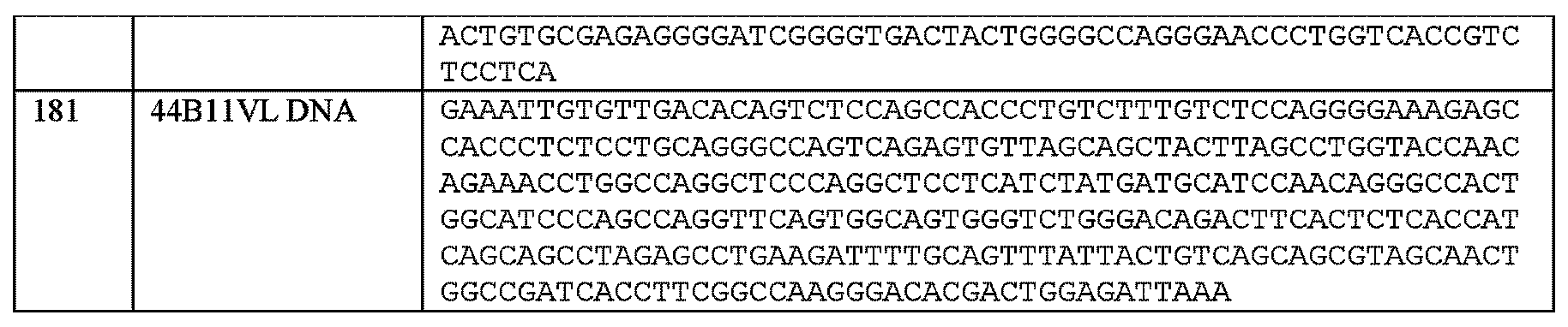
등가물:Equivalence:
관련 기술분야의 통상의 기술자는 상용 실험을 사용하여 본원에 개시된 구체적 실시양태의 많은 등가물을 인식하거나 또는 그를 확인할 수 있을 것이다. 이러한 등가물은 하기 청구범위에 의해 포괄되는 것으로 의도된다.Those skilled in the art will recognize or identify many equivalents of the specific embodiments disclosed herein using commercial experiments. Such equivalents are intended to be encompassed by the following claims.
SEQUENCE LISTING
<110> BRISTOL-MYERS SQUIBB COMPANY
<120> ANTIBODIES TO ALPHA-SYNUCLEIN AND USES THEREOF
<130> MXI-554PC
<140> PCT/US2018/000032
<141> 2018-02-16
<150> US 62/460,416
<151> 2017-02-17
<160> 182
<170> PatentIn version 3.5
<210> 1
<211> 140
<212> PRT
<213> Homo sapiens
<220>
<221> misc_feature
<223> Human alpha-synuclein
<400> 1
Met Asp Val Phe Met Lys Gly Leu Ser Lys Ala Lys Glu Gly Val Val
1 5 10 15
Ala Ala Ala Glu Lys Thr Lys Gln Gly Val Ala Glu Ala Ala Gly Lys
20 25 30
Thr Lys Glu Gly Val Leu Tyr Val Gly Ser Lys Thr Lys Glu Gly Val
35 40 45
Val His Gly Val Ala Thr Val Ala Glu Lys Thr Lys Glu Gln Val Thr
50 55 60
Asn Val Gly Gly Ala Val Val Thr Gly Val Thr Ala Val Ala Gln Lys
65 70 75 80
Thr Val Glu Gly Ala Gly Ser Ile Ala Ala Ala Thr Gly Phe Val Lys
85 90 95
Lys Asp Gln Leu Gly Lys Asn Glu Glu Gly Ala Pro Gln Glu Gly Ile
100 105 110
Leu Glu Asp Met Pro Val Asp Pro Asp Asn Glu Ala Tyr Glu Met Pro
115 120 125
Ser Glu Glu Gly Tyr Gln Asp Tyr Glu Pro Glu Ala
130 135 140
<210> 2
<211> 7
<212> PRT
<213> Artificial Sequence
<220>
<223> Synthetic: 7A10 VH CDR1
<400> 2
Ser Gly Arg Tyr Tyr Trp Ser
1 5
<210> 3
<211> 16
<212> PRT
<213> Artificial Sequence
<220>
<223> Synthetic: 7A10 VH CDR2
<400> 3
Tyr Ile Tyr Tyr Ser Gly Arg Thr Lys Tyr Asn Pro Ser Leu Lys Ser
1 5 10 15
<210> 4
<211> 7
<212> PRT
<213> Artificial Sequence
<220>
<223> Synthetic: 7A10 VH CDR3
<400> 4
Glu Arg Gly Tyr Leu Asp Tyr
1 5
<210> 5
<211> 12
<212> PRT
<213> Artificial Sequence
<220>
<223> Synthetic: 7A10 VL CDR1
<400> 5
Arg Ala Ser Gln Ser Val Ser Ser Ser Tyr Leu Ala
1 5 10
<210> 6
<211> 7
<212> PRT
<213> Artificial Sequence
<220>
<223> Synthetic: 7A10 VL CDR2
<400> 6
Gly Ala Ser Ser Arg Ala Thr
1 5
<210> 7
<211> 9
<212> PRT
<213> Artificial Sequence
<220>
<223> Synthetic: 7A10 VL CDR3
<400> 7
Gln Gln Tyr Gly Ser Ser Pro Leu Thr
1 5
<210> 8
<211> 117
<212> PRT
<213> Artificial Sequence
<220>
<223> Synthetic: 7A10 VH
<400> 8
Gln Val Gln Leu Gln Glu Ser Gly Pro Gly Leu Val Lys Pro Ser Glu
1 5 10 15
Thr Leu Ser Leu Thr Cys Thr Val Ser Gly Gly Ser Val Ser Ser Gly
20 25 30
Arg Tyr Tyr Trp Ser Trp Ile Arg Gln Pro Pro Gly Lys Gly Leu Glu
35 40 45
Trp Ile Gly Tyr Ile Tyr Tyr Ser Gly Arg Thr Lys Tyr Asn Pro Ser
50 55 60
Leu Lys Ser Arg Val Thr Ile Ser Val Asp Thr Ser Lys Asn Gln Phe
65 70 75 80
Ser Leu Lys Leu Ser Ser Val Thr Ala Ala Asp Thr Ala Val Tyr Tyr
85 90 95
Cys Thr Arg Glu Arg Gly Tyr Leu Asp Tyr Trp Gly Gln Gly Thr Leu
100 105 110
Val Thr Val Ser Ser
115
<210> 9
<211> 108
<212> PRT
<213> Artificial Sequence
<220>
<223> Synthetic: 7A10 VL
<400> 9
Glu Ile Val Leu Thr Gln Ser Pro Gly Thr Leu Ser Leu Ser Pro Gly
1 5 10 15
Glu Arg Ala Thr Leu Ser Cys Arg Ala Ser Gln Ser Val Ser Ser Ser
20 25 30
Tyr Leu Ala Trp Tyr Gln Gln Lys Pro Gly Gln Ala Pro Arg Leu Leu
35 40 45
Ile Tyr Gly Ala Ser Ser Arg Ala Thr Gly Ile Pro Asp Arg Phe Ser
50 55 60
Gly Ser Gly Ser Gly Thr Asp Phe Thr Leu Thr Ile Ser Arg Leu Glu
65 70 75 80
Pro Glu Asp Phe Ala Val Tyr Tyr Cys Gln Gln Tyr Gly Ser Ser Pro
85 90 95
Leu Thr Phe Gly Gly Gly Thr Lys Val Glu Ile Lys
100 105
<210> 10
<211> 446
<212> PRT
<213> Artificial Sequence
<220>
<223> Synthetic: 7A10 HC
<400> 10
Gln Val Gln Leu Gln Glu Ser Gly Pro Gly Leu Val Lys Pro Ser Glu
1 5 10 15
Thr Leu Ser Leu Thr Cys Thr Val Ser Gly Gly Ser Val Ser Ser Gly
20 25 30
Arg Tyr Tyr Trp Ser Trp Ile Arg Gln Pro Pro Gly Lys Gly Leu Glu
35 40 45
Trp Ile Gly Tyr Ile Tyr Tyr Ser Gly Arg Thr Lys Tyr Asn Pro Ser
50 55 60
Leu Lys Ser Arg Val Thr Ile Ser Val Asp Thr Ser Lys Asn Gln Phe
65 70 75 80
Ser Leu Lys Leu Ser Ser Val Thr Ala Ala Asp Thr Ala Val Tyr Tyr
85 90 95
Cys Thr Arg Glu Arg Gly Tyr Leu Asp Tyr Trp Gly Gln Gly Thr Leu
100 105 110
Val Thr Val Ser Ser Ala Ser Thr Lys Gly Pro Ser Val Phe Pro Leu
115 120 125
Ala Pro Ser Ser Lys Ser Thr Ser Gly Gly Thr Ala Ala Leu Gly Cys
130 135 140
Leu Val Lys Asp Tyr Phe Pro Glu Pro Val Thr Val Ser Trp Asn Ser
145 150 155 160
Gly Ala Leu Thr Ser Gly Val His Thr Phe Pro Ala Val Leu Gln Ser
165 170 175
Ser Gly Leu Tyr Ser Leu Ser Ser Val Val Thr Val Pro Ser Ser Ser
180 185 190
Leu Gly Thr Gln Thr Tyr Ile Cys Asn Val Asn His Lys Pro Ser Asn
195 200 205
Thr Lys Val Asp Lys Arg Val Glu Pro Lys Ser Cys Asp Lys Thr His
210 215 220
Thr Cys Pro Pro Cys Pro Ala Pro Glu Ala Glu Gly Ala Pro Ser Val
225 230 235 240
Phe Leu Phe Pro Pro Lys Pro Lys Asp Thr Leu Met Ile Ser Arg Thr
245 250 255
Pro Glu Val Thr Cys Val Val Val Asp Val Ser His Glu Asp Pro Glu
260 265 270
Val Lys Phe Asn Trp Tyr Val Asp Gly Val Glu Val His Asn Ala Lys
275 280 285
Thr Lys Pro Arg Glu Glu Gln Tyr Asn Ser Thr Tyr Arg Val Val Ser
290 295 300
Val Leu Thr Val Leu His Gln Asp Trp Leu Asn Gly Lys Glu Tyr Lys
305 310 315 320
Cys Lys Val Ser Asn Lys Ala Leu Pro Ala Pro Ile Glu Lys Thr Ile
325 330 335
Ser Lys Ala Lys Gly Gln Pro Arg Glu Pro Gln Val Tyr Thr Leu Pro
340 345 350
Pro Ser Arg Glu Glu Met Thr Lys Asn Gln Val Ser Leu Thr Cys Leu
355 360 365
Val Lys Gly Phe Tyr Pro Ser Asp Ile Ala Val Glu Trp Glu Ser Asn
370 375 380
Gly Gln Pro Glu Asn Asn Tyr Lys Thr Thr Pro Pro Val Leu Asp Ser
385 390 395 400
Asp Gly Ser Phe Phe Leu Tyr Ser Lys Leu Thr Val Asp Lys Ser Arg
405 410 415
Trp Gln Gln Gly Asn Val Phe Ser Cys Ser Val Met His Glu Ala Leu
420 425 430
His Asn His Tyr Thr Gln Lys Ser Leu Ser Leu Ser Pro Gly
435 440 445
<210> 11
<211> 215
<212> PRT
<213> Artificial Sequence
<220>
<223> Synthetic: 7A10 LC
<400> 11
Glu Ile Val Leu Thr Gln Ser Pro Gly Thr Leu Ser Leu Ser Pro Gly
1 5 10 15
Glu Arg Ala Thr Leu Ser Cys Arg Ala Ser Gln Ser Val Ser Ser Ser
20 25 30
Tyr Leu Ala Trp Tyr Gln Gln Lys Pro Gly Gln Ala Pro Arg Leu Leu
35 40 45
Ile Tyr Gly Ala Ser Ser Arg Ala Thr Gly Ile Pro Asp Arg Phe Ser
50 55 60
Gly Ser Gly Ser Gly Thr Asp Phe Thr Leu Thr Ile Ser Arg Leu Glu
65 70 75 80
Pro Glu Asp Phe Ala Val Tyr Tyr Cys Gln Gln Tyr Gly Ser Ser Pro
85 90 95
Leu Thr Phe Gly Gly Gly Thr Lys Val Glu Ile Lys Arg Thr Val Ala
100 105 110
Ala Pro Ser Val Phe Ile Phe Pro Pro Ser Asp Glu Gln Leu Lys Ser
115 120 125
Gly Thr Ala Ser Val Val Cys Leu Leu Asn Asn Phe Tyr Pro Arg Glu
130 135 140
Ala Lys Val Gln Trp Lys Val Asp Asn Ala Leu Gln Ser Gly Asn Ser
145 150 155 160
Gln Glu Ser Val Thr Glu Gln Asp Ser Lys Asp Ser Thr Tyr Ser Leu
165 170 175
Ser Ser Thr Leu Thr Leu Ser Lys Ala Asp Tyr Glu Lys His Lys Val
180 185 190
Tyr Ala Cys Glu Val Thr His Gln Gly Leu Ser Ser Pro Val Thr Lys
195 200 205
Ser Phe Asn Arg Gly Glu Cys
210 215
<210> 12
<211> 7
<212> PRT
<213> Artificial Sequence
<220>
<223> Synthetic: 7A10-T93A VH CDR1
<400> 12
Ser Gly Arg Tyr Tyr Trp Ser
1 5
<210> 13
<211> 16
<212> PRT
<213> Artificial Sequence
<220>
<223> Synthetic: 7A10-T93A VH CDR2
<400> 13
Tyr Ile Tyr Tyr Ser Gly Arg Thr Lys Tyr Asn Pro Ser Leu Lys Ser
1 5 10 15
<210> 14
<211> 7
<212> PRT
<213> Artificial Sequence
<220>
<223> Synthetic: 7A10-T93A VH CDR3
<400> 14
Glu Arg Gly Tyr Leu Asp Tyr
1 5
<210> 15
<211> 12
<212> PRT
<213> Artificial Sequence
<220>
<223> Synthetic: 7A10-T93A VL CDR1
<400> 15
Arg Ala Ser Gln Ser Val Ser Ser Ser Tyr Leu Ala
1 5 10
<210> 16
<211> 7
<212> PRT
<213> Artificial Sequence
<220>
<223> Synthetic: 7A10-T93A VL CDR2
<400> 16
Gly Ala Ser Ser Arg Ala Thr
1 5
<210> 17
<211> 9
<212> PRT
<213> Artificial Sequence
<220>
<223> Synthetic: 7A10-T93A VL CDR3
<400> 17
Gln Gln Tyr Gly Ser Ser Pro Leu Thr
1 5
<210> 18
<211> 117
<212> PRT
<213> Artificial Sequence
<220>
<223> Synthetic: 7A10-T93A VH
<400> 18
Gln Val Gln Leu Gln Glu Ser Gly Pro Gly Leu Val Lys Pro Ser Glu
1 5 10 15
Thr Leu Ser Leu Thr Cys Thr Val Ser Gly Gly Ser Val Ser Ser Gly
20 25 30
Arg Tyr Tyr Trp Ser Trp Ile Arg Gln Pro Pro Gly Lys Gly Leu Glu
35 40 45
Trp Ile Gly Tyr Ile Tyr Tyr Ser Gly Arg Thr Lys Tyr Asn Pro Ser
50 55 60
Leu Lys Ser Arg Val Thr Ile Ser Val Asp Thr Ser Lys Asn Gln Phe
65 70 75 80
Ser Leu Lys Leu Ser Ser Val Thr Ala Ala Asp Thr Ala Val Tyr Tyr
85 90 95
Cys Ala Arg Glu Arg Gly Tyr Leu Asp Tyr Trp Gly Gln Gly Thr Leu
100 105 110
Val Thr Val Ser Ser
115
<210> 19
<211> 108
<212> PRT
<213> Artificial Sequence
<220>
<223> Synthetic: 7A10-T93A VL
<400> 19
Glu Ile Val Leu Thr Gln Ser Pro Gly Thr Leu Ser Leu Ser Pro Gly
1 5 10 15
Glu Arg Ala Thr Leu Ser Cys Arg Ala Ser Gln Ser Val Ser Ser Ser
20 25 30
Tyr Leu Ala Trp Tyr Gln Gln Lys Pro Gly Gln Ala Pro Arg Leu Leu
35 40 45
Ile Tyr Gly Ala Ser Ser Arg Ala Thr Gly Ile Pro Asp Arg Phe Ser
50 55 60
Gly Ser Gly Ser Gly Thr Asp Phe Thr Leu Thr Ile Ser Arg Leu Glu
65 70 75 80
Pro Glu Asp Phe Ala Val Tyr Tyr Cys Gln Gln Tyr Gly Ser Ser Pro
85 90 95
Leu Thr Phe Gly Gly Gly Thr Lys Val Glu Ile Lys
100 105
<210> 20
<211> 446
<212> PRT
<213> Artificial Sequence
<220>
<223> Synthetic: 7A10-T93A HC
<400> 20
Gln Val Gln Leu Gln Glu Ser Gly Pro Gly Leu Val Lys Pro Ser Glu
1 5 10 15
Thr Leu Ser Leu Thr Cys Thr Val Ser Gly Gly Ser Val Ser Ser Gly
20 25 30
Arg Tyr Tyr Trp Ser Trp Ile Arg Gln Pro Pro Gly Lys Gly Leu Glu
35 40 45
Trp Ile Gly Tyr Ile Tyr Tyr Ser Gly Arg Thr Lys Tyr Asn Pro Ser
50 55 60
Leu Lys Ser Arg Val Thr Ile Ser Val Asp Thr Ser Lys Asn Gln Phe
65 70 75 80
Ser Leu Lys Leu Ser Ser Val Thr Ala Ala Asp Thr Ala Val Tyr Tyr
85 90 95
Cys Ala Arg Glu Arg Gly Tyr Leu Asp Tyr Trp Gly Gln Gly Thr Leu
100 105 110
Val Thr Val Ser Ser Ala Ser Thr Lys Gly Pro Ser Val Phe Pro Leu
115 120 125
Ala Pro Ser Ser Lys Ser Thr Ser Gly Gly Thr Ala Ala Leu Gly Cys
130 135 140
Leu Val Lys Asp Tyr Phe Pro Glu Pro Val Thr Val Ser Trp Asn Ser
145 150 155 160
Gly Ala Leu Thr Ser Gly Val His Thr Phe Pro Ala Val Leu Gln Ser
165 170 175
Ser Gly Leu Tyr Ser Leu Ser Ser Val Val Thr Val Pro Ser Ser Ser
180 185 190
Leu Gly Thr Gln Thr Tyr Ile Cys Asn Val Asn His Lys Pro Ser Asn
195 200 205
Thr Lys Val Asp Lys Arg Val Glu Pro Lys Ser Cys Asp Lys Thr His
210 215 220
Thr Cys Pro Pro Cys Pro Ala Pro Glu Ala Glu Gly Ala Pro Ser Val
225 230 235 240
Phe Leu Phe Pro Pro Lys Pro Lys Asp Thr Leu Met Ile Ser Arg Thr
245 250 255
Pro Glu Val Thr Cys Val Val Val Asp Val Ser His Glu Asp Pro Glu
260 265 270
Val Lys Phe Asn Trp Tyr Val Asp Gly Val Glu Val His Asn Ala Lys
275 280 285
Thr Lys Pro Arg Glu Glu Gln Tyr Asn Ser Thr Tyr Arg Val Val Ser
290 295 300
Val Leu Thr Val Leu His Gln Asp Trp Leu Asn Gly Lys Glu Tyr Lys
305 310 315 320
Cys Lys Val Ser Asn Lys Ala Leu Pro Ala Pro Ile Glu Lys Thr Ile
325 330 335
Ser Lys Ala Lys Gly Gln Pro Arg Glu Pro Gln Val Tyr Thr Leu Pro
340 345 350
Pro Ser Arg Glu Glu Met Thr Lys Asn Gln Val Ser Leu Thr Cys Leu
355 360 365
Val Lys Gly Phe Tyr Pro Ser Asp Ile Ala Val Glu Trp Glu Ser Asn
370 375 380
Gly Gln Pro Glu Asn Asn Tyr Lys Thr Thr Pro Pro Val Leu Asp Ser
385 390 395 400
Asp Gly Ser Phe Phe Leu Tyr Ser Lys Leu Thr Val Asp Lys Ser Arg
405 410 415
Trp Gln Gln Gly Asn Val Phe Ser Cys Ser Val Met His Glu Ala Leu
420 425 430
His Asn His Tyr Thr Gln Lys Ser Leu Ser Leu Ser Pro Gly
435 440 445
<210> 21
<211> 215
<212> PRT
<213> Artificial Sequence
<220>
<223> Synthetic: 7A10-T93A LC
<400> 21
Glu Ile Val Leu Thr Gln Ser Pro Gly Thr Leu Ser Leu Ser Pro Gly
1 5 10 15
Glu Arg Ala Thr Leu Ser Cys Arg Ala Ser Gln Ser Val Ser Ser Ser
20 25 30
Tyr Leu Ala Trp Tyr Gln Gln Lys Pro Gly Gln Ala Pro Arg Leu Leu
35 40 45
Ile Tyr Gly Ala Ser Ser Arg Ala Thr Gly Ile Pro Asp Arg Phe Ser
50 55 60
Gly Ser Gly Ser Gly Thr Asp Phe Thr Leu Thr Ile Ser Arg Leu Glu
65 70 75 80
Pro Glu Asp Phe Ala Val Tyr Tyr Cys Gln Gln Tyr Gly Ser Ser Pro
85 90 95
Leu Thr Phe Gly Gly Gly Thr Lys Val Glu Ile Lys Arg Thr Val Ala
100 105 110
Ala Pro Ser Val Phe Ile Phe Pro Pro Ser Asp Glu Gln Leu Lys Ser
115 120 125
Gly Thr Ala Ser Val Val Cys Leu Leu Asn Asn Phe Tyr Pro Arg Glu
130 135 140
Ala Lys Val Gln Trp Lys Val Asp Asn Ala Leu Gln Ser Gly Asn Ser
145 150 155 160
Gln Glu Ser Val Thr Glu Gln Asp Ser Lys Asp Ser Thr Tyr Ser Leu
165 170 175
Ser Ser Thr Leu Thr Leu Ser Lys Ala Asp Tyr Glu Lys His Lys Val
180 185 190
Tyr Ala Cys Glu Val Thr His Gln Gly Leu Ser Ser Pro Val Thr Lys
195 200 205
Ser Phe Asn Arg Gly Glu Cys
210 215
<210> 22
<211> 5
<212> PRT
<213> Artificial Sequence
<220>
<223> Synthetic: 11H11 VH CDR1
<400> 22
Ser Tyr Ala Met His
1 5
<210> 23
<211> 16
<212> PRT
<213> Artificial Sequence
<220>
<223> Synthetic: 11H11 VH CDR2
<400> 23
Ala Ile Gly Thr Gly Gly Gly Thr Tyr Tyr Ala Asp Ser Val Lys Gly
1 5 10 15
<210> 24
<211> 7
<212> PRT
<213> Artificial Sequence
<220>
<223> Synthetic: 11H11 VH CDR3
<400> 24
Gly Asn Trp Glu Phe Asp Tyr
1 5
<210> 25
<211> 12
<212> PRT
<213> Artificial Sequence
<220>
<223> Synthetic: 11H11 VL1 CDR1
<400> 25
Arg Ala Ser Gln Ser Val Ser Ser Ser Tyr Leu Ala
1 5 10
<210> 26
<211> 7
<212> PRT
<213> Artificial Sequence
<220>
<223> Synthetic: 11H11 VL1CDR2
<400> 26
Gly Ala Ser Ser Arg Ala Thr
1 5
<210> 27
<211> 9
<212> PRT
<213> Artificial Sequence
<220>
<223> Synthetic: 11H11 VL1 CDR3
<400> 27
Gln Gln Tyr Gly Ser Ser Pro Phe Thr
1 5
<210> 28
<211> 11
<212> PRT
<213> Artificial Sequence
<220>
<223> Synthetic: 11H11 VL2 CDR1
<400> 28
Arg Ala Ser Gln Gly Ile Ser Ser Ala Leu Ala
1 5 10
<210> 29
<211> 7
<212> PRT
<213> Artificial Sequence
<220>
<223> Synthetic: 11H11 VL2 CDR2
<400> 29
Asp Ala Ser Ser Leu Glu Ser
1 5
<210> 30
<211> 7
<212> PRT
<213> Artificial Sequence
<220>
<223> Synthetic: 11H11 VL2 CDR3
<400> 30
Gln Gln Phe Asn Ser Tyr Pro
1 5
<210> 31
<211> 115
<212> PRT
<213> Artificial Sequence
<220>
<223> Synthetic: 11H11 VH
<400> 31
Glu Val Gln Leu Val Gln Ser Gly Gly Gly Leu Val His Pro Gly Gly
1 5 10 15
Ser Leu Arg Leu Ser Cys Ala Gly Ser Gly Phe Thr Phe Ser Ser Tyr
20 25 30
Ala Met His Trp Val Arg Gln Ala Pro Gly Lys Gly Leu Glu Trp Val
35 40 45
Ser Ala Ile Gly Thr Gly Gly Gly Thr Tyr Tyr Ala Asp Ser Val Lys
50 55 60
Gly Arg Phe Thr Ile Ser Arg Asp Asn Ala Lys Asn Ser Leu Tyr Leu
65 70 75 80
Gln Met Asn Ser Leu Arg Ala Glu Asp Met Ala Val Tyr Tyr Cys Ala
85 90 95
Arg Gly Asn Trp Glu Phe Asp Tyr Trp Gly Gln Gly Thr Leu Val Thr
100 105 110
Val Ser Ser
115
<210> 32
<211> 108
<212> PRT
<213> Artificial Sequence
<220>
<223> Synthetic: 11H11 VL1
<400> 32
Glu Ile Val Leu Thr Gln Ser Pro Gly Thr Leu Ser Leu Ser Pro Gly
1 5 10 15
Glu Arg Ala Thr Leu Ser Cys Arg Ala Ser Gln Ser Val Ser Ser Ser
20 25 30
Tyr Leu Ala Trp Tyr Gln Gln Lys Pro Gly Gln Ala Pro Arg Leu Leu
35 40 45
Ile Tyr Gly Ala Ser Ser Arg Ala Thr Gly Ile Pro Asp Arg Phe Ser
50 55 60
Gly Ser Gly Ser Gly Thr Asp Phe Thr Leu Thr Ile Ser Arg Leu Glu
65 70 75 80
Pro Glu Asp Phe Ala Val Tyr Tyr Cys Gln Gln Tyr Gly Ser Ser Pro
85 90 95
Phe Thr Phe Gly Pro Gly Thr Lys Val Asp Ile Lys
100 105
<210> 33
<211> 105
<212> PRT
<213> Artificial Sequence
<220>
<223> Synthetic: 11H11 VL2
<400> 33
Ala Ile Gln Leu Thr Gln Ser Pro Ser Ser Leu Ser Ala Ser Val Gly
1 5 10 15
Asp Arg Val Thr Ile Thr Cys Arg Ala Ser Gln Gly Ile Ser Ser Ala
20 25 30
Leu Ala Trp Tyr Gln Gln Lys Pro Gly Lys Ala Pro Lys Val Pro Ile
35 40 45
Tyr Asp Ala Ser Ser Leu Glu Ser Gly Val Pro Ser Arg Phe Ser Gly
50 55 60
Ser Gly Ser Gly Thr Asp Phe Thr Leu Thr Ile Ser Ser Leu Gln Pro
65 70 75 80
Glu Asp Leu Ala Thr Tyr Tyr Cys Gln Gln Phe Asn Ser Tyr Pro Phe
85 90 95
Gly Gly Gly Thr Lys Val Glu Ile Lys
100 105
<210> 34
<211> 444
<212> PRT
<213> Artificial Sequence
<220>
<223> Synthetic: 11H11 HC
<400> 34
Glu Val Gln Leu Val Gln Ser Gly Gly Gly Leu Val His Pro Gly Gly
1 5 10 15
Ser Leu Arg Leu Ser Cys Ala Gly Ser Gly Phe Thr Phe Ser Ser Tyr
20 25 30
Ala Met His Trp Val Arg Gln Ala Pro Gly Lys Gly Leu Glu Trp Val
35 40 45
Ser Ala Ile Gly Thr Gly Gly Gly Thr Tyr Tyr Ala Asp Ser Val Lys
50 55 60
Gly Arg Phe Thr Ile Ser Arg Asp Asn Ala Lys Asn Ser Leu Tyr Leu
65 70 75 80
Gln Met Asn Ser Leu Arg Ala Glu Asp Met Ala Val Tyr Tyr Cys Ala
85 90 95
Arg Gly Asn Trp Glu Phe Asp Tyr Trp Gly Gln Gly Thr Leu Val Thr
100 105 110
Val Ser Ser Ala Ser Thr Lys Gly Pro Ser Val Phe Pro Leu Ala Pro
115 120 125
Ser Ser Lys Ser Thr Ser Gly Gly Thr Ala Ala Leu Gly Cys Leu Val
130 135 140
Lys Asp Tyr Phe Pro Glu Pro Val Thr Val Ser Trp Asn Ser Gly Ala
145 150 155 160
Leu Thr Ser Gly Val His Thr Phe Pro Ala Val Leu Gln Ser Ser Gly
165 170 175
Leu Tyr Ser Leu Ser Ser Val Val Thr Val Pro Ser Ser Ser Leu Gly
180 185 190
Thr Gln Thr Tyr Ile Cys Asn Val Asn His Lys Pro Ser Asn Thr Lys
195 200 205
Val Asp Lys Arg Val Glu Pro Lys Ser Cys Asp Lys Thr His Thr Cys
210 215 220
Pro Pro Cys Pro Ala Pro Glu Ala Glu Gly Ala Pro Ser Val Phe Leu
225 230 235 240
Phe Pro Pro Lys Pro Lys Asp Thr Leu Met Ile Ser Arg Thr Pro Glu
245 250 255
Val Thr Cys Val Val Val Asp Val Ser His Glu Asp Pro Glu Val Lys
260 265 270
Phe Asn Trp Tyr Val Asp Gly Val Glu Val His Asn Ala Lys Thr Lys
275 280 285
Pro Arg Glu Glu Gln Tyr Asn Ser Thr Tyr Arg Val Val Ser Val Leu
290 295 300
Thr Val Leu His Gln Asp Trp Leu Asn Gly Lys Glu Tyr Lys Cys Lys
305 310 315 320
Val Ser Asn Lys Ala Leu Pro Ala Pro Ile Glu Lys Thr Ile Ser Lys
325 330 335
Ala Lys Gly Gln Pro Arg Glu Pro Gln Val Tyr Thr Leu Pro Pro Ser
340 345 350
Arg Glu Glu Met Thr Lys Asn Gln Val Ser Leu Thr Cys Leu Val Lys
355 360 365
Gly Phe Tyr Pro Ser Asp Ile Ala Val Glu Trp Glu Ser Asn Gly Gln
370 375 380
Pro Glu Asn Asn Tyr Lys Thr Thr Pro Pro Val Leu Asp Ser Asp Gly
385 390 395 400
Ser Phe Phe Leu Tyr Ser Lys Leu Thr Val Asp Lys Ser Arg Trp Gln
405 410 415
Gln Gly Asn Val Phe Ser Cys Ser Val Met His Glu Ala Leu His Asn
420 425 430
His Tyr Thr Gln Lys Ser Leu Ser Leu Ser Pro Gly
435 440
<210> 35
<211> 215
<212> PRT
<213> Artificial Sequence
<220>
<223> Synthetic: 11H11 LC1
<400> 35
Glu Ile Val Leu Thr Gln Ser Pro Gly Thr Leu Ser Leu Ser Pro Gly
1 5 10 15
Glu Arg Ala Thr Leu Ser Cys Arg Ala Ser Gln Ser Val Ser Ser Ser
20 25 30
Tyr Leu Ala Trp Tyr Gln Gln Lys Pro Gly Gln Ala Pro Arg Leu Leu
35 40 45
Ile Tyr Gly Ala Ser Ser Arg Ala Thr Gly Ile Pro Asp Arg Phe Ser
50 55 60
Gly Ser Gly Ser Gly Thr Asp Phe Thr Leu Thr Ile Ser Arg Leu Glu
65 70 75 80
Pro Glu Asp Phe Ala Val Tyr Tyr Cys Gln Gln Tyr Gly Ser Ser Pro
85 90 95
Phe Thr Phe Gly Pro Gly Thr Lys Val Asp Ile Lys Arg Thr Val Ala
100 105 110
Ala Pro Ser Val Phe Ile Phe Pro Pro Ser Asp Glu Gln Leu Lys Ser
115 120 125
Gly Thr Ala Ser Val Val Cys Leu Leu Asn Asn Phe Tyr Pro Arg Glu
130 135 140
Ala Lys Val Gln Trp Lys Val Asp Asn Ala Leu Gln Ser Gly Asn Ser
145 150 155 160
Gln Glu Ser Val Thr Glu Gln Asp Ser Lys Asp Ser Thr Tyr Ser Leu
165 170 175
Ser Ser Thr Leu Thr Leu Ser Lys Ala Asp Tyr Glu Lys His Lys Val
180 185 190
Tyr Ala Cys Glu Val Thr His Gln Gly Leu Ser Ser Pro Val Thr Lys
195 200 205
Ser Phe Asn Arg Gly Glu Cys
210 215
<210> 36
<211> 212
<212> PRT
<213> Artificial Sequence
<220>
<223> Synthetic: 11H11 LC2
<400> 36
Ala Ile Gln Leu Thr Gln Ser Pro Ser Ser Leu Ser Ala Ser Val Gly
1 5 10 15
Asp Arg Val Thr Ile Thr Cys Arg Ala Ser Gln Gly Ile Ser Ser Ala
20 25 30
Leu Ala Trp Tyr Gln Gln Lys Pro Gly Lys Ala Pro Lys Val Pro Ile
35 40 45
Tyr Asp Ala Ser Ser Leu Glu Ser Gly Val Pro Ser Arg Phe Ser Gly
50 55 60
Ser Gly Ser Gly Thr Asp Phe Thr Leu Thr Ile Ser Ser Leu Gln Pro
65 70 75 80
Glu Asp Leu Ala Thr Tyr Tyr Cys Gln Gln Phe Asn Ser Tyr Pro Phe
85 90 95
Gly Gly Gly Thr Lys Val Glu Ile Lys Arg Thr Val Ala Ala Pro Ser
100 105 110
Val Phe Ile Phe Pro Pro Ser Asp Glu Gln Leu Lys Ser Gly Thr Ala
115 120 125
Ser Val Val Cys Leu Leu Asn Asn Phe Tyr Pro Arg Glu Ala Lys Val
130 135 140
Gln Trp Lys Val Asp Asn Ala Leu Gln Ser Gly Asn Ser Gln Glu Ser
145 150 155 160
Val Thr Glu Gln Asp Ser Lys Asp Ser Thr Tyr Ser Leu Ser Ser Thr
165 170 175
Leu Thr Leu Ser Lys Ala Asp Tyr Glu Lys His Lys Val Tyr Ala Cys
180 185 190
Glu Val Thr His Gln Gly Leu Ser Ser Pro Val Thr Lys Ser Phe Asn
195 200 205
Arg Gly Glu Cys
210
<210> 37
<211> 7
<212> PRT
<213> Artificial Sequence
<220>
<223> Synthetic: 15A5 VH CDR1
<400> 37
Ser Gly Ser Tyr Tyr Trp Cys
1 5
<210> 38
<211> 16
<212> PRT
<213> Artificial Sequence
<220>
<223> Synthetic: 15A5 VH CDR2
<400> 38
Tyr Ile Tyr Tyr Ser Gly Arg Thr Lys Tyr Asn Pro Ser Leu Lys Ser
1 5 10 15
<210> 39
<211> 7
<212> PRT
<213> Artificial Sequence
<220>
<223> Synthetic: 15A5 VH CDR3
<400> 39
Glu Arg Gly Arg Phe Asp Tyr
1 5
<210> 40
<211> 12
<212> PRT
<213> Artificial Sequence
<220>
<223> Synthetic: 15A5 VL CDR1
<400> 40
Arg Ala Ser Gln Ser Val Ser Ser Ser Tyr Leu Ala
1 5 10
<210> 41
<211> 7
<212> PRT
<213> Artificial Sequence
<220>
<223> Synthetic: 15A5 VL CDR2
<400> 41
Gly Ala Ser Ser Arg Ala Thr
1 5
<210> 42
<211> 9
<212> PRT
<213> Artificial Sequence
<220>
<223> Synthetic: 15A5 VL CDR3
<400> 42
Gln Gln Tyr Gly Ser Ser Pro Leu Thr
1 5
<210> 43
<211> 117
<212> PRT
<213> Artificial Sequence
<220>
<223> Synthetic: 15A5 VH
<400> 43
Gln Val Gln Leu Gln Glu Ser Gly Pro Gly Leu Val Lys Pro Ser Glu
1 5 10 15
Thr Leu Ser Leu Thr Cys Thr Val Ser Gly Gly Ser Val Ser Ser Gly
20 25 30
Ser Tyr Tyr Trp Cys Trp Ile Arg Gln Pro Pro Gly Lys Gly Leu Glu
35 40 45
Trp Ile Gly Tyr Ile Tyr Tyr Ser Gly Arg Thr Lys Tyr Asn Pro Ser
50 55 60
Leu Lys Ser Arg Val Thr Ile Ser Val Asp Thr Ser Lys Asn Gln Phe
65 70 75 80
Ser Leu Lys Leu Ser Ser Val Thr Ala Ala Asp Thr Ala Val Tyr Tyr
85 90 95
Cys Ala Arg Glu Arg Gly Arg Phe Asp Tyr Trp Gly Gln Gly Thr Leu
100 105 110
Val Thr Val Ser Ser
115
<210> 44
<211> 108
<212> PRT
<213> Artificial Sequence
<220>
<223> Synthetic: 15A5 VL
<400> 44
Glu Ile Val Leu Thr Gln Ser Pro Gly Thr Leu Ser Leu Ser Pro Gly
1 5 10 15
Glu Arg Ala Thr Leu Ser Cys Arg Ala Ser Gln Ser Val Ser Ser Ser
20 25 30
Tyr Leu Ala Trp Tyr Gln Gln Lys Pro Gly Gln Ala Pro Arg Leu Leu
35 40 45
Ile Tyr Gly Ala Ser Ser Arg Ala Thr Gly Ile Pro Asp Arg Phe Ser
50 55 60
Gly Ser Gly Ser Gly Thr Asp Phe Thr Leu Thr Ile Ser Arg Leu Glu
65 70 75 80
Pro Glu Asp Phe Ala Val Tyr Tyr Cys Gln Gln Tyr Gly Ser Ser Pro
85 90 95
Leu Thr Phe Gly Gly Gly Thr Lys Val Glu Ile Lys
100 105
<210> 45
<211> 446
<212> PRT
<213> Artificial Sequence
<220>
<223> Synthetic: 15A5 HC
<400> 45
Gln Val Gln Leu Gln Glu Ser Gly Pro Gly Leu Val Lys Pro Ser Glu
1 5 10 15
Thr Leu Ser Leu Thr Cys Thr Val Ser Gly Gly Ser Val Ser Ser Gly
20 25 30
Ser Tyr Tyr Trp Cys Trp Ile Arg Gln Pro Pro Gly Lys Gly Leu Glu
35 40 45
Trp Ile Gly Tyr Ile Tyr Tyr Ser Gly Arg Thr Lys Tyr Asn Pro Ser
50 55 60
Leu Lys Ser Arg Val Thr Ile Ser Val Asp Thr Ser Lys Asn Gln Phe
65 70 75 80
Ser Leu Lys Leu Ser Ser Val Thr Ala Ala Asp Thr Ala Val Tyr Tyr
85 90 95
Cys Ala Arg Glu Arg Gly Arg Phe Asp Tyr Trp Gly Gln Gly Thr Leu
100 105 110
Val Thr Val Ser Ser Ala Ser Thr Lys Gly Pro Ser Val Phe Pro Leu
115 120 125
Ala Pro Ser Ser Lys Ser Thr Ser Gly Gly Thr Ala Ala Leu Gly Cys
130 135 140
Leu Val Lys Asp Tyr Phe Pro Glu Pro Val Thr Val Ser Trp Asn Ser
145 150 155 160
Gly Ala Leu Thr Ser Gly Val His Thr Phe Pro Ala Val Leu Gln Ser
165 170 175
Ser Gly Leu Tyr Ser Leu Ser Ser Val Val Thr Val Pro Ser Ser Ser
180 185 190
Leu Gly Thr Gln Thr Tyr Ile Cys Asn Val Asn His Lys Pro Ser Asn
195 200 205
Thr Lys Val Asp Lys Arg Val Glu Pro Lys Ser Cys Asp Lys Thr His
210 215 220
Thr Cys Pro Pro Cys Pro Ala Pro Glu Ala Glu Gly Ala Pro Ser Val
225 230 235 240
Phe Leu Phe Pro Pro Lys Pro Lys Asp Thr Leu Met Ile Ser Arg Thr
245 250 255
Pro Glu Val Thr Cys Val Val Val Asp Val Ser His Glu Asp Pro Glu
260 265 270
Val Lys Phe Asn Trp Tyr Val Asp Gly Val Glu Val His Asn Ala Lys
275 280 285
Thr Lys Pro Arg Glu Glu Gln Tyr Asn Ser Thr Tyr Arg Val Val Ser
290 295 300
Val Leu Thr Val Leu His Gln Asp Trp Leu Asn Gly Lys Glu Tyr Lys
305 310 315 320
Cys Lys Val Ser Asn Lys Ala Leu Pro Ala Pro Ile Glu Lys Thr Ile
325 330 335
Ser Lys Ala Lys Gly Gln Pro Arg Glu Pro Gln Val Tyr Thr Leu Pro
340 345 350
Pro Ser Arg Glu Glu Met Thr Lys Asn Gln Val Ser Leu Thr Cys Leu
355 360 365
Val Lys Gly Phe Tyr Pro Ser Asp Ile Ala Val Glu Trp Glu Ser Asn
370 375 380
Gly Gln Pro Glu Asn Asn Tyr Lys Thr Thr Pro Pro Val Leu Asp Ser
385 390 395 400
Asp Gly Ser Phe Phe Leu Tyr Ser Lys Leu Thr Val Asp Lys Ser Arg
405 410 415
Trp Gln Gln Gly Asn Val Phe Ser Cys Ser Val Met His Glu Ala Leu
420 425 430
His Asn His Tyr Thr Gln Lys Ser Leu Ser Leu Ser Pro Gly
435 440 445
<210> 46
<211> 215
<212> PRT
<213> Artificial Sequence
<220>
<223> Synthetic: 15A5 LC
<400> 46
Glu Ile Val Leu Thr Gln Ser Pro Gly Thr Leu Ser Leu Ser Pro Gly
1 5 10 15
Glu Arg Ala Thr Leu Ser Cys Arg Ala Ser Gln Ser Val Ser Ser Ser
20 25 30
Tyr Leu Ala Trp Tyr Gln Gln Lys Pro Gly Gln Ala Pro Arg Leu Leu
35 40 45
Ile Tyr Gly Ala Ser Ser Arg Ala Thr Gly Ile Pro Asp Arg Phe Ser
50 55 60
Gly Ser Gly Ser Gly Thr Asp Phe Thr Leu Thr Ile Ser Arg Leu Glu
65 70 75 80
Pro Glu Asp Phe Ala Val Tyr Tyr Cys Gln Gln Tyr Gly Ser Ser Pro
85 90 95
Leu Thr Phe Gly Gly Gly Thr Lys Val Glu Ile Lys Arg Thr Val Ala
100 105 110
Ala Pro Ser Val Phe Ile Phe Pro Pro Ser Asp Glu Gln Leu Lys Ser
115 120 125
Gly Thr Ala Ser Val Val Cys Leu Leu Asn Asn Phe Tyr Pro Arg Glu
130 135 140
Ala Lys Val Gln Trp Lys Val Asp Asn Ala Leu Gln Ser Gly Asn Ser
145 150 155 160
Gln Glu Ser Val Thr Glu Gln Asp Ser Lys Asp Ser Thr Tyr Ser Leu
165 170 175
Ser Ser Thr Leu Thr Leu Ser Lys Ala Asp Tyr Glu Lys His Lys Val
180 185 190
Tyr Ala Cys Glu Val Thr His Gln Gly Leu Ser Ser Pro Val Thr Lys
195 200 205
Ser Phe Asn Arg Gly Glu Cys
210 215
<210> 47
<211> 7
<212> PRT
<213> Artificial Sequence
<220>
<223> Synthetic: 21A3 VH CDR1
<400> 47
Asn Arg Asn Tyr Tyr Trp Ser
1 5
<210> 48
<211> 16
<212> PRT
<213> Artificial Sequence
<220>
<223> Synthetic: 21A3 VH CDR2
<400> 48
Tyr Ile Tyr Tyr Ser Gly Arg Thr Lys Tyr Asn Pro Ser Leu Lys Ser
1 5 10 15
<210> 49
<211> 7
<212> PRT
<213> Artificial Sequence
<220>
<223> Synthetic: 21A3 VH CDR3
<400> 49
Glu Arg Gly Arg Phe Asp Tyr
1 5
<210> 50
<211> 12
<212> PRT
<213> Artificial Sequence
<220>
<223> Synthetic: 21A3 VL CDR1
<400> 50
Arg Ala Ser Gln Ser Val Ser Ser Ser Tyr Leu Ala
1 5 10
<210> 51
<211> 7
<212> PRT
<213> Artificial Sequence
<220>
<223> Synthetic: 21A3 VL CDR2
<400> 51
Gly Ala Ser Ser Arg Ala Thr
1 5
<210> 52
<211> 9
<212> PRT
<213> Artificial Sequence
<220>
<223> Synthetic: 21A3 VL CDR3
<400> 52
Gln Gln Tyr Gly Ser Ser Pro Leu Thr
1 5
<210> 53
<211> 117
<212> PRT
<213> Artificial Sequence
<220>
<223> Synthetic: 21A3 VH
<400> 53
Gln Val Gln Leu Gln Glu Ser Gly Pro Gly Leu Val Lys Pro Ser Glu
1 5 10 15
Thr Leu Ser Leu Thr Cys Thr Val Ser Gly Gly Ser Val Ser Asn Arg
20 25 30
Asn Tyr Tyr Trp Ser Trp Ile Arg Gln Pro Pro Gly Lys Gly Leu Glu
35 40 45
Trp Ile Gly Tyr Ile Tyr Tyr Ser Gly Arg Thr Lys Tyr Asn Pro Ser
50 55 60
Leu Lys Ser Arg Val Thr Ile Ser Val Asp Thr Ser Lys Asn Gln Phe
65 70 75 80
Ser Leu Lys Val Ser Ser Val Thr Ala Ala Asp Thr Ala Val Tyr Tyr
85 90 95
Cys Ala Arg Glu Arg Gly Arg Phe Asp Tyr Trp Gly Gln Gly Thr Leu
100 105 110
Val Thr Val Ser Ser
115
<210> 54
<211> 108
<212> PRT
<213> Artificial Sequence
<220>
<223> Synthetic: 21A3 VL
<400> 54
Glu Ile Val Leu Thr Gln Ser Pro Gly Thr Leu Ser Leu Ser Pro Gly
1 5 10 15
Glu Arg Ala Thr Leu Ser Cys Arg Ala Ser Gln Ser Val Ser Ser Ser
20 25 30
Tyr Leu Ala Trp Tyr Gln Gln Lys Pro Gly Gln Ala Pro Arg Leu Leu
35 40 45
Ile Tyr Gly Ala Ser Ser Arg Ala Thr Gly Ile Pro Asp Arg Phe Ser
50 55 60
Gly Ser Gly Ser Gly Thr Asp Phe Thr Leu Thr Ile Ser Arg Leu Glu
65 70 75 80
Pro Glu Asp Phe Ala Val Tyr Tyr Cys Gln Gln Tyr Gly Ser Ser Pro
85 90 95
Leu Thr Phe Gly Gly Gly Thr Lys Val Glu Ile Lys
100 105
<210> 55
<211> 446
<212> PRT
<213> Artificial Sequence
<220>
<223> Synthetic: 21A3 HC
<400> 55
Gln Val Gln Leu Gln Glu Ser Gly Pro Gly Leu Val Lys Pro Ser Glu
1 5 10 15
Thr Leu Ser Leu Thr Cys Thr Val Ser Gly Gly Ser Val Ser Asn Arg
20 25 30
Asn Tyr Tyr Trp Ser Trp Ile Arg Gln Pro Pro Gly Lys Gly Leu Glu
35 40 45
Trp Ile Gly Tyr Ile Tyr Tyr Ser Gly Arg Thr Lys Tyr Asn Pro Ser
50 55 60
Leu Lys Ser Arg Val Thr Ile Ser Val Asp Thr Ser Lys Asn Gln Phe
65 70 75 80
Ser Leu Lys Val Ser Ser Val Thr Ala Ala Asp Thr Ala Val Tyr Tyr
85 90 95
Cys Ala Arg Glu Arg Gly Arg Phe Asp Tyr Trp Gly Gln Gly Thr Leu
100 105 110
Val Thr Val Ser Ser Ala Ser Thr Lys Gly Pro Ser Val Phe Pro Leu
115 120 125
Ala Pro Ser Ser Lys Ser Thr Ser Gly Gly Thr Ala Ala Leu Gly Cys
130 135 140
Leu Val Lys Asp Tyr Phe Pro Glu Pro Val Thr Val Ser Trp Asn Ser
145 150 155 160
Gly Ala Leu Thr Ser Gly Val His Thr Phe Pro Ala Val Leu Gln Ser
165 170 175
Ser Gly Leu Tyr Ser Leu Ser Ser Val Val Thr Val Pro Ser Ser Ser
180 185 190
Leu Gly Thr Gln Thr Tyr Ile Cys Asn Val Asn His Lys Pro Ser Asn
195 200 205
Thr Lys Val Asp Lys Arg Val Glu Pro Lys Ser Cys Asp Lys Thr His
210 215 220
Thr Cys Pro Pro Cys Pro Ala Pro Glu Ala Glu Gly Ala Pro Ser Val
225 230 235 240
Phe Leu Phe Pro Pro Lys Pro Lys Asp Thr Leu Met Ile Ser Arg Thr
245 250 255
Pro Glu Val Thr Cys Val Val Val Asp Val Ser His Glu Asp Pro Glu
260 265 270
Val Lys Phe Asn Trp Tyr Val Asp Gly Val Glu Val His Asn Ala Lys
275 280 285
Thr Lys Pro Arg Glu Glu Gln Tyr Asn Ser Thr Tyr Arg Val Val Ser
290 295 300
Val Leu Thr Val Leu His Gln Asp Trp Leu Asn Gly Lys Glu Tyr Lys
305 310 315 320
Cys Lys Val Ser Asn Lys Ala Leu Pro Ala Pro Ile Glu Lys Thr Ile
325 330 335
Ser Lys Ala Lys Gly Gln Pro Arg Glu Pro Gln Val Tyr Thr Leu Pro
340 345 350
Pro Ser Arg Glu Glu Met Thr Lys Asn Gln Val Ser Leu Thr Cys Leu
355 360 365
Val Lys Gly Phe Tyr Pro Ser Asp Ile Ala Val Glu Trp Glu Ser Asn
370 375 380
Gly Gln Pro Glu Asn Asn Tyr Lys Thr Thr Pro Pro Val Leu Asp Ser
385 390 395 400
Asp Gly Ser Phe Phe Leu Tyr Ser Lys Leu Thr Val Asp Lys Ser Arg
405 410 415
Trp Gln Gln Gly Asn Val Phe Ser Cys Ser Val Met His Glu Ala Leu
420 425 430
His Asn His Tyr Thr Gln Lys Ser Leu Ser Leu Ser Pro Gly
435 440 445
<210> 56
<211> 215
<212> PRT
<213> Artificial Sequence
<220>
<223> Synthetic: 21A3 LC
<400> 56
Glu Ile Val Leu Thr Gln Ser Pro Gly Thr Leu Ser Leu Ser Pro Gly
1 5 10 15
Glu Arg Ala Thr Leu Ser Cys Arg Ala Ser Gln Ser Val Ser Ser Ser
20 25 30
Tyr Leu Ala Trp Tyr Gln Gln Lys Pro Gly Gln Ala Pro Arg Leu Leu
35 40 45
Ile Tyr Gly Ala Ser Ser Arg Ala Thr Gly Ile Pro Asp Arg Phe Ser
50 55 60
Gly Ser Gly Ser Gly Thr Asp Phe Thr Leu Thr Ile Ser Arg Leu Glu
65 70 75 80
Pro Glu Asp Phe Ala Val Tyr Tyr Cys Gln Gln Tyr Gly Ser Ser Pro
85 90 95
Leu Thr Phe Gly Gly Gly Thr Lys Val Glu Ile Lys Arg Thr Val Ala
100 105 110
Ala Pro Ser Val Phe Ile Phe Pro Pro Ser Asp Glu Gln Leu Lys Ser
115 120 125
Gly Thr Ala Ser Val Val Cys Leu Leu Asn Asn Phe Tyr Pro Arg Glu
130 135 140
Ala Lys Val Gln Trp Lys Val Asp Asn Ala Leu Gln Ser Gly Asn Ser
145 150 155 160
Gln Glu Ser Val Thr Glu Gln Asp Ser Lys Asp Ser Thr Tyr Ser Leu
165 170 175
Ser Ser Thr Leu Thr Leu Ser Lys Ala Asp Tyr Glu Lys His Lys Val
180 185 190
Tyr Ala Cys Glu Val Thr His Gln Gly Leu Ser Ser Pro Val Thr Lys
195 200 205
Ser Phe Asn Arg Gly Glu Cys
210 215
<210> 57
<211> 7
<212> PRT
<213> Artificial Sequence
<220>
<223> Synthetic: 36A3 VH CDR1
<400> 57
Ser Gly Ser Tyr Tyr Trp Ser
1 5
<210> 58
<211> 16
<212> PRT
<213> Artificial Sequence
<220>
<223> Synthetic: 36A3 VH CDR2
<400> 58
Tyr Ile Tyr Tyr Ser Gly Arg Thr Lys Tyr Asn Pro Ser Leu Lys Ser
1 5 10 15
<210> 59
<211> 7
<212> PRT
<213> Artificial Sequence
<220>
<223> Synthetic: 36A3 VH CDR3
<400> 59
Glu Arg Gly Trp Leu Asp Pro
1 5
<210> 60
<211> 12
<212> PRT
<213> Artificial Sequence
<220>
<223> Synthetic: 36A3 VL CDR1
<400> 60
Arg Ala Ser Gln Ser Val Ser Ser Ser Tyr Leu Ala
1 5 10
<210> 61
<211> 7
<212> PRT
<213> Artificial Sequence
<220>
<223> Synthetic: 36A3 VL CDR2
<400> 61
Gly Ala Ser Ser Arg Ala Thr
1 5
<210> 62
<211> 9
<212> PRT
<213> Artificial Sequence
<220>
<223> Synthetic: 36A3 VL CDR3
<400> 62
Gln Gln Tyr Gly Ser Ser Pro Leu Thr
1 5
<210> 63
<211> 117
<212> PRT
<213> Artificial Sequence
<220>
<223> Synthetic: 36A3 VH
<400> 63
Gln Val Gln Leu Gln Glu Ser Gly Pro Gly Leu Val Lys Pro Ser Glu
1 5 10 15
Thr Leu Ser Leu Thr Cys Thr Val Ser Gly Gly Ser Val Ser Ser Gly
20 25 30
Ser Tyr Tyr Trp Ser Trp Ile Arg Gln Pro Pro Gly Lys Gly Leu Glu
35 40 45
Trp Ile Gly Tyr Ile Tyr Tyr Ser Gly Arg Thr Lys Tyr Asn Pro Ser
50 55 60
Leu Lys Ser Arg Val Thr Ile Ser Val Asp Thr Ser Arg Asn Gln Phe
65 70 75 80
Ser Leu Lys Leu Ser Ser Val Thr Ala Ala Asp Thr Ala Val Tyr Tyr
85 90 95
Cys Ala Arg Glu Arg Gly Trp Leu Asp Pro Trp Gly Gln Gly Thr Leu
100 105 110
Val Thr Val Ser Ser
115
<210> 64
<211> 108
<212> PRT
<213> Artificial Sequence
<220>
<223> Synthetic: 36A3 VL
<400> 64
Glu Ile Val Leu Thr Gln Ser Pro Gly Thr Leu Ser Leu Ser Pro Gly
1 5 10 15
Glu Arg Ala Thr Leu Ser Cys Arg Ala Ser Gln Ser Val Ser Ser Ser
20 25 30
Tyr Leu Ala Trp Tyr Gln Gln Lys Pro Gly Gln Ala Pro Arg Leu Leu
35 40 45
Ile Tyr Gly Ala Ser Ser Arg Ala Thr Gly Ile Pro Asp Arg Phe Ser
50 55 60
Gly Ser Gly Ser Gly Thr Asp Phe Thr Leu Thr Ile Ser Arg Leu Glu
65 70 75 80
Pro Glu Asp Phe Ala Val Tyr Tyr Cys Gln Gln Tyr Gly Ser Ser Pro
85 90 95
Leu Thr Phe Gly Gln Gly Thr Arg Leu Glu Ile Lys
100 105
<210> 65
<211> 446
<212> PRT
<213> Artificial Sequence
<220>
<223> Synthetic: 36A3 HC
<400> 65
Gln Val Gln Leu Gln Glu Ser Gly Pro Gly Leu Val Lys Pro Ser Glu
1 5 10 15
Thr Leu Ser Leu Thr Cys Thr Val Ser Gly Gly Ser Val Ser Ser Gly
20 25 30
Ser Tyr Tyr Trp Ser Trp Ile Arg Gln Pro Pro Gly Lys Gly Leu Glu
35 40 45
Trp Ile Gly Tyr Ile Tyr Tyr Ser Gly Arg Thr Lys Tyr Asn Pro Ser
50 55 60
Leu Lys Ser Arg Val Thr Ile Ser Val Asp Thr Ser Arg Asn Gln Phe
65 70 75 80
Ser Leu Lys Leu Ser Ser Val Thr Ala Ala Asp Thr Ala Val Tyr Tyr
85 90 95
Cys Ala Arg Glu Arg Gly Trp Leu Asp Pro Trp Gly Gln Gly Thr Leu
100 105 110
Val Thr Val Ser Ser Ala Ser Thr Lys Gly Pro Ser Val Phe Pro Leu
115 120 125
Ala Pro Ser Ser Lys Ser Thr Ser Gly Gly Thr Ala Ala Leu Gly Cys
130 135 140
Leu Val Lys Asp Tyr Phe Pro Glu Pro Val Thr Val Ser Trp Asn Ser
145 150 155 160
Gly Ala Leu Thr Ser Gly Val His Thr Phe Pro Ala Val Leu Gln Ser
165 170 175
Ser Gly Leu Tyr Ser Leu Ser Ser Val Val Thr Val Pro Ser Ser Ser
180 185 190
Leu Gly Thr Gln Thr Tyr Ile Cys Asn Val Asn His Lys Pro Ser Asn
195 200 205
Thr Lys Val Asp Lys Arg Val Glu Pro Lys Ser Cys Asp Lys Thr His
210 215 220
Thr Cys Pro Pro Cys Pro Ala Pro Glu Ala Glu Gly Ala Pro Ser Val
225 230 235 240
Phe Leu Phe Pro Pro Lys Pro Lys Asp Thr Leu Met Ile Ser Arg Thr
245 250 255
Pro Glu Val Thr Cys Val Val Val Asp Val Ser His Glu Asp Pro Glu
260 265 270
Val Lys Phe Asn Trp Tyr Val Asp Gly Val Glu Val His Asn Ala Lys
275 280 285
Thr Lys Pro Arg Glu Glu Gln Tyr Asn Ser Thr Tyr Arg Val Val Ser
290 295 300
Val Leu Thr Val Leu His Gln Asp Trp Leu Asn Gly Lys Glu Tyr Lys
305 310 315 320
Cys Lys Val Ser Asn Lys Ala Leu Pro Ala Pro Ile Glu Lys Thr Ile
325 330 335
Ser Lys Ala Lys Gly Gln Pro Arg Glu Pro Gln Val Tyr Thr Leu Pro
340 345 350
Pro Ser Arg Glu Glu Met Thr Lys Asn Gln Val Ser Leu Thr Cys Leu
355 360 365
Val Lys Gly Phe Tyr Pro Ser Asp Ile Ala Val Glu Trp Glu Ser Asn
370 375 380
Gly Gln Pro Glu Asn Asn Tyr Lys Thr Thr Pro Pro Val Leu Asp Ser
385 390 395 400
Asp Gly Ser Phe Phe Leu Tyr Ser Lys Leu Thr Val Asp Lys Ser Arg
405 410 415
Trp Gln Gln Gly Asn Val Phe Ser Cys Ser Val Met His Glu Ala Leu
420 425 430
His Asn His Tyr Thr Gln Lys Ser Leu Ser Leu Ser Pro Gly
435 440 445
<210> 66
<211> 215
<212> PRT
<213> Artificial Sequence
<220>
<223> Synthetic: 36A3 LC
<400> 66
Glu Ile Val Leu Thr Gln Ser Pro Gly Thr Leu Ser Leu Ser Pro Gly
1 5 10 15
Glu Arg Ala Thr Leu Ser Cys Arg Ala Ser Gln Ser Val Ser Ser Ser
20 25 30
Tyr Leu Ala Trp Tyr Gln Gln Lys Pro Gly Gln Ala Pro Arg Leu Leu
35 40 45
Ile Tyr Gly Ala Ser Ser Arg Ala Thr Gly Ile Pro Asp Arg Phe Ser
50 55 60
Gly Ser Gly Ser Gly Thr Asp Phe Thr Leu Thr Ile Ser Arg Leu Glu
65 70 75 80
Pro Glu Asp Phe Ala Val Tyr Tyr Cys Gln Gln Tyr Gly Ser Ser Pro
85 90 95
Leu Thr Phe Gly Gln Gly Thr Arg Leu Glu Ile Lys Arg Thr Val Ala
100 105 110
Ala Pro Ser Val Phe Ile Phe Pro Pro Ser Asp Glu Gln Leu Lys Ser
115 120 125
Gly Thr Ala Ser Val Val Cys Leu Leu Asn Asn Phe Tyr Pro Arg Glu
130 135 140
Ala Lys Val Gln Trp Lys Val Asp Asn Ala Leu Gln Ser Gly Asn Ser
145 150 155 160
Gln Glu Ser Val Thr Glu Gln Asp Ser Lys Asp Ser Thr Tyr Ser Leu
165 170 175
Ser Ser Thr Leu Thr Leu Ser Lys Ala Asp Tyr Glu Lys His Lys Val
180 185 190
Tyr Ala Cys Glu Val Thr His Gln Gly Leu Ser Ser Pro Val Thr Lys
195 200 205
Ser Phe Asn Arg Gly Glu Cys
210 215
<210> 67
<211> 5
<212> PRT
<213> Artificial Sequence
<220>
<223> Synthetic: 44B11 VH CDR1
<400> 67
Ser Lys Tyr Met Ser
1 5
<210> 68
<211> 16
<212> PRT
<213> Artificial Sequence
<220>
<223> Synthetic: 44B11 VH CDR2
<400> 68
Val Met Tyr Ser Gly Gly Arg Arg Tyr Tyr Ala Asp Ser Val Lys Gly
1 5 10 15
<210> 69
<211> 6
<212> PRT
<213> Artificial Sequence
<220>
<223> Synthetic: 44B11 VH CDR3
<400> 69
Gly Asp Arg Gly Asp Tyr
1 5
<210> 70
<211> 11
<212> PRT
<213> Artificial Sequence
<220>
<223> Synthetic: 44B11 VL CDR1
<400> 70
Arg Ala Ser Gln Ser Val Ser Ser Tyr Leu Ala
1 5 10
<210> 71
<211> 7
<212> PRT
<213> Artificial Sequence
<220>
<223> Synthetic: 44B11 VL CDR2
<400> 71
Asp Ala Ser Asn Arg Ala Thr
1 5
<210> 72
<211> 9
<212> PRT
<213> Artificial Sequence
<220>
<223> Synthetic: 44B11 VL CDR3
<400> 72
Gln Gln Arg Ser Asn Trp Pro Ile Thr
1 5
<210> 73
<211> 114
<212> PRT
<213> Artificial Sequence
<220>
<223> Synthetic: 44B11 VH
<400> 73
Glu Val Gln Leu Val Glu Ser Gly Gly Gly Leu Ile Gln Pro Gly Gly
1 5 10 15
Ser Leu Arg Leu Ser Cys Ala Ala Ser Gly Phe Thr Val Ser Ser Lys
20 25 30
Tyr Met Ser Trp Val Arg Gln Ala Pro Gly Lys Gly Leu Glu Trp Val
35 40 45
Ser Val Met Tyr Ser Gly Gly Arg Arg Tyr Tyr Ala Asp Ser Val Lys
50 55 60
Gly Arg Phe Thr Ile Ser Arg Asp Asn Ser Lys Asn Thr Leu Tyr Leu
65 70 75 80
Gln Met Asn Ser Leu Arg Ala Glu Asp Thr Ala Val Tyr Tyr Cys Ala
85 90 95
Arg Gly Asp Arg Gly Asp Tyr Trp Gly Gln Gly Thr Leu Val Thr Val
100 105 110
Ser Ser
<210> 74
<211> 107
<212> PRT
<213> Artificial Sequence
<220>
<223> Synthetic: 44B11 VL
<400> 74
Glu Ile Val Leu Thr Gln Ser Pro Ala Thr Leu Ser Leu Ser Pro Gly
1 5 10 15
Glu Arg Ala Thr Leu Ser Cys Arg Ala Ser Gln Ser Val Ser Ser Tyr
20 25 30
Leu Ala Trp Tyr Gln Gln Lys Pro Gly Gln Ala Pro Arg Leu Leu Ile
35 40 45
Tyr Asp Ala Ser Asn Arg Ala Thr Gly Ile Pro Ala Arg Phe Ser Gly
50 55 60
Ser Gly Ser Gly Thr Asp Phe Thr Leu Thr Ile Ser Ser Leu Glu Pro
65 70 75 80
Glu Asp Phe Ala Val Tyr Tyr Cys Gln Gln Arg Ser Asn Trp Pro Ile
85 90 95
Thr Phe Gly Gln Gly Thr Arg Leu Glu Ile Lys
100 105
<210> 75
<211> 443
<212> PRT
<213> Artificial Sequence
<220>
<223> Synthetic: 44B11 HC
<400> 75
Glu Val Gln Leu Val Glu Ser Gly Gly Gly Leu Ile Gln Pro Gly Gly
1 5 10 15
Ser Leu Arg Leu Ser Cys Ala Ala Ser Gly Phe Thr Val Ser Ser Lys
20 25 30
Tyr Met Ser Trp Val Arg Gln Ala Pro Gly Lys Gly Leu Glu Trp Val
35 40 45
Ser Val Met Tyr Ser Gly Gly Arg Arg Tyr Tyr Ala Asp Ser Val Lys
50 55 60
Gly Arg Phe Thr Ile Ser Arg Asp Asn Ser Lys Asn Thr Leu Tyr Leu
65 70 75 80
Gln Met Asn Ser Leu Arg Ala Glu Asp Thr Ala Val Tyr Tyr Cys Ala
85 90 95
Arg Gly Asp Arg Gly Asp Tyr Trp Gly Gln Gly Thr Leu Val Thr Val
100 105 110
Ser Ser Ala Ser Thr Lys Gly Pro Ser Val Phe Pro Leu Ala Pro Ser
115 120 125
Ser Lys Ser Thr Ser Gly Gly Thr Ala Ala Leu Gly Cys Leu Val Lys
130 135 140
Asp Tyr Phe Pro Glu Pro Val Thr Val Ser Trp Asn Ser Gly Ala Leu
145 150 155 160
Thr Ser Gly Val His Thr Phe Pro Ala Val Leu Gln Ser Ser Gly Leu
165 170 175
Tyr Ser Leu Ser Ser Val Val Thr Val Pro Ser Ser Ser Leu Gly Thr
180 185 190
Gln Thr Tyr Ile Cys Asn Val Asn His Lys Pro Ser Asn Thr Lys Val
195 200 205
Asp Lys Arg Val Glu Pro Lys Ser Cys Asp Lys Thr His Thr Cys Pro
210 215 220
Pro Cys Pro Ala Pro Glu Ala Glu Gly Ala Pro Ser Val Phe Leu Phe
225 230 235 240
Pro Pro Lys Pro Lys Asp Thr Leu Met Ile Ser Arg Thr Pro Glu Val
245 250 255
Thr Cys Val Val Val Asp Val Ser His Glu Asp Pro Glu Val Lys Phe
260 265 270
Asn Trp Tyr Val Asp Gly Val Glu Val His Asn Ala Lys Thr Lys Pro
275 280 285
Arg Glu Glu Gln Tyr Asn Ser Thr Tyr Arg Val Val Ser Val Leu Thr
290 295 300
Val Leu His Gln Asp Trp Leu Asn Gly Lys Glu Tyr Lys Cys Lys Val
305 310 315 320
Ser Asn Lys Ala Leu Pro Ala Pro Ile Glu Lys Thr Ile Ser Lys Ala
325 330 335
Lys Gly Gln Pro Arg Glu Pro Gln Val Tyr Thr Leu Pro Pro Ser Arg
340 345 350
Glu Glu Met Thr Lys Asn Gln Val Ser Leu Thr Cys Leu Val Lys Gly
355 360 365
Phe Tyr Pro Ser Asp Ile Ala Val Glu Trp Glu Ser Asn Gly Gln Pro
370 375 380
Glu Asn Asn Tyr Lys Thr Thr Pro Pro Val Leu Asp Ser Asp Gly Ser
385 390 395 400
Phe Phe Leu Tyr Ser Lys Leu Thr Val Asp Lys Ser Arg Trp Gln Gln
405 410 415
Gly Asn Val Phe Ser Cys Ser Val Met His Glu Ala Leu His Asn His
420 425 430
Tyr Thr Gln Lys Ser Leu Ser Leu Ser Pro Gly
435 440
<210> 76
<211> 214
<212> PRT
<213> Artificial Sequence
<220>
<223> Synthetic: 44B11 LC
<400> 76
Glu Ile Val Leu Thr Gln Ser Pro Ala Thr Leu Ser Leu Ser Pro Gly
1 5 10 15
Glu Arg Ala Thr Leu Ser Cys Arg Ala Ser Gln Ser Val Ser Ser Tyr
20 25 30
Leu Ala Trp Tyr Gln Gln Lys Pro Gly Gln Ala Pro Arg Leu Leu Ile
35 40 45
Tyr Asp Ala Ser Asn Arg Ala Thr Gly Ile Pro Ala Arg Phe Ser Gly
50 55 60
Ser Gly Ser Gly Thr Asp Phe Thr Leu Thr Ile Ser Ser Leu Glu Pro
65 70 75 80
Glu Asp Phe Ala Val Tyr Tyr Cys Gln Gln Arg Ser Asn Trp Pro Ile
85 90 95
Thr Phe Gly Gln Gly Thr Arg Leu Glu Ile Lys Arg Thr Val Ala Ala
100 105 110
Pro Ser Val Phe Ile Phe Pro Pro Ser Asp Glu Gln Leu Lys Ser Gly
115 120 125
Thr Ala Ser Val Val Cys Leu Leu Asn Asn Phe Tyr Pro Arg Glu Ala
130 135 140
Lys Val Gln Trp Lys Val Asp Asn Ala Leu Gln Ser Gly Asn Ser Gln
145 150 155 160
Glu Ser Val Thr Glu Gln Asp Ser Lys Asp Ser Thr Tyr Ser Leu Ser
165 170 175
Ser Thr Leu Thr Leu Ser Lys Ala Asp Tyr Glu Lys His Lys Val Tyr
180 185 190
Ala Cys Glu Val Thr His Gln Gly Leu Ser Ser Pro Val Thr Lys Ser
195 200 205
Phe Asn Arg Gly Glu Cys
210
<210> 77
<211> 5
<212> PRT
<213> Artificial Sequence
<220>
<223> Synthetic: 2E2 VH CDR1
<400> 77
Ser Tyr Ala Met His
1 5
<210> 78
<211> 17
<212> PRT
<213> Artificial Sequence
<220>
<223> Synthetic: 2E2 VH CDR2
<400> 78
Val Ile Ser Tyr Asp Gly Ser Asn Lys Tyr Tyr Ala Asp Ser Val Lys
1 5 10 15
Gly
<210> 79
<211> 11
<212> PRT
<213> Artificial Sequence
<220>
<223> Synthetic: 2E2 VH CDR3
<400> 79
Arg Gly Ser Gly Ser Tyr Tyr Asn Phe Asp Tyr
1 5 10
<210> 80
<211> 12
<212> PRT
<213> Artificial Sequence
<220>
<223> Synthetic: 2E2 VL CDR1
<400> 80
Arg Ala Ser Gln Ser Val Ser Ser Ser Tyr Leu Ala
1 5 10
<210> 81
<211> 7
<212> PRT
<213> Artificial Sequence
<220>
<223> Synthetic: 2E2 VL CDR2
<400> 81
Gly Ala Ser Ser Arg Ala Thr
1 5
<210> 82
<211> 8
<212> PRT
<213> Artificial Sequence
<220>
<223> Synthetic: 2E2 VL CDR3
<400> 82
Gln Gln Tyr Gly Ser Ser Pro Thr
1 5
<210> 83
<211> 120
<212> PRT
<213> Artificial Sequence
<220>
<223> Synthetic: 2E2 VH
<400> 83
Gln Val Gln Leu Val Glu Ser Gly Gly Gly Val Val Gln Pro Gly Arg
1 5 10 15
Ser Leu Arg Leu Ser Cys Ala Ala Ser Gly Phe Thr Phe Ser Ser Tyr
20 25 30
Ala Met His Trp Val Arg Gln Ala Pro Gly Lys Gly Leu Glu Trp Val
35 40 45
Ala Val Ile Ser Tyr Asp Gly Ser Asn Lys Tyr Tyr Ala Asp Ser Val
50 55 60
Lys Gly Arg Phe Thr Ile Ser Arg Asp Asn Ser Lys Asn Thr Leu Tyr
65 70 75 80
Leu Gln Met Asn Ser Leu Arg Ala Glu Asp Thr Ala Val Tyr Tyr Cys
85 90 95
Ala Arg Arg Gly Ser Gly Ser Tyr Tyr Asn Phe Asp Tyr Trp Gly Gln
100 105 110
Gly Thr Leu Val Thr Val Ser Ser
115 120
<210> 84
<211> 107
<212> PRT
<213> Artificial Sequence
<220>
<223> Synthetic: 2E2 VL
<400> 84
Glu Ile Val Leu Thr Gln Ser Pro Gly Thr Leu Ser Leu Ser Pro Gly
1 5 10 15
Glu Arg Ala Thr Leu Ser Cys Arg Ala Ser Gln Ser Val Ser Ser Ser
20 25 30
Tyr Leu Ala Trp Tyr Gln Gln Lys Pro Gly Gln Ala Pro Arg Leu Leu
35 40 45
Ile Tyr Gly Ala Ser Ser Arg Ala Thr Gly Ile Pro Asp Arg Phe Ser
50 55 60
Gly Ser Gly Ser Gly Thr Asp Phe Thr Leu Thr Ile Ser Arg Leu Glu
65 70 75 80
Pro Glu Asp Phe Ala Val Tyr Tyr Cys Gln Gln Tyr Gly Ser Ser Pro
85 90 95
Thr Phe Gly Gln Gly Thr Arg Leu Glu Ile Lys
100 105
<210> 85
<211> 449
<212> PRT
<213> Artificial Sequence
<220>
<223> Synthetic: 2E2 HC
<400> 85
Gln Val Gln Leu Val Glu Ser Gly Gly Gly Val Val Gln Pro Gly Arg
1 5 10 15
Ser Leu Arg Leu Ser Cys Ala Ala Ser Gly Phe Thr Phe Ser Ser Tyr
20 25 30
Ala Met His Trp Val Arg Gln Ala Pro Gly Lys Gly Leu Glu Trp Val
35 40 45
Ala Val Ile Ser Tyr Asp Gly Ser Asn Lys Tyr Tyr Ala Asp Ser Val
50 55 60
Lys Gly Arg Phe Thr Ile Ser Arg Asp Asn Ser Lys Asn Thr Leu Tyr
65 70 75 80
Leu Gln Met Asn Ser Leu Arg Ala Glu Asp Thr Ala Val Tyr Tyr Cys
85 90 95
Ala Arg Arg Gly Ser Gly Ser Tyr Tyr Asn Phe Asp Tyr Trp Gly Gln
100 105 110
Gly Thr Leu Val Thr Val Ser Ser Ala Ser Thr Lys Gly Pro Ser Val
115 120 125
Phe Pro Leu Ala Pro Ser Ser Lys Ser Thr Ser Gly Gly Thr Ala Ala
130 135 140
Leu Gly Cys Leu Val Lys Asp Tyr Phe Pro Glu Pro Val Thr Val Ser
145 150 155 160
Trp Asn Ser Gly Ala Leu Thr Ser Gly Val His Thr Phe Pro Ala Val
165 170 175
Leu Gln Ser Ser Gly Leu Tyr Ser Leu Ser Ser Val Val Thr Val Pro
180 185 190
Ser Ser Ser Leu Gly Thr Gln Thr Tyr Ile Cys Asn Val Asn His Lys
195 200 205
Pro Ser Asn Thr Lys Val Asp Lys Arg Val Glu Pro Lys Ser Cys Asp
210 215 220
Lys Thr His Thr Cys Pro Pro Cys Pro Ala Pro Glu Ala Glu Gly Ala
225 230 235 240
Pro Ser Val Phe Leu Phe Pro Pro Lys Pro Lys Asp Thr Leu Met Ile
245 250 255
Ser Arg Thr Pro Glu Val Thr Cys Val Val Val Asp Val Ser His Glu
260 265 270
Asp Pro Glu Val Lys Phe Asn Trp Tyr Val Asp Gly Val Glu Val His
275 280 285
Asn Ala Lys Thr Lys Pro Arg Glu Glu Gln Tyr Asn Ser Thr Tyr Arg
290 295 300
Val Val Ser Val Leu Thr Val Leu His Gln Asp Trp Leu Asn Gly Lys
305 310 315 320
Glu Tyr Lys Cys Lys Val Ser Asn Lys Ala Leu Pro Ala Pro Ile Glu
325 330 335
Lys Thr Ile Ser Lys Ala Lys Gly Gln Pro Arg Glu Pro Gln Val Tyr
340 345 350
Thr Leu Pro Pro Ser Arg Glu Glu Met Thr Lys Asn Gln Val Ser Leu
355 360 365
Thr Cys Leu Val Lys Gly Phe Tyr Pro Ser Asp Ile Ala Val Glu Trp
370 375 380
Glu Ser Asn Gly Gln Pro Glu Asn Asn Tyr Lys Thr Thr Pro Pro Val
385 390 395 400
Leu Asp Ser Asp Gly Ser Phe Phe Leu Tyr Ser Lys Leu Thr Val Asp
405 410 415
Lys Ser Arg Trp Gln Gln Gly Asn Val Phe Ser Cys Ser Val Met His
420 425 430
Glu Ala Leu His Asn His Tyr Thr Gln Lys Ser Leu Ser Leu Ser Pro
435 440 445
Gly
<210> 86
<211> 214
<212> PRT
<213> Artificial Sequence
<220>
<223> Synthetic: 2E2 LC
<400> 86
Glu Ile Val Leu Thr Gln Ser Pro Gly Thr Leu Ser Leu Ser Pro Gly
1 5 10 15
Glu Arg Ala Thr Leu Ser Cys Arg Ala Ser Gln Ser Val Ser Ser Ser
20 25 30
Tyr Leu Ala Trp Tyr Gln Gln Lys Pro Gly Gln Ala Pro Arg Leu Leu
35 40 45
Ile Tyr Gly Ala Ser Ser Arg Ala Thr Gly Ile Pro Asp Arg Phe Ser
50 55 60
Gly Ser Gly Ser Gly Thr Asp Phe Thr Leu Thr Ile Ser Arg Leu Glu
65 70 75 80
Pro Glu Asp Phe Ala Val Tyr Tyr Cys Gln Gln Tyr Gly Ser Ser Pro
85 90 95
Thr Phe Gly Gln Gly Thr Arg Leu Glu Ile Lys Arg Thr Val Ala Ala
100 105 110
Pro Ser Val Phe Ile Phe Pro Pro Ser Asp Glu Gln Leu Lys Ser Gly
115 120 125
Thr Ala Ser Val Val Cys Leu Leu Asn Asn Phe Tyr Pro Arg Glu Ala
130 135 140
Lys Val Gln Trp Lys Val Asp Asn Ala Leu Gln Ser Gly Asn Ser Gln
145 150 155 160
Glu Ser Val Thr Glu Gln Asp Ser Lys Asp Ser Thr Tyr Ser Leu Ser
165 170 175
Ser Thr Leu Thr Leu Ser Lys Ala Asp Tyr Glu Lys His Lys Val Tyr
180 185 190
Ala Cys Glu Val Thr His Gln Gly Leu Ser Ser Pro Val Thr Lys Ser
195 200 205
Phe Asn Arg Gly Glu Cys
210
<210> 87
<211> 5
<212> PRT
<213> Artificial Sequence
<220>
<223> Synthetic: 23H8 VH CDR1
<400> 87
Ser Tyr Gly Met Asn
1 5
<210> 88
<211> 17
<212> PRT
<213> Artificial Sequence
<220>
<223> Synthetic: 23H8 VH CDR2
<400> 88
Tyr Ile Ser Ser Ser Ser Ser Thr Ile Tyr Tyr Ala Asp Ser Val Lys
1 5 10 15
Gly
<210> 89
<211> 4
<212> PRT
<213> Artificial Sequence
<220>
<223> Synthetic: 23H8 VH CDR3
<400> 89
Trp Gly Ser Tyr
1
<210> 90
<211> 12
<212> PRT
<213> Artificial Sequence
<220>
<223> Synthetic: 23H8 VL1 CDR1
<400> 90
Arg Ala Ser Gln Ser Val Ser Arg Ser Tyr Leu Ala
1 5 10
<210> 91
<211> 7
<212> PRT
<213> Artificial Sequence
<220>
<223> Synthetic: 23H8 VL1 CDR2
<400> 91
Gly Ala Ser Ser Arg Ala Thr
1 5
<210> 92
<211> 9
<212> PRT
<213> Artificial Sequence
<220>
<223> Synthetic: 23H8 VL1 CDR3
<400> 92
Gln Gln Tyr Gly Ser Ser Pro Leu Thr
1 5
<210> 93
<211> 11
<212> PRT
<213> Artificial Sequence
<220>
<223> Synthetic: 23H8 VL2 CDR1
<400> 93
Arg Ala Ser Gln Gly Val Ser Ser Tyr Leu Ala
1 5 10
<210> 94
<211> 7
<212> PRT
<213> Artificial Sequence
<220>
<223> Synthetic: 23H8 VL2 CDR2
<400> 94
Asp Ala Ser Asn Arg Ala Thr
1 5
<210> 95
<211> 8
<212> PRT
<213> Artificial Sequence
<220>
<223> Synthetic: 23H8 VL2 CDR3
<400> 95
Gln Gln Arg Ser Asn Trp His Thr
1 5
<210> 96
<211> 12
<212> PRT
<213> Artificial Sequence
<220>
<223> Synthetic: 23H8 VL3 CDR1
<400> 96
Arg Ala Ser Gln Ser Val Ser Ser Ser Tyr Leu Ala
1 5 10
<210> 97
<211> 7
<212> PRT
<213> Artificial Sequence
<220>
<223> Synthetic: 23H8 VL3 CDR2
<400> 97
Gly Ala Ser Ser Arg Ala Thr
1 5
<210> 98
<211> 8
<212> PRT
<213> Artificial Sequence
<220>
<223> Synthetic: 23H8 VL3 CDR3
<400> 98
Gln Gln Tyr Gly Ser Ser Pro Thr
1 5
<210> 99
<211> 113
<212> PRT
<213> Artificial Sequence
<220>
<223> Synthetic: 23H8 VH
<400> 99
Glu Val Gln Leu Val Glu Ser Gly Gly Gly Leu Val Gln Pro Gly Gly
1 5 10 15
Ser Leu Arg Leu Ser Cys Ala Ala Ser Gly Phe Thr Phe Ser Ser Tyr
20 25 30
Gly Met Asn Trp Val Arg Gln Ala Pro Gly Lys Gly Leu Glu Trp Val
35 40 45
Ser Tyr Ile Ser Ser Ser Ser Ser Thr Ile Tyr Tyr Ala Asp Ser Val
50 55 60
Lys Gly Arg Phe Thr Ile Ser Arg Asp Asn Ala Lys Asn Ser Leu Tyr
65 70 75 80
Leu Gln Met Asn Ser Leu Arg Asp Glu Asp Thr Ala Val Tyr Tyr Cys
85 90 95
Ala Asn Trp Gly Ser Tyr Trp Gly Gln Gly Thr Leu Val Thr Val Ser
100 105 110
Ser
<210> 100
<211> 108
<212> PRT
<213> Artificial Sequence
<220>
<223> Synthetic: 23H8 VL1
<400> 100
Glu Ile Val Leu Thr Gln Ser Pro Gly Thr Leu Ser Leu Ser Pro Gly
1 5 10 15
Glu Arg Ala Thr Leu Ser Cys Arg Ala Ser Gln Ser Val Ser Arg Ser
20 25 30
Tyr Leu Ala Trp Tyr Gln Gln Lys Leu Gly Gln Ala Pro Arg Leu Leu
35 40 45
Ile Tyr Gly Ala Ser Ser Arg Ala Thr Gly Ile Pro Asp Arg Phe Ser
50 55 60
Gly Ser Gly Ser Gly Thr Asp Phe Thr Leu Thr Ile Ser Arg Leu Glu
65 70 75 80
Pro Glu Asp Phe Ala Val Tyr Tyr Cys Gln Gln Tyr Gly Ser Ser Pro
85 90 95
Leu Thr Phe Gly Gly Gly Thr Lys Val Glu Ile Lys
100 105
<210> 101
<211> 106
<212> PRT
<213> Artificial Sequence
<220>
<223> Synthetic: 23H8 VL2
<400> 101
Glu Ile Val Leu Thr Gln Ser Pro Ala Thr Leu Ser Leu Ser Pro Gly
1 5 10 15
Glu Arg Ala Thr Leu Ser Cys Arg Ala Ser Gln Gly Val Ser Ser Tyr
20 25 30
Leu Ala Trp Tyr Gln Gln Lys Pro Gly Gln Ala Pro Arg Leu Leu Ile
35 40 45
Tyr Asp Ala Ser Asn Arg Ala Thr Gly Ile Pro Ala Arg Phe Ser Gly
50 55 60
Ser Gly Pro Gly Thr Asp Phe Thr Leu Thr Ile Ser Ser Leu Glu Pro
65 70 75 80
Glu Asp Phe Ala Val Tyr Tyr Cys Gln Gln Arg Ser Asn Trp His Thr
85 90 95
Phe Gly Gly Gly Thr Lys Val Glu Ile Lys
100 105
<210> 102
<211> 107
<212> PRT
<213> Artificial Sequence
<220>
<223> Synthetic: 23H8 VL3
<400> 102
Glu Ile Val Leu Thr Gln Ser Pro Gly Thr Leu Ser Leu Ser Pro Gly
1 5 10 15
Glu Arg Ala Thr Leu Ser Cys Arg Ala Ser Gln Ser Val Ser Ser Ser
20 25 30
Tyr Leu Ala Trp Tyr Gln Gln Lys Pro Gly Gln Ala Pro Arg Leu Leu
35 40 45
Ile Tyr Gly Ala Ser Ser Arg Ala Thr Gly Ile Pro Asp Arg Phe Ser
50 55 60
Gly Ser Gly Ser Gly Thr Asp Phe Thr Leu Thr Ile Ser Arg Leu Glu
65 70 75 80
Pro Glu Asp Phe Ala Val Tyr Tyr Cys Gln Gln Tyr Gly Ser Ser Pro
85 90 95
Thr Phe Gly Gly Gly Thr Lys Val Glu Ile Lys
100 105
<210> 103
<211> 442
<212> PRT
<213> Artificial Sequence
<220>
<223> Synthetic: 23H8 HC
<400> 103
Glu Val Gln Leu Val Glu Ser Gly Gly Gly Leu Val Gln Pro Gly Gly
1 5 10 15
Ser Leu Arg Leu Ser Cys Ala Ala Ser Gly Phe Thr Phe Ser Ser Tyr
20 25 30
Gly Met Asn Trp Val Arg Gln Ala Pro Gly Lys Gly Leu Glu Trp Val
35 40 45
Ser Tyr Ile Ser Ser Ser Ser Ser Thr Ile Tyr Tyr Ala Asp Ser Val
50 55 60
Lys Gly Arg Phe Thr Ile Ser Arg Asp Asn Ala Lys Asn Ser Leu Tyr
65 70 75 80
Leu Gln Met Asn Ser Leu Arg Asp Glu Asp Thr Ala Val Tyr Tyr Cys
85 90 95
Ala Asn Trp Gly Ser Tyr Trp Gly Gln Gly Thr Leu Val Thr Val Ser
100 105 110
Ser Ala Ser Thr Lys Gly Pro Ser Val Phe Pro Leu Ala Pro Ser Ser
115 120 125
Lys Ser Thr Ser Gly Gly Thr Ala Ala Leu Gly Cys Leu Val Lys Asp
130 135 140
Tyr Phe Pro Glu Pro Val Thr Val Ser Trp Asn Ser Gly Ala Leu Thr
145 150 155 160
Ser Gly Val His Thr Phe Pro Ala Val Leu Gln Ser Ser Gly Leu Tyr
165 170 175
Ser Leu Ser Ser Val Val Thr Val Pro Ser Ser Ser Leu Gly Thr Gln
180 185 190
Thr Tyr Ile Cys Asn Val Asn His Lys Pro Ser Asn Thr Lys Val Asp
195 200 205
Lys Arg Val Glu Pro Lys Ser Cys Asp Lys Thr His Thr Cys Pro Pro
210 215 220
Cys Pro Ala Pro Glu Ala Glu Gly Ala Pro Ser Val Phe Leu Phe Pro
225 230 235 240
Pro Lys Pro Lys Asp Thr Leu Met Ile Ser Arg Thr Pro Glu Val Thr
245 250 255
Cys Val Val Val Asp Val Ser His Glu Asp Pro Glu Val Lys Phe Asn
260 265 270
Trp Tyr Val Asp Gly Val Glu Val His Asn Ala Lys Thr Lys Pro Arg
275 280 285
Glu Glu Gln Tyr Asn Ser Thr Tyr Arg Val Val Ser Val Leu Thr Val
290 295 300
Leu His Gln Asp Trp Leu Asn Gly Lys Glu Tyr Lys Cys Lys Val Ser
305 310 315 320
Asn Lys Ala Leu Pro Ala Pro Ile Glu Lys Thr Ile Ser Lys Ala Lys
325 330 335
Gly Gln Pro Arg Glu Pro Gln Val Tyr Thr Leu Pro Pro Ser Arg Glu
340 345 350
Glu Met Thr Lys Asn Gln Val Ser Leu Thr Cys Leu Val Lys Gly Phe
355 360 365
Tyr Pro Ser Asp Ile Ala Val Glu Trp Glu Ser Asn Gly Gln Pro Glu
370 375 380
Asn Asn Tyr Lys Thr Thr Pro Pro Val Leu Asp Ser Asp Gly Ser Phe
385 390 395 400
Phe Leu Tyr Ser Lys Leu Thr Val Asp Lys Ser Arg Trp Gln Gln Gly
405 410 415
Asn Val Phe Ser Cys Ser Val Met His Glu Ala Leu His Asn His Tyr
420 425 430
Thr Gln Lys Ser Leu Ser Leu Ser Pro Gly
435 440
<210> 104
<211> 215
<212> PRT
<213> Artificial Sequence
<220>
<223> Synthetic: 23H8 LC1
<400> 104
Glu Ile Val Leu Thr Gln Ser Pro Gly Thr Leu Ser Leu Ser Pro Gly
1 5 10 15
Glu Arg Ala Thr Leu Ser Cys Arg Ala Ser Gln Ser Val Ser Arg Ser
20 25 30
Tyr Leu Ala Trp Tyr Gln Gln Lys Leu Gly Gln Ala Pro Arg Leu Leu
35 40 45
Ile Tyr Gly Ala Ser Ser Arg Ala Thr Gly Ile Pro Asp Arg Phe Ser
50 55 60
Gly Ser Gly Ser Gly Thr Asp Phe Thr Leu Thr Ile Ser Arg Leu Glu
65 70 75 80
Pro Glu Asp Phe Ala Val Tyr Tyr Cys Gln Gln Tyr Gly Ser Ser Pro
85 90 95
Leu Thr Phe Gly Gly Gly Thr Lys Val Glu Ile Lys Arg Thr Val Ala
100 105 110
Ala Pro Ser Val Phe Ile Phe Pro Pro Ser Asp Glu Gln Leu Lys Ser
115 120 125
Gly Thr Ala Ser Val Val Cys Leu Leu Asn Asn Phe Tyr Pro Arg Glu
130 135 140
Ala Lys Val Gln Trp Lys Val Asp Asn Ala Leu Gln Ser Gly Asn Ser
145 150 155 160
Gln Glu Ser Val Thr Glu Gln Asp Ser Lys Asp Ser Thr Tyr Ser Leu
165 170 175
Ser Ser Thr Leu Thr Leu Ser Lys Ala Asp Tyr Glu Lys His Lys Val
180 185 190
Tyr Ala Cys Glu Val Thr His Gln Gly Leu Ser Ser Pro Val Thr Lys
195 200 205
Ser Phe Asn Arg Gly Glu Cys
210 215
<210> 105
<211> 213
<212> PRT
<213> Artificial Sequence
<220>
<223> Synthetic: 23H8 LC2
<400> 105
Glu Ile Val Leu Thr Gln Ser Pro Ala Thr Leu Ser Leu Ser Pro Gly
1 5 10 15
Glu Arg Ala Thr Leu Ser Cys Arg Ala Ser Gln Gly Val Ser Ser Tyr
20 25 30
Leu Ala Trp Tyr Gln Gln Lys Pro Gly Gln Ala Pro Arg Leu Leu Ile
35 40 45
Tyr Asp Ala Ser Asn Arg Ala Thr Gly Ile Pro Ala Arg Phe Ser Gly
50 55 60
Ser Gly Pro Gly Thr Asp Phe Thr Leu Thr Ile Ser Ser Leu Glu Pro
65 70 75 80
Glu Asp Phe Ala Val Tyr Tyr Cys Gln Gln Arg Ser Asn Trp His Thr
85 90 95
Phe Gly Gly Gly Thr Lys Val Glu Ile Lys Arg Thr Val Ala Ala Pro
100 105 110
Ser Val Phe Ile Phe Pro Pro Ser Asp Glu Gln Leu Lys Ser Gly Thr
115 120 125
Ala Ser Val Val Cys Leu Leu Asn Asn Phe Tyr Pro Arg Glu Ala Lys
130 135 140
Val Gln Trp Lys Val Asp Asn Ala Leu Gln Ser Gly Asn Ser Gln Glu
145 150 155 160
Ser Val Thr Glu Gln Asp Ser Lys Asp Ser Thr Tyr Ser Leu Ser Ser
165 170 175
Thr Leu Thr Leu Ser Lys Ala Asp Tyr Glu Lys His Lys Val Tyr Ala
180 185 190
Cys Glu Val Thr His Gln Gly Leu Ser Ser Pro Val Thr Lys Ser Phe
195 200 205
Asn Arg Gly Glu Cys
210
<210> 106
<211> 214
<212> PRT
<213> Artificial Sequence
<220>
<223> Synthetic: 23H8 LC3
<400> 106
Glu Ile Val Leu Thr Gln Ser Pro Gly Thr Leu Ser Leu Ser Pro Gly
1 5 10 15
Glu Arg Ala Thr Leu Ser Cys Arg Ala Ser Gln Ser Val Ser Ser Ser
20 25 30
Tyr Leu Ala Trp Tyr Gln Gln Lys Pro Gly Gln Ala Pro Arg Leu Leu
35 40 45
Ile Tyr Gly Ala Ser Ser Arg Ala Thr Gly Ile Pro Asp Arg Phe Ser
50 55 60
Gly Ser Gly Ser Gly Thr Asp Phe Thr Leu Thr Ile Ser Arg Leu Glu
65 70 75 80
Pro Glu Asp Phe Ala Val Tyr Tyr Cys Gln Gln Tyr Gly Ser Ser Pro
85 90 95
Thr Phe Gly Gly Gly Thr Lys Val Glu Ile Lys Arg Thr Val Ala Ala
100 105 110
Pro Ser Val Phe Ile Phe Pro Pro Ser Asp Glu Gln Leu Lys Ser Gly
115 120 125
Thr Ala Ser Val Val Cys Leu Leu Asn Asn Phe Tyr Pro Arg Glu Ala
130 135 140
Lys Val Gln Trp Lys Val Asp Asn Ala Leu Gln Ser Gly Asn Ser Gln
145 150 155 160
Glu Ser Val Thr Glu Gln Asp Ser Lys Asp Ser Thr Tyr Ser Leu Ser
165 170 175
Ser Thr Leu Thr Leu Ser Lys Ala Asp Tyr Glu Lys His Lys Val Tyr
180 185 190
Ala Cys Glu Val Thr His Gln Gly Leu Ser Ser Pro Val Thr Lys Ser
195 200 205
Phe Asn Arg Gly Glu Cys
210
<210> 107
<211> 7
<212> PRT
<213> Artificial Sequence
<220>
<223> Synthetic: 1E8 VH CDR1
<400> 107
Ser Gly Ser Tyr Tyr Trp Ser
1 5
<210> 108
<211> 16
<212> PRT
<213> Artificial Sequence
<220>
<223> Synthetic: 1E8VH CDR2
<400> 108
Tyr Ile Tyr Tyr Ser Gly Arg Thr Lys Tyr Asn Pro Ser Leu Lys Ser
1 5 10 15
<210> 109
<211> 7
<212> PRT
<213> Artificial Sequence
<220>
<223> Synthetic: 1E8VH CDR3
<400> 109
Glu Arg Gly Trp Phe Asp Pro
1 5
<210> 110
<211> 12
<212> PRT
<213> Artificial Sequence
<220>
<223> Synthetic: 1E8VL CDR1
<400> 110
Arg Ala Ser Gln Ser Val Ser Ser Ser Tyr Leu Ala
1 5 10
<210> 111
<211> 7
<212> PRT
<213> Artificial Sequence
<220>
<223> Synthetic: 1E8VL CDR2
<400> 111
Gly Ala Ser Ser Arg Ala Thr
1 5
<210> 112
<211> 9
<212> PRT
<213> Artificial Sequence
<220>
<223> Synthetic: 1E8VL CDR3
<400> 112
Gln Gln Tyr Gly Ser Ser Pro Leu Thr
1 5
<210> 113
<211> 117
<212> PRT
<213> Artificial Sequence
<220>
<223> Synthetic: 1E8VH
<400> 113
Gln Val Gln Leu Gln Glu Ser Gly Pro Gly Leu Val Lys Pro Ser Glu
1 5 10 15
Thr Leu Ser Leu Thr Cys Thr Val Ser Gly Gly Ser Val Ser Ser Gly
20 25 30
Ser Tyr Tyr Trp Ser Trp Ile Arg Gln Pro Pro Gly Lys Gly Leu Glu
35 40 45
Trp Ile Gly Tyr Ile Tyr Tyr Ser Gly Arg Thr Lys Tyr Asn Pro Ser
50 55 60
Leu Lys Ser Arg Val Thr Ile Ser Val Asp Thr Ser Lys Asn Gln Phe
65 70 75 80
Ser Leu Lys Leu Arg Ser Val Thr Ala Ala Asp Thr Ala Val Tyr Tyr
85 90 95
Cys Val Arg Glu Arg Gly Trp Phe Asp Pro Trp Gly Gln Gly Thr Leu
100 105 110
Val Thr Val Ser Ser
115
<210> 114
<211> 108
<212> PRT
<213> Artificial Sequence
<220>
<223> Synthetic: 1E8VL
<400> 114
Glu Ile Val Leu Thr Gln Ser Pro Gly Thr Leu Ser Leu Ser Pro Gly
1 5 10 15
Glu Arg Ala Thr Leu Ser Cys Arg Ala Ser Gln Ser Val Ser Ser Ser
20 25 30
Tyr Leu Ala Trp Tyr Gln Gln Lys Pro Gly Gln Ala Pro Arg Leu Leu
35 40 45
Ile Tyr Gly Ala Ser Ser Arg Ala Thr Gly Ile Pro Asp Arg Phe Ser
50 55 60
Gly Ser Gly Ser Gly Thr Asp Phe Thr Leu Thr Ile Ser Arg Leu Glu
65 70 75 80
Pro Glu Asp Phe Ala Val Tyr Tyr Cys Gln Gln Tyr Gly Ser Ser Pro
85 90 95
Leu Thr Phe Gly Gly Gly Thr Lys Val Glu Ile Lys
100 105
<210> 115
<211> 446
<212> PRT
<213> Artificial Sequence
<220>
<223> Synthetic: 1E8HC
<400> 115
Gln Val Gln Leu Gln Glu Ser Gly Pro Gly Leu Val Lys Pro Ser Glu
1 5 10 15
Thr Leu Ser Leu Thr Cys Thr Val Ser Gly Gly Ser Val Ser Ser Gly
20 25 30
Ser Tyr Tyr Trp Ser Trp Ile Arg Gln Pro Pro Gly Lys Gly Leu Glu
35 40 45
Trp Ile Gly Tyr Ile Tyr Tyr Ser Gly Arg Thr Lys Tyr Asn Pro Ser
50 55 60
Leu Lys Ser Arg Val Thr Ile Ser Val Asp Thr Ser Lys Asn Gln Phe
65 70 75 80
Ser Leu Lys Leu Arg Ser Val Thr Ala Ala Asp Thr Ala Val Tyr Tyr
85 90 95
Cys Val Arg Glu Arg Gly Trp Phe Asp Pro Trp Gly Gln Gly Thr Leu
100 105 110
Val Thr Val Ser Ser Ala Ser Thr Lys Gly Pro Ser Val Phe Pro Leu
115 120 125
Ala Pro Ser Ser Lys Ser Thr Ser Gly Gly Thr Ala Ala Leu Gly Cys
130 135 140
Leu Val Lys Asp Tyr Phe Pro Glu Pro Val Thr Val Ser Trp Asn Ser
145 150 155 160
Gly Ala Leu Thr Ser Gly Val His Thr Phe Pro Ala Val Leu Gln Ser
165 170 175
Ser Gly Leu Tyr Ser Leu Ser Ser Val Val Thr Val Pro Ser Ser Ser
180 185 190
Leu Gly Thr Gln Thr Tyr Ile Cys Asn Val Asn His Lys Pro Ser Asn
195 200 205
Thr Lys Val Asp Lys Arg Val Glu Pro Lys Ser Cys Asp Lys Thr His
210 215 220
Thr Cys Pro Pro Cys Pro Ala Pro Glu Ala Glu Gly Ala Pro Ser Val
225 230 235 240
Phe Leu Phe Pro Pro Lys Pro Lys Asp Thr Leu Met Ile Ser Arg Thr
245 250 255
Pro Glu Val Thr Cys Val Val Val Asp Val Ser His Glu Asp Pro Glu
260 265 270
Val Lys Phe Asn Trp Tyr Val Asp Gly Val Glu Val His Asn Ala Lys
275 280 285
Thr Lys Pro Arg Glu Glu Gln Tyr Asn Ser Thr Tyr Arg Val Val Ser
290 295 300
Val Leu Thr Val Leu His Gln Asp Trp Leu Asn Gly Lys Glu Tyr Lys
305 310 315 320
Cys Lys Val Ser Asn Lys Ala Leu Pro Ala Pro Ile Glu Lys Thr Ile
325 330 335
Ser Lys Ala Lys Gly Gln Pro Arg Glu Pro Gln Val Tyr Thr Leu Pro
340 345 350
Pro Ser Arg Glu Glu Met Thr Lys Asn Gln Val Ser Leu Thr Cys Leu
355 360 365
Val Lys Gly Phe Tyr Pro Ser Asp Ile Ala Val Glu Trp Glu Ser Asn
370 375 380
Gly Gln Pro Glu Asn Asn Tyr Lys Thr Thr Pro Pro Val Leu Asp Ser
385 390 395 400
Asp Gly Ser Phe Phe Leu Tyr Ser Lys Leu Thr Val Asp Lys Ser Arg
405 410 415
Trp Gln Gln Gly Asn Val Phe Ser Cys Ser Val Met His Glu Ala Leu
420 425 430
His Asn His Tyr Thr Gln Lys Ser Leu Ser Leu Ser Pro Gly
435 440 445
<210> 116
<211> 215
<212> PRT
<213> Artificial Sequence
<220>
<223> Synthetic: 1E8LC
<400> 116
Glu Ile Val Leu Thr Gln Ser Pro Gly Thr Leu Ser Leu Ser Pro Gly
1 5 10 15
Glu Arg Ala Thr Leu Ser Cys Arg Ala Ser Gln Ser Val Ser Ser Ser
20 25 30
Tyr Leu Ala Trp Tyr Gln Gln Lys Pro Gly Gln Ala Pro Arg Leu Leu
35 40 45
Ile Tyr Gly Ala Ser Ser Arg Ala Thr Gly Ile Pro Asp Arg Phe Ser
50 55 60
Gly Ser Gly Ser Gly Thr Asp Phe Thr Leu Thr Ile Ser Arg Leu Glu
65 70 75 80
Pro Glu Asp Phe Ala Val Tyr Tyr Cys Gln Gln Tyr Gly Ser Ser Pro
85 90 95
Leu Thr Phe Gly Gly Gly Thr Lys Val Glu Ile Lys Arg Thr Val Ala
100 105 110
Ala Pro Ser Val Phe Ile Phe Pro Pro Ser Asp Glu Gln Leu Lys Ser
115 120 125
Gly Thr Ala Ser Val Val Cys Leu Leu Asn Asn Phe Tyr Pro Arg Glu
130 135 140
Ala Lys Val Gln Trp Lys Val Asp Asn Ala Leu Gln Ser Gly Asn Ser
145 150 155 160
Gln Glu Ser Val Thr Glu Gln Asp Ser Lys Asp Ser Thr Tyr Ser Leu
165 170 175
Ser Ser Thr Leu Thr Leu Ser Lys Ala Asp Tyr Glu Lys His Lys Val
180 185 190
Tyr Ala Cys Glu Val Thr His Gln Gly Leu Ser Ser Pro Val Thr Lys
195 200 205
Ser Phe Asn Arg Gly Glu Cys
210 215
<210> 117
<211> 329
<212> PRT
<213> Homo sapiens
<220>
<221> misc_feature
<223> Human IgG1f constant domain
<400> 117
Ala Ser Thr Lys Gly Pro Ser Val Phe Pro Leu Ala Pro Ser Ser Lys
1 5 10 15
Ser Thr Ser Gly Gly Thr Ala Ala Leu Gly Cys Leu Val Lys Asp Tyr
20 25 30
Phe Pro Glu Pro Val Thr Val Ser Trp Asn Ser Gly Ala Leu Thr Ser
35 40 45
Gly Val His Thr Phe Pro Ala Val Leu Gln Ser Ser Gly Leu Tyr Ser
50 55 60
Leu Ser Ser Val Val Thr Val Pro Ser Ser Ser Leu Gly Thr Gln Thr
65 70 75 80
Tyr Ile Cys Asn Val Asn His Lys Pro Ser Asn Thr Lys Val Asp Lys
85 90 95
Arg Val Glu Pro Lys Ser Cys Asp Lys Thr His Thr Cys Pro Pro Cys
100 105 110
Pro Ala Pro Glu Leu Leu Gly Gly Pro Ser Val Phe Leu Phe Pro Pro
115 120 125
Lys Pro Lys Asp Thr Leu Met Ile Ser Arg Thr Pro Glu Val Thr Cys
130 135 140
Val Val Val Asp Val Ser His Glu Asp Pro Glu Val Lys Phe Asn Trp
145 150 155 160
Tyr Val Asp Gly Val Glu Val His Asn Ala Lys Thr Lys Pro Arg Glu
165 170 175
Glu Gln Tyr Asn Ser Thr Tyr Arg Val Val Ser Val Leu Thr Val Leu
180 185 190
His Gln Asp Trp Leu Asn Gly Lys Glu Tyr Lys Cys Lys Val Ser Asn
195 200 205
Lys Ala Leu Pro Ala Pro Ile Glu Lys Thr Ile Ser Lys Ala Lys Gly
210 215 220
Gln Pro Arg Glu Pro Gln Val Tyr Thr Leu Pro Pro Ser Arg Glu Glu
225 230 235 240
Met Thr Lys Asn Gln Val Ser Leu Thr Cys Leu Val Lys Gly Phe Tyr
245 250 255
Pro Ser Asp Ile Ala Val Glu Trp Glu Ser Asn Gly Gln Pro Glu Asn
260 265 270
Asn Tyr Lys Thr Thr Pro Pro Val Leu Asp Ser Asp Gly Ser Phe Phe
275 280 285
Leu Tyr Ser Lys Leu Thr Val Asp Lys Ser Arg Trp Gln Gln Gly Asn
290 295 300
Val Phe Ser Cys Ser Val Met His Glu Ala Leu His Asn His Tyr Thr
305 310 315 320
Gln Lys Ser Leu Ser Leu Ser Pro Gly
325
<210> 118
<211> 329
<212> PRT
<213> Homo sapiens
<220>
<221> misc_feature
<223> Human IgG1za (allotypic variant)
<400> 118
Ala Ser Thr Lys Gly Pro Ser Val Phe Pro Leu Ala Pro Ser Ser Lys
1 5 10 15
Ser Thr Ser Gly Gly Thr Ala Ala Leu Gly Cys Leu Val Lys Asp Tyr
20 25 30
Phe Pro Glu Pro Val Thr Val Ser Trp Asn Ser Gly Ala Leu Thr Ser
35 40 45
Gly Val His Thr Phe Pro Ala Val Leu Gln Ser Ser Gly Leu Tyr Ser
50 55 60
Leu Ser Ser Val Val Thr Val Pro Ser Ser Ser Leu Gly Thr Gln Thr
65 70 75 80
Tyr Ile Cys Asn Val Asn His Lys Pro Ser Asn Thr Lys Val Asp Lys
85 90 95
Lys Val Glu Pro Lys Ser Cys Asp Lys Thr His Thr Cys Pro Pro Cys
100 105 110
Pro Ala Pro Glu Leu Leu Gly Gly Pro Ser Val Phe Leu Phe Pro Pro
115 120 125
Lys Pro Lys Asp Thr Leu Met Ile Ser Arg Thr Pro Glu Val Thr Cys
130 135 140
Val Val Val Asp Val Ser His Glu Asp Pro Glu Val Lys Phe Asn Trp
145 150 155 160
Tyr Val Asp Gly Val Glu Val His Asn Ala Lys Thr Lys Pro Arg Glu
165 170 175
Glu Gln Tyr Asn Ser Thr Tyr Arg Val Val Ser Val Leu Thr Val Leu
180 185 190
His Gln Asp Trp Leu Asn Gly Lys Glu Tyr Lys Cys Lys Val Ser Asn
195 200 205
Lys Ala Leu Pro Ala Pro Ile Glu Lys Thr Ile Ser Lys Ala Lys Gly
210 215 220
Gln Pro Arg Glu Pro Gln Val Tyr Thr Leu Pro Pro Ser Arg Asp Glu
225 230 235 240
Leu Thr Lys Asn Gln Val Ser Leu Thr Cys Leu Val Lys Gly Phe Tyr
245 250 255
Pro Ser Asp Ile Ala Val Glu Trp Glu Ser Asn Gly Gln Pro Glu Asn
260 265 270
Asn Tyr Lys Thr Thr Pro Pro Val Leu Asp Ser Asp Gly Ser Phe Phe
275 280 285
Leu Tyr Ser Lys Leu Thr Val Asp Lys Ser Arg Trp Gln Gln Gly Asn
290 295 300
Val Phe Ser Cys Ser Val Met His Glu Ala Leu His Asn His Tyr Thr
305 310 315 320
Gln Lys Ser Leu Ser Leu Ser Pro Gly
325
<210> 119
<211> 329
<212> PRT
<213> Homo sapiens
<220>
<221> misc_feature
<223> Human IgG1.3f
<400> 119
Ala Ser Thr Lys Gly Pro Ser Val Phe Pro Leu Ala Pro Ser Ser Lys
1 5 10 15
Ser Thr Ser Gly Gly Thr Ala Ala Leu Gly Cys Leu Val Lys Asp Tyr
20 25 30
Phe Pro Glu Pro Val Thr Val Ser Trp Asn Ser Gly Ala Leu Thr Ser
35 40 45
Gly Val His Thr Phe Pro Ala Val Leu Gln Ser Ser Gly Leu Tyr Ser
50 55 60
Leu Ser Ser Val Val Thr Val Pro Ser Ser Ser Leu Gly Thr Gln Thr
65 70 75 80
Tyr Ile Cys Asn Val Asn His Lys Pro Ser Asn Thr Lys Val Asp Lys
85 90 95
Arg Val Glu Pro Lys Ser Cys Asp Lys Thr His Thr Cys Pro Pro Cys
100 105 110
Pro Ala Pro Glu Ala Glu Gly Ala Pro Ser Val Phe Leu Phe Pro Pro
115 120 125
Lys Pro Lys Asp Thr Leu Met Ile Ser Arg Thr Pro Glu Val Thr Cys
130 135 140
Val Val Val Asp Val Ser His Glu Asp Pro Glu Val Lys Phe Asn Trp
145 150 155 160
Tyr Val Asp Gly Val Glu Val His Asn Ala Lys Thr Lys Pro Arg Glu
165 170 175
Glu Gln Tyr Asn Ser Thr Tyr Arg Val Val Ser Val Leu Thr Val Leu
180 185 190
His Gln Asp Trp Leu Asn Gly Lys Glu Tyr Lys Cys Lys Val Ser Asn
195 200 205
Lys Ala Leu Pro Ala Pro Ile Glu Lys Thr Ile Ser Lys Ala Lys Gly
210 215 220
Gln Pro Arg Glu Pro Gln Val Tyr Thr Leu Pro Pro Ser Arg Glu Glu
225 230 235 240
Met Thr Lys Asn Gln Val Ser Leu Thr Cys Leu Val Lys Gly Phe Tyr
245 250 255
Pro Ser Asp Ile Ala Val Glu Trp Glu Ser Asn Gly Gln Pro Glu Asn
260 265 270
Asn Tyr Lys Thr Thr Pro Pro Val Leu Asp Ser Asp Gly Ser Phe Phe
275 280 285
Leu Tyr Ser Lys Leu Thr Val Asp Lys Ser Arg Trp Gln Gln Gly Asn
290 295 300
Val Phe Ser Cys Ser Val Met His Glu Ala Leu His Asn His Tyr Thr
305 310 315 320
Gln Lys Ser Leu Ser Leu Ser Pro Gly
325
<210> 120
<211> 107
<212> PRT
<213> Homo sapiens
<220>
<221> misc_feature
<223> Human IgG1 kappa light chain constant region
<400> 120
Arg Thr Val Ala Ala Pro Ser Val Phe Ile Phe Pro Pro Ser Asp Glu
1 5 10 15
Gln Leu Lys Ser Gly Thr Ala Ser Val Val Cys Leu Leu Asn Asn Phe
20 25 30
Tyr Pro Arg Glu Ala Lys Val Gln Trp Lys Val Asp Asn Ala Leu Gln
35 40 45
Ser Gly Asn Ser Gln Glu Ser Val Thr Glu Gln Asp Ser Lys Asp Ser
50 55 60
Thr Tyr Ser Leu Ser Ser Thr Leu Thr Leu Ser Lys Ala Asp Tyr Glu
65 70 75 80
Lys His Lys Val Tyr Ala Cys Glu Val Thr His Gln Gly Leu Ser Ser
85 90 95
Pro Val Thr Lys Ser Phe Asn Arg Gly Glu Cys
100 105
<210> 121
<211> 6
<212> PRT
<213> Artificial Sequence
<220>
<223> Synthetic: alpha-Syn epitope (123-128)
<400> 121
Glu Ala Tyr Glu Met Pro
1 5
<210> 122
<211> 4
<212> PRT
<213> Artificial Sequence
<220>
<223> Synthetic: alpha-Syn epitope (125-128)
<400> 122
Tyr Glu Met Pro
1
<210> 123
<211> 9
<212> PRT
<213> Artificial Sequence
<220>
<223> Synthetic: alpha-Syn epitope (130-138)
<400> 123
Glu Glu Gly Tyr Gln Asp Tyr Glu Pro
1 5
<210> 124
<211> 10
<212> PRT
<213> Artificial Sequence
<220>
<223> Synthetic: alpha-Syn epitope (130-139)
<400> 124
Glu Glu Gly Tyr Gln Asp Tyr Glu Pro Glu
1 5 10
<210> 125
<211> 8
<212> PRT
<213> Artificial Sequence
<220>
<223> Synthetic: alpha-Syn epitope (119-126)
<400> 125
Asp Pro Asp Asn Glu Ala Tyr Glu
1 5
<210> 126
<211> 9
<212> PRT
<213> Artificial Sequence
<220>
<223> Synthetic: alpha-Syn epitope (130-138)
<400> 126
Glu Glu Gly Tyr Gln Asp Tyr Glu Pro
1 5
<210> 127
<211> 4
<212> PRT
<213> Artificial Sequence
<220>
<223> Synthetic: C-terminal sequence
<400> 127
Leu Ser Pro Gly
1
<210> 128
<211> 5
<212> PRT
<213> Artificial Sequence
<220>
<223> Synthetic: Peptide linker
<400> 128
Pro Val Gly Val Val
1 5
<210> 129
<211> 57
<212> PRT
<213> Artificial Sequence
<220>
<223> Synthetic: pS219 peptide
<220>
<221> MOD_RES
<222> (40)..(40)
<223> PHOSPHORYLATION
<400> 129
Ala Ala Thr Gly Phe Val Lys Lys Asp Gln Leu Gly Lys Asn Glu Glu
1 5 10 15
Gly Ala Pro Gln Glu Gly Ile Leu Glu Asp Met Pro Val Asp Pro Asp
20 25 30
Asn Glu Ala Tyr Glu Met Pro Ser Glu Glu Gly Tyr Gln Asp Tyr Glu
35 40 45
Pro Glu Ala His His His His His His
50 55
<210> 130
<211> 11
<212> PRT
<213> Artificial Sequence
<220>
<223> Synthetic: alpha-Syn 105-115
<400> 130
Glu Gly Ala Pro Gln Glu Gly Ile Leu Glu Asp
1 5 10
<210> 131
<211> 11
<212> PRT
<213> Artificial Sequence
<220>
<223> Synthetic: alpha-Syn 106-116
<400> 131
Gly Ala Pro Gln Glu Gly Ile Leu Glu Asp Met
1 5 10
<210> 132
<211> 11
<212> PRT
<213> Artificial Sequence
<220>
<223> Synthetic: alpha-Syn 107-117
<400> 132
Ala Pro Gln Glu Gly Ile Leu Glu Asp Met Pro
1 5 10
<210> 133
<211> 11
<212> PRT
<213> Artificial Sequence
<220>
<223> Synthetic: alpha-Syn 108-118
<400> 133
Pro Gln Glu Gly Ile Leu Glu Asp Met Pro Val
1 5 10
<210> 134
<211> 11
<212> PRT
<213> Artificial Sequence
<220>
<223> Synthetic: alpha-Syn 109-119
<400> 134
Gln Glu Gly Ile Leu Glu Asp Met Pro Val Asp
1 5 10
<210> 135
<211> 11
<212> PRT
<213> Artificial Sequence
<220>
<223> Synthetic: alpha-Syn 110-120
<400> 135
Glu Gly Ile Leu Glu Asp Met Pro Val Asp Pro
1 5 10
<210> 136
<211> 11
<212> PRT
<213> Artificial Sequence
<220>
<223> Synthetic: alpha-Syn 111-121
<400> 136
Gly Ile Leu Glu Asp Met Pro Val Asp Pro Asp
1 5 10
<210> 137
<211> 11
<212> PRT
<213> Artificial Sequence
<220>
<223> Synthetic: alpha-Syn 112-122
<400> 137
Ile Leu Glu Asp Met Pro Val Asp Pro Asp Asn
1 5 10
<210> 138
<211> 11
<212> PRT
<213> Artificial Sequence
<220>
<223> Synthetic: alpha-Syn 113-123
<400> 138
Leu Glu Asp Met Pro Val Asp Pro Asp Asn Glu
1 5 10
<210> 139
<211> 11
<212> PRT
<213> Artificial Sequence
<220>
<223> Synthetic: alpha-Syn 114-124
<400> 139
Glu Asp Met Pro Val Asp Pro Asp Asn Glu Ala
1 5 10
<210> 140
<211> 11
<212> PRT
<213> Artificial Sequence
<220>
<223> Synthetic: alpha-Syn 115-125
<400> 140
Asp Met Pro Val Asp Pro Asp Asn Glu Ala Tyr
1 5 10
<210> 141
<211> 11
<212> PRT
<213> Artificial Sequence
<220>
<223> Synthetic: alpha-Syn 116-126
<400> 141
Met Pro Val Asp Pro Asp Asn Glu Ala Tyr Glu
1 5 10
<210> 142
<211> 11
<212> PRT
<213> Artificial Sequence
<220>
<223> Synthetic: alpha-Syn 117-127
<400> 142
Pro Val Asp Pro Asp Asn Glu Ala Tyr Glu Met
1 5 10
<210> 143
<211> 11
<212> PRT
<213> Artificial Sequence
<220>
<223> Synthetic: alpha-Syn 118-128
<400> 143
Val Asp Pro Asp Asn Glu Ala Tyr Glu Met Pro
1 5 10
<210> 144
<211> 11
<212> PRT
<213> Artificial Sequence
<220>
<223> Synthetic: alpha-Syn 119-129
<400> 144
Asp Pro Asp Asn Glu Ala Tyr Glu Met Pro Ser
1 5 10
<210> 145
<211> 11
<212> PRT
<213> Artificial Sequence
<220>
<223> Synthetic: alpha-Syn 120-130
<400> 145
Pro Asp Asn Glu Ala Tyr Glu Met Pro Ser Glu
1 5 10
<210> 146
<211> 11
<212> PRT
<213> Artificial Sequence
<220>
<223> Synthetic: alpha-Syn 121-131
<400> 146
Asp Asn Glu Ala Tyr Glu Met Pro Ser Glu Glu
1 5 10
<210> 147
<211> 11
<212> PRT
<213> Artificial Sequence
<220>
<223> Synthetic: alpha-Syn 122-132
<400> 147
Asn Glu Ala Tyr Glu Met Pro Ser Glu Glu Gly
1 5 10
<210> 148
<211> 11
<212> PRT
<213> Artificial Sequence
<220>
<223> Synthetic: alpha-Syn 123-133
<400> 148
Glu Ala Tyr Glu Met Pro Ser Glu Glu Gly Tyr
1 5 10
<210> 149
<211> 11
<212> PRT
<213> Artificial Sequence
<220>
<223> Synthetic: alpha-Syn 124-134
<400> 149
Ala Tyr Glu Met Pro Ser Glu Glu Gly Tyr Gln
1 5 10
<210> 150
<211> 11
<212> PRT
<213> Artificial Sequence
<220>
<223> Synthetic: alpha-Syn 125-135
<400> 150
Tyr Glu Met Pro Ser Glu Glu Gly Tyr Gln Asp
1 5 10
<210> 151
<211> 11
<212> PRT
<213> Artificial Sequence
<220>
<223> Synthetic: alpha-Syn 126-136
<400> 151
Glu Met Pro Ser Glu Glu Gly Tyr Gln Asp Tyr
1 5 10
<210> 152
<211> 11
<212> PRT
<213> Artificial Sequence
<220>
<223> Synthetic: alpha-Syn 127-137
<400> 152
Met Pro Ser Glu Glu Gly Tyr Gln Asp Tyr Glu
1 5 10
<210> 153
<211> 11
<212> PRT
<213> Artificial Sequence
<220>
<223> Synthetic: alpha-Syn 128-138
<400> 153
Pro Ser Glu Glu Gly Tyr Gln Asp Tyr Glu Pro
1 5 10
<210> 154
<211> 11
<212> PRT
<213> Artificial Sequence
<220>
<223> Synthetic: alpha-Syn 129-139
<400> 154
Ser Glu Glu Gly Tyr Gln Asp Tyr Glu Pro Glu
1 5 10
<210> 155
<211> 11
<212> PRT
<213> Artificial Sequence
<220>
<223> Synthetic: alpha-Syn 130-140
<400> 155
Glu Glu Gly Tyr Gln Asp Tyr Glu Pro Glu Ala
1 5 10
<210> 156
<211> 33
<212> PRT
<213> Mus musculus
<220>
<221> misc_feature
<223> mouse alpha-Syn 111-140 peptide in Table 4
<400> 156
Arg Arg Arg Gly Ile Leu Glu Asp Met Pro Val Asp Pro Gly Ser Glu
1 5 10 15
Ala Tyr Glu Met Pro Ser Glu Glu Gly Tyr Gln Asp Tyr Glu Pro Glu
20 25 30
Ala
<210> 157
<211> 33
<212> PRT
<213> Rattus sp.
<220>
<221> misc_feature
<223> rat alpha-Syn 111-140 peptide in Table 4
<400> 157
Arg Arg Arg Gly Ile Leu Glu Asp Met Pro Val Asp Pro Ser Ser Glu
1 5 10 15
Ala Tyr Glu Met Pro Ser Glu Glu Gly Tyr Gln Asp Tyr Glu Pro Glu
20 25 30
Ala
<210> 158
<211> 33
<212> PRT
<213> Homo sapiens
<220>
<221> misc_feature
<223> human alpha-Syn 111-140 peptide in Table 4
<400> 158
Arg Arg Arg Gly Ile Leu Glu Asp Met Pro Val Asp Pro Asp Asn Glu
1 5 10 15
Ala Tyr Glu Met Pro Ser Glu Glu Gly Tyr Gln Asp Tyr Glu Pro Glu
20 25 30
Ala
<210> 159
<211> 1392
<212> DNA
<213> Artificial Sequence
<220>
<223> Synthetic: 7A10-T93A-IgG1.3 HC DNA
<400> 159
atgagggctt ggatcttctt tctgctctgc ctggccggga gagcgctcgc acaggtgcag 60
ctgcaggagt cgggcccagg actggtgaag ccttcggaga ccctgtccct cacctgcact 120
gtctctggtg gctccgtcag cagtggtcgt tactactgga gctggattcg gcagccccca 180
gggaagggac tggagtggat tgggtatatc tattacagtg ggagaaccaa gtacaacccc 240
tccctcaaga gtcgagtcac catatcagta gacacgtcca agaaccagtt ctccctgaag 300
ctgagctctg tgaccgctgc ggacacggcc gtgtattact gtgcgagaga gagggggtac 360
cttgactact ggggccaggg aaccctggtc accgtctcct cagctagcac caagggccca 420
tcggtcttcc ccctggcacc ctcctccaag agcacctctg ggggcacagc ggccctgggc 480
tgcctggtca aggactactt ccccgaaccg gtgacggtgt cgtggaactc aggcgccctg 540
accagcggcg tgcacacctt cccggctgtc ctacagtcct caggactcta ctccctcagc 600
agcgtggtga ccgtgccctc cagcagcttg ggcacccaga cctacatctg caacgtgaat 660
cacaagccca gcaacaccaa ggtggacaag agagttgagc ccaaatcttg tgacaaaact 720
cacacatgcc caccgtgccc agcacctgaa gccgaagggg ccccgtcagt cttcctcttc 780
cccccaaaac ccaaggacac cctcatgatc tcccggaccc ctgaggtcac atgcgtggtg 840
gtggacgtga gccacgaaga ccctgaggtc aagttcaact ggtacgtgga cggcgtggag 900
gtgcataatg ccaagacaaa gccgcgggag gagcagtaca acagcacgta ccgtgtggtc 960
agcgtcctca ccgtcctgca ccaggactgg ctgaatggca aggagtacaa gtgcaaggtc 1020
tccaacaaag ccctcccagc ccccatcgag aaaaccatct ccaaagccaa agggcagccc 1080
cgagaaccac aggtgtacac cctgccccca tcccgggagg agatgaccaa gaaccaggtc 1140
agcctgacct gcctggtcaa aggcttctat cccagcgaca tcgccgtgga gtgggagagc 1200
aatgggcagc cggagaacaa ctacaagacc acgcctcccg tgctggactc cgacggctcc 1260
ttcttcctct atagcaagct caccgtggac aagagcaggt ggcagcaggg gaacgtcttc 1320
tcatgctccg tgatgcatga ggctctgcac aaccactaca cgcagaagag cctctccctg 1380
tccccgggtt ga 1392
<210> 160
<211> 699
<212> DNA
<213> Artificial Sequence
<220>
<223> Synthetic: 7A10-LC DNA (for both 7A10 and 7A10-T93A); same LC
sequence shared with 21A3 and 15A5
<400> 160
atgagggctt ggatcttctt tctgctctgc ctggccgggc gcgccttggc cgaaattgtg 60
ttgacgcagt ctccaggcac cctgtctttg tctccagggg aaagagccac cctctcctgc 120
agggccagtc agagtgttag cagcagctac ttagcctggt accagcagaa acctggccag 180
gctcccaggc tcctcatcta tggtgcatcc agcagggcca ctggcatccc agacaggttc 240
agtggcagtg ggtctgggac agacttcact ctcaccatca gcagactgga gcctgaagat 300
tttgcagtgt attactgtca gcagtatggt agctcaccgc tcactttcgg cggagggacc 360
aaggtggaga tcaaacgtac ggtggctgca ccatctgtct tcatcttccc gccatctgat 420
gagcagttga aatctggaac tgcctctgtt gtgtgcctgc tgaataactt ctatcccaga 480
gaggccaaag tacagtggaa ggtggataac gccctccaat cgggtaactc ccaggagagt 540
gtcacagagc aggacagcaa ggacagcacc tacagcctca gcagcaccct gacgctgagc 600
aaagcagact acgagaaaca caaagtctac gcctgcgaag tcacccatca gggcctgagc 660
tcgcccgtca caaagagctt caacagggga gagtgttag 699
<210> 161
<211> 351
<212> DNA
<213> Artificial Sequence
<220>
<223> Synthetic: 7A10 VH DNA
<400> 161
caggtgcagc tgcaggagtc gggcccagga ctggtgaagc cttcggagac cctgtccctc 60
acctgcactg tctctggtgg ctccgtcagc agtggtcgtt actactggag ctggatccgg 120
cagcccccag ggaagggact ggagtggatt gggtatatct attacagtgg gagaaccaag 180
tacaacccct ccctcaagag tcgagtcacc atatcagtag acacgtccaa gaaccagttc 240
tccctgaagc tgagctctgt gaccgctgcg gacacggccg tgtattactg tacgagagag 300
agggggtacc ttgactactg gggccaggga accctggtca ccgtctcctc a 351
<210> 162
<211> 324
<212> DNA
<213> Artificial Sequence
<220>
<223> Synthetic: 7A10 VL DNA (for both 7A10 and 7A10-T93A); same VL
sequence shared with 21A3 and 15A5
<400> 162
gaaattgtgt tgacgcagtc tccaggcacc ctgtctttgt ctccagggga aagagccacc 60
ctctcctgca gggccagtca gagtgttagc agcagctact tagcctggta ccagcagaaa 120
cctggccagg ctcccaggct cctcatctat ggtgcatcca gcagggccac tggcatccca 180
gacaggttca gtggcagtgg gtctgggaca gacttcactc tcaccatcag cagactggag 240
cctgaagatt ttgcagtgta ttactgtcag cagtatggta gctcaccgct cactttcggc 300
ggagggacca aggtggagat caaa 324
<210> 163
<211> 351
<212> DNA
<213> Artificial Sequence
<220>
<223> Synthetic: 7A10-T93A VH DNA
<400> 163
caggtgcagc tgcaggagtc gggcccagga ctggtgaagc cttcggagac cctgtccctc 60
acctgcactg tctctggtgg ctccgtcagc agtggtcgtt actactggag ctggattcgg 120
cagcccccag ggaagggact ggagtggatt gggtatatct attacagtgg gagaaccaag 180
tacaacccct ccctcaagag tcgagtcacc atatcagtag acacgtccaa gaaccagttc 240
tccctgaagc tgagctctgt gaccgctgcg gacacggccg tgtattactg tgcgagagag 300
agggggtacc ttgactactg gggccaggga accctggtca ccgtctcctc a 351
<210> 164
<211> 351
<212> DNA
<213> Artificial Sequence
<220>
<223> Synthetic: 21A3 VH DNA
<400> 164
caggtgcagc tgcaggagtc gggcccagga ctggtgaagc cttcggagac cctgtccctc 60
acctgcactg tctctggtgg ctccgtcagc aatcgtaatt actactggag ctggatccgg 120
cagcccccag ggaagggact ggagtggatt gggtatatct attacagtgg gaggaccaag 180
tacaacccct ccctcaagag tcgagtcacc atatcagtag acacgtccaa gaaccagttc 240
tccctgaagg tgagctctgt gaccgctgcg gacacggccg tgtattactg tgcgagagag 300
agggggcggt ttgactactg gggccaggga accctggtca ccgtctcctc a 351
<210> 165
<211> 324
<212> DNA
<213> Artificial Sequence
<220>
<223> Synthetic: 21A3 VL DNA
<400> 165
gaaattgtgt tgacgcagtc tccaggcacc ctgtctttgt ctccagggga aagagccacc 60
ctctcctgca gggccagtca gagtgttagc agcagctact tagcctggta ccagcagaaa 120
cctggccagg ctcccaggct cctcatctat ggtgcatcca gcagggccac tggcatccca 180
gacaggttca gtggcagtgg gtctgggaca gacttcactc tcaccatcag cagactggag 240
cctgaagatt ttgcagtgta ttactgtcag cagtatggta gctcaccgct cactttcggc 300
ggagggacca aggtggagat caaa 324
<210> 166
<211> 324
<212> DNA
<213> Artificial Sequence
<220>
<223> Synthetic: 1E8 VL DNA
<400> 166
gaaattgtgt tgacgcagtc tccaggcacc ctgtctttgt ctccagggga aagagccacc 60
ctctcctgca gggccagtca gagtgttagc agcagctact tagcctggta ccagcagaaa 120
cctggccagg ctcccaggct cctcatctat ggtgcatcca gcagggccac tggcatccca 180
gacaggttca gtggcagtgg gtctgggaca gacttcactc tcaccatcag cagactggag 240
cctgaagatt ttgcagtgta ttactgtcag cagtatggta gctcacctct cactttcggc 300
ggagggacca aggtggagat caaa 324
<210> 167
<211> 360
<212> DNA
<213> Artificial Sequence
<220>
<223> Synthetic: 2E2 VH DNA
<400> 167
caggtgcagc tggtggagtc tgggggaggc gtggtccagc ctgggaggtc cctgagactc 60
tcctgtgcag cctctggatt caccttcagt agctatgcta tgcactgggt ccgccaggct 120
ccaggcaagg ggctggagtg ggtggcagtt atatcatatg atggaagcaa taaatactac 180
gcagactccg tgaagggccg attcaccatc tccagagaca attccaagaa cacgctgtat 240
ctgcaaatga acagcctgag agctgaggac acggctgtgt attactgtgc gagaaggggt 300
tcggggagtt attataactt tgactactgg ggccagggaa ccctggtcac cgtctcctca 360
<210> 168
<211> 321
<212> DNA
<213> Artificial Sequence
<220>
<223> Synthetic: 2E2 VL DNA
<400> 168
gaaattgtgt tgacgcagtc tccaggcacc ctgtctttgt ctccagggga aagagccacc 60
ctctcctgca gggccagtca gagtgttagc agcagctact tagcctggta ccagcagaaa 120
cctggccagg ctcccaggct cctcatctat ggtgcatcca gcagggccac tggcatccca 180
gacaggttca gtggcagtgg gtctgggaca gacttcactc tcaccatcag cagactggag 240
cctgaagatt ttgcagtgta ttactgtcag cagtatggta gctcacccac cttcggccaa 300
gggacacgac tggagattaa a 321
<210> 169
<211> 339
<212> DNA
<213> Artificial Sequence
<220>
<223> Synthetic: 23H8 VH DNA
<400> 169
gaggtgcagc tggtggagtc tgggggaggc ttggtacagc ctggggggtc cctgagactc 60
tcctgtgcag cctctggatt caccttcagt agctatggca tgaactgggt ccgccaggct 120
ccagggaagg ggctggagtg ggtttcatac attagtagta gtagtagtac catatactac 180
gcagactctg tgaagggccg attcaccatc tccagagaca atgccaagaa ctcactgtat 240
ctgcaaatga acagcctgag agacgaggac acggctgtgt attactgtgc taactgggga 300
tcctactggg gccagggaac cctggtcacc gtctcctca 339
<210> 170
<211> 324
<212> DNA
<213> Artificial Sequence
<220>
<223> Synthetic: 23H8 VL1 DNA
<400> 170
gaaattgtgt tgacgcagtc tccaggcacc ctgtctttgt ctccagggga aagagccacc 60
ctctcctgca gggccagtca gagtgttagc agaagctact tagcctggta ccagcagaaa 120
cttggccagg ctcccaggct cctcatctat ggtgcatcca gcagggccac tggcatccca 180
gacaggttca gtggcagtgg gtctgggaca gacttcactc tcaccatcag cagactggag 240
cctgaagatt ttgcagtgta ttactgtcag cagtatggta gctcacctct cactttcggc 300
ggagggacca aggtggagat caaa 324
<210> 171
<211> 318
<212> DNA
<213> Artificial Sequence
<220>
<223> Synthetic: 23H8 VL2 DNA
<400> 171
gaaattgtgt tgacacagtc tccagccacc ctgtctttgt ctccagggga aagagccacc 60
ctctcctgca gggccagtca gggtgttagc agctacttag cctggtacca gcagaaacct 120
ggccaggctc ccaggctcct catctatgat gcatccaaca gggccactgg catcccagcc 180
aggttcagtg gcagtgggcc tgggacagac ttcactctca ccatcagcag cctagagcct 240
gaagattttg cagtttatta ctgtcagcag cgtagcaact ggcatacttt cggcggaggg 300
accaaggtgg agatcaaa 318
<210> 172
<211> 321
<212> DNA
<213> Artificial Sequence
<220>
<223> Synthetic: 23H8 VL3 DNA
<400> 172
gaaattgtgt tgacgcagtc tccaggcacc ctgtctttgt ctccagggga aagagccacc 60
ctctcctgca gggccagtca gagtgttagc agcagctact tagcctggta ccagcagaaa 120
cctggccagg ctcccaggct cctcatctat ggtgcatcca gcagggccac tggcatccca 180
gacaggttca gtggcagtgg gtctgggaca gacttcactc tcaccatcag cagactggag 240
cctgaagatt ttgcagtgta ttactgtcag cagtatggta gctcacccac tttcggcgga 300
gggaccaagg tggagatcaa a 321
<210> 173
<211> 345
<212> DNA
<213> Artificial Sequence
<220>
<223> Synthetic: 11H11VH DNA
<400> 173
gaggttcagc tggtgcagtc tgggggaggc ttggtacatc ctggggggtc cctgagactc 60
tcctgtgcag gctctggatt caccttcagt agctatgcta tgcactgggt tcgccaggct 120
ccaggaaaag gtctggagtg ggtatcagct attggtactg gtggtggcac atactatgca 180
gactccgtga agggccgatt caccatctcc agagacaatg ccaagaactc cttgtatctt 240
caaatgaaca gcctgagagc cgaggacatg gctgtgtatt actgtgcaag agggaactgg 300
gaatttgact actggggcca gggaaccctg gtcaccgtct cctca 345
<210> 174
<211> 324
<212> DNA
<213> Artificial Sequence
<220>
<223> Synthetic: 11H11VL1 DNA
<400> 174
gaaattgtgt tgacgcagtc tccaggcacc ctgtctttgt ctccagggga aagagccacc 60
ctctcctgca gggccagtca gagtgttagc agcagctact tagcctggta ccagcagaaa 120
cctggccagg ctcccaggct cctcatctat ggtgcatcca gcagggccac tggcatccca 180
gacaggttca gtggcagtgg gtctgggaca gacttcactc tcaccatcag cagactggag 240
cctgaagatt ttgcagtgta ttactgtcag cagtatggta gctcaccatt cactttcggc 300
cctgggacca aagtggatat caaa 324
<210> 175
<211> 315
<212> DNA
<213> Artificial Sequence
<220>
<223> Synthetic: 11H11VL2 DNA
<400> 175
gccatccagt tgacccagtc tccatcctcc ctgtctgcat ctgtaggaga cagagtcacc 60
atcacttgcc gggcaagtca gggcattagc agtgctttag cctggtatca gcagaaacca 120
gggaaagctc ctaaggtccc gatctatgat gcctccagtt tggaaagtgg ggtcccatca 180
aggttcagcg gcagtggatc tgggacagat ttcactctca ccatcagcag cctgcagcct 240
gaagatcttg caacttatta ctgtcaacag tttaatagtt accctttcgg cggagggacc 300
aaggtggaga tcaaa 315
<210> 176
<211> 351
<212> DNA
<213> Artificial Sequence
<220>
<223> Synthetic: 15A5VH DNA
<400> 176
caggtgcagc tgcaggagtc gggcccagga ctggtgaagc cttcggagac cctgtccctc 60
acctgcactg tctctggtgg ctccgtcagc agtggtagtt actactggtg ctggatccgg 120
cagcccccag ggaagggact ggagtggatc gggtatatct attacagtgg gcgcaccaag 180
tacaacccct ccctcaagag tcgagtcacc atatcagtag acacgtccaa gaaccagttc 240
tccctgaagc tgagctctgt gaccgctgcg gacacggccg tgtattactg tgcgagagag 300
agggggcggt ttgactactg gggccaggga accctggtca ccgtctcctc a 351
<210> 177
<211> 324
<212> DNA
<213> Artificial Sequence
<220>
<223> Synthetic: 15A5VL DNA
<400> 177
gaaattgtgt tgacgcagtc tccaggcacc ctgtctttgt ctccagggga aagagccacc 60
ctctcctgca gggccagtca gagtgttagc agcagctact tagcctggta ccagcagaaa 120
cctggccagg ctcccaggct cctcatctat ggtgcatcca gcagggccac tggcatccca 180
gacaggttca gtggcagtgg gtctgggaca gacttcactc tcaccatcag cagactggag 240
cctgaagatt ttgcagtgta ttactgtcag cagtatggta gctcaccgct cactttcggc 300
ggagggacca aggtggagat caaa 324
<210> 178
<211> 351
<212> DNA
<213> Artificial Sequence
<220>
<223> Synthetic: 36A3VH DNA
<400> 178
caggtgcagc tgcaggagtc gggcccagga ctggtgaagc cttcggagac cctgtccctc 60
acctgcactg tctctggtgg ctccgtcagc agtggtagtt actactggag ctggatccgg 120
cagcccccag ggaagggact ggagtggatt gggtatatct attacagtgg gagaaccaag 180
tacaacccct ccctcaagag tcgagtcacc atatcagtag acacgtccag gaaccagttc 240
tccctgaagc tgagctctgt gaccgctgcg gacacggccg tgtattactg tgcgagagag 300
aggggctggc tcgacccctg gggccaggga accctggtca ccgtctcctc a 351
<210> 179
<211> 317
<212> DNA
<213> Artificial Sequence
<220>
<223> Synthetic: 36A3VL DNA
<400> 179
gaaattgtgt tgacacagtc tccagccacc ctgtctttgt ctccagggga aagagccacc 60
ctctcctgca gggccagtca gagtgttagc agctacttag cctggtacca acagaaacct 120
ggccaggctc ccaggctcct catctatgat gcatccaaca gggccactgg catcccagcc 180
aggttcagtg gcagtgggtc tgggacagac ttcactctca ccatcagcag cctagagcct 240
gaagattttg cagtttatta ctgtcagcag cgtagcaact ggtcaccttc ggccaaggga 300
cacgactgga gattaaa 317
<210> 180
<211> 342
<212> DNA
<213> Artificial Sequence
<220>
<223> Synthetic: 44B11VH DNA
<400> 180
gaggtgcagt tggtggagtc tggaggaggc ttgatccagc ctggggggtc cctgagactc 60
tcctgtgcag cctctgggtt caccgtcagt agcaaataca tgagctgggt ccgccaggct 120
ccagggaagg ggctggagtg ggtctcagtt atgtatagcg gtggtagaag atactatgca 180
gactccgtga agggccgatt caccatctcc agagacaatt ccaagaacac gctgtatctt 240
caaatgaaca gcctgagagc cgaggacacg gccgtgtatt actgtgcgag aggggatcgg 300
ggtgactact ggggccaggg aaccctggtc accgtctcct ca 342
<210> 181
<211> 321
<212> DNA
<213> Artificial Sequence
<220>
<223> Synthetic: 44B11VL DNA
<400> 181
gaaattgtgt tgacacagtc tccagccacc ctgtctttgt ctccagggga aagagccacc 60
ctctcctgca gggccagtca gagtgttagc agctacttag cctggtacca acagaaacct 120
ggccaggctc ccaggctcct catctatgat gcatccaaca gggccactgg catcccagcc 180
aggttcagtg gcagtgggtc tgggacagac ttcactctca ccatcagcag cctagagcct 240
gaagattttg cagtttatta ctgtcagcag cgtagcaact ggccgatcac cttcggccaa 300
gggacacgac tggagattaa a 321
<210> 182
<211> 351
<212> DNA
<213> Artificial Sequence
<220>
<223> Synthetic: 1E8 VH DNA
<400> 182
caggtgcagc tgcaggagtc gggcccagga ctggtgaagc cttcggagac cctgtccctc 60
acctgcactg tctctggtgg ctccgtcagc agtggtagtt actactggag ctggatccgg 120
cagcccccag ggaagggact ggagtggatt gggtatatct attacagtgg gagaaccaag 180
tacaacccct ccctcaagag tcgagtcacc atatcagtag acacgtccaa gaaccagttc 240
tccctgaagc tgaggtctgt gaccgctgcg gacacggccg tgtattactg tgtgagagag 300
aggggctggt tcgacccctg gggccaggga accctggtca ccgtctcctc a 351
SEQUENCE LISTING
<110> BRISTOL-MYERS SQUIBB COMPANY
<120> ANTIBODIES TO ALPHA-SYNUCLEIN AND USES THEREOF
<130> MXI-554PC
<140> PCT / US2018 / 000032
<141> 2018-02-16
<150> US 62 / 460,416
<151> 2017-02-17
<160> 182
<170> PatentIn version 3.5
<210> 1
<211> 140
<212> PRT
<213> Homo sapiens
<220>
<221> misc_feature
<223> human alpha-synuclein
<400> 1
Met Asp Val Phe Met Lys Gly Leu Ser Lys Ala Lys Glu Gly Val Val
1 5 10 15
Ala Ala Ala Glu Lys Thr Lys Gln Gly Val Ala Glu Ala Ala Gly Lys
20 25 30
Thr Lys Glu Gly Val Leu Tyr Val Gly Ser Lys Thr Lys Glu Gly Val
35 40 45
Val His Gly Val Ala Thr Val Ala Glu Lys Thr Lys Glu Gln Val Thr
50 55 60
Asn Val Gly Gly Ala Val Val Thr Gly Val Thr Ala Val Ala Gln Lys
65 70 75 80
Thr Val Glu Gly Ala Gly Ser Ile Ala Ala Ala Thr Gly Phe Val Lys
85 90 95
Lys Asp Gln Leu Gly Lys Asn Glu Glu Gly Ala Pro Gln Glu Gly Ile
100 105 110
Leu Glu Asp Met Pro Val Asp Pro Asp Asn Glu Ala Tyr Glu Met Pro
115 120 125
Ser Glu Glu Gly Tyr Gln Asp Tyr Glu Pro Glu Ala
130 135 140
<210> 2
<211> 7
<212> PRT
<213> Artificial Sequence
<220>
<223> Synthetic: 7A10 VH CDR1
<400> 2
Ser Gly Arg Tyr Tyr Trp Ser
1 5
<210> 3
<211> 16
<212> PRT
<213> Artificial Sequence
<220>
<223> Synthetic: 7A10 VH CDR2
<400> 3
Tyr Ile Tyr Tyr Ser Gly Arg Thr Lys Tyr Asn Pro Ser Leu Lys Ser
1 5 10 15
<210> 4
<211> 7
<212> PRT
<213> Artificial Sequence
<220>
<223> Synthetic: 7A10 VH CDR3
<400> 4
Glu Arg Gly Tyr Leu Asp Tyr
1 5
<210> 5
<211> 12
<212> PRT
<213> Artificial Sequence
<220>
<223> Synthetic: 7A10 VL CDR1
<400> 5
Arg Ala Ser Gln Ser Val Ser Ser Ser Tyr Leu Ala
1 5 10
<210> 6
<211> 7
<212> PRT
<213> Artificial Sequence
<220>
<223> Synthetic: 7A10 VL CDR2
<400> 6
Gly Ala Ser Ser Arg Ala Thr
1 5
<210> 7
<211> 9
<212> PRT
<213> Artificial Sequence
<220>
<223> Synthetic: 7A10 VL CDR3
<400> 7
Gln Gln Tyr Gly Ser Ser Pro Leu Thr
1 5
<210> 8
<211> 117
<212> PRT
<213> Artificial Sequence
<220>
<223> Synthetic: 7A10 VH
<400> 8
Gln Val Gln Leu Gln Glu Ser Gly Pro Gly Leu Val Lys Pro Ser Glu
1 5 10 15
Thr Leu Ser Leu Thr Cys Thr Val Ser Gly Gly Ser Val Ser Ser Gly
20 25 30
Arg Tyr Tyr Trp Ser Trp Ile Arg Gln Pro Pro Gly Lys Gly Leu Glu
35 40 45
Trp Ile Gly Tyr Ile Tyr Tyr Ser Gly Arg Thr Lys Tyr Asn Pro Ser
50 55 60
Leu Lys Ser Arg Val Thr Ile Ser Val Asp Thr Ser Lys Asn Gln Phe
65 70 75 80
Ser Leu Lys Leu Ser Ser Val Thr Ala Ala Asp Thr Ala Val Tyr Tyr
85 90 95
Cys Thr Arg Glu Arg Gly Tyr Leu Asp Tyr Trp Gly Gln Gly Thr Leu
100 105 110
Val Thr Val Ser Ser
115
<210> 9
<211> 108
<212> PRT
<213> Artificial Sequence
<220>
<223> Synthetic: 7A10 VL
<400> 9
Glu Ile Val Leu Thr Gln Ser Pro Gly Thr Leu Ser Leu Ser Pro Gly
1 5 10 15
Glu Arg Ala Thr Leu Ser Cys Arg Ala Ser Gln Ser Val Ser Ser Ser
20 25 30
Tyr Leu Ala Trp Tyr Gln Gln Lys Pro Gly Gln Ala Pro Arg Leu Leu
35 40 45
Ile Tyr Gly Ala Ser Ser Arg Ala Thr Gly Ile Pro Asp Arg Phe Ser
50 55 60
Gly Ser Gly Ser Gly Thr Asp Phe Thr Leu Thr Ile Ser Arg Leu Glu
65 70 75 80
Pro Glu Asp Phe Ala Val Tyr Tyr Cys Gln Gln Tyr Gly Ser Ser Pro
85 90 95
Leu Thr Phe Gly Gly Gly Thr Lys Val Glu Ile Lys
100 105
<210> 10
<211> 446
<212> PRT
<213> Artificial Sequence
<220>
<223> Synthetic: 7A10 HC
<400> 10
Gln Val Gln Leu Gln Glu Ser Gly Pro Gly Leu Val Lys Pro Ser Glu
1 5 10 15
Thr Leu Ser Leu Thr Cys Thr Val Ser Gly Gly Ser Val Ser Ser Gly
20 25 30
Arg Tyr Tyr Trp Ser Trp Ile Arg Gln Pro Pro Gly Lys Gly Leu Glu
35 40 45
Trp Ile Gly Tyr Ile Tyr Tyr Ser Gly Arg Thr Lys Tyr Asn Pro Ser
50 55 60
Leu Lys Ser Arg Val Thr Ile Ser Val Asp Thr Ser Lys Asn Gln Phe
65 70 75 80
Ser Leu Lys Leu Ser Ser Val Thr Ala Ala Asp Thr Ala Val Tyr Tyr
85 90 95
Cys Thr Arg Glu Arg Gly Tyr Leu Asp Tyr Trp Gly Gln Gly Thr Leu
100 105 110
Val Thr Val Ser Ser Ala Ser Thr Lys Gly Pro Ser Val Phe Pro Leu
115 120 125
Ala Pro Ser Ser Lys Ser Thr Ser Gly Gly Thr Ala Ala Leu Gly Cys
130 135 140
Leu Val Lys Asp Tyr Phe Pro Glu Pro Val Thr Val Ser Trp Asn Ser
145 150 155 160
Gly Ala Leu Thr Ser Gly Val His Thr Phe Pro Ala Val Leu Gln Ser
165 170 175
Ser Gly Leu Tyr Ser Leu Ser Ser Val Val Thr Val Pro Ser Ser Ser
180 185 190
Leu Gly Thr Gln Thr Tyr Ile Cys Asn Val Asn His Lys Pro Ser Asn
195 200 205
Thr Lys Val Asp Lys Arg Val Glu Pro Lys Ser Cys Asp Lys Thr His
210 215 220
Thr Cys Pro Pro Cys Pro Ala Pro Glu Ala Glu Gly Ala Pro Ser Val
225 230 235 240
Phe Leu Phe Pro Pro Lys Pro Lys Asp Thr Leu Met Ile Ser Arg Thr
245 250 255
Pro Glu Val Thr Cys Val Val Val Asp Val Ser His Glu Asp Pro Glu
260 265 270
Val Lys Phe Asn Trp Tyr Val Asp Gly Val Glu Val His Asn Ala Lys
275 280 285
Thr Lys Pro Arg Glu Glu Gln Tyr Asn Ser Thr Tyr Arg Val Val Ser
290 295 300
Val Leu Thr Val Leu His Gln Asp Trp Leu Asn Gly Lys Glu Tyr Lys
305 310 315 320
Cys Lys Val Ser Asn Lys Ala Leu Pro Ala Pro Ile Glu Lys Thr Ile
325 330 335
Ser Lys Ala Lys Gly Gln Pro Arg Glu Pro Gln Val Tyr Thr Leu Pro
340 345 350
Pro Ser Arg Glu Glu Met Thr Lys Asn Gln Val Ser Leu Thr Cys Leu
355 360 365
Val Lys Gly Phe Tyr Pro Ser Asp Ile Ala Val Glu Trp Glu Ser Asn
370 375 380
Gly Gln Pro Glu Asn Asn Tyr Lys Thr Thr Pro Pro Val Leu Asp Ser
385 390 395 400
Asp Gly Ser Phe Phe Leu Tyr Ser Lys Leu Thr Val Asp Lys Ser Arg
405 410 415
Trp Gln Gln Gly Asn Val Phe Ser Cys Ser Val Met His Glu Ala Leu
420 425 430
His Asn His Tyr Thr Gln Lys Ser Leu Ser Leu Ser Pro Gly
435 440 445
<210> 11
<211> 215
<212> PRT
<213> Artificial Sequence
<220>
<223> Synthetic: 7A10 LC
<400> 11
Glu Ile Val Leu Thr Gln Ser Pro Gly Thr Leu Ser Leu Ser Pro Gly
1 5 10 15
Glu Arg Ala Thr Leu Ser Cys Arg Ala Ser Gln Ser Val Ser Ser Ser
20 25 30
Tyr Leu Ala Trp Tyr Gln Gln Lys Pro Gly Gln Ala Pro Arg Leu Leu
35 40 45
Ile Tyr Gly Ala Ser Ser Arg Ala Thr Gly Ile Pro Asp Arg Phe Ser
50 55 60
Gly Ser Gly Ser Gly Thr Asp Phe Thr Leu Thr Ile Ser Arg Leu Glu
65 70 75 80
Pro Glu Asp Phe Ala Val Tyr Tyr Cys Gln Gln Tyr Gly Ser Ser Pro
85 90 95
Leu Thr Phe Gly Gly Gly Thr Lys Val Glu Ile Lys Arg Thr Val Ala
100 105 110
Ala Pro Ser Val Phe Ile Phe Pro Pro Ser Asp Glu Gln Leu Lys Ser
115 120 125
Gly Thr Ala Ser Val Val Cys Leu Leu Asn Asn Phe Tyr Pro Arg Glu
130 135 140
Ala Lys Val Gln Trp Lys Val Asp Asn Ala Leu Gln Ser Gly Asn Ser
145 150 155 160
Gln Glu Ser Val Thr Glu Gln Asp Ser Lys Asp Ser Thr Tyr Ser Leu
165 170 175
Ser Ser Thr Leu Thr Leu Ser Lys Ala Asp Tyr Glu Lys His Lys Val
180 185 190
Tyr Ala Cys Glu Val Thr His Gln Gly Leu Ser Ser Pro Val Thr Lys
195 200 205
Ser Phe Asn Arg Gly Glu Cys
210 215
<210> 12
<211> 7
<212> PRT
<213> Artificial Sequence
<220>
<223> Synthetic: 7A10-T93A VH CDR1
<400> 12
Ser Gly Arg Tyr Tyr Trp Ser
1 5
<210> 13
<211> 16
<212> PRT
<213> Artificial Sequence
<220>
<223> Synthetic: 7A10-T93A VH CDR2
<400> 13
Tyr Ile Tyr Tyr Ser Gly Arg Thr Lys Tyr Asn Pro Ser Leu Lys Ser
1 5 10 15
<210> 14
<211> 7
<212> PRT
<213> Artificial Sequence
<220>
<223> Synthetic: 7A10-T93A VH CDR3
<400> 14
Glu Arg Gly Tyr Leu Asp Tyr
1 5
<210> 15
<211> 12
<212> PRT
<213> Artificial Sequence
<220>
<223> Synthetic: 7A10-T93A VL CDR1
<400> 15
Arg Ala Ser Gln Ser Val Ser Ser Ser Tyr Leu Ala
1 5 10
<210> 16
<211> 7
<212> PRT
<213> Artificial Sequence
<220>
<223> Synthetic: 7A10-T93A VL CDR2
<400> 16
Gly Ala Ser Ser Arg Ala Thr
1 5
<210> 17
<211> 9
<212> PRT
<213> Artificial Sequence
<220>
<223> Synthetic: 7A10-T93A VL CDR3
<400> 17
Gln Gln Tyr Gly Ser Ser Pro Leu Thr
1 5
<210> 18
<211> 117
<212> PRT
<213> Artificial Sequence
<220>
<223> Synthetic: 7A10-T93A VH
<400> 18
Gln Val Gln Leu Gln Glu Ser Gly Pro Gly Leu Val Lys Pro Ser Glu
1 5 10 15
Thr Leu Ser Leu Thr Cys Thr Val Ser Gly Gly Ser Val Ser Ser Gly
20 25 30
Arg Tyr Tyr Trp Ser Trp Ile Arg Gln Pro Pro Gly Lys Gly Leu Glu
35 40 45
Trp Ile Gly Tyr Ile Tyr Tyr Ser Gly Arg Thr Lys Tyr Asn Pro Ser
50 55 60
Leu Lys Ser Arg Val Thr Ile Ser Val Asp Thr Ser Lys Asn Gln Phe
65 70 75 80
Ser Leu Lys Leu Ser Ser Val Thr Ala Ala Asp Thr Ala Val Tyr Tyr
85 90 95
Cys Ala Arg Glu Arg Gly Tyr Leu Asp Tyr Trp Gly Gln Gly Thr Leu
100 105 110
Val Thr Val Ser Ser
115
<210> 19
<211> 108
<212> PRT
<213> Artificial Sequence
<220>
<223> Synthetic: 7A10-T93A VL
<400> 19
Glu Ile Val Leu Thr Gln Ser Pro Gly Thr Leu Ser Leu Ser Pro Gly
1 5 10 15
Glu Arg Ala Thr Leu Ser Cys Arg Ala Ser Gln Ser Val Ser Ser Ser
20 25 30
Tyr Leu Ala Trp Tyr Gln Gln Lys Pro Gly Gln Ala Pro Arg Leu Leu
35 40 45
Ile Tyr Gly Ala Ser Ser Arg Ala Thr Gly Ile Pro Asp Arg Phe Ser
50 55 60
Gly Ser Gly Ser Gly Thr Asp Phe Thr Leu Thr Ile Ser Arg Leu Glu
65 70 75 80
Pro Glu Asp Phe Ala Val Tyr Tyr Cys Gln Gln Tyr Gly Ser Ser Pro
85 90 95
Leu Thr Phe Gly Gly Gly Thr Lys Val Glu Ile Lys
100 105
<210> 20
<211> 446
<212> PRT
<213> Artificial Sequence
<220>
<223> Synthetic: 7A10-T93A HC
<400> 20
Gln Val Gln Leu Gln Glu Ser Gly Pro Gly Leu Val Lys Pro Ser Glu
1 5 10 15
Thr Leu Ser Leu Thr Cys Thr Val Ser Gly Gly Ser Val Ser Ser Gly
20 25 30
Arg Tyr Tyr Trp Ser Trp Ile Arg Gln Pro Pro Gly Lys Gly Leu Glu
35 40 45
Trp Ile Gly Tyr Ile Tyr Tyr Ser Gly Arg Thr Lys Tyr Asn Pro Ser
50 55 60
Leu Lys Ser Arg Val Thr Ile Ser Val Asp Thr Ser Lys Asn Gln Phe
65 70 75 80
Ser Leu Lys Leu Ser Ser Val Thr Ala Ala Asp Thr Ala Val Tyr Tyr
85 90 95
Cys Ala Arg Glu Arg Gly Tyr Leu Asp Tyr Trp Gly Gln Gly Thr Leu
100 105 110
Val Thr Val Ser Ser Ala Ser Thr Lys Gly Pro Ser Val Phe Pro Leu
115 120 125
Ala Pro Ser Ser Lys Ser Thr Ser Gly Gly Thr Ala Ala Leu Gly Cys
130 135 140
Leu Val Lys Asp Tyr Phe Pro Glu Pro Val Thr Val Ser Trp Asn Ser
145 150 155 160
Gly Ala Leu Thr Ser Gly Val His Thr Phe Pro Ala Val Leu Gln Ser
165 170 175
Ser Gly Leu Tyr Ser Leu Ser Ser Val Val Thr Val Pro Ser Ser Ser
180 185 190
Leu Gly Thr Gln Thr Tyr Ile Cys Asn Val Asn His Lys Pro Ser Asn
195 200 205
Thr Lys Val Asp Lys Arg Val Glu Pro Lys Ser Cys Asp Lys Thr His
210 215 220
Thr Cys Pro Pro Cys Pro Ala Pro Glu Ala Glu Gly Ala Pro Ser Val
225 230 235 240
Phe Leu Phe Pro Pro Lys Pro Lys Asp Thr Leu Met Ile Ser Arg Thr
245 250 255
Pro Glu Val Thr Cys Val Val Val Asp Val Ser His Glu Asp Pro Glu
260 265 270
Val Lys Phe Asn Trp Tyr Val Asp Gly Val Glu Val His Asn Ala Lys
275 280 285
Thr Lys Pro Arg Glu Glu Gln Tyr Asn Ser Thr Tyr Arg Val Val Ser
290 295 300
Val Leu Thr Val Leu His Gln Asp Trp Leu Asn Gly Lys Glu Tyr Lys
305 310 315 320
Cys Lys Val Ser Asn Lys Ala Leu Pro Ala Pro Ile Glu Lys Thr Ile
325 330 335
Ser Lys Ala Lys Gly Gln Pro Arg Glu Pro Gln Val Tyr Thr Leu Pro
340 345 350
Pro Ser Arg Glu Glu Met Thr Lys Asn Gln Val Ser Leu Thr Cys Leu
355 360 365
Val Lys Gly Phe Tyr Pro Ser Asp Ile Ala Val Glu Trp Glu Ser Asn
370 375 380
Gly Gln Pro Glu Asn Asn Tyr Lys Thr Thr Pro Pro Val Leu Asp Ser
385 390 395 400
Asp Gly Ser Phe Phe Leu Tyr Ser Lys Leu Thr Val Asp Lys Ser Arg
405 410 415
Trp Gln Gln Gly Asn Val Phe Ser Cys Ser Val Met His Glu Ala Leu
420 425 430
His Asn His Tyr Thr Gln Lys Ser Leu Ser Leu Ser Pro Gly
435 440 445
<210> 21
<211> 215
<212> PRT
<213> Artificial Sequence
<220>
<223> Synthetic: 7A10-T93A LC
<400> 21
Glu Ile Val Leu Thr Gln Ser Pro Gly Thr Leu Ser Leu Ser Pro Gly
1 5 10 15
Glu Arg Ala Thr Leu Ser Cys Arg Ala Ser Gln Ser Val Ser Ser Ser
20 25 30
Tyr Leu Ala Trp Tyr Gln Gln Lys Pro Gly Gln Ala Pro Arg Leu Leu
35 40 45
Ile Tyr Gly Ala Ser Ser Arg Ala Thr Gly Ile Pro Asp Arg Phe Ser
50 55 60
Gly Ser Gly Ser Gly Thr Asp Phe Thr Leu Thr Ile Ser Arg Leu Glu
65 70 75 80
Pro Glu Asp Phe Ala Val Tyr Tyr Cys Gln Gln Tyr Gly Ser Ser Pro
85 90 95
Leu Thr Phe Gly Gly Gly Thr Lys Val Glu Ile Lys Arg Thr Val Ala
100 105 110
Ala Pro Ser Val Phe Ile Phe Pro Pro Ser Asp Glu Gln Leu Lys Ser
115 120 125
Gly Thr Ala Ser Val Val Cys Leu Leu Asn Asn Phe Tyr Pro Arg Glu
130 135 140
Ala Lys Val Gln Trp Lys Val Asp Asn Ala Leu Gln Ser Gly Asn Ser
145 150 155 160
Gln Glu Ser Val Thr Glu Gln Asp Ser Lys Asp Ser Thr Tyr Ser Leu
165 170 175
Ser Ser Thr Leu Thr Leu Ser Lys Ala Asp Tyr Glu Lys His Lys Val
180 185 190
Tyr Ala Cys Glu Val Thr His Gln Gly Leu Ser Ser Pro Val Thr Lys
195 200 205
Ser Phe Asn Arg Gly Glu Cys
210 215
<210> 22
<211> 5
<212> PRT
<213> Artificial Sequence
<220>
<223> Synthetic: 11H11 VH CDR1
<400> 22
Ser Tyr Ala Met His
1 5
<210> 23
<211> 16
<212> PRT
<213> Artificial Sequence
<220>
<223> Synthetic: 11H11 VH CDR2
<400> 23
Ala Ile Gly Thr Gly Gly Gly Thr Tyr Tyr Ala Asp Ser Val Lys Gly
1 5 10 15
<210> 24
<211> 7
<212> PRT
<213> Artificial Sequence
<220>
<223> Synthetic: 11H11 VH CDR3
<400> 24
Gly Asn Trp Glu Phe Asp Tyr
1 5
<210> 25
<211> 12
<212> PRT
<213> Artificial Sequence
<220>
<223> Synthetic: 11H11 VL1 CDR1
<400> 25
Arg Ala Ser Gln Ser Val Ser Ser Ser Tyr Leu Ala
1 5 10
<210> 26
<211> 7
<212> PRT
<213> Artificial Sequence
<220>
<223> Synthetic: 11H11 VL1CDR2
<400> 26
Gly Ala Ser Ser Arg Ala Thr
1 5
<210> 27
<211> 9
<212> PRT
<213> Artificial Sequence
<220>
<223> Synthetic: 11H11 VL1 CDR3
<400> 27
Gln Gln Tyr Gly Ser Ser Pro Phe Thr
1 5
<210> 28
<211> 11
<212> PRT
<213> Artificial Sequence
<220>
<223> Synthetic: 11H11 VL2 CDR1
<400> 28
Arg Ala Ser Gln Gly Ile Ser Ser Ala Leu Ala
1 5 10
<210> 29
<211> 7
<212> PRT
<213> Artificial Sequence
<220>
<223> Synthetic: 11H11 VL2 CDR2
<400> 29
Asp Ala Ser Ser Leu Glu Ser
1 5
<210> 30
<211> 7
<212> PRT
<213> Artificial Sequence
<220>
<223> Synthetic: 11H11 VL2 CDR3
<400> 30
Gln Gln Phe Asn Ser Tyr Pro
1 5
<210> 31
<211> 115
<212> PRT
<213> Artificial Sequence
<220>
<223> Synthetic: 11H11 VH
<400> 31
Glu Val Gln Leu Val Gln Ser Gly Gly Gly Leu Val His Pro Gly Gly
1 5 10 15
Ser Leu Arg Leu Ser Cys Ala Gly Ser Gly Phe Thr Phe Ser Ser Tyr
20 25 30
Ala Met His Trp Val Arg Gln Ala Pro Gly Lys Gly Leu Glu Trp Val
35 40 45
Ser Ala Ile Gly Thr Gly Gly Gly Thr Tyr Tyr Ala Asp Ser Val Lys
50 55 60
Gly Arg Phe Thr Ile Ser Arg Asp Asn Ala Lys Asn Ser Leu Tyr Leu
65 70 75 80
Gln Met Asn Ser Leu Arg Ala Glu Asp Met Ala Val Tyr Tyr Cys Ala
85 90 95
Arg Gly Asn Trp Glu Phe Asp Tyr Trp Gly Gln Gly Thr Leu Val Thr
100 105 110
Val Ser Ser
115
<210> 32
<211> 108
<212> PRT
<213> Artificial Sequence
<220>
<223> Synthetic: 11H11 VL1
<400> 32
Glu Ile Val Leu Thr Gln Ser Pro Gly Thr Leu Ser Leu Ser Pro Gly
1 5 10 15
Glu Arg Ala Thr Leu Ser Cys Arg Ala Ser Gln Ser Val Ser Ser Ser
20 25 30
Tyr Leu Ala Trp Tyr Gln Gln Lys Pro Gly Gln Ala Pro Arg Leu Leu
35 40 45
Ile Tyr Gly Ala Ser Ser Arg Ala Thr Gly Ile Pro Asp Arg Phe Ser
50 55 60
Gly Ser Gly Ser Gly Thr Asp Phe Thr Leu Thr Ile Ser Arg Leu Glu
65 70 75 80
Pro Glu Asp Phe Ala Val Tyr Tyr Cys Gln Gln Tyr Gly Ser Ser Pro
85 90 95
Phe Thr Phe Gly Pro Gly Thr Lys Val Asp Ile Lys
100 105
<210> 33
<211> 105
<212> PRT
<213> Artificial Sequence
<220>
<223> Synthetic: 11H11 VL2
<400> 33
Ala Ile Gln Leu Thr Gln Ser Pro Ser Ser Leu Ser Ala Ser Val Gly
1 5 10 15
Asp Arg Val Thr Ile Thr Cys Arg Ala Ser Gln Gly Ile Ser Ser Ala
20 25 30
Leu Ala Trp Tyr Gln Gln Lys Pro Gly Lys Ala Pro Lys Val Pro Ile
35 40 45
Tyr Asp Ala Ser Ser Leu Glu Ser Gly Val Pro Ser Arg Phe Ser Gly
50 55 60
Ser Gly Ser Gly Thr Asp Phe Thr Leu Thr Ile Ser Ser Leu Gln Pro
65 70 75 80
Glu Asp Leu Ala Thr Tyr Tyr Cys Gln Gln Phe Asn Ser Tyr Pro Phe
85 90 95
Gly Gly Gly Thr Lys Val Glu Ile Lys
100 105
<210> 34
<211> 444
<212> PRT
<213> Artificial Sequence
<220>
<223> Synthetic: 11H11 HC
<400> 34
Glu Val Gln Leu Val Gln Ser Gly Gly Gly Leu Val His Pro Gly Gly
1 5 10 15
Ser Leu Arg Leu Ser Cys Ala Gly Ser Gly Phe Thr Phe Ser Ser Tyr
20 25 30
Ala Met His Trp Val Arg Gln Ala Pro Gly Lys Gly Leu Glu Trp Val
35 40 45
Ser Ala Ile Gly Thr Gly Gly Gly Thr Tyr Tyr Ala Asp Ser Val Lys
50 55 60
Gly Arg Phe Thr Ile Ser Arg Asp Asn Ala Lys Asn Ser Leu Tyr Leu
65 70 75 80
Gln Met Asn Ser Leu Arg Ala Glu Asp Met Ala Val Tyr Tyr Cys Ala
85 90 95
Arg Gly Asn Trp Glu Phe Asp Tyr Trp Gly Gln Gly Thr Leu Val Thr
100 105 110
Val Ser Ser Ala Ser Thr Lys Gly Pro Ser Val Phe Pro Leu Ala Pro
115 120 125
Ser Ser Lys Ser Thr Ser Gly Gly Thr Ala Ala Leu Gly Cys Leu Val
130 135 140
Lys Asp Tyr Phe Pro Glu Pro Val Thr Val Ser Trp Asn Ser Gly Ala
145 150 155 160
Leu Thr Ser Gly Val His Thr Phe Pro Ala Val Leu Gln Ser Ser Gly
165 170 175
Leu Tyr Ser Leu Ser Ser Val Val Thr Val Pro Ser Ser Ser Leu Gly
180 185 190
Thr Gln Thr Tyr Ile Cys Asn Val Asn His Lys Pro Ser Asn Thr Lys
195 200 205
Val Asp Lys Arg Val Glu Pro Lys Ser Cys Asp Lys Thr His Thr Cys
210 215 220
Pro Pro Cys Pro Ala Pro Glu Ala Glu Gly Ala Pro Ser Val Phe Leu
225 230 235 240
Phe Pro Pro Lys Pro Lys Asp Thr Leu Met Ile Ser Arg Thr Pro Glu
245 250 255
Val Thr Cys Val Val Val Asp Val Ser His Glu Asp Pro Glu Val Lys
260 265 270
Phe Asn Trp Tyr Val Asp Gly Val Glu Val His Asn Ala Lys Thr Lys
275 280 285
Pro Arg Glu Glu Gln Tyr Asn Ser Thr Tyr Arg Val Val Ser Val Leu
290 295 300
Thr Val Leu His Gln Asp Trp Leu Asn Gly Lys Glu Tyr Lys Cys Lys
305 310 315 320
Val Ser Asn Lys Ala Leu Pro Ala Pro Ile Glu Lys Thr Ile Ser Lys
325 330 335
Ala Lys Gly Gln Pro Arg Glu Pro Gln Val Tyr Thr Leu Pro Pro Ser
340 345 350
Arg Glu Glu Met Thr Lys Asn Gln Val Ser Leu Thr Cys Leu Val Lys
355 360 365
Gly Phe Tyr Pro Ser Asp Ile Ala Val Glu Trp Glu Ser Asn Gly Gln
370 375 380
Pro Glu Asn Asn Tyr Lys Thr Thr Pro Pro Val Leu Asp Ser Asp Gly
385 390 395 400
Ser Phe Phe Leu Tyr Ser Lys Leu Thr Val Asp Lys Ser Arg Trp Gln
405 410 415
Gln Gly Asn Val Phe Ser Cys Ser Val Met His Glu Ala Leu His Asn
420 425 430
His Tyr Thr Gln Lys Ser Leu Ser Leu Ser Pro Gly
435 440
<210> 35
<211> 215
<212> PRT
<213> Artificial Sequence
<220>
<223> Synthetic: 11H11 LC1
<400> 35
Glu Ile Val Leu Thr Gln Ser Pro Gly Thr Leu Ser Leu Ser Pro Gly
1 5 10 15
Glu Arg Ala Thr Leu Ser Cys Arg Ala Ser Gln Ser Val Ser Ser Ser
20 25 30
Tyr Leu Ala Trp Tyr Gln Gln Lys Pro Gly Gln Ala Pro Arg Leu Leu
35 40 45
Ile Tyr Gly Ala Ser Ser Arg Ala Thr Gly Ile Pro Asp Arg Phe Ser
50 55 60
Gly Ser Gly Ser Gly Thr Asp Phe Thr Leu Thr Ile Ser Arg Leu Glu
65 70 75 80
Pro Glu Asp Phe Ala Val Tyr Tyr Cys Gln Gln Tyr Gly Ser Ser Pro
85 90 95
Phe Thr Phe Gly Pro Gly Thr Lys Val Asp Ile Lys Arg Thr Val Ala
100 105 110
Ala Pro Ser Val Phe Ile Phe Pro Pro Ser Asp Glu Gln Leu Lys Ser
115 120 125
Gly Thr Ala Ser Val Val Cys Leu Leu Asn Asn Phe Tyr Pro Arg Glu
130 135 140
Ala Lys Val Gln Trp Lys Val Asp Asn Ala Leu Gln Ser Gly Asn Ser
145 150 155 160
Gln Glu Ser Val Thr Glu Gln Asp Ser Lys Asp Ser Thr Tyr Ser Leu
165 170 175
Ser Ser Thr Leu Thr Leu Ser Lys Ala Asp Tyr Glu Lys His Lys Val
180 185 190
Tyr Ala Cys Glu Val Thr His Gln Gly Leu Ser Ser Pro Val Thr Lys
195 200 205
Ser Phe Asn Arg Gly Glu Cys
210 215
<210> 36
<211> 212
<212> PRT
<213> Artificial Sequence
<220>
<223> Synthetic: 11H11 LC2
<400> 36
Ala Ile Gln Leu Thr Gln Ser Pro Ser Ser Leu Ser Ala Ser Val Gly
1 5 10 15
Asp Arg Val Thr Ile Thr Cys Arg Ala Ser Gln Gly Ile Ser Ser Ala
20 25 30
Leu Ala Trp Tyr Gln Gln Lys Pro Gly Lys Ala Pro Lys Val Pro Ile
35 40 45
Tyr Asp Ala Ser Ser Leu Glu Ser Gly Val Pro Ser Arg Phe Ser Gly
50 55 60
Ser Gly Ser Gly Thr Asp Phe Thr Leu Thr Ile Ser Ser Leu Gln Pro
65 70 75 80
Glu Asp Leu Ala Thr Tyr Tyr Cys Gln Gln Phe Asn Ser Tyr Pro Phe
85 90 95
Gly Gly Gly Thr Lys Val Glu Ile Lys Arg Thr Val Ala Ala Pro Ser
100 105 110
Val Phe Ile Phe Pro Pro Ser Asp Glu Gln Leu Lys Ser Gly Thr Ala
115 120 125
Ser Val Val Cys Leu Leu Asn Asn Phe Tyr Pro Arg Glu Ala Lys Val
130 135 140
Gln Trp Lys Val Asp Asn Ala Leu Gln Ser Gly Asn Ser Gln Glu Ser
145 150 155 160
Val Thr Glu Gln Asp Ser Lys Asp Ser Thr Tyr Ser Leu Ser Ser Thr
165 170 175
Leu Thr Leu Ser Lys Ala Asp Tyr Glu Lys His Lys Val Tyr Ala Cys
180 185 190
Glu Val Thr His Gln Gly Leu Ser Ser Pro Val Thr Lys Ser Phe Asn
195 200 205
Arg Gly Glu Cys
210
<210> 37
<211> 7
<212> PRT
<213> Artificial Sequence
<220>
<223> Synthetic: 15A5 VH CDR1
<400> 37
Ser Gly Ser Tyr Tyr Trp Cys
1 5
<210> 38
<211> 16
<212> PRT
<213> Artificial Sequence
<220>
<223> Synthetic: 15A5 VH CDR2
<400> 38
Tyr Ile Tyr Tyr Ser Gly Arg Thr Lys Tyr Asn Pro Ser Leu Lys Ser
1 5 10 15
<210> 39
<211> 7
<212> PRT
<213> Artificial Sequence
<220>
<223> Synthetic: 15A5 VH CDR3
<400> 39
Glu Arg Gly Arg Phe Asp Tyr
1 5
<210> 40
<211> 12
<212> PRT
<213> Artificial Sequence
<220>
<223> Synthetic: 15A5 VL CDR1
<400> 40
Arg Ala Ser Gln Ser Val Ser Ser Ser Tyr Leu Ala
1 5 10
<210> 41
<211> 7
<212> PRT
<213> Artificial Sequence
<220>
<223> Synthetic: 15A5 VL CDR2
<400> 41
Gly Ala Ser Ser Arg Ala Thr
1 5
<210> 42
<211> 9
<212> PRT
<213> Artificial Sequence
<220>
<223> Synthetic: 15A5 VL CDR3
<400> 42
Gln Gln Tyr Gly Ser Ser Pro Leu Thr
1 5
<210> 43
<211> 117
<212> PRT
<213> Artificial Sequence
<220>
<223> Synthetic: 15A5 VH
<400> 43
Gln Val Gln Leu Gln Glu Ser Gly Pro Gly Leu Val Lys Pro Ser Glu
1 5 10 15
Thr Leu Ser Leu Thr Cys Thr Val Ser Gly Gly Ser Val Ser Ser Gly
20 25 30
Ser Tyr Tyr Trp Cys Trp Ile Arg Gln Pro Pro Gly Lys Gly Leu Glu
35 40 45
Trp Ile Gly Tyr Ile Tyr Tyr Ser Gly Arg Thr Lys Tyr Asn Pro Ser
50 55 60
Leu Lys Ser Arg Val Thr Ile Ser Val Asp Thr Ser Lys Asn Gln Phe
65 70 75 80
Ser Leu Lys Leu Ser Ser Val Thr Ala Ala Asp Thr Ala Val Tyr Tyr
85 90 95
Cys Ala Arg Glu Arg Gly Arg Phe Asp Tyr Trp Gly Gln Gly Thr Leu
100 105 110
Val Thr Val Ser Ser
115
<210> 44
<211> 108
<212> PRT
<213> Artificial Sequence
<220>
<223> Synthetic: 15A5 VL
<400> 44
Glu Ile Val Leu Thr Gln Ser Pro Gly Thr Leu Ser Leu Ser Pro Gly
1 5 10 15
Glu Arg Ala Thr Leu Ser Cys Arg Ala Ser Gln Ser Val Ser Ser Ser
20 25 30
Tyr Leu Ala Trp Tyr Gln Gln Lys Pro Gly Gln Ala Pro Arg Leu Leu
35 40 45
Ile Tyr Gly Ala Ser Ser Arg Ala Thr Gly Ile Pro Asp Arg Phe Ser
50 55 60
Gly Ser Gly Ser Gly Thr Asp Phe Thr Leu Thr Ile Ser Arg Leu Glu
65 70 75 80
Pro Glu Asp Phe Ala Val Tyr Tyr Cys Gln Gln Tyr Gly Ser Ser Pro
85 90 95
Leu Thr Phe Gly Gly Gly Thr Lys Val Glu Ile Lys
100 105
<210> 45
<211> 446
<212> PRT
<213> Artificial Sequence
<220>
<223> Synthetic: 15A5 HC
<400> 45
Gln Val Gln Leu Gln Glu Ser Gly Pro Gly Leu Val Lys Pro Ser Glu
1 5 10 15
Thr Leu Ser Leu Thr Cys Thr Val Ser Gly Gly Ser Val Ser Ser Gly
20 25 30
Ser Tyr Tyr Trp Cys Trp Ile Arg Gln Pro Pro Gly Lys Gly Leu Glu
35 40 45
Trp Ile Gly Tyr Ile Tyr Tyr Ser Gly Arg Thr Lys Tyr Asn Pro Ser
50 55 60
Leu Lys Ser Arg Val Thr Ile Ser Val Asp Thr Ser Lys Asn Gln Phe
65 70 75 80
Ser Leu Lys Leu Ser Ser Val Thr Ala Ala Asp Thr Ala Val Tyr Tyr
85 90 95
Cys Ala Arg Glu Arg Gly Arg Phe Asp Tyr Trp Gly Gln Gly Thr Leu
100 105 110
Val Thr Val Ser Ser Ala Ser Thr Lys Gly Pro Ser Val Phe Pro Leu
115 120 125
Ala Pro Ser Ser Lys Ser Thr Ser Gly Gly Thr Ala Ala Leu Gly Cys
130 135 140
Leu Val Lys Asp Tyr Phe Pro Glu Pro Val Thr Val Ser Trp Asn Ser
145 150 155 160
Gly Ala Leu Thr Ser Gly Val His Thr Phe Pro Ala Val Leu Gln Ser
165 170 175
Ser Gly Leu Tyr Ser Leu Ser Ser Val Val Thr Val Pro Ser Ser Ser
180 185 190
Leu Gly Thr Gln Thr Tyr Ile Cys Asn Val Asn His Lys Pro Ser Asn
195 200 205
Thr Lys Val Asp Lys Arg Val Glu Pro Lys Ser Cys Asp Lys Thr His
210 215 220
Thr Cys Pro Pro Cys Pro Ala Pro Glu Ala Glu Gly Ala Pro Ser Val
225 230 235 240
Phe Leu Phe Pro Pro Lys Pro Lys Asp Thr Leu Met Ile Ser Arg Thr
245 250 255
Pro Glu Val Thr Cys Val Val Val Asp Val Ser His Glu Asp Pro Glu
260 265 270
Val Lys Phe Asn Trp Tyr Val Asp Gly Val Glu Val His Asn Ala Lys
275 280 285
Thr Lys Pro Arg Glu Glu Gln Tyr Asn Ser Thr Tyr Arg Val Val Ser
290 295 300
Val Leu Thr Val Leu His Gln Asp Trp Leu Asn Gly Lys Glu Tyr Lys
305 310 315 320
Cys Lys Val Ser Asn Lys Ala Leu Pro Ala Pro Ile Glu Lys Thr Ile
325 330 335
Ser Lys Ala Lys Gly Gln Pro Arg Glu Pro Gln Val Tyr Thr Leu Pro
340 345 350
Pro Ser Arg Glu Glu Met Thr Lys Asn Gln Val Ser Leu Thr Cys Leu
355 360 365
Val Lys Gly Phe Tyr Pro Ser Asp Ile Ala Val Glu Trp Glu Ser Asn
370 375 380
Gly Gln Pro Glu Asn Asn Tyr Lys Thr Thr Pro Pro Val Leu Asp Ser
385 390 395 400
Asp Gly Ser Phe Phe Leu Tyr Ser Lys Leu Thr Val Asp Lys Ser Arg
405 410 415
Trp Gln Gln Gly Asn Val Phe Ser Cys Ser Val Met His Glu Ala Leu
420 425 430
His Asn His Tyr Thr Gln Lys Ser Leu Ser Leu Ser Pro Gly
435 440 445
<210> 46
<211> 215
<212> PRT
<213> Artificial Sequence
<220>
<223> Synthetic: 15A5 LC
<400> 46
Glu Ile Val Leu Thr Gln Ser Pro Gly Thr Leu Ser Leu Ser Pro Gly
1 5 10 15
Glu Arg Ala Thr Leu Ser Cys Arg Ala Ser Gln Ser Val Ser Ser Ser
20 25 30
Tyr Leu Ala Trp Tyr Gln Gln Lys Pro Gly Gln Ala Pro Arg Leu Leu
35 40 45
Ile Tyr Gly Ala Ser Ser Arg Ala Thr Gly Ile Pro Asp Arg Phe Ser
50 55 60
Gly Ser Gly Ser Gly Thr Asp Phe Thr Leu Thr Ile Ser Arg Leu Glu
65 70 75 80
Pro Glu Asp Phe Ala Val Tyr Tyr Cys Gln Gln Tyr Gly Ser Ser Pro
85 90 95
Leu Thr Phe Gly Gly Gly Thr Lys Val Glu Ile Lys Arg Thr Val Ala
100 105 110
Ala Pro Ser Val Phe Ile Phe Pro Pro Ser Asp Glu Gln Leu Lys Ser
115 120 125
Gly Thr Ala Ser Val Val Cys Leu Leu Asn Asn Phe Tyr Pro Arg Glu
130 135 140
Ala Lys Val Gln Trp Lys Val Asp Asn Ala Leu Gln Ser Gly Asn Ser
145 150 155 160
Gln Glu Ser Val Thr Glu Gln Asp Ser Lys Asp Ser Thr Tyr Ser Leu
165 170 175
Ser Ser Thr Leu Thr Leu Ser Lys Ala Asp Tyr Glu Lys His Lys Val
180 185 190
Tyr Ala Cys Glu Val Thr His Gln Gly Leu Ser Ser Pro Val Thr Lys
195 200 205
Ser Phe Asn Arg Gly Glu Cys
210 215
<210> 47
<211> 7
<212> PRT
<213> Artificial Sequence
<220>
<223> Synthetic: 21A3 VH CDR1
<400> 47
Asn Arg Asn Tyr Tyr Trp Ser
1 5
<210> 48
<211> 16
<212> PRT
<213> Artificial Sequence
<220>
<223> Synthetic: 21A3 VH CDR2
<400> 48
Tyr Ile Tyr Tyr Ser Gly Arg Thr Lys Tyr Asn Pro Ser Leu Lys Ser
1 5 10 15
<210> 49
<211> 7
<212> PRT
<213> Artificial Sequence
<220>
<223> Synthetic: 21A3 VH CDR3
<400> 49
Glu Arg Gly Arg Phe Asp Tyr
1 5
<210> 50
<211> 12
<212> PRT
<213> Artificial Sequence
<220>
<223> Synthetic: 21A3 VL CDR1
<400> 50
Arg Ala Ser Gln Ser Val Ser Ser Ser Tyr Leu Ala
1 5 10
<210> 51
<211> 7
<212> PRT
<213> Artificial Sequence
<220>
<223> Synthetic: 21A3 VL CDR2
<400> 51
Gly Ala Ser Ser Arg Ala Thr
1 5
<210> 52
<211> 9
<212> PRT
<213> Artificial Sequence
<220>
<223> Synthetic: 21A3 VL CDR3
<400> 52
Gln Gln Tyr Gly Ser Ser Pro Leu Thr
1 5
<210> 53
<211> 117
<212> PRT
<213> Artificial Sequence
<220>
<223> Synthetic: 21A3 VH
<400> 53
Gln Val Gln Leu Gln Glu Ser Gly Pro Gly Leu Val Lys Pro Ser Glu
1 5 10 15
Thr Leu Ser Leu Thr Cys Thr Val Ser Gly Gly Ser Val Ser Asn Arg
20 25 30
Asn Tyr Tyr Trp Ser Trp Ile Arg Gln Pro Pro Gly Lys Gly Leu Glu
35 40 45
Trp Ile Gly Tyr Ile Tyr Tyr Ser Gly Arg Thr Lys Tyr Asn Pro Ser
50 55 60
Leu Lys Ser Arg Val Thr Ile Ser Val Asp Thr Ser Lys Asn Gln Phe
65 70 75 80
Ser Leu Lys Val Ser Ser Val Thr Ala Ala Asp Thr Ala Val Tyr Tyr
85 90 95
Cys Ala Arg Glu Arg Gly Arg Phe Asp Tyr Trp Gly Gln Gly Thr Leu
100 105 110
Val Thr Val Ser Ser
115
<210> 54
<211> 108
<212> PRT
<213> Artificial Sequence
<220>
<223> Synthetic: 21A3 VL
<400> 54
Glu Ile Val Leu Thr Gln Ser Pro Gly Thr Leu Ser Leu Ser Pro Gly
1 5 10 15
Glu Arg Ala Thr Leu Ser Cys Arg Ala Ser Gln Ser Val Ser Ser Ser
20 25 30
Tyr Leu Ala Trp Tyr Gln Gln Lys Pro Gly Gln Ala Pro Arg Leu Leu
35 40 45
Ile Tyr Gly Ala Ser Ser Arg Ala Thr Gly Ile Pro Asp Arg Phe Ser
50 55 60
Gly Ser Gly Ser Gly Thr Asp Phe Thr Leu Thr Ile Ser Arg Leu Glu
65 70 75 80
Pro Glu Asp Phe Ala Val Tyr Tyr Cys Gln Gln Tyr Gly Ser Ser Pro
85 90 95
Leu Thr Phe Gly Gly Gly Thr Lys Val Glu Ile Lys
100 105
<210> 55
<211> 446
<212> PRT
<213> Artificial Sequence
<220>
<223> Synthetic: 21A3 HC
<400> 55
Gln Val Gln Leu Gln Glu Ser Gly Pro Gly Leu Val Lys Pro Ser Glu
1 5 10 15
Thr Leu Ser Leu Thr Cys Thr Val Ser Gly Gly Ser Val Ser Asn Arg
20 25 30
Asn Tyr Tyr Trp Ser Trp Ile Arg Gln Pro Pro Gly Lys Gly Leu Glu
35 40 45
Trp Ile Gly Tyr Ile Tyr Tyr Ser Gly Arg Thr Lys Tyr Asn Pro Ser
50 55 60
Leu Lys Ser Arg Val Thr Ile Ser Val Asp Thr Ser Lys Asn Gln Phe
65 70 75 80
Ser Leu Lys Val Ser Ser Val Thr Ala Ala Asp Thr Ala Val Tyr Tyr
85 90 95
Cys Ala Arg Glu Arg Gly Arg Phe Asp Tyr Trp Gly Gln Gly Thr Leu
100 105 110
Val Thr Val Ser Ser Ala Ser Thr Lys Gly Pro Ser Val Phe Pro Leu
115 120 125
Ala Pro Ser Ser Lys Ser Thr Ser Gly Gly Thr Ala Ala Leu Gly Cys
130 135 140
Leu Val Lys Asp Tyr Phe Pro Glu Pro Val Thr Val Ser Trp Asn Ser
145 150 155 160
Gly Ala Leu Thr Ser Gly Val His Thr Phe Pro Ala Val Leu Gln Ser
165 170 175
Ser Gly Leu Tyr Ser Leu Ser Ser Val Val Thr Val Pro Ser Ser Ser
180 185 190
Leu Gly Thr Gln Thr Tyr Ile Cys Asn Val Asn His Lys Pro Ser Asn
195 200 205
Thr Lys Val Asp Lys Arg Val Glu Pro Lys Ser Cys Asp Lys Thr His
210 215 220
Thr Cys Pro Pro Cys Pro Ala Pro Glu Ala Glu Gly Ala Pro Ser Val
225 230 235 240
Phe Leu Phe Pro Pro Lys Pro Lys Asp Thr Leu Met Ile Ser Arg Thr
245 250 255
Pro Glu Val Thr Cys Val Val Val Asp Val Ser His Glu Asp Pro Glu
260 265 270
Val Lys Phe Asn Trp Tyr Val Asp Gly Val Glu Val His Asn Ala Lys
275 280 285
Thr Lys Pro Arg Glu Glu Gln Tyr Asn Ser Thr Tyr Arg Val Val Ser
290 295 300
Val Leu Thr Val Leu His Gln Asp Trp Leu Asn Gly Lys Glu Tyr Lys
305 310 315 320
Cys Lys Val Ser Asn Lys Ala Leu Pro Ala Pro Ile Glu Lys Thr Ile
325 330 335
Ser Lys Ala Lys Gly Gln Pro Arg Glu Pro Gln Val Tyr Thr Leu Pro
340 345 350
Pro Ser Arg Glu Glu Met Thr Lys Asn Gln Val Ser Leu Thr Cys Leu
355 360 365
Val Lys Gly Phe Tyr Pro Ser Asp Ile Ala Val Glu Trp Glu Ser Asn
370 375 380
Gly Gln Pro Glu Asn Asn Tyr Lys Thr Thr Pro Pro Val Leu Asp Ser
385 390 395 400
Asp Gly Ser Phe Phe Leu Tyr Ser Lys Leu Thr Val Asp Lys Ser Arg
405 410 415
Trp Gln Gln Gly Asn Val Phe Ser Cys Ser Val Met His Glu Ala Leu
420 425 430
His Asn His Tyr Thr Gln Lys Ser Leu Ser Leu Ser Pro Gly
435 440 445
<210> 56
<211> 215
<212> PRT
<213> Artificial Sequence
<220>
<223> Synthetic: 21A3 LC
<400> 56
Glu Ile Val Leu Thr Gln Ser Pro Gly Thr Leu Ser Leu Ser Pro Gly
1 5 10 15
Glu Arg Ala Thr Leu Ser Cys Arg Ala Ser Gln Ser Val Ser Ser Ser
20 25 30
Tyr Leu Ala Trp Tyr Gln Gln Lys Pro Gly Gln Ala Pro Arg Leu Leu
35 40 45
Ile Tyr Gly Ala Ser Ser Arg Ala Thr Gly Ile Pro Asp Arg Phe Ser
50 55 60
Gly Ser Gly Ser Gly Thr Asp Phe Thr Leu Thr Ile Ser Arg Leu Glu
65 70 75 80
Pro Glu Asp Phe Ala Val Tyr Tyr Cys Gln Gln Tyr Gly Ser Ser Pro
85 90 95
Leu Thr Phe Gly Gly Gly Thr Lys Val Glu Ile Lys Arg Thr Val Ala
100 105 110
Ala Pro Ser Val Phe Ile Phe Pro Pro Ser Asp Glu Gln Leu Lys Ser
115 120 125
Gly Thr Ala Ser Val Val Cys Leu Leu Asn Asn Phe Tyr Pro Arg Glu
130 135 140
Ala Lys Val Gln Trp Lys Val Asp Asn Ala Leu Gln Ser Gly Asn Ser
145 150 155 160
Gln Glu Ser Val Thr Glu Gln Asp Ser Lys Asp Ser Thr Tyr Ser Leu
165 170 175
Ser Ser Thr Leu Thr Leu Ser Lys Ala Asp Tyr Glu Lys His Lys Val
180 185 190
Tyr Ala Cys Glu Val Thr His Gln Gly Leu Ser Ser Pro Val Thr Lys
195 200 205
Ser Phe Asn Arg Gly Glu Cys
210 215
<210> 57
<211> 7
<212> PRT
<213> Artificial Sequence
<220>
<223> Synthetic: 36A3 VH CDR1
<400> 57
Ser Gly Ser Tyr Tyr Trp Ser
1 5
<210> 58
<211> 16
<212> PRT
<213> Artificial Sequence
<220>
<223> Synthetic: 36A3 VH CDR2
<400> 58
Tyr Ile Tyr Tyr Ser Gly Arg Thr Lys Tyr Asn Pro Ser Leu Lys Ser
1 5 10 15
<210> 59
<211> 7
<212> PRT
<213> Artificial Sequence
<220>
<223> Synthetic: 36A3 VH CDR3
<400> 59
Glu Arg Gly Trp Leu Asp Pro
1 5
<210> 60
<211> 12
<212> PRT
<213> Artificial Sequence
<220>
<223> Synthetic: 36A3 VL CDR1
<400> 60
Arg Ala Ser Gln Ser Val Ser Ser Ser Tyr Leu Ala
1 5 10
<210> 61
<211> 7
<212> PRT
<213> Artificial Sequence
<220>
<223> Synthetic: 36A3 VL CDR2
<400> 61
Gly Ala Ser Ser Arg Ala Thr
1 5
<210> 62
<211> 9
<212> PRT
<213> Artificial Sequence
<220>
<223> Synthetic: 36A3 VL CDR3
<400> 62
Gln Gln Tyr Gly Ser Ser Pro Leu Thr
1 5
<210> 63
<211> 117
<212> PRT
<213> Artificial Sequence
<220>
<223> Synthetic: 36A3 VH
<400> 63
Gln Val Gln Leu Gln Glu Ser Gly Pro Gly Leu Val Lys Pro Ser Glu
1 5 10 15
Thr Leu Ser Leu Thr Cys Thr Val Ser Gly Gly Ser Val Ser Ser Gly
20 25 30
Ser Tyr Tyr Trp Ser Trp Ile Arg Gln Pro Pro Gly Lys Gly Leu Glu
35 40 45
Trp Ile Gly Tyr Ile Tyr Tyr Ser Gly Arg Thr Lys Tyr Asn Pro Ser
50 55 60
Leu Lys Ser Arg Val Thr Ile Ser Val Asp Thr Ser Arg Asn Gln Phe
65 70 75 80
Ser Leu Lys Leu Ser Ser Val Thr Ala Ala Asp Thr Ala Val Tyr Tyr
85 90 95
Cys Ala Arg Glu Arg Gly Trp Leu Asp Pro Trp Gly Gln Gly Thr Leu
100 105 110
Val Thr Val Ser Ser
115
<210> 64
<211> 108
<212> PRT
<213> Artificial Sequence
<220>
<223> Synthetic: 36A3 VL
<400> 64
Glu Ile Val Leu Thr Gln Ser Pro Gly Thr Leu Ser Leu Ser Pro Gly
1 5 10 15
Glu Arg Ala Thr Leu Ser Cys Arg Ala Ser Gln Ser Val Ser Ser Ser
20 25 30
Tyr Leu Ala Trp Tyr Gln Gln Lys Pro Gly Gln Ala Pro Arg Leu Leu
35 40 45
Ile Tyr Gly Ala Ser Ser Arg Ala Thr Gly Ile Pro Asp Arg Phe Ser
50 55 60
Gly Ser Gly Ser Gly Thr Asp Phe Thr Leu Thr Ile Ser Arg Leu Glu
65 70 75 80
Pro Glu Asp Phe Ala Val Tyr Tyr Cys Gln Gln Tyr Gly Ser Ser Pro
85 90 95
Leu Thr Phe Gly Gln Gly Thr Arg Leu Glu Ile Lys
100 105
<210> 65
<211> 446
<212> PRT
<213> Artificial Sequence
<220>
<223> Synthetic: 36A3 HC
<400> 65
Gln Val Gln Leu Gln Glu Ser Gly Pro Gly Leu Val Lys Pro Ser Glu
1 5 10 15
Thr Leu Ser Leu Thr Cys Thr Val Ser Gly Gly Ser Val Ser Ser Gly
20 25 30
Ser Tyr Tyr Trp Ser Trp Ile Arg Gln Pro Pro Gly Lys Gly Leu Glu
35 40 45
Trp Ile Gly Tyr Ile Tyr Tyr Ser Gly Arg Thr Lys Tyr Asn Pro Ser
50 55 60
Leu Lys Ser Arg Val Thr Ile Ser Val Asp Thr Ser Arg Asn Gln Phe
65 70 75 80
Ser Leu Lys Leu Ser Ser Val Thr Ala Ala Asp Thr Ala Val Tyr Tyr
85 90 95
Cys Ala Arg Glu Arg Gly Trp Leu Asp Pro Trp Gly Gln Gly Thr Leu
100 105 110
Val Thr Val Ser Ser Ala Ser Thr Lys Gly Pro Ser Val Phe Pro Leu
115 120 125
Ala Pro Ser Ser Lys Ser Thr Ser Gly Gly Thr Ala Ala Leu Gly Cys
130 135 140
Leu Val Lys Asp Tyr Phe Pro Glu Pro Val Thr Val Ser Trp Asn Ser
145 150 155 160
Gly Ala Leu Thr Ser Gly Val His Thr Phe Pro Ala Val Leu Gln Ser
165 170 175
Ser Gly Leu Tyr Ser Leu Ser Ser Val Val Thr Val Pro Ser Ser Ser
180 185 190
Leu Gly Thr Gln Thr Tyr Ile Cys Asn Val Asn His Lys Pro Ser Asn
195 200 205
Thr Lys Val Asp Lys Arg Val Glu Pro Lys Ser Cys Asp Lys Thr His
210 215 220
Thr Cys Pro Pro Cys Pro Ala Pro Glu Ala Glu Gly Ala Pro Ser Val
225 230 235 240
Phe Leu Phe Pro Pro Lys Pro Lys Asp Thr Leu Met Ile Ser Arg Thr
245 250 255
Pro Glu Val Thr Cys Val Val Val Asp Val Ser His Glu Asp Pro Glu
260 265 270
Val Lys Phe Asn Trp Tyr Val Asp Gly Val Glu Val His Asn Ala Lys
275 280 285
Thr Lys Pro Arg Glu Glu Gln Tyr Asn Ser Thr Tyr Arg Val Val Ser
290 295 300
Val Leu Thr Val Leu His Gln Asp Trp Leu Asn Gly Lys Glu Tyr Lys
305 310 315 320
Cys Lys Val Ser Asn Lys Ala Leu Pro Ala Pro Ile Glu Lys Thr Ile
325 330 335
Ser Lys Ala Lys Gly Gln Pro Arg Glu Pro Gln Val Tyr Thr Leu Pro
340 345 350
Pro Ser Arg Glu Glu Met Thr Lys Asn Gln Val Ser Leu Thr Cys Leu
355 360 365
Val Lys Gly Phe Tyr Pro Ser Asp Ile Ala Val Glu Trp Glu Ser Asn
370 375 380
Gly Gln Pro Glu Asn Asn Tyr Lys Thr Thr Pro Pro Val Leu Asp Ser
385 390 395 400
Asp Gly Ser Phe Phe Leu Tyr Ser Lys Leu Thr Val Asp Lys Ser Arg
405 410 415
Trp Gln Gln Gly Asn Val Phe Ser Cys Ser Val Met His Glu Ala Leu
420 425 430
His Asn His Tyr Thr Gln Lys Ser Leu Ser Leu Ser Pro Gly
435 440 445
<210> 66
<211> 215
<212> PRT
<213> Artificial Sequence
<220>
<223> Synthetic: 36A3 LC
<400> 66
Glu Ile Val Leu Thr Gln Ser Pro Gly Thr Leu Ser Leu Ser Pro Gly
1 5 10 15
Glu Arg Ala Thr Leu Ser Cys Arg Ala Ser Gln Ser Val Ser Ser Ser
20 25 30
Tyr Leu Ala Trp Tyr Gln Gln Lys Pro Gly Gln Ala Pro Arg Leu Leu
35 40 45
Ile Tyr Gly Ala Ser Ser Arg Ala Thr Gly Ile Pro Asp Arg Phe Ser
50 55 60
Gly Ser Gly Ser Gly Thr Asp Phe Thr Leu Thr Ile Ser Arg Leu Glu
65 70 75 80
Pro Glu Asp Phe Ala Val Tyr Tyr Cys Gln Gln Tyr Gly Ser Ser Pro
85 90 95
Leu Thr Phe Gly Gln Gly Thr Arg Leu Glu Ile Lys Arg Thr Val Ala
100 105 110
Ala Pro Ser Val Phe Ile Phe Pro Pro Ser Asp Glu Gln Leu Lys Ser
115 120 125
Gly Thr Ala Ser Val Val Cys Leu Leu Asn Asn Phe Tyr Pro Arg Glu
130 135 140
Ala Lys Val Gln Trp Lys Val Asp Asn Ala Leu Gln Ser Gly Asn Ser
145 150 155 160
Gln Glu Ser Val Thr Glu Gln Asp Ser Lys Asp Ser Thr Tyr Ser Leu
165 170 175
Ser Ser Thr Leu Thr Leu Ser Lys Ala Asp Tyr Glu Lys His Lys Val
180 185 190
Tyr Ala Cys Glu Val Thr His Gln Gly Leu Ser Ser Pro Val Thr Lys
195 200 205
Ser Phe Asn Arg Gly Glu Cys
210 215
<210> 67
<211> 5
<212> PRT
<213> Artificial Sequence
<220>
<223> Synthetic: 44B11 VH CDR1
<400> 67
Ser Lys Tyr Met Ser
1 5
<210> 68
<211> 16
<212> PRT
<213> Artificial Sequence
<220>
<223> Synthetic: 44B11 VH CDR2
<400> 68
Val Met Tyr Ser Gly Gly Arg Arg Tyr Tyr Ala Asp Ser Val Lys Gly
1 5 10 15
<210> 69
<211> 6
<212> PRT
<213> Artificial Sequence
<220>
<223> Synthetic: 44B11 VH CDR3
<400> 69
Gly Asp Arg Gly Asp Tyr
1 5
<210> 70
<211> 11
<212> PRT
<213> Artificial Sequence
<220>
<223> Synthetic: 44B11 VL CDR1
<400> 70
Arg Ala Ser Gln Ser Val Ser Ser Tyr Leu Ala
1 5 10
<210> 71
<211> 7
<212> PRT
<213> Artificial Sequence
<220>
<223> Synthetic: 44B11 VL CDR2
<400> 71
Asp Ala Ser Asn Arg Ala Thr
1 5
<210> 72
<211> 9
<212> PRT
<213> Artificial Sequence
<220>
<223> Synthetic: 44B11 VL CDR3
<400> 72
Gln Gln Arg Ser Asn Trp Pro Ile Thr
1 5
<210> 73
<211> 114
<212> PRT
<213> Artificial Sequence
<220>
<223> Synthetic: 44B11 VH
<400> 73
Glu Val Gln Leu Val Glu Ser Gly Gly Gly Leu Ile Gln Pro Gly Gly
1 5 10 15
Ser Leu Arg Leu Ser Cys Ala Ala Ser Gly Phe Thr Val Ser Ser Lys
20 25 30
Tyr Met Ser Trp Val Arg Gln Ala Pro Gly Lys Gly Leu Glu Trp Val
35 40 45
Ser Val Met Tyr Ser Gly Gly Arg Arg Tyr Tyr Ala Asp Ser Val Lys
50 55 60
Gly Arg Phe Thr Ile Ser Arg Asp Asn Ser Lys Asn Thr Leu Tyr Leu
65 70 75 80
Gln Met Asn Ser Leu Arg Ala Glu Asp Thr Ala Val Tyr Tyr Cys Ala
85 90 95
Arg Gly Asp Arg Gly Asp Tyr Trp Gly Gln Gly Thr Leu Val Thr Val
100 105 110
Ser Ser
<210> 74
<211> 107
<212> PRT
<213> Artificial Sequence
<220>
<223> Synthetic: 44B11 VL
<400> 74
Glu Ile Val Leu Thr Gln Ser Pro Ala Thr Leu Ser Leu Ser Pro Gly
1 5 10 15
Glu Arg Ala Thr Leu Ser Cys Arg Ala Ser Gln Ser Val Ser Ser Tyr
20 25 30
Leu Ala Trp Tyr Gln Gln Lys Pro Gly Gln Ala Pro Arg Leu Leu Ile
35 40 45
Tyr Asp Ala Ser Asn Arg Ala Thr Gly Ile Pro Ala Arg Phe Ser Gly
50 55 60
Ser Gly Ser Gly Thr Asp Phe Thr Leu Thr Ile Ser Ser Leu Glu Pro
65 70 75 80
Glu Asp Phe Ala Val Tyr Tyr Cys Gln Gln Arg Ser Asn Trp Pro Ile
85 90 95
Thr Phe Gly Gln Gly Thr Arg Leu Glu Ile Lys
100 105
<210> 75
<211> 443
<212> PRT
<213> Artificial Sequence
<220>
<223> Synthetic: 44B11 HC
<400> 75
Glu Val Gln Leu Val Glu Ser Gly Gly Gly Leu Ile Gln Pro Gly Gly
1 5 10 15
Ser Leu Arg Leu Ser Cys Ala Ala Ser Gly Phe Thr Val Ser Ser Lys
20 25 30
Tyr Met Ser Trp Val Arg Gln Ala Pro Gly Lys Gly Leu Glu Trp Val
35 40 45
Ser Val Met Tyr Ser Gly Gly Arg Arg Tyr Tyr Ala Asp Ser Val Lys
50 55 60
Gly Arg Phe Thr Ile Ser Arg Asp Asn Ser Lys Asn Thr Leu Tyr Leu
65 70 75 80
Gln Met Asn Ser Leu Arg Ala Glu Asp Thr Ala Val Tyr Tyr Cys Ala
85 90 95
Arg Gly Asp Arg Gly Asp Tyr Trp Gly Gln Gly Thr Leu Val Thr Val
100 105 110
Ser Ser Ala Ser Thr Lys Gly Pro Ser Val Phe Pro Leu Ala Pro Ser
115 120 125
Ser Lys Ser Thr Ser Gly Gly Thr Ala Ala Leu Gly Cys Leu Val Lys
130 135 140
Asp Tyr Phe Pro Glu Pro Val Thr Val Ser Trp Asn Ser Gly Ala Leu
145 150 155 160
Thr Ser Gly Val His Thr Phe Pro Ala Val Leu Gln Ser Ser Gly Leu
165 170 175
Tyr Ser Leu Ser Ser Val Val Thr Val Pro Ser Ser Ser Leu Gly Thr
180 185 190
Gln Thr Tyr Ile Cys Asn Val Asn His Lys Pro Ser Asn Thr Lys Val
195 200 205
Asp Lys Arg Val Glu Pro Lys Ser Cys Asp Lys Thr His Thr Cys Pro
210 215 220
Pro Cys Pro Ala Pro Glu Ala Glu Gly Ala Pro Ser Val Phe Leu Phe
225 230 235 240
Pro Pro Lys Pro Lys Asp Thr Leu Met Ile Ser Arg Thr Pro Glu Val
245 250 255
Thr Cys Val Val Val Asp Val Ser His Glu Asp Pro Glu Val Lys Phe
260 265 270
Asn Trp Tyr Val Asp Gly Val Glu Val His Asn Ala Lys Thr Lys Pro
275 280 285
Arg Glu Glu Gln Tyr Asn Ser Thr Tyr Arg Val Val Ser Val Leu Thr
290 295 300
Val Leu His Gln Asp Trp Leu Asn Gly Lys Glu Tyr Lys Cys Lys Val
305 310 315 320
Ser Asn Lys Ala Leu Pro Ala Pro Ile Glu Lys Thr Ile Ser Lys Ala
325 330 335
Lys Gly Gln Pro Arg Glu Pro Gln Val Tyr Thr Leu Pro Pro Ser Arg
340 345 350
Glu Glu Met Thr Lys Asn Gln Val Ser Leu Thr Cys Leu Val Lys Gly
355 360 365
Phe Tyr Pro Ser Asp Ile Ala Val Glu Trp Glu Ser Asn Gly Gln Pro
370 375 380
Glu Asn Asn Tyr Lys Thr Thr Pro Pro Val Leu Asp Ser Asp Gly Ser
385 390 395 400
Phe Phe Leu Tyr Ser Lys Leu Thr Val Asp Lys Ser Arg Trp Gln Gln
405 410 415
Gly Asn Val Phe Ser Cys Ser Val Met His Glu Ala Leu His Asn His
420 425 430
Tyr Thr Gln Lys Ser Leu Ser Leu Ser Pro Gly
435 440
<210> 76
<211> 214
<212> PRT
<213> Artificial Sequence
<220>
<223> Synthetic: 44B11 LC
<400> 76
Glu Ile Val Leu Thr Gln Ser Pro Ala Thr Leu Ser Leu Ser Pro Gly
1 5 10 15
Glu Arg Ala Thr Leu Ser Cys Arg Ala Ser Gln Ser Val Ser Ser Tyr
20 25 30
Leu Ala Trp Tyr Gln Gln Lys Pro Gly Gln Ala Pro Arg Leu Leu Ile
35 40 45
Tyr Asp Ala Ser Asn Arg Ala Thr Gly Ile Pro Ala Arg Phe Ser Gly
50 55 60
Ser Gly Ser Gly Thr Asp Phe Thr Leu Thr Ile Ser Ser Leu Glu Pro
65 70 75 80
Glu Asp Phe Ala Val Tyr Tyr Cys Gln Gln Arg Ser Asn Trp Pro Ile
85 90 95
Thr Phe Gly Gln Gly Thr Arg Leu Glu Ile Lys Arg Thr Val Ala Ala
100 105 110
Pro Ser Val Phe Ile Phe Pro Pro Ser Asp Glu Gln Leu Lys Ser Gly
115 120 125
Thr Ala Ser Val Val Cys Leu Leu Asn Asn Phe Tyr Pro Arg Glu Ala
130 135 140
Lys Val Gln Trp Lys Val Asp Asn Ala Leu Gln Ser Gly Asn Ser Gln
145 150 155 160
Glu Ser Val Thr Glu Gln Asp Ser Lys Asp Ser Thr Tyr Ser Leu Ser
165 170 175
Ser Thr Leu Thr Leu Ser Lys Ala Asp Tyr Glu Lys His Lys Val Tyr
180 185 190
Ala Cys Glu Val Thr His Gln Gly Leu Ser Ser Pro Val Thr Lys Ser
195 200 205
Phe Asn Arg Gly Glu Cys
210
<210> 77
<211> 5
<212> PRT
<213> Artificial Sequence
<220>
<223> Synthetic: 2E2 VH CDR1
<400> 77
Ser Tyr Ala Met His
1 5
<210> 78
<211> 17
<212> PRT
<213> Artificial Sequence
<220>
Synthetic: 2E2 VH CDR2
<400> 78
Val Ile Ser Tyr Asp Gly Ser Asn Lys Tyr Tyr Ala Asp Ser Val Lys
1 5 10 15
Gly
<210> 79
<211> 11
<212> PRT
<213> Artificial Sequence
<220>
Synthetic: 2E2 VH CDR3
<400> 79
Arg Gly Ser Gly Ser Tyr Tyr Asn Phe Asp Tyr
1 5 10
<210> 80
<211> 12
<212> PRT
<213> Artificial Sequence
<220>
<223> Synthetic: 2E2 VL CDR1
<400> 80
Arg Ala Ser Gln Ser Val Ser Ser Ser Tyr Leu Ala
1 5 10
<210> 81
<211> 7
<212> PRT
<213> Artificial Sequence
<220>
<223> Synthetic: 2E2 VL CDR2
<400> 81
Gly Ala Ser Ser Arg Ala Thr
1 5
<210> 82
<211> 8
<212> PRT
<213> Artificial Sequence
<220>
<223> Synthetic: 2E2 VL CDR3
<400> 82
Gln Gln Tyr Gly Ser Ser Pro Thr
1 5
<210> 83
<211> 120
<212> PRT
<213> Artificial Sequence
<220>
<223> Synthetic: 2E2 VH
<400> 83
Gln Val Gln Leu Val Glu Ser Gly Gly Gly Val Val Gln Pro Gly Arg
1 5 10 15
Ser Leu Arg Leu Ser Cys Ala Ala Ser Gly Phe Thr Phe Ser Ser Tyr
20 25 30
Ala Met His Trp Val Arg Gln Ala Pro Gly Lys Gly Leu Glu Trp Val
35 40 45
Ala Val Ile Ser Tyr Asp Gly Ser Asn Lys Tyr Tyr Ala Asp Ser Val
50 55 60
Lys Gly Arg Phe Thr Ile Ser Arg Asp Asn Ser Lys Asn Thr Leu Tyr
65 70 75 80
Leu Gln Met Asn Ser Leu Arg Ala Glu Asp Thr Ala Val Tyr Tyr Cys
85 90 95
Ala Arg Arg Gly Ser Gly Ser Tyr Tyr Asn Phe Asp Tyr Trp Gly Gln
100 105 110
Gly Thr Leu Val Thr Val Ser Ser
115 120
<210> 84
<211> 107
<212> PRT
<213> Artificial Sequence
<220>
<223> Synthetic: 2E2 VL
<400> 84
Glu Ile Val Leu Thr Gln Ser Pro Gly Thr Leu Ser Leu Ser Pro Gly
1 5 10 15
Glu Arg Ala Thr Leu Ser Cys Arg Ala Ser Gln Ser Val Ser Ser Ser
20 25 30
Tyr Leu Ala Trp Tyr Gln Gln Lys Pro Gly Gln Ala Pro Arg Leu Leu
35 40 45
Ile Tyr Gly Ala Ser Ser Arg Ala Thr Gly Ile Pro Asp Arg Phe Ser
50 55 60
Gly Ser Gly Ser Gly Thr Asp Phe Thr Leu Thr Ile Ser Arg Leu Glu
65 70 75 80
Pro Glu Asp Phe Ala Val Tyr Tyr Cys Gln Gln Tyr Gly Ser Ser Pro
85 90 95
Thr Phe Gly Gln Gly Thr Arg Leu Glu Ile Lys
100 105
<210> 85
<211> 449
<212> PRT
<213> Artificial Sequence
<220>
<223> Synthetic: 2E2 HC
<400> 85
Gln Val Gln Leu Val Glu Ser Gly Gly Gly Val Val Gln Pro Gly Arg
1 5 10 15
Ser Leu Arg Leu Ser Cys Ala Ala Ser Gly Phe Thr Phe Ser Ser Tyr
20 25 30
Ala Met His Trp Val Arg Gln Ala Pro Gly Lys Gly Leu Glu Trp Val
35 40 45
Ala Val Ile Ser Tyr Asp Gly Ser Asn Lys Tyr Tyr Ala Asp Ser Val
50 55 60
Lys Gly Arg Phe Thr Ile Ser Arg Asp Asn Ser Lys Asn Thr Leu Tyr
65 70 75 80
Leu Gln Met Asn Ser Leu Arg Ala Glu Asp Thr Ala Val Tyr Tyr Cys
85 90 95
Ala Arg Arg Gly Ser Gly Ser Tyr Tyr Asn Phe Asp Tyr Trp Gly Gln
100 105 110
Gly Thr Leu Val Thr Val Ser Ser Ala Ser Thr Lys Gly Pro Ser Val
115 120 125
Phe Pro Leu Ala Pro Ser Ser Lys Ser Thr Ser Gly Gly Thr Ala Ala
130 135 140
Leu Gly Cys Leu Val Lys Asp Tyr Phe Pro Glu Pro Val Thr Val Ser
145 150 155 160
Trp Asn Ser Gly Ala Leu Thr Ser Gly Val His Thr Phe Pro Ala Val
165 170 175
Leu Gln Ser Ser Gly Leu Tyr Ser Leu Ser Ser Val Val Thr Val Pro
180 185 190
Ser Ser Ser Leu Gly Thr Gln Thr Tyr Ile Cys Asn Val Asn His Lys
195 200 205
Pro Ser Asn Thr Lys Val Asp Lys Arg Val Glu Pro Lys Ser Cys Asp
210 215 220
Lys Thr His Thr Cys Pro Pro Cys Pro Ala Pro Glu Ala Glu Gly Ala
225 230 235 240
Pro Ser Val Phe Leu Phe Pro Pro Lys Pro Lys Asp Thr Leu Met Ile
245 250 255
Ser Arg Thr Pro Glu Val Thr Cys Val Val Val Asp Val Ser His Glu
260 265 270
Asp Pro Glu Val Lys Phe Asn Trp Tyr Val Asp Gly Val Glu Val His
275 280 285
Asn Ala Lys Thr Lys Pro Arg Glu Glu Gln Tyr Asn Ser Thr Tyr Arg
290 295 300
Val Val Ser Val Leu Thr Val Leu His Gln Asp Trp Leu Asn Gly Lys
305 310 315 320
Glu Tyr Lys Cys Lys Val Ser Asn Lys Ala Leu Pro Ala Pro Ile Glu
325 330 335
Lys Thr Ile Ser Lys Ala Lys Gly Gln Pro Arg Glu Pro Gln Val Tyr
340 345 350
Thr Leu Pro Pro Ser Arg Glu Glu Met Thr Lys Asn Gln Val Ser Leu
355 360 365
Thr Cys Leu Val Lys Gly Phe Tyr Pro Ser Asp Ile Ala Val Glu Trp
370 375 380
Glu Ser Asn Gly Gln Pro Glu Asn Asn Tyr Lys Thr Thr Pro Pro Val
385 390 395 400
Leu Asp Ser Asp Gly Ser Phe Phe Leu Tyr Ser Lys Leu Thr Val Asp
405 410 415
Lys Ser Arg Trp Gln Gln Gly Asn Val Phe Ser Cys Ser Val Met His
420 425 430
Glu Ala Leu His Asn His Tyr Thr Gln Lys Ser Leu Ser Leu Ser Pro
435 440 445
Gly
<210> 86
<211> 214
<212> PRT
<213> Artificial Sequence
<220>
<223> Synthetic: 2E2 LC
<400> 86
Glu Ile Val Leu Thr Gln Ser Pro Gly Thr Leu Ser Leu Ser Pro Gly
1 5 10 15
Glu Arg Ala Thr Leu Ser Cys Arg Ala Ser Gln Ser Val Ser Ser Ser
20 25 30
Tyr Leu Ala Trp Tyr Gln Gln Lys Pro Gly Gln Ala Pro Arg Leu Leu
35 40 45
Ile Tyr Gly Ala Ser Ser Arg Ala Thr Gly Ile Pro Asp Arg Phe Ser
50 55 60
Gly Ser Gly Ser Gly Thr Asp Phe Thr Leu Thr Ile Ser Arg Leu Glu
65 70 75 80
Pro Glu Asp Phe Ala Val Tyr Tyr Cys Gln Gln Tyr Gly Ser Ser Pro
85 90 95
Thr Phe Gly Gln Gly Thr Arg Leu Glu Ile Lys Arg Thr Val Ala Ala
100 105 110
Pro Ser Val Phe Ile Phe Pro Pro Ser Asp Glu Gln Leu Lys Ser Gly
115 120 125
Thr Ala Ser Val Val Cys Leu Leu Asn Asn Phe Tyr Pro Arg Glu Ala
130 135 140
Lys Val Gln Trp Lys Val Asp Asn Ala Leu Gln Ser Gly Asn Ser Gln
145 150 155 160
Glu Ser Val Thr Glu Gln Asp Ser Lys Asp Ser Thr Tyr Ser Leu Ser
165 170 175
Ser Thr Leu Thr Leu Ser Lys Ala Asp Tyr Glu Lys His Lys Val Tyr
180 185 190
Ala Cys Glu Val Thr His Gln Gly Leu Ser Ser Pro Val Thr Lys Ser
195 200 205
Phe Asn Arg Gly Glu Cys
210
<210> 87
<211> 5
<212> PRT
<213> Artificial Sequence
<220>
<223> Synthetic: 23H8 VH CDR1
<400> 87
Ser Tyr Gly Met Asn
1 5
<210> 88
<211> 17
<212> PRT
<213> Artificial Sequence
<220>
<223> Synthetic: 23H8 VH CDR2
<400> 88
Tyr Ile Ser Ser Ser Ser Ser Thr Ile Tyr Tyr Ala Asp Ser Val Lys
1 5 10 15
Gly
<210> 89
<211> 4
<212> PRT
<213> Artificial Sequence
<220>
<223> Synthetic: 23H8 VH CDR3
<400> 89
Trp Gly Ser Tyr
One
<210> 90
<211> 12
<212> PRT
<213> Artificial Sequence
<220>
<223> Synthetic: 23H8 VL1 CDR1
<400> 90
Arg Ala Ser Gln Ser Val Ser Arg Ser Tyr Leu Ala
1 5 10
<210> 91
<211> 7
<212> PRT
<213> Artificial Sequence
<220>
<223> Synthetic: 23H8 VL1 CDR2
<400> 91
Gly Ala Ser Ser Arg Ala Thr
1 5
<210> 92
<211> 9
<212> PRT
<213> Artificial Sequence
<220>
<223> Synthetic: 23H8 VL1 CDR3
<400> 92
Gln Gln Tyr Gly Ser Ser Pro Leu Thr
1 5
<210> 93
<211> 11
<212> PRT
<213> Artificial Sequence
<220>
<223> Synthetic: 23H8 VL2 CDR1
<400> 93
Arg Ala Ser Gln Gly Val Ser Ser Tyr Leu Ala
1 5 10
<210> 94
<211> 7
<212> PRT
<213> Artificial Sequence
<220>
<223> Synthetic: 23H8 VL2 CDR2
<400> 94
Asp Ala Ser Asn Arg Ala Thr
1 5
<210> 95
<211> 8
<212> PRT
<213> Artificial Sequence
<220>
<223> Synthetic: 23H8 VL2 CDR3
<400> 95
Gln Gln Arg Ser Asn Trp His Thr
1 5
<210> 96
<211> 12
<212> PRT
<213> Artificial Sequence
<220>
<223> Synthetic: 23H8 VL3 CDR1
<400> 96
Arg Ala Ser Gln Ser Val Ser Ser Ser Tyr Leu Ala
1 5 10
<210> 97
<211> 7
<212> PRT
<213> Artificial Sequence
<220>
<223> Synthetic: 23H8 VL3 CDR2
<400> 97
Gly Ala Ser Ser Arg Ala Thr
1 5
<210> 98
<211> 8
<212> PRT
<213> Artificial Sequence
<220>
<223> Synthetic: 23H8 VL3 CDR3
<400> 98
Gln Gln Tyr Gly Ser Ser Pro Thr
1 5
<210> 99
<211> 113
<212> PRT
<213> Artificial Sequence
<220>
<223> Synthetic: 23H8 VH
<400> 99
Glu Val Gln Leu Val Glu Ser Gly Gly Gly Leu Val Gln Pro Gly Gly
1 5 10 15
Ser Leu Arg Leu Ser Cys Ala Ala Ser Gly Phe Thr Phe Ser Ser Tyr
20 25 30
Gly Met Asn Trp Val Arg Gln Ala Pro Gly Lys Gly Leu Glu Trp Val
35 40 45
Ser Tyr Ile Ser Ser Ser Ser Ser Thr Ile Tyr Tyr Ala Asp Ser Val
50 55 60
Lys Gly Arg Phe Thr Ile Ser Arg Asp Asn Ala Lys Asn Ser Leu Tyr
65 70 75 80
Leu Gln Met Asn Ser Leu Arg Asp Glu Asp Thr Ala Val Tyr Tyr Cys
85 90 95
Ala Asn Trp Gly Ser Tyr Trp Gly Gln Gly Thr Leu Val Thr Val Ser
100 105 110
Ser
<210> 100
<211> 108
<212> PRT
<213> Artificial Sequence
<220>
<223> Synthetic: 23H8 VL1
<400> 100
Glu Ile Val Leu Thr Gln Ser Pro Gly Thr Leu Ser Leu Ser Pro Gly
1 5 10 15
Glu Arg Ala Thr Leu Ser Cys Arg Ala Ser Gln Ser Val Ser Arg Ser
20 25 30
Tyr Leu Ala Trp Tyr Gln Gln Lys Leu Gly Gln Ala Pro Arg Leu Leu
35 40 45
Ile Tyr Gly Ala Ser Ser Arg Ala Thr Gly Ile Pro Asp Arg Phe Ser
50 55 60
Gly Ser Gly Ser Gly Thr Asp Phe Thr Leu Thr Ile Ser Arg Leu Glu
65 70 75 80
Pro Glu Asp Phe Ala Val Tyr Tyr Cys Gln Gln Tyr Gly Ser Ser Pro
85 90 95
Leu Thr Phe Gly Gly Gly Thr Lys Val Glu Ile Lys
100 105
<210> 101
<211> 106
<212> PRT
<213> Artificial Sequence
<220>
<223> Synthetic: 23H8 VL2
<400> 101
Glu Ile Val Leu Thr Gln Ser Pro Ala Thr Leu Ser Leu Ser Pro Gly
1 5 10 15
Glu Arg Ala Thr Leu Ser Cys Arg Ala Ser Gln Gly Val Ser Ser Tyr
20 25 30
Leu Ala Trp Tyr Gln Gln Lys Pro Gly Gln Ala Pro Arg Leu Leu Ile
35 40 45
Tyr Asp Ala Ser Asn Arg Ala Thr Gly Ile Pro Ala Arg Phe Ser Gly
50 55 60
Ser Gly Pro Gly Thr Asp Phe Thr Leu Thr Ile Ser Ser Leu Glu Pro
65 70 75 80
Glu Asp Phe Ala Val Tyr Tyr Cys Gln Gln Arg Ser Asn Trp His Thr
85 90 95
Phe Gly Gly Gly Thr Lys Val Glu Ile Lys
100 105
<210> 102
<211> 107
<212> PRT
<213> Artificial Sequence
<220>
<223> Synthetic: 23H8 VL3
<400> 102
Glu Ile Val Leu Thr Gln Ser Pro Gly Thr Leu Ser Leu Ser Pro Gly
1 5 10 15
Glu Arg Ala Thr Leu Ser Cys Arg Ala Ser Gln Ser Val Ser Ser Ser
20 25 30
Tyr Leu Ala Trp Tyr Gln Gln Lys Pro Gly Gln Ala Pro Arg Leu Leu
35 40 45
Ile Tyr Gly Ala Ser Ser Arg Ala Thr Gly Ile Pro Asp Arg Phe Ser
50 55 60
Gly Ser Gly Ser Gly Thr Asp Phe Thr Leu Thr Ile Ser Arg Leu Glu
65 70 75 80
Pro Glu Asp Phe Ala Val Tyr Tyr Cys Gln Gln Tyr Gly Ser Ser Pro
85 90 95
Thr Phe Gly Gly Gly Thr Lys Val Glu Ile Lys
100 105
<210> 103
<211> 442
<212> PRT
<213> Artificial Sequence
<220>
<223> Synthetic: 23H8 HC
<400> 103
Glu Val Gln Leu Val Glu Ser Gly Gly Gly Leu Val Gln Pro Gly Gly
1 5 10 15
Ser Leu Arg Leu Ser Cys Ala Ala Ser Gly Phe Thr Phe Ser Ser Tyr
20 25 30
Gly Met Asn Trp Val Arg Gln Ala Pro Gly Lys Gly Leu Glu Trp Val
35 40 45
Ser Tyr Ile Ser Ser Ser Ser Ser Thr Ile Tyr Tyr Ala Asp Ser Val
50 55 60
Lys Gly Arg Phe Thr Ile Ser Arg Asp Asn Ala Lys Asn Ser Leu Tyr
65 70 75 80
Leu Gln Met Asn Ser Leu Arg Asp Glu Asp Thr Ala Val Tyr Tyr Cys
85 90 95
Ala Asn Trp Gly Ser Tyr Trp Gly Gln Gly Thr Leu Val Thr Val Ser
100 105 110
Ser Ala Ser Thr Lys Gly Pro Ser Val Phe Pro Leu Ala Pro Ser Ser
115 120 125
Lys Ser Thr Ser Gly Gly Thr Ala Ala Leu Gly Cys Leu Val Lys Asp
130 135 140
Tyr Phe Pro Glu Pro Val Thr Val Ser Trp Asn Ser Gly Ala Leu Thr
145 150 155 160
Ser Gly Val His Thr Phe Pro Ala Val Leu Gln Ser Ser Gly Leu Tyr
165 170 175
Ser Leu Ser Ser Val Val Thr Val Pro Ser Ser Ser Leu Gly Thr Gln
180 185 190
Thr Tyr Ile Cys Asn Val Asn His Lys Pro Ser Asn Thr Lys Val Asp
195 200 205
Lys Arg Val Glu Pro Lys Ser Cys Asp Lys Thr His Thr Cys Pro Pro
210 215 220
Cys Pro Ala Pro Glu Ala Glu Gly Ala Pro Ser Val Phe Leu Phe Pro
225 230 235 240
Pro Lys Pro Lys Asp Thr Leu Met Ile Ser Arg Thr Pro Glu Val Thr
245 250 255
Cys Val Val Val Asp Val Ser His Glu Asp Pro Glu Val Lys Phe Asn
260 265 270
Trp Tyr Val Asp Gly Val Glu Val His Asn Ala Lys Thr Lys Pro Arg
275 280 285
Glu Glu Gln Tyr Asn Ser Thr Tyr Arg Val Val Ser Val Leu Thr Val
290 295 300
Leu His Gln Asp Trp Leu Asn Gly Lys Glu Tyr Lys Cys Lys Val Ser
305 310 315 320
Asn Lys Ala Leu Pro Ala Pro Ile Glu Lys Thr Ile Ser Lys Ala Lys
325 330 335
Gly Gln Pro Arg Glu Pro Gln Val Tyr Thr Leu Pro Pro Ser Arg Glu
340 345 350
Glu Met Thr Lys Asn Gln Val Ser Leu Thr Cys Leu Val Lys Gly Phe
355 360 365
Tyr Pro Ser Asp Ile Ala Val Glu Trp Glu Ser Asn Gly Gln Pro Glu
370 375 380
Asn Asn Tyr Lys Thr Thr Pro Pro Val Leu Asp Ser Asp Gly Ser Phe
385 390 395 400
Phe Leu Tyr Ser Lys Leu Thr Val Asp Lys Ser Arg Trp Gln Gln Gly
405 410 415
Asn Val Phe Ser Cys Ser Val Met His Glu Ala Leu His Asn His Tyr
420 425 430
Thr Gln Lys Ser Leu Ser Leu Ser Pro Gly
435 440
<210> 104
<211> 215
<212> PRT
<213> Artificial Sequence
<220>
<223> Synthetic: 23H8 LC1
<400> 104
Glu Ile Val Leu Thr Gln Ser Pro Gly Thr Leu Ser Leu Ser Pro Gly
1 5 10 15
Glu Arg Ala Thr Leu Ser Cys Arg Ala Ser Gln Ser Val Ser Arg Ser
20 25 30
Tyr Leu Ala Trp Tyr Gln Gln Lys Leu Gly Gln Ala Pro Arg Leu Leu
35 40 45
Ile Tyr Gly Ala Ser Ser Arg Ala Thr Gly Ile Pro Asp Arg Phe Ser
50 55 60
Gly Ser Gly Ser Gly Thr Asp Phe Thr Leu Thr Ile Ser Arg Leu Glu
65 70 75 80
Pro Glu Asp Phe Ala Val Tyr Tyr Cys Gln Gln Tyr Gly Ser Ser Pro
85 90 95
Leu Thr Phe Gly Gly Gly Thr Lys Val Glu Ile Lys Arg Thr Val Ala
100 105 110
Ala Pro Ser Val Phe Ile Phe Pro Pro Ser Asp Glu Gln Leu Lys Ser
115 120 125
Gly Thr Ala Ser Val Val Cys Leu Leu Asn Asn Phe Tyr Pro Arg Glu
130 135 140
Ala Lys Val Gln Trp Lys Val Asp Asn Ala Leu Gln Ser Gly Asn Ser
145 150 155 160
Gln Glu Ser Val Thr Glu Gln Asp Ser Lys Asp Ser Thr Tyr Ser Leu
165 170 175
Ser Ser Thr Leu Thr Leu Ser Lys Ala Asp Tyr Glu Lys His Lys Val
180 185 190
Tyr Ala Cys Glu Val Thr His Gln Gly Leu Ser Ser Pro Val Thr Lys
195 200 205
Ser Phe Asn Arg Gly Glu Cys
210 215
<210> 105
<211> 213
<212> PRT
<213> Artificial Sequence
<220>
<223> Synthetic: 23H8 LC2
<400> 105
Glu Ile Val Leu Thr Gln Ser Pro Ala Thr Leu Ser Leu Ser Pro Gly
1 5 10 15
Glu Arg Ala Thr Leu Ser Cys Arg Ala Ser Gln Gly Val Ser Ser Tyr
20 25 30
Leu Ala Trp Tyr Gln Gln Lys Pro Gly Gln Ala Pro Arg Leu Leu Ile
35 40 45
Tyr Asp Ala Ser Asn Arg Ala Thr Gly Ile Pro Ala Arg Phe Ser Gly
50 55 60
Ser Gly Pro Gly Thr Asp Phe Thr Leu Thr Ile Ser Ser Leu Glu Pro
65 70 75 80
Glu Asp Phe Ala Val Tyr Tyr Cys Gln Gln Arg Ser Asn Trp His
Claims (20)
i. 서열식별번호: 12의 아미노산 서열을 갖는 CDR1;
ii. 서열식별번호: 13의 아미노산 서열을 갖는 CDR2; 및
iii. 서열식별번호: 14의 아미노산 서열을 갖는 CDR3; 및
하기 CDR을 포함하는 경쇄 가변 영역:
i. 서열식별번호: 15의 아미노산 서열을 갖는 CDR1;
ii. 서열식별번호: 16의 아미노산 서열을 갖는 CDR2; 및
iii. 서열식별번호: 17의 아미노산 서열을 갖는 CDR3
을 포함하며; 인간 α-시뉴클레인 (서열식별번호: 1)에 결합하는 항체.A heavy chain variable region comprising the following CDRs:
i. CDR1 having the amino acid sequence of SEQ ID NO: 12;
ii. CDR2 having the amino acid sequence of SEQ ID NO: 13; And
iii. CDR3 having the amino acid sequence of SEQ ID NO: 14; And
Light chain variable region comprising the following CDRs:
i. CDR1 having the amino acid sequence of SEQ ID NO: 15;
ii. CDR2 having the amino acid sequence of SEQ ID NO: 16; And
iii. CDR3 having the amino acid sequence of SEQ ID NO: 17
It includes; An antibody that binds to human α-synuclein (SEQ ID NO: 1).
세포로부터 항체를 단리하는 단계
를 포함하는, 항-α-시뉴클레인 항체를 제조하는 방법.Culturing the host cell comprising the expression vector of claim 11, wherein the anti-α-synuclein antibody is expressed; And
Isolating the antibody from the cell
Including a method for producing an anti-α-synuclein antibody.
Applications Claiming Priority (3)
| Application Number | Priority Date | Filing Date | Title |
|---|---|---|---|
| US201762460416P | 2017-02-17 | 2017-02-17 | |
| US62/460,416 | 2017-02-17 | ||
| PCT/US2018/000032 WO2018151821A1 (en) | 2017-02-17 | 2018-02-16 | Antibodies to alpha-synuclein and uses thereof |
Publications (2)
| Publication Number | Publication Date |
|---|---|
| KR20190117622A true KR20190117622A (en) | 2019-10-16 |
| KR102573778B1 KR102573778B1 (en) | 2023-08-31 |
Family
ID=61622671
Family Applications (1)
| Application Number | Title | Priority Date | Filing Date |
|---|---|---|---|
| KR1020197026580A Active KR102573778B1 (en) | 2017-02-17 | 2018-02-16 | Antibodies to alpha-synuclein and uses thereof |
Country Status (13)
| Country | Link |
|---|---|
| US (2) | US11142570B2 (en) |
| EP (1) | EP3583124A1 (en) |
| JP (1) | JP7136790B2 (en) |
| KR (1) | KR102573778B1 (en) |
| CN (1) | CN110506057B (en) |
| AU (1) | AU2018222743B2 (en) |
| BR (1) | BR112019016374A2 (en) |
| CA (1) | CA3051839A1 (en) |
| EA (1) | EA201991720A1 (en) |
| IL (1) | IL268243A (en) |
| MX (1) | MX2019009117A (en) |
| SG (2) | SG11201906947SA (en) |
| WO (1) | WO2018151821A1 (en) |
Families Citing this family (23)
| Publication number | Priority date | Publication date | Assignee | Title |
|---|---|---|---|---|
| WO2018151821A1 (en) | 2017-02-17 | 2018-08-23 | Bristol-Myers Squibb Company | Antibodies to alpha-synuclein and uses thereof |
| GB201720975D0 (en) | 2017-12-15 | 2018-01-31 | Ucb Biopharma Sprl | Anti-alpha synuclein antibodies |
| GB201720970D0 (en) | 2017-12-15 | 2018-01-31 | Ucb Biopharma Sprl | Antibodies |
| EP3867270A1 (en) * | 2018-10-19 | 2021-08-25 | Janssen Vaccines & Prevention B.V. | Anti-synuclein antibodies |
| TWI734279B (en) * | 2018-12-14 | 2021-07-21 | 美商美國禮來大藥廠 | Anti-alpha-synuclein antibodies and uses thereof |
| AR117453A1 (en) * | 2018-12-20 | 2021-08-04 | Genentech Inc | CF OF MODIFIED ANTIBODIES AND METHODS TO USE THEM |
| WO2020146497A1 (en) * | 2019-01-09 | 2020-07-16 | The Regents Of The University Of California | An electrochemiluminescence elisa for ps129-a-synuclein |
| AU2020350769A1 (en) * | 2019-09-20 | 2022-03-31 | Denali Therapeutics Inc. | Anti-alpha-synuclein antibodies and methods of use thereof |
| US20250340623A1 (en) * | 2019-12-04 | 2025-11-06 | Ac Immune Sa | Novel Molecules for Therapy and Diagnosis |
| CR20220531A (en) * | 2020-04-24 | 2022-11-28 | Hoffmann La Roche | Enzyme and pathway modulation with sulfhydryl compounds and their derivatives |
| PH12022553234A1 (en) | 2020-05-19 | 2024-02-12 | Othair Prothena Ltd | Multi-epitope vaccine for the treatment of alzheimer`s disease |
| JP2022027513A (en) * | 2020-07-29 | 2022-02-10 | 国立大学法人東北大学 | Peptides used to prevent or treat synucleinopathy |
| WO2022029181A1 (en) | 2020-08-04 | 2022-02-10 | Ac Immune Sa | Immunogenic compounds |
| AU2021344230A1 (en) * | 2020-09-17 | 2023-04-13 | Prothena Biosciences Limited | Alpha-synuclein vaccine for the treatment of synucleinopathies |
| WO2022060236A1 (en) * | 2020-09-17 | 2022-03-24 | Qatar Foundation For Education, Science And Community Development | ANTIBODY COMPOSITIONS TARGETING NON-PHOSPHORYLATED α-SYNUCLEIN AGGREGATES |
| JP2024507616A (en) * | 2020-10-30 | 2024-02-21 | アナカリプシス セラピューティクス,アイケーイー | Methods and compositions for biomarkers for neurodegenerative diseases |
| CN114437205A (en) * | 2020-11-05 | 2022-05-06 | 多玛医药科技(苏州)有限公司 | Anti-coronavirus antibodies and their applications |
| CN112920274A (en) * | 2021-03-17 | 2021-06-08 | 江苏贝格尔生物医药有限公司 | Mouse monoclonal antibody for detecting alpha-synuclein protein and application thereof |
| CN118632709A (en) * | 2021-07-15 | 2024-09-10 | 密歇根大学董事会 | Compositions and methods for treating alpha-synucleinopathy |
| CN117430686B (en) * | 2022-07-22 | 2025-07-01 | 深圳市安群生物工程有限公司 | Alpha-synuclein epitope peptide, SNCA kit for determining saliva and application of SNCA kit in diagnosis of parkinsonism |
| WO2024177999A2 (en) * | 2023-02-21 | 2024-08-29 | The Regents Of The University Of Michigan | Human aggregated alpha-synuclein binding molecules |
| WO2025093720A1 (en) * | 2023-11-02 | 2025-05-08 | Betasense Gmbh | Methods for determining misfolded alpha-synuclein in a sample |
| WO2025172592A1 (en) | 2024-02-15 | 2025-08-21 | Ac Immune Sa | Alpha synuclein therapeutic vaccine |
Citations (4)
| Publication number | Priority date | Publication date | Assignee | Title |
|---|---|---|---|---|
| WO2010069603A1 (en) * | 2008-12-19 | 2010-06-24 | Neurimmune Therapeutics Ag | Human anti-alpha-synuclein autoantibodies |
| WO2011104696A1 (en) * | 2010-02-26 | 2011-09-01 | Bioarctic Neuroscience Ab | Protofibril-binding antibodies and their use in therapeutic and diagnostic methods for parkinson's disease, dementia with lewy bodies and other alpha-synucleinopathies |
| WO2014058924A2 (en) * | 2012-10-08 | 2014-04-17 | Neotope Biosciences Limited | Antibodies recognizing alpha-synuclein |
| WO2014132210A1 (en) * | 2013-02-28 | 2014-09-04 | United Arab Emirates University | Alpha-synuclein antibodies and uses thereof |
Family Cites Families (323)
| Publication number | Priority date | Publication date | Assignee | Title |
|---|---|---|---|---|
| US4634665A (en) | 1980-02-25 | 1987-01-06 | The Trustees Of Columbia University In The City Of New York | Processes for inserting DNA into eucaryotic cells and for producing proteinaceous materials |
| US4399216A (en) | 1980-02-25 | 1983-08-16 | The Trustees Of Columbia University | Processes for inserting DNA into eucaryotic cells and for producing proteinaceous materials |
| US5179017A (en) | 1980-02-25 | 1993-01-12 | The Trustees Of Columbia University In The City Of New York | Processes for inserting DNA into eucaryotic cells and for producing proteinaceous materials |
| US4475196A (en) | 1981-03-06 | 1984-10-02 | Zor Clair G | Instrument for locating faults in aircraft passenger reading light and attendant call control system |
| US4447233A (en) | 1981-04-10 | 1984-05-08 | Parker-Hannifin Corporation | Medication infusion pump |
| US4439196A (en) | 1982-03-18 | 1984-03-27 | Merck & Co., Inc. | Osmotic drug delivery system |
| US4522811A (en) | 1982-07-08 | 1985-06-11 | Syntex (U.S.A.) Inc. | Serial injection of muramyldipeptides and liposomes enhances the anti-infective activity of muramyldipeptides |
| US4447224A (en) | 1982-09-20 | 1984-05-08 | Infusaid Corporation | Variable flow implantable infusion apparatus |
| US4487603A (en) | 1982-11-26 | 1984-12-11 | Cordis Corporation | Implantable microinfusion pump system |
| US4816567A (en) | 1983-04-08 | 1989-03-28 | Genentech, Inc. | Recombinant immunoglobin preparations |
| US4486194A (en) | 1983-06-08 | 1984-12-04 | James Ferrara | Therapeutic device for administering medicaments through the skin |
| DE3572982D1 (en) | 1984-03-06 | 1989-10-19 | Takeda Chemical Industries Ltd | Chemically modified lymphokine and production thereof |
| US4596556A (en) | 1985-03-25 | 1986-06-24 | Bioject, Inc. | Hypodermic injection apparatus |
| US5374548A (en) | 1986-05-02 | 1994-12-20 | Genentech, Inc. | Methods and compositions for the attachment of proteins to liposomes using a glycophospholipid anchor |
| MX9203291A (en) | 1985-06-26 | 1992-08-01 | Liposome Co Inc | LIPOSOMAS COUPLING METHOD. |
| GB8601597D0 (en) | 1986-01-23 | 1986-02-26 | Wilson R H | Nucleotide sequences |
| US5225539A (en) | 1986-03-27 | 1993-07-06 | Medical Research Council | Recombinant altered antibodies and methods of making altered antibodies |
| US4946778A (en) | 1987-09-21 | 1990-08-07 | Genex Corporation | Single polypeptide chain binding molecules |
| US5260203A (en) | 1986-09-02 | 1993-11-09 | Enzon, Inc. | Single polypeptide chain binding molecules |
| US4881175A (en) | 1986-09-02 | 1989-11-14 | Genex Corporation | Computer based system and method for determining and displaying possible chemical structures for converting double- or multiple-chain polypeptides to single-chain polypeptides |
| WO1988007089A1 (en) | 1987-03-18 | 1988-09-22 | Medical Research Council | Altered antibodies |
| US5013653A (en) | 1987-03-20 | 1991-05-07 | Creative Biomolecules, Inc. | Product and process for introduction of a hinge region into a fusion protein to facilitate cleavage |
| DE3853515T3 (en) | 1987-05-21 | 2005-08-25 | Micromet Ag | MULTIFUNCTIONAL PROTEINS WITH SPECIFIC OBJECTIVES. |
| US5091513A (en) | 1987-05-21 | 1992-02-25 | Creative Biomolecules, Inc. | Biosynthetic antibody binding sites |
| US5132405A (en) | 1987-05-21 | 1992-07-21 | Creative Biomolecules, Inc. | Biosynthetic antibody binding sites |
| US5258498A (en) | 1987-05-21 | 1993-11-02 | Creative Biomolecules, Inc. | Polypeptide linkers for production of biosynthetic proteins |
| US4941880A (en) | 1987-06-19 | 1990-07-17 | Bioject, Inc. | Pre-filled ampule and non-invasive hypodermic injection device assembly |
| US4790824A (en) | 1987-06-19 | 1988-12-13 | Bioject, Inc. | Non-invasive hypodermic injection device |
| GB8717430D0 (en) | 1987-07-23 | 1987-08-26 | Celltech Ltd | Recombinant dna product |
| US5677425A (en) | 1987-09-04 | 1997-10-14 | Celltech Therapeutics Limited | Recombinant antibody |
| GB8809129D0 (en) | 1988-04-18 | 1988-05-18 | Celltech Ltd | Recombinant dna methods vectors and host cells |
| US5476996A (en) | 1988-06-14 | 1995-12-19 | Lidak Pharmaceuticals | Human immune system in non-human animal |
| US5223409A (en) | 1988-09-02 | 1993-06-29 | Protein Engineering Corp. | Directed evolution of novel binding proteins |
| GB8823869D0 (en) | 1988-10-12 | 1988-11-16 | Medical Res Council | Production of antibodies |
| CA2006596C (en) | 1988-12-22 | 2000-09-05 | Rika Ishikawa | Chemically-modified g-csf |
| US5530101A (en) | 1988-12-28 | 1996-06-25 | Protein Design Labs, Inc. | Humanized immunoglobulins |
| US5108921A (en) | 1989-04-03 | 1992-04-28 | Purdue Research Foundation | Method for enhanced transmembrane transport of exogenous molecules |
| US5312335A (en) | 1989-11-09 | 1994-05-17 | Bioject Inc. | Needleless hypodermic injection device |
| US5064413A (en) | 1989-11-09 | 1991-11-12 | Bioject, Inc. | Needleless hypodermic injection device |
| US6673986B1 (en) | 1990-01-12 | 2004-01-06 | Abgenix, Inc. | Generation of xenogeneic antibodies |
| US6150584A (en) | 1990-01-12 | 2000-11-21 | Abgenix, Inc. | Human antibodies derived from immunized xenomice |
| DK0463151T3 (en) | 1990-01-12 | 1996-07-01 | Cell Genesys Inc | Generation of xenogenic antibodies |
| US6075181A (en) | 1990-01-12 | 2000-06-13 | Abgenix, Inc. | Human antibodies derived from immunized xenomice |
| US5427908A (en) | 1990-05-01 | 1995-06-27 | Affymax Technologies N.V. | Recombinant library screening methods |
| US6172197B1 (en) | 1991-07-10 | 2001-01-09 | Medical Research Council | Methods for producing members of specific binding pairs |
| GB9015198D0 (en) | 1990-07-10 | 1990-08-29 | Brien Caroline J O | Binding substance |
| US5874299A (en) | 1990-08-29 | 1999-02-23 | Genpharm International, Inc. | Transgenic non-human animals capable of producing heterologous antibodies |
| US5545806A (en) | 1990-08-29 | 1996-08-13 | Genpharm International, Inc. | Ransgenic non-human animals for producing heterologous antibodies |
| US5877397A (en) | 1990-08-29 | 1999-03-02 | Genpharm International Inc. | Transgenic non-human animals capable of producing heterologous antibodies of various isotypes |
| US5633425A (en) | 1990-08-29 | 1997-05-27 | Genpharm International, Inc. | Transgenic non-human animals capable of producing heterologous antibodies |
| US5661016A (en) | 1990-08-29 | 1997-08-26 | Genpharm International Inc. | Transgenic non-human animals capable of producing heterologous antibodies of various isotypes |
| WO1993012227A1 (en) | 1991-12-17 | 1993-06-24 | Genpharm International, Inc. | Transgenic non-human animals capable of producing heterologous antibodies |
| JP2938569B2 (en) | 1990-08-29 | 1999-08-23 | ジェンファーム インターナショナル,インコーポレイティド | Method for producing xenogeneic immunoglobulin and transgenic mouse |
| US6255458B1 (en) | 1990-08-29 | 2001-07-03 | Genpharm International | High affinity human antibodies and human antibodies against digoxin |
| US5789650A (en) | 1990-08-29 | 1998-08-04 | Genpharm International, Inc. | Transgenic non-human animals for producing heterologous antibodies |
| US5770429A (en) | 1990-08-29 | 1998-06-23 | Genpharm International, Inc. | Transgenic non-human animals capable of producing heterologous antibodies |
| US5625126A (en) | 1990-08-29 | 1997-04-29 | Genpharm International, Inc. | Transgenic non-human animals for producing heterologous antibodies |
| US5814318A (en) | 1990-08-29 | 1998-09-29 | Genpharm International Inc. | Transgenic non-human animals for producing heterologous antibodies |
| US6300129B1 (en) | 1990-08-29 | 2001-10-09 | Genpharm International | Transgenic non-human animals for producing heterologous antibodies |
| DE69233782D1 (en) | 1991-12-02 | 2010-05-20 | Medical Res Council | Preparation of Autoantibodies on Phage Surfaces Starting from Antibody Segment Libraries |
| US5714350A (en) | 1992-03-09 | 1998-02-03 | Protein Design Labs, Inc. | Increasing antibody affinity by altering glycosylation in the immunoglobulin variable region |
| AU4116793A (en) | 1992-04-24 | 1993-11-29 | Board Of Regents, The University Of Texas System | Recombinant production of immunoglobulin-like domains in prokaryotic cells |
| US5383851A (en) | 1992-07-24 | 1995-01-24 | Bioject Inc. | Needleless hypodermic injection device |
| CA2161351C (en) | 1993-04-26 | 2010-12-21 | Nils Lonberg | Transgenic non-human animals capable of producing heterologous antibodies |
| CA2163345A1 (en) | 1993-06-16 | 1994-12-22 | Susan Adrienne Morgan | Antibodies |
| WO1995006407A1 (en) | 1993-08-30 | 1995-03-09 | The Regents Of The University Of California | Novel component of amyloid in alzheimer's disease and methods for use of same |
| EP0702553A1 (en) | 1993-12-27 | 1996-03-27 | BAXTER INTERNATIONAL INC. (a Delaware corporation) | Water soluble non-immunogenic polyamide cross-linking agents |
| US6096871A (en) | 1995-04-14 | 2000-08-01 | Genentech, Inc. | Polypeptides altered to contain an epitope from the Fc region of an IgG molecule for increased half-life |
| US6121022A (en) | 1995-04-14 | 2000-09-19 | Genentech, Inc. | Altered polypeptides with increased half-life |
| US5869046A (en) | 1995-04-14 | 1999-02-09 | Genentech, Inc. | Altered polypeptides with increased half-life |
| US5767135A (en) | 1995-12-29 | 1998-06-16 | Fernandez-Pol; Jose Alberto | Antiviral agent |
| CA2249195A1 (en) | 1996-03-18 | 1997-09-25 | Board Of Regents, The University Of Texas System | Immunoglobin-like domains with increased half lives |
| US6277375B1 (en) | 1997-03-03 | 2001-08-21 | Board Of Regents, The University Of Texas System | Immunoglobulin-like domains with increased half-lives |
| ATE319745T1 (en) | 1997-05-21 | 2006-03-15 | Biovation Ltd | METHOD FOR PRODUCING NON-IMMUNOGENIC PROTEINS |
| US7001720B1 (en) | 1997-06-25 | 2006-02-21 | The United States Of America As Represented By The Secretary Of The Department Of Health And Human Services | Cloning of a gene mutation for parkinson's disease |
| US6913745B1 (en) | 1997-12-02 | 2005-07-05 | Neuralab Limited | Passive immunization of Alzheimer's disease |
| US6194551B1 (en) | 1998-04-02 | 2001-02-27 | Genentech, Inc. | Polypeptide variants |
| PT1071700E (en) | 1998-04-20 | 2010-04-23 | Glycart Biotechnology Ag | Glycosylation engineering of antibodies for improving antibody-dependent cellular cytotoxicity |
| US20040014142A1 (en) | 1998-07-03 | 2004-01-22 | Innogenetics N.V. | Differential diagnosis of neurodegeneration |
| US20020137139A1 (en) | 1999-01-12 | 2002-09-26 | Byatt John C | Nucleic acid and other molecules associated with lactation and muscle and fat deposition |
| US6737056B1 (en) | 1999-01-15 | 2004-05-18 | Genentech, Inc. | Polypeptide variants with altered effector function |
| EP1141024B1 (en) | 1999-01-15 | 2018-08-08 | Genentech, Inc. | POLYPEPTIDE COMPRISING A VARIANT HUMAN IgG1 Fc REGION |
| ES2601882T5 (en) | 1999-04-09 | 2021-06-07 | Kyowa Kirin Co Ltd | Procedure to monitor the activity of an immunofunctional molecule |
| US20040146521A1 (en) | 1999-06-01 | 2004-07-29 | Schenk Dale B. | Prevention and treatment of synucleinopathic disease |
| EP1074563A1 (en) | 1999-08-02 | 2001-02-07 | F. Hoffmann-La Roche Ag | Chimeric polypeptides enhancing dimer formation through electrostatic interactions and disulfide bond, method for production and uses thereof |
| US6633559B1 (en) | 1999-08-11 | 2003-10-14 | Ericsson Inc. | Apparatus and methods for extended base station range using staggered uplink frame structures |
| ATE354655T1 (en) | 1999-08-24 | 2007-03-15 | Medarex Inc | HUMAN ANTIBODIES TO CTLA-4 AND THEIR USES |
| AU4018201A (en) | 1999-09-23 | 2001-04-24 | Incyte Genomics, Inc. | Molecules for diagnostics and therapeutics |
| US20040048249A1 (en) | 2000-01-21 | 2004-03-11 | Tang Y. Tom | Novel nucleic acids and secreted polypeptides |
| DE60122286T2 (en) | 2000-02-11 | 2007-08-02 | Merck Patent Gmbh | INCREASING THE CIRCULATORY HALF-TIME OF ANTIBODY-BASED FUSION PROTEINS |
| EP2082749A3 (en) | 2000-07-07 | 2010-06-30 | Bioarctic Neuroscience AB | Prevention and treatment of Alzheimer's disease |
| CA2415179A1 (en) | 2000-07-07 | 2002-01-17 | Panacea Pharmaceuticals, Inc. | Methods for preventing neural tissue damage and for the treatment of alpha-synuclein diseases |
| US6725230B2 (en) | 2000-07-18 | 2004-04-20 | Aegis Analytical Corporation | System, method and computer program for assembling process data of multi-database origins using a hierarchical display |
| EP1916303B1 (en) | 2000-11-30 | 2013-02-27 | Medarex, Inc. | Nucleic acids encoding rearranged human immunoglobulin sequences from transgenic transchromosomal mice |
| WO2002050121A1 (en) | 2000-12-13 | 2002-06-27 | Taisho Pharmaceutical Co.,Ltd. | Novel antibody |
| US6900036B2 (en) | 2000-12-27 | 2005-05-31 | University Of Texas Health Science Center Houston | Prion isomers, methods of making, methods of using, and compositions and products comprising prion isomers |
| CA2438661C (en) | 2001-02-15 | 2011-05-31 | University Of Chicago | Yeast screens for agents affecting protein folding |
| US7129261B2 (en) | 2001-05-31 | 2006-10-31 | Medarex, Inc. | Cytotoxic agents |
| WO2002097444A2 (en) | 2001-05-31 | 2002-12-05 | Arete Associates | Misfolded protein sensor method |
| AU2002345843A1 (en) | 2001-06-22 | 2003-01-08 | Panacea Pharmaceuticals, Inc. | Compositions and methods for preventing protein aggregation in neurodegenerative diseases |
| CA2453344A1 (en) | 2001-07-21 | 2003-01-21 | Nuvelo, Inc. | Novel nucleic acids and secreted polypeptides |
| US7247426B2 (en) | 2001-08-02 | 2007-07-24 | Agilent Technologies, Inc. | Classifying cancers |
| WO2003025122A2 (en) | 2001-08-13 | 2003-03-27 | University Of Kentucky Research Foundation | Gene expression profile biomarkers and therapeutic targets for brain aging and age-related cognitive impairment |
| US20060241074A1 (en) | 2001-08-14 | 2006-10-26 | The General Hospital Corporation | Methods for treatment of pain |
| US20040101876A1 (en) | 2002-05-31 | 2004-05-27 | Liat Mintz | Methods and systems for annotating biomolecular sequences |
| HUP0600342A3 (en) | 2001-10-25 | 2011-03-28 | Genentech Inc | Glycoprotein compositions |
| EP1451217A4 (en) | 2001-11-20 | 2005-10-12 | Atgen Co Ltd | Novel peptides conferring environmental stress resistance and fusion proteins including said peptides |
| AU2002357007A1 (en) | 2001-11-21 | 2003-06-10 | New York University | SYNTHETIC IMMUNOGENIC BUT NON-DEPOSIT-FORMING POLYPEPTIDES AND PEPTIDES HOMOLOGOUS TO AMYLOID Beta, PRION PROTEIN, AMYLIN, Alpha-SYNUCLEIN, OR POLYGLUTAMINE REPEATS FOR INDUCTION OF AN IMMUNE RESPONSE THERETO |
| US20040248156A1 (en) | 2001-12-03 | 2004-12-09 | Tianhua Hu | Methods and materials relating to novel C1q domain-containing polypeptides and polynucleotides |
| US20040002587A1 (en) | 2002-02-20 | 2004-01-01 | Watkins Jeffry D. | Fc region variants |
| US20040132101A1 (en) | 2002-09-27 | 2004-07-08 | Xencor | Optimized Fc variants and methods for their generation |
| US7317091B2 (en) | 2002-03-01 | 2008-01-08 | Xencor, Inc. | Optimized Fc variants |
| ES2381617T5 (en) | 2002-08-14 | 2016-02-24 | Macrogenics, Inc. | Specific antibodies against FcgammaRIIB and its procedures for use |
| ATE506072T1 (en) | 2002-09-12 | 2011-05-15 | Univ California | IMMUNOGENIC AND CORRESPONDING ANTIBODIES SPECIFIC TO COMMON HIGH MOLECULAR AGGREGATION INTERMEDIATE PRODUCTS OF AMYLOIDS FROM PROTEINS OF DIFFERENT SEQUENCE |
| WO2004029207A2 (en) | 2002-09-27 | 2004-04-08 | Xencor Inc. | Optimized fc variants and methods for their generation |
| ATE480562T1 (en) | 2002-10-15 | 2010-09-15 | Facet Biotech Corp | CHANGE IN FCRN BINDING AFFINITIES OR SERUM HALF-LIFE TIMES OF ANTIBODIES USING MUtagenesis |
| US8506959B2 (en) | 2002-11-01 | 2013-08-13 | Neotope Biosciences Limited | Prevention and treatment of synucleinopathic and amyloidogenic disease |
| TW200509968A (en) | 2002-11-01 | 2005-03-16 | Elan Pharm Inc | Prevention and treatment of synucleinopathic disease |
| US20080014194A1 (en) | 2003-10-31 | 2008-01-17 | Elan Pharmaceuticals, Inc. | Prevention and Treatment of Synucleinopathic and Amyloidogenic Disease |
| US9034337B2 (en) | 2003-10-31 | 2015-05-19 | Prothena Biosciences Limited | Treatment and delay of outset of synucleinopathic and amyloidogenic disease |
| JP2006515748A (en) | 2002-11-12 | 2006-06-08 | ジェネンテック・インコーポレーテッド | Compositions and methods for the treatment of rheumatoid arthritis |
| DE60334726D1 (en) | 2002-11-26 | 2010-12-09 | Upfront Chromatography As Kope | DENDRIMER CONJUGATES FOR SELECTIVE SOLUTION OF PROTEIN AGGREGATES |
| AU2004204494B2 (en) | 2003-01-09 | 2011-09-29 | Macrogenics, Inc. | Identification and engineering of antibodies with variant Fc regions and methods of using same |
| EP1599498A2 (en) | 2003-03-03 | 2005-11-30 | Genentech, Inc. | Compositions and methods for the treatment of systemic lupus erythematosis |
| HUE035044T2 (en) | 2003-05-19 | 2018-05-02 | Prothena Biosciences Ltd | Truncated fragments of alpha-synuclein in Lewy body disease |
| US20100069614A1 (en) | 2008-06-27 | 2010-03-18 | Merus B.V. | Antibody producing non-human mammals |
| US8101720B2 (en) | 2004-10-21 | 2012-01-24 | Xencor, Inc. | Immunoglobulin insertions, deletions and substitutions |
| GB0324368D0 (en) | 2003-10-17 | 2003-11-19 | Univ Cambridge Tech | Polypeptides including modified constant regions |
| US7674599B2 (en) | 2003-11-08 | 2010-03-09 | Elan Pharmaceuticals, Inc. | Methods of using antibodies to detect alpha-synuclein in fluid samples |
| BRPI0506771A (en) | 2004-01-12 | 2007-05-22 | Applied Molecular Evolution | antibody and pharmaceutical composition |
| EP1737890A2 (en) | 2004-03-24 | 2007-01-03 | Xencor, Inc. | Immunoglobulin variants outside the fc region |
| US20050240352A1 (en) | 2004-04-23 | 2005-10-27 | Invitrogen Corporation | Online procurement of biologically related products/services using interactive context searching of biological information |
| US7691962B2 (en) | 2004-05-19 | 2010-04-06 | Medarex, Inc. | Chemical linkers and conjugates thereof |
| CA2564076C (en) | 2004-05-19 | 2014-02-18 | Medarex, Inc. | Chemical linkers and conjugates thereof |
| JP5055603B2 (en) | 2004-08-04 | 2012-10-24 | メントリック・バイオテック・リミテッド・ライアビリティ・カンパニー | Mutated Fc region |
| MX2007001679A (en) | 2004-08-09 | 2007-05-23 | Elan Pharm Inc | Prevention and treatment of synucleinopathic and amyloidogenic disease. |
| US20060057671A1 (en) | 2004-09-10 | 2006-03-16 | Orser Cindy S | Immobilized probes and methods of detecting conformationally altered prion proteins |
| JP2008518610A (en) | 2004-11-03 | 2008-06-05 | アルマック ダイアグノスティックス リミテッド | Transcriptome microarray technique and method of using the same |
| CA2593846A1 (en) | 2005-01-14 | 2006-08-10 | The Regents Of The University Of California | Compositions and methods for inhibiting drusen formation and for diagnosing or treating drusen-related disorders |
| US7714016B2 (en) | 2005-04-08 | 2010-05-11 | Medarex, Inc. | Cytotoxic compounds and conjugates with cleavable substrates |
| EP1888784A2 (en) | 2005-05-18 | 2008-02-20 | Wyeth a Corporation of the State of Delaware | Leukemia disease genes and uses thereof |
| US20080300204A1 (en) | 2005-07-19 | 2008-12-04 | University Of Rochester | Alpha-Synuclein Antibodies and Methods Related Thereto |
| WO2007021255A1 (en) | 2005-08-09 | 2007-02-22 | Elan Pharmaceuticals, Inc. | Antibodies to alpha-synuclein |
| EA016577B1 (en) | 2005-09-26 | 2012-06-29 | Медарекс, Инк. | Antibody-drug conjugates and use thereof |
| SI1940789T1 (en) | 2005-10-26 | 2012-03-30 | Medarex Inc | Methods and compounds for preparing cc-1065 analogs |
| WO2007059404A2 (en) | 2005-11-10 | 2007-05-24 | Medarex, Inc. | Duocarmycin derivatives as novel cytotoxic compounds and conjugates |
| WO2007090126A2 (en) | 2006-01-30 | 2007-08-09 | Invitrogen Corporation | Compositions and methods for detecting and quantifying toxic substances in disease states |
| US7553639B2 (en) | 2006-01-31 | 2009-06-30 | Elan Pharma International Limited | Alpha-synuclein kinase |
| GB0602992D0 (en) | 2006-02-15 | 2006-03-29 | Morvus Technology Ltd | Methods, genes and proteins |
| AU2007238595A1 (en) | 2006-04-13 | 2007-10-25 | Peptimmune, Inc. | Methods for designing and synthesizing directed sequence polymer compositions via the directed expansion of epitope permeability |
| US20110190166A1 (en) | 2006-05-26 | 2011-08-04 | Susan Wong | Erythroid progenitor cells and methods for producing parvovirus b19 therein |
| US20110201686A1 (en) | 2006-06-23 | 2011-08-18 | Yousef Al-Abed | Inhibitors of ASS and Synuclein Aggregation |
| WO2008053358A2 (en) | 2006-07-25 | 2008-05-08 | Deutsches Krebsforschungszentrum | A common gene expression signature in dilated cardiomyopathy |
| WO2008034016A2 (en) | 2006-09-15 | 2008-03-20 | Foldrx Pharmaceuticals, Inc. | Assays for detecting native-state proteins and identifying compounds that modulate the stability of native-state proteins |
| CL2007003622A1 (en) | 2006-12-13 | 2009-08-07 | Medarex Inc | Human anti-cd19 monoclonal antibody; composition comprising it; and tumor cell growth inhibition method. |
| TWI412367B (en) | 2006-12-28 | 2013-10-21 | Medarex Llc | Chemical linkers and cleavable substrates and conjugates thereof |
| WO2008103693A2 (en) | 2007-02-21 | 2008-08-28 | Medarex, Inc. | Chemical linkers with single amino acids and conjugates thereof |
| ES2570182T3 (en) | 2007-02-23 | 2016-05-17 | Prothena Biosciences Ltd | Prevention and treatment of synucleinopathic and amyloidogenic disease |
| CA2678963C (en) | 2007-02-23 | 2018-05-01 | Elan Pharmaceuticals, Inc. | Prevention and treatment of synucleinopathic and amyloidogenic disease |
| US20120142902A1 (en) | 2007-02-23 | 2012-06-07 | The Regents Of The University Of California | Prevention and Treatment of Synucleinopathic and Amyloidogenic Disease |
| US8147833B2 (en) | 2007-02-23 | 2012-04-03 | Neotope Biosciences Limited | Prevention and treatment of synucleinopathic and amyloidogenic disease |
| WO2008106660A2 (en) | 2007-03-01 | 2008-09-04 | Invitrogen Corporation | Isolated phospholipid-protein particles |
| US20100105134A1 (en) | 2007-03-02 | 2010-04-29 | Mdrna, Inc. | Nucleic acid compounds for inhibiting gene expression and uses thereof |
| DE102007024382A1 (en) | 2007-05-23 | 2008-11-27 | Johann Wolfgang Goethe-Universität Frankfurt am Main | Diagnosing a neurodegenerative disease comprises the gene expression level of a specified marker in a biological sample |
| DE102007036200A1 (en) | 2007-08-02 | 2009-02-05 | Knorr-Bremse Systeme für Nutzfahrzeuge GmbH | Inductive displacement or rotation angle sensor with shielding plate arranged between two coils |
| PL2195017T3 (en) | 2007-10-01 | 2015-03-31 | Bristol Myers Squibb Co | Human antibodies that bind mesothelin, and uses thereof |
| CA2704226A1 (en) | 2007-11-01 | 2009-05-07 | The Arizona Board Of Regents On Behalf Of The University Of Arizona | Cell-free methods for detecting protein-ligand interctions |
| US20090181037A1 (en) | 2007-11-02 | 2009-07-16 | George Heavner | Semi-Synthetic GLP-1 Peptide-FC Fusion Constructs, Methods and Uses |
| AU2008334063A1 (en) | 2007-11-30 | 2009-06-11 | Bristol-Myers Squibb Company | Anti-B7H4 monoclonal antibody-drug conjugate and methods of use |
| MX2010005966A (en) | 2007-11-30 | 2010-06-15 | Bristol Myers Squibb Co | Monoclonal antibody partner molecule conjugates directed to protein tyrosine kinase 7 (ptk7). |
| US20090169549A1 (en) | 2007-12-19 | 2009-07-02 | The Board Of Regents Of The University Of Texas System | Conformational isomers of alpha-synuclein, antibodies thereto and methods of their manufacture and use |
| GB0802851D0 (en) | 2008-02-15 | 2008-03-26 | Medinnova As | Diagnostic method |
| CA2719201A1 (en) * | 2008-03-28 | 2009-10-01 | Sea Lane Biotechnologies, Llc. | Neutralizing molecules to viral antigens |
| EP2282758B1 (en) | 2008-04-29 | 2018-11-21 | BioArctic AB | Antibodies and vaccines for use in therapeutic and diagnostic methods for alpha-synuclein-related disorders |
| CN101570575B (en) | 2008-04-30 | 2012-02-29 | 北京市肿瘤防治研究所 | SNCG monoclonal antibody and its application |
| ES2862923T3 (en) | 2008-06-09 | 2021-10-08 | Univ Muenchen Ludwig Maximilians | New drugs to inhibit the aggregation of proteins involved in diseases related to neurodegenerative diseases and / or protein aggregation |
| US20110159527A1 (en) | 2008-06-16 | 2011-06-30 | Michael Gebhard Schlossmacher | Methods and kits for diagnosing neurodegenerative disease |
| AR072999A1 (en) | 2008-08-11 | 2010-10-06 | Medarex Inc | HUMAN ANTIBODIES THAT JOIN GEN 3 OF LYMPHOCYTARY ACTIVATION (LAG-3) AND THE USES OF THESE |
| CA2734330A1 (en) * | 2008-09-19 | 2010-03-25 | Medimmune, Llc | Antibodies against sonic hedgehog homolog and uses thereof |
| AU2010272054B2 (en) | 2009-07-16 | 2013-09-12 | Ibaraki University | Magnetic levitation control device and hybrid type magnetic bearing |
| CA2677068A1 (en) | 2009-09-01 | 2011-03-01 | Mdrna, Inc. | Nucleic acid compounds for inhibiting gene expression and uses thereof |
| WO2011027308A1 (en) | 2009-09-03 | 2011-03-10 | Koninklijke Philips Electronics N.V. | Novel tumor markers |
| EP2478375B1 (en) | 2009-09-16 | 2015-04-15 | United Arab Emirates University | Diagnostic agent for parkinson's disease |
| CN101692092B (en) | 2009-09-24 | 2013-04-10 | 首都医科大学宣武医院 | Method for quantitatively detecting autologous alpha-synuclein antibody in human serum |
| JP5909449B2 (en) | 2009-12-10 | 2016-04-26 | リジェネロン・ファーマシューティカルズ・インコーポレイテッドRegeneron Pharmaceuticals, Inc. | Mice producing heavy chain antibodies |
| PL2505654T5 (en) | 2010-02-08 | 2020-11-30 | Regeneron Pharmaceuticals, Inc. | Common light chain mouse |
| US20120021409A1 (en) | 2010-02-08 | 2012-01-26 | Regeneron Pharmaceuticals, Inc. | Common Light Chain Mouse |
| EP2366714A1 (en) | 2010-03-03 | 2011-09-21 | Dr. Rentschler Holding GmbH & Co. KG | Naturally occuring autoantibodies against alpha-synuclein that inhibit the aggregation and cytotoxicity of alpha-synuclein |
| EP2569625A4 (en) | 2010-05-11 | 2013-12-04 | Ann And Robert H Lurie Children S Hospital Of Chicago | METHODS OF SCREENING AND PROFILING THE RISK EVOLUTION OF NEURODEGENERATIVE DISEASES |
| WO2011163314A1 (en) | 2010-06-22 | 2011-12-29 | Regeneron Pharmaceuticals, Inc. | Hybrid light chain mice |
| WO2012032519A2 (en) | 2010-09-07 | 2012-03-15 | Yissum Research Development Company Of The Hebrew University Of Jerusalem Ltd. | Methods of diagnosing parkinson's disease |
| EP2627357B1 (en) | 2010-10-15 | 2017-05-03 | The Board of Regents of The University of Texas System | Antibodies that bind amyloid oligomers |
| US20130309690A1 (en) | 2010-11-05 | 2013-11-21 | The Brigham And Women's Hospital, Inc. | Tetrameric alpha-synuclein as biomarkers |
| EP2635906A4 (en) | 2010-11-05 | 2014-04-02 | Univ Brandeis | ICE-INHIBITING COMPOUNDS AND ITS USES |
| US20140186294A1 (en) | 2010-11-24 | 2014-07-03 | Elan Pharmaceuticals, Inc. | Phagocytic activity as a marker of synucleinopathic disease |
| KR101308898B1 (en) | 2011-02-08 | 2013-09-23 | 건국대학교 산학협력단 | A NOVEL ANTI-α-CYNUCLEIN MONOCLONAL ANTIBADY AND ELISA SYSTEM USING THE SAME |
| KR20120093002A (en) | 2011-02-14 | 2012-08-22 | (주)에이티젠 | Method for diagnosing cancer and diagnosis kit using measurement of nk cell activity |
| US20130022620A1 (en) | 2011-06-09 | 2013-01-24 | Ann Marie Schmidt | Assays and methods pertaining to pre-amyloid intermediates |
| WO2012177639A2 (en) | 2011-06-22 | 2012-12-27 | Alnylam Pharmaceuticals, Inc. | Bioprocessing and bioproduction using avian cell lines |
| HUE041391T2 (en) | 2011-06-23 | 2019-05-28 | Biogen Int Neuroscience Gmbh | Anti-alpha synuclein binding molecules |
| US9926353B2 (en) | 2011-07-19 | 2018-03-27 | New York University | Immunotherapeutic modulation of amyloidogenic disease using non-fibrillogenic, non-amyloidogenic polymerized proteins and peptides |
| JP6371219B2 (en) | 2011-09-19 | 2018-08-08 | シー2エヌ ダイアグノスティクス | Methods for diagnosis and treatment of neurological and neurodegenerative diseases, disorders, and related processes |
| KR101600733B1 (en) | 2011-10-28 | 2016-03-09 | 프로테나 바이오사이언시즈 리미티드 | Humanized antibodies that recognize alpha-synuclein |
| JP6263473B2 (en) | 2011-11-02 | 2018-01-31 | バイオジェン インターナショナル ニューロサイエンス ゲーエムベーハー | Use of anti-α-synuclein antibodies to diagnose high levels of α-synuclein in the brain |
| JP6342333B2 (en) * | 2012-01-27 | 2018-06-13 | プロセナ バイオサイエンシーズ リミテッド | Humanized antibody that recognizes α-synuclein |
| HK1206779A1 (en) | 2012-04-02 | 2016-01-15 | Modernatx, Inc. | Modified polynucleotides for the production of nuclear proteins |
| EP2659907A1 (en) | 2012-05-01 | 2013-11-06 | Affiris AG | Compositions |
| EP2659906A1 (en) | 2012-05-01 | 2013-11-06 | Affiris AG | Compositions |
| WO2013173827A2 (en) | 2012-05-18 | 2013-11-21 | Board Of Regents Of The University Of Nebraska | Methods and compositions for inhibiting diseases of the central nervous system |
| US20140018250A1 (en) | 2012-07-13 | 2014-01-16 | Alexander Abbas | Compositions and methods for the treatment of immune related diseases |
| GB201212528D0 (en) | 2012-07-13 | 2012-08-29 | Isis Innovation | Assay |
| US20140056901A1 (en) | 2012-08-21 | 2014-02-27 | The Institute For Molecular Medicine | Anti-tau antibodies and compositions for and methods of making and using in treatment, diagnosis and monitoring of tauopathies |
| US11246800B2 (en) | 2012-10-05 | 2022-02-15 | Alixa Rx, Llc | Locking canister for dispensing medications |
| CN104968364A (en) | 2012-12-03 | 2015-10-07 | 百时美施贵宝公司 | Enhanced anticancer activity of immunomodulatory Fc fusion proteins |
| EP2962115A1 (en) | 2013-02-26 | 2016-01-06 | Yissum Research Development Company of The Hebrew University of Jerusalem Ltd. | Method for the assay of synucleins |
| US20140241987A1 (en) | 2013-02-28 | 2014-08-28 | United Arab Emirates University | Alpha-synuclein antibodies and uses thereof |
| AU2013203043B2 (en) | 2013-03-15 | 2016-10-06 | Takeda Pharmaceutical Company Limited | Methods to produce a human plasma-derived igg preparation enriched in brain disease-related natural iggs |
| EP2787348A1 (en) | 2013-04-03 | 2014-10-08 | Affiris AG | Method for detecting aSyn-specific antibodies in a biological sample |
| DE102013106713A1 (en) | 2013-06-26 | 2014-12-31 | Forschungszentrum Jülich GmbH | Method for identifying indicators for the determination of diseases |
| US10513555B2 (en) | 2013-07-04 | 2019-12-24 | Prothena Biosciences Limited | Antibody formulations and methods |
| WO2015036646A1 (en) | 2013-09-13 | 2015-03-19 | Fundación Pública Andaluza Progreso Y Salud | Combinations of aggregating proteins and molecular chaperone proteins for the treatment of proteinopathies or conformational diseases |
| US11191832B2 (en) | 2013-11-19 | 2021-12-07 | Prothena Biosciences Limited | Monitoring immunotherapy of Lewy body disease from constipation symptoms |
| SI3071597T1 (en) | 2013-11-21 | 2020-11-30 | F. Hoffmann-La Roche Ag | Anti-alpha-synuclein antibodies and methods of use |
| HRP20200384T1 (en) | 2013-12-20 | 2020-06-12 | F. Hoffmann - La Roche Ag | HUMANIZED ANTI-TAU (PS422) ANTIBODIES AND METHODS OF USE |
| WO2015121339A1 (en) | 2014-02-14 | 2015-08-20 | RUHR-UNIVERSITäT BOCHUM | Biosensor for conformation and secondary structure analysis |
| US9618524B2 (en) | 2014-03-26 | 2017-04-11 | Plaxgen Inc. | Method, composition, isolation and identification of a plaque particle and related biomarker |
| CA2944402A1 (en) | 2014-04-08 | 2015-10-15 | Prothena Biosciences Limited | Blood-brain barrier shuttles containing antibodies recognizing alpha-synuclein |
| US20170184612A1 (en) | 2014-04-09 | 2017-06-29 | The Trustees Of Columbia University In The City Of New York | Use of leukocytes and novel biomarkers in the diagnosis, confirmation, and treatment of a neurological disorder |
| WO2015179867A1 (en) | 2014-05-23 | 2015-11-26 | University Of South Florida | Methods, antibodies, and vaccines utilizing epitopes of alpha synuclein for treatment of parkinson's disease |
| SG10202008464UA (en) | 2014-09-11 | 2020-10-29 | Univ Texas | Detection of misfolded proteins |
| CN104215777B (en) | 2014-09-18 | 2016-01-20 | 首都医科大学宣武医院 | Method for detecting combination of hemoglobin and phosphorylated alpha-synuclein |
| CN104215779B (en) | 2014-09-18 | 2016-01-20 | 首都医科大学宣武医院 | Method for detecting combination of hemoglobin and alpha-synuclein |
| WO2016061389A2 (en) | 2014-10-16 | 2016-04-21 | Genentech, Inc. | Anti-alpha-synuclein antibodies and methods of use |
| KR101658620B1 (en) | 2014-12-02 | 2016-09-23 | 주식회사 피플바이오 | Method for Detecting Aggregate Form of Aggregate-Forming Polypeptides |
| EP3543339A1 (en) | 2015-02-13 | 2019-09-25 | Factor Bioscience Inc. | Nucleic acid products and methods of administration thereof |
| GB201512203D0 (en) | 2015-07-13 | 2015-08-19 | Lundbeck & Co As H | Agents,uses and methods |
| GB2541003A (en) | 2015-08-05 | 2017-02-08 | Kran Life Sciences Llp | Neurodegenerative disorders |
| ES2890073T3 (en) | 2015-08-25 | 2022-01-17 | Prothena Biosciences Ltd | Methods to detect phosphorylated alpha-synuclein |
| GB201515223D0 (en) | 2015-08-27 | 2015-10-14 | Georg August Uni Gottingen Stiftung Offentlichen Rechts Universitatsmedizin | Method of differential diagnosis of dementia with Lewy bodies and Parkinson's disease |
| BR112018008407A2 (en) | 2015-10-28 | 2018-11-27 | The Trustees Of The University Of Pennsylvania | intrathecal administration of adeno-associated viral vectors for gene therapy |
| EP3181701A1 (en) | 2015-12-17 | 2017-06-21 | Consejo Superior De Investigaciones Cientificas | Method for the sub-classification of patients suffering from parkinson disease |
| US20170354669A1 (en) | 2016-02-24 | 2017-12-14 | The Trustees Of Columbia University In The City Of New York | Disruption of the interaction between amyloid beta peptide and dietary lipids |
| DK3430397T3 (en) | 2016-03-14 | 2022-05-02 | Biogen Int Neuroscience Gmbh | ANTIBODY-DEPENDENT CELL-MEDIATED PHAGOCYTOSE ASSAY FOR RELIABLE MEASUREMENT OF INGREGATION OF AGGREGATE PROTEINS |
| WO2017176835A2 (en) | 2016-04-06 | 2017-10-12 | Imago Pharmaceuticals, Inc. | Therapeutic antibodies for treatment of neurodegeneration |
| WO2017180587A2 (en) | 2016-04-11 | 2017-10-19 | Obsidian Therapeutics, Inc. | Regulated biocircuit systems |
| ES2650175B1 (en) | 2016-04-15 | 2019-02-04 | Servicio Andaluz De Salud | Treatment of neurodegenerative diseases |
| JP2019521319A (en) | 2016-05-06 | 2019-07-25 | デューク ユニバーシティ | Methods and kits for diagnosing and treating nervous system diseases or injuries |
| ES2903402T3 (en) | 2016-06-02 | 2022-04-01 | Medimmune Ltd | Antibodies against alpha-synucluein and uses thereof |
| CA3029654A1 (en) | 2016-07-01 | 2018-01-04 | Declion Holdings Llc | Amino acid copolymer compositions and uses thereof |
| JP2019522800A (en) | 2016-07-06 | 2019-08-15 | プロセナ バイオサイエンシーズ リミテッド | Total and S129 phosphorylated α-synuclein detection assay |
| JP2019529345A (en) | 2016-07-14 | 2019-10-17 | バイオアークティック アクティエボラーグ | Brain delivery protein |
| EP3487880A1 (en) | 2016-07-25 | 2019-05-29 | Biogen MA Inc. | Anti-hspa5 (grp78) antibodies and uses thereof |
| US20190170771A1 (en) | 2016-07-28 | 2019-06-06 | Lysosomal And Rare Disorders Research And Treatment Center, Llc. | Alpha-synuclein in peripheral blood mononuclear cells as biomarker for synucleinopathy |
| WO2018039147A1 (en) | 2016-08-23 | 2018-03-01 | The Johns Hopkins University | THERAPEUTIC USES OF LAG3 THE α-SYNUCLEIN TRANSMISSION RECEPTOR |
| US20180128840A1 (en) | 2016-11-08 | 2018-05-10 | Magqu Co. Ltd. | Method for identifying parkinson disease dementia from parkinson disease |
| US20180126191A1 (en) | 2016-11-09 | 2018-05-10 | The Trustees Of Columbia University In The City Of New York | Methods for reducing inflammation with surface acoustic waves |
| JP7217229B2 (en) | 2016-11-15 | 2023-02-02 | ハー・ルンドベック・アクチエゼルスカベット | Agents, uses and methods for the treatment of synucleinopathies |
| US20180134777A1 (en) | 2016-11-17 | 2018-05-17 | United Arab Emirates University | Alpha-Synuclein Antibodies (11D12) |
| US20180134776A1 (en) | 2016-11-17 | 2018-05-17 | United Arab Emirates University | Alpha-Synuclein Antibodies (4H6) |
| US20180134775A1 (en) | 2016-11-17 | 2018-05-17 | United Arab Emirates University | Alpha-Synuclein Antibodies (7A11) |
| JP2020501132A (en) | 2016-12-02 | 2020-01-16 | プロセナ バイオサイエンシーズ リミテッド | Infrared assay to detect secondary structure profile of α-synuclein |
| JP6273338B1 (en) | 2016-12-05 | 2018-01-31 | 磁量生技股▲ふん▼有限公司 | How to identify Parkinson's disease dementia from Parkinson's disease |
| JP2020511963A (en) | 2016-12-12 | 2020-04-23 | ザ マイケル ジェイ. フォックス ファウンデーション フォー パーキンソンズ リサーチ | Antibodies to human alpha-synuclein |
| CN110072888B (en) | 2016-12-16 | 2023-07-18 | H.隆德贝克有限公司 | Agents, uses and methods |
| US10364286B2 (en) | 2016-12-22 | 2019-07-30 | H. Lundbeck A/S | Monoclonal anti-alpha-synuclein antibodies for preventing tau aggregation |
| EP3567054A4 (en) | 2017-01-06 | 2021-03-10 | ABL Bio Inc. | Anti-alpha-syn antibody and use thereof |
| WO2018151821A1 (en) | 2017-02-17 | 2018-08-23 | Bristol-Myers Squibb Company | Antibodies to alpha-synuclein and uses thereof |
| JOP20190227A1 (en) | 2017-03-31 | 2019-09-30 | Biogen Int Neuroscience Gmbh | Compositions and methods for treating synucleinopathies |
| US11220538B2 (en) | 2017-05-01 | 2022-01-11 | The Trustees Of The University Of Pennsylvania | Monoclonal antibodies against alpha-synuclein fibrils |
| WO2018204764A1 (en) | 2017-05-05 | 2018-11-08 | Camp4 Therapeutics Corporation | Identification and targeted modulation of gene signaling networks |
| WO2018210898A1 (en) | 2017-05-18 | 2018-11-22 | F. Hoffmann-La Roche Ag | Reduction of application-related side reaction of a therapeutic antibody |
| EP3406632A1 (en) | 2017-05-23 | 2018-11-28 | S.I.S.S.A. Scuola Internazionale Superiore di Studi Avanzati | Ligands binding to prion protein for use in the treatment of synucleinopathies |
| EP3631446B1 (en) | 2017-05-29 | 2024-04-17 | betaSENSE GmbH | Biosensor for conformation and secondary structure analysis |
| US20200095296A1 (en) | 2017-06-05 | 2020-03-26 | The Trustees Of Columbia University In The City Of New York | Use of peptides as biomarkers in the diagnosis, confirmation and treatment of a neurological disorder and tcr and/or hla immunoprofiling in neurodegenerative disease |
| US11253579B2 (en) | 2017-06-16 | 2022-02-22 | The University Of Chicago | Compositions and methods for inducing immune tolerance |
| CA3067231A1 (en) | 2017-06-16 | 2018-12-20 | United Neuroscience | Peptide immunogens from the c-terminal end of alpha-synuclein protein and formulations thereof for treatment of synucleinopathies |
| WO2018236986A1 (en) | 2017-06-20 | 2018-12-27 | The Trustees Of Columbia University In The City Of New York | MODIFIED T CELL RECEPTORS AND METHODS OF USING SAME |
| WO2018237338A1 (en) | 2017-06-23 | 2018-12-27 | Denali Therapeutics Inc. | ANTI-ALPHA-SYNCUCIN ANTIBODIES AND METHODS OF USE |
| IL272361B2 (en) | 2017-08-02 | 2025-06-01 | Stressmarq Biosciences Inc | Antibodies that bind active alpha-synuclein |
| US11155608B2 (en) | 2017-08-23 | 2021-10-26 | The Trustees Of The University Of Pennsylvania | Monoclonal antibodies against pathological alpha-synuclein, and methods using same |
| CN109490542A (en) | 2017-09-11 | 2019-03-19 | 博尔诚(北京)科技有限公司 | Colloidal gold detection device of γ synapse nucleoprotein and its preparation method and application |
| CA3076313A1 (en) | 2017-09-28 | 2019-04-04 | Prothena Biosciences Limited | Dosing regimes for treatment of synucleinopathies |
| US20190153102A1 (en) | 2017-09-28 | 2019-05-23 | Prothena Biosciences Limited | Dosing regimes for treatment of synucleinopathies |
| WO2019094679A1 (en) | 2017-11-10 | 2019-05-16 | The Regents Of The University Of California | BRAIN DELIVERY OF THE BACE INHIBITOR SAPPALPHA, ANTIBODIES, OR INHIBITORY RNA's USING SYNTHETIC EXOSOMES (DEFORMABLE NANOVESICLES, DNVs) |
| MX2020004674A (en) | 2017-11-17 | 2020-08-13 | Abl Bio Inc | Antibodies to ¿-synuclein and uses thereof. |
| CA3085572A1 (en) | 2017-12-14 | 2019-06-20 | Abl Bio Inc. | Bispecific antibody to a-syn/igf1r and use thereof |
| GB201720975D0 (en) | 2017-12-15 | 2018-01-31 | Ucb Biopharma Sprl | Anti-alpha synuclein antibodies |
| GB201720978D0 (en) | 2017-12-15 | 2018-01-31 | Ucb Biopharma Sprl | Anti-alpha synuclein antibodies |
| GB201720970D0 (en) | 2017-12-15 | 2018-01-31 | Ucb Biopharma Sprl | Antibodies |
| CN111630382A (en) | 2017-12-21 | 2020-09-04 | H.隆德贝克有限公司 | Assays, methods and treatments for alpha-synucleinopathies |
| PE20210172A1 (en) | 2018-01-12 | 2021-01-29 | Roche Innovation Ct Copenhagen As | ANTI-SENSE OLIGONUCLEOTIDES FOR ALPHA-SINUCLEIN AND USES THEREOF |
| JP7547201B2 (en) | 2018-01-12 | 2024-09-09 | ブリストル-マイヤーズ スクイブ カンパニー | Antisense oligonucleotides targeting alpha-synuclein and uses thereof - Patents.com |
| CA3091135A1 (en) | 2018-02-12 | 2019-08-15 | The Scripps Research Institute | Methods related to parkinson's disease and synucleinopathies |
| WO2019161386A1 (en) | 2018-02-19 | 2019-08-22 | New York University | Alpha-synuclein single domain antibodies |
| CA3089049C (en) | 2018-03-08 | 2023-03-28 | Purepharm Inc. | Methods and compositions for preventing and treating conditions related to alpha-synuclein |
| WO2019169448A1 (en) | 2018-03-09 | 2019-09-12 | St Vincent's Institute Of Medical Research | Multi-specific antibodies |
| EP3765855A1 (en) | 2018-03-14 | 2021-01-20 | Yissum Research Development Company Of The Hebrew University Of Jerusalem Ltd | Detection of phospho-serine 129 alpha-synuclein in blood cells as a biomarker for synucleinopathies |
| US20220153859A1 (en) | 2018-05-07 | 2022-05-19 | Anokion Sa | Glycophorin a antigen-binding proteins |
| SG11202011078VA (en) | 2018-05-09 | 2020-12-30 | Univ Chicago | Compositions and methods concerning immune tolerance |
| CN112533959A (en) | 2018-05-22 | 2021-03-19 | 阿尔伯塔大学理事会 | Harmless, structured scaffolds for structure-based amyloid disease vaccines and antigens |
| WO2019224275A1 (en) | 2018-05-23 | 2019-11-28 | Adc Therapeutics Sa | Molecular adjuvant |
| EP3814375A4 (en) | 2018-06-27 | 2022-07-13 | Mor Research Applications Ltd. | ANTIBODIES FOR THE TREATMENT OF SYNUKLEINOPATHIES AND NERVOUS INFLAMMATION |
| WO2020009482A1 (en) | 2018-07-03 | 2020-01-09 | 에이비엘바이오 주식회사 | Anti-alpha-synuclein antibody and use thereof |
| CN109001452A (en) | 2018-07-26 | 2018-12-14 | 上海纳米技术及应用国家工程研究中心有限公司 | Preparation method of detection probe of alpha-synapse nucleoprotein accumulation and products thereof and application |
| EP3833435B1 (en) | 2018-08-09 | 2025-09-24 | F. Hoffmann-La Roche AG | Determination of parkinson's disease |
| JP7173532B2 (en) | 2018-08-28 | 2022-11-16 | 学校法人順天堂 | Diagnosis of α-Synucleinopathy |
| US12404321B2 (en) | 2018-10-07 | 2025-09-02 | University Of British Columbia | Conformation-specific epitopes in alpha-synuclein, antibodies thereto and methods related thereof |
| EP3867270A1 (en) | 2018-10-19 | 2021-08-25 | Janssen Vaccines & Prevention B.V. | Anti-synuclein antibodies |
| CN109268774A (en) | 2018-10-25 | 2019-01-25 | 华域视觉科技(上海)有限公司 | A kind of double matrix form illumination module and its auxiliary lighting method |
| US20200132683A1 (en) | 2018-10-25 | 2020-04-30 | Integrated Neurologics LLC | Rapid multiplex diagnostic for parkinson's disease and alzheimer's disease |
| TWI734279B (en) | 2018-12-14 | 2021-07-21 | 美商美國禮來大藥廠 | Anti-alpha-synuclein antibodies and uses thereof |
| AR114808A1 (en) | 2018-12-14 | 2020-10-21 | Ucb Biopharma Sprl | ANTI-a-SINUCLEIN ANTIBODIES |
| WO2020146497A1 (en) | 2019-01-09 | 2020-07-16 | The Regents Of The University Of California | An electrochemiluminescence elisa for ps129-a-synuclein |
| US11542322B2 (en) | 2019-02-13 | 2023-01-03 | Iowa State University Research Foundation, Inc. | Nano-theranostics for Parkinson's disease |
| KR20210149251A (en) | 2019-03-08 | 2021-12-08 | 옵시디안 테라퓨틱스, 인크. | Human carbonic anhydrase 2 compositions and methods for tunable modulation |
| EP3941452A1 (en) | 2019-03-18 | 2022-01-26 | The Regents of the University of California | Small molecules targeting the intrinsically disordered structural ensemble of alpha-synuclein protect against diverse alpha-synuclein mediated dysfunctions |
| WO2020210698A1 (en) | 2019-04-10 | 2020-10-15 | Prevail Therapeutics, Inc. | Gene therapies for lysosomal disorders |
| CN114206444B (en) | 2019-04-18 | 2026-01-06 | Ac免疫有限公司 | New molecules for treatment and diagnosis |
| CN114144197A (en) | 2019-04-24 | 2022-03-04 | 再生生物股份有限公司 | Fully human post-translationally modified antibody therapeutics |
| CN110172098B (en) | 2019-05-27 | 2023-03-10 | 长春工业大学 | Monoclonal antibody for resisting alpha-synuclein and application thereof |
| EP3985022A4 (en) | 2019-06-14 | 2023-08-02 | ABL Bio, Inc. | BISPECIFIC ANTIBODY AGAINST a-SYN/IGF1R AND USE THEREOF |
| EP3986879B1 (en) | 2019-06-21 | 2024-10-02 | AC Immune SA | Fused 1,2-thiazoles and 1,2-thiazines which act as nlrp3 modulators |
| EP3779448A1 (en) | 2019-08-12 | 2021-02-17 | Baden-Württemberg Stiftung gGmbH | Novel diagnostic marker for creutzfeldt-jakob disease and alzheimer's disease |
-
2018
- 2018-02-16 WO PCT/US2018/000032 patent/WO2018151821A1/en not_active Ceased
- 2018-02-16 BR BR112019016374A patent/BR112019016374A2/en unknown
- 2018-02-16 US US16/486,238 patent/US11142570B2/en active Active
- 2018-02-16 AU AU2018222743A patent/AU2018222743B2/en active Active
- 2018-02-16 JP JP2019543915A patent/JP7136790B2/en active Active
- 2018-02-16 EA EA201991720A patent/EA201991720A1/en unknown
- 2018-02-16 CN CN201880024738.8A patent/CN110506057B/en active Active
- 2018-02-16 SG SG11201906947SA patent/SG11201906947SA/en unknown
- 2018-02-16 CA CA3051839A patent/CA3051839A1/en active Pending
- 2018-02-16 EP EP18710581.2A patent/EP3583124A1/en active Pending
- 2018-02-16 KR KR1020197026580A patent/KR102573778B1/en active Active
- 2018-02-16 MX MX2019009117A patent/MX2019009117A/en unknown
- 2018-02-19 SG SG10201913011WA patent/SG10201913011WA/en unknown
-
2019
- 2019-07-24 IL IL268243A patent/IL268243A/en unknown
-
2021
- 2021-01-19 US US17/152,051 patent/US11827695B2/en active Active
Patent Citations (4)
| Publication number | Priority date | Publication date | Assignee | Title |
|---|---|---|---|---|
| WO2010069603A1 (en) * | 2008-12-19 | 2010-06-24 | Neurimmune Therapeutics Ag | Human anti-alpha-synuclein autoantibodies |
| WO2011104696A1 (en) * | 2010-02-26 | 2011-09-01 | Bioarctic Neuroscience Ab | Protofibril-binding antibodies and their use in therapeutic and diagnostic methods for parkinson's disease, dementia with lewy bodies and other alpha-synucleinopathies |
| WO2014058924A2 (en) * | 2012-10-08 | 2014-04-17 | Neotope Biosciences Limited | Antibodies recognizing alpha-synuclein |
| WO2014132210A1 (en) * | 2013-02-28 | 2014-09-04 | United Arab Emirates University | Alpha-synuclein antibodies and uses thereof |
Also Published As
| Publication number | Publication date |
|---|---|
| EP3583124A1 (en) | 2019-12-25 |
| US20200231661A1 (en) | 2020-07-23 |
| BR112019016374A2 (en) | 2020-04-07 |
| WO2018151821A8 (en) | 2019-03-28 |
| JP2020513791A (en) | 2020-05-21 |
| CN110506057B (en) | 2023-09-29 |
| KR102573778B1 (en) | 2023-08-31 |
| EA201991720A1 (en) | 2020-01-20 |
| CA3051839A1 (en) | 2018-08-23 |
| JP7136790B2 (en) | 2022-09-13 |
| SG10201913011WA (en) | 2020-03-30 |
| WO2018151821A1 (en) | 2018-08-23 |
| CN110506057A (en) | 2019-11-26 |
| AU2018222743B2 (en) | 2024-05-02 |
| US20210221878A1 (en) | 2021-07-22 |
| SG11201906947SA (en) | 2019-08-27 |
| US11142570B2 (en) | 2021-10-12 |
| US11827695B2 (en) | 2023-11-28 |
| MX2019009117A (en) | 2019-09-13 |
| AU2018222743A1 (en) | 2019-08-22 |
| IL268243A (en) | 2019-09-26 |
Similar Documents
| Publication | Publication Date | Title |
|---|---|---|
| KR102573778B1 (en) | Antibodies to alpha-synuclein and uses thereof | |
| JP7514363B2 (en) | Antibodies to IL-7R alpha subunit and uses thereof | |
| JP6983776B2 (en) | Antibodies to Glucocorticoid-Induced Tumor Necrosis Factor Receptor (GITR) and Their Use | |
| JP7012665B2 (en) | TL1A antibody and its use | |
| KR102677543B1 (en) | anti-CD115 antibody | |
| TW201833139A (en) | Anti-human VISTA antibody and use thereof | |
| IL175855A (en) | Ip-10 antibodies and their uses | |
| CN101611055A (en) | Human antibody against human DELTA-like ligand 4 | |
| PT2379594T (en) | Human cgrp receptor binding antibodies | |
| KR20150061041A (en) | Binding molecules to the human ox40 receptor | |
| EA041742B1 (en) | ANTIBODIES TO ALPHA-SYNUCLEIIN AND THEIR APPLICATIONS | |
| NZ786412A (en) | Anti-human vista antibodies and use thereof |
Legal Events
| Date | Code | Title | Description |
|---|---|---|---|
| PA0105 | International application |
Patent event date: 20190910 Patent event code: PA01051R01D Comment text: International Patent Application |
|
| PG1501 | Laying open of application | ||
| PA0201 | Request for examination |
Patent event code: PA02012R01D Patent event date: 20210216 Comment text: Request for Examination of Application |
|
| E902 | Notification of reason for refusal | ||
| PE0902 | Notice of grounds for rejection |
Comment text: Notification of reason for refusal Patent event date: 20230425 Patent event code: PE09021S01D |
|
| E701 | Decision to grant or registration of patent right | ||
| PE0701 | Decision of registration |
Patent event code: PE07011S01D Comment text: Decision to Grant Registration Patent event date: 20230821 |
|
| GRNT | Written decision to grant | ||
| PR0701 | Registration of establishment |
Comment text: Registration of Establishment Patent event date: 20230829 Patent event code: PR07011E01D |
|
| PR1002 | Payment of registration fee |
Payment date: 20230829 End annual number: 3 Start annual number: 1 |
|
| PG1601 | Publication of registration |