KR20190111108A - Traffic Engineering Service Mapping - Google Patents
Traffic Engineering Service Mapping Download PDFInfo
- Publication number
- KR20190111108A KR20190111108A KR1020197025874A KR20197025874A KR20190111108A KR 20190111108 A KR20190111108 A KR 20190111108A KR 1020197025874 A KR1020197025874 A KR 1020197025874A KR 20197025874 A KR20197025874 A KR 20197025874A KR 20190111108 A KR20190111108 A KR 20190111108A
- Authority
- KR
- South Korea
- Prior art keywords
- service
- vpn
- tunnel
- model
- specific
- Prior art date
- Legal status (The legal status is an assumption and is not a legal conclusion. Google has not performed a legal analysis and makes no representation as to the accuracy of the status listed.)
- Granted
Links
- 238000013507 mapping Methods 0.000 title claims abstract description 237
- 230000008676 import Effects 0.000 claims abstract description 8
- 238000000034 method Methods 0.000 claims description 63
- 230000004048 modification Effects 0.000 claims description 19
- 238000012986 modification Methods 0.000 claims description 19
- 239000010410 layer Substances 0.000 claims description 10
- 238000001565 modulated differential scanning calorimetry Methods 0.000 claims description 7
- 210000004985 myeloid-derived suppressor cell Anatomy 0.000 claims description 7
- 230000004044 response Effects 0.000 claims description 6
- 239000011229 interlayer Substances 0.000 claims description 3
- 206010042602 Supraventricular extrasystoles Diseases 0.000 claims 3
- 238000013499 data model Methods 0.000 description 28
- 238000010586 diagram Methods 0.000 description 10
- 238000012545 processing Methods 0.000 description 8
- 238000013461 design Methods 0.000 description 7
- 230000006870 function Effects 0.000 description 5
- 238000004891 communication Methods 0.000 description 4
- 230000000977 initiatory effect Effects 0.000 description 4
- 238000003860 storage Methods 0.000 description 4
- 238000002955 isolation Methods 0.000 description 3
- 238000007726 management method Methods 0.000 description 3
- 230000007246 mechanism Effects 0.000 description 3
- 238000004590 computer program Methods 0.000 description 2
- 230000007774 longterm Effects 0.000 description 2
- 238000005259 measurement Methods 0.000 description 2
- 238000009987 spinning Methods 0.000 description 2
- 230000004913 activation Effects 0.000 description 1
- 230000008901 benefit Effects 0.000 description 1
- 230000005540 biological transmission Effects 0.000 description 1
- 238000011161 development Methods 0.000 description 1
- 238000005538 encapsulation Methods 0.000 description 1
- 238000005516 engineering process Methods 0.000 description 1
- 239000000835 fiber Substances 0.000 description 1
- 230000006872 improvement Effects 0.000 description 1
- 238000004519 manufacturing process Methods 0.000 description 1
- 230000006855 networking Effects 0.000 description 1
- 230000003287 optical effect Effects 0.000 description 1
- 230000008520 organization Effects 0.000 description 1
- 238000011160 research Methods 0.000 description 1
- 238000000926 separation method Methods 0.000 description 1
- 230000011664 signaling Effects 0.000 description 1
- 238000006467 substitution reaction Methods 0.000 description 1
- 238000012546 transfer Methods 0.000 description 1
- 230000007704 transition Effects 0.000 description 1
- 230000005641 tunneling Effects 0.000 description 1
Images


Classifications
-
- H—ELECTRICITY
- H04—ELECTRIC COMMUNICATION TECHNIQUE
- H04L—TRANSMISSION OF DIGITAL INFORMATION, e.g. TELEGRAPHIC COMMUNICATION
- H04L12/00—Data switching networks
- H04L12/28—Data switching networks characterised by path configuration, e.g. LAN [Local Area Networks] or WAN [Wide Area Networks]
- H04L12/46—Interconnection of networks
- H04L12/4641—Virtual LANs, VLANs, e.g. virtual private networks [VPN]
- H04L12/4675—Dynamic sharing of VLAN information amongst network nodes
-
- H—ELECTRICITY
- H04—ELECTRIC COMMUNICATION TECHNIQUE
- H04L—TRANSMISSION OF DIGITAL INFORMATION, e.g. TELEGRAPHIC COMMUNICATION
- H04L12/00—Data switching networks
- H04L12/28—Data switching networks characterised by path configuration, e.g. LAN [Local Area Networks] or WAN [Wide Area Networks]
- H04L12/46—Interconnection of networks
- H04L12/4633—Interconnection of networks using encapsulation techniques, e.g. tunneling
-
- H—ELECTRICITY
- H04—ELECTRIC COMMUNICATION TECHNIQUE
- H04L—TRANSMISSION OF DIGITAL INFORMATION, e.g. TELEGRAPHIC COMMUNICATION
- H04L41/00—Arrangements for maintenance, administration or management of data switching networks, e.g. of packet switching networks
- H04L41/40—Arrangements for maintenance, administration or management of data switching networks, e.g. of packet switching networks using virtualisation of network functions or resources, e.g. SDN or NFV entities
-
- H—ELECTRICITY
- H04—ELECTRIC COMMUNICATION TECHNIQUE
- H04L—TRANSMISSION OF DIGITAL INFORMATION, e.g. TELEGRAPHIC COMMUNICATION
- H04L41/00—Arrangements for maintenance, administration or management of data switching networks, e.g. of packet switching networks
- H04L41/50—Network service management, e.g. ensuring proper service fulfilment according to agreements
- H04L41/5041—Network service management, e.g. ensuring proper service fulfilment according to agreements characterised by the time relationship between creation and deployment of a service
- H04L41/5045—Making service definitions prior to deployment
-
- H—ELECTRICITY
- H04—ELECTRIC COMMUNICATION TECHNIQUE
- H04L—TRANSMISSION OF DIGITAL INFORMATION, e.g. TELEGRAPHIC COMMUNICATION
- H04L41/00—Arrangements for maintenance, administration or management of data switching networks, e.g. of packet switching networks
- H04L41/50—Network service management, e.g. ensuring proper service fulfilment according to agreements
- H04L41/5041—Network service management, e.g. ensuring proper service fulfilment according to agreements characterised by the time relationship between creation and deployment of a service
- H04L41/5054—Automatic deployment of services triggered by the service manager, e.g. service implementation by automatic configuration of network components
-
- H—ELECTRICITY
- H04—ELECTRIC COMMUNICATION TECHNIQUE
- H04L—TRANSMISSION OF DIGITAL INFORMATION, e.g. TELEGRAPHIC COMMUNICATION
- H04L63/00—Network architectures or network communication protocols for network security
- H04L63/02—Network architectures or network communication protocols for network security for separating internal from external traffic, e.g. firewalls
- H04L63/0272—Virtual private networks
-
- H—ELECTRICITY
- H04—ELECTRIC COMMUNICATION TECHNIQUE
- H04L—TRANSMISSION OF DIGITAL INFORMATION, e.g. TELEGRAPHIC COMMUNICATION
- H04L41/00—Arrangements for maintenance, administration or management of data switching networks, e.g. of packet switching networks
- H04L41/04—Network management architectures or arrangements
- H04L41/044—Network management architectures or arrangements comprising hierarchical management structures
-
- H—ELECTRICITY
- H04—ELECTRIC COMMUNICATION TECHNIQUE
- H04L—TRANSMISSION OF DIGITAL INFORMATION, e.g. TELEGRAPHIC COMMUNICATION
- H04L41/00—Arrangements for maintenance, administration or management of data switching networks, e.g. of packet switching networks
- H04L41/08—Configuration management of networks or network elements
- H04L41/0803—Configuration setting
-
- H—ELECTRICITY
- H04—ELECTRIC COMMUNICATION TECHNIQUE
- H04L—TRANSMISSION OF DIGITAL INFORMATION, e.g. TELEGRAPHIC COMMUNICATION
- H04L41/00—Arrangements for maintenance, administration or management of data switching networks, e.g. of packet switching networks
- H04L41/50—Network service management, e.g. ensuring proper service fulfilment according to agreements
- H04L41/5077—Network service management, e.g. ensuring proper service fulfilment according to agreements wherein the managed service relates to simple transport services, i.e. providing only network infrastructure
-
- H—ELECTRICITY
- H04—ELECTRIC COMMUNICATION TECHNIQUE
- H04L—TRANSMISSION OF DIGITAL INFORMATION, e.g. TELEGRAPHIC COMMUNICATION
- H04L45/00—Routing or path finding of packets in data switching networks
- H04L45/02—Topology update or discovery
- H04L45/04—Interdomain routing, e.g. hierarchical routing
Landscapes
- Engineering & Computer Science (AREA)
- Computer Networks & Wireless Communication (AREA)
- Signal Processing (AREA)
- Computer Security & Cryptography (AREA)
- Computer Hardware Design (AREA)
- Computing Systems (AREA)
- General Engineering & Computer Science (AREA)
- Data Exchanges In Wide-Area Networks (AREA)
Abstract
CNC는 VPN 서비스에 대한 VPN-특정적 서비스 모델을 임포트하고 VPN-특정적 서비스 모델을 하나 이상의 TE-특정적 파라미터에 매핑하도록 구성된 프로세서를 포함한다. CNC는 프로세서에 결합되어 VPN 서비스의 VPN ID와 VPN 서비스에 대해 확립된 TE 터널의 터널 ID 간의 매핑을 저장하도록 구성된 메모리를 포함한다. TE 터널은 하나 이상의 TE-특정적 파라미터를 만족한다.The CNC includes a processor configured to import a VPN-specific service model for the VPN service and to map the VPN-specific service model to one or more TE-specific parameters. The CNC includes a memory coupled to the processor and configured to store a mapping between the VPN ID of the VPN service and the tunnel ID of the TE tunnel established for the VPN service. The TE tunnel satisfies one or more TE-specific parameters.
Description
본 출원은 2018년 2월 26일에 출원되고 발명의 명칭이 "Traffic Engineering Service Mapping"인 미국 비 가특허 출원 일련 번호 제15/905,558호에 대한 우선권을 주장하며, 이 출원은 다음으로 2017년 2월 27일자에 Futurewei Technologies, Inc.에 의해 출원되고 발명의 명칭이 "Traffic Engineering(TE) Service Mapping"인 미국 가특허 출원 번호 제62/464,198호로부터의 우선권을 주장하며, 이 출원은 참조로 통합된다.This application claims the benefit of US Non-Patent Patent Application Serial No. 15 / 905,558, filed Feb. 26, 2018, entitled “Traffic Engineering Service Mapping,” which is filed on 2 February 2017. Claims priority from U.S. Provisional Patent Application No. 62 / 464,198, filed by Futurewei Technologies, Inc., dated May 27, entitled "Traffic Engineering (TE) Service Mapping", which application is incorporated by reference. do.
연방 후원 연구 또는 개발에 관한 진술A statement about federally sponsored research or development
적용불가.Not applicable.
마이크로피시 부록 참조See microfiche appendix
적용불가.Not applicable.
소프트웨어 정의 네트워크(SDN)는 네트워크 제어 및 포워딩 기능들을 분리하는 네트워킹 패러다임이다. 데이터 평면으로부터의 제어 평면의 분리는 네트워크 제어의 중앙집중화를 가능하게 하여, 실효적인 정책 관리 및 탄력적 관리를 가능하게 한다. 네트워크 제어의 중앙집중화는 네트워크 측정, 트래픽 엔지니어링, 향상된 서비스 품질, 및 향상된 액세스 제어와 같은 다양한 네트워크 기능성들을 용이하게 한다. SDN 가능 노드들 및 프로토콜들의 가용성이 증가함에 따라, 많은 조직들은 SDN 네트워크들을 배치하기 시작하였다.Software defined network (SDN) is a networking paradigm that separates network control and forwarding functions. Separation of the control plane from the data plane allows for centralization of network control, enabling effective policy management and flexible management. Centralization of network control facilitates various network functionalities such as network measurement, traffic engineering, improved quality of service, and improved access control. As the availability of SDN capable nodes and protocols has increased, many organizations have begun deploying SDN networks.
가상 사설 네트워크(virtual private network, VPN)는 공용 네트워크에 걸쳐서 사설 네트워크를 확장하고, 사용자들이 이들의 컴퓨팅 디바이스들이 사설 네트워크에 직접 접속되기나 한 것처럼 공유 또는 공용 네트워크들에 걸쳐 데이터를 송신 및 수신할 수 있게 한다. 사용자들은 VPN-특정적 서비스 모델을 사용하여 VPN을 요청할 수 있다.Virtual private networks (VPNs) extend private networks across public networks, allowing users to send and receive data across shared or public networks as if their computing devices were directly connected to the private network. To be able. Users can request a VPN using a VPN-specific service model.
본 개시내용의 일 양태에 따르면, VPN 서비스를 위한 VPN-특정적 서비스 모델을 임포트(import)하고 또한 VPN-특정적 서비스 모델을 하나 이상의 트래픽 엔지니어링(traffic engineering, TE) 특정적 파라미터들에 매핑하도록 구성된 프로세서를 포함하는 고객 네트워크 제어기(customer network controller, CNC)가 제공된다. 본 개시내용의 이 양태에 따른 CNC는, 프로세서에 결합되어 VPN 서비스의 VPN 식별(ID)과 VPN 서비스에 대해 확립된 TE 터널의 터널 ID 간의 매핑을 저장하도록 구성된 메모리를 추가적으로 포함하고, 여기서 TE 터널은 하나 이상의 TE-특정적 파라미터들을 만족한다.According to one aspect of the present disclosure, to import a VPN-specific service model for a VPN service and also map the VPN-specific service model to one or more traffic engineering (TE) specific parameters. A customer network controller (CNC) is provided that includes a configured processor. The CNC according to this aspect of the present disclosure further includes a memory coupled to the processor and configured to store a mapping between the VPN identification (ID) of the VPN service and the tunnel ID of the TE tunnel established for the VPN service, wherein the TE tunnel Satisfies one or more TE-specific parameters.
선택적으로, 이전 양태들 중 임의의 것에서, VPN-특정적 서비스 모델은 계층 3(L3) 서비스 모델(SM)을 포함한다.Optionally, in any of the previous aspects, the VPN-specific service model includes a layer 3 (L3) service model (SM).
선택적으로, 이전 양태들 중 임의의 것에서, 하나 이상의 TE-특정적 파라미터는 ACTN(abstraction and control of traffic engineered networks) VN(virtual network) YANG(yet another next generation) 모델에 사용되는 파라미터들이다.Optionally, in any of the previous aspects, the one or more TE-specific parameters are parameters used in an abstraction and control of traffic engineered networks (ACTN) virtual network (YN) yeet another next generation (YANG) model.
선택적으로, 이전 양태들 중 임의의 것에서, 하나 이상의 TE-특정적 파라미터는 TE 터널 모델에서 사용되는 파라미터들이다.Optionally, in any of the preceding aspects, the one or more TE-specific parameters are parameters used in the TE tunnel model.
선택적으로, 이전 양태들 중 임의의 것에서, 프로세서는 TE 터널 공유가 VPN 서비스에 대해 허용되는지를 표시하는 서비스 매핑 정책에 VPN 서비스를 매핑하도록 추가로 구성되고, CNC는 서비스 매핑 정책을 MDSC(multi-domain service coordinator) 제어기에 송신하도록 구성된 송신기를 추가로 포함한다.Optionally, in any of the preceding aspects, the processor is further configured to map the VPN service to a service mapping policy that indicates whether TE tunnel sharing is allowed for the VPN service, and the CNC sets the service mapping policy to MDSC (multi- domain service coordinator).
선택적으로, 이전 양태들 중 임의의 것에서, CNC는 프로세서에 결합된 송신기 및 수신기를 추가로 포함한다. 송신기는 VPN-특정적 서비스 모델을 MDSC 제어기로 송신하고 또한 하나 이상의 TE-특정적 파라미터를 MDSC 제어기에 송신하도록 구성된다. 수신기는 MDSC 제어기로부터 TE 터널 ID를 수신하도록 구성된다.Optionally, in any of the previous aspects, the CNC further comprises a transmitter and a receiver coupled to the processor. The transmitter is configured to send a VPN-specific service model to the MDSC controller and also send one or more TE-specific parameters to the MDSC controller. The receiver is configured to receive a TE tunnel ID from the MDSC controller.
본 개시내용의 또 다른 양태에 따르면, VPN 서비스에 대한 VPN-특정적 서비스 모델을 임포트하고 또한 VPN-특정적 서비스 모델을 TE 터널 공유가 VPN 서비스에 대해 허용되는지를 표시하는 서비스 매핑 정책에 매핑하도록 구성된 프로세서를 포함하는 CNC가 제공된다. CNC는 프로세서에 결합되어 서비스 매핑 정책에 따라 VPN 서비스의 VPN ID와 VPN 서비스에 대해 확립된 TE 터널의 터널 ID 간의 매핑을 저장하도록 구성된 메모리를 또한 포함한다.According to another aspect of the present disclosure, to import a VPN-specific service model for a VPN service and also map the VPN-specific service model to a service mapping policy indicating whether TE tunnel sharing is allowed for the VPN service. A CNC is provided that includes a configured processor. The CNC also includes a memory coupled to the processor and configured to store a mapping between the VPN ID of the VPN service and the tunnel ID of the TE tunnel established for the VPN service in accordance with the service mapping policy.
선택적으로, 이전 양태들 중 임의의 것에서, CNC는 프로세서에 결합된 송신기 및 수신기를 추가로 포함한다. 송신기는 서비스 매핑 정책을 MDSC 제어기에 송신하도록 구성된다. 수신기는 MDSC 제어기로부터 TE 터널 ID를 수신하도록 구성된다.Optionally, in any of the previous aspects, the CNC further comprises a transmitter and a receiver coupled to the processor. The transmitter is configured to send a service mapping policy to the MDSC controller. The receiver is configured to receive a TE tunnel ID from the MDSC controller.
선택적으로, 이전 양태들 중 임의의 것에서, VPN-특정적 서비스 모델은 L3 SM이다.Optionally, in any of the previous aspects, the VPN-specific service model is an L3 SM.
선택적으로, 이전의 양태들 중 임의의 것에서, 서비스 매핑 정책은 임의의 기존 VPN 서비스들과 공유되지 않는 새로운 TE 터널을 요구하는 제1 모드, 기존의 VPN 서비스와 공유되는 기존 TE 터널의 사용을 허용하고 또한 기존 TE 터널의 수정을 허용하지 않는 제2 모드, 및 기존의 VPN 서비스와 공유되는 기존 터널의 사용을 허용하고 또한 기존 TE 터널의 수정을 허용하는 제3 모드를 포함하는 복수의 모드로부터 선택된다.Optionally, in any of the previous aspects, the service mapping policy allows the use of a first mode that requires a new TE tunnel that is not shared with any existing VPN services, the use of an existing TE tunnel shared with an existing VPN service. And a second mode that does not allow modification of an existing TE tunnel, and a third mode that allows use of an existing tunnel shared with an existing VPN service and also allows modification of an existing TE tunnel. do.
본 개시내용의 또 다른 양태에 따르면, 중앙 제어기는 수신기 및 수신기에 결합된 프로세서를 포함한다. 수신기는 VPN 서비스에 대한 하나 이상의 속성을 특정하는 VPN-특정적 서비스 모델을 수신하도록 구성된다. 프로세서는 VPN-특정적 서비스 모델과 하나 이상의 속성에 대응하는 하나 이상의 TE-특정적 파라미터 간의 매핑을 획득하고, 매핑을 이용하여 하나 이상의 TE-특정적 파라미터를 만족하는 TE 터널을 결정하고, VPN 서비스를 TE 터널에 매핑하도록 구성된다.According to another aspect of the disclosure, the central controller includes a receiver and a processor coupled to the receiver. The receiver is configured to receive a VPN-specific service model that specifies one or more attributes for the VPN service. The processor obtains a mapping between the VPN-specific service model and one or more TE-specific parameters corresponding to one or more attributes, uses the mapping to determine a TE tunnel that satisfies one or more TE-specific parameters, and the VPN service. Is mapped to a TE tunnel.
선택적으로, 이전 양태들 중 임의의 것에서, VPN-특정적 서비스 모델은 L3 SM이다.Optionally, in any of the previous aspects, the VPN-specific service model is an L3 SM.
선택적으로, 이전 양태들 중 임의의 것에서, 하나 이상의 TE-특정적 파라미터는 ACTN VN YANG 모델과 연관된다.Optionally, in any of the previous aspects, one or more TE-specific parameters are associated with the ACTN VN YANG model.
선택적으로, 이전 양태들 중 임의의 것에서, 매핑은, VPN 서비스에 대한 서비스 매핑 정책을 추가로 표시하고, 여기서, 서비스 매핑 정책은 TE 터널이 기존 VPN 서비스와 공유되도록 허용되는지를 표시하고, 프로세서는 서비스 매핑 정책에 따라 TE 터널을 셋업하도록 추가로 구성된다.Optionally, in any of the previous aspects, the mapping further indicates a service mapping policy for the VPN service, where the service mapping policy indicates whether the TE tunnel is allowed to be shared with an existing VPN service, and the processor is It is further configured to set up the TE tunnel according to the service mapping policy.
선택적으로, 이전 양태들 중 임의의 것에서, 중앙 제어기는 프로세서에 결합된 송신기를 추가로 포함한다. 프로세서는, IP/MPLS 네트워크에서, 전송 네트워크에서 TE 터널에 매핑되는 PE(provider edge)-PE 터널을 생성하기 위해 수신기 및 송신기를 통해 하나 이상의 패킷 PNC(provisioning network controller) 및 하나 이상의 전송 PNC와 상호작용하도록 구성된다.Optionally, in any of the previous aspects, the central controller further comprises a transmitter coupled to the processor. The processor, in an IP / MPLS network, interacts with one or more packet provisioning network controllers (PNCs) and one or more transmitting PNCs through receivers and transmitters to create a PE (provider edge) -PE tunnel that maps to a TE tunnel in the transport network. Configured to function.
선택적으로, 이전 양태들 중 임의의 것에서, 프로세서는 송신기로 하여금 계층간 액세스 포인트들 및 터널 요건들을 하나 이상의 IP 제어기 및 하나 이상의 전송 네트워크 제어기에 송신하게 야기하도록 구성된다.Optionally, in any of the previous aspects, the processor is configured to cause the transmitter to transmit inter-layer access points and tunnel requirements to one or more IP controllers and one or more transport network controllers.
선택적으로, 이전 양태들 중 임의의 것에서, 프로세서는 송신기로 하여금 VPN-특정적 서비스 모델에 기초하는 TE 모델을 하나 이상의 IP 제어기에 송신하게 야기하도록 구성되고, TE 모델은 하나 이상의 TE-특정적 파라미터를 특정한다.Optionally, in any of the preceding aspects, the processor is configured to cause the transmitter to transmit to the one or more IP controllers a TE model based on the VPN-specific service model, wherein the TE model is one or more TE-specific parameters. Specifies.
선택적으로, 이전 양태들 중 임의의 것에서, 중앙 제어기는, 프로세서에 결합되어 데이터 구조에서 VPN 서비스의 ID에 대한 TE 터널 ID 간의 관계를 저장하도록 구성된 메모리를 추가로 포함한다.Optionally, in any of the previous aspects, the central controller further includes a memory coupled to the processor configured to store a relationship between the TE tunnel ID to the ID of the VPN service in the data structure.
본 개시내용의 또 다른 양태에 따르면, 중앙 제어기는 수신기 및 수신기에 결합된 프로세서를 포함한다. 수신기는 VPN 서비스에 대한 VPN-특정적 서비스 모델 및 VPN 서비스에 대한 서비스 매핑 정책을 수신하도록 구성되고, 여기서 서비스 매핑 정책은 TE 터널 공유가 VPN 서비스에 대해 허용되는지를 표시한다. 프로세서는, 서비스 매핑 정책에 따라, VPN 서비스에 대한 TE 터널을 결정하고 또한 VPN 서비스를 TE 터널에 매핑하도록 구성된다.According to another aspect of the disclosure, the central controller includes a receiver and a processor coupled to the receiver. The receiver is configured to receive a VPN-specific service model for the VPN service and a service mapping policy for the VPN service, where the service mapping policy indicates whether TE tunnel sharing is allowed for the VPN service. The processor is configured to determine, according to the service mapping policy, the TE tunnel for the VPN service and also map the VPN service to the TE tunnel.
선택적으로, 이전의 양태들 중 임의의 것에서, 서비스 매핑 정책은 임의의 기존 VPN 서비스들과 공유되지 않는 새로운 TE 터널을 요구하는 제1 모드, 기존의 VPN 서비스와 공유되는 기존의 TE 터널의 사용을 허용하고 또한 기존의 TE 터널의 수정을 허용하지 않는 제2 모드, 및 기존의 VPN 서비스와 공유되는 기존의 터널의 사용을 허용하고 또한 기존의 TE 터널의 수정을 허용하는 제3 모드를 포함하는 복수의 모드로부터 선택된다.Optionally, in any of the previous aspects, the service mapping policy allows the use of a first mode that requires a new TE tunnel not shared with any existing VPN services, the use of an existing TE tunnel shared with an existing VPN service. A plurality of modes including a second mode that allows and also does not allow modification of an existing TE tunnel, and a third mode that allows the use of an existing tunnel shared with an existing VPN service and also allows modification of an existing TE tunnel. Is selected from the modes.
선택적으로, 이전 양태들 중 임의의 것에서, VPN-특정적 서비스 모델은 L3 SM이다.Optionally, in any of the previous aspects, the VPN-specific service model is an L3 SM.
선택적으로, 이전 양태들 중 임의의 것에서, VPN-특정적 서비스 모델은 VPN 서비스에 대한 속성들을 지정하고, 여기서 서비스 매핑 정책은 TE 터널 공유가 VPN 서비스에 대해 허용되는 것을 표시하고, 프로세서는 임의의 확립된 TE 터널들이 공유를 허용하고 속성들을 만족하는지를 결정하기 위해 TE 터널 할당들을 검색하도록 추가로 구성된다.Optionally, in any of the preceding aspects, the VPN-specific service model specifies attributes for the VPN service, where the service mapping policy indicates that TE tunnel sharing is allowed for the VPN service and the processor It is further configured to search for TE tunnel assignments to determine if the established TE tunnels allow sharing and satisfy the attributes.
선택적으로, 이전 양태들 중 임의의 것에서, 중앙 제어기는 프로세서에 결합된 송신기를 추가로 포함한다. 어떤 확립된 TE 터널들도 공유를 허용하지 않고 속성들을 만족하지 않는다는 결정에 응답하여, 프로세서는, 수신기 및 송신기를 통해, TE 터널 모델을 이용하여 하나 이상의 PNC와 상호작용하도록 구성된다.Optionally, in any of the previous aspects, the central controller further comprises a transmitter coupled to the processor. In response to determining that no established TE tunnels allow sharing and do not satisfy the attributes, the processor is configured to interact with the one or more PNCs using the TE tunnel model via the receiver and transmitter.
명료성의 목적을 위해, 전술한 실시예들 중 어느 하나는 본 개시내용의 범위 내에서 새로운 실시예를 생성하기 위해 다른 전술한 실시예들 중 임의의 하나 이상과 조합될 수 있다. For purposes of clarity, any one of the foregoing embodiments may be combined with any one or more of the other foregoing embodiments to create a new embodiment within the scope of the present disclosure.
이러한 및 다른 특징들은 첨부 도면들과 연계하여 취해진 이하의 상세한 설명과 청구범위으로부터 더 명확하게 이해될 것이다. These and other features will be more clearly understood from the following detailed description and claims taken in conjunction with the accompanying drawings.
본 개시내용의 더 완벽한 이해를 위해, 첨부 도면들 및 상세한 설명과 관련하여 취해진, 다음의 간단한 설명에 대한 참조가 이제 이루어지며, 여기서 유사한 참조 번호들은 유사한 부분들을 표현한다.
도 1은 본 개시내용의 실시예에 따른 네트워크의 개략도이다.
도 2는 본 개시내용의 실시예에 따른 매핑 관계들의 도면이다.
도 3은 네트워크에서의 네트워크 요소(NE)의 실시예의 도면이다.
도 4는 상이한 서비스 정책들 및 대응하는 값들을 갖는 VPN 서비스들에 대한 터널 할당들의 예들을 예시하는 표이다.
도 5는 네트워크에서 TE 터널들을 생성하기 위한 방법의 실시예를 예시하는 프로토콜 도면이다.
도 6은 네트워크에서 터널들을 생성하기 위한 방법의 실시예를 예시하는 프로토콜 도면이다.
도 7은 CNC에 의해 수신되고 그에 저장된 정보를 나타내는 데이터 모델들을 포함하는 서비스 매핑 정책에 따라 네트워크에서 TE 터널들을 생성하기 위한 방법의 실시예를 예시하는 도면이다.
도 8은 VPN-특정적 서비스 모델들이 CNC 또는 중앙 제어기에서 서비스 매핑 정책들 및 TE 터널들에 매핑되는 방법을 정의하는 판독-기입 YANG 데이터 모델이다.
도 9는 VPN-특정적 서비스 모델들이 CNC 또는 중앙 제어기에서 서비스 매핑 정책들 및 TE 터널들에 매핑되는 방법을 정의하는 판독 전용 YANG 데이터 모델이다.
도 10은 VPN-특정적 서비스 모델을 이용하여 요청된 VPN 서비스에 대한 TE 터널의 확립을 개시하는 방법이다.
도 11은 서비스 매핑 정책에 따라 TE 터널의 확립을 개시하는 방법이다.
도 12는 VPN-특정적 서비스 모델을 이용하여 요청된 VPN 서비스에 대한 TE 터널을 확립하는 방법이다.
도 13은 VPN-특정적 서비스 모델을 이용하여 요청된 VPN 서비스에 대한 TE 터널을 확립하는 방법이다.For a more complete understanding of the present disclosure, reference is now made to the following brief description, taken in conjunction with the accompanying drawings and detailed description, wherein like reference numerals represent similar parts.
1 is a schematic diagram of a network according to an embodiment of the present disclosure.
2 is a diagram of mapping relationships according to an embodiment of the disclosure.
3 is a diagram of an embodiment of a network element NE in a network.
4 is a table illustrating examples of tunnel assignments for VPN services with different service policies and corresponding values.
5 is a protocol diagram illustrating an embodiment of a method for creating TE tunnels in a network.
6 is a protocol diagram illustrating an embodiment of a method for creating tunnels in a network.
FIG. 7 is a diagram illustrating an embodiment of a method for creating TE tunnels in a network in accordance with a service mapping policy that includes data models representing information stored by and stored by a CNC.
8 is a read-write YANG data model that defines how VPN-specific service models are mapped to service mapping policies and TE tunnels at a CNC or central controller.
9 is a read-only YANG data model that defines how VPN-specific service models are mapped to service mapping policies and TE tunnels at a CNC or central controller.
10 is a method for initiating establishment of a TE tunnel for a requested VPN service using a VPN-specific service model.
11 is a method for initiating establishment of a TE tunnel in accordance with a service mapping policy.
12 is a method of establishing a TE tunnel for a requested VPN service using a VPN-specific service model.
13 is a method of establishing a TE tunnel for a requested VPN service using a VPN-specific service model.
하나 이상의 실시예의 예시적인 구현이 아래에 제공되지만, 개시되는 시스템들 및/또는 방법들은, 현재 공지되어 있는지 또는 존재하는지에 관계없이 임의 수의 기술을 이용하여 구현될 수 있다는 것을 먼저 이해해야 한다. 본 개시내용은 본 명세서에 도시되고 설명된 예시적인 설계 및 구현을 포함하여, 예시적 구현, 도면, 및 이하에 예시되는 기술에 결코 제한되어서는 안되고, 등가물의 전체 범위와 함께 첨부된 청구항의 범위 내에서 수정될 수 있다.While an example implementation of one or more embodiments is provided below, it should be understood that the systems and / or methods disclosed may be implemented using any number of techniques, whether presently known or present. The present disclosure should not be limited to the example implementations, drawings, and techniques illustrated below, including the example designs and implementations shown and described herein, but the scope of the appended claims, along with the full scope of equivalents. It can be modified within.
VPN들의 사용자들은 네트워크 리소스 보장을 갖기를 원할 수 있다. 그러나, 계층 1(L1), 계층 2(L2), 또는 L3 VPN 서비스 모델을 사용하여 설정되는 VPN은 통상적으로 베스트 에포트(best effort)에 기초하여서만 확립되고, 리소스들은 보장되지 않는다. TE 터널 모델은 리소스들을 보장하는 TE 터널을 셋업하기 위해 사용될 수 있다. 그러나, 현행의 VPN 네트워크들은 L1, L2, 또는 L3 VPN SM(예를 들어, L1, L2, 또는 L3 SM에서 표현된 TE 제약들)을 ACTN VN 모델 또는 TE 터널 모델에 매핑하여 TE 터널을 셋업하는 메커니즘을 갖지 않는다. 본 명세서에는 VPN-특정적 서비스 모델을 ACTN VN SM 또는 TE 터널 모델에 매핑하여 (예를 들어, TE 터널 모델을 이용하여) TE 터널을 셋업하는 것에 관한 실시예들이 개시된다. Users of VPNs may want to have network resource guarantees. However, VPNs established using Layer 1 (L1), Layer 2 (L2), or L3 VPN service models are typically established only based on best effort, and resources are not guaranteed. The TE tunnel model can be used to set up a TE tunnel that guarantees resources. However, current VPN networks set up TE tunnels by mapping L1, L2, or L3 VPN SMs (eg, TE constraints expressed in L1, L2, or L3 SMs) to the ACTN VN model or TE tunnel model. It does not have a mechanism. Embodiments are disclosed herein for mapping a VPN-specific service model to an ACTN VN SM or TE tunnel model to set up a TE tunnel (eg, using a TE tunnel model).
도 1은 본 개시내용의 실시예에 따른 네트워크(100)의 개략도이다. 다양한 실시예들에서, 네트워크(100)는 SDN, VPN, 계층 1 VPN 서비스 모델(L1SM), 계층 2 VPN 서비스 모델(L2SM), 계층 3 VPN 서비스 모델(L3SM), ACTN, TE 터널 모델, YANG 데이터 모델, RESTCONF(Representational State Transfer Configuration) 프로토콜, NETCONF(Network Configuration) 프로토콜, PCEP(Path Computation Element Communication Protocol), 또는 이들의 조합을 구현할 수 있다. L2SM은 2017년 9월 18일자 날짜의 "A YANG Data Model for L2VPN Service Delivery", 버전 3이라는 명칭의 IETF(Internet Engineering Task Force) 문서(본 명세서에서 L2SM 문서라고 지칭함)에 기술된 바와 같은 L2SM에 따라 구현될 수 있으며, 이 문서는 그 전체가 참조로 본 명세서에 통합된다. L3SM은 2018년 1월 17일자 날짜의 "YANG Data Model for L3VPN Service Delivery", 버전 11이라는 명칭의 IETF 문서(본 명세서에서는 L3SM 문서라고 지칭함)에 기술된 바와 같은 L3SM에 따라 구현될 수 있으며, 이 문서는 그 전체가 참조로 본 명세서에 통합된다. ACTN은 2017년 10월 23일자 날짜의 "A YANG Data Model for ACTN VN Operation", 버전 7이라는 명칭의 IETF 문서(ACTN VN YANG 문서라고 지칭함)에 의해 정의되는 바와 같이 구현될 수 있으며, 이 문서는 그 전체가 참조로 본 명세서에 통합된다. TE 터널 모델은 2016년 10월 26일자 날짜의 "A YANG Data Model for Traffic Engineering Tunnels and Interfaces"이라는 명칭의 IETF 문서(본 명세서에서 TE 터널 모델 문서라고 지칭함)에 정의된 바와 같이 구현될 수 있으며, 이는 그 전체가 본 명세서에 참조로 통합된다. YANG 데이터 모델은 2010년 10월에 공개된, "YANG - A Data Modeling Language for the Network Configuration Protocol (NETCONF)"이라는 명칭의 IETF RFC(Request for Comments) 6020 문서에 의해 정의된 바와 같이 구현되며, 이 문서는 그 전체가 참조로 본 명세서에 통합된다. NETCONF 프로토콜은 2011년 6월 날짜의 "Network Configuration Protocol(NETCONF)"이라는 명칭의 IETF RFC 6241 문서에 의해 정의된 바와 같이 구현되며, 이 문서는 그 전체가 참조로 본 명세서에 통합된다. RESTCONF 프로토콜은 2017년 1월 날짜의 "RESTCONF protocol"라는 명칭의 IETF RFC 8040 문서에 의해 정의된 바와 같이 구현되며, 이 문서는 그 전체가 참조로 본 명세서에 통합된다. PCEP는 2009년 3월 날짜의 "Path Computation Element(PCE) Communication Protocol(PCEP)"이라는 명칭의 IETF RFC 5440 문서에 의해 정의된 바와 같이 구현되며, 이 문서는 그 전체가 참조로 본 명세서에 통합된다. 네트워크(100)의 기본 인프라스트럭처는 유선 또는 무선 네트워크, 광 네트워크, 또는 이들의 조합과 같은 임의의 유형의 네트워크일 수 있다. 실시예에서, 네트워크(100)는 하나 이상의 인터넷 프로토콜(IP) 도메인 및 하나 이상의 전송 도메인과 같은 다수의 도메인을 채택한다. 1 is a schematic diagram of a
네트워크(100)는 고객 에지들(CE들)(103 및 108), 노드들(104, 105, 106, 107, 109, 110, 111, 및 112), CNC(130), 및 중앙 제어기(140)를 포함한다. CE들(103 및 108)은 네트워크(100) 외부의 고객 사이트들에 위치한 네트워크 디바이스들이다. 예를 들어, CE들(103 및 108)은 라우터들, 브리지들, 스위치들, 또는 호스트들일 수 있다. CE들(103 및 108)은 고객 트래픽을 발신 및/또는 종료할 수 있다.
일부 실시예들에서, CE들(103 및 108)은 특정 고객에 전용되고, 링크들(121)에 의해 노드들(104 및 107)에 제각기 접속된다. 노드들(104, 105, 106, 107, 109, 110, 111, 및 112)은 또한 링크들(124)에 의해 서로 상호접속된다. 링크들(121 및 124)은 광섬유 링크들, 전기 링크들, 무선 링크들, 및 네트워크(100)에서 데이터를 전송하기 위해 사용되는 논리 링크들과 같은 물리적 링크들을 포함할 수 있다. 노드들(104, 105, 106, 107, 109, 110, 111, 및 112)은 LSP(Label-Switched Path)들 및 네트워크(100)에서의 터널들을 확립하기 위한 MPLS(multiprotocol label switching) 시그널링 및 확립된 LSP들 및 터널들을 따른 데이터 포워딩 둘 다를 수행하도록 구성된 라우터들 및 스위치들과 같은 임의의 디바이스들 또는 컴포넌트들이다. In some embodiments, the
CE로부터 트래픽을 수신하는 노드는 입구 제공자 에지(PE) 노드라고 지칭되고, 트래픽을 CE에 송신하는 노드는 출구 PE 노드라고 지칭된다. 일부 실시예들에서, 노드들(104 및 107)은 PE 노드들이고 입구 PE 노드(104) 및 출구 PE 노드(107)라고 지칭될 수 있다. 예를 들어, 입구 PE 노드(104)는 CE(103)로의 그리고 CE(103)로부터의 트래픽을 지향시키는 네트워크(100)의 에지에 위치된 PE 노드(104)일 수 있다. 유사하게, 출구 PE 노드(107)는 CE(108)로의 그리고 CE(108)로부터의 트래픽을 지향시키는 네트워크(100)의 에지에 위치된 PE 노드(107)일 수 있다. 일부 실시예들에서, PE 노드들(104 및 107)은 네트워크(100) 외부의 하나 이상의 노드에 접속할 수 있다. 일부 실시예들에서, 네트워크(100)는 네트워크(100)가 다중 도메인(예를 들어, IP 도메인 1, IP 도메인 2, 및 전송 도메인 3)을 포함할 때 다중 도메인의 경계들 사이에 위치되는 영역 경계 라우터들(area border routers, ASBR들)을 포함할 수 있다. 예를 들어, 노드들(105, 106)은 ASBR들일 수 있다. 네트워크(100)의 하나 이상의 도메인 내에 내부적으로 위치되는 노드들(109, 110, 111, 및 112)은 내부 노드들로 지칭된다. 노드들(109, 110, 111, 112) 각각은 네트워크(100)의 대응하는 도메인 내에서 트래픽을 포워딩한다. 4개의 노드(109, 110, 111, 112)만이 네트워크(100)에 도시되어 있지만, 임의 수의 노드들이 네트워크(100)에 포함될 수 있다. The node receiving the traffic from the CE is referred to as the inlet provider edge (PE) node, and the node sending the traffic to the CE is referred to as the exit PE node. In some embodiments,
일부 실시예들에서, PE 노드들(104 및 107)은 상이한 고객들에 대한 다중 VPN을 지원할 수 있는 서비스 제공자에 의해 관리된다. 서비스 제공자는 클라이언트들 및 고객들에게 VPN 서비스들을 제공하는 네트워크(100)를 동작시키는 것을 담당하는 조직이다. PE 노드들(104 및 107)은 서비스 제공자 POP(point of presence)에 위치될 수 있고, 서비스 제공자에 의해 관리될 수 있다.In some embodiments,
CNC(130)는 CE들(103 및 108)과 통신하고 VPN 정보를 획득하도록 구성된 제어기 디바이스이다. VPN 정보는 VPN 서비스에 대한 요청을 포함하고 VPN-특정적 SM(179)을 사용하여 표현된다. VPN-특정적 SM(179)은 VPN 서비스에 대한 요청(예를 들어, 하나 이상의 속성을 포함함)이 그에 따라 표현되는 모델이다. VPN 서비스(예를 들어, 요청된 VPN 서비스)에 대한 VPN SM(179)은 VPN-특정적 SM(179)에 따라 표현된 VPN 서비스에 대한 요청이거나 또는 이 요청을 포함한다. 예를 들어, VPN-특정적 SM(179)은 L2SM 문서에서 설명된 바와 같은 L2SM에 대응할 수 있으며, 이 문서는 그 전체가 참조로 본 명세서에 통합된다. VPN-특정적 SM(179)이 L2SM에 대응할 때, VPN 서비스에 대한 (예를 들어, 요청된 VPN 서비스에 대한) VPN-특정적 SM(179)은 L2SM을 사용하여 (예를 들어, L2SM 문서에 따라서) 표현된 VPN 서비스 요청이거나 또는 이 요청을 포함한다. 또 다른 예로서, VPN-특정적 SM(179)은 L3SM 문서에서 설명된 바와 같은 L3SM에 대응할 수 있으며, 이 문서는 그 전체가 참조로 본 명세서에 통합된다. VPN-특정적 SM(179)이 L3SM에 대응할 때, VPN 서비스에 대한(예를 들어, 요청된 VPN 서비스에 대한) VPN-특정적 SM(179)은 L3SM을 사용하여(예를 들어, L3SM 문서에 따라) 표현된 VPN 서비스 요청이거나 이 요청을 포함한다. 예로서, 일부 실시예들에서, 속성들(173)은 QoS(Quality of Service) 또는 대역폭을 포함한다. The
네트워크(100)가 도 1에 도시된 바와 같이 다중 도메인 네트워크일 때, 중앙 제어기(140)는 CNC(130)와 다중 PNC(131, 133, 135) 사이에 접속된 MDSC 제어기(141)(예를 들어, MDSC SDN 제어기) 또는 제각기 도메인들(1, 2, 및 3)과 연관된 도메인 제어기들을 포함한다. MDSC 제어기(141) 또는 슈퍼 제어기 및 PNC들(131, 133, 135) 또는 도메인 제어기들은 함께 배치될 수 있거나, 또는 MDSC 제어기(141) 또는 슈퍼 제어기 및 PNC들(131, 133, 135) 또는 도메인 제어기들은 개별적으로 위치될 수 있다. MDSC 제어기(141) 또는 슈퍼 제어기는 CE들(103 및 108) 각각에서 네트워크(100)에 의해 수행되는 기능들을 조정하도록 구성된다. 예로서, MDSC 제어기(141)는 L3SM에 표현된 L3VPN 서비스 요청을 IP PNC(들)(예를 들어, PNC들(131 및 135), 패킷 PNC들이라고도 지칭함) 및 전송 PNC(들)(예를 들어, PNC(133))로 조정하는 것을 담당한다. 특히, MDSC 제어기(141)는 L3SM 및 ACTN VN/TE 터널 모델들을 매핑하기 위해 IP PNC(들) 및 전송 PNC(들)로 조정하도록 구성된다. When
PNC들(131, 133, 135) 또는 도메인 제어기들은 네트워크(100)에서의 노드들(104, 105, 106, 107, 109, 110, 111, 112)을 구성하고 네트워크(100)의 물리적 토폴로지를 모니터링한다. PNC들(131, 133, 135) 또는 도메인 제어기들은 네트워크(100)의 물리적 토폴로지를 MDSC 제어기(141) 또는 슈퍼 제어기에 통신하도록 구성될 수 있다. IP PNC(들)(예를 들어, PNC들(131 및 135))는 PE 노드들상의 L3VPN 라우팅 및 포워딩(VRF)의 구성 및 VPN 고객에 대한 PE-PE L3VPN 터널들을 생성하기 위한 디바이스 구성을 담당한다. 전송 PNC(들)(예를 들어, PNC(133))는 전송 네트워크들에서 TE 터널들을 위한 디바이스 구성을 담당한다. 도 1이 다중 도메인 네트워크를 예시하지만, 실시예들은 단일 도메인 네트워크에서 사용될 수 있고, 이 경우 중앙 제어기(140)는 MDSC SDN 제어기를 포함하지 않는다.The
MDSC 제어기(141) 또는 슈퍼 제어기 및 PNC들(131, 133, 135) 또는 네트워크(100)의 도메인 제어기들은 CNC(130)에 의해 수신되는 고객의 요청들에 기초하여 노드들(104, 105, 106, 107, 109, 110, 111, 112)을 함께 제어한다. CNC(130)는 CNC/MDSC 인터페이스(CMI) 인터페이스(157)를 통해 MDSC 제어기(141) 또는 슈퍼 제어기와 인터페이싱하고, MDSC 제어기(141)는 사우스바운드 인터페이스(southbound interface)를 통해 노드들(104, 105, 106, 107, 109, 110, 111, 및 112)과 인터페이싱한다. 알 수 있는 것처럼, 임의 수의 CNC들, MDSC들, 슈퍼 제어기들, PNC들, 및 도메인 제어기들이 네트워크(100)에 포함될 수 있다. The
네트워크(100)는 CE(103)로부터 CE(108)로 트래픽을 운반하기 위한 TE 터널들을 제공하도록 구성된다. 터널링을 위한 방법은 원래의 패킷들을 캡슐화 프로토콜을 이용하여 캡슐화하는 단계 및 캡슐화된 패킷을 입구 PE 노드(104)로부터 출구 PE 노드(107)로 송신하는 단계를 포함할 수 있다. 출구 PE 노드(107)는 캡슐화된 패킷을 캡슐화 해제하여, 입구 PE 노드(104)에 의해 패킷들상으로 캡슐화된 헤더들을 제거하고 원래 패킷을 CE(108)에 포워딩한다. 그 결과, 터널링된 패킷들은 네트워크(100)를 통해 정상 IP 패킷들로서 전송되고, 여기서 외부 IP 소스 어드레스는 입구 PE 노드(104) 어드레스이고 외부 IP 목적지 어드레스는 출구 PE 노드(107) 어드레스이다. 터널 메커니즘들은 사용자들 또는 제3자들이 인터넷을 통해 또는 인프라스트럭처 네트워크 인식 없이 사설 네트워크를 확립할 수 있게 한다.
VPN 서비스의 고객은 VPN 서비스에 대해 보장된 특정한 서비스 제약들(예를 들어, TE 제약들)을 갖기를 원할 수 있다. 그러나, 현행의 VPN 네트워크들은 VPN-특정적 서비스 모델에 표현된 원하는 네트워크 속성들을 만족하는 TE 터널을 확립할 수 없는데, 그 이유는 현행의 VPN 네트워크들이 VPN-특정적 SM(179)에서 지정된 속성들을 중앙 제어기(140)가 TE 터널(163)을 셋업하기 위해 사용할 수 있는 포맷으로 번역 또는 매핑할 수 없기 때문이다.The customer of the VPN service may want to have certain service constraints (eg, TE constraints) guaranteed for the VPN service. However, current VPN networks are unable to establish a TE tunnel that satisfies the desired network properties expressed in the VPN-specific service model, because current VPN networks may not specify the properties specified in the VPN-specific SM 179. This is because the
VPN-특정적 SM(179)을 사용하여 표현되는 하나 이상의 속성(173)을 만족하는 TE 터널(163)을 VPN 서비스에 대해 셋업하는 것에 관한 실시예들이 본 명세서에 개시된다. 하나 이상의 속성(173)은 VPN-특정적 SM(179)을 사용하여 표현된 TE 제약들(예를 들어, TE 터널을 인스턴스화하기 위해 사용되는 성질들 또는 속성들)에 대응할 수 있다. 실시예들은 VPN-특정적 SM(179)을 사용하여 표현된 하나 이상의 속성(173)을 TE 터널-모델 또는 중간 모델(예를 들어, ACTN VN YANG 모델)의 하나 이상의 TE-특정적 파라미터(175)에 번역 및/또는 매핑하기 위해 TE 서비스 매핑 모델을 사용한다. TE 터널 모델(예를 들어, TE 터널 모델 문서에서 설명된 바와 같은 것) 및/또는 ACTN VN YANG 모델(예를 들어, ACTN VN YANG 문서에서 설명된 바와 같은 것)에서 사용되는 파라미터들은 본 명세서에서 TE-특정적 파라미터들로 지칭된다. 일부 실시예들에서, TE 터널은 VPN 서비스에 대해 지정된 서비스 매핑 정책에 따라 추가적으로 셋업된다. Embodiments are described herein regarding setting up a
실시예에서, CNC(130)는 고객에 의해 요청된 VPN 서비스와 연관된 하나 이상의 속성(173)을 포함하는 VPN-특정적 SM(179)을 획득한다. CNC(130)는 또한 VPN 서비스와 연관된 서비스 매핑 정책(182)을 획득할 수 있다. CNC(130)는 중앙 제어기(140)로 하여금 VPN 서비스에 대한 TE 터널을 셋업하도록 야기하기 위해 중앙 제어기(140)에 요청(170)을 송신한다. 요청(170)은 적어도 VPN-특정적 SM(179), 하나 이상의 TE-특정적 파라미터(175), 및 서비스 매핑 정책(182)을 포함한다.In an embodiment, the
하나 이상의 TE-특정적 파라미터(175)는 VPN-특정적 SM(179)을 사용하여 표현된 VPN 서비스에 대한 하나 이상의 속성(173)에 매핑된다. CNC(130)는, VPN-특정적 SM(179)을 사용하여 표현된 하나 이상의 속성(173)을, MDSC 제어기(141)가 그로부터 TE 터널을 생성할 수 있는 상이한 모델(181)의 하나 이상의 TE-특정적 파라미터(175)로 번역 및/또는 매핑하기 위해, TE 서비스 매핑 모델(예를 들어, 도 2 또는 도 7의 TE 서비스 매핑 모델(202))을 이용하여 하나 이상의 TE-특정적 파라미터(175)를 결정하도록 구성된다. 예를 들어, 상이한 모델(181)은 ACTN VN YANG 문서에서 설명된 바와 같은 ACTN VN YANG 모델에 대응할 수 있다. 이 예에서, CNC(130)는 TE 서비스 매핑 모델을 이용하여, VPN-특정적 SM(179)에 포함되고 이를 사용하여 표현된 하나 이상의 속성(173)을, ACTN VN YANG 모델과 연관된 하나 이상의 TE-특정적 파라미터(175)로 번역 또는 매핑한다. 또 다른 예로서, 상이한 모델(181)은 TE 터널 모델 문서에 설명된 바와 같은 TE 터널 모델에 대응할 수 있다. 도 1이 하나 이상의 TE-특정적 파라미터(175)를 포함하는 것으로서 요청(170)을 예시하지만, 다른 예들에서, 요청(170)은 하나 이상의 TE-특정적 파라미터(175)를 포함하지 않고, MDSC 제어기(141)는 하나 이상의 TE-특정적 파라미터(175)를 결정한다. 예를 들어, CNC(130)는 VPN-특정적 SM(179)을 포함하는 요청(170)을 송신할 수 있고, MDSC 제어기(141)는 TE 서비스 매핑 모델을 이용하여, VPN-특정적 SM(179)을 이용하여 표현된 하나 이상의 속성(173)을, TE 터널 모델 문서에 지정된 바와 같은 TE 터널 모델에서 사용되는 대로의 하나 이상의 TE-특정적 파라미터(175)로 번역 또는 매핑할 수 있다. One or more TE-specific parameters 175 are mapped to one or more attributes 173 for the VPN service represented using the VPN-specific SM 179. The
CNC(130) 또는 MDSC 제어기(141)는 하나 이상의 TE-특정적 파라미터들(175)을 데이터 구조에서 VPN 서비스에 (예를 들어, VPN 서비스 ID를 통해) 관련시킴으로써 VPN-특정적 SM(179)을 하나 이상의 TE-특정적 파라미터(175)에 매핑할 수 있다. 따라서, 이러한 방식으로, CNC(130) 또는 MDSC 제어기(141)는 VPN-특정적 SM(179)을 하나 이상의 TE-특정적 파라미터(175)에 매핑할 수 있다(예를 들어, VPN-특정적 SM(179)을 ACTN VN YANG 모델에 또는 TE 터널 모델에 매핑할 수 있다). CNC(130) 또는 MDSC 제어기(141)는 하나 이상의 TE-특정적 파라미터(175)를 CNC(130) 또는 MDSC 제어기(141)의 메모리에 저장할 수 있다. The
서비스 매핑 정책(182)은 TE 터널 격리, TE 터널 공유, 또는 TE 터널 속성 수정과 연관된 하나 이상의 모드를 지정할 수 있다. 예를 들어, 서비스 매핑 정책(182)은 완전한 TE 터널 격리를 요구하는 제1 모드를 지정할 수 있다. 제1 모드를 지정하는 서비스 매핑 정책(182)에 응답하여, MDSC 제어기(141)는 새로운 TE 터널을 생성하도록 구성될 수 있다. 서비스 매핑 정책(182), 예를 들어 제1 모드는 QoS 또는 다른 이유들로 인해 다른 VPN들로부터 작동되는 네트워크 슬라이스들을 요구하는 고객들에 대해 동적 VN/TE 터널들의 생성을 가능하게 한다. 추가적으로 또는 대안적으로, 서비스 매핑 정책(182)은 기존 TE 터널의 사용을 허용하는 제2 모드를 지정할 수 있다. 이러한 예들에서, MDSC 제어기(141)는 PNC들(131, 133, 135)과 상호작용하여 기존 TE 터널이 하나 이상의 TE-특정적 파라미터(175)를 만족하는지를 결정할 수 있다. 기존 TE 터널이 하나 이상의 TE-특정적 파라미터(175)를 만족할 때, MDSC 제어기(141)는 VPN 서비스를 기존 TE 터널에 할당할 수 있다. 기존 TE 터널이 하나 이상의 TE-특정적 파라미터(175)를 만족시키지 못할 때, MDSC 제어기(141)는 새로운 TE 터널을 생성할 수 있다. 추가적으로 또는 대안적으로, 제2 모드는 TE 터널 특성들의 수정을 금지할 수 있다. 이러한 예들에서, 서비스 매핑 정책(182)은 기존 TE 터널의 사용을 허용하고 특성들의 수정을 허용하는 제3 모드를 지정할 수 있다. The service mapping policy 182 may specify one or more modes associated with TE tunnel isolation, TE tunnel sharing, or TE tunnel attribute modification. For example, service mapping policy 182 may specify a first mode that requires complete TE tunnel isolation. In response to the service mapping policy 182 specifying the first mode, the
CNC(130)는 서비스 매핑 정책(182)을 데이터 구조에서 (예를 들어, VPN 서비스 ID를 통해) VPN 서비스에 관련시킴으로써 VPN-특정적 SM(179)을 서비스 매핑 정책(182)에 매핑할 수 있다. 따라서, 이러한 방식으로, CNC(130)는 VPN 서비스에 대한 VPN-특정적 SM(179)을 VPN 서비스에 대한 서비스 매핑 정책(182)에 매핑할 수 있다. The
CNC(130)는 VPN-특정적 SM(179), 하나 이상의 TE-특정적 파라미터(175)(요청(170)에 포함됨), 및 서비스 매핑 정책(182)을 포함하는 요청(170)을 중앙 제어기(140)(예를 들어, MDSC 제어기(141))에 송신한다. 요청(170)의 수신에 응답하여, 중앙 제어기(140)는 요청(170)에서의 서비스 매핑 정책(182)에 따라 VPN 서비스에 대한 TE 터널을 결정한다. The
예시를 위해, 서비스 매핑 정책(182)이 공유를 허용하지 않을 때, 중앙 제어기(140)는 TE 터널 모델을 이용하여 TE 터널 셋업 요청(192)을 PNC들(131, 133, 135)에 송신한다. TE 터널 셋업 요청(192)은 TE 터널을 인스턴스화하는데 사용되고 또한 하나 이상의 속성(173)에 대응하는 속성들을 특정하기 위해 TE 터널 모델을 이용한다. TE 서비스 매핑 모델이 하나 이상의 속성(173)을 TE 터널 모델의 파라미터들에 직접 매핑하는 예들에서, 중앙 제어기(140)는 ACTN VN YANG 모델을 인스턴스화하지 않고서 하나 이상의 TE-특정적 파라미터(175)를 사용하여 TE 터널 모델을 인스턴스화한다. TE 서비스 매핑 모델이 하나 이상의 속성(173)을 ACTN VN YANG 모델(예를 들어, 중간 모델)의 파라미터들에 매핑하는 예들에서, MDSC 제어기(141)는 ACTN VN YANG 모델을 사용하여 표현된 하나 이상의 TE-특정적 파라미터(175)를 네트워크 중심적 모델(예를 들어, TE 터널 모델)로 번역하고 매핑한다. 이러한 예들에서, 이후 MDSC 제어기(141)는 TE 터널 모델에 따라 TE 터널 셋업 요청(192)을 생성한다. 중앙 제어기(140) 및 PNC들(131, 133, 135)은 TE 터널 모델을 사용하여 표현된 하나 이상의 TE-특정적 파라미터(175)를 만족하는 TE 터널을 결정하기 위해 상호작용한다. 중앙 제어기(140)는 TE 터널 ID(190)를 생성된 터널에 할당하고, 생성된 터널을 반영하기 위해 상태(예를 들어, 테이블)를 업데이트하고, TE 터널 ID(190)를 CNC(130)에 송신한다.For illustration purposes, when the service mapping policy 182 does not allow sharing, the
서비스 매핑 정책(182)이 TE 터널들의 공유를 허용할 때, MDSC 제어기(141)는 기존 TE 터널이 사용될 수 있는지를 결정한다. 일부 예들에서, MDSC 제어기(141)는 각각의 기존 TE 터널과 연관된 공유 정책들 및 속성들을 나타내는 터널 할당들을 검색함으로써 기존의 TE 터널이 사용될 수 있는지를 결정한다. 예를 들어, MDSC 제어기(141)는 도 4를 참조하여 아래에 더 상세히 설명되는 바와 같이 TE 터널 할당 데이터 구조를 저장할 수 있고, MDSC 제어기(141)는 속성을 만족하고 공유를 허용하는 기존 TE 터널들에 대한 터널 할당들에 액세스하고 이를 검색할 수 있다. 다른 예들에서, MDSC 제어기(141)는 속성들을 만족하고 공유를 허용하는 기존 TE 터널들에 대해 PNC 제어기들에 질의한다. MDSC 제어기(141) 및/또는 PNC들(131, 133, 135)이 기존 TE 터널이 속성들(173)을 만족하고 공유를 허용하는 것으로 결정할 때, MDSC 제어기(141)는, VPN 서비스의 VPN ID(171)가 속성들(173)을 만족하고 공유를 허용하는 TE 터널(163)의 TE 터널 ID(190)에 매핑되는 것을 반영하기 위해 터널 할당들을 업데이트한다. 이후, MDSC 제어기(141)는 TE 터널 ID(190)를 CNC(130)에 송신한다. MDSC 제어기(141)가 어떤 기존 TE 터널도 하나 이상의 TE-특정적 파라미터(175)를 만족하지 않는 것으로 결정하지만, 서비스 매핑 정책(182)이 특성 수정을 허용할 때, MDSC 제어기(141)는 전술한 바와 같이 하나 이상의 TE-특정적 파라미터(175)를 이용하여 TE 터널 모델을 결정하고, PNC들(131, 133, 135)과 상호작용하여 기존 TE 터널이 하나 이상의 TE-특정적 파라미터(175)를 만족하도록 수정될 수 있는지를 결정한다. PNC들(131, 133, 135)이 기존의 터널이 하나 이상의 TE-특정적 파라미터(175)를 만족하도록 수정될 수 있다고 결정할 때, 기존의 터널이 VPN 서비스에 할당된다. PNC들(131, 133, 135)이 기존 TE 터널이 하나 이상의 TE-특정적 파라미터(175)를 만족하도록 수정될 수 없다고 결정할 때, MDSC 제어기(141)는 VPN 서비스에 대한 새로운 TE 터널을 생성하기 위해 TE 터널 모델을 이용하여 PNC들(131, 133, 135)과 상호작용한다. MDSC 제어기(141)가 어떤 기존 TE 터널도 하나 이상의 TE-특정적 파라미터(175)를 만족하지 못하는 것으로 결정하고 특성 수정이 허용되지 않을 때, MDSC 제어기(141)는 PNC들과 상호작용하여 전술한 바와 같이 새로운 TE 터널(163)을 생성한다.When service mapping policy 182 allows sharing of TE tunnels,
일부 예들에서, MDSC 제어기(141)는, 계층간 액세스 포인트들 및 터널 요건들(예를 들어, 하나 이상의 파라미터(175))을 제공함으로써 전송 네트워크에서 TE 터널에 매핑되는 IP/MPLS 네트워크에서 PE-PE 터널을 생성하기 위해 IP PNC(예를 들어, PNC들(131 및 135)) 및 전송 PNC(예를 들어, PNC(133))와 상호작용한다. 특정 서비스 정보는 실제 VPN 구성 및 활성화를 위해 IP PNC에 넘겨진다. 전송 PNC는 액세스 포인트 및 출구 포인트와 매칭되는 대응하는 TE 터널(163)을 생성한다. IP PNC는 PE-PE 터널 ID를 대응하는 TE 터널 ID(190)와 매핑하여 2개의 ID를 바인딩한다. MDSC 제어기(141)는 IP PNC에게 전송 터널 식별자를 통지하여 IP PNC가 VPN 고객에 대한 VRF 인스턴스를 생성 또는 업데이트하도록 한다(예를 들어, 전송 터널 식별자를 사용하여 올바른 터널 식별자를 가리키는 VRF 테이블을 채운다). 따라서, 네트워크(100)는 VPN들 및 VRF 인스턴스들을 TE 터널들에 자동으로 바인딩할 수 있고, VN들과 TE 터널들 간의 자동 서비스 매핑을 제공하고, 운영자들이 기저의 VN들 및 TE 터널들의 가시성으로 L2 및 L3 서비스들을 제어 및 관리하는 것을 돕는다. In some examples,
도 2는 본 개시내용의 실시예에 따른 매핑 관계들을 예시하는 도면(200)이다. TE 서비스 매핑 모델(202)은, 일반적 ACTN VN 모델(204)을 통해 VPN-특정적 서비스 모델(예를 들어, L3SM(179a), L2SM(179b), 또는 L1SM(179c))과 TE 터널 모델(206) 사이에서 매핑하고, 및/또는 그에 걸쳐 바인딩 관계를 생성하기 위해 사용된다. TE 서비스 매핑 모델(202)은 도 5를 참조하여 아래에 설명된 데이터 모델들(703-705) 중 하나 이상을 포함할 수 있다. 부가적으로 또는 대안적으로, TE 서비스 매핑 모델(202)은 본 상세한 설명의 끝에 제시된 코드를 포함할 수 있다. ACTN VN YANG 모델(204)은 내부 또는 외부 고객들이 다양한 제약들로 고객의 서비스 목표를 만족시키는 VN을 생성할 수 있게 허용하는 일반적 가상 네트워크 서비스 모델이다. TE 서비스 매핑 모델(202)은 VPN-특정적 서비스 모델(예를 들어, L3SM(179a), L2SM(179b), 또는 L1SM(179c))을 TE-특정적 파라미터들(예를 들어, 하나 이상의 TE-특정적 파라미터(175))와 바인딩한다. 해당 바인딩은 언더레이(underlay) TE 네트워크 가시성으로 끊김 없는 서비스 동작을 용이하게 한다.2 is a diagram 200 illustrating mapping relationships in accordance with an embodiment of the present disclosure. The TE
도 3은 네트워크(100)에서의 NE(300)의 실시예의 도면이다. 예를 들어, NE(300)는 CNC(130) 또는 중앙 제어기(140)일 수 있다. NE(300)는 본 명세서에 설명된 TE 서비스 매핑 메커니즘들을 구현 및/또는 지원하도록 구성될 수 있다. NE(300)는 단일 노드에서 구현될 수 있거나, 또는 NE(300)의 기능성은 복수의 노드에서 구현될 수 있다. 본 기술분야의 통상의 기술자라면, 용어 NE는 NE(300)가 단지 예일 뿐이며 광범위한 디바이스들을 포괄한다는 것을 인식할 것이다. NE(300)가 논의의 명료성을 위해 포함되지만, 어떠한 방식으로든 본 개시내용의 적용을 특정 NE 실시예 또는 NE 실시예들의 부류로 제한하려는 것은 아니다. 본 개시내용에서 설명된 특징들 및/또는 방법들 중 적어도 일부는 NE(300)와 같은 네트워크 장치 또는 모듈에서 구현될 수 있다. 예를 들어, 본 개시내용에서의 특징들 및/또는 방법들은 하드웨어, 펌웨어, 및/또는 하드웨어상에서 실행되도록 설치된 소프트웨어를 이용하여 구현될 수 있다. 도 3에 도시된 바와 같이, NE(300)는 데이터를 수신하기 위한 하나 이상의 입구 포트(310) 및 수신기 유닛(Rx)(320), 데이터를 처리하기 위한 적어도 하나의 프로세서, 로직 유닛, 또는 중앙 처리 유닛(CPU)(305), 데이터를 송신하기 위한 송신기 유닛(Tx)(325) 및 하나 이상의 출구 포트(330), 및 데이터를 저장하기 위한 메모리(350)를 포함한다. 3 is a diagram of an embodiment of the
프로세서(305)는 하나 이상의 멀티 코어 프로세서를 포함할 수 있고, 데이터 저장소, 버퍼 등으로서 기능할 수 있는 메모리(350)에 결합될 수 있다. 프로세서(305)는 범용 프로세서로서 구현될 수 있거나 또는 하나 이상의 ASIC(application specific integrated circuit)들 및/또는 DSP(digital signal processor)들의 일부일 수 있다. 프로세서(305)는 CNC(130) 또는 중앙 제어기(140)의 처리 기능들을 수행할 수 있는 매핑 모듈(355)을 포함할 수 있고, 아래에 더 상세히 논의되는 바와 같이 방법들(500,600,700,1000,1100,1200, 및 1300), 및/또는 본 명세서에서 논의되는 임의의 다른 방법을 구현할 수 있다. 이와 같이, 매핑 모듈(355) 및 연관된 방법들 및 시스템들의 포함은 NE(300)의 기능성에 대한 개선을 제공한다. 또한, 매핑 모듈(355)은 특정한 물품(예를 들어, 네트워크)의 상이한 상태로의 변환을 달성한다. 대안적인 실시예에서, 매핑 모듈(355)은 프로세서(305)에 의해 실행될 수 있는, 메모리(350)에 저장된 명령어들로서 구현될 수 있다. Processor 305 may include one or more multi-core processors and may be coupled to memory 350, which may function as a data store, buffer, or the like. The processor 305 may be implemented as a general purpose processor or may be part of one or more application specific integrated circuits (ASICs) and / or digital signal processors (DSPs). The processor 305 may include a
메모리(350)는 콘텐츠를 일시적으로 저장하기 위한 캐시, 예를 들어 랜덤 액세스 메모리(RAM)를 포함할 수 있다. 또한, 메모리(350)는 콘텐츠를 상대적으로 더 길게 저장하기 위한 장기 저장소, 예를 들어, 판독 전용 메모리(ROM)를 포함할 수 있다. 예를 들어, 캐시 및 장기 저장소는 DRAM들(dynamic RAMs), SSD들(solid-state drives), 하드 디스크들, 또는 그들의 조합들을 포함할 수 있다. 메모리(350)는 라우팅 데이터베이스들을 저장하도록 구성될 수 있다. 실시예에서, 메모리(350)는 하나 이상의 TE-특정적 파라미터(175), 서비스 매핑 정책(182), 및 TE 터널 매핑(365)을 포함할 수 있다. TE 터널 매핑(365)은 VPN 서비스에 대해 생성된 TE 터널(163)에 대응하는 TE 터널 ID(190)를 포함할 수 있다. 도 3이 하나 이상의 TE-특정적 파라미터(175) 및 서비스 매핑 정책(182)과는 별도의 블록으로서 터널 매핑(365)을 예시하지만, TE 터널 매핑(365)은 도 5 내지 도 7을 참조하여 이하에서 설명되는 바와 같이 그리고 이 상세한 설명의 끝에서의 컴퓨터 프로그램 리스팅에 도시된 바와 같이 하나 이상의 TE-특정적 파라미터(175) 및 서비스 매핑 정책(182)과 동일한 데이터 모델을 사용하여 저장될 수 있다. The memory 350 may include a cache, such as random access memory (RAM), for temporarily storing content. In addition, the memory 350 may include long term storage, eg, read only memory (ROM), for storing content relatively longer. For example, cache and long term storage may include dynamic RAMs, solid-state drives, hard disks, or combinations thereof. Memory 350 may be configured to store routing databases. In an embodiment, memory 350 may include one or more TE-specific parameters 175, service mapping policy 182, and TE tunnel mapping 365. TE tunnel mapping 365 may include a TE tunnel ID 190 corresponding to the
NE(300)가 CNC(130)일 때, Rx(320)는 VPN 서비스에 대한 속성들(173)을 포함하는 VPN-특정적 SM(179)을 포함하는 VPN 정보를 수신한다. 예를 들어, Rx(320)는 하나 이상의 속성(173)을 포함하는 L1SM, L2SM, 또는 L3SM을 수신할 수 있다. Rx(320)는 서비스 매핑 정책(182)을 추가로 수신할 수 있다. 매핑 모듈(355)은, 도 1을 참조하여 전술한 바와 같이 TE 서비스 매핑 모델을 호출함으로써 하나 이상의 TE-특정적 파라미터(175)를 생성하도록 구성된다. 예를 들어, 매핑 모듈(355)은 TE 서비스 매핑 모델을 사용하여 VPN-특정적 SM(179)에서 표현된 속성들(173)을 표현하는 VPN-특정적 SM(179)을 MDSC 제어기(141)가 그로부터 TE 터널(163)을 생성할 수 있는 상이한 모델(181)의 포맷에 매핑할 수 있다. 예를 들어, 매핑 모듈(355)은 VPN-특정적 SM(179)을 ACTN VN YANG 모델에 매핑하도록 구성될 수 있다. 추가적으로 또는 대안적으로, 매핑 모듈(355)은 VPN 서비스에 대한 서비스 매핑 정책(182)을 결정 및/또는 저장하도록 구성될 수 있다. 프로세서(305)는 VPN-특정적 SM(179), 하나 이상의 TE-특정적 파라미터(175), 및 서비스 매핑 정책(182)을 포함하는 요청(170)을 생성하고, 이어서 Tx(325)는 요청(170)을 중앙 제어기(140)에 송신한다. Rx(320)는 하나 이상의 TE-특정적 파라미터(175)를 만족하는 TE 터널(163)이 확립되는지를 표시하는 메시지를 중앙 제어기(140)로부터 수신한다. Rx(320)는 중앙 제어기(140)로부터 TE 터널 ID(190)를 수신할 수 있거나, 또는 프로세서(305)는 TE 터널 ID(190)를 생성할 수 있다. TE 터널 ID(190)는 메모리(350)의 TE 터널 매핑(365)에 저장될 수 있다.When
NE(300)가 중앙 제어기(140)일 때, Rx(320)는 CNC(130)로부터 요청(170)을 수신한다. 요청(170)은 VPN-특정적 SM(179), 하나 이상의 TE-특정적 파라미터(175), 및 서비스 매핑 모듈(182)을 포함한다. 프로세서(305)에 의해 실행되는 매핑 모듈(355)은 요청(170)에서 서비스 매핑 정책(182)으로부터 VPN 서비스에 대한 서비스 매핑 정책(182)을 결정하도록 구성된다. When
서비스 매핑 정책(182)이 격리를 요구할 때, 매핑 모듈(355)은 하나 이상의 속성(173)을 지정하는 TE 터널 모델을 결정하기 위해 VPN-특정적 모델(179) 및 하나 이상의 TE-특정적 파라미터(175)를 사용한다. 일부 예들에서, 매핑 모듈(355)은 ACTN VN YANG 모델과 같은 중간 모델을 이용하여, TE 터널 모델을 결정한다. 이러한 예들에서, 매핑 모듈(355)은 VPN-특정적 SM(179) 및 하나 이상의 TE-특정적 파라미터(175)를 이용하여 ACTN VN YANG 모델을 결정하고, ACTN VN YANG 모델에 기초하여 TE 터널 모델을 생성한다. NE(300)는 TE 터널(163)을 계산하거나, 또는 요청(170)에서 하나 이상의 TE-특정적 파라미터(175)를 만족시키는 TE 터널(163)을 계산하기 위해 Tx(325)를 통해 PNC와 상호작용한다. Tx(325)는 계산된 TE 터널(163)에 관한 정보를 입구 PE 노드(104)에 송신한다. When the service mapping policy 182 requires isolation, the
요청(170)에서의 서비스 매핑 정책(182)이 공유가 허용된다는 것을 나타낼 때, 매핑 모듈(355)은 기존 TE 터널이 하나 이상의 TE-특정적 파라미터(175)를 만족하는지를 결정하고 공유를 허용하거나, 또는 Tx(325)를 통해 PNC들(예를 들어, 131, 133, 135)과 상호작용하여 기존 TE 터널이 하나 이상의 TE-특정적 파라미터(175)를 만족하는지를 결정하고 공유를 허용한다. 기존 TE 터널이 하나 이상의 TE-특정적 파라미터(175)를 만족하거나 공유를 허용할 때, 매핑 모듈(355)은 기존 터널을 VPN 서비스에 할당한다. 어떤 기존 TE 터널도 하나 이상의 TE-특정적 파라미터(175)를 만족하지 못하고 공유를 허용하지 않을 때, 매핑 모듈(355)은 VPN-특정적 SM(179) 및 하나 이상의 TE-특정적 파라미터(175)를 이용하여 하나 이상의 TE-특정적 파라미터(175)를 나타내는 TE 터널 모델을 결정한다. Tx(325)는 또한 TE 터널(163)이 CNC(130)에 성공적으로 확립되었는지를 나타내는 메시지를 송신할 수 있다. 일부 실시예들에서, 하나 이상의 TE-특정적 파라미터(175)는 중앙 제어기(140)의 메모리(350)에 저장될 수 있다. TE 터널 ID들(190)은 또한 중앙 제어기(140)의 메모리(350)의 TE 터널 매핑(365)에 저장될 수 있다.When the service mapping policy 182 in the
실행가능 명령어들을 NE(300)상으로 프로그래밍 및/또는 로딩함으로써, 프로세서(305) 및/또는 메모리(350) 중 적어도 하나가 변경되어, 본 개시내용에 의해 교시되는 새로운 기능성을 갖는, 특정 머신 또는 장치, 예를 들어 멀티-코어 포워딩 아키텍처로 NE(300)를 부분적으로 변환하는 것이 이해된다. 실행가능한 소프트웨어를 컴퓨터에 로딩함으로써 구현될 수 있는 기능성이 공지된 설계 규칙들에 의해 하드웨어 구현으로 변환될 수 있다는 것이 전기 공학 및 소프트웨어 공학 기술분야에서 기본적인 사실이다. 소프트웨어로 개념을 구현하는 것 대 하드웨어로 개념을 구현하는 것 간의 결정은 통상적으로, 소프트웨어 도메인으로부터 하드웨어 도메인으로 번역(translating)하는 것에 수반되는 임의의 이슈들보다는 생산될 유닛들의 설계 및 수의 안정성이라는 고려사항들에 달려 있다. 일반적으로, 여전히 빈번한 변경의 대상이 되는 설계는 소프트웨어로 구현되는 것이 선호될 수 있는데, 그 이유는 하드웨어 구현을 리스피닝(re-spinning)하는 것이 소프트웨어 설계를 리스피닝하는 것보다 더 비싸기 때문이다. 일반적으로, 대량으로 생산될 안정적인 설계가 하드웨어로, 예를 들어, ASIC에서 구현되는 것이 선호될 수 있는데, 그 이유는 대량 생산 실행을 위해 하드웨어 구현이 소프트웨어 구현보다 덜 비쌀 수 있기 때문이다. 종종 설계는 소프트웨어 형태로 개발 및 테스트될 수 있으며, 추후 공지된 설계 규칙들에 의해, 소프트웨어의 명령어들을 하드와이어링하는 ASIC에서의 등가의 하드웨어 구현으로 변환될 수 있다. 특정한 머신 또는 장치에서의 새로운 ASIC에 의해 제어되는 머신과 동일한 방식으로, 마찬가지로 실행가능 명령어들로 프로그래밍되고 및/또는 로딩되는 컴퓨터는 특정한 머신 또는 장치로서 볼 수 있다.By programming and / or loading executable instructions onto the
도 4는 터널 할당의 예를 나타내는 표(400)이다. 실시예에서, 테이블(400)은 네트워크(100)에 대한 터널 정보를 저장한다. 실시예에서, 테이블(400)은 CNC(130) 및/또는 중앙 제어기(140)에 저장될 수 있다. 예를 들어, 표(400)에서의 정보는 CNC(130) 및/또는 중앙 제어기(140)의 메모리(350)에 저장될 수 있다. 표(400)는 TE 터널 ID 열(402)에서 식별된 제각기 터널들에 대응하는 엔트리들(450A-C)을 포함한다. 4 is a table 400 illustrating an example of tunnel assignment. In an embodiment, the table 400 stores tunnel information for the
표(400)는 VPN ID 열(401), TE 터널 ID 열(402), 파라미터 열(403), 및 서비스 매핑 정책 열(404)을 포함한다. 파라미터 열(403)은 VPN 서비스 또는 TE 터널에 대해 지정될 수 있는 다양한 TE-특정적 파라미터들(175)에 대한 서브 열들(405 및 406)을 포함한다. 도 4에 도시된 바와 같이, 테이블(400)은 레이턴시 레벨 및 경로 보호 레벨을 포함하는 2개의 예시적인 TE-특정적 파라미터(175)를 포함한다. 서브 열(405)은 레이턴시 레벨 TE-특정적 파라미터(175)에 대한 값을 정의하고, 서브 열(406)은 경로 보호 레벨 TE-특정적 파라미터(175)에 대한 값을 정의한다. 단지 2개의 예시적인 TE-특정적 파라미터(175)가 도 4에 도시되어 있지만, VPN 서비스는 해당 VPN 서비스 또는 TE 터널을 실행하기 위한 네트워크 요건과 연관된 TE-특정적 파라미터(175)에 대응하는 임의의 상이한 유형의 속성을 정의할 수 있다. 예를 들어, 하나 이상의 TE-특정적 파라미터(175)는, TE 터널(163)에 대한 최소 대역폭, 최대 대역폭, 및/또는 허용된 대역폭 범위에 대한 값을 정의할 수 있는 대역폭 사양을 포함할 수 있다. 하나 이상의 TE-특정적 파라미터(175)는 네트워크(100)의 TE 터널(163)에서의 처리량에 대한 값을 정의할 수 있는 처리량 사양을 포함할 수 있다. 하나 이상의 TE-특정적 파라미터(175) 중 또다른 하나는 터널 장애 시에 TE 터널(163)을 리라우팅하는 방법을 나타낼 수 있다. 예를 들어, 하나 이상의 TE-특정적 파라미터(175) 중 하나는 CNC(130)에 통지하지 않고 네트워크에 TE 터널(163)의 리라우팅을 위임하도록 지시할 수 있다. 하나 이상의 TE-특정적 파라미터(175)는 CNC(130)에 터널 장애를 알려서 CNC(130)가 터널 장애 후에 새로운 TE 터널(163)을 인스턴스화하도록 지시하는 파라미터를 또한 포함할 수 있다. 하나 이상의 TE-특정적 파라미터(175)는 또한 알 수 있는 바와 같은 지터, 에러 레이트, 지연, 비트 레이트, 및/또는 다른 유형의 네트워크 성능 요건 측정들과 같은 다른 속성들에 대한 값들을 포함할 수 있다. 서비스 매핑 정책 열(404)은 TE 터널(163)이 물리적으로 격리되는지, 또는 별개의 파장이 주어지는지 여부를 표시할 수 있다.The table 400 includes a
도 4에 도시된 바와 같이, 엔트리들(450A-450C)은 TE 터널들(163)이 VPN 서비스들에 대해 할당되거나 생성되는 방법의 예들을 도시한다. 엔트리(450A)는 "A"의 VPN ID를 갖는 제1 VPN 서비스에 대응한다. 제1 VPN 서비스에 대한 하나 이상의 TE-특정적 파라미터(175)는 제1 VPN 서비스에 대해 생성된 TE 터널(163)에 대한 레이턴시 레벨이 50 밀리초(ms) 미만일 수 있다는 것을 지정할 수 있다. 하나 이상의 TE-특정적 파라미터(175)는 TE 터널(163)이 실패 시에 재확립되어야 하도록 경로 보호가 인에이블되어야 한다는 것("1+1")을 지정할 수 있다. 제1 VPN에 대한 서비스 매핑 정책(182)은 TE 터널의 공유가 허용된다는 것을 나타낸다. 제1 VPN 서비스에 대해 확립된 TE 터널(163)은 "D"의 TE 터널 ID(190)에 의해 식별될 수 있다. As shown in FIG. 4,
엔트리(450B)는 "B"의 VPN ID를 갖는 제2 VPN 서비스에 대응한다. 제2 VPN 서비스에 대한 하나 이상의 TE-특정적 파라미터(175)는 제2 VPN 서비스에 대해 생성된 TE 터널(163)에 대한 레이턴시 레벨이 50 밀리초(ms) 미만일 수 있다는 것을 지정할 수 있다. 제2 VPN 서비스에 대한 하나 이상의 TE-특정적 파라미터(175)는 경로 보호가 인에이블되지 않을 수 있고(1:0) 또한 TE 터널(163)이 장애 시에 가능할 때 복구될 수 있다는 것을 또한 지정할 수 있다. 제2 VPN에 대한 서비스 매핑 정책(182)은 TE 터널의 공유가 허용된다는 것을 나타낸다. 제2 VPN 서비스에 대해 확립된 TE 터널(163)은 "E"의 TE 터널 ID(190)에 의해 식별될 수 있다.
엔트리(450C)는 "C"의 VPN ID를 갖는 제3 VPN 서비스에 대응한다. 제3 VPN 서비스에 대한 하나 이상의 TE-특정적 파라미터(175)는 제3 VPN 서비스에 대한 터널을 결정할 때 제3 VPN 서비스에 대해 생성된 TE 터널(163)에 대한 레이턴시 레벨이 고려되어서는 안된다는 것을 지정할 수 있다. 제3 VPN 서비스에 대한 하나 이상의 TE-특정적 파라미터(175)는 경로 보호가 인에이블될 수 있다는 것을 지정할 수 있다. 제3 VPN 서비스에 대한 서비스 매핑 정책(182)은 TE 터널의 공유가 허용되지 않는다는 것을 나타낸다. 제3 VPN 서비스에 대해 확립된 TE 터널(163)은 "F"의 TE 터널 ID(190)에 의해 식별될 수 있다.
이 예에서, CNC(130)가 < 50 ms의 레이턴시 레벨을 지정하는 제4 VPN 서비스에 대한 L3SM 요청, 및 경로 보호 1+1을 수신할 때, 그리고 제4 VPN 서비스에 매핑된 서비스 매핑 정책(182)이 터널 공유가 허용됨을 나타낼 때, MDSC는 레이턴시 레벨 및 경로 보호를 만족하는 기존 TE 터널에 대한 터널 할당들을 검색할 수 있다. MDSC는 제1 VPN 서비스에 대한 TE 터널이 레이턴시 레벨 및 경로 보호를 만족하고 공유를 허용하는 것으로 결정할 수 있다. 제1 VPN 서비스에 대한 TE 터널이 제4 VPN 서비스의 레이턴시 레벨 및 경로 보호 요건을 만족하고, 또한 제1 VPN 서비스에 대한 서비스 매핑 정책(182)이 공유를 허용한다고 결정한 것에 응답하여, MDSC는 제4 VPN 서비스를 TE 터널 ID(190) "D"를 갖는 TE 터널에 할당할 수 있다.In this example, when the
3개의 엔트리(450A-C)만이 도시되지만, 네트워크(100)에서의 상이한 VPN 서비스들에 대응하는 임의 수의 엔트리들이 테이블(400)에 포함될 수 있다는 것을 이해해야 한다. 각각의 엔트리(450A-C)가 VPN 서비스와 연관된 2개의 TE-특정적 파라미터(175)만을 도시하고 있지만, 임의 수의 TE-특정적 파라미터(175)가 VPN 서비스와 연관될 수 있다는 것을 알 것이다. VPN ID들(171), TE 터널 ID들(190), TE-특정적 파라미터들(175), 및 서비스 매핑 정책들(182)의 매핑들이 표의 형태로 도 4에 도시되어 있지만, 표(400)는 CNC(130) 및/또는 중앙 제어기(140)에 저장되는 정보의 추상화라는 것을 알 수 있다. 이러한 방식으로, VPN ID들(172), TE 터널 ID들(190), TE-특정적 파라미터들(175), 및 서비스 매핑 정책들(182)의 매핑들은 다른 경우에는 임의의 다른 데이터 구조로 또는 분산 방식으로 저장될 수 있다. Although only three
도 5는 본 개시내용의 실시예에 따른 L3VPN/VN/터널 프로비저닝을 위한 작업 흐름(500)의 도면이다. 단계 505에서, CNC(130)는 ACTN VN YANG 모델을 운반하는 메시지를 MDSC 제어기(141)에 송신한다. 단계 510에서, MDSC 제어기(141)는 터널 모델(예를 들어, TE 터널 모델)을 이용하여 터널을 생성하기 위한 메시지를 PNC(133)에 송신한다. 단계 515에서, PNC(133)는 구성된 정보(예를 들어, 터널 ID와 같은 것)를 포함하는 메시지를 MDSC 제어기(141)에 송신하고, MDSC 제어기(141)는 TE 터널 모델을 업데이트한다. 단계 520에서, MDSC 제어기(141)는 터널 모델(예를 들어, TE 터널 모델)을 이용하여 TE 터널을 생성하기 위한 메시지를 PNC(131)에 송신한다. 단계 525에서, MDSC 제어기(141)는 터널 모델(예를 들어, TE 터널 모델)을 이용하여 TE 터널을 생성하기 위한 메시지를 PNC(135)에 송신한다. 단계 530에서, PNC(131)는 구성 정보(예를 들어, 터널 ID와 같은 것)를 포함하는 메시지를 MDSC 제어기(141)에 송신하고, MDSC(141)는 TE 터널 모델을 업데이트한다. 단계 535에서, PNC(135)는 구성 정보(예를 들어, 터널 ID와 같은 것)를 포함하는 메시지를 MDSC 제어기(141)에 송신하고, MDSC(141)는 TE 터널 모델을 업데이트한다. 단계 540에서, MDSC 제어기(141)는 구성 정보를 포함하는 메시지를 CNC(130)에 송신하고, CNC(130)는 ACTN VN YANG 모델을 업데이트한다. 단계 545에서, CNC(130)는 VPN 서비스에 대한 L3SM 및 (도 2의 TE 서비스 매핑 모델(202)과 같은) TE 서비스 매핑 모델을 포함하는 메시지를 MDSC 제어기(141)에 송신한다. 단계 550에서, MDSC 제어기(141)는 터널 모델(예를 들어, TE 터널 모델)을 이용하여 TE 터널을 생성하기 위한 메시지를 PNC(131)에 송신한다. 단계 555에서, MDSC 제어기(141)는 터널 모델(예를 들어, TE 터널 모델)을 이용하여 TE 터널을 생성하기 위한 메시지를 PNC(135)에 송신한다. 단계 560에서, PNC(131)는 구성 정보(예를 들어, TE 터널 ID(190)와 같은 것)를 포함하는 메시지를 MDSC 제어기(141)에 송신하고, MDSC 제어기(141)는 구성 정보로 TE 서비스 매핑 모델을 업데이트한다. 단계 565에서, PNC(135)는 구성 정보(예를 들어, TE 터널 ID(190)와 같은 것)를 포함하는 메시지를 MDSC 제어기(141)에 송신하고, MDSC 제어기(141)는 구성 정보로 TE 서비스 매핑 모델을 갱신한다. 단계 570에서, MDSC 제어기(141)는 (예를 들어, TE 터널 ID(190)와 같은) 구성 정보를 포함하는 메시지를 CNC(130)에 송신하고, MDSC 제어기(141)는 구성 정보로 TE 서비스 매핑 모델을 업데이트한다.5 is a diagram of a
도 6은 VPN-특정적 SM(179)을 이용하여 표현된 하나 이상의 속성(173)에 따라 그리고 서비스 매핑 정책(182)에 따라 네트워크(100)에서 TE 터널을 셋업하기 위한 방법(600)의 실시예를 나타내는 프로토콜 도면이다. 방법(600)은 CNC(130), 중앙 제어기(140), 상이한 IP 도메인들(1, 2)에 대한 PNC들(131, 135), 및 전송 도메인(3)에 대한 PNC(133)에 의해 구현된다. 단계 605에서, CNC(130)는 VPN-특정적 SM(179)을 이용하여 표현된 속성(173)을 갖는 VPN 서비스 요청을 수신하고, 서비스 매핑 정책(182)을 수신한다. 단계 610에서, CNC(130)는 도 1 및 도 2를 참조하여 전술한 바와 같이 하나 이상의 TE-특정적 파라미터(175)를 결정한다. 예를 들어, VPN-특정적 SM(179)은 L3SM에 대응할 수 있고 VPN 서비스에 대한 속성(173)을 나타낼 수 있다. 단계 610에서, CNC(130)는 L3SM을 이용하여 표현된 속성들(173)에 대응하는 하나 이상의 TE-특정적 파라미터(175)(상이한 모델(181)의 특수)을 결정하기 위해 TE 서비스 매핑 모델(202)을 이용한다. 예를 들어, 상이한 모델(181)은 ACTN VN YANG 모델일 수 있다. CNC(130)는 또한 서비스 매핑 정책(182)을 결정하기 위해 TE 서비스 매핑 모델을 사용한다. 6 illustrates an implementation of a
단계 615에서, 요청(170)이 중앙 제어기(140)에 송신될 수 있다. 예를 들어, CNC(130)의 Tx(225)는 요청(170)을 중앙 제어기(140)에 송신한다. 요청(170)은 네트워크(100)의 고객 또는 운영자에 의해 지정된 바와 같은 다양한 시간들에서 생성될 수 있다. 예를 들어, 요청(170)은 VPN 서비스의 개시 시에 또는 터널 관리 스케줄에 의해 지정된 특정의 미리 정의된 시간들에서 생성될 수 있다. 요청(170)은 VPN-특정적 SM(179), 하나 이상의 TE-특정적 파라미터(175), 및 서비스 매핑 정책(182)을 포함한다. 요청(170)은 서비스 매핑 정책(182)에 따라, VPN-특정적 SM(179)을 사용하여 지정된 속성들(173)을 만족하는 TE 터널(163)을 셋업하기 위한 중앙 제어기(140)에 대한 요청일 수 있다. In
단계 620에서, 중앙 제어기(140)는 서비스 매핑 정책(182)이 공유를 허용하는지를 결정한다. 서비스 매핑 정책(182)이 공유를 허용할 때, 흐름은 단계 620에서 단계 625로 진행한다. 단계 625에서, MDSC 제어기(141)는 터널 할당을 검색하여 기존의 TE 터널이 속성들(173)을 만족하는지를 결정하고 공유를 허용한다. 예를 들어, MDSC 제어기(141)는 도 4의 표 400에서 터널 할당들을 검색할 수 있다. 기존의 TE 터널이 속성들(173)을 만족하고 공유를 허용할 때, 흐름은 단계 625로부터 단계 640으로 진행하고, 여기서 MDSC 제어기(141)는 VPN 서비스가 속성들(173)을 만족하고 또한 공유를 허용하는 TE 터널에 할당되는 것을 반영하기 위해 터널 할당들을 업데이트한다. In
서비스 매핑 정책(182)이 공유를 허용하지 않거나 또는 단계 625가 사용될 수 있는 기존 TE 터널을 결정하지 못할 때, 흐름은 단계 620 또는 단계 625로부터 단계 630으로 진행하고, 여기서 MDSC 제어기(141)는 VPN-특정적 SM(179) 및 하나 이상의 TE-특정적 파라미터(175)에 기초하여 TE 터널 모델을 결정하기 위해 TE 서비스 매핑 모델(202)을 이용한다. 일부 예들에서, MDSC 제어기(141)는 TE 서비스 매핑 모델(202)을 이용하여 VPN-특정적 SM(179)을 ACTN VN YANG 모델로 번역 또는 매핑하여, ACTN VN YANG 모델이, MDSC 제어기(141)로 하여금 TE 터널 모델을 이용하여 TE 터널 요청(192)을 생성하도록 인에이블하는 (예를 들어, 하나 이상의 TE-특정적 파라미터(175)를 통한) 포맷으로 (VPN-특정적 SM(179)에 표현되는) 하나 이상의 속성(173)을 표현하도록 한다. 이들 예에서, TE 서비스 매핑 모델(202)은 VPN-특정적 SM(179)과 TE 터널 모델 간의 중간 서비스 모델을 채택한다. 다른 예들에서, 중간 서비스 모델이 사용되지 않는다. 이들 예에서, MDSC 제어기(141)는 VPN-특정적 SM(179)과 TE 터널 모델 간에 직접적으로 번역 또는 매핑하도록 구성된다. 흐름은 이어서 단계 635로 진행하고, 여기서 MDSC 제어기(141)는 TE 터널 모델을 이용하여 그리고 서비스 매핑 정책(182)에 따라 PNC들(131, 133, 135)과 상호작용한다. 예를 들어, 서비스 매핑 정책(182)이 공유를 허용하지 않을 때, MDSC 제어기(141)는 TE 터널 모델을 이용하여 PNC들(131, 133, 135)과 상호작용하여 하나 이상의 TE-특정적 파라미터(175)를 만족하는 새로운 TE 터널(163)을 생성한다. 서비스 매핑 정책(182)이 수정을 허용할 때, MDSC 제어기(141)는 PNC들(131, 133, 135)과 상호작용하여 기존의 터널이 하나 이상의 TE-특정적 파라미터(175)를 만족하도록 수정될 수 있는지를 결정한다. 기존의 터널이 수정될 수 있는 경우, MDSC 제어기(141)는 해당 TE 터널을 수정하고 선택한다. 그렇지 않은 경우, MDSC 제어기(141)는 TE 터널 모델을 이용하여 PNC들(131, 133, 135)과 상호작용하여, 하나 이상의 TE-특정적 파라미터(175)를 만족하는 새로운 터널을 생성한다. 일단 새로운 TE 터널(163)이 생성되거나 또는 기존 터널이 수정되면, 흐름은 단계 635에서 단계 640으로 진행하고, 여기서 MDSC 제어기(141)는 VPN 서비스가 새로 생성되거나 수정된 TE 터널에 할당된 것을 반영하기 위해 터널 할당들을 업데이트한다. When the service mapping policy 182 does not allow sharing or fails to determine an existing TE tunnel in which step 625 may be used, the flow proceeds from
단계 645에서, 중앙 제어기(140)는 VPN ID(171)에 의해 지정된 VPN 서비스에 대한 TE 제약들을 만족하는 TE 터널(163)이 성공적으로 확립되었는지를 나타내는 메시지를 CNC(130)에 되돌려 송신한다. 예를 들어, MDSC 제어기(141)의 Tx(325)는 메시지를 다시 CNC(130)에 되돌려 송신한다. 예를 들어, CNC(130)에 되돌려 송신되는 메시지는 ACK(acknowledge) 또는 NACK(negative ACK) 메시지일 수 있다. 실시예에서, 중앙 제어기(140)는 새롭게 생성된 TE 터널(163)에 대응하는 TE 터널 ID(190)를 생성하고, TE 터널 ID(190)를 메시지에서 CNC(130)에 되돌려 송신한다. 실시예에서, 단계 650에서, 중앙 제어기(140)는 CNC(130)가 VPN 서비스에 대한 VPN 정보를 저장하는 방식과 유사한 방식으로 VPN 서비스에 대한 VPN 정보를 저장한다. 실시예에서, 중앙 제어기(140)는 새롭게 생성된 TE 터널(163)의 TE 터널 ID(190)를 포함하도록 VPN 서비스에 대한 저장된 VPN 정보를 업데이트할 수 있다. In
도 7은 TE 서비스 매핑 모델(예를 들어, 도 2의 TE 서비스 매핑 모델(202))을 이용하여 네트워크(100)에서 TE 터널들(163)을 생성하기 위한 방법(700)의 실시예를 예시하는 도면이다. 방법(700)은 CNC(130)에 의해 수신되고 그에 저장된 정보를 나타내는 데이터 모델들(703-705)을 포함한다. FIG. 7 illustrates an embodiment of a
단계 701에서, CNC(130)는 TE 서비스 매핑 모델(202)을 실행하고, VPN 정보를 운반하기 위한 데이터 모델(703)의 형태로 VPN 정보를 임포트한다. 데이터 모델(703)은 L3SM 문서에 기술된 바와 같이, L3SM에서 제안된 데이터 모델링 언어와 일치하는 데이터 모델이다. 실시예에서, VPN 정보를 운반하기 위한 데이터 모델(703)은 VPN ID들(171) 및 VPN과 연관된 하나 이상의 속성(173)을 정의한다. VPN 정보를 운반하기 위한 데이터 모델(703)은 고객, 액세스 포인트 ID들, 및/또는 CE들(103 및 108)에 의해 송신될 수 있는 다른 정보와 연관된 VPN들에 대한 VPN ID들(171)을 추가로 포함할 수 있다. In
실시예에서, 단계 701에서 설명된 VPN 정보는 도 3의 메모리(350)에 저장된다. 일부 실시예들에서, CNC(130)는 데이터 모델(704)의 형태로 서비스 매핑 정책(182)을 저장한다. 서비스 매핑 정책(182)을 저장하기 위한 데이터 모델(704)은 매핑 ID들, VPN들에 대한 참조 번호들, 및/또는 VPN 서비스 및 서비스 매핑 정책(182)을 식별하고 설명하는 다른 정보를 포함할 수 있다. In an embodiment, the VPN information described in
단계 702에서, CNC(130)는 TE 서비스 매핑 모델(202)을 이용하여 하나 이상의 TE-특정적 파라미터(175)를 결정한다. 예를 들어, CNC(130)는 TE 서비스 매핑 모델(202)을 이용하여 VPN-특정적 SM(179)을 사용하여 표현된 속성들(173)에 대응하는 하나 이상의 TE-특정적 파라미터(175)를 결정한다. CNC(130)는 ACTN VN YANG 모델에 따라 하나 이상의 TE-특정적 파라미터(175)를 저장할 수 있다. CNC(130)는 하나 이상의 TE-특정적 파라미터(175)를 저장하여, 예를 들어 VPN 서비스의 VPN ID(171)에 하나 이상의 TE-특정적 파라미터(175)를 관련시킴으로써 하나 이상의 TE-특정적 파라미터(175)가 VPN-특정적 SM(179)에 매핑되도록 할 수 있다.In
단계 706에서, CNC(130)는 요청(170)을 MDSC 제어기(141)에 송신한다. 요청(170)은 VPN-특정적 SM(179)(예를 들어, L3SM), 하나 이상의 TE-특정적 파라미터(175), 및 서비스 매핑 정책(182)을 포함한다. MDSC 제어기(141)는 요청(170)에서의 서비스 매핑 정책(182)에 따라 VPN 서비스에 대한 서비스 매핑 정책(182)을 결정한다.In
서비스 매핑 정책(182)이 터널 공유가 허용된다는 것을 나타낼 때, MDSC 제어기(141)는 기존 TE 터널이 ACTN VN YANG 모델에서의 하나 이상의 TE-특정적 파라미터(175)를 만족하는지를 결정한다. 예를 들어, MDSC 제어기(141)는 TE 터널 할당들에 액세스하여 도 1 내지 도 6을 참조하여 전술한 바와 같이 기존 TE 터널들이 하나 이상의 TE-특정적 파라미터(175)를 만족하는지와 공유를 허용하는지를 결정할 수 있다. MDSC 제어기(141)가 기존 TE 터널이 하나 이상의 TE-특정적 파라미터(175)를 만족하고 공유를 허용하는 것으로 결정할 때, MDSC 제어기(141)는 VPN 서비스에 대해 기존의 TE 터널을 사용하기로 결정한다. MDSC 제어기(141)는 단계 707에서 PNC들(131, 133, 135)과 통신하여 VPN 서비스의 VPN ID(171)를 (예를 들어, TE 터널 ID(190)를 통해) TE 터널(163)과 연관시키고 상태를 업데이트한다. When the service mapping policy 182 indicates that tunnel sharing is allowed, the
TE 터널 공유가 허용되지 않을 때, 또는 MDSC 제어기(141)가 어떤 기존의 TE 터널도 하나 이상의 TE-특정적 파라미터(175)를 만족하지 않고 또한 공유를 허용하지 않고 및 서비스 매핑 정책(182)이 수정을 허용하지 않는 것으로 결정할 때, MDSC 제어기(141)는 ACTN VN YANG 모델을 이용하여 표현된 하나 이상의 TE-특정적 파라미터(175)를 네트워크 중심 모델(예를 들어, TE 터널 모델)로 번역하고 매핑한다. 이어서, MDSC 제어기(141)는 단계 707에서 PNC들(131, 133, 135)과 상호작용하여, 하나 이상의 TE-특정적 파라미터(175)(및 따라서 속성들(173))을 만족하는 TE 터널(163)을 생성한다.When TE tunnel sharing is not allowed, or
MDSC 제어기(141)가, 어떠한 기존 TE 터널도 하나 이상의 TE-특정적 파라미터(175)를 만족하지 못하지만, 적어도 하나의 기존 터널이 공유를 허용하고 서비스 매핑 정책(182)이 수정을 허용하는 것으로 결정하는 경우, MDSC 제어기(141)는 ACTN VN YANG 모델을 사용하여 표현된 하나 이상의 TE-특정적 파라미터(175)를 네트워크 중심 모델(예를 들어, TE 터널 모델)로 번역하고 매핑한다. 이어서, MDSC 제어기(141)는 단계 707에서 PNC들(131, 133, 135)과 상호작용하여, 기존 TE 터널이 하나 이상의 TE-특정적 파라미터(175)를 만족하도록 수정될 수 있는지를 결정한다. 어떤 기존 TE 터널도 하나 이상의 TE-특정적 파라미터(175)를 만족하도록 수정될 수 있지 않으면, MDSC 제어기(141)는 하나 이상의 TE-특정적 파라미터(175)(및 따라서 속성들(173))를 만족하는 TE 터널(163)을 생성하기 위해 PNC들(131, 133, 135)과 상호작용한다.
단계 708에서, 요청(170)에 응답하여 TE 터널(163)을 확립한 후(예를 들어, 수정되지 않은 기존 TE 터널을 할당하거나, 수정된 기존 TE 터널을 할당하거나, 또는 새로운 TE 터널을 생성하는 것), MDSC 제어기(141)는 TE 터널(163)이 성공적으로 확립되었는지를 나타내는 메시지를 CNC(130)에 송신한다. 메시지는 도 6의 단계 645에서 설명된 메시지와 유사할 수 있다. 실시예에서, 중앙 제어기(140)는 메시지에서 요청(170)에 대해 설정된 TE 터널(163)을 고유하게 식별하는 TE 터널 ID(190)를 송신한다. 실시예에서, CNC(130)는 메시지를 수신한 후에 TE 터널 ID(190)를 결정한다. CNC(130)는 VPN 서비스에 대한 VPN ID(171)와 관련된 TE 터널 ID(190), 하나 이상의 TE-특정적 파라미터(175), 및 터널 매핑(365)에서의 서비스 매핑 정책(182)을 저장한다. 일부 실시예들에서, CNC(130)는 TE 터널 ID(190)를 데이터 모델(705)의 형태로 저장한다. TE 터널 ID들(190)을 저장하기 위한 데이터 모델(705)은 TE 터널 ID들(190), 서비스 매핑 정책(182)을 식별하는 서비스 매핑 타입들, VPN들을 위한 참조 번호들, 및/또는 TE 터널들(163)을 식별하고 VPN 서비스와 및 그에 관련시키는 다른 정보를 포함할 수 있다. At
도 8은 VPN-특정적 SM들(179)이 CNC(130) 또는 중앙 제어기(140)에서의 ACTN VN 또는 TE 터널 모델들에 어떻게 매핑되는지를 정의하는 판독-기입 YANG 데이터 트리(800)이다. 판독-기입 YANG 데이터 트리(800)는 YANG DATA MODEL DOC에서 제안된 데이터 모델링 언어와 일치한다. 실시예에서, 하나 이상의 TE-특정적 파라미터(175), 서비스 매핑 정책(182), 및/또는 TE 터널 매핑(365)은 판독-기입 YANG 데이터 트리(800)를 이용하여 저장될 수 있다. 그러한 실시예에서, TE 언더레이 터널을 요구하는 각각의 VPN 서비스는 도 7의 데이터 모델(704)을 이용하여 도시된 바와 같이 "map-type"으로 표시된 서비스 매핑 정책(182)에 의해 대응하는 TE 터널(163)에 매핑된다. "service-mapping"은, 각각의 VPN에 대해, 어느 VPN-특정적 SM(179)이 기술되는지에 대한, 및 어떤 TE-터널 ID 또는 VN ID가 VPN에 매핑되는지에 대한 map-type 정책을 매핑한다. "te"는 일단 TE 터널(163)이 인스턴스화되면 TE 터널 ID(190)를 제공하는 TE 터널 YANG 모델을 지칭한다. 추가적으로 또는 대안적으로, VPN 서비스에 대한 각각의 사이트는 (예를 들어, "site-mapping"에 의해 표시된 바와 같이) 대응하는 TE 터널에 매핑된다. 사용자들은 매핑 타입(예를 들어, 서비스 매핑 정책)을 구성/프로그래밍하는 능력을 제공받는다. 8 is a read-write
도 9는 ACTN VN 또는 TE 터널들이 CNC(130) 또는 중앙 제어기(140)에서 L1SM, L2SM, 또는 L3SM 서비스 모델들에 어떻게 매핑되는지를 정의하는 판독 전용 YANG 데이터 트리(900)이다. 판독-전용 YANG 데이터 트리(900)는 YANG DATA MODEL DOC에서 제안된 데이터 모델링 언어와 일치한다. 실시예에서, 하나 이상의 TE-특정적 파라미터(175), 서비스 매핑 정책(182), 및/또는 TE 터널 매핑(365)은 판독 전용 YANG 데이터 트리(900)를 사용하여 저장될 수 있다. 그러한 실시예에서, 사용자들은 판독-기입 YANG 데이터 트리(800)에 기술된 YANG 데이터 모델의 동작 상태(판독-전용)에 액세스할 수 있다. 9 is a read-only
도 10은 VPN-특정적 서비스 모델을 사용하여 요청된 VPN 서비스에 대한 TE 터널(163)의 확립을 개시하는 방법(1000)이다. 방법(1000)은 CNC(130)가 CE들(103 및/또는 108)로부터 VPN 정보를 수신할 때 수행될 수 있다. 실시예에서, 방법(1000)은 CNC(130)에 의해 수행될 수 있다. 방법(1000)은 단계 1002에서 VPN-특정적 SM을 임포트하는 단계를 포함한다. 예를 들어, VPN-특정적 서비스 모델은 도 1을 참조하여 전술한 VPN-특정적 SM(179)에 대응할 수 있다. 예시를 위해, VPN-특정적 SM은 L1SM, L2SM, 또는 L3SM에 대응할 수 있다. VPN-특정적 SM은 도 7의 단계 701을 참조하여 설명된 바와 같이 TE 서비스 매핑 모델(202)을 이용하여 임포트될 수 있다. 10 is a
방법(1000)은, 단계 1004에서, VPN-특정적 SM(179)을 하나 이상의 TE-특정적 파라미터에 매핑하는 단계를 포함한다. 예를 들어, VPN-특정적 SM(179)은 VPN-특정적 SM(179)의, 언어, 이름, 파라미터, 범위, 또는 이들의 조합을 사용하여 VPN 서비스에 대한 하나 이상의 속성(예를 들어, 속성(173)과 같은 것)을 정의할 수 있다. CNC(130)는 VPN-특정적 SM(179)을 이용하여 표현된 속성들(173)을 TE-특정적 파라미터들(예를 들어, 도 1 내지 도 9를 참조하여 전술한 하나 이상의 TE-특정적 파라미터(175))로 번역 및/또는 매핑하기 위해 TE 서비스 매핑 모델(202)을 이용할 수 있다. 하나 이상의 TE-특정적 파라미터(175)는 VPN-특정적 SM(179)과 상이한 모델(181)에 의해 사용되는 파라미터들이다. 예를 들어, 하나 이상의 TE-특정적 파라미터(175)는 ACTN VN YANG 모델이 하나 이상의 속성(173)을 정의하기 위해 사용하는 파라미터들에 대응할 수 있다. 대안적으로 또는 추가적으로, 하나 이상의 TE-특정적 파라미터(175)는 TE 터널 모델이 하나 이상의 속성(173)을 정의하기 위해 사용하는 파라미터들에 대응할 수 있다. CNC(130)는 하나 이상의 TE-특정적 파라미터들(175)을 데이터 구조에서 VPN 서비스에 (예를 들어, VPN 서비스 ID를 통해) 관련시킴으로써 VPN-특정적 SM(179)을 하나 이상의 TE-특정적 파라미터(175)에 매핑할 수 있다. 따라서, 이러한 방식으로, 방법(1000)은 VPN-특정적 서비스 모델을 TE-지향 모델(예를 들어, TE-특정적 파라미터들)에 매핑한다.The
방법(1000)은, 단계 1006에서, VPN 서비스의 VPN ID(171)와 VPN 서비스에 대해 확립된 TE 터널(163)의 TE 터널 ID(190) 간의 매핑을, CNC(130)의 메모리에 의해 저장하는 단계를 포함한다. TE 터널(163)은 하나 이상의 TE-특정적 파라미터(175)를 만족한다. 실시예에서, VPN 서비스에 대한 VPN ID(171) 및 TE 터널 ID(190)는 도 7의 데이터 모델(705)의 형태로 저장될 수 있다.The
일부 예들에서, 방법(1000)은 VPN-특정적 SM(179)을 MDSC 제어기(141)에 송신하는 단계, 하나 이상의 TE-특정적 파라미터(175)를 MDSC 제어기(141)에 송신하는 단계, 및 MDSC 제어기(141)로부터 TE 터널 ID(190)를 수신하는 단계를 추가로 포함한다. 예를 들어, 도 3의 Tx(325)는 VPN-특정적 SM(179) 및 하나 이상의 TE-특정적 파라미터(175)를 MDSC 제어기(141)에 송신할 수 있고, 도 3의 Rx(320)는 MDSC 제어기(141)로부터 TE 터널 ID(190)를 수신할 수 있다.In some examples, the
일부 예들에서, 방법(1000)은 VPN 서비스를, TE 터널 공유가 VPN 서비스에 대해 허용되는지를 나타내는 서비스 매핑 정책(182)에 매핑하는 단계를 추가로 포함한다. 일부 예들에서, 도 3의 매핑 모듈(355)은, 도 8 및 도 9, 및 이 상세한 설명의 끝에서의 컴퓨터 프로그램 리스팅에 표시된 바와 같이 서비스 매핑 정책(182)을 VPN 서비스에 매핑하기 위해 TE 서비스 매핑 모델(202)을 이용한다. 일부 예들에서, 방법(1000)은 서비스 매핑 정책(182)을 MDSC 제어기(141)에 송신하는 단계를 추가로 포함한다. 예를 들어, 도 3의 Tx(325)는 서비스 매핑 정책(182)을 MDSC 제어기(141)에 송신한다.In some examples, the
도 11은 서비스 매핑 정책(182)에 따라 TE 터널의 확립을 개시하는 방법(1100)이다. 방법(1100)은 도 1의 CNC(130) 또는 도 2의 NE(200)에 의해 수행될 수 있다. 방법(1100)은, 단계 1102에서, VPN 서비스에 대한 VPN-특정적 SM(179)을 임포트하는 단계를 포함한다. VPN-특정적 SM(179)은 L1SM, L2SM, 또는 L3SM에 대응할 수 있다. VPN-특정적 SM(179)은 도 7의 단계 701을 참조하여 설명된 바와 같이 TE 서비스 매핑 모델(202)을 이용하여 임포트될 수 있다.11 is a
방법(1100)은, 단계 1104에서, VPN-특정적 SM(179)을, VPN 서비스에 대해 TE 터널 공유가 허용되는지를 나타내는 서비스 매핑 정책(182)에 매핑하는 단계를 포함한다. 예를 들어, 서비스 매핑 정책(182)은 도 1을 참조하여 위에서 설명된 상이한 모드들을 표시할 수 있다. 예시를 위해, 서비스 매핑 정책(182)은 임의의 기존 VPN 서비스와 공유되지 않는 새로운 TE 터널을 요구하는 제1 모드, 기존의 VPN 서비스와 공유되고 기존 TE 터널의 수정을 허용하지 않는 기존 TE 터널의 사용을 허용하는 제2 모드, 및 기존의 VPN 서비스와 공유되고 기존 TE 터널의 수정을 허용하는 기존 터널의 사용을 허용하는 제3 모드를 포함하는 복수의 모드로부터 선택될 수 있다. CNC(130)는 서비스 매핑 정책(182)을 VPN 서비스에 매핑하기 위해 TE 서비스 매핑 모델(202)을 사용할 수 있다. 예시를 위해, TE 서비스 매핑 모델(202)은 VPN 서비스에 대한 서비스 매핑 정책(182)을 결정하기 위해 도 7의 데이터 모델(704)을 사용할 수 있고, VPN 서비스를 서비스 매핑 정책(182)에 매핑하기 위해 도 8의 데이터 트리(800)를 사용할 수 있다.The
방법(1100)은, 단계 1106에서, VPN 서비스의 VPN ID(171)와, 서비스 매핑 정책(182)에 따라 VPN 서비스에 대해 확립된 TE 터널(163)의 TE 터널 ID(190) 간의 매핑을, CNC(130)의 메모리에 의해 저장하는 단계를 포함한다. 실시예에서, VPN 서비스에 대한 VPN ID(171) 및 TE 터널 ID(190)는 도 7의 데이터 모델(705)의 형태로 저장될 수 있다.The
일부 예들에서, 방법(1100)은 서비스 매핑 정책(182)을 MDSC 제어기(141)에 송신하는 단계, 및 MDSC 제어기(141)로부터 TE 터널 ID(190)를 수신하는 단계를 추가로 포함한다. 예를 들어, 도 3의 Tx(325)는 서비스 매핑 정책(182)을 MDSC 제어기(141)에 송신할 수 있고, 도 3의 Rx(320)는 MDSC 제어기(141)로부터 TE 터널 ID(190)를 수신할 수 있다.In some examples, the
도 12는 VPN-특정적 SM(179)을 사용하여 요청된 VPN 서비스에 대한 TE 터널(163)을 확립하는 방법(1200)이다. 방법(1200)은 중앙 제어기(140)가 CNC(130)로부터, VPN 요청, VN 생성 요청, 또는 일부 다른 통신을 수신할 때 수행될 수 있다. 실시예에서, 방법(1200)은 중앙 제어기(140)에 의해 수행될 수 있다. 예를 들어, 방법(1200)은 MDSC 제어기(141), 슈퍼 제어기, PNC, 및/또는 도메인 제어기에 의해 수행될 수 있다. 방법(1200)은, 단계 1202에서, VPN 서비스에 대한 하나 이상의 속성(173)을 지정하는 VPN-특정적 SM(179)을 수신하는 단계를 포함한다. 예를 들어, VPN-특정적 SM(179)은 L1SM, L2SM, 또는 L3SM에 대응할 수 있다. 예를 들어, 도 3의 Rx(320)는 CNC(130)로부터 VPN-특정적 SM(179)을 수신할 수 있다.12 is a
방법(1200)은, 단계 1204에서, VPN-특정적 SM(179)과 하나 이상의 속성(173)에 대응하는 하나 이상의 TE-특정적 파라미터(175) 간의 매핑을 획득하는 단계를 추가로 포함한다. TE-특정적 파라미터들(175)은 VPN-특정적 SM(179)과는 상이한 모델(181)에 의해 사용되는 파라미터들이다. 예를 들어, TE-특정적 파라미터들(175)은 ACTN VN YANG 모델이 하나 이상의 속성(173)을 정의하기 위해 사용하는 파라미터들에 대응할 수 있다. 대안적으로 또는 추가적으로, TE-특정적 파라미터들(175)은 TE 터널 모델이 하나 이상의 속성(173)을 정의하기 위해 사용하는 파라미터들에 대응할 수 있다. 일부 예에서, MDSC 제어기(141)는 CNC(130)로부터 매핑을 획득한다. 다른 예들에서, MDSC 제어기(141)는 TE 서비스 매핑 모델(202)을 이용하여 매핑을 결정함으로써 매핑을 획득한다. 매핑은 데이터 구조에서 하나 이상의 TE-특정적 파라미터(175)를 VPN 서비스에 (예를 들어, VPN ID(171)를 통해) 관련시킴으로써 VPN-특정적 SM(179)을 하나 이상의 TE-특정적 파라미터(175)에 매핑한다. 따라서, 이러한 방식으로, MDSC 제어기(141)는 VPN-특정적 SM(179)과 TE-지향 모델(예를 들어, 하나 이상의 TE-특정적 파라미터(175)) 간의 매핑을 획득한다.The
방법(1200)은, 단계 1206에서, 매핑을 이용하여, 하나 이상의 TE-특정적 파라미터(175)를 만족하는 TE 터널을 결정하는 단계를 추가로 포함한다. 이 단계는, 도 1 내지 도 9를 참조하여 전술한 바와 같이, 터널 할당들을 검색하는 것, TE-특정적 파라미터들(175)에 기초하여 TE 터널 모델을 결정하는 것(예를 들어, TE-특정적 파라미터들(175)을 포함하는 ACTN VN YANG 모델로부터 TE 터널 모델을 결정하는 것), PNC들과 상호작용하는 것(예를 들어, TE 터널 모델을 이용하는 것), 또는 이들의 조합을 포함할 수 있다. The
방법(1200)은, 단계 1208에서, TE 터널(163)에 VPN 서비스를 매핑하는 단계를 추가로 포함한다. 예를 들어, MDSC 제어기(141)는 TE 터널(163)의 TE 터널 ID(190)와 VPN 서비스의 VPN ID(171) 간의 매핑을 저장할 수 있다. 예를 들어, TE 터널(163)의 TE 터널 ID(190)와 VPN 서비스의 VPN ID(171) 간의 매핑은 도 3의 TE 터널 매핑(365)에 저장될 수 있다. The
도 13은 VPN-특정적 SM(179)을 사용하여 요청된 VPN 서비스에 대한 TE 터널(163)을 확립하는 방법(1300)이다. 방법(1300)은 중앙 제어기(140)가 CNC(130)로부터 VPN 요청, VN 생성 요청, 또는 일부 다른 통신을 수신할 때 수행될 수 있다. 실시예에서, 방법(1300)은 중앙 제어기(140)에 의해 수행될 수 있다. 예를 들어, 방법(1300)은 MDSC 제어기(141), 슈퍼 제어기, PNC, 및/또는 도메인 제어기에 의해 수행될 수 있다. 방법(1300)은, 단계 1302에서, VPN 서비스에 대한 하나 이상의 속성(173)을 지정하는 VPN-특정적 SM(179)을 수신하는 단계를 포함한다. 예를 들어, VPN-특정적 SM(179)은 L1SM, L2SM, 또는 L3SM에 대응할 수 있다. 예를 들어, Rx(320)는 CNC(130)로부터 VPN-특정적 SM(179)을 수신한다. 13 is a
방법(1300)은, 단계 1304에서, VPN-특정적 SM(179)과 서비스 매핑 정책(182) 간의 매핑을 획득하는 단계를 추가로 포함한다. 서비스 매핑 정책(182)은 도 1 내지 도 9를 참조하여 전술한 서비스 매핑 정책(182)에 대응할 수 있다. 매핑은 데이터 구조에서 서비스 매핑 정책(182)을 VPN 서비스에 (예를 들어, VPN 서비스 ID를 통해) 관련시킴으로써 VPN-특정적 SM(179)을 서비스 매핑 정책(182)에 매핑한다. 예로서, CNC(130) 또는 MDSC 제어기(141)는 도 7의 데이터 모델(704)을 이용하여 VPN-특정적 SM(179)을 서비스 매핑 정책(182)에 매핑할 수 있다. 따라서, 이러한 방식으로, MDSC 제어기(141)는 VPN-특정적 SM(179)과 서비스 매핑 정책(182) 간의 매핑을 획득한다.The
방법(1300)은, 단계 1306에서, 서비스 매핑 정책(182)에 따라 VPN 서비스에 대한 TE 터널(163)을 결정하는 단계를 추가로 포함한다. 이 단계는, 도 1 내지 도 9를 참조하여 전술한 바와 같이, 터널 할당들을 검색하는 것, 하나 이상의 TE-특정적 파라미터(175)에 기초하여 TE 터널 모델을 결정하는 것(예를 들어, TE-특정적 파라미터들(175)을 포함하는 ACTN VN YANG 모델로부터 TE 터널 모델을 결정하는 것), PNC들과 상호작용하는 것(예를 들어, TE 터널 모델을 이용하는 것), 또는 이들의 조합을 포함할 수 있다. The
방법(1300)은, 단계 1308에서, VPN 서비스를 TE 터널(163)에 매핑하는 단계를 추가로 포함한다. 예를 들어, MDSC 제어기(141)는 TE 터널(163)의 TE 터널 ID(190)와 VPN 서비스의 VPN ID(171) 간의 매핑을 저장할 수 있다. 예를 들어, TE 터널(163)의 TE 터널 ID(190)와 VPN 서비스의 VPN ID(171) 간의 매핑은 도 3의 TE 터널 매핑(365)에 저장될 수 있다. The
CNC 장치는 VPN 서비스를 위한 VPN-특정적 서비스 모델을 임포트하고 VPN-특정적 서비스 모델을 하나 이상의 TE-특정적 파라미터에 매핑하도록 구성된 처리 수단을 포함한다. CNC 장치는, 프로세서에 결합되고 또한 VPN 서비스의 VPN ID와 VPN 서비스에 대해 확립된 TE 터널의 터널 ID 간의 매핑을 저장하도록 구성된 정보 저장 수단을 추가적으로 포함하고, 여기서 TE 터널은 하나 이상의 TE-특정적 파라미터를 만족한다.The CNC apparatus includes processing means configured to import a VPN-specific service model for VPN service and to map the VPN-specific service model to one or more TE-specific parameters. The CNC apparatus further comprises information storage means coupled to the processor and configured to store a mapping between the VPN ID of the VPN service and the tunnel ID of the TE tunnel established for the VPN service, wherein the TE tunnel is one or more TE-specific. Satisfies the parameter.
CNC 장치는 VPN 서비스에 대한 VPN-특정적 서비스 모델을 임포트하고 또한 VPN-특정적 서비스 모델을 VPN 서비스에 대해 TE 터널 공유가 허용되는지를 표시하는 서비스 매핑 정책에 매핑하도록 구성되는 처리 수단을 포함한다. CNC 장치는 처리 수단에 결합되고 또한 VPN 서비스의 VPN ID와 서비스 매핑 정책에 따라 VPN 서비스에 대해 확립된 TE 터널의 터널 ID 간의 매핑을 저장하도록 구성된 정보 저장 수단을 추가로 포함한다.The CNC device includes processing means configured to import a VPN-specific service model for the VPN service and also map the VPN-specific service model to a service mapping policy indicating whether TE tunnel sharing is allowed for the VPN service. . The CNC apparatus further comprises information storage means coupled to the processing means and configured to store a mapping between the VPN ID of the VPN service and the tunnel ID of the TE tunnel established for the VPN service in accordance with the service mapping policy.
중앙 제어기 장치는 VPN 서비스에 대한 하나 이상의 속성을 지정하는 VPN-특정적 서비스 모델을 수신하도록 구성된 정보 수신 수단을 포함한다. 중앙 제어기 장치는 정보 수신 수단에 결합되고 또한 VPN-특정적 서비스 모델과 하나 이상의 속성에 대응하는 하나 이상의 TE-특정적 파라미터 간의 매핑을 획득하고; 상기 매핑을 이용하여, 상기 하나 이상의 TE-특정적 파라미터를 만족하는 TE 터널을 결정하고; 및 VPN 서비스를 TE 터널에 매핑하도록 구성된 처리 수단을 추가로 포함한다.The central controller device comprises information receiving means configured to receive a VPN-specific service model that specifies one or more attributes for the VPN service. The central controller device is coupled to the information receiving means and also obtains a mapping between the VPN-specific service model and the one or more TE-specific parameters corresponding to the one or more attributes; Use the mapping to determine a TE tunnel that satisfies the one or more TE-specific parameters; And processing means configured to map the VPN service to the TE tunnel.
중앙 제어기 장치는 VPN 서비스에 대한 VPN-특정적 서비스 모델 및 VPN 서비스에 대한 서비스 매핑 정책을 수신하도록 구성된 정보 수신 수단을 포함하고, 여기서 서비스 매핑 정책은 TE 터널 공유가 VPN 서비스에 대해 허용되는지를 표시한다. 중앙 제어기 장치는 정보 수신 수단에 결합되고 또한 서비스 매핑 정책에 따라 VPN 서비스에 대한 TE 터널을 결정하고 및 VPN 서비스를 TE 터널에 매핑하도록 구성된 처리 수단을 또한 포함한다.The central controller device includes means for receiving information configured to receive a VPN-specific service model for the VPN service and a service mapping policy for the VPN service, where the service mapping policy indicates whether TE tunnel sharing is allowed for the VPN service. do. The central controller apparatus also includes processing means coupled to the information receiving means and configured to determine the TE tunnel for the VPN service according to the service mapping policy and to map the VPN service to the TE tunnel.
본 개시내용에서 수 개의 실시예가 제공되었지만, 개시된 시스템들 및 방법들은 본 개시내용의 사상 또는 범위로부터 벗어나지 않고서 많은 다른 특정 형태로 구현될 수 있다는 점이 이해되어야 한다. 본 예들은 제한적인 것이 아닌 예시적인 것으로 고려되어야 하고, 그 의도는 본 명세서에 주어진 상세 사항들로 제한되지 않는다. 예를 들어, 여러 요소 또는 컴포넌트가 또 다른 시스템 내에 조합 또는 통합될 수 있거나, 또는 소정의 특징들이 생략되거나 구현되지 않을 수 있다. While several embodiments have been presented in this disclosure, it should be understood that the disclosed systems and methods may be implemented in many other specific forms without departing from the spirit or scope of the disclosure. The examples are to be considered as illustrative and not restrictive, and the intention is not to be limited to the details given herein. For example, several elements or components may be combined or integrated in another system, or certain features may be omitted or not implemented.
추가로, 다양한 실시예들에서 별도로 또는 개별로 설명 및 예시된 기술들, 시스템들, 서브시스템들 및 방법들은 본 개시내용의 범위로부터 벗어나지 않고서 다른 시스템들, 모듈들, 기술들 또는 방법들과 조합 또는 통합될 수 있다. 서로 결합되거나 직접 결합되거나 통신하는 것으로 도시 또는 논의된 다른 아이템들은, 전기적으로, 기계적으로 또는 다른 것이든 관계없이, 일부 인터페이스, 디바이스, 또는 중간 컴포넌트를 통해 간접적으로 결합되거나 통신할 수 있다. 변경들, 대체들, 및 변형들의 다른 예들이 본 기술분야의 통상의 기술자에 의해 확인 가능하며, 본 명세서에 개시된 사상 및 범위로부터 벗어나지 않고서 이루어질 수 있다.In addition, the techniques, systems, subsystems, and methods described and illustrated separately or separately in various embodiments may be combined with other systems, modules, techniques, or methods without departing from the scope of the present disclosure. Or integrated. Other items shown or discussed as being coupled, directly coupled, or communicating with each other, whether electrically, mechanically, or otherwise, can be indirectly coupled or communicated through some interface, device, or intermediate component. Other examples of changes, substitutions, and modifications are apparent to those skilled in the art and may be made without departing from the spirit and scope disclosed herein.
이하의 코드는 도 2 및 도 7의 TE 서비스 매핑 모델(202)과 같은 TE 서비스 매핑 모델에 대한 예시적인 코드이다.The following code is an example code for a TE service mapping model, such as the TE
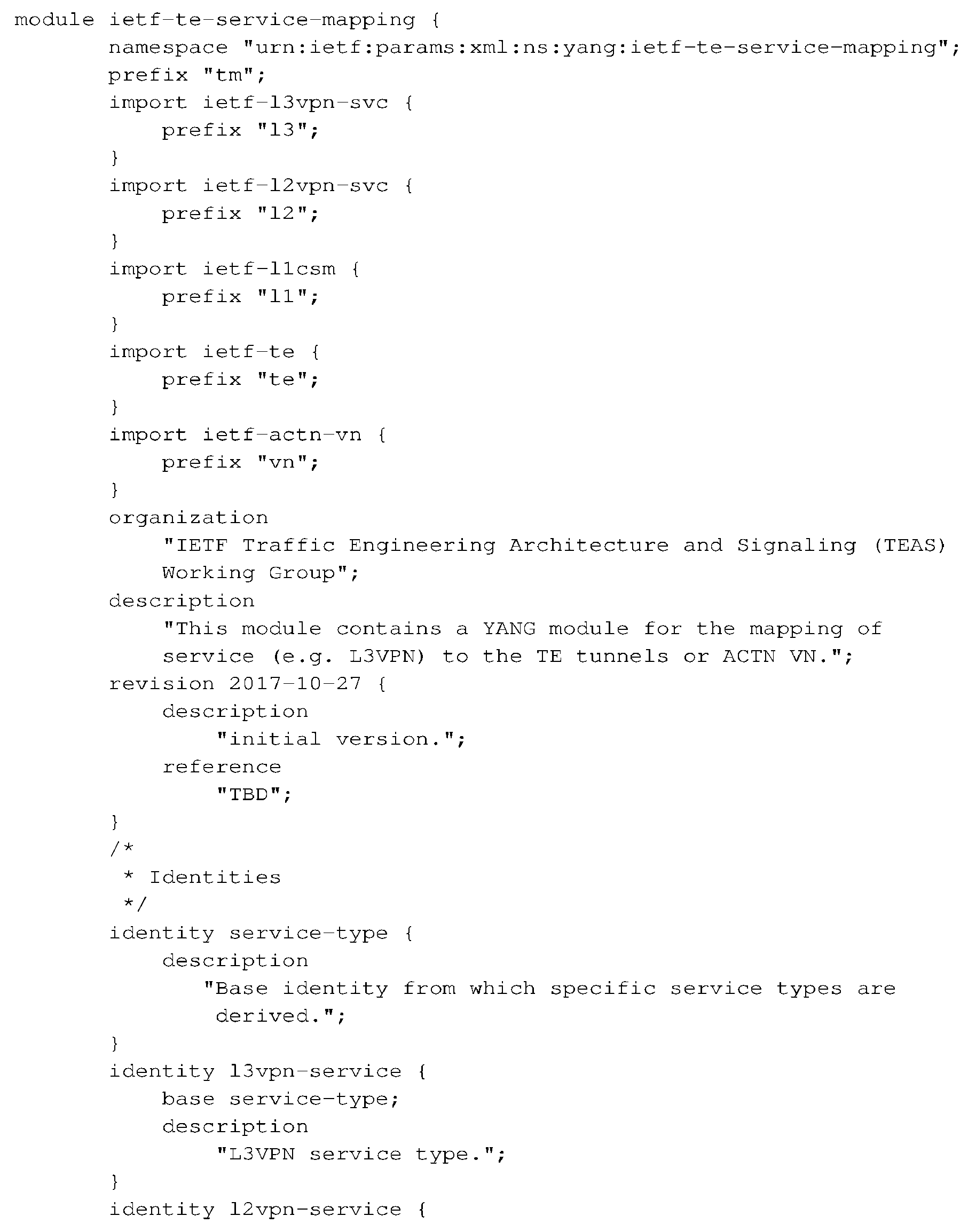


Claims (23)
VPN(virtual private network) 서비스에 대한 VPN-특정적 서비스 모델을 임포트하고 또한 상기 VPN-특정적 서비스 모델을 하나 이상의 TE(traffic engineering)-특정적 파라미터에 매핑하도록 구성된 프로세서; 및
상기 프로세서에 결합되어 상기 VPN 서비스의 VPN ID(identification)와 상기 VPN 서비스에 대해 확립된 TE 터널의 터널 ID 간의 매핑을 저장하도록 구성된 메모리 - 상기 TE 터널은 상기 하나 이상의 TE-특정적 파라미터를 만족함 - 를 포함하는 CNC.As a customer network controller (CNC):
A processor configured to import a VPN-specific service model for a virtual private network (VPN) service and also map the VPN-specific service model to one or more traffic engineering (TE) -specific parameters; And
A memory coupled to the processor and configured to store a mapping between a VPN identification of the VPN service and a tunnel ID of a TE tunnel established for the VPN service, wherein the TE tunnel satisfies the one or more TE-specific parameters. CNC including.
상기 프로세서에 결합되어,
상기 VPN-특정적 서비스 모델을 MDSC 제어기에 송신하고; 및
상기 하나 이상의 TE-특정적 파라미터를 상기 MDSC 제어기에 송신하도록 구성된 송신기; 및
상기 프로세서에 결합되어 상기 MDSC 제어기로부터 상기 TE 터널 ID를 수신하도록 구성된 수신기를 추가로 포함하는 CNC.The method of claim 1,
Coupled to the processor,
Send the VPN-specific service model to an MDSC controller; And
A transmitter configured to transmit the one or more TE-specific parameters to the MDSC controller; And
And a receiver coupled to the processor, the receiver further configured to receive the TE tunnel ID from the MDSC controller.
VPN 서비스에 대한 VPN-특정적 서비스 모델을 임포트하고 또한 상기 VPN-특정적 서비스 모델을, TE 터널 공유가 상기 VPN 서비스에 대해 허용되는지를 표시하는 서비스 매핑 정책에 매핑하도록 구성된 프로세서; 및
상기 프로세서에 결합되어 상기 서비스 매핑 정책에 따라 상기 VPN 서비스의 VPN ID와 상기 VPN 서비스에 대해 확립된 TE 터널의 터널 ID 간의 매핑을 저장하도록 구성된 메모리를 포함하는 CNC.As CNC:
A processor configured to import a VPN-specific service model for a VPN service and also map the VPN-specific service model to a service mapping policy indicating whether TE tunnel sharing is allowed for the VPN service; And
A memory coupled to the processor, the memory configured to store a mapping between the VPN ID of the VPN service and the tunnel ID of the TE tunnel established for the VPN service in accordance with the service mapping policy.
상기 프로세서에 결합되어 상기 서비스 매핑 정책을 MDSC 제어기에 송신하도록 구성된 송신기; 및
상기 프로세서에 결합되어 상기 MDSC 제어기로부터 상기 TE 터널 ID를 수신하도록 구성된 수신기를 추가로 포함하는 CNC.The method of claim 7, wherein
A transmitter coupled to the processor and configured to transmit the service mapping policy to an MDSC controller; And
And a receiver coupled to the processor, the receiver further configured to receive the TE tunnel ID from the MDSC controller.
VPN 서비스에 대한 하나 이상의 속성을 지정하는 VPN-특정적 서비스 모델을 수신하도록 구성된 수신기; 및
상기 수신기에 결합되어,
상기 VPN-특정적 서비스 모델과 상기 하나 이상의 속성에 대응하는 하나 이상의 TE-특정적 파라미터 간의 매핑을 획득하고;
상기 매핑을 이용하여, 상기 하나 이상의 TE-특정적 파라미터를 만족하는 TE 터널을 결정하고;
상기 VPN 서비스를 상기 TE 터널에 매핑하도록 구성된 프로세서를 포함하는 중앙 제어기.As the central controller:
A receiver configured to receive a VPN-specific service model specifying one or more attributes for a VPN service; And
Coupled to the receiver,
Obtain a mapping between the VPN-specific service model and one or more TE-specific parameters corresponding to the one or more attributes;
Use the mapping to determine a TE tunnel that satisfies the one or more TE-specific parameters;
A processor configured to map the VPN service to the TE tunnel.
VPN 서비스에 대한 VPN-특정적 서비스 모델 및 상기 VPN 서비스에 대한 서비스 매핑 정책을 수신하도록 구성된 수신기 - 상기 서비스 매핑 정책은 TE 터널 공유가 상기 VPN 서비스에 대해 허용되는지를 표시함 -; 및
상기 수신기에 결합되어,
상기 서비스 매핑 정책에 따라, 상기 VPN 서비스에 대한 TE 터널을 결정하고; 및
상기 VPN 서비스를 상기 TE 터널에 매핑하도록 구성된 프로세서를 포함하는 중앙 제어기.As the central controller:
A receiver configured to receive a VPN-specific service model for a VPN service and a service mapping policy for the VPN service, the service mapping policy indicating whether TE tunnel sharing is allowed for the VPN service; And
Coupled to the receiver,
Determine a TE tunnel for the VPN service according to the service mapping policy; And
A processor configured to map the VPN service to the TE tunnel.
23. The processor of claim 22, further comprising a transmitter, and in response to determining that no established TE tunnels do not allow sharing and satisfy the attributes. A central controller configured to interact with one or more PNCs using a model.
Applications Claiming Priority (5)
| Application Number | Priority Date | Filing Date | Title |
|---|---|---|---|
| US201762464198P | 2017-02-27 | 2017-02-27 | |
| US62/464,198 | 2017-02-27 | ||
| US15/905,558 | 2018-02-26 | ||
| US15/905,558 US10516550B2 (en) | 2017-02-27 | 2018-02-26 | Traffic engineering service mapping |
| PCT/CN2018/077358 WO2018153376A1 (en) | 2017-02-27 | 2018-02-27 | Traffic engineering service mapping |
Publications (2)
| Publication Number | Publication Date |
|---|---|
| KR20190111108A true KR20190111108A (en) | 2019-10-01 |
| KR102237299B1 KR102237299B1 (en) | 2021-04-08 |
Family
ID=63252392
Family Applications (1)
| Application Number | Title | Priority Date | Filing Date |
|---|---|---|---|
| KR1020197025874A Active KR102237299B1 (en) | 2017-02-27 | 2018-02-27 | Traffic Engineering Service Mapping |
Country Status (6)
| Country | Link |
|---|---|
| US (2) | US10516550B2 (en) |
| EP (1) | EP3571814A4 (en) |
| JP (1) | JP6838760B2 (en) |
| KR (1) | KR102237299B1 (en) |
| CN (1) | CN110249611B (en) |
| WO (1) | WO2018153376A1 (en) |
Families Citing this family (13)
| Publication number | Priority date | Publication date | Assignee | Title |
|---|---|---|---|---|
| CN111130980B (en) | 2016-06-29 | 2021-06-29 | 华为技术有限公司 | Method and apparatus for implementing combined virtual private network VPN |
| US12267304B2 (en) | 2019-09-24 | 2025-04-01 | Pribit Technology, Inc. | System for authenticating and controlling network access of terminal, and method therefor |
| US12348494B2 (en) * | 2019-09-24 | 2025-07-01 | Pribit Technology, Inc. | Network access control system and method therefor |
| US12519754B2 (en) | 2019-09-24 | 2026-01-06 | Pribit Technology, Inc. | System for controlling network access of node on basis of tunnel and data flow, and method therefor |
| US12381890B2 (en) | 2019-09-24 | 2025-08-05 | Pribit Technology, Inc. | System and method for secure network access of terminal |
| US12166759B2 (en) | 2019-09-24 | 2024-12-10 | Pribit Technology, Inc. | System for remote execution code-based node control flow management, and method therefor |
| WO2021166080A1 (en) * | 2020-02-18 | 2021-08-26 | 日本電信電話株式会社 | Management device, management method, and management program |
| WO2021163895A1 (en) * | 2020-02-18 | 2021-08-26 | Oppo广东移动通信有限公司 | Network model management method, session establishment or modification method, and apparatus |
| US20220283840A1 (en) | 2021-03-05 | 2022-09-08 | Vmware, Inc. | Configuring direct access to hardware accelerator in an o-ran system |
| CN115914094A (en) * | 2021-09-30 | 2023-04-04 | 华为技术有限公司 | A route publishing method, message forwarding method, device and system |
| CN116132294B (en) * | 2022-12-19 | 2025-03-21 | 中国电信股份有限公司 | A method, device, equipment and storage medium for configuring business network requirements |
| US20240205809A1 (en) * | 2022-12-19 | 2024-06-20 | VMware LLC | Multi-component configurations in a ran system |
| CN116582446B (en) * | 2023-06-08 | 2025-08-12 | 中国联合网络通信集团有限公司 | SDN model mapping method, device, equipment and storage medium |
Citations (2)
| Publication number | Priority date | Publication date | Assignee | Title |
|---|---|---|---|---|
| US20160119189A1 (en) * | 2014-10-28 | 2016-04-28 | Electronics And Telecommunications Research Institute | System for controlling carrier virtual network |
| US20160337175A1 (en) * | 2015-05-12 | 2016-11-17 | Equinix, Inc. | Centralized network control for a cloud-based services exchange |
Family Cites Families (12)
| Publication number | Priority date | Publication date | Assignee | Title |
|---|---|---|---|---|
| CN102377630A (en) | 2011-10-13 | 2012-03-14 | 华为技术有限公司 | Traffic engineering tunnel-based virtual private network implementation method and traffic engineering tunnel-based virtual private network implementation system |
| CN102724117B (en) * | 2012-06-06 | 2015-09-30 | 华为技术有限公司 | Method and device for establishing multi-protocol label switching traffic engineering tunnel |
| CN104219147B (en) * | 2013-06-05 | 2018-10-16 | 中兴通讯股份有限公司 | The VPN of edge device realizes processing method and processing device |
| US9450862B2 (en) | 2014-03-11 | 2016-09-20 | Futurewei Technologies, Inc. | Virtual private network migration and management in centrally controlled networks |
| US9363169B2 (en) * | 2014-03-31 | 2016-06-07 | Juniper Networks, Inc. | Apparatus, system, and method for reconfiguring point-to-multipoint label-switched paths |
| US9705815B2 (en) * | 2014-06-27 | 2017-07-11 | Juniper Networks, Inc. | Graph database for services planning and configuration in network services domain |
| US9634936B2 (en) * | 2014-06-30 | 2017-04-25 | Juniper Networks, Inc. | Service chaining across multiple networks |
| US9825777B2 (en) * | 2015-06-23 | 2017-11-21 | Cisco Technology, Inc. | Virtual private network forwarding and nexthop to transport mapping scheme |
| US10412019B2 (en) * | 2015-07-06 | 2019-09-10 | Futurewei Technologies, Inc. | Path computation element central controllers (PCECCs) for network services |
| US10637889B2 (en) * | 2015-07-23 | 2020-04-28 | Cisco Technology, Inc. | Systems, methods, and devices for smart mapping and VPN policy enforcement |
| US10165093B2 (en) * | 2015-08-31 | 2018-12-25 | Cisco Technology, Inc. | Generating segment routing conduit in service provider network for routing packets |
| US10027587B1 (en) * | 2016-03-30 | 2018-07-17 | Amazon Technologies, Inc. | Non-recirculating label switching packet processing |
-
2018
- 2018-02-26 US US15/905,558 patent/US10516550B2/en active Active
- 2018-02-27 WO PCT/CN2018/077358 patent/WO2018153376A1/en not_active Ceased
- 2018-02-27 EP EP18758203.6A patent/EP3571814A4/en not_active Withdrawn
- 2018-02-27 CN CN201880009873.5A patent/CN110249611B/en active Active
- 2018-02-27 KR KR1020197025874A patent/KR102237299B1/en active Active
- 2018-02-27 JP JP2019542673A patent/JP6838760B2/en active Active
-
2019
- 2019-10-18 US US16/657,405 patent/US10708083B2/en active Active
Patent Citations (2)
| Publication number | Priority date | Publication date | Assignee | Title |
|---|---|---|---|---|
| US20160119189A1 (en) * | 2014-10-28 | 2016-04-28 | Electronics And Telecommunications Research Institute | System for controlling carrier virtual network |
| US20160337175A1 (en) * | 2015-05-12 | 2016-11-17 | Equinix, Inc. | Centralized network control for a cloud-based services exchange |
Non-Patent Citations (2)
| Title |
|---|
| Young Lee, et.al., Applicability of YANG models for Abstraction and Control of Traffic Engineered Networks, draft-zhang-teas-actn-yang-03 (2016.10.31)* * |
| Young Lee, et.al., Information Model for Abstraction and Control of TE Networks (ACTN), draft-leebelotti-teas-actn-info-05 (2016.10.24)* * |
Also Published As
| Publication number | Publication date |
|---|---|
| KR102237299B1 (en) | 2021-04-08 |
| EP3571814A1 (en) | 2019-11-27 |
| WO2018153376A1 (en) | 2018-08-30 |
| CN110249611B (en) | 2020-11-03 |
| JP6838760B2 (en) | 2021-03-03 |
| CN110249611A (en) | 2019-09-17 |
| US10516550B2 (en) | 2019-12-24 |
| US20180262365A1 (en) | 2018-09-13 |
| JP2020508600A (en) | 2020-03-19 |
| US10708083B2 (en) | 2020-07-07 |
| US20200052928A1 (en) | 2020-02-13 |
| EP3571814A4 (en) | 2019-11-27 |
Similar Documents
| Publication | Publication Date | Title |
|---|---|---|
| KR102237299B1 (en) | Traffic Engineering Service Mapping | |
| US10826722B2 (en) | Controller based service policy mapping to establish different tunnels for different applications | |
| CN112470436B (en) | Systems, methods, and computer-readable media for providing multi-cloud connectivity | |
| CN107637031B (en) | Path computation element central controller for network traffic | |
| CN106464587B (en) | Virtual Private Network migration and centralized control network management | |
| JP6513880B2 (en) | How to establish a relationship between a set of label switch paths and a virtual network | |
| CN113411243B (en) | Data transmission method and device | |
| US11310080B2 (en) | VXLAN configuration method, device, and system | |
| US10374831B2 (en) | Stitching multi-domain LSPs in hierarchical SDN architecture | |
| WO2022110535A1 (en) | Packet sending method, device, and system | |
| CN111164936B (en) | Method and system for modeling access network as tree in SDN controller | |
| JP2014230057A (en) | Management program, management device, and network system | |
| CN111149330A (en) | Topology-Aware Controller Association in Software-Defined Networking | |
| US9379964B2 (en) | Discovering a topology—transparent zone | |
| WO2017113300A1 (en) | Route determining method, network configuration method and related device | |
| EP3759877B1 (en) | Establishing a path in an optical domain to couple ip routing domains for use by a vpn | |
| WO2013174096A1 (en) | Method, device and system for migration of cloud computing virtual machine | |
| CN107295038B (en) | Method and device for establishing interface group | |
| CN109417513B (en) | System and method for dynamically detecting opposite terminal in software defined network | |
| US20220078233A1 (en) | Transferring state information of resources | |
| CN119814561A (en) | Configuration method, device, equipment and program product of multi-vendor hybrid virtual private network | |
| CN116915704A (en) | Method and implementation system for floating IP to access external networks |
Legal Events
| Date | Code | Title | Description |
|---|---|---|---|
| A201 | Request for examination | ||
| PA0105 | International application |
Patent event date: 20190903 Patent event code: PA01051R01D Comment text: International Patent Application |
|
| PA0201 | Request for examination |
Patent event code: PA02012R01D Patent event date: 20190903 Comment text: Request for Examination of Application |
|
| PG1501 | Laying open of application | ||
| E902 | Notification of reason for refusal | ||
| PE0902 | Notice of grounds for rejection |
Comment text: Notification of reason for refusal Patent event date: 20200814 Patent event code: PE09021S01D |
|
| E701 | Decision to grant or registration of patent right | ||
| PE0701 | Decision of registration |
Patent event code: PE07011S01D Comment text: Decision to Grant Registration Patent event date: 20210310 |
|
| GRNT | Written decision to grant | ||
| PR0701 | Registration of establishment |
Comment text: Registration of Establishment Patent event date: 20210401 Patent event code: PR07011E01D |
|
| PR1002 | Payment of registration fee |
Payment date: 20210402 End annual number: 3 Start annual number: 1 |
|
| PG1601 | Publication of registration | ||
| PR1001 | Payment of annual fee |
Payment date: 20240319 Start annual number: 4 End annual number: 4 |
|
| PR1001 | Payment of annual fee |
Payment date: 20250317 Start annual number: 5 End annual number: 5 |