KR20190036459A - Hyperspectral Imaging Reconstruction Method Using Artificial Intelligence and Apparatus Therefor - Google Patents
Hyperspectral Imaging Reconstruction Method Using Artificial Intelligence and Apparatus Therefor Download PDFInfo
- Publication number
- KR20190036459A KR20190036459A KR1020180094253A KR20180094253A KR20190036459A KR 20190036459 A KR20190036459 A KR 20190036459A KR 1020180094253 A KR1020180094253 A KR 1020180094253A KR 20180094253 A KR20180094253 A KR 20180094253A KR 20190036459 A KR20190036459 A KR 20190036459A
- Authority
- KR
- South Korea
- Prior art keywords
- image
- nonlinear
- reconstructing
- spectral
- learning model
- Prior art date
- Legal status (The legal status is an assumption and is not a legal conclusion. Google has not performed a legal analysis and makes no representation as to the accuracy of the status listed.)
- Granted
Links
Images




Classifications
-
- G—PHYSICS
- G06—COMPUTING OR CALCULATING; COUNTING
- G06T—IMAGE DATA PROCESSING OR GENERATION, IN GENERAL
- G06T5/00—Image enhancement or restoration
- G06T5/50—Image enhancement or restoration using two or more images, e.g. averaging or subtraction
-
- G—PHYSICS
- G01—MEASURING; TESTING
- G01J—MEASUREMENT OF INTENSITY, VELOCITY, SPECTRAL CONTENT, POLARISATION, PHASE OR PULSE CHARACTERISTICS OF INFRARED, VISIBLE OR ULTRAVIOLET LIGHT; COLORIMETRY; RADIATION PYROMETRY
- G01J3/00—Spectrometry; Spectrophotometry; Monochromators; Measuring colours
- G01J3/28—Investigating the spectrum
-
- G—PHYSICS
- G06—COMPUTING OR CALCULATING; COUNTING
- G06T—IMAGE DATA PROCESSING OR GENERATION, IN GENERAL
- G06T2211/00—Image generation
- G06T2211/40—Computed tomography
- G06T2211/416—Exact reconstruction
Landscapes
- Physics & Mathematics (AREA)
- Spectroscopy & Molecular Physics (AREA)
- General Physics & Mathematics (AREA)
- Engineering & Computer Science (AREA)
- Theoretical Computer Science (AREA)
- Image Analysis (AREA)
Abstract
Description
본 발명은 초분광 영상 복원 기술에 관한 것으로서, 상세하게는 인공 지능 예를 들어, 컨볼루션 신경망(CNN; Convolutional Neural Network)의 일종이며 비선형 학습 모델인 컨볼루션 자동인코더(Convolutional Autoencoder)를 이용하여 고품질의 초분광 영상을 복원 또는 재구성할 수 있는 방법 및 장치에 관한 것이다.The present invention relates to an ultra-spectral image reconstruction technique, and more particularly, to an ultrasound image reconstruction technique using artificial intelligence, for example, a convolutional neural network (CNN; Convolutional Neural Network) The present invention relates to a method and an apparatus capable of restoring or reconstructing an ultraspectral image of an ultrasound image.
초분광 영상(또는 하이퍼스펙트럴 영상)은 기존의 RGB 카메라와 달리, 훨씬 더 고밀도의 스펙트럴 샘플링을 통한 정보 즉, 추가적인 데이터를 포함한다. 여기서, 추가 데이터는 외관 캡쳐, 환경 모니터링, 과학 이미징, 천문학 등을 포함한 많은 응용 분야에 사용될 수 있다.Ultraspectral images (or hyperspectral images), unlike conventional RGB cameras, contain information through far more dense spectral sampling, i.e., additional data. Here, the additional data can be used in many applications including appearance capture, environmental monitoring, scientific imaging, astronomy, and the like.
초분광 정보를 캡처하기 위해 하드웨어 아키텍쳐를 개발하는 데에 중점을 둔 연구가 다수 존재하며, 가장 직접적인 접근법은 가시 스펙트럴을 순차적으로 스캐닝하는 동안 다른 대역통과 또는 가변적 액정필터(LCTF; liquid crystal tunable flters)를 사용하여 파장 측정을 격리하는 시간-스펙트럴 스캐닝이다. 이 접근법의 스펙트럴 분해능은 사용된 필터의 수에 의해 제한된다. 시간 다중 샘플링은 미세 이동 단계(micro-translation stage) 또는 디지털 마이크로미러 디바이스(DMD)를 사용하여 도입되었다. 이외에도, 공간-스펙트럴 스캐닝 접근법은 슬릿을 통해 각 파장의 이미지열을 캡쳐한다. 최근의 다른 접근법으로는 만화경 기반 다중 샘플링, 재구성 가능 카메라 또는 하드웨어 비용 절감을 위한 디자인 등이 있다.There are a number of studies focused on developing hardware architectures for capturing superspecific information, and the most direct approach is to use different bandpass or liquid crystal tunable filters (LCTFs) during sequential scanning of the visible spectrum ) To isolate the wavelength measurement. The spectral resolution of this approach is limited by the number of filters used. Time multiplexed sampling was introduced using a micro-translation stage or a digital micromirror device (DMD). In addition, a spatial-spectral scanning approach captures image rows of each wavelength through a slit. Other recent approaches include kaleidoscope-based multisampling, reconfigurable cameras, or designs for hardware cost savings.
상술한 바와 같이, 기존의 솔루션들은 액정 대역 통과 필터, 푸시브룸(pushbroom) 스캐너, 마이크로 변환 또는 디지털 미러 장치의 사용을 포함하여 새로운 하드웨어 아키텍쳐 설계에 중점을 두고 있다. 하지만, 기존의 솔루션들은 엔지니어링 비용 및 하드웨어 구축 비용 또는 정적 화면만 캡처해야 하는 등의 제한 요소를 공유한다. 게다가, 기존의 솔루션들의 공통적인 특징은 캡쳐된 결과에 나타나는 공간 해상도와 스펙트럴 정확도 사이의 트레이드 오프이다.As discussed above, existing solutions focus on designing new hardware architectures, including the use of liquid crystal bandpass filters, pushbroom scanners, micro-conversion, or digital mirror devices. However, existing solutions share constraints such as engineering costs and the cost of building hardware or capturing only static screens. In addition, a common feature of existing solutions is the tradeoff between spatial resolution and spectral accuracy that appears in the captured results.
이러한 트레이드 오프를 극복하기 위해 몇 가지 방법이 제안되었다.Several methods have been proposed to overcome this trade-off.
종래 일 실시예의 최적화 기술은 그래디언트의 희소성을 강조하기 위해 데이터 정확도 항과 총 변이 전체 표준 정규화 항을 정의하는 재구성 과정을 거치는데, 이 때 공간-스펙트럴 트레이드 오프를 극복하는 것을 목표로 한다. 이러한 최적화 기술은 두 가지 가정에 의존한다. 첫째, 초분광 성분은 공간 영역과 스펙트럴 영역 모두에서 매우 높은 상관 관계를 나타낸다. 둘째, 초분광 벡터는 저차원 상의 부분 공간에 속한다. 종래 일 실시예에 따른 기술들은 스펙트럴 차원에서 스펙트럴 균일 세그먼트가 존재한다고 가정하고, 스펙트럴 그래디언트가 대략 구분적으로 매끄럽다고 가정하며, 공간 상관을 추론하는 제한된 최적화 접근법을 도입한다. 그러나 이러한 접근법은 여전히 재구성된 이미지 구조 및 세부 사항에 인위적인 결과가 나타난다. The optimization technique of one embodiment of the present invention undergoes a reconstruction process that defines the data accuracy term and the total variation total standard normalization term in order to emphasize the scarcity of the gradient, while aiming at overcoming the space-spectral tradeoff. This optimization technique depends on two assumptions. First, supersonic spectral components show a very high correlation in both spatial and spectral regions. Second, the supersensory vector belongs to the subspace on the low dimension. Techniques according to one embodiment of the prior art assume a spectral uniform segment in the spectral dimension, assume that the spectral gradient is roughly segmentally smooth, and introduce a limited optimization approach to infer spatial correlation. However, this approach still results in artifacts in the reconstructed image structure and details.
종래 다른 일 실시예의 코딩된 조리개 스냅샷 스펙트럴 이미징(CASSI)은 동적 장면을 캡처할 수 있는 가장 널리 사용되는 초분광 영상 방식 중 하나이다. 이러한 압축 기술의 정의 상 캡처된 코딩 정보는 최종 이미지를 생성하기 위해 재구성되어야 한다. CASSI는 스펙트럴 서명이 인코딩되는 방식에 따라 두 클래스 즉, (1) 단일 분산기를 사용하여 공간적으로 인코딩 된 CASSI(SD-CASSI), (2) 두 영역의 정보를 코딩하는 공간-스펙트럴 CASSI(SS-CASSI) 또는 이중 분산기 DDCASSI로 나눌 수 있따. 이러한 모든 기법은 공간 해상도와 스펙트럴 정확도 사이의 내재적인 절충점을 공유하므로 재구성 단계는 최종 이미지의 품질을 결정한다. Conventionally, coded diaphragm snapshot spectral imaging (CASSI) of one embodiment is one of the most widely used ultrasound imaging schemes capable of capturing dynamic scenes. By the definition of this compression technique, the captured coding information must be reconstructed to produce the final image. The CASSI is divided into two classes according to how the spectral signature is encoded: (1) spatially encoded CASSI (SD-CASSI) using a single spreader, (2) space-spectral CASSI SS-CASSI) or double disperser DDCASSI. All these techniques share an intrinsic trade-off between spatial resolution and spectral accuracy, so the reconstruction step determines the quality of the final image.
종래 다른 일 실시예의 기술에서 데이터 기반 방법은 내추럴 스펙트럴 이미지의 선형 표현을 희소 코딩된 사전 예를 들어, 공개된 초분광 영상 데이터 세트로 학습하는데, 일 예의 기술에서 재구성 중 노이즈 제거 방법을 제안한 바 있으며, 다른 일 예의 기술에서 하이 프레임 레이트의 팬크로매틱(panchromatic) 비디오와 로우 프레임 레이트의 초분광 정보를 결합하는 듀얼 카메라 시스템을 소개한 바도 있다. 팬크로매틱 정보는 과도 완료된(overcomplete) 사전을 배우는 데 사용될 수 있다. 또 다른 일 예의 기술에서 회절 격자가 갖춰진 공간-스펙트럴 인코딩 초분광 이미저(imager)를 소개한 바 있다.A data-based method in the prior art teaches a linear representation of a natural spectral image as a sparsely coded dictionary, e.g., a published hyperspectral image data set. In one example technique, a noise cancellation method during reconstruction has been proposed In another example, a dual camera system has been introduced that combines high frame rate panchromatic video with low frame rate ultrasound information. Panchromatic information can be used to learn overcomplete dictionaries. In another example technique, a spatial-spectral-encoded ultrasound imager equipped with a diffraction grating has been introduced.
본 발명의 실시예들은, 상세하게는 인공 지능 예를 들어, 컨볼루션 신경망(CNN; Convolutional Neural Network)의 일종이며 비선형 학습 모델인 컨볼루션 자동인코더(Convolutional Autoencoder)를 이용하여 고품질의 초분광 영상을 재구성할 수 있는 방법 및 장치를 제공한다.Embodiments of the present invention are, for example, an artificial intelligence, for example, a convolutional neural network (CNN), a nonlinear learning model, a convolutional autoencoder, A method and apparatus are provided that can be reconfigured.
본 발명의 일 실시예에 따른 초분광 영상 재구성 방법은 영상에 대한 코딩된 데이터를 수신하는 단계; 및 미리 생성된 비선형 학습 모델에 기초하여 상기 코딩된 데이터에 대한 영상의 초분광 영상을 재구성하는 단계를 포함한다.A method of reconstructing an ultrasound image according to an embodiment of the present invention includes receiving coded data for an image; And reconstructing the hyperspectral image of the image for the coded data based on the pre-generated non-linear learning model.
나아가, 본 발명의 일 실시예에 따른 초분광 영상 재구성 방법은 미리 설정된 초분광 영상 데이터 세트를 이용한 학습을 통해 비선형 학습 모델을 생성하는 단계를 더 포함하고, 상기 초분광 영상을 재구성하는 단계는 상기 생성된 비선형 학습 모델과 비선형 최적화 기법에 기초하여 상기 초분광 영상을 재구성할 수 있다.Further, the method of reconstructing an ultrasound image according to an exemplary embodiment of the present invention may further include generating a nonlinear learning model by learning using a preset ultrasound image data set, The hyperspectral image can be reconstructed based on the generated nonlinear learning model and nonlinear optimization technique.
상기 비선형 학습 모델을 생성하는 단계는 상기 초분광 영상 데이터 세트를 이용한 학습을 통해 컨볼루션 자동인코더를 학습시켜 상기 비선형 학습 모델을 생성할 수 있다.The generating of the nonlinear learning model may generate the nonlinear learning model by learning a convolutional automatic encoder through learning using the supersampled image data set.
상기 비선형 학습 모델을 생성하는 단계는 상기 컨볼루션 자동 인코더를 이용하여 비선형 공간에서 인코더 네트워크를 학습시킨 후 디코더 네트워크를 이용하여 상기 비선형 학습 모델을 생성할 수 있다.The step of generating the nonlinear learning model may generate the nonlinear learning model using a decoder network after learning an encoder network in a nonlinear space using the convolution auto encoder.
상기 컨볼루션 자동 인코더는 상기 초분광 영상 데이터 세트를 비선형 표현으로 변환하는 인코더 네트워크와 상기 비선형 표현으로부터 원본 데이터 세트를 생성하는 디코더 네트워크를 포함할 수 있다.The convolutional auto encoder may comprise an encoder network for transforming the hyperspectral image data set into a non-linear representation and a decoder network for generating a set of original data from the non-linear representation.
상기 비선형 학습 모델은 초분광 영상에 대한 비선형 재구성을 출력하는 학습 모델일 수 있다.The nonlinear learning model may be a learning model that outputs nonlinear reconstruction to the hyperspectral image.
상기 초분광 영상을 재구성하는 단계는 상기 생성된 비선형 학습 모델에 대한 비선형 스펙트럴 표현의 정확도와 공간 영역에서의 그래디언트(gradient)의 희소성(sparsity)을 공동으로 정규화하는 상기 비선형 최적화 기법에 기초하여 상기 코딩된 데이터에 대한 영상의 초분광 영상을 재구성할 수 있다.Wherein reconstructing the hyperspectral image comprises reconstructing the hyperspectral image based on the nonlinear optimization technique that jointly normalizes the accuracy of the nonlinear spectral representation for the generated nonlinear learning model and the sparsity of the gradient in the spatial domain. It is possible to reconstruct the hyperspectral image of the image with respect to the coded data.
상기 초분광 영상을 재구성하는 단계는 ADMM(alternating direction multiplier) 방식을 사용하여 상기 비선형 최적화 기법을 반복 수행함으로써, 상기 코딩된 데이터에 대한 영상의 초분광 영상을 재구성할 수 있다.The reconstructing of the ultrasound image can reconstruct an ultrasound image of the image for the coded data by repeating the nonlinear optimization technique using an alternating direction multiplier (ADMM) scheme.
상기 수신하는 단계는 압축 하이퍼스펙트럴 이미징 접근법을 이용하여 상기 영상에 대한 코딩된 데이터를 수신할 수 있다.The receiving may receive coded data for the image using a compressed hyperspectral imaging approach.
본 발명의 다른 일 실시예에 따른 초분광 영상 재구성 방법은 영상에 대한 코딩된 데이터를 수신하는 단계; 및 미리 학습된 스펙트럴 프라이어에 기초하여 상기 코딩된 데이터에 대한 영상의 초분광 영상을 재구성하는 단계를 포함한다.According to another aspect of the present invention, there is provided an ultrasound image reconstruction method including: receiving coded data for an image; And reconstructing a hyperspectral image of the image for the coded data based on the previously learned spectral flier.
나아가, 본 발명의 다른 일 실시예에 따른 초분광 영상 재구성 방법은 미리 설정된 초분광 영상 데이터 세트를 이용하여 상기 스펙트럴 프라이어(prior)를 학습시키는 단계를 포함하고, 상기 초분광 영상을 재구성하는 단계는 상기 학습된 스펙트럴 프라이어와 비선형 최적화 기법에 기초하여 상기 초분광 영상을 재구성할 수 있다.Further, the method of reconstructing an ultrasound image according to another embodiment of the present invention includes the step of learning the spectral prior using a preset ultrasound image data set, and reconstructing the ultrasound image Can reconstruct the hyperspectral image based on the learned spectral flier and the nonlinear optimization technique.
상기 초분광 영상을 재구성하는 단계는 상기 학습된 스펙트럴 프라이어에 대한 비선형 스펙트럴 표현의 정확도와 공간 영역에서의 그래디언트(gradient)의 희소성(sparsity)을 공동으로 정규화하는 상기 비선형 최적화 기법에 기초하여 상기 코딩된 데이터에 대한 영상의 초분광 영상을 재구성할 수 있다.Wherein reconstructing the hyperspectral image comprises reconstructing the spectral image based on the nonlinear optimization technique that jointly normalizes the accuracy of the nonlinear spectral representation for the learned spectral fryer and the sparsity of the gradient in the spatial domain. It is possible to reconstruct the hyperspectral image of the image with respect to the coded data.
상기 초분광 영상을 재구성하는 단계는 ADMM(alternating direction multiplier) 방식을 사용하여 상기 비선형 최적화 기법을 반복 수행함으로써, 상기 코딩된 데이터에 대한 영상의 초분광 영상을 재구성할 수 있다.The reconstructing of the ultrasound image can reconstruct an ultrasound image of the image for the coded data by repeating the nonlinear optimization technique using an alternating direction multiplier (ADMM) scheme.
본 발명의 일 실시예에 따른 초분광 영상 재구성 장치는 영상에 대한 코딩된 데이터를 수신하는 수신부; 및 미리 생성된 비선형 학습 모델에 기초하여 상기 코딩된 데이터에 대한 영상의 초분광 영상을 재구성하는 재구성부를 포함한다.According to an embodiment of the present invention, there is provided an apparatus for reconstructing an ultrasound image, comprising: a receiver for receiving coded data for an image; And a reconstruction unit reconstructing a hyperspectral image of the image for the coded data based on a pre-generated non-linear learning model.
나아가, 본 발명의 일 실시예에 따른 초분광 영상 재구성 장치는 미리 설정된 초분광 영상 데이터 세트를 이용한 학습을 통해 비선형 학습 모델을 생성하는 생성부를 더 포함하고, 상기 재구성부는 상기 생성된 비선형 학습 모델과 비선형 최적화 기법에 기초하여 상기 초분광 영상을 재구성할 수 있다.Further, the apparatus for reconstructing an ultrasound image according to an exemplary embodiment of the present invention may further include a generation unit for generating a nonlinear learning model through learning using a preset ultrasound image data set, and the reconstruction unit may generate the non- The hyperspectral image can be reconstructed based on nonlinear optimization techniques.
상기 생성부는 상기 초분광 영상 데이터 세트를 이용한 학습을 통해 컨볼루션 자동인코더를 학습시켜 상기 비선형 학습 모델을 생성할 수 있다.The generator may generate the nonlinear learning model by learning a convolution auto encoder through learning using the superspectral image data set.
상기 생성부는 상기 컨볼루션 자동 인코더를 이용하여 비선형 공간에서 인코더 네트워크를 학습시킨 후 디코더 네트워크를 이용하여 상기 비선형 학습 모델을 생성할 수 있다.The generator may learn the encoder network in a nonlinear space using the convolution auto encoder and then generate the nonlinear learning model using a decoder network.
상기 컨볼루션 자동 인코더는 상기 초분광 영상 데이터 세트를 비선형 표현으로 변환하는 인코더 네트워크와 상기 비선형 표현으로부터 원본 데이터 세트를 생성하는 디코더 네트워크를 포함할 수 있다.The convolutional auto encoder may comprise an encoder network for transforming the hyperspectral image data set into a non-linear representation and a decoder network for generating a set of original data from the non-linear representation.
상기 비선형 학습 모델은 초분광 영상에 대한 비선형 재구성을 출력하는 학습 모델일 수 있다.The nonlinear learning model may be a learning model that outputs nonlinear reconstruction to the hyperspectral image.
상기 재구성부는 상기 생성된 비선형 학습 모델에 대한 비선형 스펙트럴 표현의 정확도와 공간 영역에서의 그래디언트(gradient)의 희소성(sparsity)을 공동으로 정규화하는 상기 비선형 최적화 기법에 기초하여 상기 코딩된 데이터에 대한 영상의 초분광 영상을 재구성할 수 있다.Wherein the reconstructing unit reconstructs the image for the coded data based on the nonlinear optimization technique that jointly normalizes the accuracy of the nonlinear spectral representation for the generated nonlinear learning model and the sparsity of the gradient in the spatial domain. Can be reconfigured.
상기 재구성부는 ADMM(alternating direction multiplier) 방식을 사용하여 상기 비선형 최적화 기법을 반복 수행함으로써, 상기 코딩된 데이터에 대한 영상의 초분광 영상을 재구성할 수 있다.The reconstructing unit may reconstruct the hyperspectral image of the image for the coded data by repeatedly performing the nonlinear optimization technique using an alternating direction multiplier (ADMM) scheme.
상기 수신부는 압축 하이퍼스펙트럴 이미징 접근법을 이용하여 상기 영상에 대한 코딩된 데이터를 수신할 수 있다.The receiver may receive coded data for the image using a compressed hyperspectral imaging approach.
본 발명의 또 다른 일 실시예에 따른 초분광 영상 재구성 방법은 영상에 대한 코딩된 데이터를 수신하는 단계; 및 미리 학습된 학습 모델과 최적화 기법에 기초하여 상기 코딩된 데이터에 대한 영상의 초분광 영상을 재구성하는 단계를 포함한다.According to another embodiment of the present invention, there is provided an ultrasound image reconstruction method comprising: receiving coded data for an image; And reconstructing a hyperspectral image of the image for the coded data based on a pre-learned learning model and an optimization technique.
본 발명의 실시예들에 따르면, 인공 지능 예를 들어, 컨볼루션 신경망(CNN; Convolutional Neural Network)의 일종이며 비선형 학습 모델인 컨볼루션 자동인코더(Convolutional Autoencoder)를 이용하여 고품질의 초분광 영상을 재구성함으로써, 기존의 어떤 압축 이미징 아키텍처에 적용할 수 있다.According to embodiments of the present invention, a high-quality ultrasound image is reconstructed using artificial intelligence, for example, a convolutional autoencoder, which is a type of Convolutional Neural Network (CNN) , Which can be applied to any existing compression imaging architecture.
본 발명의 실시예들에 따르면, 스펙트럴 정확도와 공간 해상도 측면에서 각 아키텍처의 최첨단 방식을 능가하면서도 계산 복잡성은 희소 코딩 기술과 관련하여 2배 정도 감소시킬 수 있다.According to embodiments of the present invention, the computational complexity can be reduced by a factor of two with respect to the sparse coding technique, while surpassing the state-of-the-art approach of each architecture in terms of spectral accuracy and spatial resolution.
본 발명의 실시예들에 따르면, 프로젝트 웹 사이트를 통해 제공되는 기존 방법보다 더 다양한 스펙트럴의 선명한 이미지를 포함하는 새로운 고해상도 초분광 데이터 세트를 제공할 수 있다.According to embodiments of the present invention, it is possible to provide a new high-resolution superspectral data set that includes a sharp image of a more spectral range than existing methods provided through a project website.
도 1은 본 발명에 따른 방법과 기존 방법들을 비교한 일 예시도를 나타낸 것이다.
도 2는 SD-CASSI, SS-CASSI 및 이중 분산기 DD-CASSI 시스템에서 사용된 공간 인코딩에 대한 일 예시도를 나타낸 것이다.
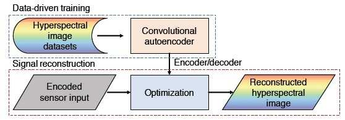
도 3은 인코딩된 센서 신호에서 하이퍼스펙트럴 이미지를 재구성하는 2단계 프로세스의 개요를 나타낸 것이다.
도 4는 컨볼루션 자동 인코더에 대한 일 예시도를 나타낸 것이다.
도 5는 자동 인코더의 재구성 정확도에 대한 일 예시도를 나타낸 것이다.
도 6은 콜럼비아 이미지 데이터 세트에 대한 평균 결과에 대한 일 예시도를 나타낸 것이다.
도 7은 콜럼비아 데이터 세트의 컬러 체커 하이퍼 스펙트럴 이미지에 대한 대조비교를 나타낸 것이다.
도 8은 Twist, SpaRSA, 희소 코딩 및 본 발명의 방법을 사용하여 표준 공간 주파수 측정 차트(ISO 12233)를 재구성한 결과를 나타낸 것이다.
도 9는 본 발명의 
도 10은 숨겨진 레이어 수가 재구성의 공간 해상도에 미치는 영향을 나타낸 것이다.
도 11은 본 발명과 기존 방법들에 대한 재구성 결과를 나타낸 것이다.
도 12는 본 발명에 의해 생성된 초분광 영상 데이터 세트에 대한 예시도를 나타낸 것이다.
도 13은 본 발명과 실측값 그리고 다른 방법들과 비교한 결과를 나타낸 것이다.
도 14는 본 발명과 회귀 기반 방법에 대해 스펙트럴 반사 정확도와 공간 구조 정확도를 비교한 일 예시도를 나타낸 것이다.
도 15는 본 발명의 초분광 영상 시스템과 이에 대한 결과의 예시도를 나타낸 것이다.
도 16은 본 발명이 스펙트럴 재구성에 대한 결과를 나타낸 것이다.
도 17은 본 발명에서의 제한 예를 나타낸 것이다.FIG. 1 shows an example of a comparison between the method according to the present invention and existing methods.
Figure 2 shows an example of spatial encoding used in SD-CASSI, SS-CASSI and dual-distributor DD-CASSI systems.
Figure 3 shows an overview of a two-step process for reconstructing a hyperspectral image in an encoded sensor signal.
Figure 4 shows an example of a convolutional auto-encoder.
Figure 5 shows an example of the reconstruction accuracy of an automatic encoder.
Figure 6 shows an example of an average result for a Columbia image data set.
Figure 7 shows a comparison comparison for a color checker hyperspectral image of the Columbia data set.
Figure 8 shows the result of a reconstruction of a standard spatial frequency measurement chart (ISO 12233) using Twist, SpaRSA, sparse coding and the method of the present invention.
FIG. 9 is a cross-
Fig. 10 shows the effect of the number of hidden layers on the spatial resolution of the reconstruction.
Figure 11 shows the reconstruction results of the present invention and existing methods.
12 shows an exemplary diagram of a superspatial image data set generated by the present invention.
FIG. 13 shows the comparison between the present invention and measured values and other methods.
Figure 14 shows an example of a comparison of spectral reflection accuracy and spatial structure accuracy for the present invention and regression based method.
15 shows an example of the ultrasound imaging system of the present invention and the results thereof.
Figure 16 shows the results of the spectral reconstruction of the present invention.
17 shows a limiting example of the present invention.
이하, 본 발명에 따른 실시예들을 첨부된 도면을 참조하여 상세하게 설명한다. 그러나 본 발명이 실시예들에 의해 제한되거나 한정되는 것은 아니다. 또한, 각 도면에 제시된 동일한 참조 부호는 동일한 부재를 나타낸다.Hereinafter, embodiments according to the present invention will be described in detail with reference to the accompanying drawings. However, the present invention is not limited to or limited by the embodiments. In addition, the same reference numerals shown in the drawings denote the same members.
본 발명은 개별 선정된(hand-crafted) 만들어진 프라이어(prior)를 신경망으로 트레이닝된 데이터 구동 프라이어(data-driven prior)로 대체함으로써, 문제에 따른 부작용을 줄이고, 자연스러운 초분광 영상의 비선형 표현 도입을 가능하게 할 수 있다.The present invention replaces the prior-hand-crafted prior with data-driven prior trained neural networks to reduce side effects from problems and introduce non-linear representation of natural ultrasound images .
본 발명의 신규한 스펙트럴 재구성 알고리즘은 SD-CASSI, SS-CASSI 및 DD-CASSI와 같은 임의의 압축 이미징 기술로 캡처된 입력에 적용될 수 있으며, 다른 기존의 데이터 구동 방식에 비해 빠른 속도와 나은 결과를 제공한다.The novel spectral reconstruction algorithms of the present invention can be applied to inputs captured with any compression imaging technique, such as SD-CASSI, SS-CASSI and DD-CASSI, Lt; / RTI >
본 발명은 비선형 표현을 생성하는 컨볼루션 자동 인코더를 사용한다. 본 발명은 새로운 전역 최적화 기법을 통해 비선형 표현의 정확도를 공동으로 조정함으로써, 정확성과 효율성을 향상시킬 수 있다.The present invention uses a convolutional auto encoder to generate a non-linear representation. The present invention can improve the accuracy and efficiency by jointly adjusting the accuracy of the nonlinear representation through a new global optimization technique.
이러한 본 발명은 기존의 압축 이미징 기법에서 스펙트럴 정확도와 공간 해상도 사이의 오래된 트레이드 오프를 극복하는 새로운 초분광 영상 재구성 알고리즘을 제시한다.The present invention presents a new ultrasound image reconstruction algorithm that overcomes the old trade-off between spectral accuracy and spatial resolution in existing compression imaging techniques.
본 발명에 따른 방법은 두 단계로 구성된다. 먼저, 본 발명은 실제 초분광(또는 하이퍼스펙트럴)(hyperspectral) 데이터 세트로부터 비선형 스펙트럴 표현을 학습한다. 이를 위해, 인코더 및 디코더 네트워크를 통해 자체 입력을 재구성 할 수 있는 컨볼루션 자동 인코더를 구축한다. 그 다음, 본 발명은 새로운 정확도 프라이어(prior)에 의해 학습된 비선형 스펙트럴 표현의 정확도와 공간 영역에서의 그래디언트(gradient)(또는 그래디언트)의 희소성(sparsity)을 공동으로 정규화하는 새로운 최적화 방법을 공식화한다. 본 발명에 따른 방법은 기존의 어떤 압축 이미징 아키텍처에나 적용될 수 있으며 시뮬레이션 및 프로토타입 초분광 영상 시스템 구축을 통한 테스트를 통해 그 결과를 확인할 수 있다. 본 발명에 따른 기술은 스펙트럴 정확도와 공간 해상도 측면에서 각 아키텍처의 최첨단 방식을 능가하면서도 계산 복잡성은 희소 코딩(sparse coding) 기술과 관련하여 2배 정도 감소시킬 수 있다. 또한, 본 발명은 초분광 보간법과 디모자이싱(demosaicing, 디지털 카메라의 모자이크 형태의 컬러필터배열에 의해 만들어진 샘플을 풀 컬러 이미지로 변환하는 것)을 제공할 수 있으며, 프로젝트 웹 사이트를 통해 제공되는 기존 방법보다 더 다양한 스펙트럴의 선명한 이미지를 포함하는 새로운 고해상도 초분광 데이터 세트를 제공할 수 있다.The method according to the invention consists of two steps. First, the present invention learns a nonlinear spectral representation from an actual hyperspectral (or hyperspectral) data set. To this end, we build a convolutional auto-encoder that can reconstruct its own input through the encoder and decoder networks. The present invention then formulates a new optimization method that jointly normalizes the accuracy of the nonlinear spectral representation learned by the new accuracy prior and the sparsity of the gradient (or gradient) in the spatial domain do. The method according to the present invention can be applied to any existing compression imaging architecture and its results can be confirmed through testing through simulation and prototype hyperspectral imaging system construction. The technology according to the present invention surpasses the state-of-the-art approach of each architecture in terms of spectral accuracy and spatial resolution, while the computational complexity can be reduced by a factor of two with respect to sparse coding techniques. In addition, the present invention can provide ultra-spectral interpolation and demosaicing (converting samples made by a mosaic-shaped color filter array of a digital camera into a full color image) It is possible to provide a new high-resolution hyperspectral data set that includes clearer images of a more spectral range than conventional methods.
또한, 본 발명은 재구성 알고리즘의 모든 요인과 파라미터에 대한 심층 분석을 제공하고, 새로운 고해상도 초분광 영상 데이터 세트를 캡쳐할 수 있다. 여기서, 데이터 세트는 낮은 공간 해상도로 인해 이미지가 초점을 약간 벗어나거나 제한된 스펙트럴 범위를 나타내는 다른 기존 데이터 세트의 제한된 부분을 수정한 것일 수 있다.The present invention also provides an in-depth analysis of all the factors and parameters of the reconstruction algorithm and can capture new high resolution hyperspectral image data sets. Here, the data set may be a modification of a limited portion of another existing data set, where the image is slightly out of focus due to its low spatial resolution or exhibits a limited spectral range.
본 발명은 새로운 데이터베이스를 본 발명의 모델 및 코드와 함께 프로젝트 웹 사이트에서 공개적으로 이용하도록 할 수도 있다.The present invention may make a new database publicly available on the project website along with the model and code of the present invention.
본 발명은 인공 지능 예를 들어, 컨볼루션 신경망(CNN; Convolutional Neural Network)의 일종이며 비선형 학습 모델인 컨볼루션 자동인코더(Convolutional Autoencoder)와 비선형 최적화 기법을 조인트하게(jointly) 결합하여 사용하는 것을 특징으로 한다. 이러한 본 발명에 대해 도 1 내지 도 17을 참조하여 상세히 설명한다.The present invention is characterized in that artificial intelligence, for example, a type of Convolutional Neural Network (CNN), which is a nonlinear learning model, is used jointly with a convolutional autoencoder and a nonlinear optimization technique . The present invention will be described in detail with reference to FIGS. 1 to 17. FIG.
코딩된 조리개에 의해 각인된 스펙트럴 시그니처는 압축 초분광 영상의 기본 빌딩 블록이다. 이로부터, 이미지는 최적화 수단에 의해 재구성된다. 이 스펙트럴 정보를 인코딩하는 두 가지 주요 방법은 공간 인코딩과 공간-스펙트럴 인코딩이다. 도 2는 SD-CASSI, SS-CASSI 및 이중 분산기 DD-CASSI 시스템에서 사용된 공간 인코딩에 대한 일 예시도를 나타낸 것으로, 도 2a에 도시된 SD-CASSI 시스템에서 사용된 공간 인코딩에 도시된 바와 같이 스펙트럴의 코딩된 사영이 먼저 생성되고, 이에 이어서 분산에 의해 전단된다. 따라서 SD-CASSI의 재구성 단계는 전단 및 코딩된 정보로 이미지를 재구성한다. 그리고, 도 2b에 도시된 SS-CASSI 및 이중 분산기 DD-CASSI 시스템에서 사용된 공간 인코딩에 도시된 바와 같이 해당 접근법은 입사 광선을 먼저 분산시킨 다음 마스크가 코딩된 사영을 생성하며 추가 광학 장치는 이 정보를 보정한다. 결과적으로 SS-CASSI 및 DD-CASSI의 스펙트럴 재구성에는 SD-CASSI보다 간단한 최적화가 필요하므로 보다 복잡한 광학 설치 비용으로 우수한 결과를 얻을 수 있다.The spectral signature imprinted by the coded aperture is the basic building block of the compressed hyperspectral image. From this, the image is reconstructed by optimization means. The two main ways to encode this spectral information are spatial encoding and space-spectral encoding. Figure 2 shows an example of spatial encoding used in the SD-CASSI, SS-CASSI and dual-distributor DD-CASSI systems, as shown in the spatial encoding used in the SD-CASSI system shown in Figure 2A The spectral coded projective is first generated, followed by shearing by dispersion. Thus, the reconstruction step of SD-CASSI reconstructs the image with the sheared and coded information. Then, as shown in the spatial encoding used in the SS-CASSI and dual-dispersive DD-CASSI systems shown in FIG. 2B, the approach diffuses incident light first and then generates a masked projected image, Correct the information. As a result, spectral reconstruction of SS-CASSI and DD-CASSI requires simpler optimization than SD-CASSI, resulting in better results with more complex optical installation costs.
본 발명은 압축 입력을 이용한 초분광 영상 재구성에 중점을 둔다. 따라서 본 발명에 따른 방법은 입력 스펙트럴 데이터의 특정 인코딩에 대해 불가지론적이다. 계산상의 이점을 고려하여 본 발명은 재구성 알고리즘을 테스트하기 위한 첫 번째 선택으로 공간 스펙트럴 인코딩을 사용하며, 이에 대한 상세한 설명은 후술한다.The present invention focuses on ultrasound image reconstruction using compressed input. The method according to the invention is therefore agnostic to the specific encoding of the input spectral data. Considering the computational advantages, the present invention uses spatial spectral encoding as a first choice for testing the reconstruction algorithm, and a detailed description thereof will be described later.
이미지 형성Image formation




[수학식 1][Equation 1]

대조적으로, 공간-스펙트럴 인코딩 예를 들어, DD-CASSI의 경우에서 전단 스펙트럼 




[수학식 2]&Quot; (2) "

여기서, 수평 분산 함수 
행렬 벡터 형태에서, 


[수학식3]&Quot; (3) "

이 방정식은 
본 발명은 과도 완료된(overcomplete) 사전의 선형 조합을 사용하는 일반적인 희소 코딩 접근 방식 대신 컨볼루션 자동 인코딩기를 통해 학습된 비선형 연산자를 사용한다는 점에서 의미가 있다.The present invention makes sense in that it uses a nonlinear operator learned through a convolutional automatic encoder instead of a common sparse coding approach that uses a linear combination of overcomplete dictionaries.
일반 압축 감지 vs. 압축 General compression detection vs. compression 하이퍼스펙트럴Hyperspectral 이미징Imaging
압축 하이퍼스펙트럴 이미징(HSI)은 일반적인 압축 센싱(CS)의 접근법 측면에서 고려 될 수 있다. 그러나 압축 HSI에는 고품질 결과를 얻기 위해 보다 특수한 솔루션이 필요한 몇 가지 특성이 있다. CS는 2D 패치에서 공간 이미지 구조를 재구성한다. 색상 정보는 별도로 계산된 세 가지 색상 채널의 재구성을 결합하여 암시적으로 재구성된다. 반대로 HSI는 스펙트럴 이미지를 3D 텐서로 재구성하며 스펙트럴 차원에서 더 강한 압축을 하여 더 높은 복잡성을 갖는다. 분산으로 인해 겹쳐진 것처럼 나타나기 때문에 일반적인 CS와 같이 색을 재구성 할 수는 없다.Compressed hyperspectral imaging (HSI) can be considered in terms of a general compression sensing (CS) approach. Compressed HSI, however, has several characteristics that require more specific solutions to achieve high-quality results. The CS reconstructs the spatial image structure in the 2D patch. The color information is implicitly reconstructed by combining the reconstruction of the three color channels separately computed. Conversely, HSI reconstructs the spectral image as a 3D tensor and has a higher complexity at the spectral level with stronger compression. Because they appear to overlap because of dispersion, they can not be reconstructed like ordinary CS.
본 발명의 HSI 접근법에서 단색 센서가 31개의 스펙트럴 채널을 캡처한다. 도 1의 좌측 상단에 도시된 바와 같이, 스펙트럴과 공간 도메인을 결합한 분산(캡처된 코딩 정보에서 명확하게 보여짐)은 HSI에서 공간과 스펙트럴 해상도 간 일반적인 트레이드오프로 이어진다.In the HSI approach of the present invention, a monochromatic sensor captures 31 spectral channels. As shown in the upper left corner of FIG. 1, the variance combining the spectral and spatial domains (shown clearly in the captured coding information) leads to a general trade-off between spatial and spectral resolution in HSI.
도 1에 도시된 바와 같이, 본 발명에 따른 초분광 재구성 알고리즘은 기존의 다른 압축 이미징 아키텍처의 입력과 함께 작동하며 고품질 결과를 산출할 수 있다. 이러한 결과는 스펙트럴 정확도와 공간 해상도의 측면에서 모두 나타나며, 비교 결과에 따르면 본 발명(Ours)의 결과는 기존의 다른 방법에 비해 크게 향상된 것을 알 수 있다. 예를 들어, TwIST와 SpaRSA는 일반적으로 최적 이하의 공간 재구성을 제공하지만, 희소 코딩은 컬러 차트의 노이즈 재구성을 제공할 수 있다. 하지만, 희소 코딩은 커피 잔에 녹색 테두리를 정확하게 재구성하지 못한다. 오른쪽의 차트는 본 발명의 재구성이 실측 데이터와 얼마나 잘 맞는지를 보여주고 있다. 나아가, 본 발명은 새로운 고해상도의 초분광 영상 데이터 세트를 제공할 수 있다.As shown in FIG. 1, the hyperspectral reconstruction algorithm according to the present invention works with inputs of other conventional compression imaging architectures and can produce high quality results. These results show both spectral accuracy and spatial resolution. As a result of comparison, it can be seen that the results of the present invention (Ours) are greatly improved compared to other methods. For example, TwIST and SpaRSA generally provide sub-optimal spatial reconstruction, but sparse coding can provide noise reconstruction of color charts. However, sparse coding does not correctly reconstruct the green border to the coffee cup. The chart on the right shows how the reconfiguration of the present invention matches the measured data. Further, the present invention can provide a new high resolution hyperspectral image data set.
초분광Ultra spectroscopy 영상 재구성( Image reconstruction HYPERSPECTRALHYPERSPECTRAL IMAGE RECONSTRUCTION) IMAGE RECONSTRUCTION)
도 3은 인코딩된 센서 신호에서 하이퍼스펙트럴 이미지를 재구성하는 2단계 프로세스의 개요를 나타낸 것이다. 먼저, 실제 하이퍼스펙트럴 이미지 텐서의 비선형 표현을 배우기 위해 컨볼루션 자동 인코더를 학습시킨다. 이 비선형성은 본 발명이 실제 스펙트럴 기능의 더 넓은 범위를 포괄할 수 있게 해주기 때문에 본 발명의 재구성 방식에 있어 핵심적인 측면이다. 둘째, 본 발명은 비선형 최적화 문제를 전역적으로 해결함으로써 인코딩된 입력으로부터 하이퍼스펙트럴 이미지를 재구성한다. 본 발명에서 중요한 측면으로, 실제 스펙트럼의 데이터 기반 자동 인코딩 표현을 재구성된 신호로 강제 적용하는 새로운 프라이어를 도입한다. 본 발명의 공식은 상기 항과 그래디언트의 희소성을 공동으로 조정하여 최종 하이퍼스펙트럴 이미지를 재구성하는 것이다.Figure 3 shows an overview of a two-step process for reconstructing a hyperspectral image in an encoded sensor signal. First, learn the convolution auto encoder to learn the nonlinear representation of the actual hyperspectral image tensor. This nonlinearity is a key aspect of the reconstruction method of the present invention because it allows the invention to encompass a wider range of actual spectral functions. Second, the invention reconfigures the hyperspectral image from the encoded input by globally resolving the nonlinear optimization problem. As an important aspect of the present invention, a new fryer is introduced that enforces a data-based, auto-encoded representation of the actual spectrum into a reconstructed signal. The formula of the present invention is to reconcile the final hyperspectral image by jointly adjusting the scarcity of the term and the gradient.
컨볼루션 신경망은 스펙트럴 이미지 분류, 또는 이미지로부터 특성을 추출하기 위해 사용될 수 있다. 하지만, 본 발명은 추출된 특성들로부터 원래의 신호를 재구성하려는 것은 아니다. 한편 자동 인코딩 장치는 출력 레이어와 입력 레이어가 같은 수의 노드를 공유하며 인코더 및 디코더 기능을 통해 자체 입력을 재구성 할 수 있는 신경망일 수 있는데, 스펙트럴 이미지 분류 또는 디노이징(denoising)에 사용될 수 있다. 기존 일 예의 기술에서 컨볼루션 자동 인코더를 제안하였는데, 여기서 컨볼루션 연산과 활성화 함수는 각 계층에서 작동한다. 이것은 객체 검색, 이미지 분류, 디노이징, 또는 실시간 비행 영상에서의 다중 경로 간섭의 실시간 보정에 성공적으로 적용된다.Convolutional neural networks can be used to classify spectral images, or to extract properties from an image. However, the present invention is not intended to reconstruct the original signal from the extracted characteristics. On the other hand, an automatic encoding device can be used for spectral image classification or denoising, where the output layer and the input layer share the same number of nodes and can reconfigure their inputs through the encoder and decoder functions . In the conventional technique, a convolutional automatic encoder is proposed, in which the convolution operation and the activation function operate at each layer. This is successfully applied to object retrieval, image classification, dinoing, or real-time correction of multi-path interference in real-time flight images.
본 발명에서는 컨볼루션 자동 인코더를 활용하여 비선형 공간에서 하이퍼스펙트럴 이미지의 표현을 배우기 위해 인코더 네트워크를 먼저 학습시킨 다음 디코더 네트워크를 사용하여 코딩된 센서 데이터에서 최종 이미지를 재구성한다.In the present invention, an encoder network is first learned to learn representation of a hyperspectral image in a nonlinear space utilizing a convolution auto encoder, and then reconstructed from the coded sensor data using a decoder network.
기존 기술과 유사하게, 본 발명은 하이퍼스펙트럴 벡터가 숨겨진 표현의 부분 공간에 속한다고 가정한다. 그러나, 본 발명은 미리 결정된 베이스(이산 코사인 변환 또는 웨이블릿 등) 또는 사전 기반의 희소 코딩(sparse coding)을 사용하는 대신, 입력 신호를 기저벡터 및 계수집합으로 분해하기 위해 컨볼루션 자동 인코더를 사용한다. 더욱이 일반적인 희소 코딩 접근법은 일반적으로 기본 함수의 선형 결합으로 신호를 재구성하지만 자동 인코딩은 하이퍼스펙트럴 정보의 비선형 재구성을 허용하여 문제의 비선형성을 보다 잘 충족시킴으로써 더 나은 결과를 유도할 수 있다.Similar to the prior art, the present invention assumes that the hyperspectral vector belongs to the subspace of the hidden representation. However, instead of using a predetermined base (discrete cosine transform or wavelet) or dictionary based sparse coding, the present invention uses a convolutional auto encoder to decompose the input signal into a basis vector and a set of coefficients . Moreover, the generic sparse coding approach generally reconstructs the signal with a linear combination of basic functions, but automatic encoding allows nonlinear reconstruction of the hyperspectral information to better achieve the nonlinearity of the problem, resulting in better results.
본 발명에서의 컨볼루션 자동 인코더는 도 4에 도시된 바와 같이, 두가지 서브 네트워크로 구성될 수 있는데, 입력 학습 데이터 세트를 비선형 표현으로 변환하는 인코더 네트워크(도 4의 녹색 블록)와 이 비선형 표현으로부터 원본 데이터 세트를 생성하는 디코더 네트워크(도 4의 빨간색 블록)가 그것이다. 형식적으로, 컨볼루션 자동 인코더 A()는 인코더 함수 E()와 디코더 함수 D()의 합성이다.The convolution auto encoder in the present invention can be composed of two subnetworks as shown in FIG. 4, which comprises an encoder network (green block in FIG. 4) for transforming the input learning data set into a nonlinear representation and a non- And a decoder network (red block in FIG. 4) that generates the original data set. Formally, the convolution auto encoder A () is the synthesis of the encoder function E () and the decoder function D ().
본 발명은 네트워크를 학습한 후, 하이퍼스펙트럴 이미지 h를 인코더 함수


[수학식 4] &Quot; (4) "

본 발명이 신호 재구성 과정은 본 발명의 이미지 형성 모델을 만족시키는 비선형 하이퍼스펙트럴 표현을 검색할 수 있다.The signal reconstruction process of the present invention can retrieve a nonlinear hyperspectral representation satisfying the image formation model of the present invention.
네트워크 아키텍처Network architecture
도 4에 도시된 바와 같이, 본 발명의 자동 인코딩 프로그램은 입력 및 출력 레이어를 제외한 
여기서, 
인코더 네트워크 

[수학식 5] &Quot; (5) "

[수학식 6] &Quot; (6) "

여기서, 


인코더 네트워크의 아키텍처와 유사하게, 숨겨진 계층을 갖는 디코더 네트워크는 아래 <수학식 7>, <수학식 8>과 같이 정의될 수 있다.Similar to the architecture of the encoder network, a decoder network with a hidden layer can be defined as Equation (7) and Equation (8) below.
[수학식 7] &Quot; (7) "

[수학식 8] &Quot; (8) "

여기서 

인코더 네트워크의 첫 번째 컨볼루션 계층인 



트레이닝training 절차 step
자동 인코더에 대한 본 발명의 정의는 파라미터들의 세트 


[수학식 9] &Quot; (9) "

여기서, 


본 발명은 역 전파 그래디언트와 활성화의 변화를 유지하기 위해 정규화된 초기화를 사용하여 

구현 세부 사항Implementation details
본 발명은 공개적으로 입수할 수 있는 하버드와 콜럼비아에서 얻은 109개(하버드에서 77 이미지, 콜럼비아에서 32 이미지)의 하이퍼스펙트럴 이미지를 사용하여 보강된 트레이닝 데이터 세트를 만들 수 있다. 각 하이퍼스펙트럴 이미지에는 약 31개의 파장 채널이 포함된다.The present invention can create a set of enhanced training data using 109 publicly available Harvard and Colombia (77 images at Harvard, 32 images at Columbia) hyperspectral images. Each hyperspectral image contains about 31 wavelength channels.
본 발명은 기존의 네트워크 학습 접근법에 따라 초기 이미지 데이터 세트를 추가할 수 있다. 입력 이미지에 대한 스케일 불변성을 달성하기 위해 입력 데이터 세트를 두 가지 추가 해상도(1/2 및 2배)로 확장할 수 있고, 이에 따라 327개의 하이퍼스펙트럴 이미지를 생성할 수 있다. 이렇게 증가된 데이터 세트에서 크기가 96 x 96 x 31 인 21,760 개의 텐서 패치를 샘플링한다.The present invention may add an initial image data set according to the existing network learning approach. To achieve scale invariance for the input image, the input data set can be extended to two additional resolutions (1/2 and 2 times), thereby generating 327 hyperspectral images. In this increased data set, 21,760 tensor patches of size 96 x 96 x 31 are sampled.
본 발명은 TensorFlow를 사용하여 자동 인코더를 구현하고 ADAM 그래디언트 디센트 방법을 사용하여 상기 수학식 9의 손실 함수를 최소화하며 최대 60 에포크까지 트레이닝 할 수 있다. 그래디언트 디센트의 경우 배치 크기는 학습 속도가 


최적화를 통한 재구성Reorganization through optimization
본 발명은 하이퍼스펙트럴 이미지를 


[수학식 10]&Quot; (10) "

여기서, 상기 수학식 10은 희소 코딩(sparse coding)에서의 과도 완료된(overcomplete) 사전의 선형 조합과 유사하지만, 본 발명에서의 디코더 


[수학식 11]&Quot; (11) "

여기서, 


프라이어 항의 첫 번째는 인코더-디코더 쌍을 사용하여 비선형 표현의 정확도를 정립하는 반면, 프라이어 항의 두 번째는 총변이의 L1-norm 정규화기(regularizer)이며 공간 영역의 희소성을 선호한다. 프라이어 항의 첫 번째 


최적화optimization
총 변이 그래디언트 희소성 항은 미분할 수 없으므로 상기 수학식 11의 목적 함수를 아래 <수학식 12>와 <수학식 13>의 두 가지 문제로 나눈다.Since the total transition gradient scintillation term can not be differentiated, the objective function of Equation (11) is divided into the following two problems: Equation (12) and Equation (13).
[수학식 12]&Quot; (12) "

[수학식 13]&Quot; (13) "

따라서, 본 발명의 최적화 문제는 아래 <수학식 14>와 같이 나타낼 수 있다.Therefore, the optimization problem of the present invention can be expressed as Equation (14) below.
[수학식 14]&Quot; (14) "

여기서, z는 재구성된 하이퍼스펙트럴 이미지의 공간 그래디언트를 의미할 수 있다.Here, z may denote a spatial gradient of the reconstructed hyperspectral image.
본 발명은 아래 도시된 알고리즘1과 같이 ADMM(alternating direction multiplier) 방식을 사용하여 상기 수학식 14의 문제를 반복적으로 해결한다.The present invention repeatedly solves the problem of Equation (14) using an alternating direction multiplier (ADMM) scheme as in

첫째, 


[수학식 15]&Quot; (15) "

라그랑쥬 승수 


파라미터parameter
상기 수학식 11에서, 비선형 표현 충실도에 대해 


시간 복잡성Time Complexity
하이퍼스펙트럴 이미지 재구성의 시간 복잡도는 컨볼루션 자동 인코더에서 수행된 곱셈의 수에 비례한다. 원 스트라이드(one-stride) 컨볼루션을 수행할 때, 컨볼루션 계층에 대한 곱셈의 수는 


인코더에서의 활성화Activation in Encoder
도 4와 상술한 바와 같이, ReLU 활성화 기능은 인코더의 출력 계층에 존재하지 않는다. 이것은 하이퍼스펙트럴 이미지의 비선형 표현 

글로벌 vs. 로컬 최적화Global vs. Local optimization
TwIST 및 SpaRSA와 같은 전역 최적화 접근법은 스펙트럴 정보를 재구성하는 데에 더 효과적이지만 희소 코딩과 같은 로컬 최적화 기법은 각 패치를 독립적으로 작동하여 이미지 구조를 잘 보존한다. 그러나 분산의 양은 패치 크기에 의해 제한되며, 이는 계산 비용에 큰 영향을 미친다. 본 발명의 접근 방식은 컨볼루션 자동 인코딩과 총변이 항을 통해 로컬 및 글로벌 최적화의 이점을 결합한다.A global optimization approach such as TwIST and SpaRSA is more effective in reconstructing spectral information, but local optimization techniques such as sparse coding keep each patch well independent of the image structure by operating each patch independently. However, the amount of dispersion is limited by the patch size, which has a significant impact on the computational cost. The approach of the present invention combines the advantages of local and global optimization through convolutional auto-encoding and total variance terms.
본 발명의 재구성 알고리즘의 성능을 평가하기 위해 본 발명은 먼저 기존 하버드와 콜럼비아 스펙트럴 이미지 데이터 세트로부터 코딩된 테스트 세트를 만들고, SDCASSI, DD-CASSI 및 SS-CASSI의 세 가지 주요 인코딩 유형을 사용하여 이미징 프로세스를 시뮬레이션하여 도 12에 도시된 바와 같이 새로운 데이터 세트을 만들 수 있다. 여기서 상기 수학식 11의 행렬 
본 발명은 이 기법에 의한 결과를 세 가지 다른 인코딩 아키텍처를 대표하는 다른 세 가지 방법인 TwIST, SpaRSA, 희소 코딩에 대한 결과와 비교한다. 본 발명은 각 방법에 대한 최상의 아키텍처를 선택하며, Twist와 SpaRSA에 대해서는 DD-CASSI, 희소 코딩과 본 발명의 기법에 대해서는 SS-CASSI를 선택할 수 있다.The present invention compares the results of this technique with the results for Twist, SpaRSA, and sparse coding, three other methods representing three different encoding architectures. The present invention selects the best architecture for each method, DD-CASSI for Twist and SpaRSA, SS-CASSI for sparse coding and the technique of the present invention.
본 발명의 재구성 기법은 스펙트럴 및 공간 정확도 모두에서 상당한 개선을 보여주며 세가지 중에서 가장 빠르다. 도 6은 콜럼비아 이미지 데이터 세트에 대한 평균 결과에 대한 일 예시도를 나타낸 것이다. 또한 본 발명은 매개 변수 공간에 대한 분석을 제공하고, 본 발명의 방법을 실측값과 직접 비교하고 학습 기반의 재구성과 비교하며, 새로운 하이퍼스펙트럴 데이터 세트를 소개하고 실제 하이퍼스펙트럴 이미징 시스템으로 결과를 제시한다. 마지막으로, 본 발명은 하드웨어 수정없이 다중-하이퍼스펙트럴 보간법과 하이퍼스펙트럴 디모자이싱에서 두 가지 방법을 제안한다.The reconstruction technique of the present invention shows a significant improvement in both spectral and spatial accuracy and is the fastest of the three. Figure 6 shows an example of an average result for a Columbia image data set. The present invention also provides an analysis of the parameter space, comparing the method of the present invention directly with the measured values, comparing with the learning-based reconstruction, introducing a new set of hyperspectral data, and using the actual hyperspectral imaging system . Finally, the present invention proposes two methods for multi-hyperspectral interpolation and hyperspectral demultiplexing without hardware modification.
스펙트럴Spectral 정확도 대 공간 해상도 Accuracy versus spatial resolution
기존의 재구성 기술은 최종 이미지의 품질을 정의하는 스펙트럴 정확도와 공간 해상도 간의 본질적인 절충점을 공유한다. 도 1에서와 같이 TwIST 및 SpaRSA와 같은 기존의 최적화 접근법은 스펙트럴 정확도에서 좋은 결과를 산출하지만 차선의 공간 해상도를 희생한다. 반면에 희소 코딩을 기반으로 하는 데이터 기반 접근 방식은 좋은 공간 해상도를 제공하지만 스펙트럴 정확도를 희생한다. 반대로 본 발명의 방법은 두 영역 모두에서 고품질 결과를 산출한다. 여기서 본 발명의 재구성 알고리즘의 성능을 각각 스펙트럴 정확도와 공간 분해능의 관점에서 비교한다.Conventional reconstruction techniques share an essential trade-off between spectral accuracy and spatial resolution, which defines the quality of the final image. As in Figure 1, conventional optimization approaches such as TwIST and SpaRSA yield good results in spectral accuracy but sacrifice lane spatial resolution. On the other hand, a data-based approach based on sparse coding provides good spatial resolution but sacrifices spectral accuracy. Conversely, the method of the present invention yields high quality results in both areas. Here, the performance of the reconstruction algorithm of the present invention is compared in terms of spectral accuracy and spatial resolution, respectively.
스펙트럴Spectral 정확도 accuracy
본 발명은 피크 신호대 잡음비(PSNR)와 구조적 유사성(SSIM)을 계산하여 재구성된 스펙트럴 이미지의 스펙트럴 정확도를 평가한다. 도 7은 콜럼비아 데이터 세트의 컬러체커 하이퍼 스펙트럴 이미지에 대한 대조비교를 나타낸 것으로, 본 발명은 시각화를 위해 보정된 2도 CIE 색 일치 함수를 통해 스펙트럴 이미지의 결과를 sRGB로 변환한다. 31개의 파장 채널에서 본 발명의 평균 PSNR과 SSIM 결과(38.87dB / 0.98)는 TwIST(31.57dB / 0.94), SpaRSA(30.59dB / 0.94) 및 희소 코딩(28.85db / 0.92)의 모든 재구성 결과보다 좋은 것을 알 수 있다. 또한 차트에서 5가지 기본색(파란색, 녹색, 빨간색, 노란색 및 분홍색)의 재구성된 스펙트럴 반사율을 평가한 결과 본 발명의 결과가 다른 방법보다 일관되게 실측값에 가까운 것을 알 수 있으며, 하단의 표는 각 컬러 패치에 대한 RMSE(root-mean-squared errors)와 평균을 나타낸 것이다.The present invention evaluates the spectral accuracy of the reconstructed spectral image by calculating the peak signal-to-noise ratio (PSNR) and the structural similarity (SSIM). FIG. 7 shows a contrast comparison for a color checker hyperspectral image of a Columbia data set. The present invention converts the result of the spectral image to sRGB through a 2-degree CIE color matching function corrected for visualization. The average PSNR and SSIM results (38.87dB / 0.98) of the present invention over 31 wavelength channels are better than all reconstructions of TwIST (31.57dB / 0.94), SpaRSA (30.59dB / 0.94) and sparse coding (28.85db / 0.92) . Also, as a result of evaluating the reconstructed spectral reflectance of the five basic colors (blue, green, red, yellow and pink) in the chart, it can be seen that the result of the present invention is consistently closer to the measured value than the other methods, Mean-squared errors (RMSE) for each color patch.
공간 해상도Spatial resolution
본 발명은 변조 전달 함수(MTF)로서 공간 주파수 응답을 계산하여 본 발명에 의해 재구성된 스펙트럴 이미지의 공간 해상도를 평가한다. Twist, SpaRSA, 희소 코딩 및 본 발명의 방법을 사용하여 표준 공간 주파수 측정 차트(ISO 12233)를 다시 재구성한다. 도 8은 Twist, SpaRSA, 희소 코딩 및 본 발명의 방법을 사용하여 표준 공간 주파수 측정 차트(ISO 12233)를 재구성한 결과를 나타낸 것이다. 기존의 다른 최적화 방법과 마찬가지로, TwIST 및 SpaRSA는 공간 주파수의 차선적인 재구성을 보여주며 희소 코딩(sparse coding)에 기반한 데이터 중심 접근법은 이 공간 해상도를 향상 시키므로, 본 발명의 방법은 최상의 결과를 산출하는 것을 알 수 있다.The present invention calculates the spatial frequency response as a modulation transfer function (MTF) to estimate the spatial resolution of the reconstructed spectral image according to the present invention. The standard spatial frequency measurement chart (ISO 12233) is reconstructed again using Twist, SpaRSA, sparse coding and the method of the present invention. Figure 8 shows the result of a reconstruction of a standard spatial frequency measurement chart (ISO 12233) using Twist, SpaRSA, sparse coding and the method of the present invention. As with other optimization methods, TwIST and SpaRSA show a sub-reconstruction of spatial frequencies and a data-centric approach based on sparse coding improves this spatial resolution, so that the method of the present invention yields the best results .
파라미터 분석Parameter analysis
충실도 프라이어의 영향Influence of Fidelity Pryer
본 발명의 최적화 공식에서 주요한 신규성 중 하나는 상기 수학식 11의 
숨겨진 hidden 레이어의Of the layer 영향 effect
도 10은 숨겨진 레이어 수가 재구성의 공간 해상도에 미치는 영향을 나타낸 것으로, 도 10a에 도시된 바와 같이 11 개의 레이어 이상에서는 재구성의 정확도가 크게 개선되지 않은 것을 알 수 있으며, 본 발명은 11개의 레이어 이후에 공간 해상도가 크게 증가하지 않음을 통해 성능과 메모리 간의 절충안을 감안 후 숨겨진 레이어의 수를 11개로 설정할 수 있다.FIG. 10 shows the influence of the number of hidden layers on the spatial resolution of reconstruction. As shown in FIG. 10A, it can be seen that the accuracy of reconstruction is not significantly improved over 11 layers. With no significant increase in spatial resolution, the number of hidden layers can be set to 11 after considering the compromise between performance and memory.
본 발명은 베타 프로세스 요소 분석(BPFA)과 하위 등급 재건법에 의해 추가실험을 진행하며, 본 발명의 정량적 평가는 색도를 보장하기 위해 광도보다는 반사율에 대해 계산된다. 이는 일반적으로 휘도에 비해 PSNR 값을 2.0 ~ 3.0 dB 낮춘다. BPFA에서, 하이퍼스펙트럴 이미지는 블라인드 압축 감지에 사용된 재구성 방법을 채택하여 코딩된 입력으로부터 재구성된다. 후자의 방법은 유사하고 비국지적인 하이퍼스펙트럴 이미지 패치들에 존재하는 스펙트럴-공간 상관을 이용하는 하이퍼스펙트럴 이미지의 초기 추정을 개량한다. 도 13에 도시된 바와 같이, 콜럼비아 데이터 세트의 32개의 하이퍼스펙트럴 이미지의 평균 PSNR과 SSIM 측정 값은 BPFA의 경우 21.71dB와 0.69, 낮은 순위 재구성의 경우 24.48dB와 0.85 이고, 본 발명의 방법에서는 각각 32.46 dB와 0.95를 얻은 것을 알 수 있다. BPFA는 다중 프레임 CASSI 용으로 설계되었지만 비교의 공정성을 위해 단일 입력 만 사용하였다. 상술한 바와 같이, 하위 등급 재구성의 품질은 초기 추정에 의존하는데, 이 경우에는 TwIST 재구성이 해당된다. 따라서 낮은 순위 재구성의 PSNR 및 SSIM 값은 도 6에 표시된 TwIST (23.74 dB / 0.85)보다 높거나 같을 수 있다.The present invention is further tested by beta process factor analysis (BPFA) and subgrade reconstruction methods, and the quantitative evaluation of the present invention is calculated for reflectance rather than brightness to ensure chromaticity. This generally reduces the PSNR value by 2.0 to 3.0 dB compared to the luminance. In BPFA, a hyperspectral image is reconstructed from a coded input employing a reconstruction method used for blind compression detection. The latter method improves the initial estimation of a hyperspectral image using spectral-spatial correlation present in similar and non-local hyperspectral image patches. As shown in Figure 13, the average PSNR and SSIM measurements of the 32 hyperspectral images of the Columbia data set are 21.71 dB and 0.69 for BPFA and 24.48 dB and 0.85 for the lower order reconstruction, And 32.46 dB and 0.95, respectively. BPFA was designed for multi-frame CASSI, but only single inputs were used for fairness of comparison. As described above, the quality of the sub-grade reconstruction depends on the initial estimate, in this case TwIST reconstruction. Thus, the PSNR and SSIM values of the low order reconstruction may be higher or equal to TwIST (23.74 dB / 0.85) shown in FIG.
직접적인 학습 기반의 재구성은 압축 측정을 입력으로 사용하여 해당 원본 이미지를 출력하는 종단 간 회귀 네트워크를 학습시킨다. 변조 행렬 


비교를 위해 콜럼비아 데이터 세트의 32가지 스펙트럴 이미지를 사용하고, 회귀 기반의 재구성에는 최적화 단계가 필요하지 않기 때문에 그 속도가 매우 빠르지만(평균 0.14초) 스펙트럴 및 공간 영역 모두에서 상당히 정확성이 떨어지는 재구성을 산출한다. 도 13은 이에 대한 대표적인 결과를 나타낸 것이고, 도 14는 전체 데이터 세트에서 평균 산출된 PSNR 및 SSIM 값을 나타낸 것으로, 도 13과 도 14를 통해 알 수 있듯이 회귀 기반 재구성의 낮은 품질 외에도 엔드 투 엔드 회귀를 학습하려면 이미지 설정(이미지 크기, 마스크 패턴, 렌즈 또는 센서의 픽셀 피치)이 변경될 때마다 다른 모델을 학습해야 한다는 점에서 매우 비실용적이다.Using 32 spectral images of the Columbia data set for comparison and very fast (average 0.14 seconds) because regression-based reconstruction does not require an optimization step, but is fairly inaccurate in both the spectral and spatial domains Calculate reconstruction. 13 shows representative results thereof, and Fig. 14 shows PSNR and SSIM values averaged over the entire data set. As shown in Figs. 13 and 14, in addition to the low quality of the regression-based reorganization, Is very impractical in that it requires learning different models each time the image settings (image size, mask pattern, lens or sensor pixel pitch) change.
새로운 new 하이퍼스펙트럴Hyperspectral 이미지 데이터 세트 Image data set
본 발명은 콜럼비아 데이터 세트가 광범위한 스펙트럴 정보를 가진 이미지를 제공하는 반면 낮은 공간 해상도와 초점이 약간 맞지 않는 이미지를 제공한다는 것을 알 수 있으며, 마찬가지로 하버드 데이터 세트는 높은 공간 해상도를 제공하지만 스펙트럴 범위는 제한적인 것을 알 수 있다. 이를 개선하기 위해 넓은 스펙트럴 범위를 커버하는 30개의 하이퍼스펙트럴 이미지로 구성된 새로운 고해상도 데이터 세트를 캡처할 수 있으며, 도 11과 도 12는 몇 가지 예를 보여주며 완전한 데이터 세트는 프로젝트 웹 사이트에서 다운로드 할 수 있다.It can be seen that the present invention provides an image with a low spatial resolution and a slightly out of focus while the Columbia data set provides an image with broad spectral information, and likewise the Harvard data set provides a high spatial resolution, Is limited. To improve this, we can capture a new high-resolution dataset consisting of 30 hyperspectral images covering a wide spectral range, Figures 11 and 12 show some examples, and a complete dataset can be downloaded from the project website can do.
실제 real 하이퍼Hyper 스펙트럴Spectral 카메라의 결과 Camera results
재구성 알고리즘의 유효성을 검증하기 위해 도 15a와 같이 공간 스펙트럴로 인코딩된 DD-CASSI 이미징 시스템의 프로토 타입을 만들 수 있다. 여기서, 시스템은 아포 크로매틱 렌즈, 릴레이 렌즈, 2개의 프리즘 (NBK-7, 2도 각도, 13 픽셀 분산 생성), 코딩된 조리개 및 CCD 이미징 센서로 구성될 수 있다. 모든 릴레이 렌즈(시그마 A, f/1.4)는 일대일 이미징을 위해 동일한 초점 거리(50mm)를 가지고 있다. 카메라는 픽셀 피치 3.69 μm의 포인트 그레이 그래스 호퍼(GS3 9.1MP Mono)일 수 있다. 코딩된 조리개 마스크는 이진 패턴의 픽셀 피치가 7.40μm 인 석영판에서 리소그래피 크롬 에칭을 통해 만들어진 임의의 이진 패턴을 포함한다. 마스크의 픽셀은 이미저의 CCD 센서에서 2 x 2 픽셀에 해당한다. 화면은 고체 상태의 플라즈마 광원으로 포착된다. 상기 수학식 2에서 바이너리 마스크 패턴 

조명 불변성을 학습Learning lighting invariance
프로토 타입에서 실제 입력을 처리하기 위해 다양한 색온도의 다양한 조명 아래 추가 데이터 세트로 모델을 재학습한다. 본 발명은 



실제 데이터에 대한 결과Results for actual data
도 15b는 TwIST4와 본 발명의 방법을 이용한 재구성을 비교한 것이며, 도 15c의 플롯(plot)은 각 방법에 의해 재구성된 선택된 패치의 스펙트럴 정확도와 분광측정기로 측정한 실제 값을 비교한 것이다. 도 15를 통해 알 수 있듯이, 본 발명의 스펙트럴 재구성은 종래의 접근법을 능가하는 것을 알 수 있다. TwIST 재구성은 공간상의 인공물 재구성에 어려움을 겪고 스펙트럴 영역에서는 덜 정확한 것을 알 수 있고, 도 15d와 도 15e는 본 발명의 재구성 결과를 보여준다.FIG. 15B compares the reconstruction using the method of the present invention with TwIST4, and the plot of FIG. 15C compares the spectral accuracy of the selected patch reconstructed by each method with the actual value measured by the spectrometer. As can be seen from FIG. 15, the spectral reconstruction of the present invention surpasses the conventional approach. Twist reconstruction is difficult to reconstruct artifacts in space and is less accurate in the spectral region, and FIGS. 15D and 15E show the reconstruction results of the present invention.
하이퍼스펙트럴Hyperspectral 보간Interpolation
본 발명의 방법은 스펙트럴 프라이어를 이용하여 하드웨어 수정없이 고분해능의 하이퍼스펙트럴 이미지로 멀티 스펙트럴 이미지를 보간하는 것을 허용한다. 상기 수학식 11의 측정 행렬 
도 16a는 원래 스펙트럴 파장의 52%, 26% 및 10%를 서브 샘플링한 보간 결과를 보여 주며 각각 16, 8 및 3채널로 변환된다. 31개의 파장에 대한 보간된 재구성을 실제값(또는 실측값)과 비교한 것으로, 재구성의 정확도는 높지만 정보의 10% 만 사용할 경우에는 재구성의 정확도가 감소하는 것을 알 수 있다.FIG. 16A shows interpolation results obtained by subsampling 52%, 26%, and 10% of the original spectral wavelength, and is converted into 16, 8, and 3 channels, respectively. Comparing the interpolated reconstructions of the 31 wavelengths with the actual values (or actual values), it can be seen that the accuracy of the reconstruction is high, but the accuracy of the reconstruction is reduced when only 10% of the information is used.
하이퍼스펙트럴Hyperspectral 디모자이싱Di Mossing
본 발명은 기존 바이어 패턴에 따라 입력이 450nm, 520nm, 580nm 및 650nm의 파장에만 해당된다고 가정할 때 하이퍼스펙트럴 디모자이싱을 가능하게 하기 위해 보간 재구성을 확장하며 상기 수학식 11의 공간 및 스펙트럴 서브 샘플링 행렬로 


제한limit
본 발명의 재구성 알고리즘은 공간 영역에서의 희소성을 선호하는 총 변이항(스펙트럴 정보를 이웃하는 픽셀과 연관시킴)를 포함한다. 입력 품질이 충분하지 않은 경우 매우 미세한 이미지 구조를 차선책으로 하여 재구성할 수 있다. 도 17에 도시된 바와 같이 입력 이미지의 초점이 맞지 않는 것을 알 수 있다. 비록 본 발명의 방법이 다른 접근 방식보다 좋은 결과를 보여 줌에도 불구하고, 인쇄된 단어의 작은 세부 사항을 재구성하는 것에는 완벽하지 않은 것을 알 수 있다.The reconstruction algorithm of the present invention includes a total variation term (associating spectral information with neighboring pixels) that favor sparseness in the spatial domain. If the input quality is not sufficient, a very fine image structure can be reconstructed as a workaround. It can be seen that the input image is out of focus as shown in FIG. Although the method of the present invention shows better results than the other approaches, it can be seen that it is not perfect to reconstruct small details of a printed word.
이와 같이, 본 발명에 따른 기술은 공간 분해능과 스펙트럴 정확도에 대해 기존 방법들은 능가하는 것을 알 수 있다. 구체적으로 본 발명은 컨볼루션 자동 인코더를 사용하여 비선형 표현으로 내추럴 스펙트럴을 트레이닝하고, 자동 인코더 결과 값을 스펙트럴 프라이어로 사용하여 새로운 비선형 최적화를 공식화하는 것이다. 본 발명의 재구성 방법은 모든 압축 이미징 아키텍처에 적용될 수 있으며, 또한 희소 코딩을 기반으로 한 최상의 방법과 비교하여 계산상의 복잡성은 2배 정도 감소시킬 수 있다.Thus, it can be seen that the technique according to the present invention outperforms existing methods for spatial resolution and spectral accuracy. Specifically, the present invention trains the natural spectra in a nonlinear representation using a convolutional auto encoder and formulates a new nonlinear optimization using the auto-encoder results as a spectral flier. The reconstruction method of the present invention can be applied to all compression imaging architectures and also reduces the computational complexity by a factor of two compared to the best method based on sparse coding.
상술한 바와 같이, 본 발명에 따른 기술은 영상에 대한 코딩된 데이터 예를 들어, 인코딩된 센서 입력을 수신하고, 미리 생성된 학습 모델 예를 들어, 비선형 학습 모델에 기초하여 코딩된 데이터에 대한 영상의 초분광 영상을 재구성함으로써, 고품질의 초분광 영상을 재구성하고, 기존의 어떤 압축 이미징 아키텍처에 적용할 수 있다.As described above, the techniques according to the present invention can be used to receive coded data for an image, e. G., An encoded sensor input, and generate an image for coded data based on a pre-generated learning model, Reconstructing the ultraspectral image of the high-quality ultrasound image can be reconstructed and applied to any existing compression imaging architecture.
또한, 본 발명에 따른 기술은 미리 생성된 학습 모델 뿐만 아니라 최적화 기법 예를 들어, 비선형 최적화 기법에 기초하여 코딩된 데이터에 대한 영상의 초분광 영상을 재구성할 수도 있다. 즉, 본 발명은 인공 지능 예를 들어, 컨볼루션 신경망(CNN; Convolutional Neural Network)의 일종이며 비선형 학습 모델인 컨볼루션 자동인코더(Convolutional Autoencoder)와 비선형 최적화 기법을 조인트하게(jointly) 결합하여 사용하고, 이를 통해 고품질의 초분광 영상을 재구성할 수 있다.Further, the technique according to the present invention may reconstruct an ultrasound image of an image for coded data based on an optimization technique, for example, a non-linear optimization technique as well as a pre-generated learning model. That is, the present invention uses artificial intelligence jointly, for example, a convolutional neural network (CNN; Convolutional Neural Network), a nonlinear learning model, a convolutional autoencoder, and a nonlinear optimization technique jointly , Thereby reconstructing high-quality ultrasound images.
이러한 본 발명에 따른 방법은 장치 또는 시스템으로 구성될 수 있으며, 구성되는 장치 또는 시스템은 상술한 본 발명에 따른 방법의 모든 기능을 포함할 수 있다.Such a method according to the present invention may consist of an apparatus or a system, and the apparatus or system constituted may comprise all the functions of the method according to the present invention described above.
이상에서 설명된 시스템 또는 장치는 하드웨어 구성요소, 소프트웨어 구성요소, 및/또는 하드웨어 구성요소 및 소프트웨어 구성요소의 조합으로 구현될 수 있다. 예를 들어, 실시예들에서 설명된 시스템, 장치 및 구성요소는, 예를 들어, 프로세서, 콘트롤러, ALU(arithmetic logic unit), 디지털 신호 프로세서(digital signal processor), 마이크로컴퓨터, FPA(field programmable array), PLU(programmable logic unit), 마이크로프로세서, 또는 명령(instruction)을 실행하고 응답할 수 있는 다른 어떠한 장치와 같이, 하나 이상의 범용 컴퓨터 또는 특수 목적 컴퓨터를 이용하여 구현될 수 있다. 처리 장치는 운영 체제(OS) 및 상기 운영 체제 상에서 수행되는 하나 이상의 소프트웨어 애플리케이션을 수행할 수 있다. 또한, 처리 장치는 소프트웨어의 실행에 응답하여, 데이터를 접근, 저장, 조작, 처리 및 생성할 수도 있다. 이해의 편의를 위하여, 처리 장치는 하나가 사용되는 것으로 설명된 경우도 있지만, 해당 기술분야에서 통상의 지식을 가진 자는, 처리 장치가 복수 개의 처리 요소(processing element) 및/또는 복수 유형의 처리 요소를 포함할 수 있음을 알 수 있다. 예를 들어, 처리 장치는 복수 개의 프로세서 또는 하나의 프로세서 및 하나의 콘트롤러를 포함할 수 있다. 또한, 병렬 프로세서(parallel processor)와 같은, 다른 처리 구성(processing configuration)도 가능하다.The system or apparatus described above may be implemented as a hardware component, a software component, and / or a combination of hardware components and software components. For example, the systems, devices, and components described in the embodiments may be implemented in various forms such as, for example, a processor, a controller, an arithmetic logic unit (ALU), a digital signal processor, a microcomputer, a field programmable array ), A programmable logic unit (PLU), a microprocessor, or any other device capable of executing and responding to instructions. The processing device may execute an operating system (OS) and one or more software applications running on the operating system. The processing device may also access, store, manipulate, process, and generate data in response to execution of the software. For ease of understanding, the processing apparatus may be described as being used singly, but those skilled in the art will recognize that the processing apparatus may have a plurality of processing elements and / As shown in FIG. For example, the processing unit may comprise a plurality of processors or one processor and one controller. Other processing configurations are also possible, such as a parallel processor.
소프트웨어는 컴퓨터 프로그램(computer program), 코드(code), 명령(instruction), 또는 이들 중 하나 이상의 조합을 포함할 수 있으며, 원하는 대로 동작하도록 처리 장치를 구성하거나 독립적으로 또는 결합적으로(collectively) 처리 장치를 명령할 수 있다. 소프트웨어 및/또는 데이터는, 처리 장치에 의하여 해석되거나 처리 장치에 명령 또는 데이터를 제공하기 위하여, 어떤 유형의 기계, 구성요소(component), 물리적 장치, 가상 장치(virtual equipment), 컴퓨터 저장 매질 또는 장치, 또는 전송되는 신호 파(signal wave)에 영구적으로, 또는 일시적으로 구체화(embody)될 수 있다. 소프트웨어는 네트워크로 연결된 컴퓨터 시스템 상에 분산되어서, 분산된 방법으로 저장되거나 실행될 수도 있다. 소프트웨어 및 데이터는 하나 이상의 컴퓨터 판독 가능 기록 매질에 저장될 수 있다.The software may include a computer program, code, instructions, or a combination of one or more of the foregoing, and may be configured to configure the processing device to operate as desired or to process it collectively or collectively Device can be commanded. Software and / or data may be stored on any type of machine, component, physical device, virtual equipment, computer storage medium, or device, such as a computer readable medium, , Or may be permanently or temporarily embodied in a transmitted signal wave. The software may be distributed over a networked computer system and stored or executed in a distributed manner. The software and data may be stored in one or more computer readable recording media.
실시예들에 따른 방법은 다양한 컴퓨터 수단을 통하여 수행될 수 있는 프로그램 명령 형태로 구현되어 컴퓨터 판독 가능 매질에 기록될 수 있다. 상기 컴퓨터 판독 가능 매질은 프로그램 명령, 데이터 파일, 데이터 구조 등을 단독으로 또는 조합하여 포함할 수 있다. 상기 매질에 기록되는 프로그램 명령은 실시예를 위하여 특별히 설계되고 구성된 것들이거나 컴퓨터 소프트웨어 당업자에게 공지되어 사용 가능한 것일 수도 있다. 컴퓨터 판독 가능 기록 매질의 예에는 하드 디스크, 플로피 디스크 및 자기 테이프와 같은 자기 매질(magnetic media), CD-ROM, DVD와 같은 광기록 매질(optical media), 플롭티컬 디스크(floptical disk)와 같은 자기-광 매질(magneto-optical media), 및 롬(ROM), 램(RAM), 플래시 메모리 등과 같은 프로그램 명령을 저장하고 수행하도록 특별히 구성된 하드웨어 장치가 포함된다. 프로그램 명령의 예에는 컴파일러에 의해 만들어지는 것과 같은 기계어 코드뿐만 아니라 인터프리터 등을 사용해서 컴퓨터에 의해서 실행될 수 있는 고급 언어 코드를 포함한다. 상기된 하드웨어 장치는 실시예의 동작을 수행하기 위해 하나 이상의 소프트웨어 모듈로서 작동하도록 구성될 수 있으며, 그 역도 마찬가지이다.The methods according to embodiments may be implemented in the form of program instructions that may be executed through various computer means and recorded in a computer readable medium. The computer readable medium may include program instructions, data files, data structures, etc., alone or in combination. The program instructions recorded in the medium may be those specially designed and constructed for the embodiments or may be available to those skilled in the art of computer software. Examples of computer-readable recording media include magnetic media such as hard disks, floppy disks and magnetic tape, optical media such as CD-ROMs and DVDs, magnetic media such as floptical disks, Magneto-optical media, and hardware devices specifically configured to store and execute program instructions such as ROM, RAM, flash memory, and the like. Examples of program instructions include machine language code such as those produced by a compiler, as well as high-level language code that can be executed by a computer using an interpreter or the like. The hardware devices described above may be configured to operate as one or more software modules to perform the operations of the embodiments, and vice versa.
이상과 같이 실시예들이 비록 한정된 실시예와 도면에 의해 설명되었으나, 해당 기술분야에서 통상의 지식을 가진 자라면 상기의 기재로부터 다양한 수정 및 변형이 가능하다. 예를 들어, 설명된 기술들이 설명된 방법과 다른 순서로 수행되거나, 및/또는 설명된 시스템, 구조, 장치, 회로 등의 구성요소들이 설명된 방법과 다른 형태로 결합 또는 조합되거나, 다른 구성요소 또는 균등물에 의하여 대치되거나 치환되더라도 적절한 결과가 달성될 수 있다.While the present invention has been particularly shown and described with reference to exemplary embodiments thereof, it is to be understood that the invention is not limited to the disclosed exemplary embodiments. For example, it is to be understood that the techniques described may be performed in a different order than the described methods, and / or that components of the described systems, structures, devices, circuits, Lt; / RTI > or equivalents, even if it is replaced or replaced.
그러므로, 다른 구현들, 다른 실시예들 및 특허청구범위와 균등한 것들도 후술하는 특허청구범위의 범위에 속한다.Therefore, other implementations, other embodiments, and equivalents to the claims are also within the scope of the following claims.
Claims (23)
미리 생성된 학습 모델에 기초하여 상기 코딩된 데이터에 대한 영상의 초분광 영상을 재구성하는 단계
를 포함하는 초분광 영상 재구성 방법.
Receiving coded data for an image; And
Reconstructing an ultrasound image of the image for the coded data based on a pre-generated learning model
Lt; RTI ID = 0.0 > spectroscopic < / RTI >
미리 설정된 초분광 영상 데이터 세트를 이용한 학습을 통해 비선형 학습 모델을 생성하는 단계
를 더 포함하고,
상기 초분광 영상을 재구성하는 단계는
상기 생성된 비선형 학습 모델과 비선형 최적화 기법에 기초하여 상기 초분광 영상을 재구성하는 것을 특징으로 하는 초분광 영상 재구성 방법.
The method of claim 1,
A step of generating a non-linear learning model through learning using a pre-set hyperspectral image data set
Further comprising:
Wherein reconstructing the ultrasound image comprises:
And reconstructing the hyperspectral image based on the generated nonlinear learning model and nonlinear optimization technique.
상기 비선형 학습 모델을 생성하는 단계는
상기 초분광 영상 데이터 세트를 이용한 학습을 통해 컨볼루션 자동인코더를 학습시켜 상기 비선형 학습 모델을 생성하는 것을 특징으로 하는 초분광 영상 재구성 방법.
3. The method of claim 2,
The step of generating the nonlinear learning model
And learning the convolutional auto-encoder through learning using the ultrasound image data set to generate the non-linear learning model.
상기 비선형 학습 모델을 생성하는 단계는
상기 컨볼루션 자동 인코더를 이용하여 비선형 공간에서 인코더 네트워크를 학습시킨 후 디코더 네트워크를 이용하여 상기 비선형 학습 모델을 생성하는 것을 특징으로 하는 초분광 영상 재구성 방법.
The method of claim 3,
The step of generating the nonlinear learning model
Wherein the encoder network is learned in a nonlinear space using the convolution auto encoder and the nonlinear learning model is generated using a decoder network.
상기 컨볼루션 자동 인코더는
상기 초분광 영상 데이터 세트를 비선형 표현으로 변환하는 인코더 네트워크와 상기 비선형 표현으로부터 원본 데이터 세트를 생성하는 디코더 네트워크를 포함하는 것을 특징으로 하는 초분광 영상 재구성 방법.
5. The method of claim 4,
The convolution auto encoder
An encoder network for converting the ultrasound image data set into a non-linear representation, and a decoder network for generating a source data set from the non-linear representation.
상기 비선형 학습 모델은
초분광 영상에 대한 비선형 재구성을 출력하는 학습 모델인 것을 특징으로 하는 초분광 영상 재구성 방법.
3. The method of claim 2,
The nonlinear learning model
And outputting a non-linear reconstruction to the ultrasound image.
상기 초분광 영상을 재구성하는 단계는
상기 생성된 비선형 학습 모델에 대한 비선형 스펙트럴 표현의 정확도와 공간 영역에서의 그래디언트(gradient)의 희소성(sparsity)을 공동으로 정규화하는 상기 비선형 최적화 기법에 기초하여 상기 코딩된 데이터에 대한 영상의 초분광 영상을 재구성하는 것을 특징으로 하는 초분광 영상 재구성 방법.
3. The method of claim 2,
Wherein reconstructing the ultrasound image comprises:
Based on the nonlinear optimization technique that jointly normalizes the accuracy of the nonlinear spectral representation for the generated nonlinear learning model and the sparsity of the gradient in the spatial domain, And reconstructing the reconstructed image.
상기 초분광 영상을 재구성하는 단계는
ADMM(alternating direction multiplier) 방식을 사용하여 상기 비선형 최적화 기법을 반복 수행함으로써, 상기 코딩된 데이터에 대한 영상의 초분광 영상을 재구성하는 것을 특징으로 하는 초분광 영상 재구성 방법.
3. The method of claim 2,
Wherein reconstructing the ultrasound image comprises:
Wherein the nonlinear optimization technique is repeatedly performed using an alternating direction multiplier (ADMM) scheme to reconstruct an ultrasound image of an image of the coded data.
상기 수신하는 단계는
압축 하이퍼스펙트럴 이미징 접근법을 이용하여 상기 영상에 대한 코딩된 데이터를 수신하는 것을 특징으로 하는 초분광 영상 재구성 방법.
3. The method of claim 2,
The receiving step
Wherein the coded data for the image is received using a compressed hyperspectral imaging approach.
미리 학습된 스펙트럴 프라이어에 기초하여 상기 코딩된 데이터에 대한 영상의 초분광 영상을 재구성하는 단계
를 포함하는 초분광 영상 재구성 방법.
Receiving coded data for an image; And
Reconstructing an ultrasound image of the image for the coded data based on a previously learned spectral flier
Lt; RTI ID = 0.0 > spectroscopic < / RTI >
미리 설정된 초분광 영상 데이터 세트를 이용하여 상기 스펙트럴 프라이어(prior)를 학습시키는 단계
를 포함하고,
상기 초분광 영상을 재구성하는 단계는
상기 학습된 스펙트럴 프라이어와 비선형 최적화 기법에 기초하여 상기 초분광 영상을 재구성하는 것을 특징으로 하는 초분광 영상 재구성 방법.
11. The method of claim 10,
A step of learning the spectral prior using a predetermined hyperspectral image data set
Lt; / RTI >
Wherein reconstructing the ultrasound image comprises:
And reconstructing the hyperspectral image based on the learned spectral flier and nonlinear optimization technique.
상기 초분광 영상을 재구성하는 단계는
상기 학습된 스펙트럴 프라이어에 대한 비선형 스펙트럴 표현의 정확도와 공간 영역에서의 그래디언트(gradient)의 희소성(sparsity)을 공동으로 정규화하는 상기 비선형 최적화 기법에 기초하여 상기 코딩된 데이터에 대한 영상의 초분광 영상을 재구성하는 것을 특징으로 하는 초분광 영상 재구성 방법.
12. The method of claim 11,
Wherein reconstructing the ultrasound image comprises:
Wherein the non-linear optimization technique jointly normalizes the accuracy of the non-linear spectral representation for the learned spectral fryer and the sparsity of the gradient in the spatial domain, And reconstructing the reconstructed image.
상기 초분광 영상을 재구성하는 단계는
ADMM(alternating direction multiplier) 방식을 사용하여 상기 비선형 최적화 기법을 반복 수행함으로써, 상기 코딩된 데이터에 대한 영상의 초분광 영상을 재구성하는 것을 특징으로 하는 초분광 영상 재구성 방법.
12. The method of claim 11,
Wherein reconstructing the ultrasound image comprises:
Wherein the nonlinear optimization technique is repeatedly performed using an alternating direction multiplier (ADMM) scheme to reconstruct an ultrasound image of an image of the coded data.
미리 생성된 학습 모델에 기초하여 상기 코딩된 데이터에 대한 영상의 초분광 영상을 재구성하는 재구성부
를 포함하는 초분광 영상 재구성 장치.
A receiver for receiving coded data for an image; And
A reconstruction unit for reconstructing an ultrasound image of an image of the coded data based on a pre-
/ RTI >
미리 설정된 초분광 영상 데이터 세트를 이용한 학습을 통해 비선형 학습 모델을 생성하는 생성부
를 더 포함하고,
상기 재구성부는
상기 생성된 비선형 학습 모델과 비선형 최적화 기법에 기초하여 상기 초분광 영상을 재구성하는 것을 특징으로 하는 초분광 영상 재구성 장치.
15. The method of claim 14,
A generating unit for generating a nonlinear learning model through learning using a predefined ultrasound image data set;
Further comprising:
The re-
And reconstructs the hyperspectral image based on the generated nonlinear learning model and nonlinear optimization technique.
상기 생성부는
상기 초분광 영상 데이터 세트를 이용한 학습을 통해 컨볼루션 자동인코더를 학습시켜 상기 비선형 학습 모델을 생성하는 것을 특징으로 하는 초분광 영상 재구성 장치.
16. The method of claim 15,
The generating unit
Wherein the nonlinear learning model is generated by learning a convolutional automatic encoder through learning using the ultrasound image data set.
상기 생성부는
상기 컨볼루션 자동 인코더를 이용하여 비선형 공간에서 인코더 네트워크를 학습시킨 후 디코더 네트워크를 이용하여 상기 비선형 학습 모델을 생성하는 것을 특징으로 하는 초분광 영상 재구성 장치.
17. The method of claim 16,
The generating unit
Wherein the encoder network is learned in a nonlinear space using the convolution auto encoder, and the nonlinear learning model is generated using a decoder network.
상기 컨볼루션 자동 인코더는
상기 초분광 영상 데이터 세트를 비선형 표현으로 변환하는 인코더 네트워크와 상기 비선형 표현으로부터 원본 데이터 세트를 생성하는 디코더 네트워크를 포함하는 것을 특징으로 하는 초분광 영상 재구성 장치.
18. The method of claim 17,
The convolution auto encoder
An encoder network for converting the ultrasound spectral image data set into a non-linear representation and a decoder network for generating a set of original data from the non-linear representation.
상기 비선형 학습 모델은
초분광 영상에 대한 비선형 재구성을 출력하는 학습 모델인 것을 특징으로 하는 초분광 영상 재구성 장치.
16. The method of claim 15,
The nonlinear learning model
And outputting a nonlinear reconstruction to the ultrasound image.
상기 재구성부는
상기 생성된 비선형 학습 모델에 대한 비선형 스펙트럴 표현의 정확도와 공간 영역에서의 그래디언트(gradient)의 희소성(sparsity)을 공동으로 정규화하는 상기 비선형 최적화 기법에 기초하여 상기 코딩된 데이터에 대한 영상의 초분광 영상을 재구성하는 것을 특징으로 하는 초분광 영상 재구성 장치.
16. The method of claim 15,
The re-
Based on the nonlinear optimization technique that jointly normalizes the accuracy of the nonlinear spectral representation for the generated nonlinear learning model and the sparsity of the gradient in the spatial domain, And reconstructing the reconstructed image.
상기 재구성부는
ADMM(alternating direction multiplier) 방식을 사용하여 상기 비선형 최적화 기법을 반복 수행함으로써, 상기 코딩된 데이터에 대한 영상의 초분광 영상을 재구성하는 것을 특징으로 하는 초분광 영상 재구성 장치.
16. The method of claim 15,
The re-
Wherein the nonlinear optimization technique is repeatedly performed using an alternating direction multiplier (ADMM) scheme to reconstruct an ultrasound image of an image of the coded data.
상기 수신부는
압축 하이퍼스펙트럴 이미징 접근법을 이용하여 상기 영상에 대한 코딩된 데이터를 수신하는 것을 특징으로 하는 초분광 영상 재구성 장치.
16. The method of claim 15,
The receiving unit
Wherein the coded data for the image is received using a compressed hyperspectral imaging approach.
미리 학습된 학습 모델과 최적화 기법에 기초하여 상기 코딩된 데이터에 대한 영상의 초분광 영상을 재구성하는 단계
를 포함하는 초분광 영상 재구성 방법.
Receiving coded data for an image; And
Reconstructing an ultrasound image of an image of the coded data based on a pre-learned learning model and an optimization technique
Lt; RTI ID = 0.0 > spectroscopic < / RTI >
Priority Applications (1)
| Application Number | Priority Date | Filing Date | Title |
|---|---|---|---|
| US16/127,014 US10861143B2 (en) | 2017-09-27 | 2018-09-10 | Method and apparatus for reconstructing hyperspectral image using artificial intelligence |
Applications Claiming Priority (4)
| Application Number | Priority Date | Filing Date | Title |
|---|---|---|---|
| KR1020170125312 | 2017-09-27 | ||
| KR20170125312 | 2017-09-27 | ||
| KR1020180031806 | 2018-03-20 | ||
| KR1020180031806A KR20190036442A (en) | 2017-09-27 | 2018-03-20 | Hyperspectral Imaging Reconstruction Method Using Artificial Intelligence and Apparatus Therefor |
Publications (2)
| Publication Number | Publication Date |
|---|---|
| KR20190036459A true KR20190036459A (en) | 2019-04-04 |
| KR102132075B1 KR102132075B1 (en) | 2020-07-08 |
Family
ID=66105624
Family Applications (1)
| Application Number | Title | Priority Date | Filing Date |
|---|---|---|---|
| KR1020180094253A Active KR102132075B1 (en) | 2017-09-27 | 2018-08-13 | Hyperspectral Imaging Reconstruction Method Using Artificial Intelligence and Apparatus Therefor |
Country Status (1)
| Country | Link |
|---|---|
| KR (1) | KR102132075B1 (en) |
Cited By (14)
| Publication number | Priority date | Publication date | Assignee | Title |
|---|---|---|---|---|
| CN112016392A (en) * | 2020-07-17 | 2020-12-01 | 浙江理工大学 | A small sample detection method based on hyperspectral image for soybean pest degree |
| KR20210073416A (en) * | 2019-12-09 | 2021-06-18 | 네이버 주식회사 | Method and apparatus for semantic segmentation and depth completion using a convolutional neural network |
| KR102273655B1 (en) * | 2020-12-24 | 2021-07-06 | 국방기술품질원 | Method for creating hyperspectral high speed camera image using generative adversarial network algorithm |
| WO2021216136A1 (en) * | 2019-04-22 | 2021-10-28 | Leia Inc. | Systems and methods of enhancing quality of multiview images using a multimode display |
| CN114255190A (en) * | 2021-12-24 | 2022-03-29 | 声耕智能科技(西安)研究院有限公司 | Hyperspectral image deblurring method, system and storage medium |
| CN115603830A (en) * | 2022-09-26 | 2023-01-13 | 浙江科技学院(Cn) | Optical Image Encryption and Decryption Method Based on Deep Learning and Random Mask Coding |
| CN115931123A (en) * | 2022-12-05 | 2023-04-07 | 中国科学院长春光学精密机械与物理研究所 | Spectral Reconstruction Calculation Method and Spectral System Based on Adaptive Optimal Sparse Dictionary |
| CN116090506A (en) * | 2023-02-21 | 2023-05-09 | 北京科技大学 | Hyperspectral deep learning network reconstruction method and device based on graph structure and thermodynamic diagram |
| CN116202623A (en) * | 2023-02-16 | 2023-06-02 | 武汉大学 | Single photon hyperspectral imaging method and system based on spectrum compressed sampling |
| CN117115016A (en) * | 2023-08-08 | 2023-11-24 | 中国自然资源航空物探遥感中心 | A method for removing band noise from satellite hyperspectral data based on U-net network |
| CN117952833A (en) * | 2023-10-30 | 2024-04-30 | 中国科学院长春光学精密机械与物理研究所 | Hyperspectral image super-resolution reconstruction system and method based on three-branch network |
| CN118897937A (en) * | 2024-10-08 | 2024-11-05 | 国科大杭州高等研究院 | Spectral reconstruction method, system and computer-readable storage medium based on codeable filter |
| CN119342216A (en) * | 2024-12-23 | 2025-01-21 | 厦门瑞为信息技术有限公司 | A hyperspectral image compression and reconstruction method, device and equipment based on autoencoder |
| WO2025116238A1 (en) * | 2023-11-29 | 2025-06-05 | 한국전자기술연구원 | Multi-view hyperspectral image matching method and system |
Families Citing this family (2)
| Publication number | Priority date | Publication date | Assignee | Title |
|---|---|---|---|---|
| KR102816497B1 (en) | 2021-01-08 | 2025-06-05 | 한국전자통신연구원 | Hyperspectral imaging system using neural network |
| KR102407251B1 (en) * | 2021-07-15 | 2022-07-05 | (주) 플레이오니 | Method, apparatus and program for generating composition map and for detecting source gas using artificial intelligence |
Citations (1)
| Publication number | Priority date | Publication date | Assignee | Title |
|---|---|---|---|---|
| JP2016090291A (en) * | 2014-10-31 | 2016-05-23 | パナソニックIpマネジメント株式会社 | Imaging apparatus, spectroscopic system, and spectroscopic method |
-
2018
- 2018-08-13 KR KR1020180094253A patent/KR102132075B1/en active Active
Patent Citations (1)
| Publication number | Priority date | Publication date | Assignee | Title |
|---|---|---|---|---|
| JP2016090291A (en) * | 2014-10-31 | 2016-05-23 | パナソニックIpマネジメント株式会社 | Imaging apparatus, spectroscopic system, and spectroscopic method |
Non-Patent Citations (3)
| Title |
|---|
| Xiaorui Ma ET AL:"Spectral-Spatial Classification of Hyperspectral Image Based on Deep Auto-Encoder", IEEE Journal of Selected Topics in Applied Earth Observations and Remote Sensing(2016.09.30.) 1부.* * |
| Yunsong Li ET AL:"Hyperspectral image reconstruction by deep convolutional neural network for classification", Pattern Recognition Volume 63, March 2017, Pages 371-383(2017.03.31.) 1부.* * |
| 전석준, "다중표본 압축 센싱을 이용한 초분광비디오 관측 시스템 개발", 학위논문(석사)-한국과학기술원:전산학부, 2016.8(2016.08.31.) 1부.* * |
Cited By (20)
| Publication number | Priority date | Publication date | Assignee | Title |
|---|---|---|---|---|
| JP2023529778A (en) * | 2019-04-22 | 2023-07-12 | レイア、インコーポレイテッド | Systems and methods for enhancing the quality of multiple images using multimode displays |
| JP7471449B2 (en) | 2019-04-22 | 2024-04-19 | レイア、インコーポレイテッド | SYSTEM AND METHOD FOR IMPROVING THE QUALITY OF MULTIPLE IMAGES USING A MULTI |
| WO2021216136A1 (en) * | 2019-04-22 | 2021-10-28 | Leia Inc. | Systems and methods of enhancing quality of multiview images using a multimode display |
| US12334025B2 (en) | 2019-04-22 | 2025-06-17 | Leia Spv Llc | Systems and methods of enhancing quality of multiview images using a multimode display |
| KR20210073416A (en) * | 2019-12-09 | 2021-06-18 | 네이버 주식회사 | Method and apparatus for semantic segmentation and depth completion using a convolutional neural network |
| CN112016392B (en) * | 2020-07-17 | 2024-05-28 | 浙江理工大学 | A small sample detection method for soybean pest severity based on hyperspectral images |
| CN112016392A (en) * | 2020-07-17 | 2020-12-01 | 浙江理工大学 | A small sample detection method based on hyperspectral image for soybean pest degree |
| KR102273655B1 (en) * | 2020-12-24 | 2021-07-06 | 국방기술품질원 | Method for creating hyperspectral high speed camera image using generative adversarial network algorithm |
| CN114255190A (en) * | 2021-12-24 | 2022-03-29 | 声耕智能科技(西安)研究院有限公司 | Hyperspectral image deblurring method, system and storage medium |
| CN114255190B (en) * | 2021-12-24 | 2025-05-27 | 声耕智能科技(西安)研究院有限公司 | A hyperspectral image deblurring method, system and storage medium |
| CN115603830A (en) * | 2022-09-26 | 2023-01-13 | 浙江科技学院(Cn) | Optical Image Encryption and Decryption Method Based on Deep Learning and Random Mask Coding |
| CN115931123A (en) * | 2022-12-05 | 2023-04-07 | 中国科学院长春光学精密机械与物理研究所 | Spectral Reconstruction Calculation Method and Spectral System Based on Adaptive Optimal Sparse Dictionary |
| CN115931123B (en) * | 2022-12-05 | 2025-06-24 | 中国科学院长春光学精密机械与物理研究所 | Spectrum reconstruction calculation method and spectrum system based on self-adaptive optimization sparse dictionary |
| CN116202623A (en) * | 2023-02-16 | 2023-06-02 | 武汉大学 | Single photon hyperspectral imaging method and system based on spectrum compressed sampling |
| CN116090506A (en) * | 2023-02-21 | 2023-05-09 | 北京科技大学 | Hyperspectral deep learning network reconstruction method and device based on graph structure and thermodynamic diagram |
| CN117115016A (en) * | 2023-08-08 | 2023-11-24 | 中国自然资源航空物探遥感中心 | A method for removing band noise from satellite hyperspectral data based on U-net network |
| CN117952833A (en) * | 2023-10-30 | 2024-04-30 | 中国科学院长春光学精密机械与物理研究所 | Hyperspectral image super-resolution reconstruction system and method based on three-branch network |
| WO2025116238A1 (en) * | 2023-11-29 | 2025-06-05 | 한국전자기술연구원 | Multi-view hyperspectral image matching method and system |
| CN118897937A (en) * | 2024-10-08 | 2024-11-05 | 国科大杭州高等研究院 | Spectral reconstruction method, system and computer-readable storage medium based on codeable filter |
| CN119342216A (en) * | 2024-12-23 | 2025-01-21 | 厦门瑞为信息技术有限公司 | A hyperspectral image compression and reconstruction method, device and equipment based on autoencoder |
Also Published As
| Publication number | Publication date |
|---|---|
| KR102132075B1 (en) | 2020-07-08 |
Similar Documents
| Publication | Publication Date | Title |
|---|---|---|
| KR102132075B1 (en) | Hyperspectral Imaging Reconstruction Method Using Artificial Intelligence and Apparatus Therefor | |
| KR20190036442A (en) | Hyperspectral Imaging Reconstruction Method Using Artificial Intelligence and Apparatus Therefor | |
| US10861143B2 (en) | Method and apparatus for reconstructing hyperspectral image using artificial intelligence | |
| KR102269229B1 (en) | Lensless Hyperspectral Imaging Method and Apparatus Therefore | |
| US10274420B2 (en) | Compact multifunctional system for imaging spectroscopy | |
| US20220301114A1 (en) | Noise Reconstruction For Image Denoising | |
| KR102482438B1 (en) | Reconstruction of hyperspectral data from images | |
| Koundinya et al. | 2D-3D CNN based architectures for spectral reconstruction from RGB images | |
| Hu et al. | Convolutional sparse coding for RGB+ NIR imaging | |
| CN111386549A (en) | A hybrid hyperspectral image reconstruction method and system | |
| CN114972803B (en) | A snapshot spectral imaging method and system based on joint optimization | |
| CN111788462A (en) | Generating Narrowband Spectral Images from Broadband Spectral Images | |
| Diaz et al. | Adaptive grayscale compressive spectral imaging using optimal blue noise coding patterns | |
| CN118411441B (en) | Endoscopic detection system and method based on special optical fiber single exposure spectrum imaging | |
| Sun et al. | Tuning IR-cut filter for illumination-aware spectral reconstruction from RGB | |
| KR20230118938A (en) | optical method | |
| Shinoda et al. | Multispectral filter array design without training images | |
| Shi et al. | Compact self-adaptive coding for spectral compressive sensing | |
| Bacca et al. | Plug-and-play algorithm coupled with low-rank quadratic envelope regularization for compressive spectral imaging | |
| Galvis-Carreno | Coded aperture design in compressive spectral imaging | |
| US12256179B2 (en) | Color reconstruction using homogeneous neural network | |
| CN121257254A (en) | A Multi-Frame Multispectral Mask Design Method for Real-World Systems | |
| Kar | Computational spectral imaging techniques using diffractive lenses and compressive sensing | |
| Arguello Fuentes | Infrared Color-coded Aperture Optimization for Object Tracking and Spectral Classification | |
| Li et al. | Hyperspectral image reconstruction algorithms for broadband spectral modulation: a comprehensive review |
Legal Events
| Date | Code | Title | Description |
|---|---|---|---|
| A201 | Request for examination | ||
| PA0109 | Patent application |
Patent event code: PA01091R01D Comment text: Patent Application Patent event date: 20180813 |
|
| PA0201 | Request for examination | ||
| PG1501 | Laying open of application | ||
| E902 | Notification of reason for refusal | ||
| PE0902 | Notice of grounds for rejection |
Comment text: Notification of reason for refusal Patent event date: 20190902 Patent event code: PE09021S01D |
|
| E701 | Decision to grant or registration of patent right | ||
| PE0701 | Decision of registration |
Patent event code: PE07011S01D Comment text: Decision to Grant Registration Patent event date: 20200402 |
|
| GRNT | Written decision to grant | ||
| PR0701 | Registration of establishment |
Comment text: Registration of Establishment Patent event date: 20200702 Patent event code: PR07011E01D |
|
| PR1002 | Payment of registration fee |
Payment date: 20200702 End annual number: 3 Start annual number: 1 |
|
| PG1601 | Publication of registration | ||
| PR1001 | Payment of annual fee |
Payment date: 20240701 Start annual number: 5 End annual number: 5 |
|
| PR1001 | Payment of annual fee |
Payment date: 20250701 Start annual number: 6 End annual number: 6 |