KR20190022832A - Nucleic acid complex - Google Patents
Nucleic acid complex Download PDFInfo
- Publication number
- KR20190022832A KR20190022832A KR1020197002874A KR20197002874A KR20190022832A KR 20190022832 A KR20190022832 A KR 20190022832A KR 1020197002874 A KR1020197002874 A KR 1020197002874A KR 20197002874 A KR20197002874 A KR 20197002874A KR 20190022832 A KR20190022832 A KR 20190022832A
- Authority
- KR
- South Korea
- Prior art keywords
- group
- nucleic acid
- substituted
- compound
- unsubstituted
- Prior art date
- Legal status (The legal status is an assumption and is not a legal conclusion. Google has not performed a legal analysis and makes no representation as to the accuracy of the status listed.)
- Granted
Links
- 150000007523 nucleic acids Chemical class 0.000 title claims abstract description 266
- 102000039446 nucleic acids Human genes 0.000 title claims abstract description 252
- 108020004707 nucleic acids Proteins 0.000 title claims abstract description 252
- 108091034117 Oligonucleotide Proteins 0.000 claims abstract description 133
- 235000000346 sugar Nutrition 0.000 claims abstract description 101
- 239000003446 ligand Substances 0.000 claims abstract description 90
- WQZGKKKJIJFFOK-QTVWNMPRSA-N D-mannopyranose Chemical compound OC[C@H]1OC(O)[C@@H](O)[C@@H](O)[C@@H]1O WQZGKKKJIJFFOK-QTVWNMPRSA-N 0.000 claims abstract description 22
- 125000003729 nucleotide group Chemical group 0.000 claims description 127
- 238000000034 method Methods 0.000 claims description 85
- 210000004027 cell Anatomy 0.000 claims description 71
- 125000004432 carbon atom Chemical group C* 0.000 claims description 63
- 210000004443 dendritic cell Anatomy 0.000 claims description 45
- 125000000217 alkyl group Chemical group 0.000 claims description 33
- 125000004435 hydrogen atom Chemical group [H]* 0.000 claims description 23
- 125000004430 oxygen atom Chemical group O* 0.000 claims description 17
- 125000004434 sulfur atom Chemical group 0.000 claims description 16
- 125000003710 aryl alkyl group Chemical group 0.000 claims description 15
- 125000003118 aryl group Chemical group 0.000 claims description 15
- 229910052717 sulfur Inorganic materials 0.000 claims description 15
- 229910052757 nitrogen Inorganic materials 0.000 claims description 14
- RTZKZFJDLAIYFH-UHFFFAOYSA-N ether Substances CCOCC RTZKZFJDLAIYFH-UHFFFAOYSA-N 0.000 claims description 12
- 125000001072 heteroaryl group Chemical group 0.000 claims description 12
- 239000008194 pharmaceutical composition Substances 0.000 claims description 12
- 125000000304 alkynyl group Chemical group 0.000 claims description 10
- 125000000113 cyclohexyl group Chemical group [H]C1([H])C([H])([H])C([H])([H])C([H])(*)C([H])([H])C1([H])[H] 0.000 claims description 9
- 125000000623 heterocyclic group Chemical group 0.000 claims description 9
- 125000004433 nitrogen atom Chemical group N* 0.000 claims description 9
- 125000003342 alkenyl group Chemical group 0.000 claims description 7
- 201000010099 disease Diseases 0.000 claims description 7
- 208000037265 diseases, disorders, signs and symptoms Diseases 0.000 claims description 7
- 210000002540 macrophage Anatomy 0.000 claims description 6
- 125000003358 C2-C20 alkenyl group Chemical group 0.000 claims description 4
- 125000003837 (C1-C20) alkyl group Chemical group 0.000 claims description 2
- 150000001875 compounds Chemical class 0.000 description 218
- 239000002585 base Substances 0.000 description 204
- 238000002330 electrospray ionisation mass spectrometry Methods 0.000 description 96
- 108020004999 messenger RNA Proteins 0.000 description 96
- 238000012360 testing method Methods 0.000 description 96
- 239000002773 nucleotide Substances 0.000 description 95
- 239000000243 solution Substances 0.000 description 83
- 238000003786 synthesis reaction Methods 0.000 description 62
- 230000000295 complement effect Effects 0.000 description 61
- 239000000203 mixture Substances 0.000 description 54
- 230000015572 biosynthetic process Effects 0.000 description 53
- 239000000074 antisense oligonucleotide Substances 0.000 description 49
- 238000012230 antisense oligonucleotides Methods 0.000 description 49
- 108091032973 (ribonucleotides)n+m Proteins 0.000 description 47
- 230000036961 partial effect Effects 0.000 description 46
- 125000005647 linker group Chemical group 0.000 description 45
- 108090000623 proteins and genes Proteins 0.000 description 44
- 239000002904 solvent Substances 0.000 description 43
- KRKNYBCHXYNGOX-UHFFFAOYSA-N citric acid Chemical compound OC(=O)CC(O)(C(O)=O)CC(O)=O KRKNYBCHXYNGOX-UHFFFAOYSA-N 0.000 description 42
- -1 glucosaminitol Chemical compound 0.000 description 41
- OKKJLVBELUTLKV-UHFFFAOYSA-N Methanol Chemical compound OC OKKJLVBELUTLKV-UHFFFAOYSA-N 0.000 description 36
- 230000002829 reductive effect Effects 0.000 description 36
- 210000001616 monocyte Anatomy 0.000 description 34
- HEDRZPFGACZZDS-UHFFFAOYSA-N Chloroform Chemical compound ClC(Cl)Cl HEDRZPFGACZZDS-UHFFFAOYSA-N 0.000 description 32
- 230000014509 gene expression Effects 0.000 description 31
- YMWUJEATGCHHMB-UHFFFAOYSA-N Dichloromethane Chemical compound ClCCl YMWUJEATGCHHMB-UHFFFAOYSA-N 0.000 description 30
- FPUGCISOLXNPPC-IOSLPCCCSA-N cordysinin B Chemical compound CO[C@@H]1[C@H](O)[C@@H](CO)O[C@H]1N1C2=NC=NC(N)=C2N=C1 FPUGCISOLXNPPC-IOSLPCCCSA-N 0.000 description 26
- 230000000052 comparative effect Effects 0.000 description 25
- 238000004519 manufacturing process Methods 0.000 description 25
- ZGYYPTJWJBEXBC-QYYRPYCUSA-N (2r,3r,4r,5r)-5-(6-aminopurin-9-yl)-4-fluoro-2-(hydroxymethyl)oxolan-3-ol Chemical compound C1=NC=2C(N)=NC=NC=2N1[C@@H]1O[C@H](CO)[C@@H](O)[C@H]1F ZGYYPTJWJBEXBC-QYYRPYCUSA-N 0.000 description 24
- 108020004414 DNA Proteins 0.000 description 24
- XEKOWRVHYACXOJ-UHFFFAOYSA-N Ethyl acetate Chemical compound CCOC(C)=O XEKOWRVHYACXOJ-UHFFFAOYSA-N 0.000 description 24
- WYURNTSHIVDZCO-UHFFFAOYSA-N Tetrahydrofuran Chemical compound C1CCOC1 WYURNTSHIVDZCO-UHFFFAOYSA-N 0.000 description 24
- 102000015736 beta 2-Microglobulin Human genes 0.000 description 24
- 108010081355 beta 2-Microglobulin Proteins 0.000 description 24
- 108020004459 Small interfering RNA Proteins 0.000 description 23
- 238000006243 chemical reaction Methods 0.000 description 23
- 239000013642 negative control Substances 0.000 description 22
- 102000040650 (ribonucleotides)n+m Human genes 0.000 description 20
- LYCAIKOWRPUZTN-UHFFFAOYSA-N Ethylene glycol Chemical compound OCCO LYCAIKOWRPUZTN-UHFFFAOYSA-N 0.000 description 20
- 125000002947 alkylene group Chemical group 0.000 description 20
- 125000001997 phenyl group Chemical group [H]C1=C([H])C([H])=C(*)C([H])=C1[H] 0.000 description 20
- 102000004169 proteins and genes Human genes 0.000 description 19
- 125000001424 substituent group Chemical group 0.000 description 19
- WEVYAHXRMPXWCK-UHFFFAOYSA-N Acetonitrile Chemical compound CC#N WEVYAHXRMPXWCK-UHFFFAOYSA-N 0.000 description 18
- 150000003839 salts Chemical class 0.000 description 18
- 230000000694 effects Effects 0.000 description 17
- UIYWFOZZIZEEKJ-XVFCMESISA-N 1-[(2r,3r,4r,5r)-3-fluoro-4-hydroxy-5-(hydroxymethyl)oxolan-2-yl]pyrimidine-2,4-dione Chemical compound F[C@@H]1[C@H](O)[C@@H](CO)O[C@H]1N1C(=O)NC(=O)C=C1 UIYWFOZZIZEEKJ-XVFCMESISA-N 0.000 description 16
- JGFZNNIVVJXRND-UHFFFAOYSA-N N,N-Diisopropylethylamine (DIPEA) Chemical compound CCN(C(C)C)C(C)C JGFZNNIVVJXRND-UHFFFAOYSA-N 0.000 description 16
- JLCPHMBAVCMARE-UHFFFAOYSA-N [3-[[3-[[3-[[3-[[3-[[3-[[3-[[3-[[3-[[3-[[3-[[5-(2-amino-6-oxo-1H-purin-9-yl)-3-[[3-[[3-[[3-[[3-[[3-[[5-(2-amino-6-oxo-1H-purin-9-yl)-3-[[5-(2-amino-6-oxo-1H-purin-9-yl)-3-hydroxyoxolan-2-yl]methoxy-hydroxyphosphoryl]oxyoxolan-2-yl]methoxy-hydroxyphosphoryl]oxy-5-(5-methyl-2,4-dioxopyrimidin-1-yl)oxolan-2-yl]methoxy-hydroxyphosphoryl]oxy-5-(6-aminopurin-9-yl)oxolan-2-yl]methoxy-hydroxyphosphoryl]oxy-5-(6-aminopurin-9-yl)oxolan-2-yl]methoxy-hydroxyphosphoryl]oxy-5-(6-aminopurin-9-yl)oxolan-2-yl]methoxy-hydroxyphosphoryl]oxy-5-(6-aminopurin-9-yl)oxolan-2-yl]methoxy-hydroxyphosphoryl]oxyoxolan-2-yl]methoxy-hydroxyphosphoryl]oxy-5-(5-methyl-2,4-dioxopyrimidin-1-yl)oxolan-2-yl]methoxy-hydroxyphosphoryl]oxy-5-(4-amino-2-oxopyrimidin-1-yl)oxolan-2-yl]methoxy-hydroxyphosphoryl]oxy-5-(5-methyl-2,4-dioxopyrimidin-1-yl)oxolan-2-yl]methoxy-hydroxyphosphoryl]oxy-5-(5-methyl-2,4-dioxopyrimidin-1-yl)oxolan-2-yl]methoxy-hydroxyphosphoryl]oxy-5-(6-aminopurin-9-yl)oxolan-2-yl]methoxy-hydroxyphosphoryl]oxy-5-(6-aminopurin-9-yl)oxolan-2-yl]methoxy-hydroxyphosphoryl]oxy-5-(4-amino-2-oxopyrimidin-1-yl)oxolan-2-yl]methoxy-hydroxyphosphoryl]oxy-5-(4-amino-2-oxopyrimidin-1-yl)oxolan-2-yl]methoxy-hydroxyphosphoryl]oxy-5-(4-amino-2-oxopyrimidin-1-yl)oxolan-2-yl]methoxy-hydroxyphosphoryl]oxy-5-(6-aminopurin-9-yl)oxolan-2-yl]methoxy-hydroxyphosphoryl]oxy-5-(4-amino-2-oxopyrimidin-1-yl)oxolan-2-yl]methyl [5-(6-aminopurin-9-yl)-2-(hydroxymethyl)oxolan-3-yl] hydrogen phosphate Polymers Cc1cn(C2CC(OP(O)(=O)OCC3OC(CC3OP(O)(=O)OCC3OC(CC3O)n3cnc4c3nc(N)[nH]c4=O)n3cnc4c3nc(N)[nH]c4=O)C(COP(O)(=O)OC3CC(OC3COP(O)(=O)OC3CC(OC3COP(O)(=O)OC3CC(OC3COP(O)(=O)OC3CC(OC3COP(O)(=O)OC3CC(OC3COP(O)(=O)OC3CC(OC3COP(O)(=O)OC3CC(OC3COP(O)(=O)OC3CC(OC3COP(O)(=O)OC3CC(OC3COP(O)(=O)OC3CC(OC3COP(O)(=O)OC3CC(OC3COP(O)(=O)OC3CC(OC3COP(O)(=O)OC3CC(OC3COP(O)(=O)OC3CC(OC3COP(O)(=O)OC3CC(OC3COP(O)(=O)OC3CC(OC3COP(O)(=O)OC3CC(OC3CO)n3cnc4c(N)ncnc34)n3ccc(N)nc3=O)n3cnc4c(N)ncnc34)n3ccc(N)nc3=O)n3ccc(N)nc3=O)n3ccc(N)nc3=O)n3cnc4c(N)ncnc34)n3cnc4c(N)ncnc34)n3cc(C)c(=O)[nH]c3=O)n3cc(C)c(=O)[nH]c3=O)n3ccc(N)nc3=O)n3cc(C)c(=O)[nH]c3=O)n3cnc4c3nc(N)[nH]c4=O)n3cnc4c(N)ncnc34)n3cnc4c(N)ncnc34)n3cnc4c(N)ncnc34)n3cnc4c(N)ncnc34)O2)c(=O)[nH]c1=O JLCPHMBAVCMARE-UHFFFAOYSA-N 0.000 description 16
- 235000018102 proteins Nutrition 0.000 description 16
- 229910002091 carbon monoxide Inorganic materials 0.000 description 15
- 230000008569 process Effects 0.000 description 15
- 0 CNC(CCOCC(COCCC(N*)O)NC(c1cc(C(NC(COCCC(N*)O)COCC(NS(C)C)=O)O)cc(*)c1)O)O Chemical compound CNC(CCOCC(COCCC(N*)O)NC(c1cc(C(NC(COCCC(N*)O)COCC(NS(C)C)=O)O)cc(*)c1)O)O 0.000 description 14
- QUSNBJAOOMFDIB-UHFFFAOYSA-N Ethylamine Chemical compound CCN QUSNBJAOOMFDIB-UHFFFAOYSA-N 0.000 description 14
- 235000015165 citric acid Nutrition 0.000 description 14
- 238000010790 dilution Methods 0.000 description 14
- 239000012895 dilution Substances 0.000 description 14
- 239000000523 sample Substances 0.000 description 14
- FPUGCISOLXNPPC-UHFFFAOYSA-N 2'-O-Methyladenosine Natural products COC1C(O)C(CO)OC1N1C2=NC=NC(N)=C2N=C1 FPUGCISOLXNPPC-UHFFFAOYSA-N 0.000 description 13
- NVZFZMCNALTPBY-XVFCMESISA-N 4-amino-1-[(2r,3r,4r,5r)-3-fluoro-4-hydroxy-5-(hydroxymethyl)oxolan-2-yl]pyrimidin-2-one Chemical compound O=C1N=C(N)C=CN1[C@H]1[C@H](F)[C@H](O)[C@@H](CO)O1 NVZFZMCNALTPBY-XVFCMESISA-N 0.000 description 13
- 102000004457 Granulocyte-Macrophage Colony-Stimulating Factor Human genes 0.000 description 13
- 108010017213 Granulocyte-Macrophage Colony-Stimulating Factor Proteins 0.000 description 13
- CSNNHWWHGAXBCP-UHFFFAOYSA-L Magnesium sulfate Chemical compound [Mg+2].[O-][S+2]([O-])([O-])[O-] CSNNHWWHGAXBCP-UHFFFAOYSA-L 0.000 description 13
- 108091028043 Nucleic acid sequence Proteins 0.000 description 13
- 239000002609 medium Substances 0.000 description 13
- 108020000948 Antisense Oligonucleotides Proteins 0.000 description 12
- YXFVVABEGXRONW-UHFFFAOYSA-N Toluene Chemical compound CC1=CC=CC=C1 YXFVVABEGXRONW-UHFFFAOYSA-N 0.000 description 12
- DTQVDTLACAAQTR-UHFFFAOYSA-N Trifluoroacetic acid Chemical compound OC(=O)C(F)(F)F DTQVDTLACAAQTR-UHFFFAOYSA-N 0.000 description 12
- 239000002253 acid Substances 0.000 description 12
- 230000000692 anti-sense effect Effects 0.000 description 12
- 239000000872 buffer Substances 0.000 description 12
- 239000012043 crude product Substances 0.000 description 12
- 239000012044 organic layer Substances 0.000 description 12
- 239000000126 substance Substances 0.000 description 12
- YLQBMQCUIZJEEH-UHFFFAOYSA-N tetrahydrofuran Natural products C=1C=COC=1 YLQBMQCUIZJEEH-UHFFFAOYSA-N 0.000 description 12
- UXUZARPLRQRNNX-DXTOWSMRSA-N 2-amino-9-[(2r,3r,4r,5r)-3-fluoro-4-hydroxy-5-(hydroxymethyl)oxolan-2-yl]-3h-purin-6-one Chemical compound C1=NC=2C(=O)NC(N)=NC=2N1[C@@H]1O[C@H](CO)[C@@H](O)[C@H]1F UXUZARPLRQRNNX-DXTOWSMRSA-N 0.000 description 11
- 102000004388 Interleukin-4 Human genes 0.000 description 11
- 108090000978 Interleukin-4 Proteins 0.000 description 11
- 125000003277 amino group Chemical group 0.000 description 11
- 230000000977 initiatory effect Effects 0.000 description 11
- 239000002243 precursor Substances 0.000 description 11
- HPALAKNZSZLMCH-UHFFFAOYSA-M sodium;chloride;hydrate Chemical class O.[Na+].[Cl-] HPALAKNZSZLMCH-UHFFFAOYSA-M 0.000 description 11
- 238000005160 1H NMR spectroscopy Methods 0.000 description 10
- IAZDPXIOMUYVGZ-UHFFFAOYSA-N Dimethylsulphoxide Chemical compound CS(C)=O IAZDPXIOMUYVGZ-UHFFFAOYSA-N 0.000 description 10
- PEDCQBHIVMGVHV-UHFFFAOYSA-N Glycerine Chemical compound OCC(O)CO PEDCQBHIVMGVHV-UHFFFAOYSA-N 0.000 description 10
- 239000005547 deoxyribonucleotide Substances 0.000 description 10
- 125000002637 deoxyribonucleotide group Chemical group 0.000 description 10
- 239000003814 drug Substances 0.000 description 10
- XLYOFNOQVPJJNP-UHFFFAOYSA-N water Substances O XLYOFNOQVPJJNP-UHFFFAOYSA-N 0.000 description 10
- HEMHJVSKTPXQMS-UHFFFAOYSA-M Sodium hydroxide Chemical compound [OH-].[Na+] HEMHJVSKTPXQMS-UHFFFAOYSA-M 0.000 description 9
- 230000000903 blocking effect Effects 0.000 description 9
- 230000006872 improvement Effects 0.000 description 9
- 238000001179 sorption measurement Methods 0.000 description 9
- 101000738771 Homo sapiens Receptor-type tyrosine-protein phosphatase C Proteins 0.000 description 8
- ZMXDDKWLCZADIW-UHFFFAOYSA-N N,N-Dimethylformamide Chemical compound CN(C)C=O ZMXDDKWLCZADIW-UHFFFAOYSA-N 0.000 description 8
- JUJWROOIHBZHMG-UHFFFAOYSA-N Pyridine Chemical compound C1=CC=NC=C1 JUJWROOIHBZHMG-UHFFFAOYSA-N 0.000 description 8
- FAPWRFPIFSIZLT-UHFFFAOYSA-M Sodium chloride Chemical compound [Na+].[Cl-] FAPWRFPIFSIZLT-UHFFFAOYSA-M 0.000 description 8
- 239000007864 aqueous solution Substances 0.000 description 8
- 239000012300 argon atmosphere Substances 0.000 description 8
- 125000003178 carboxy group Chemical group [H]OC(*)=O 0.000 description 8
- KDXKERNSBIXSRK-UHFFFAOYSA-N lysine Chemical compound NCCCCC(N)C(O)=O KDXKERNSBIXSRK-UHFFFAOYSA-N 0.000 description 8
- 150000002772 monosaccharides Chemical class 0.000 description 8
- 125000006239 protecting group Chemical group 0.000 description 8
- 238000005406 washing Methods 0.000 description 8
- WHUUTDBJXJRKMK-VKHMYHEASA-N L-glutamic acid Chemical compound OC(=O)[C@@H](N)CCC(O)=O WHUUTDBJXJRKMK-VKHMYHEASA-N 0.000 description 7
- 108700011259 MicroRNAs Proteins 0.000 description 7
- 102100037422 Receptor-type tyrosine-protein phosphatase C Human genes 0.000 description 7
- 229940079593 drug Drugs 0.000 description 7
- 239000012091 fetal bovine serum Substances 0.000 description 7
- 239000007788 liquid Substances 0.000 description 7
- 239000002679 microRNA Substances 0.000 description 7
- 229920000642 polymer Polymers 0.000 description 7
- DHMQDGOQFOQNFH-UHFFFAOYSA-N Glycine Chemical compound NCC(O)=O DHMQDGOQFOQNFH-UHFFFAOYSA-N 0.000 description 6
- 239000004472 Lysine Substances 0.000 description 6
- 229910019142 PO4 Inorganic materials 0.000 description 6
- 239000012980 RPMI-1640 medium Substances 0.000 description 6
- 108091081021 Sense strand Proteins 0.000 description 6
- UIIMBOGNXHQVGW-UHFFFAOYSA-M Sodium bicarbonate Chemical compound [Na+].OC([O-])=O UIIMBOGNXHQVGW-UHFFFAOYSA-M 0.000 description 6
- WQDUMFSSJAZKTM-UHFFFAOYSA-N Sodium methoxide Chemical compound [Na+].[O-]C WQDUMFSSJAZKTM-UHFFFAOYSA-N 0.000 description 6
- ZMANZCXQSJIPKH-UHFFFAOYSA-N Triethylamine Chemical compound CCN(CC)CC ZMANZCXQSJIPKH-UHFFFAOYSA-N 0.000 description 6
- 239000007983 Tris buffer Substances 0.000 description 6
- ISAKRJDGNUQOIC-UHFFFAOYSA-N Uracil Chemical compound O=C1C=CNC(=O)N1 ISAKRJDGNUQOIC-UHFFFAOYSA-N 0.000 description 6
- 125000004429 atom Chemical group 0.000 description 6
- 150000001720 carbohydrates Chemical class 0.000 description 6
- 238000005119 centrifugation Methods 0.000 description 6
- 239000003795 chemical substances by application Substances 0.000 description 6
- 238000005859 coupling reaction Methods 0.000 description 6
- OPTASPLRGRRNAP-UHFFFAOYSA-N cytosine Chemical compound NC=1C=CNC(=O)N=1 OPTASPLRGRRNAP-UHFFFAOYSA-N 0.000 description 6
- TVMUHOAONWHJBV-UHFFFAOYSA-N dehydroglycine Chemical compound OC(=O)C=N TVMUHOAONWHJBV-UHFFFAOYSA-N 0.000 description 6
- 229960002989 glutamic acid Drugs 0.000 description 6
- 235000018977 lysine Nutrition 0.000 description 6
- IJGRMHOSHXDMSA-UHFFFAOYSA-N nitrogen Substances N#N IJGRMHOSHXDMSA-UHFFFAOYSA-N 0.000 description 6
- 239000010452 phosphate Substances 0.000 description 6
- 239000008363 phosphate buffer Substances 0.000 description 6
- 238000011160 research Methods 0.000 description 6
- 238000010898 silica gel chromatography Methods 0.000 description 6
- 125000006850 spacer group Chemical group 0.000 description 6
- RWQNBRDOKXIBIV-UHFFFAOYSA-N thymine Chemical compound CC1=CNC(=O)NC1=O RWQNBRDOKXIBIV-UHFFFAOYSA-N 0.000 description 6
- LENZDBCJOHFCAS-UHFFFAOYSA-N tris Chemical compound OCC(N)(CO)CO LENZDBCJOHFCAS-UHFFFAOYSA-N 0.000 description 6
- SLXKOJJOQWFEFD-UHFFFAOYSA-N 6-aminohexanoic acid Chemical compound NCCCCCC(O)=O SLXKOJJOQWFEFD-UHFFFAOYSA-N 0.000 description 5
- OKTJSMMVPCPJKN-UHFFFAOYSA-N Carbon Chemical compound [C] OKTJSMMVPCPJKN-UHFFFAOYSA-N 0.000 description 5
- HMFHBZSHGGEWLO-SOOFDHNKSA-N D-ribofuranose Chemical compound OC[C@H]1OC(O)[C@H](O)[C@@H]1O HMFHBZSHGGEWLO-SOOFDHNKSA-N 0.000 description 5
- WHUUTDBJXJRKMK-UHFFFAOYSA-N Glutamic acid Natural products OC(=O)C(N)CCC(O)=O WHUUTDBJXJRKMK-UHFFFAOYSA-N 0.000 description 5
- CKLJMWTZIZZHCS-REOHCLBHSA-N L-aspartic acid Chemical compound OC(=O)[C@@H](N)CC(O)=O CKLJMWTZIZZHCS-REOHCLBHSA-N 0.000 description 5
- MBLBDJOUHNCFQT-UHFFFAOYSA-N N-acetyl-D-galactosamine Natural products CC(=O)NC(C=O)C(O)C(O)C(O)CO MBLBDJOUHNCFQT-UHFFFAOYSA-N 0.000 description 5
- KWYUFKZDYYNOTN-UHFFFAOYSA-M Potassium hydroxide Chemical compound [OH-].[K+] KWYUFKZDYYNOTN-UHFFFAOYSA-M 0.000 description 5
- PYMYPHUHKUWMLA-LMVFSUKVSA-N Ribose Natural products OC[C@@H](O)[C@@H](O)[C@@H](O)C=O PYMYPHUHKUWMLA-LMVFSUKVSA-N 0.000 description 5
- HMFHBZSHGGEWLO-UHFFFAOYSA-N alpha-D-Furanose-Ribose Natural products OCC1OC(O)C(O)C1O HMFHBZSHGGEWLO-UHFFFAOYSA-N 0.000 description 5
- 235000003704 aspartic acid Nutrition 0.000 description 5
- OQFSQFPPLPISGP-UHFFFAOYSA-N beta-carboxyaspartic acid Natural products OC(=O)C(N)C(C(O)=O)C(O)=O OQFSQFPPLPISGP-UHFFFAOYSA-N 0.000 description 5
- 150000002148 esters Chemical group 0.000 description 5
- 235000013922 glutamic acid Nutrition 0.000 description 5
- 239000004220 glutamic acid Substances 0.000 description 5
- 108020004445 glyceraldehyde-3-phosphate dehydrogenase Proteins 0.000 description 5
- 125000002887 hydroxy group Chemical group [H]O* 0.000 description 5
- 239000007924 injection Substances 0.000 description 5
- 238000002347 injection Methods 0.000 description 5
- 238000004949 mass spectrometry Methods 0.000 description 5
- 238000005259 measurement Methods 0.000 description 5
- 238000000746 purification Methods 0.000 description 5
- 238000004007 reversed phase HPLC Methods 0.000 description 5
- 125000002652 ribonucleotide group Chemical group 0.000 description 5
- 238000006467 substitution reaction Methods 0.000 description 5
- AOSZTAHDEDLTLQ-AZKQZHLXSA-N (1S,2S,4R,8S,9S,11S,12R,13S,19S)-6-[(3-chlorophenyl)methyl]-12,19-difluoro-11-hydroxy-8-(2-hydroxyacetyl)-9,13-dimethyl-6-azapentacyclo[10.8.0.02,9.04,8.013,18]icosa-14,17-dien-16-one Chemical compound C([C@@H]1C[C@H]2[C@H]3[C@]([C@]4(C=CC(=O)C=C4[C@@H](F)C3)C)(F)[C@@H](O)C[C@@]2([C@@]1(C1)C(=O)CO)C)N1CC1=CC=CC(Cl)=C1 AOSZTAHDEDLTLQ-AZKQZHLXSA-N 0.000 description 4
- IWZSHWBGHQBIML-ZGGLMWTQSA-N (3S,8S,10R,13S,14S,17S)-17-isoquinolin-7-yl-N,N,10,13-tetramethyl-2,3,4,7,8,9,11,12,14,15,16,17-dodecahydro-1H-cyclopenta[a]phenanthren-3-amine Chemical compound CN(C)[C@H]1CC[C@]2(C)C3CC[C@@]4(C)[C@@H](CC[C@@H]4c4ccc5ccncc5c4)[C@@H]3CC=C2C1 IWZSHWBGHQBIML-ZGGLMWTQSA-N 0.000 description 4
- UDQTXCHQKHIQMH-KYGLGHNPSA-N (3ar,5s,6s,7r,7ar)-5-(difluoromethyl)-2-(ethylamino)-5,6,7,7a-tetrahydro-3ah-pyrano[3,2-d][1,3]thiazole-6,7-diol Chemical compound S1C(NCC)=N[C@H]2[C@@H]1O[C@H](C(F)F)[C@@H](O)[C@@H]2O UDQTXCHQKHIQMH-KYGLGHNPSA-N 0.000 description 4
- UNILWMWFPHPYOR-KXEYIPSPSA-M 1-[6-[2-[3-[3-[3-[2-[2-[3-[[2-[2-[[(2r)-1-[[2-[[(2r)-1-[3-[2-[2-[3-[[2-(2-amino-2-oxoethoxy)acetyl]amino]propoxy]ethoxy]ethoxy]propylamino]-3-hydroxy-1-oxopropan-2-yl]amino]-2-oxoethyl]amino]-3-[(2r)-2,3-di(hexadecanoyloxy)propyl]sulfanyl-1-oxopropan-2-yl Chemical compound O=C1C(SCCC(=O)NCCCOCCOCCOCCCNC(=O)COCC(=O)N[C@@H](CSC[C@@H](COC(=O)CCCCCCCCCCCCCCC)OC(=O)CCCCCCCCCCCCCCC)C(=O)NCC(=O)N[C@H](CO)C(=O)NCCCOCCOCCOCCCNC(=O)COCC(N)=O)CC(=O)N1CCNC(=O)CCCCCN\1C2=CC=C(S([O-])(=O)=O)C=C2CC/1=C/C=C/C=C/C1=[N+](CC)C2=CC=C(S([O-])(=O)=O)C=C2C1 UNILWMWFPHPYOR-KXEYIPSPSA-M 0.000 description 4
- QBWKPGNFQQJGFY-QLFBSQMISA-N 3-[(1r)-1-[(2r,6s)-2,6-dimethylmorpholin-4-yl]ethyl]-n-[6-methyl-3-(1h-pyrazol-4-yl)imidazo[1,2-a]pyrazin-8-yl]-1,2-thiazol-5-amine Chemical compound N1([C@H](C)C2=NSC(NC=3C4=NC=C(N4C=C(C)N=3)C3=CNN=C3)=C2)C[C@H](C)O[C@H](C)C1 QBWKPGNFQQJGFY-QLFBSQMISA-N 0.000 description 4
- NLXLAEXVIDQMFP-UHFFFAOYSA-N Ammonia chloride Chemical compound [NH4+].[Cl-] NLXLAEXVIDQMFP-UHFFFAOYSA-N 0.000 description 4
- 229940126657 Compound 17 Drugs 0.000 description 4
- XTHFKEDIFFGKHM-UHFFFAOYSA-N Dimethoxyethane Chemical compound COCCOC XTHFKEDIFFGKHM-UHFFFAOYSA-N 0.000 description 4
- KCXVZYZYPLLWCC-UHFFFAOYSA-N EDTA Chemical compound OC(=O)CN(CC(O)=O)CCN(CC(O)=O)CC(O)=O KCXVZYZYPLLWCC-UHFFFAOYSA-N 0.000 description 4
- 102100031181 Glyceraldehyde-3-phosphate dehydrogenase Human genes 0.000 description 4
- 101000946889 Homo sapiens Monocyte differentiation antigen CD14 Proteins 0.000 description 4
- 102100029098 Hypoxanthine-guanine phosphoribosyltransferase Human genes 0.000 description 4
- KDXKERNSBIXSRK-YFKPBYRVSA-N L-lysine Chemical compound NCCCC[C@H](N)C(O)=O KDXKERNSBIXSRK-YFKPBYRVSA-N 0.000 description 4
- 241000124008 Mammalia Species 0.000 description 4
- IMNFDUFMRHMDMM-UHFFFAOYSA-N N-Heptane Chemical compound CCCCCCC IMNFDUFMRHMDMM-UHFFFAOYSA-N 0.000 description 4
- 108091028664 Ribonucleotide Proteins 0.000 description 4
- LNUFLCYMSVYYNW-ZPJMAFJPSA-N [(2r,3r,4s,5r,6r)-2-[(2r,3r,4s,5r,6r)-6-[(2r,3r,4s,5r,6r)-6-[(2r,3r,4s,5r,6r)-6-[[(3s,5s,8r,9s,10s,13r,14s,17r)-10,13-dimethyl-17-[(2r)-6-methylheptan-2-yl]-2,3,4,5,6,7,8,9,11,12,14,15,16,17-tetradecahydro-1h-cyclopenta[a]phenanthren-3-yl]oxy]-4,5-disulfo Chemical compound O([C@@H]1[C@@H](COS(O)(=O)=O)O[C@@H]([C@@H]([C@H]1OS(O)(=O)=O)OS(O)(=O)=O)O[C@@H]1[C@@H](COS(O)(=O)=O)O[C@@H]([C@@H]([C@H]1OS(O)(=O)=O)OS(O)(=O)=O)O[C@@H]1[C@@H](COS(O)(=O)=O)O[C@H]([C@@H]([C@H]1OS(O)(=O)=O)OS(O)(=O)=O)O[C@@H]1C[C@@H]2CC[C@H]3[C@@H]4CC[C@@H]([C@]4(CC[C@@H]3[C@@]2(C)CC1)C)[C@H](C)CCCC(C)C)[C@H]1O[C@H](COS(O)(=O)=O)[C@@H](OS(O)(=O)=O)[C@H](OS(O)(=O)=O)[C@H]1OS(O)(=O)=O LNUFLCYMSVYYNW-ZPJMAFJPSA-N 0.000 description 4
- 229940024606 amino acid Drugs 0.000 description 4
- 235000001014 amino acid Nutrition 0.000 description 4
- 150000001413 amino acids Chemical class 0.000 description 4
- QVGXLLKOCUKJST-UHFFFAOYSA-N atomic oxygen Chemical group [O] QVGXLLKOCUKJST-UHFFFAOYSA-N 0.000 description 4
- 238000005251 capillar electrophoresis Methods 0.000 description 4
- 239000003153 chemical reaction reagent Substances 0.000 description 4
- 229940125782 compound 2 Drugs 0.000 description 4
- 229940125846 compound 25 Drugs 0.000 description 4
- 229940127573 compound 38 Drugs 0.000 description 4
- 229940125936 compound 42 Drugs 0.000 description 4
- 238000001816 cooling Methods 0.000 description 4
- 230000008878 coupling Effects 0.000 description 4
- 238000010168 coupling process Methods 0.000 description 4
- 238000010511 deprotection reaction Methods 0.000 description 4
- 238000010586 diagram Methods 0.000 description 4
- 230000002255 enzymatic effect Effects 0.000 description 4
- 229940093476 ethylene glycol Drugs 0.000 description 4
- 235000011187 glycerol Nutrition 0.000 description 4
- 150000002337 glycosamines Chemical class 0.000 description 4
- UYTPUPDQBNUYGX-UHFFFAOYSA-N guanine Chemical compound O=C1NC(N)=NC2=C1N=CN2 UYTPUPDQBNUYGX-UHFFFAOYSA-N 0.000 description 4
- 102000046699 human CD14 Human genes 0.000 description 4
- 229910052739 hydrogen Inorganic materials 0.000 description 4
- 239000001257 hydrogen Substances 0.000 description 4
- WGCNASOHLSPBMP-UHFFFAOYSA-N hydroxyacetaldehyde Natural products OCC=O WGCNASOHLSPBMP-UHFFFAOYSA-N 0.000 description 4
- 238000001727 in vivo Methods 0.000 description 4
- 125000000311 mannosyl group Chemical group C1([C@@H](O)[C@@H](O)[C@H](O)[C@H](O1)CO)* 0.000 description 4
- YGBMCLDVRUGXOV-UHFFFAOYSA-N n-[6-[6-chloro-5-[(4-fluorophenyl)sulfonylamino]pyridin-3-yl]-1,3-benzothiazol-2-yl]acetamide Chemical compound C1=C2SC(NC(=O)C)=NC2=CC=C1C(C=1)=CN=C(Cl)C=1NS(=O)(=O)C1=CC=C(F)C=C1 YGBMCLDVRUGXOV-UHFFFAOYSA-N 0.000 description 4
- PIDFDZJZLOTZTM-KHVQSSSXSA-N ombitasvir Chemical compound COC(=O)N[C@@H](C(C)C)C(=O)N1CCC[C@H]1C(=O)NC1=CC=C([C@H]2N([C@@H](CC2)C=2C=CC(NC(=O)[C@H]3N(CCC3)C(=O)[C@@H](NC(=O)OC)C(C)C)=CC=2)C=2C=CC(=CC=2)C(C)(C)C)C=C1 PIDFDZJZLOTZTM-KHVQSSSXSA-N 0.000 description 4
- 229910052760 oxygen Inorganic materials 0.000 description 4
- 239000001301 oxygen Substances 0.000 description 4
- SCVFZCLFOSHCOH-UHFFFAOYSA-M potassium acetate Chemical compound [K+].CC([O-])=O SCVFZCLFOSHCOH-UHFFFAOYSA-M 0.000 description 4
- BWHMMNNQKKPAPP-UHFFFAOYSA-L potassium carbonate Chemical compound [K+].[K+].[O-]C([O-])=O BWHMMNNQKKPAPP-UHFFFAOYSA-L 0.000 description 4
- UMJSCPRVCHMLSP-UHFFFAOYSA-N pyridine Natural products COC1=CC=CN=C1 UMJSCPRVCHMLSP-UHFFFAOYSA-N 0.000 description 4
- 239000002336 ribonucleotide Substances 0.000 description 4
- 239000011780 sodium chloride Substances 0.000 description 4
- 125000003396 thiol group Chemical group [H]S* 0.000 description 4
- VZCYOOQTPOCHFL-UHFFFAOYSA-N trans-butenedioic acid Natural products OC(=O)C=CC(O)=O VZCYOOQTPOCHFL-UHFFFAOYSA-N 0.000 description 4
- ASGMFNBUXDJWJJ-JLCFBVMHSA-N (1R,3R)-3-[[3-bromo-1-[4-(5-methyl-1,3,4-thiadiazol-2-yl)phenyl]pyrazolo[3,4-d]pyrimidin-6-yl]amino]-N,1-dimethylcyclopentane-1-carboxamide Chemical compound BrC1=NN(C2=NC(=NC=C21)N[C@H]1C[C@@](CC1)(C(=O)NC)C)C1=CC=C(C=C1)C=1SC(=NN=1)C ASGMFNBUXDJWJJ-JLCFBVMHSA-N 0.000 description 3
- SZUVGFMDDVSKSI-WIFOCOSTSA-N (1s,2s,3s,5r)-1-(carboxymethyl)-3,5-bis[(4-phenoxyphenyl)methyl-propylcarbamoyl]cyclopentane-1,2-dicarboxylic acid Chemical compound O=C([C@@H]1[C@@H]([C@](CC(O)=O)([C@H](C(=O)N(CCC)CC=2C=CC(OC=3C=CC=CC=3)=CC=2)C1)C(O)=O)C(O)=O)N(CCC)CC(C=C1)=CC=C1OC1=CC=CC=C1 SZUVGFMDDVSKSI-WIFOCOSTSA-N 0.000 description 3
- RXNPEQZHMGFNAY-GEALJGNFSA-N (5R)-4-[(1S,6R)-5-[(2S)-2-(4-chlorophenyl)-3-(propan-2-ylamino)propanoyl]-2,5-diazabicyclo[4.1.0]heptan-2-yl]-5-methyl-6,8-dihydro-5H-pyrido[2,3-d]pyrimidin-7-one Chemical compound C[C@@H]1CC(=O)NC2=C1C(=NC=N2)N3CCN([C@H]4[C@@H]3C4)C(=O)[C@H](CNC(C)C)C5=CC=C(C=C5)Cl RXNPEQZHMGFNAY-GEALJGNFSA-N 0.000 description 3
- VCUXVXLUOHDHKK-UHFFFAOYSA-N 2-(2-aminopyrimidin-4-yl)-4-(2-chloro-4-methoxyphenyl)-1,3-thiazole-5-carboxamide Chemical compound ClC1=CC(OC)=CC=C1C1=C(C(N)=O)SC(C=2N=C(N)N=CC=2)=N1 VCUXVXLUOHDHKK-UHFFFAOYSA-N 0.000 description 3
- JKMHFZQWWAIEOD-UHFFFAOYSA-N 2-[4-(2-hydroxyethyl)piperazin-1-yl]ethanesulfonic acid Chemical compound OCC[NH+]1CCN(CCS([O-])(=O)=O)CC1 JKMHFZQWWAIEOD-UHFFFAOYSA-N 0.000 description 3
- VHYFNPMBLIVWCW-UHFFFAOYSA-N 4-Dimethylaminopyridine Chemical compound CN(C)C1=CC=NC=C1 VHYFNPMBLIVWCW-UHFFFAOYSA-N 0.000 description 3
- QTBSBXVTEAMEQO-UHFFFAOYSA-N Acetic acid Chemical compound CC(O)=O QTBSBXVTEAMEQO-UHFFFAOYSA-N 0.000 description 3
- 229940127007 Compound 39 Drugs 0.000 description 3
- SHZGCJCMOBCMKK-UHFFFAOYSA-N D-mannomethylose Natural products CC1OC(O)C(O)C(O)C1O SHZGCJCMOBCMKK-UHFFFAOYSA-N 0.000 description 3
- 102000053602 DNA Human genes 0.000 description 3
- IAZDPXIOMUYVGZ-WFGJKAKNSA-N Dimethyl sulfoxide Chemical compound [2H]C([2H])([2H])S(=O)C([2H])([2H])[2H] IAZDPXIOMUYVGZ-WFGJKAKNSA-N 0.000 description 3
- LFQSCWFLJHTTHZ-UHFFFAOYSA-N Ethanol Chemical compound CCO LFQSCWFLJHTTHZ-UHFFFAOYSA-N 0.000 description 3
- 101150112014 Gapdh gene Proteins 0.000 description 3
- 239000004471 Glycine Substances 0.000 description 3
- 101000896557 Homo sapiens Eukaryotic translation initiation factor 3 subunit B Proteins 0.000 description 3
- 101000988834 Homo sapiens Hypoxanthine-guanine phosphoribosyltransferase Proteins 0.000 description 3
- VEXZGXHMUGYJMC-UHFFFAOYSA-N Hydrochloric acid Chemical compound Cl VEXZGXHMUGYJMC-UHFFFAOYSA-N 0.000 description 3
- 102100022297 Integrin alpha-X Human genes 0.000 description 3
- FXHOOIRPVKKKFG-UHFFFAOYSA-N N,N-Dimethylacetamide Chemical compound CN(C)C(C)=O FXHOOIRPVKKKFG-UHFFFAOYSA-N 0.000 description 3
- SJRJJKPEHAURKC-UHFFFAOYSA-N N-Methylmorpholine Chemical compound CN1CCOCC1 SJRJJKPEHAURKC-UHFFFAOYSA-N 0.000 description 3
- OVRNDRQMDRJTHS-KEWYIRBNSA-N N-acetyl-D-galactosamine Chemical compound CC(=O)N[C@H]1C(O)O[C@H](CO)[C@H](O)[C@@H]1O OVRNDRQMDRJTHS-KEWYIRBNSA-N 0.000 description 3
- PMZURENOXWZQFD-UHFFFAOYSA-L Sodium Sulfate Chemical compound [Na+].[Na+].[O-]S([O-])(=O)=O PMZURENOXWZQFD-UHFFFAOYSA-L 0.000 description 3
- NPUXORBZRBIOMQ-RUZDIDTESA-N [(2R)-1-[[4-[[3-(benzenesulfonylmethyl)-5-methylphenoxy]methyl]phenyl]methyl]-2-pyrrolidinyl]methanol Chemical compound C=1C(OCC=2C=CC(CN3[C@H](CCC3)CO)=CC=2)=CC(C)=CC=1CS(=O)(=O)C1=CC=CC=C1 NPUXORBZRBIOMQ-RUZDIDTESA-N 0.000 description 3
- 229910000147 aluminium phosphate Inorganic materials 0.000 description 3
- 230000003321 amplification Effects 0.000 description 3
- IVRMZWNICZWHMI-UHFFFAOYSA-N azide group Chemical group [N-]=[N+]=[N-] IVRMZWNICZWHMI-UHFFFAOYSA-N 0.000 description 3
- 229910052799 carbon Inorganic materials 0.000 description 3
- 239000007979 citrate buffer Substances 0.000 description 3
- 238000004440 column chromatography Methods 0.000 description 3
- 229940125773 compound 10 Drugs 0.000 description 3
- 229940126543 compound 14 Drugs 0.000 description 3
- 229940125898 compound 5 Drugs 0.000 description 3
- 229940104302 cytosine Drugs 0.000 description 3
- NTUGPDFKMVHCCJ-VIFPVBQESA-N ditert-butyl (2s)-2-aminopentanedioate Chemical compound CC(C)(C)OC(=O)CC[C@H](N)C(=O)OC(C)(C)C NTUGPDFKMVHCCJ-VIFPVBQESA-N 0.000 description 3
- 238000005516 engineering process Methods 0.000 description 3
- 125000001495 ethyl group Chemical group [H]C([H])([H])C([H])([H])* 0.000 description 3
- 238000001990 intravenous administration Methods 0.000 description 3
- 150000002500 ions Chemical class 0.000 description 3
- ZLVXBBHTMQJRSX-VMGNSXQWSA-N jdtic Chemical compound C1([C@]2(C)CCN(C[C@@H]2C)C[C@H](C(C)C)NC(=O)[C@@H]2NCC3=CC(O)=CC=C3C2)=CC=CC(O)=C1 ZLVXBBHTMQJRSX-VMGNSXQWSA-N 0.000 description 3
- 125000002496 methyl group Chemical group [H]C([H])([H])* 0.000 description 3
- 108091007426 microRNA precursor Proteins 0.000 description 3
- 239000011259 mixed solution Substances 0.000 description 3
- 210000004980 monocyte derived macrophage Anatomy 0.000 description 3
- VLKZOEOYAKHREP-UHFFFAOYSA-N n-Hexane Chemical compound CCCCCC VLKZOEOYAKHREP-UHFFFAOYSA-N 0.000 description 3
- 238000003199 nucleic acid amplification method Methods 0.000 description 3
- 150000002894 organic compounds Chemical class 0.000 description 3
- NBIIXXVUZAFLBC-UHFFFAOYSA-K phosphate Chemical compound [O-]P([O-])([O-])=O NBIIXXVUZAFLBC-UHFFFAOYSA-K 0.000 description 3
- 150000008300 phosphoramidites Chemical class 0.000 description 3
- NBIIXXVUZAFLBC-UHFFFAOYSA-N phosphoric acid Substances OP(O)(O)=O NBIIXXVUZAFLBC-UHFFFAOYSA-N 0.000 description 3
- 235000015497 potassium bicarbonate Nutrition 0.000 description 3
- 229910000028 potassium bicarbonate Inorganic materials 0.000 description 3
- 239000011736 potassium bicarbonate Substances 0.000 description 3
- TYJJADVDDVDEDZ-UHFFFAOYSA-M potassium hydrogencarbonate Chemical compound [K+].OC([O-])=O TYJJADVDDVDEDZ-UHFFFAOYSA-M 0.000 description 3
- 229940086066 potassium hydrogencarbonate Drugs 0.000 description 3
- 238000002360 preparation method Methods 0.000 description 3
- 108090000765 processed proteins & peptides Proteins 0.000 description 3
- VVWRJUBEIPHGQF-UHFFFAOYSA-N propan-2-yl n-propan-2-yloxycarbonyliminocarbamate Chemical compound CC(C)OC(=O)N=NC(=O)OC(C)C VVWRJUBEIPHGQF-UHFFFAOYSA-N 0.000 description 3
- 108020003175 receptors Proteins 0.000 description 3
- 102000005962 receptors Human genes 0.000 description 3
- 238000004366 reverse phase liquid chromatography Methods 0.000 description 3
- 229910000030 sodium bicarbonate Inorganic materials 0.000 description 3
- 235000017557 sodium bicarbonate Nutrition 0.000 description 3
- 239000006228 supernatant Substances 0.000 description 3
- 230000008685 targeting Effects 0.000 description 3
- 125000000999 tert-butyl group Chemical group [H]C([H])([H])C(*)(C([H])([H])[H])C([H])([H])[H] 0.000 description 3
- 229940113082 thymine Drugs 0.000 description 3
- 238000013518 transcription Methods 0.000 description 3
- 230000035897 transcription Effects 0.000 description 3
- 229940035893 uracil Drugs 0.000 description 3
- YBJHBAHKTGYVGT-ZKWXMUAHSA-N (+)-Biotin Chemical compound N1C(=O)N[C@@H]2[C@H](CCCCC(=O)O)SC[C@@H]21 YBJHBAHKTGYVGT-ZKWXMUAHSA-N 0.000 description 2
- GLGNXYJARSMNGJ-VKTIVEEGSA-N (1s,2s,3r,4r)-3-[[5-chloro-2-[(1-ethyl-6-methoxy-2-oxo-4,5-dihydro-3h-1-benzazepin-7-yl)amino]pyrimidin-4-yl]amino]bicyclo[2.2.1]hept-5-ene-2-carboxamide Chemical compound CCN1C(=O)CCCC2=C(OC)C(NC=3N=C(C(=CN=3)Cl)N[C@H]3[C@H]([C@@]4([H])C[C@@]3(C=C4)[H])C(N)=O)=CC=C21 GLGNXYJARSMNGJ-VKTIVEEGSA-N 0.000 description 2
- GHYOCDFICYLMRF-UTIIJYGPSA-N (2S,3R)-N-[(2S)-3-(cyclopenten-1-yl)-1-[(2R)-2-methyloxiran-2-yl]-1-oxopropan-2-yl]-3-hydroxy-3-(4-methoxyphenyl)-2-[[(2S)-2-[(2-morpholin-4-ylacetyl)amino]propanoyl]amino]propanamide Chemical compound C1(=CCCC1)C[C@@H](C(=O)[C@@]1(OC1)C)NC([C@H]([C@@H](C1=CC=C(C=C1)OC)O)NC([C@H](C)NC(CN1CCOCC1)=O)=O)=O GHYOCDFICYLMRF-UTIIJYGPSA-N 0.000 description 2
- SLTBMTIRYMGWLX-XMMPIXPASA-N (2r)-2-[(4-chloroanilino)carbamoylamino]-3-(1h-indol-3-yl)-n-(2-phenylethyl)propanamide Chemical compound C1=CC(Cl)=CC=C1NNC(=O)N[C@@H](C(=O)NCCC=1C=CC=CC=1)CC1=CNC2=CC=CC=C12 SLTBMTIRYMGWLX-XMMPIXPASA-N 0.000 description 2
- NTBYIQWZAVDRHA-KCDKBNATSA-N (2s,3s,4r,5s)-2-amino-3,4,5-trihydroxyhexanal Chemical compound C[C@H](O)[C@@H](O)[C@@H](O)[C@H](N)C=O NTBYIQWZAVDRHA-KCDKBNATSA-N 0.000 description 2
- QFLWZFQWSBQYPS-AWRAUJHKSA-N (3S)-3-[[(2S)-2-[[(2S)-2-[5-[(3aS,6aR)-2-oxo-1,3,3a,4,6,6a-hexahydrothieno[3,4-d]imidazol-4-yl]pentanoylamino]-3-methylbutanoyl]amino]-3-(4-hydroxyphenyl)propanoyl]amino]-4-[1-bis(4-chlorophenoxy)phosphorylbutylamino]-4-oxobutanoic acid Chemical compound CCCC(NC(=O)[C@H](CC(O)=O)NC(=O)[C@H](Cc1ccc(O)cc1)NC(=O)[C@@H](NC(=O)CCCCC1SC[C@@H]2NC(=O)N[C@H]12)C(C)C)P(=O)(Oc1ccc(Cl)cc1)Oc1ccc(Cl)cc1 QFLWZFQWSBQYPS-AWRAUJHKSA-N 0.000 description 2
- WSLDOOZREJYCGB-UHFFFAOYSA-N 1,2-Dichloroethane Chemical compound ClCCCl WSLDOOZREJYCGB-UHFFFAOYSA-N 0.000 description 2
- LMDZBCPBFSXMTL-UHFFFAOYSA-N 1-Ethyl-3-(3-dimethylaminopropyl)carbodiimide Substances CCN=C=NCCCN(C)C LMDZBCPBFSXMTL-UHFFFAOYSA-N 0.000 description 2
- ONBQEOIKXPHGMB-VBSBHUPXSA-N 1-[2-[(2s,3r,4s,5r)-3,4-dihydroxy-5-(hydroxymethyl)oxolan-2-yl]oxy-4,6-dihydroxyphenyl]-3-(4-hydroxyphenyl)propan-1-one Chemical compound O[C@@H]1[C@H](O)[C@@H](CO)O[C@H]1OC1=CC(O)=CC(O)=C1C(=O)CCC1=CC=C(O)C=C1 ONBQEOIKXPHGMB-VBSBHUPXSA-N 0.000 description 2
- YRTFLDFDKPFNCJ-UHFFFAOYSA-N 1-[4-amino-2,6-di(propan-2-yl)phenyl]-3-[1-butyl-2-oxo-4-[3-(3-pyrrolidin-1-ylpropoxy)phenyl]-1,8-naphthyridin-3-yl]urea;dihydrochloride Chemical compound Cl.Cl.CC(C)C=1C=C(N)C=C(C(C)C)C=1NC(=O)NC=1C(=O)N(CCCC)C2=NC=CC=C2C=1C(C=1)=CC=CC=1OCCCN1CCCC1 YRTFLDFDKPFNCJ-UHFFFAOYSA-N 0.000 description 2
- QEBYEVQKHRUYPE-UHFFFAOYSA-N 2-(2-chlorophenyl)-5-[(1-methylpyrazol-3-yl)methyl]-4-[[methyl(pyridin-3-ylmethyl)amino]methyl]-1h-pyrazolo[4,3-c]pyridine-3,6-dione Chemical compound C1=CN(C)N=C1CN1C(=O)C=C2NN(C=3C(=CC=CC=3)Cl)C(=O)C2=C1CN(C)CC1=CC=CN=C1 QEBYEVQKHRUYPE-UHFFFAOYSA-N 0.000 description 2
- PYRKKGOKRMZEIT-UHFFFAOYSA-N 2-[6-(2-cyclopropylethoxy)-9-(2-hydroxy-2-methylpropyl)-1h-phenanthro[9,10-d]imidazol-2-yl]-5-fluorobenzene-1,3-dicarbonitrile Chemical compound C1=C2C3=CC(CC(C)(O)C)=CC=C3C=3NC(C=4C(=CC(F)=CC=4C#N)C#N)=NC=3C2=CC=C1OCCC1CC1 PYRKKGOKRMZEIT-UHFFFAOYSA-N 0.000 description 2
- YSUIQYOGTINQIN-UZFYAQMZSA-N 2-amino-9-[(1S,6R,8R,9S,10R,15R,17R,18R)-8-(6-aminopurin-9-yl)-9,18-difluoro-3,12-dihydroxy-3,12-bis(sulfanylidene)-2,4,7,11,13,16-hexaoxa-3lambda5,12lambda5-diphosphatricyclo[13.2.1.06,10]octadecan-17-yl]-1H-purin-6-one Chemical compound NC1=NC2=C(N=CN2[C@@H]2O[C@@H]3COP(S)(=O)O[C@@H]4[C@@H](COP(S)(=O)O[C@@H]2[C@@H]3F)O[C@H]([C@H]4F)N2C=NC3=C2N=CN=C3N)C(=O)N1 YSUIQYOGTINQIN-UZFYAQMZSA-N 0.000 description 2
- DFRAKBCRUYUFNT-UHFFFAOYSA-N 3,8-dicyclohexyl-2,4,7,9-tetrahydro-[1,3]oxazino[5,6-h][1,3]benzoxazine Chemical compound C1CCCCC1N1CC(C=CC2=C3OCN(C2)C2CCCCC2)=C3OC1 DFRAKBCRUYUFNT-UHFFFAOYSA-N 0.000 description 2
- FPQQSJJWHUJYPU-UHFFFAOYSA-N 3-(dimethylamino)propyliminomethylidene-ethylazanium;chloride Chemical compound Cl.CCN=C=NCCCN(C)C FPQQSJJWHUJYPU-UHFFFAOYSA-N 0.000 description 2
- WFOVEDJTASPCIR-UHFFFAOYSA-N 3-[(4-methyl-5-pyridin-4-yl-1,2,4-triazol-3-yl)methylamino]-n-[[2-(trifluoromethyl)phenyl]methyl]benzamide Chemical compound N=1N=C(C=2C=CN=CC=2)N(C)C=1CNC(C=1)=CC=CC=1C(=O)NCC1=CC=CC=C1C(F)(F)F WFOVEDJTASPCIR-UHFFFAOYSA-N 0.000 description 2
- HNFMVVHMKGFCMB-UHFFFAOYSA-N 3-[3-[4-(1-aminocyclobutyl)phenyl]-5-phenylimidazo[4,5-b]pyridin-2-yl]pyridin-2-amine Chemical compound NC1=NC=CC=C1C1=NC2=CC=C(C=3C=CC=CC=3)N=C2N1C1=CC=C(C2(N)CCC2)C=C1 HNFMVVHMKGFCMB-UHFFFAOYSA-N 0.000 description 2
- HCLQARMRCPEALF-DNQXCXABSA-N 3-[[(2r)-2-[(1r)-2-[[1-(1-benzothiophen-2-yl)-2-methylpropan-2-yl]amino]-1-hydroxyethyl]pyrrolidin-1-yl]methyl]benzonitrile Chemical compound C([C@@H]1[C@H](O)CNC(C)(CC=2SC3=CC=CC=C3C=2)C)CCN1CC1=CC=CC(C#N)=C1 HCLQARMRCPEALF-DNQXCXABSA-N 0.000 description 2
- MPMKMQHJHDHPBE-RUZDIDTESA-N 4-[[(2r)-1-(1-benzothiophene-3-carbonyl)-2-methylazetidine-2-carbonyl]-[(3-chlorophenyl)methyl]amino]butanoic acid Chemical compound O=C([C@@]1(N(CC1)C(=O)C=1C2=CC=CC=C2SC=1)C)N(CCCC(O)=O)CC1=CC=CC(Cl)=C1 MPMKMQHJHDHPBE-RUZDIDTESA-N 0.000 description 2
- VKLKXFOZNHEBSW-UHFFFAOYSA-N 5-[[3-[(4-morpholin-4-ylbenzoyl)amino]phenyl]methoxy]pyridine-3-carboxamide Chemical compound O1CCN(CC1)C1=CC=C(C(=O)NC=2C=C(COC=3C=NC=C(C(=O)N)C=3)C=CC=2)C=C1 VKLKXFOZNHEBSW-UHFFFAOYSA-N 0.000 description 2
- LRSASMSXMSNRBT-UHFFFAOYSA-N 5-methylcytosine Chemical compound CC1=CNC(=O)N=C1N LRSASMSXMSNRBT-UHFFFAOYSA-N 0.000 description 2
- GDUANFXPOZTYKS-UHFFFAOYSA-N 6-bromo-8-[(2,6-difluoro-4-methoxybenzoyl)amino]-4-oxochromene-2-carboxylic acid Chemical compound FC1=CC(OC)=CC(F)=C1C(=O)NC1=CC(Br)=CC2=C1OC(C(O)=O)=CC2=O GDUANFXPOZTYKS-UHFFFAOYSA-N 0.000 description 2
- XASOHFCUIQARJT-UHFFFAOYSA-N 8-methoxy-6-[7-(2-morpholin-4-ylethoxy)imidazo[1,2-a]pyridin-3-yl]-2-(2,2,2-trifluoroethyl)-3,4-dihydroisoquinolin-1-one Chemical compound C(N1C(=O)C2=C(OC)C=C(C=3N4C(=NC=3)C=C(C=C4)OCCN3CCOCC3)C=C2CC1)C(F)(F)F XASOHFCUIQARJT-UHFFFAOYSA-N 0.000 description 2
- QTBSBXVTEAMEQO-UHFFFAOYSA-M Acetate Chemical compound CC([O-])=O QTBSBXVTEAMEQO-UHFFFAOYSA-M 0.000 description 2
- 229930024421 Adenine Natural products 0.000 description 2
- GFFGJBXGBJISGV-UHFFFAOYSA-N Adenine Chemical compound NC1=NC=NC2=C1N=CN2 GFFGJBXGBJISGV-UHFFFAOYSA-N 0.000 description 2
- CIWBSHSKHKDKBQ-JLAZNSOCSA-N Ascorbic acid Chemical compound OC[C@H](O)[C@H]1OC(=O)C(O)=C1O CIWBSHSKHKDKBQ-JLAZNSOCSA-N 0.000 description 2
- 102000005427 Asialoglycoprotein Receptor Human genes 0.000 description 2
- 101150013553 CD40 gene Proteins 0.000 description 2
- NQBSMYPCYYTVKG-VXXYDKAOSA-N CO[C@H](C(C([C@@H]1O)O)O)OC1O Chemical compound CO[C@H](C(C([C@@H]1O)O)O)OC1O NQBSMYPCYYTVKG-VXXYDKAOSA-N 0.000 description 2
- 102000053642 Catalytic RNA Human genes 0.000 description 2
- 108090000994 Catalytic RNA Proteins 0.000 description 2
- KRKNYBCHXYNGOX-UHFFFAOYSA-K Citrate Chemical compound [O-]C(=O)CC(O)(CC([O-])=O)C([O-])=O KRKNYBCHXYNGOX-UHFFFAOYSA-K 0.000 description 2
- SRBFZHDQGSBBOR-IOVATXLUSA-N D-xylopyranose Chemical compound O[C@@H]1COC(O)[C@H](O)[C@H]1O SRBFZHDQGSBBOR-IOVATXLUSA-N 0.000 description 2
- 102000007260 Deoxyribonuclease I Human genes 0.000 description 2
- 108010008532 Deoxyribonuclease I Proteins 0.000 description 2
- ROSDSFDQCJNGOL-UHFFFAOYSA-N Dimethylamine Chemical compound CNC ROSDSFDQCJNGOL-UHFFFAOYSA-N 0.000 description 2
- PNNNRSAQSRJVSB-SLPGGIOYSA-N Fucose Natural products C[C@H](O)[C@@H](O)[C@H](O)[C@H](O)C=O PNNNRSAQSRJVSB-SLPGGIOYSA-N 0.000 description 2
- WQZGKKKJIJFFOK-GASJEMHNSA-N Glucose Natural products OC[C@H]1OC(O)[C@H](O)[C@@H](O)[C@@H]1O WQZGKKKJIJFFOK-GASJEMHNSA-N 0.000 description 2
- 239000007995 HEPES buffer Substances 0.000 description 2
- 102000006354 HLA-DR Antigens Human genes 0.000 description 2
- 108010058597 HLA-DR Antigens Proteins 0.000 description 2
- 101000746367 Homo sapiens Granulocyte colony-stimulating factor Proteins 0.000 description 2
- 101001002709 Homo sapiens Interleukin-4 Proteins 0.000 description 2
- 101001024703 Homo sapiens Nck-associated protein 5 Proteins 0.000 description 2
- UFHFLCQGNIYNRP-UHFFFAOYSA-N Hydrogen Chemical compound [H][H] UFHFLCQGNIYNRP-UHFFFAOYSA-N 0.000 description 2
- 102100034343 Integrase Human genes 0.000 description 2
- 101710203526 Integrase Proteins 0.000 description 2
- SHZGCJCMOBCMKK-DHVFOXMCSA-N L-fucopyranose Chemical compound C[C@@H]1OC(O)[C@@H](O)[C@H](O)[C@@H]1O SHZGCJCMOBCMKK-DHVFOXMCSA-N 0.000 description 2
- YNAVUWVOSKDBBP-UHFFFAOYSA-N Morpholine Chemical compound C1COCCN1 YNAVUWVOSKDBBP-UHFFFAOYSA-N 0.000 description 2
- OVRNDRQMDRJTHS-CBQIKETKSA-N N-Acetyl-D-Galactosamine Chemical compound CC(=O)N[C@H]1[C@@H](O)O[C@H](CO)[C@H](O)[C@@H]1O OVRNDRQMDRJTHS-CBQIKETKSA-N 0.000 description 2
- LRHPLDYGYMQRHN-UHFFFAOYSA-N N-Butanol Chemical compound CCCCO LRHPLDYGYMQRHN-UHFFFAOYSA-N 0.000 description 2
- NQTADLQHYWFPDB-UHFFFAOYSA-N N-Hydroxysuccinimide Chemical compound ON1C(=O)CCC1=O NQTADLQHYWFPDB-UHFFFAOYSA-N 0.000 description 2
- SECXISVLQFMRJM-UHFFFAOYSA-N N-Methylpyrrolidone Chemical compound CN1CCCC1=O SECXISVLQFMRJM-UHFFFAOYSA-N 0.000 description 2
- POFVJRKJJBFPII-UHFFFAOYSA-N N-cyclopentyl-5-[2-[[5-[(4-ethylpiperazin-1-yl)methyl]pyridin-2-yl]amino]-5-fluoropyrimidin-4-yl]-4-methyl-1,3-thiazol-2-amine Chemical compound C1(CCCC1)NC=1SC(=C(N=1)C)C1=NC(=NC=C1F)NC1=NC=C(C=C1)CN1CCN(CC1)CC POFVJRKJJBFPII-UHFFFAOYSA-N 0.000 description 2
- 102100036946 Nck-associated protein 5 Human genes 0.000 description 2
- 101710163270 Nuclease Proteins 0.000 description 2
- 239000012124 Opti-MEM Substances 0.000 description 2
- 101710160107 Outer membrane protein A Proteins 0.000 description 2
- KDLHZDBZIXYQEI-UHFFFAOYSA-N Palladium Chemical compound [Pd] KDLHZDBZIXYQEI-UHFFFAOYSA-N 0.000 description 2
- 108091093037 Peptide nucleic acid Proteins 0.000 description 2
- OAICVXFJPJFONN-UHFFFAOYSA-N Phosphorus Chemical compound [P] OAICVXFJPJFONN-UHFFFAOYSA-N 0.000 description 2
- NQRYJNQNLNOLGT-UHFFFAOYSA-N Piperidine Chemical compound C1CCNCC1 NQRYJNQNLNOLGT-UHFFFAOYSA-N 0.000 description 2
- 238000012228 RNA interference-mediated gene silencing Methods 0.000 description 2
- 238000011529 RT qPCR Methods 0.000 description 2
- CDBYLPFSWZWCQE-UHFFFAOYSA-L Sodium Carbonate Chemical compound [Na+].[Na+].[O-]C([O-])=O CDBYLPFSWZWCQE-UHFFFAOYSA-L 0.000 description 2
- PXIPVTKHYLBLMZ-UHFFFAOYSA-N Sodium azide Chemical compound [Na+].[N-]=[N+]=[N-] PXIPVTKHYLBLMZ-UHFFFAOYSA-N 0.000 description 2
- QAOWNCQODCNURD-UHFFFAOYSA-L Sulfate Chemical compound [O-]S([O-])(=O)=O QAOWNCQODCNURD-UHFFFAOYSA-L 0.000 description 2
- 102100040245 Tumor necrosis factor receptor superfamily member 5 Human genes 0.000 description 2
- 241000700605 Viruses Species 0.000 description 2
- PSLUFJFHTBIXMW-WYEYVKMPSA-N [(3r,4ar,5s,6s,6as,10s,10ar,10bs)-3-ethenyl-10,10b-dihydroxy-3,4a,7,7,10a-pentamethyl-1-oxo-6-(2-pyridin-2-ylethylcarbamoyloxy)-5,6,6a,8,9,10-hexahydro-2h-benzo[f]chromen-5-yl] acetate Chemical compound O([C@@H]1[C@@H]([C@]2(O[C@](C)(CC(=O)[C@]2(O)[C@@]2(C)[C@@H](O)CCC(C)(C)[C@@H]21)C=C)C)OC(=O)C)C(=O)NCCC1=CC=CC=N1 PSLUFJFHTBIXMW-WYEYVKMPSA-N 0.000 description 2
- IENXJNLJEDMNTE-UHFFFAOYSA-N acetic acid;ethane-1,2-diamine Chemical compound CC(O)=O.NCCN IENXJNLJEDMNTE-UHFFFAOYSA-N 0.000 description 2
- 125000002777 acetyl group Chemical group [H]C([H])([H])C(*)=O 0.000 description 2
- 239000000654 additive Substances 0.000 description 2
- 230000000996 additive effect Effects 0.000 description 2
- 229960000643 adenine Drugs 0.000 description 2
- 230000001464 adherent effect Effects 0.000 description 2
- 150000001412 amines Chemical class 0.000 description 2
- 230000006229 amino acid addition Effects 0.000 description 2
- 150000003863 ammonium salts Chemical class 0.000 description 2
- 238000004458 analytical method Methods 0.000 description 2
- 150000001450 anions Chemical class 0.000 description 2
- 239000000427 antigen Substances 0.000 description 2
- 102000036639 antigens Human genes 0.000 description 2
- 108091007433 antigens Proteins 0.000 description 2
- PYMYPHUHKUWMLA-UHFFFAOYSA-N arabinose Natural products OCC(O)C(O)C(O)C=O PYMYPHUHKUWMLA-UHFFFAOYSA-N 0.000 description 2
- 108010006523 asialoglycoprotein receptor Proteins 0.000 description 2
- FFBHFFJDDLITSX-UHFFFAOYSA-N benzyl N-[2-hydroxy-4-(3-oxomorpholin-4-yl)phenyl]carbamate Chemical compound OC1=C(NC(=O)OCC2=CC=CC=C2)C=CC(=C1)N1CCOCC1=O FFBHFFJDDLITSX-UHFFFAOYSA-N 0.000 description 2
- KGNDCEVUMONOKF-UGPLYTSKSA-N benzyl n-[(2r)-1-[(2s,4r)-2-[[(2s)-6-amino-1-(1,3-benzoxazol-2-yl)-1,1-dihydroxyhexan-2-yl]carbamoyl]-4-[(4-methylphenyl)methoxy]pyrrolidin-1-yl]-1-oxo-4-phenylbutan-2-yl]carbamate Chemical compound C1=CC(C)=CC=C1CO[C@H]1CN(C(=O)[C@@H](CCC=2C=CC=CC=2)NC(=O)OCC=2C=CC=CC=2)[C@H](C(=O)N[C@@H](CCCCN)C(O)(O)C=2OC3=CC=CC=C3N=2)C1 KGNDCEVUMONOKF-UGPLYTSKSA-N 0.000 description 2
- 125000001584 benzyloxycarbonyl group Chemical group C(=O)(OCC1=CC=CC=C1)* 0.000 description 2
- SRBFZHDQGSBBOR-UHFFFAOYSA-N beta-D-Pyranose-Lyxose Natural products OC1COC(O)C(O)C1O SRBFZHDQGSBBOR-UHFFFAOYSA-N 0.000 description 2
- MSWZFWKMSRAUBD-UHFFFAOYSA-N beta-D-galactosamine Natural products NC1C(O)OC(CO)C(O)C1O MSWZFWKMSRAUBD-UHFFFAOYSA-N 0.000 description 2
- WQZGKKKJIJFFOK-VFUOTHLCSA-N beta-D-glucose Chemical compound OC[C@H]1O[C@@H](O)[C@H](O)[C@@H](O)[C@@H]1O WQZGKKKJIJFFOK-VFUOTHLCSA-N 0.000 description 2
- 239000007853 buffer solution Substances 0.000 description 2
- 125000002915 carbonyl group Chemical group [*:2]C([*:1])=O 0.000 description 2
- 230000003197 catalytic effect Effects 0.000 description 2
- 229910052801 chlorine Inorganic materials 0.000 description 2
- HVYWMOMLDIMFJA-DPAQBDIFSA-N cholesterol Chemical compound C1C=C2C[C@@H](O)CC[C@]2(C)[C@@H]2[C@@H]1[C@@H]1CC[C@H]([C@H](C)CCCC(C)C)[C@@]1(C)CC2 HVYWMOMLDIMFJA-DPAQBDIFSA-N 0.000 description 2
- 239000013065 commercial product Substances 0.000 description 2
- 239000002299 complementary DNA Substances 0.000 description 2
- 229940125797 compound 12 Drugs 0.000 description 2
- 229940125758 compound 15 Drugs 0.000 description 2
- 229940126142 compound 16 Drugs 0.000 description 2
- 229940125810 compound 20 Drugs 0.000 description 2
- 229940125833 compound 23 Drugs 0.000 description 2
- 229940126214 compound 3 Drugs 0.000 description 2
- 125000004122 cyclic group Chemical group 0.000 description 2
- 125000001301 ethoxy group Chemical group [H]C([H])([H])C([H])([H])O* 0.000 description 2
- GWNFQAKCJYEJEW-UHFFFAOYSA-N ethyl 3-[8-[[4-methyl-5-[(3-methyl-4-oxophthalazin-1-yl)methyl]-1,2,4-triazol-3-yl]sulfanyl]octanoylamino]benzoate Chemical compound CCOC(=O)C1=CC(NC(=O)CCCCCCCSC2=NN=C(CC3=NN(C)C(=O)C4=CC=CC=C34)N2C)=CC=C1 GWNFQAKCJYEJEW-UHFFFAOYSA-N 0.000 description 2
- 229910052731 fluorine Inorganic materials 0.000 description 2
- 230000009368 gene silencing by RNA Effects 0.000 description 2
- 239000008103 glucose Substances 0.000 description 2
- JAXFJECJQZDFJS-XHEPKHHKSA-N gtpl8555 Chemical compound OC(=O)C[C@H](N)C(=O)N[C@@H](CCC(O)=O)C(=O)N[C@@H](C(C)C)C(=O)N[C@@H](C(C)C)C(=O)N1CCC[C@@H]1C(=O)N[C@H](B1O[C@@]2(C)[C@H]3C[C@H](C3(C)C)C[C@H]2O1)CCC1=CC=C(F)C=C1 JAXFJECJQZDFJS-XHEPKHHKSA-N 0.000 description 2
- 125000005843 halogen group Chemical group 0.000 description 2
- 210000003494 hepatocyte Anatomy 0.000 description 2
- 102000055229 human IL4 Human genes 0.000 description 2
- 229910052740 iodine Inorganic materials 0.000 description 2
- 238000004255 ion exchange chromatography Methods 0.000 description 2
- 125000005439 maleimidyl group Chemical group C1(C=CC(N1*)=O)=O 0.000 description 2
- 230000007246 mechanism Effects 0.000 description 2
- 229910052751 metal Inorganic materials 0.000 description 2
- 239000002184 metal Chemical class 0.000 description 2
- AFVFQIVMOAPDHO-UHFFFAOYSA-N methanesulfonic acid Substances CS(O)(=O)=O AFVFQIVMOAPDHO-UHFFFAOYSA-N 0.000 description 2
- 108091070501 miRNA Proteins 0.000 description 2
- QJGQUHMNIGDVPM-UHFFFAOYSA-N nitrogen group Chemical group [N] QJGQUHMNIGDVPM-UHFFFAOYSA-N 0.000 description 2
- 210000000056 organ Anatomy 0.000 description 2
- RDOWQLZANAYVLL-UHFFFAOYSA-N phenanthridine Chemical compound C1=CC=C2C3=CC=CC=C3C=NC2=C1 RDOWQLZANAYVLL-UHFFFAOYSA-N 0.000 description 2
- 229910052698 phosphorus Inorganic materials 0.000 description 2
- 239000011574 phosphorus Substances 0.000 description 2
- 239000002504 physiological saline solution Substances 0.000 description 2
- 229920001223 polyethylene glycol Polymers 0.000 description 2
- 235000011056 potassium acetate Nutrition 0.000 description 2
- 229910000027 potassium carbonate Inorganic materials 0.000 description 2
- 235000011181 potassium carbonates Nutrition 0.000 description 2
- 239000002994 raw material Substances 0.000 description 2
- 239000011541 reaction mixture Substances 0.000 description 2
- 230000009467 reduction Effects 0.000 description 2
- 238000006722 reduction reaction Methods 0.000 description 2
- 238000012552 review Methods 0.000 description 2
- 108091092562 ribozyme Proteins 0.000 description 2
- 229920006395 saturated elastomer Polymers 0.000 description 2
- DCKVNWZUADLDEH-UHFFFAOYSA-N sec-butyl acetate Chemical compound CCC(C)OC(C)=O DCKVNWZUADLDEH-UHFFFAOYSA-N 0.000 description 2
- UQDJGEHQDNVPGU-UHFFFAOYSA-N serine phosphoethanolamine Chemical compound [NH3+]CCOP([O-])(=O)OCC([NH3+])C([O-])=O UQDJGEHQDNVPGU-UHFFFAOYSA-N 0.000 description 2
- 210000002966 serum Anatomy 0.000 description 2
- JHJLBTNAGRQEKS-UHFFFAOYSA-M sodium bromide Chemical compound [Na+].[Br-] JHJLBTNAGRQEKS-UHFFFAOYSA-M 0.000 description 2
- KSAVQLQVUXSOCR-UHFFFAOYSA-M sodium lauroyl sarcosinate Chemical compound [Na+].CCCCCCCCCCCC(=O)N(C)CC([O-])=O KSAVQLQVUXSOCR-UHFFFAOYSA-M 0.000 description 2
- 239000007790 solid phase Substances 0.000 description 2
- 150000003431 steroids Chemical class 0.000 description 2
- 230000002194 synthesizing effect Effects 0.000 description 2
- YWWDBCBWQNCYNR-UHFFFAOYSA-N trimethylphosphine Chemical compound CP(C)C YWWDBCBWQNCYNR-UHFFFAOYSA-N 0.000 description 2
- RIOQSEWOXXDEQQ-UHFFFAOYSA-N triphenylphosphine Chemical compound C1=CC=CC=C1P(C=1C=CC=CC=1)C1=CC=CC=C1 RIOQSEWOXXDEQQ-UHFFFAOYSA-N 0.000 description 2
- HDTRYLNUVZCQOY-UHFFFAOYSA-N α-D-glucopyranosyl-α-D-glucopyranoside Natural products OC1C(O)C(O)C(CO)OC1OC1C(O)C(O)C(O)C(CO)O1 HDTRYLNUVZCQOY-UHFFFAOYSA-N 0.000 description 1
- DNIAPMSPPWPWGF-VKHMYHEASA-N (+)-propylene glycol Chemical compound C[C@H](O)CO DNIAPMSPPWPWGF-VKHMYHEASA-N 0.000 description 1
- IUSARDYWEPUTPN-OZBXUNDUSA-N (2r)-n-[(2s,3r)-4-[[(4s)-6-(2,2-dimethylpropyl)spiro[3,4-dihydropyrano[2,3-b]pyridine-2,1'-cyclobutane]-4-yl]amino]-3-hydroxy-1-[3-(1,3-thiazol-2-yl)phenyl]butan-2-yl]-2-methoxypropanamide Chemical compound C([C@H](NC(=O)[C@@H](C)OC)[C@H](O)CN[C@@H]1C2=CC(CC(C)(C)C)=CN=C2OC2(CCC2)C1)C(C=1)=CC=CC=1C1=NC=CS1 IUSARDYWEPUTPN-OZBXUNDUSA-N 0.000 description 1
- WWTBZEKOSBFBEM-SPWPXUSOSA-N (2s)-2-[[2-benzyl-3-[hydroxy-[(1r)-2-phenyl-1-(phenylmethoxycarbonylamino)ethyl]phosphoryl]propanoyl]amino]-3-(1h-indol-3-yl)propanoic acid Chemical compound N([C@@H](CC=1C2=CC=CC=C2NC=1)C(=O)O)C(=O)C(CP(O)(=O)[C@H](CC=1C=CC=CC=1)NC(=O)OCC=1C=CC=CC=1)CC1=CC=CC=C1 WWTBZEKOSBFBEM-SPWPXUSOSA-N 0.000 description 1
- STBLNCCBQMHSRC-BATDWUPUSA-N (2s)-n-[(3s,4s)-5-acetyl-7-cyano-4-methyl-1-[(2-methylnaphthalen-1-yl)methyl]-2-oxo-3,4-dihydro-1,5-benzodiazepin-3-yl]-2-(methylamino)propanamide Chemical compound O=C1[C@@H](NC(=O)[C@H](C)NC)[C@H](C)N(C(C)=O)C2=CC(C#N)=CC=C2N1CC1=C(C)C=CC2=CC=CC=C12 STBLNCCBQMHSRC-BATDWUPUSA-N 0.000 description 1
- HSINOMROUCMIEA-FGVHQWLLSA-N (2s,4r)-4-[(3r,5s,6r,7r,8s,9s,10s,13r,14s,17r)-6-ethyl-3,7-dihydroxy-10,13-dimethyl-2,3,4,5,6,7,8,9,11,12,14,15,16,17-tetradecahydro-1h-cyclopenta[a]phenanthren-17-yl]-2-methylpentanoic acid Chemical compound C([C@@]12C)C[C@@H](O)C[C@H]1[C@@H](CC)[C@@H](O)[C@@H]1[C@@H]2CC[C@]2(C)[C@@H]([C@H](C)C[C@H](C)C(O)=O)CC[C@H]21 HSINOMROUCMIEA-FGVHQWLLSA-N 0.000 description 1
- HUWSZNZAROKDRZ-RRLWZMAJSA-N (3r,4r)-3-azaniumyl-5-[[(2s,3r)-1-[(2s)-2,3-dicarboxypyrrolidin-1-yl]-3-methyl-1-oxopentan-2-yl]amino]-5-oxo-4-sulfanylpentane-1-sulfonate Chemical compound OS(=O)(=O)CC[C@@H](N)[C@@H](S)C(=O)N[C@@H]([C@H](C)CC)C(=O)N1CCC(C(O)=O)[C@H]1C(O)=O HUWSZNZAROKDRZ-RRLWZMAJSA-N 0.000 description 1
- YQOLEILXOBUDMU-KRWDZBQOSA-N (4R)-5-[(6-bromo-3-methyl-2-pyrrolidin-1-ylquinoline-4-carbonyl)amino]-4-(2-chlorophenyl)pentanoic acid Chemical compound CC1=C(C2=C(C=CC(=C2)Br)N=C1N3CCCC3)C(=O)NC[C@H](CCC(=O)O)C4=CC=CC=C4Cl YQOLEILXOBUDMU-KRWDZBQOSA-N 0.000 description 1
- 125000006698 (C1-C3) dialkylamino group Chemical group 0.000 description 1
- YPFDHNVEDLHUCE-UHFFFAOYSA-N 1,3-propanediol Substances OCCCO YPFDHNVEDLHUCE-UHFFFAOYSA-N 0.000 description 1
- RYHBNJHYFVUHQT-UHFFFAOYSA-N 1,4-Dioxane Chemical compound C1COCCO1 RYHBNJHYFVUHQT-UHFFFAOYSA-N 0.000 description 1
- ASOKPJOREAFHNY-UHFFFAOYSA-N 1-Hydroxybenzotriazole Chemical compound C1=CC=C2N(O)N=NC2=C1 ASOKPJOREAFHNY-UHFFFAOYSA-N 0.000 description 1
- KQZLRWGGWXJPOS-NLFPWZOASA-N 1-[(1R)-1-(2,4-dichlorophenyl)ethyl]-6-[(4S,5R)-4-[(2S)-2-(hydroxymethyl)pyrrolidin-1-yl]-5-methylcyclohexen-1-yl]pyrazolo[3,4-b]pyrazine-3-carbonitrile Chemical compound ClC1=C(C=CC(=C1)Cl)[C@@H](C)N1N=C(C=2C1=NC(=CN=2)C1=CC[C@@H]([C@@H](C1)C)N1[C@@H](CCC1)CO)C#N KQZLRWGGWXJPOS-NLFPWZOASA-N 0.000 description 1
- WZZBNLYBHUDSHF-DHLKQENFSA-N 1-[(3s,4s)-4-[8-(2-chloro-4-pyrimidin-2-yloxyphenyl)-7-fluoro-2-methylimidazo[4,5-c]quinolin-1-yl]-3-fluoropiperidin-1-yl]-2-hydroxyethanone Chemical compound CC1=NC2=CN=C3C=C(F)C(C=4C(=CC(OC=5N=CC=CN=5)=CC=4)Cl)=CC3=C2N1[C@H]1CCN(C(=O)CO)C[C@@H]1F WZZBNLYBHUDSHF-DHLKQENFSA-N 0.000 description 1
- OWEGMIWEEQEYGQ-UHFFFAOYSA-N 100676-05-9 Natural products OC1C(O)C(O)C(CO)OC1OCC1C(O)C(O)C(O)C(OC2C(OC(O)C(O)C2O)CO)O1 OWEGMIWEEQEYGQ-UHFFFAOYSA-N 0.000 description 1
- VEPOHXYIFQMVHW-XOZOLZJESA-N 2,3-dihydroxybutanedioic acid (2S,3S)-3,4-dimethyl-2-phenylmorpholine Chemical compound OC(C(O)C(O)=O)C(O)=O.C[C@H]1[C@@H](OCCN1C)c1ccccc1 VEPOHXYIFQMVHW-XOZOLZJESA-N 0.000 description 1
- WXTMDXOMEHJXQO-UHFFFAOYSA-N 2,5-dihydroxybenzoic acid Chemical compound OC(=O)C1=CC(O)=CC=C1O WXTMDXOMEHJXQO-UHFFFAOYSA-N 0.000 description 1
- XNCSCQSQSGDGES-UHFFFAOYSA-N 2-[2-[bis(carboxymethyl)amino]propyl-(carboxymethyl)amino]acetic acid Chemical compound OC(=O)CN(CC(O)=O)C(C)CN(CC(O)=O)CC(O)=O XNCSCQSQSGDGES-UHFFFAOYSA-N 0.000 description 1
- MSWZFWKMSRAUBD-GASJEMHNSA-N 2-amino-2-deoxy-D-galactopyranose Chemical compound N[C@H]1C(O)O[C@H](CO)[C@H](O)[C@@H]1O MSWZFWKMSRAUBD-GASJEMHNSA-N 0.000 description 1
- MSWZFWKMSRAUBD-IVMDWMLBSA-N 2-amino-2-deoxy-D-glucopyranose Chemical compound N[C@H]1C(O)O[C@H](CO)[C@@H](O)[C@@H]1O MSWZFWKMSRAUBD-IVMDWMLBSA-N 0.000 description 1
- MSWZFWKMSRAUBD-CBPJZXOFSA-N 2-amino-2-deoxy-D-mannopyranose Chemical compound N[C@@H]1C(O)O[C@H](CO)[C@@H](O)[C@@H]1O MSWZFWKMSRAUBD-CBPJZXOFSA-N 0.000 description 1
- NPRYCHLHHVWLQZ-TURQNECASA-N 2-amino-9-[(2R,3S,4S,5R)-4-fluoro-3-hydroxy-5-(hydroxymethyl)oxolan-2-yl]-7-prop-2-ynylpurin-8-one Chemical compound NC1=NC=C2N(C(N(C2=N1)[C@@H]1O[C@@H]([C@H]([C@H]1O)F)CO)=O)CC#C NPRYCHLHHVWLQZ-TURQNECASA-N 0.000 description 1
- QEKPBYCXURULNE-UHFFFAOYSA-N 2-aminopropane-1,1-diol Chemical compound CC(N)C(O)O QEKPBYCXURULNE-UHFFFAOYSA-N 0.000 description 1
- KJJPLEZQSCZCKE-UHFFFAOYSA-N 2-aminopropane-1,3-diol Chemical compound OCC(N)CO KJJPLEZQSCZCKE-UHFFFAOYSA-N 0.000 description 1
- MJLVLHNXEOQASX-UHFFFAOYSA-N 2-bromo-3,3-dimethylbutanoic acid Chemical compound CC(C)(C)C(Br)C(O)=O MJLVLHNXEOQASX-UHFFFAOYSA-N 0.000 description 1
- ABFPKTQEQNICFT-UHFFFAOYSA-M 2-chloro-1-methylpyridin-1-ium;iodide Chemical compound [I-].C[N+]1=CC=CC=C1Cl ABFPKTQEQNICFT-UHFFFAOYSA-M 0.000 description 1
- ASJSAQIRZKANQN-CRCLSJGQSA-N 2-deoxy-D-ribose Chemical compound OC[C@@H](O)[C@@H](O)CC=O ASJSAQIRZKANQN-CRCLSJGQSA-N 0.000 description 1
- 125000000094 2-phenylethyl group Chemical group [H]C1=C([H])C([H])=C(C([H])=C1[H])C([H])([H])C([H])([H])* 0.000 description 1
- BODPHGOBXPGJKO-UHFFFAOYSA-N 3-[2-[2-[2-(2-azidoethoxy)ethoxy]ethoxy]ethoxy]propanoic acid Chemical compound OC(=O)CCOCCOCCOCCOCCN=[N+]=[N-] BODPHGOBXPGJKO-UHFFFAOYSA-N 0.000 description 1
- OYBOVXXFJYJYPC-UHFFFAOYSA-N 3-azidopropan-1-amine Chemical compound NCCCN=[N+]=[N-] OYBOVXXFJYJYPC-UHFFFAOYSA-N 0.000 description 1
- YHVUVJYEERGYNU-UHFFFAOYSA-N 4',8-Di-Me ether-5,7,8-Trihydroxy-3-(4-hydroxybenzyl)-4-chromanone Natural products COC1(C)CC(O)OC(C)C1O YHVUVJYEERGYNU-UHFFFAOYSA-N 0.000 description 1
- FWMNVWWHGCHHJJ-SKKKGAJSSA-N 4-amino-1-[(2r)-6-amino-2-[[(2r)-2-[[(2r)-2-[[(2r)-2-amino-3-phenylpropanoyl]amino]-3-phenylpropanoyl]amino]-4-methylpentanoyl]amino]hexanoyl]piperidine-4-carboxylic acid Chemical compound C([C@H](C(=O)N[C@H](CC(C)C)C(=O)N[C@H](CCCCN)C(=O)N1CCC(N)(CC1)C(O)=O)NC(=O)[C@H](N)CC=1C=CC=CC=1)C1=CC=CC=C1 FWMNVWWHGCHHJJ-SKKKGAJSSA-N 0.000 description 1
- GSDQYSSLIKJJOG-UHFFFAOYSA-N 4-chloro-2-(3-chloroanilino)benzoic acid Chemical compound OC(=O)C1=CC=C(Cl)C=C1NC1=CC=CC(Cl)=C1 GSDQYSSLIKJJOG-UHFFFAOYSA-N 0.000 description 1
- 125000003143 4-hydroxybenzyl group Chemical group [H]C([*])([H])C1=C([H])C([H])=C(O[H])C([H])=C1[H] 0.000 description 1
- BZTDTCNHAFUJOG-UHFFFAOYSA-N 6-carboxyfluorescein Chemical compound C12=CC=C(O)C=C2OC2=CC(O)=CC=C2C11OC(=O)C2=CC=C(C(=O)O)C=C21 BZTDTCNHAFUJOG-UHFFFAOYSA-N 0.000 description 1
- ZCYVEMRRCGMTRW-UHFFFAOYSA-N 7553-56-2 Chemical group [I] ZCYVEMRRCGMTRW-UHFFFAOYSA-N 0.000 description 1
- IRBAWVGZNJIROV-SFHVURJKSA-N 9-(2-cyclopropylethynyl)-2-[[(2s)-1,4-dioxan-2-yl]methoxy]-6,7-dihydropyrimido[6,1-a]isoquinolin-4-one Chemical compound C1=C2C3=CC=C(C#CC4CC4)C=C3CCN2C(=O)N=C1OC[C@@H]1COCCO1 IRBAWVGZNJIROV-SFHVURJKSA-N 0.000 description 1
- GUBGYTABKSRVRQ-XLOQQCSPSA-N Alpha-Lactose Chemical compound O[C@@H]1[C@@H](O)[C@@H](O)[C@@H](CO)O[C@H]1O[C@@H]1[C@@H](CO)O[C@H](O)[C@H](O)[C@H]1O GUBGYTABKSRVRQ-XLOQQCSPSA-N 0.000 description 1
- QGZKDVFQNNGYKY-UHFFFAOYSA-O Ammonium Chemical class [NH4+] QGZKDVFQNNGYKY-UHFFFAOYSA-O 0.000 description 1
- VHUUQVKOLVNVRT-UHFFFAOYSA-N Ammonium hydroxide Chemical compound [NH4+].[OH-] VHUUQVKOLVNVRT-UHFFFAOYSA-N 0.000 description 1
- 108020005544 Antisense RNA Proteins 0.000 description 1
- 241000894006 Bacteria Species 0.000 description 1
- WPYMKLBDIGXBTP-UHFFFAOYSA-N Benzoic acid Natural products OC(=O)C1=CC=CC=C1 WPYMKLBDIGXBTP-UHFFFAOYSA-N 0.000 description 1
- 239000005711 Benzoic acid Substances 0.000 description 1
- 108091003079 Bovine Serum Albumin Proteins 0.000 description 1
- CPELXLSAUQHCOX-UHFFFAOYSA-M Bromide Chemical compound [Br-] CPELXLSAUQHCOX-UHFFFAOYSA-M 0.000 description 1
- WKBOTKDWSSQWDR-UHFFFAOYSA-N Bromine atom Chemical group [Br] WKBOTKDWSSQWDR-UHFFFAOYSA-N 0.000 description 1
- 108090000342 C-Type Lectins Proteins 0.000 description 1
- 102000003930 C-Type Lectins Human genes 0.000 description 1
- OIAGPBXWWIFDFN-UHFFFAOYSA-N CCNC(C)NC(C)(C)C Chemical compound CCNC(C)NC(C)(C)C OIAGPBXWWIFDFN-UHFFFAOYSA-N 0.000 description 1
- SCZDIRBCMZDJOH-UHFFFAOYSA-N COCCNC(CCOCC(COCC(NCCOC)=O)NC(c1cc(C(NC(COCCC(NCCOI)=O)COCCC(NCCOI)=O)=O)cc(S)c1)O)=O Chemical compound COCCNC(CCOCC(COCC(NCCOC)=O)NC(c1cc(C(NC(COCCC(NCCOI)=O)COCCC(NCCOI)=O)=O)cc(S)c1)O)=O SCZDIRBCMZDJOH-UHFFFAOYSA-N 0.000 description 1
- VEXZGXHMUGYJMC-UHFFFAOYSA-M Chloride anion Chemical compound [Cl-] VEXZGXHMUGYJMC-UHFFFAOYSA-M 0.000 description 1
- 229940126639 Compound 33 Drugs 0.000 description 1
- XDTMQSROBMDMFD-UHFFFAOYSA-N Cyclohexane Chemical compound C1CCCCC1 XDTMQSROBMDMFD-UHFFFAOYSA-N 0.000 description 1
- YTBSYETUWUMLBZ-UHFFFAOYSA-N D-Erythrose Natural products OCC(O)C(O)C=O YTBSYETUWUMLBZ-UHFFFAOYSA-N 0.000 description 1
- NBSCHQHZLSJFNQ-GASJEMHNSA-N D-Glucose 6-phosphate Chemical compound OC1O[C@H](COP(O)(O)=O)[C@@H](O)[C@H](O)[C@H]1O NBSCHQHZLSJFNQ-GASJEMHNSA-N 0.000 description 1
- FBPFZTCFMRRESA-KVTDHHQDSA-N D-Mannitol Chemical compound OC[C@@H](O)[C@@H](O)[C@H](O)[C@H](O)CO FBPFZTCFMRRESA-KVTDHHQDSA-N 0.000 description 1
- NBSCHQHZLSJFNQ-QTVWNMPRSA-N D-Mannose-6-phosphate Chemical compound OC1O[C@H](COP(O)(O)=O)[C@@H](O)[C@H](O)[C@@H]1O NBSCHQHZLSJFNQ-QTVWNMPRSA-N 0.000 description 1
- WQZGKKKJIJFFOK-WHZQZERISA-N D-aldose Chemical compound OC[C@H]1OC(O)[C@@H](O)[C@@H](O)[C@H]1O WQZGKKKJIJFFOK-WHZQZERISA-N 0.000 description 1
- YTBSYETUWUMLBZ-IUYQGCFVSA-N D-erythrose Chemical compound OC[C@@H](O)[C@@H](O)C=O YTBSYETUWUMLBZ-IUYQGCFVSA-N 0.000 description 1
- MNQZXJOMYWMBOU-VKHMYHEASA-N D-glyceraldehyde Chemical compound OC[C@@H](O)C=O MNQZXJOMYWMBOU-VKHMYHEASA-N 0.000 description 1
- HAIWUXASLYEWLM-UHFFFAOYSA-N D-manno-Heptulose Natural products OCC1OC(O)(CO)C(O)C(O)C1O HAIWUXASLYEWLM-UHFFFAOYSA-N 0.000 description 1
- YTBSYETUWUMLBZ-QWWZWVQMSA-N D-threose Chemical compound OC[C@@H](O)[C@H](O)C=O YTBSYETUWUMLBZ-QWWZWVQMSA-N 0.000 description 1
- ZAQJHHRNXZUBTE-WUJLRWPWSA-N D-xylulose Chemical compound OC[C@@H](O)[C@H](O)C(=O)CO ZAQJHHRNXZUBTE-WUJLRWPWSA-N 0.000 description 1
- 108010037897 DC-specific ICAM-3 grabbing nonintegrin Proteins 0.000 description 1
- 108090000626 DNA-directed RNA polymerases Proteins 0.000 description 1
- 102000004163 DNA-directed RNA polymerases Human genes 0.000 description 1
- YZCKVEUIGOORGS-OUBTZVSYSA-N Deuterium Chemical compound [2H] YZCKVEUIGOORGS-OUBTZVSYSA-N 0.000 description 1
- FEWJPZIEWOKRBE-JCYAYHJZSA-N Dextrotartaric acid Chemical compound OC(=O)[C@H](O)[C@@H](O)C(O)=O FEWJPZIEWOKRBE-JCYAYHJZSA-N 0.000 description 1
- 102100031780 Endonuclease Human genes 0.000 description 1
- 108010042407 Endonucleases Proteins 0.000 description 1
- 206010056474 Erythrosis Diseases 0.000 description 1
- VGGSQFUCUMXWEO-UHFFFAOYSA-N Ethene Chemical compound C=C VGGSQFUCUMXWEO-UHFFFAOYSA-N 0.000 description 1
- 239000005977 Ethylene Substances 0.000 description 1
- 229930091371 Fructose Natural products 0.000 description 1
- RFSUNEUAIZKAJO-ARQDHWQXSA-N Fructose Chemical compound OC[C@H]1O[C@](O)(CO)[C@@H](O)[C@@H]1O RFSUNEUAIZKAJO-ARQDHWQXSA-N 0.000 description 1
- 239000005715 Fructose Substances 0.000 description 1
- VZCYOOQTPOCHFL-OWOJBTEDSA-N Fumaric acid Chemical compound OC(=O)\C=C\C(O)=O VZCYOOQTPOCHFL-OWOJBTEDSA-N 0.000 description 1
- VFRROHXSMXFLSN-UHFFFAOYSA-N Glc6P Natural products OP(=O)(O)OCC(O)C(O)C(O)C(O)C=O VFRROHXSMXFLSN-UHFFFAOYSA-N 0.000 description 1
- 239000007821 HATU Substances 0.000 description 1
- 101000746373 Homo sapiens Granulocyte-macrophage colony-stimulating factor Proteins 0.000 description 1
- 101150003028 Hprt1 gene Proteins 0.000 description 1
- 108010091358 Hypoxanthine Phosphoribosyltransferase Proteins 0.000 description 1
- 229930194542 Keto Natural products 0.000 description 1
- LKDRXBCSQODPBY-AMVSKUEXSA-N L-(-)-Sorbose Chemical compound OCC1(O)OC[C@H](O)[C@@H](O)[C@@H]1O LKDRXBCSQODPBY-AMVSKUEXSA-N 0.000 description 1
- XUJNEKJLAYXESH-REOHCLBHSA-N L-Cysteine Chemical compound SC[C@H](N)C(O)=O XUJNEKJLAYXESH-REOHCLBHSA-N 0.000 description 1
- SKCKOFZKJLZSFA-UHFFFAOYSA-N L-Gulomethylit Natural products CC(O)C(O)C(O)C(O)CO SKCKOFZKJLZSFA-UHFFFAOYSA-N 0.000 description 1
- HSNZZMHEPUFJNZ-UHFFFAOYSA-N L-galacto-2-Heptulose Natural products OCC(O)C(O)C(O)C(O)C(=O)CO HSNZZMHEPUFJNZ-UHFFFAOYSA-N 0.000 description 1
- COLNVLDHVKWLRT-QMMMGPOBSA-N L-phenylalanine Chemical compound OC(=O)[C@@H](N)CC1=CC=CC=C1 COLNVLDHVKWLRT-QMMMGPOBSA-N 0.000 description 1
- SHZGCJCMOBCMKK-JFNONXLTSA-N L-rhamnopyranose Chemical compound C[C@@H]1OC(O)[C@H](O)[C@H](O)[C@H]1O SHZGCJCMOBCMKK-JFNONXLTSA-N 0.000 description 1
- PNNNRSAQSRJVSB-UHFFFAOYSA-N L-rhamnose Natural products CC(O)C(O)C(O)C(O)C=O PNNNRSAQSRJVSB-UHFFFAOYSA-N 0.000 description 1
- GUBGYTABKSRVRQ-QKKXKWKRSA-N Lactose Natural products OC[C@H]1O[C@@H](O[C@H]2[C@H](O)[C@@H](O)C(O)O[C@@H]2CO)[C@H](O)[C@@H](O)[C@H]1O GUBGYTABKSRVRQ-QKKXKWKRSA-N 0.000 description 1
- DUKURNFHYQXCJG-UHFFFAOYSA-N Lewis A pentasaccharide Natural products OC1C(O)C(O)C(C)OC1OC1C(OC2C(C(O)C(O)C(CO)O2)O)C(NC(C)=O)C(OC2C(C(OC3C(OC(O)C(O)C3O)CO)OC(CO)C2O)O)OC1CO DUKURNFHYQXCJG-UHFFFAOYSA-N 0.000 description 1
- PEEHTFAAVSWFBL-UHFFFAOYSA-N Maleimide Chemical compound O=C1NC(=O)C=C1 PEEHTFAAVSWFBL-UHFFFAOYSA-N 0.000 description 1
- GUBGYTABKSRVRQ-PICCSMPSSA-N Maltose Natural products O[C@@H]1[C@@H](O)[C@H](O)[C@@H](CO)O[C@@H]1O[C@@H]1[C@@H](CO)OC(O)[C@H](O)[C@H]1O GUBGYTABKSRVRQ-PICCSMPSSA-N 0.000 description 1
- 229930195725 Mannitol Natural products 0.000 description 1
- NUGPIZCTELGDOS-QHCPKHFHSA-N N-[(1S)-3-[4-(3-methyl-5-propan-2-yl-1,2,4-triazol-4-yl)piperidin-1-yl]-1-pyridin-3-ylpropyl]cyclopentanecarboxamide Chemical compound C(C)(C)C1=NN=C(N1C1CCN(CC1)CC[C@@H](C=1C=NC=CC=1)NC(=O)C1CCCC1)C NUGPIZCTELGDOS-QHCPKHFHSA-N 0.000 description 1
- OVRNDRQMDRJTHS-FMDGEEDCSA-N N-acetyl-beta-D-glucosamine Chemical compound CC(=O)N[C@H]1[C@H](O)O[C@H](CO)[C@@H](O)[C@@H]1O OVRNDRQMDRJTHS-FMDGEEDCSA-N 0.000 description 1
- 238000005481 NMR spectroscopy Methods 0.000 description 1
- NHNBFGGVMKEFGY-UHFFFAOYSA-N Nitrate Chemical compound [O-][N+]([O-])=O NHNBFGGVMKEFGY-UHFFFAOYSA-N 0.000 description 1
- MUBZPKHOEPUJKR-UHFFFAOYSA-L Oxalate Chemical compound [O-]C(=O)C([O-])=O MUBZPKHOEPUJKR-UHFFFAOYSA-L 0.000 description 1
- PCNDJXKNXGMECE-UHFFFAOYSA-N Phenazine Natural products C1=CC=CC2=NC3=CC=CC=C3N=C21 PCNDJXKNXGMECE-UHFFFAOYSA-N 0.000 description 1
- 108010065868 RNA polymerase SP6 Proteins 0.000 description 1
- HAIWUXASLYEWLM-AZEWMMITSA-N Sedoheptulose Natural products OC[C@H]1[C@H](O)[C@H](O)[C@H](O)[C@@](O)(CO)O1 HAIWUXASLYEWLM-AZEWMMITSA-N 0.000 description 1
- PNUZDKCDAWUEGK-CYZMBNFOSA-N Sitafloxacin Chemical compound C([C@H]1N)N(C=2C(=C3C(C(C(C(O)=O)=CN3[C@H]3[C@H](C3)F)=O)=CC=2F)Cl)CC11CC1 PNUZDKCDAWUEGK-CYZMBNFOSA-N 0.000 description 1
- NINIDFKCEFEMDL-UHFFFAOYSA-N Sulfur Chemical group [S] NINIDFKCEFEMDL-UHFFFAOYSA-N 0.000 description 1
- 101710137500 T7 RNA polymerase Proteins 0.000 description 1
- FEWJPZIEWOKRBE-UHFFFAOYSA-N Tartaric acid Natural products [H+].[H+].[O-]C(=O)C(O)C(O)C([O-])=O FEWJPZIEWOKRBE-UHFFFAOYSA-N 0.000 description 1
- HDTRYLNUVZCQOY-WSWWMNSNSA-N Trehalose Natural products O[C@@H]1[C@@H](O)[C@@H](O)[C@@H](CO)O[C@@H]1O[C@@H]1[C@H](O)[C@@H](O)[C@@H](O)[C@@H](CO)O1 HDTRYLNUVZCQOY-WSWWMNSNSA-N 0.000 description 1
- DJJCXFVJDGTHFX-UHFFFAOYSA-N Uridinemonophosphate Natural products OC1C(O)C(COP(O)(O)=O)OC1N1C(=O)NC(=O)C=C1 DJJCXFVJDGTHFX-UHFFFAOYSA-N 0.000 description 1
- FOGRQMPFHUHIGU-UHFFFAOYSA-N Uridylic acid Natural products OC1C(OP(O)(O)=O)C(CO)OC1N1C(=O)NC(=O)C=C1 FOGRQMPFHUHIGU-UHFFFAOYSA-N 0.000 description 1
- 101100463786 Zea mays PG14 gene Proteins 0.000 description 1
- LJOOWESTVASNOG-UFJKPHDISA-N [(1s,3r,4ar,7s,8s,8as)-3-hydroxy-8-[2-[(4r)-4-hydroxy-6-oxooxan-2-yl]ethyl]-7-methyl-1,2,3,4,4a,7,8,8a-octahydronaphthalen-1-yl] (2s)-2-methylbutanoate Chemical compound C([C@H]1[C@@H](C)C=C[C@H]2C[C@@H](O)C[C@@H]([C@H]12)OC(=O)[C@@H](C)CC)CC1C[C@@H](O)CC(=O)O1 LJOOWESTVASNOG-UFJKPHDISA-N 0.000 description 1
- 238000002835 absorbance Methods 0.000 description 1
- 230000009471 action Effects 0.000 description 1
- 125000002252 acyl group Chemical group 0.000 description 1
- 150000001298 alcohols Chemical class 0.000 description 1
- 125000003172 aldehyde group Chemical group 0.000 description 1
- QBYJBZPUGVGKQQ-SJJAEHHWSA-N aldrin Chemical compound C1[C@H]2C=C[C@@H]1[C@H]1[C@@](C3(Cl)Cl)(Cl)C(Cl)=C(Cl)[C@@]3(Cl)[C@H]12 QBYJBZPUGVGKQQ-SJJAEHHWSA-N 0.000 description 1
- 125000001931 aliphatic group Chemical group 0.000 description 1
- 239000003513 alkali Substances 0.000 description 1
- 229910052784 alkaline earth metal Inorganic materials 0.000 description 1
- HDTRYLNUVZCQOY-LIZSDCNHSA-N alpha,alpha-trehalose Chemical compound O[C@@H]1[C@@H](O)[C@H](O)[C@@H](CO)O[C@@H]1O[C@@H]1[C@H](O)[C@@H](O)[C@H](O)[C@@H](CO)O1 HDTRYLNUVZCQOY-LIZSDCNHSA-N 0.000 description 1
- AZDRQVAHHNSJOQ-UHFFFAOYSA-N alumane Chemical class [AlH3] AZDRQVAHHNSJOQ-UHFFFAOYSA-N 0.000 description 1
- 230000009435 amidation Effects 0.000 description 1
- 238000007112 amidation reaction Methods 0.000 description 1
- 150000001414 amino alcohols Chemical class 0.000 description 1
- 229960002684 aminocaproic acid Drugs 0.000 description 1
- QGZKDVFQNNGYKY-UHFFFAOYSA-N ammonia Natural products N QGZKDVFQNNGYKY-UHFFFAOYSA-N 0.000 description 1
- 235000019270 ammonium chloride Nutrition 0.000 description 1
- 125000002178 anthracenyl group Chemical group C1(=CC=CC2=CC3=CC=CC=C3C=C12)* 0.000 description 1
- PYKYMHQGRFAEBM-UHFFFAOYSA-N anthraquinone Natural products CCC(=O)c1c(O)c2C(=O)C3C(C=CC=C3O)C(=O)c2cc1CC(=O)OC PYKYMHQGRFAEBM-UHFFFAOYSA-N 0.000 description 1
- 150000004056 anthraquinones Chemical class 0.000 description 1
- 239000003963 antioxidant agent Substances 0.000 description 1
- 230000003078 antioxidant effect Effects 0.000 description 1
- 235000006708 antioxidants Nutrition 0.000 description 1
- PYMYPHUHKUWMLA-WDCZJNDASA-N arabinose Chemical compound OC[C@@H](O)[C@@H](O)[C@H](O)C=O PYMYPHUHKUWMLA-WDCZJNDASA-N 0.000 description 1
- 125000001204 arachidyl group Chemical group [H]C([*])([H])C([H])([H])C([H])([H])C([H])([H])C([H])([H])C([H])([H])C([H])([H])C([H])([H])C([H])([H])C([H])([H])C([H])([H])C([H])([H])C([H])([H])C([H])([H])C([H])([H])C([H])([H])C([H])([H])C([H])([H])C([H])([H])C([H])([H])[H] 0.000 description 1
- 239000011668 ascorbic acid Substances 0.000 description 1
- 235000010323 ascorbic acid Nutrition 0.000 description 1
- 229960005070 ascorbic acid Drugs 0.000 description 1
- XRWSZZJLZRKHHD-WVWIJVSJSA-N asunaprevir Chemical compound O=C([C@@H]1C[C@H](CN1C(=O)[C@@H](NC(=O)OC(C)(C)C)C(C)(C)C)OC1=NC=C(C2=CC=C(Cl)C=C21)OC)N[C@]1(C(=O)NS(=O)(=O)C2CC2)C[C@H]1C=C XRWSZZJLZRKHHD-WVWIJVSJSA-N 0.000 description 1
- CPQAYCKAPBVIEP-UHFFFAOYSA-N azane;n,n-diethylethanamine Chemical compound N.CCN(CC)CC CPQAYCKAPBVIEP-UHFFFAOYSA-N 0.000 description 1
- 108010028263 bacteriophage T3 RNA polymerase Proteins 0.000 description 1
- 235000010233 benzoic acid Nutrition 0.000 description 1
- QRUDEWIWKLJBPS-UHFFFAOYSA-N benzotriazole Chemical compound C1=CC=C2N[N][N]C2=C1 QRUDEWIWKLJBPS-UHFFFAOYSA-N 0.000 description 1
- PASDCCFISLVPSO-UHFFFAOYSA-N benzoyl chloride Chemical compound ClC(=O)C1=CC=CC=C1 PASDCCFISLVPSO-UHFFFAOYSA-N 0.000 description 1
- 125000003236 benzoyl group Chemical group [H]C1=C([H])C([H])=C(C([H])=C1[H])C(*)=O 0.000 description 1
- AGEZXYOZHKGVCM-UHFFFAOYSA-N benzyl bromide Chemical compound BrCC1=CC=CC=C1 AGEZXYOZHKGVCM-UHFFFAOYSA-N 0.000 description 1
- 125000001797 benzyl group Chemical group [H]C1=C([H])C([H])=C(C([H])=C1[H])C([H])([H])* 0.000 description 1
- GUBGYTABKSRVRQ-QUYVBRFLSA-N beta-maltose Chemical compound OC[C@H]1O[C@H](O[C@H]2[C@H](O)[C@@H](O)[C@H](O)O[C@@H]2CO)[C@H](O)[C@@H](O)[C@@H]1O GUBGYTABKSRVRQ-QUYVBRFLSA-N 0.000 description 1
- 239000003613 bile acid Substances 0.000 description 1
- 229960002685 biotin Drugs 0.000 description 1
- 235000020958 biotin Nutrition 0.000 description 1
- 239000011616 biotin Substances 0.000 description 1
- 229940006460 bromide ion Drugs 0.000 description 1
- 229910052794 bromium Inorganic materials 0.000 description 1
- 125000000484 butyl group Chemical group [H]C([*])([H])C([H])([H])C([H])([H])C([H])([H])[H] 0.000 description 1
- FJDQFPXHSGXQBY-UHFFFAOYSA-L caesium carbonate Chemical compound [Cs+].[Cs+].[O-]C([O-])=O FJDQFPXHSGXQBY-UHFFFAOYSA-L 0.000 description 1
- 229910000024 caesium carbonate Inorganic materials 0.000 description 1
- 159000000007 calcium salts Chemical class 0.000 description 1
- 125000003917 carbamoyl group Chemical group [H]N([H])C(*)=O 0.000 description 1
- PFKFTWBEEFSNDU-UHFFFAOYSA-N carbonyldiimidazole Chemical compound C1=CN=CN1C(=O)N1C=CN=C1 PFKFTWBEEFSNDU-UHFFFAOYSA-N 0.000 description 1
- 150000001732 carboxylic acid derivatives Chemical class 0.000 description 1
- 150000001733 carboxylic acid esters Chemical class 0.000 description 1
- 238000010531 catalytic reduction reaction Methods 0.000 description 1
- 238000004113 cell culture Methods 0.000 description 1
- 239000013592 cell lysate Substances 0.000 description 1
- 230000006037 cell lysis Effects 0.000 description 1
- 239000000460 chlorine Substances 0.000 description 1
- 125000001309 chloro group Chemical group Cl* 0.000 description 1
- 235000012000 cholesterol Nutrition 0.000 description 1
- AJSDVNKVGFVAQU-BIIVOSGPSA-N cladinose Chemical compound O=CC[C@@](C)(OC)[C@@H](O)[C@H](C)O AJSDVNKVGFVAQU-BIIVOSGPSA-N 0.000 description 1
- 238000003776 cleavage reaction Methods 0.000 description 1
- 229940125904 compound 1 Drugs 0.000 description 1
- 229940126208 compound 22 Drugs 0.000 description 1
- 229940125961 compound 24 Drugs 0.000 description 1
- 229940127204 compound 29 Drugs 0.000 description 1
- 229940125877 compound 31 Drugs 0.000 description 1
- 229940125878 compound 36 Drugs 0.000 description 1
- 229940125807 compound 37 Drugs 0.000 description 1
- 229940126540 compound 41 Drugs 0.000 description 1
- 229940125844 compound 46 Drugs 0.000 description 1
- 239000000470 constituent Substances 0.000 description 1
- 230000002338 cryopreservative effect Effects 0.000 description 1
- 238000012258 culturing Methods 0.000 description 1
- 125000004093 cyano group Chemical group *C#N 0.000 description 1
- 125000001995 cyclobutyl group Chemical group [H]C1([H])C([H])([H])C([H])(*)C1([H])[H] 0.000 description 1
- 125000001511 cyclopentyl group Chemical group [H]C1([H])C([H])([H])C([H])([H])C([H])(*)C1([H])[H] 0.000 description 1
- 125000001559 cyclopropyl group Chemical group [H]C1([H])C([H])([H])C1([H])* 0.000 description 1
- XUJNEKJLAYXESH-UHFFFAOYSA-N cysteine Natural products SCC(N)C(O)=O XUJNEKJLAYXESH-UHFFFAOYSA-N 0.000 description 1
- 235000018417 cysteine Nutrition 0.000 description 1
- 230000003247 decreasing effect Effects 0.000 description 1
- 125000002704 decyl group Chemical group [H]C([H])([H])C([H])([H])C([H])([H])C([H])([H])C([H])([H])C([H])([H])C([H])([H])C([H])([H])C([H])([H])C([H])([H])* 0.000 description 1
- 238000012217 deletion Methods 0.000 description 1
- 230000037430 deletion Effects 0.000 description 1
- 150000008266 deoxy sugars Chemical class 0.000 description 1
- 238000003795 desorption Methods 0.000 description 1
- 229910052805 deuterium Inorganic materials 0.000 description 1
- 125000004431 deuterium atom Chemical group 0.000 description 1
- 238000011161 development Methods 0.000 description 1
- 150000002016 disaccharides Chemical class 0.000 description 1
- VHJLVAABSRFDPM-QWWZWVQMSA-N dithiothreitol Chemical compound SC[C@@H](O)[C@H](O)CS VHJLVAABSRFDPM-QWWZWVQMSA-N 0.000 description 1
- 230000002900 effect on cell Effects 0.000 description 1
- 230000005684 electric field Effects 0.000 description 1
- 239000012156 elution solvent Substances 0.000 description 1
- UQPHVQVXLPRNCX-UHFFFAOYSA-N erythrulose Chemical compound OCC(O)C(=O)CO UQPHVQVXLPRNCX-UHFFFAOYSA-N 0.000 description 1
- 125000001033 ether group Chemical group 0.000 description 1
- 238000002474 experimental method Methods 0.000 description 1
- 239000000706 filtrate Substances 0.000 description 1
- 238000001914 filtration Methods 0.000 description 1
- 239000011737 fluorine Substances 0.000 description 1
- 238000004108 freeze drying Methods 0.000 description 1
- SKCKOFZKJLZSFA-FSIIMWSLSA-N fucitol Chemical compound C[C@H](O)[C@H](O)[C@@H](O)[C@H](O)CO SKCKOFZKJLZSFA-FSIIMWSLSA-N 0.000 description 1
- ZZUFCTLCJUWOSV-UHFFFAOYSA-N furosemide Chemical compound C1=C(Cl)C(S(=O)(=O)N)=CC(C(O)=O)=C1NCC1=CC=CO1 ZZUFCTLCJUWOSV-UHFFFAOYSA-N 0.000 description 1
- 239000000499 gel Substances 0.000 description 1
- 238000002523 gelfiltration Methods 0.000 description 1
- 229960002442 glucosamine Drugs 0.000 description 1
- 150000004676 glycans Chemical class 0.000 description 1
- 102000006602 glyceraldehyde-3-phosphate dehydrogenase Human genes 0.000 description 1
- 229930182470 glycoside Natural products 0.000 description 1
- 125000003147 glycosyl group Chemical group 0.000 description 1
- 210000003958 hematopoietic stem cell Anatomy 0.000 description 1
- 125000003187 heptyl group Chemical group [H]C([*])([H])C([H])([H])C([H])([H])C([H])([H])C([H])([H])C([H])([H])C([H])([H])[H] 0.000 description 1
- 125000005842 heteroatom Chemical group 0.000 description 1
- 125000004051 hexyl group Chemical group [H]C([H])([H])C([H])([H])C([H])([H])C([H])([H])C([H])([H])C([H])([H])* 0.000 description 1
- 102000046157 human CSF2 Human genes 0.000 description 1
- DCPMPXBYPZGNDC-UHFFFAOYSA-N hydron;methanediimine;chloride Chemical compound Cl.N=C=N DCPMPXBYPZGNDC-UHFFFAOYSA-N 0.000 description 1
- NPZTUJOABDZTLV-UHFFFAOYSA-N hydroxybenzotriazole Substances O=C1C=CC=C2NNN=C12 NPZTUJOABDZTLV-UHFFFAOYSA-N 0.000 description 1
- 125000004029 hydroxymethyl group Chemical group [H]OC([H])([H])* 0.000 description 1
- 125000001841 imino group Chemical group [H]N=* 0.000 description 1
- 230000001900 immune effect Effects 0.000 description 1
- 210000000987 immune system Anatomy 0.000 description 1
- 238000000338 in vitro Methods 0.000 description 1
- 238000011534 incubation Methods 0.000 description 1
- 230000006698 induction Effects 0.000 description 1
- 230000002401 inhibitory effect Effects 0.000 description 1
- 229910001410 inorganic ion Inorganic materials 0.000 description 1
- 229910017053 inorganic salt Inorganic materials 0.000 description 1
- 230000005732 intercellular adhesion Effects 0.000 description 1
- 230000003834 intracellular effect Effects 0.000 description 1
- 238000007918 intramuscular administration Methods 0.000 description 1
- 125000000959 isobutyl group Chemical group [H]C([H])([H])C([H])(C([H])([H])[H])C([H])([H])* 0.000 description 1
- 125000001449 isopropyl group Chemical group [H]C([H])([H])C([H])(*)C([H])([H])[H] 0.000 description 1
- 239000007951 isotonicity adjuster Substances 0.000 description 1
- VYVWNADPXPVZPS-XAMCCFCMSA-N kansosamine Chemical compound CO[C@@H](C=O)[C@](C)(O)[C@@H](N)[C@H](C)O VYVWNADPXPVZPS-XAMCCFCMSA-N 0.000 description 1
- BJHIKXHVCXFQLS-PQLUHFTBSA-N keto-D-tagatose Chemical compound OC[C@@H](O)[C@H](O)[C@H](O)C(=O)CO BJHIKXHVCXFQLS-PQLUHFTBSA-N 0.000 description 1
- 125000000468 ketone group Chemical group 0.000 description 1
- DWKPPFQULDPWHX-VKHMYHEASA-N l-alanyl ester Chemical compound COC(=O)[C@H](C)N DWKPPFQULDPWHX-VKHMYHEASA-N 0.000 description 1
- 239000008101 lactose Substances 0.000 description 1
- 239000002523 lectin Substances 0.000 description 1
- 150000002632 lipids Chemical class 0.000 description 1
- 210000004185 liver Anatomy 0.000 description 1
- RENRQMCACQEWFC-UGKGYDQZSA-N lnp023 Chemical compound C1([C@H]2N(CC=3C=4C=CNC=4C(C)=CC=3OC)CC[C@@H](C2)OCC)=CC=C(C(O)=O)C=C1 RENRQMCACQEWFC-UGKGYDQZSA-N 0.000 description 1
- 210000001165 lymph node Anatomy 0.000 description 1
- 210000003563 lymphoid tissue Anatomy 0.000 description 1
- 239000011777 magnesium Substances 0.000 description 1
- UEGPKNKPLBYCNK-UHFFFAOYSA-L magnesium acetate Chemical compound [Mg+2].CC([O-])=O.CC([O-])=O UEGPKNKPLBYCNK-UHFFFAOYSA-L 0.000 description 1
- 239000011654 magnesium acetate Substances 0.000 description 1
- 235000011285 magnesium acetate Nutrition 0.000 description 1
- 229940069446 magnesium acetate Drugs 0.000 description 1
- 159000000003 magnesium salts Chemical class 0.000 description 1
- VZCYOOQTPOCHFL-UPHRSURJSA-N maleic acid Chemical compound OC(=O)\C=C/C(O)=O VZCYOOQTPOCHFL-UPHRSURJSA-N 0.000 description 1
- 210000004962 mammalian cell Anatomy 0.000 description 1
- 239000000594 mannitol Substances 0.000 description 1
- 235000010355 mannitol Nutrition 0.000 description 1
- 150000002703 mannose derivatives Chemical class 0.000 description 1
- 238000001840 matrix-assisted laser desorption--ionisation time-of-flight mass spectrometry Methods 0.000 description 1
- QSHDDOUJBYECFT-UHFFFAOYSA-N mercury Chemical group [Hg] QSHDDOUJBYECFT-UHFFFAOYSA-N 0.000 description 1
- 229940098779 methanesulfonic acid Drugs 0.000 description 1
- OKKJLVBELUTLKV-VMNATFBRSA-N methanol-d1 Chemical compound [2H]OC OKKJLVBELUTLKV-VMNATFBRSA-N 0.000 description 1
- 125000000956 methoxy group Chemical group [H]C([H])([H])O* 0.000 description 1
- 239000012046 mixed solvent Substances 0.000 description 1
- 238000002156 mixing Methods 0.000 description 1
- 210000004400 mucous membrane Anatomy 0.000 description 1
- DTSSDPFTHGBSDX-KVTDHHQDSA-N mycosamine Chemical compound C[C@@H](O)[C@@H](O)[C@H](N)[C@H](O)C=O DTSSDPFTHGBSDX-KVTDHHQDSA-N 0.000 description 1
- 229950006780 n-acetylglucosamine Drugs 0.000 description 1
- 125000001624 naphthyl group Chemical group 0.000 description 1
- 125000000449 nitro group Chemical group [O-][N+](*)=O 0.000 description 1
- 238000002515 oligonucleotide synthesis Methods 0.000 description 1
- 230000003287 optical effect Effects 0.000 description 1
- 125000004043 oxo group Chemical group O=* 0.000 description 1
- 210000002741 palatine tonsil Anatomy 0.000 description 1
- 125000002958 pentadecyl group Chemical group [H]C([*])([H])C([H])([H])C([H])([H])C([H])([H])C([H])([H])C([H])([H])C([H])([H])C([H])([H])C([H])([H])C([H])([H])C([H])([H])C([H])([H])C([H])([H])C([H])([H])C([H])([H])[H] 0.000 description 1
- 125000001147 pentyl group Chemical group C(CCCC)* 0.000 description 1
- 230000035699 permeability Effects 0.000 description 1
- 239000000546 pharmaceutical excipient Substances 0.000 description 1
- 239000012071 phase Substances 0.000 description 1
- COLNVLDHVKWLRT-UHFFFAOYSA-N phenylalanine Natural products OC(=O)C(N)CC1=CC=CC=C1 COLNVLDHVKWLRT-UHFFFAOYSA-N 0.000 description 1
- 229940085991 phosphate ion Drugs 0.000 description 1
- 150000004713 phosphodiesters Chemical class 0.000 description 1
- 150000003904 phospholipids Chemical class 0.000 description 1
- XNGIFLGASWRNHJ-UHFFFAOYSA-L phthalate(2-) Chemical compound [O-]C(=O)C1=CC=CC=C1C([O-])=O XNGIFLGASWRNHJ-UHFFFAOYSA-L 0.000 description 1
- 239000013612 plasmid Substances 0.000 description 1
- BASFCYQUMIYNBI-UHFFFAOYSA-N platinum Chemical compound [Pt] BASFCYQUMIYNBI-UHFFFAOYSA-N 0.000 description 1
- 229920000768 polyamine Polymers 0.000 description 1
- 229920001282 polysaccharide Polymers 0.000 description 1
- 239000005017 polysaccharide Substances 0.000 description 1
- 229920000166 polytrimethylene carbonate Polymers 0.000 description 1
- LPNYRYFBWFDTMA-UHFFFAOYSA-N potassium tert-butoxide Chemical compound [K+].CC(C)(C)[O-] LPNYRYFBWFDTMA-UHFFFAOYSA-N 0.000 description 1
- 230000002265 prevention Effects 0.000 description 1
- 125000002924 primary amino group Chemical group [H]N([H])* 0.000 description 1
- 230000000069 prophylactic effect Effects 0.000 description 1
- 125000001436 propyl group Chemical group [H]C([*])([H])C([H])([H])C([H])([H])[H] 0.000 description 1
- 238000000425 proton nuclear magnetic resonance spectrum Methods 0.000 description 1
- 238000003753 real-time PCR Methods 0.000 description 1
- 230000002441 reversible effect Effects 0.000 description 1
- PYWVYCXTNDRMGF-UHFFFAOYSA-N rhodamine B Chemical compound [Cl-].C=12C=CC(=[N+](CC)CC)C=C2OC2=CC(N(CC)CC)=CC=C2C=1C1=CC=CC=C1C(O)=O PYWVYCXTNDRMGF-UHFFFAOYSA-N 0.000 description 1
- 210000003705 ribosome Anatomy 0.000 description 1
- 230000007017 scission Effects 0.000 description 1
- HSNZZMHEPUFJNZ-SHUUEZRQSA-N sedoheptulose Chemical compound OC[C@@H](O)[C@@H](O)[C@@H](O)[C@H](O)C(=O)CO HSNZZMHEPUFJNZ-SHUUEZRQSA-N 0.000 description 1
- 239000007974 sodium acetate buffer Substances 0.000 description 1
- 229910000029 sodium carbonate Inorganic materials 0.000 description 1
- 159000000000 sodium salts Chemical class 0.000 description 1
- 239000007787 solid Substances 0.000 description 1
- 238000010532 solid phase synthesis reaction Methods 0.000 description 1
- 241000894007 species Species 0.000 description 1
- 210000000952 spleen Anatomy 0.000 description 1
- 210000000130 stem cell Anatomy 0.000 description 1
- 238000007920 subcutaneous administration Methods 0.000 description 1
- 150000005846 sugar alcohols Chemical class 0.000 description 1
- 239000011593 sulfur Substances 0.000 description 1
- 230000001629 suppression Effects 0.000 description 1
- 238000001308 synthesis method Methods 0.000 description 1
- 239000011975 tartaric acid Substances 0.000 description 1
- 235000002906 tartaric acid Nutrition 0.000 description 1
- 125000006633 tert-butoxycarbonylamino group Chemical group 0.000 description 1
- LCZVKKUAUWQDPX-UHFFFAOYSA-N tert-butyl 2-[(2-acetyloxyphenyl)methyl-[2-[(2-acetyloxyphenyl)methyl-[2-[(2-methylpropan-2-yl)oxy]-2-oxoethyl]amino]ethyl]amino]acetate Chemical compound CC(=O)OC1=CC=CC=C1CN(CC(=O)OC(C)(C)C)CCN(CC(=O)OC(C)(C)C)CC1=CC=CC=C1OC(C)=O LCZVKKUAUWQDPX-UHFFFAOYSA-N 0.000 description 1
- QEMXHQIAXOOASZ-UHFFFAOYSA-N tetramethylammonium Chemical class C[N+](C)(C)C QEMXHQIAXOOASZ-UHFFFAOYSA-N 0.000 description 1
- 230000001225 therapeutic effect Effects 0.000 description 1
- 150000003573 thiols Chemical class 0.000 description 1
- RYYWUUFWQRZTIU-UHFFFAOYSA-K thiophosphate Chemical compound [O-]P([O-])([O-])=S RYYWUUFWQRZTIU-UHFFFAOYSA-K 0.000 description 1
- 210000001519 tissue Anatomy 0.000 description 1
- 238000013519 translation Methods 0.000 description 1
- 150000003852 triazoles Chemical group 0.000 description 1
- 150000004043 trisaccharides Chemical class 0.000 description 1
- 238000000108 ultra-filtration Methods 0.000 description 1
- DJJCXFVJDGTHFX-XVFCMESISA-N uridine 5'-monophosphate Chemical compound O[C@@H]1[C@H](O)[C@@H](COP(O)(O)=O)O[C@H]1N1C(=O)NC(=O)C=C1 DJJCXFVJDGTHFX-XVFCMESISA-N 0.000 description 1
- 239000011782 vitamin Substances 0.000 description 1
- 235000013343 vitamin Nutrition 0.000 description 1
- 229940088594 vitamin Drugs 0.000 description 1
- 229930003231 vitamin Natural products 0.000 description 1
- 150000003722 vitamin derivatives Chemical class 0.000 description 1
- 239000003643 water by type Substances 0.000 description 1
- 150000003751 zinc Chemical class 0.000 description 1
Images


Classifications
-
- A—HUMAN NECESSITIES
- A61—MEDICAL OR VETERINARY SCIENCE; HYGIENE
- A61K—PREPARATIONS FOR MEDICAL, DENTAL OR TOILETRY PURPOSES
- A61K47/00—Medicinal preparations characterised by the non-active ingredients used, e.g. carriers or inert additives; Targeting or modifying agents chemically bound to the active ingredient
- A61K47/50—Medicinal preparations characterised by the non-active ingredients used, e.g. carriers or inert additives; Targeting or modifying agents chemically bound to the active ingredient the non-active ingredient being chemically bound to the active ingredient, e.g. polymer-drug conjugates
- A61K47/51—Medicinal preparations characterised by the non-active ingredients used, e.g. carriers or inert additives; Targeting or modifying agents chemically bound to the active ingredient the non-active ingredient being chemically bound to the active ingredient, e.g. polymer-drug conjugates the non-active ingredient being a modifying agent
- A61K47/56—Medicinal preparations characterised by the non-active ingredients used, e.g. carriers or inert additives; Targeting or modifying agents chemically bound to the active ingredient the non-active ingredient being chemically bound to the active ingredient, e.g. polymer-drug conjugates the non-active ingredient being a modifying agent the modifying agent being an organic macromolecular compound, e.g. an oligomeric, polymeric or dendrimeric molecule
- A61K47/59—Medicinal preparations characterised by the non-active ingredients used, e.g. carriers or inert additives; Targeting or modifying agents chemically bound to the active ingredient the non-active ingredient being chemically bound to the active ingredient, e.g. polymer-drug conjugates the non-active ingredient being a modifying agent the modifying agent being an organic macromolecular compound, e.g. an oligomeric, polymeric or dendrimeric molecule obtained otherwise than by reactions only involving carbon-to-carbon unsaturated bonds, e.g. polyureas or polyurethanes
- A61K47/60—Medicinal preparations characterised by the non-active ingredients used, e.g. carriers or inert additives; Targeting or modifying agents chemically bound to the active ingredient the non-active ingredient being chemically bound to the active ingredient, e.g. polymer-drug conjugates the non-active ingredient being a modifying agent the modifying agent being an organic macromolecular compound, e.g. an oligomeric, polymeric or dendrimeric molecule obtained otherwise than by reactions only involving carbon-to-carbon unsaturated bonds, e.g. polyureas or polyurethanes the organic macromolecular compound being a polyoxyalkylene oligomer, polymer or dendrimer, e.g. PEG, PPG, PEO or polyglycerol
-
- C—CHEMISTRY; METALLURGY
- C07—ORGANIC CHEMISTRY
- C07H—SUGARS; DERIVATIVES THEREOF; NUCLEOSIDES; NUCLEOTIDES; NUCLEIC ACIDS
- C07H21/00—Compounds containing two or more mononucleotide units having separate phosphate or polyphosphate groups linked by saccharide radicals of nucleoside groups, e.g. nucleic acids
- C07H21/02—Compounds containing two or more mononucleotide units having separate phosphate or polyphosphate groups linked by saccharide radicals of nucleoside groups, e.g. nucleic acids with ribosyl as saccharide radical
-
- C—CHEMISTRY; METALLURGY
- C12—BIOCHEMISTRY; BEER; SPIRITS; WINE; VINEGAR; MICROBIOLOGY; ENZYMOLOGY; MUTATION OR GENETIC ENGINEERING
- C12N—MICROORGANISMS OR ENZYMES; COMPOSITIONS THEREOF; PROPAGATING, PRESERVING, OR MAINTAINING MICROORGANISMS; MUTATION OR GENETIC ENGINEERING; CULTURE MEDIA
- C12N15/00—Mutation or genetic engineering; DNA or RNA concerning genetic engineering, vectors, e.g. plasmids, or their isolation, preparation or purification; Use of hosts therefor
- C12N15/09—Recombinant DNA-technology
- C12N15/11—DNA or RNA fragments; Modified forms thereof; Non-coding nucleic acids having a biological activity
- C12N15/113—Non-coding nucleic acids modulating the expression of genes, e.g. antisense oligonucleotides; Antisense DNA or RNA; Triplex- forming oligonucleotides; Catalytic nucleic acids, e.g. ribozymes; Nucleic acids used in co-suppression or gene silencing
-
- A—HUMAN NECESSITIES
- A61—MEDICAL OR VETERINARY SCIENCE; HYGIENE
- A61K—PREPARATIONS FOR MEDICAL, DENTAL OR TOILETRY PURPOSES
- A61K31/00—Medicinal preparations containing organic active ingredients
- A61K31/70—Carbohydrates; Sugars; Derivatives thereof
- A61K31/7088—Compounds having three or more nucleosides or nucleotides
-
- A—HUMAN NECESSITIES
- A61—MEDICAL OR VETERINARY SCIENCE; HYGIENE
- A61K—PREPARATIONS FOR MEDICAL, DENTAL OR TOILETRY PURPOSES
- A61K47/00—Medicinal preparations characterised by the non-active ingredients used, e.g. carriers or inert additives; Targeting or modifying agents chemically bound to the active ingredient
- A61K47/50—Medicinal preparations characterised by the non-active ingredients used, e.g. carriers or inert additives; Targeting or modifying agents chemically bound to the active ingredient the non-active ingredient being chemically bound to the active ingredient, e.g. polymer-drug conjugates
- A61K47/51—Medicinal preparations characterised by the non-active ingredients used, e.g. carriers or inert additives; Targeting or modifying agents chemically bound to the active ingredient the non-active ingredient being chemically bound to the active ingredient, e.g. polymer-drug conjugates the non-active ingredient being a modifying agent
- A61K47/54—Medicinal preparations characterised by the non-active ingredients used, e.g. carriers or inert additives; Targeting or modifying agents chemically bound to the active ingredient the non-active ingredient being chemically bound to the active ingredient, e.g. polymer-drug conjugates the non-active ingredient being a modifying agent the modifying agent being an organic compound
-
- A—HUMAN NECESSITIES
- A61—MEDICAL OR VETERINARY SCIENCE; HYGIENE
- A61K—PREPARATIONS FOR MEDICAL, DENTAL OR TOILETRY PURPOSES
- A61K47/00—Medicinal preparations characterised by the non-active ingredients used, e.g. carriers or inert additives; Targeting or modifying agents chemically bound to the active ingredient
- A61K47/50—Medicinal preparations characterised by the non-active ingredients used, e.g. carriers or inert additives; Targeting or modifying agents chemically bound to the active ingredient the non-active ingredient being chemically bound to the active ingredient, e.g. polymer-drug conjugates
- A61K47/51—Medicinal preparations characterised by the non-active ingredients used, e.g. carriers or inert additives; Targeting or modifying agents chemically bound to the active ingredient the non-active ingredient being chemically bound to the active ingredient, e.g. polymer-drug conjugates the non-active ingredient being a modifying agent
- A61K47/54—Medicinal preparations characterised by the non-active ingredients used, e.g. carriers or inert additives; Targeting or modifying agents chemically bound to the active ingredient the non-active ingredient being chemically bound to the active ingredient, e.g. polymer-drug conjugates the non-active ingredient being a modifying agent the modifying agent being an organic compound
- A61K47/549—Sugars, nucleosides, nucleotides or nucleic acids
-
- A—HUMAN NECESSITIES
- A61—MEDICAL OR VETERINARY SCIENCE; HYGIENE
- A61K—PREPARATIONS FOR MEDICAL, DENTAL OR TOILETRY PURPOSES
- A61K47/00—Medicinal preparations characterised by the non-active ingredients used, e.g. carriers or inert additives; Targeting or modifying agents chemically bound to the active ingredient
- A61K47/50—Medicinal preparations characterised by the non-active ingredients used, e.g. carriers or inert additives; Targeting or modifying agents chemically bound to the active ingredient the non-active ingredient being chemically bound to the active ingredient, e.g. polymer-drug conjugates
- A61K47/51—Medicinal preparations characterised by the non-active ingredients used, e.g. carriers or inert additives; Targeting or modifying agents chemically bound to the active ingredient the non-active ingredient being chemically bound to the active ingredient, e.g. polymer-drug conjugates the non-active ingredient being a modifying agent
- A61K47/56—Medicinal preparations characterised by the non-active ingredients used, e.g. carriers or inert additives; Targeting or modifying agents chemically bound to the active ingredient the non-active ingredient being chemically bound to the active ingredient, e.g. polymer-drug conjugates the non-active ingredient being a modifying agent the modifying agent being an organic macromolecular compound, e.g. an oligomeric, polymeric or dendrimeric molecule
- A61K47/61—Medicinal preparations characterised by the non-active ingredients used, e.g. carriers or inert additives; Targeting or modifying agents chemically bound to the active ingredient the non-active ingredient being chemically bound to the active ingredient, e.g. polymer-drug conjugates the non-active ingredient being a modifying agent the modifying agent being an organic macromolecular compound, e.g. an oligomeric, polymeric or dendrimeric molecule the organic macromolecular compound being a polysaccharide or a derivative thereof
-
- A—HUMAN NECESSITIES
- A61—MEDICAL OR VETERINARY SCIENCE; HYGIENE
- A61K—PREPARATIONS FOR MEDICAL, DENTAL OR TOILETRY PURPOSES
- A61K48/00—Medicinal preparations containing genetic material which is inserted into cells of the living body to treat genetic diseases; Gene therapy
-
- A—HUMAN NECESSITIES
- A61—MEDICAL OR VETERINARY SCIENCE; HYGIENE
- A61K—PREPARATIONS FOR MEDICAL, DENTAL OR TOILETRY PURPOSES
- A61K9/00—Medicinal preparations characterised by special physical form
- A61K9/0012—Galenical forms characterised by the site of application
- A61K9/0019—Injectable compositions; Intramuscular, intravenous, arterial, subcutaneous administration; Compositions to be administered through the skin in an invasive manner
-
- C—CHEMISTRY; METALLURGY
- C07—ORGANIC CHEMISTRY
- C07H—SUGARS; DERIVATIVES THEREOF; NUCLEOSIDES; NUCLEOTIDES; NUCLEIC ACIDS
- C07H21/00—Compounds containing two or more mononucleotide units having separate phosphate or polyphosphate groups linked by saccharide radicals of nucleoside groups, e.g. nucleic acids
- C07H21/04—Compounds containing two or more mononucleotide units having separate phosphate or polyphosphate groups linked by saccharide radicals of nucleoside groups, e.g. nucleic acids with deoxyribosyl as saccharide radical
-
- C—CHEMISTRY; METALLURGY
- C12—BIOCHEMISTRY; BEER; SPIRITS; WINE; VINEGAR; MICROBIOLOGY; ENZYMOLOGY; MUTATION OR GENETIC ENGINEERING
- C12N—MICROORGANISMS OR ENZYMES; COMPOSITIONS THEREOF; PROPAGATING, PRESERVING, OR MAINTAINING MICROORGANISMS; MUTATION OR GENETIC ENGINEERING; CULTURE MEDIA
- C12N15/00—Mutation or genetic engineering; DNA or RNA concerning genetic engineering, vectors, e.g. plasmids, or their isolation, preparation or purification; Use of hosts therefor
- C12N15/09—Recombinant DNA-technology
-
- C—CHEMISTRY; METALLURGY
- C12—BIOCHEMISTRY; BEER; SPIRITS; WINE; VINEGAR; MICROBIOLOGY; ENZYMOLOGY; MUTATION OR GENETIC ENGINEERING
- C12N—MICROORGANISMS OR ENZYMES; COMPOSITIONS THEREOF; PROPAGATING, PRESERVING, OR MAINTAINING MICROORGANISMS; MUTATION OR GENETIC ENGINEERING; CULTURE MEDIA
- C12N15/00—Mutation or genetic engineering; DNA or RNA concerning genetic engineering, vectors, e.g. plasmids, or their isolation, preparation or purification; Use of hosts therefor
- C12N15/09—Recombinant DNA-technology
- C12N15/11—DNA or RNA fragments; Modified forms thereof; Non-coding nucleic acids having a biological activity
- C12N15/111—General methods applicable to biologically active non-coding nucleic acids
-
- C—CHEMISTRY; METALLURGY
- C12—BIOCHEMISTRY; BEER; SPIRITS; WINE; VINEGAR; MICROBIOLOGY; ENZYMOLOGY; MUTATION OR GENETIC ENGINEERING
- C12N—MICROORGANISMS OR ENZYMES; COMPOSITIONS THEREOF; PROPAGATING, PRESERVING, OR MAINTAINING MICROORGANISMS; MUTATION OR GENETIC ENGINEERING; CULTURE MEDIA
- C12N15/00—Mutation or genetic engineering; DNA or RNA concerning genetic engineering, vectors, e.g. plasmids, or their isolation, preparation or purification; Use of hosts therefor
- C12N15/09—Recombinant DNA-technology
- C12N15/11—DNA or RNA fragments; Modified forms thereof; Non-coding nucleic acids having a biological activity
- C12N15/113—Non-coding nucleic acids modulating the expression of genes, e.g. antisense oligonucleotides; Antisense DNA or RNA; Triplex- forming oligonucleotides; Catalytic nucleic acids, e.g. ribozymes; Nucleic acids used in co-suppression or gene silencing
- C12N15/1138—Non-coding nucleic acids modulating the expression of genes, e.g. antisense oligonucleotides; Antisense DNA or RNA; Triplex- forming oligonucleotides; Catalytic nucleic acids, e.g. ribozymes; Nucleic acids used in co-suppression or gene silencing against receptors or cell surface proteins
-
- C—CHEMISTRY; METALLURGY
- C12—BIOCHEMISTRY; BEER; SPIRITS; WINE; VINEGAR; MICROBIOLOGY; ENZYMOLOGY; MUTATION OR GENETIC ENGINEERING
- C12N—MICROORGANISMS OR ENZYMES; COMPOSITIONS THEREOF; PROPAGATING, PRESERVING, OR MAINTAINING MICROORGANISMS; MUTATION OR GENETIC ENGINEERING; CULTURE MEDIA
- C12N2310/00—Structure or type of the nucleic acid
- C12N2310/10—Type of nucleic acid
- C12N2310/11—Antisense
-
- C—CHEMISTRY; METALLURGY
- C12—BIOCHEMISTRY; BEER; SPIRITS; WINE; VINEGAR; MICROBIOLOGY; ENZYMOLOGY; MUTATION OR GENETIC ENGINEERING
- C12N—MICROORGANISMS OR ENZYMES; COMPOSITIONS THEREOF; PROPAGATING, PRESERVING, OR MAINTAINING MICROORGANISMS; MUTATION OR GENETIC ENGINEERING; CULTURE MEDIA
- C12N2310/00—Structure or type of the nucleic acid
- C12N2310/10—Type of nucleic acid
- C12N2310/14—Type of nucleic acid interfering nucleic acids [NA]
-
- C—CHEMISTRY; METALLURGY
- C12—BIOCHEMISTRY; BEER; SPIRITS; WINE; VINEGAR; MICROBIOLOGY; ENZYMOLOGY; MUTATION OR GENETIC ENGINEERING
- C12N—MICROORGANISMS OR ENZYMES; COMPOSITIONS THEREOF; PROPAGATING, PRESERVING, OR MAINTAINING MICROORGANISMS; MUTATION OR GENETIC ENGINEERING; CULTURE MEDIA
- C12N2310/00—Structure or type of the nucleic acid
- C12N2310/30—Chemical structure
- C12N2310/31—Chemical structure of the backbone
- C12N2310/315—Phosphorothioates
-
- C—CHEMISTRY; METALLURGY
- C12—BIOCHEMISTRY; BEER; SPIRITS; WINE; VINEGAR; MICROBIOLOGY; ENZYMOLOGY; MUTATION OR GENETIC ENGINEERING
- C12N—MICROORGANISMS OR ENZYMES; COMPOSITIONS THEREOF; PROPAGATING, PRESERVING, OR MAINTAINING MICROORGANISMS; MUTATION OR GENETIC ENGINEERING; CULTURE MEDIA
- C12N2310/00—Structure or type of the nucleic acid
- C12N2310/30—Chemical structure
- C12N2310/32—Chemical structure of the sugar
- C12N2310/323—Chemical structure of the sugar modified ring structure
- C12N2310/3231—Chemical structure of the sugar modified ring structure having an additional ring, e.g. LNA, ENA
-
- C—CHEMISTRY; METALLURGY
- C12—BIOCHEMISTRY; BEER; SPIRITS; WINE; VINEGAR; MICROBIOLOGY; ENZYMOLOGY; MUTATION OR GENETIC ENGINEERING
- C12N—MICROORGANISMS OR ENZYMES; COMPOSITIONS THEREOF; PROPAGATING, PRESERVING, OR MAINTAINING MICROORGANISMS; MUTATION OR GENETIC ENGINEERING; CULTURE MEDIA
- C12N2310/00—Structure or type of the nucleic acid
- C12N2310/30—Chemical structure
- C12N2310/34—Spatial arrangement of the modifications
- C12N2310/341—Gapmers, i.e. of the type ===---===
-
- C—CHEMISTRY; METALLURGY
- C12—BIOCHEMISTRY; BEER; SPIRITS; WINE; VINEGAR; MICROBIOLOGY; ENZYMOLOGY; MUTATION OR GENETIC ENGINEERING
- C12N—MICROORGANISMS OR ENZYMES; COMPOSITIONS THEREOF; PROPAGATING, PRESERVING, OR MAINTAINING MICROORGANISMS; MUTATION OR GENETIC ENGINEERING; CULTURE MEDIA
- C12N2310/00—Structure or type of the nucleic acid
- C12N2310/30—Chemical structure
- C12N2310/35—Nature of the modification
- C12N2310/351—Conjugate
-
- C—CHEMISTRY; METALLURGY
- C12—BIOCHEMISTRY; BEER; SPIRITS; WINE; VINEGAR; MICROBIOLOGY; ENZYMOLOGY; MUTATION OR GENETIC ENGINEERING
- C12N—MICROORGANISMS OR ENZYMES; COMPOSITIONS THEREOF; PROPAGATING, PRESERVING, OR MAINTAINING MICROORGANISMS; MUTATION OR GENETIC ENGINEERING; CULTURE MEDIA
- C12N2320/00—Applications; Uses
- C12N2320/30—Special therapeutic applications
- C12N2320/32—Special delivery means, e.g. tissue-specific
Landscapes
- Health & Medical Sciences (AREA)
- Life Sciences & Earth Sciences (AREA)
- Chemical & Material Sciences (AREA)
- Engineering & Computer Science (AREA)
- Genetics & Genomics (AREA)
- Molecular Biology (AREA)
- General Health & Medical Sciences (AREA)
- Organic Chemistry (AREA)
- Bioinformatics & Cheminformatics (AREA)
- Biomedical Technology (AREA)
- Biotechnology (AREA)
- Biochemistry (AREA)
- Animal Behavior & Ethology (AREA)
- Veterinary Medicine (AREA)
- Public Health (AREA)
- Medicinal Chemistry (AREA)
- Pharmacology & Pharmacy (AREA)
- Epidemiology (AREA)
- Wood Science & Technology (AREA)
- General Engineering & Computer Science (AREA)
- Zoology (AREA)
- Biophysics (AREA)
- Microbiology (AREA)
- Plant Pathology (AREA)
- Physics & Mathematics (AREA)
- Dermatology (AREA)
- Pharmaceuticals Containing Other Organic And Inorganic Compounds (AREA)
- Medicines That Contain Protein Lipid Enzymes And Other Medicines (AREA)
- Saccharide Compounds (AREA)
- Medicinal Preparation (AREA)
Abstract
본 발명은, 당쇄 리간드가 링커를 통해 올리고뉴클레오티드와 결합한 핵산 복합체로서, 당쇄 리간드가, 당쇄 리간드의 비환원 말단에 O 결합 만노오스를 갖는 핵산 복합체를 제공한다.The present invention provides a nucleic acid complex in which a sugar chain ligand is bound to an oligonucleotide through a linker, wherein the sugar chain ligand has an O-bound mannose at the non-reducing end of the sugar chain ligand.
Description
본 발명은, 핵산 복합체 및 상기 핵산 복합체를 포함하는 의약 조성물 등에 관한 것이다.The present invention relates to a nucleic acid complex and a pharmaceutical composition containing the nucleic acid complex.
핵산 의약으로서, 안티센스, 데코이 핵산, 리보자임, siRNA, miRNA 및 antimiRNA 등이 알려져 있다. 핵산 의약은, 세포 내의 모든 유전자를 제어할 수 있는 범용성이 높기 때문에, 지금까지 치료 곤란하다고 여겨졌던 여러 가지 질환에 대한 임상 응용이 기대되고 있다.As nucleic acid drugs, antisense, decoy nucleic acid, ribozyme, siRNA, miRNA and antimiRNA are known. Since nucleic acid drugs have high versatility to control all genes in cells, clinical applications for various diseases that have been considered to be difficult to treat so far are expected.
또한, 핵산 의약은, 세포 내에 있어서의 표적 선택성과 활성이 높기 때문에 항체, 저분자 의약에 버금가는 차세대 의약으로서 기대되고 있다.In addition, nucleic acid drugs are expected to be next-generation drugs that are comparable to antibodies and low-molecular drugs because of their high target selectivity and activity in cells.
그러나, 핵산 의약은, 표적 조직에의 송달이 곤란한 것을 문제점으로서 들 수 있다.However, nucleic acid drugs are difficult to deliver to target tissues.
인 비보(in vivo)에 있어서의 효과적인 핵산 의약의 송달법의 하나로서, 표적화 화합물과 핵산과의 핵산 복합체(콘쥬게이트 핵산)를 이용하는 것이 보고되어 있다. 표적화 화합물로는, 세포 밖에서 발현되는 수용체에 결합 가능한 리간드를 들 수 있다. 그 중에서도 특히, 간세포에 매우 고발현되고 있는 아시알로 당단백질 수용체(ASGPR)에 결합 가능한 리간드로서 N-아세틸-D-갈락토사민(GalNAc) 등을 이용한 핵산 복합체가 복수 보고되어 있다. 최근에는, 이들 리간드와 siRNA류를 결합한 핵산 복합체가 간세포에 효율적으로 송달되는 것이 보고되어 있다(비특허문헌 1).(Conjugate nucleic acid) of a targeting compound with a nucleic acid has been reported as one of effective methods of delivering a nucleic acid medicament in vivo . As the targeting compound, a ligand capable of binding to a receptor expressed outside the cell can be mentioned. Among them, a plurality of nucleic acid complexes using N-acetyl-D-galactosamine (GalNAc) as a ligand capable of binding to an asialo glycoprotein receptor (ASGPR), which is highly expressed in hepatocytes, have been reported. Recently, it has been reported that nucleic acid complexes combining these ligands and siRNAs are efficiently delivered to hepatocytes (Non-Patent Document 1).
표적화 화합물과 올리고뉴클레오티드의 복합체로서, 특허문헌 1 및 2에는, 예컨대, 이하에 나타내는 핵산 복합체가 개시되어 있다.As a complex of a targeting compound and an oligonucleotide,

(식 중, Ac는 아세틸기를 나타낸다. 이하, 본 명세서에 있어서 동일하다.)(In the formula, Ac represents an acetyl group.
또한, 특허문헌 3에는, 특허문헌 1 및 2와 동일한 당 리간드-테더 유닛을 갖는 이하의 구조를 갖는 핵산 복합체가 개시되어 있다.Patent Document 3 discloses a nucleic acid complex having the following structure having the same ligand-tether unit as in

또한, 특허문헌 4에는, 당 리간드-테더 유닛으로서, 이하에 나타내는 구조를 갖는 핵산 복합체가 개시되어 있다.Patent Document 4 discloses a nucleic acid complex having the following structure as a ligand-tethering unit of the present invention.

특허문헌 1∼4에 보고되어 있는 종래의 핵산 복합체는, 표적 장기로서는 간장이 대부분이며, 그 적용 범위는 한정되어 있다. 따라서, 간장 이외의 표적 장기로서, 세포에 효과를 나타내는 핵산 복합체의 개발이 강하게 요구되고 있다.In the conventional nucleic acid complexes reported in
CD209(별명 DC-SIGN, Dendritic Cell-Specific Intercellular Adhesion Molecule-3-Grabbing Nonintegrin) 및 CD206(별명 MR1, Macrophage Mannose Rceptor 1) 등의 C형 렉틴은, 수상세포, 마크로파지, 호중구 등의 면역계 세포에 발현되고 있고, 그 기능의 하나로서 바이러스나 세균 등의 외래 이물의 포착이 보고되어 있다. CD206은, 마크로파지나 수상세포의 표면에 발현되고, CD209는 피부나 점막 조직 상의 수상세포, 편도, 림프절, 비장과 같은 림프 조직의 수상세포의 표면에 발현되고 있으며, 양자 모두 HIV 등의 바이러스의 보충에 관여하는 것이 알려져 있다(비특허문헌 2, 3).C type lectins such as CD209 (aka DC-SIGN, Dendritic Cell-Specific Intercellular Adhesion Molecule-3-Grabbing Nonintegrin) and CD206 (alias MR1, Macrophage Mannose Rceptor 1) are expressed in immune system cells such as dendritic cells, macrophages, And as a function thereof, acquisition of foreign foreign matters such as viruses and bacteria has been reported. CD206 is expressed on the surface of macrophages and dendritic cells, and CD209 is expressed on the surface of dendritic cells of lymphoid tissues such as dendritic cells, tonsils, lymph nodes, and spleen on skin or mucosal tissues and both are supplemented with viruses such as HIV (Non-Patent Documents 2 and 3).
CD206 및 CD209를 이용한 송달 기술로서, 특허문헌 5에는, 만노오스나 푸코오스 등의 당분자와 항원의 콘쥬게이트를 면역 유도에 이용하는 것이 개시되어 있다.As a delivery technique using CD206 and CD209, Patent Document 5 discloses that a conjugate of a sugar molecule and an antigen such as mannose or fucose is used for immunological induction.
본 발명의 목적은 신규 핵산 복합체를 제공하는 데에 있다.It is an object of the present invention to provide novel nucleic acid complexes.
본 발명은 이하의 (1)∼(22)에 관한 것이다.The present invention relates to the following (1) to (22).
(1)(One)
당쇄 리간드가 링커를 통해 올리고뉴클레오티드와 결합한 핵산 복합체로서, 당쇄 리간드가, 당쇄 리간드의 비환원 말단에 O 결합 만노오스를 갖는 핵산 복합체.A nucleic acid complex comprising a sugar chain ligand bound to an oligonucleotide through a linker, wherein the sugar chain ligand has an O-bound mannose at the non-reducing end of the sugar chain ligand.
(2)(2)
당쇄 리간드가, CD209 및/또는 CD206에 결합 친화성을 보이는 구조를 갖는 (1)에 기재된 핵산 복합체.The nucleic acid complex according to (1), wherein the sugar chain ligand has a structure showing binding affinity to CD209 and / or CD206.
(3)(3)
당쇄 리간드가, O 결합 만노오스의 1 위치에서 에테르 결합을 통해 시클로헥산 골격과 결합하고 있는 (1) 또는 (2)에 기재된 핵산 복합체.The nucleic acid complex according to (1) or (2), wherein the sugar chain ligand binds to the cyclohexane skeleton through an ether bond at the 1-position of the O-bound mannose.
(4)(4)
당쇄 리간드가, 하기 구조를 갖는 (1)∼(3) 중 어느 하나에 기재된 핵산 복합체.The nucleic acid complex according to any one of (1) to (3), wherein the sugar chain ligand has the following structure.

(식 중,(Wherein,
R1 및 R2는 각각 독립적으로 수소 원자, 치환 또는 비치환의 탄소수 1∼20의 알킬기, 치환 또는 비치환의 탄소수 2∼20의 알케닐기, 치환 또는 비치환의 탄소수 3∼20의 알키닐기, 치환 또는 비치환의 아릴기, 치환 또는 비치환의 헤테로아릴기, 치환 또는 비치환의 헤테로지환기, 및 치환 또는 비치환의 아랄킬기로 이루어진 군으로부터 선택되는 기이고,R 1 and R 2 are each independently a hydrogen atom, a substituted or unsubstituted alkyl group having 1 to 20 carbon atoms, a substituted or unsubstituted alkenyl group having 2 to 20 carbon atoms, a substituted or unsubstituted alkynyl group having 3 to 20 carbon atoms, A substituted or unsubstituted aryl group, a substituted or unsubstituted heteroaryl group, a substituted or unsubstituted heterocyclic group, and a substituted or unsubstituted aralkyl group,
Y1 및 Y2는 각각 독립적으로 산소 원자, 황 원자, 및 NR3으로 이루어진 군으로부터 선택되는 기이며,Y 1 and Y 2 are each independently a group selected from the group consisting of an oxygen atom, a sulfur atom, and NR 3 ,
R3은 수소 원자 혹은 치환 또는 비치환의 탄소수 1∼20의 알킬기이다.)R 3 is a hydrogen atom or a substituted or unsubstituted alkyl group having 1 to 20 carbon atoms.)
(5)(5)
당쇄 리간드가, 하기 구조로 표시되는 (1)∼(4) 중 어느 하나에 기재된 핵산 복합체.The nucleic acid complex according to any one of (1) to (4), wherein the sugar chain ligand is represented by the following structure.

(식 중,(Wherein,
R1' 및 R2'는 각각 독립적으로 수소 원자, 치환 또는 비치환의 탄소수 1∼20의 알킬기, 치환 또는 비치환의 탄소수 2∼20의 알케닐기, 치환 또는 비치환의 탄소수 3∼20의 알키닐기, 치환 또는 비치환의 아릴기, 치환 또는 비치환의 헤테로아릴기, 치환 또는 비치환의 헤테로지환기, 및 치환 또는 비치환의 아랄킬기로 이루어진 군으로부터 선택되는 기이고,R 1 'and R 2 ' each independently represents a hydrogen atom, a substituted or unsubstituted alkyl group having 1 to 20 carbon atoms, a substituted or unsubstituted alkenyl group having 2 to 20 carbon atoms, a substituted or unsubstituted alkynyl group having 3 to 20 carbon atoms, Or a substituted or unsubstituted aryl group, a substituted or unsubstituted heteroaryl group, a substituted or unsubstituted heterocyclic group, and a substituted or unsubstituted aralkyl group,
Y1' 및 Y2'는 각각 독립적으로 산소 원자, 황 원자, 및 NR3'로 이루어진 군으로부터 선택되는 기이며,Y 1 'and Y 2 ' are each independently a group selected from the group consisting of an oxygen atom, a sulfur atom, and NR 3 '
R3'는 수소 원자 혹은 치환 또는 비치환의 탄소수 1∼20의 알킬기이다.)R 3 'is a hydrogen atom or a substituted or unsubstituted alkyl group having 1 to 20 carbon atoms.)
(6)(6)
Y1 및 Y2 또는 Y1' 및 Y2'가 NH인 (4) 또는 (5)에 기재된 핵산 복합체.The nucleic acid complex according to (4) or (5), wherein Y 1 and Y 2 or Y 1 'and Y 2 ' are NH.
(7)(7)
R1 및 R2, 또는 R1' 및 R2'가 치환 또는 비치환의 아랄킬기인 (6)에 기재된 핵산 복합체.The nucleic acid complex according to (6), wherein R 1 and R 2 , or R 1 'and R 2 ' are substituted or unsubstituted aralkyl groups.
(8)(8)
당쇄 리간드가, 하기 구조로 표시되는 (1)∼(7) 중 어느 하나에 기재된 핵산 복합체.The nucleic acid complex according to any one of (1) to (7), wherein the sugar chain ligand is represented by the following structure.

(식 중,(Wherein,
R1'' 및 R2''는 각각 독립적으로 수소 원자, 치환 또는 비치환의 탄소수 1∼20의 알킬기, 치환 또는 비치환의 탄소수 2∼20의 알케닐기, 치환 또는 비치환의 탄소수 3∼20의 알키닐기, 치환 또는 비치환의 아릴기, 치환 또는 비치환의 헤테로아릴기, 치환 또는 비치환의 헤테로지환기, 및 치환 또는 비치환의 아랄킬기로 이루어진 군으로부터 선택되는 기이고,R 1 "and R 2 " each independently represent a hydrogen atom, a substituted or unsubstituted alkyl group having 1 to 20 carbon atoms, a substituted or unsubstituted alkenyl group having 2 to 20 carbon atoms, a substituted or unsubstituted alkynyl group having 3 to 20 carbon atoms , A substituted or unsubstituted aryl group, a substituted or unsubstituted heteroaryl group, a substituted or unsubstituted heterocyclic group, and a substituted or unsubstituted aralkyl group,
Y1'' 및 Y2''는 각각 독립적으로 산소 원자, 황 원자, 및 NR3''로 이루어진 군으로부터 선택되는 기이며,Y 1 "and Y 2 " are each independently a group selected from the group consisting of an oxygen atom, a sulfur atom, and NR 3 "
R3''는 수소 원자 혹은 치환 또는 비치환의 탄소수 1∼20의 알킬기이다.)R 3 "is a hydrogen atom or a substituted or unsubstituted alkyl group having 1 to 20 carbon atoms.)
(9)(9)
당쇄 리간드가, 하기 구조로 표시되는 (8)에 기재된 핵산 복합체.The nucleic acid complex according to (8), wherein the sugar chain ligand is represented by the following structure.

(식 중,(Wherein,
R1''' 및 R2'''는 각각 독립적으로 수소 원자, 치환 또는 비치환의 탄소수 1∼20의 알킬기, 치환 또는 비치환의 탄소수 2∼20의 알케닐기, 치환 또는 비치환의 탄소수 3∼20의 알키닐기, 치환 또는 비치환의 아릴기, 치환 또는 비치환의 헤테로아릴기, 치환 또는 비치환의 헤테로지환기, 및 치환 또는 비치환의 아랄킬기로 이루어진 군으로부터 선택되는 기이고,R 1 "'and R 2 '" each independently represent a hydrogen atom, a substituted or unsubstituted C1-C20 alkyl group, a substituted or unsubstituted C2-C20 alkenyl group, a substituted or unsubstituted C3- An alkynyl group, a substituted or unsubstituted aryl group, a substituted or unsubstituted heteroaryl group, a substituted or unsubstituted heterocyclic group, and a substituted or unsubstituted aralkyl group,
Y1''' 및 Y2'''는 각각 독립적으로 산소 원자, 황 원자, 및 NR3''로 이루어진 군으로부터 선택되는 기이며,Y 1 '''and Y 2 ''' each independently represent a group selected from the group consisting of an oxygen atom, a sulfur atom, and NR 3 '
R3'''는 수소 원자 혹은 치환 또는 비치환의 탄소수 1∼20의 알킬기이다.)R 3 '"is a hydrogen atom or a substituted or unsubstituted alkyl group having 1 to 20 carbon atoms.)
(10)(10)
당쇄 리간드를 2∼8개 갖는 (1)∼(9) 중 어느 하나에 기재된 핵산 복합체.The nucleic acid complex according to any one of (1) to (9), which has 2 to 8 sugar chain ligands.
(11)(11)
링커가, 하기 구조 중 어느 하나의 구조를 갖는 (1)∼(10) 중 어느 하나에 기재된 핵산 복합체.The nucleic acid complex according to any one of (1) to (10), wherein the linker has any one of the following structures.

(식 중,(Wherein,
X1은 CH 또는 질소 원자이다.X 1 is CH or a nitrogen atom.
X2∼X4는 각각 독립적으로 CH 또는 질소 원자이다.)X 2 to X 4 are each independently CH or a nitrogen atom.)
(12)(12)
링커가, 하기 구조를 갖는 (1)∼(11) 중 어느 하나에 기재된 핵산 복합체.The nucleic acid complex according to any one of (1) to (11), wherein the linker has the following structure.

(13)(13)
링커가, 하기 구조 중 어느 하나의 구조를 갖는 (1)∼(12) 중 어느 하나에 기재된 핵산 복합체.The nucleic acid complex according to any one of (1) to (12), wherein the linker has any one of the following structures.
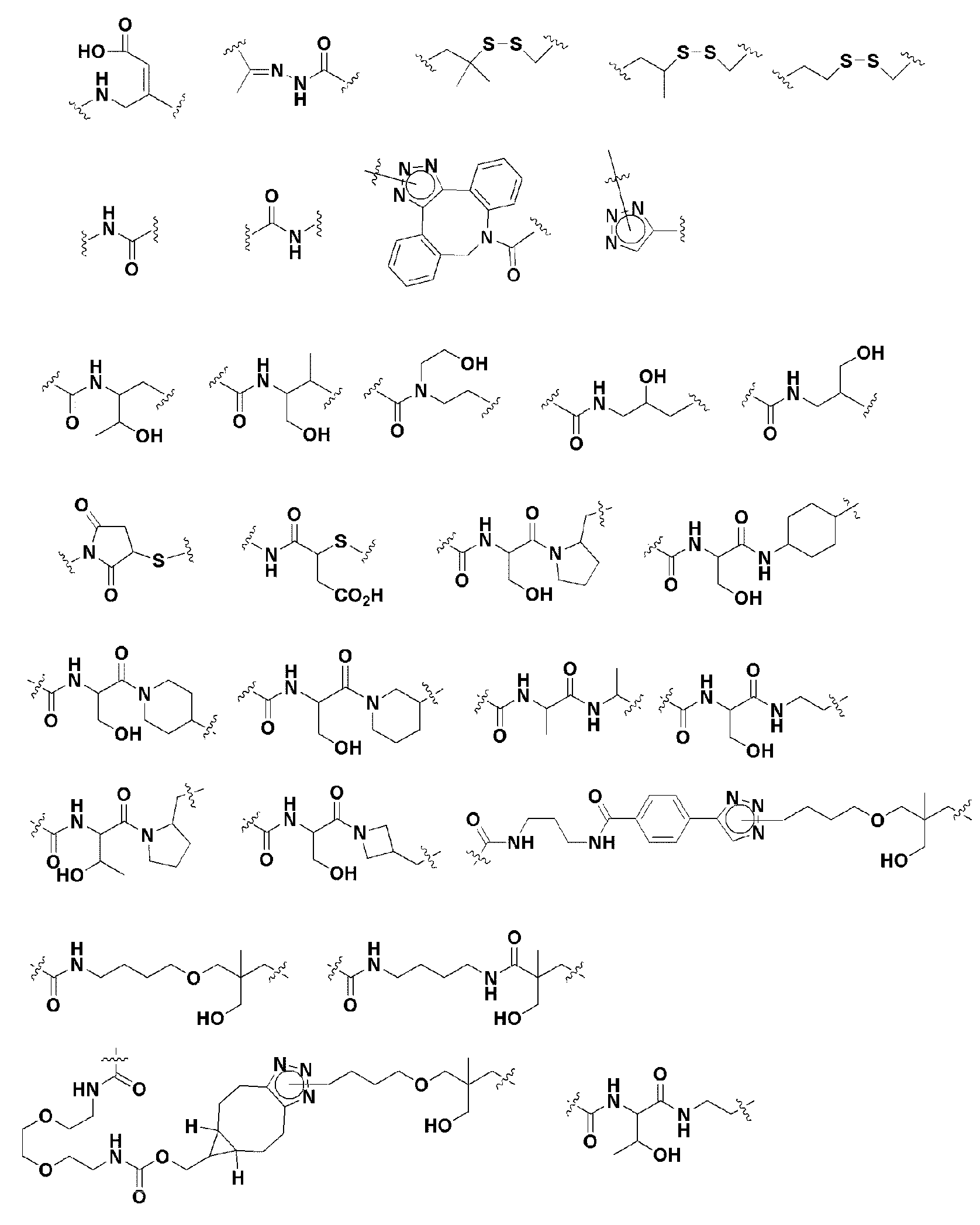
(14)(14)
링커가, 하기 구조를 갖는 (1)∼(13) 중 어느 하나에 기재된 핵산 복합체.The nucleic acid complex according to any one of (1) to (13), wherein the linker has the following structure.

(식 중,(Wherein,
n1은 1∼100의 정수이다.)and n1 is an integer of 1 to 100.)
(15) 링커가, 하기 구조 중 어느 하나의 구조를 갖는 (1)∼(13) 중 어느 하나에 기재된 핵산 복합체.(15) The nucleic acid complex according to any one of (1) to (13), wherein the linker has any one of the following structures.


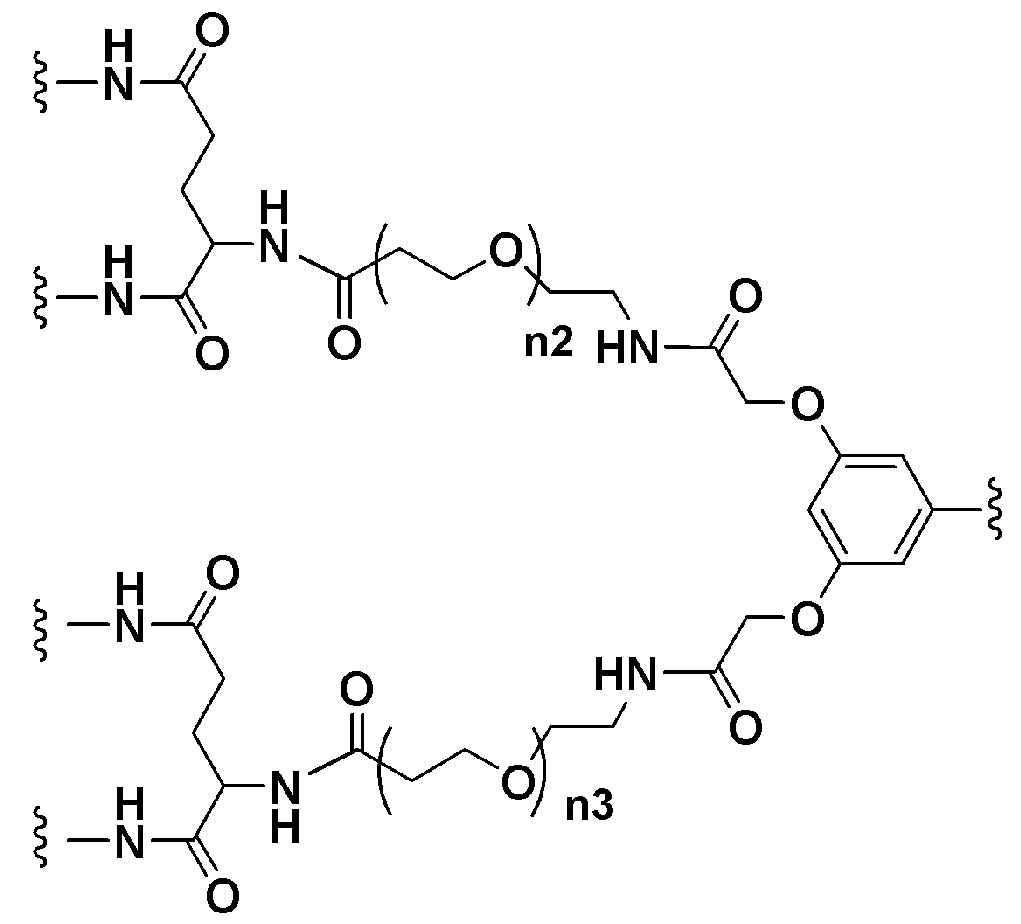


(식 중,(Wherein,
n2 및 n3은 각각 독립적으로 1∼100의 정수이다.)n2 and n3 are each independently an integer of 1 to 100.)
(16)(16)
상기 올리고뉴클레오티드가 수식 뉴클레오티드를 포함하는 (1)∼(15) 중 어느 하나에 기재된 핵산 복합체.The nucleic acid complex according to any one of (1) to (15), wherein the oligonucleotide comprises a modified nucleotide.
(17)(17)
(1)∼(16) 중 어느 하나에 기재된 핵산 복합체를 포함하는 의약 조성물.A pharmaceutical composition comprising the nucleic acid complex according to any one of (1) to (16).
(18)(18)
세포 내에 도입하기 위한 (17)에 기재된 의약 조성물.A medicinal composition according to (17) for introduction into a cell.
(19)(19)
상기 세포가 수상세포 또는 마크로파지인 (18)에 기재된 의약 조성물.The pharmaceutical composition according to (18), wherein the cell is a dendritic cell or macrophage.
(20)(20)
정맥내 투여 또는 피하 투여되는 (17)∼(19) 중 어느 하나에 기재된 의약 조성물.The pharmaceutical composition according to any one of (17) to (19), which is administered intravenously or subcutaneously.
(21)(21)
(1)∼(16) 중 어느 하나에 기재된 핵산 복합체 또는 (17)∼(20) 중 어느 하나에 기재된 의약 조성물을, 그것을 필요로 하는 환자에게 투여하는 것을 포함하는 질환의 치료 또는 예방 방법.A method for treating or preventing a disease comprising administering a nucleic acid complex according to any one of (1) to (16) or a pharmaceutical composition according to any one of (17) to (20) to a patient in need thereof.
(22)(22)
상기 환자가 포유동물인 (21)에 기재된 치료 또는 예방 방법.The method of treatment or prevention according to (21), wherein the patient is a mammal.
예컨대 본 발명의 핵산 복합체를 포함하는 의약 조성물을, 포유동물에게 투여하여, 생체 내에서, 각종 관련 질환을 치료할 수 있다.For example, a pharmaceutical composition comprising the nucleic acid complex of the present invention can be administered to a mammal to treat various related diseases in vivo.
도 1은 시험예 1의 CD45 안티센스 올리고뉴클레오티드(ASO)에 의한 인간 단구 유래 수상세포의 mRNA 녹다운 시험의 결과를 나타낸 도면.
도 2는 시험예 2의 Beta-2 Microglobulin(B2M)에 대한 ASO를 이용한 인간 단구 유래 수상세포의 단백질 녹다운 시험의 결과를 나타낸 도면.
도 3은 시험예 3의 B2M-siRNA를 이용한 인간 단구 유래 수상세포의 단백질 녹다운 시험의 결과를 나타낸 도면.
도 4는 시험예 4의 B2M-siRNA를 이용한 인간 단구 유래 수상세포의 mRNA 녹다운 시험의 결과를 나타낸 도면.
도 5는 시험예 5의 B2M-siRNA를 이용한 인간 단구 유래 수상세포의 단백질 녹다운 시험의 결과를 나타낸 도면.
도 6은 시험예 6의 B2M-siRNA를 이용한 인간 단구 유래 수상세포의 단백질 녹다운 시험의 결과를 나타낸 도면.
도 7은 시험예 7의 B2M-siRNA를 이용한 인간 단구 유래 수상세포의 단백질 녹다운 시험의 결과를 나타낸 도면.
도 8은 시험예 8의 B2M-siRNA를 이용한 인간 단구 유래 수상세포의 단백질 녹다운 시험의 결과를 나타낸 도면.
도 9는 시험예 9의 B2M-siRNA를 이용한 인간 단구 유래 수상세포의 단백질 녹다운 시험의 결과를 나타낸 도면.
도 10은 시험예 10의 B2M-siRNA를 이용한 인간 단구 유래 수상세포의 단백질 녹다운 시험의 결과를 나타낸 도면.
도 11은 시험예 11의 B2M-siRNA를 이용한 성숙 인간 단구 유래 수상세포의 단백질 녹다운 시험의 결과를 나타낸 도면.
도 12는 시험예 12의 HPRT1-siRNA를 이용한 성숙 인간 단구 유래 수상세포의 단백질 녹다운 시험의 결과를 나타낸 도면.
도 13은 시험예 13의 B2M-siRNA를 이용한 인간 단구 유래 마크로파지 세포의 단백질 녹다운 시험의 결과를 나타낸 도면.1 is a diagram showing the results of an mRNA knockdown test of dendritic cells derived from human monocytes by the CD45 antisense oligonucleotide (ASO) of Test Example 1. Fig.
Fig. 2 is a graph showing the results of a protein knockdown test of human monocyte-derived dendritic cells using ASO against Beta-2 Microglobulin (B2M) in Test Example 2. Fig.
3 is a graph showing the results of a protein knockdown test of human monocyte-derived dendritic cells using B2M-siRNA of Test Example 3. Fig.
4 is a diagram showing the results of an mRNA knockdown test of dendritic cells derived from human monocytes using B2M-siRNA of Test Example 4. Fig.
5 is a graph showing the results of a protein knockdown test of dendritic cells derived from human monocytes using B2M-siRNA of Test Example 5. Fig.
6 is a graph showing the results of a protein knockdown test of dendritic cells derived from human monocytes using B2M-siRNA of Test Example 6. Fig.
7 is a graph showing the results of a protein knockdown test of human monocyte-derived dendritic cells using the B2M-siRNA of Test Example 7. Fig.
8 is a graph showing the results of a protein knockdown test of human monocyte-derived dendritic cells using the B2M-siRNA of Test Example 8. Fig.
9 is a graph showing the results of a protein knockdown test of dendritic cells derived from human monocytes using B2M-siRNA of Test Example 9. Fig.
10 is a graph showing the results of a protein knockdown test of human monocyte-derived dendritic cells using B2M-siRNA of Test Example 10. Fig.
11 is a diagram showing the results of a protein knockdown test of dendritic human dendritic dendritic cells using B2M-siRNA of Test Example 11;
12 is a diagram showing the results of a protein knockdown test of dendritic human dendritic dendritic cells using HPRT1-siRNA of Test Example 12;
13 is a graph showing the results of a protein knockdown test of human monocyte-derived macrophage cells using B2M-siRNA of Test Example 13. Fig.
본 발명의 핵산 복합체는, 당쇄 리간드가 링커를 통해 올리고뉴클레오티드와 결합한 핵산 복합체로서, 당쇄 리간드가, 당쇄 리간드의 비환원 말단에 O 결합 만노오스를 갖는 핵산 복합체이다.The nucleic acid complex of the present invention is a nucleic acid complex in which a sugar chain ligand is bound to an oligonucleotide through a linker, wherein the sugar chain ligand is a nucleic acid complex having O-linked mannose at the non-reducing end of the sugar chain ligand.
핵산 복합체는, 당쇄 리간드와, 링커와, 올리고뉴클레오티드를 그 분자 내 구성 요소로서 가지며, 당쇄 리간드와, 올리고뉴클레오티드가, 링커를 통해 결합함으로써 연결된다. 당쇄 리간드 또는 올리고뉴클레오티드와, 링커와의 결합은, 바람직하게는 공유 결합이다.The nucleic acid complex has a sugar chain ligand, a linker, and an oligonucleotide as an intramolecular constituent, and the sugar chain ligand and the oligonucleotide are linked by bonding through a linker. The linkage of the sugar chain ligand or oligonucleotide with the linker is preferably a covalent bond.
본 발명의 핵산 복합체는, 당쇄 리간드-링커-올리고뉴클레오티드와 같은 구조를 갖는다.The nucleic acid complex of the present invention has a structure such as a sugar chain ligand-linker-oligonucleotide.
본 발명에 있어서는, 당쇄 리간드가, 비환원 말단에 O 결합 만노오스를 갖고 있으면, 링커 및 올리고뉴클레오티드는, 공지된 구조를 채용할 수 있다.In the present invention, when the sugar chain ligand has O-bound mannose at the non-reducing end, the linker and the oligonucleotide can adopt a known structure.
즉, 당쇄 리간드, 링커 및 올리고뉴클레오티드의 각 구조를 갖는 종래 공지된 핵산 복합체에 있어서, 당쇄 리간드를 본 발명에 있어서의 비환원 말단에 O 결합 만노오스를 갖는 당쇄 리간드로 한 핵산 복합체는, 본 발명의 범위 내가 된다.That is, in a conventionally known nucleic acid complex having each structure of a sugar chain ligand, a linker and an oligonucleotide, a nucleic acid complex in which a sugar chain ligand is a sugar chain ligand having an O-binding monosaccharide at the non- Range.
본 발명에 있어서, 당쇄 리간드는, 비환원 말단에 O 결합 만노오스를 갖는다.In the present invention, the sugar chain ligand has O-bound mannose at the non-reducing end.
O 결합 만노오스의 구조로는, 하기 구조를 들 수 있다.O bond The structure of mannose includes the following structures.

만노오스의 O 결합은, α 결합이어도 좋고, β 결합이어도 좋지만, 바람직하게는, 만노오스의 O 결합은, α 결합이다.The O-bond of mannose may be an alpha bond or a beta bond, but preferably the O bond of mannose is an alpha bond.
통상, 당쇄는, 비환원 말단과, 환원 말단을 가지며, 본 발명에 있어서는, 비환원 말단이 O 결합 만노오스이다.Usually, the sugar chain has a non-reducing end and a reducing end, and in the present invention, the non-reducing end is O-bound mannose.
비환원 말단이 O 결합 만노오스라고 하는 것은, 당쇄 리간드의 최외부에서, O 결합 만노오스를 가지며, 다른 구조를 더 갖고 있지 않은 것을 의미한다.When the non-reducing end is referred to as O-bound mannose, it means that the outermost portion of the sugar chain ligand has an O-bound mannose and has no other structure.
당쇄 리간드는, 표적 세포에 발현되고 있는 수용체에 결합 가능한 당류(단당, 이당, 삼당 및 다당 등)에서 유래되는 기를 의미하고, 비천연 구조를 포함하는 것을 들 수 있다.The sugar chain ligand means a group derived from a saccharide (monosaccharide, disaccharide, trisaccharide, polysaccharide, etc.) capable of binding to a receptor expressed on a target cell, and includes a non-natural structure.
당류의 유닛인 단당으로는, 천연에 존재하는 것으로서, 예컨대, 알로오스, 알토오스, 아라비노오스, 클라디노오스, 에리트로오스, 에리트룰로오스, 프룩토오스, 푸시톨, 푸코사민, 푸코오스, 푸쿨로오스, 갈락토사민, 갈락토사미니톨, N-아세틸-갈락토사민, 갈락토오스, 글루코사민, N-아세틸-글루코사민, 글루코사미니톨, 글루코오스, 글루코오스-6-인산, 굴로오스, 글리세르알데히드, 글리세로만노-헵토오스, 글리세롤, 글리세론, 굴로오스, 이도오스, 릭소오스, 만노사민, 만노오스, 만노오스-6-인산, 푸시코오스, 퀴노보오스, 퀴노보사민, 람니톨, 람노사민, 람노오스, 리보오스, 리브로오스, 세도헵툴로오스, 소르보오스, 타가토오스, 탈로오스, 타르타르산, 트레오스, 크실로오스, 및 크실룰로오스 등을 들 수 있고, 이들 단당이 글리코시드 결합에 의해 결합되어 당류로서 천연에 존재하고 있다.Examples of the monosaccharide which is a unit of a saccharide include monosaccharides which are present in nature and include, for example, alooses, altooses, arabinose, cladinose, erythrose, erythrulose, fructose, fucitol, fucosamine, fucose Acetyl-glucosamine, glucosaminitol, glucose, glucose-6-phosphate, gulurose, glycine, glycerol, But are not limited to, glycerol, mannose, mannose, mannose-6-phosphate, quinoboros, There may be mentioned rhamnosamine, rhamnose, ribose, ribose, sedoheptulose, sorbose, tagatose, talose, tartaric acid, threose, xylose and xylulose. By this glycosidic bond, And are present in nature as saccharides.
본 발명에 있어서는, 당쇄 리간드는, 비천연 구조를 포함하는 것이 바람직하고, 비천연 구조로서 상기 단당 이외의 구조를 포함하는 것을 의미한다.In the present invention, the sugar chain ligand preferably includes a non-natural structure and means a non-natural structure containing a structure other than the monosaccharide.
당류에 있어서의 각 단당은, D체 또는 L체여도 좋고, D체와 L체의 임의 비율에 따른 혼합물이어도 좋다.Each of the monosaccharides in the saccharide may be a D-form or L-form, or may be a mixture according to an arbitrary ratio of the D-form and the L-form.
당류는, 데옥시당(알코올 히드록시기를 수소 원자로 치환한 것), 아미노당(알코올 히드록시기를 아미노기로 치환한 것), 티오당(알코올 히드록시기를 티올로 치환한 것, 또는 C=O를 C=S로 치환한 것, 또는 고리 산소를 황으로 치환한 것), 셀레노당, 텔루로당, 아자당(고리 탄소를 질소로 치환한 것), 이미노당(고리 산소를 질소로 치환한 것), 포스파노당(고리 산소를 인으로 치환한 것), 포스파당(고리 탄소를 인으로 치환한 것), C-치환 단당(비말단 탄소 원자에 있어서의 수소 원자를 탄소 원자로 치환한 것), 불포화 단당, 알디톨(카르보닐기를 CHOH기로 치환한 것), 알돈산(알데히드기를 카르복시기로 치환한 것), 케토알돈산, 우론산, 알달산 등을 포함하고 있어도 좋다.Examples of the saccharides include deoxy sugars (in which an alcohol hydroxyl group is substituted with a hydrogen atom), amino sugars (in which an alcohol hydroxy group is substituted with an amino group), thio sugars (in which an alcohol hydroxy group is replaced by thiol, (In which the ring carbon is replaced with nitrogen), imino sugar (ring oxygen is substituted with nitrogen), and phosphorus (in which the ring oxygen is substituted with sulfur), seleno sugar, (In which the ring carbon is replaced by phosphorus), a C-substituted monosaccharide (in which hydrogen atoms in the non-terminal carbon atoms are substituted with carbon atoms), unsaturated monosaccharides , Alditol (in which a carbonyl group is substituted with a CHOH group), aldonic acid (in which an aldehyde group is substituted with a carboxyl group), keto aldonic acid, uronic acid, aldic acid, and the like.
아미노당으로는, 당류에 있어서의 아미노 단당으로서, 갈락토사민, 글루코사민, 만노사민, 푸코사민, 퀴노보사민, 노이라민산, 무람산, 락토오스디아민, 아코사민, 바실로사민, 다우노사민, 데소사민, 포로사민, 가로사민, 카노사민, 칸소사민(kansosamine), 미카미노오스, 미코사민, 페로사민, 프노이모사민, 푸르푸로사민(purpurosamine), 로도사민 등을 들 수 있다. 또한, 아미노당의 아미노기는, 아세틸기 등으로 치환되어 있어도 좋다.Examples of the amino sugars include aminosugars such as galactosamine, glucosamine, mannosamine, fucosamine, quinobosamine, noiramic acid, mulamic acid, lactosodiamine, acocamine, basiloxamine, , Decosamin, porosamin, horoscamine, canosamine, kansosamine, microcamnios, mycosamin, ferrosamin, phinomosamine, purpurosamine, and rhodamine. The amino group of the amino sugar may be substituted with an acetyl group or the like.
본 발명에 있어서, 당쇄 리간드가, CD209 및/또는 CD206에 결합 친화성을 보이는 구조를 갖는 것이 바람직하다.In the present invention, it is preferable that the sugar chain ligand has a structure showing binding affinity to CD209 and / or CD206.
본 발명에 있어서는, 비환원 말단이 O 결합 만노오스임에 따라, CD209 및/또는 CD206에 결합 친화성을 보이게 된다.In the present invention, binding affinity to CD209 and / or CD206 is shown by the non-reducing end being O-linked mannose.
당쇄 리간드가, CD209 및/또는 CD206에 결합 친화성을 보임으로써, 수상세포 또는 마크로파지의 세포 표면에 발현되는 수용체에 핵산 복합체가 결합되고, 상기 세포에 올리고뉴클레오티드를 핵산 의약으로서 송달할 수 있다.The sugar chain ligand exhibits binding affinity to CD209 and / or CD206, whereby a nucleic acid complex is bound to a receptor expressed on the cell surface of a dendritic cell or macrophage, and the oligonucleotide can be delivered to the cell as a nucleic acid drug.
당쇄 리간드는, 만노오스의 1 위치에서 에테르 결합을 통해 시클로헥산 골격과 결합한 구조를 갖는 것이 바람직하다.The sugar chain ligand preferably has a structure bonded to the cyclohexane skeleton through an ether bond at 1 position of mannose.
시클로헥산 골격은, 당쇄 리간드에 있어서의 비천연 구조로서 존재하고, 만노오스의 1 위치에서 에테르 결합을 통해 시클로헥산 골격과 결합한 구조로는, 하기 구조를 갖는 것을 들 수 있다.The cyclohexane skeleton exists as a non-natural structure in the sugar chain ligand, and the structure having the structure shown below is bonded to the cyclohexane skeleton through an ether bond at 1 position of mannose.

또한, 시클로헥산 고리는, 치환기를 갖고 있어도 좋고, 만노오스의 시클로헥산과의 글리코시드 결합은, α 결합이어도 좋고, β 결합이어도 좋다.The cyclohexane ring may have a substituent, and the glycoside bond with mannose cyclohexane may be an a bond or a beta bond.
만노오스의 1 위치에서 에테르 결합을 통해 시클로헥산 골격과 결합한 구조로는, 예컨대, 하기 구조가 바람직하다.As the structure bonded to the cyclohexane skeleton through ether bond at 1 position of mannose, for example, the following structure is preferable.

식 중,Wherein,
R1 및 R2는 각각 독립적으로 수소 원자, 치환 또는 비치환의 탄소수 1∼20의 알킬기, 치환 또는 비치환의 탄소수 2∼20의 알케닐기, 치환 또는 비치환의 탄소수 3∼20의 알키닐기, 치환 또는 비치환의 아릴기, 치환 또는 비치환의 헤테로아릴기, 치환 또는 비치환의 헤테로지환기, 및 치환 또는 비치환의 아랄킬기로 이루어진 군으로부터 선택되는 기이고,R 1 and R 2 are each independently a hydrogen atom, a substituted or unsubstituted alkyl group having 1 to 20 carbon atoms, a substituted or unsubstituted alkenyl group having 2 to 20 carbon atoms, a substituted or unsubstituted alkynyl group having 3 to 20 carbon atoms, A substituted or unsubstituted aryl group, a substituted or unsubstituted heteroaryl group, a substituted or unsubstituted heterocyclic group, and a substituted or unsubstituted aralkyl group,
Y1 및 Y2는 각각 독립적으로 산소 원자, 황 원자, 및 NR3으로 이루어진 군으로부터 선택되는 기이며,Y 1 and Y 2 are each independently a group selected from the group consisting of an oxygen atom, a sulfur atom, and NR 3 ,
R3은 수소 원자 또는 치환 또는 비치환의 탄소수 1∼20의 알킬기이다.R 3 is a hydrogen atom or a substituted or unsubstituted alkyl group having 1 to 20 carbon atoms.
본 명세서에 있어서, 각각 독립적으로란, 각 기가, 동시에 규정되는 다른 기와 독립적으로 선택지 중으로부터 선택되는 기인 것을 의미하고, 동일 또는 상이하여도 좋다.In this specification, the term " independently " means that each group is independently selected from the groups independently selected from other groups defined at the same time, and may be the same or different.
치환 또는 비치환의 탄소수 1∼20의 알킬기로는, 예컨대, 메틸, 에틸, 프로필, 시클로프로필, 이소프로필, 부틸, 시클로부틸, 이소부틸, 펜틸, 시클로펜틸, 헥실, 시클로헥실, 헵틸, 옥틸, 노닐, 데실, 펜타데실, 이코실을 들 수 있지만 특별히 한정되지 않는다.Examples of the substituted or unsubstituted alkyl group having 1 to 20 carbon atoms include methyl, ethyl, propyl, cyclopropyl, isopropyl, butyl, cyclobutyl, isobutyl, pentyl, cyclopentyl, hexyl, cyclohexyl, heptyl, , Decyl, pentadecyl, and icosyl, but is not particularly limited.
치환 또는 비치환의 탄소수 1∼20의 알킬기에 있어서의 치환기로는, 예컨대, 히드록시, 할로겐, 머캅토, 니트로, 시아노, 카르복시, 카르바모일, C1-C3 알콕시, C1∼C3 알킬티오, 아미노, C1-C3 모노알킬아미노, C1-C3 디알킬아미노로 이루어진군으로부터 선택되는 치환기를 들 수 있다.Examples of the substituent on the substituted or unsubstituted alkyl group having 1 to 20 carbon atoms include a halogen atom, a halogen atom, a mercapto group, a nitro group, a cyano group, a carboxy group, a carbamoyl group, a C 1 -C 3 alkoxy group, , C1-C3 monoalkylamino, C1-C3 dialkylamino, and the like.
치환기의 수는, 예컨대, 1∼3이며, 복수의 치환기를 갖는 경우, 복수의 치환기는, 동일 또는 상이하여도 좋다.The number of substituents is, for example, 1 to 3, and when a plurality of substituents are present, the plurality of substituents may be the same or different.
본 명세서에 있어서, 치환 또는 비치환의 탄소수 2∼20의 알케닐기, 치환 또는 비치환의 탄소수 3∼20의 알키닐기, 치환 또는 비치환의 아릴기, 치환 또는 비치환의 헤테로아릴기, 치환 또는 비치환의 아랄킬기에 있어서의 치환기에 대해서, 치환 또는 비치환의 탄소수 1∼20의 알킬기에 있어서의 치환기와 동의이다.In the present specification, a substituted or unsubstituted C2-C20 alkenyl group, a substituted or unsubstituted C3-C20 alkynyl group, a substituted or unsubstituted aryl group, a substituted or unsubstituted heteroaryl group, a substituted or unsubstituted aralkyl Is the same as the substituent on the substituted or unsubstituted alkyl group having 1 to 20 carbon atoms.
치환 또는 비치환의 탄소수 2∼20의 알케닐기로는, 치환 또는 비치환의 탄소수 2∼20의 알킬기에 있어서 1 이상의 이중 결합을 포함하는 기이면 좋다. 치환 또는 비치환의 탄소수 3∼20의 알키닐기로는, 치환 또는 비치환의 탄소수 3∼20의 알킬기에 있어서 1 이상의 삼중 결합을 포함하는 기이면 좋다.The substituted or unsubstituted C2-C20 alkenyl group may be a group containing at least one double bond in the substituted or unsubstituted alkyl group having 2 to 20 carbon atoms. The substituted or unsubstituted alkynyl group having 3 to 20 carbon atoms may be a group containing at least one triple bond in the substituted or unsubstituted alkyl group having 3 to 20 carbon atoms.
치환 또는 비치환의 아릴기로는, 페닐기, 나프틸기, 안트라세닐기 등의 방향환을 들 수 있지만, 특별히 한정되지 않는다.Examples of the substituted or unsubstituted aryl group include an aromatic ring such as a phenyl group, a naphthyl group, and an anthracenyl group, but are not particularly limited.
치환 또는 비치환의 헤테로아릴기로는, 질소 원자, 산소 원자 또는 황 원자를 고리 내에 갖는 복소 방향환을 의미하고, 예컨대, 1∼3개의 질소 원자, 산소 원자 또는 황 원자를 갖는 5∼6원의 방향환을 들 수 있다.The substituted or unsubstituted heteroaryl group means a heteroaromatic ring having a nitrogen atom, an oxygen atom or a sulfur atom in the ring, and includes, for example, a 5- to 6-membered ring having 1 to 3 nitrogen, oxygen or sulfur atoms It can be called a circle.
치환 또는 비치환의 헤테로지환기로는, 질소 원자, 산소 원자 또는 황 원자를 고리 내에 갖는 복소 지방족 고리를 의미하고, 예컨대, 1∼3개의 질소 원자, 산소 원자 또는 황 원자를 갖는 5∼6원의 지방족 고리를 들 수 있다.The substituted or unsubstituted hetero ring group means a heteroaliphatic ring having a nitrogen atom, an oxygen atom or a sulfur atom in the ring, and includes, for example, a 5- to 6-membered aliphatic ring having 1 to 3 nitrogen, oxygen or sulfur atoms The ring can be heard.
치환 또는 비치환의 아랄킬기로는, 치환 또는 비치환의 알킬기가, 치환 또는 비치환의 아릴기로 치환된 기이면 좋고, 치환 또는 비치환의 탄소수 1∼20의 알킬기에 있어서 치환기로서 1 이상의 아릴기를 포함하는 기를 들 수 있으며, 구체적으로는, 치환 또는 비치환의 벤질기 혹은 페네틸기 등을 들 수 있다.The substituted or unsubstituted aralkyl group may be a group in which the substituted or unsubstituted alkyl group is substituted with a substituted or unsubstituted aryl group, and a group containing at least one aryl group as a substituent in the substituted or unsubstituted alkyl group having 1 to 20 carbon atoms Specific examples thereof include a substituted or unsubstituted benzyl group or a phenethyl group.
Y1 및 Y2는 산소 원자인 것이 바람직하고, NH인 것도 바람직하다.Y 1 and Y 2 are preferably an oxygen atom, and are preferably NH.
R1 및 R2는 각각 독립적으로 치환 또는 비치환의 탄소수 1∼20의 알킬기인 것이 바람직하고, 그 중에서도, R1 및 R2가 메틸기인 것이 바람직하다. R1 및 R2는 각각 독립적으로 치환 또는 비치환의 아랄킬기인 것도 바람직하고, Y1 및 Y2가 NH이며, 또한, R1 및 R2가 치환 또는 비치환의 아랄킬기인 것이 보다 바람직하고, Y1 및 Y2가 NH이며, 또한, R1 및 R2가 4-히드록시벤질기, 4-(히드록시메틸)벤질기 또는 4-(메톡시메틸)벤질기인 것이 보다 더 바람직하다.R 1 and R 2 are each independently preferably a substituted or unsubstituted alkyl group having 1 to 20 carbon atoms. Among them, it is preferable that R 1 and R 2 are methyl groups. R 1 and R 2 are each independently a substituted or unsubstituted aralkyl group, Y 1 and Y 2 are NH, R 1 and R 2 are more preferably a substituted or unsubstituted aralkyl group, Y 1 and Y 2 are NH and R 1 and R 2 are more preferably a 4-hydroxybenzyl group, a 4- (hydroxymethyl) benzyl group or a 4- (methoxymethyl) benzyl group.
만노오스의 1 위치에서 에테르 결합을 통해 시클로헥산 골격과 결합한 구조에 있어서의 구체적 구조로는, 특별히 한정되는 것은 아니지만, 예컨대, 하기 구조를 갖는다.The specific structure of the structure bonded to the cyclohexane skeleton through the ether bond at 1 position of mannose is not particularly limited, and, for example, has the following structure.

식 중,Wherein,
R1', R2', Y1', Y2' 및 R3'는 각각 대응하는 R1, R2, Y1, Y2 및 R3과 동의이다.R 1 ', R 2 ', Y 1 ', Y 2 ' and R 3 'are the same as the corresponding R 1 , R 2 , Y 1 , Y 2 and R 3 respectively.
전술한 구조를 갖는 당쇄 리간드로서 구체적으로는, 하기 구조 중 어느 하나의 구조로 표시되는 당쇄 리간드를 예시할 수 있다.Specific examples of the sugar chain ligand having the above-described structure include a sugar chain ligand represented by any one of the following structures.

식 중,Wherein,
R1, R2, Y1 및 Y2는 상기와 동의이고,R 1 , R 2 , Y 1 and Y 2 are as defined above,
R1'', R2'', Y1'', Y2'' 및 R3''는 각각 대응하는 R1, R2, Y1, Y2 및 R3과 동의이며, 바람직한 치환기의 조합도 동의이다.R 1 ", R 2 ", Y 1 ", Y 2 " and R 3 "are each the same as R 1 , R 2 , Y 1 , Y 2 and R 3 and preferred combinations of substituents I agree.
전술한 구조를 갖는 당쇄 리간드로서 보다 구체적으로는, 하기 구조 중 어느 하나의 구조로 표시되는 당쇄 리간드를 예시할 수 있다.As the sugar chain ligand having the above structure, more specifically, a sugar chain ligand represented by any one of the following structures can be exemplified.

식 중,Wherein,
R1', R2', Y1' 및 Y2'는 상기와 동의이고,R 1 ', R 2 ', Y 1 'and Y 2 ' are as defined above,
R1''', R2''', Y1''', Y2''' 및 R3'''는 각각 대응하는 R1, R2, Y1, Y2 및 R3과 동의이며, 바람직한 치환기의 조합도 동의이다.R 1 ''', R 2 ''', Y 1 ''', Y 2 ''' and R 3 '''are each the same as R 1 , R 2 , Y 1 , Y 2 and R 3 , The preferred combination of substituents is also synonymous.
본 발명에 있어서의 당쇄 리간드 구조는, 국제 공개 제2011/000721호, 몰레큘러 다이버시티(Molecular Diversity), 2011년, 제15권, p 347-360, 케미스트리 에이 유로피안 저널(Chemistry A European Journal), 2013년, 제19권, p 4786-4797 및 에이씨에스·케미컬·바이올로지(ACS Chemical Biology), 2010년, 제5권, p 301-312를 참고로 제조할 수 있다.The sugar chain ligand structure in the present invention is disclosed in International Publication No. 2011/000721, Molecular Diversity, Vol. 15, p. 347-360, Chemistry A European Journal, , 2013, vol. 19, pp. 4786-4797 and ACS Chemical Biology, 2010, Vol. 5, p 301-312.
본 발명에 있어서의 「올리고뉴클레오티드」로는, 핵산 의약으로서 이용하는 것이 알려진 올리고뉴클레오티드를 이용할 수 있다. 본 발명에 있어서, 핵산 의약이란, 안티센스, 데코이 핵산, 리보자임, siRNA, miRNA 및 antimiRNA 등으로서 이용되는 뉴클레오티드를 의미한다.As the " oligonucleotide " in the present invention, an oligonucleotide known to be used as a nucleic acid drug can be used. In the present invention, nucleic acid drugs mean nucleotides used as antisense, decoy nucleic acid, ribozyme, siRNA, miRNA and antimiRNA.
본 발명에 있어서는, 링커와 올리고뉴클레오티드는, 뉴클레오티드를 구성하는 당 부분의 3' 위치 또는 5' 위치를 통해 링커와 결합할 뿐 아니라, 뉴클레오티드를 구성하는 염기 부분을 통해 링커와 결합하고 있어도 좋다. 본 발명에 있어서는, 올리고뉴클레오티드는, 링커와 올리고뉴클레오티드를 결합하는 구조를 갖는 기로서 이해되어도 좋고, 예컨대, 올리고뉴클레오티드가, -O-P(Z)(Z')O-(식 중, Z 및 Z'는 각각 독립적으로 산소 원자 또는 황 원자이다.)를 통해 링커와 결합하고 있는 경우, X로서의 올리고뉴클레오티드로는, -O-P(Z)(Z')O-올리고뉴클레오티드로서 이해되어도 좋다.In the present invention, the linker and the oligonucleotide may bind not only to the linker through the 3 'position or the 5' position of the sugar moiety constituting the nucleotide, but also to the linker through the base moiety constituting the nucleotide. In the present invention, the oligonucleotide may be understood as a group having a structure linking a linker and an oligonucleotide. For example, the oligonucleotide may be represented by -OP (Z) (Z ') O- wherein Z and Z' (Z ') O-oligonucleotides may be understood as the oligonucleotides as X when they are bonded to the linker through a linker (for example, an oxygen atom or a sulfur atom).
또한, 올리고뉴클레오티드는, 단일쇄 또는 이중쇄의 올리고뉴클레오티드여도 좋다.The oligonucleotide may be a single-stranded or double-stranded oligonucleotide.
핵산 복합체에 있어서의 링커와 올리고뉴클레오티드는, 올리고뉴클레오티드 등의 뉴클레오티드로 결합하여도 좋지만, 예컨대 올리고뉴클레오티드의 3' 말단 또는 5' 말단에서 결합한다. 올리고뉴클레오티드가 이중쇄인 경우에는, 링커는 이중쇄 핵산을 구성하는 센스쇄의 3' 말단 또는 5' 말단과 결합하고 있는 것이 바람직하지만, 상기 결합에 한정되는 것은 아니다.The linker and the oligonucleotide in the nucleic acid complex may be bonded with a nucleotide such as an oligonucleotide or the like, but may be bonded at the 3 'end or the 5' end of the oligonucleotide. When the oligonucleotide is double-stranded, it is preferable that the linker binds to the 3'end or the 5'end of the sense strand constituting the double-stranded nucleic acid, but it is not limited to the above bond.
본 발명에 있어서, 표적 mRNA에 대하여 상보적인 염기 서열을 포함하는 핵산을 안티센스 뉴클레오티드라고 부르고, 안티센스 뉴클레오티드의 염기 서열에 대하여 상보적인 염기 서열을 포함하는 핵산을 센스 뉴클레오티드라고도 부른다.In the present invention, a nucleic acid comprising a nucleotide sequence complementary to a target mRNA is referred to as an antisense nucleotide, and a nucleic acid including a nucleotide sequence complementary to the nucleotide sequence of an antisense nucleotide is also referred to as a sense nucleotide.
본 발명에서 이용되는 핵산 복합체를 구성하는 올리고뉴클레오티드는, 포유동물 세포에 도입된 경우, 표적 유전자의 발현을 제어하는 능력을 갖는 것이면 어떠한 형상이라도 좋고, 단일쇄의 올리고뉴클레오티드 또는 이중쇄의 올리고뉴클레오티드가 적합하게 이용된다.The oligonucleotide constituting the nucleic acid complex used in the present invention may be of any shape as long as it has the ability to control the expression of the target gene when it is introduced into a mammalian cell and may be a single chain oligonucleotide or a double strand oligonucleotide And is suitably used.
올리고뉴클레오티드로는, 뉴클레오티드 또는 뉴클레오티드와 동등한 기능을 갖는 분자 중합체라면 어떠한 분자여도 좋고, 예컨대 데옥시리보뉴클레오티드의 중합체인 DNA, 리보뉴클레오티드의 중합체인 RNA, DNA와 RNA의 중합체인 키메라 핵산을 들 수 있다. 또한, DNA, RNA 및 키메라 핵산에 있어서, 적어도 하나의 데옥시리보뉴클레오티드나 리보뉴클레오티드 등의 뉴클레오티드가 뉴클레오티드와 동등한 기능을 갖는 분자로 치환된 뉴클레오티드 중합체여도 좋다. 또한, RNA 중의 우라실(U)은, DNA에 있어서는 티민(T)으로 일의적으로 바꿔 읽을 수 있다.The oligonucleotide may be any molecule as long as it has a function equivalent to that of a nucleotide or a nucleotide. Examples of the oligonucleotide include a DNA as a polymer of deoxyribonucleotide, a RNA as a polymer of a ribonucleotide, and a chimeric nucleic acid as a polymer of DNA and RNA . Further, in the case of DNA, RNA and chimeric nucleic acid, a nucleotide polymer such as at least one deoxyribonucleotide or ribonucleotide may be substituted with a molecule having a function equivalent to that of the nucleotide. In addition, uracil (U) in RNA can be uniquely changed to thymine (T) in DNA.
뉴클레오티드와 동등한 기능을 갖는 분자로는, 예컨대, 뉴클레오티드에 수식을 행한 뉴클레오티드 유도체 등을 들 수 있고, 예컨대 DNA 또는 RNA와 비교하여, 뉴클레아제 내성을 향상 혹은 안정화시키기 위해서, 상보쇄 핵산과의 친화도를 높이기 위해서, 세포 투과성을 높이기 위해서, 또는 가시화시키기 위해서, 데옥시리보뉴클레오티드 또는 리보뉴클레오티드에 수식을 행한 분자 등이 적합하게 이용된다.Examples of the molecule having a function equivalent to that of the nucleotide include a nucleotide derivative in which a nucleotide has been modified. For example, in order to enhance or stabilize nuclease resistance in comparison with DNA or RNA, In order to increase the degree of cell permeability, or to make it visible, a deoxyribonucleotide or a molecule in which a ribonucleotide has been modified is suitably used.
뉴클레오티드 유도체로는, 예컨대 당부 수식 뉴클레오티드, 인산디에스테르 결합 수식 뉴클레오티드, 염기 수식 뉴클레오티드 등, 당부, 인산디에스테르 결합 및 염기 중 적어도 하나가 수식된 뉴클레오티드 등을 들 수 있다.Examples of the nucleotide derivative include a nucleotide in which at least one of a sugar moiety, a phosphate diester bond, and a base is modified, such as a saccharide-modified nucleotide, a phosphate diester-modified nucleotide, or a base-modified nucleotide.
당부 수식 뉴클레오티드로는, 뉴클레오티드의 당의 화학 구조의 일부 혹은 전부에 대하여, 임의의 치환기로 수식 혹은 치환한 것, 또는 임의의 원자로 치환한 것이면 어떠한 것이라도 좋지만, 2'-수식 뉴클레오티드가 바람직하게 이용된다.As the saccharide-modified nucleotide, any or all of the chemical structure of the sugar of the nucleotide may be modified or substituted with an arbitrary substituent, or any substituent may be used as long as it is substituted with an arbitrary atom, but 2'-modified nucleotides are preferably used .
2'-수식 뉴클레오티드로는, 예컨대 리보오스의 2'-OH기가 OR, R, R'OR, SH, SR, NH2, NHR, NR2, N3, CN, F, Cl, Br 및 I로 이루어진 군(R은 알킬 또는 아릴, 바람직하게는 탄소수 1∼6의 알킬이고, R'는 알킬렌, 바람직하게는 탄소수 1∼6의 알킬렌임)으로부터 선택되는 치환기로 치환된 2'-수식 뉴클레오티드를 들 수 있고, 2'-수식으로는, 바람직하게는 F, 메톡시기 및 에톡시기에 의한 치환을 들 수 있다. 또한, 2-(메톡시)에톡시기, 3-아미노프로폭시기, 2-[(N,N-디메틸아미노)옥시]에톡시기, 3-(N,N-디메틸아미노)프로폭시기, 2-[2-(N,N-디메틸아미노)에톡시]에톡시기, 2-(메틸아미노)-2-옥소에톡시기, 2-(N-메틸카르바모일)에톡시기 및 2-시아노에톡시기로 이루어진 군으로부터 선택되는 치환기로 치환된 2'-수식 뉴클레오티드 등도 들 수 있다.The 2'-modified nucleotides include, for example, ribosomes composed of 2'-OH groups of ribose consisting of OR, R, R'OR, SH, SR, NH 2 , NHR, NR 2 , N 3 , CN, F, Cl, Br and I Modified nucleotides substituted with a substituent selected from the group consisting of R < 1 > and R < 2 >, wherein R is alkyl or aryl, preferably alkyl having 1 to 6 carbon atoms and R 'is alkylene, And examples of the 2'-substituent include substitution by F, methoxy group and ethoxy group. Further, a 2- (methoxy) ethoxy group, a 3-aminopropoxy group, a 2- (N, N-dimethylamino) oxy group, Ethoxy group, 2- (methylamino) -2-oxoethoxy group, 2- (N-methylcarbamoyl) ethoxy group and 2-cyanoethoxy group And 2'-modified nucleotides substituted with a substituent selected from the group consisting of an amino group,
또한, 당부 수식 뉴클레오티드로는, 당부에 가교 구조를 도입함으로써 2개의 환상 구조를 갖는 가교 구조형 인공 핵산(Bridged Nucleic Acid)(BNA)도 적합하게 이용된다. 구체적으로는, 2' 위치의 산소 원자와 4' 위치의 탄소 원자가 메틸렌을 통해 가교한 잠금 인공 핵산(Locked Nucleic Acid)(LNA)[Tetrahedron Letters, 38, 8735(1997) 및 Tetrahedron, 54, 3607(1998)], 에틸렌 가교 구조형 인공 핵산(Ethylene bridged nucleic acid)(ENA)[Nucleic Acid Research, 32, e175(2004)], 컨스트레인드 에틸(Constrained Ethyl)(cEt)[The Journal of Organic Chemistry 75, 1569(2010)], 아미도 가교 구조형 핵산(Amido-Bridged Nucleic Acid)(AmNA)[Chem Bio Chem 13, 2513(2012)] 및 2'-O,4'-C-스피로사이클로프로필렌 가교 구조형 핵산(Spirocyclopropylene bridged nucleic acid)(scpBNA)[Chem. Commun., 51, 9737(2015)] 등을 들 수 있다.Also, bridged nucleic acid (BNA) having two cyclic structures is suitably used as a sugar-modified nucleotide by introducing a bridging structure into the sugar moiety. Specifically, a Locked Nucleic Acid (LNA) (Tetrahedron Letters, 38, 8735 (1997) and Tetrahedron, 54, 3607 (1997)) in which oxygen atoms at the 2 'position and carbon atoms at the 4' 1998), Ethylene bridged nucleic acid (ENA) [Nucleic Acid Research, 32, e175 (2004)], Constrained Ethyl (cEt) [The Journal of Organic Chemistry 75, Amide-Bridged Nucleic Acid (AmNA) [Chem Bio Chem 13, 2513 (2012)] and 2'-O, 4'-C-spirocyclopropene bridged structural nucleic acid Spirocyclopropylene bridged nucleic acid (scpBNA) [Chem. Commun., 51, 9737 (2015)].
또한 펩티드핵산(PNA)[Acc. Chem. Res., 32, 624(1999)], 옥시펩티드핵산(OPNA)[J. Am. Chem. Soc., 123, 4653(2001)], 펩티드리보헥산(PRNA)[J. Am. Chem. Soc., 122, 6900(2000)] 등도 당부 수식 뉴클레오티드로서 들 수 있다.Peptide nucleic acid (PNA) [Acc. Chem. Res., 32, 624 (1999)], oxypeptide nucleic acid (OPNA) [J. Am. Chem. Soc., 123, 4653 (2001)], peptide ribohexane (PRNA) [J. Am. Chem. Soc., 122, 6900 (2000)] and the like can also be cited as glucosylated nucleotides.
인산디에스테르 결합 수식 뉴클레오티드로는, 뉴클레오티드의 인산디에스테르 결합의 화학 구조의 일부 혹은 전부에 대하여, 임의의 치환기로 수식 혹은 치환한 것, 또는 임의의 원자로 치환한 것이면 어떠한 것이라도 좋고, 예컨대, 인산디에스테르 결합이 포스포로티오에이트 결합으로 치환된 뉴클레오티드, 인산디에스테르 결합이 포스포로디티오에이트 결합으로 치환된 뉴클레오티드, 인산디에스테르 결합이 알킬포스포네이트 결합으로 치환된 뉴클레오티드, 인산디에스테르 결합이 포스포로아미데이트 결합으로 치환된 뉴클레오티드 등을 들 수 있고, 바람직하게는 인산디에스테르 결합이 포스포로티오에이트 결합으로 치환된 뉴클레오티드를 들 수 있다.The phosphoric acid diester bond-modified nucleotide may be any nucleotide substituted or unsubstituted by any substituent or substituted by any atom with respect to a part or all of the chemical structure of the phosphate diester bond of the nucleotide, A nucleotide in which a diester bond is substituted with a phosphorothioate bond, a nucleotide in which a phosphate diester bond is substituted with a phosphorodithioate bond, a nucleotide in which a phosphoric acid diester bond is substituted with an alkylphosphonate bond, A nucleotide substituted with a phosphoamidate bond, and the like, and preferably a nucleotide in which a phosphoric acid diester bond is substituted with a phosphorothioate bond.
염기 수식 뉴클레오티드로는, 뉴클레오티드의 염기의 화학 구조의 일부 혹은 전부에 대하여, 임의의 치환기로 수식 혹은 치환한 것, 또는 임의의 원자로 치환한 것이면 어떠한 것이라도 좋고, 예컨대, 염기 내의 산소 원자가 황 원자로 치환된 것, 수소 원자가 탄소수 1∼6의 알킬기, 할로겐기로 치환된 것, 메틸기가 수소 원자, 히드록시메틸기, 탄소수 2∼6의 알킬기로 치환된 것, 아미노기가 탄소수 1∼6의 알킬기, 탄소수 1∼6의 알카노일기, 옥소기, 히드록시기 등으로 치환된 것을 들 수 있다. 또한, 시토신(C) 대신에 5-메틸시토신(5-mC)을 염기 수식 뉴클레오티드로서 이용하는 것도, 본 발명의 바람직한 형태의 하나이다.As the base modified nucleotide, any or all of the chemical structures of the base of the nucleotide may be modified or substituted with an arbitrary substituent, or any substituent may be used, provided that the oxygen atom in the base is substituted with a sulfur atom A methyl group is substituted by a hydrogen atom, a hydroxymethyl group, an alkyl group having 2 to 6 carbon atoms, an amino group having 1 to 6 carbon atoms, an alkyl group having 1 to 6 carbon atoms, an alkyl group having 1 to 6 carbon atoms, 6 alkanoyl group, oxo group, hydroxy group, and the like. It is also one of the preferred embodiments of the present invention that 5-methylcytosine (5-mC) is used as a base-modified nucleotide instead of cytosine (C).
뉴클레오티드 유도체로는, 뉴클레오티드 또는 당부, 인산디에스테르 결합 혹은 염기의 적어도 하나가 수식된 뉴클레오티드 유도체에, 펩티드, 단백질, 당, 지질, 인지질, 페나진, 포레이트, 페난트리딘, 안트라퀴논, 아크리딘, 플루오레세인, 로다민, 쿠마린, 색소 등, 별도의 화학 물질을, 직접 또는 링커를 통해 부가한 것도 들 수 있고, 구체적으로는, 5'-폴리아민 부가 뉴클레오티드 유도체, 콜레스테롤 부가 뉴클레오티드 유도체, 스테로이드 부가 뉴클레오티드 유도체, 담즙산 부가 뉴클레오티드 유도체, 비타민 부가 뉴클레오티드 유도체, Cy5 부가 뉴클레오티드 유도체, Cy3 부가 뉴클레오티드 유도체, 6-FAM 부가 뉴클레오티드 유도체, 및 비오틴 부가 뉴클레오티드 유도체 등을 들 수 있다.Examples of the nucleotide derivative include a peptide, a protein, a sugar, a lipid, a phospholipid, a phenazine, a phthalate, a phenanthridine, an anthraquinone, an acryle Specific examples of the 5'-polyamine addition nucleotide derivative, the cholesterol addition nucleotide derivative, the steroids, the steroids, and the like may be used. An additional nucleotide derivative, a bile acid addition nucleotide derivative, a vitamin addition nucleotide derivative, a Cy5 addition nucleotide derivative, a Cy3 addition nucleotide derivative, a 6-FAM addition nucleotide derivative, and a biotin addition nucleotide derivative.
뉴클레오티드 유도체는, 핵산 내의 다른 뉴클레오티드 또는 뉴클레오티드 유도체와 알킬렌 구조, 펩티드 구조, 뉴클레오티드 구조, 에테르 구조, 에스테르 구조, 및 이들 중 적어도 하나를 조합한 구조 등의 가교 구조를 형성하여도 좋다.The nucleotide derivative may form a crosslinked structure such as an alkylene structure, a peptide structure, a nucleotide structure, an ether structure, an ester structure, or a structure in which at least one of these is combined with another nucleotide or nucleotide derivative in a nucleic acid.
올리고뉴클레오티드는, 그 분자 중의 일부 혹은 전부의 원자가 질량수가 상이한 원자(동위체)로 치환된 것도 포함한다.Oligonucleotides include those in which some or all of the atoms in the molecule are replaced by atoms (isotopes) having different mass numbers.
본 명세서에 있어서 「상보」란, 2개의 염기 사이에서 염기 대합(對合)을 할 수 있는 관계를 의미하고, 예컨대, 아데닌과 티민 또는 우라실과의 관계, 그리고 구아닌과 시토신과의 관계와 같이, 느슨한 수소 결합을 통해 이중쇄 영역 전체적으로 2중 나선 구조를 취하는 것을 말한다.In the present specification, the term " complementary " means a relationship capable of base-pairing between two bases. For example, the relationship between adenine and thymine or uracil and the relationship between guanine and cytosine, Refers to a double helix structure throughout the double-stranded region through loose hydrogen bonding.
본 명세서에 있어서 「상보적」이란, 2개의 뉴클레오티드 서열이 완전히 상보하는 경우뿐만 아니라, 뉴클레오티드 서열 사이에서 0∼30%, 0∼20% 또는 0∼10%의 미스매치 염기를 가질 수 있고, 예컨대, 표적 mRNA에 대하여 상보적인 안티센스 올리고뉴클레오티드는, 표적 mRNA의 부분 염기 서열과 완전히 상보하는 염기 서열에 있어서, 하나 또는 복수의 염기의 치환을 포함해도 좋은 것을 의미한다. 구체적으로는, 안티센스 올리고뉴클레오티드는, 표적 유전자의 표적 서열에 대하여 1∼8개, 바람직하게는 1∼6개, 1∼4개, 1∼3개, 특히 2개 또는 1개의 미스매치 염기를 갖고 있어도 좋다.As used herein, the term " complementary " means that not only two nucleotide sequences are completely complementary but also have a mismatch base between 0 and 30%, 0 to 20% or 0 to 10% between the nucleotide sequences, , An antisense oligonucleotide complementary to a target mRNA means that it may contain substitution of one or more bases in the base sequence completely complementary to the partial base sequence of the target mRNA. Specifically, the antisense oligonucleotides have 1 to 8, preferably 1 to 6, 1 to 4, 1 to 3, especially 2 or 1 mismatch bases for the target sequence of the target gene There may be.
또한, 「상보적」이란, 한쪽 뉴클레오티드 서열이, 다른 쪽 뉴클레오티드 서열과 완전히 상보하는 염기 서열에 있어서, 하나 또는 복수의 염기가 부가 및/또는 결실(欠失)된 서열인 경우를 포함한다. 예컨대, 표적 mRNA와 안티센스 올리고뉴클레오티드는, 안티센스 올리고뉴클레오티드에 있어서의 염기의 부가 및/또는 결실에 의해, 안티센스쇄 및/또는 표적 mRNA 영역에 1개 또는 2개의 벌지(bulge) 염기를 가져도 좋다.The term " complementary " includes a case where one nucleotide sequence is a sequence in which one or more bases are added and / or deleted (deleted) in a nucleotide sequence completely complementary to the other nucleotide sequence. For example, the target mRNA and the antisense oligonucleotide may have one or two bulge bases in the antisense strand and / or the target mRNA region by addition and / or deletion of the base in the antisense oligonucleotide.
단, 이하, 「상보적」이라고 기재하는 개소에 있어서, 「상보」의 의미도 포함하는 형태로 기재한다.However, in the following description, the term "complementary" is written in a form including the meaning of "complement".
본 발명에서 이용되는 안티센스 올리고뉴클레오티드란, 표적 유전자를 코드하는 DNA, 표적 유전자를 코드하는 DNA로부터 전사되는 mRNA 전구체, mRNA, microRNA 전구체 또는 microRNA에 대하여 상보적인 올리고뉴클레오티드이며, 상기 안티센스 올리고뉴클레오티드가 표적으로 하는 DNA, mRNA 전구체 또는 mRNA와 이중쇄를 형성함으로써 DNA, mRNA 전구체, mRNA, microRNA 전구체 또는 microRNA의 작용을 억제한다.An antisense oligonucleotide used in the present invention is an oligonucleotide complementary to DNA encoding a target gene, mRNA precursor, mRNA, microRNA precursor or microRNA transcribed from DNA encoding a target gene, and the antisense oligonucleotide is a target MRNA precursors, or microRNAs by forming double strands with DNA, mRNA precursors, or mRNAs.
안티센스 올리고뉴클레오티드에는, 표적이 되는 DNA, mRNA 전구체, mRNA, microRNA 전구체 또는 microRNA와 완전히 상보적인 것뿐만 아니라, DNA, mRNA 전구체, mRNA, microRNA 전구체 또는 microRNA와 엄격한 조건에서 하이브리다이즈할 수 있는 한, 1개 혹은 몇개의 미스매치가 존재하는 것도 포함된다.Antisense oligonucleotides are not only completely complementary to the target DNA, mRNA precursor, mRNA, microRNA precursor or microRNA, but also can hybridize with DNA, mRNA precursor, mRNA, microRNA precursor or microRNA under stringent conditions, The presence of one or several mismatches is also included.
안티센스 올리고뉴클레오티드란, 표적 유전자에 하이브리다이즈하는 핵산이라면, 헤어핀 올리고머, 환상 올리고머의 형태 중에 도입되어도 좋고, 내부 또는 말단의 벌지 또는 루프 등의 구조 요소를 함유하여도 좋다.The antisense oligonucleotide may be introduced into the form of a hairpin oligomer or a cyclic oligomer or may contain a structural element such as an internal or terminal bulge or loop if it is a nucleic acid hybridizing to a target gene.
안티센스 올리고뉴클레오티드의 길이는, 8∼80 염기이고, 8∼30 염기가 바람직하다. 예컨대, 8∼20 염기, 10∼20 염기, 13∼20 염기, 13∼16 염기, 13 염기, 14 염기, 15 염기, 16 염기, 17 염기, 18 염기, 19 염기, 20 염기일 수 있다.The length of the antisense oligonucleotide is 8 to 80 bases, preferably 8 to 30 bases. For example, 8 to 20 bases, 10 to 20 bases, 13 to 20 bases, 13 to 16 bases, 13 bases, 14 bases, 15 bases, 16 bases, 17 bases, 18 bases, 19 bases and 20 bases.
안티센스 올리고뉴클레오티드는, 세포 내에 도입되면, 상보적인 mRNA 전구체 또는 mRNA와 결합하여 단백질로 번역되는 것을 입체적으로 저해하여, 표적 유전자의 발현을 억제할 수 있다.When the antisense oligonucleotide is introduced into a cell, it binds with a complementary mRNA precursor or mRNA and sterically hinders translation to a protein, thereby inhibiting the expression of the target gene.
또한 안티센스 올리고뉴클레오티드는, 세포 내에 있어서, 상보적인 microRNA 전구체 또는 microRNA와 결합하여, microRNA의 기능을 입체적으로 저해할 수도 있다.Antisense oligonucleotides may also bind to complementary microRNA precursors or microRNAs in the cell and sterically hinder the function of the microRNA.
또한 안티센스 올리고뉴클레오티드는, 세포 내에 있어서, 상보적인 mRNA 및 mRNA 전구체와 결합하여, mRNA 및 mRNA 전구체를 절단하는 경우도 있다. 이러한 예로서, RNA와 DNA의 이중쇄의 RNA쇄를 절단하는 엔도뉴클레아제인 RNaseH를 통한 작용이 알려져 있다. 본 발명의 세포 내의 안티센스 올리고뉴클레오티드가 mRNA 및 mRNA 전구체와 이중쇄를 형성하면 RNaseH로 인식되고, 상보적인 mRNA쇄를 효소적으로 분해할 수 있다.Antisense oligonucleotides also bind to complementary mRNA and mRNA precursors in the cell to cleave mRNA and mRNA precursors. As an example of this, the action of RNaseH, an endonuclease that cleaves the double-stranded RNA chain of RNA and DNA, is known. When the intracellular antisense oligonucleotides of the present invention form double strands with mRNA and mRNA precursors, they are recognized as RNase H and can enzymatically degrade the complementary mRNA chain.
RNaseH에 의한 mRNA 및 mRNA 전구체의 절단을 유도하기 위해서는, 4∼80개의 연속된 DNA 영역을 갖는 안티센스 올리고뉴클레오티드가 바람직하다. 이 경우, 안티센스 올리고뉴클레오티드는 0∼80%의 당부 수식 뉴클레오티드를 갖는 것이 바람직하고, 10∼60%가 보다 바람직하며, 20∼50%가 더욱 바람직하다. 또한, 당부 수식 뉴클레오티드를 갖는 경우의 연속된 DNA 영역은, 4∼20개가 보다 바람직하고, 4∼15개가 더욱 바람직하며, 5∼10개가 가장 바람직하다. 또한, 안티센스 올리고뉴클레오티드에 있어서의 당부 수식 뉴클레오티드의 위치는, 5' 말단 근방 및/또는 3' 말단 근방에 배치하는 것이 바람직하고, 5'단에서부터 전장 길이의 25% 이내의 위치 및/또는 3'단에서부터 전장 길이의 25% 이내의 위치에 배치하는 것이 보다 바람직하다.In order to induce cleavage of mRNA and mRNA precursor by RNase H, an antisense oligonucleotide having 4 to 80 consecutive DNA regions is preferable. In this case, the antisense oligonucleotide preferably has 0 to 80% sugar-modified nucleotides, more preferably 10 to 60%, even more preferably 20 to 50%. In addition, the number of contiguous DNA regions in the case of the sugar-modified nucleotide is more preferably 4 to 20, more preferably 4 to 15, and most preferably 5 to 10. The position of the sugar-modified nucleotide in the antisense oligonucleotide is preferably located in the vicinity of the 5 'end and / or in the vicinity of the 3' end, and a position within 25% of the total length from the 5 'end and / It is more preferable to arrange it at a position within 25% of the total length from the end.
안티센스 올리고뉴클레오티드는, 상보적인 올리고핵산과 이중쇄를 형성시켜, 이중쇄 핵산으로서 세포 내에 도입함으로써 표적 유전자의 발현 억제를 유도할 수도 있다(국제 공개 제2005/113571호를 참조). 이 경우의 이중쇄 핵산을 리간드로 수식하는 위치는, 상보적인 올리고핵산의 5' 말단 또는 3' 말단이 바람직하다.Antisense oligonucleotides may induce the suppression of expression of a target gene by introducing into a cell a double-stranded nucleic acid by forming a double strand with a complementary oligonucleotide (see WO 2005/113571). In this case, the position at which the double-stranded nucleic acid is modified with the ligand is preferably the 5'end or the 3'end of the complementary oligonucleotide.
본 발명에서 이용되는 안티센스 올리고뉴클레오티드는, 표적 유전자의 프로모터 서열 등에 대하여 상보적인 염기 서열을 이용함으로써, 표적 유전자의 발현을 항진시킬 수도 있다(국제 공개 제2013/173601호 및 국제 공개 제2013/173637호를 참조).The antisense oligonucleotides used in the present invention may enhance the expression of a target gene by using a nucleotide sequence complementary to the promoter sequence of the target gene and the like (International Publication No. 2013/173601 and International Publication No. 2013/173637 ).
안티센스 올리고뉴클레오티드를 제조하는 방법으로는, 특별히 한정되지 않고, 공지된 화학 합성을 이용하는 방법, 혹은, 효소적 전사법 등을 들 수 있다. 공지된 화학 합성을 이용하는 방법으로서, 포스포로아미다이트법, 포스포로티오에이트법, 포스포트리에스테르법, CEM법[Nucleic Acid Research, 35, 3287(2007)] 등을 들 수 있고, 예컨대, ABI3900 하이스루풋 핵산 합성기(어플라이드바이오시스템즈사 제조)에 의해 합성할 수 있다. 합성이 종료된 후에는, 고상(固相)으로부터의 탈리, 보호기의 탈보호 및 목적물의 정제 등을 행한다. 정제에 의해, 순도 90% 이상, 바람직하게는 95% 이상의 안티센스 올리고뉴클레오티드를 얻는 것이 바람직하다. 본 발명의 안티센스 올리고뉴클레오티드를 제조하는 효소적 전사법으로는, 목적의 염기 서열을 가진 플라스미드 또는 DNA를 주형으로 하여 퍼지 RNA 폴리머라제, 예컨대, T7, T3, 또는 SP6RNA 폴리머라제를 이용한 전사에 의한 방법을 들 수 있다.The method for producing the antisense oligonucleotide is not particularly limited, and a known method using a chemical synthesis or an enzymatic transcription method can be used. As a method using known chemical synthesis, there can be mentioned, for example, a phosphoramidite method, a phosphorothioate method, a phosphotriester method, a CEM method (Nucleic Acid Research, 35, 3287 (2007) Can be synthesized by a throughput nucleic acid synthesizer (manufactured by Applied Biosystems). After completion of the synthesis, desorption from the solid phase, deprotection of the protecting group, and purification of the object are carried out. By purification, it is preferable to obtain an antisense oligonucleotide having a purity of 90% or more, preferably 95% or more. As the enzymatic transcription method for producing the antisense oligonucleotides of the present invention, a method by transcription using a fuzzy RNA polymerase such as T7, T3, or SP6 RNA polymerase using a plasmid or DNA having the desired base sequence as a template .
본 발명에서 이용되는 이중쇄의 올리고뉴클레오티드는, 표적 mRNA의 일부의 염기 서열에 대하여 상보적인 염기 서열을 포함하는 핵산 및/또는 상기 핵산의 염기 서열에 대하여 상보적인 염기 서열을 포함하는 핵산이라면, 어느 올리고뉴클레오티드 또는 그 유도체로 구성되어 있어도 좋다.The double-stranded oligonucleotide used in the present invention may be any nucleic acid containing a nucleotide sequence complementary to the nucleotide sequence of a part of the target mRNA and / or a nucleotide sequence complementary to the nucleotide sequence of the nucleotide, Or an oligonucleotide or a derivative thereof.
본 발명에서 이용되는 이중쇄의 올리고뉴클레오티드는, 표적 mRNA 서열에 대하여 상보적인 염기 서열을 포함하는 핵산과, 상기 핵산의 염기 서열에 대하여 상보적인 염기 서열을 포함하는 핵산이, 이중쇄를 형성할 수 있으면 어느 길이라도 좋지만, 이중쇄를 형성할 수 있는 서열의 길이는, 통상 11∼35 염기이며, 15∼30 염기가 바람직하고, 17∼25 염기가 보다 바람직하며, 17∼23 염기가 더욱 바람직하고, 19∼23 염기가 특히 바람직하다.The double-stranded oligonucleotide used in the present invention is a double-stranded oligonucleotide having a nucleotide sequence complementary to a target mRNA sequence and a nucleic acid comprising a nucleotide sequence complementary to the nucleotide sequence of the nucleotide sequence, , The length of the sequence capable of forming a double strand is usually 11 to 35 bases, preferably 15 to 30 bases, more preferably 17 to 25 bases, even more preferably 17 to 23 bases , And 19 to 23 bases are particularly preferable.
본 발명에서 이용되는, 표적 단백질의 발현을 억제하는 이중쇄의 올리고뉴클레오티드로는, 표적 mRNA 서열에 대하여 상보적인 염기 서열을 포함하는 핵산이며, 또한 표적 단백질의 발현을 억제하는 단일쇄 핵산, 혹은 표적 mRNA 서열에 대하여 상보적인 염기 서열을 포함하는 핵산과, 상기 핵산의 염기 서열에 대하여 상보적인 염기 서열을 포함하는 핵산으로 이루어지고, 또한 표적 단백질의 발현을 억제하는 이중쇄 핵산이 적합하게 이용된다.The double-stranded oligonucleotides that inhibit the expression of the target protein used in the present invention are nucleic acids containing a nucleotide sequence complementary to the target mRNA sequence, and also include a single-stranded nucleic acid that inhibits the expression of the target protein, a double-stranded nucleic acid comprising a nucleic acid comprising a nucleotide sequence complementary to the mRNA sequence and a nucleic acid comprising a nucleotide sequence complementary to the nucleotide sequence of the nucleotide sequence and suppressing the expression of the target protein is suitably used.
이중쇄의 올리고뉴클레오티드는, 표적 유전자의 프로모터 서열 등에 상보적인 염기 서열을 포함하는 핵산과, 상기 핵산의 염기 서열에 대하여 상보적인 염기 서열을 포함하는 핵산으로 이루어진 분자를 이용함으로써, 표적 유전자의 발현을 항진시킬 수도 있다[Nucleic Acid Research, 41, 10086(2013), Hepatology, 59, 216(2014)].The double-stranded oligonucleotide can be obtained by using a nucleic acid comprising a nucleotide sequence complementary to the promoter sequence of the target gene and a nucleic acid comprising a nucleotide sequence complementary to the nucleotide sequence of the target nucleic acid, (Nucleic Acid Research, 41, 10086 (2013), Hepatology, 59, 216 (2014)).
이중쇄의 올리고뉴클레오티드란, 2개의 올리고뉴클레오티드가 대합하여 이중쇄 영역을 갖는 뉴클레오티드를 말한다. 이중쇄 영역이란, 이중쇄를 구성하는 뉴클레오티드 또는 그 유도체가 염기쌍을 구성하여 이중쇄를 형성하고 있는 부분을 말한다. 이중쇄 영역은, 통상 11∼27 염기쌍이고, 15∼25 염기쌍이 바람직하며, 15∼23 염기쌍이 보다 바람직하고, 17∼21 염기쌍이 더욱 바람직하다.The double-stranded oligonucleotide refers to a nucleotide having two double-stranded regions, wherein two oligonucleotides are opposed to each other. The double-stranded region refers to a region in which a nucleotide or a derivative thereof constituting a double-strand constitutes a base pair to form a double-stranded region. The double-stranded region is usually 11 to 27 base pairs, preferably 15 to 25 base pairs, more preferably 15 to 23 base pairs, and even more preferably 17 to 21 base pairs.
이중쇄의 올리고뉴클레오티드를 구성하는 단일쇄의 올리고뉴클레오티드는, 통상 11∼30 염기로 이루어지지만, 15∼29 염기로 이루어지는 것이 바람직하고, 15∼27 염기로 이루어지는 것이 보다 바람직하며, 15∼25 염기로 이루어지는 것이 더욱 바람직하고, 17∼23 염기로 이루어지는 것이 특히 바람직하다.The single-stranded oligonucleotide constituting the double-stranded oligonucleotide generally comprises 11 to 30 bases, but is preferably composed of 15 to 29 bases, more preferably 15 to 27 bases, more preferably 15 to 25 bases , More preferably 17 to 23 bases.
이중쇄의 올리고뉴클레오티드에 있어서, 이중쇄 영역에 이어진 3'측 또는 5'측에 이중쇄를 형성하지 않는 추가의 뉴클레오티드 또는 뉴클레오티드 유도체를 갖는 경우에는, 이것을 돌출부(오버행)라고 부른다. 돌출부를 갖는 경우에는, 돌출부를 구성하는 뉴클레오티드는 리보뉴클레오티드, 데옥시리보뉴클레오티드 또는 이들의 유도체여도 좋다.When a double-stranded oligonucleotide has an additional nucleotide or nucleotide derivative which does not form a double strand at the 3 'side or 5' side connected to the double-stranded region, this is referred to as a protrusion (overhang). In the case of having protrusions, the nucleotides constituting the protrusions may be ribonucleotides, deoxyribonucleotides, or derivatives thereof.
돌출부를 갖는 이중쇄의 올리고뉴클레오티드로는, 적어도 한쪽 쇄의 3' 말단 또는 5' 말단에 1∼6 염기, 통상은 1∼3 염기로 이루어진 돌출부를 갖는 것이 이용되지만, 2 염기로 이루어진 돌출부를 갖는 것이 바람직하게 이용되고, 예컨대 dTdT 또는 UU로 이루어진 돌출부를 갖는 것을 들 수 있다. 돌출부는, 안티센스 올리고뉴클레오티드만, 센스 올리고뉴클레오티드만, 및 안티센스 올리고뉴클레오티드와 센스 올리고뉴클레오티드 양쪽을 가질 수 있지만, 안티센스 올리고뉴클레오티드에 돌출부를 갖는 이중쇄의 올리고뉴클레오티드가 바람직하게 이용된다. 또한, 안티센스 올리고뉴클레오티드는, 이중쇄 영역과 그것에 이어진 돌출부를 포함한다.As a double-stranded oligonucleotide having a protruding portion, one having a protruding portion of 1 to 6 bases, usually 1 to 3 bases at the 3'end or 5'end of at least one of the strands is used, but a protruded portion of two bases Is preferably used, for example, having a protrusion made of dTdT or UU. The protrusions are preferably double-stranded oligonucleotides having protons in the antisense oligonucleotide, although they may have both antisense oligonucleotides, only sense oligonucleotides, and both antisense oligonucleotides and sense oligonucleotides. In addition, the antisense oligonucleotides comprise a double stranded region and a protrusion connected thereto.
이중쇄의 올리고뉴클레오티드로는, 표적 유전자의 염기 서열 또는 그 상보쇄의 염기 서열과 동일한 서열로 이루어진 핵산을 이용하여도 좋지만, 상기 핵산의 적어도 한쪽 쇄의 5' 말단 또는 3' 말단이 1∼4 염기 삭제된 핵산과, 상기 핵산의 염기 서열에 대하여 상보적인 염기 서열을 포함하는 핵산으로 이루어진 이중쇄 핵산을 이용하여도 좋다.As the double-stranded oligonucleotide, a nucleic acid having a nucleotide sequence identical to the nucleotide sequence of the target gene or the nucleotide sequence of the complementary strand may be used, but the 5'- or 3'-terminal of at least one chain of the nucleic acid may be 1 to 4 A double-stranded nucleic acid composed of a base-deleted nucleic acid and a nucleic acid including a base sequence complementary to the base sequence of the nucleic acid may be used.
이중쇄의 올리고뉴클레오티드는, RNA끼리가 이중쇄를 형성한 이중쇄 RNA(dsRNA), DNA끼리가 이중쇄를 형성한 이중쇄 DNA(dsDNA), 또는 RNA와 DNA가 이중쇄를 형성한 하이브리드 핵산이어도 좋다. 혹은, 이중쇄 중의 한쪽 혹은 양쪽 쇄가 DNA와 RNA의 키메라 핵산이어도 좋다. 바람직하게는 이중쇄 RNA(dsRNA)이다.The double-stranded oligonucleotide may be a double-stranded RNA (dsRNA) in which RNAs form a double strand, a double-stranded DNA (dsDNA) in which DNAs form a double strand, or a hybrid nucleic acid in which RNA and DNA form a double strand good. Alternatively, one or both of the double strands may be chimeric nucleic acids of DNA and RNA. Preferably double stranded RNA (dsRNA).
안티센스 올리고뉴클레오티드의 5' 말단으로부터 2번째의 뉴클레오티드는, 표적 mRNA 서열의 3' 말단으로부터 2번째의 데옥시리보뉴클레오티드와 상보인 것이 바람직하고, 안티센스 올리고뉴클레오티드의 5' 말단으로부터 2∼7번째의 뉴클레오티드가, 표적 mRNA 서열의 3' 말단으로부터 2∼7번째의 데옥시리보뉴클레오티드와 완전히 상보인 것이 보다 바람직하고, 안티센스 올리고뉴클레오티드의 5' 말단으로부터 2∼11번째의 뉴클레오티드가, 표적 mRNA 서열의 3' 말단으로부터 2∼11번째의 데옥시리보뉴클레오티드와 완전히 상보인 것이 더욱 바람직하다. 또한, 안티센스 올리고뉴클레오티드의 5' 말단으로부터 11번째의 뉴클레오티드가, 표적 mRNA 서열의 3' 말단으로부터 11번째의 데옥시리보뉴클레오티드와 상보인 것이 바람직하고, 안티센스 올리고뉴클레오티드의 5' 말단으로부터 9∼13번째의 뉴클레오티드가, 표적 mRNA 서열의 3' 말단으로부터 9∼13번째의 데옥시리보뉴클레오티드와 완전히 상보인 것이 보다 바람직하며, 안티센스 올리고뉴클레오티드의 5' 말단으로부터 7∼15번째의 뉴클레오티드가, 표적 mRNA 서열의 3' 말단으로부터 7∼15번째의 데옥시리보뉴클레오티드와 완전히 상보인 것이 더욱 바람직하다.The second nucleotide from the 5'end of the antisense oligonucleotide is preferably complementary to the second deoxyribonucleotide from the 3'end of the target mRNA sequence and is preferably complementary to the second to seventh nucleotides from the 5'end of the antisense oligonucleotide Is more completely complementary to the second to seventh deoxyribonucleotides from the 3 ' end of the target mRNA sequence, more preferably the second to eleventh nucleotides from the 5 ' end of the antisense oligonucleotide are complementary to the 3 ' And more preferably completely complementary to the second to eleventh deoxyribonucleotides from the terminal. It is also preferable that the 11th nucleotide from the 5'end of the antisense oligonucleotide is complementary to the 11th deoxyribonucleotide from the 3'end of the target mRNA sequence, and the ninth to 13th nucleotides from the 5'end of the antisense oligonucleotide Is more preferably complementary to the deoxyribonucleotide at the 9th to 13th positions from the 3'end of the target mRNA sequence and the nucleotide at positions 7 to 15 from the 5'end of the antisense oligonucleotide is more preferably complementary to the nucleotide sequence of the target mRNA sequence More preferably, it is completely complementary to the 7th to 15th deoxyribonucleotides from the 3 'terminus.
이중쇄 핵산 영역 내의 뉴클레오티드에 대하여, 수식 뉴클레오티드는, 50∼100% 포함되는 것이 바람직하고, 70∼100% 포함되는 것이 보다 바람직하며, 90∼100% 포함되는 것이 더욱 바람직하다.For the nucleotide in the double-stranded nucleic acid region, the modified nucleotide is preferably contained in an amount of 50 to 100%, more preferably 70 to 100%, further preferably 90 to 100%.
이중쇄의 올리고뉴클레오티드는 화학적으로 합성할 수 있고, 일반적으로 고상 올리고뉴클레오티드 합성법을 사용함으로써 합성할 수 있다(예컨대, Usman et al., 미국 특허 제5,804,683호 명세서; 미국 특허 제5,831,071호 명세서; 미국 특허 제5,998,203호 명세서; 미국 특허 제6,117,657호 명세서; 미국 특허 제6,353,098호 명세서; 미국 특허 제6,362,323호 명세서; 미국 특허 제6,437,117호 명세서; 미국 특허 제6,469,158호 명세서; Scaringe et al., 미국 특허 제6,111,086호 명세서; 미국 특허 제6,008,400호 명세서; 미국 특허 제6,111,086호 명세서를 참조).The double-stranded oligonucleotides can be chemically synthesized and can generally be synthesized by using a solid state oligonucleotide synthesis method (see, for example, Usman et al., U.S. Patent No. 5,804,683; U.S. Patent No. 5,831,071; US Pat. No. 6,137,157; US Pat. No. 6,469,158; Scaringe et al., US Pat. No. 6,111,086; US Pat. No. 6,117,156; US Pat. No. 6,117,657; US Pat. No. 6,353,098; US Pat. No. 6,362,323; US Patent No. 6,008,400; U.S. Patent No. 6,111,086).
RNA는 효소적 또는 부분/전체 유기 합성에 의해 생성하여도 좋고, 또한 수식된 리보뉴클레오티드는, 인 비트로(in vitro)에서 효소적 또는 유기 합성에 의해 도입할 수 있다. 하나의 양태에 있어서, 각각의 쇄는 화학적으로 조제된다. RNA 분자를 화학적으로 합성하는 방법은, 당해 기술 분야에 있어서 공지이다[Nucleic Acids Research, 32, 936(1998)을 참조].The RNA may be produced by enzymatic or partial / total organic synthesis, and the modified ribonucleotide may be introduced by enzymatic or organic synthesis in vitro . In one embodiment, each chain is chemically prepared. Methods of chemically synthesizing RNA molecules are well known in the art [see Nucleic Acids Research, 32, 936 (1998)].
본 발명에서 이용되는 RNA로는, 표적 유전자의 mRNA의 연속된 15∼30 염기, 바람직하게는 17∼25 염기, 보다 바람직하게는 19∼23 염기의 서열(이하, 서열 X로 함) 및 서열 X와 상보적인 염기의 서열(이하, 상보적 서열 X'로 함)을 포함하고 있는 RNA를 들 수 있고, 예컨대, 서열 X를 포함하는 센스 올리고뉴클레오티드 및 상보적 서열 X'를 포함하는 안티센스 올리고뉴클레오티드로 이루어진 이중쇄 RNA, 상기 센스 올리고뉴클레오티드와 상기 안티센스 올리고뉴클레오티드가, 스페이서 올리고뉴클레오티드로 이어진 헤어핀 구조를 갖는 RNA를 들 수 있다.As the RNA used in the present invention, a sequence of 15 to 30 bases, preferably 17 to 25 bases, more preferably 19 to 23 bases (hereinafter referred to as sequence X) and sequence X of consecutive mRNAs of the target gene (Hereinafter referred to as a complementary sequence X '), and includes, for example, a sense oligonucleotide comprising the sequence X and an antisense oligonucleotide comprising the complementary sequence X' Double stranded RNA, RNA having a hairpin structure in which the sense oligonucleotide and the antisense oligonucleotide are linked to a spacer oligonucleotide.
서열 X를 포함하는 센스 올리고뉴클레오티드로는, 염기로서 서열 X만을 포함하고 있는 RNA(이하, 서열 X쇄로 함), 서열 X쇄의 3'단 혹은 5'단 또는 양단에 1∼6개, 바람직하게는 2∼4개의 뉴클레오티드가 동일 또는 상이하게 부가된 RNA를 들 수 있다.The sense oligonucleotides containing the sequence X include RNA having only the sequence X as a base (hereinafter referred to as a sequence X chain), 1 to 6, 3 ' or 5 ' Include RNAs in which two to four nucleotides are added in the same or different manner.
상보적 서열 X'를 포함하는 안티센스 올리고뉴클레오티드로는, 염기로서 상보적 서열 X'만을 포함하고 있는 RNA(이하, 상보적 서열 X'쇄로 함), 상보적 서열 X'쇄의 3'단 혹은 5'단 또는 양단에 1∼6개, 바람직하게는 2∼4개의 뉴클레오티드가 동일 또는 상이하게 부가된, 이중쇄 RNA 등을 들 수 있다.The antisense oligonucleotides containing the complementary sequence X 'include RNA (hereinafter referred to as complementary sequence X' chain) containing only the complementary sequence X 'as the base, 3' end of the complementary sequence X ' Double-stranded RNA in which 1 to 6 nucleotides, preferably 2 to 4 nucleotides, are added in the same or different positions on the end or both ends thereof.
서열 X를 포함하는 센스 올리고뉴클레오티드와 상보적 서열 X'를 포함하는 안티센스 올리고뉴클레오티드가, 스페이서 올리고뉴클레오티드로 이어진 헤어핀 구조를 갖는 RNA의 스페이서 올리고뉴클레오티드로는, 6∼12 염기의 뉴클레오티드가 바람직하고, 그 5'단의 서열은 2개의 U인 것이 바람직하다. 스페이서 올리고뉴클레오티드의 예로서, UUCAAGAGA의 염기 서열로 이루어진 올리고뉴클레오티드를 들 수 있다. 스페이서 올리고뉴클레오티드에 의해 이어진 2개의 RNA의 순서는 어느 쪽이 5'측이 되어도 좋고, 서열 X를 포함하는 센스쇄가 5'측이 되는 것이 바람직하다.The spacer oligonucleotide of the RNA having the hairpin structure having the sense oligonucleotide containing the sequence X and the antisense oligonucleotide including the complementary sequence X 'and having the spacer oligonucleotide is preferably a nucleotide of 6 to 12 bases, The 5'-terminal sequence is preferably 2 U's. An example of a spacer oligonucleotide is an oligonucleotide consisting of the nucleotide sequence of UUCAAGAGA. It is preferable that the sequence of the two RNAs carried by the spacer oligonucleotide may be either the 5 'side or the sense strand containing the sequence X is the 5' side.
서열 X쇄 및 상보적 서열 X'쇄에 부가되는 뉴클레오티드, 그리고 스페이서 올리고뉴클레오티드의 염기는, 구아닌, 아데닌, 시토신, 티민 및 우라실 중 어느 1종 또는 복수종이라도 좋고, 또한 각각의 염기에 결합하는 당이, 리보오스, 데옥시리보오스 또는 2' 위치의 수산기가 수식기로 치환된 리보오스 중 어느 것이라도 좋지만, 부가되는 뉴클레오티드로는, 우리딜산(U) 및 데옥시티미딜산(dT) 중 어느 1종 또는 2종이 보다 바람직하다. 또한, 서열 X쇄의 3'단에 부가되는 뉴클레오티드의 염기의 서열을, 표적 유전자의 mRNA 내에서 서열 X와 인접하는 뉴클레오티드의 염기의 서열과 동일한 염기 서열로 하여도 좋다. 또한, 상보적 서열 X'쇄의 3'단에 부가되는 뉴클레오티드의 염기의 서열을, 표적 유전자의 mRNA 내에서 서열 X와 인접하는 뉴클레오티드의 염기의 서열과 상보적인 염기 서열로 하여도 좋다.The nucleotide added to the sequence X chain and the complementary sequence X 'chain, and the base of the spacer oligonucleotide may be any one or more of guanine, adenine, cytosine, thymine and uracil, and the sugar Ribose, deoxyribose, or a ribose in which the hydroxyl group at the 2 'position is substituted with a glycosyl group may be used. As the added nucleotide, any one of uridylic acid (U) and deoxytimidylic acid (dT) 2 is more preferable. The base sequence of the nucleotide added to the 3'-terminal of the sequence X chain may be the same base sequence as the base sequence of the nucleotide adjacent to the sequence X in the mRNA of the target gene. The base sequence of the nucleotide added to the 3 'end of the complementary sequence X' chain may be a base sequence complementary to the base sequence of the nucleotide adjacent to the sequence X in the mRNA of the target gene.
본 발명에서 이용되는 RNA의 보다 바람직한 예로는, 예컨대, (a) 서열 X를 포함하는 센스 올리고뉴클레오티드 및 상보적 서열 X'를 포함하는 안티센스 올리고뉴클레오티드로 이루어진 이중쇄 RNA이며, 서열 X가 표적 유전자의 mRNA의 연속된 19∼21 염기의 서열로서, 센스 올리고뉴클레오티드가 서열 X쇄 및 서열 X쇄의 3'단에 2∼4개의 동일 또는 상이하게 부가된 뉴클레오티드로 이루어지고, 안티센스 올리고뉴클레오티드가 상보적 서열 X'쇄 및 상보적 서열 X'쇄의 3'단에 2∼4개의 동일 또는 상이하게 부가된 뉴클레오티드로 이루어진 이중쇄 RNA, (b) 서열 X를 포함하는 센스 올리고뉴클레오티드 및 상보적 서열 X'를 포함하는 안티센스 올리고뉴클레오티드로 이루어진 이중쇄 RNA이고, 서열 X가 표적 유전자의 mRNA의 연속된 23∼25 염기의 서열로서, 센스 올리고뉴클레오티드가 서열 X쇄이며, 안티센스 올리고뉴클레오티드가 상보적 서열 X'쇄인 이중쇄 RNA, (c) 서열 X를 포함하는 센스 올리고뉴클레오티드 및 상보적 서열 X'를 포함하는 안티센스 올리고뉴클레오티드로 이루어진 이중쇄 RNA이고, 서열 X가 표적 유전자의 mRNA의 연속된 23∼27 염기의 서열로서, 센스 올리고뉴클레오티드가 서열 X쇄 및 서열 X쇄의 3'단에 2∼4개의 동일 또는 상이하게 부가된 뉴클레오티드로 이루어지며, 안티센스 올리고뉴클레오티드가 상보적 서열 X'쇄 및 상보적 서열 X'쇄의 3'단에 2∼4개의 동일 또는 상이하게 부가된 뉴클레오티드로 이루어지고, 상보적 서열 X'쇄의 3'단에 부가되는 뉴클레오티드의 염기의 서열이, 표적 유전자의 mRNA 내에서 서열 X와 인접하는 뉴클레오티드의 염기의 서열과 상보적인 염기 서열인, 이중쇄 RNA 등을 들 수 있다.More preferred examples of the RNA used in the present invention include, for example, (a) a double-stranded RNA consisting of a sense oligonucleotide comprising sequence X and an antisense oligonucleotide comprising complementary sequence X ' wherein the sense oligonucleotide is composed of 2 to 4 identical or differently added nucleotides at the 3 'end of the sequence X chain and the X chain, and the antisense oligonucleotide has a complementary sequence < RTI ID = 0.0 > Double stranded RNA consisting of 2 to 4 identical or differently added nucleotides at the 3 'end of the complementary sequence X' chain, (b) a sense oligonucleotide comprising the sequence X and a complementary sequence X ' Wherein the sequence X is a sequence of consecutive 23 to 25 bases of the mRNA of the target gene, wherein the sense oligonucleotide (C) a double stranded RNA consisting of an antisense oligonucleotide comprising a sense oligonucleotide comprising the sequence X and a complementary sequence X ', wherein the double stranded RNA is a double stranded RNA wherein the risedid is a sequence X chain and the antisense oligonucleotide is a complementary sequence X' , The sequence X is a sequence of consecutive 23 to 27 bases of the mRNA of the target gene, the sense oligonucleotide consists of 2 to 4 identical or differently added nucleotides at the 3 'end of the sequence X chain and the sequence X chain , The antisense oligonucleotide consists of 2 to 4 identical or differently added nucleotides at the 3 'end of the complementary sequence X' and at the 3 'end of the complementary sequence X' Double-stranded RNA in which the nucleotide sequence of the nucleotide to be hybridized is a base sequence complementary to the nucleotide sequence of the nucleotide adjacent to the sequence X in the mRNA of the target gene All.
또한, 본 발명에서 이용되는 RNA로는, 바람직하게는 RNA 간섭(RNAi)을 이용한 상기 표적 유전자의 발현 억제 작용을 갖는 RNA를 들 수 있다.As the RNA used in the present invention, RNA having an effect of suppressing the expression of the target gene using RNA interference (RNAi) can be mentioned.
단일쇄의 올리고뉴클레오티드는, 고상 포스포로아미다이트법[Nucleic Acids Research, 30, 2435(1993)를 참조]을 사용하여 합성되고, 탈보호되며, NAP-5 칼럼(Amersham Pharmacia Biotech, Piscataway, NJ) 상에서 탈염된다. 올리고머는, 15분 공정의 선형 구배를 사용하는 Amersham Source 15Q 칼럼-1.0 cm. 높이. 25 ㎝(Amersham Pharmacia Biotech, Piscataway, NJ)에서의 이온 교환 고성능 액체 크로마토그래피(IE-HPLC)를 사용하여 정제한다. 구배는, 90:10의 완충액 A:B에서 52:48의 완충액 A:B로 변화되고, 완충액 A는 100 mmol/ℓ Tris pH 8.5이며, 완충액 B는 100 mmol/ℓ Tris pH 8.5(1 mol/ℓ의 NaCl)이다. 시료는, 260 ㎚에서 모니터링되고, 전장 올리고뉴클레오티드종에 대응하는 피크는 수집되고, 풀링되며, NAP-5 칼럼으로 탈염되고, 동결 건조된다.Single stranded oligonucleotides are synthesized using a solid phase phosphoramidite method [see Nucleic Acids Research, 30, 2435 (1993)], deprotected and purified on a NAP-5 column (Amersham Pharmacia Biotech, Piscataway, NJ) Lt; / RTI > The oligomers were analyzed on an Amersham Source 15Q column using a linear gradient of 15 min. Height. Purification is carried out using ion exchange high performance liquid chromatography (IE-HPLC) at 25 cm (Amersham Pharmacia Biotech, Piscataway, NJ). The gradient is changed from 90:10 buffer A: B to 52:48 buffer A: B, buffer A is 100 mmol / l Tris pH 8.5 and buffer B is 100 mmol / l Tris pH 8.5 (1 mol / l NaCl). Samples are monitored at 260 nm and the peaks corresponding to full-length oligonucleotide species are collected, pooled, desalted with NAP-5 column, and lyophilized.
각 단일쇄의 올리고뉴클레오티드의 순도는, Beckman PACE 5000(Beckman Coulter, Inc., Fullerton, Calif)에서의 모세관 전기영동(CE)에 의해 결정된다. CE 모세관은, 100 ㎛의 내경을 가지며, ssDNA 100R Gel(Beckman-Coulter)을 포함한다. 전형적으로는, 약 0.6 nmole의 올리고뉴클레오티드를 모세관에 주사하여, 444 V/㎝의 전계에서 실행하여, 260 ㎚에서의 UV 흡광도에 의해 검출된다. 변성 트리스-붕산-7 mol/ℓ-요소 영동 완충액은, Beckman-Coulter에서 구입한다. 이하에 기술한 실험에 사용하기 위한, CE에 의해 평가하면 적어도 90% 순수인 단일쇄의 올리고뉴클레오티드를 얻을 수 있다. 화합물 동일성은, 제조업자의 장려 프로토콜에 따라, Voyager DE. TM. Biospectometry 워크스테이션(Applied Biosystems, Foster City,, Calif.)에서의 매트릭스 지원 레이저 탈리 이온화-비행시간형(MALDI-TOF) 질량 분광법에 의해 검증된다. 단일쇄의 올리고뉴클레오티드의 상대적인 분자 질량은, 예상되는 분자 질량의 0.2% 이내로 얻을 수 있다.The purity of each single strand of oligonucleotide is determined by capillary electrophoresis (CE) on a Beckman PACE 5000 (Beckman Coulter, Inc., Fullerton, Calif). The CE capillary tube has an inner diameter of 100 mu m and includes ssDNA 100R Gel (Beckman-Coulter). Typically, about 0.6 nmole oligonucleotides are injected into the capillary and run at an electric field of 444 V / cm and detected by UV absorbance at 260 nm. Modified tris-boric acid-7 mol / l-elementelphosphate buffer is purchased from Beckman-Coulter. Single-stranded oligonucleotides of at least 90% pure can be obtained when evaluated by CE for use in the experiments described below. Compound identity was determined according to the manufacturer ' s incentive protocol, Voyager DE. TM. (MALDI-TOF) mass spectrometry on a Biospectometry workstation (Applied Biosystems, Foster City, Calif.). The relative molecular mass of the single chain oligonucleotide can be obtained within 0.2% of the expected molecular mass.
단일쇄의 올리고뉴클레오티드는, 100 mmol/ℓ 아세트산칼륨, 30 mmol/ℓHEPES, pH 7.5로 이루어진 완충액 중에 100 μmol/ℓ 농도로 재현탁시킨다. 상보적 센스쇄 및 안티센스쇄를 동등한 몰량으로 혼합하여, 50 μmol/ℓ 이중쇄의 올리고뉴클레오티드의 최종 용액을 얻는다. 시료를 95℃까지 5분간 가열하여, 사용 전에 실온으로 냉각시킨다. 이중쇄 핵산은, -20℃에서 보존한다. 단일쇄의 올리고뉴클레오티드는, 동결 건조시키거나, 또는 뉴클레아제 프리 수중에, -80℃에서 저장한다.The single chain oligonucleotide is resuspended at a concentration of 100 μmol / l in a buffer consisting of 100 mmol / l potassium acetate, 30 mmol / l HEPES, pH 7.5. The complementary sense strand and the antisense strand are mixed in equal molar amounts to obtain a final solution of oligonucleotides of 50 μmol / l double stranded. The sample is heated to 95 ° C for 5 minutes and cooled to room temperature before use. The double-stranded nucleic acid is stored at -20 占 폚. Single chain oligonucleotides are lyophilized or stored at -80 占 폚 in nuclease free water.
본 발명에 있어서의 「링커」로는, 핵산 복합체로서 이용하는 것이 알려진 임의의 링커를 이용할 수 있다.As the " linker " in the present invention, any linker known to be used as a nucleic acid complex can be used.
링커 구조의 예시로는, 예컨대, 국제 공개 제2009/073809호, 국제 공개 제2013/075035호, 국제 공개 제2015/105083호, 국제 공개 제2014/179620호, 국제 공개 제2015/006740호, 국제 공개 제2017/010575호에 개시된 구조를 채용할 수 있다.Examples of linker structures are described, for example, in International Publication No. 2009/073809, International Publication No. 2013/075035, International Publication No. 2015/105083, International Publication No. 2014/179620, International Publication No. 2015/006740, International The structure disclosed in Publication No. 2017/010575 may be employed.
링커는, 직쇄 구조여도 좋지만, 분기 구조로 이루어진 하기 구조 중 어느 하나의 구조를 갖는 것이 적합하다.The linker may have a straight chain structure, but it is preferable that the linker has any one of the following structures having branched structures.
예컨대 하기 분기를 가짐으로써, 복수의 당쇄 리간드를 분자 내에 갖는 핵산 복합체로 할 수 있고, 당쇄 리간드를 2∼8개 갖는 것이 적합하다.For example, by having the following branch, a nucleic acid complex having a plurality of sugar chain ligands in the molecule can be obtained, and it is suitable to have 2 to 8 sugar chain ligands.

식 중,Wherein,
X1은 CH 또는 질소 원자이다.X 1 is CH or a nitrogen atom.
X2∼X4는 각각 독립적으로 CH 또는 질소 원자이다.X 2 to X 4 are each independently CH or a nitrogen atom.
링커는, 하기 구조 중 어느 하나의 구조를 더 갖고 있는 것이 적합하다.It is preferable that the linker further has any one of the following structures.

본 발명에 있어서, 링커가, 하기 구조를 갖는 경우, 예컨대, 국제 공개 제2009/073809호, 국제 공개 제2013/075035호, 국제 공개 제2015/105083호, 국제 공개 제2014/179620호, 국제 공개 제2015/006740호, 국제 공개 제2017/010575호를 참고로 하여 링커를 제조할 수 있다.In the present invention, in the case where the linker has the following structure, for example, International Publication No. 2009/073809, International Publication No. 2013/075035, International Publication No. 2015/105083, International Publication No. 2014/179620, No. 2015/006740, International Publication No. 2017/010575, the disclosures of which are incorporated herein by reference.

X1은 상기와 동의이다.X 1 is an agreement with the above.
본 발명에 있어서, 링커가, 하기 구조를 갖는 경우, 이하에 예시하는 방법에 의해 본 발명의 핵산 복합체를 제조할 수 있다.In the present invention, when the linker has the following structure, the nucleic acid complex of the present invention can be produced by the following methods.
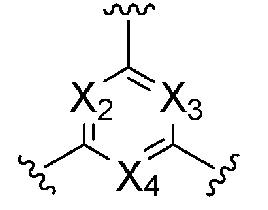
X2∼X4는 각각 독립적으로 상기와 동의이다. X2∼X4는 예컨대 전부 CH이고, 이 경우는 하기 구조로 표시된다.X 2 to X 4 are each independently the same as the above. X 2 to X 4 are all CH, for example, and this case is represented by the following structure.

이들의 경우, 본 발명의 핵산 복합체는, 하기 식 1로 표시되는 핵산 복합체인 것이 적합하다.In these cases, the nucleic acid complex of the present invention is preferably a nucleic acid complex represented by the following formula (1).
식 1:Equation 1:

식 1 중,In
X는 올리고뉴클레오티드이고,X is an oligonucleotide,
X2∼X4는 각각 독립적으로 상기와 동의이다.X 2 to X 4 are each independently the same as the above.
L1 및 L2는 각각 독립적으로 당쇄 리간드이고,L1 and L2 are each independently a sugar chain ligand,
S1, S2 및 S3은 각각 독립적으로 링커를 구성하는 부분 구조이다.S1, S2 and S3 are partial structures that constitute the linker independently of each other.
식 1에 있어서는, 하기 구조가 링커이고,In formula (1), the following structure is a linker,

S1, S2 및 S3은 링커를 구성하는 부분 구조이며,S1, S2 and S3 are partial structures constituting the linker,
X2∼X4는 각각 독립적으로 상기와 동의이다.X 2 to X 4 are each independently the same as the above.
또한, 이하, 상기 식 1의 핵산 복합체에 대해서 설명하는데, 핵산 복합체가, 이하의 구조를 갖는다고 하여 치환하여, 식 1에서의 설명을 적용할 수 있다.Hereinafter, the nucleic acid complex of the above-mentioned

또한, S4는, S1 및 S2와 같은 의미로 이해할 수 있고, X1은 상기와 동의이며, L3은 당쇄 리간드이다.Also, S4 is, it can be understood as meaning as S1 and S2, and X 1 is the agreement, L3 is a sugar chain ligands.
식 1에 있어서, S1 및 S2는 S3의 벤젠환 상의 치환 위치에 대하여, 각각 오르토 위치, 메타 위치, 파라 위치에서 벤젠환과 결합할 수 있지만, 하기 식 1-1로 표시되는 핵산 복합체인 것이 적합하다. 식 1에 있어서의 S1 및 S2의 벤젠환에 대한 결합수는, 벤젠환 상의 S3의 치환 위치 이외로 임의의 위치일 수 있는 것을 의미한다.In the formula (1), each of S1 and S2 is preferably a nucleic acid complex represented by the following formula 1-1, which can bond with a benzene ring at the ortho, meta and para positions with respect to the substitution position on the benzene ring of S3 . The number of bonds of S1 and S2 in the
식 1-1:Equation 1-1:

식 1-1 중,In formula 1-1,
X, L1, L2, S1, S2 및 S3은 각각 상기와 동의이다.X, L1, L2, S1, S2 and S3 are the same as above.
본 명세서에 있어서, 상기와 동의란, 식 1-1 중을 예시하여 설명하면, 식 1-1 중의 X, L1, L2, S1 및 S2 각각에 대해서, 식 1에 있어서 상기하는 X, L1, L2, S1 및 S2 각각에 대한 정의와 동일한 기일 수 있는 것을 의미하고 있다.In the present specification, the above and the agreement means that X, L1, L2, S1, and S2 in
본 발명에 있어서는, S3과 올리고뉴클레오티드는, 뉴클레오티드를 구성하는 당 부분의 3' 위치 또는 5' 위치를 통해 S3과 결합할 뿐 아니라, 뉴클레오티드를 구성하는 염기 부분을 통해 S3과 결합하고 있어도 좋다. 본 발명에 있어서는, 올리고뉴클레오티드는, S3과 올리고뉴클레오티드를 결합하는 구조를 갖는 기로서 이해되어도 좋고, 예컨대, 올리고뉴클레오티드가, -OP(Z)(Z')O-(식 중, Z 및 Z'는 각각 독립적으로 산소 원자 또는 황 원자이다.)를 통해 S3과 결합하고 있는 경우, X로서의 올리고뉴클레오티드로는, -O-P(Z)(Z')O-올리고뉴클레오티드로서 이해되어도 좋다.In the present invention, S3 and the oligonucleotide may bind to S3 through the base portion constituting the nucleotide as well as to S3 through the 3 'position or the 5' position of the sugar moiety constituting the nucleotide. In the present invention, the oligonucleotide may be understood as a group having a structure linking S3 to an oligonucleotide. For example, the oligonucleotide may be represented by -OP (Z) (Z ') O- (wherein Z and Z' (Z) O-oligonucleotides may be understood as an oligonucleotide as X when they are bonded to S3 through an oxygen atom or a sulfur atom, respectively.
식 1에 있어서, S1과 S2는 당쇄 리간드인 L1과 L2와, 벤젠환을 연결하는 구조라면 특별히 한정되지 않고, 핵산 복합체에 있어서 이용되는 공지된 구조를 채용하여도 좋다. S1과 S2는 동일하여도 좋고, 상이하여도 좋다.In the formula (1), S1 and S2 are not particularly limited as long as they are ligands of L1 and L2, which are sugar chain ligands, and a benzene ring, and a known structure used in a nucleic acid complex may be employed. S1 and S2 may be the same or different.
당쇄 리간드인 L1과 L2는 S1 및 S2와 글리코시드 결합에 의해 연결되어 있는 것이 바람직하고, S1 및 S2는 벤젠환과, 예컨대, -CO-, -NH-, -O-, -S-, -O-CO-, -S-CO-, -NH-CO-, -CO-O-, -CO-S- 혹은 -CO-NH- 결합에 의해 각각 연결되어 있어도 좋다.The sugar chain ligands L1 and L2 are preferably linked to S1 and S2 by a glycosidic bond, and S1 and S2 may be bonded to a benzene ring such as -CO-, -NH-, -O-, -S-, -O -CO-, -S-CO-, -NH-CO-, -CO-O-, -CO-S- or -CO-NH- bond.
S3은 올리고뉴클레오티드와의 결합부를 갖는 링커이며, 올리고뉴클레오티드인 X와, 벤젠환을 연결하는 구조라면 특별히 한정되지 않고, 핵산 복합체에 있어서 이용되는 공지된 구조를 채용하여도 좋다.S3 is a linker having a linkage with an oligonucleotide, and is not particularly limited as long as it is a structure linking X, which is an oligonucleotide, with a benzene ring, and a known structure used in a nucleic acid complex may be employed.
올리고뉴클레오티드인 X는 S3과 포스포디에스테르 결합에 의해 연결되어 있는 것이 바람직하고, S3은 벤젠환과, 예컨대, -CO-, -NH-, -O-, -S-, -O-CO-, -S-CO-, -NH-CO-, -CO-O-, -CO-S- 혹은 -CO-NH- 결합에 의해 연결되어 있어도 좋다.X, which is an oligonucleotide, is preferably linked to S3 by a phosphodiester linkage, and S3 is a linking group selected from a benzene ring such as -CO-, -NH-, -O-, -S-, -O- S-CO-, -NH-CO-, -CO-O-, -CO-S- or -CO-NH- bond.
S1, S2 및 S3의 링커를 구성하는 부분 구조로는, 예컨대, 국제 공개 제2009/073809호, 국제 공개 제2013/075035호, 국제 공개 제2015/105083호, 국제 공개 제2014/179620호, 국제 공개 제2015/006740호에 개시되는 구조를 채용하여도 좋다.The partial structures constituting the linker of S1, S2 and S3 include, for example, International Publication Nos. 2009/073809, 2013/075035, International Publication No. 2015/105083, International Publication No. 2014/179620, International The structure disclosed in Publication No. 2015/006740 may be employed.
본 발명에 있어서, 핵산 복합체는, 하기 식 2로 표시되는 구조를 갖는 핵산 복합체인 것이 적합하다.In the present invention, the nucleic acid complex is preferably a nucleic acid complex having a structure represented by the following formula (2).
식 2:Equation 2:

식 2 중,In formula 2,
X, X2∼X4, L1, L2 및 S3은 각각 상기와 동의이고,X, X 2 to X 4 , L 1 , L 2 and S 3 are the same as above,
P1, P2, P3, P4, P5 및 P6, 그리고 T1 및 T2는 각각 독립적으로 존재하지 않거나 또는 -CO-, -NH-, -O-, -S-, -O-CO-, -S-CO-, -NH-CO-, -CO-O-, -CO-S- 혹은 -CO-NH-이며,P1, P2, P3, P4, P5 and P6, and T1 and T2 are each independently absent or selected from the group consisting of -CO-, -NH-, -O-, -S-, -O- -, -NH-CO-, -CO-O-, -CO-S- or -CO-NH-,
Q1, Q2, Q3 및 Q4는 각각 독립적으로 존재하지 않거나 또는 치환 혹은 비치환의 탄소수 2∼12의 알킬렌, -(CH2CH2O)n-CH2CH2-이고, n은 0∼99의 정수이며,Q1, Q2, Q3 and Q4 are each independently present or not, or a substituted or alkylene unsubstituted 2~12, - (CH 2 CH 2 O) n -CH 2 CH 2 - , n is a 0-99 Integer,
B1 및 B2는 각각 독립적으로 결합수이거나 또는 하기 식 2-1로 표시되는 어느 하나의 구조이고, 각 구조에 있어서의 말단의 ㆍ점은 각각 P2 또는 P3 혹은 P5 또는 P6과의 결합점이며, m1, m2, m3 및 m4는 각각 독립적으로 0∼10의 정수이고,
식 2-1:Equation 2-1:

p1 및 p2는 각각 독립적으로 1, 2 또는 3의 정수이며,p1 and p2 are each independently an integer of 1, 2 or 3,
q1, q2, q3 및 q4는 각각 독립적으로 0∼10의 정수이고,q1, q2, q3 and q4 are each independently an integer of 0 to 10,
단, p1 및 p2가 각각 2 또는 3의 정수일 때, 각각의 P3 및 P6, Q2 및 Q4, T1 및 T2, 그리고 L1 및 L2는 동일하거나 또는 상이하여도 좋다.When p1 and p2 are integers of 2 or 3, respectively, P3 and P6, Q2 and Q4, T1 and T2, and L1 and L2 may be the same or different.
P1 및 P4는 각각 독립적으로 존재하지 않거나 또는 -CO-, -NH-, -O-, -S-, -O-CO-, -S-CO-, -NH-CO-, -CO-O-, -CO-S- 혹은 -CO-NH-이지만, -O-, -O-CO-, -NH-CO- 또는 -CO-NH-인 것이 바람직하고, -O-, -NH-CO- 또는 -CO-NH-인 것이 바람직하며, -NH-CO-인 것이 더욱 바람직하다.P1 and P4 are each independently absent or selected from the group consisting of -CO-, -NH-, -O-, -S-, -O-CO-, -S-CO-, -NH- -O-CO-, -NH-CO- or -CO-NH-, more preferably -O-, -NH-CO- or -CO- -CO-NH-, more preferably -NH-CO-.
P1 또는 P4가 예컨대 -NH-CO-인 경우, -NH-CO-벤젠환이라고 하는 부분 구조를 갖는다.When P1 or P4 is, for example, -NH-CO-, it has a partial structure of -NH-CO-benzene ring.
Q1, Q2, Q3 및 Q4는 각각 독립적으로 존재하지 않거나 또는 치환 혹은 무치환의 탄소수 1∼12의 알킬렌 또는 -(CH2CH2O)n-CH2CH2-이고, n은 1∼99의 정수이지만, 치환 혹은 무치환의 탄소수 1∼12의 알킬렌인 것이 바람직하며, 무치환의 탄소수 1∼12의 알킬렌인 것이 보다 바람직하고, 무치환의 탄소수 1∼6의 알킬렌인 것이 더욱 바람직하며, 무치환의 탄소수 1∼4의 알킬렌인 것이 보다 더 바람직하다.Q1, Q2, Q3 and Q4 are each independently present or not, or a substituted or non-substituted alkylene of 1 to 12 carbon atoms or - (CH 2 CH 2 O) n -CH 2 CH 2 - , n is 1 to 99 But it is preferably a substituted or unsubstituted alkylene of 1 to 12 carbon atoms, more preferably an unsubstituted alkylene of 1 to 12 carbon atoms, more preferably an unsubstituted alkylene of 1 to 6 carbon atoms More preferably an unsubstituted alkylene of 1 to 4 carbon atoms.
P2 및 P5는 각각 독립적으로 존재하지 않거나 또는 -CO-, -NH-, -O-, -S-, -O-CO-, -S-CO-, -NH-CO-, -CO-O-, -CO-S- 혹은 -CO-NH-이지만, 존재하지 않거나, -CO-O- 또는 -CO-NH-인 것이 바람직하고, 존재하지 않거나, -CO-NH-인 것이 보다 바람직하다. P2 및 P5가 예컨대 -CO-NH-인 경우, B1-CO-NH-Q1 및 B2-CO-NH-Q3이라고 하는 부분 구조를 갖는다.P2 and P5 are each independently absent or selected from the group consisting of -CO-, -NH-, -O-, -S-, -O-CO-, -S-CO-, -NH- , -CO-S- or -CO-NH-, but is not present, is preferably -CO-O- or -CO-NH-, is absent, or is more preferably -CO-NH-. When P2 and P5 are, for example, -CO-NH-, they have a partial structure of B1-CO-NH-Q1 and B2-CO-NH-Q3.
-(P2-Q1)q1- 및 -(P5-Q3)q3-이 각각 독립적으로 존재하지 않거나 또는 하기 식 3-1∼식 3-3으로 표시되는 어느 하나의 구조인 것이 적합하다.- (P 2 -Q 1) q 1 - and - (P 5 -Q 3) q 3 - are not present independently of each other, or are any of the structures represented by the following formulas 3-1 to 3-3.
식 3-1:Equation 3-1:

식 3-2:Equation 3-2:

식 3-3:Equation 3-3:

식 3-1∼3-3 중,Of the formulas 3-1 to 3-3,
m5 및 m6은 각각 독립적으로 0∼10의 정수이고, 식 3-1∼식 3-3의 구조에 있어서의 말단의 ㆍ점은 각각 B1 또는 B2 혹은 P1 또는 P4와의 결합점이다.m5 and m6 are each independently an integer of 0 to 10, and the terminal? points in the structures of formulas 3-1 to 3-3 are respectively a bonding point with B1 or B2 or P1 or P4.
B1 및 B2는 각각 독립적으로 결합수이거나 또는 하기 식으로 표시되는 어느 하나의 구조이고, 각 구조에 있어서의 말단의 ㆍ점은 각각 P2 또는 P3 혹은 P5 또는 P6과의 결합점이며, m1, m2, m3 및 m4는 각각 독립적으로 0∼10의 정수이다.

B1 및 B2는 글루타민산, 아스파라긴산, 리신, 이미노이아세트산 등의 비천연 아미노산을 포함하는 아미노산, 또는 1,3-프로판디올 등의 아미노알코올에서 유래되는 기인 것이 바람직하고, B1 및 B2가 글루타민산 및 아스파라긴산에서 유래되는 기인 경우, 글루타민산 및 아스파라긴산의 아미노기가 각각 결합하여, P2 및 P5로서, -NH-CO- 결합인 것이 바람직하고, B1 및 B2가 리신에서 유래되는 기인 경우, 리신의 카르복실기가 각각 결합하여, P2 및 P5로서, -CO-NH- 결합인 것이 바람직하고, B1 및 B2가 이미노이아세트산에서 유래되는 기인 경우, 이미노이아세트산의 아미노기가 각각 결합하여, P2 및 P5로서, -CO- 결합이 되는 것이 바람직하다.B1 and B2 are preferably groups derived from amino acids including unnatural amino acids such as glutamic acid, aspartic acid, lysine and iminoacetic acid, or aminoalcohols such as 1,3-propanediol, and when B1 and B2 are derived from glutamic acid and aspartic acid The amino group of glutamic acid and aspartic acid are bonded to each other to form a -NH-CO-bond as P2 and P5, and when B1 and B2 are groups derived from lysine, carboxyl groups of lysine are bonded to each other, P2 and P5 are preferably -CO-NH- bonds, and when B1 and B2 are groups derived from iminoacetic acid, the amino groups of iminoacetic acid are respectively bonded to form a -CO- bond as P2 and P5 .
X2∼X4는 각각 독립적으로 CH인 것이 바람직하고, X2∼X4가 동시에 CH인 것이 보다 바람직하다.X 2 to X 4 are each preferably CH, and X 2 to X 4 are more preferably CH.
본 발명에 있어서, 핵산 복합체는, 하기 식 4-1∼4-9로 표시되는 구조를 갖는 핵산 복합체인 것이 적합하다.In the present invention, the nucleic acid complex is preferably a nucleic acid complex having a structure represented by the following formulas 4-1 to 4-9.
식 4-1:Equation 4-1:

식 4-2:Equation 4-2:

식 4-3:Equation 4-3:

식 4-4:Equation 4-4:

식 4-5:Equation 4-5:

식 4-6:Equation 4-6:

식 4-7:Equation 4-7:
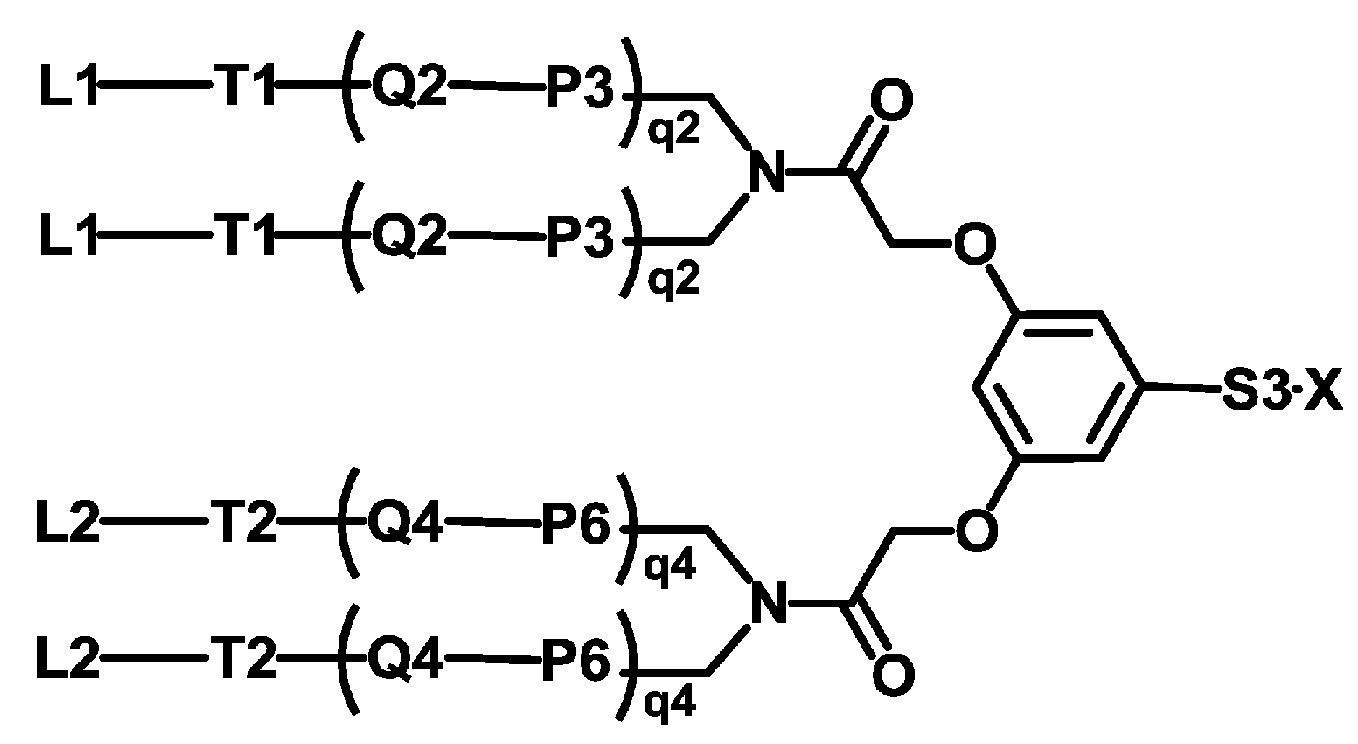
식 4-8:Equation 4-8:

식 4-9:Equation 4-9:

식 4-1∼4-9 중,Of the formulas 4-1 to 4-9,
X, L1, L2, S3, P3, P6, T1, T2, Q2, Q4, q2 및 q4는 각각 상기와 동의이다.X, L1, L2, S3, P3, P6, T1, T2, Q2, Q4, q2 and q4 are the same as above.
P3 및 P6은 각각 독립적으로 존재하지 않거나 또는 -CO-, -NH-, -O-, -S-, -O-CO-, -S-CO-, -NH-CO-, -CO-O-, -CO-S- 혹은 -CO-NH-이지만, -O-CO- 또는 -NH-CO-인 것이 바람직하고, -NH-CO-인 것이 보다 바람직하다. P3 및 P6이 예컨대 -NH-CO-인 경우, 각각 B1-NH-CO-Q2 및 B2-NH-CO-Q4라고 하는 부분 구조를 갖는다.P3 and P6 are each independently absent or selected from the group consisting of -CO-, -NH-, -O-, -S-, -O-CO-, -S-CO-, -NH- , -CO-S- or -CO-NH-, but is preferably -O-CO- or -NH-CO-, more preferably -NH-CO-. When P3 and P6 are, for example, -NH-CO-, they have a partial structure of B1-NH-CO-Q2 and B2-NH-CO-Q4, respectively.
T1 및 T2는 각각 독립적으로 존재하지 않거나 또는 -CO-, -NH-, -O-, -S-, -O-CO-, -S-CO-, -NH-CO-, -CO-O-, -CO-S- 혹은 -CO-NH-이지만, -O- 또는 -S-인 것이 바람직하고, -O-인 것이 보다 바람직하다.T1 and T2 are each independently absent or selected from the group consisting of -CO-, -NH-, -O-, -S-, -O-CO-, -S-CO-, -NH- , -CO-S- or -CO-NH-, but is preferably -O- or -S-, more preferably -O-.
본 발명에 있어서, 핵산 복합체는, 하기 식 5로 표시되는 구조를 갖는 핵산 복합체인 것이 적합하다.In the present invention, the nucleic acid complex is preferably a nucleic acid complex having a structure represented by the following formula (5).
식 5에서는, 식 2에 있어서의 P1과 P4, P2와 P5, P3과 P6, Q1과 Q3, Q2와 Q4, B1과 B2, T1과 T2, L1과 L2, p1과 p2, q1과 q3 및 q2와 q4가 각각 동일하다.In Equation 5, P1 and P4, P2 and P5, P3 and P6, Q1 and Q3, Q2 and Q4, B1 and B2, T1 and T2, L1 and L2, p1 and p2, q1 and q3 and q2 And q4 are the same.
식 5:Equation 5:

식 5 중,In formula 5,
X, S3, P1, P2, P3, Q1, Q2, B1, T1, L1, p1, q1 및 q2는 각각 상기와 동의이다.X, S3, P1, P2, P3, Q1, Q2, B1, T1, L1, p1, q1 and q2 are the same as above.
또한, 식 5에 있어서의 X, S3, P1, P2, P3, Q1, Q2, B1, T1, L1, p1, q1 및 q2는 각각 전술한 적합한 기여도 좋지만, P1이 -CO-NH-, -NH-CO- 또는 -O-인 것이 바람직하다.In the formula 5, each of P1, P2, P3, Q1, Q2, B1, T1, L1, -CO- or -O-.
식 5에 있어서의 -(P2-Q1)q1-은 존재하지 않거나 또는 상기 식 3-1∼식 3-3으로 표시되는 어느 하나의 구조인 것이 적합하다.In the equation 5 - (P2-Q1) q1 - it is not present or it is suitable to any one of the structures represented by the formula formula 3-1~ 3-3.
본 발명에 있어서, 핵산 복합체는, 하기 식 6-1∼6-9로 표시되는 구조를 갖는 핵산 복합체인 것이 적합하다.In the present invention, the nucleic acid complex is preferably a nucleic acid complex having a structure represented by the following formulas 6-1 to 6-9.
식 6-1:Equation 6-1:

식 6-2:Equation 6-2:

식 6-3:Equation 6-3:

식 6-4:Equation 6-4:

식 6-5:Equation 6-5:

식 6-6:Equation 6-6:

식 6-7:Equation 6-7:

식 6-8:Equation 6-8:

식 6-9:Equation 6-9:

식 6-1∼식 6-9 중,Among Expressions 6-1 to 6-9,
X, S3, P3, Q2, T1, 및 L1은 각각 상기와 동의이다.X, S3, P3, Q2, T1, and L1 are synonymous with the above.
본 발명에 있어서, 핵산 복합체는, 하기 식 7-1∼식 7-9 중 어느 하나로 표시되는 구조를 갖는 핵산 복합체인 것이 적합하다.In the present invention, the nucleic acid complex is preferably a nucleic acid complex having a structure represented by any one of the following formulas 7-1 to 7-9.
식 7-1:Equation 7-1:

식 7-2:Equation 7-2:

식 7-3:Equation 7-3:

식 7-4:Equation 7-4:

식 7-5:Equation 7-5:

식 7-6:Equation 7-6:

식 7-7:Equation 7-7:

식 7-8:Equation 7-8:

식 7-9:Equation 7-9:

식 7-10:Equation 7-10:

식 7-11:Equation 7-11:

식 7-12:Equation 7-12:

식 7-13:Equation 7-13:

식 7-14:Equation 7-14:

식 7-15:Equation 7-15:

식 7-16:Equation 7-16:

식 7-17:Equation 7-17:

식 7-18:Equation 7-18:

식 7-19:Equation 7-19:

식 7-20:Equation 7-20:

식 7-21:Equation 7-21:

식 7-1∼식 7-21 중,Among the expressions 7-1 to 7-21,
X, L1, L2 및 S3, n2 또는 n3은 각각 상기와 동의이다. L1과 L2는 동일하여도 좋고, 상이하여도 좋으며, 동일한 것이 적합하다.X,
식 7-1∼식 7-9에 있어서, 각 알킬렌기 부분을 쇄 길이가 상이한 알킬렌쇄를 도입함으로써, 또한, 아미드 결합 등을 다른 결합으로 치환함으로써, 식 7-1∼식 7-9로 표시되는 구조를 갖는 핵산 복합체 이외의 핵산 유도체를 제조할 수도 있다.In formulas (7-1) to (7-9), by substituting alkylene chains having different chain lengths for the respective alkylene group moieties and substituting other bonds for amide bonds and the like, A nucleic acid derivative other than the nucleic acid complex having the structure of
전술한 바와 같이, 본 발명의 핵산 복합체에 이용되는 링커는, 하기 구조를 갖는 것이 적합하다.As described above, the linker used in the nucleic acid complex of the present invention preferably has the following structure.

(식 중,(Wherein,
n1은 1∼100의 정수이다.)and n1 is an integer of 1 to 100.)
n1은 5∼95의 정수인 것이 바람직하고, 10∼80의 정수인 것이 보다 바람직하며, 15∼60의 정수인 것이 더욱 바람직하고, 20∼40의 정수인 보다 더 바람직하다.n1 is preferably an integer of 5 to 95, more preferably an integer of 10 to 80, still more preferably an integer of 15 to 60, and still more preferably an integer of 20 to 40. [
n2 및 n3은 각각 동일하거나 또는 상이하고, 5∼95의 정수인 것이 바람직하며, 10∼80의 정수인 것이 보다 바람직하고, 15∼60의 정수인 것이 더욱 바람직하며, 20∼40의 정수인 것이 보다 더 바람직하다.n2 and n3 are the same or different and each is preferably an integer of 5 to 95, more preferably an integer of 10 to 80, still more preferably an integer of 15 to 60, and still more preferably an integer of 20 to 40 .
본 발명에 있어서, 핵산 복합체는, 하기 식 11로 표시되는 구조를 갖는 핵산 복합체인 것이 적합하다.In the present invention, the nucleic acid complex is preferably a nucleic acid complex having a structure represented by the following formula (11).
식 11:Equation 11:

식 11 중,In Equation (11)
L1, L2, S1 및 S2는 각각 상기와 동의이고,L1, L2, S1 and S2 are the same as above,
P7 및 P8은 각각 독립적으로 존재하지 않거나 또는 -CO-, -NH-, -O-, -S-, -O-CO-, -S-CO-, -NH-CO-, -CO-O-, -CO-S- 혹은 -CO-NH-이며,P7 and P8 are each independently absent or selected from the group consisting of -CO-, -NH-, -O-, -S-, -O-CO-, -S-CO-, -NH- , -CO-S- or -CO-NH-,
Q5, Q6 및 Q7은 각각 독립적으로 존재하지 않거나 또는 치환 혹은 무치환의 탄소수 1∼12의 알킬렌 또는 -(CH2CH2O)n8-CH2CH2-이고, n8은 0∼99의 정수이며,Q5, Q6, and Q7 are each independently not present, or or a substituted or unsubstituted alkyl group having 1 to 12 carbon atoms or a substituted alkylene - (CH 2 CH 2 O) n8 -CH 2 CH 2 - and, n8 is an integer from 0-99 Lt;
B3은 하기 식 11-1로 표시되는 어느 하나의 구조이며, 파선에 있어서, 각각 Q5 및 Q6과의 결합수를 의미하고,B3 represents any one of the structures represented by the following formula 11-1, the number of bonds with Q5 and Q6 in the broken line,
식 11-1:Equation 11-1:

q5 및 q6은 각각 독립적으로 0∼10의 정수이다.q5 and q6 are each independently an integer of 0 to 10;
P7은 존재하지 않거나 또는 -CO-, -NH-, -O-, -S-, -O-CO-, -S-CO-, -NH-CO-, -CO-O-, -CO-S- 혹은 -CO-NH-이지만, -O-, -NH-CO- 또는 -CO-NH-인 것이 바람직하고, -O- 또는 -NH-CO-인 것이 보다 바람직하다. P7이 예컨대 -O-인 경우, 벤젠환-O-라고 하는 부분 구조를 갖는다.P7 is absent or is selected from the group consisting of -CO-, -NH-, -O-, -S-, -O-CO-, -S-CO-, -NH-CO-, -CO- - or -CO-NH-, but is preferably -O-, -NH-CO- or -CO-NH-, more preferably -O- or -NH-CO-. When P7 is, for example, -O-, it has a partial structure of benzene ring -O-.
P8은 존재하지 않거나 또는 -CO-, -NH-, -O-, -S-, -O-CO-, -S-CO-, -NH-CO-, -CO-O-, -CO-S- 혹은 -CO-NH-이지만, 존재하는 경우, -CO-O- 또는 -CO-NH-인 것이 바람직하고, -CO-NH-인 것이 보다 바람직하다. P8이 예컨대 -CO-NH-인 경우, Q6-CO-NH-라고 하는 부분 구조를 갖는다.P8 is absent or is selected from the group consisting of -CO-, -NH-, -O-, -S-, -O-CO-, -S-CO-, -NH-CO-, -CO- - or -CO-NH-, when present, it is preferably -CO-O- or -CO-NH-, more preferably -CO-NH-. When P8 is, for example, -CO-NH-, it has a partial structure of Q6-CO-NH-.
Q5, Q6 및 Q7은 각각 독립적으로 존재하지 않거나 또는 치환 혹은 무치환의 탄소수 1∼12의 알킬렌 또는 -(CH2CH2O)n8-CH2CH2-이며, n8은 0∼99의 정수이지만, 치환 혹은 무치환의 탄소수 1∼12의 알킬렌인 것이 바람직하고, 무치환의 탄소수 1∼12의 알킬렌인 것이 보다 바람직하며, 무치환의 탄소수 1∼6의 알킬렌인 것이 더욱 바람직하고, 무치환의 탄소수 1∼4의 알킬렌인 것이 보다 더 바람직하다.Q5, Q6, and Q7 are each independently or exists or an alkylene group having 1 to 12 carbon atoms or a substituted or unsubstituted - (CH 2 CH 2 O) n8 -CH 2 CH 2 - and, n8 is an integer from 0-99 , It is preferably a substituted or unsubstituted alkylene of 1 to 12 carbon atoms, more preferably an unsubstituted alkylene of 1 to 12 carbon atoms, more preferably an unsubstituted alkylene of 1 to 6 carbon atoms , And still more preferably an unsubstituted alkylene of 1 to 4 carbon atoms.
-(P7-Q5)q5-는 -O-(CH2)m15-NH- 및 -NH-CO-(CH2)m16-NH-이며, m15 및 m16은 각각 독립적으로 1∼10의 정수인 것이 적합하다.- (P7-Q5) q5 - is -O- (CH 2) m15 is -NH-, and -NH-CO- (CH 2) m16 -NH-, m15 , and m16 is an integer suitably of from 1 to 10 are each independently Do.
본 발명에 있어서, 핵산 복합체는, 하기 식 12-1∼식 12-12 중 어느 하나로 표시되는 구조를 갖는 핵산 복합체인 것이 적합하다.In the present invention, the nucleic acid complex is preferably a nucleic acid complex having a structure represented by any one of formulas 12-1 to 12-12.
식 12-1:Equation 12-1:

식 12-2:Equation 12-2:

식 12-3:Equation 12-3:

식 12-4:Equation 12-4:

식 12-5:Equation 12-5:

식 12-6:Equation 12-6:

식 12-7:Equation 12-7:

식 12-8:Equation 12-8:

식 12-9:Equation 12-9:

식 12-10:Equation 12-10:

식 12-11:Equation 12-11:

식 12-12:Equation 12-12:

식 12-1∼12-12 중,Of Expressions 12-1 to 12-12,
X, L1, L2, S1 및 S2는 각각 상기와 동의이고, n1'∼n12'는 각각 독립적으로 1∼10의 정수이다.X,
본 발명의 다른 바람직한 양태의 하나로서, 이하의 구조를 갖는 핵산 복합체를 들 수 있다.As another preferred embodiment of the present invention, there is a nucleic acid complex having the following structure.


식 중,Wherein,
X, L1, S3 또는 n2는 각각 상기와 동의이다.X, L1, S3 or n2 are the same as above.
본 발명의 핵산 복합체는, 식 1로 표시되는 핵산 복합체에 있어서, 식 2 및 식 11의 구조를 겸비하는 핵산 복합체인 것이 바람직하고, 상기 핵산 복합체에 있어서, 식 11의 구조이며, 식 2가, 식 4-1∼식 4-9여도 좋고, 식 6-1∼식 6-9여도 좋으며, 식 7-1∼식 7-9여도 좋고, 식 2가, 식 4-1∼식 4-9, 식 6-1∼식 6-9, 혹은 식 7-1∼식 7-9인 경우에, 식 11이, 식 12-1∼식 12-12여도 좋다. 본 발명의 핵산 복합체는, 식 1로 표시되는 핵산 복합체에 있어서, 식 4-1∼식 4-9 중 어느 하나의 구조 및 식 12-1∼식 12-12 중 어느 하나의 구조를 겸비하는 핵산 복합체, 식 6-1∼식 6-9 중 어느 하나의 구조 및 식 12-1∼식 12-12 중 어느 하나의 구조를 겸비하는 핵산 복합체, 식 7-1∼식 7-9 중 어느 하나의 구조 및 식 12-1∼식 12-12 중 어느 하나의 구조를 겸비하는 핵산 복합체인 것이 보다 적합하다.The nucleic acid complex of the present invention is preferably a nucleic acid complex having the structure of the formula 2 and the formula 11 in the nucleic acid complex represented by the
또한, 본 명세서에 있어서, 당쇄 리간드를 「리간드」나 「L1」 등으로 표시하는 경우에는, 당쇄 리간드에 직접 결합되어 있는 링커의 일부(예컨대, -O-(CH2)2-)를 포함하여 표시하는 경우도 있다.In the present specification, when the sugar chain ligand is represented by "ligand" or "L1" or the like, it is preferable that a part (for example, -O- (CH 2 ) 2 -) of the linker directly bonded to the sugar chain ligand It may be displayed.
본 발명의 핵산 복합체는, 어느 하나의 질소 원자 상의 고립 전자쌍에, 수소 이온이 배위한 경우에, 제약상 허용할 수 있는 음이온과 염을 형성하고 있어도 좋다.The nucleic acid complex of the present invention may form a salt with a pharmaceutically acceptable anion when hydrogen ions are added to a lone pair of electrons on any one of the nitrogen atoms.
본 발명에 있어서, 제약상 허용할 수 있는 음이온으로는, 예컨대 염화물 이온, 브롬화물 이온, 질산 이온, 황산 이온, 인산 이온 등의 무기 이온, 아세트산 이온, 옥살산 이온, 말레산 이온, 푸마르산 이온, 시트르산 이온, 안식향산 이온, 메탄술폰산 이온 등의 유기산 이온 등을 들 수 있다.In the present invention, examples of pharmaceutically acceptable anions include inorganic ions such as chloride ion, bromide ion, nitrate ion, sulfate ion and phosphate ion, acetate ion, oxalate ion, maleate ion, fumarate ion, An organic acid ion such as an ion, a benzoic acid ion, or a methanesulfonic acid ion.
본 발명의 핵산 복합체의 제조법에 대해서 설명한다. 또한, 이하에 나타내는 제조법에 있어서, 정의한 기가 상기 제조법의 조건 하에서 변화하거나 또는 상기 제조법을 실시하는 데 부적절한 경우, 유기합성화학에서 상용되는 보호기의 도입 및 제거 방법[예컨대, 프로텍티브·그룹스·인·오가닉·신세시스 제3판(Protective Groups in Organic Synthesis, third edition), 그린(T. W. Greene) 지음, John Wiley & Sons Inc.(1999년) 등에 기재된 방법] 등을 이용함으로써, 목적 화합물을 제조할 수 있다. 또한, 필요에 따라 치환기 도입 등의 반응 공정의 순서를 바꿀 수도 있다.The method for producing the nucleic acid complex of the present invention will be described. Further, in the following production method, when a defined group is changed under the conditions of the above production method or is inappropriate for carrying out the above-mentioned production method, a method of introducing and removing a protecting group commonly used in organic synthesis chemistry [for example, Protective Groups in The method described in Protective Groups in Organic Synthesis, third edition, TW Greene, John Wiley & Sons Inc. (1999), etc.), etc., can be used to produce the desired compound . If necessary, the order of the reaction steps such as substituent introduction and the like may be changed.
식 1로 표시되는 핵산 중합체는, 고상 합성에 의해서도 합성할 수 있다.The nucleic acid polymer represented by the formula (1) can also be synthesized by solid phase synthesis.
식 1로 표시되는 핵산 중합체는, 핵산 복합체로서 공지된 링커 구조의 합성 방법을 참고로 하여 합성할 수 있다.The nucleic acid polymer represented by formula (1) can be synthesized with reference to a synthesis method of a linker structure known as a nucleic acid complex.
식 1로 표시되는 핵산 복합체에 있어서의, S1을 링커로 한 L1-벤젠환 유닛이나 S2를 링커로 한 L2-벤젠환 유닛의 합성은, 예컨대, 식 2로 표시되는 핵산 복합체를 예로서 설명한다.The synthesis of the L2-benzene ring unit in which the S1 is a linker in the L1-benzene ring unit or S2 in the linker in the nucleic acid complex represented by the
식 2로 표시되는 핵산 복합체에 있어서의 L1-벤젠환 유닛이나 L2-벤젠환 유닛은 P1, P2, P3, P4, P5, 및 P6, 그리고 T1 및 T2에 의해 연결되어 있다.The L1-benzene ring unit or the L2-benzene ring unit in the nucleic acid complex represented by Formula 2 is connected by P1, P2, P3, P4, P5, and P6, and T1 and T2.
P1, P2, P3, P4, P5, 및 P6, 그리고 T1 및 T2의 -CO-, -NH-, -O-, -S-, -O-CO-, -S-CO-, -NH-CO-, -CO-O-, -CO-S- 또는 -CO-NH- 결합은, 예컨대, 제4판 실험화학강좌 19 「유기 화합물의 합성 I」 마루젠(1992년), 제4판 실험화학강좌 20 「유기 화합물의 합성 II」, 마루젠(1992년) 등에 기재된 결합 반응의 방법을 참고로 하여, 식 2로 표시되는 구조를 형성하는 데 적절한 원료를 선택함으로써 적절하게 합성할 수 있다.-CO-, -S-CO-, -NH-CO-, -NH-, -O-, -S-, -O-CO-, -S-CO-, and -NH-CO of P1, P2, P3, P4, P5, -, -CO-O-, -CO-S- or -CO-NH- bonds can be prepared, for example, in the 4th edition of Experimental Chemistry Lecture 19 "Synthesis of Organic Compounds I" Maruzen (1992) Can be suitably synthesized by selecting a raw material suitable for forming the structure represented by the formula 2 with reference to the coupling reaction method described in Lecture 20 "Synthesis of organic compound II", Maruzen (1992) and the like.
또한, 벤젠환으로부터 순차, Q1을 부분 구조로서 갖는 화합물, B1을 부분 구조로서 갖는 화합물을 결합시킴으로써, L1-벤젠환 유닛의 부분 구조를 제조할 수 있다.Further, a partial structure of the L1-benzene ring unit can be prepared by bonding a compound having Q1 as a partial structure and a compound having B1 as a partial structure sequentially from the benzene ring.
L1과 Q2를 부분 구조로서 갖는 화합물을 별도 합성하고, L1과 Q2를 부분 구조로서 갖는 화합물을 벤젠환, Q1 및 B1을 부분 구조로서 갖는 L1-벤젠환 유닛의 부분 구조를 갖는 화합물과 결합시킴으로써, L1-벤젠환 유닛 구조를 제조할 수 있다.A compound having L1 and Q2 as a partial structure is separately synthesized and a compound having L1 and Q2 as a partial structure is bonded to a compound having a partial structure of a L1-benzene ring unit having a benzene ring, Q1 and B1 as a partial structure, An L1-benzene ring unit structure can be prepared.
L2-벤젠환 유닛에 대해서도 마찬가지로, 벤젠환으로부터 순차, Q3을 부분 구조로서 갖는 화합물, B2를 부분 구조로서 갖는 화합물을 결합시킴으로써, L2-벤젠환 유닛의 부분 구조를 제조할 수 있다.Similarly to the case of the L2-benzene ring unit, a partial structure of the L2-benzene ring unit can be prepared by bonding a compound having Q3 as a partial structure and a compound having B2 as a partial structure sequentially from the benzene ring.
L2와 Q4를 부분 구조로서 갖는 화합물을 별도 합성하고, L2와 Q4를 부분 구조로서 갖는 화합물을 벤젠환, Q3 및 B2를 부분 구조로서 갖는 L2-벤젠환 유닛의 부분 구조를 갖는 화합물과 결합시킴으로써, L2-벤젠환 유닛 구조를 제조할 수 있다.A compound having L2 and Q4 as a partial structure is separately synthesized and a compound having L2 and Q4 as a partial structure is bonded to a compound having a partial structure of an L2-benzene ring unit having a benzene ring and Q3 and B2 as partial structures, An L2-benzene ring unit structure can be prepared.
Q1을 부분 구조로서 갖는 화합물, Q3을 부분 구조로서 갖는 화합물로는, 탄소수 1∼10의 알킬렌 또는 -(CH2CH2O)n-CH2CH2-의 양 말단에, 수산기, 카르복실기, 아미노기, 티올기를 갖는 화합물을 들 수 있다.Q1 compound having as a partial structure, a compound having as a partial structure is Q3, having 1 to 10 carbon atoms in the alkylene group or - (CH 2 CH 2 O) n -CH 2 CH 2 - at both ends, a hydroxyl group, a carboxyl group, An amino group, and a thiol group.
B1을 부분 구조로서 갖는 화합물, B2를 부분 구조로서 갖는 화합물로는, 하기 식 2-1로 표시되는 어느 하나의 구조를 가지며, 각 구조에 있어서의 말단의 ㆍ점에 있어서, 각각 수산기, 카르복실기, 아미노기, 또는 티올기를 갖는 화합물을 들 수 있다.The compound having B1 as a partial structure and the compound having B2 as a partial structure have any one of structures represented by the following formula 2-1 and have a hydroxyl group, An amino group, or a thiol group.
식 2-1:Equation 2-1:

B1을 부분 구조로서 갖는 화합물, B2를 부분 구조로서 갖는 화합물의 구체예로는, 글리콜, 글루타민산, 아스파라긴산, 리신, Tris, 이미노이아세트산, 2-아미노-1,3-프로판디올 등을 들 수 있고, 글루타민산, 아스파라긴산, 리신, 이미노이아세트산이 바람직하다.Specific examples of the compound having B1 as a partial structure and the compound having B2 as a partial structure include glycol, glutamic acid, aspartic acid, lysine, Tris, iminoacetic acid, 2-amino-1,3-propanediol, and the like , Glutamic acid, aspartic acid, lysine, and iminoacetic acid are preferable.
L1, Q2 및 B1을 부분 구조로서 갖는 화합물을 합성하고 나서, Q1과 벤젠환을 갖는 화합물과 결합함으로써, L1-벤젠환 유닛 구조를 제조하여도 좋다.The L1-benzene ring unit structure may be prepared by synthesizing a compound having L1, Q2 and B1 as a partial structure and then combining with a compound having Q1 and a benzene ring.
L2, Q4 및 B2를 부분 구조로서 갖는 화합물을 합성하고 나서, Q3과 벤젠환을 갖는 화합물과 결합함으로써, L2-벤젠환 유닛 구조를 제조하여도 좋다.L2, Q4 and B2 as a partial structure and then combining with a compound having Q3 and a benzene ring, a L2-benzene ring unit structure may be produced.
본 발명에 있어서는, [L1-T1-(Q2-P3)q2-]p1-B1-(P2-Q1)q1-P1-인 부분 구조와, [L2-T2-(Q3-P6)q4-]p2-B2-(P5-Q3)q3-P2-인 부분 구조는 동일하거나 또는 상이하여도 좋지만, 동일한 것이 바람직하다.In the present invention, [L1-T1- (Q2- P3) q2 -] p1 -B1- (P2-Q1) q1 -P1- part structure, [L2-T2- (Q3- P6) q4 -] p2 -B2- (P5-Q3) q3- P2- may be the same or different, but are preferably the same.
당쇄 리간드의 L1-T1-Q2에 상당하는 유닛으로서, 예컨대, L3-T1-Q2-COOH, L3-T1-(Q2-P3)q2-1-Q2-NH2 등을 들 수 있다. 구체적으로는, L3-O-탄소수 1∼12의 알킬렌-COOH나, L3-탄소수 1∼12의 알킬렌-CO-NH-탄소수 2∼12의 알킬렌-NH2 등을 들 수 있다.It can be given as a unit corresponding to L1-T1-Q2 of sugar chain ligands, e.g., L3-T1-Q2-COOH , L3-T1- (Q2-P3) q2-1 -Q2-NH 2 and the like. Specific examples thereof include L3-O-alkylene-COOH having 1 to 12 carbon atoms, L3-alkylene-CO-NH2 having 2 to 12 carbon atoms, and alkylene-NH2 having 2 to 12 carbon atoms.
L3은 탈보호함으로써, L1이 되는 당쇄 리간드 유도체라면 특별히 한정되지 않는다. 당쇄 리간드의 치환기로는, 당질 화학의 분야에서 범용되는 치환기라면 특별히 한정되지 않지만, Ac기가 바람직하다.L3 is not particularly limited as long as it is a sugar chain ligand derivative which is L1 by deprotection. The substituent of the sugar chain ligand is not particularly limited as long as it is a substituent generally used in the field of saccharide chemistry, but Ac group is preferable.
S1을 링커로 한 L1-벤젠환 유닛이나 S2를 링커로 한 L2-벤젠환 유닛의 합성은, 구체적으로는 실시예에 기재된 방법을 참고로 하여, 알킬렌쇄의 탄소수를 적절하게 증감하고, 또한, 말단 아미노기나 말단 카르복실기를, -CO-, -NH-, -O-, -S-, -O-CO-, -S-CO-, -NH-CO-, -CO-O-, -CO-S- 또는 -CO-NH- 결합을 형성할 수 있는 기로 변환한 화합물을 이용함으로써, 합성할 수 있다. 또한, L1의 당쇄 리간드에 대해서도, 실시예에 있어서는, 만노오스 유도체, 만노오스 또는 N-아세틸갈락토사민을 예시하고 있지만, 다른 당쇄 리간드로 변경하여 실시할 수 있다.The synthesis of the L2-benzene ring unit using the S1-linkage unit as the L1-benzene ring unit or the S2 as the linker can be carried out by appropriately increasing or decreasing the carbon number of the alkylene chain, A terminal amino group or a terminal carboxyl group may be replaced with -CO-, -NH-, -O-, -S-, -O-CO-, -S-CO-, -NH- S- or -CO-NH- bond in the compound represented by the general formula (1). Also, with respect to the sugar chain ligand of L1, the mannose derivative, mannose or N-acetyl galactosamine are exemplified in the examples, but other sugar chain ligands can be used.
식 1로 표시되는 핵산 복합체에 있어서의, S3을 링커로 한 X-벤젠환 유닛의 합성은, 예컨대, 식 11로 표시되는 핵산 복합체를 예로서 설명한다.The synthesis of the X-benzene ring unit using the S3 as a linker in the nucleic acid complex represented by the formula (1) will be described by taking the nucleic acid complex represented by the formula (11) as an example.
식 11로 표시되는 핵산 복합체에 있어서의 X-벤젠환 유닛은, 올리고뉴클레오티드의 결합 이외에, P7 및 P8에 의해 표시되는 결합을 갖는다.The X-benzene ring unit in the nucleic acid complex represented by Formula 11 has a bond represented by P7 and P8 in addition to the bond of the oligonucleotide.
P7 및 P8의 -CO-, -NH-, -O-, -S-, -O-CO-, -S-CO-, -NH-CO-, -CO-O-, -CO-S- 또는 -CO-NH- 결합은, 예컨대, 제4판 실험화학강좌 19 「유기 화합물의 합성 I」 마루젠(1992년), 제4판 실험화학강좌 20 「유기 화합물의 합성 II」, 마루젠(1992년)에 기재된 결합 반응의 방법을 참고로 하여, 식 11로 표시되는 구조를 형성하는 데 적절한 원료를 선택함으로써 적절하게 합성할 수 있다.P7 and P8, -CO-, -NH-, -O-, -S-, -O-CO-, -S-CO-, -NH-CO-, -CO-O-, -CO- The -CO-NH- linkages can be found, for example, in the 4th edition of the Experimental Chemistry Lecture 19, " Synthesis of Organic Compounds I " Maruzen (1992) And the method of the coupling reaction described in the above-mentioned Japanese Patent Application Laid-open (Kokai) No. 2001-355960), and selecting a raw material suitable for forming the structure represented by the formula (11).
또한, 벤젠환으로부터 순차, Q5를 부분 구조로서 갖는 화합물, B3을 부분 구조로서 갖는 화합물을 결합시킴으로써, X-벤젠환 유닛의 부분 구조를 제조할 수 있다.Further, a partial structure of the X-benzene ring unit can be prepared by bonding a compound having Q5 as a partial structure and a compound having B3 as a partial structure sequentially from the benzene ring.
X와 Q7을 부분 구조로서 갖는 화합물이나, X와 Q6을 부분 구조로서 갖는 화합물을 별도 합성하고, X와 Q7을 부분 구조로서 갖는 화합물이나 X와 Q6을 부분 구조로서 갖는 화합물을 벤젠환 및 Q5를 부분 구조로서 갖는 X-벤젠환 유닛의 부분 구조를 갖는 화합물과 결합시켜, B3 부분을 구축함으로써, X-벤젠환 유닛 구조를 제조할 수 있다.A compound having X and Q7 as a partial structure or a compound having X and Q6 as a partial structure are separately synthesized and a compound having X and Q7 as a partial structure or a compound having X and Q6 as a partial structure is referred to as a benzene ring and Q5 The X-benzene ring unit structure can be prepared by bonding a compound having a partial structure of an X-benzene ring unit having a partial structure and constructing a B3 portion.
구체적으로는, 벤젠환 및 Q5를 부분 구조로서 갖는 X-벤젠환 유닛의 부분 구조를 갖는 화합물의 말단에 아지드기를 갖는 경우를 예로 들면, 실시예에 개시하는 말단 결합성 작용기화한 올리고뉴클레오티드를 반응시킴으로써, 고리화 부가시켜, 트리아졸환을 형성시키고, B3 부분을 구축함으로써, X-벤젠환 유닛 구조를 제조할 수 있다.Concretely, the case of having an azide group at the terminal of a compound having a partial structure of an X-benzene ring unit having a benzene ring and Q5 as a partial structure is exemplified by the terminal-binding functionalized oligonucleotide described in the Examples To form a triazole ring, and a B3 moiety is formed, whereby an X-benzene ring unit structure can be produced.
Q5를 부분 구조로서 갖는 화합물, Q6을 부분 구조로서 갖는 화합물, Q7을 부분 구조로서 갖는 화합물로는, 탄소수 1∼10의 알킬렌 또는 -(CH2CH2O)n8-CH2CH2-의 양 말단에, 수산기, 카르복실기, 아미노기, 티올기를 갖는 화합물을 들 수 있다.Compounds having a partial structure Q5, Q6 compound having as a partial structure, a compound having as a partial structure is Q7, a C1-10 alkylene or - (CH 2 CH 2 O) n8 -CH 2 CH 2 - of A compound having a hydroxyl group, a carboxyl group, an amino group and a thiol group at both terminals.
L1-벤젠환 유닛 구조, L2-벤젠환 유닛 구조와, X-벤젠환 유닛 구조는 각각 순차 제조해 나갈 수 있지만, L1-벤젠환 유닛 구조 및 L2-벤젠환 유닛 구조를 합성하고 나서, X-벤젠환 유닛 구조를 결합시키는 것이 바람직하다. 특히, 올리고뉴클레오티드 부분을 갖는 X에 대해서는, 당쇄 리간드 복합체 합성의 최종 공정 근처에서 화합물 내로 도입하는 것이 바람직하다.The L1-benzene ring unit structure, the L2-benzene ring unit structure, and the X-benzene ring unit structure can be sequentially produced, but it is also possible to synthesize the L1- It is preferable to bond the benzene ring unit structure. Particularly, it is preferable that X having an oligonucleotide moiety is introduced into the compound near the final step of synthesis of the sugar chain ligand complex.
제조 방법 1
식 1-1에 있어서 P1 및 P4가 -NH-CO-, -O-CO- 또는 -S-CO-인 L1-벤젠환 유닛 구조 및 L2-벤젠환 유닛 구조는 이하의 방법으로 제조할 수 있다.The L1-benzene ring unit structure and the L2-benzene ring unit structure in which P1 and P4 in the formula 1-1 are -NH-CO-, -O-CO- or -S-CO- can be prepared by the following method .

(식 중, Q1, Q2, Q3, Q4, Q5, P2, P3, P5, P6, P7, T1, T2, L1, L2, q1, q2, q3 및 q4는 각각 상기와 동의이고, q2'는 q2보다 1 작은 정수를 나타내며, q4'는 q4보다 1 작은 정수를 나타내고, P1' 및 P4'는 각각 독립적으로 -NH-CO-, -O-CO- 또는 -S-CO-를 나타내며, Z는 H, OH, NH2, SH, 염소 원자, 브롬 원자, 요오드 원자, 메탄술포닐옥시, p-톨루엔술포닐옥시 또는 카르복실산을 나타내고, B1' 및 B2'는 하기 식의 구조체 중 어느 하나를 나타내며, PG1, PG2, PG3, PG4, PG5, PG6 및 PG7은 각각 적절한 보호기를 나타낸다.)Q2, q3, and q4 are the same as the above, and q2 'is q2', q2 ', q3', and q4 ' Q 'is an integer smaller than q4, P1' and P4 'each independently represent -NH-CO-, -O-CO- or -S-CO-, and Z represents H , OH, NH 2 , SH, a chlorine atom, a bromine atom, an iodine atom, methanesulfonyloxy, p-toluenesulfonyloxy or a carboxylic acid, and B1 'and B2' , PG1, PG2, PG3, PG4, PG5, PG6 and PG7 each represent a suitable protecting group.
식:expression:

m1, m2, m3 또는 m4는 각각 독립적으로 0∼10의 정수를 나타낸다.m1, m2, m3 or m4 each independently represent an integer of 0 to 10;
공정 1
화합물 (I-C)는 화합물 (I-A)와 화합물 (I-B)를, 테트라히드로푸란 등의 용매 중, 트리페닐포스핀 폴리머 담지체를 첨가하고, 빙랭 하, 디이소프로필아조디카르복실레이트톨루엔 용액을 반응시킴으로써 제조할 수 있다.Compound (IC) can be produced by reacting Compound (IA) and Compound (IB) with a triphenylphosphine polymer carrier in a solvent such as tetrahydrofuran, adding a diisopropyl azodicarboxylate toluene solution under ice- .
용매로는, 예컨대 메탄올, 에탄올, 디클로로메탄, 클로로포름, 1,2-디클로로에탄, 톨루엔, 아세트산에틸, 아세토니트릴, 디에틸에테르, 테트라히드로푸란, 1,2-디메톡시에탄, 디옥산, N,N-디메틸포름아미드(DMF), N,N-디메틸아세트아미드, N-메틸피롤리돈, 피리딘, 물 등을 들 수 있고, 이들은 단독으로 또는 혼합하여 이용된다. Examples of the solvent include alcohols such as methanol, ethanol, dichloromethane, chloroform, 1,2-dichloroethane, toluene, ethyl acetate, acetonitrile, diethyl ether, tetrahydrofuran, 1,2-dimethoxyethane, N-dimethylformamide (DMF), N, N-dimethylacetamide, N-methylpyrrolidone, pyridine, water and the like are used alone or in combination.
화합물 (I-A)는 시판품으로서 얻을 수 있다.Compound (I-A) can be obtained as a commercial product.
공정 2Step 2
화합물 (I-D)는 화합물 (I-C)를 이용하여, 메탄올 등의 용매 중, 빙랭 하, 염기의 존재 하, 반응시킴으로써 제조할 수 있다.Compound (I-D) can be produced by reacting compound (I-C) in a solvent such as methanol under ice-cooling in the presence of a base.
용매로는, 제조 방법 1의 공정 1에서 예시한 것을 들 수 있다.As the solvent, those exemplified in
염기로는, 예컨대 탄산세슘, 탄산칼륨, 수산화칼륨, 수산화나트륨, 나트륨메톡시드, 칼륨 tert-부톡시드, 트리에틸아민, 디이소프로필에틸아민, N-메틸모르폴린, 피리딘, 1,8-디아자비사이클로[5.4.0]-7-운데센(DBU), N,N-디메틸-4-아미노피리딘(DMAP) 등을 들 수 있다.Examples of the base include cesium carbonate, potassium carbonate, potassium hydroxide, sodium hydroxide, sodium methoxide, potassium tert-butoxide, triethylamine, diisopropylethylamine, N-methylmorpholine, pyridine, (DBU), N, N-dimethyl-4-aminopyridine (DMAP), and the like.
공정 3Step 3
화합물 (I-F)는 화합물 (I-D) 및 화합물 (I-E)를, 무용매로 또는 용매 중, 1∼30 당량의 염기, 축합제 및 필요에 따라 0.01∼30 당량의 첨가제의 존재 하, 실온과 200℃ 사이의 온도에서 5분간∼100시간 동안 반응시킴으로써 제조할 수 있다.The compound (IF) is obtained by reacting the compound (ID) and the compound (IE) in the presence of 1 to 30 equivalents of a base, a condensing agent and, if necessary, 0.01 to 30 equivalents of an additive, At a temperature between 5 minutes and 100 hours.
용매로는, 디클로로메탄, 클로로포름, 1,2-디클로로에탄, 톨루엔, 아세트산에틸, 아세토니트릴, 디에틸에테르, 테트라히드로푸란, 1,2-디메톡시에탄, 디옥산, N,N-디메틸포름아미드(DMF), N,N-디메틸아세트아미드, N-메틸피롤리돈, 피리딘을 들 수 있고, 이들은 단독으로 또는 혼합하여 이용된다.Examples of the solvent include dichloromethane, chloroform, 1,2-dichloroethane, toluene, ethyl acetate, acetonitrile, diethyl ether, tetrahydrofuran, 1,2-dimethoxyethane, dioxane, N, (DMF), N, N-dimethylacetamide, N-methylpyrrolidone, and pyridine. These solvents may be used alone or in combination.
염기로는, 제조 방법 1의 공정 2에서 예시한 것을 들 수 있다.Examples of the base include those exemplified in Step 2 of
축합제로는, 예컨대 1,3-디사이클로헥산카르보디이미드(DCC), 1-에틸-3-(3-디메틸아미노프로필)카르보디이미드·염산염(EDC), 카르보닐디이미다졸, 벤조트리아졸-1-일옥시트리스(디메틸아미노)포스포늄헥사플루오로포스페이트, (벤조트리아졸-1-일옥시)트리피롤리디노포스포늄 헥사플루오로포스페이트, O-(7-아자벤조트리아졸-1-일)-N,N,N',N'-테트라메틸우로늄 헥사플루오로포스페이트(HATU), O-(벤조트리아졸-1-일)-N,N,N',N'-테트라메틸우로늄 헥사플루오로포스페이트(HBTU), 요오드화 2-클로로-1-메틸피리디늄 등을 들 수 있다.Examples of the condensing agent include 1,3-dicyclohexanecarbodiimide (DCC), 1-ethyl-3- (3-dimethylaminopropyl) carbodiimide hydrochloride (EDC), carbonyldiimidazole, benzotriazole (Benzothiazol-1-yloxy) tripyrrolidinophosphonium hexafluorophosphate, O- (7-azabenzotriazol-1-yl) oxytris (dimethylamino) phosphonium hexafluorophosphate, N, N, N ', N'-tetramethyluronium hexafluorophosphate (HATU), O- (HBTU), 2-chloro-1-methylpyridinium iodide, and the like.
첨가제로는, 예컨대 1-히드록시벤조트리아졸(HOBt), 4-디메틸아미노피리딘(DMAP) 등을 들 수 있다.Examples of the additive include 1-hydroxybenzotriazole (HOBt), 4-dimethylaminopyridine (DMAP) and the like.
공정 4Step 4
화합물 (I-H)는 화합물 (I-F) 및 화합물 (I-G)를 이용하여, 제조 방법 1의 공정 3과 동일한 조건으로 제조할 수 있다.Compound (I-H) can be produced under the same conditions as in Step 3 of
공정 5Step 5
화합물 (I-J)는 화합물 (I-H) 및 화합물 (I-I)를 이용하여, 제조 방법 1의 공정 3과 동일한 조건으로 제조할 수 있다.Compound (I-J) can be produced under the same conditions as in Step 3 of
또한, DP 공정과 공정 5를 반복하여 행함으로써, 원하는 q1의 값으로 조정된 화합물 (I-J)를 제조할 수 있다.Further, by repeating the DP step and the step 5, the compound (I-J) adjusted to the desired q1 value can be produced.
공정 6Step 6
화합물 (I-L)은 화합물 (I-J) 및 화합물 (I-K)를 이용하여, 제조 방법 1의 공정 3 제조 방법 1의 공정 2와 동일한 조건으로 제조할 수 있다.The compound (I-L) can be produced by using the compound (I-J) and the compound (I-K) under the same conditions as the step 2 of the step 3 of the
공정 7Step 7
화합물 (I-N)은 화합물 (I-L) 및 화합물 (I-M)을 이용하여, 제조 방법 1의 공정 3과 동일한 조건으로 제조할 수 있다.Compound (I-N) can be produced under the same conditions as in Step 3 of
공정 8∼10Steps 8-10
화합물 (I')는 화합물 (I-O), 화합물 (I-P) 및 화합물 (I-Q)를 이용하여, 제조 방법 1의 공정 3과 동일한 조건으로 제조할 수 있다.Compound (I ') can be produced under the same conditions as in Step 3 of
또한, DP 공정과 공정 8을 반복하여 행함으로써, 원하는 q3의 값으로 조정된 화합물 (I')를 제조할 수 있다.Further, by repeating the DP step and the step 8, the compound (I ') adjusted to the desired q3 value can be produced.
공정 DPProcess DP
유기 합성 화학에서 상용되는 방법[예컨대, 프로텍티브·그룹스·인·오가닉·신세시스 제3판(Protective Groups in Organic Synthesis, third edition), 그린(T. W. Greene) 지음, John Wiley & Sons Inc.(1999년) 등에 기재된 방법 등]을 적절히 이용함으로써 제조할 수 있다.Methods commonly used in organic synthetic chemistry [e.g., Protective Groups in Organic Synthesis, third edition, TW Greene, John Wiley & Sons Inc. (1999) ) And the like] can be appropriately used.
화합물 (I-B), 화합물 (I-E), 화합물 (I-G), 화합물 (I-I), 화합물 (I-K), 화합물 (I-M), 화합물 (I-O), 화합물 (I-P) 및 화합물 (I-Q)는 시판품으로서, 또는 「실험화학강좌 제4판 유기합성, p. 258, 마루젠(1992년)」, 「March's Advanced Organic Chemistry: Reactions, Mechanisms, and Structure, 7th Edition」에 기재된 방법을 조합시킬 수 있거나, 혹은 그것에 준한 방법으로 얻을 수 있다.The compound (IB), compound (IE), compound (IG), compound (II), compound (IK), compound (IM), compound (IO) Experimental Chemistry Lecture 4th Edition Organic Synthesis, p. 258, Maruzen (1992), ""March's Advanced Organic Chemistry: can be obtained by Reactions, Mechanisms, and Structure, 7 th Edition Method "or the methods described can be combined, or pursuant to it.
제조 방법 2Production Method 2
식 2에 있어서 P1 및 P4가 -O-이고, X2∼X4가 CH인 L1-벤젠환 유닛 구조 및 L2-벤젠환 유닛 구조는 이하의 방법으로 제조할 수 있다.The L1-benzene ring unit structure and the L2-benzene ring unit structure in which P1 and P4 are -O- and X2 to X4 are CH in Formula 2 can be prepared by the following method.

(식 중, Q1, Q2, Q3, Q4, P2, P3, P5, P6, T1, T2, L1, L2, q1, q2, q3, q4, q2', q4', Z, B1' 또는 B2'는 각각 상기와 동의이며, PG8, PG9, PG10, PG11, PG12, PG13 및 PG14는 각각 적절한 보호기를 나타낸다)Q, q4, q2, Q3, Q4, P2, P3, P5, P6, T1, T2, L1, L2, q1, q2, q3, q4, q2 ' And PG8, PG9, PG10, PG11, PG12, PG13 and PG14 each represent a suitable protecting group,
공정 13Step 13
화합물 (II-C)는 화합물 (II-A)와 화합물 (II-B)를 N,N'-디메틸포름아미드 등의 용매에 용해하고, 탄산수소칼륨 등의 염기를 첨가하여, 실온∼200℃에서 5분간∼100시간 동안 반응시킴으로써 제조할 수 있다.The compound (II-C) is obtained by dissolving the compound (II-A) and the compound (II-B) in a solvent such as N, N'-dimethylformamide, adding a base such as potassium hydrogencarbonate, For 5 minutes to 100 hours.
용매로는, 제조 방법 1의 공정 2에 예시한 것을 들 수 있다.Examples of the solvent include those exemplified in Step 2 of
염기로는, 제조 방법 1의 공정 3에서 예시한 것을 들 수 있다.Examples of the base include those exemplified in Step 3 of
공정 14Step 14
화합물 (II-E)는 화합물 (II-C)와 화합물 (II-D)를 N,N'-디메틸포름아미드 등의 용매에 용해하고, 탄산수소칼륨 등의 염기를 첨가하여, 실온∼200℃에서 5분간∼100시간 동안 반응시킴으로써 제조할 수 있다.The compound (II-E) is obtained by dissolving the compound (II-C) and the compound (II-D) in a solvent such as N, N'-dimethylformamide, adding a base such as potassium hydrogencarbonate, For 5 minutes to 100 hours.
용매로는, 제조 방법 1의 공정 2에서 예시한 것을 들 수 있다.Examples of the solvent include those exemplified in Step 2 of
염기로는, 제조 방법 1의 공정 3에서 예시한 것을 들 수 있다.Examples of the base include those exemplified in Step 3 of
화합물 (II-A)는 시판품으로서 얻을 수 있다.The compound (II-A) can be obtained as a commercial product.
공정 15Step 15
화합물 (II-G)는 화합물 (II-E) 및 화합물 (II-F)를 이용하여, 제조 방법 1의 공정 3과 동일한 조건으로 제조할 수 있다.Compound (II-G) can be produced under the same conditions as in Step 3 of
공정 16Step 16
화합물 (II-I)는 화합물 (II-G) 및 화합물 (II-H)를 이용하여, 제조 방법 1의 공정 3과 동일한 조건으로 제조할 수 있다.Compound (II-I) can be produced under the same conditions as Step 3 of
또한, DP 공정과 공정 16을 반복하여 행함으로써, 원하는 q1의 값으로 조정된 화합물 (II-I)를 제조할 수 있다.Further, by repeating the DP step and the step 16, a compound (II-I) adjusted to a desired q1 value can be produced.
공정 17Step 17
화합물 (II-K)는 화합물 (II-I) 및 화합물 (II-J)를 이용하여, 제조 방법 1의 공정 2와 동일한 조건으로 제조할 수 있다.Compound (II-K) can be produced under the same conditions as in Step 2 of
공정 18Step 18
화합물 (II-M)은 화합물 (II-K) 및 화합물 (II-L)을 이용하여, 제조 방법 1의 공정 3과 동일한 조건으로 제조할 수 있다.Compound (II-M) can be produced under the same conditions as in Step 3 of
공정 19-21Step 19-21
화합물 (II')는 화합물 (II-M), 화합물 (II-N), 화합물 (II-O) 및 화합물 (II-P)를 이용하여, 제조 방법 1의 공정 3과 동일한 조건으로 제조할 수 있다.Compound (II ') can be prepared under the same conditions as Step 3 of
또한, DP 공정과 공정 19를 반복하여 행함으로써, 원하는 q3으로 조정된 화합물 (II')를 제조할 수 있다.Further, by repeating the DP step and the step 19, the compound (II ') adjusted to the desired q3 can be produced.
공정 DPProcess DP
유기합성화학에서 상용되는 방법[예컨대, 프로텍티브·그룹스·인·오가닉·신세시스 제3판(Protective Groups in Organic Synthesis, third edition), 그린(T. W. Greene) 지음, John Wiley & Sons Inc.(1999년) 등에 기재된 방법 등]을 적절히 이용함으로써 제조할 수 있다.Methods commonly used in organic synthetic chemistry [e.g., Protective Groups in Organic Synthesis, third edition, TW Greene, John Wiley & Sons Inc. (1999) ) And the like] can be appropriately used.
화합물 (II-B), 화합물 (II-D), 화합물 (II-F), 화합물 (II-H), 화합물 (II-J), 화합물 (II-L), 화합물 (II-N), 화합물 (II-O) 및 화합물 (II-P)는 시판품으로서, 또는 「실험화학강좌 제4판 유기합성, p. 258, 마루젠(1992년)」, 「March's Advanced Organic Chemistry: Reactions, Mechanisms, and Structure, 7th Edition」에 기재된 방법을 조합시킬 수 있거나, 혹은 그것에 준한 방법으로 얻을 수 있다.The compound (II-B), the compound (II-D), the compound (II-F), the compound (II-H), the compound (II-O) and compound (II-P) are commercially available or as described in Experimental Chem. 258, Maruzen (1992), ""March's Advanced Organic Chemistry: can be obtained by Reactions, Mechanisms, and Structure, 7 th Edition Method "or the methods described can be combined, or pursuant to it.
본 발명에 있어서는, 하기 식 6으로 표시되는 화합물을 중간체로서 들 수 있다.In the present invention, the compound represented by the following formula 6 can be mentioned as an intermediate.
식 6:Equation 6:

(식 6 중, Y9 및 Y10은 P1 및 P4로서 표시되는 기여도 좋지만, 적합하게는, 산소 원자 또는 -NH-이고,(In the formula 6, Y 9 and Y 10 may have a contribution represented by P1 and P4, but are preferably an oxygen atom or -NH-,
R17 및 R18은 각각 독립적으로 수소 원자, 말레이미드기, 치환 혹은 비치환의 탄소수 1∼20의 알킬기, t-부톡시카르보닐기(Boc기), 벤질옥시카르보닐기(Z기), 9-플루오레닐메틸옥시카르보닐기(Fmoc기), -[Q8-P9]q7-R19, 또는 -[Q9-P10]q8-B4-[(P11-Q10)q7]p3-T3-L3이며,R 17 and R 18 each independently represent a hydrogen atom, a maleimide group, a substituted or unsubstituted alkyl group having 1 to 20 carbon atoms, a t-butoxycarbonyl group (Boc group), a benzyloxycarbonyl group (Z group), 9- - (Q8-P9) q7- R19, or - [Q9-P10] q8 -B4 - [(P11-Q10) q7 ] p3- T3-L3,
P9∼P11 및 T3은 각각 독립적으로 존재하지 않거나 또는 -CO-, -NH-, -O-, -S-, -O-CO-, -S-CO-, -NH-CO-, -CO-O-, -CO-S- 혹은 -CO-NH-이고,P9 to P11 and T3 are each independently absent or represent -CO-, -NH-, -O-, -S-, -O-CO-, -S-CO-, -NH- O-, -CO-S- or -CO-NH-,
Q8∼Q10은 존재하지 않거나 또는 치환 혹은 비치환의 탄소수 2∼12의 알킬렌, -CH2CH2-(OCH2CH2O)n- 또는 -CH2CH2-(CH2CH2O)n-CH2CH2-이며, n은 0∼99의 정수이고,Q8~Q10 is not present, or a substituted or alkylene unsubstituted 2~12, -CH 2 CH 2 - ( OCH 2 CH 2 O) n- or -CH 2 CH 2 - (CH 2 CH 2 O) n -CH 2 CH 2 -, n is an integer of 0 to 99,
R19는 수소 원자, 말레이미드기, 치환 혹은 비치환의 탄소수 1∼20의 알킬기, t-부톡시카르보닐기(Boc기), 벤질옥시카르보닐기(Z기), 9-플루오레닐메틸옥시카르보닐(Fmoc기)이며,R19 represents a hydrogen atom, a maleimide group, a substituted or unsubstituted alkyl group having 1 to 20 carbon atoms, a t-butoxycarbonyl group (Boc group), a benzyloxycarbonyl group (Z group), a 9-fluorenylmethyloxycarbonyl ),
B4는 각각 독립적으로 결합수이거나 또는 하기 식으로 표시되는 군으로 이루어진 탄소 골격 구조이고, 각 탄소 골격 구조에 있어서의 말단의 ㆍ점은 각각 카르보닐기 또는 P9와의 결합점이며, m1 및 m2는 각각 독립적으로 0∼10의 정수이고,B4 are each independently a bond or are a carbon skeleton structure composed of the group represented by the following formula, the end points of each carbon skeleton are respectively a bonding point with a carbonyl group or P9, m1 and m2 are each independently An integer of 0 to 10,

p3은 1, 2 또는 3의 정수이며,p3 is an integer of 1, 2 or 3,
q7은 0∼10의 정수이고,q7 is an integer of 0 to 10,
L3은 보호되어 있어도 좋은 당쇄 리간드이다.L3 is a sugar chain ligand which may be protected.
본 발명에 있어서는, 당쇄 리간드를 갖는 식 6의 화합물을, 식 7의 화합물과 반응시킴으로써, 본 발명의 핵산 복합체를 제조할 수 있다.In the present invention, the nucleic acid complex of the present invention can be produced by reacting the compound of Formula 6 having a sugar chain ligand with the compound of Formula 7.
식 7:Equation 7:

본 명세서에 있어서의 핵산 복합체는, 예컨대 산부가염, 금속염, 암모늄염, 유기 아민 부가염, 아미노산 부가염 등의 염으로서 얻는 것도 가능하다.The nucleic acid complexes in the present specification can also be obtained as salts such as acid addition salts, metal salts, ammonium salts, organic amine addition salts, amino acid addition salts and the like.
산부가염으로는, 예컨대 염산염, 황산염, 인산염 등의 무기산염, 아세트산염, 말레산염, 푸마르산염, 시트르산염, 메탄술폰산염 등의 유기산염을 들 수 있고, 금속염으로는, 예컨대 나트륨염, 칼륨염 등의 알칼리 금속염, 마그네슘염, 칼슘염 등의 알칼리 토류 금속염, 알루미늄염, 아연염 등을 들 수 있고, 암모늄염으로는, 예컨대 암모늄, 테트라메틸암모늄 등의 염을 들 수 있으며, 유기 아민 부가염으로는, 예컨대, 모르폴린, 피페리딘 등의 부가염을 들 수 있고, 아미노산 부가염으로는, 예컨대, 리신, 글리신, 페닐알라닌 등의 부가염을 들 수 있다.Examples of the acid addition salts include inorganic acid salts such as hydrochloride, sulfate and phosphate, and organic acid salts such as acetate, maleate, fumarate, citrate and methanesulfonate. Examples of the metal salt include sodium salt, potassium salt Alkaline earth metal salts such as magnesium salts and calcium salts, aluminum salts and zinc salts, and examples of the ammonium salts include salts of ammonium, tetramethylammonium and the like, and organic amine addition salts such as Include addition salts such as morpholine, piperidine and the like. Examples of the amino acid addition salts include addition salts such as lysine, glycine and phenylalanine.
본 명세서의 핵산 복합체의 염을 조제하고자 하는 경우에는, 상기 복합체가 원하는 염의 형태로 얻어질 때에는 그대로 정제하면 좋고, 또한, 유리된 형태로 얻어질 때에는, 상기 복합체를 적당한 용매에 용해 또는 현탁시키고, 대응하는 산 또는 염기를 첨가하여, 단리·정제하면 좋다. 또한, 상기 복합체염을 형성하는 반대이온을 다른 반대이온으로 변환할 때에는, 상기 복합체염을 적당한 용매에 용해 또는 현탁시킨 후, 산, 염기 및/또는 염(염화나트륨, 염화암모늄 등의 무기염 등)을 수당량∼대과잉량 첨가하여 단리, 정제하면 좋다.In the case of preparing a salt of the nucleic acid complex of the present invention, when the complex is obtained in the form of a desired salt, it may be purified as it is, and when it is obtained in a free form, the complex is dissolved or suspended in a suitable solvent, The corresponding acid or base may be added to isolate and purify. When the counter ion forming the complex salt is converted into another counter ion, the complex salt is dissolved or suspended in a suitable solvent, and then an acid, a base and / or a salt (inorganic salt such as sodium chloride and ammonium chloride) May be added in an amount ranging from several equivalents to a large excess to be isolated and purified.
본 명세서의 핵산 복합체 중에는, 기하 이성체, 광학 이성체 등의 입체 이성체, 호변 이성체 등이 존재할 수 있는 것도 있지만, 모든 가능한 이성체 및 이들의 혼합물도 본 발명에 포함된다.Among the nucleic acid complexes in the present specification, there are some stereoisomers such as geometric isomers, optical isomers and the like, tautomers and the like, but all possible isomers and mixtures thereof are also included in the present invention.
또한, 본 명세서의 핵산 복합체는, 물 또는 각종 용매와의 부가물의 형태로 존재하는 경우도 있고, 이들 부가물도 본 발명에 포함된다.In addition, the nucleic acid complexes of the present invention may exist in the form of adducts with water or various solvents, and these adducts are also included in the present invention.
또한, 본 발명의 핵산 복합체는, 분자 중의 일부 혹은 전부의 원자가 질량수가 상이한 원자(동위체)(예컨대, 중수소 원자 등)로 치환된 것도 포함된다.Also, the nucleic acid complex of the present invention includes those in which some or all of the atoms in the molecule are replaced with atoms (eg, deuterium) having different mass numbers (for example, deuterium atoms).
본 발명의 핵산 복합체의 구체예를 나타낸다. 단, 본 발명의 핵산 복합체는, 이들에 한정되는 것은 아니다. 도면 중의 띠 형상 구조는 올리고뉴클레오티드를 나타낸다.Specific examples of the nucleic acid complex of the present invention are shown. However, the nucleic acid complex of the present invention is not limited thereto. The band-like structure in the figure represents an oligonucleotide.


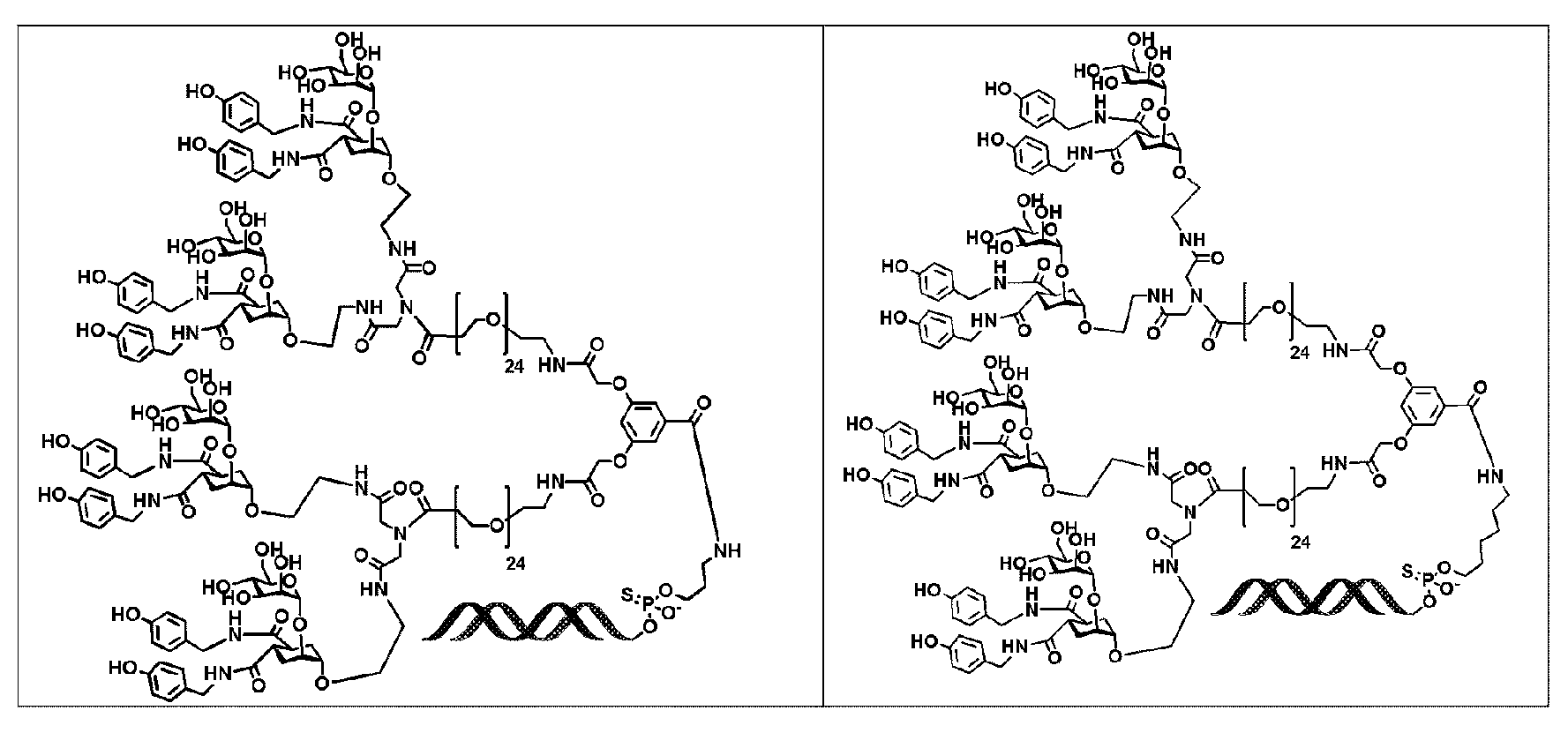

본 발명의 의약 조성물은, 핵산 복합체를 포함한다. 본 발명의 핵산 복합체는, 당쇄 리간드가 비환원 말단에 O 결합 만노오스를 가짐으로써, 표적 세포로 인식되어, 세포 내에 도입된다.The pharmaceutical composition of the present invention includes a nucleic acid complex. In the nucleic acid complex of the present invention, the sugar chain ligand has an O-bound mannose at the non-reducing end and is recognized as a target cell and introduced into the cell.
본 발명의 핵산 복합체는, 포유동물에게 투여하여, 생체 내에서, 표적 유전자의 발현을 저하 또는 정지시킴으로써 억제하고, 표적 유전자에 관련된 질환의 치료에 이용할 수 있다.The nucleic acid complex of the present invention can be administered to a mammal to inhibit the expression of the target gene in vivo by lowering or stopping the expression of the target gene and can be used for the treatment of diseases related to the target gene.
본 발명의 핵산 복합체를 치료제 또는 예방제로서 사용하는 경우, 투여 경로로는, 치료시에 가장 효과적인 투여 경로를 사용하는 것이 바람직하고, 특별히 한정되는 것은 아니지만, 예컨대, 정맥내 투여, 피하 투여 및 근육내 투여 등을 들 수 있으며, 바람직하게는 정맥내 투여이다.When the nucleic acid complex of the present invention is used as a therapeutic or prophylactic agent, it is preferable to use the most effective administration route at the time of treatment, and the administration route is not particularly limited. For example, intravenous administration, subcutaneous administration, And the like, preferably intravenous administration.
투여량은, 투여 대상의 병의 상태나 연령, 투여 경로 등에 따라 상이하지만, 예컨대 이중쇄의 올리고뉴클레오티드로 환산한 1일 투여량이 0.1 μg∼1000 ㎎이 되도록 투여하면 좋고, 1일 투여량이 1∼100 ㎎이 되도록 투여하는 것이 보다 바람직하다.The dosage may vary depending on, for example, the state of the disease to be treated, the age and the administration route. For example, the daily dose may be 0.1 μg to 1000 mg in terms of double-stranded oligonucleotide, 100 mg per day.
정맥내 투여 또는 근육내 투여에 적당한 제제로는, 예컨대 주사제를 들 수 있고, 조제한 액제를 그대로 예컨대 주사제 등의 형태로서 이용하는 것도 가능하지만, 상기 액제로부터 예컨대 여과, 원심분리 등에 의해 용매를 제거하여 사용할 수도 있고, 상기 액제를 동결 건조하여 사용하거나 및/또는 예컨대 만니톨, 락토오스, 트레할로오스, 말토오스 혹은 글리신 등의 부형제를 첨가한 액제를 동결 건조하여 사용할 수도 있다.The preparation suitable for intravenous administration or intramuscular administration may, for example, be an injection, and the prepared liquid preparation may be used as it is, for example, in the form of injection or the like, but the solvent may be removed from the liquid preparation by filtration, Or may be prepared by lyophilizing the above-mentioned liquid agent and / or freeze-drying the liquid agent to which an excipient such as mannitol, lactose, trehalose, maltose or glycine is added.
주사제의 경우, 액제 또는 용매를 제거 또는 동결 건조한 조성물에, 예컨대 물, 산, 알칼리, 여러 가지 완충액, 생리 식염수 또는 아미노산 수액 등을 혼합하여 주사제를 조제하는 것이 바람직하다. 또한, 예컨대 시트르산, 아스코르브산, 시스테인 혹은 EDTA 등의 항산화제, 또는 글리세린, 포도당 혹은 염화나트륨 등의 등장화제 등을 첨가하여 주사제를 조제하는 것도 가능하다. 또한, 예컨대 글리세린 등의 동결 보존제를 첨가하여 동결 보존할 수도 있다.In the case of an injection, it is preferable to prepare an injection by mixing water, acid, alkali, various buffers, physiological saline or amino acid solution into a composition obtained by removing the liquid agent or solvent or lyophilized. It is also possible to prepare an injection by adding an antioxidant such as citric acid, ascorbic acid, cysteine or EDTA, or an isotonic agent such as glycerin, glucose or sodium chloride. In addition, a cryopreservative such as glycerin may be added to be stored frozen.
실시예Example
다음에, 실시예 및 시험예에 의해, 본 발명을 구체적으로 설명한다. 단, 본 발명은 이들 실시예 및 시험예에 한정되는 것은 아니다. 또한, 실시예에 나타낸 프로톤 핵자기 공명 스펙트럼(1H NMR)은, 270 MHz, 300 MHz 또는 400 MHz로 측정된 것으로서, 화합물 및 측정 조건에 따라서는 교환성 프로톤이 명료하게는 관측되지 않는 경우가 있다. 또한, 시그널의 다중도의 표기로는 통상 이용되는 것을 이용하고 있지만, br은 외관상 폭넓은 시그널인 것을 나타낸다.EXAMPLES Next, the present invention will be described in detail with reference to examples and test examples. However, the present invention is not limited to these examples and test examples. Further, the proton nuclear magnetic resonance spectrum ( 1 H NMR) shown in the examples was measured at 270 MHz, 300 MHz, or 400 MHz, and it was found that the exchangeable proton was not clearly observed depending on the compound and measurement conditions have. In addition, the conventionally used signal is used for the representation of the multiplicity of the signal, but br represents a broad signal in appearance.
실시예 1
링커 유닛의 합성 1Example 1
Synthesis of
화합물 9의 합성Synthesis of Compound 9

공정 1
5-히드록시이소프탈산디메틸(화합물 1, 와코쥰야쿠고교사 제조, 5.0443 g, 24 mmol)을 테트라히드로푸란(와코쥰야쿠고교사 제조 25 ㎖)에 용해하고, 2-(tert-부톡시카르보닐아미노)-1-에탄올(도쿄카세이고교사 제조, 4.0343 g, 25.03 mmol), 및 트리페닐포스핀 폴리머 담지체(시그마알드리치사 제조, 6.61 g, 25.2 mmol)를 첨가한 후, 빙랭 하, 40% 디이소프로필아조디카르복실레이트(DIAD) 톨루엔 용액(도쿄카세이고교사 제조, 13.26 ㎖, 25.2 mmol)을 첨가하여, 실온에서 밤새 교반하였다. 반응액을 여과하고, 감압 하, 여과액을 증류 제거한 후, 잔사를 아미노 실리카겔 칼럼 크로마토그래피(헥산/아세트산에틸=95/5∼80/20)로 정제함으로써, 화합물 2(5.3071 g, 수율 63%)를 얻었다.(
ESI-MS m/z: 254(M+H)+, 탈 Boc체로서 검출ESI-MS m / z: 254 (M + H) < + &
공정 2Step 2
공정 1에서 합성한 화합물 2(5.3071 g, 15.02 mmol)를 메탄올(25 ㎖)에 용해하고, 빙랭 하, 2 mol/ℓ 수산화나트륨 수용액(와코쥰야쿠고교사 제조, 13 ㎖)을 첨가하여, 실온에서 4시간 동안 교반하였다. 반응액을 빙랭하고, 10% 시트르산 수용액을 첨가하여, 아세트산에틸로 추출한 후, 유기층을 포화 식염수로 세정하고, 무수 황산마그네슘으로 건조시켰다. 감압 하, 용매를 증류 제거함으로써, 화합물 3을 정량적으로 얻었다.Compound 2 (5.3071 g, 15.02 mmol) synthesized in
ESI-MS m/z: 324(M-H)- ESI-MS m / z: 324 (MH) -
공정 3Step 3
공정 2에서 합성한 화합물 3(0.9372 g, 2.8809 mmol), β-알라닌메틸에스테르염산염(도쿄카세이고교가부시키가이샤 제조, 0.8082 g, 5.7902 mmol)을 N,N'-디메틸포름아미드(10 ㎖)에 용해하고, 디이소프로필에틸아민(2.52 ㎖, 14.40 mmol), 및 2-(1H-벤조트리아졸-1-일)-1,1,3,3-테트라메틸우로늄헥사플루오로인산염(2.1908 g, 5.76 mmol)을 첨가하여, 실온에서 밤새 교반하였다. 반응액을 빙랭하고, 10% 시트르산 수용액을 첨가하여, 클로로포름으로 추출한 후, 유기층을 포화 탄산수소나트륨 수용액 및 포화 식염수로 세정하고, 무수 황산마그네슘으로 건조시켰다. 감압 하, 용매를 증류 제거하고, 화합물 4를 정량적으로 얻었다.Alanine methyl ester hydrochloride (0.8082 g, 5.7902 mmol, manufactured by Tokyo Kasei Kogyo K. K.) was dissolved in N, N'-dimethylformamide (10 mL) and the compound 3 (0.9372 g, 2.8809 mmol) (2.52 mL, 14.40 mmol) and 2- (lH-benzotriazol-l-yl) -1,1,3,3-tetramethyluronium hexafluorophosphate (2.1908 g, 5.76 mmol), and the mixture was stirred overnight at room temperature. The reaction solution was ice-cooled, 10% citric acid aqueous solution was added, and the mixture was extracted with chloroform. The organic layer was washed with a saturated aqueous solution of sodium hydrogencarbonate and saturated brine, and dried over anhydrous magnesium sulfate. The solvent was distilled off under reduced pressure to obtain Compound 4 quantitatively.
ESI-MS m/z: 496(M+H)+ ESI-MS m / z: 496 (M + H) < + & gt ;
공정 4Step 4
공정 3에서 합성한 화합물 4(0.9622 g, 1.9518 mmol)를 이용하여, 디클로로메탄(10 ㎖)에 용해하고, 빙랭 하, 트리플루오로아세트산(2.5 ㎖, 32.4 mmol)을 첨가하여, 실온에서 2시간 동안 교반하였다. 반응액을 감압 하, 용매를 증류 제거함으로써, 화합물 5를 정량적으로 얻었다.The compound 4 (0.9622 g, 1.9518 mmol) synthesized in the Step 3 was dissolved in dichloromethane (10 ml), trifluoroacetic acid (2.5 ml, 32.4 mmol) was added under ice-cooling and the mixture was stirred at room temperature for 2 hours Lt; / RTI > The reaction solution was distilled off under reduced pressure to obtain Compound 5 quantitatively.
ESI-MS m/z: 396(M+H)+ ESI-MS m / z: 396 (M + H) < + &
공정 5Step 5
공정 4에서 합성한 화합물 5(0.1146 g, 0.290 mmol) 및 N-숙신이미딜 15-아지드-4,7,10,13-테트라옥사펜타데칸산(N3-PEG4-NHS, 도쿄카세이고교가부시키가이샤 제조, 0.0750 g, 0.1931 mmol)을 테트라히드로푸란(6 ㎖)에 용해시키고 디이소프로필에틸아민(0.337 ㎖, 1.931 mmol)을 첨가하여, 실온에서 2시간 동안 교반하였다. 감압 하, 용매를 증류 제거하고, 잔사를 실리카겔 칼럼 크로마토그래피(클로로포름/메탄올)로 정제함으로써, 화합물 6을 정량적으로 얻었다.Compound 5 (0.1146 g, 0.290 mmol) synthesized in Step 4 and N-succinimidyl 15-azido-4,7,10,13-tetraoxapentadecanoic acid (N 3 -PEG 4 -NHS, 0.0750 g, 0.1931 mmol) was dissolved in tetrahydrofuran (6 ml), diisopropylethylamine (0.337 ml, 1.931 mmol) was added, and the mixture was stirred at room temperature for 2 hours. The solvent was distilled off under reduced pressure, and the residue was purified by silica gel column chromatography (chloroform / methanol) to obtain Compound 6 quantitatively.
ESI-MS m/z: 669(M+H)+ ESI-MS m / z: 669 (M + H) < + &
공정 6Step 6
공정 5에서 합성한 화합물 6(0.1291 g, 0.193 mmol)을 이용하여, 공정 2와 동일한 방법으로 화합물 7을 정량적으로 얻었다.Compound 7 (quantitative) was obtained in the same manner as in Step 2, using the compound 6 (0.1291 g, 0.193 mmol) synthesized in Step 5.
ESI-MS m/z: 641(M+H)+ ESI-MS m / z: 641 (M + H) < + & gt ;
1H-NMR(DMSO-D6) δ: 2.35(2H, t, J=7.2Hz), 2.51-2.54(4H, m), 3.38-3.65(24H, m), 4.07(2H, t, J=5.4Hz), 7.51(2H, brs), 7.89(1H, brs), 8.13(1H, dd, J=5.3, 2.7Hz), 8.63(2H, t, J=5.4Hz) 1 H-NMR (DMSO-D6 ) δ: 2.35 (2H, t, J = 7.2Hz), 2.51-2.54 (4H, m), 3.38-3.65 (24H, m), 4.07 (2H, t, J = 5.4 (1H, br s), 8.13 (1H, dd, J = 5.3, 2.7 Hz), 8.63 (2H, t, J = 5.4 Hz)
공정 7Step 7
공정 6에서 합성한 화합물 7(0.1252 g, 0.193 mmol) 및 L-글루타민산 디- tert-부틸에스테르(와타나베카가쿠가부시키가이샤 제조, 0.1180 g, 0.399 mmol)를 이용하여, 공정 3과 동일한 방법으로 화합물 8(0.0521 g, 수율 24%)을 얻었다.Using the compound 7 (0.1252 g, 0.193 mmol) synthesized in the Step 6 and L-glutamic acid di-tert-butyl ester (0.1180 g, 0.399 mmol, manufactured by Watanabe Kagaku Co., Ltd.) Compound 8 (0.0521 g, yield 24%) was obtained.
ESI-MS m/z: 1124(M+H)+ ESI-MS m / z: 1124 (M + H) < + &
공정 8Step 8
공정 7에서 합성한 화합물 8(0.0521 g, 0.0464 mmol)을 이용하여, 디클로로메탄(2 ㎖)에 용해하고, 빙랭 하, 트리플루오로아세트산(0.2 ㎖, 32.4 mmol)을 첨가하여, 실온에서 밤새 교반하였다. 반응액을 감압 하, 용매를 증류 제거함으로써, 화합물 9를 정량적으로 얻었다.Compound (8) (0.0521 g, 0.0464 mmol) synthesized in Step 7 was dissolved in dichloromethane (2 ml), trifluoroacetic acid (0.2 ml, 32.4 mmol) was added under ice-cooling, Respectively. The reaction solution was distilled off under reduced pressure to obtain Compound 9 quantitatively.
ESI-MS m/z: 899(M+H)+ ESI-MS m / z: 899 (M + H) < + &
1H-NMR(DMSO-D6) δ: 1.70-1.82(2H, m), 1.90-2.02(2H, m), 2.23-2.30(4H, m), 2.35(2H, t, J=5.3Hz), 2.44(4H, t, J=7.4Hz), 3.38-3.65(24H, m), 4.07(2H, t, J=5.3Hz), 4.17-4.26(2H, m), 7.51(2H, d, J=1.3Hz), 7.89(1H, brs), 8.13(1H, dd, J=10.0, 5.0Hz), 8.21(2H, d, J=7.6Hz), 8.57(2H, t, J=5.8Hz) 1 H-NMR (DMSO-D6 ) δ: 1.70-1.82 (2H, m), 1.90-2.02 (2H, m), 2.23-2.30 (4H, m), 2.35 (2H, t, J = 5.3Hz), (2H, d, J = 8.4 Hz), 2.44 (4H, t, J = 7.4 Hz), 3.38-3.65 (24H, m), 4.07 D, J = 10.0, 5.0 Hz), 8.21 (2H, d, J = 7.6 Hz), 8.57 (2H, t, J = 5.8 Hz)
실시예 2 링커 유닛의 합성 2Example 2 Synthesis of linker unit 2
화합물 19의 합성Synthesis of Compound 19

공정 9Step 9
실시예 1의 공정 1에서 합성한 화합물 2(2.1 g, 5.940 mmol)를 이용하여, 실시예 1의 공정 4와 동일한 방법으로 화합물 10을 정량적으로 얻었다.Compound 10 (quantitative value) was obtained in the same manner as in the step 4 of Example 1, using the compound 2 (2.1 g, 5.940 mmol) synthesized in the
ESI-MS m/z: 254(M+H)+ ESI-MS m / z: 254 (M + H) < + & gt ;
1H-NMR(DMSO-D6) δ: 3.26(2H, t, J=5.1Hz), 3.90(6H, s), 4.30(2H, t, J=5.1Hz), 7.77(2H, dd, J=1.5, 0.8Hz), 8.13(1H, dd, J=1.4, 0.7Hz). 1 H-NMR (DMSO-D6 ) δ: 3.26 (2H, t, J = 5.1Hz), 3.90 (6H, s), 4.30 (2H, t, J = 5.1Hz), 7.77 (2H, dd, J = 1.5, 0.8 Hz), 8.13 (1H, dd, J = 1.4, 0.7 Hz).
공정 10Step 10
공정 9에서 합성한 화합물 10(0.427 g, 1.686 mmol)과 오가닉·앤드·바이오몰레큘러·케미스트리(Organic & Biomolecular chemistry), 제13권, 1778-1791 페이지, 2015년에 기재된 방법으로 합성한 6-아지드헥산산피롤리디닐에스테르(0.6 g, 2.360 mmol)를 이용하여, 실시예 1의 공정 5와 동일한 방법으로 화합물 11(0.248 g, 수율 38%)을 얻었다.Compound 10 (0.427 g, 1.686 mmol) synthesized in Step 9 and 6- (3-methoxyphenyl) propionate synthesized by the method described in Organic & Biomolecular chemistry, vol. 13, pp. 1778-1791, Compound 11 (0.248 g, yield 38%) was obtained in the same manner as in Step 5 of Example 1, using azide hexanoic acid pyrrolidinyl ester (0.6 g, 2.360 mmol).
ESI-MS m/z: 393(M+H)+ ESI-MS m / z: 393 (M + H) < + & gt ;
1H-NMR(CDCl3) δ: 1.37-1.44(2H, m), 1.64-1.69(4H, m), 2.23(2H, t, J=7.5Hz), 3.25(2H, t, J=6.8Hz), 3.71(2H, dd, J=5.3, 2.7Hz), 3.95(6H, s), 4.13(2H, t, J=6.7Hz), 7.75(2H, dd, J=1.5, 0.8Hz), 8.30(1H, dd, J=1.4, 0.7Hz). 1 H-NMR (CDCl 3) δ: 1.37-1.44 (2H, m), 1.64-1.69 (4H, m), 2.23 (2H, t, J = 7.5Hz), 3.25 (2H, t, J = 6.8Hz ), 3.71 (2H, dd, J = 5.3,2.7 Hz), 3.95 (6H, s), 4.13 (2H, t, J = 6.7 Hz), 7.75 (1H, dd, J = 1.4, 0.7 Hz).
공정 11Step 11
공정 10에서 합성한 화합물 11(0.248 g, 0.632 mmol)을 이용하여, 실시예 1의 공정 2와 동일한 방법으로 화합물 12를 정량적으로 얻었다.Compound 12 was quantitatively obtained in the same manner as in Step 2 of Example 1, using compound 11 (0.248 g, 0.632 mmol) synthesized in Step 10.
ESI-MS m/z: 365(M+H)+ ESI-MS m / z: 365 (M + H) < + &
1H-NMR(MeOD) δ: 1.37-1.41(2H, m), 1.60-1.65(4H, m), 2.25(2H, t, J=7.4Hz), 3.25(2H, t, J=6.7Hz), 3.63(2H, t, J=4.9Hz), 4.18(2H, t, J=5.2Hz), 7.79(2H, dd, J=1.6, 0.8Hz), 8.27(1H, dd, J=1.4, 0.7Hz). 1 H-NMR (MeOD) δ : 1.37-1.41 (2H, m), 1.60-1.65 (4H, m), 2.25 (2H, t, J = 7.4Hz), 3.25 (2H, t, J = 6.7Hz) (2H, d, J = 1.6, 0.8 Hz), 8.27 (1H, dd, J = 1.4, 0.7), 3.63 (2H, t, J = 4.9 Hz), 4.18 Hz).
공정 12Step 12
공정 11에서 얻어진 화합물 12(0.230 ㎎, 0.631 mmol)를 테트라히드로푸란(274.7 ㎕)에 용해하고, N-히드록시숙신이미드(0.174 g, 1.515 mmol), 1-에틸-3-(3-디메틸아미노프로필)카르보디이미드염산염(0.313 g, 1.515 mmol)을 첨가하여, 실온, 아르곤 분위기 하에서 밤새 교반하였다. 감압 하에서 용매를 증류 제거하고, 그 후, 클로로포름으로 추출한 후, 유기층을 포화 식염수로 세정하고, 무수 황산마그네슘으로 건조시켰다. 감압 하, 용매를 증류 제거하고, 화합물 13의 조생성물을 얻었다.The compound 12 (0.230 mg, 0.631 mmol) obtained in Step 11 was dissolved in tetrahydrofuran (274.7 占)), and N-hydroxysuccinimide (0.174 g, 1.515 mmol) Aminopropyl) carbodiimide hydrochloride (0.313 g, 1.515 mmol) was added thereto, and the mixture was stirred overnight at room temperature under an argon atmosphere. The solvent was distilled off under reduced pressure and then extracted with chloroform. The organic layer was washed with saturated brine and dried over anhydrous magnesium sulfate. The solvent was distilled off under reduced pressure to obtain a crude product of Compound 13.
ESI-MS m/z: 559(M+H)+ ESI-MS m / z: 559 (M + H) < + &
공정 13Step 13
공정 12에서 합성한 화합물 13(0.200 g, 0.358 mmol), 6-아미노헥산산(나카라이테스크사 제조, 0.141 g, 1.074 mmol) 및 디이소프로필에틸아민(0.139 ㎖, 1.074 mmol)을 이용하여, 인산 완충액/디메틸술폭시드 혼합 용매 중(v/v=1/1, 50 ㎖)에서, 실온에서 밤새 교반하였다. 반응액에 10% 시트르산 용액(50 ㎖)을 첨가하여, 클로로포름으로 추출한 후, 유기층을 포화 탄산수소나트륨 수용액 및 포화 식염수로 세정하고, 무수 황산마그네슘으로 건조시켰다. 감압 하, 용매를 증류 제거함으로써 화합물 14(0.157 g, 수율 74%)를 얻었다.Compound 13 (0.200 g, 0.358 mmol) synthesized in Step 12, 6-aminohexanoic acid (0.141 g, 1.074 mmol, manufactured by Nacalai Tesque) and diisopropylethylamine (0.139 ml, 1.074 mmol) And the mixture was stirred at room temperature overnight in a phosphate buffer / dimethylsulfoxide mixed solvent (v / v = 1/1, 50 ml). A 10% citric acid solution (50 ml) was added to the reaction solution, and the mixture was extracted with chloroform. The organic layer was washed with a saturated aqueous solution of sodium hydrogencarbonate and saturated brine, and dried over anhydrous magnesium sulfate. The solvent was distilled off under reduced pressure to obtain Compound 14 (0.157 g, yield 74%).
ESI-MS m/z: 591(M+H)+ ESI-MS m / z: 591 (M + H) < + & gt ;
1H-NMR(DMSO-D6) δ: 1.26-1.33(8H, m), 1.51-1.53(10H, m), 2.10(2H, t, J=7.2Hz), 2.21(4H, t, J=7.4Hz), 3.25(8H, t, J=6.5Hz), 4.08(2H, t, J=5.4Hz), 7.48-7.51(2H, brm), 7.87-7.89(1H, brm), 8.07-8.08(1H, brm), 8.53-8.54(2H, brm). 1 H-NMR (DMSO-D 6)?: 1.26-1.33 (8H, m), 1.51-1.53 (10H, m), 2.10 (2H, brm), 7.87-7.89 (1H, br m), 8.07-8.08 (1H, br s), 3.25 (8H, t, J = 6.5Hz), 4.08 , brm), 8.53-8.54 (2H, br m).
공정 14Step 14
공정 13에서 합성한 화합물 14(0.1442 g, 0.2441 mmol)를 이용하여, 공정 12와 동일한 방법으로 화합물 15를 정량적으로 얻었다.Compound 14 (0.1442 g, 0.2441 mmol) synthesized in Step 13 was used to quantitatively obtain Compound 15 in the same manner as in Step 12.
ESI-MS m/z: 785(M+H)+ ESI-MS m / z: 785 (M + H) < + &
공정 15Step 15
공정 14에서 합성한 화합물 15(0.0958 g, 0.1221 mmol)를 이용하여, 공정 13과 동일한 방법으로 화합물 16을 정량적으로 얻었다.Compound 16 (quantitative value) was obtained in the same manner as in Step 13, using the compound 15 (0.0958 g, 0.1221 mmol) synthesized in Step 14.
ESI-MS m/z: 818(M+H)+ ESI-MS m / z: 818 (M + H) < + &
공정 16Step 16
1) 화합물 17의 합성1) Synthesis of Compound 17
공정 12에서 합성한 화합물 13(0.0209 g, 0.0375 mmol)과 카르복실-(12 에틸렌글리콜)에틸아민(서모사이엔티픽사 제조, 0.0674 g, 0.1091 mmol)을 이용하여, 공정 13과 동일한 방법으로 화합물 17(0.0580 g, 수율 99%)을 얻었다.Compound 13 (0.0209 g, 0.0375 mmol) synthesized in Step 12 and carboxyl- (12 ethylene glycol) ethylamine (0.0674 g, 0.1091 mmol, manufactured by Thermosyntip, Inc.) (0.0580 g, yield 99%).
ESI-MS m/z: 1564(M+H)+ ESI-MS m / z: 1564 (M + H) < + &
2) 화합물 18의 합성2) Synthesis of compound 18
공정 12에서 합성한 화합물 13(0.0047 g, 0.00654 mmol)과 카르복실-(24 에틸렌글리콜)에틸아민(서모사이엔티픽사 제조, 0.0225 g, 0.01963 mmol)을 이용하여, 공정 13과 동일한 방법으로 화합물 18(0.0144 g, 수율 79%)을 얻었다.Compound 13 (0.0047 g, 0.00654 mmol) synthesized in Step 12 and carboxyl- (24 ethyleneglycol) ethylamine (Thermosynthetic Inc., 0.0225 g, 0.01963 mmol) (0.0144 g, yield 79%).
ESI-MS m/z: 2622(M+H)+ ESI-MS m / z: 2622 (M + H) < + &
공정 17Step 17
1) 화합물 19의 합성1) Synthesis of Compound 19
공정 16에서 합성한 화합물 17(0.0580 g, 0.0375 mmol)을 이용하여, 공정 12와 동일한 방법으로 화합물 19를 정량적으로 얻었다.Compound 17 (0.0580 g, 0.0375 mmol) synthesized in Step 16 was used to quantitatively obtain Compound 19 in the same manner as in Step 12.
ESI-MS m/z: 1759(M+H)+ ESI-MS m / z: 1759 (M + H) < + &
1H-NMR(DMSO-D6) δ: 1.22-1.25(6H, m), 2.10(2H, t, J=7.5Hz), 2.81(8H, brs), 2.93(4H, t, J=6.1Hz), 3.26-3.27(6H, m), 3.43-3.45(2H, m), 3.49-3.50(92H, m), 3.71(4H, t, J=6.0Hz), 4.07(2H, t, J=6.0Hz), 7.53(2H, dd, J=1.5, 0.8Hz), 7.93(1H, dd, J=1.5, 0.8Hz), 8.05-8.07(1H, brm), 8.59-8.61(2H, brm). 1 H-NMR (DMSO-D 6) δ: 1.22-1.25 (6H, m), 2.10 (2H, t, J = 7.5Hz), 2.81 (8H, brs), 2.93 (4H, t, J = 6.1Hz (2H, t, J = 6.0 Hz), 3.26-3.27 (6H, m), 3.43-3.45 (2H, m), 3.49-3.50 Dd, J = 1.5, 0.8 Hz), 8.05-8.07 (1H, brm), 8.59-8.61 (2H, brm).
2) 화합물 20의 합성2) Synthesis of Compound 20
공정 16에서 합성한 화합물 18(0.0580 g, 0.0375 mmol)을 이용하여, 공정 12와 동일한 방법으로 화합물 20을 정량적으로 얻었다.Compound 20 (quantitative value) was obtained in the same manner as in Step 12, using the compound 18 (0.0580 g, 0.0375 mmol) synthesized in Step 16.
ESI-MS m/z: 2817(M+H)+ ESI-MS m / z: 2817 (M + H) < + &
실시예 3 링커 유닛의 합성 3Example 3 Synthesis of linker unit 3
화합물 22의 합성Synthesis of Compound 22
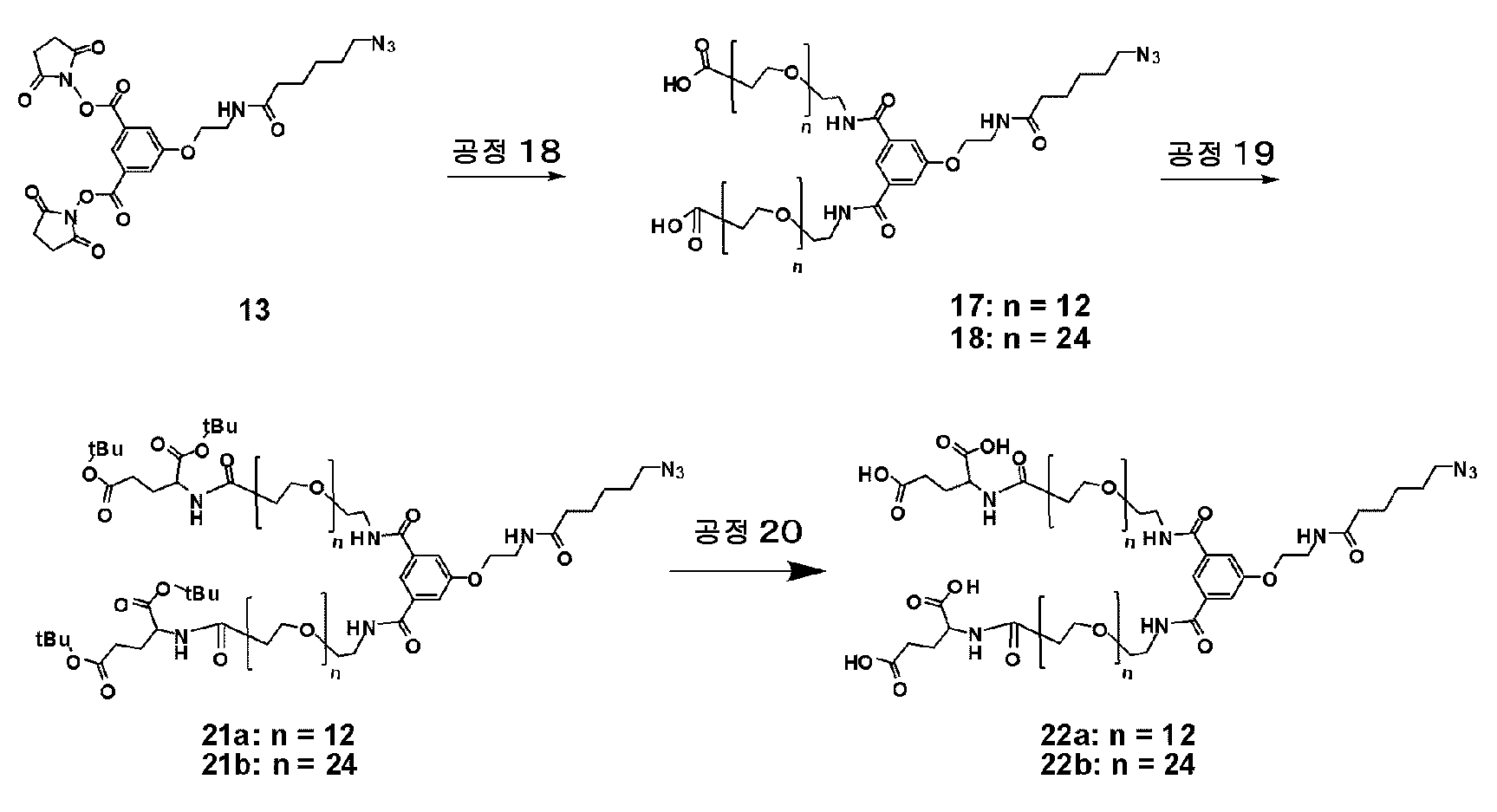
공정 18Step 18
(a); 실시예 2의 공정 12에서 합성한 화합물 13(10 ㎎, 17.9 μmol)을 테트라히드로푸란(90 ㎕)과 인산 완충액(90 ㎕)과의 혼합 용액에 용해하고, 카르복실-(12 올리고에틸렌글리콜)에틸아민(서모사이엔티픽사 제조, 22.1 ㎎, 35.8 μmol)을 첨가하여 실온, 아르곤 분위기 하에서 1시간 동안 교반하였다. 감압 하에서 용매를 증류 제거하고, 그 후, 클로로포름, 10% 시트르산 수용액으로써 추출한 후, 무수 황산마그네슘으로 건조시켰다. 감압 하, 용매를 증류 제거하고, 화합물 17의 조생성물을 얻었다.(a); (10 mg, 17.9 μmol) synthesized in Step 12 of Example 2 was dissolved in a mixed solution of tetrahydrofuran (90 μl) and phosphate buffer (90 μl), and carboxyl- (12 olethylene glycol) Ethylamine (22.1 mg, 35.8 μmol, manufactured by Thermosyntipark) was added thereto, and the mixture was stirred at room temperature for 1 hour under an argon atmosphere. The solvent was distilled off under reduced pressure, and then extracted with chloroform, 10% citric acid aqueous solution and then dried with anhydrous magnesium sulfate. The solvent was distilled off under reduced pressure to obtain a crude product of Compound 17.
ESI-MS m/z: 1564(M+H)+ ESI-MS m / z: 1564 (M + H) < + &
(b); 실시예 2의 공정 12에서 합성한 화합물 13(10 ㎎, 17.9 μmol)을 테트라히드로푸란(90 ㎕)과 인산 완충액(90 ㎕)과의 혼합 용액에 용해하고, 카르복실-(24 올리고에틸렌글리콜)에틸아민(서모사이엔티픽사 제조, 41 ㎎, 35.8 μmol)을 첨가하여, 실온, 아르곤 분위기 하에서 1시간 동안 교반하였다. 감압 하에서 용매를 증류 제거하고, 그 후, 클로로포름, 10% 시트르산 수용액으로써 추출한 후, 무수 황산마그네슘으로 건조시켰다. 감압 하, 용매를 증류 제거하고, 화합물 18의 조생성물을 얻었다.(b); (10 mg, 17.9 μmol) synthesized in Step 12 of Example 2 was dissolved in a mixed solution of tetrahydrofuran (90 μl) and phosphate buffer (90 μl), and carboxyl- (24 oligoethylene glycol) And ethylamine (41 mg, 35.8 μmol, manufactured by Thermoscience Ltd.) was added thereto, and the mixture was stirred at room temperature for 1 hour under an argon atmosphere. The solvent was distilled off under reduced pressure, and then extracted with chloroform, 10% citric acid aqueous solution and then dried with anhydrous magnesium sulfate. The solvent was distilled off under reduced pressure to obtain a crude product of Compound 18.
ESI-MS m/z: 2622(M+H)+ ESI-MS m / z: 2622 (M + H) < + &
공정 19Step 19
(a); 공정 18에서 합성한 화합물 17(14 ㎎, 8.9 μmol)을 테트라히드로푸란(90 ㎕)에 용해하고, L-글루타민산 디-tert-부틸에스테르(와타나베카가쿠가부시키가이샤 제조, 5.2 ㎎, 17.9 μmol), 2-(1H-벤조트리아졸-1-일)-1,1,3,3-테트라메틸우로늄헥사플루오로인산염(6.8 ㎎, 17.9 μmol), 디이소프로필에틸아민(3.1 ㎕, 17.9 μmol)을 첨가하여, 실온에서 아르곤 분위기 하, 밤새 교반하였다. 감압 하에서 용매를 증류 제거하고, 그 후, 클로로포름으로 추출한 후, 유기층을 포화 식염수로 세정하고, 무수 황산마그네슘으로 건조시켰다. 그 후, 역상 고속 액체 크로마토그래피에 의해 정제하여, 화합물 21a(4.5 ㎎, 수율 25%)를 얻었다.(a); The compound 17 (14 mg, 8.9 μmol) synthesized in the Step 18 was dissolved in tetrahydrofuran (90 μl), to which was added 5.2 mg of L-glutamic acid di-tert-butyl ester (manufactured by Watanabe Kagaku Co., Ltd., 17.9 μmol ), 2- (1H-benzotriazol-1-yl) -1,1,3,3-tetramethyluronium hexafluorophosphate (6.8 mg, 17.9 μmol), diisopropylethylamine was added, and the mixture was stirred overnight at room temperature under an argon atmosphere. The solvent was distilled off under reduced pressure and then extracted with chloroform. The organic layer was washed with saturated brine and dried over anhydrous magnesium sulfate. Thereafter, purification was carried out by reverse phase high performance liquid chromatography to obtain compound 21a (4.5 mg, yield 25%).
ESI-MS m/z: 2046(M+H)+ ESI-MS m / z: 2046 (M + H) < + &
1H-NMR(CDCl3) δ: 1.44-1.46(36H, m), 1.61-1.66(4H, m), 1.89-1.91(4H, m), 2.06-2.16(2H, m), 2.20-2.37(6H, m), 2.50(4H, t, J=6.0Hz), 3.26(2H, t, J=6.8Hz), 3.59-3.68(98H, m), 3.71-3.76(4H, m), 4.14(2H, t, J=5.2Hz), 4.48-4.50(2H, m), 7.59(2H, dd, J=1.3, 0.6Hz), 7.92(1H, brs). 1 H-NMR (CDCl 3 )?: 1.44-1.46 (36H, m), 1.61-1.66 (4H, m), 1.89-1.91 (4H, m), 2.06-2.16 M), 2.50 (4H, t, J = 6.0Hz), 3.26 (2H, t, J = 6.8Hz), 3.59-3.68 (98H, m), 3.71-3.76 , t, J = 5.2 Hz), 4.48-4.50 (2H, m), 7.59 (2H, dd, J = 1.3, 0.6 Hz), 7.92 (1H, brs).
(b); 공정 18에서 합성한 화합물 18(23.4 ㎎, 8.9 μmol)을 테트라히드로푸란(90 ㎕)에 용해하고, L-글루타민산 α,γ-디(t-부틸에스테르)염산염(5.2 ㎎, 17.9 μmol), 2-(1H-벤조트리아졸-1-일)-1,1,3,3-테트라메틸우로늄헥사플루오로인산염(6.8 ㎎, 17.9 μmol), 디이소프로필에틸아민(3.1 ㎕, 17.9 μmol)을 첨가하여, 실온에서 아르곤 분위기 하, 밤새 교반하였다. 감압 하에서 용매를 증류 제거하고, 그 후, 클로로포름으로 추출한 후, 유기층을 포화 식염수로 세정하고, 무수 황산마그네슘으로 건조시켰다. 그 후, 역상 고속 액체 크로마토그래피에 의해 정제하여, 화합물 21b(7.4 ㎎, 수율 27%)를 얻었다.(b); (22 mg, 8.9 μmol) synthesized in Step 18 was dissolved in tetrahydrofuran (90 μl), and L-glutamic acid α, γ-di (t-butyl ester) hydrochloride (5.2 mg, 17.9 μmol) - (1H-benzotriazol-1-yl) -1,1,3,3-tetramethyluronium hexafluorophosphate (6.8 mg, 17.9 μmol) and diisopropylethylamine (3.1 μl, 17.9 μmol) And the mixture was stirred overnight at room temperature under an argon atmosphere. The solvent was distilled off under reduced pressure and then extracted with chloroform. The organic layer was washed with saturated brine and dried over anhydrous magnesium sulfate. Thereafter, purification was performed by reverse phase high performance liquid chromatography to obtain Compound 21b (7.4 mg, yield 27%).
ESI-MS m/z: 1553(M-2H)2- ESI-MS m / z: 1553 (M-2H) < RTI ID =
1H-NMR(CDCl3) δ: 1.44(18H, s), 1.46(18H, s), 1.62-1.67(4H, m), 1.86-1.89(2H, m), 2.20-2.36(10H, m), 2.51(4H, t, J=5.8Hz), 3.26(2H, t, J=7.0Hz), 3.63-3.65(194H, m), 3.73-3.76(4H, m), 4.14(2H, t, J=5.1Hz), 4.46-4.50(2H, m), 7.60(2H, dd, J=1.0, 0.5Hz), 7.92(1H, brs) 1 H-NMR (CDCl 3 )?: 1.44 (18H, s), 1.46 (18H, s), 1.62-1.67 (4H, m), 1.86-1.89 (2H, m), 2.20-2.36 , 2.51 (4H, t, J = 5.8Hz), 3.26 (2H, t, J = 7.0Hz), 3.63-3.65 (194H, m), 3.73-3.76 = 5.1 Hz), 4.46-4.50 (2H, m), 7.60 (2H, dd, J = 1.0,0.5 Hz), 7.92
공정 20Step 20
(a); 공정 19에서 합성한 화합물 21a(4.5 ㎎, 2.1 μmol)을 이용하여, 실시예 1의 공정 8과 동일한 방법에 의해 화합물 22a를 정량적으로 얻었다.(a); Compound 22a was quantitatively obtained in the same manner as in Step 8 of Example 1, using compound 21a (4.5 mg, 2.1 μmol) synthesized in Step 19.
ESI-MS m/z: 1822(M+H)+ ESI-MS m / z: 1822 (M + H) < + &
(b); 공정 19에서 합성한 화합물 21b(4.5 ㎎, 2.1 μmol)를 이용하여, 실시예 1의 공정 8과 동일한 방법에 의해 화합물 22b를 정량적으로 얻었다.(b); Compound 22b was quantitatively obtained in the same manner as in Step 8 of Example 1, using compound 21b (4.5 mg, 2.1 μmol) synthesized in Step 19.
ESI-MS m/z: 2878(M+H)+ ESI-MS m / z: 2878 (M + H) < + &
실시예 4 링커 유닛의 합성 4Example 4 Synthesis of linker unit 4
화합물 26의 합성Synthesis of Compound 26

공정 21Step 21
실시예 2의 공정 11에서 합성한 화합물 12(10 ㎎, 27.4 μmol)를 테트라히드로푸란(274.7 μmol)에 용해하고, L-글루타민산 디-tert-부틸에스테르(와타나베카가쿠가부시키가이샤 제조, 32.5 ㎎, 109.8 μmol), 2-(1H-벤조트리아졸-1일)-1,1,3,3-테트라메틸우로늄헥사플루오로인산염(41.7 ㎎, 109.8 μmol), 디이소프로필에틸아민(24.2 ㎕, 137.3 μmol)을 첨가하여, 실온에서 아르곤 분위기 하, 밤새 교반하였다. 감압 하에서 용매를 증류 제거하고, 그 후, 클로로포름, 10% 시트르산 수용액으로 추출한 후, 무수 황산마그네슘으로 건조시켰다. 감압 하, 용매를 증류 제거하고, 화합물 23의 조생성물을 얻었다.Compound 10 (10 mg, 27.4 μmol) synthesized in Step 11 of Example 2 was dissolved in tetrahydrofuran (274.7 μmol), and L-glutamic acid di-tert-butyl ester (manufactured by Watanabe Kagaku Co., Ltd., 32.5 (41.7 mg, 109.8 μmol), diisopropylethylamine (24.2 mg, 109.8 μmol), 2- (1H-benzotriazol-1-yl) -1,1,3,3-tetramethyluronium hexafluorophosphate Mu l, 137.3 [mu] mol), and the mixture was stirred overnight at room temperature under argon atmosphere. The solvent was distilled off under reduced pressure, then extracted with chloroform, 10% citric acid aqueous solution, and then dried with anhydrous magnesium sulfate. The solvent was distilled off under reduced pressure to obtain a crude product of Compound 23.
ESI-MS m/z: 847(M+H)+ ESI-MS m / z: 847 (M + H) < + &
공정 22Step 22
공정 21에서 합성한 화합물 23(139.4 ㎎, 164.6 μmol)을 염화메틸렌(1.3 ㎖) 및 트리플루오로아세트산(0.3 ㎖)에 용해하고, 실온에서 밤새 교반하였다. 감압 하에서 용매를 증류 제거하고, 화합물 24를 정량적으로 얻었다.Compound 23 (139.4 mg, 164.6 μmol) synthesized in Step 21 was dissolved in methylene chloride (1.3 ml) and trifluoroacetic acid (0.3 ml), and the mixture was stirred at room temperature overnight. The solvent was distilled off under reduced pressure to obtain Compound 24 quantitatively.
ESI-MS m/z: 623(M+H)+ ESI-MS m / z: 623 (M + H) < + & gt ;
공정 23Step 23
공정 22에서 합성한 화합물 24(100 ㎎, 160.7 μmol)를 디메틸아민(1 ㎖)에 용해하고, N-히드록시숙신이미드(81.3 ㎎, 707 μmol), 1-에틸-3-(3-디메틸아미노프로필)카르보디이미드염산염(135.4 ㎎, 707 μmol)을 첨가하여, 실온, 아르곤 분위기 하에서 밤새 교반하고, 화합물 25의 조생성물을 얻었다.(100 mg, 160.7 μmol) synthesized in Step 22 was dissolved in dimethylamine (1 ml), and N-hydroxysuccinimide (81.3 mg, 707 μmol) and 1-ethyl-3- Carbodiimide hydrochloride (135.4 mg, 707 μmol) was added to the reaction mixture, and the mixture was stirred overnight at room temperature under an argon atmosphere to obtain a crude product of Compound 25.
ESI-MS m/z: 1011(M+H)+ ESI-MS m / z: 1011 (M + H) < + &
공정 24Step 24
(a); 공정 23에서 합성한 화합물 25(16.2 ㎎, 16 μmol)를 인산 완충액(95 ㎕)에 용해하고, 카르복실-(에틸렌글리콜)에틸아민(80.4 ㎎, 129.8 μmol)을 첨가하여, 실온, 아르곤 분위기 하에서 1시간 동안 교반하였다. 감압 하에서 용매를 증류 제거하고, 역상 고속 액체 크로마토그래피에 의해 정제하여, 화합물 26a(6.2 ㎎, 수율 21%)를 얻었다.(a); Compound 25 (16.2 mg, 16 μmol) synthesized in Step 23 was dissolved in phosphate buffer (95 μl), and carboxyl- (ethylene glycol) ethylamine (80.4 mg, 129.8 μmol) was added thereto. And stirred for 1 hour. The solvent was distilled off under reduced pressure, and the residue was purified by reverse phase high performance liquid chromatography to obtain Compound 26a (6.2 mg, yield: 21%).
ESI-MS m/z: 1511(M+2H)2+ ESI-MS m / z: 1511 (M + 2H) 2+
(b); 공정 23에서 합성한 화합물 25(16.2 ㎎, 16 μmol)를 인산 완충액(95 ㎕)에 용해하고, 카르복실-(에틸렌글리콜)에틸아민(149.3 ㎎, 129.8 μmol)을 첨가하여, 실온, 아르곤 분위기 하에서 1시간 동안 교반하였다. 감압 하에서 용매를 증류 제거하고, 역상 고속 액체 크로마토그래피에 의해 정제하여, 화합물 26b(5.5 ㎎, 수율 11%)를 얻었다.(b); Compound 25 (16.2 mg, 16 μmol) synthesized in Step 23 was dissolved in phosphate buffer (95 μl), and carboxyl- (ethylene glycol) ethylamine (149.3 mg, 129.8 μmol) was added thereto. And stirred for 1 hour. The solvent was distilled off under reduced pressure and purified by reverse phase high performance liquid chromatography to obtain compound 26b (5.5 mg, yield 11%).
ESI-MS m/z: 2566(M+2H)2+ ESI-MS m / z: 2566 (M + 2H) < + >
실시예 5
당쇄 리간드-링커 유닛의 합성 1Example 5
Synthesis of sugar chain ligand-
화합물 27, 28의 합성Synthesis of compounds 27 and 28

공정 25Process 25
실시예 1의 공정 6에서 합성한 화합물 7(0.8 ㎎, 1.249 μmol), 에이씨에스·케미컬·바이올로지(ACS Chemical Biology), 제5권, 301-312 페이지, 2010년에 기재된 방법으로 합성한 아미노에틸기가 수식된 α(1,2)α(1,6)슈우도만노트리오스(pseudomannotriose)(3.0 ㎎, 5.0 μmol), 2-(1H-벤조트리아졸-1-일)-1,1,3,3-테트라메틸우로늄헥사플루오로인산염(3.8 ㎎, 10 μmol), 디이소프로필에틸아민(1.7㎕, 10 μmol)을 N,N-디메틸아세트아미드(1 ㎖)에 용해하고, 실온에서 2일간 정치하였다. 혼합물을, 역상 고속 액체 크로마토그래피에 의해 정제하여, 화합물 25(1.6 ㎎, 수율 71%)를 얻었다.Compound (7) (0.8 mg, 1.249 μmol) synthesized in Step 6 of Example 1, amino acid synthesized by the method described in ACS Chemical Biology, Vol. 5, (1, 6) pseudomannotriose (3.0 mg, 5.0 μmol), ethyl 2- (1H-benzotriazol-1-yl) 3,3-Tetramethyluronium hexafluorophosphate (3.8 mg, 10 μmol) and diisopropylethylamine (1.7 μl, 10 μmol) were dissolved in N, N-dimethylacetamide (1 ml) And allowed to stand for two days. The mixture was purified by reverse phase high performance liquid chromatography to give compound 25 (1.6 mg, 71% yield).
ESI-MS m/z: 1802(M-H)- ESI-MS m / z: 1802 (MH) -
공정 26Step 26
실시예 1의 공정 8에서 합성한 화합물 9(0.9 ㎎, 1.04 μmol), 공정 25에 기재된 α(1,2)α(1,6)슈우도만노트리오스(8.34 g, 8.34 μmol)를 이용하여, 공정 25와 동일한 방법으로 화합물 26(2.3 ㎎, 수율 68%)을 얻었다.Compound (9) (0.9 mg, 1.04 μmol) synthesized in Step 8 of Example 1 and α (1,2) α (1,6) shoudomannotriose (8.34 g, 8.34 μmol) described in Step 25 , Compound 26 (2.3 mg, yield 68%) was obtained in the same manner as in Step 25.
ESI-MS m/z: 1611(M-2H)2- ESI-MS m / z: 1611 (M-2H) < RTI ID =
실시예 6 당쇄 리간드-링커 유닛의 합성 2Example 6 Synthesis of sugar chain ligand-linker unit 2
화합물 29, 30, 31, 32, 33의 합성Synthesis of compounds 29, 30, 31, 32, 33

공정 27Step 27
실시예 2의 공정 12에서 합성한 화합물 13(0.6 ㎎, 0.00111 mmol) 및 실시예 5의 공정 25에 기재된 α(1,2)α(1,6)슈우도만노트리오스(2.0 ㎎, 0.00334 mmol)를 이용하여, 실시예 2의 공정 13과 동일한 방법으로 화합물 29(1.1 ㎎, 수율 65%)를 얻었다.Compound (13) (0.6 mg, 0.00111 mmol) synthesized in Step 12 of Example 2 and α (1,2) α (1,6) shoudomannotriose described in Step 25 of Example 5 (2.0 mg, 0.00334 mmol ), Compound 29 (1.1 mg, yield 65%) was obtained in a similar manner to Step 13 of Example 2. MS m /
ESI-MS m/z: 1528(M+H)+ ESI-MS m / z: 1528 (M + H) < + &
공정 28Step 28
실시예 2의 공정 13에서 합성한 화합물 14(0.66 ㎎, 0.00111 mmol)를 이용하여, 실시예 5의 공정 25와 동일한 방법으로 화합물 30(0.3 ㎎, 수율 15%)을 얻었다.Compound 30 (0.3 mg, yield 15%) was obtained in a similar manner to Step 25 of Example 5, using Compound 14 (0.66 mg, 0.00111 mmol) synthesized in Step 13 of Example 2.
ESI-MS m/z: 1754(M+H)+ ESI-MS m / z: 1754 (M + H) < + & gt ;
공정 29Step 29
실시예 2의 공정 15에서 합성한 화합물 16(0.91 ㎎, 0.00111 mmol)을 이용하여, 실시예 5의 공정 25와 동일한 방법으로 화합물 31(0.4 ㎎, 수율 18%)을 얻었다.Compound 31 (0.4 mg, yield: 18%) was obtained in the same manner as in Step 25 of Example 5, using Compound 16 (0.91 mg, 0.00111 mmol) synthesized in Step 15 of Example 2.
ESI-MS m/z: 1981(M+H)+ ESI-MS m / z: 1981 (M + H) < + & gt ;
공정 30Step 30
실시예 2의 공정 17에서 합성한 화합물 19(1.95 ㎎, 0.00111 mmol)를 이용하여, 실시예 2의 공정 13과 동일한 방법으로 화합물 32(0.5 ㎎, 수율 17%)를 얻었다.Compound 32 (0.5 mg, yield: 17%) was obtained in a similar manner to Step 13 of Example 2, using Compound 19 (1.95 mg, 0.00111 mmol) synthesized in Step 17 of Example 2.
ESI-MS m/z: 2728(M+H)+ ESI-MS m / z: 2728 (M + H) < + &
공정 31Step 31
실시예 2의 공정 16에서 합성한 화합물 18(2.91 ㎎, 0.00111 mmol)을 이용하여, 실시예 5의 공정 25와 동일한 방법으로 화합물 33(2.2 ㎎, 수율 52%)을 얻었다.Compound 33 (2.2 mg, yield 52%) was obtained in the same manner as in the Step 25 of Example 5, using the compound 18 (2.91 mg, 0.00111 mmol) synthesized in the Step 16 of Example 2.
ESI-MS m/z: 1892(M+2H)2+ ESI-MS m / z: 1892 (M + 2H) < + >
실시예 7 당쇄 리간드-링커 유닛의 합성 3Example 7 Synthesis of sugar chain ligand-linker unit 3
화합물 34, 35의 합성Synthesis of compounds 34 and 35

공정 32Step 32
(a); 실시예 3의 공정 20에서 얻어진 화합물 22a(2 ㎎, 1.1 μmol)를 이용하여, 실시예 5의 공정 25와 동일한 방법으로 화합물 34a(2 ㎎, 수율 44%)를 얻었다.(a); (2 mg, yield: 44%) was obtained in the same manner as in the step 25 of Example 5, using the compound 22a (2 mg, 1.1 mol) obtained in the step 20 of Example 3.
ESI-MS m/z: 2073(M-2H)2- ESI-MS m / z: 2073 (M-2H) < RTI ID =
(b); 실시예 3의 공정 20에서 얻어진 화합물 22a(3.1 ㎎, 1.1 μmol)를 이용하여, 실시예 5의 공정 25와 동일한 방법으로 화합물 34b(1.8 ㎎, 수율 37%)를 얻었다.(b); (1.8 mg, yield 37%) was obtained in the same manner as in the step 25 of Example 5, using the compound 22a (3.1 mg, 1.1 μmol) obtained in the step 20 of Example 3.
ESI-MS m/z: 2601(M-2H)2- ESI-MS m / z: 2601 (M-2H) < RTI ID = 0.0 &
공정 33Step 33
(a); 실시예 4의 공정 24에서 얻어진 화합물 26a(3.1 ㎎, 1.1 μmol)를 이용하여, 실시예 5의 공정 25와 동일한 방법으로 화합물 35a(3 ㎎, 수율 55%)를 얻었다.(a); Compound 35a (3 mg, yield 55%) was obtained in the same manner as in the step 25 of Example 5, using the compound 26a (3.1 mg, 1.1 μmol) obtained in the step 24 of Example 4.
ESI-MS m/z; 2671(M-2H)2- ESI-MS m / z; 2671 (M-2H) < / RTI > 2-
(b); 실시예 4의 공정 24에서 얻어진 화합물 26b(2.7 ㎎, 0.5 μmol)를 이용하여, 실시예 5의 공정 25와 동일한 방법으로 화합물 35b(2.2 ㎎, 수율 56%)를 얻었다.(b); (2.2 mg, yield: 56%) was obtained in the same manner as in the step 25 of Example 5, using the compound 26b (2.7 mg, 0.5 mol) obtained in the step 24 of Example 4.
ESI-MS m/z; 2486(M-2H)2- ESI-MS m / z; 2486 (M-2H) <
비교예 1 당쇄 리간드-링커 유닛의 합성 4Comparative Example 1 Synthesis of sugar chain ligand-linker unit 4
화합물 38의 합성Synthesis of Compound 38

공정 34Step 34
저널·오브·아메리칸·케미컬·소사이어티(Journal of American Chemical Society), 제136권, 16958-16961 페이지, 2014년에 기재된 방법으로 합성한 화합물 36(0.9602 g, 2.1460 mmol)을 N,N'-디메틸포름아미드(10 ㎖)에 용해하고, N-Boc-에틸렌디아민(시그마알드리치사 제조, 0.6877 g, 4.292 mmol), 디이소프로필에틸아민(1.90 ㎖, 10.87 mmol), 및 2-(1H-벤조트리아졸-1-일)-1,1,3,3-테트라메틸우로늄 헥사플루오로인산염(와코쥰야쿠고교사 제조, 1.6437 g, 4.3229 mmol)을 첨가하여, 실온에서 밤새 교반하였다. 반응액에 물을 첨가하여, 클로로포름으로 2회 추출한 후, 유기층을 포화 식염수로 세정하고, 무수 황산마그네슘으로 건조시켰다. 감압 하, 용매를 증류 제거하고, 화합물 37의 조생성물을 얻었다.Compound 36 (0.9602 g, 2.1460 mmol) synthesized by the method described in Journal of American Chemical Society, Vol. 136, pp. 16958-16961, 2014 was dissolved in N, N'-dimethyl (0.6877 g, 4.292 mmol), diisopropylethylamine (1.90 mL, 10.87 mmol), and 2- (1H-benzotriazole) 1-yl) -1,1,3,3-tetramethyluronium hexafluorophosphate (1.6437 g, 4.3229 mmol, manufactured by Wako Pure Chemical Industries, Ltd.) was added thereto, and the mixture was stirred overnight at room temperature. Water was added to the reaction solution, and the mixture was extracted twice with chloroform. The organic layer was washed with saturated brine and dried over anhydrous magnesium sulfate. The solvent was distilled off under reduced pressure to obtain a crude product of Compound 37.
ESI-MS m/z: 590(M+H)+ ESI-MS m / z: 590 (M + H) < + &
공정 35Step 35
공정 34에서 합성한 화합물 37(1.2654 g, 2.1460 mmol)을 디클로로메탄(15 ㎖)에 용해하고, 트리플루오로아세트산(4 ㎖)을 첨가하여, 실온에서 밤새 교반하였다. 반응액에 물을 첨가하여, 아세트산에틸로 추출한 후, 유기층을 포화 식염수로 세정하고, 무수 황산마그네슘으로 건조시켰다. 감압 하, 용매를 증류 제거하고, 역상 칼럼 크로마토그래피(물/메탄올=80/20)로 용출시킴으로써, 화합물 38(0.3879 g, 수율 37%)을 얻었다.Compound (37) (1.2654 g, 2.1460 mmol) synthesized in Step 34 was dissolved in dichloromethane (15 ml), trifluoroacetic acid (4 ml) was added, and the mixture was stirred overnight at room temperature. Water was added to the reaction solution, and the mixture was extracted with ethyl acetate. The organic layer was washed with saturated brine and dried over anhydrous magnesium sulfate. The solvent was distilled off under reduced pressure, and the residue was purified by reverse phase column chromatography (water / methanol = 80/20) to obtain Compound 38 (0.3879 g, yield 37%).
ESI-MS m/z: 490(M+H)+ ESI-MS m / z: 490 (M + H) < + &
1H-NMR(DMSO-D6) δ: 1.46-1.52(4H, m), 1.78(3H, s), 1.90(3H, s), 2.00(3H, s), 2.08(2H, t, J=7.4 Hz), 2.11(3H, s), 2.85(2H, t, J=6.3Hz), 3.27(2H, dd, J=12.3, 6.2Hz), 3.67-3.69(1H, m), 3.68-3.73(1H, m), 3.86-3.90(1H, m), 4.01-4.04(3H, m), 4.49(1H, d, J=8.4Hz), 4.97(1H, dd, J=11.3, 3.4Hz), 5.22(1H, d, J=3.5Hz), 7.86(1H, d, J=9.1Hz), 7.95-8.02(1H, m). 1 H-NMR (DMSO-D 6) δ: 1.46-1.52 (4H, m), 1.78 (3H, s), 1.90 (3H, s), 2.00 (3H, s), 2.08 (2H, t, J = (2H, d, J = 12.3, 6.2 Hz), 3.67-3.69 (1H, m), 3.68-3.73 (2H, Dd, J = 11.3, 3.4 Hz), 5.22 (1H, m), 3.86-3.90 (1H, m), 4.01-4.04 (1H, d, J = 3.5 Hz), 7.86 (1H, d, J = 9.1 Hz), 7.95-8.02 (1H, m).
비교예 2 당쇄 리간드-링커 유닛의 합성 5Comparative Example 2 Synthesis of sugar chain ligand-linker unit 5

화합물 39의 합성Synthesis of Compound 39
공정 36Step 36
실시예 1의 공정 6에서 합성한 화합물 7(4.36 ㎎, 0.006 mmol), 비교예 1의 공정 35에서 합성한 화합물 38(10 ㎎, 0.02 mmol)을 이용하여, 실시예 5의 공정 25과 동일한 방법으로 화합물 39(7 ㎎, 수율 65%)를 얻었다.Compound (7) (4.36 mg, 0.006 mmol) synthesized in Step 6 of Example 1 and compound 38 (10 mg, 0.02 mmol) synthesized in Step 35 of Comparative Example 1 were subjected to the same method as Step 25 of Example 5 To obtain Compound 39 (7 mg, yield 65%).
ESI-MS m/z: 1581(M-H)- ESI-MS m / z: 1581 (MH) -
화합물 40의 합성Synthesis of Compound 40
공정 37Step 37
실시예 1의 공정 8에서 합성한 화합물 9(10 ㎎, 0.011 mmol), 비교예 1의 공정 35에서 합성한 화합물 38(43.9 ㎎, 0.090 mmol)을 이용하여, 실시예 5의 공정 25와 동일한 방법으로 화합물 39(22 ㎎, 수율 72%)를 얻었다.(10 mg, 0.011 mmol) synthesized in the step 8 of Example 1 and the compound 38 (43.9 mg, 0.090 mmol) synthesized in the step 35 of the comparative example 1 were used in the same manner as in the step 25 of the example 5 To obtain compound 39 (22 mg, yield 72%).
ESI-MS m/z: 2785(M-2H)2- ESI-MS m / z: 2785 (M-2H) < RTI ID =
실시예 8
핵산 복합체의 합성 1Example 8
Synthesis of

공정 38Step 38
몰레큘즈(Molecules), 제17권, 13825-13854 페이지, 2012년에 기재된 방법으로 합성한 말단 결합성 작용기화한 화합물 41을 이용하여, 에이씨에스나노(ACS nano), 제9권, 9652-9664 페이지, 2015년에 기재된 방법에 의해 화합물 42를 얻었다.(ACS nano), vol.9, no. 9652-9664, using the terminal-binding functionalized compound 41 synthesized by the method described in Molecules, vol. 17, p. 13825-13854 Page, 2015, compound 42 was obtained.
공정 39Step 39
Symmetric Doubler Phosphoramidite(Glen Research사 제조, 카탈로그 번호 10-1920-90)를 이용하여 몰레큘즈(Molecules), 제17권, 13825-13854 페이지, 2012년에 기재된 방법으로 합성한 말단 결합성 작용기화한 화합물 43에 N-숙신이미딜 3-(2-피리딜디티올)프로피오네이트의 디메틸술폭시드 용액을 첨가하여, 인산 완충액 중에서 실온, 4시간 동안 정치하였다. 반응 용액에 디티오트레이톨을 첨가하여, 실온에서 밤새 정치하였다. 혼합물을 겔 여과 처리(Nap 칼럼, GE 헬스케어사 제조, 용출 용매; 20 mmol/ℓ 아세트산/아세트산나트륨 완충액(pH 5.0)) 및 한외여과를 행함으로써 화합물 44를 얻었다.Terminally-conjugated functionalized compounds synthesized by the method described in Molecules, Vol. 17, p. 13825-13854, 2012, using Symmetric Doubler Phosphoramidite (Glen Research, catalog number 10-1920-90) 43 was added a dimethylsulfoxide solution of N-succinimidyl 3- (2-pyridyldithiol) propionate, and the mixture was allowed to stand in a phosphate buffer at room temperature for 4 hours. To the reaction solution was added dithiothreitol and allowed to stand overnight at room temperature. The mixture was subjected to gel filtration treatment (Nap column, manufactured by GE Healthcare, elution solvent: 20 mmol / l acetic acid / sodium acetate buffer (pH 5.0)) and ultrafiltration to obtain Compound 44.
공정 40Step 40
디벤조사이클로옥틴-N-히드록시숙신이미드에스테르를 이용하여, 공정 39와 동일한 방법으로 화합물 45를 얻었다.Compound 45 was obtained in the same manner as in Step 39, using dibenzocyclooctoin-N-hydroxysuccinimide ester.

공정 41Step 41
ACS 케미컬바이올로지, 제5권, 3호, 301-312 페이지, 2010년에 기재된 방법으로 합성한 화합물 46에 실시예 8의 공정 38에서 합성한 화합물 42를 첨가하여, 실온에서 1시간 동안 정치하였다. 음이온 교환 크로마토그래피(GE Healthcare, MonoQ 5/50 GL, 10 ㎛, 5.0 ㎜x50 ㎜, A액: 10 mM Tris 완충액/30% 아세토니트릴, B액: 10 mM Tris 완충액/30% 아세토니트릴/1 M NaBr에 의한 그라디언트) 혹은 역상 액체 크로마토그래피(워터즈, X BridgeC18, 5 ㎛, 4.6 ㎜x250 ㎜, 0.1 M 아세트산트리에틸암모늄 완충액, B액: 아세토니트릴에 의한 그라디언트) 중 어느 하나의 방법으로 정제함으로써, 단일쇄의 핵산 복합체 47을 얻었다.Compound 42 synthesized in Step 38 of Example 8 was added to Compound 46 synthesized by the method described in ACS Chemical Biology, Vol. 5, No. 3, 301-312, 2010, and the mixture was allowed to stand at room temperature for 1 hour . 10 mM Tris buffer / 30% acetonitrile, liquid B: 10 mM Tris buffer / 30% acetonitrile / 1 M (10 mM, 5.0 mm x 50 mm, liquid A: 10 mM Tris buffer / (Gradient by NaBr) or by reverse phase liquid chromatography (Waters, X BridgeC18, 5 mu m, 4.6 mm x 250 mm, 0.1 M triethylammonium ammonium buffer solution, gradient B: acetonitrile gradient) , And a single stranded nucleic acid complex 47 was obtained.
표 1의 화합물군 혹은 바이오콘쥬게이트 케미스트리(Bioconjugate Chemistry), 제14권, 232-238 페이지, 2003년에 기재된 방법으로 합성한 당쇄 말레이미드 부가체에, 몰레큘즈(Molecules), 제17권, 13825-13854 페이지, 2012년에 기재된 방법으로 합성한 말단 결합성 작용기화한 티올핵산, 화합물 42, 44 혹은 45를 이용하여, 동일한 방법에 의해 표 2의 핵산 복합체를 얻었다.To the sugar chain maleimide adduct synthesized by the method described in Table 1 or the method described in Bioconjugate Chemistry, Vol. 14, pp. 232-238, 2003, Molecules, Vol. 17, The nucleic acid complexes of Table 2 were obtained by the same method using the terminal-binding functionalized thiol nucleic acid, compound 42, 44 or 45, synthesized by the method described in -13854, 2012.
[표 1][Table 1]


[표 2][Table 2]


본 실시예에 의해 합성한 핵산 복합체에 있어서의 핵산의 서열 및 질량 분석 결과를 표 3a 및 표 3b에 나타낸다. 또한, 표 3a 및 표 3b에 있어서의 「화합물」란의 기재는, [표 중의 화합물 번호]_[핵산에 있어서의 리간드 등이 결합하는 위치]_[핵산 복합체에 있어서의 핵산 서열의 약호]-[핵산의 종류(ASO 또는 ssRNA)]를 나타낸다.The nucleic acid sequences and mass spectrometry results of the nucleic acid complexes synthesized in this Example are shown in Tables 3a and 3b. The term " compound " in Tables 3a and 3b is used to indicate that [the compound number in the table] _ [the position at which the ligand or the like binds in the nucleic acid] _ [the abbreviation of the nucleic acid sequence in the nucleic acid complex] [Kind of nucleic acid (ASO or ssRNA)].
[표 3a][Table 3a]

[표 3b][Table 3b]

표 중, n은 DNA를, N(M)은 2'-O-메틸 수식 RNA를, N(F)은 2'-불소 수식 RNA를, N(L)은 LNA를, 5(L)은 LNAmC를, ^은 포스포로티오에이트 수식을, ss는 센스쇄를, as는 안티센스쇄를, 굵은 문자 번호는 실시예 중의 화합물 번호에 상당하는 수식기를 각각 나타낸다. 이하, 각 표에 있어서 동일하다.In the table, n is DNA, N (M) is 2'-O-methyl modified RNA, N (F) is 2'- fluorine modified RNA, N (L) is LNA, , Ss denotes a sense strand, as denotes an antisense strand, and bold characters denote a mercury group corresponding to a compound number in the examples, respectively. The same applies to the following tables.
공정 38Step 38
공정 41에서 합성한 단일쇄의 핵산 복합체는, 혼합 완충액(100 mmol/ℓ 아세트산칼륨, 30 mmol/ℓ 2-[4-(2-히드록시에틸)피페라진-1-일]에탄술폰산, HEPES)-KOH(pH 7.4), 2 mmol/ℓ 아세트산마그네슘)으로 농도 조정(50 μmol/ℓ)하였다. 센스쇄와 안티센스쇄(50 μmol/ℓ)를 각각 등량 혼합하고, 80℃에서 10분간 정치하였다. 안티센스쇄 서열은, 표 2에 기재되어 있는 바와 같다. 서서히 온도를 낮춰, 37℃에서 1시간 동안 정치하고, 이중쇄의 핵산 복합체를 얻었다.The single-stranded nucleic acid complex synthesized in the step 41 was dissolved in a mixed buffer (100 mmol / l potassium acetate, 30 mmol / l 2- [4- (2-hydroxyethyl) piperazin- 1 -yl] ethanesulfonic acid, HEPES) -KOH (pH 7.4), 2 mmol / l magnesium acetate) to adjust the concentration (50 μmol / l). The sense strand and the antisense strand (50 μmol / l) were each mixed in an equal amount and left at 80 ° C. for 10 minutes. The antisense strand sequence is as shown in Table 2. The temperature was gradually lowered, and the mixture was allowed to stand at 37 DEG C for 1 hour to obtain a double-stranded nucleic acid complex.
본 실시예에 의해 합성한 핵산 복합체를 표 4에 나타내고, 핵산 복합체에 있어서의 핵산의 서열을 표 5에 나타낸다. 또한, 표 5에 있어서의 「화합물란」의 기재는, [표 중의 화합물 번호]_[핵산 복합체에 있어서의 핵산 서열의 약호]-[핵산의 종류(siRNA)]를 나타내고, 또한 「단일쇄 명칭」란의 기재에 있어서, 센스쇄(ss)는 [표 중의 화합물 번호]_[핵산에 있어서의 리간드 등이 결합하는 위치]_[핵산 복합체에 있어서의 핵산 서열의 약호]-[핵산의 종류(ssRNA)]를 나타내며, 안티센스쇄(as)는 [핵산 복합체에 있어서의 핵산 서열의 약호]-[핵산의 종류(as-RNA)]를 각각 나타낸다.The nucleic acid complexes synthesized in this Example are shown in Table 4, and the nucleic acid sequences in the nucleic acid complexes are shown in Table 5. In addition, the description of "compound column" in Table 5 indicates the [compound number] _ [abbreviation of nucleic acid sequence in nucleic acid complex] - [type of nucleic acid (siRNA)]] (Ss) is the [number of the compound in the table] _ [the position where the ligand or the like in the nucleic acid binds] _ [the abbreviation of the nucleic acid sequence in the nucleic acid complex] ), And the antisense strand (as) represents [nucleic acid sequence in nucleic acid complex] - [nucleic acid type (as-RNA)].
[표 4][Table 4]


[표 5][Table 5]

비교예 3 핵산 복합체의 합성 2Comparative Example 3 Synthesis of nucleic acid complexes 2
공정 43Process 43
비교예 2의 공정 36 및 37에서 합성한 화합물 39 및 40에 실시예 8의 공정 37에서 합성한 화합물 42를 첨가하여, 실온에서 1시간 동안 정치하였다. 반응 혼합물에 탄산나트륨을 첨가하여, 4℃에서 밤새 정치시켰다. 실시예 8의 공정 41과 동일한 방법으로 정제함으로써, 표 6의 핵산 복합체를 얻었다.Compound 42 synthesized in Step 37 of Example 8 was added to the compounds 39 and 40 synthesized in Steps 36 and 37 of Comparative Example 2, and the mixture was allowed to stand at room temperature for 1 hour. To the reaction mixture was added sodium carbonate and allowed to stand overnight at 4 占 폚. Was purified in the same manner as in Step 41 of Example 8 to obtain a nucleic acid complex of Table 6.
[표 6][Table 6]

본 비교예에 의해 합성한 핵산 복합체에 있어서의 핵산의 서열 및 질량 분석 결과를 표 7a 및 표 7b에 나타낸다. 또한, 표 7a 및 표 7b에 있어서의 「화합물란」의 기재는, [표 중의 화합물 번호]_[핵산에 있어서의 리간드 등이 결합하는 위치]_[핵산 복합체에 있어서의 핵산 서열의 약호]_[핵산의 종류(ASO 또는 ssRNA)]를 나타낸다.The nucleic acid sequences and mass spectrometry results of the nucleic acid complexes synthesized by this Comparative Example are shown in Tables 7a and 7b. In addition, the description of the "compound column" in Tables 7a and 7b indicates that [the compound number in the table] _ [the position where the ligand in the nucleic acid binds] _ [the abbreviation of the nucleic acid sequence in the nucleic acid complex] Type of nucleic acid (ASO or ssRNA)].
[표 7a][Table 7a]

[표 7b][Table 7b]

공정 40Step 40
공정 43에서 합성한 단일쇄의 당쇄 복합체는, 실시예 8의 공정 42와 동일한 방법으로 이중쇄의 당쇄 복합체를 얻었다.The double-stranded sugar chain complex was obtained in the same manner as in Step 42 of Example 8 for the single-stranded sugar chain complex synthesized in Step 43.
본 비교예에 의해 합성한 핵산 복합체를 표 8에 나타내고, 핵산 복합체에 있어서의 핵산의 서열을 표 9에 나타낸다. 또한, 표 9에 있어서의 「화합물란」의 기재는, [표 중의 화합물 번호]_[핵산 복합체에 있어서의 핵산 서열의 약호]_[핵산의 종류(siRNA)]를 나타내고, 또한 「단일쇄 명칭」란의 기재에 있어서, 센스쇄(ss)는 [표 중의 화합물 번호]_[핵산에 있어서의 리간드 등이 결합하는 위치]_[핵산 복합체에 있어서의 핵산 서열의 약호]-핵산의 종류(ssRNA)를 나타내고, 안티센스쇄(as)는 [핵산 복합체에 있어서의 핵산 서열의 약호]-[핵산의 종류(as-RNA)]를 각각 나타낸다.Table 8 shows the nucleic acid complexes synthesized by this Comparative Example, and Table 9 shows the nucleic acid sequences in the nucleic acid complexes. In addition, the description of "compound column" in Table 9 indicates the [compound number in the table] _ [the abbreviation of the nucleic acid sequence in the nucleic acid complex] _ [the kind of the nucleic acid (siRNA)]] (Ss) is the [number of the compound in the table] _ [the position where the ligand in the nucleic acid binds] _ [the abbreviation of the nucleic acid sequence in the nucleic acid complex] -the kind of the nucleic acid (ssRNA) , And the antisense strand (as) represents the [nucleic acid sequence in the nucleic acid complex] - [nucleic acid type (as-RNA)], respectively.
[표 8][Table 8]
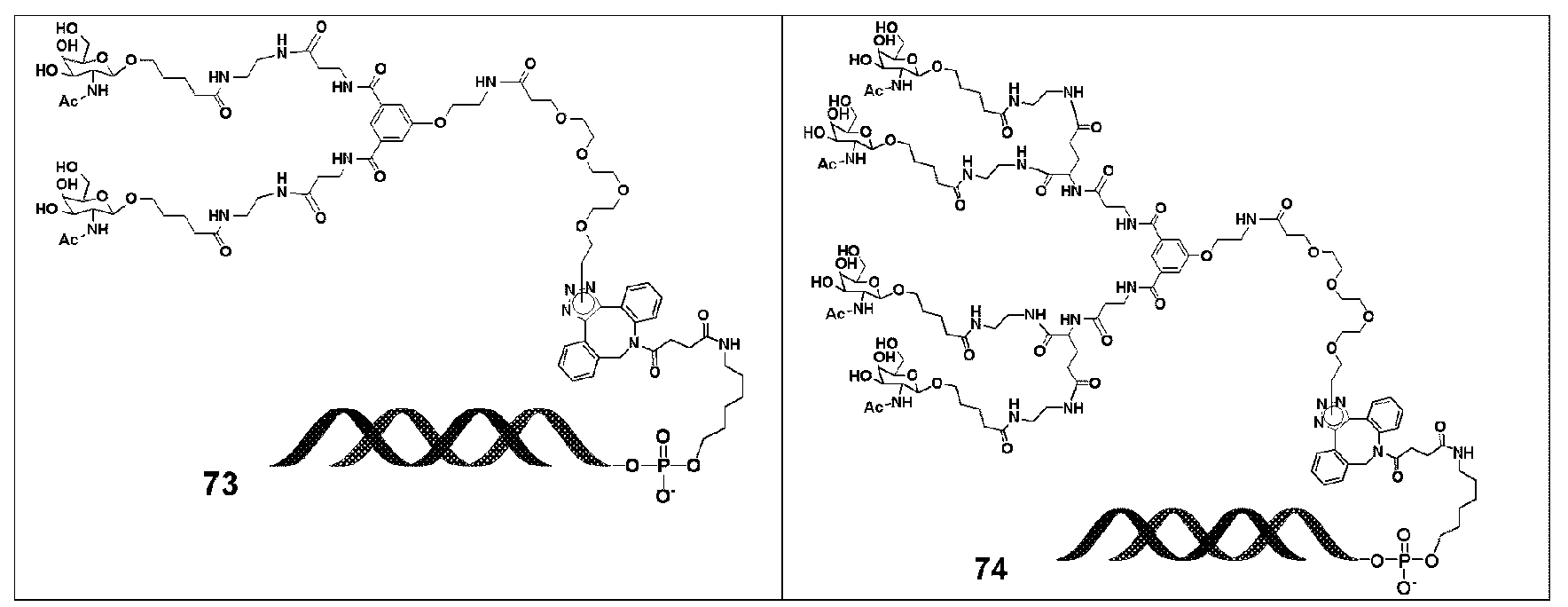
[표 9][Table 9]

실시예 9 당쇄 리간드-링커 유닛의 합성 6Example 9 Synthesis of sugar chain ligand-linker unit 6
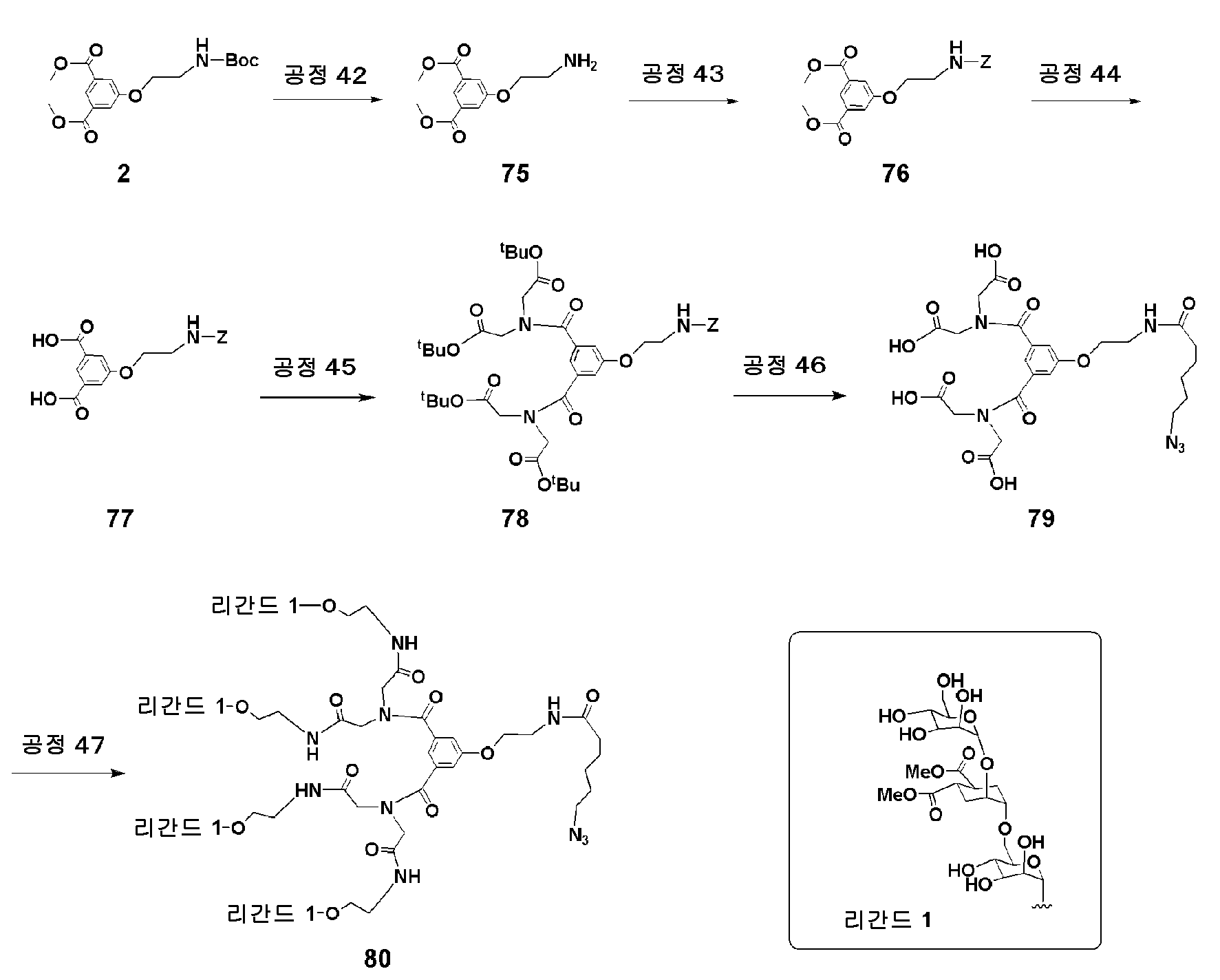
공정 42Step 42
실시예 1의 공정 1에서 합성한 화합물 2(8.17 g, 23.12 mmol)를 이용하여, 실시예 1의 공정 4와 동일한 방법으로 화합물 75(3.7 g, 14.63 mmol, 수율 63%)를 얻었다.Compound 75 (3.7 g, 14.63 mmol, yield 63%) was obtained in the same manner as Step 4 of Example 1, using Compound 2 (8.17 g, 23.12 mmol) synthesized in
ESI-MS m/z:254(M+H)+ ESI-MS m / z: 254 (M + H) < + & gt ;
공정 43Process 43
실시예 9의 공정 42에서 합성한 화합물 75(3.70 g, 14.63 mmol)를 테트라히드로푸란(10 ㎖)에 용해하고, 빙랭 하, 염화벤조일(4.12 ㎖, 29.3 mmol)을 첨가하여, 실온에서 1시간 동안 교반하였다. 반응액을 감압 하, 용매를 증류 제거하고, 잔사를 실리카겔 칼럼 크로마토그래피(클로로포름/메탄올)로 정제함으로써, 화합물 76(3.82 g, 9.86 mmol, 수율 67%)을 얻었다.The compound 75 (3.70 g, 14.63 mmol) synthesized in the step 42 of Example 9 was dissolved in tetrahydrofuran (10 ml), benzoyl chloride (4.12 ml, 29.3 mmol) was added under ice cooling, Lt; / RTI > The solvent was distilled off under reduced pressure, and the residue was purified by silica gel column chromatography (chloroform / methanol) to obtain Compound 76 (3.82 g, 9.86 mmol, yield 67%).
ESI-MS m/z: 432(M+HCOO)- ESI-MS m / z: 432 (M + HCOO) -
공정 44Step 44
실시예 9의 공정 43에서 합성한 화합물 76(3.82 g, 9.86 mmol)을 이용하여, 실시예 1의 공정 2와 동일한 방법으로 화합물 77(3.07 g, 8.56 mmol, 수율 87%)을 얻었다.Compound 77 (3.07 g, 8.56 mmol, yield 87%) was obtained in the same manner as in the step 2 of Example 1, using the compound 76 (3.82 g, 9.86 mmol) synthesized in the Step 43 of Example 9.
ESI-MS m/z: 360(M+H)+ ESI-MS m / z: 360 (M + H) < + &
공정 45Step 45
실시예 9의 공정 44에서 합성한 화합물 77(213 ㎎, 0.592 mmol) 및 이미노이아세트산디-tert-부틸에스테르(375 ㎎, 1.529 mmol)를 이용하여, 실시예 1의 공정 7과 동일한 방법으로 화합물 78을 정량적으로 얻었다.The compound 77 (213 mg, 0.592 mmol) synthesized in the Step 44 of Example 9 and di-tert-butyl iminoacetate (375 mg, 1.529 mmol) were reacted in the same manner as in Step 7 of Example 1 to give the compound 78 was quantitatively obtained.
ESI-MS m/z: 858(M+HCOO)- ESI-MS m / z: 858 (M + HCOO) -
공정 46Step 46
STEP1: 실시예 9의 공정 45에서 합성한 화합물 78(482 ㎎, 0.593 mmol)을 이용하여, 메탄올(10 ㎖)에 용해하고, 팔라듐/탄소에 의한 접촉 수소 환원을 행하였다. 얻어진 용액 유분(留分)을 감압 하, 용매를 증류 제거하였다.Step 1: Compound 78 (482 mg, 0.593 mmol) synthesized in Step 45 of Example 9 was dissolved in methanol (10 mL), and catalytic hydrogen reduction with palladium / carbon was carried out. The obtained solution fraction (fraction) was distilled off under reduced pressure.
STEP2: 얻어진 조생성물을 이용하여, 실시예 2의 공정 9와 동일한 방법으로 알킬아지드기를 갖는 커플링 화합물을 얻었다.Step 2: Using the obtained crude product, a coupling compound having an alkyl azide group was obtained in the same manner as in Step 9 of Example 2.
STEP3: STEP2에서 얻어진 화합물을 이용하여, 실시예 1의 공정 8과 동일한 방법으로 화합물 79(238 ㎎, 수율 92%)를 얻었다.Step 3: Compound 79 (238 mg, yield 92%) was obtained in the same manner as in Step 8 of Example 1, using the compound obtained in Step 2.
ESI-MS m/z: 595(M+H)+ ESI-MS m / z: 595 (M + H) < + & gt ;
공정 47Step 47
실시예 9의 공정 46에서 합성한 화합물 79(0.8 ㎎, 1.346 μmol)를 이용하여, 실시예 5의 공정 26과 동일한 방법으로 화합물 80(1.3 ㎎, 0.445 μmol)을 얻었다.(1.3 mg, 0.445 μmol) was obtained in the same manner as in the step 26 of Example 5, using the compound 79 (0.8 mg, 1.346 μmol) synthesized in the step 46 of Example 9.
ESI-MS m/z: 2918(M-H)- ESI-MS m / z: 2918 (MH) -
실시예 10 당쇄 리간드-링커 유닛의 합성 7Example 10 Synthesis of sugar chain ligand-linker unit 7

공정 48Step 48
1,3-디히드록시2-아미노프로판 81(도쿄카세이고교사 제조, 0.55 g, 6.03 mmol)을 디메틸술폭시드(15 ㎖)에 용해하고, 빙랭 하, 수산화나트륨 수용액(2 mmol/ℓ, 3 ㎖)을 첨가한 후, 디메틸술폭시드(2.2 ㎖)에 용해한 아크릴산tert-부틸에스테르(1.93 g, 15.07 mmol)를 서서히 첨가하여, 실온에서 4시간 동안 반응시켰다. 혼합물에 물을 첨가하고, 아세트산에틸로 추출한 후, 유기층을 포화 식염수로 세정하여, 무수 황산나트륨으로 건조시켰다. 감압 하, 용매를 증류 제거하고, 잔사를 실리카겔 칼럼 크로마토그래피(클로로포름/메탄올=98/2⇒90/10)로 정제함으로써, 화합물 82(0.74 g, 수율 35%)를 얻었다.Dihydroxy 2-aminopropane 81 (0.55 g, 6.03 mmol, manufactured by Tokyo Kasei Kogyo Co., Ltd.) was dissolved in dimethyl sulfoxide (15 ml), and an aqueous solution of sodium hydroxide (2 mmol / Butyl ester (1.93 g, 15.07 mmol) dissolved in dimethylsulfoxide (2.2 ml) was slowly added, and the reaction was allowed to proceed at room temperature for 4 hours. Water was added to the mixture, and the mixture was extracted with ethyl acetate. The organic layer was washed with saturated brine, and dried over anhydrous sodium sulfate. The solvent was distilled off under reduced pressure, and the residue was purified by silica gel column chromatography (chloroform / methanol = 98/2? 90/10) to obtain Compound 82 (0.74 g, yield 35%).
ESI-MS m/z: 348(M+H)+ ESI-MS m / z: 348 (M + H) < + &
공정 49Step 49
실시예 10의 공정 48에서 합성한 화합물 82(0.150 g, 0.433 mmol)를 이용하여, 실시예 1의 공정 7과 동일한 방법으로 화합물 83을 정량적으로 얻었다.Compound 83 was quantitatively obtained in the same manner as in Step 7 of Example 1, using compound 82 (0.150 g, 0.433 mmol) synthesized in Step 48 of Example 10.
ESI-MS m/z: 1062(M+HCOO)- ESI-MS m / z: 1062 (M + HCOO) -
공정 50(Z의 탈보호, 알킬아지드의 아미드화, TFA의 탈보호)Step 50 (deprotection of Z, amidation of the alkyl azide, deprotection of TFA)
실시예 10의 공정 49에서 합성한 화합물 83(0.149 g, 0.147 mmol)을 이용하여, 실시예 9의 공정 46과 동일한 방법으로 화합물 84(91.4 ㎎, 0.114 mmol, 수율 67%)를 얻었다.(91.4 mg, 0.114 mmol, yield 67%) was obtained in the same manner as in the step 46 of Example 9, using the compound 83 (0.149 g, 0.147 mmol) synthesized in the step 49 of Example 10.
ESI-MS m/z: 799(M+H)+ ESI-MS m / z: 799 (M + H) < + &
공정 51Step 51
실시예 10의 공정 51에서 합성한 화합물 84(1.3 ㎎, 1.4 μmol)를 이용하여, 실시예 5의 공정 26과 동일한 방법으로 화합물 85(2.4 ㎎, 0.768 μmol, 수율 54.9%)를 얻었다.Compound 85 (2.4 mg, 0.768 μmol, yield: 54.9%) was obtained in the same manner as in Step 26 of Example 5, using Compound 84 (1.3 mg, 1.4 μmol) synthesized in Step 51 of Example 10.
ESI-MS m/z: 1562(M+2H)2+ ESI-MS m / z: 1562 (M + 2H) 2+
실시예 11 당쇄 리간드-링커 유닛의 합성 8Example 11 Synthesis of sugar chain ligand-linker unit 8

공정 52Step 52
3,5-디히드록시안식향산 86(도쿄카세이고교사 제조, 2.11 g, 13.69 mmol)을 N,N'-디메틸포름아미드(35 ㎖)에 용해하고, 탄산수소칼륨(1.716 g, 17.14 mmol) 및 브롬화벤질(3.51 g, 2.439 ㎖, 20.54 mmol)을 첨가하여, 실온에서 4시간 동안 교반하였다. 반응액에 포화 염화암모늄을 첨가하여, 디클로로메탄으로 추출한 후, 유기층을 물로 세정하고, 무수 황산나트륨으로 건조시켰다. 감압 하, 용매를 증류 제거하고, 잔사를 실리카겔 칼럼 크로마토그래피(헵탄/아세트산에틸=50/50)로 정제함으로써, 화합물 87을 정량적으로 얻었다.Dihydroxybenzoic acid 86 (2.11 g, 13.69 mmol, manufactured by Tokyo Kasei Kogyo Co.) was dissolved in N, N'-dimethylformamide (35 ml), potassium hydrogencarbonate (1.716 g, 17.14 mmol) and Benzyl bromide (3.51 g, 2.439 ml, 20.54 mmol) was added, and the mixture was stirred at room temperature for 4 hours. Saturated ammonium chloride was added to the reaction solution, and the mixture was extracted with dichloromethane. The organic layer was washed with water and dried over anhydrous sodium sulfate. The solvent was distilled off under reduced pressure, and the residue was purified by silica gel column chromatography (heptane / ethyl acetate = 50/50) to obtain Compound 87 quantitatively.
ESI-MS m/z: 245(M+H)+ ESI-MS m / z: 245 (M + H) < + &
공정 53Step 53
공정 52에서 합성한 화합물 87(3.34 g, 13.69 mmol)을 N,N'-디메틸포름아미드(40 ㎖)에 용해하고, 탄산칼륨(7.57 g, 54.8 mmol) 및 tert-부틸브로모아세트산(4.42 ㎖, 30.1 mmol)을 첨가하여, 90℃에서 4시간 동안 교반하였다. 반응액에 포화 염화암모늄을 첨가하여, 디클로로메탄으로 추출한 후, 유기층을 포화 식염수로 세정하고, 무수 황산나트륨으로 건조시켰다. 감압 하, 용매를 증류 제거하고, 잔사를 실리카겔 칼럼 크로마토그래피(헵탄/아세트산에틸=75/25)로 정제함으로써, 화합물 88(5.67 g, 수율 88%)을 얻었다.Compound 87 (3.34 g, 13.69 mmol) synthesized in Step 52 was dissolved in N, N'-dimethylformamide (40 mL), potassium carbonate (7.57 g, 54.8 mmol) and tert- butylbromoacetic acid , 30.1 mmol), and the mixture was stirred at 90 DEG C for 4 hours. Saturated ammonium chloride was added to the reaction solution, and the mixture was extracted with dichloromethane. The organic layer was washed with saturated brine, and dried over anhydrous sodium sulfate. The solvent was distilled off under reduced pressure, and the residue was purified by silica gel column chromatography (heptane / ethyl acetate = 75/25) to obtain Compound 88 (5.67 g, yield 88%).
ESI-MS m/z: 471(M-H)- ESI-MS m / z: 471 (MH) -
공정 54Step 54
공정 53에서 합성한 화합물 88(5.67 g, 12.00 mmol)을 디클로로메탄(40 ㎖)에 용해하고, 트리플루오로아세트산(10 ㎖, 130.0 mmol)을 첨가하여, 실온에서 밤새 교반하였다. 감압 하, 용매를 증류 제거하고, 화합물 89의 조생성물을 얻었다.Compound 88 (5.67 g, 12.00 mmol) synthesized in Step 53 was dissolved in dichloromethane (40 ml), trifluoroacetic acid (10 ml, 130.0 mmol) was added, and the mixture was stirred overnight at room temperature. The solvent was distilled off under reduced pressure to obtain a crude product of the compound 89.
ESI-MS m/z: 359(M-H)- ESI-MS m / z: 359 (MH) -
공정 55Step 55
이미노이아세트산디-tert-부틸에스테르(0.407 g, 1.660 mmol) 및 실시예 11의 공정 54에서 합성한 화합물 89(0.239 g, 0.664 mmol)를 이용하여, 실시예 1의 공정 7과 동일한 방법으로 화합물 90을 정량적으로 얻었다.Butyl ester (0.407 g, 1.660 mmol) and the compound 89 (0.239 g, 0.664 mmol) synthesized in the step 54 of Example 11 were used in the same manner as in the step 7 of Example 1 to give the compound 90 was quantitatively obtained.
ESI-MS m/z: 813(M-H)- ESI-MS m / z: 813 (MH) -
공정 56Step 56
[STEP1] 실시예 11의 공정 55에서 합성한 화합물 90(541 ㎎, 0.664 mmol)을 이용하여, 메탄올(8 ㎖)에 용해하고, 팔라듐/탄소에 의한 접촉 수소 환원을 행하였다. 얻어진 용액 유분을 감압 하, 용매를 증류 제거하였다.[Step 1] Compound 90 (541 mg, 0.664 mmol) synthesized in Step 55 of Example 11 was dissolved in methanol (8 mL) and catalytic hydrogen reduction was carried out with palladium / carbon. The solvent was distilled off under reduced pressure.
[STEP2] 얻어진 조생성물 및 3-아지드프로판-1-아민(0.101 g, 1.009 mmol)을 이용하여, 실시예 1의 공정 7과 동일한 방법으로 커플링 화합물을 얻었다.[Step 2] Coupling compounds were obtained in the same manner as in Step 7 of Example 1, using the obtained crude product and 3-azidopropan-1-amine (0.101 g, 1.009 mmol).
STEP3: 얻어진 화합물 인퇴하여 조생성물을 이용하여, 실시예 1의 공정 8과 동일한 방법으로 화합물 91을 정량적으로 얻었다.Step 3: Compound Obtained Compound 91 was quantitatively obtained in the same manner as in Step 8 of Example 1, using the crude product as a residue.
ESI-MS m/z: 583(M+H)+ ESI-MS m / z: 583 (M + H) < + &
공정 57Step 57
실시예 10의 공정 50에서 합성한 화합물 84(2.0 ㎎, 1.476 μmol)를 이용하여, 실시예 5의 공정 26과 동일한 방법으로 화합물 92(2.0 ㎎, 수율 47%)를 얻었다.(2.0 mg, yield 47%) was obtained in the same manner as in the step 26 of Example 5, using the compound 84 (2.0 mg, 1.476 mol) synthesized in the step 50 of Example 10.
ESI-MS m/z: 1456(M+2H)2+ ESI-MS m / z: 1456 (M + 2H) 2+
실시예 12 당쇄 리간드-링커 유닛의 합성 9Example 12 Synthesis of sugar chain ligand-linker unit 9

공정 58Step 58
실시예 9의 공정 44에서 합성한 화합물 77(63 ㎎, 0.175 mmol)을 디클로로메탄(5 ㎖)에 용해하고, 트리에틸아민(0.24 ㎖, 1.75 mmol)을 첨가한 후에 펜타플루오로페닐-2,2,2-트리플루오로아세트산(0.119 ㎖, 0.699 mmol)을 첨가하여, 실온에서 4시간 동안 교반하였다. 혼합물에 클로로포름을 첨가하고, 유기층을 10% 시트르산 수용액, 포화 식염수, 및 탄산수소나트륨 수용액으로 세정하여, 무수 황산마그네슘으로 건조시켰다. 감압 하, 용매를 증류 제거함으로써 화합물 93을 정량적으로 취득하였다.Compound 77 (63 mg, 0.175 mmol) synthesized in Step 44 of Example 9 was dissolved in dichloromethane (5 ml), and triethylamine (0.24 ml, 1.75 mmol) was added, followed by addition of pentafluorophenyl- 2,2-Trifluoroacetic acid (0.119 mL, 0.699 mmol) was added, and the mixture was stirred at room temperature for 4 hours. Chloroform was added to the mixture, and the organic layer was washed with 10% aqueous citric acid solution, saturated brine, and aqueous sodium bicarbonate solution, and dried over anhydrous magnesium sulfate. Compound 93 was quantitatively obtained by distilling off the solvent under reduced pressure.
ESI-MS m/z:(모노에스테르체(PEP가 하나 부가된 화합물)로서 검출) 524(M-H)- ESI-MS m / z: (Detected as monoester (compound with one addition of PEP)) 524 (MH) -
공정 59Step 59
실시예 12의 공정 58에서 합성한 화합물 93(0.121 g, 0.175 mmol)을 디메틸술폭시드(8 ㎖)에 용해하고, 카르복실-(12올리고에틸렌글리콜)에틸아민(0.510 g, 0.444 mmol)을 첨가하여, 실온, 아르곤 분위기 하에서 1시간 동안 교반하였다. 감압 하에서 용매를 증류 제거하고, 그 후, 클로로포름, 10% 시트르산 수용액으로 추출한 후, 무수 황산마그네슘으로 건조시켰다. 감압 하, 용매를 증류 제거하고, 화합물 94의 조생성물을 얻었다.Compound (93) (0.121 g, 0.175 mmol) synthesized in Step 58 of Example 12 was dissolved in dimethylsulfoxide (8 ml), and carboxyl- (12 oligethylene glycol) ethylamine (0.510 g, 0.444 mmol) The mixture was stirred at room temperature under an argon atmosphere for 1 hour. The solvent was distilled off under reduced pressure, then extracted with chloroform, 10% citric acid aqueous solution, and then dried with anhydrous magnesium sulfate. The solvent was distilled off under reduced pressure to obtain a crude product of Compound 94.
ESI-MS m/z: 2614(M-H)- ESI-MS m / z: 2614 (MH) -
공정 60Step 60
실시예 12의 공정 59에서 합성한 화합물 94(0.333 g, 0.092 mmol)를 이용하여, 실시예 1의 공정 7과 동일한 방법으로 화합물 95를 정량적으로 얻었다.Compound 95 was quantitatively obtained in the same manner as in the step 7 of Example 1, using the compound 94 (0.333 g, 0.092 mmol) synthesized in the step 59 of Example 12.
ESI-MS m/z: 1537(M+2H)2+ ESI-MS m / z: 1537 (M + 2H) 2+
공정 61Step 61
실시예 12의 공정 60에서 합성한 화합물 95(0.138 g, 0.045 mmol)를 이용하여, 실시예 9의 공정 42와 동일한 방법으로 화합물 96(0.0825 g, 수율 58%)을 얻었다.Compound 96 (0.0825 g, yield 58%) was obtained in the same manner as in Step 42 of Example 9, using Compound 95 (0.138 g, 0.045 mmol) synthesized in Step 60 of Example 12.
ESI-MS m/z: 1426(M+2H)2+ ESI-MS m / z: 1426 (M + 2H) 2+
공정 62Step 62
실시예 12의 공정 61에서 합성한 화합물 96(4.2 ㎎, 14.04 μmol)을 이용하여, 실시예 5의 공정 26과 동일한 방법으로 화합물 97(2.1 ㎎, 수율 29%)을 얻었다.Compound 97 (2.1 mg, yield 29%) was obtained in the same manner as in the step 26 of Example 5, using the compound 96 (4.2 mg, 14.04 mol) synthesized in the step 61 of Example 12.
ESI-MS m/z: 2590(M+2H)2+ ESI-MS m / z: 2590 (M + 2H) 2+
실시예 13 당쇄 리간드-링커 유닛의 합성 10Example 13 Synthesis of sugar chain ligand-linker unit 10

공정 63Step 63
실시예 12의 공정 59에서 합성한 화합물 94(0.189 g, 0.052 mmol) 및 실시예 10의 공정 48에서 합성한 화합물 82(0.051 g, 0.148 mmol)를 이용하여, 실시예 1의 공정 7과 동일한 방법으로 화합물 98(0.087 g, 수율 51%)을 얻었다.Using the compound 94 (0.189 g, 0.052 mmol) synthesized in the step 59 of Example 12 and the compound 82 (0.051 g, 0.148 mmol) synthesized in the step 48 of Example 10, the same method as in the step 7 of Example 1 To obtain Compound 98 (0.087 g, yield 51%).
ESI-MS m/z: 1639(M+2H)2+ ESI-MS m / z: 1639 (M + 2H) 2+
공정 64Step 64
실시예 13의 공정 63에서 합성한 화합물 98(0.087 g, 0.027 mmol)을 이용하여, 실시예 9의 공정 42와 동일한 방법으로 화합물 99(38.5 ㎎, 수율 43%)를 얻었다.(38.5 mg, yield 43%) was obtained in the same manner as in the step 42 of Example 9, using the compound 98 (0.087 g, 0.027 mmol) synthesized in the step 63 of Example 13.
ESI-MS m/z: 1529(M+2H)2+ ESI-MS m / z: 1529 (M + 2H) 2+
공정 65Step 65
실시예 13의 공정 64에서 합성한 화합물 99(4.7 ㎎, 1.403 μmol)를 이용하여, 실시예 5의 공정 26과 동일한 방법으로 화합물 100(2.4 ㎎, 수율 32%)을 얻었다.(2.4 mg, yield 32%) was obtained in the same manner as in the step 26 of Example 5, using the compound 99 (4.7 mg, 1.403 mol) synthesized in the step 64 of Example 13.
ESI-MS m/z: 2689(M+2H)2+ ESI-MS m / z: 2689 (M + 2H) 2+
실시예 14 당쇄 리간드-링커 유닛의 합성 11Example 14 Synthesis of sugar chain ligand-linker unit 11

공정 66Step 66
[STEP1] 실시예 11의 공정 54에서 합성한 화합물 86(0.0678 g, 0.1888 mmol)을 이용하여, 실시예 12의 공정 58과 동일한 방법에 의해 활성 에스테르체를 취득하였다.[Step 1] The active ester form was obtained in the same manner as Step 58 of Example 12, using the compound 86 (0.0678 g, 0.1888 mmol) synthesized in Step 54 of Example 11.
[STEP2] STEP1로부터 취득한 활성 에스테르(0.1283 g, 0.185 mmol)를 이용하여, 실시예 12의 공정 59와 동일한 방법에 의해 화합물 101(0.2819 g, 0.108 mmol, 수율 58.1%)을 취득하였다.[Step 2] Compound 101 (0.2819 g, 0.108 mmol, yield: 58.1%) was obtained in the same manner as in the step 59 of Example 12, using the activated ester (0.1283 g, 0.185 mmol) obtained in STEP1.
ESI-MS m/z: 2615(M-H)- ESI-MS m / z: 2615 (MH) -
공정 64Step 64
실시예 14의 공정 66에서 합성한 화합물 101(0.282 g, 0.108 mmol)을 이용하여, 실시예 9의 공정 45와 동일한 방법으로 화합물 102(0.085 g, 0.028 mmol, 수율 26%)를 얻었다.Compound 102 (0.085 g, 0.028 mmol, yield 26%) was obtained in the same manner as in Step 45 of Example 9, using Compound 101 (0.282 g, 0.108 mmol) synthesized in Step 66 of Example 14.
ESI-MS m/z:(tBu기가 이탈한 상태에서 검출) 712(M+4H)4+ ESI-MS m / z: (detected in the absence of tBu group) 712 (M + 4H) 4+
공정 64Step 64
실시예 14의 공정 67에서 합성한 화합물 102(84.5 ㎎, 0.028 mmol)를 이용하여, 실시예 11의 공정 56과 동일한 방법으로 화합물 103(57.9 ㎎, 수율 66%)을 얻었다.Compound 103 (57.9 mg, yield 66%) was obtained in a similar manner to Step 56 of Example 11, using Compound 102 (84.5 mg, 0.028 mmol) synthesized in Step 67 of Example 14.
ESI-MS m/z: 2837(M-H)- ESI-MS m / z: 2837 (MH) -
공정 69Process 69
실시예 14의 공정 69에서 합성한 화합물 103(4.8 ㎎, 1.528 μmol)을 이용하여, 실시예 5의 공정 26과 동일한 방법으로 화합물 104(2.6 ㎎, 수율 33%)를 얻었다.(2.6 mg, yield 33%) was obtained in the same manner as in the step 26 of Example 5, using the compound 103 (4.8 mg, 1.528 μmol) synthesized in the step 69 of Example 14.
ESI-MS m/z: 2584(M+2H)2+ ESI-MS m / z: 2584 (M + 2H) 2+
실시예 15 당쇄 리간드-링커 유닛의 합성 12Example 15 Synthesis of sugar chain ligand-linker unit 12

공정 70Step 70
[STEP1] 실시예 11의 공정 54에서 합성한 화합물 86(4 ㎎, 0.011 mmol)을 이용하여, 실시예 5의 공정 26과 동일한 방법으로 리간드 부가한 화합물(6.0 ㎎, 수율 36%)을 취득하였다.[Step 1] A compound (6.0 mg, yield: 36%) having a ligand added was obtained in the same manner as in the step 26 of Example 5, using the compound 86 (4 mg, 0.011 mmol) synthesized in the Step 54 of Example 11 .
[STEP2] STEP1로부터 취득한 화합물(6.0 ㎎, 3.94 μmol)을 이용하여, 실시예 9 공정 42의 STEP1과 동일한 방법에 의해 화합물 105(5.6 ㎎, 수율 99%)를 취득하였다.[Step 2] Compound 105 (5.6 mg, yield 99%) was obtained by the same method as in
ESI-MS m/z: 1522(M-H)- ESI-MS m / z: 1522 (MH) -
실시예 16 당쇄 리간드-링커 유닛의 합성 13Example 16 Synthesis of sugar chain ligand-linker unit 13

공정 71Step 71
실시예 14의 공정 67에서 합성한 화합물 99(0.204 g, 0.067 mmol)를 이용하여, 실시예 9의 공정 45와 동일한 방법으로 화합물 106을 정량적으로 얻었다.Compound 106 was quantitatively obtained in the same manner as in the Step 45 of Example 9, using the compound 99 (0.204 g, 0.067 mmol) synthesized in the Step 67 of Example 14.
ESI-MS m/z: 2846(M-H)- ESI-MS m / z: 2846 (MH) -
공정 72Step 72
실시예 16의 공정 71에서 합성한 화합물 106(16.7 ㎎, 5.22 μmol)을 이용하여, 실시예 5의 공정 26과 동일한 방법으로 화합물 107(6.3 ㎎, 수율 23%)을 얻었다.(6.3 mg, yield: 23%) was obtained in the same manner as in the step 26 of Example 5, using the compound 106 (16.7 mg, 5.22 μmol) synthesized in the step 71 of Example 16.
ESI-MS m/z: 2586(M-H)- ESI-MS m / z: 2586 (MH) -
공정 73Step 73
실시예 16의 공정 72에서 합성한 화합물 107(6.3 ㎎, 1.218 μmol)을 이용하여, 실시예 9 공정 46의 STEP1과 동일한 방법에 의해 화합물 108(5.6 ㎎, 수율 90%)을 취득하였다.Compound (108) (5.6 mg, yield 90%) was obtained by the same method as in
ESI-MS m/z: 2540(M-2H)2- ESI-MS m / z: 2540 (M-2H) < RTI ID =
실시예 17 당쇄 리간드-링커 유닛의 합성 14Example 17 Synthesis of sugar chain ligand-linker unit 14

공정 74Step 74
국제 공개 2009/073809호에 기재된 방법으로 합성한 화합물 109(0.209 g, 0.414 mmol)를 이용하여, 실시예 2의 공정 9와 동일한 방법에 의해 화합물 110(0.116 g, 수율 43%)을 취득하였다.Compound 110 (0.116 g, yield 43%) was obtained by the same method as in the step 9 of Example 2, using the compound 109 (0.209 g, 0.414 mmol) synthesized by the method described in International Publication WO2007 / 0773809.
ESI-MS m/z: 645(M+H)+ ESI-MS m / z: 645 (M + H) < + & gt ;
공정 75Process 75
실시예 17의 공정 74에서 합성한 화합물 110(0.116 g, 0.179 mmol)을 이용하여, 실시예 9의 공정 44와 동일한 방법으로 화합물 111을 정량적으로 얻었다.Compound 111 was quantitatively obtained in the same manner as in the Step 44 of Example 9, using the compound 110 (0.116 g, 0.179 mmol) synthesized in the Step 74 of Example 17.
ESI-MS m/z: 477(M+H)+ ESI-MS m / z: 477 (M + H) < + &
공정 76Step 76
실시예 17의 공정 75에서 합성한 화합물 111(1.1 ㎎, 1.821 μmol)을 이용하여, 실시예 5의 공정 26과 동일한 방법으로 화합물 112(1.6 ㎎, 수율 40%)를 얻었다.(1.6 mg, yield 40%) was obtained in the same manner as in the step 26 of Example 5, using the compound 111 (1.1 mg, 1.821 mol) synthesized in the step 75 of Example 17.
ESI-MS m/z: 2219(M-H)- ESI-MS m / z: 2219 (MH) -
실시예 18 당쇄 리간드-링커 유닛의 합성 15Example 18 Synthesis of sugar chain ligand-linker unit 15

공정 77Step 77
실시예 17의 공정 75에서 합성한 화합물 111(30 ㎎, 0.05 mmol)을 이용하여, 실시예 14의 공정 62와 동일한 방법으로 화합물 113(88.2 ㎎, 수율 43%)을 얻었다.Compound 113 (88.2 mg, yield: 43%) was obtained in the same manner as in the Step 62 of Example 14, using the compound 111 (30 mg, 0.05 mmol) synthesized in the Step 75 of Example 17.
ESI-MS m/z: 1930(M-2H)2- ESI-MS m / z: 1930 (M-2H) < RTI ID =
공정 78Step 78
실시예 18의 공정 77에서 합성한 화합물 113(8.1 ㎎, 2.098 μmol)을 이용하여, 실시예 5의 공정 26과 동일한 방법으로 화합물 114(5.9 ㎎, 수율 50.%)를 얻었다.(5.9 mg, yield 50%) was obtained in the same manner as in the step 26 of Example 5, using the compound 113 (8.1 mg, 2.098 μmol) synthesized in the step 77 of Example 18.
ESI-MS m/z: 2801(M-2H)2- ESI-MS m / z: 2801 (M-2H) < RTI ID = 0.0 &
실시예 19 당쇄 리간드-링커 유닛의 합성 16Example 19 Synthesis of sugar chain ligand-linker unit 16

공정 79Step 79
이미노이아세트산디-tert-부틸에스테르 115(도쿄카세이고교사 제조, 0.197 g, 0.803 mmol)를 이용하여, 실시예 2의 공정 9와 동일한 방법에 의해 화합물 116을 정량적으로 취득하였다.Compound 116 was quantitatively obtained in the same manner as in Step 9 of Example 2, using iminoacetic acid di-tert-butyl ester 115 (0.197 g, 0.803 mmol, manufactured by Tokyo Kasei Kogyo Co., Ltd.).
ESI-MS m/z:[tBu기가 이탈한 상태에서 검출] 273(M+H)+ ESI-MS m / z: [detected in the state where the tBu group was removed] 273 (M + H) +
공정 80Step 80
실시예 19의 공정 79에서 합성한 화합물 116(0.309 g, 0.803 mmol)을 이용하여, 실시예 9의 공정 45와 동일한 방법으로 화합물 117을 정량적으로 얻었다.Compound 117 was quantitatively obtained in the same manner as in the Step 45 of Example 9, using the compound 116 (0.309 g, 0.803 mmol) synthesized in the Step 79 of Example 19.
ESI-MS m/z: 273(M+H)+ ESI-MS m / z: 273 (M + H) < + &
공정 81Process 81
실시예 17의 공정 76에서 합성한 화합물 117(1.2 g, 2.62 mmol)을 이용하여, 실시예 5의 공정 26과 동일한 방법으로 화합물 118(1.1 ㎎, 0.766 mmol, 수율 29%)을 얻었다.Compound 118 (1.1 mg, 0.766 mmol, yield 29%) was obtained in the same manner as in Step 26 of Example 5, using the compound 117 (1.2 g, 2.62 mmol) synthesized in the step 76 of Example 17.
ESI-MS m/z: 1436(M+H)+ ESI-MS m / z: 1436 (M + H) < + &
실시예 20 당쇄 리간드-링커 유닛의 합성 17Example 20 Synthesis of sugar chain ligand-linker unit 17

공정 82Step 82
실시예 10의 공정 47에서 합성한 화합물 82(0.159 g, 0.459 mmol)를 이용하여, 실시예 2의 공정 9와 동일한 방법에 의해 화합물 119(0.096 g, 0.197 mmol, 수율 43%)를 취득하였다.Compound 119 (0.096 g, 0.197 mmol, yield: 43%) was obtained in the same manner as in Step 9 of Example 2, using Compound 82 (0.159 g, 0.459 mmol) synthesized in Step 47 of Example 10.
ESI-MS m/z: 487(M+H)+ ESI-MS m / z: 487 (M + H) < + &
공정 83Process 83
실시예 20의 공정 82에서 합성한 화합물 119(96 ㎎, 0.197 mmol)를 이용하여, 실시예 9의 공정 41과 동일한 방법으로 화합물 120을 정량적으로 얻었다.The compound 120 was quantitatively obtained in the same manner as in the step 41 of Example 9, using the compound 119 (96 mg, 0.197 mmol) synthesized in the step 82 of Example 20.
ESI-MS m/z: 375(M+H)+ ESI-MS m / z: 375 (M + H) < + &
공정 84Step 84
실시예 20의 공정 83에서 합성한 화합물 120(1.0 ㎎, 2.55 μmol)을 이용하여, 실시예 5의 공정 26과 동일한 방법으로 화합물 121(2.6 ㎎, 수율 66%)을 얻었다.(2.6 mg, yield 66%) was obtained in the same manner as in the step 26 of Example 5, using the compound 120 (1.0 mg, 2.55 mmol) synthesized in the Step 83 of Example 20.
ESI-MS m/z:1539(M+H)+ ESI-MS m / z: 1539 (M + H) < + &
실시예 21 당쇄 리간드-링커 유닛의 합성 18Example 21 Synthesis of sugar chain ligand-linker unit 18

공정 85Process 85
케미스트리 유로피안 저널(Chemistry European Journal), 제19권, 4786-4797 페이지, 2013년에 기재된 방법으로 합성한 화합물 122(1 g, 0.914 mmol) 및 4-(아미노메틸)페놀염산염(0.362 g, 2.287 mmol)을 이용하여, 전술 기재의 문헌 방법에 의해 화합물 123(0.22 g, 수율 23%)을 얻었다.Compound (122) (1 g, 0.914 mmol) synthesized by the method described in Chemistry European Journal, Vol. 19, mmol), compound 123 (0.22 g, yield: 23%) was obtained by the literature method described above.
ESI-MS m/z: 1062(M+H)+ ESI-MS m / z: 1062 (M + H) < + &
공정 86Step 86
실시예 21의 공정 85에서 합성한 화합물 123(0.2 g, 0.191 mmol)을 25% 암모니아 수용액에 용해하고, 피리딘(2 ㎖) 및 트리메틸포스핀(0.12 ㎖)을 첨가한 후, 실온에서 16시간 동안 교반하였다. 혼합물을 감압 농축하고, 잔사를 칼럼 크로마토그래피로 정제함으로써 화합물 124(0.048 g, 수율 25%)를 취득하였다.The compound 123 (0.2 g, 0.191 mmol) synthesized in the Step 85 of Example 21 was dissolved in 25% aqueous ammonia, to which pyridine (2 ml) and trimethylphosphine (0.12 ml) were added, and then the mixture was stirred at room temperature for 16 hours Lt; / RTI > The mixture was concentrated under reduced pressure, and the residue was purified by column chromatography to obtain a compound 124 (0.048 g, yield 25%).
ESI-MS m/z: 1037(M+H)+ ESI-MS m / z: 1037 (M + H) < + &
공정 87Process 87
[STEP1] 케미스트리 유로피안 저널(Chemistry European Journal), 제19권, 4786-4797 페이지, 2013년에 기재된 방법으로 합성한 화합물 122(0.5 g, 0.457 mmol)를 이용하여, 공정 84와 동일한 방법에 의해 커플링 화합물(0.2 g, 수율 42%)을 얻었다.[Step 1] Using the compound 122 (0.5 g, 0.457 mmol) synthesized by the method described in Chemistry European Journal, vol. 19, pp 4786-4797, 2013, To obtain a coupling compound (0.2 g, yield 42%).
[STEP2] STEP1에서 합성한 화합물(0.2 g, 0.191 mmol)을 노르말부탄올(2 ㎖)에 용해하고, 백금/탄소(200 ㎎)를 이용하여 12시간 동안 접촉 환원을 행하였다. 반응액을 감압 농축하고, 잔사를 칼럼 크로마토그래피로 정제함으로써 화합물 125(0.060 g, 수율 30%)를 취득하였다.[Step 2] The compound (0.2 g, 0.191 mmol) synthesized in
ESI-MS m/z: 1019(M+H)+ ESI-MS m / z: 1019 (M + H) < + &
실시예 22 당쇄 리간드-링커 유닛의 합성 19Example 22 Synthesis of sugar chain ligand-linker unit 19

공정 88Step 88
[STEP1] 실시예 1의 공정 4에서 합성한 화합물 5(3.39 g, 8.584 mmol)를 이용하여 실시예 2의 공정 10과 동일한 방법으로 아지드기를 갖는 커플링 화합물을 조생성물(2.293 g, 수율 50%)로서 얻었다.[Step 1] Using the compound 5 (3.39 g, 8.584 mmol) synthesized in the Step 4 of Example 1, the coupling compound having an azide group was obtained as a crude product (2.293 g, yield 50 %).
[STEP2] STEP1에서 얻어진 화합물(2.293 g, 4.29 mmol)을 이용하여, 실시예 1의 실제의 공정 2와 동일한 방법에 의해, 카르복실산에스테르를 가수 분해체(2.021 g, 수율 93%)를 취득하였다.[Step 2] Using the compound (2.293 g, 4.29 mmol) obtained in
[STEP3] STEP2에서 얻어진 화합물(0.100 g, 0.197 mmol)을 이용하여 실시예 12의 공정 54와 동일한 방법에 의해 활성 에스테르체를 정량적으로 취득하였다.[Step 3] The active ester form was quantitatively obtained in the same manner as in Step 12 of Example 12, using the compound (0.100 g, 0.197 mmol) obtained in Step 2.
[STEP4] STEP3의 방법으로 얻어진 활성 에스테르(0.214 g, 0.255 mmol)를 이용하여, 실시예 12의 공정 55와 동일한 방법에 의해 화합물 126(0.216 g, 수율 85%)을 얻었다.[Step 4] A compound 126 (0.216 g, yield 85%) was obtained in the same manner as in Step 55 of Example 12, using the activated ester (0.214 g, 0.255 mmol) obtained in the method of Step 3.
ESI-MS m/z: 2763(M-H)- ESI-MS m / z: 2763 (MH) -
공정 89Process 89
R=R1에 있어서의 결과를 이하에 나타내었다. R2의 경우에 있어서도 동일한 결과를 얻을 수 있었다.The results for R = R1 are shown below. The same result was obtained in the case of R2.
[STEP1] 실시예 21의 공정 86에서 합성한 화합물 124(9.9 ㎎, 0.069 mmol)를 메탄올(500 ㎕)에 용해하고, 28% 나트륨메톡시드/메탄올 용액(14 uL)을 첨가한 후, 실온에서 밤새 정치하였다. 혼합물을 역상 크로마토그래피(물/아세토니트릴)로 정제함으로써 벤조일기가 탈보호된 목적물을 정량적으로 취득하였다.[Step 1] Compound 124 (9.9 mg, 0.069 mmol) synthesized in Step 86 of Example 21 was dissolved in methanol (500 μl), and 28% sodium methoxide / methanol solution (14 μL) was added thereto. We stayed overnight. The mixture was purified by reverse phase chromatography (water / acetonitrile) to quantitatively obtain a target in which the benzoyl group was deprotected.
[STEP2] 실시예 21의 공정 87에서 취득한 화합물 125(1.4 ㎎, 0.502 μmol) 및 STEP1에서 취득한 화합물(4.2 ㎎, 5.02 μmol)을 이용하여, 실시예 5의 공정 26과 동일한 방법으로 화합물 127(0.6 ㎎, 수율 30%)을 취득하였다.Using the compound 125 (1.4 mg, 0.502 μmol) obtained in the Step 87 of Example 21 and the compound (4.2 mg, 5.02 μmol) obtained in STEP1, Compound 127 (0.6 Mg, yield: 30%).
ESI-MS m/z: 1982(M-2H)2- ESI-MS m / z: 1982 (M-2H) < RTI ID = 0.0 &
실시예 23 당쇄 리간드-링커 유닛의 합성 20Example 23 Synthesis of sugar chain ligand-linker unit 20

공정 90Step 90
실시예 3의 공정 18에서 합성한 화합물 126(24 ㎎, 7.30 μmol)을 이용하여, 실시예 5의 공정 26과 동일한 방법으로 화합물 129(11 ㎎, 48%)를 얻었다.Compound 129 (11 mg, 48%) was obtained in a similar manner to Step 26 of Example 5, using Compound 126 (24 mg, 7.30 mol) synthesized in Step 18 of Example 3.
ESI-MS m/z: 1608(M-2H)2- ESI-MS m / z: 1608 (M-2H) < RTI ID =
실시예 24 당쇄 리간드-링커 유닛의 합성 21Example 24 Synthesis of sugar chain ligand-linker unit 21

공정 91Step 91
화합물 130의 합성Synthesis of Compound 130
[STEP1] 실시예 3의 공정 20에서 합성한 화합물 22b(4 ㎎, 1.342 μmol)를 이용하여, 실시예 5의 공정 26과 동일한 방법으로 리간드 부가체(0.9 ㎎, 10%)를 얻었다.[Step 1] A ligand adduct (0.9 mg, 10%) was obtained in the same manner as in Step 26 of Example 5, using the compound 22b (4 mg, 1.342 μmol) synthesized in Step 20 of Example 3.
[STEP2] STEP1에서 취득한 화합물(0.9 ㎎, 0.129 μmol)을 메탄올(0.6 ㎖)에 용해하고, 나트륨메톡시드(2 μL, 10 μmol)를 첨가한 후, 실온에서 3시간 동안 반응시켰다. 반응액을 역상 크로마토그래피로 분취하고, 동결 건조시킴으로써 화합물 130(0.3 ㎎, 44%)을 취득하였다.[Step 2] The compound (0.9 mg, 0.129 μmol) obtained in
ESI-MS m/z: 2642(M-2H)2- ESI-MS m / z: 2642 (M-2H) < RTI ID =
화합물 131의 합성Synthesis of Compound 131
실시예 3의 공정 20에서 합성한 화합물 22b(22 ㎎, 5.88 μmol)를 이용하여, 실시예 5의 공정 26과 동일한 방법으로 화합물 131(3.6 ㎎, 17%)을 얻었다.Compound (131) (3.6 mg, 17%) was obtained in the same manner as in Step 26 of Example 5, using compound 22b (22 mg, 5.88 mol) synthesized in Step 20 of Example 3.
ESI-MS m/z: 1851(M+2H)2+ ESI-MS m / z: 1851 (M + 2H) 2+
실시예 25 핵산 복합체의 합성 3Example 25 Synthesis of nucleic acid complexes 3
공정 92Process 92
[Method 1] 실시예 9의 공정 38과 동일한 방법으로 표 10-1∼표 10-3에 기재된 화합물을 이용하여 표 11-1∼표 11-4에 기재된 단일쇄의 핵산 복합체 132∼151을 얻었다. 표 11-3 중의 X, Y는 올리고뉴클레오티드의 3' 말단의 뉴클레오티드 구조를 나타낸다.[Method 1] Using the compounds described in Tables 10-1 to 10-3 in the same manner as in Step 38 of Example 9, the single-stranded nucleic acid complexes 132 to 151 described in Tables 11-1 to 11-4 were obtained . X and Y in Table 11-3 represent the nucleotide structure of the 3'end of the oligonucleotide.
[Method 2] 몰레큘즈(Molecules), 제17권, 13825-13843 페이지, 2012년에 기재된 방법으로 합성한 말단이 아미노기로 수식된 올리고뉴클레오티드 및 화합물 105를 이용하여, 바이오콘쥬게이트 케미스트리, 제22권, 1723-1728 페이지, 2011년 의 방법으로 표 11-3에 기재된 단일쇄의 핵산 복합체 152 및 153을 얻었다.[Method 2] Using an oligonucleotide whose terminal was modified with an amino group and compound 105 synthesized by the method described in Molecules, Vol. 17, pp. 13825-13843, 2012, a bioconjugate chemistry, , 1723-1728, 2011, the single-stranded nucleic acid complexes 152 and 153 described in Table 11-3 were obtained.
본 실시예에 의해 합성한 핵산 복합체의 서열 및 질량 분석 결과를 표 12에 나타낸다.Table 12 shows the sequence and mass spectrometry results of the nucleic acid complexes synthesized in this Example.
[표 10-1][Table 10-1]

[표 10-2][Table 10-2]

[표 11-1][Table 11-1]

[표 11-2][Table 11-2]

[표 11-3][Table 11-3]

[표 11-4][Table 11-4]

[표 12][Table 12]

실시예 26 핵산 복합체의 합성 4Example 26 Synthesis of nucleic acid complexes 4
공정 92Process 92
공정 91에서 합성한 단일쇄의 당쇄 복합체는, 실시예 8의 공정 38과 동일한 방법으로 이중쇄의 당쇄 복합체 154-175를 얻었다. 본 실시예에 의해 합성한 핵산 복합체를 표 13-1∼표 13-4에 나타낸다. 표 13-3 중의 X, Y는 센스쇄의 3' 말단의 뉴클레오티드를 나타낸다.For the single-stranded sugar chain complex synthesized in Step 91, a double-stranded sugar chain complex 154-175 was obtained in the same manner as in Step 38 of Example 8. [ The nucleic acid complexes synthesized in this Example are shown in Tables 13-1 to 13-4. X and Y in Table 13-3 represent nucleotides at the 3'end of the sense strand.
[표 13-1][Table 13-1]

[표 13-2][Table 13-2]
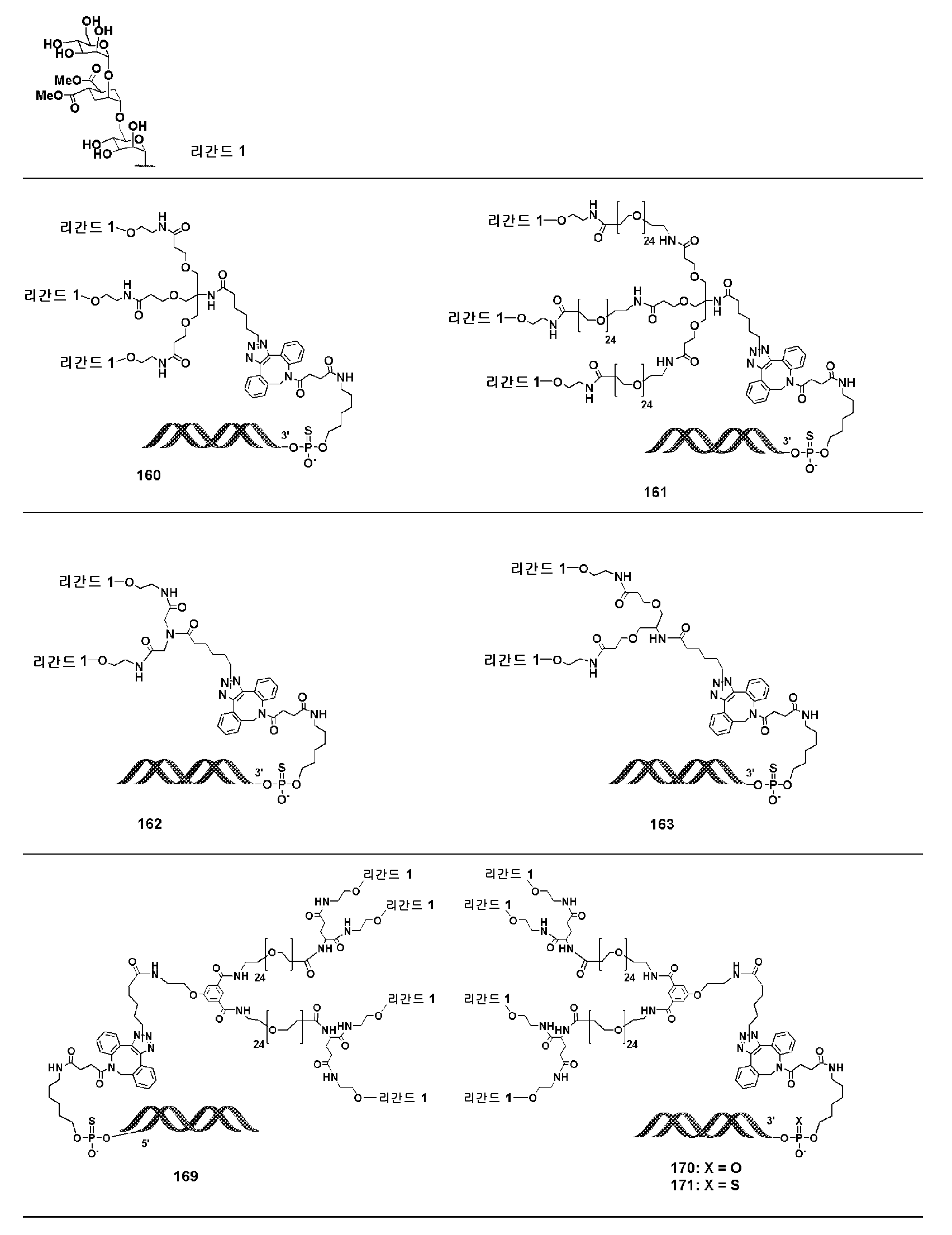
[표 13-3][Table 13-3]

[표 13-4][Table 13-4]

본 실시예에 의해 합성한 핵산 복합체의 서열을 표 14에 나타낸다. 또한 표 14에 있어서의 「화합물란」의 기재는, [표 중의 화합물 번호]_[핵산 복합체에 있어서의 핵산 서열의 약호]_[핵산의 종류(siRNA)]를 나타내고, 또한 「단일쇄 명칭」란의 기재에 있어서, 센스쇄(ss)는 [표 중의 화합물 번호]_[핵산에 있어서의 리간드 등이 결합하는 위치]_[핵산 복합체에 있어서의 핵산 서열의 약호]-핵산의 종류(ssRNA)를 나타내고, 안티센스쇄(as)는 [핵산 복합체에 있어서의 핵산 서열의 약호]-[핵산의 종류(as-RNA)]를 각각 나타낸다.The sequences of the nucleic acid complexes synthesized in this Example are shown in Table 14. In addition, the description of the "compound column" in Table 14 indicates the [number of the compound] _ [the abbreviation of the nucleic acid sequence in the nucleic acid complex] _ [the type of the nucleic acid (siRNA)]] (Ss) is the [number of the compound in the table] _ [the position where the ligand in the nucleic acid binds] _ [the abbreviation of the nucleic acid sequence in the nucleic acid complex] -the kind of the nucleic acid (ssRNA) , And the antisense strand (as) represents [nucleic acid sequence in nucleic acid complex] - [nucleic acid type (as-RNA)], respectively.
[표 14][Table 14]


실시예 27 핵산 복합체의 합성 5Example 27 Synthesis of nucleic acid complexes 5
공정 93Process 93
실시예 26, 27과 동일한 방법으로, 화합물 148에 있어서 서열이 상이한 핵산 복합체를 각각 얻었다. 이하에 핵산 복합체의 서열 및 질량 분석 결과를 표 15, 이중쇄 복합체의 서열을 표 16에 나타낸다.In the same manner as in Examples 26 and 27, nucleic acid complexes having different sequences in compound 148 were obtained, respectively. The sequences and mass spectrometry results of the nucleic acid complexes are shown in Table 15 below, and the sequences of the double-stranded complexes are shown in Table 16 below.
[표 15][Table 15]

[표 16][Table 16]

시험예 1: CD45 ASO에 의한 인간 단구 유래 수상세포의 mRNA 녹다운 시험Test Example 1: mRNA knockdown test of dendritic dendritic cells derived from human monocytes by CD45 ASO
10% 소태아 혈청을 포함하는 알피엠아이 1640 배지(RPMI1640 배지, 나카라이테스크사 제조, 30264-56)(이하 10% FBS RPMI1640 배지라고 기재) 및 DNase I 용액(DNase I Solution, StemCell Technology사 제조, 07900)을 이용하여, 인간 CD14 양성 단구 세포(Untouched Frozen NPB-CD14+ Monocytes, Allcells사 제조, PB011F)를 첨부한 프로토콜에 따라 융해하였다.(DNase I Solution, manufactured by StemCell Technology, Inc.) (hereinafter referred to as " DNase I Solution ", manufactured by Nacalai Tesque, 30264-56) (hereinafter referred to as 10% FBS RPMI1640 medium) containing 10% fetal bovine serum 07900), human CD14-positive monocytes (Untouched Frozen NPB-CD14 + Monocytes, Allcells, PB011F) were fused according to the attached protocol.
그 후, 재조합 인간 인터류킨-4(Recombinant Human IL-4 Protein, R&D System사 제조, 204-IL)(이하 IL-4라고 기재)를 최종 농도 100 ng/㎖, 재조합 인간 과립구 단구 콜로니 자극 인자(Recombinant Human GM-CSF Protein CF, R&D System사 제조, 215-GM-050/CF)(이하 GM-CSF라고 기재)를 최종 농도 50 ng/㎖가 되도록 첨가하여, 106 세포/㎖의 밀도로 부유 배양용 멀티플레이트(SUMILON사 제조, MS-8006R)에 파종하고, 37℃, 5% CO2 조건 하에서 배양하였다. Thereafter, a recombinant human IL-4 protein (204-IL manufactured by R & D System, hereinafter referred to as IL-4) was added to a final concentration of 100 ng / ml, a recombinant human granulocyte colony stimulating factor Human GM-CSF Protein CF, 215-GM-050 / CF) (hereinafter referred to as GM-CSF, manufactured by R & D System) was added to a final concentration of 50 ng / ml and cultured at a density of 10 6 cells / (MS-8006R, manufactured by SUMILON), and cultured at 37 占 폚 under 5% CO 2 .
배양 개시로부터 3일 후 및 6일 후에 IL-4 100 ng/㎖ 및 GM-CSF 50 ng/㎖를 포함하는 10% FBS RPMI1640 배지에서 배지를 절반량 교환하고, 수상세포로 유도하였다.After 3 days and 6 days from the initiation of culture, the medium was changed in half volume in 10% FBS RPMI1640 medium containing 100 ng / ml of IL-4 and 50 ng / ml of GM-CSF and induced into dendritic cells.
배양 개시로부터 8일 후에 세포를 회수하고, 또한 접착 세포도 에틸렌디아민사아세트산 용액(0.2 g/ℓEDTA Solution, 나카라이테스크사 제조, 14367-74)을 이용하여 회수하였다. 원심 조작 후에 새로운 IL-4 100 ng/㎖ 및 GM-CSF 50 ng/㎖를 포함하는 10% FBS RPMI1640 배지에 1,250,000 세포/㎖가 되도록 재현탁시켜, 초저 흡착 96 웰 플레이트(Corning사 제조, 3474)에 80 uL씩 파종하였다.Cells were recovered 8 days after the initiation of culture, and the adherent cells were also recovered using ethylenediamine acetic acid solution (0.2 g / l EDTA Solution, Nacalai Tesque, 14367-74). After centrifugation, the cells were resuspended in 10% FBS RPMI1640 medium containing 100 ng / ml of fresh IL-4 and 50 ng / ml of GM-CSF to give 1,250,000 cells / ml. Ultrathin adsorption 96 well plates (Corning 3474, Were inoculated at 80 uL.
피험 샘플로서는 KAC_008 및 KAC_009를 이용하고, 비교 대조로서 리간드를 갖지 않는 KAC_CTR_001 및 CD45 유전자에는 상보 부위를 갖지 않는 KAC_CTR_002를 마련하였다. KAC_008의 최종 농도는 1 μmol/ℓ 및 0.3 μmol/ℓ의 2점, KAC_009 및 KAC_CTR_001은 1 μmol/ℓ, 0.3 μmol/ℓ, 0.1 μmol/ℓ 및 0.03 umol/ℓ의 4점, KAC_CTR_002는 1 μmol/ℓ, N=3으로 실시하였다.KAC_CTR_001, which does not have a ligand as a control, and KAC_CTR_002, which does not have a complementary region, are provided in the CD45 gene using KAC_008 and KAC_009 as test samples. The final concentration of KAC_008 was 2 points of 1 μmol / ℓ and 0.3 μmol / ℓ, 4 points of KAC_009 and KAC_CTR_001 were 1 μmol / ℓ, 0.3 μmol / ℓ, 0.1 μmol / ℓ and 0.03 μmol / l, N = 3.
핵산 복합체 용액의 희석에 대해서는 이하의 절차에 의해 행하였다. 시트르산 완충액(20 mM Citrate(pH 7), 150 mM NaCl)에 50 μM로 조제된 핵산 복합체 용액을 옵티멤(Opti-MEM(등록상표) I Reduced Serum Medium, Life technologies사 제조, 31985-070)로 5 μM로 희석하고, 추가적인 용액의 희석에는 시트르산 완충액과 옵티멤이 1:9가 되도록 조제한 용액을 이용하여 희석을 행하였다. 희석한 핵산 복합체 용액을 20 ㎕씩 세포 용액에 첨가, 음성 대조군에는 희석 용액을 20 ㎕ 첨가하여, 37℃, 5% CO2 조건 하에서 2일간 배양하였다.Dilution of the nucleic acid complex solution was carried out by the following procedure. (Opti-MEM (registered trademark) I Reduced Serum Medium, manufactured by Life technologies, 31985-070) in a citrate buffer solution (20 mM citrate (pH 7), 150 mM NaCl) Diluted to 5 μM, and diluted with a solution prepared so that the citric acid buffer solution and the Optemel were diluted to 1: 9 for the dilution of the additional solution. Twenty microliters of the diluted nucleic acid complex solution was added to the cell solution, 20 microliters of the diluted solution was added to the negative control, and the mixture was incubated at 37 DEG C and 5% CO 2 for 2 days.
RNA를 포함하는 세포 용해액의 조제에는 수퍼프렙 셀 라이시스 키트(SuperPrep(등록상표) Cell Lysis & RT Kit, qPCR용, TOYOBO사 제조, SCQ-101)를 이용하여, 동 키트 부속의 알티 키트(RT Kit, qPCR용)를 이용하여 키트에 첨부된 설명서에 따라 역전사 반응을 행하여, cDNA를 작성하였다.The cell lysate containing RNA was prepared using a Superprep (TM) Cell Lysis & RT Kit (qPCR, manufactured by TOYOBO Corporation, SCQ-101) (RT Kit, for qPCR) according to the instructions attached to the kit to prepare cDNA.
이 cDNA를 PCR 반응의 주형에 이용하고, QuantStudio 12K Flex 리얼 타임 PCR 시스템(어플라이드바이오시스템즈사 제조)을 이용하여, 태크맨프로브(Taqman probe)법에 의해 CD45의 유전자, 및 대조로서 글리셀알데히드3인산 데히드로게나아제(Glyceraldehyde 3-phosphate dehydrogenase)(이하 GAPDH라고 기재)의 유전자를 PCR 반응시켜 mRNA 증폭량을 각각 측정하고, GAPDH의 mRNA 증폭량을 내부 대조로 하여, CD45의 mRNA의 준정량값을 산출하였다. 또한, 음성 대조군에 있어서의 CD45 및 GAPDH의 mRNA 증폭량을 동일하게 각각 측정하고, CD45의 mRNA의 준정량값을 산출하였다.This cDNA was used as a template for PCR reaction, and the gene of CD45 was amplified by the Taqman probe method using QuantStudio 12K Flex real-time PCR system (manufactured by Applied Biosystems), and the gene of glyceraldehyde 3 The mRNA amplification amount was measured by PCR of the gene of Glyceraldehyde 3-phosphate dehydrogenase (hereinafter referred to as GAPDH), and the quasi-quantitative value of mRNA of CD45 was calculated using the amount of mRNA amplification of GAPDH as an internal control Respectively. In addition, the amplification amounts of mRNA of CD45 and GAPDH in the negative control group were each measured in the same manner, and a quasi-quantitative value of mRNA of CD45 was calculated.
CD45 유전자의 측정에는 태크맨프로브 Hs00894727_m1(어플라이드바이오시스템즈사 제조)을, GAPDH 유전자의 측정에는 Hs02758991_g1(어플라이드바이오시스템즈사 제조)을 이용하고, 반응 시약에는 TaqMan Gene Expression Master Mix(어플라이드바이오시스템즈사 제조, 4369542)를 이용하여 첨부된 프로토콜에 따라 실시하였다. 핵산 복합체(ASO 도입 검체)의 표적 mRNA량은, 음성 대조군(ASO 미도입군)에 있어서의 CD45의 mRNA량을 1로 했을 때의 상대적인 비율로서 산출하였다. 그 mRNA량의 상대적인 비율을 평균±표준편차로 표시한 결과를 도 1에 나타낸다.Hs02758991_g1 (manufactured by Applied Biosystems) was used for measurement of the GAPDH gene, and TaqMan Gene Expression Master Mix (manufactured by Applied Biosystems) was used as a reaction reagent, while TaqMan probe Hs00894727_m1 (manufactured by Applied Biosystems) 4369542) according to the attached protocol. The amount of target mRNA of the nucleic acid complex (ASO introduced sample) was calculated as a relative ratio when the amount of mRNA of CD45 in the negative control group (ASO-untreated group) was 1. The relative ratio of the amount of mRNA was expressed as mean + standard deviation, and the result is shown in Fig.
본 결과로부터, 피험 샘플(KAC_008, KAC_009)이 비교 대조(KAC_CTR_001, KAC_CTR_002)에 비해, 강한 녹다운 효과를 보이는 것을 확인하였다.From the results, it was confirmed that the test sample (KAC_008, KAC_009) had a strong knockdown effect as compared with the comparison control (KAC_CTR_001, KAC_CTR_002).
시험예 2: Beta-2 Microglobulin(이하 B2M이라 기재)에 대한 ASO를 이용한 인간 단구 유래 수상세포의 단백질 녹다운 시험Test Example 2: Protein knockdown test of dendritic cells derived from human monocytes using ASO against Beta-2 Microglobulin (hereinafter referred to as B2M)
시험예 1과 동일한 절차에 의해 인간 CD14 양성 단구 세포로부터 수상세포를 유도하고, 초저 흡착 6 웰 플레이트(Corning사 제조, 3471)에 파종하고, 37℃, 5% CO2 조건 하에서 배양하였다. 3일 후에 IL-4 100 ng/㎖ 및 GM-CSF 50 ng/㎖를 포함하는 10% FBS RPMI1640 배지에서 배지를 절반량 교환시켜, 수상세포로 유도하였다.Dendritic cells were induced from human CD14-positive monocytes by the same procedure as in Test Example 1, and seeded on ultralow-adsorption 6-well plates (Corning, 3471) and cultured at 37 ° C under 5% CO 2 . After 3 days, the medium was changed in half volume in 10% FBS RPMI1640 medium containing 100 ng / ml of IL-4 and 50 ng / ml of GM-CSF to induce dendritic cells.
배양 개시로부터 6일 후에 세포를 회수하고, 원심 조작 후에 새로운 IL-4 100 ng/㎖ 및 GM-CSF 50 ng/㎖를 포함하는 10% FBS RPMI1640 배지에 125000 세포/㎖이 되도록 재현탁시켜, 초저 흡착 96 웰 플레이트(Corning사 제조, 3474)에 80 ㎕ 씩 파종하였다.After 6 days from the initiation of culture, the cells were collected and resuspended in centrifugation to 125000 cells / ml in 10% FBS RPMI1640 medium containing 100 ng / ml of fresh IL-4 and 50 ng / ml of GM-CSF, And 80 [mu] L of each well was inoculated into an adsorption 96-well plate (Corning, 3474).
피험 샘플로서 KAC_010 및 KAC_012를 이용하고, 비교 대조로서 리간드를 갖지 않는 KAC_CTR_003 및 GalNAc 리간드를 갖는 KAC_013, KAC_014를 마련하였다. 각 ASO의 최종 농도는 0.3 μmol/ℓ, 0.1 μmol/ℓ의 2점, N=2로 실시하였다.KAC_013 and KAC_014 were prepared using KAC_010 and KAC_012 as test samples and KAC_CTR_003 having no ligand and GalNAc ligand as a comparative control. The final concentrations of each ASO were 0.3 μmol / ℓ, 0.1 μmol / ℓ, 2 points, and N = 2.
핵산 복합체 용액의 희석에 대해서는 이하의 절차에 의해 행하였다. 시트르산 완충액에 40 μM로 조제된 각 핵산 복합체 용액을 옵티멤으로 1.5 μM로 희석하고, 추가적인 용액의 희석에는 시트르산 완충액과 옵티멤이 3:77이 되도록 조제한 용액을 이용하여 희석을 행하였다. 희석한 핵산 복합체 용액을 20 uL씩 세포 용액에 첨가하고, 음성 대조군에는 희석 용액을 20 ㎕ 첨가하여, 37℃, 5% CO2 조건 하에서 배양하였다.Dilution of the nucleic acid complex solution was carried out by the following procedure. Each nucleic acid complex solution prepared in 40 μM citrate buffer was diluted to 1.5 μM with Optimum, and further diluted with a solution prepared so that citric acid buffer and Optimum were diluted to 3:77. The diluted nucleic acid conjugate solution was added to the cell solution in an amount of 20 μL, and 20 μl of the dilution solution was added to the negative control, followed by culturing at 37 ° C and 5% CO 2 .
핵산 첨가 1일 후에 세포를 회수하고, 원심 조작 후에 새로운 IL-4 100 ng/㎖ 및 GM-CSF 50 ng/㎖을 포함하는 10% FBS RPMI1640 배지 80 ㎕에 재현탁시켜 37℃, 5% CO2 조건 하에서 3일간 더 배양하였다.1 day nucleic acid was added the cells were collected, and new IL-4 100 ng / ㎖ and GM-CSF 50 ng / ㎖ resuspended in 10% FBS RPMI1640 medium 80 ㎕ containing 37 ℃ after centrifugal operation, 5% CO 2 Lt; / RTI > for 3 days.
세포의 세정 용액은, 1%(w/v) BSA 함유 인산 완충 생리 식염수 500 ㎖에 대하여, 10% 아지드화나트륨 용액(나카라이테스크사 제조)을 2.5 ㎖, 0.5 MEDTA 용액(EDTA(0.5 M), pH 8.0, Ambion사 제조, AM9260G)을 685 ㎕ 첨가함으로써 조제하였다. 또한, 상기 세정 용액에 대하여 20%(v/v)가 되도록 FcR 블로킹 시약, 인간(밀테니바이오텍사 제조, 130-059-901)을 첨가함으로써 FcR 블로킹 용액을 조제하였다.The cell washing solution was prepared by adding 2.5 ml of 10% sodium azide solution (manufactured by Nacalai Tesque) to 500 ml of phosphate buffered physiological saline containing 1% (w / v) BSA, 0.5 MEDTA solution (EDTA ), pH 8.0, manufactured by Ambion, AM9260G). An FcR blocking solution was prepared by adding an FcR blocking reagent and a human (130-059-901, manufactured by Miltenyi Biotech Co., Ltd.) so as to be 20% (v / v) to the washing solution.
핵산 첨가 4일 후에 세포를 회수, 원심 조작을 행한 후에, 세정 용액으로 1번 세정 조작을 행하였다. 상청을 제거한 후에 FcR 블로킹 용액을 90 ㎕씩 첨가하고, 빙상 30분 정치함으로써 블로킹 반응을 행하였다.Four days after the addition of the nucleic acid, the cells were recovered and centrifuged, and then washed once with the washing solution. After removing the supernatant, 90 ㎕ of FcR blocking solution was added, and the blocking reaction was carried out by standing on ice for 30 minutes.
새로운 플레이트에 FcR 블로킹 용액 15 ㎕와 B2M 단백질에 대한 항체(APC anti-human β2-microglobulin Antibody, Biolegend사 제조, 316312) 5 ㎕의 혼합액을 준비해 두고, FcR 블로킹 후의 세포 용액을 80 uL 첨가하여 빙상 정치함으로써 항체를 반응시켰다.To the new plate, a mixture of 15 μl of FcR blocking solution and 5 μl of an antibody against B2M protein (APC anti-human β2-microglobulin Antibody, Biolegend, 316312) was prepared. 80 μl of the cell solution after FcR blocking was added, To react the antibody.
1시간 후 세포를 회수하고, 세정 용액으로 3회 세정을 행한 후에 200 ㎕에 재현탁하여 BD FACSCantoTM II 플로우사이토미터(벡톤·디킨슨사 제조)로써 측정하였다.After one hour, the cells were collected and washed three times with a washing solution, and then resuspended in 200 μl and measured with a BD FACSCanto ™ II flow cytometer (manufactured by Becton Dickinson).
해석에서는 FlowJo 7.6.5(토미디지탈바오올로지사 제조)를 이용하여, 전방 산란광(FSC)과 측방 산란광(SSC)에 의해 세포 분획에 게이트를 형성하고, 평균 형광 강도(Mean Fluorescence Intensity)(이하 MFI라고 기재)로서 기하 평균(Geometric means of the fluorescence intensity)의 값에 의해, 세포 표면 항원의 발현량을 측정하였다.In the analysis, gates were formed in the cell fraction by forward scattering light (FSC) and lateral scattering light (SSC) using FlowJo 7.6.5 (manufactured by Tommy DIGITAL Baololgji), and mean fluorescence intensity The amount of expression of cell surface antigens was measured by the value of the geometric mean of the fluorescence intensity.
MFI값의 평균값을 표시한 결과를 도 2에 나타낸다. 본 결과로부터, 피험 샘플(KAC_010, KAC_012)이, 비교 대조(KAC_013, KAC_014, KAC_CTR_003)에 비해, 저농도 영역에 있어서 B2M 단백질을 강하게 녹다운시키는 것을 확인하였다.The results of displaying the average value of the MFI values are shown in Fig. From the result, it was confirmed that the test sample (KAC_010, KAC_012) strongly knocked down the B2M protein in the low concentration region as compared with the comparative control (KAC_013, KAC_014, KAC_CTR_003).
시험예 3: B2M-siRNA를 이용한 인간 단구 유래 수상세포의 단백질 녹다운 시험Test Example 3: Protein knockdown test of human monocyte-derived dendritic cells using B2M-siRNA
시험 2와 동일한 절차에 의해 수상세포를 유도하고, 배양 개시로부터 6일 후에 초저 흡착 96 웰 플레이트에 세포를 파종하였다.Dendritic cells were induced by the same procedure as in Test 2, and cells were inoculated on ultra-low-adsorption 96-well plates 6 days after the initiation of culture.
피험 샘플로서 KsiRC_010, KsiRC_011 및 KsiRC_012를 이용하고, 비교 대조로서 리간드를 갖지 않는 KsiRC_CTR_001 및 GalNAc 리간드를 갖는 KsiRC_013 및 KsiRC_014를 마련하였다. 각 siRNA의 최종 농도는 3 μmol/ℓ, 1 μmol/ℓ, 0.3 μmol/ℓ의 3점, N=1로 실시하고, 핵산을 포함하지 않는 음성 대조군에 관해서는 N=3으로 실시하였다.KsiRC_013 and KsiRC_014 were prepared using KsiRC_010, KsiRC_011, and KsiRC_012 as test samples and KsiRC_CTR_001 and GalNAc ligands with no ligand as comparative controls. The final concentration of each siRNA was 3 ol ol /,, 1 ol ol /,, 0.3 ol ol / ℓ at 3 points, N = 1, and N = 3 for negative control without nucleic acid.
핵산 복합체 용액의 희석에 대해서는 이하의 절차에 의해 행하였다. 시트르산 완충액에 40 μM로 조제된 각 핵산을 옵티멤으로 15 μM로 희석하고, 추가적인 용액의 희석에는 시트르산 완충액과 옵티멤이 21:35가 되도록 조제한 용액을 이용하여 희석을 행하였다. 희석한 핵산 복합체 용액을 20 ㎖씩 세포 용액에 첨가하고, 음성 대조군에는 희석 용액을 20 ㎕ 첨가하여 37℃, 5% CO2 조건 하에서 배양하였다.Dilution of the nucleic acid complex solution was carried out by the following procedure. Each nucleic acid prepared in 40 μM in citric acid buffer was diluted to 15 μM with Optimum, and diluted with a solution prepared so that citric acid buffer and Optimum were diluted to 21:35 for the dilution of the additional solution. 20 ml of the diluted nucleic acid complex solution was added to the cell solution, 20 ㎕ of dilution solution was added to the negative control, and the mixture was incubated at 37 캜 and 5% CO 2 .
핵산 첨가 4일 후에 세포를 회수하고, 원심 조작을 행한 후에 세정 용액으로 1번 세정 조작을 행하고, 그 후에는 시험예 2와 동일한 수법으로 세포 표면 항원의 B2M 단백질의 발현량을 측정 및 해석하였다.Cells were collected 4 days after the addition of the nucleic acid, subjected to centrifugation, washed once with the washing solution, and thereafter, the expression amount of the B2M protein on the cell surface antigen was measured and analyzed in the same manner as in Test Example 2.
그 결과를 도 3에 나타낸다. 음성 대조군에 대해서는 평균±표준편차를 나타낸다. 피험 샘플(KsiRC_010, KsiRC_011, KsiRC_012)은, 비교 대조(KsiRC_013, KsiRC_014, KsiRC_CTR_001)에 비해, 현저한 B2M 단백질의 녹다운을 나타내었다.The results are shown in Fig. And the mean ± standard deviation for the negative control group. The test samples (KsiRC_010, KsiRC_011, KsiRC_012) showed a significant drop in the B2M protein compared to the comparative controls (KsiRC_013, KsiRC_014, KsiRC_CTR_001).
시험예 4: B2M-siRNA를 이용한 인간 단구 유래 수상세포의 mRNA 녹다운 시험Test Example 4: mRNA knockdown test of dendritic cells derived from human monocytes using B2M-siRNA
시험예 2와 동일한 절차에 의해 수상세포를 유도하고, 배양 개시로부터 6일 후에 초저 흡착 96 웰 플레이트에 세포를 파종하였다.Dendritic cells were induced by the same procedure as in Test Example 2, and cells were inoculated on ultralow-adsorption 96-well plates 6 days after the initiation of culture.
피험 샘플로서는 KsiRC_010을 이용하고, 비교 대조로서 리간드를 갖지 않는 KsiRC_CTR_001을 마련하였다. 각 siRNA의 최종 농도는 3 μmol/ℓ, 1 μmol/ℓ, 0.3 μmol/ℓ의 3점, N=3으로 실시하였다.KsiRC_010 was used as an experimental sample, and KsiRC_CTR_001 without a ligand as a comparative control. The final concentrations of each siRNA were 3, 3, and 3 μmol / ℓ, 1 μmol / ℓ, and 0.3 μmol / ℓ, respectively.
핵산 복합체 용액의 희석 및 첨가에 대해서는 시험예 3과 동일한 수법으로 행하고, 37℃, 5% CO2 조건 하에서 배양하였다.The dilution and addition of the nucleic acid complex solution were carried out in the same manner as in Test Example 3 and cultured at 37 占 폚 under 5% CO 2 .
핵산 첨가 4일 후에 세포를 회수하고, 원심 조작을 행한 후에 세정 용액으로 1번 세정 조작을 행하고, 그 후에는 시험예 1과 동일한 수법으로 mRNA의 발현량을 측정하였다.Four days after the addition of the nucleic acid, the cells were recovered, subjected to centrifugal operation, washed once with the washing solution, and thereafter, the expression level of mRNA was measured by the same method as in Test Example 1.
B2M 유전자의 측정에는 태크맨프로브 Hs00984230_m1(어플라이드바이오시스템즈사 제조)을, GAPDH 유전자의 측정에는 Hs02758991_g1(어플라이드바이오시스템즈사 제조)을 이용하고, 반응 시약에는 TaqMan Gene Expression Master Mix를 이용하여 첨부된 프로토콜에 따라 실시하였다. siRNA 도입 검체의 표적 mRNA량은, siRNA 미도입군(음성 대조군)에 있어서의, B2M의 mRNA량을 1로 했을 때의 상대적인 비율로서 산출하였다. 그 mRNA량의 상대적인 비율을 평균±표준편차로 표시한 결과를 도 4에 나타낸다.Hs02758991_g1 (manufactured by Applied Biosystems) was used for measurement of the GAPDH gene, TaqMan Gene Expression Master Mix was used for the reaction reagent, Respectively. The target mRNA amount of the siRNA-introduced specimen was calculated as a relative ratio when the amount of B2M mRNA in the siRNA-untreated group (negative control group) was 1. [ The results of expressing the relative ratio of the amount of the mRNA by the mean ± standard deviation are shown in FIG.
피험 샘플(KsiRC_010)은, 비교 대조(KsiRC_CTR_001)에 비해 현저한 녹다운 활성의 향상을 보였다.The test sample (KsiRC_010) showed significant improvement in knockdown activity compared to the control (KsiRC_CTR_001).
시험예 5: B2M-siRNA를 이용한 인간 단구 유래 수상세포의 단백질 녹다운 시험Test Example 5: Protein knockdown test of dendritic cells derived from human monocytes using B2M-siRNA
시험예 3과 동일한 절차에 의해 수상세포를 유도하고, 배양 개시로부터 6일 후에 초저 흡착 96 웰 플레이트에 세포를 파종하였다.Dendritic cells were induced by the same procedure as in Test Example 3, and cells were inoculated on ultralow-adsorption 96-well plates 6 days after the initiation of culture.
피험 샘플로서 KsiRC_010, KsiRC_003, KsiRC_004, KsiRC_005, KsiRC_006, KsiRC_008, KsiRC_001, KsiRC_002, KsiRC_007을 이용하고, 비교 대조에는 리간드를 갖지 않는 KsiRC_CTR_001, KsiRC_008의 siRNA 서열을 변경한 컨트롤체 KsiRC_009(GAPDH 표적 서열)를 마련하였다. 각 siRNA의 최종 농도는 1 μmol/ℓ, 0.3 μmol/ℓ의 2점, N=1로 실시하고, 핵산을 포함하지 않는 음성 대조군에 관해서는 N=2로 실시하였다.A control KsiRC_009 (GAPDH target sequence) was prepared by using KsiRC_010, KsiRC_003, KsiRC_004, KsiRC_005, KsiRC_006, KsiRC_008, KsiRC_001, KsiRC_002, and KsiRC_007 as the test samples and the siRNA sequence of KsiRC_CTR_001 and KsiRC_008 without ligand Respectively. The final concentration of each siRNA was 1 μmol / ℓ, 2 points of 0.3 μmol / ℓ, N = 1, and N = 2 for negative control with no nucleic acid.
핵산 복합체 용액의 희석에 대해서는 이하의 절차에 의해 행하였다. 시트르산 완충액에 20 μM로 조제된 각 핵산을 옵티멤으로 5 μM로 희석하고, 추가적인 용액의 희석에는 시트르산 완충액과 옵티멤이 1:3이 되도록 조제한 용액을 이용하여 희석을 행하였다. 희석한 핵산 복합체 용액을 20 ㎖씩 세포 용액에 첨가하고, 음성 대조군에는 희석 용액을 20 ㎕ 첨가하여 37℃, 5% CO2 조건 하에서 배양하였다.Dilution of the nucleic acid complex solution was carried out by the following procedure. Each nucleic acid prepared in 20 μM in citrate buffer was diluted to 5 μM with Optimum and diluted with a solution prepared so that citric acid buffer and Optimum were diluted to 1: 3 for further dilution. 20 ml of the diluted nucleic acid complex solution was added to the cell solution, 20 ㎕ of dilution solution was added to the negative control, and the mixture was incubated at 37 캜 and 5% CO 2 .
핵산 첨가 4일 후 세포를 회수하고, 원심 조작을 행한 후에, 세정 용액으로 1번 세정 조작을 행하였다. 상청을 제거한 후에 FcR 블로킹 용액을 75 ㎕씩 첨가하고, 빙상 30분 정치함으로써 블로킹 반응을 행하였다.Four days after the addition of the nucleic acid, the cells were collected, centrifuged, and washed once with the washing solution. After removing the supernatant, 75 ㎕ of FcR blocking solution was added, and the blocking reaction was carried out by standing on ice for 30 minutes.
새로운 플레이트에 B2M에 대한 항체(APC anti-human β2-microglobulin Antibody, Biolegend사 제조, 316312) 5 ㎕, LIVE/DEAD(등록상표) Fixable Aqua Dead Cell Stain Kit(Thermo Fisher Scientific사 L34957) 1 ㎕, HLA-DR에 대한 항체(Brilliant Violet 421TM anti-human HLA-DR Antibody, Biolegend사 제조, 307635) 5 ㎕, CD11c에 대한 항체(PE anti-human CD11c Antibody, Biolegend사 제조, 301606) 5 ㎕를 포함하는 혼합액을 준비하고, 블로킹 조작을 한 세포 용액을 65 uL 첨가하여 빙상에서 1시간 동안 정치하였다.5 μl of an antibody against B2M (APC anti-human β2-microglobulin Antibody, Biolegend, 316312), 1 μl of LIVE / DEAD (registered trademark) Fixable Aqua Dead Cell Stain Kit (Thermo Fisher Scientific L34957) containing antibodies to -DR (Brilliant Violet 421 TM anti- human HLA-DR antibody, Biolegend manufactured, 307635) 5 ㎕, antibodies to CD11c (PE anti-human antibody CD11c, manufactured by Biolegend, 301606) 5 ㎕ A mixed solution was prepared, and 65 uL of the cell solution subjected to the blocking treatment was added, and the mixture was allowed to stand on the ice for 1 hour.
그 후 세포를 회수하고, 세정 용액으로 3회 세정을 행한 후에, 200 ㎕에 재현탁시켜 BD FACSVerseTM 플로우사이토미터(벡톤·디킨슨사 제조)로써 측정하였다.The cells were then recovered, washed three times with the washing solution, resuspended in 200 μl and measured with a BD FACSVerse ™ flow cytometer (Becton Dickinson).
해석에서는 FlowJo 7.6.5를 이용하였다. 전방 산란광(FSC)과 측방 산란광(SSC)으로 세포에 게이트를 형성하고, LIVE DEAD의 음성 분획을 생세포로 하여 HLA-DR 및 CD11c 양성 분획을 해석 대상으로 하였다. APC 채널의 평균 형광 강도로서 기하 평균(Geometric means of the fluorescence intensity) 값에 의해, 세포 표면 항원의 발현량을 측정하였다.In the analysis, FlowJo 7.6.5 was used. Gates were formed in the cells by forward scattering (FSC) and lateral scattering (SSC), and HLA-DR and CD11c positive fractions were analyzed by using live fractions of live DEAD as viable cells. The expression level of the cell surface antigen was measured by the geometric mean of the fluorescence intensity of the APC channel.
얻어진 값을 도 5에 나타낸다. 음성 대조군에 대해서는 평균값을 나타낸다. 피험 샘플(KsiRC_010, KsiRC_003, KsiRC_004, KsiRC_005, KsiRC_006, KsiRC_008, KsiRC_001, KsiRC_002, KsiRC_007)은, 비교 대조(KsiRC_CTR_001, KsiRC_009)에 비해, 현저한 B2M 단백질의 녹다운을 나타내었다.The obtained values are shown in Fig. And an average value for the negative control group. The test samples (KsiRC_010, KsiRC_003, KsiRC_004, KsiRC_005, KsiRC_006, KsiRC_008, KsiRC_001, KsiRC_002, KsiRC_007) showed a significant drop of B2M protein compared to the comparative control (KsiRC_CTR_001, KsiRC_009).
시험예 6: B2M-siRNA를 이용한 인간 단구 유래 수상세포의 mRNA 녹다운 시험Test Example 6: mRNA knockdown test of dendritic cells derived from human monocytes using B2M-siRNA
X-VIVO15TM 배지(X-VIVOTM 15 Chemically Defined, Serum-free Hematopoietic Cell Medium, Lonza사 제조, 04-418Q)를 이용하여, 인간 CD14 양성 단구 세포(Untouched Frozen NPB-CD14+ Monocytes, Allcells사 제조, PB011F)를 첨부된 프로토콜에 따라 융해하였다.Human CD14-positive monocytes (Untouched Frozen NPB-CD14 + Monocytes, manufactured by Allcells, Inc.) were cultured using X-VIVO15 TM medium (X-VIVO TM 15 Chemically Defined, Serum-free Hematopoietic Cell Medium, Lonza, 04-418Q) PB011F) was fused according to the attached protocol.
그 후, 재조합 인간 인터류킨-4(Recombinant Human IL-4 Protein, R&D System사 제조, 204-IL)(이하 IL-4라고 기재)를 최종 농도 100 ng/㎖, 재조합 인간 과립구 단구 콜로니 자극 인자(Human GM-CSF premium grade, Miltenyi Biotec사 제조, 130-093-864, 130-093-865)(이하 GM-CSF라고 기재)를 최종 농도 100 ng/㎖가 되도록 첨가하고, 106 세포/㎖의 밀도로 6 웰 플레이트(Falcon(R) 멀티 웰 셀 컬쳐 플레이트 6 웰, Corning사 제조, 353046)에 파종하고, 37℃, 5% CO2 조건 하에서 배양하였다. 배양 개시로부터 2일 후 및 3일 후에 배지를 교환하고, 수상세포로 유도하였다.Thereafter, a recombinant human IL-4 protein (hereinafter referred to as IL-4) (final concentration: 100 ng / ml, recombinant human granulocyte colony stimulating factor GM-CSF premium grade, Miltenyi Biotec Co., 130-093-864, 130-093-865) (hereinafter GM-CSF as described) was added to a final concentration of 100 ng / ㎖, and 10 6 cell density / ㎖ (Falcon (R) multiwell cell culture plate 6 wells, Corning, 353046) in a 6-well plate and cultured at 37 ° C under 5% CO 2 . After 2 days and 3 days from the initiation of culture, the medium was exchanged and induced into dendritic cells.
배양 개시로부터 6일 후에 세포를 회수하고, 또한 접착 세포도 에틸렌디아민사아세트산 용액(0.2 g/ℓEDTA Solution, 나카라이테스크사 제조, 14367-74)을 이용하여 회수하였다. 원심 조작 후에 새로운 IL-4 100 ng/㎖ 및 GM-CSF 100 ng/㎖를 포함하는 X-VIVO15TM 배지에 500,000 세포/㎖가 되도록 재현탁시켜, 초저 흡착 96 웰 플레이트(Corning사 제조, 3474)에 200 ㎕씩 파종하고, 37℃, 5% CO2 조건 하에서 3일간 더 배양하였다.Six days after the initiation of culture, the cells were recovered and the adherent cells were also recovered using an ethylenediamine acetic acid solution (0.2 g / l EDTA Solution, Nacalai Tesque, 14367-74). After centrifugation, the cells were resuspended in X-VIVO15 ( TM) medium containing 100 ng / ml of new IL-4 and 100 ng / ml of GM-CSF to obtain 500,000 cells / ml. Ultrathin adsorption 96 well plates (Corning 3474, And the cells were further cultured at 37 DEG C and 5% CO 2 for 3 days.
배양 개시로부터 9일 후에 세포를 회수하고, 원심 조작 후에 새로운 IL-4 100 ng/㎖ 및 GM-CSF 100 ng/㎖를 포함하는 X-VIVO15TM 배지에 625,000 세포/㎖가 되 도록 재현탁시켜, 초저 흡착 96 웰 플레이트에 80 ㎕씩 파종하였다.Nine days after the initiation of the culture, the cells were recovered and resuspended to a concentration of 625,000 cells / ml in X-VIVO15 TM medium containing 100 ng / ml of fresh IL-4 and 100 ng / ml of GM-CSF after centrifugation, 80 < / RTI >< RTI ID = 0.0 > ul < / RTI >
피험 샘플로서는 KsiRC_025, KsiRC_027 및 KsiRC_029를 이용하고, 비교 대조로서 리간드를 갖지 않는 KsiRC_CTR_001을 마련하였다. 각 siRNA의 최종 농도는 0.3 μmol/ℓ, 0.1 μmol/ℓ, N=3으로 실시하였다.KsiRC_025, KsiRC_027 and KsiRC_029 were used as test samples, and KsiRC_CTR_001 without ligand as a comparison control was prepared. The final concentration of each siRNA was 0.3 [mu] mol / l, 0.1 [mu] mol / l, and N = 3.
시험예 1-5와 마찬가지로 옵티멤(Opti-MEM(등록상표) I Reduced Serum Medium, Life technologies사 제조, 31985-070, 31985-088)을 이용하여 희석한 핵산 복합체 용액을 20 ㎕씩 세포 용액에 첨가, 음성 대조군에는 희석 용액을 20 ㎕ 첨가하여, 37℃, 5% CO2 조건 하에서 4일간 배양하였다.20 μl of the nucleic acid complex solution diluted with Opti-MEM (I Reduced Serum Medium, manufactured by Life Technologies, 31985-070, 31985-088) was added to the cell solution as in Experimental Example 1-5 To the negative control, 20 μl of a dilution solution was added, followed by incubation at 37 ° C and 5% CO 2 for 4 days.
핵산 첨가 4일 후에 세포를 회수하고, 그 후에는 시험예 4와 동일한 수법으로 mRNA의 발현량을 측정하였다.Cells were recovered 4 days after the addition of the nucleic acid, and thereafter, the expression level of mRNA was measured by the same method as in Test Example 4.
siRNA 도입 검체의 표적 mRNA량은, siRNA 미도입군(음성 대조군)에 있어서의, B2M의 mRNA량을 1로 했을 때의 상대적인 비율로서 산출하였다. 그 mRNA량의 상대적인 비율을 평균±표준편차로 표시한 결과를 도 6에 나타낸다.The target mRNA amount of the siRNA-introduced specimen was calculated as a relative ratio when the amount of B2M mRNA in the siRNA-untreated group (negative control group) was 1. [ The results of expressing the relative ratio of the amount of the mRNA in terms of mean + standard deviation are shown in Fig.
피험 샘플(KsiRC_025, KsiRC_027 및 KsiRC_029)은, 비교 대조 (KsiRC_CTR_001)에 비해 현저한 녹다운 활성의 향상을 보였다.The test samples (KsiRC_025, KsiRC_027 and KsiRC_029) showed significant improvement in knockdown activity compared to the comparative control (KsiRC_CTR_001).
시험예 7: B2M-siRNA를 이용한 인간 단구 유래 수상세포의 mRNA 녹다운 시험Test Example 7: mRNA knockdown test of dendritic cells derived from human monocytes using B2M-siRNA
시험예 6과 동일한 수법으로 인간 단구 유래 수상세포를 유도하고, 각종 B2MsiRNA의 활성을 평가하였다.Human monocyte-derived dendritic cells were induced in the same manner as in Test Example 6, and the activity of various B2M siRNAs was evaluated.
피험 샘플로서는 KsiRC_030, KsiRC_031, KsiRC_032, KsiRC_015, KsiRC_016, KsiRC_018, KsiRC_019 및 KsiRC_017을 이용하고, 비교 대조로서 리간드를 갖지 않는 KsiRC_CTR_001을 마련하였다. 각 siRNA의 최종 농도는 0.03 μmol/ℓ, 0.01 μmol/ℓ, N=3으로 실시하였다.As an experimental sample, KsiRC_CTR_001 was prepared using KsiRC_030, KsiRC_031, KsiRC_032, KsiRC_015, KsiRC_016, KsiRC_018, KsiRC_019 and KsiRC_017 and no ligand as a comparison control. The final concentration of each siRNA was 0.03 μmol / ℓ, 0.01 μmol / ℓ, N = 3.
핵산 첨가 4일 후에 세포를 회수하고, 그 후에는 시험예 6과 동일한 수법으로 mRNA의 발현량을 측정하였다.Cells were collected 4 days after the addition of the nucleic acid, and thereafter, the expression level of mRNA was measured by the same method as in Test Example 6.
siRNA 도입 검체의 표적 mRNA량은, siRNA 미도입군(음성 대조군)에 있어서의, B2M의 mRNA량을 1로 했을 때의 상대적인 비율로서 산출하였다. 그 mRNA량의 상대적인 비율을 평균±표준편차로 표시한 결과를 도 7에 나타낸다.The target mRNA amount of the siRNA-introduced specimen was calculated as a relative ratio when the amount of B2M mRNA in the siRNA-untreated group (negative control group) was 1. [ Fig. 7 shows the results of expressing the relative ratio of the amount of the mRNA by the mean + standard deviation.
피험 샘플(KsiRC_030, KsiRC_031, KsiRC_032, KsiRC_015, KsiRC_016, KsiRC_018, KsiRC_019 및 KsiRC_017)은, 비교 대조(KsiRC_CTR_001)에 비해 녹다운 활성의 향상을 보였다.The test samples (KsiRC_030, KsiRC_031, KsiRC_032, KsiRC_015, KsiRC_016, KsiRC_018, KsiRC_019 and KsiRC_017) showed an improvement in knockdown activity compared to the comparative control (KsiRC_CTR_001).
시험예 8: B2M-siRNA를 이용한 인간 단구 유래 수상세포의 mRNA 녹다운 시험Test Example 8: mRNA knockdown test of dendritic cells derived from human monocytes using B2M-siRNA
시험예 6과 동일한 수법으로 인간 단구 유래 수상세포를 유도하고, 각종 B2M siRNA의 활성을 평가하였다.Human monocyte-derived dendritic cells were induced in the same manner as in Test Example 6, and the activity of various B2M siRNAs was evaluated.
피험 샘플로서는 KsiRC_020을 이용하고, 비교 대조로서 리간드를 갖지 않는 KsiRC_CTR_001을 마련하였다. 각 siRNA의 최종 농도는 0.03 μmol/ℓ, 0.01 μmol/ℓ, N=3으로 실시하였다.KsiRC_020 was used as an experimental sample, and KsiRC_CTR_001 without a ligand as a comparative control. The final concentration of each siRNA was 0.03 μmol / ℓ, 0.01 μmol / ℓ, N = 3.
핵산 첨가 4일 후에 세포를 회수하고, 그 후에는 시험예 7과 동일한 수법으로 mRNA의 발현량을 측정하였다.Cells were recovered 4 days after the addition of the nucleic acid, and thereafter, the expression level of mRNA was measured by the same method as in Test Example 7.
siRNA 도입 검체의 표적 mRNA량은, siRNA 미도입군(음성 대조군)에 있어서의, B2M의 mRNA량을 1로 했을 때의 상대적인 비율로서 산출하였다. 그 mRNA량의 상대적인 비율을 평균±표준편차로 표시한 결과를 도 8에 나타낸다.The target mRNA amount of the siRNA-introduced specimen was calculated as a relative ratio when the amount of B2M mRNA in the siRNA-untreated group (negative control group) was 1. [ The results of expressing the relative ratio of the amount of the mRNA by the mean ± standard deviation are shown in FIG.
피험 샘플(KsiRC_020)은, 비교 대조(KsiRC_CTR_001)에 비해 녹다운 활성의 향상을 보였다.The test sample (KsiRC_020) showed an improvement in knockdown activity as compared to the comparative control (KsiRC_CTR_001).
시험예 9: B2M-siRNA를 이용한 인간 단구 유래 수상세포의 mRNA 녹다운 시험Test Example 9: mRNA knockdown test of dendritic cells derived from human monocytes using B2M-siRNA
시험예 6과 동일한 수법으로 인간 단구 유래 수상세포를 유도하고, 각종 B2M siRNA의 활성을 평가하였다.Human monocyte-derived dendritic cells were induced in the same manner as in Test Example 6, and the activity of various B2M siRNAs was evaluated.
피험 샘플로서는 KsiRC_023, KsiRC_024, KsiRC_021 및 KsiRC_028을 이용하여, 비교 대조로서 리간드를 갖지 않는 KsiRC_CTR_001을 마련하였다. 각 siRNA의 최종 농도는 0.03 μmol/ℓ, 0.01 μmol/ℓ, N=3으로 실시하였다.KsiRC_023, KsiRC_024, KsiRC_021, and KsiRC_028 were used as test samples to prepare KsiRC_CTR_001 without ligand as a comparison control. The final concentration of each siRNA was 0.03 μmol / ℓ, 0.01 μmol / ℓ, N = 3.
핵산 첨가 4일 후에 세포를 회수하고, 그 후에는 시험예 8과 동일한 수법으로 mRNA의 발현량을 측정하였다.After 4 days of nucleic acid addition, the cells were recovered. Thereafter, the expression level of mRNA was measured by the same method as in Test Example 8.
siRNA 도입 검체의 표적 mRNA량은, siRNA 미도입군(음성 대조군)에 있어서의, B2M의 mRNA량을 1로 했을 때의 상대적인 비율로서 산출하였다. 그 mRNA량의 상대적인 비율을 평균±표준편차로 표시한 결과를 도 9에 나타낸다.The target mRNA amount of the siRNA-introduced specimen was calculated as a relative ratio when the amount of B2M mRNA in the siRNA-untreated group (negative control group) was 1. [ The results of expressing the relative ratio of the amount of the mRNA by the mean ± standard deviation are shown in FIG.
피험 샘플(KsiRC_023, KsiRC_024, KsiRC_021, KsiRC_028)은, 비교 대조(KsiRC_CTR_001)에 비해 녹다운 활성의 향상을 보였다.The test samples (KsiRC_023, KsiRC_024, KsiRC_021, KsiRC_028) showed an improvement in knockdown activity compared to the comparative control (KsiRC_CTR_001).
시험예 10: B2M-siRNA를 이용한 인간 단구 유래 수상세포의 mRNA 녹다운 시험Test Example 10: mRNA knockdown test of dendritic cells derived from human monocytes using B2M-siRNA
시험예 6과 동일한 수법으로 인간 단구 유래 수상세포를 유도하고, 각종 B2M siRNA의 활성을 평가하였다.Human monocyte-derived dendritic cells were induced in the same manner as in Test Example 6, and the activity of various B2M siRNAs was evaluated.
피험 샘플로서는 KsiRC_035, KsiRC_036, KsiRC_022, KsiRC_033, KsiRC_034를 이용하고, 비교 대조로서 리간드를 갖지 않는 KsiRC_CTR_001을 마련하였다. 각 siRNA의 최종 농도는 0.01 μmol/ℓ, 0.003 μmol/ℓ, N=3으로 실시하였다.KsiRC_035, KsiRC_036, KsiRC_022, KsiRC_033, KsiRC_034 were used as test samples and KsiRC_CTR_001 without ligand as a comparison control. The final concentration of each siRNA was 0.01 袖 mol / ℓ, 0.003 袖 mol / ℓ, N = 3.
핵산 첨가 4일 후에 세포를 회수하고, 그 후에는 시험예 9와 동일한 수법으로 mRNA의 발현량을 측정하였다.Cells were collected 4 days after the addition of the nucleic acid, and thereafter, the expression level of mRNA was measured by the same method as in Test Example 9.
siRNA 도입 검체의 표적 mRNA량은, siRNA 미도입군(음성 대조군)에 있어서의, B2M의 mRNA량을 1로 했을 때의 상대적인 비율로서 산출하였다. 그 mRNA량의 상대적인 비율을 평균±표준편차로 표시한 결과를 도 10에 나타낸다.The target mRNA amount of the siRNA-introduced specimen was calculated as a relative ratio when the amount of B2M mRNA in the siRNA-untreated group (negative control group) was 1. [ Fig. 10 shows the results of expressing the relative ratio of the amount of the mRNA by the mean + standard deviation.
피험 샘플(KsiRC_035, KsiRC_036, KsiRC_022, KsiRC_033, KsiRC_034)은, 비교 대조(KsiRC_CTR_001)에 비해 녹다운 활성의 향상을 보였다.The test samples (KsiRC_035, KsiRC_036, KsiRC_022, KsiRC_033, KsiRC_034) showed an improvement in knockdown activity as compared to the comparative control (KsiRC_CTR_001).
시험예 11: B2M-siRNA를 이용한 성숙 인간 단구 유래 수상세포의 mRNA 녹다운 시험Test Example 11: mRNA knockdown test of mature human monocyte-derived dendritic cells using B2M-siRNA
시험예 6과 동일한 수법으로 인간 단구 유래 수상세포를 유도하고, 배양 개시로부터 6일 후에 세포를 회수한 후, 새로운 IL-4 100 ng/㎖ 및 GM-CSF 100 ng/㎖를 포함하는 X-VIVO15TM 배지에 500,000 세포/㎖가 되도록 재현탁시켜, 초저 흡착 96 웰 플레이트(Corning사 제조, 3474)에 200 ㎕씩 파종하였다. 이 때, 특허 기재의 CD40 항체(국제 공개 제02/088186호, Clone: KM341-1-19)를 첨가하고, 37℃, 5% CO2 조건 하에서 3일간 배양함으로써 성숙 수상세포를 조제하였다.Human dendritic dendritic dendritic cells were induced in the same manner as in Test Example 6. Cells were recovered 6 days after the initiation of culture and X-VIVO15 containing 100 ng / ml of new IL-4 and 100 ng / ml of GM- TM medium to 500,000 cells / ml, and 200 [mu] l was inoculated on an ultralow-adsorption 96-well plate (Corning, 3474). At this time, a CD40 antibody (International Publication No. 02/088186, Clone: KM341-1-19) on the patent basis was added and cultured for 3 days under the condition of 37 ° C and 5% CO 2 to prepare mature dendritic cells.
배양 개시로부터 9일 후에 세포를 회수하고, 원심 조작 후에 새로운 IL-4 100 ng/㎖ 및 GM-CSF 100 ng/㎖, CD40 항체를 포함하는 X-VIVO15TM 배지에 625,000 세포/㎖가 되도록 재현탁시켜, 초저 흡착 96 웰 플레이트(Corning사 제조, 3474)에 80 ㎕씩 파종하였다.Cells were harvested 9 days after the initiation of the culture and resuspended to 100 ng / ml of fresh IL-4 and 100 ng / ml of GM-CSF, and 625,000 cells / ml of X-VIVO15 TM medium containing CD40 antibody after centrifugation , And 80 [mu] L of the solution was inoculated on an ultralow-adsorption 96-well plate (Corning, 3474).
피험 샘플로서는 KsiRC_003, KsiRC_031, KsiRC_001을 이용하고, 비교 대조로서 리간드를 갖지 않는 KsiRC_CTR_001을 마련하였다. 각 siRNA의 최종 농도는 0.3 μmol/ℓ, 0.1 μmol/ℓ, N=3으로 실시하였다.KsiRC_003, KsiRC_031, and KsiRC_001 were used as test samples and KsiRC_CTR_001 without ligand as a comparison control. The final concentration of each siRNA was 0.3 [mu] mol / l, 0.1 [mu] mol / l, and N = 3.
시험예 1-5와 마찬가지로 옵티멤을 이용하여 희석한 핵산 복합체 용액을 20 ㎕씩 세포 용액에 첨가, 음성 대조군에는 희석 용액을 20 ㎕ 첨가하여, 37℃, 5% CO2 조건 하에서 4일간 배양하였다.20 μl of the diluted nucleic acid complex solution was added to the cell solution, 20 μl of the dilution solution was added to the negative control, and the mixture was incubated at 37 ° C. and 5% CO 2 for 4 days .
핵산 첨가 4일 후에 세포를 회수하고, 그 후에는 시험예 10과 동일한 수법으로 mRNA의 발현량을 측정하였다. siRNA 도입 검체의 표적 mRNA량은, siRNA 미도입군(음성 대조군)에 있어서의, B2M의 mRNA량을 1로 했을 때의 상대적인 비율로서 산출하였다. 그 mRNA량의 상대적인 비율을 평균±표준편차로 표시한 결과를 도 11에 나타낸다.Cells were collected 4 days after the addition of the nucleic acid, and thereafter, the expression level of mRNA was measured by the same method as in Test Example 10. The target mRNA amount of the siRNA-introduced specimen was calculated as a relative ratio when the amount of B2M mRNA in the siRNA-untreated group (negative control group) was 1. [ The results of expressing the relative ratio of the amount of the mRNA by the mean ± standard deviation are shown in FIG.
피험 샘플(KsiRC_003, KsiRC_031, KsiRC_001)은, 비교 대조(KsiRC_CTR_001)에 비해 녹다운 활성의 향상을 보였다.The test samples (KsiRC_003, KsiRC_031, KsiRC_001) showed an improvement in knockdown activity compared to the comparative control (KsiRC_CTR_001).
시험예 12: 하이포크산틴-구아닌포스포리보실트란스페라아제 1(이하 HPRT1이라 기재)-siRNA를 이용한 인간 단구 유래 수상세포의 mRNA 녹다운 시험Test Example 12: mRNA knockdown test of human monocyte-derived dendritic cells using hypoxanthine-guanine phosphoribosyltransferase 1 (hereinafter referred to as HPRT1) -siRNA
시험예 11과 동일한 수법으로 성숙 인간 단구 유래 수상세포를 유도하고, 각종 HPRT1 siRNA의 활성을 평가하였다.Mature human monocyte-derived dendritic cells were induced in the same manner as in Test Example 11, and the activity of various HPRT1 siRNAs was evaluated.
피험 샘플로서는 KsiRC_037을 이용하고, 비교 대조로서 리간드를 갖지 않는 KsiRC_CTR_002를 마련하였다. 각 siRNA의 최종 농도는 0.3 μmol/ℓ, 0.1 μmol/ℓ, 0.03 μmol/ℓ, N=3으로 실시하였다.KsiRC_037 was used as an experimental sample and KsiRC_CTR_002 was used as a comparative control without a ligand. The final concentration of each siRNA was 0.3 μmol / ℓ, 0.1 μmol / ℓ, 0.03 μmol / ℓ, and N = 3.
핵산 첨가 4일 후에 세포를 회수하고, 그 후에는 시험예 11과 동일한 수법으로 mRNA의 발현량을 측정하였다.Cells were recovered 4 days after the addition of the nucleic acid, and thereafter, the expression level of mRNA was measured by the same method as in Test Example 11.
HPRT1 유전자의 측정에는 태크맨프로브 Hs99999909_m1(어플라이드바이오시스템즈사 제조)을, GAPDH 유전자의 측정에는 Hs02758991_g1(어플라이드바이오시스템즈사 제조)을 이용하고, 반응 시약에는 TaqMan Gene Expression Master Mix를 이용하여 첨부된 프로토콜에 따라 실시하였다. siRNA 도입 검체의 표적 mRNA량은, siRNA 미도입군(음성 대조군)에 있어서의, HPRT1의 mRNA량을 1로 했을 때의 상대적인 비율로서 산출하였다. 그 mRNA량의 상대적인 비율을 평균±표준편차로 표시한 결과를 도 12에 나타낸다.For the measurement of HPRT1 gene, TaqMan probe Hs99999909_m1 (Applied Biosystems) was used. For GAPDH gene measurement, Hs02758991_g1 (Applied Biosystems) was used. For reaction reagents, TaqMan Gene Expression Master Mix was used for the protocol Respectively. The target mRNA amount of the siRNA-introduced specimen was calculated as a relative ratio when the amount of mRNA of HPRT1 was set to 1 in the siRNA-untreated group (negative control group). The results of expressing the relative ratio of the amount of the mRNA by the mean ± standard deviation are shown in FIG.
피험 샘플(KsiRC_037)은, 비교 대조(KsiRC_CTR_002)에 비해 녹다운 활성의 향상을 보였다.The test sample (KsiRC_037) showed an improvement in knockdown activity compared to the comparative control (KsiRC_CTR_002).
시험예 13: B2M-siRNA를 이용한 인간 단구 유래 마크로파지 세포의 mRNA 녹다운 시험Test Example 13: mRNA knockdown test of human monocyte-derived macrophage cells using B2M-siRNA
X-VIVO15TM 배지를 이용하여, 인간 CD14 양성 단구 세포(Untouched Frozen NPB-CD14+ Monocytes, Allcells사 제조, PB011F)를 첨부된 프로토콜에 따라 융해하였다.Human CD14 positive monocytes (Untouched Frozen NPB-CD14 + Monocytes, Allcells, PB011F) were fused according to the attached protocol using X-VIVO15 TM medium.
그 후, GM-CSF를 최종 농도 100 ng/㎖가 되도록 첨가하고, 375,000 세포/㎖의 밀도로 희석한 후, 96 웰 플레이트(NuncTM MicroWellTM 96-Well Microplates, Thermo Fisher Scientific사 제조, 167008)에 200 ㎕ 파종, 37℃, 5% CO2 조건 하에서 배양함으로써 단구 유래 마크로파지 세포를 조제하였다.Thereafter, GM-CSF was added to a final concentration of 100 ng / ml, diluted to a density of 375,000 cells / ml, and then immersed in 96 well plates (Nunc TM MicroWell TM 96-Well Microplates, 167008, Thermo Fisher Scientific) And cultured under the conditions of 37 캜, 5% CO 2 to prepare monocyte-derived macrophage cells.
배양 개시로부터 7일 후에 상청을 제거하고, 새로운 GM-CSF 125 ng/㎖를 포함하는 X-VIVO15TM 배지를 80 ㎕씩 첨가하였다.After 7 days from the start of the culture, the supernatant was removed and 80 [mu] l of X-VIVO15 TM medium containing 125 ng / ml of fresh GM-CSF was added.
피험 샘플로서는 KsiRC_001, KsiRC_030, KsiRC_031 및 KsiRC_032를 이용하고, 비교 대조로서 리간드를 갖지 않는 KsiRC_CTR_001을 마련하였다. 각 siRNA의 최종 농도는 1 μmol/ℓ, 0.3 μmol/ℓ, 0.1 μmol/ℓ, N=3으로 실시하였다.As experimental samples, KsiRC_001, KsiRC_030, KsiRC_031 and KsiRC_032 were used, and KsiRC_CTR_001 without ligand was prepared as a comparative control. The final concentration of each siRNA was 1 μmol / ℓ, 0.3 μmol / ℓ, 0.1 μmol / ℓ, and N = 3.
시험예 1-5와 마찬가지로 옵티멤을 이용하여 희석한 핵산 복합체 용액을 20 ㎕씩 세포 용액에 첨가, 음성 대조군에는 희석 용액을 20 ㎕ 첨가하여, 37℃, 5% CO2 조건 하에서 4일간 배양하였다.20 μl of the diluted nucleic acid complex solution was added to the cell solution, 20 μl of the dilution solution was added to the negative control, and the mixture was incubated at 37 ° C. and 5% CO 2 for 4 days .
핵산 첨가 4일 후에 세포를 회수하고, 그 후에는 시험예 12와 동일한 수법으로 mRNA의 발현량을 측정하였다. siRNA 도입 검체의 표적 mRNA량은, siRNA 미도입군(음성 대조군)에 있어서의, B2M의 mRNA량을 1로 했을 때의 상대적인 비율로서 산출하였다. 그 mRNA량의 상대적인 비율을 평균±표준편차로 표시한 결과를 도 13에 나타낸다.Cells were collected 4 days after the addition of the nucleic acid, and thereafter, the expression level of mRNA was measured by the same method as in Test Example 12. The target mRNA amount of the siRNA-introduced specimen was calculated as a relative ratio when the amount of B2M mRNA in the siRNA-untreated group (negative control group) was 1. [ The results of expressing the relative ratio of the amount of the mRNA by the mean ± standard deviation are shown in FIG.
피험 샘플(KsiRC_001, KsiRC_030, KsiRC_031 및 KsiRC_032)은, 비교 대조(KsiRC_CTR_001)에 비해 녹다운 활성의 향상을 보였다.The test samples (KsiRC_001, KsiRC_030, KsiRC_031 and KsiRC_032) showed an improvement in knockdown activity compared to the comparative control (KsiRC_CTR_001).
산업상 이용가능성Industrial availability
본 발명의 핵산 복합체는, 포유동물에게 투여하여, 생체 내에서, 각종 관련 질환을 치료하기 위해 이용할 수 있다.The nucleic acid complex of the present invention can be used for administering to mammals, and for treating various related diseases in vivo.
서열표Sequence table 프리free 텍스트 text
서열 번호 1은, CD45-ASO의 염기 서열을 나타낸다.SEQ ID NO: 1 shows the nucleotide sequence of CD45-ASO.
서열 번호 2는, ApoB-ASO의 염기 서열을 나타낸다.SEQ ID NO: 2 shows the nucleotide sequence of ApoB-ASO.
서열 번호 3은, B2M-ASO의 염기 서열을 나타낸다.SEQ ID NO: 3 shows the nucleotide sequence of B2M-ASO.
서열 번호 4는, B2M-ssRNA의 염기 서열을 나타낸다.SEQ ID NO: 4 shows the nucleotide sequence of B2M-ssRNA.
서열 번호 5는, B2M-asRNA의 염기 서열을 나타낸다.SEQ ID NO: 5 shows the nucleotide sequence of B2M-asRNA.
서열 번호 6은, GAPDH-ssRNA의 염기 서열을 나타낸다.SEQ ID NO: 6 shows the nucleotide sequence of GAPDH-ssRNA.
서열 번호 7은, GAPDH-asRNA의 염기 서열을 나타낸다.SEQ ID NO: 7 shows the nucleotide sequence of GAPDH-asRNA.
서열 번호 8은, Hprt-1ssRNA의 염기 서열을 나타낸다.SEQ ID NO: 8 shows the base sequence of Hprt-1ssRNA.
서열 번호 9는, Hprt-1asRNA의 염기 서열을 나타낸다.SEQ ID NO: 9 shows the nucleotide sequence of Hprt-1 asRNA.
SEQUENCE LISTING <110> KYOWA HAKKO KIRIN CO., LTD. <120> OLIGONUCLEOTIDE CONJUGATE <130> K1635AIP0002 <150> JP 2016-131504 <151> 2016-06-30 <160> 9 <170> PatentIn version 3.5 <210> 1 <211> 16 <212> DNA <213> Artificial Sequence <220> <223> CD45-ASO <220> <221> misc_feature <222> (1)..(4) <223> LNA <220> <221> misc_feature <222> (2)..(16) <223> 5'-phosphonothioate <220> <221> misc_feature <222> (13)..(16) <223> LNA <400> 1 ccaaatgcca agagtt 16 <210> 2 <211> 13 <212> DNA <213> Artificial Sequence <220> <223> ApoB-ASO <220> <221> misc_feature <222> (1)..(2) <223> LNA <220> <221> misc_feature <222> (2)..(2) <223> LNAmC <220> <221> misc_feature <222> (2)..(13) <223> 5'-phosphonothioate <220> <221> misc_feature <222> (11)..(13) <223> LNA <220> <221> misc_feature <222> (12)..(12) <223> LNAmC <400> 2 gnattggtat tna 13 <210> 3 <211> 16 <212> DNA <213> Artificial Sequence <220> <223> B2M-ASO <220> <221> misc_feature <222> (1)..(4) <223> LNA <220> <221> misc_feature <222> (2)..(16) <223> 5'-phosphonothioate <220> <221> misc_feature <222> (3)..(3) <223> LNAmC <220> <221> misc_feature <222> (13)..(16) <223> LNA <400> 3 ttntaagcag agtatg 16 <210> 4 <211> 21 <212> RNA <213> Artificial Sequence <220> <223> B2M-ssRNA <220> <221> modified_base <222> (1)..(1) <223> 2'-deoxy-2'-fluoroadenosine <220> <221> modified_base <222> (2)..(2) <223> gm <220> <221> modified_base <222> (3)..(3) <223> 2'-deoxy-2'-fluoroguanosine <220> <221> modified_base <222> (4)..(4) <223> 2'-O-methyladenosine <220> <221> modified_base <222> (5)..(5) <223> 2'-deoxy-2'-fluorocytidine <220> <221> modified_base <222> (6)..(6) <223> um <220> <221> modified_base <222> (7)..(7) <223> 2'-deoxy-2'-fluoroguanosine <220> <221> modified_base <222> (8)..(8) <223> gm <220> <221> modified_base <222> (9)..(9) <223> 2'-deoxy-2'-fluorouridine <220> <221> modified_base <222> (10)..(10) <223> cm <220> <221> modified_base <222> (11)..(12) <223> 2'-deoxy-2'-fluorouridine <220> <221> modified_base <222> (13)..(13) <223> um <220> <221> modified_base <222> (14)..(14) <223> 2'-deoxy-2'-fluorocytidine <220> <221> modified_base <222> (15)..(15) <223> um <220> <221> modified_base <222> (16)..(16) <223> 2'-deoxy-2'-fluoroadenosine <220> <221> modified_base <222> (17)..(17) <223> um <220> <221> modified_base <222> (18)..(18) <223> 2'-deoxy-2'-fluorocytidine <220> <221> modified_base <222> (19)..(19) <223> um <220> <221> modified_base <222> (20)..(20) <223> 2'-deoxy-2'-fluorocytidine <220> <221> misc_feature <222> (20)..(21) <223> 5'-phosphonothioate <220> <221> modified_base <222> (21)..(21) <223> um <400> 4 aggacugguc uuucuaucuc u 21 <210> 5 <211> 23 <212> RNA <213> Artificial Sequence <220> <223> B2M-as-RNA <220> <221> modified_base <222> (1)..(1) <223> 2'-deoxy-2'-fluoroadenosine <220> <221> modified_base <222> (2)..(2) <223> gm <220> <221> misc_feature <222> (2)..(3) <223> 5'-phosphonothioate <220> <221> modified_base <222> (3)..(3) <223> 2'-deoxy-2'-fluoroadenosine <220> <221> modified_base <222> (4)..(4) <223> gm <220> <221> modified_base <222> (5)..(5) <223> 2'-deoxy-2'-fluoroadenosine <220> <221> modified_base <222> (6)..(6) <223> um <220> <221> modified_base <222> (7)..(7) <223> 2'-deoxy-2'-fluoroadenosine <220> <221> modified_base <222> (8)..(8) <223> gm <220> <221> modified_base <222> (9)..(9) <223> 2'-deoxy-2'-fluoroadenosine <220> <221> modified_base <222> (10)..(11) <223> 2'-O-methyladenosine <220> <221> modified_base <222> (12)..(12) <223> 2'-deoxy-2'-fluoroguanosine <220> <221> modified_base <222> (13)..(13) <223> 2'-O-methyladenosine <220> <221> modified_base <222> (14)..(14) <223> 2'-deoxy-2'-fluorocytidine <220> <221> modified_base <222> (15)..(15) <223> cm <220> <221> modified_base <222> (16)..(16) <223> 2'-deoxy-2'-fluoroadenosine <220> <221> modified_base <222> (17)..(17) <223> gm <220> <221> modified_base <222> (18)..(18) <223> 2'-deoxy-2'-fluorouridine <220> <221> modified_base <222> (19)..(19) <223> cm <220> <221> modified_base <222> (20)..(20) <223> 2'-deoxy-2'-fluorocytidine <220> <221> modified_base <222> (21)..(21) <223> um <220> <221> modified_base <222> (22)..(22) <223> 2'-deoxy-2'-fluorouridine <220> <221> misc_feature <222> (22)..(23) <223> 5'-phosphonothioate <220> <221> modified_base <222> (23)..(23) <223> gm <400> 5 agagauagaa agaccagucc uug 23 <210> 6 <211> 21 <212> RNA <213> Artificial Sequence <220> <223> GAPDH-ssRNA <220> <221> modified_base <222> (1)..(1) <223> 2'-deoxy-2'-fluorocytidine <220> <221> modified_base <222> (2)..(2) <223> cm <220> <221> modified_base <222> (3)..(3) <223> 2'-deoxy-2'-fluorouridine <220> <221> modified_base <222> (4)..(4) <223> um <220> <221> modified_base <222> (5)..(5) <223> 2'-deoxy-2'-fluorocytidine <220> <221> modified_base <222> (6)..(6) <223> 2'-O-methyladenosine <220> <221> modified_base <222> (7)..(7) <223> 2'-deoxy-2'-fluorouridine <220> <221> modified_base <222> (8)..(8) <223> um <220> <221> modified_base <222> (9)..(9) <223> 2'-deoxy-2'-fluoroguanosine <220> <221> modified_base <222> (10)..(10) <223> 2'-deoxy-2'-fluoroadenosine <220> <221> modified_base <222> (11)..(11) <223> 2'-deoxy-2'-fluorocytidine <220> <221> modified_base <222> (12)..(12) <223> cm <220> <221> modified_base <222> (13)..(13) <223> 2'-deoxy-2'-fluorouridine <220> <221> modified_base <222> (14)..(14) <223> cm <220> <221> modified_base <222> (15)..(16) <223> 2'-O-methyladenosine <220> <221> modified_base <222> (17)..(17) <223> 2'-deoxy-2'-fluorocytidine <220> <221> modified_base <222> (18)..(18) <223> um <220> <221> modified_base <222> (19)..(19) <223> 2'-deoxy-2'-fluoroadenosine <220> <221> modified_base <222> (20)..(20) <223> cm <220> <221> modified_base <222> (21)..(21) <223> 2'-deoxy-2'-fluoroadenosine <400> 6 ccuucauuga ccucaacuac a 21 <210> 7 <211> 21 <212> RNA <213> Artificial Sequence <220> <223> GAPDH-as-RNA <220> <221> modified_base <222> (1)..(1) <223> um <220> <221> modified_base <222> (2)..(2) <223> 2'-deoxy-2'-fluoroadenosine <220> <221> modified_base <222> (3)..(3) <223> gm <220> <221> modified_base <222> (4)..(4) <223> 2'-deoxy-2'-fluorouridine <220> <221> modified_base <222> (5)..(5) <223> um <220> <221> modified_base <222> (6)..(6) <223> 2'-deoxy-2'-fluoroguanosine <220> <221> modified_base <222> (7)..(7) <223> 2'-deoxy-2'-fluoroadenosine <220> <221> modified_base <222> (8)..(8) <223> 2'-deoxy-2'-fluoroguanosine <220> <221> modified_base <222> (9)..(9) <223> gm <220> <221> modified_base <222> (10)..(10) <223> 2'-deoxy-2'-fluorouridine <220> <221> modified_base <222> (11)..(11) <223> cm <220> <221> modified_base <222> (12)..(13) <223> 2'-O-methyladenosine <220> <221> modified_base <222> (14)..(14) <223> 2'-deoxy-2'-fluorouridine <220> <221> modified_base <222> (15)..(15) <223> gm <220> <221> modified_base <222> (16)..(16) <223> 2'-deoxy-2'-fluoroadenosine <220> <221> modified_base <222> (17)..(17) <223> 2'-O-methyladenosine <220> <221> modified_base <222> (18)..(18) <223> 2'-deoxy-2'-fluoroguanosine <220> <221> modified_base <222> (19)..(19) <223> gm <220> <221> modified_base <222> (20)..(20) <223> 2'-deoxy-2'-fluoroguanosine <220> <221> modified_base <222> (21)..(21) <223> gm <220> <221> misc_feature <222> (21)..(21) <223> 5'-phosphonothioate <400> 7 uaguugaggu caaugaaggg g 21 <210> 8 <211> 21 <212> RNA <213> Artificial Sequence <220> <223> HPRT-1ssRNA <220> <221> modified_base <222> (1)..(1) <223> 2'-deoxy-2'-fluorouridine <220> <221> modified_base <222> (2)..(2) <223> cm <220> <221> modified_base <222> (3)..(3) <223> 2'-deoxy-2'-fluorocytidine <220> <221> modified_base <222> (4)..(4) <223> um <220> <221> modified_base <222> (5)..(5) <223> 2'-deoxy-2'-fluoroadenosine <220> <221> modified_base <222> (6)..(6) <223> um <220> <221> modified_base <222> (7)..(7) <223> 2'-deoxy-2'-fluoroguanosine <220> <221> modified_base <222> (8)..(8) <223> 2'-O-methyladenosine <220> <221> modified_base <222> (9)..(9) <223> 2'-deoxy-2'-fluorocytidine <220> <221> modified_base <222> (10)..(10) <223> um <220> <221> modified_base <222> (11)..(11) <223> 2'-deoxy-2'-fluoroguanosine <220> <221> modified_base <222> (12)..(12) <223> um <220> <221> modified_base <222> (13)..(13) <223> 2'-deoxy-2'-fluoroadenosine <220> <221> modified_base <222> (14)..(14) <223> gm <220> <221> modified_base <222> (15)..(15) <223> 2'-deoxy-2'-fluoroadenosine <220> <221> modified_base <222> (16)..(16) <223> um <220> <221> modified_base <222> (17)..(17) <223> 2'-deoxy-2'-fluorouridine <220> <221> modified_base <222> (18)..(18) <223> um <220> <221> modified_base <222> (19)..(19) <223> 2'-deoxy-2'-fluorouridine <220> <221> modified_base <222> (20)..(20) <223> 2'-O-methyladenosine <220> <221> modified_base <222> (21)..(21) <223> 2'-deoxy-2'-fluorouridine <400> 8 uccuaugacu guagauuuua u 21 <210> 9 <211> 23 <212> RNA <213> Artificial Sequence <220> <223> HPRT-1-as-RNA <220> <221> modified_base <222> (1)..(1) <223> 2'-O-methyladenosine <220> <221> modified_base <222> (1)..(1) <223> 5'-phosphoryl <220> <221> modified_base <222> (2)..(2) <223> 2'-deoxy-2'-fluorouridine <220> <221> modified_base <222> (3)..(3) <223> 2'-O-methyladenosine <220> <221> modified_base <222> (4)..(4) <223> 2'-deoxy-2'-fluoroadenosine <220> <221> modified_base <222> (5)..(5) <223> 2'-O-methyladenosine <220> <221> modified_base <222> (6)..(6) <223> 2'-deoxy-2'-fluoroadenosine <220> <221> modified_base <222> (7)..(7) <223> um <220> <221> modified_base <222> (8)..(8) <223> 2'-deoxy-2'-fluorocytidine <220> <221> modified_base <222> (9)..(9) <223> um <220> <221> modified_base <222> (10)..(10) <223> 2'-deoxy-2'-fluoroadenosine <220> <221> modified_base <222> (11)..(11) <223> cm <220> <221> modified_base <222> (12)..(12) <223> 2'-deoxy-2'-fluoroadenosine <220> <221> modified_base <222> (13)..(13) <223> gm <220> <221> modified_base <222> (14)..(14) <223> 2'-deoxy-2'-fluorouridine <220> <221> modified_base <222> (15)..(15) <223> cm <220> <221> modified_base <222> (16)..(16) <223> 2'-deoxy-2'-fluoroadenosine <220> <221> modified_base <222> (17)..(17) <223> um <220> <221> modified_base <222> (18)..(18) <223> 2'-deoxy-2'-fluoroadenosine <220> <221> modified_base <222> (19)..(19) <223> gm <220> <221> modified_base <222> (20)..(20) <223> 2'-deoxy-2'-fluoroguanosine <220> <221> modified_base <222> (21)..(21) <223> 2'-O-methyladenosine <220> <221> modified_base <222> (22)..(22) <223> 2'-deoxy-2'-fluoroadenosine <220> <221> misc_feature <222> (22)..(23) <223> 5'-phosphonothioate <220> <221> modified_base <222> (23)..(23) <223> um <400> 9 auaaaaucua cagucauagg aau 23 SEQUENCE LISTING <110> KYOWA HAKKO KIRIN CO., LTD. <120> OLIGONUCLEOTIDE CONJUGATE <130> K1635AIP0002 <150> JP 2016-131504 <151> 2016-06-30 <160> 9 <170> PatentIn version 3.5 <210> 1 <211> 16 <212> DNA <213> Artificial Sequence <220> <223> CD45-ASO <220> <221> misc_feature <222> (1) (4) <223> LNA <220> <221> misc_feature <222> (2) <223> 5'-phosphonothioate <220> <221> misc_feature ≪ 222 > (13) <223> LNA <400> 1 ccaaatgcca agagtt 16 <210> 2 <211> 13 <212> DNA <213> Artificial Sequence <220> <223> ApoB-ASO <220> <221> misc_feature <222> (1) (2) <223> LNA <220> <221> misc_feature <222> (2) (2) <223> LNAmC <220> <221> misc_feature ≪ 222 > (2) <223> 5'-phosphonothioate <220> <221> misc_feature ≪ 222 > (11) <223> LNA <220> <221> misc_feature (12). (12) <223> LNAmC <400> 2 gnattggtat tna 13 <210> 3 <211> 16 <212> DNA <213> Artificial Sequence <220> <223> B2M-ASO <220> <221> misc_feature <222> (1) (4) <223> LNA <220> <221> misc_feature <222> (2) <223> 5'-phosphonothioate <220> <221> misc_feature ≪ 222 > (3) <223> LNAmC <220> <221> misc_feature ≪ 222 > (13) <223> LNA <400> 3 ttntaagcag agtatg 16 <210> 4 <211> 21 <212> RNA <213> Artificial Sequence <220> <B23> B2M-ssRNA <220> <221> modified_base <222> (1) <223> 2'-deoxy-2'-fluoroadenosine <220> <221> modified_base <222> (2) (2) <223> gm <220> <221> modified_base ≪ 222 > (3) <223> 2'-deoxy-2'-fluoroguanosine <220> <221> modified_base <222> (4) (4) <223> 2'-O-methyladenosine <220> <221> modified_base ≪ 222 > (5) <223> 2'-deoxy-2'-fluorocytidine <220> <221> modified_base <222> (6) <223> um <220> <221> modified_base <222> (7) (7) <223> 2'-deoxy-2'-fluoroguanosine <220> <221> modified_base ≪ 222 > (8) <223> gm <220> <221> modified_base ≪ 222 > (9) <223> 2'-deoxy-2'-fluorouridine <220> <221> modified_base ≪ 222 > (10) <223> cm <220> <221> modified_base ≪ 222 > (11) <223> 2'-deoxy-2'-fluorouridine <220> <221> modified_base ≪ 222 > (13) <223> um <220> <221> modified_base ≪ 222 > (14) <223> 2'-deoxy-2'-fluorocytidine <220> <221> modified_base ≪ 222 > (15) <223> um <220> <221> modified_base ≪ 222 > (16) <223> 2'-deoxy-2'-fluoroadenosine <220> <221> modified_base ≪ 222 > (17) <223> um <220> <221> modified_base <222> (18). (18) <223> 2'-deoxy-2'-fluorocytidine <220> <221> modified_base <222> (19). (19) <223> um <220> <221> modified_base ≪ 222 > (20) <223> 2'-deoxy-2'-fluorocytidine <220> <221> misc_feature ≪ 222 > (20) <223> 5'-phosphonothioate <220> <221> modified_base ≪ 222 > (21) <223> um <400> 4 aggacugguc uuucuaucuc u 21 <210> 5 <211> 23 <212> RNA <213> Artificial Sequence <220> <B23> B2M-as-RNA <220> <221> modified_base <222> (1) <223> 2'-deoxy-2'-fluoroadenosine <220> <221> modified_base <222> (2) (2) <223> gm <220> <221> misc_feature <222> (2) (3) <223> 5'-phosphonothioate <220> <221> modified_base ≪ 222 > (3) <223> 2'-deoxy-2'-fluoroadenosine <220> <221> modified_base <222> (4) (4) <223> gm <220> <221> modified_base ≪ 222 > (5) <223> 2'-deoxy-2'-fluoroadenosine <220> <221> modified_base <222> (6) <223> um <220> <221> modified_base <222> (7) (7) <223> 2'-deoxy-2'-fluoroadenosine <220> <221> modified_base ≪ 222 > (8) <223> gm <220> <221> modified_base ≪ 222 > (9) <223> 2'-deoxy-2'-fluoroadenosine <220> <221> modified_base ≪ 222 > (10) <223> 2'-O-methyladenosine <220> <221> modified_base (12). (12) <223> 2'-deoxy-2'-fluoroguanosine <220> <221> modified_base ≪ 222 > (13) <223> 2'-O-methyladenosine <220> <221> modified_base ≪ 222 > (14) <223> 2'-deoxy-2'-fluorocytidine <220> <221> modified_base ≪ 222 > (15) <223> cm <220> <221> modified_base ≪ 222 > (16) <223> 2'-deoxy-2'-fluoroadenosine <220> <221> modified_base ≪ 222 > (17) <223> gm <220> <221> modified_base <222> (18). (18) <223> 2'-deoxy-2'-fluorouridine <220> <221> modified_base <222> (19). (19) <223> cm <220> <221> modified_base ≪ 222 > (20) <223> 2'-deoxy-2'-fluorocytidine <220> <221> modified_base ≪ 222 > (21) <223> um <220> <221> modified_base ≪ 222 > (22) <223> 2'-deoxy-2'-fluorouridine <220> <221> misc_feature ≪ 222 > (22) <223> 5'-phosphonothioate <220> <221> modified_base ≪ 222 > (23) <223> gm <400> 5 agagauagaa agaccagucc uug 23 <210> 6 <211> 21 <212> RNA <213> Artificial Sequence <220> <223> GAPDH-ssRNA <220> <221> modified_base <222> (1) <223> 2'-deoxy-2'-fluorocytidine <220> <221> modified_base <222> (2) (2) <223> cm <220> <221> modified_base ≪ 222 > (3) <223> 2'-deoxy-2'-fluorouridine <220> <221> modified_base <222> (4) (4) <223> um <220> <221> modified_base ≪ 222 > (5) <223> 2'-deoxy-2'-fluorocytidine <220> <221> modified_base <222> (6) <223> 2'-O-methyladenosine <220> <221> modified_base <222> (7) (7) <223> 2'-deoxy-2'-fluorouridine <220> <221> modified_base ≪ 222 > (8) <223> um <220> <221> modified_base ≪ 222 > (9) <223> 2'-deoxy-2'-fluoroguanosine <220> <221> modified_base ≪ 222 > (10) <223> 2'-deoxy-2'-fluoroadenosine <220> <221> modified_base ≪ 222 > (11) <223> 2'-deoxy-2'-fluorocytidine <220> <221> modified_base (12). (12) <223> cm <220> <221> modified_base ≪ 222 > (13) <223> 2'-deoxy-2'-fluorouridine <220> <221> modified_base ≪ 222 > (14) <223> cm <220> <221> modified_base ≪ 222 > (15) <223> 2'-O-methyladenosine <220> <221> modified_base ≪ 222 > (17) <223> 2'-deoxy-2'-fluorocytidine <220> <221> modified_base <222> (18). (18) <223> um <220> <221> modified_base <222> (19). (19) <223> 2'-deoxy-2'-fluoroadenosine <220> <221> modified_base ≪ 222 > (20) <223> cm <220> <221> modified_base ≪ 222 > (21) <223> 2'-deoxy-2'-fluoroadenosine <400> 6 ccuucauuga ccucaacuac a 21 <210> 7 <211> 21 <212> RNA <213> Artificial Sequence <220> <223> GAPDH-as-RNA <220> <221> modified_base <222> (1) <223> um <220> <221> modified_base <222> (2) (2) <223> 2'-deoxy-2'-fluoroadenosine <220> <221> modified_base ≪ 222 > (3) <223> gm <220> <221> modified_base <222> (4) (4) <223> 2'-deoxy-2'-fluorouridine <220> <221> modified_base ≪ 222 > (5) <223> um <220> <221> modified_base <222> (6) <223> 2'-deoxy-2'-fluoroguanosine <220> <221> modified_base <222> (7) (7) <223> 2'-deoxy-2'-fluoroadenosine <220> <221> modified_base ≪ 222 > (8) <223> 2'-deoxy-2'-fluoroguanosine <220> <221> modified_base ≪ 222 > (9) <223> gm <220> <221> modified_base ≪ 222 > (10) <223> 2'-deoxy-2'-fluorouridine <220> <221> modified_base ≪ 222 > (11) <223> cm <220> <221> modified_base ≪ 222 > (12) <223> 2'-O-methyladenosine <220> <221> modified_base ≪ 222 > (14) <223> 2'-deoxy-2'-fluorouridine <220> <221> modified_base ≪ 222 > (15) <223> gm <220> <221> modified_base ≪ 222 > (16) <223> 2'-deoxy-2'-fluoroadenosine <220> <221> modified_base ≪ 222 > (17) <223> 2'-O-methyladenosine <220> <221> modified_base <222> (18). (18) <223> 2'-deoxy-2'-fluoroguanosine <220> <221> modified_base <222> (19). (19) <223> gm <220> <221> modified_base ≪ 222 > (20) <223> 2'-deoxy-2'-fluoroguanosine <220> <221> modified_base ≪ 222 > (21) <223> gm <220> <221> misc_feature ≪ 222 > (21) <223> 5'-phosphonothioate <400> 7 uaguugaggu caaugaaggg g 21 <210> 8 <211> 21 <212> RNA <213> Artificial Sequence <220> <223> HPRT-1ssRNA <220> <221> modified_base <222> (1) <223> 2'-deoxy-2'-fluorouridine <220> <221> modified_base <222> (2) (2) <223> cm <220> <221> modified_base ≪ 222 > (3) <223> 2'-deoxy-2'-fluorocytidine <220> <221> modified_base <222> (4) (4) <223> um <220> <221> modified_base ≪ 222 > (5) <223> 2'-deoxy-2'-fluoroadenosine <220> <221> modified_base <222> (6) <223> um <220> <221> modified_base <222> (7) (7) <223> 2'-deoxy-2'-fluoroguanosine <220> <221> modified_base ≪ 222 > (8) <223> 2'-O-methyladenosine <220> <221> modified_base ≪ 222 > (9) <223> 2'-deoxy-2'-fluorocytidine <220> <221> modified_base ≪ 222 > (10) <223> um <220> <221> modified_base ≪ 222 > (11) <223> 2'-deoxy-2'-fluoroguanosine <220> <221> modified_base (12). (12) <223> um <220> <221> modified_base ≪ 222 > (13) <223> 2'-deoxy-2'-fluoroadenosine <220> <221> modified_base ≪ 222 > (14) <223> gm <220> <221> modified_base ≪ 222 > (15) <223> 2'-deoxy-2'-fluoroadenosine <220> <221> modified_base ≪ 222 > (16) <223> um <220> <221> modified_base ≪ 222 > (17) <223> 2'-deoxy-2'-fluorouridine <220> <221> modified_base <222> (18). (18) <223> um <220> <221> modified_base <222> (19). (19) <223> 2'-deoxy-2'-fluorouridine <220> <221> modified_base ≪ 222 > (20) <223> 2'-O-methyladenosine <220> <221> modified_base ≪ 222 > (21) <223> 2'-deoxy-2'-fluorouridine <400> 8 uccuaugacu guagauuuua u 21 <210> 9 <211> 23 <212> RNA <213> Artificial Sequence <220> <223> HPRT-1-as-RNA <220> <221> modified_base <222> (1) <223> 2'-O-methyladenosine <220> <221> modified_base <222> (1) <223> 5'-phosphoryl <220> <221> modified_base <222> (2) (2) <223> 2'-deoxy-2'-fluorouridine <220> <221> modified_base ≪ 222 > (3) <223> 2'-O-methyladenosine <220> <221> modified_base <222> (4) (4) <223> 2'-deoxy-2'-fluoroadenosine <220> <221> modified_base ≪ 222 > (5) <223> 2'-O-methyladenosine <220> <221> modified_base <222> (6) <223> 2'-deoxy-2'-fluoroadenosine <220> <221> modified_base <222> (7) (7) <223> um <220> <221> modified_base ≪ 222 > (8) <223> 2'-deoxy-2'-fluorocytidine <220> <221> modified_base ≪ 222 > (9) <223> um <220> <221> modified_base ≪ 222 > (10) <223> 2'-deoxy-2'-fluoroadenosine <220> <221> modified_base ≪ 222 > (11) <223> cm <220> <221> modified_base (12). (12) <223> 2'-deoxy-2'-fluoroadenosine <220> <221> modified_base ≪ 222 > (13) <223> gm <220> <221> modified_base ≪ 222 > (14) <223> 2'-deoxy-2'-fluorouridine <220> <221> modified_base ≪ 222 > (15) <223> cm <220> <221> modified_base ≪ 222 > (16) <223> 2'-deoxy-2'-fluoroadenosine <220> <221> modified_base ≪ 222 > (17) <223> um <220> <221> modified_base <222> (18). (18) <223> 2'-deoxy-2'-fluoroadenosine <220> <221> modified_base <222> (19). (19) <223> gm <220> <221> modified_base ≪ 222 > (20) <223> 2'-deoxy-2'-fluoroguanosine <220> <221> modified_base ≪ 222 > (21) <223> 2'-O-methyladenosine <220> <221> modified_base ≪ 222 > (22) <223> 2'-deoxy-2'-fluoroadenosine <220> <221> misc_feature ≪ 222 > (22) <223> 5'-phosphonothioate <220> <221> modified_base ≪ 222 > (23) <223> um <400> 9 auaaaaucua cagucauagg aau 23
Claims (20)

(식 중,
R1 및 R2는 각각 독립적으로 수소 원자, 치환 또는 비치환의 탄소수 1∼20의 알킬기, 치환 또는 비치환의 탄소수 2∼20의 알케닐기, 치환 또는 비치환의 탄소수 3∼20의 알키닐기, 치환 또는 비치환의 아릴기, 치환 또는 비치환의 헤테로아릴기, 치환 또는 비치환의 헤테로지환기, 및 치환 또는 비치환의 아랄킬기로 이루어진 군으로부터 선택되는 기이고,
Y1 및 Y2는 각각 독립적으로 산소 원자, 황 원자, 및 NR3으로 이루어진 군으로부터 선택되는 기이며,
R3은 수소 원자 혹은 치환 또는 비치환의 탄소수 1∼20의 알킬기이다.)4. The nucleic acid complex according to any one of claims 1 to 3, wherein the sugar chain ligand has the following structure.
(Wherein,
R 1 and R 2 are each independently a hydrogen atom, a substituted or unsubstituted alkyl group having 1 to 20 carbon atoms, a substituted or unsubstituted alkenyl group having 2 to 20 carbon atoms, a substituted or unsubstituted alkynyl group having 3 to 20 carbon atoms, A substituted or unsubstituted aryl group, a substituted or unsubstituted heteroaryl group, a substituted or unsubstituted heterocyclic group, and a substituted or unsubstituted aralkyl group,
Y 1 and Y 2 are each independently a group selected from the group consisting of an oxygen atom, a sulfur atom, and NR 3 ,
R 3 is a hydrogen atom or a substituted or unsubstituted alkyl group having 1 to 20 carbon atoms.)

(식 중,
R1' 및 R2'는 각각 독립적으로 수소 원자, 치환 또는 비치환의 탄소수 1∼20의 알킬기, 치환 또는 비치환의 탄소수 2∼20의 알케닐기, 치환 또는 비치환의 탄소수 3∼20의 알키닐기, 치환 또는 비치환의 아릴기, 치환 또는 비치환의 헤테로아릴기, 치환 또는 비치환의 헤테로지환기, 및 치환 또는 비치환의 아랄킬기로 이루어진 군으로부터 선택되는 기이고,
Y1' 및 Y2'는 각각 독립적으로 산소 원자, 황 원자, 및 NR3'로 이루어진 군으로부터 선택되는 기이며,
R3'는 수소 원자 혹은 치환 또는 비치환의 탄소수 1∼20의 알킬기이다.)
(Wherein,
R 1 'and R 2 ' each independently represents a hydrogen atom, a substituted or unsubstituted alkyl group having 1 to 20 carbon atoms, a substituted or unsubstituted alkenyl group having 2 to 20 carbon atoms, a substituted or unsubstituted alkynyl group having 3 to 20 carbon atoms, Or a substituted or unsubstituted aryl group, a substituted or unsubstituted heteroaryl group, a substituted or unsubstituted heterocyclic group, and a substituted or unsubstituted aralkyl group,
Y 1 'and Y 2 ' are each independently a group selected from the group consisting of an oxygen atom, a sulfur atom, and NR 3 '
R 3 'is a hydrogen atom or a substituted or unsubstituted alkyl group having 1 to 20 carbon atoms.)

(식 중,
R1'' 및 R2''는 각각 독립적으로 수소 원자, 치환 또는 비치환의 탄소수 1∼20의 알킬기, 치환 또는 비치환의 탄소수 2∼20의 알케닐기, 치환 또는 비치환의 탄소수 3∼20의 알키닐기, 치환 또는 비치환의 아릴기, 치환 또는 비치환의 헤테로아릴기, 치환 또는 비치환의 헤테로지환기, 및 치환 또는 비치환의 아랄킬기로 이루어진 군으로부터 선택되는 기이고,
Y1'' 및 Y2''는 각각 독립적으로 산소 원자, 황 원자, 및 NR3''로 이루어진 군으로부터 선택되는 기이며,
R3''는 수소 원자 혹은 치환 또는 비치환의 탄소수 1∼20의 알킬기이다.)8. The nucleic acid complex according to any one of claims 1 to 7, wherein the sugar chain ligand is represented by the following structure.
(Wherein,
R 1 "and R 2 " each independently represent a hydrogen atom, a substituted or unsubstituted alkyl group having 1 to 20 carbon atoms, a substituted or unsubstituted alkenyl group having 2 to 20 carbon atoms, a substituted or unsubstituted alkynyl group having 3 to 20 carbon atoms , A substituted or unsubstituted aryl group, a substituted or unsubstituted heteroaryl group, a substituted or unsubstituted heterocyclic group, and a substituted or unsubstituted aralkyl group,
Y 1 "and Y 2 " are each independently a group selected from the group consisting of an oxygen atom, a sulfur atom, and NR 3 "
R 3 "is a hydrogen atom or a substituted or unsubstituted alkyl group having 1 to 20 carbon atoms.)

(식 중,
R1''' 및 R2'''는 각각 독립적으로 수소 원자, 치환 또는 비치환의 탄소수 1∼20의 알킬기, 치환 또는 비치환의 탄소수 2∼20의 알케닐기, 치환 또는 비치환의 탄소수 3∼20의 알키닐기, 치환 또는 비치환의 아릴기, 치환 또는 비치환의 헤테로아릴기, 치환 또는 비치환의 헤테로지환기, 및 치환 또는 비치환의 아랄킬기로 이루어진 군으로부터 선택되는 기이고,
Y1''' 및 Y2'''는 각각 독립적으로 산소 원자, 황 원자, 및 NR3''로 이루어진 군으로부터 선택되는 기이며,
R3'''는 수소 원자 혹은 치환 또는 비치환의 탄소수 1∼20의 알킬기이다.)9. The nucleic acid complex according to claim 8, wherein the sugar chain ligand is represented by the following structure.
(Wherein,
R 1 "'and R 2 '" each independently represent a hydrogen atom, a substituted or unsubstituted C1-C20 alkyl group, a substituted or unsubstituted C2-C20 alkenyl group, a substituted or unsubstituted C3- An alkynyl group, a substituted or unsubstituted aryl group, a substituted or unsubstituted heteroaryl group, a substituted or unsubstituted heterocyclic group, and a substituted or unsubstituted aralkyl group,
Y 1 '''and Y 2 ''' each independently represent a group selected from the group consisting of an oxygen atom, a sulfur atom, and NR 3 '
R 3 '"is a hydrogen atom or a substituted or unsubstituted alkyl group having 1 to 20 carbon atoms.)

(식 중,
X1은 CH 또는 질소 원자이다.
X2∼X4는 각각 독립적으로 CH 또는 질소 원자이다.)11. The nucleic acid complex according to any one of claims 1 to 10, wherein the linker has a structure of any one of the following structures.
(Wherein,
X 1 is CH or a nitrogen atom.
X 2 to X 4 are each independently CH or a nitrogen atom.)


(식 중,
n1은 1∼100의 정수이다.)13. The nucleic acid complex according to any one of claims 1 to 12, wherein the linker has the following structure.
(Wherein,
and n1 is an integer of 1 to 100.)


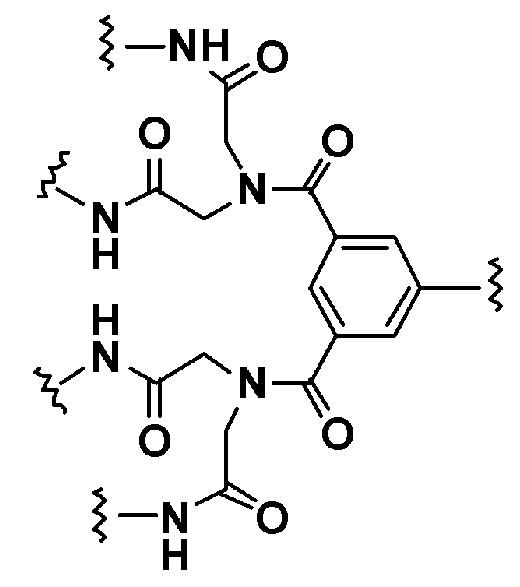


(식 중,
n2 및 n3은 각각 독립적으로 1∼100의 정수이다.)13. The nucleic acid complex according to any one of claims 1 to 12, wherein the linker has any one of the following structures.
(Wherein,
n2 and n3 are each independently an integer of 1 to 100.)
Applications Claiming Priority (3)
| Application Number | Priority Date | Filing Date | Title |
|---|---|---|---|
| JP2016131054 | 2016-06-30 | ||
| JPJP-P-2016-131054 | 2016-06-30 | ||
| PCT/JP2017/024268 WO2018004004A1 (en) | 2016-06-30 | 2017-06-30 | Nucleic acid complex |
Publications (2)
| Publication Number | Publication Date |
|---|---|
| KR20190022832A true KR20190022832A (en) | 2019-03-06 |
| KR102520362B1 KR102520362B1 (en) | 2023-04-10 |
Family
ID=60786901
Family Applications (1)
| Application Number | Title | Priority Date | Filing Date |
|---|---|---|---|
| KR1020197002874A Active KR102520362B1 (en) | 2016-06-30 | 2017-06-30 | A nucleic acid complex in which a sugar chain ligand is coupled to an oligonucleotide through a linker |
Country Status (9)
| Country | Link |
|---|---|
| US (1) | US12251446B2 (en) |
| EP (1) | EP3498724B1 (en) |
| JP (1) | JP7022687B2 (en) |
| KR (1) | KR102520362B1 (en) |
| CN (1) | CN109415401B (en) |
| AU (1) | AU2017287536B9 (en) |
| ES (1) | ES2952757T3 (en) |
| TW (1) | TWI746590B (en) |
| WO (1) | WO2018004004A1 (en) |
Families Citing this family (9)
| Publication number | Priority date | Publication date | Assignee | Title |
|---|---|---|---|---|
| ES2858090T3 (en) * | 2016-01-29 | 2021-09-29 | Kyowa Kirin Co Ltd | Nucleic acid complex |
| WO2019027015A1 (en) * | 2017-08-02 | 2019-02-07 | 協和発酵キリン株式会社 | Nucleic acid complex |
| WO2019027009A1 (en) * | 2017-08-02 | 2019-02-07 | 協和発酵キリン株式会社 | Nucleic acid complex |
| EP3902813A4 (en) * | 2018-12-28 | 2022-05-04 | Sirnaomics, Inc. | TARGETED DELIVERY OF THERAPEUTIC MOLECULES |
| EP4036102A4 (en) * | 2019-09-27 | 2023-09-20 | Agc Inc. | NUCLEIC ACID CONTAINING PERFLUORALKYL GROUPS AND METHOD FOR THE PRODUCTION THEREOF |
| JP7681525B2 (en) | 2020-01-30 | 2025-05-22 | エーザイ・アール・アンド・ディー・マネジメント株式会社 | Nucleic acid complex and pharmaceutical composition containing the same |
| CA3217717A1 (en) * | 2021-04-23 | 2022-10-27 | Ganna Bio, Inc. | Glycan modified nucleic acids, methods of preparation, and therapeutic uses |
| US20250215042A1 (en) * | 2022-04-01 | 2025-07-03 | Genevant Sciences Gmbh | Mannose-targeted compositions |
| WO2024086767A2 (en) * | 2022-10-21 | 2024-04-25 | Ganna Bio, Inc. | Glycan conjugate compositions and methods |
Citations (8)
| Publication number | Priority date | Publication date | Assignee | Title |
|---|---|---|---|---|
| WO2006093524A2 (en) | 2004-07-16 | 2006-09-08 | The General Hospital Corporation | Antigen-carbohydrate conjugates |
| JP2009073809A (en) | 2007-08-29 | 2009-04-09 | Tokyo Institute Of Technology | Thiol group-containing UV-sensitive compound and use thereof |
| WO2009073809A2 (en) * | 2007-12-04 | 2009-06-11 | Alnylam Pharmaceuticals, Inc. | Carbohydrate conjugates as delivery agents for oligonucleotides |
| JP2013075035A (en) | 2011-09-30 | 2013-04-25 | Canon Inc | Ophthalmic apparatus, ophthalmic image processing method, and recording medium |
| WO2014179620A1 (en) | 2013-05-01 | 2014-11-06 | Isis Pharmaceuticals, Inc. | Conjugated antisense compounds and their use |
| WO2015069932A1 (en) * | 2013-11-06 | 2015-05-14 | Solstice Biologics, Ltd. | Polynucleotide constructs having disulfide groups |
| WO2015105083A1 (en) | 2014-01-07 | 2015-07-16 | 塩野義製薬株式会社 | Double-stranded oligonucleotide containing antisense oligonucleotide and sugar derivative |
| WO2016092372A1 (en) * | 2014-12-12 | 2016-06-16 | Marcella Chiari | New clickable polymers and gels for microarray and other applications |
Family Cites Families (16)
| Publication number | Priority date | Publication date | Assignee | Title |
|---|---|---|---|---|
| US6469158B1 (en) | 1992-05-14 | 2002-10-22 | Ribozyme Pharmaceuticals, Incorporated | Synthesis, deprotection, analysis and purification of RNA and ribozymes |
| US5977343A (en) | 1992-05-14 | 1999-11-02 | Ribozyme Pharmaceuticals, Inc. | Synthesis, deprotection, analysis and purification of RNA and ribozymes |
| US5804683A (en) | 1992-05-14 | 1998-09-08 | Ribozyme Pharmaceuticals, Inc. | Deprotection of RNA with alkylamine |
| PT748382E (en) | 1993-09-02 | 2003-03-31 | Ribozyme Pharm Inc | NUCLEIC ENZYMAL ACIDS CONTAINING NON-NUCLEOTIDES |
| US5889136A (en) | 1995-06-09 | 1999-03-30 | The Regents Of The University Of Colorado | Orthoester protecting groups in RNA synthesis |
| US5998203A (en) | 1996-04-16 | 1999-12-07 | Ribozyme Pharmaceuticals, Inc. | Enzymatic nucleic acids containing 5'-and/or 3'-cap structures |
| US6111086A (en) | 1998-02-27 | 2000-08-29 | Scaringe; Stephen A. | Orthoester protecting groups |
| US20030059427A1 (en) | 2000-04-28 | 2003-03-27 | Force Walker R. | Isolation and characterization of highly active anti-CD40 antibody |
| WO2005113571A2 (en) | 2004-05-13 | 2005-12-01 | The University Of North Carolina At Chapel Hill | Methods for the delivery of oligomeric compounds |
| EP2289904A1 (en) | 2009-07-03 | 2011-03-02 | Universita' degli Studi di Milano | Inhibitors of microbial infections |
| RU2678807C2 (en) | 2011-11-18 | 2019-02-01 | Элнилэм Фармасьютикалз, Инк. | Rnai agents, compositions and methods for use thereof for treating transthyretin (ttr) associated diseases |
| CN104602714A (en) | 2012-05-16 | 2015-05-06 | Rana医疗有限公司 | Compositions and methods for modulating bdnf expression |
| EP2850184A4 (en) | 2012-05-16 | 2016-01-27 | Rana Therapeutics Inc | COMPOSITIONS AND METHODS FOR MODULATING GENE EXPRESSION |
| CA3177846A1 (en) * | 2013-07-11 | 2015-01-15 | Alnylam Pharmaceuticals, Inc. | Oligonucleotide-ligand conjugates and process for their preparation |
| US20180193471A1 (en) | 2015-07-16 | 2018-07-12 | Kyowa Hakko Kirin Co., Ltd. | ß2GPI GENE EXPRESSION-SUPPRESSING NUCLEIC ACID CONJUGATE |
| ES2858090T3 (en) * | 2016-01-29 | 2021-09-29 | Kyowa Kirin Co Ltd | Nucleic acid complex |
-
2017
- 2017-06-30 JP JP2018525319A patent/JP7022687B2/en active Active
- 2017-06-30 EP EP17820358.4A patent/EP3498724B1/en active Active
- 2017-06-30 ES ES17820358T patent/ES2952757T3/en active Active
- 2017-06-30 TW TW106122151A patent/TWI746590B/en active
- 2017-06-30 CN CN201780040847.4A patent/CN109415401B/en active Active
- 2017-06-30 AU AU2017287536A patent/AU2017287536B9/en active Active
- 2017-06-30 WO PCT/JP2017/024268 patent/WO2018004004A1/en not_active Ceased
- 2017-06-30 KR KR1020197002874A patent/KR102520362B1/en active Active
- 2017-06-30 US US16/314,015 patent/US12251446B2/en active Active
Patent Citations (8)
| Publication number | Priority date | Publication date | Assignee | Title |
|---|---|---|---|---|
| WO2006093524A2 (en) | 2004-07-16 | 2006-09-08 | The General Hospital Corporation | Antigen-carbohydrate conjugates |
| JP2009073809A (en) | 2007-08-29 | 2009-04-09 | Tokyo Institute Of Technology | Thiol group-containing UV-sensitive compound and use thereof |
| WO2009073809A2 (en) * | 2007-12-04 | 2009-06-11 | Alnylam Pharmaceuticals, Inc. | Carbohydrate conjugates as delivery agents for oligonucleotides |
| JP2013075035A (en) | 2011-09-30 | 2013-04-25 | Canon Inc | Ophthalmic apparatus, ophthalmic image processing method, and recording medium |
| WO2014179620A1 (en) | 2013-05-01 | 2014-11-06 | Isis Pharmaceuticals, Inc. | Conjugated antisense compounds and their use |
| WO2015069932A1 (en) * | 2013-11-06 | 2015-05-14 | Solstice Biologics, Ltd. | Polynucleotide constructs having disulfide groups |
| WO2015105083A1 (en) | 2014-01-07 | 2015-07-16 | 塩野義製薬株式会社 | Double-stranded oligonucleotide containing antisense oligonucleotide and sugar derivative |
| WO2016092372A1 (en) * | 2014-12-12 | 2016-06-16 | Marcella Chiari | New clickable polymers and gels for microarray and other applications |
Non-Patent Citations (5)
| Title |
|---|
| Curr. Top. Med. Chem., 2008, Vol. 8, No. 14, pp. 1237-1285 * |
| Org. Biomol. Chem., 2016, Vol. 14, No. 1, pp. 335-334 * |
| 비특허문헌 1: 저널 오브 아메리칸 케미컬 소사이어티(Journal of American Chemical Society), 2014년, 제136권, p 16958-16961 |
| 비특허문헌 2: 네이처 리뷰스 이뮤놀로지(Nature Reviews Immunology), 2009년, 제9권, p 465-479 |
| 비특허문헌 3: 네이처 리뷰스 이뮤놀로지(Nature Reviews Immunology), 2003년, 제3권, p 697-709 |
Also Published As
| Publication number | Publication date |
|---|---|
| KR102520362B1 (en) | 2023-04-10 |
| TW201803572A (en) | 2018-02-01 |
| AU2017287536B2 (en) | 2021-03-11 |
| CA3029508A1 (en) | 2018-01-04 |
| EP3498724A4 (en) | 2020-03-18 |
| EP3498724A1 (en) | 2019-06-19 |
| WO2018004004A1 (en) | 2018-01-04 |
| US12251446B2 (en) | 2025-03-18 |
| JP7022687B2 (en) | 2022-02-18 |
| US20190192674A1 (en) | 2019-06-27 |
| CN109415401B (en) | 2023-02-03 |
| EP3498724B1 (en) | 2023-06-21 |
| TWI746590B (en) | 2021-11-21 |
| JPWO2018004004A1 (en) | 2019-04-18 |
| CN109415401A (en) | 2019-03-01 |
| AU2017287536B9 (en) | 2021-03-25 |
| ES2952757T3 (en) | 2023-11-03 |
| AU2017287536A1 (en) | 2019-02-21 |
Similar Documents
| Publication | Publication Date | Title |
|---|---|---|
| KR102520362B1 (en) | A nucleic acid complex in which a sugar chain ligand is coupled to an oligonucleotide through a linker | |
| JP6853193B2 (en) | Nucleic acid complex | |
| CN114616332B (en) | GalNAc-oligonucleotide conjugates for delivery to the liver and methods for preparing the same | |
| KR20240070519A (en) | 1'-alkyl modified ribose derivatives and methods of use | |
| JPWO2017010575A1 (en) | β2GPI gene expression-suppressing nucleic acid complex | |
| WO2012074038A1 (en) | Modified single-strand polynucleotide | |
| WO2019027015A1 (en) | Nucleic acid complex | |
| KR20240082361A (en) | 2'-alkyl or 3'-alkyl modified ribose derivatives for use in in vivo delivery of oligonucleotides | |
| CN118076621A (en) | Polyhydroxylated cyclopentane derivatives and methods of use | |
| AU2023224208A1 (en) | 5'-modified carbocyclic ribonucleotide derivatives and methods of use | |
| KR20210098477A (en) | Nucleic Acid Complex | |
| WO2019027009A1 (en) | Nucleic acid complex | |
| CA3029508C (en) | Nucleic acid conjugate | |
| CA3130431A1 (en) | Phosphonoacetate gapmer oligonucleotides |
Legal Events
| Date | Code | Title | Description |
|---|---|---|---|
| PA0105 | International application |
Patent event date: 20190129 Patent event code: PA01051R01D Comment text: International Patent Application |
|
| PG1501 | Laying open of application | ||
| PA0201 | Request for examination |
Patent event code: PA02012R01D Patent event date: 20200625 Comment text: Request for Examination of Application |
|
| E902 | Notification of reason for refusal | ||
| PE0902 | Notice of grounds for rejection |
Comment text: Notification of reason for refusal Patent event date: 20220531 Patent event code: PE09021S01D |
|
| E701 | Decision to grant or registration of patent right | ||
| PE0701 | Decision of registration |
Patent event code: PE07011S01D Comment text: Decision to Grant Registration Patent event date: 20230224 |
|
| GRNT | Written decision to grant | ||
| PR0701 | Registration of establishment |
Comment text: Registration of Establishment Patent event date: 20230406 Patent event code: PR07011E01D |
|
| PR1002 | Payment of registration fee |
Payment date: 20230406 End annual number: 3 Start annual number: 1 |
|
| PG1601 | Publication of registration |