KR20180133899A - Reactive metal powder aerial heat treatment processes - Google Patents
Reactive metal powder aerial heat treatment processes Download PDFInfo
- Publication number
- KR20180133899A KR20180133899A KR1020187032426A KR20187032426A KR20180133899A KR 20180133899 A KR20180133899 A KR 20180133899A KR 1020187032426 A KR1020187032426 A KR 1020187032426A KR 20187032426 A KR20187032426 A KR 20187032426A KR 20180133899 A KR20180133899 A KR 20180133899A
- Authority
- KR
- South Korea
- Prior art keywords
- metal powder
- reactive metal
- less
- astm
- fluidity
- Prior art date
- Legal status (The legal status is an assumption and is not a legal conclusion. Google has not performed a legal analysis and makes no representation as to the accuracy of the status listed.)
- Granted
Links
Images


Classifications
-
- B—PERFORMING OPERATIONS; TRANSPORTING
- B22—CASTING; POWDER METALLURGY
- B22F—WORKING METALLIC POWDER; MANUFACTURE OF ARTICLES FROM METALLIC POWDER; MAKING METALLIC POWDER; APPARATUS OR DEVICES SPECIALLY ADAPTED FOR METALLIC POWDER
- B22F9/00—Making metallic powder or suspensions thereof
- B22F9/02—Making metallic powder or suspensions thereof using physical processes
- B22F9/06—Making metallic powder or suspensions thereof using physical processes starting from liquid material
- B22F9/08—Making metallic powder or suspensions thereof using physical processes starting from liquid material by casting, e.g. through sieves or in water, by atomising or spraying
- B22F9/082—Making metallic powder or suspensions thereof using physical processes starting from liquid material by casting, e.g. through sieves or in water, by atomising or spraying atomising using a fluid
-
- B22F1/0088—
-
- B22F1/0048—
-
- B22F1/0085—
-
- B22F1/02—
-
- B—PERFORMING OPERATIONS; TRANSPORTING
- B22—CASTING; POWDER METALLURGY
- B22F—WORKING METALLIC POWDER; MANUFACTURE OF ARTICLES FROM METALLIC POWDER; MAKING METALLIC POWDER; APPARATUS OR DEVICES SPECIALLY ADAPTED FOR METALLIC POWDER
- B22F1/00—Metallic powder; Treatment of metallic powder, e.g. to facilitate working or to improve properties
- B22F1/06—Metallic powder characterised by the shape of the particles
- B22F1/065—Spherical particles
-
- B—PERFORMING OPERATIONS; TRANSPORTING
- B22—CASTING; POWDER METALLURGY
- B22F—WORKING METALLIC POWDER; MANUFACTURE OF ARTICLES FROM METALLIC POWDER; MAKING METALLIC POWDER; APPARATUS OR DEVICES SPECIALLY ADAPTED FOR METALLIC POWDER
- B22F1/00—Metallic powder; Treatment of metallic powder, e.g. to facilitate working or to improve properties
- B22F1/14—Treatment of metallic powder
- B22F1/142—Thermal or thermo-mechanical treatment
-
- B—PERFORMING OPERATIONS; TRANSPORTING
- B22—CASTING; POWDER METALLURGY
- B22F—WORKING METALLIC POWDER; MANUFACTURE OF ARTICLES FROM METALLIC POWDER; MAKING METALLIC POWDER; APPARATUS OR DEVICES SPECIALLY ADAPTED FOR METALLIC POWDER
- B22F1/00—Metallic powder; Treatment of metallic powder, e.g. to facilitate working or to improve properties
- B22F1/14—Treatment of metallic powder
- B22F1/145—Chemical treatment, e.g. passivation or decarburisation
-
- B—PERFORMING OPERATIONS; TRANSPORTING
- B22—CASTING; POWDER METALLURGY
- B22F—WORKING METALLIC POWDER; MANUFACTURE OF ARTICLES FROM METALLIC POWDER; MAKING METALLIC POWDER; APPARATUS OR DEVICES SPECIALLY ADAPTED FOR METALLIC POWDER
- B22F1/00—Metallic powder; Treatment of metallic powder, e.g. to facilitate working or to improve properties
- B22F1/16—Metallic particles coated with a non-metal
-
- B—PERFORMING OPERATIONS; TRANSPORTING
- B22—CASTING; POWDER METALLURGY
- B22F—WORKING METALLIC POWDER; MANUFACTURE OF ARTICLES FROM METALLIC POWDER; MAKING METALLIC POWDER; APPARATUS OR DEVICES SPECIALLY ADAPTED FOR METALLIC POWDER
- B22F2999/00—Aspects linked to processes or compositions used in powder metallurgy
-
- Y—GENERAL TAGGING OF NEW TECHNOLOGICAL DEVELOPMENTS; GENERAL TAGGING OF CROSS-SECTIONAL TECHNOLOGIES SPANNING OVER SEVERAL SECTIONS OF THE IPC; TECHNICAL SUBJECTS COVERED BY FORMER USPC CROSS-REFERENCE ART COLLECTIONS [XRACs] AND DIGESTS
- Y02—TECHNOLOGIES OR APPLICATIONS FOR MITIGATION OR ADAPTATION AGAINST CLIMATE CHANGE
- Y02P—CLIMATE CHANGE MITIGATION TECHNOLOGIES IN THE PRODUCTION OR PROCESSING OF GOODS
- Y02P10/00—Technologies related to metal processing
- Y02P10/25—Process efficiency
Landscapes
- Chemical & Material Sciences (AREA)
- Engineering & Computer Science (AREA)
- Chemical Kinetics & Catalysis (AREA)
- General Chemical & Material Sciences (AREA)
- Physics & Mathematics (AREA)
- Thermal Sciences (AREA)
- Nanotechnology (AREA)
- Powder Metallurgy (AREA)
- Manufacture Of Metal Powder And Suspensions Thereof (AREA)
- Manufacturing & Machinery (AREA)
- Materials Engineering (AREA)
Abstract
반응성 금속 분말 공중 열 처리 프로세스들이 제공된다. 예를 들어, 이런 프로세스들은 반응성 금속 분말을 제공하는 단계; 및 상기 공중 열 처리 프로세스를 수행하는 동안 적어도 하나의 첨가 가스와 상기 반응성 금속 분말을 접촉시킴으로써 미가공 반응성 금속 분말을 획득하는 단계를 포함한다.Reactive metal powder aerial heat treatment processes are provided. For example, such processes include providing a reactive metal powder; And obtaining the raw reactive metal powder by contacting the reactive metal powder with at least one additive gas during the air heat treatment process.
Description
관련 출원에 대한 상호-참조Cross-reference to related application
본 출원은 2016년 4월 11일에 출원된 US 가출원 No 62/320,874에 대한 우선권을 주장한다. 이 문서는 그 전체가 참조로서 통합된다.This application claims priority to U.S. Provisional Application No. 62 / 320,874 filed on April 11, 2016. This document is incorporated by reference in its entirety.
기술 분야Technical field
본 발명은 반응성(reactive) 금속 분말과 같은 구상(spheroidal) 분말의 생산 분야에 관한 것이다. 보다 상세하게는, 개선된 유동성(flowability)을 가짐으로써 반응성 금속 분말을 준비하기 위한 방법들 및 장치들에 관한 것이다.The present invention relates to the field of the production of spheroidal powders such as reactive metal powders. More particularly, the present invention relates to methods and apparatus for preparing reactive metal powders by having improved flowability.
전형적으로, 고품질의 반응성 금속 분말의 바람직한 특징은 고 구형도(sphericity), 밀도, 순도, 유동성 및 가스 포획된 다공성(porosity)의 적은 양의 조합 일 것이다. 미세한 분말은 3D 프린팅, 분말 사출 성형(powder injection molding), 열간 등압 프레싱(hot isostatic pressing) 및 코팅과 같은 애플리케이션에 유용하다. 이러한 미세 분말은 우주 항공, 생물 의학 및 산업 응용 분야들에서 사용된다. Typically, a desirable feature of a high quality reactive metal powder will be a combination of high sphericity, density, purity, fluidity and small amounts of gas entrapped porosity. Fine powders are useful in applications such as 3D printing, powder injection molding, hot isostatic pressing and coating. These fine powders are used in aerospace, biomedical and industrial applications.
열악한 유동성을 갖는 분말은 더 낮는 밀도 및 더 높은 표면적을 갖는 큰 응집체(agglomerate)를 형성하는 경향이 있다. 이들 응집체는 미세 반응성 금속 분말을 필요로 하는 용도에 사용될 때 해로울 수 있다. 더욱이, 열악한 유동성을 갖는 반응성 분말은 원자화 장치의 원자화 챔버 또는 운반 튜브의 벽에 파이프 막힘(clogging) 및/또는 부착(stick)을 야기할 수 있다. 게다가, 응집체 형태의 분말은 상이한 크기 분포로 분말을 분리할 때 체로 거르기가 훨씬 어렵다. 응집체의 형태에 분말을 조작은 더 높은 표면적이 더 높은 반응도로 전환되므로 안전 위험이 또한 증가한다.Powders with poor fluidity tend to form large agglomerates with lower density and higher surface area. These aggregates can be harmful when used in applications requiring micro-reactive metal powders. Moreover, reactive powders with poor fluidity can cause pipe clogging and / or sticking to the walls of the atomization chamber or delivery tube of the atomization apparatus. In addition, agglomerated powders are much more difficult to sieve when separating the powder into different size distributions. Manipulation of the powder in the form of agglomerates also increases safety hazards as the higher surface area is converted to a higher degree of reactivity.
그와는 대조적으로, 개선된 유동성을 갖는 금속 분말은 다양한 이유로 바람직하다. 예를 들어, 그것들은 첨가제 제조 및 코팅제로서 분말 야금 프로세스들에서 보다 용이하게 사용될 수 있다.In contrast, metal powders with improved flowability are desirable for a variety of reasons. For example, they can be used more easily in powder metallurgy processes as additive preparation and coatings.
따라서, 정전기 감도와 관련된 반응성 금속 분말의 열악한 유동성을 적어도 부분적으로 처리할 디바이스, 시스템 또는 방법이 제공되는 것이 매우 바람직하다. 고 유동성 분말은 일반적으로 높은 겉보기 밀도(apparent density)로 전환되며, 그것은 균일한 분말 층을 생성하기 위해 보다 쉽게 분산될 수 있다.Accordingly, it is highly desirable to provide a device, system or method that will at least partially treat the poor fluidity of the reactive metal powder associated with electrostatic sensitivity. High flow powders generally convert to high apparent densities, which can be more easily dispersed to produce a uniform powder layer.
일 측면에 따라, 반응성 금속 분말 공중(in-flight) 열 처리 프로세스(heat treatment process)가 제공되며, According to one aspect, a reactive metal powder in-flight heat treatment process is provided,
반응성 금속 분말을 제공하는 단계; 및Providing a reactive metal powder; And
상기 공중 열 처리 프로세스를 수행하는 동안 적어도 하나의 첨가 가스와 상기 반응성 금속 분말을 접촉시키는 단계(contacting)를 포함한다. And contacting the reactive metal powder with at least one additive gas during the air heat treatment process.
다른 측면에 따라, 반응성 금속 분말 공중 열 처리 프로세스가 제공되며,According to another aspect, there is provided a reactive metal powder air-
반응성 금속 분말을 제공하는 단계; 및Providing a reactive metal powder; And
상기 공중 열 처리 프로세스를 수행하는 동안 적어도 하나의 첨가 가스와 상기 반응성 금속 분말을 접촉시킴으로써 미가공(raw) 반응성 금속 분말을 획득하는 단계를 포함하되, 상기 미가공 반응성 금속 분말은 Contacting the reactive metal powder with at least one additive gas during the air heat treatment process to obtain a raw reactive metal powder, wherein the raw reactive metal powder comprises:
ASTM B213에 따라 측정된 40s보다 작은 유동성(flowability)을 갖는 약 10 내지 약 53 ㎛의 입자 크기 분포(particle size distribution);A particle size distribution of about 10 to about 53 microns with flowability less than 40s measured according to ASTM B213;
ASTM B213에 따라 측정된 40s보다 작은 유동성을 갖는 약 10 내지 약 45 ㎛의 입자 크기 분포;A particle size distribution of from about 10 to about 45 microns with a fluidity of less than 40s measured according to ASTM B213;
ASTM B213에 따라 측정된 40s보다 작은 유동성을 갖는 약 15 내지 약 45 ㎛의 입자 크기 분포;A particle size distribution of from about 15 to about 45 microns with a fluidity of less than 40s measured according to ASTM B213;
ASTM B213에 따라 측정된 40s 보다 작은 유동성을 갖는 약 15 내지 약 53 ㎛의 입자 크기 분포;A particle size distribution of from about 15 to about 53 microns with a fluidity of less than 40s measured according to ASTM B213;
ASTM B213에 따라 측정된 40s 보다 작은 유동성을 갖는 약 25 내지 약 45 ㎛의 입자 크기 분포;A particle size distribution of from about 25 to about 45 microns with a fluidity of less than 40s measured according to ASTM B213;
ASTM B213에 따라 측정된 40s 보다 작은 유동성을 갖는 약 25 내지 약 53 ㎛의 입자 크기 분포;A particle size distribution of from about 25 to about 53 microns with a fluidity of less than 40s measured according to ASTM B213;
ASTM B213에 따라 측정된 28s 보다 작은 유동성을 갖는 약 45 내지 약 75 ㎛의 입자 크기 분포;A particle size distribution of from about 45 to about 75 microns with a fluidity of less than 28s measured according to ASTM B213;
ASTM B213에 따라 측정된 28s 보다 작은 유동성을 갖는 약 45 내지 약 106 ㎛의 입자 크기 분포;A particle size distribution of from about 45 to about 106 mu m with a fluidity of less than 28s measured according to ASTM B213;
ASTM B213에 따라 측정된 28s 보다 작은 유동성을 갖는 약 45 내지 약 150 ㎛의 입자 크기 분포; 및/또는A particle size distribution of from about 45 to about 150 microns with a fluidity of less than 28s measured according to ASTM B213; And / or
ASTM B213에 따라 측정된 28s 보다 작은 유동성을 갖는 약 45 내지 약 180 ㎛의 입자 크기 분포를 포함한다.And a particle size distribution of about 45 to about 180 [mu] m with a fluidity of less than 28s measured according to ASTM B213.
다른 측면에 따라, 반응성 금속 분말 공중 열 처리 프로세스가 제공되며,According to another aspect, there is provided a reactive metal powder air-
반응성 금속 분말을 제공하는 단계; 및Providing a reactive metal powder; And
상기 공중 열 처리 프로세스를 수행하는 동안 적어도 하나의 첨가 가스와 상기 반응성 금속 분말을 접촉시킴으로써 미가공 반응성 금속 분말을 획득하는 단계를 포함하되, 상기 미가공 반응성 금속 분말은 Contacting the reactive metal powder with at least one additive gas during the air heat treatment process to obtain a raw reactive metal powder, wherein the raw reactive metal powder comprises
ASTM B213에 따라 측정된 30s 보다 작은 유동성을 갖는 약 10 내지 약 53 ㎛의 입자 크기 분포;A particle size distribution of from about 10 to about 53 microns with a fluidity of less than 30s measured according to ASTM B213;
ASTM B213에 따라 측정된 30s 보다 작은 유동성을 갖는 약 10 내지 약 45 ㎛의 입자 크기 분포;A particle size distribution of from about 10 to about 45 microns with a fluidity of less than 30s measured according to ASTM B213;
ASTM B213에 따라 측정된 30s 보다 작은 유동성을 갖는 약 15 내지 약 45 ㎛의 입자 크기 분포;A particle size distribution of from about 15 to about 45 microns with a fluidity of less than 30s measured according to ASTM B213;
ASTM B213에 따라 측정된 30s 보다 작은 유동성을 갖는 약 15 내지 약 53 ㎛의 입자 크기 분포;A particle size distribution of from about 15 to about 53 microns with a fluidity of less than 30s measured according to ASTM B213;
ASTM B213에 따라 측정된 30s 보다 작은 유동성을 갖는 약 25 내지 약 45 ㎛의 입자 크기 분포; 및/또는A particle size distribution of from about 25 to about 45 microns with a fluidity of less than 30s measured according to ASTM B213; And / or
ASTM B213에 따라 측정된 30s 보다 작은 유동성을 갖는 약 25 내지 약 53 ㎛의 입자 크기 분포를 포함한다.And a particle size distribution of from about 25 to about 53 microns with a fluidity of less than 30s measured according to ASTM B213.
다른 측면에 따라, 반응성 금속 분말 공중 열 처리 프로세스가 제공되며,According to another aspect, there is provided a reactive metal powder air-
반응성 금속 분말을 제공하는 단계; Providing a reactive metal powder;
공중 열 처리 프로세스 가스 혼합물(gas mixture)을 획득하기 위해 공중 열 처리 프로세스 가스 및 적어도 하나의 첨가 가스를 함께 혼합하는 단계;Mixing the air heat treatment process gas and the at least one additive gas together to obtain an air heat treatment process gas mixture;
상기 공중 열 처리 프로세스를 수행하는 동안 상기 혼합물과 상기 반응성 금속 분말을 접촉시키는 단계를 포함한다. And contacting the mixture with the reactive metal powder during the air heat treatment process.
다른 측면에 따라, 반응성 금속 분말 공중 열 처리 프로세스가 제공되며,According to another aspect, there is provided a reactive metal powder air-
반응성 금속 분말을 제공하는 단계; Providing a reactive metal powder;
공중 열 처리 프로세스 가스 혼합물을 획득하기 위해 공중 열 처리 프로세스 가스 및 적어도 하나의 첨가 가스를 함께 혼합하는 단계;Mixing the air heat treatment process gas and at least one additive gas together to obtain an air heat treatment process gas mixture;
상기 공중 열 처리 프로세스를 수행하는 동안 상기 혼합물과 상기 반응성 금속 분말을 접촉시킴으로써 미가공 반응성 금속 분말을 획득하는 단계를 포함하되, 상기 미가공 반응성 금속 분말은 And contacting the mixture with the reactive metal powder during the air heat treatment process to obtain a raw reactive metal powder, wherein the raw reactive metal powder comprises
ASTM B213에 따라 측정된 40s 보다 작은 유동성을 갖는 약 10 내지 약 53 ㎛의 입자 크기 분포;A particle size distribution of from about 10 to about 53 microns with a fluidity of less than 40s measured according to ASTM B213;
ASTM B213에 따라 측정된 40s 보다 작은 유동성을 갖는 약 10 내지 약 45 ㎛의 입자 크기 분포;A particle size distribution of from about 10 to about 45 microns with a fluidity of less than 40s measured according to ASTM B213;
ASTM B213에 따라 측정된 40s 보다 작은 유동성을 갖는 약 15 내지 약 45 ㎛의 입자 크기 분포;A particle size distribution of from about 15 to about 45 microns with a fluidity of less than 40s measured according to ASTM B213;
ASTM B213에 따라 측정된 40s 보다 작은 유동성을 갖는 약 15 내지 약 53 ㎛의 입자 크기 분포;A particle size distribution of from about 15 to about 53 microns with a fluidity of less than 40s measured according to ASTM B213;
ASTM B213에 따라 측정된 40s 보다 작은 유동성을 갖는 약 25 내지 약 45 ㎛의 입자 크기 분포;A particle size distribution of from about 25 to about 45 microns with a fluidity of less than 40s measured according to ASTM B213;
ASTM B213에 따라 측정된 40s 보다 작은 유동성을 갖는 약 25 내지 약 53 ㎛의 입자 크기 분포;A particle size distribution of from about 25 to about 53 microns with a fluidity of less than 40s measured according to ASTM B213;
ASTM B213에 따라 측정된 28s 보다 작은 유동성을 갖는 약 45 내지 약 75 ㎛의 입자 크기 분포;A particle size distribution of from about 45 to about 75 microns with a fluidity of less than 28s measured according to ASTM B213;
ASTM B213에 따라 측정된 28s 보다 작은 유동성을 갖는 약 45 내지 약 106 ㎛의 입자 크기 분포;A particle size distribution of from about 45 to about 106 mu m with a fluidity of less than 28s measured according to ASTM B213;
ASTM B213에 따라 측정된 28s 보다 작은 유동성을 갖는 약 45 내지 약 150 ㎛의 입자 크기 분포; 및/또는A particle size distribution of from about 45 to about 150 microns with a fluidity of less than 28s measured according to ASTM B213; And / or
ASTM B213에 따라 측정된 28s 보다 작은 유동성을 갖는 약 45 내지 약 180 ㎛의 입자 크기 분포를 포함한다.And a particle size distribution of about 45 to about 180 [mu] m with a fluidity of less than 28s measured according to ASTM B213.
다른 측면에 따라, 반응성 금속 분말 공중 열 처리 프로세스가 제공되며,According to another aspect, there is provided a reactive metal powder air-
반응성 금속 분말을 제공하는 단계; Providing a reactive metal powder;
공중 열 처리 프로세스 가스 혼합물을 획득하기 위해 공중 열 처리 프로세스 가스 및 적어도 하나의 첨가 가스를 함께 혼합하는 단계;Mixing the air heat treatment process gas and at least one additive gas together to obtain an air heat treatment process gas mixture;
상기 공중 열 처리 프로세스를 수행하는 동안 상기 혼합물과 상기 반응성 금속 분말을 접촉시킴으로써 미가공 반응성 금속 분말을 획득하는 단계를 포함하되, 상기 미가공 반응성 금속 분말은 And contacting the mixture with the reactive metal powder during the air heat treatment process to obtain a raw reactive metal powder, wherein the raw reactive metal powder comprises
ASTM B213에 따라 측정된 30s 보다 작은 유동성을 갖는 약 10 내지 약 53 ㎛의 입자 크기 분포;A particle size distribution of from about 10 to about 53 microns with a fluidity of less than 30s measured according to ASTM B213;
ASTM B213에 따라 측정된 30s 보다 작은 유동성을 갖는 약 10 내지 약 45 ㎛의 입자 크기 분포;A particle size distribution of from about 10 to about 45 microns with a fluidity of less than 30s measured according to ASTM B213;
ASTM B213에 따라 측정된 30s 보다 작은 유동성을 갖는 약 15 내지 약 45 ㎛의 입자 크기 분포;A particle size distribution of from about 15 to about 45 microns with a fluidity of less than 30s measured according to ASTM B213;
ASTM B213에 따라 측정된 30s 보다 작은 유동성을 갖는 약 15 내지 약 53 ㎛의 입자 크기 분포;A particle size distribution of from about 15 to about 53 microns with a fluidity of less than 30s measured according to ASTM B213;
ASTM B213에 따라 측정된 30s 보다 작은 유동성을 갖는 약 25 내지 약 45 ㎛의 입자 크기 분포; 및/또는A particle size distribution of from about 25 to about 45 microns with a fluidity of less than 30s measured according to ASTM B213; And / or
ASTM B213에 따라 측정된 30s 보다 작은 유동성을 갖는 약 25 내지 약 53 ㎛의 입자 크기 분포를 포함한다.And a particle size distribution of from about 25 to about 53 microns with a fluidity of less than 30s measured according to ASTM B213.
다른 측면에 따라, 반응성 금속 분말 공중 열 처리 프로세스가 제공되며,According to another aspect, there is provided a reactive metal powder air-
반응성 금속 분말을 제공하는 단계; 및Providing a reactive metal powder; And
1000 ppm 보다 작은 상기 첨가 가스로부터 각각의 음전기(electronegative) 원자 및/또는 분자의 추가된 함량을 갖는 미가공 반응성 금속 분말을 생성하기에 충분한 조건하에서 상기 공중 열 처리 프로세스를 수행하는 동안 적어도 하나의 첨가 가스와 상기 반응성 금속 분말을 접촉시키는 단계를 포함한다.At least one additive gas during the air heat treatment process under conditions sufficient to produce an unreacted reactive metal powder having an added content of each electronegative atom and / or molecule from the additive gas of less than 1000 ppm, And the reactive metal powder are contacted with each other.
다른 측면에 따라, 반응성 금속 분말 공중 열 처리 프로세스가 제공되며,According to another aspect, there is provided a reactive metal powder air-
반응성 금속 분말을 제공하는 단계; Providing a reactive metal powder;
공중 열 처리 프로세스 가스 혼합물을 획득하기 위해 공중 열 처리 프로세스 가스 및 적어도 하나의 첨가 가스를 함께 혼합하는 단계;Mixing the air heat treatment process gas and at least one additive gas together to obtain an air heat treatment process gas mixture;
1000 ppm 보다 작은 상기 첨가 가스로부터 음전기 원자들 및/또는 분자들의 추가된 함량을 갖는 미가공 반응성 금속 분말을 생성하기에 충분한 조건하에서 상기 공중 열 처리 프로세스를 수행하는 동안 상기 공중 열 처리 프로세스 가스 혼합물과 상기 반응성 금속 분말 소스를 접촉시키는 단계를 포함한다.The method of
다른 측면에 따라, 반응성 금속 분말 공중 열 처리 프로세스가 제공되며,According to another aspect, there is provided a reactive metal powder air-
반응성 금속 분말을 제공하는 단계; Providing a reactive metal powder;
공중 열 처리 프로세스 가스 혼합물을 획득하기 위해 공중 열 처리 프로세스 가스 및 적어도 하나의 첨가 가스를 함께 혼합하는 단계;Mixing the air heat treatment process gas and at least one additive gas together to obtain an air heat treatment process gas mixture;
상기 공중 열 처리 프로세스를 수행하는 동안 상기 공중 열 처리 프로세스 가스 혼합물과 상기 반응성 금속 분말을 접촉시킴으로써 미가공 반응성 금속 분말을 획득하는 단계;Obtaining a raw reactive metal powder by contacting the air-heated process gas mixture with the reactive metal powder during the air heat treatment process;
옵션으로 미리 결정된 입자 크기를 갖는 분말을 획득하기 위해 상기 미가공 반응성 금속 분말을 체로 거르는 단계(sieving); 및Optionally sieving said raw reactive metal powder to obtain a powder having a predetermined particle size; And
옵션으로 상기 미리 결정된 입자 크기를 갖는 상기 분말을 물과 접촉시키는 단계를 포함한다.Optionally contacting the powder having the predetermined particle size with water.
본 발명은 고 유동성을 나타내는 반응성 금속 분말의 제조를 가능하게 하는 방법들, 프로세스들, 시스템들 및 장치들에 관한 것이다. 설명된 처리 없이는 미세 입자 크기 분포가 홀 유량계( Hall flowmeter)에서 조차도 흐르지 않는 것을 포함하여 다양한 입자 크기 분포에 대한 효과가 관측될 수 있다. 본 방법의 한 가지 장점은 분말에 이질적인 입자들을 추가하지 않는다는 것이다. 개선 유발은 단지 표면 처리일뿐이다.The present invention relates to methods, processes, systems and devices that enable the production of reactive metal powders exhibiting high flow properties. Without the treatment described, effects on the various particle size distributions can be observed, including that the fine particle size distribution does not flow even in the Hall flowmeter. One advantage of the method is that it does not add heterogeneous particles to the powder. The improvement induction is merely a surface treatment.
본 발명에 설명된 다양한 기술들은 분말의 개선된 유동성 거동으로 귀결되어 분말의 정전기 감도를 감소시키는데 도움이 되는 것을 관측하였다.The various techniques described in the present invention have been observed to result in an improved flow behavior of the powder which helps to reduce the electrostatic sensitivity of the powder.
이하의 도면들은 비 제한적인 예제들을 나타낸다.
도 1은 플라즈마 토치 및 축 방향 분말 주입을 이용하는 공중 열 처리 프로세스의 단면도이다;
도 2는 플라즈마 토치 및 방사상(radial) 분말 주입을 이용하는 공중 열 처리 프로세스의 단면도이다;
도 3은 플라즈마 토치, 방사상 분말 주입 및 다운스트림(downstream) 첨가 가스 주입을 이용하는 공중 열 처리 프로세스의 단면도이다;
도 4는 축 방향 분말 주입 및 퍼니스(furnace)와 결합된 가스 히터를 이용하는 공중 열 처리 프로세스의 단면도이다;
도 5는 예시적인 원자화 시스템의 단면도이다;
도 6은 가열된 금속 소스가 첨가 가스와 접촉하지 않는 원자화 프로세스(atomization process)에 따라 형성된 반응성 금속 분말의 입자의 개략도이다;
도 7은 가열된 금속 소스가 첨가 가스와 접촉하는 원자화 프로세스에 따라 형성된 반응성 금속 분말의 입자의 개략도이다;
도 8은 반경 R을 갖는 입자 및 복수의 입자들 - 각각이 동일한 질량의 재료로 형성된 반경 r을 갖는 - 의 개략도를 도시한다;
도 9는 다양한 테스팅들로부터 획득된 입자에 대한 TOF-SIMS 시그니처(signature)를 도시한다;
도 10은 첨가 가스와 접촉하는 단계를 포함하지 않는 원자화 프로세스에 따라 형성된 한 분량(batch)의 금속 분말의 사진이다; 및
도 11은 금속 소스가 첨가 가스와 접촉하는 원자화 프로세스에 따라 형성된 한 분량의 금속 분말의 사진이다.The following figures illustrate non-limiting examples.
BRIEF DESCRIPTION OF THE DRAWINGS Figure 1 is a cross-sectional view of an air heat treatment process using plasma torch and axial powder injection;
2 is a cross-sectional view of the air heat treatment process using plasma torch and radial powder injection;
3 is a cross-sectional view of an air heat treatment process using plasma torch, radial powder injection and downstream additive gas injection;
4 is a cross-sectional view of an air heat treatment process using a gas heater coupled with axial powder injection and a furnace;
5 is a cross-sectional view of an exemplary atomization system;
Figure 6 is a schematic view of particles of reactive metal powder formed according to an atomization process in which a heated metal source is not in contact with additive gases;
Figure 7 is a schematic view of particles of reactive metal powder formed in accordance with an atomization process in which a heated metal source contacts the additive gas;
Figure 8 shows a schematic of a particle with a radius R and a plurality of particles-each with a radius r formed of the same mass of material;
Figure 9 shows the TOF-SIMS signature for particles obtained from various tests;
10 is a photograph of a batch of metal powder formed in accordance with an atomization process that does not involve contacting with an additive gas; And
Figure 11 is a photograph of a portion of a metal powder formed in accordance with an atomization process in which a metal source contacts the additive gas.
이하의 예들은 비 제한적인 방식으로 제시된다.The following examples are presented in a non-limiting manner.
청구항 및/또는 명세서에서 용어 "포함하다"와 함께 사용되는 경우 단어 "하나의 (a)"또는 "하나 (an)"라는 단어는 "하나"를 의미할 수 있지만, 또한 내용이 명백히 다른 식으로 구술되지 않는다면 "하나 이상의", "적어도 하나" 및 "하나 또는 하나 초과의(one or more than one)"의 의미와 일치한다. 유사하게, 단어 "다른(another)"은 그 내용이 명백하게 달리 지시하지 않는 한 적어도 두 번째 또는 그 이상을 의미할 수 있다.The word "a" or "an" when used in conjunction with the term "comprise" in the claims and / or the specification may mean "one," but also means that the content is expressly One or more than one "unless the context clearly dictates otherwise. &Quot; one or more than one " Similarly, the word " another "may mean at least a second or more unless the content clearly dictates otherwise.
본 명세서 및 청구항(들)에서 사용되는, 단어 "포함하는(comprising)" (및 "포함한다(comprise)" 및 "포함한다(comprises)"와 같은 포함하는(comprising)의 임의의 형태), "갖는(having)" (및 " 갖다(have) " 및 "갖다(has)"와 같은 갖는(having)의 임의의 형태), "포함하는(including)" (및 "포함한다(include)" 및 "포함한다(includes)"와 같은 포함하는(including)의 임의의 형태) 또는"함유하는(containing)" (및 "함유한다(contain) "및"함유한다(contains) "과 같은 임의의 형태)는 포괄적이거나 오픈 엔드(open-ended)되고 추가의 나열되지 않은 엘리먼트 또는 프로세스 단계들을 배제하지 않는다.The word "comprising" (and any form of comprising, such as " comprise "and" comprises ", as used in this specification and in the claims) Including "and" includes "(and any form of having, such as" having "and" has "), (Or any form of including such as "includes"), or "containing" (and any form such as "contain" and "contains" It is comprehensive or open-ended and does not exclude additional unlisted elements or process steps.
본 출원에서 사용되는 표현 "원자화 존(atomization zone)"은 금속 분말을 준비하기 위한 방법, 장치 또는 시스템을 언급할 때, 재료가 재료의 액적(droplet)들로 원자화되는 존을 나타낸다. 관련 기술 분야의 통상의 기술자는 원자화 존의 치수가 다양한 파라미터들 예컨대, 원자화 수단의 온도, 원자화 수단의 속도, 원자화 수단의 재료, 원자화 수단의 파워, 원자화 존에 유입되기 전의 재료의 온도, 재료의 성질, 재료의 치수, 재료의 전기 저항 등에 따라 변할 것이다라는 것을 이해할 것이다. As used in this application, the expression "atomization zone " refers to a zone in which a material is atomized into droplets of material when referring to a method, apparatus or system for preparing a metal powder. It will be appreciated by those of ordinary skill in the art that the dimensions of the atomization zone may vary depending on various parameters such as the temperature of the atomization means, the speed of the atomization means, the material of the atomization means, the power of the atomization means, the temperature of the material before entering the atomization zone, The nature of the material, the dimensions of the material, the electrical resistance of the material, and so on.
본 출원에서 사용되는 표현 “미립화기의 가열 존(heat zone of an atomizer)”는 분말이 본 발명에서 논의되는 공핍층(depletion layer)을 생성하기 위해 첨가 가스의 음전기 원자들과 반응하기에 충분한 고온인 존을 지칭한다. As used herein, the expression " heat zone of an atomizer " means that the powder has a temperature sufficient to react with the negatively charged atoms of the additive gas to produce the depletion layer discussed in this invention Quot; zone ".
"금속 분말(metal powder)이 X-Y㎛ 입자 크기 분포(particle size distribution)를 갖는다"라는 표현은 그것이 ASTM B214 표준에 따라 측정된 Y㎛ 크기 초과의 입자의 5 %wt. 미만을 갖는다는 것을 의미한다. 그것은 또한 ASTM B822 표준에 따라 측정된 X㎛ 크기 아래의 (d6 ≥ X ㎛) 입자의 6 %wt. 미만을 갖는다는 것을 의미한다.The expression "metal powder has an X-Y micron particle size distribution" means that it has a particle size distribution of 5% wt. Of particles larger than Y micrometers measured according to ASTM B214 standard. ≪ / RTI > It also contains 6% wt. Of particles (d6 > X m) below the size of X m measured according to ASTM B822 standard. ≪ / RTI >
" 15-45 ㎛ 입자 크기를 갖는 금속 분말"이라는 표현은 그것이 45 ㎛ 초과의 입자의(ASTM B214 표준에 따라 측정된) 5%wt. 미만을 갖고, 15 ㎛ 아래의 입자의 (ASTM B822 표준에 따라 측정된) 6%wt. 미만을 갖는다는 것을 의미한다.The expression "metal powder having a particle size of 15-45 mu m" means that it has a 5% wt. (Measured according to ASTM B214 standard) of particles greater than 45 mu m. (Measured according to the ASTM B822 standard) of particles below 15 [mu] m. ≪ / RTI >
본 출원에서 사용되는 표현 "가스 대 금속 비율(Gas to Metal ratio)"은 원자화 존에 제공된 금속 소스의 질량 피드율(feed rate) (kg/s)에 따라 주입된 가스의 단위 시간당 질량의 비율 (kg/s)을 나타낸다. The expression "Gas to Metal ratio" used in the present application means the ratio of the mass per unit time of the injected gas to the mass feed rate (kg / s) of the metal source provided in the atomization zone kg / s).
본 츨원에서 사용되는 표현 "반응성 금속 분말(reactive metal powder)"은 근접 결합된(close-coupled) 노즐이 사용되는 고전적인 가스 원자화 프로세스를 통해 효율적으로 준비될 수 없는 금속 분말을 의미한다. 예를 들어, 이런 반응성 금속 분말은 티타늄, 티타늄 합금들, 지르코늄, 지르코늄 합금들, 마그네슘, 마그네슘 합금들, 알루미늄 및 알루미늄 합금들로부터 선택된 적어도 하나 부재를 포함하는 분말일 수 있다. As used herein, the expression "reactive metal powder" refers to a metal powder that can not be efficiently prepared through a classical gas atomization process in which close-coupled nozzles are used. For example, such a reactive metal powder may be a powder comprising at least one member selected from titanium, titanium alloys, zirconium, zirconium alloys, magnesium, magnesium alloys, aluminum and aluminum alloys.
본 출원에서 사용되는 표현 "미가공 반응성 금속 분말(raw reactive metal powder)"은 체로 거르는 단계(sieving) 또는 분류 기술들과 같은 임의의 후처리 단계없이 원자화 프로세스로부터 직접 획득된 반응성 금속 분말을 지칭한다.As used herein, the expression "raw reactive metal powder" refers to a reactive metal powder obtained directly from an atomization process without any post-treatment steps such as sieving or sorting techniques.
본 출원에서 사용되는 표현 "공중(in-flight) 열 처리 프로세스(heat treatment process)"은 금속 분말의 유동성을 개선시키기 위한 그리고 금속 분말의 금속 입자들의 표면의 화학적 조성을 변형시키기에 효과적인 프로세스를 지칭한다. 예를 들어, 이런 공중 열 처리 프로세스는 원자화 프로세스, 구상화 프로세스(spheroidization process), 공중 퍼니스 가열 프로세스 또는 공중 플라즈마 가열 프로세스일 수 있다. The expression "in-flight heat treatment process " as used in this application refers to a process that is effective for improving the flowability of metal powders and for modifying the chemical composition of the surface of metal particles of metal powders . For example, such an air heat treatment process may be an atomization process, a spheroidization process, a public furnace heating process or an aerial plasma heating process.
106 ㎛ 미만의 크기 분포와 같은 미세 입자 크기들을 갖는 반응성 금속 분말은 더 많은 표면적 및 더 강한 표면 상호 작용들을 갖는 것으로 관찰되었다. 이들은 굵은(coarse) 분말보다 더 열악한 유동성으로 귀결된다. 분말의 유동성은 다양한 요인들 예컨대, 입자 형상, 입자 크기 분포, 표면 매끄러움(surface smoothness), 수분 레벨, 위성 함량(satellite content) 및 정전기의 존재 중 하나 이상에 의존한다. 따라서 분말의 유동성은 분말 입자들에 대한 접착력과 중력의 균형에서 기인한 복잡한 거시적 특성(macroscopic characteristic)이다.It has been observed that reactive metal powders with fine particle sizes, such as size distributions less than 106 mu m, have more surface area and stronger surface interactions. These result in poorer fluidity than coarse powders. The fluidity of the powder depends on one or more of various factors such as particle shape, particle size distribution, surface smoothness, moisture level, satellite content, and the presence of static electricity. Thus, the flowability of the powder is a complex macroscopic characteristic due to the balance of adhesion and gravity to the powder particles.
예를 들어, 입자 크기 분포는 :For example, the particle size distribution is:
ASTM B213에 따라 측정된 40s 보다 작은 유동성을 갖는 약 10 내지 약 53 ㎛를 가질 수 있고;Having a fluidity of less than 40s measured according to ASTM B213 from about 10 to about 53 microns;
ASTM B213에 따라 측정된 40s 보다 작은 유동성을 갖는 약 10 내지 약 45 ㎛를 가질 수 있고;Having a fluidity of less than 40s measured according to ASTM B213 from about 10 to about 45 microns;
ASTM B213에 따라 측정된 40s 보다 작은 유동성을 갖는 약 15 내지 약 45 ㎛를 가질 수 있고;From about 15 to about 45 microns with a fluidity of less than 40s measured according to ASTM B213;
ASTM B213에 따라 측정된 40s 보다 작은 유동성을 갖는 약 15 내지 약 53 ㎛를 가질 수 있고;From about 15 to about 53 microns with a fluidity of less than 40s measured according to ASTM B213;
ASTM B213에 따라 측정된 40s 보다 작은 유동성을 갖는 약 25 내지 약 45 ㎛를 가질 수 있고;Having a fluidity of less than 40s measured according to ASTM B213 from about 25 to about 45 microns;
ASTM B213에 따라 측정된 40s 보다 작은 유동성을 갖는 약 25 내지 약 53 ㎛를 가질 수 있고;From about 25 to about 53 microns with a fluidity of less than 40s measured according to ASTM B213;
ASTM B213에 따라 측정된 28s 보다 작은 유동성을 갖는 약 45 내지 약 75 ㎛를 가질 수 있고;Having a fluidity of less than 28s measured according to ASTM B213 from about 45 to about 75 microns;
ASTM B213에 따라 측정된 28s 보다 작은 유동성을 갖는 약 45 내지 약 106 ㎛를 가질 수 있고;Having a fluidity of less than 28s measured according to ASTM B213 from about 45 to about 106 microns;
ASTM B213에 따라 측정된 28s 보다 작은 유동성을 갖는 약 45 내지 약 150 ㎛를 가질 수 있고; 및/또는Having a fluidity of less than 28s measured in accordance with ASTM B213 from about 45 to about 150 microns; And / or
ASTM B213에 따라 측정된 28s 보다 작은 유동성을 갖는 약 45 내지 약 180 ㎛를 가질 수 있다.Lt; RTI ID = 0.0 > 180 < / RTI > m with a fluidity of less than 28s measured according to ASTM B213.
예를 들어, 입자 크기 분포는 ASTM B213에 따라 측정된 36s 보다 작은 유동성을 갖는 약 10 내지 약 53 ㎛ 일 수 있다.For example, the particle size distribution may be from about 10 to about 53 [mu] m with a fluidity of less than 36s measured according to ASTM B213.
예를 들어, 입자 크기 분포는 ASTM B213에 따라 측정된 32s 보다 작은 유동성을 갖는 약 10 내지 약 53 ㎛ 일 수 있다.For example, the particle size distribution may be from about 10 to about 53 microns with a fluidity of less than 32s measured according to ASTM B213.
예를 들어, 입자 크기 분포는 ASTM B213에 따라 측정된 30s 보다 작은 유동성을 갖는 약 10 내지 약 53 ㎛ 일 수 있다.For example, the particle size distribution may be from about 10 to about 53 [mu] m with a fluidity of less than 30s measured in accordance with ASTM B213.
예를 들어, 입자 크기 분포는 ASTM B213에 따라 측정된 28s 보다 작은 유동성을 갖는 약 10 내지 약 53 ㎛ 일 수 있다.For example, the particle size distribution may be from about 10 to about 53 [mu] m with a fluidity of less than 28s measured according to ASTM B213.
예를 들어, 입자 크기 분포는 ASTM B213에 따라 측정된 36s 보다 작은 유동성을 갖는 약 10 내지 약 45 ㎛ 일 수 있다.For example, the particle size distribution may be from about 10 to about 45 microns with a fluidity of less than 36s measured in accordance with ASTM B213.
예를 들어, 입자 크기 분포는 ASTM B213에 따라 측정된 32s 보다 작은 유동성을 갖는 약 10 내지 약 45 ㎛ 일 수 있다.For example, the particle size distribution may be from about 10 to about 45 microns with a fluidity of less than 32s measured in accordance with ASTM B213.
예를 들어, 입자 크기 분포는 ASTM B213에 따라 측정된 30s 보다 작은 유동성을 갖는 약 10 내지 약 45 ㎛ 일 수 있다.For example, the particle size distribution may be from about 10 to about 45 microns with a fluidity of less than 30s measured in accordance with ASTM B213.
예를 들어, 입자 크기 분포는 ASTM B213에 따라 측정된 28s 보다 작은 유동성을 갖는 약 10 내지 약 45 ㎛ 일 수 있다.For example, the particle size distribution may be from about 10 to about 45 microns with a fluidity of less than 28s measured according to ASTM B213.
예를 들어, 입자 크기 분포는 ASTM B213에 따라 측정된 36s 보다 작은 유동성을 갖는 약 15 내지 약 45 ㎛ 일 수 있다.For example, the particle size distribution may be from about 15 to about 45 microns with a fluidity of less than 36s measured according to ASTM B213.
예를 들어, 입자 크기 분포는 ASTM B213에 따라 측정된 32s 보다 작은 유동성을 갖는 약 15 내지 약 45 ㎛ 일 수 있다.For example, the particle size distribution may be about 15 to about 45 microns with a fluidity of less than 32s measured according to ASTM B213.
예를 들어, 입자 크기 분포는 ASTM B213에 따라 측정된 30s 보다 작은 유동성을 갖는 약 15 내지 약 45 ㎛ 일 수 있다.For example, the particle size distribution may be from about 15 to about 45 microns with a fluidity of less than 30s measured in accordance with ASTM B213.
예를 들어, 입자 크기 분포는 ASTM B213에 따라 측정된 28s 보다 작은 유동성을 갖는 약 15 내지 약 45 ㎛ 일 수 있다.For example, the particle size distribution may be from about 15 to about 45 microns with a fluidity of less than 28s measured according to ASTM B213.
예를 들어, 입자 크기 분포는 ASTM B213에 따라 측정된 36s 보다 작은 유동성을 갖는 약 15 내지 약 53 ㎛ 일 수 있다.For example, the particle size distribution may be about 15 to about 53 microns with a fluidity of less than 36s measured according to ASTM B213.
예를 들어, 입자 크기 분포는 ASTM B213에 따라 측정된 32s 보다 작은 유동성을 갖는 약 15 내지 약 53 ㎛ 일 수 있다.For example, the particle size distribution may be from about 15 to about 53 [mu] m with a fluidity of less than 32s measured according to ASTM B213.
예를 들어, 입자 크기 분포는 ASTM B213에 따라 측정된 30s 보다 작은 유동성을 갖는 약 15 내지 약 53 ㎛ 일 수 있다.For example, the particle size distribution may be from about 15 to about 53 [mu] m with a fluidity of less than 30s measured according to ASTM B213.
예를 들어, 입자 크기 분포는 ASTM B213에 따라 측정된 28s 보다 작은 유동성을 갖는 약 15 내지 약 53 ㎛ 일 수 있다.For example, the particle size distribution may be from about 15 to about 53 microns with a fluidity of less than 28s measured according to ASTM B213.
예를 들어, 미가공 반응성 금속 분말은 ASTM B213에 따라 측정된 36s 보다 작은 유동성을 갖는 약 25 내지 약 45 ㎛의 입자 크기 분포를 포함한다.For example, the raw reactive metal powder comprises a particle size distribution of from about 25 to about 45 microns with a fluidity of less than 36s measured according to ASTM B213.
예를 들어, 미가공 반응성 금속 분말은 ASTM B213에 따라 측정된 32s 보다 작은 유동성을 갖는 약 25 내지 약 45 ㎛의 입자 크기 분포를 포함한다.For example, the raw reactive metal powder comprises a particle size distribution of from about 25 to about 45 microns with a fluidity of less than 32s measured according to ASTM B213.
예를 들어, 미가공 반응성 금속 분말은 ASTM B213에 따라 측정된 30s 보다 작은 유동성을 갖는 약 25 내지 약 45 ㎛의 입자 크기 분포를 포함한다.For example, the raw reactive metal powder comprises a particle size distribution of from about 25 to about 45 microns with a fluidity of less than 30s measured according to ASTM B213.
예를 들어, 미가공 반응성 금속 분말은 ASTM B213에 따라 측정된 25s 보다 작은 유동성을 갖는 약 25 내지 약 45 ㎛의 입자 크기 분포를 포함한다.For example, the raw reactive metal powder comprises a particle size distribution of from about 25 to about 45 microns with a fluidity of less than 25s measured according to ASTM B213.
예를 들어, 미가공 반응성 금속 분말은 ASTM B213에 따라 측정된 36s 보다 작은 유동성을 갖는 약 25 내지 약 53 ㎛의 입자 크기 분포를 포함한다.For example, the raw reactive metal powder comprises a particle size distribution of from about 25 to about 53 microns with a fluidity of less than 36s measured according to ASTM B213.
예를 들어, 미가공 반응성 금속 분말은 ASTM B213에 따라 측정된 32s 보다 작은 유동성을 갖는 약 25 내지 약 53 ㎛의 입자 크기 분포를 포함한다.For example, the raw reactive metal powder comprises a particle size distribution of from about 25 to about 53 microns with a fluidity of less than 32s measured according to ASTM B213.
예를 들어, 미가공 반응성 금속 분말은 ASTM B213에 따라 측정된 30s 보다 작은 유동성을 갖는 약 25 내지 약 53 ㎛의 입자 크기 분포를 포함한다.For example, the raw reactive metal powder comprises a particle size distribution of from about 25 to about 53 microns with a fluidity of less than 30 seconds measured according to ASTM B213.
예를 들어, 미가공 반응성 금속 분말은 ASTM B213에 따라 측정된 25s 보다 작은 유동성을 갖는 약 25 내지 약 53 ㎛의 입자 크기 분포를 포함한다.For example, the raw reactive metal powder comprises a particle size distribution of from about 25 to about 53 microns with a fluidity of less than 25s measured according to ASTM B213.
예를 들어, 미가공 반응성 금속 분말은 ASTM B213에 따라 측정된 26s 보다 작은 유동성을 갖는 약 45 내지 약 75 ㎛의 입자 크기 분포를 포함한다.For example, the raw reactive metal powder comprises a particle size distribution of about 45 to about 75 microns with a fluidity of less than 26s measured according to ASTM B213.
예를 들어, 미가공 반응성 금속 분말은 ASTM B213에 따라 측정된 25s 보다 작은 유동성을 갖는 약 45 내지 약 75 ㎛의 입자 크기 분포를 포함한다.For example, the raw reactive metal powder comprises a particle size distribution of about 45 to about 75 microns with a fluidity of less than 25s measured according to ASTM B213.
예를 들어, 미가공 반응성 금속 분말은 ASTM B213에 따라 측정된 24s 보다 작은 유동성을 갖는 약 45 내지 약 75 ㎛의 입자 크기 분포를 포함한다.For example, the raw reactive metal powder comprises a particle size distribution of from about 45 to about 75 microns with a fluidity of less than 24s measured according to ASTM B213.
예를 들어, 미가공 반응성 금속 분말은 ASTM B213에 따라 측정된 23s 보다 작은 유동성을 갖는 약 45 내지 약 75 ㎛의 입자 크기 분포를 포함한다.For example, the raw reactive metal powder comprises a particle size distribution of from about 45 to about 75 microns with a fluidity of less than 23s measured according to ASTM B213.
예를 들어, 미가공 반응성 금속 분말은 ASTM B213에 따라 측정된 26s 보다 작은 유동성을 갖는 약 45 내지 약 106 ㎛의 입자 크기 분포를 포함한다.For example, the raw reactive metal powder comprises a particle size distribution of about 45 to about 106 microns with a fluidity of less than 26s measured according to ASTM B213.
예를 들어, 미가공 반응성 금속 분말은 ASTM B213에 따라 측정된 25s 보다 작은 유동성을 갖는 약 45 내지 약 106 ㎛의 입자 크기 분포를 포함한다.For example, the raw reactive metal powder comprises a particle size distribution of about 45 to about 106 microns with a fluidity of less than 25s measured according to ASTM B213.
예를 들어, 미가공 반응성 금속 분말은 ASTM B213에 따라 측정된 24s 보다 작은 유동성을 갖는 약 45 내지 약 106 ㎛의 입자 크기 분포를 포함한다.For example, the raw reactive metal powder comprises a particle size distribution of about 45 to about 106 microns with a fluidity of less than 24s measured according to ASTM B213.
예를 들어, 미가공 반응성 금속 분말은 ASTM B213에 따라 측정된 23s 보다 작은 유동성을 갖는 약 45 내지 약 106 ㎛의 입자 크기 분포를 포함한다.For example, the raw reactive metal powder comprises a particle size distribution of about 45 to about 106 microns with a fluidity of less than 23s measured according to ASTM B213.
예를 들어, 미가공 반응성 금속 분말은 ASTM B213에 따라 측정된 26s 보다 작은 유동성을 갖는 약 45 내지 약 150 ㎛의 입자 크기 분포를 포함한다.For example, the raw reactive metal powder comprises a particle size distribution of from about 45 to about 150 microns with a fluidity of less than 26s measured according to ASTM B213.
예를 들어, 미가공 반응성 금속 분말은 ASTM B213에 따라 측정된 25s 보다 작은 유동성을 갖는 약 45 내지 약 150 ㎛의 입자 크기 분포를 포함한다.For example, the raw reactive metal powder comprises a particle size distribution of from about 45 to about 150 microns with a fluidity of less than 25s measured according to ASTM B213.
예를 들어, 미가공 반응성 금속 분말은 ASTM B213에 따라 측정된 24s 보다 작은 유동성을 갖는 약 45 내지 약 150 ㎛의 입자 크기 분포를 포함한다.For example, the raw reactive metal powder comprises a particle size distribution of about 45 to about 150 microns with a fluidity of less than 24s measured according to ASTM B213.
예를 들어, 미가공 반응성 금속 분말은 ASTM B213에 따라 측정된 23s 보다 작은 유동성을 갖는 약 45 내지 약 150 ㎛의 입자 크기 분포를 포함한다.For example, the raw reactive metal powder comprises a particle size distribution of about 45 to about 150 microns with a fluidity of less than 23s measured according to ASTM B213.
예를 들어, 미가공 반응성 금속 분말은 ASTM B213에 따라 측정된 26s 보다 작은 유동성을 갖는 약 45 내지 약 180 ㎛의 입자 크기 분포를 포함한다.For example, the raw reactive metal powder comprises a particle size distribution of about 45 to about 180 microns with a fluidity of less than 26s measured according to ASTM B213.
예를 들어, 미가공 반응성 금속 분말은 ASTM B213에 따라 측정된 25s 보다 작은 유동성을 갖는 약 45 내지 약 180 ㎛의 입자 크기 분포를 포함한다.For example, the raw reactive metal powder comprises a particle size distribution of about 45 to about 180 microns with a fluidity of less than 25s measured according to ASTM B213.
예를 들어, 미가공 반응성 금속 분말은 ASTM B213에 따라 측정된 24s 보다 작은 유동성을 갖는 약 45 내지 약 180 ㎛의 입자 크기 분포를 포함한다.For example, the raw reactive metal powder comprises a particle size distribution of about 45 to about 180 microns with a fluidity of less than 24s measured according to ASTM B213.
예를 들어, 미가공 반응성 금속 분말은 ASTM B213에 따라 측정된 23s 보다 작은 유동성을 갖는 약 45 내지 약 180 ㎛의 입자 크기 분포를 포함한다.For example, the raw reactive metal powder comprises a particle size distribution of about 45 to about 180 microns with a fluidity of less than 23s measured according to ASTM B213.
관련 기술 분야의 통상의 기술자는, 예를 들어 50 g의 분말이 겉보기 밀도 2.50 g/cm3 (Ti-6Al-4V로서)에 이르는 유동성 처리 (즉, 본 발명에서 설명된 공중 열 처리 프로세스)를 거친다면, 및 테스트 ASTM B213에서 30s의 홀 유동, 유사한 처리를 한 1.50 g/cm3 (Al로서)의 겉보기 밀도를 갖는 분말은 18 s 에 흐를 것이고, 유사한 처리를 한 3.21 g/cm3 (Zr로서)의 겉보기 밀도를 갖는 분말은 39s 에 흐를 것인데 이는 이들 재료의 벌크 밀도(bulk density)의 차이 때문이다.One of ordinary skill in the pertinent art will appreciate that a fluid treatment (e.g., the air heat treatment process described in the present invention) in which 50 g of powder reaches an apparent density of 2.50 g / cm 3 (as Ti-6Al-4V) If rough, and test ASTM B213 30 s of hole flow, a similarly treated powder with an apparent density of 1.50 g / cm 3 (as Al) will flow over 18 s and a similarly treated 3.21 g / cm 3 (Zr ) Will flow at 39 s due to the difference in bulk density of these materials.
예를 들어, 금속 소스는 반응기(reactor)의 반응 존에 상기 적어도 하나의 첨가 가스와 접촉된다. For example, the metal source is contacted with the at least one additive gas to the reaction zone of the reactor.
예를 들어, 금속 소스는 반응기의 핫 존(hot zone)내에서 상기 적어도 하나의 첨가 가스와 접촉된다. For example, the metal source is contacted with the at least one additive gas in a hot zone of the reactor.
예를 들어, 금속 소스는 미립화기(atomizer)의 원자화 존에 상기 적어도 하나의 첨가 가스와 접촉된다. For example, the metal source is contacted with the at least one additive gas to an atomization zone of the atomizer.
예를 들어, 금속 소스는 미립화기의 가열 존 내에서 상기 적어도 하나의 첨가 가스와 접촉된다. For example, the metal source is contacted with the at least one additive gas within the heating zone of the atomizer.
예를 들어, 금속 소스는 원자화 가스와의 접촉과 실질적으로 동시에 상기 적어도 하나의 첨가 가스와 접촉된다. For example, the metal source is in contact with the at least one additive gas substantially simultaneously with contact with the atomizing gas.
예를 들어, 원자화 가스는 불활성 가스이다. For example, the atomizing gas is an inert gas.
예를 들어, 원자화 가스 및 첨가 가스는 가열된 금속 소스와 접촉 전에 함께 혼합된다. For example, the atomizing gas and the additive gas are mixed together prior to contact with the heated metal source.
예를 들어, 첨가 가스와의 접촉은 미가공 금속 입자들의 표면 상에 제 1 층 및 제 2 층을 형성시키고, 상기 제 1 층은 상기 첨가 가스의 원자들 및/또는 분자들과 상기 금속의 원자들을 포함하고, 상기 제 1 층은 고유의(native) 산화물 층보다 깊고 더 두꺼운 공핍층이며, 상기 제 2 층은 고유의 산화물 층이다.For example, contact with additive gas forms a first layer and a second layer on the surface of the raw metal particles, wherein the first layer contains atoms and / or molecules of the additive gas and atoms of the metal Wherein the first layer is a depletion layer deeper and thicker than the native oxide layer, and the second layer is a native oxide layer.
예를 들어, 제 1 층은 실질적으로 양의 전하를 갖고 제 2 층은 실질적으로 음의 전하를 갖고, 제 1 층 및 제 2 층은 실질적으로 중성입자인 결합된 전하를 갖는다. For example, the first layer has a substantially positive charge, the second layer has a substantially negative charge, and the first and second layers have a combined charge that is substantially neutral particles.
예를 들어, 프로세스는 :For example, the process is:
입자 크기 분포들에 의해 미가공 반응성 금속 분말을 분리하기 위해 미가공 반응성 금속 분말을 체로 거르는 단계를 더 포함한다.Sieving the raw reactive metal powder to separate the raw reactive metal powder by particle size distributions.
예를 들어, 프로세스는 :For example, the process is:
체로 거르는 단계 후에, 별도로 분리된 미가공 재료 분말을 물에 교반시키는 단계(stirring)를 더 포함한다.After the sieving step, stirring further comprises stirring the separately separated raw material powder into water.
예를 들어, 물은 증류수(distilled water) 또는 탈염수(demineralized water)이다.For example, water is distilled water or demineralized water.
예를 들어, 반응성 금속 분말의 유동성은 교반된 후에 건조되어 체로 걸러진 금속 분말에 대해 측정된다. For example, the flowability of the reactive metal powder is measured on a metal powder that has been stirred and then dried and sieved.
예를 들어, 반응성 금속 분말은 1000 ppm 미만의 첨가 가스로부터 각각 음전기 원자 및/또는 분자의 추가된 함량을 갖는다.For example, the reactive metal powder has an added content of negatively charged atoms and / or molecules, respectively, from an additive gas of less than 1000 ppm.
예를 들어, 반응성 금속 분말은 500 ppm 미만의 첨가 가스로부터 각각 상기 음전기 원자 및/또는 분자의 추가된 함량을 갖는다.For example, the reactive metal powder has an added content of the negatively charged atoms and / or molecules, respectively, from an additive gas of less than 500 ppm.
예를 들어, 반응성 금속 분말은 250 ppm 미만의 첨가 가스로부터 각각 상기 음전기 원자 및/또는 분자의 추가된 함량을 갖는다.For example, the reactive metal powder has an added content of the negatively charged atoms and / or molecules, respectively, from an additive gas of less than 250 ppm.
예를 들어, 반응성 금속 분말은 200 ppm 미만의 첨가 가스로부터 각각 상기 음전기 원자 및/또는 분자의 추가된 함량을 갖는다.For example, the reactive metal powder has an added content of the negatively charged atoms and / or molecules, respectively, from an additive gas of less than 200 ppm.
예를 들어, 반응성 금속 분말은 150 ppm 미만의 첨가 가스로부터 각각 상기 음전기 원자 및/또는 분자의 추가된 함량을 갖는다.For example, the reactive metal powder has an added content of the negatively charged atoms and / or molecules, respectively, from an additive gas of less than 150 ppm.
예를 들어, 반응성 금속 분말은 100 ppm 미만의 첨가 가스로부터 각각 상기 음전기 원자 및/또는 분자의 추가된 함량을 갖는다.For example, the reactive metal powder has an added content of the negatively charged atoms and / or molecules, respectively, from an additive gas of less than 100 ppm.
예를 들어, 미리 결정된 입자 크기는 약 10-53 ㎛ 예컨대 10-45 ㎛, 15-45 ㎛, 10-53 ㎛, 15-53 ㎛, 및/또는 25-45 ㎛의 임의의 입자 크기 분포들이다.For example, the predetermined particle size is any particle size distribution of about 10-53 占 퐉 such as 10-45 占 퐉, 15-45 占 퐉, 10-53 占 퐉, 15-53 占 퐉, and / or 25-45 占 퐉.
예를 들어, 적어도 하나의 첨가 가스는 산소-함유 가스이다. For example, the at least one additive gas is an oxygen-containing gas.
예를 들어, 적어도 하나의 첨가 가스는 O2, CO2, CO, NO2, 공기, 수증기 및 이들의 혼합물들로부터 선택된 산소-함유 가스이다.For example, the at least one additive gas is an oxygen-containing gas selected from O 2 , CO 2 , CO, NO 2 , air, water vapor, and mixtures thereof.
예를 들어, 적어도 하나의 첨가 가스는 할로겐-함유 가스이다.For example, the at least one additive gas is a halogen-containing gas.
예를 들어, 할로겐은 F, Cl, Br 또는 I 이다.For example, the halogen is F, Cl, Br or I.
예를 들어, 적어도 하나의 첨가 가스는 수소-함유 가스이다.For example, the at least one additive gas is a hydrogen-containing gas.
예를 들어, 적어도 하나의 첨가 가스는 황-함유 가스이다.For example, the at least one additive gas is a sulfur-containing gas.
예를 들어, 적어도 하나의 첨가 가스는 질소-함유 가스이다.For example, the at least one additive gas is a nitrogen-containing gas.
예를 들어, 적어도 하나의 첨가 가스는 O2, H2O, CO, CO2, NO2, N2, NO3, Cl2, SO2, SO3, 및 이들의 혼합물들로부터 선택된다.For example, the at least one additive gas is selected from O 2 , H 2 O, CO, CO 2 , NO 2 , N 2 , NO 3 , Cl 2 , SO 2 , SO 3 ,
예를 들어, 반응성 금속 분말은 티타늄, 지르코늄, 마그네슘, 및 알루미늄 중 적어도 하나를 포함한다.For example, the reactive metal powder comprises at least one of titanium, zirconium, magnesium, and aluminum.
예를 들어, 반응성 금속 분말은 티타늄, 티타늄 합금들, 지르코늄, 지르코늄 합금들, 마그네슘, 마그네슘 합금들, 알루미늄 및 알루미늄 합금들 중 하나로부터 선택된 적어도 하나 부재를 포함하는 금속 분말이다.For example, the reactive metal powder is a metal powder comprising at least one member selected from one of titanium, titanium alloys, zirconium, zirconium alloys, magnesium, magnesium alloys, aluminum and aluminum alloys.
예를 들어, 반응성 금속 분말은 티타늄을 포함한다.For example, the reactive metal powder comprises titanium.
예를 들어, 반응성 금속 분말은 티타늄 합금을 포함한다.For example, the reactive metal powder comprises a titanium alloy.
예를 들어, 반응성 금속 분말은 지르코늄을 포함한다.For example, the reactive metal powder comprises zirconium.
예를 들어, 반응성 금속 분말은 지르코늄 합금을 포함한다.For example, the reactive metal powder comprises a zirconium alloy.
예를 들어, 반응성 금속 분말은 티타늄,및 티타늄 합금들 중 하나로부터 선택된 적어도 하나 부재를 포함하는 금속 분말이다.For example, the reactive metal powder is a metal powder comprising at least one member selected from one of titanium, and titanium alloys.
예를 들어, 프로세스는 적어도 하나의 플라즈마 토치를 이용하여 수행된다.For example, the process is performed using at least one plasma torch.
예를 들어, 프로세스는 적어도 하나의 플라즈마 토치를 이용하여 수행된다.For example, the process is performed using at least one plasma torch.
예를 들어, 적어도 하나의 플라즈마 토치는 라디오 주파수 (RF) 플라즈마 토치이다.For example, the at least one plasma torch is a radio frequency (RF) plasma torch.
예를 들어, 적어도 하나의 플라즈마 토치는 직류(DC) 플라즈마 토치이다.For example, the at least one plasma torch is a direct current (DC) plasma torch.
예를 들어, 적어도 하나의 플라즈마 토치는 마이크로파(MW) 플라즈마 토치이다.For example, the at least one plasma torch is a microwave (MW) plasma torch.
도 1에 관련하여, 플라즈마 (16) 내의 주입 프로브 (14)를 통해 축 방향으로 주입되어 처리될 분말 (18)을 가열하기 위해 플라스마 토치 (12)를 사용하는 공중 열 처리 디바이스 (10)의 단면도가 도시된다. 열 처리 가스 (20)는 첨가 가스 (22)와 혼합되어 반응 존 (24)에서 화학 반응을 수행한다. 처리된 분말은 그런 다음 분말 수집기 (26)로 이송되어 수집 버킷 (32)에 회수된다.1, a cross-sectional view of an air
도 2에 관련하여, 플라즈마 (16)의 꼬리(tail)에 주입 프로브 (14)를 통해 방사상으로 주입되어 처리될 분말 (18)을 가열하기 위해 플라스마 토치 (12)를 사용하는 공중 열 처리 디바이스 (10)의 단면도가 도시된다. 열 처리 가스 (20)는 첨가 가스 (22)와 혼합되어 반응 존 (24)에서 화학 반응을 수행한다. 처리된 분말은 그런 다음 분말 수집기 (26)로 이송되어 수집 버킷 (32)에 회수된다.With reference to Figure 2 there is shown an aerial heat treatment device (not shown) using a
도 3에 관련하여, 플라즈마 (16)의 꼬리에 주입 프로브 (14)를 통해 방사상으로 주입되어 처리될 분말 (18)을 가열하기 위해 플라스마 토치 (12)를 사용하는 공중 열 처리 디바이스 (10)의 단면도가 도시된다. 열 처리 가스 (20)는 첨가 가스 (22)와 별도로 주입되어 반응 존 (24)에서 화학 반응을 수행한다. 처리된 분말은 그런 다음 분말 수집기 (26)로 이송되어 수집 버킷 (32)에 회수된다.With reference to Figure 3 there is shown an alternative embodiment of the air
도 4에 관련하여, 퍼니스 (30)에 유입되기 전에 주입 프로브 (14)를 통해 축 방향으로 주입되어 처리될 분말 (18)을 가열하기 위해 가스 히터 (28)를 사용하는 공중 열 처리 디바이스 (10)의 단면도가 도시된다. 열 처리 가스 (20)는 첨가 가스 (22)와 혼합되어 반응 존 (24)에서 화학 반응을 수행한다. 처리된 분말은 그런 다음 분말 수집기 (26)로 이송되어 수집 버킷 (32)에 회수된다.4, an air heat treatment device 10 (not shown) using a
이제 도 5를 참조하여, 원자화 시스템 (102 ')의 예제의 단면이 도시된다. 원자화 시스템 (102 ')은 업스트림 시스템으로부터 금속 소스 (126)의 피드(feed)를 수용하는 리셉터클(receptacle) (118)를 포함한다. 예를 들어, 금속 소스 (126)의 피드는 용융된 스트림으로서 제공되지만, 그것은 금속 로드(rod) 또는 와이어로서 제공될 수도 있다. 금속 소스는 다양한 기술들에 따라 가열될 수 있다. Referring now to FIG. 5, a cross section of an example of an atomization system 102 'is shown. The atomization system 102 'includes a
가열된 금속 소스 (126)는 원자화 소스 (140)로부터의 원자화 유체와 즉각적으로 접촉되는 원자화 존 (132) 내로 출구 (124)를 통해 피드된다. 원자화 유체에 의한 가열된 금속 소스 (126)의 접촉은 미가공 반응성 금속 분말 (164)이 형성되게 하고, 이는 이어 원자화 존 (132)으로부터 배출된다 예를 들어, 원자화 유체는 원자화 가스일 수 있다. 예를 들어, 원자화 가스는 불활성 가스일 수 있다.The heated metal source 126 is fed through the
예를 들어, 불활성 가스는 Ar 및/또는 He으로부터 선택될 수 있다.For example, the inert gas may be selected from Ar and / or He.
원자화 시스템 (102 ')은 원자화 플라즈마 토치 (140)를 갖지만, 개선된 유동성을 갖는 반응성 금속 분말을 형성하기 위한 본 출원에 설명된 방법들 및 장치들은 다른 유형들의 구형 분말 생산 시스템, 예컨대 스컬(skull) 용융 가스 원자화 프로세스, 전극 유도 용융 가스 원자화 프로세스 (EIGA (electrode induction melting gas atomization) 프로세스), 플라즈마 회전 전극 프로세스, 플라즈마 (RF, DC, MW) 구상화 프로세스 등에 적용될 수 있다.Although the atomization system 102 'has an
도시된 예제에 따르면, 플라즈마 소스 (140)는 적어도 하나의 플라즈마 토치를 포함한다. 적어도 하나의 플라즈마 토치 (140)의 적어도 하나의 이산 노즐 (148)은 금속 소스 피드 위에 중심이 있다. 예를 들어, 노즐 (148)의 단면은 금속 소스 피드와 접촉하는 플라즈마를 집속하도록 금속 소스 피드를 향하여 테이퍼링 될 수 있다. 본 명세서의 다른 곳에서 설명된 바와 같이, 노즐 (148)은 플라즈마 제트의 꼭지점(apex)이 리셉터클 (118)로부터 피드되는 금속 소스와 접촉하도록 위치될 수 있다. 적어도 하나의 플라즈마 소스 (140)로부터의 플라즈마에 의한 금속 소스 피드의 접촉은 금속 소스가 원자화되게 한다. According to the illustrated example, the
다수의 플라즈마 토치가 제공되는 경우, 토치들의 노즐들은 리셉터클 (118)로부터 금속 소스 쪽으로 배향된 플라즈마 토치의 이산 노즐 (148)이다. 예를 들어, 이산 노즐들(148)은 그로부터 출력된 플라즈마 제트의 꼭지점들이 리셉터클 (118)로부터의 금속 소스와 접촉하도록 위치된다.When multiple plasma torches are provided, the nozzles of the torches are
구상 분말을 준비하기 위한 다양한 예시적인 실시예에 따라, 가열된 금속 소스는 원자화 프로세스를 수행하는 동안 적어도 하나의 첨가 가스와 접촉된다.According to various exemplary embodiments for preparing the spherical powder, the heated metal source is contacted with at least one additive gas during the course of the atomization process.
첨가 가스는 음전기 원자 또는 분자를 포함하는 임의의 가스일 수 있다. 첨가 가스는 불소, 염소, 요오드, 브로마이드, 수소계, 질소계 및 탄소계 화합물들을 포함할 수 있다. The additive gas may be any gas including negatively charged atoms or molecules. The additive gas may include fluorine, chlorine, iodine, bromide, hydrogen, nitrogen and carbon compounds.
첨가 가스는 산소-함유 가스일 수 있다. 본 출원에서 사용되는 표현 “산소-함유 가스(oxygen-containing gas)”는 적어도 하나의 산소 원자를 함유하는 가스를 지칭한다. 예를 들어, 이런 가스는 O2, CO2, CO, NO2, 공기, 수증기, 오존, 등일 수 있다.The additive gas may be an oxygen-containing gas. As used in this application, the expression " oxygen-containing gas " refers to a gas containing at least one oxygen atom. For example, such gases may be O 2 , CO 2 , CO, NO 2 , air, water vapor, ozone, and the like.
다양한 예시적인 실시예들에 따라, 첨가 가스는 미립화기의 원자화 존(132)내에 가열된 금속 소스 (126)를 접촉한다. 이 원자화 존 (132)은 미립화기의 고열 존이다. 따라서, 가열된 금속 소스 (126)는 원자화 존 (132) 내에서 실질적으로 동시에 원자화 가스 및 첨가 가스에 의해 접촉될 수 있다.In accordance with various exemplary embodiments, the additive gas contacts the heated metal source 126 within the
음전기 원자들 및/또는 분자들이 표면층으로 수십 나노미터 확산되는 것을 허용하도록 금속 입자들이 충분히 고온을 유지하는 한, 첨가 가스와 가열된 금속 소스의 원자화로부터 생성된 금속 입자들 사이의 반응은 일어날 수 있다.As long as the metal particles remain sufficiently hot to allow negative electrons and / or molecules to diffuse to the surface layer by tens of nanometers, reaction between the metal particles resulting from atomization of the additive gas and the heated metal source may occur .
본 출원에 설명된 다양한 예시적인 실시예들에 따르면, 가열된 금속 소스와 원자화 유체의 접촉에 추가하여, 원자화 프로세스 동안에 첨가 가스가 가열된 금속 소스와 접촉한다는 것이 이해될 것이다. In accordance with various exemplary embodiments described in this application, it will be appreciated that, in addition to the contact of the atomized fluid with the heated metal source, the additive gas contacts the heated metal source during the atomization process.
현존하는 원자화 프로세스들에 따르면, 일부 첨가 가스는 오염, 잠재적인 불순물 또는 누출을 통해 원자화 유체에 본질적으로 도입될 수 있음이 또한 이해될 것이다. 예를 들어, 도입된 첨가 가스는 공기 또는 산소를 포함할 수 있다. It will also be appreciated that, according to existing atomization processes, some additive gases can be intrinsically introduced into the atomizing fluid through contamination, potential impurities or leaks. For example, the introduced additive gas may include air or oxygen.
그러나, 구상 분말을 생성하기 위해 본 출원에서 설명된 다양한 예시적인 실시예들에 따르면, 가열된 금속 소스를 접촉시키기 위한 첨가 가스는 원자화 프로세스 동안에 본질적으로 도입될 수 있는 임의의 첨가 가스에 추가하여 의도적으로 제공된다.However, according to various exemplary embodiments described in this application for producing spherical powders, the additive gas for contacting the heated metal source may be intentionally added in addition to any additive gas that can be introduced intrinsically during the atomization process .
다양한 예시적인 실시예들에 따라, 노즐의 제 1 세트는 원자화 유체를 원자화 존 (132)으로 돌출시켜 가열된 금속 소스 (126)와 접촉시키고, 노즐의 제 2 세트는 원자화 존 (132) 내로 첨가 가스를 주입하여 가열된 금속 소스 (126)와 접촉시킨다. 다른 대안은 노즐의 제 2 세트는 원자화 존 (132)으로 주입되기 전에 원자화 유체와 호환 가능한 유체에 첨가 가스를 혼합할 수 있다는 것이다. 예를 들어, 원자화 유체 및 첨가 가스는 실질적으로 동시에 또는 약간 후에 가열된 금속 소스 (126)와 접촉한다. 예를 들어, 첨가 가스를 혼합하여 그러한 첨가 가스를 희석하고, 부정적이거나 바람직하지 않은 반응을 초래할 수 있는 너무 큰 국소 농도를 회피하는 것이 가능하다.According to various exemplary embodiments, a first set of nozzles may be used to protrude an atomizing fluid into the
다양한 다른 예시적인 실시예들에 따라, 원자화 유체는 원자화 가스이며, 원자화 혼합물을 형성하기 위해 적어도 하나의 첨가 가스와 혼합된다. 예를 들어, 원자화 가스 및 첨가 가스는 가열된 금속 소스와 접촉 전에 함께 혼합된다. 원자화 가스 및 첨가 가스는 가스 저장 탱크 또는 가열된 금속 소스와 접촉하는 파이프의 업스트림에서 함께 혼합될 수 있다. 예를 들어, 첨가 가스가 원자화 가스의 탱크 내로 주입될 수 있다. 주입된 첨가 가스는 원자화 가스에 본질적으로 존재하는 임의의 첨가 가스에 추가된다. According to various other exemplary embodiments, the atomizing fluid is an atomizing gas and is mixed with at least one additive gas to form an atomizing mixture. For example, the atomizing gas and the additive gas are mixed together prior to contact with the heated metal source. The atomizing gas and the additive gas may be mixed together in a gas storage tank or upstream of a pipe in contact with a heated metal source. For example, the additive gas may be injected into a tank of atomizing gas. The injected additive gas is added to any additive gas inherently present in the atomizing gas.
가열된 금속 소스와 접촉하는 첨가 가스의 양은 원자화 프로세스로부터 형성될 반응성 금속 분말의 원하는 최종 특성에 기초하여 제어될 수 있다. The amount of additive gas in contact with the heated metal source can be controlled based on the desired final properties of the reactive metal powder to be formed from the atomization process.
예를 들어, 반응성 금속 분말 내에 함유된 첨가 가스는 금속 분말의 오염 물질로 볼 수 있다. 따라서, 가열된 금속 소스와 접촉하는 첨가 가스의 양은 반응성 금속 분말내에 함유된 첨가 가스의 원자들 및/또는 분자들의 양이 일정한 한계치 내에서 유지되도록 제어된다.For example, the additive gas contained in the reactive metal powder can be regarded as a contaminant of the metal powder. Thus, the amount of additive gas in contact with the heated metal source is controlled such that the amount of atoms and / or molecules of additive gas contained in the reactive metal powder is maintained within a certain limit.
예를 들어, 반응성 금속 분말내에 화학적 조성 한계치는 적절한 표준들, 예컨대 AMS 4998, ASTM F3001, ASTM F2924, ASTM B348, ASTM B350의 표 1에 조성 및 ASTM B550의 표3에 조성에 의해 미리 규정될 수 있다. 따라서, 가열된 금속 소스에 접촉하는 첨가 가스의 양은 첨가 가스를 구성하는 하나 이상의 원자들 및/또는 분자들에 대한 표준에 의해 미리 규정된 한계치 또는 한계치들 및 첨가 가스의 조성에 기초하여 제어된다.For example, the chemical composition limits in the reactive metal powder may be pre-defined by the composition in Table 1 of ASTM B550 and the composition in Table 3 of ASTM B550 according to appropriate standards such as AMS 4998, ASTM F3001, ASTM F2924, ASTM B348, have. Thus, the amount of additive gas contacting the heated metal source is controlled based on the limits or limits predefined by the standard for one or more atoms and / or molecules that make up the additive gas and the composition of the additive gas.
예를 들어, 첨가 가스가 산소를 함유하고 형성될 반응성 금속 분말이 티타늄 합금 분말인 경우, 가열된 금속 소스와 접촉하는 첨가 가스의 양은 형성된 반응성 금속 분말 내의 산소의 양이 AMS 4998 표준에 따라 1800ppm 미만이고, ASTM F3001에 따라 1300ppm 미만이도록 제어된다.For example, when the additive gas contains oxygen and the reactive metal powder to be formed is titanium alloy powder, the amount of additive gas in contact with the heated metal source is such that the amount of oxygen in the formed reactive metal powder is less than 1800 ppm in accordance with AMS 4998 standard And is controlled to be less than 1300 ppm in accordance with ASTM F3001.
예를 들어, 첨가 가스가 탄소를 함유하고 형성될 반응성 금속 분말이 티타늄 합금 분말인 경우, 가열된 금속 소스와 접촉하는 첨가 가스의 양은 형성된 반응성 금속 분말 내의 탄소의 양이 AMS 4998 표준에 따라 1000ppm 미만이고, ASTM F3001에 따라 800ppm 미만이도록 제어된다.For example, when the additive gas contains carbon and the reactive metal powder to be formed is a titanium alloy powder, the amount of additive gas in contact with the heated metal source is such that the amount of carbon in the formed reactive metal powder is less than 1000 ppm according to the AMS 4998 standard And is controlled to be less than 800 ppm in accordance with ASTM F3001.
예를 들어, 첨가 가스가 수소를 함유하고 형성될 반응성 금속 분말이 티타늄 합금 분말인 경우, 가열된 금속 소스와 접촉하는 첨가 가스의 양은 형성된 반응성 금속 분말 내의 수소의 양이 AMS 4998 표준 및 ASTM F3001에 따라 1200ppm 미만이도록 제어된다.For example, when the additive gas contains hydrogen and the reactive metal powder to be formed is a titanium alloy powder, the amount of additive gas in contact with the heated metal source is such that the amount of hydrogen in the formed reactive metal powder is in accordance with AMS 4998 standard and ASTM F3001 Is controlled to be less than 1200 ppm.
예를 들어, 첨가 가스가 질소를 함유하고 형성될 반응성 금속 분말이 티타늄 합금 분말인 경우, 가열된 금속 소스와 접촉하는 첨가 가스의 양은 형성된 반응성 금속 분말 내의 질소의 양이 AMS 4998 표준에 따라 약 40ppm 미만이고, ASTM F3001에 따라 500ppm 미만이도록 제어된다.For example, when the additive gas contains nitrogen and the reactive metal powder to be formed is a titanium alloy powder, the amount of additive gas contacting the heated metal source is such that the amount of nitrogen in the formed reactive metal powder is about 40 ppm according to the AMS 4998 standard And is controlled to be less than 500 ppm in accordance with ASTM F3001.
예를 들어, 첨가 가스가 염소를 함유하고 형성될 반응성 금속 분말이 티타늄 금속 분말인 경우, 가열된 금속 소스와 접촉하는 첨가 가스의 양은 형성된 반응성 금속 분말 내의 염소의 양이 ASTM F3001 표준에 따라 약 1000ppm 미만이도록 제어된다.For example, if the additive gas contains chlorine and the reactive metal powder to be formed is a titanium metal powder, the amount of additive gas in contact with the heated metal source is such that the amount of chlorine in the formed reactive metal powder is about 1000 ppm .
예를 들어, 가열된 금속 소스와 접촉하는 첨가 가스의 양은 원자화 혼합물을 형성할 때 원자화 가스 내로 주입되는 첨가 가스의 양을 제어함으로써 제어될 수 있다. 예를 들어, 주입된 첨가 가스의 양은 형성된 원자화 혼합물 내에 원자화 가스 대 첨가 가스의 비율의 하나 이상의 원하는 범위를 달성하도록 제어될 수 있다.For example, the amount of additive gas in contact with the heated metal source can be controlled by controlling the amount of additive gas injected into the atomizing gas when forming the atomizing mixture. For example, the amount of injected additive gas may be controlled to achieve one or more desired ranges of atomizing gas to additive gas ratio in the formed atomizing mixture.
첨가 가스의 첨가없이 형성된 반응성 금속 분말에 대해, 다양한 상이한 입자 크기 분포를 가지며 체로 거르는 단계 및 혼합 단계를 거친 반응성 금속 분말이 홀 유량계 (ASTM B213의 그림 5 참조)에서 이들의 유동성의 측정이 측정을 허용하도록 항상 충분히 유동하지는 않는다는 것이 관측되었다. 예를 들어, 10-53㎛ 사이의 입자 크기 분포내에 반응성 금속 분말은 ASTM B213에 따른 홀 유량계에서 흐르지 않는다. For the reactive metal powder formed without the addition of the additive gas, reactive metal powders having a variety of different particle size distributions and sieving and mixing steps were tested for their flowability measurements in a hole flow meter (see Figure 5 of ASTM B213) It has been observed that it does not always flow enough to allow it. For example, reactive metal powders within a particle size distribution between 10-53 占 퐉 do not flow in a hole flow meter according to ASTM B213.
이론에 구애됨이 없이, 반응성 금속 분말의 열악한 유동성을 야기하는 하나의 중요한 요인은 정전기에 대한 그것의 감도이다. 체로 거르는 단계, 혼합 및 조작 단계들은 반응성 금속 분말의 입자가 서로 충돌함으로써 정전기의 레벨을 증가시킬 수 있다. 이 정전기는 입자들 사이에 응집력을 더 만들고, 이는 반응성 금속 분말이 열악하게 흐르는 것을 유발한다.Without wishing to be bound by theory, one important factor that causes poor fluidity of reactive metal powders is its sensitivity to static electricity. The sieving, mixing and manipulating steps can increase the level of static electricity by colliding particles of the reactive metal powder with each other. This static electricity creates more cohesion between the particles, which causes the reactive metal powder to flow poorly.
가열된 금속 소스를 원자화 가스 및 첨가 가스와 접촉시킴으로써 가열된 금속 소스 원자화로부터 형성된 미가공 반응성 금속 분말이 추가로 수집된다. 수집된 미가공 반응성 금속 분말은 다양한 크기들의 금속 입자들의 혼합물을 함유한다. 미가공 반응성 금속 분말은 상이한 크기 분포들, 예컨대, 10-45 ㎛, 15-45 ㎛, 10-53 ㎛, 15-53 ㎛ 및/또는 25-45 ㎛로 미가공 반응성 금속 분말을 분리하기 위해 추가로 체로 걸러진다.The raw reactive metal powder formed from the heated metal source atomization is further collected by contacting the heated metal source with the atomizing gas and the additive gas. The collected raw reactive metal powder contains a mixture of metal particles of various sizes. The raw reactive metal powder may be further sieved to separate the raw reactive metal powder into different size distributions, e.g., 10-45 urn, 15-45 urn, 10-53 urn, 15-53 urn and / or 25-45 urn It is filtered.
체로 걸러진 후에, 금속 분말의 각각의 입자 크기 분포는 증류수 또는 탈염수에서 개별적으로 교반된다. 교반은 금속 분말의 입자 표면에 축적된 정전하들을 제거하는 것을 돕는다. After sieving, the respective particle size distributions of the metal powders are individually stirred in distilled or demineralized water. Stirring helps to remove static charges accumulated on the particle surface of the metal powder.
체로 걸러진 후에, 금속 분말의 각각의 입자 크기 분포는 개별적으로 건조되도록 둔다.After sieving, the individual particle size distributions of the metal powders are allowed to dry individually.
가열된 금속 소스가 첨가 가스와 접촉되는 본 출원에 설명된 다양한 예시적인 원자화 방법들에 따라 형성된 반응성 금속 분말은 첨가 가스의 접촉없는 원자화 방법으로부터 형성된 반응성 금속 분말보다 실질적으로 더 높은 유동성을 나타냈다는 것이 관측되었다. 상이한 방법에 따라 형성된 금속 분말 사이의 유동성의 이러한 차이는 10-45 ㎛, 15-45 ㎛, 10-53 ㎛, 15-53 ㎛ 및/또는 25-45 ㎛의 크기 분포 또는 유사한 입자 크기 분포들을 갖는 금속 분말에 주로 크기일 수 있다. 그러나, 다른 크기 분포의 금속 분말 또한 가열된 금속 소스와 첨가 가스의 접촉을 포함하는 방법에 따라 형성될 때 유동성이 약간의 증가를 보여줄 수 있음을 이해할 것이다.It has been found that the reactive metal powder formed according to various exemplary atomization methods described in the present application in which the heated metal source is in contact with the additive gas exhibits substantially higher fluidity than the reactive metal powder formed from the contactless atomization method of the additive gas Was observed. This difference in fluidity between the metal powders formed according to the different methods may have a size distribution of 10-45 mu m, 15-45 mu m, 10-53 mu m, 15-53 mu m and / or 25-45 mu m or similar particle size distributions It can be mainly in metal powder. It will be appreciated, however, that the fluidity may show a slight increase when the metal powders of different size distributions are also formed according to a method involving contact of the additive gas with the heated metal source.
티타늄은 일단 공기에 노출되면 고유의 표면 산화물 층을 형성한다는 것이 잘 알려져 있다. 이 층은 전형적으로 약 3-5 nm이고 본질적으로 티타늄 산화물들로 구성된다 (S. Axelsson, 2012, p.37). 고유의 산화물은 패시베이션 층으로서 작용하고 반응도를 감소시킨다. 이 고유 층은 수증기 (친수성)와 강한 친화도를 갖고 표면에 수산기(hydroxyl group)를 가지고 있다 (Tanaka et al., 2008, p. 1; Lu et al., 2000, p.1).It is well known that once exposed to air, titanium forms a unique surface oxide layer. This layer is typically about 3-5 nm and consists essentially of titanium oxides (S. Axelsson, 2012, p. 37). The native oxide acts as a passivation layer and reduces reactivity. This intrinsic layer has a hydroxyl group on its surface with water vapor (hydrophilic) and strong affinity (Tanaka et al., 2008, p. 1; Lu et al., 2000, p.
이론에 구속됨이 없이, 원자화 동안 가열된 금속 소스와 첨가 가스의 접촉으로부터, 첨가 가스의 원자들 및/또는 분자들은 이들 입자가 형성 될 때 반응성 금속 분말의 입자와 반응한다. 따라서, 반응성 금속 입자의 입자들의 외부 표면상에는 가열된 금속과 첨가 가스의 화합물로 형성되고, 두께를 통해 공핍된 제 1 층이 형성된다. 이 층은 고유의 산화물 층 아래에 위치되고 표면에서 더 두껍고 더 깊다. 예를 들어, 공핍된 층에 첨가 가스와 가열된 금속의 화합물은 금속 산화물, 나이트라이드, 카바이드 또는 할로겐화물이다. 첨가 가스의 원자들은 표면 층의 두께를 통해 공핍되기 때문에, 금속과 비 화학량론적인 화합물을 형성한다. 이러한 화합물은 이 제 1 층이 실질적으로 양전하를 갖게 한다. Without being bound by theory, from the contact of the additive gas with the heated metal source during the atomization, the atoms and / or molecules of the additive gas react with the particles of the reactive metal powder when these particles are formed. Thus, on the outer surface of the particles of reactive metal particles is formed a compound of a heated metal and additive gas, and a depleted first layer is formed through the thickness. This layer is located below the native oxide layer and is thicker and deeper at the surface. For example, the compound of the additive gas and the heated metal in the depleted layer is a metal oxide, a nitride, a carbide, or a halide. Because the atoms of the additive gas are depleted through the thickness of the surface layer, they form non-stoichiometric compounds with the metal. Such a compound causes the first layer to have a substantially positive charge.
이 제 1 층은 음전기 원자 및/또는 분자가 고유의 산화물 층보다 표면층으로 훨씬 더 많이 확산하는데 충분한 에너지를 가질 필요가 있기 때문에 고온에서 단지 형성될 수 있다.This first layer can only be formed at high temperatures because negative electrons and / or molecules need to have sufficient energy to diffuse much more into the surface layer than the native oxide layer.
고유의 산화물 층인 제 2 층이 반응성 금속 분말의 입자들의 표면상에 추가로 형성된다. 표면에 형성된 수산기는 제 2 층이 실질적으로 음의 전하를 갖게 한다. A second layer, which is a unique oxide layer, is additionally formed on the surface of the particles of the reactive metal powder. The hydroxyl group formed on the surface causes the second layer to have a substantially negative charge.
실질적으로 양전하를 갖는 제 1 층 및 실질적으로 음전하를 갖는 제 2 층은 전기 이중층을 함께 형성한다. 이중 층의 결합된 전하는 실질적으로 중성 전하를 띤다 (즉, 순 전하가 0이 되는 경향이 있다). 반응성 금속 분말의 입자들의 표면상에 이러한 중성 전하는 본 출원에 설명된 예시적인 방법들 및 장치들에 따라 형성된 반응성 금속 분말의 개선된 유동성에 기여할 수 있다. 예를 들어, 전통적인 원자화 방법에 따라 형성된 것과 같은 입자의 순 전하는 입자의 분극화를 촉진하고 다른 입자와의 상호 작용을 증가시키는 반면, 약하게 대전된 입자는 다른 입자와 거의 전기적 상호 작용을 하지 않을 것이다. 이 축소된 상호작용은 우수한 유동성으로 이어질 수 있다.The first layer having a substantially positive charge and the second layer having a substantially negative charge together form an electric double layer. The combined charge of the double layer is substantially neutral (i.e., the net charge tends to be zero). This neutralization on the surface of the particles of the reactive metal powder can contribute to the improved fluidity of the reactive metal powder formed according to the exemplary methods and apparatuses described in this application. For example, a net charge of a particle such as that formed by conventional atomization methods will promote polarization of the particle and increase its interaction with other particles, while a weakly charged particle will have little electrical interaction with other particles. This reduced interaction can lead to excellent fluidity.
도 6은 가열된 금속 소스 (16)가 첨가 가스와 접촉하지 않는 원자화 프로세스들에 따라 형성된 반응성 금속 분말의 입자 (100)의 개략도를 예시한다. 형성된 입자 (100)는 일반적으로 입자 바디(body) (108) (예를 들어, Ti-6Al-4V 입자) 및 표면 고유 산화물 층 (116)을 포함한다. 표면 고유 산화물 층 (116)은 일반적으로 음의 전하를 가지며, 이는 형성된 입자 (100)에 순수한 비-제로 전하를 제공한다 (즉, 입자 (108), Qnet ≠ 0). 이러한 음전하는 분극화에 대한 더 큰 능력을 제공한다. 입자 (108)는 또한 표면 (116)에 수산기를 포함한다. Figure 6 illustrates a schematic view of
도 7은 가열된 금속 소스 (16)가 첨가 가스와 접촉되는 본 출원에 설명된 예시적인 원자화 방법에 따라 형성된 반응성 금속 분말의 입자 (140)의 개략도를 도시한다. 제 1 층 (148) (또는 층 1)은 입자 바디 (156)의 외부 표면 (예를 들어, Ti-6Al-4V 입자) 상에 형성된다. 그것은 두께를 통해 공핍되는 음전기 원자 및/또는 분자들과 가열된 금속의 조합(compounding)에 기인한다. 입자 바디 (156)의 표면에는 고유의 산화물 층인 제 2 층 (164) (또는 층 2)이 더 형성된다. 본 출원의 다른 곳에서 설명된 바와 같이, 제 1 층 (148) 및 제 2 층 (164)은 실질적으로 중성인 결합된 전하를 가지며, 그렇게 함으로써 형성된 입자 (140)가 실질적으로 순 0 전하 (Qnet 
첨가 가스로부터의 음전기 원자 및/또는 분자가 형성된 미가공 금속 분말의 입자들상에 표면 첨가제가 되는 이론에 따라, 원자화 혼합물을 형성하기 위해 원자화 가스와 함께 주입되는 첨가 가스의 양은 그것이 미리 결정된 입자 크기 분포를 갖는 금속 분말의 생산 속도에 유사 선형으로 변화하기 때문에 제어될 수 있다. 층 (1)을 형성하는데 필요한 첨가 가스의 양은 생산 속도 및 입자 크기 분포들에 의존하는 금속 입자들의 전체 표면적과 연관된다 (도 8 참조). 첨가 가스의 농도 및 금속 입자의 열적 상태는 층 (1)의 공핍층 깊이를 결정할 것이다.According to the theory that negative electrons from the additive gas and / or molecules become surface additives on particles of the raw metal powder formed, the amount of additive gas injected with the atomizing gas to form an atomizing mixture is such that it has a predetermined particle size distribution And thus can be controlled. The amount of additive gas required to form
추가로 첨가 가스로부터의 음전기 원자 및/또는 분자가 형성된 미가공 금속 분말의 입자들상에 표면 첨가제가 되는 이론에 따라, 원자화 혼합물을 형성하기 위해 원자화 가스와 함께 주입되는 첨가 가스의 양은 그것이 도 8에 도시된 바와 같이 형성된 금속 분말 입자들의 총 면적에 따라 변화하기 때문에 제어될 수 있다.The amount of additive gas injected with the atomizing gas to form the atomizing mixture, in accordance with the theory that further negative electrons from the additive gas and / or molecules become surface additives on the particles of the raw metal powder formed, Can be controlled because it varies depending on the total area of the metal powder particles formed as shown in FIG.
추가로 첨가 가스로부터의 음전기 원자 및/또는 분자가 형성된 미가공 금속 분말의 입자들상에 표면 첨가제가 되는 이론에 따라, 원자화 혼합물을 형성하기 위해 원자화 가스와 함께 주입되는 첨가 가스의 양은 그것이 형성된 미가공 금속 분말의 입자들의 표면의 온도에 따라 변화하기 때문에 제어될 수 있다. 이러한 활성화 에너지 E의 화학 반응의 반응 속도(reaction rate) Φ는 일반적으로 온도 T와의 아레니우스(Arhenius) 관계를 따른다 :The amount of additive gas to be injected together with the atomizing gas to form an atomizing mixture, in accordance with the theory that negatively charged atoms and / or molecules from the additive gas become surface additives on the particles of the raw metal powder formed, Can be controlled because it changes with the temperature of the surface of the particles of the powder. The reaction rate Φ of the chemical reaction of this activation energy E generally follows the Arhenius relationship with temperature T:
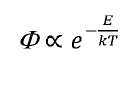
따라서 고온에서 첨가 가스의 주입이 보다 효율적이며 이상적인 공핍 깊이를 생성하고 층 (1)을 형성하기 위해 더 적은 첨가 가스 농도를 요구한다.Thus, the injection of the additive gas at high temperature is more efficient and produces an ideal depletion depth and requires less additive gas concentration to form layer (1).
도 8은 입자 (188)의 표면에서 반경 R 및 δ의 깊이를 갖는 입자 (180)의 개략도를 도시한다. 입자의 전체 표면적은 S1=4πR2이다.Figure 8 shows a schematic view of a
도 8은 입자 (180)의 질량과 동일한 총 질량을 갖는 동일한 크기의 복수의 입자들 (n 입자들) (200)의 개략도를 추가로 도시한다. 입자 (200)는 입자 (180)보다 크기가 작지만, 그것들은 입자 (180)보다 더 큰 전체 표면적을 갖고, 각각의 입자 (200)은 반경 r을 갖고, 입자들의 전체 수는 n = R3/r3이다. 입자들 (200)의 결합 표면적은 S2=n4πr2=
따라서 추가된 표면 첨가제의 양은 처리될 부피가 전체 표면적과 공핍 깊이의 곱(product)인 총 표면적의 함수이다. Thus, the amount of surface additive added is a function of the total surface area where the volume to be treated is the product of total surface area and depletion depth.
예를 들어, 획득된 금속 분말은 약 100, 150, 200, 300, 500, 1000 또는 1500ppm 미만의 음전기 원자 및/또는 분자(예를 들어, 분말을 생산하는데 사용되는 첨가 가스 내에 포함되는 음전기 원자 및/분자 엘리먼트)를 가질 수 있다. For example, the metal powder obtained may contain less than about 100, 150, 200, 300, 500, 1000 or 1500 ppm negative electrons and / or molecules (e.g., negative electrons contained in the additive gas used to produce the powder, / Molecular element).
실험 1
가열된 금속 소스와 접촉하는 원자화 혼합물의 조성을 제외하고 동일한 실험 조건 하에서 플라즈마 원자화에 의해 4 개의 상이한 많은 분말이 생성되었다.Four different powders were produced by plasma atomization under the same experimental conditions except for the composition of the atomization mixture in contact with the heated metal source.
원자화 가스는 고 순도 아르곤 ( > 99.997%)이다. The atomizing gas is high purity argon (> 99.997%).
테스트 1 및 2에서, 원자화 프로세스 동안에 가열된 금속 소스와 접촉시키는데 원자화 가스 만이 사용되었다. In
테스트 3에서, 고순도 아르곤에 공기가 주입되어 80ppm의 공기와 아르곤의 원자화 혼합물을 형성하였다. 원자화 프로세스 동안에 가열된 금속은 원자화 혼합물과 접촉되었다. In Test 3, air was injected into the high purity argon to form an atomizing mixture of 80 ppm air and argon. During the atomization process, the heated metal was contacted with the atomization mixture.
테스트 4에서, 고순도 아르곤에 O2가 주입되어 50ppm의 O2와 아르곤의 원자화 혼합물을 형성하였다. 원자화 프로세스 동안에 가열된 금속은 이 제 2 원자화 혼합물과 접촉되었다. In test 4, the O 2 is injected into the high-purity argon to form an atomized mixture of O 2 and argon of 50ppm. The heated metal during the atomization process was contacted with this second atomization mixture.
원자화 가스 (테스트 1 및 2) 또는 원자화 혼합물 (테스트 3 및 4)과 접촉시킨 후, 형성된 반응성 금속 분말은 체로 걸러져서 15 내지 45 ㎛ 입자 크기 분포를 분리한다. After contact with atomizing gases (Tests 1 and 2) or atomization mixtures (Tests 3 and 4), the reactive metal powder formed is sieved to separate the 15 to 45 urn particle size distribution.
그런 다음 체로 걸러진 분말은 혼합되어 균질성을 보장한다.The sieved powders are then mixed to ensure homogeneity.
분말은 증류수 또는 탈염수에서 추가로 교반되어 이전 단계들 동안 축적된 정전기 전하를 제거하였다. The powder was further stirred in distilled or deionized water to remove the electrostatic charge accumulated during previous steps.
분말은 80 ℃에서 12 시간 동안 공기 중에서 건조되었다. The powder was dried in air at 80 DEG C for 12 hours.
도 9는 TOF-SIMS에 의한 상이한 샘플들 간의 산소 프로파일 비교를 나타내는 그래프이다. 분말의 TOF-SIMS 시그니처가 테스트 1 내지 4에 대하여 획득되었다. 공핍층의 존재는 표 1에서 볼 수 있는 것처럼 높은 유동성 분말과 관련될 수 있다. Figure 9 is a graph showing oxygen profile comparisons between different samples by TOF-SIMS. The TOF-SIMS signature of the powder was obtained for Tests 1-4. The presence of the depletion layer can be associated with a high flowable powder as can be seen in Table 1.
처리된 미세 분말의 TOF-SIMS 시그니처가 도 9로부터 명확하게 보여질 수 있다. 산소 함량의 꼬리(tail)가 표면층에서 더 깊이 들어간다. 개선된 유동성 거동을 얻기 위해서는 특정 임계 깊이를 갖는 이 공핍층을 획득하는 것이 중요하다. TOF-SIMS 결과는 공핍층이 대략 100nm의 깊이를 갖는다는 것을 암시한다. 깊이는 조면계(profilometer)로 Ti-6Al-4V 벌크 부분 상에서 획득된 이온빔의 스퍼터링 비율을 캘리브레이트하여 추정될 수 있다. 스퍼터링 비율은 이온 빔 세기 및 재료 유형에 의존한다. 캘리브레이션(calibration)은 측정 전에 수행되며, 이온 빔 에너지는 매우 안정하다. The TOF-SIMS signature of the treated fine powder can be clearly seen from Fig. The tail of the oxygen content enters deeper into the surface layer. It is important to obtain this depletion layer with a certain critical depth in order to obtain an improved flow behavior. TOF-SIMS results imply that the depletion layer has a depth of approximately 100 nm. The depth can be estimated by calibrating the sputtering rate of the ion beam obtained on the Ti-6Al-4V bulk portion with a profilometer. The sputtering rate depends on the ion beam intensity and the material type. Calibration is performed before measurement, and the ion beam energy is very stable.
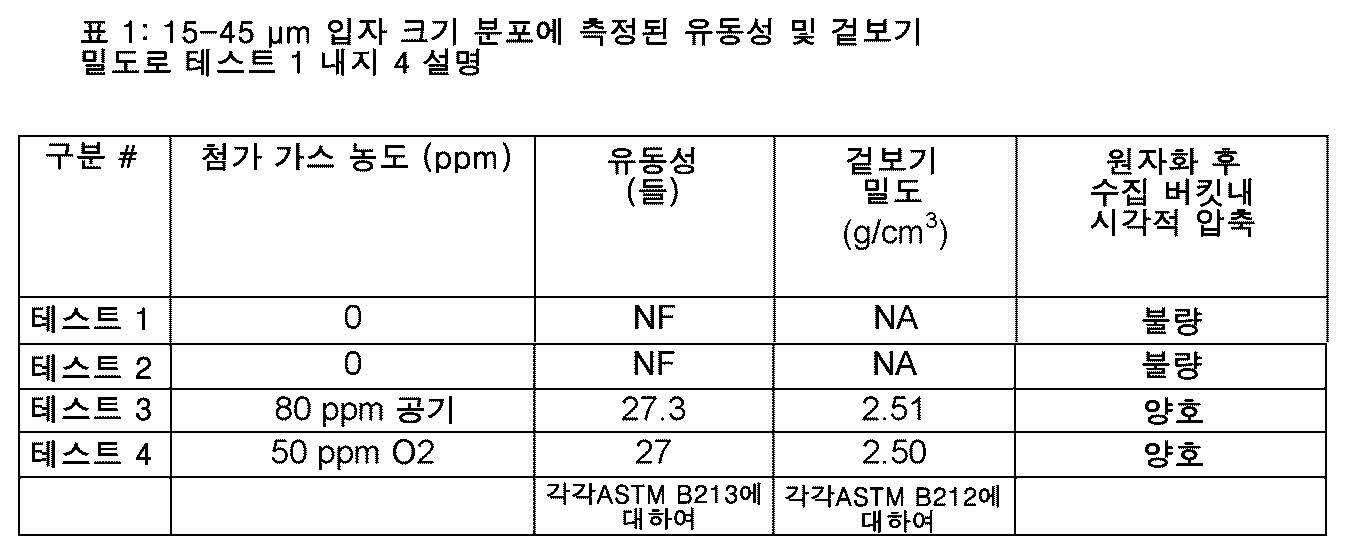
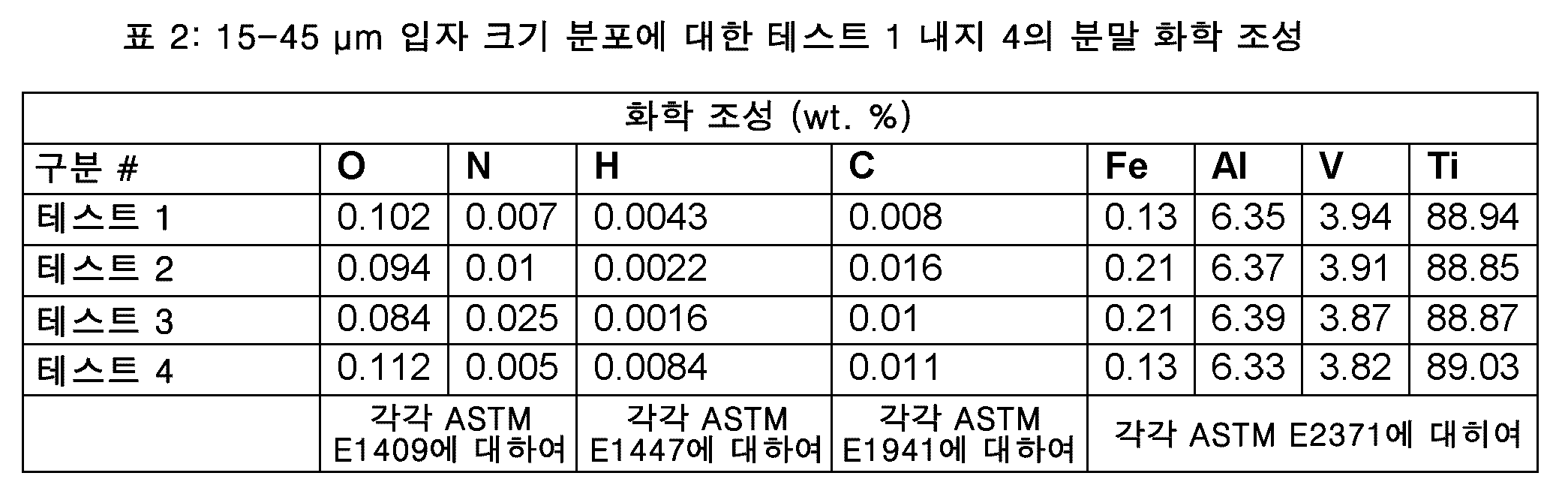
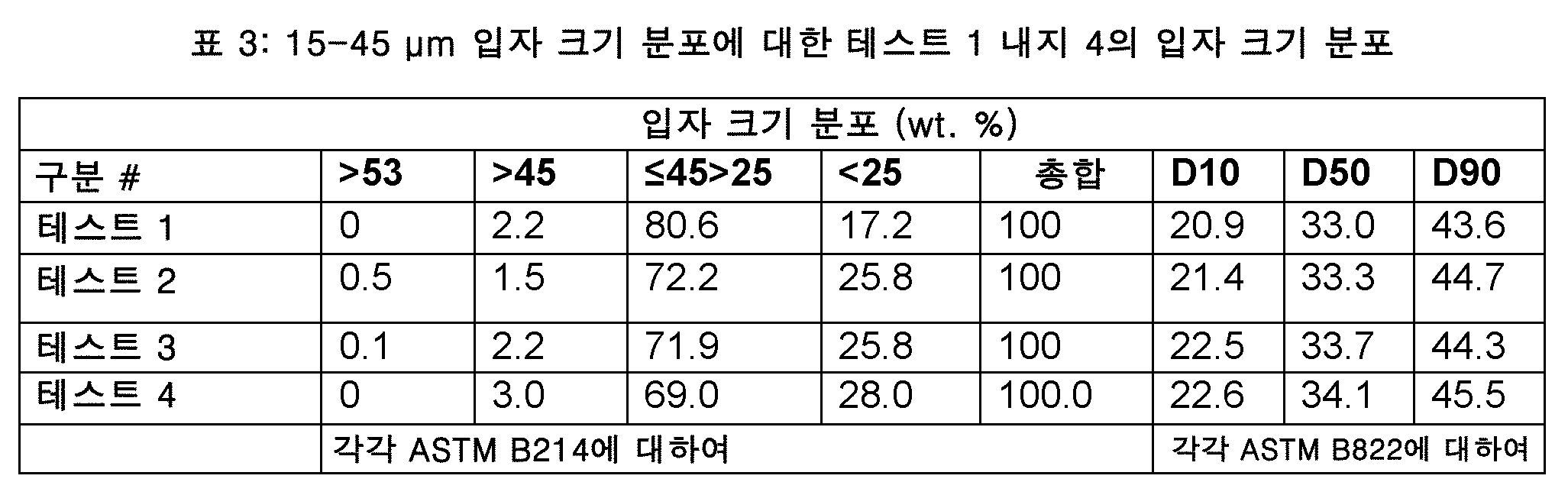
공기의 주입 (테스트 3)이 약 100 내지 150 ppm의 질소 및 약 50 ppm의 산소를 분말에 첨가하는 다수의 분량(batch)의 통계적 데이터 분석으로부터 결정되었다. 공기의 주입은 형성된 반응성 금속 분말의 유동성을 개선시켰다.The injection of air (Test 3) was determined from a number of batch statistical data analyzes adding about 100 to 150 ppm of nitrogen and about 50 ppm of oxygen to the powder. The injection of air improved the flowability of the formed reactive metal powder.
O2만의 주입 (테스트 4)이 질소 없이, 약 150-200ppm의 산소를 추가하는 것이 통계적 데이터 분석으로부터 추가로 결정되었다. It was further determined from the statistical data analysis that the addition of O 2 alone (Test 4) adds about 150-200 ppm of oxygen without nitrogen.
15-45 ㎛ 입자 크기 분포의 유동성에 대한 추가적인 성공적인 테스트가 수증기 주입에 의해 수행되었다. 15-45 ㎛ 입자 크기 분포의 유동성의 개선이 또한 관찰되었다. An additional successful test on the fluidity of the 15-45 mu m particle size distribution was performed by water vapor injection. An improvement in the fluidity of the 15-45 mu m particle size distribution was also observed.
수행된 처리는 표준 ASTM B348, ASTM F2924 및 ASTM F3001의 조성에 따라 만족스러운 화학 조성을 유지한다. 미가공 재료의 산소가 약간 높은 경우 AMS 4998의 요건도 또한 준수했을 것이다.The treatment carried out maintains a satisfactory chemical composition according to the composition of standard ASTM B348, ASTM F2924 and ASTM F3001. If the raw material oxygen is slightly higher, the requirements of AMS 4998 would also have been complied with.
도 10은 첨가 가스와의 접촉을 포함하지 않는 원자화 프로세스에 따라 형성된 약 100 kg의 금속 분말의 분량의 사진이다. 응집체로 인해, 수집 버킷의 90%가 채워지고, 시각적 압축이 불량하다. 10 is a photograph of an amount of metal powder of about 100 kg formed in accordance with an atomization process that does not involve contact with additive gas. Due to the aggregate, 90% of the collection bucket is filled and the visual compaction is poor.
도 11은 금속 소스가 첨가 가스와 접촉되는 원자화 프로세스에 따라 형성된 약 100 kg의 금속 분말의 분량의 사진이다. 개선된 유동성 및 입자들 간의 낮아진 표면 상호 작용 때문에, 수집 버킷의 20%가 도 10의 실행 중에 사용된 것과 동일한 양의 재료로 채워지며, 시각적 압축이 양호하다. 11 is a photograph of an amount of metal powder of about 100 kg formed according to an atomization process in which a metal source is contacted with an additive gas. Because of improved fluidity and lower surface interactions between particles, 20% of the collection bucket is filled with the same amount of material as used during the execution of Figure 10, and visual compaction is good.
테스트 3 및 테스트 4와 유사한 테스트가 첨가 가스를 간헐적으로 주입함으로써 수행되었다. 이 처리는 최종 생성물에 불순물을 덜 첨가하는 장점을 가지면서도 여전히 효과적인 것으로 판명되었다. Tests similar to Test 3 and Test 4 were carried out by intermittently injecting the additive gas. This treatment proved to be still effective, while having the advantage of adding less impurities to the final product.
유사하게, 양호한 유동성을 갖는 분말의 30% 까지의 혼합물이 홀 유량계에서 유동하지 않는 분말의 70%와 혼합될 수 있고, 시작 분말 뿐만 아니라 설사 시작 분말이 아닌 경우라 하더라도 생성된 분말은 또한 유동하는 것으로 나타났다.Similarly, up to 30% of a mixture of powder with good flowability can be mixed with 70% of the powder that does not flow in the hole flow meter, and even if the powder is not a starter powder as well as a starter powder, Respectively.
실험 2
첨가 가스가 사용되지 않았던 프로세스로부터 형성된 이미 형성된 금속 분말에 열 처리가 사후에 수행되었다. Heat treatment was subsequently carried out on the already formed metal powder formed from the process in which the additive gas was not used.
보다 구체적으로, 이미 형성된 금속 분말은 공기 분위기에서 약 250 ℃에서 12 시간 동안 가열되었다. 이 가열에 의해, 미가공 금속 분말의 입자들의 표면에 산소가 첨가되어, 고유의 산화물 층의 두께가 증가하는 것이 예상되었다. More specifically, the already formed metal powder was heated at about 250 캜 for 12 hours in an air atmosphere. By this heating, oxygen was added to the surface of the particles of the raw metal powder, and the thickness of the inherent oxide layer was expected to increase.
사후적 산화/질화 작용은 원자화 프로세스의 원자화 존에서 첨가 가스와 접촉하는 것과 유사한 결과를 나타내지 않는다는 것이 관찰되었다. 금속 분말의 유동성 개선은 관측되지 않았다. It has been observed that the post-oxidation / nitrification action does not produce results similar to contact with the additive gas in the atomization zone of the atomization process. No improvement in fluidity of the metal powder was observed.
이미 형성된 금속 분말의 사후 가열은 단지 고유의 산화물 층을 두껍게 하고, 입자에 충분히 깊게 공핍되는 산화물/질화물 층을 제공하는 능력을 갖지 못한 것으로 보인다. 보다 두꺼운 산화물 층은 또한 준 화학량론적일 것이며, 공핍층에 의해 제공되는 양으로(positive) 대전된 층 (1)을 제공할 수 없을 것이다. Post-heating of the already formed metal powder appears to have only the ability to thicken the native oxide layer and provide an oxide / nitride layer that is deeply depleted in the particles. The thicker oxide layer will also be quasi-stoichiometric and will not be able to provide the positively charged
이론에 구애됨이 없이, 원자화 동안 수반되는 고온 및 저 농도의 첨가 가스는 금속 소스가 첨가 가스와 접촉할 때 공핍 산화물/질화물 층을 형성하는 산화/질화 반응을 가능하게 한다. Without being bound by theory, the high temperature and low concentration additive gases involved during the atomization enable an oxidation / nitridation reaction to form a depleted oxide / nitride layer when the metal source contacts the additive gas.
본 발명의 단락 [0018] 내지 [00195]의 실시예들은 적용 가능한 경우 실시예들의 모든 조합이 수행될 수 있음을 입증하기 위한 그런 방식으로 본 발명에 제공된다. 따라서, 이들 실시예들은 선행하는 청구 범위들 중 임의의 것에 의존하는 모든 실시예 (앞에서 제시된 실시예들을 포함)에 대한 종속항을 만드는 것과 동등한 방식으로 설명으로 제공되어, 그렇게 함으로써 가능한 모든 방식으로 함께 결합될 수 있음을 입증한다. 예를 들어, 적용 가능한 경우 단락 [0018] 내지 [00195]의 실시예와 단락 [0007] 내지 [0015]의 프로세스들 사이의 모든 가능한 조합이 본 발명에 의해 본 출원에서 커버된다.Embodiments of paragraphs [0018] through [00195] of the present invention are provided in the present invention in such a manner as to prove that all combinations of embodiments, where applicable, can be performed. Accordingly, these embodiments are provided so that this disclosure will be thorough and complete, and will fully convey the concept of the invention to those skilled in the art. Accordingly, the embodiments are provided so that this disclosure will be interpreted as an equivalent of making any dependency on any of the preceding claims ≪ / RTI > For example, all possible combinations between embodiments of paragraphs [0018] to [00195] and paragraphs [0007] to [0015], where applicable, are covered by the present invention in the present application.
예시의 단순성 및 명확성을 위해, 적절한 것으로 고려되는 경우, 대응하거나 유사한 요소 또는 단계를 나타내기 위해 도면 번호들이 도면들 사이에서 반복될 수 있음을 이해할 것이다. 추가하여, 본 출원에서 설명된 예시적인 실시예들의 완전한 이해를 제공하기 위해 많은 특정 세부 사항들이 개시된다. 그러나, 당업자는 본 출원에서 설명된 실시예가 이들 특정 세부 사항없이 실시될 수 있음을 이해할 것이다. 다른 예들에서, 공지된 방법들, 절차들 및 컴포넌트들은 본 출원에서 설명된 실시예들을 모호하게 하지 않기 위해 상세히 설명되지 않았다. 더욱이, 본 설명은 임의의 방식으로 본 출원에서 설명된 실시예들의 범위를 제한하는 것으로 간주되지 않아야 하고 오히려 단지 본 출원에서 설명된 다양한 실시예들의 구현예를 설명하는 것으로 간주되어야 한다.It will be appreciated that for simplicity and clarity of illustration, where considered appropriate, reference numerals may be repeated among the figures to indicate corresponding or analogous elements or steps. In addition, numerous specific details are set forth in order to provide a thorough understanding of the exemplary embodiments described in this application. However, those skilled in the art will appreciate that the embodiments described in this application can be practiced without these specific details. In other instances, well-known methods, procedures, and components have not been described in detail so as not to obscure the embodiments described in this application. Moreover, the description is not to be construed as limiting in any way the scope of the embodiments described in this application, but rather merely as illustrative of the implementation of the various embodiments described in this application.
Claims (90)
반응성 금속 분말을 제공하는 단계; 및
상기 공중 열 처리 프로세스를 수행하는 동안 적어도 하나의 첨가 가스(additive gas)와 상기 반응성 금속 분말을 접촉시킴으로써 미가공(raw) 반응성 금속 분말을 획득하는 단계를 포함하되, 상기 미가공 반응성 금속 분말은
ASTM B213에 따라 측정된 40s 보다 작은 유동성을 갖는 약 10 내지 약 53 ㎛의 입자 크기 분포;
ASTM B213에 따라 측정된 40s 보다 작은 유동성을 갖는 약 10 내지 약 45 ㎛의 입자 크기 분포;
ASTM B213에 따라 측정된 40s 보다 작은 유동성을 갖는 약 15 내지 약 45 ㎛의 입자 크기 분포;
ASTM B213에 따라 측정된 40s 보다 작은 유동성을 갖는 약 15 내지 약 53 ㎛의 입자 크기 분포;
ASTM B213에 따라 측정된 40s 보다 작은 유동성을 갖는 약 25 내지 약 45 ㎛의 입자 크기 분포;
ASTM B213에 따라 측정된 40s 보다 작은 유동성을 갖는 약 25 내지 약 53 ㎛의 입자 크기 분포;
ASTM B213에 따라 측정된 28s 보다 작은 유동성을 갖는 약 45 내지 약 75 ㎛의 입자 크기 분포;
ASTM B213에 따라 측정된 28s 보다 작은 유동성을 갖는 약 45 내지 약 106 ㎛의 입자 크기 분포;
ASTM B213에 따라 측정된 28s 보다 작은 유동성을 갖는 약 45 내지 약 150 ㎛의 입자 크기 분포; 및/또는
ASTM B213에 따라 측정된 28s 보다 작은 유동성을 갖는 약 45 내지 약 180 ㎛의 입자 크기 분포를 포함하는, 프로세스.In a reactive metal powder in-flight heat treatment process,
Providing a reactive metal powder; And
Contacting the reactive metal powder with at least one additive gas during the air heat treatment process to obtain a raw reactive metal powder, wherein the raw reactive metal powder comprises
A particle size distribution of from about 10 to about 53 microns with a fluidity of less than 40s measured according to ASTM B213;
A particle size distribution of from about 10 to about 45 microns with a fluidity of less than 40s measured according to ASTM B213;
A particle size distribution of from about 15 to about 45 microns with a fluidity of less than 40s measured according to ASTM B213;
A particle size distribution of from about 15 to about 53 microns with a fluidity of less than 40s measured according to ASTM B213;
A particle size distribution of from about 25 to about 45 microns with a fluidity of less than 40s measured according to ASTM B213;
A particle size distribution of from about 25 to about 53 microns with a fluidity of less than 40s measured according to ASTM B213;
A particle size distribution of from about 45 to about 75 microns with a fluidity of less than 28s measured according to ASTM B213;
A particle size distribution of from about 45 to about 106 mu m with a fluidity of less than 28s measured according to ASTM B213;
A particle size distribution of from about 45 to about 150 microns with a fluidity of less than 28s measured according to ASTM B213; And / or
And a particle size distribution of about 45 to about 180 占 퐉 with a fluidity of less than 28s measured according to ASTM B213.
반응성 금속 분말을 제공하는 단계; 및
상기 공중 열 처리 프로세스를 수행하는 동안 적어도 하나의 첨가 가스와 상기 반응성 금속 분말을 접촉시킴으로써 미가공 반응성 금속 분말을 획득하는 단계를 포함하되, 상기 미가공 반응성 금속 분말은
ASTM B213에 따라 측정된 30s 보다 작은 유동성을 갖는 약 10 내지 약 53 ㎛의 입자 크기 분포;
ASTM B213에 따라 측정된 30s 보다 작은 유동성을 갖는 약 10 내지 약 45 ㎛의 입자 크기 분포;
ASTM B213에 따라 측정된 30s 보다 작은 유동성을 갖는 약 15 내지 약 45 ㎛의 입자 크기 분포;
ASTM B213에 따라 측정된 30s 보다 작은 유동성을 갖는 약 15 내지 약 53 ㎛의 입자 크기 분포;
ASTM B213에 따라 측정된 30s 보다 작은 유동성을 갖는 약 25 내지 약 45 ㎛의 입자 크기 분포; 및/또는
ASTM B213에 따라 측정된 30s 보다 작은 유동성을 갖는 약 25 내지 약 53 ㎛의 입자 크기 분포를 포함하는, 프로세스.In the reactive metal powder aerated heat treatment process,
Providing a reactive metal powder; And
Contacting the reactive metal powder with at least one additive gas during the air heat treatment process to obtain a raw reactive metal powder, wherein the raw reactive metal powder comprises
A particle size distribution of from about 10 to about 53 microns with a fluidity of less than 30s measured according to ASTM B213;
A particle size distribution of from about 10 to about 45 microns with a fluidity of less than 30s measured according to ASTM B213;
A particle size distribution of from about 15 to about 45 microns with a fluidity of less than 30s measured according to ASTM B213;
A particle size distribution of from about 15 to about 53 microns with a fluidity of less than 30s measured according to ASTM B213;
A particle size distribution of from about 25 to about 45 microns with a fluidity of less than 30s measured according to ASTM B213; And / or
And a particle size distribution of from about 25 microns to about 53 microns with a fluidity of less than 30s measured according to ASTM B213.
반응성 금속 분말을 제공하는 단계;
공중 열 처리 프로세스 가스 혼합물을 획득하기 위해 공중 열 처리 프로세스 가스 및 적어도 하나의 첨가 가스를 함께 혼합하는 단계;
상기 공중 열 처리 프로세스를 수행하는 동안 상기 혼합물과 상기 반응성 금속 분말을 접촉시킴으로써 미가공 반응성 금속 분말을 획득하는 단계를 포함하되, 상기 미가공 반응성 금속 분말은
ASTM B213에 따라 측정된 40s 보다 작은 유동성을 갖는 약 10 내지 약 53 ㎛의 입자 크기 분포;
ASTM B213에 따라 측정된 40s 보다 작은 유동성을 갖는 약 10 내지 약 45 ㎛의 입자 크기 분포;
ASTM B213에 따라 측정된 40s 보다 작은 유동성을 갖는 약 15 내지 약 45 ㎛의 입자 크기 분포;
ASTM B213에 따라 측정된 40s 보다 작은 유동성을 갖는 약 15 내지 약 53 ㎛의 입자 크기 분포;
ASTM B213에 따라 측정된 40s 보다 작은 유동성을 갖는 약 25 내지 약 45 ㎛의 입자 크기 분포;
ASTM B213에 따라 측정된 40s 보다 작은 유동성을 갖는 약 25 내지 약 53 ㎛의 입자 크기 분포;
ASTM B213에 따라 측정된 28s 보다 작은 유동성을 갖는 약 45 내지 약 75 ㎛의 입자 크기 분포;
ASTM B213에 따라 측정된 28s 보다 작은 유동성을 갖는 약 45 내지 약 106 ㎛의 입자 크기 분포;
ASTM B213에 따라 측정된 28s 보다 작은 유동성을 갖는 약 45 내지 약 150 ㎛의 입자 크기 분포; 및/또는
ASTM B213에 따라 측정된 28s 보다 작은 유동성을 갖는 약 45 내지 약 180 ㎛의 입자 크기 분포를 포함하는, 프로세스.In the reactive metal powder aerated heat treatment process,
Providing a reactive metal powder;
Mixing the air heat treatment process gas and at least one additive gas together to obtain an air heat treatment process gas mixture;
And contacting the mixture with the reactive metal powder during the air heat treatment process to obtain a raw reactive metal powder, wherein the raw reactive metal powder comprises
A particle size distribution of from about 10 to about 53 microns with a fluidity of less than 40s measured according to ASTM B213;
A particle size distribution of from about 10 to about 45 microns with a fluidity of less than 40s measured according to ASTM B213;
A particle size distribution of from about 15 to about 45 microns with a fluidity of less than 40s measured according to ASTM B213;
A particle size distribution of from about 15 to about 53 microns with a fluidity of less than 40s measured according to ASTM B213;
A particle size distribution of from about 25 to about 45 microns with a fluidity of less than 40s measured according to ASTM B213;
A particle size distribution of from about 25 to about 53 microns with a fluidity of less than 40s measured according to ASTM B213;
A particle size distribution of from about 45 to about 75 microns with a fluidity of less than 28s measured according to ASTM B213;
A particle size distribution of from about 45 to about 106 mu m with a fluidity of less than 28s measured according to ASTM B213;
A particle size distribution of from about 45 to about 150 microns with a fluidity of less than 28s measured according to ASTM B213; And / or
And a particle size distribution of about 45 to about 180 占 퐉 with a fluidity of less than 28s measured according to ASTM B213.
반응성 금속 분말을 제공하는 단계;
공중 열 처리 프로세스 가스 혼합물을 획득하기 위해 공중 열 처리 프로세스 가스 및 적어도 하나의 첨가 가스를 함께 혼합하는 단계;
상기 공중 열 처리 프로세스를 수행하는 동안 상기 혼합물과 상기 반응성 금속 분말을 접촉시킴으로써 미가공 반응성 금속 분말을 획득하는 단계를 포함하되, 상기 미가공 반응성 금속 분말은
ASTM B213에 따라 측정된 30s 보다 작은 유동성을 갖는 약 10 내지 약 53 ㎛의 입자 크기 분포;
ASTM B213에 따라 측정된 30s 보다 작은 유동성을 갖는 약 10 내지 약 45 ㎛의 입자 크기 분포;
ASTM B213에 따라 측정된 30s 보다 작은 유동성을 갖는 약 15 내지 약 45 ㎛의 입자 크기 분포;
ASTM B213에 따라 측정된 30s 보다 작은 유동성을 갖는 약 15 내지 약 53 ㎛의 입자 크기 분포;
ASTM B213에 따라 측정된 30s 보다 작은 유동성을 갖는 약 25 내지 약 45 ㎛의 입자 크기 분포; 및/또는
ASTM B213에 따라 측정된 30s 보다 작은 유동성을 갖는 약 25 내지 약 53 ㎛의 입자 크기 분포를 포함하는, 프로세스.In the reactive metal powder aerated heat treatment process,
Providing a reactive metal powder;
Mixing the air heat treatment process gas and at least one additive gas together to obtain an air heat treatment process gas mixture;
And contacting the mixture with the reactive metal powder during the air heat treatment process to obtain a raw reactive metal powder, wherein the raw reactive metal powder comprises
A particle size distribution of from about 10 to about 53 microns with a fluidity of less than 30s measured according to ASTM B213;
A particle size distribution of from about 10 to about 45 microns with a fluidity of less than 30s measured according to ASTM B213;
A particle size distribution of from about 15 to about 45 microns with a fluidity of less than 30s measured according to ASTM B213;
A particle size distribution of from about 15 to about 53 microns with a fluidity of less than 30s measured according to ASTM B213;
A particle size distribution of from about 25 to about 45 microns with a fluidity of less than 30s measured according to ASTM B213; And / or
And a particle size distribution of from about 25 microns to about 53 microns with a fluidity of less than 30s measured according to ASTM B213.
반응성 금속 분말을 제공하는 단계; 및
1000 ppm 보다 작은 첨가 가스로부터 각각의 음전기(electronegative) 원자 및/또는 분자의 추가된 함량을 갖는 미가공 반응성 금속 분말을 생성하기에 충분한 조건하에서 상기 공중 열 처리 프로세스를 수행하는 동안 적어도 하나의 상기 첨가 가스와 상기 반응성 금속 분말을 접촉시키는 단계를 포함하는, 프로세스.In the reactive metal powder aerated heat treatment process,
Providing a reactive metal powder; And
At least one additive gas is added during performing the atmospheric heat treatment process under conditions sufficient to produce unreacted reactive metal powder having an added content of each electronegative atom and / or molecule from an additive gas of less than 1000 ppm. And said reactive metal powder.
반응성 금속 분말을 제공하는 단계;
공중 열 처리 프로세스 가스 혼합물을 획득하기 위해 공중 열 처리 프로세스 가스 및 적어도 하나의 첨가 가스를 함께 혼합하는 단계;
1000 ppm 보다 작은 상기 첨가 가스로부터 음전기 원자들 및/또는 분자들의 추가된 함량을 갖는 미가공 반응성 금속 분말을 생성하기에 충분한 조건하에서 상기 공중 열 처리 프로세스를 수행하는 동안 상기 공중 열 처리 프로세스 가스 혼합물과 상기 반응성 금속 분말 소스를 접촉시키는 단계를 포함하는, 프로세스.In the reactive metal powder aerated heat treatment process,
Providing a reactive metal powder;
Mixing the air heat treatment process gas and at least one additive gas together to obtain an air heat treatment process gas mixture;
The method of claim 1, wherein during the air heat treatment process under conditions sufficient to produce an unreacted reactive metal powder having an added content of negatively charged atoms and / or molecules from the additive gas of less than 1000 ppm, Contacting the reactive metal powder source.
반응성 금속 분말을 제공하는 단계;
공중 열 처리 프로세스 가스 혼합물을 획득하기 위해 공중 열 처리 프로세스 가스 및 적어도 하나의 첨가 가스를 함께 혼합하는 단계;
상기 공중 열 처리 프로세스를 수행하는 동안 상기 공중 열 처리 프로세스 가스 혼합물과 상기 반응성 금속 분말를 접촉시킴으로써 미가공 반응성 금속 분말을 획득하는 단계;
옵션으로 미리 결정된 입자 크기를 갖는 분말을 획득하기 위해 상기 미가공 반응성 금속 분말을 체로 거르는 단계(sieving); 및
옵션으로 상기 미리 결정된 입자 크기를 갖는 상기 분말을 물과 접촉시키는 단계를 포함하는, 프로세스.In the reactive metal powder aerated heat treatment process,
Providing a reactive metal powder;
Mixing the air heat treatment process gas and at least one additive gas together to obtain an air heat treatment process gas mixture;
Obtaining a raw reactive metal powder by contacting the air heat treatment process gas mixture with the reactive metal powder during the air heat treatment process;
Optionally sieving said raw reactive metal powder to obtain a powder having a predetermined particle size; And
Optionally contacting the powder having the predetermined particle size with water.
입자 크기 분포들에 의해 상기 미가공 반응성 금속 분말을 분리하기 위해 상기 미가공 반응성 금속 분말을 체로 거르는 단계(sieving)를 더 포함하는, 프로세스.74. The method of any one of claims 1-73,
Further comprising sieving said raw reactive metal powder to separate said raw reactive metal powder by particle size distributions.
체로 거르는 단계 후에, 별도로 분리된 상기 미가공 재료 분말을 물에 교반시키는 단계(stirring)를 더 포함하는, 프로세스.75. The method of claim 74,
Further comprising stirring, after sieving, the separately separated raw material powder into water.
Applications Claiming Priority (3)
| Application Number | Priority Date | Filing Date | Title |
|---|---|---|---|
| US201662320874P | 2016-04-11 | 2016-04-11 | |
| US62/320,874 | 2016-04-11 | ||
| PCT/CA2017/050431 WO2017177315A1 (en) | 2016-04-11 | 2017-04-10 | Reactive metal powders in-flight heat treatment processes |
Publications (2)
| Publication Number | Publication Date |
|---|---|
| KR20180133899A true KR20180133899A (en) | 2018-12-17 |
| KR102475050B1 KR102475050B1 (en) | 2022-12-06 |
Family
ID=60042317
Family Applications (1)
| Application Number | Title | Priority Date | Filing Date |
|---|---|---|---|
| KR1020187032426A Active KR102475050B1 (en) | 2016-04-11 | 2017-04-10 | Reactive Metal Powder Air Thermal Treatment Processes |
Country Status (8)
| Country | Link |
|---|---|
| US (6) | US11235385B2 (en) |
| EP (4) | EP3442726B1 (en) |
| JP (1) | JP7144401B2 (en) |
| KR (1) | KR102475050B1 (en) |
| CN (1) | CN109070209B (en) |
| AU (2) | AU2017249439B2 (en) |
| CA (2) | CA3020720C (en) |
| WO (1) | WO2017177315A1 (en) |
Cited By (1)
| Publication number | Priority date | Publication date | Assignee | Title |
|---|---|---|---|---|
| KR20220061187A (en) * | 2019-09-27 | 2022-05-12 | 에이피앤드씨 어드밴스드 파우더스 앤드 코팅스 인크. | Aluminum-based metal powders and their manufacturing method |
Families Citing this family (27)
| Publication number | Priority date | Publication date | Assignee | Title |
|---|---|---|---|---|
| EP3116636B1 (en) | 2014-03-11 | 2020-07-08 | Tekna Plasma Systems Inc. | Process and apparatus for producing powder particles by atomization of a feed material in the form of an elongated member |
| EP3368238B1 (en) | 2015-10-29 | 2024-10-09 | AP&C Advanced Powders And Coatings Inc. | Metal powder atomization manufacturing processes |
| ES2964898T3 (en) | 2015-12-16 | 2024-04-10 | 6K Inc | Spheroidal dehydrogenated metals and metal alloy particles |
| US10987735B2 (en) | 2015-12-16 | 2021-04-27 | 6K Inc. | Spheroidal titanium metallic powders with custom microstructures |
| WO2017177315A1 (en) * | 2016-04-11 | 2017-10-19 | Ap&C Advanced Powders & Coatings Inc. | Reactive metal powders in-flight heat treatment processes |
| JP7024394B2 (en) * | 2017-12-26 | 2022-02-24 | 大同特殊鋼株式会社 | Metal powder material |
| CN112771196A (en) * | 2018-06-19 | 2021-05-07 | 6K有限公司 | Spherical titanium metal powder with tailored microstructure |
| EP3810358A1 (en) | 2018-06-19 | 2021-04-28 | 6K Inc. | Process for producing spheroidized powder from feedstock materials |
| EP3962862A4 (en) | 2019-04-30 | 2023-05-31 | 6K Inc. | Lithium lanthanum zirconium oxide (llzo) powder |
| CN114007782A (en) | 2019-04-30 | 2022-02-01 | 6K有限公司 | Mechanically alloyed powder feedstock |
| CA3138388A1 (en) * | 2019-05-02 | 2020-11-05 | Tekna Plasma Systems Inc. | Additive manufacturing powders with improved physical characteristics, method of manufacture and use thereof |
| ES2994209T3 (en) | 2019-11-18 | 2025-01-20 | 6K Inc | Unique feedstocks for spherical powders and methods of manufacturing |
| US11590568B2 (en) | 2019-12-19 | 2023-02-28 | 6K Inc. | Process for producing spheroidized powder from feedstock materials |
| US11654483B2 (en) | 2020-04-07 | 2023-05-23 | General Electric Company | Method for forming high quality powder for an additive manufacturing process |
| US12496634B2 (en) | 2020-05-13 | 2025-12-16 | Osaka Titanium Technologies Co., Ltd. | Active metal particle surface modification method, and titanium particles or titanium alloy particles |
| KR20230029836A (en) | 2020-06-25 | 2023-03-03 | 6케이 인크. | Microcomposite alloy structure |
| KR102811425B1 (en) | 2020-09-24 | 2025-05-26 | 6케이 인크. | Systems, devices and methods for initiating plasma |
| WO2022094528A1 (en) | 2020-10-30 | 2022-05-05 | 6K Inc. | Systems and methods for synthesis of spheroidized metal powders |
| AU2022206483A1 (en) | 2021-01-11 | 2023-08-31 | 6K Inc. | Methods and systems for reclamation of li-ion cathode materials using microwave plasma processing |
| EP4313449A1 (en) | 2021-03-31 | 2024-02-07 | 6K Inc. | Systems and methods for additive manufacturing of metal nitride ceramics |
| US12261023B2 (en) | 2022-05-23 | 2025-03-25 | 6K Inc. | Microwave plasma apparatus and methods for processing materials using an interior liner |
| US12040162B2 (en) | 2022-06-09 | 2024-07-16 | 6K Inc. | Plasma apparatus and methods for processing feed material utilizing an upstream swirl module and composite gas flows |
| WO2024044498A1 (en) | 2022-08-25 | 2024-02-29 | 6K Inc. | Plasma apparatus and methods for processing feed material utilizing a powder ingress preventor (pip) |
| CN115519118B (en) * | 2022-09-29 | 2024-01-19 | 晶高优材(北京)科技有限公司 | Method for improving fluidity, loose packing and tap density of additive manufacturing metal powder |
| US12195338B2 (en) | 2022-12-15 | 2025-01-14 | 6K Inc. | Systems, methods, and device for pyrolysis of methane in a microwave plasma for hydrogen and structured carbon powder production |
| EP4491300A1 (en) | 2023-06-29 | 2025-01-15 | General Electric Company | System and method for atomized powder processing and a processed powder |
| CN120079873B (en) * | 2025-03-10 | 2025-09-23 | 江苏金物新材料有限公司 | High-fluidity titanium alloy powder and preparation method thereof |
Citations (6)
| Publication number | Priority date | Publication date | Assignee | Title |
|---|---|---|---|---|
| US5147448A (en) * | 1990-10-01 | 1992-09-15 | Nuclear Metals, Inc. | Techniques for producing fine metal powder |
| US5368657A (en) * | 1993-04-13 | 1994-11-29 | Iowa State University Research Foundation, Inc. | Gas atomization synthesis of refractory or intermetallic compounds and supersaturated solid solutions |
| US20100139815A1 (en) | 2008-12-09 | 2010-06-10 | United Technologies Corporation | Conversion Process for heat treatable L12 aluminum aloys |
| US20130030205A1 (en) * | 2010-02-08 | 2013-01-31 | Richard Davis Jackson | Method and apparatus for esterifying fatty acid |
| CA2912282A1 (en) * | 2014-03-11 | 2015-09-17 | Tekna Plasma Systems Inc. | Process and apparatus for producing powder particles by atomization of a feed material in the form of an elongated member |
| US20150284534A1 (en) * | 2014-04-07 | 2015-10-08 | Powder Treatment Technology LLC | Surface energy modified particles, method of making, and use thereof |
Family Cites Families (120)
| Publication number | Priority date | Publication date | Assignee | Title |
|---|---|---|---|---|
| US3172753A (en) | 1965-03-09 | Method for theproduction of | ||
| US3041672A (en) | 1958-09-22 | 1962-07-03 | Union Carbide Corp | Making spheroidal powder |
| US3347698A (en) | 1964-01-10 | 1967-10-17 | Metco Inc | Radio frequency plasma flame spraying |
| JPS4925554B1 (en) | 1969-05-16 | 1974-07-01 | ||
| US3891824A (en) | 1971-04-01 | 1975-06-24 | Philips Corp | Method of plasma-MIG-welding |
| US3944412A (en) | 1974-09-18 | 1976-03-16 | Hsin Liu | Method for recovering metals |
| GB1540810A (en) | 1975-04-09 | 1979-02-14 | Metallisation Ltd | Metal spraying devices |
| US4022872A (en) | 1975-11-12 | 1977-05-10 | Ppg Industries, Inc. | Process for preparing finely-divided refractory powders |
| US4374075A (en) | 1981-06-17 | 1983-02-15 | Crucible Inc. | Method for the plasma-arc production of metal powder |
| CA1173784A (en) | 1981-07-30 | 1984-09-04 | William H. Gauvin | Transferred-arc plasma reactor for chemical and metallurgical applications |
| US5120352A (en) | 1983-06-23 | 1992-06-09 | General Electric Company | Method and apparatus for making alloy powder |
| US4631013A (en) | 1984-02-29 | 1986-12-23 | General Electric Company | Apparatus for atomization of unstable melt streams |
| JPS60255906A (en) | 1984-05-29 | 1985-12-17 | Kobe Steel Ltd | Method and equipment for manufacturing active metallic powder |
| GB8505811D0 (en) | 1985-03-06 | 1985-04-11 | Bekaert Sa Nv | Induction heating |
| US4544404A (en) | 1985-03-12 | 1985-10-01 | Crucible Materials Corporation | Method for atomizing titanium |
| ATE70758T1 (en) | 1986-03-13 | 1992-01-15 | Richard F Cheney | POWDER SPRAYING METHOD AND APPARATUS. |
| US4690796A (en) * | 1986-03-13 | 1987-09-01 | Gte Products Corporation | Process for producing aluminum-titanium diboride composites |
| US4788402A (en) | 1987-03-11 | 1988-11-29 | Browning James A | High power extended arc plasma spray method and apparatus |
| JPS63266001A (en) | 1987-04-22 | 1988-11-02 | Sumitomo Metal Mining Co Ltd | Method for manufacturing composite spherical powder |
| US5114471A (en) | 1988-01-04 | 1992-05-19 | Gte Products Corporation | Hydrometallurgical process for producing finely divided spherical maraging steel powders |
| JPH01306510A (en) * | 1988-06-02 | 1989-12-11 | Nisshin Flour Milling Co Ltd | Improvement for manufacturing super fine particle powder |
| US5176938A (en) * | 1988-11-23 | 1993-01-05 | Plasmacarb Inc. | Process for surface treatment of pulverulent material |
| US4982410A (en) | 1989-04-19 | 1991-01-01 | Mustoe Trevor N | Plasma arc furnace with variable path transferred arc |
| US5213610A (en) | 1989-09-27 | 1993-05-25 | Crucible Materials Corporation | Method for atomizing a titanium-based material |
| US5084091A (en) | 1989-11-09 | 1992-01-28 | Crucible Materials Corporation | Method for producing titanium particles |
| EP0586756B1 (en) | 1990-05-29 | 2002-04-17 | Sulzer Metco AG | Plasma systems for thermal spraying of powders |
| US5296667A (en) | 1990-08-31 | 1994-03-22 | Flame-Spray Industries, Inc. | High velocity electric-arc spray apparatus and method of forming materials |
| EP0504391A4 (en) | 1990-10-09 | 1993-05-26 | Iowa State University Research Foundation, Inc. | Environmentally stable reactive alloy powders and method of making same |
| DE4102101C2 (en) | 1991-01-25 | 2003-12-18 | Ald Vacuum Techn Ag | Device for producing powders from metals |
| US5200595A (en) | 1991-04-12 | 1993-04-06 | Universite De Sherbrooke | High performance induction plasma torch with a water-cooled ceramic confinement tube |
| FR2679473B1 (en) | 1991-07-25 | 1994-01-21 | Aubert Duval | METHOD AND DEVICE FOR PRODUCING POWDERS AND ESPECIALLY METAL POWDERS BY ATOMIZATION. |
| US5294242A (en) | 1991-09-30 | 1994-03-15 | Air Products And Chemicals | Method for making metal powders |
| US5176874A (en) | 1991-11-05 | 1993-01-05 | General Electric Company | Controlled process for the production of a spray of atomized metal droplets |
| JP3100084B2 (en) * | 1991-11-25 | 2000-10-16 | 日清製粉株式会社 | Ultrafine particle manufacturing equipment |
| US5198017A (en) | 1992-02-11 | 1993-03-30 | General Electric Company | Apparatus and process for controlling the flow of a metal stream |
| US5277705A (en) | 1992-12-30 | 1994-01-11 | Iowa State University Research Foundation, Inc. | Powder collection apparatus/method |
| US6146567A (en) | 1993-02-18 | 2000-11-14 | Massachusetts Institute Of Technology | Three dimensional printing methods |
| JPH06264115A (en) | 1993-03-09 | 1994-09-20 | Takeshi Masumoto | Apparatus for production of metallic powder |
| JP3545783B2 (en) * | 1993-08-12 | 2004-07-21 | 株式会社日清製粉グループ本社 | Method for producing coated particles |
| US5480471A (en) | 1994-04-29 | 1996-01-02 | Crucible Materials Corporation | Re-Fe-B magnets and manufacturing method for the same |
| US5707419A (en) | 1995-08-15 | 1998-01-13 | Pegasus Refractory Materials, Inc. | Method of production of metal and ceramic powders by plasma atomization |
| US6596224B1 (en) | 1996-05-24 | 2003-07-22 | Massachusetts Institute Of Technology | Jetting layers of powder and the formation of fine powder beds thereby |
| US5855642A (en) | 1996-06-17 | 1999-01-05 | Starmet Corporation | System and method for producing fine metallic and ceramic powders |
| US5935461A (en) | 1996-07-25 | 1999-08-10 | Utron Inc. | Pulsed high energy synthesis of fine metal powders |
| US5939151A (en) | 1996-10-25 | 1999-08-17 | Iowa State University Research Foundation, Inc. | Method and apparatus for reactive plasma atomization |
| CA2214194C (en) | 1997-01-10 | 2002-04-09 | Basf Corporation | Multiple domain fibers having inter-domain boundary compatibilizing layer and methods of making the same |
| US5808270A (en) | 1997-02-14 | 1998-09-15 | Ford Global Technologies, Inc. | Plasma transferred wire arc thermal spray apparatus and method |
| US5940674A (en) | 1997-04-09 | 1999-08-17 | Massachusetts Institute Of Technology | Three-dimensional product manufacture using masks |
| US5989648A (en) * | 1997-05-06 | 1999-11-23 | The Penn State Research Foundation | Plasma generation of supported metal catalysts |
| JPH10330806A (en) | 1997-06-02 | 1998-12-15 | Sanyo Special Steel Co Ltd | Method for producing pseudospherical deformed metal powder |
| US6142382A (en) | 1997-06-18 | 2000-11-07 | Iowa State University Research Foundation, Inc. | Atomizing nozzle and method |
| AT409235B (en) | 1999-01-19 | 2002-06-25 | Boehler Edelstahl | METHOD AND DEVICE FOR PRODUCING METAL POWDER |
| JP4004675B2 (en) | 1999-01-29 | 2007-11-07 | 株式会社日清製粉グループ本社 | Method for producing oxide-coated metal fine particles |
| JP3696429B2 (en) * | 1999-02-22 | 2005-09-21 | 日本化学工業株式会社 | Conductive electroless plating powder, method for producing the same, and conductive material comprising the plating powder |
| IL148073A0 (en) | 1999-09-03 | 2002-09-12 | American Inter Metallics Inc | Apparatus and methods for the production of powders |
| ATE258092T1 (en) | 2000-02-10 | 2004-02-15 | Tetronics Ltd | PLASMA REACTOR FOR PRODUCING FINE POWDER |
| JP2001226704A (en) | 2000-02-10 | 2001-08-21 | Sumitomo Metal Ind Ltd | Apparatus and method for producing metal powder |
| JP2001254103A (en) * | 2000-03-13 | 2001-09-18 | Sanei Kasei Kk | Metallic grain having nanocomposite structure and its producing method by self-organizing |
| EP1281296B1 (en) | 2000-04-10 | 2004-09-29 | Tetronics Limited | Twin plasma torch apparatus |
| US6365867B1 (en) | 2000-11-01 | 2002-04-02 | Sandia Corporation | Plasma arc torch with coaxial wire feed |
| US20020125591A1 (en) | 2000-12-04 | 2002-09-12 | Jaynes Scot Eric | Process and apparatus for producing atomized powder using recirculating atomizing gas |
| US6398125B1 (en) | 2001-02-10 | 2002-06-04 | Nanotek Instruments, Inc. | Process and apparatus for the production of nanometer-sized powders |
| FR2821925B1 (en) | 2001-03-06 | 2003-05-16 | Celes | THERMAL INSULATION GAS AND VACUUM ENCLOSURE FOR AN INDUCTION HEATING DEVICE |
| US6444009B1 (en) | 2001-04-12 | 2002-09-03 | Nanotek Instruments, Inc. | Method for producing environmentally stable reactive alloy powders |
| US6915964B2 (en) | 2001-04-24 | 2005-07-12 | Innovative Technology, Inc. | System and process for solid-state deposition and consolidation of high velocity powder particles using thermal plastic deformation |
| US6693253B2 (en) | 2001-10-05 | 2004-02-17 | Universite De Sherbrooke | Multi-coil induction plasma torch for solid state power supply |
| GB0201600D0 (en) | 2002-01-24 | 2002-03-13 | Univ Cambridge Tech | Large- scale plasma synthesis of hollow nanostructures |
| DE10205897A1 (en) | 2002-02-13 | 2003-08-21 | Mepura Metallpulver | Process for the production of particulate material |
| US6780219B2 (en) | 2002-07-03 | 2004-08-24 | Osram Sylvania Inc. | Method of spheridizing silicon metal powders |
| JP2004091843A (en) | 2002-08-30 | 2004-03-25 | Hitachi Metals Ltd | Manufacturing method of high purity high melting point metal powder |
| TW583043B (en) | 2002-12-27 | 2004-04-11 | Ind Tech Res Inst | Nanostructured metal powder and the method of fabricating the same |
| US6939389B2 (en) | 2003-08-08 | 2005-09-06 | Frank Mooney | Method and apparatus for manufacturing fine powders |
| CN100438965C (en) | 2003-08-28 | 2008-12-03 | 泰克纳等离子系统公司 | Synthesis, separation and purification methods of powder materials |
| US7131597B2 (en) | 2003-09-09 | 2006-11-07 | Scattergood John R | Atomization technique for producing fine particles |
| US7803235B2 (en) | 2004-01-08 | 2010-09-28 | Cabot Corporation | Passivation of tantalum and other metal powders using oxygen |
| SG111177A1 (en) | 2004-02-28 | 2005-05-30 | Wira Kurnia | Fine particle powder production |
| CN1709585A (en) | 2004-06-18 | 2005-12-21 | 杭州宇通微粉有限公司 | High-pressure gas atomizing nozzle |
| US8377576B2 (en) * | 2005-05-11 | 2013-02-19 | Inframat Corporation | Magnetic composites and methods of making and using |
| TWI402117B (en) | 2005-10-17 | 2013-07-21 | Nisshin Seifun Group Inc | Process for producing ultrafine particles |
| DE602006007780D1 (en) | 2005-10-21 | 2009-08-27 | Sulzer Metco Us Inc | Process for the production of highly pure flowable metal oxide powder by plasma melting |
| CN101024248A (en) | 2006-02-16 | 2007-08-29 | 精工爱普生株式会社 | Metal powder production apparatus and metal powder |
| US8859931B2 (en) | 2006-03-08 | 2014-10-14 | Tekna Plasma Systems Inc. | Plasma synthesis of nanopowders |
| US7967891B2 (en) | 2006-06-01 | 2011-06-28 | Inco Limited | Method producing metal nanopowders by decompositon of metal carbonyl using an induction plasma torch |
| JP5052291B2 (en) | 2006-11-02 | 2012-10-17 | 株式会社日清製粉グループ本社 | Alloy fine particles and method for producing the same |
| US7753989B2 (en) | 2006-12-22 | 2010-07-13 | Cristal Us, Inc. | Direct passivation of metal powder |
| US7943084B1 (en) | 2007-05-23 | 2011-05-17 | The United States Of America As Represented By The Secretary Of The Navy | Metal powders with improved flowability |
| DE102008064648A1 (en) | 2008-01-23 | 2010-05-20 | Tradium Gmbh | Reaction vessel for the production of metal powders |
| US8092570B2 (en) | 2008-03-31 | 2012-01-10 | Hitachi Metals, Ltd. | Method for producing titanium metal |
| JP5322049B2 (en) | 2008-07-08 | 2013-10-23 | 独立行政法人日本原子力研究開発機構 | Beryllium material filler and method for forming beryllium material filler |
| JP2010018825A (en) | 2008-07-08 | 2010-01-28 | Japan Atomic Energy Agency | Method and apparatus for producing metal particles and metal particles produced thereby |
| EP2429813B1 (en) * | 2009-05-11 | 2018-06-13 | The Regents of the University of Colorado, a Body Corporate | Ultra-thin metal oxide and carbon-metal oxide films prepared by atomic layer deposition (ald) |
| WO2011054113A1 (en) | 2009-11-05 | 2011-05-12 | Ap&C Advanced Powders & Coatings Inc. | Methods and apparatuses for preparing spheroidal powders |
| GB2479721B (en) | 2010-04-19 | 2012-04-04 | Rolls Royce Plc | Method of producing a powder |
| WO2012070461A1 (en) | 2010-11-22 | 2012-05-31 | 日立金属株式会社 | Device for producing titanium metal, and method for producing titanium metal |
| JP5571537B2 (en) | 2010-11-22 | 2014-08-13 | 日立金属株式会社 | Metal titanium manufacturing apparatus and metal titanium manufacturing method |
| WO2012088421A1 (en) | 2010-12-22 | 2012-06-28 | Flame-Spray Industries, Inc. | Improved thermal spray method and apparatus using plasma transferred wire arc |
| KR102023354B1 (en) | 2011-02-03 | 2019-09-20 | 테크나 플라즈마 시스템 인코포레이티드 | High performance induction plasma torch |
| CN102094163B (en) | 2011-02-25 | 2012-09-05 | 中国科学院金属研究所 | CoNiCrAlY corrosion-resistant thermal spraying alloy powder and preparation method thereof |
| US20120325051A1 (en) | 2011-06-27 | 2012-12-27 | United Technologies Corporation | Production of atomized powder for glassy aluminum-based alloys |
| KR101436498B1 (en) | 2011-10-20 | 2014-09-01 | 한국기계연구원 | Apparatus for preparing 500 ㎚-10 ㎛ sized fine spherical powder using plasma |
| US9956615B2 (en) | 2012-03-08 | 2018-05-01 | Carpenter Technology Corporation | Titanium powder production apparatus and method |
| US9650309B2 (en) * | 2012-04-12 | 2017-05-16 | Iowa State University Research Foundation, Inc. | Stability of gas atomized reactive powders through multiple step in-situ passivation |
| CN103846447B (en) | 2012-12-06 | 2016-04-27 | 北京有色金属研究总院 | The aerosolization preparation method of a kind of superfine spherical titanium or titanium alloy powder |
| CN103223492A (en) | 2013-04-09 | 2013-07-31 | 宁夏新和新材科技有限公司 | High-activity ultrafine aluminum powder preparing process and device |
| US9833837B2 (en) | 2013-06-20 | 2017-12-05 | Iowa State University Research Foundation, Inc. | Passivation and alloying element retention in gas atomized powders |
| CN103433499B (en) | 2013-08-27 | 2015-08-12 | 湖南航天工业总公司 | A kind of ultrasonic atomizatio preparation facilities of globular metallic powder and preparation method |
| US9981315B2 (en) | 2013-09-24 | 2018-05-29 | Iowa State University Research Foundation, Inc. | Atomizer for improved ultra-fine powder production |
| CN103769594A (en) | 2013-11-25 | 2014-05-07 | 王利民 | Technological method and device for preparing high-purity spherical superfine/nanoscale powdered materials in plasma atomization mode |
| KR101516258B1 (en) | 2013-11-27 | 2015-05-04 | 한국기계연구원 | Method for manufacturing of weight percentage controlled micro-nano mixed powder and micro-nano mixed powder thereby |
| CN103752822B (en) | 2014-02-20 | 2016-11-02 | 西华大学 | A kind of composite powder and preparation method thereof |
| CN103801704B (en) * | 2014-02-28 | 2016-08-17 | 昆山德泰新材料科技有限公司 | A kind of be applicable to 3D print molding copper powder, preparation method and its usage |
| JP7097180B2 (en) | 2014-07-21 | 2022-07-07 | ヌオーヴォ ピニォーネ ソチエタ レスポンサビリタ リミタータ | Methods for manufacturing machine components by additive manufacturing |
| CN104493187B (en) * | 2014-12-25 | 2017-01-04 | 安徽旭晶粉体新材料科技有限公司 | A kind of jet atomization technique during water atomization metal powder preparation |
| CN104894483B (en) | 2015-05-15 | 2018-07-31 | 安泰科技股份有限公司 | Powder metallurgy wear resistant tools steel |
| KR20160139240A (en) | 2015-05-27 | 2016-12-07 | 주식회사 엘지화학 | Electrode mixture, preparation method thereof and secondary battery comprising the same |
| BR112017026248B1 (en) | 2015-06-05 | 2022-04-05 | Pyrogenesis Canada Inc | Apparatus for producing powder from wire and method for producing metal powder from wire |
| AU2016288266B2 (en) | 2015-06-29 | 2021-05-13 | Tekna Plasma Systems Inc. | Induction plasma torch with higher plasma energy density |
| CN108025365B (en) | 2015-07-17 | 2022-06-03 | Ap&C高端粉末涂料公司 | Plasma atomization metal powder manufacturing process and system thereof |
| EP3368238B1 (en) * | 2015-10-29 | 2024-10-09 | AP&C Advanced Powders And Coatings Inc. | Metal powder atomization manufacturing processes |
| WO2017177315A1 (en) * | 2016-04-11 | 2017-10-19 | Ap&C Advanced Powders & Coatings Inc. | Reactive metal powders in-flight heat treatment processes |
-
2017
- 2017-04-10 WO PCT/CA2017/050431 patent/WO2017177315A1/en not_active Ceased
- 2017-04-10 EP EP17781668.3A patent/EP3442726B1/en active Active
- 2017-04-10 JP JP2019503602A patent/JP7144401B2/en active Active
- 2017-04-10 EP EP25156543.8A patent/EP4527523A3/en active Pending
- 2017-04-10 US US16/092,790 patent/US11235385B2/en active Active
- 2017-04-10 CA CA3020720A patent/CA3020720C/en active Active
- 2017-04-10 CN CN201780028601.5A patent/CN109070209B/en active Active
- 2017-04-10 AU AU2017249439A patent/AU2017249439B2/en active Active
- 2017-04-10 EP EP25156436.5A patent/EP4527522A3/en active Pending
- 2017-04-10 EP EP22208543.3A patent/EP4159345A1/en active Pending
- 2017-04-10 CA CA3097498A patent/CA3097498C/en active Active
- 2017-04-10 KR KR1020187032426A patent/KR102475050B1/en active Active
-
2022
- 2022-01-28 US US17/587,728 patent/US11794247B2/en active Active
- 2022-12-08 AU AU2022283742A patent/AU2022283742B2/en active Active
-
2023
- 2023-09-07 US US18/462,616 patent/US12533729B2/en active Active
-
2024
- 2024-12-31 US US19/006,366 patent/US12337389B2/en active Active
- 2024-12-31 US US19/006,504 patent/US20250135539A1/en active Pending
-
2025
- 2025-06-20 US US19/244,416 patent/US20250387834A1/en active Pending
Patent Citations (6)
| Publication number | Priority date | Publication date | Assignee | Title |
|---|---|---|---|---|
| US5147448A (en) * | 1990-10-01 | 1992-09-15 | Nuclear Metals, Inc. | Techniques for producing fine metal powder |
| US5368657A (en) * | 1993-04-13 | 1994-11-29 | Iowa State University Research Foundation, Inc. | Gas atomization synthesis of refractory or intermetallic compounds and supersaturated solid solutions |
| US20100139815A1 (en) | 2008-12-09 | 2010-06-10 | United Technologies Corporation | Conversion Process for heat treatable L12 aluminum aloys |
| US20130030205A1 (en) * | 2010-02-08 | 2013-01-31 | Richard Davis Jackson | Method and apparatus for esterifying fatty acid |
| CA2912282A1 (en) * | 2014-03-11 | 2015-09-17 | Tekna Plasma Systems Inc. | Process and apparatus for producing powder particles by atomization of a feed material in the form of an elongated member |
| US20150284534A1 (en) * | 2014-04-07 | 2015-10-08 | Powder Treatment Technology LLC | Surface energy modified particles, method of making, and use thereof |
Cited By (1)
| Publication number | Priority date | Publication date | Assignee | Title |
|---|---|---|---|---|
| KR20220061187A (en) * | 2019-09-27 | 2022-05-12 | 에이피앤드씨 어드밴스드 파우더스 앤드 코팅스 인크. | Aluminum-based metal powders and their manufacturing method |
Also Published As
| Publication number | Publication date |
|---|---|
| US20190232365A1 (en) | 2019-08-01 |
| WO2017177315A1 (en) | 2017-10-19 |
| US20230415231A1 (en) | 2023-12-28 |
| AU2022283742A1 (en) | 2023-02-02 |
| EP4527522A3 (en) | 2025-06-25 |
| CA3097498C (en) | 2023-09-26 |
| JP2019516020A (en) | 2019-06-13 |
| US20250135539A1 (en) | 2025-05-01 |
| CN109070209B (en) | 2022-06-17 |
| US12533729B2 (en) | 2026-01-27 |
| US11235385B2 (en) | 2022-02-01 |
| AU2017249439A1 (en) | 2018-11-29 |
| EP3442726B1 (en) | 2023-01-04 |
| JP7144401B2 (en) | 2022-09-29 |
| US12337389B2 (en) | 2025-06-24 |
| AU2017249439B2 (en) | 2022-10-20 |
| EP4527523A2 (en) | 2025-03-26 |
| US20250387834A1 (en) | 2025-12-25 |
| EP4527522A2 (en) | 2025-03-26 |
| KR102475050B1 (en) | 2022-12-06 |
| EP3442726A1 (en) | 2019-02-20 |
| CA3020720A1 (en) | 2017-10-19 |
| AU2022283742B2 (en) | 2024-03-14 |
| EP4159345A1 (en) | 2023-04-05 |
| EP4527523A3 (en) | 2025-06-25 |
| CA3020720C (en) | 2020-12-01 |
| CN109070209A (en) | 2018-12-21 |
| US20220143693A1 (en) | 2022-05-12 |
| US20250135534A1 (en) | 2025-05-01 |
| CA3097498A1 (en) | 2017-10-19 |
| US11794247B2 (en) | 2023-10-24 |
| EP3442726A4 (en) | 2019-05-08 |
Similar Documents
| Publication | Publication Date | Title |
|---|---|---|
| US11794247B2 (en) | Reactive metal powders in-flight heat treatment processes | |
| US20240383036A1 (en) | Metal powder atomization manufacturing processes |
Legal Events
| Date | Code | Title | Description |
|---|---|---|---|
| PA0105 | International application |
St.27 status event code: A-0-1-A10-A15-nap-PA0105 |
|
| PG1501 | Laying open of application |
St.27 status event code: A-1-1-Q10-Q12-nap-PG1501 |
|
| R17-X000 | Change to representative recorded |
St.27 status event code: A-3-3-R10-R17-oth-X000 |
|
| A201 | Request for examination | ||
| E13-X000 | Pre-grant limitation requested |
St.27 status event code: A-2-3-E10-E13-lim-X000 |
|
| P11-X000 | Amendment of application requested |
St.27 status event code: A-2-2-P10-P11-nap-X000 |
|
| P13-X000 | Application amended |
St.27 status event code: A-2-2-P10-P13-nap-X000 |
|
| PA0201 | Request for examination |
St.27 status event code: A-1-2-D10-D11-exm-PA0201 |
|
| E902 | Notification of reason for refusal | ||
| PE0902 | Notice of grounds for rejection |
St.27 status event code: A-1-2-D10-D21-exm-PE0902 |
|
| T11-X000 | Administrative time limit extension requested |
St.27 status event code: U-3-3-T10-T11-oth-X000 |
|
| E13-X000 | Pre-grant limitation requested |
St.27 status event code: A-2-3-E10-E13-lim-X000 |
|
| P11-X000 | Amendment of application requested |
St.27 status event code: A-2-2-P10-P11-nap-X000 |
|
| P13-X000 | Application amended |
St.27 status event code: A-2-2-P10-P13-nap-X000 |
|
| E90F | Notification of reason for final refusal | ||
| PE0902 | Notice of grounds for rejection |
St.27 status event code: A-1-2-D10-D21-exm-PE0902 |
|
| T11-X000 | Administrative time limit extension requested |
St.27 status event code: U-3-3-T10-T11-oth-X000 |
|
| P11-X000 | Amendment of application requested |
St.27 status event code: A-2-2-P10-P11-nap-X000 |
|
| P13-X000 | Application amended |
St.27 status event code: A-2-2-P10-P13-nap-X000 |
|
| P22-X000 | Classification modified |
St.27 status event code: A-2-2-P10-P22-nap-X000 |
|
| E902 | Notification of reason for refusal | ||
| PE0902 | Notice of grounds for rejection |
St.27 status event code: A-1-2-D10-D21-exm-PE0902 |
|
| P11-X000 | Amendment of application requested |
St.27 status event code: A-2-2-P10-P11-nap-X000 |
|
| P13-X000 | Application amended |
St.27 status event code: A-2-2-P10-P13-nap-X000 |
|
| T11-X000 | Administrative time limit extension requested |
St.27 status event code: U-3-3-T10-T11-oth-X000 |
|
| T12-X000 | Administrative time limit extension not granted |
St.27 status event code: U-3-3-T10-T12-oth-X000 |
|
| E701 | Decision to grant or registration of patent right | ||
| PE0701 | Decision of registration |
St.27 status event code: A-1-2-D10-D22-exm-PE0701 |
|
| GRNT | Written decision to grant | ||
| PR0701 | Registration of establishment |
St.27 status event code: A-2-4-F10-F11-exm-PR0701 |
|
| PR1002 | Payment of registration fee |
St.27 status event code: A-2-2-U10-U12-oth-PR1002 Fee payment year number: 1 |
|
| PG1601 | Publication of registration |
St.27 status event code: A-4-4-Q10-Q13-nap-PG1601 |
|
| PR1001 | Payment of annual fee |
St.27 status event code: A-4-4-U10-U11-oth-PR1001 Fee payment year number: 4 |
|
| U11 | Full renewal or maintenance fee paid |
Free format text: ST27 STATUS EVENT CODE: A-4-4-U10-U11-OTH-PR1001 (AS PROVIDED BY THE NATIONAL OFFICE) Year of fee payment: 4 |