KR20180129842A - Method for producing polyacrylamide solution having increased viscosity - Google Patents
Method for producing polyacrylamide solution having increased viscosity Download PDFInfo
- Publication number
- KR20180129842A KR20180129842A KR1020187030383A KR20187030383A KR20180129842A KR 20180129842 A KR20180129842 A KR 20180129842A KR 1020187030383 A KR1020187030383 A KR 1020187030383A KR 20187030383 A KR20187030383 A KR 20187030383A KR 20180129842 A KR20180129842 A KR 20180129842A
- Authority
- KR
- South Korea
- Prior art keywords
- biocatalyst
- solution
- acrylamide
- polyacrylamide
- less
- Prior art date
- Legal status (The legal status is an assumption and is not a legal conclusion. Google has not performed a legal analysis and makes no representation as to the accuracy of the status listed.)
- Granted
Links
Classifications
-
- C—CHEMISTRY; METALLURGY
- C08—ORGANIC MACROMOLECULAR COMPOUNDS; THEIR PREPARATION OR CHEMICAL WORKING-UP; COMPOSITIONS BASED THEREON
- C08F—MACROMOLECULAR COMPOUNDS OBTAINED BY REACTIONS ONLY INVOLVING CARBON-TO-CARBON UNSATURATED BONDS
- C08F20/00—Homopolymers and copolymers of compounds having one or more unsaturated aliphatic radicals, each having only one carbon-to-carbon double bond, and only one being terminated by only one carboxyl radical or a salt, anhydride, ester, amide, imide or nitrile thereof
- C08F20/02—Monocarboxylic acids having less than ten carbon atoms, Derivatives thereof
- C08F20/52—Amides or imides
- C08F20/54—Amides, e.g. N,N-dimethylacrylamide or N-isopropylacrylamide
- C08F20/56—Acrylamide; Methacrylamide
-
- C—CHEMISTRY; METALLURGY
- C08—ORGANIC MACROMOLECULAR COMPOUNDS; THEIR PREPARATION OR CHEMICAL WORKING-UP; COMPOSITIONS BASED THEREON
- C08F—MACROMOLECULAR COMPOUNDS OBTAINED BY REACTIONS ONLY INVOLVING CARBON-TO-CARBON UNSATURATED BONDS
- C08F120/00—Homopolymers of compounds having one or more unsaturated aliphatic radicals, each having only one carbon-to-carbon double bond, and only one being terminated by only one carboxyl radical or a salt, anhydride, ester, amide, imide or nitrile thereof
- C08F120/02—Monocarboxylic acids having less than ten carbon atoms; Derivatives thereof
- C08F120/52—Amides or imides
- C08F120/54—Amides, e.g. N,N-dimethylacrylamide or N-isopropylacrylamide
- C08F120/56—Acrylamide; Methacrylamide
-
- C—CHEMISTRY; METALLURGY
- C08—ORGANIC MACROMOLECULAR COMPOUNDS; THEIR PREPARATION OR CHEMICAL WORKING-UP; COMPOSITIONS BASED THEREON
- C08F—MACROMOLECULAR COMPOUNDS OBTAINED BY REACTIONS ONLY INVOLVING CARBON-TO-CARBON UNSATURATED BONDS
- C08F2/00—Processes of polymerisation
- C08F2/04—Polymerisation in solution
- C08F2/10—Aqueous solvent
-
- C—CHEMISTRY; METALLURGY
- C08—ORGANIC MACROMOLECULAR COMPOUNDS; THEIR PREPARATION OR CHEMICAL WORKING-UP; COMPOSITIONS BASED THEREON
- C08L—COMPOSITIONS OF MACROMOLECULAR COMPOUNDS
- C08L33/00—Compositions of homopolymers or copolymers of compounds having one or more unsaturated aliphatic radicals, each having only one carbon-to-carbon double bond, and only one being terminated by only one carboxyl radical, or of salts, anhydrides, esters, amides, imides or nitriles thereof; Compositions of derivatives of such polymers
- C08L33/24—Homopolymers or copolymers of amides or imides
- C08L33/26—Homopolymers or copolymers of acrylamide or methacrylamide
-
- C—CHEMISTRY; METALLURGY
- C12—BIOCHEMISTRY; BEER; SPIRITS; WINE; VINEGAR; MICROBIOLOGY; ENZYMOLOGY; MUTATION OR GENETIC ENGINEERING
- C12P—FERMENTATION OR ENZYME-USING PROCESSES TO SYNTHESISE A DESIRED CHEMICAL COMPOUND OR COMPOSITION OR TO SEPARATE OPTICAL ISOMERS FROM A RACEMIC MIXTURE
- C12P13/00—Preparation of nitrogen-containing organic compounds
- C12P13/02—Amides, e.g. chloramphenicol or polyamides; Imides or polyimides; Urethanes, i.e. compounds comprising N-C=O structural element or polyurethanes
-
- B—PERFORMING OPERATIONS; TRANSPORTING
- B01—PHYSICAL OR CHEMICAL PROCESSES OR APPARATUS IN GENERAL
- B01D—SEPARATION
- B01D21/00—Separation of suspended solid particles from liquids by sedimentation
- B01D21/01—Separation of suspended solid particles from liquids by sedimentation using flocculating agents
-
- B—PERFORMING OPERATIONS; TRANSPORTING
- B01—PHYSICAL OR CHEMICAL PROCESSES OR APPARATUS IN GENERAL
- B01D—SEPARATION
- B01D21/00—Separation of suspended solid particles from liquids by sedimentation
- B01D21/26—Separation of sediment aided by centrifugal force or centripetal force
- B01D21/262—Separation of sediment aided by centrifugal force or centripetal force by using a centrifuge
-
- C—CHEMISTRY; METALLURGY
- C12—BIOCHEMISTRY; BEER; SPIRITS; WINE; VINEGAR; MICROBIOLOGY; ENZYMOLOGY; MUTATION OR GENETIC ENGINEERING
- C12Y—ENZYMES
- C12Y402/00—Carbon-oxygen lyases (4.2)
- C12Y402/01—Hydro-lyases (4.2.1)
- C12Y402/01084—Nitrile hydratase (4.2.1.84)
Landscapes
- Chemical & Material Sciences (AREA)
- Organic Chemistry (AREA)
- Health & Medical Sciences (AREA)
- Chemical Kinetics & Catalysis (AREA)
- Polymers & Plastics (AREA)
- Medicinal Chemistry (AREA)
- Engineering & Computer Science (AREA)
- Life Sciences & Earth Sciences (AREA)
- Wood Science & Technology (AREA)
- Zoology (AREA)
- General Chemical & Material Sciences (AREA)
- Biochemistry (AREA)
- Bioinformatics & Cheminformatics (AREA)
- General Engineering & Computer Science (AREA)
- General Health & Medical Sciences (AREA)
- Genetics & Genomics (AREA)
- Microbiology (AREA)
- Biotechnology (AREA)
- Preparation Of Compounds By Using Micro-Organisms (AREA)
- Addition Polymer Or Copolymer, Post-Treatments, Or Chemical Modifications (AREA)
- Organic Low-Molecular-Weight Compounds And Preparation Thereof (AREA)
- Micro-Organisms Or Cultivation Processes Thereof (AREA)
- Compositions Of Macromolecular Compounds (AREA)
Abstract
본 발명은 증가된 점도를 갖는 폴리아크릴아미드 용액을 제조하는 방법에 관한 것이다. 특히, 본 발명은 수성 아크릴아미드 용액의 폴리아크릴아미드로의 중합 전에, 생물촉매를 활용하여 제조된 수성 아크릴아미드 용액으로부터 생물촉매를 분리하는 것에 관한 것이다. 증가된 점도를 갖는 폴리아크릴아미드 용액은 3차 오일 회수에 사용하기에 매우 적합하다. 따라서, 본 출원은 3차 오일 회수에 사용하기 위한 폴리아크릴아미드 용액의 품질을 결정적으로 개선시키는 수단 및 방법을 제공한다.The present invention relates to a process for preparing a polyacrylamide solution having an increased viscosity. In particular, the present invention relates to the separation of a biocatalyst from an aqueous acrylamide solution prepared using a biocatalyst prior to the polymerization of the aqueous acrylamide solution with the polyacrylamide. Polyacrylamide solutions with increased viscosity are well suited for use in tertiary oil recovery. Thus, the present application provides means and methods for critically improving the quality of polyacrylamide solutions for use in tertiary oil recovery.
Description
본 발명은 참조 용액과 비교하여 증가된 점도를 갖는 폴리아크릴아미드 용액을 제조하는 방법 및 이러한 방법에 의해 수득가능한 폴리아크릴아미드 용액에 관한 것이며, 여기서 폴리아크릴아미드 용액은 0.6 이하, 바람직하게는 0.4 이하, 보다 바람직하게는 0.3 이하, 보다 더 바람직하게는 0.2 이하, 보다 더 바람직하게는 0.15 이하, 보다 더 바람직하게는 0.12 이하, 보다 더 바람직하게는 0.1 이하, 보다 더 바람직하게는 0.075 이하, 가장 바람직하게는 0.05 이하의 OD600을 갖는 수성 아크릴아미드 용액의 중합에 의해 제조된다. 더욱이, 본 발명은 0.6 내지 0.001 범위의 OD600을 갖는 아크릴아미드 용액 및 증가된 점도를 갖는 폴리아크릴아미드 용액의 제조를 위한 이러한 아크릴아미드 용액의 용도에 관한 것이다.The present invention relates to a process for preparing a polyacrylamide solution having an increased viscosity as compared to a reference solution and to a polyacrylamide solution obtainable by this process wherein the polyacrylamide solution has a viscosity of 0.6 or less, More preferably 0.3 or less, still more preferably 0.2 or less, still more preferably 0.15 or less, still more preferably 0.12 or less, still more preferably 0.1 or less, still more preferably 0.075 or less By weight of an aqueous acrylamide solution having an OD 600 of less than or equal to 0.05. Moreover, the present invention relates to an acrylamide solution having an OD 600 in the range of 0.6 to 0.001 and the use of such an acrylamide solution for the production of a polyacrylamide solution having an increased viscosity.
본 발명의 배경기술에 관한 하기 논의는 단지 독자가 본 발명을 이해하는 것을 돕기 위해 제공되는 것일 뿐, 본 발명에 대한 선행 기술을 기재하거나 또는 그를 구성하는 것으로 인정되는 것은 아니다.The following discussion of the background of the present invention is provided merely to aid the reader in understanding the present invention and is not to be construed as a compromise of the prior art or constructing thereof.
폴리아크릴아미드는 수처리 및 종이 제조와 같은 공정에서 응집제 및 증점제로서 널리 사용된다. 폴리아크릴아미드는 분말 또는 액체 형태로 공급될 수 있으며, 액체 형태는 용액 및 에멀젼 중합체로서 하위카테고리화된다. 폴리아크릴아미드 및 그의 유도체의 또 다른 통상의 용도는 지표하 적용 예컨대 증진된 오일 회수이다. 1차 및 2차 오일 회수 후에 통상적인 방법을 이용한 추가의 촉진이 더 이상 도움이 되지 않으면, 추출 결과를 증진시키기 위해 오일의 이동성을 증가시키는 방법이 3차 오일 회수에서 사용된다. 이들 방법 중 하나는 폴리아크릴아미드와 같은 중합체를 함유하는 수성 용액의 주입이며, 이는 저장소 오일의 5% 내지 15%가 추가로 회수되도록 한다 (K.C. Taylor, J.A. Nasr-El-Din, J. Petr. Sci. Ang. 1998, 19, 265-280, K.C. Taylor, Annual Transactions of the Nordic Rheology Society, Vol. 11, 2003).Polyacrylamides are widely used as flocculants and thickeners in processes such as water treatment and paper making. The polyacrylamide may be supplied in powder or liquid form, and the liquid form is subcategorized as a solution and an emulsion polymer. Another common use for polyacrylamides and their derivatives is surface application, such as enhanced oil recovery. If further facilitation using conventional methods after the primary and secondary oil recovery is no longer helpful, a method of increasing the mobility of the oil to enhance the extraction results is used in the third oil recovery. One of these methods is the injection of an aqueous solution containing a polymer such as polyacrylamide, which allows for further recovery of 5% to 15% of the storage oil (KC Taylor, JA Nasr-El-Din, J. Petr. Sci., 1998, 19, 265-280, KC Taylor, Annual Transactions of the Nordic Rheology Society, Vol.
폴리아크릴아미드를 위한 원료는 전형적으로 그의 단량체 아크릴아미드이다. 원칙적으로, 산업적 규모로 아크릴아미드를 제조하는데는 2가지의 상이한 방법: 화학적 합성 및 생물학적 합성이 존재하며, 여기서 생물학적 합성 방법은 보다 온화한 반응 조건 및 고유의 공정 안전성 때문에 점점 더 증가하고 있다. 보다 온화한 반응 조건, 구리 촉매의 부재 및 니트릴의 정량적 전환 때문에, 고비용의 하류 가공 단계 예컨대 증류 또는 이온 교환이 생물학적 합성에서는 회피되므로, 대폭 감소된 플랜트 풋프린트를 갖는 보다 저비용의 플랜트를 유도할 수 있다.The raw material for the polyacrylamide is typically its monomeric acrylamide. In principle, there are two different methods for producing acrylamide on an industrial scale: chemical synthesis and biological synthesis, where biological synthesis methods are increasingly increasing due to milder reaction conditions and inherent process safety. Because of the milder reaction conditions, the absence of copper catalyst and the quantitative conversion of nitrile, higher cost downstream processing steps, such as distillation or ion exchange, are avoided in biological synthesis, leading to lower cost plants with significantly reduced plant footprints .
이들 합성 방법 둘 다는 출발 물질로서 아크릴로니트릴을 사용한다. 화학적 합성 방법이 구리 촉매를 사용하는 반면 (US4048226, US3597481), 생물학적 합성 방법은 아크릴로니트릴을 수화시켜 아크릴아미드를 수득하기 위해 생물촉매를 이용한다. 일반적으로 이러한 생물촉매는 효소 니트릴 히드라타제 (2013년 7월자 IUBMB 명명법: EC 4.2.1.84; CAS-No. 2391-37-5; 또한 예를 들어 NHase라고도 지칭됨)를 생산할 수 있는 미생물이다. 니트릴 히드라타제를 생산하는 미생물은 대부분 환경에 분포되어 있으며, 특히 로도코쿠스 (예를 들어, 로도코쿠스 로도크로우스(Rhodococcus rhodochrous), 로도코쿠스 에리트로폴리스(Rhodococcus erythropolis), 로도코쿠스 루베르(Rhodococcus ruber)), 노카르디아 (예를 들어, 노카르디아 트란스발렌시스(Nocardia transvalensis)), 슈도노카르디아 (예를 들어, 슈도노카르디아 써모필라(Pseudonocardia thermophila)), 바실루스 (예를 들어, 바실루스 서브틸리스(Bacillus subtilis)), 슈도모나스 (예를 들어, 슈도모나스 푸티다(Pseudomonas putida), 슈도모나스 클로로라피스(Pseudomonas chlororaphis)), 피로코쿠스 (예를 들어, 피로코쿠스 아비시(Pyrococcus abyssi)), 코모모나스 (예를 들어, 코모모나스 테스토스테로니(Comomonas testosteroni)) 및 코리네박테리움 (예를 들어, 코리네박테리움 프로핀쿰(Corynebacterium propinquum)) 속의 대표예를 포함한다 (예를 들어, 문헌 [Prasad, Biotechnology Advances (2010), 28(6): 725-741] 참조). 효소 니트릴 히드라타제는 철 또는 코발트-의존성을 나타내며 (즉, 그의 활성 중심에서 배위된 철 또는 코발트 원자를 보유함), 이는 특히 아크릴로니트릴을 수화시킴으로써 아크릴아미드를 수득하기 위한 아크릴로니트릴의 전환을 촉매하는 그의 능력에 의해 특징화된다 (Kobayashi, Nature Biotechnology (1998),16: 733 - 736). 아크릴로니트릴을 아크릴아미드로 전환시키기 위한 생물촉매로서 작용하는 미생물의 능력은 기본적으로 2개의 파라미터에 좌우된다: 미생물의 충분한 성장 및 그의 니트릴 히드라타제 생산 속도.Both of these synthesis methods use acrylonitrile as the starting material. While the chemical synthesis method uses a copper catalyst (US 4048226, US 3597481), the biological synthesis method uses a biocatalyst to hydrate acrylonitrile to obtain acrylamide. Generally, these biocatalysts are microorganisms capable of producing an enzyme nitrile hydratase (IUBMB nomenclature of July 2013: EC 4.2.1.84; CAS-No. 2391-37-5; also referred to as NHase, for example). Microorganisms producing nitrile hydratase are mostly distributed in the environment, and in particular, Rhodococcus rhodochrous , Rhodococcus erythropolis , Rhodococcus uluberis , ( E.g. Rhodococcus ruber ), nocardia (e.g. Nocardia transvalensis ), pseudonocardia (e.g. Pseudonocardia thermophila ), bacillus (e. G. (For example, Bacillus subtilis ), Pseudomonas (for example, Pseudomonas putida , Pseudomonas chlororaphis ), Pyrococcus (for example, Pyrococcus abcis Pyrococcus abyssi)), Como Pseudomonas (e.g., Pseudomonas Como Testo Ste Ronnie (Comomonas testosteroni)) and Corynebacterium (e.g., Corynebacterium propyn And a typical example in the (Corynebacterium propinquum)) (see, e.g., [Prasad, Biotechnology Advances (2010) , 28 (6): 725-741] Reference). The enzyme nitrile hydratase exhibits iron or cobalt-dependence (i. E., Possesses iron or cobalt atoms coordinated at its active center), which in turn converts the acrylonitrile to obtain acrylamide by hydrating acrylonitrile (Kobayashi, Nature Biotechnology (1998), 16: 733-736). The ability of the microorganism to act as a biocatalyst to convert acrylonitrile to acrylamide is basically dependent on two parameters: sufficient growth of the microorganism and its nitrile hydratase production rate.
아크릴로니트릴의 아크릴아미드로의 전환의 완료 후에 아크릴아미드 용액으로부터 생물촉매를 제거하는 많은 방법이 최신 기술에 공지되어 있으며, 주로 반응 용액으로부터 불순물을 제거하기 위해 적용된다. 심지어 소량의 불순물도 아크릴아미드 단량체의 중합에 영향을 미치거나 또는 중합이 전혀 발생하지 않도록 할 수 있다는 것이 일반적으로 인정된다. WO02/088372에는 예를 들어 응집과 임의로 조합된 튜브 원심분리기 또는 환상 갭 원심분리기를 사용하여 아크릴아미드 용액으로부터 생물촉매를 분리하는 방법 및 장치가 기재되어 있다. 생물촉매는 잔류 단량체를 제거하기 위해 물로 세척된 다음, 후속 생물전환 반응에 사용된다.Many methods of removing the biocatalyst from the acrylamide solution after completion of the conversion of the acrylonitrile to the acrylamide are known in the state of the art and are mainly applied to remove impurities from the reaction solution. It is generally recognized that even small amounts of impurities can affect the polymerization of the acrylamide monomers or prevent polymerization from occurring at all. WO02 / 088372 describes a method and apparatus for separating a biocatalyst from an acrylamide solution using, for example, a tube centrifuge or a cyclic gap centrifuge optionally in combination with agglutination. The biocatalyst is washed with water to remove residual monomers and then used for subsequent bioconversion reactions.
대안적으로, 생물촉매로부터의 불순물의 용리를 방지하고, 반응 생성물로부터의 생물촉매의 분리성을 개선시키며, 생물촉매의 반복된 사용을 위한 적용성을 개선시키는 목적으로, 예를 들어 US4248968, WO2013188844 및 TW411350에 기재된 바와 같은 고정화된 생물촉매가 아크릴아미드 제조를 위해 사용된다.Alternatively, for the purpose of preventing the elution of impurities from the biocatalyst, improving the separation of the biocatalyst from the reaction product, and improving the applicability for repeated use of the biocatalyst, for example, US4248968, WO2013188844 And immobilized biocatalysts as described in TW411350 are used for acrylamide production.
아크릴로니트릴의 아크릴아미드로의 전환의 완료 후에 생물촉매의 제거는 또한, 예를 들어 EP2019146 및 CN203319905에 기재된 바와 같은 다양한 여과 기술에 의해 수행될 수 있으며, 이들 각각은 반응 용액으로부터 불순물을 제거하는 목적을 갖는다.Removal of the biocatalyst after the completion of the conversion of acrylonitrile to acrylamide can also be carried out by various filtration techniques, for example as described in EP2019146 and CN203319905, each of which can be carried out for the purpose of removing impurities from the reaction solution Respectively.
그러나, EP2264003 및 US2011006258에 의해 보고된 바와 같이, 아크릴아미드 용액 중의 생물촉매의 존재는 또한 바람직한 것으로 보이며, 여기서 수성 아크릴아미드 용액을 안정화시키기 위해 니트릴 히드라타제 활성을 갖는 미생물 세포가 독점적으로 첨가된다. 더욱이, WO2005/054488에 개시된 바와 같이, 아크릴로니트릴의 아크릴아미드로의 전환의 완료 후에 수성 아크릴아미드 용액으로부터 생물촉매가 실질적으로 제거되지 않도록 하는 것이 또한 의도된다. 더 정확히는 상기 문헌은 중합체 용액을 제조하는 방법으로서, 여기서 단량체는 발효 브로쓰의 세포 물질 및/또는 구성요소를 함유하는 것인 방법을 기재한다. 이러한 중합체는 생물촉매 또는 발효 브로쓰를 제거할 필요 없이, 심지어 구체적으로 설계된 특색 및 특성을 갖는 것으로 보인다.However, as reported by EP2264003 and US2011006258, the presence of a biocatalyst in an acrylamide solution also appears to be preferred, wherein microbial cells with nitrile hydratase activity are exclusively added to stabilize the aqueous acrylamide solution. Moreover, as disclosed in WO 2005/054488, it is also intended that after the completion of the conversion of acrylonitrile to acrylamide, the biocatalyst is not substantially removed from the aqueous acrylamide solution. More precisely, the document describes a process for preparing a polymer solution, wherein the monomers contain cell material and / or components of the fermentation broth. Such polymers appear to have even more specifically designed features and properties without the need to remove biocatalysts or fermentation broth.
폴리아크릴아미드 용액의 제조를 기재하는 다양한 방법이 관련 기술분야에 공지되어 있지만, 3차 오일 회수에서의 폴리아크릴아미드의 사용은 추가의 개선을 가능하게 한다. 예를 들어, 수성 폴리아크릴아미드 용액의 암석 층 주입성은 중합체 용액을 지면으로 도입할 때 특정한 관련이 있다. 보다 정확하게는, 아크릴아미드 제조를 위해 생물학적 합성 방법을 사용할 때, 암석 공극과 유사한 등급의 크기를 갖는 생물촉매의 세포가 중합 혼합물 내에 들어가는 것은 회피되어야 한다. 그러나, 중합 후에 생물촉매를 분리하는 것은 경제적으로 가능하지 않다.While various methods of describing the preparation of polyacrylamide solutions are known in the art, the use of polyacrylamides in tertiary oil recovery makes further improvements possible. For example, the rock bedability of aqueous polyacrylamide solutions is of particular relevance when introducing the polymer solution to the ground. More precisely, when using biological synthesis methods for the production of acrylamide, the entry of biocatalyst cells having a size similar to that of rock gaps into the polymerization mixture should be avoided. However, it is not economically feasible to separate the biocatalyst after polymerization.
요약하면, 관련 기술분야에서 오일의 이동성을 더욱 증가시키고 저장소 오일로부터의 회수율을 상승시키기 위해, 3차 오일 회수에 사용하기 위한 개선된 특성 및 고성능 품질을 갖는 폴리아크릴아미드 용액을 제조하는 신규 수단 및 방법을 제공할 필요가 있다. 따라서, 본 출원의 기반이 되는 기술상의 과제는 이러한 필요성에 따른 것이다. 상기 기술상의 과제는 하기 청구범위에 반영되며, 상세한 설명에 기재되며, 실시예 및 도면에 예시된 실시양태를 제공함으로써 해결된다.SUMMARY OF THE INVENTION In summary, there is a need for new means of producing polyacrylamide solutions with improved properties and high performance qualities for use in tertiary oil recovery to further increase oil mobility and increase recovery from storage oil in the related art, and There is a need to provide a method. Therefore, the technical problem underlying the present application is in accordance with this need. The above technical problems are solved in the following claims, are described in the detailed description, and are solved by providing embodiments illustrated in the embodiments and drawings.
본 발명은, 적어도 부분적으로, 수성 아크릴아미드 용액의 OD600이 0.6 이하, 바람직하게는 0.4 이하, 보다 바람직하게는 0.3 이하, 보다 더 바람직하게는 0.2 이하, 보다 더 바람직하게는 0.15 이하, 보다 더 바람직하게는 0.12 이하, 보다 더 바람직하게는 0.1 이하, 보다 더 바람직하게는 0.075 이하, 가장 바람직하게는 0.05 이하이도록, 생물촉매적으로 제조된 수성 아크릴아미드 용액으로부터 생물촉매를 분리하고, 후속적으로 수성 아크릴아미드 용액을 폴리아크릴아미드로 중합시키는 것이 증가된 점도를 갖는 폴리아크릴아미드 용액을 제공한다는 놀라운 발견에 기초한다. 특히, 상기 폴리아크릴아미드 용액의 점도는 참조 용액과 비교될 때 증가되며, 여기서 참조 용액은 0.6 초과의 OD600을 갖는 수성 아크릴아미드 용액으로부터 제조된 폴리아크릴아미드 용액이고, 여기서 참조 용액은 생물촉매의 분리 없이 동일한 방법에 의해 제조된다.The present invention is based, at least in part, on the fact that the OD 600 of the aqueous acrylamide solution is at most 0.6, preferably at most 0.4, more preferably at most 0.3, even more preferably at most 0.2, even more preferably at most 0.15, Preferably less than or equal to 0.12, more preferably less than or equal to 0.1, more preferably less than or equal to 0.075, and most preferably less than or equal to 0.05, and the subsequent separation of the biocatalyst from the aqueous acrylamide solution It is based on the surprising discovery that polymerizing an aqueous acrylamide solution with polyacrylamide provides a polyacrylamide solution with increased viscosity. In particular, the viscosity of the polyacrylamide solution is increased when compared to a reference solution, wherein the reference solution is a polyacrylamide solution prepared from an aqueous acrylamide solution having an OD 600 of greater than 0.6, Is prepared by the same method without isolation.
OD600 값은 600 nm의 파장에서 측정된 액체 샘플의 흡광도 또는 광학 밀도를 나타낸다. 이는 수성 용액, 예컨대 수성 아크릴아미드 용액 중의 본원에 기재된 바와 같은 생물촉매의 농도 또는 양을 결정하기 위한 바람직한 방법이다. 따라서, 수성 용액의 OD600이 측정되고, 이에 의해 생물촉매의 양 또는 농도가 결정된다.The OD 600 value represents the absorbance or optical density of the liquid sample measured at a wavelength of 600 nm. This is the preferred method for determining the concentration or amount of a biocatalyst as described herein in an aqueous solution, such as an aqueous acrylamide solution. Thus, the OD 600 of the aqueous solution is measured, thereby determining the amount or concentration of the biocatalyst.
따라서, 본 발명의 방법에 의해 제조된 폴리아크릴아미드 용액의 점도는 수성 아크릴아미드 용액에 잔류하는 생물촉매의 잔류 양에 좌우될 수 있다. 생물전환 후에 잔류하는 생물촉매의 양이 폴리아크릴아미드 용액의 점도 값에 직접적으로 영향을 미칠 수 있다는 것은 지금까지 보고되지 않았으므로, 이를 예측할 수 없었다. 생물촉매의 잔류 양은 수성 아크릴아미드 용액의 OD600을 측정함으로써 결정될 수 있다.Thus, the viscosity of the polyacrylamide solution prepared by the method of the present invention may depend on the residual amount of the biocatalyst remaining in the aqueous acrylamide solution. It has not been reported so far that the amount of biocatalyst remaining after bioconversion can directly affect the viscosity value of the polyacrylamide solution, so this could not be predicted. The residual amount of the biocatalyst can be determined by measuring the OD 600 of the aqueous acrylamide solution.
0.6 이하의 OD600을 갖는 수성 아크릴아미드 용액은 예를 들어 낮은 공급 유량으로 수행되는 디스크 스텝 분리에 의해 달성될 수 있다.An aqueous acrylamide solution having an OD 600 of less than or equal to 0.6 can be achieved, for example, by disk step separation performed at low feed rates.
일부 실시양태에서, 수성 아크릴아미드 용액으로부터의 생물촉매의 분리는 원심분리에 의해 수행된다. 바람직하게는, 원심분리는 디스크 스택 분리기에 의해 수행된다.In some embodiments, the separation of the biocatalyst from the aqueous acrylamide solution is carried out by centrifugation. Preferably, centrifugation is performed by a disk stack separator.
구체적 실시양태에서, 원심분리는 600 l/h 미만, 바람직하게는 500 l/h 미만, 보다 바람직하게는 400 l/h 미만, 보다 더 바람직하게는 300 l/h 미만, 보다 더 바람직하게는 200 l/h 또는 100 l/h 미만의 공급 유량으로 수행된다.In a specific embodiment, the centrifugation is carried out under 600 l / h, preferably below 500 l / h, more preferably below 400 l / h, even more preferably below 300 l / h, l / h or 100 l / h.
아크릴아미드 용액으로부터의 생물촉매제의 분리는 낮은 공급 유량으로 여과에 의해 수행될 수 있다. 이는 높은 점도를 갖는 폴리아크릴아미드 용액을 생성할 수 있다. 추가로, 생성된 폴리아크릴아미드 용액의 API RP 63에 따른 여과성도 개선될 수 있다.The separation of the biocatalyst from the acrylamide solution can be carried out by filtration at a low feed flow rate. This can produce a polyacrylamide solution having a high viscosity. In addition, the filterability according to API RP 63 of the resulting polyacrylamide solution can be improved.
따라서, 본 발명의 또 다른 측면은 하기 단계를 포함하는, 참조 용액과 비교될 때 증가된 점도를 갖는 폴리아크릴아미드 용액을 제조하는 방법으로서:Accordingly, another aspect of the present invention is a process for preparing a polyacrylamide solution having an increased viscosity as compared to a reference solution, comprising the steps of:
(a) 생물촉매를 사용하여 아크릴로니트릴을 아크릴아미드로 전환시킴으로써 수성 아크릴아미드 용액을 제조하는 단계,(a) preparing an aqueous acrylamide solution by converting the acrylonitrile to acrylamide using a biocatalyst,
(b) 단계 (a)의 수성 아크릴아미드 용액으로부터 600 l/h 미만의 공급 유량으로 수행되는 디스크 스택 분리에 의해 생물촉매를 분리하는 단계,(b) separating the biocatalyst from the aqueous acrylamide solution of step (a) by a disk stack separation performed at a feed flow rate of less than 600 l / h,
(c) 단계 (b)에서 수득된 수성 아크릴아미드 용액을 폴리아크릴아미드로 중합시키는 단계,(c) polymerizing the aqueous acrylamide solution obtained in step (b) with polyacrylamide,
여기서 참조 용액은 생물촉매의 분리 없이 동일한 방법에 의해 제조된 것인Wherein the reference solution is prepared by the same method without separation of the biocatalyst
방법에 관한 것이다.≪ / RTI >
본 발명은 또한 하기 단계를 포함하는, 아크릴로니트릴의 아크릴아미드로의 생물촉매적 전환에 의해 제조된 폴리아크릴아미드 용액의 점도를 증가시키는 방법에 관한 것이다:The present invention also relates to a method for increasing the viscosity of a polyacrylamide solution prepared by bioconductive conversion of acrylonitrile to acrylamide, comprising the steps of:
(a) 생물촉매를 사용하여 아크릴로니트릴을 아크릴아미드로 전환시킴으로써 수성 아크릴아미드 용액을 제조하는 단계,(a) preparing an aqueous acrylamide solution by converting the acrylonitrile to acrylamide using a biocatalyst,
(b) 아크릴로니트릴의 아크릴아미드로의 전환의 완료 후에, 수성 아크릴아미드 용액의 OD600이 0.6 이하, 바람직하게는 0.4 이하, 보다 바람직하게는 0.3 이하, 보다 더 바람직하게는 0.2 이하, 보다 더 바람직하게는 0.15 이하, 보다 더 바람직하게는 0.12 이하, 보다 더 바람직하게는 0.1 이하, 보다 더 바람직하게는 0.075 이하, 가장 바람직하게는 0.05 이하이도록, 수성 아크릴아미드 용액으로부터 생물촉매를 분리하는 단계,(b) after completion of the conversion of the acrylonitrile to the acrylamide, the OD 600 of the aqueous acrylamide solution is 0.6 or less, preferably 0.4 or less, more preferably 0.3 or less, even more preferably 0.2 or less Separating the biocatalyst from the aqueous acrylamide solution so that it is at least 0.15, preferably at most 0.15, more preferably at most 0.12, even more preferably at most 0.1, even more preferably at most 0.075, most preferably at most 0.05,
(c) 단계 (b)에서 수득된 수성 아크릴아미드 용액을 폴리아크릴아미드로 중합시키는 단계.(c) polymerizing the aqueous acrylamide solution obtained in step (b) with polyacrylamide.
본원에 개시된 바와 같이, 폴리아크릴아미드 용액의 점도는 수성 아크릴아미드 용액으로부터 생물촉매를 선택적으로 분리하는 분리 기술을 사용하고, 0.6 이하의 수성 아크릴아미드 용액의 OD600을 유도하는 것의 영향을 받을 수 있다.As disclosed herein, the viscosity of a polyacrylamide solution can be influenced by using a separation technique to selectively separate the biocatalyst from the aqueous acrylamide solution and inducing an OD 600 of the aqueous acrylamide solution below 0.6 .
본 발명의 데이터는 함께, 참조 용액과 비교하여 증가된 점도를 갖는 폴리아크릴아미드 용액을 수득하기 위해서는, 수성 아크릴아미드 용액으로부터의 생물촉매의 분리가 바람직하게는 0.6 이하, 바람직하게는 0.4 이하, 보다 바람직하게는 0.4 이하, 보다 더 바람직하게는 0.3 이하, 보다 더 바람직하게는 0.2 이하, 보다 더 바람직하게는 0.1 이하, 가장 바람직하게는 0.05 이하의 OD600을 갖는 아크릴아미드 용액을 생성하여야 한다는 것을 처음으로 시사하며, 여기서 점도 값은 인공 해수 중 실온에서 ≥ 60mPas이다. 중합 전에 수성 아크릴아미드 용액으로부터 생물촉매를 분리하는 것이 생성된 폴리아크릴아미드 용액의 증가된 점도를 유도한다는 것은 최신 기술에서 언급되지 않았으므로, 이는 예상되지 않았다.The data of the present invention together show that the separation of the biocatalyst from the aqueous acrylamide solution is preferably less than or equal to 0.6, preferably less than or equal to 0.4, more preferably less than or equal to 0.4 It is first necessary to produce an acrylamide solution having an OD 600 of preferably not more than 0.4, more preferably not more than 0.3, even more preferably not more than 0.2, even more preferably not more than 0.1, most preferably not more than 0.05 , Where the viscosity value is ≥ 60 mPas at room temperature in artificial seawater. It was not anticipated that separating the biocatalyst from the aqueous acrylamide solution before polymerization would lead to an increased viscosity of the resultant polyacrylamide solution was not mentioned in the state of the art.
본 발명은 수성 아크릴아미드 용액의 OD600이 0.6 내지 0.001의 범위, 예컨대 0.6 이하, 바람직하게는 0.5 이하, 보다 바람직하게는 0.4 이하, 보다 더 바람직하게는 0.3 이하, 보다 더 바람직하게는 0.2 이하, 보다 더 바람직하게는 0.1 이하, 가장 바람직하게는 0.05 이하이지만, 한편으로는 0.025 이상; 0.01 이상; 0.005 이상; 또는 0.001 이상이도록, 수성 아크릴아미드 용액으로부터 생물촉매를 분리하는 것이 참조 용액과 비교될 때 인공 해수 중 실온에서 60 mPas 이상의 증가된 점도를 갖는 폴리아크릴아미드 용액을 유도한다는 발견으로 최신 기술에 기여한다. 본원에서 언급될 때 OD600의 하한치 (즉, 한편으로는 0.025 이상; 0.01 이상; 0.005 이상; 또는 0.001 이상)의 대안으로 또는 그에 대해 추가로, 수성 아크릴아미드 용액이 고정화된 생물촉매를 함유하지 않는 것이 고려된다.The present invention is based on the surprising finding that the OD 600 of the aqueous acrylamide solution is in the range of 0.6 to 0.001, such as 0.6 or less, preferably 0.5 or less, more preferably 0.4 or less, even more preferably 0.3 or less, even more preferably 0.2 or less, Still more preferably not more than 0.1, most preferably not more than 0.05, but on the other hand it is not less than 0.025; 0.01 or more; 0.005 or more; Or greater than or equal to 0.001, in the artificial seawater when the biocatalyst is separated from the aqueous acrylamide solution as compared to the reference solution. As an alternative to or in addition to the lower limit of OD 600 (i.e., 0.025 or more; 0.01 or more; 0.005 or more; or 0.001 or more) when referred to herein, an aqueous acrylamide solution may be used that does not contain immobilized biocatalyst .
다양한 분리 기술이 관련 기술분야에 공지되어 있지만, 수성 아크릴아미드 용액 중의 생물촉매의 잔류 양과 생성된 폴리아크릴아미드 용액의 점도 값 사이의 직접적인 상호작용은 지금까지 보고된 바 없다. 놀랍게도, 본 발명자들은 생물촉매의 낮은 잔류 양을 갖는 아크릴아미드 용액이 증가된 점도를 갖는 폴리아크릴아미드 용액을 생성한다는 것을 발견하였다. 추가로, 0.6 미만의 OD600을 갖는 아크릴아미드 용액이 증가된 점도를 갖는 폴리아크릴아미드 용액을 생성한다는 것이 처음으로 제시된다. 3차 오일 회수에서의 폴리아크릴아미드 용액의 적용은 특히 보다 심부의 암석 층으로부터의 저장소 오일의 추출 결과를 증진시키기 위해 중요한, 감소된 용해도를 동반한 높은 점도 값을 갖는 중합체 용액에 좌우되기 때문에, 증가된 점도를 갖는 폴리아크릴아미드 용액을 제조하는 방법에 대한 요구가 있다. 따라서, 본 출원의 발명자들은 폴리아크릴아미드 용액의 품질을 결정적으로 개선시키는 방법을 확립하였다.Although a variety of separation techniques are known in the art, no direct interaction between the residual amount of the biocatalyst in the aqueous acrylamide solution and the viscosity value of the resulting polyacrylamide solution has been reported so far. Surprisingly, the present inventors have found that an acrylamide solution having a low residual amount of a biocatalyst produces a polyacrylamide solution having an increased viscosity. In addition, it is first suggested that an acrylamide solution having an OD 600 of less than 0.6 produces a polyacrylamide solution with increased viscosity. Since application of the polyacrylamide solution in the tertiary oil recovery depends on the polymer solution having a high viscosity value with reduced solubility, which is important in order to enhance the extraction result of the storage oil from the deeper rock layer, There is a need for a process for preparing a polyacrylamide solution having increased viscosity. Thus, the inventors of the present application have established a method to improve the quality of the polyacrylamide solution critically.
제1 측면에서, 본 발명은 하기 단계를 포함하는, 참조 용액과 비교될 때 증가된 점도를 갖는 폴리아크릴아미드 용액을 제조하는 방법에 관한 것이다:In a first aspect, the present invention relates to a process for preparing a polyacrylamide solution having an increased viscosity as compared to a reference solution, comprising the steps of:
(a) 생물촉매를 사용하여 아크릴로니트릴을 아크릴아미드로 전환시킴으로써 수성 아크릴아미드 용액을 제조하는 단계,(a) preparing an aqueous acrylamide solution by converting the acrylonitrile to acrylamide using a biocatalyst,
(b) 아크릴로니트릴의 아크릴아미드로의 전환의 완료 후에, 수성 아크릴아미드 용액의 OD600이 0.6 이하, 바람직하게는 0.5 이하, 보다 바람직하게는 0.4 이하, 보다 더 바람직하게는 0.3 이하, 보다 더 바람직하게는 0.2 이하, 보다 더 바람직하게는 0.1 이하, 가장 바람직하게는 0.05 이하이도록, 수성 아크릴아미드 용액으로부터 생물촉매를 분리하는 단계,(b) after completion of the conversion of the acrylonitrile to the acrylamide, the OD 600 of the aqueous acrylamide solution is 0.6 or less, preferably 0.5 or less, more preferably 0.4 or less, even more preferably 0.3 or less Separating the biocatalyst from the aqueous acrylamide solution so that it is at least 0.2, preferably less than 0.2, more preferably less than 0.1, most preferably less than 0.05,
(c) 단계 (b)에서 수득된 수성 아크릴아미드 용액을 폴리아크릴아미드로 중합시키는 단계.(c) polymerizing the aqueous acrylamide solution obtained in step (b) with polyacrylamide.
본 발명은 또한 하기 단계를 포함하는, 아크릴로니트릴의 아크릴아미드로의 생물촉매적 전환에 의해 제조된 폴리아크릴아미드 용액의 점도를 증가시키는 방법에 관한 것이다:The present invention also relates to a method for increasing the viscosity of a polyacrylamide solution prepared by bioconductive conversion of acrylonitrile to acrylamide, comprising the steps of:
(a) 생물촉매를 사용하여 아크릴로니트릴을 아크릴아미드로 전환시킴으로써 수성 아크릴아미드 용액을 제조하는 단계,(a) preparing an aqueous acrylamide solution by converting the acrylonitrile to acrylamide using a biocatalyst,
(b) 아크릴로니트릴의 아크릴아미드로의 전환의 완료 후에, 수성 아크릴아미드 용액의 OD600이 0.6 이하, 바람직하게는 0.5 이하, 보다 바람직하게는 0.4 이하, 보다 더 바람직하게는 0.3 이하, 보다 더 바람직하게는 0.2 이하, 보다 더 바람직하게는 0.1 이하, 가장 바람직하게는 0.05 이하이도록, 수성 아크릴아미드 용액으로부터 생물촉매를 분리하는 단계,(b) after completion of the conversion of the acrylonitrile to the acrylamide, the OD 600 of the aqueous acrylamide solution is 0.6 or less, preferably 0.5 or less, more preferably 0.4 or less, even more preferably 0.3 or less Separating the biocatalyst from the aqueous acrylamide solution so that it is at least 0.2, preferably less than 0.2, more preferably less than 0.1, most preferably less than 0.05,
(c) 단계 (b)에서 수득된 수성 아크릴아미드 용액을 폴리아크릴아미드로 중합시키는 단계.(c) polymerizing the aqueous acrylamide solution obtained in step (b) with polyacrylamide.
따라서, 본 발명은 하기 단계를 포함하는, 참조 용액과 비교될 때 증가된 점도를 갖는 폴리아크릴아미드 용액을 제조하는 방법으로서:Accordingly, the present invention is a process for preparing a polyacrylamide solution having an increased viscosity as compared to a reference solution, comprising the steps of:
(a) 생물촉매를 사용하여 아크릴로니트릴을 아크릴아미드로 전환시킴으로써 수성 아크릴아미드 용액을 제조하는 단계,(a) preparing an aqueous acrylamide solution by converting the acrylonitrile to acrylamide using a biocatalyst,
(b) 수성 아크릴아미드 용액의 OD600이 0.6 이하, 바람직하게는 0.5 이하, 보다 바람직하게는 0.4 이하, 보다 더 바람직하게는 0.3 이하, 보다 더 바람직하게는 0.2 이하, 보다 더 바람직하게는 0.1 이하, 가장 바람직하게는 0.05 이하이도록, 단계 (a)의 수성 아크릴아미드 용액으로부터 생물촉매를 분리하는 단계,(b) the OD 600 of the aqueous acrylamide solution is 0.6 or less, preferably 0.5 or less, more preferably 0.4 or less, even more preferably 0.3 or less, even more preferably 0.2 or less, even more preferably 0.1 or less , Most preferably not more than 0.05, by separating the biocatalyst from the aqueous acrylamide solution of step (a)
(c) 단계 (b)에서 수득된 수성 아크릴아미드 용액을 폴리아크릴아미드로 중합시키는 단계,(c) polymerizing the aqueous acrylamide solution obtained in step (b) with polyacrylamide,
여기서 참조 용액은 0.6 초과의 OD600을 갖는 수성 아크릴아미드 용액으로부터 제조된 폴리아크릴아미드 용액이고, 여기서 참조 용액은 생물촉매의 분리 없이 동일한 방법에 의해 제조된 것인Wherein the reference solution is a polyacrylamide solution prepared from an aqueous acrylamide solution having an OD 600 of greater than 0.6, wherein the reference solution is prepared by the same method without separation of the biocatalyst
방법에 관한 것이다.≪ / RTI >
추가로, 본 발명은 하기 단계를 포함하는, 아크릴로니트릴의 아크릴아미드로의 생물촉매적 전환에 의해 제조된 폴리아크릴아미드 용액을 제조하는 방법에 관한 것이다:In addition, the present invention relates to a process for preparing a polyacrylamide solution prepared by biocatalyst conversion of acrylonitrile to acrylamide, comprising the steps of:
(a) 생물촉매를 사용하여 아크릴로니트릴을 아크릴아미드로 전환시킴으로써 수성 아크릴아미드 용액을 제조하는 단계,(a) preparing an aqueous acrylamide solution by converting the acrylonitrile to acrylamide using a biocatalyst,
(b) 19.6 m2h/l 이상의 비 침강 면적으로 수행되는 디스크 스택 분리에 의해 단계 (a)의 수성 아크릴아미드 용액으로부터 생물촉매를 분리하는 단계,(b) separating the biocatalyst from the aqueous acrylamide solution of step (a) by disk stack separation performed with a non-subsidence area of at least 19.6 m < 2 > h /
(c) 단계 (b)에서 수득된 수성 아크릴아미드 용액을 폴리아크릴아미드로 중합시키는 단계.(c) polymerizing the aqueous acrylamide solution obtained in step (b) with polyacrylamide.
바람직한 실시양태에서, OD는 생물촉매를 분리한 직후에 측정된다.In a preferred embodiment, the OD is measured immediately after separating the biocatalyst.
본 발명의 일부 실시양태에서, 본원에 기재된 임의의 방법은 하기 단계 중 적어도 1개를 추가로 포함한다:In some embodiments of the invention, any of the methods described herein further comprise at least one of the following steps:
(d) 폴리아크릴아미드를 건조시키는 단계;(d) drying the polyacrylamide;
(e) 폴리아크릴아미드를 세절 및/또는 압착하는 단계; 및/또는(e) fining and / or squeezing the polyacrylamide; And / or
(f) 폴리아크릴아미드를 수성 용액 중에 용해시키는 단계.(f) dissolving the polyacrylamide in an aqueous solution.
본 발명에 따르면, 참조 용액은 생물촉매의 분리 없이 본원에 기재된 임의의 방법에 의해 제조된, 0.6 초과의 OD600을 갖는 수성 아크릴아미드 용액으로부터 제조된 폴리아크릴아미드 용액이다.According to the present invention, the reference solution is a polyacrylamide solution prepared from an aqueous acrylamide solution having an OD 600 of greater than 0.6, prepared by any of the methods described herein without separation of the biocatalyst.
추가로, 본 발명의 폴리아크릴아미드 용액의 점도는 바람직하게는 실온에서 60 mPas 초과이다. 바람직한 실시양태에서, 폴리아크릴아미드 용액의 점도는 실온에서 62 mPas 초과이다. 보다 더 바람직한 실시양태에서, 폴리아크릴아미드 용액의 점도는 실온에서 65 mPas 초과이다. 본 발명의 일부 실시양태에서, 폴리아크릴아미드는 인공 해수 중에 용해된다. 본 발명의 일부 실시양태에서, 폴리아크릴아미드는 천연 해수 중에 용해된다.In addition, the viscosity of the polyacrylamide solution of the present invention is preferably greater than 60 mPas at room temperature. In a preferred embodiment, the viscosity of the polyacrylamide solution is greater than 62 mPas at room temperature. In a more preferred embodiment, the viscosity of the polyacrylamide solution is greater than 65 mPas at room temperature. In some embodiments of the present invention, the polyacrylamide is dissolved in artificial seawater. In some embodiments of the present invention, the polyacrylamide is dissolved in natural seawater.
바람직하게는, 생물촉매의 분리는 아크릴로니트릴의 아크릴아미드로의 전환의 완료 후 5시간, 바람직하게는 2시간, 보다 바람직하게는 1시간, 가장 바람직하게는 30분 이내에 시작된다. 보다 바람직한 실시양태에서, 분리는 아크릴로니트릴의 아크릴아미드로의 전환의 완료 후 20분의 시간 이내에 시작된다. 보다 더 바람직한 실시양태에서, 분리는 아크릴로니트릴의 아크릴아미드로의 전환의 완료 후 10분 이내에 시작된다.Preferably, the separation of the biocatalyst is initiated within 5 hours, preferably 2 hours, more preferably 1 hour, most preferably within 30 minutes after completion of the conversion of acrylonitrile to acrylamide. In a more preferred embodiment, the separation starts within 20 minutes after completion of the conversion of acrylonitrile to acrylamide. In a more preferred embodiment, the separation starts within 10 minutes after the completion of the conversion of the acrylonitrile to the acrylamide.
본 발명의 일부 실시양태에서, 생물촉매의 분리는 디스크 스택 분리기에 의해 수행된다. 일부 실시양태에서, 생물촉매의 분리는 600 l/h 미만의 공급 유량, 500 l/h 미만의 공급 유량, 400 l/h 미만의 공급 유량, 300 l/h 미만의 공급 유량 또는 200 l/h 또는 100 l/h 미만의 공급 유량으로 디스크 스택 분리기에 의해 수행된다.In some embodiments of the invention, the separation of the biocatalyst is performed by a disk stack separator. In some embodiments, the separation of the biocatalyst can be accomplished using a feed flow rate less than 600 l / h, a feed flow rate less than 500 l / h, a feed flow rate less than 400 l / h, a feed flow rate less than 300 l / Or by a disk stack separator at a feed flow rate of less than 100 l / h.
비 침강 면적 값이 본 발명과 관련하여, 특히 본 발명의 수단, 예컨대 생성물 또는 조성물, 방법 또는 용도의 분리 단계에서 우선된다. 따라서, 비 침강 면적이 19.67 m2h/l 이상, 바람직하게는 23.6 m2h/l 이상, 보다 바람직하게는 29.5 m2h/l 이상, 보다 더 바람직하게는 39.3 m2h/l 이상, 보다 더 바람직하게는 59.0 m2h/l 이상, 가장 바람직하게는 118.0 m2h/l 이상이도록 생물촉매의 분리가 수행되는 것이 본 발명의 수단, 방법 및 용도의 바람직한 실시양태이다. 바람직하게는, 비 침강 면적이 19.67 m2h/l 이상, 바람직하게는 23.6 m2h/l 이상, 보다 바람직하게는 29.5 m2h/l 이상, 보다 더 바람직하게는 39.3 m2h/l 이상, 보다 더 바람직하게는 59.0 m2h/l 이상, 또는 가장 바람직하게는 118.0 m2h/l 이상이도록 분리가 수행되는 경우에, 폴리아크릴아미드 용액의 점도는 참조 용액 (이러한 분리 단계에 적용되지 않은 것)과 비교될 때 증가될 것이다. 따라서, 본 발명의 방법 또는 용도의 분리 단계는 바람직하게는 하기와 같이 수행된다: 아크릴로니트릴의 아크릴아미드로의 전환의 완료 후에, 비 침강 면적이 19.67 m2h/l 이상, 바람직하게는 23.6 m2h/l 이상, 보다 바람직하게는 29.5 m2h/l 이상, 보다 더 바람직하게는 39.3 m2h/l 이상, 보다 더 바람직하게는 59.0 m2h/l 이상, 또는 가장 바람직하게는 118.0 m2h/l 이상이도록, 여과에 의해 수성 아크릴아미드 용액으로부터 생물촉매를 분리한다. 비 침강 면적 값은 이와 같이 OD600 값 (분리 후)과 관련하여 설정될 수 있다. 따라서, 상기 설명된 바와 같이, 본원에 언급된 OD600 값은 비 침강 면적 값에 상응할 수 있다. 따라서, OD600 값은 또한 비 침강 면적 값에 의해 대체될 수 있는 것으로 생각된다.The non-settling area values are preferred in the context of the present invention, especially in the separation step of the means, e.g. the product or composition, method or use of the present invention. Therefore, the non-precipitated area should be not less than 19.67 m 2 h / l, preferably not less than 23.6 m 2 h / l, more preferably not less than 29.5 m 2 h / l, even more preferably not less than 39.3 m 2 h / More preferably greater than or equal to 59.0 m 2 h / l, and most preferably greater than or equal to 118.0 m 2 h / l. Preferably, the non-precipitated area is at least 19.67 m 2 h / l, preferably at least 23.6 m 2 h / l, more preferably at least 29.5 m 2 h / l, even more preferably at least 39.3 m 2 h / l , More preferably greater than or equal to 59.0 m 2 h / l, or most preferably greater than or equal to 118.0 m 2 h / l, the viscosity of the polyacrylamide solution can be adjusted by adjusting the viscosity of the reference solution Which will be increased when compared to the other. Thus, the separation step of the process or application of the invention is preferably carried out as follows: after completion of the conversion of the acrylonitrile to the acrylamide, the non-precipitated area is at least 19.67 m 2 h / l, preferably at least 23.6 m 2 h / l or more, more preferably 29.5 m 2 h / l or more, even more preferably 39.3 m 2 h / l or more, even more preferably 59.0 m 2 h / The biocatalyst is separated from the aqueous acrylamide solution by filtration so that it is not less than 118.0 m < 2 > h / l. The non-settling area value can thus be set in relation to the OD 600 value (after separation). Thus, as described above, the OD 600 value referred to herein may correspond to a non-settling area value. Therefore, it is believed that the OD 600 value can also be replaced by the non-settling area value.
따라서, 본 발명의 또 다른 측면은 하기 단계를 포함하는, 참조 용액과 비교될 때 증가된 점도를 갖는 폴리아크릴아미드 용액을 제조하는 방법으로서:Accordingly, another aspect of the present invention is a process for preparing a polyacrylamide solution having an increased viscosity as compared to a reference solution, comprising the steps of:
(a) 생물촉매를 사용하여 아크릴로니트릴을 아크릴아미드로 전환시킴으로써 수성 아크릴아미드 용액을 제조하는 단계,(a) preparing an aqueous acrylamide solution by converting the acrylonitrile to acrylamide using a biocatalyst,
(b) 600 l/h 미만, 바람직하게는 500 l/h 미만, 보다 바람직하게는 400 l/h 미만, 보다 더 바람직하게는 300 l/h 미만, 보다 더 바람직하게는 200 l/h 또는 100 l/h 미만의 공급 유량으로 수행되는 디스크 스택 분리에 의해 단계 (a)의 수성 아크릴아미드 용액으로부터 생물촉매를 분리하는 단계,(b) less than 600 l / h, preferably less than 500 l / h, more preferably less than 400 l / h, even more preferably less than 300 l / h, separating the biocatalyst from the aqueous acrylamide solution of step (a) by disk stack separation performed at a feed flow rate of less than 1 / h,
(c) 단계 (b)에서 수득된 수성 아크릴아미드 용액을 폴리아크릴아미드로 중합시키는 단계,(c) polymerizing the aqueous acrylamide solution obtained in step (b) with polyacrylamide,
여기서 참조 용액은 생물촉매의 분리 없이 동일한 방법에 의해 제조된 것인Wherein the reference solution is prepared by the same method without separation of the biocatalyst
방법에 관한 것이다.≪ / RTI >
본원에 기재된 방법의 일부 실시양태에서, 생물촉매는 분리 전에 응집된다.In some embodiments of the methods described herein, the biocatalyst is agglomerated prior to separation.
본 발명의 일부 실시양태에서, 생물촉매의 분리는 여과에 의해 수행된다. 일부 실시양태에서, 여과 방법은 가압 여과, 예컨대 예를 들어, 심층 여과 또는 케이크-형성 여과이다. 일부 실시양태에서, 여과 방법은 프리코트 여과이다. 일부 실시양태에서, 여과 방법은 막 여과이다.In some embodiments of the invention, separation of the biocatalyst is performed by filtration. In some embodiments, the filtration process is pressurized filtration, e.g., for example, deep filtration or cake-forming filtration. In some embodiments, the filtration method is precoated filtration. In some embodiments, the filtration method is membrane filtration.
일부 실시양태에서, 생물촉매의 분리는 고정화에 의해 수행된다. 일부 실시양태에서, 고정화 기술은 표면에 대한 공유 결합이다. 일부 실시양태에서, 고정화 기술은 가교이다. 일부 실시양태에서, 고정화 기술은 막 분리이다. 일부 실시양태에서, 고정화 기술은 포착이다.In some embodiments, separation of the biocatalyst is performed by immobilization. In some embodiments, the immobilization technique is a covalent bond to the surface. In some embodiments, the immobilization technique is crosslinking. In some embodiments, the immobilization technique is membrane separation. In some embodiments, the immobilization technique is capture.
일부 실시양태에서, 단계 (b)에서의 생물촉매의 분리 후에 수성 아크릴아미드 용액은 0.01 이상, 0.02 이상, 0.03 이상의 OD600을 갖는다.In some embodiments, the aqueous acrylamide solution after separation of the biocatalyst in step (b) has an OD 600 of at least 0.01, at least 0.02, and at least 0.03.
본 발명의 일부 실시양태에서, 생물촉매는 니트릴 히드라타제 활성을 갖는 생물촉매이다. 본 발명에 따르면, 니트릴 히드라타제 활성을 갖는 생물촉매는 로도코쿠스(Rhodococcus), 아스페르길루스(Aspergillus), 아시도보락스(Acidovorax), 아그로박테리움(Agrobacterium), 바실루스(Bacillus), 브라디리조비움(Bradyrhizobium), 부르크홀데리아(Burkholderia), 클레브시엘라(Klebsiella), 메소리조비움(Mesorhizobium), 모락셀라(Moraxella), 판토에아(Pantoea), 슈도모나스(Pseudomonas), 리조비움(Rhizobium), 로도슈도모나스(Rhodopseudomonas), 세라티아(Serratia), 아미콜라톱시스(Amycolatopsis), 아르트로박터(Arthrobacter), 브레비박테리움(Brevibacterium), 코리네박테리움(Corynebacterium), 미크로박테리움(Microbacterium), 미크로코쿠스(Micrococcus), 노카르디아(Nocardia), 슈도노카르디아(Pseudonocardia), 트리코더마(Trichoderma), 미로테시움(Myrothecium), 아우레오바시디움(Aureobasidium), 칸디다(Candida), 크립토코쿠스(Cryptococcus), 데바리오미세스(Debaryomyces), 게오트리쿰(Geotrichum), 한세니아스포라(Hanseniaspora), 클루이베로미세스(Kluyveromyces), 피키아(Pichia), 로도토룰라(Rhodotorula), 에스케리키아(Escherichia), 게오바실루스(Geobacillus), 코모모나스(Comomonas) 및 피로코쿠스(Pyrococcus)에 속하는 미생물 및 니트릴 히드라타제 유전자가 도입된 형질전환된 미생물 세포로 이루어진 군으로부터 선택된 것이다. 본 발명의 바람직한 실시양태에서, 생물촉매는 로도코쿠스, 슈도모나스, 에스케리키아 및 게오바실루스 속의 박테리아로부터 선택된다.In some embodiments of the present invention, the biocatalyst is a biocatalyst having nitrile hydratase activity. According to the invention, the biocatalysis having the nitrile hydratase activity is also co kusu (Rhodococcus), Aspergillus (Aspergillus), know walk flux (Acidovorax), Agrobacterium (Agrobacterium), Bacillus (Bacillus), bras de Rizzo Away (Bradyrhizobium), Burkholderia (Burkholderia), Klebsiella (Klebsiella), meso Rizzo Away (Mesorhizobium), morak Cellar (Moraxella), the panto Ah (Pantoea), Pseudomonas (Pseudomonas), Rizzo Away (Rhizobium ), Rhodopseudomonas , Serratia , Amycolatopsis , Arthrobacter , Brevibacterium , Corynebacterium , Microbacterium, Microbacterium, ), micro-nose Syracuse (Micrococcus), no-carboxylic Dia (Nocardia), pseudo-no carboxylic Dia (Pseudonocardia), Trichoderma (Trichoderma), Te Miro City Stadium (Myrothecium), Aureobasidium (Aureobasidium), Cannes Such as Candida , Cryptococcus , Debaryomyces , Geotrichum , Hanseniaspora , Kluyveromyces , Pichia , Rhodotorula ( A microorganism belonging to the genus Rhodotorula , Escherichia , Geobacillus , Comomonas and Pyrococcus , and a transformed microorganism cell into which a nitrile hydratase gene has been introduced . In a preferred embodiment of the present invention, the biocatalyst is selected from bacteria of the genera Rhodococcus, Pseudomonas, Escherichia, and Gheobacillus.
일부 실시양태에서, 생물촉매는 로도코쿠스 에리트로폴리스이다. 일부 실시양태에서, 생물촉매는 로도코쿠스 에쿠이(Rhodococcus equi)이다. 일부 실시양태에서, 생물촉매는 로도코쿠스 루베르이다. 일부 실시양태에서, 생물촉매는 로도코쿠스 오파쿠스(Rhodococcus opacus)이다. 일부 실시양태에서, 생물촉매는 로도코쿠스 피리디노보란스(Rhodococcus pyridinovorans)이다. 일부 실시양태에서, 생물촉매는 아스페르길루스 니거(Aspergillus niger)이다. 일부 실시양태에서, 생물촉매는 아시도보락스 아베나에(Acidovorax avenae)이다. 일부 실시양태에서, 생물촉매는 아시도보락스 파실리스(Acidovorax facilis)이다. 일부 실시양태에서, 생물촉매는 아그로박테리움 투메파시엔스(Agrobacterium tumefaciens)이다. 일부 실시양태에서, 생물촉매는 아그로박테리움 라디오박터(Agrobacterium radiobacter)이다. 일부 실시양태에서, 생물촉매는 바실루스 서브틸리스이다. 일부 실시양태에서, 생물촉매는 바실루스 팔리두스(Bacillus pallidus)이다. 일부 실시양태에서, 생물촉매는 바실루스 스미티이(Bacillus smithii)이다. 일부 실시양태에서, 생물촉매는 바실루스 종 BR449이다. 일부 실시양태에서, 생물촉매는 브라디리조비움 올리고트로피쿰(Bradyrhizobium oligotrophicum)이다. 일부 실시양태에서, 생물촉매는 브라디리조비움 디아조에피시엔스(Bradyrhizobium diazoefficiens)이다. 일부 실시양태에서, 생물촉매는 브라디리조비움 자포니쿰(Bradyrhizobium japonicum)이다. 일부 실시양태에서, 생물촉매는 부르크홀데리아 세노세파시아(Burkholderia cenocepacia)이다. 일부 실시양태에서, 생물촉매는 부르크홀데리아 글라디올리(Burkholderia gladioli)이다. 일부 실시양태에서, 생물촉매는 클레브시엘라 옥시토카(Klebsiella oxytoca)이다. 일부 실시양태에서, 생물촉매는 클레브시엘라 뉴모니아(Klebsiella pneumonia)이다. 일부 실시양태에서, 생물촉매는 클레브시엘라 바리이콜라(Klebsiella variicola)이다. 일부 실시양태에서, 생물촉매는 메소리조비움 시세리(Mesorhizobium ciceri)이다. 일부 실시양태에서, 생물촉매는 메소리조비움 오포르투니스툼(Mesorhizobium opportunistum)이다. 일부 실시양태에서, 생물촉매는 메소리조비움 종 F28이다. 일부 실시양태에서, 생물촉매는 모락셀라이다. 일부 실시양태에서, 생물촉매는 판토에아 엔도피티카(Pantoea endophytica)이다. 일부 실시양태에서, 생물촉매는 판토에아 아글로메란스(Pantoea agglomerans)이다. 일부 실시양태에서, 생물촉매는 슈도모나스 클로로라피스이다. 일부 실시양태에서, 생물촉매는 슈도모나스 푸티다이다. 일부 실시양태에서, 생물촉매는 리조비움이다. 일부 실시양태에서, 생물촉매는 로도슈도모나스 팔루스트리스(Rhodopseudomonas palustris)이다. 일부 실시양태에서, 생물촉매는 세라티아 리퀘파시엔스(Serratia liquefaciens)이다. 일부 실시양태에서, 생물촉매는 세라티아 마르세센스(Serratia marcescens)이다. 일부 실시양태에서, 생물촉매는 아미콜라톱시스이다. 일부 실시양태에서, 생물촉매는 아르트로박터이다. 일부 실시양태에서, 생물촉매는 브레비박테리움 종 CH1이다. 일부 실시양태에서, 생물촉매는 브레비박테리움 종 CH2이다. 일부 실시양태에서, 생물촉매는 브레비박테리움 종 R312이다. 일부 실시양태에서, 생물촉매는 브레비박테리움 임페리알레(Brevibacterium imperiale)이다. 일부 실시양태에서, 생물촉매는 코리네박테리움 니트릴로필루스(Corynebacterium nitrilophilus)이다. 일부 실시양태에서, 생물촉매는 코리네박테리움 슈도디프테리티쿰(Corynebacterium pseudodiphteriticum)이다. 일부 실시양태에서, 생물촉매는 코리네박테리움 글루타미쿰(Corynebacterium glutamicum)이다. 일부 실시양태에서, 생물촉매는 코리네박테리움 호프만니이(Corynebacterium hoffmanii)이다. 일부 실시양태에서, 생물촉매는 미크로박테리움 임페리알레(Microbacterium imperiale)이다. 일부 실시양태에서, 생물촉매는 미크로박테리움 스메그마티스(Microbacterium smegmatis)이다. 일부 실시양태에서, 생물촉매는 미크로코쿠스 루테우스(Micrococcus luteus)이다. 일부 실시양태에서, 생물촉매는 노카르디아 글로베룰라(Nocardia globerula)이다. 일부 실시양태에서, 생물촉매는 노카르디아 로도크로우스(Nocardia rhodochrous)이다. 일부 실시양태에서, 생물촉매는 슈도노카르디아 써모필라(Pseudonocardia thermophila)이다. 일부 실시양태에서, 생물촉매는 트리코더마이다. 일부 실시양태에서, 생물촉매는 미로테시움 베루카리아(Myrothecium verrucaria)이다. 일부 실시양태에서, 생물촉매는 아우레오바시디움 풀루란스(Aureobasidium pullulans)이다. 일부 실시양태에서, 생물촉매는 칸디다 파마타(Candida famata)이다. 일부 실시양태에서, 생물촉매는 칸디다 길리에르몬디이(Candida guilliermondii)이다. 일부 실시양태에서, 생물촉매는 칸디다 트로피칼리스(Candida tropicalis)이다. 일부 실시양태에서, 생물촉매는 크립토코쿠스 플라부스(Cryptococcus flavus)이다. 일부 실시양태에서, 생물촉매는 크립토코쿠스 종 UFMG- Y28이다. 일부 실시양태에서, 생물촉매는 데바리오미세스 한세이이(Debaryomyces hanseii)이다. 일부 실시양태에서, 생물촉매는 게오트리쿰 칸디둠(Geotrichum candidum)이다. 일부 실시양태에서, 생물촉매는 게오트리쿰 종 JR1이다. 일부 실시양태에서, 생물촉매는 한세니아스포라이다. 일부 실시양태에서, 생물촉매는 클루이베로미세스 써모톨레란스(Kluyveromyces thermotolerans)이다. 일부 실시양태에서, 생물촉매는 피키아 클루이베리(Pichia kluyveri)이다. 일부 실시양태에서, 생물촉매는 로도토룰라 글루티니스(Rhodotorula glutinis)이다. 일부 실시양태에서, 생물촉매는 에스케리키아 콜라이(Escherichia coli)이다. 일부 실시양태에서, 생물촉매는 게오바실루스 종 RAPc8이다. 일부 실시양태에서, 생물촉매는 코모모나스 테스토스테로니이다. 일부 실시양태에서, 생물촉매는 피로코쿠스 아비시이다. 일부 실시양태에서, 생물촉매는 피로코쿠스 푸리오수스(Pyrococcus furiosus)이다. 일부 실시양태에서, 생물촉매는 피로코쿠스 호르코시이(Pyrococcus horikoshii)이다.In some embodiments, the biocatalyst is Rhodococcus erythropolis. In some embodiments, the biocatalyst is Rhodococcus equi . In some embodiments, the biocatalyst is Rhodococcus uluber. In some embodiments, the biocatalyst is Rhodococcus opacus . In some embodiments, the biocatalyst is Rhodococcus pyridinovorans . In some embodiments, the biocatalyst is Aspergillus niger . In some embodiments, the biocatalyst is Acidovorax avenae . In some embodiments, the biocatalyst is Acidovorax facilis . In some embodiments, the biocatalyst is Agrobacterium tumefaciens . In some embodiments, the biocatalyst is Agrobacterium radiobacter . In some embodiments, the biocatalyst is Bacillus subtilis. In some embodiments, the biocatalyst is Bacillus pallidus . In some embodiments, the biocatalyst is Bacillus smithii . In some embodiments, the biocatalyst is Bacillus sp. BR449. In some embodiments, the biocatalyst is Bradyrhizobium oligotrophicum . In some embodiments, the biocatalyst is Bradyrhizobium diazoefficiens . In some embodiments, the biocatalyst is Bradyrhizobium japonicum . In some embodiments, the biocatalyst is Burkholderia cenocepacia . In some embodiments, the biocatalyst is Burkholderia gladioli . In some embodiments, the biocatalyst is Klebsiella oxytoca . In some embodiments, the biocatalyst is Klebsiella pneumonia . In some embodiments, the biocatalyst is Klebsiella variicola . In some embodiments, the biocatalyst is Mesorhizobium ciceri . In some embodiments, the biocatalyst is a Mesorhizobium opportunistum . In some embodiments, the biocatalyst is a mesothoresis species F28. In some embodiments, the biocatalyst is moxacella. In some embodiments, the biocatalyst is Pantoea endophytica . In some embodiments, the biocatalyst is Pantoea agglomerans . In some embodiments, the biocatalyst is Pseudomonas chlorampais. In some embodiments, the biocatalyst is Pseudomonas putida. In some embodiments, the biocatalyst is a rhizobium. In some embodiments, the biocatalyst is Rhodopseudomonas palustris . In some embodiments, the biocatalyst is Serratia liquefaciens . In some embodiments, the biocatalyst is Serratia marcescens . In some embodiments, the biocatalyst is Amycolatopsis. In some embodiments, the biocatalyst is an atrovter. In some embodiments, the biocatalyst is Brevibacterium sp. CH1. In some embodiments, the biocatalyst is Brevibacterium sp. CH2. In some embodiments, the biocatalyst is Brevibacterium sp. R312. In some embodiments, the biocatalyst is Brevibacterium imperiale . In some embodiments, the biocatalyst is Corynebacterium nitrilophilus . In some embodiments, the biocatalyst is Corynebacterium pseudodiphteriticum . In some embodiments, the biocatalyst is Corynebacterium glutamicum . In some embodiments, the biocatalyst is Corynebacterium hoffmanii . In some embodiments, the biocatalyst is Microbacterium imperiale . In some embodiments, the biocatalyst is Microbacterium smegmatis . In some embodiments, the biocatalyst is Micrococcus luteus . In some embodiments, the biocatalyst is Nocardia globerula . In some embodiments, the biocatalyst is Nocardia rhodochrous . In some embodiments, the biocatalyst is Pseudonocardia thermophila . In some embodiments, the biocatalyst is Trichoderma. In some embodiments, the biocatalyst is Myrothecium verrucaria . In some embodiments, the biocatalyst is Aureobasidium pullulans . In some embodiments, the biocatalyst is Candida famata . In some embodiments, the biocatalyst is Candida guilliermondii . In some embodiments, the biocatalyst is Candida tropicalis . In some embodiments, the biocatalyst is Cryptococcus flavus . In some embodiments, the biocatalyst is a Cryptococcus species UFMG-Y28. In some embodiments, the biocatalyst is Debaryomyces hanseii . In some embodiments, the biocatalyst is Geotrichum candidum . In some embodiments, the biocatalyst is geotrichum species JR1. In some embodiments, the biocatalyst is Hansenia spores. In some embodiments, the biocatalyst is Kluyveromyces thermotolerans . In some embodiments, the biocatalyst is Pichia kluyveri . In some embodiments, the biocatalyst is Rhodotorula glutinis . In some embodiments, the biocatalyst is Escherichia coli . In some embodiments, the biocatalyst is a genus of the genus RAPc8. In some embodiments, the biocatalyst is Comomonas testosteron. In some embodiments, the biocatalyst is pyrocoxabsi. In some embodiments, the biocatalyst is Pyrococcus furiosus . In some embodiments, the biocatalyst is Pyrococcus horikoshii .
본 발명의 바람직한 실시양태에서, 생물촉매는 로도코쿠스 로도크로우스이다. 본 발명의 일부 실시양태에서, 생물촉매는 균주 로도코쿠스 로도크로우스 NCIMB 41164의 것이다. 본 발명의 일부 실시양태에서, 생물촉매는 균주 로도코쿠스 로도크로우스 J-1 (수탁 번호: FERM BP-1478)의 것이다. 일부 실시양태에서, 생물촉매는 균주 로도코쿠스 로도크로우스 M8 (수탁 번호: VKPMB-S926)의 것이다. 본 발명의 일부 실시양태에서, 생물촉매는 균주 로도코쿠스 로도크로우스 M33의 것이다. 일부 실시양태에서, 생물촉매는 균주 에스케리키아 콜라이 MT-10822 (수탁 번호: FERM BP-5785)의 것이다.In a preferred embodiment of the present invention, the biocatalyst is Rhodococcus rhodochrosis. In some embodiments of the invention, the biocatalyst is also a strain of Coclodoroclose NCIMB 41164. In some embodiments of the present invention, the biocatalyst is also a strain of Coclus rode Crous J-1 (accession number: FERM BP-1478). In some embodiments, the biocatalyst is also a strain of Cocoslo-Doroschus M8 (accession number: VKPMB-S926). In some embodiments of the invention, the biocatalyst is also a strain of Cocoslo-Doroschus M33. In some embodiments, the biocatalyst is of strain Escherichia coli MT-10822 (accession number: FERM BP-5785).
본 발명의 또 다른 바람직한 실시양태에서, 생물촉매는 로도코쿠스 피리디노보란스이다.In another preferred embodiment of the present invention, the biocatalyst is Rhodococcus pyridinovorans.
일부 실시양태에서, 본원에 사용된 생물촉매는 수성 아크릴아미드 용액을 제조하기 전에 건조되었다. 일부 실시양태에서, 건조 방법은 동결-건조이다. 일부 실시양태에서, 건조 방법은 분무 건조이다. 일부 실시양태에서, 건조 방법은 가열 건조이다. 일부 실시양태에서, 건조 방법은 공기 건조이다. 일부 실시양태에서, 건조 방법은 진공 건조이다. 일부 실시양태에서, 건조 방법은 유동층 건조이다. 일부 실시양태에서, 건조 방법은 분무 과립화이다.In some embodiments, the biocatalyst used herein was dried prior to preparing the aqueous acrylamide solution. In some embodiments, the drying method is freeze-drying. In some embodiments, the drying method is spray drying. In some embodiments, the drying method is heat drying. In some embodiments, the drying method is air drying. In some embodiments, the drying method is vacuum drying. In some embodiments, the drying method is fluid bed drying. In some embodiments, the drying method is spray granulation.
본 발명의 또 다른 측면은 증가된 점도를 갖는 폴리아크릴아미드 용액의 제조를 위한, 0.6 이하, 바람직하게는 0.5 이하, 보다 바람직하게는 0.4 이하, 보다 더 바람직하게는 0.3 이하, 보다 더 바람직하게는 0.2 이하, 보다 더 바람직하게는 0.1 이하, 가장 바람직하게는 0.05 이하의 OD600을 갖는 수성 아크릴아미드 용액의 용도로서, 여기서 생물촉매는 중합 전에 수성 아크릴아미드 용액으로부터 분리되는 것인 용도를 제공한다. 수성 아크릴아미드 용액은 본질적으로 생물촉매를 사용하여 아크릴로니트릴을 아크릴아미드로 전환시킴으로써 제조된다. 분리 후에 용액은 바람직하게는 0.01 이상, 예컨대 0.02 이상의 OD600을 갖는다. 일부 실시양태에서, 용액은 0.01 이상의 OD600을 갖는다.Another aspect of the present invention is to provide a polyacrylamide solution having a viscosity of less than 0.6, preferably less than 0.5, more preferably less than 0.4, even more preferably less than 0.3, as the use of an aqueous acrylamide solution having a 0.2 or less, more preferably 0.1 or less, and most preferably OD 600 of less than 0.05, wherein the biological catalyst provides that the use is separated from the aqueous acrylamide solution before polymerization. An aqueous acrylamide solution is prepared essentially by converting the acrylonitrile to acrylamide using a biocatalyst. After separation, the solution preferably has an OD 600 of at least 0.01, such as 0.02 or more. In some embodiments, the solution has an OD 600 of greater than or equal to 0.01.
추가 측면에서, 본 발명은 0.6 내지 0.001 범위의 OD600을 갖는, 예컨대 0.6 이하, 바람직하게는 0.5 이하, 보다 바람직하게는 0.4 이하, 보다 더 바람직하게는 0.3 이하, 보다 더 바람직하게는 0.2 이하, 보다 더 바람직하게는 0.1 이하, 가장 바람직하게는 0.05 이하의 OD600을 갖지만, 한편으로는 0.025 이상; 0.01 이상; 0.005 이상; 또는 0.001 이상의 OD600을 갖는 수성 아크릴아미드 용액으로서, 생물촉매를 사용하여 아크릴로니트릴을 아크릴아미드로 전환시키고, 아크릴로니트릴의 아크릴아미드로의 전환의 완료 후에 수성 아크릴아미드 용액으로부터 상기 생물촉매를 분리함으로써 제조되는 수성 아크릴아미드 용액에 관한 것이다.In a further aspect, the present invention relates to the use of a compound having an OD 600 in the range of 0.6 to 0.001, such as less than 0.6, preferably less than 0.5, more preferably less than 0.4, even more preferably less than 0.3, still more preferably 0.1 or less, and most preferably it has the OD 600 of less than 0.05, on the other hand, more than 0.025; 0.01 or more; 0.005 or more; Or an aqueous solution of an acrylamide having an OD 600 of at least 0.001, wherein the biocatalyst is used to convert the acrylonitrile to acrylamide and the biocatalyst is separated from the aqueous acrylamide solution after completion of the conversion of the acrylonitrile to the acrylamide ≪ / RTI >
본 발명의 또 다른 측면은 본원에 기재된 임의의 방법에 의해 제조된 폴리아크릴아미드 용액을 제공한다.Another aspect of the invention provides a polyacrylamide solution prepared by any of the methods described herein.
추가 측면에서, 본 발명은 인공 해수 중 실온에서 적어도 60 mPas의 점도를 가지며, 0.6 이하, 바람직하게는 0.5 이하, 보다 바람직하게는 0.4 이하, 보다 더 바람직하게는 0.3 이하, 보다 더 바람직하게는 0.2 이하, 보다 더 바람직하게는 0.1 이하, 가장 바람직하게는 0.05 이하의 OD600을 갖지만, 한편으로는 0.025 이상; 0.01 이상; 0.005 이상; 또는 0.001 이상의 OD600을 갖는 수성 아크릴아미드 용액의 중합에 의해 제조되는 폴리아크릴아미드로서, 여기서 수성 아크릴아미드 용액은 생물촉매를 사용하여 아크릴로니트릴을 아크릴아미드로 전환시키고, 아크릴로니트릴의 아크릴아미드로의 전환의 완료 후에 수성 아크릴아미드 용액으로부터 상기 생물촉매를 분리함으로써 제조되는 것인 폴리아크릴아미드를 개시한다.In a further aspect, the present invention provides a composition having a viscosity of at least 60 mPas at room temperature in artificial seawater and having a viscosity of less than 0.6, preferably less than 0.5, more preferably less than 0.4, even more preferably less than 0.3, or less, more preferably 0.1 or less, and most preferably it has the OD 600 of less than 0.05, on the other hand, more than 0.025; 0.01 or more; 0.005 or more; Or an aqueous acrylamide solution having an OD 600 of at least 0.001, wherein the aqueous acrylamide solution is prepared by converting the acrylonitrile to acrylamide using a biocatalyst and converting the acrylonitrile to an acrylamide of acrylonitrile Lt; RTI ID = 0.0 > polyacrylamide < / RTI >
본 발명의 또 다른 측면은 하기 단계를 포함하는, 실온에서 60 mPas 초과의 점도를 갖는 폴리아크릴아미드 용액을 제조하는 방법에 관한 것이다:Another aspect of the invention relates to a process for preparing a polyacrylamide solution having a viscosity of greater than 60 mPas at room temperature, comprising the steps of:
(a) 생물촉매를 사용하여 아크릴로니트릴을 아크릴아미드로 전환시킴으로써 수성 아크릴아미드 용액을 제조하는 단계,(a) preparing an aqueous acrylamide solution by converting the acrylonitrile to acrylamide using a biocatalyst,
(b) 아크릴로니트릴의 아크릴아미드로의 전환의 완료 후에, 수성 아크릴아미드 용액의 OD600이 0.6 이하, 바람직하게는 0.5 이하, 보다 바람직하게는 0.4 이하, 보다 더 바람직하게는 0.3 이하, 보다 더 바람직하게는 0.2 이하, 보다 더 바람직하게는 0.1 이하, 가장 바람직하게는 0.05 이하이도록, 수성 아크릴아미드 용액으로부터 생물촉매를 분리하는 단계,(b) after completion of the conversion of the acrylonitrile to the acrylamide, the OD 600 of the aqueous acrylamide solution is 0.6 or less, preferably 0.5 or less, more preferably 0.4 or less, even more preferably 0.3 or less Separating the biocatalyst from the aqueous acrylamide solution so that it is at least 0.2, preferably less than 0.2, more preferably less than 0.1, most preferably less than 0.05,
(c) 단계 (b)에서 수득된 수성 아크릴아미드 용액을 폴리아크릴아미드로 중합시키는 단계.(c) polymerizing the aqueous acrylamide solution obtained in step (b) with polyacrylamide.
더욱이, 본 발명은 하기 단계를 포함하는, 아크릴아미드 용액을 제조하는 방법에 관한 것이다:Furthermore, the present invention relates to a process for preparing an acrylamide solution, comprising the steps of:
(a) 생물촉매를 사용하여 아크릴로니트릴을 아크릴아미드로 전환시킴으로써 수성 아크릴아미드 용액을 제조하는 단계,(a) preparing an aqueous acrylamide solution by converting the acrylonitrile to acrylamide using a biocatalyst,
(b) 수성 아크릴아미드 용액의 OD600이 0.6 이하이도록, 단계 (a)의 수성 아크릴아미드 용액으로부터 생물촉매를 분리하는 단계.(b) separating the biocatalyst from the aqueous acrylamide solution of step (a) such that the OD 600 of the aqueous acrylamide solution is no more than 0.6.
추가로, 본 발명은 아크릴아미드 용액으로부터 제조된 폴리아크릴아미드 용액의 점도를 증가시키기 위한, 0.6 이하의 OD600을 갖는 상기 수성 아크릴아미드 용액의 용도에 관한 것이다.In addition, the present invention relates to the use of said aqueous acrylamide solution having an OD 600 of 0.6 or less, for increasing the viscosity of a polyacrylamide solution prepared from an acrylamide solution.
하기 상세한 설명은 본 발명을 이해함에 있어 유용할 수 있는 정보를 포함한다. 본원에 제공된 임의의 정보가 선행 기술이거나 또는 본원에 청구된 발명과 관련된 것임을 인정하거나, 또는 구체적으로 또는 암시적으로 참조된 임의의 공개가 선행 기술임을 인정하는 것은 아니다.The following detailed description includes information that may be useful in understanding the present invention. It is not admitted that any information provided herein is prior art or related to the claimed invention, or any disclosure specifically or implicitly referred to is prior art.
본원에 사용된 단수 형태는, 문맥이 달리 명백하게 나타내지 않는 한, 복수 지시대상을 포함한다는 것을 유의하여야 한다. 따라서, 예를 들어, "시약"의 언급은 이러한 다양한 시약들 중 1종 이상을 포함하고, "방법"의 언급은 본원에 기재된 방법을 위해 변형 또는 치환될 수 있는 등가의 단계 및 관련 기술분야의 통상의 기술자에게 공지된 방법에 대한 언급을 포함한다.It should be noted that the singular forms used herein include plural referents unless the context clearly dictates otherwise. Thus, for example, reference to " reagent " includes one or more of these various reagents, and reference to " method " refers to equivalent steps that may be modified or substituted for the methods described herein, Includes reference to methods known to those of ordinary skill in the art.
관련 기술분야의 통상의 기술자라면 단지 상용 실험을 사용하여, 본원에 기재된 발명의 구체적 실시양태에 대한 많은 등가물을 인식하거나 또는 확인할 수 있을 것이다. 이러한 등가물은 본 발명에 포괄되도록 의도된다.Those of ordinary skill in the pertinent art will recognize, or be able to ascertain using no more than routine experimentation, many equivalents to the specific embodiments of the invention described herein. Such equivalents are intended to be embraced by the present invention.
달리 나타내지 않는 한, 일련의 요소 앞의 용어 "적어도"는 일련의 모든 요소를 지칭하는 것으로 이해되어야 한다. 관련 기술분야의 통상의 기술자라면 단지 상용 실험을 사용하여, 본원에 기재된 방법 및 용도의 구체적 실시양태에 대한 많은 등가물을 인식하거나 또는 확인할 수 있을 것이다. 이러한 등가물은 본 발명에 포괄되도록 의도된다.Unless otherwise indicated, the term " at least " preceding a set of elements should be understood to refer to all elements in the series. Those of ordinary skill in the pertinent art will recognize, or be able to ascertain using no more than routine experimentation, many equivalents to the specific embodiments of the methods and uses described herein. Such equivalents are intended to be embraced by the present invention.
여러 문헌이 본 개시내용의 본문 전체에 걸쳐 인용된다. 상기 또는 하기의 본원에 인용된 각각의 문헌 (모든 특허, 특허 출원, 과학 출판물, 제조업체의 명세서, 지침서 등 포함)은 그 전문이 본원에 참조로 포함된다. 참조로 포함된 자료가 본 명세서와 모순되거나 또는 일치하지 않으면, 본 명세서가 임의의 이러한 자료를 대신할 것이다. 본원의 어느 것도, 본 발명이 선행 발명에 의해 이러한 개시내용을 선행할 권리를 갖지 않음을 인정하는 것으로 해석되지 않아야 한다.Various documents are cited throughout the text of this disclosure. Each of the documents cited above or below, including all patents, patent applications, scientific publications, manufacturer's specifications, guidelines, etc., are incorporated herein by reference in their entirety. If the material included by reference is inconsistent with or inconsistent with this specification, this specification shall supersede any such material. Nothing herein is to be construed as an admission that the present invention is not entitled to antedate such disclosure by a prior invention.
본 명세서 및 하기 청구범위 전체에 걸쳐, 문맥상 달리 요구되지 않는 한, 단어 "포함하다" 및 변형어 예컨대 "포함한다" 및 "포함하는"은 언급된 정수 또는 단계, 또는 정수 또는 단계의 군의 포함을 암시하며, 임의의 다른 정수 또는 단계, 또는 정수 또는 단계의 군의 배제를 암시하는 것은 아닌 것으로 이해될 것이다. 본원에서 사용될 때 용어 "포함하는"은 용어 "함유하는" 또는 때때로 본원에서 사용될 때 용어 "갖는"으로 치환될 수 있다.Throughout this specification and the claims below, unless the context requires otherwise, the word " comprises " and variations such as " comprises " and " comprising " refer to an integer or step, And does not imply any other integer or step, or exclusion of a group of integers or steps. The term " comprising " when used herein may be substituted with the term " containing " or sometimes with the term " having "
본원에서 사용될 때, "이루어진"은 청구항 요소로 명시되지 않은 임의의 요소, 단계, 또는 성분을 배제한다. 본원에서 사용될 때, "본질적으로 이루어진"은 청구항의 기본적이며 신규한 특징에 실질적으로 영향을 미치지 않는 물질 또는 단계를 배제하지 않는다. 본원에서 각각의 경우에 용어 "포함하는", "본질적으로 이루어진" 및 "이루어진" 중 임의의 것은 나머지 두 용어 중 어느 하나로 대체될 수 있다.As used herein, " comprising " excludes any element, step, or ingredient not expressly stated as a claim element. As used herein, " consisting essentially of " does not exclude materials or steps that do not materially affect the basic and novel features of the claims. Any of the terms " comprising, " " consisting essentially of " and " consisting of " in each case may be substituted by any two of the remaining two terms.
다수의 열거된 요소 사이의 본원에 사용된 연결어 "및/또는"은 개별 옵션 및 조합된 옵션 둘 다를 포괄하는 것으로 이해된다. 예를 들어, 2개의 요소가 "및/또는"에 의해 결합되는 경우에, 제1 옵션은 제2 요소 없이 제1 요소의 적용가능성을 지칭한다. 제2 옵션은 제1 요소 없이 제2 요소의 적용가능성을 지칭한다. 제3 옵션은 제1 및 제2 요소의 동시 적용가능성을 지칭한다. 이들 옵션 중 어느 하나가 의미 내에 포함되며, 따라서 본원에 사용된 용어 "및/또는"의 요건을 충족시키는 것으로 이해된다. 옵션 중 1개 초과의 공동 적용가능성이 또한 의미 내에 포함되며, 따라서 본원에 사용된 용어 "및/또는"의 요건을 충족시키는 것으로 이해된다.It is understood that the term " and / or ", as used herein, between the multiple listed elements encompasses both individual options and combined options. For example, where two elements are combined by " and / or ", the first option refers to the applicability of the first element without the second element. The second option refers to the applicability of the second element without the first element. The third option refers to the simultaneous applicability of the first and second elements. It is understood that any one of these options is included within the meaning and thus meets the requirements of the term " and / or " as used herein. Common applicability of more than one of the options is also included within the meaning and is therefore understood to satisfy the requirements of the term " and / or " as used herein.
본원에 사용된 단어 "약"은 값이 측정 또는 결정되는 방식, 즉 측정 시스템의 한계에 부분적으로 좌우될, 관련 기술분야의 통상의 기술자에 의해 결정된 바와 같은 특정한 값에 대한 허용 오차 범위 내에 있는 값을 지칭한다. 예를 들어, "약"은 관련 기술분야에서의 관례에 따라, 1 이내 또는 1 초과의 표준 편차를 의미할 수 있다. 용어 "약"은 또한, 해당 양 또는 값이 지정된 값 또는 거의 동일한 일부 다른 값일 수 있다는 것을 나타내기 위해 사용된다. 상기 어구는 유사한 값이 본 발명에 따른 등가의 결과 또는 효과를 촉진한다는 것을 전달하도록 의도된다. 이와 관련하여, "약"은 10%까지 더 크고/거나 더 작은 범위를 지칭할 수 있다. 단어 "약"은 일부 실시양태에서 특정 값의 5%까지 더 크고 더 작은, 예컨대 그 값의 2%까지, 1%까지, 또는 0.5%까지 더 크거나 더 작은 범위를 지칭한다. 한 실시양태에서, "약"은 주어진 값의 0.1%까지 더 크고 더 작은 범위를 지칭한다.As used herein, the word " about " refers to a value that is within the tolerance range for a particular value, as determined by those of ordinary skill in the art, that will depend in part on the manner in which the value is measured or determined, Quot; For example, " about " may mean a standard deviation of 1 or more, depending on convention in the relevant art. The term " about " is also used to indicate that the amount or value may be a specified value or some other value that is about the same. The phrase is intended to convey that a similar value promotes an equivalent result or effect in accordance with the present invention. In this regard, " about " can refer to a range that is up to 10% larger and / or smaller. The word " about " refers to a range that is greater or smaller by 5% of a particular value in some embodiments, such as up to 2%, up to 1%, or up to 0.5%. In one embodiment, " about " refers to a larger and smaller range up to 0.1% of a given value.
상기 언급된 바와 같이, 본 발명은 수성 아크릴아미드 용액의 OD600이 0.6 이하, 바람직하게는 0.5 이하, 보다 바람직하게는 0.4 이하, 보다 더 바람직하게는 0.3 이하, 보다 더 바람직하게는 0.2 이하, 보다 더 바람직하게는 0.1 이하, 가장 바람직하게는 0.05 이하이지만, 한편으로는 0.025 이상; 0.01 이상; 0.005 이상; 또는 0.001 이상의 OD600을 갖도록, 생물촉매적으로 제조된 수성 아크릴아미드 용액으로부터 생물촉매를 분리하고, 후속적으로 수성 아크릴아미드 용액을 폴리아크릴아미드로 중합시키는 것이 참조 용액과 비교될 때 증가된 점도를 갖는 폴리아크릴아미드 용액을 생성한다는 것을 처음으로 개시하며, 여기서 참조 용액은 0.6 초과의 OD600을 갖는 수성 아크릴아미드 용액으로부터 제조된 폴리아크릴아미드 용액이고, 여기서 참조 용액은 생물촉매의 분리 없이 동일한 방법에 의해 제조된다.As mentioned above, the present invention is based on the surprising discovery that the OD 600 of the aqueous acrylamide solution is less than or equal to 0.6, preferably less than 0.5, more preferably less than 0.4, even more preferably less than 0.3, More preferably not more than 0.1, most preferably not more than 0.05, but on the other hand it is not less than 0.025; 0.01 or more; 0.005 or more; Or an OD 600 of greater than or equal to 0.001, and subsequently polymerizing the aqueous acrylamide solution with the polyacrylamide to remove the biocatalyst from the aqueous acrylamide solution prepared with the polyacrylamide to increase the viscosity Wherein the reference solution is a polyacrylamide solution prepared from an aqueous acrylamide solution having an OD 600 of greater than 0.6, wherein the reference solution is prepared by the same method without separation of the biocatalyst Lt; / RTI >
최신 기술에서 어떠한 암시도 없었지만, 본 발명의 발명자들은 아크릴아미드 용액에 잔류하는 생물촉매의 잔류 양과 생성된 폴리아크릴아미드 용액의 점도 사이에 직접적인 상관관계가 있다는 것을 놀랍게도 발견하였다. 매우 다양한 분리 방법이 최신 기술에 기재되어 있지만, 생성된 폴리아크릴아미드 용액의 점도에 대한 수성 아크릴아미드 용액 중의 생물촉매의 양의 직접적인 영향은 이전에 보고된 바 없으므로, 이들 발견을 예측할 수 없었다. 따라서, 본원에 기재된 방법은 3차 오일 회수에 또한 적용될 수 있는, 증가된 점도 및 보다 고품질을 갖는 폴리아크릴아미드 용액의 제조를 가능하게 한다.Whilst no hint in the state of the art has been found, the inventors of the present invention have surprisingly found that there is a direct correlation between the residual amount of biocatalyst remaining in the acrylamide solution and the viscosity of the resulting polyacrylamide solution. Although a wide variety of separation methods are described in the state of the art, the direct effects of the amount of the biocatalyst in the aqueous acrylamide solution to the viscosity of the resulting polyacrylamide solution have not been previously reported, and these discoveries have been unpredictable. Thus, the process described herein enables the preparation of polyacrylamide solutions having increased viscosity and higher quality, which can also be applied to tertiary oil recovery.
본 발명은, 특히, 하기 단계를 포함하는, 참조 용액과 비교될 때 증가된 점도를 갖는 폴리아크릴아미드 용액을 제조하는 방법을 제공한다:The present invention provides, in particular, a process for preparing a polyacrylamide solution having an increased viscosity as compared to a reference solution, comprising the steps of:
(a) 생물촉매를 사용하여 아크릴로니트릴을 아크릴아미드로 전환시킴으로써 수성 아크릴아미드 용액을 제조하는 단계,(a) preparing an aqueous acrylamide solution by converting the acrylonitrile to acrylamide using a biocatalyst,
(b) 아크릴로니트릴의 아크릴아미드로의 전환의 완료 후에, 수성 아크릴아미드 용액의 OD600이 0.6 이하, 바람직하게는 0.5 이하, 보다 바람직하게는 0.4 이하, 보다 더 바람직하게는 0.3 이하, 보다 더 바람직하게는 0.2 이하, 보다 더 바람직하게는 0.1 이하, 가장 바람직하게는 0.05 이하이도록, 수성 아크릴아미드 용액으로부터 생물촉매를 분리하는 단계,(b) after completion of the conversion of the acrylonitrile to the acrylamide, the OD 600 of the aqueous acrylamide solution is 0.6 or less, preferably 0.5 or less, more preferably 0.4 or less, even more preferably 0.3 or less Separating the biocatalyst from the aqueous acrylamide solution so that it is at least 0.2, preferably less than 0.2, more preferably less than 0.1, most preferably less than 0.05,
(c) 단계 (b)에서 수득된 수성 아크릴아미드 용액을 폴리아크릴아미드로 중합시키는 단계.(c) polymerizing the aqueous acrylamide solution obtained in step (b) with polyacrylamide.
특히, 본 발명은 하기 단계를 포함하는, 참조 용액과 비교될 때 증가된 점도를 갖는 폴리아크릴아미드 용액을 제조하는 방법으로서:In particular, the present invention provides a process for preparing a polyacrylamide solution having an increased viscosity as compared to a reference solution, comprising the steps of:
(a) 생물촉매를 사용하여 아크릴로니트릴을 아크릴아미드로 전환시킴으로써 수성 아크릴아미드 용액을 제조하는 단계,(a) preparing an aqueous acrylamide solution by converting the acrylonitrile to acrylamide using a biocatalyst,
(b) 수성 아크릴아미드 용액의 OD600이 0.6 이하이도록, 단계 (a)의 수성 아크릴아미드 용액으로부터 생물촉매를 분리하는 단계,(b) separating the biocatalyst from the aqueous acrylamide solution of step (a) so that the OD 600 of the aqueous acrylamide solution is not more than 0.6,
(c) 단계 (b)에서 수득된 수성 아크릴아미드 용액을 폴리아크릴아미드로 중합시키는 단계,(c) polymerizing the aqueous acrylamide solution obtained in step (b) with polyacrylamide,
여기서 참조 용액은 0.6 초과의 OD600을 갖는 수성 아크릴아미드 용액으로부터 제조된 폴리아크릴아미드 용액이고, 여기서 참조 용액은 생물촉매의 분리 없이 동일한 방법에 의해 제조된 것인Wherein the reference solution is a polyacrylamide solution prepared from an aqueous acrylamide solution having an OD 600 of greater than 0.6, wherein the reference solution is prepared by the same method without separation of the biocatalyst
방법에 관한 것이다.≪ / RTI >
폴리아크릴아미드 용액과 관련하여 본 발명의 임의의 측면에서 사용될 때, 용어 "증가된 점도" 또는 "증가하는 점도"는 참조 용액과 비교될 때 상기 폴리아크릴아미드 용액의 유의하게 더 높은 점도 값을 지칭한다. 점도는 일반적으로 유체의 저항성의 척도이며, 유체가 보다 점성일수록, 그의 이동 용이성이 작아진다. 따라서, 용어 "증가된 점도"는 본원에서 사용될 때, 폴리아크릴아미드 용액이 참조 용액과 비교될 때 보다 농후하며, 따라서 이동이 덜 용이하다는 것을 의미한다. 본 발명에 따르면, 0.6 이하, 바람직하게는 0.5 이하, 보다 바람직하게는 0.4 이하, 보다 더 바람직하게는 0.3 이하, 보다 더 바람직하게는 0.2 이하, 보다 더 바람직하게는 0.1 이하, 가장 바람직하게는 0.05 이하의 OD600을 갖는 수성 아크릴아미드 용액으로부터 제조된 폴리아크릴아미드 용액의 점도는 참조 용액의 점도 값보다 적어도 10% 더 크다. 바람직하게는, 0.6 이하, 바람직하게는 0.5 이하, 보다 바람직하게는 0.4 이하, 보다 더 바람직하게는 0.3 이하, 보다 더 바람직하게는 0.2 이하, 보다 더 바람직하게는 0.1 이하, 가장 바람직하게는 0.05 이하의 OD600을 갖는 수성 아크릴아미드 용액으로부터 제조된 폴리아크릴아미드 용액의 점도는 참조 용액의 점도 값보다 적어도 15% 더 크다. 가장 바람직하게는, 0.6 이하, 바람직하게는 0.5 이하, 보다 바람직하게는 0.4 이하, 보다 더 바람직하게는 0.3 이하, 보다 더 바람직하게는 0.2 이하, 보다 더 바람직하게는 0.1 이하, 가장 바람직하게는 0.05 이하의 OD600을 갖는 수성 아크릴아미드 용액으로부터 제조된 폴리아크릴아미드 용액의 점도는 참조 용액의 점도 값보다 적어도 20% 더 크다.The term " increased viscosity " or " increasing viscosity " when used in any aspect of the invention in connection with a polyacrylamide solution refers to a significantly higher viscosity value of the polyacrylamide solution as compared to a reference solution do. Viscosity is generally a measure of the resistance of a fluid, the more viscous the fluid, the less its ease of movement. Thus, the term " increased viscosity " when used herein, means that the polyacrylamide solution is richer when compared to the reference solution and is thus less easily migrated. According to the present invention, it is preferable that the content be 0.6 or less, preferably 0.5 or less, more preferably 0.4 or less, still more preferably 0.3 or less, still more preferably 0.2 or less, still more preferably 0.1 or less, The viscosity of the polyacrylamide solution prepared from the aqueous acrylamide solution having an OD 600 of at least 10% greater than the viscosity value of the reference solution. Preferably not more than 0.6, preferably not more than 0.5, more preferably not more than 0.4, even more preferably not more than 0.3, even more preferably not more than 0.2, even more preferably not more than 0.1, most preferably not more than 0.05 The viscosity of the polyacrylamide solution prepared from the aqueous acrylamide solution having OD 600 of at least 15% greater than the viscosity value of the reference solution. Most preferably at most 0.6, preferably at most 0.5, more preferably at most 0.4, even more preferably at most 0.3, even more preferably at most 0.2, even more preferably at most 0.1, most preferably at most 0.05 The viscosity of the polyacrylamide solution prepared from an aqueous acrylamide solution having an OD 600 of at least 20% greater than the viscosity value of the reference solution.
본원에 기재된 임의의 방법에 의해 제조된 폴리아크릴아미드 용액의 점도를 측정할 때, 제조된 폴리아크릴아미드는 인공 해수 중에 용해된다. 일부 실시양태에서, 본원에 제공된 임의의 방법에 의해 제조된 폴리아크릴아미드 용액은 천연 해수 중에 용해된다. 본 발명에 따르면, 폴리아크릴아미드 용액의 점도는 임의의 종류의 점도계, 예컨대 모세관 점도계, 회전 점도계, 점도 비커, 낙추 점도계, 공정용 점도계, 석영 점도계 등을 사용하여 임의의 통상적인 방법에 의해, 바람직하게는 실온 (19-26℃)에서, 보다 바람직하게는 25℃ +/- 1℃에서 결정되는 것이 고려된다. 점도는 레오미터에 의해 측정될 수 있다. 바람직하게는, 점도는 DIN 이중 갭 기하구조를 갖는 레오미터에서, 실온에서 7 1/s의 전단 속도로 측정된다.When measuring the viscosity of a polyacrylamide solution prepared by any of the methods described herein, the prepared polyacrylamide is dissolved in artificial seawater. In some embodiments, the polyacrylamide solution prepared by any of the methods provided herein is dissolved in natural seawater. According to the present invention, the viscosity of the polyacrylamide solution can be controlled by any conventional method using any kind of viscometer such as a capillary viscometer, a rotational viscometer, a viscosity beaker, a retractometer, a process viscometer, a quartz viscometer, , It is considered to be determined at room temperature (19-26 ° C), more preferably at 25 ° C +/- 1 ° C. The viscosity can be measured by a rheometer. Preferably, the viscosity is measured at a shear rate of 7 1 / s at room temperature in a rheometer with a DIN double-gap geometry.
용어 "인공 해수"는 표준 ASTM D1141-98에 의해 제조된 용액, 즉 NaCl 24.53 g/l, MgCl2 5.20 g/l, Na2SO4 4.09 g/l, CaCl2 1.16 g/l, KCl 0.695 g/l, NaHCO3 0.201 g/l, KBr 0.101 g/l, H3BO3 0.027 g/l, SrCl2 0.025 g/l, NaF 0.003 g/l를 지칭한다.The term "artificial seawater" refers to a solution prepared by standard ASTM D1141-98, ie, 24.53 g / l NaCl, 5.20 g / l MgCl2, 4.09 g / l Na2SO4, 1.16 g / l CaCl2, 0.695 g / l KCl, g / l, KBr 0.101 g / l, H3BO3 0.027 g / l, SrCl2 0.025 g / l, NaF 0.003 g / l.
본 발명에 따르면, 참조 용액은 0.6 초과의 OD600을 갖는 수성 아크릴아미드 용액으로부터 제조된 폴리아크릴아미드 용액이고, 참조 용액은 생물촉매의 분리 없이 동일한 방법에 의해 제조된다. 바람직한 실시양태에서, 참조 용액은 아크릴로니트릴의 아크릴아미드로의 전환의 완료 후 중합 전에, 수성 아크릴아미드 용액으로부터의 생물촉매의 분리 없이 본 발명의 임의의 방법에 의해 제조된 수성 아크릴아미드 용액이다. 따라서, 참조 용액은 일반적으로 분리 단계 (b)를 수행하지 않으면서 본 발명의 방법에 의해 제조된다.According to the present invention, the reference solution is a polyacrylamide solution prepared from an aqueous acrylamide solution having an OD 600 of greater than 0.6, and the reference solution is prepared by the same method without separation of the biocatalyst. In a preferred embodiment, the reference solution is an aqueous acrylamide solution prepared by any of the methods of the present invention without prior separation of the biocatalyst from the aqueous acrylamide solution prior to polymerization after completion of the conversion of the acrylonitrile to the acrylamide. Thus, the reference solution is generally produced by the process of the present invention without performing the separation step (b).
본 발명의 폴리아크릴아미드 용액의 점도는 실온에서 본질적으로 60 mPas 초과이다. 바람직하게는, 본 발명의 방법에 의해 제조된 폴리아크릴아미드 용액의 점도는 실온에서 62 mPas 초과이다. 가장 바람직하게는, 본 발명의 방법에 의해 제조된 폴리아크릴아미드 용액의 점도는 실온에서 65 mPas 초과이다.The viscosity of the polyacrylamide solution of the present invention is essentially above 60 mPas at room temperature. Preferably, the viscosity of the polyacrylamide solution prepared by the process of the present invention is above 62 mPas at room temperature. Most preferably, the viscosity of the polyacrylamide solution prepared by the process of the present invention is above 65 mPas at room temperature.
본원에 기재된 바와 같은 수성 아크릴아미드 용액의 OD600의 측정에서 하기 바람직한 참조 값이 사용될 수 있다: 물 또는 탈염수 중의 아크릴아미드의 포화 용액의 OD600. 대안적으로, 참조 값은 수성 용액, 예컨대 생물촉매를 함유하는 수성 아크릴아미드 용액이, 필터의 세공 크기가 0.1 μm일 수 있는 여과에 적용된 후에 측정된 것일 수 있다. 예를 들어, 여과는 0.4 μm의 세공을 갖는 필터로 수행된 다음, 0.2 μm의 세공을 갖는 필터로의 여과, 후속적으로 0.1 μm의 세공을 갖는 필터로의 여과가 이어질 수 있다. 0.2 μm 또는 0.1 μm의 세공 크기에서 생물촉매의 세포 또는 세포 파편 어느 것도 필터를 통과하지 못할 것이며, 따라서 여과물은 사용된 생물촉매를 본질적으로 함유하지 않을 것이라고 생각된다. 따라서, 수성 용액의 OD600이 본원에서 측정되는 경우에, 상기 참조 값은 바람직하게는 본 발명의 수단, 방법 및 용도와 관련하여 기재된 바와 같은 OD600 값에 대해 사용된다. 생물촉매의 OD600을 측정하는 것과 관련하여, 생물촉매는 생존 세포, 사멸 세포 및/또는 세포 파편, 예컨대 세포벽, 세포막 및 소기관을 포함한다. 따라서, 생물촉매를 포함하는 수성 용액의 OD600이 본원에서 측정될 때, 측정은 생물촉매의 생존 세포, 사멸 세포, 세포 파편 등을 포함한다. OD600은, 예를 들어, 광도측정법, 예컨대 UV/VIS-분광분석법에 의해 측정될 수 있다.The following preferred reference values can be used in determining the OD 600 of an aqueous acrylamide solution as described herein: OD 600 of a saturated solution of acrylamide in water or demineralized water. Alternatively, the reference value may have been determined after an aqueous solution, for example an aqueous acrylamide solution containing the biocatalyst, has been applied to filtration where the pore size of the filter may be 0.1 [mu] m. For example, the filtration may be carried out with a filter having 0.4 μm pores, followed by filtration with a filter having 0.2 μm pores, followed by filtration with a filter having 0.1 μm pores. At a pore size of 0.2 [mu] m or 0.1 [mu] m, neither the cell or cell debris of the biocatalyst will pass through the filter, and thus the filtrate is thought to be essentially free of the biocatalyst used. Thus, when an OD 600 of an aqueous solution is measured herein, the reference value is preferably used for an OD 600 value as described in connection with the means, methods and uses of the present invention. In relation to measuring the OD 600 of the biocatalyst, the biocatalyst includes living cells, dead cells and / or cell debris such as cell walls, cell membranes and organelles. Thus, when an OD 600 of an aqueous solution comprising a biocatalyst is measured herein, the measurement includes viable cells, dead cells, cell debris, and the like of the biocatalyst. The OD 600 can be measured, for example, by photometric methods such as UV / VIS-spectroscopy.
따라서, 본 발명은 또한 하기 단계를 포함하는, 실온에서 60 mPas 초과의 점도를 갖는 폴리아크릴아미드 용액을 제조하는 방법을 제공한다:Thus, the present invention also provides a process for preparing a polyacrylamide solution having a viscosity of greater than 60 mPas at room temperature, comprising the steps of:
(a) 생물촉매를 사용하여 아크릴로니트릴을 아크릴아미드로 전환시킴으로써 수성 아크릴아미드 용액을 제조하는 단계,(a) preparing an aqueous acrylamide solution by converting the acrylonitrile to acrylamide using a biocatalyst,
(b) 수성 아크릴아미드 용액의 OD600이 0.6 이하, 바람직하게는 0.5 이하, 보다 바람직하게는 0.4 이하, 보다 더 바람직하게는 0.3 이하, 보다 더 바람직하게는 0.2 이하, 보다 더 바람직하게는 0.1 이하, 가장 바람직하게는 0.05 이하이도록, 단계 (a)의 수성 아크릴아미드 용액으로부터 생물촉매를 분리하는 단계,(b) the OD 600 of the aqueous acrylamide solution is 0.6 or less, preferably 0.5 or less, more preferably 0.4 or less, even more preferably 0.3 or less, even more preferably 0.2 or less, even more preferably 0.1 or less , Most preferably not more than 0.05, by separating the biocatalyst from the aqueous acrylamide solution of step (a)
(c) 단계 (b)에서 수득된 수성 아크릴아미드 용액을 폴리아크릴아미드로 중합시키는 단계.(c) polymerizing the aqueous acrylamide solution obtained in step (b) with polyacrylamide.
바람직하게는, 생물촉매는 아크릴로니트릴의 아크릴아미드로의 전환의 완료 후에 수성 아크릴아미드 용액으로부터 분리된다.Preferably, the biocatalyst is separated from the aqueous acrylamide solution after completion of the conversion of the acrylonitrile to the acrylamide.
용어 "전환시키는" 또는 "전환"은 본 발명과 관련하여 사용될 때, 생물촉매를 사용하는 수성 용액 중에서의 아크릴로니트릴 시약의 아크릴아미드 생성물로의 완전한 또는 부분적인 반응을 지칭한다. 보다 정확하게는, "전환" 또는 "전환시키는"은 아크릴로니트릴이 목적하는 농도를 갖는 아크릴아미드 반응 용액을 수득하기 위해 수성 용액 중에서 생물촉매를 사용하여 수화 반응을 겪도록 하는 것을 의미한다. 본 발명에 따르면, 이러한 수화 반응은 임의의 통상적인 방식으로 수행될 수 있다. 아크릴로니트릴의 농도는, 목적하는 농도의 아크릴아미드 반응 용액이 수득되는 한, 특별히 제한되지 않는다. 아크릴로니트릴 농도의 상한치가 특별히 제한되지는 않지만, 과량의 아크릴로니트릴의 공급은 반응의 완료를 위한 큰 촉매량, 과도한 부피를 갖는 반응기 및 열의 제거를 위한 과도한 열 교환기를 필요로 하므로, 장비 측면에서 경제적 부담이 커지게 된다. 아크릴로니트릴의 경우에, 모든 아크릴로니트릴이 상응하는 아크릴아미드가 될 때 반응기 내 (a)의 반응 용액 중의 아크릴아미드의 이론적 생성 용액 농도가 42 내지 80 w/w %가 되는 양으로 아크릴로니트릴을 공급하는 것이 바람직하다. 보다 구체적으로, 수성 매질 1 중량부를 기준으로 하여 0.4 내지 1.5 중량부의 양으로 아크릴로니트릴을 공급하는 것이 바람직하다.The term " converting " or " converting " when used in connection with the present invention refers to the complete or partial reaction of an acrylonitrile reagent with an acrylamide product in an aqueous solution using a biocatalyst. More precisely, " converting " or " converting " means that acrylonitrile undergoes a hydration reaction using a biocatalyst in an aqueous solution to obtain an acrylamide reaction solution having the desired concentration. According to the present invention, this hydration reaction can be carried out in any conventional manner. The concentration of acrylonitrile is not particularly limited as long as the acrylamide reaction solution of the desired concentration is obtained. Although the upper limit of the acrylonitrile concentration is not particularly limited, the supply of excess acrylonitrile necessitates a large amount of catalyst for completion of the reaction, an excessive volume of reactor and an excessive heat exchanger for the removal of heat, The economic burden will increase. In the case of acrylonitrile, when all of the acrylonitrile is the corresponding acrylamide, the acrylonitrile (meth) acrylate is added in such an amount that the theoretical product solution concentration of the acrylamide in the reaction solution of (a) in the reactor is 42 to 80 w / Is preferably supplied. More specifically, it is preferable to supply acrylonitrile in an amount of 0.4 to 1.5 parts by weight based on 1 part by weight of the aqueous medium.
본 발명의 방법 중 어느 하나와 관련하여, 아크릴로니트릴은 물이 첨가되기 전에, 물이 첨가된 후에, 또는 물과 함께 반응기에 첨가될 수 있다. 본원에 기재된 방법 중 어느 하나에 따르면, 아크릴로니트릴은 연속적으로 또는 간헐적으로 첨가될 수 있다. 아크릴로니트릴의 첨가는 불변 또는 가변 공급 속도를 갖거나 또는 회분식일 수 있다. 추가로, 본원에 기재되고 제공된 방법 중 어느 하나에서, 물은 단계 (a)에서 반응기에 첨가된다. 물은 그 자체로 첨가되거나, 본원에 기재된 바와 같은 생물촉매의 일부이거나, 본원에 기재된 바와 같은 아크릴로니트릴 용액의 일부이거나, 또는 달리 첨가될 수 있다. 미생물 촉매는, 목적하는 농도의 아크릴아미드 반응 용액 (I)이 수득되는 한, 임의의 양으로 사용될 수 있고, 그의 양은 반응 조건, 촉매의 유형 및 그의 형태에 따라 적절하게 결정된다. 그러나, 미생물 촉매의 양은 수성 매질을 기준으로 한 건조 박테리아 세포의 중량의 관점에서, 통상적으로 10 내지 50000 중량ppm, 바람직하게는 50 내지 30000 중량ppm의 범위이다.In connection with any of the methods of the present invention, the acrylonitrile may be added to the reactor before, after or after the water is added. According to any of the methods described herein, the acrylonitrile may be added continuously or intermittently. The addition of acrylonitrile may have a constant or variable feed rate or may be batch-wise. Additionally, in any of the methods described and provided herein, water is added to the reactor in step (a). Water may be added by itself, be part of a biocatalyst as described herein, be part of an acrylonitrile solution as described herein, or otherwise be added. The microbial catalyst can be used in any amount as long as the desired concentration of the acrylamide reaction solution (I) is obtained, and the amount thereof is appropriately determined depending on the reaction conditions, the type of the catalyst and the form thereof. However, the amount of the microbial catalyst is usually in the range of 10 to 50,000 ppm by weight, preferably 50 to 30,000 ppm by weight, in view of the weight of dry bacterial cells based on the aqueous medium.
수화 반응의 반응 시간은, 목적하는 농도의 아크릴아미드 반응 용액이 수득되는 한, 특별히 제한되지 않는다. 반응 시간은 사용된 촉매의 양 및 온도와 같은 조건에 좌우되지만, 구체적으로 1개의 반응기를 기준으로 하여, 통상적으로 1 내지 80시간, 바람직하게는 2 내지 40시간의 범위이다. 수화 반응은 통상적으로 대기압에서 수행되지만, 수성 매질 중의 아크릴로니트릴의 용해도를 증가시키기 위해 가압 하에 수행될 수도 있다. 반응 온도는, 수성 매질의 빙점 이상인 한, 특별히 제한되지 않는다. 그러나, 통상적으로 0 내지 50℃, 바람직하게는 10 내지 40℃의 온도에서 반응을 수행하는 것이 바람직하다. 수화 반응에서 수성 매질의 pH 값은 특별히 제한되지 않으며, 니트릴 히드라타제의 활성이 유지되는 한 임의의 값일 수 있다. 그러나, 수성 매질의 pH 값은 바람직하게는 6 내지 10, 보다 바람직하게는 7 내지 9의 범위인 것이 바람직하다. 수화 반응은 회분식 공정 및 연속 공정 중 임의의 것에 의해 수행될 수 있고, 반응은 촉매의 형태에 따라 부유층, 고정층, 유동층 등과 같은 반응 시스템으로부터 그의 반응 시스템을 선택함으로써 또는 다양한 반응 시스템을 조합함으로써 수행될 수 있다.The reaction time of the hydration reaction is not particularly limited as long as the acrylamide reaction solution of the desired concentration is obtained. The reaction time depends on conditions such as the amount and temperature of the catalyst used, but specifically ranges from 1 to 80 hours, preferably from 2 to 40 hours, based on one reactor. The hydration reaction is typically carried out at atmospheric pressure, but may also be performed under pressure to increase the solubility of acrylonitrile in the aqueous medium. The reaction temperature is not particularly limited as long as it is not lower than the freezing point of the aqueous medium. However, it is generally preferred to carry out the reaction at a temperature of 0 to 50 캜, preferably 10 to 40 캜. The pH value of the aqueous medium in the hydration reaction is not particularly limited and may be any value as long as the activity of the nitrile hydratase is maintained. However, the pH value of the aqueous medium is preferably in the range of preferably 6 to 10, more preferably 7 to 9. The hydration reaction can be carried out by any of a batch process and a continuous process and the reaction can be carried out by selecting its reaction system from a reaction system such as a suspended layer, a fixed bed, a fluidized bed, etc., or by combining various reaction systems .
이러한 수화 반응을 통해, 단계 (a)의 아크릴아미드 반응 용액이 수득된다. 이러한 반응 용액 중에는, 아크릴아미드, 수성 매질, 용해된 미생물 촉매가 함유되어 있으며, 추가로 고체 물질 예컨대 담체 상에 고정화된 미생물 촉매 및 사멸 박테리아 세포가 때때로 함유되어 있다. 단계 (a)에서 수득된 아크릴아미드의 농도는 통상적으로 42 내지 80 w/w %의 범위이다. 반응 용액 또는 수성 용액 중의 아크릴아미드의 농도는 통상적인 방법, 예컨대 고성능 액체 크로마토그래피, 기체 크로마토그래피 또는 굴절계를 사용하는 방법에 의해 측정될 수 있다. 관련 기술분야의 통상의 기술자는 실시자가 생물촉매를 사용하여 아크릴로니트릴을 아크릴아미드로 전환시킴으로써 수성 아크릴아미드 용액을 제조할 수 있게 할 수많은 방법 및 조건을 알고 있다.Through this hydration reaction, the acrylamide reaction solution of step (a) is obtained. These reaction solutions contain acrylamide, an aqueous medium, a dissolved microbial catalyst, and sometimes contain microbial catalysts and killed bacterial cells immobilized on a solid material such as a carrier. The concentration of acrylamide obtained in step (a) is typically in the range of 42 to 80 w / w%. The concentration of acrylamide in the reaction solution or aqueous solution can be measured by a conventional method, for example, a method using high performance liquid chromatography, gas chromatography or refractometer. Those of ordinary skill in the relevant art are aware of numerous methods and conditions that will enable an practitioner to make aqueous acrylamide solutions by using biocatalysts to convert acrylonitrile to acrylamide.
본 발명의 개시내용에 따르면, 아크릴로니트릴의 아크릴아미드로의 전환의 완료 후에, 생물촉매는 본질적으로 수성 아크릴아미드 용액으로부터 분리된다. 용어 "분리된다"는 수성 아크릴아미드 용액으로부터의 생물촉매 및/또는 그의 구성요소의 완전한 분리를 반드시 나타내는 것은 아니다. 따라서, 수성 아크릴아미드 용액은 분리 후에 생물촉매의 잔류 부분을 포함할 수 있다. 일부 실시양태에서, 생물촉매 및/또는 그의 구성요소는 부분적으로 제거된다. 일부 실시양태에서, 생물촉매 및/또는 그의 구성요소는 완전히 제거된다. 본 발명과 관련하여, 용어 "분리하는"은 또한 0.6 이하, 바람직하게는 0.5 이하, 보다 바람직하게는 0.4 이하, 보다 더 바람직하게는 0.3 이하, 보다 더 바람직하게는 0.2 이하, 보다 더 바람직하게는 0.1 이하, 가장 바람직하게는 0.05 이하의 수성 아크릴아미드 용액의 OD600을 유도하는, 생물촉매적으로 제조된 수성 아크릴아미드 용액으로부터의, 아크릴로니트릴을 아크릴아미드로 전환시키기 위해 사용된 생물촉매의 완전한 또는 부분적인 제거로서 이해될 수 있다. 본원에 개시된 임의의 실시양태에서, 단어 "분리하는" 또는 "분리"는 동등하게 단어 "배출하는" 또는 "배출"에 의해 대체될 수 있다. 본 발명에 따르면, 반응의 완료 시 수성 아크릴아미드 용액에 존재하는 생물촉매를 기준으로 하여 바람직하게는 80 w/w % 이상의 생물촉매가 이러한 분리에서 제거된다. 보다 바람직하게는, 반응의 완료 시 수성 아크릴아미드 용액에 존재하는 생물촉매를 기준으로 하여 90 w/w % 이상의 생물촉매가 이러한 분리에서 제거된다. 보다 더 바람직하게는, 반응의 완료 시 수성 아크릴아미드 용액에 존재하는 생물촉매를 기준으로 하여 95 w/w % 이상의 생물촉매가 이러한 분리에서 제거된다. 가장 바람직하게는, 반응의 완료 시 수성 아크릴아미드 용액에 존재하는 생물촉매를 기준으로 하여 99 w/w % 이상의 생물촉매가 이러한 분리에서 제거된다. 따라서, 수성 아크릴아미드 용액 중의 생물촉매의 잔류 양은 반응의 완료 시 수성 아크릴아미드 용액에 존재하는 생물촉매를 기준으로 하여 20 w/w % 이하이다. 바람직하게는, 수성 아크릴아미드 용액 중의 생물촉매의 잔류 양은 반응의 완료 시 수성 아크릴아미드 용액에 존재하는 생물촉매를 기준으로 하여 10 w/w % 이하이다. 보다 바람직하게는, 수성 아크릴아미드 용액 중의 생물촉매의 잔류 양은 반응의 완료 시 수성 아크릴아미드 용액에 존재하는 생물촉매를 기준으로 하여 5 w/w % 이하이다. 가장 바람직하게는, 수성 아크릴아미드 용액 중의 생물촉매의 잔류 양은 반응의 완료 시 수성 아크릴아미드 용액에 존재하는 생물촉매를 기준으로 하여 2 w/w % 이하, 바람직하게는 1 w/w % 미만, 보다 바람직하게는 0.5 w/w % 미만이다. 본 발명에 따르면, 일부 실시양태에서 잔류하는 생물촉매의 양은 반응의 완료 시 수성 아크릴아미드 용액에 존재하는 생물촉매를 기준으로 하여 0.5 w/w % 초과이다.According to the teachings of the present invention, after completion of the conversion of acrylonitrile to acrylamide, the biocatalyst is essentially separated from the aqueous acrylamide solution. The term " isolated " does not necessarily indicate a complete separation of the biocatalyst and / or its components from the aqueous acrylamide solution. Thus, the aqueous acrylamide solution may comprise a residual portion of the biocatalyst after separation. In some embodiments, the biocatalyst and / or its components are partially removed. In some embodiments, the biocatalyst and / or its components are completely removed. In the context of the present invention, the term " separating " also encompasses not more than 0.6, preferably not more than 0.5, more preferably not more than 0.4, even more preferably not more than 0.3, even more preferably not more than 0.2, Of the biocatalyst used to convert acrylonitrile to acrylamide from a biocatalytically prepared aqueous acrylamide solution that leads to OD 600 of an aqueous acrylamide solution of less than 0.1, most preferably less than 0.05. Or partial removal. In any of the embodiments disclosed herein, the words " separating " or " separating " may equally be replaced by the words " draining " According to the present invention, at the completion of the reaction, preferably at least 80 w / w% of the biocatalyst based on the biocatalyst present in the aqueous acrylamide solution is removed from this separation. More preferably, at the completion of the reaction, at least 90 w / w% of the biocatalyst is removed from this separation, based on the biocatalyst present in the aqueous acrylamide solution. More preferably, at the completion of the reaction, at least 95 w / w% of the biocatalyst based on the biocatalyst present in the aqueous acrylamide solution is removed from this separation. Most preferably, at the completion of the reaction, at least 99 w / w% of the biocatalyst based on the biocatalyst present in the aqueous acrylamide solution is removed from this separation. Thus, the residual amount of the biocatalyst in the aqueous acrylamide solution is 20 w / w% or less based on the biocatalyst present in the aqueous acrylamide solution at the completion of the reaction. Preferably, the residual amount of the biocatalyst in the aqueous acrylamide solution is 10 w / w% or less based on the biocatalyst present in the aqueous acrylamide solution at the completion of the reaction. More preferably, the residual amount of the biocatalyst in the aqueous acrylamide solution is 5 w / w% or less based on the biocatalyst present in the aqueous acrylamide solution at the completion of the reaction. Most preferably, the residual amount of the biocatalyst in the aqueous acrylamide solution is less than 2 w / w%, preferably less than 1 w / w% based on the biocatalyst present in the aqueous acrylamide solution at the completion of the reaction Preferably less than 0.5 w / w%. According to the present invention, the amount of biocatalyst remaining in some embodiments is greater than 0.5 w / w% based on the biocatalyst present in the aqueous acrylamide solution at the completion of the reaction.
본원에서 상기 기재된 바와 같이, 본 발명에 따르면, 중합 전에 수성 아크릴아미드 용액 중의 생물촉매의 양은 본원의 다른 곳에 기재된 임의의 분리 기술에 의한 상기 생물촉매의 분리 후에 유의하게 감소된다. 따라서, 추가 측면에서, 본 발명은 또한 생물촉매적으로 제조된 수성 아크릴아미드 용액 중의 생물촉매의 양을, 수성 아크릴아미드 용액 중의 생물촉매의 총 중량을 기준으로 하였을 때 20 w/w % 이하, 바람직하게는 10 w/w % 미만의 생물촉매의 잔류하는 양으로 감소시키는 방법으로서, 상기 방법은 중합 전에 수성 아크릴아미드 용액으로부터 생물촉매를 분리하는 것을 포함하며, 여기서 수성 아크릴아미드 용액 중의 생물촉매의 총 중량을 기준으로 하여 20 w/w % 이하, 바람직하게는 10 w/w % 미만의 생물촉매의 잔류하는 양을 갖는 수성 아크릴아미드 용액으로부터 제조된 폴리아크릴아미드 용액은 참조 용액과 비교하여 증가된 점도를 갖는 것인 방법을 제공한다.As described herein above, according to the present invention, the amount of biocatalyst in the aqueous acrylamide solution prior to polymerization is significantly reduced after the separation of the biocatalyst by any of the separation techniques described elsewhere herein. Thus, in a further aspect, the present invention also relates to a method for the production of a biodegradable polymer, wherein the amount of biocatalyst in a biocatalytically prepared aqueous acrylamide solution is less than or equal to 20 w / w% based on the total weight of the biocatalyst in the aqueous acrylamide solution To a residual amount of less than 10 w / w% of the biocatalyst, the method comprising separating the biocatalyst from the aqueous acrylamide solution prior to the polymerization, wherein the total of the biocatalyst in the aqueous acrylamide solution A polyacrylamide solution prepared from an aqueous acrylamide solution having a residual amount of biocatalyst of less than 20 w / w%, preferably less than 10 w / w% based on weight, has an increased viscosity Lt; / RTI >
본원에 기재되고 제공된 방법 중 어느 하나에서, 생물촉매의 분리는 생물촉매를 사용하는 아크릴로니트릴의 아크릴아미드로의 전환의 완료 후에 시작된다. 용어 "완료 후에"는 본원에서 사용될 때, 본 발명에 따른 수성 용액 중의 목적하는 아크릴아미드 농도가 달성되는 시점으로서 이해될 수 있다. 용어 "완료 후에"는 반응 혼합물에 공급된 아크릴로니트릴의 총량의 99.99%가 전환된 시점을 지칭할 수 있다. 다시 말해서, 용어 "완료 후에"는, 잔류하는 아크릴로니트릴 농도가 100 ppm 이하이도록, 반응 혼합물에 공급된 아크릴로니트릴의 총량이 전환된 시점을 지칭할 수 있으며, 여기서 ppm은 수성 아크릴아미드 용액의 총 중량을 기준으로 한 중량부를 지칭한다. 분리는 아크릴로니트릴의 아크릴아미드로의 전환의 완료 직후에 또는 특정한 시간 간격 이내에 시작될 수 있다. 본 발명의 바람직한 실시양태에서, 분리는 아크릴로니트릴의 아크릴아미드로의 전환의 완료 후 5시간, 바람직하게는 2시간, 보다 바람직하게는 1시간, 가장 바람직하게는 30분 이내에 시작된다. 보다 바람직한 실시양태에서, 분리는 아크릴로니트릴의 아크릴아미드로의 전환의 완료 후 20분 이내에 시작된다. 가장 바람직한 실시양태에서, 분리는 아크릴로니트릴의 아크릴아미드로의 전환의 완료 후 10분 이내에 시작된다.In any of the methods described and provided herein, the separation of the biocatalyst begins after the completion of the conversion of the acrylonitrile to the acrylamide using the biocatalyst. The term "after completion", when used herein, can be understood as the point at which the desired acrylamide concentration in the aqueous solution according to the invention is achieved. The term " after completion " can refer to the point where 99.99% of the total amount of acrylonitrile fed to the reaction mixture has been converted. In other words, the term "after completion" may refer to the point at which the total amount of acrylonitrile supplied to the reaction mixture has been converted such that the residual acrylonitrile concentration is less than or equal to 100 ppm, where ppm is the concentration of the aqueous acrylamide solution Refers to parts by weight based on total weight. The separation can be started immediately after completion of the conversion of acrylonitrile to acrylamide or within a specific time interval. In a preferred embodiment of the present invention, the separation is initiated within 5 hours, preferably 2 hours, more preferably 1 hour, and most preferably within 30 minutes after completion of the conversion of acrylonitrile to acrylamide. In a more preferred embodiment, the separation begins within 20 minutes after completion of the conversion of acrylonitrile to acrylamide. In a most preferred embodiment, the separation starts within 10 minutes after completion of the conversion of acrylonitrile to acrylamide.
분리 성능은 600nm에서의 광학 밀도 (ODOD600)로서 측정된, 수성 아크릴아미드 용액 중의 잔류하는 바이오매스에 의해 명시된다. OD600 측정은 시마즈 유럽 UV-1650PC 이중-빔 분광광도계를 사용하여 수행되고, 샘플은 참조 용액에 대해 1 cm 광 경로 세미-마이크로 PS 큐벳에서 측정된다. 탈염수가 참조 샘플로서 사용된다. 결과는 표 1 및 2에 제시되어 있으며, 이는 보다 낮은 공급 유량이, 수성 아크릴아미드 용액 중의 미량의 잔류하는 생물촉매를 나타내는 작은 OD600 값을 유도한다는 것을 나타낸다.The separation performance is specified by the residual biomass in the aqueous acrylamide solution, measured as the optical density at 600 nm (ODOD 600 ). OD 600 measurements are performed using a Shimadzu Europe UV-1650PC dual-beam spectrophotometer, and samples are measured in a 1 cm light path semi-micro PS cuvette for the reference solution. Demineralized water is used as a reference sample. The results are shown in Tables 1 and 2, which indicate that the lower feed flow rate leads to a small OD 600 value representing a trace of residual biocatalyst in the aqueous acrylamide solution.
본 발명에 따르면, 0.6 이하, 바람직하게는 0.5 이하, 보다 바람직하게는 0.4 이하, 보다 더 바람직하게는 0.3 이하, 보다 더 바람직하게는 0.2 이하, 보다 더 바람직하게는 0.1 이하, 가장 바람직하게는 0.05 이하의 OD600을 갖는 수성 아크릴아미드가 증가된 점도를 갖는 폴리아크릴아미드 용액의 제조를 위해 사용될 수 있으며, 여기서 생물촉매는 중합 전에 수성 아크릴아미드 용액으로부터 분리된다. 특히, 0.6 이하, 바람직하게는 0.5 이하, 보다 바람직하게는 0.4 이하, 보다 더 바람직하게는 0.3 이하, 보다 더 바람직하게는 0.2 이하, 보다 더 바람직하게는 0.1 이하, 가장 바람직하게는 0.05 이하의 OD600을 갖는 수성 용액이 60 mPas 초과의 점도를 갖는 폴리아크릴아미드 용액의 제조를 위해 사용될 수 있다. 바람직하게는, 0.6 이하, 바람직하게는 0.5 이하, 보다 바람직하게는 0.4 이하, 보다 더 바람직하게는 0.3 이하, 보다 더 바람직하게는 0.2 이하, 보다 더 바람직하게는 0.1 이하, 가장 바람직하게는 0.05 이하의 OD600을 갖는 수성 용액이 62 mPas 초과의 점도를 갖는 폴리아크릴아미드 용액의 제조를 위해 사용될 수 있다. 가장 바람직하게는, 0.6 이하, 바람직하게는 0.5 이하, 보다 바람직하게는 0.4 이하, 보다 더 바람직하게는 0.3 이하, 보다 더 바람직하게는 0.2 이하, 보다 더 바람직하게는 0.1 이하, 가장 바람직하게는 0.05 이하의 OD600을 갖는 수성 용액이 65 mPas 초과의 점도를 갖는 폴리아크릴아미드 용액의 제조를 위해 사용될 수 있다. 본원에 기재된 바와 같은 폴리아크릴아미드 용액의 제조를 위해 사용된, 0.6 이하, 바람직하게는 0.5 이하, 보다 바람직하게는 0.4 이하, 보다 더 바람직하게는 0.3 이하, 보다 더 바람직하게는 0.2 이하, 보다 더 바람직하게는 0.1 이하, 가장 바람직하게는 0.05 이하의 OD600을 갖는 수성 아크릴아미드 용액은 본질적으로 생물촉매를 사용하여 아크릴로니트릴을 아크릴아미드로 전환시키고, 아크릴로니트릴의 아크릴아미드로의 전환의 완료 후에 수성 아크릴아미드 용액으로부터 상기 생물촉매를 분리함으로써 제조된다. 본원에 개시된 바와 같이, 수성 아크릴아미드 용액의 총 중량에 대해 20 w/w % 이하, 바람직하게는 10 w/w % 미만의 생물촉매를 함유하는 수성 아크릴아미드 용액 중의 생물촉매의 잔류하는 양은 분리 후에 수성 아크릴아미드 용액의 총 중량을 기준으로 하여 0.015 w/w %, 바람직하게는 0.01 w/w % 초과이다. 일부 실시양태에서, 잔류하는 양은 수성 아크릴아미드 용액의 총량을 기준으로 하여 < 0.4 w/w %, 바람직하게는 < 0.1 w/w %, 보다 바람직하게는 < 0.05 w/w %, 가장 바람직하게는 < 0.025 w/w %이다. 용어 "잔류하는 양" 또는 "잔류 양"은 본원에서 사용될 때, 본원에 기재된 임의의 분리 기술에 의해 수성 아크릴아미드 용액으로부터 분리되지 않은 생물촉매의 양을 지칭한다. 본 발명에 따르면, 일부 실시양태에서, 본원에 제공된 임의의 방법에서 (b)의 분리 단계는 생물촉매의 완전한 배출을 유도하지 않으며, 대신 일부가 수성 아크릴아미드 용액 중에 잔류한다.According to the present invention, it is preferable that the content be 0.6 or less, preferably 0.5 or less, more preferably 0.4 or less, still more preferably 0.3 or less, still more preferably 0.2 or less, still more preferably 0.1 or less, Acrylamide having an OD 600 of less can be used for the preparation of a polyacrylamide solution having an increased viscosity wherein the biocatalyst is separated from the aqueous acrylamide solution prior to polymerization. In particular, an OD of 0.6 or less, preferably 0.5 or less, more preferably 0.4 or less, even more preferably 0.3 or less, even more preferably 0.2 or less, even more preferably 0.1 or less, most preferably 0.05 or less An aqueous solution having a viscosity of 600 can be used for the preparation of a polyacrylamide solution having a viscosity of greater than 60 mPas. Preferably not more than 0.6, preferably not more than 0.5, more preferably not more than 0.4, even more preferably not more than 0.3, even more preferably not more than 0.2, even more preferably not more than 0.1, most preferably not more than 0.05 Of OD 600 can be used for the preparation of polyacrylamide solutions having a viscosity of greater than 62 mPas. Most preferably at most 0.6, preferably at most 0.5, more preferably at most 0.4, even more preferably at most 0.3, even more preferably at most 0.2, even more preferably at most 0.1, most preferably at most 0.05 An aqueous solution having an OD 600 of less than or equal to about < RTI ID = 0.0 > 600 < / RTI > may be used for the preparation of a polyacrylamide solution having a viscosity of greater than 65 mPas. Preferably no greater than 0.5, more preferably no greater than 0.4, even more preferably no greater than 0.3, even more preferably no greater than 0.2, and no greater than 0.2, which is used for the preparation of the polyacrylamide solution as described herein An aqueous acrylamide solution having an OD 600 of preferably less than or equal to 0.1 and most preferably less than or equal to 0.05 essentially converts the acrylonitrile to acrylamide using a biocatalyst and the completion of the conversion of acrylonitrile to acrylamide And then separating the biocatalyst from the aqueous acrylamide solution. As disclosed herein, the residual amount of the biocatalyst in the aqueous acrylamide solution containing no more than 20 w / w%, preferably less than 10 w / w%, based on the total weight of the aqueous acrylamide solution, 0.015 w / w%, preferably greater than 0.01 w / w%, based on the total weight of the aqueous acrylamide solution. In some embodiments, the residual amount is < 0.4 w / w%, preferably < 0.1 w / w%, more preferably < 0.05 w / w%, based on the total amount of aqueous acrylamide solution, ≪ 0.025 w / w%. The term " residual amount " or " residual amount " when used herein refers to the amount of biocatalyst that is not separated from the aqueous acrylamide solution by any of the separation techniques described herein. According to the present invention, in some embodiments, in any of the methods provided herein, the separation step (b) does not induce complete exhaustion of the biocatalyst, but instead remains partially in aqueous acrylamide solution.
수성 아크릴아미드 용액으로부터의 생물촉매의 분리는 본원에 참조로 개시되고 기재된 임의의 기술에 의해 수행될 수 있다. 바람직하게는, 생물촉매의 분리는 디스크 스택 분리기에 의해 수행될 수 있다. 디스크 스택 분리기를 사용할 때, 고체는 극도로 큰 원심력을 사용하여 연속 공정으로 액체로부터 분리될 수 있다. 이러한 원심력으로, 고체는 회전하는 드럼의 내벽에 대해 보다 높은 밀도로 압축되고, 보다 낮은 밀도를 갖는 액체 상은 단계적으로 드럼의 중심에 수집된다. 본 발명의 임의의 방법에 사용하기에 적합한, 적절한 디스크 스택 분리기 모델은 관련 기술분야의 통상의 기술자에게 공지되어 있다.The separation of the biocatalyst from the aqueous acrylamide solution can be carried out by any of the techniques disclosed and described herein. Preferably, the separation of the biocatalyst can be performed by a disk stack separator. When using a disk stack separator, the solids can be separated from the liquid in a continuous process using an extremely large centrifugal force. With this centrifugal force, the solid is compressed to a higher density with respect to the inner wall of the rotating drum, and the liquid phase with lower density is collected stepwise in the center of the drum. Suitable disk stack separator models suitable for use in any method of the present invention are known to those of ordinary skill in the art.
특히, 본 발명자들은 수성 아크릴아미드 용액으로부터 생물촉매를 분리하기 위해 19.67 m2h/l 이상의 비 침강 면적으로 디스크 스택 분리기를 사용함으로써, 생성된 폴리아크릴아미드 용액의 점도가 분리 속도에 따라 참조 용액과 비교하여 증가한다는 것을 발견하였다 (표 1 및 2). 본 발명의 범주 내에서 참조 용액은 본원의 다른 곳에 정의되어 있다. 특히, 각각 참조 용액과 비교하여, 수성 아크릴아미드 용액으로부터 생물촉매를 분리하기 위해 19.67 m2h/l 이상의 비 침강 면적으로 디스크 스택 분리기를 사용하는 경우에는, 생성된 폴리아크릴아미드 용액의 점도가 항상 60 mPas 이상이고, 29.5 m2h/l 이상의 비 침강 면적에서는 62 mPas 이상이며, 39.3 m2h/l 이상의 비 침강 면적에서는 63 mPas 이상이었다 (표 1 및 2). 더욱이, 본 발명자들은 23.6 m2h/l 이상의 비 침강 면적이 3μm 및 5μm의 필터 세공 직경에서 1.3 미만의 API RP 63에 따른 "밀리포어 여과율"-값 (MPFR-값)을 갖는 폴리아크릴아미드 용액의 보다 우수한 여과성을 유도한다는 것을 발견하였다. 더욱이, 본 발명자들은 29.5 m2h/l 이상의 비 침강 면적이 2 μm, 3μm 및 5μm의 필터 세공 직경에서 1.3 미만의 API RP 63에 따른 "밀리포어 여과율"-값 (MPFR-값)을 갖는 폴리아크릴아미드 용액의 보다 우수한 여과성을 유도한다는 것을 발견하였다. 더욱이, 본 발명자들은 39.3 m2h/l 이상의 비 침강 면적이 1.2 μm, 2 μm, 3μm 및 5μm의 필터 세공 직경에서 1.3 미만의 API RP 63에 따른 "밀리포어 여과율"-값 (MPFR-값)을 갖는 폴리아크릴아미드 용액의 보다 우수한 여과성을 유도한다는 것을 발견하였다 (표 1 및 2). MPFR-값은 본원의 다른 곳에 기재된 바와 같이 결정된다.In particular, the inventors have found that by using a disc stack separator with a non-subsidence area of at least 19.67 m < 2 > h / l to separate the biocatalyst from the aqueous acrylamide solution, the viscosity of the resulting polyacrylamide solution, (Table 1 and Table 2). Reference solutions within the scope of the present invention are defined elsewhere herein. In particular, when using a disk stack separator with a non-subsidence area of at least 19.67 m < 2 > / l to separate the biocatalyst from the aqueous acrylamide solution compared to the respective reference solutions, the viscosity of the resulting polyacrylamide solution is always 60 mPas And more than 62 mPas at a non-sedimentation area of 29.5 m2h / l or more and 63 mPas or more at a sedimentation area of 39.3 m2h / l or more (Tables 1 and 2). Furthermore, the present inventors have found that a non-precipitated area of 23.6 m < 2 > / h or more is preferred for polyacrylamide solutions with " millipore filtration rate " -value (MPFR-value) according to API RP 63 of less than 1.3 at 3 & Leading to excellent filterability. Furthermore, the present inventors have found that polyacrylamide having a " millipore filtration rate " -value (MPFR-value) according to API RP 63 of less than 1.3 at filter pore diameters of 2, 3 and 5 [ Leading to better filtration of the solution. Furthermore, we have found that non-subsidence areas above 39.3 m < 2 > / h have a "millipore filtration rate" -value (MPFR-value) according to API RP 63 of less than 1.3 at filter pore diameters of 1.2, 2, Leading to better filtration of the polyacrylamide solution (Tables 1 and 2). The MPFR-value is determined as described elsewhere herein.
비 침강 면적은 500 m2h/l 미만, 400 m2h/l 미만, 300 m2h/l 미만, 200 m2h/l 미만, 또는 150 m2h/l 미만일 수 있다.The non-subsidence area may be less than 500 m2h / l, less than 400 m2h / l, less than 300 m2h / l, less than 200 m2h / l, or less than 150 m2h / l.
각각 참조 용액과 비교하여, 수성 아크릴아미드 용액으로부터 생물촉매를 분리하기 위해 200 내지 600 l/h의 공급 유량으로 디스크 스택 분리기를 사용하는 경우에는, 생성된 폴리아크릴아미드 용액의 점도가 60 mPas 이상이고, 200 내지 400 l/h의 공급 유량에서는 62 mPas 이상이며, 200 내지 300 l/h의 공급 유량에서는 63 mPas 이상이었다 (표 1 및 2). 더욱이, 200 내지 500 l/h의 공급 유량은 3μm 및 5μm의 필터 세공 직경에서 1.3 미만의 API RP 63에 따른 "밀리포어 여과율"-값 (MPFR-값)을 갖는 폴리아크릴아미드 용액의 보다 우수한 여과성을 유도할 수 있다. 더욱이, 200 내지 400 l/h의 공급 유량은 2 μm, 3μm 및 5μm의 필터 세공 직경에서 1.3 미만의 API RP 63에 따른 "밀리포어 여과율"-값 (MPFR-값)을 갖는 폴리아크릴아미드 용액의 보다 우수한 여과성을 유도할 수 있다. 더욱이, 200 내지 300 l/h의 공급 유량은 1.2 μm, 2 μm, 3μm 및 5μm의 필터 세공 직경에서 1.3 미만의 API RP 63에 따른 "밀리포어 여과율"-값 (MPFR-값)을 갖는 폴리아크릴아미드 용액의 보다 우수한 여과성을 유도할 수 있다 (표 1 및 2). MPFR-값은 본원의 다른 곳에 기재된 바와 같이 결정된다.When using a disk stack separator at a feed flow rate of 200 to 600 l / h to separate the biocatalyst from the aqueous acrylamide solution, respectively, as compared to the reference solution, the resulting polyacrylamide solution has a viscosity of at least 60 mPas , More than 62 mPas at 200 to 400 l / h feed rate, and greater than 63 mPas at 200 to 300 l / h feed rate (Tables 1 and 2). Moreover, the feed flow rate of 200 to 500 l / h is better than that of the polyacrylamide solution with " millipore filtration rate " -value (MPFR-value) according to API RP 63 of less than 1.3 at filter pore diameters of 3 [ Lt; / RTI > Furthermore, the feed flow rate of 200 to 400 l / h was obtained from a polyacrylamide solution having a " millipore filtration rate " -value (MPFR-value) according to API RP 63 of less than 1.3 at filter pore diameters of 2, It is possible to induce a better filtration property. Furthermore, the feed flow rate of 200 to 300 l / h is achieved by the use of polyacrylics having a " millipore filtration rate " -value (MPFR-value) according to API RP 63 of less than 1.3 at filter pore diameters of 1.2, 2, Amide solution (Table 1 and 2). The MPFR-value is determined as described elsewhere herein.
따라서, 한 측면에서, 본 발명은 본원에 기재된 임의의 방법에 의해 수득가능한, 참조 용액과 비교하여 증가된 점도 및 보다 우수한 여과성을 갖는 폴리아크릴아미드 용액을 제공한다. 특히, 아크릴로니트릴의 아크릴아미드로의 전환의 완료 후에, 수성 아크릴아미드 용액의 OD600이 0.6 이하, 바람직하게는 0.5 이하, 보다 바람직하게는 0.4 이하, 보다 더 바람직하게는 0.3 이하, 보다 더 바람직하게는 0.2 이하, 보다 더 바람직하게는 0.1 이하, 가장 바람직하게는 0.05 이하이도록, 수성 아크릴아미드 용액으로부터 생물촉매를 분리하는 것은 참조 용액과 비교하여 증가된 점도 및 API RP 63에 따른 보다 우수한 여과성을 갖는 폴리아크릴아미드 용액이 생성되도록 할 수 있다. 여과성은 정의된 세공 직경을 갖는 필터 막을 통과하는 용액의 능력이다. 용어 "보다 우수한 여과성"은 본원에서 사용될 때, 참조 용액과 비교하여 정의된 세공 직경을 갖는 필터 막을 보다 용이하게 통과할 수 있는 용액을 지칭한다. API RP 63은 "증진된 오일 회수 작업에 사용되는 중합체의 평가에 관한 권고 관례(Recommended Practices for Evaluation of Polymers Used in Enhanced Oil Recovery Operations)"를 지칭한다. 여과성은 본원의 다른 곳에 기재된 바와 같은 MPFR-(밀리포어 여과율)-값으로서 측정된다. 일부 실시양태에서, 본 발명의 폴리아크릴아미드 용액의 여과성은 1.2μm, 2μm, 3μm 및 5μm의 필터 세공 직경에서 1.3 미만이다. 바람직한 실시양태에서, 본 발명의 폴리아크릴아미드 용액의 여과성은 1.2μm, 2μm, 3μm 및 5μm의 필터 세공 직경에서 1.2 미만이다.Thus, in one aspect, the present invention provides a polyacrylamide solution having increased viscosity and better filtration properties as compared to a reference solution, obtainable by any of the methods described herein. Particularly, after completion of the conversion of the acrylonitrile to the acrylamide, the OD 600 of the aqueous acrylamide solution is 0.6 or less, preferably 0.5 or less, more preferably 0.4 or less, even more preferably 0.3 or less Separating the biocatalyst from the aqueous acrylamide solution so that it is less than or equal to 0.2, more preferably less than or equal to 0.1, and most preferably less than or equal to 0.05 will result in increased viscosity compared to the reference solution and better filtration according to API RP 63 To form a polyacrylamide solution. Filterability is the ability of a solution to pass through a filter membrane having a defined pore diameter. The term " better filtration " when used herein refers to a solution that is able to more easily pass through a filter membrane having a pore diameter defined relative to a reference solution. API RP 63 refers to " Recommended Practices for Evaluation of Polymers Used in Enhanced Oil Recovery Operations ". Filterability is measured as MPFR- (millipore filtration rate) -value as described elsewhere herein. In some embodiments, the filtrability of the polyacrylamide solution of the present invention is less than 1.3 at filter pore diameters of 1.2, 2, 3 and 5 [mu] m. In a preferred embodiment, the filtrability of the polyacrylamide solution of the present invention is less than 1.2 at filter pore diameters of 1.2, 2, 3 and 5 [mu] m.
따라서, 분리 조건은 생성된 폴리아크릴아미드 용액의 보다 우수한 여과성 및 증가된 점도로 반영되는, 잔류하는 생물촉매의 잔류 양에 직접적으로 영향을 미친다. 여기서, 아크릴아미드 용액으로부터의 바이오매스의 보다 다량의 배출 때문에, 보다 느린 공급 유량이 바람직하다. 더욱이, 분리 후에 수성 아크릴아미드 용액 중의 생물촉매의 잔류하는 양이 생성된 폴리아크릴아미드 용액의 점도를 직접적으로 정의하고 그에 영향을 미친다는 것이 놀랍게도 발견되었으며, 여기서 생성된 폴리아크릴아미드 용액의 점도는 보다 많은 생물촉매가 분리될 때 보다 높다. 따라서, 본 발명에 따르면, 디스크 스택 분리기를 사용하는 경우에 바람직한 공급 유량은 600 l/h 미만이다. 500 l/h 미만의 공급 유량이 보다 바람직하다. 400 l/h 미만의 분리기 유량이 보다 더 바람직하다. 300 l/h 미만의 분리기 유량이 보다 더 바람직하다. 200 l/h 또는 100l/h 미만의 분리기 유량이 가장 바람직하다. 분리 후에 OD600은 0.6 이하, 바람직하게는 0.5 이하, 보다 바람직하게는 0.4 이하, 보다 더 바람직하게는 0.3 이하, 보다 더 바람직하게는 0.2 이하, 보다 더 바람직하게는 0.1 이하, 가장 바람직하게는 0.05 이하이다.Thus, the separation conditions directly affect the residual amount of residual biocatalyst, which is reflected in the better filtration properties and increased viscosity of the resulting polyacrylamide solution. Here, because of the greater emission of biomass from the acrylamide solution, a slower feed rate is desirable. Moreover, it has surprisingly been found that the residual amount of the biocatalyst in the aqueous acrylamide solution after the separation directly defines and influences the viscosity of the resulting polyacrylamide solution, wherein the viscosity of the resulting polyacrylamide solution is greater than Is higher than when many biocatalysts are separated. Thus, according to the present invention, the preferred feed rate when using a disk stack separator is less than 600 l / h. A feed flow rate of less than 500 l / h is more preferred. A separator flow rate of less than 400 l / h is even more preferred. A separator flow rate of less than 300 l / h is even more preferred. A separator flow rate of less than 200 l / h or 100 l / h is most preferred. The OD 600 after separation is 0.6 or less, preferably 0.5 or less, more preferably 0.4 or less, even more preferably 0.3 or less, even more preferably 0.2 or less, even more preferably 0.1 or less, most preferably 0.05 Or less.
등가 침강 면적 또는 등가 정화 표면은 원심분리기를 기재하는 파라미터이다. 등가 침강 면적은 예를 들어 11800 m2일 수 있다.The equivalent settling area or equivalent purification surface is a parameter describing the centrifuge. The equivalent settling area may be, for example, 11800 m < 2 >.
용어 "비 침강 면적"은 분리 공정을 기재하는 파라미터이다. 비 침강 면적은 디스크 스택 원심분리기의 등가 침강 면적을 공급 유량으로 나눈 것으로서 정의된다. 이 파라미터는 분리 공정을 기재하는데 있어 특히 유용하다.The term " non-subsidence area " is a parameter describing the separation process. The non-subsidence area is defined as the equivalent sedimentation area of the disk stack centrifuge divided by the feed rate. This parameter is particularly useful for describing the separation process.
바람직하게는, OD600은 수성 아크릴아미드 용액으로부터 생물촉매를 분리한 직후에 측정된다. 이는 OD600 값이 수성 아크릴아미드 용액의 희석과 같은 다른 조치에 의해서가 아니라, 생물촉매의 분리에 의해 달성된다는 것을 의미한다.Preferably, the OD 600 is measured immediately after separating the biocatalyst from the aqueous acrylamide solution. This means that the OD 600 value is achieved by separation of the biocatalyst, not by other measures such as dilution of the aqueous acrylamide solution.
본 발명의 또 다른 실시양태에서, 수성 아크릴아미드 용액으로부터의 생물촉매의 분리는 여과에 의해 수행될 수 있다. 적절한 여과 방법은 최신 기술에, 예를 들어 EP2019146 및 CN203319905에 기재되어 있다. 본 발명에 따른 바람직한 여과 방법은 가압 여과, 프리코트 여과 및 막 여과로 이루어진 군으로부터 선택된다. 가압 여과의 경우에는, 바람직하게는 층 필터 및 모듈 필터가 사용될 수 있으며, 여기서 바이오매스는 셀룰로스로 만들어진 필터 케이크에 잔류하고, 반면 아크릴아미드 생성물을 갖는 액체 상은 이 층을 통과할 수 있다. 프리코트 여과를 사용하는 경우에는, 카트리지 필터가 종종 적용되며, 여기서 필터 보조제 (예를 들어 셀룰로스)의 층이 반응 현탁액의 실제 여과 전에 축적된다. 이러한 조건 하에, 생물촉매는 부분적으로 프리코트 층 상에, 또한 부분적으로 프리코트 층 내부에 잔류한다. 교차-흐름 필름을 사용하는 또 다른 여과 방법이 WO2004089518에 상세히 기재되어 있으며, 이 또한 본 발명에 따른 임의의 방법에 적용될 수 있다. 여과 성능의 결과는 예를 들어 본원에 기재된 바와 같이 반응 혼합물의 OD를 측정함으로써 수성 아크릴아미드 용액 중의 잔류 생물촉매의 양을 결정하여 측정될 수 있다.In another embodiment of the invention, the separation of the biocatalyst from the aqueous acrylamide solution can be carried out by filtration. Suitable filtration methods are described in the state of the art, for example in EP2019146 and CN203319905. Preferred filtration methods according to the present invention are selected from the group consisting of pressure filtration, precoat filtration and membrane filtration. In the case of pressure filtration, preferably a layer filter and a module filter can be used, wherein the biomass remains in the filter cake made of cellulose, whereas the liquid phase with the acrylamide product can pass through this layer. In the case of using precoat filtration, cartridge filters are often applied where a layer of filter aid (e. G., Cellulose) accumulates prior to actual filtration of the reaction suspension. Under these conditions, the biocatalyst partially remains on the precoat layer and also partially within the precoat layer. Another filtration method using cross-flow films is described in detail in WO2004089518, which can also be applied to any method according to the present invention. The result of the filtration performance can be determined, for example, by determining the amount of residual biocatalyst in the aqueous acrylamide solution by measuring the OD of the reaction mixture as described herein.
본 발명의 특정한 실시양태에서, 생물촉매는 분리 전에 응집된다. 본 발명의 범주 내에서, 응집은 수성 용액의 현탁된 또는 콜로이드성 불순물, 예컨대 본원에 개시된 바와 같은 생물촉매가 침적 또는 여과에 의해 물로부터 보다 잘 분리되고 제거되도록 하기 위해 응고되는 것을 의미한다. 일부 실시양태에서, 응집은 아크릴로니트릴이 아크릴아미드로 전환되는 반응기에서 수행될 수 있다. 바람직하게는, 응집은 별개의 응집 탱크에서 수행된다. 본 발명에 따르면, 응집은 최신 기술에 공지된 임의의 응집제를 사용하여 수행될 수 있다. 바람직하게는, 본원에 사용된 응집제는 알루미늄 술페이트, 알루미늄 클로라이드, 폴리알루미늄 클로라이드, 황산제2철, 염화제2철, 다가전해질 및/또는 음이온성 중합체 예컨대 프라에스톨(Praestol)® 2510 또는 프라에스톨®이며, 이들은 WO02/088372 및 DE19828467에 기재된 바와 같다. 바람직하게는, 응집은 6.8 내지 8.0의 pH에서 수행된다. 보다 바람직하게는, 응집은 7.0 내지 7.5의 pH에서 수행된다.In certain embodiments of the invention, the biocatalyst is agglomerated prior to separation. Within the scope of the present invention, agglomeration means that the suspended or colloidal impurities of the aqueous solution, such as the biocatalyst as disclosed herein, are solidified to better separate and remove from the water by immersion or filtration. In some embodiments, agglomeration can be performed in a reactor where acrylonitrile is converted to acrylamide. Preferably, the flocculation is carried out in a separate flocculation tank. According to the present invention, flocculation can be carried out using any flocculant known in the state of the art. Preferably, the coagulant used herein is selected from the group consisting of aluminum sulfate, aluminum chloride, polyaluminium chloride, ferric sulfate, ferric chloride, polyelectrolytes and / or anionic polymers such as Praestol Estol®, which are described in WO02 / 088372 and DE19828467. Preferably, aggregation is carried out at a pH of 6.8 to 8.0. More preferably, flocculation is carried out at a pH of 7.0 to 7.5.
본 발명의 또 다른 실시양태에 따르면, 생물촉매의 분리는 고정화에 의해 수행된다. 고정화는 본원에 사용된 바와 같은 생물촉매가 겔 입자, 캡슐 또는 경계가 있는 반응 공간에 공간적으로 고정화되어, 촉매 활성의 변동을 유도하는 것을 의미한다. 고정화된 생물촉매는 아크릴로니트릴의 아크릴아미드로의 전환의 완료 후에 고정화된 생물촉매의 보다 용이한 단리, 정제 및 재생의 이점을 가지면서, 아크릴아미드의 제조 방법에서 오랫동안 사용된다. 통상적으로 사용되는 고정화 기술은 표면에 대한 공유 결합, 가교, 막 분리 및 포착을 포함하며, 이들은 모두 본 발명에 기재된 임의의 측면에서 적용될 수 있다. 예로서, 생물촉매는 폴리아크릴아미드 겔, 알기네이트, 카라기난 또는 이온 교환 수지 상에 고정화될 수 있다. 본 발명의 특정한 실시양태에서, 본 발명의 고정화된 생물촉매는 개방형, 다공성, 고친수성 중합체의 내부에 실질적으로 비가역적으로 보유되며, 여기서 WO2013188844에 기재된 바와 같이 대사적 생물전환 동안 미생물의 대사 활성으로부터의 파편 생성은 본질적으로 부재한다. 또한 US4248968에 개시된 바와 같은 니트릴 히드라타제 활성을 갖는 고정화된 생물촉매가 충전된 칼럼도 본 발명에 따라 사용될 수 있다. 요약하면, 본 발명의 생물촉매의 고정화는 관련 기술분야의 통상의 기술자에게 공지된 임의의 통상적인 방식으로 수행될 수 있다.According to another embodiment of the present invention, the separation of the biocatalyst is carried out by immobilization. Immobilization means that the biocatalyst as used herein is spatially immobilized in a reaction space with gel particles, capsules or boundaries to induce fluctuations in catalytic activity. The immobilized biocatalyst is used for a long time in the process for producing acrylamide, with the advantage of easier isolation, purification and regeneration of immobilized biocatalyst after completion of the conversion of acrylonitrile to acrylamide. Commonly used immobilization techniques include covalent bonding to surfaces, crosslinking, membrane separation and trapping, all of which can be applied in any aspect of the invention. By way of example, the biocatalyst may be immobilized on a polyacrylamide gel, alginate, carrageenan, or ion exchange resin. In certain embodiments of the present invention, the immobilized biocatalyst of the present invention is substantially irreversibly retained within an open, porous, highly hydrophilic polymer, wherein the metabolic activity of the microorganism during metabolic bioconversion, as described in WO2013188844, Is essentially absent. A column packed with immobilized biocatalyst having nitrile hydratase activity as disclosed in US4248968 may also be used in accordance with the present invention. In summary, the immobilization of the biocatalyst of the present invention can be carried out in any conventional manner known to those of ordinary skill in the relevant arts.
대안적으로, 단계 a)의 생물촉매는 고정화되지 않는다.Alternatively, the biocatalyst of step a) is not immobilized.
추가 실시양태에서, 단계 a)의 생물촉매는 고정화되지 않으며, 또한 분리 단계 b) 전의 추가의 단계에서도 고정화되지 않는다.In a further embodiment, the biocatalyst of step a) is not immobilized and is not immobilized in further steps prior to the separation step b).
수성 아크릴아미드 용액으로부터 고체 물질 예컨대 생물촉매를 제거하기 위한, 원심분리 및 필름 분리와 같은 추가의 기술이 최신 기술에, 예를 들어 WO02/088372에 기재되어 있으며, 이들 또한 본 발명의 범주 내에 있다. 본 발명의 임의의 방법 또는 용도에 사용되는 바람직한 원심분리기는 자가-배수식 원심분리기 및 환상 갭 원심분리기이다.Further techniques for removing solid materials such as biocatalysts from aqueous acrylamide solutions, such as centrifugation and film separation, are described in the state of the art, for example in WO 02/088372, which are also within the scope of the present invention. Preferred centrifuges for use in any method or application of the present invention are self-extinguishing centrifuges and annular gap centrifuges.
아크릴로니트릴의 아크릴아미드로의 전환의 완료 후 수성 아크릴아미드 용액으로부터 생물촉매를 분리한 후에, 0.6 이하, 바람직하게는 0.5 이하, 보다 바람직하게는 0.4 이하, 보다 더 바람직하게는 0.3 이하, 보다 더 바람직하게는 0.2 이하, 보다 더 바람직하게는 0.1 이하, 가장 바람직하게는 0.05 이하이지만, 한편으로는 0.025 이상; 0.01 이상; 0.005 이상; 또는 0.001 이상의 OD600을 갖는 수성 아크릴아미드 용액은 폴리아크릴아미드로 중합된다. 생성된 폴리아크릴아미드는 0.6 이하, 바람직하게는 0.5 이하, 보다 바람직하게는 0.4 이하, 보다 더 바람직하게는 0.3 이하, 보다 더 바람직하게는 0.2 이하, 보다 더 바람직하게는 0.1 이하, 가장 바람직하게는 0.05 이하이지만, 한편으로는 0.025 이상; 0.01 이상; 0.005 이상; 또는 0.001 이상의 OD600을 갖는 수성 아크릴아미드 용액의 중합에 의해 제조될 때, 인공 해수 중 실온에서 적어도 60 mPas의 점도를 갖는다. 본원에 사용된 용어 "중합시키는" 또는 "중합된다"는 단량체 분자를 함께 화학 반응으로 반응시켜 중합체 쇄 또는 3차원 네트워크를 형성하는 공정을 지칭한다. 본 발명과 관련하여 용어 "중합시키는" 또는 "중합된다"는 본원에 기재된 임의의 방법에 의해 수득된 수성 아크릴아미드 용액이 그의 단독중합체 또는 공중합체로 전환되는 것을 의미한다. 이와 관련하여, 단독중합체의 경우에 용어 "중합시키는"은 단독중합 반응을 지칭하고, 반면 공중합체의 경우에 용어 "중합시키는"은 공중합 반응을 지칭한다. 단독중합 및 공중합은 본원에 기재된 임의의 방법에 의해 수득가능하거나 또는 수득되는 수성 용액을 사용하여 수행될 수 있다. 본 발명에 따르면, 예로서, 0.6 이하, 바람직하게는 0.5 이하, 보다 바람직하게는 0.4 이하, 보다 더 바람직하게는 0.3 이하, 보다 더 바람직하게는 0.2 이하, 보다 더 바람직하게는 0.1 이하, 가장 바람직하게는 0.05 이하이지만, 한편으로는 0.025 이상; 0.01 이상; 0.005 이상; 또는 0.001 이상의 OD600을 갖는 수성 아크릴아미드 용액의 중합은 본원의 실시예에 상세히 기재된 바와 같이 수행될 수 있다. 수득된 폴리아크릴아미드는 추가로 폴리아크릴아미드로 건조, 세절 및/또는 압착되고/거나, 본 발명의 수성 폴리아크릴아미드 용액을 수득하기 위해 실시예에 기재된 바와 같이 수성 용액 중에 용해될 수 있다. 수성 아크릴아미드 용액으로부터 수득된 폴리아크릴아미드를 건조, 세절 및/또는 압착하는 추가의 방법은 관련 기술분야의 통상의 기술자에게 공지되어 있다. 수득된 폴리아크릴아미드 분말상 폴리아크릴아미드는 임의의 적절한 수성 용액 중에 용해될 수 있다. 바람직하게는, 본 발명의 폴리아크릴아미드는 후속적으로 인공 또는 천연 해수 중에 용해된다.After separation of the biocatalyst from the aqueous acrylamide solution after completion of the conversion of acrylonitrile to acrylamide, the biocatalyst is separated from the aqueous acrylamide solution by 0.6 or less, preferably 0.5 or less, more preferably 0.4 or less, still more preferably 0.3 or less Preferably 0.2 or less, more preferably 0.1 or less, and most preferably 0.05 or less, but is preferably 0.025 or more; 0.01 or more; 0.005 or more; Or an aqueous acrylamide solution having an OD 600 of at least 0.001 is polymerized with polyacrylamide. The resulting polyacrylamide is present in an amount of not more than 0.6, preferably not more than 0.5, more preferably not more than 0.4, even more preferably not more than 0.3, even more preferably not more than 0.2, even more preferably not more than 0.1, 0.0 > 0.05 < / RTI > 0.01 or more; 0.005 or more; Or a viscosity of at least 60 mPas at room temperature in artificial seawater when prepared by polymerization of an aqueous acrylamide solution having an OD 600 of at least 0.001. The term " polymerize " or " polymerized " as used herein refers to a process in which monomer molecules are reacted together chemically to form a polymer chain or a three dimensional network. The term " polymerizing " or " polymerized " in connection with the present invention means that the aqueous acrylamide solution obtained by any of the methods described herein is converted to its homopolymer or copolymer. In this regard, in the case of homopolymers, the term "polymerizing" refers to a homopolymerization reaction, whereas in the case of a copolymer, the term "polymerizing" refers to a copolymerization reaction. The homopolymerization and copolymerization can be carried out using an aqueous solution obtained or obtained by any of the methods described herein. According to the present invention, as an example, it is preferable that the ratio is 0.6 or less, preferably 0.5 or less, more preferably 0.4 or less, even more preferably 0.3 or less, even more preferably 0.2 or less, even more preferably 0.1 or less 0.0 > 0.05, < / RTI > 0.01 or more; 0.005 or more; Or an aqueous acrylamide solution having an OD 600 of greater than or equal to 0.001 can be performed as detailed in the examples herein. The resultant polyacrylamide may be further dissolved in an aqueous solution as described in the Examples to obtain an aqueous polyacrylamide solution of the present invention, which is dried, cut and / or pressed into polyacrylamide. Additional methods of drying, chopping and / or squeezing polyacrylamides obtained from aqueous acrylamide solutions are known to those of ordinary skill in the art. The resulting polyacrylamide powdery polyacrylamide can be dissolved in any suitable aqueous solution. Preferably, the polyacrylamide of the present invention is subsequently dissolved in artificial or natural sea water.
따라서, 일부 실시양태에서, 본원에 기재되고 제공된 방법은 하기 단계 중 적어도 1개를 추가로 포함할 수 있다:Thus, in some embodiments, the methods described and provided herein may further comprise at least one of the following steps:
(d) 폴리아크릴아미드를 건조시키는 단계;(d) drying the polyacrylamide;
(e) 폴리아크릴아미드를 세절 및/또는 압착하는 단계; 및/또는(e) fining and / or squeezing the polyacrylamide; And / or
(f) 폴리아크릴아미드를 수성 용액 중에 용해시키는 단계.(f) dissolving the polyacrylamide in an aqueous solution.
본 발명에 따르면, 참조 용액과 비교하여 증가된 점도를 갖는 폴리아크릴아미드 용액이 본원에 개시되거나 또는 기재된 임의의 방법에 의해 제조될 수 있다. 특히, 실온에서 60 mPas 이상의 점도를 갖는 본 발명의 폴리아크릴아미드 용액이 본원에 개시되거나 또는 기재된 임의의 방법에 의해 제조될 수 있다.According to the present invention, a polyacrylamide solution having increased viscosity as compared to a reference solution can be prepared by any method disclosed herein or described. In particular, the polyacrylamide solutions of the present invention having a viscosity of at least 60 mPas at room temperature can be prepared by any of the methods disclosed or described herein.
폴리아크릴아미드 용액의 점도는, 폴리아크릴아미드가 인공 해수 중에 4000 ppm의 농도로 용해된 경우에 실온에서 60 mPas 초과, 바람직하게는 65 mPas 초과이며, 여기서 ppm은 폴리아크릴아미드 용액의 총 중량을 기준으로 한 중량부를 지칭한다. 바람직하게는, 폴리아크릴아미드 용액의 점도는 200 mPas, 바람직하게는 150 mPas 미만이다. 특히, 폴리아크릴아미드 용액의 점도는, 폴리아크릴아미드가 인공 해수 중에 4000 ppm의 농도로 용해된 경우에 200 mPas, 바람직하게는 150 mPas 미만이다.The viscosity of the polyacrylamide solution is greater than 60 mPas, preferably greater than 65 mPas at room temperature when the polyacrylamide is dissolved in the artificial seawater at a concentration of 4000 ppm, wherein ppm is based on the total weight of the polyacrylamide solution By weight. Preferably, the viscosity of the polyacrylamide solution is less than 200 mPas, preferably less than 150 mPas. In particular, the viscosity of the polyacrylamide solution is 200 mPas, preferably less than 150 mPas, when the polyacrylamide is dissolved in the artificial seawater at a concentration of 4000 ppm.
용어 "수성 용액" 또는 "수성 매질"은 본원에서 사용될 때, 완충제 예컨대 포스페이트, 무기 염 예컨대 알칼리 금속의 술페이트 또는 카르보네이트, 히드록시드, 아미드 화합물 등이 적절한 농도로 용해된 본 발명에 사용하기 위한 수성 액체를 지칭한다. 수성 용액 또는 수성 매질에 아크릴로니트릴 및 생물촉매가 첨가되어 생물전환을 시작한다. 생물전환의 완료 후에, 생성된 아크릴아미드가 또한 상기 수성 액체에 존재한다.The term " aqueous solution " or " aqueous medium ", as used herein, is intended to encompass the use of the present invention in which buffering agents such as phosphate, inorganic salts such as sulfates or carbonates of alkaline metals, hydroxides, amide compounds, Quot; aqueous liquid " Acrylonitrile and a biocatalyst are added to the aqueous solution or aqueous medium to initiate bioconversion. After completion of the bioconversion, the resulting acrylamide is also present in the aqueous liquid.
용어 "생물전환"은 본 발명과 관련하여 사용될 때, 아크릴로니트릴이 물 및 생물촉매의 존재 하에 아크릴아미드로 전환되는 반응을 지칭한다. 용어 "생물촉매적으로 제조된"은 본원에서 사용될 때, 수성 아크릴아미드 용액을 제조하는데 사용되는 임의의 방법을 지칭하며, 여기서 생물전환이 발생한다.The term " bioconversion " when used in connection with the present invention refers to a reaction in which acrylonitrile is converted to acrylamide in the presence of water and a biocatalyst. The term " biocatalyst prepared " as used herein refers to any method used to prepare an aqueous acrylamide solution, where bioconversion occurs.
본원에 기재된 실시양태 중 어느 하나와 관련하여 사용된 용어 "생물촉매"는 특히 아크릴로니트릴을 아크릴아미드로 전환시킬 수 있는 미생물 (예를 들어, 박테리아 또는 원충 진핵생물) 및 효소를 포함한다. 아크릴로니트릴을 아크릴아미드로 전환시키는 주어진 생물촉매 (예를 들어, 미생물 또는 효소)의 능력을 결정하는 방법은 관련 기술분야에 널리 공지되어 있다. 용어 "생물촉매"는 그의 전세포 또는 파열 세포 또는 그의 일부 예컨대 반정제 및 정제된 효소 제제가 임의로 발효 브로쓰를 포함하는 형태의 세포 물질을 추가로 포함할 수 있다. 세포 물질은 미생물 세포의 임의의 구성성분, 예를 들어 예컨대 세포벽 물질, 세포 핵산 물질 (예를 들어 DNA 또는 RNA), 세포질 또는 단백질을 포함할 수 있다.The term " biocatalyst " used in connection with any of the embodiments described herein includes, in particular, microorganisms (e. G., Bacterial or protoplast eukaryotes) and enzymes capable of converting acrylonitrile to acrylamide. Methods for determining the ability of a given biocatalyst (e. G., Microorganism or enzyme) to convert acrylonitrile to acrylamide are well known in the art. The term " biocatalyst " may further comprise a cell material in the form of a whole cell or a tear cell or a part thereof, such as a semi-purified and purified enzyme preparation, optionally comprising fermentation broth. The cellular material may comprise any component of the microbial cell, such as a cell wall material, a cell nucleic acid material (e. G., DNA or RNA), a cytoplasm or a protein.
본 발명의 방법 중 어느 하나에 따르면, 아크릴로니트릴을 아크릴아미드로 전환시킬 수 있는 생물촉매는 효소 니트릴 히드라타제를 코딩하며, 니트릴 히드라타제 활성을 갖는 미생물일 수 있다. 이와 관련하여, 미생물이 니트릴 히드라타제를 자연 발생적으로 코딩하는지, 또는 미생물이 상기 효소를 코딩하도록 유전자 변형되었는지, 또는 니트릴 히드라타제를 자연 발생적으로 코딩하는 미생물이 예컨대 보다 많은 및/또는 증진된 니트릴 히드라타제를 생산할 수 있도록 변형되었는지의 여부는 본 발명에 있어서 의미가 없다. 본원에 사용된 표현 "(효소) 니트릴 히드라타제를 코딩하는 생물촉매 (예를 들어, 미생물)" 등은 일반적으로 이러한 미생물이 일반적으로 또한 니트릴 히드라타제를 생산하고 안정적으로 유지할 수 있다는 것을 의미한다. 즉, 본원에 사용되며 통상의 기술자에 의해 용이하게 이해되는 바와 같이, 니트릴 히드라타제를 (자연 발생적으로 또는 비-자연 발생적으로) 코딩하는 본 발명에 따라 이용될 생물촉매 (예를 들어, 미생물)는 일반적으로 또한 니트릴 히드라타제를 생산하고 안정적으로 유지할 수 있다. 그러나, 본 발명에 따르면, 이러한 미생물은 본원에 기재되고 제공된 방법 중 어느 하나의 단계 (a)에 따라 반응기에 첨가되기 전에, 단지 미생물의 배양 (또는 발효) 동안 니트릴 히드라타제를 생산하고 - 이에 의해 그 후에 니트릴 히드라타제를 함유하는 것이 또한 가능하다. 이러한 경우에, 미생물은 본원에 기재되고 제공된 방법 동안에 더 이상 니트릴 히드라타제를 생산하지 않지만, 이들이 단지 그 전에 생산되었고 여전히 함유하는 니트릴 히드라타제 단위를 통해 작용하는 것이 가능하다. 관련 기술분야의 통상의 기술자에 의해 용이하게 이해되는 바와 같이, 일부 니트릴 히드라타제 분자가 미생물에서 빠져나와 (예를 들어, 미생물의 용해로 인해) 생물촉매로서 용액 중에서 자유롭게 작용할 수 있는 것이 또한 가능하다. 그러므로, 본원에 사용된 용어 "생물촉매"는 본원에 기재되고 예시된 바와 같이 아크릴로니트릴을 아크릴아미드로 전환시킬 수 있는 한, 효소 니트릴 히드라타제 그 자체를 또한 포괄할 수 있다. 본 발명과 관련하여, 생물촉매로서 니트릴 히드라타제를 직접 이용하는 것이 또한 가능하다.According to any one of the methods of the present invention, the biocatalyst capable of converting acrylonitrile into acrylamide can be a microorganism that encodes an enzyme nitrile hydratase and has nitrile hydratase activity. In this regard, it is to be understood that whether the microorganism spontaneously codes the nitrile hydratase, or that the microorganism has been genetically modified to encode the enzyme, or that the microorganism spontaneously coding the nitrile hydratase is a more potent and / or enhanced nitrile hydra Whether or not it has been modified so as to produce other products has no meaning in the present invention. As used herein, the term "biocatalyst (eg, microorganism)" that encodes the expression "(enzyme) nitrile hydratase" generally means that such microorganisms generally can also produce and maintain a nitrile hydratase. That is, a biocatalyst (e. G., A microorganism) to be used in accordance with the present invention that codes a nitrile hydratase (either spontaneously or non-naturally), as used herein and as readily understood by one of ordinary skill in the art, Can also generally produce and maintain a nitrile hydratase. However, in accordance with the present invention, these microorganisms produce a nitrile hydratase only during the cultivation (or fermentation) of the microorganism, before being added to the reactor according to any one of the methods described and given hereinabove (a) It is then also possible to contain a nitrile hydratase. In this case, the microorganisms are no longer producing nitrile hydratases during the methods described and provided herein, but it is possible that they act only through the nitrile hydratase units that were previously produced and still contained. It is also possible that some nitrile hydratase molecules may escape from the microorganism (e.g. due to the dissolution of the microorganism) and function freely in solution as a biocatalyst, as will be readily appreciated by those skilled in the relevant art. Thus, the term " biocatalyst " as used herein may also encompass the enzyme nitrile hydratase itself, as long as it can convert acrylonitrile to acrylamide as described and exemplified herein. In connection with the present invention, it is also possible to directly use a nitrile hydratase as a biocatalyst.
본 발명과 관련하여, 본원에 기재된 방법 중 어느 하나에서 생물촉매로서 사용될 수 있는, 니트릴 히드라타제를 자연 발생적으로 코딩하는 미생물은 로도코쿠스, 아스페르길루스, 아시도보락스, 아그로박테리움, 바실루스, 브라디리조비움, 부르크홀데리아, 클레브시엘라, 메소리조비움, 모락셀라, 판토에아, 슈도모나스, 리조비움, 로도슈도모나스, 세라티아, 아미콜라톱시스, 아르트로박터, 브레비박테리움, 코리네박테리움, 미크로박테리움, 미크로코쿠스, 노카르디아, 슈도노카르디아, 트리코더마, 미로테시움, 아우레오바시디움, 칸디다, 크립토코쿠스, 데바리오미세스, 게오트리쿰, 한세니아스포라, 클루이베로미세스, 피키아, 로도토룰라, 에스케리키아, 게오바실루스, 코모모나스 및 피로코쿠스로 이루어진 군으로부터 선택된 속에 속하는 종을 포함한다. 본 발명의 바람직한 실시양태에서, 생물촉매는 로도코쿠스, 슈도모나스, 에스케리키아 및 게오바실루스 속의 박테리아로부터 선택된다.Microorganisms that spontaneously encode the nitrile hydratase, which can be used as a biocatalyst in any of the methods described herein in connection with the present invention, include Rhodococcus, Aspergillus, Ashidoborax, Agrobacterium, Bacillus, , Bradyolysisbium, burgholderia, clevescheella, mesorisobium, moxacella, pantoea, pseudomonas, risibium, rhodochondomas, serratia, amicola topsis, arthrobacter, brevibacterium , Corynebacterium, Microbacterium, Micrococus, Nocardia, Pseudocornia, Trichoderma, Myotecium, Aureobasidium, Candida, Cryptococcus, Debariomyces, Geotricum, A species belonging to the genus selected from the group consisting of Rhizobium, Rhizobium, Rhizobium, Rhizobium, Rhizobium, Rhizobium, Rhizobium, Rhizobium, Rhizobium, It should. In a preferred embodiment of the present invention, the biocatalyst is selected from bacteria of the genera Rhodococcus, Pseudomonas, Escherichia, and Gheobacillus.
본 발명의 방법 중 어느 하나와 관련하여 이용될 바람직한 생물촉매는 로도코쿠스 속의 대표예를 포함한다. 본 발명의 방법 중 어느 하나와 관련하여 이용될 생물촉매로서 적합한 종은, 예를 들어, 로도코쿠스 로도크로우스 (예를 들어, NCIMB 41164 또는 J1/FERM-BP 1478, M8 (수탁 번호: VKPMB-S926), M33), 로도코쿠스 피리디노보란스, 로도코쿠스 에리트로폴리스, 로도코쿠스 에쿠이, 로도코쿠스 루베르, 로도코쿠스 오파쿠스, 아스페르길루스 니거, 아시도보락스 아베나에, 아시도보락스 파실리스, 아그로박테리움 투메파시엔스, 아그로박테리움 라디오박터, 바실루스 서브틸리스, 바실루스 팔리두스, 바실루스 스미티이, 바실루스 종 BR449, 브라디리조비움 올리고트로피쿰, 브라디리조비움 디아조에피시엔스, 브라디리조비움 자포니쿰, 부르크홀데리아 세노세파시아, 부르크홀데리아 글라디올리, 클레브시엘라 옥시토카, 클레브시엘라 뉴모니아, 클레브시엘라 바리이콜라, 메소리조비움 시세리, 메소리조비움 오포르투니스툼, 메소리조비움 종 F28, 모락셀라, 판토에아 엔도피티카, 판토에아 아글로메란스, 슈도모나스 클로로라피스, 슈도모나스 푸티다, 리조비움, 로도슈도모나스 팔루스트리스, 세라티아 리퀘파시엔스, 세라티아 마르세센스, 아미콜라톱시스, 아르트로박터, 브레비박테리움 종 CH1, 브레비박테리움 종 CH2, 브레비박테리움 종 R312, 브레비박테리움 임페리알레, 브레비박테리움 카세이, 코리네박테리움 니트릴로필루스, 코리네박테리움 슈도디프테리티쿰, 코리네박테리움 글루타미쿰, 코리네박테리움 호프만니이, 미크로박테리움 임페리알레, 미크로박테리움 스메그마티스, 미크로코쿠스 루테우스, 노카르디아 글로베룰라, 노카르디아 로도크로우스, 노카르디아 종 163, 슈도노카르디아 써모필라, 트리코더마, 미로테시움 베루카리아, 아우레오바시디움 풀루란스, 칸디다 파마타, 칸디다 길리에르몬디이, 칸디다 트로피칼리스, 크립토코쿠스 플라부스, 크립토코쿠스 종 UFMG- Y28, 데바리오미세스 한세이이, 게오트리쿰 칸디둠, 게오트리쿰 종 JR1, 한세니아스포라, 클루이베로미세스 써모톨레란스, 피키아 클루이베리, 로도토룰라 글루티니스, 코모모나스 테스토스테로니, 피로코쿠스 아비시, 피로코쿠스 푸리오수스, 에스케리키아 콜라이 MT-10822 (수탁 번호: FERM BP-5785), 게오바실루스 종 RAPc8 또는 피로코쿠스 호르코시이를 포함할 수 있다. 상기 미생물은 주어진 미생물 종에 적절한 임의의 방법에 의해 배양될 수 있다. 본 발명의 방법의 바람직한 실시양태에 따르면, 이용될 생물촉매는 로도코쿠스 로도크로우스 종에 속한다. 본 발명의 방법 중 어느 하나와 관련하여 이용될 수 있는 로도코쿠스 로도크로우스에 속하는 균주의 특정한 예는 NCIMB 41164, J1 (FERM-BP 1478), M8 (수탁 번호: VKPMB-S926) 및 M33을 포함한다. 로도코쿠스 로도크로우스에 대해 대안적으로 또는 추가로, 본원에 기재된 방법 중 어느 하나에 이용되는 생물촉매는 로도코쿠스 피리디노보란스일 수 있다. 대안적으로 또는 추가로, 생물촉매는 에스케리키아 콜라이 MT-10822 (수탁 번호: FERM BP-5785)일 수 있다.Preferred biocatalysts to be used in connection with any of the methods of the present invention include representatives of the genus Rhodococcus. Suitable species for use as biocatalysts to be used in connection with any of the methods of the present invention are, for example, Rhodococcus roodocrosis (e.g., NCIMB 41164 or J1 / FERM BP 1478, M8 (accession number: VKPMB -S926), M33), Rhodococcus pyridinoborans, Rhodococcus erythropolis, Rhodococcus equi, Rhodococcus lupus, Rhodococcus opacus, Aspergillus niger, Ashidoborax avena , Agrobacterium tumefaciens, Agrobacterium radiobacter, Bacillus subtilis, Bacillus palidus, Bacillus smithii, Bacillus sp. BR449, Bradysoribium olitropicum, Bradysorbidia Joe Fischens, Bratislava Zaubonikum, Burkholderiasseosepathia, Burkholderia gladiolis, Clevesiella oxytoca, Clevesiella pneumoniae, Clevesiella barieikola, Pseudomonas aeruginosa, Pseudomonas chlorampathia, Pseudomonas putida, Rhizobium, Rhodopseudomonas aeruginosa, Pseudomonas aeruginosa, Pseudomonas aeruginosa, Pseudomonas aeruginosa, Palustris tris, serratia liquefaciens, serratia marcesens, amicola topsis, arthrobacter, brevibacterium species CH1, brevibacterium species CH2, Brevibacterium species R312, Brevibacterium imperi Corynebacterium glutamicum, Corynebacterium hoofmannin, Microbacterium imperiallet, Microbacterium glutamicum, Staphylococcus aureus, Staphylococcus aureus, Staphylococcus aureus, Staphylococcus aureus, Rhizomegromatus, Microcoxus luteus, Nocardia gloverula, Nocardia rhodochrosis, Nocardia species 163, Pseudoknocardia thermopillar, Trichoderma, Candida palmata, Candida germany eromondi, Candida tropicallis, Cryptococcus plubus, Cryptococcus species UFMG- Y28, Devariomisse Hansei, Geo Tricum Candidiom, Geotricum species JR1, Hanenia spore, Kluyveromyces thermotolerance, Pichia clubei, Rhodotorula glutinis, Comomonas testosteroni, Pyrococcus abcisi, Pyrococcus spp. Osusu, Escherichia coli MT-10822 (accession number: FERM BP-5785), genus Bacillus sp. RAPc8 or pyroxacosuccosi. The microorganism may be cultured by any method suitable for a given microorganism species. According to a preferred embodiment of the method of the present invention, the biocatalyst to be used belongs to Rhodococcus rhodochrosis. Specific examples of strains belonging to Rhodococcus rhodochrous that may be used in connection with any of the methods of the present invention include NCIMB 41164, J1 (FERM-BP 1478), M8 (Accession No .: VKPMB-S926) . Alternatively or additionally, the biocatalyst used in any of the methods described herein can be Rhodococcus pyridovorans. Alternatively or additionally, the biocatalyst can be Escherichia coli MT-10822 (accession number: FERM BP-5785).
본 발명에 따르면, 이들 미생물의 조합이 또한 사용될 수 있다. 추가로, 상기 미생물은 주어진 미생물 종에 적절한 임의의 방법에 의해 배양될 수 있다. 미생물로부터 제조된 본 발명의 미생물 생물촉매는 미생물을 배양함으로써 수득된 배양 용액, 수확 공정 등에 의해 수득된 세포, 초음파처리 등에 의해 파괴된 세포, 또는 조 효소, 부분-정제된 효소 또는 정제된 효소를 포함한 세포 파괴 후에 제조된 것들을 지칭한다. 미생물 촉매를 사용하는 방식은 효소 안정성, 생산 규모 등에 따라 적절하게 선택될 수 있다.According to the present invention, combinations of these microorganisms may also be used. In addition, the microorganism may be cultured by any method suitable for a given microorganism species. The microbial biocatalyst of the present invention prepared from a microorganism can be obtained by culturing a microorganism in a culture solution obtained by culturing a microorganism, a cell obtained by a harvesting process, a cell destroyed by ultrasound treatment, or a crude enzyme, a partially purified enzyme or a purified enzyme Containing cells after cell destruction. The manner of using the microbial catalyst can be appropriately selected depending on the enzyme stability, production scale, and the like.
본 발명의 일부 실시양태에서, 본원에 기재된 바와 같이 아크릴로니트릴을 아크릴아미드로 전환시키기 위해 사용되는 생물촉매는 상기 반응에 사용하기 전에 세척될 수 있다. 일부 실시양태에서, 생물촉매는 물, 완충제 등으로 1회 세척되고, 이어서 아크릴산으로 세척된 다음 반응할 수 있다. 일부 실시양태에서, 본원에 사용된 생물촉매는 EP1380652에서 상세히 기재된 바와 같이 반응 전에 아크릴산으로 세척된다. 일부 실시양태에서, 생물촉매는 반응 직전에 아크릴산으로 세척될 수 있다. 추가로, 임의의 세척 방법이 이용될 수 있다. 본 발명에 따라 적용될 수 있는 이러한 방법의 예는 반복된 세척 및 원심분리를 수반하는 방법, 및 중공 섬유 막을 사용하는 세척 방법을 포함한다. 추가로, 고정화된 생물촉매는 세척액 중 고정화된 촉매의 교반 및 침전, 및 상청액의 제거를 반복함으로써 세척될 수 있다. 임의의 세척 방법 및 임의의 세척 횟수는 세척 효율, 효소 안정성 등을 고려하여 적절하게 설정될 수 있다. 세척을 위해 사용될 아크릴산의 농도는 바람직하게는 수성 아크릴 용액 중 0.01 질량% 내지 10 질량%이다. 보다 바람직하게는, 농도는 0.05 질량% 내지 1 질량%이며, 가장 바람직하게는 0.1 질량%이다.In some embodiments of the invention, the biocatalyst used to convert acrylonitrile to acrylamide as described herein may be washed prior to use in the reaction. In some embodiments, the biocatalyst may be washed once with water, buffer, etc., followed by washing with acrylic acid and then reacting. In some embodiments, the biocatalyst used herein is washed with acrylic acid prior to the reaction as described in detail in EP1380652. In some embodiments, the biocatalyst can be washed with acrylic acid immediately prior to the reaction. In addition, any cleaning method may be used. Examples of such methods that can be applied according to the present invention include methods involving repeated washing and centrifugation, and cleaning methods using hollow fiber membranes. In addition, the immobilized biocatalyst can be washed by repeating stirring and precipitation of the immobilized catalyst in the washing liquid, and removal of the supernatant. Any washing method and the number of times of washing may be appropriately set in consideration of washing efficiency, enzyme stability, and the like. The concentration of acrylic acid to be used for washing is preferably 0.01% by mass to 10% by mass in the aqueous acrylic solution. More preferably, the concentration is 0.05 mass% to 1 mass%, and most preferably 0.1 mass%.
본 발명과 관련하여, 니트릴 히드라타제를 자연 발생적으로 코딩하지 않는 니트릴 히드라타제 코딩 미생물은 니트릴 히드라타제를 코딩하는 유전자를 자연 발생적으로 함유하지 않지만, 니트릴 히드라타제를 코딩하는 폴리뉴클레오티드를 함유하도록 처리되며 (예를 들어, 형질전환, 형질도입, 형질감염, 접합, 또는 세포에 폴리뉴클레오티드를 전달 또는 삽입하는데 적합한 관련 기술분야에 공지된 바와 같은 다른 방법을 통해; 문헌 [Sambrook and Russell 2001, Molecular Cloning: A Laboratory Manual, CSH Press, Cold Spring Harbor, NY, USA] 참조), 이에 의해 미생물이 니트릴 히드라타제 효소를 생산하고 안정적으로 유지할 수 있게 된, 유전자 조작된 미생물일 수 있다. 이러한 목적을 위해, 니트릴 히드라타제 유전자 또는 mRNA의 전사 및 번역을 각각 가능하게 하기 위해 필요할 수 있는 추가의 폴리뉴클레오티드를 삽입하는 것이 추가로 요구될 수 있다. 이러한 추가의 폴리뉴클레오티드는, 특히, 프로모터 서열, 폴리T- 또는 폴리U-테일, 또는 복제 기점 또는 다른 플라스미드-제어 서열을 포함할 수 있다. 이와 관련하여, 니트릴 히드라타제를 코딩하는 유전자를 자연 발생적으로 함유하지 않지만, 니트릴 히드라타제를 코딩하는 폴리뉴클레오티드를 함유하도록 처리된, 이러한 유전자 조작된 미생물은 원핵 또는 진핵 미생물일 수 있다. 이러한 원핵 미생물의 예는, 예를 들어, 에스케리키아 콜라이 종의 대표예를 포함한다. 이러한 진핵 미생물의 예는, 예를 들어, 효모 (예를 들어, 사카로미세스 세레비지아에(Saccharomyces cerevisiae))를 포함한다.In the context of the present invention, a nitrile hydratase-encoding microorganism that does not naturally encode a nitrile hydratase does not naturally contain a gene encoding a nitrile hydratase, but is treated to contain a polynucleotide encoding a nitrile hydratase (See, for example, Sambrook and Russell 2001, Molecular Cloning: Methods of Transduction, Transfection, Transfection, Binding, or Other Methods as Known in the Related Art for Transferring or Inserting Polynucleotides into Cells; A Laboratory Manual, CSH Press, Cold Spring Harbor, NY, USA), thereby allowing the microorganism to produce and stably maintain the nitrile hydratase enzyme. For this purpose, it may be further desired to insert additional polynucleotides which may be necessary to enable transcription and translation of the nitrile hydratase gene or mRNA, respectively. Such additional polynucleotides may in particular comprise promoter sequences, poly T- or poly U-tail, or origin of replication or other plasmid-control sequences. In this regard, such genetically engineered microorganisms, which do not naturally contain a gene encoding a nitrile hydratase, but which have been treated to contain a polynucleotide encoding a nitrile hydratase, can be prokaryotic or eukaryotic microorganisms. Examples of such prokaryotic microorganisms include, for example, representative examples of Escherichia coli species. Examples of such eukaryotic microorganisms include, for example, yeast (for example, Saccharomyces cerevisiae ).
본 발명과 관련하여, 용어 "니트릴 히드라타제" (본원에서 또한 NHase라고도 지칭됨)는 일반적으로 아크릴로니트릴의 아크릴아미드로의 전환 (즉, 수화)을 촉매할 수 있는 효소를 의미한다. 이러한 효소는, 예를 들어, 2014년 4월 1일자 IUBMB 명명법 하에 등록된 효소: EC 4.2.1.84; CAS-No. 2391-37-5일 수 있다. 그러나, 본원에 사용된 용어 "니트릴 히드라타제"는, 이들이 아크릴로니트릴의 아크릴아미드로의 전환 (즉, 수화)을 촉매할 수 있는 한, 예를 들어, 아크릴로니트릴을 아크릴아미드로 보다 신속히 전환시킬 수 있거나, 또는 보다 높은 수율/시간-비로 생산될 수 있거나, 또는 보다 안정한 변형된 또는 증진된 효소를 또한 포괄한다. 아크릴로니트릴의 아크릴아미드로의 전환을 촉매하기 위한 주어진 생물촉매 (예를 들어, 미생물 또는 효소)의 능력을 결정하는 방법은 관련 기술분야에 공지되어 있다. 예로서, 본 발명과 관련하여, 니트릴 히드라타제로서 작용하는 주어진 생물촉매의 활성은 본 발명의 관점에서 하기와 같이 결정될 수 있다: 먼저 100 μl의 세포 현탁액, 세포 용해물, 용해된 효소 분말 또는 소위 니트릴 히드라타제를 함유하는 임의의 다른 제제를 875 μl의 50 mM 인산칼륨 완충제 및 25 μl의 아크릴로니트릴과 10분 동안 1,000 rpm의 에펜도르프 튜브 진탕기로 25℃에서 반응시킨다. 10분의 반응 시간 후에, 샘플을 채취하여, 즉시 동일한 부피의 1.4% 염산을 첨가함으로써 켄칭한다. 샘플의 혼합 후에, 세포를 1분 동안 10,000 rpm에서 원심분리함으로써 제거할 수 있고, HPLC에 의해 투명한 상청액을 분석함으로써 형성된 아크릴아미드의 양을 결정한다. 본 발명과 관련하여 효소가 니트릴 히드라타제인지를 확인하기 위해서는, 아크릴아미드의 농도가 0.25 내지 1.25 mmol/l일 것이고 - 필요한 경우에, 샘플은 그에 따라 희석되어야 하고 전환이 반복되어야 한다. 이어서 효소 활성을, HPLC 분석으로부터 유래된 아크릴아미드 농도를 10분이었던 반응 시간으로 나누고, 이 값에 HPLC 샘플과 원래 샘플 사이의 희석 배율을 곱하여 아크릴아미드의 농도로부터 추론할 수 있다. >5 U/건조 세포 중량의 mg, 바람직하게는 >25 U/건조 세포 중량의 mg, 보다 바람직하게는 >50 U/건조 세포 중량의 mg, 가장 바람직하게는 >100 U/건조 세포 중량의 mg의 활성이 기능적 생물촉매의 존재를 나타내며, 본 발명과 관련하여 아크릴로니트릴을 아크릴아미드로 전환시킬 수 있는 생물촉매로서 간주된다.In the context of the present invention, the term " nitrile hydratase " (also referred to herein as NHase) generally refers to an enzyme capable of catalyzing the conversion of acrylonitrile to acrylamide (i.e., hydration). Such enzymes include, for example, enzymes registered under the IUBMB nomenclature of April 1, 2014: EC 4.2.1.84; CAS-No. 2391-37-5. However, the term " nitrile hydratase " as used herein is intended to encompass the use of acrylonitrile to convert acrylonitrile to acrylamide more rapidly, as long as they can catalyze the conversion of acrylonitrile to acrylamide Or may be produced with a higher yield / time ratio, or more stable modified or enhanced enzyme. Methods for determining the ability of a given biocatalyst (e. G., Microorganism or enzyme) to catalyze the conversion of acrylonitrile to acrylamide are known in the art. By way of example, and with reference to the present invention, the activity of a given biocatalyst acting as a nitrile hydratase can be determined in terms of the present invention as follows: first 100 μl of cell suspension, cell lysate, dissolved enzyme powder or so- Any other formulation containing a nitrile hydratase is reacted with 875 μl of 50 mM potassium phosphate buffer and 25 μl of acrylonitrile at 25 ° C. with an eppendorf tube shaker at 1,000 rpm for 10 minutes. After a reaction time of 10 minutes, a sample is taken and immediately quenched by adding the same volume of 1.4% hydrochloric acid. After mixing of the sample, the cells can be removed by centrifugation at 10,000 rpm for 1 minute, and the amount of acrylamide formed by analyzing the clear supernatant by HPLC is determined. In the context of the present invention, to confirm that the enzyme is a nitrile hydratase, the concentration of acrylamide will be from 0.25 to 1.25 mmol / l - if necessary, the sample should be diluted accordingly and the conversion repeated. The enzyme activity can then be inferred from the concentration of acrylamide by dividing the acrylamide concentration derived from the HPLC analysis by the reaction time which was 10 minutes and multiplying this by the dilution magnification between the HPLC sample and the original sample. Mg of dried cell weight, preferably> 25 U / mg dry cell weight, more preferably> 50 U / mg dry cell weight, most preferably> 100 U / dry cell weight mg In the presence of a functional biocatalyst is regarded as a biocatalyst capable of converting acrylonitrile into acrylamide in the context of the present invention.
본 발명과 관련하여, 니트릴 히드라타제는 서열식별번호: 1의 뉴클레오티드 서열 (로도코쿠스 로도크로우스의 니트릴 히드라타제의 알파-서브유닛: GTGAGCGAGCACGTCAATAAGTACACGGAGTACGAGGCACGTACCAAGGCGATCGAAACCTTGCTGTACGAGCGAGGGCTCATCACGCCCGCCGCGGTCGACCGAGTCGTTTCGTACTACGAGAACGAGATCGGCCCGATGGGCGGTGCCAAGGTCGTGGCCAAGTCCTGGGTGGACCCTGAGTACCGCAAGTGGCTCGAAGAGGACGCGACGGCCGCGATGGCGTCATTGGGCTATGCCGGTGAGCAGGCACACCAAATTTCGGCGGTCTTCAACGACTCCCAAACGCATCACGTGGTGGTGTGCACTCTGTGTTCGTGCTATCCGTGGCCGGTGCTTGGTCTCCCGCCCGCCTGGTACAAGAGCATGGAGTACCGGTCCCGAGTGGTAGCGGACCCTCGTGGAGTGCTCAAGCGCGATTTCGGTTTCGACATCCCCGATGAGGTGGAGGTCAGGGTTTGGGACAGCAGCTCCGAAATCCGCTACATCGTCATCCCGGAACGGCCGGCCGGCACCGACGGTTGGTCCGAGGAGGAGCTGACGAAGCTGGTGAGCCGGGACTCGATGATCGGTGTCAGTAATGCGCTCACACCGCAGGAAGTGATCGTATGA) 및/또는 서열식별번호: 3의 뉴클레오티드 서열 (로도코쿠스 로도크로우스의 니트릴 히드라타제의 베타-서브유닛: ATGGATGGTATCCACGACACAGGCGGCATGACCGGATACGGACCGGTCCCCTATCAGAAGGACGAGCCCTTCTTCCACTACGAGTGGGAGGGTCGGACCCTGTCAATTCTGACTTGGATGCATCTCAAGGGCATATCGTGGTGGGACAAGTCGCGGTTCTTCCGGGAGTCGATGGGGAACGAAAACTACGTCAACGAGATTCGCAACTCGTACTACACCCACTGGCTGAGTGCGGCAGAACGTATCCTCGTCGCCGACAAGATCATCACCGAAGAAGAGCGAAAGCACCGTGTGCAAGAGATCCTTGAGGGTCGGTACACGGACAGGAAGCCGTCGCGGAAGTTCGATCCGGCCCAGATCGAGAAGGCGATCGAACGGCTTCACGAGCCCCACTCCCTAGCGCTTCCAGGAGCGGAGCCGAGTTTCTCTCTCGGTGACAAGATCAAAGTGAAGAGTATGAACCCGCTGGGACACACACGGTGCCCGAAATATGTGCGGAACAAGATCGGGGAAATCGTCGCCTACCACGGCTGCCAGATCTATCCCGAGAGCAGCTCCGCCGGCCTCGGCGACGATCCTCGCCCGCTCTACACGGTCGCGTTTTCCGCCCAGGAACTGTGGGGCGACGACGGAAACGGGAAAGACGTAGTGTGCGTCGATCTCTGGGAACCGTACCTGATCTCTGCGTGA)과 적어도 70%, 바람직하게는 적어도 75%, 보다 바람직하게는 적어도 80%, 보다 바람직하게는 적어도 85%, 보다 바람직하게는 적어도 90%, 보다 바람직하게는 적어도 95%, 보다 바람직하게는 적어도 96%, 보다 바람직하게는 적어도 97%, 보다 바람직하게는 적어도 98%, 보다 바람직하게는 적어도 99%, 보다 바람직하게는 적어도 99.5%, 가장 바람직하게는 100% 동일한 뉴클레오티드 서열을 포함하거나 또는 그로 이루어진 폴리뉴클레오티드에 의해 코딩된 폴리펩티드일 수 있으며, 단 상기 폴리뉴클레오티드에 의해 코딩된 폴리펩티드는 본원에 기재되고 예시된 바와 같은 아크릴로니트릴의 아크릴아미드로의 수화를 촉매할 수 있다 (즉, 니트릴 히드라타제 활성을 가짐). 또한 본 발명과 관련하여, 니트릴 히드라타제는 서열식별번호: 2의 아미노산 서열 (로도코쿠스 로도크로우스의 니트릴 히드라타제의 알파-서브유닛: VSEHVNKYTE YEARTKAIET LLYERGLITP AAVDRVVSYY ENEIGPMGGA KVVAKSWVDP EYRKWLEEDA TAAMASLGYA GEQAHQISAV FNDSQTHHVV VCTLCSCYPW PVLGLPPAWY KSMEYRSRVV ADPRGVLKRD FGFDIPDEVE VRVWDSSSEI RYIVIPERPA GTDGWSEEEL TKLVSRDSMI GVSNALTPQE VIV) 및/또는 서열식별번호: 4의 아미노산 서열 (알. 로도크로우스의 니트릴 히드라타제의 베타-서브유닛: MDGIHDTGGM TGYGPVPYQK DEPFFHYEWE GRTLSILTWM HLKGISWWDK SRFFRESMGN ENYVNEIRNSY YTHWLSAAE RILVADKIIT EEERKHRVQE ILEGRYTDRK PSRKFDPAQI EKAIERLHEP HSLALPGAEP SFSLGDKIKV KSMNPLGHTR CPKYVRNKIG EIVAYHGCQI YPESSSAGLG DDPRPLYTVA FSAQELWGDD GNGKDVVCVD LWEPYLISA)과 적어도 70%, 바람직하게는 적어도 75%, 보다 바람직하게는 적어도 80%, 보다 바람직하게는 적어도 85%, 보다 바람직하게는 적어도 90%, 보다 바람직하게는 적어도 95%, 보다 바람직하게는 적어도 96%, 보다 바람직하게는 적어도 97%, 보다 바람직하게는 적어도 98%, 보다 바람직하게는 적어도 99%, 보다 바람직하게는 적어도 99.5%, 가장 바람직하게는 100% 동일한 아미노산 서열을 포함하거나 또는 그로 이루어진 폴리펩티드일 수 있으며, 단 상기 폴리펩티드는 본원에 기재되고 예시된 바와 같은 아크릴로니트릴의 아크릴아미드로의 수화를 촉매할 수 있다.In the context of the present invention, the nitrile hydratase comprises a nucleotide sequence of SEQ ID NO: 1 (the alpha-subunit of the nitrile hydratase of Rhodococcus rhodochrous) and / or a nucleotide sequence of Rhodoco The beta-subunit of the nitrile hydratase of Cullow Crows: ATGGATGGTATCCACGACACAGGCGGCATGACCGGATA At least 70%, preferably at least 75%, more preferably at least 80%, more preferably at least 85%, more preferably at least 90%, more preferably at least 95%, and even more preferably at least 70% 96%, more preferably at least 97%, more preferably at least 98% , Preferably at least 99%, more preferably at least 99.5%, most preferably 100% identical to the nucleotide sequence of SEQ ID NO: 1, but only the polynucleotide encoded by the polynucleotide Can catalyze the hydration of acrylonitrile to acrylamide as described and exemplified herein (i.e., having nitrile hydratase activity). Also in connection with the present invention, the nitrile hydratase is SEQ ID NO: 2 amino acid sequence (also co kusu to as the nitrile hydratase Crows alpha-subunit: VSEHVNKYTE YEARTKAIET LLYERGLITP AAVDRVVSYY ENEIGPMGGA KVVAKSWVDP EYRKWLEEDA TAAMASLGYA GEQAHQISAV FNDSQTHHVV VCTLCSCYPW PVLGLPPAWY KSMEYRSRVV ADPRGVLKRD . FGFDIPDEVE VRVWDSSSEI RYIVIPERPA GTDGWSEEEL TKLVSRDSMI GVSNALTPQE VIV) and / or SEQ ID NO: 4 amino acid sequence (seen also beta Crow nitrile hydratase switch-subunit: MDGIHDTGGM TGYGPVPYQK DEPFFHYEWE GRTLSILTWM HLKGISWWDK SRFFRESMGN ENYVNEIRNSY YTHWLSAAE RILVADKIIT EEERKHRVQE ILEGRYTDRK PSRKFDPAQI EKAIERLHEP HSLALPGAEP SFSLGDKIKV Preferably at least 75%, more preferably at least 80%, more preferably at least 85%, more preferably at least 90%, more preferably at least 70%, preferably at least 75%, more preferably at least 80%, more preferably at least 85%, more preferably at least 90% , Preferably at least 95%, more preferably at least 96%, more preferably at least 97%, more preferably at least 98%, more preferably at least 99%, more preferably at least 99.5% 100% identical amino acid sequence, provided that the polypeptide can catalyze the hydration of acrylonitrile to acrylamide as described and exemplified herein.
2개 이상의 서열 (예를 들어, 핵산 서열 또는 아미노산 서열) 사이의 동일성 수준은 관련 기술분야에 공지된 방법에 의해, 예를 들어 BLAST 분석에 의해 용이하게 결정될 수 있다. 일반적으로, 본 발명과 관련하여, 예를 들어 서열 비교에 의해 비교될 2개의 서열 (예를 들어, 폴리뉴클레오티드 서열 또는 아미노산 서열)이 동일성에 있어서 상이한 경우에, 용어 "동일성"은 보다 짧은 서열 및 상기 보다 짧은 서열과 매칭되는 보다 긴 서열의 부분에 대한 것일 수 있다. 따라서, 비교되는 서열이 동일한 길이를 갖지 않는 경우에, 동일성 정도는 바람직하게는 보다 긴 서열 내의 뉴클레오티드 잔기와 동일한 보다 짧은 서열 내의 뉴클레오티드 잔기의 백분율 또는 보다 짧은 서열 내의 뉴클레오티드 서열과 동일한 보다 긴 서열 내의 뉴클레오티드의 백분율을 지칭할 수 있다. 이와 관련하여, 통상의 기술자는 보다 짧은 서열과 매칭되는 보다 긴 서열의 부분을 용이하게 결정할 수 있다. 게다가, 본원에 사용된 바와 같이, 핵산 서열 또는 아미노산 서열의 동일성 수준은 각각의 서열의 전체 길이에 대한 것일 수 있고, 바람직하게는 쌍별 평가되며, 여기서 각각의 갭은 1개의 미스매치로서 간주되어야 한다. 서열 비교 (예를 들어, "동일성" 값의 확립)에 대한 이들 정의는 본원에 기재되고 개시된 모든 서열에 대해 적용되어야 한다.The level of identity between two or more sequences (e. G., Nucleic acid or amino acid sequences) can be readily determined by methods known in the art, e. G., By BLAST analysis. Generally, in the context of the present invention, where two sequences (e. G., Polynucleotide or amino acid sequences) to be compared by sequence comparison are different in identity, the term " And may be for a portion of a longer sequence that matches the shorter sequence. Thus, if the sequences being compared do not have the same length, the degree of identity is preferably the percentage of nucleotide residues in the same sequence that are the same as the nucleotide residues in the longer sequence, or the percentage of nucleotide residues in the longer sequence which is the same as the nucleotide sequence in the shorter sequence Can be referred to as a percentage. In this regard, conventional descriptors can readily determine a portion of a longer sequence that matches a shorter sequence. Moreover, as used herein, the identity level of a nucleic acid sequence or amino acid sequence may be for the entire length of each sequence and preferably is evaluated in pairs, wherein each gap should be regarded as one mismatch . These definitions for sequence comparison (e.g., establishment of "identity" values) should be applied to all sequences described and disclosed herein.
더욱이, 본원에 사용된 용어 "동일성"은 상응하는 서열 사이에 기능적 및/또는 구조적 동등성이 존재한다는 것을 의미한다. 본원에 기재된 특정한 핵산/아미노산 서열에 대해 주어진 동일성 수준을 갖는 핵산/아미노산 서열은, 바람직하게는 동일한 생물학적 기능을 갖는 이들 서열의 유도체/변이체를 나타낼 수 있다. 이들은 자연 발생 변이, 예를 들어 다른 품종, 종 등으로부터의 서열, 또는 돌연변이일 수 있고, 상기 돌연변이는 자연 발생적으로 형성되었을 수 있거나 또는 고의적 돌연변이유발에 의해 발생되었을 수 있다. 게다가, 변이는 합성적으로 생산된 서열일 수 있다. 변이체는 자연 발생 변이체 또는 합성적으로 생산된 변이체 또는 재조합 DNA 기술에 의해 생산된 변이체일 수 있다. 상기 기재된 핵산 서열로부터의 편차는, 예를 들어, 결실, 치환, 부가, 삽입 및/또는 재조합에 의해 발생되었을 수 있다. 용어 "부가"는 적어도 1개의 핵산 잔기/아미노산을 주어진 서열의 말단에 부가하는 것을 지칭하고, 반면 "삽입"은 적어도 1개의 핵산 잔기/아미노산을 주어진 서열 내에 삽입하는 것을 지칭한다. 용어 "결실"은 주어진 서열 내의 적어도 1개의 핵산 잔기 또는 아미노산 잔기의 결실 또는 제거를 지칭한다. 용어 "치환"은 주어진 서열 내의 적어도 1개의 핵산 잔기/아미노산 잔기의 대체를 지칭한다. 이 경우에도, 여기서 사용된 이들 정의는 필요한 변경을 가하여 본원에 제공되고 기재된 모든 서열에 대해 적용된다.Furthermore, the term " identity " as used herein means that functional and / or structural equivalence exists between the corresponding sequences. Nucleic acid / amino acid sequences having a given level of identity for the particular nucleic acid / amino acid sequences described herein may preferably represent derivatives / variants of these sequences having the same biological function. These may be naturally occurring mutations, such as sequences from other breeds, species, or the like, or mutations, which may have been naturally occurring or have been caused by deliberate mutagenesis. In addition, the mutation may be a synthetically produced sequence. Variants may be naturally occurring variants or synthetically produced variants or variants produced by recombinant DNA techniques. Variations from the nucleic acid sequences described above may have been caused, for example, by deletion, substitution, addition, insertion and / or recombination. Refers to adding at least one nucleic acid residue / amino acid to the end of a given sequence, while " insert " refers to inserting at least one nucleic acid residue / amino acid into a given sequence. The term " deletion " refers to deletion or deletion of at least one nucleic acid residue or amino acid residue in a given sequence. The term " substitution " refers to the replacement of at least one nucleic acid residue / amino acid residue in a given sequence. Again, these definitions used herein apply to all sequences provided and described herein with the necessary changes.
일반적으로, 본원에 사용된 용어 "폴리뉴클레오티드" 및 "핵산" 또는 "핵산 분자"는 동의어로 해석되어야 한다. 일반적으로, 핵산 분자는 특히 DNA 분자, RNA 분자, 올리고뉴클레오티드 티오포스페이트, 치환된 리보-올리고뉴클레오티드 또는 PNA 분자를 포함할 수 있다. 게다가, 용어 "핵산 분자"는 DNA 또는 RNA 또는 그의 혼성체 또는 관련 기술분야에 공지된 그의 임의의 변형을 지칭할 수 있다 (변형의 예는, 예를 들어, US 5525711, US 471 1955, US 5792608 또는 EP 302175 참조). 폴리뉴클레오티드 서열은 단일- 또는 이중- 가닥, 선형 또는 원형, 천연 또는 합성일 수 있으며, 임의의 크기 제한이 없다. 예를 들어, 폴리뉴클레오티드 서열은 게놈 DNA, cDNA, 미토콘드리아 DNA, mRNA, 안티센스 RNA, 리보자임 RNA 또는 이러한 RNA를 코딩하는 DNA 또는 키메라성형체일 수 있다 (Gamper, Nucleic Acids Research, 2000, 28, 4332 - 4339). 상기 폴리뉴클레오티드 서열은 벡터, 플라스미드 또는 바이러스 DNA 또는 RNA의 형태일 수 있다. 상기 기재된 핵산 분자에 상보적인 핵산 분자 및 본원에 기재된 핵산 분자에 혼성화될 수 있는 핵산 분자가 또한 본원에 기재되어 있다. 본원에 기재된 핵산 분자는 또한 본 발명과 관련하여 핵산 분자의 단편일 수 있다. 특히, 이러한 단편은 기능적 단편이다. 이러한 기능적 단편의 예는 프라이머로서 작용할 수 있는 핵산 분자이다.In general, the terms " polynucleotide " and " nucleic acid " or " nucleic acid molecule ", as used herein, are to be construed as synonyms. In general, the nucleic acid molecule may in particular comprise a DNA molecule, an RNA molecule, an oligonucleotide thiophosphate, a substituted ribo-oligonucleotide or a PNA molecule. In addition, the term " nucleic acid molecule " may refer to DNA or RNA or a hybrid thereof or any variation thereof known in the art (examples of modifications include, for example, US 5525711, US 471 1955, US 5792608 Or EP 302175). Polynucleotide sequences may be single- or double-stranded, linear or circular, natural or synthetic, and have no size limitation. For example, polynucleotide sequences may be genomic DNA, cDNA, mitochondrial DNA, mRNA, antisense RNA, ribozyme RNA, or DNA or chimeric forms encoding such RNA (Gamper, Nucleic Acids Research, 2000, 28, 4339). The polynucleotide sequence may be in the form of a vector, plasmid or viral DNA or RNA. Nucleic acid molecules that are complementary to the nucleic acid molecules described above and nucleic acid molecules that can hybridize to the nucleic acid molecules described herein are also described herein. The nucleic acid molecule described herein may also be a fragment of a nucleic acid molecule in the context of the present invention. In particular, such fragments are functional fragments. An example of such a functional fragment is a nucleic acid molecule that can act as a primer.
본 발명의 방법 중 어느 하나에서 생물촉매를 반응기에 첨가하는 경우에, 생물촉매는 발효 브로쓰로부터 그대로 취할 수 있다. 대안적으로 생물촉매는 사전에 건조될 수 있다. 이와 관련하여, 생물촉매는 본 발명의 방법 중 어느 하나에 따라 반응기에 첨가되기 전에 건조될 수 있다. 이와 관련하여, 용어 "전에"는 생물촉매가 건조된 후에, 즉시 반응기에 첨가되는 것을 반드시 의미하지는 않는다. 건조와 첨가 사이에 추가의 단계가 수행되는지 또는 그렇지 않은지에 상관없이, 생물촉매가 반응기에 첨가되기 전 임의의 시점에서 건조 단계를 겪는 것이면 충분하다. 비제한적 예로서, 건조 단계와 반응기에의 첨가 사이의 이러한 추가의 단계는 저장 또는 재구성일 수 있다. 그러나, 건조 직후에 생물촉매를 반응기에 첨가하는 것이 또한 가능하다. 본 발명자들은 건조 단계를 겪은 생물촉매를 사용함으로써, 본원에 기재된 방법 중 어느 하나에 의해 수득된 수성 아크릴아미드 용액 중의 아크릴산의 농도가, 생물전환에 이용되기 전에 건조를 겪지 않은 생물촉매가 사용된 경우와 비교하여 더욱 감소된다는 것을 발견하였다.When the biocatalyst is added to the reactor in any of the methods of the present invention, the biocatalyst can be taken directly from the fermentation broth. Alternatively, the biocatalyst can be pre-dried. In this regard, the biocatalyst can be dried prior to being added to the reactor according to any of the methods of the present invention. In this regard, the term " before " does not necessarily mean that the biocatalyst is immediately added to the reactor after drying. It is sufficient if the biocatalyst undergoes a drying step at any point before the addition of the biocatalyst to the reactor, whether or not further steps are performed between drying and addition. As a non-limiting example, this additional step between the drying step and addition to the reactor may be storage or reconstitution. However, it is also possible to add the biocatalyst to the reactor immediately after drying. The present inventors have found that by using a biocatalyst that underwent a drying step, the concentration of acrylic acid in the aqueous acrylamide solution obtained by any of the methods described herein can be increased when the biocatalyst that has not undergone drying before being used for bioconversion is used ≪ / RTI >
수성 아크릴아미드 용액을 제조하는 방법 또는 수성 아크릴아미드 용액의 아크릴산 농도를 감소시키는 방법 중 어느 하나에서 건조 방법과 관련하여, 동결-건조, 분무 건조, 가열 건조, 진공 건조, 유동층 건조 및/또는 분무 과립화를 사용하여 건조된 생물촉매가 사용될 수 있으며, 여기서 분무 건조가 바람직하다. 이와 관련하여, 다른 방법을 사용하여 건조된 생물촉매를 사용하는 것과 비교하여, 분무 건조에 적용된 생물촉매를 사용함으로써, 수득된 수성 아크릴아미드 용액 중의 아크릴산의 농도의 보다 큰 감소가 일반적으로 달성되기 때문에, 분무 건조가 바람직하다.Drying, spray drying, heat drying, vacuum drying, fluidized bed drying and / or spray granulation in connection with the drying method in any of the methods for preparing aqueous acrylamide solutions or for reducing the acrylic acid concentration of aqueous acrylamide solutions. Dried biocatalyst can be used, wherein spray drying is preferred. In this regard, since a greater reduction in the concentration of acrylic acid in the obtained aqueous acrylamide solution is generally achieved by using the biocatalyst applied to spray drying, as compared to using a dried biocatalyst using other methods , Spray drying is preferred.
본 발명의 방법 중 어느 하나에 따르면, 건조 생물촉매가 사용될 수 있다. 이는 생물촉매가 건조 형태로 반응기에 첨가될 수 있다는 것을 의미한다. 예를 들어, 촉매는 본원에 개시된 임의의 방법의 단계 (a)에서 건조 형태로 첨가될 수 있다. 특히, 생물촉매는 분말 또는 과립의 형태를 가질 수 있다. 대안적으로, 건조된 생물촉매는 본원에 기재된 임의의 방법의 단계 (a)에서 첨가되기 전에 재구성될 수 있다. 예를 들어, 생물촉매는 수성 조성물 중에 현탁됨으로써 재구성될 수 있다. 이와 관련하여, 생물촉매는 물 또는 완충제 중에 현탁될 수 있다. 추가의 대안으로서, 매트릭스 결합된 미생물 형태의 생물촉매가 본원에 개시된 임의의 방법의 단계 (a)에서 첨가될 수 있다. 본원에 사용된 용어 "건조된 생물촉매" 또는 "건조 생물촉매"는 건조 단계에 적용된 생물촉매를 지칭한다. 건조된 생물촉매는 전형적으로 생물촉매 샘플의 총 중량을 기준으로 하여 약 20 w/w % 미만, 보다 바람직하게는 약 15 w/w % 미만, 보다 더 바람직하게는 약 14 w/w % 미만, 가장 바람직하게는 약 5 내지 약 10 w/w %의 수분 함량을 갖는다. 수분 함량을 결정하는 방법은 통상의 기술자에게 익숙하다. 예를 들어, 본 발명과 관련하여, 건조된 생물촉매의 샘플의 수분 함량은 열중량측정 분석을 통해 결정될 수 있다. 열중량측정 분석을 시작할 때의 샘플의 초기 중량을 결정한다. 이어서 샘플을 가열하면 수분이 기화된다. 샘플 중량이 일정하게 유지될 때까지 가열을 계속한다. 분석이 끝났을 때의 일정한 중량과 초기 중량 사이의 차이가 분석 동안 기화된 수분 양을 나타내며, 이에 의해 샘플의 수분 함량 계산이 가능해진다. 열중량측정 분석을 통한 수분 함량의 결정을 위해, 생물촉매 샘플은, 예를 들어, 샘플 중량이 적어도 30초 동안 일정하게 유지될 때까지 130℃에서 작동되는 '메틀러 톨레도 HB43-S 할로겐 수분 분석기'로 분석될 수 있다.According to any of the methods of the present invention, a dry biocatalyst can be used. This means that the biocatalyst can be added to the reactor in dry form. For example, the catalyst may be added in dry form in step (a) of any of the processes disclosed herein. In particular, the biocatalyst may have the form of a powder or granules. Alternatively, the dried biocatalyst can be reconstituted before being added in step (a) of any of the methods described herein. For example, the biocatalyst can be reconstituted by being suspended in an aqueous composition. In this regard, the biocatalyst can be suspended in water or buffer. As a further alternative, a biocatalyst in the form of a matrix-bound microorganism may be added in step (a) of any of the methods disclosed herein. The term " dried biocatalyst " or " dry biocatalyst " as used herein refers to a biocatalyst applied to the drying step. The dried biocatalyst is typically less than about 20 w / w%, more preferably less than about 15 w / w%, even more preferably less than about 14 w / w%, based on the total weight of the biocatalyst sample, Most preferably from about 5 to about 10 w / w%. Methods for determining moisture content are familiar to those of ordinary skill in the art. For example, in connection with the present invention, the moisture content of a sample of dried biocatalyst can be determined through thermogravimetric analysis. The initial weight of the sample at the start of the thermogravimetric analysis is determined. The sample is then heated to evaporate water. Continue heating until sample weight remains constant. The difference between the constant weight and the initial weight at the end of the analysis represents the amount of water vaporized during the analysis, thereby enabling the calculation of the moisture content of the sample. For determination of the moisture content via thermogravimetric analysis, the biocatalyst sample may be analyzed using a " Mettler Toledo HB43-S Halogen Moisture Analyzer " operating at 130 DEG C until the sample weight remains constant for at least 30 seconds '.
본 발명이 증가된 점도를 가지며, 이에 의해 개선된 물리적 성질을 나타내는 폴리아크릴아미드 용액의 제조를 가능하게 하므로, 본 발명은 참조 용액과 비교될 때 폴리아크릴아미드 용액의 점도를 증가시키는 방법으로서, 0.6 이하, 바람직하게는 0.5 이하, 보다 바람직하게는 0.4 이하, 보다 더 바람직하게는 0.3 이하, 보다 더 바람직하게는 0.2 이하, 보다 더 바람직하게는 0.1 이하, 가장 바람직하게는 0.05 이하의 OD600을 갖는 수성 아크릴아미드 용액을 사용하는 것을 포함하는 방법을 또한 포괄한다. 기재된 방법에 사용되는 수성 아크릴아미드 용액은 본질적으로 본원의 다른 곳에 기재된 바와 같이, 생물촉매를 사용하여 아크릴로니트릴을 아크릴아미드로 전환시키고, 아크릴로니트릴의 아크릴아미드로의 전환의 완료 후에 수성 아크릴아미드 용액으로부터 상기 생물촉매를 분리함으로써 제조된다.Since the present invention has an increased viscosity and thereby enables the preparation of a polyacrylamide solution exhibiting improved physical properties, the present invention provides a process for increasing the viscosity of a polyacrylamide solution when compared to a reference solution, or less, preferably 0.5 or less, more preferably 0.4 or less, and more preferably, 0.3 or less, more preferably 0.2 or less, more preferably 0.1 or less, and most preferably having an OD 600 of less than 0.05 Lt; RTI ID = 0.0 > a < / RTI > aqueous acrylamide solution. The aqueous acrylamide solution used in the process described essentially consists of converting the acrylonitrile to acrylamide using a biocatalyst and, after completion of the conversion of the acrylonitrile to the acrylamide, as described elsewhere herein, And separating the biocatalyst from the solution.
일반적으로, 본 발명은 본원에 기재된 모든 실시양태 뿐만 아니라 그의 모든 순열 및 조합에 관한 것이다. 본원에 기재된 임의의 특정한 측면 또는 실시양태는 본 발명의 범주를 이러한 측면 또는 실시양태로 제한하는 것으로 해석되어서는 안된다.In general, the present invention relates to all the permutations and combinations thereof as well as all the embodiments described herein. Any particular aspect or embodiment described herein should not be construed as limiting the scope of the present invention to such aspects or embodiments.
더욱이, 본 발명은 하기 단계를 포함하는, 아크릴아미드 용액을 제조하는 방법에 관한 것이다:Furthermore, the present invention relates to a process for preparing an acrylamide solution, comprising the steps of:
(a) 생물촉매를 사용하여 아크릴로니트릴을 아크릴아미드로 전환시킴으로써 수성 아크릴아미드 용액을 제조하는 단계,(a) preparing an aqueous acrylamide solution by converting the acrylonitrile to acrylamide using a biocatalyst,
(b) 수성 아크릴아미드 용액의 OD600이 0.6 이하이도록, 단계 (a)의 수성 아크릴아미드 용액으로부터 생물촉매를 분리하는 단계.(b) separating the biocatalyst from the aqueous acrylamide solution of step (a) such that the OD 600 of the aqueous acrylamide solution is no more than 0.6.
추가로, 본 발명은 하기 단계를 포함하는, 아크릴아미드 용액을 제조하는 방법에 관한 것이다:In addition, the present invention relates to a process for preparing an acrylamide solution, comprising the steps of:
(a) 생물촉매를 사용하여 아크릴로니트릴을 아크릴아미드로 전환시킴으로써 수성 아크릴아미드 용액을 제조하는 단계,(a) preparing an aqueous acrylamide solution by converting the acrylonitrile to acrylamide using a biocatalyst,
(b) 600 l/h 미만, 바람직하게는 500 l/h 미만, 보다 바람직하게는 400 l/h 미만, 보다 더 바람직하게는 300 l/h 미만, 보다 더 바람직하게는 200 l/h 또는 100 l/h 미만의 공급 유량으로 수행되는 디스크 스택 분리에 의해 단계 (a)의 수성 아크릴아미드 용액으로부터 생물촉매를 분리하는 단계.(b) less than 600 l / h, preferably less than 500 l / h, more preferably less than 400 l / h, even more preferably less than 300 l / h, separating the biocatalyst from the aqueous acrylamide solution of step (a) by disk stack separation performed at a feed flow rate of less than 1 / h.
특히, 본 발명은 하기 단계를 포함하는, 아크릴아미드 용액을 제조하는 방법에 관한 것이다:In particular, the present invention relates to a process for preparing an acrylamide solution, comprising the following steps:
(a) 생물촉매를 사용하여 아크릴로니트릴을 아크릴아미드로 전환시킴으로써 수성 아크릴아미드 용액을 제조하는 단계,(a) preparing an aqueous acrylamide solution by converting the acrylonitrile to acrylamide using a biocatalyst,
(b) 19.67 m2h/l 초과의 비 침강 면적, 바람직하게는 23.6 m2h/l 초과의 비 침강 면적, 보다 바람직하게는 29.5 m2h/l 초과의 비 침강 면적, 보다 더 바람직하게는 39.3 m2h/l 초과의 비 침강 면적, 보다 더 바람직하게는 59.0 m2h/l 초과의 비 침강 면적, 가장 바람직하게는 118.0 m2h/l 초과의 비 침강 면적으로 수행되는 디스크 스택 분리에 의해 단계 (a)의 수성 아크릴아미드 용액으로부터 생물촉매를 분리하는 단계.(b) a non-subsidence area of more than 19.67 m 2 h / l, preferably a non-subsidence area of more than 23.6 m 2 h / l, more preferably a non-subsidence area of more than 29.5 m 2 h / Is carried out with a non-subsidence area of more than 39.3 m 2 h / l, more preferably a non-subsidence area of more than 59.0 m 2 h / l, most preferably a non-subsidence area of more than 118.0 m 2 h / Separating the biocatalyst from the aqueous acrylamide solution of step (a) by separation.
또 다른 측면은 하기 단계를 포함하는, 아크릴로니트릴의 아크릴아미드로의 생물촉매적 전환에 의해 제조된 폴리아크릴아미드 용액을 제조하는 방법에 관한 것이다:Another aspect relates to a method for preparing a polyacrylamide solution prepared by biocatalyst conversion of acrylonitrile to acrylamide, comprising the steps of:
(a) 생물촉매를 사용하여 아크릴로니트릴을 아크릴아미드로 전환시킴으로써 수성 아크릴아미드 용액을 제조하는 단계,(a) preparing an aqueous acrylamide solution by converting the acrylonitrile to acrylamide using a biocatalyst,
(b) 19.67 m2h/l 초과의 비 침강 면적, 바람직하게는 23.6 m2h/l 초과의 비 침강 면적, 보다 바람직하게는 29.5 m2h/l 초과의 비 침강 면적, 보다 더 바람직하게는 39.3 m2h/l 초과의 비 침강 면적, 보다 더 바람직하게는 59.0 m2h/l 초과의 비 침강 면적, 가장 바람직하게는 118.0 m2h/l 초과의 비 침강 면적으로 수행되는 디스크 스택 분리에 의해 단계 (a)의 수성 아크릴아미드 용액으로부터 생물촉매를 분리하는 단계,(b) a non-subsidence area of greater than 19.67 m2h / l, preferably a non-subsidence area of more than 23.6 m2h / l, more preferably a non-subsidence area of greater than 29.5 m2h / l, even more preferably greater than 39.3 m2h / l Of the aqueous acrylic amide solution of step (a) by disc-stack separation carried out with a non-subsidence area of greater than 100.0 m < 2 > / h, more preferably a non-subsidence area of greater than 59.0 m & Separating the biocatalyst from the biocatalyst,
(c) 단계 (b)에서 수득된 수성 아크릴아미드 용액을 폴리아크릴아미드로 중합시키는 단계.(c) polymerizing the aqueous acrylamide solution obtained in step (b) with polyacrylamide.
추가로, 본 발명은 아크릴아미드 용액으로부터 제조된 폴리아크릴아미드 용액의 점도를 증가시키기 위한, 0.6 이하의 OD600을 갖는 상기 수성 아크릴아미드 용액의 용도에 관한 것이다.In addition, the present invention relates to the use of said aqueous acrylamide solution having an OD 600 of 0.6 or less, for increasing the viscosity of a polyacrylamide solution prepared from an acrylamide solution.
추가로, 본 발명은 아크릴아미드 용액으로부터 제조된 폴리아크릴아미드 용액의 점도를 증가시키기 위한, 0.6 이하의 OD600을 갖는 상기 수성 아크릴아미드 용액의 용도로서, 여기서 OD600은 수성 아크릴아미드 용액으로부터 생물촉매를 분리한 직후에 측정되는 것인 용도에 관한 것이다.Additionally, the present invention is directed to the use of said aqueous acrylamide solution having an OD 600 of less than or equal to 0.6, for increasing the viscosity of a polyacrylamide solution prepared from an acrylamide solution, wherein OD 600 is from a aqueous acrylamide solution to a biocatalyst Is measured immediately after separation.
OD600이 수성 아크릴아미드 용액으로부터 생물촉매를 분리한 직후에 측정된다는 것은, OD600 값이 수성 아크릴아미드 용액의 희석과 같은 다른 조치에 의해서가 아니라, 생물촉매의 분리에 의해 달성된다는 것을 의미한다.It is the OD 600 is measured, immediately after removing the biological catalyst from the aqueous acrylamide solution, the OD 600 value and not by the other steps such as dilution of the aqueous acrylamide solution, means that achieved by the separation of the biological catalyst.
실시예Example
하기 실시예는 본 발명을 예시한다. 이들 실시예는 본 발명의 범주를 제한하는 것으로 해석되지 않아야 한다. 실시예는 예시 목적을 위해 포함되는 것으로, 본 발명은 단지 청구범위에 의해 제한된다. 본 발명이 본 명세서 및 실시예에 구체적으로 기재된 것과 다른 방식으로 실시될 수 있다는 것은 관련 기술분야의 통상의 기술자에게 명백할 것이다. 상기 교시를 고려하여 본 발명의 수많은 변형 및 변경이 가능하며, 따라서 이들은 첨부된 청구범위의 범주 내에 있다.The following examples illustrate the invention. These embodiments are not to be construed as limiting the scope of the invention. The embodiments are included for illustrative purposes only and the invention is limited only by the claims. It will be apparent to those skilled in the art that the present invention may be practiced otherwise than as specifically described herein. Numerous modifications and variations of the present invention are possible in light of the above teachings, and are therefore within the scope of the appended claims.
수화Sign Language
생물촉매 로도코쿠스 로도크로우스 (균주 NCIMB 41164)를 아크릴로니트릴의 아크릴아미드로의 수화를 위해 사용하였다. 아크릴로니트릴 유입구 및 냉각 회로를 갖는 교반 탱크 반응기에서 발열 반응을 수행하였다. 반응을 생물촉매 및 아크릴로니트릴의 첨가에 의해 개시하였다. 아크릴로니트릴의 첨가는 FTIR 분석에 의해 적절하게 모니터링할 수 있다. 출발 물질을 목적하는 아크릴아미드 농도가 달성될 때까지 첨가하였다.As a biocatalyst, Kokusurodocrowus (strain NCIMB 41164) was used for hydration of acrylonitrile to acrylamide. An exothermic reaction was carried out in a stirred tank reactor having an acrylonitrile inlet and a cooling circuit. The reaction was initiated by addition of biocatalyst and acrylonitrile. The addition of acrylonitrile can be suitably monitored by FTIR analysis. The starting material was added until the desired acrylamide concentration was achieved.
분리detach
분리 단계를 위해 디스크 스택 분리기 (BTPX 205, 알파 라발(Alfa Laval))를 활용하였다. 등가 정화 표면은 11800 m2에 이르렀다. 분리기를 약 9650 UPM의 회전 속도로 사용하였고, 현탁액의 유입 체적 공급 유량은 약 100 - 1000 l/h의 범위에 있었다. 100 l/h - 500 l/h의 범위에 있을 때, 1.2 μm, 2 μm, 3 μm 및 5 μm의 필터 세공 직경에서 1.3 미만의 API RP 63에 따른 MPFR-값이 달성될 수 있었다 (표 1 및 2 참조).A disk stack separator (BTPX 205, Alfa Laval) was utilized for the separation step. The equivalent purification surface reached 11800 m 2 . The separator was used at a rotational speed of about 9650 UPM and the inlet volume flow rate of the suspension was in the range of about 100-1000 l / h. MPFR-values according to API RP 63 of less than 1.3 at filter pore diameters of 1.2 μm, 2 μm, 3 μm and 5 μm could be achieved when in the range of 100 l / h to 500 l / h (see Table 1 And 2).
OD600 측정OD 600 measurement
바이오매스의 잔류하는 양을 결정하기 위해, 수성 아크릴아미드 용액의 600 nm에서의 광학 밀도 (OD600)를 반응 혼합물로부터의 생물촉매의 분리 후에 측정하였다. 표 1 및 2는 디스크 스택 분리기를 사용하고, 118.0-19.67 m2 h/l의 비 침강 면적에 상응하는 100-600 l/h의 공급 유량을 적용하는 경우에, 공급 유량에 대한 수성 아크릴아미드 용액의 OD600 값의 의존성을 제시한다. 이들 측정에서 탈염수를 참조 샘플로서 사용하였다. OD600 측정은 시마즈 유럽 UV-1650PC 이중-빔 분광광도계를 사용하여 수행하였으며, 여기서 표준 큐벳 슬라이드는 6배 큐벳 슬라이드에 의해 교환되었다 (CPS-컨트롤러 CPS-240A). 샘플을 표준 1 cm 광 경로 세미-마이크로 PS 큐벳에서 측정하였다.To determine the residual amount of biomass, the optical density (OD 600 ) at 600 nm of the aqueous acrylamide solution was measured after separation of the biocatalyst from the reaction mixture. Tables 1 and 2 illustrate the use of a disk stack separator and the application of a supply flow rate of 100-600 l / h, corresponding to a non-subsidence area of 118.0-19.67 m < 2 > the suggests the dependency of OD 600 value. In these measurements, demineralized water was used as a reference sample. OD 600 measurements were performed using a Shimadzu Europe UV-1650PC dual-beam spectrophotometer, where standard cuvette slides were replaced by a six-fold cuvette slide (CPS-controller CPS-240A). Samples were measured in a standard 1 cm light path semi-micro PS cuvette.
여과성 - MPFR (밀리포어 여과율)의 결정Filtration - Determination of MPFR (Millipore Filtration Rate)
아크릴아미드 공중합체의 여과성을 MPFR-값을 사용하여 조사하였다. MPFR-값 (밀리포어 여과율)은 중합체 용액의 이상적 여과 거동으로부터의 편차를 나타내며, 여기서 이상적 여과 거동은 필터를 추가할 때 여과율의 감소를 갖지 않는다. MPFR-값을 결정하기 위해, 1,000 ppm의 농도를 갖는 약 200 ml의 중합체 용액을 1.38*105 Pa의 압력에서 5 마이크로미터의 세공 크기를 갖는 폴리카르보네이트 필터를 통해 여과하였다. 여과물의 양을 시간-의존 방식으로 기록하였다. MPFR-값의 계산을 하기 식에 따라 실시하였다:The filtration properties of the acrylamide copolymers were investigated using the MPFR-values. The MPFR-value (Millipore filtration rate) represents the deviation from the ideal filtration behavior of the polymer solution, where the ideal filtration behavior does not have a reduction in filtration rate when the filter is added. To determine the MPFR-value, about 200 ml of the polymer solution with a concentration of 1,000 ppm was filtered through a polycarbonate filter with a pore size of 5 micrometers at a pressure of 1.38 * 10 5 Pa. The amount of filtrate was recorded in a time-dependent manner. The calculation of the MPFR-value was carried out according to the following equation:
MPFR = (t180g-t160g) / (T80g-t60g), MPFR = (t 180g -t 160g) / (T 80g -t 60g),
여기서 t지수는 명시된 양의 여과물이 측정되는 시간이며, 즉 t180g는 180g의 여과물이 측정되는 시간이다. API RP 63 ("증진된 오일 회수 작업에 사용되는 중합체의 평가에 관한 권고 관례", 미국 석유 협회)에 따르면, 1.3 미만의 값이 허용가능하다. 이상적 여과성의 경우에, MPFR-값은 1이다.Where t is the time index of the filtrate specified quantity being measured, that is, t is the time 180g 180g of the filtrate is measured. A value of less than 1.3 is acceptable, according to API RP 63 ("Recommended Practice for Evaluation of Polymers Used in Enhanced Oil Recovery Operations", American Petroleum Institute). In the case of ideal filtration, the MPFR-value is 1.
중합polymerization
자기 교반기, pH-미터 및 온도계를 갖는 플라스틱 버킷에, 112.8 g의 35% 소듐 아크릴레이트 용액이 존재하였고, 후속적으로 108.33 g의 증류수, 분리 후에 달성된 154.84 g의 아크릴아미드 용액 (52%), 1.2 g의 트릴론 C 용액 (5%) 및 4 ml의 ACVA (4,4'-아조비스(4-시아노발레르산)) 용액 (4%)을 연속적으로 첨가하였다. 20% 또는 2% 황산 용액을 사용하여 용액의 pH를 6.75로 조정하고, 나머지 양의 물 (131.6 g의 총량 마이너스 이미 첨가된 물의 양, 마이너스 필요한 산의 양)을 첨가한 후에, 단량체 용액을 4℃의 온도로 조정하였다. 용액을 써모 플라스크로 옮기고, 온도 센서를 장착하고, 30분 동안 질소로 세정하였다. 1ml의 메탄올 중의 AIBN (아조비스이소부티로니트릴) 용액 (4%), 0.1 ml의 t-BHP (tert-부틸 히드로퍼옥시드) 용액 (1%) 및 0.2 ml의 아황산나트륨 용액 (1%)을 사용하여, 중합을 시작하였다. 후속적으로, 겔 블록을 육류 분쇄기를 사용하여 분쇄하고, 수득된 겔 과립을 유동층 건조기를 사용하여 55℃에서 2시간 동안 건조시켰다. 이로써 백색 및 경질 과립 물질을 수득하였고, 이를 원심분리 밀을 사용하여 분말상 상태로 만들었다.In a plastic bucket with magnetic stirrer, pH-meter and thermometer, there was 112.8 g of 35% sodium acrylate solution, followed by 108.33 g of distilled water, 154.84 g of acrylamide solution (52%), 1.2 g of a solution of triloron C (5%) and 4 ml of ACVA (4,4'-azobis (4-cyanovaleric acid)) solution (4%) were successively added. After adjusting the pH of the solution to 6.75 using 20% or 2% sulfuric acid solution and adding the remaining amount of water (amount of 131.6 g total amount of minus already added water, minus amount of acid required), the monomer solution was added to 4 Lt; 0 > C. The solution was transferred to a thermoplastic flask, equipped with a temperature sensor and rinsed with nitrogen for 30 minutes. A solution of AIBN (azobisisobutyronitrile) (4%), 0.1 ml of t-BHP (tert-butylhydroperoxide) solution (1%) and 0.2 ml of sodium sulfite solution (1%) in 1 ml of methanol And polymerization was started. Subsequently, the gel block was pulverized using a meat grinder, and the obtained gel granules were dried at 55 캜 for 2 hours using a fluid bed drier. This gave a white and hard granular material, which was made into a powder using a centrifugal mill.
본원에 기재된 제조 실시예에 의해 제조된 2000 ppm 중합체 용액의 여과성을 인공 해수 중에서 측정하였다. MPFR-값을 본원에서 상기 기재된 바와 같이 결정하였다. 4000 ppm 중합체 용액의 점도의 측정을 또한 인공 해수 중에서 수행하였다. ppm 값은 중합체 용액의 총 중량을 기준으로 한 중량부를 지칭한다. 점도는 DIN 이중 갭 기하구조를 갖는 레오미터 (안톤 파르 MCR 301/2)로 25℃ +/- 1℃에서 7 1/s의 전단 속도로 측정하였다. 여과성 및 점도 값이 표 1 및 2에 나타나 있다. ppm 값은 중합체 용액의 총 중량을 기준으로 한 것이다.The filtration properties of the 2000 ppm polymer solution prepared according to the preparation examples described herein were measured in artificial seawater. MPFR-values were determined as described hereinabove. Measurement of the viscosity of the 4000 ppm polymer solution was also performed in artificial seawater. The ppm value refers to parts by weight based on the total weight of the polymer solution. The viscosity was measured at a shear rate of 7 1 / s at 25 ° C +/- 1 ° C with a rheometer (Antonfar MCR 301/2) with a DIN double-gap geometry. Filterability and viscosity values are shown in Tables 1 and 2. The ppm value is based on the total weight of the polymer solution.
표 1Table 1
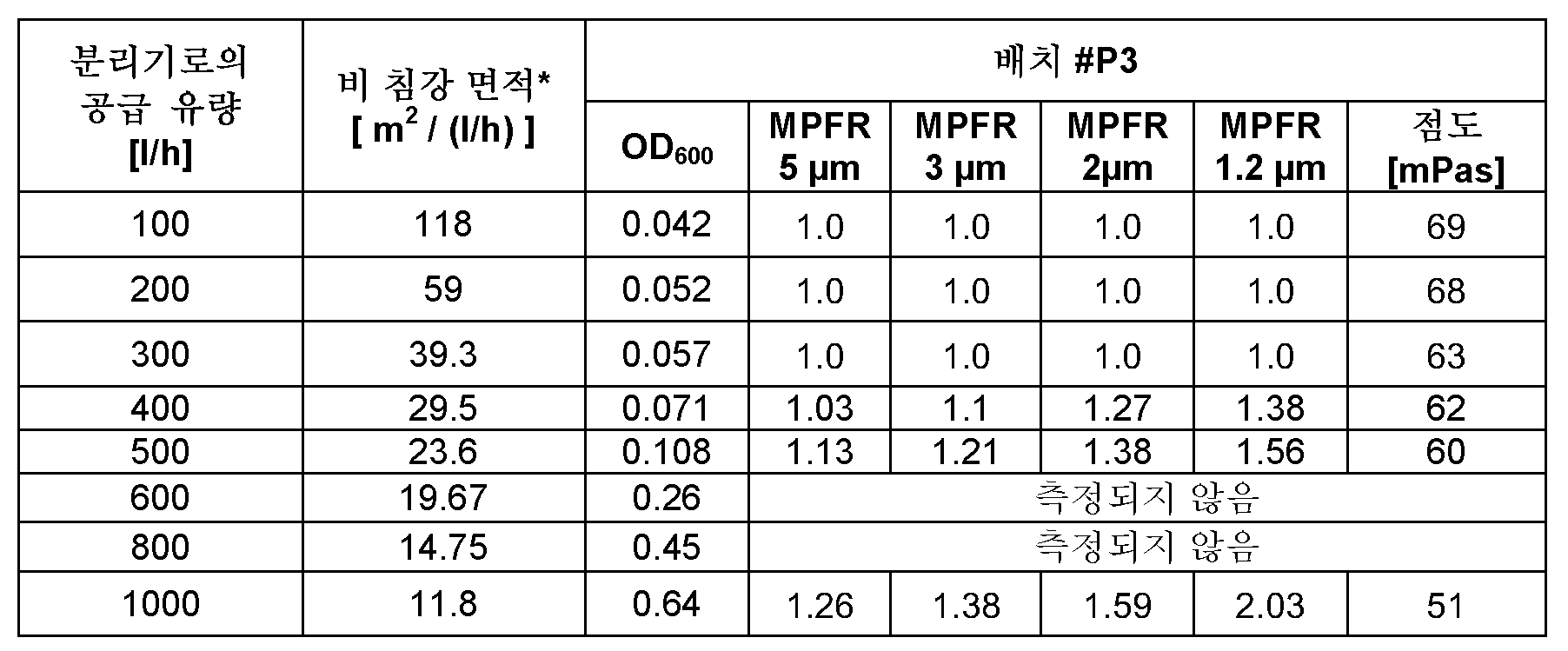
표 2Table 2

* "비 침강 면적"은 디스크 스택 원심분리기의 등가 침강 면적을 공급 유량으로 나눈 것으로서 정의됨.* "Non-subsidence area" is defined as the equivalent sedimentation area of the disk stack centrifuge divided by the feed rate.
표 1 및 표 2는 상이한 배치에 대해 수성 아크릴아미드 용액으로부터 생물촉매를 분리하기 위해 디스크 스택 분리기를 사용하는 경우에, 공급 유량 및 비 침강 면적에 따라, 2000 ppm 폴리아크릴아미드 용액의 OD600, API 63에 따른 MPFR MPFR-값 (여과성) 및 수성 아크릴아미드 용액의 4000 ppm 폴리아크릴아미드 용액의 점도 값을 제시한다. 수성 아크릴아미드 용액은 아크릴로니트릴을 아크릴아미드로 수화시킴으로써 생물촉매적으로 제조하였고, 사용된 생물촉매를 상이한 공급 유량을 사용하여 중합 전에 분리하였다. 배치 #3 및 배치 #4는 상이한 분리 시점에서의 상이한 반응-배출을 나타낸다. 폴리아크릴아미드를 각각 인공 해수 중에 용해시켰고, 제시된 데이터는 3 내지 4회의 개별 측정으로부터의 평균 값이다.Table 1 and Table 2 show the OD 600 of the 2000 ppm polyacrylamide solution and the API 63 < RTI ID = 0.0 > 63 < / RTI > of polyacrylamide solution, depending on the feed flow rate and non- precipitated area, (MPFR MPFR-value (filterability) according to the invention and the viscosity value of a 4000 ppm polyacrylamide solution of an aqueous acrylamide solution. The aqueous acrylamide solution was prepared biocetrically by hydration of acrylonitrile to acrylamide, and the biocatalyst used was separated prior to polymerization using different feed flow rates. Batch # 3 and Batch # 4 represent different reaction-emissions at different separation times. The polyacrylamide was dissolved in artificial seawater, respectively, and the data presented is an average value from three to four separate measurements.
SEQUENCE LISTING <110> BASF SE <120> Method for increasing the viscosity of a polyacrlyamide solution <130> 76089WO02 / B14950WO2 <150> EP16162684 <151> 2016-03-29 <160> 4 <170> PatentIn version 3.5 <210> 1 <211> 612 <212> DNA <213> Rhodococcus rhodochrous <400> 1 gtgagcgagc acgtcaataa gtacacggag tacgaggcac gtaccaaggc gatcgaaacc 60 ttgctgtacg agcgagggct catcacgccc gccgcggtcg accgagtcgt ttcgtactac 120 gagaacgaga tcggcccgat gggcggtgcc aaggtcgtgg ccaagtcctg ggtggaccct 180 gagtaccgca agtggctcga agaggacgcg acggccgcga tggcgtcatt gggctatgcc 240 ggtgagcagg cacaccaaat ttcggcggtc ttcaacgact cccaaacgca tcacgtggtg 300 gtgtgcactc tgtgttcgtg ctatccgtgg ccggtgcttg gtctcccgcc cgcctggtac 360 aagagcatgg agtaccggtc ccgagtggta gcggaccctc gtggagtgct caagcgcgat 420 ttcggtttcg acatccccga tgaggtggag gtcagggttt gggacagcag ctccgaaatc 480 cgctacatcg tcatcccgga acggccggcc ggcaccgacg gttggtccga ggaggagctg 540 acgaagctgg tgagccggga ctcgatgatc ggtgtcagta atgcgctcac accgcaggaa 600 gtgatcgtat ga 612 <210> 2 <211> 203 <212> PRT <213> Rhodococcus rhodochrous <400> 2 Val Ser Glu His Val Asn Lys Tyr Thr Glu Tyr Glu Ala Arg Thr Lys 1 5 10 15 Ala Ile Glu Thr Leu Leu Tyr Glu Arg Gly Leu Ile Thr Pro Ala Ala 20 25 30 Val Asp Arg Val Val Ser Tyr Tyr Glu Asn Glu Ile Gly Pro Met Gly 35 40 45 Gly Ala Lys Val Val Ala Lys Ser Trp Val Asp Pro Glu Tyr Arg Lys 50 55 60 Trp Leu Glu Glu Asp Ala Thr Ala Ala Met Ala Ser Leu Gly Tyr Ala 65 70 75 80 Gly Glu Gln Ala His Gln Ile Ser Ala Val Phe Asn Asp Ser Gln Thr 85 90 95 His His Val Val Val Cys Thr Leu Cys Ser Cys Tyr Pro Trp Pro Val 100 105 110 Leu Gly Leu Pro Pro Ala Trp Tyr Lys Ser Met Glu Tyr Arg Ser Arg 115 120 125 Val Val Ala Asp Pro Arg Gly Val Leu Lys Arg Asp Phe Gly Phe Asp 130 135 140 Ile Pro Asp Glu Val Glu Val Arg Val Trp Asp Ser Ser Ser Glu Ile 145 150 155 160 Arg Tyr Ile Val Ile Pro Glu Arg Pro Ala Gly Thr Asp Gly Trp Ser 165 170 175 Glu Glu Glu Leu Thr Lys Leu Val Ser Arg Asp Ser Met Ile Gly Val 180 185 190 Ser Asn Ala Leu Thr Pro Gln Glu Val Ile Val 195 200 <210> 3 <211> 690 <212> DNA <213> Rhodococcus rhodochrous <400> 3 atggatggta tccacgacac aggcggcatg accggatacg gaccggtccc ctatcagaag 60 gacgagccct tcttccacta cgagtgggag ggtcggaccc tgtcaattct gacttggatg 120 catctcaagg gcatatcgtg gtgggacaag tcgcggttct tccgggagtc gatggggaac 180 gaaaactacg tcaacgagat tcgcaactcg tactacaccc actggctgag tgcggcagaa 240 cgtatcctcg tcgccgacaa gatcatcacc gaagaagagc gaaagcaccg tgtgcaagag 300 atccttgagg gtcggtacac ggacaggaag ccgtcgcgga agttcgatcc ggcccagatc 360 gagaaggcga tcgaacggct tcacgagccc cactccctag cgcttccagg agcggagccg 420 agtttctctc tcggtgacaa gatcaaagtg aagagtatga acccgctggg acacacacgg 480 tgcccgaaat atgtgcggaa caagatcggg gaaatcgtcg cctaccacgg ctgccagatc 540 tatcccgaga gcagctccgc cggcctcggc gacgatcctc gcccgctcta cacggtcgcg 600 ttttccgccc aggaactgtg gggcgacgac ggaaacggga aagacgtagt gtgcgtcgat 660 ctctgggaac cgtacctgat ctctgcgtga 690 <210> 4 <211> 229 <212> PRT <213> Rhodococcus rhodochrous <400> 4 Met Asp Gly Ile His Asp Thr Gly Gly Met Thr Gly Tyr Gly Pro Val 1 5 10 15 Pro Tyr Gln Lys Asp Glu Pro Phe Phe His Tyr Glu Trp Glu Gly Arg 20 25 30 Thr Leu Ser Ile Leu Thr Trp Met His Leu Lys Gly Ile Ser Trp Trp 35 40 45 Asp Lys Ser Arg Phe Phe Arg Glu Ser Met Gly Asn Glu Asn Tyr Val 50 55 60 Asn Glu Ile Arg Asn Ser Tyr Tyr Thr His Trp Leu Ser Ala Ala Glu 65 70 75 80 Arg Ile Leu Val Ala Asp Lys Ile Ile Thr Glu Glu Glu Arg Lys His 85 90 95 Arg Val Gln Glu Ile Leu Glu Gly Arg Tyr Thr Asp Arg Lys Pro Ser 100 105 110 Arg Lys Phe Asp Pro Ala Gln Ile Glu Lys Ala Ile Glu Arg Leu His 115 120 125 Glu Pro His Ser Leu Ala Leu Pro Gly Ala Glu Pro Ser Phe Ser Leu 130 135 140 Gly Asp Lys Ile Lys Val Lys Ser Met Asn Pro Leu Gly His Thr Arg 145 150 155 160 Cys Pro Lys Tyr Val Arg Asn Lys Ile Gly Glu Ile Val Ala Tyr His 165 170 175 Gly Cys Gln Ile Tyr Pro Glu Ser Ser Ser Ala Gly Leu Gly Asp Asp 180 185 190 Pro Arg Pro Leu Tyr Thr Val Ala Phe Ser Ala Gln Glu Leu Trp Gly 195 200 205 Asp Asp Gly Asn Gly Lys Asp Val Val Cys Val Asp Leu Trp Glu Pro 210 215 220 Tyr Leu Ile Ser Ala 225 SEQUENCE LISTING <110> BASF SE <120> Method for increasing viscosity of a polyacrlyamide solution <130> 76089WO02 / B14950WO2 <150> EP16162684 <151> 2016-03-29 <160> 4 <170> PatentIn version 3.5 <210> 1 <211> 612 <212> DNA <213> Rhodococcus rhodochrous <400> 1 gtgagcgagc acgtcaataa gtacacggag tacgaggcac gtaccaaggc gatcgaaacc 60 ttgctgtacg agcgagggct catcacgccc gccgcggtcg accgagtcgt ttcgtactac 120 gagaacgaga tcggcccgat gggcggtgcc aaggtcgtgg ccaagtcctg ggtggaccct 180 gagtaccgca agtggctcga agaggacgcg acggccgcga tggcgtcatt gggctatgcc 240 ggtgagcagg cacaccaaat ttcggcggtc ttcaacgact cccaaacgca tcacgtggtg 300 gtgtgcactc tgtgttcgtg ctatccgtgg ccggtgcttg gtctcccgcc cgcctggtac 360 aagagcatgg agtaccggtc ccgagtggta gcggaccctc gtggagtgct caagcgcgat 420 ttcggtttcg acatccccga tgaggtggag gtcagggttt gggacagcag ctccgaaatc 480 cgctacatcg tcatcccgga acggccggcc ggcaccgacg gttggtccga ggaggagctg 540 acgaagctgg tgagccggga ctcgatgatc ggtgtcagta atgcgctcac accgcaggaa 600 gtgatcgtat ga 612 <210> 2 <211> 203 <212> PRT <213> Rhodococcus rhodochrous <400> 2 Val Ser Glu His Val Asn Lys Tyr Thr Glu Tyr Glu Ala Arg Thr Lys 1 5 10 15 Ala Ile Glu Thr Leu Leu Tyr Glu Arg Gly Leu Ile Thr Pro Ala Ala 20 25 30 Val Asp Arg Val Val Ser Tyr Tyr Glu Asn Glu Ile Gly Pro Met Gly 35 40 45 Gly Ala Lys Val Val Ala Lys Ser Trp Val Asp Pro Glu Tyr Arg Lys 50 55 60 Trp Leu Glu Glu Glu Asp Ala Thr Ala Ala Met Ala Ser Leu Gly Tyr Ala 65 70 75 80 Gly Glu Gln Ala His Gln Ile Ser Ala Val Phe Asn Asp Ser Gln Thr 85 90 95 His His Val Val Cys Thr Leu Cys Ser Cys Tyr Pro Trp Pro Val 100 105 110 Leu Gly Leu Pro Pro Ala Trp Tyr Lys Ser Met Glu Tyr Arg Ser Ser Arg 115 120 125 Val Val Ala Asp Pro Arg Gly Val Leu Lys Arg Asp Phe Gly Phe Asp 130 135 140 Ile Pro Asp Glu Val Glu Val Arg Val Trp Asp Ser Ser Ser Glu Ile 145 150 155 160 Arg Tyr Ile Val Ile Pro Glu Arg Pro Ala Gly Thr Asp Gly Trp Ser 165 170 175 Glu Glu Glu Leu Thr Lys Leu Val Ser Arg Asp Ser Ile Gly Val 180 185 190 Ser Asn Ala Leu Thr Pro Gln Glu Val Ile Val 195 200 <210> 3 <211> 690 <212> DNA <213> Rhodococcus rhodochrous <400> 3 atggatggta tccacgacac aggcggcatg accggatacg gaccggtccc ctatcagaag 60 gacgagccct tcttccacta cgagtgggag ggtcggaccc tgtcaattct gacttggatg 120 catctcaagg gcatatcgtg gtgggacaag tcgcggttct tccgggagtc gatggggaac 180 gaaaactacg tcaacgagat tcgcaactcg tactacaccc actggctgag tgcggcagaa 240 cgtatcctcg tcgccgacaa gatcatcacc gaagaagagc gaaagcaccg tgtgcaagag 300 atccttgagg gtcggtacac ggacaggaag ccgtcgcgga agttcgatcc ggcccagatc 360 gagaaggcga tcgaacggct tcacgagccc cactccctag cgcttccagg agcggagccg 420 agtttctctc tcggtgacaa gatcaaagtg aagagtatga acccgctggg acacacacgg 480 tgcccgaaat atgtgcggaa caagatcggg gaaatcgtcg cctaccacgg ctgccagatc 540 tatcccgaga gcagctccgc cggcctcggc gacgatcctc gcccgctcta cacggtcgcg 600 ttttccgccc aggaactgtg gggcgacgac ggaaacggga aagacgtagt gtgcgtcgat 660 ctctgggaac cgtacctgat ctctgcgtga 690 <210> 4 <211> 229 <212> PRT <213> Rhodococcus rhodochrous <400> 4 Met Asp Gly Ile His Asp Thr Gly Gly Met Thr Gly Tyr Gly Pro Val 1 5 10 15 Pro Tyr Gln Lys Asp Glu Pro Phe Phe His Tyr Glu Trp Glu Gly Arg 20 25 30 Thr Leu Ser Ile Leu Thr Trp Met His Leu Lys Gly Ile Ser Trp Trp 35 40 45 Asp Lys Ser Arg Phe Phe Arg Glu Ser Met Gly Asn Glu Asn Tyr Val 50 55 60 Asn Glu Ile Arg Asn Ser Tyr Tyr Thr His Trp Leu Ser Ala Ala Glu 65 70 75 80 Arg Ile Leu Val Ala Asp Lys Ile Ile Thr Glu Glu Glu Arg Lys His 85 90 95 Arg Val Gln Glu Ile Leu Glu Gly Arg Tyr Thr Asp Arg Lys Pro Ser 100 105 110 Arg Lys Phe Asp Pro Ala Gln Ile Glu Lys Ala Ile Glu Arg Leu His 115 120 125 Glu Pro His Ser Leu Ala Leu Pro Gly Ala Glu Pro Ser Phe Ser Leu 130 135 140 Gly Asp Lys Ile Lys Val Lys Ser Met Asn Pro Leu Gly His Thr Arg 145 150 155 160 Cys Pro Lys Tyr Val Arg Asn Lys Ile Gly Glu Ile Val Ala Tyr His 165 170 175 Gly Cys Gln Ile Tyr Pro Glu Ser Ser Ser Ala Gly Leu Gly Asp Asp 180 185 190 Pro Arg Pro Leu Tyr Thr Val Ala Phe Ser Ala Gln Glu Leu Trp Gly 195 200 205 Asp Asp Gly Asn Gly Lys Asp Val Val Cys Val Asp Leu Trp Glu Pro 210 215 220 Tyr Leu Ile Ser Ala 225
Claims (23)
(a) 생물촉매를 사용하여 아크릴로니트릴을 아크릴아미드로 전환시킴으로써 수성 아크릴아미드 용액을 제조하는 단계,
(b) 수성 아크릴아미드 용액의 OD600이 0.6 이하이도록, 단계 (a)의 수성 아크릴아미드 용액으로부터 생물촉매를 분리하는 단계,
(c) 단계 (b)에서 수득된 수성 아크릴아미드 용액을 폴리아크릴아미드로 중합시키는 단계,
여기서 참조 용액은 0.6 초과의 OD600을 갖는 수성 아크릴아미드 용액으로부터 제조된 폴리아크릴아미드 용액이고, 여기서 참조 용액은 생물촉매의 분리 없이 동일한 방법에 의해 제조된 것인
방법.CLAIMS What is claimed is: 1. A method of making a polyacrylamide solution having an increased viscosity as compared to a reference solution, comprising the steps of:
(a) preparing an aqueous acrylamide solution by converting the acrylonitrile to acrylamide using a biocatalyst,
(b) separating the biocatalyst from the aqueous acrylamide solution of step (a) so that the OD 600 of the aqueous acrylamide solution is not more than 0.6,
(c) polymerizing the aqueous acrylamide solution obtained in step (b) with polyacrylamide,
Wherein the reference solution is a polyacrylamide solution prepared from an aqueous acrylamide solution having an OD 600 of greater than 0.6, wherein the reference solution is prepared by the same method without separation of the biocatalyst
Way.
(a) 생물촉매를 사용하여 아크릴로니트릴을 아크릴아미드로 전환시킴으로써 수성 아크릴아미드 용액을 제조하는 단계,
(b) 19.67 m2h/l 이상의 비 침강 면적으로 수행되는 디스크 스택 분리에 의해 단계 (a)의 수성 아크릴아미드 용액으로부터 생물촉매를 분리하는 단계,
(c) 단계 (b)에서 수득된 수성 아크릴아미드 용액을 폴리아크릴아미드로 중합시키는 단계.A process for preparing a polyacrylamide solution prepared by biocatalyst conversion of acrylonitrile to acrylamide, comprising the steps of:
(a) preparing an aqueous acrylamide solution by converting the acrylonitrile to acrylamide using a biocatalyst,
(b) separating the biocatalyst from the aqueous acrylamide solution of step (a) by disk stack separation performed with a non-subsidence area of at least 19.67 m 2 h / l,
(c) polymerizing the aqueous acrylamide solution obtained in step (b) with polyacrylamide.
(d) 폴리아크릴아미드를 건조시키는 단계;
(e) 폴리아크릴아미드를 세절 및/또는 압착하는 단계; 및/또는
(f) 폴리아크릴아미드를 수성 용액 중에 용해시키는 단계.The method according to claim 1 or 2, further comprising at least one of the following steps:
(d) drying the polyacrylamide;
(e) fining and / or squeezing the polyacrylamide; And / or
(f) dissolving the polyacrylamide in an aqueous solution.
(a) 생물촉매를 사용하여 아크릴로니트릴을 아크릴아미드로 전환시킴으로써 수성 아크릴아미드 용액을 제조하는 단계,
(b) 아크릴로니트릴의 아크릴아미드로의 전환의 완료 후에, 수성 아크릴아미드 용액의 OD600이 0.6 이하이도록, 수성 아크릴아미드 용액으로부터 생물촉매를 분리하는 단계,
(c) 단계 (b)에서 수득된 수성 아크릴아미드 용액을 폴리아크릴아미드로 중합시키는 단계.A method for preparing a polyacrylamide solution having a viscosity of greater than 60 mPas at room temperature in artificial seawater, comprising the steps of:
(a) preparing an aqueous acrylamide solution by converting the acrylonitrile to acrylamide using a biocatalyst,
(b) separating the biocatalyst from the aqueous acrylamide solution so that the OD 600 of the aqueous acrylamide solution is no more than 0.6 after completion of the conversion of the acrylonitrile to the acrylamide,
(c) polymerizing the aqueous acrylamide solution obtained in step (b) with polyacrylamide.
Applications Claiming Priority (3)
| Application Number | Priority Date | Filing Date | Title |
|---|---|---|---|
| EP16162684 | 2016-03-29 | ||
| EP16162684.1 | 2016-03-29 | ||
| PCT/EP2017/057410 WO2017167803A1 (en) | 2016-03-29 | 2017-03-29 | Process for producing a polyacrylamide solution with increased viscosity |
Publications (2)
| Publication Number | Publication Date |
|---|---|
| KR20180129842A true KR20180129842A (en) | 2018-12-05 |
| KR102486471B1 KR102486471B1 (en) | 2023-01-10 |
Family
ID=55699404
Family Applications (1)
| Application Number | Title | Priority Date | Filing Date |
|---|---|---|---|
| KR1020187030383A Active KR102486471B1 (en) | 2016-03-29 | 2017-03-29 | Method for Preparing Polyacrylamide Solutions with Increased Viscosity |
Country Status (12)
| Country | Link |
|---|---|
| US (1) | US10975177B2 (en) |
| EP (1) | EP3436594A1 (en) |
| JP (1) | JP7094222B2 (en) |
| KR (1) | KR102486471B1 (en) |
| CN (1) | CN109072263A (en) |
| AU (1) | AU2017242461B2 (en) |
| CA (1) | CA3018918A1 (en) |
| CO (1) | CO2018011314A2 (en) |
| RU (1) | RU2751919C2 (en) |
| SG (1) | SG11201807636XA (en) |
| WO (1) | WO2017167803A1 (en) |
| ZA (1) | ZA201807082B (en) |
Families Citing this family (15)
| Publication number | Priority date | Publication date | Assignee | Title |
|---|---|---|---|---|
| CA3022178A1 (en) * | 2016-04-26 | 2017-11-02 | Basf Se | Method for preparing an aqueous polyacrylamide solution |
| WO2019081008A1 (en) * | 2017-10-25 | 2019-05-02 | Basf Se | Process for producing an aqueous acrylamide solution |
| CA3079109A1 (en) | 2017-10-25 | 2019-05-02 | Basf Se | Process for producing aqueous polyacrylamide solutions |
| WO2019081004A1 (en) * | 2017-10-25 | 2019-05-02 | Basf Se | Process for producing aqueous polyacrylamide solutions |
| MY200852A (en) | 2017-10-25 | 2024-01-19 | Basf Se | Process for Producing Aqueous Polyacrylamide Solutions |
| WO2019081003A1 (en) * | 2017-10-25 | 2019-05-02 | Basf Se | Process for producing aqueous polyacrylamide solutions |
| CA3076548A1 (en) | 2017-10-25 | 2019-05-02 | Basf Se | Process for producing aqueous polyacrylamide solutions |
| AR113375A1 (en) | 2017-10-25 | 2020-04-22 | Basf Se | PROCESS TO PRODUCE AQUEOUS POLYACRYLAMIDE SOLUTIONS |
| MX2020004312A (en) | 2017-10-25 | 2020-09-25 | Basf Se | Process for producing aqueous polyacrylamide solutions. |
| WO2019119248A1 (en) * | 2017-12-19 | 2019-06-27 | 爱森(中国)絮凝剂有限公司 | Method for producing anionic water-soluble polymer on the basis of bioacrylamide and acrylic acid |
| WO2020079119A1 (en) | 2018-10-18 | 2020-04-23 | Basf Se | Method of providing aqueous polyacrylamide concentrates |
| WO2020079124A1 (en) | 2018-10-18 | 2020-04-23 | Basf Se | Process for producing aqueous polyacrylamide compositions |
| MX2021004420A (en) | 2018-10-18 | 2021-07-06 | Basf Se | Process for producing an aqueous polyacrylamide concentrate. |
| CN109797164B (en) * | 2019-01-31 | 2022-09-02 | 大连理工大学 | Novel system for efficiently catalyzing fatty dinitrile hydration reaction by nitrile hydratase |
| WO2021089584A1 (en) | 2019-11-05 | 2021-05-14 | Basf Se | Method of storing a biocatalyst |
Citations (4)
| Publication number | Priority date | Publication date | Assignee | Title |
|---|---|---|---|---|
| EP1380652A1 (en) * | 2001-03-27 | 2004-01-14 | Dia-Nitrix Co., Ltd. | Process for producing acrylamide using microbial catalyst having been washed with aqueous acrylic acid solution |
| EP1498431A1 (en) * | 2002-03-22 | 2005-01-19 | Dia-Nitrix Co., Ltd. | Aqueous acrylamide solution containing saccharide |
| KR20080056261A (en) * | 2005-10-07 | 2008-06-20 | 미쓰이 가가쿠 가부시키가이샤 | Method for preparing an amide compound |
| WO2010141780A1 (en) * | 2009-06-04 | 2010-12-09 | Genomatica, Inc. | Process of separating components of a fermentation broth |
Family Cites Families (20)
| Publication number | Priority date | Publication date | Assignee | Title |
|---|---|---|---|---|
| US3597481A (en) | 1969-01-16 | 1971-08-03 | Dow Chemical Co | Heterogeneous catalyst for the liquid phase hydrolysis of nitriles to amides |
| BE795361A (en) | 1972-02-16 | 1973-08-13 | American Cyanamid Co | COPPER CATALYST FOR HYDRATION OF NITRILS TO AMIDES |
| GB2018240B (en) | 1978-03-29 | 1982-12-22 | Nitto Chemical Industry Co Ltd | Process for producing acrylamide or methacrylamide utilizing microoganisms |
| US4711955A (en) | 1981-04-17 | 1987-12-08 | Yale University | Modified nucleotides and methods of preparing and using same |
| CA1223831A (en) | 1982-06-23 | 1987-07-07 | Dean Engelhardt | Modified nucleotides, methods of preparing and utilizing and compositions containing the same |
| JPS60139351A (en) * | 1983-12-27 | 1985-07-24 | Saitou Enshinki Kogyo Kk | Separation plate type centrifugal separator |
| US5792608A (en) | 1991-12-12 | 1998-08-11 | Gilead Sciences, Inc. | Nuclease stable and binding competent oligomers and methods for their use |
| JP3014262B2 (en) | 1994-01-11 | 2000-02-28 | 三菱レイヨン株式会社 | Biocatalyst immobilization carrier and immobilized biocatalyst |
| US5525711A (en) | 1994-05-18 | 1996-06-11 | The United States Of America As Represented By The Secretary Of The Department Of Health And Human Services | Pteridine nucleotide analogs as fluorescent DNA probes |
| DE19828467A1 (en) | 1998-06-26 | 1999-12-30 | Metallgesellschaft Ag | Flocculating agent for removing colloidally dispersed solids from industrial drinking and waste water and for dewatering industrial sludges, especially in papermaking |
| RU2196825C2 (en) * | 2001-02-19 | 2003-01-20 | Государственное унитарное предприятие "Саратовский научно-исследовательский институт химии и технологии акриловых мономеров и полимеров с опытным заводом" | Biotechnological method of acrylamide aqueous solution preparing |
| DE10120555A1 (en) | 2001-04-26 | 2002-10-31 | Stockhausen Chem Fab Gmbh | Process for the preparation of an aqueous acrylamide solution with a bio-catalyst |
| WO2004089518A1 (en) | 2003-04-04 | 2004-10-21 | Dia-Nitrix Co., Ltd. | Filtration method using cross-flow film and producing method of acrylamide using the same |
| US7157276B2 (en) | 2003-06-20 | 2007-01-02 | Biogen Idec Inc. | Use of depth filtration in series with continuous centrifugation to clarify mammalian cell cultures |
| GB0327901D0 (en) | 2003-12-02 | 2004-01-07 | Ciba Spec Chem Water Treat Ltd | Process for producing polymers |
| JP2006187257A (en) | 2005-01-07 | 2006-07-20 | Daiyanitorikkusu Kk | Method for producing amide compound and acrylamide polymer |
| WO2007132601A1 (en) | 2006-05-15 | 2007-11-22 | Mitsui Chemicals, Inc. | (meth)acrylamide production method |
| US8569012B2 (en) | 2008-03-14 | 2013-10-29 | Mitsubishi Rayon Co., Ltd. | Method for stabilization of aqueous acrylamide solution |
| AU2013274000A1 (en) | 2012-06-15 | 2015-01-29 | Microvi Biotech Inc. | Bioconversion processes and apparatus |
| CN203319905U (en) | 2013-05-28 | 2013-12-04 | 山东瑞特精细化工有限公司 | Acrylamide monomer solution refining device |
-
2017
- 2017-03-29 WO PCT/EP2017/057410 patent/WO2017167803A1/en not_active Ceased
- 2017-03-29 US US16/087,472 patent/US10975177B2/en active Active
- 2017-03-29 EP EP17714221.3A patent/EP3436594A1/en not_active Withdrawn
- 2017-03-29 KR KR1020187030383A patent/KR102486471B1/en active Active
- 2017-03-29 JP JP2018550410A patent/JP7094222B2/en active Active
- 2017-03-29 CN CN201780019681.8A patent/CN109072263A/en active Pending
- 2017-03-29 CA CA3018918A patent/CA3018918A1/en active Pending
- 2017-03-29 RU RU2018137749A patent/RU2751919C2/en active
- 2017-03-29 AU AU2017242461A patent/AU2017242461B2/en active Active
- 2017-03-29 SG SG11201807636XA patent/SG11201807636XA/en unknown
-
2018
- 2018-10-23 CO CO2018011314A patent/CO2018011314A2/en unknown
- 2018-10-24 ZA ZA2018/07082A patent/ZA201807082B/en unknown
Patent Citations (5)
| Publication number | Priority date | Publication date | Assignee | Title |
|---|---|---|---|---|
| EP1380652A1 (en) * | 2001-03-27 | 2004-01-14 | Dia-Nitrix Co., Ltd. | Process for producing acrylamide using microbial catalyst having been washed with aqueous acrylic acid solution |
| EP1498431A1 (en) * | 2002-03-22 | 2005-01-19 | Dia-Nitrix Co., Ltd. | Aqueous acrylamide solution containing saccharide |
| KR101006614B1 (en) * | 2002-03-22 | 2011-01-07 | 다이야니트릭스 가부시키가이샤 | Acrylamide aqueous solution containing sugar |
| KR20080056261A (en) * | 2005-10-07 | 2008-06-20 | 미쓰이 가가쿠 가부시키가이샤 | Method for preparing an amide compound |
| WO2010141780A1 (en) * | 2009-06-04 | 2010-12-09 | Genomatica, Inc. | Process of separating components of a fermentation broth |
Also Published As
| Publication number | Publication date |
|---|---|
| JP7094222B2 (en) | 2022-07-01 |
| CA3018918A1 (en) | 2017-10-05 |
| SG11201807636XA (en) | 2018-10-30 |
| EP3436594A1 (en) | 2019-02-06 |
| US10975177B2 (en) | 2021-04-13 |
| AU2017242461A1 (en) | 2018-09-27 |
| KR102486471B1 (en) | 2023-01-10 |
| BR112018069317A2 (en) | 2019-01-22 |
| RU2751919C2 (en) | 2021-07-20 |
| ZA201807082B (en) | 2022-08-31 |
| WO2017167803A1 (en) | 2017-10-05 |
| JP2019517777A (en) | 2019-06-27 |
| CO2018011314A2 (en) | 2019-10-31 |
| US20190112399A1 (en) | 2019-04-18 |
| RU2018137749A3 (en) | 2020-07-28 |
| RU2018137749A (en) | 2020-04-29 |
| CN109072263A (en) | 2018-12-21 |
| AU2017242461B2 (en) | 2021-09-09 |
Similar Documents
| Publication | Publication Date | Title |
|---|---|---|
| KR102486471B1 (en) | Method for Preparing Polyacrylamide Solutions with Increased Viscosity | |
| RU2706533C2 (en) | Method of producing aqueous solution of acrylamide with low concentration of acrylic acid | |
| WO2016050819A1 (en) | Method for preparing an acrylamide solution having a low acrylic acid concentration | |
| JP2017535249A5 (en) | ||
| CN107075457B (en) | Method for culturing microorganism having nitrile hydratase activity | |
| JP6371810B2 (en) | Method for producing poly-gamma-glutamic acid | |
| EP3225694A1 (en) | Method for the production of acrylamide by defined addition of the biocatalyst | |
| JP2019176835A (en) | Method for producing amide compound | |
| BR112018069317B1 (en) | METHOD FOR PRODUCING A POLYACRYLAMIDE SOLUTION WITH INCREASED VISCOSITY | |
| US20220403426A1 (en) | Method of storing a biocatalyst | |
| RU2824556C2 (en) | Method of producing mixed solution of acrylic monomers and bacterial strain for implementation thereof | |
| RU2539033C1 (en) | RECOMBINANT BACTERIUM STRAIN Rhodococcus rhodochrous HAVING CONSTITUTIVE ACYLATING ACTIVITY, AND METHOD OF SYNTHESIS OF N-REPLACED ACRYLAMIDES USING THIS STRAIN AS BIOCATALYST | |
| EP3225693A1 (en) | Method for preparing aqueous acrylamide solutions | |
| JP5532619B2 (en) | Novel nitrile hydratase and its gene from environmental DNA | |
| CN117165506A (en) | Method for producing 5-aminopentanoic acid and 1, 5-pentanediamine by using embedded engineering bacteria | |
| TW201231654A (en) | The application of PHA synthetase gene phaT and its gene product from extreme halophilic archaea in bioplastic production |
Legal Events
| Date | Code | Title | Description |
|---|---|---|---|
| PA0105 | International application |
St.27 status event code: A-0-1-A10-A15-nap-PA0105 |
|
| PG1501 | Laying open of application |
St.27 status event code: A-1-1-Q10-Q12-nap-PG1501 |
|
| E13-X000 | Pre-grant limitation requested |
St.27 status event code: A-2-3-E10-E13-lim-X000 |
|
| P11-X000 | Amendment of application requested |
St.27 status event code: A-2-2-P10-P11-nap-X000 |
|
| P13-X000 | Application amended |
St.27 status event code: A-2-2-P10-P13-nap-X000 |
|
| PA0201 | Request for examination |
St.27 status event code: A-1-2-D10-D11-exm-PA0201 |
|
| D13-X000 | Search requested |
St.27 status event code: A-1-2-D10-D13-srh-X000 |
|
| D14-X000 | Search report completed |
St.27 status event code: A-1-2-D10-D14-srh-X000 |
|
| E902 | Notification of reason for refusal | ||
| PE0902 | Notice of grounds for rejection |
St.27 status event code: A-1-2-D10-D21-exm-PE0902 |
|
| P11-X000 | Amendment of application requested |
St.27 status event code: A-2-2-P10-P11-nap-X000 |
|
| P13-X000 | Application amended |
St.27 status event code: A-2-2-P10-P13-nap-X000 |
|
| E701 | Decision to grant or registration of patent right | ||
| PE0701 | Decision of registration |
St.27 status event code: A-1-2-D10-D22-exm-PE0701 |
|
| GRNT | Written decision to grant | ||
| PR0701 | Registration of establishment |
St.27 status event code: A-2-4-F10-F11-exm-PR0701 |
|
| PR1002 | Payment of registration fee |
St.27 status event code: A-2-2-U10-U12-oth-PR1002 Fee payment year number: 1 |
|
| PG1601 | Publication of registration |
St.27 status event code: A-4-4-Q10-Q13-nap-PG1601 |
|
| R18-X000 | Changes to party contact information recorded |
St.27 status event code: A-5-5-R10-R18-oth-X000 |
|
| PR1001 | Payment of annual fee |
St.27 status event code: A-4-4-U10-U11-oth-PR1001 Fee payment year number: 4 |