KR20180094876A - Amyloid beta epitopes and antibodies thereto - Google Patents
Amyloid beta epitopes and antibodies thereto Download PDFInfo
- Publication number
- KR20180094876A KR20180094876A KR1020187015910A KR20187015910A KR20180094876A KR 20180094876 A KR20180094876 A KR 20180094876A KR 1020187015910 A KR1020187015910 A KR 1020187015910A KR 20187015910 A KR20187015910 A KR 20187015910A KR 20180094876 A KR20180094876 A KR 20180094876A
- Authority
- KR
- South Korea
- Prior art keywords
- antibody
- seq
- beta
- peptide
- sequence
- Prior art date
- Legal status (The legal status is an assumption and is not a legal conclusion. Google has not performed a legal analysis and makes no representation as to the accuracy of the status listed.)
- Pending
Links
- 0 CCC(C)(C(C)**)C(C)[C@](C)N Chemical compound CCC(C)(C(C)**)C(C)[C@](C)N 0.000 description 2
Images


Classifications
-
- C—CHEMISTRY; METALLURGY
- C07—ORGANIC CHEMISTRY
- C07K—PEPTIDES
- C07K14/00—Peptides having more than 20 amino acids; Gastrins; Somatostatins; Melanotropins; Derivatives thereof
- C07K14/435—Peptides having more than 20 amino acids; Gastrins; Somatostatins; Melanotropins; Derivatives thereof from animals; from humans
- C07K14/46—Peptides having more than 20 amino acids; Gastrins; Somatostatins; Melanotropins; Derivatives thereof from animals; from humans from vertebrates
- C07K14/47—Peptides having more than 20 amino acids; Gastrins; Somatostatins; Melanotropins; Derivatives thereof from animals; from humans from vertebrates from mammals
- C07K14/4701—Peptides having more than 20 amino acids; Gastrins; Somatostatins; Melanotropins; Derivatives thereof from animals; from humans from vertebrates from mammals not used
- C07K14/4711—Alzheimer's disease; Amyloid plaque core protein
-
- A—HUMAN NECESSITIES
- A61—MEDICAL OR VETERINARY SCIENCE; HYGIENE
- A61K—PREPARATIONS FOR MEDICAL, DENTAL OR TOILETRY PURPOSES
- A61K39/00—Medicinal preparations containing antigens or antibodies
- A61K39/0005—Vertebrate antigens
- A61K39/0008—Antigens related to auto-immune diseases; Preparations to induce self-tolerance
-
- A—HUMAN NECESSITIES
- A61—MEDICAL OR VETERINARY SCIENCE; HYGIENE
- A61K—PREPARATIONS FOR MEDICAL, DENTAL OR TOILETRY PURPOSES
- A61K47/00—Medicinal preparations characterised by the non-active ingredients used, e.g. carriers or inert additives; Targeting or modifying agents chemically bound to the active ingredient
- A61K47/50—Medicinal preparations characterised by the non-active ingredients used, e.g. carriers or inert additives; Targeting or modifying agents chemically bound to the active ingredient the non-active ingredient being chemically bound to the active ingredient, e.g. polymer-drug conjugates
- A61K47/51—Medicinal preparations characterised by the non-active ingredients used, e.g. carriers or inert additives; Targeting or modifying agents chemically bound to the active ingredient the non-active ingredient being chemically bound to the active ingredient, e.g. polymer-drug conjugates the non-active ingredient being a modifying agent
- A61K47/62—Medicinal preparations characterised by the non-active ingredients used, e.g. carriers or inert additives; Targeting or modifying agents chemically bound to the active ingredient the non-active ingredient being chemically bound to the active ingredient, e.g. polymer-drug conjugates the non-active ingredient being a modifying agent the modifying agent being a protein, peptide or polyamino acid
- A61K47/64—Drug-peptide, drug-protein or drug-polyamino acid conjugates, i.e. the modifying agent being a peptide, protein or polyamino acid which is covalently bonded or complexed to a therapeutically active agent
- A61K47/643—Albumins, e.g. HSA, BSA, ovalbumin or a Keyhole Limpet Hemocyanin [KHL]
-
- A—HUMAN NECESSITIES
- A61—MEDICAL OR VETERINARY SCIENCE; HYGIENE
- A61K—PREPARATIONS FOR MEDICAL, DENTAL OR TOILETRY PURPOSES
- A61K47/00—Medicinal preparations characterised by the non-active ingredients used, e.g. carriers or inert additives; Targeting or modifying agents chemically bound to the active ingredient
- A61K47/50—Medicinal preparations characterised by the non-active ingredients used, e.g. carriers or inert additives; Targeting or modifying agents chemically bound to the active ingredient the non-active ingredient being chemically bound to the active ingredient, e.g. polymer-drug conjugates
- A61K47/51—Medicinal preparations characterised by the non-active ingredients used, e.g. carriers or inert additives; Targeting or modifying agents chemically bound to the active ingredient the non-active ingredient being chemically bound to the active ingredient, e.g. polymer-drug conjugates the non-active ingredient being a modifying agent
- A61K47/62—Medicinal preparations characterised by the non-active ingredients used, e.g. carriers or inert additives; Targeting or modifying agents chemically bound to the active ingredient the non-active ingredient being chemically bound to the active ingredient, e.g. polymer-drug conjugates the non-active ingredient being a modifying agent the modifying agent being a protein, peptide or polyamino acid
- A61K47/64—Drug-peptide, drug-protein or drug-polyamino acid conjugates, i.e. the modifying agent being a peptide, protein or polyamino acid which is covalently bonded or complexed to a therapeutically active agent
- A61K47/646—Drug-peptide, drug-protein or drug-polyamino acid conjugates, i.e. the modifying agent being a peptide, protein or polyamino acid which is covalently bonded or complexed to a therapeutically active agent the entire peptide or protein drug conjugate elicits an immune response, e.g. conjugate vaccines
-
- A—HUMAN NECESSITIES
- A61—MEDICAL OR VETERINARY SCIENCE; HYGIENE
- A61K—PREPARATIONS FOR MEDICAL, DENTAL OR TOILETRY PURPOSES
- A61K51/00—Preparations containing radioactive substances for use in therapy or testing in vivo
- A61K51/02—Preparations containing radioactive substances for use in therapy or testing in vivo characterised by the carrier, i.e. characterised by the agent or material covalently linked or complexing the radioactive nucleus
- A61K51/04—Organic compounds
- A61K51/08—Peptides, e.g. proteins, carriers being peptides, polyamino acids, proteins
- A61K51/10—Antibodies or immunoglobulins; Fragments thereof, the carrier being an antibody, an immunoglobulin or a fragment thereof, e.g. a camelised human single domain antibody or the Fc fragment of an antibody
- A61K51/1018—Antibodies or immunoglobulins; Fragments thereof, the carrier being an antibody, an immunoglobulin or a fragment thereof, e.g. a camelised human single domain antibody or the Fc fragment of an antibody against material from animals or humans
-
- A—HUMAN NECESSITIES
- A61—MEDICAL OR VETERINARY SCIENCE; HYGIENE
- A61P—SPECIFIC THERAPEUTIC ACTIVITY OF CHEMICAL COMPOUNDS OR MEDICINAL PREPARATIONS
- A61P25/00—Drugs for disorders of the nervous system
- A61P25/28—Drugs for disorders of the nervous system for treating neurodegenerative disorders of the central nervous system, e.g. nootropic agents, cognition enhancers, drugs for treating Alzheimer's disease or other forms of dementia
-
- C—CHEMISTRY; METALLURGY
- C07—ORGANIC CHEMISTRY
- C07K—PEPTIDES
- C07K16/00—Immunoglobulins [IGs], e.g. monoclonal or polyclonal antibodies
- C07K16/18—Immunoglobulins [IGs], e.g. monoclonal or polyclonal antibodies against material from animals or humans
-
- C—CHEMISTRY; METALLURGY
- C07—ORGANIC CHEMISTRY
- C07K—PEPTIDES
- C07K5/00—Peptides containing up to four amino acids in a fully defined sequence; Derivatives thereof
- C07K5/04—Peptides containing up to four amino acids in a fully defined sequence; Derivatives thereof containing only normal peptide links
- C07K5/10—Tetrapeptides
- C07K5/1021—Tetrapeptides with the first amino acid being acidic
-
- C—CHEMISTRY; METALLURGY
- C07—ORGANIC CHEMISTRY
- C07K—PEPTIDES
- C07K5/00—Peptides containing up to four amino acids in a fully defined sequence; Derivatives thereof
- C07K5/04—Peptides containing up to four amino acids in a fully defined sequence; Derivatives thereof containing only normal peptide links
- C07K5/10—Tetrapeptides
- C07K5/1024—Tetrapeptides with the first amino acid being heterocyclic
-
- C—CHEMISTRY; METALLURGY
- C07—ORGANIC CHEMISTRY
- C07K—PEPTIDES
- C07K7/00—Peptides having 5 to 20 amino acids in a fully defined sequence; Derivatives thereof
- C07K7/64—Cyclic peptides containing only normal peptide links
-
- G—PHYSICS
- G01—MEASURING; TESTING
- G01N—INVESTIGATING OR ANALYSING MATERIALS BY DETERMINING THEIR CHEMICAL OR PHYSICAL PROPERTIES
- G01N33/00—Investigating or analysing materials by specific methods not covered by groups G01N1/00 - G01N31/00
- G01N33/48—Biological material, e.g. blood, urine; Haemocytometers
- G01N33/50—Chemical analysis of biological material, e.g. blood, urine; Testing involving biospecific ligand binding methods; Immunological testing
- G01N33/68—Chemical analysis of biological material, e.g. blood, urine; Testing involving biospecific ligand binding methods; Immunological testing involving proteins, peptides or amino acids
- G01N33/6893—Chemical analysis of biological material, e.g. blood, urine; Testing involving biospecific ligand binding methods; Immunological testing involving proteins, peptides or amino acids related to diseases not provided for elsewhere
- G01N33/6896—Neurological disorders, e.g. Alzheimer's disease
-
- A—HUMAN NECESSITIES
- A61—MEDICAL OR VETERINARY SCIENCE; HYGIENE
- A61K—PREPARATIONS FOR MEDICAL, DENTAL OR TOILETRY PURPOSES
- A61K39/00—Medicinal preparations containing antigens or antibodies
- A61K2039/505—Medicinal preparations containing antigens or antibodies comprising antibodies
-
- A—HUMAN NECESSITIES
- A61—MEDICAL OR VETERINARY SCIENCE; HYGIENE
- A61K—PREPARATIONS FOR MEDICAL, DENTAL OR TOILETRY PURPOSES
- A61K39/00—Medicinal preparations containing antigens or antibodies
- A61K2039/555—Medicinal preparations containing antigens or antibodies characterised by a specific combination antigen/adjuvant
- A61K2039/55505—Inorganic adjuvants
-
- A—HUMAN NECESSITIES
- A61—MEDICAL OR VETERINARY SCIENCE; HYGIENE
- A61K—PREPARATIONS FOR MEDICAL, DENTAL OR TOILETRY PURPOSES
- A61K39/00—Medicinal preparations containing antigens or antibodies
- A61K2039/60—Medicinal preparations containing antigens or antibodies characteristics by the carrier linked to the antigen
- A61K2039/6031—Proteins
- A61K2039/6081—Albumin; Keyhole limpet haemocyanin [KLH]
-
- A—HUMAN NECESSITIES
- A61—MEDICAL OR VETERINARY SCIENCE; HYGIENE
- A61K—PREPARATIONS FOR MEDICAL, DENTAL OR TOILETRY PURPOSES
- A61K2300/00—Mixtures or combinations of active ingredients, wherein at least one active ingredient is fully defined in groups A61K31/00 - A61K41/00
-
- A—HUMAN NECESSITIES
- A61—MEDICAL OR VETERINARY SCIENCE; HYGIENE
- A61K—PREPARATIONS FOR MEDICAL, DENTAL OR TOILETRY PURPOSES
- A61K38/00—Medicinal preparations containing peptides
-
- A—HUMAN NECESSITIES
- A61—MEDICAL OR VETERINARY SCIENCE; HYGIENE
- A61K—PREPARATIONS FOR MEDICAL, DENTAL OR TOILETRY PURPOSES
- A61K38/00—Medicinal preparations containing peptides
- A61K38/04—Peptides having up to 20 amino acids in a fully defined sequence; Derivatives thereof
- A61K38/05—Dipeptides
-
- A—HUMAN NECESSITIES
- A61—MEDICAL OR VETERINARY SCIENCE; HYGIENE
- A61K—PREPARATIONS FOR MEDICAL, DENTAL OR TOILETRY PURPOSES
- A61K38/00—Medicinal preparations containing peptides
- A61K38/04—Peptides having up to 20 amino acids in a fully defined sequence; Derivatives thereof
- A61K38/07—Tetrapeptides
-
- A—HUMAN NECESSITIES
- A61—MEDICAL OR VETERINARY SCIENCE; HYGIENE
- A61K—PREPARATIONS FOR MEDICAL, DENTAL OR TOILETRY PURPOSES
- A61K38/00—Medicinal preparations containing peptides
- A61K38/04—Peptides having up to 20 amino acids in a fully defined sequence; Derivatives thereof
- A61K38/08—Peptides having 5 to 11 amino acids
-
- A—HUMAN NECESSITIES
- A61—MEDICAL OR VETERINARY SCIENCE; HYGIENE
- A61K—PREPARATIONS FOR MEDICAL, DENTAL OR TOILETRY PURPOSES
- A61K38/00—Medicinal preparations containing peptides
- A61K38/04—Peptides having up to 20 amino acids in a fully defined sequence; Derivatives thereof
- A61K38/12—Cyclic peptides, e.g. bacitracins; Polymyxins; Gramicidins S, C; Tyrocidins A, B or C
-
- A—HUMAN NECESSITIES
- A61—MEDICAL OR VETERINARY SCIENCE; HYGIENE
- A61K—PREPARATIONS FOR MEDICAL, DENTAL OR TOILETRY PURPOSES
- A61K39/00—Medicinal preparations containing antigens or antibodies
-
- A—HUMAN NECESSITIES
- A61—MEDICAL OR VETERINARY SCIENCE; HYGIENE
- A61K—PREPARATIONS FOR MEDICAL, DENTAL OR TOILETRY PURPOSES
- A61K39/00—Medicinal preparations containing antigens or antibodies
- A61K39/0005—Vertebrate antigens
- A61K39/0007—Nervous system antigens; Prions
-
- A—HUMAN NECESSITIES
- A61—MEDICAL OR VETERINARY SCIENCE; HYGIENE
- A61K—PREPARATIONS FOR MEDICAL, DENTAL OR TOILETRY PURPOSES
- A61K39/00—Medicinal preparations containing antigens or antibodies
- A61K39/385—Haptens or antigens, bound to carriers
-
- A—HUMAN NECESSITIES
- A61—MEDICAL OR VETERINARY SCIENCE; HYGIENE
- A61K—PREPARATIONS FOR MEDICAL, DENTAL OR TOILETRY PURPOSES
- A61K39/00—Medicinal preparations containing antigens or antibodies
- A61K39/39—Medicinal preparations containing antigens or antibodies characterised by the immunostimulating additives, e.g. chemical adjuvants
-
- A—HUMAN NECESSITIES
- A61—MEDICAL OR VETERINARY SCIENCE; HYGIENE
- A61K—PREPARATIONS FOR MEDICAL, DENTAL OR TOILETRY PURPOSES
- A61K39/00—Medicinal preparations containing antigens or antibodies
- A61K39/395—Antibodies; Immunoglobulins; Immune serum, e.g. antilymphocytic serum
-
- A—HUMAN NECESSITIES
- A61—MEDICAL OR VETERINARY SCIENCE; HYGIENE
- A61K—PREPARATIONS FOR MEDICAL, DENTAL OR TOILETRY PURPOSES
- A61K39/00—Medicinal preparations containing antigens or antibodies
- A61K39/395—Antibodies; Immunoglobulins; Immune serum, e.g. antilymphocytic serum
- A61K39/39533—Antibodies; Immunoglobulins; Immune serum, e.g. antilymphocytic serum against materials from animals
-
- A—HUMAN NECESSITIES
- A61—MEDICAL OR VETERINARY SCIENCE; HYGIENE
- A61K—PREPARATIONS FOR MEDICAL, DENTAL OR TOILETRY PURPOSES
- A61K39/00—Medicinal preparations containing antigens or antibodies
- A61K39/395—Antibodies; Immunoglobulins; Immune serum, e.g. antilymphocytic serum
- A61K39/39533—Antibodies; Immunoglobulins; Immune serum, e.g. antilymphocytic serum against materials from animals
- A61K39/3955—Antibodies; Immunoglobulins; Immune serum, e.g. antilymphocytic serum against materials from animals against proteinaceous materials, e.g. enzymes, hormones, lymphokines
-
- A—HUMAN NECESSITIES
- A61—MEDICAL OR VETERINARY SCIENCE; HYGIENE
- A61K—PREPARATIONS FOR MEDICAL, DENTAL OR TOILETRY PURPOSES
- A61K45/00—Medicinal preparations containing active ingredients not provided for in groups A61K31/00 - A61K41/00
- A61K45/05—Immunological preparations stimulating the reticulo-endothelial system, e.g. against cancer
-
- A—HUMAN NECESSITIES
- A61—MEDICAL OR VETERINARY SCIENCE; HYGIENE
- A61K—PREPARATIONS FOR MEDICAL, DENTAL OR TOILETRY PURPOSES
- A61K45/00—Medicinal preparations containing active ingredients not provided for in groups A61K31/00 - A61K41/00
- A61K45/06—Mixtures of active ingredients without chemical characterisation, e.g. antiphlogistics and cardiaca
-
- A—HUMAN NECESSITIES
- A61—MEDICAL OR VETERINARY SCIENCE; HYGIENE
- A61K—PREPARATIONS FOR MEDICAL, DENTAL OR TOILETRY PURPOSES
- A61K47/00—Medicinal preparations characterised by the non-active ingredients used, e.g. carriers or inert additives; Targeting or modifying agents chemically bound to the active ingredient
- A61K47/50—Medicinal preparations characterised by the non-active ingredients used, e.g. carriers or inert additives; Targeting or modifying agents chemically bound to the active ingredient the non-active ingredient being chemically bound to the active ingredient, e.g. polymer-drug conjugates
- A61K47/69—Medicinal preparations characterised by the non-active ingredients used, e.g. carriers or inert additives; Targeting or modifying agents chemically bound to the active ingredient the non-active ingredient being chemically bound to the active ingredient, e.g. polymer-drug conjugates the conjugate being characterised by physical or galenical forms, e.g. emulsion, particle, inclusion complex, stent or kit
- A61K47/6921—Medicinal preparations characterised by the non-active ingredients used, e.g. carriers or inert additives; Targeting or modifying agents chemically bound to the active ingredient the non-active ingredient being chemically bound to the active ingredient, e.g. polymer-drug conjugates the conjugate being characterised by physical or galenical forms, e.g. emulsion, particle, inclusion complex, stent or kit the form being a particulate, a powder, an adsorbate, a bead or a sphere
-
- A—HUMAN NECESSITIES
- A61—MEDICAL OR VETERINARY SCIENCE; HYGIENE
- A61K—PREPARATIONS FOR MEDICAL, DENTAL OR TOILETRY PURPOSES
- A61K49/00—Preparations for testing in vivo
- A61K49/06—Nuclear magnetic resonance [NMR] contrast preparations; Magnetic resonance imaging [MRI] contrast preparations
- A61K49/18—Nuclear magnetic resonance [NMR] contrast preparations; Magnetic resonance imaging [MRI] contrast preparations characterised by a special physical form, e.g. emulsions, microcapsules, liposomes
- A61K49/1818—Nuclear magnetic resonance [NMR] contrast preparations; Magnetic resonance imaging [MRI] contrast preparations characterised by a special physical form, e.g. emulsions, microcapsules, liposomes particles, e.g. uncoated or non-functionalised microparticles or nanoparticles
-
- A—HUMAN NECESSITIES
- A61—MEDICAL OR VETERINARY SCIENCE; HYGIENE
- A61K—PREPARATIONS FOR MEDICAL, DENTAL OR TOILETRY PURPOSES
- A61K51/00—Preparations containing radioactive substances for use in therapy or testing in vivo
- A61K51/02—Preparations containing radioactive substances for use in therapy or testing in vivo characterised by the carrier, i.e. characterised by the agent or material covalently linked or complexing the radioactive nucleus
- A61K51/04—Organic compounds
- A61K51/08—Peptides, e.g. proteins, carriers being peptides, polyamino acids, proteins
- A61K51/088—Peptides, e.g. proteins, carriers being peptides, polyamino acids, proteins conjugates with carriers being peptides, polyamino acids or proteins
-
- A—HUMAN NECESSITIES
- A61—MEDICAL OR VETERINARY SCIENCE; HYGIENE
- A61K—PREPARATIONS FOR MEDICAL, DENTAL OR TOILETRY PURPOSES
- A61K51/00—Preparations containing radioactive substances for use in therapy or testing in vivo
- A61K51/02—Preparations containing radioactive substances for use in therapy or testing in vivo characterised by the carrier, i.e. characterised by the agent or material covalently linked or complexing the radioactive nucleus
- A61K51/04—Organic compounds
- A61K51/08—Peptides, e.g. proteins, carriers being peptides, polyamino acids, proteins
- A61K51/10—Antibodies or immunoglobulins; Fragments thereof, the carrier being an antibody, an immunoglobulin or a fragment thereof, e.g. a camelised human single domain antibody or the Fc fragment of an antibody
-
- A—HUMAN NECESSITIES
- A61—MEDICAL OR VETERINARY SCIENCE; HYGIENE
- A61L—METHODS OR APPARATUS FOR STERILISING MATERIALS OR OBJECTS IN GENERAL; DISINFECTION, STERILISATION OR DEODORISATION OF AIR; CHEMICAL ASPECTS OF BANDAGES, DRESSINGS, ABSORBENT PADS OR SURGICAL ARTICLES; MATERIALS FOR BANDAGES, DRESSINGS, ABSORBENT PADS OR SURGICAL ARTICLES
- A61L27/00—Materials for grafts or prostheses or for coating grafts or prostheses
- A61L27/14—Macromolecular materials
- A61L27/22—Polypeptides or derivatives thereof, e.g. degradation products
- A61L27/227—Other specific proteins or polypeptides not covered by A61L27/222, A61L27/225 or A61L27/24
-
- A—HUMAN NECESSITIES
- A61—MEDICAL OR VETERINARY SCIENCE; HYGIENE
- A61L—METHODS OR APPARATUS FOR STERILISING MATERIALS OR OBJECTS IN GENERAL; DISINFECTION, STERILISATION OR DEODORISATION OF AIR; CHEMICAL ASPECTS OF BANDAGES, DRESSINGS, ABSORBENT PADS OR SURGICAL ARTICLES; MATERIALS FOR BANDAGES, DRESSINGS, ABSORBENT PADS OR SURGICAL ARTICLES
- A61L27/00—Materials for grafts or prostheses or for coating grafts or prostheses
- A61L27/28—Materials for coating prostheses
- A61L27/34—Macromolecular materials
-
- A—HUMAN NECESSITIES
- A61—MEDICAL OR VETERINARY SCIENCE; HYGIENE
- A61L—METHODS OR APPARATUS FOR STERILISING MATERIALS OR OBJECTS IN GENERAL; DISINFECTION, STERILISATION OR DEODORISATION OF AIR; CHEMICAL ASPECTS OF BANDAGES, DRESSINGS, ABSORBENT PADS OR SURGICAL ARTICLES; MATERIALS FOR BANDAGES, DRESSINGS, ABSORBENT PADS OR SURGICAL ARTICLES
- A61L29/00—Materials for catheters, medical tubing, cannulae, or endoscopes or for coating catheters
- A61L29/08—Materials for coatings
- A61L29/085—Macromolecular materials
-
- A—HUMAN NECESSITIES
- A61—MEDICAL OR VETERINARY SCIENCE; HYGIENE
- A61L—METHODS OR APPARATUS FOR STERILISING MATERIALS OR OBJECTS IN GENERAL; DISINFECTION, STERILISATION OR DEODORISATION OF AIR; CHEMICAL ASPECTS OF BANDAGES, DRESSINGS, ABSORBENT PADS OR SURGICAL ARTICLES; MATERIALS FOR BANDAGES, DRESSINGS, ABSORBENT PADS OR SURGICAL ARTICLES
- A61L29/00—Materials for catheters, medical tubing, cannulae, or endoscopes or for coating catheters
- A61L29/14—Materials characterised by their function or physical properties, e.g. lubricating compositions
- A61L29/16—Biologically active materials, e.g. therapeutic substances
-
- A—HUMAN NECESSITIES
- A61—MEDICAL OR VETERINARY SCIENCE; HYGIENE
- A61L—METHODS OR APPARATUS FOR STERILISING MATERIALS OR OBJECTS IN GENERAL; DISINFECTION, STERILISATION OR DEODORISATION OF AIR; CHEMICAL ASPECTS OF BANDAGES, DRESSINGS, ABSORBENT PADS OR SURGICAL ARTICLES; MATERIALS FOR BANDAGES, DRESSINGS, ABSORBENT PADS OR SURGICAL ARTICLES
- A61L31/00—Materials for other surgical articles, e.g. stents, stent-grafts, shunts, surgical drapes, guide wires, materials for adhesion prevention, occluding devices, surgical gloves, tissue fixation devices
- A61L31/08—Materials for coatings
- A61L31/10—Macromolecular materials
-
- A—HUMAN NECESSITIES
- A61—MEDICAL OR VETERINARY SCIENCE; HYGIENE
- A61L—METHODS OR APPARATUS FOR STERILISING MATERIALS OR OBJECTS IN GENERAL; DISINFECTION, STERILISATION OR DEODORISATION OF AIR; CHEMICAL ASPECTS OF BANDAGES, DRESSINGS, ABSORBENT PADS OR SURGICAL ARTICLES; MATERIALS FOR BANDAGES, DRESSINGS, ABSORBENT PADS OR SURGICAL ARTICLES
- A61L31/00—Materials for other surgical articles, e.g. stents, stent-grafts, shunts, surgical drapes, guide wires, materials for adhesion prevention, occluding devices, surgical gloves, tissue fixation devices
- A61L31/14—Materials characterised by their function or physical properties, e.g. injectable or lubricating compositions, shape-memory materials, surface modified materials
- A61L31/16—Biologically active materials, e.g. therapeutic substances
-
- C—CHEMISTRY; METALLURGY
- C07—ORGANIC CHEMISTRY
- C07K—PEPTIDES
- C07K14/00—Peptides having more than 20 amino acids; Gastrins; Somatostatins; Melanotropins; Derivatives thereof
- C07K14/435—Peptides having more than 20 amino acids; Gastrins; Somatostatins; Melanotropins; Derivatives thereof from animals; from humans
-
- C—CHEMISTRY; METALLURGY
- C07—ORGANIC CHEMISTRY
- C07K—PEPTIDES
- C07K16/00—Immunoglobulins [IGs], e.g. monoclonal or polyclonal antibodies
-
- C—CHEMISTRY; METALLURGY
- C07—ORGANIC CHEMISTRY
- C07K—PEPTIDES
- C07K2317/00—Immunoglobulins specific features
- C07K2317/20—Immunoglobulins specific features characterized by taxonomic origin
-
- C—CHEMISTRY; METALLURGY
- C07—ORGANIC CHEMISTRY
- C07K—PEPTIDES
- C07K2317/00—Immunoglobulins specific features
- C07K2317/20—Immunoglobulins specific features characterized by taxonomic origin
- C07K2317/24—Immunoglobulins specific features characterized by taxonomic origin containing regions, domains or residues from different species, e.g. chimeric, humanized or veneered
-
- C—CHEMISTRY; METALLURGY
- C07—ORGANIC CHEMISTRY
- C07K—PEPTIDES
- C07K2317/00—Immunoglobulins specific features
- C07K2317/30—Immunoglobulins specific features characterized by aspects of specificity or valency
-
- C—CHEMISTRY; METALLURGY
- C07—ORGANIC CHEMISTRY
- C07K—PEPTIDES
- C07K2317/00—Immunoglobulins specific features
- C07K2317/30—Immunoglobulins specific features characterized by aspects of specificity or valency
- C07K2317/33—Crossreactivity, e.g. for species or epitope, or lack of said crossreactivity
-
- C—CHEMISTRY; METALLURGY
- C07—ORGANIC CHEMISTRY
- C07K—PEPTIDES
- C07K2317/00—Immunoglobulins specific features
- C07K2317/30—Immunoglobulins specific features characterized by aspects of specificity or valency
- C07K2317/34—Identification of a linear epitope shorter than 20 amino acid residues or of a conformational epitope defined by amino acid residues
-
- C—CHEMISTRY; METALLURGY
- C07—ORGANIC CHEMISTRY
- C07K—PEPTIDES
- C07K2317/00—Immunoglobulins specific features
- C07K2317/50—Immunoglobulins specific features characterized by immunoglobulin fragments
- C07K2317/52—Constant or Fc region; Isotype
- C07K2317/524—CH2 domain
-
- C—CHEMISTRY; METALLURGY
- C07—ORGANIC CHEMISTRY
- C07K—PEPTIDES
- C07K2317/00—Immunoglobulins specific features
- C07K2317/50—Immunoglobulins specific features characterized by immunoglobulin fragments
- C07K2317/52—Constant or Fc region; Isotype
- C07K2317/526—CH3 domain
-
- C—CHEMISTRY; METALLURGY
- C07—ORGANIC CHEMISTRY
- C07K—PEPTIDES
- C07K2317/00—Immunoglobulins specific features
- C07K2317/50—Immunoglobulins specific features characterized by immunoglobulin fragments
- C07K2317/54—F(ab')2
-
- C—CHEMISTRY; METALLURGY
- C07—ORGANIC CHEMISTRY
- C07K—PEPTIDES
- C07K2317/00—Immunoglobulins specific features
- C07K2317/50—Immunoglobulins specific features characterized by immunoglobulin fragments
- C07K2317/55—Fab or Fab'
-
- C—CHEMISTRY; METALLURGY
- C07—ORGANIC CHEMISTRY
- C07K—PEPTIDES
- C07K2317/00—Immunoglobulins specific features
- C07K2317/50—Immunoglobulins specific features characterized by immunoglobulin fragments
- C07K2317/56—Immunoglobulins specific features characterized by immunoglobulin fragments variable (Fv) region, i.e. VH and/or VL
-
- C—CHEMISTRY; METALLURGY
- C07—ORGANIC CHEMISTRY
- C07K—PEPTIDES
- C07K2317/00—Immunoglobulins specific features
- C07K2317/50—Immunoglobulins specific features characterized by immunoglobulin fragments
- C07K2317/56—Immunoglobulins specific features characterized by immunoglobulin fragments variable (Fv) region, i.e. VH and/or VL
- C07K2317/565—Complementarity determining region [CDR]
-
- C—CHEMISTRY; METALLURGY
- C07—ORGANIC CHEMISTRY
- C07K—PEPTIDES
- C07K2317/00—Immunoglobulins specific features
- C07K2317/50—Immunoglobulins specific features characterized by immunoglobulin fragments
- C07K2317/56—Immunoglobulins specific features characterized by immunoglobulin fragments variable (Fv) region, i.e. VH and/or VL
- C07K2317/569—Single domain, e.g. dAb, sdAb, VHH, VNAR or nanobody®
-
- C—CHEMISTRY; METALLURGY
- C07—ORGANIC CHEMISTRY
- C07K—PEPTIDES
- C07K2317/00—Immunoglobulins specific features
- C07K2317/60—Immunoglobulins specific features characterized by non-natural combinations of immunoglobulin fragments
- C07K2317/62—Immunoglobulins specific features characterized by non-natural combinations of immunoglobulin fragments comprising only variable region components
- C07K2317/624—Disulfide-stabilized antibody (dsFv)
-
- C—CHEMISTRY; METALLURGY
- C07—ORGANIC CHEMISTRY
- C07K—PEPTIDES
- C07K2317/00—Immunoglobulins specific features
- C07K2317/60—Immunoglobulins specific features characterized by non-natural combinations of immunoglobulin fragments
- C07K2317/62—Immunoglobulins specific features characterized by non-natural combinations of immunoglobulin fragments comprising only variable region components
- C07K2317/626—Diabody or triabody
-
- C—CHEMISTRY; METALLURGY
- C07—ORGANIC CHEMISTRY
- C07K—PEPTIDES
- C07K2317/00—Immunoglobulins specific features
- C07K2317/70—Immunoglobulins specific features characterized by effect upon binding to a cell or to an antigen
-
- C—CHEMISTRY; METALLURGY
- C07—ORGANIC CHEMISTRY
- C07K—PEPTIDES
- C07K2317/00—Immunoglobulins specific features
- C07K2317/70—Immunoglobulins specific features characterized by effect upon binding to a cell or to an antigen
- C07K2317/76—Antagonist effect on antigen, e.g. neutralization or inhibition of binding
-
- C—CHEMISTRY; METALLURGY
- C07—ORGANIC CHEMISTRY
- C07K—PEPTIDES
- C07K2317/00—Immunoglobulins specific features
- C07K2317/90—Immunoglobulins specific features characterized by (pharmaco)kinetic aspects or by stability of the immunoglobulin
- C07K2317/92—Affinity (KD), association rate (Ka), dissociation rate (Kd) or EC50 value
-
- C—CHEMISTRY; METALLURGY
- C07—ORGANIC CHEMISTRY
- C07K—PEPTIDES
- C07K2317/00—Immunoglobulins specific features
- C07K2317/90—Immunoglobulins specific features characterized by (pharmaco)kinetic aspects or by stability of the immunoglobulin
- C07K2317/94—Stability, e.g. half-life, pH, temperature or enzyme-resistance
-
- C—CHEMISTRY; METALLURGY
- C07—ORGANIC CHEMISTRY
- C07K—PEPTIDES
- C07K2319/00—Fusion polypeptide
-
- C—CHEMISTRY; METALLURGY
- C07—ORGANIC CHEMISTRY
- C07K—PEPTIDES
- C07K5/00—Peptides containing up to four amino acids in a fully defined sequence; Derivatives thereof
- C07K5/04—Peptides containing up to four amino acids in a fully defined sequence; Derivatives thereof containing only normal peptide links
- C07K5/10—Tetrapeptides
- C07K5/1002—Tetrapeptides with the first amino acid being neutral
- C07K5/1005—Tetrapeptides with the first amino acid being neutral and aliphatic
- C07K5/101—Tetrapeptides with the first amino acid being neutral and aliphatic the side chain containing 2 to 4 carbon atoms, e.g. Val, Ile, Leu
-
- C—CHEMISTRY; METALLURGY
- C07—ORGANIC CHEMISTRY
- C07K—PEPTIDES
- C07K7/00—Peptides having 5 to 20 amino acids in a fully defined sequence; Derivatives thereof
- C07K7/04—Linear peptides containing only normal peptide links
- C07K7/06—Linear peptides containing only normal peptide links having 5 to 11 amino acids
-
- C—CHEMISTRY; METALLURGY
- C07—ORGANIC CHEMISTRY
- C07K—PEPTIDES
- C07K7/00—Peptides having 5 to 20 amino acids in a fully defined sequence; Derivatives thereof
- C07K7/04—Linear peptides containing only normal peptide links
- C07K7/08—Linear peptides containing only normal peptide links having 12 to 20 amino acids
-
- G—PHYSICS
- G01—MEASURING; TESTING
- G01N—INVESTIGATING OR ANALYSING MATERIALS BY DETERMINING THEIR CHEMICAL OR PHYSICAL PROPERTIES
- G01N2333/00—Assays involving biological materials from specific organisms or of a specific nature
- G01N2333/435—Assays involving biological materials from specific organisms or of a specific nature from animals; from humans
- G01N2333/46—Assays involving biological materials from specific organisms or of a specific nature from animals; from humans from vertebrates
- G01N2333/47—Assays involving proteins of known structure or function as defined in the subgroups
- G01N2333/4701—Details
- G01N2333/4709—Amyloid plaque core protein
-
- G—PHYSICS
- G01—MEASURING; TESTING
- G01N—INVESTIGATING OR ANALYSING MATERIALS BY DETERMINING THEIR CHEMICAL OR PHYSICAL PROPERTIES
- G01N2800/00—Detection or diagnosis of diseases
- G01N2800/28—Neurological disorders
-
- G—PHYSICS
- G01—MEASURING; TESTING
- G01N—INVESTIGATING OR ANALYSING MATERIALS BY DETERMINING THEIR CHEMICAL OR PHYSICAL PROPERTIES
- G01N2800/00—Detection or diagnosis of diseases
- G01N2800/28—Neurological disorders
- G01N2800/2814—Dementia; Cognitive disorders
- G01N2800/2821—Alzheimer
-
- G—PHYSICS
- G01—MEASURING; TESTING
- G01N—INVESTIGATING OR ANALYSING MATERIALS BY DETERMINING THEIR CHEMICAL OR PHYSICAL PROPERTIES
- G01N2800/00—Detection or diagnosis of diseases
- G01N2800/38—Pediatrics
- G01N2800/385—Congenital anomalies
- G01N2800/387—Down syndrome; Trisomy 18; Trisomy 13
-
- G—PHYSICS
- G01—MEASURING; TESTING
- G01N—INVESTIGATING OR ANALYSING MATERIALS BY DETERMINING THEIR CHEMICAL OR PHYSICAL PROPERTIES
- G01N33/00—Investigating or analysing materials by specific methods not covered by groups G01N1/00 - G01N31/00
- G01N33/48—Biological material, e.g. blood, urine; Haemocytometers
- G01N33/50—Chemical analysis of biological material, e.g. blood, urine; Testing involving biospecific ligand binding methods; Immunological testing
- G01N33/5005—Chemical analysis of biological material, e.g. blood, urine; Testing involving biospecific ligand binding methods; Immunological testing involving human or animal cells
- G01N33/5008—Chemical analysis of biological material, e.g. blood, urine; Testing involving biospecific ligand binding methods; Immunological testing involving human or animal cells for testing or evaluating the effect of chemical or biological compounds, e.g. drugs, cosmetics
- G01N33/5044—Chemical analysis of biological material, e.g. blood, urine; Testing involving biospecific ligand binding methods; Immunological testing involving human or animal cells for testing or evaluating the effect of chemical or biological compounds, e.g. drugs, cosmetics involving specific cell types
- G01N33/5058—Neurological cells
Landscapes
- Health & Medical Sciences (AREA)
- Life Sciences & Earth Sciences (AREA)
- Chemical & Material Sciences (AREA)
- Engineering & Computer Science (AREA)
- Proteomics, Peptides & Aminoacids (AREA)
- Organic Chemistry (AREA)
- Medicinal Chemistry (AREA)
- General Health & Medical Sciences (AREA)
- Molecular Biology (AREA)
- Bioinformatics & Cheminformatics (AREA)
- Biochemistry (AREA)
- Biomedical Technology (AREA)
- Immunology (AREA)
- Genetics & Genomics (AREA)
- Biophysics (AREA)
- Animal Behavior & Ethology (AREA)
- Public Health (AREA)
- Veterinary Medicine (AREA)
- Pharmacology & Pharmacy (AREA)
- Neurology (AREA)
- Epidemiology (AREA)
- Neurosurgery (AREA)
- Microbiology (AREA)
- Urology & Nephrology (AREA)
- Hematology (AREA)
- Physics & Mathematics (AREA)
- Gastroenterology & Hepatology (AREA)
- Zoology (AREA)
- Toxicology (AREA)
- Virology (AREA)
- Mycology (AREA)
- Pathology (AREA)
- Biotechnology (AREA)
- Cell Biology (AREA)
- Food Science & Technology (AREA)
- Analytical Chemistry (AREA)
- General Physics & Mathematics (AREA)
- Psychiatry (AREA)
- Hospice & Palliative Care (AREA)
- Chemical Kinetics & Catalysis (AREA)
Abstract
본 개시내용은, 형태적 에피토프를 포함하는, A-베타에서 확인된 에피토프, 이에 대한 항체, 및 이에 특이적인 면역원 및 항체의 제조 및 이용 방법에 관한 것이다.This disclosure relates to epitopes identified in A-beta, morphological epitopes, antibodies thereto, and methods of making and using such immunogens and antibodies.

Description
관련된 출원Related Application
이것은 2015년 11월 9일 출원된, 미국 특허출원 시리얼 번호 62/253044; 2016년 2월 1일 월요일 출원된, 미국 특허출원 시리얼 번호 62/289,893; 2016년 7월 22일 출원된, 미국 특허출원 시리얼 번호 62/365,634; 및 2016년 9월 12일 출원된, 미국 특허출원 시리얼 번호 62/393,615의 우선권의 이점을 주장하는 PCT 출원이고, 이들 각각은 본 명세서에서 참고로 편입된다. This is disclosed in U.S. Patent Application Serial No. 62/253044, filed November 9, 2015; U. S. Patent Application Serial No. 62 / 289,893, filed February 1, 2016; U. S. Patent Application Serial Nos. 62 / 365,634, filed July 22, 2016; And PCT Application Serial No. 62 / 393,615, filed September 12, 2016, which claims the benefit of priority, each of which is incorporated herein by reference.
분야Field
본 개시내용은 아밀로이드 베타 (A-베타 또는 Aβ) 에피토프 및 이에 대한 항체에 관한 것이며, 보다 구체적으로 A-베타 올리고머내에서 선택적으로 접근가능한 것으로 예측된 형태적 A-베타 에피토프, 및 관련 항체 조성물 및 이의 용도에 관한 것이다. This disclosure relates to amyloid beta (A-beta or A [beta] epitopes and antibodies thereto, and more particularly to morphological A-beta epitopes predicted selectively accessible in A-beta oligomers, and related antibody compositions and And its use.
36-43 아미노산 펩티드로서 존재하는, 아밀로이드-베타 (A-베타)는 효소 β 및 γ 세크레타제에 의해 아밀로이드 전구체 단백질 (APP)로부터 방출된 생성물이다. 알츠하이머병 (AD) 환자에서, A-베타는 가용성 모노머, 불용성 피브릴 및 가용성 올리고머에서 존재할 수 있다. 모노머 형태에서, A-베타는 대개 비구조화된 폴리펩티드 쇄로서 존재한다. 피브릴 형태에서, A-베타는, 종종 균주로 지칭된, 구별되는 형태학으로 응집할 수 있다. 몇 개의 이들 형태는 고체상 NMR에 의해 계측되어 왔다. Amyloid-beta (A-beta), which is present as an amino acid peptide, is a product released from amyloid precursor protein (APP) by enzyme beta and gamma secretase. In Alzheimer's disease (AD) patients, A-beta may be present in soluble monomers, insoluble fibrils and soluble oligomers. In the monomer form, A-beta is usually present as an unstructured polypeptide chain. In fibril form, A-beta can aggregate distinctly morphologically, often referred to as a strain. Several of these forms have been measured by solid state NMR.
예를 들어, 피브릴의 몇 개의 균주용 형태는, 3-배 대칭 Aβ 형태 (PDB 엔트리, 2M4J); Aβ-40 모노머의 2-배 대칭 형태 (PDB 엔트리 2LMN), 및 Aβ-42 모노머의 단일-쇄, 평행한 레지스터내 형태 (PDB 엔트리 2MXU)를 포함하는, 단백질 데이터 뱅크 (PDB), 원자 해상도 3차원 형태적 데이터의 결정학적 데이터베이스에서 이용가능하다. For example, several strains of fibrils have the 3-fold symmetric A? Form (PDB entry, 2M4J); A protein data bank (PDB), a two-fold symmetric form of the Aβ-40 monomer (PDB entry 2LMN), and a single-stranded parallel Aβ-42 monomer form (PDB entry 2MXU) It is available in a crystallographic database of dimensional morphological data.
2M4J의 형태는 J.X.LU, W.QIANG, W.M.YAU, C.D.SCHWIETERS, S.C.MEREDITH, R.TYCKO, MOLECULAR STRUCTURE OF BETA-AMYLOID FIBRILS IN ALZHEIMER'S DISEASE BRAIN TISSUE. CELL Vol. 154 p.1257 (2013)에 보고되어 있고, 2MXU의 형태는 Y.XIAO, B.MA, D.MCELHENY, S.PARTHASARATHY, F.LONG, M.HOSHI, R.NUSSINOV, Y.ISHII A BETA (1-42) FIBRIL STRUCTURE ILLUMINATES SELF-RECOGNITION AND REPLICATION OF AMYLOID IN ALZHEIMER'S DISEASE. NAT.STRUCT.MOL.BIOL. Vol. 22 p.499 (2015)에 보고되어 있다. Forms of 2M4J are described in J.X.LU, W. QIANG, W.M.YAU, C.D.SCHWIETERS, S.C. MEREDITH, R.TYCKO, MOLECULAR STRUCTURE OF BETA-AMYLOID FIBRILS IN ALZHEIMER'S DISEASE BRAIN TISSUE. CELL Vol. 154 p.1257 (2013), and the form of 2MXU is Y.XIAO, B.MA, D.MCELHENY, S.PARTHASARATHY, F.LONG, M.HOSHI, R.NUSSINOV, Y.ISHIIA BETA 1-42) FIBRIL STRUCTURE ILLUMINATES SELF-RECOGNITION AND REPLICATION OF AMYLOID IN ALZHEIMER'S DISEASE. NAT.STRUCT.MOL.BIOL. Vol. 22 p. 499 (2015).
A-베타 올리고머는, 뇌 슬라이스 배양액 및 살아있는 동물에서, 장기간 강화작용 (LTP)로 지칭된, 기억을 보조하는 핵심 시냅스 활성을 차단하고 배양액에서 세포주 및 뉴런을 사멸시킨다고 밝혀졌다. A-beta oligomers have been shown to block key synaptic activities that support memory, termed long term potentiation (LTP), in brain slice cultures and live animals, and kill cell lines and neurons in culture media.
올리고머의 형태는 현재까지 계측되지 않았다. 또한, NMR 및 다른 증거는 올리고머가 단일 명확한 형태로 존재하지 않지만, 제한된 규칙성을 가진 형태적으로-플라스틱, 가단성 형태적 앙상블로 존재한다는 것을 나타낸다. 또한, 독성 올리고머 종의 농도는 모노머 또는 피브릴의 어느 한쪽 것 훨씬 아래이어서 (추정치는 다양하지만 1000-배 위 아래 정도이다), 상기 표적을 달성하기 힘들게 한다. The shape of the oligomer has not been measured to date. NMR and other evidence also indicate that the oligomer is not present in a single definite form, but is present in a morphologically-plastic, malleable morphologic ensemble with limited regularity. Also, the concentration of toxic oligomer species is much lower than either monomer or fibril (estimates vary, but 1000-fold or less), making it difficult to achieve the target.
미국 특허 제5,766,846호; 제5,837,672호; 및 제5,593,846호(이는 본원에 喚疵 포함된다)는 Aβ 펩티드의 중심 도메인에 대한 쥐 단클론성 항체의 생산을 기술하고 있다. 제WO 01/62801호는 13 내지 28번 아미노산 사이의 A-베타에 결합하는 항체를 기술하고 있다. 제WO2004071408호는 인간화된 항체를 개시하고 있다. 제WO2008088983A1호는 아밀로이드 베타((A-베타) 펩티드에 결합하고 하나 이상의 폴리에틸렌 글리콜(PEG) 분자에 공유적으로 부착된 항체 단편을 기술하고 있으며, 당해 항체 단편은 13 내지 28번 위치의 아미노산 사이의 사람 A-베타 펩티드에 특이적으로 결합한다. 솔라네주마브 및 크레네주마브는 A-베타에서 16 내지 26번 아미노산에 결합한다. 크레네주마브는 모노머, 올리고머 및 피브릴과 상호작용한다. 솔라네주마브(피코몰 친화성) 및 크레네주마브(나노몰 친화성)을 포함하는, 미드레젼 항체(midregion antibody)는 모노머성 A-베타에 우선적으로 결합하는 것으로 여겨진다[1]. U.S. Patent No. 5,766,846; 5,837,672; And 5,593, 846, which are incorporated herein by reference, describe the production of murine monoclonal antibodies to the central domain of A [beta] peptide. WO 01/62801 describes antibodies that bind to A-beta between amino acids 13-28. WO2004071408 discloses humanized antibodies. WO2008088983A1 describes an antibody fragment that binds to an amyloid beta (A-beta) peptide and is covalently attached to one or more polyethylene glycol (PEG) molecules, wherein the antibody fragment has an amino acid sequence Solanum marb and cresnazumab bind to amino acids 16-26 in A-beta, which interacts with monomers, oligomers and fibrils. ≪ RTI ID = 0.0 > A midregion antibody, including mab (picomole affinity) and cresnazumab (nano mol affinity), is believed to bind preferentially to monomeric A-beta [1].
A-베타 올리고머에 우선적으로 또는 선택적으로 결합하는 항체가 바람직하다. Antibodies that bind preferentially or selectively to A-beta oligomers are preferred.
요약 summary
잔기 QKLV(서열 식별 번호: 1) 또는 이의 일부로 이루어진 A-베타에서, 에피토프, 임의로 형태적 에피토프, 및 이에 대한 항체가 본원에 기술되어 있다. 에피토프는 이를 모노머내에서 A-베타로부터 이를 구별하는 형태로, A-베타의 올리고머 종에 선택적으로 노출된 것으로 확인된다. In A-Beta consisting of residues QKLV (SEQ ID NO: 1) or a portion thereof, epitopes, optionally morphological epitopes, and antibodies thereto are described herein. The epitope is found to be selectively exposed to oligomeric species of A-beta in a form that distinguishes it from A-beta in the monomer.
일 측면은 QKL 및 8, 7 또는 6개 이하의 A-베타 잔기, 및 링커를 포함하는 A-베타 펩티드를 포함하고, 여기서 상기 링커는 상기 A-베타 펩티드 N-말단 잔기 및 상기 A-베타 C-말단 잔기에 공유적으로 커플링되는, 화합물, 바람직하게는 환형 화합물을 포함한다.One aspect includes an A-beta peptide comprising QKL and up to 8, 7, or 6 A-beta residues, and a linker, wherein the linker comprises the A-beta peptide N-terminal residue and the A- beta C Preferably a cyclic compound, which is covalently coupled to the terminal residue.
한 구현예에서, A-베타 펩티드는 서열 식별 번호: 1-10의 어느 하나의 서열로부터 선택되고, 임의로 하기로부터 선택된다: QKLV (서열 식별 번호: 1), HQKLV (서열 식별 번호: 2), HQKLVF (서열 식별 번호: 9) 및 QKLVF (서열 식별 번호: 10).In one embodiment, the A-beta peptide is selected from any one of SEQ ID NOs: 1-10 and is optionally selected from: QKLV (SEQ ID NO: 1), HQKLV (SEQ ID NO: 2) HQKLVF (SEQ ID NO: 9) and QKLVF (SEQ ID NO: 10).
또 다른 구현예에서, 환형 화합물은 환형 펩티드이다.In another embodiment, the cyclic compound is a cyclic peptide.
다른 구현예에서, 환형 화합물은 i) 상응하는 직쇄 화합물과 관련하여 Q에 대해 비교된 대안적 형태인 적어도 Q 및/또는 ii) 상응하는 직쇄 화합물과 비교하여 적어도 10%, 적어도 20%, 적어도 25%, 적어도 30%, 적어도 35%, 적어도 40% 이상 제한된 엔트로피에 의해 측정된 것으로서, Q, 및/또는 K, 및/또는 L에 대한 형태를 포함한다.In another embodiment, the cyclic compound is at least Q and / or ii) at least 10%, at least 20%, at least 25%, at least 20%, at least 20% , And / or K, and / or L, as measured by a limited entropy of at least 30%, at least 35%, at least 40%
또 다른 구현예에서, A-베타 펩티드는 하기이다: QKLV (서열 식별 번호: 1).In another embodiment, the A-beta peptide is: QKLV (SEQ ID NO: 1).
또 다른 구현예에서, 화합물은 추가로 검출가능한 표지를 포함한다.In another embodiment, the compound further comprises a detectable label.
또 다른 구현예에서, 링커는 1-8 아미노산 및/또는 동등하게 기능하는 분자 및/또는 하나 이상의 기능화가능한 모이어티를 포함하거나 상기로 구성된다.In another embodiment, the linker comprises or consists of 1-8 amino acids and / or equivalently functioning molecules and / or one or more functionalizable moieties.
또 다른 구현예에서, 링커 아미노산은 A 및 G로부터 선택되고/되거나, 여기서 상기 기능화가능한 모이어티는 C이다.In another embodiment, the linker amino acid is selected from A and G, and / or wherein the functionalizable moiety is C.
또 다른 구현예에서, 링커는 아미노산 GCG 또는 CGC를 포함하거나 상기로 구성된다.In another embodiment, the linker comprises or consists of the amino acid GCG or CGC.
또 다른 구현예에서, 링커는 PEG 분자를 포함한다.In another embodiment, the linker comprises a PEG molecule.
또 다른 구현예에서, 환형 화합물은 하기 형태로부터 선택된다:In another embodiment, the cyclic compound is selected from the following forms:

및And

한 측면은 본 명세서에서 기재된 환형 화합물을 포함하는 면역원을 포함한다.One aspect includes immunogens comprising the cyclic compounds described herein.
한 구현예에서, 환형 화합물은 담체 단백질 또는 면역원성 증강제에 커플링된다.In one embodiment, the cyclic compound is coupled to a carrier protein or an immunoconjugate.
일 구현예에서, 담체 단백질은 소 혈청 알부민 (BSA)이거나 면역원성-증강제는 키홀 림펫 헤모시아닌 (KLH)이다.In one embodiment, the carrier protein is bovine serum albumin (BSA) or the immunogenicity-enhancing agent is keyhole limpet hemocyanin (KLH).
한 측면은 본 명세서에서 기재된 화합물 또는 본 명세서에서 기재된 면역원을 포함하는 조성물을 포함한다.One aspect includes a composition comprising a compound described herein or an immunogen as described herein.
한 구현예에서, 본원에 기술된 조성물은 아쥬반트를 추가로 포함한다.In one embodiment, the compositions described herein further comprise an adjuvant.
또 다른 구현예에서, 아쥬반트는 인산알루미늄 또는 수산화알루미늄이다.In another embodiment, the adjuvant is aluminum phosphate or aluminum hydroxide.
한 측면은, 하기의 어느 하나에서 임의로 제시된 바와 같은, QKLV (서열 식별 번호: 1)의 서열 또는 관련된 에피토프 서열을 갖는 A-베타 펩티드에 특이적으로 결합하는 단리된 항체를 포함한다: 서열 식별 번호: 1-10.One aspect includes an isolated antibody that specifically binds to an A-beta peptide having a sequence of QKLV (SEQ ID NO: 1) or an associated epitope sequence, as optionally indicated in any of the following: : 1-10.
한 구현예에서, 항체는 A-베타 상의 에피토프에 특이적으로 결합하고, 여기서 에피토프는 항체로의 결합에 주로 관여된 적어도 2개의 연속 아미노산 잔기를 포함하거나, 여기서 적어도 2개의 연속 아미노산은 하기 중 내장된 QK이다: QKLV (서열 식별 번호: 1).In one embodiment, the antibody specifically binds to an A-beta phase epitope, wherein the epitope comprises at least two consecutive amino acid residues that are predominantly involved in binding to the antibody, wherein at least two consecutive amino acids are QKLV (SEQ ID NO: 1).
또 다른 구현예에서, 에피토프는 하기를 포함하거나 이로 구성된다: QKLV (서열 식별 번호: 1), HQKLV (서열 식별 번호: 2), HQKLVF (서열 식별 번호: 9) 또는 QKLVF (서열 식별 번호: 10).In another embodiment, the epitope comprises or consists of: QKLV (SEQ ID NO: 1), HQKLV (SEQ ID NO: 2), HQKLVF (SEQ ID NO: 9) or QKLVF (SEQ ID NO: 10 ).
또 다른 구현예에서, 항체는 환형 화합물, 임의로 본 명세서에서 기재된 환형 화합물, 바람직하게는 서열 식별 번호: 3에서 제시된 바와 같은 서열을 갖는 환형 펩티드에서 나타났던 AEDV 또는 관련된 에피토프 펩티드에 특이적으로 또는 선택적으로 결합하는 형태 특이적 및/또는 선택적 항체이다.In another embodiment, the antibody comprises a cyclic compound, a cyclic compound, optionally a cyclic compound as described herein, preferably a cyclic peptide having a sequence as set forth in SEQ ID NO: 3, which specifically or selectively binds to an AEDV or related epitope peptide Lt; RTI ID = 0.0 > and / or < / RTI >
또 다른 구현예에서, 항체는 A-베타 모노머 및/또는 A-베타 피브릴보다 A-베타 올리고머에 선택적으로 결합한다.In another embodiment, the antibody selectively binds to the A-beta oligomer over the A-beta monomer and / or A-beta fibril.
다른 구현예에서, 선택성은 A-베타 모노머 및/도는 A-베타 피브릴보다 A-베타 올리고머에 대해 적어도 3배, 적어도 5배, 적어도 10배, 적어도 20배, 적어도 30배, 적어도 40배, 적어도 50배, 적어도 100배, 적어도 500배, 적어도 1000배 더 선택적이다.In other embodiments, the selectivity is at least 3-fold, at least 5-fold, at least 10-fold, at least 20-fold, at least 30-fold, at least 40-fold, At least 50 times, at least 100 times, at least 500 times, at least 1000 times.
또 다른 구현예에서, 항체는 서열 QKLV (서열 식별 번호: 1) 또는 관련된 에피토프를 포함하는 선형 펩티드에 특이적으로 그리고/또는 선택적으로 결합하지 않고, 임의로 여기서 선형 펩티드의 서열은 항체를 상승시키는데 사용된 환형 화합물의 선형 버전, 임의로 하기에서 제시된 바와 같은 서열을 갖는 선형 펩티드이다: 서열 식별 번호: 3.In another embodiment, the antibody does not specifically and / or selectively bind to a linear peptide comprising the sequence QKLV (SEQ ID NO: 1) or an associated epitope, optionally wherein the sequence of the linear peptide is used to raise the antibody A linear version of the cyclic compound, optionally a linear peptide having the sequence as set forth below: SEQ ID NO: 3.
또 다른 구현예에서, 항체는 동일계내 A-베타 모노머 및/또는 A-베타 피브릴 플라크에 대한 결합이 결여되거나 미소량을 갖는다. In another embodiment, the antibody lacks or has a small amount of binding to the A-beta monomer and / or A-beta fibril plaque in situ.
일 구현예에서, 항체는 본원에 기술된 환형 화합물, 임의로 본원에 기술된 환형 펩티드를 사용하여 생산된다.In one embodiment, the antibody is produced using the cyclic compounds described herein, optionally the cyclic peptides described herein.
또 다른 구현예에서, 항체는 단클론성 항체 또는 다클론성 항체이다.In another embodiment, the antibody is a monoclonal antibody or a polyclonal antibody.
또 다른 구현예에서, 항체는 인간화된 항체이다.In another embodiment, the antibody is a humanized antibody.
또 다른 구현예에서, 항체는 Fab, Fab', F(ab')2, scFv, dsFv, ds-scFv, 이량체, 나노바디, 미니바디, 디아바디, 및 이들의 다량체로부터 선택된 항체 결합 단편이다.In yet another embodiment, the antibody comprises an antibody binding fragment selected from Fab, Fab ', F (ab') 2, scFv, dsFv, ds-scFv, dimers, nanobodies, minibodies, diabodies, to be.
또 다른 구현예에서, 본원에 기술된 항체는 임의로 융합된, 경쇄 가변 영역 및 중쇄 가변 영역을 포함하고, 중쇄 가변 영역은 상보성 결정 영역 CDR-H1, CDR-H2 및 CDR-H3을 포함하고, 경쇄 가변 영역은 상보성 결정 영역 CDR-L1, CDR-L2 및 CDR-L3을 포함하고 상기 CDR의 아미노산 서열은 하기 서열을 포함한다:In another embodiment, the antibody described herein comprises an optionally fused, light chain variable region and a heavy chain variable region, wherein the heavy chain variable region comprises complementarity determining regions CDR-H1, CDR-H2 and CDR- The variable region comprises complementary crystal regions CDR-L1, CDR-L2 and CDR-L3, and the amino acid sequence of the CDR comprises the sequence:
CDR-H1 GYTFTDYE(서열 식별 번호: 11)CDR-H1 GYTFTDYE (SEQ ID NO: 11)
CDR-H2 IDPETGDT(서열 식별 번호: 12)CDR-H2 IDPETGDT (SEQ ID NO: 12)
CDR-H3 TSPIYYDYDWFAY(서열 식별 번호: 13)CDR-H3 TSPIYYDYDWFAY (SEQ ID NO: 13)
CDR-L1 QSLLNNRTRKNY(서열 식별 번호: 14)CDR-L1 QSLLNNRTRKNY (SEQ ID NO: 14)
CDR-L2 WAS(서열 식별 번호: 15)CDR-L2 WAS (SEQ ID NO: 15)
CDR-L3 KQSYNLRT(서열 식별 번호: 16)CDR-L3 KQSYNLRT (SEQ ID NO: 16)
CDR-H1 GFSLSTSGMG(서열 식별 번호: 21)CDR-H1 GFSLSTSGMG (SEQ ID NO: 21)
CDR-H2 IWWDDDK(서열 식별 번호: 22)CDR-H2 IWWDDDK (SEQ ID NO: 22)
CDR-H3 ARSITTVVATPFDY(서열 식별 번호: 23)CDR-H3 ARSITTVVATPFDY (SEQ ID NO: 23)
CDR-L1 QNVRSA(서열 식별 번호: 24)CDR-L1 QNVRSA (SEQ ID NO: 24)
CDR-L2 LAS(서열 식별 번호: 25)CDR-L2 LAS (SEQ ID NO: 25)
CDR-L3 LQHWNSPFT(서열 식별 번호: 26)CDR-L3 LQHWNSPFT (SEQ ID NO: 26)
또 다른 구현예에서, 항체는 하기를 포함하는 중쇄 가변 영역을 포함한다: i) 서열 식별 번호: 18 또는 28에서 제시된 바와 같은 아미노산 서열; ii) 서열 식별 번호: 18 또는 28에 적어도 50%, 적어도 60%, 적어도 70%, 적어도 80% 또는 적어도 90% 서열 동일성을 가진 아미노산 서열로서, CDR 서열이 서열 식별 번호: 11, 12, 13, 21, 22 및 23에서 제시된 바와 같은, 서열, 또는 iii) 보존적으로 치환된 아미노산 서열 i). In another embodiment, the antibody comprises a heavy chain variable region comprising: i) an amino acid sequence as set forth in SEQ ID NO: 18 or 28; ii) an amino acid sequence having at least 50%, at least 60%, at least 70%, at least 80%, or at least 90% sequence identity to SEQ ID NO: 18 or 28, wherein the CDR sequence is SEQ ID NO: 21, 22 and 23, or iii) a conservatively substituted amino acid sequence i).
또 다른 구현예에서, 항체는 하기를 포함하는 경쇄 가변 영역을 포함한다: i) 서열 식별 번호: 20 또는 30에서 제시된 바와 같은 아미노산 서열; ii) 서열 식별 번호: 20 또는 30에 적어도 50%, 적어도 60%, 적어도 70%, 적어도 80% 또는 적어도 90% 서열 동일성을 가진 아미노산 서열로서, CDR 서열이 서열 식별 번호: 14, 15, 16, 24, 25 및 26에서 제시된 바와 같은, 서열, 또는 iii) i)의 보존적으로 치환된 아미노산 서열. In another embodiment, the antibody comprises a light chain variable region comprising: i) an amino acid sequence as set forth in SEQ ID NO: 20 or 30; ii) an amino acid sequence having at least 50%, at least 60%, at least 70%, at least 80%, or at least 90% sequence identity to SEQ ID NO: 20 or 30, wherein the CDR sequence is SEQ ID NO: 14, 24, 25 and 26, or iii) a conservatively substituted amino acid sequence of i).
또 다른 구현예에서, 중쇄 가변 영역 아미노산 서열은 서열 식별 번호: 17 또는 27에서 제시된 바와 같은 뉴클레오티드 서열 또는 이의 코돈 축퇴 또는 최적화된 버전에 의해 암호화되고/거나; 항체는 서열 식별 번호: 19 또는 29에서 제시된 바와 같은 뉴클레오티드 서열 또는 이의 코돈 축퇴 또는 최적화된 버전에 의해 암호화된 경쇄 가변 영역 아미노산 서열을 포함한다. In another embodiment, the heavy chain variable region amino acid sequence is encoded and / or encoded by a nucleotide sequence as set forth in SEQ ID NO: 17 or 27, or a codon degenerate or optimized version thereof; The antibody comprises a light chain variable region amino acid sequence encoded by a nucleotide sequence as set forth in SEQ ID NO: 19 or 29 or a codon degenerate or optimized version thereof.
또 다른 구현예에서, 중쇄 가변 영역은 서열 식별 번호: 18 또는 28에서 제시된 바와 같은 아미노산 서열을 포함하거나 상기로 구성되고/거나 경쇄 가변 영역은 서열 식별 번호: 20 또는 30에서 제시된 바와 같은 아미노산 서열을 포함하거나 구성된다.In another embodiment, the heavy chain variable region comprises or consists of the amino acid sequence as set forth in SEQ ID NO: 18 or 28 and / or the light chain variable region comprises an amino acid sequence as set forth in SEQ ID NO: 20 or 30 .
또 다른 구현예에서, 항체는 표 6 및/또는 8에서 인용된 바와 같이 CDR 서열을 포함하는 항체와 인간 A-베타에 대한 결합에 대하여 경쟁한다. In another embodiment, the antibody competes for binding to human A-beta with an antibody comprising a CDR sequence, as recited in Tables 6 and / or 8.
한 측면은 본 명세서에서 기재된 항체 및 검출가능한 표지 또는 세포독성제를 포함하는 면역접합체를 포함한다.One aspect includes immunoconjugates comprising an antibody described herein and a detectable label or cytotoxic agent.
한 구현예에서, 검출가능한 표지는, 임의로 대상체 이미지형성 예컨대 PET 이미지형성에서 사용을 위하여, 양전자 방출 방사성핵종을 포함한다.In one embodiment, the detectable label comprises a positron emitting radionuclide, optionally for use in forming a target image, such as a PET image.
한 측면은, 임의로 희석제와, 본 명세서에서 기재된 항체, 또는 본 명세서에서 기재된 면역접합체를 포함하는 조성물을 포함한다.One aspect includes a composition comprising, optionally, a diluent, an antibody as described herein, or an immunoconjugate as described herein.
한 측면은 본 명세서에서 기재된 화합물 또는 면역원의 단백질성 부분, 본 명세서에서 기재된 항체 또는 본 명세서에서 기재된 단백질성 면역접합체를 암호화하는 핵산 분자를 포함한다.One aspect includes a compound described herein or a proteinaceous portion of an immunogen, an antibody described herein, or a nucleic acid molecule encoding a proteinaceous immunoconjugate described herein.
한 측면은 본원에 기재된 핵산을 포함하는 벡터를 포함한다.One aspect includes a vector comprising a nucleic acid as described herein.
한 측면은 본 명세서에서 기재된 항체를 발현시키는 세포를 포함하고, 임의로 여기서 상기 세포는 본원에 기술된 벡터를 포함하는 하이브리도마이다.One aspect includes a cell expressing an antibody described herein, and optionally wherein said cell is a hybridoma comprising a vector as described herein.
한 측면은 본 명세서에서 기재된 화합물을 포함하는 키트, 본 명세서에서 기재된 면역원, 본 명세서에서 기재된 항체, 본 명세서에서 기재된 면역접합체, 본 명세서에서 기재된 조성물, 본 명세서에서 기재된 핵산 분자, 본 명세서에서 기재된 벡터 또는 본 명세서에서 기재된 세포를 포함한다.One aspect relates to a kit comprising a compound described herein, an immunogen described herein, an antibody described herein, an immunoconjugate described herein, a composition described herein, a nucleic acid molecule described herein, a vector described herein Or cells described herein.
한 측면은, 본 명세서에서 기재된 화합물 또는 면역원 혹은 상기 화합물 또는 면역원을 포함하는 조성물을 대상체에 투여하는 단계 및, 임의로, A-베타 펩티드를 포함하는 선형 펩티드에 대한 결합이 결여되거나 미소량을 갖고/갖거나 플라크 결합이 결여되거나 미소량을 갖는, 투여된 화합물 또는 면역원 및/또는 A-베타 올리고머에 대하여 특이적 또는 선택적인 항체 및/또는 항체를 발현시키는 세포를 단리시키는 단계를 포함하는, 본 명세서에서 기재된 항체의 제조 방법을 포함한다. In one aspect, there is provided a method of treating a subject, comprising administering to a subject a compound described herein or a composition comprising an immunogen or said compound or an immunogen and, optionally, lacking a binding to a linear peptide comprising an A-beta peptide, Comprising isolating a cell expressing an antibody and / or antibody specific or selective for the administered compound or immunogen and / or A-beta oligomer, which has or lacks plaque binding or has a minor amount. ≪ / RTI >
한 측면은 생물학적 샘플이 A-베타를 포함하는지의 계측 방법으로서, 하기 단계를 포함하는 방법을 포함한다:One aspect includes a method of determining whether a biological sample comprises A-beta, comprising the steps of:
a. 본 명세서에서 기재된 항체 또는 본 명세서에서 기재된 면역접합체와 생물학적 샘플을 접촉시키는 단계; 및 a. Contacting the biological sample with an antibody as described herein or an immunoconjugate as described herein; And
b. 임의의 항체 복합체의 존재를 검출하는 단계. b. Detecting the presence of any antibody complex.
한 구현예에서, 방법은 생물학적 샘플이 A-베타 올리고머를 함유하는지의 계측하는 것을 포함하고, 상기 방법은 하기 단계를 포함한다: In one embodiment, the method comprises measuring whether the biological sample contains an A-beta oligomer, the method comprising the steps of:
a. 항체:A-베타 올리고머 복합체 형성을 위하여 허용된 조건 하에 A-베타 올리고머에 대하여 특이적 및/또는 선택적인 본 명세서에서 기재된 면역접합체 또는 본 명세서에서 기재된 항체와 샘플을 접촉시키는 단계; 및a. Antibody: contacting the sample with the immunoconjugate described herein, or an antibody described herein, specific and / or selective for the A-beta oligomer under conditions permissive for formation of the A-beta oligomer complex; And
b. 임의의 복합체의 존재를 검출하는 단계;b. Detecting the presence of any complexes;
상기 검출가능한 복합체의 존재는 상기 샘플이 A-베타 올리고머를 함유할 수 있다는 것을 나타내는, 상기 생물학적 샘플이 A-베타 올리고머를 함유하는지 여부를 계측하기 위한, 방법.Wherein the presence of the detectable complex indicates that the sample may contain an A-beta oligomer, wherein the biological sample contains an A-beta oligomer.
또 다른 구현예에서, 복합체의 양은 측정된다. In another embodiment, the amount of the complex is measured.
또 다른 구현예에서, 샘플은 뇌 조직 또는 이의 추출물, 전혈, 혈장, 혈청 및/또는 CSF를 포함한다.In another embodiment, the sample comprises brain tissue or an extract thereof, whole blood, plasma, serum and / or CSF.
또 다른 구현예에서, 샘플은 인간 샘플이다.In another embodiment, the sample is a human sample.
또 다른 구현예에서, 샘플은 대조군, 임의로 이전의 샘플에 비교된다. In another embodiment, the sample is compared to a control, optionally a previous sample.
또 다른 구현예에서, A-베타의 수준은 SPR에 의해 검출된다.In another embodiment, the level of A-beta is detected by SPR.
한 측면은 대상체에서 A-베타의 수준 측정 방법을 포함하고, 상기 방법은 AD를 갖는 위험에 처한 또는 상기를 갖는 것으로 의심되거나 상기를 갖는 대상체에, 본 명세서에서 기재된 항체를 포함하는 면역접합체로서, 여기서 상기 항체가 검출가능한 표지에 콘주게이션되는, 면역접합체를 투여하는 단계; 및 표지를 검출하는, 임의로 표지를 정량적으로 검출하는 단계를 포함한다. One aspect includes a method of determining the level of A-beta in a subject, the method comprising administering to an object at risk or having, or suspected of having, AD, an immunoconjugate comprising an antibody as described herein, Administering an immunoconjugate wherein said antibody is conjugated to a detectable label; And detecting the label, optionally quantitatively detecting the label.
한 구현예에서 표지는 양전자 방출 방사성핵종이다.In one embodiment, the label is a positron emitting radionuclide.
한 측면은, 대상체에 본 명세서에서 기재된 화합물 또는 화합물의 조합, 임의로 QKLV (서열 식별 번호:1) 또는 관련된 에피토프 펩티드 서열을 포함하는 환형 화합물, 면역원 및/또는 상기 화합물 또는 상기 면역원을 포함하는 조성물을 투여하는 단계; 및 투여된 화합물 또는 면역원에서 A-베타 펩티드에 특이적으로 또는 선택적으로 결합하는 세포 및/또는 항체를 임의로 단리시키는 단계를 포함하는, 대상체에서 면역 반응의 유도 방법을 포함한다.In one aspect, a compound or combination of compounds described herein, optionally a cyclic compound comprising QKLV (SEQ ID NO: 1) or an associated epitope peptide sequence, an immunogen and / or a composition comprising said compound or said immunogen, ; And optionally isolating cells and / or antibodies that specifically or selectively bind to the A-beta peptide in the compound or immunogen that is administered, and methods of inducing an immune response in a subject.
한 측면은 A-베타 올리고머 증식의 억제 방법을 포함하고, 상기 방법은, A-베타 응집 및/또는 올리고머 증식을 억제시키기 위해, 본 명세서에서 기재된 A-베타 올리고머 특이적 또는 선택적 항체 또는 면역접합체의 유효량을 필요로 하는 대상체에 투여 또는 상기와 A-베타를 발현시키는 세포 또는 조직과 접촉을 포함한다.One aspect includes a method of inhibiting A-beta oligomer proliferation, the method comprising administering an A-beta oligomer-specific or selective antibody or immunoconjugate described herein to inhibit A-beta aggregation and / or oligomer proliferation Administration to a subject in need of an effective amount or contact with cells or tissues expressing said and A-beta.
한 측면은 AD 및/또는 다른 A-베타 아밀로이드 관련된 질환의 치료 방법을 포함하고, 상기 방법은 필요로 하는 대상체에 i) 본 명세서에서 기재된 항체 또는 면역접합체, 임의로 A-베타 올리고머 특이적 또는 선택적 항체, 또는 상기 항체를 포함하는 약제학적 조성물의 유효량; 2) QKLV (서열 식별 번호:1) 또는 관련된 에피토프 서열을 포함하는 단리된 환형 화합물 또는 면역원 또는 상기 환형 화합물을 포함하는 약제학적 조성물 투여, 또는 3) 1의 항체 또는 2의 면역원을 암호화하는 핵산을 포함하는 벡터 또는 핵산을 필요로 하는 대상체에 투여를 포함한다.One aspect includes a method of treating AD and / or other A-beta amyloid related disorders, which method comprises administering to a subject in need i) an antibody or immunoconjugate described herein, optionally an A-beta oligomer-specific or selective antibody , Or an effective amount of a pharmaceutical composition comprising said antibody; 2) administration of a pharmaceutical composition comprising an isolated cyclic compound or immunogen or said cyclic compound comprising QKLV (SEQ ID NO: 1) or an associated epitope sequence, or 3) administering a nucleic acid encoding an antibody of 1 or an immunogen of 2 Or to a subject in need thereof.
한 구현예에서, 치료받는 대상체 유래의 생물학적 샘플은 본 명세서에서 기재된 항체를 이용하여 A-베타의 존재 또는 수준에 대하여 평가된다.In one embodiment, the biological sample from the subject being treated is assessed for the presence or level of A-beta using the antibody described herein.
또 다른 구현예에서, 1 초과 항체 또는 면역원은 투여된다. In another embodiment, more than one antibody or immunogen is administered.
또 다른 구현예에서, 항체, 면역접합체, 면역원, 조성물 또는 핵산 또는 벡터는 뇌 또는 CNS의 다른 부분에 직접적으로 투여된다. In another embodiment, the antibody, immunoconjugate, immunogen, composition or nucleic acid or vector is administered directly to the brain or other part of the CNS.
또 다른 구현예에서, 조성물은 약제학적으로 허용가능한, 희석제 또는 담체와 혼합된 화합물 또는 면역원을 포함하는 약제학적 조성물이다. In another embodiment, the composition is a pharmaceutical composition comprising a compound or an immunogen, mixed with a pharmaceutically acceptable diluent or carrier.
한 측면은 서열 식별 번호: 1-10에서 제시된 서열의 어느 하나의 서열로 구성되는 A 베타 펩티드를 포함하는 단리된 펩티드를 포함한다.One aspect includes isolated peptides comprising an A beta peptide consisting of a sequence of any of the sequences set forth in SEQ ID NO: 1-10.
한 구현예에서, 단리된 펩티드는 링커를 포함하는 환형 펩티드이고 여기서 상기 링커는 A-베타 펩티드 N-말단 잔기 및/또는 A-베타 C-말단 잔기에 공유적으로 커플링된다.In one embodiment, the isolated peptide is a cyclic peptide comprising a linker, wherein the linker is covalently coupled to an A-beta peptide N-terminal residue and / or an A-beta C-terminal residue.
또 다른 구현예에서, 본원에 기술된 단리된 펩티드는 검출가능한 표지를 포함한다.In another embodiment, the isolated peptides described herein comprise a detectable label.
한 측면은 본 명세서에서 기재된 단리된 펩티드를 암호화하는 핵산 서열을 포함한다.One aspect includes nucleic acid sequences encoding the isolated peptides described herein.
한 측면은 본 명세서에서 기재된 항체를 발현시키는 하이브리도마를 포함한다.One aspect includes a hybridoma expressing an antibody described herein.
본 개시내용의 다른 특징 및 이점은 다음과 같은 상세한 설명에서 분명해질 것이다. 그러나, 본 개시내용의 바람직한 구현예를 나타내는 동안 상세한 설명 및 구체적 실시예가 단지 예시로서 주어진 것은, 본 개시내용의 사상 및 범위 안에서 다양한 변화 및 변형가 상기 상세한 설명으로부터 당해 분야의 숙련가에 분명해질 것이기 때문인 것이 이해되어야 한다.Other features and advantages of the present disclosure will become apparent in the following detailed description. It should be understood, however, that the detailed description and specific examples, while indicating preferred embodiments of the present disclosure, are given by way of illustration only, since various changes and modifications within the spirit and scope of the present disclosure will become apparent to those skilled in the art from the foregoing detailed description Should be understood.
본 개시내용의 구현예는 하기 도면과 관련하여 이제 기재될 것이다:
도 1은 2M4J의 부분적인 언폴딩(unfolding)을 묘사하는 자유 에너지 가로방향 그래프(free energy landscape graph)이다.
도 2는 부분적으로 언폴딩 2MXU, 역치(threshold) 7 kcal/mol의 가로방향 그래프이다.
도 3은 잔기 지수의 함수로서 곡률을 나타내는 개략도이다. 긴 화살표는 환형 펩티드를 나타내고 짧은 화살표는 선형 펩티드를 나타낸다.
도 4의 (a)는 잔기 Q15의 측 중쇄 원자를 포함하는 모든 이면각에 대한 이면각 분포를 나타내는 일련의 그래프이고, 도 4의 (b)는 QKLV(서열 식별 번호: 1)를 포함하는 환형 펩티드의 개략도이다.
도 5는 K16의 측쇄 중 원자(heavy atom)를 포함하는 각에 대한 이면각 분포를 나타내는 그래프이다.
도 6은 L17의 측쇄 중 원자를 포함하는 각에 대한 이면각 분포를 나타내는 그래프이다.
도 7은 V18의 측쇄 중 원자를 포함하는 각에 대한 이면각 분포를 나타내는 그래프이다.
도 8은 집합적 등위법에 의해 측정된 것으로서, 서열의 기능으로서 노출 가능성을 나타내는 그래프이다. 피크는 중심 17번 잔기 주변에서 나타난다.
도 9는 A-베타 42 펩티드에 대한 가용성 대 잔기 지수를 나타내는 그래프이다.
도 10은 용매 접근가능한 표면적(SASA), 칭량된 SASA, 
도 11은 잔기 QKLV(서열 식별 번호: 1)의 측쇄를 따라 중 원자-수소 잔사의 SASA의 플롯을 타타낸다. 화살표는 각각의 패널에서 환형 형태를 나타낸다.
도 12는 QKLV(서열 식별 번호: 1)를 포함하는 일련의 환형 화합물을 나타내는 개략도이다.
도 13은 둘 다 피브릴에서 잔기의 상응하는 엔트로피와 비교한 것으로서, 환형 펩티드 사이클로(Cyclo)(CGQKLVG)(서열 식별 번호: 3) 및 선형 펩티드 CGQKLVG(서열 식별 번호: 3)에 있어서 QKLV(서열 식별 번호: 1)의 각각의 잔기에 대한 엔트로피에 있어서의 변화를 나타내는 그래프이다.
도 14는 Q의 측쇄내 Cα-Cβ-Cγ-Cδ 원자 사이의 이면각이 환형 펩티드와 선형 펩티드 사이에서 상이함을 나타내는 개략도이다.
도 15: 패널 A에서 환형 펩티드 및 선형 펩티드, 및 패널 B에서 A-베타 올리고머 및 A-베타 모노머에 대한 조직 배양 상층액 클론의 표면 플라스몬 공명(Surface plasmon resonance: SPR) 직접 결합 검정.
도 16: SPR 직접 결합 검정 대 ELISA에 있어서 조직 배양 상층액 클론을 비교하는 플롯.
도 17: 환형 펩티드, 선형 펩티드, A-베타 모노머, 및 A-베타 올리고머에 대한 선택 클론의 SPR 직접 결합 검정.
도 18: 6E10 양성 대조군 항체(A) 및 사이클로(CGQKLVG)(서열 식별 번호: 3)에 대해 생성된 선택되고 정제된 항체(305-62, 8H10)(B)를 사용하여 사체 AD 뇌로부터의 플라크의 면역조직화학 염색.
도 19: SPR 간접(포획) 결합 검정을 사용한 선택되고 정제된 항체의 제2 스크리닝. 포획된 항체에 대한 A-베타 올리고머 - 포획된 항체에 대한 A-베타 모노머의 결합 반응(원); 포획된 항체에 대한 AD 환자로부터의 혼주된 가용성 뇌 추출물(BH)의 SPR 결합 반응 - 포획된 항체에 대한 비-AD 대조군으로부터의 혼주된 뇌 추출물의 결합 반응(삼각형); 포획된 항체에 대한 AD 환자로부터의 혼주된 뇌척수액(CSF)의 SPR 결합 반응 - 포획된 항체에 대한 비-AD 대조군으로부터의 혼주된 CSF의 결합 반응(사각형).
도 20: 안정한 A-베타 올리고머에 대한 항체 결합의 확인. 고정된 항체에 대한 다양한 농도의 상업적으로 제조된 안정한 A-베타 올리고머의 SPR 센소그램(sensorgram) 및 결합 반응 플롯. 패널 A는 양성 대조군 mAb6E10을 사용한 결과, 패널 B는 음성 동형 대조군을 사용한 결과 및 패널 C는 사이클로(CGQKLVG)(서열 식별 번호: 3)에 대해 생성된 항체를 사용한 결과를 나타낸다. 패널 D는 QKLV(서열 식별 번호: 1)를 포함하는 환형 펩티드에 대해 생성된 선택된 항체의, 1 마이크로몰의 농도에서 A-베타 올리고머와의 결합을 도시한 것이다.
도 21a 내지 도 21c: QKLV(서열 식별 번호: 1)을 포함하는 환형 펩티드를 사용하여 생성된 대표적인 항체의 존재(별) 또는 부재(사각형) 하에서 시험관내(in vitro)에서 A-베타 응집의 증식(propagation)을 나타내는 도면.
도 22a 및 도 22b: a) 음성 동형 대조군(A) 또는 사이클로(CGQKLVG (서열 식별 번호: 3)에 대해 생성된 항체(B)의 상이한 몰 비의 존재 또는 부재하에서 독성 A-베타 올리고머(AβO)에 노출된 랫트 1차 대뇌피질 신경세포(neuron)의 생존능을 나타내는 도면. 대조군은 단독 배양된 신경세포(CTRL), 올리고머의 부재하에서 항체와 함께 항온처리된 신경세포 및 Aβ 올리고머의 존재 또는 부재하에서 신경보호성 휴머닌(humanin) 펩티드(HNG)와 함께 배양된 신경세포를 포함한다.
표 1은 선택된 조직 배양 상층액 클론의 결합 특징을 나타낸다.
표 2은 선택된 정제된 항체에 대하여 결합 특성 요약을 보여준다.
표 3은 사이클로(CGQKLVG) (서열 식별 번호:3)에 대해 상승된 항체에 대하여 올리고머 결합 - 모노머 결합을 열거한다.
표 4은 포르말린 고정된 조직에서 시험된 항체의 특성을 열거한다.
표 5는 예시적인 독성 검정이다.
표 6은 클론 30561(7E9)의 CDR 서열을 나열한다.
표 7는 클론 30561(7E9)의 중쇄 및 경쇄 가변 서열을 나열한다.
표 8은 클론 305-62(8H10)의 CDR 서열을 나열한다.
표 9는 클론 305-62(8H10)의 중쇄 및 경쇄 가변 서열을 나열한다.
표 10는 링커를 가진 선택 서열 및 A-베타 에피토프 서열의 표이다.
표 11은 전체 A-베타 1-42 인간 폴리펩티드 서열을 제공한다.Implementations of the present disclosure will now be described with reference to the following drawings:
Figure 1 is a free energy landscape graph depicting the partial unfolding of 2M4J.
Figure 2 is a graph of lateral unfolding 2MXU,
Figure 3 is a schematic diagram showing the curvature as a function of the residue index; Long arrows represent circular peptides and short arrows represent linear peptides.
4 (a) is a series of graphs showing the back angle distribution for all the backing angles including the side heavy chain atoms of the residue Q15, and Fig. 4 (b) Lt; / RTI >
5 is a graph showing a back angle distribution for an angle including a heavy atom in a side chain of K16.
Fig. 6 is a graph showing the back angle distribution for an angle including atoms in the side chain of L17. Fig.
Fig. 7 is a graph showing the back angle distribution for an angle including atoms in the side chain of V18. Fig.
Fig. 8 is a graph showing the possibility of exposure as a function of sequence, as measured by the aggregate isometric method. The peak appears around
Figure 9 is a graph showing the solubility versus residue index for the A-beta 42 peptide.
Figure 10 is a graph showing the solvent accessible surface area (SASA), weighted SASA,
Figure 11 plots SASA of the heavy atom-hydrogen residue along the side chain of the residue QKLV (SEQ ID NO: 1). The arrows indicate the annular shape in each panel.
12 is a schematic diagram showing a series of cyclic compounds comprising QKLV (SEQ ID NO: 1).
Figure 13 compares the corresponding entropy of the residues in both fibrils and shows that QKLV (SEQ ID NO: 3) in the circular peptide Cyclo (CGQKLVG) (SEQ ID NO: 3) and linear peptide CGQKLVG ID < / RTI >: 1) in entropy for each residue.
Fig. 14 is a schematic diagram showing that the angle of the backside between the C? -C? -C? -C? Atoms in the side chain of Q is different between the cyclic peptide and the linear peptide.
Figure 15: Surface plasmon resonance (SPR) direct binding assay of a tissue culture supernatant clone for cyclic peptides and linear peptides in panel A, and for A-beta oligomers and A-beta monomers in panel B.
Figure 16: Plot comparing tissue culture supernatant clones in SPR direct binding assay versus ELISA.
Figure 17: SPR direct binding assay of selected clones for cyclic peptides, linear peptides, A-beta monomers, and A-beta oligomers.
Figure 18: Plaque from cadaver AD brain using selected and purified antibodies (305-62, 8H10) (B) generated against 6E10 positive control antibody (A) and cyclo (CGQKLVG) (SEQ ID NO: Immunohistochemical staining of.
Figure 19: Second screening of selected and purified antibodies using SPR indirect (capture) binding assays. Binding reaction of A-beta monomer to A-beta oligomer-captured antibody against captured antibody (circle); SPR Binding Reaction of Soluble Soluble Brain Extract (BH) from AD Patients to Capture Antibodies-Binding Reaction of Horn Brain Extracts from Non-AD Controls to Capture Antibodies (triangle); SPR binding reaction of spontaneous cerebrospinal fluid (CSF) from AD patients to captured antibodies - binding reaction of spontaneous CSF from non-AD controls to captured antibodies (square).
Figure 20: Confirmation of antibody binding to stable A-beta oligomer. SPR sensorgram and binding reaction plot of various concentrations of commercially prepared stable A-beta oligomers against immobilized antibodies. Panel A shows the results using the positive control mAb6E10, Panel B shows the results using the vestibular control and Panel C shows the results using the antibodies generated against the cyclo (CGQKLVG) (SEQ ID NO: 3). Panel D shows the binding of the selected antibody generated against the cyclic peptide containing QKLV (SEQ ID NO: 1) to the A-beta oligomer at a concentration of 1 micromolar.
21a-21c: Proliferation of A-beta aggregation in vitro under the presence (star) or absence (quadrangle) of representative antibodies generated using cyclic peptides containing QKLV (SEQ ID NO: 1) Fig.
22a and 22b: a) Toxic A-beta oligomer (AβO) in the presence or absence of different molar ratios of antibody (B) generated against the isotypic control (A) or cyclo (CGQKLVG (SEQ ID NO: (CTRL), neurons incubated with the antibody in the absence of an oligomer and in the absence or presence of an A [beta] oligomer in the absence of an oligomer And nerve cells cultured with neuroprotective humanin peptide (HNG).
Table 1 shows the binding characteristics of selected tissue culture supernatant clones.
Table 2 summarizes the binding properties for selected purified antibodies.
Table 3 lists oligomer-linkage-monomer linkages for elevated antibodies to cyclo (CGQKLVG) (SEQ ID NO: 3).
Table 4 lists the characteristics of the antibodies tested in formalin fixed tissue.
Table 5 is an exemplary toxicity test.
Table 6 lists the CDR sequences of the clone 30561 (7E9).
Table 7 lists the heavy and light chain variable sequences of the clone 30561 (7E9).
Table 8 lists the CDR sequences of clones 305-62 (8H10).
Table 9 lists heavy and light chain variable sequences of clones 305-62 (8H10).
Table 10 is a table of selectable sequences with linkers and A-beta epitope sequences.
Table 11 provides the entire A-beta 1-42 human polypeptide sequence.
올리고머-특이적인 항체의 생성을 위한 전제조건은 모노머 또는 피브릴 상에서 존재하지 않거나, 훨씬 더 적은 정도까지 존재하는 A-베타 펩티드에 있어서 표적의 확인이다. 이들 올리고머-특이적인 에피토프는 모노머 또는 피브릴내 상응하는 분절로부터의 1차 서열에 있어서 상이하지 않을 수 있지만, 이들은 올리고머와 관련하여 형태적으로 명백할 수 있다. 즉, 이들은 모노머 및/또는 피브릴내에 존재하지 않을 수 있는 올리고머 내 골격 및/또는 측쇄 형태의 측면에서 명백한 형태를 나타낼 수 있다.The precondition for the production of oligomer-specific antibodies is confirmation of the target on A-beta peptides that are not present on monomers or fibrils, or to a much lesser extent. These oligomer-specific epitopes may not differ in the primary sequence from the corresponding segment in the monomer or fibril, but they may be morphologically apparent with respect to the oligomer. That is, they may exhibit a distinct form in terms of the skeleton and / or side chain configuration in the oligomer that may not be present in the monomers and / or fibrils.
선형 펩티드 영역으로 상승된 항체는 올리고머에 대하여 선택적이지 않은 경향이 있고, 따라서 모노머에 또한 결합한다.Antibodies raised to the linear peptide region tend not to be selective for the oligomer and thus also bind to the monomer.
A-베타의 올리고머성 형태에 대하여 선택적인 항체를 개발하기 위해, 본 발명자들은 피브릴의 맥락에서 파괴하기 쉬운, 그리고 또한 올리고머의 표면에서 노출될 수 있는 피브릴 중 서열의 영역을 확인하기 위해 노력하였다. In order to develop antibodies selective for the oligomeric forms of A-beta, the present inventors have attempted to identify regions of the sequence in the fibrils which are susceptible to destruction in the context of the fibrils and which can also be exposed at the surface of the oligomers Respectively.
실시예에 기술된 바와 같이, 본 발명자들은 피브릴와 관련하여 붕괴되는 경향이 있는 것으로 예측된 영역을 확인하였다. 발명자들은 더 높은 곡률, 더 높은 노출된 표면적, 및/또는 대안적인 이면 각 분포의 상기 기준의 하나 이상을 만족시키기 위한, 확인된 에피토프를 포함하는 환형 화합물을 설계하였다.As described in the Examples, the inventors have identified areas predicted to be prone to collapse with respect to fibrils. The inventors have designed a cyclic compound comprising an identified epitope to satisfy one or more of the above criteria of higher curvature, higher exposed surface area, and / or alternative back angle distribution.
항체는 표적 영역을 포함하는 환형 펩티드를 사용하여 생성하였으며, 이는 동일한 서열 (예컨대, 상응하는 선형 서열)의 선형 펩티드와 비교하여 환형 펩티드에 선택적으로 결합하였다. 실험적 결과는 기재되고, 합성 모노머와 비교하여, 선택적으로 합성 올리고머에 결합하는, 대조군 CSF보다 우선적으로 AD 환자로부터 CSF에 결합하는, 그리고/또는 대조군 가용성 뇌 추출물보다 우선적으로 AD 환자로부터 가용성 뇌 추출물에 결합하는 에피토프-특이적 및 형태적으로 선택적 항체를 확인한다. AD 뇌 조직의 추가 염색은 없거나 미소량의 플라크 결합을 보여주는 항체를 확인하였고 시험관내 연구는 항체가 Aβ 올리고머 증식 및 응집을 억제시켰다는 것을 알아내었다.Antibodies were generated using cyclic peptides containing the target region, which selectively bound to the cyclic peptides as compared to linear peptides of the same sequence (e. G., The corresponding linear sequence). Experimental results are described and compared to synthetic monomers, which preferentially bind CSF from AD patients prior to control CSF, which binds to synthetic oligomers, and / or preferentially to soluble brain extracts from AD patients over control soluble brain extracts Binding epitope-specific and morphologically-selective antibodies. AD antibodies with no additional staining of brain tissue or showing a small amount of plaque binding were identified and in vitro studies have shown that the antibody inhibited Aβ oligomer proliferation and aggregation.
I. 정의 I. Definition
본 명세서에서 사용된 바와 같이, 용어 'A-베타'는 대안적으로 '아밀로이드 베타', '아밀로이드 β', A-베타 또는 'Aβ'로서 지칭될 수 있다. 본원에 사용된 바와 같이, 아밀로이드 베타는 36-43 아미노산의 펩티드이고 모든 종의 모든 야생형 및 돌연변이체 형태, 특히 인간 A-베타를 포함한다. A-베타40은 40 아미노산 형태를 지칭하고; A-베타42는 42 아미노산 형태, 등을 지칭한다. 인간 야생형 A-베타42의 아미노산 서열은 하기에서 보여진다: 서열 식별 번호: 31.As used herein, the term 'A-beta' may alternatively be referred to as 'amyloid beta', 'amyloid beta', A-beta or 'Aβ'. As used herein, amyloid beta is a peptide of 36-43 amino acids and includes all wild-type and mutant forms of all species, particularly human A-beta. A-beta 40 refers to the 40 amino acid form;
본 명세서에서 사용된 바와 같이, 본 명세서에서 용어 "A-베타 모노머"는 A-베타 (예를 들면 1-40, 1-41, 1-42, 1-43) 펩티드의 임의의 개별 서브유닛 형태를 지칭한다. As used herein, the term " A-beta monomer " refers to any individual subunit form of an A-beta (e.g., 1-40, 1-41, 1-42, 1-43) Quot;
본 명세서에서 사용된 바와 같이, 본 명세서에서 용어 "A-베타 올리고머"는 몇 개의 (예를 들면 적어도 2개의) A-베타 모노머가 약 100 미만, 또는 더욱 전형적으로 약 50 미만 모노머의 형태적으로-가요성, 부분적으로-정렬된, 3차원 구상체에서 비-공유적으로 응집되는 복수의 임의의 A-베타 서브유닛을 지칭한다. 예를 들어, 올리고머는 3 또는 4 또는 5 또는 초과 모노머를 함유할 수 있다. 본 명세서에서 사용된 바와 같이 용어 "A-베타 올리고머"는 양쪽 합성 A-베타 올리고머 및/또는 원상태 A-베타 올리고머를 포함한다. "원상태 A-베타 올리고머"는 생체내, 예를 들어 AD를 가진 대상체의 뇌 및 CSF에서 형성된 A-베타 올리고머를 지칭한다. As used herein, the term " A-beta oligomer " as used herein refers to an oligomeric monomer having several (e.g., at least two) A-beta monomers that are less than about 100, or more typically less than about 50, Refers to a plurality of arbitrary A-beta subunits that are non-covalently aggregated in a flexible, partially-aligned, three-dimensional sphere. For example, the oligomer may contain 3 or 4 or 5 or more monomers. As used herein, the term " A-beta oligomer " includes both synthetic A-beta oligomers and / or prime A-beta oligomers. &Quot; Undeniable A-beta oligomer " refers to the A-beta oligomer formed in the brain and CSF of a subject in vivo, e.
본 명세서에서 사용된 바와 같이, 용어 "A-베타 피브릴"은 전자현미경하에 피브릴성 형태를 보여주는 비-공유적으로 관련된, 개별 A-베타 펩티드의 어셈블리를 포함하는 분자 형태를 지칭한다. 피브릴성 형태는 전형적으로 "크로스 베타" 형태이고; 다량체의 크기에서 이론적 상한은 없고, 피브릴은 수 천의 또는 많은 수 천의 모노머를 포함할 수 있다. 피브릴은, AD의 1차 병리적 형태학 진단 중 하나인, 노인성 플라크를 형성하기 위해 수 천에 의해 응집할 수 있다.As used herein, the term " A-beta-fibril " refers to a form of a molecule comprising an assembly of individual A-beta peptides, non-covalently related, showing a fibrillar form under an electron microscope. The fibrillated form is typically in the " crossbeta "form; There is no theoretical upper limit for the size of the oligomer, and the fibrils may contain thousands or even thousands of monomers. Fibrils can aggregate by water droplets to form senescent plaques, one of the first pathological morphological diagnoses of AD.
본 명세서에서 사용된 바와 같이, 또는 용어 "선형 A-베타 펩티드, A-베타 모노머 및/또는 피브릴에서 Q, K, L 및/또는 V에 의해 차지된 이외 대안적 형태"는 용매 접근가능성, 엔트로피, 곡률 (예를 들면 펩티드 QKLV (서열 식별 번호: 1), 예를 들어 PDB 2MJ4 에서 나타나고, 도 14에 나타난, 선형 비구조화된 A-베타 펩티드, A-베타 모노머 및/또는 A-베타 피브릴 중 Q에 대한 상기 특성에 비교된 하나 이상의 이면 각로부터 선택된다. 도 4a는 잔기 Q에 대한 모노머 또는 피브릴와 비교하여 대체의 형태적 분포를 나타낸다. 도 5 및 도 6은 잔기 K 및 L 각각에 대한 대체의 유사한 형태적 분포를 나타내고 K 및 L은 피브릴 및 모노머 둘 다로부터 구별될 수 있다. 대안적 형태는 비교측정기 형태보다 유사하게, 덜 또는 더 "제한"될 수 있다. 예를 들면, 도 13은 기술된 환형 화합물 내 Q, K 및 L이 A-베타 모노머에서 보다 더 제한됨을 입증한다. As used herein, or as an alternative form occupied by Q, K, L and / or V in linear A-beta peptide, A-beta monomer and / or fibril, Beta-peptide, alpha-beta-monomer, and / or A-beta-beta, which are shown in Figure 14, which is shown in Figure 14, entropy, curvature (e. G., Peptide QKLV (SEQ ID NO: 1), such as PDB 2MJ4) Figure 4A shows the morphological distribution of the alternatives in comparison to monomers or fibrils for residue Q. Figures 5 and 6 illustrate the morphological distributions of the residues K and L, respectively, And K and L may be distinguished from both fibrils and monomers. Alternative forms may be less or more " limited " , Fig. 13 is a cross- In Q, the K and L demonstrate a more restricted than in a monomer A- beta.
용어 "아미노산"은 모든 자연 발생 아미노산 뿐만 아니라 변형된 L-아미노산을 포함한다. 예를 들어 아미노산의 원자는 상이한 동위원소를 포함할 수 있다. 예를 들어, 아미노산은 수소에 대하여 치환된 중수소 질소-14에 대하여 치환된 질소-15, 및 탄소-12에 대하여 치환된 탄소-13 그리고 다른 유사한 변화를 포함할 수 있다.The term " amino acid " includes all naturally occurring amino acids as well as modified L-amino acids. For example, an atom of an amino acid may comprise a different isotope. For example, the amino acid may include nitrogen-15 substituted for deuterium nitrogen-14 substituted for hydrogen, and carbon-13 substituted for carbon-12 and other similar variations.
본 명세서에서 사용된 바와 같이 용어 "항체"는, 단클론성 항체, 다클론성 항체, 단일 쇄, 베니어드, 인간화된 및 다른 키메라성 항체 그리고, 예를 들어 단일 쇄 Fab 단편, Fab'2 단편 또는 단일 쇄 Fv 단편을 포함하는, 이들의 결합 단편을 포함하도록 의도된다. 본원에 언급된 "조직 배양 상층액 클론"은 수집 및 연구를 위해 상층액내로 하이브리도마에 의해 분비된 단클론성 항체를 말한다. 항체는 동물 예컨대 토끼, 라마, 상어 등에서 생산되고/되거나 재조합 공급원으로부터일 수 있다. 생화학적 기술을 이용하여 또는 유전자도입 동물에서 생산될 수 있는 또는 라이브러리 예컨대 파아지 라이브러리로부터 단리될 수 있는 인간 항체가 또한 포함된다. 인간화된 또는 다른 키메라성 항체는 하나 또는 하나 초과의 아이소타입 또는 부류 또는 종으로부터 서열을 포함할 수 있다.As used herein, the term " antibody " refers to a monoclonal antibody, a polyclonal antibody, a single chain, a vanid, a humanized and other chimeric antibody and, for example, a single chain Fab fragment, Stranded Fv fragments, including single-chain Fv fragments. &Quot; Tissue culture supernatant clone " as referred to herein refers to a monoclonal antibody secreted by a hybridoma in supernatant for collection and study. Antibodies can be produced in animals such as rabbits, llamas, sharks, and / or from recombinant sources. Also included are human antibodies that can be produced using biochemical techniques or in transgenic animals or isolated from libraries, such as phage libraries. Humanized or other chimeric antibodies may comprise one or more than one isotype or sequence from a species or species.
어구 "단리된 항체"는 항체를 생산하였던 공급원, 예를 들어, 동물, 하이브리도마 또는 다른 세포주 (예컨대 항체를 생산하는 재조합 곤충, 효모 또는 박테리아 세포)로부터 제거된 생체내 또는 시험관내 생산된 항체를 지칭한다. 단리된 항체는 임의로 "정제되어", 적어도 하기를 의미한다: 80%, 85%, 90%, 95%, 98% 또는 99% 순도.The phrase " isolated antibody " refers to an antibody produced in vivo or in vitro, removed from a source that produced the antibody, for example, an animal, hybridoma or other cell line (such as recombinant insect, yeast or bacterial cell producing antibody) Quot; The isolated antibody optionally is "purified", which means at least 80%, 85%, 90%, 95%, 98% or 99% purity.
본 명세서에서 사용된 바와 같이 용어 "결합 단편"은 온전한 또는 완전한 항체 또는 항체 쇄보다 더 적은 아미노산 잔기를 포함하는 그리고 항원에 결합하거나 온전한 항체와 경쟁하는 항체 또는 항체 쇄의 일부 또는 부분을. 예시적인 결합 단편은 제한 없이 Fab, Fab', F(ab')2, scFv, dsFv, ds-scFv, 이량체, 나노바디, 미니바디, 디아바디, 및 이들의 다량체를 포함한다. 단편은 온전한 또는 완전한 항체 또는 항체 쇄의 화학적 또는 효소적 치료를 통해 수득될 수 있다. 단편은 또한 재조합 수단에 의해 수득될 수 있다. 예를 들어, F(ab')2 단편은 펩신으로 항체를 처리함으로써 생성될 수 있다. 수득한 F(ab')2 단편은 디설파이드 브릿지를 환원시켜 Fab' 단편을 생산한다. 파파인 소화는 Fab 단편의 형성으로 이어질 수 있다. Fab, Fab' 및 F(ab')2, scFv, dsFv, ds-scFv, 이량체, 미니바디, 디아바디, 이중특이적 항체 단편 및 다른 단편은 또한 재조합 발현 기술에 의해 작제될 수 있다.As used herein, the term " binding fragment " refers to an antibody or antibody fragment that contains less or less amino acid residues than an intact or complete antibody or antibody chain, and that binds to or partially competes with the antibody. Exemplary binding fragments include, without limitation, Fab, Fab ', F (ab') 2, scFv, dsFv, ds-scFv, dimers, nanobodies, minibodies, diabodies, and multimers thereof. Fragments may be obtained through chemical or enzymatic treatment of intact or complete antibodies or antibody chains. Fragments may also be obtained by recombinant means. For example, the F (ab ') 2 fragment can be generated by treating the antibody with pepsin. The resulting F (ab ') 2 fragment reduces the disulfide bridges to produce Fab' fragments. Papain digestion can lead to the formation of Fab fragments. Fab, Fab 'and F (ab') 2, scFv, dsFv, ds-scFv, dimers, minibodies, diabodies, bispecific antibody fragments and other fragments can also be constructed by recombinant expression techniques.
당해 분야에서 인식되는, 용어 "IMGT 넘버링" 또는 "면역유전학 데이터베이스 넘버링"은 항체, 또는 이의 항원 결합 부분의 중쇄 및 경쇄 가변 영역에서 다른 아미노산 잔기보다 더욱 가변성 (즉 초가변성)인 아미노산 잔기 넘버링의 시스템을 지칭한다. The term " IMGT numbering " or " immunogenetic database numbering ", as recognized in the art, refers to a system of amino acid residue numbering wherein the antibody, or a heavy or light chain variable region of its antigen binding portion is more variable (i.e., hypervariable) than other amino acid residues Quot;
항체가 에피토프 예컨대 QKLV (서열 식별 번호: 1)에 특이적으로 결합한다고 언급되는 경우, 의미되는 것은, 최소 친화성으로, 항체가 지정된 잔기 또는 이의 일부 예를 들어 QKLV (서열 식별 번호: 1)의 적어도 2 잔기를 함유하는 펩티드에 특이적으로 결합하고, 예를 들어 아이소타입 대조군 항체보다 더 큰, 관련없는 서열 또는 관련없는 서열 공간적 배향에 결합하지 않는 것이다. 그와 같은 항체는 QKLV (서열 식별 번호: 1)의 각각의 잔기를 필연적으로 접촉시키지 않고 상기 에피토프 안에서 모든 단일 아미노산 치환 또는 결실은 결합 친화성에 필연적으로 상당히 영향을 주지 않고/않거나 동등하게 영향을 주지 않는다. When it is mentioned that an antibody specifically binds to an epitope such as QKLV (SEQ ID NO: 1), it is meant that the antibody has a minimum affinity and the antibody has a defined moiety or part thereof, such as QKLV (SEQ ID NO: 1) Specific binding to a peptide containing at least two residues and not binding to an unrelated sequence or an unrelated sequence spatial orientation that is larger than, for example, an isotype control antibody. Such an antibody does not inevitably contact each residue of QKLV (SEQ ID NO: 1) and all single amino acid substitutions or deletions within the epitope necessarily do not significantly affect binding affinity and / Do not.
항체가 에피토프 예컨대 형태적 에피토프, 예컨대 QKLV (서열 식별 번호: 1)을 선택적으로 결합한다고 언급되는 경우, 의미되는 것은 또 다른 형태로 상기 잔기에 결합하는 것보다 더 큰 친화성으로 항체가 지정된 잔기 또는 이의 일부를 함유하는 하나 이상의 특정한 형태에 우선적으로 결합하는 것이다. 예를 들어, 항체가 상응하는 선형 펩티드에 비하여 QKLV 또는 관련된 에피토프를 포함하는 사이클로펩티드를 선택적으로 결합한다고 언급되는 경우, 항체는 선형 펩티드에 결합하는 것보다 적어도 2 배 더 큰 친화성으로 사이클로펩티드에 결합한다.When an antibody is said to selectively bind an epitope, such as a morphological epitope, such as QKLV (SEQ ID NO: 1), what is meant is that the antibody has a greater affinity than the binding to the moiety in another form, Preferentially binds to one or more specific forms that contain a portion thereof. For example, if an antibody is said to selectively bind a cyclopeptide comprising QKLV or an associated epitope as compared to a corresponding linear peptide, the antibody may be conjugated to the cyclopeptide with an affinity that is at least two times greater than binding to the linear peptide .
본원에 사용된 것으로서, 용어 "형태적 에피토프"는 아미노산 서열이 특히 3차원 형태를 갖는 에피토프를 말하며, 여기서 상응하는 선형의 구조화되지 않은 에피토프 서열 내에 존재하지 않는 3차원 형태의 국면은 유사한 항체에 의해 인식된다. 형태-특이적인 에피토프에 특이적으로 결합하는 항체는 형태-특이적인 에피토프의 하나 이상의 아미노산의 공간 정렬을 인식한다. 예를 들어 QKLV (서열 식별 번호: 1) 형태적 에피토프는 선형 QKLV(서열 식별 번호: 1)를 사용하여 생성된 항체와 비교하여, 항체에 의해 선택적으로 인식된 에피토프를 말한다. 형태적 에피토프에 특이적으로 및/또는 선택적으로 결합하는 항체는 에피토프 서열의 아미노산 중 하나 이상의 공간 정렬을 특이적으로 및/또는 선택적으로 인식한다. 예를 들어 QKLV (서열 식별 번호: 1) 형태적 에피토프는, 예를 들어 적어도 2 배, 3 배, 5 배, 10 배, 50 배, 100 배, 250 배, 500 배 또는 1000 배 또는 초과만큼 특이적으로 그리고/또는 선택적으로, 선형 QKLV (서열 식별 번호: 1)에 비교된 경우 더욱 선택적으로, 항체에 의해 인식되는 하기의 에피토프를 지칭한다: QKLV (서열 식별 번호: 1) 화합물.As used herein, the term " morphological epitope " refers to an epitope in which the amino acid sequence has a particularly three-dimensional morphology, wherein the three-dimensional morphology not present in the corresponding linear unstructured epitope sequence is . Antibodies that specifically bind to a morpho-specific epitope recognize the spatial alignment of one or more amino acids of the morpho-specific epitope. For example, a QKLV (SEQ ID NO: 1) morphological epitope refers to an epitope selectively recognized by an antibody as compared to an antibody generated using a linear QKLV (SEQ ID NO: 1). Antibodies that specifically and / or selectively bind to a morphological epitope specifically and / or selectively recognize one or more spatial alignments of the amino acids of the epitope sequence. For example, the QKLV (SEQ ID NO: 1) morphological epitope may be at least 2, 3, 5, 10, 50, 100, 250, 500 or 1000 times or more specific (SEQ ID NO: 1) compound that is recognized by the antibody more selectively when compared to the linear QKLV (SEQ ID NO: 1).
아미노산의 서열 안에서, 아미노산 또는 이의 측쇄에 관하여, 또는 더 큰 폴리펩티드에서 아미노산의 서열에 관하여 본 명세서에서 사용된 바와 같이 용어 "제한된 형태"는, 상응하는 선형 펩티드 서열, 또는 허용되는 형태의 수에서 감소를 초래하는, 서열 또는 더 큰 폴리펩티드에 비하여, 아미노산 이면 각의 감소된 회전성 이동도를 의미한다. 이것은 예를 들어 자유의 측쇄 이면 각 도의 앙상블에 대하여 엔트로피 감소를 찾음으로써 정량화될 수 있고, 하기에서 플롯팅된다: 도 13 (하기에 대하여: QKLV (서열 식별 번호: 1). 예를 들면, 서열내 측쇄가 선형 펩티드보다 형태적으로 거의 자유롭지 않은 경우, 엔트로피는 감소될 것이다. 그와 같은 형태적 제한은 상기 항원에 특이적으로 상승된 항체의 형태적 선택성을 향상시킬 것이다. 본원에 사용된 용어 "보다 제한된 형태"는 또한 하나 이상의 이면각의 이면각 분포(허용가능한 이면각의 앙상블)는 예를 들면, 아미노산, 예를 들면, Q,K,L, 및/또는 V의 엔트로피(예컨대, 보다 더 제한된 형태는 보다 낮은 엔트로피를 갖는다)에 의해 측정된 것으로서, 비교측정기 형태보다 적어도 10% 더 제한됨을 의미한다. 구체적으로, 더욱 제한된 형태적 앙상블에서 QKLV (서열 식별 번호:The term " restricted form " as used herein with respect to an amino acid or a side chain thereof, or with respect to the sequence of an amino acid in a larger polypeptide, in the sequence of an amino acid means a decrease in the number of corresponding linear peptide sequences, Quot; refers to the reduced rotational mobility of amino acid backscatter, as compared to sequences or larger polypeptides that result in an increased number of amino acids. This can be quantified, for example, by finding the entropy reduction for the ensemble of angles if it is a side chain of free, and is plotted below: Figure 13 (For: QKLV (SEQ ID NO: 1) If the side chain is morphologically less free than the linear peptide, the entropy will be reduced. Such morphological restriction will enhance the morphological selectivity of the antibody specifically raised to the antigen. Quot; more limited form " may also refer to an entropy of one or more of the backing angles (the ensemble of permissible backing angles), for example an entropy of amino acids such as Q, K, L, and / And the more limited form has a lower entropy), which is at least 10% more limited than the comparator form. Specifically, in a more limited morphological ensemble QKLV (SEQ ID NO:
1)의 피브릴, S(제한된) - S(피브릴)에서 엔트로피에 비하여 평균 엔트로피 변화는 평균으로, 예를 들면 선형 펩티드에 대하여 양 S(선형) - S(피브릴)의 제한되지 않은 형태적 앙상블로부터 10% 초과만큼 감소되거나 20% 초과만큼 감소되거나 30% 초과만큼 감소되거나 40% 초과만큼 감소된다 (도 13은, 엔트로피 감소를 플롯팅한다). The average entropy change relative to entropy in fibrils, S (restricted) -S (fibrils) of 1) is averaged as an average, for example in the unrestricted form of S (linear) - S (fibril) for linear peptides Is reduced by more than 10%, or by more than 20%, or by more than 30%, or by more than 40% from the enemy ensemble (FIG. 13 plots entropy reduction).
본원에 사용된 용어 "관련된 에피토프"는 항원성인 QKLV(서열 식별 번호: 1), 임의로 KL의 적어도 2개의 잔기, 및/또는 QKLV (서열 식별 번호: 1)(예컨대, QKLVF (서열 식별 번호: 10)의 적어도 2개의 잔기에 대해 N-말단 및/또는 C-말단 중의 A-베타에서 1개 이하 내지 2개 이하의 아미노산 잔기를 포함하는 서열을 의미한다. 예시적인 관련된 에피토프는 서열 식별 번호: 1, 2, 9, 및 10에 나타낸 A-베타 서열을 포함할 수 있다.As used herein, the term " associated epitope " refers to an epitope that is an antigen, QKLV (SEQ ID NO: 1), optionally at least two residues of KL, and / or QKLV (SEQ ID NO: Quot; refers to a sequence comprising no more than one to no more than two amino acid residues in the A-beta at the N-terminus and / or C-terminus for at least two residues of SEQ ID NO: 1 , 2, 9, and 10, respectively.
항체에 관하여 본 명세서에서 사용된 바와 같이 용어 "없거나 미소량의 플라크 결합" 또는 "플라크 결합이 결여되거나 미소량을 갖는"은 항체가 면역조직화학 (예를 들면 원위치)에서 전형적인 플라크 형태학 염색을 보여주지 않고 염색의 수준이 IgG 음성 (예를 들면 무관한) 아이소타입 대조군으로 보여진 수준에 비교할만한 또는 2 배 이하인 것을 의미한다. The term " absent or small amount of plaque binding " or " lacking plaque binding or having a minor amount ", as used herein with respect to the antibody, refers to a typical plaque morphological staining in immunohistochemistry (e.g., in situ) And the level of staining is comparable to or less than twice the level seen with an IgG negative (e.g., irrelevant) isotype control.
용어 "단리된 펩티드"는, 예를 들어, 재조합 또는 합성 기술에 의해 생산된, 그리고 펩티드, 예컨대 재조합 세포 또는 잔류 펩티드 합성 반응물을 생산하였던 공급원으로부터 제거된 펩티드를 지칭한다. 단리된 펩티드는 임의로 "정제되어", 적어도 하기를 의미한다: 80%, 85%, 90%, 95%, 98% 또는 99% 순도 및 임의로 약제학적 등급 순도.The term " isolated peptide " refers, for example, to a peptide produced by recombinant or synthetic techniques and removed from a source that produced a peptide, such as a recombinant cell or a residual peptide synthesis reaction. The isolated peptide optionally is " purified ", which means at least 80%, 85%, 90%, 95%, 98% or 99% purity and optionally pharmaceutical grade purity.
본 명세서에서 사용된 바와 같이 용어 "검출가능한 표지"는 모이어티 예컨대 펩티드 서열 (그와 같은 myc 태그, HA-태그, V5-태그 또는 NE-태그), 본 명세서에서 기재된 펩티드 또는 화합물 속에 첨부 또는 도입될 수 있는 그리고, 어느 한쪽 직접적으로 또는 간접적으로, 검출가능한 신호를 생산할 수 있는 형광 단백질을 지칭한다. 예를 들어, 표지는 하기일 수 있다: (예를 들어 PET 이미지형성에서 사용을 위하여) 방사선-불투명한, 양전자-방출 방사성핵종, 또는 방사선동위원소, 예컨대 3H, 13N, 14C, 18F, 32P, 35S, 123I, 125I, 131I; 형광 (형광단) 또는 화학발광 (발색단) 화합물, 예컨대 플루오레신 이소티오시아네이트, 로다민 또는 루시페린; 효소, 예컨대 알칼리성 포스파타제, 베타-갈락토시다아제 또는 홀스래디쉬 페록시다아제; 조영제; 또는 금속 이온. 검출가능한 표지는 예를 들어 2차 항체를 이용하여 간접적으로 또한 검출가능할 수 있다. As used herein, the term " detectable label " refers to a moiety such as a peptide sequence (such as a myc tag, an HA-tag, a V5-tag or a NE-tag), a peptide or a compound described herein, Quot; refers to a fluorescent protein that is capable of producing a detectable signal, either directly or indirectly. For example, the label may be: a radiation-opaque, positron -emitting radionuclide , or a radioactive isotope such as 3 H, 13 N, 14 C, 18 (for use in , for example, F, 32 P, 35 S, 123 I, 125 I, 131 I; Fluorescent (fluorophore) or chemiluminescent (chromophore) compounds such as fluorescein isothiocyanate, rhodamine or luciferin; Enzymes such as alkaline phosphatase, beta-galactosidase or horseradish peroxidase; Cho, Young - Je; Or metal ions. The detectable label may be detectable indirectly, for example, using a secondary antibody.
통상적으로 사용된 바와 같이 용어 "에피토프"는, 항체에 의해 특이적으로 인식되는 항원에서, 항체 결합 부위, 전형적으로 폴리펩티드 분절을 의미한다. 본원에 사용된 것으로서, "에피토프"는 이에 대해 항체가 에피토프 서열을 포함하는 서열을 사용하여 생성될 수 있는 기술된 집합적 등위법(collective coordinates method)을 사용하여 A-베타 상에서 확인된 아미노산 서열 또는 이의 일부분을 또한 언급할 수 있다. 예를 들어 확인된 표적 영역 QKLV (서열 식별 번호: 1)을 포함하는 환형 화합물에 상응하는 단리된 펩티드에 대해 생성된 항체는 상기 에피토프 서열의 일부 또는 전부를 인식한다. 에피토프는 항체에 의한 결합에 접근가능한 경우 본 명세서의 맥락에서 "접근가능"하다. The term " epitope " as used commonly means an antibody binding site, typically a polypeptide segment, in an antigen specifically recognized by an antibody. As used herein, an " epitope " refers to an amino acid sequence identified on an A-beta using the collective coordinates method described herein that can be generated using an epitope sequence, Some of these can also be mentioned. For example, an antibody generated against an isolated peptide corresponding to a cyclic compound comprising an identified target region QKLV (SEQ ID NO: 1) recognizes part or all of the epitope sequence. An epitope is " accessible " in the context of this disclosure if binding to the antibody is accessible.
본 명세서에서 사용된 바와 같이 용어 "더 큰 친화성"은 항체 X가 표적 Y에 더욱 강하게 (Kon) 및/또는 표적 Z에서보다 더 작은 해리 상수 (Koff)로 결합하는 항체 결합의 상대 정도를 지칭하고, 상기 맥락에서 항체 X는 Z보다 표적 Y에 대하여 더 큰 친화성을 갖는다. 마찬가지로, 본 명세서에서 용어 "더 적은 친화성"은 항체 X가 표적 Y에 덜 강하게 및/또는 표적 Z보다 더 큰 해리 상수로 결합하는 항체 결합의 정도를 지칭하고, 상기 맥락에서 항체 X는 Z보다 표적 Y에 대하여 더 적은 친화성을 갖는다. 항체와 그것의 표적 항원 사이 결합의 친화성은 1/KD 와 같은 KA 로서 표현될 수 있고 여기에서 KD 는 kon/koff와 같다. kon 및 koff 값은 표면 플라즈몬 공명 기술을 이용하여, 예를 들어 분자 친화성 스크리닝 시스템 (Molecular Affinity Screening System; MASS-1) (Sierra Sensors GmbH, Hamburg, Germany)를 이용하여 측정될 수 있다. 환형 화합물 선택적인 환형 펩티드에서 나타났던 형태에 대하여 선택적인 항체는 예를 들어 선형 형태로 상응하는 서열 (예를 들면 비-고리화된 서열)에 비교된 환형 화합물 (예를 들면 환형 펩티드)에 대하여 더 큰 친화성을 갖는다. The term " greater affinity " as used herein refers to the relative degree of antibody binding that antibody X binds to target Y more strongly (K on ) and / or with a dissociation constant (K off ) , And in this context antibody X has a greater affinity for target Y than Z. < RTI ID = 0.0 > Likewise, the term " less affinity " as used herein refers to the degree of antibody binding where antibody X binds less strongly to target Y and / or with a dissociation constant greater than target Z, And less affinity for target Y. [ The affinity of the binding between the antibody and its target antigen can be expressed as K A such as 1 / K D , where K D is equal to k on / k off . k on and k off values can be measured using surface plasmon resonance techniques, for example, using a Molecular Affinity Screening System (MASS-1) (Sierra Sensors GmbH, Hamburg, Germany). The cyclic compound The antibody that is selective for the form shown in the selective cyclic peptide can be, for example, a cyclic compound (e.g., a cyclic peptide) compared to a corresponding sequence (e.g., a non-cyclized sequence) And has a larger affinity.
또한 본 명세서에서 사용된 바와 같이, 용어 "면역원성"은 항체의 생산을 유도하는, 면역원의 항원성 부분에 관한 다른 반응성 면역 세포 및 T-세포를 활성화시키는 서브스턴스를 지칭한다.As used herein, the term " immunogenicity " refers to other reactive immune cells that are associated with the antigenic portion of an immunogen that induces production of the antibody, and a substance that activates the T-cell.
환형 화합물에 관하여 용어 "상응하는 선형 화합물"은 예를 들어 선형 펩티드의 용액에서 존재할 바와 같이 특성을 갖는 환형 화합물로서 그러나 선형 (즉 비-고리화된) 형태로 동일한 서열 또는 화학적 모이어티를 포함하거나 상기로 구성되는, 화합물, 임의로 선형 펩티드를 지칭한다. 예를 들어, 상응하는 선형 화합물은 고리화되지 않는 합성된 펩티드일 수 있다. The term " corresponding linear compound " in relation to a cyclic compound includes, for example, a cyclic compound with characteristic properties as it exists in a solution of linear peptides, but which comprises the same sequence or chemical moiety in a linear (i.e. non-cyclized) Refers to a compound, optionally a linear peptide, consisting of the foregoing. For example, the corresponding linear compound may be a synthesized peptide that is not cyclized.
본 명세서에서 사용된 바와 같이 항체와 관련하여 "특이적으로 결합한다"는 항체가 에피토프 서열을 인식하고 그것의 표적 항원에 최소 친화성으로 결합하는 것을 의미한다. 예를 들어 다가 항체는 그것의 표적에 적어도 1e-6, 적어도 1e-7, 적어도 1e-8, 적어도 1e-9, 또는 적어도 1e-10의 KD로 결합한다. 적어도 1e-8 초과 친화성이 바람직할 수 있다. 하나의 가변 도메인을 포함하는 항원 결합 단편 예컨대 Fab 단편은 비-단편화된 항체와 다가 상호작용보다 10 배 또는 100 배 덜 친화성으로 그것의 표적에 결합할 수 있다. As used herein, " specifically binds " with respect to an antibody means that the antibody recognizes the epitope sequence and binds to its target antigen with minimal affinity. For example, a polyvalent antibody binds to its target with a K D of at least 1e-6, at least 1e-7, at least 1e-8, at least 1e-9, or at least 1e-10. At least an affinity greater than 1e-8 may be preferred. An antigen-binding fragment, e. G. A Fab fragment, comprising a single variable domain can bind to its target with an affinity that is 10-fold or 100-fold less than multivalent interaction with a non-fragmented antibody.
본 명세서에서 사용된 바와 같이 A-베타 (예를 들면 피브릴, 모노머 또는 올리고머) 또는 환형 화합물의 형태에 선택적으로 결합하는 항체에 관하여 용어 "선택적으로 결합한다"는 항체가 적어도 2 배, 적어도 3 배, 또는 적어도 5 배, 적어도 10 배, 적어도 100 배, 적어도 250 배, 적어도 500 배 또는 적어도 1000 배 또는 초과 더 큰 친화성으로 그 형태에 결합한다는 것을 의미한다. 따라서 특정한 형태 (예를 들면 올리고머)에 대하여 더욱 선택적인 항체는 또 다른 형태 및/또는 선형 펩티드에 비교하여 적어도 2 배 등 더 큰 친화성으로 A-베타의 특정한 형태에 우선적으로 결합한다. As used herein, the term " selectively binds " refers to antibodies that selectively bind to forms of A-beta (e.g., fibrils, monomers or oligomers) or cyclic compounds wherein the antibody is at least 2 fold, at least 3 Fold, or at least 5 times, at least 10 times, at least 100 times, at least 250 times, at least 500 times, or at least 1000 times or more greater affinity. Thus, a more selective antibody for a particular form (e.g., an oligomer) binds preferentially to a particular form of A-beta with an affinity that is at least 2 times greater than another form and / or linear peptide.
본 명세서에서 사용된 바와 같이 용어 "링커"는, 환형 화합물을 생산하기 위해 QKLV (서열 식별 번호: 1) 펩티드 N- 및 C- 말단에 임의로 연결된, QKLV (서열 식별 번호: 1) 에피토프 펩티드를 포함하는 펩티드에 공유결합될 수 있는 화학적 모이어티를 의미한다. 링커는 스페이서 및/또는 하나 이상의 기능화가능한 모이어티를 포함할 수 있다. 기능화가능한 모이어티를 통한 링커는 담체 단백질 또는 면역원 증강제 예컨대 키홀 림펫 헤모시아닌 (KLH)에 연결될 수 있다.As used herein, the term " linker " includes a QKLV (SEQ ID NO: 1) epitope peptide optionally linked to the QKLV (SEQ ID NO: 1) peptide N- and C-termini to produce a cyclic compound Quot; refers to a chemical moiety that can be covalently bound to a peptide that does The linker may comprise a spacer and / or one or more functionalizable moieties. Linkers via functionalizable moieties may be linked to carrier proteins or immunogen enhancers such as keyhole limpet hemocyanin (KLH).
본 명세서에서 사용된 바와 같이 용어 "스페이서"는 임의의 바람직하게는 펩티드 자체보다 더 긴 길이의 환형 화합물을 생산하기 위해 펩티드 N- 및 C- 말단에 직접적으로 또는 간접적으로 공유적으로-연결될 수 있는 비-면역원성 또는 저조하게 면역원성 화학적 모이어티를 의미하고, 예를 들어 스페이서는 QKLV (서열 식별 번호: 1) 서열 자체보다 더 긴 골격 길이의 환형 화합물을 생산하기 위해 QKLV (서열 식별 번호: 1)로 구성되는 펩티드의 N- 및 C- 말단에 연결될 수 있다. 즉, 고리화된 경우, 스페이서를 가진 (예를 들어 3 아미노산 잔기의) 펩티드는 스페이서 없는 펩티드보다 더 큰 폐쇄된 원형을 만든다. 스페이서는, 비제한적으로, 모이어티 예컨대 G, A, 또는 PEG 반복부, 예를 들면 하기를 포함한다: GQKLV (서열 식별 번호: 4), GQKLVG (서열 식별 번호: 5), GGQKLVG (서열 식별 번호: 6), GQKLVGG (서열 식별 번호: 7) 등 (참고: 도 12 (특정 구현예에 대하여)). 스페이서는, 스페이서 안에서 산재될 수 있거나 스페이서의 한쪽 또는 양쪽 단부에 공유결합될 수 있는, 하나 이상의 기능화 모이어티, 예컨대 하나 이상의 시스테인 (C) 잔기를 포함할 수 있거나 상기에 커플링될 수 있다. 기능화가능한 모이어티 예컨대 C 잔기가 스페이서의 하나 이상의 말단에 공유결합되는 경우, 스페이서는 펩티드에 간접적으로 공유결합된다. 스페이서는 또한 바이오틴 분자가 아미노산 잔기 속에 도입되는 경우에서와 같이 스페이서 잔기에서 기능화가능한 모이어티를 포함할 수 있다.As used herein, the term " spacer " refers to any peptide that can be covalently linked, either directly or indirectly, to the peptide N- and C-termini to produce a cyclic compound of greater length than the peptide itself Quot; refers to a non-immunogenic or poorly immunogenic chemical moiety, for example, a spacer can be a QKLV (SEQ ID NO: 1) sequence to produce a cyclic compound of longer backbone length than the QKLV (SEQ ID NO: ) ≪ / RTI > of the peptide. That is, when cyclized, a peptide with a spacer (e.g., of three amino acid residues) creates a larger closed circle than a spacer-free peptide. GQKLV (SEQ ID NO: 4), GQKLVG (SEQ ID NO: 5), GGQKLVG (SEQ ID NO: 5) : 6), GQKLVGG (SEQ ID NO: 7), etc. (Note: Fig. 12 (for a specific embodiment)). The spacer may comprise or be coupled to one or more functionalizing moieties, such as one or more cysteine (C) moieties, which may be interspersed within the spacer or may be covalently bonded to one or both ends of the spacer. When a functionalizable moiety such as a C moiety is covalently bonded to one or more ends of the spacer, the spacer is indirectly covalently bound to the peptide. The spacer may also comprise a moiety capable of functionalization at the spacer moiety, such as when the biotin molecule is introduced into the amino acid moiety.
본 명세서에서 사용된 바와 같이 용어 "기능화가능한 모이어티"는 2개의 기 또는 원자 사이 화학적 상호작용을 형성하기 위해 원자의 또 다른 그룹 또는 단일 원자 (소위 "상보적 작용기")와 반응할 원자의 그룹 또는 단일 원자를 본 명세서에서 사용된 바와 같이 지칭하는 "작용기"를 가진 화학적 독립체를 지칭한다. 시스테인의 경우에서, 작용기는 디설파이드 결합을 형성하기 위해 반응될 수 있는 -SH일 수 있다. 따라서 링커는 예를 들어 CCC일 수 있다. 원자의 또 다른 그룹과 반응은, Kd~1e-14를 가질 수 있는, 바이오틴-스트렙타비딘 결합의 경우에서와 같이 예를 들어, 공유 또는 강한 비-공유결합일 수 있다. 본 명세서에서 사용된 바와 같이 강한 비-공유결합은 적어도 1e-9, 적어도 1e-10, 적어도 1e-11, 적어도 1e-12, 적어도 1e-13 또는 적어도 1e-14의 Kd를 가진 상호작용을 의미한다. The term " functionalizable moiety " as used herein refers to a group of atoms that will react with another group of atoms or a single atom (so-called " complementary functional group ") to form two chemical groups or interactions between atoms Or " functional group " that refers to a single atom as used herein. In the case of cysteine, the functional group may be -SH, which may be reacted to form a disulfide bond. Thus, the linker may be, for example, a CCC. The reaction with another group of atoms may be, for example, a covalent or strong non-covalent bond, as in the case of a biotin-streptavidin bond, which may have Kd ~ 1e-14. As used herein, a strong non-covalent bond means an interaction with a Kd of at least 1e-9, at least 1e-10, at least 1e-11, at least 1e-12, at least 1e-13 or at least 1e-14 do.
단백질 및/또는 다른 제제는, 어느 한쪽으로 면역원성을 돕기 위해, 또는 시험관내 연구에서 탐침으로서 작용하기 위해, 환형 화합물에 작용화될 수 있다 (예를 들면 커플링될 수 있다). 이러한 목적을 위해, 반응 (예를 들면 공유 또는 비-공유 그러나 강한 결합을 제조)할 수 있는 임의의 기능화가능한 모이어티는 사용될 수 있다. 하나의 특이적 구현예에서, 기능화가능한 모이어티는, 예를 들어, 면역원성 증강제 예컨대 키홀 림펫 헤모시아닌 (KLH)일 수 있는, 관심 단백질, 또는 담체 단백질 예컨대 시험관내 면역블랏 또는 면역조직화학 검정에 사용된 소 혈청 알부민 (BSA)에서 비결합 시스테인과 디설파이드 결합을 형성하도록 반응되는 시스테인 잔기이다. Proteins and / or other agents can be (e. G., Can be coupled) to the cyclic compound, either to aid immunogenicity on either side, or to act as a probe in in vitro studies. For this purpose, any functionalizable moiety capable of reacting (e. G., Producing a covalent or non-covalent but strong bond) can be used. In one specific embodiment, the functionalizable moiety is a protein of interest, or a carrier protein, such as an in vitro immunoblot or an immunohistochemistry assay, which may be, for example, an immunogenicity enhancer such as keyhole limpet hemocyanin (KLH) Is a cysteine residue that is reacted to form a disulfide bond with non-binding cysteine in bovine serum albumin (BSA)
본 명세서에서 사용된 바와 같이 용어 "와 반응한다"는 일반적으로 화학적 상호작용의 형성을 초래하는 정전 전하의 전이 또는 전자의 유동이 있다는 것을 의미한다.As used herein, the term " reacts with " means that there is a transition of an electrostatic charge or a flow of electrons, generally resulting in the formation of a chemical interaction.
본 명세서에서 사용된 바와 같이 용어 "동물" 또는 "대상체"는, 임의로 인간을 포함하거나 배제하는, 포유동물을 포함하는 동물 계의 전체 구성원을 포함한다.As used herein, the term " animal " or " subject " includes all members of an animal system, including mammals, optionally including or excluding humans.
본 명세서에서 사용된 바와 같이 "보존적 아미노산 치환"은 하나의 아미노산 잔기가 단백질의 요망된 특성 폐지 없이 또 다른 아미노산 잔기로 대체되는 것이다. 적합한 보존적 아미노산 치환은 서로에 대하여 유사한 소수성, 극성, 및 R-쇄 길이를 가진 아미노산 치환에 의해 실시될 수 있다. 보존적 아미노산 치환의 예는 하기를 포함한다: As used herein, " conservative amino acid substitution " is one in which one amino acid residue is replaced with another amino acid residue without abolishing the desired properties of the protein. Suitable conservative amino acid substitutions can be made by amino acid substitutions with similar hydrophobicity, polarity, and R-chain length to each other. Examples of conservative amino acid substitutions include:

본 명세서에서 사용된 바와 같이 용어 "서열 동일성"은 2 폴리펩티드 서열 또는 2 핵산 서열 사이 서열 동일성의 백분율을 지칭한다. 2 아미노산 서열의 또는 2 핵산 서열의 퍼센트 동일성을 계측하기 위해, 서열은 최적의 비교 목적으로 정렬된다 (예를 들면, 갭은 제2 아미노산 또는 핵산 서열과 최적의 정렬을 위하여 제1 아미노산 또는 핵산 서열의 서열에서 도입될 수 있다). 상응하는 아미노산 위치 또는 뉴클레오티드 위치에서 아미노산 잔기 또는 뉴클레오티드는 그 다음 비교된다. 제1 서열에서 위치가 제2 서열에서 상응하는 위치와 동일한 아미노산 잔기 또는 뉴클레오티드에 의해 점유되는 경우, 분자는 그 위치에서 동일하다. 2 서열 사이 퍼센트 동일성은 서열에 의해 공유된 동일한 위치의 수의 함수이다 (즉, % 동일성=동일한 중첩 위치의 수/위치의 총 수.배수.100%). 하나의 구현예에서, 2 서열은 동일한 길이이다. 2 서열 사이 퍼센트 동일성의 계측은 수학적 알고리즘을 이용하여 또한 달성될 수 있다. 서열의 비교를 위하여 이용된 수학적 알고리즘의 바람직한 비-제한적인 예는 하기의 알고리즘이다: Karlin and Altschul, 1990, Proc. Natl. Acad. Sci. U.S.A. 87:2264-2268, (하기에서와 같이 수정됨: Karlin and Altschul, 1993, Proc. Natl. Acad. Sci. U.S.A. 90:5873-5877). 상기 알고리즘은 하기의 NBLAST 및 XBLAST 프로그램으로 편입된다: Altschul et al., 1990, J. Mol. Biol. 215:403. 215:403의 NBLAST 및 XBLAST 프로그램 속에 편입된다. BLAST 뉴클레오티드 검사는 본원의 핵산 분자에 상동성인 뉴클레오티드 서열을 수득하기 위해, 예를 들면, 스코어=100, 단어길이=12로 설정된 NBLAST 뉴클레오티드 프로그램 파라미터로 수행될 수 있다. BLAST 단백질 검사는 본 명세서에서 기재된 단백질 분자에 상동성인 아미노산 서열을 수득하기 위해, 예를 들면, 스코어-50, 단어길이=3으로 설정된 XBLAST 프로그램 파라미터로 수행될 수 있다. 비교 목적으로 갭핑된 정렬을 수득하기 위해, 갭핑된 BLAST는 하기에 기재된 바와 같이 이용될 수 있다: Altschul et al., 1997, Nucleic Acids Res. 25:3389-3402. 대안적으로, PSI-BLAST는 분자 (Id.) 사이 원연 관계를 검출하는 반복된 검사를 수행하는데 사용될 수 있다. BLAST, 갭핑된 BLAST, 및 PSI-Blast 프로그램을 이용하는 경우, 각각의 프로그램의 (예를 들면, XBLAST 및 NBLAST의) 디폴트 파라미터는 사용될 수 있다 (참조, 예를 들면, NCBI 웹사이트). 서열의 비교를 위하여 이용된 수학적 알고리즘의 또 다른 바람직한 비-제한적인 예는 Myers and Miller, 1988, CABIOS 4:11-17의 알고리즘이다. 그와 같은 알고리즘은 GCG 서열 정렬 소프트웨어 패키지의 일부인 ALIGN 프로그램 (버전 2.0)에서 편입된다. 아미노산 서열 비교를 위하여 ALIGN 프로그램을 이용하는 경우, PAM120 중량 잔기 표, 12의 갭 길이 페널티, 및 4의 갭 페널티는 사용될 수 있다. 2 서열 사이 퍼센트 동일성은, 갭 허용과 무관하게, 상기에 기재된 것들에 유사한 기술을 이용하여 계측될 수 있다. 퍼센트 동일성 계산에서, 전형적으로 단지 정확한 매치가 카운트된다.The term " sequence identity " as used herein refers to the percentage of sequence identity between two polypeptide sequences or two nucleic acid sequences. For purposes of measuring the percent identity of two amino acid sequences or of two nucleic acid sequences, the sequences are aligned for optimal comparison purposes (e.g., the gap may comprise a first amino acid or nucleic acid sequence for optimal alignment with a second amino acid or nucleic acid sequence Lt; / RTI > sequence). The amino acid residue or nucleotide at the corresponding amino acid position or nucleotide position is then compared. When the position in the first sequence is occupied by the same amino acid residue or nucleotide as the corresponding position in the second sequence, the molecule is the same at that position. Two-sequence percent identity is a function of the number of identical positions shared by the sequence (ie,% identity = number of identical overlapping positions / total number of positions, multiple .100%). In one embodiment, the two sequences are the same length. Measurements of two-sequence percent identity can also be achieved using mathematical algorithms. A preferred non-limiting example of a mathematical algorithm used for comparison of sequences is the following algorithm: Karlin and Altschul, 1990, Proc. Natl. Acad. Sci. U.S.A. 87: 2264-2268, (modified as follows: Karlin and Altschul, 1993, Proc. Natl. Acad Sci. U.S.A. 90: 5873-5877). The algorithm is incorporated into the following NBLAST and XBLAST programs: Altschul et al., 1990, J. Mol. Biol. 215: 403. 215: 403 NBLAST and XBLAST programs. BLAST nucleotide probes can be performed with NBLAST nucleotide program parameters set to, for example, score = 100, wordlength = 12 to obtain nucleotide sequences homologous to the nucleic acid molecules of the present invention. BLAST protein testing can be performed with XBLAST program parameters set to, for example, score-50, word length = 3, to obtain amino acid sequences homologous to the protein molecules described herein. To obtain a gaped alignment for comparative purposes, gapped BLAST can be used as described below: Altschul et al., 1997, Nucleic Acids Res. 25: 3389-3402. Alternatively, PSI-BLAST can be used to perform repeated assays to detect the primal relationship between molecules (Id.). When using BLAST, Gapped BLAST, and PSI-Blast programs, default parameters (e.g., XBLAST and NBLAST) of each program can be used (see, e.g., the NCBI website). Another preferred non-limiting example of a mathematical algorithm used for comparison of sequences is the algorithm of Myers and Miller, 1988, CABIOS 4: 11-17. Such algorithms are incorporated in the ALIGN program (version 2.0), which is part of the GCG sequence alignment software package. When using the ALIGN program for amino acid sequence comparison, a PAM120 weight residue table, a gap length penalty of 12, and a gap penalty of 4 can be used. Two-sequence percent identity can be measured using techniques similar to those described above, regardless of gap tolerance. In the percent identity calculation, typically only exact matches are counted.
항체에 대하여, 백분율 서열 동일성은 항체 서열이 IMGT 또는 다른 것 (예를 들면 카밧 넘버링 전환)에 의해 최대로 정렬한 경우 계측될 수 있다. 정렬후, 대상체 항체 영역 (예를 들면, 중쇄 또는 경쇄의 전체 성숙한 가변 영역)이 참조 항체의 동일한 영역과 비교되는 중이면, 대상체와 참조 항체 영역 사이 백분율 서열 동일성은, 백분율로 전환시키기 위해 100 곱하기 된, 카운트되지 않은 갭으로, 2 영역의 정렬된 위치의 총 수로 분할된 양쪽 대상체 및 참조 항체 영역에서 동일한 아미노산에 의해 점유된 위치의 수이다.For antibodies, percent sequence identity can be measured if the antibody sequence is maximally aligned by the IMGT or another (e.g., a cat-numbering conversion). If, after alignment, the subject antibody region (e.g., the entire mature variable region of the heavy or light chain) is being compared to the same region of the reference antibody, the percent sequence identity between the subject and the reference antibody region may be multiplied by 100 The number of positions occupied by the same amino acid in both the reference and antibody regions divided by the total number of aligned positions of the two regions.
본 명세서에서 사용된 바와 같이 용어 "핵산 서열"은 자연 발생 염기, 당류 및 당간 (골격) 연결기로 구성되는 뉴클레오시드 또는 뉴클레오티드 모노머의 서열을 지칭한다. 용어는 또한 비-자연 발생 모노머 또는 이들의 부분을 포함하는 변형된 또는 치환된 서열을 포함한다. 본원의 핵산 서열은 데옥시리보핵산 서열 (DNA) 또는 리보핵산 서열 (RNA)일 수 있고, 아데닌, 구아닌, 시토신, 티미딘 및 우라실을 포함하는 자연 발생 염기를 포함할 수 있다. 서열은 또한 변형된 염기를 함유할 수 있다. 상기 변형된 염기의 예는 아자 및 데아자 아데닌, 구아닌, 시토신, 티미딘 및 우라실; 및 잔틴 및 하이포잔틴을 포함한다. 핵산은 어느 한쪽 이중가닥 또는 단일가닥일 수 있고, 센스 또는 안티센스 가닥을 나타낸다. 추가로, 용어 "핵산"은 상보적 핵산 서열 뿐만 아니라 코돈 최적화된 또는 동의성 코돈 등가물을 포함한다. 본 명세서에서 사용된 바와 같이 용어 "단리된 핵산 서열"은 재조합 DNA 기법에 의해 생산된 경우 세포 물질 또는 배양 배지가 실질적으로 없는 핵산, 또는 화학적 전구체, 또는 화학적으로 합성된 경우 다른 화학물질을 지칭한다. 단리된 핵산은 핵산이 유래되는 것으로부터 핵산을 자연적으로 측접하는 서열 (즉 핵산의 5' 및 3' 단부에 위치한 서열)이 또한 실질적으로 없다.As used herein, the term " nucleic acid sequence " refers to a sequence of nucleoside or nucleotide monomers consisting of naturally occurring bases, sugars and intergranular (skeletal) linkages. The term also includes modified or substituted sequences comprising non-naturally occurring monomers or portions thereof. The nucleic acid sequence herein may be a deoxyribonucleic acid sequence (DNA) or a ribonucleic acid sequence (RNA), and may include naturally occurring bases including adenine, guanine, cytosine, thymidine and uracil. The sequence may also contain a modified base. Examples of such modified bases include aza and deaza adenine, guanine, cytosine, thymidine and uracil; And xanthines and hypoxanthines. Nucleic acid can be either double stranded or single stranded and exhibits a sense or antisense strand. In addition, the term " nucleic acid " includes complementary nucleic acid sequences as well as codon-optimized or syngeneic codon equivalents. As used herein, the term " isolated nucleic acid sequence " refers to nucleic acids, or chemical precursors, that are substantially free of cellular material or culture medium when produced by recombinant DNA techniques, or other chemicals when chemically synthesized . The isolated nucleic acid is also substantially free of sequences that are naturally associated with the nucleic acid (i.e., sequences located at the 5 'and 3' ends of the nucleic acid) from which the nucleic acid is derived.
"작동가능하게 연결된"은 핵산의 발현을 허용하는 방식으로 핵산이 조절 서열에 연결되는 것을 의미하도록 의도된다. 적합한 조절 서열은, 박테리아, 진균, 바이러스성, 포유동물, 또는 곤충 유전자를 포함하는, 다양한 공급원으로부터 유래될 수 있다. 적절한 조절 서열의 선택은 선택된 숙주 세포에 의존적이고 당해 분야의 숙련가에 의해 쉽게 달성될 수 있다. 상기 조절 서열의 예는 하기를 포함한다: 번역 개시 신호를 포함하는, 전사 프로모터 및 증강제 또는 RNA 폴리머라제 결합 서열, 리보솜 결합 서열. 추가로, 선택된 숙주 세포 및 이용된 벡터에 의존하여, 다른 서열, 예컨대 복제의 기원, 추가의 DNA 제한 부위, 인핸서, 및 전사의 유도성을 부여하는 서열은 발현 벡터 속에 편입될 수 있다.&Quot; Operably linked " is intended to mean that the nucleic acid is linked to a regulatory sequence in a manner that permits expression of the nucleic acid. Suitable regulatory sequences may be derived from a variety of sources, including bacterial, fungal, viral, mammalian, or insect genes. The selection of appropriate regulatory sequences is dependent on the host cell chosen and can be readily accomplished by those skilled in the art. Examples of such regulatory sequences include: transcriptional promoter and enhancer or RNA polymerase binding sequence, translation initiation signal, ribosome binding sequence. In addition, sequences that confer other sequences, such as the origin of replication, additional DNA restriction sites, enhancers, and inducibility of transcription, depending on the host cell selected and the vector used, may be incorporated into the expression vector.
본 명세서에서 사용된 바와 같이 용어 "벡터"는 상기 핵산 분자가, 예를 들어, 원핵 및/또는 진핵 세포 속에 도입되도록 하고/하거나 게놈 속에 통합되도록 하고, 플라스미드, 파아지미드, 박테리오파아지 또는 바이러스성 벡터 예컨대 레트로바이러스 기반 벡터, 아데노 관련된 바이러스성 벡터 및 기타 동종을 포함하도록 하는 핵산 분자용 임의의 중개 비히클을 포함한다. 본 명세서에서 사용된 바와 같이 용어 "플라스미드"는 일반적으로 염색체외 유전 물질의 작제물, 염색체 DNA와 독립적으로 복제할 수 있는, 일반적으로 원형 DNA 듀플렉스를 지칭한다.As used herein, the term " vector " means that the nucleic acid molecule is introduced into, for example, prokaryotic and / or eukaryotic cells and / or integrated into the genome, and the plasmid, phagemid, bacteriophage or viral vector Such as retrovirus-based vectors, adeno-associated viral vectors, and other such homologous nucleic acid molecules. As used herein, the term " plasmid " refers generally to a circular DNA duplex, which is capable of replicating independently of the chromosomal DNA, constructs of extrachromosomal genetic material.
"적어도 중간 정도로 엄격한 하이브리드화 조건"은 용액에서 2 상보적 핵산 분자 사이 선택적 하이브리드화를 촉진시키는 조건이 선택되는 것을 의미한다. 하이브리드화는 핵산 서열 분자의 전체 또는 한 부분에 발생할 수 있다. 하이브리드화 부분은 전형적으로 적어도 15 (예를 들면 20, 25, 30, 40 또는 50) 뉴클레오티드 길이이다. 당해 분야의 숙련가는 핵산 듀플렉스, 또는 하이브리드의 안정성이, 나트륨 함유 완충액에서 나트륨 이온 농도 및 온도의 함수 (Tm = 81.5℃ - 16.6 (Log10 [Na+]) + 0.41(%(G+C) - 600/l), 또는 유사한 방정식)인, Tm에 의해 계측되는 것을 인식할 것이다. 따라서, 하이브리드 안정성을 계측하는 세정 조건에서 파라미터는 나트륨 이온 농도 및 온도이다. 공지된 핵산 분자에 유사하지만, 동일하지 않은 분자를 확인하기 위해, 1% 미스매치는 Tm에서 약 1℃ 감소를 초래한다고 추정될 수 있고, 예를 들어 >95% 동일성을 갖는 핵산 분자가 구해지면, 최종 세정 온도는 약 5℃만큼 감소될 것이다. 이들 고려사항들에 기반하여 당해 분야의 숙련가는 적절한 하이브리드화 조건을 쉽게 선택할 수 있을 것이다. 바람직한 구현예에서, 엄격한 하이브리드화 조건은 선택된다. 예로써 다음과 같은 조건은 엄격한 하이브리드화를 달성하는데 이용될 수 있다: 상기 방정식에 기반하여 Tm - 5℃에서 5x 염화나트륨/시트르산나트륨 (SSC)/5x 덴하르트 용액/1.0% SDS로 하이브리드화, 이어서 60℃에서 0.2x SSC/0.1% SDS의 세정. 중간 정도로 엄격한 하이브리드화 조건은 42℃에서 3x SSC내 세정 단계를 포함한다. 그러나, 동등한 엄격성은 대안적인 완충액, 염 및 온도를 이용하여 달성될 수 있다는 것이 이해된다. 하이브리드화 조건에 관한 추가의 안내는 아래에 발견될 수 있다: Current Protocols in Molecular Biology, John Wiley & Sons, N.Y., 2002, and in: Sambrook et al., Molecular Cloning: a Laboratory Manual, Cold Spring Harbor Laboratory Press, 2001. &Quot; At least moderately stringent hybridization conditions " means that conditions are selected that promote selective hybridization between two complementary nucleic acid molecules in solution. Hybridization can occur in whole or part of a nucleic acid sequence molecule. Hybridizing moieties are typically at least 15 (e.g., 20, 25, 30, 40 or 50) nucleotides in length. The skilled artisan will appreciate that the stability of nucleic acid duplexes or hybrids is a function of the sodium ion concentration and temperature in sodium containing buffer (Tm = 81.5 C - 16.6 (Log10 [Na +]) + 0.41 (% l, or a similar equation), Tm. Thus, the parameters in the cleaning conditions that measure hybrid stability are sodium ion concentration and temperature. In order to identify molecules that are similar but not identical to known nucleic acid molecules, a 1% mismatch may be estimated to result in a ~ 1 [deg.] C decrease in Tm, for example if a nucleic acid molecule with> 95% identity is obtained , The final cleaning temperature will be reduced by about 5 占 폚. Based on these considerations, one skilled in the art will readily be able to select appropriate hybridization conditions. In a preferred embodiment, stringent hybridization conditions are selected. For example, the following conditions can be used to achieve stringent hybridization: based on the above equation, hybridization with 5x sodium chloride / sodium citrate (SSC) / 5x Denhardt solution / 1.0% SDS at Tm - 5 ° C, Washing 0.2x SSC / 0.1% SDS at 60 < 0 > C. Moderately stringent hybridization conditions include a washing step in 3x SSC at < RTI ID = 0.0 > 42 C. < / RTI > However, it is understood that equivalent stringency can be achieved using alternative buffers, salts and temperatures. Further guidance on hybridization conditions can be found below: Current Protocols in Molecular Biology, John Wiley & Sons, NY, 2002, and in: Sambrook et al., Molecular Cloning: Press, 2001.
본 명세서에서 사용된 바와 같이 그리고 당해 분야에서 양호하게 이해되는 바와 같이 용어 "치료하는" 또는 "치료"는, 임상 결과를 포함하는, 유익한 또는 요망된 결과 수득용 접근법을 의미한다. 유익한 또는 요망된 임상 결과는, 비제한적으로, 하나 이상의 증상 또는 병태의 경감 또는 완화, 질환 정도의 약화, 질환의 안정화된 (즉 악화되지 않는) 상태, 질환의 확산 예방, 질환 진행의 지연 또는 둔화, 질환 상태의 완화 또는 일시적 처방, 질환의 재발의 약화, 및 (부분적 또는 전체적이든) 차도를, 검출가능 또는 검출불가능하든, 포함한다. "치료하는" 및 "치료"는 또한 치료를 받지 않으면 기대된 생존에 비교된 경우 지속적 생존을 의미할 수 있다. 본 명세서에서 사용된 바와 같이 "치료하는" 및 "치료"는 또한 예방적 치료를 포함한다. 예를 들어, 초기 단계 AD를 가진 대상체는 진행을 예방하기 위해 치료될 수 있다 진행을 예방하기 위해 본 명세서에서 기재된 화합물, 항체, 면역원, 핵산 또는 조성물로 치료될 수 있다. The term " treating " or " treatment " as used herein and as is well understood in the art means an approach for obtaining beneficial or desired results, including clinical results. Beneficial or desired clinical results include, but are not limited to, alleviation or alleviation of one or more symptoms or conditions, attenuation of disease severity, stabilized (i.e., non-aggravating) conditions of the disease, prevention of the spread of the disease, , Alleviation or temporary regimen of the disease state, attenuation of the recurrence of the disease, and whether (partially or wholly) incapacity is detectable or undetectable. &Quot; Treating " and " treatment " can also mean sustained survival if compared to expected survival without treatment. &Quot; Treating " and " treatment ", as used herein, also include prophylactic treatment. For example, a subject with an early stage AD may be treated to prevent progression. Treatment with a compound, antibody, immunogen, nucleic acid or composition described herein to prevent progression may be treated.
본 명세서에서 사용된 바와 같이 용어 "투여된"은 세포 또는 대상체에 본 개시내용의 화합물 또는 조성물의 치료적으로 효과적인 용량의 투여를 의미한다. The term " administered " as used herein refers to the administration of a therapeutically effective dose of a compound or composition of the present disclosure to a cell or a subject.
본 명세서에서 사용된 바와 같이, 어구 "유효량"은 요망된 결과를 달성하는데 필요한 기간 동안 그리고 투약량으로 효과적인 양을 의미한다. 대상체에 투여된 경우 유효량은 인자 예컨대 대상체의 질환 상태, 연령, 성별, 중량에 따라 다양할 수 있다. 투약량 레짐은 최적의 치료 반응을 제공하기 위해 조정될 수 있다. As used herein, the phrase " effective amount " means an amount effective for a period of time and in a dosage amount necessary to achieve the desired result. When administered to a subject, the effective amount may vary depending on factors such as the disease state, age, sex, and weight of the subject. Dosage regimens may be adjusted to provide optimal therapeutic response.
용어 "약제학적으로 허용가능한"은 담체, 희석제, 또는 부형제가 제형의 다른 성분과 양립가능하고 이들의 수령체에 실질적으로 유해하지 않다는 것을 의미한다.The term " pharmaceutically acceptable " means that the carrier, diluent, or excipient is compatible with the other ingredients of the formulation and is not substantially deleterious to the recipient thereof.
하나 이상의 인용된 요소를 "포함하는" 또는 "포괄하는" 조성물 또는 방법은 구체적으로 인용되지 않은 다른 요소를 포함할 수 있다. 예를 들어, 항체를 "포함하는" 또는 "포괄하는" 조성물은 항체를 단독으로 또는 다른 성분과 조합으로 함유할 수 있다.Compositions or methods that " comprise " or " cover " one or more recited elements may include other elements not specifically recited. For example, a composition that "comprises" or "encompasses" an antibody may contain the antibody alone or in combination with other components.
본 개시내용의 범위 이해에서, 본 명세서에서 사용된 바와 같이, 용어 "구성되는" 및 그것의 파생어는 언급된 특징, 요소, 성분, 그룹, 정수, 및/또는 단계의 존재를 명시하는, 그리고 또한 다른 언급되지 않은 특징, 요소, 성분, 그룹, 정수 및/또는 단계의 존재를 배제하는 폐쇄형 용어들이도록 의도된다. As used herein, the term " consisting " and its derivatives, is used to specify the presence of stated features, elements, components, groups, integers, and / Are intended to be closed-ended terms that exclude the presence of other stated features, elements, components, groups, integers, and / or steps.
본 명세서에서 종점에 의한 수치 범위의 인용은 전체 수 및 그 범위 안에서 포함된 분수를 포함한다 (예를 들면 1 내지 5는 1, 1.5, 2, 2.75, 3, 3.90, 4, 및 5를 포함한다). 모든 수 및 이들의 분수가 용어 "약"에 의해 수정되도록 추정되는 것이 또한 이해되어야 한다. 추가로, "한", "하나", 및 "그"가 내용이 달리 명확히 지시하지 않는 한 복수의 지시대상을 포함하는 것이 이해되어야 한다. 용어 "약"은 참조되는 수의 플러스 또는 마이너스 0.1 내지 50%, 5-50%, 또는 10-40%, 바람직하게는 10-20%, 더 바람직하게는 10% 또는 15%를 의미한다.References herein to numerical ranges by endpoints include the total number and the fractions contained within the range (e.g., 1 to 5 include 1, 1.5, 2, 2.75, 3, 3.90, 4, and 5 ). It is also to be understood that all numbers and fractions thereof are estimated to be modified by the term " about ". In addition, it should be understood that " one, " " one, " and " that " include plural referents unless the context clearly dictates otherwise. The term " about " means plus or minus 0.1-50%, 5-50%, or 10-40%, preferably 10-20%, more preferably 10% or 15% of the reference number.
추가로, 특정 섹션에서 기재된 정의 및 구현예는 이들이 당해 분야의 숙련가에 의해 이해될 바와 같이 적합한 것으로 기재된 본 명세서에서 다른 구현예에 적용가능하도록 의도된다. 예를 들어, 다음과 같은 구절에서, 본 발명의 상이한 측면은 더 상세히 정의된다. 상기 정의된 각각의 측면은 반대로 명확히 지시하지 않는 한 임의의 다른 측면 또는 측면들과 조합될 수 있다. 특히, 바람직한 또는 유리한 것으로서 나타낸 임의의 특성은 바람직한 또는 유리한 것으로서 나타낸 임의의 다른 특성 또는 특징과 조합될 수 있다. Additionally, the definitions and implementations set forth in the specific sections are intended to be applicable to other implementations herein as described herein as suitable as will be understood by those skilled in the art. For example, in the following phrases, different aspects of the invention are defined in more detail. Each of the aspects defined above may be combined with any other aspect or aspect, unless expressly indicated to the contrary. In particular, any feature that is shown as being preferred or advantageous may be combined with any other feature or feature that is shown as being preferred or advantageous.
관사 "한", "하나", 및 "그"의 단수 형태는 맥락이 명확히 달리 지시하지 않는 한 복수의 참조를 포함한다. 예를 들어, 용어 "화합물" 또는 "적어도 1개의 화합물"은, 이들의 혼합물을 포함하는, 복수의 화합물을 포함할 수 있다.The singular forms "a", "one", and "the" include plural references unless the context clearly dictates otherwise. For example, the term "compound" or "at least one compound" may include a plurality of compounds, including mixtures thereof.
II. 에피토프 및 결합 단백질II. Epitopes and binding proteins
발명자들은 하기에서의 “에피토프 영역”을 확인하였다: A-베타 QKLV (서열 식별 번호: 1) (A-베타의 아미노산 15 내지 18에서), 이들은 에피토프 영역이 형태적 에피토프일 수 있거나 상기를 포함할 수 있다는 것, 그리고 QKLV (서열 식별 번호: 1)이 A-베타의 올리고머성 종에서 결합하는 항체에 선택적으로 접근가능할 수 있다는 것을 추가로 확인하였다.The inventors have identified the " epitope region " in the following: A-beta QKLV (SEQ ID NO: 1) (at amino acids 15-18 of A-beta), they may be epitopes in the morphology, , And that QKLV (SEQ ID NO: 1) may be selectively accessible to antibodies that bind in the oligomeric species of A-beta.
이론에 의해 제한되기를 바라지 않으면서, 피브릴은 올리고머화를 촉매화시키는 경향을 갖는 상호작용 부위를 나타낼 수 있다. 이는 계통-특이적일 수 있으며, 정상 환자에 존재하지 않는 선택적인 피브릴 표면이 노출됨으로써 모노머와 비정상적으로 상호작용할 수 있는(즉, 모노머로 나타나는) 경우에만 발생할 수 있다. 환경 과제 예컨대 저 pH, 염증 동안 존재하는 삼투조절물질, 또는 산화적 손상은 더욱 약하게 안정적인 영역의 노출로 이어질 수 있는 피브릴에서 파괴를 유도할 수 있다. 그 다음, 이들 약하게-안정적인 영역을 예측하는 것, 그리고 이들을 표적할 수 있는 항체를 합리적으로 설계하기 위해 상기 예측을 이용하는 것이 관심이다. 피브릴에서 파괴될 것 같은 영역은 또한 올리고머성 종에서 노출된 영역에 대하여 양호한 후보일 수 있다. Without wishing to be bound by theory, fibrils can exhibit interaction sites that tend to catalyze oligomerization. This may be systemic-specific and may only occur if the selective fibril surface that is not present in the normal patient is exposed and can interact abnormally with the monomer (i. E., Appears as a monomer). Environmental challenges such as low pH, osmotic control substances present during inflammation, or oxidative damage can lead to breakdown in the fibrils, which can lead to exposure of the more weakly stable area. It is then the interest to use these predictions to predict these weak-stable regions and to rationally design antibodies capable of targeting them. Regions that are likely to break down in fibrils may also be good candidates for areas exposed in oligomeric species.
장애의 경향이 있는 연속 단백질 영역을 예측하는 컴퓨터 기반 시스템 및 방법은, 그 전문이 본 명세서에 참고로 편입되어 있는 2015년 11월 9일 출원된 미국 특허 출원 일련 번호 62/253044, 집단 좌표 바이어싱에 의한 미스폴딩된 단백질 에피토프 예측용 시스템 및 방법 및 2009년 10월 6일에 출원된 미국 특허 일련 번호 12/574,637 “미스폴딩된 단백질 에피토프 예측용 방법 및 시스템”에서 기재된다. 실시예에서 기재된 바와 같이, 방법은 A-베타에 적용되었고 A-베타 올리고머에서 더욱 접근가능한 에피토프를 확인하였다.Computer-based systems and methods for predicting protein consecutive areas prone to disorder, the reference is incorporated in its entirety is November 09, 2015 as filed with the US Patent Application Serial No. 62/253044 herein, the group coordinates biasing And methods and systems for predicting misfolded protein epitopes. ≪ Desc /
실시예에서 기재된 바와 같이 환형 펩티드 사이클로(CGQKLVG) (서열 식별 번호: 3)는 모노머 및/또는 피브릴 종에 비하여 올리고머에서 에피토프의 형태적 차이를 포착할 수 있다. 예를 들어, 용매 접근가능한 표면, 곡률, 및 몇 개에 대하여 이면 각 분포 그리고 환형 7-mer 사이클로 (CGQKLVG) (서열 식별 번호: 3)에서 이면 각의 차이는 어느 한쪽 A-베타 모노머 및 피브릴보다 실질적으로 상이한 것으로 알려졌고, 사이클로펩티드가 선형 비구조화된 에피토프와 구별되는 형태적 에피토프를 제공한다는 것을 시사하였다. As described in the Examples, the cyclic peptide cyclo (CGQKLVG) (SEQ ID NO: 3) is capable of capturing the morphological differences of the epitopes in the oligomer compared to monomeric and / or fibrillar species. For example, the difference in backside angles in solvent-accessible surfaces, curvatures, and the back angle distribution for some and the annular 7-mer cycle (CGQKLVG) (SEQ ID NO: 3) And that the cyclopeptide provides a morphological epitope distinct from the linear unstructured epitope.
항체는 모노머성 A-베타 및 A-베타 피브릴 플라크에 비교된 선형 CGQKLVG (서열 식별 번호: 2)와 비교하여 사이클로(CGQKLVG)(서열 식별 번호: 2)에 특이적으로 그리고/또는 선택적으로 결합하였던, 사이클로(CGQKLVG) (서열 식별 번호: 4)로 상승되었다. 2)를 포함하는 면역원을 이용하여 상승하였다. 사이클로(CGQKLVG) (서열 식별 번호: 2)에 대해 생성된 항체는 A-베타 응집의 시험관내 증식을 억제할 수 있고 신경 세포 모젤에서 A-베타 올리고머 유도된 독성을 억제할 수 있었다.The antibody specifically and / or specifically binds to cyclo (CGQKLVG) (SEQ ID NO: 2) as compared to the linear CGQKLVG (SEQ ID NO: 2) compared to the monomeric A-beta and A-beta fibril plaques (CGQKLVG) (SEQ ID NO: 4). 2). ≪ / RTI > Antibodies generated against cyclo (CGQKLVG) (SEQ ID NO: 2) could inhibit in vitro proliferation of A-beta aggregation and inhibit A-beta oligomer-induced toxicity in neuronal cell mosquitoes.
i) QKLV (서열 식별 번호: 1) “에피토프” 화합물i) QKLV (SEQ ID NO: 1) " epitope " Compound
따라서, 본 개시내용은 아미노산 QKLV (서열 식별 번호: 1) 또는 이의 일부분, A-베타 상의 15 내지 18번 아미노산 잔기에 상응하는 것으로 이루어진 A-베타내 형태적 에피토프를 확인한다. Accordingly, the present disclosure identifies an A-beta conformational epitope consisting of amino acid QKLV (SEQ ID NO: 1) or a portion thereof, corresponding to
한 측면은 관련된 에피토프의 서열 및/또는 전술한 것 중 임의의 것의 일부인, QKLV (서열 식별 번호: 1)을 포함하거나 상기로 구성되는 A-베타 펩티드를 포함하는 화합물을 포함한다.One aspect includes compounds comprising an A-beta peptide comprising or consisting of QKLV (SEQ ID NO: 1), which is part of any of the sequences listed above and / or any of the related epitopes.
일부 구현예에서, A-베타 펩티드는 하기이다: QKLV (서열 식별 번호: 1)를 포함하는, 환형 화합물내에 나타낸 형태적 펩티드 또는 관련된 에피토프인 A-베타 펩티드는 QKLV (서열 식별 번호: 1), 예를 들면, HQKLV (서열 식별 번호: 2)의 A-베타 N-말단내에 1, 2 또는 3개의 추가의 잔기 및/또는 C-말단내에 1개의 아미노산을 포함할 수 있다. 서열 식별 번호: 1의 A-베타 서열에서 보여진 바와 같이, A-베타에서 QKLV (서열 식별 번호: 1)에 3 아미노산 N-말단은 VHH이고 QKLV (서열 식별 번호: 1)은 FFA이다. 한 구현예에서, A-베타 펩티드는 최대 7개 아미노산, 6개 아미노산, 또는 5개 아미노산이다.In some embodiments, the A-beta peptide is: A-Beta peptide, which is a morphological peptide represented in the cyclic compound or an associated epitope, including QKLV (SEQ ID NO: 1), is QKLV (SEQ ID NO: 1) For example, one, two, or three additional residues in the A-beta N-terminus of HQKLV (SEQ ID NO: 2) and / or one amino acid in the C-terminus. As shown in the A-beta sequence of SEQ ID NO: 1, the 3-amino acid N-terminus is VHH and QKLV (SEQ ID NO: 1) in QKLV (SEQ ID NO: 1) in A-beta is FFA. In one embodiment, the A-beta peptide is up to seven amino acids, six amino acids, or five amino acids.
일 구현예에서, A-베타 펩티드는 QKLV(서열 식별 번호: 1)에 대해 C-말단인 A-베타내 1개 또는 2개의 추가의 잔기를 포함한다.In one embodiment, the A-beta peptide comprises one or two additional residues in A-beta which is C-terminal to QKLV (SEQ ID NO: 1).
일 구현예에서, 화합물은 표 10에 나열된 서열을 포함한다.In one embodiment, the compounds comprise the sequences listed in Table 10.
한 구현예에서, 화합물은 추가로 링커를 포함한다. 링커는 스페이서 및/또는 하나 이상의 기능화가능한 모이어티를 포함한다. 링커는 예를 들어 1, 2, 3, 4, 5, 6, 7 또는 8 아미노산 및/또는 동등하게 기능하는 분자 예컨대 폴리에틸렌 글리콜 (PEG) 모이어티, 및/또는 이들의 조합을 포함할 수 있다. 한 구현예에서, 스페이서 아미노산은 비-면역원성 또는 저조하게 면역원성 아미노산 잔기 예컨대 G 및 A로부터 선택되고, 예를 들어 스페이서는 GGG, GAG, G(PEG)G, PEG-PEG-GG 및 기타 동종일 수 있다. 하나 이상의 기능화가능한 모이어티 예를 들면 작용기를 가진 아미노산은 예를 들어 제제 또는 검출가능한 태그 또는 담체 예컨대 BSA 또는 면역원성 증강제 예컨대 KLH에 화합물 커플링을 위하여 포함될 수 있다. In one embodiment, the compound further comprises a linker. The linker comprises a spacer and / or one or more functionalizable moieties. The linker may comprise, for example, 1, 2, 3, 4, 5, 6, 7 or 8 amino acids and / or functionally equivalent molecules such as polyethylene glycol (PEG) moieties, and / or combinations thereof. In one embodiment, the spacer amino acid is selected from non-immunogenic or poorly immunogenic amino acid residues such as G and A, for example the spacer is selected from the group consisting of GGG, GAG, G (PEG) G, PEG-PEG- Lt; / RTI > One or more functionalizable moieties, e. G., Functional amino acids, can be included, for example, in a formulation or a detectable tag or carrier such as BSA or an immunoconjugate such as KLH for compound coupling.
한 구현예에서 링커는 GC-PEG, PEG-GC, GCG 또는 PEG-C-PEG를 포함한다.In one embodiment, the linker comprises GC-PEG, PEG-GC, GCG or PEG-C-PEG.
한 구현예에서, 링커는 1, 2, 3, 4, 5, 6, 7 또는 8 아미노산을 포함한다.In one embodiment, the linker comprises 1, 2, 3, 4, 5, 6, 7 or 8 amino acids.
일부 구현예에서, A-베타 펩티드는 하기이다: QKLV (서열 식별 번호: 1) 또는 이의 일부를 포함하는 A-베타 펩티드가 QKLV (서열 식별 번호: 1)(예컨대, HQKLV (서열 번호 2)의 적어도 2개의 잔기에 대해 N-말단 및/또는 C-말단 중의 A-베타에서 1개 이하 내지 2개 이하의 아미노산 잔기를 포함하는 서열을 의미한다. 환형 화합물은 폐환 전에 QKLV(서열 식별 번호: 1)를 포함하는 펩티드의 N-말단 또는 C-말단에 공유적으로 부착된 링커를 사용하여 선형 분자로서 합성될 수 있다. 대안적으로 링커의 일부는 N-말단에 공유결합되고 일부는 고리화에 앞서 C-말단에 공유결합된다. 어느 경우에나, 선형 화합물은 예를 들어 헤드 투 테일 고리화 (예를 들면 아미드 결합 고리화)에서 고리화된다.In some embodiments, the A-beta peptide is: A-beta peptide comprising QKLV (SEQ ID NO: 1) or a portion thereof is a QKLV (SEQ ID NO: 1) Refers to a sequence comprising no more than 1 to no more than 2 amino acid residues in the A-beta in the N-terminus and / or the C-terminus for at least two of the residues. The cyclic compound is QKLV (SEQ ID NO: 1 ) Or a linker covalently attached at the C-terminus of the peptide comprising the amino acid sequence of SEQ ID NO: 2. Alternatively, a portion of the linker may be covalently attached to the N- Is covalently bonded to the C-terminus in advance. In either case, the linear compound is cyclized in, for example, head to tail cyclization (for example, amide bond cyclization).
화합물의 단백질성 부분은 단백질의 화학에서 잘 알려진 기술 예컨대 고상 합성 또는 균질한 용액내 합성을 이용하는 화학적 합성에 의해 제조될 수 있다.The proteinaceous portion of the compound may be prepared by chemical synthesis using techniques well known in the art of protein, such as solid phase synthesis or homogeneous solution synthesis.
한 구현예에서, 화합물은 환형 펩티드이다. 한 구현예에서, 환형 화합물은 환형 펩티드(사이클로펩티드)이다.In one embodiment, the compound is a cyclic peptide. In one embodiment, the cyclic compound is a cyclic peptide (cyclopeptide).
본 명세서에서 "환형 펩티드" 언급은 (예를 들면 링커가 예를 들어 1, 2, 3, 4, 5, 6, 7 또는 8 아미노산인) 완전히 단백질성 화합물을 지칭할 수 있다. 실시예에서 계측된 환형 펩티드에 대하여 기재된 특성이 비-아미노산 링커 분자를 포함하는 다른 화합물 (예를 들면 다른 환형 화합물)에서 편입될 수 있다는 것이 이해된다. Reference herein to a "cyclic peptide" may refer to a fully proteinaceous compound (eg, wherein the linker is, for example, 1, 2, 3, 4, 5, 6, 7 or 8 amino acids). It is understood that the properties described for the cyclic peptides measured in the Examples can be incorporated in other compounds (such as other cyclic compounds) comprising non-amino acid linker molecules.
그러므로 한 측면은 펩티드 QKLV (서열 식별 번호: 1) (예컨대 A 베타 펩티드) 및 링커를 포함하는 환형 화합물을 제공하고, 여기서 링커는 QKLV (서열 식별 번호: 1)을 포함하는 펩티드 (임의로, 펩티드가 QKLV (서열 식별 번호: 1)로 구성되는 경우 A 및 V 잔기)에 공유적으로 커플링되고, 임의로 여기서 적어도 Q는 A-베타 모노머에서 명백해질 바와 같이 QKLV (서열 식별 번호: 1)를 포함하는 선형 펩티드내 Q 보다 대안적 형태, 및/또는 모노머 및/또는 피브릴내 Q의 형태로 존재하고, 임의로 여기서 적어도 Q, 또는 적어도 K, 또는 적어도 L은 QKLV(서열 식별 번호: 1) 또는 관련된 에피토프 서열을 포함하는 선형 펩티드 내에 점유된 형태보다 환형 화합물내에 보다 제한된 형태로 존재한다.Thus, one aspect provides a cyclic compound comprising a peptide QKLV (SEQ ID NO: 1) (such as an A beta peptide) and a linker wherein the linker comprises a peptide comprising QKLV (SEQ ID NO: 1) (A and V residues when composed of QKLV (SEQ ID NO: 1)), and optionally wherein at least Q is selected from the group consisting of QKLV (SEQ ID NO: 1) as apparent from the A- Wherein Q is at least Q, or at least K, or at least L is QKLV (SEQ ID NO: 1) or an epitope associated therewith, in the form of an alternative to Q in the linear peptide and / or in the form of monomer and / or Q in the fibril. Lt; RTI ID = 0.0 > cyclic < / RTI > compound rather than the form occupied within the linear peptide comprising the sequence.
A-베타 서열을 포함하는 선형 펩티드는 선형 화합물에서 포함될 수 있다. 선형 화합물 또는 QKLV (서열 식별 번호: 1)을 포함하는 선형 펩티드는 한 구현예에서, 상응하는 선형 펩티드이다. 또 다른 구현예에서, 선형 펩티드는, 예를 들어 A-베타 잔기 1-35, 또는 이의 더 작은 부분 예컨대 A-베타 잔기 10-20, 11-20, 12-20, 13-20, 10-19, 10-18 및 기타 동종 등을 포함하는 선형 펩티드를 포함하여, QKLV (서열 식별 번호: 1)을 포함하는 A-베타 펩티드의 임의의 길이이다. 선형 펩티드는 일부 구현예에서 또한 전장 A-베타 펩티드일 수 있다.Linear peptides comprising the A-beta sequence may be included in the linear compound. The linear peptide or linear peptide comprising QKLV (SEQ ID NO: 1) is, in one embodiment, the corresponding linear peptide. In another embodiment, the linear peptide comprises, for example, an A-beta residue 1-35, or a smaller portion thereof, such as an A-beta residue 10-20, 11-20, 12-20, 13-20, 10-19 , 10-18, and the like, including linear peptides, including QKLV (SEQ ID NO: 1). The linear peptide may also be a full-length A-beta peptide in some embodiments.
일 구현예에서, 환형 화합물은 QKLV (서열 식별 번호: 1) 및 링커를 포함하거나 이들로 이루어진 펩티드를 포함하고, 여기서 링커는 펩티드의 N- 및 C- 말단(예컨대, 펩티드가 QKLV (서열 식별 번호: 1)로 이루어진 경우 A 및 V 잔기)에 커플링된다. 일 구현예에서, 적어도 Q는 QKLV(서열 식별 번호: 1)를 포함하는 선형 펩티드내에서 Q에 의해 점유된 것보다 환형 화합물내에서 대안적 형태로 존재한다. 일 구현예에서, 적어도 Q는 모노머 및/또는 피브릴 내에서 Q에 의해 점유된 환형 화합물내에서 대안적 형태로 존재한다. In one embodiment, the cyclic compound comprises a peptide comprising or consisting of QKLV (SEQ ID NO: 1) and a linker, wherein the linker is an N- and C-terminal (e.g., a peptide of QKLV : ≪ / RTI > 1). In one embodiment, at least Q is present in an alternative form within the cyclic compound rather than occupied by Q in a linear peptide comprising QKLV (SEQ ID NO: 1). In one embodiment, at least Q is present in an alternative form in the cyclic compound occupied by Q in monomers and / or fibrils.
한 구현예에서, 대안적 형태는 제한된 형태이다.In one embodiment, the alternative forms are of a limited form.
한 구현예에서, 적어도 Q는, 임의로 단독으로 또는 적어도 K, 또는 적어도 L와 조합으로, QKLV (서열 식별 번호: 1)을 포함하는 선형 펩티드에서 점유된 형태 이외 더 제한된 형태이다.In one embodiment, at least Q is a more limited form other than the occupied form of a linear peptide comprising QKLV (SEQ ID NO: 1), optionally alone or in combination with at least K, or at least L.
일 구현예에서, K, L 및/또는 V 중 하나 이상과 조합된 Q 및/또는 Q의 형태는 화합물 속에 QKLV를 포함하는 선형 펩티드로, 임의로 보다 제한된 형태로 점유된 것보다는 대안적 형태로 포함된다. In one embodiment, the form of Q and / or Q in combination with one or more of K, L and / or V is a linear peptide comprising QKLV in a compound, optionally in an alternative form rather than occupied in a more limited form do.
예를 들어, 대안적 형태는 피브릴의 맥락에서 선형 펩티드 또는 펩티드에서 이면 각과 상이한 임의로 잔기 Q 및/또는 K, 및/또는 L 및/또는 V에서 하나 이상의 상이한 이면 각을 포함할 수 있다. For example, alternative forms may include one or more different backing angles at the residues Q and / or K, and / or L and / or V, which are different from the backing angle in linear peptides or peptides in the context of fibrils.
대안적 형태는 에피토프의 하나 이상의 아미노산 측쇄, 특히 Q 및 또한 K 또는 L에 대해 선형 펩티드 및/또는 A-베타 피브릴에 대해 측쇄의 하나 이상의 부분의 용매 접근가능한 표면적(SASA)에 있어서의 증가 또는 감소를 포함할 수 있다.An alternative form is an increase in the solvent accessible surface area (SASA) of one or more amino acid side chains of the epitope, especially one or more portions of the side chain relative to the linear peptide and / or A-beta fibril for Q and also K or L, or . ≪ / RTI >
예를 들면, 도 10(상부 패널) 및 도 11은 Q 및 L이 측쇄를 "벌리고 있는(splay out)", 골격의 휨(bowing)으로 인하여 선형 펩티드에서보다 환형 화합물에서 더 용매에 노출됨을 나타낸다. 측쇄에서 특정 잔기를 검토하는 도 11은 Q의 SASA에 있어서의 증가가 CH2 그룹 및/또는 NH2 그룹으로부터 유래됨을 입증한다. 유사하게, L의 SASA에 있어서의 증가는 CH3 및/또는 CH3으로부터 유래됨을 알 수 있다.For example, FIG. 10 (upper panel) and FIG. 11 show that Q and L are more solvent exposed in cyclic compounds than in linear peptides due to skeletal bowing, "splay out" the side chain . Figure 11, which examines certain residues in the side chain, demonstrates that the increase in Q in SASA is from CH 2 groups and / or NH 2 groups. Similarly, it can be seen that the increase in L for SASA is derived from CH 3 and / or CH 3 .
일 구현에에서, 화합물내 Q의 SASA, 및 임의로 K 또는 L 중 하나 이상은 선형 펩티드 QKLV(서열 식별 번호: 1)에 대해 증가된다.In one embodiment, the SASA of Q in the compound, and optionally at least one of K or L, is increased for the linear peptide QKLV (SEQ ID NO: 1).
대안적 형태는 또한 상응하는 선형 펩티드 및/또는 A-베타 피브릴에 비하여 QKLV (서열 식별 번호: 1) 또는 관련된 에피토프를 포함하는 환형 화합물의 또는 아미노산 주변 중심에 있는 곡률에서 증가를 포함할 수 있다. An alternative form may also include an increase in curvature at or near the amino acid center of a cyclic compound comprising QKLV (SEQ ID NO: 1) or an associated epitope relative to the corresponding linear peptide and / or A-beta fibril .
한 구현예에서, 대안적 형태 QKLV (서열 식별 번호: 1)은 선형 QKLV (서열 식별 번호: 1)에 비하여 증가된 곡률을 갖는다. 실시예에 나타낸 것으로서, 환형 에피토프 골격의 곡률은 또한 선형 펩티드 내의 것과 비교하여 또는 피브릴와 관련하여 펩티드보다 증가되어 있다(도 3) (실시예 4에 나타난 바와 같음).In one embodiment, the alternative form QKLV (SEQ ID NO: 1) has an increased curvature relative to linear QKLV (SEQ ID NO: 1). As shown in the examples, the curvature of the annular epitope backbone is also increased relative to that in the linear peptide or relative to the fibrils (Fig. 3) (as shown in Example 4).
곡률의 값은 피브릴의 문맥에서 사이클로(CGQKLVG) (서열 식별 번호: 3), 선형 CGQKLVG (서열 식별 번호: 3), 및 QKLV (서열 식별 번호: 1)내 Q, K, L, V에 대하여 결정되었다. 실시예 4에서 기재된 바와 같이, 하기가 있었다:The values of curvature were calculated for Q, K, L, and V in the context of the fibrils (CGQKLVG) (SEQ ID NO: 3), linear CGQKLVG (SEQ ID NO: 3), and QKLV It was decided. As described in Example 4, there was:
환형 펩티드: 1.248 1.566 1.422 1.46Cyclic peptide: 1.248 1.566 1.422 1.46
선형 펩티드: 0.870 1.355 0.931 1.303Linear peptides: 0.870 1.355 0.931 1.303
피브릴: 0.740 1.159 0.796 1.188Fibrils: 0.740 1.159 0.796 1.188
이들의 평균은 하기이다:Their average is:
환형 펩티드: 1.42Cyclic peptide: 1.42
선형 펩티드: 1.11Linear peptide: 1.11
피브릴: 0.97Fibrils: 0.97
따라서, 대안적 형태에서 Q, 및/또는 하나 이상의 K, L 및/또는 V의 곡률은 선형 펩티드에 비교하여 적어도 0.1, 0.2, 0.3 또는 초과 라디안만큼 증가된다. Thus, in an alternative form, the curvature of Q, and / or one or more of K, L and / or V is increased by at least 0.1, 0.2, 0.3 or more radians compared to the linear peptide.
한 구현예에서,QK, QKL 및/또는 QKLV (서열 식별 번호: 1)는 예를 들면, 비-올리고머성 형태내 이들 잔기에 의해 점유된 것과 비교하여, 대안적 형태로 존재한다.In one embodiment, QK, QKL and / or QKLV (SEQ ID NO: 1) exist in an alternative form as compared to, for example, those occupied by these residues in a non-oligomeric form.
예를 들면, Q 및 K의 경우, 용해도로 칭량된 SASA는 선형 펩티드 또는 피브릴내 펩티드와 비교하여 환형 펩티드에서 증가된다. For example, in the case of Q and K, the SASA weighed in solubility is increased in the cyclic peptide compared to the linear peptide or the peptide in fibril.
추가로 측쇄의 엔트로피는 선형 펩티드에 비하여 환형 펩티드에서 감소되어, 측쇄를 선형 펩티드보다 더욱 구조화된 형태로 만든다.In addition, the entropy of the side chain is reduced in the cyclic peptide relative to the linear peptide, resulting in a more structured form of the side chain than the linear peptide.
환형 화합물에서 바람직한 형태는 선형 펩티드 또는 피브릴에서 바람직한 형태와는 상이하다. 구체적으로, Q의 측쇄에서 Cα-Cβ-Cγ-Cδ 원자들 사이의 이면각은 환형 펩티드와 선형 펩티드 사이에서 상이하다. 이는 도 14 뿐만 아니라 도 4, 5, 및 6에도 묘사되어 있다. The preferred form of the cyclic compound is different from the preferred form in a linear peptide or fibril. Specifically, the back angle between the C? -C-C? -C-C? Atoms in the side chain of Q is different between the cyclic peptide and the linear peptide. This is depicted in Figures 4, 5, and 6 as well as Figure 14.
도 14에서, 실선 화살표는 환형 펩티드내에서 전형적으로 점유된 이면각을 나타내고, 점선 화살표는 선형 펩티드내에 전형적으로 점유된 이면각을 나타내며, 측쇄의 이러한 일부는 반투명으로 나타낸다.In Fig. 14, solid line arrows represent the typical occupied backing angle in the circular peptide, dotted arrows represent the typically occupied backing angle in the linear peptide, and this part of the side chain is translucent.
본원에 입증된 것으로서, 환형 에피토프의 곡률은 선형 펩티드 내의 것과 비교하여 또는 피브릴와 관련하여 펩티드보다 증가되어 있다(도 3). 잔기 Q, 및/또는 K, 및/또는 L 및/또는 V 내에서 이면각 중 하나 이상은 선형 펩티드 또는 피브릴와 관련하여 펩티드내 이면각과는 유의적으로 상이함이 또한 입증되어 있다. 또한, 에피토프, 특히, Q 및 K의 하나 이상의 아미노산의 경우, 측쇄의 용매 접근가능한 표면적(SASA)은 피브릴와 관련하여 펩티드와 비교한 것으로서 환형 펩티드내에서 증가된다. 이들 아미노산의 경우, 용해도로 칭량된 SASA는 피브릴내 펩티드에 대하여 환형 펩티드에서 증가되어 있다. 또한, 측쇄의 엔프로피는 선형 펩티드와 비교하여 환형 펩티드에서 감소되어, 측쇄를 선형 펩티드보다 더 구조화된 형태로 있도록 한다(도 13).As evidenced herein, the curvature of the annular epitope is increased relative to that in the linear peptide or relative to the peptide in relation to fibrils (Figure 3). It has also been demonstrated that at least one of the backing angles within residues Q, and / or K, and / or L and / or V is significantly different from that in the peptides with respect to linear peptides or fibrils. In addition, in the case of one or more amino acids of the epitope, particularly Q and K, the solvent accessible surface area (SASA) of the side chain is increased in the cyclic peptide as compared to the peptide in relation to the fibrils. For these amino acids, the SASA weighed in solubility is increased in the cyclic peptide relative to the peptide in the fibril. In addition, the side chain propene is reduced in the cyclic peptide as compared to the linear peptide, resulting in a more structured form of the side chain than the linear peptide (Figure 13).
유사한 변화를 보여주는 환형 화합물이 또한 포함된다.Also included are cyclic compounds showing similar changes.
일부 구현예에서 QKLV (서열 식별 번호: 1)을 포함하는 펩티드를 포함하는 환형 화합물은 QKLV (서열 식별 번호: 1)의 A-베타 업스트림 및/또는 다운스트림에서 1, 2, 3 또는 초과 잔기를 포함할 수 있다. 상기 경우에서 스페이서는 A-베타 잔기의 N- 및 C- 말단에 공유적으로 연결된다.In some embodiments, the cyclic compound comprising a peptide comprising QKLV (SEQ ID NO: 1) comprises 1, 2, 3 or more residues in the A-beta upstream and / or downstream of QKLV (SEQ ID NO: 1) . In this case, the spacer is covalently linked to the N- and C-termini of the A-beta residue.
한 구현예에서, 환형 화합물은 도 14내 화합물이다. 12. In one embodiment, the cyclic compound is a compound in Fig. 12.
고리화된 펩티드 제조 방법은 당해 기술에 공지되어 있고 SS-고리화 또는 아미드 고리화 (헤드-투-테일, 또는 골격 고리화)를 포함한다. 방법은 실시예 5에 추가로 기재된다. 예를 들어, 그것의 N- 및 C-말단에서 "C" 잔기, 예를 들면 CGQKLVGC (서열 식별 번호: 8)를 가진 펩티드는 SS-고리화에 의해 반응되어 환형 펩티드를 생산할 수 있다. Methods for preparing cyclized peptides are well known in the art and include SS-cyclization or amide cyclization (head-to-tail, or skeletal cyclization). The method is further described in Example 5. For example, a peptide with a " C " residue at its N- and C-terminus, such as CGQKLVGC (SEQ ID NO: 8), may be reacted by SS-cyclization to produce a cyclic peptide.
환형 화합물은 폐환 전에 A-베타 펩티드를 포함하는 펩티드의 N-말단 또는 C-말단에 공유적으로 부착된 링커를 지닌 선형 분자로서 합성될 수 있다. 대안적으로 링커의 일부는 N-말단에 공유결합되고 일부는 고리화에 앞서 C-말단에 공유결합된다. 어느 경우에나, 선형 화합물은 예를 들어 헤드 투 테일 고리화 (예를 들면 아미드 결합 고리화)에서 고리화된다.The cyclic compound can be synthesized as a linear molecule having a linker covalently attached to the N-terminus or C-terminus of the peptide comprising the A-beta peptide before the ring closure. Alternatively, a portion of the linker is covalently linked to the N-terminus and some to the C-terminus prior to cyclization. In any case, the linear compound is cyclized in, for example, head to tail cyclization (for example, amide bond cyclization).
일부 구현예에서, 링커 또는 스페이서는 A-베타 펩티드의 N- 및 C-말단 잔기에 간접적으로 커플링된다.In some embodiments, the linker or spacer is indirectly coupled to the N- and C-terminal residues of the A-beta peptide.
실시예 4에 기재된 바와 같이, 도 12a의 환형 화합물은 확인된 형태적 에피토프에 그것의 관련성에 대하여 평가되었다. QKLV (서열 식별 번호: 1) 펩티드를 예를 들어 포함하는 환형 화합물은 하나 이상의 형태에 대하여 선택적 항체를 상승시키는데 사용될 수 있다.As described in Example 4, the cyclic compound of Figure 12a was evaluated for its relevance to the identified morphological epitope. A cyclic compound including, for example, a QKLV (SEQ ID NO: 1) peptide can be used to raise the selective antibody against one or more forms.
에피토프 QKLV (서열 식별 번호: 1) 및/또는 이의 일부는 본 명세서에서 기재된 바와 같이 A-베타에 관여된 A-베타의 미스폴딩된 증식 균주에서 잠재 표적, 및 형태적 에피토프가 예를 들어 상기 증식 균주 검출에서 유용할 수 있다는 것을 인식하는 항체일 수 있다. The epitope QKLV (SEQ ID NO: 1) and / or a portion thereof may be used as a potential target in a misfolded proliferative strain of A-beta involved in A-beta as described herein, and a morphological epitope, Lt; RTI ID = 0.0 > a < / RTI > strain.
또 다른 측면에서 또한 제공된 것은, 선형 펩티드 및 환형 펩티드를 포함하는, 본 명세서에서 기재된 A-베타 펩티드 서열을 포함하는 단리된 펩티드이다. 선형 펩티드는 예를 들어 이에 결합의 결여를 위하여 항체 선택에 사용될 수 있다. 단리된 펩티드는 본 명세서에서 기재된 링커 서열을 포함할 수 있다. 링커는 N 또는 C 말단에 공유적으로 커플링될 수 있거나 하기에서처럼 N 말단에 부분적으로 커플링될 수 있고 C 말단에 부분적으로 커플링될 수 있다: CGQKLVG (서열 식별 번호: 3) 선형 펩티드. 환형 펩티드에서, 링커는 C-말단 및 N-말단에 직접적으로 또는 간접적으로 커플링된다.Also provided in another aspect are isolated peptides comprising the A-beta peptide sequences described herein, including linear peptides and cyclic peptides. Linear peptides can be used, for example, in antibody selection for lack of binding thereto. Isolated peptides may include the linker sequences described herein. The linker may be covalently coupled to the N or C terminus or may be partially coupled to the N terminus and partially coupled to the C terminus as follows: CGQKLVG (SEQ ID NO: 3) linear peptide. In a circular peptide, the linker is coupled directly or indirectly to the C-terminus and the N-terminus.
또 다른 측면은 화합물, 임의로 본 명세서에서 기재된 환형 화합물을 포함하는 면역원을 포함한다 (예컨대, 예를 들어 하기를 포함함: QKL, KLV 또는 QKLV (서열 식별 번호: 1). Another aspect includes an immunogen comprising a compound, optionally a cyclic compound as described herein (including, for example, the following: QKL, KLV or QKLV (SEQ ID NO: 1).
면역원은 대상체에게 투여하기 위해 적합하게 제조되거나 제형화되는데, 예를 들면, 면역원은 멸균되거나, 정제될 수 있다. 한 구현예에서, 면역원은 QKLV (서열 식별 번호: 1) 또는 관련된 에피토프 서열을 포함하는 환형 펩티드이다.The immunogen is suitably prepared or formulated for administration to a subject, for example the immunogen can be sterilized or purified. In one embodiment, the immunogen is a cyclic peptide comprising QKLV (SEQ ID NO: 1) or an associated epitope sequence.
한 구현예에서, 면역원은 면역원성 증강제 예컨대 키홀 림펫 헤모시아닌(KLH)을 포함한다. 면역원성 증강제는 직접적으로, 예컨대 결합된 아미드를 통해, 또는 간접적으로 링커에서 기능화가능한 모이어티를 통해 화합물에 커플링될 수 있다. 링커가 (예를 들어 환형 화합물에서 A-베타 펩티드로 6 아미노산 잔기인) 단일 아미노산 잔기인 경우 링커는 기능화가능한 모이어티 (예를 들면 시스테인 잔기)일 수 있다.In one embodiment, the immunogen comprises an immunogenicity enhancer such as keyhole limpet hemocyanin (KLH). The immunogenic enhancer may be coupled directly to the compound, e.g., via a conjugated amide, or indirectly through a moiety capable of functionalization in the linker. If the linker is a single amino acid residue (e. G., A six amino acid residue in the cyclic compound as the A-beta peptide), the linker may be a functionalizable moiety (e.
면역원은, 본 명세서에서 참고로 편입된, Lateef 등 2007에 기재된 방법을 예를 들어 이용하여 면역원성 증강제 예컨대 키홀 림펫 헤모시아닌 (KLH) 또는 담체 상기 소 혈청 알부민 (BSA)에 제한된 에피토프 펩티드를 함유하는 환형 화합물을 콘주게이션시킴으로써 생산될 수 있다. 한 구현예에서, 실시예 3 또는 4에 기재된 방법이 사용된다.Immunogens may be produced using immunogenicity enhancers such as keyhole limpet hemocyanin (KLH) or carriers with epitope peptides restricted to bovine serum albumin (BSA) using, for example, the method described in Lateef et al., Incorporated herein by reference. ≪ / RTI > by cyclisation of the cyclic compound. In one embodiment, the method described in Example 3 or 4 is used.
추가 측면은 본 명세서에서 기재된 화합물 또는 면역원의 단백질성 부분을 암호화하는 단리된 핵산이다. 구현예에서, 핵산 분자는 하기에서 제시된 아미노산 서열의 어느 하나를 암호화한다: 서열 식별 번호: 1-10. A further aspect is an isolated nucleic acid encoding the protein described herein or a proteinaceous portion of an immunogen. In an embodiment, the nucleic acid molecule encodes one of the amino acid sequences set forth below: SEQ ID NO: 1-10.
한 구현예에서, 핵산 분자는 QKLV (서열 식별 번호: 1) 또는 관련된 에피토프 및 임의로 본 명세서에서 기재된 링커를 암호화한다. In one embodiment, the nucleic acid molecule encodes QKLV (SEQ ID NO: 1) or an associated epitope and optionally a linker as described herein.
추가 측면은 상기 핵산을 포함하는 벡터이다. 적합한 벡터는 본 명세서에서 다른 곳에 기재된다.A further aspect is a vector comprising said nucleic acid. Suitable vectors are described elsewhere herein.
ii) 항체, 세포 및 핵산ii) antibodies, cells and nucleic acids
화합물 및 특히 상기 기재된 환형 화합물은 A-베타에서 QKLV (서열 식별 번호: 1)에 특이적으로 결합하고/하거나 A-베타에서 QKLV (서열 식별 번호: 1)의 특이적인 형태를 인식하는 항체를 생성하는데 사용될 수 있다. 실시예에 입증된 바와 같이, 환형 화합물 CGQKLVG(서열 식별 번호: 3)은 면역원성이었으며, 상응하는 선형 펩티드에 대하여 환형 화합물에 특이적으로 및/또는 선택적으로 결합하는 다수의 항체를 생산하였다. 또한, CGQKLVG(서열 식별 번호: 3)에 대해 생성된 항체는 A-베타 올리고머에 특이적으로 및/또는 선택적으로 결합하였고, 무시할정도의 플라크 결합(plaque binding)을 결핍하였거나 가졌으며, A-베타 응집의 증식을 억제하였고 시험관내에서 A-베타 올리고머 유도된 신경 독성을 억제하였다.The compounds and especially the cyclic compounds described above produce antibodies that specifically bind to QKLV (SEQ ID NO: 1) in A-beta and / or recognize a specific form of QKLV (SEQ ID NO: 1) in A-beta . As demonstrated in the examples, the cyclic compound CGQKLVG (SEQ ID NO: 3) was immunogenic and produced a large number of antibodies that specifically and / or selectively bind to the cyclic compound for the corresponding linear peptide. In addition, the antibody generated against CGQKLVG (SEQ ID NO: 3) specifically and / or selectively binds to the A-beta oligomer and lacks or has negligible plaque binding, Inhibited proliferation of aggregates and inhibited A-beta oligomer-induced neurotoxicity in vitro.
따라서, 상기 기술된 화합물 및 특히 환형 화합물은 본원에 기술된 하나 이상의 차등적인 특징을 포함하는, A-베타에서 QKLV (서열 식별 번호: 1)에 특이적으로 결합하고/하거나 A-베타에서 이들 잔기의 특이적인 형태를 인식하는 항체를 생성하는데 사용될 수 있다. 유사하게, 예를 들면, 서열 식별 번호: 1, 2, 9 또는 10과 같은, 본원에 기술된 관련 에피토프 서열을 포함하는 환형 화합물을 사용하여 QKLV(서열 식별 번호: 1)의 형태적 에피토프에 특이적으로 선택적으로 결합하는 항체를 생성할 수 있다. Thus, the above-described compounds and particularly the cyclic compounds can be used to specifically bind to QKLV (SEQ ID NO: 1) in A-beta and / or to specifically bind to these residues in A-beta, including one or more of the differential features described herein Lt; RTI ID = 0.0 > a < / RTI > specific form of the antibody. Similarly, a cyclic compound comprising the relevant epitope sequence described herein, such as, for example, SEQ ID NO: 1, 2, 9, or 10, is used to specific for the morphological epitope of QKLV (SEQ ID NO: 1) Antibodies can be generated that selectively bind.
따라서 측면으로서 예를 들어 서열 식별 번호: 1, 2, 9, 또는 10의 어느 하나에서 제시된 바와 같은, 서열 QKLV (서열 식별 번호: 1) 또는 관련된 에피토프 서열을 갖는 A-베타 펩티드에 특이적으로 결합하는 (이의 결합 단편을 포함하는) 항체를 포함한다.Thus, as a side, it is possible to specifically bind to an A-beta peptide having the sequence QKLV (SEQ ID NO: 1) or an associated epitope sequence, for example as set forth in SEQ ID NO: 1, 2, 9 or 10 Lt; / RTI > (including binding fragments thereof).
일 구현예에서, A-베타 펩티드는 환형 화합물, 임의로 환형 펩티드 내에 포함되며, 항체는 환형 화합물내에 나타난 A-베타 중 일부에 대해 특이적이거나 선택적이다.In one embodiment, the A-beta peptide is comprised within a cyclic compound, optionally a cyclic peptide, and the antibody is specific or selective to some of the A-beta shown within the cyclic compound.
일 구현예에서, 항체는 QKLV(서열 식별 번호: 1)를 포함하는 선형 펩티드에 대해 사이클로(CGQKLVG)(서열 식별 번호: 3)와 관련하여, 임의로 선형 CGQKLVG(서열 식별 번호: 3), 예컨대, 상응하는 선형 서열과 관련하여, 환형 화합물내 A-베타 펩티드에 선택적으로 결합한다. 예를 들면, 구현예에서 항체는 환형 형태내에 QKLV(서열 식별 번호: 1)에 특이적으로 결합하며, 예를 들면 ELISA 또는 표면 플라스몬 공명에 의해, 또는 임의로 본원에 기술된 방법을 사용하여 측정된 것으로서, 선형의 구조화되지 않은 화합물내 QKLV(서열 식별 번호: 1)과 비교하여, 환형 형태내에서 QKLV (서열 식별 번호: 1)에 대해 적어도 2배, 적어도 3배, 적어도 5배, 적어도 10배, 적어도 20배, 적어도 30배, 적어도 40배, 적어도 50배, 적어도 100배, 적어도 500배, 적어도 1000배 이상의 선택성을 갖는다.In one embodiment, the antibody optionally comprises a linear CGQKLVG (SEQ ID NO: 3), such as, for example, a linear CGQKLVG (SEQ ID NO: 3) with respect to a cyclic (CGQKLVG) With respect to the corresponding linear sequence, it selectively binds to the A-beta peptide in the cyclic compound. For example, in an embodiment, the antibody specifically binds to QKLV (SEQ ID NO: 1) in a circular form and can be measured, for example, by ELISA or surface plasmon resonance, or optionally using methods described herein At least 3 times, at least 5 times, at least 10 times, at least 10 times, at least 10 times, at least 10 times, at least 10 times, at least 10 times, Fold, at least 20-fold, at least 30-fold, at least 40-fold, at least 50-fold, at least 100-fold, at least 500-fold, at least 1000-fold or more.
한 구현예에서, 항체는 특이적으로 그리고/또는 선택적으로 환형 화합물의 A-베타 펩티드에 결합하고, 여기서 상기 A-베타는 서열 식별 번호: 1, 2, 4 내지 10의 어느 하나에서 제시된 바와 같은 서열을 갖는다.In one embodiment, the antibody specifically and / or optionally binds to the A-beta peptide of the cyclic compound, wherein the A-beta is selected from the group consisting of SEQ ID NOs: 1, 2, 4 to 10 Sequence.
일 구현예에서, 항체는 선형 화합물과 비교하여, 환형 화합물내에 나타나는 서열 식별 번호: 1 내지 10 중 어느 것의 서열의 A-베타 일부에 선택적으로 결합한다.In one embodiment, the antibody selectively binds to the A-beta portion of the sequence of any of SEQ ID NOS: 1 to 10 as appearing in the cyclic compound, as compared to the linear compound.
한 구현예에서, 환형 화합물은 환형 펩티드이다. 한 구현예에서, 환형 펩티드내 A-베타 펩티드는 서열 식별 번호: 1, 2, 9, 또는 10의 어느 하나이다. 일 구현예에서, 환형 펩티드는 서열 식별 번호: 1-10에서의 서열 중 임의의 하나를 포함한다.In one embodiment, the cyclic compound is a cyclic peptide. In one embodiment, the A-beta peptide in the cyclic peptide is any of SEQ ID NO: 1, 2, 9, or 10. In one embodiment, the cyclic peptide comprises any one of the sequences in SEQ ID NO: 1-10.
실시예에서 기재된 바와 같이, 하나 이상의 특성을 갖는 항체는 실시예에서 기재된 검정을 이용하여 선택될 수 있다. As described in the examples, antibodies having one or more properties can be selected using the assays described in the Examples.
한 구현예에서, 항체는 서열 QKLV (서열 식별 번호: 1)을 포함하는 선형 펩티드에 결합하지 않고, 임의로 여기서 선형 펩티드의 상기 서열은, 임의로 서열 식별 번호: 3에서 제시된 바와 같이, 항체를 상승시키는데 사용된 환형 서열의 선형 버전이다.In one embodiment, the antibody does not bind to a linear peptide comprising the sequence QKLV (SEQ ID NO: 1), optionally wherein the sequence of the linear peptide optionally elevates the antibody, as shown in SEQ ID NO: 3 It is a linear version of the circular sequence used.
일 구현예에서, 항체는 특이적이고/이거나 선택적인 A-베타 항체 형태이다. 예를 들어 특정한 에피토프 형태에 결합하는 항체는 형태 특이적 항체로서 지칭될 수 있다. 이러한 항체는 본원에 기술된 방법을 사용하여 선택될 수 있다. 형태 특이적인 항체는 특수한 A-베타 종 또는 관련 종(예컨대, 이량체, 삼량체, 및 다른 올리고머성 종)의 그룹을 차등적으로 인식할 수 있으며 다른 것(예컨대, A-베타 모노머 또는 피브릴 종에 대해)과 비교하여 하나의 종 또는 종의 그룹에 대해 더 높은 친화성을 가질 수 있다. In one embodiment, the antibody is a specific and / or selective A-beta antibody form. For example, an antibody that binds to a particular epitope form may be referred to as a form-specific antibody. Such antibodies may be selected using the methods described herein. Morphologically specific antibodies can differentially recognize a particular A-beta species or a group of related species (e.g., dimers, trimers, and other oligomeric species) and others (such as A-beta monomers or fibrils And may have a higher affinity for a species or group of species compared to a species.
일 구현예에서, 항체는 분리된다.In one embodiment, the antibody is isolated.
일 구현예에서, 항체는 외인성 항체이다.In one embodiment, the antibody is an exogenous antibody.
한 구현예에서, 항체는 A-베타 상의 에피토프, 하기를 포함하는 또는 구성되는 에피토프에 특이적으로 결합한다: QKLV (서열 식별 번호: 1), 관련된 에피토프, 또는 이의 부분. In one embodiment, the antibody specifically binds to an epitope on the A-beta phase, an epitope comprising or consisting of: QKLV (SEQ ID NO: 1), an associated epitope, or a portion thereof.
실시예에서 기재된 바와 같이, Q 및/또는 QK 및/또는 QL 잔기는 모노머 및/또는 피브릴 형태와 구별되는 A-베타의 형태로 노출될 수 있거나 대개 접근가능할 수 있다. As described in the Examples, the Q and / or QK and / or QL moieties may be exposed or are generally accessible in the form of A-beta distinct from monomer and / or fibril forms.
따라서, 추가의 국면은 A-베타 상의 에피토프에 특이적으로 결합하는 항체이며, 여기서 상기 에피토프는 항체에 대한 결합에 주로 관여하는 적어도 하나의 아미노산 잔기를 포함하거나 이로 이루어지며, 여기서 적어도 하나의 아미노산은 서열 QKLV(서열 식별 번호: 1) 속에 내포된 Q, K 또는 L이다.Thus, a further aspect is an antibody that specifically binds to an A-beta phase epitope, wherein said epitope comprises or consists of at least one amino acid residue that is primarily involved in binding to the antibody, wherein at least one amino acid is Q, K or L contained in the sequence QKLV (SEQ ID NO: 1).
일 구현예에서, 에피토프는 항체에 대한 결합에 주로 관여하는 적어도 2개의 연속된 아미노산 잔기를 포함하거나 이로 이루어지며, 여기서 적어도 2개의 연속된아미노산은 QKLV(서열 식별 번호: 1) 내에 내포된 QK 또는 KL이다.In one embodiment, the epitope comprises or consists of at least two contiguous amino acid residues that are predominantly involved in binding to the antibody, wherein at least two contiguous amino acids are replaced by QK (SEQ ID NO: 1) embedded in QKLV KL.
또 다른 구현예에서, 에피토프는 하기를 포함하거나 이로 구성된다: QKLV (서열 식별 번호: 1). In another embodiment, the epitope comprises or consists of: QKLV (SEQ ID NO: 1).
한 구현예에서, 항체는 모노머성 A-베타에 특이적으로 결합하지 않는다. 한 구현예에서, 항체는, 예를 들어 AD 뇌 조직에서 동일계내, A-베타 노인성 플라크에 특이적으로 결합하지 않는다. In one embodiment, the antibody does not specifically bind to the monomeric A-beta. In one embodiment, the antibody does not specifically bind to the A-beta seno plaques in situ, for example, in AD brain tissue.
또 다른 구현예에서, 항체는 원상태- 또는 합성- 올리고머성 A-베타에 비교된 모노머성 A-베타에 선택적으로 결합하지 않는다.In another embodiment, the antibody does not selectively bind to the monomeric A-beta compared to the native-or synthetic-oligomeric A-beta.
한 구현예에서, 항체는 A-베타의 종에, 선택적으로 A-베타 올리고머와 특이적으로 그리고/또는 선택적으로 결합한다. 일 구현예에서, 선택성은 A-베타 모노머 및/또는 A-베타 피브릴 및/또는 QKLV (서열 식별 번호: 1)를 포함하는 환형 화합물로부터 선택된 A-베타의 종 보다 A-베타 올리고머에 대해 적어도 3배, 적어도 5배, 적어도 10배, 적어도 20배, 적어도 30배, 적어도 40배, 적어도 50배, 적어도 100배, 적어도 500배, 적어도 1000배 더 선택적이다.In one embodiment, the antibody specifically and / or selectively binds to an A-beta species, optionally an A-beta oligomer. In one embodiment, the selectivity is at least for the A-beta oligomer over the A-beta species selected from cyclic compounds comprising A-beta monomer and / or A-beta fibril and / or QKLV (SEQ ID NO: At least 5 times, at least 10 times, at least 20 times, at least 30 times, at least 40 times, at least 50 times, at least 100 times, at least 500 times, at least 1000 times.
일 구현예에서, A-베타 올리고머는 A-베타 1-42 소단위(subunit)를 포함한다.In one embodiment, the A-beta oligomer comprises an A-beta 1-42 subunit.
한 구현예에서, 항체는 (노인성 플라크로서도 지칭된) A-베타 피브릴 플라크 염색이 결여되어 있다. 플라크 염색의 부재는 A-베타-특이적인 항체 6E10 및 4G8 (Biolegend, 캘리포니아주 샌 디에고 소재), 또는 2C8(Enzo Life Sciences Inc., 뉴욕주 파밍달 소재), 또는 A-베타의 피브릴 형태에 대한 어떠한 다른 항체, 및 동형 대조군과 비교함으로써 평가할 수 있다. 본 명세서에서 기재된 항체는 항체가 전형적인 플라크 형태학 염색을 보여주지 못하면 그리고 염색의 수준이 IgG 음성 아이소타입 대조군으로 보여진 수준의 2 배 이하이거나 수준에 비교할만하면 A-베타 피브릴 플라크 염색이 결여되거나 미소량을 갖는다. 척도는 예를 들어 1에서 아이소타입 대조군으로 그리고 10에서 6E10으로 염색의 수준을 셋팅할 수 있다. 항체는 그와 같은 척도로 염색의 수준이 2 이하이면 A-베타 피브릴 플라크 염색이 결여되어 있다. 구현예에서, 항체는, 예를 들어 약 또는 3 미만으로 채점된 전술한 척도, 수준에서 최소 A-베타 피브릴 플라크 염색을 보여준다. In one embodiment, the antibody lacks A-beta fibril plaque staining (also referred to as senescent plaque). The absence of plaque staining occurs in the fibril form of A-beta-specific antibodies 6E10 and 4G8 (Biolegend, San Diego, Calif.) Or 2C8 (Enzo Life Sciences Inc., , And any other antibody against the same control group. The antibodies described herein are particularly useful when the antibody does not exhibit typical plaque morphological staining and the level of staining is less than or equal to twice the level seen with the IgG negative isotype control or lack of A-beta-fibrillar plaque staining, Respectively. The scale can set the level of dyeing, for example from 1 to isotype control and from 10 to 6E10. Antibodies are scored on such a scale and lack A-beta-fibrillar plaque staining if the staining level is below 2. In an embodiment, the antibody shows minimal A-beta fibril plaque staining at the above-mentioned scale, level, for example, scored to be about or less than 3.
한 구현예에서, 항체는 단클론성 항체이다.In one embodiment, the antibody is a monoclonal antibody.
단클론성 항체를 생산하기 위해, 항체 생산 세포 (림프구)는 본 명세서에서 기재된 면역원으로 면역화된 대상체로부터 수확될 수 있고, 따라서 이들 세포를 불멸화하고 하이브리도마 세포를 산출하는 표준 체세포 세포 융합 절차에 의해 골수종 세포와 융합될 수 있다. 상기 기술은 당해 분야, (예를 들면 Kohler and Milstein (Nature 256:495-497 (1975)에 의해 본래 개발된 하이브리도마 기술) 뿐만 아니라 다른 기술 예컨대 인간 B-세포 하이브리도마 기술 (Kozbor 등, Immunol.Today 4:72 (1983)), 인간 단클론성 항체를 생산하기 위한 EBV-하이브리도마 기술 (Cole 등, Methods Enzymol, 121 : 140-67 (1986)), 및 조합성 항체 라이브러리의 스크리닝 (Huse 등, Science 246:1275 (1989))에서 잘 알려진다. 하이브리도마 세포는 근위축성 측색 경화증-특이적인 에피토프와 특이적으로 반응성인 항체의 생산을 위해 면역화학적으로 스크리닝될 수 있으며 단클론성 항체는 분리될 수 있다.To produce monoclonal antibodies, antibody producing cells (lymphocytes) may be harvested from a subject immunized with an immunogen as described herein, and thus can be obtained by standard somatic cell fusion procedures that result in the immortalization of these cells and the generation of hybridoma cells Can be fused with myeloma cells. This technique is well known in the art (see, for example, the hybridoma technique originally developed by Kohler and Milstein (Nature 256: 495-497 (1975)) as well as other techniques such as the human B-cell hybridoma technique (Cole et al., Methods Enzymol, 121: 140-67 (1986)) for the production of human monoclonal antibodies, and screening of a combinatorial antibody library (see, for example, Immunol.Today 4:72 Huse et al., Science 246: 1275 (1989)). Hybridoma cells can be screened immunochemically for the production of antibodies specifically reactive with amyotrophic lateral sclerosis-specific epitopes, and monoclonal antibodies Can be separated.
특정한 항원 또는 분자에 대한 반응성인, 특이적 항체, 또는 항체 단편은 또한, 세포 표면 성분을 가진 박테리아에서 발현된, 면역글로불린 유전자, 또는 이의 부분을 암호화하는 발현 라이브러리 스크리닝에 의해 생성될 수 있다. 예를 들어, 완전한 Fab 단편, VH 영역 및 FV 영역은 파아지 발현 라이브러리를 이용하여 박테리아에서 발현될 수 있다 (참조 예를 들어 Ward 등, Nature 41:544-546 (1989); Huse 등, Science 246:1275-1281 (1989); 및 McCafferty 등, Nature 348:552-554 (1990).A specific antibody, or antibody fragment, that is reactive with a particular antigen or molecule can also be generated by screening expression libraries that encode immunoglobulin genes, or portions thereof, expressed in bacteria with cell surface components. For example, complete Fab fragments, VH regions and FV regions can be expressed in bacteria using phage expression libraries (see for example Ward et al., Nature 41: 544-546 (1989); Huse et al., Science 246: 1275-1281 (1989); and McCafferty et al., Nature 348: 552-554 (1990).
한 구현예에서, 항체는 인간화된 항체이다.In one embodiment, the antibody is a humanized antibody.
비-인간 종으로부터 항체의 인간화는 문헌에서 양호하게 기재되어 왔다. 참조 예를 들어 EP-B1 0 239400 및 Carter & Merchant 1997 (CurrOpinBiotechnol 8, 449-454, 1997 그 전문이 본 명세서에서 참고로 편입됨). 인간화된 항체는 상업적으로 또한 쉽게 수득된다 (예를 들면 Scotgen Limited, 2 Holly Road, Twickenham, Middlesex, Great Britain.).Humanization of antibodies from non-human species has been well documented in the literature. See for example EP-
설치류 항체의 인간화된 형태는 CDR 이식 (Riechmann 등 Nature, 332:323-327, 1988)에 의해 쉽게 생성된다. Nature, 332:323-327, 1988). 상기 접근법에서 설치류 단클론성 항체의 항원 결합 부위를 포함하는 6 CDR 루프는 상응하는 인간 프레임워크 영역에 연결된다. 프레임워크 영역의 아미노산이 항원 인식에 영향을 미칠 수 있음에 따라 CDR 이식은 종종 감소된 친화성을 가진 항체를 산출한다 (Foote & Winter. J Mol Biol, 224: 487-499, 1992). 항체의 친화성을 유지시키기 위해, 부위 지향된 돌연변이유발 또는 다른 재조합 기술에 의해 특정 프레임워크 잔기를 대체하는 것이 종종 필요하고 항원 결합 부위의 컴퓨터 모델링에 의해 촉진될 수 있다 (Co 등 J Immunol, 152: 2968-2976, 1994).Humanized forms of rodent antibodies are readily generated by CDR transplantation (Riechmann et al., Nature, 332: 323-327, 1988). Nature, 332: 323-327, 1988). In this approach, a 6 CDR loop comprising the antigen binding site of a rodent monoclonal antibody is linked to the corresponding human framework region. Because amino acids in the framework region can affect antigen recognition, CDR grafting often yields antibodies with reduced affinity (Foote & Winter. J Mol Biol, 224: 487-499, 1992). In order to maintain the affinity of the antibody, it is often necessary to replace specific framework residues by site directed mutagenesis or other recombinant techniques and may be facilitated by computer modeling of antigen binding sites (Co et al. J Immunol, 152 : 2968-2976, 1994).
항체의 인간화된 형태는 재표면화에 의해 임의로 수득된다 (Pedersen 등 J Mol Biol, 235: 959-973, 1994). 상기 접근법에서 설치류 항체의 표면 잔기만이 인간화된다.The humanized form of the antibody is optionally obtained by re-surfacing (Pedersen et al. J Mol Biol, 235: 959-973, 1994). In this approach, only the surface residues of the rodent antibody are humanized.
특정한 항원에 특이적인 인간 항체는 파아지 디스플레이 전략에 의해 확인될 수 있다 (Jespers 등 Bio/Technology, 12: 899-903, 1994). 하나의 접근법에서, 특이적 항원에 관한 설치류 항체의 중쇄는 클로닝되고 섬유상 파아지에서 Fab 단편으로서 디스플레이를 위하여 인간 경쇄의 레퍼토리로 쌍형성된다. 파아지는 항원에 결합에 의해 선택된다. 선택된 인간 경쇄는 그 뒤에 파아지에서 디스플레이를 위하여 인간 중쇄의 레퍼토리로 쌍형성되고, 파아지는 항원에 결합에 의해 재차 선택된다. 결과는 특정한 항원에 특이적인 인간 항체 Fab 단편이다. 또 다른 접근법에서, 파아지의 라이브러리는 생산된다 구성원이 그것의 외면에서 상이한 인간 항체 단편 (Fab 또는 Fv)를 디스플레이한다 (Dower 등, WO 91/17271 및 McCafferty 등, WO 92/01047). 요망된 특이성을 가진 항체를 디스플레이하는 파아지는 특이적 항원에 친화성 풍부에 의해 선택된다. 어느 한쪽 접근법으로부터 확인된 인간 Fab 또는 Fv 단편은 포유동물 세포내 인간 항체로서 발현을 위하여 재클로닝될 수 있다.Human antibodies specific for a particular antigen can be identified by phage display strategies (Jespers et al. Bio / Technology, 12: 899-903, 1994). In one approach, the heavy chain of a rodent antibody directed against a specific antigen is cloned and paired with a repertoire of human light chains for display as a Fab fragment in a fibrous phage. The phage is selected by binding to the antigen. The selected human light chain is then paired into a repertoire of human heavy chains for display in the phage, and the phage is re-selected by binding to the antigen. The result is a human antibody Fab fragment specific for a particular antigen. In another approach, a library of phage is produced. A member displays different human antibody fragments (Fab or Fv) on its exterior (Dower et al., WO 91/17271 and McCafferty et al., WO 92/01047). Phages that display antibodies with the desired specificity are selected by affinity richness for specific antigens. Human Fab or Fv fragments identified from either approach can be recloned for expression as human antibodies in mammalian cells.
인간 항체는 유전자도입 동물로부터 임의로 수득된다 (미국 특허 번호 6,150,584; 6,114,598; 및 5,770,429). 상기 접근법에서 키메라성 또는 생식계열 돌연변이체 마우스에서 중쇄 연결 영역 (JH) 유전자는 결실된다. 인간 생식계열 면역글로불린 유전자 어레이는 상기 돌연변이체 마우스에 그 뒤에 전달된다. 수득한 유전자도입 마우스는 그 다음 항원 공격시 인간 항체의 전체 레퍼토리를 생성할 수 있다.Human antibodies are optionally obtained from transgenic animals (U.S. Patent Nos. 6,150,584; 6,114,598; and 5,770,429). In this approach, the heavy chain joining region (JH) gene is deleted in chimeric or germline mutant mice. Human germline immunoglobulin gene arrays are then transferred to the mutant mice. The resulting transgenic mice can then generate a full repertoire of human antibodies upon antigen challenge.
인간화된 또는 인간 항체를 포함하는, 항체는 하기의 임의의 부류로부터 선택된다: 하기를 포함하는 면역글로불린: IgM, IgG, IgD, IgA 또는 IgE; 및 하기를 포함하는 임의의 아이소타입: IgG1, IgG2, IgG3, 및 IgG4. 키메라, 인간화된 또는 사람 항체는 하나의 동형 또는 부류 이외에 하나 이상으로부터의 서열을 포함할 수 있다. An antibody, including humanized or human antibodies, is selected from any of the following classes: immunoglobulins including IgM, IgG, IgD, IgA or IgE; And any isotype including: IgG1, IgG2, IgG3, and IgG4. A chimeric, humanized, or human antibody may comprise a sequence from one or more than one isotype or class.
추가로, 이러한 항체는 항원 결합 단편 예컨대 Fab, Fab' F(ab')2, Fd, Fv 및 단일 도메인 항체 단편으로서, 또는 중쇄 및 경쇄가 스페이서에 의해 연결되는 단일 쇄 항체로서 전형적으로 생산된다. 또한, 인간 또는 인간화된 항체는 모노머성 또는 폴리머성 형태로 존재할 수 있다. 인간화된 항체는 임의로 하나의 비-인간 쇄 및 하나의 인간화된 쇄 (즉 하나의 인간화된 중쇄 또는 경쇄)를 포함한다.Additionally, such antibodies are typically produced as single-chain antibodies in which the heavy and light chains are joined by a spacer, such as antigen-binding fragments such as Fab, Fab 'F (ab') 2, Fd, Fv and single domain antibody fragments. In addition, human or humanized antibodies may be present in monomeric or polymeric form. Humanized antibodies optionally include one non-human chain and one humanized chain (i. E., One humanized heavy or light chain).
추가로, 본 명세서에서 기재된 에피토프에 특이적인 항체는 항체 파아지 디스플레이 라이브러리 스크리닝에 의해 쉽게 단리된다. 예를 들면, 항체 파아지 라이브러리는 본 발명의 질병 특이적인 에피토프를 사용함으로써 임의로 스크리닝하여 질병 특이적인 에피토프에 대해 특이적인 항체 단편을 확인한다. 확인된 항체 단편은 본 명세서에서 기재된 상이한 구현예와 유용한 다양한 재조합 항체를 생산하는데 임의로 사용된다. 항체 파아지 디스플레이 라이브러리는, 예를 들어, Xoma (Berkeley, California)를 통해 상업적으로 입수가능하다 항체 파아지 라이브러리의 스크리닝 방법은 당해 기술에 공지되어 있다.In addition, antibodies specific to the epitopes described herein are readily isolated by antibody phage display library screening. For example, antibody phage libraries are screened arbitrarily by using disease-specific epitopes of the invention to identify antibody fragments specific for disease-specific epitopes. Identified antibody fragments are optionally used to produce the various recombinant antibodies useful in the different embodiments described herein. Antibody phage display libraries are commercially available, for example, via Xoma (Berkeley, California). Methods for screening antibody phage libraries are known in the art.
추가 측면은 경쇄 가변 영역 및 중쇄 가변 영역을 포함하는 항체 및/또는 이의 결합 단편이고, 중쇄 가변 영역은 상보성 결정 영역 CDR-H1, CDR-H2 및 CDR-H3을 포함하고, 경쇄 가변 영역은 상보성 결정 영역-CDR-L1, CDR-L2 및 CDR-L3을 포함하고 상기 CDRs의 아미노산 서열은 아래에 제시된 서열을 포함한다:And the light chain variable region comprises complementarity determining regions CDR-H1, CDR-H2 and CDR-H3, wherein the light chain variable region comprises a complementarity determining region Regions-CDR-L1, CDR-L2 and CDR-L3, wherein the amino acid sequence of the CDRs comprises the sequence shown below:

및/또는And / or

한 구현예에서, 항체는 단클론성 항체이다. 한 구현예에서, 항체는 키메라성 항체 예컨대 표 6 및/또는 8에서 인용된 바와 같은 CDR 서열을 포함하는 인간화된 항체이다.In one embodiment, the antibody is a monoclonal antibody. In one embodiment, the antibody is a humanized antibody comprising a chimeric antibody, such as a CDR sequence as recited in Tables 6 and / or 8.
또 다른 구현예에서 또한 제공된 것은, 임의로 단일 쇄 항체의 맥락에서, 표 6 및/또는 8에서 CDR 그리고 경쇄 가변 영역 및 중쇄 가변 영역을 포함하는 항체이다.Also provided in another embodiment is an antibody comprising a CDR and a light chain variable region and a heavy chain variable region in Tables 6 and / or 8, optionally in the context of single chain antibodies.
또 다른 측면에서, 항체는 하기를 포함하는 중쇄 가변 영역을 포함한다: i) 서열 식별 번호: 18 또는 28에서 제시된 바와 같은 아미노산 서열; ii) 서열 식별 번호: 18 또는 28에 적어도 50%, 적어도 60%, 적어도 70%, 적어도 80% 서열 동일성을 가진 아미노산 서열로서, CDR 서열이 서열 식별 번호: 11, 12, 13, 21, 22 및 23에서 제시된 바와 같은, 서열, 또는 iii) i)의 보존적으로 치환된 아미노산 서열. 또 다른 측면에서, 항체는 하기를 포함하는 경쇄 가변 영역을 포함한다: i) 서열 식별 번호: 20 또는 30에서 제시된 바와 같은 아미노산 서열; ii) 서열 식별 번호: 20 또는 30에 적어도 50%, 적어도 60%, 적어도 70%, 적어도 80% 70% 서열 동일성을 가진 아미노산 서열로서, CDR 서열이 서열 식별 번호: 14, 15, 16, 24, 25 및/또는 26에서 제시된 바와 같은, 서열, 또는 iii) i)의 보존적으로 치환된 아미노산 서열. 또 다른 구현예에서, 중쇄 가변 영역 아미노산 서열은 서열 식별 번호: 17 또는 27에서 제시된 바와 같은 뉴클레오티드 서열 또는 이의 코돈 축퇴 이의 최적화된 버전에 의해 암호화된 경쇄 가변 영역 아미노산 서열을 포함한다. 또 다른 구현예에서, 항체는 서열 식별 번호: 19 또는 29에서 제시된 바와 같은 뉴클레오티드 서열 또는 이의 코돈 축퇴 또는 최적화된 버전에 의해 암호화된 경쇄 가변 영역 아미노산 서열을 포함한다. 한 구현예에서, 중쇄 가변 영역은 서열 식별 번호: 18 또는 28에서 제시된 바와 같은 아미노산 서열을 포함한다. 일 구현예에서, 선형 가변 영역은 서열 식별 번호: 20 또는 30에 설정된 아미노산 서열을 포함한다.In another aspect, the antibody comprises a heavy chain variable region comprising: i) an amino acid sequence as set forth in SEQ ID NO: 18 or 28; ii) an amino acid sequence having at least 50%, at least 60%, at least 70%, at least 80% sequence identity to SEQ ID NO: 18 or 28, wherein the CDR sequence is SEQ ID NO: 11, 12, 13, 23, or iii) a conservatively substituted amino acid sequence of i). In another aspect, the antibody comprises a light chain variable region comprising: i) an amino acid sequence as set forth in SEQ ID NO: 20 or 30; ii) an amino acid sequence having at least 50%, at least 60%, at least 70%, at least 80% and 70% sequence identity to SEQ ID NO: 20 or 30, wherein the CDR sequence is SEQ ID NO: 14, 15, 25 and / or 26, or iii) a conservatively substituted amino acid sequence of i). In another embodiment, the heavy chain variable region amino acid sequence comprises a light chain variable region amino acid sequence encoded by an optimized version of the nucleotide sequence or its codon degeneracy as set forth in SEQ ID NO: 17 or 27. In another embodiment, the antibody comprises a light chain variable region amino acid sequence encoded by a nucleotide sequence as set forth in SEQ ID NO: 19 or 29, or a codon degenerate or optimized version thereof. In one embodiment, the heavy chain variable region comprises an amino acid sequence as set forth in SEQ ID NO: 18 or 28. In one embodiment, the linear variable region comprises the amino acid sequence set forth in SEQ ID NO: 20 or 30.
또 다른 측면은 표 6 및/또는 8에서 인용된 바와 같이 CDR 서열을 가진 항체와 동일한 에피토프에 특이적으로 결합하는 항체이다.Another aspect is an antibody that specifically binds to the same epitope as an antibody having a CDR sequence, as recited in Tables 6 and / or 8.
또 다른 측면은 표 6 및/또는 8에서 인용된 바와 같이 CDR 서열을 포함하는 항체를 가진 인간 A-베타에 대한 결합에 대하여 경쟁하는 항체를 포함한다.Another aspect includes antibodies that compete for binding to human A-beta with an antibody comprising a CDR sequence, as recited in Tables 6 and / or 8.
항체 사이 경쟁은 예를 들어 시험중 항체가 공통 항원에 참조 항체의 특이적 결합을 억제시키는 그것의 능력에 대하여 평가되는 검정을 이용하여 계측될 수 있다. 시험 항체는 과잉의 (예를 들면, 적어도 2 배, 5, 배, 10 배 또는 20 배) 시험 항체가 경쟁적 결합 검정에서 측정된 경우 적어도 50%, 적어도 75%, 적어도 80%, 적어도 90% 또는 적어도 95%만큼 참조 항체의 결합을 억제시킨다면 참조 항체와 경쟁한다. Antibody competition can be measured, for example, using assays in which the antibody is assessed for its ability to inhibit the specific binding of a reference antibody to a common antigen during the test. The test antibody is at least 50%, at least 75%, at least 80%, at least 90%, or at least 50%, preferably at least 50%, at least 80% Competes with the reference antibody if it inhibits the binding of the reference antibody by at least 95%.
추가 측면은 치료제, 검출가능한 표지 또는 세포독성제에 콘주게이션된 항체이다. 한 구현예에서, 검출가능한 표지는 양전자-방출 방사성핵종이다. 양전자-방출 방사성핵종은 예를 들어 PET 이미지형성에서 사용될 수 있다. A further aspect is an antibody conjugated to a therapeutic agent, detectable label or cytotoxic agent. In one embodiment, the detectable label is a positron-emitting radionuclide. Positron-emitting radionuclides can be used, for example, in PET imaging.
추가 측면은 본 명세서에서 기재된 항체 및/또는 이의 결합 단편 및 올리고머성 A-베타를 포함하는 항체 복합체에 관한 것이다.A further aspect relates to an antibody complex comprising the antibody and / or binding fragment thereof described herein and an oligomeric A-beta.
추가 측면은 본 명세서에서 기재된 항체 또는 이의 일부를 암호화하는 단리된 핵산이다. Additional aspects are isolated nucleic acids encoding the antibodies described herein or a portion thereof.
중쇄 또는 경쇄를 암호화하는, 예를 들어 본 명세서에서 기재된 CDR-H1, CDR-H2 및/또는 CDR-H3 영역을 포함하는 중쇄를 암호화하는 또는 본 명세서에서 기재된 CDR-L1, CDR-L2 및/또는 CDR-L3 영역을 포함하는 경쇄를 암호화하는 핵산은 또한 제공된다.CDR-L2 and / or CDR-L1 encoding the heavy chain comprising the CDR-H1, CDR-H2 and / or CDR-H3 regions described herein, A nucleic acid encoding the light chain comprising the CDR-L3 region is also provided.
본 개시내용은 또한 본 명세서에서 개시된 항체 및/또는 이의 결합 단편에 대하여 암호화하는 핵산 서열의 변이체를 제공한다. 예를 들어, 변이체는 적어도 중간 정도로 엄격한 하이브리드화 조건 하에 본 명세서에서 개시된 항체 및/또는 이의 결합 단편을 암호화하는 핵산 서열에 하이브리드화하는 뉴클레오티드 서열 또는 코돈 축퇴 또는 최적화된 서열을 포함한다 또 다른 구현예에서, 변이체 핵산 서열은 서열 식별 번호: 18, 20, 28, 및 30 중 임의의 것을 포함하는 본원에서의 단백질성 서열을 암호화하는 핵산 서열에 적어도 50%, 적어도 60%, 적어도70%, 가장 바람직하게는 적어도 80%, 더욱더 바람직하게는 적어도 90% 및 심지어 가장 바람직하게는 적어도 95% 서열 동일성을 갖는다.The disclosure also provides variants of the nucleic acid sequence encoding the antibodies and / or binding fragments thereof disclosed herein. For example, variants include nucleotide sequences or codon degenerate or optimized sequences that hybridize to nucleic acid sequences encoding the antibodies and / or binding fragments thereof described herein under at least moderately stringent hybridization conditions. In another embodiment , The variant nucleic acid sequence is at least 50%, at least 60%, at least 70%, most preferably at least 50%, at least 70%, at least 70%, at least 70% , Preferably at least 80%, even more preferably at least 90% and even most preferably at least 95% sequence identity.
한 구현예에서, 핵산은 단리된 핵산이다.In one embodiment, the nucleic acid is an isolated nucleic acid.
또 다른 측면은 본 명세서에서 개시된 핵산을 포함하는 벡터 또는 발현 카셋트이다. 한 구현예에서, 벡터는 단리된 벡터이다.Yet another aspect is a vector or expression cassette comprising a nucleic acid as disclosed herein. In one embodiment, the vector is an isolated vector.
벡터는, 항체 및/또는 이의 결합 단편 생산에 적합한 벡터를 포함하거나 본 명세서에서 기재된 에피토프 펩티드 서열을 발현시키는, 임의의 벡터일 수 있다. The vector may be any vector that includes a vector suitable for the production of antibodies and / or binding fragments thereof, or that expresses an epitope peptide sequence as described herein.
핵산 분자는 단백질의 발현을 보장하는 적절한 발현 벡터 속에 공지된 방식으로 편입될 수 있다. 가능한 발현 벡터는 비제한적으로 코스미드, 플라스미드, 또는 변형된 바이러스 (예를 들면 복제 불량성 레트로바이러스, 아데노바이러스 및 아데노-관련된 바이러스)를 포함한다. 벡터는 사용된 숙주 세포와 양립가능할 수 있다. 발현 벡터는, 발현 벡터가 본 명세서에서 기재된 에피토프 또는 항체에 상응하는 펩티드를 암호화하는 핵산 분자를 함유하는 것을 의미하는, "숙주 세포의 전환에 적합"하다. The nucleic acid molecule may be incorporated into a suitable expression vector that ensures expression of the protein in a known manner. Possible expression vectors include, but are not limited to, cosmids, plasmids, or modified viruses (e.g., replication defective retroviruses, adenoviruses, and adeno-associated viruses). The vector may be compatible with the host cell used. An expression vector is " suitable for transformation of a host cell ", meaning that the expression vector contains a nucleic acid molecule encoding a peptide corresponding to the epitope or antibody described herein.
한 구현예에서, 벡터는 예를 들어 유전자 요법에 의한 단일 쇄 항체 발현에 적합하다. 벡터는, 예를 들어 신경 특이적 프로모터 및 기타 동종을 이용하여, 신경 조직에서 특이적 발현에 적합할 수 있다. 한 구현예에서, 벡터는 IRES를 포함하고 경쇄 가변 영역 및 중쇄 가변 영역의 발현을 허용한다. 그와 같은 벡터는 생체내 항체를 전달하는데 사용될 수 있다. In one embodiment, the vector is suitable for single chain antibody expression, e. G. By gene therapy. The vector may be suitable for specific expression in neural tissue, for example, using a nerve-specific promoter and other homologous species. In one embodiment, the vector comprises an IRES and allows the expression of a light chain variable region and a heavy chain variable region. Such vectors may be used to deliver antibodies in vivo.
적합한 조절 서열은, 박테리아, 진균, 바이러스성, 포유동물, 또는 곤충 유전자를 포함하는, 다양한 공급원으로부터 유래될 수 있다.Suitable regulatory sequences may be derived from a variety of sources, including bacterial, fungal, viral, mammalian, or insect genes.
상기 조절 서열의 예는 하기를 포함한다: 번역 개시 신호를 포함하는, 전사 프로모터 및 증강제 또는 RNA 폴리머라제 결합 서열, 리보솜 결합 서열. 추가로, 선택된 숙주 세포 및 이용된 벡터에 의존하여, 다른 서열, 예컨대 복제의 기원, 추가의 DNA 제한 부위, 인핸서, 및 전사의 유도성을 부여하는 서열은 발현 벡터 속에 편입될 수 있다.Examples of such regulatory sequences include: transcriptional promoter and enhancer or RNA polymerase binding sequence, translation initiation signal, ribosome binding sequence. In addition, sequences that confer other sequences, such as the origin of replication, additional DNA restriction sites, enhancers, and inducibility of transcription, depending on the host cell selected and the vector used, may be incorporated into the expression vector.
한 구현예에서, 조절 서열은 신경 조직 및/또는 세포에서 발현을 유도 또는 증가시킨다. In one embodiment, the regulatory sequence induces or increases expression in neural tissue and / or cells.
한 구현예에서, 벡터는 바이러스성 벡터이다.In one embodiment, the vector is a viral vector.
재조합 발현 벡터는 또한 본 명세서에서 기재된 항체 또는 에피토프 펩티드 발현용 벡터로 형질전환된, 감염된 또는 형질감염된 숙주 세포의 선택을 용이하게 하는 마커 유전자를 함유할 수 있다.The recombinant expression vector may also contain a marker gene that facilitates the selection of an infected or transfected host cell transformed with the antibody or epitope peptide expression vector described herein.
재조합 발현 벡터는 또한 재조합 펩티드의 증가된 발현 또는 안정성; 재조합 펩티드의 증가된 용해도; 및 예를 들어 본 명세서에서 기재된 태그 및 표지를 포함하는, 친화성 정제에서 리간드로서 작용함으로써 상기 표적 재조합 펩티드의 정제에 일조를 제공하는 융합 모이어티 (즉 "융합 단백질")을 암호화하는 발현 카셋트를 함유할 수 있다. 추가로, 단백분해 절단 부위는 상기 표적 재조합 단백질에 첨가되어 융합 모이어티로부터 재조합 단백질의 분리 차후의 융합 단백질의 정제를 허용할 수 있다. 전형적인 융합 발현 벡터는 재조합 단백질에 글루타티온 S-전달효소 (GST), 말토오스 E 결합 단백질, 또는 단백질 A, 각각을 융합시키는 pGEX (Amrad Corp., Melbourne, Australia), pMAL (New England Biolabs, Beverly, MA) 및 pRIT5 (Pharmacia, Piscataway, NJ)를 포함한다. Recombinant expression vectors also include increased expression or stability of recombinant peptides; Increased solubility of recombinant peptides; (I. E., &Quot; fusion protein ") that provides a contribution to the purification of the target recombinant peptide by acting as a ligand in an affinity purification, including, for example, the tags and labels described herein ≪ / RTI > In addition, a proteolytic cleavage site may be added to the target recombinant protein to allow purification of the fusion protein subsequent to the separation of the recombinant protein from the fusion moiety. Typical fusion expression vectors include pGEX (Amrad Corp., Melbourne, Australia), pMAL (New England Biolabs, Beverly, MA) which fuse recombinant proteins with glutathione S-transferase (GST), maltose E binding protein, ) And pRIT5 (Pharmacia, Piscataway, NJ).
양쪽 시험관내 및 생체내 예를 들어 뉴런 및 신경 조직 속에 유전자의 도입용 시스템은 바이러스, 가장 현저히 단순 포진 바이러스, 아데노바이러스, 아데노-관련된 바이러스 (AAV) 및 렌티바이러스를 포함하는 레트로바이러스에 기반된 벡터를 포함한다. 유전자 전달에 대하여 대안적인 접근법은 네이키드, 플라스미드 DNA 뿐만 아니라 리포좀-DNA 복합체의 용도를 포함한다. 또 다른 접근법은 DNA가 다중양이온-응축되고 지질 포획되고 뇌내 유전자 전달에 의해 뇌 속에 도입되는 AAV 플라스미드의 용도이다 (Leone 등 미국 출원 번호 2002076394). Both in vitro and in vivo, for example, the system for the introduction of genes into neurons and nervous tissues is a retroviral-based vector containing viruses, most notably herpes zoster virus, adenovirus, adeno-associated virus (AAV) . An alternative approach to gene transfer involves the use of naked, plasmid DNA as well as liposome-DNA complexes. Another approach is the use of AAV plasmids in which DNA is multiple cation-condensed and lipid-trapped and introduced into the brain by gene transfer into the brain (Leone et al., US Application No. 2002076394).
따라서, 또 다른 측면에서, 본 명세서에서 기재된 화합물, 면역원, 핵산, 벡터 및 항체는, 예를 들어 본 명세서에서 기재된 항체, 화합물, 면역원 및 핵산의 전달을 위하여 소포 예컨대 리포좀, 나노입자, 및 바이러스성 단백질 입자에서 제형화될 수 있다. 폴리머솜을 포함하는, 특히 합성 폴리머 소포는 항체를 투여하는데 사용될 수 있다.Thus, in another aspect, the compounds, immunogens, nucleic acids, vectors, and antibodies described herein can be used to deliver vesicles such as liposomes, nanoparticles, and viral particles for delivery of the antibodies, compounds, immunogens and nucleic acids described herein, Can be formulated in protein particles. Particularly synthetic polymer vesicles, including polymer wads, can be used to administer the antibody.
또 다른 측면에서 또한 제공된 것은 본 명세서에서 기재된 항체를 발현시키는 또는 본 명세서에서 개시된 발현 카셋트 또는 벡터를 포함하는, 세포, 임의로 단리된 및/또는 재조합 세포이다.Also provided in another aspect are cells, optionally isolated and / or recombinant cells, expressing an antibody described herein or comprising an expression cassette or vector as described herein.
재조합 세포는, 예를 들어 항체 및/또는 이의 결합 단편 생산에 적합한 폴리펩티드 생산에 적합한 임의의 세포를 이용하여 생성될 수 있다. 예를 들어 핵산 (예를 들면 벡터)를 세포 속에 도입시키기 위해, 세포는 이용된 벡터에 의존하여 형질감염, 형질전환 또는 감염될 수 있다.Recombinant cells can be produced using any cell suitable for producing polypeptides suitable for, for example, production of antibodies and / or binding fragments thereof. For example, to introduce a nucleic acid (e.g., a vector) into a cell, the cell can be transfected, transformed, or infected depending on the vector used.
적합한 숙주 세포는 다양한 원핵 및 진핵생물 숙주 세포를 포함한다. 예를 들어, 본 명세서에서 기재된 펩티드 및 항체는 박테리아 세포 예컨대 E. 콜리, (배큘로바이러스를 이용하는) 곤충 세포, 효모 세포 또는 포유동물 세포에서 발현될 수 있다. Suitable host cells include various prokaryotic and eukaryotic host cells. For example, the peptides and antibodies described herein can be expressed in bacterial cells such as E. coli, insect cells (using baculovirus), yeast cells or mammalian cells.
한 구현예에서, 세포는 효모, 식물, 벌레, 곤충, 조류, 어류, 파충류 및 포유동물 세포로부터 선택된 진핵 세포이다. In one embodiment, the cell is a eukaryotic cell selected from yeast, plant, insect, insect, avian, fish, reptile and mammalian cells.
일 구현예에서, 세포는 하이브리도마 세포와 같은 융합된 세포(fused cell)이다.In one embodiment, the cell is a fused cell, such as a hybridoma cell.
또 다른 구현예에서, 포유동물 세포는 골수종 세포, 비장 세포, 또는 하이브리도마 세포이다. In another embodiment, the mammalian cell is a myeloma cell, a spleen cell, or a hybridoma cell.
한 구현예에서, 세포는 신경 세포이다.In one embodiment, the cell is a neuron.
항체 또는 펩티드 발현에 적합한 효모 및 진균 숙주 세포는, 비제한적으로 사카로마이세스 세레비지애, 쉬조사카로마이세스폼베, 속 피치아 또는 클루이베로마이세스 및 다양한 종의 속 아스페르길루스를 포함한다. 효모 S. 세리비시아에에서 발현용 벡터의 예는 pYepSec1, pMFa, pJRY88, 및 pYES2 (Invitrogen Corporation, San Diego, CA)를 포함한다. 효모 및 진균의 전환용 프로토콜은 당해 분야의 숙련가에 잘 알려진다.Suitable yeast and fungal host cells for antibody or peptide expression include, but are not limited to, Saccharomyces cerevisiae, Schizosaccharomyces pombe, Sphyxia or Kluyveromyces and various species of aspergillus do. Examples of expression vectors in yeast S. cerevisiae include pYepSec1, pMFa, pJRY88, and pYES2 (Invitrogen Corporation, San Diego, Calif.). Protocols for the conversion of yeast and fungi are well known to those skilled in the art.
적합할 수 있는 포유동물 세포는, 그 중에서도 하기를 포함한다: COS (예를 들면, ATCC 번호 CRL 1650 또는 1651), BHK (예를 들면 ATCC 번호 CRL 6281), CHO (ATCC 번호 CCL 61), HeLa (예를 들면, ATCC 번호 CCL 2), 293 (ATCC 번호 1573) 및 NS-1 세포. 포유동물 세포에서 발현 유도에 적합한 발현 벡터는 일반적으로 (예를 들면, 바이러스성 물질 예컨대 폴리오마, 아데노바이러스 2, 사이토메갈로바이러스 및 유인원 바이러스 40으로부터 유래된) 프로모터, 뿐만 아니라 다른 전사 및 번역 대조군 서열을 포함한다. 포유동물 발현 벡터의 예는 pCDM8 및 pMT2PC를 포함한다.Suitable mammalian cells include, among others: COS (e.g., ATCC No. CRL 1650 or 1651), BHK (e.g. ATCC No. CRL 6281), CHO (ATCC No. CCL 61), HeLa (For example, ATCC No. CCL 2), 293 (ATCC No. 1573) and NS-1 cells. Expression vectors suitable for expression induction in mammalian cells generally include promoters (e.g., derived from viral agents such as polyoma,
추가의 국면은 본원에 기술된 에피토프에 대해 특이적인 항체를 생산하는 하이브리도마 세포이다.A further aspect is a hybridoma cell that produces an antibody specific for the epitope described herein.
조성물Composition
추가 측면은 본 명세서에서 기재된 화합물, 면역원, 핵산, 벡터 또는 항체를 포함하는 조성물이다. A further aspect is a composition comprising a compound, an immunogen, a nucleic acid, a vector or an antibody as described herein.
한 구현예에서, 조성물은 희석제를 포함한다.In one embodiment, the composition comprises a diluent.
핵산에 대하여 적합한 희석제는 비제한적으로 물, 염수 용액 및 에탄올을 포함한다. Suitable diluents for nucleic acids include, but are not limited to, water, saline solution and ethanol.
항체 또는 이의 단편 및/또는 세포를 포함하는, 폴리펩티드에 대하여 적합한 희석제는 비제한적으로 염수 용액, pH 완충 용액 및 글리세롤 용액 또는 폴리펩티드 및/또는 세포 냉동에 적합한 다른 용액을 포함한다. Suitable diluents for the polypeptide, including antibodies or fragments thereof and / or cells, include, but are not limited to, saline solutions, pH buffer solutions and glycerol solutions or polypeptides and / or other solutions suitable for cell freezing.
한 구현예에서, 조성물은 본 명세서에서 개시된 임의의 펩티드, 면역원, 항체,핵산 또는 벡터를 포함하는, 및 임의로 약제학적으로 허용가능한 담체를 포함하는 약제학적 조성물이다.In one embodiment, the composition is a pharmaceutical composition comprising any of the peptides, immunogens, antibodies, nucleic acids or vectors disclosed herein, and optionally a pharmaceutically acceptable carrier.
본 명세서에서 기재된 조성물은, 활성 서브스턴스의 효과적인 양이 약제학적으로 허용가능한 비히클과 혼합물에서 조합되도록, 임의로 백신으로서, 대상체에 투여될 수 있는 약제학적으로 허용가능한 조성물의 제조를 위하여 자체 공지된 방법에 의해 제조될 수 있다.The compositions described herein may be prepared by any of the methods known in the art for the preparation of a pharmaceutically acceptable composition that can be administered to a subject, optionally as a vaccine, such that an effective amount of the active ingredient is combined with the pharmaceutically acceptable vehicle ≪ / RTI >
약제학적 조성물은, 조성물을 의도된 수령체의 조직 또는 혈액과 실질적으로 양립가능하게 만드는 산화방지제, 완충제, 정균제 및 용질을 추가로 함유할 수 있는, 비제한적으로, 동결건조된 분말 또는 수성 또는 비-수성 멸균된 주사가능 용액 또는 현탁액을 포함한다. 상기 조성물에서 존재할 수 있는 다른 성분은 물, 계면활성제 (예컨대 Tween), 알코올, 폴리올, 글리세린 및 식물성 오일을, 예를 들어 포함한다. 즉석 주사 용액 및 현탁액은 멸균된 분말, 과립, 정제, 또는 농축된 용액 또는 현탁액으로부터 제조될 수 있다. 조성물은, 예를 들어 비제한으로써, 환자에 투여에 앞서 멸균수 또는 염수로 재구성되는 동결건조된 분말로서 공급될 수 있다.The pharmaceutical composition may also be in the form of a freeze-dried powder or an aqueous or non-aqueous, non-aqueous, non-aqueous, non-aqueous, non-aqueous, non- - aqueous sterile injectable solutions or suspensions. Other components that may be present in the composition include, for example, water, surfactants (such as Tween), alcohols, polyols, glycerin and vegetable oils. Extemporaneous injection solutions and suspensions may be prepared from sterile powders, granules, tablets, or concentrated solutions or suspensions. The composition may be supplied as a lyophilized powder that is reconstituted with sterile water or saline prior to administration to the patient, for example, without limitation.
약제학적 조성물은 약제학적으로 허용가능한 담체를 포함할 수 있다. 적합한 약제학적으로 허용가능한 담체는 약제학적 조성물의 생물학적 활성의 유효성을 방해하지 않는 본질적으로 화학적으로 불활성 및 비독성 조성물을 포함한다. 적합한 약제학적 담체의 예는, 비제한적으로, 물, 염수 용액, 글리세롤 용액, 에탄올, N-(1(2,3-디올레일옥시)프로필)N,N,N-트리메틸염화암모늄 (DOTMA), 디올레실포스포티딜-에탄올아민 (DOPE), 및 리포좀을 포함한다. 상기 조성물은, 환자에 직접적인 투여용 형태를 제공하기 위해 담체의 적합한 양과 함께, 화합물의 치료적 유효량을 함유해야 한다.The pharmaceutical composition may comprise a pharmaceutically acceptable carrier. Suitable pharmaceutically acceptable carriers include essentially chemically inert and non-toxic compositions that do not interfere with the effectiveness of the biological activity of the pharmaceutical composition. Examples of suitable pharmaceutical carriers include, but are not limited to, water, saline solution, glycerol solution, ethanol, N- (1 (2,3-dioleyloxy) propyl) N, N, N-trimethyl ammonium chloride (DOTMA) Diol resorcinphosphatidyl-ethanolamine (DOPE), and liposomes. The composition should contain a therapeutically effective amount of the compound, together with an appropriate amount of carrier to provide a dosage form directly to the patient.
조성물은, 비제한적으로, 자유 아미노 기로 형성된 것 예컨대 염산, 인산, 아세트산, 옥살산, 타르타르산, 등으로부터 유래된 것 그리고 자유 카복실 기로 형성된 것 예컨대 나트륨, 칼륨, 암모늄, 칼슘, 페릭 하이드록사이드, 이소프로필아민, 트리에틸아민, 2-에틸아르니노 에탄올, 히스티딘, 프로카인, 등으로부터 유래된 것을 포함하는 약제학적으로 허용가능한 염의 형태일 수 있다.The composition includes, but is not limited to, those formed from free amino groups such as those derived from hydrochloric acid, phosphoric acid, acetic acid, oxalic acid, tartaric acid and the like and those formed with free carboxyl groups such as sodium, potassium, ammonium, calcium, ferric hydroxides, isopropyl Amine, triethylamine, 2-ethylarninoethanol, histidine, procaine, and the like.
본 명세서에서 기재된 화합물 또는 면역원을 포함하는 한 구현예에서, 조성물은 아쥬반트를 포함한다.In one embodiment comprising a compound or an immunogen as described herein, the composition comprises an adjuvant.
예를 들어 사용될 수 있는 아쥬반트는 정상적으로 백신으로서 사용된 사멸된 또는 약화된 박테리아의 성분인 고유 아쥬반트 (예컨대 리포폴리사카라이드)를 포함한다. 외적 아쥬반트는 항원에 전형적으로 비-공유결합되는 그리고 제형화되어 숙주 면역 반응을 증강시키는 면역조절물질이다. 수산화알루미늄, 황산알루미늄 및 인산알루미늄 (집합적으로 통상적으로 명반으로 칭함)은 아쥬반트로서 일상적으로 사용된다. 광범위한 외적 아쥬반트는 면역원에 강력한 면역 반응을 유발시킬 수 있다. 이들은 사포닌 예컨대 Stimulons (QS21, Aquila, Worcester, Mass.) 또는 그로부터 생성된 입자 예컨대 ISCOMs 및 (면역자극 복합체) 및, 막 단백질 항원 (면역 자극 복합체)에 복합체화된, ISCOMATRIX, 광유를 가진 플루론산 폴리머, 사멸된 마이코박테리아 및 광유, 프로인트 완전한 아쥬반트, 박테리아 생성물 예컨대 뮤라밀 디펩티드 (MDP) 및 리포폴리사카라이드 (LPS), 뿐만 아니라 지질 A, 및 리포좀을 포함한다.For example, adjuvants that may be used include intrinsic adjuvants (e.g., lipopolysaccharides) that are components of killed or attenuated bacteria that are normally used as vaccines. Exogenous adjuvants are immunomodulatory substances that are typically non-covalently bound to the antigen and are formulated to enhance the host immune response. Aluminum hydroxide, aluminum sulphate and aluminum phosphate (collectively commonly referred to as Alum) are routinely used as adjuvants. A wide range of external adjuvants can cause a strong immune response to the immunogen. These include ISCOMATRIX complexed with saponins such as Stimulons (QS21, Aquila, Worcester, Mass.) Or particles produced therefrom such as ISCOMs and (immunostimulatory complex) and membrane protein antigens (immunostimulatory complex), pluronic polymer with mineral oil , Killed mycobacteria and mineral oil, Freund's complete adjuvant, bacterial products such as muramyldipeptide (MDP) and lipopolysaccharide (LPS), as well as lipid A and liposomes.
한 구현예에서, 아쥬반트는 수산화알루미늄이다. 또 다른 구현예에서, 아쥬반트는 인산알루미늄이다. 수중유 에멀젼은 하기를 포함한다: 스쿠알렌; 땅콩 오일; MF59 (WO 90/14387); SAF (Syntex Laboratories, Palo Alto, Calif.); 및 RibiTM (RibiImmunochem, Hamilton, Mont.). 수중유 에멀젼은 면역자극 제제 예컨대 뮤라밀 펩티드 (예를 들어, N-아세틸뮤라밀-L-트레오닐-D-이소글루타민 (thr-MDP), -아세틸-노르뮤라닐-L-알라닐-D-이소글루타민 (노르-MDP), N-아세틸뮤라밀-L-알라닐-D-이소글루타밀-L-알라닌-2-(1'-2'디팔미토일-sn-글리세로-3-하이드록시포스포릴옥시)-에틸아민 (MTP-PE), N-아세틸글루시스아미닐-N-아세틸뮤라밀-L-Al-D-이소글루-L-Ala-디팔미톡시 프로필아미드 (DTP-DPP) 테라마이드(TM)), 또는 다른 박테리아 세포 벽 성분과 함께 사용될 수 있다.In one embodiment, the adjuvant is aluminum hydroxide. In another embodiment, the adjuvant is aluminum phosphate. Oil-in-water emulsions include: Squalene; Peanut oil; MF59 (WO 90/14387); SAF (Syntex Laboratories, Palo Alto, Calif.); And Ribi TM (Ribi Immunochem, Hamilton, Mont.). An oil-in-water emulsion is an immunostimulatory agent such as muramyl peptide (e.g., N-acetylmuramyl-L-tryonyl-D-isoglutamine (thr-MDP), -acetyl-normurannyl-L-alanyl-D -Isoglutamyl-L-alanine-2- (1'-2 'dipalmitoyl-sn-glycero-3-hyde Acetylmuramyl-L-Al-D-isoglue-L-Ala-dipalmitoxypropylamide (DTP-DPP ) Teramamide (TM)), or other bacterial cell wall components.
보조제는 단일 조성물로서 면역원과 함께 투여될 수 있다. 대안적으로, 보조제는 면역원의 투여 전에, 동시에 그리고/또는 후에 투여될 수 있다.The adjuvant may be administered together with the immunogen as a single composition. Alternatively, the adjuvant may be administered before, concurrently with, and / or after the administration of the immunogen.
통상적으로, 아쥬반트는 포스페이트 - 완충 식염수내 0.05 내지 1.0 퍼센트 용액으로서 사용된다. 아쥬반트는 면역원의 면역원성을 증강시키지만 필연적으로 면역원성 자체는 아니다. 아쥬반트는 면역 시스템의 세포에 면역원의 느린, 지속 방출을 용이하게 하는 데포 효과를 생산하기 위해 투여 부위 근처 국소적으로 면역원 보유에 의해 작용할 수 있다. 아쥬반트는 또한 면역원 데포에 면역 시스템의 세포를 유인할 수 있고 상기 세포를 자극시켜 면역 반응을 유도시킬 수 있다. 이와 같이, 구현예는 아쥬반트를 추가로 포함하는 조성물을 포함한다. Typically, the adjuvant is used as a 0.05 to 1.0 percent solution in phosphate-buffered saline. The adjuvant enhances the immunogenicity of the immunogen, but it is not necessarily immunogenicity itself. The adjuvant may be acted locally by the immunizing agent near the site of administration to produce a depot effect that facilitates slow, sustained release of the immunogen to the cells of the immune system. The adjuvant can also attract cells of the immune system to the immunogen depot and stimulate the cells to induce an immune response. As such, embodiments include compositions that further comprise an adjuvant.
비경구 면역화용 아쥬반트는 알루미늄 화합물 (예컨대 수산화알루미늄, 인산알루미늄, 및 알루미늄 하이드록시 포스페이트)를 포함한다. 항원은 표준 프로토콜에 따라 알루미늄 화합물로 침전될 수 있거나, 상기에 흡착될 수 있다. 다른 아쥬반트 예컨대 RIBI (ImmunoChem, Hamilton, MT)는 또한 비경구 투여에서 사용될 수 있다. Adjuvants for parenteral immunization include aluminum compounds (e.g., aluminum hydroxide, aluminum phosphate, and aluminum hydroxy phosphate). The antigen may be precipitated as an aluminum compound or adsorbed thereon according to standard protocols. Other adjuvants such as RIBI (ImmunoChem, Hamilton, MT) can also be used in parenteral administration.
점막 면역화용 아쥬반트는 박테리아 독소 (예를 들면, 콜레라 독소 (CT), E. 콜리 열-불안정성 독소 (LT), 클로스트리듐 디피실레 독소 A 및 백일해 독소 (PT), 또는 이들의 조합, 서브유닛, 변성독소, 또는 돌연변이체)를 포함한다. 예를 들어, 원상태 콜레라 독소 서브유닛 B (CTB)의 정제된 제제는 사용될 수 있다. 단편, 동족체, 유도체, 및 임의의 이들 독소에 융합은 또한 적합하고, 단, 이들은 아쥬반트 활성을 보유한다. 바람직하게는, 감소된 독성을 갖는 돌연변이체는 사용된다. 적합한 돌연변이체는 (예를 들면, WO 95/17211 (Arg-7-Lys CT 돌연변이체), WO 96/6627 (Arg-192-Gly LT 돌연변이체), 및 WO 95/34323 (Arg-9-Lys 및 Glu-129-Gly PT 돌연변이체)에서) 기재되어 있다. 방법 및 조성물에서 사용될 수 있는 추가의 LT 돌연변이체는, 예를 들어 Ser-63-Lys, Ala-69-Gly, Glu-110-Asp, 및 Glu-112-Asp 돌연변이체를 포함한다. 다른 아쥬반트 (예컨대 다양한 공급원 (예를 들면, E. 콜리, 살모넬라 민네소타, 살모넬라 타이피뮤리움, 또는 시겔라플렉스네리, 사포닌, 또는 폴리락타이드글라이콜라이드 (PLGA) 마이크로구형체의 박테리아 모노포스포릴 지질 A (MPLA))는 또한 점막 투여에서 사용될 수 있다.Adjuvants for mucosal immunization include but are not limited to bacterial toxins (e.g., cholera toxin (CT), E. coli heat-labile toxin (LT), clostridium difficile toxin A and pertussis toxin (PT) Unit, a modified toxin, or a mutant). For example, a purified preparation of intact cholera toxin subunit B (CTB) may be used. Conjugation to fragments, analogs, derivatives, and any of these toxins is also suitable, with the proviso that they possess an adjuvant activity. Preferably, a mutant having reduced toxicity is used. Suitable mutants include, for example, those described in WO 95/17211 (Arg-7-Lys CT mutants), WO 96/6627 (Arg-192-Gly LT mutants), and WO 95/34323 And Glu-129-Gly PT mutants). Additional LT mutants that may be used in the methods and compositions include, for example, Ser-63-Lys, Ala-69-Gly, Glu-110-Asp, and Glu-112-Asp mutants. Other adjuvants, such as bacterial monophosphates of various sources (e.g., E. coli, Salmonella minnesota, Salmonella typhimurium, or Shigella flexneri, saponin, or polylactide glacolide (PLGA) microspheres Formyl lipid A (MPLA) can also be used in mucosal administration.
다른 아쥬반트는 사이토카인 예컨대 인터류킨 예를 들어 IL-1, IL-2 및 IL-12, 케모카인, 예를 들어 CXCL10 및 CCL5, 대식세포 자극 인자, 및/또는 종양 괴사 인자를 포함한다. 사용될 수 있는 다른 아쥬반트는 CpG 올리고뉴클레오티드를 포함한다 (Davis. Curr Top Microbiol Immunol., 247:171-183, 2000).Other adjuvants include cytokines such as interleukins such as IL-1, IL-2 and IL-12, chemokines such as CXCL10 and CCL5, macrophage stimulating factors, and / or tumor necrosis factors. Other adjuvants that may be used include CpG oligonucleotides (Davis. Curr Top Microbiol Immunol., 247: 171-183, 2000).
수중유 에멀젼은 하기를 포함한다: 스쿠알렌; 땅콩 오일; MF59 (WO 90/14387); SAF (Syntex Laboratories, Palo Alto, Calif.); 및 RibiTM (RibiImmunochem, Hamilton, Mont.). 수중유 에멀젼은 면역자극 제제 예컨대 뮤라밀 펩티드 (예를 들어, N-아세틸뮤라밀-L-트레오닐-D-이소글루타민 (thr-MDP), -아세틸-노르뮤라닐-L-알라닐-D-이소글루타민 (노르-MDP), N-아세틸뮤라밀-L-알라닐-D-이소글루타밀-L-알라닌-2-(1'-2'디팔미토일-sn-글리세로-3-하이드록시포스포릴옥시)-에틸아민 (MTP-PE), N-아세틸글루시스아미닐-N-아세틸뮤라밀-L-Al-D-이소글루-L-Ala-디팔미톡시 프로필아미드 (DTP-DPP) 테라마이드(TM)), 또는 다른 박테리아 세포 벽 성분과 함께 사용될 수 있다.Oil-in-water emulsions include: Squalene; Peanut oil; MF59 (WO 90/14387); SAF (Syntex Laboratories, Palo Alto, Calif.); And Ribi TM (Ribi Immunochem, Hamilton, Mont.). An oil-in-water emulsion is an immunostimulatory agent such as muramyl peptide (e.g., N-acetylmuramyl-L-tryonyl-D-isoglutamine (thr-MDP), -acetyl-normurannyl-L-alanyl-D -Isoglutamyl-L-alanine-2- (1'-2 'dipalmitoyl-sn-glycero-3-hyde Acetylmuramyl-L-Al-D-isoglue-L-Ala-dipalmitoxypropylamide (DTP-DPP ) Teramamide (TM)), or other bacterial cell wall components.
양쪽 점막 및 비경구 면역화에 유용한 아쥬반트는 폴리포스파젠 (예를 들어, WO 95/2415), DC-chol (3 b-(N-(N',N'-디메틸 아미노메탄)-카바모일) 콜레스테롤 (예를 들어, 미국 특허 번호 5,283,185 및 WO 96/14831) 및 QS-21 (예를 들어, WO 88/9336)을 포함한다. Adjuvants useful for both mucosal and parenteral immunization include polyphosphazenes (e.g., WO 95/2415), DC-chol (3 b- (N- (N ', N'-dimethylaminomethane) -carbamoyl) Cholesterol (e.g., U.S. Pat. Nos. 5,283,185 and WO 96/14831) and QS-21 (e.g., WO 88/9336).
아쥬반트는 투여를 위하여 면역원에 커플링될 수 있다. 예를 들어, 지질 예컨대 팔미트산은 면역원을 포함하는 펩티드의 형태내 변화가 면역원에 대한 면역 반응의 성질에 영향을 주지 않도록 하나 이상의 펩티드에 직접적으로 커플링될 수 있다.The adjuvant may be coupled to an immunogen for administration. For example, lipids such as palmitic acid may be coupled directly to one or more peptides so that changes in the morphology of the peptide, including the immunogen, do not affect the nature of the immune response to the immunogen.
보조제는 단일 조성물로서 면역원과 함께 투여될 수 있다. 또한, 보조제는 면역원의 투여 전에, 동시에 또는 후에 투여될 수 있다.The adjuvant may be administered together with the immunogen as a single composition. In addition, the adjuvant may be administered before, concurrently with, or after the administration of the immunogen.
한 구현예에서, 조성물은 본 명세서에서 기재된 항체를 포함한다. 또 다른 구현예에서, 조성물은 본 명세서에서 기재된 항체 및 희석제를 포함한다. 한 구현예에서, 조성물은 멸균된 조성물이다.In one embodiment, the composition comprises an antibody as described herein. In another embodiment, the composition comprises an antibody and a diluent as described herein. In one embodiment, the composition is a sterile composition.
III. 키트III. Kit
추가 측면은, 바이알 예컨대 멸균된 바이알 또는 다른 하우징에 포함된, 본 명세서에서 기재된 i) 항체 및/또는 이의 결합 단편, ii) 핵산, iii) 조성물 또는 iv) 재조합 세포 그리고 임의로 참조 제제 및/또는 이의 사용 지침을 포함하는 키트에 관한 것이다.Additional aspects include i) an antibody and / or a binding fragment thereof, ii) a nucleic acid, iii) a composition or iv) a recombinant cell and optionally a reference agent and / or a fragment thereof, contained in a vial such as a sterilized vial or other housing And instructions for use.
한 구현예에서, 키트는 추가로 하나 이상의 수집 바이알, 표준 완충액 및 검출 시약을 포함한다.In one embodiment, the kit further comprises at least one collection vial, a standard buffer, and a detection reagent.
IV. 방법IV. Way
본 명세서에서 기재된 화합물, 면역원 및 항체의 제조 방법이 포함된다.Methods of making the compounds, immunogens and antibodies described herein are included.
특히, 대상체, 임의로 비-인간 대상체에, 본 명세서에서 기재된 에피토프 서열을 포함하는 형태적으로 제한된 화합물, 임의로 QKLV (서열 식별 번호: 1) 또는 관련된 에피토프를 포함하는 환형 화합물을 투여하는 단계, 및 환형 화합물에 특이적으로 또는 선택적으로 결합하고 임의로 i) 합성 및/또는 원상태 올리고머에 특이적으로 또는 선택적으로 결합하는 및/또는 원 위치 조직 샘플에서 없거나 미소량의 노인성 플라크 결합 또는 상응하는 선형 펩티드에 없거나 미소량의 결합을 갖는 항체 또는 세포를 생산하는 항체를 단리시키는 단계를 포함하는 QKLV (서열 식별 번호: 1)의 형태적 에피토프 또는 관련된 에피토프에 대하여 특이적 및/또는 선택적인 항체의 제조 방법은 제공된다. 환형 화합물은 예를 들어 본 명세서에서 기재된 환형 화합물을 함유하는 본 명세서에서 기재된 임의의 "에피토프"를 포함할 수 있다.In particular, a method of treating a subject, optionally a non-human subject, comprising administering a formally confined compound comprising an epitope sequence as described herein, optionally a cyclic compound comprising QKLV (SEQ ID NO: 1) or an associated epitope, Optionally and / or optionally, binds to the compound and / or binds specifically and / or selectively to the starting and / or originating oligomer and / or is absent or is not present in a small amount of senile plaque binding or corresponding linear peptide There is provided a method of producing a specific and / or selective antibody against a morphological epitope or related epitope of QKLV (SEQ ID NO: 1) comprising isolating an antibody producing a small amount of binding or an antibody do. The cyclic compound may include, for example, any " epitope " described herein that contains the cyclic compound described herein.
한 구현예에서, 방법은 예를 들어 본 명세서에서 기재된 바와 같은 방법을 이용하는 단클론성 항체 제조용이다.In one embodiment, the method is for the manufacture of a monoclonal antibody using, for example, a method as described herein.
한 구현예에서, 방법은 예를 들어 본 명세서에서 기재된 방법을 이용하는 인간화된 항체 제조용이다. In one embodiment, the method is for the manufacture of a humanized antibody using, for example, the methods described herein.
환형 화합물을 이용하여 생산된 항체는 본 명세서에서 그리고 실시예에서 기재된 바와 같이 선택된다. 한 구현예에서, 방법은 선형 펩티드보다 환형 펩티드에 특이적으로 또는 선택적으로 결합하는, 에피토프 서열에 특이적인, 올리고머에 특이적으로 결합하는 및/또는 임의로 본 명세서에서 기재된 방법을 이용하여, 동일계내 플라크 및/또는 상응하는 선형 펩티드에 대한 결합이 결여되어 있거나 미소량을 갖는 항체를 단리시키는 단계를 포함한다.Antibodies produced using cyclic compounds are selected as described herein and in the Examples. In one embodiment, the method comprises contacting the oligonucleotide with an oligonucleotide that specifically binds to the cyclic peptide rather than linear peptide, is specific for the epitope sequence, specifically binds to the oligomer, and / or optionally uses methods described herein, And isolating antibodies that lack or have a small amount of binding to plaques and / or corresponding linear peptides.
추가 측면은 생물학적 샘플이 A-베타를 포함하는지의 검출 방법을 제공하고, 상기 방법은 본 명세서에서 기재된 항체와 생물학적 샘플을 접촉시키는 단계 및 임의의 항체 복합체의 존재를 검출하는 단계를 포함한다. 한 구현예에서 방법은 생물학적 샘플이 A-베타를 포함하는지의 검출용이다. 일 구현예에서 상기 방법은 샘플이 QKLV(서열 식별 번호: 1) 또는 관련된 에피토프가 대안적 형태로 존재하는, 예를 들면, 적어도 Q, L 또는 V가 비-올리고머성 형태 내에 Q, L 또는 V에 의해 점유된 것보다 대안적 형태로 존재하는 A-베타를 포함하는지의 여부를 검출하기 위한 것이다. A further aspect provides a method of detecting whether a biological sample comprises A-beta, the method comprising contacting a biological sample with an antibody described herein and detecting the presence of any antibody complex. In one embodiment, the method is for detecting whether the biological sample comprises A-beta. In one embodiment, the method is characterized in that the sample is selected from the group consisting of QKLV (SEQ ID NO: 1) or an epitope in which the related epitope is present in an alternative form, for example at least Q, L or V is Q, L or V Beta < / RTI > that exists in an alternative form than that occupied by < RTI ID = 0.0 >
한 구현예에서, 방법은 하기 단계를 포함한다:In one embodiment, the method comprises the steps of:
항체:A-베타 올리고머 복합체를 생산하기 위해 허용된 조건 하에 본 명세서에서 A-베타 올리고머에 대하여 특이적 및/또는 선택적인 본 명세서에서 기재된 항체와 생물학적 샘플을 접촉시키는 단계; 및Antibody: contacting the biological sample with an antibody as described herein, which is specific and / or selective to the A-beta oligomer, under conditions permissible to produce the A-beta oligomer complex; And
임의의 복합체의 존재를 검출하는 단계;Detecting the presence of any complexes;
상기 검출가능한 복합체의 존재는 상기 샘플이 A-베타 올리고머를 함유할 수 있다는 것을 나타내는, 상기 생물학적 샘플이 A-베타 올리고머를 함유하는지 여부를 계측하기 위한, 방법.Wherein the presence of the detectable complex indicates that the sample may contain an A-beta oligomer, wherein the biological sample contains an A-beta oligomer.
한 구현예에서, 형성된 복합체의 수준은 시험 항체 예컨대 적합한 Ig 대조군 또는 무관한 항체에 비교된다.In one embodiment, the level of complex formed is compared to a test antibody, such as a suitable Ig control or an irrelevant antibody.
한 구현예에서, 검출은 정량화되고 생산된 복합체의 양은 측정된다. 측정은 예를 들어 표준에 상대적일 수 있다.In one embodiment, the detection is quantified and the amount of complex produced is measured. The measurement may be relative to a standard, for example.
한 구현예에서, 측정된 양은 대조군에 비교된다.In one embodiment, the measured amount is compared to a control.
또 다른 구현예에서, 방법은 하기 단계를 포함한다:In another embodiment, the method comprises the steps of:
항체-항원 복합체를 생산하기 위해 허용된 조건 하에, 본 명세서에서 기재된 항체와 상기 대상체의 생물학적 샘플을 접촉시키는 단계;Contacting a biological sample of said subject with an antibody described herein under conditions permissible to produce an antibody-antigen complex;
시험 샘플에서 항체-항원 복합체의 양을 측정하는 단계; 및Measuring the amount of the antibody-antigen complex in the test sample; And
시험 샘플에서 항체-항원 복합체의 양을 대조군과 비교하는 단계; Comparing the amount of antibody-antigen complex in the test sample with a control;
여기서 대조군에 비교된 경우 생물학적 샘플에서 항체-항원 복합체 검출은 샘플이 A-베타를 포함하는 것을 나타낸다.Wherein antibody-antigen complex detection in a biological sample when compared to a control indicates that the sample comprises A-beta.
대조군은 (예를 들면 AD가 없는 대상체로부터, 또는 경도, 중간 또는 진전된, 특정한 형태의 AD를 가진 대상체로부터) 샘플 대조군, 또는 대상체에서 A-베타 올리고머 수준내 변화 모니터링을 위하여 동일한 대상체로부터 이전의 샘플일 수 있다. Controls may be obtained from the same subject (for example, from a subject without AD, or from a subject with a particular type of AD, such as a mild, moderate or advanced) sample control, or from an identical subject for monitoring changes in A- Lt; / RTI >
한 구현예에서, 본 명세서에서 기재된 항체는 사용된다.In one embodiment, the antibodies described herein are used.
일 구현예에서, QKLV(서열 식별 번호: 1) 형태적 에피토프를 포함하는 A-베타는 A-베타 올리고머이고, 여기서 항원:항체 복합체의 존재를 검출하는 것은 샘플이 A-베타 올리고머를 함유할 수 있음을 나타낸다.In one embodiment, the A-beta comprising the QKLV (SEQ ID NO: 1) morphological epitope is an A-beta oligomer, wherein the detection of the presence of an antigen: antibody complex indicates that the sample may contain an A-beta oligomer .
한 구현예에서, 항체는 QKLV (서열 식별 번호: 1) 또는 관련된 형태적 에피토프를 포함하는 A-베타의 형태를 특이적으로 그리고/또는 선택적으로 인식하고, 생물학적 샘플에서 항체 항원 복합체 검출은 샘플이 A-베타 올리고머를 포함하는 것을 나타낸다.In one embodiment, the antibody specifically and / or selectively recognizes the form of A-beta comprising QKLV (SEQ ID NO: 1) or related morphological epitopes, and the detection of antibody antigen complexes in the biological sample A-beta oligomer.
한 구현예에서, 샘플은 생물학적 샘플이다. 한 구현예에서, 샘플은 뇌 조직 또는 이의 추출물 및/또는 CSF를 포함한다. 한 구현예에서, 샘플은 전혈, 혈장 또는 혈청을 포함한다. 한 구현예에서, 샘플은 인간 대상체로부터 수득된다. 한 구현예에서, 대상체는 AD가 의심되거나, 상기의 위험에 처하거나 상기를 갖는다.In one embodiment, the sample is a biological sample. In one embodiment, the sample comprises brain tissue or an extract thereof and / or CSF. In one embodiment, the sample comprises whole blood, plasma or serum. In one embodiment, a sample is obtained from a human subject. In one embodiment, the subject is at risk or suspected of having AD, or has the above.
수많은 방법은 A-베타: 항체 복합체를 검출하는데 사용될 수 있고 이로써 QKLV (서열 식별 번호: 1) 또는 관련된 형태적 에피토프를 포함하는 A-베타 및/또는 A-베타 올리고머가, 면역검정 예컨대 유세포측정, 웨스턴 블랏, ELISA, 및 면역침강 이어서 SDS-PAGE 면역세포화학을 포함하는, 본 명세서에서 기재된 항체를 이용하여 생물학적 샘플에서 존재하는지를 검출한다.A number of methods can be used to detect the A-beta: antibody complex, whereby the A-beta and / or A-beta oligomers comprising QKLV (SEQ ID NO: 1) or related morphological epitopes are tested for immunoassay, Western blotting, ELISA, and immunoprecipitation followed by SDS-PAGE Immunocytochemistry to detect if it is present in a biological sample using the antibodies described herein.
실시예에서 기재된 바와 같이 표면 플라즈몬 공명 기술은 형태 특이적 결합을 평가하는데 사용될 수 있다. 항체가 표지되거나 또는 복합체 항체에 특이적인 검출가능하게 표지된 2차 항체가 사용되면, 표지는 검출될 수 있다. 통상적으로 사용된 시약은 형광 방출 및 HRP 표지된 항체를 포함한다. 정량적 방법에서, 생산된 신호의 양은 표준 또는 대조군에 비교에 의해 측정될 수 있다. 측정은 또한 상대적일 수 있다.Surface plasmon resonance techniques as described in the Examples can be used to evaluate morphologically specific binding. If the antibody is labeled or a detectably labeled secondary antibody specific for the complex antibody is used, the label can be detected. Commonly used reagents include fluorescence emission and HRP labeled antibodies. In quantitative methods, the amount of signal produced can be measured by comparison to a standard or control group. Measurements can also be relative.
추가 측면은, 임의로 측정된 또는 이미지화된 A-베타가 올리고머성 A-베타인, 대상체 또는 조직에서 - 또는 이미지형성 A-베타의 수준 측정 방법을 포함한다. 한 구현예에서, 방법은 AD를 갖는 위험에 처한 또는 상기를 갖는 것으로 의심되거나 상기를 갖는 대상체에, 검출가능한 표지에 콘주게이션된 항체를 투여하는 단계; 및 표지를 검출하는, 임의로 표지를 정량적으로 검출하는 단계를 포함한다. 한 구현예에서 표지는 예를 들어 PET 이미지형성에서 사용될 수 있는 양전자 방출 방사성핵종이다.A further aspect includes a method for determining the level of an optionally measured or imaged A-beta oligomeric A-betaine, in a subject or tissue, or an imaging A-beta. In one embodiment, the method comprises administering to a subject suspected of having or at risk of having AD, an antibody conjugated to a detectable label; And detecting the label, optionally quantitatively detecting the label. In one embodiment, the label is a positron emitting radionuclide that can be used, for example, in PET imaging.
추가 측면은, 대상체에 본 명세서에서 기재된 화합물, 임의로 QKLV (서열 식별 번호: 1) 또는 관련된 에피토프 펩티드 서열을 포함하는 환형 화합물, 면역원 및/또는 상기 화합물 또는 상기 면역원을 포함하는 조성물을 투여하는 단계; 및 투여된 화합물 또는 면역원에서 A-베타 펩티드에 특이적으로 또는 선택적으로 결합하는 세포 및/또는 항체를 임의로 단리시키는 단계를 포함하는, 대상체에서 면역 반응의 유도 방법을 포함한다. 한 구현예에서, 조성물은 약제학적으로 허용가능한, 희석제 또는 담체와 혼합된 화합물 또는 면역원을 포함하는 약제학적 조성물이다.A further aspect includes the steps of administering to a subject a compound described herein, optionally a cyclic compound comprising QKLV (SEQ ID NO: 1) or an associated epitope peptide sequence, an immunogen and / or a composition comprising said compound or said immunogen; And optionally isolating cells and / or antibodies that specifically or selectively bind to the A-beta peptide in the compound or immunogen that is administered, and methods of inducing an immune response in a subject. In one embodiment, the composition is a pharmaceutical composition comprising a compound or an immunogen, mixed with a pharmaceutically acceptable diluent or carrier.
한 구현예에서, 대상체는 비-인간 대상체 예컨대 설치류이다. 생성된 항체 생산 세포는 하이브리도마 세포주를 생산하기 위해 한 구현예에서 사용된다. In one embodiment, the subject is a non-human subject, such as a rodent. The resulting antibody-producing cells are used in one embodiment to produce a hybridoma cell line.
일 구현예에서, 투여된 면역원은 도 12의 화합물을 포함한다.In one embodiment, the administered immunogen comprises the compound of FIG.
하기에 대해 상승된 항체가 A-베타 올리고머에 특이적으로 그리고/또는 선택적으로 결합할 수 있고: 사이클로CGQKLVG (서열 식별 번호: 2), A-베타 플라크 염색이 결여될 수 있다는 것이 본 명세서에서 실증된다. 올리고머성 A-베타 종은 AD에서 독성 증식 종인 것으로 여겨진다. 도 21에 나타난 바와 같이, 사이클로(CGQKLVG) (서열 식별 번호: 3)를 이용하여 상승된 그리고 올리고머에 대하여 특이적인 항체는 A-베타 응집 및 A-베타 올리고머 증식을 억제시켰다. 또한, 이러한 항체는 시험관내 검정에서 신경 세포에서 A-베타 올리고머의 독성을 억제하였다(도 22). 따라서, 또한 제공된 것은 A-베타 올리고머 증식의 억제 방법이고, 상기 방법은 A-베타 응집 및/또는 올리고머 증식을 억제시키기 위해 본 명세서에서 기재된 A-베타 올리고머 특이적 또는 선택적 항체의 유효량을 필요로 하는 대상체에 투여 또는 상기와 A-베타를 발현시키는 세포 또는 조직의 접촉을 포함한다. 시험관내 검정은 실시예 10에서 기재된 바와 같이 모니터링될 수 있다. It has been demonstrated herein that the elevated antibody can specifically and / or selectively bind to the A-beta oligomer and that it lacks the cyclo-CGQKLVG (SEQ ID NO: 2), A-beta plaque staining do. Oligomeric A-Beta species are thought to be toxic proliferative species in AD. As shown in Figure 21, elevated and oligomer specific antibodies using cyclo (CGQKLVG) (SEQ ID NO: 3) inhibited A-beta aggregation and A-beta oligomer proliferation. In addition, such antibodies inhibited the toxicity of A-beta oligomers in neurons in in vitro assays (Figure 22). Thus, what is also provided is a method of inhibiting A-beta oligomer proliferation, which method comprises administering an effective amount of an A-beta oligomer-specific or selective antibody as described herein to inhibit A-beta aggregation and / Lt; RTI ID = 0.0 > of A-beta. ≪ / RTI > In vitro assays can be monitored as described in Example 10.
항체는 또한 AD 및/또는 다른 A-베타 아밀로이드 관련된 질환 치료에 유용할 수 있다. 예를 들어, 루이체 치매의 그리고 봉입체 근염 (근육 질환)에서 변이체는 AD와 유사한 플라크를 나타내고, A-베타는 또한 뇌 아밀로이드 혈관병증에서 연루된 응집물을 형성할 수 있다. 언급된 바와 같이, 사이클로(CGQKLVG)(서열 식별 번호: 3)로 상승된 항체는 AD에서 A-베타의 독소발생 종인 것으로 여겨지는 올리고머성 A-베타에 결합하고 독소발생 A-베타 올리고머의 형성 및 증식을 억제시킨다. Antibodies can also be useful in the treatment of AD and / or other A-beta amyloid related diseases. For example, variants in Lewy body dementia and in inclusion body myositis (muscle disorders) represent plaques similar to AD, and A-beta can also form aggregates that are involved in brain amyloid angiopathy. As mentioned, the antibody raised to cyclo (CGQKLVG) (SEQ ID NO: 3) binds to the oligomeric A-beta which is believed to be a toxinogenic species of A-beta in AD and the formation of toxinogenic A-beta oligomer and Inhibit proliferation.
따라서 추가 측면은 AD 및/또는 다른 A-베타 아밀로이드 관련된 질환의 치료 방법이고, 상기 방법은 필요로 하는 대상체에 i) 본 명세서에서 기재된 항체, A-베타 올리고머 특이적 또는 선택적 또는 임의로 상기 항체를 포함하는 약제학적 조성물의 유효량 투여; 또는 2) QKLV (서열 식별 번호: 1) 또는 관련된 에피토프 서열을 포함하는 단리된 환형 화합물 또는 면역원 또는 상기 환형 화합물을 포함하는 약제학적 조성물을 필요로 하는 대상체에 투여를 포함하다.Thus, a further aspect is a method for the treatment of AD and / or other A-beta amyloid related disorders, which method comprises administering to a subject in need i) an antibody as described herein, A-beta oligomer specifically or alternatively or optionally comprising said antibody An effective amount of a pharmaceutical composition; Or 2) an isolated cyclic compound or immunogenic composition comprising QKLV (SEQ ID NO: 1) or an associated epitope sequence, or a pharmaceutical composition comprising such a cyclic compound.
한 구현예에서, 치료받는 대상체 유래의 생물학적 샘플은 본 명세서에서 기재된 항체를 이용하여 A-베타의 존재 또는 수준에 대하여 평가된다. 한 구현예에서, 검출가능한 A-베타 수준 (예를 들면 이미지형성에 의해 측정된 또는 시험관내 측정된 A-베타 항체 복합체)를 가진 대상체는 항체로 치료된다. In one embodiment, the biological sample from the subject being treated is assessed for the presence or level of A-beta using the antibody described herein. In one embodiment, a subject with a detectable A-beta level (e. G., An A-beta antibody complex as measured by image formation or measured in vitro) is treated with an antibody.
항체 및 면역원은 예를 들어 본 명세서에서 기재된 바와 같이 약제학적 조성물에서 포함될 수 있고, 예를 들어 전달 개선을 위하여 소포로 제형화될 수 있다.Antibodies and immunogens may be included, for example, in pharmaceutical compositions, as described herein, and may be formulated as vesicles, for example, to improve delivery.
사이클로CGQKLVG (서열 식별 번호: 3)을 표적하는 하나 이상의 항체 및/또는 관련된 항체는 조합으로 투여될 수 있다. 또한 본 명세서에서 개시된 항체는 하나 이상의 다른 치료 예컨대 베타-세크레타제 억제제 또는 콜린에스테라아제 억제제와 함께 투여될 수 있다. One or more antibodies and / or related antibodies that target the cyclic CGQKLVG (SEQ ID NO: 3) may be administered in combination. The antibodies disclosed herein may also be administered in combination with one or more other therapies, such as a beta-secretase inhibitor or a cholinesterase inhibitor.
한 구현예에서, 항체는, 임의로 A-베타 올리고머에 특이적으로 또는 선택적으로 결합하는, 형태 특이적/선택적 항체이다.In one embodiment, the antibody is a form-specific / selective antibody that specifically or selectively binds to the A-beta oligomer.
또한 제공된 것은 AD 치료용 조성물, 항체, 단리된 펩티드, 면역원 및 핵산의 용도이다. Also provided is the use of AD therapeutic compositions, antibodies, isolated peptides, immunogens and nucleic acids.
본 명세서에서 기재된 조성물, 화합물, 항체, 단리된 펩티드, 면역원 및 핵산, 벡터 등은 예를 들어, 비경구, 정맥내, 피하, 근육내, 두개내, 심실내, 척추강내, 안와내, 안과, 척수내, 낭내, 복강내, 비강내, 에어로졸 또는 경구 투여에 의해 투여될 수 있다. The compositions, compounds, antibodies, isolated peptides, immunogens and nucleic acids, vectors, and the like described herein can be administered orally, parenterally, intravenously, subcutaneously, intramuscularly, intracamperally, intrathecally, Intrathecal, intraperitoneal, intranasal, aerosol or oral administration.
특정 구현예에서, 약제학적 조성물은 전신으로 투여된다. In certain embodiments, the pharmaceutical composition is administered systemically.
다른 구현예에서, 약제학적 조성물은 뇌 또는 CNS의 다른 부분에 직접적으로 투여된다. 예를 들어 상기 방법은, 주입 부위에 카테터를 통해 사전-결정된 용량을 방출시키는 역할을 할, 이식가능 카테터 및 펌프의 용도를 포함한다. 당해 분야의 숙련가는 추가로 카테터가 요망된 투여 부위에 인접한 카테터 위치 또는 뇌에서 주입에 관하여 카테터의 가시화를 허용하는 외과적 기술에 의해 이식될 수 있다는 것을 인식할 것이다. 그와 같은 기술은, 본 명세서에서 참고로 편입된, Elsberry 등 미국 특허 5,814,014 "뇌 주입에 의한 신경퇴행성 장애의 치료 기법"에서 기재된다. 또한 고려된 것은 방법 예컨대 미국 특허 출원 20060129126 (Kaplitt 및 During "환자의 뇌 속에 물질 주입 방법 및 주입 디바이스"에서 기재된 것이다. 뇌 및 CNS의 다른 일부에 약물 전달용 디바이스는 상업적으로 입수가능하다 (예를 들면 SynchroMed® EL Infusion System; Medtronic, Minneapolis, Minnesota).In another embodiment, the pharmaceutical composition is administered directly to the brain or other part of the CNS. For example, the method includes the use of an implantable catheter and pump that will serve to release a pre-determined dose through the catheter to the injection site. Those skilled in the art will further appreciate that the catheter may be implanted by catheter location adjacent to the desired site of administration or by surgical techniques which permit visualization of the catheter with respect to infusion in the brain. Such a technique is described in U.S. Patent 5,814,014 to Elsberry et al., &Quot; Therapeutic Techniques for Neurodegenerative Disorders by Brain Injection ", incorporated herein by reference. Also contemplated are methods as described, for example, in U.S. Patent Application 20060129126 (Kaplitt and During "Substrate Injection Method and Injection Device in the Patient's Brain of a Patient." Drug delivery devices for the brain and other parts of the CNS are commercially available g SynchroMed ® EL Infusion System; Medtronic, Minneapolis, Minnesota).
또 다른 구현예에서, 약제학적 조성물은 혈액 뇌 장벽을 거쳐 수용체-매개된 수송을 허용하기 위해 투여된 화합물 변형 같은 방법을 이용하여 뇌에 투여된다. In another embodiment, the pharmaceutical composition is administered to the brain using a method such as a modified compound administered to allow receptor-mediated transport across the blood brain barrier.
다른 구현예는 혈액 뇌 장벽을 거쳐 수송을 용이하게 하기 위해 공지된 생물학적 활성 분자와 본 명세서에서 기재된 조성물, 화합물, 항체, 단리된 펩티드, 면역원 및 핵산의 공동-투여를 고려한다. Other embodiments contemplate co-administration of the compositions, compounds, antibodies, isolated peptides, immunogens and nucleic acids described herein with known biologically active molecules to facilitate transport via the blood brain barrier.
특정 구현예에서 또한 고려된 것은, 혈액 뇌 장벽을 거쳐 본 명세서에서 기재된 조성물, 화합물, 항체, 단리된 펩티드, 면역원 및 핵산의 투여 방법 예컨대 본 명세서에서 참고로 편입된, 미국 특허 7012061 "혈액 뇌 장벽의 투과도 증가 방법"에서 기재된 바와 같이 혈액 뇌 장벽의 투과도의 일시적으로 증가에 관한 것이다. Also contemplated in certain embodiments are methods of administering compositions, compounds, antibodies, isolated peptides, immunogens and nucleic acids described herein via blood brain barrier, such as those described in U. S. Patent 7012061 " Blood Brain Barrier Quot; method for increasing the permeability of the blood brain barrier ".
당해 분야의 숙련가는 뇌에 직접적으로 또는 혈액 뇌 장벽을 거쳐 본 명세서에서 기재된 조성물, 화합물, 항체, 단리된 펩티드, 면역원 및 핵산의 다양한 적합한 투여 방법을 인식할 것이고 본 명세서에서 기재된 생성물을 안전하게 투여하기 위해 이들 방법을 변형시킬 수 있을 것이다.Those skilled in the art will recognize a variety of suitable methods of administration of the compositions, compounds, antibodies, isolated peptides, immunogens and nucleic acids described herein directly to the brain or through the blood brain barrier and may be used to safely administer the products described herein It would be possible to modify these methods.
상기 개시내용은 일반적으로 본원을 기재한다. 더욱 완전한 이해는 다음과 같은 특정 실시예를 참고로 수득될 수 있다. 이들 실시예는 실례의 목적으로 단독으로 기재되고 적용의 범위를 제한하도록 의도되지 않는다. 형태 변화 및 등가물의 치환은 상황이 방편을 시사 또는 제공함에 따라 고려된다. 특정 용어들이 본 명세서에서 이용되어도, 상기 용어들은 서술적인 의미에서 의도되고 제한의 목적을 위한 것은 아니다.The disclosure is generally described herein. A more complete understanding can be obtained by reference to the following specific examples. These embodiments are described solely for the purpose of illustration and are not intended to limit the scope of application. Morphological changes and substitution of equivalents are considered as the situation suggests or provides a remedy. Although specific terms are employed herein, they are intended in a descriptive sense and not for purposes of limitation.
다음과 같은 비-제한적인 실시예는 본 개시내용을 설명한다:The following non-limiting embodiments illustrate the present disclosure:
실시예Example
실시예 1Example 1
I. A-베타 올리고머 특이적 에피토프 예측용 
하나의 에피토프 예측 모델은 천연 상태로부터 부분 단백질 언폴딩 자유 에너지 랜드스케이프에 기반된다. 천연 상태는 실험적으로-유도된 피브릴 형태이도록 채집된다. 단백질이 주어진 양의 1차 서열에 의해 천연 상태로부터 부분적으로 언폴딩되는 경우, 에피토프 후보는 장애에 최소 자유 에너지를 지불하는 연속 서열 분절이다. 주어진 단백질 형태의 자유 에너지는, 폴딩되지 않은 상태를 선호하는 극성 작용기의 용매화 및 형태적 엔트로피, 뿐만 아니라 천연 상태를 엔탈피적으로 안정화시키는 반데르발스 단백질내 상호작용 및 정전의 손실을 포함하는, 몇 개의 기여에서 발생한다.One epitope prediction model is based on a partial protein unfolding free energy landscape from the natural state. The natural state is collected to be an experimentally-induced fibril form. When a protein is partially unfolded from its native state by a given sequence of a given amount, the epitope candidate is a contiguous sequence segment that pays minimal free energy to the disorder. The free energy of a given protein form is dependent on the solvation and morphological entropy of the polar functional group favoring the unfolded state, as well as the interactions within the van der Waals proteins entanglementally stabilizing the natural state, It occurs in several contributions.
A. 단백질 부분적 언폴딩 랜드스케이프의 
언폴딩 동안 일어나는 자유 에너지 변화에 대해 설명하기 위한 근사치 모델은 천연 상태에서 모든 접촉에 대해 고정된 에너지를 지정하며, 여기서 접촉은 고정된 절단 거리(fixed cut-off distance) 


분절 언폴딩의 총 자유 에너지 비용은, 언폴딩된 영역의 형태적 엔트로피 항과 함께, 방해되는 상호작용의 수에 의존한다.The total free energy cost of a segmented unfolding depends on the number of interferences interfered with the formal entropy term of the unfolded region.
다음과 같은 방정식에서, 소문자 변수는 원자를 지칭하고, 한편 대문자 변수는 잔기를 지칭한다. T는 단백질에서 전체 잔기의 셋트로 하고, U는 단백질에서 언폴딩된 잔기의 셋트로 하고, F는 단백질에서 폴딩된 잔기의 세브셋으로 한다 (따라서 
잔기 U의 셋트 언폴딩에 대하여 총 자유 에너지 변화 

언폴딩 엔탈피 함수 


식 2에서, i, j 상의 합은 언폴딩된 영역내 원자 하나 또는 둘 다를 갖는 중 원자의 모든 유일한 쌍들에 걸쳐 존재하며, r i 및 r j 는 원자 i 및 j 의 좌표이고, 


결과는 상기 값에 의존하지 않고; 문저에서 전체적으로 광범위 에너지 규모를 단지 설정한다. 현재 모델에서, 상기 자유 에너지는 4.6 kcal/mol과 같은 상수로 취득되었다. 상기 값은 에피토프 예측의 방법에서 무질서가 되도록 추구되는 동일한 단백질의 상이한 영역에 대하여 상대 자유 에너지 비용임에 따라 1차 관심이 아니다.The result does not depend on the value; In the paper, we simply set the overall energy scale as a whole. In the current model, the free energy was acquired with a constant such as 4.6 kcal / mol. This value is not of primary interest as it is the relative free energy cost for different regions of the same protein sought to be disordered in the method of epitope prediction.
언폴딩 엔트로피 항 
B. 엔트로피 계산B. Entropy calculation
언폴딩된 상태에서 단백질에 접근가능한 미시상태의 수는 천연 상태에서 접근가능한 수보다 훨씬 크고, 그래서 언폴딩에서 형태적 엔트로피의 선호성 이득이 있다. 언폴딩된 영역내 모든 잔기 K를 합함으로써 언폴딩 분절 U 의 전체 엔트로피가 계산된다:The number of micro states that are accessible to proteins in unfolded state is much larger than the number that can be accessed in the natural state, so there is a favorable gain of morphological entropy in unfolding. The total entropy of the unfolding segment U is calculated by summing all the residues K in the unfolded region:

여기에서 


단일 서열 근사에서 부분적으로 언폴딩된 가닥이 천연 형태에서 그들의 위치에 고정되기 때문에, 언폴딩된 상태 형태적 엔트로피에 보정이 적용된다. 이것은, 완전히 언폴딩된 상태에서 존재하지 않는, 부분적으로 언폴딩된 형태에서 단부 제한에 대하여 지불되는 루프 엔트로피 패널티가 있다는 것을 의미한다Since the partially unfolded strands in the single sequence approximation are fixed in their position in the native form, the correction is applied to the unfolded state morphological entropy. This means that there is a loop entropy penalty paid for the end constraint in the partially unfolded form, which does not exist in fully unfolded state

여기에서 


여기에서 R은 출구와 입구 위치 사이 끝 대 끝 거리이고, N은 용융된 영역의 잔기의 수이고, a, l, V c 는 언폴딩된 폴리펩티드 자극에 맞춤화에 의해 결정된 파라미터이다. 파라미터 l은 2개의 C α 원자 사이 유효 아크 길이이고, V c 는 각 잔기에 대하여 평균 배제된 용적이다. 방정식 6을 자극 결과에 맞춤화함으로써, 파라미터의 값 a = 0.0217, l = 4.867, V c = 3.291은 수득된다. 상기 엔트로피 페널티는 일반적이고 순서에 독립적이다.Where R is the end-to-end distance between the exit and inlet locations, N is the number of residues in the molten region, and a, l, V c Is a parameter determined by tailoring to unfolded polypeptide stimulation. L parameter is two C atoms between the effective arc length of α, V c is the average of the excluded volume for each residue. By fitting
이들이 언폴딩된 분절의 움직임을 추가로 제한하기 때문에 디설파이드는 루프 엔트로피 항에서 추가의 고려사항을 요구한다. 존재하는 경우, 디설파이드는, 상기 기재된 경계 조건에 적용된 2개의 더 작은 루프 양쪽으로 전체 루프를 실제로 분할하는, 루프가 통과해야 하는 추가의 마디로서 처리된다.The disulfide requires further consideration in the loop entropy term because they further restrict the motion of unfolded segments. If present, the disulfide is treated as an additional node through which the loop must pass, which actually divides the entire loop into two smaller loops applied to the boundary conditions described above.
C. 자유 에너지 랜드스케이프로부터 에피토프 예측C. Prediction of Epitopes from Free Energy Landscape
단백질을 부분적으로 언폴딩하는 자유 에너지 랜드스케이프가 수득되면, 다양한 에너지 역치 E th 가 적용되면, 3개 아미노산 이상을 함유하고 역치보다 낮은 자유 에너지 소비를 지닌 분절은 에피토프 후보물로 예측된다. 이러한 예측은 다양한 역치 값 E th 을 변화시키는 것에 대하여 안정하다. If a free energy landscape is obtained that partially unfolds the protein, then fractions with more than three amino acids and lower free energy consumption than the threshold will be predicted as post-epitope tremens, provided that various energy thresholds E th are applied. This prediction is stable against varying the various threshold values E th .
II. A-베타 파괴된 피브릴 형태로부터 에피토프 예측II. A-prediction of epitopes from beta-destroyed fibril forms
2M4J내 천연 형태로부터, 1A에서 기술된 바와 같은 
cal/mol 단위의 자유 에너지 소비가 나타나 있으며, 모든 에피토프에 대해 자유 에너지 소비는 10 kcal/mol 미만이다. x,y,z 값으로 제공된 박스로 표시된 에피토프는 잔기 ID 17(x-축)에서 중심에 위치하며, 길이 4(y-축)를 가지므로, 15 내지 18번 잔기 또는 QKLV(서열 식별 번호: 1)로 이루어진다. 짝수 에피토프의 경우, "중심"은 단순히, 도면을 플롯팅할 목적을 위해, 숫자 중심의 우측에 대한 잔기로서 통상적으로 정의된다. Free energy consumption in cal / mol units is shown, and free energy consumption for all epitopes is less than 10 kcal / mol. The epitope shown in the box provided with x, y, z values is centered at residue ID 17 (x-axis) and has length 4 (y-axis), so
도 1은 역치 Eth=10kcal/mol 이하의 자유 에너지 랜드스케이프의 평면도를 나타내고, 여기서 x-축은 분절의 중심이고, y-축은 분절의 길이이며, 색상의 농도는 상응하는 분절을 용융시키는데 필요한 자유 에너지를 나타낸다. 1로부터, 대충 10 kcal/mol의 에너지 규모에서, 잔기 15-18 또는 서열 QKLV (서열 식별 번호: 1)로 구성되는 에피토프는 형태 PDB 2M4J의 쇄 A, B 및 C에서 예측된 에피토프로서 출현한다.Figure 1 shows a top view of a free energy landscape with a threshold Eth = 10 kcal / mol or less, where the x-axis is the center of the segment, the y-axis is the length of the segment and the concentration of hue is the free energy required to melt the corresponding segment . 1, an epitope consisting of residues 15-18 or sequence QKLV (SEQ ID NO: 1) at an energy scale of roughly 10 kcal / mol appears as an epitope predicted on chains A, B and C of form PDB 2M4J.
피브릴 모델은 쇄 "A" 내지 "I"를 함유한다. 예를 들면, 피브릴의 측정된 형태는 쇄 A 내지 I로 정의되는, 9개 쇄의 반복 단위로 이루어진다. 확인된 에피토프는 쇄 A, B, 및 C에 대해 나타낸다.The fibril model contains chains " A " to " I ". For example, the measured form of fibrils consists of 9 repeating units, defined by chains A through I, Identified epitopes are shown for chains A, B, and C.
형태 A-베타 피브릴 형태 2MXU와 유사하게, 서열 14 내지 18의 에피토프는 쇄 A(서열 HQKLV; 도 2)에 대해 나타난다. HQKLV (서열 식별 번호: 2)는 모노머성 또는 피브릴성 A-베타와 비교하여 Q 및/또는 QK의 증가된 용매 노출과 일치한다. Similar to form A-beta fibril form 2MXU, the epitopes of SEQ ID NOS: 14-18 are shown for chain A (SEQ ID NO: HQKLV; FIG. 2). HQKLV (SEQ ID NO: 2) is consistent with increased solvent exposure of Q and / or QK compared to monomeric or fibrillar A-beta.
실시예 2Example 2
Iii. 집단 좌표 예측 Iii. Group Coordinate Prediction
미스폴딩된 에피토프 예측 방법은, 2015년 11월 9일 출원된, 및 본 명세서에서 참고로 편입된 미국 특허 출원 일련 번호 62/253044, 집단 좌표 바이어싱에 의한 미스폴딩된 단백질 에피토프 예측용 시스템 및 방법에서 기재되는 "집단 좌표 바이어싱"으로서 지칭되는 방법에 의해 제공된다. 본 명세서에서 기재된 바와 같이, 방법은 단백질 (또는 펩티드-응집물)에 전반적인 좌표 바이어스를 도입시켜 단백질 (또는 펩티드-응집물)을 강제로 미스폴딩시키고 그 다음 부분적으로 비구조화된 단백질 (또는 펩티드 응집물)의 아마도 미스폴딩된 영역을 예측하는 분자-동력학-기반된 모의실험을 이용한다. 바이어싱 모의실험은 수행되었고 (고려 중 단백질의 초기 형태의 것에 비교된) 각각의 잔기 지수에 상응하는 용매 접근가능한 표면적 (SASA). SASA는 H2O에 접근가능한 표면적을 나타낸다. (고려 중 단백질의 초기 형태의 것에 비교된) SASA에서 긍정적인 변화는 관련된 잔기 지수의 영역에서 언폴딩을 나타내는 것으로 고려될 수 있다. 방법은 각각 그 자체의 형태학을 가진, 3개의 A-베타 균주에 적용되었다: Aβ-40 펩티드 (또는 모노머) (PDB 엔트리 2M4J)의 3-배 대칭 형태, Aβ-40 모노머 (PDB 엔트리 2LMN)의 2-배 대칭 형태, 및 Aβ-42 모노머 (PDB 엔트리 2MXU)의 단일-쇄, 평행한 레지스터내 (예를 들면 1 쇄로부터 잔기가 인접하는 쇄로부터 동일한 잔기와 상호작용하는 반복된 베타 시트) 형태. A misfolded epitope prediction method is disclosed in U.S. Patent Application Serial No. 62/253044, filed November 9, 2015, and incorporated herein by reference, a system and method for misfolded protein epitope prediction by collective coordinate biasing Quot; as " collective coordinate biasing " As described herein, a method involves introducing an overall coordinate bias to a protein (or peptide-agglomerate) to forcefully misfold the protein (or peptide-agglomerate) and then to partially unfold the unstructured protein (or peptide agglomerate) Perhaps using molecular-dynamics-based simulations to predict misfolded regions. Biasing simulation was performed and the solvent accessible surface area (SASA) corresponding to each residue index (compared to the initial form of the protein under consideration). SASA represents the surface area accessible to H2O. A positive change in SASA (compared to the initial form of the protein under consideration) can be considered to indicate unfolding in the region of the relevant residue index. The method was applied to three A-beta strains, each with its own morphology: a 3-fold symmetric form of A? -40 peptide (or monomer) (PDB entry 2M4J), a 3-fold symmetric form of Aβ-40 monomer (PDB entry 2LMN) Double-fold symmetrical forms, and single-stranded form of A [beta] -42 monomers (PDB entry 2MXU), in parallel registers (e.g., in the form of repeated beta sheets in which the moieties from one strand interact with the same moiety from adjacent strands) .
모의실험은 미국 특허 출원 일련 번호 62/253044, 집단 좌표 바이어싱에 의한 미스폴딩된 단백질 에피토프 예측용 시스템 및 방법에서 기재된 바와 같은 집단 좌표법 및 하기에서 기재된 CHARMM 힘의 장 파라미터를 이용하여 각각의 초기 형태에 대하여 수행되었다: K. Vanommeslaeghe, E. Hatcher, C.Acharya, S. Kundu, S. Zhong, J. Shim, E. Darian, O. Guvench, P. Lopes, I. Vorobyov, and A. D. Mackerell. Charmm general force field: A force field for drug-like molecules compatible with the charmm all-atom additive biological force fields. Journal of Computational Chemistry, 31(4):671-690, 2010; 및 P. Bjelkmar, P. Larsson, M. A. Cuendet, B. Hess, and E. Lindahl. Implementation of the CHARMM force field in GROMACS: analysis of protein stability effects from correlation maps, virtual interaction sites, and water models. J. Chem. Theo. Comp., 6:459-466, 2010 (이들 모두는 이로써 본 명세서에서 참고로 편입된다), TIP3P 물과 함께. The simulations are described in U.S. Patent Application Serial No. 62/253044, using group coordinates as described in the systems and methods for misfolded protein epitope prediction by collective coordinate biasing and the CHARMM force field parameters described below, The experiments were carried out on the morphology: K. Vanommeslaeghe, E. Hatcher, C. Achya, S. Kundu, S. Zhong, J. Shim, E. Darian, O. Guvench, P. Lopes, I. Vorobyov, and AD Mackerell. Charm general force field: A force field for drug-like molecules compatible with the charm. Journal of Computational Chemistry , 31 (4): 671-690, 2010; And P. Bjelkmar, P. Larsson, MA Cuendet, B. Hess, and E. Lindahl. Implementation of the CHARMM force field in GROMACS: analysis of protein stability effects from correlation maps, virtual interaction sites, and water models. J. Chem. Theo. Comp. , 6: 459-466, 2010, all of which are hereby incorporated by reference herein, together with TIP3P water.
이의 초기 형태의 80%에 대해 바이어싱(biasing)한 후, 3배 대칭 A-베타 형태 2M4J의 하나의 모노머에 대한, 잔기 지수의 함수로서 아미노산 측쇄의 SASA를 분석하였다. 신뢰가능하게 증가된 SASA로 나타난 하나의 영역은 잔기 HQKL에 상응하고 도 8에 나타낸 14 내지 17번 잔기였다. HQKL은 모노머성 또는 피브릴성 A-베타와 비교하여 Q 및/또는 QK의 증가된 용매 노출과 일치한다. After biasing against 80% of its initial form, the SASA of the amino acid side chain was analyzed as a function of the residue index for one monomer of 3-fold symmetric A-beta form 2M4J. One region represented as a reliably increased SASA corresponded to the residue HQKL and was
14 내지 17번 잔기로 이루어진 에피토프는 3배의 A-베타40(2M4J) 및 2배의 A-베타 40(2LMN) 형태를 나타내었다. The epitope consisting of
15 내지 19번 잔기로 이루어진 에피토프는 A-베타40 (2MXU)으로부터 예측되었으며 15 내지 20번 잔기로 이루어진 에피토프는 A-베타42 제한된 말단에 대해 예측되었다. An epitope consisting of
상이한 바이어싱은 예측된 에피토프의 일반적인 형태가 바이어싱 정도에 유의적으로 의존함을 입증한다.Different biasing demonstrates that the general shape of the predicted epitope is significantly dependent on the degree of biasing.
도 13은 선형 펩티드 CGQKLVG(서열 식별 번호: 3) 및 환형 펩티드 사이클로(CGQKLVG)(서열 식별 번호: 3) 둘 다에 대한 피브릴와 관련한 엔트로피의 플롯이다. 여기에 나타낸 바와 같이, 측쇄 엔트로피는 선형 펩티드와 비교하여, 환형 화합물의 경우 감소되며, 이는 측쇄가 당해 선형 펩티드인 경우보다, 즉, 자유 A-베타 모노머인 경우보다 더 형태적으로 제한되어 있음을 나타낸다.Figure 13 is a plot of the entropy associated with the fibrils for both the linear peptide CGQKLVG (SEQ ID NO: 3) and the cyclic peptide cycle (CGQKLVG) (SEQ ID NO: 3). As shown here, the side chain entropy is reduced in the case of the cyclic compound as compared to the linear peptide, which is more morphologically confined than in the case of the linear peptide, i.e. the free A-beta monomer .
실시예 3Example 3
QKLV(서열 식별 번호: 1)를 포함하는 제한된 펩티드 형태는 기술된 예측 프로그램을 사용하여 확인된 형태적 에피토프를 모사할 수 있다. 도 12에 나타낸 형태를 포함하는 환형 형태를 설계하여 평가하였다. 도 12a에 나타낸 환형 형태는 실시예 4에 기술된 바와 같이 평가하였다. A restricted peptide form comprising QKLV (SEQ ID NO: 1) can mimic the morphological epitope identified using the described prediction program. An annular shape including the shape shown in Fig. 12 was designed and evaluated. The annular shape shown in Fig. 12A was evaluated as described in Example 4. Fig.
실시예 4 Example 4
베타 올리고머내 이의 예측된 배향에 근접하는 형태적 에피토프 QKLV(서열 식별 번호: 1)를 포함하는 형태의 측정Measurement of morphology comprising morphological epitope QKLV (SEQ ID NO: 1) that approximates its predicted orientation in beta oligomers
QKLV (서열 식별 번호: 1) 에피토프(도 5a에 나타낸 바와 같음)를 포함하는 환형 화합물을 A-베타 피브릴 및 모노머내에서 에피토프 배향에 대한 형태적 관련성 또는 부동성을 지닌 에피토프를 제공하기 위해 평가하였다.A cyclic compound comprising the QKLV (SEQ ID NO: 1) epitope (as shown in FIG. 5A) was evaluated to provide an epitope with morphological relevance or immobility to the epitope orientation in A-beta fibril and monomer .
I. 환형 펩티드의 곡률I. Curvature of cyclic peptides
도 12(a)에 나타낸 환형 펩티드 화합물 골격의 곡률은 피브릴 또는 모노머의 것과는 상이한-보다 큰-프로파일을 가지며, 이는 환형 펩티드에 대해 지시된 항체가 모노머 또는 피브릴의 것보다 상이한 형태적 앙상블을 나타내는 종에 대해 선택성을 나타낼 수 있다. 곡률 프로파일은 도 3에 나타낸다.The curvature of the cyclic peptide compound backbone shown in Figure 12 (a) has a - larger-profile than that of the fibrils or monomers, meaning that the antibody directed against the cyclic peptide has a morphologic ensemble different from that of the monomer or fibril Lt; RTI ID = 0.0 > species. ≪ / RTI > The curvature profile is shown in Fig.
도 3은 잔류 지수의 함수로서 곡률을 나타내는 플롯이다. 환형 펩티드 CGQKLVG(서열 식별 번호: 3)에 대한 평형 앙상블에 있어서 평균 곡률(긴 화살표)을 선형 펩티드에 대한 곡률(짧은 화살표), 및 피브릴내 다양한 모노머의 곡률(펩티드의 얇은 곡선 길이), 및 피브릴에 대한 평균 곡률(펩티드의 두꺼운 곡선 길이)와 함께 나타낸다. 3 is a plot showing the curvature as a function of the residual index. The average curvature (long arrow) in the equilibrium ensemble for the circular peptide CGQKLVG (SEQ ID NO: 3) represents the curvature (short arrow) for the linear peptide and the curvature of the various monomers in the fibril (thin curve length of the peptide) With the average curvature (thick curve length of the peptide) for the fibrils.
본원에 사용된 곡률은 골격 곡률을 말하며 골격을 따라 이동하는 경우의 탄젠트 벡터의 변화율로 정의된다. 이는 연속된 C_알파 원자들 사이의 단위 탄젠트 벡터를 취한 후 이것이 하나의 탄젠트로부터 다른 것으로 변하는 방법을 주목함으로써 정량화할 수 있다. 본원에 사용된 정밀한 수학적 정의는 차등적인 기하학에서 공각 곡선의 곡률의 전통적인 정의의 별개의 버젼이다: 

곡률의 값은 피브릴와 관련하여 사이클로(CGQKLVG)(서열 식별 번호: 3), 선형 CGQKLVG (서열 식별 번호: 3), 및 QKLV (서열 식별 번호: 1) 각각에서 Q,K,L,V에 대해 다음과 같이 측정되었다:The values of the curvature were calculated for Q, K, L, V in the cyclic (CGQKLVG) (SEQ ID NO: 3), linear CGQKLVG (SEQ ID NO: 3), and QKLV (SEQ ID NO: 1) It was measured as follows:
환형 펩티드: 1.248 1.566 1.422 1.46Cyclic peptide: 1.248 1.566 1.422 1.46
선형 펩티드: 0.870 1.355 0.931 1.303Linear peptides: 0.870 1.355 0.931 1.303
피브릴: 0.740 1.159 0.796 1.188Fibrils: 0.740 1.159 0.796 1.188
이들의 평균은 하기이다:Their average is:
환형 펩티드: 1.42Cyclic peptide: 1.42
선형 펩티드: 1.11Linear peptide: 1.11
피브릴: 0.97Fibrils: 0.97
본 명세서에서 논의된 이면 각 분포 및, 곡률의 플롯을 위하여, 데이터는 Charmm27을 이용하여 명백한 용매 (SPC)내 평형 모의실험으로부터 수득된다. 환형 펩티드 앙상블: 모의실험 시간 1ns, 500 프레임 함유; 선형 펩티드 앙상블: 모의실험 시간 10ns, 1000 프레임 함유; 2m4j 앙상블: 680ps, 68 프레임 함유.For plotting the back angle distribution and curvature discussed herein, data is obtained from equilibrium simulations in a solvent (SPC) using Charmm27. Annular peptide ensemble:
환형 에피토프의 곡률이 보다 크므로, 이들 잔기를 함유하는 올리고머에서 가상적인 전환(turn)은 피브릴 또는 모노머내의 것으로부터 구별되는 골격 배향을 가질 수 있으나, 곡률의 정도는 반물리학적이지 않을 수 있으며 - 환형 펩티드를 특성화하는 곡률의 값은 피브릴의 수개의 위치에서 수득된다.Since the curvature of the cyclic epitope is greater, a virtual turn in an oligomer containing these residues may have a skeletal orientation distinct from that in the fibrils or monomers, but the degree of curvature may not be semi-physiological The value of the curvature characterizing the cyclic peptide is obtained at several positions of the fibrils.
II. 이면 각 분포II. Back angle distribution
확인된 에피토프가 A-베타내 올리고머-특이적인 에피토프를 정의할 수 있는 추가의 계산적 지지(support)로서, 올리고머내 노출된 에피토프에 대해 대용물일 수 있는 도 12 a)의 환형 펩티드내 이면각 분포는 피브릴 또는 모노머내에서 사응하는 분포와는 실질적으로 상이하다.As an additional computational support that the identified epitope can define an A-beta oligomer-specific epitope, the backside angle distribution in the cyclic peptide of Figure 12 a), which may be a substitute for the exposed epitope in the oligomer, Is substantially different from the corresponding distribution in the fibrils or monomers.
Q15에 대한 이면각의 분포는 많은 측쇄 이면(dihedral)에 대해 모노머 또는 피브릴 분포(도 4a)로부터 환형 펩티드에 있어 실질적으로 상이하다.The distribution of the backing angle to Q15 is substantially different for the cyclic peptides from the monomer or fibril distribution (Fig. 4A) for many dihedral hairs.
도 4b는 평형 분자 동역학 모의시험으로부터 취한 영상인; 환형 펩티드 CGQKLVG(서열 식별 번호: 3)에 대한 영상을 나타낸다. 당해 영상에서, 글루타민(Q) 잔기는 검정색 헤드, 및 검색색 내에 나타낸 상응하는 이면 결합으로 나타낸 C, C, G, 및 C원자와 함께 부여한 측쇄를 갖는다. 당해 이면은 피브릴와 관련하여 선형 펩티드에 의해 또는 잔기에 의해 실험된 상응하는 이면 분포와는 환형 펩티드내에서 유의적으로 상이한 이면 분포를 갖는다(참고: 도 4a, 패널 Res-Q:CA-CB-CG-CD).Figure 4b is a picture taken from an equilibrium molecular dynamics simulation test; Shows an image for the circular peptide CGQKLVG (SEQ ID NO: 3). In the image, the glutamine (Q) residue has a black head and side chains imparted with C, C, G, and C atoms as indicated by the corresponding backbone bonds shown in the search color. This back side has a back side distribution that is significantly different in the cyclic peptide from the corresponding back side distribution experimented by the linear peptide with respect to the fibrils or by the residues (see Figure 4a, panel Res-Q: CA-CB- CG-CD).
유사하게, 이면 분포는 K, L, 및 V에 대해 시험될 수 있다. 이면 분포는 도 7에서 V18에 대해 나타낸다. K에 대한 차이는 이들이 Q에 대한 것보다는 거의 명백하지 않다.Similarly, the backside distribution can be tested for K, L, and V. The backside distribution is shown for V18 in FIG. The difference for K is less obvious than for Q.
이면 분포는 도 6에서 L17에 대해 나타낸다.The backside distribution is shown for L17 in Fig.
이면 분포는 도 5에서 K16에 대해 나타낸다.The backside distribution is shown for K16 in Fig.
L17이 특히 환형 형태로부터 선형을 차별화하는 골격 원자를 포함하는 이면에 대해, 선형 펩티드 분포로부터의 일부 차이를 나타내지만, 선형 또는 피브릴 분포로부터의 가장 유의적인 차이는 Q15이다.The most significant difference from the linear or fibril distribution is Q15, although L17 represents some differences from the linear peptide distribution, especially for the back side containing skeletal atoms that differentiate linear from the annular form.
예를 들면, QKL 또는 QKLV와 관련하여 Q15-K16은 에피토프에서 주요 잔기일 수 있다. 이들 잔기의 중요성에 대한 추가의 지지는 본원에 기술된 표면적 및 가용성 분석에 의해 제공된다. For example, with respect to QKL or QKLV, Q15-K16 may be the major residue in the epitope. Further support for the importance of these residues is provided by the surface area and solubility analysis described herein.
III. 에피토프의 가용성 및 항원성III. Availability and antigenicity of the epitope
캠솔 예측식(CamSol prediction scheme)[4]에 따른 A-베타 42의 잔기의 가용성은 도 9에 나타낸다. 도 9에서 잔기 QKLV(서열 식별 번호: 1)는 각각 -0.899, -0.936, -1.46, 및 -1.51의 값을 갖는다. 가용성은 이것이 C-말단을 향해 지속되면서 감소한다. The availability of residues of
잔기가 보다 가용성일 수록, 이것이 A-베타의 특정 종의 표면에 직면하게 되는 경향이 더 있으며, 특히 이는 올리고머의 표면 위 또는 근처에 존재하는 경향이 있다. 잔기는 구조화되지 않은 모노머의 표면에서 용매화될 것이며, 피브릴의 표면에서는 용매화되지 않을 수 있다(유기체화된 형태로 인하여). 올리고머는 부분적으로 및 역동적으로 구조화됨으로써 피브릴 속에서 용매-접근 불가능한 특정 잔기의 노출은, 임의로 하나 이상의 형태적 특징과 함께, 피브릴로부터 올리고머를 구별할 수 있다. The more soluble the residue, the more likely it is to face the surface of a particular species of A-beta, and in particular it tends to be on or near the surface of the oligomer. The moiety will be solvated at the surface of the unstructured monomer and may not be solvated at the surface of the fibril (due to the organized form). The oligomers are partially and dynamically structured so that exposure of certain solvent-inaccessible residues in the fibrils can distinguish oligomers from fibrils, optionally with one or more morphological features.
잔기 i에 대한 상대적인 가용성 인자는 다음과 같이 정의될 수 있다:The relative solubility factor for residue i can be defined as:

여기서 s i 는 잔기 i의 가용성이고 smax 및 smin은 제공된 범위의 잔기의 가용성의 최대 값및 최소 값이다. 여기서, 단순히 플롯팅된 값에 대한 규모를 설정하기 위해, 잔기의 범위를 HQKLVF(서열 식별 번호: 9)가 되도록 임의적으로 선택함으로써, smax = 0.0302 및 smin = -1.51이 된다. Where s i is the solubility of residue i and s max and s min are the maximum and minimum values of the availability of the residues in the given range. Here, in order simply to set the scale for the plotted values, the range of residue HQKLVF (SEQ ID NO: 9) by a randomly selected such that, s max = 0.0302 and s min = -1.51.
SASA를 잔기의 가용성으로 칭량하는 경우, 그룹 QKLV(서열 식별 번호: 1)에서 N-말단 잔기에서 보다 강조된다. 도 10는 용매 접근가능한 표면적 (SASA)를 플롯팅하고, SASA는 각각의 잔기에 대하여 용해도 인자, 

가용성에 의한 칭량은 올리고머 표면에 있어서 차등적인 노출 및 항원성의 가장 큰 경향성을 갖는 Q 및 K 잔기를 야기한다.Solubility weighing results in Q and K residues with the highest tendency of differential exposure and antigenicity on the oligomer surface.
잔기 측쇄 잔사를 기본으로 한 용매-접근가능한 표면적의 정밀 분석Precise analysis of solvent-accessible surface area based on residue side chain residues
도 11에 나타낸, 다양한 잔기의 측쇄를 원자 그룹으로 분리하는 것은, 측쇄의 말단에 도달하면서 보다 큰 용매 노출로의 일반적인 경향성이 존재함을 나타낸다. 예컨대, Q15는 

실시예 5Example 5
형태적으로 제한된 에피토프를 포함하는 환형 화합물 작제Cyclic compounds containing morphologically restricted epitopes
하기를 포함하는 펩티드: QKLV (서열 식별 번호: 1) 예컨대 사이클로(CGQKLVG) (서열 식별 번호: 3)를 포함하는 펩티드는 헤드 투 테일 고리화될 수 있다. Peptides comprising a peptide comprising: QKLV (SEQ ID NO: 1) such as cyclo (CGQKLVG) (SEQ ID NO: 3) can be head to tail cycled.
QKLV (서열 식별 번호: 1) 및 링커를 포함하는, 바람직하게는 2, 3, 또는 4 아미노산 및/또는 PEG 유닛을 포함하는 선형 펩티드는 공지된 방법 예컨대 Fmoc 기반 고상 펩티드 합성을 단독으로 또는 다른 방법과 조합으로 이용하여 합성될 수 있다. PEG 분자는, 본 명세서에서 참고로 각각 편입된, Hamley 2014 [6] 및 Roberts 등 2012 [7]에서 기재된 커플링 화학을 예를 들어 이용하여 N 말단에서 아민기에 커플링될 수 있다. 선형 펩티드 화합물은 1) 펩티드 결합 (예를 들면 골격 고리화)를 형성하기 위해 펩티드+링커의 카복시 말단 및 아미노 말단, 2) 펩티드+링커에서 측쇄를 가진 아미노 또는 카복시 말단 또는 3) 펩티드+링커에서 2 측쇄에 공유적으로 결합함으로써 고리화될 수 있다. Linear peptides, preferably comprising 2, 3 or 4 amino acids and / or PEG units, including QKLV (SEQ ID NO: 1) and a linker can be synthesized by known methods such as Fmoc-based solid phase peptide synthesis, And the like. PEG molecules may be coupled to the amine group at the N-terminus using, for example, the coupling chemistry described in Hamley 2014 [6] and Roberts et al. 2012 [7], each of which is incorporated herein by reference. Linear peptide compounds can be prepared by 1) coupling the carboxy terminal and amino terminal of a peptide + linker to form a peptide bond (e.g., skeletal cyclization), 2) amino or carboxy terminal with a side chain in the peptide + linker, or 3) 2 < / RTI > side chain.
환형 화합물에서 결합은 전체 규칙적 펩티드 결합 (호모데틱 환형 펩티드)일 수 있거나 결합의 다른 유형 예컨대 에스테르, 에테르, 아미드 또는 디설파이드 연결기 (헤테로데틱 환형 펩티드)를 포함할 수 있다.In cyclic compounds, the bond may be an entire regular peptide bond (homodetric cyclic peptide) or it may comprise another type of bond such as an ester, ether, amide or disulfide linkage (heterodimeric cyclic peptide).
펩티드는, 예를 들어 시스테인 및 호모시스테인을 포함하는, 펩티드 내부 또는, N-말단 또는 C-말단에서 티올- 또는 메르캅탄-함유 잔기의 산화에 의해 고리화될 수 있다. 예를 들어 펩티드를 측접하는 2 시스테인 잔기는 디설파이드 결합을 형성하기 위해 산화될 수 있다. 사용될 수 있는 산화적 시약은, 예를 들어, 산소 (공기), 디메틸 설폭사이드, 산화된 글루타티온, 시스틴, 구리 (II) 클로라이드, 칼륨 페리시아나이드, 탈륨(III) 트리플루로 아세테이트를 포함하거나, 또는 다른 산화적 시약은 예컨대 당해 분야의 숙련가에 공지될 수 있고 당해 분야의 숙련가에 공지되는 바와 같이 상기 방법으로 사용될 수 있다. Peptides can be cyclized, for example, by oxidation of thiol- or mercaptan-containing moieties within the peptide or at the N-terminus or C-terminus, including cysteine and homocysteine. For example, two cysteine residues adjacent to a peptide may be oxidized to form a disulfide bond. Oxidative reagents which may be used include, for example, oxygen (air), dimethylsulfoxide, oxidized glutathione, cystine, copper (II) chloride, potassium ferricyanide, thallium (III) triflouroacetate, or Other oxidative reagents may be, for example, known to those skilled in the art and may be used in such methods as are known to those skilled in the art.
환형 펩티드 합성에 관련된 방법 및 조성물은 미국 특허 공보 2009/0215172에서 기재된다. 미국 특허 공보 2010/0240865, 미국 특허 공보 2010/0137559, 및 미국 특허 7,569,541은 다양한 고리화 방법을 기재한다. 다른 예는 PCT 공개 WO01/92466, 및 Andreu 등, 1994. Methods in Molecular Biology 35:91-169에서 기재된다. Methods and compositions related to the synthesis of cyclic peptides are described in U.S. Patent Publication No. 2009/0215172. U.S. Patent Publication No. 2010/0240865, U.S. Patent Publication No. 2010/0137559, and U.S. Patent No. 7,569,541 describe various cyclization methods. Other examples are described in PCT Publication WO 01/92466, and in Andreu et al., 1994. Methods in Molecular Biology 35: 91-169.
더욱 특이적으로, QKLV (서열 식별 번호: 1) 에피토프를 포함하는 환형 펩티드는 스페이서에서 측접하는 및/또는 삽입된 시스테인 잔기를 가진 스페이서를 포함하는 링커 첨가에 의해 작제될 수 있다. 펩티드는 펩티드의 N- 및 C-말단에 첨가된 비-원상태 시스테인 잔기 사이 디설파이드 연결 창출에 의해 환형 형태 속에 구조화될 수 있다. N- 및 C-말단 아미노산 사이 펩티드 결합 형성 (예를 들면 헤드 투 테일 고리화)에 의해 환형 화합물로 또한 합성될 수 있다. More specifically, a cyclic peptide comprising a QKLV (SEQ ID NO: 1) epitope can be constructed by adding a linker comprising spacer spaced in the spacer and / or having an inserted cysteine residue. The peptides can be structured into annular forms by creating disulfide bonds between the non-inverted cysteine residues added to the N- and C-termini of the peptide. Can also be synthesized as cyclic compounds by N- and C- terminal amino acid peptide bond formation (e. G., Head to tail cyclization).
펩티드 합성은 표준 제조 절차를 따라 CPC Scientific Inc. (Sunnyvale CA, USA)에 의해 수행된다. Peptide synthesis was performed using CPC Scientific Inc. < RTI ID = 0.0 > (Sunnyvale CA, USA).
예를 들어 형태적 에피토프 QKLV (서열 식별 번호: 1)을 포함하는 사이클로(CGQKLVC)(서열 식별 번호:12) 환형 펩티드는 QKLV (서열 식별 번호: 1)을 포함하는 펩티드의 N- 및 C- 말단에 첨가된 시스테인 잔기 사이 디설파이드 연결을 이용하여 제한된 환형 형태에서 작제된다. 2개의 비-원상태 시스테인 잔기는 C-말단에서 GQKLV (서열 식별 번호: 4) 하나 및 N-말단에서 하나에 첨가되었다. 2개의 시스테인은 제어된 조건 하에 산화되어 디설파이드 브릿지를 형성하거나 헤드 투 테일 반응되어 펩티드 결합을 생산한다. For example, a cyclic (CGQKLVC) (SEQ ID NO: 12) cyclic peptide comprising a morphological epitope QKLV (SEQ ID NO: 1) comprises an N- and C-terminus of a peptide comprising QKLV (SEQ ID NO: 1) Lt; RTI ID = 0.0 > disulfide < / RTI > Two non-inverted cysteine residues were added at the C-terminus, one at GQKLV (SEQ ID NO: 4) and one at the N-terminus. The two cysteines are oxidized under controlled conditions to form disulfide bridges or head to tail react to produce peptide bonds.
상기 기재된 바와 같이, 환형 펩티드의 형태는 A-베타 올리고머내 QKLV (서열 식별 번호: 1)의 아미노산 측 변화의 배향 및 형태를 모방하도록 설계되었다.As described above, the form of the cyclic peptide was designed to mimic the orientation and morphology of the amino acid side change of QKLV (SEQ ID NO: 1) in the A-beta oligomer.
사이클로(CGQKLVG)Cyclo (CGQKLVG)
스페이서 GCG 및 에피토프 펩티드 QKLV(서열 식별 번호: 1)를 포함하는 선형 펩티드를 Fmoc계 고체 상 펩티드 합성을 사용하여 합성하였다. 고체 상은 링크 아미드 수지 또는 2-클로로트리틸 수지 위에 존재할 수 있다.Linear peptides containing spacer GCG and epitope peptide QKLV (SEQ ID NO: 1) were synthesized using Fmoc-based solid phase peptide synthesis. The solid phase may be present on a linkamide resin or a 2-chlorotrityl resin.
사이클로(CGQKLVG) (서열 식별 번호: 3)는 선형 펩티드 CGQKLVG (서열 식별 번호: 3)의 아미드 축합에 의해 제조될 수 있다.Cyclo (CGQKLVG) (SEQ ID NO: 3) can be prepared by amide condensation of the linear peptide CGQKLVG (SEQ ID NO: 3).
사이클로(C-PEG2-QKLVG)는 선형 화합물 C-PEG2-QKLVG의 아미드 축합에 의해 제조될 수 있다. Cyclo (C-PEG2-QKLVG) can be prepared by amide condensation of the linear compound C-PEG2-QKLVG.
면역원 작제Construction of immunogen
제한된 에피토프 펩티드를 함유하는 환형 화합물은 키홀 림페트 헤모시아닌(Keyhole Limpet Hemocyanin: KLH)과 같은 면역성 증강제 또는 소 혈청 알부민(BSA)과 같은 담체에 예를 들면, 본원에 참고로 포함된 Lateef et al 2007에 기술된 방법을 사용하여 임의로 접합된다. A cyclic compound containing a limited epitope peptide may be conjugated to a carrier such as an immunostimulating agent such as Keyhole Limpet Hemocyanin (KLH) or bovine serum albumin (BSA), for example, as described in Lateef et al Lt; RTI ID = 0.0 > (2007). ≪ / RTI >
실시예 6Example 6
항체 생성 및 선택Antibody generation and selection
형태적 제한된 화합물 임의로 환형 화합물 예컨대 QKLV (서열 식별 번호: 1) 예컨대 사이클로(CGQKLVG) (서열 식별 번호: 3) 펩티드를 포함하는 환형 펩티드는 키홀 림펫 헤모시아닌 (KLH)에 연결된다. 사이클로펩티드는, 캐나다 동물 관리 협회 (Canadian Council on Animal Care)에 의해 승인된 프로토콜에 따라, 마우스 단클론성 항체 생산 (ImmunoPrecise Antibodies LTD(Victoria BC, Canada)을 위하여 보내진다. 마우스 혈청은, BSA에 연결된, 항체 생산을 위하여 사용된 형태적 펩티드 또는 관련된 펩티드 예를 들면 사이클로(CGQKLV-펩티드)(서열 식별 번호: 3) 어느 한쪽을 이용하여 스크리닝된다. 양성 IgG를 분비하는 클론은 대규모 생산에 적용시킨다. Formal Restricted Compounds Optionally, cyclic peptides including cyclic compounds such as QKLV (SEQ ID NO: 1) such as cyclo (CGQKLVG) (SEQ ID NO: 3) peptides are linked to keyhole limpet hemocyanin (KLH). Cyclopeptides are sent for mouse monoclonal antibody production (ImmunoPrecise Antibodies LTD (Victoria BC, Canada), according to a protocol approved by the Canadian Council on Animal Care. , A morphological peptide used for antibody production or a related peptide such as cyclo (CGQKLV-peptide) (SEQ ID NO: 3). Clones secreting positive IgG are applied to large scale production.
하이브리도마는 실시예 8에서 추가로 기재된 바와 같이 사이클로(CGQKLVG) (서열 식별 번호: 3)를 포함하는 면역원을 이용하여 제조되었다. 하이브리도마 상청액은 본 명세서에서 기재된 바와 같이 사이클로(CGQKLVG) (서열 식별 번호: 3) 펩티드 대 선형 (비구조화된) 펩티드에 우선적인 결합을 위하여 ELISA 및 SPR에 의해 스크리닝되었다. 양성 IgG-분비 클론은 단백질 G를 이용하여 추가 정제 및 대규모 생산에 적용된다.Hybridomas were prepared using an immunogen containing cyclo (CGQKLVG) (SEQ ID NO: 3) as further described in Example 8. Hybridoma supernatants were screened by ELISA and SPR for preferential binding to cyclo (CGQKLVG) (SEQ ID NO: 3) peptides versus linear (unstructured) peptides as described herein. Positive IgG-secreted clones are applied to further purification and large-scale production using Protein G.
실시예 7Example 7
플라크/피브릴에 대한 이의 결합 또는 결여 평가Evaluation of binding or lack thereof on plaques / fibrils
면역염색을 위하여, 본 명세서에서 기재된 항체, 양성 대조군 6E10 (1 mg/ml) 및 아이소타입 대조군 IgG1, IgG2a, IgG2b, 또는 IgG3 (1μg/ml, Abcam)은 1차 항체로서 사용된다. 섹션은 실온에서 4시간 동안 인큐베이션되었고, TBS-T에서 3 x 5 분 세정되었다. 콘주게이션된 항-마우스 IgG 홀스래디쉬 페록시다아제 (1:1000, ECL)은 섹션에 적용되었고 45 분 인큐베이션되었고, 그 다음 TBS-T에서 3 x 5 분 세정되었다. DAB 색원체 시약 (Vector Laboratories, Burlington ON, Canada)는 적용되었고 배경 염색에 표적의 요망된 수준이 달성된 때까지 증류수로 린스되었다. 섹션은 메이어 하에마톡실린으로 대조염색되고, 탈수되고 커버 슬립은 적용되었다. 슬라이드는 광학 현미경 (Zeiss Axiovert 200M, Carl Zeiss Canada, Toronto ON, Canada) 하에 검사되고 대표적인 이미지는 Leica DC300 디지털 카메라 및 소프트웨어 (Leica Microsystems Canada Inc., Richmond Hill, ON)를 이용하여 50, 200 및 400X 배율에서 포착된다.For immunostaining, the antibody described herein, the positive control 6E10 (1 mg / ml) and the isotype control IgG1, IgG2a, IgG2b, or IgG3 (1 ug / ml, Abcam) are used as primary antibodies. The sections were incubated at room temperature for 4 hours and rinsed in TBS-T for 3 x 5 minutes. Conjugated anti-mouse IgG horseradish peroxidase (1: 1000, ECL) was applied to the sections and incubated for 45 min and then rinsed 3 x 5 min in TBS-T. DAB color host reagents (Vector Laboratories, Burlington ON, Canada) were applied and rinsed with distilled water until the desired level of target was achieved in the background staining. The sections were counterstained with Meyer haematocillin, dehydrated and cover slip applied. The slides were inspected under an optical microscope (Zeiss Axiovert 200M, Carl Zeiss Canada, Toronto ON, Canada) and representative images were acquired using a Leica DC300 digital camera and software (Leica Microsystems Canada Inc., Richmond Hill, ON) It is captured at magnification.
실시예 8Example 8
방법 및 물질Methods and Materials
면역원Immunogen
환형 및 선형 펩티드는 CPC Scientific, Sunnyvale, CA, USA에서 생성되었다. 펩티드는 트리플루오로아세테이트 반대 이온 프로토콜을 이용하여 KLH (면역용) 및 BSA (스크리닝용)에 콘주게이션되었다. 펩티드는 탈염되었고 MS 및 HPLC에 의해 체크되었고 95% 순수한 것으로 간주되었다. 펩티드는 마우스내 단클론성 항체의 생산에서 사용을 위하여 IPA에 출하되었다.Annular and linear peptides were generated from CPC Scientific, Sunnyvale, CA, USA. Peptides were conjugated to KLH (for immune) and BSA (for screening) using the trifluoroacetate counterion protocol. The peptides were desalted and checked by MS and HPLC and were considered to be 95% pure. Peptides were shipped to IPA for use in the production of monoclonal antibodies in mice.
항체Antibody
수많은 하이브리도마 및 단클론성 항체는 키홀 림펫 헤모시아닌 (KLH)에 연결된 사이클로(CGQKLVG) (서열 식별 번호: 3)에 생성되었다. Numerous hybridomas and monoclonal antibodies were generated in a cyclo-linked (CGQKLVG) (SEQ ID NO: 3) linked to keyhole limpet hemocyanin (KLH).
50 일령 암컷 BALB/c 마우스 (Charles River Laboratories, Quebec)은 면역화되었다. 아쥬반트 없이 항원을 함유하는 일련의 피하 수성 주사는 19 일의 기간 동안 제공되었다. 마우스는 환형 펩티드-KLH의 멸균된 염수내 0.5mg/mL 용액의 주사당 마우스당 100μg의 펩티드로 면역화되었다. 마우스는 Lab Products로부터 환기된 랙 시스템에서 하우징되었다. 전체 4 마우스는 19 일째에 안락사되었고 림프구는 하이브리도마 세포주 생성을 위하여 수확되었다.50-day-old female BALB / c mice (Charles River Laboratories, Quebec) were immunized. A series of subcutaneous injections containing the antigen without adjuvant was given for a period of 19 days. Mice were immunized with 100 [mu] g of peptide per mouse per week of 0.5 mg / mL solution in the sterile saline of cyclic peptide-KLH. The mice were housed in a ventilated rack system from Lab Products. Whole 4 mice were euthanized on
융합 / 하이브리도마 개발Fusion / Hybridoma Development
림프구는 단리되었고 폴리-에틸렌 글리콜 (PEG 1500)의 존재 하에 쥣과 SP2/0 골수종 세포와 융합되었다. 융합된 세포는 HAT 선택을 이용하여 배양되었다. 상기 방법은 반-고체 메틸셀룰로오스-기반된 HAT 선택적 배지를 이용하여 하이브리도마 선택 및 클로닝을 1 단계로 조합시킨다. 단일 세포-유래된 하이브리도마는 성장하여 단클론성 콜로니를 반-고체 배지에서 형성한다. 융합 이벤트 10 일후, 수득한 하이브리도마 클론은 96-웰 조직 배양 플레이트에 전달되었고 중간-로그 성장이 도달된 (5 일) 때까지 배지를 함유하는 HT에서 성장되었다. The lymphocytes were isolated and fused with 쥣 and SP2 / 0 myeloma cells in the presence of poly-ethylene glycol (PEG 1500). Fused cells were cultured using HAT selection. The method combines hybridoma selection and cloning in one step using semi-solid methylcellulose-based HAT selective medium. Single cell-derived hybridomas grow to form monoclonal colonies in a semi-solid medium. After 10 days of fusion events, the hybridomermons obtained were transferred to 96-well tissue culture plates and grown in medium containing medium until medium-log growth was reached (5 days).
하이브리도마 분석 (스크리닝)Hybridoma analysis (screening)
하이브리도마로부터 조직 배양 상청액은 스크리닝 항원 (환형 펩티드-BSA) (1차 스크리닝)에서 간접 ELISA에 의해 시험되었고 염소 항-IgG/IgM(H&L)-HRP 2차를 이용하여 양쪽 IgG 및 IgM 항체에 대하여 탐색되었고 TMB 기질로 현상되었다. 상기 검정에서 클론 >0.2 OD는 시험의 다음 라운드로 넘겨졌다. 양성 배양물은 스크리닝 항원에서 재시험되어 분비를 확인하였고 무관한 항원 (인간 트랜스페린)에서 재시험되어 비-특이적 mAbs를 제거하였고 거짓 양성을 제외시켰다. 전체 관심 클론은 항체 포착 ELISA에 의해 아이소타입화되어 이들이 IgG 또는 IgM 아이소타입인지를 계측하였다. 전체 관심 클론은 다른 환형 펩티드-BSA 콘주게이트 뿐만 아니라 선형 펩티드-BSA 콘주게이트에서 간접 ELISA에 의해 또한 시험되어 교차-반응성을 평가하였다.Tissue culture supernatants from hybridomas were tested by indirect ELISA in screening antigens (cyclic peptide-BSA) (primary screening) and tested for both IgG and IgM antibodies using goat anti-IgG / IgM (H & And developed with TMB substrate. The clone > 0.2 OD in the assay was passed to the next round of the test. Positive cultures were re-examined in screening antigens to confirm secretion and retested in unrelated antigens (human transferrin) to remove non-specific mAbs and to exclude false positives. All interest clones were isotyped by antibody capture ELISA to determine whether they were IgG or IgM isotype. The entire affinity clone was also tested by indirect ELISA in a linear peptide-BSA conjugate as well as other cyclic peptide-BSA conjugates to assess cross-reactivity.
마우스 하이브리도마 항체는 BSA에 콘주게이션된 사이클로(CGQKLVG) (서열 식별 번호: 3)를 이용하여 간접 ELISA에 의해 스크리닝되었다. Mouse hybridoma antibodies were screened by indirect ELISA using a cyclase (CGQKLVG) conjugated to BSA (SEQ ID NO: 3).
ELISA 항체 스크리닝ELISA antibody screening
간단히, ELISA 플레이트는 4C에서 카보네이트 코팅 완충액 (pH 9.6) O/N내 100uL/웰로 0.1ug/웰 사이클로(CGQKLVG) -콘주게이션된 -BSA (서열 식별 번호: 2)로 코팅되었고 PBS내 3% 탈지분유로 1시간 동안 실온에서 차단되었다. 1차 항체: 진탕하면서 37C에서 1시간 동안 인큐베이션된 100 uL/웰로 하이브리도마 상청액. 2차 항체 진탕하면서 37C에서 1시간 동안 PBS-Tween내 100uL/웰로 1:10,000 염소 항-마우스 IgG/IgM(H+L)-HRP. 전체 세정 단계는 PBS-Tween으로 30 분 동안 수행되었다. 기질 3,3',5,5'-테트라메틸벤지딘 (TMB)는 50uL/웰로 첨가되었고, 암실에서 현상되엇고 동등 용적 1M HCl로 중단되었다.Briefly, ELISA plates were coated with 0.1 uug / well cycle (CGQKLVG) -conjugated-BSA (SEQ ID NO: 2) in 100 uL / well in carbonate coating buffer (pH 9.6) O / N at 4C and 3% And blocked with milk powder at room temperature for 1 hour. Primary antibody: Hybridoma supernatant at 100 uL / well incubated for 1 hour at 37 C with shaking. Mouse IgG / IgM (H + L) -HRP at 100 uL / well in PBS-Tween for 1 hour at 37C with secondary antibody shaking. The total washing step was carried out with PBS-Tween for 30 minutes.
양성 클론은 추가 시험을 위하여 선택되었다. 마우스 하이브리도마의 양성 클론은 간접 ELISA에 의해 인간 트랜스페린 (HT) 및 사이클로(CGQKLVG) (서열 식별 번호: 3) 콘주게이션된 BSA에 반응성에 대하여 시험되었다. 플레이트는 37C에서 카보네이트 코팅 완충액 (pH 9.6) O/N내 100uL/웰로 1) 0.1ug/웰 사이클로(CGQKLVG) -콘주게이션된 -BSA (서열 식별 번호: 3); 또는 2) 4C에서 dH2O O/N내 50 uL/웰로 0.25ug/웰 HT 항원으로 코팅되었다. 1차 항체: 진탕하면서 37C에서 1시간 동안 인큐베이션된 100 uL/웰로 하이브리도마 상청액. 2차 항체 진탕하면서 37C에서 1시간 동안 PBS-Tween내 100uL/웰로 1:10,000 염소 항-마우스 IgG/IgM(H+L)-HRP. 전체 세정 단계는 PBS-Tween으로 30 분 동안 수행되었다. 기질 3,3',5,5'-테트라메틸벤지딘 (TMB)는 50uL/웰로 첨가되었고, 암실에서 현상되엇고 동등 용적 1M HCl로 중단되었다.Positive clones were selected for further testing. Positive clones of mouse hybridoma were tested for reactivity to human transferrin (HT) and cyclo (CGQKLVG) (SEQ ID NO: 3) conjugated BSA by indirect ELISA. Plates were incubated at 37 ° C in a carbonate coating buffer (pH 9.6) O / N 1) 0.1ug / well cycle (CGQKLVG) -conjugated-BSA (SEQ ID NO: 3) in 100uL / well; Or 2) coated with 0.25 ug / well HT antigen at 50 uL / well in dH2O O / N at 4C. Primary antibody: Hybridoma supernatant at 100 uL / well incubated for 1 hour at 37 C with shaking. Mouse IgG / IgM (H + L) -HRP at 100 uL / well in PBS-Tween for 1 hour at 37C with secondary antibody shaking. The total washing step was carried out with PBS-Tween for 30 minutes.
ELISA 사이클로 대 선형 CGQKLVG (서열 식별 번호: 3) 화합물 선택성 ELISA cycle vs. linear CGQKLVG (SEQ ID NO: 3) Compound selectivity
ELISA 플레이트는 1) 4C에서 카보네이트 코팅 완충액 (pH 9.6) O/N내 100uL/웰로 0.1ug/웰 사이클로(CGQKLVG) -콘주게이션된 -BSA (서열 식별 번호:3); 2) ) 4C에서 카보네이트 코팅 완충액 (pH 9.6) O/N내 100uL/웰로 0.1ug/웰 선형 CGQKLVG -콘주게이션된 -BSA (서열 식별 번호:3); 또는 3) 4C에서 카보네이트 코팅 완충액 (pH 9.6) O/N내 100uL/웰로 0.1ug/웰 음성-펩티드로 코팅되었다. 1차 항체: 진탕하면서 37C에서 1시간 동안 인큐베이션된 100 uL/웰로 하이브리도마 상청액. 2차 항체 진탕하면서 37C에서 1시간 동안 PBS-Tween내 100uL/웰로 1:10,000 염소 항-마우스 IgG/IgM(H+L)-HRP. 전체 세정 단계는 PBS-Tween으로 30 분 동안 수행되었다. 기질 TMB는 50uL/웰로 첨가되었고, 암실에서 현상되었고 동등 용적 1M HCl로 중단되었다.ELISA plates were prepared by 1) 0.1ug / well cycle (CGQKLVG) -conjugated-BSA (SEQ ID NO: 3) at 100uL / well in carbonate coating buffer (pH 9.6) O / N at 4C; 2)) 0.1 g / well linear CGQKLVG -conjugated-BSA (SEQ ID NO: 3) at 100 uL / well in carbonate coating buffer (pH 9.6) O / N at 4C; Or 3) coated with 0.1ug / well negative-peptide at 100uL / well in carbonate coating buffer (pH 9.6) O / N at 4C. Primary antibody: Hybridoma supernatant at 100 uL / well incubated for 1 hour at 37 C with shaking. Mouse IgG / IgM (H + L) -HRP at 100 uL / well in PBS-Tween for 1 hour at 37C with secondary antibody shaking. The total washing step was carried out with PBS-Tween for 30 minutes. Substrate TMB was added at 50 uL / well, developed in dark room and stopped with equal volume 1 M HCl.
아이소타입화Isotyping
하이브리도마 항체는 항체 트랩 실험을 이용하여 아이소타입화되었다. 트랩 플레이트는 4C에서 밤새 100uL/웰 카보네이트 코팅 완충액 pH9.6으로 1:10,000 염소 항-마우스 IgG/IgM(H&L) 항체로 코팅되었다. 차단 단계는 사용되지 않았다. 1차 항체 (하이브리도마 상청액)은 첨가되었다 (100 ug/mL). 2차 항체 진탕하면서 37C에서 1시간 동안 PBS-Tween내 100uL/웰로 1:5,000 염소 항-마우스 IgGγ-HRP 또는 1:10,000 염소 항-마우스 IgMμ-HRP. 전체 세정 단계는 PBS-Tween으로 30 분 동안 수행되었다. 기질 TMB는 50uL/웰로 첨가되었고, 암실에서 현상되었고 동등 용적 1M HCl로 중단되었다.Hybridoma antibodies were isotyped using an antibody trap assay. The trap plates were coated with 1: 10,000 goat anti-mouse IgG / IgM (H & L) antibody at 4C overnight in 100 uL / well carbonate coating buffer pH 9.6. The blocking step was not used. The primary antibody (hybridoma supernatant) was added (100 ug / mL). Mouse IgG gamma-HRP or 1: 10,000 goat anti-mouse IgM mu-HRP at 100 uL / well in PBS-Tween for 1 hour at 37C with secondary antibody shaking. The total washing step was carried out with PBS-Tween for 30 minutes. Substrate TMB was added at 50 uL / well, developed in dark room and stopped with equal volume 1 M HCl.
SPR 결합 검정 - 1차 및 2차 스크린SPR Combined Test - Primary and Secondary Screen
베타 모노머 및 올리고머에 항체 결합의 SPR 분석 SPR analysis of antibody binding to beta-monomer and oligomer
A-베타 모노머 및 올리고머 제조 재조합 A-베타40 및 42 펩티드 (California Peptide, Salt Lake City UT, USA)는 빙랭 헥사플루오로이소프로판올 (HFIP)에 용해되었다. HFIP는 밤새 증발에 의해 제거되었고 SpeedVac 원심분리기에서 건조되었다. 모노머를 제조하기 위해, 펩티드 필름은 DMSO에서 5mM로 재구성되었고, dH2O내 100μM로 추가로 희석되었고 즉시 사용되었다. 올리고머는 100μM의 최종 농도로 페놀 레드 없는 F12 배지 (Life Technologies Inc., Burlington ON, Canada)에서 5mM DMSO 펩티드 용액 희석에 의해 제조되었고 24시간 내지 7 일 동안 4℃에서 인큐베이션되었다. Preparation of A-Beta Monomer and Oligomer Recombinant A-beta 40 and 42 peptides (California Peptide, Salt Lake City, UT) were dissolved in ice-cold hexafluoroisopropanol (HFIP). HFIP was removed by evaporation overnight and dried on a SpeedVac centrifuge. To prepare the monomers, the peptide film was reconstituted to 5 mM in DMSO, further diluted to 100 [mu] M in dH2O and immediately used. The oligomers were prepared by dilution of 5 mM DMSO peptide solution in F12 medium without phenol red (Life Technologies Inc., Burlington ON, Canada) at a final concentration of 100 μM and incubated at 4 ° C for 24 hours to 7 days.
SPR 분석 전체 SPR 측정은, 실시간으로 결합 상호작용을 모니터링하기 위해 고 강도 레이저광 및 고속 광학 스캐닝을 사용하는 분석 바이오센서인, 분자 친화성 스크리닝 시스템 (MASS-1) (Sierra Sensors GmbH, Hamburg, Germany)를 이용하여 수행되었다. 조직 배양 상청액의 1차 스크리닝은 SPR 직접 결합 검정을 이용하여 수행되었고, 이로써 BSA-접합된 펩티드, A-베타42 모노머 및 A-베타42 올리고머는 고 아민 수용력 (HAC) 센서칩(Sierra Sensors GmbH, Hamburg, Germany)의 개별 유동 세포 및 표면 위에서 유동된 항체에서 공유적으로 고정된다. 단백질 G 정제된 mAbs는 SPR 간접 (포착) 결합 검정을 이용하여 2차 스크린에서 분석되었고, 이로써 항체는 단백질 A-유도된 센서칩 (XanTec Bioanalytics GmbH, Duesseldorf, Germany) 및 A-베타40 모노머, A-베타42 올리고머, 가용성 뇌 추출물 및 표면 위에서 유동된 뇌척수액에서 포착되었다. 항체의 특이성은 HAC 센서칩 및 유동 정제된 mAbs의 개별 유동 세포에서 A-베타42 모노머 및 A-베타42 올리고머를 공유적으로 고정화시킴으로써 SPR 직접 결합 검정에서 확인되었다. SPR Analysis The entire SPR measurement was performed using a molecular affinity screening system (MASS-1) (Sierra Sensors GmbH, Hamburg, Germany), an analytical biosensor using high intensity laser light and high-speed optical scanning to monitor binding interactions in real- ). Primary screening of tissue culture supernatants was performed using SPR direct binding assays whereby BSA-conjugated peptides, A-beta 42 monomers and A-beta 42 oligomers were coupled to a high amine capacity (HAC) sensor chip (Sierra Sensors GmbH, Hamburg, Germany) and the antibody floated on the surface. Protein G purified mAbs were analyzed on a secondary screen using SPR indirect (capture) binding assays, whereby antibodies were detected using a protein A-derived sensor chip (XanTec Bioanalytics GmbH, Duesseldorf, Germany) and A- -
가용성 뇌 추출물 및 CSF 샘플의 SPR 분석 SPR analysis of soluble brain extract and CSF samples
가용성 뇌 추출물 및 CSF 제조 인간 뇌 조직 및 CSFs는 UBC 알츠하이머 및 관련된 장애 임상에서 평가된 환자로부터 수득되었다. 정황적 AD의 임상 진단은 NINCDS-ADRDA 기준에 기반된다 [5]. CSFs는 폴리프로필렌 튜브에서 수집되고, 가공되고, 100 μL 폴리프로필렌 바이알에 분주되고, -80℃에서 1 시간 이내 요추 천자후 저장된다. Soluble brain extract and CSF manufacture Human brain tissue and CSFs were obtained from patients evaluated in UBC Alzheimer ' s and related disorders clinics. Clinical diagnosis of circumscribed AD is based on the NINCDS-ADRDA standard [5]. CSFs are collected in polypropylene tubes, processed, dispensed into 100 μL polypropylene vials, stored at -80 ° C within 1 hour after lumbar puncture.
균질화: 인간 뇌 조직 샘플은 칭량되었고 그 뒤에 뇌 조직의 최종 농도가 20% (w/v)이도록 (Roche Diagnostics, Laval QC, Canada로부터 무 EDTA 프로테아제 억제제 칵테일로 보충된) 신선한, 빙랭된 TBS의 용적으로 침지되었다. 조직은 기계적 탐침 균질기 (그 사이 30 초 휴지를 가진 3 x 30 초 펄스, 모두 빙상에서 수행됨)을 이용하여 상기 완충액에서 균질화된다. TBS 균질화된 샘플은 그 다음 초원심분리 (90 분 동안 70,000xg)에 적용된다. 상청액은 수집되고, 분주되고 -80℃에서 저장된다. TBS 균질물의 단백질 농도는 BCA 단백질 검정 (Pierce Biotechnology Inc, Rockford IL, USA)를 이용하여 계측된다. Homogenization : Human brain tissue samples were weighed followed by a volume of fresh, frozen TBS (supplemented with a non-EDTA protease inhibitor cocktail from Roche Diagnostics, Laval QC, Canada) so that the final concentration of brain tissue was 20% (w / v) Lt; / RTI > Tissues are homogenized in the buffer using a mechanical probe homogenizer (all 3 x 30 second pulses with 30 second resting period, all performed on ice sheets). The TBS homogenized sample is then applied to ultracentrifugation (70,000 x g for 90 minutes). The supernatant is collected, dispensed and stored at -80 < 0 > C. The protein concentration of the TBS homogenate is measured using a BCA protein assay (Pierce Biotechnology Inc, Rockford IL, USA).
SPR 분석 4 AD 환자 및 4 연령-매칭된 대조군으로부터 뇌 추출물, 및 9 AD 환자 및 9 연령-매칭된 대조군으로부터 CSF 샘플은 풀링 및 분석되었다. 정제된 mAbs는 180 초 동안 표면 위에 주사된 희석된 샘플 및 단백질 A-유도된 센서 칩의 별도의 유동 세포에서 포착되었고, 이어서 완충액 및 표면 재생에서 120 초 해리되었다. 결합 반응은 마우스 대조군 IgG 단클론성 항체 참조 표면 결합 및 검정 완충액의 삭감에 의해 이중-참조되었고, 샘플의 상이한 그룹은 비교되었다 SPR Analysis CSF samples were pooled and analyzed from brain extractions from 4 AD patients and 4 age-matched controls, and 9 AD patients and 9 age-matched controls. The purified mAbs were captured in separate flow cells of diluted samples and protein A-derived sensor chips injected onto the surface for 180 seconds and then dissociated for 120 seconds in buffer and surface regeneration. Binding reactions were double-referenced by mouse control IgG monoclonal antibody reference surface binding and reduction of assay buffer, and different groups of samples were compared
베타 모노머에 대한 이의 결합 또는 결여 평가Evaluation of the bonding or lack thereof to the beta monomer
조직 배양 상청액의 1차 스크린에서, A-베타42 모노머 및 A-베타42 올리고머는 직접 결합 검정에서 사용되었다. 2차 스크린에서, A-베타40 모노머 및 A-베타42 올리고머, 가용성 뇌 추출물 및 CSF 샘플은 간접 (포착) 결합 검정에서 사용되었다.In the primary screen of the tissue culture supernatant, the A-beta 42 monomer and the A-beta 42 oligomer were used in the direct binding assay. In the secondary screen,
1차 스크린Primary screen
조직 배양 상청액은 그것의 동족 환형 펩티드에 대한 항체 결합의 존재에 대하여 스크리닝되었다. 각각의 샘플은 희석되었고 120 초 동안 고정된 펩티드 및 BSA 참조 표면 위에 반복하여 주사되었고, 이어서 300초 해리기 동안만 작동 완충제가 주사되었다. 모든 분석 사이클후, 센서 칩 표면은 재생되었다. 센서그램은 BSA 참조 표면 및 블랭크 작동 완충제 주사로부터 결합 삭감에 의해 이중-참조되었고, 결합 반응 보고 지점은 해리기에서 수집되었다.The tissue culture supernatant was screened for the presence of antibody binding to its cognate circular peptide. Each sample was diluted and repeatedly injected onto the fixed peptide and BSA reference surface for 120 seconds, followed by injection of the working buffer for only 300 seconds of dissociation. After all analysis cycles, the sensor chip surface was regenerated. The sensorgrams were double-referenced by bond cuts from the BSA reference surface and blank operating buffer injections, and binding reaction reporting points were collected at the dissociation machine.
올리고머 결합 검정Oligomer binding assay
다음 합성 A-베타 42 올리고머는 생성되었고 상기에서와 같이 고정되었고, 항체 결합 반응은 분석되었다. A-베타 42 올리고머에 항체 결합 반응은 환형에 결합 반응과 비교되었다. The following synthetic A-beta 42 oligomers were produced and fixed as above, and the antibody binding reaction was analyzed. The antibody binding reaction to the A-beta 42 oligomer was compared with the binding reaction to the cyclic form.
베타 올리고머에 결합 검증.Verification of binding to beta oligomers.
베타42 올리고머 결합을 추가로 검증 및 인증하기 위해, 항체는 공유적으로 고정되었고, 이어서 상업적으로-제조된 안정적인 A-베타42 올리고머 (SynAging SAS, Vandoeuvre-les-Nancy, France)의 표면 위에 주사되었다.To further validate and authenticate beta-42 oligomer binding, the antibodies were covalently immobilized and then injected onto the surface of a commercially-prepared stable A-beta 42 oligomer (SynAging SAS, Vandoeuvre-les-Nancy, France) .
결과result
ELISA 시험은 다수의 하이브리도마 클론이 사이클로펩티드에 결합하였다는 것을 알아내었다. ELISA studies have found that a number of hybridomas clones bind to cyclopeptides.
다음 클론은 사이클로- 및 선형- CGQKLVG (서열 식별 번호: 3) 화합물. 수많은 클론은 선형 CGQKLVG -콘주게이션된 -BSA (서열 식별 번호: 3)에 비교하여 사이클로(CGQKLVG)-콘주게이션된 -BSA (서열 식별 번호: 3)에 우선적으로 결합하였다.The following clones are cyclic and linear-CGQKLVG (SEQ ID NO: 3) compounds. Numerous clones were preferentially bound to cyclo (CGQKLVG) -conjugated-BSA (SEQ ID NO: 3) compared to the linear CGQKLVG -conjugated-BSA (SEQ ID NO: 3).
아이소타입화는 다수의 클론이 IgG1, IgG2a 및 IgG3 클론을 포함하는 IgG인 것을 드러냈다. 몇 개의 IgM 및 IgA 클론은 또한 확인되었지만, 추가로 추구되지 않았다. Isotyping revealed that a number of clones were IgG containing IgGl, IgG2a and IgG3 clones. Several IgM and IgA clones have also been identified, but have not been further pursued.
표면 플라즈몬 공명을 이용하는 직접 결합 분석은 서열 식별 번호: 3의 환형 펩티드에 결합하는 조직 배양 상청액에서 항체에 대하여 스크린닝하기 위해 수행되었다.Direct binding assays using surface plasmon resonance were performed to screen for antibodies in tissue culture supernatants that bind to the cyclic peptides of SEQ ID NO: 3.
도 16은 SPR 직접 결합 검정 데이타 대 ELISA 결합 데이타를 플롯팅한 것이며, SPR 직접 결합과 ELISA 결과 사이에 상관관계가 존재함을 나타낸다. ELISA에서 강력한 결합이 존재하는 경우 SPR에서만 강력한 결합이 일어난다. Figure 16 plots SPR direct binding assay data versus ELISA binding data, indicating that there is a correlation between SPR direct binding and ELISA results. In the presence of strong binding in the ELISA, strong binding occurs only in the SPR.
클론은 상기 기재된 바와 같이 제조된 환형 펩티드, 선형 펩티드, A-베타 1-42 모노머 및 A-베타 1-42 올리고머에 결합하는 그것의 능력에 대하여 시험되었다. 결합 검정은 상기 기재된 바와 같이 MASS-1을 이용하여 수행되었다 (직접 결합 검정). 수많은 클론은 표 1에서 나타낸 바와 같이 수행된 결합 검정에 기반하여 선택되었다. Clones were tested for their ability to bind cyclic peptides, linear peptides, A-beta 1-42 monomers and A-beta 1-42 oligomers prepared as described above. Binding assays were performed using MASS-1 as described above (direct binding assay). A number of clones were selected based on binding assays performed as shown in Table 1.
선택된 클론은 IgG mAb이었다. 1차 스크린에서 음수는 결합 없음을 나타낸다 (예를 들면 아이소타입 대조군 미만).Selected clones were IgG mAbs. Negative numbers on the primary screen indicate no binding (e. G., Less than the isotype control).
표 1 Table 1

ELISA 프리스크린ELISA free screen
하이브리도마 상청액의 ELISA 프리스크린은 선형 펩티드에 비교하여 환형 펩티드에 증가된 결합을 보여주었던 클론을 확인하였다. 클론의 분율은 KLH-에피토프 링커 펩티드에 반응성이었다. 이들은 추가 조사로부터 제외되었다. 다수의 클론은 본 명세서에서 기재된 아이소타입화 절차를 이용하여 IgG 아이소타입이도록 계측되었다.The ELISA free screen of the hybridoma supernatant identified clones that showed increased binding to the cyclic peptide as compared to the linear peptide. The fraction of clones was reactive to the KLH-epitope linker peptide. They were excluded from further investigation. Multiple clones were engineered to be IgG isotypes using the isotyping procedures described herein.
표면 플라즈몬 공명에 의해 측정된 직접 결합 - 1차 스크린Direct binding measured by surface plasmon resonance - primary screen
표면 플라스몬 공명을 사용하여 조직 배양 상층액을 함유하는 항체 클론을 환형 펩티드, 선형 펩티드, A-베타 올리고머 및 A-베타 모노머에 대한 직접 결합에 대해 시험하였다. Antibody clones containing tissue culture supernatants using surface plasmon resonance were tested for direct binding to cyclic peptides, linear peptides, A-beta oligomers and A-beta monomers.
결과는 도 15에 나타낸다. 패널 A는 링커 영역과 반응하지 않는, IgG 클론에 대한 환형 펩티드 및 선형 펩티드(구조화되지 않음)에 대한 항체 결합을 나타낸다. 패널 B는 A-베타 올리고머 및 A-베타 모노머에 대한 항체 결합을 나타낸다. 다수의 클론이 환형 펩티드에 대해 상승된 반응성을 가지며 모든 클론은 하나를 제외하고는, 선형 펩티드에 대해 최소의 반응성을 가지거나 반응성이 없다. A-베타 올리고머 결합에 대하여 일반 선택성이 있다.The results are shown in Fig. Panel A shows antibody binding to cyclic peptides and linear peptides (unstructured) against IgG clones that do not react with the linker region. Panel B shows antibody binding to A-beta oligomer and A-beta monomer. Many clones have elevated reactivity to cyclic peptides, and all clones have minimal or no reactivity to linear peptides, except for one. There is general selectivity for A-beta oligomer linkages.
선택 클론을 위하여 비교 결합 프로파일은 도 15에서 보여진다. 17. 각각의 클론을 환형 펩티드(원), 선형 펩티드(사각형), A-베타(Aβ) 모노머(우측상단 삼각형), 및 A-베타 올리고머(AβO)(역삼각형)과 관련하여 특정 에피토프에 대해 표면 플라스몬 공명을 사용하여 직접 결함에 대해 평가한다.The comparison binding profile for the selected clone is shown in FIG. 17. Each clone was screened for specific epitopes in relation to cyclic peptides (circles), linear peptides (squares), A-beta (A?) Monomers (upper right triangle), and A-beta oligomers The surface plasmon resonance is used to evaluate for direct defects.
실시예 9Example 9
2차 스크린Secondary screen
면역조직화학Immunohistochemistry
면역조직화학은, 고착 또는 항원 회수 없이, 냉동된 인간 뇌 섹션에서 수행되었다. 가습된 챔버에서, 비-특이적 염색은 1시간 동안 무혈청 단백질 차단 시약 (Dako Canada Inc., Mississauga, ON, Canada)로 인큐베이션에 의해 차단되었다. 다음과 같은 1차 항체는 면역염색에 사용되었다: 마우스 단클론성 아이소타입 대조군 IgG1, IgG2a, 및 IgG2b, 및 항-아밀로이드β 6E10, 모두 Biolegend로부터 구매됨, 및 사이클로펩티드에 반응성인 선택된 정제된 클론. 전체 항체는 1 μg/mL로 사용되었다. 섹션은 실온에서 1시간 동안 인큐베이션되었고, TBS-T에서 3 x 5 분 세정되었다. 콘주게이션된 항-마우스 IgG 홀스래디쉬 페록시다아제 (1:1000, ECL)은 섹션에 적용되었고 45 분 인큐베이션되었고, 그 다음 TBS-T에서 3 x 5 분 세정되었다. DAB 색원체 시약 (Vector Laboratories, Burlington ON, Canada)는 적용되었고 배경 염색에 표적의 요망된 수준이 달성된 때까지 증류수로 린스되었다. 섹션은 메이어 하에마톡실린으로 대조염색되었고, 탈수되었고 커버 슬립은 적용되었다. 슬라이드는 광학 현미경 (Zeiss Axiovert 200M, Carl Zeiss Canada, Toronto ON, Canada) 하에 검사되고 대표적인 이미지는 Leica DC300 디지털 카메라 및 소프트웨어 (Leica Microsystems Canada Inc., Richmond Hill, ON)를 이용하여 20 및 40X 배율에서 포착된다. 이미지는 Levels Auto Correction을 이용하여 어도비 포토샵으로 최적화되었다.Immunohistochemistry was performed in a frozen human brain section, without adherence or antigen retrieval. In the humidified chamber, non-specific staining was blocked by incubation with serum-free protein blocking reagent (Dako Canada Inc., Mississauga, ON, Canada) for 1 hour. The following primary antibodies were used for immunostaining: mouse monoclonal isotype control IgG1, IgG2a, and IgG2b, and anti-amyloid beta 6E10, all purchased from Biolegend, and selected purified clones reactive with the cyclopeptide. Total antibody was used at 1 μg / mL. The sections were incubated at room temperature for 1 hour and rinsed in TBS-T for 3 x 5 minutes. Conjugated anti-mouse IgG horseradish peroxidase (1: 1000, ECL) was applied to the sections and incubated for 45 min and then rinsed 3 x 5 min in TBS-T. DAB color host reagents (Vector Laboratories, Burlington ON, Canada) were applied and rinsed with distilled water until the desired level of target was achieved in the background staining. The sections were counterstained with Meyer haematocillin, dehydrated and cover slips were applied. The slides were examined under an optical microscope (Zeiss Axiovert 200M, Carl Zeiss Canada, Toronto ON, Canada) and representative images were acquired at 20 and 40X magnifications using a Leica DC300 digital camera and software (Leica Microsystems Canada Inc., Richmond Hill, ON) Is captured. Images were optimized with Adobe Photoshop using Levels Auto Correction.
CSF 및 뇌 추출물CSF and brain extract
인간 뇌 조직은 UBC 임상 연구 윤리 위원회 (C04-0595)로부터 승인시 머릴랜드 대학 뇌 및 조직 은행으로부터 수득되었다. CSFs는 알츠하이머병 및 관련된 장애에 대하여 UBC 병원 임상에서 평가된 환자로부터 수득되었다. 연구는 UBC 임상 연구 윤리 위원회에 의해 승인되었고, 참가자 또는 법적 최근친자로부터 서면 동의는 CSF 샘플의 수집에 앞서 수득되었다. 정황적 AD의 임상 진단은 NINCDS-ADRDA 기준에 기반되었다. CSFs는 폴리프로필렌 튜브에서 수집되고, 가공되고, 100 μL 폴리프로필렌 바이알에 분주되고, -80℃에서 1 시간 이내 요추 천자후 저장된다. Human brain tissue was obtained from the University of Maryland's brain and tissue bank upon approval from the UBC Clinical Research Ethics Committee (C04-0595). CSFs have been obtained from patients evaluated clinically in UBC hospitals for Alzheimer's disease and related disorders. The study was approved by the UBC Clinical Study Ethics Committee and written consent from participants or legal recent parents was obtained prior to the collection of CSF samples. The clinical diagnosis of circumscribed AD was based on the NINCDS-ADRDA standard. CSFs are collected in polypropylene tubes, processed, dispensed into 100 μL polypropylene vials, stored at -80 ° C within 1 hour after lumbar puncture.
균질화: 인간 뇌 조직 샘플은 칭량되었고 그 뒤에 뇌 조직의 최종 농도가 20% (w/v)이도록 Roche Diagnostics (Laval QC, Canada)로부터 신선한, 빙랭된 TBS 및 무 EDTA 프로테아제 억제제 칵테일의 용적에서 침지되었다. 조직은 기계적 탐침 균질기 (그 사이 30 초 휴지를 가진 3 x 30 초 펄스, 모두 빙상에서 수행됨)을 이용하여 상기 완충액에서 균질화되었다. TBS 균질화된 샘플은 그 다음 초원심분리 (90 분 동안 70,000xg)에 적용되었다. 상청액은 수집되고, 분주되고 -80℃에서 저장된다. TBS 균질물의 단백질 농도는 BCA 단백질 검정 (Pierce Biotechnology Inc, Rockford IL, USA)를 이용하여 계측되었다. Homogenization: Human brain tissue samples were weighed and then immersed in a volume of fresh, frozen TBS and EDTA protease inhibitor cocktail from Roche Diagnostics (Laval QC, Canada) so that the final concentration of brain tissue was 20% (w / v) . Tissues were homogenized in the buffer using a mechanical probe homogenizer (all 3 x 30 second pulses with 30 second pause, all performed on ice sheets). The TBS homogenized sample was then applied to ultracentrifugation (70,000 x g for 90 minutes). The supernatant is collected, dispensed and stored at -80 < 0 > C. The protein concentration of the TBS homogenate was measured using BCA protein assay (Pierce Biotechnology Inc, Rockford IL, USA).
CSF: CSF는 AD가 있는 9 공여체 및 AD가 없는 9 공여체로부터 풀링되었다. 샘플은 전체 항체에 대하여 30 마이크로그램/ml의 농도에서 정제된 IgG를 이용하여 SPR에 의해 분석되었다. 마우스 IgG는 항체 대조군으로서 사용되었고, 전체 실험은 적어도 2회 반복되었다. CSF: CSF was pooled from 9 donors with AD and 9 donors without AD. Samples were analyzed by SPR using purified IgG at a concentration of 30 micrograms / ml for whole antibodies. Mouse IgG was used as an antibody control and the whole experiment was repeated at least twice.
CSF 및 뇌 추출물에서 양성 결합은 항체 6E10을 이용하여 확인되었다. Positive binding in CSF and brain extracts was confirmed using antibody 6E10.
SPR 분석: AD 환자로부터 4 뇌 추출물 및 연령-매칭된 대조군으로부터 4 뇌 추출물은 풀링 및 분석되었다. TBS에서 균질화된, 뇌 샘플은 정면 피질 브로드만 영역 9를 포함하였다. 전체 실험은, 실시예 6에서 기재된 바와 같이 실시간으로 결합 상호작용을 모니터링하기 위해 고 강도 레이저광 및 고속 광학 스캐닝을 사용하는 분석 바이오센서인, 분자 친화성 스크리닝 시스템 (MASS-1) (Sierra Sensors GmbH, Hamburg, Germany)를 이용하여 수행되었다. 본 명세서에서 기재된 사이클로펩티드에 대하여 생성된 정제된 항체는 180 초 동안 표면 위에 주사된 희석된 샘플 및 단백질 A-유도된 센서 칩의 별도의 유동 세포에서 포착되었고, 이어서 완충액 및 표면 재생에서 120 초 해리되었다. 결합 반응은 마우스 대조군 IgG 참조 표면 결합 및 검정 완충액의 삭감에 의해 이중-참조되었고, 샘플의 상이한 그룹은 비교되었다 SPR analysis: Four brain extracts from AD patients and four brain extracts from age-matched controls were pooled and analyzed. A brain sample homogenized in TBS contained the frontal cortical Brodmann area 9. The whole experiment was carried out using a molecular affinity screening system (MASS-1) (Sierra Sensors GmbH < RTI ID = 0.0 > GmbH), < / RTI > which is an assay biosensor using high intensity laser light and high speed optical scanning to monitor binding interactions in real- , Hamburg, Germany). The purified antibodies generated against the cyclopeptides described herein were captured in separate flow cells of diluted samples and protein A-derived sensor chips injected onto the surface for 180 seconds, followed by 120 sec dissociation in buffer and surface regeneration . Binding reactions were double-referenced by mouse control IgG reference surface binding and reduction of assay buffer, and different groups of samples were compared
결과result
CSF 뇌 추출물 및 면역조직화학 CSF brain extract and immunohistochemistry
몇 개의 클론은 CSF에서 A-베타에 결합하는 그것의 능력에 대하여 시험되었고, 사체 AD 뇌의 조직 샘플 및 가용성 뇌 추출물은 표 2에서 보여진다. 표 2에서 양성율의 강도는 번호 플러스 징후에 의해 보여진다. Several clones were tested for their ability to bind A-beta in CSF, tissue samples from cadaveric AD brains and soluble brain extracts are shown in Table 2. The intensity of the positive rate in Table 2 is shown by the number plus sign.
표 2 및 표 3은 SPR에 의해 본 명세서에서 기재된 바와 같이 측정된 모노머보다 올리고머를 위하여 선택된 클론의 결합 선택성에 대하여 데이터를 제공한다. Tables 2 and 3 provide data on the binding selectivity of the clones selected for the oligomer to the measured monomers as described herein by SPR.
IHC 결과는 또한 "+/-"가 분명한 플라크 형태학 없이 아이소타입 대조군과 구별되는 또는 유사한 염색을 나타내는 경우 표 2에서 요약된다. The IHC results are also summarized in Table 2 when " +/- " indicates distinct or similar staining from isotype control without obvious plaque morphology.
도 18는 6E10 항체로 보여진 양성 플라크 염색에 비교하여 클론 8H10 (62)로 신선한 냉동 섹션에서 플라크 염색의 결여의 예를 보여준다. Figure 18 shows an example of a lack of plaque staining in fresh frozen sections with clone 8H10 (62) as compared to positive plaque staining with 6E10 antibody.
도 15는, QKLV (서열 식별 번호: 1)을 포함하는 사이클로펩티드로 상승된 항체가 모노머보다 우선적으로 A-베타 올리고머에 결합하였고 AD 환자의 뇌 추출물 및/ 또는 CSF에서 A-베타에 또한 우선적으로 결합하였다는 것을 보여준다. Figure 15 shows that the antibody elevated to the cyclopeptide comprising QKLV (SEQ ID NO: 1) binds preferentially to the A-beta oligomer over the monomer and is preferentially bound to the A-beta in the brain extract and / or CSF of AD patients Lt; / RTI >
표 2, 3 및 도 18 및 19에서 나타낸 바와 같이, QKLV (서열 식별 번호: 1)을 포함하는 사이클로펩티드로 상승된 많은 항체가 뇌 추출물 및/또는 CSF에서 A-베타에 결합하였지만, SPR에서 모노머에 현저히 결합하지 않았고, IHC에 의해 플라크 피브릴에 현저히 결합하지 않았다. As shown in Tables 2, 3 and 18 and 19, although many antibodies raised with cyclopeptides containing QKLV (SEQ ID NO: 1) bound to A-beta in brain extract and / or CSF, ≪ / RTI > and did not significantly bind to plaque fibrils by IHC.
표 2: 결합 특징의 요약 Table 2: Summary of combining features

* 채점은 동일한 샘플 범주에서 다른 클론에 상대적이다.* Scoring is relative to other clones in the same sample category.
표 3 모노머 결합에 대하여 공제된 A-베타 올리고머 결합 RU 값 Table 3 A-beta oligomer bond RU values deduced for monomer binding

실시예 10Example 10
합성 올리고머 결합 Synthetic oligomer bonding
상업적으로-제조된 합성 아밀로이드 베타 올리고머 (SynAging SAS, Vandoeuvre-les-Nancy의 연속 2-배 희석액 (7.8 nM 내지 2000nM)는 공유적으로 고정된 항체로의 결합에 대하여 시험되었다. 대조군 항체 mAb6E10에 대한 결과는 도 20a에서 보여지고 마우스 대조군 IgG에 대한 결과는 도 20b에서 보여진다. 도 20c는 사이클로(CGQKLVG) (서열 식별 번호:3)에 대해 상승된 항체를 이용한 결과를 보여준다.A commercially-prepared synthetic amyloid beta oligomer (SynAging SAS, serial 2-fold dilution of Vandoeuvre-les-Nancy (7.8 nM to 2000 nM) was tested for binding to covalently immobilized antibodies. For the control antibody mAb6E10 The results are shown in Figure 20a and the results for the mouse control IgG are shown in Figure 20b. Figure 20c shows the results using the raised antibodies against the cyclo (CGQKLVG) (SEQ ID NO: 3).
실시예 11Example 11
포르말린 고정된 조직에서 면역조직화학Immunohistochemistry in formalin fixed tissue
인간 뇌 조직은 사이클로 CGQKLVG (서열 식별 번호: 3)로 상승된 항체를 이용하여 평가되었다. 환자는 3분체 접근법으로 알츠하이머병으로 이전에 특성규명 및 진단되었다: (i) 노인성 플라크 및 신경섬유 엉킴을 입증하기 위한 빌쇼스키 은 방법, (ii) 아밀로이드를 입증하기 위한 콩고 레드 및 (iii) 엉킴을 입증하기 위한 그리고 노인성 플라크가 "신경증성"인 것을 확인하기 위한 타우 면역조직화학. 상기 조직은 선택된 단클론성 항체 클론의 플라크 반응성을 시험하는데 사용되었다. 뇌 조직은 며칠 동안 10% 완충된 포르말린에서 고정되었고 Sakura VIP 조직 프로세서에서 파라핀 가공되었다. 조직 섹션은 마이크로웨이브 항원 회수 (AR)과 무관하게 1 μg/ml의 항체로 탐색되었다. 팬-아밀로이드 베타 반응성 항체 6E10은 양성 대조군으로서 선택된 항체 클론과 함께 포함되었다. 항체는 Antibody Diluent (Ventana)에서 희석되었고, 색상은 OptiView DAB (Ventana)로 현상되었다. 염색은 Ventana 기준점 XT IHC 염색기에서 수행되었다. 이미지는 Olympus BX45 현미경으로 수득되었다. 이미지는 신경병리학에서 전문지식을 가진 전문 병리학자에 의해 맹검 분석되었다.Human brain tissue was evaluated using an antibody raised to the cyclic CGQKLVG (SEQ ID NO: 3). Patients were previously characterized and diagnosed with Alzheimer's disease by a triple-layer approach: (i) Bilshow's method to demonstrate senile plaque and nerve fiber entanglement, (ii) Congo red to demonstrate amyloid, and (iii) And tau immunohistochemistry to confirm that the senile plaque is "neurotic". The tissue was used to test for plaque reactivity of selected monoclonal antibody clones. Brain tissue was fixed in 10% buffered formalin for several days and paraffinized in the Sakura VIP tissue processor. The tissue sections were detected with 1 μg / ml of antibody, regardless of microwave antigen count (AR). Pan-amyloid beta reactive antibody 6E10 was included with the antibody clone selected as a positive control. Antibodies were diluted in Antibody Diluent (Ventana) and developed with OptiView DAB (Ventana). Dyeing was performed on the Ventana reference point XT IHC stainer. Images were obtained on an Olympus BX45 microscope. The images were blinded by an expert pathologist with expertise in neuropathology.
아래 표 4에서 나타낸 바와 같이, 고정된 조직을 이용하여, 시험된 항체는 항원 회수와 무관하게 노인성 플라크 아밀로이드의 특이적 염색에 대하여 음성이었다. 6E10은 양성 대조군으로서 사용되었다.As shown in Table 4 below, using the fixed tissue, the tested antibodies were negative for specific staining of senile plaque amyloid irrespective of antigen recall. 6E10 was used as a positive control.
표 4 Table 4

실시예 12Example 12
올리고머 증식의 억제 Suppression of oligomer proliferation
항체의 생물학적 기능성은 Thioflavin T (ThT) 결합 검정을 이용하여 아밀로이드 베타 (Aβ)에서 그것의 효과를 조사함으로써 시험관내 시험되었다. Aβ 응집은 사전형성된 작은 Aβ 올리고머의 핵에 의해 유도되고 상기를 통해 증식되고, 모노머성 Aβ로부터 가용성 올리고머 내지 불용성 피브릴까지 완전한 공정은 베타 시트 형성을 수반하여 증가시킴으로써 동반된다. 이것은, 베타 시트-풍부 형태에 결합된 및 증가된 형광을 초래하는 경우 여기 및 방출 최대치가 385 내지 450nm 및 445 내지 482nm 각각 이동하는, 벤조티아졸 염, ThT로 모니터링될 수 있다 간단히, Aβ 1-42 (Bachem Americas Inc., Torrance, CA)는 가용화되었고, 초음파처리되었고, 트리스-EDTA 완충액 (pH7.4)에서 희석되었고, Aβ1-42 펩티드 대 항체의 1:5 몰비를 초래하는, 사이클로펩티드 상승된 항체 또는 무관한 마우스 IgG 항체 아이소타입 대조군의 동등 용적이 첨가되었던 흑색 96-웰 미세적정 플레이트의 웰들 (Greiner Bio-One, Monroe, NC)에 첨가되었다. ThT는 첨가되었고 플레이트는, Wallac Victor3v 1420 다표지 계수기 (PerkinElmer, Waltham, MA)를 이용하여 한 시간마다 기록된 ThT 형광 측정 (440nm에서 여기, 486nm에서 방출)으로, 실온에서 24시간 동안 인큐베이션되었다. 배경 완충액으로부터 형광 판독은 전체 웰들로부터 공제되었고, 항체 단독 웰들로부터 판독은 상응하는 웰들로부터 추가로 공제되었다.The biological functionality of the antibody was tested in vitro by investigating its effect on amyloid beta (Aβ) using the Thioflavin T (ThT) binding assay. Aβ aggregation is induced and propagated through the nuclei of preformed small Aβ oligomers, and the complete process from monomeric Aβ to soluble oligomers to insoluble fibrils is accompanied by increased beta sheet formation. This can be monitored with the benzothiazol salt, ThT, which is bound to the beta sheet-rich form and migrates excitation and emission maxima from 385 to 450 nm and 445 to 482 nm, respectively, when resulting in increased fluorescence. 42 (Bachem Americas Inc., Torrance, Calif.) Was solubilized, sonicated, diluted in Tris-EDTA buffer (pH 7.4), and raised in a 1: 5 molar ratio of A? 1-42 peptide to antibody (Greiner Bio-One, Monroe, NC) to which an equal volume of antibody or an unrelated mouse IgG antibody isotype control was added to the wells of a 96-well microtiter plate. ThT was added and the plates were incubated for 24 hours at room temperature with a ThL fluorescence measurement (excitation at 440 nm, emission at 486 nm) recorded every hour using a Wallac Victor 3v 1420 multi-label counter (PerkinElmer, Waltham, Mass.). Fluorescence readings from the background buffer were subtracted from the whole wells and readings from the antibody-only wells were further subtracted from the corresponding wells.
도 21에서 나타난 바와 같이, Aβ42 응집은, ThT 형광으로 모니터링된 경우, 최소 형광을 가진 초기 지연기, 형광에서 급속 증가를 가진 대수증식기 및 마지막으로 Aβ 분자 종이 평형인 동안 그리고 형광에서 증가가 없는 동안 안정기를 특징으로 하는 에스자형 형상을 실증하였다. 무관한 마우스 항체와 Aβ42의 공동-인큐베이션은 응집 공정에서 임의의 상당한 효과를 갖지 않았다. 그에 반해서, 시험 항체와 Aβ42의 공동-인큐베이션은 응집 공정의 전체 기를 완전히 억제시켰다. 항체 클론 61, 62 및 64으로 수득된 결과는 도 21에서 보여진다. ThT 응집 검정이 AD 발병에서 중추적인 모노머, 올리고머, 프로토피브릴 및 피브릴로부터 Aβ 증식 및 응집의 생체내 생체물리학적 / 생화학적 단계를 모방함에 따라, 사이클로 CGHHQKG (서열 식별 번호: 3)로 상승된 항체는 상기 공정을 완전히 폐지하는 잠재력을 입증한다. IgG를 이용하여 수행된 아이소타입 대조군은 억제를 보여주지 못했다.As shown in Figure 21, A [beta] 42 aggregation, when monitored with ThT fluorescence, showed an initial retardation with minimal fluorescence, a logarithmic growth with a rapid increase in fluorescence and finally no A [ And an E-shaped shape characterized by a ballast. Co-incubation of A [beta] 42 with irrelevant mouse antibodies did not have any significant effect on the flocculation process. In contrast, co-incubation of the test antibody and A [beta] 42 completely inhibited the whole period of the flocculation process. The results obtained with antibody clones 61, 62 and 64 are shown in FIG. As ThT flocculation assays mimic in vivo biophysical / biochemical steps of Aβ proliferation and aggregation from the pivotal monomers, oligomers, prototypiburyl and fibrils in AD pathogenesis, the rise to cycloGHHQKG (SEQ ID NO: 3) ≪ / RTI > antibodies demonstrate the potential to completely abolish the process. The isotype control performed with IgG did not show inhibition.
실시예 13Example 13
알츠하이머 면역요법에 대하여 최적의 프로파일 달성: 독성 A-베타 올리고머에 특이적인 항체의 합리적인 생성. Achieving optimal profiles for Alzheimer's immunotherapy: Rational generation of antibodies specific for toxic A-beta oligomers.
목적: 독성 아밀로이드-β 올리고머 (AβO)에 특이적인 항체 생성 Purpose: To elucidate antibodies specific to toxic amyloid-β oligomers (AβO)
배경: 현행 증거는, 모노머 및 피브릴과는 대조적으로, AβO의 프리온-유사 균주 증식이 뉴런에 우선적으로 독성이고 알츠하이머병 (AD)에서 타우 병리학을 유발시킨다는 것을 시사한다. 또한, 용량-제한 역효과는 임상시험에서 Aβ 피브릴 인식과 관련되어 왔다. 이들 관찰은 독성 AβOs의 특이적 중화가 안전성 및 효능에 바람직할 수 있다는 것을 시사한다.Background: The current evidence suggests that, in contrast to monomers and fibrils, the prion-like strain proliferation of AβO is preferentially toxic to neurons and induces tau pathology in Alzheimer's disease (AD). In addition, dose-limiting adverse effects have been associated with A [beta] fibril recognition in clinical trials. These observations suggest that specific neutralization of toxic A [beta] Os may be desirable for safety and efficacy.
디자인/방법: 컴퓨터를 이용한 모의실험은, 단백질 데이터 베이스에서 비축된 Aβ 피브릴의 원자-수준 형태를 교란시키기 위해 표준화된 힘의 장을 가진 분자 동력학을 이용하여, 본 명세서에서 기재된 바와 같이 이용되었다. 약하게-안정적인 영역이 발생기 프로토피브릴 또는 올리고머에서 노출될 가능성이 있다는 것이 가정되었다. 클러스터링 분석, 곡률, 용매에 노출, 용해도, 이면 각 분포, 및 라마찬드란 각 분포는, 올리고머 대 모노머 또는 피브릴의 맥락에서 나타난 경우 항원 프로파일에서 차이를 정량화하는, 예상된 에피토프의 형태적 특성을 특성규명하는데 모두 사용되었다. 후보 펩티드 에피토프는 영역 AβO 형태를 모방할 수 있는 환형 포멧으로 합성되었고, 담체 단백질에 콘주게이션되었고, 마우스에서 단클론성 항체를 생성하는데 사용되었다. 정제된 항체는 SPR 및 면역조직화학에 의해 스크리닝되었다. DESIGN / METHODS: Computer simulations were used as described herein, using molecular dynamics with a standardized force field to perturb atomic-level morphology of Aβ fibrils stockpiled in the protein database . It has been postulated that a weakly-stable region is likely to be exposed in the generator protopyridyl or oligomer. The distribution of clustering, curvature, exposure to solvents, solubility, back angle distribution, and laminar angle distribution suggests that the morphological characteristics of the expected epitope, which quantifies the difference in antigen profile when presented in the context of oligomer-to-monomer or fibril All of which were used for characterization. The candidate peptide epitope was synthesized in a circular format to mimic the region AβO form, conjugated to a carrier protein, and used to generate monoclonal antibodies in mice. Purified antibodies were screened by SPR and immunohistochemistry.
결과: result:
5 예상된 에피토프에 대한 66 IgG 클론은, 비구조화된 펩티드, 링커 펩티드, 또는 Aβ 모노머에 거의 없는 결합으로, 동족 구조화된 펩티드 및 합성 AβO를 인식하는 그것의 능력에 기반하여 정제를 위하여 선택되었다. 추가의 스크리닝은 대조군에 비교된 AD 환자의 CSF 및 뇌 추출물에서 원상태 가용성 AβO에 우선적으로 결합하였던 항체를 확인하였다. AD 뇌의 면역조직화학 분석은 플라크와 반응하지 않는 항체 클론의 선택을 허용하였다.5 A 66 IgG clone for the expected epitope was selected for purification based on its ability to recognize the cognate structured peptide and synthetic AβO with little to no unstructured peptide, linker peptide, or Aβ monomer. Additional screening identified antibodies that preferentially bind intact soluble A [beta] O in CSF and brain extracts of AD patients compared to controls. Immunohistochemical analysis of AD brain allowed selection of antibody clones that did not react with plaques.
결론: 컴퓨터를 이용하여 확인된 AβO 에피토프는 모노머 또는 피브릴에 상당한 교차-반응성 없이 원상태 AD AβO에 선택적 결합의 요망된 표적 프로파일을 가진 항체의 생성을 허용하였다.Conclusion: The AβO epitope identified using a computer allowed the generation of antibodies with the desired target profile of selective binding to intact AD AβO without significant cross-reactivity to monomers or fibrils.
실시예 14Example 14
독성 억제 검정Toxicity inhibition test
사이클로펩티드로 상승된 항체에 의한 A-베타42 올리고머의 독성의 억제는 랫트 1차 피질 뉴런 검정에서 시험될 수 있다.Inhibition of the toxicity of
항체 및 대조군 IgG는 농도 예컨대 2 mg/mL로 각각 조정된다. A-베타 올리고머 및 항체의 다양한 몰비는 비히클 대조군, A-베타 올리고머 단독 및 양성 대조군 예컨대 신경보호성 펩티드 휴마닌(HNG)와 함께 시험된다. The antibody and control IgG are each adjusted to a concentration of, for example, 2 mg / mL. Various molar ratios of A-beta oligomers and antibodies are tested with vehicle control, A-beta oligomer alone and positive control such as neuroprotective peptide humanin (HNG).
예시적인 셋업은 표 5에서 보여진다.An exemplary setup is shown in Table 5.
10분 동안 실온에서 사전인큐베이션후, 용적은 배양 배지로 840 마이크로리터로 조정된다. 용액은 5분 동안 37C에서 인큐베이션된다. 용액은 그 다음 1차 피질 뉴런에 직접적으로 첨가되고 세포는 24시간 동안 인큐베이션된다. 세포 생존력은 MTT 검정을 이용하여 계측될 수 있다.After preincubation at room temperature for 10 minutes, the volume is adjusted to 840 microliters in the culture medium. The solution is incubated at 37 C for 5 minutes. The solution is then added directly to the primary cortical neurons and the cells are incubated for 24 hours. Cell viability can be measured using MTT assays.
표 5Table 5


합성 올리고머 결합 상업적으로 제조된 합성 아밀로이드 베타 올리고머(SynAging SAS, 프랑스 반되뷔-레-낭시 소재)의 당해 시험을 305 항체 클론 62를 사용하여 수행하였다. 항체 단독은 독성을 나타내지 않았다(도 22a). A-베타 올리고머 독성의 투여량-독립적인 억제는 항체 대 올리고머의 모든 농도: 1:5, 1:1 및 2:1에 대해 관찰되었다(도 22b).Synthetic Oligomer Binding This test was carried out using a commercially available synthetic amyloid beta oligomer (SynAging SAS, Van Vieille-Nancy, France) using 305 antibody clone 62. Antibody alone did not show toxicity (Fig. 22A). Dose-independent inhibition of A-beta oligomer toxicity was observed for all concentrations of antibody versus oligomer: 1: 5, 1: 1 and 2: 1 (Figure 22b).
실시예 15Example 15
생체내 독성 억제 검정In vivo toxicity inhibition assay
사이클로펩티드로 상승된 항체에 의한 A-베타42 올리고머의 독성의 억제는 마우스 행동 검정에서 생체내 시험될 수 있다.Inhibition of the toxicity of
항체 및 아이소타입 대조군은 마우스에 뇌심실내 (ICV) 주사에 앞서 2 이상의 상이한 몰비로 A-베타42 올리고머와 각각 사전-혼합되었다. 대조군 그룹은 비히클 단독, 올리고머 단독, 항체 단독, 및 양성 대조군 예컨대 신경보호성 펩티드 휴마닌으로 주사된 마우스를 포함한다. 대안적으로, 항체는 올리고머의 ICV 주사 이전, 동안, 및/또는 이후 전신으로 투여될 수 있다. 올리고머의 ICV 주사 대략 4-7 일후 시작하여, 인지는 학습 및 기억의 행동 검정 예컨대 마우스 공간적 인식 시험 (SRT), Y 미로 검정, 모리스 수중 미로 모델 및 신규한 물체 인식 모델 (NOR)에서 평가된다.Antibody and isotype control were pre-mixed with
마우스 공간적 인식 시험 (SRT)는 지형학 기억, 해마 기능의 측정 (SynAging)을 평가한다. 모델은 2-챔버 장치를 이용하고, 여기에서 챔버는 형상, 패턴 및 색상 (즉 지형학 차이)에서 상이하다. 챔버는 깨끗한 플렉시글라스 회랑에 의해 연결된다. 개별 마우스는 챔버의 단 하나에 접근이 허용되는 5 분 탐구기용 장치에서 먼저 배치된다. 마우스는 그 다음 30분 동안 그들의 집우리로 돌아오고 이들이 양쪽 챔버에 접근하는 동안 5 분 "선택"기용 장치에서 역 배치된다. 정상 인지 기능을 가진 마우스는 이전에 탐구된 챔버를 기억하고 신규한 챔버에서 더 많은 시간을 소비한다. 식별력 지수 (DI)는 아래와 같이 계산된다: DI = (TN - TF)/(TN + TF), 여기에서 TN은 신규한 챔버에서 소비된 시간의 양이고 TF는 익숙한 챔버에서 소비된 시간의 양이다. 독성 A-베타 올리고머는 휴마닌 양성 대조군에 의해 부분적으로 구조될 수 있는 DI에서 감소를 유발시킨다. ICV 주사후 상이한 시점에서 상기 검정의 성능은 생체내 A-베타 올리고머 독성을 억제시키기 위해 사이클로펩티드로 상승된 항체의 잠재력을 평가하는데 사용될 수 있다. The Mouse Spatial Recognition Test (SRT) evaluates topographic memory and measurement of hippocampal function (SynAging). The model uses a two-chamber device, wherein the chamber is different in shape, pattern and color (i.e., topographical difference). The chamber is connected by a clean plexiglass corridor. Individual mice are first placed in a 5 minute probe device that allows access to only one of the chambers. The mice then return to their house for the next 30 minutes and are placed back in the 5-minute "selector" device while they are approaching both chambers. Mice with normal cognitive function remember previously explored chambers and spend more time in the new chambers. DI = (TN - TF) / (TN + TF), where TN is the amount of time spent in the new chamber and TF is the amount of time spent in the familiar chamber . The toxic A-beta oligomers induce a reduction in DI, which can be partially rescued by a human hepatoma positive control. The performance of the assay at different time points after ICV injection can be used to assess the potential of raised antibodies to the cyclopeptide to inhibit in vivo A-beta oligomer toxicity.
Y 미로 검정 (SynAging)은 전전두엽 피질 (작업 기억) 및 해마 (공간적 구성요소)에 의해 주로 매개되는 공간적 작업 기억의 시험이다. 마우스는 이들이 2 아암을 탐구할 수 있는 Y-형상화된 미로에서 배치된다. 온전한 단기 기억을 가진 마우스는 연속 시도에서 2 아암 사이를 교번할 것이다. 독성 A-베타 올리고머로 ICV 주사된 마우스는 인지적으로 손상되고 50% (대 정상 동물에서 ~70%)의 랜덤 값에 가까운 교번으로 랜덤 행동을 보여준다. 상기 손상은 콜린에스테라아제 억제제 도네페질 (Aricept) 또는 휴마닌, 각각에 의해 부분적으로 또는 완전히 역전된다. 상기 검정은 A-베타 올리고머 독성에 대해 시험 항체의 보호성 활성의 또 다른 생체내 평가를 제공한다. SynAging is a test of spatial working memory that is primarily mediated by prefrontal cortex (working memory) and hippocampus (spatial component). The mice are placed in a Y-shaped maze where they can explore the two arms. A mouse with intact short term memory will alternate between two arms in successive attempts. Mice injected with ICV with toxic A-beta oligomers are cognitively impaired and show alternating random behaviors close to random values of 50% (~ 70% in large animals). The damage is partially or completely reversed by the cholinesterase inhibitor donepezil (Aricept) or humananine, respectively. This assay provides another in vivo evaluation of the protective activity of test antibodies against A-beta oligomer toxicity.
모리스 수중 미로는, 해마 기능 (SynAging)에 크게 의존적인, 공간적 학습 및 장기간 지형학 기억을 조사하는, 또 다른 널리 허용된 인지 모델이다. 마우스는 다중 시도에서 불투명한 물 표면하에 숨겨진 플랫폼을 찾는데 숙련된다. 플랫폼 위치 상기에서 그것의 학습 성능은 시각적 단서 및 기록된 영상에 기반된다. 플랫폼 찾기까지 물 속에 그것의 방출로부터 꾸준히 감소된 시간인, 그것의 학습 속도는 며칠 동안 측정된다. 인지적으로 정상 마우스는 연속 일에서 플랫폼을 찾는 시간을 점점 덜 요구한다 (학습). 장기 기억 분석을 위하여, 시험은 훈련후 며칠 반복된다: 플랫폼은 제거되고 전자 플랫폼 위치 위에 교차의 수, 또는 최초 교차의 시간은 장기 기억을 평가하기 위한 측정기준으로서 사용된다. 독성 A-베타 올리고머로 ICV 주사된 마우스는 양쪽 학습 및 장기 기억에서 결손을 보여주고 시험 항체의 보호성 활성 평가용 모델을 제공한다.The Morris Underwater Maze is another widely accepted cognitive model that examines spatial learning and long-term topographic memory, which is heavily dependent on SynAging. The mouse is skilled in finding hidden platforms under opaque water surfaces in multiple trials. Platform performance In the above, its learning performance is based on visual cues and recorded images. Its learning rate, which is steadily reduced from its release into the water until it finds its platform, is measured over several days. Cognitively normal mice require less and less time to find the platform in consecutive days (learning). For long-term memory analysis, the test is repeated a few days after training: the platform is removed and the number of crossings above the electronic platform location, or the time of the first crossing, is used as a metric for evaluating long-term memory. Mice injected with ICV with toxic A-beta oligomers show deficits in both learning and long-term memory and provide a model for evaluating the protective activity of test antibodies.
신규한 물체 인식 (NOR) 모델은, 주변후 피질 기능 (SynAging)에 크게 의존적인, 공지된 물체보다 상당히 더 오랜 시간 동안 신규한 물체를 조사하기 위해 설치류의 정상 거동을 사용한다. 마우스 또는 랫트는 획득 시도에서 2개의 동일한 물체를 탐구하도록 허용된다. 짧은 시도간 간격 이후, 물체 중 하나는 신규한 물체로 대체된다. 동물은 무대로 되돌아오고 각각의 물체를 활동적으로 탐구에 소비된 시간은 기록된다. 정상 설치류는 익숙한 물체를 상기하고 신규한 물체 탐구에 상당히 더 많은 시간을 소비할 것이다. 그에 반해서, A-베타 올리고머-처리된 설치류는 분명한 인지 손상을 나타내고 양쪽 '익숙한' 및 '신규한' 물체 조사에 유사한 시간의 양을 소비할 것이다. 이것은 공지된 임상 인지 증진제 (예를 들면 도네페질)로 일시적으로 역전될 수 있다. NOR 검정은 시험 항체의 잠재적인 인지 이점을 사정하기 위해 종방향 연구에서 여러 번 수행될 수 있다. The novel object recognition (NOR) model uses normal behavior of the rodents to illuminate new objects for significantly longer time than known objects, which are highly dependent on the post-cortical synAging. The mouse or rat is allowed to explore two identical objects in an acquisition attempt. After a short trial interval, one of the objects is replaced by a new object. The animals are returned to the stage and the time spent exploring each object actively is recorded. Normal rodents will recall familiar objects and spend significantly more time exploring new objects. On the contrary, A-beta-oligomer-treated rodents exhibit clear cognitive impairments and will consume a similar amount of time to both 'familiar' and 'new' object investigations. This can be reversed temporarily with known clinical cognitive enhancers (e. G., Donepezil). NOR assays can be performed multiple times in longitudinal studies to assess the potential recognition of test antibodies.
행동 검정에 더하여, 뇌 조직은 수집될 수 있고 시냅스 마커 (PSD95, SNAP25, synaptophysin) 및 염증 마커 (IL-1-베타)의 수준에 대하여 분석될 수 있다. 마우스는 올리고머의 ICV 주사후 ~14 일에서 희생되었고 염수로 관류되었다. 해마는 수집되고, 스냅 냉동되고 분석되는 때까지 -80℃에서 저장된다. 균질화된 샘플의 단백질 농도는 BCA에 의해 계측된다. 시냅스 마커의 농도는 ELISA 키트 (Cloud-Clone Corp, USA)를 이용하여 계측된다. 전형적으로, 시냅스 마커는 A-베타 올리고머로 주사된 마우스에서 25-30%만큼 감소되고 휴마닌 양성 대조군에 의해 90-100%까지 회복된다. IL-1-베타 염증성 마커의 농도는 A-베타 올리고머로 주사된 마우스에서 대략 3-배 증가되고 상기 증가는 휴마닌에 의해 크게 예방된다. 이들 검정은 분자 수준에서 시험 항체의 보호성 활성의 또 다른 측정기준을 제공한다.In addition to behavioral assays, brain tissue can be collected and analyzed for levels of synaptic markers (PSD95, SNAP25, synaptophysin) and inflammatory markers (IL-1-beta). The mice were sacrificed after ICV injection of oligomer ~ 14 days and perfused with brine. The hippocampus is stored at -80 ° C until collected, snap frozen and analyzed. The protein concentration of the homogenized sample is measured by BCA. Concentrations of synapse markers are measured using an ELISA kit (Cloud-Clone Corp., USA). Typically, synaptic markers are reduced by 25-30% in mice injected with A-beta oligomer and restored to 90-100% by a humannin positive control. The concentration of IL-1-beta inflammatory markers is approximately 3-fold increased in mice injected with A-beta oligomer and this increase is largely prevented by humanninine. These assays provide another measure of the protective activity of test antibodies at the molecular level.
실시예 16Example 16
생체내 증식 억제 검정In vivo proliferation inhibition assay
베타 독성 올리고머의 생체내 증식 및 관련된 병리학은 알츠하이머병 (AD)의 다양한 설치류 모델에서 연구될 수 있다. 예를 들어, 인간 APP (예를 들면 APP23 마우스) 또는 인간 APP 및 PSEN1 (APPPS1 마우스)에 대하여 유전자도입 마우스는 A-베타의 상승된 수준을 나타내고 염증 및 뉴런의 손상에 의해 동반된 연령과 함께 점진적인 아밀로이드 침착을 나타낸다. 올리고머-함유 뇌 추출물의 뇌내 접종은 상기 공정을 상당히 촉진시킬 수 있다 (13, 14). 이들 모델은 뇌내로 또는 전신으로 투여된 시험 항체에 의한 A-베타 올리고머 증식의 억제 연구에 시스템을 제공한다. In vivo proliferation and associated pathology of beta-toxic oligomers can be studied in various rodent models of Alzheimer's disease (AD). For example, transgenic mice for human APP (e. G., APP23 mice) or human APP and PSEN1 (APPPS1 mice) exhibit elevated levels of A-beta and are associated with age associated with inflammation and neuronal injury, Amyloid deposition. Intracerebral inoculation of oligomer-containing brain extracts can significantly promote this process (13, 14). These models provide a system for inhibition studies of A-beta oligomer proliferation by in vitro or systemically administered test antibodies.
실시예 17Example 17
CDR 서열분석 - 305-7E9.1CDR sequence analysis - 305-7E9.1
IgG3 중쇄 및 카파 경쇄를 갖는 것으로 측정된 305-7E9.1을 중쇄 및 경쇄의 CDR 및 가변 영역에 대해 선택하였다. 305-7E9.1, which was determined to have IgG3 heavy chain and kappa light chain, was selected for the CDRs and variable regions of the heavy and light chains.
RT-PCR은 적절한 마우스 면역글로불린 중쇄 (IgG1/IgG3/IgG2A) 및 경쇄 (카파) 가변 영역 서열을 증폭시키는 유전자 특이적 역방향 프라이머 및 5' RACE를 이용하여 수행되었다. RT-PCR was performed using a 5 'RACE and a gene specific reverse primer amplifying the appropriate mouse immunoglobulin heavy chain (IgG1 / IgG3 / IgG2A) and light chain (kappa) variable region sequences.
특이적 밴드는 절제되었고 서열분석을 위하여 pCR-Blunt II-TOPO 벡터 속에 클로닝되었고, 작제물은 E. 콜리로 전환되었다. The specific band was excised and cloned into pCR-Blunt II-TOPO vector for sequencing, and the construct was converted to E. coli.
각각의 쇄의 적어도 8개의 콜로니를 집어서 서열분석 전에 증폭된 영역의 존재에 대해 PCR 스크리닝하였다. 선택된 PCR 양성 클론을 서열분석하였다.At least 8 colonies of each strand were picked and PCR screened for the presence of the amplified region prior to sequencing. Selected PCR positive clones were sequenced.
CDR 서열은 표 6에 있다. 중쇄 및 경쇄의 다양한 부위의 컨센서스(consensus) DNA 서열 및 단백질 서열은 표 7에 제공된다.The CDR sequences are shown in Table 6. The consensus DNA and protein sequences of the various regions of the heavy and light chains are provided in Table 7.
표 6Table 6

표 7Table 7
표 7 다양한 영역의 컨센서스 DNA 서열 및 해독된 단백질 서열. 상보성 결정 영역(CDR)은 IMTG/LIGM-DB에 따라 밑줄쳐져 있다.Table 7 Consensus DNA sequences and decoded protein sequences in various regions. Complementarity determining regions (CDRs) are underlined according to IMTG / LIGM-DB.

실시예 9Example 9
CDR 서열분석 - 305-8H10CDR sequence analysis - 305-8H10
IgG1 중쇄 및 카파 경쇄를 갖는 것으로 측정된 305-8H10을 중쇄 및 경쇄의 CDR 및 가변 영역을 서열분석하기 위해 선택하였다. 305-8H10 determined to have the IgGl heavy and kappa light chains was selected for sequencing the CDRs and variable regions of the heavy and light chains.
RT-PCR은 적절한 마우스 면역글로불린 중쇄 (IgG1/IgG3/IgG2A) 및 경쇄 (카파) 가변 영역 서열을 증폭시키는 유전자 특이적 역방향 프라이머 및 5' RACE를 이용하여 수행되었다. RT-PCR was performed using a 5 'RACE and a gene specific reverse primer amplifying the appropriate mouse immunoglobulin heavy chain (IgG1 / IgG3 / IgG2A) and light chain (kappa) variable region sequences.
특이적 밴드는 절제되었고 서열분석을 위하여 pCR-Blunt II-TOPO 벡터 속에 클로닝되었고, 작제물은 E. 콜리로 전환되었다. The specific band was excised and cloned into pCR-Blunt II-TOPO vector for sequencing, and the construct was converted to E. coli.
각각의 쇄의 적어도 8개의 콜로니를 집어서 서열분석 전에 증폭된 영역의 존재에 대해 PCR 스크리닝하였다. 선택된 PCR 양성 클론을 서열분석하였다.At least 8 colonies of each strand were picked and PCR screened for the presence of the amplified region prior to sequencing. Selected PCR positive clones were sequenced.
CDR 서열은 표 8에 있다. 중쇄 및 경쇄의 다양한 부위의 컨센서스(consensus) DNA 서열 및 단백질 서열은 표 9에 제공된다. The CDR sequences are shown in Table 8. The consensus DNA and protein sequences of the various regions of the heavy and light chains are provided in Table 9.
표 8Table 8

표 9Table 9
표 7 다양한 영역의 컨센서스 DNA 서열 및 해독된 단백질 서열. 상보성 결정 영역(CDR)은 IMTG/LIGM-DB에 따라 밑줄쳐져 있다.Table 7 Consensus DNA sequences and decoded protein sequences in various regions. Complementarity determining regions (CDRs) are underlined according to IMTG / LIGM-DB.

표 10 링커를 가진 A-베타 서열 및 A-베타 "에피토프" 서열Table 10 A-beta and A-beta " epitope " sequences with linkers
QKLV (서열 식별 번호: 1)QKLV (SEQ ID NO: 1)
HQKLV (서열 식별 번호: 2)HQKLV (SEQ ID NO: 2)
CGQKLVG, 사이클로CGQKLVG (서열 식별 번호: 3)CGQKLVG, cyclo CGQKLVG (SEQ ID NO: 3)
GQKLV (서열 식별 번호: 4)GQKLV (SEQ ID NO: 4)
GQKLVG (서열 식별 번호: 5)GQKLVG (SEQ ID NO: 5)
GGQKLVG (서열 식별 번호: 6)GGQKLVG (SEQ ID NO: 6)
GQKLVGG (서열 식별 번호: 7)GQKLVGG (SEQ ID NO: 7)
CGQKLVGC (서열 식별 번호: 8)CGQKLVGC (SEQ ID NO: 8)
HQKLVF (서열 식별 번호: 9)HQKLVF (SEQ ID NO: 9)
QKLVF(서열 식별 번호: 10)QKLVF (SEQ ID NO: 10)
표 11 - 전장 A-베타 1-42Table 11 - Battlefield A-Beta 1-42
DAEFRHDSGYEVHHQKLVFFAEDVGSNKGAIIGLMVGGVVIA (서열 식별 번호: 31)DAEFRHDSGYEVHHQKLVFFAEDVGSNKGAIIGLMVGGVVIA (SEQ ID NO: 31)
본원이 바람직한 예인 것으로 현재 고려되는 것과 관련하여 기재되어 있는 한편, 본원이 개시된 예에 제한되지 않는 것이 이해되어야 한다. 반대로, 본원은 첨부된 청구항들의 사상 및 범위 안에서 포함된 다양한 변형 및 동등한 배치를 포함하도록 의도된다.While this disclosure is described in connection with what is currently considered to be a preferred embodiment, it is to be understood that the invention is not limited to the disclosed examples. On the contrary, the intention is to cover various modifications and equivalent arrangements included within the spirit and scope of the appended claims.
모든 공보, 특허 및 특허 출원은 각각의 개별 공보, 특허 또는 특허 출원이 구체적으로 및 개별적으로 그 전문이 참고로 편입되도록 지시되는 것처럼 동일한 정도로 그 전문이 참고로 본 명세서에서 편입된다. 구체적으로, 표 또는 다른 곳에서 제공된 예를 들어 수탁 번호를 포함하는 본 명세서에서 제공된 각각의 수탁 번호와 관련된 서열 및/또는 바이오마커 서열 (예를 들면 단백질 및/또는 핵산)은 그 전문이 참고로 편입된다.All publications, patents, and patent applications are herein incorporated by reference to the same extent as if each individual publication, patent or patent application were specifically and individually indicated to be incorporated by reference. In particular, sequences and / or biomarker sequences (e.g., proteins and / or nucleic acids) associated with each accession number provided herein, including accession numbers, for example, provided in tables or elsewhere, .
청구항의 범위는 바람직한 구현예 및 실시예에 의해 제한되지 않아야 하지만, 전체적으로 설명과 일치하는 가장 넓은 해석으로 주어져야 한다.The scope of the claims should not be limited by the preferred embodiments and examples but should be accorded the broadest interpretation as a whole consistent with the description.
명세서에서 언급된 참조용 인용문헌Reference cited documents referred to in the specification

<110> THE UNIVERSITY OF BRITISH COLUMBIA <120> AMYLOID BETA EPITOPES AND ANTIBODIES THERETO <130> 7685-P50184PC00 <150> 62/253,044 <151> 2015-11-09 <150> 62/289,893 <151> 2016-02-01 <150> 62/365,634 <151> 2016-07-22 <150> 62/393,615 <151> 2016-09-12 <160> 31 <170> KoPatentIn 3.0 <210> 1 <211> 4 <212> PRT <213> Homo sapiens <400> 1 Gln Lys Leu Val 1 <210> 2 <211> 5 <212> PRT <213> Homo sapiens <400> 2 His Gln Lys Leu Val 1 5 <210> 3 <211> 7 <212> PRT <213> Artificial Sequence <220> <223> Synthetic Construct <400> 3 Cys Gly Gln Lys Leu Val Gly 1 5 <210> 4 <211> 5 <212> PRT <213> Artificial Sequence <220> <223> Synthetic Construct <400> 4 Gly Gln Lys Leu Val 1 5 <210> 5 <211> 6 <212> PRT <213> Artificial Sequence <220> <223> Synthetic Construct <400> 5 Gly Gln Lys Leu Val Gly 1 5 <210> 6 <211> 7 <212> PRT <213> Artificial Sequence <220> <223> Synthetic Construct <400> 6 Gly Gly Gln Lys Leu Val Gly 1 5 <210> 7 <211> 7 <212> PRT <213> Artificial Sequence <220> <223> Synthetic Construct <400> 7 Gly Gln Lys Leu Val Gly Gly 1 5 <210> 8 <211> 8 <212> PRT <213> Artificial Sequence <220> <223> Synthetic Construct <400> 8 Cys Gly Gln Lys Leu Val Gly Cys 1 5 <210> 9 <211> 6 <212> PRT <213> Homo sapiens <400> 9 His Gln Lys Leu Val Phe 1 5 <210> 10 <211> 5 <212> PRT <213> Homo sapiens <400> 10 Gln Lys Leu Val Phe 1 5 <210> 11 <211> 8 <212> PRT <213> Mus musculus <400> 11 Gly Tyr Thr Phe Thr Asp Tyr Glu 1 5 <210> 12 <211> 8 <212> PRT <213> Mus musculus <400> 12 Ile Asp Pro Glu Thr Gly Asp Thr 1 5 <210> 13 <211> 13 <212> PRT <213> Mus musculus <400> 13 Thr Ser Pro Ile Tyr Tyr Asp Tyr Asp Trp Phe Ala Tyr 1 5 10 <210> 14 <211> 12 <212> PRT <213> Mus musculus <400> 14 Gln Ser Leu Leu Asn Asn Arg Thr Arg Lys Asn Tyr 1 5 10 <210> 15 <211> 3 <212> PRT <213> Mus musculus <400> 15 Trp Ala Ser 1 <210> 16 <211> 8 <212> PRT <213> Mus musculus <400> 16 Lys Gln Ser Tyr Asn Leu Arg Thr 1 5 <210> 17 <211> 438 <212> DNA <213> Mus musculus <400> 17 atggaatgga gctgggtctt tctcttcctc ctgtcagtaa ttgcaggtgt ccaatcccag 60 gttcaactgc agcagtctgg ggctgagctg gtgaggcctg gggcttcagt gacgctgtcc 120 tgcaaggctt cgggctacac atttactgac tatgaaatgc actgggtgaa gcagacacct 180 gtgcatggcc tggaatggat tggagctatt gatcctgaaa ctggtgatac tgcctacaat 240 caggagttca agggcaaggc cacactgact gcagacaaat cctccagcac agcctacatg 300 gagctccgca gcctgacatc tgaggactct gccgtctatt actgtacaag ccccatctac 360 tatgattacg actggtttgc ttactggggc cacgggactc tggtcactgt ctctgcagct 420 acaacaacag ccccatct 438 <210> 18 <211> 146 <212> PRT <213> Mus musculus <400> 18 Met Glu Trp Ser Trp Val Phe Leu Phe Leu Leu Ser Val Ile Ala Gly 1 5 10 15 Val Gln Ser Gln Val Gln Leu Gln Gln Ser Gly Ala Glu Leu Val Arg 20 25 30 Pro Gly Ala Ser Val Thr Leu Ser Cys Lys Ala Ser Gly Tyr Thr Phe 35 40 45 Thr Asp Tyr Glu Met His Trp Val Lys Gln Thr Pro Val His Gly Leu 50 55 60 Glu Trp Ile Gly Ala Ile Asp Pro Glu Thr Gly Asp Thr Ala Tyr Asn 65 70 75 80 Gln Glu Phe Lys Gly Lys Ala Thr Leu Thr Ala Asp Lys Ser Ser Ser 85 90 95 Thr Ala Tyr Met Glu Leu Arg Ser Leu Thr Ser Glu Asp Ser Ala Val 100 105 110 Tyr Tyr Cys Thr Ser Pro Ile Tyr Tyr Asp Tyr Asp Trp Phe Ala Tyr 115 120 125 Trp Gly His Gly Thr Leu Val Thr Val Ser Ala Ala Thr Thr Thr Ala 130 135 140 Pro Ser 145 <210> 19 <211> 438 <212> DNA <213> Mus musculus <400> 19 atggaatgga gctgggtctt tctcttcctc ctgtcagtaa ttgcaggtgt ccaatcccag 60 gttcaactgc agcagtctgg ggctgagctg gtgaggcctg gggcttcagt gacgctgtcc 120 tgcaaggctt cgggctacac atttactgac tatgaaatgc actgggtgaa gcagacacct 180 gtgcatggcc tggaatggat tggagctatt gatcctgaaa ctggtgatac tgcctacaat 240 caggagttca agggcaaggc cacactgact gcagacaaat cctccagcac agcctacatg 300 gagctccgca gcctgacatc tgaggactct gccgtctatt actgtacaag ccccatctac 360 tatgattacg actggtttgc ttactggggc cacgggactc tggtcactgt ctctgcagct 420 acaacaacag ccccatct 438 <210> 20 <211> 136 <212> PRT <213> Mus musculus <400> 20 Met Asp Ser Gln Ala Gln Val Leu Ile Leu Leu Leu Leu Trp Val Ser 1 5 10 15 Gly Thr Cys Gly Asp Ile Val Met Ser Gln Ser Pro Ser Ser Leu Ala 20 25 30 Val Ser Ala Gly Glu Lys Val Thr Met Ser Cys Lys Ser Ser Gln Ser 35 40 45 Leu Leu Asn Asn Arg Thr Arg Lys Asn Tyr Leu Ala Trp Tyr Gln Gln 50 55 60 Lys Pro Gly Gln Ser Pro Lys Leu Leu Ile Tyr Trp Ala Ser Thr Arg 65 70 75 80 Glu Ser Gly Val Pro Asp Arg Phe Thr Gly Ser Gly Ser Gly Thr Asp 85 90 95 Phe Thr Leu Thr Ile Ser Ser Val Gln Ala Glu Asp Leu Ala Val Tyr 100 105 110 Tyr Cys Lys Gln Ser Tyr Asn Leu Arg Thr Phe Gly Gly Gly Thr Lys 115 120 125 Leu Glu Ile Lys Arg Ala Asp Ala 130 135 <210> 21 <211> 10 <212> PRT <213> Mus musculus <400> 21 Gly Phe Ser Leu Ser Thr Ser Gly Met Gly 1 5 10 <210> 22 <211> 7 <212> PRT <213> Mus musculus <400> 22 Ile Trp Trp Asp Asp Asp Lys 1 5 <210> 23 <211> 14 <212> PRT <213> Mus musculus <400> 23 Ala Arg Ser Ile Thr Thr Val Val Ala Thr Pro Phe Asp Tyr 1 5 10 <210> 24 <211> 6 <212> PRT <213> Mus musculus <400> 24 Gln Asn Val Arg Ser Ala 1 5 <210> 25 <211> 3 <212> PRT <213> Mus musculus <400> 25 Leu Ala Ser 1 <210> 26 <211> 9 <212> PRT <213> Mus musculus <400> 26 Leu Gln His Trp Asn Ser Pro Phe Thr 1 5 <210> 27 <211> 436 <212> DNA <213> Mus musculus <400> 27 atggacaggc ttacttcttc attcctgctg ctgattgtcc ctgcatatgt cttgtcccaa 60 gttactctaa aagagtctgg ccctgggata ttgaagccct cacagaccct cagtctgact 120 tgttctttct ctgggttttc actgagcact tctggtatgg gtgtaggctg gattcgtcag 180 ccttcaggga agggtctgga gtggctggca cacatttggt gggatgatga taagtactat 240 aacccatccc tgaagagcca gctcacaatc tccaaggata cctccagaaa ccaggtattc 300 ctcaagatca ccagtgtgga cactgcagat actgccactt actactgtgc tcgaagtatt 360 actacggtag tagctacgcc ctttgactac tggggccaag gcaccactct cacagtctcc 420 tcagccaaaa cgacac 436 <210> 28 <211> 145 <212> PRT <213> Mus musculus <400> 28 Met Asp Arg Leu Thr Ser Ser Phe Leu Leu Leu Ile Val Pro Ala Tyr 1 5 10 15 Val Leu Ser Gln Val Thr Leu Lys Glu Ser Gly Pro Gly Ile Leu Lys 20 25 30 Pro Ser Gln Thr Leu Ser Leu Thr Cys Ser Phe Ser Gly Phe Ser Leu 35 40 45 Ser Thr Ser Gly Met Gly Val Gly Trp Ile Arg Gln Pro Ser Gly Lys 50 55 60 Gly Leu Glu Trp Leu Ala His Ile Trp Trp Asp Asp Asp Lys Tyr Tyr 65 70 75 80 Asn Pro Ser Leu Lys Ser Gln Leu Thr Ile Ser Lys Asp Thr Ser Arg 85 90 95 Asn Gln Val Phe Leu Lys Ile Thr Ser Val Asp Thr Ala Asp Thr Ala 100 105 110 Thr Tyr Tyr Cys Ala Arg Ser Ile Thr Thr Val Val Ala Thr Pro Phe 115 120 125 Asp Tyr Trp Gly Gln Gly Thr Thr Leu Thr Val Ser Ser Ala Lys Thr 130 135 140 Thr 145 <210> 29 <211> 405 <212> DNA <213> Mus musculus <400> 29 atgggcatca agatggagtt tcagacccag gtctttgtat tcgtgttgct ctggttgtct 60 ggtgttgatg gagacattgt gatgacccag tctcaaaaat tcatgtccac atcagtagga 120 gacagggtca gcatcacctg caaggccagt cagaatgttc gttctgctgt agcctggtat 180 caacagaaac cagggcagtc tcctaaagca ctgatttacc tggcatccaa ccggcacact 240 ggagtccctg atcgcttcac aggcagtgga tctgggacag atttcactct caccattagc 300 aatgtgcatt ctgaagacct gacagattat ttctgtctgc aacattggaa ttctccgttc 360 acgttcggag gggggaccaa gctggaaata aaacgggctg atgct 405 <210> 30 <211> 135 <212> PRT <213> Mus musculus <400> 30 Met Gly Ile Lys Met Glu Phe Gln Thr Gln Val Phe Val Phe Val Leu 1 5 10 15 Leu Trp Leu Ser Gly Val Asp Gly Asp Ile Val Met Thr Gln Ser Gln 20 25 30 Lys Phe Met Ser Thr Ser Val Gly Asp Arg Val Ser Ile Thr Cys Lys 35 40 45 Ala Ser Gln Asn Val Arg Ser Ala Val Ala Trp Tyr Gln Gln Lys Pro 50 55 60 Gly Gln Ser Pro Lys Ala Leu Ile Tyr Leu Ala Ser Asn Arg His Thr 65 70 75 80 Gly Val Pro Asp Arg Phe Thr Gly Ser Gly Ser Gly Thr Asp Phe Thr 85 90 95 Leu Thr Ile Ser Asn Val His Ser Glu Asp Leu Thr Asp Tyr Phe Cys 100 105 110 Leu Gln His Trp Asn Ser Pro Phe Thr Phe Gly Gly Gly Thr Lys Leu 115 120 125 Glu Ile Lys Arg Ala Asp Ala 130 135 <210> 31 <211> 42 <212> PRT <213> Homo sapiens <400> 31 Asp Ala Glu Phe Arg His Asp Ser Gly Tyr Glu Val His His Gln Lys 1 5 10 15 Leu Val Phe Phe Ala Glu Asp Val Gly Ser Asn Lys Gly Ala Ile Ile 20 25 30 Gly Leu Met Val Gly Gly Val Val Ile Ala 35 40 <110> THE UNIVERSITY OF BRITISH COLUMBIA <120> AMYLOID BETA EPITOPES AND ANTIBODIES THERETO <130> 7685-P50184PC00 <150> 62 / 253,044 <151> 2015-11-09 <150> 62 / 289,893 <151> 2016-02-01 <150> 62 / 365,634 <151> 2016-07-22 <150> 62 / 393,615 <151> 2016-09-12 <160> 31 <170> KoPatentin 3.0 <210> 1 <211> 4 <212> PRT <213> Homo sapiens <400> 1 Gln Lys Leu Val One <210> 2 <211> 5 <212> PRT <213> Homo sapiens <400> 2 His Gln Lys Leu Val 1 5 <210> 3 <211> 7 <212> PRT <213> Artificial Sequence <220> <223> Synthetic Construct <400> 3 Cys Gly Gln Lys Leu Val Gly 1 5 <210> 4 <211> 5 <212> PRT <213> Artificial Sequence <220> <223> Synthetic Construct <400> 4 Gly Gln Lys Leu Val 1 5 <210> 5 <211> 6 <212> PRT <213> Artificial Sequence <220> <223> Synthetic Construct <400> 5 Gly Gln Lys Leu Val Gly 1 5 <210> 6 <211> 7 <212> PRT <213> Artificial Sequence <220> <223> Synthetic Construct <400> 6 Gly Gly Gln Lys Leu Val Gly 1 5 <210> 7 <211> 7 <212> PRT <213> Artificial Sequence <220> <223> Synthetic Construct <400> 7 Gly Gln Lys Leu Val Gly Gly 1 5 <210> 8 <211> 8 <212> PRT <213> Artificial Sequence <220> <223> Synthetic Construct <400> 8 Cys Gly Gln Lys Leu Val Gly Cys 1 5 <210> 9 <211> 6 <212> PRT <213> Homo sapiens <400> 9 His Gln Lys Leu Val Phe 1 5 <210> 10 <211> 5 <212> PRT <213> Homo sapiens <400> 10 Gln Lys Leu Val Phe 1 5 <210> 11 <211> 8 <212> PRT <213> Mus musculus <400> 11 Gly Tyr Thr Phe Thr Asp Tyr Glu 1 5 <210> 12 <211> 8 <212> PRT <213> Mus musculus <400> 12 Ile Asp Pro Glu Thr Gly Asp Thr 1 5 <210> 13 <211> 13 <212> PRT <213> Mus musculus <400> 13 Thr Ser Pro Ile Tyr Tyr Asp Tyr Asp Trp Phe Ala Tyr 1 5 10 <210> 14 <211> 12 <212> PRT <213> Mus musculus <400> 14 Gln Ser Leu Leu Asn Asn Arg Thr Arg Lys Asn Tyr 1 5 10 <210> 15 <211> 3 <212> PRT <213> Mus musculus <400> 15 Trp Ala Ser One <210> 16 <211> 8 <212> PRT <213> Mus musculus <400> 16 Lys Gln Ser Tyr Asn Leu Arg Thr 1 5 <210> 17 <211> 438 <212> DNA <213> Mus musculus <400> 17 atggaatgga gctgggtctt tctcttcctc ctgtcagtaa ttgcaggtgt ccaatcccag 60 gttcaactgc agcagtctgg ggctgagctg gtgaggcctg gggcttcagt gacgctgtcc 120 tgcaaggctt cgggctacac atttactgac tatgaaatgc actgggtgaa gcagacacct 180 gtgcatggcc tggaatggat tggagctatt gatcctgaaa ctggtgatac tgcctacaat 240 caggagttca agggcaaggc cacactgact gcagacaaat cctccagcac agcctacatg 300 gagctccgca gcctgacatc tgaggactct gccgtctatt actgtacaag ccccatctac 360 tatgattacg actggtttgc ttactggggc cacgggactc tggtcactgt ctctgcagct 420 acaacaacag ccccatct 438 <210> 18 <211> 146 <212> PRT <213> Mus musculus <400> 18 Met Glu Trp Ser Trp Val Phe Leu Phe Leu Leu Ser Val Ile Ala Gly 1 5 10 15 Val Gln Ser Gln Val Gln Leu Gln Gln Ser Gly Ala Glu Leu Val Arg 20 25 30 Pro Gly Ala Ser Val Thr Leu Ser Cys Lys Ala Ser Gly Tyr Thr Phe 35 40 45 Thr Asp Tyr Glu Met His Trp Val Lys Gln Thr Pro Val His Gly Leu 50 55 60 Glu Trp Ile Gly Ala Ile Asp Pro Glu Thr Gly Asp Thr Ala Tyr Asn 65 70 75 80 Gln Glu Phe Lys Gly Lys Ala Thr Leu Thr Ala Asp Lys Ser Ser Ser 85 90 95 Thr Ala Tyr Met Glu Leu Arg Ser Leu Thr Ser Glu Asp Ser Ala Val 100 105 110 Tyr Tyr Cys Thr Ser Pro Ile Tyr Tyr Asp Tyr Asp Trp Phe Ala Tyr 115 120 125 Trp Gly His Gly Thr Leu Val Thr Val Ser Ala Ala Thr Thr Thr Ala 130 135 140 Pro Ser 145 <210> 19 <211> 438 <212> DNA <213> Mus musculus <400> 19 atggaatgga gctgggtctt tctcttcctc ctgtcagtaa ttgcaggtgt ccaatcccag 60 gttcaactgc agcagtctgg ggctgagctg gtgaggcctg gggcttcagt gacgctgtcc 120 tgcaaggctt cgggctacac atttactgac tatgaaatgc actgggtgaa gcagacacct 180 gtgcatggcc tggaatggat tggagctatt gatcctgaaa ctggtgatac tgcctacaat 240 caggagttca agggcaaggc cacactgact gcagacaaat cctccagcac agcctacatg 300 gagctccgca gcctgacatc tgaggactct gccgtctatt actgtacaag ccccatctac 360 tatgattacg actggtttgc ttactggggc cacgggactc tggtcactgt ctctgcagct 420 acaacaacag ccccatct 438 <210> 20 <211> 136 <212> PRT <213> Mus musculus <400> 20 Met Asp Ser Gln Ala Gln Val Leu Ile Leu Leu Leu Leu Trp Val Ser 1 5 10 15 Gly Thr Cys Gly Asp Ile Val Met Ser Ser Gln Ser Pro Ser Ser Leu Ala 20 25 30 Val Ser Ala Gly Glu Lys Val Thr Met Ser Cys Lys Ser Ser Gln Ser 35 40 45 Leu Leu Asn Asn Arg Thr Arg Lys Asn Tyr Leu Ala Trp Tyr Gln Gln 50 55 60 Lys Pro Gly Gln Ser Pro Lys Leu Leu Ile Tyr Trp Ala Ser Thr Arg 65 70 75 80 Glu Ser Gly Val Pro Asp Arg Phe Thr Gly Ser Gly Ser Gly Thr Asp 85 90 95 Phe Thr Leu Thr Ile Ser Ser Val Gln Ala Glu Asp Leu Ala Val Tyr 100 105 110 Tyr Cys Lys Gln Ser Tyr Asn Leu Arg Thr Phe Gly Gly Gly Thr Lys 115 120 125 Leu Glu Ile Lys Arg Ala Asp Ala 130 135 <210> 21 <211> 10 <212> PRT <213> Mus musculus <400> 21 Gly Phe Ser Leu Ser Thr Ser Gly Met Gly 1 5 10 <210> 22 <211> 7 <212> PRT <213> Mus musculus <400> 22 Ile Trp Trp Asp Asp Asp Lys 1 5 <210> 23 <211> 14 <212> PRT <213> Mus musculus <400> 23 Ala Arg Ser Ile Thr Thr Val Val Ala Thr Pro Phe Asp Tyr 1 5 10 <210> 24 <211> 6 <212> PRT <213> Mus musculus <400> 24 Gln Asn Val Arg Ser Ala 1 5 <210> 25 <211> 3 <212> PRT <213> Mus musculus <400> 25 Leu Ala Ser One <210> 26 <211> 9 <212> PRT <213> Mus musculus <400> 26 Leu Gln His Trp Asn Ser Pro Phe Thr 1 5 <210> 27 <211> 436 <212> DNA <213> Mus musculus <400> 27 atggacaggc ttacttcttc attcctgctg ctgattgtcc ctgcatatgt cttgtcccaa 60 gttactctaa aagagtctgg ccctgggata ttgaagccct cacagaccct cagtctgact 120 tgttctttct ctgggttttc actgagcact tctggtatgg gtgtaggctg gattcgtcag 180 ccttcaggga agggtctgga gtggctggca cacatttggt gggatgatga taagtactat 240 aacccatccc tgaagagcca gctcacaatc tccaaggata cctccagaaa ccaggtattc 300 ctcaagatca ccagtgtgga cactgcagat actgccactt actactgtgc tcgaagtatt 360 actacggtag tagctacgcc ctttgactac tggggccaag gcaccactct cacagtctcc 420 tcagccaaaa cgacac 436 <210> 28 <211> 145 <212> PRT <213> Mus musculus <400> 28 Met Asp Arg Leu Thr Ser Ser Phe Leu Leu Leu Ile Val Pro Ala Tyr 1 5 10 15 Val Leu Ser Gln Val Thr Leu Lys Glu Ser Gly Pro Gly Ile Leu Lys 20 25 30 Pro Ser Gln Thr Leu Ser Leu Thr Cys Ser Phe Ser Gly Phe Ser Leu 35 40 45 Ser Thr Ser Gly Met Gly Val Gly Trp Ile Arg Gln Pro Ser Gly Lys 50 55 60 Gly Leu Glu Trp Leu Ala His Ile Trp Trp Asp Asp Asp Lys Tyr Tyr 65 70 75 80 Asn Pro Ser Leu Lys Ser Gln Leu Thr Ile Ser Lys Asp Thr Ser Arg 85 90 95 Asn Gln Val Phe Leu Lys Ile Thr Ser Val Asp Thr Ala Asp Thr Ala 100 105 110 Thr Tyr Tyr Cys Ala Arg Ser Ile Thr Thr Val Ala Thr Pro Phe 115 120 125 Asp Tyr Trp Gly Gln Gly Thr Thr Leu Thr Val Ser Ser Ala Lys Thr 130 135 140 Thr 145 <210> 29 <211> 405 <212> DNA <213> Mus musculus <400> 29 atgggcatca agatggagtt tcagacccag gtctttgtat tcgtgttgct ctggttgtct 60 ggtgttgatg gagacattgt gatgacccag tctcaaaaat tcatgtccac atcagtagga 120 gacagggtca gcatcacctg caaggccagt cagaatgttc gttctgctgt agcctggtat 180 caacagaaac cagggcagtc tcctaaagca ctgatttacc tggcatccaa ccggcacact 240 ggagtccctg atcgcttcac aggcagtgga tctgggacag atttcactct caccattagc 300 aatgtgcatt ctgaagacct gacagattat ttctgtctgc aacattggaa ttctccgttc 360 acgttcggag gggggaccaa gctggaaata aaacgggctg atgct 405 <210> 30 <211> 135 <212> PRT <213> Mus musculus <400> 30 Met Gly Ile Lys Met Glu Phe Gln Thr Gln Val Phe Val Phe Val Leu 1 5 10 15 Leu Trp Leu Ser Gly Val Asp Gly Asp Ile Val Met Thr Gln Ser Gln 20 25 30 Lys Phe Met Ser Thr Ser Val Gly Asp Arg Val Ser Ile Thr Cys Lys 35 40 45 Ala Ser Gln Asn Val Arg Ser Ala Val Ala Trp Tyr Gln Gln Lys Pro 50 55 60 Gly Gln Ser Pro Lys Ala Leu Ile Tyr Leu Ala Ser Asn Arg His Thr 65 70 75 80 Gly Val Pro Asp Arg Phe Thr Gly Ser Gly Ser Gly Thr Asp Phe Thr 85 90 95 Leu Thr Ile Ser Asn Val His Ser Glu Asp Leu Thr Asp Tyr Phe Cys 100 105 110 Leu Gln His Trp Asn Ser Pro Phe Thr Phe Gly Gly Gly Thr Lys Leu 115 120 125 Glu Ile Lys Arg Ala Asp Ala 130 135 <210> 31 <211> 42 <212> PRT <213> Homo sapiens <400> 31 Asp Ala Glu Phe Arg His Asp Ser Gly Tyr Glu Val His His Gln Lys 1 5 10 15 Leu Val Phe Phe Ala Glu Asp Val Gly Ser Asn Lys Gly Ala Ile Ile 20 25 30 Gly Leu Met Val Gly Gly Val Val Ile Ala 35 40
Claims (63)
상기 링커가 상기 A-베타 펩티드 N-말단 잔기 및 상기 A-베타 펩티드 C-말단 잔기에 공유적으로 커플링된, 화합물, 바람직하게는 환형 화합물.QKL and up to 8, 7 or 6 A-beta residues, and a linker,
Wherein said linker is covalently coupled to said A-beta peptide N-terminal residue and said A-beta peptide C-terminal residue.
i) 상응하는 직쇄 화합물의 Q와 비교하여 대안적 형태에서 적어도 Q, 및/또는
ii) 상응하는 직쇄 화합물과 비교하여 엔트로피(entropy)에 의해 측정 시 적어도 10%, 적어도 20%, 적어도 25%, 적어도 30%, 적어도 35%, 적어도 40% 이상 제한된, Q, 및/또는 K, 및/또는 L에 대한 형태를 포함하는, 환형 화합물.The method according to any one of claims 1 to 3,
i) at least Q in an alternative form as compared to Q of the corresponding linear compound, and / or
ii) at least 10%, at least 20%, at least 25%, at least 30%, at least 35%, at least 40% or more limited Q, and / or K, as determined by entropy as compared to the corresponding straight- And / or < RTI ID = 0.0 > L. ≪ / RTI >
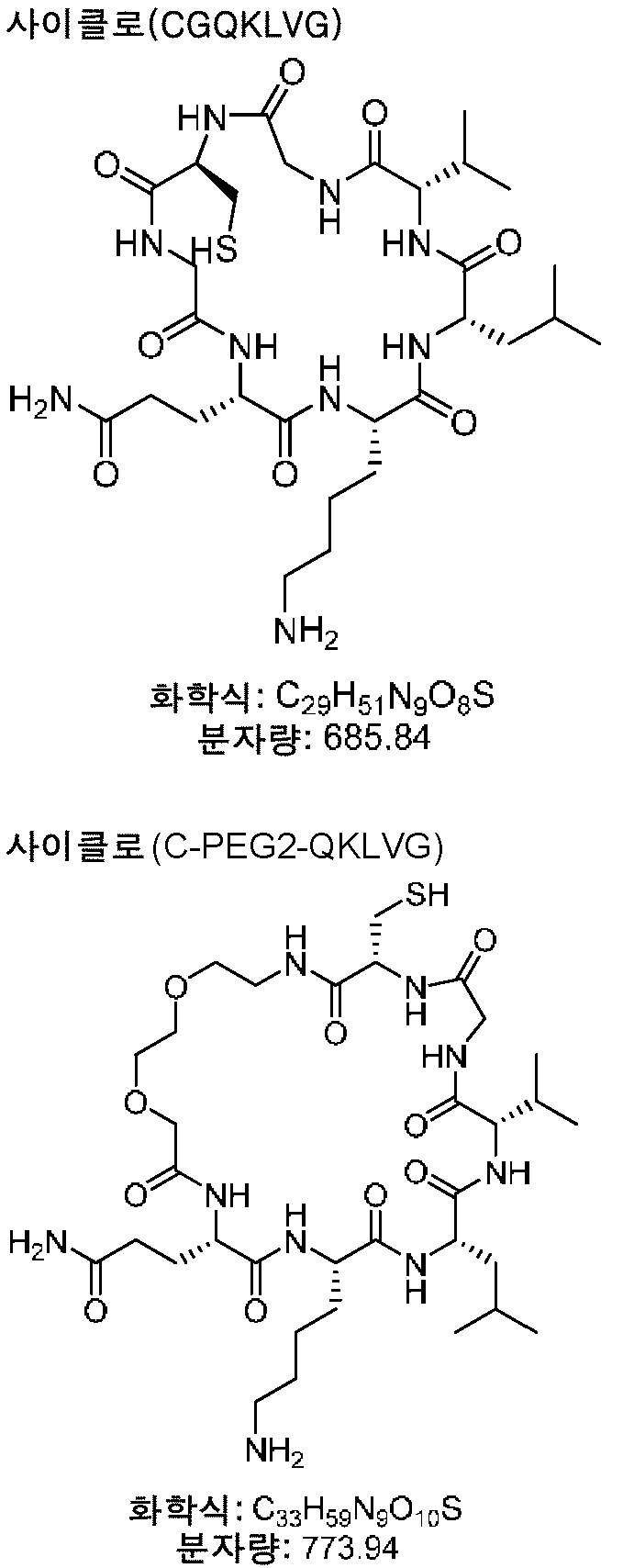
및

And
CDR-H1 GYTFTDYE(서열 식별 번호: 11)
CDR-H2 IDPETGDT(서열 식별 번호: 12)
CDR-H3 TSPIYYDYDWFAY(서열 식별 번호: 13)
CDR-L1 QSLLNNRTRKNY(서열 식별 번호: 14)
CDR-L2 WAS(서열 식별 번호: 15)
CDR-L3 KQSYNLRT(서열 식별 번호: 16)
CDR-H1 GFSLSTSGMG(서열 식별 번호: 21)
CDR-H2 IWWDDDK(서열 식별 번호: 22)
CDR-H3 ARSITTVVATPFDY(서열 식별 번호: 23)
CDR-L1 QNVRSA(서열 식별 번호: 24)
CDR-L2 LAS(서열 식별 번호: 25)
CDR-L3 LQHWNSPFT(서열 식별 번호: 26)The antibody of any one of claims 18-28, optionally fused, comprising a light chain variable region and a heavy chain variable region, wherein said heavy chain variable region comprises complementarity determining regions CDR-H1, CDR-H2 and CDR-H3 Wherein the light chain variable region comprises complementarity determining regions CDR-L1, CDR-L2 and CDR-L3, and wherein the amino acid sequence of the CDR comprises the following sequence:
CDR-H1 GYTFTDYE (SEQ ID NO: 11)
CDR-H2 IDPETGDT (SEQ ID NO: 12)
CDR-H3 TSPIYYDYDWFAY (SEQ ID NO: 13)
CDR-L1 QSLLNNRTRKNY (SEQ ID NO: 14)
CDR-L2 WAS (SEQ ID NO: 15)
CDR-L3 KQSYNLRT (SEQ ID NO: 16)
CDR-H1 GFSLSTSGMG (SEQ ID NO: 21)
CDR-H2 IWWDDDK (SEQ ID NO: 22)
CDR-H3 ARSITTVVATPFDY (SEQ ID NO: 23)
CDR-L1 QNVRSA (SEQ ID NO: 24)
CDR-L2 LAS (SEQ ID NO: 25)
CDR-L3 LQHWNSPFT (SEQ ID NO: 26)
i) 서열 식별 번호: 18 또는 28에서 제시된 바와 같은 아미노산 서열;
ii) 서열 식별 번호: 18 또는 28에 적어도 50%, 적어도 60%, 적어도 70%, 적어도 80%, 또는 적어도 90% 서열 동일성을 가진 아미노산 서열로서, 상기 CDR 서열이 서열 식별 번호: 11,12,13, 21, 22 및 23에서 제시된 바와 같은, 상기 아미노산 서열, 또는
iii) i)의 보존적으로 치환된 아미노산 서열.The antibody of any one of claims 18 to 29, wherein the antibody comprises a heavy chain variable region comprising:
i) an amino acid sequence as set forth in SEQ ID NO: 18 or 28;
ii) an amino acid sequence having at least 50%, at least 60%, at least 70%, at least 80%, or at least 90% sequence identity to SEQ ID NO: 18 or 28, wherein said CDR sequence is SEQ ID NO: 13, 21, 22 and 23, or the amino acid sequence shown in SEQ ID NOs:
iii) a conservatively substituted amino acid sequence of i).
i) 서열 식별 번호: 20 또는 30에서 제시된 바와 같은 아미노산 서열;
ii) 서열 식별 번호: 20 또는 30에 적어도 50%, 적어도 60%, 적어도 70%, 적어도 80%, 또는 적어도 90% 서열 동일성을 가진 아미노산 서열로서, 상기 CDR 서열이 서열 식별 번호: 14, 15, 16, 24, 25 및 26에서 제시된 바와 같은, 상기 아미노산 서열, 또는
iii) i)의 보존적으로 치환된 아미노산 서열.The antibody of any one of claims 18 to 30, wherein the antibody comprises a light chain variable region comprising:
i) an amino acid sequence as set forth in SEQ ID NO: 20 or 30;
ii) an amino acid sequence having at least 50%, at least 60%, at least 70%, at least 80%, or at least 90% sequence identity to SEQ ID NO: 20 or 30, wherein said CDR sequence is SEQ ID NO: 14, 16, 24, 25 and 26, or
iii) a conservatively substituted amino acid sequence of i).
임의로, 상기 세포가 청구항 39의 벡터를 포함하는 하이브리도마인, 세포.37. A cell expressing an antibody of any one of claims 1 to 34,
Optionally, the cell is a hybridoma cell comprising the vector of claim 39.
상기 방법은, 청구항 1 내지 14 중 어느 한 항의 화합물 또는 면역원, 또는 상기 화합물 또는 면역원을 포함하는 조성물을 대상체에 투여하고,
상기 투여된 화합물 또는 면역원 및/또는 A-베타 올리고머에 대하여 특이적 또는 선택적인 항체 및/또는 항체를 발현시키는 세포를 단리시키는 것을 포함하고, 임의로, 상기 항체 및/또는 상기 항체를 발현시키는 세포는 A-베타 펩티드를 포함하는 선형 펩티드에 대한 결합이 결여되어 있거나 미소량의 상기 결합을 갖거나, 또는 플라크 결합이 결여되어 있거나 미소량의 상기 결합을 갖는, 방법.36. A method of producing an antibody of any one of claims 18 to 35,
The method comprises administering to a subject a compound or an immunogen according to any one of claims 1 to 14, or a composition comprising said compound or an immunogen,
Comprising the step of isolating a cell expressing a specific or selective antibody and / or antibody against said administered compound or immunogen and / or A-beta oligomer, optionally wherein said antibody and / or cells expressing said antibody Wherein the binding to a linear peptide comprising an A-beta peptide is lacking, has a small amount of the binding, or lacks plaque binding, or has a small amount of the binding.
a. 상기 생물학적 샘플을 청구항 18 내지 35 중 어느 한 항의 항체 또는 청구항 36 또는 37의 면역접합체와 접촉시키는 단계; 및
b. 임의의 항체 복합체의 존재를 검출하는 단계를 포함하는, 방법.A method of measuring whether a biological sample comprises A-beta,
a. Contacting said biological sample with an antibody of any one of claims 18 to 35 or an immunoconjugate of claim 36 or 37; And
b. And detecting the presence of any antibody complex.
a. 항체:A-베타 올리고머 복합체 형성을 위하여 허용된 조건 하에 A-베타 올리고머에 대하여 특이적 및/또는 선택적인 청구항 36 또는 37의 면역접합체 또는 청구항 18 내지 35 중 어느 한 항의 항체와 상기 샘플을 접촉시키는 단계; 및
b. 임의의 복합체의 존재를 검출하는 단계를 포함하되,
상기 검출가능한 복합체의 존재는 상기 샘플이 A-베타 올리고머를 함유할 수 있다는 것을 나타내는, 생물학적 샘플이 A-베타 올리고머를 함유하는지 여부를 계측하기 위한, 방법.46. The method of claim 43,
a. Antibody: contacting the sample with an antibody of any one of claims 18 to 35, or an immunoconjugate of claim 36 or 37, which is specific and / or selective for the A-beta oligomer under conditions permissive for the formation of the A-beta oligomer complex step; And
b. Detecting the presence of any complexes,
Wherein the presence of the detectable complex indicates that the sample may contain an A-beta oligomer, wherein the biological sample contains an A-beta oligomer.
AD를 갖는 위험에 처한 또는 상기를 갖는 것으로 의심되거나 상기를 갖는 대상체에, 청구항 35 또는 36의 항체를 포함하는 면역접합체를 투여하는 단계로서, 상기 항체가 검출가능한 표지에 콘주게이션되는, 상기 투여 단계; 및
상기 표지를 검출하는 단계, 임의로 상기 표지를 정량적으로 검출하는 단계를 포함하는, 방법.A method for measuring the level of A-beta in a subject,
Administering an immunoconjugate comprising an antibody of claim 35 or 36 to a subject at risk or having or suspected of having AD, said antibody being conjugated to a detectable label; ; And
Detecting the label, optionally quantitatively detecting the label.
상기 대상체에 청구항 1 내지 11 중 어느 한 항의 화합물 또는 화합물의 조합, 임의로 QKLV (서열 식별 번호:1) 또는 관련된 에피토프 펩티드 서열을 포함하는 환형 화합물, 면역원 및/또는 상기 화합물 또는 상기 면역원을 포함하는 조성물을 투여하는 단계; 및
임의로, 투여된 상기 화합물 또는 면역원에서 상기 A-베타 펩티드에 특이적으로 또는 선택적으로 결합하는 세포 및/또는 항체를 단리시키는 단계를 포함하는, 방법.A method of inducing an immune response in a subject,
Comprising administering to said subject a compound or combination of compounds according to any one of claims 1 to 11, optionally a cyclic compound comprising QKLV (SEQ ID NO: 1) or an associated epitope peptide sequence, an immunogen and / or a composition comprising said compound or said immunogen ≪ / RTI > And
Optionally, isolating cells and / or antibodies that specifically or selectively bind to said A-beta peptide in said compound or immunogen administered.
A-베타 응집 및/또는 올리고머 증식을 억제시키기 위해, 청구항 1 내지 36 중 어느 한 항의 A-베타 올리고머 특이적 또는 선택적 항체 또는 면역접합체의 유효량을, 상기를 필요로 하는 대상체에 투여하는 단계, 또는
상기 대상체와 A-베타를 발현시키는 세포 또는 조직을 접촉시키는 단계를 포함하는, 방법.As a method of inhibiting the proliferation of A-beta oligomers,
Administering to a subject in need thereof an effective amount of an A-beta-oligomer-specific or selective antibody or immunoconjugate of any one of claims 1 to 36 to inhibit A-beta aggregation and / or oligomer proliferation; or
Contacting said subject with a cell or tissue expressing A-beta.
상기 치료를 필요로 하는 대상체에, i) 청구항 1 내지 36 중 어느 한 항의 유효량의 항체 또는 면역접합체, 임의로 A-베타 올리고머 특이적 또는 선택적 항체, 또는 상기 항체를 포함하는 약제학적 조성물을 투여하는 단계; 2) QKLV (서열 식별 번호:1) 또는 관련된 에피토프 서열을 포함하는 단리된 환형 화합물 또는 상기 환형 화합물을 포함하는 면역원 또는 약제학적 조성물, 또는 3) 1의 항체 또는 2의 면역원을 암호화하는 핵산을 포함하는 핵산 또는 벡터를 상기 치료를 필요로 하는 대상체에 투여하는 단계를 포함하는, 방법.A method of treating AD and / or other A-beta amyloid related disorders,
Comprising administering to a subject in need of such treatment an effective amount of an antibody or immunoconjugate of any of claims 1 to 36, optionally an A-beta-oligomer-specific or selective antibody, or a pharmaceutical composition comprising said antibody, ; 2) an immunogenic or pharmaceutical composition comprising the cyclic compound or an isolated cyclic compound comprising QKLV (SEQ ID NO: 1) or an associated epitope sequence, or 3) an antibody of 1 or a nucleic acid encoding an immunogen of 2 Lt; RTI ID = 0.0 > a < / RTI > nucleic acid or vector to a subject in need of such treatment.
Applications Claiming Priority (9)
| Application Number | Priority Date | Filing Date | Title |
|---|---|---|---|
| US201562253044P | 2015-11-09 | 2015-11-09 | |
| US62/253,044 | 2015-11-09 | ||
| US201662289893P | 2016-02-01 | 2016-02-01 | |
| US62/289,893 | 2016-02-01 | ||
| US201662365634P | 2016-07-22 | 2016-07-22 | |
| US62/365,634 | 2016-07-22 | ||
| US201662393615P | 2016-09-12 | 2016-09-12 | |
| US62/393,615 | 2016-09-12 | ||
| PCT/CA2016/051305 WO2017079835A1 (en) | 2015-11-09 | 2016-11-09 | Amyloid beta epitopes and antibodies thereto |
Publications (1)
| Publication Number | Publication Date |
|---|---|
| KR20180094876A true KR20180094876A (en) | 2018-08-24 |
Family
ID=58694531
Family Applications (1)
| Application Number | Title | Priority Date | Filing Date |
|---|---|---|---|
| KR1020187015910A Pending KR20180094876A (en) | 2015-11-09 | 2016-11-09 | Amyloid beta epitopes and antibodies thereto |
Country Status (9)
| Country | Link |
|---|---|
| US (2) | US10759837B2 (en) |
| EP (1) | EP3374383A4 (en) |
| JP (1) | JP7452829B2 (en) |
| KR (1) | KR20180094876A (en) |
| CN (1) | CN108350053A (en) |
| AU (2) | AU2016353553B2 (en) |
| CA (1) | CA3004498A1 (en) |
| HK (1) | HK1259324A1 (en) |
| WO (1) | WO2017079835A1 (en) |
Families Citing this family (10)
| Publication number | Priority date | Publication date | Assignee | Title |
|---|---|---|---|---|
| JP6952351B2 (en) | 2015-11-09 | 2021-10-20 | ザ・ユニバーシティ・オブ・ブリティッシュ・コロンビア | Systems and methods for predicting misfolding protein epitopes by population coordinate biasing |
| CA3004494A1 (en) | 2015-11-09 | 2017-05-18 | The University Of British Columiba | Epitopes in amyloid beta mid-region and conformationally-selective antibodies thereto |
| KR20180094876A (en) * | 2015-11-09 | 2018-08-24 | 더 유니버시티 오브 브리티쉬 콜롬비아 | Amyloid beta epitopes and antibodies thereto |
| US10772969B2 (en) | 2015-11-09 | 2020-09-15 | The University Of British Columbia | N-terminal epitopes in amyloid beta and conformationally-selective antibodies thereto |
| AU2017299858B2 (en) | 2016-07-18 | 2024-07-25 | Promis Neurosciences, Inc. | Antibodies to Amyloid beta |
| US20180125920A1 (en) | 2016-11-09 | 2018-05-10 | The University Of British Columbia | Methods for preventing and treating A-beta oligomer-associated and/or -induced diseases and conditions |
| US12286469B2 (en) | 2017-07-18 | 2025-04-29 | The University Of British Columbia | Humanized antibodies binding to amyloid-beta (A-beta) |
| WO2020119793A1 (en) * | 2018-12-14 | 2020-06-18 | Wuxi Biologics (Shanghai) Co., Ltd. | Humanized antibodies against ox40, method for preparing the same, and use thereof |
| CN110163243B (en) * | 2019-04-04 | 2021-04-06 | 浙江工业大学 | Protein domain partitioning method based on contact map and fuzzy C-means clustering |
| AU2020284288A1 (en) * | 2019-05-27 | 2022-01-20 | Promis Neurosciences Inc. | Conformation-specific epitopes in tau, antibodies thereto and methods related thereof |
Family Cites Families (116)
| Publication number | Priority date | Publication date | Assignee | Title |
|---|---|---|---|---|
| CA1331443C (en) | 1987-05-29 | 1994-08-16 | Charlotte A. Kensil | Saponin adjuvant |
| GB8911525D0 (en) | 1989-05-19 | 1989-07-05 | Allied Colloids Ltd | Polymeric composition |
| US6150584A (en) | 1990-01-12 | 2000-11-21 | Abgenix, Inc. | Human antibodies derived from immunized xenomice |
| DK0463151T3 (en) | 1990-01-12 | 1996-07-01 | Cell Genesys Inc | Generation of xenogenic antibodies |
| US5427908A (en) | 1990-05-01 | 1995-06-27 | Affymax Technologies N.V. | Recombinant library screening methods |
| GB9015198D0 (en) | 1990-07-10 | 1990-08-29 | Brien Caroline J O | Binding substance |
| US5770429A (en) | 1990-08-29 | 1998-06-23 | Genpharm International, Inc. | Transgenic non-human animals capable of producing heterologous antibodies |
| US5283185A (en) | 1991-08-28 | 1994-02-01 | University Of Tennessee Research Corporation | Method for delivering nucleic acids into cells |
| US5766846A (en) | 1992-07-10 | 1998-06-16 | Athena Neurosciences | Methods of screening for compounds which inhibit soluble β-amyloid peptide production |
| US5562909A (en) | 1993-07-12 | 1996-10-08 | Massachusetts Institute Of Technology | Phosphazene polyelectrolytes as immunoadjuvants |
| AU7642494A (en) | 1993-08-31 | 1995-03-22 | Gliatech Inc. | Inhibition of beta amyloid binding to glycosaminoglycans for treatment of alzheimer's disease |
| GB9326174D0 (en) | 1993-12-22 | 1994-02-23 | Biocine Sclavo | Mucosal adjuvant |
| US20030072774A1 (en) | 1994-06-10 | 2003-04-17 | Diane M. Gajewczyk | Proteinaceous adjuvants |
| US6019982A (en) | 1994-08-26 | 2000-02-01 | The Administrators Of The Tulane Educational Fund | Mutant enterotoxin effective as a non-toxic oral adjuvant |
| FR2726764B1 (en) | 1994-11-14 | 1997-01-31 | Pasteur Merieux Serums Vacc | ADJUVANT FOR VACCINE COMPOSITION |
| JPH11514333A (en) | 1995-03-14 | 1999-12-07 | プレーシス ファーマスーティカルズ インコーポレイテッド | Modulators of amyloid aggregation |
| WO1997021728A1 (en) | 1995-12-12 | 1997-06-19 | Karolinska Innovations Ab | PEPTIDE BINDING THE KLVFF-SEQUENCE OF AMYLOID $g(b) |
| US5735814A (en) | 1996-04-30 | 1998-04-07 | Medtronic, Inc. | Techniques of treating neurodegenerative disorders by brain infusion |
| US6071493A (en) * | 1996-09-20 | 2000-06-06 | Baylor College Of Medicine | Method of screening for an agent that inhibits mononuclear phagocyte-plaque component complex formation |
| US6043283A (en) * | 1996-09-20 | 2000-03-28 | Baylor College Of Medicine | Tyramine compounds and their neuronal effects |
| US7179892B2 (en) * | 2000-12-06 | 2007-02-20 | Neuralab Limited | Humanized antibodies that recognize beta amyloid peptide |
| US7964192B1 (en) * | 1997-12-02 | 2011-06-21 | Janssen Alzheimer Immunotherapy | Prevention and treatment of amyloidgenic disease |
| US20080050367A1 (en) * | 1998-04-07 | 2008-02-28 | Guriq Basi | Humanized antibodies that recognize beta amyloid peptide |
| TWI239847B (en) * | 1997-12-02 | 2005-09-21 | Elan Pharm Inc | N-terminal fragment of Abeta peptide and an adjuvant for preventing and treating amyloidogenic disease |
| US6923964B1 (en) * | 1997-12-02 | 2005-08-02 | Neuralab Limited | Active immunization of AScr for prion disorders |
| US6761888B1 (en) * | 2000-05-26 | 2004-07-13 | Neuralab Limited | Passive immunization treatment of Alzheimer's disease |
| US7588766B1 (en) * | 2000-05-26 | 2009-09-15 | Elan Pharma International Limited | Treatment of amyloidogenic disease |
| US7790856B2 (en) * | 1998-04-07 | 2010-09-07 | Janssen Alzheimer Immunotherapy | Humanized antibodies that recognize beta amyloid peptide |
| US6913745B1 (en) * | 1997-12-02 | 2005-07-05 | Neuralab Limited | Passive immunization of Alzheimer's disease |
| US6936252B2 (en) * | 1998-07-27 | 2005-08-30 | Microbial Technics Limited | Streptococcus pneumoniae proteins and nucleic acid molecules |
| US7012061B1 (en) | 1998-10-19 | 2006-03-14 | New York University | Method for increasing the permeability of the blood brain barrier |
| AU4529800A (en) * | 1999-05-05 | 2000-11-21 | Neurochem, Inc. | Stereoselective antifibrillogenic peptides and peptidomimetics thereof |
| UA81216C2 (en) * | 1999-06-01 | 2007-12-25 | Prevention and treatment of amyloid disease | |
| WO2001039796A2 (en) | 1999-11-29 | 2001-06-07 | Neurochem Inc. | Vaccine for the prevention and treatment of alzheimer's and amyloid related diseases |
| US20020094335A1 (en) | 1999-11-29 | 2002-07-18 | Robert Chalifour | Vaccine for the prevention and treatment of alzheimer's and amyloid related diseases |
| DE1257584T1 (en) | 2000-02-24 | 2003-05-28 | Lilly Co Eli | HUMANIZED ANTIBODIES THAT DETECT AMYLOID BETA PEPTID |
| US7700751B2 (en) * | 2000-12-06 | 2010-04-20 | Janssen Alzheimer Immunotherapy | Humanized antibodies that recognize β-amyloid peptide |
| PE20020574A1 (en) * | 2000-12-06 | 2002-07-02 | Wyeth Corp | HUMANIZED ANTIBODIES THAT RECOGNIZE THE AMYLOID PEPTIDE BETA |
| CA2436789A1 (en) | 2000-12-19 | 2002-08-22 | Palatin Technologies, Inc. | Identification of target-specific folding sites in peptides and proteins |
| DE10101430B4 (en) | 2001-01-13 | 2008-10-02 | Fraunhofer-Gesellschaft zur Förderung der angewandten Forschung e.V. | Soluble cyclic analogues for the modulation of amyloidogenesis |
| AR038568A1 (en) | 2002-02-20 | 2005-01-19 | Hoffmann La Roche | ANTI-A BETA ANTIBODIES AND ITS USE |
| US7314974B2 (en) * | 2002-02-21 | 2008-01-01 | Monsanto Technology, Llc | Expression of microbial proteins in plants for production of plants with improved properties |
| MY139983A (en) * | 2002-03-12 | 2009-11-30 | Janssen Alzheimer Immunotherap | Humanized antibodies that recognize beta amyloid peptide |
| WO2004013172A2 (en) | 2002-07-24 | 2004-02-12 | Innogenetics N.V. | Fragments of beta-amyloid as targets for vaccination against alzheimer disease |
| US9535076B2 (en) | 2002-09-12 | 2017-01-03 | The Regents Of The University Of California | Methods and compositions for eliciting an amyloid-selective immune response |
| WO2004029629A1 (en) | 2002-09-27 | 2004-04-08 | Janssen Pharmaceutica N.V. | N-11 truncated amyloid-beta nomoclonal antibodies, compositions, methods and uses |
| AU2003291910B2 (en) | 2002-12-24 | 2009-10-01 | Bellus Health (International) Limited | Therapeutic formulations for the treatment of beta-amyloid related diseases |
| ATE468886T1 (en) | 2003-02-10 | 2010-06-15 | Applied Molecular Evolution | ABETA-BINDING MOLECULES |
| PE20050627A1 (en) * | 2003-05-30 | 2005-08-10 | Wyeth Corp | HUMANIZED ANTIBODIES THAT RECOGNIZE THE BETA AMYLOID PEPTIDE |
| US20070110750A1 (en) | 2003-09-12 | 2007-05-17 | The Regents Of The University Of California | Monoclonal antibodies specific for high molecular weight aggregation intermediates common to amyloids formed from proteins of differing sequence |
| CN1562050A (en) | 2004-03-24 | 2005-01-12 | 中国海洋大学 | Use of oligose alginate in anti-dementia and anti-diabetes |
| CA2560618A1 (en) * | 2004-04-02 | 2005-10-13 | Queen's University At Kingston | A cell culture system for modelling serum amyloid a amyloidogenesis and identifying amyloid modulating compounds |
| US7625560B2 (en) * | 2004-12-15 | 2009-12-01 | Janssen Alzheimer Immunotherapy | Humanized antibodies that recognize beta amyloid peptide |
| PE20061329A1 (en) | 2004-12-15 | 2006-12-08 | Neuralab Ltd | HUMANIZED AB ANTIBODIES TO IMPROVE COGNITION |
| EP1676859A1 (en) * | 2004-12-30 | 2006-07-05 | Pevion Biotech Ltd. | Immunogenic compositions of cyclic peptides derived from the beta-amyloid peptide |
| ES2259270B1 (en) | 2005-03-09 | 2007-11-01 | Consejo Superior De Investigaciones Cientificas | IN VITRO DIAGNOSTIC METHOD OF ALZHEIMER'S DISEASE BY A MONOCLONAL ANTIBODY. |
| AU2006251832A1 (en) | 2005-05-27 | 2006-11-30 | Queen's University At Kingston | Treatment of protein folding disorders |
| US8067372B2 (en) | 2005-11-10 | 2011-11-29 | Alzheimer's Institute Of America, Inc. | Modulation of angiogenesis by A-beta peptide fragments |
| CA2632828C (en) | 2005-12-12 | 2012-07-10 | F. Hoffmann-La Roche Ag | Antibodies against amyloid beta with glycosylation in the variable region |
| US8784810B2 (en) * | 2006-04-18 | 2014-07-22 | Janssen Alzheimer Immunotherapy | Treatment of amyloidogenic diseases |
| AR062065A1 (en) | 2006-07-14 | 2008-10-15 | Ac Immune Sa | HUMANIZED ANTIBODY |
| HUE033466T2 (en) | 2006-10-02 | 2017-12-28 | Ac Immune Sa | Humanized antibody against amyloid beta |
| AU2008206555B2 (en) | 2007-01-18 | 2013-07-04 | Eli Lilly And Company | Pegylated Abeta Fab |
| US8003097B2 (en) * | 2007-04-18 | 2011-08-23 | Janssen Alzheimer Immunotherapy | Treatment of cerebral amyloid angiopathy |
| AU2008267037B2 (en) | 2007-06-12 | 2014-08-07 | Ac Immune S.A. | Monoclonal anti beta amyloid antibody |
| SG182192A1 (en) | 2007-06-12 | 2012-07-30 | Ac Immune Sa | Humanized antibodies to amyloid beta |
| SI2182983T1 (en) * | 2007-07-27 | 2014-09-30 | Janssen Alzheimer Immunotherapy | Treatment of amyloidogenic diseases with humanised anti-abeta antibodies |
| EP2205631B1 (en) | 2007-10-05 | 2016-11-23 | Genentech, Inc. | Methods and compositions for diagnosis and treatment of amyloidosis |
| SG178809A1 (en) | 2007-10-05 | 2012-03-29 | Genentech Inc | Use of anti-amyloid beta antibody in ocular diseases |
| WO2009048631A1 (en) | 2007-10-11 | 2009-04-16 | University Of Tennessee Research Foundation | PREPARATION OF PURIFIED COVALENTYLY CROSS-LINKED A β OLIGOMERS AND USES THEREOF |
| JO3076B1 (en) * | 2007-10-17 | 2017-03-15 | Janssen Alzheimer Immunotherap | Immunotherapy regimes dependent on apoe status |
| EP2207568B1 (en) | 2007-11-16 | 2017-05-31 | The Rockefeller University | Antibodies specific for the protofibril form of beta-amyloid protein |
| CN102016059B (en) | 2007-12-28 | 2014-10-22 | 依兰制药公司 | Treatment and prophylaxis of amyloidosis |
| AT506820B1 (en) | 2008-06-12 | 2011-07-15 | Affiris Forschungs Und Entwicklungs Gmbh | VZZINE AGAINST ALZHEIMER DISEASE |
| BRPI0915134A2 (en) | 2008-06-12 | 2016-02-16 | Affiris Ag | compound and use of a compound |
| AT506819B1 (en) | 2008-06-12 | 2011-06-15 | Affiris Forschungs Und Entwicklungs Gmbh | VACCINE FOR THE TREATMENT OF ALZHEIMER DISEASE |
| KR101694788B1 (en) * | 2008-07-01 | 2017-01-13 | 드 슈타트 데르 네덜란덴, 베르테겐부어디그트 두어 드 미니스터 반 베이웨이에스, 미니스테리 반 폭스겐트존하이트, 벨지인 엔 스포츠 | Vaccine against amyloid folding intermediate |
| US9801865B2 (en) | 2008-09-24 | 2017-10-31 | The United States Of America As Represented By The Department Of Veteran Affairs | Materials and methods for diagnosis, prevention and/or treatment of stress disorders and conditions associated with abeta peptide aggregation |
| EP2172485A1 (en) * | 2008-10-01 | 2010-04-07 | Pierre Fabre Medicament | Novel anti CXCR4 antibodies and their use for the treatment of cancer |
| JP5898495B2 (en) | 2008-10-06 | 2016-04-06 | ザ ユニヴァーシティ オブ ブリティッシュ コロンビア | Methods and systems for predicting misfolded protein epitopes |
| US9067981B1 (en) * | 2008-10-30 | 2015-06-30 | Janssen Sciences Ireland Uc | Hybrid amyloid-beta antibodies |
| WO2010096488A1 (en) * | 2009-02-17 | 2010-08-26 | The Regents Of The University Of California | Method of reducing acetylation in plants to improve biofuel production |
| DK2419447T3 (en) | 2009-04-17 | 2017-09-25 | Immunas Pharma Inc | ANTIBODIES THAT SPECIFICALLY BIND TO A BETA OLIGOMER AND USE THEREOF |
| WO2010128139A1 (en) | 2009-05-08 | 2010-11-11 | Georg-August-Universität Göttingen Stiftung Öffentlichen Rechts, Universitätsmedizin | Biomarkers and methods for diagnosing alzheimer's disease and/ or mild cognitive impairment |
| ES2624835T3 (en) | 2009-08-06 | 2017-07-17 | Immunas Pharma, Inc. | Antibodies that specifically bind to the A beta oligomers and use thereof |
| JP5554528B2 (en) * | 2009-09-08 | 2014-07-23 | 国立大学法人 岡山大学 | Novel amyloid β aggregate-binding peptide and method for testing amyloid disease using the novel amyloid β aggregate-binding peptide |
| JP2013505438A (en) | 2009-09-18 | 2013-02-14 | プロビオドルグ エージー | A novel assay for the detection of amyloid β peptide |
| DK2539366T3 (en) | 2010-02-26 | 2018-02-05 | Bioarctic Neuroscience Ab | PROTOFIBRIL-BINDING ANTIBODIES AND THEIR USE IN THERAPEUTIC AND DIAGNOSTIC PROCEDURES FOR PARKINSON'S DISEASE, DEMENS WITH LEWY BODY AND OTHER ALPHA SYNUCLEINOPATHIES |
| SG183854A1 (en) * | 2010-03-03 | 2012-10-30 | Univ British Columbia | Oligomer-specific amyloid beta epitope and antibodies |
| AU2011239966B2 (en) | 2010-04-16 | 2014-05-08 | Ac Immune S.A. | Novel compounds for the treatment of diseases associated with amyloid or amyloid-like proteins |
| EP2377860A1 (en) | 2010-04-16 | 2011-10-19 | AC Immune S.A. | Novel compounds for the treatment of diseases associated with amyloid or amyloid-like proteins |
| US9320793B2 (en) | 2010-07-14 | 2016-04-26 | Acumen Pharmaceuticals, Inc. | Method for treating a disease associated with soluble, oligomeric species of amyloid beta 1-42 |
| MX341369B (en) | 2010-07-30 | 2016-08-17 | Genentech Inc * | Safe and functional humanized anti beta-amyloid antibody. |
| EP3533803B1 (en) | 2010-08-14 | 2021-10-27 | AbbVie Inc. | Anti-amyloid-beta antibodies |
| EP2627357B1 (en) | 2010-10-15 | 2017-05-03 | The Board of Regents of The University of Texas System | Antibodies that bind amyloid oligomers |
| FR2966827B1 (en) * | 2010-10-27 | 2014-08-22 | Kimonella Ventures Ltd | PEPTIDE COMPOUND USEFUL FOR INHIBITING AMYLOID PLATE FORMATION |
| WO2012104824A1 (en) | 2011-02-04 | 2012-08-09 | Ecole polytechnique fédérale de Lausanne (EPFL) | Therapeutic antibodies targeting app-c99 |
| EP2511296A1 (en) | 2011-04-12 | 2012-10-17 | Araclón Biotech, S. L. | Antibody, kit and method for determination of amyloid peptides |
| GB201113570D0 (en) | 2011-08-05 | 2011-09-21 | Glaxosmithkline Biolog Sa | Vaccine |
| EP2780082A4 (en) | 2011-11-10 | 2015-08-05 | Cangene U S Inc | COMPOSITIONS AND METHODS FOR TREATING ALZHEIMER'S DISEASE |
| EP2659908A1 (en) | 2012-05-01 | 2013-11-06 | Affiris AG | Compositions |
| EP2887955B1 (en) | 2012-08-21 | 2020-08-19 | Institute for Molecular Medicine, Inc. | Compositions and methods related to diseases associated with deposits of amyloid, tau, and alpha-synuclein |
| EP2787347A1 (en) | 2013-04-03 | 2014-10-08 | Affiris AG | Method for detecting Aß-specific antibodies in a biological sample |
| US9908933B2 (en) | 2013-08-05 | 2018-03-06 | St. Vincent's Institute Of Medical Research | Antibody therapy for amyloid beta disease |
| EP3892294A1 (en) | 2013-08-28 | 2021-10-13 | AbbVie Stemcentrx LLC | Site-specific antibody conjugation methods and compositions |
| CA2938129A1 (en) * | 2014-02-03 | 2015-08-06 | Cangene Corporation | Humanized beta-amyloid binding molecules and uses thereof |
| US10501733B2 (en) * | 2015-02-27 | 2019-12-10 | University Of Washington | Polypeptide assemblies and methods for the production thereof |
| US20170021020A1 (en) | 2015-07-23 | 2017-01-26 | The Board Of Trustees Of The Leland Stanford Junior University | Monoclonal antibody and vaccine targeting filamentous bacteriophage |
| CA3004494A1 (en) * | 2015-11-09 | 2017-05-18 | The University Of British Columiba | Epitopes in amyloid beta mid-region and conformationally-selective antibodies thereto |
| CN108368160A (en) * | 2015-11-09 | 2018-08-03 | 英属哥伦比亚大学 | C-terminal epitope in amyloid beta and its conformation-selective antibody |
| KR20180094876A (en) * | 2015-11-09 | 2018-08-24 | 더 유니버시티 오브 브리티쉬 콜롬비아 | Amyloid beta epitopes and antibodies thereto |
| WO2017079834A1 (en) | 2015-11-09 | 2017-05-18 | The University Of British Columbia | Epitopes in amyloid beta and conformationally-selective antibodies thereto |
| US10772969B2 (en) | 2015-11-09 | 2020-09-15 | The University Of British Columbia | N-terminal epitopes in amyloid beta and conformationally-selective antibodies thereto |
| JP6952351B2 (en) | 2015-11-09 | 2021-10-20 | ザ・ユニバーシティ・オブ・ブリティッシュ・コロンビア | Systems and methods for predicting misfolding protein epitopes by population coordinate biasing |
| AU2017299858B2 (en) | 2016-07-18 | 2024-07-25 | Promis Neurosciences, Inc. | Antibodies to Amyloid beta |
| US20180125920A1 (en) * | 2016-11-09 | 2018-05-10 | The University Of British Columbia | Methods for preventing and treating A-beta oligomer-associated and/or -induced diseases and conditions |
-
2016
- 2016-11-09 KR KR1020187015910A patent/KR20180094876A/en active Pending
- 2016-11-09 HK HK19101690.0A patent/HK1259324A1/en unknown
- 2016-11-09 CA CA3004498A patent/CA3004498A1/en active Pending
- 2016-11-09 CN CN201680065514.2A patent/CN108350053A/en active Pending
- 2016-11-09 US US15/774,778 patent/US10759837B2/en active Active
- 2016-11-09 JP JP2018522803A patent/JP7452829B2/en active Active
- 2016-11-09 AU AU2016353553A patent/AU2016353553B2/en active Active
- 2016-11-09 WO PCT/CA2016/051305 patent/WO2017079835A1/en not_active Ceased
- 2016-11-09 EP EP16863268.5A patent/EP3374383A4/en active Pending
-
2020
- 2020-08-28 US US17/006,219 patent/US11970522B2/en active Active
-
2022
- 2022-04-19 AU AU2022202549A patent/AU2022202549A1/en not_active Abandoned
Also Published As
| Publication number | Publication date |
|---|---|
| EP3374383A1 (en) | 2018-09-19 |
| US11970522B2 (en) | 2024-04-30 |
| JP7452829B2 (en) | 2024-03-19 |
| WO2017079835A1 (en) | 2017-05-18 |
| CA3004498A1 (en) | 2017-05-18 |
| AU2016353553A1 (en) | 2018-06-28 |
| US10759837B2 (en) | 2020-09-01 |
| AU2016353553B2 (en) | 2022-01-20 |
| US20210087243A1 (en) | 2021-03-25 |
| EP3374383A4 (en) | 2019-05-15 |
| US20180346535A1 (en) | 2018-12-06 |
| CN108350053A (en) | 2018-07-31 |
| HK1259324A1 (en) | 2019-11-29 |
| JP2019504615A (en) | 2019-02-21 |
| AU2022202549A1 (en) | 2022-05-12 |
Similar Documents
| Publication | Publication Date | Title |
|---|---|---|
| AU2022201737B2 (en) | Epitopes in Amyloid beta mid-region and conformationally-selective antibodies thereto | |
| US12173055B2 (en) | N-terminal epitopes in amyloid beta and conformationally-selective antibodies thereto | |
| US11970522B2 (en) | Cyclic compound/peptide comprising an A-beta15-18 peptide and a linker that is covalently coupled to the n-terminus residue and the c-terminus residue of the A-BETA15-18 peptide | |
| KR20180094877A (en) | C-terminal epitopes in amyloid beta and structurally selective antibodies thereto | |
| US20180326027A1 (en) | Epitopes in amyloid beta and conformationally-selective antibodies thereto |
Legal Events
| Date | Code | Title | Description |
|---|---|---|---|
| PA0105 | International application |
St.27 status event code: A-0-1-A10-A15-nap-PA0105 |
|
| P11-X000 | Amendment of application requested |
St.27 status event code: A-2-2-P10-P11-nap-X000 |
|
| P13-X000 | Application amended |
St.27 status event code: A-2-2-P10-P13-nap-X000 |
|
| PG1501 | Laying open of application |
St.27 status event code: A-1-1-Q10-Q12-nap-PG1501 |
|
| A201 | Request for examination | ||
| PA0201 | Request for examination |
St.27 status event code: A-1-2-D10-D11-exm-PA0201 |
|
| E902 | Notification of reason for refusal | ||
| PE0902 | Notice of grounds for rejection |
St.27 status event code: A-1-2-D10-D21-exm-PE0902 |
|
| E13-X000 | Pre-grant limitation requested |
St.27 status event code: A-2-3-E10-E13-lim-X000 |
|
| P11-X000 | Amendment of application requested |
St.27 status event code: A-2-2-P10-P11-nap-X000 |
|
| P13-X000 | Application amended |
St.27 status event code: A-2-2-P10-P13-nap-X000 |
|
| E601 | Decision to refuse application | ||
| PE0601 | Decision on rejection of patent |
St.27 status event code: N-2-6-B10-B15-exm-PE0601 |
|
| AMND | Amendment | ||
| E13-X000 | Pre-grant limitation requested |
St.27 status event code: A-2-3-E10-E13-lim-X000 |
|
| P11-X000 | Amendment of application requested |
St.27 status event code: A-2-2-P10-P11-nap-X000 |
|
| P13-X000 | Application amended |
St.27 status event code: A-2-2-P10-P13-nap-X000 |
|
| PX0901 | Re-examination |
St.27 status event code: A-2-3-E10-E12-rex-PX0901 |
|
| D21 | Rejection of application intended |
Free format text: ST27 STATUS EVENT CODE: A-1-2-D10-D21-EXM-PE0902 (AS PROVIDED BY THE NATIONAL OFFICE) |
|
| PE0902 | Notice of grounds for rejection |
St.27 status event code: A-1-2-D10-D21-exm-PE0902 |
|
| P11 | Amendment of application requested |
Free format text: ST27 STATUS EVENT CODE: A-2-2-P10-P11-NAP-X000 (AS PROVIDED BY THE NATIONAL OFFICE) |
|
| P11-X000 | Amendment of application requested |
St.27 status event code: A-2-2-P10-P11-nap-X000 |