KR20180094835A - Convert video frames from 2D to 3D - Google Patents
Convert video frames from 2D to 3D Download PDFInfo
- Publication number
- KR20180094835A KR20180094835A KR1020187006222A KR20187006222A KR20180094835A KR 20180094835 A KR20180094835 A KR 20180094835A KR 1020187006222 A KR1020187006222 A KR 1020187006222A KR 20187006222 A KR20187006222 A KR 20187006222A KR 20180094835 A KR20180094835 A KR 20180094835A
- Authority
- KR
- South Korea
- Prior art keywords
- image
- depth
- depth information
- video
- input video
- Prior art date
- Legal status (The legal status is an assumption and is not a legal conclusion. Google has not performed a legal analysis and makes no representation as to the accuracy of the status listed.)
- Abandoned
Links
Images




Classifications
-
- H—ELECTRICITY
- H04—ELECTRIC COMMUNICATION TECHNIQUE
- H04N—PICTORIAL COMMUNICATION, e.g. TELEVISION
- H04N13/00—Stereoscopic video systems; Multi-view video systems; Details thereof
- H04N13/20—Image signal generators
- H04N13/261—Image signal generators with monoscopic-to-stereoscopic image conversion
- H04N13/268—Image signal generators with monoscopic-to-stereoscopic image conversion based on depth image-based rendering [DIBR]
-
- G—PHYSICS
- G06—COMPUTING OR CALCULATING; COUNTING
- G06F—ELECTRIC DIGITAL DATA PROCESSING
- G06F16/00—Information retrieval; Database structures therefor; File system structures therefor
- G06F16/70—Information retrieval; Database structures therefor; File system structures therefor of video data
- G06F16/73—Querying
- G06F16/738—Presentation of query results
- G06F16/739—Presentation of query results in form of a video summary, e.g. the video summary being a video sequence, a composite still image or having synthesized frames
-
- G—PHYSICS
- G06—COMPUTING OR CALCULATING; COUNTING
- G06T—IMAGE DATA PROCESSING OR GENERATION, IN GENERAL
- G06T7/00—Image analysis
- G06T7/10—Segmentation; Edge detection
- G06T7/11—Region-based segmentation
-
- G—PHYSICS
- G06—COMPUTING OR CALCULATING; COUNTING
- G06T—IMAGE DATA PROCESSING OR GENERATION, IN GENERAL
- G06T7/00—Image analysis
- G06T7/50—Depth or shape recovery
-
- G—PHYSICS
- G06—COMPUTING OR CALCULATING; COUNTING
- G06T—IMAGE DATA PROCESSING OR GENERATION, IN GENERAL
- G06T7/00—Image analysis
- G06T7/50—Depth or shape recovery
- G06T7/55—Depth or shape recovery from multiple images
-
- H—ELECTRICITY
- H04—ELECTRIC COMMUNICATION TECHNIQUE
- H04N—PICTORIAL COMMUNICATION, e.g. TELEVISION
- H04N13/00—Stereoscopic video systems; Multi-view video systems; Details thereof
- H04N13/20—Image signal generators
- H04N13/261—Image signal generators with monoscopic-to-stereoscopic image conversion
-
- G—PHYSICS
- G06—COMPUTING OR CALCULATING; COUNTING
- G06T—IMAGE DATA PROCESSING OR GENERATION, IN GENERAL
- G06T2207/00—Indexing scheme for image analysis or image enhancement
- G06T2207/10—Image acquisition modality
- G06T2207/10016—Video; Image sequence
-
- G—PHYSICS
- G06—COMPUTING OR CALCULATING; COUNTING
- G06T—IMAGE DATA PROCESSING OR GENERATION, IN GENERAL
- G06T2207/00—Indexing scheme for image analysis or image enhancement
- G06T2207/20—Special algorithmic details
- G06T2207/20021—Dividing image into blocks, subimages or windows
-
- H—ELECTRICITY
- H04—ELECTRIC COMMUNICATION TECHNIQUE
- H04N—PICTORIAL COMMUNICATION, e.g. TELEVISION
- H04N13/00—Stereoscopic video systems; Multi-view video systems; Details thereof
- H04N2013/0074—Stereoscopic image analysis
- H04N2013/0088—Synthesising a monoscopic image signal from stereoscopic images, e.g. synthesising a panoramic or high resolution monoscopic image
Landscapes
- Engineering & Computer Science (AREA)
- Theoretical Computer Science (AREA)
- Multimedia (AREA)
- Physics & Mathematics (AREA)
- General Physics & Mathematics (AREA)
- Computer Vision & Pattern Recognition (AREA)
- Signal Processing (AREA)
- Data Mining & Analysis (AREA)
- Computational Linguistics (AREA)
- Databases & Information Systems (AREA)
- General Engineering & Computer Science (AREA)
- Processing Or Creating Images (AREA)
- Testing, Inspecting, Measuring Of Stereoscopic Televisions And Televisions (AREA)
- Image Processing (AREA)
- Image Analysis (AREA)
- Studio Devices (AREA)
Abstract
3D 비디오 및 기술의 보급 확대는 고품질 3D 콘텐츠의 부족으로 인해 어려움을 겪고 있다. 이 문제를 해결하기 위한 하나의 유망한 해법은 자동화된 2D-3D 변환을 사용하는 것이다. 그러나 현재의 변환 방법은 일반적이지만 많은 시청자가 수용할 수 없는 아티팩트를 갖는 저품질의 결과를 만들어낸다. 그러나 정확한 깊이를 가진 3D 입체 비디오의 데이터베이스를 만드는 것은 매우 어렵다. 2D-3D 변환을 위한 고품질 3D 비디오 참조 데이터베이스를 생성하기 위해 컴퓨터로 생성된 콘텐츠가 사용될 수 있다. 이 방법은 객체 경계를 고려하면서 3D 참조 데이터베이스 내의 프레임들로부터 대상 프레임으로 깊이 정보를 전달한다. 그것은 깊이 기울기로부터 깊이 맵을 계산하고, 입체 비디오를 출력한다.The expansion of 3D video and technology has been hampered by the lack of high-quality 3D content. One promising solution to this problem is to use an automated 2D-to-3D conversion. However, current conversion methods produce low-quality results with artifacts that are common but not acceptable to many viewers. However, it is very difficult to create a database of 3D stereoscopic video with accurate depth. Computer-generated content can be used to create a high-quality 3D video reference database for 2D-to-3D conversion. This method conveys the depth information from the frames in the 3D reference database to the target frame while considering the object boundaries. It computes the depth map from the depth gradient and outputs stereoscopic video.

Description
2D-3D 비디오 변환을 위한 데이터기반 기술을 제시한다. 이 기술은 고품질 합성 이미지들의 데이터베이스로부터 깊이 기울기(depth gradients)를 전달하는 것에 기초한다. 이러한 이미지들은 비디오 게임들에서 수집될 수 있으며, 이것들은 스포츠 및 그 하위 카테고리, 액션 및 그 하위 카테고리, 일반 그래픽 등 다양한 장르에서 종종 이용할 수 있다. 그러한 합성 이미지를 2D + 깊이 저장소로서 사용하면 값비싼 스테레오 카메라를 구비할 필요가 없다. 이로 인해 이 기술은 최신 기술보다 일반적인 데이터로 더욱 확장될 수 있다. 또한, 이전의 데이터기반 기술과 달리, 이 접근 방식은 쿼리(query) 이미지와 데이터베이스 간의 글로벌 유사성을 요구하지 않는다. 오히려 국부 패치(local patch)(부분)에만 유사성을 요구한다. 이는 비슷한 깊이 품질을 유지하면서 필요한 2D + 깊이 데이터베이스 크기를 상당히 줄인다. 그 결과 더 일반적인 데이터에 더 쉽게 확장할 수 있고 소비자 제품에 더 쉽게 적응할 수 있다.We present data base technology for 2D-3D video conversion. This technique is based on delivering depth gradients from a database of high quality composite images. These images can be collected in video games, which are often available in a variety of genres, including sports and its subcategories, actions and subcategories thereof, and generic graphics. Using such a composite image as a 2D + depth repository does not require an expensive stereo camera. This allows the technology to be extended to more general data than the latest technology. Also, unlike previous data-based technologies, this approach does not require global similarities between query images and databases. Rather, it requires similarity only to the local patch (part). This significantly reduces the required 2D + depth database size while maintaining a similar depth quality. The result is easier expansion into more general data and easier adaptation to consumer products.
입체(stereoscopic) 3D(S3D) 영화는 이 형식으로 출시되는 대다수의 대형 제작물에서 인기를 얻고 있다. 그러나 실제로는 대부분의 영화는 2D로 촬영한 다음 깊이 맵(depth maps)을 인력에 의해 페인팅하고 대응하는 뷰(view)를 렌더링(rendering)하여 3D로 상향 변환(up-conversion)한다. 이 과정은 매우 좋은 결과를 산출하지만 비용과 시간이 많이 소요된다. 실시간 이벤트의 S3D 제작은 훨씬 어렵다. 인력에 의한 상향 변환은 불가능하다. 축구 경기와 같은 실시간 이벤트를 스테레오로 직접 촬영하려면 여러 개의 스테레오 리그(stereo rig)를 경기장에 배치해야 한다. 이것은 어려운 일이고 거의 시도되지 않는다. 따라서 고품질의 자동 2D-3D 변환 방법이 실시간 이벤트에 매우 필요하다. 현재 자동화된 변환 방법이 부족하다. 대부분의 방법은 일반적이며 - 모든 비디오 스트림에 적용될 수 있다. 그러나 출력물은 많은 시청자가 수용할 수 없는 아티팩트(artefacts)로 손상되거나 상향 변환 방식이 매우 보수적이어서 - 결과적인 비디오에 깊이를 거의 추가하지 못한다.Stereoscopic 3D (S3D) movies are gaining popularity in the majority of large-format production releases in this format. However, in reality, most of the movies are shot in 2D, then painted depth maps by manpower, rendering the corresponding view and up-converting it to 3D. This process produces very good results but is costly and time consuming. S3D production of real-time events is much more difficult. Upward conversion by manpower is impossible. To take a live event, such as a soccer match, directly into the stereo, several stereo rigs must be placed on the playing field. This is difficult and rarely attempted. Therefore, a high-quality automatic 2D-3D conversion method is very necessary for real-time events. There is currently no automated conversion method. Most methods are common and can be applied to all video streams. However, printouts are impaired by artefacts that many viewers can not accommodate, or because the upconversion method is highly conservative - adding little depth to the resulting video.
본 발명은 고품질의 자동화된 2D-3D 변환을 개발하는 방법을 제시한다. 이 접근 방식은 일반적인 방법 대신 도메인별(domain-specific) 상향 변환 방법을 개발하는 것이다. 특히, S3D 축구 비디오를 생성하는 방법을 제안한다. 이 방법은 데이터기반이며 S3D 비디오의 참조 데이터베이스에 의존한다. 이 방법은 이전 연구[13, 11]와 유사하다; 그러나 이 방법의 핵심은, 컴퓨터 비전(vision) 방법을 사용하여 계산되거나 깊이 센서에 의해 획득된 깊이 데이터에 의존하는 대신, 합성 3D 데이터베이스를 생성하기 위해 현재의 컴퓨터 스포츠 게임에서 컴퓨터에 의해 생성된 깊이를 사용할 수 있다는 것이다. 현재의 컴퓨터 게임의 비디오 품질은 실제 비디오의 비디오 품질에 이미 가깝기 때문에 우리의 접근법은 두 가지 이점을 갖는다: (1) 입력 비디오 프레임과의 양호한 매칭을 용이하게 하기 위해 광범위한 비디오 프레임 데이터베이스를 얻는다. (2) 각 비디오 프레임에 대해, 완벽한 깊이 불연속성을 갖는 정확한 깊이 맵을 얻는다. 쿼리 이미지가 주어지면, 데이터베이스 내 비슷한 이미지와 그들의 깊이 맵을 기반으로 그 깊이를 추론한다. 합성 3D 데이터베이스 내 유사한 이미지들로부터의 깊이 기울기(즉, x 및 y 방향에서 깊이 값의 변화율)를 쿼리 이미지로 전달할 것을 제안한다. 본 발명의 일 측면에서, 쿼리를 블록들(부분들)로 분할하고, 합성 3D 데이터베이스(참조 데이터베이스) 내의 상이한 프레임들에 속할 수 있는 매칭 블록들(부분들)로부터의 깊이 기울기를 전달한다. 이 방법은 전체 프레임에 대해 절대 깊이를 사용하는 이전의 접근법과는 상당히 다르다[13, 11]. 이 접근 방식은 여러 가지 장점을 제공한다: (i) 더 작은 영역들/객체들(예: 플레이어)에 더 세밀한 깊이 할당이 가능하고, (ⅱ) 전체 프레임이(프레임은 너무 다양할 수 있음) 아닌 작은 패치(부분)만 매칭하기 때문에 데이터베이스 크기가 훨씬 작아지고, 및 (ⅲ) 깊이 계산에서 개별 블록들(부분들)만 사용하기 때문에, 기준으로 선택된 유사한 이미지들의 (부)정확도에 대한 견고성 강화. 깊이 기울기들을 전달한 후, 푸아송(Poisson) 재구성을 사용하여 이들 기울기들로부터 깊이를 복구한다. 푸아송 재구성은 푸아송 방정식을 풀어서 이미지의 기울기 정보에서 이미지를 복구하기 위해 전통적으로 사용된 강력한 기술이다[18, 7]. 바람직하게는, 플레이어 경계를 명확하게 유지하기 위해, 우리 방법은 객체 마스크를 생성하고 객체 경계를 탐지함으로써 깊이 불연속성을 처리한다. 우리는, 상이한 카메라 뷰, 오클루전(occlusion), 클로즈업, 클러터(clutter) 및 모션 복잡성으로, 넓은 스펙트럼의 축구 비디오 샷을 처리하는 능력을 보여준다.The present invention provides a method for developing high quality automated 2D-3D transformations. This approach is to develop a domain-specific up-conversion method instead of the usual method. In particular, a method for generating S3D soccer video is proposed. This method is data based and relies on the reference database of S3D video. This method is similar to previous studies [13, 11]; However, the key to this method is that, instead of relying on depth data computed using a computer vision method or acquired by a depth sensor, the depth generated by the computer in the current computer sports game to create a synthetic 3D database Can be used. Since the video quality of current computer games is already close to the video quality of real video, our approach has two advantages: (1) Obtain a comprehensive video frame database to facilitate good matching with input video frames. (2) For each video frame, obtain an accurate depth map with perfect depth discontinuity. Given a query image, deduce that depth based on similar images in the database and their depth maps. We propose to transfer the depth slope (i. E., The rate of change of the depth value in the x and y directions) from similar images in a synthetic 3D database to the query image. In one aspect of the invention, the query is divided into blocks (portions) and a depth gradient from matching blocks (portions) that may belong to different frames in a composite 3D database (reference database) is delivered. This method is quite different from the previous approach using absolute depth for the entire frame [13, 11]. This approach offers several advantages: (i) it allows more finer depth assignments to smaller areas / objects (eg players), (ii) the entire frame (frames can be too diverse) (Sub) accuracy of similar images selected by reference, since the database size is much smaller because only the small patches (portions) are matched, and (iii) only the individual blocks (portions) are used in the depth calculation . After delivering the depth slopes, the Poisson reconstruction is used to restore depth from these slopes. Poisson reconstruction is a powerful technique traditionally used to solve the Poisson equation and recover images from image slope information [18, 7]. Preferably, to keep the player boundaries clearly, our method handles depth discontinuities by creating object masks and detecting object boundaries. We demonstrate the ability to handle a wide spectrum of soccer video shots with different camera views, occlusion, close-up, clutter and motion complexity.
우리는 다양한 비디오 세그먼트를 가지고 광범위한 사용자 연구를 수행했다. 이 연구들을 수행함에 있어 ITU BT.2021 권고안[6]을 따랐다. 그 결과는 (i) 우리 방법이 스테레오로 촬영한 원래 비디오와 거의 구별할 수 없는 3D 비디오를 생성하고, (ⅱ) 우리 방법으로 생성된 비디오의 지각된 깊이 품질 및 시각적 편안함이 실험 참가자에 의해 우수하다고 평가되며, (ⅲ) 우리 방법이 최신의 방법[11]보다 현저히 뛰어나다는 것을 보여준다.We performed extensive user research with various video segments. In carrying out these studies, ITU BT.2021 recommendation [6] was followed. The results show that (i) our method produces 3D video that is almost indistinguishable from the original video taken in stereo, and (ii) that the perceived depth quality and visual comfort of the video produced by our method is superior And (iii) our method is significantly superior to the newer methods [11].
지난 몇 년 동안, 3D 미디어용 애플리케이션은 영화를 훨씬 뛰어 넘었으며 다수의 연구자에게 중요한 관심사가 되었다. Liu 등[15]은 영화 이외의 3D 콘텐츠에 대해서도 3D 영화촬영법 원리와 그 중요성에 대해 논의한다. Wu 등[23]은 원격-몰입형(tele-immersive) 애플리케이션에 대해 3D 콘텐츠 품질을 실시간으로 조정한다. Calagari 등[9]은 다양한 시청 디스플레이를 위해 깊이 맞춤화된 3D 스트리밍 시스템을 제안한다. Yang 등[24]은 클라이언트 시청 각도를 기초로 원격-몰입 환경에서 3D 콘텐츠 스트리밍을 우선시한다. 이러한 시스템이 유용한 3D 애플리케이션을 제안하는 동안, 제한된 3D 콘텐츠는 3D 기술의 주요 병목으로 남아 있다. 이 문제를 해결하기 위해 많은 연구자가 2D-3D 변환 기술을 연구해 왔다. 그러나 이전의 방법들은 반자동이거나[19, 26] 복잡한 모션을 처리할 수 없다[12, 21, 13, 10, 11]. 발명자들이 아는 한도에서 다양한 장면 구조로 복잡한 모션을 처리할 수 있는 축구를 위한 2D-3D 변환 기술은 없었다.Over the past few years, applications for 3D media have far exceeded movies and have become a major concern for many researchers. Liu et al. [15] discuss the principles and importance of 3D cinematography for non-film 3D content. Wu et al. [23] adjust 3D content quality in real time for tele-immersive applications. Calagari et al. [9] propose a deeply customized 3D streaming system for various viewing displays. Yang et al. [24] prioritize 3D content streaming in a remote-immersive environment based on client viewing angles. While these systems offer useful 3D applications, limited 3D content remains a major bottleneck in 3D technology. To solve this problem, many researchers have studied 2D-3D conversion technology. However, previous methods can not handle semi-automatic or complex motions [12, 21, 13, 10, 11]. There is no 2D-3D conversion technology for soccer that can handle complex motions with various scene structures to the extent that the inventors know.
2D-3D 변환에서, 한 이미지 또는 이미지들의 시퀀스는 대응하는 깊이 맵을 가지고 강화된다. 이 정보를 사용하여 입체 이미지(stereo image) 쌍이 합성될 수 있다. 깊이 맵은 모션으로부터의 구조 또는 디포커스(defocus)로부터의 깊이와 같은 전통적인 컴퓨터 비전 접근법을 사용하여 계산될 수 있다. Rzeszutek 등[19]은 모션을 기반으로 배경 깊이를 추정한다. Zhang 등[26]은 모션과 디포커스를 포함한 다수의 깊이 단서에 기초한 반자동 2D-3D 변환 시스템을 제안한다. 자동 2D-3D 변환 기술 및 깊이 단서에 대한 조사를 [25]에서 찾을 수 있다. 또한, 주어진 장면에서 깊이 분포에 대한 강력한 가정이 종종 이루어진다. 예를 들어, Ko 등[12]은 샷을 원거리 샷(long shot) 또는 원거리 외 샷(non-long shot)으로 분류하며, 여기서 원거리 샷은 큰 시야를 갖는 것으로 가정되고 깊이 램프(depth ramp)가 전체 이미지에 할당되며, 플레이어는 일정한 깊이를 할당받는다. 유사하게 Schnyder 등[21]은 플레이어를 탐지하고 일정한 깊이를 플레이어에 할당한다. 그러나 이것은 입체적으로 볼 때 객체가 나타나는 잘 알려진 '카드보드 효과(card-board effect)'를 일으킨다.In a 2D-to-3D conversion, a sequence of images or images is enhanced with a corresponding depth map. This information can be used to synthesize stereo image pairs. The depth map can be computed using a conventional computer vision approach such as the structure from motion or the depth from defocus. Rzeszutek et al. [19] estimate background depth based on motion. Zhang et al. [26] propose a semi-automatic 2D-3D conversion system based on a number of depth cues including motion and defocus. Automatic 2D-to-3D conversion techniques and depth cues can be found in [25]. Also, strong assumptions about the depth distribution in a given scene are often made. For example, Ko et al. [12] classify a shot as a long shot or a non-long shot, where the long shot is assumed to have a large field of view and the depth ramp Is assigned to the entire image, and the player is assigned a certain depth. Similarly, Schnyder et al. [21] detect the player and assign a certain depth to the player. However, this causes a well-known "card-board effect" in which objects appear in three dimensions.
데이터기반 방법들은 깊이 맵 및 대응하는 스테레오 뷰를 합성하는 대안의 방법을 제공한다. Hoiem 등[10]은 장면을 평평한 영역들로 분할하고, 각 영역에 방향(oriebtation)을 할당한다. 이 방법은 비교적 거친 깊이 추정을 제공한다. Konrad 등[13]은 이미지와 깊이 맵 쌍들의 데이터베이스를 기반으로 입력 이미지에 대한 깊이를 추론한다. 그들의 연구는 정지 이미지를 위해 설계되었으며 유사한 기울기-기반 특징(features)을 가진 이미지는 비슷한 깊이를 갖는 경향이 있다고 가정한다. 쿼리 이미지를 위해, 데이터베이스에서 가장 유사한 이미지들이 검색된다. 상기 쿼리 이미지 깊이는 검색된 이미지들의 깊이에 대한 중앙값(median)으로 추정된다. Karsch 등[11]은 이 방법을 이미지 시퀀스들에 확장했다. 그들은 또한 이미지와 깊이 맵 쌍들의 큰 데이터베이스를 사용한다. 쿼리 프레임을 위해, 그들은 데이터베이스에서 가장 유사한 이미지들을 찾은 다음, 검색된 이미지들을 상기 쿼리 이미지로 왜곡(warping)한다. 마지막으로, 왜곡된 깊이 맵을 결합하여 최종 깊이를 추정한다. [11]의 연구는 우리의 방법에 가장 가깝고 우리는 그것과 비교한다.Data-based methods provide an alternative method of composing depth maps and corresponding stereo views. Hoiem et al. [10] divide a scene into flat areas and assign a direction (oriebtation) to each area. This method provides a relatively coarse depth estimate. Konrad et al. [13] deduce the depth of an input image based on a database of image and depth map pairs. Their studies are designed for still images and assume that images with similar tilt-based features tend to have similar depths. For query images, the most similar images in the database are searched. The query image depth is estimated as a median for the depth of the retrieved images. Karsch et al. [11] extended this method to image sequences. They also use a large database of image and depth map pairs. For the query frame, they find the most similar images in the database and then warp the retrieved images into the query image. Finally, we combine the distorted depth maps to estimate the final depth. The study of [11] is closest to our method and we compare it.
독립형 박스(예컨대, JVC의 IF-2D3D1 입체 이미지 프로세서, 3D Bee) 또는 소프트웨어 패키지(예컨대, DDD의 TriDef 3D)로 판매되는 자동화된 2D-3D 변환을 제공하는 상용 제품이 몇 가지 있다. 이 시스템들의 세부 사항은 알려지지 않았지만, 그 깊이 품질은 여전히 미해결의 과제이다[25].There are several commercial products that provide automated 2D-to-3D conversion sold in stand-alone boxes (e.g., JVC's IF-2D3D1 stereoscopic image processor, 3D Bee) or software packages (e.g., TriDef 3D from DDD). The details of these systems are unknown, but their depth quality is still an unsolved problem [25].
다음의 종래 기술은 본 발명의 측면 및 특정 측면과의 주요 차이와 관련 있는 것으로 고려되었다.The following prior art has been contemplated to be associated with major differences from the aspects and specific aspects of the present invention.
특허 문헌 US 2013/0147911 A1, 발명자: Karsch 등, 날짜: 2013/06:Patent Document US 2013/0147911 A1, Inventor: Karsch et al., Date: 2013/06:
US 2013/0147911의 방법은 데이터베이스로부터 쿼리 프레임에 가장 유사한 이미지들(후보들)을 선택한다. 상기 후보들을 왜곡하고 그들의 깊이를 융합하여 쿼리의 깊이를 추정한다. 이 방법은 국부 탐색(블록 매칭)을 수행하지 않고, 깊이 기울기에 기초하지 않으며, 푸아송 방정식을 사용하여 기울기를 기초로 깊이 재구성을 수행하지도 않는다. 다음과 같은 측면은 우리 방법을 선행 기술과 구별하는데, 그 이유는 우리가:The method of US 2013/0147911 selects images (candidates) most similar to the query frame from the database. Distorts the candidates and fuses their depths to estimate the depth of the query. This method does not perform local search (block matching), is not based on depth gradient, and does not perform depth reconstruction based on slope using the Poisson equation. The following aspects distinguish our method from prior art, because we:
- 합성 3D 데이터베이스(2D 이미지와 깊이 정보의 데이터베이스)를 사용하고,- Use a synthetic 3D database (a database of 2D images and depth information)
- 후보들에 대한 국부 탐색(블록 매칭) 수행: 쿼리 내의 각 블록에 대해 후보 이미지들의 모든 블록(부분)을 탐색하여 가장 메칭하는 블록을 찾고,- Performing local search (block matching) on candidates: For each block in the query, search all blocks (parts) of candidate images to find the best matching block,
- 절대 깊이가 아니라, 후보들의 깊이의 공간 기울기를 쿼리에 복사하고,- Copy the spatial gradient of the depth of the candidates, not the absolute depth, into the query,
- 푸아송 방정식을 사용하여 쿼리 깊이 맵을 그 기울기로부터 재구성하고,- Use the Poisson equation to reconstruct the query depth map from its slope,
- 객체 경계를 구분하고(delineate), 객체 경계에서 푸아송 방정식을 절단하여 깊이 불연속성을 허용하기 때문이다.- delineate object boundaries and cut the Poisson equation at object boundaries to allow depth discontinuity.
특허 문헌 US 2015/0093017 A1, 발명자: Hefeeda 등, 날짜: 2015/04:Patent document US 2015/0093017 A1, inventor: Hefeeda et al., Date: 2015/04:
US 2015/0093017은 다른 입력 및 출력을 가진 완전히 다른 시스템이다. 주요 차이점은 다음과 같다:US 2015/0093017 is a completely different system with different inputs and outputs. The main differences are as follows:
- 입력은 3D 비디오이고(입력이 2D 비디오인 우리의 제안된 시스템과 달리), 출력은 상기 비디오에 대한 고유한 시그너처(signature)이다(출력이 해당 비디오의 3D 버전인 우리의 제안된 시스템과 달리).- Input is 3D video (unlike our proposed system where input is 2D video) and output is a signature unique to the video (unlike our proposed system where the output is a 3D version of the video in question) ).
- 이 시스템에서 SIFT는 왼쪽 뷰와 오른쪽 뷰의 픽셀들을 매칭시키고 그것들의 거리를 측정하는 도구로 사용되는 반면, 본 발명은 쿼리의 각 블록과 가장 매칭하는 블록을 데이터베이스에서 탐색하고 그 깊이 기울기를 복사하는 도구로서 SIFT를 사용한다.- In this system, SIFT is used as a tool to match the pixels of the left and right views and measure their distance, whereas the present invention searches the database for the block that best matches each block of the query and copies the depth gradient SIFT is used as a tool to do this.
- 이 시스템의 목표는 다르므로, 깊이 맵이 추정되지 않으며, 따라서 다음 기술들이 사용되지 않는다: 시각적 탐색, 국부 탐색(블록 매칭), 기울기 매핑, 경계 컷(boundary cuts), 및 푸아송 재구성.Since the goals of this system are different, depth maps are not estimated, and therefore the following techniques are not used: visual search, local search (block matching), slope mapping, boundary cuts, and Poisson reconstruction.
미국 특허번호 US 8,953,905 B2, 발명자: Sandrew 등, 날짜: 2015/02:U.S. Patent No. US 8,953,905 B2, inventor: Sandrew et al., Date: 2015/02:
US 8,953,905 B2 방법은 본 발명이 완전 자동 방법인 것에 비해 반자동 방법이다. 이 발명의 측면들은, "이제 많은 영화가 로봇 또는 우주선과 같이 현실에 존재하지 않거나, 또는 예를 들어 먼지, 안개, 구름 등과 같이 효과로 영화에 추가된 객체를 포함하는 컴퓨터-생성된 요소(컴퓨터 그래픽 또는 CG, 또는 컴퓨터-생성된 이미지 또는 CGI라고도 함)를 포함한다."고 가정한다. 이 객체들은 자동적으로 깊이가 추론되는 유일한 객체이며 선행 기술은: "본 발명의 실시 예는 컴퓨터-생성된 요소와 관련된 이미지의 일부에 대한 순간적인 깊이 값을 제공하기 위해 컴퓨터-생성된 요소와 관련된 임의의 유형의 데이터 파일을 불러온다." "컴퓨터-생성된 객체 이외의 모든 객체는 예술적으로 깊이 조정된다."고 인용한다.The US 8,953,905 B2 method is a semi-automatic method as opposed to the fully automatic method of the present invention. Aspects of the present invention are described in, for example, "Computer-generated elements, including many objects that nowadays do not exist in the real world, such as robots or spacecraft, or objects that are added to the movie in an effect such as dust, Graphics or CG, or computer-generated image or CGI). " These objects are automatically the only objects whose depth is deduced and the prior art is: "An embodiment of the present invention relates to computer-generated elements to provide instantaneous depth values for a portion of an image associated with a computer- Invoke any type of data file. " "All objects other than computer-generated objects are artificially tuned".
이 선행 기술과 본 발명의 접근 방식의 주요 차이점은 다음과 같다:The main differences between this prior art and the present approach are as follows:
- 우리의 방법과는 달리, 이 선행 기술은 컴퓨터-생성되지 않은 객체의 깊이를 데이터베이스에서 자동으로 추론할 수 없다. 스포츠 비디오에서 대부분의 장면이 컴퓨터 생성물이 아닌 경우라면, 이 발명은 스포츠 비디오에 적합하지 않다.- Unlike our method, this prior art can not automatically deduce the depth of a computer-generated object from a database. If most scenes in a sports video are not computer artifacts, this invention is not suitable for sports video.
- 컴퓨터-생성되지 않은 객체에 추가하여, 키 프레임들에 대한 이 종래 기술객체 마스크는 또한 인터페이스 도구를 사용하여 수동으로 조정되지만, 우리 방법에서는 객체 경계가 자동으로 구분된다.In addition to non-computer-generated objects, this prior art object mask for keyframes is also manually adjusted using interface tools, but in our approach object boundaries are automatically identified.
- 시각적 탐색, 국부 탐색(블록 매칭), 기울기 매핑, 및 깊이 기울기로부터의 깊이 재구성은 선행 기술에서는 사용되지 않지만, 우리 방법의 핵심 부분이다.- Depth reconstruction from visual search, local search (block matching), slope mapping, and depth tilt is not used in the prior art, but is a key part of our method.
Calagari, Kiana 등의 논문 "Anahita : A System for 3D Video Streaming with Depth Customization." Proceedings of the ACM International Conference on Multimedia. ACM, 2014.Calagari, Kiana et al., "Anahita: A System for 3D Video Streaming with Depth Customization." Proceedings of the ACM International Conference on Multimedia. ACM, 2014.
Calagari 시스템의 목표와 입력/출력은 완전히 다르다. 주요 차이점은 다음과 같다:The goals and inputs / outputs of the Calagari system are completely different. The main differences are as follows:
- 이 시스템의 주된 목표는 3D 비디오를 향상시키는 것이지만, 우리의 제안된 시스템의 목표는 3D 비디오를 생성하는 것이다. 이 시스템의 입력은 3D 비디오이지만, 우리의 제안된 시스템의 입력은 2D 비디오이다.- The main goal of this system is to improve 3D video, but the goal of our proposed system is to generate 3D video. The input of this system is 3D video, but the input of our proposed system is 2D video.
- 3D 데이터베이스가 사용되지 않는다.- 3D database is not used.
- 비디오가 이미 3D이므로 이 시스템은 깊이 추정을 포함하지 않는다. 따라서, 다음 기술들 중 어느 것도 사용되지 않는다: 시각적 탐색, 국부 탐색(블록 매칭), 기울기 매핑, 경계 컷 및 푸아송 재구성 (깊이 기울기로부터 깊이 재구성).- Since the video is already 3D, this system does not include depth estimation. Thus, none of the following techniques are used: visual search, local search (block matching), slope mapping, boundary cut and Poisson reconstruction (depth reconstruction from depth gradient).
Corrigan, David 등의 논문 "A video database for the development of stereo-3D post-production algorithms." Visual Media Production (CVMP), 2010 Conference on IEEE, 2010.Corrigan, David et al., "A video database for the development of stereo-3D post-production algorithms." Visual Media Production (CVMP), 2010 Conference on IEEE, 2010.
Corrigan의 연구 목표는, 컬러 불균형, 스테레오 쌍 수정(stereo pair rectification), 깊이 편집과 같은 3D 후반 작업과 관련된 기술적 문제를 연구자가 더 잘 이해할 수 있도록 하기 위해 일반적인 제작 과정에서 생성된 화면(footage)의 대표적인 예들인 스테레오-3D 비디오의 데이터베이스를 제공하는 것이다. 우리 방법과의 주요 차이점은 다음과 같다:Corrigan's research goal is to provide researchers with a better understanding of the technical issues associated with 3D post-production, such as color imbalance, stereo pair rectification, and depth editing. A representative example is to provide a database of stereo-3D video. The main differences from our method are as follows:
- 이 연구는 변환 방법이 아니라 3D 데이터베이스만을 제공한다.- This study provides only a 3D database, not a conversion method.
- 이 3D 데이터베이스는 3D로 촬영한 비디오의 품질을 향상시키는 데 목적이 있지만, 우리 방법은 데이터베이스를 사용하여 2D로 촬영한 비디오를 3D로 변환한다.- This 3D database is intended to improve the quality of the video shot in 3D, but our method uses a database to convert the video shot in 2D to 3D.
- 우리 데이터베이스와 달리, 이 데이터베이스는 합성이 아니므로 고품질의 깊이 맵을 이용할 수 없다.- Unlike our database, this database is not composite and we can not use high quality depth maps.
Dominic, Jean Maria 및 J. K. Arsha의 논문 "Automatic 2D-to-3D Image and Video Conversion by Learning Examples and Dual Edge-Confined Inpainting." International Journal of Advanced Research in Computer Science and Software Engineering(2014).Dominic, Jean Maria and J. K. Arsha, "Automatic 2D-to-3D Image and Video Conversion by Learning Examples and Dual Edge-Confined Inpainting." International Journal of Advanced Research in Computer Science and Software Engineering (2014).
Dominic의 방법과 우리 기법의 주요 차이점은 다음과 같다:The main differences between Dominic's method and our technique are:
- 여기에서 사용된 데이터베이스는 합성이 아니다.- The database used here is not synthetic.
- 이 방법은 데이터베이스 이미지들의 깊이 기울기를 사용하는 대신, 데이터베이스 이미지들의 절대 깊이를 사용한다.- This method uses the absolute depth of the database images instead of using the depth slope of the database images.
- 이미지 후보들을 찾은 후, 이 방법은 국부 탐색(블록 매칭), 기울기 매핑, 경계 컷, 또는 푸아송 재구성(깊이 기울기로부터 깊이 재구성)을 수행하지 않으며; 오히려 단순히 후보 깊이 맵들의 중앙값을 쿼리의 추정된 깊이로 사용한다.After finding the image candidates, the method does not perform local search (block matching), slope mapping, boundary cut, or Poisson reconstruction (depth reconstruction from depth gradient); Rather, simply use the median of candidate depth maps as the estimated depth of the query.
Kiana Calagari의 논문, "2D to 3D Conversion Using 3D Database For Football Scenes", 2013년 7월.Kiana Calagari, "2D to 3D Conversion Using 3D Database For Football Scenes", July 2013.
Kiana의 방법은 위의 Dominic과 비슷하지만, Kiana가 제시한 기술과 우리 방법 사이의 주요 차이점은 다음과 같다:Kiana's method is similar to Dominic above, but the key differences between Kiana's technique and our method are:
- 여기에서 사용된 데이터베이스는 합성이 아니다. 또한, 그것은 깊이 기울기 데이터베이스가 아니고 2D + 깊이 이미지 데이터베이스이다.- The database used here is not synthetic. Also, it is not a depth gradient database, but a 2D + depth image database.
- 이 방법은 데이터베이스 이미지들의 깊이 기울기를 사용하는 대신, 데이터베이스 이미지들의 절대 깊이를 사용한다. 깊이 기울기를 사용할 필요성은 향후 연구를 위한 아이디어로 제안되었지만 설명되지 않았다.- This method uses the absolute depth of the database images instead of using the depth slope of the database images. The need to use depth gradients has been proposed as an idea for future research, but has not been explained.
- 이미지 후보들을 찾은 후, 이 방법은 국부 탐색(블록 매칭), 기울기 매핑, 경계 컷, 및 푸아송 재구성(깊이 기울기로부터 깊이 재구성)을 수행하지 않고, 오히려 SIFTflow를 사용하여 후보들을 왜곡하고 왜곡된 후보의 깊이 맵들의 중앙값을 쿼리의 추정된 깊이로 사용한다. 주목할 것은, SIFTflow는 SIFT를 기본 도구로 사용하는 왜곡 방법이지만, 우리 방법과는 다른 목적으로 및 다른 방식으로 사용한다. SIFTflow는 SIFT를 사용하여, SIFT로 기술된 흐름을 기반으로 각 픽셀을 이동함으로써 RGB 이미지를 다른 RGB 이미지로 왜곡한다. 그러나 우리 방법은 SIFT를 사용하여, 쿼리의 각 블록에 대해 가장 매칭하는 블록을 찾고, 그 깊이 맵의 기울기를 상기 쿼리의 해당 블록에 복사한다.After finding the image candidates, this method does not perform local search (block matching), slope mapping, boundary cut, and Poisson reconstruction (depth reconstruction from depth gradient), but rather uses SIFTflow to distort candidates The median of the depth maps of the candidate is used as the estimated depth of the query. Note that SIFTflow is a distortion method that uses SIFT as a basic tool, but it is used for other purposes and in a different way than our method. SIFTflow uses SIFT to distort RGB images into different RGB images by moving each pixel based on the flow described by SIFT. However, our method uses SIFT to find the best matching block for each block of the query and to copy the slope of the depth map to the corresponding block of the query.
Zhang, Chenxi 등의 논문 "Personal photograph enhancement using internet photo collections." Visualization and Computer Graphics, IEEE Transactions on 20.2 (2014): 262-275.Zhang, Chenxi et al., "Personal photograph enhancement using internet photo collections." Visualization and Computer Graphics, IEEE Transactions on 20.2 (2014): 262-275.
Zhang은 특히, 정확히 같은 장소의 다수의 사진들을 인터넷을 통해 이용할 수 있는 주요 도시들과 관광지들의 이미지에 초점을 맞춘다. 그들은 이 거대한 인터넷 사진 수집(IPC: Internet Photo Collection)을 사용하여 많은 이미지 향상 기술을 수행한다. 이러한 향상 기술들 중 하나는 2D 이미지를 3D로 변환하는 것이다. 이 연구와 본 발명의 접근 방식의 주요 차이점은 다음과 같다:Zhang focuses on the images of major cities and tourist destinations, especially those who can use numerous photos from the same place on the Internet. They perform many image enhancement techniques using this huge Internet Photo Collection (IPC). One of these enhancements is to convert 2D images to 3D. The main differences between this study and the approach of the present invention are as follows:
이 연구에서는, 먼저 전경/배경 세분화를 수행하고, 단지 배경에 깊이를 할당하기 위해 IPC 데이터베이스를 사용한다. 전경 깊이는 수동으로 할당된다. 그러나 본 발명의 접근 방식에서는, 전경과 배경 깊이가 자동으로 추정된다.In this study, we first perform foreground / background segmentation, and use the IPC database to just assign depth to the background. Foreground depth is assigned manually. However, in the present approach, foreground and background depth are automatically estimated.
- 본 발명의 접근법과는 달리, 이 방법은, 데이터베이스가 정확히 동일한 장소의 사진을 포함할 것을 요구하며, 단지 시각적으로 유사한 이미지를 사용하여 수행될 수는 없다.Unlike the approach of the present invention, this method requires that the database contain photographs of exactly the same place, and can not be performed using only visually similar images.
- 배경 깊이는 정확히 동일한 장소의 사진을 사용하여 그 장소의 3D 모델을 생성함으로써 추정된다. 2D에서 3D로의 변환 기술은 국부 탐색(블록 매칭), 기울기 매핑, 경계 컷, 또는 푸아송 재구성(깊이로부터의 재구성)을 포함하지 않는다. 푸아송 방정식은 깊이 맵이 아니라 이미지 자체를 재구성하기 위해 (2D-3D 변환이 아닌) 다른 광도 향상(photometric enhancement) 기법에서 사용된다.- The background depth is estimated by creating a 3D model of the place using a photograph of exactly the same place. 2D to 3D conversion techniques do not include local search (block matching), slope mapping, boundary cuts, or Poisson reconstruction (reconstruction from depth). The Poisson equation is used in other photometric enhancement techniques (not 2D-3D conversion) to reconstruct the image itself, rather than a depth map.
본 발명과 실시 예들은 종래 기술이 직면한 어려움을 극복하거나 개선하고 2D-3D 변환을 위한 대체 메카니즘을 제공하고자 한다.The present invention and its embodiments seek to overcome or improve the difficulties encountered in the prior art and provide an alternative mechanism for 2D-to-3D conversion.
본 발명의 일 측면은 2D 비디오 이미지를 3D 이미지로 변환하기 위해 비디오 스트림으로부터의 2D 비디오 이미지를 처리하는 방법을 제공하며, 상기 방법은:One aspect of the invention provides a method of processing a 2D video image from a video stream to convert a 2D video image to a 3D image, the method comprising:
데이터베이스 내의 각 엔트리(entry)가 2D 이미지와 상기 2D 이미지에 대응하는 깊이 정보를 포함하는, 비디오 프레임들의 참조 데이터베이스를 제공하는 단계;Providing a reference database of video frames, wherein each entry in the database comprises a 2D image and depth information corresponding to the 2D image;
입력 비디오 프레임들을 상기 참조 데이터베이스에 제출하는 단계;Submitting input video frames to the reference database;
입력 비디오 프레임을 상기 참조 데이터베이스 내의 2D 이미지와 매칭시키고, 상기 2D 이미지에 대응하는 깊이 정보를 선택하는 단계; 및 Matching an input video frame with a 2D image in the reference database and selecting depth information corresponding to the 2D image; And
상기 선택된 깊이 정보를 상기 매칭된 입력 비디오에 적용하여 2D + 깊이 정보 프레임을 생성하는 단계;를 포함하는 방법이다.And applying the selected depth information to the matched input video to generate a 2D + depth information frame.
본 발명의 다른 측면은: Other aspects of the invention include:
상기 입력 비디오 프레임을 부분들로 분할하는 단계를 포함하고, 상기 입력 비디오 프레임을 상기 참조 데이터베이스 내의 2D 이미지와 매칭하는 단계는, 상기 입력 비디오 프레임의 일부분을 상기 참조 데이터베이스 내의 상기 2D 이미지의 일부분과 매칭시키는 과정을 포함한다. Wherein the step of matching the input video frame with a 2D image in the reference database comprises the step of matching a portion of the input video frame with a portion of the 2D image in the reference database, .
본 발명의 다른 측면에서, 상기 부분들은 n x n 픽셀들의 블록들이다.In another aspect of the invention, the portions are blocks of n x n pixels.
본 발명의 다른 측면은, 상기 입력 비디오 프레임의 다른 일부분을 상기 참조 데이터베이스 내의 다른 2D 이미지의 일부분과 매칭시켜 상기 입력 비디오 프레임의 다수의 부분들을 다수의 2D 이미지의 각 부분들과 매칭시키는 단계를 더 포함한다.Another aspect of the invention is a method for matching multiple portions of an input video frame with respective portions of a plurality of 2D images by matching another portion of the input video frame with a portion of another 2D image in the reference database .
본 발명의 또 다른 측면에서, 상기 선택된 깊이 정보를 상기 매칭된 입력 비디오 프레임에 적용하는 단계는, 상기 2D 이미지의 매칭된 부분의 깊이 정보를 상기 매칭된 입력 비디오 프레임의 각 매칭된 부분에 적용하는 과정을 포함한다.In yet another aspect of the invention, applying the selected depth information to the matched input video frame comprises applying depth information of a matched portion of the 2D image to each matched portion of the matched input video frame ≪ / RTI >
본 발명의 또 다른 측면에서, 상기 선택된 깊이 정보를 상기 매칭된 입력 비디오 프레임에 적용하는 단계는, 상기 2D 이미지의 매칭된 부분의 하나 이상의 대응하는 픽셀을 상기 입력 비디오 프레임의 매칭된 부분의 대응하는 픽셀에 매핑하는 과정을 포함한다.In yet another aspect of the invention, applying the selected depth information to the matched input video frame comprises applying one or more corresponding pixels of the matched portion of the 2D image to a corresponding portion of the matched portion of the input video frame Pixel.
본 발명의 또 다른 측면은, 상기 입력 비디오 프레임과 매칭하는 후보 2D 이미지를 시각적 기법을 사용하여 식별하는 단계를 제공한다.Yet another aspect of the present invention provides a method of identifying a candidate 2D image matching the input video frame using a visual technique.
본 발명의 다른 측면에서, 상기 시각적 기법은 상기 프레임들의 컬러 정보 및 GIST를 사용하는 것을 포함한다.In another aspect of the present invention, the visual technique includes using color information of the frames and GIST.
본 발명의 또 다른 측면에서, 상기 깊이 정보는 깊이 기울기이다.In another aspect of the present invention, the depth information is a depth gradient.
본 발명의 다른 측면은:Other aspects of the invention include:
상기 입력 비디오 프레임 내의 객체들을 식별하는 단계;Identifying objects in the input video frame;
상기 식별된 객체들에 대한 객체 마스크들을 결정하는 단계; 및Determining object masks for the identified objects; And
상기 결정된 객체 마스크들 및 상기 매칭된 입력 비디오 프레임을 사용하여 상기 깊이 정보를 추정하는 단계를 포함하는, 방법이다.Estimating the depth information using the determined object masks and the matched input video frame.
본 발명의 또 다른 측면은, 푸아송 재구성을 사용하여 상기 결정된 깊이 정보를 추정하는 단계를 더 포함한다.Yet another aspect of the present invention further includes estimating the determined depth information using Poisson reconstruction.
본 발명의 또 다른 측면에서, 상기 푸아송 재구성은 1차 이상의 도함수를 포함한다.In another aspect of the invention, the Poisson reconstruction comprises a first order derivative or higher.
본 발명의 또 다른 측면은, 상기 2D + 깊이 정보 프레임을 사용하여 좌측 입체(stereo) 이미지 및 우측 입체 이미지를 생성하는 단계를 더 포함한다.Yet another aspect of the present invention further includes generating a left stereoscopic image and a right stereoscopic image using the 2D + depth information frame.
본 발명의 또 다른 측면에서, 상기 참조 데이터베이스는 소프트웨어-생성된 비디오 프레임들을 사용하여 채워진다.In another aspect of the invention, the reference database is populated using software-generated video frames.
본 발명의 다른 측면에서, 상기 소프트웨어는 비디오 게임이다.In another aspect of the invention, the software is a video game.
본 발명의 또 다른 측면은, 2D 비디오 이미지를 3D 이미지로 변환하기 위해 비디오 스트림으로부터의 2D 비디오 이미지를 처리하는 시스템을 제공하며, 상기 시스템은:Yet another aspect of the present invention provides a system for processing a 2D video image from a video stream to convert a 2D video image to a 3D image, the system comprising:
데이터베이스 내의 각각의 엔트리가 2D 이미지와 상기 2D 이미지에 대응하는 깊이 정보를 포함하는, 비디오 프레임들의 참조 데이터베이스;A reference database of video frames, each entry in the database comprising a 2D image and depth information corresponding to the 2D image;
입력 비디오 프레임들을 상기 참조 데이터베이스에 제출할 수 있는 탐색 모듈;A search module capable of submitting input video frames to the reference database;
입력 비디오 프레임을 상기 참조 데이터베이스 내의 2D 이미지와 매칭시키고 상기 2D 이미지에 대응하는 깊이 정보를 선택하는 매칭 모듈; 및A matching module for matching an input video frame with a 2D image in the reference database and selecting depth information corresponding to the 2D image; And
상기 선택된 깊이 정보를 상기 매칭된 입력 비디오 프레임에 적용하여 2D + 깊이 정보 프레임을 생성하는 생성기 모듈;을 포함하는 시스템이다.And a generator module for applying the selected depth information to the matched input video frame to generate a 2D + depth information frame.
본 발명의 또 다른 측면은, 실행 시 비디오 스트림의 2D 비디오 이미지를 3D 이미지로 변환하는 명령들이 프로그램된 컴퓨터로 읽을 수 있는 매체를 제공하며, 상기 명령은:Yet another aspect of the present invention provides a computer-readable medium on which instructions for converting a 2D video image of a video stream into a 3D image are programmed, the instructions comprising:
데이터베이스 내의 각 엔트리가 2D 이미지 및 상기 2D 이미지에 대응하는 깊이 정보를 포함하는, 비디오 프레임들의 참조 데이터베이스를 제공하는 단계;Providing a reference database of video frames, each entry in the database comprising a 2D image and depth information corresponding to the 2D image;
입력 비디오 프레임들을 상기 참조 데이터베이스에 제출하는 단계;Submitting input video frames to the reference database;
입력 비디오 프레임을 상기 참조 데이터베이스 내의 2D 이미지와 매칭시키고, 상기 2D 이미지에 대응하는 깊이 정보를 선택하는 단계; 및Matching an input video frame with a 2D image in the reference database and selecting depth information corresponding to the 2D image; And
상기 선택된 깊이 정보를 상기 매칭된 입력 비디오 프레임에 적용하여 2D + 깊이 정보 프레임을 생성하는 단계;를 포함하는, 컴퓨터로 읽을 수 있는 매체이다.And applying the selected depth information to the matched input video frame to generate a 2D + depth information frame.
본 발명의 다른 측면에서, 참조 데이터베이스를 생성하는 방법은 소프트웨어로 생성된 비디오 프레임을 사용하는 단계를 포함한다.In another aspect of the present invention, a method of generating a reference database includes using a software generated video frame.
이제, 본 발명을 더욱 쉽게 이해할 수 있도록, 본 발명의 실시 예가 첨부된 도면을 참조하여 예로서 설명된다.
도 1은 일 실시 예의 개략도를 도시한다.
도 2는 깊이 추정을 사용한 효과를 도시하며, 도 2a는 쿼리 이미지, 도 2b는 K개 후보들의 서브셋(subset), 도 2c는 생성된 매칭 이미지, 도 2d는 객체 경계 컷(cuts), 도 2e는 푸아송 재구성을 이용한 깊이 추정, 도 2f는 기울기 미세 조정(refinement) 및 푸아송 재구성, 도 2g는 객체 경계 컷을 갖는 깊이, 도 2h는 평활(smoothness)을 가진 최종 깊이 추정, 및 도 2i는 황색 블록(h)의 줌 확대 버전을 도시한다.
도 3은 일 실시 예의 개략도를 도시한다.
도 4는 행렬 A의 푸아송 방정식의 개략도를 도시하며, 도 4(a)는 샘플 픽셀(p)과 그 이웃을 보여주는 4x4 이미지의 예이고, 도 4(b)는 샘플 픽셀(p)에 대한 수식 (3)의 계수이고, 도 4(c)는 픽셀(p)에 대응하는 행에 대한 행렬 A의 0이 아닌 값들을 보여준다.
도 5의 상단 행은 합성 시퀀스의 프레임 3이고, 하단 행은 실제 시퀀스의 프레임 24이다. 지상실측(Ground-truth)/스테레오 대응(Stereo Correspondence)[8], DT, DT+ 및 DGC를 사용하여 추출된 깊이를 보여준다. 우리 기술인 DGC는 양쪽 시퀀스에서 지상실측/스테레오 대응을 가장 잘 재조합한다.
도 6은 본 발명의 기술인 DGC, 문헌 중의 가장 가까운 방법 DT, 및 그 확장형인 DT+의 합성 축구 시퀀스에서의 객관적인 비교를 보여준다.
도 7은 본 발명의 방법을 사용한 다양한 축구 시퀀스들에 대한 깊이 추정을 보여준다. 우리 방법은 클로즈업(예컨대, 상단, 맨 좌측), 중간 샷(예컨대, 하단, 맨 좌측), 조감도(예컨대, 하단, 맨 우측), 및 원거리 샷(예컨대, 상단, 맨 우측)을 포함하는 다양한 샷을 처리한다.
도 8은 다양한 유형의 축구 장면에 대한 깊이 지각 및 시각적 편안함의 평균 의견 점수를 도시한다.
도 9는 축구 외의 필드 스포츠에 대한 깊이 지각 및 시각적 편안함의 평균 의견 점수를 도시한다.
도 10은 (좌측부터) DT, DT+ 및 본 발명의 방법 DGC를 사용한 다양한 시퀀스에 대한 깊이 추정을 도시한다. DT는 잘못된 추정치를 생성하고, DT+는 잡음이 있는 측정치를 생성하며 플레이어를 탐지하지 못한다. 본 발명의 기술은 두 가지 방식 모두에 비해 성능이 뛰어나다.
도 11은 우리의 변환된 시퀀스들과 원본 3D 간의 차이 평균 의견 점수(DMOS: Difference Mean Opinion Score)를 도시하며, 0(zero)은 우리의 변환된 시퀀스가 원본 3D와 동일함을 의미한다.
도 12는 우리의 변환된 시퀀스와 DT+(Depth Transfer plus) 간의 차이 평균 의견 점수(DMOS)을 보여주며, 양의 DMOS는 본 발명의 기술이 DT+에 비해 선호된다는 것을 의미한다.BRIEF DESCRIPTION OF THE DRAWINGS For a better understanding of the present invention, an embodiment of the invention will now be described by way of example with reference to the accompanying drawings, in which: Fig.
Figure 1 shows a schematic diagram of an embodiment.
2B shows the subset of K candidates, FIG. 2C shows the generated matching image, FIG. 2D shows object boundary cuts, FIG. 2E Figure 2f is the depth with object boundary cut, Figure 2h is the final depth estimate with smoothness, and Figure 2i is a graph of the depth of the object boundary cut, Shows a zoomed-in version of the yellow block h.
Figure 3 shows a schematic view of one embodiment.
4 (a) is an example of a 4x4 image showing a sample pixel p and its neighbor, and Fig. 4 (b) is an example of a 4x4 image showing a sample pixel p Is the coefficient of the equation (3), and Fig. 4 (c) shows non-zero values of the matrix A for the row corresponding to the pixel p.
The top row of FIG. 5 is frame 3 of the compositing sequence and the bottom row is frame 24 of the actual sequence. Ground-truth / Stereo Correspondence [8] shows the extracted depth using DT, DT + and DGC. Our technology, DGC, is the best recombination of ground-based / stereo correspondence in both sequences.
Figure 6 shows an objective comparison in the synthetic football sequence of DGC, the closest method DT in the literature, and its extended DT +, which are techniques of the present invention.
Figure 7 shows the depth estimates for various football sequences using the method of the present invention. Our method includes various shots including close-ups (e.g., top, leftmost), middle shots (e.g., bottom, top left), bird's-eye view (e.g. bottom, top right), and long shots Lt; / RTI >
Figure 8 shows the average opinion scores of depth perception and visual comfort for various types of soccer scenes.
Figure 9 shows the average opinion scores of depth perception and visual comfort for non-soccer field sports.
Figure 10 shows depth estimates for various sequences using DT, DT + and method DGC of the present invention (from left). DT generates false estimates, and DT + generates noisy measurements and does not detect players. The techniques of the present invention outperform both methods.
FIG. 11 shows a Difference Mean Opinion Score (DMOS) between our transformed sequences and the original 3D, where 0 (zero) means that our transformed sequence is the same as the original 3D.
Figure 12 shows the difference mean opinion score (DMOS) between our transformed sequence and DT + (Depth Transfer plus), which means that the technique of the present invention is preferred over DT +.
도 3은 본 발명의 2D-3D 축구 비디오 변환 시스템의 개요를 보여준다. 본 발명의 기술은 합성하여 생성된 깊이들의 데이터베이스로부터 깊이를 추론한다. 이 데이터베이스는 비디오 게임들로부터 수집되며, 이것은 고품질의 깊이 맵을 제공한다. 데이터베이스로부터의 깊이 기울기 필드를 전달하고 푸아송 재구성을 사용하여 깊이를 재구성한다. 명확하고 정확한 객체 경계를 유지하기 위해, 객체 마스크를 생성하고 객체 경계에서 푸아송 방정식을 수정한다. 마지막으로, [11]의 스테레오-왜곡(stereo-warping) 기술을 사용하여, 왼쪽 및 오른쪽 스테레오 쌍을 렌더링하기 위해 2D 프레임들과 그들의 추정된 깊이가 사용된다. 이 기술에서, 현저한 영역은 수정되지 않은 상태로 유지되는 반면, 배경 영역은 늘어나서 겹쳐지지 않은(dis-occluded) 영역을 채우도록, 2D 프레임이 그 추정된 깊이를 기반으로 왜곡된다. 이 섹션에서는, 우리는 합성 3D 데이터베이스 및 객체 마스크 생성에 대해 설명한다. 섹션 4는 본 발명의 깊이 추정 기법을 설명한다.FIG. 3 shows an outline of the 2D-3D soccer video conversion system of the present invention. The technique of the present invention infer depth from a database of synthesized and generated depths. This database is collected from video games, which provide a high quality depth map. Propagate the depth slope field from the database and reconstruct the depth using Poisson reconstruction. To maintain a clear and accurate object boundary, create an object mask and modify the Poisson equation at the object boundary. Finally, using the stereo-warping technique of [11], 2D frames and their estimated depth are used to render left and right stereo pairs. In this technique, the 2D frame is distorted based on its estimated depth, so that the significant area remains unmodified while the background area fills the area that stretches and is dis-occluded. In this section, we describe the creation of synthetic 3D database and object masks. Section 4 describes the depth estimation technique of the present invention.
합성 3D 데이터베이스: RGBD(적색, 녹색, 청색, 깊이) 이미지[2, 1, 5]와 비디오[11, 3]의 많은 데이터베이스가 생성되었다. 깊이 채널은 비행-시간 이미징[20] 또는 액티브 스테레오를 사용하여(예컨대, Microsoft Kinect를 사용하여) 수집된다. 현재의 RGBD 데이터베이스에도 불구하고, 그들 중 어느 것도 스포츠 경기의 고품질 2D-3D 변환에 사용할 수 없다. 매우 동적인 환경에서 햇빛 조건에서 깊이 데이터를 수집해야 하기 때문에, 스포츠 이벤트에 대한 깊이 맵을 얻는 것은 쉽지 않다.Synthetic 3D Database: RGBD (Red, Green, Blue, Depth) Many databases of images [2, 1, 5] and videos [11, 3] have been created. Depth channels are collected using flight-time imaging [20] or using active stereo (eg, using Microsoft Kinect). Despite the current RGBD database, none of them can be used for high-quality 2D-3D conversion of sports games. It is not easy to get a depth map for a sporting event, because in very dynamic environments you have to collect depth data in sunlight conditions.
이러한 과제를 해결하기 위해, 매우 높은 이미지 품질을 가지며 많은 양의 콘텐츠가 그것으로부터 쉽게 생성될 수 있는 비디오 게임들로부터, 합성-RGBD(Synthetic RGBD, S-RGBD) 데이터베이스를 생성하는 것을 제안한다. 이러한 데이터베이스는 데이터기반 2D-3D 변환에 사용될 수 있다. 우리는 합성 데이터베이스 상의 훈련을 통해 Microsoft Kinect Pose Estimation의 성공에 영감을 얻었다[22]. 본 발명의 경우, FIFA13 비디오 게임에서 이미지와 깊이 정보를 추출하여 S-RGBD 데이터를 수집한다. 우리는 Microsoft DirectX 도구인 PIX[4]를 사용했다. PIX는 애플리케이션에 의해 호출된 모든 DirectX 명령을 기록한다. 이 명령들을 재실행함으로써, 기록된 프레임들 각각을 렌더링하고 저장할 수 있다. 또한, PIX를 사용하면 렌더링된 각 프레임의 깊이 버퍼에 액세스할 수 있다. 추출된 각 프레임의 해상도는 1916 x 1054이며 10 fps이다. 40개의 상이한 시퀀스들에서 16,500개의 2D+ 깊이 프레임들을 추출했다. 상기 시퀀스들은, 넓은 스펙트럼의 카메라 뷰, 모션 복잡성 및 컬러 변화를 갖는, 축구 경기에서 발생할 것으로 예상되는 다양한 샷을 포함한다. 40개의 시퀀스 중 2개는 각각 6-7 분으로, 절반의 시간을 포함하며 전체 게임에서 일반적인 장면을 캡처하도록 설계된다. 나머지 시퀀스들은 15-60 초의 범위에서 더 짧지만, 클로즈업, 골인 후, 확대된 그라운드 뷰 등과 같이 덜 일반적인 이벤트를 포착하는 데 더욱 중점을 둔다. 본 발명의 데이터베이스는 다양한 팀들, 스타디움, 시즌 및 카메라 앵글을 포함한다.In order to solve this problem, it is proposed to create a synthetic RGBD (S-RGBD) database from video games having a very high image quality and in which a large amount of content can be easily generated from it. These databases can be used for data-driven 2D-to-3D conversion. We have been inspired by the success of Microsoft Kinect Pose Estimation through training on synthetic databases [22]. In the case of the present invention, the S-RGBD data is collected by extracting the image and depth information in the FIFA13 video game. We used the Microsoft DirectX tool PIX [4]. The PIX records all DirectX commands called by the application. By rerunning these commands, each of the recorded frames can be rendered and stored. PIX also allows access to the depth buffer of each rendered frame. The resolution of each extracted frame is 1916 x 1054 and 10 fps. We extracted 16,500 2D + depth frames from 40 different sequences. The sequences include various shots that are expected to occur in a soccer game, with a wide spectrum of camera views, motion complexity, and color variations. Two of the 40 sequences are 6-7 minutes each, including half the time, and are designed to capture typical scenes from the entire game. The rest of the sequences are shorter in the range of 15-60 seconds, but more focused on capturing less common events such as close-ups, after-goal, and zoomed ground views. The database of the present invention includes various teams, stadiums, seasons, and camera angles.
객체 마스크 생성하기: 깊이 불연속성을 보다 잘 처리하고 플레이어 경계에서 명확하고 뚜렷한 깊이를 갖기 위해, 본 발명의 방법은 객체 마스크를 작성하여 객체 경계를 구분한다. 객체 경계를 지정하지 않으면, 플레이어들의 깊이가 그라운드와 혼합되어 깊이 품질이 저하된다. 이 마스크를 만들기 위해, 모션 및 외관을 기반으로 각 비디오 시퀀스를 사전처리하여 객체를 자동으로 탐지한다. 공간 제한으로 인해, 이 단계에 대해 간략한 설명을 제공한다. 두 가지 다른 물체 탐지 방법을 제안한다: 하나는 클로즈업에 대한 것으로, 큰 플레이어 크기와 작은 경기장으로 특징지어지며, 다른 하나는 클로즈업 외(non close-up)에 대한 것이고, 큰 필드 뷰를 갖는다. 클로즈업 외의 비디오 세분화는 경기장 컬러와 같은 글로벌 특징에 의존한다. 이들 샷에 대해서, 컬러-기반 접근 방식을 사용하여 경기장을 탐지한다. 우리는 경기장에서 수집된 샘플들에 대해 가우스 혼합 모델(GMM: Gaussian Mixture Model)을 훈련한다. 클로즈업에 대해서, 우리는 특징점 궤적[16]과 같은 국부적 특징에 더 의존한다. 우리는 특징점 궤적 세분화로 초기화된 매트-기반(matting-based) 접근법[14]을 사용한다. 그런 다음 우리는 경기 영역 탐지를 사용하여 경기장의 가능한 오분류를 수정한다. 우리 시스템의 핵심은 깊이 기울기로부터의 깊이 추정이다; 입력된 2D 비디오에 대해, S-RGBD 데이터베이스에서 깊이가 추론된다. 도 1은 이 과정을 개략적으로 보여준다. 검사된 2D 프레임에 대해, 데이터베이스에서 K 개의 가장 가까운 프레임을 찾는다. 상기 검사된 프레임에 대해 매칭 이미지를 생성한다. 이 매칭 이미지는 블록 단위로 생성되며, 여기에서 검사된 프레임의 각 블록에 대해 K 개의 후보 이미지에서 가장 매칭하는 블록을 찾는다. 그런 다음 매칭된 블록들(부분들)로부터의 깊이 기울기를 상기 검사된 프레임에 복사한다. 마지막으로 푸아송 방정식을 풀어서 복사된 기울기로부터 깊이를 재구성한다. 객체 경계 주변의 명확한 깊이 불연속성을 보장하기 위해 객체 마스크(세션 3)를 사용한다. 이제 각 단계에 대해 자세히 설명한다. Creating object masks: To better handle depth discontinuities and to have a clear and distinct depth at player boundaries, the method of the present invention creates object masks to distinguish object boundaries. If you do not specify an object boundary, the depth of players will be mixed with the ground, degrading the depth quality. To create this mask, it preprocesses each video sequence based on motion and appearance to automatically detect the object. Due to space limitations, a brief description of this step is provided. We propose two different object detection methods: one for close-ups, characterized by a large player size and a small stadium, and the other for non-close-ups and have a large field view. Video segmentation other than close-ups depends on global features such as the color of the stadium. For these shots, a color-based approach is used to detect the arena. We train the Gaussian Mixture Model (GMM) on the samples collected at the stadium. For close-ups, we are more dependent on local features such as feature point trajectories [16]. We use a matting-based approach [14], which is initialized with feature point trajectory refinement. We then modify the possible misclassification of the arena using the game field detection. At the heart of our system is the depth estimation from the depth gradient; For the input 2D video, depth is deduced from the S-RGBD database. Figure 1 schematically illustrates this process. For the 2D frame examined, find the K closest frames in the database. And generates a matching image for the examined frame. This matching image is generated on a block-by-block basis, where the best matching block in the K candidate images is searched for each block of the examined frame. The depth slope from the matched blocks (portions) is then copied to the examined frame. Finally, solve the Poisson equation and reconstruct the depth from the copied slope. Use an object mask (Session 3) to ensure a clear depth discontinuity around the object boundary. We will now describe each step in detail.
상기 검사된 비디오의 각 프레임에 대해, S-RGBD 데이터베이스에서 시각적 탐색을 수행하여 가장 유사한 프레임 K 개(여기서는, 10개)를 식별한다. 시각적 탐색에 GIST[17]와 컬러 2가지 주요 특징을 사용한다. 전자는 전반적으로 유사한 구조와 매칭하는 반면, 후자는 전반적으로 비슷한 컬러와 매칭한다. 컬러의 경우, 색조 값들(hue value)의 정규화된 히스토그램을 사용하며, 이에 대해 값 0.1을 갖는 이진 임계치 설정(binary thresholding)을 적용하여 우세한 컬러만 나타낸다. 최종적인 이미지 탐색 서술자(descriptor)는 GIST와 컬러 히스토그램의 연쇄(concatenation)이다. 도 2b는 도 2a의 프레임에 대해 생성된 K 개 후보들 중 4 개의 샘플을 보여준다.For each frame of the examined video, a visual search is performed on the S-RGBD database to identify K most similar frames (here, 10). GIST [17] and two main features of color are used for visual search. The former matches generally similar structures, while the latter matches generally similar colors. For color, a normalized histogram of hue values is used, and binary thresholding with a value of 0.1 is applied to show only the predominant color. The final image search descriptor is the concatenation of GIST and color histogram. Figure 2b shows four samples of the K candidates generated for the frame of Figure 2a.
K 개의 후보 이미지를 사용하여 상기 검사된 프레임과 유사한 이미지를 생성하며, 이것을 매칭된 이미지라고 부른다. 상기 매칭된 이미지는 상기 후보들과 상기 검사된 프레임 사이의 매핑을 제공하며 여기서 상기 검사된 프레임 내 각 픽셀은 대응하는 후보 픽셀에 매핑된다. Karsch 등[11]은 그러한 매핑을 위해 글로벌 접근 방식을 사용한다. 그들은 후보들을 왜곡하여 상기 검사된 프레임과 유사한 이미지를 구성한다. 이 접근법은 국부 이미지 아티팩트에 강력하지만, 검사된 프레임과 데이터베이스 간에 강한 유사성이 필요하다. 예를 들어, 검사된 프레임이 4명의 플레이어를 포함하면, 데이터베이스에 비슷한 내용의 이미지가 있어야 한다. 대신, 우리는 국부 접근 방식을 사용하고 블록 매칭에 의해 비슷한 이미지를 구성한다. 이를 통해서, 보다 강력한 매칭을 수행할 수 있다. 예를 들어, 서로 다른 각도에서, 다른 수의 플레이어를 그리고 다른 위치에서 촬영했음에도 불구하고, 두 프레임 간에 양호한 매칭을 가질 수 있다. 이것은 도 2의 예에 도시되어 있으며, 도 2b의 이미지들은 고품질 매칭된 이미지를 생성하는데 사용되었고(도 2c), 이것은 [11]의 글로벌 접근법을 사용하여 가능하지 않을 수도 있다. 본 발명의 로컬 접근법은 방대한 데이타베이스 크기를 요구하지 않고 양호한 깊이 추정을 달성하며, 이것은 본 발명의 방법에 아주 바람직한 이점인데, 왜냐하면, 섹션 3에서 논의된 것처럼 정확한 3D 데이타베이스를 생성하는 것이 어렵기 때문이다.An image similar to the examined frame is generated using K candidate images, and this is called a matched image. The matched image provides a mapping between the candidates and the examined frame, wherein each pixel in the checked frame is mapped to a corresponding candidate pixel. Karsch et al. [11] use a global approach for such mapping. They distort the candidates and construct an image similar to the examined frame. This approach is robust to local image artifacts, but requires strong similarities between scanned frames and databases. For example, if the checked frame contains four players, there should be a similar image in the database. Instead, we use a local approach and construct a similar image by block matching. This makes it possible to perform more powerful matching. For example, you can have a good match between two frames, despite shooting at different angles, different numbers of players, and different locations. This is shown in the example of FIG. 2, and the images of FIG. 2B have been used to generate a high quality matched image (FIG. 2C), which may not be possible using the global approach of [11]. The local approach of the present invention achieves good depth estimation without requiring extensive database size, which is a very desirable advantage to the method of the present invention, as it is difficult to create an accurate 3D database as discussed in section 3 Because.
매칭하는 이미지를 구성하기 위해, 먼저 상기 검사된 프레임을 n x n 블록 (부분)으로 나눈다. 모든 실험에서, n은 9 픽셀로 설정된다. 상기 검사된 프레임의 각 블록에 대해, K 개 후보 이미지의 모든 가능한 블록(부분)과 비교한다. 최소 유클리드 거리(Euclidean distance)를 가진 블록을 대응 블록으로 선택한다. 후보 이미지들은 상기 검사된 프레임 크기로 조정된다. 블록 서술자를 위해 블록의 평균 RGB 값과 연쇄된 SIFT를 사용한다. SIFT 서술자는 블록 센터를 중심으로 크기 5n_5n의 더 큰 패치에 대해 계산된다. 이것은 더 대표적인 질감(texture)을 포착하기 위한 것이다. RGB 값은 0-1 사이에서 정규화된다. 도 2c는 본 발명의 블록 매칭 접근법을 사용하여 상기 매칭된 이미지를 보여준다. 수직 광고 보드는 모두 수직 블록(부분)과 매칭되고, 수평 경기장은 수평 경기장과 매칭되며, 기울어진 청중 또한 청중과 매칭되는 것을 주목해야 한다.To construct a matching image, the examined frame is first divided into n x n blocks (portions). In all experiments, n is set to 9 pixels. For each block of the examined frame, it is compared with all possible blocks (portions) of K candidate images. A block with a minimum Euclidean distance is selected as the corresponding block. Candidate images are adjusted to the examined frame size. For the block descriptor, use the SIFT concatenated with the block's average RGB value. The SIFT descriptor is calculated for a larger patch of size 5n_5n around the block center. This is to capture more representative textures. RGB values are normalized between 0-1. Figure 2C shows the matched image using the block matching approach of the present invention. It should be noted that all of the vertical advertising boards are matched with the vertical blocks (portions), the horizontal stadiums are matched with the horizontal stadiums, and the slanted audience is also matched with the audience.
깊이 기울기 계산: 입력 프레임과 그 매칭된 이미지(S-RGBD로부터)가 주어지면, 대응하는 깊이 기울기를 복사한다. 수평 및 수직 방향의 1차 공간 도함수(Gx, Gy)를 복사한다. 이미지 매칭과 유사하게, n x n 픽셀의 블록(부분)의 대응하는 블록(부분)으로부터 기울기를 복사한다. Depth gradient computation: Given an input frame and its matched image (from S-RGBD), copy the corresponding depth gradient. And copies the first-order spatial derivatives (Gx, Gy) in the horizontal and vertical directions. Similar to image matching, the gradient is copied from the corresponding block (portion) of the block (portion) of the nxn pixel.
푸아송 재구성: 푸아송 방정식을 사용하여 상기 복사된 깊이 기울기로부터 깊이 값을 재구성한다. Poisson reconstruction: The Poisson equation is used to reconstruct the depth value from the copied depth gradient.
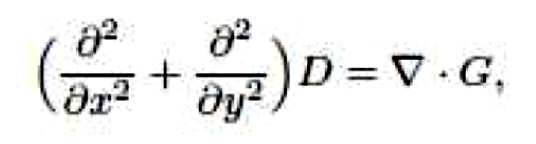
여기서 G = (Gx, Gy)는 복사된 깊이 기울기이고, D는 우리가 추정하고자 하는 깊이이다. ▽G는 G의 발산이다:Where G = (Gx, Gy) is the copied depth slope and D is the depth we want to estimate. ▽ G is the divergence of G:

이산 도메인에서, 식 (1) 및 식 (2)는 각각 식 (3) 및 식 (4)가 된다.In the discrete domain, the equations (1) and (2) become the equations (3) and (4), respectively.


우리는 Ax = b의 형태로 해를 공식화한다. 여기서 b = ▽G, x = D이고, A는 푸아송 방정식[식(3)]의 계수를 저장한다. 크기 H x W의 검사된 이미지의 경우, A는 HW x HW 크기를 갖는 정사각형 행렬이며, 여기서 각 행은 검사된 프레임의 픽셀에 해당한다. 이 행의 값들은 식(3)의 계수들에 대응한다. 도 4(a)는 작은 샘플 이미지에 대해 A를 설정하는 것을 보여준다. 하나 이상의 이웃이 존재하지 않으므로 이미지 경계 픽셀들에 특별한 주의를 기울여야 한다. 이 경우, 우리는 존재하지 않는 픽셀을 참조하는 식(4)의 항들을 제거함으로써 ▽G의 값을 갱신한다. 마지막으로, Ax = b로 주어지면, x에 대해 푼다. 도 2e는 재구성된 깊이 (x)의 예를 보여준다.We formulate the solution in the form Ax = b. Where b = ∇G, x = D, and A stores the coefficients of the Poisson equation [Eq. (3)]. For a checked image of size H x W, A is a square matrix with HW x HW size, where each row corresponds to a pixel of the examined frame. The values in this row correspond to the coefficients in equation (3). Figure 4 (a) shows setting A for a small sample image. Special attention should be paid to image boundary pixels since there is no more than one neighbor. In this case, we update the value of ∇G by removing the terms in (4) that refer to nonexistent pixels. Finally, given Ax = b, solve for x. Figure 2e shows an example of the reconstructed depth (x).
전반적인 깊이 구조가 캡처되지만, 일부 아티팩트가 존재한다 (도 2e의 오른쪽 하단 참조).The overall depth structure is captured, but some artifacts exist (see bottom right of FIG. 2e).
이러한 아티팩트는 부정확한 SIFT 매칭 때문에 종종 생성된다. 예를 들어, 도 4(c)에서, 일부 필드 블록(부분)은 경기장이 아닌 영역에 매칭된다. 매끄러운 깊이를 가질 것으로 예상되는 영역(예컨대, 경기장)으로부터의 쿼리 블록이 (골 또는 플레이어 경계와 같이) 명확한 깊이 변화를 포함하는 참조 블록과 잘못 매칭할 때, 참조 블록으로부터 전달된 명확한 기울기는 결과적인 깊이에 작은 아티팩트를 도입할 수 있다. 이 문제를 극복하기 위해, x를 구하기 전에, 우선 큰 전달된 기울기들을 기울기 미세 조정(gradient refinement)을 통해 줄이고, 대신 우리의 객체 마스크를 사용하여 적절한 위치에 깊이 불연속을 부과한다. 이 두 단계는 다음에서 설명된다.These artifacts are often generated due to incorrect SIFT matching. For example, in Figure 4 (c), some field blocks (portions) are matched to non-stadium areas. When a query block from an area that is expected to have a smooth depth (e.g., a field) is erroneously matched with a reference block that includes a definite depth change (such as a bone or a player boundary), a clear slope, Small artifacts can be introduced into the depth. To overcome this problem, we first reduce the large delivered slopes through gradient refinement, and instead use our object mask to impose a depth discontinuity at the appropriate location, before we get x. These two steps are described below.
기울기 미세 조정: 일부 잘못된 블록 매칭으로 인한 오차를 줄이기 위해, 다음을 사용하여 깊이 기울기를 미세 조정한다. Tilt fine adjustment: To reduce the error caused by some incorrect block matching, use the following to fine tune the depth tilt.

이것은 잘못 추정될 수 있는 큰 기울기를 기하급수적으로 줄이면서 낮은 기울기를 유지한다. a는 미세 조정의 강도를 설정하는 파라미터이다. 높은 a는 올바른 기울기를 손상시킬 수 있지만, 낮은 a는 아티팩트를 허용할 수 있다. 모든 실험에서, a는 60으로 설정된다. 도 2f는 2a에 대한 깊이 추정에서 기울기 미세 조정의 효과를 보여준다. 도 2e와 비교하여, 아티팩트가 제거되고 깊이가 더 매끄럽게 된다.This maintains a low slope while exponentially reducing large slopes that can be misdetected. a is a parameter for setting the intensity of the fine adjustment. A high a can damage the correct slope, but a low a can tolerate artifacts. In all experiments, a is set to 60. FIG. 2F shows the effect of the slope fine adjustment in the depth estimation for 2a. Compared with Figure 2e, the artifacts are removed and the depth is smoother.
객체 경계 컷( object boundary cuts ): 푸아송 재구성은 한 픽셀을 모든 이웃에 연결한다. 이로 인해, 특히, 강한 기울기가 제거되는 기울기 미세 조정 후에, 대부분의 객체 경계가 사라진다(도 2f 참조). 이 문제를 해결하기 위해, 푸아송 방정식을 수정함으로써 객체 경계에서 깊이 불연속을 허용한다. 객체 마스크가 주어지면, 캐니 에지 디텍터(Canny edge detector)를 통해 에지를 탐지한다(도 2d 참조). 그런 다음, 픽셀들이 객체 경계 픽셀을 유효한 이웃으로 사용하지 못하게 함으로써, 객체 경계로부터 픽셀의 연결을 끊는다. 경계 픽셀에 이웃하는 각 픽셀에 대해, A의 대응하는 연결을 0으로 설정하고 그에 따라 ▽G 값을 갱신한다. 따라서, 객체 경계에 인접한 픽셀들은 이미지 경계 픽셀과 비슷하게 처리된다. Object boundaries cut (object boundary cuts): Poisson reconstruction is to connect all of the pixels in the neighborhood. Because of this, most object boundaries disappear, especially after the tilt fine adjustment, where strong tilt is removed (see FIG. 2F). To solve this problem, we allow depth discontinuity at the object boundary by modifying the Poisson equation. Given an object mask, the edge is detected through a Canny edge detector (see FIG. 2d). Then, the pixels are disconnected from the object boundary by preventing them from using the object boundary pixels as valid neighbors. For each pixel neighboring the boundary pixel, set the corresponding connection of A to 0 and update the G G value accordingly. Thus, pixels adjacent to the object boundary are treated similar to image boundary pixels.
한 픽셀 또는 픽셀들의 그룹이 이미지의 나머지와 완전히 분리되면 푸아송 재구성이 잘못된다는 것을 주목해야 한다. 이로 인해, 고립된 영역이 검게 되고 및/또는 전체 이미지의 깊이 추정에 영향을 줄 수 있다. 따라서, 경계의 양측이 여전히 분리되는 것을 확실히 하면서 객체 경계 픽셀들을 이미지의 나머지에 연결 유지하는 것이 중요하다. 그렇게 하기 위해, 각 경계 픽셀을 최상단 또는 최하단 픽셀에 연결한다. 경계 픽셀이 쿼리 이미지의 최상단 픽셀과 더 유사하면, 최상단 픽셀에 연결하고, 그렇지 않으면 최하단 픽셀에 연결한다. 따라서, 각각의 경계 픽셀은 상부 또는 하부 영역의 일부가 되고, 동시에 두 영역은 서로 접근 가능하지 않게 유지된다. 또한, 세분화 오차로 인해 객체 마스크 내부에 구멍들이 자주 발견된다는 것을 알았다. 이러한 마스크에 에지 탐지를 적용하면 이 구멍들을 이미지의 나머지로부터 분리할 수 있다. 이러한 문제를 피하기 위해, 에지 탐지에 앞서 이러한 구멍들을 채운다. 그러나 객체 자체에 에지 탐지를 적용하면 경계 픽셀들로 객체를 둘러싸게 되므로 객체를 배경으로부터 분리한다. 이 문제를 극복하기 위해, 각 객체 경계를 그 최하단(즉, 선수 다리)으로부터 개방한다. 이로 인해, 푸아송이 그라운드로부터 객체까지 깊이를 확산시켜, 격리를 피하면서 자연스러운 깊이를 생성한다. 도 2d는 도 2a에 대해 생성된 객체 경계를 보여준다. 도 2g는 푸아송 재구성 과정에서 객체 경계가 잘릴 때의 추정된 깊이를 보여준다. 도 2f와 비교하여, 이제 플레이어는 도 2g에서 더 잘 보인다.It should be noted that Poisson reconstruction is erroneous if a pixel or group of pixels is completely separated from the rest of the image. This may result in the isolated area becoming black and / or affecting the depth estimation of the entire image. It is therefore important to keep the object boundary pixels connected to the rest of the image, while ensuring that both sides of the boundary are still separated. To do so, connect each boundary pixel to the top or bottom pixel. If the boundary pixel is more similar to the top-most pixel in the query image, connect to the top-most pixel, otherwise connect to the bottom-most pixel. Thus, each border pixel is part of the upper or lower area, while the two areas are kept inaccessible to each other. We also found that holes are often found inside the object mask due to subdivision errors. Applying edge detection to these masks can separate these holes from the rest of the image. To avoid this problem, fill these holes prior to edge detection. However, when edge detection is applied to the object itself, the boundary pixels separate the object from the background because it surrounds the object. To overcome this problem, each object boundary is opened from its lowest end (i. E., The bow leg). Because of this, the Poisson diffuses the depth from the ground to the object, creating a natural depth while avoiding isolation. Figure 2d shows the object boundaries created for Figure 2a. FIG. 2G shows the estimated depth of the object boundary at the time of Poisson reconstruction. In comparison with Figure 2f, the player is now better seen in Figure 2g.
평활(Smoothness): 고차 깊이 도함수를 0으로 강제함으로써 푸아송 재구성에 평활 제약을 추가한다. 연속 도메인에서 다음과 같이 설정한다:Smoothness: Adds a smoothing constraint to the Poisson reconstruction by forcing a higher order depth derivative to zero. On the contiguous domain, set the following:
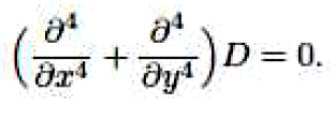
이산 도메인에서 이것은 다음과 같이 된다.In a discrete domain this is:

A의 평활 버전 AS을 생성한다. AS을 식(7)의 새로운 계수로 채운다. 객체 경계 주위의 깊이 불연속을 보존하기 위해 상기 경계 컷을 평활 제약에 적용한다. 그런 다음 A와 As를 연쇄시키고 원래의 Ax = b 대신에 다음 식을 푼다:To produce a smoothed version of A S A. A S is filled with a new coefficient in equation (7). The boundary cut is applied to the smoothing constraint to preserve depth discontinuity around the object boundary. Then concatenate A and As and solve the following equation instead of the original Ax = b:

여기서 β는 필요한 평활의 양을 설정한다. 큰 β는 과도한 평활을 유발할 수 있는 반면 작은 β는 약한 평활을 생성할 수 있다. 모든 실험에서, β = 0:01로 설정한다. 평활의 효과는 기울기 미세 조정의 효과와 다르다. 후자는 이미지의 나머지 부분을 손상시키지 않으면서 명확한 아티팩트를 제거하도록 위해 설계된다. 평활은 모든 깊이 텍스처에 섬세한 터치를 더한다. 명확한 아티팩트를 제거하기 위해 평활을 사용하면 과도-평활을 초래할 수 있다. 또한, 강한 기울기 미세 조정은 기본적인 기울기를 손상시킬 것이다.Where β sets the amount of smoothing required. Large β may cause excessive smoothing, while small β may produce weak smoothing. In all experiments, β = 0:01 is set. The effect of smoothing differs from the effect of slope fine tuning. The latter is designed to eliminate clear artifacts without damaging the rest of the image. Smoothing adds a delicate touch to every depth texture. Using smoothing to eliminate artifacts can lead to transient-smoothing. Also, a strong tilt fine adjustment will impair the basic tilt.
최종 출력 생성: 추정된 깊이[식 (8)에서 x]는 (0; 255) 사이에서 정규화되고 쿼리 이미지와 결합되어 우리의 쿼리 비디오의 변환된 2D + 깊이를 형성한다. 도 2f는 도 2a에 대한 최종 추정된 깊이를 보여주며, 평활을 가진 모든 단계를 포함한다. 우리의 깊이는 매끈하고 경기장, 청중 및 선수의 깊이를 정확하게 재조합한다. 본 발명의 방법은 각각의 플레이어에 같은 깊이가 할당되는 '카드보드 효과'를 생성하지 않는다는 것에 주목한다. 이것을 보여주기 위해, 도 2h에서 플레이어들 중 한 명으로부터의 깊이 블록에 대해 줌하고 그 블록의 깊이 값을 (0; 255)의 범위로 정규화하여 그것을 증폭한다. 도 2i는 도 2h에서 노란색으로 표시된 블록의 줌 확대된 버전을 보여준다. 표시된 블록 내의 플레이어는 다양한 신체 부위들에 대해 다양한 깊이 값들을 가진다는 것을 주목해야 한다. 이 예는 작은 깊이 상세를 추정할 때 우리의 기울기기반 접근 방식의 강점을 보여준다. Final Output Generation: Estimated Depth [x in Eq. (8)] is normalized between (0; 255) and combined with the query image to form the transformed 2D + depth of our query video. Figure 2f shows the final estimated depth for Figure 2a, including all steps with smoothness. Our depth is smooth and accurately re-aligns the depths of the arena, audience and players. Note that the inventive method does not create a " cardboard effect ", which is assigned the same depth to each player. To illustrate this, we zoom in on the depth block from one of the players in Figure 2h and normalize it to a range of (0; 255) and amplify it. Figure 2i shows a zoomed-up version of the block marked in yellow in Figure 2h. It should be noted that the player in the displayed block has various depth values for various body parts. This example shows the strength of our slope-based approach when estimating small depth details.
우리는 도면들에서 DGC(Depth Gradient-based Conversion)로서 지칭하는 본 발명의 구현된 측면을 평가한다. 우리는 합성 및 실제 시퀀스를 모두 고려하고, 가능한 경우 지상실측(ground-truth)과 비교한다. 또한, 우리는 DT(Depth Transfer)로 지칭하는 문헌[11] 내 가장 가까운 시스템과 비교한다. 또한, 우리 기술을 다른 필드 스포츠에 적용할 가능성을 보여 주며, 그 결과는 테니스, 야구, 미식축구 및 필드 하키를 위한 유망한 2D-3D로 변환을 보여준다.We evaluate the implemented aspects of the invention, referred to in the drawings as Depth Gradient-based Conversion (DGC). We consider both the synthesis and the actual sequence, and compare it to the ground-truth whenever possible. We also compare it to the nearest system in the literature [11], referred to as DT (Depth Transfer). It also shows the potential to apply our technology to other field sports, and the results show promising 2D-to-3D conversion for tennis, baseball, football and field hockey.
우리의 방법에는 몇 개의 파라미터가 있으며, 그것들은 모든 시퀀스에 대해 한 번 실험적으로 조정된다. 구체적으로는, K(후보 이미지들의 개수)가 10으로 설정되고, n(블록 크기)이 9로 설정되며, a(기울기 미세 조정 파라미터)가 60으로 설정되고, β(평활도 파라미터)는 0.01로 설정된다.Our method has several parameters, which are experimentally adjusted once for every sequence. Specifically, K (the number of candidate images) is set to 10, n (block size) is set to 9, a (slope fine adjustment parameter) is set to 60, do.
2D-3D 변환 기술(DGC)을 몇몇 기술과 비교한다.2D-3D conversion technology (DGC) is compared with several technologies.
DT : 이 DT 방법[11]은 자체 데이터베이스에서 훈련되었다. DT는 최신의 데이터-기반 2D-3D 변환이다. 그 데이터베이스인 MSR-V3D는 Microsoft Kinect에 의해 캡처된 비디오를 포함하며 온라인으로 이용할 수 있다. DT : This DT method [11] was trained in its own database. DT is the latest data-based 2D-to-3D conversion. Its database, MSR-V3D, includes video captured by Microsoft Kinect and is available online.
DT +: 이 DT 방법은 우리의 합성 데이터베이스(참조 데이터베이스) S-RGBD에서 훈련되었다. [11]에서 언급했듯이, Kinect 2D+깊이 캡처는 실내 환경으로 제한된다. 이것과 잘못된 측정 그리고 열악한 해상도는 대형 축구 데이터베이스를 생성하는 능력을 제한한다. 엄격한 비교를 위해, 우리의 축구 데이터베이스에 의해 훈련될 때 우리의 기술을 DT와 비교한다. DT +: This DT method was trained in our synthetic database (reference database) S-RGBD. As mentioned in [11], Kinect 2D + depth capture is limited to the indoor environment. This, incorrect measurements and poor resolution limit the ability to create large football databases. For rigorous comparisons, we compare our skills with DT when trained by our football database.
지상실측 깊이: 지상실측 깊이 맵은 섹션 3에서 설명된 바와 같이 PIX[4]를 통해 FIFA13 비디오 게임에서 추출된다. 그러나 이것은 합성 데이터에 대해서만 이용할 수 있다. Ground Depth Depth: The ground depth map is extracted from the FIFA13 video game via PIX [4] as described in Section 3. However, this is only available for synthetic data.
원본 3D: 3D 카메라로 캡처한 원래의 사이드-바이-사이드(side-by-side) 3D 비디오이다. 결과를 주관적으로 비교한다. Original 3D: The original side-by-side 3D video captured with a 3D camera. Subjectively compare the results.
스테레오로부터의 깊이: 결과를 원본 3D 화면과 객관적으로 비교하기 위해, 스테레오 대응(stereo correspondence)[8]을 사용하여 지상실측 깊이의 근사치를 구한다. 스테레오 대응 기술들은 항상 정확한 것은 아님을 주목해야 한다. 그러나 우리의 결과에 의해, 때때로 이 기술들이 깊이의 전체적인 구조를 포착하므로 객관적인 분석에 유용할 수 있음을 알 수 있다. Depth from stereo: To compare the result objectively with the original 3D screen, we approximate the ground depth by using stereo correspondence [8]. It should be noted that stereo-capable technologies are not always accurate. However, our results show that sometimes these techniques capture the overall structure of depth and can be useful for objective analysis.
본 발명의 측면들은 다음 8개의 실제 테스트 시퀀스에 적용되었다: 즉 4개의 축구 시퀀스와 4개의 축구 아닌 시퀀스. 또한, 하나의 합성 축구 시퀀스(Synth라고 함)를 갖는다.Aspects of the present invention were applied to the following eight actual test sequences: four football sequences and four non-football sequences. It also has one synthetic soccer sequence ( Synth ).
축구: 우리의 실제 축구 시퀀스들은 원본 3D-샷 비디오에서 추출한 클립을 포함한다. 이 시퀀스들은 다음 4개의 주요 카테고리를 포함하도록 신중하게 생성된다: 원거리 샷, 조감도, 중간 샷, 및 클로즈업. 원거리 샷에서, 카메라는 높은 위치에 놓이고 전체 경기장을 거의 볼 수 있다(도 7, 상단 맨 오른쪽). 조감도는 비슷하지만 카메라가 경기장 위에 위치한다(도 7, 하단 맨 오른쪽). 중간 샷은 카메라의 높이가 낮고 경기장 뷰가 더 작다(도 7, 하단 맨 왼쪽). 클로즈업은 카메라가 한 명 또는 몇 명의 플레이어에 대해 줌되고 경기장 뷰가 더 작다(도 7, 상단 맨 왼쪽). Football: Our actual football sequences contain clips extracted from the original 3D-shot video. These sequences are carefully generated to include the following four major categories: long shot, bird's-eye view, medium shot, and close-up. In the long shot, the camera is placed in a high position and almost the entire stadium can be seen (Figure 7, upper rightmost). The bird's eye view is similar, but the camera is located above the stadium (Fig. 7, bottom right). The middle shot has a low camera height and a smaller stadium view (Fig. 7, bottom left). Close-up is when the camera is zoomed for one or several players and the stadium view is smaller (Fig. 7, top left).
축구 외( Non - soccer ): 누리의 실제 축구 외 시퀀스는 테니스, 야구, 미식축구 및 필드 하키로부터의 클립을 포함한다. 이 시퀀스들을 사용하여 다른 필드 스포츠에 대한 우리 방법의 잠재적인 응용을 평가한다. Football Others (Non - soccer): Enjoy real soccer other sequences include clips from tennis, baseball, football and field hockey. These sequences are used to evaluate the potential application of our method to other field sports.
Synth : S-RGBD 생성과 비슷한 방식으로 120개의 2D+깊이 합성 프레임을 추출한다. 지상실측 깊이가 주어지면, 이 합성 시퀀스를 사용하여 DT 및 DT+에 대해 우리의 기술을 객관적으로 비교한다. Synth :
본 발명의 깊이 맵의 품질을 측정하기 위해 실제 및 합성 시퀀스 모두에 대해 본 발명의 측면들을 사용하는 객관적 실험을 수행한다. 도 5(위)는 합성 시퀀스의 프레임과 그 지상실측 깊이를 보여주며 DT, DT+ 및 본 발명의 DGC를 사용한 그 추정된 깊이가 뒤따른다. 모든 깊이 맵은 (0 - 255) 범위로 정규화된다. MSR-V3D가 축구 데이터와 거의 유사하기 때문에 DT는 대부분 잘못된 측정치를 생성한다. DT+는 본 발명의 데이터베이스에서 훈련될 때 훨씬 더 우수한 결과를 생성한다. 그러나 대부분의 플레이어는 탐지되지 않는다. 본 발명의 기술 DGC는 플레이어를 탐지하고, 매끄러운 결과를 만들어 내며 지상실측과 가장 닮았다. 도 6은 Synth의 전체 120개 프레임들에 대해 지상실측에 대한 절대 평균 오차(MAE: Mean Absolute Error)를 보여준다. 이 도면은 본 발명의 방법이 DT 및 DT+에 비해 훨씬 낮은 MAE를 생성함을 보여준다.Objective experiments using aspects of the present invention are performed on both real and synthetic sequences to measure the quality of the depth map of the present invention. Figure 5 (top) shows the frame of the composite sequence and its ground depth, followed by its estimated depth using DT, DT + and the DGC of the present invention. All depth maps are normalized to a range of (0 - 255). Because MSR-V3D is very similar to soccer data, most DTs produce false measurements. DT + produces much better results when trained in the database of the present invention. However, most players are not detected. The technology DGC of the present invention most closely resembles ground surveying, detecting players and producing smooth results. FIG. 6 shows a mean absolute error (MAE) with respect to the ground surface for all 120 frames of Synth. This figure shows that the method of the present invention produces much lower MAEs compared to DT and DT +.
실제 시퀀스에 대한 객관적 분석은 지상실측 깊이의 부재로 인해 어려움을 겪고 있다. [11]에서 저자들은 Kinect 깊이를 지상실측으로 사용했다. 그러나 Kinect는 실외 환경에서 깊이 정보를 캡처할 수 없으므로, 축구 경기에 대한 지상실측 추정치를 생성할 수 없다. 대신, 우리는 다른 접근법을 따른다. 3D로 촬영된 축구 시퀀스가 주어지면, 스테레오 대응[8]을 사용하여 지상실측 깊이 맵의 근사치를 구한다. 그런 다음 2D-3D로 변환에서 추정된 깊이와 그것을 비교한다. 도 5(아래)는 가장 어려운 축구 테스트 시퀀스들 중 하나의 프레임과 스테레오 대응을 사용하여 추출된 깊이를 보여준다. 완벽한 것은 아니지만, 전반적인 깊이 구조가 존재하므로, 변환된 깊이가 얼마나 우수한지 추론하기 위해 활용될 수 있다. 도 5(하단)에는, DT, DT+ 및 본 발명의 DGC를 사용하여 추정된 깊이를 보여준다. 본 발명의 기술 DGC는 지상실측을 가장 잘 재조합한다. 이것은 또한 100 프레임 범위에서 객관적으로 캡처되며, 여기서 DGC는 DT 및 DT+에 비해 MAE를 각각 19% 및 86%까지 감소시킨다. 도면에서는 공간 제한으로 인해 생략했다.An objective analysis of the actual sequence is challenging due to the lack of ground depth. [11], the authors used the Kinect depth as the ground survey. However, since Kinect can not capture depth information in an outdoor environment, it can not generate ground-based estimates for soccer games. Instead, we follow a different approach. Given a soccer sequence photographed in 3D, use the stereo correspondence [8] to obtain an approximate value of the ground depth map. Then compare it with the estimated depth in the conversion to 2D-3D. Figure 5 (bottom) shows the extracted depth using one of the most difficult football test sequences and the stereo correspondence. Although not perfect, there is an overall depth structure, so it can be used to deduce how good the converted depth is. Figure 5 (bottom) shows the estimated depth using DT, DT + and DGC of the present invention. The technology DGC of the present invention best reassembles the ground survey. It is also objectively captured in the 100 frame range, where DGC reduces the MAE by 19% and 86%, respectively, compared to DT and DT +. The drawings are omitted because of space limitations.
또한, 합성 데이터베이스(참조 데이터베이스) 크기의 중요성을 조사하기 위해 실험을 수행했다. 먼저, 축구 경기에서 발생할 수 있는 다양한 장면의 120 프레임을 사용하여 합성 시퀀스를 만들었다. 6개의 데이터베이스 크기, 즉 1000, 2000, 4000, 8000, 13000 및 16000 이미지들을 조사했다. 결과에 따르면, 8,000개 크기까지 충분한 데이터가 없기 때문에, 성능이 MAE 30 주변에서 변동한다.We also conducted experiments to investigate the importance of synthetic database (reference database) size. First, a synthetic sequence is created using 120 frames of various scenes that can occur in soccer games. We looked at six database sizes, 1000, 2000, 4000, 8000, 13000 and 16000 images. According to the results, performance is fluctuating around MAE 30 because there is not enough data to 8,000 sizes.
그러나 13,000개의 이미지부터 성능이 향상되며, MAE가 약 20으로 줄어든다. 이 성능은 데이터베이스 내 약 16,000개의 이미지에서 안정화된다. 따라서 우리는 평가에서 16,500개의 이미지 데이터베이스를 사용했다.However, performance increases from 13,000 images and MAE is reduced to about 20. This performance is stabilized in about 16,000 images in the database. So we used 16,500 image databases in the evaluation.
우리는 몇 가지 주관적인 실험을 통해 3D 시각 인식을 평가한다. DT+ 및 원본 3D와 본 발명의 기술을 비교한다.We evaluate 3D visual perception through several subjective experiments. DT < + > and the original 3D.
설정Set
ITU BT.2021 권고안[6]에 따라 주관적인 실험을 수행하며, 상기 권고안은 3D 비디오 평가를 위한 3가지 기본 지각 차원인 사진 품질, 깊이 품질 및 시각적 편안함(불편함)을 제안한다. 사진 품질은 주로 인코딩 및/또는 전송의 영향을 받는다. 깊이 품질은 지각된 깊이의 양을 측정하고, 시각적 불편함은 3D 지각으로 인한 모든 형태의 생리적 불쾌감(즉, 피로, 눈 피로, 두통 등)을 측정한다. 이러한 불편함은 3D 아티팩트, 깊이 변경, 쾌적지대 위반 및/또는 크로스토크(crosstalk)로 인해 종종 발생한다. 이 실험에서, 깊이 품질 및 시각적 편안함을 측정한다. 어떤 압축이나 인코딩 파라미터도 변경하지 않기 때문에 사진 품질은 측정하지 않으며, 시퀀스를 전송하지도 않는다.Subjective experiments are performed according to ITU BT.2021 Recommendation [6], which proposes three basic perceptual dimensions for 3D video evaluation: photo quality, depth quality and visual comfort (inconvenience). The picture quality is mainly influenced by encoding and / or transmission. Depth quality measures the amount of perceived depth, and visual discomfort measures all forms of physiological discomfort (ie fatigue, eye fatigue, headache, etc.) due to 3D perception. This inconvenience is often caused by 3D artifacts, depth changes, comfort zone violations and / or crosstalk. In this experiment, depth quality and visual comfort are measured. Since no compression or encoding parameters are changed, the picture quality is not measured and the sequence is not transmitted.
각 테스트 시퀀스는 ITU 권고안에 따라 10-15 초 사이의 지속시간을 가진다. 낮은 조명 조건에서, 패시브 편광 안경을 갖는 55" 필립스 TV 세트에 시퀀스를 표시한다. 시청 거리는 ITU 권고안에 따라 1920 x 1080 해상도의 비디오에서 약 2m이고, 1280 x 720 비디오에서 약 3m이다. 15명의 실험 참가자가 주관적인 실험에 참여했다. 이들은 모두 컴퓨터학과 학생 및 연구원이었다. 정적 및 동적 랜덤 도트 스테레오 그램을 사용하여 실험 참가자의 입체 시력을 실험 전에 테스트했다. 실제 실험 전에 실험 참가자는 안정화 단계를 거쳤다. 실험 참가자들은 상이한 3D 품질을 나타내는 4개의 시퀀스에 최저부터 최고까지 등급을 부여했다. 이 4개의 시퀀스는 실제 시험에 포함되지 않았다. 이 단계는 실험 참가자의 기대치를 안정시키고 평가 프로토콜에 익숙하게 만들었다. 실험 참가자에게 모든 질문을 명확히 하고 실험 절차를 확실히 이해하도록 요청했다.Each test sequence has a duration of between 10 and 15 seconds, depending on the ITU recommendation. Under low lighting conditions, the sequence is displayed on a 55 "Philips TV set with passive polarizing glasses, with viewing distances of approximately 2 meters at 1920 x 1080 resolution and approximately 3 meters at 1280 x 720 video, according to ITU recommendations. Participants took part in subjective experiments, all of which were computer students and researchers, using stereoscopic and dynamic random dot stereograms to test the participant's stereoscopic vision before the experiment. Participants rated the four sequences representing different 3D qualities from lowest to highest - these four sequences were not included in the actual test, which stabilized the expectations of the participants and familiarized them with the evaluation protocol. Give participants a clear understanding of the questions and procedures I asked.
본 발명 기술의 평가Evaluation of the present invention technique
변환된 시퀀스를 관찰할 때 평균 실험 참가자 만족도를 측정하여 2D-3D 변환을 평가한다. 4개의 축구 시퀀스와 4개의 축구 외 시퀀스를 조사한다. 깊이 품질 및 시각적 편안함을 평가하기 위해 ITU 권고의 단일 자극(SS: single-stimulus) 방법을 사용한다. 시퀀스들을 무작위 순서로 실험 참가자에게 보여준다. 각 시퀀스는 10-15 초이고 시퀀스의 코드화된 이름을 나타내는 5초 중간회색(mid-grey) 필드가 앞에 오며, 실험 참가자에게 투표를 요구하는 10초 중간회색 필드가 뒤따른다. 표준 ITU 연속 척도(scale)를 사용하여 깊이 품질 및 편안함을 평가한다. 깊이 품질 라벨이 연속 척도 상에 우수, 양호, 보통, 불량으로 표시되며, 편안함 라벨은 매우 편안함, 편안함, 약간 불편함, 불편함, 및 매우 불편함이 있다. 실험 참가자들에게 이 연속 척도에 자신의 점수를 표시하도록 요청했다. 그런 다음 0-100 사이의 정수 값에 표시를 매핑하고 평균 의견 점수(MOS)를 계산했다.Evaluate 2D-3D transformations by measuring the average participant satisfaction when viewing the transformed sequence. Investigate four soccer sequences and four non-soccer sequences. Use the ITU recommendation's single-stimulus (SS) method to assess depth quality and visual comfort. Show the sequences to the participant in random order. Each sequence is 10-15 seconds followed by a 5 second mid-gray field that represents the coded name of the sequence followed by a 10 second gray field that requires participants to vote. Use standard ITU continuous scales to assess depth quality and comfort. The depth quality label is displayed on the continuous scale as Excellent, Good, Normal, and Bad, and the comfort label is very comfortable, comfortable, somewhat inconvenient, inconvenient, and inconvenient. The participants were asked to show their scores on this continuous scale. We then map the representation to an integer value between 0 and 100 and calculate the average opinion score (MOS).
도 8은 축구 시퀀스에 대한 MOS를 보여준다. 4개의 축구 시퀀스에서 대부분의 실험 참가자는 DGC를 우수 범위에 평가했다. 도 7은 추정된 깊이 이미지들의 일부를 보여준다. 다양한 카메라 뷰 및 클러터를 포함하는 다양한 비디오 샷을 어떻게 처리할 수 있는지 유의해야 한다.Figure 8 shows the MOS for the football sequence. In the four football sequences, most participants rated DGC in the excellent range. Figure 7 shows some of the estimated depth images. You should be aware of how you can handle the various video shots, including the various camera views and clutter.
도 9는 축구 외 시퀀스에 대한 MOS를 도시한다. 필드 하키는 축구와 가장 흡사하기 때문에 가장 높은 점수를 받았다. 그러나 미식축구는 가장 낮은 점수를 받았다. 일부 실험 참가자는 매우 양호한 깊이를 보고했지만, 다른 사람들은 강한 오클루전과 클러터를 갖는 미식축구의 높은 동적인 환경 때문에 깊이 지각의 어려움을 보고했다. 이들 실험 참가자들은 같은 이유로 '약간 불편함'을 보고했다. 축구 외 경기에 대한 결과는 본 발명의 방법의 잠재성을 보여주기 위한 것일 뿐임을 주목하는 것이 중요하다. 그 이유는 실제로 그것들을 변환하기 위해 축구 데이터베이스를 사용했기 때문이다. 향후, 다양한 스포츠를 위한 더욱 다양한 데이터베이스를 만들 계획이다.Figure 9 shows the MOS for non-football sequences. Field hockey has the highest score because it is most like football. But football scores the lowest. Some participants reported very good depth, but others reported difficulty in depth perception due to the high dynamic environment of football with strong occlusion and clutter. These participants reported "a little inconvenience" for the same reason. It is important to note that the results for non-soccer games are merely intended to illustrate the potential of the method of the present invention. The reason is that we actually used the soccer database to transform them. In the future, we plan to create more diverse databases for various sports.
원본 3D와의 비교Comparison with Original 3D
스테레오 카메라를 사용하여 촬영한 원본 3D 비디오와 본 발명의 2D-3D 변환을 비교한다. 이 실험을 위해 ITU 권장의 이중 자극 연속 품질 척도(DSCQS: Double Stimulus Continuous Quality Scale) 방법을 사용한다. DSCQS를 기반으로, 실험 참가자는 투표 전에 두 번 이상 각 쌍의 시퀀스들(본 발명에 따라 생성된 3D 및 원본 3D)을 보고 각 차이점을 적절히 평가한다. 실험 참가자들이 어느 것이 원본이고 어느 것이 변환된 것인지 알지 못하는 상태에서 실험 참가자들에게 시퀀스들을 무작위 순서로 보여준다. 표준 ITU 연속 척도를 사용하여 두 시퀀스를 깊이 품질 및 편안함에 대해 평가하도록 실험 참가자들에게 요청했다. 그런 다음 점수를 0-100 사이의 정수 값에 매핑하고 차이 의견 점수(DOS)(= DGC 점수 - 원본 3D 점수)를 계산했다. 마지막으로 차이 의견 점수 평균(DMOS: mean of the difference opinion scores)을 계산했다.The 2D 3D conversion of the present invention is compared with the original 3D video shot using a stereo camera. For this experiment, the ITU recommended double stimulus continuous quality scale (DSCQS) method is used. Based on the DSCQS, the experiment participant sees each pair of sequences (3D and original 3D generated according to the present invention) more than once before voting and appropriately evaluates each difference. The participants in the experiment show the sequences in a random order without knowing which is the original and which has been transformed. We asked participants to evaluate the two sequences for depth quality and comfort using the standard ITU continuum. We then mapped the score to an integer value between 0 and 100 and calculated the difference score (DOS) (= DGC score - original 3D score). Finally, we calculated the mean difference of opinion scores (DMOS).
DMOS가 0이라는 것은 우리의 변환된 3D가 원본 3D와 동일하다는 판단이고, DMOS가 음수이면 우리의 변환된 3D가 원본 3D보다 더 낮은 깊이 지각/편안함을 갖는다는 것을 의미한다. 도 11은 각각의 축구 시퀀스들의 DMOS를 깊이 품질 및 시각적 편한함에 대해 보여준다. 본 발명의 변환은, 특히 전체 축구 경기의 약 70%를 차지하는 원거리 샷[9]에서 원본 3D와 비슷하다. 일부 실험 참가들이 본 발명의 변환을 원본 3D보다 더 편안한 것으로 지각한 것은 흥이있는 발견이다. 실험 참가자들은 원본 3D에서 튀어나오는 효과(popping out effect)가 때로는 불편함을 유발한다고 보고했다.A DMOS of 0 means that our transformed 3D is the same as the original 3D, and if the DMOS is negative, our transformed 3D has a lower depth perception / comfort than the original 3D. Figure 11 shows the DMOS of each football sequence for depth quality and visual comfort. The transformation of the present invention is similar to original 3D, especially in the far shot [9], which accounts for about 70% of the total soccer game. It is a good discovery that some experiment participants perceived the transformation of the present invention as being more comfortable than the original 3D. Experiment participants reported that the popping out effect in original 3D sometimes caused discomfort.
최신 기술과의 비교Comparison with the latest technology
깊이 전달(DT+)[11]에 대해 본 발명의 3D 변환을 비교한다. 이전 실험에서와 마찬가지로, DSCQS 평가 프로토콜을 사용하여 깊이 품질 및 시각적 편안함에 대해 DMOS를 계산했다. 가장 까다로운 축구 시퀀스들, 클로즈업 및 중간 샷을 조사했다. 다양한 카메라 앵글, 복잡한 모션, 클러터 및 오클루전은 2D-3D 변환에서 그것들을 가장 까다로운 시퀀스로 만든다. 도 12는 DT+에 대한 클로즈업 및 중간 샷의 DMOS를 도시한다. 본 발명의 기술은 중간 샷에서 평균 15점, 클로즈업에서 평균 12점씩 DT+를 능가한다. 또한, 15명의 실험 참가자 모두는 본 발명의 기술을 DT+에 비해 높거나 같게 평가했으며, 보고된 차이는 통계적으로 유의미하다(p 값 < 0.05). 도 10은 DT, DT+ 및 DGC에 대한 일부 추출된 깊이 맵들을 보여준다. 깊이 전달의 원래 구현은 DT이며 이것은 DT+에 비해 훨씬 더 나쁜 점에 주목해야 한다(도 10 참조). 게다가 DT+의 주관적 점수가 더 낮은 것 외에도, 그 깊이가 때로는 매우 잡음이 많다(도 10 및 도 5 참조). 이것은 장기적으로 눈의 피로를 일으킬 수 있다.The 3D transform of the present invention is compared for depth transfer (DT +) [11]. As in previous experiments, DMOS was calculated for depth quality and visual comfort using the DSCQS evaluation protocol. I examined the most demanding football sequences, close-ups and mid-shots. Various camera angles, complex motion, clutter, and occlusion make them the most demanding sequence in 2D-to-3D conversion. 12 shows a close-up and a middle shot DMOS for DT +. The technique of the present invention outperforms DT + by an average of 15 points in the middle shot and an average of 12 points in the close-up. In addition, all 15 study participants rated the technique of the invention higher or equal to DT +, and the reported differences were statistically significant (p value <0.05). Figure 10 shows some extracted depth maps for DT, DT +, and DGC. It should be noted that the original implementation of depth transfer is DT, which is much worse than DT + (see FIG. 10). In addition to the lower subjective scores of DT +, the depth is sometimes very noisy (see Figures 10 and 5). This can cause eye fatigue in the long term.
545개의 클로즈업 프레임과 1,726개의 클로즈업 외(non close-ups)의 프레임에 대해 DGC 및 DT+의 평균 실행 시간을 측정한다. 공간 해상도는 960 x 1080 픽셀이다. DGC는 클로즈업 프레임의 경우 3.53분/프레임 소요되고 클로즈업 외 프레임 경우 1.86분/프레임 소요된다. DT+의 평균 처리 시간은 15.2분/프레임으로, 클로즈업과 클로즈업 외 프레임 둘 다에서 본 발명의 기술보다 느리다. DGC는 더 비싼 마스크 생성 단계로 인해 클로즈업에 대해 더 많은 시간을 요구한다. 클로즈업 외 프레임이 축구 경기의 95%까지 차지할 수 있으므로[9], 더 빠른 클로즈업 외 프레임 처리로 이익을 얻을 수 있다. 그럼에도, 클로즈업이 풍부한 깊이 정보를 포함하기 때문에 클로즈업을 무시할 수 없다. 계산상의 복잡성을 개선하기 위한 향후 노력은 비디오 처리를 위한 시공간 다중-해상도 기법에 중점을 둘 수 있다. 모든 숫자는 서버 인텔 Xeon CPU E5-2650 0 @ 2.00 GHz, 8 코어, 총 264GB RAM 및 86GB 캐시를 갖는 6개 프로세서를 갖는 서버상의 처리로부터 보고되었다.Measure the average execution time of DGC and DT + for 545 close-up frames and 1,726 non close-ups. The spatial resolution is 960 x 1080 pixels. DGC requires 3.53 minutes / frame for close-up frames and 1.86 minutes / frame for frames other than close-ups. The average processing time of DT + is 15.2 minutes per frame, which is slower than the technique of the present invention in both the close-up and close-up non-frame. The DGC requires more time for close-ups due to the more expensive mask generation steps. Since close-up outside frames can account for up to 95% of the soccer game [9], we can benefit from faster close-up other-frame processing. Nevertheless, close-ups can not ignore close-ups because they contain rich depth information. Future efforts to improve computational complexity can focus on spatio-temporal multi-resolution techniques for video processing. All numbers have been reported from processing on servers with six processors with server Intel Xeon CPU E5-2650 0 @ 2.00 GHz, 8 cores, total 264 GB RAM and 86 GB cache.
본 발명의 측면들은 2D-3D 비디오 변환 방법을 제공하며, 축구를 예로 들어 참조 데이터베이스(합성 3D 데이터 베이스)의 깊이 정보 및 컴퓨터 생성 이미지를 사용하여 실시간 변환을 보여준다. 이전 방법은 축구 경기의 예에서 사용된 것처럼 다양한 장면과 모션 복잡성을 처리할 수 없다. 본 발명의 방법은, 합성 데이터베이스(참조 데이터베이스)로부터 깊이 기울기를 전달하는 것과, 푸아송 재구성을 통해 깊이를 추정하는 것을 기반으로 한다. 우리는 상기 제안된 방법을 구현하고 실제 및 합성 시퀀스를 사용하여 이 방법을 평가했다. 평가 결과는, 본 발명의 방법이 다양한 카메라 뷰, 모션 복잡성, 오클루전, 클러터 및 다양한 컬러를 포함하는, 예를 들어 축구 게임에 존재하는 광범위한 스펙트럼의 비디오 샷을 처리할 수 있음을 보여준다. 우리의 주관적인 연구에 참여한 참가자들은 대부분 우리가 만든 3D 비디오를 대부분 우수하다고 평가했다. 실험 결과 역시, 본 발명의 방법이 실시간 및 합성 시퀀스 둘 다에서 객관적으로 및 주관적으로 최신 기술을 능가한다는 것을 보여준다.Aspects of the present invention provide a 2D-to-3D video conversion method, showing real-time conversion using depth information of a reference database (synthetic 3D database) and computer generated images using soccer as an example. The previous method can not handle various scenes and motion complexity as used in the soccer game example. The method of the present invention is based on transferring a depth gradient from a synthetic database (reference database) and estimating the depth through Poisson reconstruction. We implemented this proposed method and evaluated the method using real and synthetic sequences. The evaluation results show that the method of the present invention is capable of handling a wide spectrum of video shots that exist in, for example, soccer games, including various camera views, motion complexity, occlusion, clutter and various colors. Most of the participants in our subjective study rated most of our 3D video as excellent. Experimental results also show that the method of the present invention outperforms the state of the art both objectively and subjectively in both real-time and synthetic sequences.
본 발명의 측면들은 2D-3D 비디오 변환의 영역과, 잠재적으로 3D 비디오 처리의 영역에 일반적으로 영향을 미친다. 첫째, 도메인별 변환은 일반적인 방법보다 훨씬 나은 결과를 제공할 수 있다. 둘째, 블록 단위로 깊이 기울기를 전달하면 매끄럽고 자연스러운 깊이를 생성할 뿐만 아니라, 필요한 참조 데이터베이스의 크기도 줄인다. 셋째, 컴퓨터-생성된 콘텐츠로부터 작성된 합성 데이터베이스(참조 데이터베이스)는 다양한 3D 비디오 처리 애플리케이션을 위해 크고 다양하며 정확한 텍스처 및 깊이 참조를 쉽게 제공할 수 있다.Aspects of the present invention generally affect the area of 2D-3D video conversion and potentially the area of 3D video processing. First, domain-specific transformations can provide much better results than ordinary methods. Second, delivering depth gradients on a block-by-block basis not only creates a smooth, natural depth, but also reduces the size of the reference database required. Third, a composite database (reference database) created from computer-generated content can easily provide large, diverse, and accurate texture and depth references for various 3D video processing applications.
본 발명의 측면들은 다수의 방향으로 확장될 수 있다. 예를 들어, 다양한 스포츠의 비디오를 변환하려면 더 큰 합성 데이터베이스(참조 데이터베이스)를 만들어야 할 수도 있다.Aspects of the present invention can be extended in a number of directions. For example, you might need to create a larger composite database (reference database) to convert videos from various sports.
본 명세서 및 청구의 범위에서 사용되는 "포함하다" 및 "포함하는"이라는 용어 및 이들의 변형은, 명시된 특징, 단계 또는 정수가 포함됨을 의미한다. 이 용어들은 다른 특징, 단계 또는 구성 요소의 존재를 배제하는 것으로 해석되어서는 안 된다.As used in the specification and the claims, the terms "comprises" and "comprising" and variations thereof mean that the stated feature, step, or integer is included. These terms should not be construed as excluding the presence of other features, steps or components.
개시된 기능, 또는 개시된 결과를 달성하기 위한 방법 또는 프로세스를, 적절하게, 수행하기 위한 수단으로 또는 그것들의 특정 형태로 표현된 전술한 설명, 후속하는 특허 청구 범위, 또는 첨부된 도면에 개시된 특징들은, 개별적으로, 또는 그러한 특징들의 임의의 조합으로, 본 발명을 다양한 형태로 실현하는데 이용될 수 있다.The features described in the foregoing description, the following claims, or the accompanying drawings, expressed as a means for performing the disclosed function, or a method or process for achieving the disclosed result, as appropriate or in a specific form thereof, Either individually or in any combination of such features, may be utilized to realize the invention in various forms.
(참고문헌)(references)
[1 ] Berkeley 3-D object dataset. http://kinectdata.com/. [1] Berkeley 3-D object dataset. http://kinectdata.com/.
[2] Make3D. http://make3d.cs.cornell.edu/data.html. [2] Make3D. http://make3d.cs.cornell.edu/data.html.
[3] NYU depth dataset v2. [3] NYU depth dataset v2.
http://cs.nyu.edu/~silberman/datasets/nyu_depth_v2.html. http://cs.nyu.edu/~silberman/datasets/nyu_depth_v2.html.
[4] Performance Invistigator for Xbox (PIX).[4] Performance Invistigator for Xbox (PIX).
https://msdn.microsoft.com/en-us/library/ https://msdn.microsoft.com/en-us/library/
windows/desktop/ee663275%28v=vs.85%29.aspx. windows / desktop / ee663275% 28v = vs.85% 29.aspx.
[5] RGB-D object dataset. [5] RGB-D object dataset.
http://rgbd-dataset.cs.washington.edu/. http://rgbd-dataset.cs.washington.edu/.
[6] ITU-R BT.2021, Subjective methods for the assessment[6] ITU-R BT.2021, Subjective methods for the assessment
of stereoscopic 3DTV systems. Geneva, Switzerland, of stereoscopic 3DTV systems. Geneva, Switzerland,
November 2012. International Telecommunication Union. November 2012. International Telecommunication Union.
[7] P. Bhat, B. Curless, M. Cohen, and C. Zitnick. Fourier analysis of[7] P. Bhat, B. Curless, M. Cohen, and C. Zitnick. Fourier analysis of
the 2D screened poisson equation for gradient domain problems. The 2D screened poisson equation for gradient domain problems.
In Proc. of European Conference on Computer Vision (ECCV'08), In Proc. of European Conference on Computer Vision (ECCV'08),
pages 114-128. Marseille, France, October 2008. pages 114-128. Marseille, France, October 2008.
[8] T. Brox, A. Bruhn, N. Papenberg, and J. Weickert. High accuracy[8] T. Brox, A. Bruhn, N. Papenberg, and J. Weickert. High accuracy
optical ow estimation based on a theory for warping. In Proc. of optical ow estimation based on a theory for warping. In Proc. of
European Conference on Computer Vision (ECCV'04), pages 25-36, European Conference on Computer Vision (ECCV'04), pages 25-36,
Prague, Czech Republic, May 2004. Prague, Czech Republic, May 2004.
[9] K. Calagari, K. Templin, T. Elgamal, K. Diab, P. Didyk, W. Matusik,[9] K. Calagari, K. Templin, T. Elgamal, K. Diab, P. Didyk, W. Matusik,
and M. Hefeeda. Anahita: A System for 3D Video Streaming with Depth and M. Hefeeda. Anahita: A System for 3D Video Streaming with Depth
Customization. In Proc. of ACM Multimedia (MM'14), pages 337-346, Customization. In Proc. of ACM Multimedia (MM'14), pages 337-346,
Orlando, Fl, November 2014. Orlando, Fl, November 2014.
[10] D. Hoiem, A. A. Efros, and M. Hebert. Automatic photo pop-up. ACM[10] D. Hoiem, A. A. Efros, and M. Hebert. Automatic photo pop-up. ACM
Transactions on Graphics, 24(3):577-584, 2005. Transactions on Graphics, 24 (3): 577-584, 2005.
[11] K. Karsch, C. Liu, and S. B. Kang.[11] K. Karsch, C. Liu, and S. B. Kang.
Depth transfer: Depth extraction from video using non-parametric Depth transfer: Depth extraction from video using non-parametric
sampling. IEEE Transactions on Pattern Analysis and Machine sampling. IEEE Transactions on Pattern Analysis and Machine
Intelligence, 36(11):2144-2158, 2014. Intelligence, 36 (11): 2144-2158, 2014.
[12] J. Ko. 2D-to-3D Stereoscopic Conversion: Depth Estimation in 2D [12] J. Ko. 2D-to-3D Stereoscopic Conversion: Depth Estimation in 2D
Images and Soccer Videos. Master's thesis, Korea Advanced Images and Soccer Videos. Master's thesis, Korea Advanced
Institution of Science and Technology (KAIST), 2008. Institution of Science and Technology (KAIST), 2008.
[13] J. Konrad, M. Wang, P. Ishwar, C. Wu, and D. Mukherjee. Learning- [13] J. Konrad, M. Wang, P. Ishwar, C. Wu, and D. Mukherjee. Learning-
based, automatic 2D-to-3D image and video conversion. IEEE based, automatic 2D-to-3D image and video conversion. IEEE
Transactions on Image Processing, 22(9):3485-3496, 2013. Transactions on Image Processing, 22 (9): 3485-3496, 2013.
[14] A. Levin, D. Lischinski, and Y. Weiss. A closed-form solution to [14] A. Levin, D. Lischinski, and Y. Weiss. A closed-form solution to
natural image matting. IEEE Transactions on Pattern Analysis and natural image matting. IEEE Transactions on Pattern Analysis and
Machine Intelligence, 30(2):228-242, 2008. Machine Intelligence, 30 (2): 228-242, 2008.
[15] C.-W. Liu, T.-H. Huang, M.-H. Chang, K.-Y. Lee, C.-K. Liang, and[15] C.-W. Liu, T.-H. Huang, M.-H. Chang, K.-Y. Lee, C.-K. Liang, and
Y.-Y. Chuang. 3D cinematography principles and their applications Y.-Y. Chuang. 3D cinematography principles and their applications
to stereoscopic media processing. In Proc. of ACM Multimedia to stereoscopic media processing. In Proc. of ACM Multimedia
Conference(MM'11), pages 253-262, Scottsdale, AZ, November 2011. Conference (MM'11), pages 253-262, Scottsdale, AZ, November 2011.
[16] P. Ochs, J. Malik, and T. Brox. Segmentation of moving objects by[16] P. Ochs, J. Malik, and T. Brox. Segmentation of moving objects by
long term video analysis. IEEE Transactions on Pattern Analysis long term video analysis. IEEE Transactions on Pattern Analysis
and Machine Intelligence, 36(6):1187-1200, 2014. and Machine Intelligence, 36 (6): 1187-1200, 2014.
[17] A. Oliva and A. Torralba. Modeling the shape of the scene:[17] A. Oliva and A. Torralba. Modeling the shape of the scene:
a holistic representation of the spatial envelope. International a holistic representation of the spatial envelope. International
Journal of Computer Vision, 42(3):145-175, 2001. Journal of Computer Vision, 42 (3): 145-175, 2001.
[18] P. P_erez, M. Gangnet, and A. Blake. Poisson image editing. ACM [18] P. P_erez, M. Gangnet, and A. Blake. Poisson image editing. ACM
Transactions on Graphics, 22:313-318, 2003. Transactions on Graphics, 22: 313-318, 2003.
[19] R. Rzeszutek, R. Phan, and D. Androutsos. Depth estimation for [19] R. Rzeszutek, R. Phan, and D. Androutsos. Depth estimation for
semiautomatic 2D to 3D conversion. In Proc. of ACM Multimedia semiautomatic 2D to 3D conversion. In Proc. of ACM Multimedia
Conference (MM'12), pages 817-820, Nara, Japan, October 2012. Conference (MM'12), pages 817-820, Nara, Japan, October 2012.
[20] A. Saxena, S. H. Chung, and A. Y. Ng. Learning depth from single [20] A. Saxena, S. H. Chung, and A. Y. Ng. Learning depth from single
monocular images. In Proc. of Advances in Neural Information monocular images. In Proc. of Advances in Neural Information
Processing Systems (NIPS'05), pages 1161-1168, Vancouver, Canada, Processing Systems (NIPS'05), pages 1161-1168, Vancouver, Canada,
December 2005. December 2005.
[21] L. Schnyder, O. Wang, and A. Smolic. 2D to 3D conversion of sports[21] L. Schnyder, O. Wang, and A. Smolic. 2D to 3D conversion of sports
content using panoramas. In Proc. of IEEE Conference on Image content using panoramas. In Proc. of IEEE Conference on Image
Processing(ICIP'11), pages 1961-1964, Brussels, Belgium, Processing (ICIP'11), pages 1961-1964, Brussels, Belgium,
Sept. 2011. Sept. 2011.
[22] J. Shotton, A. Fitzgibbon, M. Cook, T. Sharp, M. Finocchio,[22] J. Shotton, A. Fitzgibbon, M. Cook, T. Sharp, M. Finocchio,
R. Moore, A. Kipman, and A. Blake. Real-time human pose R. Moore, A. Kipman, and A. Blake. Real-time human pose
recognition in parts from single depth images. recognition in parts from single depth images.
In Proc. of IEEE Conference on Computer Vision and Pattern In Proc. of IEEE Conference on Computer Vision and Pattern
Recognition (CVPR'11), pages 1297-1304, Providence, Rl, June 2011. Recognition (CVPR'11), pages 1297-1304, Providence, RI, June 2011.
[23] W. Wu, A. Are_n, G. Kurillo, P. Agarwal, K. Nahrstedt, and[23] W. Wu, A. Are_n, G. Kurillo, P. Agarwal, K. Nahrstedt, and
R. Bajcsy. Color-plus-depth level-of-detail in 3D tele-immersive R. Bajcsy. Color-plus-depth level-of-detail in 3D tele-immersive
video: A psychophysical approach. In Proc. of ACM Multimedia video: A psychophysical approach. In Proc. of ACM Multimedia
Conference(MM'11) pages 13-22, Scottsdale, Arizona, November 2011. Conference (MM'11) pages 13-22, Scottsdale, Arizona, November 2011.
[24] Z. Yang, W. Wu, K. Nahrstedt, G. Kurillo, and R. Bajcsy.[24] Z. Yang, W. Wu, K. Nahrstedt, G. Kurillo, and R. Bajcsy.
Viewcast: View dissemination and management for multi-party Viewcast: View dissemination and management for multi-party
3D tele-immersive environments. In Proc. of ACM Multimedia 3D tele-immersive environments. In Proc. of ACM Multimedia
Conference(MM'07), pages 882-891, Augsburg, Bavaria, Germany, Conference (MM'07), pages 882-891, Augsburg, Bavaria, Germany,
September 2007. September 2007.
[25] L. Zhang, C. V_azquez, and S. Knorr. 3D-TV content creation:[25] L. Zhang, C. V_azquez, and S. Knorr. 3D-TV content creation:
automatic 2D-to-3D video conversion. IEEE Transactions on automatic 2D-to-3D video conversion. IEEE Transactions on
Broadcasting, 57(2):372-383, 2011. Broadcasting, 57 (2): 372-383, 2011.
[26] Z. Zhang, C. Zhou, B. Xin, Y. Wang, and W. Gao.[26] Z. Zhang, C. Zhou, B. Xin, Y. Wang, and W. Gao.
An interactive system of stereoscopic video conversion. In Proc. An interactive system of stereoscopic video conversion. In Proc.
of ACM Multimedia Conference(MM'12), pages 149-158, Nara, Japan, of ACM Multimedia Conference (MM'12), pages 149-158, Nara, Japan,
October 2012. October 2012.
Claims (20)
데이터베이스 내의 각 엔트리(entry)가 2D 이미지 및 상기 2D 이미지에 대응하는 깊이 정보를 포함하는, 비디오 프레임들의 참조 데이터베이스를 제공하는 단계;
입력 비디오 프레임들을 상기 참조 데이터베이스에 제출하는 단계;
입력 비디오 프레임을 상기 참조 데이터베이스 내의 2D 이미지와 매칭시키고, 상기 2D 이미지에 대응하는 깊이 정보를 선택하는 단계; 및
상기 선택된 깊이 정보를 상기 매칭된 입력 비디오 프레임에 적용하여 2D + 깊이 정보 프레임을 생성하는 단계;
를 포함하는, 2D 비디오 이미지 처리 방법.A method of processing a 2D video image from a video stream to convert a 2D video image to a 3D image,
Providing a reference database of video frames, wherein each entry in the database comprises a 2D image and depth information corresponding to the 2D image;
Submitting input video frames to the reference database;
Matching an input video frame with a 2D image in the reference database and selecting depth information corresponding to the 2D image; And
Applying the selected depth information to the matched input video frame to generate a 2D + depth information frame;
/ RTI > of a 2D video image.
상기 입력 비디오 프레임을 부분들로 분할하는 단계를 포함하고,
상기 입력 비디오 프레임을 상기 참조 데이터베이스 내의 2D 이미지와 매칭시키는 단계는,
상기 입력 비디오 프레임의 일부분을 상기 참조 데이터베이스 내의 상기 2D 이미지의 일부분과 매칭시키는 과정을 포함하는, 2D 비디오 이미지 처리 방법.The method according to claim 1,
Dividing the input video frame into portions,
Wherein matching the input video frame with a 2D image in the reference database comprises:
And matching a portion of the input video frame with a portion of the 2D image in the reference database.
상기 부분들은 n x n 픽셀들의 블록들인, 2D 비디오 이미지 처리 방법.3. The method of claim 2,
Wherein the portions are blocks of nxn pixels.
상기 입력 비디오 프레임의 다른 일부분을 상기 참조 데이터베이스 내의 다른 2D 이미지의 일부분과 매칭시켜 상기 입력 비디오 프레임의 다수의 부분을 다수의 2D 이미지의 각 부분들과 매칭시키는 단계를 추가로 포함하는, 2D 비디오 이미지 처리 방법.4. The method according to any one of claims 1 to 3,
Further comprising matching a different portion of the input video frame with a portion of another 2D image in the reference database to match the multiple portions of the input video frame with respective portions of the plurality of 2D images. Processing method.
상기 선택된 깊이 정보를 상기 매칭된 입력 비디오 프레임에 적용하는 단계는 상기 2D 이미지의 매칭된 부분의 깊이 정보를 상기 매칭된 입력 비디오 프레임의 각 매칭된 부분에 적용하는 과정을 포함하는, 2D 비디오 이미지 처리 방법.5. The method according to any one of claims 2 to 4,
Wherein applying the selected depth information to the matched input video frame comprises applying depth information of a matched portion of the 2D image to each matched portion of the matched input video frame. Way.
상기 선택된 깊이 정보를 상기 매칭된 입력 비디오 프레임에 적용하는 단계는 상기 2D 이미지의 매칭된 부분의 하나 이상의 대응하는 픽셀을 상기 입력 비디오 프레임의 매칭된 부분의 대응하는 픽셀에 매핑하는 과정을 포함하는, 2D 비디오 이미지 처리 방법.6. The method of claim 5,
Wherein applying the selected depth information to the matched input video frame comprises mapping one or more corresponding pixels of a matched portion of the 2D image to a corresponding pixel of a matched portion of the input video frame. A method of processing a 2D video image.
상기 입력 비디오 프레임과 매칭하는 후보 2D 이미지를 시각적 기법을 사용하여 식별하는 단계를 포함하는, 2D 비디오 이미지 처리 방법.7. The method according to any one of claims 1 to 6,
Identifying a candidate 2D image matching the input video frame using a visual technique.
상기 시각적 기법은 상기 프레임들의 컬러 정보 및 GIST를 이용하는 단계를 포함하는, 2D 비디오 이미지 처리 방법.8. The method of claim 7,
Wherein the visual technique comprises using color information of the frames and a GIST.
상기 깊이 정보는 깊이 기울기(depth gradient)인, 2D 비디오 이미지 처리 방법.9. The method according to any one of claims 1 to 8,
Wherein the depth information is a depth gradient.
상기 입력 비디오 프레임 내의 객체들을 식별하는 단계;
상기 식별된 객체들에 대한 객체 마스크들을 결정하는 단계; 및
상기 결정된 객체 마스크들 및 상기 매칭된 입력 비디오 프레임을 사용하여 상기 깊이 정보를 추정하는 단계;
를 포함하는, 2D 비디오 이미지 처리 방법.10. The method according to any one of claims 1 to 9,
Identifying objects in the input video frame;
Determining object masks for the identified objects; And
Estimating the depth information using the determined object masks and the matched input video frame;
/ RTI > of a 2D video image.
푸아송(Poisson) 재구성을 사용하여 상기 결정된 깊이 정보를 추정하는 단계를 더 포함하는, 2D 비디오 이미지 처리 방법.11. The method of claim 10,
Further comprising estimating the determined depth information using Poisson reconstruction. ≪ RTI ID = 0.0 > 11. < / RTI >
상기 푸아송 재구성은 1차 이상의 도함수를 포함하는, 2D 비디오 이미지 처리 방법.12. The method of claim 11,
Wherein the Poisson reconstruction comprises a first-order or higher-order derivative.
상기 2D + 깊이 정보 프레임을 사용하여 좌측 입체(stereo) 이미지 및 우측 입체 이미지를 생성하는 단계를 추가로 포함하는, 2D 비디오 이미지 처리 방법.13. The method according to any one of claims 1 to 12,
Further comprising generating a left stereoscopic image and a right stereoscopic image using the 2D + depth information frame.
상기 참조 데이터베이스는 소프트웨어-생성된 비디오 프레임들을 사용하여 채워지는, 2D 비디오 이미지 처리 방법.14. The method according to any one of claims 1 to 13,
Wherein the reference database is populated using software-generated video frames.
상기 소프트웨어는 비디오 게임인, 2D 비디오 이미지 처리 방법.15. The method of claim 14,
Wherein the software is a video game.
데이터베이스 내의 각각의 엔트리가 2D 이미지 및 상기 2D 이미지에 대응하는 깊이 정보를 포함하는, 비디오 프레임들의 참조 데이터베이스;
입력 비디오 프레임들을 상기 참조 데이터베이스에 제출하는 탐색 모듈;
입력 비디오 프레임을 상기 참조 데이터베이스 내의 2D 이미지와 매칭시키고 상기 2D 이미지에 대응하는 깊이 정보를 선택하는 매칭 모듈; 및
상기 선택된 깊이 정보를 상기 매칭된 입력 비디오 프레임에 적용하여 2D + 깊이 정보 프레임을 생성하는 생성기 모듈;
을 포함하는, 이미지 처리 시스템.A system for processing a 2D video image from a video stream to convert a 2D video image to a 3D image,
A reference database of video frames, each entry in the database comprising a 2D image and depth information corresponding to the 2D image;
A search module for submitting input video frames to the reference database;
A matching module for matching an input video frame with a 2D image in the reference database and selecting depth information corresponding to the 2D image; And
A generator module for applying the selected depth information to the matched input video frame to generate a 2D + depth information frame;
And an image processing system.
데이터베이스 내의 각 엔트리가 2D 이미지 및 상기 2D 이미지에 대응하는 깊이 정보를 포함하는, 비디오 프레임들의 참조 데이터베이스를 제공하는 단계;
입력 비디오 프레임들을 상기 참조 데이터베이스에 제출하는 단계;
입력 비디오 프레임을 상기 참조 데이터베이스 내의 2D 이미지와 매칭시키고, 상기 2D 이미지에 대응하는 깊이 정보를 선택하는 단계; 및
상기 선택된 깊이 정보를 상기 매칭된 입력 비디오 프레임에 적용하여 2D + 깊이 정보 프레임을 생성하는 단계;
를 포함하는, 컴퓨터로 읽을 수 있는 매체.There is provided a computer readable medium having a program for converting a 2D video image to a 3D image from a video stream upon execution,
Providing a reference database of video frames, each entry in the database comprising a 2D image and depth information corresponding to the 2D image;
Submitting input video frames to the reference database;
Matching an input video frame with a 2D image in the reference database and selecting depth information corresponding to the 2D image; And
Applying the selected depth information to the matched input video frame to generate a 2D + depth information frame;
Readable medium. ≪ / RTI >
사용된 상기 소프트웨어는 비디오 게임인, 참조 데이터베이스 생성 방법.19. The method of claim 18,
Wherein the software used is a video game.
Applications Claiming Priority (3)
| Application Number | Priority Date | Filing Date | Title |
|---|---|---|---|
| US201562200311P | 2015-08-03 | 2015-08-03 | |
| US62/200,311 | 2015-08-03 | ||
| PCT/GB2016/052388 WO2017021731A1 (en) | 2015-08-03 | 2016-08-03 | 2d-to-3d video frame conversion |
Publications (1)
| Publication Number | Publication Date |
|---|---|
| KR20180094835A true KR20180094835A (en) | 2018-08-24 |
Family
ID=56787639
Family Applications (1)
| Application Number | Title | Priority Date | Filing Date |
|---|---|---|---|
| KR1020187006222A Abandoned KR20180094835A (en) | 2015-08-03 | 2016-08-03 | Convert video frames from 2D to 3D |
Country Status (11)
| Country | Link |
|---|---|
| US (2) | US10425634B2 (en) |
| EP (1) | EP3326364A1 (en) |
| JP (1) | JP6903657B2 (en) |
| KR (1) | KR20180094835A (en) |
| CN (1) | CN108605119B (en) |
| AU (1) | AU2016302049C1 (en) |
| BR (1) | BR112018002224A8 (en) |
| CA (1) | CA2994514A1 (en) |
| IL (1) | IL257304B (en) |
| MX (1) | MX377805B (en) |
| WO (1) | WO2017021731A1 (en) |
Families Citing this family (13)
| Publication number | Priority date | Publication date | Assignee | Title |
|---|---|---|---|---|
| EP3236657A1 (en) * | 2016-04-21 | 2017-10-25 | Ultra-D Coöperatief U.A. | Dual mode depth estimator |
| JP2019015553A (en) * | 2017-07-05 | 2019-01-31 | ソニーセミコンダクタソリューションズ株式会社 | Information processing device, information processing method, and solid-state imaging device |
| US10735707B2 (en) | 2017-08-15 | 2020-08-04 | International Business Machines Corporation | Generating three-dimensional imagery |
| US11113887B2 (en) * | 2018-01-08 | 2021-09-07 | Verizon Patent And Licensing Inc | Generating three-dimensional content from two-dimensional images |
| MX2020007663A (en) * | 2018-01-19 | 2020-09-14 | Interdigital Vc Holdings Inc | Processing a point cloud. |
| US10991150B2 (en) | 2018-05-09 | 2021-04-27 | Massachusetts Institute Of Technology | View generation from a single image using fully convolutional neural networks |
| US20200137380A1 (en) * | 2018-10-31 | 2020-04-30 | Intel Corporation | Multi-plane display image synthesis mechanism |
| TWI756956B (en) * | 2020-12-01 | 2022-03-01 | 財團法人工業技術研究院 | Image processing method and device for panorama image |
| US12217359B2 (en) | 2021-03-10 | 2025-02-04 | Joseph Gratz | Three-dimensional rendering of sporting event from two-dimensional video stream |
| CN113793255A (en) * | 2021-09-09 | 2021-12-14 | 百度在线网络技术(北京)有限公司 | Method, apparatus, device, storage medium and program product for image processing |
| CN114913215B (en) * | 2021-11-25 | 2025-08-15 | 原力聚合(重庆)机器人科技有限公司 | Depth estimation method and depth estimation device |
| CN115019227B (en) * | 2022-05-16 | 2025-04-29 | 咪咕文化科技有限公司 | AI-based video processing method, device, equipment and readable storage medium |
| US20250104197A1 (en) * | 2023-09-26 | 2025-03-27 | Adobe Inc. | Interactively refining a digital image depth map for non destructive synthetic lens blur |
Family Cites Families (14)
| Publication number | Priority date | Publication date | Assignee | Title |
|---|---|---|---|---|
| US7254265B2 (en) * | 2000-04-01 | 2007-08-07 | Newsight Corporation | Methods and systems for 2D/3D image conversion and optimization |
| US8401336B2 (en) | 2001-05-04 | 2013-03-19 | Legend3D, Inc. | System and method for rapid image sequence depth enhancement with augmented computer-generated elements |
| WO2007069255A2 (en) * | 2005-12-14 | 2007-06-21 | Yeda Research And Development Co. Ltd. | Example based 3d reconstruction |
| TW201005673A (en) * | 2008-07-18 | 2010-02-01 | Ind Tech Res Inst | Example-based two-dimensional to three-dimensional image conversion method, computer readable medium therefor, and system |
| US8311285B2 (en) * | 2009-06-30 | 2012-11-13 | Mitsubishi Electric Research Laboratories, Inc. | Method and system for localizing in urban environments from omni-direction skyline images |
| US8610758B2 (en) * | 2009-12-15 | 2013-12-17 | Himax Technologies Limited | Depth map generation for a video conversion system |
| JP5132754B2 (en) * | 2010-11-10 | 2013-01-30 | 株式会社東芝 | Image processing apparatus, method, and program thereof |
| CN102999937A (en) * | 2011-09-08 | 2013-03-27 | 上海翰攀信息科技有限公司 | Curved planar reconstruction method for cardiac scattered-point cloud data |
| US9471988B2 (en) * | 2011-11-02 | 2016-10-18 | Google Inc. | Depth-map generation for an input image using an example approximate depth-map associated with an example similar image |
| US9414048B2 (en) | 2011-12-09 | 2016-08-09 | Microsoft Technology Licensing, Llc | Automatic 2D-to-stereoscopic video conversion |
| EP2742441A1 (en) | 2012-05-24 | 2014-06-18 | Qatar Foundation | A method and system for creating depth signatures |
| US20140210944A1 (en) * | 2013-01-30 | 2014-07-31 | Samsung Electronics Co., Ltd. | Method and apparatus for converting 2d video to 3d video |
| US9373171B2 (en) * | 2013-07-22 | 2016-06-21 | Stmicroelectronics S.R.L. | Method for generating a depth map, related system and computer program product |
| EP2887311B1 (en) * | 2013-12-20 | 2016-09-14 | Thomson Licensing | Method and apparatus for performing depth estimation |
-
2016
- 2016-08-03 CA CA2994514A patent/CA2994514A1/en not_active Abandoned
- 2016-08-03 KR KR1020187006222A patent/KR20180094835A/en not_active Abandoned
- 2016-08-03 BR BR112018002224A patent/BR112018002224A8/en not_active IP Right Cessation
- 2016-08-03 CN CN201680056142.7A patent/CN108605119B/en not_active Expired - Fee Related
- 2016-08-03 JP JP2018525821A patent/JP6903657B2/en not_active Expired - Fee Related
- 2016-08-03 MX MX2018001450A patent/MX377805B/en active IP Right Grant
- 2016-08-03 US US15/749,509 patent/US10425634B2/en active Active
- 2016-08-03 WO PCT/GB2016/052388 patent/WO2017021731A1/en not_active Ceased
- 2016-08-03 AU AU2016302049A patent/AU2016302049C1/en not_active Ceased
- 2016-08-03 EP EP16754538.3A patent/EP3326364A1/en not_active Withdrawn
-
2018
- 2018-02-01 IL IL257304A patent/IL257304B/en active IP Right Grant
-
2019
- 2019-09-23 US US16/578,420 patent/US10834379B2/en not_active Expired - Fee Related
Also Published As
| Publication number | Publication date |
|---|---|
| BR112018002224A2 (en) | 2019-02-19 |
| JP2018528733A (en) | 2018-09-27 |
| US10425634B2 (en) | 2019-09-24 |
| AU2016302049C1 (en) | 2021-01-07 |
| US10834379B2 (en) | 2020-11-10 |
| CN108605119A (en) | 2018-09-28 |
| IL257304B (en) | 2020-09-30 |
| JP6903657B2 (en) | 2021-07-14 |
| IL257304A (en) | 2018-06-28 |
| CA2994514A1 (en) | 2017-02-09 |
| US20200053345A1 (en) | 2020-02-13 |
| MX377805B (en) | 2025-03-11 |
| EP3326364A1 (en) | 2018-05-30 |
| US20180227574A1 (en) | 2018-08-09 |
| AU2016302049B2 (en) | 2020-10-01 |
| WO2017021731A1 (en) | 2017-02-09 |
| CN108605119B (en) | 2020-12-01 |
| BR112018002224A8 (en) | 2020-09-08 |
| AU2016302049A1 (en) | 2018-03-29 |
| MX2018001450A (en) | 2018-05-28 |
Similar Documents
| Publication | Publication Date | Title |
|---|---|---|
| US10834379B2 (en) | 2D-to-3D video frame conversion | |
| Rematas et al. | Soccer on your tabletop | |
| US10542249B2 (en) | Stereoscopic video generation method based on 3D convolution neural network | |
| RU2612378C1 (en) | Method of replacing objects in video stream | |
| KR20090084563A (en) | Method and apparatus for generating depth map of video image | |
| KR20030019559A (en) | Method for multiple view synthesis | |
| Feng et al. | Object-based 2D-to-3D video conversion for effective stereoscopic content generation in 3D-TV applications | |
| WO2022126674A1 (en) | Method and system for evaluating quality of stereoscopic panoramic image | |
| Wang et al. | Quaternion representation based visual saliency for stereoscopic image quality assessment | |
| Ling et al. | Prediction of the influence of navigation scan-path on perceived quality of free-viewpoint videos | |
| CN109408672A (en) | A kind of article generation method, device, server and storage medium | |
| Huang et al. | Light field image quality assessment: An overview | |
| CN111178163A (en) | Cubic projection format-based stereo panoramic image salient region prediction method | |
| Calagari et al. | Gradient-based 2D-to-3D conversion for soccer videos | |
| Calagari et al. | Data driven 2-D-to-3-D video conversion for soccer | |
| CN110012284A (en) | A kind of video broadcasting method and device based on helmet | |
| Zhang et al. | An interactive system of stereoscopic video conversion | |
| Seitner et al. | Trifocal system for high-quality inter-camera mapping and virtual view synthesis | |
| Baek et al. | Visual quality assessment of point clouds compared to natural reference images | |
| JP7271095B2 (en) | Image generation device, image generation method, and program | |
| US20200020090A1 (en) | 3D Moving Object Point Cloud Refinement Using Temporal Inconsistencies | |
| Lee et al. | 3-D video generation from monocular video based on hierarchical video segmentation | |
| CN114979610B (en) | Image transmission for 3D scene reconstruction | |
| Liu et al. | Stereoscopic view synthesis based on region-wise rendering and sparse representation | |
| Didyk et al. | Data Driven 2D-to-3D Video Conversion for Soccer |
Legal Events
| Date | Code | Title | Description |
|---|---|---|---|
| PA0105 | International application |
Patent event date: 20180302 Patent event code: PA01051R01D Comment text: International Patent Application |
|
| PG1501 | Laying open of application | ||
| A201 | Request for examination | ||
| PA0201 | Request for examination |
Patent event code: PA02012R01D Patent event date: 20210714 Comment text: Request for Examination of Application |
|
| PA0302 | Request for accelerated examination |
Patent event date: 20210716 Patent event code: PA03022R01D Comment text: Request for Accelerated Examination |
|
| E902 | Notification of reason for refusal | ||
| PE0902 | Notice of grounds for rejection |
Comment text: Notification of reason for refusal Patent event date: 20210822 Patent event code: PE09021S01D |
|
| E701 | Decision to grant or registration of patent right | ||
| PE0701 | Decision of registration |
Patent event code: PE07011S01D Comment text: Decision to Grant Registration Patent event date: 20211213 |
|
| PC1904 | Unpaid initial registration fee |