KR20180033229A - A defect-reducing rinse solution containing an ammonium salt of a sulfo ester - Google Patents
A defect-reducing rinse solution containing an ammonium salt of a sulfo ester Download PDFInfo
- Publication number
- KR20180033229A KR20180033229A KR1020187004735A KR20187004735A KR20180033229A KR 20180033229 A KR20180033229 A KR 20180033229A KR 1020187004735 A KR1020187004735 A KR 1020187004735A KR 20187004735 A KR20187004735 A KR 20187004735A KR 20180033229 A KR20180033229 A KR 20180033229A
- Authority
- KR
- South Korea
- Prior art keywords
- ammonium
- acid diester
- ammonium salt
- hydroxyethyl
- less
- Prior art date
- Legal status (The legal status is an assumption and is not a legal conclusion. Google has not performed a legal analysis and makes no representation as to the accuracy of the status listed.)
- Granted
Links
- -1 sulfo ester Chemical class 0.000 title claims abstract description 399
- 150000003863 ammonium salts Chemical class 0.000 title claims abstract description 125
- 239000000203 mixture Substances 0.000 claims abstract description 218
- XLYOFNOQVPJJNP-UHFFFAOYSA-N water Substances O XLYOFNOQVPJJNP-UHFFFAOYSA-N 0.000 claims abstract description 168
- 238000000034 method Methods 0.000 claims abstract description 118
- 239000000463 material Substances 0.000 claims abstract description 92
- 238000009472 formulation Methods 0.000 claims abstract description 85
- 239000002253 acid Substances 0.000 claims abstract description 48
- 239000000758 substrate Substances 0.000 claims abstract description 48
- 230000008569 process Effects 0.000 claims abstract description 35
- 150000001875 compounds Chemical class 0.000 claims abstract description 33
- 238000004140 cleaning Methods 0.000 claims abstract description 31
- 150000005691 triesters Chemical class 0.000 claims abstract description 19
- 239000003960 organic solvent Substances 0.000 claims abstract description 12
- 239000000243 solution Substances 0.000 claims description 113
- 229920002120 photoresistant polymer Polymers 0.000 claims description 93
- QGZKDVFQNNGYKY-UHFFFAOYSA-O Ammonium Chemical compound [NH4+] QGZKDVFQNNGYKY-UHFFFAOYSA-O 0.000 claims description 45
- 125000000217 alkyl group Chemical group 0.000 claims description 40
- 150000001450 anions Chemical class 0.000 claims description 40
- 239000007788 liquid Substances 0.000 claims description 37
- 150000001768 cations Chemical class 0.000 claims description 32
- 125000004432 carbon atom Chemical group C* 0.000 claims description 29
- 150000002148 esters Chemical class 0.000 claims description 27
- 125000003342 alkenyl group Chemical group 0.000 claims description 26
- 238000004519 manufacturing process Methods 0.000 claims description 25
- 125000004185 ester group Chemical group 0.000 claims description 24
- MTHSVFCYNBDYFN-UHFFFAOYSA-N anhydrous diethylene glycol Natural products OCCOCCO MTHSVFCYNBDYFN-UHFFFAOYSA-N 0.000 claims description 23
- 150000005690 diesters Chemical class 0.000 claims description 17
- 238000001914 filtration Methods 0.000 claims description 13
- 238000005406 washing Methods 0.000 claims description 13
- 229940079826 hydrogen sulfite Drugs 0.000 claims description 12
- 239000007983 Tris buffer Substances 0.000 claims description 11
- 150000008064 anhydrides Chemical class 0.000 claims description 11
- 238000001035 drying Methods 0.000 claims description 11
- 125000002496 methyl group Chemical group [H]C([H])([H])* 0.000 claims description 11
- LFQSCWFLJHTTHZ-UHFFFAOYSA-N Ethanol Chemical compound CCO LFQSCWFLJHTTHZ-UHFFFAOYSA-N 0.000 claims description 10
- 238000007654 immersion Methods 0.000 claims description 10
- FIVJMCNNMIGYRO-UHFFFAOYSA-N bis(2-hydroxyethyl)-dimethylazanium Chemical compound OCC[N+](C)(C)CCO FIVJMCNNMIGYRO-UHFFFAOYSA-N 0.000 claims description 9
- AEKHFLDILSDXBL-UHFFFAOYSA-N 1-(methylamino)propan-2-ol Chemical compound CNCC(C)O AEKHFLDILSDXBL-UHFFFAOYSA-N 0.000 claims description 8
- 239000000693 micelle Substances 0.000 claims description 8
- 230000005855 radiation Effects 0.000 claims description 8
- 230000000694 effects Effects 0.000 claims description 7
- 239000011148 porous material Substances 0.000 claims description 7
- LYCAIKOWRPUZTN-UHFFFAOYSA-N Ethylene glycol Chemical compound OCCO LYCAIKOWRPUZTN-UHFFFAOYSA-N 0.000 claims description 6
- 125000001495 ethyl group Chemical group [H]C([H])([H])C([H])([H])* 0.000 claims description 6
- DNIAPMSPPWPWGF-UHFFFAOYSA-N monopropylene glycol Natural products CC(O)CO DNIAPMSPPWPWGF-UHFFFAOYSA-N 0.000 claims description 6
- 238000002156 mixing Methods 0.000 claims description 5
- OKTJSMMVPCPJKN-UHFFFAOYSA-N Carbon Chemical group [C] OKTJSMMVPCPJKN-UHFFFAOYSA-N 0.000 claims description 4
- 229910052739 hydrogen Inorganic materials 0.000 claims description 4
- 229910052751 metal Inorganic materials 0.000 claims description 4
- 239000002184 metal Substances 0.000 claims description 4
- KMTOVCPWTKBNJZ-UHFFFAOYSA-N tris(2-hydroxypropyl)-methylazanium Chemical compound CC(O)C[N+](C)(CC(C)O)CC(C)O KMTOVCPWTKBNJZ-UHFFFAOYSA-N 0.000 claims description 4
- 125000003178 carboxy group Chemical group [H]OC(*)=O 0.000 claims description 3
- 239000001257 hydrogen Substances 0.000 claims description 3
- 125000004435 hydrogen atom Chemical group [H]* 0.000 claims description 3
- WGCNASOHLSPBMP-UHFFFAOYSA-N hydroxyacetaldehyde Natural products OCC=O WGCNASOHLSPBMP-UHFFFAOYSA-N 0.000 claims description 3
- 230000002194 synthesizing effect Effects 0.000 claims description 2
- COMVEZIIQHBEJL-UHFFFAOYSA-N 2-hydroxy-2-sulfopropanoic acid Chemical compound OC(=O)C(O)(C)S(O)(=O)=O COMVEZIIQHBEJL-UHFFFAOYSA-N 0.000 claims 1
- 150000002334 glycols Chemical class 0.000 claims 1
- 238000002360 preparation method Methods 0.000 abstract description 7
- KDYFGRWQOYBRFD-UHFFFAOYSA-N Succinic acid Natural products OC(=O)CCC(O)=O KDYFGRWQOYBRFD-UHFFFAOYSA-N 0.000 abstract description 2
- 229960005137 succinic acid Drugs 0.000 abstract description 2
- 239000010410 layer Substances 0.000 description 115
- 239000004094 surface-active agent Substances 0.000 description 88
- ARXJGSRGQADJSQ-UHFFFAOYSA-N 1-methoxypropan-2-ol Chemical compound COCC(C)O ARXJGSRGQADJSQ-UHFFFAOYSA-N 0.000 description 83
- 239000000047 product Substances 0.000 description 52
- 150000003839 salts Chemical class 0.000 description 45
- YXFVVABEGXRONW-UHFFFAOYSA-N Toluene Chemical compound CC1=CC=CC=C1 YXFVVABEGXRONW-UHFFFAOYSA-N 0.000 description 39
- VZCYOOQTPOCHFL-UHFFFAOYSA-N trans-butenedioic acid Natural products OC(=O)C=CC(O)=O VZCYOOQTPOCHFL-UHFFFAOYSA-N 0.000 description 34
- 230000007547 defect Effects 0.000 description 33
- 230000015572 biosynthetic process Effects 0.000 description 32
- OEYIOHPDSNJKLS-UHFFFAOYSA-N choline Chemical compound C[N+](C)(C)CCO OEYIOHPDSNJKLS-UHFFFAOYSA-N 0.000 description 30
- 125000001424 substituent group Chemical group 0.000 description 30
- 238000005160 1H NMR spectroscopy Methods 0.000 description 29
- IJGRMHOSHXDMSA-UHFFFAOYSA-N Atomic nitrogen Chemical compound N#N IJGRMHOSHXDMSA-UHFFFAOYSA-N 0.000 description 28
- OKKJLVBELUTLKV-VMNATFBRSA-N methanol-d1 Chemical compound [2H]OC OKKJLVBELUTLKV-VMNATFBRSA-N 0.000 description 28
- 239000011541 reaction mixture Substances 0.000 description 27
- 235000012431 wafers Nutrition 0.000 description 26
- 238000004817 gas chromatography Methods 0.000 description 24
- 239000002245 particle Substances 0.000 description 23
- VZCYOOQTPOCHFL-OWOJBTEDSA-N Fumaric acid Chemical compound OC(=O)\C=C\C(O)=O VZCYOOQTPOCHFL-OWOJBTEDSA-N 0.000 description 22
- 238000000206 photolithography Methods 0.000 description 20
- HEMHJVSKTPXQMS-UHFFFAOYSA-M Sodium hydroxide Chemical compound [OH-].[Na+] HEMHJVSKTPXQMS-UHFFFAOYSA-M 0.000 description 18
- 239000001530 fumaric acid Substances 0.000 description 18
- 239000002904 solvent Substances 0.000 description 18
- 239000008367 deionised water Substances 0.000 description 17
- 229910021641 deionized water Inorganic materials 0.000 description 17
- HMBHAQMOBKLWRX-UHFFFAOYSA-N 2,3-dihydro-1,4-benzodioxine-3-carboxylic acid Chemical compound C1=CC=C2OC(C(=O)O)COC2=C1 HMBHAQMOBKLWRX-UHFFFAOYSA-N 0.000 description 16
- OFOBLEOULBTSOW-UHFFFAOYSA-N Propanedioic acid Natural products OC(=O)CC(O)=O OFOBLEOULBTSOW-UHFFFAOYSA-N 0.000 description 16
- XKMRRTOUMJRJIA-UHFFFAOYSA-N ammonia nh3 Chemical group N.N XKMRRTOUMJRJIA-UHFFFAOYSA-N 0.000 description 16
- 229940075419 choline hydroxide Drugs 0.000 description 16
- 239000011976 maleic acid Substances 0.000 description 16
- 229910052757 nitrogen Inorganic materials 0.000 description 16
- LSNNMFCWUKXFEE-UHFFFAOYSA-M Bisulfite Chemical compound OS([O-])=O LSNNMFCWUKXFEE-UHFFFAOYSA-M 0.000 description 15
- 239000006260 foam Substances 0.000 description 15
- 125000004493 2-methylbut-1-yl group Chemical group CC(C*)CC 0.000 description 14
- 238000010992 reflux Methods 0.000 description 14
- YGSDEFSMJLZEOE-UHFFFAOYSA-N salicylic acid Chemical compound OC(=O)C1=CC=CC=C1O YGSDEFSMJLZEOE-UHFFFAOYSA-N 0.000 description 14
- WGTYBPLFGIVFAS-UHFFFAOYSA-M tetramethylammonium hydroxide Chemical compound [OH-].C[N+](C)(C)C WGTYBPLFGIVFAS-UHFFFAOYSA-M 0.000 description 14
- 239000007864 aqueous solution Substances 0.000 description 12
- 229920001429 chelating resin Polymers 0.000 description 11
- 238000005259 measurement Methods 0.000 description 11
- 125000003538 pentan-3-yl group Chemical group [H]C([H])([H])C([H])([H])C([H])(*)C([H])([H])C([H])([H])[H] 0.000 description 11
- 125000001453 quaternary ammonium group Chemical group 0.000 description 11
- 230000008961 swelling Effects 0.000 description 11
- 238000003786 synthesis reaction Methods 0.000 description 11
- LSNNMFCWUKXFEE-UHFFFAOYSA-N Sulfurous acid Chemical compound OS(O)=O LSNNMFCWUKXFEE-UHFFFAOYSA-N 0.000 description 10
- ZETCGWYACBNPIH-UHFFFAOYSA-N azane;sulfurous acid Chemical compound N.OS(O)=O ZETCGWYACBNPIH-UHFFFAOYSA-N 0.000 description 10
- 230000003287 optical effect Effects 0.000 description 10
- KFZMGEQAYNKOFK-UHFFFAOYSA-N Isopropanol Chemical compound CC(C)O KFZMGEQAYNKOFK-UHFFFAOYSA-N 0.000 description 9
- 238000010533 azeotropic distillation Methods 0.000 description 9
- 238000006243 chemical reaction Methods 0.000 description 9
- 229910021645 metal ion Inorganic materials 0.000 description 9
- 125000000740 n-pentyl group Chemical group [H]C([H])([H])C([H])([H])C([H])([H])C([H])([H])C([H])([H])* 0.000 description 9
- 238000001179 sorption measurement Methods 0.000 description 9
- VEXZGXHMUGYJMC-UHFFFAOYSA-N Hydrochloric acid Chemical compound Cl VEXZGXHMUGYJMC-UHFFFAOYSA-N 0.000 description 8
- 238000003109 Karl Fischer titration Methods 0.000 description 8
- DWAQJAXMDSEUJJ-UHFFFAOYSA-M Sodium bisulfite Chemical compound [Na+].OS([O-])=O DWAQJAXMDSEUJJ-UHFFFAOYSA-M 0.000 description 8
- ULUAUXLGCMPNKK-UHFFFAOYSA-N Sulfobutanedioic acid Chemical class OC(=O)CC(C(O)=O)S(O)(=O)=O ULUAUXLGCMPNKK-UHFFFAOYSA-N 0.000 description 8
- 230000008901 benefit Effects 0.000 description 8
- 238000002474 experimental method Methods 0.000 description 8
- 239000012074 organic phase Substances 0.000 description 8
- KJIFKLIQANRMOU-UHFFFAOYSA-N oxidanium;4-methylbenzenesulfonate Chemical compound O.CC1=CC=C(S(O)(=O)=O)C=C1 KJIFKLIQANRMOU-UHFFFAOYSA-N 0.000 description 8
- 235000010267 sodium hydrogen sulphite Nutrition 0.000 description 8
- 239000000126 substance Substances 0.000 description 8
- 239000004381 Choline salt Substances 0.000 description 7
- VYPSYNLAJGMNEJ-UHFFFAOYSA-N Silicium dioxide Chemical compound O=[Si]=O VYPSYNLAJGMNEJ-UHFFFAOYSA-N 0.000 description 7
- 229960001231 choline Drugs 0.000 description 7
- 235000019417 choline salt Nutrition 0.000 description 7
- 235000008504 concentrate Nutrition 0.000 description 7
- 239000012141 concentrate Substances 0.000 description 7
- 238000005342 ion exchange Methods 0.000 description 7
- 150000002500 ions Chemical class 0.000 description 7
- FJKROLUGYXJWQN-UHFFFAOYSA-N papa-hydroxy-benzoic acid Natural products OC(=O)C1=CC=C(O)C=C1 FJKROLUGYXJWQN-UHFFFAOYSA-N 0.000 description 7
- 229960004889 salicylic acid Drugs 0.000 description 7
- 239000004289 sodium hydrogen sulphite Substances 0.000 description 7
- NINIDFKCEFEMDL-UHFFFAOYSA-N Sulfur Chemical compound [S] NINIDFKCEFEMDL-UHFFFAOYSA-N 0.000 description 6
- QVGXLLKOCUKJST-UHFFFAOYSA-N atomic oxygen Chemical compound [O] QVGXLLKOCUKJST-UHFFFAOYSA-N 0.000 description 6
- BTANRVKWQNVYAZ-UHFFFAOYSA-N butan-2-ol Chemical compound CCC(C)O BTANRVKWQNVYAZ-UHFFFAOYSA-N 0.000 description 6
- PKULCESNTQFEEL-UHFFFAOYSA-N diazanium;2-sulfobutanedioate Chemical compound [NH4+].[NH4+].OS(=O)(=O)C(C([O-])=O)CC([O-])=O PKULCESNTQFEEL-UHFFFAOYSA-N 0.000 description 6
- 230000032050 esterification Effects 0.000 description 6
- 238000005886 esterification reaction Methods 0.000 description 6
- 238000001900 extreme ultraviolet lithography Methods 0.000 description 6
- 230000002209 hydrophobic effect Effects 0.000 description 6
- 238000006317 isomerization reaction Methods 0.000 description 6
- 239000012044 organic layer Substances 0.000 description 6
- 229910052760 oxygen Inorganic materials 0.000 description 6
- 239000001301 oxygen Substances 0.000 description 6
- 238000001556 precipitation Methods 0.000 description 6
- 125000003548 sec-pentyl group Chemical group [H]C([H])([H])C([H])([H])C([H])([H])C([H])(*)C([H])([H])[H] 0.000 description 6
- 229910052717 sulfur Inorganic materials 0.000 description 6
- 239000011593 sulfur Substances 0.000 description 6
- 230000008646 thermal stress Effects 0.000 description 6
- LHENQXAPVKABON-UHFFFAOYSA-N 1-methoxypropan-1-ol Chemical compound CCC(O)OC LHENQXAPVKABON-UHFFFAOYSA-N 0.000 description 5
- ZAMOUSCENKQFHK-UHFFFAOYSA-N Chlorine atom Chemical compound [Cl] ZAMOUSCENKQFHK-UHFFFAOYSA-N 0.000 description 5
- 238000004458 analytical method Methods 0.000 description 5
- 238000000089 atomic force micrograph Methods 0.000 description 5
- 238000004630 atomic force microscopy Methods 0.000 description 5
- 230000004888 barrier function Effects 0.000 description 5
- ZVGNLPOWWIWPER-KTKRTIGZSA-N bis(3,5,5-trimethylhexyl) (z)-but-2-enedioate Chemical compound CC(C)(C)CC(C)CCOC(=O)\C=C/C(=O)OCCC(C)CC(C)(C)C ZVGNLPOWWIWPER-KTKRTIGZSA-N 0.000 description 5
- 229910052801 chlorine Inorganic materials 0.000 description 5
- 239000000460 chlorine Substances 0.000 description 5
- 239000012043 crude product Substances 0.000 description 5
- 238000011161 development Methods 0.000 description 5
- 239000012530 fluid Substances 0.000 description 5
- 125000004051 hexyl group Chemical group [H]C([H])([H])C([H])([H])C([H])([H])C([H])([H])C([H])([H])C([H])([H])* 0.000 description 5
- 125000004029 hydroxymethyl group Chemical group [H]OC([H])([H])* 0.000 description 5
- FPYJFEHAWHCUMM-UHFFFAOYSA-N maleic anhydride Chemical compound O=C1OC(=O)C=C1 FPYJFEHAWHCUMM-UHFFFAOYSA-N 0.000 description 5
- 238000000691 measurement method Methods 0.000 description 5
- 239000004065 semiconductor Substances 0.000 description 5
- 238000003756 stirring Methods 0.000 description 5
- 125000000999 tert-butyl group Chemical group [H]C([H])([H])C(*)(C([H])([H])[H])C([H])([H])[H] 0.000 description 5
- RYHBNJHYFVUHQT-UHFFFAOYSA-N 1,4-Dioxane Chemical compound C1COCCO1 RYHBNJHYFVUHQT-UHFFFAOYSA-N 0.000 description 4
- YZUPZGFPHUVJKC-UHFFFAOYSA-N 1-bromo-2-methoxyethane Chemical compound COCCBr YZUPZGFPHUVJKC-UHFFFAOYSA-N 0.000 description 4
- QGZKDVFQNNGYKY-UHFFFAOYSA-N Ammonia Chemical class N QGZKDVFQNNGYKY-UHFFFAOYSA-N 0.000 description 4
- RAHZWNYVWXNFOC-UHFFFAOYSA-N Sulphur dioxide Chemical compound O=S=O RAHZWNYVWXNFOC-UHFFFAOYSA-N 0.000 description 4
- 238000013459 approach Methods 0.000 description 4
- ROPXFXOUUANXRR-BUHFOSPRSA-N bis(2-ethylhexyl) (e)-but-2-enedioate Chemical compound CCCCC(CC)COC(=O)\C=C\C(=O)OCC(CC)CCCC ROPXFXOUUANXRR-BUHFOSPRSA-N 0.000 description 4
- ROPXFXOUUANXRR-YPKPFQOOSA-N bis(2-ethylhexyl) (z)-but-2-enedioate Chemical compound CCCCC(CC)COC(=O)\C=C/C(=O)OCC(CC)CCCC ROPXFXOUUANXRR-YPKPFQOOSA-N 0.000 description 4
- 125000001246 bromo group Chemical group Br* 0.000 description 4
- 239000006227 byproduct Substances 0.000 description 4
- 239000003989 dielectric material Substances 0.000 description 4
- 238000000921 elemental analysis Methods 0.000 description 4
- VZCYOOQTPOCHFL-UPHRSURJSA-N maleic acid Chemical compound OC(=O)\C=C/C(O)=O VZCYOOQTPOCHFL-UPHRSURJSA-N 0.000 description 4
- 239000012071 phase Substances 0.000 description 4
- 238000012545 processing Methods 0.000 description 4
- XTUSEBKMEQERQV-UHFFFAOYSA-N propan-2-ol;hydrate Chemical compound O.CC(C)O XTUSEBKMEQERQV-UHFFFAOYSA-N 0.000 description 4
- FTNNFRACBUSSBI-UHFFFAOYSA-M sodium 1,4-dioxo-1,4-bis(3,5,5-trimethylhexoxy)butane-2-sulfonate Chemical compound [Na+].CC(CCOC(=O)CC(C(=O)OCCC(C)CC(C)(C)C)S([O-])(=O)=O)CC(C)(C)C FTNNFRACBUSSBI-UHFFFAOYSA-M 0.000 description 4
- APSBXTVYXVQYAB-UHFFFAOYSA-M sodium docusate Chemical compound [Na+].CCCCC(CC)COC(=O)CC(S([O-])(=O)=O)C(=O)OCC(CC)CCCC APSBXTVYXVQYAB-UHFFFAOYSA-M 0.000 description 4
- 229910001415 sodium ion Inorganic materials 0.000 description 4
- 230000035882 stress Effects 0.000 description 4
- 125000000547 substituted alkyl group Chemical group 0.000 description 4
- XUIMIQQOPSSXEZ-UHFFFAOYSA-N Silicon Chemical compound [Si] XUIMIQQOPSSXEZ-UHFFFAOYSA-N 0.000 description 3
- GPDDSCWJNFDDII-UHFFFAOYSA-N [NH4+].S(=O)(=O)([O-])C(C(=O)OCCCCCCC(C)C)CC(=O)OCCCCCCC(C)C Chemical compound [NH4+].S(=O)(=O)([O-])C(C(=O)OCCCCCCC(C)C)CC(=O)OCCCCCCC(C)C GPDDSCWJNFDDII-UHFFFAOYSA-N 0.000 description 3
- WVIAMVORRWBAIJ-UHFFFAOYSA-N azane;1,4-dioxo-1,4-bis(3,5,5-trimethylhexoxy)butane-2-sulfonic acid Chemical compound N.CC(C)(C)CC(C)CCOC(=O)CC(S(O)(=O)=O)C(=O)OCCC(C)CC(C)(C)C WVIAMVORRWBAIJ-UHFFFAOYSA-N 0.000 description 3
- 239000011248 coating agent Substances 0.000 description 3
- 238000000576 coating method Methods 0.000 description 3
- FFUAGWLWBBFQJT-UHFFFAOYSA-N hexamethyldisilazane Chemical compound C[Si](C)(C)N[Si](C)(C)C FFUAGWLWBBFQJT-UHFFFAOYSA-N 0.000 description 3
- 125000002887 hydroxy group Chemical group [H]O* 0.000 description 3
- 230000010354 integration Effects 0.000 description 3
- 125000001449 isopropyl group Chemical group [H]C([H])([H])C([H])(*)C([H])([H])[H] 0.000 description 3
- 230000009467 reduction Effects 0.000 description 3
- 229910052710 silicon Inorganic materials 0.000 description 3
- 239000010703 silicon Substances 0.000 description 3
- 229910052814 silicon oxide Inorganic materials 0.000 description 3
- 238000009736 wetting Methods 0.000 description 3
- NMRPBPVERJPACX-UHFFFAOYSA-N (3S)-octan-3-ol Natural products CCCCCC(O)CC NMRPBPVERJPACX-UHFFFAOYSA-N 0.000 description 2
- HNSDLXPSAYFUHK-UHFFFAOYSA-N 1,4-bis(2-ethylhexyl) sulfosuccinate Chemical compound CCCCC(CC)COC(=O)CC(S(O)(=O)=O)C(=O)OCC(CC)CCCC HNSDLXPSAYFUHK-UHFFFAOYSA-N 0.000 description 2
- RNHDAKUGFHSZEV-UHFFFAOYSA-N 1,4-dioxane;hydrate Chemical compound O.C1COCCO1 RNHDAKUGFHSZEV-UHFFFAOYSA-N 0.000 description 2
- ODCMOZLVFHHLMY-UHFFFAOYSA-N 1-(2-hydroxyethoxy)hexan-2-ol Chemical compound CCCCC(O)COCCO ODCMOZLVFHHLMY-UHFFFAOYSA-N 0.000 description 2
- KBPLFHHGFOOTCA-UHFFFAOYSA-N 1-Octanol Chemical compound CCCCCCCCO KBPLFHHGFOOTCA-UHFFFAOYSA-N 0.000 description 2
- WOFPPJOZXUTRAU-UHFFFAOYSA-N 2-Ethyl-1-hexanol Natural products CCCCC(O)CCC WOFPPJOZXUTRAU-UHFFFAOYSA-N 0.000 description 2
- YIWUKEYIRIRTPP-UHFFFAOYSA-N 2-ethylhexan-1-ol Chemical compound CCCCC(CC)CO YIWUKEYIRIRTPP-UHFFFAOYSA-N 0.000 description 2
- VNJOEUSYAMPBAK-UHFFFAOYSA-N 2-methylbenzenesulfonic acid;hydrate Chemical compound O.CC1=CC=CC=C1S(O)(=O)=O VNJOEUSYAMPBAK-UHFFFAOYSA-N 0.000 description 2
- BODRLKRKPXBDBN-UHFFFAOYSA-N 3,5,5-Trimethyl-1-hexanol Chemical compound OCCC(C)CC(C)(C)C BODRLKRKPXBDBN-UHFFFAOYSA-N 0.000 description 2
- PMZURENOXWZQFD-UHFFFAOYSA-L Sodium Sulfate Chemical compound [Na+].[Na+].[O-]S([O-])(=O)=O PMZURENOXWZQFD-UHFFFAOYSA-L 0.000 description 2
- NRTOMJZYCJJWKI-UHFFFAOYSA-N Titanium nitride Chemical compound [Ti]#N NRTOMJZYCJJWKI-UHFFFAOYSA-N 0.000 description 2
- 238000010521 absorption reaction Methods 0.000 description 2
- 239000013011 aqueous formulation Substances 0.000 description 2
- ILFDBGAEZWRWJU-UHFFFAOYSA-N azane 1,4-dioxo-1,4-bis(2-propylheptoxy)butane-2-sulfonic acid Chemical compound N.CCCCCC(CCC)COC(=O)CC(C(=O)OCC(CCC)CCCCC)S(O)(=O)=O ILFDBGAEZWRWJU-UHFFFAOYSA-N 0.000 description 2
- BWSNWGNFRMLBCY-UHFFFAOYSA-N azane;1,4-bis(2-ethylhexoxy)-1,4-dioxobutane-2-sulfonic acid Chemical compound [NH4+].CCCCC(CC)COC(=O)CC(S([O-])(=O)=O)C(=O)OCC(CC)CCCC BWSNWGNFRMLBCY-UHFFFAOYSA-N 0.000 description 2
- 238000007630 basic procedure Methods 0.000 description 2
- QSBZDCGWKHEHSF-ISLYRVAYSA-N bis(2-propylheptyl) (e)-but-2-enedioate Chemical compound CCCCCC(CCC)COC(=O)\C=C\C(=O)OCC(CCC)CCCCC QSBZDCGWKHEHSF-ISLYRVAYSA-N 0.000 description 2
- QSBZDCGWKHEHSF-ZCXUNETKSA-N bis(2-propylheptyl) (z)-but-2-enedioate Chemical compound CCCCCC(CCC)COC(=O)\C=C/C(=O)OCC(CCC)CCCCC QSBZDCGWKHEHSF-ZCXUNETKSA-N 0.000 description 2
- ZVGNLPOWWIWPER-MDZDMXLPSA-N bis(3,5,5-trimethylhexyl) (e)-but-2-enedioate Chemical compound CC(C)(C)CC(C)CCOC(=O)\C=C\C(=O)OCCC(C)CC(C)(C)C ZVGNLPOWWIWPER-MDZDMXLPSA-N 0.000 description 2
- CBWMVXMQKDYZDQ-FOCLMDBBSA-N bis(7-methyloctyl) (e)-but-2-enedioate Chemical compound CC(C)CCCCCCOC(=O)\C=C\C(=O)OCCCCCCC(C)C CBWMVXMQKDYZDQ-FOCLMDBBSA-N 0.000 description 2
- 239000006184 cosolvent Substances 0.000 description 2
- 230000007423 decrease Effects 0.000 description 2
- 238000004710 electron pair approximation Methods 0.000 description 2
- 238000005516 engineering process Methods 0.000 description 2
- 238000005530 etching Methods 0.000 description 2
- DQKGOGJIOHUEGK-UHFFFAOYSA-M hydron;2-hydroxyethyl(trimethyl)azanium;carbonate Chemical compound OC([O-])=O.C[N+](C)(C)CCO DQKGOGJIOHUEGK-UHFFFAOYSA-M 0.000 description 2
- 238000000671 immersion lithography Methods 0.000 description 2
- 238000012417 linear regression Methods 0.000 description 2
- 238000000386 microscopy Methods 0.000 description 2
- 230000004048 modification Effects 0.000 description 2
- 238000012986 modification Methods 0.000 description 2
- SLCVBVWXLSEKPL-UHFFFAOYSA-N neopentyl glycol Chemical compound OCC(C)(C)CO SLCVBVWXLSEKPL-UHFFFAOYSA-N 0.000 description 2
- QJGQUHMNIGDVPM-UHFFFAOYSA-N nitrogen group Chemical group [N] QJGQUHMNIGDVPM-UHFFFAOYSA-N 0.000 description 2
- ZWRUINPWMLAQRD-UHFFFAOYSA-N nonan-1-ol Chemical compound CCCCCCCCCO ZWRUINPWMLAQRD-UHFFFAOYSA-N 0.000 description 2
- BASFCYQUMIYNBI-UHFFFAOYSA-N platinum Chemical compound [Pt] BASFCYQUMIYNBI-UHFFFAOYSA-N 0.000 description 2
- 230000015227 regulation of liquid surface tension Effects 0.000 description 2
- 239000000377 silicon dioxide Substances 0.000 description 2
- 235000012239 silicon dioxide Nutrition 0.000 description 2
- 229910052938 sodium sulfate Inorganic materials 0.000 description 2
- 235000011152 sodium sulphate Nutrition 0.000 description 2
- JOXIMZWYDAKGHI-UHFFFAOYSA-N toluene-4-sulfonic acid Chemical compound CC1=CC=C(S(O)(=O)=O)C=C1 JOXIMZWYDAKGHI-UHFFFAOYSA-N 0.000 description 2
- 150000003627 tricarboxylic acid derivatives Chemical class 0.000 description 2
- 229910021642 ultra pure water Inorganic materials 0.000 description 2
- 239000012498 ultrapure water Substances 0.000 description 2
- JOYRKODLDBILNP-UHFFFAOYSA-N urethane group Chemical group NC(=O)OCC JOYRKODLDBILNP-UHFFFAOYSA-N 0.000 description 2
- JRNPYJAUBMBDTO-CMDGGOBGSA-N (E)-4-(7-methyloctoxy)-4-oxobut-2-enoic acid Chemical compound C(CCCCCC(C)C)OC(\C=C\C(=O)O)=O JRNPYJAUBMBDTO-CMDGGOBGSA-N 0.000 description 1
- KHSQEVGCJFBTND-UHFFFAOYSA-N 1,4-dioxo-1,4-bis(2-propylheptoxy)butane-2-sulfonic acid Chemical compound CCCCCC(CCC)COC(=O)CC(S(O)(=O)=O)C(=O)OCC(CCC)CCCCC KHSQEVGCJFBTND-UHFFFAOYSA-N 0.000 description 1
- COCZYVIRPAUEIY-UHFFFAOYSA-N 2-(sulfomethyl)butanedioic acid Chemical compound OC(=O)CC(C(O)=O)CS(O)(=O)=O COCZYVIRPAUEIY-UHFFFAOYSA-N 0.000 description 1
- VTQIUEAXDFLNHX-UHFFFAOYSA-N 2-methyl-2-sulfobutanedioic acid Chemical compound OC(=O)C(S(O)(=O)=O)(C)CC(O)=O VTQIUEAXDFLNHX-UHFFFAOYSA-N 0.000 description 1
- ZCXNPIWNNTXPSE-UHFFFAOYSA-N 2-sulfopentanedioic acid Chemical compound OC(=O)CCC(C(O)=O)S(O)(=O)=O ZCXNPIWNNTXPSE-UHFFFAOYSA-N 0.000 description 1
- 206010000060 Abdominal distension Diseases 0.000 description 1
- 241001550224 Apha Species 0.000 description 1
- 0 CC(C)(*)OCC(*)C(C)(C)O[N+](*(C)=C)[O-] Chemical compound CC(C)(*)OCC(*)C(C)(C)O[N+](*(C)=C)[O-] 0.000 description 1
- 239000004215 Carbon black (E152) Substances 0.000 description 1
- 239000004890 Hydrophobing Agent Substances 0.000 description 1
- BAVYZALUXZFZLV-UHFFFAOYSA-O Methylammonium ion Chemical compound [NH3+]C BAVYZALUXZFZLV-UHFFFAOYSA-O 0.000 description 1
- SLINHMUFWFWBMU-UHFFFAOYSA-N Triisopropanolamine Chemical compound CC(O)CN(CC(C)O)CC(C)O SLINHMUFWFWBMU-UHFFFAOYSA-N 0.000 description 1
- 150000008065 acid anhydrides Chemical class 0.000 description 1
- 239000003377 acid catalyst Substances 0.000 description 1
- 239000004480 active ingredient Substances 0.000 description 1
- 239000011149 active material Substances 0.000 description 1
- 230000002411 adverse Effects 0.000 description 1
- 239000012615 aggregate Substances 0.000 description 1
- 125000001931 aliphatic group Chemical group 0.000 description 1
- 150000001412 amines Chemical class 0.000 description 1
- 229910021529 ammonia Inorganic materials 0.000 description 1
- 125000000129 anionic group Chemical group 0.000 description 1
- 239000006117 anti-reflective coating Substances 0.000 description 1
- 239000011260 aqueous acid Substances 0.000 description 1
- 239000003125 aqueous solvent Substances 0.000 description 1
- 125000003118 aryl group Chemical group 0.000 description 1
- 125000005228 aryl sulfonate group Chemical group 0.000 description 1
- 238000010009 beating Methods 0.000 description 1
- 238000005452 bending Methods 0.000 description 1
- 231100000704 bioconcentration Toxicity 0.000 description 1
- CBWMVXMQKDYZDQ-NXVVXOECSA-N bis(7-methyloctyl) (z)-but-2-enedioate Chemical compound CC(C)CCCCCCOC(=O)\C=C/C(=O)OCCCCCCC(C)C CBWMVXMQKDYZDQ-NXVVXOECSA-N 0.000 description 1
- 208000024330 bloating Diseases 0.000 description 1
- 238000009835 boiling Methods 0.000 description 1
- GDTBXPJZTBHREO-UHFFFAOYSA-N bromine Chemical group BrBr GDTBXPJZTBHREO-UHFFFAOYSA-N 0.000 description 1
- 229910052794 bromium Chemical group 0.000 description 1
- 229910052799 carbon Inorganic materials 0.000 description 1
- 150000001732 carboxylic acid derivatives Chemical class 0.000 description 1
- 125000002843 carboxylic acid group Chemical group 0.000 description 1
- 238000005341 cation exchange Methods 0.000 description 1
- 230000008859 change Effects 0.000 description 1
- 239000007795 chemical reaction product Substances 0.000 description 1
- 239000003795 chemical substances by application Substances 0.000 description 1
- 229940096362 cocoamphoacetate Drugs 0.000 description 1
- 229940047648 cocoamphodiacetate Drugs 0.000 description 1
- 230000000052 comparative effect Effects 0.000 description 1
- 239000000356 contaminant Substances 0.000 description 1
- 230000003247 decreasing effect Effects 0.000 description 1
- 230000002950 deficient Effects 0.000 description 1
- 238000000151 deposition Methods 0.000 description 1
- 239000003599 detergent Substances 0.000 description 1
- 230000002542 deteriorative effect Effects 0.000 description 1
- 230000001627 detrimental effect Effects 0.000 description 1
- 238000004851 dishwashing Methods 0.000 description 1
- JMGZBMRVDHKMKB-UHFFFAOYSA-L disodium;2-sulfobutanedioate Chemical compound [Na+].[Na+].OS(=O)(=O)C(C([O-])=O)CC([O-])=O JMGZBMRVDHKMKB-UHFFFAOYSA-L 0.000 description 1
- 239000006185 dispersion Substances 0.000 description 1
- GRWZHXKQBITJKP-UHFFFAOYSA-L dithionite(2-) Chemical compound [O-]S(=O)S([O-])=O GRWZHXKQBITJKP-UHFFFAOYSA-L 0.000 description 1
- 239000000839 emulsion Substances 0.000 description 1
- 238000001704 evaporation Methods 0.000 description 1
- 230000008020 evaporation Effects 0.000 description 1
- 238000007687 exposure technique Methods 0.000 description 1
- 239000012634 fragment Substances 0.000 description 1
- 230000036541 health Effects 0.000 description 1
- 229930195733 hydrocarbon Natural products 0.000 description 1
- 150000002430 hydrocarbons Chemical class 0.000 description 1
- 150000002433 hydrophilic molecules Chemical class 0.000 description 1
- 125000001165 hydrophobic group Chemical group 0.000 description 1
- 230000005661 hydrophobic surface Effects 0.000 description 1
- 238000005286 illumination Methods 0.000 description 1
- 230000006872 improvement Effects 0.000 description 1
- 239000002198 insoluble material Substances 0.000 description 1
- 238000007689 inspection Methods 0.000 description 1
- 239000012948 isocyanate Substances 0.000 description 1
- 150000002513 isocyanates Chemical class 0.000 description 1
- 238000002386 leaching Methods 0.000 description 1
- 235000014666 liquid concentrate Nutrition 0.000 description 1
- 239000007791 liquid phase Substances 0.000 description 1
- ONHFWHCMZAJCFB-UHFFFAOYSA-N myristamine oxide Chemical compound CCCCCCCCCCCCCC[N+](C)(C)[O-] ONHFWHCMZAJCFB-UHFFFAOYSA-N 0.000 description 1
- 125000004108 n-butyl group Chemical group [H]C([H])([H])C([H])([H])C([H])([H])C([H])([H])* 0.000 description 1
- 125000001280 n-hexyl group Chemical group C(CCCCC)* 0.000 description 1
- 125000004123 n-propyl group Chemical group [H]C([H])([H])C([H])([H])C([H])([H])* 0.000 description 1
- 125000004433 nitrogen atom Chemical group N* 0.000 description 1
- 238000000655 nuclear magnetic resonance spectrum Methods 0.000 description 1
- 150000002894 organic compounds Chemical class 0.000 description 1
- 238000000059 patterning Methods 0.000 description 1
- 230000035515 penetration Effects 0.000 description 1
- YFSUTJLHUFNCNZ-UHFFFAOYSA-N perfluorooctane-1-sulfonic acid Chemical compound OS(=O)(=O)C(F)(F)C(F)(F)C(F)(F)C(F)(F)C(F)(F)C(F)(F)C(F)(F)C(F)(F)F YFSUTJLHUFNCNZ-UHFFFAOYSA-N 0.000 description 1
- 238000001020 plasma etching Methods 0.000 description 1
- 229910052697 platinum Inorganic materials 0.000 description 1
- 229910021420 polycrystalline silicon Inorganic materials 0.000 description 1
- 229920000642 polymer Polymers 0.000 description 1
- 229920005591 polysilicon Polymers 0.000 description 1
- 150000003138 primary alcohols Chemical class 0.000 description 1
- YLQLIQIAXYRMDL-UHFFFAOYSA-N propylheptyl alcohol Chemical compound CCCCCC(CO)CCC YLQLIQIAXYRMDL-UHFFFAOYSA-N 0.000 description 1
- 150000003248 quinolines Chemical class 0.000 description 1
- 238000012552 review Methods 0.000 description 1
- 239000012487 rinsing solution Substances 0.000 description 1
- 125000002914 sec-butyl group Chemical group [H]C([H])([H])C([H])([H])C([H])(*)C([H])([H])[H] 0.000 description 1
- 229940079827 sodium hydrogen sulfite Drugs 0.000 description 1
- 159000000000 sodium salts Chemical class 0.000 description 1
- 241000894007 species Species 0.000 description 1
- 238000004528 spin coating Methods 0.000 description 1
- 125000000020 sulfo group Chemical group O=S(=O)([*])O[H] 0.000 description 1
- 125000000542 sulfonic acid group Chemical group 0.000 description 1
- 150000003460 sulfonic acids Chemical class 0.000 description 1
- 150000003467 sulfuric acid derivatives Chemical class 0.000 description 1
- 239000000725 suspension Substances 0.000 description 1
- 238000010189 synthetic method Methods 0.000 description 1
- 229910052715 tantalum Inorganic materials 0.000 description 1
- GUVRBAGPIYLISA-UHFFFAOYSA-N tantalum atom Chemical compound [Ta] GUVRBAGPIYLISA-UHFFFAOYSA-N 0.000 description 1
- MZLGASXMSKOWSE-UHFFFAOYSA-N tantalum nitride Chemical compound [Ta]#N MZLGASXMSKOWSE-UHFFFAOYSA-N 0.000 description 1
- 239000012085 test solution Substances 0.000 description 1
- 238000012360 testing method Methods 0.000 description 1
- 238000012546 transfer Methods 0.000 description 1
- GZBUMTPCIKCWFW-UHFFFAOYSA-N triethylcholine Chemical compound CC[N+](CC)(CC)CCO GZBUMTPCIKCWFW-UHFFFAOYSA-N 0.000 description 1
- FVJLCPJDDAGIJE-UHFFFAOYSA-N tris(2-hydroxyethyl)-methylazanium Chemical compound OCC[N+](C)(CCO)CCO FVJLCPJDDAGIJE-UHFFFAOYSA-N 0.000 description 1
- 239000002966 varnish Substances 0.000 description 1
- 238000007704 wet chemistry method Methods 0.000 description 1
Images


Classifications
-
- C11D11/0047—
-
- C—CHEMISTRY; METALLURGY
- C11—ANIMAL OR VEGETABLE OILS, FATS, FATTY SUBSTANCES OR WAXES; FATTY ACIDS THEREFROM; DETERGENTS; CANDLES
- C11D—DETERGENT COMPOSITIONS; USE OF SINGLE SUBSTANCES AS DETERGENTS; SOAP OR SOAP-MAKING; RESIN SOAPS; RECOVERY OF GLYCEROL
- C11D1/00—Detergent compositions based essentially on surface-active compounds; Use of these compounds as a detergent
- C11D1/02—Anionic compounds
- C11D1/12—Sulfonic acids or sulfuric acid esters; Salts thereof
- C11D1/123—Sulfonic acids or sulfuric acid esters; Salts thereof derived from carboxylic acids, e.g. sulfosuccinates
-
- G—PHYSICS
- G03—PHOTOGRAPHY; CINEMATOGRAPHY; ANALOGOUS TECHNIQUES USING WAVES OTHER THAN OPTICAL WAVES; ELECTROGRAPHY; HOLOGRAPHY
- G03F—PHOTOMECHANICAL PRODUCTION OF TEXTURED OR PATTERNED SURFACES, e.g. FOR PRINTING, FOR PROCESSING OF SEMICONDUCTOR DEVICES; MATERIALS THEREFOR; ORIGINALS THEREFOR; APPARATUS SPECIALLY ADAPTED THEREFOR
- G03F7/00—Photomechanical, e.g. photolithographic, production of textured or patterned surfaces, e.g. printing surfaces; Materials therefor, e.g. comprising photoresists; Apparatus specially adapted therefor
- G03F7/26—Processing photosensitive materials; Apparatus therefor
- G03F7/40—Treatment after imagewise removal, e.g. baking
-
- G—PHYSICS
- G03—PHOTOGRAPHY; CINEMATOGRAPHY; ANALOGOUS TECHNIQUES USING WAVES OTHER THAN OPTICAL WAVES; ELECTROGRAPHY; HOLOGRAPHY
- G03F—PHOTOMECHANICAL PRODUCTION OF TEXTURED OR PATTERNED SURFACES, e.g. FOR PRINTING, FOR PROCESSING OF SEMICONDUCTOR DEVICES; MATERIALS THEREFOR; ORIGINALS THEREFOR; APPARATUS SPECIALLY ADAPTED THEREFOR
- G03F7/00—Photomechanical, e.g. photolithographic, production of textured or patterned surfaces, e.g. printing surfaces; Materials therefor, e.g. comprising photoresists; Apparatus specially adapted therefor
- G03F7/26—Processing photosensitive materials; Apparatus therefor
- G03F7/42—Stripping or agents therefor
- G03F7/422—Stripping or agents therefor using liquids only
- G03F7/425—Stripping or agents therefor using liquids only containing mineral alkaline compounds; containing organic basic compounds, e.g. quaternary ammonium compounds; containing heterocyclic basic compounds containing nitrogen
-
- G—PHYSICS
- G03—PHOTOGRAPHY; CINEMATOGRAPHY; ANALOGOUS TECHNIQUES USING WAVES OTHER THAN OPTICAL WAVES; ELECTROGRAPHY; HOLOGRAPHY
- G03F—PHOTOMECHANICAL PRODUCTION OF TEXTURED OR PATTERNED SURFACES, e.g. FOR PRINTING, FOR PROCESSING OF SEMICONDUCTOR DEVICES; MATERIALS THEREFOR; ORIGINALS THEREFOR; APPARATUS SPECIALLY ADAPTED THEREFOR
- G03F7/00—Photomechanical, e.g. photolithographic, production of textured or patterned surfaces, e.g. printing surfaces; Materials therefor, e.g. comprising photoresists; Apparatus specially adapted therefor
- G03F7/26—Processing photosensitive materials; Apparatus therefor
- G03F7/42—Stripping or agents therefor
- G03F7/422—Stripping or agents therefor using liquids only
- G03F7/426—Stripping or agents therefor using liquids only containing organic halogen compounds; containing organic sulfonic acids or salts thereof; containing sulfoxides
-
- C—CHEMISTRY; METALLURGY
- C11—ANIMAL OR VEGETABLE OILS, FATS, FATTY SUBSTANCES OR WAXES; FATTY ACIDS THEREFROM; DETERGENTS; CANDLES
- C11D—DETERGENT COMPOSITIONS; USE OF SINGLE SUBSTANCES AS DETERGENTS; SOAP OR SOAP-MAKING; RESIN SOAPS; RECOVERY OF GLYCEROL
- C11D2111/00—Cleaning compositions characterised by the objects to be cleaned; Cleaning compositions characterised by non-standard cleaning or washing processes
- C11D2111/10—Objects to be cleaned
- C11D2111/14—Hard surfaces
- C11D2111/22—Electronic devices, e.g. PCBs or semiconductors
Landscapes
- General Physics & Mathematics (AREA)
- Physics & Mathematics (AREA)
- Chemical & Material Sciences (AREA)
- Organic Chemistry (AREA)
- Engineering & Computer Science (AREA)
- Chemical Kinetics & Catalysis (AREA)
- Oil, Petroleum & Natural Gas (AREA)
- Wood Science & Technology (AREA)
- Life Sciences & Earth Sciences (AREA)
- Detergent Compositions (AREA)
- Photosensitive Polymer And Photoresist Processing (AREA)
- Exposure And Positioning Against Photoresist Photosensitive Materials (AREA)
- Cleaning By Liquid Or Steam (AREA)
- Organic Low-Molecular-Weight Compounds And Preparation Thereof (AREA)
- Exposure Of Semiconductors, Excluding Electron Or Ion Beam Exposure (AREA)
- Cleaning Or Drying Semiconductors (AREA)
Abstract
본 발명은 기판 및 그 위에 지지되어 있는 라인 폭 50 nm 이하의 라인-스페이스 구조를 갖는 패터닝된 재료 층을 포함하는 제품을 세척하거나 헹구기 위한, 설포부탄디오산 디에스테르(들), (설포메틸)-부탄디오산 디에스테르(들), 메틸-설포부탄디오산 디에스테르(들), 설포글루타르산 디에스테르(들) 및 설포트리카발산 트리에스테르(들)로 이루어진 군으로부터 선택되는 하나 이상의 화합물의 하나 이상의 암모늄 염(들)을 포함하는 조성물의 사용에 관한 것이다. 본 발명은 또한 기판 및 그 위에 지지되어 있는 라인 폭 50 nm 이하의 라인-스페이스 구조를 갖는 패터닝된 재료 층을 포함하는 제품을 세척하거나 헹구는 상응하는 방법에 관한 것이다. 본 발명은 또한 1000 미만의 HAZEN 색 수(color of HAZEN number) 및/또는 0.08 내지 10 NTU 범위의 탁도를 갖는 제형으로서, 물 및 하나 이상의 암모늄 염(들) 및 임의로 하나 이상의 유기 용매 화합물을 포함하는 제형에 관한 것이다. 본 발명은 또한 상응하는 제형의 제조 방법에 관한 것이다.The present invention relates to a process for cleaning or rinsing a substrate comprising a patterned material layer having a line-spacing structure of 50 nm or less in line width supported thereon, the sulfobutanedioic acid diester (s), (sulfomethyl) At least one compound selected from the group consisting of butane dioic acid diester (s), methyl-sulfobutanedioic acid diester (s), sulfoglutaric acid diester (s) and sulfotricarboxylic acid triester (S) of at least one ammonium salt (s). The present invention also relates to a corresponding method of cleaning or rinsing a substrate comprising a patterned material layer having a line-space structure with a line width of 50 nm or less supported thereon. The present invention also relates to a formulation having a turbidity in the range of HAZEN color number less than 1000 and / or turbidity in the range of 0.08 to 10 NTU, comprising water and one or more ammonium salt (s) and optionally one or more organic solvent ≪ / RTI > The invention also relates to a process for the preparation of corresponding formulations.
Description
본 발명은 기판 및 그 위에 지지되어 있는 라인 폭 50 nm 이하의 라인-스페이스 구조를 갖는 패터닝된 재료 층을 포함하는 제품을 세척하거나 헹구기 위한, 설포부탄디오산 디에스테르(들), (설포메틸)-부탄디오산 디에스테르(들), 메틸-설포부탄디오산 디에스테르(들), 설포글루타르산 디에스테르(들) 및 설포트리카발산 트리에스테르(들)로 이루어진 군으로부터 선택되는 하나 이상의 화합물의 하나 이상의 암모늄 염(들)을 포함하는 조성물의 사용에 관한 것이다. 본 발명은 또한 기판 및 그 위에 지지되어 있는 라인 폭 50 nm 이하의 라인-스페이스 구조를 갖는 패터닝된 재료 층을 포함하는 세척되거나 헹구어진 제품을 제조하는 상응하는 방법에 관한 것이다. 본 발명은 또한 1000 미만의 HAZEN 색 수(color of HAZEN number) 및/또는 0.08 내지 10 NTU 범위의 탁도를 갖는 제형으로서, 물 및 하나 이상의 암모늄 염(들) 및 임의로 하나 이상의 유기 용매 화합물을 포함하는 제형에 관한 것이다. 본 발명은 또한 상응하는 제형의 제조 방법에 관한 것이다. 청구 범위 및 후속적으로 그 특정 구현예에 정의되는 바와 같은 본 발명은 하기 본원에 더 상세히 기재된다.The present invention relates to a process for cleaning or rinsing a substrate comprising a patterned material layer having a line-spacing structure of 50 nm or less in line width supported thereon, the sulfobutanedioic acid diester (s), (sulfomethyl) At least one compound selected from the group consisting of butane dioic acid diester (s), methyl-sulfobutanedioic acid diester (s), sulfoglutaric acid diester (s) and sulfotricarboxylic acid triester (S) of at least one ammonium salt (s). The present invention also relates to a corresponding method of manufacturing a cleaned or rinsed product comprising a substrate and a patterned material layer having a line-space structure with a line width of 50 nm or less supported thereon. The present invention also relates to a formulation having a turbidity in the range of HAZEN color number less than 1000 and / or turbidity in the range of 0.08 to 10 NTU, comprising water and one or more ammonium salt (s) and optionally one or more organic solvent ≪ / RTI > The invention also relates to a process for the preparation of corresponding formulations. The invention, as defined in the claims and subsequently in the specific embodiments thereof, is described in further detail below.
본 발명은 첨부된 청구 범위 및 상세한 설명에서 정의된다. 달리 언급되지 않는다면, 본 발명의 바람직한 양태는 본 발명의 다른 바람직한 양태와의 조합을 의미한다.The invention is defined in the appended claims and detailed description. Unless otherwise stated, preferred embodiments of the invention refer to combinations with other preferred embodiments of the invention.
고밀도 집적 (LSI), 초고밀도 집적 (VLSI) 및 극초고밀도 집적 (ULSI) 를 갖는 집적 회로 (IC) 의 제조에서, 패터닝된 재료 층, 예컨대 패터닝된 포토레지스트 층, 티타늄 나이트라이드, 탄탈륨 또는 탄탈륨 나이트라이드를 함유하거나 이로 이루어지는 패터닝된 배리어 재료 층, 예를 들어 교대 폴리실리콘 및 실리콘 디옥사이드 층의 스택을 함유하거나 이로 이루어지는 패터닝된 멀티-스택 재료 층, 및 실리콘 디옥사이드 또는 저-k 또는 극저-k 유전 재료를 함유하거나 이로 이루어지는 패터닝된 유전 재료 층은 포토리쏘그래피 기법에 의해 제조된다. 오늘날, 이러한 패터닝된 재료 층은 22 nm 미만의 치수 및 높은 종횡비의 구조를 포함한다. 앞서 언급된 사양은 또한 하기 본원에 정의되는 본 발명에 적용된다.BACKGROUND OF THE INVENTION In the manufacture of integrated circuits (ICs) having high density integration (LSI), very high density integration (VLSI) and ultra high density integration (ULSI), a patterned material layer such as a patterned photoresist layer, titanium nitride, tantalum or tantalum nitride A patterned multi-stack material layer comprising or consisting of a stack of patterned barrier material layers containing or consisting of rides, for example alternating polysilicon and silicon dioxide layers, and a silicon dioxide or low-k or ultra low-k dielectric material Is formed by photolithography technique. ≪ RTI ID = 0.0 > [0040] < / RTI > Today, such patterned material layers include structures of dimensions less than 22 nm and high aspect ratios. The above-mentioned specifications also apply to the present invention as defined herein below.
포토리쏘그래피는 마스크에 컷팅된 패턴이 기판, 예컨대 반도체 웨이퍼 상에 투영되는 방법이다. 반도체 포토리쏘그래피는 전형적으로 반도체 기판의 상부 표면에 포토레지스트의 층을 적용하고, 포토레지스트를 마스크를 통하여 화학 방사선, 특히, 예를 들어 193 ㎚ 파장의, UV 방사선에 노출시키는 단계를 포함한다. 앞서 언급된 원리가 또한 하기 본원에 기재되는 본 발명에 적용된다. 193 ㎚ 포토리쏘그래피를 22 ㎚ 및 15 ㎚ 기술 노드(technology node)까지 확장하기 위해, 해상도 증강 기술로서 침지(immersion) 포토리쏘그래피가 개발되었다. 이러한 기술에서, 광학 시스템의 최종 렌즈와 포토레지스트 표면 사이의 공기 간극은 굴절률 1 초과를 갖는 액체 매질, 예를 들어, 파장 193 ㎚ 에 대해 굴절률 1.44 를 갖는 초순수로 대체된다. 이러한 기법은 또한 하기 본원에 기재되는 바와 같은 본 발명에 방법에 적용될 수 있거나 또는 본 발명의 조성물 또는 제형과 함께 사용될 수 있다. 그러나, 침출, 물-흡수 및 패턴 붕괴를 방지하기 위해, 배리어 코팅 또는 내수성 포토레지스트가 사용되어야 한다.Photolithography is a method in which a pattern cut in a mask is projected onto a substrate, e.g., a semiconductor wafer. Semiconductor photolithography typically involves applying a layer of photoresist to the top surface of a semiconductor substrate and exposing the photoresist to actinic radiation, especially 193 nm wavelength, UV radiation through a mask. The foregoing principles also apply to the invention described herein below. Immersion photolithography has been developed as a resolution enhancement technique to extend 193 nm photolithography to 22 nm and 15 nm technology nodes. In this technique, the air gap between the final lens of the optical system and the photoresist surface is replaced by a liquid medium with a refractive index greater than 1, e.g., ultrapure water having a refractive index of 1.44 for a wavelength of 193 nm. Such techniques may also be applied to the methods of the invention as described herein below or may be used in conjunction with the compositions or formulations of the invention. However, in order to prevent leaching, water-absorption and pattern collapse, a barrier coating or a water-resistant photoresist must be used.
193 ㎚-침지 리쏘그래피 외에도 훨씬 더 짧은 파장을 이용하는 기타 조명 기술이 20 ㎚ 노드 이하의 인쇄될 피쳐(feature) 사이즈의 추가 축소의 필요를 충족시키는 해결책으로 고려된다. e-Beam 노출 외에도 대략 13.5 ㎚ 의 파장을 이용하는 극자외선 리쏘그래피 (EUV) 가 장래에 침지 리쏘그래피를 대체할 유망한 후보로 보인다. 화학 방사선에의 노출 후 후속 공정 흐름은 사용되는 포토리쏘그래피 방법 (예를 들어 상기 기재된 바와 같은 UV 포토리쏘그래피, 침지 포토리쏘그래피 또는 EUV 포토리쏘그래피) 과는 무관하므로, 하기 본원에 기재된 본 발명에 따른 방법에서 사용될 수 있다.In addition to 193 nm-immersion lithography, other illumination techniques using much shorter wavelengths are considered as a solution to meet the need for further reduction of the feature size to be printed below 20 nm node. In addition to e-beam exposure, extreme ultraviolet lithography (EUV) using a wavelength of approximately 13.5 nm appears to be a promising candidate to replace immersion lithography in the future. The subsequent process flow after exposure to actinic radiation is independent of the photolithography method used (e.g., UV photolithography, immersion photolithography or EUV photolithography as described above), so that the present invention Lt; / RTI >
전형적으로, 높은 종횡비를 갖는 구조 및 50 nm 이하의 폭을 갖는 구조는 강한 광 빔을 광학 마스크를 통해 포토레지스트 (기판 상에 화학적으로 침착된 층) 상에 향하게 함으로써 제조된다. 포토리쏘그래피 공정의 기본 절차는 전형적으로 다수의 공정 단계로 분할되며, 예를 들어 많은 경우 및 상황에서, 하기 공정 단계로 식별된다 (그러나 다른 경우 하기 나열한 공정 단계 이외에 공정 단계가 생략되거나, 수정되거나 또는 삽입될 수 있음을 유의해야 함):Typically, structures with high aspect ratios and structures with widths of 50 nm or less are fabricated by directing a strong light beam onto the photoresist (the chemically deposited layer on the substrate) through an optical mask. The basic procedure of the photolithography process is typically divided into a number of process steps, for example in many cases and situations, identified by the following process steps (but in other cases the process steps may be omitted, Or may be inserted):
1. 웨이퍼 세척One. Wafer cleaning
2. 제조2. Produce
3. 포토레지스트 적용3. Photoresist application
4. 노출 및 노출 후 베이크4. Bake after exposure and exposure
5. 현상 및 헹굼5. Development and rinsing
6. 하드-베이크6. Hard-bake
7. 후속 공정, 예를 들어 플라즈마 에칭7. Subsequent processes, such as plasma etching
소자 제조를 위한 후속 공정 단계는 전형적으로 다음과 같다.The subsequent process steps for device fabrication are typically as follows.
본 발명에 따른 방법 및 사용은 바람직하게는 상기 논의된 공정 단계 중 하나 또는 모두를 포함하는 기판 및 그 위에 지지되어 있는 패터닝된 재료 층을 포함하는 세척되거나 헹구어진 제품을 제조하는 방법의 일부이다.The method and use according to the present invention is preferably part of a method of manufacturing a washed or rinsed product comprising a substrate comprising one or both of the process steps discussed above and a layer of patterned material supported thereon.
상기 개시된 바와 같은 포토리쏘그래피 공정의 기본 절차에 관하여, 본 발명은 (사용, 방법 및 제형) 공정 단계 6 에 관한 것이다.With regard to the basic procedure of the photolithography process as described above, the present invention relates to process step 6 (use, method and formulation).
공정 단계 1 (웨이퍼 세척) 에서, 웨이퍼의 표면 상에 흡수된 물질 (오염물) 이 제거되도록 상이한 화학적 처리가 웨이퍼의 표면에 적용된다.In process step 1 (wafer cleaning), a different chemical treatment is applied to the surface of the wafer to remove the absorbed material (contaminants) on the surface of the wafer.
공정 단계 2 (제조) 에서, 웨이퍼는 표면 상에 흡수된 수분을 제거하기 위해 적어도 150℃ 로 가열되고, 임의로 표면을 패시베이션 ("소수성화") 하기 위해 헥사메틸디실라잔 (HMDS) 에 처리가 후속된다 (잔류 OH-기를 메틸-기로 캡핑). 패시베이션된 표면은 포토리쏘그래피 공정의 후속 단계에서 웨이퍼 표면과 포토레지스트 층 사이로 물이 확산되는 것을 방지하는 역할을 제공한다.In process step 2 (manufacture), the wafer is heated to at least 150 DEG C to remove moisture adsorbed on the surface, and optionally treated to hexamethyldisilazane (HMDS) to passivate the surface (Capping the residual OH- group with a methyl-group). The passivated surface serves to prevent water from diffusing between the wafer surface and the photoresist layer in a subsequent stage of the photolithography process.
공정 단계 3 (포토레지스트 적용) 에서, 포토레지스트 층이 스핀 코팅에 의해 웨이퍼 상에 침착된다. 이 공정 단계의 상세한 설명 및 논의는 US 4267212 A 에 개시되어 있다. 이 층의 두께는 EUV 레지스트의 경우 10 nm 및 DUV 레지스트의 경우 100 nm 로 가변적일 수 있으며, 구형 레지스트 및 마이크로머신 적용의 경우 수 마이크로미터까지 이를 수 있다. 용매의 증발 후, 침착된 포토레지스트 층은 임의로 전형적으로 약 100 ℃ 의 온도에서 프리-베이킹된다.In process step 3 (photoresist application), a photoresist layer is deposited on the wafer by spin coating. A detailed description and discussion of this process step is disclosed in US 4267212 A. The thickness of this layer may vary from 10 nm for EUV resists to 100 nm for DUV resists and up to several micrometers for spherical resists and micromachine applications. After evaporation of the solvent, the deposited photoresist layer is optionally pre-baked, typically at a temperature of about 100 캜.
공정 단계 4 에서, 강한 광 빔을 광학 마스크를 통해 향하게 하여 포토레지스트 층의 특정 스팟만 광에 노출되도록 한다. 포토레지스트의 특성 (양성 또는 음성) 에 따라 포토레지스트의 노출 또는 비노출 영역이 다음 공정 단계 (현상) 에서 제거된다. 노출 후 베이크는 종종 레지스트의 화학 증폭을 돕기 위해 수행된다.In process step 4, a strong light beam is directed through the optical mask so that only a specific spot of the photoresist layer is exposed to light. Depending on the nature of the photoresist (positive or negative), the exposed or unexposed areas of the photoresist are removed in the next process step (development). Post-exposure bake is often carried out to help chemically amplify the resist.
본 발명에 따른 공정 단계 5 (현상 및 헹굼) 에서, 현상 용액을 포토레지스트와 접촉시켜 포토레지스트 층의 (비)노출 영역을 제거한다. 따라서, 광학 마스크의 패턴 (양성 또는 음성) 에 상응하여 패터닝된 포토레지스트 층은 웨이퍼 (기판) 상에 남는다. 일반적인 현상 용액은 양성 톤(tone) 레지스트의 경우 테트라메틸암모늄하이드록사이드 (TMAH) 및 음성 톤(tone) 레지스트의 경우 유기 용매를 함유한다.In process step 5 (development and rinsing) according to the present invention, the developing solution is contacted with a photoresist to remove the (non) exposed areas of the photoresist layer. Thus, the patterned photoresist layer corresponding to the pattern of the optical mask (positive or negative) remains on the wafer (substrate). Typical developing solutions contain organic solvents for tetramethylammonium hydroxide (TMAH) and negative tone tones for positive tone resists.
레지스트 상의 현상 용액에 대한 적합한 시간 후, 특정 결함 (예를 들어, 워터마크 결함, 현상 용액으로부터의 잔여 잔류물, 패턴 붕괴) 을 방지, 제거 또는 경감시키기 위해 헹굼 조성물이 적용된다 (습식-대-습식). 임의로 현상 용액 및 헹굼 제형 사이에 추가의 물 헹굼 단계를 가질 수도 있다. 헹굼 조성물의 적용은 작은 라인 폭 및 높은 종횡비의 라인-스페이스 구조를 갖는 제품에 특히 관련이 있다. 기판은 이후 전형적으로 스핀 건조되고, 그 후 기판은 다음 공정 단계로 이송된다.After a suitable time for the developing solution on the resist, the rinsing composition is applied to prevent, eliminate or alleviate certain defects (e.g., watermark defects, residual residues from the developing solution, pattern collapse) Wet). Optionally, an additional water rinse step may be provided between the developer solution and the rinsing formulation. Application of rinse compositions is particularly relevant for products having a small line width and a high aspect ratio line-space structure. The substrate is then typically spin dried, after which the substrate is transferred to the next process step.
공정 단계 6 (하드 베이크) 에서, 패터닝된 포토레지스트 층을 지지하는 웨이퍼는 임의로 전형적으로 120 - 180 ℃ 의 온도에서 하드 베이크될 수 있다. 하드 베이크 후, 남아 있는 포토레지스트 층은 고체화되므로, 화학석 처리 및/또는 물리적 응력에 대하여 더욱 내성이 있다. In process step 6 (hard bake), the wafer supporting the patterned photoresist layer may optionally be hardbaked, typically at a temperature of 120-180 占 폚. After hard baking, the remaining photoresist layer is solidified and is therefore more resistant to chemical treatment and / or physical stresses.
후속 공정 단계 7 (예를 들어 플라즈마 에칭) 은 포토 레지스트의 목표 구조를 웨이퍼 기판 상에 전사한다. 에칭 단계는 전형적으로 유전 및/또는 하드마스크 층 (포토레지스트 층 과 웨이퍼 (예를 들어 실리콘 옥사이드, 티타늄 나이트라이드, 저-k 층 (탄소 도핑된 실리콘 옥사이드) 사이의 저-k 층 또는 실리콘 옥사이드) 을 제거한다.Subsequent process step 7 (e. G., Plasma etch) transfers the target structure of the photoresist onto the wafer substrate. The etching step typically comprises forming a dielectric and / or hard mask layer (a low-k layer or silicon oxide between the photoresist layer and the wafer (e.g., silicon oxide, titanium nitride, low-k layer (carbon doped silicon oxide) .
그러나, 노출 기법과 무관하게, 작은 패턴의 습식 화학 공정은 다수의 문제점을 수반한다. 기술이 발전하고 치수 요건이 더욱 더 엄격해짐에 따라, 포토 레지스트 패턴은 포토 레지스트의 비교적 얇고 큰 구조 또는 피쳐, 즉 높은 종횡비를 갖는 피쳐를 기판 상에 포함하도록 요구된다. 특히, 스핀 건조 과정 동안, 인접 포토레지스트 피쳐들 사이에 세척 또는 헹굼 용액으로부터 잔류하는 액체 또는 용액의 과도한 모세관력으로 인해, 세척 또는 헹굼 과정 동안, 구조에 벤딩(bending) 및/또는 붕괴가 발생할 수 있다. 모세관력에 의해 야기되는 작은 피쳐 사이의 최대 응력 σ 은 Namatsu et al. Appl. Phys. Lett. 66(20), 1995 에 따러서 다음과 같이 기재될 수 있다:However, regardless of the exposure technique, the small pattern of wet chemical processes involves a number of problems. As technology develops and dimensional requirements become more stringent, photoresist patterns are required to include on the substrate a relatively thin and large structure or feature of photoresist, a feature having a high aspect ratio. In particular, bending and / or collapse can occur during the cleaning or rinsing process due to excessive capillary forces of the liquid or solution remaining from the cleaning or rinsing solution between adjacent photoresist features during the spin drying process have. The maximum stress σ between small features caused by capillary force is given by Namatsu et al. Appl. Phys. Lett. 66 (20), < RTI ID = 0.0 > 1995, < / RTI >

식 중, γ 는 유체의 평형 표면 장력이고, θ 는 그 위에 지지된 패터닝된 재료 층을 갖는 기판 상의 유체의 접촉각이고, D 는 패터닝된 재료 층의 피쳐들 간의 거리 ("스페이스" 로도 지칭됨) 이고, W 는 패터닝된 재료 층의 피쳐의 폭 (라인 폭) 이고, H 는 패터닝된 재료 층의 피쳐의 높이이다 (파라미터 H 및 W 는 종횡비를 결정).D is the distance between the features of the patterned material layer (also referred to as a "space") between the features of the patterned material layer, and? Is the equilibrium surface tension of the fluid,? Is the contact angle of the fluid on the substrate with the patterned material layer supported thereon, W is the width of the feature of the patterned material layer (line width), and H is the height of the feature of the patterned material layer (parameters H and W determine the aspect ratio).
세척 및 헹굼 단계에서 최대 응력 σ 을 낮추는 한 가지 접근은 개질된 중합체를 포함하는 포토레지스트를 사용하여 더 소수성으로 만드는 것을 포함할 수 있다. 그러나, 이러한 접근은 헹굼 및 세정 용액에 의한 포토레지스트 패턴의 습윤성을 감소시킬 수 있다.One approach to lowering the maximum stress? In the cleaning and rinsing steps may include making the photoresist containing the modified polymer more hydrophobic. However, this approach can reduce the wettability of the photoresist pattern by rinsing and cleaning solutions.
최대 응력을 낮추는 또 다른 접근은 유체의 표면 장력 γ (동적 및 평형 표면 장력 모두) 을 감소시키는 것이다. 유체 또는 액체의 표면 장력을 감소시키기 위해 계면활성제가 일반적으로 상기 유체 또는 액체에 첨가된다.Another approach to lowering the maximum stress is to reduce the surface tension y (both dynamic and equilibrium surface tension) of the fluid. Surfactants are generally added to the fluid or liquid to reduce the surface tension of the fluid or liquid.
종래의 포토리쏘그래피 공정의 또 다른 문제점은 레지스트 및 광학 해상도 한계로 인한 라인 엣지 러프니스 (line edge roughness: LER) 및 라인 폭 러프니스 (line width roughness: LWR) 이다. LER 은 피쳐의 이상적인 형태로부터의 수평 및 수직 편차를 포함한다. 특히, 임계 치수가 줄어들수록 LER 은 더 문제가 되고 트랜지스터 누설 전류가 증가하는 등 부정적인 영향을 미쳐, IC 소자의 성능을 저하시킨다.Another problem with conventional photolithography processes is line edge roughness (LER) and line width roughness (LWR) due to resist and optical resolution limitations. The LER includes horizontal and vertical deviations from the ideal shape of the feature. Particularly, as the critical dimension decreases, the LER becomes more problematic, and the transistor leakage current is increased and the negative influence is exerted, thereby deteriorating the performance of the IC device.
치수의 수축으로 인해, 결함 감소를 달성하기 위해서는 입자 제거가 중요한 요소가 된다. 후자는 또한 광학 소자, 마이크로머신 및 기계 정밀 소자의 제조 중에 생성되는 포토레지스트 패턴뿐만 아니라 다른 패터닝된 재료 층에도 적용된다.Due to the shrinkage of the dimensions, particle removal is an important factor in achieving defect reduction. The latter also applies to other patterned material layers as well as photoresist patterns that are created during the manufacture of optical elements, micromachines and mechanical precision elements.
종래의 포토리쏘그래피 공정의 추가적인 문제점은 워터마크 결함의 존재이다. 탈 이온수 또는 결함 헹굼 용액이 포토 레지스트의 소수성 표면으로부터 분리될 수 없기 때문에 워터마크가 포토레지스트 상에 형성될 수 있다. 워터마크는 수율 및 IC 소자 성능에 해로운 영향을 미친다.A further problem with conventional photolithography processes is the presence of watermark defects. A watermark can be formed on the photoresist because the deionized water or defective rinse solution can not be separated from the hydrophobic surface of the photoresist. Watermarks have detrimental effects on yield and IC device performance.
또 다른 문제는 소위 "블랍 결함(blob defect)" 의 발생이다. 이러한 결함은 UV 노출 및/또는 포토레지스트 현상 중에 야기되고, 종종 포토레지스트 상의 하나 이상의 상부 층 (예를 들어, 중합체성 및 감광성 층) 상에 둥근 "분화구와 같은" 개구의 형태를 갖는다. 작은 입자 또는 다른 불용성 물질은 이러한 개구부에 갇히게 되어 비효율적인 입자 제거 또는 개구부의 막힘을 초래할 수 있다. 특히, 소수성 분획 또는 소수성 분자의 응집체가 이들 결함 쪽으로 또는 이것 상에 흡수될 수 있다. 이러한 잔여 입자, 단편 또는 응집체는 이후 공정 단계에서 문제를 일으킨다.Another problem is the occurrence of so-called "blob defects". These defects are caused during UV exposure and / or photoresist development and often have the form of round "crater-like" openings on one or more upper layers (eg, polymeric and photosensitive layers) on the photoresist. Small particles or other insoluble materials may become trapped in such openings, resulting in ineffective particle removal or clogging of openings. In particular, hydrophobic fractions or aggregates of hydrophobic molecules can be absorbed into or onto these defects. Such residual particles, fragments or aggregates can cause problems in subsequent processing steps.
종래의 포토리쏘그래피 공정의 또 다른 문제점은 포토레지스트 층 또는 패터닝된 재료 층에 의한 용매의 흡수가 이들 층을 팽윤시키는 것이다. 매우 근접한 패턴, 특히 라인 폭이 50nm 이하의 라인 스페이스(line-space) 구조를 갖는 패턴은 팽윤 후에 서로 직접 접촉하게 된다. 또한, 서로 직접 접촉하는 팽윤된 패턴은 제품, 특히 본 발명에 따른 제품의 현상, 세정 또는 헹굼 후에도 함께 후속적으로 달라 붙을 것이다. 따라서, 포토레지스트 팽윤은 제품, 특히 본 발명에 따른 제품에 대해 달성 가능한 최소 라인-스페이스 치수를 제한한다.Another problem with conventional photolithography processes is that the absorption of the solvent by the photoresist layer or the patterned material layer causes them to swell. Patterns with very close proximity, particularly those with a line-space structure with a line width of 50 nm or less, come into direct contact with each other after swelling. In addition, the swollen pattern in direct contact with each other will subsequently stick together, even after developing, cleaning or rinsing the product, in particular the article according to the invention. Thus, photoresist swelling limits the minimum line-space dimensions achievable for a product, particularly an article according to the present invention.
따라서, 본 발명의 주요 목적은 기판 및 그 위에 지지되어 있는 라인 폭 50 nm 이하의 라인-스페이스 구조를 갖는 패터닝된 재료 층을 포함하는 제품을 세척하거나 헹구는데 사용될 수 있는 조성물을 제공하는 것이었다. 상기 조성물의 사용은 바람직하게는 패턴 붕괴의 방지, 라인 엣지 러프니스의 감소, 워터마크 결함의 방지 또는 감소, 포토레지스트-팽윤의 방지 또는 감소, 블랍 결함의 방지 또는 감소, 및/또는 입자 제거를 허용해야 한다.SUMMARY OF THE INVENTION Accordingly, it is a primary object of the present invention to provide a composition that can be used to clean or rinse a substrate and a product comprising a patterned material layer supported thereon having a line-space structure with a line width of 50 nm or less. The use of such compositions preferably reduces the likelihood of pattern collapse, reducing line edge roughness, preventing or reducing watermark defects, preventing or reducing photoresist-swelling, preventing or reducing blister defects, and / Should be allowed.
따라서, 본 발명의 추가 목적은 기판 및 그 위에 지지되어 있는 라인 폭 50 nm 이하의 라인-스페이스 구조를 갖는 패터닝된 재료 층을 포함하는 세척되거나 헹구어진 제품을 제조하는 해당 방법을 제공하는 것이었다.It is therefore a further object of the present invention to provide a corresponding method of manufacturing a cleaned or rinsed product comprising a substrate and a patterned material layer having a line-space structure with a line width of 50 nm or less supported thereon.
따라서, 본 발명의 추가 목적은 1000 미만의 HAZEN 색 수 및/또는 0.08 내지 10 NTU 범위의 탁도를 갖는 해당 제형을 제공하는 것이었다.Accordingly, a further object of the present invention was to provide a corresponding formulation having a HAZEN color number of less than 1000 and / or a turbidity in the range of 0.08 to 10 NTU.
WO 2012/101545 A1 은 "라인-스페이스 치수 50 nm 미만의 패턴을 갖는 집적 회로를 제조하기 위한 적어도 3 개의 짧은-사슬 퍼플루오르화 기를 갖는 계면활성제의 용도" (제목) 에 관한 것이다. 계면활성제는 "친수성 기" 및 "소수성 기" 를 포함한다. 가능한 친수성 기로서 설폰산의 소듐 염이 개시된다. 뿐만 아니라, 화학적 헹굼 용액을 현상된 패터닝된 포토레지스트 층 적용하는 단계를 포함하는 포토리쏘그래피 공정이 개시된다.WO 2012/101545 A1 relates to " the use of surfactants having at least three short-chain perfluorinated groups for the production of integrated circuits having a pattern with a line-space dimension of less than 50 nm "(title). Surfactants include "hydrophilic groups" and "hydrophobic groups ". A sodium salt of a sulfonic acid is disclosed as a possible hydrophilic group. In addition, a photolithography process is disclosed that includes the step of applying a chemical rinse solution to a developed patterned photoresist layer.
WO 2014/091363 A1 은 "50 nm 이하의 라인-스페이스 치수를 갖는 패터닝된 재료를 처리할 때의 안티 패턴 붕괴를 회피하기 위한 계면활성제 및 소수성제를 포함하는 조성물의 용도" (제목) 에 관한 것이다. 2-설포석신산 에스테르가 계면활성제로서 개시되며, "4차 알킬 암모늄 화합물" 이 "소수성제" 로서 개시된다. 뿐만 아니라, 집적 회로 소자, 광학 소자, 마이크로머신 및 기계 정밀 소자의 제조 방법이 개시된다.WO 2014/091363 A1 relates to " the use of a composition comprising a surfactant and a hydrophobing agent " (title) to avoid anti-pattern collapse when processing patterned materials having line-space dimensions of 50 nm or less . A 2-sulfosuccinic acid ester is disclosed as a surfactant, and a "quaternary alkylammonium compound" is disclosed as a "hydrophobic agent ". In addition, a method of manufacturing integrated circuit elements, optical elements, micromachines, and mechanical precision elements is disclosed.
WO 2004/044092 A1 은 "수성 산 에칭 용액용 플루오르화 계면활성제" (제목) 에 관한 것이다. 설폰산의 염이 계면활성제로서 개시된다.WO 2004/044092 A1 relates to "fluorinated surfactant for aqueous acid etching solution" (title). Salts of sulfonic acids are disclosed as surfactants.
US 2010/0152081 A1 은 "플루오로계면활성제" (제목) 에 관한 것이다. 아릴 설포네이트 기를 갖는 화합물이 "표면-활성 화합물" 로서 개시된다.US 2010/0152081 A1 relates to "fluorosurfactants" (title). A compound having an aryl sulfonate group is disclosed as "surface-active compound ".
US 4,072,632 은 "식기세척 조성물" (제목) 에 관한 것이다.US 4,072,632 relates to "dishwashing composition" (title).
US 4,784,800 은 "세제 조성물" (제목) 에 관한 것이다.US 4,784,800 relates to "detergent composition" (title).
GB 1 527 020 은 "디알킬 설포석시네이트의 제조" (제목) 에 관한 것이다.
US 3,577,348 은 "트리클로로트리풀루오로에탄 물 에멀젼 시스템" (제목) 에 관한 것이다.US 3,577,348 relates to the "trichlorotrifluoroethanol water emulsion system" (title).
US 2013/0225464 A1 은 "반도체 소자 기판용 세척 액체 및 세척 방법" (제목) 에 관한 것이다.US 2013/0225464 A1 relates to "Cleaning liquids and cleaning methods for semiconductor element substrates" (title).
US 4,291,117 은 "계면활성제의 신규한 사용에 의한 플레이트 제조 방법" (제목) 에 관한 것이다.US 4,291,117 relates to " Process for the preparation of plates by the novel use of surfactants "(title).
WO 2012/134226 A2 는 "포토리쏘그래피 용 세척-용액 조성물" (제목) 에 관한 것이다.WO < RTI ID = 0.0 > 2012/134226 < / RTI > A2 relates to "cleaning-solution compositions for photolithography"
본 발명에 따르면, 상기 정의된 바와 같은 주요 기술적 문제는, 기판 및 그 위에 지지되어 있는 라인 폭 50 nm 이하의 라인-스페이스 구조를 갖는 패터닝된 재료 층을 포함하는 제품을 세척하거나 헹구기 위한,According to the present invention, the main technical problem as defined above is to provide a method for cleaning or rinsing a product comprising a substrate and a patterned material layer having a line-spacing structure supported thereon with a line width of 50 nm or less,
설포부탄디오산 디에스테르(들),Sulfobutanedioic acid diester (s),
(설포메틸)-부탄디오산 디에스테르(들),(Sulfomethyl) -butanedioic acid diester (s),
메틸-설포부탄디오산 디에스테르(들),Methyl-sulfobutanedioic acid diester (s),
설포글루타르산 디에스테르(들),Sulfoglutaric acid diester (s),
및And
설포트리카발산 트리에스테르(들)로 이루어진 군으로부터 선택되는 하나 이상의 화합물의 하나 이상의 암모늄 염(들)을 포함하는 조성물의 사용에 의해 해결된다.(S) of at least one compound selected from the group consisting of salicylic acid, salicylic acid, salicylic acid, salicylic acid, salicylic acid, salicylic acid, salicylic acid,
본원 및 본 발명의 맥락에서, 용어 "설포부탄디오산" 은 또한 "설포석신산" 을 지칭하고, 용어 "설포석시네이트" 는 탈양성자화된 형태의 "설포부탄디오산" 을 지칭하고, 바람직하게는 용어 "설포석시네이트" 는 "설폰산 기가 탈양성자화된 설포부탄디오산" 을 지칭한다.In the context of the present invention and in the context of the present invention, the term "sulfobutanedioic acid" also refers to "sulfosuccinic acid" and the term "sulfosuccinate" refers to a "deprotonated form of" sulfobutanedioic acid " Preferably the term "sulfosuccinate" refers to "sulfobutanedioic acid in which the sulfonic acid group is deprotonated."
본원 및 본 발명의 맥락에서, 용어 "패터닝된 재료 층" 은 기판 상에 지지되어 있는 층을 지칭한다. 지지되어 있는 층은 라인 폭 50 nm 이하의 라인-스페이스 구조를 갖는 특정 패턴을 가지며, 지지 기판은, 예를 들어, 반도체 웨이퍼이다. 기판 및 그 위에 지지되어 있는 라인 폭 50 nm 이하의 라인-스페이스 구조를 갖는 패터닝된 재료 층을 포함하는 제품에서 (즉, 본 발명에 따른 처리의 대상인 제품에서) 라인 폭 대 두 인접 라인 사이의 스페이스 폭의 비는 바람직하게는 1:1 미만, 더 바람직하게는 1:2 미만이다. 이러한 낮은 "라인-폭-대-스페이스-폭" 비를 갖는 패터닝된 재료 층은 제조 동안 매우 섬세한 취급을 요구하는 것으로 당업자에게 알려져 있다.In the context of the present invention and in the context of the present invention, the term "patterned material layer" refers to a layer that is supported on a substrate. The supported layer has a specific pattern having a line-space structure with a line width of 50 nm or less, and the supporting substrate is, for example, a semiconductor wafer. In a product comprising a substrate and a patterned material layer having a line-space structure with a line width of 50 nm or less supported thereon (i.e., in a product that is the subject of processing according to the present invention) Width ratio is preferably less than 1: 1, more preferably less than 1: 2. This patterned material layer with such a low "line-width-to-space-width" ratio is known to those skilled in the art to require very delicate handling during fabrication.
패터닝된 재료 층의 라인-스페이스 구조의 라인 폭은 주사 전자 현미경으로, 특히 Hitachi CG 4000 주사 전자 현미경으로 쉽게 측정할 수 있다.The line width of the line-space structure of the patterned material layer can be easily measured with a scanning electron microscope, in particular with a Hitachi CG 4000 scanning electron microscope.
전형적으로, 본 발명에 따른 처리의 대상인 패터닝된 재료 층은 지지체 상에 중합체성 포토레지스트를 침착(deposition)시키고, 지지된 포토레지스트 층을 마스크를 통하여 화학 방사선에 후속적으로 노출시킴으로써 제조된다. 노출된 포토레지스트 층을 현상 용액으로 현상한 후, 패터닝된 재료 층이 수득된다.Typically, a patterned material layer that is the subject of treatment in accordance with the present invention is prepared by depositing a polymeric photoresist on a support and subsequently exposing the supported photoresist layer to actinic radiation through a mask. After the exposed photoresist layer is developed with a developing solution, a patterned material layer is obtained.
일부 경우, 노출 후 베이크(post-exposure bake) (PEB) 가 현상 용액으로의 현상 전에 수행된다.In some cases, a post-exposure bake (PEB) is performed prior to development into the developer solution.
일반적인 현상 용액은 예를 들어 테트라메틸암모늄 하이드록사이드 (TMAH) 를 포함하는 수용액이다 (WO 2014/091363, p. 23, l. 10 참조).A common developing solution is, for example, an aqueous solution containing tetramethylammonium hydroxide (TMAH) (see WO 2014/091363, p. 23, l. 10).
본 발명에 따라서 사용되는 화합물 (즉, 하나 이상의 설포부탄디오산 디에스테르(들), (설포메틸)-부탄디오산 디에스테르(들), 메틸-설포부탄디오산 디에스테르(들), 설포글루타르산 디에스테르(들), 설포트리카발산 트리에스테르(들)의 암모늄 염(들)) 의 합성은 전형적으로 NaHSO3, KHSO3, NH4HSO3 또는 (Me3NCH2CH2OH)HSO3 를 α,β-불포화 카복실산 에스테르 기의 C-C 이중 결합에 첨가하는 것을 포함한다 (임의로 이온 교환 단계가 후속됨). 본 발명에 따라서 사용되는 화합물을 제조하는 바람직한 합성 방법은 하기 본원의 실시예에 더 상세히 기재된다.The compounds used in accordance with the present invention (i.e., one or more of sulfobutanedioic acid diester (s), (sulfomethyl) -butanedioic acid diester (s), methyl-sulfobutanedioic acid diester The synthesis of NaHSO 3 , KHSO 3 , NH 4 HSO 3 or (Me 3 NCH 2 CH 2 OH) HSO (s) is typically carried out in the presence of a base such as NaHSO 3 , KHSO 3 , NH 4 HSO 3 or 3 to the CC double bond of the?,? - unsaturated carboxylic acid ester group (optionally followed by an ion exchange step). Preferred synthetic methods for preparing the compounds used in accordance with the present invention are described in more detail in the Examples herein below.
놀랍게도, 상기 정의된 바와 같은 하나 이상의 암모늄 염(들)을 포함하는 조성물은 기판 및 그 위에 지지되어 있는 라인 폭 50 nm 이하의 라인-스페이스 구조를 갖는 패터닝된 재료 층을 포함하는 제품을 세척하거나 헹구는데 특히 적합하다. 뿐만 아니라, 상기 정의된 바와 같은 조성물로 세척되거나 헹구어진, 기판 및 그 위에 지지되어 있는 패터닝된 재료 층을 포함하는 제품은 선행 기술에 공지되어 있는 조성물로 세척되거나 헹구어진 것들보다 지지 기판 및/또는 지지되어 있는 패터닝된 재료 층의 표면 상에 더 적은 잔류물을 나타낸다. 또한, 본 발명의 제형으로의 세척 또는 헹굼은 패턴 붕괴를 방지한다 (또는 감소시킨다). 따라서, 상기 정의된 바와 같은 조성물은 IC 제조의 제조 효율을 증가시키기 때문에 산업적으로 가치가 있다.Surprisingly, a composition comprising at least one ammonium salt (s) as defined above comprises a substrate and a layer of a patterned material having a line-space structure with a line width of 50 nm or less supported thereon, . In addition, an article comprising a substrate and a layer of patterned material supported thereon that has been rinsed or rinsed with a composition as defined above, may be more of a support substrate and / or a substrate than is cleaned or rinsed with compositions known in the art Exhibit less residue on the surface of the patterned material layer being supported. In addition, washing or rinsing with the formulations of the present invention prevents (or reduces) pattern collapse. Thus, the composition as defined above is industrially valuable because it increases the manufacturing efficiency of IC manufacturing.
기판 및 그 위에 지지되어 있는 라인 폭 50 nm 이하의 라인-스페이스 구조를 갖는 패터닝된 재료 층을 포함하는 제품을 세척하거나 헹굴 때, 양성자화된 암모니아 (NH4 +), 1차 암모늄, 2차 암모늄, 3차 암모늄, 및 4차 암모늄으로 이루어진 군으로부터 선택되는 암모늄 양이온을 포함하는 상기 정의된 바와 같은 조성물의 본 발명에 따른 사용이 바람직하다.When cleaning or rinsing a product comprising a substrate and a patterned material layer having a line-spacing structure with a line width of 50 nm or less supported thereon, protonated ammonia (NH 4 + ), primary ammonium, secondary ammonium , Tertiary ammonium, and quaternary ammonium, is preferably used according to the present invention.
또한, 상기 정의된 바와 같은 조성물의 본 발명에 따른 사용이 바람직한데, 여기서 하나 이상의 암모늄 염(들) 중 하나 또는 적어도 하나가 1차 암모늄, 2차 암모늄, 3차 암모늄, 또는 4차 암모늄 양이온을 포함하며, 양이온은 암모늄 질소 원자에 부착된 비치환된 알킬 및 치환된 알킬 (알킬은 각각의 경우 분지형 또는 선형 알킬임) 으로 이루어진 군으로부터 선택되는 1 개 이상의 치환기를 갖는다.Also preferred is the use according to the invention of a composition as defined above, wherein one or at least one of the one or more ammonium salt (s) is selected from the group consisting of primary ammonium, secondary ammonium, tertiary ammonium, or quaternary ammonium cations And the cation has at least one substituent selected from the group consisting of unsubstituted alkyl and substituted alkyl attached to the ammonium nitrogen atom (alkyl is in each case branched or linear alkyl).
상기 정의된 바와 같은 (또는 바람직한 것으로 상기 정의된 바와 같은) 1차 암모늄, 2차 암모늄, 3차 암모늄, 또는 4차 암모늄 양이온을 포함하는 조성물의 사용이 바람직한데, 질소 원자에 부착된 치환기가 개별 필요에 따라 생성되는 전체 염 또는 생성되는 양이온의 특성을 조정하기 때문이다. 당업자는 개별적인 상황을 고려하여 적절한 암모늄 양이온을 선택하여 상응하는 염의 계면활성제 특성을 조정할 것이다.The use of a composition comprising a primary ammonium, secondary ammonium, tertiary ammonium, or quaternary ammonium cation as defined above (or as defined above preferably) is preferred, wherein the substituent attached to the nitrogen atom is an individual As necessary, to adjust the properties of the resulting total salt or the resulting cation. One of ordinary skill in the art will select the appropriate ammonium cation to account for the individual circumstances and adjust the surfactant properties of the corresponding salt.
더 바람직한 것은 상기 정의된 바와 같은 (또는 바람직한 것으로 상기 정의된 바와 같은) 조성물의 본 발명에 따른 사용인데, 여기서 하나 이상의 암모늄 염(들) 중 하나 또는 적어도 하나가 암모늄 질소 원자에 부착된 메틸, 에틸, 1-프로필, 2-프로필, 1-부틸, 2-부틸, 1-펜틸, 2-펜틸, 3-펜틸, 1-헥실, 2-헥실, 3-헥실, 2-메틸프로프-1-일, 2-메틸프로프-2-일, 2-메틸부트-1-일, 3-메틸부트-1-일, 2-메틸부트-2-일, 3-메틸부트-2-일, 2-메틸펜트-1-일, 2-메틸펜트-2-일, 2-메틸펜트-3-일, 3-메틸펜트-1-일, 3-메틸펜트-2-일, 3-메틸펜트-3-일, 4-메틸펜트-1-일 및 4-메틸펜트-2-일 (각각의 이들 치환기는 산소, 황, 질소, 염소, 또는 브롬 원자를 포함하는 하나 이상의 기로 비치환되거나 치환됨) 로 이루어진 군으로부터 선택되는 1 개 이상의 치환기를 갖는 4차 암모늄 양이온을 포함한다.More preferred is the use according to the invention of a composition as defined above (or as defined above preferably), wherein one or at least one of the one or more ammonium salt (s) is methyl, ethyl Propyl, 1-butyl, 2-butyl, 1-pentyl, 2-pentyl, 3-pentyl, 1-hexyl, 2-hexyl, Methylbut-2-yl, 3-methylbut-2-yl, 2-methylbut-1-yl, Methylpent-2-yl, 3-methylpent-3-yl, 3-methylpent- Methylpent-1-yl and 4-methylpent-2-yl, each of these substituents being unsubstituted or substituted with one or more groups comprising oxygen, sulfur, nitrogen, And a quaternary ammonium cation having at least one substituent selected from R < 1 >
상기 기재된 바와 같은 암모늄 이온의 질소에 부착된 이러한 비교적 짧은 비치환된 또는 치환된 알킬 기는 전형적으로 상응하는 암모늄 염의 우수한 계면활성제 특성 및 적합한 용해도 둘 모두를 제공한다.These relatively short unsubstituted or substituted alkyl groups attached to the nitrogen of the ammonium ion as described above typically provide both good surfactant properties and suitable solubility of the corresponding ammonium salt.
더 바람직한 것은 상기 정의된 바와 같은 (또는 바람직한 것으로 상기 정의된 바와 같은) 조성물의 본 발명에 따른 사용인데, 여기에서 하나 이상의 암모늄 염(들) 중 하나 또는 적어도 하나가 하이드록시-치환된 알킬 라디칼 (알킬 라디칼은 메틸, 에틸, 프로프-1-일, 프로프-2-일, 부트-1-일, 부트-2-일, 펜트-1-일, 펜트-2-일, 펜트-3-일, 헥스-1-일, 헥스-2-일, 헥스-3-일, 2-메틸프로프-1-일, 2-메틸프로프-2-일, 2-메틸부트-1-일, 3-메틸부트-1-일, 2-메틸부트-2-일, 3-메틸부트-2-일, 2-메틸펜트-1-일, 2-메틸펜트-2-일, 2-메틸펜트-3-일, 3-메틸펜트-1-일, 3-메틸펜트-2-일, 3-메틸펜트-3-일, 4-메틸펜트-1-일 및 4-메틸펜트-2-일로부터 선택됨 (즉, 언급된 알킬 라디칼의 각각은 하이드록시 기를 가짐)) 로 이루어진 군으로부터 선택되는 1 개 이상의 치환기, 바람직하게는 하이드록시메틸, 2-하이드록시에트-1-일, 2-하이드록시프로프-1-일, 3-하이드록시프로프-1-일, 1-하이드록시프로프-2-일, 2-하이드록시부트-1-일, 3-하이드록시부트-1-일, 4-하이드록시부트-1-일, 1-(하이드록시메틸)프로프-1-일, 2-하이드록시-1-메틸프로프-1-일, 3-하이드록시-1-메틸프로프-1-일, 2-하이드록시-2-메틸프로프-1-일 및 2-하이드록시-1,1-디메틸에트-1-일로 이루어진 군으로부터 선택되는 1 개 이상의 치환기, 더 바람직하게는 2-하이드록시에트-1-일인 1 개 이상의 치환기를 갖는 4차 암모늄 양이온을 포함한다.More preferred is the use according to the invention of a composition as defined above (or as defined hereinbefore as preferred), wherein one or at least one of the one or more ammonium salt (s) is a hydroxy-substituted alkyl radical The alkyl radical is selected from the group consisting of methyl, ethyl, prop-1-yl, prop-2-yl, 2-methylprop-2-yl, 2-methylbut-1-yl, hex-1-yl, Methylbut-2-yl, 2-methylpent-2-yl, 2-methylpent-2-yl, Methyl pent-1-yl, 3-methyl pent-3-yl, 4-methyl pent-1-yl and 4-methyl pent- , Each of the alkyl radicals mentioned having a hydroxy group)), preferably hydroxy Hydroxyprop-1-yl, 1-hydroxyprop-2-yl, 2-hydroxybut-1-yl, 1-yl, 3-hydroxybut-1-yl, 4-hydroxybut-1-yl, 1- (hydroxymethyl) Methylprop-1-yl, 2-hydroxy-2-methylprop-1-yl, and 2-hydroxy-1,1-dimethyleth- And more preferably a quaternary ammonium cation having at least one substituent which is 2-hydroxyeth-1-yl.
상기 정의된 바와 같은 (또는 바람직한 것으로 상기 정의된 바와 같은) 조성물의 본 발명에 따른 사용이 더 바람직한데, 하나 이상의 암모늄 염(들) 중 하나 또는 적어도 하나가 암모늄 질소 원자에 부착된 (a) 및 (b) 를 갖는 4차 암모늄 양이온을 포함하고,It is more preferred for use according to the invention of a composition as defined above (or as defined above as preferred), wherein one or at least one of the at least one ammonium salt (s) is (a) and lt; / RTI > comprises a quaternary ammonium cation having (b)
(a) 비치환된 메틸, 에틸, 프로프-1-일, 프로프-2-일, 부트-1-일, 부트-2-일, 펜트-1-일, 펜트-2-일, 펜트-3-일, 헥스-1-일, 헥스-2-일, 헥스-3-일, 2-메틸프로프-1-일, 2-메틸프로프-2-일, 2-메틸부트-1-일, 3-메틸부트-1-일, 2-메틸부트-2-일, 3-메틸부트-2-일, 2-메틸펜트-1-일, 2-메틸펜트-2-일, 2-메틸펜트-3-일, 3-메틸펜트-1-일, 3-메틸펜트-2-일, 3-메틸펜트-3-일, 4-메틸펜트-1-일 및 4-메틸펜트-2-일로 이루어진 군으로부터 선택되는 1, 2 또는 3 개의 치환기,(a) Yl, pent-2-yl, pent-3-yl, pent-1-yl, 2-methylprop-2-yl, 2-methylbut-1-yl, hex-1-yl, Methylbut-2-yl, 2-methylpent-2-yl, 2-methylpent-2-yl, Methylpent-2-yl, 3-methylpent-3-yl, 4-methylpent-1-yl and 4-methylpent-2-yl Lt; RTI ID = 0.0 > 1, < / RTI &
및And
(b) 치환된 메틸, 에틸, 프로프-1-일, 프로프-2-일, 부트-1-일, 부트-2-일, 펜트-1-일, 펜트-2-일, 펜트-3-일, 헥스-1-일, 헥스-2-일, 헥스-3-일, 2-메틸프로프-1-일, 2-메틸프로프-2-일, 2-메틸부트-1-일, 3-메틸부트-1-일, 2-메틸부트-2-일, 3-메틸부트-2-일, 2-메틸펜트-1-일, 2-메틸펜트-2-일, 2-메틸펜트-3-일, 3-메틸펜트-1-일, 3-메틸펜트-2-일, 3-메틸펜트-3-일, 4-메틸펜트-1-일 및 4-메틸펜트-2-일로 이루어진 군으로부터 선택되는 1 개 이상의 치환기,(b) Yl, pent-2-yl, pent-3-yl, pent-1-yl, Yl, 2-methylbut-1-yl, 2-methylbut-1-yl, hex-2-yl, Methylbut-2-yl, 2-methylpent-2-yl, 2-methylpent-3-yl Methylpent-1-yl, 3-methylpent-2-yl, 3-methylpent-3-yl, One or more substituents,
암모늄 질소 원자에 부착된 각각의 이들 치환기는 산소, 황, 질소, 염소, 또는 브롬 원자를 포함하는 기 하나 이상으로 치환되고,Each of these substituents attached to the ammonium nitrogen atom is substituted with one or more groups comprising oxygen, sulfur, nitrogen, chlorine, or bromine atoms,
암모늄 질소 원자에 부착된 각각의 이들 치환기는 바람직하게는 하이드록시메틸, 2-하이드록시에트-1-일, 2-하이드록시프로프-1-일, 3-하이드록시프로프-1-일, 1-하이드록시프로프-2-일, 2-하이드록시부트-1-일, 3-하이드록시부트-1-일, 4-하이드록시부트-1-일, 1-(하이드록시메틸)프로프-1-일, 1-하이드록시-1-메틸프로프-1-일, 2-하이드록시-1-메틸프로프-1-일, 3-하이드록시-1-메틸프로프-1-일, 2-하이드록시-2-메틸프로프-1-일 및 2-하이드록시-1,1-디메틸에트-1-일, 더 바람직하게는 2-하이드록시에트-1-일로 이루어진 군으로부터 선택되고,Each of these substituents attached to the ammonium nitrogen atom is preferably selected from the group consisting of hydroxymethyl, 2-hydroxyeth-1-yl, 2-hydroxyprop-1-yl, 3-hydroxyprop- Hydroxybut-1-yl, 1- (hydroxymethyl) propyl, 2-hydroxybut-1-yl, Yl, 1-hydroxy-1-methylprop-1-yl, 2-hydroxy- Methylprop-1-yl and 2-hydroxy-1,1-dimethylet-1-yl, more preferably 2-hydroxyet-1-yl,
암모늄 질소 원자에 부착된 치환기의 총 수는 2, 3, 또는 4 개이다.The total number of substituents attached to the ammonium nitrogen atom is 2, 3, or 4.
상기 정의된 바와 같은 (또는 바람직한 것으로 상기 정의된 바와 같은) 조성물의 본 발명에 따른 사용이 더 바람직한데, 하나 이상의 암모늄 염(들) 중 하나 또는 적어도 하나가 암모늄 질소 원자에 부착된 (a) 및 (b) 를 갖는 4차 암모늄 양이온을 포함하며,It is more preferred for use according to the invention of a composition as defined above (or as defined above as preferred), wherein one or at least one of the at least one ammonium salt (s) is (a) and and a quaternary ammonium cation having (b)
(a) 비치환된 메틸, 에틸, 프로프-1-일, 프로프-2-일, 부트-1-일, 부트-2-일, 펜트-1-일, 펜트-2-일, 펜트-3-일, 헥스-1-일, 헥스-2-일, 헥스-3-일, 2-메틸프로프-1-일, 2-메틸프로프-2-일, 2-메틸부트-1-일, 3-메틸부트-1-일, 2-메틸부트-2-일, 3-메틸부트-2-일, 2-메틸펜트-1-일, 2-메틸펜트-2-일, 2-메틸펜트-3-일, 3-메틸펜트-1-일, 3-메틸펜트-2-일, 3-메틸펜트-3-일, 4-메틸펜트-1-일 및 4-메틸펜트-2-일로 이루어진 군으로부터 선택되는 3 개의 치환기, 바람직하게는 모두 메틸인 3 개의 치환기,(a) Yl, pent-2-yl, pent-3-yl, pent-1-yl, 2-methylprop-2-yl, 2-methylbut-1-yl, hex-1-yl, Methylbut-2-yl, 2-methylpent-2-yl, 2-methylpent-2-yl, Methylpent-2-yl, 3-methylpent-3-yl, 4-methylpent-1-yl and 4-methylpent-2-yl 3 < / RTI > substituents, preferably all three of which are methyl,
및And
(b) 메틸, 에틸, 프로프-1-일, 프로프-2-일, 부트-1-일, 부트-2-일, 펜트-1-일, 펜트-2-일, 펜트-3-일, 헥스-1-일, 헥스-2-일, 헥스-3-일, 2-메틸프로프-1-일, 2-메틸프로프-2-일, 2-메틸부트-1-일, 3-메틸부트-1-일, 2-메틸부트-2-일, 3-메틸부트-2-일, 2-메틸펜트-1-일, 2-메틸펜트-2-일, 2-메틸펜트-3-일, 3-메틸펜트-1-일, 3-메틸펜트-2-일, 3-메틸펜트-3-일, 4-메틸펜트-1-일 및 4-메틸펜트-2-일로 이루어진 군으로부터 선택되는 1 개의 치환기,(b) Yl, pent-3-yl, pent-3-yl, pent-1-yl, Methylprop-1-yl, 2-methylbut-1-yl, 3-methylbut-2-yl, Methylpent-2-yl, 2-methylpent-3-yl, 3-methylbut-2-yl, Methylpent-2-yl, 3-methylpent-3-yl, 4-methylpent-1-yl and 4-methylpent- A substituent,
암모늄 질소 원자에 부착된 각각의 이들 치환기는 산소, 황, 질소, 염소, 또는 브롬 원자를 포함하는 기 하나 이상으로 치환되며,Each of these substituents attached to the ammonium nitrogen atom is substituted with one or more groups comprising oxygen, sulfur, nitrogen, chlorine, or bromine atoms,
암모늄 질소 원자에 부착된 각각의 이들 치환기는 바람직하게는 하이드록시메틸, 2-하이드록시에트-1-일, 2-하이드록시프로프-1-일, 3-하이드록시프로프-1-일, 1-하이드록시프로프-2-일, 2-하이드록시부트-1-일, 3-하이드록시부트-1-일, 4-하이드록시부트-1-일, 1-(하이드록시메틸)프로프-1-일, 2-하이드록시-1-메틸프로프-1-일, 3-하이드록시-1-메틸프로프-1-일, 2-하이드록시-2-메틸프로프-1-일, 2-하이드록시-1,1-디메틸에트-1-일 및 5-하이드록시-3-옥사-펜틸로 이루어진 군으로부터 선택되며, 치환기는 더 바람직하게는 2-하이드록시에트-1-일이다.Each of these substituents attached to the ammonium nitrogen atom is preferably selected from the group consisting of hydroxymethyl, 2-hydroxyeth-1-yl, 2-hydroxyprop-1-yl, 3-hydroxyprop- Hydroxybut-1-yl, 1- (hydroxymethyl) propyl, 2-hydroxybut-1-yl, 1-yl, 2-hydroxy-1-methylprop-1-yl, 2-hydroxy-1,1-dimethylet-1-yl and 5-hydroxy-3-oxa-pentyl, and the substituent is more preferably 2-hydroxyeth-1-yl.
상기 기재된 바와 같은 OH-기를 갖는 알킬 기와 조합으로 암모늄 이온의 질소에 부착된 짧은 치환된 알킬 기는 계면활성제의 암모늄 염의 용해도 및 계면 활성 화합물로서 작용하는 능력 둘 모두에서 최적 값을 갖는다. 암모늄 질소 원자의 치환기 중 하나에 부착된 OH-기는 (포토레지스트) 표면으로부터 입자를 용해시키고 제거하는 본원에 기재된 바와 같은 제형의 능력을 추가로 증가시킨다.Shortly substituted alkyl groups attached to the nitrogen of the ammonium ion in combination with an alkyl group having an OH group as described above have optimal values in both the solubility of the ammonium salt of the surfactant and the ability to act as a surfactant compound. The OH-group attached to one of the substituents of the ammonium nitrogen atom additionally increases the ability of the formulation as described herein to dissolve and remove particles from the (photoresist) surface.
보다 구체적으로, 하나 이상의 암모늄 염(들) 중 하나 또는 적어도 하나가More specifically, one or at least one of the one or more ammonium salt (s)
- 트리스(2-하이드록시에틸)암모늄, - tris (2-hydroxyethyl) ammonium,
- 비스(2-하이드록시에틸)암모늄,- bis (2-hydroxyethyl) ammonium,
- 트리스(2-하이드록시에틸)메틸암모늄, - tris (2-hydroxyethyl) methylammonium,
- 비스(2-하이드록시에틸)디메틸암모늄,Bis (2-hydroxyethyl) dimethylammonium,
- 2-하이드록시에틸트리메틸암모늄 (이하 "콜린 양이온" 또는 "콜린" 으로도 지칭됨),- 2-hydroxyethyltrimethylammonium (hereinafter also referred to as "choline cation" or "choline"),
- 2-하이드록시에틸트리에틸암모늄,- 2-hydroxyethyltetramethylammonium,
- 2-하이드록시프로필트리메틸암모늄, - 2-hydroxypropyltrimethylammonium,
- 비스(2-하이드록시프로필)디메틸암모늄,- bis (2-hydroxypropyl) dimethylammonium,
및And
- 트리스(2-하이드록시프로필)메틸암모늄으로 이루어진 군으로부터 선택되되는 적어도 하나의 암모늄 양이온을 포함하는, 하나 이상의 암모늄 염(들)을 포함하는 조성물이 바람직하게는 사용된다.-Tris (2-hydroxypropyl) methylammonium, and at least one ammonium salt (s) selected from the group consisting of tris (2-hydroxypropyl) methylammonium is preferably used.
이러한 암모늄 염 (바람직하게는 본 발명에 따른 조성물에 존재함) 은 더 향상된 용해도를 나타낸다. 주위 조건 하에, 냄새가 날 수 있는 저 비점 화합물이 생성되지 않기 때문에 취급이 더 용이하다.Such ammonium salts (preferably present in compositions according to the present invention) exhibit improved solubility. Under ambient conditions, it is easier to handle because no low boiling point compounds are produced which can smell.
상기 정의된 바와 같은 (또는 바람직한 것으로 상기 정의된 바와 같은) (가장) 바람직한 암모늄 양이온은 본 발명에 따라서 기판 및 그 위에 지지되어 있는 라인 폭 50 nm 이하의 라인-스페이스 구조를 갖는 패터닝된 재료 층을 포함하는 제품 세척하거나 헹구는데 사용될 수 있는 조성물을 제조하기 위해 다른 (가장) 바람직한 암모늄 양이온과 조합될 수 있다.The (most) preferred ammonium cation as defined above (or as defined hereinbefore as preferred) comprises a layer of a patterned material having a line-space structure with a line width of 50 nm or less supported on the substrate and according to the present invention May be combined with other (most) preferred ammonium cations to prepare a composition that can be used to wash or rinse the containing product.
(가장) 바람직한 것으로 상기 정의된 바와 같은 오직 1 종의 암모늄 양이온을 사용하는 것이 특히 바람직하다. 그러나, 일부 경우 (가장) 바람직한 것으로 상기 정의된 바와 같은 암모늄 양이온 하나 초과의 종을 포함하는 조성물을 사용하는 것이 바람직하다.It is particularly preferred to use only one ammonium cation as defined above as (most) preferred. However, it is preferred to use a composition comprising more than one species of ammonium cation as defined above in some cases (most preferably).
일부 경우, 하나 이상의 암모늄 염(들) 중 하나 또는 적어도 하나가 하기 일반식 (1) 의 에스테르 기 2 또는 3 개를 갖는 음이온을 포함하는, 상기 정의된 바와 같은 (또는 바람직한 것으로 상기 정의된 바와 같은) 조성물의 본 발명에 따른 사용이 더 바람직하다:In some cases, one or more of the at least one ammonium salt (s) may contain an anion having two or three ester groups of the general formula (1) ) Composition according to the invention is more preferred:

[식 중, 일반식 (1) 의 각 에스테르 기에서, 서로 독립적으로,[Wherein, in each ester group of the general formula (1), independently of each other,
- n 은 0, 1 또는 2 이고, 바람직하게는 n = 0 이고,- n is 0, 1 or 2, preferably n = 0,
- X 는 수소, 메틸 또는 에틸이고,- X is hydrogen, methyl or ethyl,
- R 은 하기로 이루어진 군으로부터 선택됨:- R is selected from the group consisting of:
- 비치환된 분지형 알킬, - Unsubstituted branched alkyl,
- 비치환된 선형 알킬, - Unsubstituted linear alkyl,
- 치환된 선형 알킬, - Substituted linear alkyl,
- 치환된 분지형 알킬, - Substituted branched alkyl,
- 비치환된 분지형 알케닐, - Unsubstituted branched alkenyl,
- 비치환된 선형 알케닐, - Unsubstituted linear alkenyl,
- 치환된 선형 알케닐, - Substituted linear alkenyl,
및And
- 치환된 분지형 알케닐]. - Substituted branched alkenyl].
기 R 의 존재로 인해 일반식 (1) 을 따르는 에스테르 기는 (음이온성 설포-기와 비교하여) 비교적 소수성이며, 따라서 기 R 의 존재는 본원에 기재된 바와 같은 암모늄 염의 상응하는 음이온이 계면활성제로서 작용할 수 있는 이유이다.Due to the presence of group R, the ester group conforming to general formula (1) is relatively hydrophobic (as compared to the anionic sulfo group), and thus the presence of group R can result in the corresponding anion of the ammonium salt as described herein acting as a surfactant That is why.
본 명세서에서 달리 언급하지 않는 한, n=0 인 일반식 (1) 의 에스테르 기가 n = 1 또는 n = 2 인 일반식 (1) 의 에스테르 기와 비교하여 바람직하다. 이는 본 명세서에서 바람직한 것으로 지정된 특징의 조합의 모든 종류에 대해 사실이다.The ester group of the general formula (1) wherein n = 0 is preferable in comparison with the ester group of the general formula (1) in which n = 1 or n = 2, unless otherwise stated in the present specification. Which is true for all kinds of combinations of features designated as preferred herein.
본 발명에 따르면, 일반식 (1) 의 에스테르 기는 상기 정의된 바와 같은 조성물의 설포부탄디오산, (설포메틸)-부탄디오산, 메틸-설포부탄디오산, 설포글루타르산 또는 설포트리카발산의 에스테르화된 카복실산 기이다.According to the present invention, the ester group of the general formula (1) is the sulfobutanedioic acid of the composition as defined above, (sulfomethyl) -butanedioic acid, methyl-sulfobutanedioic acid, sulfoglutaric acid, Of an esterified carboxylic acid group.
하나 이상의 암모늄 염(들) 중 하나 또는 적어도 하나가 2 또는 3 개의 일반식 (1) 의 에스테르 기를 갖는 음이온을 포함하는, 하나 이상의 암모늄 염(들)을 포함하는 조성물의 사용이 바람직한데, 상기 암모늄 염(들)이 계면활성제로서 작용하므로 잔류물, 예를 들어 먼지(dirt), 입자 또는 침착물(deposit)을 용해시킬뿐만 아니라, 조성물의 평형 및 또한 동적 표면 장력을 낮추어, 예를 들어, 높은 평형 표면 장력을 갖는 액체의 높은 모세관력으로 인한 패턴 붕괴의 위험을 회피하거나 감소시킨다. 상기 정의된 바와 같은 일반식 (1) 의 에스테르 기의 기 R 로서 알킬 또는 알케닐 잔기의 사용이 바람직하다. 비교 실험은, 예를 들어, R 로서 알킬 또는 알케닐 잔기 대신 사용되는 비치환된 방향족 기는 약간 더 높은 평형 표면 장력을 나타내는 계면활성제를 야기함을 보여주며, 이는 바람직하지 않다.It is preferred to use a composition comprising at least one ammonium salt (s), wherein at least one of the at least one ammonium salt (s) comprises an anion having two or three ester groups of the general formula (1) It is believed that the salt (s) act as a surfactant to dissolve residues, such as dirt, particles or deposits, as well as lower the equilibrium and also the dynamic surface tension of the composition, Thereby avoiding or reducing the risk of pattern collapse due to high capillary forces of liquids having equilibrium surface tension. The use of an alkyl or alkenyl moiety as the group R of the ester group of the general formula (1) as defined above is preferred. Comparative experiments show that, for example, unsubstituted aromatic groups used in place of alkyl or alkenyl moieties as R result in surfactants that exhibit slightly higher equilibrium surface tensions, which is undesirable.
또한, 임의의 이론에 구속시키고자 하는 것은 아니지만, 2 또는 3 개의 일반식 (1) 의 에스테르 기를 갖는 음이온은 바람직하게는 표면에 결합하고, 패터닝된 재료의 표면 에너지 (습윤성, 또는 소수성의 정도) 를 개질하여, 헹굼 단계의 종료시 표면 에너지가 초기보다 낮아지게 한다. 따라서, 건조 단계에서 물은 본 발명에 따라서 사용되는 바와 같은 조성물로 처리된 패터닝된 재료의 표면으로부터 효율적으로 증발 또는 스핀 오프될 수 있다.Also, while not intending to be bound by any theory, anions having two or three ester groups of formula (1) are preferably bonded to the surface and the surface energy (wettability, or degree of hydrophobicity) of the patterned material, So that the surface energy at the end of the rinsing step is lower than the initial one. Thus, in the drying step, water can be efficiently evaporated or spun off from the surface of the patterned material treated with the composition as used according to the present invention.
일반식 (1) 의 각 에스테르 기에서, 서로 독립적으로, R 이 1 내지 18, 바람직하게는 5 내지 13, 더 바람직하게는 8 내지 12, 가장 바람직하게는 9 내지 10 범위의 총 탄소 원자의 수를 갖는, 상기 정의된 바와 같은 (또는 바람직한 것으로 상기 정의된 바와 같은) 조성물의 본 발명에 따른 사용이 특히 바람직하다.In each ester group of the general formula (1), independently of one another, R represents the number of total carbon atoms in the range of from 1 to 18, preferably from 5 to 13, more preferably from 8 to 12, most preferably from 9 to 10 (Or as defined hereinbefore), with the proviso that at least one of the above-mentioned components is present.
이러한 부분을 갖는 상응하는 암모늄 염(들) (계면활성제) 은 일반적으로 용해도와 계면 활성 사이의 우수한 균형을 나타냈다.The corresponding ammonium salt (s) (surfactant) with this moiety generally exhibited a good balance between solubility and surfactant activity.
R 이R is
- 비치환된 분지형 알킬- Unsubstituted branched alkyl
및And
- 비치환된 분지형 알케닐로 이루어진 군으로부터 선택되는, 상기 정의된 바와 같은 (또는 바람직한 것으로 상기 정의된 바와 같은) 조성물의 본 발명에 따른 사용이 특히 바람직하다.- The use according to the invention of a composition as defined above (or as defined above preferably), selected from the group consisting of unsubstituted branched alkenyl, is particularly preferred.
이러한 분지형 알킬 또는 알케닐 잔기를 갖는 상응하는 암모늄 염(들) (계면활성제) 은 일반적으로 더 높은 계면 활성을 나타낸다.The corresponding ammonium salt (s) (surfactants) with such branched alkyl or alkenyl moieties generally exhibit higher surfactant activity.
많은 경우에, 일반식 (1) 의 각 에스테르 기에서, 서로 독립적으로 In many cases, in each ester group of the general formula (1)
(a) (i) R 은 비치환된 분지형 알킬 또는 비치환된 분지형 알케닐의 주 탄소 사슬 내 총 탄소 원자의 수가 5 내지 8 개의 탄소 원자, 바람직하게는 6 내지 7 개의 탄소 원자 범위이고/이거나(a) (i) R is the number of total carbon atoms in the main carbon chain of unsubstituted branched alkyl or unsubstituted branched alkenyl ranging from 5 to 8 carbon atoms, preferably from 6 to 7 carbon atoms and / or
(ii) R 은 비치환된 분지형 알킬 또는 비치환된 분지형 알케닐의 곁 사슬 내 총 탄소 원자의 수가 1 내지 4 개의 탄소 원자, 바람직하게는 2 내지 3 개의 탄소 원자 범위이고/이거나 (ii) R is the number of total carbon atoms in the side chain of the unsubstituted branched alkyl or unsubstituted branched alkenyl is from 1 to 4 carbon atoms, preferably from 2 to 3 carbon atoms and / or
(b) n 은 0 이고, R 은 상응하는 카르복시 기로 에스테르화된 알콜의 잔기이며, 상기 알콜은 0.1 내지 8, 바람직하게는 1 내지 5, 더 바람직하게는 1 내지 3 범위의 분지화 지수를 갖는, 상기 정의된 바와 같은 (또는 바람직한 것으로 상기 정의된 바와 같은) 조성물의 본 발명에 따른 사용이 가장 바람직하다.(b) n is 0, R is a residue of an alcohol esterified with a corresponding carboxy group, and the alcohol has a branching index ranging from 0.1 to 8, preferably from 1 to 5, more preferably from 1 to 3, The use according to the invention of a composition as such (or as defined above preferably) is most preferred.
이러한 분지형 알킬 또는 알케닐 잔기를 갖는 상응하는 암모늄 염(들) (계면활성제) 은 일반적으로 바람직하게는 낮은 동적 계면 장력을 나타낸다.The corresponding ammonium salt (s) (surfactants) with such branched alkyl or alkenyl moieties generally exhibit preferably low dynamic interfacial tension.
특히, R 이 서로 독립적으로In particular,
- 3,5,5-트리메틸헥실, - 3,5,5-trimethylhexyl,
- 2-에틸헥실, - 2-ethylhexyl,
- 3,3-디메틸부틸,- 3,3-dimethylbutyl,
- 2,4,4-트리메틸펜틸, - 2,4,4-trimethylpentyl,
- 2,2-디메틸프로필, - 2,2-dimethylpropyl,
- 2-프로필헵틸, - 2-propylheptyl,
- 이소노닐, - Isononyl,
- 이소데실, - Isodecyl,
- 이소트리데실, - Isotridecyl,
- 2,6-디메틸-4-헵틸, - 2,6-dimethyl-4-heptyl,
- 1-이소-부틸-3,5-디메틸헥실, - 1-iso-butyl-3,5-dimethylhexyl,
- 5,7,7-트리메틸-2-(1,3,3-트리메틸부틸)옥틸, - 5,7,7-trimethyl-2- (1,3,3-trimethylbutyl) octyl,
- 2-프로필펜틸, - 2-propylpentyl,
- 1-에틸-2-메틸펜틸- 1-ethyl-2-methylpentyl
및And
- 6-메틸-2-헵틸로 이루어진 군으로부터 선택되는, 상기 정의된 바와 같은 (또는 바람직한 것으로 상기 정의된 바와 같은) 조성물의 본 발명에 따른 사용이 바람직하다.- 6-methyl-2-heptyl, as defined above (or as defined above) is preferably used according to the invention.
상응하는 암모늄 염(들) (계면활성제) 계면에서 매우 짧은 시간 내에 조립되고, 충분한 시간 동안 거기에 머무르며, 이는 빠른 공정 및 기재된 용도에 바람직하다.Assembled within a very short time at the corresponding ammonium salt (s) (surfactant) interface and remain there for a sufficient time, which is desirable for rapid processing and described applications.
상기 기재된 R 기가 n=0 인 화학식 (1) 의 에스테르기에 대하여 특히 바람직하다.Particularly preferred is the ester group of formula (1) wherein the R group described above is n = 0.
일반식 (1) 의 각 에스테르 기에서 각각의 R 이 동일한, 상기 정의된 바와 같은 (또는 바람직한 것으로 상기 정의된 바와 같은) 조성물의 본 발명에 따른 사용이 바람직하다. 일반식 (1) 의 각 에스테르 기에서 각각의 R 이 동일하고, n = 0 인, 상기 정의된 바와 같은 (또는 바람직한 것으로 상기 정의된 바와 같은) 조성물의 사용이 보다 더 바람직하다.The use according to the invention of a composition as defined above (or as defined above preferably) wherein each R in each ester group of formula (1) is the same, is preferred. More preferred is the use of a composition as defined above (or as defined above) wherein each R in each ester group of formula (1) is the same and n = 0.
상응하는 암모늄염(들) (계면활성제) 은 계면에서 스스로 조립하고 충분한 시간 동안 그곳에 머무르는 경향이 훨씬 더 높다. 또한, 계면은 효과적인 방식으로 안정화된다.The corresponding ammonium salt (s) (surfactants) tend to assemble themselves at the interface and stay there for a sufficient amount of time. In addition, the interface is stabilized in an effective manner.
일반식 (1) 의 각 에스테르 기에서 각각의 R 이 동일한 경우, 암모늄 염 (들)은 편리하고 시간 효율적인 방식으로 합성될 수 있다.When each R in each ester group of formula (1) is the same, the ammonium salt (s) can be synthesized in a convenient and time-efficient manner.
조성물이 하기를 포함하는, 상기 정의된 바와 같은 (또는 바람직한 것으로 상기 정의된 바와 같은) 조성물의 본 발명에 따른 사용이 바람직하다:The use according to the invention of a composition as defined above (or as defined above preferably), wherein the composition comprises:
- 트리메틸-2-하이드록시에틸암모늄 양이온을 포함하는 하나 이상의 암모늄 염(들)- At least one ammonium salt (s) comprising a trimethyl-2-hydroxyethylammonium cation,
및And
- 하기 음이온 중 하나 이상:- One or more of the following anions:

또는or
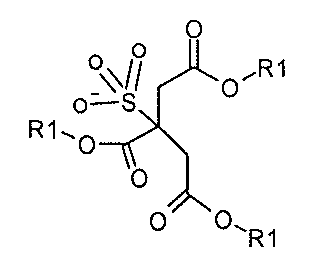
(R1 은 하기로 이루어진 군으로부터 선택됨:(R1 is selected from the group consisting of:
- 3,5,5-트리메틸헥실,- 3,5,5-trimethylhexyl,
- 2-에틸헥실,- 2-ethylhexyl,
- 3,3-디메틸-2-부틸,- 3,3-dimethyl-2-butyl,
및And
- 2,4,4-트리메틸펜틸).- 2,4,4-trimethylpentyl).
전술한 바와 같이, 일반식 (1) 의 에스테르 기를 갖는 (가장) 바람직한 음이온은 기판 및 그 위에 지지되어 있는 라인 폭 50 nm 이하의 라인-스페이스 구조를 갖는 패터닝된 재료 층을 포함하는 제품을 세척하거나 헹구는데 사용될 수 있는 상기 정의된 바와 같은 조성물을 제조하기 위해 (가장) 바람직한 것으로 상기 정의된 바와 같은 하나 이상의 암모늄 양이온과 조합될 수 있다.As described above, the (most) preferred anion having an ester group of the general formula (1) is a material which has a substrate and a product including a patterned material layer supported thereon having a line-space structure with a line width of 50 nm or less May be combined with one or more ammonium cations as defined above (most preferably) to produce a composition as defined above which may be used to rinse.
본 발명의 목적을 위해, 상기 정의된 바와 같은 조성물의 바람직한 암모늄 염(들)은 음이온이 상기 정의된 바와 같은 R1 기를 갖는 설포부탄디오산 디에스테르(들), (설포메틸)-부탄디오산 디에스테르(들), 메틸-설포부탄디오산 디에스테르(들), 설포글루타르산 디에스테르(들) 또는 설포트리카발산 트리에스테르(들)의 구조를 갖고, 양이온이 상기 정의된 바와 같은 (바람직한 또는 가장 바람직한) 4차 암모늄 양이온의 구조를 갖는 암모늄 염(들)이다. 더 상세하게는, 상기 정의된 바와 같은 조성물의 사용을 위한 바람직한 양이온과 바람직한 음이온의 조합의 추가 (비제한적인) 예가 하기에 열거된다:For the purposes of the present invention, the preferred ammonium salt (s) of the composition as defined above is selected from the group consisting of sulfobutanedioic acid diester (s) in which the anion has an R1 group as defined above, (sulfomethyl) (S) having a structure of ester (s), methyl-sulfobutanedioic acid diester (s), sulfoglutaric acid diester (s) or sulfotricarboxylic acid triester Or the most preferred) quaternary ammonium cation. More specifically, additional (non-limiting) examples of combinations of preferred cations and preferred anions for use of the composition as defined above are listed below:
- 양이온으로서 2-하이드록시에틸-트리메틸암모늄 및 음이온으로서 3,5,5-트리메틸헥실 설포부탄디오산 디에스테르를 갖는 염을 포함하는 상기 정의된 바와 같은 조성물의 본 발명에 따른 사용.- Use according to the invention of a composition as defined above comprising a salt having 2-hydroxyethyl-trimethylammonium as the cation and 3,5,5-trimethylhexyl sulfobutanedioic acid diester as the anion.
- 양이온으로서 2-하이드록시에틸-트리메틸암모늄 및 음이온으로서 2-에틸헥실 설포부탄디오산 디에스테르를 갖는 염을 포함하는 상기 정의된 바와 같은 조성물의 본 발명에 따른 사용.- Use according to the invention of a composition as defined above comprising a salt having 2-hydroxyethyl-trimethylammonium as the cation and 2-ethylhexyl sulfobutanedioic acid diester as the anion.
- 양이온으로서 2-하이드록시에틸-트리메틸암모늄 및 음이온으로서 3,3-디메틸-2-부틸 설포부탄디오산 디에스테르를 갖는 염을 포함하는 상기 정의된 바와 같은 조성물의 본 발명에 따른 사용.- Use according to the invention of a composition as defined above comprising a salt having 2-hydroxyethyl-trimethylammonium as the cation and 3,3-dimethyl-2-butylsulfobutanedioic acid diester as the anion.
- 양이온으로서 2-하이드록시에틸-트리메틸암모늄 및 음이온으로서 2,4,4-트리메틸펜틸 설포부탄디오산 디에스테르를 갖는 염을 포함하는 상기 정의된 바와 같은 조성물의 본 발명에 따른 사용.- Use according to the invention of a composition as defined above comprising a salt having 2-hydroxyethyl-trimethylammonium as the cation and 2,4,4-trimethylpentylsulfobutanedioic acid diester as the anion.
- 양이온으로서 2-하이드록시에틸-트리메틸암모늄 및 음이온으로서 3,5,5-트리메틸헥실 (설포메틸)-부탄디오산 디에스테르를 갖는 염을 포함하는 상기 정의된 바와 같은 조성물의 본 발명에 따른 사용.- Use according to the invention of a composition as defined above comprising a salt having 2-hydroxyethyl-trimethylammonium as the cation and 3,5,5-trimethylhexyl (sulfomethyl) -butanedioic acid diester as the anion .
- 양이온으로서 2-하이드록시에틸-트리메틸암모늄 및 음이온으로서 2-에틸헥실 (설포메틸)-부탄디오산 디에스테르를 갖는 염을 포함하는 상기 정의된 바와 같은 조성물의 본 발명에 따른 사용.- Use according to the invention of a composition as defined above comprising a salt having 2-hydroxyethyl-trimethylammonium as the cation and 2-ethylhexyl (sulfomethyl) -butanedioic acid diester as the anion.
- 양이온으로서 2-하이드록시에틸-트리메틸암모늄 및 음이온으로서 3,3-디메틸-2-부틸 (설포메틸)-부탄디오산 디에스테르를 갖는 염을 포함하는 상기 정의된 바와 같은 조성물의 본 발명에 따른 사용.Of the composition as defined above comprising 2-hydroxyethyl-trimethylammonium as the cation and 3,3-dimethyl-2-butyl (sulfomethyl) -butanedioic acid diester as the anion use.
- 양이온으로서 2-하이드록시에틸-트리메틸암모늄 및 음이온으로서 2,4,4-트리메틸펜틸 (설포메틸)-부탄디오산 디에스테르를 갖는 염을 포함하는 상기 정의된 바와 같은 조성물의 본 발명에 따른 사용.- Use according to the invention of a composition as defined above comprising a salt having 2-hydroxyethyl-trimethylammonium as the cation and 2,4,4-trimethylpentyl (sulfomethyl) -butanedioic acid diester as the anion .
- 양이온으로서 2-하이드록시에틸-트리메틸암모늄 및 음이온으로서 3,5,5-트리메틸헥실 메틸-설포부탄디오산 디에스테르 를 갖는 염을 포함하는 상기 정의된 바와 같은 조성물의 본 발명에 따른 사용.- Use according to the invention of a composition as defined above comprising a salt having 2-hydroxyethyl-trimethylammonium as the cation and 3,5,5-trimethylhexylmethyl-sulfobutanedioic acid diester as the anion.
- 양이온으로서 2-하이드록시에틸-트리메틸암모늄 및 음이온으로서 2-에틸헥실 메틸-설포부탄디오산 디에스테르를 갖는 염을 포함하는 상기 정의된 바와 같은 조성물의 본 발명에 따른 사용.- Use according to the invention of a composition as defined above comprising a salt having 2-hydroxyethyl-trimethylammonium as the cation and 2-ethylhexylmethyl-sulfobutanedioic acid diester as the anion.
- 양이온으로서 2-하이드록시에틸-트리메틸암모늄 및 음이온으로서 3,3-디메틸-2-부틸 메틸-설포부탄디오산 디에스테르를 갖는 염을 포함하는 상기 정의된 바와 같은 조성물의 본 발명에 따른 사용.- Use according to the invention of a composition as defined above comprising a salt having 2-hydroxyethyl-trimethylammonium as the cation and 3,3-dimethyl-2-butylmethyl-sulfobutanedioic acid diester as the anion.
- 양이온으로서 2-하이드록시에틸-트리메틸암모늄 및 음이온으로서 2,4,4-트리메틸펜틸 메틸-설포부탄디오산 디에스테르를 갖는 염을 포함하는 상기 정의된 바와 같은 조성물의 본 발명에 따른 사용.- Use according to the invention of a composition as defined above comprising a salt having 2-hydroxyethyl-trimethylammonium as the cation and 2,4,4-trimethylpentylmethyl-sulfobutanedioic acid diester as the anion.
- 양이온으로서 2-하이드록시에틸-트리메틸암모늄 및 음이온으로서 3,5,5-트리메틸헥실 설포글루타르산 디에스테르를 갖는 염을 포함하는 상기 정의된 바와 같은 조성물의 본 발명에 따른 사용.- Use according to the invention of a composition as defined above comprising a salt having 2-hydroxyethyl-trimethylammonium as the cation and 3,5,5-trimethylhexylsulfoglutaric acid diester as the anion.
- 양이온으로서 2-하이드록시에틸-트리메틸암모늄 및 음이온으로서 2-에틸헥실 설포글루타르산 디에스테르를 갖는 염을 포함하는 상기 정의된 바와 같은 조성물의 본 발명에 따른 사용.- Use according to the invention of a composition as defined above comprising a salt having 2-hydroxyethyl-trimethylammonium as the cation and 2-ethylhexylsulfoglutaric acid diester as the anion.
- 양이온으로서 2-하이드록시에틸-트리메틸암모늄 및 음이온으로서 3,3-디메틸-2-부틸 설포글루타르산 디에스테르를 갖는 염을 포함하는 상기 정의된 바와 같은 조성물의 본 발명에 따른 사용.- Use according to the invention of a composition as defined above comprising a salt having 2-hydroxyethyl-trimethylammonium as the cation and 3,3-dimethyl-2-butylsulfuroglutaric acid diester as the anion.
- 양이온으로서 2-하이드록시에틸-트리메틸암모늄 및 음이온으로서 2,4,4-트리메틸펜틸 설포글루타르산 디에스테르를 갖는 염을 포함하는 상기 정의된 바와 같은 조성물의 본 발명에 따른 사용.- Use according to the invention of a composition as defined above comprising a salt having 2-hydroxyethyl-trimethylammonium as the cation and 2,4,4-trimethylpentylsulfoglutaric acid diester as the anion.
- 양이온으로서 2-하이드록시에틸-트리메틸암모늄 및 음이온으로서 3,5,5-트리메틸헥실 설포트리카발산 트리에스테르를 갖는 염을 포함하는 상기 정의된 바와 같은 조성물의 본 발명에 따른 사용.- Use according to the invention of a composition as defined above comprising a salt having 2-hydroxyethyl-trimethylammonium as the cation and 3,5,5-trimethylhexylsulfatricaric acid triester as the anion.
- 양이온으로서 2-하이드록시에틸-트리메틸암모늄 및 음이온으로서 2-에틸헥실 설포트리카발산 트리에스테르를 갖는 염을 포함하는 상기 정의된 바와 같은 조성물의 본 발명에 따른 사용.- Use according to the invention of a composition as defined above comprising a salt having 2-hydroxyethyl-trimethylammonium as the cation and 2-ethylhexylsulfatricaric acid triester as the anion.
- 양이온으로서 2-하이드록시에틸-트리메틸암모늄 및 음이온으로서 3,3-디메틸-2-부틸 설포트리카발산 트리에스테르를 갖는 염을 포함하는 상기 정의된 바와 같은 조성물의 본 발명에 따른 사용.- Use according to the invention of a composition as defined above comprising a salt having 2-hydroxyethyl-trimethylammonium as the cation and 3,3-dimethyl-2-butylsulfatricaric acid triester as the anion.
- 양이온으로서 2-하이드록시에틸-트리메틸암모늄 및 음이온으로서 2,4,4-트리메틸펜틸 설포트리카발산 트리에스테르를 갖는 염을 포함하는 상기 정의된 바와 같은 조성물의 본 발명에 따른 사용.- Use according to the invention of a composition as defined above comprising a salt having 2-hydroxyethyl-trimethylammonium as the cation and 2,4,4-trimethylpentylsulfatricaric acid triester as the anion.
조성물이 수성 조성물인, 상기 정의된 바와 같은 (또는 바람직한 것으로 상기 정의된 바와 같은) 조성물의 본 발명에 따른 사용이 바람직하다. 많은 경우에 계면활성제와 수성 용매의 조합이 이온성, 비이온성 소수성 및 비이온성 친수성 화합물 또는 입자에 대한 높은 용해도 및 분산 효율을 제공하기 때문에, 수성 조성물이 바람직하게는 세척 또는 헹굼에 사용된다. 수성 조성물에서 물의 양은 조성물의 총량을 기준으로 바람직하게는 50 중량% 초과, 바람직하게는 80 중량% 초과, 더 바람직하게는 90 중량% 초과이다.The use according to the invention of a composition as defined above (or as defined above preferably) wherein the composition is an aqueous composition is preferred. In many cases, the aqueous composition is preferably used for washing or rinsing, because the combination of surfactant and aqueous solvent provides high solubility and dispersion efficiency for ionic, nonionic hydrophobic and nonionic hydrophilic compounds or particles. The amount of water in the aqueous composition is preferably greater than 50 wt%, preferably greater than 80 wt%, more preferably greater than 90 wt%, based on the total amount of the composition.
물은 환경 친화적인 비(非) VOC (비휘발성 유기 화합물) 용매이기 때문에 바람직한 용매이다. 많은 경우에, 유기 용매와는 달리 물은 팽윤 또는 용해에 의해 패턴 구조에 영향을 미치지 않는다. 그러나, 포토레지스트 유형에 따라, 일부 경우 물도 팽윤을 야기한다.Water is the preferred solvent because it is an environmentally friendly non-VOC (nonvolatile organic compound) solvent. In many cases, unlike organic solvents, water does not affect the pattern structure by swelling or dissolving. However, depending on the type of photoresist, water also causes swelling in some cases.
- 하나 이상의 암모늄 염(들)의 암모늄 양이온의 총량이 2x10⁻⁵ 내지 4x10⁻² mol/L 범위이고/이거나The total amount of ammonium cations of at least one ammonium salt (s) is in the range of from 2 x 10 -5 to 4 x 10 -2 mol / L and /
- 상기 정의된 바와 같은 하나 이상의 암모늄 염(들)의 음이온의 총량이 2x10⁻⁵ 내지 4x10- 2 mol/L 범위인, 상기 정의된 바와 같은 (또는 바람직한 것으로 상기 정의된 바와 같은) 조성물의 본 발명에 따른 사용이 바람직하다.- the invention of 2 mol / L in the range, the same (or desired to be as defined above) composition as defined above wherein the total amount of anions of at least one ammonium salt as defined (s) 2x10 -5 to 4x10 Is preferred.
상기 양이온 및 음이온의 정의된 농도는 전형적으로 하기 파라미터/특성의 최적 조합을 제공한다:The defined concentrations of the cations and anions typically provide the optimal combination of the following parameters / characteristics:
(i) 결함을 유발할 수 있는 웨이퍼 표면 상의 큰 계면활성제 응집체의 (감소된) 형성,(i) the (reduced) formation of large surfactant aggregates on the wafer surface that can lead to defects,
(ii) 적용 동안 (감소된) 발포체 부피,(ii) foam volume (reduced) during application,
및And
(iii) 생성되는 조성물의 향상된 세척 또는 헹굼 특성.(iii) improved cleaning or rinsing properties of the resulting composition.
많은 경우, 35 mN/m 미만, 바람직하게는 30 mN/m 미만, 더 바람직하게는 27 mN/m 미만, 가장 바람직하게는 25 mN/m 미만의 평형 표면 장력 (임계 마이셀 농도에서 측정) 을 갖는 상기 정의된 바와 같은 (또는 바람직한 것으로 상기 정의된 바와 같은) 조성물의 본 발명에 따른 사용이 바람직하다.(Measured at critical micelle concentration) of less than 35 mN / m, preferably less than 30 mN / m, more preferably less than 27 mN / m, and most preferably less than 25 mN / m The use according to the invention of a composition as defined above (or preferably as defined above) is preferred.
조성물의 평형 표면 장력이 낮을 수록 모세관력이 더 낮아 패턴 붕괴를 방지하거나 감소시킨다 (앞서 언급한 바와 같은 Namatsu et al. Appl. Phys. Let. 66(20), 1995 에 따름). 특정 평형 표면 장력을 갖는 이러한 조성물의 본 발명에 따른 사용의 추가 이점은 nm-스캐일의 라인-스페이스 구조 (패턴) 를 갖는 패터닝된 재료 층의 침투 및 세척이 매우 효율적이라는 것이다.The lower the equilibrium surface tension of the composition, the lower the capillary force to prevent or reduce pattern collapse (according to Namatsu et al., Appl. Phys. Let., 66 (20), 1995, supra). A further advantage of the use according to the invention of such a composition with a certain equilibrium surface tension is that the penetration and cleaning of the patterned material layer with a line-space structure (pattern) of nm-scales is very efficient.
비교를 위해, Rompp-Lexikon Chemie, 10th edition, 1999, volume 6, page 4434 seq., entry 'Tenside' (= surfactants), 'Tab. 5' 에 따르면, 전형적인 평형 표면 장력은 탄화수소 기반 계면활성제의 경우 25 내지 40 mN/m 범위이고, 퍼플루오르화 계면활성제는 15 내지 25 mN/m 평형 표면 장력을 제공한다. 하기 본 명세서의 표 1 에서 볼 수 있는 바와 같이, 상기 정의된 바와 같은 암모늄 염(들)을 포함하는 용액은 퍼플루오르화 계면활성제의 범위에 매우 근접하거나 심지어 그 범위인 평형 표면 장력을 갖는다. 예를 들어, 2-하이드록시에틸-트리메틸암모늄 디(3,5,5-트리메틸헥실) 설포부탄디오산 디에스테르를 포함하는 수용액은 마이셀 농도에서 24 mN/m 미만의 평형 표면 장력을 갖는다. 퍼플루오르화 계면활성제 일반적으로 높은 생물농축의 위험 및 낮은 생분해도를 가지며, 퍼플루오르화 계면활성제 (예를 들어, 퍼플루오로옥탄 설폰산 및 그 염) 의 사용은 그들의 바람직하지 않은 생태학적 프로파일로 인해 바람직하지 않다 (Environ Health Perspect. 2010 Aug; 118(8): 1100-1108 참조).For comparison, Rompp-Lexikon Chemie, 10th edition, 1999, volume 6, page 4434 seq., Entry 'Tenside' (= surfactants), 'Tab. According to 5 ', typical equilibrium surface tension is in the range of 25 to 40 mN / m for hydrocarbon-based surfactants and perfluorinated surfactant provides an equilibrium surface tension of 15 to 25 mN / m. As can be seen in Table 1 herein below, the solution comprising the ammonium salt (s) as defined above has an equilibrium surface tension that is very close to or even in the range of the perfluorinated surfactant. For example, an aqueous solution comprising 2-hydroxyethyl-trimethylammonium di (3,5,5-trimethylhexyl) sulfobutanedioic acid diester has an equilibrium surface tension of less than 24 mN / m at the micelle concentration. Perfluorinated Surfactants Generally there is a high risk of bioconcentration and a low biodegradability, and the use of perfluorinated surfactants (e.g., perfluorooctanesulfonic acid and salts thereof) (Environ Health Perspect. 2010 Aug; 118 (8): 1100-1108).
당업자는 통상적인 루틴에 따라 평형 표면 장력을 조정한다.Those skilled in the art adjust the equilibrium surface tension in accordance with conventional routines.
상기 세척 또는 헹굼이 집적 회로 소자, 광학 소자, 마이크로머신, 또는 기계 정밀 소자의 제조 방법의 일부인 상기 정의된 바와 같은 (또는 바람직한 것으로 상기 정의된 바와 같은) 조성물의 본 발명에 따른 사용이 바람직하다.The use according to the invention of a composition as defined above (or as defined above as preferred) wherein the cleaning or rinsing is part of a method of making an integrated circuit element, an optical element, a micromachine, or a machine precision element is preferred.
조성물이 기판 및 그 위에 지지되어 있는 라인 폭 50 nm 이하의 라인-스페이스 구조를 갖는 패터닝된 재료 층을 포함하는 제품을 세척하거나 헹구는데 사용되어, 패턴 붕괴가 방지되고, 라인 엣지 러프니스가 감소되고, 워터마크 결함이 방지되거나 제거되고, 포토레지스트-팽윤이 방지되거나 감소되고, 블랍 결함이 방지되거나 감소되고/되거나 입자가 제거되는 상기 정의된 바와 같은 (또는 바람직한 것으로 상기 정의된 바와 같은) 조성물의 본 발명에 따른 사용이 바람직하다. 앞서 언급한 결함 또는 영향의 존재는 IC 소자 성능, 특히 집적 회로 소자, 광학 소자, 마이크로머신, 또는 기계 정밀 소자와 같은 소자에 부정적인 영향을 미치며, 따라서 본 발명 (이들 결함 또는 영향을 회피하는 것을 도움) 은 높은 산업적 가치를 갖는다.The composition is used to clean or rinse an article comprising a substrate and a layer of patterned material having a line-space structure with a line width of 50 nm or less on which the pattern is supported to prevent pattern collapse and reduce line edge roughness (Or as defined above) as defined above in which watermark defects are prevented or eliminated, photoresist-swelling is prevented or reduced, blister defects are prevented or reduced, and / or particles are removed Use according to the invention is preferred. The presence of the aforementioned defects or influences adversely affects IC device performance, especially devices such as integrated circuit devices, optical devices, micromachines, or machine precision devices, and thus the present invention (helping to avoid these defects or effects) ) Have high industrial value.
많은 경우에, 라인 폭 50 nm 이하의 라인-스페이스 구조를 갖는 패터닝된 재료 층이 패터닝된 현상된 포토레지스트 층, 패터닝된 배리어 재료 층, 패터닝된 멀티-스택 재료 층, 및 패터닝된 유전 재료 층으로 이루어진 군으로부터 선택되는, 상기 정의된 바와 같은 (또는 바람직한 것으로 상기 정의된 바와 같은) 조성물의 본 발명에 따른 사용이 바람직하다.In many cases, a patterned material layer having a line-space structure with a line width of 50 nm or less is formed by patterning a developed photoresist layer, a patterned barrier material layer, a patterned multi-stack material layer, and a patterned dielectric material layer The use according to the invention of a composition as defined above (or as defined above as preferred), selected from the group consisting of, is preferred.
패터닝된 현상된 포토레지스트 층, 패터닝된 배리어 재료 층, 패터닝된 멀티-스택 재료 층, 및 패턴 유전 재료 층은 특히 패턴 붕괴, 낮은 라인 엣지 러프니스 및 포토레지스트-팽윤의 경향이 있다. 이러한 부정적인 영향을 회피하는 것은 소자 성능뿐 아니라 제조 아웃풋을 향상시키는데, 제조된 오작동 소자의 수가 상당히 감소되기 때문이다.The patterned developed photoresist layer, the patterned barrier material layer, the patterned multi-stack material layer, and the patterned dielectric material layer are particularly prone to pattern collapse, low line edge roughness and photoresist-swelling. Avoiding these negative effects improves the device performance as well as the manufacturing output because the number of malfunctioning devices manufactured is significantly reduced.
특히, 패터닝된 재료 층이 라인 폭 32 nm 이하, 바람직하게는 22 nm 이하의 라인-스페이스 구조를 갖는, 상기 정의된 바와 같은 (또는 바람직한 것으로 상기 정의된 바와 같은) 조성물의 본 발명에 따른 사용이 바람직하다. 라인 폭 30 nm 이하, 바람직하게는 22 nm 이하의 라인-스페이스 구조를 갖는 패터닝된 재료 층은 특히 세척 또는 헹굼 동안 패턴 붕괴의 경향이 있으며, 따라서 바람직하게는 상기 정의된 바와 같은 조성물, 바람직하게는 35 mN/m 미만, 바람직하게는 30 mN/m 미만, 더 바람직하게는 25 mN/m 미만의 평형 표면 장력 (임계 마이셀 농도에서 측정) 을 갖는 상기 정의된 바와 같은 조성물로 세척되고 헹구어진다. 특정 평형 표면 장력을 갖는 이러한 조성물의 본 발명에 따른 사용의 이점은 상기에 언급되어 있다.In particular, the use according to the invention of a composition as defined above (or as defined above) having a line-space structure with a patterned material layer having a line width of 32 nm or less, preferably 22 nm or less, desirable. A patterned material layer having a line-space structure with a line width of 30 nm or less, preferably 22 nm or less, tends to undergo pattern collapse, particularly during cleaning or rinsing, and is therefore preferably used as a composition as defined above, (Measured at critical micelle concentration) of less than 35 mN / m, preferably less than 30 mN / m, more preferably less than 25 mN / m. Advantages of the use according to the invention of such a composition with a certain equilibrium surface tension are mentioned above.
패터닝된 재료 층이 비-포토레지스트 구조의 경우 10 초과의 종횡비 및 포토레지스트 구조의 경우 2 초과의 종횡비를 갖는, 상기 정의된 바와 같은 (또는 바람직한 것으로 상기 정의된 바와 같은) 조성물의 본 발명에 따른 사용이 바람직하다. 비-포토레지스트 구조의 경우 10 초과의 종횡비를 갖고, 포토레지스트 구조의 경우 2 초과의 종횡비를 갖는 재료 층은 특히 세척 또는 헹굼 동안 패턴 붕괴의 경향이 있으며, 따라서 바람직하게는 상기 정의된 바와 같은 조성물, 바람직하게는 35 mN/m 미만, 바람직하게는 30 mN/m 미만, 더 바람직하게는 25 mN/m 미만의 평형 표면 장력 (임계 마이셀 농도에서 측정) 을 갖는 상기 정의된 바와 같은 조성물로 세척되고 헹구어진다. 이러한 조성물의 이점은 패턴 붕괴가 특히 감소되거나 회피된다는 것이다.(Or as defined hereinbefore) of a composition as defined above, wherein the patterned material layer has an aspect ratio of greater than 10 for non-photoresist structures and an aspect ratio of greater than 2 for photoresist structures. Use is preferred. A material layer having an aspect ratio greater than 10 for non-photoresist structures and an aspect ratio greater than 2 for photoresist structures tends to undergo pattern collapse, especially during cleaning or rinsing, (Measured at critical micelle concentration), preferably less than 35 mN / m, preferably less than 30 mN / m, more preferably less than 25 mN / m It is rinsed. An advantage of such a composition is that pattern collapse is particularly reduced or avoided.
패터닝된 재료 층의 종횡비는 Hitachi CG 4000 주사 전자 현미경으로 쉽게 측정할 수 있다.The aspect ratio of the patterned material layer can be easily measured with a Hitachi CG 4000 scanning electron microscope.
본 발명은 또한 기판 및 그 위에 지지되어 있는 라인 폭 50 nm 이하의 라인-스페이스 구조를 갖는 패터닝된 재료 층을 포함하는 세척되거나 헹구어진 제품을 제조하는 방법으로서, 하기 단계를 포함하는 방법에 관한 것이다:The present invention also relates to a method of manufacturing a cleaned or rinsed product comprising a substrate and a patterned material layer having a line-space structure with a line width of 50 nm or less supported thereon, comprising the steps of: :
- 기판 및 그 위에 지지되어 있는 라인 폭 50 nm 이하의 라인-스페이스 구조를 갖는 패터닝된 재료 층을 포함하는 제품을 제조 또는 제공하는 단계,- Manufacturing or providing a product comprising a substrate and a patterned material layer having a line-spacing structure supported thereon with a line width of 50 nm or less,
- 상기 정의된 바와 같은 및/또는 청구범위에 정의되 바와 같은 조성물을 제조 또는 제공하는 단계,- Producing or providing a composition as defined above and / or as defined in the claims,
및And
상기 조성물로 상기 제품을 세척하거나 헹구어 세척되거나 헹구어진 제품을 수득하는 단계.Washing or rinsing said product with said composition to obtain a cleaned or rinsed product.
일반적으로, 하나 이상의 암모늄 염(들)을 포함하는 조성물의 본 발명의 사용의 맥락에서 상기 본원에서 논의된 본 발명의 모든 양태는 본 발명의 방법에 필요한 변경을 가하여 적용된다. 마찬가지로, 하기 본원에서 논의된 제품을 세척하거나 헹구는 본 발명의 방법의 모든 양태는 하나 이상의 암모늄 염(들)을 포함하는 조성물의 본 발명에 따른 사용에 필요한 변경을 가하여 적용된다.In general, all aspects of the invention discussed herein above in the context of the use of the present invention for compositions comprising one or more ammonium salt (s) are applied applying modifications necessary to the method of the present invention. Likewise, all embodiments of the process of the present invention for washing or rinsing the products discussed herein below apply with modifications necessary for use in accordance with the present invention of a composition comprising at least one ammonium salt (s).
본 발명의 방법에서 상기 기판 및 그 위에 지지되어 있는 라인 폭 50 nm 이하의 라인-스페이스 구조를 갖는 패터닝된 재료 층을 포함하는 제품을 제공하는 단계는 바람직하게는 포토리쏘그래피 방법을 포함한다. 일반적인 포토리쏘그래피 방법에 관하여 및 이러한 포토리쏘그래피 방법의 특정 구현예에 관하여, 상기 논의된 특허 및 비특허 문헌이 참조된다. 본 발명의 방법의 특정 예는 하기에 언급되어 있다.In the method of the present invention, the step of providing an article comprising a patterned material layer having a line-spacing structure with a line width of 50 nm or less supported on the substrate and the method preferably includes a photolithography method. With regard to general photolithography methods and with respect to certain embodiments of such photolithography methods, reference is made to the above-discussed patents and non-patent literature. Specific examples of the method of the present invention are mentioned below.
하기 단계를 포함하는, 상기 기재된 바와 같은 (또는 바람직한 것으로 상기 정의된 바와 같은) 방법이 바람직하다:A method as described above (or as defined above preferably) is preferred, comprising the steps of:
- 기판에 침지 포토레지스트, EUV 포토레지스트 또는 eBeam 포토레지스트 층을 제공하는 단계,- Providing an immersion photoresist, EUV photoresist or eBeam photoresist layer on the substrate,
- 포토레지스트 층을 침지액의 존재 또는 부재 하에 마스크를 통하여 화학 방사선에 노출시키는 단계,- Exposing the photoresist layer to actinic radiation through a mask in the presence or absence of an immersion liquid,
- 노출된 포토레지스트 층을 현상 용액으로 현상하여 라인 폭 50 nm 이하의 라인-스페이스 구조를 갖는 패턴을 수득하여, 제품이 기판 및 그 위에 지지되어 있는 라인 폭 50 nm 이하의 라인-스페이스 구조를 갖는 패터닝된 재료 층을 포함하도록 하는 단계,- The exposed photoresist layer is developed with a developing solution to obtain a pattern having a line-space structure with a line width of 50 nm or less, so that the product is patterned with a line-space structure having a line width of 50 nm or less Including a layer of material,
- 상기 조성물로 상기 제품을 세척하거나 헹구어 세척되거나 헹구어진 제품을 수득하는 단계,- Washing or rinsing the product with the composition to obtain a cleaned or rinsed product,
및 임의로And optionally
바람직하게는 스핀 건조에 의해 또는 마란고니 효과(Marangoni effect)를 사용하는 건조 과정에 의해, 상기 세척되거나 헹구어진 제품을 건조시키는 단계.Drying the washed or rinsed product, preferably by spin drying or by a drying process using the Marangoni effect.
조성물은 본 발명에 따른 사용의 맥락에서 상기 본원에 정의된 바와 같고/같거나 (바람직하게는 "같고") 패터닝된 재료 층은 본 발명에 따른 방법의 맥락에서 상기 정의된 바와 같은, 상기 기재된 바와 같은 (또는 바람직한 것으로 상기 정의된 바와 같은) 제품을 세척하거나 헹구는 방법이 특히 바람직하다.The composition is preferably (preferably "same") as defined herein above in the context of use according to the present invention, and the patterned material layer is formed from a composition as described above, as defined above in the context of the process according to the invention Particularly preferred is a method of washing or rinsing the same (or preferably defined above) product.
놀랍게도, 본 발명에 따른 사용의 맥락에서 상기 본원에 정의된 바와 같은 조성물을 기판 및 그 위에 지지되어 있는 라인 폭 50 nm 이하의 라인-스페이스 구조를 갖는 패터닝된 재료 층을 포함하는 제품을 세척하거나 헹구는데 사용할 때 유리한 결과가 달성된다는 것을 발견하였다. 라인 폭 15 nm 이하, 특히 32 nm 이하, 더 특히 22 nm 이하의 라인-스페이스 구조를 갖는 패터닝된 재료 층을 제조할 때, 산업적 부정적인 효과의 요구에 따라, 예를 들어 패턴 붕괴, 낮은 라인 엣지 러프니스, 워터마크 결함, 포토레지스트 팽윤, 블랍 결함, 또는 잔류 입자가, 각각, 최첨단 IC 소자의 사양을 충족시키기 위해, 최소화되거나 제거되어야 한다.Surprisingly, it has been found that in the context of the use according to the invention, a composition as defined herein is applied to a substrate, and a cleaning or rinsing product comprising the patterned material layer having a line- Lt; RTI ID = 0.0 > a < / RTI > advantage. When fabricating a patterned material layer having a line-space structure with a line width of 15 nm or less, in particular 32 nm or less, more particularly 22 nm or less, depending on the demand for industrial negative effects, for example, pattern collapse, low line edge roughness Varnish, watermark defect, photoresist swell, blob defect, or residual particles must be minimized or eliminated, respectively, to meet the specifications of the most advanced IC device.
본 발명은 또한 바람직하게는 기판 및 그 위에 지지되어 있는 라인 폭 50 nm 이하의 라인-스페이스 구조를 갖는 패터닝된 재료 층을 포함하는 제품을 세척하거나 헹구는데 사용하기 위한, The present invention also relates to a method for cleaning or rinsing an article comprising a patterned material layer having a line-space structure with a line width of 50 nm or less,
- 물- water
및And
- 상기 정의된 바와 같은 하나 이상의 암모늄 염(들) 및 임의로- One or more ammonium salt (s) as defined above and optionally
- 하나 이상의 유기 용매 화합물을 포함하는 제형으로서,- A formulation comprising at least one organic solvent,
1000 미만, 바람직하게는 100 미만, 더 바람직하게는 50 미만의 HAZEN 색 수,A HAZEN color number of less than 1000, preferably less than 100, more preferably less than 50,
및/또는And / or
0.08 내지 10 NTU 범위, 바람직하게는 0.2 내지 5 NTU 범위, 더 바람직하게는 0.2 내지 1 NTU 범위의 탁도를 갖는 제형에 관한 것이다.To a formulation having a turbidity in the range of 0.08 to 10 NTU, preferably in the range of 0.2 to 5 NTU, more preferably in the range of 0.2 to 1 NTU.
NTU-값은 EPA 방법 180.1 에 따라서, 특히 HACH LANGE 2100 G 기기를 사용하여 측정되어야 한다.The NTU-value shall be measured in accordance with EPA method 180.1, in particular using a HACH LANGE 2100 G instrument.
HAZEN 수 (APHA 수로도 공지됨) 는 방법 DIN EN 150 6271-2 에 따라서, 특히 Lange LICO 400 기기를 사용하여 측정되어야 한다.HAZEN number (also known as APHA channel) should be measured according to the method DIN EN 150 6271-2, especially using a Lange LICO 400 instrument.
본 발명에 따른 제형은 본 발명에 따른 사용 및 본 발명의 방법에서의 사용에 바람직한 조성물이다. 본 발명에 따른 제형은 용액 또는 현탁액이다. 입자가 제형에 존재하는 경우, 그 농도는 매우 낮아 HAZEN 수 및 NTU-값이 상기 언급된 것과 같아야 한다. 하기 정의되는 바와 같은 바람직한 제형은 특히 본 발명에 따른 사용 및 본 발명의 방법에서의 사용에 바람직하다.The formulations according to the invention are preferred compositions for use according to the invention and for use in the process of the invention. A formulation according to the invention is a solution or suspension. If the particles are present in the formulation, the concentration is very low and the HAZEN number and NTU-value should be the same as mentioned above. Preferred formulations as defined below are particularly preferred for use according to the invention and for use in the methods of the invention.
많은 경우에, 본 발명에 따른 사용 및 본 발명의 방법의 맥락에서 많은 목적을 위해, 상기 상기 정의된 바와 같은 암모늄 염(들)의 총 농도가 특히 본 발명에 따른 사용의 맥락에서 2x10⁻⁶ 내지 4x10- 2 mol/L 범위인, 상기 정의된 바와 같은 (또는 바람직한 것으로 상기 정의된 바와 같은) 제형이 바람직하다. 상기 양이온 및 음이온의 언급된 농도는 전형적으로 하기 파라미터/특성의 최적 조합을 제공한다:In many cases, for many purposes in the context of the use according to the invention and in the context of the method of the invention, the total concentration of the ammonium salt (s) as defined above is in the range of from 2 x 10 -6 to 4x10 - a 2 mol / L range is, as defined above (or desired to be as defined above) are preferred formulations. The stated concentrations of cations and anions typically provide an optimal combination of the following parameters / characteristics:
(i) 결함을 유발할 수 있는 웨이퍼 표면 상의 큰 계면활성제 응집체의 (감소된) 형성,(i) the (reduced) formation of large surfactant aggregates on the wafer surface that can lead to defects,
(ii) 적용 동안 (감소된) 발포체 부피,(ii) foam volume (reduced) during application,
및And
(iii) 생성되는 조성물의 향상된 세척 또는 헹굼 특성.(iii) improved cleaning or rinsing properties of the resulting composition.
하나 이상의 화합물의 하나 이상의 암모늄 염(들)이One or more of the at least one ammonium salt (s) of the compound
(설포메틸)-부탄디오산 디에스테르(들),(Sulfomethyl) -butanedioic acid diester (s),
메틸-설포부탄디오산 디에스테르(들),Methyl-sulfobutanedioic acid diester (s),
설포글루타르산 디에스테르(들),Sulfoglutaric acid diester (s),
및And
설포트리카발산 트리에스테르(들)로 이루어진 군으로부터 선택되는 하나 이상의 화합물의 암모늄 염(들)인 상기 기재된 바와 같은 (또는 바람직한 것으로 상기 기재된 바와 같은) 본 발명에 따른 제형이 더 바람직하다.More preferred are the formulations according to the invention as described above (or as described above as preferred) which are the ammonium salt (s) of at least one compound selected from the group consisting of sulfolytic diastereomer (s).
하나 이상의 암모늄 염(들) 중 하나 또는 적어도 하나가 One or at least one of the one or more ammonium salt (s)
- 트리스(2-하이드록시에틸)암모늄, - tris (2-hydroxyethyl) ammonium,
- 비스(2-하이드록시에틸)암모늄,- bis (2-hydroxyethyl) ammonium,
- 트리스(2-하이드록시에틸)메틸암모늄, - tris (2-hydroxyethyl) methylammonium,
- 비스(2-하이드록시에틸)디메틸암모늄,Bis (2-hydroxyethyl) dimethylammonium,
- 2-하이드록시에틸-트리메틸암모늄, - 2-hydroxyethyl-trimethylammonium,
- 2-하이드록시에틸-트리에틸암모늄,- 2-hydroxyethyl-triethylammonium,
- 2-하이드록시프로필-트리메틸암모늄, - 2-hydroxypropyl-trimethylammonium,
- 비스(2-하이드록시프로필)디메틸암모늄,- bis (2-hydroxypropyl) dimethylammonium,
및And
- 트리스(2-하이드록시프로필)메틸암모늄으로 이루어진 군으로부터 선택되는 적어도 하나의 암모늄 양이온을 포함하는 상기 기재된 바와 같은 (또는 바람직한 것으로 상기 기재된 바와 같은) 본 발명에 따른 제형이 더 바람직하다.(Or as described above) comprising at least one ammonium cation selected from the group consisting of tris (2-hydroxypropyl) methylammonium and the like.
하나 이상의 암모늄 염(들) 중 하나 또는 적어도 하나가One or at least one of the one or more ammonium salt (s)
- 트리스(2-하이드록시에틸)암모늄, - tris (2-hydroxyethyl) ammonium,
- 비스(2-하이드록시에틸)암모늄,- bis (2-hydroxyethyl) ammonium,
- 트리스(2-하이드록시에틸)메틸암모늄, - tris (2-hydroxyethyl) methylammonium,
- 비스(2-하이드록시에틸)디메틸암모늄,Bis (2-hydroxyethyl) dimethylammonium,
- 2-하이드록시에틸-트리메틸암모늄, - 2-hydroxyethyl-trimethylammonium,
- 2-하이드록시에틸-트리에틸암모늄,- 2-hydroxyethyl-triethylammonium,
- 2-하이드록시프로필-트리메틸암모늄, - 2-hydroxypropyl-trimethylammonium,
- 비스(2-하이드록시프로필)디메틸암모늄,- bis (2-hydroxypropyl) dimethylammonium,
및And
- 트리스(2-하이드록시프로필)메틸암모늄으로 이루어진 군으로부터 선택되는 적어도 하나의 암모늄 양이온을 포함하고,-Tris (2-hydroxypropyl) methylammonium, and at least one ammonium cation selected from the group consisting of tris
하나 이상의 화합물의 하나 이상의 암모늄 염(들)이One or more of the at least one ammonium salt (s) of the compound
(설포메틸)-부탄디오산 디에스테르(들),(Sulfomethyl) -butanedioic acid diester (s),
메틸-설포부탄디오산 디에스테르(들),Methyl-sulfobutanedioic acid diester (s),
설포글루타르산 디에스테르(들),Sulfoglutaric acid diester (s),
및And
설포트리카발산 트리에스테르(들)로 이루어진 군으로부터 선택되는 하나 이상의 화합물의 암모늄 염(들)인, 상기 기재된 바와 같은 (또는 바람직한 것으로 상기 기재된 바와 같은) 본 발명에 따른 제형이 더 바람직하다.More preferred are the formulations according to the invention as described above (or as described above as preferred), wherein the ammonium salt (s) of at least one compound selected from the group consisting of sulfolipric diacid ester (s).
- 총 1 내지 8 개의 탄소 원자 (더 바람직하게는 3 내지 6 개의 탄소 원자) 를 갖는 알콜, - An alcohol having a total of from 1 to 8 carbon atoms (more preferably 3 to 6 carbon atoms)
- 알킬 에틸렌 글리콜, - Alkyl ethylene glycols,
- 알킬디에틸렌 글리콜, - Alkyl diethylene glycol,
- 알킬트리에틸렌 글리콜, - Alkyl triethylene glycol,
- 알킬프로필렌 글리콜, - Alkyl propylene glycol,
- 알킬 디프로필렌 글리콜 - Alkyl dipropylene glycol
및And
- 알킬 트리프로필렌 글리콜- Alkyltripropylene glycol
(알킬은 각각의 경우 1 내지 7 범위의 총 탄소 원자의 수를 가짐)(Alkyl has in each case a total number of carbon atoms in the range of 1 to 7)
로 이루어진 군으로부터 선택되는 유기 용매 화합물을 포함하는 상기 기재된 바와 같은 (또는 바람직한 것으로 상기 기재된 바와 같은) 본 발명에 따른 제형이 보다 더 바람직하다.Lt; RTI ID = 0.0 > (or < / RTI > as described above) comprising an organic solvent selected from the group consisting of.
이점은 용매가 상기 정의된 바와 같은 (즉, 본 발명에 따라서 사용되는 조성물에 존재하는 바와 같은) 암모늄 염(들)의 수 중 용해도를 향상시킨다는 것이다. 또한, 제형은 바람직하게는 상기 정의된 암모늄 염(들) 및 상기 언급된 용매 및 제형 (즉, 농축물) 의 총량을 기준으로 5 wt.-% 미만의 물을 사용하여 높은 함량의 활성 재료 (암모늄 염(들) 및, 임의로, 추가 활성 재료, 특히 계면활성제 재료) 를 포함하는 액체 농축물이다. 이러한 농축물 중의 계면활성제 함량은 30 wt.-% 초과, 더 바람직하게는 초과 40 wt.-% 초과, 가장 바람직하게는 50 wt.-% 이상 (나머지는 상기 기재된 바와 같은 용매 및 미만 5 wt.-% 물이고, 임의로 제형 (농축물) 은 합성 절차에서 사용되는 하나 이상의 염을 추가적으로 함유함). 바람직하게는, 20℃ 및 10 Hz 에서 이러한 농축물의 점도는 1000 mPas 미만, 더 바람직하게는 500 mPas 미만이다 (점도는 Anton Paar Rheolab QC 기기로 측정될 수 있음). 이러한 액체 농축물은 쉽게 운송, 취급될 수 있으며 본 발명에 따른 사용 전에 물 (전자 등급) 로 희석될 수 있다. 대조적으로, 이러한 용매의 부재 하에 물 중 계면활성제 농축물은 일부 경우, 예를 들어, 계면활성제 농도가 40 wt.-% 초과인 경우, 20℃ 에서 고점성 젤을 형성한다. 점도를 낮추고 편리한 취급을 허용하기 위해 이러한 고점성 농축물을 가열할 필요가 있다.The advantage is that the solvent improves the solubility in water of the ammonium salt (s) as defined above (i.e., as present in the composition used according to the invention). In addition, the formulations preferably contain less than 5 wt .-% of water, based on the total amount of ammonium salt (s) defined above and the above-mentioned solvents and formulations (i. E., Concentrates) Ammonium salt (s) and, optionally, further active materials, especially surfactant materials. Surfactant content in such concentrates is greater than 30 wt .-%, more preferably greater than 40 wt .-%, most preferably greater than 50 wt .-% (the remainder being the solvent as described above and less than 5 wt. -% water, and optionally the formulation (concentrate) additionally contains one or more salts used in the synthetic procedure. Preferably, the viscosity of these concentrates at 20 DEG C and 10 Hz is less than 1000 mPas, more preferably less than 500 mPas (viscosity can be measured with an Anton Paar Rheolab QC instrument). These liquid concentrates can be easily transported and handled and diluted with water (electronic grade) before use according to the present invention. In contrast, the surfactant concentrate in water in the absence of such solvent forms a high viscosity gel at 20 캜, in some cases, for example, when the surfactant concentration is greater than 40 wt .-%. There is a need to heat such high viscosity concentrates to lower viscosity and allow for convenient handling.
제형의 총 중량을 기준으로, 5 ppm 미만, 바람직하게는 1 ppm 미만, 더 바람직하게는 0.05 ppm 미만, 보다 더 바람직하게는 5 ppb 미만, 가장 바람직하게는 3 ppb 미만의 금속 양이온을 포함하는, 상기 기재된 바와 같은 (또는 바람직한 것으로 상기 기재된 바와 같은) 본 발명에 따른 제형이 특히 바람직하다. 본 발명의 이러한 바람직한 제형의 이점은 바람직하지 않은 금속 및 금속 이온 집적 회로에 혼입되지 않아, 상응하는 결함이 생기지 않는다는 것이다.Based on the total weight of the formulation, of metal cations of less than 5 ppm, preferably less than 1 ppm, more preferably less than 0.05 ppm, even more preferably less than 5 ppb, most preferably less than 3 ppb, Particularly preferred are formulations according to the invention as described above (or as described above as preferred). The advantage of this preferred formulation of the present invention is that it is not incorporated into undesirable metal and metal ion integrated circuits, so that no corresponding defect occurs.
최대 사이즈 <3 ㎛ 의 (단일) 입자만을 함유하는 (즉, 최대 사이즈 3 μm 이상의 입자가 존재하지 않음) 상기 기재된 바와 같은 (또는 바람직한 것으로 상기 기재된 바와 같은) 본 발명에 따른 제형이 또한 바람직하다. 최대 사이즈 <300 nm 의 (단일) 입자만을 함유하는 (즉, 최대 사이즈 300 nm 이상의 입자가 존재하지 않음) 상기 기재된 바와 같은 (또는 바람직한 것으로 상기 기재된 바와 같은) 본 발명에 따른 제형이 또한 더 바람직하다.Also preferred is a formulation according to the invention as described above (or as described above as preferred) containing only (single) particles of a maximum size < 3 mu m (i.e. Also preferred are formulations according to the invention as described above (or as described above as preferred) containing only (single) particles of a maximum size < 300 nm (i.e. .
최대 사이즈 <30 nm 의 (단일) 입자만을 함유하는 (즉, 최대 사이즈 30 nm 이상의 입자가 존재하지 않음) 상기 기재된 바와 같은 (또는 바람직한 것으로 상기 기재된 바와 같은) 본 발명에 따른 제형이 또한 보다 더 바람직하다. 이는 예를 들어 직경 30 nm 미만의 포어 사이즈를 갖는 필터를 통해 희석된 제형을 여과시킴으로써 달성될 수 있다 (임의로 이 과정은 수 회 반복됨).Formulations according to the invention as described above (as described above or as preferred) which also contain only (single) particles of a maximum size < 30 nm (i.e. no particles with a maximum size of 30 nm are present) Do. This can be accomplished, for example, by filtering the diluted formulation through a filter having a pore size of less than 30 nm in diameter (optionally repeating this process several times).
상기 본원에 기재된 바와 같은 본 발명에 따른 제형은 바람직하게는 알킬 베타인, 알킬 아미도 프로필 베타인, 암포 아세테이트, 아민 옥사이드 및 알킬 폴리글루코시드로 이루어진 군으로부터 선택되는 적어도 하나의 공-계면활성제를 함유하며, 알킬 기는 총 6 내지 16 개의 탄소 원자, 바람직하게는 총 8 내지 12 개의 탄소 원자를 갖는다.The formulations according to the invention as described herein above preferably comprise at least one co-surfactant selected from the group consisting of alkyl betaines, alkyl amidopropyl betaines, amphoacetates, amine oxides and alkyl polyglucosides. And the alkyl group has a total of 6 to 16 carbon atoms, preferably a total of 8 to 12 carbon atoms.
계면활성제 용액, 바람직하게는 상기 기재된 바와 같은 (또는 바람직한 것으로 상기 기재된 바와 같은) 제형은, 상기 기재된 바와 같은 (특히) 향상된 세척 및 헹굼 효과를 갖는 이점을 갖는다.The surfactant solution, preferably a formulation as described above (or as described above) has the advantage of (particularly) improved cleaning and rinsing effectiveness as described above.
상기 본원에 기재된 바와 같은 (또는 바람직한 것으로 상기 기재된 바와 같은) 본 발명에 따른 제형은 더 바람직하게는The formulations according to the invention as described herein above (or as described above as preferred)
- 코코 베타인,- Coco Betaine,
- 코코 아미도 프로필 베타인,- cocoamidopropyl betaine,
- 코코 암포 아세테이트 - coco amphoacetate
- 코코 암포 디아세테이트- cocoamphodiacetate
- 라우릴 디메틸 아민 옥사이드 - lauryldimethylamine oxide
- 미리스틸 디메틸아민 옥사이드 - myristyl dimethyl amine oxide
- 라우라민 옥사이드 - lauramin oxide
및And
- 코코아미도프로필아미노 옥사이드- cocoamidopropylamino oxide
로 이루어진 군으로부터 선택되는 적어도 하나의 공-계면활성제를 함유한다.At least one co-surfactant selected from the group consisting of
상기 언급된 바와 같은 하나 이상의 공-계면활성제를 함유하는 본 발명에 따른 제형의 이점은, 예를 들어, Advantages of formulations according to the invention containing one or more co-surfactants as mentioned above include, for example,
(i) 본 발명에 따라 사용되는 조성물의 암모늄 염(들)의 더 높은 용해도(i) the higher solubility of the ammonium salt (s) of the composition used according to the invention
및/또는 And / or
(ii) 상기 기재된 바와 같은 세척 및 헹굼 효과의 향상.(ii) improvement of the cleaning and rinsing effect as described above.
본 발명은 또한 적어도 하기 단계를 포함하는, 바람직하게는 기판 및 그 위에 지지되어 있는 라인 폭 50 nm 이하의 라인-스페이스 구조를 갖는 패터닝된 재료 층을 포함하는 제품을 세척하거나 헹구는데 사용하기 위한, 상기 기재된 바와 같은 (또는 바람직한 것으로 상기 기재된 바와 같은) 제형의 제조 방법에 관한 것이다: The present invention also relates to a process for cleaning or rinsing an article comprising a patterned material layer having a line-spacing structure with a line width of 50 nm or less, preferably supported on the substrate and thereon, To a process for the preparation of a formulation as described above (or as described above)
a) 하나 이상의 α,β-불포화 에스테르의 이중 결합에 하이드로젠 설파이트 음이온을 첨가하여,a) adding a hydrogen sulphite anion to the double bond of one or more alpha, beta -unsaturated ester,
설포부탄디오산 디에스테르 음이온,Sulfobutanedioic acid diester anion,
(설포메틸)-부탄디오산 디에스테르 음이온,(Sulfomethyl) -butanedioic acid diester anion,
메틸-설포부탄디오산 디에스테르 음이온,Methyl-sulfobutanedioic acid diester anion,
설포글루타르산 디에스테르 음이온,Sulfoglutaric acid diester anion,
및And
설포트리카발산 트리에스테르 음이온으로 이루어진 군으로부터 선택되는 하나 이상의 상응하는 디에스테르 또는 트리에스테르 음이온을 수득하는 것을 포함하는 절차에 의해, 상기 기재된 바와 같은 (또는 바람직한 것으로 상기 기재된 바와 같은) 하나 이상의 암모늄 염을 합성하는 단계,(Or as described above), as described above, by a procedure comprising obtaining at least one corresponding diester or triester anion selected from the group consisting of sulfates, , ≪ / RTI >
b) 상기 단계 a) 에서 합성된 바와 같은 하나 이상의 암모늄 염과 물 및/또는 상기 기재된 바와 같은 하나 이상의 유기 용매를 혼합하여 제형을 수득하는 단계,b) mixing the at least one ammonium salt as synthesized in step a) with water and / or one or more organic solvents as described above to obtain a formulation,
c) 단계 b) 에서 수득한 제형을 직경 <30 nm 의 포어 사이즈를 갖는 필터를 통해 임의 여과시키는 단계.c) arbitrarily filtering the formulation obtained in step b) through a filter having a pore size of < 30 nm in diameter.
일반적으로, 하나 이상의 암모늄 염(들)을 포함하는 조성물의 본 발명의 사용, 제품을 세척하거나 헹구는 본 발명에 따른 방법, 및/또는 본 발명에 따른 제형의 맥락에서 상기 논의된 본 발명의 모든 양태는 본 발명에 따른 제형의 제조 방법에 필요한 변경을 가하여 적용된다. 마찬가지로, 하기 본원에 논의된 제형의 제조 방법은 하나 이상의 암모늄 염(들)을 포함하는 조성물의 본 발명의 사용, 제품을 세척하거나 헹구는 본 발명에 따른 방법, 및/또는 본 발명에 따른 제형에 필요한 변경을 가하여 적용된다.In general, the use of the present invention of a composition comprising at least one ammonium salt (s), the process according to the invention for washing or rinsing the product, and / or all aspects of the invention discussed above in the context of the formulation according to the invention Is applied applying the necessary changes to the method of manufacturing the formulation according to the present invention. Likewise, the process for the preparation of the formulations discussed herein below is particularly suitable for the use of the present invention of a composition comprising one or more ammonium salt (s), the process according to the invention for washing or rinsing the product, and / Changes are applied.
많은 경우에, 단계 a) 에서In many cases, in step a)
- 하이드로젠 설파이트 음이온의 반대-양이온이 상기 기재된 바와 같은 (또는 바람직한 것으로 상기 기재된 바와 같은) 암모늄 양이온이 아니어서, 상기 하나 이상의 α,β-불포화 에스테르의 이중 결합에의 하이드로젠 설파이트 음이온의 상기 첨가 후 상기 기재된 바와 같은 (또는 바람직한 것으로 상기 기재된 바와 같은) 하나 이상의 암모늄 염이 되거나,- The reversed-cations of the hydrogensulfite anion are not ammonium cations as described above (or as described above), so that the hydrogensulfite anion to the double bond of the at least one?,? -Unsaturated ester After addition, one or more ammonium salts as described above (or as described above as preferred)
- 하이드로젠 설파이트 음이온의 반대-양이온이 트리스(2-하이드록시에틸)암모늄, 비스(2-하이드록시에틸)암모늄, 트리스(2-하이드록시에틸)메틸암모늄, 비스(2-하이드록시에틸)디메틸암모늄, 2-하이드록시에틸-트리메틸암모늄, 2-하이드록시에틸-트리에틸암모늄, 2-하이드록시프로필-트리메틸암모늄, 비스(2-하이드록시프로필)디메틸암모늄, 및 트리스(2-하이드록시프로필)메틸암모늄으로 이루어진 군으로부터 선택되는 암모늄 양이온이 아니며, 반대-양이온이 후속 단계에서 하나 이상의 이들 암모늄 양이온으로 교환되어, 상기 정의된 바와 같은 (또는 바람직한 것으로 상기 기재된 바와 같은) 하나 이상의 암모늄 염이 되거나,- (2-hydroxyethyl) ammonium, tris (2-hydroxyethyl) methylammonium, bis (2-hydroxyethyl) (2-hydroxypropyl) dimethylammonium, and tris (2-hydroxypropyl) ammonium, 2-hydroxyethyl-trimethylammonium, 2-hydroxyethyl-triethylammonium, Is not an ammonium cation selected from the group consisting of methylammonium and the counter-cation is exchanged with one or more of these ammonium cations in a subsequent step to form one or more ammonium salts as defined above (or as described above)
- 하이드로젠 설파이트 음이온의 반대-양이온이 암모늄 양이온이 아니며, 반대-양이온이 후속 단계에서 암모늄 양이온으로 교환되어, 상기 기재된 바와 같은 (또는 바람직한 것으로 상기 기재된 바와 같은) 하나 이상의 암모늄 염이 되는, 상기 정의된 바와 같은 방법이 바람직하다.- Wherein the counter-cation of the hydrogensulfite anion is not an ammonium cation and the counter-cation is exchanged with an ammonium cation in a subsequent step to form at least one ammonium salt as described above (or as described above) A method as described above is preferable.
상기 기재된 바와 같은 (또는 바람직한 것으로 상기 기재된 바와 같은) 제형의 제조 방법은 목표 제품이 단지 소수의 합성 단계로 합성되므로 합성에 필요한 반응기 및/또는 플랜트 설비가 감소되기 때문에 유리하다.The method of preparing a formulation as described above (or as described above) is advantageous because the target product is synthesized in only a few synthesis steps, thereby reducing reactor and / or plant equipment required for synthesis.
후속 단계에서, 반대-양이온이 바람직한 것으로 상기 기재된 바와 같은 용도에 정의된 바와 같은 암모늄 양이온으로 교환되어, 바람직한 것으로 상기 기재된 바와 같은 용도에 정의된 바와 같은 하나 이상의 암모늄 염이 되는, 단계 a) 를 포함하는, 바람직한 것으로 상기 정의된 바와 같은 제형의 제조 방법이 바람직하다.In a subsequent step, the counter-cation is exchanged with an ammonium cation as defined in the application as described above as being preferred, so that step a) is the at least one ammonium salt as defined in the application as described above as preferred A process for the production of a formulation as defined above is preferred.
생성되는 하나 이상의 상응하는 디에스테르 또는 트리에스테르 음이온이One or more corresponding diesters or triester anions formed
(설포메틸)-부탄디오산 디에스테르 음이온,(Sulfomethyl) -butanedioic acid diester anion,
메틸-설포부탄디오산 디에스테르 음이온,Methyl-sulfobutanedioic acid diester anion,
설포글루타르산 디에스테르 음이온,Sulfoglutaric acid diester anion,
및And
설포트리카발산 트리에스테르 음이온으로 이루어진 군으로부터 선택되는, 상기 기재된 바와 같은 (또는 바람직한 것으로 상기 기재된 바와 같은) 제형의 제조 방법이 바람직하다.(Or as described above) is selected from the group consisting of sulfolipric acid diastereoisomeric anhydride, sulfolytic diacid anhydride, sulfolytic diacid anhydride, sulfolytic diacid anhydride, and sulfolytic diacid anion.
c) 단계 b) 에서 수득한 제형을 직경 <30 nm 의 포어 사이즈를 갖는 필터를 통해 여과시키는 단계를 포함하고,c) filtering the formulation obtained in step b) through a filter having a pore size of < 30 nm in diameter,
추가 단계로서,As a further step,
d) 여과된 제형을 추가의 물과 혼합하여 희석된 수성 제형을 수득하는 단계를 포함하는, 상기 기재된 바와 같은 (또는 바람직한 것으로 상기 기재된 바와 같은) 제형의 제조 방법이 바람직하다.d) Mixing the filtered formulation with additional water to obtain a dilute aqueous formulation is preferred, as is a method of making a formulation as described above (or as described above).
직경 <30 nm 의 포어 사이즈를 갖는 필터를 사용하여 여과시킴으로써, 상기 기재된 바와 같은 (또는 바람직한 것으로 상기 기재된 바와 같은) 조성물로 상기 제품을 세척하거나 헹군 후에 제품 (노출되고 현상된 포토레지스트) 의 표면 상에 남아 있을 더 큰 입자가 제거된다.By filtration using a filter having a pore size of diameter < 30 nm, the surface of the article (exposed and developed photoresist) after cleaning or rinsing the article with a composition as described above (or as described above) ≪ / RTI > is removed.
특히, 첨가되는 물이 전자 등급(electronic grade) 물인 기재된 바와 같은 (또는 바람직한 것으로 상기 정의된 바와 같은) 제형의 제조 방법이 바람직하다.In particular, a process for the preparation of a formulation as described (or preferably as defined above) wherein the water to be added is an electronic grade is preferred.
상기 기재된 바와 같은 (또는 바람직한 것으로 상기 기재된 바와 같은) 제형에 전자 등급 물을 첨가하는 단계는 유리한데, 전자 등급 물이 특히 워터마크 결함, 블랍 결함을 방지하고/하거나 상기 기재된 바와 같은 (또는 바람직한 것으로 상기 기재된 바와 같은) 조성물로 상기 제품을 세척하거나 헹군 후에 제품 (노출되고 현상된 포토레지스트) 에 남아 있는 입자의 양을 감소시키기 때문이다.The step of adding an electronic grade to a formulation as described above (or as described above as preferred) is advantageous because the electronic grade is particularly useful for preventing watermark defects, bloating defects and / or preventing Since the product is washed or rinsed with a composition (as described above) to reduce the amount of particles remaining in the product (exposed and developed photoresist).
본 발명의 특정 양태는 다음과 같이 요약된다:Certain aspects of the invention are summarized as follows:
1. 기판 및 그 위에 지지되어 있는 라인 폭 50 nm 이하의 라인-스페이스 구조를 갖는 패터닝된 재료 층을 포함하는 제품을 세척하거나 헹구기 위한, One. A substrate, and a patterned material layer having a line-space structure with a line width of 50 nm or less supported thereon,
설포부탄디오산 디에스테르(들),Sulfobutanedioic acid diester (s),
(설포메틸)-부탄디오산 디에스테르(들),(Sulfomethyl) -butanedioic acid diester (s),
메틸-설포부탄디오산 디에스테르(들),Methyl-sulfobutanedioic acid diester (s),
설포글루타르산 디에스테르(들),Sulfoglutaric acid diester (s),
및And
설포트리카발산 트리에스테르(들)로 이루어진 군으로부터 선택되는 하나 이상의 화합물의 하나 이상의 암모늄 염(들)을 포함하는 조성물의 용도.(S) of at least one compound selected from the group consisting of sulfolipidic acid triester (s).
2.
양태 1 에 있어서, 하나 이상의 암모늄 염(들) 중 하나 또는 적어도 하나가 양성자화된 암모니아 (NH4 +), 1차 암모늄, 2차 암모늄, 3차 암모늄, 및 4차 암모늄로 이루어진 군으로부터 선택되는 암모늄 양이온을 포함하는 용도.2. In the
3.
양태 1 또는 양태 2 에 있어서, 하나 이상의 암모늄 염(들) 중 하나 또는 적어도 하나가 1차 암모늄, 2차 암모늄, 3차 암모늄, 또는 4차 암모늄 양이온을 포함하며, 양이온은 암모늄 질소 원자에 부착된 비치환된 알킬 및 치환된 알킬 (알킬은 각각의 경우 분지형 또는 선형 알킬임) 로 이루어진 군으로부터 선택되는 1 개 이상의 치환기를 갖는 용도.3.
The method of
4.
양태 1 내지 양태 3 중 어느 하나에 있어서, 하나 이상의 암모늄 염(들) 중 하나 또는 적어도 하나가 암모늄 질소 원자에 부착된 메틸, 에틸, 1-프로필, 2-프로필, 1-부틸, 2-부틸, 1-펜틸, 2-펜틸, 3-펜틸, 1-헥실, 2-헥실, 3-헥실, 2-메틸프로프-1-일, 2-메틸프로프-2-일, 2-메틸부트-1-일, 3-메틸부트-1-일, 2-메틸부트-2-일, 3-메틸부트-2-일, 2-메틸펜트-1-일, 2-메틸펜트-2-일, 2-메틸펜트-3-일, 3-메틸펜트-1-일, 3-메틸펜트-2-일, 3-메틸펜트-3-일, 4-메틸펜트-1-일 및 4-메틸펜트-2-일 (각각의 이들 치환기는 산소, 황, 질소, 염소, 또는 브롬 원자를 포함하는 기 하나 이상으로 비치환 또는 치환됨) 로 이루어진 군으로부터 선택되는 1 개 이상의 치환기를 갖는 4차 암모늄 양이온을 포함하는 용도.4.
The method of any one of
5. 양태 4 에 있어서, 하나 이상의 암모늄 염(들) 중 하나 또는 적어도 하나가 암모늄 질소 원자에 부착된 하이드록시-치환된 알킬 라디칼로 이루어진 군으로부터 선택되는 1 개 이상의 치환기를 갖는 4차 암모늄 양이온을 포함하며, 알킬 라디칼이 메틸, 에틸, 프로프-1-일, 프로프-2-일, 부트-1-일, 부트-2-일, 펜트-1-일, 펜트-2-일, 펜트-3-일, 헥스-1-일, 헥스-2-일, 헥스-3-일, 2-메틸프로프-1-일, 2-메틸프로프-2-일, 2-메틸부트-1-일, 3-메틸부트-1-일, 2-메틸부트-2-일, 3-메틸부트-2-일, 2-메틸펜트-1-일, 2-메틸펜트-2-일, 2-메틸펜트-3-일, 3-메틸펜트-1-일, 3-메틸펜트-2-일, 3-메틸펜트-3-일, 4-메틸펜트-1-일 및 4-메틸펜트-2-일로부터 선택되고, 바람직하게는 1 개 이상의 치환기가 하이드록시메틸, 2-하이드록시에트-1-일, 2-하이드록시프로프-1-일, 3-하이드록시프로프-1-일, 1-하이드록시프로프-2-일, 2-하이드록시부트-1-일, 3-하이드록시부트-1-일, 4-하이드록시부트-1-일, 1-(하이드록시메틸)프로프-1-일, 2-하이드록시-1-메틸프로프-1-일, 3-하이드록시-1-메틸프로프-1-일, 2-하이드록시-2-메틸프로프-1-일 및 2-하이드록시-1,1-디메틸에트-1-일로 이루어진 군으로부터 선택되고, 더 바람직하게는 1 개 이상의 치환기가 2-하이드록시에트-1-일인 용도.5. The method of embodiment 4, wherein at least one of the at least one ammonium salt (s) comprises a quaternary ammonium cation having at least one substituent selected from the group consisting of a hydroxy-substituted alkyl radical attached to an ammonium nitrogen atom , Wherein the alkyl radical is selected from the group consisting of methyl, ethyl, prop-1-yl, prop-2-yl, Yl, 2-methylbut-1-yl, 3-methylprop-1-yl, Methylbut-2-yl, 2-methylpent-2-yl, 2-methylbut-2-yl, Methylpent-1-yl, 3-methylpent-2-yl, 3-methylpent-3-yl, 4-methylpent- , Preferably one or more substituents selected from the group consisting of hydroxymethyl, 2-hydroxyet-1-yl, 2-hydroxyprop-1-yl, 3-hydroxyprop- Hydroxybut-1-yl, 1- (hydroxymethyl) prop-1-yl, 2-hydroxybut-1-yl, 1-methylprop-1-yl, 2-hydroxy-2-methylprop-1-yl and 2- Hydroxy-1,1-dimethylet-1-yl, more preferably one or more substituents is 2-hydroxyeth-1-yl.
6. 양태 2 내지 5 중 어느 하나에 있어서, 하나 이상의 암모늄 염(들) 중 하나 또는 적어도 하나가 암모늄 질소 원자에 부착된6. The method of any one of embodiments 2-5, wherein one or at least one of the at least one ammonium salt (s) is attached to an ammonium nitrogen atom
(a)
미치환된 메틸, 에틸, 프로프-1-일, 프로프-2-일, 부트-1-일, 부트-2-일, 펜트-1-일, 펜트-2-일, 펜트-3-일, 헥스-1-일, 헥스-2-일, 헥스-3-일, 2-메틸프로프-1-일, 2-메틸프로프-2-일, 2-메틸부트-1-일, 3-메틸부트-1-일, 2-메틸부트-2-일, 3-메틸부트-2-일, 2-메틸펜트-1-일, 2-메틸펜트-2-일, 2-메틸펜트-3-일, 3-메틸펜트-1-일, 3-메틸펜트-2-일, 3-메틸펜트-3-일, 4-메틸펜트-1-일 및 4-메틸펜트-2-일로 이루어진 군으로부터 선택되는 1, 2 또는 3 개의 치환기(a)
Yl, pent-1-yl, pent-2-yl, pent-3-yl, prop-1-yl, prop-2-yl, 2-methylprop-2-yl, 2-methylbut-1-yl, hex-1-yl, Methylbut-2-yl, 2-methylpent-2-yl, 2-methylpent-2-yl, Methylpent-2-yl, 3-methylpent-3-yl, 4-methylpent-1-yl and 4-methylpent-2-
및And
(b) 치환된 메틸, 에틸, 프로프-1-일, 프로프-2-일, 부트-1-일, 부트-2-일, 펜트-1-일, 펜트-2-일, 펜트-3-일, 헥스-1-일, 헥스-2-일, 헥스-3-일, 2-메틸프로프-1-일, 2-메틸프로프-2-일, 2-메틸부트-1-일, 3-메틸부트-1-일, 2-메틸부트-2-일, 3-메틸부트-2-일, 2-메틸펜트-1-일, 2-메틸펜트-2-일, 2-메틸펜트-3-일, 3-메틸펜트-1-일, 3-메틸펜트-2-일, 3-메틸펜트-3-일, 4-메틸펜트-1-일 및 4-메틸펜트-2-일로 이루어진 군으로부터 선택되는 1 개 이상의 치환기(b) Yl, pent-2-yl, pent-3-yl, pent-1-yl, Yl, 2-methylbut-1-yl, 2-methylbut-1-yl, hex-2-yl, Methylbut-2-yl, 2-methylpent-2-yl, 2-methylpent-3-yl Methylpent-1-yl, 3-methylpent-2-yl, 3-methylpent-3-yl, One or more substituents
를 갖는 4차 암모늄 양이온을 포함하며,Lt; RTI ID = 0.0 > ammonium < / RTI > cation,
암모늄 질소 원자에 부착된 각각의 이들 치환기는 산소, 황, 질소, 염소, 또는 브롬 원자를 포함하는 기 하나 이상으로 치환되고,Each of these substituents attached to the ammonium nitrogen atom is substituted with one or more groups comprising oxygen, sulfur, nitrogen, chlorine, or bromine atoms,
암모늄 질소 원자에 부착된 각각의 이들 치환기는 바람직하게는 하이드록시메틸, 2-하이드록시에트-1-일, 2-하이드록시프로프-1-일, 3-하이드록시프로프-1-일, 1-하이드록시프로프-2-일, 2-하이드록시부트-1-일, 3-하이드록시부트-1-일, 4-하이드록시부트-1-일, 1-(하이드록시메틸)프로프-1-일, 1-하이드록시-1-메틸프로프-1-일, 2-하이드록시-1-메틸프로프-1-일, 3-하이드록시-1-메틸프로프-1-일, 2-하이드록시-2-메틸프로프-1-일 및 2-하이드록시-1,1-디메틸에트-1-일로 이루어진 군으로부터, 더 바람직하게는 2-하이드록시에트-1-일로부터 선택되고,Each of these substituents attached to the ammonium nitrogen atom is preferably selected from the group consisting of hydroxymethyl, 2-hydroxyeth-1-yl, 2-hydroxyprop-1-yl, 3-hydroxyprop- Hydroxybut-1-yl, 1- (hydroxymethyl) propyl, 2-hydroxybut-1-yl, Yl, 1-hydroxy-1-methylprop-1-yl, 2-hydroxy- From 2-hydroxy-2-methylprop-1-yl and 2-hydroxy-1,1-dimethylet-1-yl, more preferably from 2-hydroxyeth- ,
암모늄 질소 원자에 부착된 치환기의 총 개수가 2, 3, 또는 4 개인 용도.Wherein the total number of substituents attached to the ammonium nitrogen atom is 2, 3 or 4;
7. 양태 3 내지 6 중 어느 하나에 있어서, 하나 이상의 암모늄 염(들) 중 하나 또는 적어도 하나가 암모늄 질소 원자에 부착된 7. The method of any one of embodiments 3-6, wherein one or at least one of the at least one ammonium salt (s) is attached to an ammonium nitrogen atom
(a) 비치환된 메틸, 에틸, 프로프-1-일, 프로프-2-일, 부트-1-일, 부트-2-일, 펜트-1-일, 펜트-2-일, 펜트-3-일, 헥스-1-일, 헥스-2-일, 헥스-3-일, 2-메틸프로프-1-일, 2-메틸프로프-2-일, 2-메틸부트-1-일, 3-메틸부트-1-일, 2-메틸부트-2-일, 3-메틸부트-2-일, 2-메틸펜트-1-일, 2-메틸펜트-2-일, 2-메틸펜트-3-일, 3-메틸펜트-1-일, 3-메틸펜트-2-일, 3-메틸펜트-3-일, 4-메틸펜트-1-일 및 4-메틸펜트-2-일로 이루어진 군으로부터 선택되는 3 개의 치환기, 바람직하게는 모두가 메틸인 3 개의 치환기,(a) Yl, pent-2-yl, pent-3-yl, pent-1-yl, 2-methylprop-2-yl, 2-methylbut-1-yl, hex-1-yl, Methylbut-2-yl, 2-methylpent-2-yl, 2-methylpent-2-yl, Methylpent-2-yl, 3-methylpent-3-yl, 4-methylpent-1-yl and 4-methylpent-2-yl 3 < / RTI > substituents, preferably all three of which are methyl,
및And
(b) 메틸, 에틸, 프로프-1-일, 프로프-2-일, 부트-1-일, 부트-2-일, 펜트-1-일, 펜트-2-일, 펜트-3-일, 헥스-1-일, 헥스-2-일, 헥스-3-일, 2-메틸프로프-1-일, 2-메틸프로프-2-일, 2-메틸부트-1-일, 3-메틸부트-1-일, 2-메틸부트-2-일, 3-메틸부트-2-일, 2-메틸펜트-1-일, 2-메틸펜트-2-일, 2-메틸펜트-3-일, 3-메틸펜트-1-일, 3-메틸펜트-2-일, 3-메틸펜트-3-일, 4-메틸펜트-1-일 및 4-메틸펜트-2-일로 이루어진 군으로부터 선택되는 1 개의 치환기(b) Yl, pent-3-yl, pent-3-yl, pent-1-yl, Methylprop-1-yl, 2-methylbut-1-yl, 3-methylbut-2-yl, Methylpent-2-yl, 2-methylpent-3-yl, 3-methylbut-2-yl, Methylpent-2-yl, 3-methylpent-3-yl, 4-methylpent-1-yl and 4-methylpent- Substituent
를 갖는 4차 암모늄 양이온을 포함하고,Lt; RTI ID = 0.0 > ammonium < / RTI > cation,
암모늄 질소 원자에 부착된 각각의 이들 치환기는 산소, 황, 질소, 염소, 또는 브롬 원자를 포함하는 기 하나 이상으로 치환되고,Each of these substituents attached to the ammonium nitrogen atom is substituted with one or more groups comprising oxygen, sulfur, nitrogen, chlorine, or bromine atoms,
암모늄 질소 원자에 부착된 각각의 이들 치환기가 바람직하게는 하이드록시메틸, 2-하이드록시에트-1-일, 2-하이드록시프로프-1-일, 3-하이드록시프로프-1-일, 1-하이드록시프로프-2-일, 2-하이드록시부트-1-일, 3-하이드록시부트-1-일, 4-하이드록시부트-1-일, 1-(하이드록시메틸)프로프-1-일, 2-하이드록시-1-메틸프로프-1-일, 3-하이드록시-1-메틸프로프-1-일, 2-하이드록시-2-메틸프로프-1-일, 2-하이드록시-1,1-디메틸에트-1-일 및 5-하이드록시-3-옥사-펜틸로 이루어진 군으로부터 선택되고, 치환기가 더 바람직하게는 2-하이드록시에트-1-일인 용도.Each of these substituents attached to the ammonium nitrogen atom is preferably selected from the group consisting of hydroxymethyl, 2-hydroxyeth-1-yl, 2-hydroxyprop-1-yl, 3-hydroxyprop- Hydroxybut-1-yl, 1- (hydroxymethyl) propyl, 2-hydroxybut-1-yl, 1-yl, 2-hydroxy-1-methylprop-1-yl, Hydroxy-1,1-dimethylet-1-yl and 5-hydroxy-3-oxa-pentyl, the substituent being more preferably 2-hydroxyeth-1-yl.
8. 양태 3 내지 7 중 어느 하나에 있어서, 하나 이상의 암모늄 염(들) 중 하나 또는 적어도 하나가8. The method according to any one of modes 3 to 7, wherein one or at least one of the at least one ammonium salt (s)
- 트리스(2-하이드록시에틸)암모늄, - tris (2-hydroxyethyl) ammonium,
- 비스(2-하이드록시에틸)암모늄,- bis (2-hydroxyethyl) ammonium,
- 트리스(2-하이드록시에틸)메틸암모늄, - tris (2-hydroxyethyl) methylammonium,
- 비스(2-하이드록시에틸)디메틸암모늄,Bis (2-hydroxyethyl) dimethylammonium,
- 2-하이드록시에틸-트리메틸암모늄, - 2-hydroxyethyl-trimethylammonium,
- 2-하이드록시에틸-트리에틸암모늄,- 2-hydroxyethyl-triethylammonium,
- 2-하이드록시프로필-트리메틸암모늄, - 2-hydroxypropyl-trimethylammonium,
- 비스(2-하이드록시프로필)디메틸암모늄,- bis (2-hydroxypropyl) dimethylammonium,
및And
- 트리스(2-하이드록시프로필)메틸암모늄으로 이루어진 군으로부터 선택되는 적어도 하나의 암모늄 양이온을 포함하는 용도.-Tris (2-hydroxypropyl) methylammonium. ≪ / RTI >
9.
양태 1 내지 8 중 어느 하나에 있어서, 하나 이상의 암모늄 염(들) 중 하나 또는 적어도 하나가 하기 일반식 (1) 의 에스테르 기 2 또는 3 개를 갖는 음이온을 포함하는 용도:9.
Use according to any one of

[식 중, 일반식 (1) 의 각 에스테르 기에서, 서로 독립적으로,[Wherein, in each ester group of the general formula (1), independently of each other,
- n 은 0, 1 또는 2 이고,- n is 0, 1 or 2,
- X 는 수소, 메틸 또는 에틸이고,- X is hydrogen, methyl or ethyl,
- R 은 하기로 이루어진 군으로부터 선택됨:- R is selected from the group consisting of:
- 비치환된 분지형 알킬, - Unsubstituted branched alkyl,
- 비치환된 선형 알킬, - Unsubstituted linear alkyl,
- 치환된 선형 알킬, - Substituted linear alkyl,
- 치환된 분지형 알킬, - Substituted branched alkyl,
- 비치환된 분지형 알케닐, - Unsubstituted branched alkenyl,
- 비치환된 선형 알케닐, - Unsubstituted linear alkenyl,
- 치환된 선형 알케닐, - Substituted linear alkenyl,
및 And
- 치환된 분지형 알케닐]. - Substituted branched alkenyl].
10. 양태 9 에 있어서, 일반식 (1) 의 각 에스테르 기에서, 서로 독립적으로,10. In Embodiment 9, in each ester group of the general formula (1), independently of each other,
- R 이 1 내지 18, 바람직하게는 5 내지 13, 더 바람직하게는 8 내지 12, 가장 바람직하게는 9 내지 10 범위의 총 탄소 원자의 수를 갖는 용도.- Wherein R has a total number of carbon atoms in the range of from 1 to 18, preferably from 5 to 13, more preferably from 8 to 12, and most preferably from 9 to 10.
11. 양태 9 또는 10 에 있어서, R 이11. In either embodiment 9 or 10, R is
- 비치환된 분지형 알킬- Unsubstituted branched alkyl
및And
- 비치환된 분지형 알케닐로 이루어진 군으로부터 선택되는 용도.- And unsubstituted branched alkenyl.
12. 양태 11 에 있어서, 일반식 (1) 의 각 에스테르 기에서, 서로 독립적으로, 12. In the embodiment 11, in each ester group of the general formula (1), independently of each other,
(a) (i) R 은 비치환된 분지형 알킬 또는 비치환된 분지형 알케닐의 주 탄소 사슬 내 총 탄소 원자의 수가 5 내지 8 개의 탄소 원자, 바람직하게는 6 내지 7 개의 탄소 원자 범위이고/이거나(a) (i) R is the number of total carbon atoms in the main carbon chain of unsubstituted branched alkyl or unsubstituted branched alkenyl ranging from 5 to 8 carbon atoms, preferably from 6 to 7 carbon atoms and / or
(ii) R 은 비치환된 분지형 알킬 또는 비치환된 분지형 알케닐의 곁 사슬 내 총 탄소 원자의 수가 1 내지 4 개의 탄소 원자, 바람직하게는 2 내지 3 개의 탄소 원자 범위이고/이거나 (ii) R is the number of total carbon atoms in the side chain of the unsubstituted branched alkyl or unsubstituted branched alkenyl is from 1 to 4 carbon atoms, preferably from 2 to 3 carbon atoms and / or
(b) n 은 0 이고, R 은 상응하는 카르복시 기로 에스테르화된 알콜의 잔기이며, 상기 알콜은 0.1 내지 8, 바람직하게는 1 내지 5, 더 바람직하게는 1 내지 3 범위의 분지화 지수를 갖는 용도.(b) n is 0, R is a residue of an alcohol esterified with a corresponding carboxy group, and the alcohol has a branching index in the range of from 0.1 to 8, preferably from 1 to 5, more preferably from 1 to 3.
13. 양태 9 내지 12 중 어느 하나에 있어서, R 이 서로 독립적으로13. The method according to any one of modes 9 to 12, wherein R is independently of each other
- 3,5,5-트리메틸헥실, - 3,5,5-trimethylhexyl,
- 2-에틸헥실, - 2-ethylhexyl,
- 3,3-디메틸부틸,- 3,3-dimethylbutyl,
- 2,4,4-트리메틸펜틸, - 2,4,4-trimethylpentyl,
- 2,2-디메틸프로필, - 2,2-dimethylpropyl,
- 2-프로필헵틸, - 2-propylheptyl,
- 이소노닐, - Isononyl,
- 이소데실, - Isodecyl,
- 이소트리데실, - Isotridecyl,
- 2,6-디메틸-4-헵틸, - 2,6-dimethyl-4-heptyl,
- 1-이소-부틸-3,5-디메틸헥실, - 1-iso-butyl-3,5-dimethylhexyl,
- 5,7,7-트리메틸-2-(1,3,3-트리메틸부틸)옥틸, - 5,7,7-trimethyl-2- (1,3,3-trimethylbutyl) octyl,
- 2-프로필펜틸, - 2-propylpentyl,
- 1-에틸-2-메틸펜틸- 1-ethyl-2-methylpentyl
및And
- 6-메틸-2-헵틸로 이루어진 군으로부터 선택되는 용도.- 6-methyl-2-heptyl. ≪ / RTI >
14. 양태 9 내지 13 중 어느 하나에 있어서, 일반식 (1) 의 각 에스테르 기의 각각의 R 이 동일한 용도.14. The use according to any one of modes 9 to 13, wherein each R of each ester group of the general formula (1) is the same.
15.
양태 1 내지 14 중 어느 하나에 있어서, 조성물이15.
The composition according to any one of
- 트리메틸-2-하이드록시에틸암모늄 양이온을 포함하는 하나 이상의 암모늄 염(들)- At least one ammonium salt (s) comprising a trimethyl-2-hydroxyethylammonium cation,
및And
- 하기 음이온 중 하나 이상을 포함하는 용도:- Use of at least one of the following anions:

또는or

(R1 은 하기로 이루어진 군으로부터 선택됨:(R1 is selected from the group consisting of:
- 3,5,5-트리메틸헥실,- 3,5,5-trimethylhexyl,
- 2-에틸헥실,- 2-ethylhexyl,
- 3,3-디메틸-2-부틸,- 3,3-dimethyl-2-butyl,
및And
- 2,4,4-트리메틸펜틸).- 2,4,4-trimethylpentyl).
16.
양태 1 내지 15 중 어느 하나에 있어서, 조성물이 수성 조성물인 용도.16.
The use according to any one of
17.
양태 1 내지 16 중 어느 하나에 있어서,17.
The method according to any one of
- 하나 이상의 암모늄 염(들)의 암모늄 양이온의 총량이 2x10⁻⁵ 내지 4x10⁻² mol/L 범위이고/이거나The total amount of ammonium cations of at least one ammonium salt (s) is in the range of from 2 x 10 -5 to 4 x 10 -2 mol / L and /
- 양태 9 내지 16 중 어느 하나에 정의된 바와 같은 하나 이상의 암모늄 염(들)의 음이온의 총량이 2x10⁻⁵ 내지 4x10⁻² mol/L 범위인 용도.- the total amount of anions of at least one ammonium salt (s) as defined in any of embodiments 9 to 16 ranges from 2 x 10 -5 to 4 x 10 -2 mol / L.
18. 양태 1 내지 17 중 어느 하나에 있어서, 조성물이 35 mN/m 미만, 바람직하게는 30 mN/m 미만, 더 바람직하게는 27 mN/m 미만, 가장 바람직하게는 25 mN/m 미만의 평형 표면 장력 (임계 마이셀 농도에서 측정) 을 갖는 용도.18. The composition of any one of embodiments 1-17, wherein the composition has an equilibrium surface tension of less than 35 mN / m, preferably less than 30 mN / m, more preferably less than 27 mN / m, most preferably less than 25 mN / (Measured at critical micelle concentration).
19. 양태 1 내지 18 중 어느 하나에 있어서, 상기 세척 또는 헹굼이 집적 회로 소자, 광학 소자, 마이크로머신, 또는 기계 정밀 소자의 제조 방법의 일부인 용도.19. The use as in any one of embodiments 1-18, wherein said cleaning or rinsing is part of a method of making an integrated circuit element, an optical element, a micromachine, or a machine precision element.
20. 양태 1 내지 19 중 어느 하나에 있어서, 하나 이상의 암모늄 염(들)을 포함하는 조성물이 세척 또는 헹굼에 사용되어,20. The composition of any one of embodiments 1-19, wherein the composition comprising at least one ammonium salt (s) is used for washing or rinsing,
패턴 붕괴가 방지되고,Pattern collapse is prevented,
라인 엣지 러프니스가 감소되고,The line edge roughness is reduced,
워터마크 결함이 방지되거나 제거되고,Watermark defects are prevented or eliminated,
포토레지스트-팽윤이 방지되거나 감소되고,Photoresist-swelling is prevented or reduced,
블랍 결함이 방지되거나 감소되고,Blunting defects are prevented or reduced,
및/또는And / or
입자가 제거되는 용도.Uses for removing particles.
21.
양태 1 내지 20 중 어느 하나에 있어서, 라인 폭 50 nm 이하의 라인-스페이스 구조를 갖는 패터닝된 재료 층이 패터닝된 현상된 포토레지스트 층, 패터닝된 배리어 재료 층, 패터닝된 멀티-스택 재료 층, 및 패터닝된 유전 재료 층으로 이루어진 군으로부터 선택되는 용도.21.
The lithographic apparatus of any one of
22. 양태 1 내지 21 중 어느 하나에 있어서, 패터닝된 재료 층이 라인 폭 32 nm 이하, 바람직하게는 22 nm 이하의 라인-스페이스 구조를 갖는 용도.22. The use according to any one of embodiments 1-21, wherein the patterned material layer has a line-space structure with a line width of 32 nm or less, preferably 22 nm or less.
23. 양태 1 내지 22 중 어느 하나에 있어서, 패터닝된 재료 층이 비-포토레지스트 구조의 경우 10 초과의 종횡비 및 포토레지스트 구조의 경우 2 초과의 종횡비를 갖는 용도.23. The use as in any one of embodiments 1-22, wherein the patterned material layer has an aspect ratio greater than 10 for non-photoresist structures and an aspect ratio greater than 2 for photoresist structures.
24. 하기 단계를 포함하는, 기판 및 그 위에 지지되어 있는 라인 폭 50 nm 이하의 라인-스페이스 구조를 갖는 패터닝된 재료 층을 포함하는 세척되거나 헹구어진 제품을 제조하는 방법:24. A method of manufacturing a washed or rinsed product comprising a substrate and a patterned material layer having a line-spacing structure supported thereon with a line width of 50 nm or less, comprising:
- 기판 및 그 위에 지지되어 있는 라인 폭 50 nm 이하의 라인-스페이스 구조를 갖는 패터닝된 재료 층을 포함하는 제품을 제조 또는 제공하는 단계,- Manufacturing or providing a product comprising a substrate and a patterned material layer having a line-spacing structure supported thereon with a line width of 50 nm or less,
-
양태 1 내지 18 중 어느 하나에 정의된 바와 같은 조성물을 제조 또는 제공하는 단계,-
Preparing or providing a composition as defined in any one of
및And
- 상기 조성물로 상기 제품을 세척하거나 헹구어 세척되거나 헹구어진 제품을 수득하는 단계.- Washing or rinsing said product with said composition to obtain a cleaned or rinsed product.
25. 양태 24 에 있어서, 하기 단계를 포함하는 방법:25. 26. The method of embodiment 24, comprising the steps of:
- 기판에 침지 포토레지스트, EUV 포토레지스트 또는 eBeam 포토레지스트 층을 제공하는 단계,- Providing an immersion photoresist, EUV photoresist or eBeam photoresist layer on the substrate,
- 포토레지스트 층을 침지액의 존재 또는 부재 하에 마스크를 통하여 화학 방사선에 노출시키는 단계,- Exposing the photoresist layer to actinic radiation through a mask in the presence or absence of an immersion liquid,
- 노출된 포토레지스트 층을 현상 용액으로 현상하여 라인 폭 50 nm 이하의 라인-스페이스 구조를 갖는 패턴을 수득하여, 제품이 기판 및 그 위에 지지되어 있는 라인 폭 50 nm 이하의 라인-스페이스 구조를 갖는 패터닝된 재료 층을 포함하도록 하는 단계,- The exposed photoresist layer is developed with a developing solution to obtain a pattern having a line-space structure with a line width of 50 nm or less, so that the product is patterned with a line-space structure having a line width of 50 nm or less Including a layer of material,
- 상기 조성물로 상기 제품을 세척하거나 헹구어 세척되거나 헹구어진 제품을 수득하는 단계,- Washing or rinsing the product with the composition to obtain a cleaned or rinsed product,
및 임의로And optionally
바람직하게는 스핀 건조에 의해 또는 마란고니 효과를 사용하는 건조 과정에 의해, 상기 세척되거나 헹구어진 제품을 건조시키는 단계.Drying the washed or rinsed product, preferably by spin drying or by a drying process using a marangoni effect.
26.
양태 24 또는 25 에 있어서, 조성물은 양태 1 내지 19 중 어느 하나에 정의된 바와 같고/같거나 패터닝된 재료 층은 양태 22 내지 24 중 어느 하나에 정의된 바와 같은 방법.26.
26. The method of any one of embodiments 24-24, wherein the composition is as defined in any one of
27.
하기를 포함하는 제형으로서:27.
- 물- water
및And
- 양태 1 내지 15 중 어느 하나에 정의된 바와 같은 하나 이상의 암모늄 염(들)- At least one ammonium salt (s) as defined in any one of aspects < RTI ID = 0.0 > 1 <
및 임의로And optionally
- 하나 이상의 유기 용매 화합물,- One or more organic solvents,
1000 미만, 바람직하게는 100 미만, 더 바람직하게는 50 미만의 HAZEN 색 수,A HAZEN color number of less than 1000, preferably less than 100, more preferably less than 50,
및/또는And / or
0.08 내지 10 NTU 범위, 바람직하게는 0.2 내지 5 NTU 범위, 더 바람직하게는 0.2 내지 1 NTU 범위의 탁도를 갖는 제형.A formulation having a turbidity in the range of 0.08 to 10 NTU, preferably in the range of 0.2 to 5 NTU, more preferably in the range of 0.2 to 1 NTU.
28.
양태 27 에 있어서, 양태 1 내지 16 중 어느 하나에 정의된 바와 같은 상기 암모늄 염(들)의 총 농도가 2x10⁻⁵ 내지 4x10⁻² mol/L 범위인 제형.28. The formulation of embodiment 27 wherein the total concentration of said ammonium salt (s) as defined in any of
29. 양태 27 또는 28 에 있어서,29. 27. The method according to mode 27 or 28,
하나 이상의 화합물의 하나 이상의 암모늄 염(들)이One or more of the at least one ammonium salt (s) of the compound
(설포메틸)-부탄디오산 디에스테르(들),(Sulfomethyl) -butanedioic acid diester (s),
메틸-설포부탄디오산 디에스테르(들),Methyl-sulfobutanedioic acid diester (s),
설포글루타르산 디에스테르(들),Sulfoglutaric acid diester (s),
및And
설포트리카발산 트리에스테르(들)로 이루어진 군으로부터 선택되는 하나 이상의 화합물의 암모늄 염(들)인 제형.(S) of at least one compound selected from the group consisting of sulfolipric acid triester (s).
30. 양태 27 내지 29 중 어느 하나에 있어서,30. 27. The method according to any one of modes 27 to 29,
하나 이상의 암모늄 염(들) 중 하나 또는 적어도 하나가One or at least one of the one or more ammonium salt (s)
- 트리스(2-하이드록시에틸)암모늄, - tris (2-hydroxyethyl) ammonium,
- 비스(2-하이드록시에틸)암모늄,- bis (2-hydroxyethyl) ammonium,
- 트리스(2-하이드록시에틸)메틸암모늄, - tris (2-hydroxyethyl) methylammonium,
- 비스(2-하이드록시에틸)디메틸암모늄,Bis (2-hydroxyethyl) dimethylammonium,
- 2-하이드록시에틸-트리메틸암모늄, - 2-hydroxyethyl-trimethylammonium,
- 2-하이드록시에틸-트리에틸암모늄,- 2-hydroxyethyl-triethylammonium,
- 2-하이드록시프로필-트리메틸암모늄, - 2-hydroxypropyl-trimethylammonium,
- 비스(2-하이드록시프로필)디메틸암모늄,- bis (2-hydroxypropyl) dimethylammonium,
및And
- 트리스(2-하이드록시프로필)메틸암모늄으로 이루어진 군으로부터 선택되는 적어도 하나의 암모늄 양이온을 포함하는 제형.-Tris (2-hydroxypropyl) methylammonium; and at least one cation selected from the group consisting of tris (2-hydroxypropyl) methylammonium.
31. 양태 27 내지 30 중 어느 하나에 있어서, 31. 27. The method according to any one of modes 27 to 30,
하나 이상의 암모늄 염(들) 중 하나 또는 적어도 하나가One or at least one of the one or more ammonium salt (s)
- 트리스(2-하이드록시에틸)암모늄, - tris (2-hydroxyethyl) ammonium,
- 비스(2-하이드록시에틸)암모늄,- bis (2-hydroxyethyl) ammonium,
- 트리스(2-하이드록시에틸)메틸암모늄, - tris (2-hydroxyethyl) methylammonium,
- 비스(2-하이드록시에틸)디메틸암모늄,Bis (2-hydroxyethyl) dimethylammonium,
- 2-하이드록시에틸-트리메틸암모늄, - 2-hydroxyethyl-trimethylammonium,
- 2-하이드록시에틸-트리에틸암모늄,- 2-hydroxyethyl-triethylammonium,
- 2-하이드록시프로필-트리메틸암모늄, - 2-hydroxypropyl-trimethylammonium,
- 비스(2-하이드록시프로필)디메틸암모늄,- bis (2-hydroxypropyl) dimethylammonium,
및And
- 트리스(2-하이드록시프로필)메틸암모늄으로 이루어진 군으로부터 선택되는 적어도 하나의 암모늄 양이온을 포함하고,-Tris (2-hydroxypropyl) methylammonium, and at least one ammonium cation selected from the group consisting of tris
하나 이상의 화합물의 하나 이상의 암모늄 염(들)이One or more of the at least one ammonium salt (s) of the compound
(설포메틸)-부탄디오산 디에스테르(들),(Sulfomethyl) -butanedioic acid diester (s),
메틸-설포부탄디오산 디에스테르(들),Methyl-sulfobutanedioic acid diester (s),
설포글루타르산 디에스테르(들),Sulfoglutaric acid diester (s),
및And
설포트리카발산 트리에스테르(들)로 이루어진 군으로부터 선택되는 하나 이상의 화합물의 암모늄 염(들)인 제형.(S) of at least one compound selected from the group consisting of sulfolipric acid triester (s).
32. 양태 27 내지 31 중 어느 하나에 있어서, 기판 및 그 위에 지지되어 있는 라인 폭 50 nm 이하의 라인-스페이스 구조를 갖는 패터닝된 재료 층을 포함하는 제품을 세척하거나 헹구는데 사용하기 위한 제형.32. 27. The formulation according to any one of embodiments 27 to 31 for use in cleaning or rinsing a substrate, and a patterned material layer supported thereon having a line-spacing structure with a line width of 50 nm or less.
33. 양태 27 내지 32 중 어느 하나에 있어서,33. The method according to any one of modes 27 to 32,
- 총 1 내지 8 개의 탄소 원자를 갖는 알콜,- Alcohols having a total of from 1 to 8 carbon atoms,
- 알킬 에틸렌 글리콜, - Alkyl ethylene glycols,
- 알킬디에틸렌 글리콜, - Alkyl diethylene glycol,
- 알킬트리에틸렌 글리콜, - Alkyl triethylene glycol,
- 알킬프로필렌 글리콜, - Alkyl propylene glycol,
- 알킬 디프로필렌 글리콜 - Alkyl dipropylene glycol
및And
- 알킬 트리프로필렌 글리콜- Alkyltripropylene glycol
(알킬은 각각의 경우 1 내지 7 범위의 총 탄소 원자의 수를 가짐)(Alkyl has in each case a total number of carbon atoms in the range of 1 to 7)
로 이루어진 군으로부터 선택되는 유기 용매 화합물을 포함하는 제형.Lt; RTI ID = 0.0 > of: < / RTI >
34. 양태 27 내지 33 중 어느 하나에 있어서, 제형의 총 중량을 기준으로, 5 ppm 미만, 바람직하게는 1 ppm 미만, 더 바람직하게는 0.05 ppm 미만, 보다 더 바람직하게는 5 ppb 미만, 가장 바람직하게는 3 ppb 미만의 금속 양이온을 포함하는 제형.34. The composition of any one of embodiments 27 to 33, wherein the amount of the active ingredient is less than 5 ppm, preferably less than 1 ppm, more preferably less than 0.05 ppm, even more preferably less than 5 ppb, Formulations comprising metal cations of less than 3 ppb.
35. 양태 27 내지 34 중 어느 하나에 있어서, 최대 사이즈 <3 ㎛, 더 바람직하게는 <300 nm, 가장 바람직하게는 <30 nm 의 입자만을 함유하는 제형.35. The formulation according to any one of aspects 27 to 34, wherein the formulation only contains particles having a maximum size of <3 μm, more preferably <300 nm, most preferably <30 nm.
36. 적어도 하기 단계를 포함하는, 양태 27 내지 35 중 어느 하나에 따른 제형의 제조 방법:36. 35. A method of making a formulation according to any one of aspects 27 to 35, comprising at least the following step:
a) 하나 이상의 α,β-불포화 에스테르의 이중 결합에 하이드로젠 설파이트 음이온을 첨가하여,a) adding a hydrogen sulphite anion to the double bond of one or more alpha, beta -unsaturated ester,
설포부탄디오산 디에스테르 음이온,Sulfobutanedioic acid diester anion,
(설포메틸)-부탄디오산 디에스테르 음이온,(Sulfomethyl) -butanedioic acid diester anion,
메틸-설포부탄디오산 디에스테르 음이온,Methyl-sulfobutanedioic acid diester anion,
설포글루타르산 디에스테르 음이온,Sulfoglutaric acid diester anion,
및And
설포트리카발산 트리에스테르 음이온으로 이루어진 군으로부터 선택되는 하나 이상의 상응하는 디에스테르 또는 트리에스테르 음이온을 수득하는 것을 포함하는 절차에 의해, 양태 1 내지 16 중 어느 하나에 정의된 바와 같은 하나 이상의 암모늄 염을 합성하는 단계,One or more ammonium salts as defined in any one of
b) 상기 단계 a) 에서 합성된 바와 같은 하나 이상의 암모늄 염과 물 및/또는 양태 33 에 정의된 바와 같은 하나 이상의 유기 용매를 혼합하여 제형을 수득하는 단계,b) mixing the at least one ammonium salt as synthesized in step a) with water and / or at least one organic solvent as defined in aspect 33 to obtain a formulation,
c) 단계 b) 에서 수득한 제형을 직경 <30 nm 의 포어 사이즈를 갖는 필터를 통해 임의 여과시키는 단계.c) arbitrarily filtering the formulation obtained in step b) through a filter having a pore size of < 30 nm in diameter.
37. 양태 36 에 있어서, 단계 a) 에서37. The method of embodiment 36 wherein in step a)
-
하이드로젠 설파이트 음이온의 반대-양이온이 양태 2 내지 8 중 어느 하나에 정의된 바와 같은 암모늄 양이온이 아니어서, 상기 하나 이상의 α,β-불포화 에스테르의 이중 결합에의 하이드로젠 설파이트 음이온의 상기 첨가 후 양태 1 내지 15 중 어느 하나에 정의된 바와 같은 하나 이상의 암모늄 염이 되거나,-
Wherein the counter-cation of the hydrogensulfite anion is not an ammonium cation as defined in any of claims 2 to 8, whereby the addition of the hydrogensulfite anion to the double bond of the at least one?,? -Unsaturated ester Is one or more ammonium salts as defined in any one of
또는or
- 하이드로젠 설파이트 음이온의 반대-양이온이 양태 2 내지 8 중 어느 하나에 정의된 바와 같은 암모늄 양이온이 아니며, 반대-양이온이 후속 단계에서 양태 2 내지 8 중 어느 하나에 정의된 바와 같은 암모늄 양이온으로 교환되어, 양태 2 내지 15 중 어느 하나에 정의된 바와 같은 하나 이상의 암모늄 염이 되거나,- Wherein the counter-cation of the hydrogensulfite anion is not an ammonium cation as defined in any of aspects 2 to 8 and the counter-cation is exchanged with an ammonium cation as defined in any of aspects 2 to 8 in a subsequent step Lt; / RTI > is at least one ammonium salt as defined in any of < RTI ID = 0.0 >
또는or
-
하이드로젠 설파이트 음이온의 반대-양이온이 암모늄 양이온이 아니며, 반대-양이온이 후속 단계에서 암모늄 양이온으로 교환되어, 양태 1 내지 15 중 어느 하나에 정의된 바와 같은 하나 이상의 암모늄 염이 되는, 제조 방법.-
Wherein the counter-cation of the hydrogensulfite anion is not an ammonium cation and the counter-cation is exchanged with an ammonium cation in a subsequent step to form at least one ammonium salt as defined in any one of
38. 양태 37 에 있어서, 후속 단계에서38. 37. The method of embodiment 37, wherein in a subsequent step
반대-양이온이 양태 2 내지 8 중 어느 하나에 정의된 바와 같은 암모늄 양이온으로 교환되어, 양태 2 내지 15 중 어느 하나에 정의된 바와 같은 하나 이상의 암모늄 염이 되는, 제조 방법.Wherein the counter-cations are exchanged with ammonium cations as defined in any of embodiments 2 to 8, resulting in at least one ammonium salt as defined in any of claims 2 to 15.
39. 양태 36 또는 38 에 있어서,39. 36. The method of embodiment 36 or 38,
c) 단계 b) 에서 수득한 제형을 직경 <30 nm 의 포어 사이즈를 갖는 필터를 통해 여과시키는 단계를 포함하고,c) filtering the formulation obtained in step b) through a filter having a pore size of < 30 nm in diameter,
추가 단계로서,As a further step,
d) 여과된 제형을 추가의 물과 혼합하여 희석된 수성 제형을 수득하는 단계를 포함하는, 제조 방법.d) mixing the filtered formulation with further water to obtain a dilute aqueous formulation.
40. 양태 36 내지 39 중 어느 하나에 있어서, 첨가되는 물이 전자 등급 물인, 제조 방법.40. The process according to any one of embodiments 36 to 39, wherein the water to be added is an electronic grade.
41. 양태 35 내지 40 중 어느 하나에 있어서, 하나 이상의 상응하는 디에스테르 또는 트리에스테르 음이온이41. The process of any of embodiments 35 to 40, wherein at least one corresponding diester or triester anion
(설포메틸)-부탄디오산 디에스테르 음이온,(Sulfomethyl) -butanedioic acid diester anion,
메틸-설포부탄디오산 디에스테르 음이온,Methyl-sulfobutanedioic acid diester anion,
설포글루타르산 디에스테르 음이온,Sulfoglutaric acid diester anion,
및And
설포트리카발산 트리에스테르 음이온으로 이루어진 군으로부터 선택되는, 제조 방법.Sulfolactic diacid anhydride, sulfolytic diacid anhydride, and sulfolytic diacid an ester.
본 발명은 하기 실시예 및 도면을 참조로하여 추가로 기재된다.The invention is further described with reference to the following examples and drawings.
도면:
도 1: 탈이온수로 헹군 후 포토레지스트 (라인 = 26 nm 및 피치 = 78 nm) 의 AFM-이미지
도 2: 암모늄 디(3,5,5-트리메틸헥실) 설포부탄디오산 디에스테르 [식 중, 모든 R 기 = 3,5,5-트리메틸헥실 및 n = 0] 를 함유하는 본 발명의 제형으로 헹군 후 포토레지스트 (라인 = 26 nm 및 피치 = 78 nm) 의 AFM-이미지
도 3: 탈이온수로 헹군 후 포토레지스트 (라인 = 40 nm 및 피치 = 120 nm) 의 AFM-이미지
도 4: 암모늄 디(3,5,5-트리메틸헥실) 설포부탄디오산 [식 중, 모든 R 기 = 3,5,5-트리메틸헥실, 및 n = 0] 를 함유하는 본 발명의 제형으로 헹군 후 포토레지스트 (라인 = 40 nm 및 피치 = 120 nm) 의 AFM-이미지
도 5: 2-하이드록시에틸-트리메틸암모늄 디(3,5,5-트리메틸헥실) 설포부탄디오산 디에스테르 [식 중, 모든 R 기 = 3,5,5-트리메틸헥실 및 n = 0] 를 함유하는 본 발명의 제형으로 헹군 후 포토레지스트 (라인 = 40 nm 및 피치 = 120 nm) 의 AFM-이미지 drawing:
1: AFM image of photoresist (line = 26 nm and pitch = 78 nm) after rinsing with deionized water
Figure 2: Formulations of the present invention containing ammonium di (3,5,5-trimethylhexyl) sulfobutanedioic acid diester wherein all R groups = 3,5,5-trimethylhexyl and n = 0 AFM images of photoresist (line = 26 nm and pitch = 78 nm) after rinsing
3: AFM-image of photoresist (line = 40 nm and pitch = 120 nm) after rinsing with deionized water
Figure 4: Rinse with formulations of the present invention containing ammonium di (3,5,5-trimethylhexyl) sulfobutanedioic acid [wherein all R groups = 3,5,5-trimethylhexyl, and n = 0] AFM-image of photoresist (line = 40 nm and pitch = 120 nm)
5: 2-hydroxyethyl-trimethylammonium di (3,5,5-trimethylhexyl) sulfobutanedioic acid diester wherein all R groups = 3,5,5-trimethylhexyl and n = 0] AFM-image of photoresist (line = 40 nm and pitch = 120 nm) after rinsing with the formulation of the invention containing
실시예Example ::
분지화 지수 (측정 방법): Branching index (measurement method):
분지화 지수는 WO 2009/124922 A1 에 개시되어 있는 방법에 따라 1H-NMR 분광법에 의해 측정된다. 제 1 단계에서, 분지화 지수를 측정하고자 하는 알콜을 트리클로르아세틸이소시아네이트 (TAI) 와 반응시켜 상응하는 카바민산 에스테르를 형성한다. 제 2 단계에서, 형성된 카바민산 에스테르의 NMR 스펙트럼이 측정한다. 1 과 0.4 ppm 사이의 메틸 기의 양성자 시그널의 면적 (F(CH3)) 은 4.7 과 4 ppm 사이의 1차 알콜에 상응하는 양성자 시그널의 면적 (F(CH2-OH)) 과 비교한다. 분지화 지수는 하기 식에 따라 계산된다:The branching index is determined by 1 H-NMR spectroscopy according to the method disclosed in WO 2009/124922 Al. In the first step, the alcohol for which the branching index is to be determined is reacted with trichloracetyl isocyanate (TAI) to form the corresponding carbamic acid ester. In the second step, the NMR spectrum of the formed carbamic acid ester is measured. The area of the proton signal (F (CH 3 )) of the methyl group between 1 and 0.4 ppm is compared to the area of the proton signal (F (CH 2 -OH)) corresponding to the primary alcohol between 4.7 and 4 ppm. The branching index is calculated according to the following equation:
분지화 지수 = ((F(CH3) / 3) / (F(CH2-OH) / 2)) - 1.A branching index = ((F (CH 3) / 3) / (F (CH 2 -OH) / 2)) - 1.
CMC (임계 마이셀 농도) (측정 방법): CMC (critical micelle concentration) (measurement method):
CMC 는 상이한 농도를 갖는 일련의 수성 계면활성제 용액의 평형 표면 장력을 측정하여 플레이트 방법에 따라 Kruess 표면 장력계 K 100 으로 측정하였다. 생성되는 그래프는 일반적으로 2 개의 별개의 영역을 갖는다. CMC 미만에서, 평형 표면 장력은 넓은 범위에서 계면활성제 농도의 로그에 대하여 선형이다. CMC 초과에서, 평형 표면 장력은 계면활성제의 농도와 다소 독립적이다. 두 영역의 데이터 포인트는 간단한 선형 회귀에 의해 통계적으로 피팅될 수 있다. CMC 는 이들 영역의 데이터에 피팅된 두 선형 회귀선 사이의 교차점이다.CMC measured the equilibrium surface tension of a series of aqueous surfactant solutions with different concentrations and measured with a Kruess surface tension meter K 100 according to the plate method. Generated graphs generally have two distinct regions. Below the CMC, the equilibrium surface tension is linear with respect to the log of the surfactant concentration over a wide range. Beyond CMC, the equilibrium surface tension is somewhat independent of the concentration of the surfactant. The data points of the two regions can be statistically fitted by simple linear regression. The CMC is the intersection between the two linear regression lines fitted to the data in these regions.
실험 데이터는 하기 표 1 을 참조.The experimental data are shown in Table 1 below.
평형 표면 장력 (DIN 53914 에 따라 측정; 실험): Equilibrium surface tension (measured according to DIN 53914; experiment):
수성 계면활성제 용액의 평형 표면 장력은 플레이트 방법에 의해 Kruess 표면 장력계 K 100 을 사용하여 DIN 53914 에 따라 25℃ 에서 측정하였다.The equilibrium surface tension of the aqueous surfactant solution was measured at 25 캜 according to DIN 53914 using the Kruess surface tension meter K 100 by the plate method.
플레이트 방법은 일반적으로 면적이 수 ㎠ 인 얇은 플레이트를 사용한다. 플레이트는 일반적으로 높은 표면 에너지를 갖는 백금으로 제조되어 완전한 습윤을 보장한다. 습윤으로 인한 플레이트 상의 힘 F 는 표면 장력계 또는 마이크로저울을 통해 측정되고, Wilhelmy 식을 사용하여 평형 표면 장력을 계산하는데 사용된다:The plate method generally uses a thin plate with a surface area of several cm < 2 >. Plates are generally made of platinum with high surface energy to ensure complete wetting. The force F on the plate due to wetting is measured through a surface tensiometer or microbalance and is used to calculate the equilibrium surface tension using the Wilhelmy equation:

식 중, l 은 Wilhelmy 플레이트의 습윤 둘레이고, θ 는 액체 상과 플레이트 사이의 접촉 각이다.Where l is the wetting perimeter of the Wilhelmy plate and [theta] is the contact angle between the liquid phase and the plate.
실험 데이터는 하기 표 1 을 참조.The experimental data are shown in Table 1 below.

표 1 에, 각각의 임계 마이셀 농도에서 측정된 (각각 청구 범위에 또는 참조로서 정의된) 특정 화합물의 평형 표면 장력이 기재되어 있다. 청구 범위에 정의된 화합물 (표 1 의 처음 4 개 항목) 의 평형 표면 장력은 23.8 내지 27.5 mN/m 범위이다. 이들 값은 화합물이 지방족 부분을 포함하는 계면활성제라는 것을 고려할 때 놀랍게도 매우 낮다.In Table 1, the equilibrium surface tension of the specific compound (defined in each claim or as reference) measured at each critical micelle concentration is described. The equilibrium surface tension of the compounds defined in the claims (first four items of Table 1) is in the range of 23.8 to 27.5 mN / m. These values are surprisingly very low considering that the compound is a surfactant comprising an aliphatic moiety.
표 1 의 마지막 2 개 항목 (순수한 물 및 iC13H27O-(CH2CH2O)3SO3NH4) 은 비교를 위한 참조 화합물이다. 순수한 물은 훨씬 더 높은 평형 표면 장력 (약 73 mN/m) 을 갖는다. 마지막 항목은 물 중 반대 이온으로서 (iC13H27O-(CH2CH2O)3SO3NH4) 양성자화된 암모니아를 갖는 알킬 에테르 설페이트를 나타낸다. 평형 표면 장력 (35 N/m) 은 본 발명에 따른 제형과 비교하여 훨씬 더 높다.The last two items in Table 1 (pure water and iC 13 H 27 O- (CH 2 CH 2 O) 3 SO 3 NH 4 ) are reference compounds for comparison. Pure water has a much higher equilibrium surface tension (about 73 mN / m). The last entry of the water as a counter-ion (iC 13 H 27 O- (CH 2 CH 2 O) 3 SO 3 NH 4) shows an alkyl ether sulfate having a protonated ammonia. The equilibrium surface tension (35 N / m) is much higher compared to the formulation according to the invention.
본 출원인은 (설포메틸)-부탄디오산 디에스테르, 메틸-설포부탄디오산 디에스테르, 설포글루타르산 디에스테르, 및 설포트리카발산 트리에스테르의 암모늄 염으로 DIN 53914 에 따라 추가 측정을 수행하였다. 이들 추가 측정의 결과는 설포부탄디오산 디에스테르의 암모늄 염을 사용한 상기 표 1 에 기재한 것들과 매우 유사하였다.Applicants have conducted further measurements according to DIN 53914 with (sulfomethyl) -butanedioic acid diester, methyl-sulfobutanedioic acid diester, sulfoglutaric acid diester, and ammonium salts of sulfotricarboxylic acid triester . The results of these additional measurements were very similar to those described in Table 1 above using the ammonium salt of sulfobutanedioic acid diester.
발포체 비팅 부피(foam beating volume) (DIN 53902 에 따른 측정 방법; 실험): Foam Foam beating volume ( measuring method according to DIN 53902; experiment):
200 ml 의 0.5 g/l 계면활성제 용액 ((i) 실험에서 사용한 해당 계면활성제 및 (ii) 개별적으로 선택된 농도 변화에 대해서는 표 2 참조) 을 23℃ 에서 눈금이 있는 1000 ml 측정 실린더에 위치시켰다. 발포체는 1000 ml 표시선에서 실린더의 바닥까지 1 Hz 의 주파수로 30 회 천공 디스크를 수동으로 밀어넣음으로써 생성된다. 천공 디스크는 직경이 48 mm 이다. 디스크에 균일하게 분포된 60 개의 홀은 직경이 1 mm 이다. 수용액 위의 발포체 부피는 시간의 함수로 검출된다. 표 2 에 200 초 후 수용액 위의 발포체 부피가 기재되어 있다.200 ml of a 0.5 g / l surfactant solution ((i) the corresponding surfactant used in the experiment and (ii) the individual selected concentration changes, see Table 2) were placed in a 1000 ml measuring cylinder with graduations at 23 ° C. Foam is produced by manually pushing the threshing disc 30 times at a frequency of 1 Hz from the 1000 ml marking line to the bottom of the cylinder. The perforated disc is 48 mm in diameter. The 60 holes uniformly distributed on the disk have a diameter of 1 mm. The volume of foam on the aqueous solution is detected as a function of time. Table 2 lists the foam volume on the aqueous solution after 200 seconds.
실험 데이터는 하기 표 2 참조:The experimental data are shown in Table 2 below:

* 계면활성제 화합물은 표 2 의 첫 번째 항목에 따라 사용된 화합물과 동일; 두 번째 항목에 0.2 g/l 계면활성제 농도에서 200 초 후 발포체 부피가 기재되어 있다.The surfactant compound is the same as the compound used according to the first item of Table 2; The second item describes the foam volume after 200 seconds at a concentration of 0.2 g / l surfactant.
** D. Balzer et al, Surfactant Science Series Vol. 91, New York 2000, 페이지 263, 표 31 로부터의, 40℃ 및 계면활성제 농도 1 g/l 에서의 초기 발포체.** D. Balzer et al, Surfactant Science Series Vol. 91, New York 2000, page 263, Table 31, initial foams at 40 占 폚 and surfactant concentration of 1 g / l.
표 2 에, 상기 기재된 바와 같은 상이한 계면활성제 및 선행 기술에 공지되어 있는 바와 같은 계면활성제의 발포체 형성에 관한 데이터를 나타냈다. 비스(2-에틸헥실)설포석시네이트의 암모늄 염을 포함하는 용액 (항목 5, 본 발명에 따른 제형, 즉 상기 기재된 바와 같은 암모늄 염(들)을 포함하는 조성물) 은 가장 적은 발포체 형성을 나타냈다. 유사한 결과가 다른 본 발명에 따른 제형 (즉, 상기 기재된 바와 같은 암모늄 염(들)을 포함하는 조성물; 항목 1 내지 4) 에서 수득되었다. 본 발명에 따른 제형의 발포체 부피 값은 선행 기술에 공지되어 있는 계면활성제 (시판 계면활성제 Marlon PS) 의 매우 높은 값에 비해 훨신 더 낮았다.In Table 2, data relating to the formation of different surfactants as described above and the formation of foams of surfactants as known in the prior art are shown. A solution containing an ammonium salt of bis (2-ethylhexyl) sulfosuccinate (item 5, formulation according to the invention, i.e. a composition comprising the ammonium salt (s) as described above) showed the least foam formation . Similar results were obtained with other formulations according to the invention (i. E., Compositions comprising the ammonium salt (s) as described above; The foam volume value of the formulation according to the invention was much lower than the very high value of the surfactant (commercial surfactant Marlon PS) known in the prior art.
그 결과, 본 발명에 따른 제형 (즉, 상기 정의된 바와 같은 암모늄 염(들)을 포함하는 조성물) 은 선행 기술에 공지되어 있는 계면활성제 제형에 비해 더 낮은 발포체 부피를 갖는다.As a result, formulations according to the invention (i.e. compositions comprising the ammonium salt (s) as defined above) have lower foam volumes than surfactant formulations known in the prior art.
뿐만 아니라, 표 2 의 결과에 따라서, 계면활성제 용액은 어느 정도 발포체 형성을 일으키지만, 항목 1 과 항목 2 의 비교는 해당 계면활성제의 농도가 감소하면 발포체 형성이 감소한다는 것을 보여준다.In addition, according to the results in Table 2, the surfactant solution causes foam formation to some extent, but a comparison between
본 출원인은 (설포메틸)-부탄디오산 디에스테르, 메틸-설포부탄디오산 디에스테르, 설포글루타르산 디에스테르, 및 설포트리카발산 트리에스테르의 암모늄 염을 사용하여 DIN 53902 에 따라서 추가 측정을 수행하였다. 이들 추가 측정의 결과는 설포부탄디오산 디에스테르의 암모늄 염을 사용한 상기 표 2 에 기재한 것들과 매우 유사하였다.Applicants have conducted further measurements according to DIN 53902 using (sulfomethyl) -butanedioic acid diester, methyl-sulfobutanedioic acid diester, sulfoglutaric acid diester, and ammonium salts of sulfotricarboxylic acid triester Respectively. The results of these additional measurements were very similar to those described in Table 2 above using the ammonium salt of sulfobutanedioic acid diester.
동적 표면 장력 (ASTM D 3825-90 에 따른 측정; 실험) Dynamic surface tension (measurement according to ASTM D 3825-90; experiment)
동적 표면 장력은 Lauda MPT 2 기기를 사용하여 최대 버블 압력 방법으로 측정하였다. 공기는 모세관을 통해 계면활성제 용액으로 펌핑된다. 기기는 버블 반지름이 모세관 반지름과 같을 때 도달되는 모세관으로부터 분리되는 공기 버블 내 최대 압력을 측정한다. 동적 표면 장력은 라플라스(LaPlace) 식으로 계산된다. Dynamic surface tension was measured using a maximum bubble pressure method using a Lauda MPT 2 instrument. Air is pumped through the capillary into the surfactant solution. The instrument measures the maximum pressure in the air bubble that separates from the capillary that is reached when the bubble radius is equal to the capillary radius. The dynamic surface tension is calculated as LaPlace.
p = 2σ/rp = 2? / r
식 중, Wherein,
p 는 버블 내 최대 압력이고,p is the maximum pressure in the bubble,
r 은 모세관의 반지름이고,r is the radius of the capillary,
및 And
σ 는 공기 버블과 계면활성제 용액 사이의 동적 표면 장력이다.is the dynamic surface tension between the air bubble and the surfactant solution.
버블 빈도(bubble frequency)는 공기 흐름을 바꿈으로써 변화된다. 버블 빈도가 높을수록, 버블 주위의 동적 표면 장력을 낮추기 위해서 계면활성제가 버블 표면으로 이동해야하는 시간이 짧다. 버블 빈도의 변화로부터 밀리초에서 초 범위의 버블 표면 연령(age)에 대한 시간 축이 생성된다. 동적 표면 장력이 일정한 계면활성제 농도 (0.5 g/l) 및 일정한 주위 온도에서 시간의 함수로서 그래프 표시된다. 표 3 에, 1 초 후의 해당 동적 표면 장력이 언급되어 있다.The bubble frequency is changed by changing the air flow. The higher the bubble frequency, the shorter the time that the surfactant must travel to the bubble surface in order to lower the dynamic surface tension around the bubble. A change in bubble frequency produces a time axis for the age of the bubble surface in the millisecond to the second range. The dynamic surface tension is plotted as a function of time at a constant surfactant concentration (0.5 g / l) and constant ambient temperature. In Table 3, the corresponding dynamic surface tension after one second is mentioned.
실험 데이터는 하기 표 3 참조:The experimental data are shown in Table 3 below:
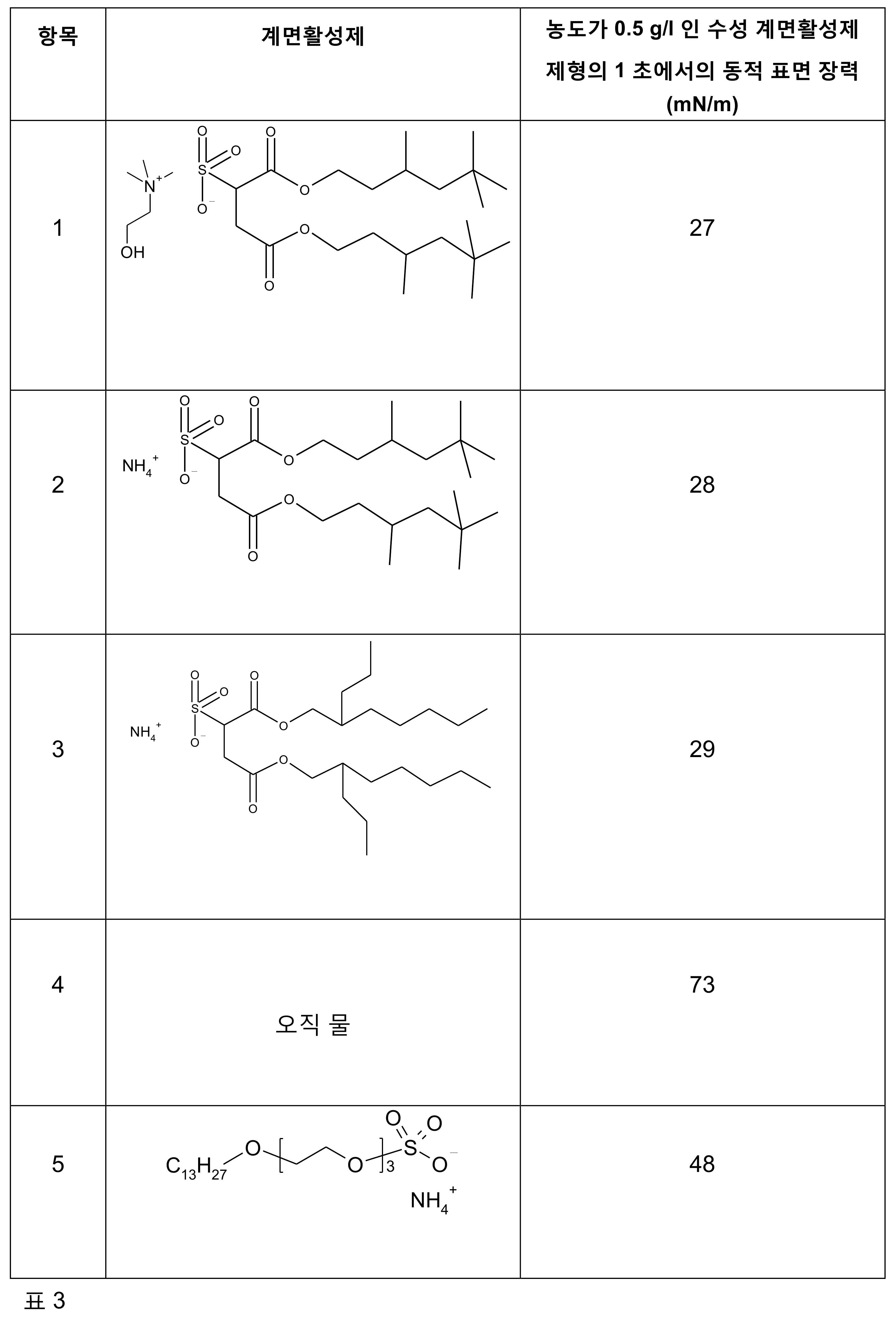
표 3 의 결과는 상이한 본 발명에 따른 제형 (즉, 상기 정의된 바와 같은 암모늄 염(들)을 포함하는 조성물) 의 동적 표면 장력을 나타낸다. 1 초 후 상이한 본 발명에 따른 제형 (즉, 상기 기재된 바와 같은 암모늄 염(들)을 포함하는 조성물) 의 동적 표면 장력은 30 mN/m 미만 (시간이 증가함에 따라 보다 더 감소함) 이다. 표 3 의 마지막 두 항목은 비교를 위해 제공된다. 순수한 물은 본 발명에 따른 제형 (즉, 상기 기재된 바와 같은 암모늄 염(들)을 포함하는 조성물) 보다 훨씬 높은 동적 표면 장력 (약 73 mN/m) 을 갖는다. 표 3 의 마지막 항목은 물에 용해되어 있는 반대-이온으로서 양성자화된 암모니아를 포함하는 알킬 에테르 설페이트를 나타낸다. 1 초 후의 동적 표면 장력 (48 mN/m) 은 본 발명에 따른 제형 (즉, 상기 정의된 바와 같은 암모늄 염(들)을 포함하는 조성물) 에 비해 훨씬 더 높다. 기재된 (기판 및 그 위에 지지되어 있는 라인 폭 50 nm 이하의 라인-스페이스 구조를 갖는 패터닝된 재료 층을 포함하는 제품을 세척하거나 헹구기 위한) 사용에 관하여, 사이클 시간이 짧게 유지될 수 있기 때문에 본 발명에 따른 제형 (즉, 상기 기재된 바와 같은 암모늄 염(들)을 포함하는 조성물) 이 유리하다.The results in Table 3 indicate the dynamic surface tension of the formulations according to the invention (i. E., Compositions comprising ammonium salt (s) as defined above). The dynamic surface tension of the formulation according to the invention (i. E. The composition comprising the ammonium salt (s) as described above) after 1 second is less than 30 mN / m (more as time increases). The last two items of Table 3 are provided for comparison. Pure water has a much higher dynamic surface tension (about 73 mN / m) than the formulation according to the invention (i.e., the composition comprising the ammonium salt (s) as described above). The last item in Table 3 represents alkyl ether sulfates containing ammonia protonated as counter-ions dissolved in water. The dynamic surface tension (48 mN / m) after one second is much higher than the formulation according to the invention (i.e. a composition comprising the ammonium salt (s) as defined above). With regard to the use described (for cleaning or rinsing a substrate comprising a patterned material layer having a line-space structure with a line width of 50 nm or less supported thereon), since the cycle time can be kept short, (I. E., Compositions comprising the ammonium salt (s) as described above) are advantageous.
본 출원인은 (설포메틸)-부탄디오산 디에스테르, 메틸-설포부탄디오산 디에스테르, 설포글루타르산 디에스테르, 및 설포트리카발산 트리에스테르의 암모늄 염을 사용하여 ASTM D 3825-90 에 따라 추가 측정을 수행하였다. 이들 추가 측정의 결과는 설포부탄디오산 디에스테르의 암모늄 염을 사용한 상기 표 3 에 기재한 것들과 매우 유사하였다.The Applicant has determined that the ammonium salt of (sulfomethyl) -butanedioic acid diester, methyl-sulfobutanedioic acid diester, sulfoglutaric acid diester, and sulphotricaric acid triester is used according to ASTM D 3825-90 Additional measurements were performed. The results of these additional measurements were very similar to those described in Table 3 above using the ammonium salt of sulfobutanedioic acid diester.
수용액의 NTU-값 (측정 방법):NTU-value of the aqueous solution (measurement method):
NTU-값 은 예를 들어 HACH Lange 2100 G 기기를 사용하여 EPA 방법 180.1 에 따라 측정하였다.NTU-values were measured according to EPA method 180.1 using, for example, a HACH Lange 2100 G instrument.
예를 들어, 1 g/l 1-메톡시-2-프로판올의 존재 하에 DIW (전자 등급 물, 탈이온수를 의미) 중 1 g/l 2-하이드록시에틸-트리메틸암모늄 디(3,5,5-트리메틸헥실) 설포부탄디오산 디에스테르 (합성 파트 4b 의 계면활성제) 용액에 대하여, 0.3 의 NTU-값이 측정되었다.For example, in the presence of 1 g / l 1-methoxy-2-propanol, 1 g / l of 2-hydroxyethyl-trimethylammonium di (3,5,5 -Trimethylhexyl) sulfobutanedioic acid diester (surfactant of Synthetic Part 4b), a NTU-value of 0.3 was measured.
물 (DIW) 의 경우, 0.08 의 NTU-값이 측정되었다.For water (DIW), an NTU-value of 0.08 was measured.
포토레지스트 팽윤 및 패턴 붕괴 (측정 방법; 실험):Photoresist swelling and pattern collapse (measurement method; experiment):
패턴 붕괴 및 포토레지스트 팽윤은 AFM (원자력 현미경) 검사를 사용하여 측정되었다. 실리콘 웨이퍼에 침지 포토레지스트의 100 nm 두께의 층을 제공하였다. 제공된 포토레지스트 층을 침지액으로서 초순수를 사용하여 마스크를 통하여 파장 193 의 UV 방사선에 노출시켰다. 마스크로 인해, 하기 라인-스페이스 구조를 갖는 패턴이 생성되었다:Pattern collapse and photoresist swelling were measured using AFM (atomic force microscopy) inspection. A silicon wafer was provided with a 100 nm thick layer of immersion photoresist. The provided photoresist layer was exposed to UV radiation at a wavelength of 193 through a mask using ultrapure water as an immersion liquid. Due to the mask, a pattern with the following line-space structure was created:
(A) 라인 폭 26 nm 이고, 스페이스 폭 52 nm (포토레지스트 층 "L26 P78") 및 종횡비 약 4, (A) A line width of 26 nm, a space width of 52 nm (photoresist layer "L26 P78") and an aspect ratio of about 4,
및 And
(B) 라인 폭 40nm 및 스페이스 폭 80 nm (포토레지스트 층 "L40 P120") 및 종횡비 약 2.5.(B) A line width of 40 nm and a space width of 80 nm (photoresist layer "L40 P120") and an aspect ratio of about 2.5.
포토레지스트 라인들 사이의 스페이스는 (A) 52 nm [L(라인) 26 nm P(피치)78 nm] 및 (B) 80 nm [L(라인) 40 nm P(피치)120 nm] 였다.The space between the photoresist lines was (A) 52 nm [L (line) 26 nm P (pitch) 78 nm] and (B) 80 nm [L (line) 40 nm P (pitch) 120 nm].
그 후, 노출된 포토레지스트 층 (A) 및 (B) 는 베이킹되고, TMAH (테트라메틸암모늄 하이드록사이드) 를 함유하는 수성 현상 용액으로 현상된다. 베이킹되고 현상된 포토레지스트 층은 개별적으로 하기를 상이한 비율로 포함하는 3 가지 화학적 헹굼 용액 중 하나를 사용하는 화학적 헹굼 처리에 적용되었다:The exposed photoresist layers (A) and (B) are then baked and developed with an aqueous developing solution containing TMAH (tetramethylammonium hydroxide). The baked and developed photoresist layers were individually applied to a chemical rinse treatment using one of three chemical rinse solutions containing different ratios of:
(a) DIW (탈이온수),(a) DIW (deionized water),
(b) DIW 중 0.05wt.-% 암모늄 디(3,5,5-트리메틸헥실) 설포부탄디오산 디에스테르 (본 발명에 따른 제형 또는 상기 기재된 바와 같은 암모늄 염(들)을 포함하는 조성물),(b) 0.05 wt .-% ammonium di (3,5,5-trimethylhexyl) sulfobutanedioic acid diester in DIW (a composition comprising the formulation according to the invention or the ammonium salt (s) as described above)
(c) DIW 중 0.05wt.-% 2-하이드록시에틸-트리메틸암모늄 디(3,5,5-트리메틸헥실) 설포부탄디오산 디에스테르 (본 발명에 따른 제형 또는 상기 기재된 바와 같은 암모늄 염(들)을 포함하는 조성물). 각각의 계면활성제 용액은 계면활성제의 양과 비교하여 유사한 양 (중량 기준) 의 1-메톡시-2-프로판올 (유기 (공-)용매로서 사용됨) 을 함유하였다.(c) 0.05 wt .-% 2-hydroxyethyl-trimethylammonium di (3,5,5-trimethylhexyl) sulfobutanedioic acid diester in DIW (formulations according to the invention or ammonium salt Lt; / RTI > Each surfactant solution contained a similar amount (by weight) of 1-methoxy-2-propanol (used as the organic (co-solvent)) as compared to the amount of surfactant.
각각의 화학적 헹굼 용액은 퍼들(puddle)로 적용되었다. 그 후, 실리콘 웨이퍼를 스핀 건조시켰다.Each chemical rinse solution was applied as a puddle. Thereafter, the silicon wafer was spin-dried.
실험 데이터:Experimental data:
패턴 붕괴:Pattern Collapse:
하기 표 4 에 기재되어 있는 실험 데이터로부터 포토레지스트 층 (B) ("L40 P120") 은 화학적 헹굼 용액 (b) 및 (c) 로 처리되었을 때 임의의 패턴 붕괴를 나타내지 않았다고 결론지을 수 있다: 헹굼 전에 존재했던 모든 9 개의 라인은 헹굼 후에도 여전히 보인다; 또한 도 4 및 5 참조. 비교하여, DIW 용액으로 헹군 포토레지스트 층 (B) 에서는, 이론적인 총 9 개의 라인 중 오직 7 개만 보인다.It can be concluded from the experimental data described in the following Table 4 that photoresist layer (B) ("L40 P120") did not exhibit any pattern collapse when treated with chemical rinse solutions (b) and (c) All nine lines that previously existed are still visible after rinsing; See also Figures 4 and 5. By comparison, in the photoresist layer (B) rinsed with the DIW solution, only 7 out of a total of 9 theoretical lines are visible.
포토레지스트 (A) ("L26 P78") 는 화학 헹굼 용액 (b) 로 처리되었을 때 감소된 수의 붕괴된 패턴을 나타냈다: 이론적인 총 7 개의 라인 중 5 개만 보이는 데 반해 (또한 도 2 참조) DIW 용액으로 헹군 포토레지스트는 총 7 개의 라인 중 오직 3 개만 보인다 (또한 도 1 참조).Photoresist (A) ("L26 P78") exhibited a reduced number of collapsed patterns when treated with chemical rinse solution (b): only 5 of the theoretical total 7 lines were visible (see also FIG. 2) Only three of the total 7 lines of photoresist rinsed with DIW solution are visible (see also Fig. 1).
실험 데이터는 하기 표 4 참조:The experimental data are shown in Table 4 below.

따라서, 본 발명의 제형 및/또는 본 발명에 따라 사용되는 조성물은 패턴 붕괴를 상당히 감소시키거나 심지어 패턴 붕괴를 방지하였다.Thus, the formulations of the present invention and / or compositions used in accordance with the present invention significantly reduce pattern collapse or even prevent pattern collapse.
팽윤:swelling:
실험 데이터는 하기 도 1 내지 5 및 상기 표 4 참조:Experimental data are shown in Figures 1 to 5 and Table 4 above.
도 1-5 는 DIW 및 암모늄 디(3,5,5-트리메틸헥실) 설포부탄디오산 디에스테르 및 2-하이드록시에틸-트리메틸암모늄 디(3,5,5-트리메틸헥실) 설포부탄디오산 디에스테르를 포함하는 용액으로의 헹굼 처리 후 AFM 을 통해 수득된 탑 다운 사진을 나타낸다. 라인-폭이 (A) 26 nm, 스페이스가 52nm (피치 78nm) 이고 종횡비가 약 4 인 패턴을 갖는 건조된 패터닝된 포토레지스트 층은 상당한 패턴 붕괴 및 (B) 40nm 의 라인 폭 및 80nm 의 스페이스 (120nm 의 피치) 를 나타냈다.1-5 illustrate the synthesis of DIW and ammonium di (3,5,5-trimethylhexyl) sulfobutanedioic acid diester and 2-hydroxyethyl-trimethylammonium di (3,5,5-trimethylhexyl) sulfobutanedioic di The photograph shows a top down photograph obtained through AFM after rinsing with a solution containing an ester. A dried patterned photoresist layer having a pattern with a line width of (A) 26 nm, a space of 52 nm (pitch 78 nm) and an aspect ratio of about 4 exhibited significant pattern collapse and (B) a line width of 40 nm and a spacing of 80 nm A pitch of 120 nm).
L40 P120 의 경우, 상기 기재된 바와 같은 현미경 방법에 의해 단지 약간의 팽윤 (2-하이드록시에틸-트리메틸암모늄 디(3,5,5-트리메틸헥실) 설포부탄디오산 디에스테르를 포함하는 용액을 사용했을 때; 또한 도 5 참조) 이 관찰되거나, 또는 (암모늄 디(3,5,5-트리메틸헥실) 설포부탄디오산 디에스테르를 포함하는 용액을 사용했을 때; 또한 도 4 참조) 팽윤이 관찰되지 않았다.In the case of L40 P120, a solution containing only slightly swollen (2-hydroxyethyl-trimethylammonium di (3,5,5-trimethylhexyl) sulfobutanedioic acid diester was used by the microscopy method as described above (See also Fig. 5) was observed, or swelling was not observed when using a solution containing (ammonium di (3,5,5-trimethylhexyl) sulfobutanedioic acid diester; see also Fig. 4 .
L26 P78 의 경우, 단지 약간의 팽윤 (암모늄 디(3,5,5-트리메틸헥실) 설포부탄디오산 디에스테르을 포함하는 용액을 사용했을 때) 이 상기 기재된 바와 같은 현미경 방법에 의해 관찰되었다 (또한 도 2 참조).In the case of L26 P78, only slight swelling (when using a solution containing ammonium di (3,5,5-trimethylhexyl) sulfobutanedioic acid diester) was observed by a microscopy method as described above 2).
두 포토레지스트 (L26 P78 및 L40 P120) 의 경우, 헹굼 용액으로서 DIW 을 사용했을 때 팽윤이 관찰되었다 (또한 도 1 및 3 참조).For both photoresists (L26 P78 and L40 P120), swelling was observed when using DIW as a rinse solution (see also Figures 1 and 3).
따라서, 본 발명의 제형 및/또는 상기 기재된 바와 같은 조성물의 사용은 DIW 를 사용하는 벤치마크 헹굼와 비교하여 (패터닝된 구조의 사이즈에 따라) 포토레지스트의 팽윤을 상당히 감소시키거나 또는 심지어 방지한다.Thus, the use of the formulations of the present invention and / or compositions as described above significantly reduces (or even prevents) the swelling of the photoresist (depending on the size of the patterned structure) as compared to a benchmark rinse using DIW.
본 출원인은 (설포메틸)-부탄디오산 디에스테르, 메틸-설포부탄디오산 디에스테르, 설포글루타르산 디에스테르, 및 설포트리카발산 트리에스테르의 암모늄 염을 사용하여 포토레지스트 팽윤 및 패턴 붕괴에 대한 추가 측정을 수행하였다. 이들 추가 측정의 결과는 설포부탄디오산 디에스테르의 암모늄 염을 사용한 상기 표 4 에 기재한 것들과 매우 유사하였다.Applicants have found that photoresist swell and pattern collapse using (sulfomethyl) -butanedioic acid diester, methyl-sulfobutanedioic acid diester, sulfoglutaric acid diester, and ammonium salts of sulfolycarbic acid triester Additional measurements were performed. The results of these additional measurements were very similar to those described in Table 4 above using the ammonium salt of sulfobutanedioic acid diester.
워터마크 결함, 블랍 결함, 입자 제거 (측정 방법; 실험):Watermark defect, blur defect, particle removal (measurement method: experiment):
입자 제거는 웨이퍼의 패터닝된 재료 층의 표면을 스캐닝하여 연구되었다. 웨이퍼는 ASML Twinscan NXT:1950i 스캐너에 부착된 Sokudo Duo 트랙을 사용하여 제조되었다.Particle removal was studied by scanning the surface of the patterned material layer of the wafer. The wafers were manufactured using the Sokudo Duo track attached to the ASML Twinscan NXT: 1950i scanner.
상응하는 패터닝된 재료 층의 일반적인 제조 방법 (본 발명에 따른 조성물 또는 본 발명의 제형의 사용을 포함) 은 250℃ 에서 60 초 동안의 프리-베이크 및 110℃ 에서 50℃ 동안의 베이크에 의한 HMDS 코팅을 포함하였다. 그 후, BARC (하부 반사 방지 코팅) 으로서 95 nm 의 Brewer Science ARC29SR 을 코팅하고 205℃ 에서 60 초 동안 베이킹하였다. 이어서 105 nm TOK pi-6001 또는 JSR AIM 5484 레지스트의 레지스트 코팅이 후속되었다. 레지스트를 120℃ 에서 60 초 동안 베이킹하고, TOK 레지스트는 추가의 상부 코팅을 갖는다. 노출은 쌍극자 필드에서 수행되었다. 레지스트의 스캐닝 후, 웨이퍼를 침지하고, 세척하고, 100℃ 에서 베이킹하였다. 수동 헹굼 실험을 위해 웨이퍼를 이후 FOSB (전면 개방형 운송 박스) 로 옮기고, 실험실로 보냈다. 2.38 wt.-% TMAH 용액으로 현상된 웨이퍼 및 시험 용액을 습식 대 습식 공정(wet to wet process)에 사용하였다.(Including the use of a composition according to the present invention or the formulation of the present invention) of a corresponding patterned material layer is achieved by pre-baking at 250 캜 for 60 seconds and HMDS coating by baking at 110 캜 to 50 캜 . Thereafter, 95 nm Brewer Science ARC29SR was coated as a BARC (bottom anti-reflective coating) and baked at 205 DEG C for 60 seconds. Followed by a resist coating of a 105 nm TOK pi-6001 or JSR AIM 5484 resist. The resist is baked at 120 캜 for 60 seconds, and the TOK resist has an additional top coat. Exposure was performed in the dipole field. After the resist was scanned, the wafer was immersed, washed, and baked at 100 ° C. For manual rinsing experiments, the wafers were then transferred to a FOSB (front open shipping box) and sent to the laboratory. The wafers and test solutions developed with 2.38 wt .-% TMAH solution were used in a wet to wet process.
수동 분배에 의한 헹굼 용액의 적용 후 (DIW (탈이온수; 표 5 의 항목 4) 대 0.05 wt.-% 2-하이드록시에틸-트리메틸암모늄 디(3,5,5-트리메틸헥실) 설포부탄디오산 디에스테르 (계면활성제), 0.05 wt.-% 1-메톡시-2-프로판올 (조용매) 및 0.0002 wt.-% N,N-디메틸미리스틸아민 옥사이드(표 5 의 항목 1 및 2) 또는 0.0002 wt.-% 1-옥탄올 (표 5 의 항목 3) 의 수용액), 웨이퍼를 스핀 건조시켰다.After application of the rinse solution by manual dispensing (DIW (deionized water; item 4 in Table 5) vs. 0.05 wt .-% 2-hydroxyethyl-trimethylammonium di (3,5,5-trimethylhexyl) sulfobutanedioic acid (Surfactants), 0.05 wt.% 1-methoxy-2-propanol (co-solvent) and 0.0002 wt .-% N, N-dimethylmyristylamine oxide (
검사에 사용한 기기는 하기이다:The equipment used for the test was as follows:
- AFM - AFM
- SEM (Hitachi CG-5000) - SEM (Hitachi CG-5000)
- 결함 리뷰 (결함 맵) 를 위한 결함 스캔 (KLA 2385 또는 유사한 것) optional SEM-Vision.- Defect Scan (KLA 2385 or similar) for defect review (defect map) optional SEM-Vision.
웨이퍼를 스핀 건조시킨 후, 웨이퍼의 결함을 검사하였다. 하기 데이터는 KLA2385 (KLA Tencor) 상에서 생성되었다.After the wafers were spin-dried, defects of the wafers were inspected. The following data were generated on KLA2385 (KLA Tencor).
실험 데이터는 하기 표 5 참조:The experimental data are shown in Table 5 below:
워터마크 결함:Watermark defect:
건조된 실리콘 웨이퍼가 임의의 워터마크를 나타내지 않는다는 것을 주사 전자 현미경 (SEM, Hitachi CG-5000) 및 원자력 현미경 (AFM) 으로 확인하였다.It was confirmed with a scanning electron microscope (SEM, Hitachi CG-5000) and atomic force microscope (AFM) that the dried silicon wafer did not show any watermark.
입자 제거:Particle removal:
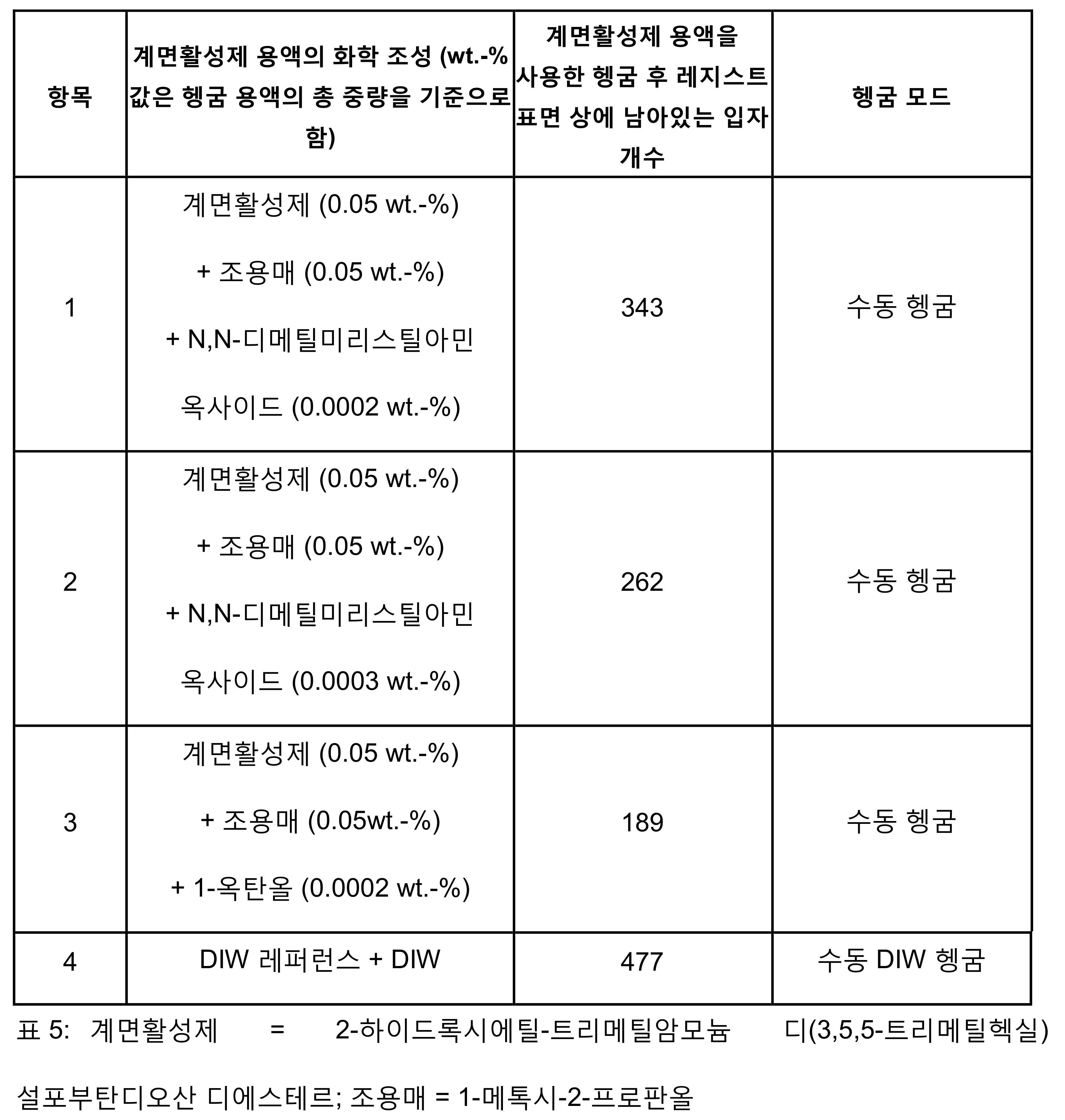
표 5 의 마지막 항목 (항목 4) 에서, DIW 용액을 사용하여 상기 기재한 절차에 따라서 제조한 포토레지스트를 헹군 후 477 개의 입자가 남아 있는 것을 볼 수 있었다. 항목 1 내지 3 에서, 본 발명에 따른 조성물 또는 용액으로 세척하거나 헹군 후 포토레지스트 (즉, 기판 및 그 위에 지지되어 있는 라인 폭 50 nm 이하의 라인-스페이스 구조를 갖는 패터닝된 재료 층을 포함하는 제품) 의 표면 상에 현저히 적은 입자가 남아 있는 것을 볼 수 있었다. 세척하거나 헹구어진 포토레지스트는 기판 및 그 위에 지지되어 있는 라인 폭 50 nm 이하의 라인-스페이스 구조를 갖는 패터닝된 재료 층을 포함하는 제품을 세척하거나 헹구는 본 발명의 방법의 제품이다.In the last column of Table 5 (item 4), 477 particles remained after rinsing the photoresist prepared according to the procedure described above using DIW solution. In
표 5 에서 볼 수 있는 바와 같이, 본 발명의 제형 및/또는 본 발명에 따라서 사용되는 조성물은 DIW 를 사용하여 헹군 포토레지스트와 비교하여 포토레지스트의 표면 상에 잔류하는 입자의 양을 상당히 감소시켰다. 이는 워터마크 결함의 감소 및 블랍 결함의 감소에도 유리하다.As can be seen in Table 5, the formulations of the present invention and / or compositions used in accordance with the present invention significantly reduced the amount of particles remaining on the surface of the photoresist as compared to the rinsed photoresist using DIW. This is also advantageous in reducing watermark defects and reducing blur defects.
본 출원인은 (설포메틸)-부탄디오산 디에스테르, 메틸-설포부탄디오산 디에스테르, 설포글루타르산 디에스테르, 및 설포트리카발산 트리에스테르의 암모늄 염으로 워터마크 결함, 블랍 결함 및 입자의 제거에 대하여 추가 측정을 수행하였다. 이들 추가 측정의 결과는 설포부탄디오산 디에스테르의 암모늄 염을 사용한 상기 표 5 에 기재한 것들과 매우 유사하였다.The Applicant has found that the presence of watermarks defects, blob defects, and particles of (sulfomethyl) -butanedioic acid diester, methyl-sulfobutanedioic acid diester, sulfoglutaric acid diester, and sulphoricarboxylic acid triester Additional measurements were made for removal. The results of these additional measurements were very similar to those described in Table 5 above using the ammonium salt of sulfobutanedioic acid diester.
합성:synthesis:
1) One) 말레산Maleic acid 디에스테르Diester / 푸마르산 / Fumaric acid 디에스테르Diester
1a) 푸마르산 1a) Fumaric acid 디(2-에틸헥실)에스테르와Di (2-ethylhexyl) ester and 혼합된 Mixed 말레산Maleic acid 디(2-에틸헥실)에스테르Di (2-ethylhexyl) ester
블레이드 진탕기, PT100-열전 소자, 환류 응축기 및 물 분리기가 장착된 2 리터 4-구 둥근 바닥 플라스크에, 390.68 g (3 mol, 2.0 eq) 2-에틸-1-헥산올 (공업용, 순도 >95 wt.-%, 제공사 BASF), 6 g (0.0315 mol, 0.021 eq) p-톨루엔 설폰산 일수화물, 및 450 g 톨루엔을 충전하고, 20℃ 에서 교반하였다. 온도를 40℃ 로 증가시키고, 147.09 g (1.5 mol, 1.0 eq) 말레산 무수물을 조금씩 첨가하였다. 1 시간 내에 온도를 126℃ 로 증가시키고, 물 분리기로 반응 물을 제거하였다. 48 시간 후 이론적인 양의 물을 분리하였다. 반응 혼합물을 50℃ 로 냉각시키고, 분별 깔때기로 옮겼다. 50℃ 에서, 유기 층을 각각 266 g 물로 3 회 세척하였다. 그 후, 유기 상을 단리하고, 소듐 설페이트 상에서 건조시키고, Seitz K900 필터를 통해 여과하였다. 회전 증발기에서 90℃ 및 <10 mbar 에서 톨루엔을 제거하였다. 480 g 의 노란색 액체를 수득하였다 (수율 94 mol% (이론적 양의 원하는 에스테르 구조에 대하여)). CDCl3 및 MeOD 에서의 1H-NMR-분광법은 원하는 말레산 디에스테르 및 그 구조 이성질체 푸마르산 디에스테르의 형성을 확인해 주었으며 (열 응력으로 인한 이성질체화; 말레산 디에스테르 : 푸마르산 디에스테르 = 84 : 16) 완전한 에스테르화도를 나타냈다.(3 mol, 2.0 eq) 2-ethyl-1-hexanol (industrial grade, purity> 95) was added to a 2 liter, 4-neck round bottom flask equipped with a stirrer, blade shaker, PT100- thermoelectric element, reflux condenser and water separator. 6 g (0.0315 mol, 0.021 eq) of p-toluenesulfonic acid monohydrate and 450 g of toluene were charged and stirred at 20 占 폚. The temperature was increased to 40 < 0 > C and 147.09 g (1.5 mol, 1.0 eq) maleic anhydride was added little by little. The temperature was increased to 126 ° C in one hour and the reaction was removed with a water separator. The theoretical amount of water was separated after 48 hours. The reaction mixture was cooled to 50 < 0 > C and transferred to a separatory funnel. At 50 < 0 > C, the organic layer was washed three times with 266 g of water each. The organic phase was then isolated, dried over sodium sulfate and filtered through a Seitz K900 filter. Toluene was removed at 90 ° C and <10 mbar in a rotary evaporator. 480 g of a yellow liquid were obtained (yield 94 mol% (for the desired ester structure in theoretical amount)). 1 H-NMR-spectroscopy on CDCl 3 and MeOD confirmed the formation of the desired maleic acid diester and its structural isomeric fumaric acid diester (isomerization due to thermal stress; maleic acid diester: fumaric acid diester = 84: ) Showed complete esterification.
a') 푸마르산 a ') fumaric acid 디(2-에틸헥실)에스테르와Di (2-ethylhexyl) ester and 혼합된 Mixed 말레산Maleic acid 디(2-에틸헥실)에스테르Di (2-ethylhexyl) ester
블레이드 진탕기, PT100-열전 소자, 환류 응축기 및 물 분리기가 장착된 1 리터 4-구 둥근 바닥 플라스크에, 150.5 g (1.158 mol, 2.0 eq) 2-에틸-1-헥산올 (공업용, 순도 >95 wt.-%, 제공사 BASF), 4.4 g (0.0232 mol, 0.04 eq) p-톨루엔 설폰산 일수화물, 191 g 톨루엔, 및 56.7 g (0.579 mol, 1.0 eq) 말레산 무수물을 충전하고, 20℃ 에서 교반하였다. 온도를 123 - 125℃ 로 증가시키고, 질소 스트림을 액체 위에 흘렸다. 물 분리기로 반응 물을 제거하였다. 12 시간 후 이론적인 양의 물을 분리하였다. 반응 혼합물을 50℃ 로 냉각시키고, 분별 깔때기로 옮겼다. 50℃ 에서, 유기 층을 각각 127 g 물로 3 회 세척하였다. 그 후, 유기 상을 단리하고, 회전 증발기에서 90℃ 및 <10 mbar 에서 톨루엔을 제거하였다. 그 후, 생성물을 Seitz K900 필터를 통해 여과하였다. 185 g 의 노란색 액체를 수득하였다 (수율 94 mol% (이론적 양의 원하는 에스테르 구조에 대하여)). CDCl3 및 MeOD 에서의 1H-NMR-분광법은 원하는 말레산 디에스테르 및 그 구조 이성질체 푸마르산 디에스테르의 형성을 확인해 주었으며 (열 응력으로 인한 이성질체화; 말레산 디에스테르 : 푸마르산 디에스테르 = 92 : 8) 완전한 에스테르화도를 나타냈다.150.5 g (1.158 mol, 2.0 eq) of 2-ethyl-1-hexanol (industrial grade, purity> 95) was added to a 1 liter, 4-neck round bottom flask equipped with a stirrer, a blade shaker, a PT100 thermoelectric element, a reflux condenser and a water separator. toluenesulfonic acid monohydrate, 191 g of toluene, and 56.7 g (0.579 mol, 1.0 eq) of maleic anhydride were charged to a reactor at 20 占 폚 Lt; / RTI > The temperature was increased to 123-125 < 0 > C and the nitrogen stream was poured over the liquid. The reaction was removed with a water separator. The theoretical amount of water was separated after 12 hours. The reaction mixture was cooled to 50 < 0 > C and transferred to a separatory funnel. At 50 < 0 > C, the organic layer was washed three times with 127 g each of water. The organic phase was then isolated and toluene was removed in a rotary evaporator at 90 < 0 > C and <10 mbar. The product was then filtered through a Seitz K900 filter. 185 g of a yellow liquid were obtained (yield: 94 mol%, based on the desired ester structure in the theoretical amount). 1 H-NMR-spectroscopy on CDCl 3 and MeOD confirmed the formation of the desired maleic acid diester and its structural isomeric fumaric acid diester (isomerization due to thermal stress; maleic acid diester: fumaric acid diester = 92: 8 ) Showed complete esterification.
b) 푸마르산 b) Fumaric acid 디(3,5,5-트리메틸-1-헥실)에스테르와Di (3,5,5-trimethyl-1-hexyl) ester and 혼합된 Mixed 말레산Maleic acid 디(3,5,5-트리메틸-1-헥실)에스테르Di (3,5,5-trimethyl-1-hexyl) ester
블레이드 진탕기, PT100-열전 소자, 환류 응축기 및 물 분리기가 장착된 2 리터 4-구 둥근 바닥 플라스크에, 390.35 g (2.692 mol, 2.0 eq) 3,5,5-트리메틸-1-헥산올 (공업용, 순도 >85 wt.-%, 나머지 구조 이성질체, 제공사 Oxea), 5.4 g (0.0284 mol, 0.02 eq) p-톨루엔 설폰산 일수화물, 및 450 g 톨루엔을 충전하고, 20℃ 에서 교반하였다. 온도를 40℃ 로 증가시키고, 131.99 g (1.346 mol, 1.0 eq) 말레산 무수물을 조금씩 첨가하였다. 1 시간 내에 온도를 125℃ 로 증가시키고, 물 분리기로 반응 물을 제거하였다. 67 시간 후 이론적인 양의 물을 분리하였다. 반응 혼합물을 50℃ 로 냉각시키고, 분별 깔때기로 옮겼다. 50℃ 에서, 유기 층을 각각 300 g 물로 3 회 세척하였다. 그 후, 유기 상을 단리하고, 소듐 설페이트 상에서 건조시키고, Seitz K900 필터를 통해 여과하였다. 회전 증발기에서 90℃ 및 <10 mbar 에서 톨루엔을 제거하였다. 468 g 의 노란색 액체를 수득하였다 (수율 94 mol% (이론적 양의 원하는 에스테르 구조에 대하여)). CDCl3 및 MeOD 에서의 1H-NMR-분광법은 원하는 말레산 디에스테르 및 그 구조 이성질체 푸마르산 디에스테르의 형성을 확인해 주었으며 (열 응력으로 인한 이성질체화; 말레산 디에스테르 : 푸마르산 디에스테르 = 80 : 20) 완전한 에스테르화도를 나타냈다.390.35 g (2.692 mol, 2.0 eq) of 3,5,5-trimethyl-1-hexanol (industrial grade) was added to a 2 liter, 4-neck round bottom flask equipped with a mechanical stirrer, a blade shaker, a PT100 thermoelectric element, a reflux condenser and a water separator. , Purity> 85 wt .-%, remaining structure isomer, provider Oxea), 5.4 g (0.0284 mol, 0.02 eq) of p-toluenesulfonic acid monohydrate and 450 g of toluene and stirred at 20 ° C. The temperature was increased to 40 占 폚, and 131.99 g (1.346 mol, 1.0 eq) maleic anhydride was added little by little. The temperature was increased to 125 < 0 > C within one hour and the reaction was removed with a water separator. The theoretical amount of water was separated after 67 hours. The reaction mixture was cooled to 50 < 0 > C and transferred to a separatory funnel. At 50 < 0 > C, the organic layer was washed three times with 300 g each of water. The organic phase was then isolated, dried over sodium sulfate and filtered through a Seitz K900 filter. Toluene was removed at 90 ° C and <10 mbar in a rotary evaporator. 468 g of a yellow liquid were obtained (yield: 94 mol%, based on the desired ester structure in the theoretical amount). 1 H-NMR-spectroscopy on CDCl 3 and MeOD confirmed the formation of the desired maleic acid diester and its structural isomeric fumaric acid diester (isomerization due to thermal stress; maleic acid diester: fumaric acid diester = 80: 20 ) Showed complete esterification.
b') 푸마르산 b ') fumaric acid 디(3,5,5-트리메틸-1-헥실)에스테르와Di (3,5,5-trimethyl-1-hexyl) ester and 혼합된 Mixed 말레산Maleic acid 디(3,5,5-트리메틸-1-헥실)에스테르 Di (3,5,5-trimethyl-1-hexyl) ester
블레이드 진탕기, PT100-열전 소자, 환류 응축기 및 물 분리기가 장착된 1 리터 4-구 둥근 바닥 플라스크에, 166.8 g (1.158 mol, 2.0 eq) 3,5,5-트리메틸-1-헥산올 (공업용, 순도 >85 wt.-%, 나머지 구조 이성질체, 제공사 Oxea), 4.4 g (0.0232 mol, 0.04 eq) p-톨루엔 설폰산 일수화물, 191 g 톨루엔, 및 56.7 g (0.579 mol, 1.0 eq) 말레산 무수물을 충전하고, 20℃ 에서 교반하였다. 온도를 123 - 125℃ 로 증가시키고, 질소 스트림을 액체 위에 흘렸다. 물 분리기로 반응 물을 제거하였다. 12 시간 후 이론적인 양의 물을 분리하였다. 반응 혼합물을 50℃ 로 냉각시키고, 분별 깔때기로 옮겼다. 50℃ 에서, 유기 층을 각각 127 g 물로 3 회 세척하였다. 그 후, 유기 상을 단리하고, 회전 증발기에서 90℃ 및 <10 mbar 에서 톨루엔을 제거하였다. 그 후 생성물을 Seitz K900 필터를 통해 여과하였다. 202 g 의 노란색 액체를 수득하였다 (수율 94 mol% (이론적 양의 원하는 에스테르 구조에 대하여)). CDCl3 및 MeOD 에서의 1H-NMR-분광법은 원하는 말레산 디에스테르 및 그 구조 이성질체 푸마르산 디에스테르의 형성을 확인해 주었으며 (열 응력으로 인한 이성질체화; 말레산 디에스테르 : 푸마르산 디에스테르 = 93 : 7) 완전한 에스테르화도를 나타냈다.166.8 g (1.158 mol, 2.0 eq) of 3,5,5-trimethyl-1-hexanol (industrial grade) was added to a 1 liter, 4-necked round bottom flask equipped with a stirrer, blade shaker, PT100 thermoelectric element, reflux condenser and water separator Toluene sulfonic acid monohydrate, 191 g of toluene, and 56.7 g (0.579 mol, 1.0 eq) of maleic acid (purity> 85 wt.%, The remaining structural isomer, provider Oxea), 4.4 g (0.0232 mol, 0.04 eq) The anhydride was charged and stirred at 20 占 폚. The temperature was increased to 123-125 < 0 > C and the nitrogen stream was poured over the liquid. The reaction was removed with a water separator. The theoretical amount of water was separated after 12 hours. The reaction mixture was cooled to 50 < 0 > C and transferred to a separatory funnel. At 50 < 0 > C, the organic layer was washed three times with 127 g each of water. The organic phase was then isolated and toluene was removed in a rotary evaporator at 90 < 0 > C and <10 mbar. The product was then filtered through a Seitz K900 filter. 202 g of a yellow liquid were obtained (in a yield of 94 mol% (for the desired ester structure in theory). 1 H-NMR-spectroscopy on CDCl 3 and MeOD confirmed the formation of the desired maleic acid diester and its structural isomeric fumaric acid diester (isomerization due to thermal stress; maleic acid diester: fumaric acid diester = 93: 7 ) Showed complete esterification.
c) 푸마르산 c) fumaric acid 디(이소노닐)에스테르와Di (isononyl) ester and 혼합된 Mixed 말레산Maleic acid 디(이소노닐)에스테르Di (isononyl) ester
블레이드 진탕기, PT100-열전 소자, 환류 응축기 및 물 분리기가 장착된 2 리터 4-구 둥근 바닥 플라스크에, 20℃ 에서 389.4 g (2.699 mol, 2.0 eq) Nonanol N (공업용, 순도 >95 wt.-%, 제공사 BASF), 5.4 g (0.0282 mol, 0.021 eq) p-톨루엔 설폰산 일수화물, 및 450 g 톨루엔을 충전하였다. 온도를 40℃ 로 증가시키고, 132.3 g (1.350 mol, 1.0 eq) 말레산 무수물을 교반 하에 조금씩 첨가하였다. 온도를 126℃ 로 증가시켰다. 물 분리기로 반응 물을 제거하였다. 72 시간 후 이론적인 양의 물을 분리하였다. 반응 혼합물을 50℃ 로 냉각시키고, 분별 깔때기로 옮겼다. 50℃ 에서, 유기 층을 각각 266 g 물로 3 회 세척하였다. 그 후, 유기 상을 단리하고, 회전 증발기에서 90℃ 및 <10 mbar 에서 톨루엔을 제거하였다. 그 후 생성물을 Seitz K900 필터를 통해 여과하였다. 472 g 의 노란색 액체를 수득하였다 (수율 95 mol% (이론적 양의 원하는 에스테르 구조에 대하여)). CDCl3 및 MeOD 에서의 1H-NMR-분광법은 원하는 말레산 디에스테르 및 그 구조 이성질체 푸마르산 디에스테르의 형성을 확인해 주었으며 (열 응력으로 인한 이성질체화; 말레산 디에스테르 : 푸마르산 디에스테르 = 83 : 17) 완전한 에스테르화도를 나타냈다.389.4 g (2.699 mol, 2.0 eq) of Nonanol N (industrial grade,> 95 wt .-%) at 20 ° C was added to a 2 liter 4-necked round bottom flask equipped with a mechanical stirrer, a blade shaker, a PT100 thermocouple, a reflux condenser and a water separator. %, Provider BASF), 5.4 g (0.0282 mol, 0.021 eq) of p-toluenesulfonic acid monohydrate, and 450 g of toluene. The temperature was increased to 40 ° C and 132.3 g (1.350 mol, 1.0 eq) maleic anhydride was added little by little with stirring. The temperature was increased to 126 占 폚. The reaction was removed with a water separator. The theoretical amount of water was separated after 72 hours. The reaction mixture was cooled to 50 < 0 > C and transferred to a separatory funnel. At 50 < 0 > C, the organic layer was washed three times with 266 g of water each. The organic phase was then isolated and toluene was removed in a rotary evaporator at 90 < 0 > C and <10 mbar. The product was then filtered through a Seitz K900 filter. 472 g of a yellow liquid were obtained (in a yield of 95 mol% (based on the desired ester structure in theory). 1 H-NMR-spectroscopy on CDCl 3 and MeOD confirmed the formation of the desired maleic acid diester and its structural isomeric fumaric acid diester (isomerization due to thermal stress; maleic acid diester: fumaric acid diester = 83: 17 ) Showed complete esterification.
d) 푸마르산 d) Fumaric acid 디(2-프로필헵틸)에스테르와Di (2-propylheptyl) ester and 혼합된 Mixed 말레산Maleic acid 디(2-프로필헵틸)에스테르Di (2-propylheptyl) ester
블레이드 진탕기, PT100-열전 소자, 환류 응축기 및 물 분리기가 장착된 2 리터 4-구 둥근 바닥 플라스크에, 20℃ 에서 427.4 g (2.7 mol, 2.0 eq) 2-프로필-1-헵탄올 (공업용, 순도 >95 wt.-%, 제공사 BASF), 5.4 g (0.0282 mol, 0.021 eq) p-톨루엔 설폰산 일수화물, 및 450 g 톨루엔을 충전하였다. 온도를 40℃ 로 증가시키고, 132.3 g (1.350 mol, 1.0 eq) 말레산 무수물을 교반 하에 조금씩 첨가하였다. 온도를 126℃ 로 증가시키고, 질소 스트림을 액체 위에 흘렸다. 물 분리기로 반응 물을 제거하였다. 8 시간 후 이론적인 양의 물을 분리하였다. 반응 혼합물을 50℃ 로 냉각시키고, 분별 깔때기로 옮겼다. 50℃ 에서, 유기 층을 각각 200 g 물로 3 회 세척하였다. 그 후, 유기 상을 단리하고, 회전 증발기에서 90℃ 및 <10 mbar 에서 톨루엔을 제거하였다. 그 후 생성물을 Seitz K900 필터를 통해 여과하였다. 527 g 의 노란색 액체를 수득하였다 (수율 94 mol-% (이론적 양의 원하는 에스테르 구조에 대하여)). CDCl3 및 MeOD 에서의 1H-NMR-분광법은 원하는 말레산 디에스테르 및 그 구조 이성질체 푸마르산 디에스테르의 형성을 확인해 주었으며 (열 응력으로 인한 이성질체화; 말레산 디에스테르 : 푸마르산 디에스테르 = 95 : 5) 완전한 에스테르화도를 나타냈다.427.4 g (2.7 mol, 2.0 eq) of 2-propyl-1-heptanol (industrial grade, commercially available) were added to a 2 liter, 4-necked round bottom flask equipped with a mechanical stirrer, a blade shaker, a PT100 thermocouple, a reflux condenser and a water separator. Purity> 95 wt.%, Provider BASF), 5.4 g (0.0282 mol, 0.021 eq) p-toluenesulfonic acid monohydrate, and 450 g toluene. The temperature was increased to 40 ° C and 132.3 g (1.350 mol, 1.0 eq) maleic anhydride was added little by little with stirring. The temperature was increased to 126 占 폚, and a nitrogen stream was spilled over the liquid. The reaction was removed with a water separator. The theoretical amount of water was separated after 8 hours. The reaction mixture was cooled to 50 < 0 > C and transferred to a separatory funnel. At 50 < 0 > C, the organic layer was washed three times with 200 g each of water. The organic phase was then isolated and toluene was removed in a rotary evaporator at 90 < 0 > C and <10 mbar. The product was then filtered through a Seitz K900 filter. 527 g of a yellow liquid were obtained (yield 94 mol-% (based on the desired ester structure in theory). 1 H-NMR-spectroscopy on CDCl 3 and MeOD confirmed the formation of the desired maleic acid diester and its structural isomeric fumaric acid diester (isomerization due to thermal stress; maleic acid diester: fumaric acid diester = 95: 5 ) Showed complete esterification.
2) 2) 디알킬 설포석시네이트Dialkyl sulfosuccinate 암모늄 염Ammonium salt (즉, (In other words, 설포부탄디오산Sulfobutanedioic acid 디알킬Dialkyl 디에스테르의Diester 암모늄 염Ammonium salt ))
a) 디(2-에틸헥실) 설포석시네이트 암모늄 염a) Di (2-ethylhexyl) sulfosuccinate ammonium salt
블레이드 진탕기, PT100-열전 소자, 환류 응축기가 장착된 2 리터 4-구 둥근 바닥 플라스크에, 340.5 g (1.0 mol, 1.0 eq) 의 말레산 디(2-에틸헥실)에스테르 및 푸마르산 디(2-에틸헥실)에스테르의 84 : 16 혼합물 및 432 g 의 메톡시-2-프로판올 (전자 등급) 을 충전하고, 20℃ 에서 교반하였다. 온도를 105℃ 로 증가시키고, 다음 2 시간에 걸쳐 177 g (1.25 mol 암모늄 하이드로젠 설파이트, 1.25 eq) 의 암모늄 하이드로젠 설파이트 (물 중 70 wt.-%) 용액을 연속적으로 첨가하였다. 첨가 동안, 온도는 100 내지 105℃ 사이에서 변화하였고, 물은 환류 하에 끓었다. 반응 혼합물을 100℃ 로 낮추고, 100℃ 에서 4 시간 동안 교반하였다. CDCl3 및 MeOD 에서의 1H-NMR-분광법에 의한 미정제 생성물의 분석은 설파이트의 첨가로 이한 이중 결합의 완전한 제거 및 원하는 구조의 형성을 확인해 주었다. 디에스테르 관능기는 그대로 유지되었다. 질소 스트림 (시간 당 반응기 부피의 1.5 배) 을 액체 위에 흘리고, 물을 80 내지 100℃ 에서 및 800 내지 250 mbar 의 감압 하에 공비 증류에 의해 제거하였다. 메톡시-2-프로판올의 손실을 보상하기 위해, 216 g 메톡시-2-프로판올 (전자 등급) 을 각각 2 회 첨가하였다. 목표는 약 50 내지 55 중량-% 의 상응하는 설포석시네이트 암모늄 염의 활성 함량을 갖는 것이었다. 반응 혼합물을 15℃ 로 냉각시키고, 불용성 염을 제거하기 위해 Seitz K150 필터를 통해 여과하였다. 754 g 의 용액을 수득하였다. 용액은 54.6 wt.-% 의 원하는 화합물, 45.1 wt.-% 의 메톡시-2-프로판올 및 0.3 wt.-% 의 물을 함유하였다. 용액은 CDCl3 및 MeOD 에서의 1H-NMR-분광법이 보여주는 바와 같이 원하는 구조를 함유하였다. 물의 함량은 Karl-Fischer-분석으로 측정하였다. 메톡시-2-프로판올의 함량은 정량적 기체 크로마토그래피로 측정하였다. 원하는 구조의 수율은 (이론적 양의 원하는 계면활성제 구조에 대하여) 94 mol% 였다 (여과 및 미량의 계면활성제가 흡착된 불용성 염의 제거로 인한 재료의 손실). 용액을 2℃ 에서 3 주 동안 저장하였다. 용액은 투명했으며 침전을 나타내지 않았다. 금속 이온 함량은 <10 ppm 이었다.340.5 g (1.0 mol, 1.0 eq) of maleic acid di (2-ethylhexyl) ester and fumaric acid di (2-ethylhexyl) ester were added to a 2 liter, 4-neck round bottom flask equipped with a stirrer, blade shaker, PT100 thermocouple, Ethylhexyl) ester and 432 g of methoxy-2-propanol (electronic grade) were charged and stirred at 20 < 0 > C. The temperature was increased to 105 ° C and over the next 2 hours a solution of 177 g (1.25 mol ammonium hydrogen sulphite, 1.25 eq) ammonium hydrogen sulphite (70 wt .-% in water) was added continuously. During the addition, the temperature varied between 100 and 105 ° C, and the water boiled under reflux. The reaction mixture was cooled to 100 < 0 > C and stirred at 100 < 0 > C for 4 hours. Analysis of the crude product by 1 H-NMR-spectroscopy at CDCl 3 and MeOD confirmed the complete removal of the double bond resulting from the addition of the sulfite and formation of the desired structure. The diester functionality remained intact. The nitrogen stream (1.5 times the volume of the reactor per hour) was flowed over the liquid and the water was removed by azeotropic distillation at 80-100 < 0 > C and under reduced pressure of 800-250 mbar. To compensate for the loss of methoxy-2-propanol, 216 g methoxy-2-propanol (electronic grade) was added twice each. The goal was to have an active content of about 50 to 55 wt-% of the corresponding sulfosuccinate ammonium salt. The reaction mixture was cooled to 15 < 0 > C and filtered through a Seitz K150 filter to remove insoluble salts. 754 g of a solution was obtained. The solution contained 54.6 wt .-% of the desired compound, 45.1 wt .-% methoxy-2-propanol and 0.3 wt .-% water. The solution contained the desired structure as shown by 1 H-NMR-spectroscopy in CDCl 3 and MeOD. The water content was determined by Karl-Fischer-analysis. The content of methoxy-2-propanol was determined by quantitative gas chromatography. The yield of the desired structure was 94 mol% (relative to the desired surfactant structure in the theoretical amount) (loss of material due to filtration and removal of insoluble salts adsorbed by traces of surfactant). The solution was stored at 2 < 0 > C for 3 weeks. The solution was clear and did not show any precipitation. The metal ion content was < 10 ppm.
b) 디(3,5,5-트리메틸헥실) 설포석시네이트 암모늄 염b) Di (3,5,5-trimethylhexyl) sulfosuccinate ammonium salt
블레이드 진탕기, PT100-열전 소자, 환류 응축기가 장착된 2 리터 4-구 둥근 바닥 플라스크에, 313.0 g (0.85 mol, 1.0 eq) 의 말레산 디(3,5,5-트리메틸헥실)에스테르 및 푸마르산 디(3,5,5-트리메틸헥실)에스테르의 80 : 20 혼합물 및 86.41 g 의 네오펜틸 글리콜을 충전하고, 20℃ 에서 교반하였다. 온도를 115℃ 로 증가시키고, 다음 2 시간에 걸쳐 150.44 g (1.0625 mol 암모늄 하이드로젠 설파이트, 1.25 eq) 의 암모늄 하이드로젠 설파이트 (물 중 70 wt.-%) 용액을 연속적으로 첨가하였다. 첨가 동안, 온도는 103℃ 로 떨어졌고, 물은 환류 하에 끓었다. 반응 혼합물을 100℃ 로 낮추고, 100℃ 에서 4 시간 동안 교반하였다. CDCl3 및 MeOD 에서의 1H-NMR-분광법에 의한 미정제 생성물의 분석은 설파이트의 첨가로 이한 이중 결합의 완전한 제거 및 원하는 구조의 형성을 확인해 주었다. 디에스테르 관능기는 그대로 유지되었다. 반응 혼합물을 90℃ 로 냉각시키고, 171.17 g 의 물을 첨가하였다. 80℃ 로 온도를 추가로 감소시킨 후, 171.16 g 의 부틸 디에틸렌 글리콜을 첨가하였다. 80℃ 에서 10 분 교반한 후, 반응 혼합물을 분별 깔때기로 옮기고, 아래쪽 상 (7.9 g) 을 제거하였다. (7.9 g). 위쪽 상 (875 g) 은 (CDCl3 및 MeOD 에서의 1H-NMR-분광법이 다시 보여주는 바와 같이) 44.5 중량-% 의 원하는 구조, 8.68 중량-% 네오펜틸 글리콜, 19.61 중량-% 부틸 디에틸렌 글리콜 및 23.5 중량-% 물 (나머지 2.36 wt.-% 염) 을 함유하였다. 용액을 2℃ 에서 2 주 동안 저장하였다. 용액은 투명했으며 침전을 나타내지 않았다.(3, 5, 5-trimethylhexyl) ester of fumaric acid and 313.0 g (0.85 mol, 1.0 eq) of maleic acid di (3,5,5-trimethylhexyl) ester were added to a 2 liter, 4-neck round bottom flask equipped with a stirrer, blade shaker, PT100- A 80:20 mixture of di (3,5,5-trimethylhexyl) ester and 86.41 g of neopentyl glycol were charged and stirred at 20 占 폚. The temperature was increased to 115 ° C and over the next 2 hours 150.44 g (1.0625 mol ammonium hydrogen sulphite, 1.25 eq) of ammonium hydrogen sulphite (70 wt .-% in water) solution was added successively. During the addition, the temperature dropped to 103 < 0 > C and the water boiled under reflux. The reaction mixture was cooled to 100 < 0 > C and stirred at 100 < 0 > C for 4 hours. Analysis of the crude product by 1 H-NMR-spectroscopy at CDCl 3 and MeOD confirmed the complete removal of the double bond resulting from the addition of the sulfite and formation of the desired structure. The diester functionality remained intact. The reaction mixture was cooled to 90 < 0 > C and 171.17 g of water was added. After further reduction of the temperature to 80 < 0 > C, 171.16 g of butyl diethylene glycol was added. After stirring at 80 DEG C for 10 minutes, the reaction mixture was transferred to a separatory funnel and the lower phase (7.9 g) was removed. (7.9 g). The upper phase (875 g) contains 44.5 wt-% of the desired structure (as indicated by 1 H-NMR spectroscopy in CDCl 3 and MeOD again), 8.68 wt-% neopentyl glycol, 19.61 wt-% butyl diethylene glycol And 23.5 wt-% water (the remaining 2.36 wt .-% salt). The solution was stored at 2 [deg.] C for 2 weeks. The solution was clear and did not show any precipitation.
b') 디(3,5,5-트리메틸헥실) 설포석시네이트 암모늄 염b ') di (3,5,5-trimethylhexyl) sulfosuccinate ammonium salt
블레이드 진탕기, PT100-열전 소자, 환류 응축기가 장착된 1 리터 4-구 둥근 바닥 플라스크에, 202 g (0.55 mol, 1.0 eq) 의 말레산 디(3,5,5-트리메틸헥실)에스테르 및 푸마르산 디(3,5,5-트리메틸헥실)에스테르의 93 : 7 혼합물 및 266 g 의 메톡시-2-프로판올 (전자 등급) 을 충전하고, 20℃ 에서 교반하였다. 온도를 105℃ 로 증가시키고, 다음 2 시간에 걸쳐 97 g (0.69 mol 암모늄 하이드로젠 설파이트, 1.25 eq) 의 암모늄 하이드로젠 설파이트 (물 중 70 wt.-%) 용액을 연속적으로 첨가하였다. 첨가 동안, 온도는 100 내지 105℃ 사이에서 변화하였고, 물은 환류 하에 끓었다. 반응 혼합물을 100℃ 로 낮추고, 100℃ 에서 4 시간 동안 교반하였다. CDCl3 및 MeOD 에서의 1H-NMR-분광법에 의한 미정제 생성물의 분석은 설파이트의 첨가로 이한 이중 결합의 완전한 제거 및 원하는 구조의 형성을 확인해 주었다. 디에스테르 관능기는 그대로 유지되었다. 질소 스트림 (시간 당 반응기 부피의 1.5 배) 을 액체 위에 흘리고, 물을 80 내지 100℃ 에서 및 800 내지 450 mbar 의 감압 하에 공비 증류에 의해 제거하였다. 메톡시-2-프로판올의 손실을 보상하기 위해, 133 g 메톡시-2-프로판올 (전자 등급) 을 각각 2 회 첨가하였다. 목표는 약 50 내지 55 중량-% 의 상응하는 설포석시네이트 암모늄 염의 활성 함량을 갖는 것이었다. 반응 혼합물을 20℃ 로 냉각시키고, 불용성 염을 제거하기 위해 Seitz K150 필터를 통해 여과하였다. 458 g 의 용액을 수득하였다. 용액은 53.7 wt.-% 의 원하는 화합물, 45.8 wt.-% 의 메톡시-2-프로판올 및 0.5 wt.-% 의 물을 함유하였다. 용액은 CDCl3 및 MeOD 에서의 1H-NMR-분광법이 보여주는 바와 같이 원하는 구조를 함유하였다. 물의 함량은 Karl-Fischer-분석으로 측정하였다. 메톡시-2-프로판올의 함량은 정량적 기체 크로마토그래피로 측정하였다. 원하는 구조의 수율은 (이론적 양의 원하는 계면활성제 구조에 대하여) 96 mol% 였다 (여과 및 미량의 계면활성제가 흡착된 불용성 염의 제거로 인한 재료의 손실). 금속 이온 함량은 <10 ppm 이었다.(0.55 mol, 1.0 eq) of maleic acid di (3,5,5-trimethylhexyl) ester and fumaric acid were added to a 1-liter, 4-neck round bottom flask equipped with a thermometer, A 93: 7 mixture of di (3,5,5-trimethylhexyl) ester and 266 g of methoxy-2-propanol (electronic grade) were charged and stirred at 20 占 폚. The temperature was increased to 105 DEG C and over the next 2 hours 97 g (0.69 mol ammonium hydrogen sulphite, 1.25 eq) of ammonium hydrogen sulphite (70 wt .-% in water) solution was added continuously. During the addition, the temperature varied between 100 and 105 ° C, and the water boiled under reflux. The reaction mixture was cooled to 100 < 0 > C and stirred at 100 < 0 > C for 4 hours. Analysis of the crude product by 1 H-NMR-spectroscopy at CDCl 3 and MeOD confirmed the complete removal of the double bond resulting from the addition of the sulfite and formation of the desired structure. The diester functionality remained intact. The nitrogen stream (1.5 times the reactor volume per hour) was flowed over the liquid and the water was removed by azeotropic distillation at 80-100 < 0 > C and under reduced pressure of 800-450 mbar. To compensate for the loss of methoxy-2-propanol, 133 g methoxy-2-propanol (electronic grade) was added twice each. The goal was to have an active content of about 50 to 55 wt-% of the corresponding sulfosuccinate ammonium salt. The reaction mixture was cooled to 20 < 0 > C and filtered through a Seitz K150 filter to remove insoluble salts. 458 g of a solution was obtained. The solution contained 53.7 wt .-% of the desired compound, 45.8 wt .-% methoxy-2-propanol and 0.5 wt .-% water. The solution contained the desired structure as shown by 1 H-NMR-spectroscopy in CDCl 3 and MeOD. The water content was determined by Karl-Fischer-analysis. The content of methoxy-2-propanol was determined by quantitative gas chromatography. The yield of the desired structure was 96 mol% (relative to the theoretical amount of the desired surfactant structure) (filtration and loss of material due to the removal of insoluble salts adsorbed by minor traces of surfactant). The metal ion content was < 10 ppm.
c) 디(이소노닐) 설포석시네이트 암모늄 염 c) Di (isononyl) sulfosuccinate ammonium salt
블레이드 진탕기, PT100-열전 소자, 환류 응축기가 장착된 1 리터 4-구 둥근 바닥 플라스크에, 106.7 g (0.289 mol, 1.0 eq) 의 말레산 디(이소노닐)에스테르 및 푸마르산 디(이소노닐)에스테르의 83 : 17 혼합물 및 135 g 의 메톡시-2-프로판올 (전자 등급) 을 충전하고, 20℃ 에서 교반하였다. 온도를 105℃ 로 증가시키고, 다음 2 시간에 걸쳐 51.3 g (0.362 mol 암모늄 하이드로젠 설파이트, 1.25 eq) 의 암모늄 하이드로젠 설파이트 (물 중 70 wt.-%) 용액을 연속적으로 첨가하였다. 첨가 동안, 온도는 100 내지 105℃ 사이에서 변화하였고, 물은 환류 하에 끓었다. 반응 혼합물을 100℃ 로 낮추고, 100℃ 에서 4 시간 동안 교반하였다. CDCl3 및 MeOD 에서의 1H-NMR-분광법에 의한 미정제 생성물의 분석은 설파이트의 첨가로 이한 이중 결합의 완전한 제거 및 원하는 구조의 형성을 확인해 주었다. 디에스테르 관능기는 그대로 유지되었다. 질소 스트림 (시간 당 반응기 부피의 1.5 배) 액체 위에 흘리고, 물을 80 내지 100℃ 에서 및 700 내지 250 mbar 의 감압 하에 공비 증류에 의해 제거하였다. 메톡시-2-프로판올의 손실을 보상하기 위해, 62 g 메톡시-2-프로판올 (전자 등급) 을 각각 2 회 첨가하였다. 목표는 약 50 내지 57 중량-% 의 상응하는 설포석시네이트 암모늄 염의 활성 함량을 갖는 것이었다. 반응 혼합물을 20℃ 로 냉각시키고, 불용성 염을 제거하기 위해 Seitz K150 필터를 통해 여과하였다. 220 g 의 용액을 수득하였다. 용액은 56.5% 의 원하는 화합물, 43.2% 의 메톡시-2-프로판올 및 0.3% 의 물을 함유하였다. 용액은 CDCl3 및 MeOD 에서의 1H-NMR-분광법이 보여주는 바와 같이 원하는 구조를 함유하였다. 물의 함량은 Karl-Fischer-분석으로 측정하였다. 메톡시-2-프로판올의 함량은 정량적 기체 크로마토그래피로 측정하였다. 원하는 구조의 수율은 (이론적 양의 원하는 계면활성제 구조에 대하여) 92 mol% 였다 (여과 및 미량의 계면활성제가 흡착된 불용성 염의 제거로 인한 재료의 손실). 용액을 10℃ 에서 2 주 동안 저장하였다. 용액은 투명했으며 침전을 나타내지 않았다. 금속 이온 함량은 <10 ppm 이었다.(Isononyl) ester of fumaric acid (isononyl) ester and 106.7 g (0.289 mol, 1.0 eq) of a fumaric acid di (isononyl) ester were added to a 1 liter, 4-necked round bottom flask equipped with a thermometer, Of an 83: 17 mixture and 135 g of methoxy-2-propanol (electronic grade) were charged and stirred at 20 占 폚. The temperature was increased to 105 ° C and a solution of 51.3 g (0.362 mol ammonium hydrogen sulphite, 1.25 eq) ammonium hydrogen sulphite (70 wt .-% in water) was continuously added over the next 2 hours. During the addition, the temperature varied between 100 and 105 ° C, and the water boiled under reflux. The reaction mixture was cooled to 100 < 0 > C and stirred at 100 < 0 > C for 4 hours. Analysis of the crude product by 1 H-NMR-spectroscopy at CDCl 3 and MeOD confirmed the complete removal of the double bond resulting from the addition of the sulfite and formation of the desired structure. The diester functionality remained intact. The nitrogen stream (1.5 times the volume of the reactor per hour) was poured onto the liquid and the water was removed by azeotropic distillation at 80-100 < 0 > C and under reduced pressure of 700-250 mbar. To compensate for the loss of methoxy-2-propanol, 62 g of methoxy-2-propanol (electronic grade) was added twice each. The goal was to have an active content of about 50 to 57 wt-% of the corresponding sulfosuccinate ammonium salt. The reaction mixture was cooled to 20 < 0 > C and filtered through a Seitz K150 filter to remove insoluble salts. 220 g of a solution was obtained. The solution contained 56.5% of the desired compound, 43.2% of methoxy-2-propanol and 0.3% of water. The solution contained the desired structure as shown by 1 H-NMR-spectroscopy in CDCl 3 and MeOD. The water content was determined by Karl-Fischer-analysis. The content of methoxy-2-propanol was determined by quantitative gas chromatography. The yield of the desired structure was 92 mol% (relative to the theoretical amount of the desired surfactant structure) (loss of material due to filtration and removal of the insoluble salt adsorbed by minor traces of surfactant). The solution was stored at 10 < 0 > C for 2 weeks. The solution was clear and did not show any precipitation. The metal ion content was < 10 ppm.
d) 디(2-프로필헵틸) 설포석시네이트 암모늄 염d) Di (2-propylheptyl) sulfosuccinate ammonium salt
블레이드 진탕기, PT100-열전 소자, 환류 응축기가 장착된 1 리터 4-구 둥근 바닥 플라스크에, 150 g (0.387 mol, 1.0 eq) 의 말레산 디(2-프로필헵틸)에스테르 및 푸마르산 디(2-프로필헵틸)에스테르의 95 : 5 혼합물 및 190 g 의 메톡시-2-프로판올 (전자 등급) 을 충전하고, 20℃ 에서 교반하였다. 온도를 105℃ 로 증가시키고, 다음 2 시간에 걸쳐 66.9 g (0.473 mol 암모늄 하이드로젠 설파이트, 1.25 eq) 의 암모늄 하이드로젠 설파이트 (물 중 70 wt.-%) 용액을 연속적으로 첨가하였다. 첨가 동안, 온도는 100 내지 105℃ 사이에서 변화하였고, 물은 환류 하에 끓었다. 반응 혼합물을 100℃ 로 낮추고, 100℃ 에서 4 시간 동안 교반하였다. CDCl3 및 MeOD 에서의 1H-NMR-분광법에 의한 미정제 생성물의 분석은 설파이트의 첨가로 이한 이중 결합의 완전한 제거 및 원하는 구조의 형성을 확인해 주었다. 디에스테르 관능기는 그대로 유지되었다. 질소 스트림 (시간 당 반응기 부피의 1.5 배) 액체 위에 흘리고, 물을 80 내지 100℃ 에서 및 700 내지 250 mbar 의 감압 하에 공비 증류에 의해 제거하였다. 메톡시-2-프로판올의 손실을 보상하기 위해, 130 g 메톡시-2-프로판올 (전자 등급) 을 각각 2 회 첨가하였다. 목표는 약 50 내지 65 중량-% 의 상응하는 설포석시네이트 암모늄 염의 활성 함량을 갖는 것이었다. 반응 혼합물을 20℃ 로 냉각시키고, 불용성 염을 제거하기 위해 Seitz K150 필터를 통해 여과하였다. 220 g 의 용액을 수득하였다. 용액은 62.5 wt.-% 의 원하는 화합물, 37.2 wt.-% 의 메톡시-2-프로판올 및 0.3 wt.-% 의 물을 함유였다. 용액은 CDCl3 및 MeOD 에서의 1H-NMR-분광법이 보여주는 바와 같이 원하는 구조를 함유하였다. 물의 함량은 Karl-Fischer-분석으로 측정하였다. 메톡시-2-프로판올의 함량은 정량적 기체 크로마토그래피로 측정하였다. 원하는 구조의 수율은 (이론적 양의 원하는 계면활성제 구조에 대하여) 91 mol% 였다 (여과 및 미량의 계면활성제가 흡착된 불용성 염의 제거로 인한 재료의 손실). 용액을 20℃ 에서 2 주 동안 저장하였다. 용액은 약간 산란했지만 여전히 균질했다. 금속 이온 함량은 <10 ppm 이었다. 150 g (0.387 mol, 1.0 eq) of maleic di (2-propylheptyl) ester and fumaric acid di (2-propylheptyl) ester were placed in a 1 liter, 4-neck round bottom flask equipped with a stirrer, Propylhexyl) ester and 190 g of methoxy-2-propanol (electronic grade) were charged and stirred at 20 < 0 > C. The temperature was increased to 105 ° C and over the next 2 hours a solution of 66.9 g (0.473 mol ammonium hydrogen sulphite, 1.25 eq) ammonium hydrogen sulphite (70 wt .-% in water) was added continuously. During the addition, the temperature varied between 100 and 105 ° C, and the water boiled under reflux. The reaction mixture was cooled to 100 < 0 > C and stirred at 100 < 0 > C for 4 hours. Analysis of the crude product by 1 H-NMR-spectroscopy at CDCl 3 and MeOD confirmed the complete removal of the double bond resulting from the addition of the sulfite and formation of the desired structure. The diester functionality remained intact. The nitrogen stream (1.5 times the volume of the reactor per hour) was poured onto the liquid and the water was removed by azeotropic distillation at 80-100 < 0 > C and under reduced pressure of 700-250 mbar. To compensate for the loss of methoxy-2-propanol, 130 g methoxy-2-propanol (electronic grade) was added twice each. The goal was to have an active content of about 50-65 wt-% of the corresponding sulfosuccinate ammonium salt. The reaction mixture was cooled to 20 < 0 > C and filtered through a Seitz K150 filter to remove insoluble salts. 220 g of a solution was obtained. The solution contained 62.5 wt .-% of the desired compound, 37.2 wt .-% methoxy-2-propanol and 0.3 wt .-% water. The solution contained the desired structure as shown by 1 H-NMR-spectroscopy in CDCl 3 and MeOD. The water content was determined by Karl-Fischer-analysis. The content of methoxy-2-propanol was determined by quantitative gas chromatography. The yield of the desired structure was 91 mol% (relative to the theoretical amount of the desired surfactant structure) (filtration and loss of material due to the removal of insoluble salts adsorbed by minor traces of surfactant). The solution was stored at 20 < 0 > C for 2 weeks. The solution was slightly scattered but still homogeneous. The metal ion content was < 10 ppm.
3) 3) 디알킬Dialkyl 설포석시네이트Sulfosuccinate 소듐 염 (본 발명 아님) Sodium salt (not the present invention)
a) 디(2-에틸헥실) 설포석시네이트 소듐 염a) Di (2-ethylhexyl) sulfosuccinate sodium salt
블레이드 진탕기, PT100-열전 소자, 환류 응축기가 장착된 4 리터 4-구 둥근 바닥 플라스크에, 55.4 g (0.163 mol, 1.0 eq) 의 말레산 디(2-에틸헥실)에스테르 및 푸마르산 디(2-에틸헥실)에스테르의 84 : 16 혼합물 및 396 g 의 1,4-디옥산을 충전하고, 20℃ 에서 교반하였다. 온도를 50℃ 로 증가시키고, 다음 1 시간에 걸쳐 1108.35 g (4.26 mol 소듐 하이드로젠 설파이트, 26.15 eq) 의 소듐 하이드로젠 설파이트 (물 중 40 wt.-%) 용액을 연속적으로 첨가했는데, 이때 pH-값을 19.2 g (0.24 mol, 1.47 eq) 의 소듐 하이드록사이드 (물 중 50 wt.-%) 용액을 사용하여 pH = 5 로 조정하였다. 온도를 88℃ 로 증가시키고, 반응 혼합물을 88℃ 에서 24 시간 동안 교반하였다. 그 후, 30 분 내에 추가의 347.87 g (1.441 mol, 8.84 eq) 의 소듐 하이드로젠 설파이트 (물 중 40 wt.-%) 용액을 연속적으로 첨가했는데, 이때 pH-값을 7 g (0.0875 mol, 0.54 eq) 의 소듐 하이드록사이드 (물 중 50 wt.-%) 용액을 사용하여 pH = 5 로 조정하였다. 48 시간 동안 교반한 후, 30 분 내에 추가의 347.87 g (1.441 mol, 8.84 eq) 의 소듐 하이드로젠 설파이트 (물 중 40 wt.-%) 용액을 연속적으로 첨가했는데, 이때 pH-값을 7 g (0.0875 mol, 0.54 eq) 의 소듐 하이드록사이드 (물 중 50 wt.-%) 용액을 사용하여 pH = 5 로 조정하였다. 88℃ 에서 60 시간 후, 반응 혼합물을 분별 깔때기로 옮기고, 두 상을 분리하였다. 유기 상으로부터 물 및 1,4-디옥산을 90℃ 및 <10 mbar 에서 4 시간 동안 회전 증발기를 사용하여 제거하였다. CDCl3 및 MeOD 에서의 1H-NMR-분광법이 보여주는 바와 같이, 설파이트의 첨가로 이한 이중 결합의 완전한 제거 및 원하는 구조의 형성이 일어났다. 원하는 구조의 수율은 (존재하는 에스테르 구조에 대하여) 100 mol% 이었으며 생성물은 다른 염과의 혼합물로 수득되었다.55.4 g (0.163 mol, 1.0 eq) of maleic di (2-ethylhexyl) ester and fumaric acid di (2-ethylhexyl) ester were added to a 4 liter, 4-neck round bottom flask equipped with a mechanical stirrer, blade shaker, PT100 thermocouple, Ethylhexyl) ester and 396 g of 1,4-dioxane and stirred at 20 < 0 > C. The temperature was increased to 50 占 폚 and a solution of 1108.35 g (4.26 mol sodium hydrogen sulphite, 26.15 eq) of sodium hydrogensulfite (40 wt .-% in water) was continuously added over the next hour, The pH-value was adjusted to pH = 5 using a solution of 19.2 g (0.24 mol, 1.47 eq) of sodium hydroxide (50 wt .-% in water). The temperature was increased to 88 DEG C and the reaction mixture was stirred at 88 DEG C for 24 hours. An additional 347.87 g (1.441 mol, 8.84 eq) of sodium hydrogen sulphite (40 wt .-% in water) solution was subsequently added within 30 minutes, at which time the pH-value was changed to 7 g (0.0875 mol, 0.54 eq) of sodium hydroxide (50 wt .-% in water) was used to adjust the pH = 5. After stirring for 48 hours, an additional 347.87 g (1.441 mol, 8.84 eq) of sodium hydrogen sulphite (40 wt .-% in water) solution was continuously added within 30 minutes, (0.0875 mol, 0.54 eq) of sodium hydroxide (50 wt .-% in water) was used to adjust the pH = 5. After 60 hours at 88 [deg.] C, the reaction mixture was transferred to a separatory funnel and the two phases were separated. Water and 1,4-dioxane were removed from the organic phase using a rotary evaporator at 90 < 0 > C and <10 mbar for 4 hours. As indicated by 1 H-NMR-spectroscopy in CDCl 3 and MeOD, complete removal of the double bond resulting from the addition of the sulfite and formation of the desired structure took place. The yield of the desired structure was 100 mol% (based on the ester structure present) and the product was obtained as a mixture with other salts.
b) 디(3,5,5-트리메틸헥실) 설포석시네이트 소듐 염b) Synthesis of di (3,5,5-trimethylhexyl) sulfosuccinate sodium salt
블레이드 진탕기, PT100-열전 소자, 환류 응축기가 장착된 4 리터 4-구 둥근 바닥 플라스크에, 60.0 g (0.163 mol, 1.0 eq) 의 말레산 디(3,5,5-트리메틸헥실)에스테르 및 푸마르산 디(3,5,5-트리메틸헥실)에스테르의 80 : 20 혼합물 및 396 g 의 1,4-디옥산을 충전하고, 20℃ 에서 교반하였다. 온도를 50℃ 로 증가키시고, 다음 1 시간에 걸쳐 1108.35 g (4.26 mol 소듐 하이드로젠 설파이트, 26.15 eq) 의 소듐 하이드로젠 설파이트 (물 중 40 wt.-%) 용액을 연속적으로 첨가했는데, 이때 pH-값을 19.2 g (0.24 mol, 1.47 eq) 의 소듐 하이드록사이드 (물 중 50 wt.-%) 용액을 사용하여 pH = 5 로 조정하였다. 온도를 88℃ 로 증가시키고, 반응 혼합물을 88℃ 에서 24 시간 동안 교반하였다. 그 후, 30 분 내에 추가의 347.87 g (1.441 mol, 8.84 eq) 의 소듐 하이드로젠 설파이트 (물 중 40 wt.-%) 용액을 연속적으로 첨가했는데, 이때 pH-값을 7 g (0.0875 mol, 0.54 eq) 의 소듐 하이드록사이드 (물 중 50 wt.-%) 용액을 사용하여 pH = 5 로 조정하였다. 48 시간 동안 교반한 후, 30 분 내에 추가의 347.87 g (1.441 mol, 8.84 eq) 의 소듐 하이드로젠 설파이트 (물 중 40%) 용액을 연속적으로 첨가했는데, 이때 pH-값을 7 g (0.0875 mol, 0.54 eq) 의 소듐 하이드록사이드 (물 중 50 wt.-%) 용액을 사용하여 pH = 5 로 조정하였다. 88℃ 에서 60 시간 후, 반응 혼합물을 분별 깔때기로 옮기고, 두 상을 분리하였다. 유기 상으로부터 물 및 1,4-디옥산을 90℃ 및 <10 mbar 에서 4 시간 동안 회전 증발기를 사용하여 제거하였다. CDCl3 및 MeOD 에서의 1H-NMR-분광법이 보여주는 바와 같이, 설파이트의 첨가로 이한 이중 결합의 완전한 제거 및 원하는 구조의 형성이 일어났다. 원하는 구조의 수율은 (존재하는 에스테르 구조에 대하여) 100 mol% 이었으며 생성물은 다른 염과의 혼합물로 수득되었다.To a 4 liter four-neck round bottom flask equipped with a blade shaker, a PT100 thermoelectric element, and a reflux condenser, 60.0 g (0.163 mol, 1.0 eq) of maleic acid di (3,5,5-trimethylhexyl) ester and fumaric acid A mixture of 80:20 of di (3,5,5-trimethylhexyl) ester and 396 g of 1,4-dioxane was charged and stirred at 20 ° C. The temperature was increased to 50 占 폚 and a solution of 1108.35 g (4.26 mol sodium hydrogen sulphite, 26.15 eq) of sodium hydrogen sulphite (40 wt .-% in water) was continuously added over the next hour, At this time, the pH-value was adjusted to pH = 5 using a solution of 19.2 g (0.24 mol, 1.47 eq) of sodium hydroxide (50 wt .-% in water). The temperature was increased to 88 DEG C and the reaction mixture was stirred at 88 DEG C for 24 hours. An additional 347.87 g (1.441 mol, 8.84 eq) of sodium hydrogen sulphite (40 wt .-% in water) solution was subsequently added within 30 minutes, at which time the pH-value was changed to 7 g (0.0875 mol, 0.54 eq) of sodium hydroxide (50 wt .-% in water) was used to adjust the pH = 5. After stirring for 48 hours, an additional 347.87 g (1.441 mol, 8.84 eq) of sodium hydrogen sulphite (40% in water) solution was continuously added within 30 minutes, with a pH value of 7 g (0.0875 mol , 0.54 eq) was adjusted to pH = 5 using a solution of sodium hydroxide (50 wt .-% in water). After 60 hours at 88 [deg.] C, the reaction mixture was transferred to a separatory funnel and the two phases were separated. Water and 1,4-dioxane were removed from the organic phase using a rotary evaporator at 90 < 0 > C and <10 mbar for 4 hours. As indicated by 1 H-NMR-spectroscopy in CDCl 3 and MeOD, complete removal of the double bond resulting from the addition of the sulfite and formation of the desired structure took place. The yield of the desired structure was 100 mol% (based on the ester structure present) and the product was obtained as a mixture with other salts.
4) 4) 디알킬Dialkyl 설포석시네이트Sulfosuccinate 콜린 염 Choline salt
a) 디(2-에틸헥실) 설포석시네이트 콜린 염a) di (2-ethylhexyl) sulfosuccinate choline salt
블레이드 진탕기, PT100-열전 소자, pH 미터, 환류 응축기가 장착된 4 리터 4-구 둥근 바닥 플라스크에, 1130 g 메톡시-2-프로판올을 충전하고, 273 g Amberlyst 15 (이온 교환기, 산 형태) 를 20℃ 에서 첨가하면서, 첨가 동안 온도를 28℃ 로 증가시켰다. 180.26 g (0.406 mol, 1.0 eq) 디(2-에틸헥실) 설포석시네이트 소듐 염을 898.8 g 메톡시-2-프로판올에 용해시키고, 불용성 염을 제거하기 위해 Seitz K900 필터를 통해 여과하였다. 15 분 후, 20 분 내에 언급한 메톡시-2-프로판올에 용해시킨 180.26 g (0.406 mol, 1.0 eq) 디(2-에틸헥실) 설포석시네이트 소듐 염을 4 리터 4-구 둥근 바닥 플라스크에 적가하였다. 반응 혼합물을 40℃ 에서 4 시간 동안 교반하고, 불용성 염을 제거하기 위해 Seitz K900 필터를 통해 여과하였다.1130 g methoxy-2-propanol was charged to a 4 liter four-neck round bottom flask equipped with a stirrer, a blade shaker, a PT100 thermocouple, a pH meter and a reflux condenser, and 273 g Amberlyst 15 (ion exchanger, Was added at < RTI ID = 0.0 > 20 C < / RTI > 180.26 g (0.406 mol, 1.0 eq) of di (2-ethylhexyl) sulfosuccinate sodium salt was dissolved in 898.8 g of methoxy-2-propanol and filtered through a Seitz K900 filter to remove insoluble salts. After 15 minutes, 180.26 g (0.406 mol, 1.0 eq) of di (2-ethylhexyl) sulfosuccinate sodium salt dissolved in methoxy-2-propanol mentioned in 20 minutes was added to a 4 liter 4-neck round bottom flask . The reaction mixture was stirred at 40 < 0 > C for 4 hours and filtered through a Seitz K900 filter to remove insoluble salts.
4 리터 4-구 둥근 바닥 플라스크에 추가의 560 g 메톡시-2-프로판올을 첨가하고, 그 후에 135 g 의 Amberlyst 15 를 첨가하였다. 그 다음, 상기 언급한 여과한 용액을 첨가하고, 반응 혼합물을 40℃ 에서 3 시간 동안 교반한 다음 다시 여과하였다. 반응 혼합물을 콜린 하이드록사이드 (물 중 23%) 의 수용액으로 중화시켰다. 그렇게 하기 위해, 22℃ 에서 7.2 의 pH 값을 달성하기 위해 43.5 g (0.359 mol) 콜린 하이드록사이드가 필요했다 (이론적인 양의 0.406 mol 콜린 하이드록사이드가 필요하지 않았는데, (이론적 양의 원하는 계면활성제 구조에 대하여) 약 10 mol% 의 디(2-에틸헥실) 설포석시네이트 소듐 염이 이온 교환 재료에서의 흡착으로 인해 또는 여과로 인해 손실되었기 때문이다). 회전 증발기에서 메톡시-2-프로판올 및 물을 60℃ 에서 감압 진공 (<10 mbar) 하에 제거하였다. 188.5 g 의 재료를 수득하였다. CDCl3 및 MeOD 에서의 1H-NMR-분광법이 보여주는 바와 같이, 원하는 구조의 형성 및 반대 이온의 완전한 교환이 일어났다. 50 wt.-% 용액을 수득하기 위해, 188.5 g 의 메톡시-2-프로판올을 첨가하고, 혼합물을 Seitz K200 필터를 통해 여과하였다. 376 g 의 붉은색 액체를 수득하였는데, 이는 50 중량-% 의 원하는 최종 구조 (원하는 생성물) 를 함유하였다.An additional 560 g methoxy-2-propanol was added to a 4 liter four-neck round bottom flask, followed by the addition of 135 g Amberlyst 15. Then, the above-mentioned filtered solution was added, and the reaction mixture was stirred at 40 DEG C for 3 hours and then filtered again. The reaction mixture was neutralized with an aqueous solution of choline hydroxide (23% in water). To do so, 43.5 g (0.359 mol) of choline hydroxide was needed to achieve a pH value of 7.2 at 22 ° C (the theoretical amount of 0.406 mol of choline hydroxide was not needed, About 10 mol% of di (2-ethylhexyl) sulfosuccinate sodium salt was lost due to adsorption on the ion exchange material or due to filtration). Methoxy-2-propanol and water were removed in a rotary evaporator at 60 <0> C under reduced pressure (<10 mbar). 188.5 g of material was obtained. As the 1 H-NMR- spectroscopy in CDCl 3 and showing MeOD, it took place is formed, and the complete exchange of the counter ion for the desired structure. To obtain a 50 wt .-% solution, 188.5 g of methoxy-2-propanol was added and the mixture was filtered through a Seitz K200 filter. 376 g of a red liquid was obtained, which contained 50% by weight of the desired final structure (desired product).
a') 디(2-에틸헥실) 설포석시네이트 콜린 염a ') di (2-ethylhexyl) sulfosuccinate choline salt
칼럼에 습윤 Amberlyst (Amberlyst 15 수소 형태, Fluka 제공) 를 약 20 cm 의 높이까지 채웠다. 층 부피는 약 280 ml 였다. 칼럼 내 100 g 의 습윤 Amberlyst 를 착색된 부산물 또는 잔류량의 소듐 이온을 제거하기 위해 1120 g 물 (전자 등급) 로 플러싱하였다. 그 후, 물을 제거하기 위해, 칼럼을 560 g 메톡시-2-프로판올 (전자 등급) 로 플러싱하였다. 그 다음, 94.9 g (0.118 mol, 1.0 eq) 의 디(2-에틸헥실) 설포석시네이트 암모늄 염 (메톡시-2-프로판올 중 54.6 중량-%) 용액을 112.3 g 메톡시-2-프로판올 (전자 등급) 로 희석하여 25% (중량-%) 의 활성 함량으로 조정하였다. 그 다음, 이 희석된 용액을 32 분 내에 칼럼 상에 적가하였다. 그 후, 칼럼을 560 g 메톡시-2-프로판올 (전자 등급) 로 플러싱하였다.The column was filled with wet Amberlyst (Amberlyst 15 hydrogen form, provided by Fluka) to a height of about 20 cm. The layer volume was about 280 ml. 100 g of wet Amberlyst in the column was flushed with 1120 g water (electronic grade) to remove colored by-products or residual sodium ions. The column was then flushed with 560 g methoxy-2-propanol (electronic grade) to remove water. Then a solution of 94.9 g (0.118 mol, 1.0 eq) of di (2-ethylhexyl) sulfosuccinate ammonium salt (54.6 wt-% in methoxy-2-propanol) was added to 112.3 g methoxy- Electronic grade) and adjusted to an active content of 25% (wt-%). This diluted solution was then added dropwise to the column within 32 minutes. The column was then flushed with 560 g methoxy-2-propanol (electronic grade).
칼럼에서 나온 처음 150 ml 의 액체는 수집하지 않았다. 20 분 후 분획 번호 1 을 수집하고: 170.84 g (이 양을 수집하는데 약 30 분 소요) 분석하였다 (2.1 wt.-% 물 함량, 74.2 wt.-% 메톡시-2-프로판올 (정량적 기체 크로마토그래피에 따름), 산가: 25.6 mg KOH / g -> 0.0781 mol 산). 그 다음, 분획 번호 2 를 수집하고 (약 23 분 소요) 분획을 분석하였다 (1.5 wt.-% 물 함량, 83 wt.-% 메톡시-2-프로판올 (정량적 기체 크로마토그래피에 따름), 산가: 9.0 mg KOH / g -> 0.0264 mol 산). 분획 번호 3 도 수집하였으나 (270 ml, 약 25 분 소요) 산의 존재를 나타내지 않았는데, 이는 유리 설폰산이 존재하지 않는다는 것을 의미한다 (1.0 wt.-% 물 함량, 96.8 wt.-% 메톡시-2-프로판올 (정량적 기체 크로마토그래피에 따름), 산가: 0 mg KOH / g -> 0 mol 산). 산가에 따르면 계면활성제는 상응하는 설폰산으로 전환되었고, (이론적 양의 원하는 계면활성제 구조에 대하여) 약 90 내지 95 mol% 의 계면활성제가 수집되었다. 나머지는 이온 교환 재료에서의 흡착으로 인해 손실되었다. 칼럼 또는 이온 교환기를 3.3 리터 염산 (전자 등급) 을 사용하여 물/메톡시-2-프로판올 (90/10, 각각 전자 등급) 중 5 wt.-% 용액으로 재생하고, 마지막으로 3 l 물 (전자 등급) 로 플러싱하였다.The first 150 ml of liquid from the column was not collected. After 20 minutes, the
분획 번호 1 및 2 를 조합하고, 이로부터 취한 샘플을 (회전 증발기를 사용하여) 용매로부터 유리시키고, 분석하였다: 원소 분석 및 MeOD 및 CDCl3 에서의 1H-NMR 분광법은 유리된 상응하는 설폰산으로의 전환이 (이론적 양의 원하는 계면활성제 구조에 대하여) >95 mol% 의 정도로 일어났음을 보여주었다. 분획 번호 1 및 2 의 조합은 335.0 g 이었고, 이를 500ml 4-구 둥근 바닥 플라스크에서 22℃ 에서 콜린 하이드록사이드 (물 중 46 wt.-%) 수용액으로 중화시켰다. 22℃ 에서 7.06 의 pH-값으로 조정하기 위해, 335.0 g 의 조합된 분획에 대해 26.08 g (0.0990 mol) 콜린 하이드록사이드가 필요했다 (Amberlyst 상의 흡착으로 인한 디(2-에틸헥실) 설포석시네이트 암모늄 염의 손실로 인해 이론적인 양의 0.118 mol 이 필요하지 않았다). 용액을 Seitz K150 필터를 통해 여과하였다. 336.5 g 의 붉은색 액체를 수득하였는데, 이는 15.4 중량-% 의 원하는 구조를 함유했다 (정량적 기체 크로마토그래피에 따른 메톡시-2-프로판올 78.2 wt.-%, Karl-Fischer 에 따른 물 6.4 wt.-%).Fraction Nos. 1 and 2 were combined and the sample taken therefrom was freed from the solvent (using a rotary evaporator) and analyzed: Elemental analysis and 1 H-NMR spectroscopy in MeOD and CDCl 3 gave the corresponding free sulfonic acid (To a theoretical amount of the desired surfactant structure) of > 95 mol%. The combination of
감압 하에 및 중간의 온도에서 (60℃, 10 mbar) 물을 메톡시-2-프로판올을 사용하는 공비 증류에 의해 제거하였다. 102 g 의 액체를 수득하였고, 이를 분석하였다. 이는 MeOD 및 CDCl3 에서의 1H-NMR 분광법으로 확인된, 51 중량-% 의 원하는 구조, 47.7 wt.-% 메톡시-2-프로판올 및 0.3 wt.-% 물을 함유하였다. 물 함량은 Karl-Fischer 분석으로 측정하였고, 활성 함량은 정량적 기체 크로마토그래피에 의한 메톡시-2-프로판올 함량의 측정 및 물 함량의 측정으로 간접적으로 측정하였다 (진공 하의 용매의 대안적인 완전한 제거가 활성 함량을 측정하는 앞서 기재한 방법을 입증함). 마지막으로 용액을 Seitz K150 필터를 통해 여과하였다. 그러나, 생성물과 혼합된 소량의 염을 (~1 g) 분리하였다. 용액을 10℃ 에서 2 주 동안 저장하였다. 용액은 투명했으며 침전을 나타내지 않았다. 금속 이온 함량은 <10 ppm 이었다.Water was removed by azeotropic distillation using methoxy-2-propanol under reduced pressure and at intermediate temperature (60 DEG C, 10 mbar). 102 g of liquid were obtained and analyzed. This contained 51 wt-% of the desired structure, 47.7 wt .-% methoxy-2-propanol and 0.3 wt .-% water, as confirmed by 1 H-NMR spectroscopy at MeOD and CDCl 3 . The water content was determined by Karl-Fischer analysis and the active content was determined indirectly by measuring the content of methoxy-2-propanol by quantitative gas chromatography and measuring the water content (alternative complete removal of the solvent under vacuum is active ≪ / RTI > proving the method described above for determining the content). Finally, the solution was filtered through a Seitz K150 filter. However, a small amount of salt mixed with the product (~ 1 g) was isolated. The solution was stored at 10 < 0 > C for 2 weeks. The solution was clear and did not show any precipitation. The metal ion content was < 10 ppm.
b) 디(3,5,5-트리메틸헥실) 설포석시네이트 콜린 염b) Synthesis of di (3,5,5-trimethylhexyl) sulfosuccinate choline salt
블레이드 진탕기, PT100-열전 소자, pH 미터, 환류 응축기가 장착된 4 리터 4-구 둥근 바닥 플라스크에, 1130 g 메톡시-2-프로판올을 충전하고, 273 g Amberlyst 15 (이온 교환기, 산 형태) 를 20℃ 에서 첨가하면서, 첨가 동안 온도를 28℃ 로 증가시켰다. 191.63 g (0.406 mol, 1.0 eq) 디(3,5,5-트리메틸헥실) 설포석시네이트 소듐 염을 898.8 g 메톡시-2-프로판올에 용해시키고, 불용성 염을 제거하기 위해 Seitz K900 필터를 통해 여과하였다. 15 분 후, 20 분 내에 언급한 메톡시-2-프로판올에 용해시킨 1.63 g (0.406 mol, 1.0 eq) 디(3,5,5-트리메틸헥실) 설포석시네이트 소듐 염을 4 리터 4-구 둥근 바닥 플라스크에 적가하였다. 반응 혼합물을 40℃ 에서 4 시간 동안 교반하고, 불용성 염을 제거하기 위해 Seitz K900 필터를 통해 여과하였다.1130 g methoxy-2-propanol was charged to a 4 liter four-neck round bottom flask equipped with a stirrer, a blade shaker, a PT100 thermocouple, a pH meter and a reflux condenser, and 273 g Amberlyst 15 (ion exchanger, Was added at < RTI ID = 0.0 > 20 C < / RTI > 191.63 g (0.406 mol, 1.0 eq) of di (3,5,5-trimethylhexyl) sulfosuccinate sodium salt was dissolved in 898.8 g of methoxy-2-propanol and filtered through a Seitz K900 filter to remove insoluble salts Filtered. After 15 minutes, within 20 minutes, 1.63 g (0.406 mol, 1.0 eq) of di (3,5,5-trimethylhexyl) sulfosuccinate sodium salt dissolved in methoxy-2- Was added dropwise to a round bottom flask. The reaction mixture was stirred at 40 < 0 > C for 4 hours and filtered through a Seitz K900 filter to remove insoluble salts.
4 리터 4-구 둥근 바닥 플라스크에 추가의 560 g 메톡시-2-프로판올을 첨가하고, 그 후에 135 g 의 Amberlyst 15 를 첨가하였다. 그 다음, 상기 언급한 여과한 용액을 첨가하고, 반응 혼합물을 40℃ 에서 3 시간 동안 교반한 다음 다시 여과하였다. 반응 혼합물을 콜린 하이드록사이드 (물 중 23 wt.-%) 의 수용액으로 중화시켰다. 그렇게 하기 위해, 22℃ 에서 7.2 의 pH 값을 달성하기 위해 43.5 g (0.359 mol) 콜린 하이드록사이드가 필요했다 (이론적인 양의 0.406 mol 콜린 하이드록사이드가 필요하지 않았는데, (이론적 양의 원하는 계면활성제 구조에 대하여) 약 10 mol% 의 디(3,5,5-트리메틸헥실) 설포석시네이트 소듐 염이 이온 교환 재료에서의 흡착으로 인해 또는 여과로 인해 손실되었기 때문이다). 회전 증발기에서 메톡시-2-프로판올 및 물을 60℃ 에서 감압 진공 (<10 mbar) 하에 제거하였다. 190.7 g 의 재료를 수득하였다. CDCl3 및 MeOD 에서의 1H-NMR-분광법이 보여주는 바와 같이 원하는 구조의 형성 및 반대 이온의 완전한 교환이 일어났다. 50 wt.-% 용액을 수득하기 위해, 190.7 g 의 메톡시-2-프로판올을 첨가하고, 혼합물을 Seitz K200 필터를 통해 여과하였다. 368.04 g 의 붉은색 액체를 수득하였는데, 이는 50 중량-% 의 원하는 최종 구조 (원하는 생성물) 를 함유하였다.An additional 560 g methoxy-2-propanol was added to a 4 liter four-neck round bottom flask, followed by the addition of 135 g Amberlyst 15. Then, the above-mentioned filtered solution was added, and the reaction mixture was stirred at 40 DEG C for 3 hours and then filtered again. The reaction mixture was neutralized with an aqueous solution of choline hydroxide (23 wt .-% in water). To do so, 43.5 g (0.359 mol) of choline hydroxide was needed to achieve a pH value of 7.2 at 22 ° C (the theoretical amount of 0.406 mol of choline hydroxide was not needed, About 10 mol% of di (3,5,5-trimethylhexyl) sulfosuccinate sodium salt was lost due to adsorption on the ion exchange material or due to filtration). Methoxy-2-propanol and water were removed in a rotary evaporator at 60 <0> C under reduced pressure (<10 mbar). 190.7 g of material was obtained. 1 H-NMR-spectroscopy at CDCl 3 and MeOD showed formation of the desired structure and complete exchange of the counterion. To obtain a 50 wt .-% solution, 190.7 g of methoxy-2-propanol was added and the mixture was filtered through a Seitz K200 filter. 368.04 g of a red liquid was obtained, which contained 50% by weight of the desired final structure (desired product).
b') 디(3,5,5-트리메틸헥실) 설포석시네이트 콜린 염b ') di (3,5,5-trimethylhexyl) sulfosuccinate choline salt
칼럼에 습윤 Amberlyst (Amberlyst 15 수소 형태, Fluka 제공) 를 약 20 cm 의 높이까지 채웠다. 층 부피는 약 280 ml 였다. 칼럼 내 100 g 의 습윤 Amberlyst 를 착색된 부산물 또는 잔류량의 소듐 이온을 제거하기 위해 1120 g 물 (전자 등급) 로 플러싱하였다. 그 후, 물을 제거하기 위해, 칼럼을 560 g 메톡시-2-프로판올 (전자 등급) 로 플러싱하였다. 그 다음, 102.3 g (0.118 mol, 1.0 eq) 의 디(3,5,5-트리메틸헥실) 설포석시네이트 암모늄 염 (메톡시-2-프로판올 중 53.7 중량-%) 용액을 117.5 g 메톡시-2-프로판올 (전자 등급) 로 희석하여 25% (중량-%) 의 활성 함량으로 조정하였다. 그 다음, 이 희석된 용액을 32 분 내에 칼럼 상에 적가하였다. 그 후, 칼럼을 560 g 메톡시-2-프로판올 (전자 등급) 로 플러싱하였다.The column was filled with wet Amberlyst (Amberlyst 15 hydrogen form, provided by Fluka) to a height of about 20 cm. The layer volume was about 280 ml. 100 g of wet Amberlyst in the column was flushed with 1120 g water (electronic grade) to remove colored by-products or residual sodium ions. The column was then flushed with 560 g methoxy-2-propanol (electronic grade) to remove water. A solution of 102.3 g (0.118 mol, 1.0 eq) of di (3,5,5-trimethylhexyl) sulfosuccinate ammonium salt (53.7 wt-% in methoxy-2-propanol) was then added to 117.5 g methoxy- Propanol (electronic grade) and adjusted to an active content of 25% (wt-%). This diluted solution was then added dropwise to the column within 32 minutes. The column was then flushed with 560 g methoxy-2-propanol (electronic grade).
칼럼에서 나온 처음 150 ml 의 액체는 수집하지 않았다. 20 분 후 분획 번호 1 을 수집하고: 171.77 g (이 양을 수집하는데 약 30 분 소요) 분석하였다 (2.2 wt.-% 물 함량, 74.2 wt.-% 메톡시-2-프로판올 (정량적 기체 크로마토그래피에 따름), 산가: 24.9 mg KOH / g -> 0.0762 mol 산). 그 다음, 분획 번호 2 를 수집하고 (약 23 분 소요) 분획을 분석하였다 (1.6 wt.-% 물 함량, 86 wt.-% 메톡시-2-프로판올 (정량적 기체 크로마토그래피에 따름), 산가: 10.0 mg KOH / g -> 0.0337 mol 산). 분획 번호 3 도 수집하였으나 (260 ml, 약 20 분 소요) 산의 존재를 나타내지 않았는데, 이는 유리 설폰산이 존재하지 않는다는 것을 의미한다 (0.8 wt.-% 물 함량, 93.8 wt.-% 메톡시-2-프로판올 (정량적 기체 크로마토그래피에 따름), 산가: 0 mg KOH / g -> 0 mol 산). 산가에 따르면 계면활성제는 상응하는 설폰산으로 전환되었고, (이론적 양의 원하는 계면활성제 구조에 대하여) 약 93 mol% 가 수집되었다. 나머지는 이온 교환 재료에서의 흡착으로 인해 손실되었다. 칼럼 또는 이온 교환기를 3.3 리터 염산 (전자 등급) 을 사용하여 물/메톡시-2-프로판올 (90/10, 각각 전자 등급) 중 5 wt.-% 용액으로 재생하고, 마지막으로 3 l 물 (전자 등급) 로 플러싱하였다.The first 150 ml of liquid from the column was not collected. After 20 minutes,
분획 번호 1 및 2 를 조합하고, 이로부터 취한 샘플을 (회전 증발기를 사용하여) 용매로부터 유리시키고, 분석하였다: 원소 분석 및 MeOD 및 CDCl3 에서의 1H-NMR 분광법은 유리된 상응하는 설폰산으로의 전환이 (이론적 양의 원하는 계면활성제 구조에 대하여) >95 mol% 의 정도로 일어났음을 보여주었다. 분획 번호 1 및 2 의 조합은 333.2 g 이었고, 이를 500ml 4-구 둥근 바닥 플라스크에서 22℃ 에서 콜린 하이드록사이드 (물 중 46 wt.-%) 수용액으로 중화시켰다. 22℃ 에서 7.06 의 pH-값을 조정하기 위해, 333.2 g 의 조합된 분획에 대해 25.58 g (0.0971 mol) 콜린 하이드록사이드가 필요했다 (Amberlyst 상의 흡착으로 인한 디(3,5,5-트리메틸헥실) 설포석시네이트 암모늄 염의 손실로 인해 이론적인 양의 0.118 mol 이 필요하지 않았다). 용액을 Seitz K150 필터를 통해 여과하였다. 332.4 g 의 붉은색 액체를 수득하였는데, 이는 15.2 중량-% 의 원하는 구조를 함유했다 (정량적 기체 크로마토그래피에 따른 메톡시-2-프로판올 78.8 wt.-%, Karl-Fischer 에 따른 물 6.0 wt.-%).Fraction Nos. 1 and 2 were combined and the sample taken therefrom was freed from the solvent (using a rotary evaporator) and analyzed: Elemental analysis and 1 H-NMR spectroscopy in MeOD and CDCl 3 gave the corresponding free sulfonic acid (To a theoretical amount of the desired surfactant structure) of > 95 mol%. The combination of
감압 하에 및 중간의 온도에서 (60℃, 10 mbar) 물을 메톡시-2-프로판올을 사용하는 공비 증류에 의해 제거하였다. 101 g 의 액체를 수득하였고, 이를 분석하였다. 이는 MeOD 및 CDCl3 에서의 1H-NMR 분광법으로 확인된, 50 중량-% 의 원하는 구조, 49.8 wt.-% 메톡시-2-프로판올 및 0.2 wt.-% 물을 함유하였다. 물 함량은 Karl-Fischer 분석으로 측정하였고, 활성 함량은 정량적 기체 크로마토그래피에 의한 메톡시-2-프로판올 함량의 측정 및 물 함량의 측정으로 간접적으로 측정하였다 (진공 하의 용매의 대안적인 완전한 제거가 활성 함량을 측정하는 앞서 기재한 방법을 입증함). 마지막으로 용액을 Seitz K150 필터를 통해 여과하였다. 그러나, 생성물과 혼합된 소량의 염을 (~1 g) 분리하였다. 용액을 10℃ 에서 2 주 동안 저장하였다. 용액은 투명했으며 침전을 나타내지 않았다. 금속 이온 함량은 <10 ppm 이었다.Water was removed by azeotropic distillation using methoxy-2-propanol under reduced pressure and at intermediate temperature (60 DEG C, 10 mbar). 101 g of liquid were obtained and analyzed. This contained 50 wt-% of the desired structure, 49.8 wt .-% methoxy-2-propanol and 0.2 wt .-% water, as confirmed by 1 H-NMR spectroscopy on MeOD and CDCl 3 . The water content was determined by Karl-Fischer analysis and the active content was determined indirectly by measuring the content of methoxy-2-propanol by quantitative gas chromatography and measuring the water content (alternative complete removal of the solvent under vacuum is active ≪ / RTI > proving the method described above for determining the content). Finally, the solution was filtered through a Seitz K150 filter. However, a small amount of salt mixed with the product (~ 1 g) was isolated. The solution was stored at 10 < 0 > C for 2 weeks. The solution was clear and did not show any precipitation. The metal ion content was < 10 ppm.
c) 디(이소노닐) 설포석시네이트 콜린 염c) Di (isononyl) sulfosuccinate choline salt
칼럼에 습윤 Amberlyst (Amberlyst 15 수소 형태, Fluka 제공) 를 약 20 cm 의 높이까지 채웠다. 층 부피는 약 280 ml 였다. 칼럼 내 100 g 의 습윤 Amberlyst 를 착색된 부산물 또는 잔류량의 소듐 이온을 제거하기 위해 1120 g 물 (전자 등급) 로 플러싱하였다. 그 후, 물을 제거하기 위해, 칼럼을 560 g 메톡시-2-프로판올 (전자 등급) 로 플러싱하였다. 그 다음, 97.5 g (0.118 mol, 1.0 eq) 의 디(이소노닐) 설포석시네이트 암모늄 염 (메톡시-2-프로판올 중 56.5 중량-%) 용액을 123 g 메톡시-2-프로판올 (전자 등급) 로 희석하여 25% (중량-%) 의 활성 함량으로 조정하였다. 그 다음, 이 희석된 용액을 32 분 내에 칼럼 상에 적가하였다. 그 후, 칼럼을 560 g 메톡시-2-프로판올 (전자 등급) 로 플러싱하였다.The column was filled with wet Amberlyst (Amberlyst 15 hydrogen form, provided by Fluka) to a height of about 20 cm. The layer volume was about 280 ml. 100 g of wet Amberlyst in the column was flushed with 1120 g water (electronic grade) to remove colored by-products or residual sodium ions. The column was then flushed with 560 g methoxy-2-propanol (electronic grade) to remove water. Then a solution of 97.5 g (0.118 mol, 1.0 eq) of di (isononyl) sulfosuccinate ammonium salt (56.5 wt-% in methoxy-2-propanol) was added to 123 g methoxy- ) And adjusted to an active content of 25% (wt%). This diluted solution was then added dropwise to the column within 32 minutes. The column was then flushed with 560 g methoxy-2-propanol (electronic grade).
칼럼에서 나온 처음 150 ml 의 액체는 수집하지 않았다. 20 분 후 분획 번호 1 을 수집하고: 172.4 g (이 양을 수집하는데 약 30 분 소요) 분석하였다 (2.1 wt.-% 물 함량, 75.1 wt.-% 메톡시-2-프로판올 (정량적 기체 크로마토그래피에 따름), 산가: 25.3 mg KOH / g -> 0.0778 mol 산). 그 다음, 분획 번호 2 를 수집하고 (약 23 분 소요) 분획을 분석하였다 (1.5 wt.-% 물 함량, 87 wt.-% 메톡시-2-프로판올 (정량적 기체 크로마토그래피에 따름), 산가: 9.0 mg KOH / g -> 0.0260 mol 산). 분획 번호 3 도 수집하였으나 (250 ml, 약 20 분 소요) 산의 존재를 나타내지 않았는데, 이는 유리 설폰산이 존재하지 않는다는 것을 의미한다 (0.9 wt.-% 물 함량, 95.1 wt.-% 메톡시-2-프로판올 (정량적 기체 크로마토그래피에 따름), 산가: 0 mg KOH / g -> 0 mol 산). 산가에 따르면 계면활성제는 상응하는 설폰산으로 전환되었고, (이론적 양의 원하는 계면활성제 구조에 대하여) 약 94 mol% 이 수집되었다. 나머지는 이온 교환 재료에서의 흡착으로 인해 손실되었다. 칼럼 또는 이온 교환기를 3.3 리터 염산 (전자 등급) 을 사용하여 물/메톡시-2-프로판올 (90/10, 각각 전자 등급) 중 5 wt.-% 용액으로 재생하고, 마지막으로 3 l 물 (전자 등급) 로 플러싱하였다.The first 150 ml of liquid from the column was not collected. After 20 minutes,
분획 번호 1 및 2 를 조합하고, 이로부터 취한 샘플을 (회전 증발기를 사용하여) 용매로부터 유리시키고, 분석하였다: 원소 분석 및 MeOD 및 CDCl3 에서의 1H-NMR 분광법은 유리된 상응하는 설폰산으로의 전환이 (이론적 양의 원하는 계면활성제 구조에 대하여) >95 mol% 의 정도로 일어났음을 보여주었다. 분획 번호 1 및 2 의 조합은 334.3 g 이었고, 이를 500ml 4-구 둥근 바닥 플라스크에서 22℃ 에서 콜린 하이드록사이드 (물 중 46 wt.-%) 수용액으로 중화시켰다. 22℃ 에서 7.06 의 pH-값으로 조정하기 위해, 334.3 g 의 조합된 분획 25.29 g (0.0960 mol) 에 대해 콜린 하이드록사이드가 필요했다 (Amberlyst 상의 흡착으로 인한 디(이소노닐) 설포석시네이트 암모늄 염의 손실로 인해 이론적인 양의 0.118 mol 이 필요하지 않았다). 용액을 Seitz K150 필터를 통해 여과하였다. 330.8 g 의 붉은색 액체를 수득하였는데, 이는 16.0 중량-% 의 원하는 구조를 함유했다 (정량적 기체 크로마토그래피에 다른 메톡시-2-프로판올 77.9 wt.-%, Karl-Fischer 에 따른 물 6.1 wt.-%).Fraction Nos. 1 and 2 were combined and the sample taken therefrom was freed from the solvent (using a rotary evaporator) and analyzed: Elemental analysis and 1 H-NMR spectroscopy in MeOD and CDCl 3 gave the corresponding free sulfonic acid (To a theoretical amount of the desired surfactant structure) of > 95 mol%. The combination of
감압 하에 및 중간의 온도에서 (60℃, 10 mbar) 물을 메톡시-2-프로판올을 사용하는 공비 증류에 의해 제거하였다. 102 g 의 액체를 수득하였고, 이를 분석하였다. 이는 MeOD 및 CDCl3 에서의 1H-NMR 분광법으로 확인된, 52 중량-% 의 원하는 구조, 47.8 wt.-% 메톡시-2-프로판올 및 0.2 wt.-% 물을 함유하였다. 물 함량은 Karl-Fischer 분석으로 측정하였고, 활성 함량은 정량적 기체 크로마토그래피에 의한 메톡시-2-프로판올 함량의 측정 및 물 함량의 측정으로 간접적으로 측정하였다 (진공 하의 용매의 대안적인 완전한 제거가 활성 함량을 측정하는 앞서 기재한 방법을 입증함). 마지막으로 용액을 Seitz K150 필터를 통해 여과하였다. 그러나, 생성물과 혼합된 소량의 염을 (~1 g) 분리하였다. 용액을 20℃ 에서 2 주 동안 저장하였다. 용액은 투명했으며 침전을 나타내지 않았다. 금속 이온 함량은 <10 ppm 이었다.Water was removed by azeotropic distillation using methoxy-2-propanol under reduced pressure and at intermediate temperature (60 DEG C, 10 mbar). 102 g of liquid were obtained and analyzed. This contained 52 wt-% of the desired structure, 47.8 wt .-% methoxy-2-propanol and 0.2 wt .-% water, as confirmed by 1 H-NMR spectroscopy on MeOD and CDCl 3 . The water content was determined by Karl-Fischer analysis and the active content was determined indirectly by measuring the content of methoxy-2-propanol by quantitative gas chromatography and measuring the water content (alternative complete removal of the solvent under vacuum is active ≪ / RTI > proving the method described above for determining the content). Finally, the solution was filtered through a Seitz K150 filter. However, a small amount of salt mixed with the product (~ 1 g) was isolated. The solution was stored at 20 < 0 > C for 2 weeks. The solution was clear and did not show any precipitation. The metal ion content was < 10 ppm.
d) 디(2-프로필헵틸) 설포석시네이트 콜린 염d) Synthesis of di (2-propylheptyl) sulfosuccinate choline salt
칼럼에 습윤 Amberlyst (Amberlyst 15 수소 형태, Fluka 제공) 를 약 20 cm 의 높이까지 채웠다. 층 부피는 약 280 ml 였다. 칼럼 내 100 g 의 습윤 Amberlyst 를 착색된 부산물 또는 잔류량의 소듐 이온을 제거하기 위해 1120 g 물 (전자 등급) 로 플러싱하였다. 그 후, 물을 제거하기 위해, 칼럼을 560 g 메톡시-2-프로판올 (전자 등급) 로 플러싱하였다. 그 다음, 93.5 g (0.118 mol, 1.0 eq) 의 디(2-프로필헵틸) 설포석시네이트 암모늄 염 (메톡시-2-프로판올 중 62.5 중량-%) 용액을 140.1 g 메톡시-2-프로판올 (전자 등급) 로 희석하여 25% (중량-%) 의 활성 함량으로 조정하였다. 그 다음, 이 희석된 용액을 32 분 내에 칼럼 상에 적가하였다. 그 후, 칼럼을 560 g 메톡시-2-프로판올 (전자 등급) 로 플러싱하였다.The column was filled with wet Amberlyst (Amberlyst 15 hydrogen form, provided by Fluka) to a height of about 20 cm. The layer volume was about 280 ml. 100 g of wet Amberlyst in the column was flushed with 1120 g water (electronic grade) to remove colored by-products or residual sodium ions. The column was then flushed with 560 g methoxy-2-propanol (electronic grade) to remove water. Then a solution of 93.5 g (0.118 mol, 1.0 eq) of di (2-propylheptyl) sulfosuccinate ammonium salt (62.5 wt-% in methoxy-2-propanol) was added to 140.1 g methoxy- Electronic grade) and adjusted to an active content of 25% (wt-%). This diluted solution was then added dropwise to the column within 32 minutes. The column was then flushed with 560 g methoxy-2-propanol (electronic grade).
칼럼에서 나온 첫 번째 150 ml 의 액체는 수집하지 않았다. 20 분 후 분획 번호 1 을 수집하고: 174.8 g (이 양을 수집하는데 약 30 분 소요) 분석하였다 (2.3 wt.-% 물 함량, 78.2 wt.-% 메톡시-2-프로판올 (정량적 기체 크로마토그래피에 따름), 산가: 23.7 mg KOH / g -> 0.0740 mol 산). 그 다음, 분획 번호 2 를 수집하고 (약 23 분 소요) 분획을 분석하였다 (1.4 wt.-% 물 함량, 87 wt.-% 메톡시-2-프로판올 (정량적 기체 크로마토그래피에 따름), 산가: 11.0 mg KOH / g -> 0.0306 mol 산). 분획 번호 3 도 수집하였으나 (250 ml, 약 20 분 소요) 산의 존재를 나타내지 않았는데, 이는 유리 설폰산이 존재하지 않는다는 것을 의미한다 (0.8 wt.-% 물 함량, 93.8 wt.-% 메톡시-2-프로판올 (정량적 기체 크로마토그래피에 따름), 산가: 0 mg KOH / g -> 0 mol 산). 산가에 따르면 계면활성제는 상응하는 설폰산으로 전환되었고, (이론적 양의 원하는 계면활성제 구조에 대하여) 약 93 mol-% 가 수집되었다. 나머지는 이온 교환 재료에서의 흡착으로 인해 손실되었다. 칼럼 또는 이온 교환기를 3.3 리터 염산 (전자 등급) 을 사용하여 물/메톡시-2-프로판올 (90/10, 각각 전자 등급) 중 5 wt.-% 용액으로 재생하고, 마지막으로 3 l 물 (전자 등급) 로 플러싱하였다.The first 150 ml of liquid from the column was not collected. After 20 minutes,
분획 번호 1 및 2 를 조합하고, 이로부터 취한 샘플을 (회전 증발기를 사용하여) 용매로부터 유리시키고, 분석하였다: 원소 분석 및 MeOD 및 CDCl3 에서의 1H-NMR 분광법은 유리된 상응하는 설폰산으로의 전환이 (이론적 양의 원하는 계면활성제 구조에 대하여) >95 mol% 의 정도로 일어났음을 보여주었다. 분획 번호 1 및 2 의 조합은 330.7 g 이었고, 이를 500ml 4-구 둥근 바닥 플라스크에서 22℃ 에서 콜린 하이드록사이드 (물 중 46 wt.-%) 수용액으로 중화시켰다. 22℃ 에서 7.06 의 pH-값을 조정하기 위해, 330.7 g 의 조합된 분획에 대해 25.40 g (0.0964 mol) 콜린 하이드록사이드가 필요했다 (Amberlyst 상의 흡착으로 인한 디(2-프로필헵틸) 설포석시네이트 암모늄 염의 손실로 인해 이론적인 양의 0.118 mol 이 필요하지 않았다). 용액을 Seitz K150 필터를 통해 여과하였다. 334.7 g 의 붉은색 액체를 수득하였는데, 이는 16.7 중량-% 의 원하는 구조를 함유했다 (정량적 기체 크로마토그래피에 따른 메톡시-2-프로판올 77.2 wt.-%, Karl-Fischer 에 따른 물 6.1 wt.-% ).Fraction Nos. 1 and 2 were combined and the sample taken therefrom was freed from the solvent (using a rotary evaporator) and analyzed: Elemental analysis and 1 H-NMR spectroscopy in MeOD and CDCl 3 gave the corresponding free sulfonic acid (To a theoretical amount of the desired surfactant structure) of > 95 mol%. The combination of
감압 하에 및 중간의 온도에서 (60℃, 10 mbar) 물을 메톡시-2-프로판올을 사용하는 공비 증류에 의해 제거하였다. 112 g 의 액체를 수득하였고, 이를 분석하였다. 이는 MeOD 및 CDCl3 에서의 1H-NMR 분광법으로 확인된, 50.1 중량-% 의 원하는 구조, 49.7 wt.-% 메톡시-2-프로판올 및 0.2 wt.-% 물을 함유하였다. 물 함량은 Karl-Fischer 분석으로 측정하였고, 활성 함량은 정량적 기체 크로마토그래피에 의한 메톡시-2-프로판올 함량의 측정 및 물 함량의 측정으로 간접적으로 측정하였다 (진공 하의 용매의 대안적인 완전한 제거가 활성 함량을 측정하는 앞서 기재한 방법을 입증함). 마지막으로 용액을 Seitz K150 필터를 통해 여과하였다. 그러나, 생성물과 혼합된 소량의 염을 (~1 g) 분리하였다. 금속 이온 함량은 <10 ppm 이었다.Water was removed by azeotropic distillation using methoxy-2-propanol under reduced pressure and at intermediate temperature (60 DEG C, 10 mbar). 112 g of liquid were obtained and analyzed. This contained 50.1 wt-% of the desired structure, 49.7 wt .-% methoxy-2-propanol and 0.2 wt .-% water, as confirmed by 1 H-NMR spectroscopy on MeOD and CDCl 3 . The water content was determined by Karl-Fischer analysis and the active content was determined indirectly by measuring the content of methoxy-2-propanol by quantitative gas chromatography and measuring the water content (alternative complete removal of the solvent under vacuum is active ≪ / RTI > proving the method described above for determining the content). Finally, the solution was filtered through a Seitz K150 filter. However, a small amount of salt mixed with the product (~ 1 g) was isolated. The metal ion content was < 10 ppm.
상기 (및 하기) 기재한 합성 절차에서 메톡시-2-프로판올은 1-메톡시-2-프로판올을 나타낸다.Methoxy-2-propanol in the synthesis procedure described above (and below) represents 1-methoxy-2-propanol.
챕터 4 에 기재한 구조 (예를 들어 구조 4b) 에 대한 대안적인 접근은 챕터 1 에 기재한 상응하는 말레산/푸마르산 디에스테르 (예를 들어 구조 1b') 를 콜린 하이드로젠 설파이트로 처리하는 것이다. 콜린 하이드로젠 설파이트는 콜린 하이드록사이드 또는 콜린 하이드로젠 카보네이트의 수용액과 아황산 또는 황 디옥사이드의 반응에 의해 제조될 수 있다. 아황산 또는 황 디옥사이드는 4 내지 5 (예를 들어 ~4.5) pH 값이 달성될 때까지 콜린 하이드록사이드 또는 콜린 하이드로젠 카보네이트의 수용액에 첨가된다. 생성되는 콜린 하이드로젠 설파이트의 수용액은 감압 하에 물을 제거함으로써 임의로 농축될 수 있다 (예를 들어 물 중 >50 wt.-% 의 콜린 하이드로젠 설파이트). 말레산/푸마르산 디에스테르에 콜린 하이드로젠 설파이트를 첨가하는 것은 1.0 eq 디에스테르 당 1.0 - 2.5 eq (더 바람직하게는 1.0 - 1.3 eq) 의 콜린 하이드로젠 설파이트가 사용되는 방식으로 수행될 수 있다. 반응은 물 및 제 2 용매 (예를 들어, 1-메톡시-2-프로판올, 2-부탄올 또는 2-프로판올, 여기서 2-프로판올이 바람직함) 에서 수행될 수 있다. 온도는 40 내지 105℃ 로 가변적일 수 있다. 원하는 생성물로의 디에스테르의 완전한 전환 후, 물은 공비 증류 (각각 메톡시-2-프로판올 또는 2-부탄올 또는 2-프로판올 사용) 및 감압에 의해 제거될 수 있다. 계면활성제 농축물 (>30 wt.-% 계면활성제 함량) 을 수득할 수 있고, 이는 임의로 여과될 수 있다.An alternative approach to the structure described in Chapter 4 (e. G., Structure 4b) is to treat the corresponding maleic acid / fumaric acid diester (e. G., Structure 1b ') described in
일반적으로, 상기 본원에 기재된 바와 같은 다른 암모늄 염 (그 합성은 기재되지 않음) 은 그 합성이 상기 기재된 암모늄 염과 유사한 방식으로 제조될 수 있다. 본 발명에 따른 계면활성제를 기반으로 하는 트리에스테르의 경우, 산 무수물을 사용하는 게 아니라 상응하는 카복실산 (예를 들어 트리카발산) 을 사용하여 출발하여 이를 원하는 알콜을 사용하여 에스테르화시킬 것이다 (예를 들어, 촉매적 유효량의 산 촉매, 예컨대 p-톨루엔 설폰산의 존재 하에 3 eq. 알콜과 함께 혼합된 1 eq. 트리카발산, 반응 물은 용매로서 톨루엔 및 물 분리기를 사용하여 승온에서 제거될 것임). 임의로 양이온 교환 단계 후의 하이드로젠 설파이트의 첨가는 앞서 기재한 바와 같이 수행될 것이다.In general, other ammonium salts as described herein above (the synthesis of which is not described) may be prepared in a manner analogous to the ammonium salt described above for its synthesis. For the triesters based on the surfactants according to the invention, starting with the corresponding carboxylic acid (for example tricarboxylic acid) rather than using an acid anhydride, this will be esterified with the desired alcohol For example, 1 eq. Tricarboxylic acid mixed with 3 eq. Alcohol in the presence of a catalytically effective amount of an acid catalyst, such as p-toluenesulfonic acid, the reaction product is removed at elevated temperature using toluene and a water separator as solvent Lt; / RTI > The addition of hydrogen sulphite optionally after the cation exchange step will be carried out as described above.
Claims (21)
설포부탄디오산 디에스테르(들),
(설포메틸)-부탄디오산 디에스테르(들),
메틸-설포부탄디오산 디에스테르(들),
설포글루타르산 디에스테르(들),
및
설포트리카발산 트리에스테르(들)로 이루어진 군으로부터 선택되는 하나 이상의 화합물의 하나 이상의 암모늄 염(들)을 포함하는 조성물의 용도.A substrate, and a patterned material layer having a line-space structure with a line width of 50 nm or less supported thereon,
Sulfobutanedioic acid diester (s),
(Sulfomethyl) -butanedioic acid diester (s),
Methyl-sulfobutanedioic acid diester (s),
Sulfoglutaric acid diester (s),
And
(S) of at least one compound selected from the group consisting of sulfolipidic acid triester (s).
- 트리스(2-하이드록시에틸)암모늄,
- 비스(2-하이드록시에틸)암모늄,
- 트리스(2-하이드록시에틸)메틸암모늄,
- 비스(2-하이드록시에틸)디메틸암모늄,
- 2-하이드록시에틸-트리메틸암모늄,
- 2-하이드록시에틸-트리에틸암모늄,
- 2-하이드록시프로필-트리메틸암모늄,
- 비스(2-하이드록시프로필)디메틸암모늄,
및
- 트리스(2-하이드록시프로필)메틸암모늄으로 이루어진 군으로부터 선택되는 적어도 하나의 암모늄 양이온을 포함하는 용도.The composition of claim 1, wherein one or at least one of the one or more ammonium salt (s)
- tris (2-hydroxyethyl) ammonium,
- bis (2-hydroxyethyl) ammonium,
- tris (2-hydroxyethyl) methylammonium,
Bis (2-hydroxyethyl) dimethylammonium,
- 2-hydroxyethyl-trimethylammonium,
- 2-hydroxyethyl-triethylammonium,
- 2-hydroxypropyl-trimethylammonium,
- bis (2-hydroxypropyl) dimethylammonium,
And
-Tris (2-hydroxypropyl) methylammonium. ≪ / RTI >

[식 중, 일반식 (1) 의 각 에스테르 기에서, 서로 독립적으로,
- n 은 0, 1 또는 2 이고,
- X 는 수소, 메틸 또는 에틸이고,
- R 은 하기로 이루어진 군으로부터 선택됨:
- 비치환된 분지형 알킬,
- 비치환된 선형 알킬,
- 치환된 선형 알킬,
- 치환된 분지형 알킬,
- 비치환된 분지형 알케닐,
- 비치환된 선형 알케닐,
- 치환된 선형 알케닐,
및
- 치환된 분지형 알케닐].The use according to claim 1 or 2, wherein one or at least one of the at least one ammonium salt (s) comprises an anion having 2 or 3 ester groups of the general formula (1)
[Wherein, in each ester group of the general formula (1), independently of each other,
n is 0, 1 or 2,
X is hydrogen, methyl or ethyl,
R is selected from the group consisting of:
Unsubstituted branched alkyl,
Unsubstituted linear alkyl,
Substituted linear alkyl,
- a substituted branched alkyl,
Unsubstituted branched alkenyl,
Unsubstituted linear alkenyl,
Substituted linear alkenyl,
And
- substituted branched alkenyl].
- 비치환된 분지형 알킬
및
- 비치환된 분지형 알케닐로 이루어진 군으로부터 선택되며,
바람직하게는 일반식 (1) 의 각 에스테르 기에서, 서로 독립적으로,
(a) (i) R 은 비치환된 분지형 알킬 또는 비치환된 분지형 알케닐의 주 탄소 사슬 내 총 탄소 원자의 수가 5 내지 8 개의 탄소 원자, 바람직하게는 6 내지 7 개의 탄소 원자 범위이고/이거나
(ii) R 은 비치환된 분지형 알킬 또는 비치환된 분지형 알케닐의 곁 사슬 내 총 탄소 원자의 수가 1 내지 4 개의 탄소 원자, 바람직하게는 2 내지 3 개의 탄소 원자 범위이고/이거나
(b) n 은 0 이고, R 은 상응하는 카르복시 기로 에스테르화된 알콜의 잔기이며, 상기 알콜은 0.1 내지 8, 바람직하게는 1 내지 5, 더 바람직하게는 1 내지 3 범위의 분지화 지수를 갖는 용도.The compound according to claim 3, wherein R is
Unsubstituted branched alkyl
And
Unsubstituted branched alkenyl, and unsubstituted branched alkenyl,
Preferably, in each ester group of the general formula (1), independently of each other,
(a) (i) R is the number of total carbon atoms in the main carbon chain of unsubstituted branched alkyl or unsubstituted branched alkenyl ranging from 5 to 8 carbon atoms, preferably from 6 to 7 carbon atoms / Or
(ii) R is the number of total carbon atoms in the side chain of the unsubstituted branched alkyl or unsubstituted branched alkenyl is from 1 to 4 carbon atoms, preferably from 2 to 3 carbon atoms and / or
(b) n is 0, R is a residue of an alcohol esterified with the corresponding carboxy group, and the alcohol has a branching index in the range of from 0.1 to 8, preferably from 1 to 5, more preferably from 1 to 3 Usage.
- 3,5,5-트리메틸헥실,
- 2-에틸헥실,
- 3,3-디메틸부틸,
- 2,4,4-트리메틸펜틸,
- 2,2-디메틸프로필,
- 2-프로필헵틸,
- 이소노닐,
- 이소데실,
- 이소트리데실,
- 2,6-디메틸-4-헵틸,
- 1-이소-부틸-3,5-디메틸헥실,
- 5,7,7-트리메틸-2-(1,3,3-트리메틸부틸)옥틸,
- 2-프로필펜틸,
- 1-에틸-2-메틸펜틸
및
- 6-메틸-2-헵틸로 이루어진 군으로부터 선택되는 용도.5. A compound according to claim 3 or 4, wherein R is < RTI ID = 0.0 >
- 3,5,5-trimethylhexyl,
- 2-ethylhexyl,
- 3,3-dimethylbutyl,
- 2,4,4-trimethylpentyl,
- 2,2-dimethylpropyl,
- 2-propylheptyl,
- isononyl,
- isodecyl,
- isotridecyl,
- 2,6-dimethyl-4-heptyl,
- 1-iso-butyl-3,5-dimethylhexyl,
- 5,7,7-trimethyl-2- (1,3,3-trimethylbutyl) octyl,
- 2-propylpentyl,
- 1-ethyl-2-methylpentyl
And
- 6-methyl-2-heptyl.
- 트리메틸-2-하이드록시에틸암모늄 양이온을 포함하는 하나 이상의 암모늄 염(들)
및
- 하기 음이온 중 하나 이상을 포함하는 용도:

또는

(R1 은 하기로 이루어진 군으로부터 선택됨:
- 3,5,5-트리메틸헥실,
- 2-에틸헥실,
- 3,3-디메틸-2-부틸,
및
- 2,4,4-트리메틸펜틸).6. The composition according to any one of claims 1 to 5,
- trimethyl-2-hydroxyethylammonium cation, and at least one ammonium salt (s)
And
Uses comprising at least one of the following anions:
or
(R1 is selected from the group consisting of:
- 3,5,5-trimethylhexyl,
- 2-ethylhexyl,
- 3,3-dimethyl-2-butyl,
And
- 2,4,4-trimethylpentyl).
- 하나 이상의 암모늄 염(들)의 암모늄 양이온의 총량이 2x10⁻⁵ 내지 4x10⁻² mol/L 범위이고/이거나
- 제 3 항 내지 제 6 항 중 어느 한 항에 정의된 바와 같은 하나 이상의 암모늄 염(들)의 음이온의 총량이 2x10⁻⁵ 내지 4x10⁻² mol/L 범위이고/이거나
조성물이 35 mN/m 미만, 바람직하게는 30 mN/m 미만, 더 바람직하게는 27 mN/m 미만, 가장 바람직하게는 25 mN/m 미만의 평형 표면 장력 (임계 마이셀 농도에서 측정) 을 갖는 용도.7. The method according to any one of claims 1 to 6,
The total amount of ammonium cations of at least one ammonium salt (s) is in the range of from 2 x 10 -5 to 4 x 10 -2 mol / L and /
- the total amount of anions of at least one ammonium salt (s) as defined in any of claims 3 to 6 ranging from 2 x 10 -5 to 4 x 10 -2 mol / L and / or
The composition has an equilibrium surface tension (measured at critical micelle concentration) of less than 35 mN / m, preferably less than 30 mN / m, more preferably less than 27 mN / m, most preferably less than 25 mN / m .
- 제 1 항 내지 제 7 항 중 어느 한 항에 정의된 바와 같은 조성물을 제조 또는 제공하는 단계,
및
- 상기 조성물로 상기 제품을 세척하거나 헹구어 세척되거나 헹구어진 제품을 수득하는 단계를 포함하는, 기판 및 그 위에 지지되어 있는 라인 폭 50 nm 이하의 라인-스페이스 구조를 갖는 패터닝된 재료 층을 포함하는 세척되거나 헹구어진 제품을 제조하는 방법.Manufacturing or providing a product comprising a substrate and a layer of patterned material having a line-spacing structure supported thereon with a line width of 50 nm or less,
- preparing or providing a composition as defined in any one of claims 1 to 7,
And
- cleaning comprising a substrate and a layer of patterned material having a line-space structure with a line width of 50 nm or less supported thereon, said process comprising the step of washing or rinsing the product with the composition or obtaining a rinsed product Or to produce a rinse product.
- 기판에 침지 포토레지스트, EUV 포토레지스트 또는 eBeam 포토레지스트 층을 제공하는 단계,
- 포토레지스트 층을 침지액의 존재 또는 부재 하에 마스크를 통하여 화학 방사선에 노출시키는 단계,
- 노출된 포토레지스트 층을 현상 용액으로 현상하여 라인 폭 50 nm 이하의 라인-스페이스 구조를 갖는 패턴을 수득하여, 제품이 기판 및 그 위에 지지되어 있는 라인 폭 50 nm 이하의 라인-스페이스 구조를 갖는 패터닝된 재료 층을 포함하도록 하는 단계,
- 상기 조성물로 상기 제품을 세척하거나 헹구어 세척되거나 헹구어진 제품을 수득하는 단계,
및 임의로
- 바람직하게는 스핀 건조에 의해 또는 마란고니 효과를 사용하는 건조 과정에 의해, 상기 세척되거나 헹구어진 제품을 건조시키는 단계를 포함하는, 제조 방법.10. The method of claim 9,
Providing an immersion photoresist, EUV photoresist or eBeam photoresist layer on the substrate,
Exposing the photoresist layer to actinic radiation through a mask in the presence or absence of an immersion liquid,
Developing the exposed photoresist layer with a developing solution to obtain a pattern having a line-space structure with a line width of 50 nm or less, so that the product has a line-space structure with a line width of 50 nm or less Including a layer of patterned material,
- washing or rinsing said product with said composition to obtain a cleaned or rinsed product,
And optionally
- drying the washed or rinsed product, preferably by spin drying or by a drying process using a marangoni effect.
및
- 제 1 항 내지 제 7 항 중 어느 한 항에 정의된 바와 같은 하나 이상의 암모늄 염(들)
및 임의로
- 하나 이상의 유기 용매 화합물을 포함하는 제형으로서,
1000 미만, 바람직하게는 100 미만, 더 바람직하게는 50 미만의 HAZEN 색 수
및/또는
0.08 내지 10 NTU 범위, 바람직하게는 0.2 내지 5 NTU 범위, 더 바람직하게는 0.2 내지 1 NTU 범위의 탁도를 갖는 제형.- water
And
- at least one ammonium salt (s) as defined in any of claims 1 to 7,
And optionally
- a formulation comprising at least one organic solvent,
A HAZEN color number of less than 1000, preferably less than 100, more preferably less than 50
And / or
A formulation having a turbidity in the range of 0.08 to 10 NTU, preferably in the range of 0.2 to 5 NTU, more preferably in the range of 0.2 to 1 NTU.
(설포메틸)-부탄디오산 디에스테르(들),
메틸-설포부탄디오산 디에스테르(들),
설포글루타르산 디에스테르(들),
및
설포트리카발산 트리에스테르(들)로 이루어진 군으로부터 선택되는 하나 이상의 화합물의 암모늄 염(들)인, 제형.13. The composition of claim 12, wherein the at least one ammonium salt (s)
(Sulfomethyl) -butanedioic acid diester (s),
Methyl-sulfobutanedioic acid diester (s),
Sulfoglutaric acid diester (s),
And
(S) of at least one compound selected from the group consisting of sulfolipric acid triester (s).
하나 이상의 암모늄 염(들) 중 하나 또는 적어도 하나가
- 트리스(2-하이드록시에틸)암모늄,
- 비스(2-하이드록시에틸)암모늄,
- 트리스(2-하이드록시에틸)메틸암모늄,
- 비스(2-하이드록시에틸)디메틸암모늄,
- 2-하이드록시에틸-트리메틸암모늄,
- 2-하이드록시에틸-트리에틸암모늄,
- 2-하이드록시프로필-트리메틸암모늄,
- 비스(2-하이드록시프로필)디메틸암모늄,
및
- 트리스(2-하이드록시프로필)메틸암모늄으로 이루어진 군으로부터 선택되는 적어도 하나의 암모늄 양이온을 포함하는, 제형.The method according to claim 12 or 13,
One or at least one of the one or more ammonium salt (s)
- tris (2-hydroxyethyl) ammonium,
- bis (2-hydroxyethyl) ammonium,
- tris (2-hydroxyethyl) methylammonium,
Bis (2-hydroxyethyl) dimethylammonium,
- 2-hydroxyethyl-trimethylammonium,
- 2-hydroxyethyl-triethylammonium,
- 2-hydroxypropyl-trimethylammonium,
- bis (2-hydroxypropyl) dimethylammonium,
And
-Tris (2-hydroxypropyl) methylammonium, and at least one ammonium cation selected from the group consisting of tris (2-hydroxypropyl) methylammonium.
- 트리스(2-하이드록시에틸)암모늄,
- 비스(2-하이드록시에틸)암모늄,
- 트리스(2-하이드록시에틸)메틸암모늄,
- 비스(2-하이드록시에틸)디메틸암모늄,
- 2-하이드록시에틸-트리메틸암모늄,
- 2-하이드록시에틸-트리에틸암모늄,
- 2-하이드록시프로필-트리메틸암모늄,
- 비스(2-하이드록시프로필)디메틸암모늄,
및
- 트리스(2-하이드록시프로필)메틸암모늄으로 이루어진 군으로부터 선택되는 적어도 하나의 암모늄 양이온을 포함하고,
하나 이상의 화합물의 하나 이상의 암모늄 염(들)이
(설포메틸)-부탄디오산 디에스테르(들),
메틸-설포부탄디오산 디에스테르(들),
설포글루타르산 디에스테르(들),
및
설포트리카발산 트리에스테르(들)로 이루어진 군으로부터 선택되는 하나 이상의 화합물의 암모늄 염(들)인, 제형.15. The process of any one of claims 12 to 14 wherein one or at least one of the one or more ammonium salt (s)
- tris (2-hydroxyethyl) ammonium,
- bis (2-hydroxyethyl) ammonium,
- tris (2-hydroxyethyl) methylammonium,
Bis (2-hydroxyethyl) dimethylammonium,
- 2-hydroxyethyl-trimethylammonium,
- 2-hydroxyethyl-triethylammonium,
- 2-hydroxypropyl-trimethylammonium,
- bis (2-hydroxypropyl) dimethylammonium,
And
-Tris (2-hydroxypropyl) methylammonium, and at least one ammonium cation selected from the group consisting of tris
One or more of the at least one ammonium salt (s) of the compound
(Sulfomethyl) -butanedioic acid diester (s),
Methyl-sulfobutanedioic acid diester (s),
Sulfoglutaric acid diester (s),
And
(S) of at least one compound selected from the group consisting of sulfolipric acid triester (s).
- 총 1 내지 8 개의 탄소 원자의 수를 갖는 알콜,
- 알킬 에틸렌 글리콜,
- 알킬디에틸렌 글리콜,
- 알킬트리에틸렌 글리콜,
- 알킬프로필렌 글리콜,
- 알킬 디프로필렌 글리콜
및
- 알킬 트리프로필렌 글리콜
(각각의 경우 알킬은 1 내지 7 범위의 총 탄소 원자의 수를 가짐)
로 이루어진 군으로부터 선택되는 유기 용매 화합물을 포함하고/하거나,
제형의 총 중량을 기준으로, 5 ppm 미만, 바람직하게는 1 ppm 미만, 더 바람직하게는 0.05 ppm 미만, 보다 더 바람직하게는 5 ppb 미만, 가장 바람직하게는 3 ppb 미만의 금속 양이온을 포함하는, 제형.17. The method according to any one of claims 12 to 16,
- alcohols having a total number of from 1 to 8 carbon atoms,
- alkyl ethylene glycols,
- alkyl diethylene glycol,
- alkyltriethylene glycols,
- alkyl propylene glycol,
- alkyl dipropylene glycol
And
- alkyltripropylene glycol
(In each case alkyl has a total number of carbon atoms in the range of 1 to 7)
And / or an organic solvent selected from the group consisting of:
Based on the total weight of the formulation, of metal cations of less than 5 ppm, preferably less than 1 ppm, more preferably less than 0.05 ppm, even more preferably less than 5 ppb, most preferably less than 3 ppb, Formulation.
a) 하나 이상의 α,β-불포화 에스테르의 이중 결합에 하이드로젠 설파이트 음이온을 첨가하여,
설포부탄디오산 디에스테르 음이온,
(설포메틸)-부탄디오산 디에스테르 음이온,
메틸-설포부탄디오산 디에스테르 음이온,
설포글루타르산 디에스테르 음이온,
및
설포트리카발산 트리에스테르 음이온으로 이루어진 군으로부터 선택되는 하나 이상의 상응하는 디에스테르 또는 트리에스테르 음이온을 수득하는 것을 포함하는 절차에 의해, 제 1 항 내지 제 6 항 중 어느 한 항에 정의된 바와 같은 하나 이상의 암모늄 염을 합성하는 단계,
b) 상기 단계 a) 에서 합성된 바와 같은 하나 이상의 암모늄 염과 물 및/또는 제 17 항에 정의된 바와 같은 하나 이상의 유기 용매를 혼합하여 제형을 수득하는 단계,
c) 임의로 단계 b) 에서 수득한 제형을 직경 <30 nm 의 포어 사이즈를 갖는 필터를 통해 여과시키는 단계.The method of manufacturing a formulation according to any one of claims 12 to 17, comprising at least the following steps:
a) adding a hydrogen sulphite anion to the double bond of one or more alpha, beta -unsaturated ester,
Sulfobutanedioic acid diester anion,
(Sulfomethyl) -butanedioic acid diester anion,
Methyl-sulfobutanedioic acid diester anion,
Sulfoglutaric acid diester anion,
And
Sulfolactic acid diastereoisomeric anhydride and sulfolytic diastereomeric anhydride, to obtain one or more corresponding diesters or triester anions selected from the group consisting of sulfolactic diacid anions, Synthesizing the above ammonium salt,
b) mixing at least one ammonium salt as synthesized in step a) with water and / or at least one organic solvent as defined in claim 17 to obtain a formulation,
c) optionally filtering the formulation obtained in step b) through a filter having a pore size of < 30 nm in diameter.
- 하이드로젠 설파이트 음이온의 반대-양이온은 제 2 항에 정의된 바와 같은 암모늄 양이온이며, 상기 하나 이상의 α,β-불포화 에스테르의 이중 결합에의 상기 하이드로젠 설파이트 음이온의 첨가 후, 제 1 항 내지 제 6 항 중 어느 한 항에 정의된 바와 같은 하나 이상의 암모늄 염이 되거나,
또는
- 하이드로젠 설파이트 음이온의 반대-양이온은 제 2 항에 정의된 바와 같은 암모늄 양이온이 아니며, 반대-양이온은 후속 단계에서 제 2 항에 정의된 바와 같은 암모늄 양이온으로 교환되어, 제 2 항 내지 제 6 항 중 어느 한 항에 정의된 바와 같은 하나 이상의 암모늄 염이 되거나,
또는
- 하이드로젠 설파이트 음이온의 반대-양이온은 암모늄 양이온이 아니며, 반대-양이온은 후속 단계에서 암모늄 양이온으로 교환되어, 제 1 항 내지 제 6 항 중 어느 한 항에 정의된 바와 같은 하나 이상의 암모늄 염이 되는, 제조 방법.19. The process according to claim 18, wherein in step a)
-Hydrogen sulfite anion is an ammonium cation as defined in claim 2, and after the addition of said hydrogen sulphite anion to the double bond of said at least one?,? - unsaturated ester, Or at least one ammonium salt as defined in any one of claims 1 to 6,
or
-Hydrogen sulfite anion is not an ammonium cation as defined in claim 2 and the counter-cation is exchanged with an ammonium cation as defined in claim 2 in a subsequent step, At least one ammonium salt as defined in any one of claims 1 to 6,
or
-Hydrogen sulfite anion is not an ammonium cation and the counter-cation is exchanged with an ammonium cation in a subsequent step to produce a solution of at least one ammonium salt as defined in any of claims 1 to 6 ≪ / RTI >
반대-양이온이 제 2 항에 정의된 바와 같은 암모늄 양이온으로 교환되어, 제 2 항에 정의된 바와 같은 하나 이상의 암모늄 염이 되는, 제조 방법.20. The method of claim 19, wherein in a subsequent step
Wherein the counter-cation is exchanged with an ammonium cation as defined in claim 2, to form at least one ammonium salt as defined in claim 2.
(설포메틸)-부탄디오산 디에스테르 음이온,
메틸-설포부탄디오산 디에스테르 음이온,
설포글루타르산 디에스테르 음이온,
및
설포트리카발산 트리에스테르 음이온으로 이루어진 군으로부터 선택되는, 제조 방법.21. A process according to any one of claims 18 to 20, wherein at least one corresponding diester or triester anion is:
(Sulfomethyl) -butanedioic acid diester anion,
Methyl-sulfobutanedioic acid diester anion,
Sulfoglutaric acid diester anion,
And
Sulfolactic diacid anhydride, sulfolytic diacid anhydride, and sulfolytic diacid an ester.
Applications Claiming Priority (3)
| Application Number | Priority Date | Filing Date | Title |
|---|---|---|---|
| EP15176949 | 2015-07-16 | ||
| EP15176949.4 | 2015-07-16 | ||
| PCT/EP2016/065474 WO2017009068A1 (en) | 2015-07-16 | 2016-07-01 | Defect reduction rinse solution containing ammonium salts of sulfoesters |
Publications (2)
| Publication Number | Publication Date |
|---|---|
| KR20180033229A true KR20180033229A (en) | 2018-04-02 |
| KR102628568B1 KR102628568B1 (en) | 2024-01-23 |
Family
ID=53886832
Family Applications (1)
| Application Number | Title | Priority Date | Filing Date |
|---|---|---|---|
| KR1020187004735A Active KR102628568B1 (en) | 2015-07-16 | 2016-07-01 | Defect reduction rinse solutions containing ammonium salts of sulfoesters |
Country Status (7)
| Country | Link |
|---|---|
| US (1) | US10538724B2 (en) |
| EP (1) | EP3322787B1 (en) |
| JP (1) | JP6873100B2 (en) |
| KR (1) | KR102628568B1 (en) |
| CN (1) | CN107849493B (en) |
| TW (1) | TWI711898B (en) |
| WO (1) | WO2017009068A1 (en) |
Families Citing this family (8)
| Publication number | Priority date | Publication date | Assignee | Title |
|---|---|---|---|---|
| US12084628B2 (en) | 2017-11-28 | 2024-09-10 | Basf Se | Composition comprising a primary and a secondary surfactant, for cleaning or rinsing a product |
| AU2021238165A1 (en) | 2020-03-17 | 2022-09-15 | Kao Corporation | Method for cleaning hard article |
| US12018230B2 (en) | 2020-03-17 | 2024-06-25 | Kao Corporation | Surfactant composition |
| WO2022138602A1 (en) * | 2020-12-21 | 2022-06-30 | 花王株式会社 | Sulfonate composition |
| US20230331666A1 (en) * | 2020-12-21 | 2023-10-19 | Kao Corporation | Method for producing sulfonate composition |
| JP7627114B2 (en) * | 2020-12-24 | 2025-02-05 | 花王株式会社 | Antifouling agent |
| JP7633806B2 (en) * | 2020-12-25 | 2025-02-20 | 花王株式会社 | Foam adhesion improver for foamable composition |
| CN119409603A (en) * | 2024-10-31 | 2025-02-11 | 常州时创能源股份有限公司 | A novel wetting agent for silicon wafer cutting, preparation method and application thereof |
Citations (4)
| Publication number | Priority date | Publication date | Assignee | Title |
|---|---|---|---|---|
| US4072632A (en) * | 1972-04-06 | 1978-02-07 | Lever Brothers Company | Dishwashing compositions |
| US4784800A (en) * | 1985-06-21 | 1988-11-15 | Lever Brothers Company | Detergent compositions |
| US5891839A (en) * | 1996-08-14 | 1999-04-06 | Colgate Palmolive Company | Light duty liquid microemulsion cleaning compositions containing an alkyl sulfoester |
| KR20050078903A (en) * | 2004-02-03 | 2005-08-08 | 삼성전자주식회사 | Cleaning solution composition and cleaning method of semiconductor device using the same |
Family Cites Families (19)
| Publication number | Priority date | Publication date | Assignee | Title |
|---|---|---|---|---|
| DK131307A (en) | 1967-05-08 | |||
| DE2546847C3 (en) | 1975-10-18 | 1979-02-15 | Chemische Fabrik Pfersee Gmbh, 8900 Augsburg | Process for the preparation of alkyl or dialkyl sulfosuccinates |
| JPS6053675B2 (en) | 1978-09-20 | 1985-11-27 | 富士写真フイルム株式会社 | Spin coating method |
| JPS55115045A (en) | 1979-02-27 | 1980-09-04 | Fuji Photo Film Co Ltd | Printing plate preparation |
| US7563753B2 (en) * | 2001-12-12 | 2009-07-21 | Hynix Semiconductor Inc. | Cleaning solution for removing photoresist |
| US6890452B2 (en) | 2002-11-08 | 2005-05-10 | 3M Innovative Properties Company | Fluorinated surfactants for aqueous acid etch solutions |
| JP4040544B2 (en) * | 2003-06-27 | 2008-01-30 | 東京応化工業株式会社 | Developer composition for resist and method for forming resist pattern |
| CN1918698B (en) * | 2004-02-09 | 2010-04-07 | 三菱化学株式会社 | Cleaning liquid and cleaning method for substrate for semiconductor device |
| TW200732863A (en) * | 2006-01-11 | 2007-09-01 | Tokyo Ohka Kogyo Co Ltd | Detergent for lithography and method of forming resist pattern with the same |
| DE102006032391A1 (en) | 2006-07-04 | 2008-01-17 | Merck Patent Gmbh | fluorosurfactants |
| JP2009167327A (en) | 2008-01-17 | 2009-07-30 | Mitsubishi Rayon Co Ltd | Graft copolymer, resin composition containing the same, and molded article |
| CA2719153C (en) | 2008-04-10 | 2016-06-21 | Basf Se | Novel surfactants for tertiary mineral oil extraction based on branched alcohols |
| EP2354122A1 (en) * | 2010-01-23 | 2011-08-10 | Cognis IP Management GmbH | Sulfosuccinates |
| WO2012043767A1 (en) | 2010-10-01 | 2012-04-05 | 三菱化学株式会社 | Cleaning solution and cleaning method for semiconductor-device substrate |
| KR102004148B1 (en) | 2011-01-25 | 2019-07-26 | 바스프 에스이 | Use of surfactants having at least three short-chain perfluorinated groups for manufacturing integrated circuits having patterns with line-space dimensions below 50nm |
| WO2012134226A2 (en) | 2011-04-01 | 2012-10-04 | 주식회사 동진쎄미켐 | Cleaning-solution composition for photolithography |
| JP5732364B2 (en) * | 2011-09-30 | 2015-06-10 | 富士フイルム株式会社 | Pattern forming method and electronic device manufacturing method |
| CN104871289B (en) | 2012-12-14 | 2017-10-10 | 巴斯夫欧洲公司 | Use of a composition comprising a surfactant and a hydrophobizing agent to avoid pattern collapse when processing a patterned material having a line pitch size of 50 nm or less |
| EA031462B9 (en) | 2013-12-13 | 2019-05-31 | Басф Се | Method for recovering petroleum |
-
2016
- 2016-07-01 EP EP16733605.6A patent/EP3322787B1/en active Active
- 2016-07-01 CN CN201680041792.4A patent/CN107849493B/en active Active
- 2016-07-01 KR KR1020187004735A patent/KR102628568B1/en active Active
- 2016-07-01 US US15/743,848 patent/US10538724B2/en active Active
- 2016-07-01 JP JP2018502070A patent/JP6873100B2/en active Active
- 2016-07-01 WO PCT/EP2016/065474 patent/WO2017009068A1/en not_active Ceased
- 2016-07-14 TW TW105122199A patent/TWI711898B/en active
Patent Citations (5)
| Publication number | Priority date | Publication date | Assignee | Title |
|---|---|---|---|---|
| US4072632A (en) * | 1972-04-06 | 1978-02-07 | Lever Brothers Company | Dishwashing compositions |
| US4784800A (en) * | 1985-06-21 | 1988-11-15 | Lever Brothers Company | Detergent compositions |
| US5891839A (en) * | 1996-08-14 | 1999-04-06 | Colgate Palmolive Company | Light duty liquid microemulsion cleaning compositions containing an alkyl sulfoester |
| KR20050078903A (en) * | 2004-02-03 | 2005-08-08 | 삼성전자주식회사 | Cleaning solution composition and cleaning method of semiconductor device using the same |
| JP2005220350A (en) * | 2004-02-03 | 2005-08-18 | Samsung Electronics Co Ltd | Cleaning liquid composition and semiconductor device cleaning method using the same |
Also Published As
| Publication number | Publication date |
|---|---|
| CN107849493A (en) | 2018-03-27 |
| CN107849493B (en) | 2020-10-09 |
| EP3322787A1 (en) | 2018-05-23 |
| EP3322787B1 (en) | 2019-10-09 |
| WO2017009068A1 (en) | 2017-01-19 |
| JP2018529989A (en) | 2018-10-11 |
| TWI711898B (en) | 2020-12-01 |
| TW201706732A (en) | 2017-02-16 |
| JP6873100B2 (en) | 2021-05-19 |
| KR102628568B1 (en) | 2024-01-23 |
| US20180201885A1 (en) | 2018-07-19 |
| US10538724B2 (en) | 2020-01-21 |
Similar Documents
| Publication | Publication Date | Title |
|---|---|---|
| KR102628568B1 (en) | Defect reduction rinse solutions containing ammonium salts of sulfoesters | |
| US9557652B2 (en) | Use of compositions comprising a surfactant and a hydrophobizer for avoiding anti pattern collapse when treating patterned materials with line-space dimensions of 50 nm or below | |
| US20100248164A1 (en) | Cleaning liquid for lithography and method for forming a resist pattern using the same | |
| KR101934687B1 (en) | Method for manufacturing integrated circuit devices, optical devices, micromachines and mechanical precision devices having patterned material layers with line-space dimensions of 50 nm and less | |
| US20170017161A1 (en) | Cleaning composition for photolithography and method of forming photoresist pattern using the same | |
| US20200255772A1 (en) | Use of compositions comprising a siloxane-type additive for avoiding pattern collapse when treating patterned materials with line-space dimensions of 50 nm or below | |
| US12146125B2 (en) | Use of compositions comprising a solvent mixture for avoiding pattern collapse when treating patterned materials with line-space dimensions of 50 nm or below | |
| US20220187712A1 (en) | Composition for avoiding pattern collapse when treating patterned materials with line-space dimensions of 50 nm or below comprising a boron-type additive | |
| US12084628B2 (en) | Composition comprising a primary and a secondary surfactant, for cleaning or rinsing a product | |
| US11487208B2 (en) | Process liquid for extreme ultraviolet lithography and pattern forming method using same | |
| US20080138747A1 (en) | Method for Forming a Photoresist Pattern | |
| US20050233921A1 (en) | Cleaning solution for photoresist, method for forming a photoresist pattern using the same, and semiconductor device | |
| CN116120998B (en) | Flushing composition and photoresist pattern forming method thereof | |
| US20230028942A1 (en) | Rinsing Composition and Method for Treating Surface of Photoresist Material Using Same | |
| KR100745892B1 (en) | Photoresist Cleaning Liquid Composition | |
| KR100745891B1 (en) | Photoresist Cleaning Liquid Composition |
Legal Events
| Date | Code | Title | Description |
|---|---|---|---|
| PA0105 | International application |
Patent event date: 20180214 Patent event code: PA01051R01D Comment text: International Patent Application |
|
| PG1501 | Laying open of application | ||
| PA0201 | Request for examination |
Patent event code: PA02012R01D Patent event date: 20210625 Comment text: Request for Examination of Application |
|
| E902 | Notification of reason for refusal | ||
| PE0902 | Notice of grounds for rejection |
Comment text: Notification of reason for refusal Patent event date: 20230321 Patent event code: PE09021S01D |
|
| E701 | Decision to grant or registration of patent right | ||
| PE0701 | Decision of registration |
Patent event code: PE07011S01D Comment text: Decision to Grant Registration Patent event date: 20231019 |
|
| GRNT | Written decision to grant | ||
| PR0701 | Registration of establishment |
Comment text: Registration of Establishment Patent event date: 20240119 Patent event code: PR07011E01D |
|
| PR1002 | Payment of registration fee |
Payment date: 20240119 End annual number: 3 Start annual number: 1 |
|
| PG1601 | Publication of registration |