KR20170048012A - Supported hybrid catalyst system for propylene polymerization and method for preparing propylene polymer with the catalyst system - Google Patents
Supported hybrid catalyst system for propylene polymerization and method for preparing propylene polymer with the catalyst system Download PDFInfo
- Publication number
- KR20170048012A KR20170048012A KR1020150148847A KR20150148847A KR20170048012A KR 20170048012 A KR20170048012 A KR 20170048012A KR 1020150148847 A KR1020150148847 A KR 1020150148847A KR 20150148847 A KR20150148847 A KR 20150148847A KR 20170048012 A KR20170048012 A KR 20170048012A
- Authority
- KR
- South Korea
- Prior art keywords
- carbon atoms
- aluminum
- independently
- formula
- catalyst system
- Prior art date
- Legal status (The legal status is an assumption and is not a legal conclusion. Google has not performed a legal analysis and makes no representation as to the accuracy of the status listed.)
- Granted
Links
Classifications
-
- C—CHEMISTRY; METALLURGY
- C08—ORGANIC MACROMOLECULAR COMPOUNDS; THEIR PREPARATION OR CHEMICAL WORKING-UP; COMPOSITIONS BASED THEREON
- C08F—MACROMOLECULAR COMPOUNDS OBTAINED BY REACTIONS ONLY INVOLVING CARBON-TO-CARBON UNSATURATED BONDS
- C08F4/00—Polymerisation catalysts
- C08F4/42—Metals; Metal hydrides; Metallo-organic compounds; Use thereof as catalyst precursors
- C08F4/44—Metals; Metal hydrides; Metallo-organic compounds; Use thereof as catalyst precursors selected from light metals, zinc, cadmium, mercury, copper, silver, gold, boron, gallium, indium, thallium, rare earths or actinides
- C08F4/60—Metals; Metal hydrides; Metallo-organic compounds; Use thereof as catalyst precursors selected from light metals, zinc, cadmium, mercury, copper, silver, gold, boron, gallium, indium, thallium, rare earths or actinides together with refractory metals, iron group metals, platinum group metals, manganese, rhenium technetium or compounds thereof
- C08F4/62—Refractory metals or compounds thereof
- C08F4/64—Titanium, zirconium, hafnium or compounds thereof
- C08F4/659—Component covered by group C08F4/64 containing a transition metal-carbon bond
- C08F4/6592—Component covered by group C08F4/64 containing a transition metal-carbon bond containing at least one cyclopentadienyl ring, condensed or not, e.g. an indenyl or a fluorenyl ring
- C08F4/65922—Component covered by group C08F4/64 containing a transition metal-carbon bond containing at least one cyclopentadienyl ring, condensed or not, e.g. an indenyl or a fluorenyl ring containing at least two cyclopentadienyl rings, fused or not
- C08F4/65927—Component covered by group C08F4/64 containing a transition metal-carbon bond containing at least one cyclopentadienyl ring, condensed or not, e.g. an indenyl or a fluorenyl ring containing at least two cyclopentadienyl rings, fused or not two cyclopentadienyl rings being mutually bridged
-
- C—CHEMISTRY; METALLURGY
- C08—ORGANIC MACROMOLECULAR COMPOUNDS; THEIR PREPARATION OR CHEMICAL WORKING-UP; COMPOSITIONS BASED THEREON
- C08F—MACROMOLECULAR COMPOUNDS OBTAINED BY REACTIONS ONLY INVOLVING CARBON-TO-CARBON UNSATURATED BONDS
- C08F10/00—Homopolymers and copolymers of unsaturated aliphatic hydrocarbons having only one carbon-to-carbon double bond
- C08F10/04—Monomers containing three or four carbon atoms
- C08F10/06—Propene
-
- C—CHEMISTRY; METALLURGY
- C08—ORGANIC MACROMOLECULAR COMPOUNDS; THEIR PREPARATION OR CHEMICAL WORKING-UP; COMPOSITIONS BASED THEREON
- C08F—MACROMOLECULAR COMPOUNDS OBTAINED BY REACTIONS ONLY INVOLVING CARBON-TO-CARBON UNSATURATED BONDS
- C08F110/00—Homopolymers of unsaturated aliphatic hydrocarbons having only one carbon-to-carbon double bond
- C08F110/04—Monomers containing three or four carbon atoms
- C08F110/06—Propene
Landscapes
- Chemical & Material Sciences (AREA)
- Health & Medical Sciences (AREA)
- Chemical Kinetics & Catalysis (AREA)
- Medicinal Chemistry (AREA)
- Polymers & Plastics (AREA)
- Organic Chemistry (AREA)
- Crystallography & Structural Chemistry (AREA)
- Engineering & Computer Science (AREA)
- Materials Engineering (AREA)
- Transition And Organic Metals Composition Catalysts For Addition Polymerization (AREA)
Abstract
본 발명은 프로필렌 중합체 제조용 혼성 담지 촉매 시스템 및 이를 이용한 프로필렌 중합체의 제조 방법에 관한 것이다. 본 발명에 따른 상기 혼성 담지 촉매 시스템은 우수한 촉매 활성을 가지면서도, 특히 목적하는 기계적 물성에 맞도록 자일렌 가용분의 함량이 제어된 프로필렌 중합체의 제공을 가능케 한다.The present invention relates to a hybrid supported catalyst system for the production of propylene polymers and a process for producing propylene polymers using the same. The hybrid supported catalyst system according to the present invention makes it possible to provide a propylene polymer having a controlled catalytic activity and a controlled content of xylene solubles in order to meet the desired mechanical properties.
Description
본 발명은 프로필렌 중합용 혼성 담지 촉매 시스템 및 이를 이용한 프로필렌 중합체의 제조 방법에 관한 것이다.The present invention relates to a hybrid supported catalyst system for propylene polymerization and a process for producing propylene polymer using the same.
올레핀 중합용 촉매 시스템은 지글러-나타 촉매 및 메탈로센 촉매으로 분류될 수 있으며, 이 두 가지의 촉매는 각각 특징에 맞게 발전되어 왔다.Catalyst systems for olefin polymerization can be classified as Ziegler-Natta catalysts and metallocene catalysts, and these two catalysts have been developed to their respective characteristics.
지글러-나타 촉매는 1950년대 발명된 이래 기존의 상업 프로세스에 널리 적용되어 왔다. 그러나, 지글러-나타 촉매는 활성점이 여러 개 혼재하는 다활성점 촉매이기 때문에, 이를 이용하여 형성된 중합체의 분자량 분포가 넓고, 공단량체의 조성 분포가 균일하지 않아 원하는 물성 확보에 한계가 있다. 특히, 지글러-나타 촉매를 이용하여 형성된 프로필렌 중합체는 높은 자일렌 가용분 함량 (예를 들어 5 중량% 초과)을 갖기 때문에, 지글러-나타 촉매를 이용할 경우 녹는 점(Tm)이 낮은 프로필렌 중합체를 얻기 어려운 한계가 있다.Since Ziegler-Natta catalyst was invented in the 1950s, it has been widely applied to existing commercial processes. However, since the Ziegler-Natta catalyst is a multi-active catalyst having multiple active sites, the molecular weight distribution of the formed polymer is wide and the composition distribution of the comonomer is not uniform. Particularly, since the propylene polymer formed using the Ziegler-Natta catalyst has a high xylene solubles content (for example, more than 5% by weight), it is possible to obtain a propylene polymer having a low melting point (Tm) There are difficult limits.
메탈로센 촉매는 전이금속 화합물이 주성분인 주촉매와 알루미늄이 주성분인 조촉매의 조합으로 이루어지는데, 이러한 촉매는 균일계 착체 촉매로 단일 활성점 촉매이다. 그에 따라, 메탈로센 촉매는 분자량 분포가 접고 공단량체의 조성 분포가 균일한 중합체의 형성을 가능케 한다. 또한, 메탈로센 촉매는 리간드의 구조 및 중합 조건을 변경함으로써 중합체의 입체 규칙도, 공중합 특성, 분자량, 결정화도 등을 변화시킬 수 있는 특성을 갖는다.The metallocene catalyst consists of a combination of the main catalyst, which is the main component of the transition metal compound, and the cocatalyst, which is the main component of aluminum, which is a homogeneous complex catalyst and a single active site catalyst. Accordingly, the metallocene catalyst enables the formation of a polymer in which the molecular weight distribution is folded and the composition distribution of the comonomer is uniform. Further, the metallocene catalyst has properties that can change the stereoregularity, copolymerization properties, molecular weight, crystallinity, etc. of the polymer by changing the structure and polymerization conditions of the ligand.
그 중 안사-메탈로센 촉매는 브릿지 그룹에 의해 서로 연결된 두 개의 리간드를 포함하는 유기금속 촉매로서, 상기 브릿지 그룹에 의해 리간드의 회전이 방지되며 메탈 센터의 활성 및 구조가 결정된다.Wherein the anisma-metallocene catalyst is an organometallic catalyst comprising two ligands linked together by a bridge group, wherein the bridge group prevents rotation of the ligand and determines the activity and structure of the metal center.
특히, 프로필렌의 중합에 있어서, 안사-메탈로센 촉매는 자일렌 가용분 함량이 낮은 중합체 (예를 들어 1 중량% 미만)를 형성시켜, 녹는 점이 낮은 프로필렌 중합체의 제조에 유리한 장점을 갖는다. 그러나, 이러한 안사-메탈로센 촉매를 이용하여 형성된 프로필렌 중합체는 자일렌 가용분 함량이 너무 낮아 열봉합 특성 등의 기계적 물성을 발현하기 어려운 한계가 있다.In particular, in the polymerization of propylene, the ansa-metallocene catalyst has the advantage of forming a polymer having a low xylene solubilized content (for example, less than 1% by weight) and advantageous in producing a propylene polymer having a low melting point. However, the propylene polymer formed using such an anisotropic metallocene catalyst has a too low content of xylene solubles, which makes it difficult to exhibit mechanical properties such as heat sealing properties.
이처럼 종래의 촉매 시스템으로는 자일렌 가용분의 함량이 너무 높거나 또는 너무 낮은 프로필렌 중합체가 형성되기 때문에, 적정 수준의 녹는 점과 기계적 물성의 발현이 가능한 프로필렌 중합체를 얻을 수 있는 방법의 개발이 필요한 실정이다.As described above, in the conventional catalyst system, it is necessary to develop a method for obtaining a propylene polymer capable of exhibiting an appropriate level of melting point and mechanical properties, because a propylene polymer having an excessively high or low content of xylene-soluble components is formed It is true.
본 발명은 목적하는 기계적 물성에 맞도록 자일렌 가용분의 함량이 제어된 프로필렌 중합체의 제공을 가능케 하는 촉매 시스템을 제공하기 위한 것이다.The present invention is intended to provide a catalyst system which enables the provision of a propylene polymer whose content of xylene solubles is controlled to meet the desired mechanical properties.
또한, 본 발명은 상기 촉매 시스템을 이용한 프로필렌 중합체의 제조 방법을 제공하기 위한 것이다.The present invention also provides a process for producing a propylene polymer using the catalyst system.
본 발명에 따르면, According to the present invention,
담체 및 상기 담체 상에 담지된 메탈로센 화합물을 포함하고;A carrier and a metallocene compound carried on the carrier;
상기 메탈로센 화합물은, 하기 화학식 1로 표시되는 메조 형태의 메탈로센 화합물과, 하기 화학식 2a로 표시되는 화합물 및 하기 화학식 2b로 표시되는 화합물로 이루어진 군에서 선택된 1종 이상의 라세믹 형태의 메탈로센 화합물을 1: 0.5 내지 1: 5의 몰 비로 포함하는, 프로필렌 중합용 혼성 담지 촉매 시스템이 제공된다:Wherein the metallocene compound is at least one racemic metal selected from the group consisting of a meso-type metallocene compound represented by the following formula (1), a compound represented by the following formula (2a) and a compound represented by the following formula There is provided a hybrid supported catalyst system for propylene polymerization comprising a 1: 0.5 to 1: 5 molybdenum compound in a molar ratio of 1: 0.5 to 1: 5.
[화학식 1][Chemical Formula 1]

[화학식 2a](2a)

[화학식 2b](2b)

상기 화학식 1, 2a 및 2b에서,In the above general formulas (1), (2a) and (2b)
X1 및 X2는 각각 독립적으로 할로겐이고,X 1 and X 2 are each independently halogen,
R1 및 R1'는 각각 독립적으로 탄소수 1 내지 20의 알킬로 치환된 탄소수 6 내지 20의 아릴이고,R 1 and R 1 ' are each independently an aryl having 6 to 20 carbon atoms substituted with an alkyl having 1 to 20 carbon atoms,
R2, R3, R4, R2', R3', 및 R4'는 각각 독립적으로 수소, 할로겐, 탄소수 1 내지 20의 알킬, 탄소수 2 내지 20의 알케닐, 탄소수 1 내지 20의 알킬실릴, 탄소수 1 내지 20의 실릴알킬, 탄소수 1 내지 20의 알콕시실릴, 탄소수 1 내지 20의 에테르, 탄소수 1 내지 20의 실릴에테르, 탄소수 1 내지 20의 알콕시, 탄소수 6 내지 20의 아릴, 탄소수 7 내지 20의 알킬아릴, 또는 탄소수 7 내지 20의 아릴알킬이고,R 2 , R 3 , R 4 , R 2 ' , R 3' and R 4 ' each independently represents hydrogen, halogen, alkyl of 1 to 20 carbon atoms, alkenyl of 2 to 20 carbon atoms, Silyl, C 1 -C 20 silylalkyl, C 1 -C 20 alkoxysilyl, C 1 -C 20 ether, C 1 -C 20 silyl ether, C 1 -C 20 alkoxy, C 6 -C 20 aryl, Or an arylalkyl having 7 to 20 carbon atoms,
A는 각각 독립적으로 탄소, 실리콘 또는 게르마늄이고,A is each independently carbon, silicon or germanium,
R5 및 R5'는 각각 독립적으로 탄소수 1 내지 20의 알콕시로 치환된 탄소수 1 내지 20의 알킬이고,R 5 and R 5 ' are each independently alkyl of 1 to 20 carbon atoms substituted by alkoxy of 1 to 20 carbon atoms,
R6 및 R6'는 각각 독립적으로 탄소수 1 내지 20의 알킬 또는 탄소수 2 내지 20의 알케닐이다.R 6 and R 6 ' are each independently an alkyl having 1 to 20 carbon atoms or an alkenyl having 2 to 20 carbon atoms.
그리고, 본 발명에 따르면, 상기 혼성 담지 촉매 시스템의 존재 하에 프로필렌을 포함한 올레핀 단량체를 중합시키는 단계를 포함하는, 프로필렌 중합체의 제조 방법이 제공된다.According to the present invention, there is provided a process for producing a propylene polymer, which comprises polymerizing an olefin monomer containing propylene in the presence of the hybrid supported catalyst system.
이하, 본 발명의 구현 예들에 올레핀의 올리고머화 방법에 대하여 보다 상세하게 설명한다.Hereinafter, the oligomerization method of olefins will be described in detail in embodiments of the present invention.
그에 앞서, 본 명세서 전체에서 명시적인 언급이 없는 한, 전문용어는 단지 특정 실시예를 언급하기 위한 것이며, 본 발명을 한정하는 것을 의도하지 않는다.Prior to that, and unless explicitly stated throughout the present specification, the terminology is used merely to refer to a specific embodiment and is not intended to limit the present invention.
그리고, 여기서 사용되는 단수 형태들은 문구들이 이와 명백히 반대의 의미를 나타내지 않는 한 복수 형태들도 포함한다. 본 명세서에서 사용되는 '포함'의 의미는 특정 특성, 영역, 정수, 단계, 동작, 요소 및/또는 성분을 구체화하며, 다른 특정 특성, 영역, 정수, 단계, 동작, 요소, 성분 및/또는 군의 존재나 부가를 제외시키는 것은 아니다.And, the singular forms used herein include plural forms unless the phrases expressly have the opposite meaning. Means that a particular feature, region, integer, step, operation, element and / or component is specified, and that other specific features, regions, integers, steps, operations, elements, components and / And the like.
그리고, 본 명세서에서 용어 "라세믹 형태" (racemic form)는 두 개의 사이클로펜타디에닐 부분 상의 동일한 치환체가 지르코늄(Zr) 또는 하프늄(Hf)을 함유한 평면 및 상기 사이클로펜타디에닐 부분의 중앙에 대해 반대편 상에 있는 형태를 의미한다.The term "racemic form " is used herein to mean that the same substituent on the two cyclopentadienyl moieties is in the plane containing zirconium (Zr) or hafnium (Hf) and in the center of the cyclopentadienyl moiety Means the form on the opposite side.
그리고, 본 명세서에서 용어 "메조 형태" (meso form)는 두 개의 사이클로펜타디에닐 부분 상의 동일한 치환체가 지르코늄(Zr) 또는 하프늄(Hf)을 함유한 평면 및 상기 사이클로펜타디에닐 부분의 중앙에 대해 동일편 상에 있는 형태를 의미한다.The term "meso form " as used herein means that the same substituent on the two cyclopentadienyl moieties has a plane containing zirconium (Zr) or hafnium (Hf) and a plane on the center of the cyclopentadienyl moiety Means a form on the same side.
I. 프로필렌 중합용 혼성 담지 촉매 시스템I. Hybrid supported catalyst system for propylene polymerization
발명의 일 구현 예에 따르면,According to one embodiment of the invention,
담체 및 상기 담체 상에 담지된 메탈로센 화합물을 포함하고;A carrier and a metallocene compound carried on the carrier;
상기 메탈로센 화합물은, 하기 화학식 1로 표시되는 메조 형태의 메탈로센 화합물과, 하기 화학식 2a로 표시되는 화합물 및 하기 화학식 2b로 표시되는 화합물로 이루어진 군에서 선택된 1종 이상의 라세믹 형태의 메탈로센 화합물을 1: 0.5 내지 1: 5의 몰 비로 포함하는, 프로필렌 중합용 혼성 담지 촉매 시스템이 제공된다:Wherein the metallocene compound is at least one racemic metal selected from the group consisting of a meso-type metallocene compound represented by the following formula (1), a compound represented by the following formula (2a) and a compound represented by the following formula There is provided a hybrid supported catalyst system for propylene polymerization comprising a 1: 0.5 to 1: 5 molybdenum compound in a molar ratio of 1: 0.5 to 1: 5.
[화학식 1][Chemical Formula 1]

[화학식 2a](2a)

[화학식 2b](2b)

상기 화학식 1, 2a 및 2b에서,In the above general formulas (1), (2a) and (2b)
X1 및 X2는 각각 독립적으로 할로겐이고,X 1 and X 2 are each independently halogen,
R1 및 R1'는 각각 독립적으로 탄소수 1 내지 20의 알킬로 치환된 탄소수 6 내지 20의 아릴이고,R 1 and R 1 ' are each independently an aryl having 6 to 20 carbon atoms substituted with an alkyl having 1 to 20 carbon atoms,
R2, R3, R4, R2', R3', 및 R4'는 각각 독립적으로 수소, 할로겐, 탄소수 1 내지 20의 알킬, 탄소수 2 내지 20의 알케닐, 탄소수 1 내지 20의 알킬실릴, 탄소수 1 내지 20의 실릴알킬, 탄소수 1 내지 20의 알콕시실릴, 탄소수 1 내지 20의 에테르, 탄소수 1 내지 20의 실릴에테르, 탄소수 1 내지 20의 알콕시, 탄소수 6 내지 20의 아릴, 탄소수 7 내지 20의 알킬아릴, 또는 탄소수 7 내지 20의 아릴알킬이고,R 2 , R 3 , R 4 , R 2 ' , R 3' and R 4 ' each independently represents hydrogen, halogen, alkyl of 1 to 20 carbon atoms, alkenyl of 2 to 20 carbon atoms, Silyl, C 1 -C 20 silylalkyl, C 1 -C 20 alkoxysilyl, C 1 -C 20 ether, C 1 -C 20 silyl ether, C 1 -C 20 alkoxy, C 6 -C 20 aryl, Or an arylalkyl having 7 to 20 carbon atoms,
A는 각각 독립적으로 탄소, 실리콘 또는 게르마늄이고,A is each independently carbon, silicon or germanium,
R5 및 R5'는 각각 독립적으로 탄소수 1 내지 20의 알콕시로 치환된 탄소수 1 내지 20의 알킬이고,R 5 and R 5 ' are each independently alkyl of 1 to 20 carbon atoms substituted by alkoxy of 1 to 20 carbon atoms,
R6 및 R6'는 각각 독립적으로 탄소수 1 내지 20의 알킬 또는 탄소수 2 내지 20의 알케닐이다.R 6 and R 6 ' are each independently an alkyl having 1 to 20 carbon atoms or an alkenyl having 2 to 20 carbon atoms.
프로필렌 중합체는 입체규칙성(tacticity)에 따라 아이소택틱(isotactic), 신디오택틱(syndiotactic) 또는 아택틱(atactic)으로 분류될 수 있다. 그 중 아택틱 프로필렌 중합체는 무질서한 입체규칙성에 따른 물성의 한계로 인해 상업적 이용이 제한된 반면에, 아이소택틱 프로필렌 중합체는 결정성을 가져 상업적으로 널리 이용되고 있다.Propylene polymers can be classified as isotactic, syndiotactic, or atactic depending on their tacticity. Among them, the atactic propylene polymer is limited in commercial use due to limitations of properties due to disordered stereoregularity, while the isotactic propylene polymer has crystallinity and is widely used commercially.
이러한 아이소택틱 프로필렌 중합체는 지글러-나타의 연구에 의해 상용화 가능하게 되었다. 그런데, 지글러-나타 촉매를 이용하여 형성된 아이소택틱 프로필렌 중합체는 고유동 제품의 호모 폴리프로필렌 또는 낮은 녹는 점을 갖는 랜덤 공중합체에 적용될 경우 자일렌 가용분(즉, 아이소택틱 중합체에 포함되어 있는 아택틱 부분의 함량)이 통상적으로 5 중량%를 초과하기 때문에 상업적으로 활용하기 어려운 한계가 있다.Such isotactic propylene polymers have become commercially viable by the study of Ziegler-Natta. However, the isotactic propylene polymer formed by using the Ziegler-Natta catalyst has a problem in that when it is applied to a homopolypropylene of a high-dynamic product or a random copolymer having a low melting point, the xylene-soluble fraction (that is, The content of the atactic portion) is usually more than 5% by weight.
이러한 지글러-나타 촉매에 비하여, 메탈로센 촉매, 특히 라세믹 형태의 안사-메탈로센 촉매는 자일렌 가용분의 함량이 1 중량% 미만인 프로필렌 중합체의 형성을 가능케 한다. 그러나, 너무 낮은 자일렌 가용분을 갖는 프로필렌 중합체는 열봉합 특성 등의 기계적 물성을 발현하기 어려운 한계가 있다.Compared to such Ziegler-Natta catalysts, metallocene catalysts, in particular the anisometallocene catalysts in the racemic form, enable the formation of propylene polymers with a content of xylene solubles of less than 1% by weight. However, the propylene polymer having a xylene-soluble fraction that is too low has a limitation in that mechanical properties such as heat sealability can not be exhibited.
그런데, 본 발명자들의 계속적인 연구 결과, 라세믹 형태의 메탈로센 화합물과 메조 형태의 메탈로센 화합물이 특정 몰 비로 적용된 촉매 시스템을 이용할 경우, 목적하는 기계적 물성에 맞도록 자일렌 가용분의 함량이 제어된 프로필렌 중합체의 제공을 가능케 함이 확인되었다.However, as a result of continuous research by the present inventors, it has been found that when a catalytic system in which a racemic type metallocene compound and a meso type metallocene compound are applied in a specific molar ratio is used, the content of the xylene- Lt; RTI ID = 0.0 > propylene < / RTI > polymer.
일반적으로 라세믹 형태의 메탈로센 화합물은 아이소택틱 프로필렌 중합체의 제조를 가능케 하여 상업적으로 선호되어온 반면, 메조 형태의 메탈로센 화합물은 아택틱 프로필렌 중합체를 형성시키기 때문에 극히 제한적으로 이용되거나 기피되어 왔다.In general, metallocene compounds in the racemic form have been commercially preferred due to the production of isotactic propylene polymers, while metallocene compounds in the meso form have been used or avoided very limitedly because they form atactic propylene polymers come.
그런데, 본 발명자들의 연구 결과에 따르면, 라세믹 형태 및 메조 형태의 혼합물로 얻어지는 메탈로센 화합물로부터 상기 메조 형태의 화합물을 정제하여 분리한 후, 상기 메조 형태의 화합물과 상기 라세믹 형태의 화합물을 1: 0.5 내지 1: 5의 몰 비로 촉매 시스템에 적용할 경우, 1 내지 5 중량%의 자일렌 가용분을 갖는 프로필렌 중합체가 제공될 수 있고, 특히 상기 메조 형태 및 라세믹 형태의 화합물의 몰 비에 따라 자일렌 가용분의 함량을 상기 범위에서 쉽게 제어할 수 있음이 확인되었다.However, according to the study results of the present inventors, the meso form compound was purified and separated from the metallocene compound obtained as a mixture of racemic form and meso form, and then the meso form compound and the racemic form compound When applied to a catalyst system with a molar ratio of 1: 0.5 to 1: 5, a propylene polymer having 1 to 5% by weight xylene solubles may be provided, especially the meso form and the molar ratio of the compound in racemic form It was confirmed that the content of the xylene-soluble fraction can be easily controlled within the above range.
특히, 상술한 효과의 발현을 위하여, 상기 촉매 시스템에는 상기 화학식 1로 표시되는 메조 형태의 메탈로센 화합물과; 상기 화학식 2a로 표시되는 화합물 및 상기 화학식 2b로 표시되는 화합물로 이루어진 군에서 선택된 1종 이상의 라세믹 형태의 메탈로센 화합물이 적합하게 이용될 수 있다.Particularly, for the purpose of manifesting the above-described effect, the catalyst system comprises the meso-type metallocene compound represented by the formula (1); A metallocene compound of at least one racemic type selected from the group consisting of the compound represented by the formula (2a) and the compound represented by the formula (2b) may be suitably used.
상기 화학식 1, 2a 및 2b로 표시되는 화합물은 두 개의 인데닐 그룹을 리간드로 포함하는 안사-메탈로센 구조를 갖는다.The compounds represented by the above general formulas (1), (2a) and (2b) have an anthra-metallocene structure containing two indenyl groups as ligands.
상기 화학식 1, 2a 및 2b로 표시되는 화합물은 상기 리간드를 연결하는 브릿지 그룹에 산소-주게로써 루이스 염기의 역할을 할 수 있는 작용기가 치환되어 있어, 촉매로서의 활성이 극대화될 수 있다.The compound represented by the above general formulas (1), (2a) and (2b) is substituted with a functional group capable of acting as a Lewis base as an oxygen-donating bridge group connecting the ligand, so that the activity as a catalyst can be maximized.
또한, 상기 리간드에 치환되어 있는 벌키 그룹(R1 및 R1')은 입체 장애를 부여함에 따라, 촉매의 합성 과정에서 기본적으로 메조 형태의 메탈로센 화합물의 형성을 억제할 수 있다.In addition, since the bulky groups (R 1 and R 1 ' ) substituted with the ligand impart steric hindrance, it is possible to basically inhibit the formation of the meso form of the metallocene compound during the synthesis of the catalyst.
특히, 발명의 구현 예에 따르면, 라세믹 형태 및 메조 형태의 혼합물로 얻어지는 메탈로센 화합물을 톨루엔, 벤젠, 디클로로메탄 등의 용매 및 -20 ℃ 내지 상온의 온도 하에서 선택적인 재결정 처리를 할 경우, 상기 혼합물로부터 메조 형태의 메탈로센 화합물을 선택적으로 분리할 수 있다. 그에 따라, 촉매 시스템에 적용되는 메조 형태의 메탈로센 화합물과 라세믹 형태의 메탈로센 화합물의 몰 비를 보다 정밀하게 제어할 수 있고, 이를 통해 프로필렌 중합체의 자일렌 가용분을 목적하는 기계적 물성에 맞도록 쉽고 제어할 수 있다.Particularly, according to an embodiment of the present invention, when a metallocene compound obtained from a mixture of racemic and meso forms is subjected to selective recrystallization treatment in a solvent such as toluene, benzene, dichloromethane and the like at a temperature of -20 ° C to room temperature, The meso-form metallocene compound can be selectively separated from the mixture. Accordingly, it is possible to more precisely control the molar ratio of the metallocene compound in the meso form and the racemic form, which are applied to the catalyst system, and thereby, the desired mechanical properties of the xylene solubles in the propylene polymer And can be controlled easily.
나아가, 상기 화학식 1 및 화학식 2b로 표시되는 화합물은 금속 원자로 하프늄(Hf)을 포함함으로써 높은 분자량의 프로필렌 중합체를 형성시킬 수 있다. 그리고, 상기 화학식 2a로 표시되는 화합물은 금속 원자로 지르코늄(Zr)을 포함함으로써 높은 촉매 활성을 나타낼 수 있다. 그리고, 통상의 촉매로 공단량체의 함량을 높여 올레핀계 중합체를 제조할 경우 중합체의 녹는 점이 감소하는 대신 멜트 플로우 인덱스 값이 커져 제조 공정상의 어려움이 나타날 수 있다. 하지만, 발명의 구현 예와 같이 상기 화학식 1, 2a 및 2b로 표시되는 화합물을 적용한 촉매 시스템은 녹는 점이 낮으면서도 멜트 플로우 인덱스 값이 작은 프로필렌 중합체의 형성을 가능케 한다.Further, the compounds represented by the above formulas (1) and (2b) may contain hafnium (Hf) as a metal atom to form a high molecular weight propylene polymer. The compound represented by Formula 2a may exhibit a high catalytic activity by containing zirconium (Zr) as a metal atom. When an olefin polymer is prepared by increasing the content of a comonomer with a conventional catalyst, the melting point of the polymer is decreased, but the melt flow index value becomes larger, which may result in difficulty in the production process. However, as in the embodiment of the present invention, the catalyst system employing the compounds represented by the above formulas (1), (2a) and (2b) enables the formation of a propylene polymer having a low melting point and a low melt flow index value.
한편, 발명의 구현 예에 따른 혼성 담지 촉매 시스템은 담체 및 상기 담체 상에 담지된 메탈로센 화합물을 포함한다.Meanwhile, the hybrid supported catalyst system according to the embodiment of the present invention includes a carrier and a metallocene compound supported on the carrier.
상기 담체로는 표면에 하이드록시기를 함유하는 것으로서, 바람직하게는 건조되어 표면에 수분이 제거된, 반응성이 큰 하이드록시기와 실록산기를 갖는 것일 수 있다. 비제한적인 예로, 상기 담체는 고온에서 건조된 실리카, 실리카-알루미나, 및 실리카-마그네시아 등일 수 있다. 그리고, 상기 담체는 Na2O와 같은 산화물, K2CO3와 같은 탄산염, BaSO4와 같은 황산염, Mg(NO3)2와 같은 질산염 성분을 함유할 수 있다.The carrier may be one having a hydroxyl group on its surface and preferably having a hydroxy group and a siloxane group which are dried and have moisture removed from the surface and have high reactivity. As a non-limiting example, the carrier may be silica, silica-alumina, silica-magnesia, and the like, dried at elevated temperatures. And, the carrier may contain oxides such as Na 2 O, carbonates such as K 2 CO 3 , sulphates such as BaSO 4, and nitrate salts such as Mg (NO 3 ) 2 .
그리고, 상기 혼성 담지 촉매 시스템에는 메조 형태의 메탈로센 화합물과 라세믹 형태의 메탈로센 화합물이 특정한 몰 비로 포함된다.The hybrid supported catalyst system includes a meso-shaped metallocene compound and a racemic metallocene compound in a specific molar ratio.
발명의 구현 예에 따르면, 상기 메조 형태의 메탈로센 화합물로는 상기 화학식 1로 표시되는 메탈로센 화합물이 바람직하게 적용될 수 있다. 그리고, 상기 라세믹 형태의 메탈로센 화합물로는 상기 화학식 2a로 표시되는 화합물 및 상기 화학식 2b로 표시되는 화합물로 이루어진 군에서 선택된 1종 이상의 화합물이 바람직하게 적용될 수 있다.According to an embodiment of the present invention, the metallocene compound represented by the formula (1) is preferably used as the meso-type metallocene compound. As the racemic metallocene compound, at least one compound selected from the group consisting of the compound represented by the formula (2a) and the compound represented by the formula (2b) may be preferably used.
특히, 상기 메조 형태의 메탈로센 화합물과 상기 라세믹 형태의 메탈로센 화합물은 1: 0.5 내지 1: 5, 또는 1: 0.5 내지 1: 4.5, 또는 1: 0.55 내지 1: 4, 또는 1: 0.6 내지 1: 3.5, 또는 1: 0.6 내지 1: 3의 몰 비로 포함될 수 있다. 즉, 최적의 촉매 활성을 나타낼 수 있으면서도 1 내지 5 중량%의 자일렌 가용분을 갖는 프로필렌 중합체의 제공을 위하여, 상기 메조 및 라세믹 형태의 메탈로센 화합물의 몰 비는 상기 범위 내에서 조절되는 것이 바람직하다.In particular, the metallocene compound in the meso form and the metallocene compound in the racemic form may be used in a ratio of 1: 0.5 to 1: 5, or 1: 0.5 to 1: 4.5, or 1: 0.55 to 1: 0.6 to 1: 3.5, or 1: 0.6 to 1: 3. That is, in order to provide a propylene polymer having a xylene solubles content of 1 to 5% by weight, which can exhibit optimal catalytic activity, the molar ratio of the meso and racemic form of the metallocene compound is controlled within the above range .
발명의 구현 예에 따르면, 상기 화학식 1, 2a 및 2b에서, 상기 X1 및 X2는 각각 독립적으로 할로겐이고; 바람직하게는 각각 Cl일 수 있다.According to an embodiment of the present invention, in the above general formulas (1), (2a) and (2b), X 1 and X 2 are each independently halogen; Preferably each Cl.
그리고, 상기 화학식 1, 2a 및 2b에서, 상기 R1 및 R1'는 각각 독립적으로 탄소수 1 내지 20의 알킬로 치환된 탄소수 6 내지 20의 아릴이고; 바람직하게는 각각 터트-부틸로 치환된 페닐일 수 있고; 보다 바람직하게는 4-터트-부틸페닐일 수 있다.In the above general formulas (1), (2a) and (2b), R 1 and R 1 ' each independently represent aryl having 6 to 20 carbon atoms and substituted with alkyl having 1 to 20 carbon atoms; Preferably phenyl each of which is substituted by tert-butyl; More preferably 4-tert-butylphenyl.
상기 화학식 1, 2a 및 2b에서, 상기 R2, R3, R4, R2', R3', 및 R4'는 각각 독립적으로 수소, 할로겐, 탄소수 1 내지 20의 알킬, 탄소수 2 내지 20의 알케닐, 탄소수 1 내지 20의 알킬실릴, 탄소수 1 내지 20의 실릴알킬, 탄소수 1 내지 20의 알콕시실릴, 탄소수 1 내지 20의 에테르, 탄소수 1 내지 20의 실릴에테르, 탄소수 1 내지 20의 알콕시, 탄소수 6 내지 20의 아릴, 탄소수 7 내지 20의 알킬아릴, 또는 탄소수 7 내지 20의 아릴알킬이고; 바람직하게는 각각 수소일 수 있다.Wherein R 2 , R 3 , R 4 , R 2 ' , R 3' and R 4 ' are each independently selected from the group consisting of hydrogen, halogen, alkyl of 1 to 20 carbon atoms, Alkylsilyl of 1 to 20 carbon atoms, silylalkyl of 1 to 20 carbon atoms, alkoxysilyl of 1 to 20 carbon atoms, ether of 1 to 20 carbon atoms, silyl ether of 1 to 20 carbon atoms, alkoxy of 1 to 20 carbon atoms, Aryl having 6 to 20 carbon atoms, alkylaryl having 7 to 20 carbon atoms, or arylalkyl having 7 to 20 carbon atoms; Preferably each may be hydrogen.
상기 화학식 1, 2a 및 2b에서, 상기 A는 각각 독립적으로 탄소, 실리콘 또는 게르마늄이고; 바람직하게는 각각 실리콘일 수 있다.In the above general formulas (1), (2a) and (2b), each A is independently carbon, silicon or germanium; Preferably each may be silicon.
상기 화학식 1, 2a 및 2b에서, 상기 R5 및 R5'는 각각 독립적으로 탄소수 1 내지 20의 알콕시로 치환된 탄소수 1 내지 20의 알킬이고; 바람직하게는 6-터트-부톡시헥실일 수 있다.In the above general formulas (1), (2a) and (2b), R 5 and R 5 ' are each independently alkyl having 1 to 20 carbon atoms substituted with alkoxy having 1 to 20 carbon atoms; Preferably 6-tert-butoxyhexyl.
상기 화학식 1, 2a 및 2b에서, 상기 R6 및 R6'는 각각 독립적으로 탄소수 1 내지 20의 알킬 또는 탄소수 2 내지 20의 알케닐이고; 바람직하게는 각각 메틸일 수 있다.In the above general formulas (1), (2a) and (2b), R 6 and R 6 ' are each independently an alkyl having 1 to 20 carbon atoms or an alkenyl having 2 to 20 carbon atoms; Preferably each may be methyl.
발명의 구현 예에 따르면, 상기 화학식 1로 표시되는 메조 형태의 메탈로센 화합물의 대표적인 예는 다음과 같다:According to an embodiment of the invention, representative examples of the meso-type metallocene compound represented by the above formula (1) are as follows:

그리고, 상기 화학식 2a로 표시되는 라세믹 형태의 메탈로센 화합물의 대표적인 예는 다음과 같다:Representative examples of the racemic-type metallocene compound represented by the above formula (2a) are as follows:

그리고, 상기 화학식 2b로 표시되는 라세믹 형태의 메탈로센 화합물의 대표적인 예는 다음과 같다:Representative examples of the metallocene compound of the racemic form represented by the above formula (2b) are as follows:

발명의 구현 예에 따르면, 상기 혼성 담지 촉매 시스템에서 상기 메탈로센 화합물은 상기 담체에 대하여 1: 0.001 내지 1: 1의 질량비로 담지될 수 있다. 즉, 상기 질량비로 담체와 메탈로센 화합물을 포함할 때 적절한 촉매 활성을 나타내고, 촉매 활성의 유지 및 경제성 측면에서 유리할 수 있다.According to an embodiment of the present invention, in the hybrid supported catalyst system, the metallocene compound may be supported at a mass ratio of 1: 0.001 to 1: 1 relative to the support. That is, when the carrier and the metallocene compound are contained at the mass ratio, they exhibit appropriate catalytic activity and may be advantageous in terms of maintenance of catalytic activity and economical efficiency.
한편, 상기 화학식 1 및 2b로 표시되는 메탈로센 화합물은 다음과 같은 방법으로 제조될 수 있다.Meanwhile, the metallocene compounds represented by the above formulas (1) and (2b) can be prepared by the following method.

상기 Step 1은 화학식 1-2의 화합물과 화학식 1-3의 화합물을 반응시켜 화학식 1-4의 화합물을 제조하는 단계이다. 상기 Step 1의 반응은 알킬리튬 (예를 들어, n-부틸리튬)을 촉매로 -200 내지 0℃의 온도 하에서 수행될 수 있으며, 용매로 톨루엔, THF 등이 사용될 수 있다. 이때 생성물에서 유기층을 분리한 후, 분리된 유기층을 진공 건조하고 과량의 반응물을 제거하는 것이 바람직하다.Step 1 is a step of reacting a compound of the formula 1-2 with a compound of the formula 1-3 to prepare a compound of the formula 1-4. The reaction of Step 1 can be carried out at a temperature of -200 to 0 캜 using alkyllithium (for example, n-butyllithium) as a catalyst, and toluene, THF and the like can be used as a solvent. At this time, after separating the organic layer from the product, it is preferable to dry the separated organic layer in vacuo to remove excess reactant.
상기 Step 2는 화학식 1-4의 화합물과 화학식 1-5의 화합물을 반응시켜 화학식 1 및 2b의 화합물을 제조하는 단계이다. 상기 Step 2의 반응은 알킬리튬 (예를 들어, n-부틸리튬)을 촉매로 -200 내지 0℃의 온도 하에서 수행될 수 있으며, 용매로 에테르, 헥산 등이 사용될 수 있다.Step 2 is a step of reacting the compound of Formula 1-4 with the compound of Formula 1-5 to prepare the compound of Formula 1 or 2b. The reaction of Step 2 can be carried out at a temperature of -200 to 0 캜 using an alkyllithium (for example, n-butyllithium) as a catalyst, and ether, hexane and the like can be used as a solvent.
상기 Step 2에서 화학식 1 및 2b의 화합물은 혼합물의 형태로 얻어진다. 특히 발명의 구현 예에 따르면, 상기 혼합물을 톨루엔, 벤젠, 디클로로메탄 등의 용매 및 -20 ℃ 내지 상온의 온도 하에서 선택적인 재결정 처리를 하는 간단한 방법으로, 상기 혼합물로부터 화학식 1의 메조 형태의 화합물을 선택적으로 분리할 수 있다.In Step 2 above, the compounds of Formulas 1 and 2b are obtained in the form of a mixture. According to an embodiment of the present invention, the meso form compound of the formula (1) is obtained from the mixture by a simple method of selectively recrystallizing the mixture under a solvent such as toluene, benzene, dichloromethane and the like at a temperature of -20 ° C to room temperature And can be selectively separated.
상기 제법과 유사하게, 상기 화학식 2a로 표시되는 메탈로센 화합물은 다음과 같은 방법으로 제조될 수 있다.Similar to the above process, the metallocene compound represented by Formula 2a can be prepared by the following method.

상기 Step 1'는 화학식 2-2의 화합물과 화학식 2-3의 화합물을 반응시켜 화학식 2-4의 화합물을 제조하는 단계이다. 상기 Step 1'의 반응은 알킬리튬 (예를 들어, n-부틸리튬)을 촉매로 -200 내지 0℃의 온도 하에서 수행될 수 있으며, 용매로 톨루엔, THF 등이 사용될 수 있다. 이때 생성물에서 유기층을 분리한 후, 분리된 유기층을 진공 건조하고 과량의 반응물을 제거하는 것이 바람직하다.Step 1 'is a step of reacting a compound of Formula 2-2 with a compound of Formula 2-3 to prepare a compound of Formula 2-4. The reaction of Step 1 'may be carried out at a temperature of -200 to 0 ° C using alkyllithium (for example, n-butyllithium) as a catalyst, and toluene, THF and the like may be used as a solvent. At this time, after separating the organic layer from the product, it is preferable to dry the separated organic layer in vacuo to remove excess reactant.
상기 Step 2'는 화학식 2-4의 화합물과 화학식 2-5의 화합물을 반응시켜 화학식 2a 및 2m의 화합물을 제조하는 단계이다. 상기 Step 2'의 반응은 알킬리튬 (예를 들어, n-부틸리튬)을 촉매로 -200 내지 0℃의 온도 하에서 수행될 수 있으며, 용매로 에테르, 헥산 등이 사용될 수 있다.Step 2 'is a step of reacting the compound of Formula 2-4 with the compound of Formula 2-5 to prepare the compound of Formula 2a and 2m. The reaction of Step 2 'may be carried out at a temperature of -200 to 0 캜 using alkyllithium (for example, n-butyllithium) as a catalyst, and ether, hexane and the like may be used as the solvent.
상기 Step 2'에서 화학식 2a 및 2m의 화합물은 혼합물의 형태로 얻어진다. 특히 발명의 구현 예에 따르면, 상기 혼합물을 톨루엔, 벤젠, 디클로로메탄 등의 용매 및 -20 ℃ 내지 상온의 온도 하에서 선택적인 재결정 처리를 하는 간단한 방법으로, 상기 혼합물로부터 화학식 2m의 메조 형태의 화합물을 선택적으로 분리할 수 있다.In Step 2 'above, the compounds of formulas (2a) and (2m) are obtained in the form of a mixture. According to an embodiment of the present invention, a meso form compound of the formula (2m) is obtained from the mixture by a simple method of selectively recrystallizing the mixture under a solvent such as toluene, benzene, dichloromethane and the like at a temperature of -20 ° C to room temperature And can be selectively separated.
한편, 발명의 구현 예에 따르면, 상기 혼성 담지 촉매 시스템은 하기 화학식 3 내지 5로 표시되는 화합물로 이루어진 군에서 선택된 1종 이상의 조촉매를 추가로 포함할 수 있다:According to an embodiment of the present invention, the hybrid supported catalyst system may further include at least one cocatalyst selected from the group consisting of compounds represented by the following Chemical Formulas 3 to 5:
[화학식 3](3)
-[Al(R31)-O]c- - [Al (R 31) -O ] c -
상기 화학식 3에서, In Formula 3,
c는 2 이상의 정수이고, c is an integer of 2 or more,
R31은 각각 독립적으로 할로겐, 탄소수 1 내지 20의 하이드로카빌 또는 할로겐으로 치환된 탄소수 1 내지 20의 하이드로카빌이고;R 31 is each independently halogen, a hydrocarbyl of 1 to 20 carbon atoms or a hydrocarbyl of 1 to 20 carbon atoms substituted by halogen;
[화학식 4][Chemical Formula 4]
D(R41)3 D (R < 41 > ) 3
상기 화학식 4에서, In Formula 4,
D는 알루미늄 또는 보론이고, D is aluminum or boron,
R41은 각각 독립적으로 할로겐, 탄소수 1 내지 20의 하이드로카빌 또는 할로겐으로 치환된 탄소수 1 내지 20의 하이드로카빌이고;R 41 is each independently a halogen, a hydrocarbyl of 1 to 20 carbon atoms or a hydrocarbyl of 1 to 20 carbon atoms substituted by halogen;
[화학식 5][Chemical Formula 5]
[L-H]+[Q(E)4]- [LH] + [Q (E) 4 ] -
상기 화학식 5에서,In Formula 5,
L은 중성 루이스 염기이고, L is a neutral Lewis base,
[L-H]+는 브론스테드 산이며, [LH] + is Bronsted acid,
Q는 +3 형식 산화 상태의 붕소 또는 알루미늄이고, Q is boron or aluminum in the +3 type oxidation state,
E는 각각 독립적으로 1 이상의 수소 원자가 할로겐, 탄소수 1 내지 20의 하이드로카빌, 알콕시 또는 페녹시 작용기로 치환 또는 비치환된 탄소수 6 내지 20의 아릴, 또는 탄소수 1 내지 20의 알킬이다.E each independently represent a hydrogen atom of at least one of which is substituted by halogen, a hydrocarbyl of 1 to 20 carbon atoms, an alkoxy or phenoxy functional group, aryl of 6 to 20 carbon atoms, or alkyl of 1 to 20 carbon atoms.
구체적으로, 상기 화학식 3으로 표시되는 화합물은 메틸알루미녹산, 에틸알루미녹산, 부틸알루미녹산, 아이소부틸알루미녹산 등의 알킬알루미녹산일 수 있다. 또한, 상기 화학식 3의 화합물로는 상기 메틸알루미녹산의 메틸기의 일부가 다른 알킬기로 치환된 화합물인 개질된 메틸알루미녹산(MMAO)이 사용될 수 있다. 일 예로, 상기 개질된 메틸알루미녹산은 상기 메틸알루미녹산의 메틸기 중 40 mol% 이하, 또는 5 mol% 내지 35 mol%가 탄소수 3 내지 10의 직쇄 또는 분지쇄의 알킬기로 치환된 화합물일 수 있다. 상업적으로 입수 가능한 상기 개질된 메틸알루미녹산의 예로는 MMAO-12, MMAO-3A 및 MMAO-7 등을 들 수 있다.Specifically, the compound represented by Formula 3 may be an alkylaluminoxane such as methylaluminoxane, ethylaluminoxane, butylaluminoxane, or isobutylaluminoxane. As the compound of Formula 3, modified methyl aluminoxane (MMAO), which is a compound in which a part of the methyl groups of the methylaluminoxane is substituted with other alkyl groups, may be used. For example, the modified methylaluminoxane may be a compound in which 40 mol% or less, or 5 mol% to 35 mol%, of the methyl group in the methylaluminoxane is substituted with a linear or branched alkyl group having 3 to 10 carbon atoms. Examples of the commercially available modified methylaluminoxane include MMAO-12, MMAO-3A and MMAO-7.
그리고, 상기 화학식 4로 표시되는 화합물은 트리메틸알루미늄, 트리에틸알루미늄, 트리이소부틸알루미늄, 트리프로필알루미늄, 트리부틸알루미늄, 디메틸클로로알루미늄, 디메틸이소부틸알루미늄, 디메틸에틸알루미늄, 디에틸클로로알루미늄, 트리이소프로필알루미늄, 트리아이소부틸알루미늄, 트리-s-부틸알루미늄, 트리씨클로펜틸알루미늄, 트리펜틸알루미늄, 트리이소펜틸알루미늄, 트리헥실알루미늄, 에틸디메틸알루미늄, 메틸디에틸알루미늄, 트리페닐알루미늄, 트리-p-톨릴알루미늄, 디메틸알루미늄메톡시드, 디메틸알루미늄에톡시드, 트리메틸보론, 트리에틸보론, 트리이소부틸보론, 트리프로필보론, 트리부틸보론 등일 수 있다.The compound represented by the general formula (4) is preferably at least one selected from the group consisting of trimethylaluminum, triethylaluminum, triisobutylaluminum, tripropylaluminum, tributylaluminum, dimethylchloroaluminum, dimethylisobutylaluminum, dimethylethylaluminum, diethylchloroaluminum, Propyl aluminum, triisobutyl aluminum, tri-s-butyl aluminum, tricyclopentyl aluminum, tripentyl aluminum, triisopentyl aluminum, trihexyl aluminum, ethyl dimethyl aluminum, methyldiethyl aluminum, Dimethylaluminum ethoxide, trimethylboron, triethylboron, triisobutylboron, tripropylboron, tributylboron, and the like can be used.
또한, 상기 화학식 5로 표시되는 화합물은 트리에틸암모니움테트라페닐보론, 트리부틸암모니움테트라페닐보론, 트리메틸암모니움테트라페닐보론, 트리프로필암모니움테트라페닐보론, 트리메틸암모니움테트라(p-톨릴)보론, 트리프로필암모니움테트라(p-톨릴)보론, 트리에틸암모니움테트라(o,p-디메틸페닐)보론, 트리메틸암모니움테트라(o,p-디메틸페닐)보론, 트리부틸암모니움테트라(p-트리플루오로메틸페닐)보론, 트리메틸암모니움테트라(p-트리플로로메틸페닐)보론, 트리부틸암모니움테트라펜타플루오로페닐보론, N,N-디에틸아닐리니움테트라페닐 보론, N,N-디에틸아닐리니움테트라페닐보론, N,N-디에틸아닐리니움테트라펜타플루오로페닐보론, 디에틸암모니움테트라펜타플루오로페닐보론, 트리페닐포스포늄테트라페닐보론, 트리메틸포스포늄테트라페닐보론, 트리에틸암모니움테트라페닐알루미늄, 트리부틸암모니움테트라페닐알루미늄, 트리메틸암모니움테트라페닐알루미늄, 트리프로필암모니움테트라페닐알루미늄, 트리메틸암모니움테트라(p-톨릴)알루미늄, 트리프로필암모니움테트라(p-톨릴)알루미늄, 트리에틸암모니움테트라(o,p-디메틸페닐)알루미늄, 트리부틸암모니움테트라(p-트리플루오로메틸페닐)알루미늄, 트리메틸암모니움테트라(p-트리플루오로메틸페닐)알루미늄,트리부틸암모니움테트라펜타플루오로페닐알루미늄, N,N-디에틸아닐리니움테트라페닐알루미늄, N,N-디에틸아닐리니움테트라페닐알루미늄, N,N-디에틸아닐리니움테트라펜타플로로페닐알루미늄, 디에틸암모니움테트라펜타플루오로페닐알루미늄, 트리페닐포스포늄테트라페닐알루미늄, 트리메틸포스포늄테트라페닐알루미늄, 트리페닐카보니움테트라페닐보론, 트리페닐카보니움테트라페닐알루미늄, 트리페닐카보니움테트라(p-트리플로로메틸페닐)보론, 트리페닐카보니움테트라펜타플루오로페닐보론 등 일 수 있다.In addition, the compound represented by the general formula (5) may be a compound selected from the group consisting of triethylammoniumtetraphenylboron, tributylammoniumtetraphenylboron, trimethylammoniumtetraphenylboron, tripropylammoniumtetraphenylboron, trimethylammoniumtetra (p- Boron, triethylammoniumtetra (o, p-dimethylphenyl) boron, trimethylammoniumtetra (o, p-dimethylphenyl) boron, tributylammoniumtetra (p (P-trifluoromethylphenyl) boron, tributylammonium tetrapentafluorophenylboron, N, N-diethylanilinium tetraphenylboron, N, N- Diethylanilinium tetraphenylboron, N, N-diethylanilinium tetrapentafluorophenylboron, diethylammonium tetrapentafluorophenylboron, triphenylphosphonium tetraphenylboron, trimethylphosphonium tetra (P-tolyl) aluminum, trimethylammonium tetraphenyl aluminum, trimethylammonium tetraphenyl aluminum, trimethylammonium tetraphenyl aluminum, trimethylammonium tetraphenyl aluminum, tributylammonium tetraphenyl aluminum, (p-tolyl) aluminum, triethylammoniumtetra (o, p-dimethylphenyl) aluminum, tributylammoniumtetra (ptrifluoromethylphenyl) aluminum, trimethylammoniumtetra (ptrifluoromethylphenyl) aluminum , Tributylammonium tetrapentafluorophenyl aluminum, N, N-diethylanilinium tetraphenyl aluminum, N, N-diethylanilinium tetraphenyl aluminum, N, N-diethylanilinium tetrapentafluoride Phenyl aluminum, diethylammonium tetrapentafluorophenyl aluminum, triphenylphosphonium tetraphenyl aluminum, trimethylphosphonium tetraphenyl alu (P-trifluoromethylphenyl) boron, triphenylcarbonium tetrapentafluorophenylboron, and the like can be used in combination. have.
바람직하게는, 상기 조촉매로는 트리메틸 알루미늄(trimethyl aluminium), 트리에틸 알루미늄(triethyl aluminium), 트리이소프로필 알루미늄(triisopropyl aluminium), 트리이소부틸 알루미늄(triisobutyl aluminum), 에틸알루미늄 세스퀴클로라이드(ethylaluminum sesquichloride), 디에틸알루미늄 클로라이드(diethylaluminum chloride), 에틸 알루미늄 디클로라이드(ethyl aluminium dichloride), 메틸알루미녹산(methylaluminoxane), 및 개질된 메틸알루미녹산(modified methylaluminoxane)으로 이루어진 군에서 선택된 1종 이상의 화합물이 바람직하게 적용될 수 있다.Preferably, the co-catalyst includes trimethyl aluminum, triethyl aluminum, triisopropyl aluminum, triisobutyl aluminum, ethylaluminum sesquichloride, At least one compound selected from the group consisting of diethylaluminum chloride, ethyl aluminum dichloride, methylaluminoxane, and modified methylaluminoxane is preferably used. Can be applied.
그리고, 상기 조촉매의 함량은 촉매 활성 등을 고려하여 결정될 수 있다. 발명의 구현 예에 따르면, 상기 조촉매는 상기 메탈로센 화합물에 대하여 1: 1 내지 1: 10000, 또는 1: 1 내지 1: 5000, 또는 1: 1 내지 1: 3000의 몰 비로 포함될 수 있다.The content of the cocatalyst may be determined in consideration of catalytic activity and the like. According to an embodiment of the invention, the cocatalyst may be included in a molar ratio of 1: 1 to 1: 10000, or 1: 1 to 1: 5000, or 1: 1 to 1: 3000, relative to the metallocene compound.
한편, 상기 혼성 담지 촉매 시스템은, 담체 상에 조촉매를 담지시키는 단계; 상기 담체에 상기 화학식 1로 표시되는 메조 형태의 메탈로센 화합물을 담지시키는 단계; 및 상기 화학식 2a로 표시되는 화합물 및 상기 화학식 2b로 표시되는 화합물로 이루어진 군에서 선택된 1종 이상의 라세믹 형태의 메탈로센 화합물을 담지시키는 단계를 포함하여 제조될 수 있다. 다만, 상기 메탈로센 화합물의 담지 순서는 필요에 따라 바뀔 수 있다.Meanwhile, the mixed supported catalyst system may include a step of supporting a co-catalyst on a support; Supporting the meso-type metallocene compound represented by Formula 1 on the support; And supporting at least one racemic type metallocene compound selected from the group consisting of the compound represented by Formula 2a and the compound represented by Formula 2b. However, the carrying order of the metallocene compound may be changed as needed.
상기 혼성 담지 촉매 시스템의 제조에는 펜탄, 헥산, 헵탄과 같은 탄화수소계 용매; 또는 벤젠, 톨루엔과 같은 방향족계 용매가 사용될 수 있다.Examples of the hybrid supported catalyst system include hydrocarbon solvents such as pentane, hexane and heptane; Or an aromatic solvent such as benzene or toluene may be used.
II. 프로필렌 중합체의 제조 방법II. Method for producing propylene polymer
한편, 발명의 다른 일 구현 예에 따르면, 상술한 혼성 담지 촉매 시스템의 존재 하에 프로필렌을 포함한 올레핀 단량체를 중합시키는 단계를 포함하는, 프로필렌 중합체의 제조 방법이 제공된다.According to another embodiment of the present invention, there is provided a process for producing a propylene polymer, which comprises polymerizing an olefin monomer containing propylene in the presence of the above-mentioned hybrid supported catalyst system.
상기 프로필렌 중합체의 제조 방법은 상술한 혼성 담지 촉매 시스템의 존재 하에 프로필렌을 포함한 올레핀 단량체를 원료로 통상적인 장치 및 접촉 기술을 적용하여 수행될 수 있다.The process for producing the propylene polymer can be carried out by applying the propylene-containing olefin monomer as a raw material in the presence of the hybrid supported catalyst system described above to a conventional apparatus and a contact technique.
비제한적인 예로, 상기 프로필렌 중합체의 제조 방법은 연속식 슬러리 중합 반응기, 루프 슬러리 반응기, 기상 반응기, 또는 용액 반응기를 이용하여 프로필렌을 호모 중합하거나 또는 프로필렌과 공단량체를 공중합하여 수행될 수 있다. 상기 공단량체로는 에틸렌, 1-부텐, 1-펜텐, 4-메틸-1-펜텐, 1-헥센, 1-헵텐, 1-옥텐, 1-데센, 1-운데센, 1-도데센, 1-테트라데센, 1-헥사데센, 1-아이토센 등이 사용될 수 있다.As a non-limiting example, the process for preparing the propylene polymer can be carried out by homopolymerizing propylene using a continuous slurry polymerization reactor, a loop slurry reactor, a gas phase reactor, or a solution reactor, or by copolymerizing propylene with a comonomer. Examples of the comonomer include ethylene, 1-butene, 1-pentene, 4-methyl-1-pentene, 1-hexene, -Tetradecene, 1-hexadecene, 1-aidocene and the like can be used.
상기 제조 방법에서, 상기 혼성 담지 촉매 시스템은 펜탄, 헥산, 헵탄, 노난, 데칸, 톨루엔, 벤젠, 디클로로메탄, 클로로벤젠 등의 용매에 용해 또는 희석된 상태된 이용될 수 있다.In the above production method, the hybrid supported catalyst system may be used in a state of being dissolved or diluted in a solvent such as pentane, hexane, heptane, nonane, decane, toluene, benzene, dichloromethane or chlorobenzene.
그리고, 상기 프로필렌 중합체의 제조 방법은 20 내지 500 ℃ 또는 20 내지 200 ℃의 온도, 및 1 내지 100 kgf/㎠ 또는 1 내지 70 kgf/㎠의 압력 하에서, 1 내지 24 시간 또는 1 내지 10 시간 동안 수행될 수 있다.The process for producing the propylene polymer is carried out at a temperature of 20 to 500 DEG C or 20 to 200 DEG C and a pressure of 1 to 100 kgf / cm 2 or 1 to 70 kgf / cm 2 for 1 to 24 hours or 1 to 10 hours .
필요에 따라, 상기 중합은 수소 첨가 또는 미첨가 조건 하에서 수행될 수 있다.If necessary, the polymerization may be carried out under hydrogenation or non-addition conditions.
특히, 상기 제조 방법에서 상기 혼성 담지 촉매 시스템에 포함된 메탈로센 화합물의 몰 비는 1: 0.5 내지 1: 5로 조절될 수 있다. 그에 따라, 상기 방법으로 제조되는 프로필렌 중합체에는 자일렌 가용분(xylene solubles)의 함량이 1 내지 5 중량%, 또는 1 내지 4 중량%, 또는 또는 1.3 내지 4 중량%, 또는 1.3 내지 3.5 중량%, 또는 1.3 내지 3 중량%의 범위에서 부여될 수 있다.In particular, the molar ratio of the metallocene compound contained in the hybrid supported catalyst system in the above production method can be adjusted from 1: 0.5 to 1: 5. Accordingly, the propylene polymer produced by the above process may contain from 1 to 5 wt%, or from 1 to 4 wt%, or from 1.3 to 4 wt%, or from 1.3 to 3.5 wt% of xylene solubles, Or 1.3 to 3% by weight.
이처럼 상기 제조 방법은 목적하는 기계적 물성에 맞도록 자일렌 가용분의 함량이 제어된 프로필렌 폴리머의 제조에 적합하게 적용될 수 있다.Thus, the preparation method can be suitably applied to the production of a propylene polymer in which the content of xylene-soluble components is controlled to meet desired mechanical properties.
본 발명에 따른 상기 혼성 담지 촉매 시스템은 우수한 촉매 활성을 가지면서도, 특히 목적하는 기계적 물성에 맞도록 자일렌 가용분의 함량이 제어된 프로필렌 중합체의 제공을 가능케 한다.The hybrid supported catalyst system according to the present invention makes it possible to provide a propylene polymer having a controlled catalytic activity and a controlled content of xylene solubles in order to meet the desired mechanical properties.
이하, 발명의 이해를 돕기 위하여 바람직한 실시예들을 제시한다. 그러나 하기의 실시예들은 발명을 예시하기 위한 것일 뿐, 발명을 이들만으로 한정하는 것은 아니다.BRIEF DESCRIPTION OF THE DRAWINGS Fig. However, the following embodiments are intended to illustrate the invention, but the invention is not limited thereto.
합성예Synthetic example 1 One
rac-[(6-t-부톡시헥실메틸실란-디일)-비스(2-메틸-4-(4-터트-부틸페닐)인데닐)]지르코륨 디클로라이드, 및 meso-[(6-t-부톡시헥실메틸실란-디일)-비스(2-메틸-4-(4-터트-부틸페닐)인데닐)]지르코륨 디클로라이드의 제조(6-t-butoxyhexylmethylsilane-diyl) -bis (2-methyl-4- (4-tert- butylphenyl) indenyl)] zirconium dichloride, and meso - [ -Butoxyhexylmethylsilane-diyl) -bis (2-methyl-4- (4-tert-butylphenyl) indenyl)] zirconium dichloride
[단계 1][Step 1]
2-메틸-4-터트-부틸페닐인덴 (3000 g, 11.4 mol)을 톨루엔/THF=5/1 용액 (10.3 kg/ 2.12 kg)에 용해시킨 후, n-부틸리튬 용액 (2.5 M, 헥산 용매, 4.8 L)을 -25℃에서 천천히 적가한 다음, 상온에서 12 시간 동안 교반하였다. 그 후, CuCN 10 g을 소량의 toluene slurry로 가한 뒤 30 분 후 0℃에서 상기 혼합 용액에 (6-t-부톡시헥실)디클로로메틸실란 (1.86 kg)을 천천히 적가하였고, 상온에서 12 시간 동안 교반하였다. 그 후, 물 (14.2 L)을 가하여 유기층을 분리한 다음, 메틸터트부틸이써(14.2 L) 용매를 이용하여 재차 유기물을 분리한 뒤, 이를 감압 증류하여 [(6-t-부톡시헥실)(메틸)-비스(2-메틸-4-(4-터트-부틸페닐)인데닐)]실란을 얻었다.After dissolving 2-methyl-4-tert-butylphenylindene (3000 g, 11.4 mol) in toluene / THF = 5/1 solution (10.3 kg / 2.12 kg) Solvent, 4.8 L) was slowly added dropwise at -25 [deg.] C, and then stirred at room temperature for 12 hours. Subsequently, 10 g of CuCN was added to a small amount of toluene slurry, and 30 minutes later, (6-t-butoxyhexyl) dichloromethylsilane (1.86 kg) was slowly added dropwise to the mixed solution at 0 ° C, Lt; / RTI > Subsequently, water (14.2 L) was added to separate the organic layer, and the organic material was separated again using methyltetrbutyl ether (14.2 L), and then vacuum distilled [(6-t-butoxyhexyl) (Methyl) -bis (2-methyl-4- (4-tert-butylphenyl) indenyl)] silane.
1H NMR (500 MHz, CDCl3, 7.26 ppm): -0.20-0.03 (3H, m), 1.26 (9H, s), 0.50-1.20 (4H, m), 1.20-1.31 (11H, m), 1.40-1.62 (20H, m), 2.19-2.23 (6H, m), 3.30-3.34 (2H, m), 3.73-3.83 (2H, m), 6.89-6.91 (2H, m), 7.19-7.61 (14H, m) 1 H NMR (500 MHz, CDCl 3, 7.26 ppm): -0.20-0.03 (3H, m), 1.26 (9H, s), 0.50-1.20 (4H, m), 1.20-1.31 (11H, m), 1.40 (2H, m), 7.19-7.61 (14H, m), 1.36 (2H, m), 2.19-2.23 (6H, m), 3.30-3.34 m)
[단계 2][Step 2]
상기 단계 1에서 얻은 [(6-t-부톡시헥실)(메틸)-비스(2-메틸-4-(4-터트-부틸페닐)인데닐)]실란을 톨루엔/Ether=3/1 용액 (12.4 kg/ 4.78 L)에 용해시킨 후, n-부틸리튬 용액 (2.5 M, 헥산 용매, 4.8 L)을 -25℃에서 천천히 적가한 후, 상온에서 12 시간 동안 교반하였다. 반응액에 지르코늄테트라클로라이드 THF 어덕트 (ZrCl4·2THF)를 -25℃에서 적가하고 상온에서 12 시간 동안 교반하였다.(2-methyl-4- (4-tert-butylphenyl) indenyl)] silane obtained in the above step 1 was dissolved in toluene / Ether = 3/1 solution ( 12.4 kg / 4.78 L), and then an n-butyllithium solution (2.5 M, hexane solvent, 4.8 L) was slowly added dropwise at -25 ° C, followed by stirring at room temperature for 12 hours. Zirconium tetrachloride THF adduct (ZrCl 4 .2 THF) was added dropwise to the reaction solution at -25 ° C, and the mixture was stirred at room temperature for 12 hours.
이후 진공 건조한 다음, DCM (19.08 kg)을 넣고 감압 여과한 후, 여과된 용액을 감압 건조하여 하기 화학식으로 표시되는 meso-[(6-t-부톡시헥실메틸실란-디일)-비스(2-메틸-4-(4-터트-부틸페닐)인데닐)]지르코륨 디클로라이드, 및 rac-[(6-t-부톡시헥실메틸실란-디일)-비스(2-메틸-4-(4-터트-부틸페닐)인데닐)]지르코륨 디클로라이드의 혼합물을 얻었다 (rac: meso = 1.5: 1).After vacuum drying, DCM (19.08 kg) was added and the mixture was filtered under reduced pressure. The filtered solution was dried under reduced pressure to obtain meso - [(6-t-butoxyhexylmethylsilane-diyl) (4-tert-butylphenyl) indenyl)] zirconium dichloride and rac - [(6-t-butoxyhexylmethylsilane- Tert-butylphenyl) indenyl)] zirconium dichloride (rac: meso = 1.5: 1).
(meso)

rac-1H NMR (500 MHz, CDCl3, 7.26 ppm): 1.20 (9H, s), 1.27 (3H, s), 1.34 (18H, s), 1.20-1.90 (10H, m), 2.25 (3H, s), 2.26 (3H, s), 3.38 (2H, t), 7.00 (2H, s), 7.09-7.13 (2H, m), 7.38 (2H, d), 7.45 (4H, d), 7.58 (4H, d), 7.59 (2H, d), 7.65 (2H, d); meso-1H NMR (500 MHz, CDCl3, 7.26 ppm): 1.20 (9H, s), 1.33 (18H, s), 1.49 (3H, s), 140-1.85 (10H, m), 2.45 (3H, s), 3.37 (2H, t), 6.87 (2H, s), 6.86-6.89 (2H, m), 7.12 (2H, d), 7.42 (4H, d), 7.49 (4H, d), 7.66 (2H, d). rac- 1 H NMR (500 MHz, CDCl 3, 7.26 ppm): 1.20 (9H, s), 1.27 (3H, s), 1.34 (18H, s), 1.20-1.90 (10H, m), 2.25 (3H, (2H, s), 2.26 (3H, s), 3.38 (2H, t), 7.00 , < / RTI > d), 7.59 (2H, d), 7.65 (2H, d); meso- 1 H NMR (500 MHz, CDCl 3, 7.26 ppm): 1.20 (9H, s), 1.33 (18H, s), 1.49 (3H, s), 140-1.85 (10H, m), 2.45 (3H, (2H, s), 3.37 (2H, t), 6.87 (2H, s), 6.86-6.89 , d).
[단계 3][Step 3]
상기 단계 2에서 얻은 상기 rac-, meso- 혼합물에 DCM (11 L)을 넣고 40℃에서 완전히 용해시켰다. 여기에 헥산 (13.3L)을 투입한 다음 25℃에서 30분 동안 교반한 후, -20℃에서 48 시간 동안 정치하여 결정화시켰다. -20℃에서 상등액을 decantation으로 분리하고 필터를 이용하여 여과하였다. 이때 걸러진 고체가 rac rich (rac: meso = 23: 1)이다. 그리고, 그 여액을 감압 건조 후 톨루엔 20 L를 투입후 슬러리 상태로 상온에서 6 시간 동안 교반하였다. 이후 슬러리를 여과하여 meso-[(6-t-부톡시헥실메틸실란-디일)-비스(2-메틸-4-(4-터트-부틸페닐)인데닐)]지르코륨 디클로라이드를 선택적으로 분리하였다.DCM (11 L) was added to the rac-, meso- mixture obtained in the above step 2 and completely dissolved at 40 ° C. Hexane (13.3 L) was added thereto, followed by stirring at 25 캜 for 30 minutes, followed by standing at -20 캜 for 48 hours to crystallize. The supernatant was decanted at -20 < 0 > C and filtered using a filter. The solid filtered is rac rich (rac: meso = 23: 1). After the filtrate was dried under reduced pressure, 20 L of toluene was added, and the mixture was stirred at room temperature for 6 hours in a slurry state. The slurry was then filtered to selectively isolate meso - [(6-t-butoxyhexylmethylsilane-diyl) -bis (2-methyl-4- (4-tert- butylphenyl) indenyl)] zirconium dichloride Respectively.
합성예Synthetic example 2 2
rac-[(6-t-부톡시헥실메틸실란-디일)-비스(2-메틸-4-(4-터트-부틸페닐)인데닐)]하프늄 디클로라이드, 및 meso-[(6-t-부톡시헥실메틸실란-디일)-비스(2-메틸-4-(4-터트-부틸페닐)인데닐)]하프늄 디클로라이드의 제조[(6-t-butoxyphenyl) indenyl] hafnium dichloride, and meso - [(6-t-butoxyhexylmethylsilane- (2-methyl-4- (4-tert-butylphenyl) indenyl)] hafnium dichloride
[단계 1][Step 1]
3 L의 쉬링크 플라스크(schlenk flask)에 2-메틸-4-(4-t-부틸페닐)-인덴 150 g을 넣고, 톨루엔/THF (10:1, 1.73 L) 용액을 넣어 상온에서 용해시켰다. 상기 용액을 -20℃로 냉각시킨 후에 n-부틸리튬 용액 (n-BuLi, 2.5 M in hexane) 240 mL을 서서히 적가하고 상온에서 3시간 동안 교반하였다. 이어서, 반응액을 -20℃로 냉각시킨 다음, (6-t-부톡시헥실)디클로로메틸실란 82 g과 CuCN 512 mg을 서서히 적가하였다. 반응액을 상온으로 승온시킨 후, 12시간 동안 교반하고, 물 500 mL를 첨가하였다. 그 후에, 유기층을 분리하고, MgSO4로 탈수 및 여과 처리하였다. 여액을 감압 증류하여 노란색 오일 형태의 [(6-t-부톡시헥실)(메틸)-비스(2-메틸-4-(4-터트-부틸페닐)인데닐)]실란을 얻었다.150 g of 2-methyl-4- (4-t-butylphenyl) indene was placed in a 3 L Schlenk flask and dissolved in toluene / THF (10: 1, 1.73 L) at room temperature . After cooling the solution to -20 캜, 240 mL of n-butyllithium solution (n-BuLi, 2.5 M in hexane) was slowly added dropwise, and the mixture was stirred at room temperature for 3 hours. Subsequently, the reaction solution was cooled to -20 占 폚, and then 82 g of (6-t-butoxyhexyl) dichloromethylsilane and 512 mg of CuCN were slowly added dropwise. The reaction solution was warmed to room temperature, stirred for 12 hours, and 500 mL of water was added. Thereafter, the treated organic layer was separated, washed, dehydrated, and filtered through a MgSO 4. The filtrate was vacuum distilled to obtain [(6-t-butoxyhexyl) (methyl) -bis (2-methyl-4- (4-tert-butylphenyl) indenyl)] silane in the form of yellow oil.
1H NMR (500 MHz, CDCl3, 7.26 ppm): -0.09 - -0.05 (3H, m), 0.40-0.60 (2H, m), 0.80-1.51 (26H, m), 2.12-2.36 (6H, m), 3.20-3.28 (2H, m), 3.67-3.76 (2H, m), 6.81-6.83 (2H, m), 7.10-7.51 (14H, m) 1 H NMR (500 MHz, CDCl 3, 7.26 ppm): -0.09 - -0.05 (3H, m), 0.40-0.60 (2H, m), 0.80-1.51 (26H, m), 2.12-2.36 (6H, m ), 3.20-3.28 (2H, m), 3.67-3.76 (2H, m), 6.81-6.83 (2H, m), 7.10-7.51
[단계 2][Step 2]
3 L의 쉬링크 플라스크(schlenk flask)에 앞서 제조한 [(6-t-부톡시헥실)(메틸)-비스(2-메틸-4-(4-터트-부틸페닐)인데닐)]실란을 넣고, 디에틸에테르 1 L를 넣어 상온에서 용해시켰다. 상기 용액을 -20℃로 냉각시킨 후, n-부틸리튬 용액 (n-BuLi, 2.5 M in hexane) 240 mL를 서서히 적가하고 상온에서 3시간 동안 교반하였다. 그 후에, 반응액을 -78℃로 냉각시킨 다음, 하프늄 클로라이드 92 g을 넣었다. 반응 용액을 상온으로 승온시킨 후 12시간 동안 교반하고, 용매를 감압 하에서 제거하였다. 디클로로메탄 1 L를 넣은 다음, 녹지 않은 무기염 등을 여과하여 제거하였다. 여액을 감압 건조하고, 다시 디클로로메탄 300 mL를 넣고 결정을 석출시켰다. 석출된 결정을 여과 및 건조하여, 하기 화학식으로 표시되는 rac-[(6-t-부톡시헥실메틸실란-디일)-비스(2-메틸-4-(4-터트-부틸페닐)인데닐)]하프늄 디클로라이드, 및 meso-[(6-t-부톡시헥실메틸실란-디일)-비스(2-메틸-4-(4-터트-부틸페닐)인데닐)]하프늄 디클로라이드의 혼합물을 얻었다 (80 g, rac: meso = 50: 1).Bis (2-methyl-4- (4-tert-butylphenyl) indenyl)] silane prepared previously in a 3 L Schlenk flask 1 liter of diethyl ether was added and dissolved at room temperature. After the solution was cooled to -20 ° C, 240 mL of a n-butyllithium solution (n-BuLi, 2.5 M in hexane) was slowly added dropwise and the mixture was stirred at room temperature for 3 hours. Thereafter, the reaction solution was cooled to -78 deg. C, and then 92 g of hafnium chloride was added thereto. The reaction solution was warmed to room temperature, stirred for 12 hours, and the solvent was removed under reduced pressure. 1 L of dichloromethane was added, and then the insoluble inorganic salts and the like were removed by filtration. The filtrate was dried under reduced pressure, and again 300 mL of dichloromethane was added to precipitate crystals. The precipitated crystals were filtered and dried to obtain rac - [(6-t-butoxyhexylmethylsilane-diyl) -bis (2-methyl- 4- (4-tert- butylphenyl) indenyl) ] Hafnium dichloride and a mixture of meso - [(6-t-butoxyhexylmethylsilane-diyl) -bis (2-methyl-4- (4-tert- butylphenyl) indenyl)] hafnium dichloride (80 g, rac: meso = 50: 1).
(meso) 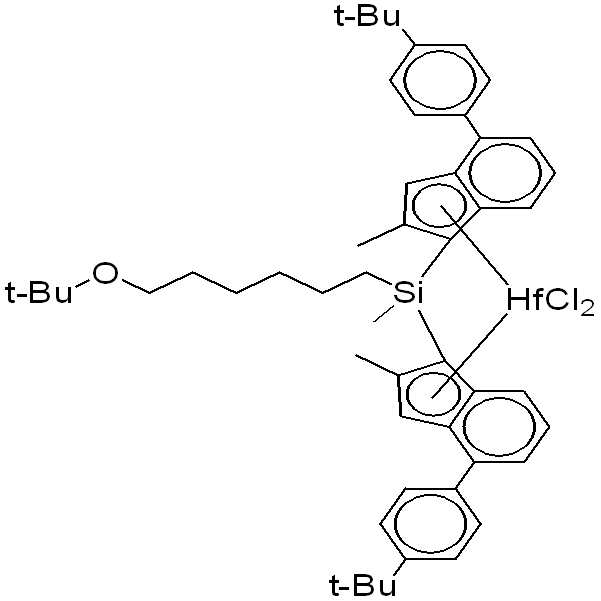

1H NMR (500 MHz, CDCl3, 7.26 ppm): 1.19-1.78 (37H, m), 2.33 (3H, s), 2.34 (3H, s), 3.37 (2H, t), 6.91 (2H, s), 7.05-7.71 (14H, m) 1 H NMR (500 MHz, CDCl 3, 7.26 ppm): 1.19-1.78 (37H, m), 2.33 (3H, s), 2.34 (3H, s), 3.37 (2H, t), 6.91 (2H, s) , 7.05-7.71 (14 H, m)
[단계 3][Step 3]
상기 단계 2에서 얻은 생성물을 제외한 여액에서 용매를 감압 건조하고, 톨루엔 200 mL를 투입하여 슬러리 상태로 상온에서 6 시간 동안 교반한 후 필터하여 meso-[(6-t-부톡시헥실메틸실란디일)-비스(2-메틸-4-(4-t-부틸페닐)인데닐)]하프늄 디클로라이드를 선택적으로 분리하였다.The solvent was removed from the filtrate except for the product obtained in the step 2, and the filtrate was dried under reduced pressure, and 200 mL of toluene was added thereto. The mixture was stirred at room temperature for 6 hours in a slurry state and then filtered to obtain meso - [(6-t-butoxyhexylmethylsilanediyl ) -Bis (2-methyl-4- (4-t-butylphenyl) indenyl)] hafnium dichloride.
실시예Example 1 One
실리카 3 g을 쉬링크 플라스크에 미리 칭량한 후, 메틸알루미녹산(MAO) 39 mmol을 넣어 90℃에서 24시간 동안 반응시켰다. 침전 후 상층부를 제거하고 톨루엔으로 1회 세척하였다.3 g of silica was preliminarily weighed in a shrinkage flask, and 39 mmol of methylaluminoxane (MAO) was added thereto, followed by reaction at 90 DEG C for 24 hours. After precipitation, the upper layer was removed and washed once with toluene.
여기에, 상기 합성예 2에서 얻은 meso-[(6-t-부톡시헥실메틸실란-디일)-비스(2-메틸-4-(4-터트-부틸페닐)인데닐)]하프늄 디클로라이드 (30 마이크로몰, 톨루엔 용액) 및 rac-[(6-t-부톡시헥실메틸실란-디일)-비스(2-메틸-4-(4-터트-부틸페닐)인데닐)]하프늄 디클로라이드 (75 마이크로몰, 톨루엔 용액)를 첨가하고, 75℃에서 5시간 동안 반응시켰다. 반응 종료 후 침전이 끝나면, 상층부 용액을 제거하고 남은 반응 생성물을 톨루엔으로 1회 세척하였다.To this was added the meso - [(6-t-butoxyhexylmethylsilane-diyl) -bis (2-methyl-4- (4-tert- butylphenyl) indenyl)] hafnium dichloride 30 micromole in toluene solution) and rac - [(6-t-butoxyhexylmethylsilane-diyl) -bis (2-methyl-4- (4- tert- butylphenyl) indenyl)] hafnium dichloride Micro mol, toluene solution) was added, and the mixture was reacted at 75 DEG C for 5 hours. After completion of the reaction, when the precipitation was completed, the upper layer solution was removed and the remaining reaction product was washed once with toluene.
이어서, 상기 합성예 1에서 얻은 rac-[(6-t-부톡시헥실메틸실란-디일)-비스(2-메틸-4-(4-터트-부틸페닐)인데닐)]지르코륨 디클로라이드 (15 마이크로몰, 톨루엔 용액)을 첨가하고, 75℃에서 2시간 동안 반응시켰다. 반응 종료 후 침전이 끝나면, 상층부 용액을 제거하고 남은 반응 생성물을 톨루엔으로 1회 세척하였다.Subsequently, a solution of rac - [(6-t-butoxyhexylmethylsilane-diyl) -bis (2-methyl-4- (4-tert- butylphenyl) indenyl)] zirconium dichloride 15 mu moles, toluene solution) was added and reacted at 75 DEG C for 2 hours. After completion of the reaction, when the precipitation was completed, the upper layer solution was removed and the remaining reaction product was washed once with toluene.
반응 생성물을 헥산으로 재차 세척하고 진공 건조하여 고체 입자 형태의 혼성 담지 촉매 (meso: rac = 1: 3)를 얻었다.The reaction product was washed again with hexane and vacuum dried to obtain a solid supported catalyst (meso: rac = 1: 3) in the form of solid particles.
실시예Example 2 2
메탈로센 화합물의 함량을, 50 마이크로몰의 meso-[(6-t-부톡시헥실메틸실란-디일)-비스(2-메틸-4-(4-터트-부틸페닐)인데닐)]하프늄 디클로라이드, 20 마이크로몰의 rac-[(6-t-부톡시헥실메틸실란-디일)-비스(2-메틸-4-(4-터트-부틸페닐)인데닐)]지르코륨 디클로라이드, 및 50 마이크로몰의 rac-[(6-t-부톡시헥실메틸실란-디일)-비스(2-메틸-4-(4-터트-부틸페닐)인데닐)]하프늄 디클로라이드로 변경한 것을 제외하고, 상기 실시예 1과 동일한 방법으로 혼성 담지 촉매 (meso: rac = 1: 1.4)를 얻었다.The content of the metallocene compound was changed to 50 micromoles of meso - [(6-t-butoxyhexylmethylsilane-diyl) -bis (2-methyl- (2-methyl-4- (4-tert-butylphenyl) indenyl)] zirconium dichloride, and 20 micromoles of rac - [(6-t-butoxyhexylmethylsilane- Except for changing to 50 micromoles of rac - [(6-t-butoxyhexylmethylsilane-diyl) -bis (2-methyl-4- (4- tert- butylphenyl) indenyl)] hafnium dichloride , A mixed supported catalyst (meso: rac = 1: 1.4) was obtained in the same manner as in Example 1 above.
실시예Example 3 3
메탈로센 화합물의 함량을, 69 마이크로몰의 meso-[(6-t-부톡시헥실메틸실란-디일)-비스(2-메틸-4-(4-터트-부틸페닐)인데닐)]하프늄 디클로라이드, 20 마이크로몰의 rac-[(6-t-부톡시헥실메틸실란-디일)-비스(2-메틸-4-(4-터트-부틸페닐)인데닐)]지르코륨 디클로라이드, 및 31 마이크로몰의 rac-[(6-t-부톡시헥실메틸실란-디일)-비스(2-메틸-4-(4-터트-부틸페닐)인데닐)]하프늄 디클로라이드로 변경한 것을 제외하고, 상기 실시예 1과 동일한 방법으로 혼성 담지 촉매 (meso: rac = 1: 0.74)를 얻었다.The content of the metallocene compound was changed to 69 micromoles of meso - [(6-t-butoxyhexylmethylsilane-diyl) -bis (2-methyl- 4- (4-tert- butylphenyl) indenyl)] hafnium (2-methyl-4- (4-tert-butylphenyl) indenyl)] zirconium dichloride, and 20 micromoles of rac - [(6-t-butoxyhexylmethylsilane- Except that 31 micromoles of rac - [(6-t-butoxyhexylmethylsilane-diyl) -bis (2-methyl-4- (4-tert- butylphenyl) indenyl)] hafnium dichloride were used , A mixed supported catalyst (meso: rac = 1: 0.74) was obtained in the same manner as in Example 1 above.
실시예Example 4 4
메탈로센 화합물의 함량을, 75 마이크로몰의 meso-[(6-t-부톡시헥실메틸실란-디일)-비스(2-메틸-4-(4-터트-부틸페닐)인데닐)]하프늄 디클로라이드, 20 마이크로몰의 rac-[(6-t-부톡시헥실메틸실란-디일)-비스(2-메틸-4-(4-터트-부틸페닐)인데닐)]지르코륨 디클로라이드, 및 25 마이크로몰의 rac-[(6-t-부톡시헥실메틸실란-디일)-비스(2-메틸-4-(4-터트-부틸페닐)인데닐)]하프늄 디클로라이드로 변경한 것을 제외하고, 상기 실시예 1과 동일한 방법으로 혼성 담지 촉매 (meso: rac = 1: 0.6)를 얻었다.The content of the metallocene compound was changed to 75 micromoles of meso - [(6-t-butoxyhexylmethylsilane-diyl) -bis (2-methyl- (2-methyl-4- (4-tert-butylphenyl) indenyl)] zirconium dichloride, and 20 micromoles of rac - [(6-t-butoxyhexylmethylsilane- Except for changing to 25 micromoles of rac - [(6-t-butoxyhexylmethylsilane-diyl) -bis (2-methyl-4- (4- tert- butylphenyl) indenyl)] hafnium dichloride , A mixed supported catalyst (meso: rac = 1: 0.6) was obtained in the same manner as in Example 1 above.
비교예Comparative Example 1 One
실리카 3 g을 쉬링크 플라스크에 미리 칭량한 후, 메틸알루미녹산(MAO) 52 mmol을 넣어 90℃에서 24시간 동안 반응시켰다. 침전 후 상층부를 제거하고 톨루엔으로 1회 세척하였다.3 g of silica was preliminarily weighed in a shrinking flask, and then 52 mmol of methylaluminoxane (MAO) was added thereto, followed by reaction at 90 ° C for 24 hours. After precipitation, the upper layer was removed and washed once with toluene.
여기에, 상기 합성예 1에서 얻은 rac-[(6-t-부톡시헥실메틸실란-디일)-비스(2-메틸-4-(4-터트-부틸페닐)인데닐)]지르코륨 디클로라이드 (270 마이크로몰, 톨루엔 용액)를 첨가하고, 75℃에서 5시간 동안 반응시켰다. 반응 종료 후 침전이 끝나면, 상층부 용액을 제거하고 남은 반응 생성물을 톨루엔으로 1회 세척하였다.To this was added dropwise a solution of rac - [(6-t-butoxyhexylmethylsilane-diyl) -bis (2-methyl-4- (4-tert- butylphenyl) indenyl)] zirconium dichloride (270 micromoles, toluene solution), and the mixture was reacted at 75 DEG C for 5 hours. After completion of the reaction, when the precipitation was completed, the upper layer solution was removed and the remaining reaction product was washed once with toluene.
여기에, N,N-dimethylanilinium tetrakis(pentafluorophenyl)borate 216 마이크로몰을 첨가하고 70℃에서 5 시간 동안 반응시켰다. 반응이 종료된 후 톨루엔으로 세척하였고, 헥산으로 재차 세척한 후 진공 건조하여 고체 입자 상태의 실리카 담지 메탈로센 촉매를 얻었다.To this was added 216 micromoles of N, N-dimethylanilinium tetrakis (pentafluorophenyl) borate and reacted at 70 ° C for 5 hours. After completion of the reaction, the reaction solution was washed with toluene, washed again with hexane, and vacuum dried to obtain a silica-supported metallocene catalyst in a solid state.
비교예Comparative Example 2 2
실리카 3 g을 쉬링크 플라스크에 미리 칭량한 후, 메틸알루미녹산(MAO) 39 mmol을 넣어 90℃에서 24시간 동안 반응시켰다. 침전 후 상층부를 제거하고 톨루엔으로 1회 세척하였다.3 g of silica was preliminarily weighed in a shrinkage flask, and 39 mmol of methylaluminoxane (MAO) was added thereto, followed by reaction at 90 DEG C for 24 hours. After precipitation, the upper layer was removed and washed once with toluene.
여기에, 상기 합성예 2에서 얻은 rac-[(6-t-부톡시헥실메틸실란-디일)-비스(2-메틸-4-(4-터트-부틸페닐)인데닐)]하프늄 디클로라이드 (270 마이크로몰, 톨루엔 용액)를 첨가하고, 70℃에서 5시간 동안 반응시켰다. 반응 종료 후 침전이 끝나면, 상층부 용액을 제거하고 남은 반응 생성물을 톨루엔으로 1회 세척하였다.To this was added a solution of rac - [(6-t-butoxyhexylmethylsilane-diyl) -bis (2-methyl-4- (4-tert- butylphenyl) indenyl)] hafnium dichloride 270 micromoles, toluene solution) was added and reacted at 70 ° C for 5 hours. After completion of the reaction, when the precipitation was completed, the upper layer solution was removed and the remaining reaction product was washed once with toluene.
여기에, N,N-dimethylanilinium tetrakis(pentafluorophenyl)borate 216 마이크로몰을 첨가하고 70℃에서 5 시간 동안 반응시켰다. 반응이 종료된 후 톨루엔으로 세척하였고, 헥산으로 재차 세척한 후 진공 건조하여 고체 입자 상태의 실리카 담지 메탈로센 촉매를 얻었다.To this was added 216 micromoles of N, N-dimethylanilinium tetrakis (pentafluorophenyl) borate and reacted at 70 ° C for 5 hours. After completion of the reaction, the reaction solution was washed with toluene, washed again with hexane, and vacuum dried to obtain a silica-supported metallocene catalyst in a solid state.
시험예Test Example 1 One
2 L 스테인레스 반응기를 65℃에서 진공 건조한 후, 실온에서 트리에틸알루미늄 3.0 mmol, 수소 2 bar 및 프로필렌 770 g을 순차적으로 투입하였다. 이후 10분 동안 교반한 후, 상기 실시예 및 비교예에서 제조한 각각의 촉매 45 mg을 헥산 TMA 처방된 20 mL에 녹여 질소 압력으로 반응기에 투입하였다. 이후 반응기 온도를 70℃까지 승온시키면서 12000 cc의 에틸렌을 주입하면서 1시간 동안 중합하여 프로필렌 랜덤 폴리머를 얻었다.A 2 L stainless steel reactor was vacuum dried at 65 DEG C, and then 3.0 mmol of triethylaluminum, 2 bar of hydrogen and 770 g of propylene were sequentially introduced at room temperature. After stirring for 10 minutes, 45 mg of each catalyst prepared in the above Examples and Comparative Examples was dissolved in 20 mL of hexane TMA, and the reactor was charged under a nitrogen pressure. Thereafter, while the temperature of the reactor was raised to 70 占 폚, polymerization was carried out for 1 hour while injecting 12,000 cc of ethylene to obtain a propylene random polymer.
시험예Test Example 2 2
상기 시험예 1에 따른 프로필렌 중합체의 제조에서 다음과 같은 물성을 측정하였다.In the production of the propylene polymer according to Test Example 1, the following properties were measured.
(1) 촉매 활성: 단위 시간(h)을 기준으로 사용된 촉매 함량 (촉매의 mmol 및 g)당 생성된 중합체의 무게(kg)의 비로 계산하였다.(1) Catalytic activity: Calculated as the ratio of the weight of polymer produced per kilogram of catalyst used (mmol and g of catalyst) based on unit time (h).
(2) 중합체의 녹는점(Tm): 시차주사열량계(Differential Scanning Calorimeter, DSC, 장치명: DSC 2920, 제조사: TA instrument)를 이용하여 중합체의 녹는점을 측정하였다. 구체적으로 중합체를 220℃까지 가열한 후 5분 동안 그 온도를 유지하였고, 다시 20℃까지 내린 후 다시 온도를 증가시켰으며, 이때 온도의 상승속도와 하강속도는 각각 10℃/min으로 조절하였다.(2) Melting point (Tm) of polymer: The melting point of the polymer was measured using a differential scanning calorimeter (DSC, DSC 2920, manufacturer: TA instrument). Specifically, the polymer was heated to 220 ° C., and then the temperature was maintained for 5 minutes. After the temperature was lowered to 20 ° C., the temperature was increased again. The temperature rising rate and the falling rate were controlled at 10 ° C./min.
(3) 중합체의 자일렌 가용분(XS): 샘플에 자일렌을 넣고 135℃에서 1 시간 동안 가열하고, 30 분 동안 냉각하여 전처리하였다. OminiSec (Viscotek사 FIPA 장비)에서 1 ml/min Flow rate으로 전처리한 샘플을 측정한 후 Refractive index 피크 면적을 계산하였다.(3) Xylene-soluble fraction (XS) of polymer: Xylene was added to the sample, and the mixture was heated at 135 占 폚 for 1 hour, cooled for 30 minutes, and then pretreated. The sample was pretreated with OmliSec (Viscotek FIPA equipment) at a flow rate of 1 ml / min and the peak area of the refractive index was calculated.
(kg PP/g Cat.*hr)Catalytic activity
(kg PP / g Cat. * hr)
Tm (℃)Polymer
Tm (占 폚)
XS (중량%)Polymer
XS (% by weight)
상기 표 1을 참고하면, 비교예 1 및 비교예 2는 중합체의 자일렌 가용분이 1 중량% 미만으로 제한된 반면, 실시예들은 중합에 이용된 메조 및 라세믹 형태의 메탈로센 화합물의 몰 비에 따라 중합체의 자일렌 가용분이 1.3 내지 2.7 중량%의 범위에서 제어될 수 있음이 확인되었다. Referring to Table 1 above, Comparative Example 1 and Comparative Example 2 showed that the xylene solubles in the polymer were limited to less than 1 wt%, while the examples showed that the molar ratio of the mesocene compound in meso and racemic form It was confirmed that the xylene solubles in the polymer could be controlled in the range of 1.3 to 2.7 wt%.
Claims (9)
상기 메탈로센 화합물은, 하기 화학식 1로 표시되는 메조 형태의 메탈로센 화합물과, 하기 화학식 2a로 표시되는 화합물 및 하기 화학식 2b로 표시되는 화합물로 이루어진 군에서 선택된 1종 이상의 라세믹 형태의 메탈로센 화합물을 1: 0.5 내지 1: 5의 몰 비로 포함하는, 프로필렌 중합용 혼성 담지 촉매 시스템:
[화학식 1]

[화학식 2a]

[화학식 2b]

상기 화학식 1, 2a 및 2b에서,
X1 및 X2는 각각 독립적으로 할로겐이고,
R1 및 R1'는 각각 독립적으로 탄소수 1 내지 20의 알킬로 치환된 탄소수 6 내지 20의 아릴이고,
R2, R3, R4, R2', R3', 및 R4'는 각각 독립적으로 수소, 할로겐, 탄소수 1 내지 20의 알킬, 탄소수 2 내지 20의 알케닐, 탄소수 1 내지 20의 알킬실릴, 탄소수 1 내지 20의 실릴알킬, 탄소수 1 내지 20의 알콕시실릴, 탄소수 1 내지 20의 에테르, 탄소수 1 내지 20의 실릴에테르, 탄소수 1 내지 20의 알콕시, 탄소수 6 내지 20의 아릴, 탄소수 7 내지 20의 알킬아릴, 또는 탄소수 7 내지 20의 아릴알킬이고,
A는 각각 독립적으로 탄소, 실리콘 또는 게르마늄이고,
R5 및 R5'는 각각 독립적으로 탄소수 1 내지 20의 알콕시로 치환된 탄소수 1 내지 20의 알킬이고,
R6 및 R6'는 각각 독립적으로 탄소수 1 내지 20의 알킬 또는 탄소수 2 내지 20의 알케닐이다.
A carrier and a metallocene compound carried on the carrier;
Wherein the metallocene compound is at least one racemic metal selected from the group consisting of a meso-type metallocene compound represented by the following formula (1), a compound represented by the following formula (2a) and a compound represented by the following formula Mixed catalyst system for propylene polymerization, wherein the propylene polymer has a molar ratio of 1: 0.5 to 1: 5.
[Chemical Formula 1]
(2a)
(2b)
In the above general formulas (1), (2a) and (2b)
X 1 and X 2 are each independently halogen,
R 1 and R 1 ' are each independently an aryl having 6 to 20 carbon atoms substituted with an alkyl having 1 to 20 carbon atoms,
R 2 , R 3 , R 4 , R 2 ' , R 3' and R 4 ' each independently represents hydrogen, halogen, alkyl of 1 to 20 carbon atoms, alkenyl of 2 to 20 carbon atoms, Silyl, C 1 -C 20 silylalkyl, C 1 -C 20 alkoxysilyl, C 1 -C 20 ether, C 1 -C 20 silyl ether, C 1 -C 20 alkoxy, C 6 -C 20 aryl, Or an arylalkyl having 7 to 20 carbon atoms,
A is each independently carbon, silicon or germanium,
R 5 and R 5 ' are each independently alkyl of 1 to 20 carbon atoms substituted by alkoxy of 1 to 20 carbon atoms,
R 6 and R 6 ' are each independently an alkyl having 1 to 20 carbon atoms or an alkenyl having 2 to 20 carbon atoms.
상기 R1 및 R1'는 각각 4-터트-부틸페닐인, 프로필렌 중합용 혼성 담지 촉매 시스템.
The method according to claim 1,
Wherein R 1 and R 1 ' are each 4-tert-butylphenyl.
상기 R2, R3, R4, R2', R3', 및 R4'는 각각 수소인, 프로필렌 중합용 혼성 담지 촉매 시스템.
The method according to claim 1,
Wherein R 2 , R 3 , R 4 , R 2 ' , R 3' and R 4 ' are each hydrogen.
상기 A는 실리콘인, 프로필렌 중합용 혼성 담지 촉매 시스템.
The method according to claim 1,
Wherein A is silicon, for propylene polymerization.
상기 R5 및 R5'는 각각 6-터트-부톡시헥실이고, 상기 R6 및 R6'는 각각 메틸인, 프로필렌 중합용 혼성 담지 촉매 시스템.
The method according to claim 1,
Wherein R 5 and R 5 ' are each 6-tert-butoxyhexyl, and R 6 and R 6' are each methyl.
상기 혼성 담지 촉매 시스템은 하기 화학식 3 내지 5로 표시되는 화합물로 이루어진 군에서 선택된 1종 이상의 조촉매를 추가로 포함하는, 프로필렌 중합용 혼성 담지 촉매 시스템:
[화학식 3]
-[Al(R31)-O]c-
상기 화학식 3에서,
c는 2 이상의 정수이고,
R31은 각각 독립적으로 할로겐, 탄소수 1 내지 20의 하이드로카빌 또는 할로겐으로 치환된 탄소수 1 내지 20의 하이드로카빌이고;
[화학식 4]
D(R41)3
상기 화학식 4에서,
D는 알루미늄 또는 보론이고,
R41은 각각 독립적으로 할로겐, 탄소수 1 내지 20의 하이드로카빌 또는 할로겐으로 치환된 탄소수 1 내지 20의 하이드로카빌이고;
[화학식 5]
[L-H]+[Q(E)4]-
상기 화학식 5에서,
L은 중성 루이스 염기이고,
[L-H]+는 브론스테드 산이며,
Q는 +3 형식 산화 상태의 붕소 또는 알루미늄이고,
E는 각각 독립적으로 1 이상의 수소 원자가 할로겐, 탄소수 1 내지 20의 하이드로카빌, 알콕시 또는 페녹시 작용기로 치환 또는 비치환된 탄소수 6 내지 20의 아릴, 또는 탄소수 1 내지 20의 알킬이다.
The method according to claim 1,
Wherein the hybrid supported catalyst system further comprises at least one cocatalyst selected from the group consisting of compounds represented by the following Chemical Formulas 3 to 5:
(3)
- [Al (R 31) -O ] c -
In Formula 3,
c is an integer of 2 or more,
R 31 is each independently halogen, a hydrocarbyl of 1 to 20 carbon atoms or a hydrocarbyl of 1 to 20 carbon atoms substituted by halogen;
[Chemical Formula 4]
D (R < 41 > ) 3
In Formula 4,
D is aluminum or boron,
R 41 is each independently a halogen, a hydrocarbyl of 1 to 20 carbon atoms or a hydrocarbyl of 1 to 20 carbon atoms substituted by halogen;
[Chemical Formula 5]
[LH] + [Q (E) 4 ] -
In Formula 5,
L is a neutral Lewis base,
[LH] + is Bronsted acid,
Q is boron or aluminum in the +3 type oxidation state,
E each independently represent a hydrogen atom of at least one of which is substituted by halogen, a hydrocarbyl of 1 to 20 carbon atoms, an alkoxy or phenoxy functional group, aryl of 6 to 20 carbon atoms, or alkyl of 1 to 20 carbon atoms.
상기 조촉매는 트리메틸 알루미늄(trimethyl aluminium), 트리에틸 알루미늄(triethyl aluminium), 트리이소프로필 알루미늄(triisopropyl aluminium), 트리이소부틸 알루미늄(triisobutyl aluminum), 에틸알루미늄 세스퀴클로라이드(ethylaluminum sesquichloride), 디에틸알루미늄 클로라이드(diethylaluminum chloride), 에틸 알루미늄 디클로라이드(ethyl aluminium dichloride), 메틸알루미녹산(methylaluminoxane), 및 개질된 메틸알루미녹산(modified methylaluminoxane)으로 이루어진 군에서 선택된 1종 이상의 화합물인, 프로필렌 중합용 혼성 담지 촉매 시스템.
The method according to claim 6,
The cocatalyst may be selected from the group consisting of trimethyl aluminum, triethyl aluminum, triisopropyl aluminum, triisobutyl aluminum, ethylaluminum sesquichloride, diethyl aluminum Wherein at least one compound selected from the group consisting of diethylaluminum chloride, ethyl aluminum dichloride, methylaluminoxane, and modified methylaluminoxane, system.
A process for preparing a propylene polymer, comprising polymerizing an olefin monomer including propylene in the presence of the hybrid supported catalyst system according to claim 1.
상기 프로필렌 중합체는 1 내지 5 중량%의 자일렌 가용분(xylene solubles)을 갖는, 프로필렌 중합체의 제조 방법.9. The method of claim 8,
Wherein the propylene polymer has from 1 to 5% by weight xylene solubles.
Priority Applications (1)
| Application Number | Priority Date | Filing Date | Title |
|---|---|---|---|
| KR1020150148847A KR102101878B1 (en) | 2015-10-26 | 2015-10-26 | Supported hybrid catalyst system for propylene polymerization and method for preparing propylene polymer with the catalyst system |
Applications Claiming Priority (1)
| Application Number | Priority Date | Filing Date | Title |
|---|---|---|---|
| KR1020150148847A KR102101878B1 (en) | 2015-10-26 | 2015-10-26 | Supported hybrid catalyst system for propylene polymerization and method for preparing propylene polymer with the catalyst system |
Publications (2)
| Publication Number | Publication Date |
|---|---|
| KR20170048012A true KR20170048012A (en) | 2017-05-08 |
| KR102101878B1 KR102101878B1 (en) | 2020-04-17 |
Family
ID=60163968
Family Applications (1)
| Application Number | Title | Priority Date | Filing Date |
|---|---|---|---|
| KR1020150148847A Active KR102101878B1 (en) | 2015-10-26 | 2015-10-26 | Supported hybrid catalyst system for propylene polymerization and method for preparing propylene polymer with the catalyst system |
Country Status (1)
| Country | Link |
|---|---|
| KR (1) | KR102101878B1 (en) |
Cited By (3)
| Publication number | Priority date | Publication date | Assignee | Title |
|---|---|---|---|---|
| KR20190074799A (en) * | 2017-12-20 | 2019-06-28 | 주식회사 엘지화학 | Method for preparing supported hybrid metallocene catalyst, and method for preparing polypropylene using supported hybrid metallocene catalyst |
| CN111793159A (en) * | 2020-01-16 | 2020-10-20 | 深圳市沃尔电力技术有限公司 | Production method and processing equipment of high-voltage insulation direct-current cable accessory material |
| US11358979B2 (en) | 2017-12-26 | 2022-06-14 | Lg Chem, Ltd. | Metallocene-supported catalyst and method for preparing polypropylene using the same |
Citations (3)
| Publication number | Priority date | Publication date | Assignee | Title |
|---|---|---|---|---|
| JP2002504569A (en) * | 1998-02-19 | 2002-02-12 | バーゼル、ポリプロピレン、ゲゼルシャフト、ミット、ベシュレンクテル、ハフツング | Catalyst composition, process for producing the same, and use of the catalyst composition in the polymerization of olefins |
| KR20140133343A (en) * | 2013-05-10 | 2014-11-19 | 주식회사 엘지화학 | Catalyst for olefin polymerization and preparation method of polyolefin by using the same |
| KR101499819B1 (en) * | 2011-11-03 | 2015-03-10 | 주식회사 엘지화학 | Non-supported heterogeous catalyst composition for polymerizing polyolefin and preparation method of the same |
-
2015
- 2015-10-26 KR KR1020150148847A patent/KR102101878B1/en active Active
Patent Citations (3)
| Publication number | Priority date | Publication date | Assignee | Title |
|---|---|---|---|---|
| JP2002504569A (en) * | 1998-02-19 | 2002-02-12 | バーゼル、ポリプロピレン、ゲゼルシャフト、ミット、ベシュレンクテル、ハフツング | Catalyst composition, process for producing the same, and use of the catalyst composition in the polymerization of olefins |
| KR101499819B1 (en) * | 2011-11-03 | 2015-03-10 | 주식회사 엘지화학 | Non-supported heterogeous catalyst composition for polymerizing polyolefin and preparation method of the same |
| KR20140133343A (en) * | 2013-05-10 | 2014-11-19 | 주식회사 엘지화학 | Catalyst for olefin polymerization and preparation method of polyolefin by using the same |
Cited By (4)
| Publication number | Priority date | Publication date | Assignee | Title |
|---|---|---|---|---|
| KR20190074799A (en) * | 2017-12-20 | 2019-06-28 | 주식회사 엘지화학 | Method for preparing supported hybrid metallocene catalyst, and method for preparing polypropylene using supported hybrid metallocene catalyst |
| US11358979B2 (en) | 2017-12-26 | 2022-06-14 | Lg Chem, Ltd. | Metallocene-supported catalyst and method for preparing polypropylene using the same |
| CN111793159A (en) * | 2020-01-16 | 2020-10-20 | 深圳市沃尔电力技术有限公司 | Production method and processing equipment of high-voltage insulation direct-current cable accessory material |
| CN111793159B (en) * | 2020-01-16 | 2021-04-06 | 深圳市沃尔电力技术有限公司 | Production method and processing equipment of high-voltage insulation direct-current cable accessory material |
Also Published As
| Publication number | Publication date |
|---|---|
| KR102101878B1 (en) | 2020-04-17 |
Similar Documents
| Publication | Publication Date | Title |
|---|---|---|
| JP7226892B2 (en) | TRANSITION METAL COMPOUND AND CATALYST COMPOSITION CONTAINING THE SAME | |
| JP6469832B2 (en) | Ligand compound, transition metal compound and catalyst composition containing the same | |
| KR101768193B1 (en) | Metallocene supported catalyst and method for preparing polyolefin using the same | |
| KR20170106192A (en) | Supported hybrid catalyst system for ethylene slurry polymerization and method for preparing ethylene polymer with the catalyst system | |
| KR102050071B1 (en) | Supported hybrid catalyst system for propylene polymerization and method for preparing propylene polymer with the catalyst system | |
| US11731123B2 (en) | Method of preparing supported metallocene catalyst and method of preparing polypropylene using catalyst prepared thereby | |
| KR101737568B1 (en) | Supported hybrid catalyst and method for preparing of olefin based polymer using the same | |
| KR20190074798A (en) | Supported hybrid metallocene catalyst and method for preparing of polyolefin using the same | |
| CN108026209B (en) | High-rigidity and energy-saving polypropylene for foaming | |
| KR102080640B1 (en) | Supported hybrid catalyst and method for preparing of olefin based polymer using the same | |
| JP7214300B2 (en) | Transition metal compound, catalyst composition and method for producing polypropylene using the same | |
| KR101785705B1 (en) | Catalyst composition and method for preparing polyolefin using the same | |
| KR102101878B1 (en) | Supported hybrid catalyst system for propylene polymerization and method for preparing propylene polymer with the catalyst system | |
| KR102086767B1 (en) | Propylene-alpha olefin copolymer | |
| KR101734427B1 (en) | Supported catalyst and method for preparing of olefin based polymer using the same | |
| KR102418590B1 (en) | Method for preparing supported hybrid metallocene catalyst, and method for preparing polypropylene using supported hybrid metallocene catalyst | |
| KR102157787B1 (en) | Metallocene supported catalyst and method for preparing polypropylene using the same | |
| KR20170001424A (en) | Catalyst system and process for preparing polyolefins | |
| WO2019132346A1 (en) | Method for preparing supported metallocene catalyst, and method for preparing polypropylene by using catalyst prepared thereby | |
| KR20230072858A (en) | Method for preparing polypropylene copolymer | |
| KR20230072857A (en) | Method for preparing polypropylene | |
| KR20170073446A (en) | Metallocene compound, catalyst system for olefin polymerization comprising the metallocene compound and method for preparing polyolefin with the catalyst system | |
| KR20200056202A (en) | Method for preparing polyolefin using catalysts composition comprising transition metal compounds | |
| KR20160144208A (en) | Supported metallocene catalyst and preparation of preparing polyolefin using the same |
Legal Events
| Date | Code | Title | Description |
|---|---|---|---|
| PA0109 | Patent application |
Patent event code: PA01091R01D Comment text: Patent Application Patent event date: 20151026 |
|
| PG1501 | Laying open of application | ||
| A201 | Request for examination | ||
| PA0201 | Request for examination |
Patent event code: PA02012R01D Patent event date: 20180423 Comment text: Request for Examination of Application Patent event code: PA02011R01I Patent event date: 20151026 Comment text: Patent Application |
|
| E902 | Notification of reason for refusal | ||
| PE0902 | Notice of grounds for rejection |
Comment text: Notification of reason for refusal Patent event date: 20190613 Patent event code: PE09021S01D |
|
| E902 | Notification of reason for refusal | ||
| PE0902 | Notice of grounds for rejection |
Comment text: Notification of reason for refusal Patent event date: 20191113 Patent event code: PE09021S01D |
|
| E701 | Decision to grant or registration of patent right | ||
| PE0701 | Decision of registration |
Patent event code: PE07011S01D Comment text: Decision to Grant Registration Patent event date: 20200330 |
|
| PR0701 | Registration of establishment |
Comment text: Registration of Establishment Patent event date: 20200410 Patent event code: PR07011E01D |
|
| PR1002 | Payment of registration fee |
Payment date: 20200410 End annual number: 3 Start annual number: 1 |
|
| PG1601 | Publication of registration | ||
| PR1001 | Payment of annual fee |
Payment date: 20240320 Start annual number: 5 End annual number: 5 |