KR20160102821A - Thienodiazepine derivatives or pharmaceutically acceptable salt thereof, and pharmaceutical composition comprising the same as an active ingredient - Google Patents
Thienodiazepine derivatives or pharmaceutically acceptable salt thereof, and pharmaceutical composition comprising the same as an active ingredient Download PDFInfo
- Publication number
- KR20160102821A KR20160102821A KR1020150025384A KR20150025384A KR20160102821A KR 20160102821 A KR20160102821 A KR 20160102821A KR 1020150025384 A KR1020150025384 A KR 1020150025384A KR 20150025384 A KR20150025384 A KR 20150025384A KR 20160102821 A KR20160102821 A KR 20160102821A
- Authority
- KR
- South Korea
- Prior art keywords
- phenyl
- dihydro
- diazepin
- thieno
- oxo
- Prior art date
- Legal status (The legal status is an assumption and is not a legal conclusion. Google has not performed a legal analysis and makes no representation as to the accuracy of the status listed.)
- Granted
Links
Images

Classifications
-
- C—CHEMISTRY; METALLURGY
- C07—ORGANIC CHEMISTRY
- C07D—HETEROCYCLIC COMPOUNDS
- C07D495/00—Heterocyclic compounds containing in the condensed system at least one hetero ring having sulfur atoms as the only ring hetero atoms
- C07D495/02—Heterocyclic compounds containing in the condensed system at least one hetero ring having sulfur atoms as the only ring hetero atoms in which the condensed system contains two hetero rings
- C07D495/04—Ortho-condensed systems
-
- A—HUMAN NECESSITIES
- A61—MEDICAL OR VETERINARY SCIENCE; HYGIENE
- A61K—PREPARATIONS FOR MEDICAL, DENTAL OR TOILETRY PURPOSES
- A61K31/00—Medicinal preparations containing organic active ingredients
- A61K31/33—Heterocyclic compounds
- A61K31/395—Heterocyclic compounds having nitrogen as a ring hetero atom, e.g. guanethidine or rifamycins
- A61K31/55—Heterocyclic compounds having nitrogen as a ring hetero atom, e.g. guanethidine or rifamycins having seven-membered rings, e.g. azelastine, pentylenetetrazole
- A61K31/551—Heterocyclic compounds having nitrogen as a ring hetero atom, e.g. guanethidine or rifamycins having seven-membered rings, e.g. azelastine, pentylenetetrazole having two nitrogen atoms, e.g. dilazep
-
- A—HUMAN NECESSITIES
- A61—MEDICAL OR VETERINARY SCIENCE; HYGIENE
- A61K—PREPARATIONS FOR MEDICAL, DENTAL OR TOILETRY PURPOSES
- A61K31/00—Medicinal preparations containing organic active ingredients
- A61K31/33—Heterocyclic compounds
- A61K31/395—Heterocyclic compounds having nitrogen as a ring hetero atom, e.g. guanethidine or rifamycins
- A61K31/55—Heterocyclic compounds having nitrogen as a ring hetero atom, e.g. guanethidine or rifamycins having seven-membered rings, e.g. azelastine, pentylenetetrazole
- A61K31/551—Heterocyclic compounds having nitrogen as a ring hetero atom, e.g. guanethidine or rifamycins having seven-membered rings, e.g. azelastine, pentylenetetrazole having two nitrogen atoms, e.g. dilazep
- A61K31/5513—1,4-Benzodiazepines, e.g. diazepam or clozapine
- A61K31/5517—1,4-Benzodiazepines, e.g. diazepam or clozapine condensed with five-membered rings having nitrogen as a ring hetero atom, e.g. imidazobenzodiazepines, triazolam
-
- A—HUMAN NECESSITIES
- A61—MEDICAL OR VETERINARY SCIENCE; HYGIENE
- A61K—PREPARATIONS FOR MEDICAL, DENTAL OR TOILETRY PURPOSES
- A61K9/00—Medicinal preparations characterised by special physical form
- A61K9/14—Particulate form, e.g. powders, Processes for size reducing of pure drugs or the resulting products, Pure drug nanoparticles
- A61K9/16—Agglomerates; Granulates; Microbeadlets ; Microspheres; Pellets; Solid products obtained by spray drying, spray freeze drying, spray congealing,(multiple) emulsion solvent evaporation or extraction
-
- A—HUMAN NECESSITIES
- A61—MEDICAL OR VETERINARY SCIENCE; HYGIENE
- A61K—PREPARATIONS FOR MEDICAL, DENTAL OR TOILETRY PURPOSES
- A61K9/00—Medicinal preparations characterised by special physical form
- A61K9/20—Pills, tablets, discs, rods
-
- A—HUMAN NECESSITIES
- A61—MEDICAL OR VETERINARY SCIENCE; HYGIENE
- A61K—PREPARATIONS FOR MEDICAL, DENTAL OR TOILETRY PURPOSES
- A61K9/00—Medicinal preparations characterised by special physical form
- A61K9/48—Preparations in capsules, e.g. of gelatin, of chocolate
-
- C—CHEMISTRY; METALLURGY
- C07—ORGANIC CHEMISTRY
- C07D—HETEROCYCLIC COMPOUNDS
- C07D243/00—Heterocyclic compounds containing seven-membered rings having two nitrogen atoms as the only ring hetero atoms
-
- C—CHEMISTRY; METALLURGY
- C07—ORGANIC CHEMISTRY
- C07D—HETEROCYCLIC COMPOUNDS
- C07D333/00—Heterocyclic compounds containing five-membered rings having one sulfur atom as the only ring hetero atom
-
- A—HUMAN NECESSITIES
- A61—MEDICAL OR VETERINARY SCIENCE; HYGIENE
- A61K—PREPARATIONS FOR MEDICAL, DENTAL OR TOILETRY PURPOSES
- A61K2300/00—Mixtures or combinations of active ingredients, wherein at least one active ingredient is fully defined in groups A61K31/00 - A61K41/00
Landscapes
- Chemical & Material Sciences (AREA)
- Organic Chemistry (AREA)
- Health & Medical Sciences (AREA)
- Life Sciences & Earth Sciences (AREA)
- Pharmacology & Pharmacy (AREA)
- Epidemiology (AREA)
- Medicinal Chemistry (AREA)
- Animal Behavior & Ethology (AREA)
- General Health & Medical Sciences (AREA)
- Public Health (AREA)
- Veterinary Medicine (AREA)
- Engineering & Computer Science (AREA)
- Bioinformatics & Cheminformatics (AREA)
- Heterocyclic Carbon Compounds Containing A Hetero Ring Having Oxygen Or Sulfur (AREA)
- Pharmaceuticals Containing Other Organic And Inorganic Compounds (AREA)
Abstract
본 발명은 신규한 티에노디아제핀 유도체, 이의 약학적으로 허용가능한 염, 및 이를 포함하는 약학적 조성물에 관한 것이다. 본 발명에 따른 티에노디아제핀 유도체 또는 이의 약학적으로 허용가능한 염은 c-Kit, FLT3, FMS, LYN, RAF1, VEGFR3, PDGFRa, PDGFRb, RET 등과 같은 단백질 키나아제에 대해 선택적인 저해 활성을 나타내어 비정상 세포 성장 질환의 예방 또는 치료용 약학적 조성물로 이용될 수 있다.The present invention relates to a novel thienodiazepine derivative, a pharmaceutically acceptable salt thereof, and a pharmaceutical composition containing the same. The thienodiazepine derivative or pharmaceutically acceptable salt thereof according to the present invention exhibits a selective inhibitory activity against protein kinases such as c-Kit, FLT3, FMS, LYN, RAF1, VEGFR3, PDGFRa, PDGFRb and RET, And can be used as a pharmaceutical composition for preventing or treating cell growth disorders.

Description
본 발명은 티에노디아제핀 유도체 또는 이의 약학적으로 허용가능한 염 및 이를 유효성분으로 포함하는 약학적 조성물에 관한 것이다.The present invention relates to a thienodiazepine derivative or a pharmaceutically acceptable salt thereof and a pharmaceutical composition comprising the same as an active ingredient.
수 년 동안 암 연구의 엄청난 진전에도 불구하고, 암은 여전히 세계적으로 사망원인 중 2위를 차지한다. 치료를 위해 암의 메커니즘에 대한 광범위한 연구는 많은 특정의 분자표적을 밝혀내었다. 사실, 암표적 치료는 매우 성공적이었는데, 특히 키나아제 저해제 (kinase inhibitors)의 경우가 그렇다. 단백질 키나아제는 단백질의 티로신, 세린, 및 트레오닌 잔기에 위치하는 하이드록시 그룹의 인산화를 촉매하는 효소로서, 세포의 성장, 분화, 및 증식을 유발하는 성장 인자 신호 전달에 중요한 역할을 담당하고 있다.Despite tremendous advances in cancer research for many years, cancer is still the second leading cause of death worldwide. Extensive research into the mechanisms of cancer for treatment has revealed many specific molecular targets. In fact, cancer-targeted therapies have been very successful, especially in the case of kinase inhibitors. Protein kinases are enzymes that catalyze the phosphorylation of hydroxyl groups located in the tyrosine, serine, and threonine residues of proteins, and play an important role in signaling growth factors that cause cell growth, differentiation, and proliferation.
생체의 항상성 유지를 위하여 생체 내 신호 전달 체계는 켜짐과 꺼짐이 원활하게 균형을 이루어야 한다. 그러나, 특정 단백질 키나아제의 돌연변이나 과발현은 정상적인 세포 내 신호 전달체계를 붕괴시켜 (주로 생체 내 신호 전달이 계속되는 상태) 암, 염증, 대사성 질환, 뇌 질환 등 다양한 질병을 유발한다.In order to maintain the homeostasis of the living body, the in vivo signal transmission system should be smoothly balanced on and off. However, mutations or overexpression of certain protein kinases disrupt the normal intracellular signaling pathway (predominantly in vivo signaling pathways), leading to a variety of diseases, including cancer, inflammation, metabolic disease, and brain disease.
인간 단백질 키나아제는 인간 전체 유전자의 약 1.7%에 해당하는 518 종이 존재하는 것으로 추정되는데 (Manning et al, Science, 2002, 298, 1912), 크게 티로신 단백질 키나아제 (90 종 이상)와 세린/트레오닌 단백질 키나아제로 양분한다. 티로신 단백질 키나아제는 20 개의 아과로 구분되는 58 종의 수용체 티로신 키나아제와, 10 개의 아과로 구분되는 32 종의 세포질/비수용체로 나눌 수 있다. 수용체 티로신 키나아제는 세포 표면에는 성장 인자를 수용할 수 있는 도메인과, 세포질에는 티로신 잔기를 인신화할 수 있는 활성부위를 갖고 있다. 성장 인자가 수용체 티로신 키나아제 세포 표면의 성장인자 수용체 자리에 결합되면, 수용체 티로신 키나아제는 중합체를 형성하고, 세포질의 티로신 잔기는 자가 인산화된다. 그리고 하위 계열 단백질들의 순차적인 인산화를 통해 신호 전달이 핵 내로 진행되어, 종국에는 암을 유발하는 전사 인자들이 과발현된다.Human protein kinases are estimated to contain 518 species, or 1.7% of all human genes (Manning et al., Science, 2002, 298, 1912), largely consisting of tyrosine protein kinases (over 90 species) and serine / threonine protein kinase Lt; / RTI > Tyrosine protein kinases can be divided into 20 subtypes of 58 receptor tyrosine kinases, and 10 subfamilies of 32 cytoplasmic / nonreceptor subtypes. The receptor tyrosine kinase has a domain capable of accepting growth factors on the cell surface and an active site capable of inducing a tyrosine residue in the cytoplasm. When the growth factor is bound to the growth factor receptor site on the receptor tyrosine kinase cell surface, the receptor tyrosine kinase forms a polymer and the cytoplasmic tyrosine residue is autophosphorylated. Sequential phosphorylation of the subgeneric proteins leads to signal transduction into the nucleus, eventually overexpressing cancer-causing transcription factors.
Raf는 세린/트레오닌(Ser/Thr) 단백질 키나아제이며, 세포막에서 활성화된 성장인자 수용체가 보내는 생체 신호를 핵 내로 전달하는 역할을 담당한다. 미토겐 활성화 단백질 키나아제 (mitogen-activated protein kinase/ MAPK) 신호 전달 체계는 세포 증식/ 분열/ 생존/ 세포 사멸 등에 필수적인데, 크게 세 가지 키나아제 {MAPK 키나아제 키나아제 (MAPKKK), MAPK 키나아제 (MAPKK), 그리고 MAPK}의 순차적인 인산화 과정으로 형성된다. Raf는 MAPK 키나아제 키나아제 (MAPKKK)이고, MEK는 MAPK 키나아제 (MAPKK)이고, 세포 밖 신호 조절 키나아제 (extracellular signal-regulated kinase; ERK)는 MAPK이다. 수용체가 활성화되면 작은 GTP 결합 단백질 (small GTP-binding protein)인 Ras가 활성화되고, Raf-MEK-ERK의 순차적인 인산화를 통해 핵 내로 MAPK 신호 전달이 이루어진다.Raf is a serine / threonine (Ser / Thr) protein kinase that plays a role in delivering biological signals from activated cell growth factor receptors into the nucleus. The mitogen-activated protein kinase (MAPK) signaling pathway is essential for cell proliferation / division / survival / cell death, and is largely dependent on three kinases: MAPK kinase kinase (MAPKKK), MAPK kinase MAPK}, which is a protein of the present invention. Raf is MAPK kinase kinase (MAPKKK), MEK is MAPK kinase (MAPKK), and extracellular signal-regulated kinase (ERK) is MAPK. Activation of the receptor activates Ras, a small GTP-binding protein, and MAPK signaling into the nucleus through sequential phosphorylation of Raf-MEK-ERK.
한편, 항상 활성화 상태를 유지하는 Ras 종양 유전자 (특히 k-Ras)는 췌장암 (약 90%), 직장암 (약 45%), 간암 (약 30%), 비소세포성 폐암 (약 35%), 신장암 (약 10%) 등의 고형암 유발과 밀접한 관계가 있다. Raf-1이 활성화된 Ras와 결합하고 Raf-1의 338번 세린이 인산화 (Avruch, J. Recent Progress in Hormone Research, 2001, 56, 127)되면 Raf-1이 활성화된다. 반면, 259번 세린이 인산화된 Raf-1에 14-3-3 단백질이 결합하면 Raf-1은 비활성화된다.On the other hand, the Ras oncogene (especially k-Ras), which remains active all the time, can be used for the treatment of pancreatic cancer (about 90%), rectal cancer (about 45%), liver cancer (about 30%), non- And cancer (about 10%). Raf-1 is activated when Raf-1 binds to activated Ras and phosphorylation of 338 serine of Raf-1 (Avruch, J. Recent Progress in Hormone Research, 2001, 56, 127). On the other hand, binding of 14-3-3 protein to Raf-1 phosphorylated 259 serine leads to inactivation of Raf-1.
Raf 단백질의 세 가지 아류형 (A-Raf, B-Raf, C-Raf/Raf-1)들은 N-말단 조절 도메인과 C-말단 키나아제 도메인에 3 개의 보존된 영역 (CR1, CR2, CR3)을 갖고 있다 (Tran et al., J Biol Chem, 2005, 280, 16244; Wellbrock, C. Nature Reviews Molecular Cell Biology, 2004, 5, 875).Three subtypes of Raf protein (A-Raf, B-Raf, C-Raf / Raf-1) contain three conserved regions (CR1, CR2, CR3) in the N-terminal regulatory domain and the C-terminal kinase domain (Tran et al., J Biol Chem, 2005, 280, 16244; Wellbrock, C. Nature Reviews Molecular Cell Biology, 2004, 5, 875).
Raf 단백질의 세 가지 아류형들이 발현되는 조직은 다르다. C-Raf는 거의 모든 조직에서 발현되는 것에 비하여, A-Raf는 주로 비뇨생식기 조직 (신장, 자궁, 전립선)에서 발현되고, B-Raf는 신경, 비장, 조혈 조직에서 주로 발현된다 (Jaiswal, R.K. et al, J. Biol. Chem., 1966, 271, 23626). 종양유전적인 돌연변이종의 발현 없이, C-Raf의 과활성화는 신장암 (renal cell carcinoma)에서 약 50%, 그리고 간암 (HCC)에서 100% 정도 관찰된다.The tissues in which the three subtypes of Raf protein are expressed are different. A-Raf is mainly expressed in genitourinary tissues (kidney, uterus, prostate) and B-Raf is mainly expressed in nerve, spleen and hematopoietic tissues (Jaiswal, RK et al, J. Biol. Chem., 1966, 271, 23626). Without tumor genetic mutation expression, overactivation of C-Raf is observed in about 50% of renal cell carcinomas and 100% of liver cancers (HCC).
혈관 내피 세포 성장 인자 수용체 (Vascular Endothelial Growth Factors Receptors, VEGFR)는 수용체 티로신 키나아제 (Receptor Tyrosine Kinase, RTK)로서, 신생혈관생성 (angiogenesis)을 위한 중요한 조절인자이다. VEGFR는 혈관, 림프관의 발생과 항상성 유지에 관여하며 신경세포에도 중요한 효과를 가진다. VEGF는 저산소 상태 및 TGF, 인터루킨, PDGF와 같은 세포 성장 인자들의 자극에 의해 혈관 내피 세포, 조혈 세포, 기질 (stromal) 세포에서 주로 생성된다. VEGF는 VEGF 수용체인 (VEGFR)-1, (VEGFR)-2, (VEGFR)-3에 결합하고, 각각의 VEGF isoform은 특정 수용체에 결합하여 수용체의 동형 혹은 이형 접합체 형성을 유도한 뒤 각각의 신호전달체계를 활성화시킨다. VEGFR의 signal specificity는 neurophilin, heparan sulfate, 인테그린, cadherin 등과 같은 coreceptor (보조수용체)에 의해 보다 더 미세하게 조절된다.Vascular Endothelial Growth Factor Receptors (VEGFRs) are receptor tyrosine kinases (RTKs), important regulators of angiogenesis. VEGFR is involved in the development of vascular and lymphatic vessels and maintenance of homeostasis, and it has an important effect on nerve cells. VEGF is mainly produced in vascular endothelial cells, hematopoietic cells, and stromal cells by hypoxia and stimulation of cell growth factors such as TGF, interleukin, and PDGF. VEGF binds to the VEGF receptors (VEGFR) -1, (VEGFR) -2, (VEGFR) -3, and each VEGF isoform binds to a specific receptor to induce homozygous or heterozygous formation of the receptor Activate the delivery system. The signal specificity of VEGFR is regulated more finely by coreceptors such as neurophilin, heparan sulfate, integrin, and cadherin.
VEGF의 생물학적 기능은 type III RTK, VEGFR-1 (Flt-1), VEGFR-2 (KDR/Flk-1), VEGFR-3(Flt-4)을 통해 매개된다. EGFR은 Fms, Kit, PDGFR과 밀접하게 관련 되어 있고, VEGF는 각각 특정 수용체에 결합하는데, VEGF-A는 VEGFR-1, VEGFR-2 및 수용체 이형 중합체와 결합하는 것에 비하여, VEGF-C는 VEGF-2, VEGFR-3에 결합한다. 또한, PIGF와 VEGF-B는 VEGFR-1에 배타적으로, VEGF-E는 오직 VEGFR-2와 상호 작용한다. VEGF-F variant는 VEGFR-1 혹은 VEGFR-2와 상호 작용한다. VEGF-A, VEGF-B, PIGF는 혈관 형성에 우선적으로 필요한 반면, VEGF-C, VEGF-D는 림프관 형성에 필수적이다. 신생혈관은 종양에 영양분과 산소를 공급하며 암세포 전이의 통로를 제공하여 그 증식과 전이에 필수적이다. 혈관형성은 정상적인 경우 생체 내에서 혈관생성 촉진물질 (angiogenic stimulator)과 혈관생성 억제물질 (angiogenic suppressor)의 상호조절에 의해 균형을 이루고 있으나 암세포에서와 같이 그러한 균형이 깨진 경우 vascular endothelial cell에 가장 큰 영향을 미치는 성장인자 (VEGF: vascular endothelial growth factor)에 의해 그 수용체인 VEGFR이 활성화된다. The biological function of VEGF is mediated through type III RTK, VEGFR-1 (Flt-1), VEGFR-2 (KDR / Flk-1), and VEGFR-3 (Flt-4). EGFR is closely related to Fms, Kit, and PDGFR, and VEGF binds to specific receptors, whereas VEGF-A binds to VEGFR-1, VEGFR-2 and receptor- 2, VEGFR-3. In addition, PIGF and VEGF-B interact exclusively with VEGFR-1 and VEGF-E interact only with VEGFR-2. The VEGF-F variant interacts with VEGFR-1 or VEGFR-2. VEGF-A, VEGF-B, and PIGF are preferentially required for angiogenesis, whereas VEGF-C and VEGF-D are essential for lymphatic vessel formation. New blood vessels supply nutrients and oxygen to tumors and provide a pathway for cancer cell metastasis, which is essential for their proliferation and metastasis. Angiogenesis is normally balanced by the interaction of angiogenic stimulators and angiogenic suppressors in vivo. However, when such a balance is broken as in cancer cells, the vascular endothelial cells are most affected VEGF (vascular endothelial growth factor) activates the receptor VEGFR.
여러 작용 기전 중에 저분자 합성물질을 이용한 이러한 VEGF의 receptor tyrosine kinase를 억제하는 저해제가 다양하게 연구 개발되고 있으며, 이들 대부분은 고형암 (solid tumor)에 공통적으로 사용될 수 있는 가능성과 암세포에서만 활성화된 신생혈관형성을 억제하므로 비교적 적은 부작용으로 효과적인 약효를 기대할 수 있는 장점을 가지고 있다.Inhibitors that inhibit the receptor tyrosine kinase of VEGF using various low molecular weight compounds during various mechanisms of action have been extensively studied. Most of them have the potential to be commonly used in solid tumors, It has an advantage that an effective drug effect can be expected with relatively few side effects.
본 발명의 목적은 단백질 키나아제에 대하여 선택적인 저해 활성을 나타내는 신규한 티에노디아제핀 유도체 또는 이의 약학적으로 허용가능한 염을 제공하기 위한 것이다.It is an object of the present invention to provide a novel thienodiazepine derivative exhibiting selective inhibitory activity against protein kinase or a pharmaceutically acceptable salt thereof.
또한, 본 발명의 또 다른 목적은 상기 티에노디아제핀 유도체 또는 이의 약학적으로 허용가능한 염을 유효 성분으로 함유하는 비정상 세포 성장 질환의 예방 및 치료용 약학적 조성물을 제공하기 위한 것이다.Still another object of the present invention is to provide a pharmaceutical composition for the prevention and treatment of abnormal cell growth diseases containing the thienodiazepine derivative or a pharmaceutically acceptable salt thereof as an active ingredient.
본 발명의 일 측면에 따르면, 하기 화학식 1로 표시되는 티에노디아제핀 유도체 또는 이의 약학적으로 허용가능한 염이 제공된다:According to an aspect of the present invention, there is provided a thienodiazepine derivative represented by the following general formula (I) or a pharmaceutically acceptable salt thereof:
[화학식 1][Chemical Formula 1]

상기 화학식 1에서, In Formula 1,
Ar은 치환 또는 비치환된 탄소수 6 내지 20의 아릴렌 또는 치환 또는 비치환된 탄소수 5 내지 20의 헤테로아릴렌이고;Ar is substituted or unsubstituted arylene having 6 to 20 carbon atoms or substituted or unsubstituted heteroarylene having 5 to 20 carbon atoms;
L은 -NR1-C(=O)-, -C(=O)-NR1-, -C(=O)-NR1-C(=O)-, -NR1-C(=O)-NR2-, 또는 -NR1-C(=O)-NR2-C(=O)-이고, 상기 R1 및 R2는 각각 독립적으로 수소, 탄소수 1 내지 5 알킬, 탄소수 2 내지 6의 불포화 알킬, 또는 탄소수 1 내지 5의 알킬아민이고;L is -NR 1 -C (= O) - , -C (= O) -NR 1 -, -C (= O) -NR 1 -C (= O) -, -NR 1 -C (= O) (= O) -NR 2 -, or -NR 1 -C (= O) -NR 2 -C (= O) -, wherein R 1 and R 2 are each independently hydrogen, Unsaturated alkyl, or alkyl amine having 1 to 5 carbon atoms;
Ra는 탄소수 6 내지 20의 아릴, 탄소수 7 내지 20의 알킬아릴, 탄소수 7 내지 20의 아릴알킬, 탄소수 5 내지 20의 헤테로아릴, 탄소수 3 내지 20의 사이클로알킬, 또는 탄소수 3 내지 20의 헤테로사이클로알킬이고; 상기 Ra에 포함된 적어도 하나의 수소는 할로겐, 할로겐화 알킬, 하이드록시기, 카보닐기, 시아노기, 알콕시기, 탄소수 3 내지 20의 헤테로사이클로알킬기, 또는 탄소수 6 내지 20의 아릴기로 치환되거나 치환되지 않는다.R a is selected from the group consisting of aryl having 6 to 20 carbon atoms, alkylaryl having 7 to 20 carbon atoms, arylalkyl having 7 to 20 carbon atoms, heteroaryl having 5 to 20 carbon atoms, cycloalkyl having 3 to 20 carbon atoms, Alkyl; Wherein at least one hydrogen contained in R a is selected from the group consisting of a halogen, an alkyl halide, a hydroxyl group, a carbonyl group, a cyano group, an alkoxy group, a heterocycloalkyl group having 3 to 20 carbon atoms or an aryl group having 6 to 20 carbon atoms Do not.
본 발명의 다른 일 측면에 따르면, 상기 티에노디아제핀 유도체 또는 이의 약학적으로 허용 가능한 염을 유효성분으로 포함하는 비정상 세포 성장 질환의 예방 또는 치료용 약학적 조성물이 제공된다.
According to another aspect of the present invention, there is provided a pharmaceutical composition for preventing or treating abnormal cell growth disorder comprising the thienodiazepine derivative or a pharmaceutically acceptable salt thereof as an active ingredient.
이하, 발명의 구현 예들에 따른 티에노디아제핀 유도체 또는 이의 약학적으로 허용가능한 염, 및 이를 유효성분으로 포함하는 약학적 조성물에 대해 상세히 설명하기로 한다.Hereinafter, thienodiazepine derivatives or pharmaceutically acceptable salts thereof according to embodiments of the present invention and pharmaceutical compositions containing the same as effective ingredients will be described in detail.
그에 앞서, 본 명세서 전체에서 명시적인 언급이 없는 한, 전문용어는 단지 특정 실시예를 언급하기 위한 것이며, 본 발명을 한정하는 것을 의도하지 않는다. 그리고, 여기서 사용되는 단수 형태들은 문구들이 이와 명백히 반대의 의미를 나타내지 않는 한 복수 형태들도 포함한다. 또한, 명세서에서 사용되는 '포함'의 의미는 특정 특성, 영역, 정수, 단계, 동작, 요소 및/또는 성분을 구체화하며, 다른 특정 특성, 영역, 정수, 단계, 동작, 요소, 성분 및/또는 군의 존재나 부가를 제외시키는 것은 아니다.
Prior to that, and unless explicitly stated throughout the present specification, the terminology is used merely to refer to a specific embodiment and is not intended to limit the present invention. And, the singular forms used herein include plural forms unless the phrases expressly have the opposite meaning. Also, as used herein, the term " comprises " embodies certain features, areas, integers, steps, operations, elements and / or components, It does not exclude the existence or addition of a group.
I. I. 티에노디아제핀Thienodiazepine 유도체 또는 이의 약학적으로 허용가능한 염 Derivative or a pharmaceutically acceptable salt thereof
본 발명의 일 측면에 따르면, 하기 화학식 1로 표시되는 티에노디아제핀 유도체 또는 이의 약학적으로 허용가능한 염이 제공된다:According to an aspect of the present invention, there is provided a thienodiazepine derivative represented by the following general formula (I) or a pharmaceutically acceptable salt thereof:
[화학식 1][Chemical Formula 1]

상기 화학식 1에서, In Formula 1,
Ar은 치환 또는 비치환된 탄소수 6 내지 20의 아릴렌 또는 치환 또는 비치환된 탄소수 5 내지 20의 헤테로아릴렌이고;Ar is substituted or unsubstituted arylene having 6 to 20 carbon atoms or substituted or unsubstituted heteroarylene having 5 to 20 carbon atoms;
L은 -NR1-C(=O)-, -C(=O)-NR1-, -C(=O)-NR1-C(=O)-, -NR1-C(=O)-NR2-, 또는 -NR1-C(=O)-NR2-C(=O)-이고, 상기 R1 및 R2는 각각 독립적으로 수소, 탄소수 1 내지 5 알킬, 탄소수 2 내지 6의 불포화 알킬, 또는 탄소수 1 내지 5의 알킬아민이고;L is -NR 1 -C (= O) - , -C (= O) -NR 1 -, -C (= O) -NR 1 -C (= O) -, -NR 1 -C (= O) (= O) -NR 2 -, or -NR 1 -C (= O) -NR 2 -C (= O) -, wherein R 1 and R 2 are each independently hydrogen, Unsaturated alkyl, or alkyl amine having 1 to 5 carbon atoms;
Ra는 탄소수 6 내지 20의 아릴, 탄소수 7 내지 20의 알킬아릴, 탄소수 7 내지 20의 아릴알킬, 탄소수 5 내지 20의 헤테로아릴, 탄소수 3 내지 20의 사이클로알킬, 또는 탄소수 3 내지 20의 헤테로사이클로알킬이고; 상기 Ra에 포함된 적어도 하나의 수소는 할로겐, 할로겐화 알킬, 하이드록시기, 카보닐기, 시아노기, 알콕시기, 탄소수 3 내지 20의 헤테로사이클로알킬기, 또는 탄소수 6 내지 20의 아릴기로 치환되거나 치환되지 않는다.R a is selected from the group consisting of aryl having 6 to 20 carbon atoms, alkylaryl having 7 to 20 carbon atoms, arylalkyl having 7 to 20 carbon atoms, heteroaryl having 5 to 20 carbon atoms, cycloalkyl having 3 to 20 carbon atoms, Alkyl; Wherein at least one hydrogen contained in R a is selected from the group consisting of a halogen, an alkyl halide, a hydroxyl group, a carbonyl group, a cyano group, an alkoxy group, a heterocycloalkyl group having 3 to 20 carbon atoms or an aryl group having 6 to 20 carbon atoms Do not.
본 발명자들의 연구에 따르면, 상기 화학식 1로 표시되는 구조를 갖는 티에노디아제핀 유도체는 c-Kit, FLT3, FMS, LYN, RAF1, VEGFR3, PDGFRa, PDGFRb, RET 등 다양한 단백질 키나아제에 대해 선택적인 저해 활성을 나타냄이 확인되었다. 그리고, 이러한 티에노디아제핀 유도체 또는 이의 약학적으로 허용가능한 염은 비정상 세포 성장 질환의 예방 또는 치료에 이용될 수 있음이 확인되었다.According to the studies of the present inventors, the thienodiazepine derivative having the structure represented by the formula (1) has selective inhibition against various protein kinases such as c-Kit, FLT3, FMS, LYN, RAF1, VEGFR3, PDGFRa, PDGFRb and RET Activity was confirmed. It has also been found that such thienodiazepine derivatives or pharmaceutically acceptable salts thereof can be used for the prevention or treatment of abnormal cell growth disorders.
단백질 키나아제 저해제로 알려진 것은 그 저해제와 결합된 키나아제의 배좌(conformational) 상태에 따라 타입 I (type I)과 타입 II (type II)로 분류될 수 있다. 타입 I 저해제는 힌지 영역 (hinge region)에 수소결합을 형성하여 ATP 결합부위 (ATP-binding site)에 결합한다. 한편, 타입 II 저해제는 ATP 결합부위에 결합되나 또한 키나아제 영역의 비활성 영역에서 독특한 2차 소수성 포켓 (secondary hydrophobic pocket)을 차지한다. 이러한 면에서, 선택적인 단백질 키나아제 저해제를 위해서는 타입 II 저해제에 대한 접근이 더 강력할 수 있다.What is known as a protein kinase inhibitor can be classified as type I (type I) and type II (type II) depending on the conformational state of the kinase associated with the inhibitor. Type I inhibitors form hydrogen bonds in the hinge region and bind to the ATP-binding site. On the other hand, type II inhibitors bind to the ATP binding site but also occupy a unique secondary hydrophobic pocket in the inactive region of the kinase domain. In this respect, access to type II inhibitors may be more potent for selective protein kinase inhibitors.
상기 화학식 1로 표시되는 본 발명의 티에노디아제핀 유도체는, 티에노디아제핀 부분 (moiety)r과, 꼬리 부분 (tail moiety)의 Ra 그룹 사이에 위치하는 링커 그룹(L)에 의해 분자 구조의 유연성이 높은 구조를 갖는다. 이에 따라, 상기 티에노디아제핀 유도체의 꼬리 부분이 2차 소수성 포켓 (secondary hydrophobic pocket)에 보다 쉽게 접근할 수 있어, 효과적인 타입 II의 저해제로 작용할 수 있다.The thienodiazepine derivative of the present invention represented by the general formula (1) can be synthesized by a linker group (L) located between a thienodiazepine moiety r and a R a group of a tail moiety, And has a high flexibility. Accordingly, the tail portion of the thienodiazepine derivative can more easily access the secondary hydrophobic pocket, and can act as an effective type II inhibitor.
특히, 상기 화학식 1로 표시되는 티에노디아제핀 유도체는 상술한 구조적 특징을 가져 c-Kit, FLT3, FMS, LYN, RAF1, VEGFR3, PDGFRa, PDGFRb, RET 등의 키나아제에 대해 선택적인 저해제 (inhibitors)로 작용할 수 있다.In particular, the thienodiazepine derivative represented by Formula 1 has the above-described structural characteristics and is a selective inhibitor for kinases such as c-Kit, FLT3, FMS, LYN, RAF1, VEGFR3, PDGFRa, PDGFRb, . ≪ / RTI >
한편, 상기 화학식 1에서 Ar은 치환 또는 비치환된 탄소수 6 내지 20의 아릴렌 또는 치환 또는 비치환된 탄소수 5 내지 7의 헤테로아릴렌이다.In the above formula (1), Ar is substituted or unsubstituted arylene having 6 to 20 carbon atoms or substituted or unsubstituted heteroarylene having 5 to 7 carbon atoms.
구체적으로, 상기 Ar에서, 상기 아릴렌은 벤젠, 바이페닐렌, 트라이페닐렌, 나프탈렌, 안트라센, 바이나프틸렌, 페난트렌, 파이렌, 다이하이드로파이렌, 크리센, 페릴렌, 테트라센, 펜타센, 벤즈파이렌, 플루오렌, 인덴, 인데노플루오렌, 스파이로바이플루오렌과 같은 아로마틱 그룹의 2가 형태일 수 있다.Specifically, in the Ar, the arylene is at least one selected from the group consisting of benzene, biphenylene, triphenylene, naphthalene, anthracene, binaphthylene, phenanthrene, pyrene, dihydropyrene, chrysene, perylene, tetracene, And may be a bivalent form of an aromatic group such as benzene, benzene, benzene, benzene, benzene, benzene, benzene, benzene,
그리고, 상기 Ar에서, 상기 헤테로아릴렌은 5원 고리 (예컨대, 피롤, 피라졸, 이미다졸, 1,2,3-트라이아졸, 1,2,4-트라이아졸, 테트라졸, 퓨란, 티오펜, 셀레노펜, 옥사졸, 아이속사졸, 1,2-티아졸, 1,3-티아졸, 1,2,3-옥사다이아졸, 1,2,4-옥사다이아졸, 1,2,5-옥사다이아졸, 1,3,4-옥사다이아졸, 1,2,3-티아다이아졸, 1,2,4-티아다이아졸, 1,2,5-티아다이아졸, 1,3,4-티아다이아졸); 6원 고리 (예컨대, 피리딘, 피리다진, 피리미딘, 피라진, 1,3,5-트라이아진, 1,2,4-트라이아진, 1,2,3-트라이아진, 1,2,4,5-테트라진, 1,2,3,4-테트라진, 1,2,3,5-테트라진); 또는 융합된 그룹 (예컨대, 카바졸, 인돌, 아이소인돌, 인돌리진, 인다졸, 벤즈이미다졸, 벤조트라이아졸, 푸린, 나프트이미다졸, 페난트르이미다졸, 피리드이미다졸, 피라진이미다졸, 퀴녹살린이미다졸, 벤즈옥사졸, 나프트옥사졸, 안트르옥사졸, 페난트르옥사졸, 아이속사졸, 벤조티아졸, 벤조퓨란, 아이소벤조퓨란, 다이벤조퓨란, 퀴놀린, 아이소퀴놀린, 프테리딘, 벤조-5,6-퀴놀린, 벤조-6,7-퀴놀린, 벤조-7,8-퀴놀린, 벤조아이소퀴놀린, 아크리딘, 페노티아진, 펜옥사진, 벤조피리다진, 벤조피리미딘, 퀴녹살린, 펜아진, 나프티리딘, 아자카바졸, 벤조카볼린, 페난트리딘, 페난트롤린, 티에노[2,3-b]티오펜, 티에노[3,2-b]티오펜, 다이티에노티오펜, 다이티에노피리딘, 아이소벤조티오펜, 다이벤조티오펜, 벤조티아다이아조티오펜) 등과 같은 헤테로아로마틱 그룹의 2가 형태일 수 있다.In the Ar, the heteroarylene may be a five-membered ring (e.g., pyrrole, pyrazole, imidazole, 1,2,3-triazole, 1,2,4-triazole, tetrazole, furan, thiophene , Selenophene, oxazole, isoxazole, 1,2-thiazole, 1,3-thiazole, 1,2,3-oxadiazole, 1,2,4-oxadiazole, 1,2,5 -Oxadiazole, 1,3,4-oxadiazole, 1,2,3-thiadiazole, 1,2,4-thiadiazole, 1,2,5-thiadiazole, 1,3,4 - thiadiazole); A 6-membered ring (e.g., pyridine, pyridazine, pyrimidine, pyrazine, 1,3,5-triazine, 1,2,4-triazine, 1,2,3-triazine, Tetrazine, 1,2,3,4-tetrazine, 1,2,3,5-tetrazine); Or a fused group such as a carbazole, an indole, an isoindole, an indolizine, an indazole, a benzimidazole, a benzotriazole, a purine, a naphthimidazole, a phenantrimidazole, a pyridimidazole, Benzothiazole, benzofuran, isobenzofuran, dibenzofurane, quinoline, isoquinoline, isoquinoline, isoquinoline, isoquinoline, isoquinoline, isoquinoline, Quinoline, benzo-7,8-quinoline, benzoisoquinoline, acridine, phenothiazine, phenoxazine, benzopyridazine, benzopyrimidine Thieno [3,2-b] thiophene, thieno [2,3-b] thiophene, thieno [2,3-b] thiophene, Heteroaromatics such as dithienothiophene, dithienopyridine, isobenzothiophene, dibenzothiophene, benzothiadiazothiophene, etc.) It may be a bivalent form of the group.
바람직하게는, 상기 Ar은 1,4-페닐렌, 1,3-페닐렌, 1,5-나프탈렌, 또는 2,6-나프탈렌일 수 있다.Preferably, Ar is 1,4-phenylene, 1,3-phenylene, 1,5-naphthalene, or 2,6-naphthalene.
그리고, 상기 화학식 1에서 L은 2가의 연결기로서, 바람직하게는 -NR1-C(=O)-, -C(=O)-NR1-, -C(=O)-NR1-C(=O)-, -NR1-C(=O)-NR2-, 또는 -NR1-C(=O)-NR2-C(=O)-이다. 여기서, 상기 R1 및 R2는 각각 독립적으로 수소, 탄소수 1 내지 5 알킬, 탄소수 2 내지 6의 불포화 알킬, 또는 탄소수 1 내지 5의 알킬아민일 수 있다.And, in the Chemical Formula 1 L is a divalent linking group, preferably -NR 1 -C (= O) - , -C (= O) -NR 1 -, -C (= O) -NR 1 -C ( = O) -, -NR 1 -C (= O) -NR 2 -, or -NR 1 -C (= O) -NR 2 -C (= O) -. Here, R 1 and R 2 are each independently hydrogen, an alkyl having 1 to 5 carbon atoms, an alkyl having 2 to 6 carbon atoms, or an alkylamine having 1 to 5 carbon atoms.
그리고, 상기 화학식 1에서 Ra는 상기 -Ar-L-Ra 그룹의 말단으로서, 바람직하게는 탄소수 6 내지 20의 아릴, 탄소수 7 내지 20의 알킬아릴, 탄소수 7 내지 20의 아릴알킬, 탄소수 5 내지 20의 헤테로아릴, 탄소수 3 내지 20의 사이클로알킬, 또는 탄소수 3 내지 20의 헤테로사이클로알킬이다. 여기서, 상기 Ra에 포함된 적어도 하나의 수소는 할로겐, 할로겐화 알킬, 하이드록시기, 카보닐기, 시아노기, 알콕시기, 탄소수 3 내지 20의 헤테로사이클로알킬기, 또는 탄소수 6 내지 20의 아릴기로 치환되거나 치환되지 않을 수 있다.And, in the formula 1 R a is a -Ar-LR as the ends of a group, preferably having 6 to 20 carbon atoms in the aryl, arylalkyl, 5 to 20 carbon atoms having a carbon number of 7-20 alkylaryl, C7 to C20 of Heteroaryl of 3 to 20 carbon atoms, or heterocycloalkyl of 3 to 20 carbon atoms. Wherein at least one hydrogen contained in R a is substituted with a halogen, an alkyl halide, a hydroxyl group, a carbonyl group, a cyano group, an alkoxy group, a heterocycloalkyl group having 3 to 20 carbon atoms, or an aryl group having 6 to 20 carbon atoms And may not be substituted.
발명의 구현 예에 따르면, 상기 Ra는 3-클로로-3-(트리플루오로메틸)페닐 (3-chloro-4-(trifluoromethyl)phenyl), 4-클로로-3-(트리플루오로메틸)페닐 (4-chloro-4-(trifluoromethyl)phenyl), 3-(트리플루오로메틸)페닐 (3-(trifluoromethyl)phenyl), 3-(4-메틸-1H-이미다졸-1-일)-5-(트리플루오로메틸)페닐 (3-(4-methyl-1H-imidazole-1-yl)-5-(trifluoromethyl)phenyl), 3-(몰폴린-4-일)-5-트리플루오로메틸)페닐 (3-(morpholin-4-yl)-5-(trifluoromethyl)phenyl), 4-(몰폴린-4-일)-3-(트리플루오로메틸)페닐 (4-(morpholin-4-yl)-3-(trifluoromethyl)phenyl), 3-(몰폴린-4-일)-4-(트리플루오로메틸)페닐 (3-(morpholin-4-yl)-4-(trifluoromethyl)phenyl), 3-(몰폴린-3-일)-5-(트리플루오로메틸)페닐 (3-(morpholin-3-yl)-5-(trifluoromethyl)phenyl), 비페닐-4-일 (biphenyl-4-yl), 비페닐-2-일 (biphenyl-2-yl), 1-페닐-5-(트리플루오로메틸)-피라졸-4-일 (1-phenyl-5-(trifluoromethyl)-pyrazole-4-yl), 1-아세틸피페리딘-4-일 (1-acetylpiperidin-4-yl), 비스(4-클로로페닐)메틸 (bis(4-chlorophenyl)methyl), 2-클로로-5-(4-클로로벤질)페닐 (2-chloro-5-(4-chlorobenzyl)phenyl), 피리디닐 (pyridinyl), 피라진일 (pyrazinyl), 6-플루오로페닐-메틸 (6-fluorophenyl-methyl), 3-(4-메틸피페라진-1-일-5-(트리플루오로메틸)페닐 (3-(4-methylpiperazin-1-yl)-5-(trifluoromethyl)phenyl), 3-(4-히드록시피페리딘-1-일)-5-(트리플루오로메틸)페닐 (3-(4-hydroxylpiperazin-1-yl)-5-(trifluoromethyl)phenyl), 4-(4-메틸피페라진-1-일)-3-(트리플루오로메틸)페닐 (4-(4-ethylpiperazin-1-yl)-3-(trifluoromethyl)phenyl), 4-((4-에틸피페라진-1-일)메틸)-3-(트피플루오로메틸)페닐 (4-((4-ethylpiperazin-1-yl)methyl)-3-(trifluoromethyl)phenyl), 4-(1-메틸피페라진-4-일옥시)-3-(트리플루오로메틸)페닐 (4-(1-methylpiperazin-4-yloxy)-3-(trifluoromethyl)phenyl), 클로로페닐 (chlorophenyl), 1H-인돌-3-일-메틸 (1H-indol-3-yl-methyl), 2-[(2-시아노페닐)설파닐]페닐 (2-[(2-cyanophenyl)sulfanyl]phenyl), 퀴놀린 (quinolinyl), 비페닐-4-일-메틸 (biphenyl-4-yl-methyl), 2,4-디메틸페닐 (dimethylphenyl), 6-하이드록시-2,5,7,8-테트라메틸-3,4-디하이드로-2H-크로멘-2-일 (6-hydroxy-2,5,7,8-tetramethyl-3,4-dihydro-2H-chromen-2-yl), 2,3-디클로로페닐 (dichlorophenyl), 4-[(4-에틸피페라진-1-일)메틸]-3-(트리플루오로메틸)페닐 (4-[(4-ethylpiperazin-1-yl)methyl]-3-(trifluoromethyl)phenyl), 플루오로페닐 (fluorophenyl), 1H-벤조트리아졸-5-일 (1H-benzotriazol-5-yl), 5-(4-메톡시페닐)퓨란-2-일 (5-(4-methoxyphenyl)furan-2-yl), 디하이드로-1H-인돌-2-일 (dihydro-1H-indol-2-yl), (3,4-디-메톡시페닐)메틸 (3,4-di-methoxyphenyl)methyl), 나프틸 (naphthyl), 벤조티오핀일 (benzothienyl), 퓨란일 (pyranyl), 아이소옥사졸일 (isoxazolyl), 피라졸일 (pyrazolyl), 피리다진일 (pyridazinyl), 티아졸일 (thiazolyl), 티엔일 (thienyl), 피리미딘일 (pyrimidinyl), 이미다졸일 (imidazolyl), 피롤일 (pyrolyl), 디하이드로피롤일 (dihydropyrolyl), 옥사졸일 (oxazolyl), 트리아졸일 (triazolyl), 티아디아졸일 (thidiazolyl), 벤즈이미다졸일 (benzimidazolyl), 퀴놀린일 (quinolyl), 테트라하이드로퀴놀린일 (tetrahydroquinolyl), 벤조티아졸일 (benzothiazolyl), 벤조티아조페닐 (benzothiazophenyl), 벤조디옥솔일 (benzodioxolyl), 인돌일 (indolyl), 또는 디하이드로벤조퓨란일 (dihydrobenzofuranyl)일 수 있다.According to an embodiment of the invention, R a is selected from the group consisting of 3-chloro-4- (trifluoromethyl) phenyl, 4-chloro-3- (trifluoromethyl) phenyl (Trifluoromethyl) phenyl, 3- (trifluoromethyl) phenyl, 3- (4-methyl-1H-imidazol- (Trifluoromethyl) phenyl), 3- (morpholin-4-yl) -5-trifluoromethyl) 4- (morpholin-4-yl) -5- (trifluoromethyl) phenyl, 4- (morpholin-4-yl) -3- (trifluoromethyl) 4- (trifluoromethyl) phenyl, 3- (morpholin-4-yl) -4- (trifluoromethyl) (Morpholin-3-yl) -5- (trifluoromethyl) phenyl, biphenyl-4-yl) Biphenyl-2-yl, 1-phenyl-5- (trifluoromethyl) -pyrazole-4-yl ), 1-acetic acid (4-chlorophenyl) methyl, 2-chloro-5- (4-chlorobenzyl) phenyl (2-acetylpiperidin-4-yl) fluorophenyl-methyl, 3- (4-methylpiperazin-1-yl) pyridine, pyrazinyl, pyrazinyl, 6-fluorophenyl- 3- (4-methylpiperazin-1-yl) -5- (trifluoromethyl) phenyl) -3- (4-hydroxypiperidin- (Trifluoromethyl) phenyl), 4- (4-methylpiperazin-1-yl) -3- (trifluoromethyl) (4-ethylpiperazin-1-yl) methyl) -3- (trifluoromethyl) phenyl) -4-ethylpiperazin- (4-ethylpiperazin-1-yl) methyl) -3- (trifluoromethyl) phenyl, 4- (1-methylpiperazin- - (1-methylpiperazin-4-yloxy) -3- (trifluoromethyl) phenyl, chlorophenyl, 1H- indol-3-yl- methyl, 2- [(2-cyanophenyl) sulfanyl] phenyl, quinolinyl, biphenyl-4-yl dimethylphenyl, 2,5-dihydro-2,7-dimethyl-3,4-dihydro-2H-chromen- 2, 3-dichlorophenyl, 4 - [(4-ethylpiperazin-1-yl) methyl) methyl] Methyl] -3- (trifluoromethyl) phenyl, fluorophenyl, 1H-benzotriazol-5-yl) -3- (trifluoromethyl) 5-yl, 5- (4-methoxyphenyl) furan-2-yl), dihydro-1H-indol-2-yl (3,4-di-methoxyphenyl) methyl, naphthyl, benzothienyl, furan, thiophene, Pyranyl, isoxazolyl, pyrazolyl, pyridazinyl, thiazolyl, thienyl, thiazolyl, thiazolyl, nyl, pyrimidinyl, imidazolyl, pyrolyl, dihydropyrolyl, oxazolyl, triazolyl, thiadiazolyl, thiadiazolyl, Benzimidazolyl, quinolyl, tetrahydroquinolyl, benzothiazolyl, benzothiazophenyl, benzodioxolyl, indolyl, indolyl, and the like. Or dihydrobenzofuranyl. ≪ / RTI >
한편, 상기 화학식 1의 정의에서 사용된 용어를 구체적으로 살펴보면 다음과 같다.The terms used in the definition of Formula 1 will be described in detail as follows.
아릴은 탄소수 6 내지 20, 바람직하게는 6 내지 15의 고리 원자를 가지는 1가 모노사이클릭, 바이사이클릭, 또는 트리사이클릭 방향족 탄화수소 부위를 의미하며, 2개 이상의 방향족 탄화수소가 연결된 화합물을 포함한다.Aryl means a monovalent monocyclic, bicyclic, or tricyclic aromatic hydrocarbon moiety having 6 to 20, preferably 6 to 15, ring atoms and includes compounds in which two or more aromatic hydrocarbons are linked .
알킬아릴은 상기 정의된 아릴기의 수소 원자가 1개 이상이 알킬기로 치환되어 있는 것을 의미한다.Alkylaryl means that at least one hydrogen atom of the above-defined aryl group is substituted with an alkyl group.
아릴알킬은 알킬기의 수소 원자가 1개 이상이 아릴기로 치환되어 있는 것을 의미한다. The arylalkyl means that at least one hydrogen atom of the alkyl group is substituted with an aryl group.
사이클로알킬은 3 내지 20개, 바람직하게는 3 내지 12개의 고리 탄소의 포화된 또는 불포화된 비방향족 1가 모노시클릭, 바이시클릭 또는 트리시클릭 탄화수소 부위를 의미한다.Cycloalkyl means a saturated or unsaturated nonaromatic monovalent monocyclic, bicyclic or tricyclic hydrocarbon moiety of 3 to 20, preferably 3 to 12, ring carbons.
헤테로사이클로알킬은 상기 정의된 사이클로알킬의 탄소 원자가 1개 이상의 헤테로 원자로 치환되어 있는 것을 의미한다. Heterocycloalkyl means that the carbon atoms of the cycloalkyl as defined above are substituted by one or more heteroatoms.
헤테로아릴은 상기 정의된 아릴의 탄소 원자가 1개 이상의 헤테로 원자로 치환되어 있는 것을 의미한다.Heteroaryl means that the carbon atom of the above defined aryl is substituted with at least one heteroatom.
알콕시는 탄소수 1 내지 10, 바람직하게는 1 내지 6의 직쇄 또는 분지쇄 포화 1가 탄화수소가 산소와 단일 결합으로 결합되어있는 것을 의미한다.Alkoxy means that a straight or branched saturated monovalent hydrocarbon having 1 to 10 carbon atoms, preferably 1 to 6 carbon atoms, is bonded to oxygen by a single bond.
헤테로 원자는 탄소와 수소 외의 다른 원자를 의미한다.
A heteroatom means an atom other than carbon and hydrogen.
발명의 구현 예에 따르면, 상기 화학식 1로 표시되는 티에노디아제핀 유도체의 대표적인 예로는 다음과 같은 화합물들을 들 수 있다. 다만, 본 발명의 범위가 아래의 화합물들만으로 한정되는 것은 아니다.According to an embodiment of the present invention, typical examples of the thienodiazepine derivative represented by the formula (1) include the following compounds. However, the scope of the present invention is not limited to the following compounds.
4-chloro-N-(4-(2-oxo-2,3-dihydro-1H-thieno[3,4-b][1,4]diazepin-4-yl)phenyl)-3-(trifluoromethyl)benzamide;4-chloro-N- (4- (2-oxo-2,3-dihydro-1H-thieno [3,4-b] [1,4] diazepin- ;
3-(4-methyl-1H-imidazol-1-yl)-N-(4-(2-oxo-2,3-dihydro-1H-thieno [3,4-b][1,4]diazepin-4-yl)phenyl)-5-(trifluoromethyl)benzamide;2,3-dihydro-1H-thieno [3,4-b] [1,4] diazepin-4-one To a solution of 3- (4-methyl-1H-imidazol- -yl) phenyl) -5- (trifluoromethyl) benzamide;
3-morpholino-N-(4-(2-oxo-2,3-dihydro-1H-thieno[3,4-b][1,4] diazepin-4-yl)phenyl)-5-(trifluoromethyl)benzamide;3-morpholino-N- (4- (2-oxo-2,3-dihydro-1H-thieno [3,4-b] [1,4] diazepin-4-yl) phenyl) -5- (trifluoromethyl) ;
4-morpholino-N-(4-(2-oxo-2,3-dihydro-1H-thieno[3,4-b][1,4] diazepin-4-yl)phenyl)-3-(trifluoromethyl)benzamide4-morpholino-N- (4- (2-oxo-2,3-dihydro-1H-thieno [3,4-b] [1,4] diazepin-
N-(4-(2-oxo-2,3-dihydro-1H-thieno[3,4-b][1,4]diazepin-4-yl) phenyl)biphenyl-4-carboxamide;N- (4- (2-oxo-2,3-dihydro-1H-thieno [3,4-b] [1,4] diazepin-4-yl) phenyl) biphenyl-4-carboxamide;
N-(4-(2-oxo-2,3-dihydro-1H-thieno[3,4-b][1,4]diazepin-4-yl) phenyl)biphenyl-2-carboxamide;N- (4- (2-oxo-2,3-dihydro-1H-thieno [3,4-b] [1,4] diazepin-4-yl) phenyl) biphenyl-2-carboxamide;
N-(4-(2-oxo-2,3-dihydro-1H-thieno[3,4-b][1,4]diazepin-4-yl)phenyl) -1-phenyl-5-(trifluoromethyl)-1H-pyrazole-4-carboxamide;Synthesis of N- (4- (2-oxo-2,3-dihydro-1H-thieno [3,4-b] [1,4] diazepin-4- 1H-pyrazole-4-carboxamide;
1-acetyl-N-(4-(2-oxo-2,3-dihydro-1H-thieno[3,4-b][1,4]diazepin -4-yl)phenyl)piperidine-4-carboxamide;1-acetyl-N- (4- (2-oxo-2,3-dihydro-1H-thieno [3,4-b] [1,4] diazepin-4-yl) phenyl) piperidine-4-carboxamide;
2,2-bis(4-chlorophenyl)-N-(4-(2-oxo-2,3-dihydro-1H-thieno[3,4-b] [1,4]diazepin-4-yl)phenyl)acetamide;2,2-bis (4-chlorophenyl) -N- (4- (2-oxo-2,3-dihydro-1H-thieno [3,4- b] [1,4] diazepin- acetamide;
N-(4-(2-oxo-2,3-dihydro-1H-thieno[3,4-b][1,4]diazepin-4-yl) phenyl)isonicotinamide;N- (4- (2-oxo-2,3-dihydro-1H-thieno [3,4-b] [1,4] diazepin-4-yl) phenyl) isonicotinamide;
N-(4-(2-oxo-2,3-dihydro-1H-thieno[3,4-b][1,4]diazepin-4-yl) phenyl)pyrazine-2-carboxamide;N- (4- (2-oxo-2,3-dihydro-1H-thieno [3,4-b] [1,4] diazepin-4-yl) phenyl) pyrazine-2-carboxamide;
3-(4-methylpiperazin-1-yl)-N-(4-(2-oxo-2,3-dihydro-1H-thieno [3,4-b][1,4]diazepin-4-yl)phenyl)-5-(trifluoromethyl)benzamide;3,4-b] [1,4] diazepin-4-yl) phenyl (3-methylpiperazin-1-yl) -N- ) -5- (trifluoromethyl) benzamide;
4-chloro-N-(4-(2-oxo-2,3-dihydro-1H-thieno[3,4-b][1,4]diazepin -4-yl)phenyl)benzamide;4-chloro-N- (4- (2-oxo-2,3-dihydro-1H-thieno [3,4-b] [1,4] diazepin-4-yl) phenyl) benzamide;
2-(1H-indol-3-yl)-N-(4-(2-oxo-2,3-dihydro-1H-thieno[3,4-b] [1,4]diazepin-4-yl)phenyl)acetamide;2,3-dihydro-1H-thieno [3,4-b] [1,4] diazepin-4-yl) phenyl ) acetamide;
2-(2-cyanophenylthio)-N-(4-(2-oxo-2,3-dihydro-1H-thieno[3,4-b] [1,4]diazepin-4-yl)phenyl)benzamide;2- (2-cyanophenylthio) -N- (4- (2-oxo-2,3-dihydro-1H-thieno [3,4-b] [1,4] diazepin-4-yl) phenyl) benzamide;
2-(biphenyl-4-yl)-N-(4-(2-oxo-2,3-dihydro-1H-thieno[3,4-b] [1,4]diazepin-4-yl)phenyl)acetamide;2,3-dihydro-1H-thieno [3,4-b] [1,4] diazepin-4-yl) phenyl) acetamide ;
3,5-dimethyl-N-(4-(2-oxo-2,3-dihydro-1H-thieno[3,4-b][1,4] diazepin-4-yl)phenyl)benzamide;3,5-dimethyl-N- (4- (2-oxo-2,3-dihydro-1H-thieno [3,4-b] [1,4] diazepin-4-yl) phenyl) benzamide;
4-chloro-N-(3-(2-oxo-2,3-dihydro-1H-thieno[3,4-b][1,4]diazepin- 4-yl)phenyl)-3-(trifluoromethyl)benzamide;4-chloro-N- (3- (2-oxo-2,3-dihydro-1H-thieno [3,4-b] [1,4] diazepin- ;
3-(4-methyl-1H-imidazol-1-yl)-N-(3-(2-oxo-2,3-dihydro-1H-thieno [3,4-b][1,4]diazepin-4-yl)phenyl)-5-(trifluoromethyl)benzamide;2,3-dihydro-1H-thieno [3,4-b] [1,4] diazepin-4 -yl) phenyl) -5- (trifluoromethyl) benzamide;
3-morpholino-N-(3-(2-oxo-2,3-dihydro-1H-thieno[3,4b][1,4] diazepin-4-yl)phenyl)-5-(trifluoromethyl)benzamide;3-morpholino-N- (3- (2-oxo-2,3-dihydro-1H-thieno [3,4b] [1,4] diazepin-4-yl) phenyl) -5- (trifluoromethyl) benzamide;
4-morpholino-N-(3-(2-oxo-2,3-dihydro-1H-thieno[3,4-b][1,4] diazepin-4-yl)phenyl)-3-(trifluoromethyl)benzamide;4-morpholino-N- (3- (2-oxo-2,3-dihydro-1H-thieno [3,4-b] [1,4] diazepin- ;
N-(3-(2-oxo-2,3-dihydro-1H-thieno[3,4-b][1,4]diazepin-4-yl) phenyl)biphenyl-4-carboxamide;N- (3- (2-oxo-2,3-dihydro-1H-thieno [3,4-b] [1,4] diazepin-4-yl) phenyl) biphenyl-4-carboxamide;
N-(3-(2-oxo-2,3-dihydro-1H-thieno[3,4-b][1,4]diazepin-4-yl) phenyl)biphenyl-2-carboxamide;N- (3- (2-oxo-2,3-dihydro-1H-thieno [3,4-b] [1,4] diazepin-4-yl) phenyl) biphenyl-2-carboxamide;
N-(3-(2-oxo-2,3-dihydro-1H-thieno[3,4-b][1,4]diazepin-4-yl) phenyl)-1-phenyl-5-(trifluoromethyl)-1H-pyrazole-4-carboxamide;Synthesis of N- (3- (2-oxo-2,3-dihydro-1H-thieno [3,4-b] [1,4] diazepin-4- 1H-pyrazole-4-carboxamide;
1-acetyl-N-(3-(2-oxo-2,3-dihydro-1H-thieno[3,4-b][1,4]diazepin -4-yl)phenyl)piperidine-4-carboxamide;1-acetyl-N- (3- (2-oxo-2,3-dihydro-1H-thieno [3,4-b] [1,4] diazepin-4-yl) phenyl) piperidine-4-carboxamide;
2,2-bis(4-chlorophenyl)-N-(3-(2-oxo-2,3-dihydro-1H-thieno[3,4-b] [1,4]diazepin-4-yl)phenyl)acetamide;2,2-bis (4-chlorophenyl) -N- (3- (2-oxo-2,3-dihydro-1H-thieno [3,4- b] [1,4] diazepin- acetamide;
N-(3-(2-oxo-2,3-dihydro-1H-thieno[3,4-b][1,4]diazepin-4-yl) phenyl)isonicotinamide;N- (3- (2-oxo-2,3-dihydro-1H-thieno [3,4-b] [1,4] diazepin-4-yl) phenyl) isonicotinamide;
N-(3-(2-oxo-2,3-dihydro-1H-thieno[3,4-b][1,4]diazepin-4-yl) phenyl)pyrazine-2-carboxamide;N- (3- (2-oxo-2,3-dihydro-1H-thieno [3,4-b] [1,4] diazepin-4-yl) phenyl) pyrazine-2-carboxamide;
3-(4-methylpiperazin-1-yl)-N-(3-(2-oxo-2,3-dihydro-1H-thieno [3,4-b][1,4]diazepin-4-yl)phenyl)-5-(trifluoromethyl)benzamide;3,4-b] [1,4] diazepin-4-yl) phenyl (3-methylpiperazin-1-yl) -N- ) -5- (trifluoromethyl) benzamide;
4-chloro-N-(3-(2-oxo-2,3-dihydro-1H-thieno[3,4-b][1,4]diazepin- 4-yl)phenyl)benzamide;4-chloro-N- (3- (2-oxo-2,3-dihydro-1H-thieno [3,4-b] [1,4] diazepin-4-yl) phenyl) benzamide;
2-(1H-indol-3-yl)-N-(3-(2-oxo-2,3-dihydro-1H-thieno[3,4-b] [1,4]diazepin-4-yl)phenyl)acetamide;2,3-dihydro-1H-thieno [3,4-b] [1,4] diazepin-4-yl) phenyl ) acetamide;
2-(2-cyanophenylthio)-N-(3-(2-oxo-2,3-dihydro-1H-thieno[3,4-b] [1,4]diazepin-4-yl)phenyl)benzamide;2- (2-cyanophenylthio) -N- (3- (2-oxo-2,3-dihydro-1H-thieno [3,4-b] [1,4] diazepin-4-yl) phenyl) benzamide;
2-(biphenyl-4-yl)-N-(3-(2-oxo-2,3-dihydro-1H-thieno[3,4-b][1,4] diazepin-4-yl)phenyl)acetamide;2,3-dihydro-1H-thieno [3,4-b] [1,4] diazepin-4-yl) phenyl) acetamide ;
3,5-dimethyl-N-(3-(2-oxo-2,3-dihydro-1H-thieno[3,4-b][1,4] diazepin-4-yl)phenyl)benzamide;3,5-dimethyl-N- (3- (2-oxo-2,3-dihydro-1H-thieno [3,4-b] [1,4] diazepin-4-yl) phenyl) benzamide;
2-(2-fluorophenyl)-N-(3-(2-oxo-2,3-dihydro-1H-thieno[3,4-b][1,4] diazepin-4-yl)phenyl)acetamide;2- (2-fluorophenyl) -N- (3- (2-oxo-2,3-dihydro-1H-thieno [3,4-b] [1,4] diazepin-4-yl) phenyl) acetamide;
N-(3-(2-oxo-2,3-dihydro-1H-thieno[3,4-b][1,4]diazepin-4-yl) phenyl)quinoline-2-carboxamide;N- (3- (2-oxo-2,3-dihydro-1H-thieno [3,4-b] [1,4] diazepin-4-yl) phenyl) quinoline-2-carboxamide;
N-(3-(2-oxo-2,3-dihydro-1H-thieno[3,4-b][1,4]diazepin -4-yl)phenyl)quinoline-3-carboxamide;N- (3- (2-oxo-2,3-dihydro-1H-thieno [3,4-b] [1,4] diazepin-4-yl) phenyl) quinoline-3-carboxamide;
(R)-6-hydroxy-2,5,7,8-tetramethyl-N-(3-(2-oxo-2,3-dihydro-1H- thieno[3,4-b][1,4]diazepin-4-yl)phenyl)chroman-2-carboxamide;(R) -6-hydroxy-2,5,7,8-tetramethyl-N- (3- (2-oxo-2,3-dihydro-1H-thieno [3,4- b] [1,4] diazepine -4-yl) phenyl) chroman-2-carboxamide;
1-(4-chloro-3-(trifluoromethyl)phenyl)-3-(4-(2-oxo-2,3-dihydro -1H-thieno[3,4-b][1,4]diazepin-4-yl)phenyl)urea;1,3-dihydro-1H-thieno [3,4-b] [1,4] diazepin-4- yl) phenyl) urea;
1-(4-chlorophenyl)-3-(4-(2-oxo-2,3-dihydro-1H-thieno[3,4-b][1,4] diazepin-4-yl)phenyl)urea;1- (4-chlorophenyl) -3- (4- (2-oxo-2,3-dihydro-1H-thieno [3,4-b] [1,4] diazepin-4-yl) phenyl) urea;
1-(3-chlorophenyl)-3-(4-(2-oxo-2,3-dihydro-1H-thieno[3,4-b][1,4] diazepin-4-yl)phenyl)urea;1- (3-chlorophenyl) -3- (4- (2-oxo-2,3-dihydro-1H-thieno [3,4-b] [1,4] diazepin-4-yl) phenyl) urea;
1-(3,4-dichlorophenyl)-3-(4-(2-oxo-2,3-dihydro-1H-thieno[3,4-b] [1,4]diazepin-4-yl)phenyl)urea;Synthesis of 1- (3,4-dichlorophenyl) -3- (4- (2-oxo-2,3-dihydro-1H-thieno [3,4-b] [1,4] diazepin- ;
1-(4-((4-ethylpiperazin-1-yl)methyl)-3-(trifluoromethyl)phenyl) -3-(4-(2-oxo-2,3-dihydro-1H-thieno[3,4-b][1,4]diazepin-4-yl)phenyl)urea;1- (4 - ((4-ethylpiperazin-1-yl) methyl) -3- (trifluoromethyl) phenyl) -3- (4- (2-oxo-2,3- dihydro- b] [1,4] diazepin-4-yl) phenyl) urea;
1-(3,5-dichlorophenyl)-3-(4-(2-oxo-2,3-dihydro-1H-thieno [3,4-b][1,4]diazepin-4-yl)phenyl)urea;Synthesis of 1- (3,5-dichlorophenyl) -3- (4- (2-oxo-2,3-dihydro-1H-thieno [3,4- b] [1,4] diazepin- ;
1-(2-fluorophenyl)-3-(4-(2-oxo-2,3-dihydro-1H-thieno[3,4-b] [1,4]diazepin-4-yl)phenyl)urea;1- (2-fluorophenyl) -3- (4- (2-oxo-2,3-dihydro-1H-thieno [3,4-b] [1,4] diazepin-4-yl) phenyl) urea;
1-(4-chloro-3-(trifluoromethyl)phenyl)-3-(3-(2-oxo-2,3-dihydro -1H-thieno[3,4-b][1,4]diazepin-4-yl)phenyl)urea;1,3-dihydro-1H-thieno [3,4-b] [1,4] diazepin-4- yl) phenyl) urea;
1-(4-chlorophenyl)-3-(3-(2-oxo-2,3-dihydro-1H-thieno[3,4-b][1,4] diazepin-4-yl)phenyl)urea;1- (4-chlorophenyl) -3- (3- (2-oxo-2,3-dihydro-1H-thieno [3,4-b] [1,4] diazepin-4-yl) phenyl) urea;
1-(3-chlorophenyl)-3-(3-(2-oxo-2,3-dihydro-1H-thieno[3,4-b][1,4] diazepin-4-yl)phenyl)urea;1- (3-chlorophenyl) -3- (3- (2-oxo-2,3-dihydro-1H-thieno [3,4-b] [1,4] diazepin-4-yl) phenyl) urea;
1-(4-((4-ethylpiperazin-1-yl)methyl)-3-(trifluoromethyl)phenyl) -3-(3-(2-oxo-2,3-dihydro-1H-thieno[3,4-b][1,4]diazepin-4-yl)phenyl)urea;1- (4 - ((4-ethylpiperazin-1-yl) methyl) -3- (trifluoromethyl) phenyl) -3- (3- (2-oxo-2,3- dihydro- b] [1,4] diazepin-4-yl) phenyl) urea;
1-(3,4-dichlorophenyl)-3-(3-(2-oxo-2,3-dihydro-1H-thieno[3,4-b] [1,4]diazepin-4-yl)phenyl)urea;Synthesis of 1- (3,4-dichlorophenyl) -3- (3- (2-oxo-2,3-dihydro-1H-thieno [3,4-b] [1,4] diazepin- ;
1-(3,5-dichlorophenyl)-3-(3-(2-oxo-2,3-dihydro-1H-thieno[3,4-b] [1,4] diazepin-4-yl)phenyl)urea; 및Synthesis of 1- (3,5-dichlorophenyl) -3- (3- (2-oxo-2,3-dihydro-1H-thieno [3,4-b] [1,4] diazepin- ; And
1-(2-fluorophenyl)-3-(3-(2-oxo-2,3-dihydro-1H-thieno[3,4-b] [1,4]diazepin-4-yl)phenyl)urea.
1- (2-fluorophenyl) -3- (3- (2-oxo-2,3-dihydro-1H-thieno [3,4-b] [1,4] diazepin-4-yl) phenyl) urea.
그리고, 상기 화학식 1로 표시되는 화합물은 약학적으로 허용가능한 염을 형성할 수 있다. 적합한 약학적으로 허용 가능한 염은 산 부가 염과 같이, 본 발명이 속하는 기술분야에서 통상적으로 사용되는 것으로 특별히 제한되는 것은 아니다. 바람직한 약학적으로 허용 가능한 산 부가 염으로는, 예를 들어 염산, 황산, 질산, 인산, 과염소산, 또는 브롬산과 같은 무기산; 초산, 메탄설폰산, 에탄설폰산, p-톨루엔설폰산, 푸마린산, 말레산, 말론산, 프탈산, 숙신산, 젖산, 구연산, 시트르산, 글루콘산, 타타르산, 살리실산, 말산, 옥살산, 벤조산, 엠본산, 아스파르트산, 또는 글루탐산과 같은 유기산을 들 수 있다. 유기염기 부가염 제조에 사용될 수 있는 유기염기로는 트리스(히드록시메틸)메틸아민, 디시클로헥실아민 등을 예로 들 수 있다. 아미노산 부가염기 제조에 사용될 수 있는 아미노산으로는 알라닌, 글라이신 등의 천연아미노산을 예로 들 수 있다.The compound represented by Formula 1 may form a pharmaceutically acceptable salt. Suitable pharmaceutically acceptable salts are not particularly limited as they are commonly used in the art to which the present invention pertains, such as acid addition salts. Preferred pharmaceutically acceptable acid addition salts include, for example, inorganic acids such as hydrochloric acid, sulfuric acid, nitric acid, phosphoric acid, perchloric acid, or bromic acid; But are not limited to, acetic acid, methanesulfonic acid, ethanesulfonic acid, p-toluenesulfonic acid, fumaric acid, maleic acid, malonic acid, phthalic acid, succinic acid, lactic acid, citric acid, citric acid, gluconic acid, tartaric acid, salicylic acid, malic acid, And organic acids such as malic acid, aspartic acid, and glutamic acid. Examples of organic bases that can be used in the production of the organic base addition salt include tris (hydroxymethyl) methylamine, dicyclohexylamine, and the like. Examples of amino acids that can be used in the production of amino acid addition bases include natural amino acids such as alanine and glycine.
그리고, 상기 화학식 1로 표시되는 화합물은 상술한 약학적으로 허용가능한 염과 더불어 수화물 또는 용매화물의 형태로 제공될 수 있다.The compound represented by Formula 1 may be provided in the form of a hydrate or a solvate, together with the pharmaceutically acceptable salts described above.
상기 약학적으로 허용가능한 염은 상기 화학식 1로 표시되는 화합물을 메탄올, 에탄올, 아세톤, 1,4-디옥산과 같은 물과 섞일 수 있는 용매에 녹이고, 유리산 또는 유리염기를 가한 후 결정화시키는 방법으로 얻어질 수 있다. 비제한적인 예로, 염산 부가염을 제조하는 구체적인 방법은 후술할 실시예 26 (2,2-Bis(4-chlorophenyl)-N-(3-(2-oxo-2,3-dihydro-1H-thieno[3,4-b][1,4]diazepin-4-yl)phenyl)acetamide의 합성)과 같다.
The pharmaceutically acceptable salt may be prepared by dissolving the compound of formula (1) in a solvent which can be mixed with water such as methanol, ethanol, acetone, or 1,4-dioxane, adding a free acid or a free base and then crystallizing . As a non-limiting example, a specific method for preparing a hydrochloric acid addition salt is described in Example 26 (2,2-Bis (4-chlorophenyl) -N- (3- (2-oxo-2,3-dihydro- [3,4-b] [1,4] diazepin-4-yl) phenyl) acetamide.
IIII . . 티에노디아제핀Thienodiazepine 유도체의 제조 방법 Method for producing derivatives
한편, 본 발명의 다른 일 측면에 따르면, 상기 화학식 1로 표시되는 티에노디아제핀 유도체의 제조 방법이 제공된다.According to another aspect of the present invention, there is provided a process for preparing a thienodiazepine derivative represented by the general formula (1).
구체적으로, 상기 화학식 1로 표시되는 티에노디아제핀 유도체는 도 1에 나타낸 Scheme 1 내지 3에 따라 제조될 수 있다.Specifically, the thienodiazepine derivative represented by Formula 1 may be prepared according to Scheme 1 to Scheme 3 shown in FIG.
우선, 도 1의 Scheme 1에서, 출발물질인 화합물 1a 또는 1b로부터 중간체인 화합물 2a 또는 2b를 거쳐 화합물 3a 또는 3b를 얻는 단계; 또는 상기 화합물 2a 또는 2b를 에스터화 반응을 통해 화합물 3a 또는 3b를 얻는 단계가 수행된다.First, in Scheme 1 of FIG. 1, a step of obtaining a compound 3a or 3b from a starting material, a
이와 별도로, 도 1의 Scheme 2에서, 화합물 4 (2,5-dibromo-3,4-dinitrothiophene)를 산성 용액에서 주석(Sn)을 이용한 환원 반응을 수행하여 화합물 5 (thiophene-3,4-diamine)를 얻는 단계가 수행된다.Separately, in Scheme 2 of FIG. 1, 2,5-dibromo-3,4-dinitrothiophene was subjected to a reduction reaction using tin (Sn) in an acidic solution to obtain compound 5 (thiophene-3,4-diamine ) Is performed.
그리고, 도 1의 Scheme 3에서, 상기 화합물 5와 상기 화합물 3a 또는 3b의 축합에 의해 화합물 6a 또는 6b를 얻는 단계; 상기 화합물 6a 또는 6b를 환원하여 화합물 7a 또는 7b를 얻는 단계; 상기 화합물 7a 또는 7과 카르복실산 (Rx-CO2H)을 커플링 반응시켜 화합물 8a 또는 8b를 얻는 단계가 수행된다. 또한, 상기 화합물 7a 또는 7b과 아이소시아네이트 (Ry-N=C=O)를 커플링 반응시켜 화합물 9a 또는 9b를 얻는 단계가 수행될 수 있다.Further, in Scheme 3 of FIG. 1, the step of obtaining compound 6a or 6b by condensation of
다만, 상기 화학식 1로 표시되는 티에노아제핀 유도체의 제조 방법이 상술한 바에 한정되는 것은 아니며, 필요에 따라 본 발명이 속하는 기술분야에서 일반적으로 적용되는 반응을 응용하여 적절하게 변경하여 수행될 수 있다.
However, the method of preparing the thienoazepine derivative represented by the above formula (1) is not limited to those described above, and may be suitably modified by applying the reaction generally applied in the technical field of the present invention .
IIIIII . . 티에노디아제핀Thienodiazepine 유도체를 포함하는 약학적 조성물 Pharmaceutical compositions comprising derivatives
한편, 본 발명의 또 다른 일 측면에 따르면, 상기 화학식 1로 표시되는 티에노디아제핀 유도체 또는 이의 약학적으로 허용가능한 염을 유효성분으로 포함하는 비정상 세포 성장 질환의 예방 또는 치료용 약학적 조성물이 제공된다.According to another aspect of the present invention, there is provided a pharmaceutical composition for preventing or treating an abnormal cell growth disorder comprising the thienodiazepine derivative represented by the formula 1 or a pharmaceutically acceptable salt thereof as an active ingredient, / RTI >
상술한 바와 같이, 상기 화학식 1로 표시되는 티에노디아제핀 유도체는 티에노디아제핀 부분 (moiety)과, 꼬리 부분 (tail moiety)의 Ra 그룹 사이에 위치하는 링커 그룹 (L)에 의해 분자 구조의 유연성이 높은 구조적 특징을 갖는다. 그에 따라, 상기 티에노디아제핀 유도체의 꼬리 부분이 2차 소수성 포켓 (secondary hydrophobic pocket)에 보다 쉽게 접근할 수 있다. 이에 따라, 상기 티에노디아제핀 유도체 또는 이의 약학적으로 허용가능한 염은 c-Kit, FLT3, FMS, LYN, RAF1, VEGFR3, PDGFRa, PDGFRb, RET 등의 키나아제에 대해 선택적인 저해 활성을 나타내어, 비정상 세포 성장 질환의 예방 또는 치료용 약학적 조성물에 적용될 수 있다.As described above, the thienodiazepine derivative represented by the formula (1) can be produced by a linker group (L) located between a thienodiazepine moiety and a R a group of a tail moiety, Of the present invention. Accordingly, the tail portion of the thienodiazepine derivative is more easily accessible to the secondary hydrophobic pocket. Accordingly, the thienodiazepine derivative or a pharmaceutically acceptable salt thereof exhibits selective inhibitory activity against kinases such as c-Kit, FLT3, FMS, LYN, RAF1, VEGFR3, PDGFRa, PDGFRb and RET, The present invention can be applied to a pharmaceutical composition for preventing or treating cell growth disorders.
상기 화학식 1로 표시되는 티에노디아제핀 유도체 또는 이의 약학적으로 허용가능한 염은 비정상 세포 성장 질환을 유발하는 다양한 단백질 키나아제에 대해 선택적인 저해 활성을 나타내어, 비정상 세포의 증식을 억제할 수 있다. 예를 들어, 상기 화학식 1로 표시되는 티에노디아제핀 유도체 또는 이의 약학적으로 허용가능한 염은, 위암, 폐암, 간암, 대장암, 소장암, 췌장암, 뇌암, 뼈암, 흑색종, 유방암, 경화성선증, 자궁암, 자궁경부암, 두경부암, 식도암, 갑상선암, 부갑상선암, 신장암, 육종, 전립선암, 요도암, 방광암, 백혈병과 다발성골수종과 골수이형성증후군과 같은 혈액암, 호치킨병과 비호치킨림프종과 같은 림프종, 건선, 섬유선종 등을 유발하는 것으로 알려진 c-Kit, FLT3, FMS, LYN, RAF1, VEGFR3, PDGFRa, PDGFRb, RET 등에 대해 저해 활성을 나타낼 수 있다.The thienodiazepine derivative represented by the formula (1) or a pharmaceutically acceptable salt thereof exhibits selective inhibitory activity against various protein kinases which cause abnormal cell growth disorders, and thus can inhibit the proliferation of abnormal cells. For example, the thienodiazepine derivative represented by Formula 1 or a pharmaceutically acceptable salt thereof may be used for the treatment and / or prophylaxis of gastric cancer, lung cancer, liver cancer, colon cancer, small intestine cancer, pancreatic cancer, brain cancer, bone cancer, melanoma, Such as hematologic malignancies such as cervical cancer, cervical cancer, head and neck cancer, esophageal cancer, thyroid cancer, parathyroid cancer, kidney cancer, sarcoma, prostate cancer, urethral cancer, bladder cancer, leukemia and multiple myeloma and myelodysplastic syndrome And can inhibit c-Kit, FLT3, FMS, LYN, RAF1, VEGFR3, PDGFRa, PDGFRb and RET, which are known to cause lymphoma, psoriasis and fibroadenoma.
본 발명에 따른 상기 화학식 1로 표시되는 티에노디아제핀 유도체 또는 이의 약학적으로 허용가능한 염을 유효성분으로 포함하는 약학적 조성물은, 표준 약학적 실시에 따라 경구 또는 비경구 투여 형태로 제형화할 수 있다. 이들 제형은 유효성분 이외에 약학적으로 허용가능한 담체, 보조제 또는 희석액 등의 첨가물을 함유할 수 있다. 제제화할 경우에는 일반적으로 사용하는 충전제, 증량제, 결합제, 습윤제, 붕해제, 계면활성제 등의 첨가제 또는 부형제를 사용하여 제조될 수 있다. The pharmaceutical composition comprising the thienodiazepine derivative represented by the formula 1 according to the present invention or a pharmaceutically acceptable salt thereof as an active ingredient can be formulated into oral or parenteral administration forms according to standard pharmaceutical practice have. These formulations may contain, in addition to the active ingredient, an additive such as a pharmaceutically acceptable carrier, adjuvant or diluent. In the case of formulation, it may be prepared using additives or excipients such as fillers, extenders, binders, humectants, disintegrants, surfactants and the like generally used.
경구 투여를 위한 고형 제제에는 정제, 환제, 산제, 과립제, 캡슐제, 트로키제 등이 포함되며, 이러한 고형 제제는 본 발명에 따른 화학식 1의 화합물, 또는 이의 약학적으로 허용가능한 염, 수화물, 또는 용매화물에 적어도 하나 이상의 부형제 예를 들면, 전분, 탄산칼슘, 수크로오스, 락토오스 또는 젤라틴 등을 혼합하여 조제될 수 있다.Solid formulations for oral administration include tablets, pills, powders, granules, capsules, troches, etc. These solid preparations can be prepared by mixing the compound of formula 1 according to the present invention, or a pharmaceutically acceptable salt, The solvate may be prepared by mixing at least one excipient such as starch, calcium carbonate, sucrose, lactose or gelatin.
경구 투여를 위한 액상 제제로는 현탁제, 내용액제, 유제 또는 시럽제 등이 해당되며, 일반적으로 사용되는 희석제인 물, 리퀴드 파라핀 이외에 여러 가지 부형제, 예를 들면 습윤제, 감미제, 방향제, 보존제 등이 포함될 수 있다. Liquid preparations for oral administration include suspensions, solutions, emulsions or syrups. In addition to commonly used diluents such as water and liquid paraffin, various excipients such as wetting agents, sweetening agents, fragrances, preservatives and the like are included .
비경구 투여를 위한 제제에는 멸균된 수용액, 비수성용제, 현탁용제, 유제, 동결건조제제, 좌제가 포함된다. 비수성용제, 현탁용제로는 프로필렌글리콜, 폴리에틸렌 글리콜, 올리브 오일과 같은 식물성 기름, 에틸올레이트와 같은 주사 가능한 에스테르 등이 사용될 수 있다.Formulations for parenteral administration include sterile aqueous solutions, non-aqueous solutions, suspensions, emulsions, freeze-dried preparations, and suppositories. Examples of the non-aqueous solvent and suspending agent include propylene glycol, polyethylene glycol, vegetable oil such as olive oil, injectable ester such as ethyl oleate, and the like.
본 발명에 따른 상기 화학식 1로 표시되는 티에노디아제핀 유도체 또는 이의 약학적으로 허용가능한 염의 바람직한 투여량은 환자의 상태 및 체중, 질병의 정도, 약물의 형태, 투여 경로 및 기간에 따라 다르지만, 본 발명이 속하는 기술분야에 일반적으로 적용되는 방법에 의해 적절하게 선택될 수 있다. 또한, 본 발명에 따른 약학적 조성물은 쥐, 생쥐, 가축, 및 인간 등을 비롯한 포유동물에 다양한 경로로 투여될 수 있다. 투여의 모든 방식은 예상될 수 있는데, 예를 들어, 경구, 직장 또는 정맥, 근육, 피하, 자궁 내 경막, 또는 뇌혈관(intracerbroventricular) 주사에 의해 투여될 수 있다.The preferred dose of the thienodiazepine derivative represented by Formula 1 or the pharmaceutically acceptable salt thereof according to the present invention varies depending on the condition and body weight of the patient, the degree of disease, the form of the drug, the administration route and the period of time, And can be appropriately selected by a method generally applicable to the technical field to which the invention belongs. In addition, the pharmaceutical composition according to the present invention can be administered in various routes to mammals including mice, mice, livestock, and humans. All modes of administration may be expected, for example, by oral, rectal or intravenous, intramuscular, subcutaneous, intrauterine, or intracerbroventricular injection.
또한, 본 발명에 따른 상기 화학식 1로 표시되는 티에노디아제핀 유도체 또는 이의 약학적으로 허용가능한 염은 그 자체로 활성을 가지나, 체내에 흡수된 후 특수한 체내 환경에 의해 혹은 대사과정의 산물 등이 효능제로서 약리 작용을 나타낼 가능성도 배제하지는 않는다.The thienodiazepine derivative represented by the formula (I) or a pharmaceutically acceptable salt thereof according to the present invention has activity as such, but may be absorbed into the body, It does not exclude the possibility of exhibiting pharmacological action as an agonist.
본 발명에 따른 티에노디아제핀 유도체 또는 이의 약학적으로 허용가능한 염은 다양한 단백질 키나아제에 대해 선택적인 저해 활성을 나타내어 비정상 세포의 증식을 억제하며, 특히 c-Kit, FLT3, FMS, LYN, RAF1, VEGFR3, PDGFRa, PDGFRb, RET 등에 대하여 높은 저해율을 나타내어 비정상 세포 성장 질환의 예방 또는 치료용 약학적 조성물로 이용될 수 있다.The thienodiazepine derivative according to the present invention or a pharmaceutically acceptable salt thereof exhibits selective inhibitory activity against various protein kinases and thus inhibits the proliferation of abnormal cells. In particular, c-Kit, FLT3, FMS, LYN, RAF1, VEGFR3, PDGFRa, PDGFRb, RET, and the like, and can be used as a pharmaceutical composition for preventing or treating abnormal cell growth disorders.
도 1은 본 발명의 일 구현 예에 따른 티에노디아제핀 유도체의 합성에 관한 scheme을 나타낸 것이다.1 shows a scheme for the synthesis of thienodiazepine derivatives according to one embodiment of the present invention.
이하, 구체적인 실시예들을 통해, 발명의 작용 및 효과를 보다 상세히 서술하기로 한다. 다만, 이러한 실시예들은 발명의 예시로 제시된 것에 불과하며, 이에 의해 발명의 권리범위가 정해지는 것은 아니다.Hereinafter, the functions and effects of the present invention will be described in more detail through specific embodiments. It is to be understood, however, that these embodiments are merely illustrative of the invention and are not intended to limit the scope of the invention.
실시예Example 1 One
4-chloro-N-(4-(2-oxo-2,3-dihydro-1H-thieno[3,4-b][1,4]diazepin-4-yl)phenyl)benzamide의 합성Synthesis of 4-chloro-N- (4- (2-oxo-2,3-dihydro-1H-thieno [3,4-b] [1,4] diazepin-4-
(단계 1) 2,2-Dimethyl-5-(4-nitrobenzoyl)-1,3-dioxane-4,6-dione의 합성(Step 1) Synthesis of 2,2-Dimethyl-5- (4-nitrobenzoyl) -1,3-dioxane-4,6-dione

Meldrum's acid (3g, 20.8 mmol)과 N,N-dimethyl amino pyridine (4.8 g, 26 mmol)을 methylene chloride에 녹인 후, nitrobenzoyl chloride (5 g, 42 mmol)를 천천히 떨어 뜨려 4시간 동안 교반하였다. 반응 종결 확인 후, methylene chloride를 사용하여 3번 추출하고 물로 씻어준 후, anhydrous magnesium sulfate를 이용하여 건조한 후 여과하였다. 여과액은 감압증류 하여 농축 잔사를 column chromatography (silica gel, methylene chloride : MeOH = 10 : 1)로 정제 및 분리하여 목적 화합물 B (2,2-dimethyl-5-(4-nitrobenzoyl)-1,3-dioxane-4,6-dione , 2.3 g, 40 %)를 얻었다.
Meldrum's acid (3 g, 20.8 mmol) and N, N-dimethyl amino pyridine (4.8 g, 26 mmol) were dissolved in methylene chloride and nitrobenzoyl chloride (5 g, 42 mmol) was slowly added and stirred for 4 hours. After confirming the termination of the reaction, it was extracted 3 times with methylene chloride, washed with water, dried using anhydrous magnesium sulfate, and then filtered. The filtrate was distilled under reduced pressure and the concentrated residue was purified and separated by column chromatography (silica gel, methylene chloride: MeOH = 10: 1) to obtain the desired compound B (2,2-dimethyl-5- (4-nitrobenzoyl) -dioxane-4,6-dione, 2.3 g, 40%).
(단계 2) Ethyl 3-(4-nitrophenyl)-3-oxopropanoate의 합성(Step 2) Synthesis of Ethyl 3- (4-nitrophenyl) -3-oxopropanoate

상기 화합물 B (2.3 g, 7.8 mmol)를 EtOH에 녹인 후, 100℃에서 10시간 동안 교반 환류하였다. 반응 종결 확인 후, 감압 하에서 용매를 제거하고, 여과액은 감압증류하여 농축 잔사를 column chromatography (silica gel, methylene chloride)로 정제 및 분리하여 목적 화합물 C (ethyl 3-(4-nitrophenyl)-3-oxopropanoate, 1.7 g, 83 %)를 얻었다.The compound B (2.3 g, 7.8 mmol) was dissolved in EtOH, and the mixture was refluxed at 100 ° C for 10 hours. After completion of the reaction, the solvent was removed under reduced pressure, and the filtrate was distilled under reduced pressure. The concentrated residue was purified and separated by column chromatography (silica gel, methylene chloride) to obtain ethyl 3- (4-nitrophenyl) -3- oxopropanoate, 1.7 g, 83%).
1H NMR (400 MHz, CDCl3) δ 8.27 (2 H, d, J = 9.2), 7.93 (2 H, d, J = 9.2), 5.76 (1 H, s), 4.30 (2 H, q, J = 7.2), 1.35 (3 H, t, J = 7.2)
1 H NMR (400 MHz, CDCl 3 )? 8.27 (2 H, d, J = 9.2), 7.93 (2H, d, J = 9.2), 5.76 J = 7.2), 1.35 (3 H, t, J = 7.2)
(단계 3) Thiophene-3,4-diamine 의 합성(Step 3) Synthesis of Thiophene-3,4-diamine

2,5-Dibromo-3,4-dinitrothiophene 4a (1.8g, 5.4 mmol)을 HCl (23 ml)에 녹인 후, Tin metal을 (4.5 g, 37.8 mmol)을 천천히 넣어 준다. 반응 종결 확인 후, 여과하여 하얀색 침전물을 얻은 후, KOH 수용액을 천천히 넣으면서 pH 7-8 정도로 조절하여 목적 화합물 D (thiophene-3,4-diamine, 172.8 mg, 29 %)를 얻었다.2,5-Dibromo-3,4-dinitrothiophene 4a (1.8 g, 5.4 mmol) is dissolved in HCl (23 ml) and Tin metal (4.5 g, 37.8 mmol) is slowly added. After confirming the termination of the reaction, the reaction mixture was filtered to obtain a white precipitate, and the desired compound D (thiophene-3,4-diamine, 172.8 mg, 29%) was obtained by slowly adding an aqueous KOH solution and adjusting the pH to 7-8.
1H NMR (400 MHz, DMSO-d6) δ 8.29 (d, J = 1.6 Hz, 1 H), 8.06 (d, J = 8.8 Hz, 1 H), 7.67 (dd, J = 1.6, 8.8 Hz, 1 H), 4.47 (q, J = 7.2 Hz,2 H), 1.41 (t, J = 7.2 Hz, 3 H).
1 H NMR (400 MHz, DMSO -d 6) δ 8.29 (d, J = 1.6 Hz, 1 H), 8.06 (d, J = 8.8 Hz, 1 H), 7.67 (dd, J = 1.6, 8.8 Hz, 1 H), 4.47 (q, J = 7.2 Hz, 2 H), 1.41 (t, J = 7.2 Hz, 3 H).
(단계 4) 4-(4-Nitrophenyl)-1H-thieno[3,4-b][1,4]diazepin-2(3H)-one의 합성(Step 4) Synthesis of 4- (4-Nitrophenyl) -1H-thieno [3,4-b] [1,4] diazepin-2 (3H)

위 과정에서 얻은 화합물 C (239 mg, 1.0 mmol)와 화합물 D (172.8 mg, 1.5 mmol)를 xylene에 녹인 후, 500W microwave에서 10분 동안 반응 시킨 후, methylene chloride를 이용하여 3번 추출하고 물로 씻어준 후, anhydrous magnesium sulfate를 이용하여 건조한 후 여과하였다. 여과액은 감압증류하여 농축 잔사를 column chromatography (silica gel, Ethyl acetate : Hexane = 1 : 1)로 정제 및 분리하여 목적 화합물 E (4-(4-Nitrophenyl)-1H-thieno[3,4-b][1,4]diazepin-2(3H)-one , 244 mg, 56 %)를 얻었다.The compound C (239 mg, 1.0 mmol) and the compound D (172.8 mg, 1.5 mmol) obtained in the above procedure were dissolved in xylene and reacted for 10 minutes in a 500 W microwave. Then, the mixture was extracted three times with methylene chloride and washed with water After drying, it was filtered using anhydrous magnesium sulfate. The filtrate was distilled under reduced pressure and the concentrated residue was purified and separated by column chromatography (silica gel, ethyl acetate: hexane = 1: 1) to obtain the target compound E (4- (4-Nitrophenyl) -1H-thieno [ ] [1,4] diazepin-2 (3H) -one, 244 mg, 56%).
1H NMR (400 MHz, DMSO-d6) δ 8.94 (1 H, t, J = 1.6 Hz), 8.37-8.32 (2 H, m), 8.23 (1 H, s), 7.66 (1 H, t, J = 8.0 Hz), 7.45 (1 H, d, J = 3.6 Hz), 6.91 (1 H, d, J = 3.6 Hz), 3.73 (2 H, s) 1 H NMR (400 MHz, DMSO-d 6 )? 8.94 (1 H, t, J = 1.6 Hz), 8.37-8.32 (2H, m), 8.23 J = 8.0 Hz), 7.45 (1H, d, J = 3.6 Hz), 6.91 (1H,
1H NMR (400 MHz, DMSO-d6) δ 10.59 (1 H, s), 8.36 (2 H, d, J = 8.8 Hz), 8.24 (2 H, d, J = 8.8 Hz), 7.65 (1 H, d, J = 3.6 Hz), 7.06 (1 H, d, J = 3.6 Hz), 3.67 (2 H, s)
1 H NMR (400 MHz, DMSO -d 6) δ 10.59 (1 H, s), 8.36 (2 H, d, J = 8.8 Hz), 8.24 (2 H, d, J = 8.8 Hz), 7.65 (1 J = 3.6 Hz), 7.06 (1H, d, J = 3.6 Hz), 3.67 (2H, s)
(단계 5) 4-(4-aminophenyl)-1H-thieno[3,4-b][1,4]diazepin-2(3H)-one의 합성(Step 5) Synthesis of 4- (4-aminophenyl) -1H-thieno [3,4-b] [1,4] diazepin-2 (3H)

위에서 얻은 화합물 E (224 mg, 0.8 mmol)와 ammonium chloride (165.8 mg, 3.1 mmol)을 ammonium chloride : water (3:1) 4 ml에 녹인 후, Fe (173.1 mg, 3.1 mmol)을 넣어 준다. 반응 종결 확인 후, 감압 하에서 용매를 제거하고, methylene chloride를 이용하여 3번 추출하고 물로 씻어준 후, anhydrous magnesium sulfate를 이용하여 건조한 후 여과하였다. 여과액은 감압증류하여 농축 잔사를 column chromatography (silica gel, methylene chloride : MeOH = 10 : 1)로 정제 및 분리하여 목적 화합물 F (4-(4-aminophenyl)-1H-thieno[3,4-b][1,4]diazepin-2(3H)-one , 178 mg, 87 %)를 얻었다.The above compound E (224 mg, 0.8 mmol) and ammonium chloride (165.8 mg, 3.1 mmol) were dissolved in 4 ml of ammonium chloride: water (3: 1) and then Fe (173.1 mg, 3.1 mmol) was added. After confirming the termination of the reaction, the solvent was removed under reduced pressure, extracted three times with methylene chloride, washed with water, dried with anhydrous magnesium sulfate, and filtered. The filtrate was distilled under reduced pressure and the concentrated residue was purified and separated by column chromatography (silica gel, methylene chloride: MeOH = 10: 1) to obtain the desired compound F (4- (4-aminophenyl) -1H-thieno [ ] [1,4] diazepin-2 (3H) -one, 178 mg, 87%).
1H NMR (400 MHz, DMSO-d6) δ 10.50 (1 H, s), 7.45 (1 H, d, J = 3.6 Hz), 7.26 (1 H, t, J = 4.0 Hz), 7.14-7.12 (2 H, m), 6.99 (1 H, d, J = 3.6 Hz), 5.30 (2 H, s), 3.50 (2 H, s) 1 H NMR (400 MHz, DMSO -d 6) δ 10.50 (1 H, s), 7.45 (1 H, d, J = 3.6 Hz), 7.26 (1 H, t, J = 4.0 Hz), 7.14-7.12 (2H, m), 6.99 (1H, d, J = 3.6 Hz), 5.30 (2H, s), 3.50
1H NMR (400 MHz, DMSO-d6) δ 10.34 (1 H, s), 7.45 (2 H, d, J = 8.4 Hz), 7.31 (1 H, d, J = 3.6 Hz), 6.95 (1 H, d, J = 4.0 Hz), 6.61 (2 H, d, J = 8.8 Hz), 5.79 (2 H, s),3.50 (2 H, s)
1 H NMR (400 MHz, DMSO -d 6) δ 10.34 (1 H, s), 7.45 (2 H, d, J = 8.4 Hz), 7.31 (1 H, d, J = 3.6 Hz), 6.95 (1 (2H, d, J = 4.0 Hz), 6.61 (2H, d, J = 8.8 Hz), 5.79
(단계 6) 4-chloro-N-(4-(2-oxo-2,3-dihydro-1H-thieno[3,4-b] [1,4]diazepin-4-yl)phenyl)-3-(trifluoromethyl)benzamide의 합성(Step 6) 4-chloro-N- (4- (2-oxo-2,3-dihydro-1H-thieno [3,4-b] [1,4] diazepin- (trifluoromethyl) benzamide

위에서 얻은 화합물 F (22 mg)와 3-트리플로로메틸-4-클로로 벤조산 (35.2 mg), EDCI(40.6 mg), HOBt(25 mg), 트리에틸아민(40 uL)을 N,N-디메틸포름아미드 용매에 녹인 후, 70 ℃에서 12 시간 교반한다. 실온 냉각 후 에틸아세테이트를 첨가하고 탄산수소나트륨 수용액으로 세척한다. 유기층을 아황산나트륨으로 건조시켜 여과한 후 감압 하에 용매를 제거한다. 잔사를 에틸아세테이트와 헥산으로 재결정하여 목적화합물인 4-chloro-N-(4-(2-oxo-2,3-dihydro-1H-thieno[3,4-b] [1,4]diazepin-4-yl)phenyl)-3-(trifluoromethyl)benzamide (18 mg, 92 %)를 얻었다.(40 mg), HOBt (25 mg), and triethylamine (40 uL) were dissolved in N, N-dimethyl-N, N-dimethylacetamide Formaldehyde solvent, followed by stirring at 70 占 폚 for 12 hours. After cooling to room temperature, ethyl acetate is added and washed with aqueous sodium bicarbonate solution. The organic layer is dried over sodium sulphate, filtered and the solvent is removed under reduced pressure. The residue was recrystallized from ethyl acetate and hexane to obtain the objective compound, 4-chloro-N- (4- (2-oxo-2,3-dihydro-1H- thieno [3,4- b] [1,4] diazepin- -yl) phenyl) -3- (trifluoromethyl) benzamide (18 mg, 92%).
1H NMR (400 MHz, DMSO-d6) δ 10.79 (1 H, s), 10.52 (1 H, s), 8.42 (1 H, d, J = 2.0 Hz), 8.29 (1 H, dd, J = 8.2 Hz), 8.07 (2 H, d, J = 8.8 Hz), 7.94 (3 H, m), 7.51 (1 H, d, J = 3.6 Hz), 7.02 (1 H, d, J = 3.6 Hz), 3.61 (2 H, s) 1 H NMR (400 MHz, DMSO-d 6 )? 10.79 (1 H, s), 10.52 (1H, s), 8.42 = 8.2 Hz), 8.07 (2 H, d, J = 8.8 Hz), 7.94 (3 H, m), 7.51 ), 3.61 (2H, s)
(m/z 464.0431)
(m / z 464.0431)
실시예Example 2 2
3-(4-Methyl-1H-imidazol-1-yl)-N-(4-(2-oxo-2,3-dihydro-1H-thieno[3,4-b][1,4]diazepin-4-yl)phenyl)-5-(trifluoromethyl)benzamide의 합성3- (4-Methyl-1H-imidazol-1-yl) -N- (4- (2-oxo-2,3- dihydro-1H- thieno [3,4- b] [1,4] diazepin- -yl) phenyl) -5- (trifluoromethyl) benzamide

: 3-(4-Methyl-1H-imidazol-1-yl)-5-(trifluoromethyl)benzoic acid (10mg, 0.030 mmol), (1-[bis(dimethylamino)methylene]-1H-1,2,3-triazolo[4,5-b]pyridinium 3-oxid hexafluorophosphate) (22mg, 0.058mmol), TEA (7.9mg, 0.078 mmol) 를 DMF (0.2 ml)에 녹인 다음, 45 ℃에서 30분 동안 교반한 후, 화합물 F (10mg, 0.030 mmol)를 첨가한 다음 45 ℃에서 12시간 동안 교반하였다. 반응이 종결된 후, ethyl acetate 를 첨가하고 포화 NaCl 수용액으로 세척하였다. 유기층을 sodium sulfate anhydrous로 건조시켜 여과한 후 감압 하에 용매를 제거하였다. 잔사를 결정화하여 목적 화합물인 3-(4-Methyl-1H-imidazol-1-yl)-N-(4-(2-oxo-2,3-dihydro-1H-thieno[3,4-b][1,4]diazepin-4-yl)phenyl)-5-(trifluoromethyl)benzamide (10.3mg, 67%)를 얻었다.(1- [bis (dimethylamino) methylene] -1H-1,2,3-triazolo [4,3-d] pyrimidin- triazolo [4,5-b] pyridinium 3-oxid hexafluorophosphate (22 mg, 0.058 mmol) and TEA (7.9 mg, 0.078 mmol) were dissolved in DMF (0.2 ml), and the mixture was stirred at 45 ° C for 30 minutes. F (10 mg, 0.030 mmol) was added followed by stirring at 45 < 0 > C for 12 hours. After the reaction was completed, ethyl acetate was added and washed with saturated aqueous NaCl solution. The organic layer was dried with sodium sulfate anhydrous, filtered, and the solvent was removed under reduced pressure. The residue was crystallized to obtain the target compound, 3- (4-Methyl-1H-imidazol-1-yl) -N- (4- (2- oxo-2,3- dihydro- 1,4] diazepin-4-yl) phenyl) -5- (trifluoromethyl) benzamide (10.3 mg, 67%).
1H NMR (400 MHz, DMSO-d6) δ 10.77 (1 H, s), 10.53 (1 H, s), 8.49 (1 H, s), 8.43 (1 H, s), 8.27 (1 H, s), 8.19 (1 H, s), 8.09 (2 H, d, J = 8.8 Hz), 7.95 (2 H, d, J = 8.8 Hz), 7.75 (1 H, s), 7.52 (1 H, d, J = 4.0 Hz), 7.02 (1 H, d, J = 3.6 Hz), 3.61 (2 H, s), 2.19 (3 H, s) 1 H NMR (400 MHz, DMSO- d 6 )? 10.77 (1H, s), 10.53 (1H, s), 8.49 (1H, s), 8.43 (1H, s), 8.19 (1H, s), 8.09 (2H, d, J = 8.8 Hz), 7.95 d, J = 4.0 Hz), 7.02 (1H, d, J = 3.6 Hz), 3.61 (2H, s), 2.19
(Exactmass 509.11, m/z 510.1193)
(Exactmass 509.11, m / z 510.1193)
실시예Example 3 3
3-morpholino-N-(4-(2-oxo-2,3-dihydro-1H-thieno[3,4-b][1,4]diazepin-4-yl)phenyl)-5-(trifluoromethyl)benzamide의 합성3-morpholino-N- (4- (2-oxo-2,3-dihydro-1H-thieno [3,4-b] [1,4] diazepin-4-yl) phenyl) -5- (trifluoromethyl) Synthesis of

: 3-Morpholino-5-(trifluoromethyl)benzoic acid (10.7mg, 0.038 mmol), (1-[bis(dimethylamino)methylene]-1H-1,2,3-triazolo[4,5-b]pyridinium 3-oxid hexafluorophosphate) (22mg, 0.058mmol), TEA (7.9mg, 0.078 mmol) 를 DMF (0.2 ml)에 녹인 다음 45 ℃에서 30분 동안 교반한 후, 화합물 F (10mg, 0.038 mmol)를 첨가한 다음 45 ℃에서 12시간 동안 교반하였다. 반응이 종결된 후, ethyl acetate 를 첨가하고 포화 NaCl 수용액으로 세척하였다. 유기층을 sodium sulfate anhydrous로 건조시켜 여과한 후 감압 하에 용매를 제거하였다. 잔사를 column chromatography (silica gel, ethyl acetate : Hex = 1 : 1)로 정제하여 목적 화합물인 3-morpholino-N-(4-(2-oxo-2,3-dihydro-1H-thieno[3,4-b][1,4]diazepin-4-yl)phenyl)-5-(trifluoromethyl)benzamide (10mg, 51%)를 얻었다.-1H-1,2,3-triazolo [4,5-b] pyridinium 3-carboxylic acid methyl ester hydrochloride (22 mg, 0.058 mmol) and TEA (7.9 mg, 0.078 mmol) were dissolved in DMF (0.2 ml), and the mixture was stirred at 45 캜 for 30 minutes. Compound F (10 mg, 0.038 mmol) Lt; 0 > C for 12 hours. After the reaction was completed, ethyl acetate was added and washed with saturated aqueous NaCl solution. The organic layer was dried with sodium sulfate anhydrous, filtered, and the solvent was removed under reduced pressure. The residue was purified by column chromatography (silica gel, ethyl acetate: Hex = 1: 1) to obtain the desired compound, 3-morpholino-N- (4- (2-oxo-2,3-dihydro- -b] [1,4] diazepin-4-yl) phenyl) -5- (trifluoromethyl) benzamide (10 mg, 51%).
1H NMR (400 MHz, DMSO-d6) δ 10.59 (1 H, s), 10.48 (1 H, s), 8.06 (2 H, d, J = 8.8 Hz), 7.93 (2 H, d, J = 8.8 Hz), 7.74 (1 H, s), 7.68 (1 H, s), 7.50 (1 H, d, J = 8.8 Hz), 7.41 (1 H, s), 7.02 (1 H, d, J = 8.8 Hz), 3.78 (4 H, t, J = 4.8 Hz), 3.61 (2 H, s) 1 H NMR (400 MHz, DMSO- d 6 )? 10.59 (1H, s), 10.48 (1H, s), 8.06 (2H, d, J = 8.8 Hz) = 8.8 Hz), 7.74 (1H, s), 7.68 (1H, s), 7.50 (1H, d, J = 8.8 Hz), 7.41 = 8.8 Hz), 3.78 (4H, t, J = 4.8 Hz), 3.61 (2H, s)
(Exactmass 514.13, m/z 515.1342)
(Exactmass 514.13, m / z 515.1342)
실시예Example 4 4
4-Morpholino-N-(4-(2-oxo-2,3-dihydro-1H-thieno[3,4-b][1,4]diazepin-4-yl)phenyl)-3-(trifluoromethyl)benzamide의 합성4-Morpholino-N- (4- (2-oxo-2,3-dihydro-1H-thieno [3,4-b] [1,4] diazepin- Synthesis of

: 4-morpholino-3-(trifluoromethyl)benzoic acid (10.7mg, 0.038 mmol), (1-[bis(dimethylamino)methylene]-1H-1,2,3-triazolo[4,5-b]pyridinium 3-oxid hexafluorophosphate) (22mg, 0.058mmol), TEA (7.9mg, 0.078 mmol) 를 DMF (0.2 ml)에 녹인 다음 45 에서 30분 동안 교반한 후, 화합물 F (10mg, 0.038 mmol)를 첨가한 다음 45℃에서 12시간 동안 교반하였다. 반응이 종결된 후, ethyl acetate 를 첨가하고 포화 NaCl 수용액으로 세척하였다. 유기층을 sodium sulfate anhydrous로 건조시켜 여과한 후 감압 하에 용매를 제거하였다. 잔사를 column chromatography (silica gel, ethyl acetate : Hex = 1 : 1)로 정제하여 목적 화합물인 4-morpholino-N-(4-(2-oxo-2,3-dihydro-1H-thieno[3,4-b][1,4]diazepin-4-yl)phenyl)-3-(trifluoromethyl)benzamide (15.1mg, 77%)를 얻었다.-1H-1,2,3-triazolo [4,5-b] pyridinium 3- (trifluoromethyl) benzoic acid (10.7 mg, 0.038 mmol) (22 mg, 0.058 mmol) and TEA (7.9 mg, 0.078 mmol) were dissolved in DMF (0.2 ml), and the mixture was stirred at 45 for 30 minutes. Compound F (10 mg, 0.038 mmol) Lt; / RTI > for 12 hours. After the reaction was completed, ethyl acetate was added and washed with saturated aqueous NaCl solution. The organic layer was dried with sodium sulfate anhydrous, filtered, and the solvent was removed under reduced pressure. The residue was purified by column chromatography (silica gel, ethyl acetate: Hex = 1: 1) to obtain the target compound, 4-morpholino-N- (4- (2-oxo-2,3-dihydro- -b] [1,4] diazepin-4-yl) phenyl) -3- (trifluoromethyl) benzamide (15.1 mg, 77%).
1H NMR (400 MHz, DMSO-d6) δ 10.60 (1 H, s), 10.48 (1 H, s), 8.28-8.26 (2 H, m), 8.05 (2 H, d, J = 8.8 Hz), 7.93 (2 H, d, J = 8.8 Hz), 7.67 (1 H, d, J = 8.0 Hz), 7.50 (1 H, d, J = 3.6 Hz), 7.02 (1 H, d, J = 3.6 Hz), 3.74 (4 H, t, J = 4.4 Hz), 3.60 (2 H, s), 2.98 (4 H, t, J = 4.2 Hz) 1 H NMR (400 MHz, DMSO-d 6 )? 10.60 (1 H, s), 10.48 (1H, s), 8.28-8.26 , 7.93 (1H, d, J = 8.8 Hz), 7.67 (1H, d, J = 8.0 Hz) 3.6 Hz), 3.74 (4H, t, J = 4.4 Hz), 3.60 (2H, s), 2.98
(Exactmass 514.13, m/z 515.1344)
(Exactmass 514.13, m / z 515.1344)
실시예Example 5 5
N-(4-(2-oxo-2,3-dihydro-1H-thieno[3,4-b][1,4]diazepin-4-yl)phenyl)biphenyl-4-carboxamide의 합성Synthesis of N- (4- (2-oxo-2,3-dihydro-1H-thieno [3,4-b] [1,4] diazepin-4-yl) phenyl) biphenyl-4-carboxamide

: 2-(biphenyl-4-yl)acetic acid (9mg, 0.045 mmol), (1-[bis(dimethylamino)methylene]-1H-1,2,3-triazolo[4,5-b]pyridinium 3-oxid hexafluorophosphate) (21.7mg, 0.057mmol), TEA (7.7mg, 0.076 mmol) 를 DMF (0.2 ml)에 녹인 다음 45℃에서 30분 동안 교반한 후, 화합물 F (10mg, 0.038 mmol)를 첨가한 다음 45℃에서 12시간 동안 교반하였다. 반응이 종결된 후, ethyl acetate 를 첨가하고 포화 NaCl 수용액으로 세척하였다. 유기층을 sodium sulfate anhydrous로 건조시켜 여과한 후 감압 하에 용매를 제거하였다. 잔사를 column chromatography (silica gel, ethyl acetate : Hex = 1 : 1)로 정제하여 목적 화합물인 N-(4-(2-oxo-2,3-dihydro-1H-thieno[3,4-b][1,4]diazepin-4-yl)phenyl)biphenyl-4-carboxamide (9.4mg, 56%)를 얻었다.: 1- (bis (dimethylamino) methylene] -1H-1,2,3-triazolo [4,5-b] pyridinium 3-oxide (9 mg, 0.045 mmol) hexafluorophosphate (21.7 mg, 0.057 mmol) and TEA (7.7 mg, 0.076 mmol) were dissolved in DMF (0.2 ml) and stirred at 45 ° C for 30 minutes. Compound F (10 mg, 0.038 mmol) Lt; 0 > C for 12 hours. After the reaction was completed, ethyl acetate was added and washed with saturated aqueous NaCl solution. The organic layer was dried with sodium sulfate anhydrous, filtered, and the solvent was removed under reduced pressure. The residue was purified by column chromatography (silica gel, ethyl acetate: Hex = 1: 1) to obtain the desired compound, N- (4- (2-oxo-2,3- dihydro-1H- thieno [3,4- b] 1,4] diazepin-4-yl) phenyl) biphenyl-4-carboxamide (9.4 mg, 56%).
1H NMR (400 MHz, DMSO-d6) δ 10.54 (1 H, s), 10.52 (1 H, s), 8.48 (1 H, s), 8.11 (2 H, d, J = 8.4 Hz), 8.04 (1 H, d, J = 7.2 Hz), 7.86 (2 H, d, J = 8.8 Hz), 7.79-7.75 (3 H, m), 7.55-7.52 (4 H, m), 7.43 (1 H, d, J = 7.2 Hz), 7.04 (1 H, d, J = 4.0 Hz), 3.61 (2 H, s), 3.62 (2 H, s) 1 H NMR (400 MHz, DMSO- d 6 )? 10.54 (1H, s), 10.52 (1H, s), 8.48 M), 7.43 (1H, m), 8.04 (1H, d, J = 7.2 Hz), 7.86 (2H, d, J = 8.8 Hz), 7.79-7.75 (d, J = 7.2 Hz), 7.04 (1H, d, J = 4.0 Hz), 3.61 (2H, s), 3.62
(Exactmass 437.12, m/z 438.1254)
(Exactmass 437.12, m / z 438.1254)
실시예Example 6 6
N-(4-(2-oxo-2,3-dihydro-1H-thieno[3,4-b][1,4]diazepin-4-yl)phenyl)biphenyl-2-carboxamide의 합성Synthesis of N- (4- (2-oxo-2,3-dihydro-1H-thieno [3,4-b] [1,4] diazepin-4-yl) phenyl) biphenyl-2-carboxamide

: Biphenyl-2-carboxylic acid (8.3mg, 0.041 mmol), (1-[bis(dimethylamino)methylene]-1H-1,2,3-triazolo[4,5-b]pyridinium 3-oxid hexafluorophosphate) (21.7mg, 0.057mmol), TEA (7.7mg, 0.076 mmol) 를 DMF (0.2 ml)에 녹인 다음 45℃에서 30분 동안 교반한 후, 화합물 F (9.8mg, 0.038 mmol)를 첨가한 다음 45℃에서 12시간 동안 교반하였다. 반응이 종결된 후, ethyl acetate 를 첨가하고 포화 NaCl 수용액으로 세척하였다. 유기층을 sodium sulfate anhydrous로 건조시켜 여과한 후 감압 하에 용매를 제거하였다. 잔사를 column chromatography (silica gel, ethyl acetate : Hex = 1 : 1)로 정제하여 목적 화합물인 N-(4-(2-oxo-2,3-dihydro-1H-thieno[3,4-b][1,4]diazepin-4-yl)phenyl)biphenyl-2-carboxamide (8mg, 48%)를 얻었다.: Biphenyl-2-carboxylic acid (8.3 mg, 0.041 mmol), (1- [bis (dimethylamino) methylene] -1H-1,2,3-triazolo [4,5- b] pyridinium 3-oxid hexafluorophosphate and TEA (7.7 mg, 0.076 mmol) were dissolved in DMF (0.2 ml), and the mixture was stirred at 45 ° C for 30 minutes. Compound F (9.8 mg, 0.038 mmol) Lt; / RTI > After the reaction was completed, ethyl acetate was added and washed with saturated aqueous NaCl solution. The organic layer was dried with sodium sulfate anhydrous, filtered, and the solvent was removed under reduced pressure. The residue was purified by column chromatography (silica gel, ethyl acetate: Hex = 1: 1) to obtain the desired compound, N- (4- (2-oxo-2,3- dihydro-1H- thieno [3,4- b] 1,4] diazepin-4-yl) phenyl) biphenyl-2-carboxamide (8 mg, 48%).
1H NMR (400 MHz, DMSO-d6) δ 10.51 (1 H, s), 10.47 (1 H, s), 7.94 (2 H, d, J = 8.8 Hz), 7.66 (2 H, d, J = 8.8 Hz), 7.62-7.57 (2 H, m), 7.53-7.47 (3 H, m), 7.45-7.43 (2 H, m), 7.37 (2 H, t, J = 7.6 Hz), 7.31-7.27 (1 H, m), 7.00 (1 H, d, J = 3.6 Hz), 3.56 (2 H, s) 1 H NMR (400 MHz, DMSO- d 6 )? 10.51 (1H, s), 10.47 (1H, s), 7.94 (2H, d, J = 8.8 Hz) = 8.8 Hz), 7.62-7.57 (2H, m), 7.53-7.47 (3 H, m), 7.45-7.43 (2H, m), 7.37 (2H, t, J = 7.6 Hz) 7.27 (1H, m), 7.00 (1H, d, J = 3.6 Hz), 3.56 (2H,
(Exactmass 437.12, m/z 438.1254)
(Exactmass 437.12, m / z 438.1254)
실시예Example 7 7
N-(4-(2-oxo-2,3-dihydro-1H-thieno[3,4-b][1,4]diazepin-4-yl)phenyl)-1-phenyl-5-(trifluoromethyl)-1H-pyrazole-4-carboxamide의 합성Synthesis of N- (4- (2-oxo-2,3-dihydro-1H-thieno [3,4-b] [1,4] diazepin-4- Synthesis of 1H-pyrazole-4-carboxamide

: 1-Phenyl-5-(trifluoromethyl)-1H-pyrazole-4-carboxylic acid (10mg, 0.039 mmol), (1-[bis(dimethylamino)methylene]-1H-1,2,3-triazolo[4,5-b]pyridinium 3-oxid hexafluorophosphate) (20mg, 0.052mmol), TEA (7.1mg, 0.070 mmol) 를 DMF (0.3 ml)에 녹인 다음 45℃에서 30분 동안 교반한 후, 화합물 F (9.1mg, 0.035 mmol)를 첨가한 다음 45℃에서 12시간 동안 교반하였다. 반응이 종결된 후, ethyl acetate 를 첨가하고 포화 NaCl 수용액으로 세척하였다. 유기층을 sodium sulfate anhydrous로 건조시켜 여과한 후 감압 하에 용매를 제거하였다. 잔사를 column chromatography (silica gel, ethyl acetate : Hex = 1 : 1)로 정제하여 목적 화합물인 N-(4-(2-oxo-2,3-dihydro-1H-thieno[3,4-b][1,4]diazepin-4-yl)phenyl)-1-phenyl-5-(trifluoromethyl)-1H-pyrazole-4-carboxamide (4.5mg, 27%)를 얻었다.: 1 - Phenyl-5- (trifluoromethyl) -1H-pyrazole-4-carboxylic acid (10 mg, 0.039 mmol), (1- [bis (dimethylamino) methylene] -1H- 1,2,3-triazolo [ (20 mg, 0.052 mmol) and TEA (7.1 mg, 0.070 mmol) were dissolved in DMF (0.3 ml), and the mixture was stirred at 45 캜 for 30 minutes. Compound F (9.1 mg, 0.035 mmol) were added, followed by stirring at 45 DEG C for 12 hours. After the reaction was completed, ethyl acetate was added and washed with saturated aqueous NaCl solution. The organic layer was dried with sodium sulfate anhydrous, filtered, and the solvent was removed under reduced pressure. The residue was purified by column chromatography (silica gel, ethyl acetate: Hex = 1: 1) to obtain the desired compound, N- (4- (2-oxo-2,3- dihydro-1H- thieno [3,4- b] 1,4] diazepin-4-yl) phenyl) -1-phenyl-5- (trifluoromethyl) -1H-pyrazole-4- carboxamide (4.5 mg, 27%).
1H NMR (400 MHz, DMSO-d6) δ 10.78 (1 H, s), 10.47 (1 H, s), 8.36 (1 H, s), 8.05 (2 H, d, J = 8.8 Hz), 7.87 (2 H, d, J = 8.8 Hz), 7.63-7.61 (3 H, m), 7.56-7.55 (2 H, m), 7.50 (1 H, d, J = 4.0 Hz), 7.02 (1 H, d, J = 3.6 Hz) 1 H NMR (400 MHz, DMSO-d 6 )? 10.78 (1 H, s), 10.47 (1H, s), 8.36 7.87 (2H, d, J = 8.8Hz), 7.63-7.61 (3H, m), 7.56-7.55 , < / RTI > d, J = 3.6 Hz)
(Exactmass 495.10, m/z 496.1016)
(Exactmass 495.10, m / z 496.1016)
실시예Example 8 8
1-acetyl-N-(4-(2-oxo-2,3-dihydro-1H-thieno[3,4-b][1,4]diazepin-4-yl)phenyl)piperidine-4-carboxamide의 합성Synthesis of 1-acetyl-N- (4- (2-oxo-2,3-dihydro-1H-thieno [3,4-b] [1,4] diazepin-4-yl) phenyl) piperidine-4-carboxamide

: 1-acetylpiperidine-4-carboxylic acid (6.9mg, 0.040 mmol), (1-[bis(dimethylamino)methylene]-1H-1,2,3-triazolo[4,5-b]pyridinium 3-oxid hexafluorophosphate) (20.8mg, 0.056mmol), TEA (7.5mg, 0.070 mmol) 를 DMF (0.3 ml)에 녹인 다음 45℃에서 30분 동안 교반한 후, 화합물 F (9.4mg, 0.037 mmol)를 첨가한 다음 45℃에서 12시간 동안 교반하였다. 반응이 종결된 후, ethyl acetate 를 첨가하고 포화 NaCl 수용액으로 세척하였다. 유기층을 sodium sulfate anhydrous로 건조시켜 여과한 후 감압 하에 용매를 제거하였다. 잔사를 column chromatography (silica gel, ethyl acetate : Hex = 1 : 1)로 정제하여 목적 화합물인 1-acetyl-N-(4-(2-oxo-2,3-dihydro-1H-thieno[3,4-b][1,4]diazepin-4-yl)phenyl)piperidine-4-carboxamide (11mg, 72%)를 얻었다.: 1-acetylpiperidine-4-carboxylic acid (6.9 mg, 0.040 mmol), (1- [bis (dimethylamino) methylene] -1H- 1,2,3-triazolo [4,5- b] pyridinium 3-oxid hexafluorophosphate) (20 mg, 0.056 mmol) and TEA (7.5 mg, 0.070 mmol) were dissolved in DMF (0.3 ml), and the mixture was stirred at 45 캜 for 30 minutes. Compound F (9.4 mg, 0.037 mmol) Lt; / RTI > for 12 hours. After the reaction was completed, ethyl acetate was added and washed with saturated aqueous NaCl solution. The organic layer was dried with sodium sulfate anhydrous, filtered, and the solvent was removed under reduced pressure. The residue was purified by column chromatography (silica gel, ethyl acetate: Hex = 1: 1) to obtain the target compound 1-acetyl-N- (4- (2-oxo-2,3-dihydro- -b] [1,4] diazepin-4-yl) phenyl) piperidine-4-carboxamide (11 mg, 72%).
1H NMR (400 MHz, DMSO-d6) δ 10.53 (1 H, s), 9.97 (1 H, s), 7.98 (1 H, d, J = 8.0 Hz), 7.74 (1 H, d, J = 8.0 Hz), 7.47 (1 H, d, J = 3.6 Hz), 7.00 (1 H, d, J = 3.6 Hz), 4.43-4.39 (1 H, m), 3.89-3.86 (1 H, m), 3.57 (2 H, s), 3.10-3.04 (1 H, m), 2.61-2.59 (2 H, m), 2.01 (3 H, s), 1.85-1.80 (2 H, m), 1.64-1.54 (1 H, m), 1.49-1.39 (1 H, m) 1 H NMR (400 MHz, DMSO- d 6 )? 10.53 (1H, s), 9.97 (1H, s), 7.98 = 8.0 Hz), 7.47 (1H, d, J = 3.6 Hz), 7.00 (1H, d, J = 3.6 Hz), 4.43-4.39 (1H, m), 3.89-3.86 , 3.57 (2H, s), 3.10-3.04 (1H, m), 2.61-2.59 (2H, m), 2.01 (3H, s), 1.85-1.80 (1H, m), 1.49-1.39 (1H, m)
(Exactmass 410.14, m/z 411.1467)
(Exactmass 410.14, m / z 411.1467)
실시예Example 9 9
2,2-Bis(4-chlorophenyl)-N-(4-(2-oxo-2,3-dihydro-1H-thieno[3,4-b][1,4]diazepin-4-yl)phenyl)acetamide의 합성2,2-Bis (4-chlorophenyl) -N- (4- (2-oxo-2,3-dihydro-1H-thieno [3,4- b] [1,4] diazepin- Synthesis of acetamide

: 2,2-bis(4-chlorophenyl)acetic acid (10mg, 0.032 mmol), (1-[bis(dimethylamino)methylene]-1H-1,2,3-triazolo[4,5-b]pyridinium 3-oxid hexafluorophosphate) (18.25mg, 0.048mmol), TEA (6.52mg, 0.064 mmol) 를 DMF (0.2 ml)에 녹인 다음 45℃에서 30분 동안 교반한 후, 화합물 F (8.3mg, 0.032 mmol)를 첨가한 다음 45℃에서 12시간 동안 교반하였다. 반응이 종결된 후, ethyl acetate 를 첨가하고 포화 NaCl 수용액으로 세척하였다. 유기층을 sodium sulfate anhydrous로 건조시켜 여과한 후 감압 하에 용매를 제거하였다. 잔사를 column chromatography (silica gel, ethyl acetate : Hex = 1 : 1)로 정제하여 목적 화합물인 2,2-bis(4-chlorophenyl)-N-(4-(2-oxo-2,3-dihydro-1H-thieno[3,4-b][1,4]diazepin-4-yl)phenyl)acetamide (12mg, 72%)를 얻었다.-1,2-bis (4-chlorophenyl) acetic acid (10 mg, 0.032 mmol), (1- [bis (dimethylamino) methylene] -1H- 1,2,3- triazolo [4,5- b] pyridinium 3- (18.25 mg, 0.048 mmol) and TEA (6.52 mg, 0.064 mmol) were dissolved in DMF (0.2 ml), and the mixture was stirred at 45 ° C for 30 minutes. Compound F (8.3 mg, 0.032 mmol) Followed by stirring at 45 < 0 > C for 12 hours. After the reaction was completed, ethyl acetate was added and washed with saturated aqueous NaCl solution. The organic layer was dried with sodium sulfate anhydrous, filtered, and the solvent was removed under reduced pressure. The residue was purified by column chromatography (silica gel, ethyl acetate: Hex = 1: 1) to obtain the target compound, 2,2-bis (4-chlorophenyl) -N- (4- (2-oxo-2,3- 1 H-thieno [3,4-b] [1,4] diazepin-4-yl) phenyl) acetamide (12 mg, 72%).
1H NMR (400 MHz, DMSO-d6) δ 10.71 (1 H, s), 10.45 (1 H, s), 7.99 (2 H, d, J = 8.8 Hz), 7.74 (2 H, d, J = 8.8 Hz), 7.47 (1 H, d, J = 3.6 Hz), 7.42 (4 H, d, J = 8.8 Hz), 7.37 (4 H, d, J = 8.8 Hz), 7.00 (1 H, d, J = 3.6 Hz), 5.23 (1 H, s), 3.56 (2 H, s) 1 H NMR (400 MHz, DMSO- d 6 )? 10.71 (1H, s), 10.45 (1H, s), 7.99 (2H, d, J = 8.8 Hz) = 8.8 Hz), 7.47 (1H, d, J = 3.6 Hz), 7.42 (4H, d, J = 8.8 Hz), 7.37 , J = 3.6 Hz), 5.23 (1H, s), 3.56 (2H, s)
(Exactmass 519.06, m/z 521.0682)
(Exactmass 519.06, m / z 521.0682)
실시예Example 10 10
N-(4-(2-oxo-2,3-dihydro-1H-thieno[3,4-b][1,4]diazepin-4-yl)phenyl)isonicotinamide의 합성Synthesis of N- (4- (2-oxo-2,3-dihydro-1H-thieno [3,4-b] [1,4] diazepin-4-yl) phenyl) isonicotinamide

: 화합물 F (20mg, 0.077 mmol), isonicotinoyl chloride (10mg, 0.077 mmol), TEA (56mg, 0.154 mmol) 를 THF (0.64 ml)에 녹인 다음 65℃에서 12시간 동안 교반하였다. 반응이 종결된 후, ethyl acetate 를 첨가하고 포화 NaCl 수용액으로 세척하였다. 유기층을 magnesium sulfate anhydrous로 건조시켜 여과한 후 감압 하에 용매를 제거하였다. 잔사를 column chromatography (silica gel, ethyl acetate : Hex = 1 : 1)로 정제하여 목적 화합물인 N-(4-(2-oxo-2,3-dihydro-1H-thieno[3,4-b][1,4]diazepin-4-yl)phenyl)isonicotinamide (7mg, 25%)를 얻었다.: Compound F (20 mg, 0.077 mmol), isonicotinoyl chloride (10 mg, 0.077 mmol) and TEA (56 mg, 0.154 mmol) were dissolved in THF (0.64 ml) and stirred at 65 ° C for 12 hours. After the reaction was completed, ethyl acetate was added and washed with saturated aqueous NaCl solution. The organic layer was dried with magnesium sulfate anhydrous, filtered, and the solvent was removed under reduced pressure. The residue was purified by column chromatography (silica gel, ethyl acetate: Hex = 1: 1) to obtain the desired compound, N- (4- (2-oxo-2,3- dihydro-1H- thieno [3,4- b] 1,4] diazepin-4-yl) phenyl) isonicotinamide (7 mg, 25%).
1H NMR (400 MHz, DMSO-d6) δ 10.76 (s, 1H), 10.51 (s, 1H), 8.81 (dd, J = 4.6, 1.4 Hz, 2H), 8.06 (d, J = 8.9 Hz, 2H), 7.94 (d, J = 8.9 Hz, 2H), 7.89 (dd, J = 4.5, 1.6 Hz, 2H), 7.51 (d, J = 3.7 Hz, 1H), 7.02 (d, J = 3.7 Hz, 1H), 3.61 (s, 2H). 1 H NMR (400 MHz, DMSO -d 6) δ 10.76 (s, 1H), 10.51 (s, 1H), 8.81 (dd, J = 4.6, 1.4 Hz, 2H), 8.06 (d, J = 8.9 Hz, J = 3.7 Hz, 2H), 7.94 (d, J = 8.9 Hz, 2H), 7.89 (dd, J = 1H), 3.61 (s, 2H).
(Exact m/z 362.08, m/z 362.41)
(Exact m / z 362.08, m / z 362.41)
실시예Example 11 11
N-(4-(2-oxo-2,3-dihydro-1H-thieno[3,4-b][1,4]diazepin-4-yl)phenyl)pyrazine-2-carboxamide의 합성Synthesis of N- (4- (2-oxo-2,3-dihydro-1H-thieno [3,4-b] [1,4] diazepin-4-yl) phenyl) pyrazine-2-carboxamide

: Pyrazine-2-carboxylic acid (9.5mg, 0.077 mmol), (1-[bis(dimethylamino)methylene]-1H-1,2,3-triazolo[4,5-b]pyridinium 3-oxid hexafluorophosphate) (43mg, 0.115mmol), TEA (56mg, 0.154 mmol) 를 DMF (0.64 ml)에 녹인 다음 45℃에서 30분 동안 교반한 후, 화합물 F (20mg, 0.077 mmol)를 첨가한 다음 45℃에서 12시간 동안 교반하였다. 반응이 종결된 후, ethyl acetate 를 첨가하고 포화 NaCl 수용액으로 세척하였다. 유기층을 sodium sulfate anhydrous로 건조시켜 여과한 후 감압 하에 용매를 제거하였다. 잔사를 column chromatography (silica gel, ethyl acetate : Hex = 1 : 1)로 정제하여 목적 화합물인 N-(4-(2-oxo-2,3-dihydro-1H-thieno[3,4-b][1,4]diazepin-4-yl)phenyl)pyrazine-2-carboxamide (8mg, 28%)를 얻었다.: Pyrazine-2-carboxylic acid (9.5 mg, 0.077 mmol), (1- [bis (dimethylamino) methylene] -1H-1,2,3-triazolo [4,5- b] pyridinium 3-oxid hexafluorophosphate , And TEA (56 mg, 0.154 mmol) were dissolved in DMF (0.64 ml), and the mixture was stirred at 45 ° C for 30 minutes. Compound F (20 mg, 0.077 mmol) was added and stirred at 45 ° C for 12 hours Respectively. After the reaction was completed, ethyl acetate was added and washed with saturated aqueous NaCl solution. The organic layer was dried with sodium sulfate anhydrous, filtered, and the solvent was removed under reduced pressure. The residue was purified by column chromatography (silica gel, ethyl acetate: Hex = 1: 1) to obtain the desired compound, N- (4- (2-oxo-2,3- dihydro-1H- thieno [3,4- b] 1,4] diazepin-4-yl) phenyl) pyrazine-2-carboxamide (8 mg, 28%).
1H NMR (400 MHz, DMSO-d6) δ 11.00 (1H, s), 10.50 (1H, s), 9.33 (1H, s), 8.96 (1H, d, J = 2.4 Hz), 8.84 (1H, dd, J = 2.5, 1.5 Hz), 8.10 - 8.03 (4H, m), 7.51 (1H, d, J = 3.7 Hz), 7.02 (1H, d, J = 3.7 Hz), 3.61 (2H, s). 1 H NMR (400 MHz, DMSO -d 6) δ 11.00 (1H, s), 10.50 (1H, s), 9.33 (1H, s), 8.96 (1H, d, J = 2.4 Hz), 8.84 (1H, dd, J = 2.5,1.5 Hz), 8.10-8.03 (4H, m), 7.51 (1H, d, J = 3.7 Hz), 7.02 (1H, d, J = 3.7 Hz), 3.61 (2H, s).
(Exact m/z 363.08, m/z 364.08)
(Exact m / z 363.08, m / z 364.08)
실시예Example 12 12
3-(4-methylpiperazin-1-yl)-N-(4-(2-oxo-2,3-dihydro-1H-thieno[3,4-b][1,4]diazepin-4-yl)phenyl)-5-(trifluoromethyl)benzamide의 합성3,4-b] [1,4] diazepin-4-yl) phenyl (3-methylpiperazin-1-yl) -N- ) -5- (trifluoromethyl) benzamide

: 3-(4-methylpiperazin-1-yl)-5-(trifluoromethyl)benzoic acid (54mg, 0.19 mmol), (1-[bis(dimethylamino)methylene]-1H-1,2,3-triazolo[4,5-b]pyridinium 3-oxid hexafluorophosphate) (108mg, 0.28mmol), TEA (38mg, 0.38 mmol) 를 DMF (1.5 ml)에 녹인 다음 45℃에서 30분 동안 교반한 후, 화합물 F (50mg, 0.19 mmol)를 첨가한 다음 45℃에서 12시간 동안 교반하였다. 반응이 종결된 후, ethyl acetate 를 첨가하고 포화 NaCl 수용액으로 세척하였다. 유기층을 sodium sulfate anhydrous로 건조시켜 여과한 후 감압 하에 용매를 제거하였다. 잔사를 column chromatography (silica gel, ethyl acetate : Hex = 1 : 1)로 정제하여 목적 화합물인 3-(4-methylpiperazin-1-yl)-N-(4-(2-oxo-2,3-dihydro-1H-thieno[3,4-b][1,4]diazepin-4-yl)phenyl)-5-(trifluoromethyl)benzamide (10mg, 10%)를 얻었다.(1- [bis (dimethylamino) methylene] -1H-1,2,3-triazolo [4,4-d] pyrimidin- 5-b] pyridinium 3-oxid hexafluorophosphate (108 mg, 0.28 mmol) and TEA (38 mg, 0.38 mmol) were dissolved in DMF (1.5 ml), and the mixture was stirred at 45 ° C for 30 minutes. ) Was added, followed by stirring at 45 DEG C for 12 hours. After the reaction was completed, ethyl acetate was added and washed with saturated aqueous NaCl solution. The organic layer was dried with sodium sulfate anhydrous, filtered, and the solvent was removed under reduced pressure. The residue was purified by column chromatography (silica gel, ethyl acetate: Hex = 1: 1) to obtain the target compound 3- (4-methylpiperazin-1-yl) -N- (4- (2-oxo-2,3-dihydro -1H-thieno [3,4-b] [1,4] diazepin-4-yl) phenyl) -5- (trifluoromethyl) benzamide (10 mg, 10%).
1H NMR (400 MHz, DMSO-d6) δ 10.587 (s, 1H), 10.496 (s, 1H), 8.03 (d, J = 9.2 Hz, 2H), 7.91 (d, J = 9.2 Hz, 2H), 7.73 (s, 1H), 7.63 (s, 1H), 7.25 (d, J = 3.6 Hz, 1H), 7.39 (s, 1H), 7.01 (d, J = 3.6 Hz, 1H), 3.60 (s, 2H), 2.55 - 2.44 (m, 8H), 2.24 (s, 3H). 1 H NMR (400 MHz, DMSO -d 6) δ 10.587 (s, 1H), 10.496 (s, 1H), 8.03 (d, J = 9.2 Hz, 2H), 7.91 (d, J = 9.2 Hz, 2H) , 7.73 (s, 1H), 7.63 (s, 1H), 7.25 (d, J = 3.6 Hz, 1H), 7.39 2H), 2.55-2.44 (m, 8H), 2.24 (s, 3H).
(Exact m/z 527.16, m/z 528.96)
(Exact m / z 527.16, m / z 528.96)
실시예Example 13 13
4-chloro-N-(4-(2-oxo-2,3-dihydro-1H-thieno[3,4-b][1,4]diazepin-4-yl)phenyl)benzamide의 합성Synthesis of 4-chloro-N- (4- (2-oxo-2,3-dihydro-1H-thieno [3,4-b] [1,4] diazepin-4-

: 4-Chlorobenzoic acid (9mg, 0.058 mmol), (1-[bis(dimethylamino)methylene]-1H-1,2,3-triazolo[4,5-b]pyridinium 3-oxid hexafluorophosphate) (33mg, 0.087mmol), TEA (11mg, 0.116 mmol) 를 DMF (0.48 ml)에 녹인 다음 45℃에서 30분 동안 교반한 후, 화합물 F (15mg, 0.058 mmol)를 첨가한 다음 45℃에서 12시간 동안 교반하였다. 반응이 종결된 후, ethyl acetate 를 첨가하고 포화 NaCl 수용액으로 세척하였다. 유기층을 sodium sulfate anhydrous로 건조시켜 여과한 후 감압 하에 용매를 제거하였다. 잔사를 column chromatography (silica gel, ethyl acetate : Hex = 1 : 1)로 정제하여 목적 화합물인 4-chloro-N-(4-(2-oxo-2,3-dihydro-1H-thieno[3,4-b][1,4]diazepin-4-yl)phenyl)benzamide (9 mg, 39%)를 얻었다.: 4-Chlorobenzoic acid (9 mg, 0.058 mmol), (1- [bis (dimethylamino) methylene] -1H-1,2,3-triazolo [4,5- b] pyridinium 3-oxid hexafluorophosphate ) And TEA (11 mg, 0.116 mmol) were dissolved in DMF (0.48 ml), and the mixture was stirred at 45 째 C for 30 minutes. Compound F (15 mg, 0.058 mmol) was added and the mixture was stirred at 45 째 C for 12 hours. After the reaction was completed, ethyl acetate was added and washed with saturated aqueous NaCl solution. The organic layer was dried with sodium sulfate anhydrous, filtered, and the solvent was removed under reduced pressure. The residue was purified by column chromatography (silica gel, ethyl acetate: Hex = 1: 1) to obtain the desired compound, 4-chloro-N- (4- (2-oxo-2,3-dihydro- -b] [1,4] diazepin-4-yl) phenyl) benzamide (9 mg, 39%).
1H NMR (400 MHz, DMSO-d6) δ 10.58 (s, 1H), 10.50 (s, 1H), 8.04 - 8.02 (m, 2H), 8.01 (t, J = 1.9 Hz, 2H), 7.94 (d, J = 9.0 Hz, 2H), 7.63 (dd, J = 7.2, 1.5 Hz, 2H), 7.50 (d, J = 3.7 Hz, 1H), 7.02 (dd, J = 3.5, 1.9 Hz, 1H), 3.60 (s, 2H). 1 H NMR (400 MHz, DMSO -d 6) δ 10.58 (s, 1H), 10.50 (s, 1H), 8.04 - 8.02 (m, 2H), 8.01 (t, J = 1.9 Hz, 2H), 7.94 ( J = 9.0 Hz, 2H), 7.63 (dd, J = 7.2, 1.5 Hz, 2H), 7.50 3.60 (s, 2H).
(Exact mass 395.05, m/z 395.86)
(Exact mass 395.05, m / z 395.86)
실시예Example 14 14
2-(1H-indol-3-yl)-N-(4-(2-oxo-2,3-dihydro-1H-thieno[3,4-b][1,4]diazepin-4-yl)phenyl)acetamide의 합성2,3-dihydro-1H-thieno [3,4-b] [1,4] diazepin-4-yl) phenyl ) Synthesis of acetamide

: 2-(1H-indol-3-yl)acetic acid (13 mg, 0.077 mmol), (1-[bis(dimethylamino)methylene]-1H-1,2,3-triazolo[4,5-b]pyridinium 3-oxid hexafluorophosphate) (43mg, 0.115mmol), TEA (56mg, 0.154 mmol) 를 DMF (0.64 ml)에 녹인 다음 45℃에서 30분 동안 교반한 후, 화합물 F (20mg, 0.077 mmol)를 첨가한 다음 45℃에서 12시간 동안 교반하였다. 반응이 종결된 후, ethyl acetate 를 첨가하고 포화 NaCl 수용액으로 세척하였다. 유기층을 sodium sulfate anhydrous로 건조시켜 여과한 후 감압 하에 용매를 제거하였다. 잔사를 column chromatography (silica gel, ethyl acetate : Hex = 1 : 1)로 정제하여 목적 화합물인 2-(1H-indol-3-yl)-N-(4-(2-oxo-2,3-dihydro-1H-thieno[3,4-b][1,4]diazepin-4-yl)phenyl)acetamide (17 mg, 53%)를 얻었다.1H-indol-3-yl) acetic acid (13 mg, 0.077 mmol), (1- [bis (dimethylamino) methylene] -1H-1,2,3-triazolo [4,5- b] pyridinium 3-oxid hexafluorophosphate (43 mg, 0.115 mmol) and TEA (56 mg, 0.154 mmol) were dissolved in DMF (0.64 ml), and the mixture was stirred at 45 ° C for 30 minutes. Compound F (20 mg, 0.077 mmol) Stir at 45 < 0 > C for 12 h. After the reaction was completed, ethyl acetate was added and washed with saturated aqueous NaCl solution. The organic layer was dried with sodium sulfate anhydrous, filtered, and the solvent was removed under reduced pressure. The residue was purified by column chromatography (silica gel, ethyl acetate: Hex = 1: 1) to obtain the desired compound, 2- (1H-indol-3-yl) -N- (4- (2-oxo-2,3-dihydro -1H-thieno [3,4-b] [1,4] diazepin-4-yl) phenyl) acetamide (17 mg, 53%).
1H NMR (400 MHz, DMSO-d6) δ 10.94 (1H, s), 10.46 (1H, s), 10.39 (1H, s), 7.97 (2H, d, J = 8.9 Hz), 7.75 (2H, d, J = 8.9 Hz), 7.61 (1H, d, J = 7.9 Hz), 7.47 (1H, d, J = 3.7 Hz), 7.35 (1H, d, J = 8.0 Hz), 7.27 (1H, d, J = 2.3 Hz), 7.09 - 7.05 (1H, m), 7.01 - 6.98 (2H, m), 3.77 (2H, s), 3.56 (2H, s) 1 H NMR (400 MHz, DMSO -d 6) δ 10.94 (1H, s), 10.46 (1H, s), 10.39 (1H, s), 7.97 (2H, d, J = 8.9 Hz), 7.75 (2H, d, J = 8.9 Hz), 7.61 (1H, d, J = 7.9 Hz), 7.47 J = 2.3 Hz), 7.09-7.05 (1H, m), 7.01-6.98 (2H, m), 3.77
(Exact mass 414.12, m/z 415.12)
(Exact mass 414.12, m / z 415.12)
실시예Example 15 15
2-(2-cyanophenylthio)-N-(4-(2-oxo-2,3-dihydro-1H-thieno[3,4-b][1,4]diazepin-4-yl)phenyl)benzamide의 합성Synthesis of 2- (2-cyanophenylthio) -N- (4- (2-oxo-2,3-dihydro-1H-thieno [3,4-b] [1,4] diazepin-4-

: 2-(2-cyanophenylthio)benzoic acid (19.6 mg, 0.077mmol), (1-[bis(dimethylamino)methylene]-1H-1,2,3-triazolo[4,5-b]pyridinium 3-oxid hexafluorophosphate) (45mg, 0.115mmol), TEA (56mg, 0.154 mmol) 를 DMF (0.64 ml)에 녹인 다음 45℃에서 30분 동안 교반한 후, 화합물 F (20mg, 0.077 mmol)를 첨가한 다음 45℃에서 12시간 동안 교반하였다. 반응이 종결된 후, ethyl acetate 를 첨가하고 포화 NaCl 수용액으로 세척하였다. 유기층을 sodium sulfate anhydrous로 건조시켜 여과한 후 감압 하에 용매를 제거하였다. 잔사를 column chromatography (silica gel, ethyl acetate : Hex = 1 : 1)로 정제하여 목적 화합물인 2-(2-cyanophenylthio)-N-(4-(2-oxo-2,3-dihydro-1H-thieno[3,4-b][1,4]diazepin-4-yl)phenyl)benzamide (7 mg, 18%)를 얻었다.: 2- (2-cyanophenylthio) benzoic acid (19.6 mg, 0.077 mmol), (1- [bis (dimethylamino) methylene] -1H-1,2,3-triazolo [4,5- b] pyridinium 3-oxid hexafluorophosphate (45 mg, 0.115 mmol) and TEA (56 mg, 0.154 mmol) were dissolved in DMF (0.64 ml) and the mixture was stirred at 45 캜 for 30 minutes. Compound F (20 mg, 0.077 mmol) Lt; / RTI > After the reaction was completed, ethyl acetate was added and washed with saturated aqueous NaCl solution. The organic layer was dried with sodium sulfate anhydrous, filtered, and the solvent was removed under reduced pressure. The residue was purified by column chromatography (silica gel, ethyl acetate: Hex = 1: 1) to obtain the desired compound, 2- (2-cyanophenylthio) -N- (4- (2-oxo-2,3-dihydro- [3,4-b] [1,4] diazepin-4-yl) phenyl) benzamide (7 mg, 18%).
1H NMR (400 MHz, DMSO-d6) δ 7.90 (1H, d, J = 1.2 Hz), 7.88 (1H, d, J = 1.1 Hz), 7.73 - 7.66 (4H, m), 7.52 - 7.34 (7H, m), 7.25 - 7.22 (1H, m), 3.06 (2H, q, J = 7.1 Hz). 1 H NMR (400 MHz, DMSO-d 6 )? 7.90 (1H, d, J = 1.2 Hz), 7.88 (1H, d, J = 1.1 Hz), 7.73-7.66 7H, m), 7.25-7.22 (1H, m), 3.06 (2H, q, J = 7.1 Hz).
(Exact mass 494.09, m/z = 494.71)
(Exact mass 494.09, m / z = 494.71)
실시예Example 16 16
2-(biphenyl-4-yl)-N-(4-(2-oxo-2,3-dihydro-1H-thieno[3,4-b][1,4]diazepin-4-yl)phenyl)acetamide의 합성2,3-dihydro-1H-thieno [3,4-b] [1,4] diazepin-4-yl) phenyl) acetamide Synthesis of

: 2-(biphenyl-4-yl)acetic acid (16.3 mg, 0.077mmol), (1-[bis(dimethylamino)methylene]-1H-1,2,3-triazolo[4,5-b]pyridinium 3-oxid hexafluorophosphate) (45mg, 0.115mmol), TEA (56mg, 0.154 mmol) 를 DMF (0.64 ml)에 녹인 다음 45℃에서 30분 동안 교반한 후, 화합물 F (20mg, 0.077 mmol)를 첨가한 다음 45℃에서 12시간 동안 교반하였다. 반응이 종결된 후, ethyl acetate 를 첨가하고 포화 NaCl 수용액으로 세척하였다. 유기층을 sodium sulfate anhydrous로 건조시켜 여과한 후 감압 하에 용매를 제거하였다. 잔사를 column chromatography (silica gel, ethyl acetate : Hex = 1 : 1)로 정제하여 목적 화합물 5p (26 mg, 74%)를 얻었다.-1H-1,2,3-triazolo [4,5-b] pyridinium 3-carboxylic acid methyl ester (16.3 mg, 0.077 mmol) (45 mg, 0.115 mmol) and TEA (56 mg, 0.154 mmol) were dissolved in DMF (0.64 ml), and the mixture was stirred at 45 캜 for 30 minutes. Compound F (20 mg, 0.077 mmol) Lt; / RTI > for 12 hours. After the reaction was completed, ethyl acetate was added and washed with saturated aqueous NaCl solution. The organic layer was dried with sodium sulfate anhydrous, filtered, and the solvent was removed under reduced pressure. The residue was purified by column chromatography (silica gel, ethyl acetate: Hex = 1: 1) to give the desired compound 5p (26 mg, 74%).
1H NMR (400 MHz, DMSO-d6) δ 10.48 (2H, d, J = 7.3 Hz), 7.99 (1H, d, J = 8.9 Hz), 7.75 (1H, d, J = 8.9 Hz), 7.68 - 7.60 (4H, m), 7.59 (1H, t, J = 2.0 Hz), 7.51 (1H, t, J = 2.2 Hz), 7.48 (1H, d, J = 3.6 Hz), 7.47 - 7.41 (3H, m), 7.38 - 7.30 (2H, m), 7.00 (1H, d, J = 3.7 Hz), 3.72 (2H, dd, J = 14.4, 6.7 Hz), 3.57 (2H, s). 1 H NMR (400 MHz, DMSO -d6) δ 10.48 (2H, d, J = 7.3 Hz), 7.99 (1H, d, J = 8.9 Hz), 7.75 (1H, d, J = 8.9 Hz), 7.68 - (1H, m, J = 2.2 Hz), 7.48 (1H, d, J = ), 7.38-7.30 (2H, m), 7.00 (1H, d, J = 3.7 Hz), 3.72 (2H, dd, J = 14.4, 6.7 Hz), 3.57 (2H, s).
(Exact mass 451.14, m/z 452.21)
(Exact mass 451.14, m / z 452.21)
실시예Example 17 17
3,5-Dimethyl-N-(4-(2-oxo-2,3-dihydro-1H-thieno[3,4-b][1,4]diazepin-4-yl)phenyl)benzamide의 합성Synthesis of 3,5-Dimethyl-N- (4- (2-oxo-2,3-dihydro-1H-thieno [3,4-b] [1,4] diazepin-4-yl)

: 3,5-Dimethylbenzoic acid (8 mg, 0.058 mmol), (1-[bis(dimethylamino)methylene]-1H-1,2,3-triazolo[4,5-b]pyridinium 3-oxid hexafluorophosphate) (33mg, 0.087mmol), TEA (11mg, 0.116 mmol) 를 DMF (0.48 ml)에 녹인 다음 45℃에서 30분 동안 교반한 후, 화합물 F (20mg, 0.077 mmol)를 첨가한 다음 45℃에서 12시간 동안 교반하였다. 반응이 종결된 후, ethyl acetate 를 첨가하고 포화 NaCl 수용액으로 세척하였다. 유기층을 sodium sulfate anhydrous로 건조시켜 여과한 후 감압 하에 용매를 제거하였다. 잔사를 column chromatography (silica gel, ethyl acetate : Hex = 1 : 1)로 정제하여 목적 화합물인 3,5-dimethyl-N-(4-(2-oxo-2,3-dihydro-1H-thieno[3,4-b][1,4]diazepin-4-yl)phenyl)benzamide (9 mg, 39%)를 얻었다.: 3,5-Dimethylbenzoic acid (8 mg, 0.058 mmol), (1- [bis (dimethylamino) methylene] -1H-1,2,3-triazolo [4,5- b] pyridinium 3-oxid hexafluorophosphate , 0.087 mmol) and TEA (11 mg, 0.116 mmol) were dissolved in DMF (0.48 ml), and the mixture was stirred at 45 ° C for 30 minutes. Compound F (20 mg, 0.077 mmol) Respectively. After the reaction was completed, ethyl acetate was added and washed with saturated aqueous NaCl solution. The organic layer was dried with sodium sulfate anhydrous, filtered, and the solvent was removed under reduced pressure. The residue was purified by column chromatography (silica gel, ethyl acetate: Hex = 1: 1) to obtain the desired compound, 3,5-dimethyl-N- (4- (2-oxo-2,3-dihydro- , 4-b] [1,4] diazepin-4-yl) phenyl) benzamide (9 mg, 39%).
1H NMR (400 MHz, DMSO-d6) δ 10.49 (s, 1H), 10.43 (s, 1H), 8.03 (d, J = 8.9 Hz, 2H), 7.94 (d, J = 8.9 Hz, 2H), 7.59 (s, 2H), 7.50 (d, J = 3.7 Hz, 1H), 7.24 (s, 1H), 7.01 (d, J = 3.7 Hz, 1H), 3.60 (s, 2H), 2.37 (s, 6H). 1 H NMR (400 MHz, DMSO -d 6) δ 10.49 (s, 1H), 10.43 (s, 1H), 8.03 (d, J = 8.9 Hz, 2H), 7.94 (d, J = 8.9 Hz, 2H) 2H), 7.59 (s, 2H), 7.50 (d, J = 3.7 Hz, 1H), 7.24 6H).
(Exact mass 389.12, m/z 389.47)
(Exact mass 389.12, m / z 389.47)
실시예Example 18 18
4-chloro-N-(3-(2-oxo-2,3-dihydro-1H-thieno[3,4-b][1,4]diazepin-4-yl)phenyl)-3-(trifluoromethyl)benzamide의 합성4-chloro-N- (3- (2-oxo-2,3-dihydro-1H-thieno [3,4-b] [1,4] diazepin- Synthesis of

: 4-chloro-3-(trifluoromethyl)benzoic acid (9.6mg, 0.042 mmol), (1-[bis(dimethylamino)methylene]-1H-1,2,3-triazolo[4,5-b]pyridinium 3-oxid hexafluorophosphate) (22.2mg, 0.059mmol), TEA (7.2mg, 0.078 mmol) 를 DMF (0.2 ml)에 녹인 다음 45℃에서 30분 동안 교반한 후, 화합물 F (10mg, 0.039 mmol)를 첨가한 다음 45℃에서 12시간 동안 교반하였다. 반응이 종결된 후, ethyl acetate 를 첨가하고 포화 NaCl 수용액으로 세척하였다. 유기층을 sodium sulfate anhydrous로 건조시켜 여과한 후 감압 하에 용매를 제거하였다. 잔사를 column chromatography (silica gel, ethyl acetate : Hex = 1 : 1)로 정제하여 목적 화합물인 4-chloro-N-(3-(2-oxo-2,3-dihydro-1H-thieno[3,4-b][1,4]diazepin-4-yl)phenyl)-3-(trifluoromethyl)benzamide (13.4mg, 74%)를 얻었다.(4-chloro-3- (trifluoromethyl) benzoic acid (9.6 mg, 0.042 mmol), (1- [bis (dimethylamino) methylene] -1H- 1,2,3- triazolo [4,5- b] pyridinium 3- (22 mg, 0.059 mmol) and TEA (7.2 mg, 0.078 mmol) were dissolved in DMF (0.2 ml), and the mixture was stirred at 45 캜 for 30 minutes. Compound F (10 mg, 0.039 mmol) Stir at 45 < 0 > C for 12 h. After the reaction was completed, ethyl acetate was added and washed with saturated aqueous NaCl solution. The organic layer was dried with sodium sulfate anhydrous, filtered, and the solvent was removed under reduced pressure. The residue was purified by column chromatography (silica gel, ethyl acetate: Hex = 1: 1) to obtain the target compound, 4-chloro-N- (3- (2-oxo-2,3-dihydro- -b] [1,4] diazepin-4-yl) phenyl) -3- (trifluoromethyl) benzamide (13.4 mg, 74%).
1H NMR (400 MHz, DMSO-d6) δ 10.73 (1 H, s), 10.53 (1 H, s), 8.44 (1 H, d, J = 2.0 Hz), 8.41 (1 H, t, J = 1.8 Hz), 8.30 (1 H, dd, J = 8.4, 2.0 Hz), 8.03 (1 H, dd, J = 7.2, 1.2 Hz), 7.94 (1 H, d, J = 8.4 Hz), 7.78 (1 H, d, J = 8.4 Hz), 7.56-7.52 (2 H, m), 7.03 (1 H, d, J = 3.6 Hz), 3.61 (2 H, s) 1 H NMR (400 MHz, DMSO-d 6 )? 10.73 (1 H, s), 10.53 (1H, s), 8.44 (1H, d, J = 2.0 Hz), 8.41 = 1.8 Hz), 8.30 (1H, dd, J = 8.4,2.0 Hz), 8.03 (1H, dd, J = 7.2, 1.2 Hz), 7.94 (1H, d, J = 8.4 Hz), 7.78 (1H, d, J = 8.4 Hz), 7.56-7.52 (2H, m), 7.03
(Exactmass 463.04, m/z 464.0418)
(Exactmass 463.04, m / z 464.0418)
실시예Example 19 19
3-(4-methyl-1H-imidazol-1-yl)-N-(3-(2-oxo-2,3-dihydro-1H-thieno[3,4-b][1,4]diazepin-4-yl)phenyl)-5-(trifluoromethyl)benzamide의 합성2,3-dihydro-1H-thieno [3,4-b] [1,4] diazepin-4 -yl) phenyl) -5- (trifluoromethyl) benzamide
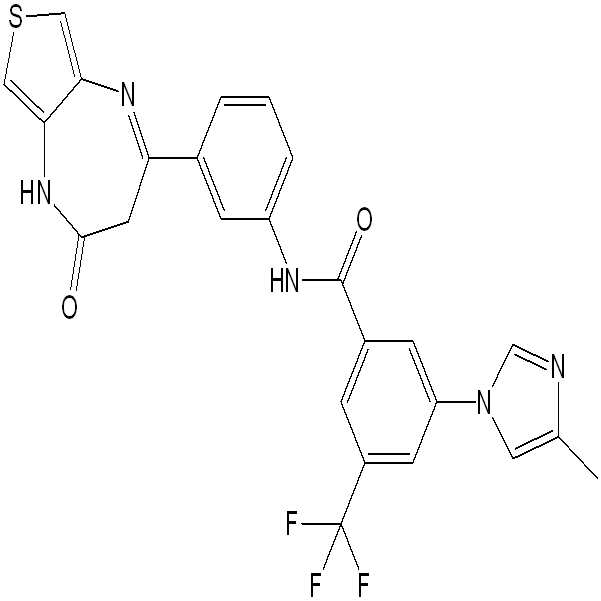
: 3-(4-methyl-1H-imidazol-1-yl)-5-(trifluoromethyl)benzoic acid (12mg, 0.0436 mmol), (1-[bis(dimethylamino)methylene]-1H-1,2,3-triazolo[4,5-b]pyridinium 3-oxid hexafluorophosphate) (22.6mg, 0.059mmol), TEA (7.2mg, 0.078 mmol) 를 DMF (0.2 ml)에 녹인 다음 45℃에서 30분 동안 교반한 후, 화합물 F (10.2mg, 0.039 mmol)를 첨가한 다음 45℃에서 12시간 동안 교반하였다. 반응이 종결된 후, ethyl acetate 를 첨가하고 포화 NaCl 수용액으로 세척하였다. 유기층을 sodium sulfate anhydrous로 건조시켜 여과한 후 감압 하에 용매를 제거하였다. 잔사를 결정화 하여 목적 화합물인 3-(4-methyl-1H-imidazol-1-yl)-N-(3-(2-oxo-2,3-dihydro-1H-thieno[3,4-b][1,4]diazepin-4-yl)phenyl)-5-(trifluoromethyl)benzamide (15.6mg, 78%)를 얻었다.(1- [bis (dimethylamino) methylene] -1H-1,2,3-triazolo [3,3-d] pyrimidin- (22.6 mg, 0.059 mmol) and TEA (7.2 mg, 0.078 mmol) were dissolved in DMF (0.2 ml), and the mixture was stirred at 45 ° C for 30 minutes. F (10.2 mg, 0.039 mmol) was added and the mixture was stirred at 45 < 0 > C for 12 hours. After the reaction was completed, ethyl acetate was added and washed with saturated aqueous NaCl solution. The organic layer was dried with sodium sulfate anhydrous, filtered, and the solvent was removed under reduced pressure. The residue was crystallized to obtain the target compound, 3- (4-methyl-1H-imidazol-1-yl) -N- (3- (2-oxo-2,3- dihydro- 1,4] diazepin-4-yl) phenyl) -5- (trifluoromethyl) benzamide (15.6 mg, 78%).
1H NMR (400 MHz, DMSO-d6) δ 10.71 (1 H, s), 10.53 (1 H, s), 8.49 (1 H, s), 8.43-8.42 (2 H, m), 8.26 (1 H, s), 8.22 (1 H, s), 8.06 (1 H, dd, J = 8.2, 1.4 Hz), 7.79 (1 H, d, J = 8.0 Hz), 7.73 (1 H, s), 7.58-7.54 (2 H, m), 7.04 (1 H, d, J = 4.0 Hz), 3.61 (2 H, s), 2.20 (3 H, s) 1 H NMR (400 MHz, DMSO- d 6 )? 10.71 (1H, s), 10.53 (1H, s), 8.49 (1H, s), 8.43-8.42 (1H, s), 8.22 (1H, s), 8.06 (1H, dd, J = 8.2, 1.4 Hz), 7.79 (1H, m), 7.04 (1H, d, J = 4.0 Hz), 3.61 (2H, s), 2.20
(Exactmass 509.11, m/z 510.1186)
(Exactmass 509.11, m / z 510.1186)
실시예Example 20 20
3-Morpholino-N-(3-(2-oxo-2,3-dihydro-1H-thieno[3,4-b][1,4]diazepin-4-yl)phenyl)-5-(trifluoromethyl)benzamide의 합성3-Morpholino-N- (3- (2-oxo-2,3-dihydro-1H-thieno [3,4-b] [1,4] diazepin-4-yl) phenyl) -5- (trifluoromethyl) Synthesis of

: 3-morpholino-5-(trifluoromethyl)benzoic acid (12mg, 0.043 mmol), (1-[bis(dimethylamino)methylene]-1H-1,2,3-triazolo[4,5-b]pyridinium 3-oxid hexafluorophosphate) (22.6mg, 0.059mmol), TEA (8mg, 0.079 mmol) 를 DMF (0.2 ml)에 녹인 다음 45℃에서 30분 동안 교반한 후, 화합물 F (10mg, 0.039 mmol)를 첨가한 다음 45℃에서 12시간 동안 교반하였다. 반응이 종결된 후, ethyl acetate 를 첨가하고 포화 NaCl 수용액으로 세척하였다. 유기층을 sodium sulfate anhydrous로 건조시켜 여과한 후 감압 하에 용매를 제거하였다. 잔사를 column chromatography (silica gel, ethyl acetate : Hex = 1 : 1)로 정제하여 목적 화합물인 3-morpholino-N-(3-(2-oxo-2,3-dihydro-1H-thieno[3,4-b][1,4]diazepin-4-yl)phenyl)-5-(trifluoromethyl)benzamide (12.6mg, 62%%)를 얻었다.(3-morpholino-5- (trifluoromethyl) benzoic acid (12 mg, 0.043 mmol), (1- [bis (dimethylamino) methylene] -1H-1,2,3-triazolo [4,5- b] pyridinium 3-oxid hexafluorophosphate (22.6 mg, 0.059 mmol) and TEA (8 mg, 0.079 mmol) were dissolved in DMF (0.2 ml), and the mixture was stirred at 45 ° C for 30 minutes. Compound F (10 mg, 0.039 mmol) Lt; / RTI > for 12 hours. After the reaction was completed, ethyl acetate was added and washed with saturated aqueous NaCl solution. The organic layer was dried with sodium sulfate anhydrous, filtered, and the solvent was removed under reduced pressure. The residue was purified by column chromatography (silica gel, ethyl acetate: Hex = 1: 1) to obtain the desired compound, 3-morpholino-N- (3- (2- -b] [1,4] diazepin-4-yl) phenyl) -5- (trifluoromethyl) benzamide (12.6 mg, 62%
1H NMR (400 MHz, DMSO-d6) δ 10.56 (1 H, s), 10.53 (1 H, s), 8.40 (1 H, s), 8.02 (1 H, d, J = 9.2 Hz), 7.77-7.75 (2 H, m), 7.70 (1 H, s), 7.55-7.51 (2 H, s), 7.41 (1 H, s), 7.03 (1 H, d, J = 3.6 Hz), 3.78 (4 H, t, J = 4.6 Hz), 3.61 (2 H, s) 1 H NMR (400 MHz, DMSO- d 6 )? 10.56 (1H, s), 10.53 (1H, s), 8.40 (1H, m), 7.70-7.75 (2H, m), 7.70 (1H, s), 7.55-7.51 (4H, t, J = 4.6Hz), 3.61 (2H, s)
(Exactmass 514.13, m/z 515.1331)
(Exactmass 514.13, m / z 515.1331)
실시예Example 21 21
4-morpholino-N-(3-(2-oxo-2,3-dihydro-1H-thieno[3,4-b][1,4] diazepin-4-yl)phenyl)-3-(trifluoromethyl)benzamide의 합성4-morpholino-N- (3- (2-oxo-2,3-dihydro-1H-thieno [3,4-b] [1,4] diazepin- Synthesis of

: 4-morpholino-3-(trifluoromethyl)benzoic acid (12mg, 0.043 mmol), (1-[bis(dimethylamino)methylene]-1H-1,2,3-triazolo[4,5-b]pyridinium 3-oxid hexafluorophosphate) (22.6mg, 0.059mmol), TEA (8mg, 0.079 mmol) 를 DMF (0.2 ml)에 녹인 다음 45℃에서 30분 동안 교반한 후, 화합물 F (10mg, 0.039 mmol)를 첨가한 다음 45℃에서 12시간 동안 교반하였다. 반응이 종결된 후, ethyl acetate 를 첨가하고 포화 NaCl 수용액으로 세척하였다. 유기층을 sodium sulfate anhydrous로 건조시켜 여과한 후 감압 하에 용매를 제거하였다. 잔사를 column chromatography (silica gel, ethyl acetate : Hex = 1 : 1)로 정제하여 목적 화합물인 4-morpholino-N-(3-(2-oxo-2,3-dihydro-1H-thieno[3,4-b][1,4] diazepin-4-yl)phenyl)-3-(trifluoromethyl)benzamide (5 mg)를 얻었다.(4-morpholino-3- (trifluoromethyl) benzoic acid (12mg, 0.043mmol), (1- [bis (dimethylamino) methylene] -1H-1,2,3-triazolo [4,5- b] pyridinium 3-oxid hexafluorophosphate (22.6 mg, 0.059 mmol) and TEA (8 mg, 0.079 mmol) were dissolved in DMF (0.2 ml), and the mixture was stirred at 45 ° C for 30 minutes. Compound F (10 mg, 0.039 mmol) Lt; / RTI > for 12 hours. After the reaction was completed, ethyl acetate was added and washed with saturated aqueous NaCl solution. The organic layer was dried with sodium sulfate anhydrous, filtered, and the solvent was removed under reduced pressure. The residue was purified by column chromatography (silica gel, ethyl acetate: Hex = 1: 1) to obtain the target compound, 4-morpholino-N- (3- (2-oxo-2,3-dihydro- -b] [1,4] diazepin-4-yl) phenyl) -3- (trifluoromethyl) benzamide (5 mg).
1H NMR (400 MHz, DMSO-d6) δ 10.57 (1 H, s), 10.52 (1 H, s), 8.42 (1 H, t, J = 1.8 Hz), 8.30-8.27 (2 H, m), 8.02 (1 H, dd, J = 8.0, 1.2 Hz), 7.76 (1 H, d, J = 7.6 Hz), 7.66 (1 H, d, J = 8.4 Hz), 7.54-7.50 (2 H, m), 7.03 (1 H, d, J = 3.6 Hz), 3.74 (4 H, t, J = 4.4 Hz), 3.61 (2 H, s), 2.97 (4 H, t, J = 4.4 Hz) 1 H NMR (400 MHz, DMSO- d 6 )? 10.57 (1H, s), 10.52 (1H, s), 8.42 (1H, t, J = 1.8 Hz), 8.30-8.27 ), 8.02 (1H, dd, J = 8.0, 1.2 Hz), 7.76 (1H, d, J = 7.6 Hz), 7.66 (1H, d, J = 8.4 Hz), 7.54-7.50 m), 7.03 (1H, d, J = 3.6 Hz), 3.74 (4H, t, J = 4.4 Hz), 3.61 (2H, s), 2.97
(Exactmass 514.13, m/z 515.1335)
(Exactmass 514.13, m / z 515.1335)
실시예Example 22 22
N-(3-(2-oxo-2,3-dihydro-1H-thieno[3,4-b][1,4]diazepin-4-yl)phenyl)biphenyl-4-carboxamide의 합성Synthesis of N- (3- (2-oxo-2,3-dihydro-1H-thieno [3,4-b] [1,4] diazepin-4-yl) phenyl) biphenyl-4-carboxamide

: Biphenyl-4-carboxylic acid (6.2mg, 0.031 mmol), (1-[bis(dimethylamino)methylene]-1H-1,2,3-triazolo[4,5-b]pyridinium 3-oxid hexafluorophosphate) (16mg, 0.042 mmol), TEA (5.7mg, 0.056 mmol) 를 DMF (0.2 ml)에 녹인 다음 45℃에서 30분 동안 교반한 후, 화합물 F (10mg, 0.039 mmol)를 첨가한 다음 45℃에서 12시간 동안 교반하였다. 반응이 종결된 후, ethyl acetate 를 첨가하고 포화 NaCl 수용액으로 세척하였다. 유기층을 sodium sulfate anhydrous로 건조시켜 여과한 후 감압 하에 용매를 제거하였다. 잔사를 column chromatography (silica gel, ethyl acetate : Hex = 1 : 1)로 정제하여 목적 화합물인 N-(3-(2-oxo-2,3-dihydro-1H-thieno[3,4-b][1,4]diazepin-4-yl)phenyl)biphenyl-4-carboxamide (2.5mg, 14%)를 얻었다.4-carboxylic acid (6.2 mg, 0.031 mmol), (1- [bis (dimethylamino) methylene] -1H-1,2,3-triazolo [4,5- b] pyridinium 3-oxid hexafluorophosphate , 0.042 mmol) and TEA (5.7 mg, 0.056 mmol) were dissolved in DMF (0.2 ml), and the mixture was stirred at 45 캜 for 30 minutes. Compound F (10 mg, 0.039 mmol) Lt; / RTI > After the reaction was completed, ethyl acetate was added and washed with saturated aqueous NaCl solution. The organic layer was dried with sodium sulfate anhydrous, filtered, and the solvent was removed under reduced pressure. The residue was purified by column chromatography (silica gel, ethyl acetate: Hex = 1: 1) to obtain the desired compound, N- (3- (2-oxo-2,3- dihydro-1H- thieno [3,4- b] 1,4] diazepin-4-yl) phenyl) biphenyl-4-carboxamide (2.5 mg, 14%).
1H NMR (400 MHz, DMSO-d6) δ 10.54 (1 H, s), 10.52 (1 H, s), 8.48 (1 H, s), 8.11 (2 H, d, J = 8.4 Hz), 8.04 (1 H, d, J = 7.2 Hz), 7.86 (2 H, d, J = 8.8 Hz), 7.79-7.75 (3 H, m), 7.55-7.52 (4 H, m), 7.43 (1 H, d, J = 7.2 Hz), 7.04 (1 H, d, J = 4.0 Hz), 3.62 (2 H, s) 1 H NMR (400 MHz, DMSO- d 6 )? 10.54 (1H, s), 10.52 (1H, s), 8.48 M), 7.43 (1H, m), 8.04 (1H, d, J = 7.2 Hz), 7.86 (2H, d, J = 8.8 Hz), 7.79-7.75 , d, J = 7.2 Hz), 7.04 (1H, d, J = 4.0 Hz), 3.62 (2H,
(Exactmass 437.12, m/z 438.1255)
(Exactmass 437.12, m / z 438.1255)
실시예Example 23 23
N-(3-(2-oxo-2,3-dihydro-1H-thieno[3,4-b][1,4]diazepin-4-yl)phenyl)biphenyl-2-carboxamide의 합성Synthesis of N- (3- (2-oxo-2,3-dihydro-1H-thieno [3,4-b] [1,4] diazepin-4-yl) phenyl) biphenyl-2-carboxamide
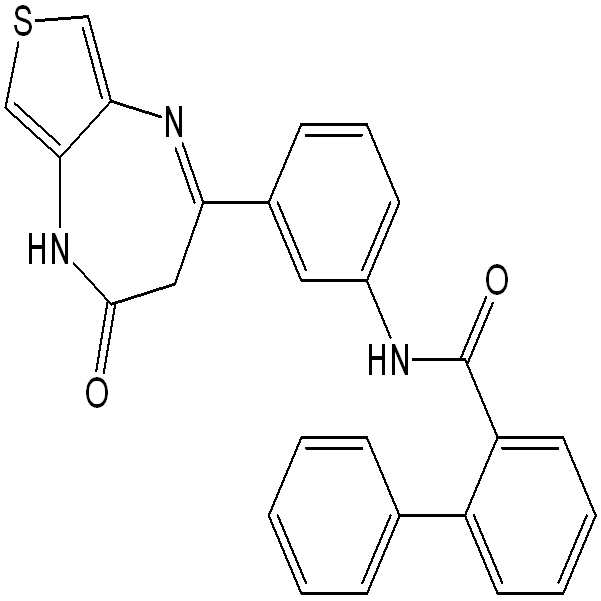
: Biphenyl-2-carboxylic acid (6mg, 0.030 mmol), (1-[bis(dimethylamino)methylene]-1H-1,2,3-triazolo[4,5-b]pyridinium 3-oxid hexafluorophosphate) (15mg, 0.040 mmol), TEA (5.5mg, 0.054 mmol) 를 DMF (0.2 ml)에 녹인 다음 45℃에서 30분 동안 교반한 후, 화합물 F (7mg, 0.027 mmol)를 첨가한 다음 45℃에서 12시간 동안 교반하였다. 반응이 종결된 후, ethyl acetate 를 첨가하고 포화 NaCl 수용액으로 세척하였다. 유기층을 sodium sulfate anhydrous로 건조시켜 여과한 후 감압 하에 용매를 제거하였다. 잔사를 column chromatography (silica gel, ethyl acetate : Hex = 1 : 1)로 정제하여 목적 화합물인 N-(3-(2-oxo-2,3-dihydro-1H-thieno[3,4-b][1,4]diazepin-4-yl)phenyl)biphenyl-2-carboxamide (6.5mg, 55%)를 얻었다.(6 mg, 0.030 mmol), (1- [bis (dimethylamino) methylene] -1H-1,2,3-triazolo [4,5- b] pyridinium 3-oxid hexafluorophosphate (15 mg, 0.045 mmol) and TEA (5.5 mg, 0.054 mmol) were dissolved in DMF (0.2 ml), and the mixture was stirred at 45 캜 for 30 minutes. Compound F (7 mg, 0.027 mmol) Respectively. After the reaction was completed, ethyl acetate was added and washed with saturated aqueous NaCl solution. The organic layer was dried with sodium sulfate anhydrous, filtered, and the solvent was removed under reduced pressure. The residue was purified by column chromatography (silica gel, ethyl acetate: Hex = 1: 1) to obtain the desired compound, N- (3- (2-oxo-2,3- dihydro-1H- thieno [3,4- b] 1,4] diazepin-4-yl) phenyl) biphenyl-2-carboxamide (6.5 mg, 55%).
1H NMR (400 MHz, DMSO-d6) δ 10.49 (1 H, s), 10.43 (1 H, s), 8.25 (1 H, s), 7.68 (2 H, d, J = 8.0 Hz), 7.61-7.57 (2 H, m), 7.52 (1 H, d, J = 3.6 Hz), 7.49-7.41 (4 H, m), 7.40-7.36 (3 H, m), 7.30 (1 H, t, J = 7.2 Hz), 7.01 (1 H, d, J = 3.6 Hz), 3.55 (2 H, s) 1 H NMR (400 MHz, DMSO-d 6 )? 10.49 (1 H, s), 10.43 (1 H, s), 8.25 (1H, m), 7.30-7.57 (2H, m), 7.52 (1H, d, J = 3.6 Hz), 7.49-7.41 J = 7.2 Hz), 7.01 (1H, d, J = 3.6 Hz), 3.55 (2H, s)
(Exactmass 437.12, m/z 438.1258)
(Exactmass 437.12, m / z 438.1258)
실시예Example 24 24
N-(3-(2-oxo-2,3-dihydro-1H-thieno[3,4-b][1,4]diazepin-4-yl)phenyl)-1-phenyl-5-(trifluoromethyl)-1H-pyrazole-4-carboxamide의 합성Synthesis of N- (3- (2-oxo-2,3-dihydro-1H-thieno [3,4-b] [1,4] diazepin-4- Synthesis of 1H-pyrazole-4-carboxamide

: 1-Phenyl-5-(trifluoromethyl)-1H-pyrazole-4-carboxylic acid (7.1mg, 0.028 mmol), (1-[bis(dimethylamino)methylene]-1H-1,2,3-triazolo[4,5-b]pyridinium 3-oxid hexafluorophosphate) (16mg, 0.042 mmol), TEA (5.7mg, 0.056 mmol) 를 DMF (0.2 ml)에 녹인 다음 45℃에서 30분 동안 교반한 후, 화합물 F (7.1mg, 0.028 mmol)를 첨가한 다음 45℃에서 12시간 동안 교반하였다. 반응이 종결된 후, ethyl acetate 를 첨가하고 포화 NaCl 수용액으로 세척하였다. 유기층을 sodium sulfate anhydrous로 건조시켜 여과한 후 감압 하에 용매를 제거하였다. 잔사를 column chromatography (silica gel, ethyl acetate : Hex = 1 : 1)로 정제하여 목적 화합물인 N-(3-(2-oxo-2,3-dihydro-1H-thieno[3,4-b][1,4]diazepin-4-yl)phenyl)-1-phenyl-5-(trifluoromethyl)-1H-pyrazole-4-carboxamide (12mg, 86%)를 얻었다.: 1 - Phenyl-5- (trifluoromethyl) -1H-pyrazole-4-carboxylic acid (7.1 mg, 0.028 mmol), (1- [bis (dimethylamino) methylene] 5-b] pyridinium 3-oxid hexafluorophosphate (16 mg, 0.042 mmol) and TEA (5.7 mg, 0.056 mmol) were dissolved in DMF (0.2 ml), followed by stirring at 45 ° C for 30 minutes. 0.028 mmol) was added and the mixture was stirred at 45 < 0 > C for 12 hours. After the reaction was completed, ethyl acetate was added and washed with saturated aqueous NaCl solution. The organic layer was dried with sodium sulfate anhydrous, filtered, and the solvent was removed under reduced pressure. The residue was purified by column chromatography (silica gel, ethyl acetate: Hex = 1: 1) to obtain the desired compound, N- (3- (2-oxo-2,3- dihydro-1H- thieno [3,4- b] 1,4] diazepin-4-yl) phenyl) -1-phenyl-5- (trifluoromethyl) -1H-pyrazole-4- carboxamide (12 mg, 86%).
1H NMR (400 MHz, DMSO-d6) δ 10.74 (1 H, s), 10.54 (1 H, s), 8.38 (1 H, s), 8.36 (1 H, s), 7.94 (1 H, d, J = 8.4 Hz), 7.76 (1 H, d, J = 8.4 Hz), 7.63-7.61 (4 H, m), 7.56-7.50 (3 H, m), 7.04 (1 H, d, J = 4.0 Hz), 3.61 (2 H, s) 1 H NMR (400 MHz, DMSO- d 6 )? 10.74 (1 H, s), 10.54 (1H, s), 8.38 d, J = 8.4 Hz), 7.76 (1H, d, J = 8.4 Hz), 7.63-7.61 (4H, m), 7.56-7.50 4.0 Hz), 3.61 (2H, s)
(Exactmass 459.10, m/z 496.102)
(Exactmass 459.10, m / z 496.102)
실시예Example 25 25
1-Acetyl-N-(3-(2-oxo-2,3-dihydro-1H-thieno[3,4-b][1,4]diazepin-4-yl)phenyl)piperidine-4-carboxamide의 합성Synthesis of 1-Acetyl-N- (3- (2-oxo-2,3-dihydro-1H-thieno [3,4-b] [1,4] diazepin-4-yl) phenyl) piperidine-4-carboxamide

: 1-Acetylpiperidine-4-carboxylic acid (5.1mg, 0.03 mmol), (1-[bis(dimethylamino)methylene]-1H-1,2,3-triazolo[4,5-b]pyridinium 3-oxid hexafluorophosphate) (15.5mg, 0.041 mmol), TEA (5.5mg, 0.054 mmol) 를 DMF (0.2 ml)에 녹인 다음 45℃에서 30분 동안 교반한 후, 화합물 F (7mg, 0.027 mmol)를 첨가한 다음 45℃에서 12시간 동안 교반하였다. 반응이 종결된 후, ethyl acetate 를 첨가하고 포화 NaCl 수용액으로 세척하였다. 유기층을 sodium sulfate anhydrous로 건조시켜 여과한 후 감압 하에 용매를 제거하였다. 잔사를 column chromatography (silica gel, ethyl acetate : Hex = 1 : 1)로 정제하여 목적 화합물인 1-Acetyl-N-(3-(2-oxo-2,3-dihydro-1H-thieno[3,4-b][1,4]diazepin-4-yl)phenyl)piperidine-4-carboxamide (8.5mg, 76%)를 얻었다.: 1-Acetylpiperidine-4-carboxylic acid (5.1 mg, 0.03 mmol), (1- [bis (dimethylamino) methylene] -1H- 1,2,3-triazolo [4,5- b] pyridinium 3-oxid hexafluorophosphate) (15 mg, 0.041 mmol) and TEA (5.5 mg, 0.054 mmol) were dissolved in DMF (0.2 ml), and the mixture was stirred at 45 캜 for 30 minutes. Compound F (7 mg, 0.027 mmol) Stir for 12 hours. After the reaction was completed, ethyl acetate was added and washed with saturated aqueous NaCl solution. The organic layer was dried with sodium sulfate anhydrous, filtered, and the solvent was removed under reduced pressure. The residue was purified by column chromatography (silica gel, ethyl acetate: Hex = 1: 1) to obtain the target compound 1-Acetyl-N- (3- (2-oxo-2,3- dihydro-1H- thieno [ -b] [1,4] diazepin-4-yl) phenyl) piperidine-4-carboxamide (8.5 mg, 76%).
1H NMR (400 MHz, DMSO-d6) δ 10.52 (1 H, s), 10.15 (1 H, s), 8.26 (1 H, t, J = 1.6 Hz), 7,83 (1 H, d, J = 8.0 Hz), 7.67 (1 H, d, J = 8.4 Hz), 7.53 (1 H, d, J = 3.6 Hz), 7.44 (1 H, t, J = 8.0 Hz), 7.02 (1 H, d, J = 3.6 Hz), 3.89-3.86 (1 H, m), 3.55 (2 H, s), 3.11-3.04 (1 H, m), 2.63-2.56 (3 H, m), 2.04 (3 H, s), 1.64-1.54 (2 H, m), 1.46-1.2 (2 H, m) 1 H NMR (400 MHz, DMSO-d 6 )? 10.52 (1H, s), 10.15 (1H, s), 8.26 (1H, t, J = 1.6 Hz), 7.83 J = 8.0 Hz), 7.67 (1H, d, J = 8.4 Hz), 7.53 (1H, d, J = 3.6 Hz), 7.44 , 3.10-3.04 (1H, m), 2.63-2.56 (3H, m), 2.04 (3H, m), 3.89-3.86 H, s), 1.64-1.54 (2 H, m), 1.46-1.2 (2 H, m)
(Exactmass 410.14, m/z 411.1473)
(Exactmass 410.14, m / z 411.1473)
실시예Example 26 26
2,2-Bis(4-chlorophenyl)-N-(3-(2-oxo-2,3-dihydro-1H-thieno[3,4-b][1,4]diazepin-4-yl)phenyl)acetamide의 합성2,2-Bis (4-chlorophenyl) -N- (3- (2-oxo-2,3-dihydro-1H-thieno [3,4- b] [1,4] diazepin- Synthesis of acetamide

: 2,2-Bis(4-chlorophenyl)acetic acid (8.2mg, 0.029 mmol), (1-[bis(dimethylamino)methylene]-1H-1,2,3-triazolo[4,5-b]pyridinium 3-oxid hexafluorophosphate) (15mg, 0.040 mmol), TEA (5.3mg, 0.052 mmol) 를 DMF (0.2 ml)에 녹인 다음 45℃에서 30분 동안 교반한 후, 화합물 F (6.8mg, 0.026 mmol)를 첨가한 다음 45℃에서 12시간 동안 교반하였다. 반응이 종결된 후, ethyl acetate 를 첨가하고 포화 NaCl 수용액으로 세척하였다. 유기층을 sodium sulfate anhydrous로 건조시켜 여과한 후 감압 하에 용매를 제거하였다. 잔사를 column chromatography (silica gel, ethyl acetate : Hex = 1 : 1)로 정제하여 목적 화합물인 2,2-bis(4-chlorophenyl)-N-(3-(2-oxo-2,3-dihydro-1H-thieno[3,4-b][1,4]diazepin-4-yl)phenyl)acetamide (4mg, 29%)를 얻었다.-1,2,3-triazolo [4,5-b] pyridinium 3 (4-chlorophenyl) acetic acid (8.2 mg, 0.029 mmol) (15 mg, 0.040 mmol) and TEA (5.3 mg, 0.052 mmol) were dissolved in DMF (0.2 ml), and the mixture was stirred at 45 ° C for 30 minutes. Then, Compound F (6.8 mg, 0.026 mmol) Followed by stirring at 45 < 0 > C for 12 hours. After the reaction was completed, ethyl acetate was added and washed with saturated aqueous NaCl solution. The organic layer was dried with sodium sulfate anhydrous, filtered, and the solvent was removed under reduced pressure. The residue was purified by column chromatography (silica gel, ethyl acetate: Hex = 1: 1) to obtain the target compound, 2,2-bis (4-chlorophenyl) -N- (3- (2-oxo-2,3- LH-thieno [3,4-b] [1,4] diazepin-4-yl) phenyl) acetamide (4 mg, 29%).
1H NMR (400 MHz, DMSO-d6) δ 10.69 (1 H, s), 10.52 (1 H, s), 8.23 (1 H, t, J = 1.8 Hz), 7.83 (1 H, dd, J = 8.0, 1.2 Hz), 7.70 (1 H, d, J = 8.4 Hz), 7.52 (1 H, d, J = 3.6 Hz), 7.44-7.41 (5 H, m), 7.38-7.36 (4 H, m), 7.02 (1 H, d, J = 3.6 Hz), 3.56 (2 H, s) 1 H NMR (400 MHz, DMSO-d 6 )? 10.69 (1 H, s), 10.52 (1H, s), 8.23 (1H, t, J = 1.8 Hz), 7.83 = 8.0, 1.2 Hz), 7.70 (1H, d, J = 8.4 Hz), 7.52 (1H, d, J = 3.6 Hz), 7.44-7.41 (5H, m), 7.38-7.36 m), 7.02 (1H, d, J = 3.6 Hz), 3.56 (2H, s)
(Exactmass 519.06 m/z 520.0677)
(Exactmass 519.06 m / z 520.0677)
실시예Example 27 27
N-(3-(2-oxo-2,3-dihydro-1H-thieno[3,4-b][1,4]diazepin-4-yl)phenyl) isonicotinamide의 합성Synthesis of N- (3- (2-oxo-2,3-dihydro-1H-thieno [3,4-b] [1,4] diazepin-4-yl) phenyl) isonicotinamide

: Isonicotinic acid (9.4 mg, 0.077 mmol), (1-[bis(dimethylamino)methylene]-1H-1,2,3-triazolo[4,5-b]pyridinium 3-oxid hexafluorophosphate) (45mg, 0.115mmol), TEA (56mg, 0.154 mmol) 를 DMF (0.64 ml)에 녹인 다음 45℃에서 30분 동안 교반한 후, 화합물 F (20mg, 0.077 mmol)를 첨가한 다음 45℃에서 12시간 동안 교반하였다. 반응이 종결된 후, ethyl acetate 를 첨가하고 포화 NaCl 수용액으로 세척하였다. 유기층을 sodium sulfate anhydrous로 건조시켜 여과한 후 감압 하에 용매를 제거하였다. 잔사를 column chromatography (silica gel, ethyl acetate : Hex = 1 : 1)로 정제하여 목적 화합물인 N-(3-(2-oxo-2,3-dihydro-1H-thieno[3,4-b][1,4]diazepin-4-yl)phenyl) isonicotinamide (8 mg, 28%)를 얻었다.: Isonicotinic acid (9.4 mg, 0.077 mmol), (1- [bis (dimethylamino) methylene] -1H-1,2,3-triazolo [4,5- b] pyridinium 3-oxid hexafluorophosphate (45 mg, 0.115 mmol) , TEA (56 mg, 0.154 mmol) was dissolved in DMF (0.64 ml), and the mixture was stirred at 45 째 C for 30 minutes. Compound F (20 mg, 0.077 mmol) was added and the mixture was stirred at 45 째 C for 12 hours. After the reaction was completed, ethyl acetate was added and washed with saturated aqueous NaCl solution. The organic layer was dried with sodium sulfate anhydrous, filtered, and the solvent was removed under reduced pressure. The residue was purified by column chromatography (silica gel, ethyl acetate: Hex = 1: 1) to obtain the desired compound, N- (3- (2-oxo-2,3- dihydro-1H- thieno [3,4- b] 1,4] diazepin-4-yl) phenyl) isonicotinamide (8 mg, 28%).
1H NMR (400 MHz, DMSO-d6) δ 12.43 (s, 1H), 10.72 (s, 1H), 8.79 (d, J = 5.5 Hz, 2H), 8.29 (dd, J = 4.4, 2.6 Hz, 2H), 8.21 (d, J = 8.1 Hz, 1H), 7.86 (dd, J = 4.4, 1.6 Hz, 2H), 7.74 (dd, J = 6.6, 1.6 Hz, 1H), 7.59 (t, J = 7.9 Hz, 1H), 7.05 (d, J = 3.3 Hz, 1H), 3.51 (d, J = 0.8 Hz, 2H). 1 H NMR (400 MHz, DMSO -d 6) δ 12.43 (s, 1H), 10.72 (s, 1H), 8.79 (d, J = 5.5 Hz, 2H), 8.29 (dd, J = 4.4, 2.6 Hz, J = 6.6, 1.6 Hz, 1H), 7.59 (t, J = 7.9 Hz, 2H), 8.21 (d, J = 8.1 Hz, 1H), 7.86 (dd, J = Hz, 1H), 7.05 (d, J = 3.3 Hz, 1H), 3.51 (d, J = 0.8 Hz, 2H).
(Exactmass 362.08, m/z 362.41)
(Exactmass 362.08, m / z 362.41)
실시예Example 28 28
N-(3-(2-oxo-2,3-dihydro-1H-thieno[3,4-b][1,4]diazepin-4-yl)phenyl)pyrazine-2-carboxamide의 합성Synthesis of N- (3- (2-oxo-2,3-dihydro-1H-thieno [3,4-b] [1,4] diazepin-4-yl) phenyl) pyrazine-2-carboxamide

: Pyrazine-2-carboxylic acid (13 mg, 0.077 mmol), (1-[bis(dimethylamino)methylene]-1H-1,2,3-triazolo[4,5-b]pyridinium 3-oxid hexafluorophosphate) (43mg, 0.115mmol), TEA (56mg, 0.154 mmol) 를 DMF (0.64 ml)에 녹인 다음 45℃에서 30분 동안 교반한 후, 화합물 F (20mg, 0.077 mmol)를 첨가한 다음 45℃에서 12시간 동안 교반하였다. 반응이 종결된 후, ethyl acetate 를 첨가하고 포화 NaCl 수용액으로 세척하였다. 유기층을 sodium sulfate anhydrous로 건조시켜 여과한 후 감압 하에 용매를 제거하였다. 잔사를 column chromatography (silica gel, ethyl acetate : Hex = 1 : 1)로 정제하여 목적 화합물인 N-(3-(2-oxo-2,3-dihydro-1H-thieno[3,4-b][1,4]diazepin-4-yl)phenyl)pyrazine-2-carboxamide (29 mg, 99%)를 얻었다.: Pyrazine-2-carboxylic acid (13 mg, 0.077 mmol), (1- [bis (dimethylamino) methylene] -1H-1,2,3-triazolo [4,5- b] pyridinium 3-oxid hexafluorophosphate , And TEA (56 mg, 0.154 mmol) were dissolved in DMF (0.64 ml), and the mixture was stirred at 45 ° C for 30 minutes. Compound F (20 mg, 0.077 mmol) was added and stirred at 45 ° C for 12 hours Respectively. After the reaction was completed, ethyl acetate was added and washed with saturated aqueous NaCl solution. The organic layer was dried with sodium sulfate anhydrous, filtered, and the solvent was removed under reduced pressure. The residue was purified by column chromatography (silica gel, ethyl acetate: Hex = 1: 1) to obtain the desired compound, N- (3- (2-oxo-2,3- dihydro-1H- thieno [3,4- b] 1,4] diazepin-4-yl) phenyl) pyrazine-2-carboxamide (29 mg, 99%).
1H NMR (400 MHz, DMSO-d6) δ 10.97 (1H, s), 10.53 (1H, s), 9.33 (1H, d, J = 1.5 Hz), 8.95 (1H, d, J = 2.5 Hz), 8.84 (1H, dd, J = 2.5, 1.5 Hz), 8.63 (1H, s), 8.07 (1H, dd, J = 8.1, 1.3 Hz), 7.80 (1H, d, J = 8.5 Hz), 7.57 - 7.50 (2H, m), 7.03 (1H, d, J = 3.7 Hz), 3.62 (2H, s) 1 H NMR (400 MHz, DMSO -d 6) δ 10.97 (1H, s), 10.53 (1H, s), 9.33 (1H, d, J = 1.5 Hz), 8.95 (1H, d, J = 2.5 Hz) D, J = 8.1, 1.3 Hz), 7.80 (1H, d, J = 8.5 Hz), 7.57 - 7.50 (2H, m), 7.03 (1H, d, J = 3.7 Hz), 3.62 (2H, s)
(Exactmass 363.08, m/z 364.08)
(Exactmass 363.08, m / z 364.08)
실시예Example 29 29
3-(4-methylpiperazin-1-yl)-N-(3-(2-oxo-2,3-dihydro-1H-thieno[3,4-b][1,4]diazepin-4-yl)phenyl)-5-(trifluoromethyl)benzamide의 합성3,4-b] [1,4] diazepin-4-yl) phenyl (3-methylpiperazin-1-yl) -N- ) -5- (trifluoromethyl) benzamide

: 3-(4-Methylpiperazin-1-yl)-5-(trifluoromethyl)benzoic acid (33.6mg, 0.116 mmol), (1-[bis(dimethylamino)methylene]-1H-1,2,3-triazolo[4,5-b]pyridinium 3-oxid hexafluorophosphate) (66.1mg, 0.17mmol) TEA (23.6mg, 0.23 mmol) 를 DMF (0.96 ml)에 녹인 다음 45℃에서 30분 동안 교반한 후, 화합물 F (30mg, 0.116 mmol)를 첨가한 다음 45℃에서 12시간 동안 교반하였다. 반응이 종결된 후, ethyl acetate 를 첨가하고 포화 NaCl 수용액으로 세척하였다. 유기층을 sodium sulfate anhydrous로 건조시켜 여과한 후 감압 하에 용매를 제거하였다. 잔사를 column chromatography (silica gel, ethyl acetate : Hex = 1 : 1)로 정제하여 목적 화합물인 3-(4-methylpiperazin-1-yl)-N-(3-(2-oxo-2,3-dihydro-1H-thieno[3,4-b][1,4]diazepin-4-yl)phenyl)-5-(trifluoromethyl)benzamide (39mg, 63%)를 얻었다.(3- (4-Methylpiperazin-1-yl) -5- (trifluoromethyl) benzoic acid (33.6 mg, 0.116 mmol), (1- [bis (dimethylamino) methylene] -1H-1,2,3-triazolo [ TEA (23.6 mg, 0.23 mmol) was dissolved in DMF (0.96 ml), and the mixture was stirred at 45 ° C for 30 minutes. Then, Compound F (30 mg, 0.116 mmol) was added followed by stirring at 45 < 0 > C for 12 hours. After the reaction was completed, ethyl acetate was added and washed with saturated aqueous NaCl solution. The organic layer was dried with sodium sulfate anhydrous, filtered, and the solvent was removed under reduced pressure. The residue was purified by column chromatography (silica gel, ethyl acetate: Hex = 1: 1) to obtain the desired compound, 3- (4-methylpiperazin-1-yl) -N- (3- (2-oxo-2,3-dihydro -1H-thieno [3,4-b] [1,4] diazepin-4-yl) phenyl) -5- (trifluoromethyl) benzamide (39 mg, 63%).
1H NMR (400 MHz, DMSO-d6) δ 10.55 (s, 1H), 10.53 (s, 1H), 8.40 (t, J = 3.6 Hz, 1H), 8.00 (d,d, J = 1.2 , 1.2Hz, 1H), 7.73 (d, J = 2.4 Hz, 2H), 7.65 (s, 1H), 7.54 - 7.50 (t, s, J = 7.6 Hz, 2H), 7.38 (s, 1H), 7.01 (d, J = 4 Hz, 1H), 3.61 (s, 2H), 2.55 - 2.45 (m, 8H), 2.23 (s, 3H) 1 H NMR (400 MHz, DMSO -d 6) δ 10.55 (s, 1H), 10.53 (s, 1H), 8.40 (t, J = 3.6 Hz, 1H), 8.00 (d, d, J = 1.2, 1.2 J = 7.6 Hz, 2H), 7.38 (s, 1H), 7.01 (d, < RTI ID = 0.0 & 2H), 2.55-2.45 (m, 8H), 2.23 (s, 3H)
(Exactmass 527.16, m/z 528.99)
(Exactmass 527.16, m / z 528.99)
실시예Example 30 30
4-Chloro-N-(3-(2-oxo-2,3-dihydro-1H-thieno[3,4-b][1,4]diazepin-4-yl)phenyl)benzamide의 합성Synthesis of 4-Chloro-N- (3- (2-oxo-2,3-dihydro-1H-thieno [3,4-b] [1,4] diazepin-4-

: 4-Chlorobenzoic acid (7.1 mg, 0.045 mmol), (1-[bis(dimethylamino)methylene]-1H-1,2,3-triazolo[4,5-b]pyridinium 3-oxid hexafluorophosphate) (23.3mg, 0.061mmol), TEA (8.3mg, 0.082 mmol) 를 DMF (0.2 ml)에 녹인 다음 45℃에서 30분 동안 교반한 후, 화합물 F (10.5mg, 0.041 mmol)를 첨가한 다음 45℃에서 12시간 동안 교반하였다. 반응이 종결된 후, ethyl acetate 를 첨가하고 포화 NaCl 수용액으로 세척하였다. 유기층을 sodium sulfate anhydrous로 건조시켜 여과한 후 감압 하에 용매를 제거하였다. 잔사를 column chromatography (silica gel, ethyl acetate : Hex = 1 : 1)로 정제하여 목적 화합물인 4-chloro-N-(3-(2-oxo-2,3-dihydro-1H-thieno[3,4-b][1,4]diazepin-4-yl)phenyl)benzamide (5 mg )를 얻었다.: 4-Chlorobenzoic acid (7.1 mg, 0.045 mmol), (1- [bis (dimethylamino) methylene] -1H-1,2,3-triazolo [4,5- b] pyridinium 3-oxid hexafluorophosphate (23.3 mg, And TEA (8.3 mg, 0.082 mmol) were dissolved in DMF (0.2 ml), and the mixture was stirred at 45 ° C for 30 minutes. Compound F (10.5 mg, 0.041 mmol) Lt; / RTI > After the reaction was completed, ethyl acetate was added and washed with saturated aqueous NaCl solution. The organic layer was dried with sodium sulfate anhydrous, filtered, and the solvent was removed under reduced pressure. The residue was purified by column chromatography (silica gel, ethyl acetate: Hex = 1: 1) to obtain the target compound, 4-chloro-N- (3- (2-oxo-2,3-dihydro- -b] [1,4] diazepin-4-yl) phenyl) benzamide (5 mg).
1H NMR (400 MHz, DMSO-d6) δ 10.54 (2 H, s), 8.43 (1 H, t, J = 1.6 Hz), 8.04-8.00 (3 H, m), 7.75 (1 H, d, J = 8.0 Hz), 7.63 (2 H, d, J = 8.8 Hz), 7.55-7.49 (2 H, m), 7.03 (1 H, d, J = 3.6 Hz), 3.61 (2 H, s) 1 H NMR (400 MHz, DMSO-d 6 )? 10.54 (2 H, s), 8.43 (1 H, t, J = 1.6 Hz), 8.04-8.00 J = 8.0 Hz), 7.63 (2H, d, J = 8.8 Hz), 7.55-7.49 (2H, m), 7.03
(Exactmass 395.05, m/z 396.0547)
(Exactmass 395.05, m / z 396.0547)
실시예Example 31 31
2-(1H-indol-3-yl)-N-(3-(2-oxo-2,3-dihydro-1H-thieno[3,4-b][1,4]diazepin-4-yl)phenyl)acetamide의 합성2,3-dihydro-1H-thieno [3,4-b] [1,4] diazepin-4-yl) phenyl ) Synthesis of acetamide

: 2-(1H-indol-3-yl)acetic acid (13 mg, 0.077 mmol), (1-[bis(dimethylamino)methylene]-1H-1,2,3-triazolo[4,5-b]pyridinium 3-oxid hexafluorophosphate) (43mg, 0.115mmol), TEA (56mg, 0.154 mmol) 를 DMF (0.64 ml)에 녹인 다음 45℃에서 30분 동안 교반한 후, 화합물 F (20mg, 0.077 mmol)를 첨가한 다음 45℃에서 12시간 동안 교반하였다. 반응이 종결된 후, ethyl acetate 를 첨가하고 포화 NaCl 수용액으로 세척하였다. 유기층을 sodium sulfate anhydrous로 건조시켜 여과한 후 감압 하에 용매를 제거하였다. 잔사를 column chromatography (silica gel, ethyl acetate : Hex = 1 : 1)로 정제하여 목적 화합물인 2-(1H-indol-3-yl)-N-(3-(2-oxo-2,3-dihydro-1H-thieno[3,4-b][1,4]diazepin-4-yl)phenyl)acetamide (30 mg, 93%)를 얻었다.1H-indol-3-yl) acetic acid (13 mg, 0.077 mmol), (1- [bis (dimethylamino) methylene] -1H-1,2,3-triazolo [4,5- b] pyridinium 3-oxid hexafluorophosphate (43 mg, 0.115 mmol) and TEA (56 mg, 0.154 mmol) were dissolved in DMF (0.64 ml), and the mixture was stirred at 45 ° C for 30 minutes. Compound F (20 mg, 0.077 mmol) Stir at 45 < 0 > C for 12 h. After the reaction was completed, ethyl acetate was added and washed with saturated aqueous NaCl solution. The organic layer was dried with sodium sulfate anhydrous, filtered, and the solvent was removed under reduced pressure. The residue was purified by column chromatography (silica gel, ethyl acetate: Hex = 1: 1) to obtain the desired compound, 2- (1H-indol-3-yl) -N- (3- (2-oxo-2,3-dihydro -1H-thieno [3,4-b] [1,4] diazepin-4-yl) phenyl) acetamide (30 mg, 93%).
1H NMR (400 MHz, DMSO-d6) δ 10.93 (1H, s), 10.51 (1H, s), 10.33 (1H, s), 8.25 (1H, t, J = 1.8 Hz), 7.88-7.82 (1H, m), 7.63 (1H, dd, J = 16.6, 8.1 Hz), 7.52 (1H, d, J = 3.7 Hz), 7.43 (1H, t, J = 8.0 Hz), 7.35 (1H, dt, J = 8.1, 0.9 Hz), 7.27 (1H, d, J = 2.3 Hz), 7.07 (1H,ddd,J = 8.1, 7.0, 1.2 Hz), 7.01 (1H, dd, J = 5.1, 2.4 Hz), 6.99 - 6.96 (1H, m), 3.75 (2H,s), 3.56 (2H,s). 1 H NMR (400 MHz, DMSO -d 6) δ 10.93 (1H, s), 10.51 (1H, s), 10.33 (1H, s), 8.25 (1H, t, J = 1.8 Hz), 7.88-7.82 ( (1H, m), 7.63 (1H, dd, J = 16.6, 8.1 Hz), 7.52 (1H, d, J = 3.7 Hz), 7.43 = 8.1, 0.9 Hz), 7.27 (1H, d, J = 2.3 Hz), 7.07 (1H, ddd, J = 8.1, 7.0, 1.2 Hz), 7.01 - 6.96 (1H, m), 3.75 (2H, s), 3.56 (2H, s).
(Exactmass 414.12, m/z 415.12)
(Exactmass 414.12, m / z 415.12)
실시예Example 32 32
2-(2-Cyanophenylthio)-N-(3-(2-oxo-2,3-dihydro-1H-thieno[3,4-b][1,4]diazepin-4-yl)phenyl)benzamide의 합성Synthesis of 2- (2-Cyanophenylthio) -N- (3- (2-oxo-2,3-dihydro-1H-thieno [3,4-b] [1,4] diazepin-4-

: 2-(2-Cyanophenylthio)benzoic acid (19.6 mg, 0.077 mmol), (1-[bis(dimethylamino)methylene]-1H-1,2,3-triazolo[4,5-b]pyridinium 3-oxid hexafluorophosphate) (45mg, 0.115mmol), TEA (56mg, 0.154 mmol) 를 DMF (0.64 ml)에 녹인 다음 45℃에서 30분 동안 교반한 후, 화합물 F (20mg, 0.077 mmol) 첨가한 다음 45℃에서 12시간 동안 교반하였다. 종결된 후, ethyl acetate 를 첨가하고 포화 NaCl 수용액으로 세척하였다. 유기층을 sodium sulfate anhydrous로 건조시켜 여과한 후 감압 하에 용매를 제거하였다. 잔사를 column chromatography (silica gel, ethyl acetate : Hex = 1 : 1)로 정제하여 목적 화합물인 2-(2-cyanophenylthio)-N-(3-(2-oxo-2,3-dihydro-1H-thieno[3,4-b][1,4]diazepin-4-yl)phenyl)benzamide (25 mg, 65%)를 얻었다.: 2- (2-Cyanophenylthio) benzoic acid (19.6 mg, 0.077 mmol), (1- [bis (dimethylamino) methylene] -1H-1,2,3-triazolo [4,5- b] pyridinium 3-oxid hexafluorophosphate (45 mg, 0.115 mmol) and TEA (56 mg, 0.154 mmol) were dissolved in DMF (0.64 ml), and the mixture was stirred at 45 캜 for 30 minutes. Compound F (20 mg, 0.077 mmol) Lt; / RTI > After termination, ethyl acetate was added and washed with saturated aqueous NaCl solution. The organic layer was dried with sodium sulfate anhydrous, filtered, and the solvent was removed under reduced pressure. The residue was purified by column chromatography (silica gel, ethyl acetate: Hex = 1: 1) to obtain the desired compound, 2- (2-cyanophenylthio) -N- (3- (2-oxo-2,3-dihydro- [3,4-b] [1,4] diazepin-4-yl) phenyl) benzamide (25 mg, 65%).
1H NMR (400 MHz, DMSO-d6) δ 10.72 (1H, s), 10.53 (1H, s), 8.40 (1H, s), 7.94-7.88 (1H, m), 7.77-7.75 (1H, m), 7.70-7.66 (2H, m), 7.55 (1H, d, J = 3.7 Hz), 7.52-7.48 (4H, m), 7.44 (2H, dd, J = 7.9, 2.9 Hz), 7.20-7.16 (1H, m), 7.03 (1H, d, J = 3.7 Hz), 3.59 (2H, s) 1 H NMR (400 MHz, DMSO -d 6) δ 10.72 (1H, s), 10.53 (1H, s), 8.40 (1H, s), 7.94-7.88 (1H, m), 7.77-7.75 (1H, m ), 7.70-7.66 (2H, m), 7.55 (1H, d, J = 3.7Hz), 7.52-7.48 (4H, m), 7.44 (2H, dd, J = 7.9, 2.9Hz), 7.20-7.16 1H, m), 7.03 (1H, d, J = 3.7Hz), 3.59 (2H, s)
(Exactmass 494.09, m/z 495.09)
(Exactmass 494.09, m / z 495.09)
실시예Example 33 33
2-(Biphenyl-4-yl)-N-(3-(2-oxo-2,3-dihydro-1H-thieno[3,4-b][1,4] diazepin-4-yl)phenyl)acetamide의 합성2- (Biphenyl-4-yl) -N- (3- (2-oxo-2,3-dihydro-1H-thieno [3,4- b] [1,4] diazepin- Synthesis of

: 2-(Biphenyl-4-yl)acetic acid (16.3 mg, 0.077 mmol), (1-[bis(dimethylamino)methylene]-1H-1,2,3-triazolo[4,5-b]pyridinium 3-oxid hexafluorophosphate) (45mg, 0.115mmol), TEA (56mg, 0.154 mmol) 를 DMF (0.64 ml)에 녹인 다음 45℃에서 30분 동안 교반한 후, 화합물 F (20mg, 0.077 mmol)를 첨가한 다음 45℃에서 12시간 동안 교반하였다. 반응이 종결된 후, ethyl acetate 를 첨가하고 포화 NaCl 수용액으로 세척하였다. 유기층을 sodium sulfate anhydrous로 건조시켜 여과한 후 감압 하에 용매를 제거하였다. 잔사를 column chromatography (silica gel, ethyl acetate : Hex = 1 : 1)로 정제하여 목적 화합물인 2-(biphenyl-4-yl)-N-(3-(2-oxo-2,3-dihydro-1H-thieno[3,4-b][1,4] diazepin-4-yl)phenyl)acetamide (31 mg, 89%)를 얻었다.-1H-1,2,3-triazolo [4,5-b] pyridinium 3-carboxylic acid methyl ester (16.3 mg, 0.077 mmol) (45 mg, 0.115 mmol) and TEA (56 mg, 0.154 mmol) were dissolved in DMF (0.64 ml), and the mixture was stirred at 45 캜 for 30 minutes. Compound F (20 mg, 0.077 mmol) Lt; / RTI > for 12 hours. After the reaction was completed, ethyl acetate was added and washed with saturated aqueous NaCl solution. The organic layer was dried with sodium sulfate anhydrous, filtered, and the solvent was removed under reduced pressure. The residue was purified by column chromatography (silica gel, ethyl acetate: Hex = 1: 1) to obtain the desired compound, 2- (biphenyl-4-yl) -N- (3- (2-oxo-2,3- -thieno [3,4-b] [1,4] diazepin-4-yl) phenyl) acetamide (31 mg, 89%).
1H NMR (400 MHz, DMSO-d6) δ 10.52 (1H, s), 10.44 (1H, s), 8.26 (1H, t, J = 1.8 Hz), 7.85 (1H, dd, J = 8.1, 1.2 Hz), 7.66 (1H, d, J = 1.4 Hz), 7.64 (2H,s), 7.62 (1H, d, J = 1.8 Hz), 7.52 (1H, d, J = 3.7 Hz), 7.47 (1H, d, J = 1.7 Hz), 7.46 (2H, d, J = 1.3 Hz), 7.43 (2H, d, J = 2.0 Hz), 7.38-7.36 (1H, m), 7.35 (1H, d, J = 1.8 Hz), 7.02 (1H, d, J = 3.7 Hz), 3.71 (2H, d, J = 4.4 Hz), 3.57 (2H, s) 1 H NMR (400 MHz, DMSO-d 6 )? 10.52 (1H, s), 10.44 (1H, s), 8.26 (1H, t, J = 1.8 Hz), 7.85 (1H, d, J = 1.8 Hz), 7.66 (1H, d, J = 1.4 Hz), 7.64 d, J = 1.7 Hz), 7.46 (2H, d, J = 1.3 Hz), 7.43 (2H, d, J = 2.0 Hz), 7.38-7.36 (2H, s), 7.02 (1H, d, J = 3.7 Hz), 3.71
(Exactmass 451.14, m/z 452.14)
(Exactmass 451.14, m / z 452.14)
실시예Example 34 34
3,5-Dimethyl-N-(3-(2-oxo-2,3-dihydro-1H-thieno[3,4-b][1,4] diazepin-4-yl)phenyl)benzamide의 합성Synthesis of 3,5-Dimethyl-N- (3- (2-oxo-2,3-dihydro-1H-thieno [3,4-b] [1,4] diazepin-4-yl)

: 3,5-Dimethylbenzoic acid (11 mg, 0.077 mmol), (1-[bis(dimethylamino)methylene]-1H-1,2,3-triazolo[4,5-b]pyridinium 3-oxid hexafluorophosphate) (45mg, 0.115mmol), TEA (56mg, 0.154 mmol) 를 DMF (0.64 ml)에 녹인 다음 45℃에서 30분 동안 교반한 후, 화합물 F (20mg, 0.077 mmol)를 첨가한 다음 45℃에서 12시간 동안 교반하였다. 반응이 종결된 후, ethyl acetate 를 첨가하고 포화 NaCl 수용액으로 세척하였다. 유기층을 sodium sulfate anhydrous로 건조시켜 여과한 후 감압 하에 용매를 제거하였다. 잔사를 column chromatography (silica gel, ethyl acetate : Hex = 1 : 1)로 정제하여 목적 화합물인 3,5-dimethyl-N-(3-(2-oxo-2,3-dihydro-1H-thieno[3,4-b][1,4] diazepin-4-yl)phenyl)benzamide (26 mg, 86%)를 얻었다.: 3,5-Dimethylbenzoic acid (11 mg, 0.077 mmol), (1- [bis (dimethylamino) methylene] -1H-1,2,3-triazolo [4,5- b] pyridinium 3-oxid hexafluorophosphate , And TEA (56 mg, 0.154 mmol) were dissolved in DMF (0.64 ml), and the mixture was stirred at 45 ° C for 30 minutes. Compound F (20 mg, 0.077 mmol) was added and stirred at 45 ° C for 12 hours Respectively. After the reaction was completed, ethyl acetate was added and washed with saturated aqueous NaCl solution. The organic layer was dried with sodium sulfate anhydrous, filtered, and the solvent was removed under reduced pressure. The residue was purified by column chromatography (silica gel, ethyl acetate: Hex = 1: 1) to obtain the desired compound, 3,5-dimethyl-N- (3- (2-oxo-2,3- dihydro- , 4-b] [1,4] diazepin-4-yl) phenyl) benzamide (26 mg, 86%).
1H NMR (400 MHz, DMSO-d6) δ 10.54 (1H, s), 10.38 (1H, s), 8.43 (1H, t, J = 1.8 Hz), 8.05 - 8.00 (1H, m), 7.75 - 7.72 (1H, m), 7.62 - 7.47 (6H, m), 7.24 (2H, d, J = 5.9 Hz), 7.04 (2H, dd, J = 8.2, 3.5 Hz), 6.98 - 6.96 (1H, m), 6.92 - 6.89 (1H, m), 3.61 (2H, s) 1 H NMR (400 MHz, DMSO -d 6) δ 10.54 (1H, s), 10.38 (1H, s), 8.43 (1H, t, J = 1.8 Hz), 8.05 - 8.00 (1H, m), 7.75 - (2H, d, J = 8.2, 3.5 Hz), 6.98-6.96 (1H, m), 7.72 (1H, m), 7.62-7.47 , 6.92-6.89 (1H, m), 3.61 (2H, s)
(Exactmass 389.12, m/z 390.12)
(Exactmass 389.12, m / z 390.12)
실시예Example 35 35
2-(2-Fluorophenyl)-N-(3-(2-oxo-2,3-dihydro-1H-thieno[3,4-b][1,4] diazepin-4-yl)phenyl)acetamide의 합성Synthesis of 2- (2-Fluorophenyl) -N- (3- (2-oxo-2,3-dihydro-1H-thieno [3,4-b] [1,4] diazepin-4-

: 2-(2-Fluorophenyl)acetic acid (11 mg, 0.077 mmol), (1-[bis(dimethylamino)methylene]-1H-1,2,3-triazolo[4,5-b]pyridinium 3-oxid hexafluorophosphate) (45mg, 0.115mmol), TEA (56mg, 0.154 mmol) 를 DMF (0.64 ml)에 녹인 다음 45℃에서 30분 동안 교반한 후, 화합물 F (20mg, 0.077 mmol)를 첨가한 다음 45℃에서 12시간 동안 교반하였다. 반응이 종결된 후, ethyl acetate 를 첨가하고 포화 NaCl 수용액으로 세척하였다. 유기층을 sodium sulfate anhydrous로 건조시켜 여과한 후 감압 하에 용매를 제거하였다. 잔사를 column chromatography (silica gel, ethyl acetate : Hex = 1 : 1)로 정제하여 목적 화합물인 2-(2-fluorophenyl)-N-(3-(2-oxo-2,3-dihydro-1H-thieno[3,4-b][1,4] diazepin-4-yl)phenyl)acetamide (24 mg, 79%)를 얻었다.: 2- (2-Fluorophenyl) acetic acid (11 mg, 0.077 mmol), (1- [bis (dimethylamino) methylene] -1H-1,2,3-triazolo [4,5- b] pyridinium 3-oxid hexafluorophosphate (45 mg, 0.115 mmol) and TEA (56 mg, 0.154 mmol) were dissolved in DMF (0.64 ml) and the mixture was stirred at 45 캜 for 30 minutes. Compound F (20 mg, 0.077 mmol) Lt; / RTI > After the reaction was completed, ethyl acetate was added and washed with saturated aqueous NaCl solution. The organic layer was dried with sodium sulfate anhydrous, filtered, and the solvent was removed under reduced pressure. The residue was purified by column chromatography (silica gel, ethyl acetate: Hex = 1: 1) to obtain the desired compound, 2- (2-fluorophenyl) -N- (3- (2-oxo-2,3-dihydro- [3,4-b] [1,4] diazepin-4-yl) phenyl) acetamide (24 mg, 79%).
1H NMR (400 MHz, DMSO-d6) δ 10.52 (1H, s), 10.45 (1H, s), 8.29 - 8.26 (1H, m), 7.81 (1H, ddd, J = 7.8, 1.8, 0.7 Hz), 7.68 (1H, ddd, J = 7.9, 1.8, 1.1 Hz), 7.52 (1H, d, J = 3.7 Hz), 7.46 (1H, d, J = 8.0 Hz), 7.41 - 7.39 (1H, m), 7.32 - 7.29 (1H, m), 7.19 - 7.17 (2H, m), 7.02 (1H, d, J = 3.7 Hz), 3.76 (2H, s), 3.57 (2H, s) 1 H NMR (400 MHz, DMSO -d 6) δ 10.52 (1H, s), 10.45 (1H, s), 8.29 - 8.26 (1H, m), 7.81 (1H, ddd, J = 7.8, 1.8, 0.7 Hz (1H, m), 7.68 (1H, ddd, J = 7.9,1.8, 1.1 Hz), 7.52 (1H, d, J = 3.7 Hz), 7.46 (2H, s), 7.32-7.29 (1H, m), 7.19-7.17 (2H,
(Exactmass 393.09, m/z 394.10)
(Exactmass 393.09, m / z 394.10)
실시예Example 36 36
N-(3-(2-oxo-2,3-dihydro-1H-thieno[3,4-b][1,4]diazepin-4-yl)phenyl) quinoline-2-carboxamide의 합성Synthesis of N- (3- (2-oxo-2,3-dihydro-1H-thieno [3,4-b] [1,4] diazepin-4-yl) phenyl) quinoline-2-carboxamide

: Quinoline-2-carboxylic acid (13 mg, 0.077 mmol), (1-[bis(dimethylamino)methylene]-1H-1,2,3-triazolo[4,5-b]pyridinium 3-oxid hexafluorophosphate) (45mg, 0.115mmol), TEA (56mg, 0.154 mmol) 를 DMF (0.64 ml)에 녹인 다음 45℃에서 30분 동안 교반한 후, 화합물 F (20mg, 0.077 mmol)를 첨가한 다음 45℃에서 12시간 동안 교반하였다. 반응이 종결된 후, ethyl acetate 를 첨가하고 포화 NaCl 수용액으로 세척하였다. 유기층을 sodium sulfate anhydrous로 건조시켜 여과한 후 감압 하에 용매를 제거하였다. 잔사를 column chromatography (silica gel, ethyl acetate : Hex = 1 : 1)로 정제하여 목적 화합물인 N-(3-(2-oxo-2,3-dihydro-1H-thieno[3,4-b][1,4]diazepin-4-yl)phenyl) quinoline-2-carboxamide (21 mg, 66%)를 얻었다.: Quinoline-2-carboxylic acid (13 mg, 0.077 mmol), (1- [bis (dimethylamino) methylene] -1H-1,2,3-triazolo [4,5- b] pyridinium 3-oxid hexafluorophosphate , And TEA (56 mg, 0.154 mmol) were dissolved in DMF (0.64 ml), and the mixture was stirred at 45 ° C for 30 minutes. Compound F (20 mg, 0.077 mmol) was added and stirred at 45 ° C for 12 hours Respectively. After the reaction was completed, ethyl acetate was added and washed with saturated aqueous NaCl solution. The organic layer was dried with sodium sulfate anhydrous, filtered, and the solvent was removed under reduced pressure. The residue was purified by column chromatography (silica gel, ethyl acetate: Hex = 1: 1) to obtain the desired compound, N- (3- (2-oxo-2,3- dihydro-1H- thieno [3,4- b] 1,4] diazepin-4-yl) phenyl) quinoline-2-carboxamide (21 mg, 66%).
1H NMR (400 MHz, DMSO-d6) δ 10.98 (1H, s), 10.55 (1H, s), 8.64 (1H, t, J = 8.3 Hz), 8.55 (1H, s), 8.48 (1H, d, J = 8.5 Hz), 8.27 (1H, dd, J = 11.3, 2.8 Hz), 8.14 (1H, dd, J = 15.4, 6.7 Hz), 8.04 (1H, d, J = 8.4 Hz), 7.97 - 7.91 (1H, m), 7.85 - 7.74 (1H, m), 7.71 - 7.65 (1H, m), 7.63 (1H, d, J = 8.5 Hz), 7.60 - 7.53 (1H, m), 7.04 (1H, d, J = 3.7 Hz), 3.66 (2H, s). 1 H NMR (400 MHz, DMSO -d 6) δ 10.98 (1H, s), 10.55 (1H, s), 8.64 (1H, t, J = 8.3 Hz), 8.55 (1H, s), 8.48 (1H, dd, J = 8.5 Hz), 8.27 (1H, dd, J = 11.3, 2.8 Hz), 8.14 (1H, m), 7.04 (1H, m), 7.91 (1H, m), 7.85-7.74 d, J = 3.7 Hz), 3.66 (2H, s).
(Exactmass 412.10, m/z 413.10)
(Exactmass 412.10, m / z 413.10)
실시예Example 37 37
N-(3-(2-oxo-2,3-dihydro-1H-thieno[3,4-b][1,4]diazepin-4-yl)phenyl)quinoline-3-carboxamide의 합성Synthesis of N- (3- (2-oxo-2,3-dihydro-1H-thieno [3,4-b] [1,4] diazepin-4-yl) phenyl) quinoline-3-carboxamide

: Quinoline-3-carboxylic acid (13.3 mg, 0.077 mmol), (1-[bis(dimethylamino)methylene]-1H-1,2,3-triazolo[4,5-b]pyridinium 3-oxid hexafluorophosphate) (45mg, 0.115mmol), TEA (56mg, 0.154 mmol) 를 DMF (0.64 ml)에 녹인 다음 45℃에서 30분 동안 교반한 후, 화합물 F (20mg, 0.077 mmol)를 첨가한 다음 45℃에서 12시간 동안 교반하였다. 반응이 종결된 후, ethyl acetate 를 첨가하고 포화 NaCl 수용액으로 세척하였다. 유기층을 sodium sulfate anhydrous로 건조시켜 여과한 후 감압 하에 용매를 제거하였다. 잔사를 column chromatography (silica gel, ethyl acetate : Hex = 1 : 1)로 정제하여 목적 화합물인 N-(3-(2-oxo-2,3-dihydro-1H-thieno[3,4-b][1,4]diazepin-4-yl)phenyl)quinoline-3-carboxamide (28 mg, 88%)를 얻었다.: Quinoline-3-carboxylic acid (13.3 mg, 0.077 mmol), (1- [bis (dimethylamino) methylene] -1H-1,2,3-triazolo [4,5- b] pyridinium 3-oxid hexafluorophosphate , And TEA (56 mg, 0.154 mmol) were dissolved in DMF (0.64 ml), and the mixture was stirred at 45 ° C for 30 minutes. Compound F (20 mg, 0.077 mmol) was added and stirred at 45 ° C for 12 hours Respectively. After the reaction was completed, ethyl acetate was added and washed with saturated aqueous NaCl solution. The organic layer was dried with sodium sulfate anhydrous, filtered, and the solvent was removed under reduced pressure. The residue was purified by column chromatography (silica gel, ethyl acetate: Hex = 1: 1) to obtain the desired compound, N- (3- (2-oxo-2,3- dihydro-1H- thieno [3,4- b] 1,4] diazepin-4-yl) phenyl) quinoline-3-carboxamide (28 mg, 88%).
1H NMR (400 MHz, DMSO-d6) δ 10.85 (1H, s), 10.56 (1H, s), 9.39 (1H, dd, J = 6.2, 2.2 Hz), 9.02 (1H, d, J = 2.0 Hz), 8.87 (1H, d, J = 2.2 Hz), 8.48 (1H, t, J = 2.0 Hz), 8.43 (1H, d, J = 2.1 Hz), 8.19 - 8.05 (1H, m), 7.96 - 7.89 (1H, m), 7.84 (1H, ddd, J = 8.5, 6.9, 1.4 Hz), 7.77 - 7.72 (1H, m), 7.71 - 7.66 (1H, m), 7.57 - 7.55 (1H, m), 7.04 (1H, d, J = 3.7 Hz), 3.63 (2H, s). 1 H NMR (400 MHz, DMSO -d 6) δ 10.85 (1H, s), 10.56 (1H, s), 9.39 (1H, dd, J = 6.2, 2.2 Hz), 9.02 (1H, d, J = 2.0 (1H, m), 7.96 (1H, s), 8.87 (1H, d, J = 2.2 Hz), 8.48 M), 7.89 (1H, m), 7.84 (1H, ddd, J = 8.5, 6.9, 1.4 Hz), 7.77-7.72 7.04 (1H, d, J = 3.7 Hz), 3.63 (2H, s).
(Exactmass 412.10, m/z 413.10)
(Exactmass 412.10, m / z 413.10)
실시예Example 38 38
(R)-6-hydroxy-2,5,7,8-tetramethyl-N-(3-(2-oxo-2,3-dihydro-1H-thieno[3,4-b][1,4]diazepin-4-yl)phenyl)chroman-2-carboxamide의 합성(R) -6-hydroxy-2,5,7,8-tetramethyl-N- (3- (2-oxo-2,3-dihydro-1H-thieno [3,4- b] [1,4] diazepine -4-yl) phenyl) chroman-2-carboxamide

: (R)-6-hydroxy-2,5,7,8-tetramethylchroman-2-carboxylic acid (19 mg, 0.077 mmol), (1-[bis(dimethylamino)methylene]-1H-1,2,3-triazolo[4,5-b]pyridinium 3-oxid hexafluorophosphate) (45mg, 0.115mmol), TEA (56mg, 0.154 mmol) 를 DMF (0.64 ml)에 녹인 다음 45℃에서 30분 동안 교반한 후, 화합물 F (20mg, 0.077 mmol)를 첨가한 다음 45℃에서 12시간 동안 교반하였다. 반응이 종결된 후, ethyl acetate 를 첨가하고 포화 NaCl 수용액으로 세척하였다. 유기층을 sodium sulfate anhydrous로 건조시켜 여과한 후 감압 하에 용매를 제거하였다. 잔사를 column chromatography (silica gel, ethyl acetate : Hex = 1 : 1)로 정제하여 목적 화합물인 (R)-6-hydroxy-2,5,7,8-tetramethyl-N-(3-(2-oxo-2,3-dihydro-1H-thieno[3,4-b][1,4]diazepin-4-yl)phenyl)chroman-2-carboxamide (34 mg, 90%)를 얻었다.: (1- [bis (dimethylamino) methylene] -1H-1,2,3-triazolo [4,5-d] pyrimidin- (45 mg, 0.115 mmol) and TEA (56 mg, 0.154 mmol) were dissolved in DMF (0.64 ml), and the mixture was stirred at 45 ° C for 30 minutes. 0.0 > mmol) < / RTI > was added followed by stirring at 45 < 0 > C for 12 hours. After the reaction was completed, ethyl acetate was added and washed with saturated aqueous NaCl solution. The organic layer was dried with sodium sulfate anhydrous, filtered, and the solvent was removed under reduced pressure. The residue was purified by column chromatography (silica gel, ethyl acetate: hex: 1: 1) to obtain the target compound (R) -6-hydroxy-2,5,7,8-tetramethyl- N- (3- -2,3-dihydro-1H-thieno [3,4-b] [1,4] diazepin-4-yl) phenyl) chroman-2-carboxamide (34 mg, 90%).
1H NMR (400 MHz, DMSO-d6) δ 10.51 (1H, s), 9.50 (1H, s), 8.31 (1H, t, J = 1.9 Hz), 7.77 (1H, ddd, J = 8.2, 2.0, 0.8 Hz), 7.69 (1H, ddd, J = 7.8, 1.6, 1.0 Hz), 7.56 - 7.50 (3H, m), 7.43 (1H, t, J = 8.0 Hz), 7.03 (1H, dd, J = 9.0, 3.5 Hz), 3.57 (2H, s), 2.19 (3H, d, J = 3.0 Hz), 2.09 - 2.04 (7H, m), 1.54 - 1.49 (5H, m) 1 H NMR (400 MHz, DMSO -d 6) δ 10.51 (1H, s), 9.50 (1H, s), 8.31 (1H, t, J = 1.9 Hz), 7.77 (1H, ddd, J = 8.2, 2.0 (1H, d, J = 8.0 Hz), 7.69 (1H, ddd, J = 7.8, 1.6, 1.0 Hz), 7.56-7.50 (3H, m), 7.43 (2H, s), 2.19 (3H, d, J = 3.0 Hz), 2.09-2.04 (7H, m), 1.54-1.49 (5H, m)
(Exactmass 489.17, m/z 490.18).
(Exactmass 489.17, m / z 490.18).
실시예Example 39 39
1-(4-Chloro-3-(trifluoromethyl)phenyl)-3-(4-(2-oxo-2,3-dihydro-1H-thieno[3,4-b][1,4]diazepin-4-yl)phenyl)urea의 합성Preparation of 1- (4-Chloro-3- (trifluoromethyl) phenyl) -3- (4- (2-oxo-2,3- dihydro-1H- thieno [3,4- b] [1,4] diazepin- yl) phenyl) urea Synthesis of

: 화합물 F (10 mg, 0.038 mmol), 1-chloro-4-isocyanato-2-(trifluoromethyl)benzene (8.6mg, 0.038mmol)를 THF (0.4 ml)에 녹인 다음 실내온도 에서 12시간 동안 교반하였다 종결된 후, ethyl acetate 를 첨가하고 포화 NaCl 수용액으로 세척하였다. 유기층을 sodium sulfate anhydrous로 건조시켜 여과한 후 감압 하에 용매를 제거하였다. 잔사를 column chromatography (silica gel, ethyl acetate : Hex = 1 : 1)로 정제하여 목적 화합물인 1-(4-chloro-3-(trifluoromethyl)phenyl)-3-(4-(2-oxo-2,3-dihydro-1H-thieno[3,4-b][1,4]diazepin-4-yl)phenyl)urea (17 mg, 93%)를 얻었다.: Compound F (10 mg, 0.038 mmol) and 1-chloro-4-isocyanato-2- (trifluoromethyl) benzene (8.6 mg, 0.038 mmol) were dissolved in THF (0.4 ml) and stirred at room temperature for 12 hours After ethyl acetate was added, the mixture was washed with a saturated aqueous NaCl solution. The organic layer was dried with sodium sulfate anhydrous, filtered, and the solvent was removed under reduced pressure. The residue was purified by column chromatography (silica gel, ethyl acetate: Hex = 1: 1) to obtain the target compound 1- (4-chloro-3- (trifluoromethyl) phenyl) -3- (4- 3-dihydro-1H-thieno [3,4-b] [1,4] diazepin-4-yl) phenyl) urea (17 mg, 93%).
1H NMR (400 MHz, DMSO-d6) δ 10.46 (1 H, s), 9.25 (1 H, s), 9.19 (1 H, s), 8.13 (1 H, d, J = 2.0 Hz), 7.98 (2 H, d, J =8.8 Hz), 7.68-7.60 (4 H, m), 7.47 (1 H, d, J =3.6 Hz), 7.00 (1 H, d, J =3.6 Hz), 3.57 (2 H, s) 1 H NMR (400 MHz, DMSO-d 6 )? 10.46 (1H, s), 9.25 (1H, s), 9.19 (1H, d, J = 3.6 Hz), 7.37 (1H, d, J = 8.8 Hz), 7.68-7.60 (2H, s)
(Exactmass 478.05, m/z 479.0538)
(Exactmass 478.05, m / z 479.0538)
실시예Example 40 40
1-(4-Chlorophenyl)-3-(4-(2-oxo-2,3-dihydro-1H-thieno[3,4-b][1,4]diazepin-4-yl)phenyl)urea의 합성Synthesis of 1- (4-Chlorophenyl) -3- (4- (2-oxo-2,3-dihydro-1H-thieno [3,4-b] [1,4] diazepin-4-

: 화합물 F (10 mg, 0.039 mmol), 1-chloro-4-isocyanatobenzene (7.1mg, 0.046mmol)를 DMF (0.3 ml)에 녹인 다음 실내온도 에서 12시간 동안 교반하였다 종결된 후, ethyl acetate 를 첨가하고 포화 NaCl 수용액으로 세척하였다. 유기층을 sodium sulfate anhydrous로 건조시켜 여과한 후 감압 하에 용매를 제거하였다. 잔사를 column chromatography (silica gel, ethyl acetate : Hex = 1 : 1)로 정제하여 목적 화합물인 1-(4-Chlorophenyl)-3-(4-(2-oxo-2,3-dihydro-1H-thieno[3,4-b][1,4]diazepin-4-yl)phenyl)urea (8.2 mg, 51%)를 얻었다.: Compound F (10 mg, 0.039 mmol) and 1-chloro-4-isocyanatobenzene (7.1 mg, 0.046 mmol) were dissolved in DMF (0.3 ml) and stirred at room temperature for 12 hours. And washed with saturated aqueous NaCl solution. The organic layer was dried with sodium sulfate anhydrous, filtered, and the solvent was removed under reduced pressure. The residue was purified by column chromatography (silica gel, ethyl acetate: Hex = 1: 1) to obtain the desired compound, 1- (4-Chlorophenyl) -3- (4- (2-oxo-2,3-dihydro- [3,4-b] [1,4] diazepin-4-yl) phenyl) urea (8.2 mg, 51%).
1H NMR (400 MHz, DMSO-d6) δ 10.45 (1 H, s), 9.05 (1 H, s), 8.91 (1 H, s), 7.97 (2 H, d, J = 8.8 Hz), 7.59 (2 H, d, J = 8.8 Hz), 7.51-7.49 (2 H, m), 7.46 (1 H, d, J = 3.6 Hz), 7.35-7.33 (2 H, m), 7.00 (1 H, d, J = 3.6 Hz), 3.57 (2 H, s) 1 H NMR (400 MHz, DMSO-d 6 )? 10.45 (1 H, s), 9.05 (1H, s), 8.91 (1H, m), 7.50 (2H, d, J = 8.8 Hz), 7.51-7.49 (2H, m), 7.46 , d, J = 3.6 Hz), 3.57 (2H, s)
(Exactmass 410.06, m/z 411.066)
(Exactmass 410.06, m / z 411.066)
실시예Example 41 41
1-(3-Chlorophenyl)-3-(4-(2-oxo-2,3-dihydro-1H-thieno[3,4-b][1,4]diazepin-4-yl)phenyl)urea의 합성Synthesis of 1- (3-Chlorophenyl) -3- (4- (2-oxo-2,3-dihydro-1H-thieno [3,4-b] [1,4] diazepin-4-

: 화합물 F (10 mg, 0.039 mmol), 1-chloro-3-isocyanatobenzene (7.1mg, 0.047mmol)를 DMF (0.3 ml)에 녹인 다음 실내온도 에서 12시간 동안 교반하였다 종결된 후, ethyl acetate 를 첨가하고 포화 NaCl 수용액으로 세척하였다. 유기층을 sodium sulfate anhydrous로 건조시켜 여과한 후 감압 하에 용매를 제거하였다. 잔사를 결정화 하여 목적 화합물인 1-(3-chlorophenyl)-3-(4-(2-oxo-2,3-dihydro-1H-thieno[3,4-b][1,4]diazepin-4-yl)phenyl)urea (14 mg, 87%)를 얻었다.: Compound F (10 mg, 0.039 mmol) and 1-chloro-3-isocyanatobenzene (7.1 mg, 0.047 mmol) were dissolved in DMF (0.3 ml) and stirred at room temperature for 12 hours. And washed with saturated aqueous NaCl solution. The organic layer was dried with sodium sulfate anhydrous, filtered, and the solvent was removed under reduced pressure. The residue was crystallized to obtain 1- (3-chlorophenyl) -3- (4- (2-oxo-2,3-dihydro-1H- thieno [3,4- b] [1,4] diazepin- 4- yl) phenyl) urea (14 mg, 87%).
1H NMR (400 MHz, DMSO-d6) δ 10.51 (1 H, s), 10.27 (1 H, s), 10.20 (1 H, s), 7.96 (2 H, d, J = 9.2 Hz), 7.70 (1 H, s), 7.60 (2 H, d, J = 8.8 Hz), 7.46 (1 H, d, J = 3.6 Hz), 7.31-7.30 (2 H, m), 7.02-7.00 (2 H, m), 3.56 (2 H, s) 1 H NMR (400 MHz, DMSO- d 6 )? 10.51 (1 H, s), 10.27 (1H, s), 10.20 7.70 (1H, s), 7.60 (2H, d, J = 8.8 Hz), 7.46 (1H, d, J = 3.6 Hz), 7.31-7.30 , < / RTI > m), 3.56 (2H, s)
(Exactmass 410.06, m/z 411.0682)
(Exactmass 410.06, m / z 411.0682)
실시예Example 42 42
1-(3,4-Dichlorophenyl)-3-(4-(2-oxo-2,3-dihydro-1H-thieno[3,4-b][1,4]diazepin-4-yl)phenyl)urea의 합성Synthesis of 1- (3,4-dichlorophenyl) -3- (4- (2-oxo-2,3-dihydro-1H-thieno [3,4-b] [1,4] diazepin- Synthesis of

: 화합물 F (8.9 mg, 0.035 mmol), 1,2-dichloro-4-isocyanatobenzene (7.2mg, 0.038mmol)를 DMF (0.3 ml)에 녹인 다음 실내온도 에서 12시간 동안 교반하였다. 종결된 후, ethyl acetate 를 첨가하고 포화 NaCl 수용액으로 세척하였다. 유기층을 sodium sulfate anhydrous로 건조시켜 여과한 후 감압 하에 용매를 제거하였다. 잔사를 결정화 하여 목적 화합물인 1-(3,4-dichlorophenyl)-3-(4-(2-oxo-2,3-dihydro-1H-thieno[3,4-b][1,4]diazepin-4-yl)phenyl)urea (5 mg, 32%)를 얻었다.: Compound F (8.9 mg, 0.035 mmol) and 1,2-dichloro-4-isocyanatobenzene (7.2 mg, 0.038 mmol) were dissolved in DMF (0.3 ml) and stirred at room temperature for 12 hours. After termination, ethyl acetate was added and washed with saturated aqueous NaCl solution. The organic layer was dried with sodium sulfate anhydrous, filtered, and the solvent was removed under reduced pressure. The residue was crystallized to obtain the target compound, 1- (3,4-dichlorophenyl) -3- (4- (2-oxo-2,3-dihydro-1H- thieno [3,4- b] [1,4] diazepin- 4-yl) phenyl) urea (5 mg, 32%).
1H NMR (400 MHz, DMSO-d6) δ 10.45 (1 H, s), 9.16 (1 H, s), 9.09 (1 H, s), 7.98 (2 H, d, J = 8.8 Hz), 7.90 (1 H, d, J = 2.8 Hz), 7.60 (2 H, d, J = 8.8 Hz), 7.53 (1 H, d, J = 8.8 Hz), 7.47 (1 H, d, J = 4.0 Hz), 7.35 (1 H, dd, J = 8.8, 2.4 Hz), 7.00 (1 H, d, J = 3.6 Hz), 3.57 (2 H, s) 1 H NMR (400 MHz, DMSO- d 6 )? 10.45 (1H, s), 9.16 (1H, s), 9.09 D, J = 8.8 Hz), 7.50 (1H, d, J = 8.8 Hz), 7.90 (1H, d, J = ), 7.35 (1H, dd, J = 8.8, 2.4 Hz), 7.00 (1H, d, J =
(Exactmass 444.02, m/z 446.0302)
(Exactmass 444.02, m / z 446.0302)
실시예Example 43 43
1-(4-((4-Ethylpiperazin-1-yl)methyl)-3-(trifluoromethyl)phenyl)-3-(4-(2-oxo-2,3-dihydro-1H-thieno[3,4-b][1,4]diazepin-4-yl)phenyl)urea의 합성1- (4 - ((4-Ethylpiperazin-1-yl) methyl) -3- (trifluoromethyl) phenyl) -3- (4- (2-oxo-2,3- dihydro- b] [1,4] diazepin-4-yl) phenyl) urea

: 화합물 F (9.5 mg, 0.038 mmol), 4-nitrophenyl 3-(4-ethylpiperazin-1-yl)-5-(trifluoromethyl)phenylcarbamate (19.3mg, 0.042mmol)를 TEA (7.7mg, 0.076mmol), DMF (0.2 ml)에 녹인 다음 실내온도 에서 12시간 동안 교반하였다 종결된 후, ethyl acetate 를 첨가하고 포화 NaCl 수용액으로 세척하였다. 유기층을 sodium sulfate anhydrous로 건조시켜 여과한 후 감압 하에 용매를 제거하였다. 잔사를 결정화 하여 목적 화합물인 1-(4-((4-ethylpiperazin-1-yl)methyl)-3-(trifluoromethyl)phenyl)-3-(4-(2-oxo-2,3-dihydro-1H-thieno[3,4-b][1,4]diazepin-4-yl)phenyl)urea (5.2 mg, 23%)를 얻었다.: Compound F (9.5 mg, 0.038 mmol) and 4-nitrophenyl 3- (4-ethylpiperazin-1-yl) -5- (trifluoromethyl) phenylcarbamate (19.3 mg, 0.042 mmol) (0.2 ml) and stirred at room temperature for 12 hours. After completion of the reaction, ethyl acetate was added and washed with saturated aqueous NaCl solution. The organic layer was dried with sodium sulfate anhydrous, filtered, and the solvent was removed under reduced pressure. The residue was crystallized to obtain the target compound, 1- (4-ethylpiperazin-1-yl) methyl) -3- (trifluoromethyl) phenyl) -3- (4- (2-oxo-2,3- -thieno [3,4-b] [1,4] diazepin-4-yl) phenyl) urea (5.2 mg, 23%).
1H NMR (400 MHz, DMSO-d6) δ 10.45 (1 H, s), 9.20 (2 H, s), 7.99-7.97 (3 H, m), 7.63-7.59 (4 H, m), 7.47 (1 H, d, J = 3.6 Hz), 7.00 (1 H, d, J = 3.6 Hz), 3.57 (2 H, s), 3.53 (2 H, s), 2.39-2.28 (10 H, m), 0.98 (3 H, t, J = 7.2 Hz) 1 H NMR (400 MHz, DMSO -d 6) δ 10.45 (1 H, s), 9.20 (2 H, s), 7.99-7.97 (3 H, m), 7.63-7.59 (4 H, m), 7.47 (1H, s), 3.53 (2H, s), 2.39-2.28 (10H, m), 7.00 (1H, d, J = , 0.98 (3 H, t, J = 7.2 Hz)
(Exactmass 570.20, m/z 571.2081)
(Exactmass 570.20, m / z 571.2081)
실시예Example 44 44
1-(3,5-Dichlorophenyl)-3-(4-(2-oxo-2,3-dihydro-1H-thieno[3,4-b][1,4]diazepin-4-yl)phenyl)urea의 합성Synthesis of 1- (3,5-Dichlorophenyl) -3- (4- (2-oxo-2,3-dihydro-1H-thieno [3,4-b] [1,4] diazepin- Synthesis of

: 화합물 F (10 mg, 0.038 mmol), 1,3-dichloro-5-isocyanatobenzene (8mg, 0.043mmol)를 DMF (0.2 ml)에 녹인 다음 실내온도 에서 12시간 동안 교반하였다 종결된 후, ethyl acetate 를 첨가하고 포화 NaCl 수용액으로 세척하였다. 유기층을 sodium sulfate anhydrous로 건조시켜 여과한 후 감압 하에 용매를 제거하였다. 잔사를 결정화 하여 목적 화합물인 1-(3,5-dichlorophenyl)-3-(4-(2-oxo-2,3-dihydro-1H-thieno[3,4-b][1,4]diazepin-4-yl)phenyl)urea (14 mg, 80%)를 얻었다.: Compound F (10 mg, 0.038 mmol) and 1,3-dichloro-5-isocyanatobenzene (8 mg, 0.043 mmol) were dissolved in DMF (0.2 ml) and stirred at room temperature for 12 hours. And washed with saturated aqueous NaCl solution. The organic layer was dried with sodium sulfate anhydrous, filtered, and the solvent was removed under reduced pressure. The residue was crystallized to obtain 1- (3,5-dichlorophenyl) -3- (4- (2-oxo-2,3-dihydro-1H- thieno [3,4- b] [1,4] diazepin- 4-yl) phenyl) urea (14 mg, 80%).
1H NMR (400 MHz, DMSO-d6) δ 10.46 (1 H, s), 9.22 (1 H, s), 9.13 (1 H, s), 7.98 (2 H, d, J = 8.8 Hz), 7.60 (2 H, d, J = 8.8 Hz), 7.55 (2 H, d, J = 2.0 Hz), 7.47 (1 H, d, J = 3.6 Hz), 7.19 (1 H, t, J = 1.6 Hz), 7.00 (1 H, d, J = 4.0 Hz), 3.57 (2 H, s) 1 H NMR (400 MHz, DMSO- d 6 )? 10.46 (1H, s), 9.22 (1H, s), 9.13 (1H, d, J = 2.0 Hz), 7.47 (1H, d, J = ), 7.00 (1H, d, J = 4.0 Hz), 3.57 (2H, s)
(Exactmass 444.02, m/z 446.0299)
(Exactmass 444.02, m / z 446.0299)
실시예Example 45 45
1-(2-Fluorophenyl)-3-(4-(2-oxo-2,3-dihydro-1H-thieno[3,4-b][1,4]diazepin-4-yl)phenyl)urea의 합성Synthesis of 1- (2-Fluorophenyl) -3- (4- (2-oxo-2,3-dihydro-1H-thieno [3,4-b] [1,4] diazepin-4-

: 화합물 F (15 mg, 0.058 mmol), 1-fluoro-2-isocyanatobenzene (8mg, 0.058mmol)를 THF (6 ul)에 녹인 다음 실내온도 에서 12시간 동안 교반하였다 종결된 후, ethyl acetate 를 첨가하고 포화 NaCl 수용액으로 세척하였다. 유기층을 sodium sulfate anhydrous로 건조시켜 여과한 후 감압 하에 용매를 제거하였다. 잔사를 column chromatography (silica gel, ethyl acetate : Hex = 1 : 1)로 정제하여 목적 화합물인 1-(2-fluorophenyl)-3-(4-(2-oxo-2,3-dihydro-1H-thieno[3,4-b][1,4]diazepin-4-yl)phenyl)urea (6 mg, 26%)를 얻었다.: Compound F (15 mg, 0.058 mmol) and 1-fluoro-2-isocyanatobenzene (8 mg, 0.058 mmol) were dissolved in THF (6 μl) and stirred at room temperature for 12 hours. After completion, ethyl acetate And washed with saturated aqueous NaCl solution. The organic layer was dried with sodium sulfate anhydrous, filtered, and the solvent was removed under reduced pressure. The residue was purified by column chromatography (silica gel, ethyl acetate: Hex = 1: 1) to obtain the target compound 1- (2-fluorophenyl) -3- (4- (2-oxo-2,3-dihydro- [3,4-b] [1,4] diazepin-4-yl) phenyl) urea (6 mg, 26%).
1H NMR (400 MHz, DMSO-d6) δ 10.48 (s, 1H), 9.40 (s, 1H), 8.65 (d, J = 2.5 Hz, 1H), 8.16 (td, J = 8.3, 1.7 Hz, 1H), 7.99 (d, J = 8.9 Hz, 2H), 7.60 (d, J = 8.9 Hz, 2H), 7.47 (d, J = 3.7 Hz, 1H), 7.25 (ddd, J = 11.6, 8.2, 1.4 Hz, 1H), 7.18 - 7.13 (m, 1H), 7.07 - 6.99 (m, 2H), 3.57 (s, 2H). 1 H NMR (400 MHz, DMSO -d 6) δ 10.48 (s, 1H), 9.40 (s, 1H), 8.65 (d, J = 2.5 Hz, 1H), 8.16 (td, J = 8.3, 1.7 Hz, J = 7.9 Hz, 2H), 7.99 (d, J = 8.9 Hz, 2H), 7.60 1H), 7.18-7.13 (m, 1H), 7.07-6.99 (m, 2H), 3.57 (s, 2H).
(Exactmass 394.09, m/z 395.42)
(Exactmass 394.09, m / z 395.42)
실시예Example 46 46
1-(4-Chloro-3-(trifluoromethyl)phenyl)-3-(3-(2-oxo-2,3-dihydro-1H-thieno[3,4-b][1,4]diazepin-4-yl)phenyl)urea의 합성Preparation of 1- (4-Chloro-3- (trifluoromethyl) phenyl) -3- (3- (2-oxo-2,3- dihydro-1H- thieno [3,4- b] [1,4] diazepin- yl) phenyl) urea Synthesis of

: 화합물 F (10 mg, 0.038 mmol), 1-chloro-4-isocyanato-2-(trifluoromethyl)benzene (8.6mg, 0.038mmol)를 DMF (0.2 ml)에 녹인 다음 실내온도 에서 12시간 동안 교반하였다 종결된 후, ethyl acetate 를 첨가하고 포화 NaCl 수용액으로 세척하였다. 유기층을 sodium sulfate anhydrous로 건조시켜 여과한 후 감압 하에 용매를 제거하였다. 잔사를 결정화 하여 목적 화합물인 1-(4-chloro-3-(trifluoromethyl)phenyl)-3-(3-(2-oxo-2,3-dihydro-1H-thieno[3,4-b][1,4]diazepin-4-yl)phenyl)urea (16 mg, 87%)를 얻었다.: Compound F (10 mg, 0.038 mmol) and 1-chloro-4-isocyanato-2- (trifluoromethyl) benzene (8.6 mg, 0.038 mmol) were dissolved in DMF (0.2 ml) and stirred at room temperature for 12 hours After ethyl acetate was added, the mixture was washed with a saturated aqueous NaCl solution. The organic layer was dried with sodium sulfate anhydrous, filtered, and the solvent was removed under reduced pressure. The residue was crystallized to obtain the target compound, 1- (4-chloro-3- (trifluoromethyl) phenyl) -3- (3- (2- oxo-2,3- dihydro-1H- thieno [3,4- b] , 4] diazepin-4-yl) phenyl) urea (16 mg, 87%).
1H NMR (400 MHz, DMSO-d6) δ 10.51 (1 H, s), 9.17 (1 H, s), 9.12 (1 H, s), 8.14 (1 H, t, J = 1.8 Hz), 8.12 (1 H, d, J = 2.4 Hz), 7.70-7.61 (4 H, s), 7.54 (1 H, d, J = 3.6 Hz), 7.44 (1 H, t, J = 7.8 Hz), 7.03 (1 H, d, J = 3.6 Hz), 3.58 (2 H, s) 1 H NMR (400 MHz, DMSO-d 6 )? 10.51 (1H, s), 9.17 (1H, s), 9.12 (1H, d, J = 2.4 Hz), 7.70-7.61 (4H, s), 7.54 (1H, d, J = 3.6 Hz), 3.58 (2H, s)
(Exactmass 478.05, m/z 479.053)
(Exactmass 478.05, m / z 479.053)
실시예Example 47 47
1-(4-Chlorophenyl)-3-(3-(2-oxo-2,3-dihydro-1H-thieno[3,4-b][1,4] diazepin-4-yl)phenyl)urea의 합성Synthesis of 1- (4-chlorophenyl) -3- (3- (2-oxo-2,3-dihydro-1H-thieno [3,4-b] [1,4] diazepin-4-

: 화합물 F (10.2 mg, 0.039 mmol), 1-chloro-4-isocyanatobenzene (7.3 mg, 0.047mmol)를 DMF (0.3 ml)에 녹인 다음 실내온도 에서 12시간 동안 교반하였다 종결된 후, ethyl acetate 를 첨가하고 포화 NaCl 수용액으로 세척하였다. 유기층을 sodium sulfate anhydrous로 건조시켜 여과한 후 감압 하에 용매를 제거하였다. 잔사를 결정화 하여 목적 화합물인 1-(4-chlorophenyl)-3-(3-(2-oxo-2,3-dihydro-1H-thieno[3,4-b][1,4] diazepin-4-yl)phenyl)urea (13.2 mg, 82%)를 얻었다.: Compound F (10.2 mg, 0.039 mmol) and 1-chloro-4-isocyanatobenzene (7.3 mg, 0.047 mmol) were dissolved in DMF (0.3 ml) and stirred at room temperature for 12 hours. And washed with saturated aqueous NaCl solution. The organic layer was dried with sodium sulfate anhydrous, filtered, and the solvent was removed under reduced pressure. The residue was crystallized to obtain the target compound, 1- (4-chlorophenyl) -3- (3- (2-oxo-2,3-dihydro-1H- thieno [3,4- b] [1,4] diazepin- yl) phenyl) urea (13.2 mg, 82%).
1H NMR (400 MHz, DMSO-d6) δ 10.51 (1 H, s), 8.96 (1 H, s), 8.81 (1 H, s), 8.13 (1 H, t, J = 1.8 Hz), 7.64-7.61 (2 H, m), 7.53 (1 H, d, J = 3.6 Hz), 7.52-7.49 (2 H, m), 7.43 (1 H, t, J = 8.0 Hz), 7.35-7.31 (2 H, m), 7.02 (1 H, d, J = 4.0), 3.58 (2 H, s) 1 H NMR (400 MHz, DMSO- d 6 )? 10.51 (1H, s), 8.96 (1H, s), 8.81 (2H, m), 7.53 (1H, d, J = 3.6 Hz), 7.52-7.49 (2H, m), 7.43 (1H, t, J = 8.0 Hz), 7.35-7.31 2 H, m), 7.02 (1H, d, J = 4.0), 3.58 (2H, s)
(Exactmass 410.06, m/z 411.0654)
(Exactmass 410.06, m / z 411.0654)
실시예Example 48 48
1-(3-Chlorophenyl)-3-(3-(2-oxo-2,3-dihydro-1H-thieno[3,4-b][1,4] diazepin-4-yl)phenyl)urea의 합성Synthesis of 1- (3-Chlorophenyl) -3- (3- (2-oxo-2,3-dihydro-1H-thieno [3,4-b] [1,4] diazepin-4-

: 화합물 F (10.2 mg, 0.039 mmol), 1-chloro-3-isocyanatobenzene (7.2mg, 0.047mmol)를 DMF (0.4 ml)에 녹인 다음 실내온도 에서 12시간 동안 교반하였다 종결된 후, ethyl acetate 를 첨가하고 포화 NaCl 수용액으로 세척하였다. 유기층을 sodium sulfate anhydrous로 건조시켜 여과한 후 감압 하에 용매를 제거하였다. 잔사를 결정화 하여 목적 화합물인 1-(3-chlorophenyl)-3-(3-(2-oxo-2,3-dihydro-1H-thieno[3,4-b][1,4] diazepin-4-yl)phenyl)urea (14.3 mg, 89%)를 얻었다.: Compound F (10.2 mg, 0.039 mmol) and 1-chloro-3-isocyanatobenzene (7.2 mg, 0.047 mmol) were dissolved in DMF (0.4 ml) and stirred at room temperature for 12 hours. After completion, ethyl acetate And washed with saturated aqueous NaCl solution. The organic layer was dried with sodium sulfate anhydrous, filtered, and the solvent was removed under reduced pressure. The residue was crystallized to obtain the target compound, 1- (3-chlorophenyl) -3- (3- (2-oxo-2,3-dihydro-1H- thieno [3,4- b] [1,4] diazepin- yl) phenyl) urea (14.3 mg, 89%).
1H NMR (400 MHz, DMSO-d6) δ 10.51 (1 H, s), 9.01 (1 H, s), 8.89 (1 H, s), 8.14 (1 H, t, J = 1.6 Hz), 7.73 (1 H, s), 7.62 (2 H, dd, J = 7.8, 1.8 Hz), 7.54 (1 H, d, J = 3.6 Hz), 7.44 (1 H, t, J = 8.0 Hz), 7.31-7.29 (2 H, m), 7.04-7.01 (2 H, m), 3.58 (2 H, s) 1 H NMR (400 MHz, DMSO-d 6 )? 10.51 (1H, s), 9.01 (1H, s), 8.89 7.42 (1H, s), 7.62 (1H, d, J = 7.8, 1.8 Hz), 7.54 (1H, d, J = -7.29 (2H, m), 7.04-7.01 (2H, m), 3.58 (2H, s)
(Exactmass 410.06, m/z 411.0651)
(Exactmass 410.06, m / z 411.0651)
실시예Example 49 49
1-(4-((4-Ethylpiperazin-1-yl)methyl)-3-(trifluoromethyl)phenyl)-3-(3-(2-oxo-2,3-dihydro-1H-thieno[3,4-b][1,4]diazepin-4-yl)phenyl)urea의 합성1- (4 - ((4-Ethylpiperazin-1-yl) methyl) -3- (trifluoromethyl) phenyl) -3- (3- (2-oxo-2,3- dihydro- b] [1,4] diazepin-4-yl) phenyl) urea

: 화합물 F (9.5 mg, 0.038 mmol), 4-nitrophenyl 3-(4-ethylpiperazin-1-yl)-5-(trifluoromethyl)phenylcarbamate (19.3mg, 0.042mmol)를 TEA (7.7mg, 0.076mmol), DMF (0.2 ml)에 녹인 다음 실내온도에서 12시간 동안 교반하였다 종결된 후, ethyl acetate 를 첨가하고 포화 NaCl 수용액으로 세척하였다. 유기층을 sodium sulfate anhydrous로 건조시켜 여과한 후 감압 하에 용매를 제거하였다. 잔사를 결정화 하여 목적 화합물인 1-(4-((4-ethylpiperazin-1-yl)methyl)-3-(trifluoromethyl)phenyl)-3-(3-(2-oxo-2,3-dihydro-1H-thieno[3,4-b][1,4]diazepin-4-yl)phenyl)urea (5.2 mg, 23%)를 얻었다.: Compound F (9.5 mg, 0.038 mmol) and 4-nitrophenyl 3- (4-ethylpiperazin-1-yl) -5- (trifluoromethyl) phenylcarbamate (19.3 mg, 0.042 mmol) (0.2 ml) and stirred at room temperature for 12 hours. After completion of the reaction, ethyl acetate was added and washed with saturated aqueous NaCl solution. The organic layer was dried with sodium sulfate anhydrous, filtered, and the solvent was removed under reduced pressure. The residue was crystallized to obtain the target compound, 1- (4-ethylpiperazin-1-yl) methyl) -3- (trifluoromethyl) phenyl) -3- (3- (2-oxo-2,3- -thieno [3,4-b] [1,4] diazepin-4-yl) phenyl) urea (5.2 mg, 23%).
1H NMR (400 MHz, DMSO-d6) δ 10.54 (1 H, s), 9.19 (1 H, s), 9.18 (1 H, s), 8.15 (1 H, t, J = 1.6 Hz), 7.93 (1 H, d, J = 2.0 Hz), 7.65-7.58 (4 H, m), 7.54 (1 H, d, J = 3.6 Hz), 7.43 (1 H, t, J = 7.8 Hz), 7.03 (1 H, d, J = 3.6 Hz), 3.58 (2 H, s), 3.52 (2 H, s), 2.38-2.28 (10 H, m), 0.98 (3 H, t, J = 7.2 Hz) 1 H NMR (400 MHz, DMSO-d 6 )? 10.54 (1H, s), 9.19 (1H, s), 9.18 7.93 (1H, d, J = 2.0 Hz), 7.65-7.58 (4 H, m), 7.54 (1H, d, J = 3.6 Hz), 7.43 (1H, d, J = 3.6 Hz), 3.58 (2H, s), 3.52 (2H, s), 2.38-2.28
(m/z 571.2061)
(m / z 571.2061)
실시예Example 50 50
1-(3,4-Dichlorophenyl)-3-(3-(2-oxo-2,3-dihydro-1H-thieno[3,4-b][1,4] diazepin-4-yl)phenyl)urea의 합성Synthesis of 1- (3,4-Dichlorophenyl) -3- (3- (2-oxo-2,3-dihydro-1H-thieno [3,4- b] [1,4] diazepin- Synthesis of

: 화합물 F (10 mg, 0.038 mmol), 1,2-dichloro-4-isocyanatobenzene (10.2mg, 0.054mmol)를 DMF (0.2 ml)에 녹인 다음 실내온도에서 12시간 동안 교반하였다 종결된 후, ethyl acetate 를 첨가하고 포화 NaCl 수용액으로 세척하였다. 유기층을 sodium sulfate anhydrous로 건조시켜 여과한 후 감압 하에 용매를 제거하였다. 잔사를 column chromatography (silica gel, ethyl acetate : Hex = 1 : 1)로 정제하여 목적 화합물인 1-(3,4-dichlorophenyl)-3-(3-(2-oxo-2,3-dihydro-1H-thieno[3,4-b][1,4] diazepin-4-yl)phenyl)urea (15.9 mg, 35%)를 얻었다.: Compound F (10 mg, 0.038 mmol) and 1,2-dichloro-4-isocyanatobenzene (10.2 mg, 0.054 mmol) were dissolved in DMF (0.2 ml) and stirred at room temperature for 12 hours. Was added and washed with saturated aqueous NaCl solution. The organic layer was dried with sodium sulfate anhydrous, filtered, and the solvent was removed under reduced pressure. The residue was purified by column chromatography (silica gel, ethyl acetate: Hex = 1: 1) to obtain the target compound 1- (3,4-dichlorophenyl) -3- (3- (2-oxo-2,3- -thieno [3,4-b] [1,4] diazepin-4-yl) phenyl) urea (15.9 mg, 35%).
1H NMR (400 MHz, DMSO-d6) δ 10.53 (1 H, s), 9.08 (1 H, s), 9.01 (1 H, s), 8.15 (1 H, t, J = 2.0 Hz), 7.90 (1 H, t, J = 2.4 Hz), 7.64-7.61 (2 H, m), 7.55-7.52 (2 H, s), 7.44 (1 H, t, J = 8.0 Hz), 7.35 (1 H, dd, J = 8.0, 2.4 Hz), 7.03 (1 H, d, J = 3.6 Hz), 3.58 (2 H, s) 1 H NMR (400 MHz, DMSO-d 6 )? 10.53 (1 H, s), 9.08 (1H, s), 9.01 7.90 (1H, t, J = 2.4 Hz), 7.64-7.61 (2H, m), 7.55-7.52 (d, J = 8.0, 2.4 Hz), 7.03 (1H, d, J = 3.6 Hz), 3.58
(Exactmass 444.02, m/z 446.0292)
(Exactmass 444.02, m / z 446.0292)
실시예Example 51 51
1-(3,5-Dichlorophenyl)-3-(3-(2-oxo-2,3-dihydro-1H-thieno[3,4-b][1,4] diazepin-4-yl)phenyl)urea의 합성Synthesis of 1- (3,5-Dichlorophenyl) -3- (3- (2-oxo-2,3-dihydro-1H-thieno [3,4-b] [1,4] diazepin- Synthesis of

: 화합물 F (10 mg, 0.038 mmol), 1,3-dichloro-5-isocyanatobenzene (10.2mg, 0.054mmol)를 DMF (0.2 ml)에 녹인 다음 실내온도 에서 12시간 동안 교반하였다 종결된 후, ethyl acetate 를 첨가하고 포화 NaCl 수용액으로 세척하였다. 유기층을 sodium sulfate anhydrous로 건조시켜 여과한 후 감압 하에 용매를 제거하였다. 잔사를 column chromatography (silica gel, ethyl acetate : Hex = 1 : 1)로 정제하여 목적 화합물인 1-(3,5-dichlorophenyl)-3-(3-(2-oxo-2,3-dihydro-1H-thieno[3,4-b][1,4] diazepin-4-yl)phenyl)urea (12.6 mg, 72%)를 얻었다.: Compound F (10 mg, 0.038 mmol) and 1,3-dichloro-5-isocyanatobenzene (10.2 mg, 0.054 mmol) were dissolved in DMF (0.2 ml) and stirred at room temperature for 12 hours. Was added and washed with saturated aqueous NaCl solution. The organic layer was dried with sodium sulfate anhydrous, filtered, and the solvent was removed under reduced pressure. The residue was purified by column chromatography (silica gel, ethyl acetate: Hex = 1: 1) to obtain the target compound 1- (3,5-dichlorophenyl) -3- (3- (2-oxo-2,3- -thieno [3,4-b] [1,4] diazepin-4-yl) phenyl) urea (12.6 mg, 72%).
1H NMR (400 MHz, DMSO-d6) δ 10.53 (1 H, s), 9.16 (1 H, s), 9.07 (1 H, s), 8.15 (1 H, t, J = 2.0 Hz), 7.65-7.61 (2 H, m), 7.56-7.54 (3 H, m), 7.44 (1 H, t, J = 7.8 Hz), 7.18 (1 H, t, J = 1.8 Hz), 7.03 (1 H, d, J = 3.6 Hz), 3.58 (2 H, s) 1 H NMR (400 MHz, DMSO- d 6 )? 10.53 (1 H, s), 9.16 (1 H, s), 9.07 7.65-7.61 (2H, m), 7.56-7.54 (3H, m), 7.44 (1H, t, J = 7.8 Hz), 7.18 (1H, t, J = 1.8 Hz), 7.03 , d, J = 3.6 Hz), 3.58 (2H, s)
(Exactmass 444.02, m/z 446.029)
(Exactmass 444.02, m / z 446.029)
실시예Example 52 52
1-(2-Fluorophenyl)-3-(3-(2-oxo-2,3-dihydro-1H-thieno[3,4-b][1,4]diazepin-4-yl)phenyl)urea의 합성Synthesis of 1- (2-Fluorophenyl) -3- (3- (2-oxo-2,3-dihydro-1H-thieno [3,4-b] [1,4] diazepin-4-

: 화합물 F (20 mg, 0.077 mmol), 1-fluoro-2-isocyanatobenzene (10mg, 0.077mmol)를 THF (0.2 ml)에 녹인 다음 실내온도 에서 6시간 동안 교반하였다 종결된 후, ethyl acetate 를 첨가하고 포화 NaCl 수용액으로 세척하였다. 유기층을 sodium sulfate anhydrous로 건조시켜 여과한 후 감압 하에 용매를 제거하였다. 잔사를 column chromatography (silica gel, ethyl acetate : Hex = 1 : 1)로 정제하여 목적 화합물인 1-(2-fluorophenyl)-3-(3-(2-oxo-2,3-dihydro-1H-thieno[3,4-b][1,4]diazepin-4-yl)phenyl)urea (30 mg, 98%)를 얻었다.: Compound F (20 mg, 0.077 mmol) and 1-fluoro-2-isocyanatobenzene (10 mg, 0.077 mmol) were dissolved in THF (0.2 ml) and stirred at room temperature for 6 hours. After completion, ethyl acetate And washed with saturated aqueous NaCl solution. The organic layer was dried with sodium sulfate anhydrous, filtered, and the solvent was removed under reduced pressure. The residue was purified by column chromatography (silica gel, ethyl acetate: Hex = 1: 1) to obtain the target compound 1- (2-fluorophenyl) -3- (3- (2-oxo-2,3-dihydro- [3,4-b] [1,4] diazepin-4-yl) phenyl) urea (30 mg, 98%).
1H NMR (400 MHz, DMSO-d6) δ 10.53 (s, 1H), 9.33 (s, 1H), 8.56 (d, J = 2.5 Hz, 1H), 8.19 - 8.11 (m, 2H), 7.63 (ddd, J = 5.8, 4.8, 1.9 Hz, 2H), 7.54 (d, J = 3.7 Hz, 1H), 7.44 (t, J = 7.9 Hz, 1H), 7.25 (ddd, J = 11.6, 8.2, 1.4 Hz, 1H), 7.15 (t, J = 7.2 Hz, 1H), 7.05 - 7.00 (m, 2H), 3.58 (s, 2H). 1 H NMR (400 MHz, DMSO -d 6) δ 10.53 (s, 1H), 9.33 (s, 1H), 8.56 (d, J = 2.5 Hz, 1H), 8.19 - 8.11 (m, 2H), 7.63 ( (ddd, J = 5.8,4.8, 1.9 Hz, 2H), 7.54 (d, J = , 7.15 (t, J = 7.2 Hz, 1H), 7.05-7.00 (m, 2H), 3.58 (s, 2H).
(Exact m/z 394.04 , m/z 394.94)
(Exact m / z 394.04, m / z 394.94)
실험예Experimental Example 1 One
A375P 세포주 (흑색종)에 대한 증식 억제 활성 측정Measurement of proliferation inhibitory activity on A375P cell line (melanoma)
: ATCC에서 구입한 A375P 세포주를 DMEM 배양액 [10% FBS, 1% 페니실린/스트렙토마이신 (penicillin/streptomycin)포함]으로 5% CO2 존재 하에서 37℃에서 배양하였다. 배양된 A375P 세포주를 0.05% trypsin-0.02% EDTA로 취하여 한 개 well 당 5 X 10³개의 세포를 96-well 플레이트에 넣었다. : The A375P cell line purchased from ATCC was cultured in DMEM medium [containing 10% FBS, 1% penicillin / streptomycin] in the presence of 5% CO 2 at 37 ° C. The cultured A375P cell line was taken with 0.05% trypsin-0.02% EDTA and 5 X 10 3 cells per well were placed in a 96-well plate.
세포의 생존 능력을 측정하기 위해서 다음과 같이 MTT [3-(4,5-dimethylthiazol-2-yl)-2,5-diphenyltetrazolium bromide] 활성 검색법 (CellTiter 96 Assay, Promega)을 이용하였다. 한 개의 well 당 15 ㎕ 염료를 넣고 2시간 동안 배양한 다음에 stop 용액 100 ㎕를 처리하고 24시간 뒤에 흡광도를 측정하였다. Plating한 후 하루 뒤에 화합물을 처리하였다. 화합물 처리 시에는 10 μM의 stock을 준비하며, dimethyl sulfoxide (DMSO)에 3분의 1로 serial dilution하여 12 point로 test compound plate를 준비하여 0.5 ㎕을 첨가한다 (final concentration DMSO 0.5%). EnVision2103을 사용해 590 nm 파장에서 reading하며, 증식 억제 활성 값(GI50)은 GraphPad Prism 4.0 software를 사용하여 계산하였고, 그 결과를 하기 표 1 내지 표 3에 나타내었다 (Maximum potency showed less than 60 % of total growth).(CellTiter 96 Assay, Promega) was used to measure cell viability as follows: MTT [3- (4,5-dimethylthiazol-2-yl) -2,5-diphenyltetrazolium bromide] After adding 15 ㎕ of dye per well and culturing for 2 hours, 100 ㎕ of stop solution was treated and the absorbance was measured after 24 hours. The compounds were treated one day after plating. For compound treatment, prepare 10 μM stock, serially dilute 1/3 in dimethyl sulfoxide (DMSO), prepare test compound plate at 12 points, and add 0.5 μl (final concentration DMSO 0.5%). The growth inhibition activity value (GI 50 ) was calculated using GraphPad Prism 4.0 software, and the results are shown in Tables 1 to 3 (Maximum potency showed less than 60% of total growth).
하기 표 1 내지 표 3에서, GI50이 10 내지 30 μM인 경우 (+), 1 내지 10 μM인 경우 (++), 1 μM 미만인 경우 (+++)로 표시하였다.In the following Tables 1 to 3, (+) when GI 50 is 10 to 30 μM, (++) when 1 to 10 μM, (+++) when less than 1 μM.
unionSubstit-
union
(GI50, μM)A375P
(GI 50 , uM)
unionSubstit-
union
(GI50, μM)A375P
(GI 50 , uM)
unionSubstit-
union
(GI50, μM)A375P
(GI 50 , uM)
unionSubstit-
union
(GI50, μM)A375P
(GI 50 , uM)
unionSubstit-
union
(GI50, μM)A375P
(GI 50 , uM)
unionSubstit-
union
(GI50, μM)A375P
(GI 50 , uM)
상기 표 1 내지 표 3을 참조하면, 본 발명의 실시예 화합물들에서, Ra의 테일 그룹 (tail group)이 활성에 중요한 영향을 미치는 것으로 보이며, 이는 본 발명의 실시예 화합물들의 활성이 2차 소수성 포켓에 대하여 보다 민감하다는 것을 보여준다.Referring to the above Tables 1 to 3, in the inventive compounds of the present invention, the tail group of R a appears to have a significant effect on the activity, indicating that the activity of the compounds of the present invention is second It is more sensitive to hydrophobic pockets.
상기 실시예 화합물들 중에서 특히, 실시예 2, 3, 5, 20, 39, 43, 44, 48, 및 49의 화합물이 A375P 세포주에 대하여 큰 효과를 보여주었다. 이 중에서도, 실시예 43의 화합물은 A375P 세포주에 대한 GI50값이 1.45 μM로, 소라페닙(sorafenib, 2.74 μM)보다도 더 나은 효능을 보였다.
Among the compounds of the above examples, the compounds of Examples 2, 3, 5, 20, 39, 43, 44, 48, and 49 showed a great effect on the A375P cell line. Among them, the compound of Example 43 showed a better efficacy than Sorafenib (2.74 [mu] M), with a GI 50 value of 1.45 [mu] M for the A375P cell line.
실험예Experimental Example 2 2
다양한 variety 키나아제에On kinase 대한 활성 평가 Activity evaluation for
: 실시예 43의 화합물 (1-(4-((4-Ethylpiperazin-1-yl)methyl)-3-(trifluoromethyl)phenyl)-3-(4-(2-oxo-2,3-dihydro-1H-thieno[3,4-b][1,4]diazepin-4-yl)phenyl)urea)을 사용하여, 35종의 키나아제에 대한 키나아제 패널 스크리닝 (kinase panel screening)을 10 μM의 농도에서 실시하였고, 그 결과를 하기 표 4 및 표 5에 나타내었다 (Percentages of enzymatic inhibitions exerted by compound 43 (10 μM) on selected 30 Protein Kinase).: The compound of Example 43 (1- (4-Ethylpiperazin-1-yl) methyl) -3- (trifluoromethyl) phenyl) -3- (4- (2-oxo-2,3- kinase panel screening for 35 kinases was performed at a concentration of 10 [mu] M using the [beta] -thieno [3,4-b] [1,4] diazepin- , And the results are shown in Tables 4 and 5 (Percentages of enzymatic inhibitions exerted by compound 43 (10 μM) on selected 30 protein kinase).
그리고, 다양한 키나아제에 대한 실시예 43의 화합물의 IC50값 (50% 저해 농도)을 GraphPad Prism 4.0 software를 사용하여 계산하였고, 그 결과를 하기 표 6에 나타내었다.The IC 50 values (50% inhibitory concentration) of the compounds of Example 43 against various kinases were calculated using GraphPad Prism 4.0 software, and the results are shown in Table 6 below.
상기 표 4 내지 표 6을 참조하면, 실시예 43의 화합물은 강한 항암 활성을 갖는 것으로 확인되었다.Referring to Tables 4 to 6, it was confirmed that the compound of Example 43 had strong anticancer activity.
Claims (6)
[화학식 1]

상기 화학식 1에서,
Ar은 치환 또는 비치환된 탄소수 6 내지 20의 아릴렌 또는 치환 또는 비치환된 탄소수 5 내지 20의 헤테로아릴렌이고;
L은 -NR1-C(=O)-, -C(=O)-NR1-, -C(=O)-NR1-C(=O)-, -NR1-C(=O)-NR2-, 또는 -NR1-C(=O)-NR2-C(=O)-이고, 상기 R1 및 R2는 각각 독립적으로 수소, 탄소수 1 내지 5 알킬, 탄소수 2 내지 6의 불포화 알킬, 또는 탄소수 1 내지 5의 알킬아민이고;
Ra는 탄소수 6 내지 20의 아릴, 탄소수 7 내지 20의 알킬아릴, 탄소수 7 내지 20의 아릴알킬, 탄소수 5 내지 20의 헤테로아릴, 탄소수 3 내지 20의 사이클로알킬, 또는 탄소수 3 내지 20의 헤테로사이클로알킬이고; 상기 Ra에 포함된 적어도 하나의 수소는 할로겐, 할로겐화 알킬, 하이드록시기, 카보닐기, 시아노기, 알콕시기, 탄소수 3 내지 20의 헤테로사이클로알킬기, 또는 탄소수 6 내지 20의 아릴기로 치환되거나 치환되지 않는다.
A thienodiazepine derivative represented by the following formula (1) or a pharmaceutically acceptable salt thereof:
[Chemical Formula 1]
In Formula 1,
Ar is substituted or unsubstituted arylene having 6 to 20 carbon atoms or substituted or unsubstituted heteroarylene having 5 to 20 carbon atoms;
L is -NR 1 -C (= O) - , -C (= O) -NR 1 -, -C (= O) -NR 1 -C (= O) -, -NR 1 -C (= O) (= O) -NR 2 -, or -NR 1 -C (= O) -NR 2 -C (= O) -, wherein R 1 and R 2 are each independently hydrogen, Unsaturated alkyl, or alkyl amine having 1 to 5 carbon atoms;
R a is selected from the group consisting of aryl having 6 to 20 carbon atoms, alkylaryl having 7 to 20 carbon atoms, arylalkyl having 7 to 20 carbon atoms, heteroaryl having 5 to 20 carbon atoms, cycloalkyl having 3 to 20 carbon atoms, Alkyl; Wherein at least one hydrogen contained in R a is selected from the group consisting of a halogen, an alkyl halide, a hydroxyl group, a carbonyl group, a cyano group, an alkoxy group, a heterocycloalkyl group having 3 to 20 carbon atoms or an aryl group having 6 to 20 carbon atoms Do not.
상기 Ra는 3-클로로-3-(트리플루오로메틸)페닐 (3-chloro-4-(trifluoromethyl)phenyl), 4-클로로-3-(트리플루오로메틸)페닐 (4-chloro-4-(trifluoromethyl)phenyl), 3-(트리플루오로메틸)페닐 (3-(trifluoromethyl)phenyl), 3-(4-메틸-1H-이미다졸-1-일)-5-(트리플루오로메틸)페닐 (3-(4-methyl-1H-imidazole-1-yl)-5-(trifluoromethyl)phenyl), 3-(몰폴린-4-일)-5-트리플루오로메틸)페닐 (3-(morpholin-4-yl)-5-(trifluoromethyl)phenyl), 4-(몰폴린-4-일)-3-(트리플루오로메틸)페닐 (4-(morpholin-4-yl)-3-(trifluoromethyl)phenyl), 3-(몰폴린-4-일)-4-(트리플루오로메틸)페닐 (3-(morpholin-4-yl)-4-(trifluoromethyl)phenyl), 3-(몰폴린-3-일)-5-(트리플루오로메틸)페닐 (3-(morpholin-3-yl)-5-(trifluoromethyl)phenyl), 비페닐-4-일 (biphenyl-4-yl), 비페닐-2-일 (biphenyl-2-yl), 1-페닐-5-(트리플루오로메틸)-피라졸-4-일 (1-phenyl-5-(trifluoromethyl)-pyrazole-4-yl), 1-아세틸피페리딘-4-일 (1-acetylpiperidin-4-yl), 비스(4-클로로페닐)메틸 (bis(4-chlorophenyl)methyl), 2-클로로-5-(4-클로로벤질)페닐 (2-chloro-5-(4-chlorobenzyl)phenyl), 피리디닐 (pyridinyl), 피라진일 (pyrazinyl), 6-플루오로페닐-메틸 (6-fluorophenyl-methyl), 3-(4-메틸피페라진-1-일-5-(트리플루오로메틸)페닐 (3-(4-methylpiperazin-1-yl)-5-(trifluoromethyl)phenyl), 3-(4-히드록시피페리딘-1-일)-5-(트리플루오로메틸)페닐 (3-(4-hydroxylpiperazin-1-yl)-5-(trifluoromethyl)phenyl), 4-(4-메틸피페라진-1-일)-3-(트리플루오로메틸)페닐 (4-(4-ethylpiperazin-1-yl)-3-(trifluoromethyl)phenyl), 4-((4-에틸피페라진-1-일)메틸)-3-(트피플루오로메틸)페닐 (4-((4-ethylpiperazin-1-yl)methyl)-3-(trifluoromethyl)phenyl), 4-(1-메틸피페라진-4-일옥시)-3-(트리플루오로메틸)페닐 (4-(1-methylpiperazin-4-yloxy)-3-(trifluoromethyl)phenyl), 클로로페닐 (chlorophenyl), 1H-인돌-3-일-메틸 (1H-indol-3-yl-methyl), 2-[(2-시아노페닐)설파닐]페닐 (2-[(2-cyanophenyl)sulfanyl]phenyl), 퀴놀린 (quinolinyl), 비페닐-4-일-메틸 (biphenyl-4-yl-methyl), 2,4-디메틸페닐 (dimethylphenyl), 6-하이드록시-2,5,7,8-테트라메틸-3,4-디하이드로-2H-크로멘-2-일 (6-hydroxy-2,5,7,8-tetramethyl-3,4-dihydro-2H-chromen-2-yl), 2,3-디클로로페닐 (dichlorophenyl), 4-[(4-에틸피페라진-1-일)메틸]-3-(트리플루오로메틸)페닐 (4-[(4-ethylpiperazin-1-yl)methyl]-3-(trifluoromethyl)phenyl), 플루오로페닐 (fluorophenyl), 1H-벤조트리아졸-5-일 (1H-benzotriazol-5-yl), 5-(4-메톡시페닐)퓨란-2-일 (5-(4-methoxyphenyl)furan-2-yl), 디하이드로-1H-인돌-2-일 (dihydro-1H-indol-2-yl), (3,4-디-메톡시페닐)메틸 (3,4-di-methoxyphenyl)methyl), 나프틸 (naphthyl), 벤조티오핀일 (benzothienyl), 퓨란일 (pyranyl), 아이소옥사졸일 (isoxazolyl), 피라졸일 (pyrazolyl), 피리다진일 (pyridazinyl), 티아졸일 (thiazolyl), 티엔일 (thienyl), 피리미딘일 (pyrimidinyl), 이미다졸일 (imidazolyl), 피롤일 (pyrolyl), 디하이드로피롤일 (dihydropyrolyl), 옥사졸일 (oxazolyl), 트리아졸일 (triazolyl), 티아디아졸일 (thidiazolyl), 벤즈이미다졸일 (benzimidazolyl), 퀴놀린일 (quinolyl), 테트라하이드로퀴놀린일 (tetrahydroquinolyl), 벤조티아졸일 (benzothiazolyl), 벤조티아조페닐 (benzothiazophenyl), 벤조디옥솔일 (benzodioxolyl), 인돌일 (indolyl), 또는 디하이드로벤조퓨란일 (dihydrobenzofuranyl)인, 티에노디아제핀 유도체 또는 이의 약학적으로 허용가능한 염.
The method according to claim 1,
Wherein R a is selected from the group consisting of 3-chloro-4- (trifluoromethyl) phenyl, 4-chloro-3- (trifluoromethyl) (trifluoromethyl) phenyl, 3- (trifluoromethyl) phenyl, 3- (4-methyl-1H-imidazol- (Morpholin-1-yl) -5- (trifluoromethyl) phenyl), 3- (4-methyl-1H- imidazole- 4-yl) -5- (trifluoromethyl) phenyl, 4- (morpholin-4-yl) -3- (trifluoromethyl) ), 3- (morpholin-4-yl) -4- (trifluoromethyl) phenyl, 3- (morpholin- Yl) -5- (trifluoromethyl) phenyl, biphenyl-4-yl, biphenyl-2-yl 1-phenyl-5- (trifluoromethyl) -pyrazole-4-yl), 1-acetylpiperidine ≪ RTI ID = 0.0 > 1-acetylpiper (4-chlorophenyl) methyl, 2-chloro-5- (4-chlorobenzyl) phenyl, pyridinyl, pyrazinyl, 6-fluorophenyl-methyl, 3- (4-methylpiperazin-1-yl-5- (trifluoromethyl) ) Phenyl (3-hydroxypiperazin-1-yl) -5- (trifluoromethyl) phenyl) 4- (4-ethylpiperazin-1-yl) -5- (trifluoromethyl) phenyl, 4- (4-methylpiperazin- 1-yl) -3- (trifluoromethyl) phenyl), 4 - ((4-ethylpiperazin-1-yl) 4- (1-methylpiperazin-4-yloxy) -3- (trifluoromethyl) phenyl) Chlorophenyl, 1H-indol-3-yl-methyl, 2- [(2-cyanophenyl) 2-cyanophenylsulfanyl] phenyl, quinolinyl, biphenyl-4-yl-methyl, 2,4-dimethylphenyl, 6-hydroxy-2,5,7,8-tetramethyl-3,4-dihydro-2H-chromen- dihydro-2H-chromen-2-yl), 2,3-dichlorophenyl, 4- (4-ethylpiperazin-1-yl) methyl] -3- (trifluoromethyl) (4-ethylpiperazin-1-yl) methyl] -3- (trifluoromethyl) phenyl, fluorophenyl, 1H-benzotriazol-5-yl, (4-methoxyphenyl) furan-2-yl), dihydro-1H-indol-2-yl, (3,4-di-methoxyphenyl) methyl, naphthyl, benzothienyl, pyranyl, isoxazolyl, Pyrazolyl, pyridazinyl, thiazolyl, thienyl, pyrimidinyl, pyrimidinyl, Imidazolyl, pyrolyl, dihydropyrolyl, oxazolyl, triazolyl, thidiazolyl, benzimidazolyl, quinolinyl, quinolyl, Benzothiazolyl, benzothiazophenyl, benzodioxolyl, indolyl, or dihydrobenzofuranyl, which are optionally substituted with one or more substituents selected from the group consisting of quinolyl, tetrahydroquinolyl, benzothiazolyl, benzothiazophenyl, benzodioxolyl, A thienodiazepine derivative or a pharmaceutically acceptable salt thereof.
상기 화학식 1로 표시되는 화합물은 하기 화합물들로 이루어진 군에서 선택된 1종 이상의 화합물인, 티에노디아제핀 유도체 또는 이의 약학적으로 허용가능한 염:
4-chloro-N-(4-(2-oxo-2,3-dihydro-1H-thieno[3,4-b][1,4]diazepin -4-yl)phenyl)-3-(trifluoromethyl)benzamide;
3-(4-methyl-1H-imidazol-1-yl)-N-(4-(2-oxo-2,3-dihydro-1H-thieno [3,4-b][1,4]diazepin-4-yl)phenyl)-5-(trifluoromethyl)benzamide;
3-morpholino-N-(4-(2-oxo-2,3-dihydro-1H-thieno[3,4-b][1,4] diazepin-4-yl)phenyl)-5-(trifluoromethyl)benzamide;
4-morpholino-N-(4-(2-oxo-2,3-dihydro-1H-thieno[3,4-b][1,4] diazepin-4-yl)phenyl)-3-(trifluoromethyl)benzamide
N-(4-(2-oxo-2,3-dihydro-1H-thieno[3,4-b][1,4]diazepin-4-yl) phenyl)biphenyl-4-carboxamide;
N-(4-(2-oxo-2,3-dihydro-1H-thieno[3,4-b][1,4]diazepin-4-yl) phenyl)biphenyl-2-carboxamide;
N-(4-(2-oxo-2,3-dihydro-1H-thieno[3,4-b][1,4]diazepin-4-yl)phenyl) -1-phenyl-5-(trifluoromethyl)-1H-pyrazole-4-carboxamide;
1-acetyl-N-(4-(2-oxo-2,3-dihydro-1H-thieno[3,4-b][1,4]diazepin -4-yl)phenyl)piperidine-4-carboxamide;
2,2-bis(4-chlorophenyl)-N-(4-(2-oxo-2,3-dihydro-1H-thieno[3,4-b] [1,4]diazepin-4-yl)phenyl)acetamide;
N-(4-(2-oxo-2,3-dihydro-1H-thieno[3,4-b][1,4]diazepin-4-yl) phenyl)isonicotinamide;
N-(4-(2-oxo-2,3-dihydro-1H-thieno[3,4-b][1,4]diazepin-4-yl) phenyl)pyrazine-2-carboxamide;
3-(4-methylpiperazin-1-yl)-N-(4-(2-oxo-2,3-dihydro-1H-thieno [3,4-b][1,4]diazepin-4-yl)phenyl)-5-(trifluoromethyl)benzamide;
4-chloro-N-(4-(2-oxo-2,3-dihydro-1H-thieno[3,4-b][1,4]diazepin -4-yl)phenyl)benzamide;
2-(1H-indol-3-yl)-N-(4-(2-oxo-2,3-dihydro-1H-thieno[3,4-b] [1,4]diazepin-4-yl)phenyl)acetamide;
2-(2-cyanophenylthio)-N-(4-(2-oxo-2,3-dihydro-1H-thieno[3,4-b] [1,4]diazepin-4-yl)phenyl)benzamide;
2-(biphenyl-4-yl)-N-(4-(2-oxo-2,3-dihydro-1H-thieno[3,4-b] [1,4]diazepin-4-yl)phenyl)acetamide;
3,5-dimethyl-N-(4-(2-oxo-2,3-dihydro-1H-thieno[3,4-b][1,4] diazepin-4-yl)phenyl)benzamide;
4-chloro-N-(3-(2-oxo-2,3-dihydro-1H-thieno[3,4-b][1,4]diazepin- 4-yl)phenyl)-3-(trifluoromethyl)benzamide;
3-(4-methyl-1H-imidazol-1-yl)-N-(3-(2-oxo-2,3-dihydro-1H-thieno [3,4-b][1,4]diazepin-4-yl)phenyl)-5-(trifluoromethyl)benzamide;
3-morpholino-N-(3-(2-oxo-2,3-dihydro-1H-thieno[3,4b][1,4] diazepin-4-yl)phenyl)-5-(trifluoromethyl)benzamide;
4-morpholino-N-(3-(2-oxo-2,3-dihydro-1H-thieno[3,4-b][1,4] diazepin-4-yl)phenyl)-3-(trifluoromethyl)benzamide;
N-(3-(2-oxo-2,3-dihydro-1H-thieno[3,4-b][1,4]diazepin-4-yl) phenyl)biphenyl-4-carboxamide;
N-(3-(2-oxo-2,3-dihydro-1H-thieno[3,4-b][1,4]diazepin-4-yl) phenyl)biphenyl-2-carboxamide;
N-(3-(2-oxo-2,3-dihydro-1H-thieno[3,4-b][1,4]diazepin-4-yl) phenyl)-1-phenyl-5-(trifluoromethyl)-1H-pyrazole-4-carboxamide;
1-acetyl-N-(3-(2-oxo-2,3-dihydro-1H-thieno[3,4-b][1,4]diazepin -4-yl)phenyl)piperidine-4-carboxamide;
2,2-bis(4-chlorophenyl)-N-(3-(2-oxo-2,3-dihydro-1H-thieno[3,4-b] [1,4]diazepin-4-yl)phenyl)acetamide;
N-(3-(2-oxo-2,3-dihydro-1H-thieno[3,4-b][1,4]diazepin-4-yl) phenyl)isonicotinamide;
N-(3-(2-oxo-2,3-dihydro-1H-thieno[3,4-b][1,4]diazepin-4-yl) phenyl)pyrazine-2-carboxamide;
3-(4-methylpiperazin-1-yl)-N-(3-(2-oxo-2,3-dihydro-1H-thieno [3,4-b][1,4]diazepin-4-yl)phenyl)-5-(trifluoromethyl)benzamide;
4-chloro-N-(3-(2-oxo-2,3-dihydro-1H-thieno[3,4-b][1,4]diazepin- 4-yl)phenyl)benzamide;
2-(1H-indol-3-yl)-N-(3-(2-oxo-2,3-dihydro-1H-thieno[3,4-b] [1,4]diazepin-4-yl)phenyl)acetamide;
2-(2-cyanophenylthio)-N-(3-(2-oxo-2,3-dihydro-1H-thieno[3,4-b] [1,4]diazepin-4-yl)phenyl)benzamide;
2-(biphenyl-4-yl)-N-(3-(2-oxo-2,3-dihydro-1H-thieno[3,4-b][1,4] diazepin-4-yl)phenyl)acetamide;
3,5-dimethyl-N-(3-(2-oxo-2,3-dihydro-1H-thieno[3,4-b][1,4] diazepin-4-yl)phenyl)benzamide;
2-(2-fluorophenyl)-N-(3-(2-oxo-2,3-dihydro-1H-thieno[3,4-b][1,4] diazepin-4-yl)phenyl)acetamide;
N-(3-(2-oxo-2,3-dihydro-1H-thieno[3,4-b][1,4]diazepin-4-yl) phenyl)quinoline-2-carboxamide;
N-(3-(2-oxo-2,3-dihydro-1H-thieno[3,4-b][1,4]diazepin -4-yl)phenyl)quinoline-3-carboxamide;
(R)-6-hydroxy-2,5,7,8-tetramethyl-N-(3-(2-oxo-2,3-dihydro-1H- thieno[3,4-b][1,4]diazepin-4-yl)phenyl)chroman-2-carboxamide;
1-(4-chloro-3-(trifluoromethyl)phenyl)-3-(4-(2-oxo-2,3-dihydro -1H-thieno[3,4-b][1,4]diazepin-4-yl)phenyl)urea;
1-(4-chlorophenyl)-3-(4-(2-oxo-2,3-dihydro-1H-thieno[3,4-b][1,4] diazepin-4-yl)phenyl)urea;
1-(3-chlorophenyl)-3-(4-(2-oxo-2,3-dihydro-1H-thieno[3,4-b][1,4] diazepin-4-yl)phenyl)urea;
1-(3,4-dichlorophenyl)-3-(4-(2-oxo-2,3-dihydro-1H-thieno[3,4-b] [1,4]diazepin-4-yl)phenyl)urea;
1-(4-((4-ethylpiperazin-1-yl)methyl)-3-(trifluoromethyl)phenyl) -3-(4-(2-oxo-2,3-dihydro-1H-thieno[3,4-b][1,4]diazepin-4-yl)phenyl)urea;
1-(3,5-dichlorophenyl)-3-(4-(2-oxo-2,3-dihydro-1H-thieno [3,4-b][1,4]diazepin-4-yl)phenyl)urea;
1-(2-fluorophenyl)-3-(4-(2-oxo-2,3-dihydro-1H-thieno[3,4-b] [1,4]diazepin-4-yl)phenyl)urea;
1-(4-chloro-3-(trifluoromethyl)phenyl)-3-(3-(2-oxo-2,3-dihydro -1H-thieno[3,4-b][1,4]diazepin-4-yl)phenyl)urea;
1-(4-chlorophenyl)-3-(3-(2-oxo-2,3-dihydro-1H-thieno[3,4-b][1,4] diazepin-4-yl)phenyl)urea;
1-(3-chlorophenyl)-3-(3-(2-oxo-2,3-dihydro-1H-thieno[3,4-b][1,4] diazepin-4-yl)phenyl)urea;
1-(4-((4-ethylpiperazin-1-yl)methyl)-3-(trifluoromethyl)phenyl) -3-(3-(2-oxo-2,3-dihydro-1H-thieno[3,4-b][1,4]diazepin-4-yl)phenyl)urea;
1-(3,4-dichlorophenyl)-3-(3-(2-oxo-2,3-dihydro-1H-thieno[3,4-b] [1,4]diazepin-4-yl)phenyl)urea;
1-(3,5-dichlorophenyl)-3-(3-(2-oxo-2,3-dihydro-1H-thieno[3,4-b] [1,4] diazepin-4-yl)phenyl)urea; 및
1-(2-fluorophenyl)-3-(3-(2-oxo-2,3-dihydro-1H-thieno[3,4-b] [1,4]diazepin-4-yl)phenyl)urea.
The method according to claim 1,
The compound represented by Formula 1 is at least one compound selected from the group consisting of the following compounds: a thienodiazepine derivative or a pharmaceutically acceptable salt thereof;
4-chloro-N- (4- (2-oxo-2,3-dihydro-1H-thieno [3,4-b] [1,4] diazepin- ;
2,3-dihydro-1H-thieno [3,4-b] [1,4] diazepin-4-one To a solution of 3- (4-methyl-1H-imidazol- -yl) phenyl) -5- (trifluoromethyl) benzamide;
3-morpholino-N- (4- (2-oxo-2,3-dihydro-1H-thieno [3,4-b] [1,4] diazepin-4-yl) phenyl) -5- (trifluoromethyl) ;
4-morpholino-N- (4- (2-oxo-2,3-dihydro-1H-thieno [3,4-b] [1,4] diazepin-
N- (4- (2-oxo-2,3-dihydro-1H-thieno [3,4-b] [1,4] diazepin-4-yl) phenyl) biphenyl-4-carboxamide;
N- (4- (2-oxo-2,3-dihydro-1H-thieno [3,4-b] [1,4] diazepin-4-yl) phenyl) biphenyl-2-carboxamide;
Synthesis of N- (4- (2-oxo-2,3-dihydro-1H-thieno [3,4-b] [1,4] diazepin-4- 1H-pyrazole-4-carboxamide;
1-acetyl-N- (4- (2-oxo-2,3-dihydro-1H-thieno [3,4-b] [1,4] diazepin-4-yl) phenyl) piperidine-4-carboxamide;
2,2-bis (4-chlorophenyl) -N- (4- (2-oxo-2,3-dihydro-1H-thieno [3,4- b] [1,4] diazepin- acetamide;
N- (4- (2-oxo-2,3-dihydro-1H-thieno [3,4-b] [1,4] diazepin-4-yl) phenyl) isonicotinamide;
N- (4- (2-oxo-2,3-dihydro-1H-thieno [3,4-b] [1,4] diazepin-4-yl) phenyl) pyrazine-2-carboxamide;
3,4-b] [1,4] diazepin-4-yl) phenyl (3-methylpiperazin-1-yl) -N- ) -5- (trifluoromethyl) benzamide;
4-chloro-N- (4- (2-oxo-2,3-dihydro-1H-thieno [3,4-b] [1,4] diazepin-4-yl) phenyl) benzamide;
2,3-dihydro-1H-thieno [3,4-b] [1,4] diazepin-4-yl) phenyl ) acetamide;
2- (2-cyanophenylthio) -N- (4- (2-oxo-2,3-dihydro-1H-thieno [3,4-b] [1,4] diazepin-4-yl) phenyl) benzamide;
2,3-dihydro-1H-thieno [3,4-b] [1,4] diazepin-4-yl) phenyl) acetamide ;
3,5-dimethyl-N- (4- (2-oxo-2,3-dihydro-1H-thieno [3,4-b] [1,4] diazepin-4-yl) phenyl) benzamide;
4-chloro-N- (3- (2-oxo-2,3-dihydro-1H-thieno [3,4-b] [1,4] diazepin- ;
2,3-dihydro-1H-thieno [3,4-b] [1,4] diazepin-4 -yl) phenyl) -5- (trifluoromethyl) benzamide;
3-morpholino-N- (3- (2-oxo-2,3-dihydro-1H-thieno [3,4b] [1,4] diazepin-4-yl) phenyl) -5- (trifluoromethyl) benzamide;
4-morpholino-N- (3- (2-oxo-2,3-dihydro-1H-thieno [3,4-b] [1,4] diazepin- ;
N- (3- (2-oxo-2,3-dihydro-1H-thieno [3,4-b] [1,4] diazepin-4-yl) phenyl) biphenyl-4-carboxamide;
N- (3- (2-oxo-2,3-dihydro-1H-thieno [3,4-b] [1,4] diazepin-4-yl) phenyl) biphenyl-2-carboxamide;
Synthesis of N- (3- (2-oxo-2,3-dihydro-1H-thieno [3,4-b] [1,4] diazepin-4- 1H-pyrazole-4-carboxamide;
1-acetyl-N- (3- (2-oxo-2,3-dihydro-1H-thieno [3,4-b] [1,4] diazepin-4-yl) phenyl) piperidine-4-carboxamide;
2,2-bis (4-chlorophenyl) -N- (3- (2-oxo-2,3-dihydro-1H-thieno [3,4- b] [1,4] diazepin- acetamide;
N- (3- (2-oxo-2,3-dihydro-1H-thieno [3,4-b] [1,4] diazepin-4-yl) phenyl) isonicotinamide;
N- (3- (2-oxo-2,3-dihydro-1H-thieno [3,4-b] [1,4] diazepin-4-yl) phenyl) pyrazine-2-carboxamide;
3,4-b] [1,4] diazepin-4-yl) phenyl (3-methylpiperazin-1-yl) -N- ) -5- (trifluoromethyl) benzamide;
4-chloro-N- (3- (2-oxo-2,3-dihydro-1H-thieno [3,4-b] [1,4] diazepin-4-yl) phenyl) benzamide;
2,3-dihydro-1H-thieno [3,4-b] [1,4] diazepin-4-yl) phenyl ) acetamide;
2- (2-cyanophenylthio) -N- (3- (2-oxo-2,3-dihydro-1H-thieno [3,4-b] [1,4] diazepin-4-yl) phenyl) benzamide;
2,3-dihydro-1H-thieno [3,4-b] [1,4] diazepin-4-yl) phenyl) acetamide ;
3,5-dimethyl-N- (3- (2-oxo-2,3-dihydro-1H-thieno [3,4-b] [1,4] diazepin-4-yl) phenyl) benzamide;
2- (2-fluorophenyl) -N- (3- (2-oxo-2,3-dihydro-1H-thieno [3,4-b] [1,4] diazepin-4-yl) phenyl) acetamide;
N- (3- (2-oxo-2,3-dihydro-1H-thieno [3,4-b] [1,4] diazepin-4-yl) phenyl) quinoline-2-carboxamide;
N- (3- (2-oxo-2,3-dihydro-1H-thieno [3,4-b] [1,4] diazepin-4-yl) phenyl) quinoline-3-carboxamide;
(R) -6-hydroxy-2,5,7,8-tetramethyl-N- (3- (2-oxo-2,3-dihydro-1H-thieno [3,4- b] [1,4] diazepine -4-yl) phenyl) chroman-2-carboxamide;
1,3-dihydro-1H-thieno [3,4-b] [1,4] diazepin-4- yl) phenyl) urea;
1- (4-chlorophenyl) -3- (4- (2-oxo-2,3-dihydro-1H-thieno [3,4-b] [1,4] diazepin-4-yl) phenyl) urea;
1- (3-chlorophenyl) -3- (4- (2-oxo-2,3-dihydro-1H-thieno [3,4-b] [1,4] diazepin-4-yl) phenyl) urea;
Synthesis of 1- (3,4-dichlorophenyl) -3- (4- (2-oxo-2,3-dihydro-1H-thieno [3,4-b] [1,4] diazepin- ;
1- (4 - ((4-ethylpiperazin-1-yl) methyl) -3- (trifluoromethyl) phenyl) -3- (4- (2-oxo-2,3- dihydro- b] [1,4] diazepin-4-yl) phenyl) urea;
Synthesis of 1- (3,5-dichlorophenyl) -3- (4- (2-oxo-2,3-dihydro-1H-thieno [3,4- b] [1,4] diazepin- ;
1- (2-fluorophenyl) -3- (4- (2-oxo-2,3-dihydro-1H-thieno [3,4-b] [1,4] diazepin-4-yl) phenyl) urea;
1,3-dihydro-1H-thieno [3,4-b] [1,4] diazepin-4- yl) phenyl) urea;
1- (4-chlorophenyl) -3- (3- (2-oxo-2,3-dihydro-1H-thieno [3,4-b] [1,4] diazepin-4-yl) phenyl) urea;
1- (3-chlorophenyl) -3- (3- (2-oxo-2,3-dihydro-1H-thieno [3,4-b] [1,4] diazepin-4-yl) phenyl) urea;
1- (4 - ((4-ethylpiperazin-1-yl) methyl) -3- (trifluoromethyl) phenyl) -3- (3- (2-oxo-2,3- dihydro- b] [1,4] diazepin-4-yl) phenyl) urea;
Synthesis of 1- (3,4-dichlorophenyl) -3- (3- (2-oxo-2,3-dihydro-1H-thieno [3,4-b] [1,4] diazepin- ;
Synthesis of 1- (3,5-dichlorophenyl) -3- (3- (2-oxo-2,3-dihydro-1H-thieno [3,4-b] [1,4] diazepin- ; And
1- (2-fluorophenyl) -3- (3- (2-oxo-2,3-dihydro-1H-thieno [3,4-b] [1,4] diazepin-4-yl) phenyl) urea.
A pharmaceutical composition for preventing or treating abnormal cell growth disorders, comprising the thienodiazepine derivative of claim 1 or a pharmaceutically acceptable salt thereof as an active ingredient.
c-Kit, FLT3, FMS, LYN, RAF1, VEGFR3, PDGFRa, PDGFRb, 및 RET로 이루어진 군에서 선택된 1종 이상의 단백질 키나아제에 대한 저해 활성을 갖는, 비정상 세포 성장 질환의 예방 또는 치료용 약학적 조성물.
The method of claim 4,
wherein the inhibitory activity against at least one protein kinase selected from the group consisting of c-Kit, FLT3, FMS, LYN, RAF1, VEGFR3, PDGFRa, PDGFRb and RET is inhibited.
상기 비정상 세포 성장 질환은 위암, 폐암, 간암, 대장암, 소장암, 췌장암, 뇌암, 뼈암, 흑색종, 유방암, 경화성선증, 자궁암, 자궁경부암, 두경부암, 식도암, 갑상선암, 부갑상선암, 신장암, 육종, 전립선암, 요도암, 방광암, 혈액암, 림프종, 건선, 및 섬유선종으로 이루어진 군에서 선택된 1종 이상인, 비정상 세포 성장 질환의 예방 또는 치료용 약학적 조성물.The method of claim 4,
Wherein said abnormal cell growth disorder is selected from the group consisting of gastric cancer, lung cancer, liver cancer, colon cancer, small bowel cancer, pancreatic cancer, brain cancer, bone cancer, melanoma, breast cancer, sclerosing neoplasia, uterine cancer, cervical cancer, head and neck cancer, esophageal cancer, Wherein the composition is at least one selected from the group consisting of sarcoma, prostate cancer, urethral cancer, bladder cancer, blood cancer, lymphoma, psoriasis, and fibroadenoma.
Priority Applications (3)
| Application Number | Priority Date | Filing Date | Title |
|---|---|---|---|
| KR1020150025384A KR101675984B1 (en) | 2015-02-23 | 2015-02-23 | Thienodiazepine derivatives or pharmaceutically acceptable salt thereof, and pharmaceutical composition comprising the same as an active ingredient |
| US15/551,926 US10174047B2 (en) | 2015-02-23 | 2015-07-13 | Thienodiazepine derivatives or pharmaceutically acceptable salts thereof, and pharmaceutical composition including the same as an active ingredient |
| PCT/KR2015/007257 WO2016137060A1 (en) | 2015-02-23 | 2015-07-13 | Thienodiazepine derivative or pharmaceutically acceptable salt thereof, and pharmaceutical composition containing same as active ingredient |
Applications Claiming Priority (1)
| Application Number | Priority Date | Filing Date | Title |
|---|---|---|---|
| KR1020150025384A KR101675984B1 (en) | 2015-02-23 | 2015-02-23 | Thienodiazepine derivatives or pharmaceutically acceptable salt thereof, and pharmaceutical composition comprising the same as an active ingredient |
Publications (2)
| Publication Number | Publication Date |
|---|---|
| KR20160102821A true KR20160102821A (en) | 2016-08-31 |
| KR101675984B1 KR101675984B1 (en) | 2016-11-14 |
Family
ID=56788875
Family Applications (1)
| Application Number | Title | Priority Date | Filing Date |
|---|---|---|---|
| KR1020150025384A Active KR101675984B1 (en) | 2015-02-23 | 2015-02-23 | Thienodiazepine derivatives or pharmaceutically acceptable salt thereof, and pharmaceutical composition comprising the same as an active ingredient |
Country Status (3)
| Country | Link |
|---|---|
| US (1) | US10174047B2 (en) |
| KR (1) | KR101675984B1 (en) |
| WO (1) | WO2016137060A1 (en) |
Families Citing this family (14)
| Publication number | Priority date | Publication date | Assignee | Title |
|---|---|---|---|---|
| SMT201900203T1 (en) | 2010-05-20 | 2019-05-10 | Array Biopharma Inc | Macrocyclic compounds as trk kinase inhibitors |
| SI3322706T1 (en) | 2015-07-16 | 2021-04-30 | Array Biopharma, Inc. | Substituted pyrazolo(1,5-a)pyridine compounds as ret kinase inhibitors |
| TWI704148B (en) | 2016-10-10 | 2020-09-11 | 美商亞雷生物製藥股份有限公司 | Substituted pyrazolo[1,5-a]pyridine compounds as ret kinase inhibitors |
| JOP20190077A1 (en) | 2016-10-10 | 2019-04-09 | Array Biopharma Inc | Substituted pyrazolo[1,5-a]pyridine compounds as ret kinase inhibitors |
| WO2018136663A1 (en) | 2017-01-18 | 2018-07-26 | Array Biopharma, Inc. | Ret inhibitors |
| CA3049136C (en) | 2017-01-18 | 2022-06-14 | Array Biopharma Inc. | Substituted pyrazolo[1,5-a]pyrazine compounds as ret kinase inhibitors |
| JOP20190213A1 (en) | 2017-03-16 | 2019-09-16 | Array Biopharma Inc | Macrocyclic compounds as ros1 kinase inhibitors |
| CN116283668A (en) | 2017-05-12 | 2023-06-23 | 研究三角协会 | Diaryl ureas as CB1 allosteric modulators |
| TWI791053B (en) | 2017-10-10 | 2023-02-01 | 美商亞雷生物製藥股份有限公司 | Crystalline forms of 6-(2-hydroxy-2-methylpropoxy)-4-(6-(6-((6-methoxypyridin-3-yl)methyl)-3,6-diazabicyclo[3.1.1]heptan-3-yl)pyridin-3-yl)pyrazolo[1,5-a]pyridine-3-carbonitrile and pharmaceutical composition thereof |
| TWI876442B (en) | 2017-10-10 | 2025-03-11 | 美商絡速藥業公司 | Formulations of 6-(2-hydroxy-2-methylpropoxy)-4-(6-(6-((6-methoxypyridin-3-yl)methyl)-3,6-diazabicyclo[3.1.1]heptan-3-yl)pyridin-3-yl)pyrazolo[1,5-a]pyridine-3-carbonitrile |
| EP3740491A1 (en) | 2018-01-18 | 2020-11-25 | Array Biopharma, Inc. | Substituted pyrrolo[2,3-d]pyrimidines compounds as ret kinase inhibitors |
| US11524963B2 (en) | 2018-01-18 | 2022-12-13 | Array Biopharma Inc. | Substituted pyrazolo[3,4-d]pyrimidines as RET kinase inhibitors |
| JP6997876B2 (en) | 2018-01-18 | 2022-02-04 | アレイ バイオファーマ インコーポレイテッド | Substituted pyrazolyl [4,3-C] pyridine compound as a RET kinase inhibitor |
| ES2922314T3 (en) | 2018-09-10 | 2022-09-13 | Array Biopharma Inc | Fused Heterocyclic Compounds as RET Kinase Inhibitors |
Citations (2)
| Publication number | Priority date | Publication date | Assignee | Title |
|---|---|---|---|---|
| US4900729A (en) * | 1986-01-21 | 1990-02-13 | Boehringer Ingelheim Kg | Thieno-1,4-diazepines |
| KR920003981B1 (en) * | 1989-03-23 | 1992-05-21 | 화이자 인코포레이티드 | Diazepine Antiallergic Compounds |
Family Cites Families (9)
| Publication number | Priority date | Publication date | Assignee | Title |
|---|---|---|---|---|
| GB1256548A (en) | 1968-12-10 | 1971-12-08 | ||
| US3887543A (en) | 1970-12-07 | 1975-06-03 | Yoshitomi Pharmaceutical | Thieno(2,3-E)(1,4)diazepine derivatives |
| US3872089A (en) | 1971-05-14 | 1975-03-18 | Hoffmann La Roche | Substituted thienodiazepines |
| JPS5418280B2 (en) | 1971-10-30 | 1979-07-06 | ||
| GB8907256D0 (en) | 1989-03-31 | 1989-05-17 | Rech Et D Applic Scient Scras | New derivatives of hetrazepine as anti-asthmatic anti-allergic and gastro-intestinal protectors |
| KR970002640B1 (en) | 1991-09-30 | 1997-03-07 | 요시또미세이야꾸 가부시끼가이샤 | Thienodiazepine compound and its use |
| GB9218412D0 (en) | 1992-08-28 | 1992-10-14 | Merck Sharp & Dohme | Therapeutic agents |
| WO1994006802A1 (en) | 1992-09-18 | 1994-03-31 | Yoshitomi Pharmaceutical Industries, Ltd. | Thienodiazepine compound and medicinal use thereof |
| IN2014DN11269A (en) | 2012-06-25 | 2015-10-09 | Oncoethix Sa |
-
2015
- 2015-02-23 KR KR1020150025384A patent/KR101675984B1/en active Active
- 2015-07-13 WO PCT/KR2015/007257 patent/WO2016137060A1/en not_active Ceased
- 2015-07-13 US US15/551,926 patent/US10174047B2/en active Active
Patent Citations (2)
| Publication number | Priority date | Publication date | Assignee | Title |
|---|---|---|---|---|
| US4900729A (en) * | 1986-01-21 | 1990-02-13 | Boehringer Ingelheim Kg | Thieno-1,4-diazepines |
| KR920003981B1 (en) * | 1989-03-23 | 1992-05-21 | 화이자 인코포레이티드 | Diazepine Antiallergic Compounds |
Non-Patent Citations (2)
| Title |
|---|
| Chimirri, A., et al. Farmaco. 1994, 49(3), 193-196 * |
| Chimirri, A., et al. Heterocycles. 1992, 34(6), 1191-1200 * |
Also Published As
| Publication number | Publication date |
|---|---|
| US10174047B2 (en) | 2019-01-08 |
| KR101675984B1 (en) | 2016-11-14 |
| US20180037589A1 (en) | 2018-02-08 |
| WO2016137060A1 (en) | 2016-09-01 |
Similar Documents
| Publication | Publication Date | Title |
|---|---|---|
| KR101675984B1 (en) | Thienodiazepine derivatives or pharmaceutically acceptable salt thereof, and pharmaceutical composition comprising the same as an active ingredient | |
| JP5188988B2 (en) | Benzazole derivatives, compositions, and methods of use as Aurora kinase inhibitors | |
| TWI394749B (en) | Heteropentacycles active as kinase inhibitors | |
| AU2012339640B2 (en) | Uracil derivatives as AXL and c-MET kinase inhibitors | |
| CA2660899C (en) | Tricyclic compound derivatives useful in the treatment of neoplastic diseases, inflammatory disorders and immunomodulatory disorders | |
| CN113454081B (en) | Imidazopyridinyl compounds and their use for the treatment of proliferative diseases | |
| KR101892574B1 (en) | Diarylacetylene hydrazide containing tyrosine kinase inhibitors | |
| US20030207883A1 (en) | Indazole benzimidazole compounds | |
| HK1217482A1 (en) | Enzyme modulators and treatments | |
| JP2009523812A (en) | Fusion heterobicyclic kinase inhibitors | |
| JP6921877B2 (en) | New pyrazole derivative as an ALK5 inhibitor and its use | |
| JP2008514628A (en) | Imidazo {4,5-B} pyrazinone inhibitors of protein kinases | |
| JP2010524974A (en) | Kinase inhibitors useful for the treatment of myeloproliferative disorders and other proliferative disorders | |
| TW200303863A (en) | Substituted indazoles, compositions comprising them, manufacturing process and use | |
| JP2009530288A (en) | Heterocyclic organic compounds, especially for the treatment of melanoma | |
| JPWO2005095419A1 (en) | Thiazolopyrimidine derivatives | |
| EP2528920A2 (en) | Bicyclic heteroaryl derivatives having inhibitory activity for protein kinase | |
| SG182205A1 (en) | Organic compounds and their uses | |
| CN109641908B (en) | Five-membered heterocyclic [3,4-d ] pyridazinone compound, preparation method thereof, pharmaceutical composition and application thereof | |
| EP2315767A2 (en) | Pyridino-pyridinone derivatives, preparation thereof, and therapeutic use thereof | |
| CN108368127A (en) | 1,2,3,4- tetrahydrochysene -1,7- naphthyridines -8- the amine derivatives of 1- substitutions and its purposes as EP4 receptor antagonists | |
| JP2013533318A (en) | Heteroaryl and uses thereof | |
| CN103313970B (en) | Novel bicyclic compound or salt thereof | |
| JP6630844B2 (en) | 5-membered heterocyclic amide WNT pathway inhibitor | |
| JP2005526794A (en) | Drug |
Legal Events
| Date | Code | Title | Description |
|---|---|---|---|
| A201 | Request for examination | ||
| PA0109 | Patent application |
Patent event code: PA01091R01D Comment text: Patent Application Patent event date: 20150223 |
|
| PA0201 | Request for examination | ||
| E902 | Notification of reason for refusal | ||
| PE0902 | Notice of grounds for rejection |
Comment text: Notification of reason for refusal Patent event date: 20160321 Patent event code: PE09021S01D |
|
| E90F | Notification of reason for final refusal | ||
| PE0902 | Notice of grounds for rejection |
Comment text: Final Notice of Reason for Refusal Patent event date: 20160603 Patent event code: PE09021S02D |
|
| PG1501 | Laying open of application | ||
| E701 | Decision to grant or registration of patent right | ||
| PE0701 | Decision of registration |
Patent event code: PE07011S01D Comment text: Decision to Grant Registration Patent event date: 20161101 |
|
| GRNT | Written decision to grant | ||
| PR0701 | Registration of establishment |
Comment text: Registration of Establishment Patent event date: 20161108 Patent event code: PR07011E01D |
|
| PR1002 | Payment of registration fee |
Payment date: 20161108 End annual number: 3 Start annual number: 1 |
|
| PG1601 | Publication of registration | ||
| FPAY | Annual fee payment |
Payment date: 20191001 Year of fee payment: 4 |
|
| PR1001 | Payment of annual fee |
Payment date: 20191001 Start annual number: 4 End annual number: 4 |
|
| PR1001 | Payment of annual fee |
Payment date: 20200925 Start annual number: 5 End annual number: 5 |
|
| PR1001 | Payment of annual fee |
Payment date: 20210928 Start annual number: 6 End annual number: 6 |