KR20160030679A - Air furification apparatus using hydroxyl radical - Google Patents
Air furification apparatus using hydroxyl radical Download PDFInfo
- Publication number
- KR20160030679A KR20160030679A KR1020140120135A KR20140120135A KR20160030679A KR 20160030679 A KR20160030679 A KR 20160030679A KR 1020140120135 A KR1020140120135 A KR 1020140120135A KR 20140120135 A KR20140120135 A KR 20140120135A KR 20160030679 A KR20160030679 A KR 20160030679A
- Authority
- KR
- South Korea
- Prior art keywords
- generating
- active oxygen
- plasma
- oxygen
- air
- Prior art date
- Legal status (The legal status is an assumption and is not a legal conclusion. Google has not performed a legal analysis and makes no representation as to the accuracy of the status listed.)
- Ceased
Links
- TUJKJAMUKRIRHC-UHFFFAOYSA-N hydroxyl Chemical compound [OH] TUJKJAMUKRIRHC-UHFFFAOYSA-N 0.000 title claims abstract description 23
- QVGXLLKOCUKJST-UHFFFAOYSA-N atomic oxygen Chemical compound [O] QVGXLLKOCUKJST-UHFFFAOYSA-N 0.000 claims abstract description 58
- 239000001301 oxygen Substances 0.000 claims abstract description 58
- 229910052760 oxygen Inorganic materials 0.000 claims abstract description 58
- 238000004887 air purification Methods 0.000 claims abstract description 6
- 239000003054 catalyst Substances 0.000 claims description 43
- 238000000034 method Methods 0.000 claims description 27
- 238000012545 processing Methods 0.000 claims description 21
- 239000011247 coating layer Substances 0.000 claims description 11
- 229910052802 copper Inorganic materials 0.000 claims description 8
- 229910052759 nickel Inorganic materials 0.000 claims description 8
- 229910052742 iron Inorganic materials 0.000 claims description 7
- 238000001179 sorption measurement Methods 0.000 claims description 7
- 229910052744 lithium Inorganic materials 0.000 claims description 6
- 229910052751 metal Inorganic materials 0.000 claims description 6
- 239000002184 metal Substances 0.000 claims description 6
- 239000004020 conductor Substances 0.000 claims description 5
- 229910021536 Zeolite Inorganic materials 0.000 claims description 4
- HNPSIPDUKPIQMN-UHFFFAOYSA-N dioxosilane;oxo(oxoalumanyloxy)alumane Chemical compound O=[Si]=O.O=[Al]O[Al]=O HNPSIPDUKPIQMN-UHFFFAOYSA-N 0.000 claims description 4
- 229910052719 titanium Inorganic materials 0.000 claims description 4
- 239000010457 zeolite Substances 0.000 claims description 4
- 229910052748 manganese Inorganic materials 0.000 claims description 3
- MHAJPDPJQMAIIY-UHFFFAOYSA-N Hydrogen peroxide Chemical compound OO MHAJPDPJQMAIIY-UHFFFAOYSA-N 0.000 claims 4
- 125000002887 hydroxy group Chemical group [H]O* 0.000 claims 1
- 239000007800 oxidant agent Substances 0.000 claims 1
- 235000019645 odor Nutrition 0.000 description 16
- PXHVJJICTQNCMI-UHFFFAOYSA-N Nickel Chemical compound [Ni] PXHVJJICTQNCMI-UHFFFAOYSA-N 0.000 description 13
- XEEYBQQBJWHFJM-UHFFFAOYSA-N Iron Chemical compound [Fe] XEEYBQQBJWHFJM-UHFFFAOYSA-N 0.000 description 11
- YXFVVABEGXRONW-UHFFFAOYSA-N Toluene Chemical compound CC1=CC=CC=C1 YXFVVABEGXRONW-UHFFFAOYSA-N 0.000 description 11
- 239000007789 gas Substances 0.000 description 11
- 239000000126 substance Substances 0.000 description 9
- QGZKDVFQNNGYKY-UHFFFAOYSA-N Ammonia Chemical compound N QGZKDVFQNNGYKY-UHFFFAOYSA-N 0.000 description 8
- 238000004140 cleaning Methods 0.000 description 8
- 230000001954 sterilising effect Effects 0.000 description 8
- 239000010949 copper Substances 0.000 description 7
- RYGMFSIKBFXOCR-UHFFFAOYSA-N Copper Chemical compound [Cu] RYGMFSIKBFXOCR-UHFFFAOYSA-N 0.000 description 6
- 239000003463 adsorbent Substances 0.000 description 6
- 239000000463 material Substances 0.000 description 6
- 238000002156 mixing Methods 0.000 description 6
- 238000002474 experimental method Methods 0.000 description 5
- WHXSMMKQMYFTQS-UHFFFAOYSA-N Lithium Chemical compound [Li] WHXSMMKQMYFTQS-UHFFFAOYSA-N 0.000 description 4
- 229910052782 aluminium Inorganic materials 0.000 description 4
- XAGFODPZIPBFFR-UHFFFAOYSA-N aluminium Chemical compound [Al] XAGFODPZIPBFFR-UHFFFAOYSA-N 0.000 description 4
- 229910021529 ammonia Inorganic materials 0.000 description 4
- 229910017052 cobalt Inorganic materials 0.000 description 4
- 239000010941 cobalt Substances 0.000 description 4
- GUTLYIVDDKVIGB-UHFFFAOYSA-N cobalt atom Chemical compound [Co] GUTLYIVDDKVIGB-UHFFFAOYSA-N 0.000 description 4
- 238000007664 blowing Methods 0.000 description 3
- 238000011156 evaluation Methods 0.000 description 3
- 238000012423 maintenance Methods 0.000 description 3
- WPBNNNQJVZRUHP-UHFFFAOYSA-L manganese(2+);methyl n-[[2-(methoxycarbonylcarbamothioylamino)phenyl]carbamothioyl]carbamate;n-[2-(sulfidocarbothioylamino)ethyl]carbamodithioate Chemical compound [Mn+2].[S-]C(=S)NCCNC([S-])=S.COC(=O)NC(=S)NC1=CC=CC=C1NC(=S)NC(=O)OC WPBNNNQJVZRUHP-UHFFFAOYSA-L 0.000 description 3
- 244000005700 microbiome Species 0.000 description 3
- 229910052723 transition metal Inorganic materials 0.000 description 3
- 150000003624 transition metals Chemical class 0.000 description 3
- OKTJSMMVPCPJKN-UHFFFAOYSA-N Carbon Chemical compound [C] OKTJSMMVPCPJKN-UHFFFAOYSA-N 0.000 description 2
- CURLTUGMZLYLDI-UHFFFAOYSA-N Carbon dioxide Chemical compound O=C=O CURLTUGMZLYLDI-UHFFFAOYSA-N 0.000 description 2
- VYZAMTAEIAYCRO-UHFFFAOYSA-N Chromium Chemical compound [Cr] VYZAMTAEIAYCRO-UHFFFAOYSA-N 0.000 description 2
- ZOKXTWBITQBERF-UHFFFAOYSA-N Molybdenum Chemical compound [Mo] ZOKXTWBITQBERF-UHFFFAOYSA-N 0.000 description 2
- BQCADISMDOOEFD-UHFFFAOYSA-N Silver Chemical compound [Ag] BQCADISMDOOEFD-UHFFFAOYSA-N 0.000 description 2
- RTAQQCXQSZGOHL-UHFFFAOYSA-N Titanium Chemical compound [Ti] RTAQQCXQSZGOHL-UHFFFAOYSA-N 0.000 description 2
- 229910052799 carbon Inorganic materials 0.000 description 2
- 238000006243 chemical reaction Methods 0.000 description 2
- 238000000354 decomposition reaction Methods 0.000 description 2
- 238000010586 diagram Methods 0.000 description 2
- 239000000428 dust Substances 0.000 description 2
- 239000003344 environmental pollutant Substances 0.000 description 2
- PCHJSUWPFVWCPO-UHFFFAOYSA-N gold Chemical compound [Au] PCHJSUWPFVWCPO-UHFFFAOYSA-N 0.000 description 2
- 229910052737 gold Inorganic materials 0.000 description 2
- 239000010931 gold Substances 0.000 description 2
- 239000011572 manganese Substances 0.000 description 2
- 229910052750 molybdenum Inorganic materials 0.000 description 2
- 239000011733 molybdenum Substances 0.000 description 2
- 231100000719 pollutant Toxicity 0.000 description 2
- 229910052709 silver Inorganic materials 0.000 description 2
- 239000004332 silver Substances 0.000 description 2
- 238000004659 sterilization and disinfection Methods 0.000 description 2
- 239000010936 titanium Substances 0.000 description 2
- WFKWXMTUELFFGS-UHFFFAOYSA-N tungsten Chemical compound [W] WFKWXMTUELFFGS-UHFFFAOYSA-N 0.000 description 2
- 229910052721 tungsten Inorganic materials 0.000 description 2
- 239000010937 tungsten Substances 0.000 description 2
- 239000012855 volatile organic compound Substances 0.000 description 2
- XLYOFNOQVPJJNP-UHFFFAOYSA-N water Substances O XLYOFNOQVPJJNP-UHFFFAOYSA-N 0.000 description 2
- 241000894006 Bacteria Species 0.000 description 1
- ZAMOUSCENKQFHK-UHFFFAOYSA-N Chlorine atom Chemical compound [Cl] ZAMOUSCENKQFHK-UHFFFAOYSA-N 0.000 description 1
- PWHULOQIROXLJO-UHFFFAOYSA-N Manganese Chemical compound [Mn] PWHULOQIROXLJO-UHFFFAOYSA-N 0.000 description 1
- CBENFWSGALASAD-UHFFFAOYSA-N Ozone Chemical compound [O-][O+]=O CBENFWSGALASAD-UHFFFAOYSA-N 0.000 description 1
- 239000002253 acid Substances 0.000 description 1
- 239000003513 alkali Substances 0.000 description 1
- 239000010828 animal waste Substances 0.000 description 1
- 238000010170 biological method Methods 0.000 description 1
- 229910002092 carbon dioxide Inorganic materials 0.000 description 1
- 239000001569 carbon dioxide Substances 0.000 description 1
- 239000000460 chlorine Substances 0.000 description 1
- 229910052801 chlorine Inorganic materials 0.000 description 1
- 229910052804 chromium Inorganic materials 0.000 description 1
- 239000011651 chromium Substances 0.000 description 1
- 238000004891 communication Methods 0.000 description 1
- 239000003814 drug Substances 0.000 description 1
- 230000005684 electric field Effects 0.000 description 1
- 238000005516 engineering process Methods 0.000 description 1
- 150000004677 hydrates Chemical class 0.000 description 1
- 230000003100 immobilizing effect Effects 0.000 description 1
- 238000009434 installation Methods 0.000 description 1
- 239000007788 liquid Substances 0.000 description 1
- 230000002503 metabolic effect Effects 0.000 description 1
- 238000012986 modification Methods 0.000 description 1
- 230000004048 modification Effects 0.000 description 1
- 230000009965 odorless effect Effects 0.000 description 1
- 150000002894 organic compounds Chemical class 0.000 description 1
- 230000001590 oxidative effect Effects 0.000 description 1
- 230000000737 periodic effect Effects 0.000 description 1
- 239000003208 petroleum Substances 0.000 description 1
- 239000011148 porous material Substances 0.000 description 1
- 238000003672 processing method Methods 0.000 description 1
- 125000003944 tolyl group Chemical group 0.000 description 1
- 238000004065 wastewater treatment Methods 0.000 description 1
Images


Classifications
-
- A—HUMAN NECESSITIES
- A61—MEDICAL OR VETERINARY SCIENCE; HYGIENE
- A61L—METHODS OR APPARATUS FOR STERILISING MATERIALS OR OBJECTS IN GENERAL; DISINFECTION, STERILISATION OR DEODORISATION OF AIR; CHEMICAL ASPECTS OF BANDAGES, DRESSINGS, ABSORBENT PADS OR SURGICAL ARTICLES; MATERIALS FOR BANDAGES, DRESSINGS, ABSORBENT PADS OR SURGICAL ARTICLES
- A61L9/00—Disinfection, sterilisation or deodorisation of air
- A61L9/16—Disinfection, sterilisation or deodorisation of air using physical phenomena
- A61L9/22—Ionisation
-
- A—HUMAN NECESSITIES
- A61—MEDICAL OR VETERINARY SCIENCE; HYGIENE
- A61L—METHODS OR APPARATUS FOR STERILISING MATERIALS OR OBJECTS IN GENERAL; DISINFECTION, STERILISATION OR DEODORISATION OF AIR; CHEMICAL ASPECTS OF BANDAGES, DRESSINGS, ABSORBENT PADS OR SURGICAL ARTICLES; MATERIALS FOR BANDAGES, DRESSINGS, ABSORBENT PADS OR SURGICAL ARTICLES
- A61L2209/00—Aspects relating to disinfection, sterilisation or deodorisation of air
-
- A—HUMAN NECESSITIES
- A61—MEDICAL OR VETERINARY SCIENCE; HYGIENE
- A61L—METHODS OR APPARATUS FOR STERILISING MATERIALS OR OBJECTS IN GENERAL; DISINFECTION, STERILISATION OR DEODORISATION OF AIR; CHEMICAL ASPECTS OF BANDAGES, DRESSINGS, ABSORBENT PADS OR SURGICAL ARTICLES; MATERIALS FOR BANDAGES, DRESSINGS, ABSORBENT PADS OR SURGICAL ARTICLES
- A61L2209/00—Aspects relating to disinfection, sterilisation or deodorisation of air
- A61L2209/10—Apparatus features
Landscapes
- Health & Medical Sciences (AREA)
- Epidemiology (AREA)
- Life Sciences & Earth Sciences (AREA)
- Animal Behavior & Ethology (AREA)
- General Health & Medical Sciences (AREA)
- Public Health (AREA)
- Veterinary Medicine (AREA)
- Disinfection, Sterilisation Or Deodorisation Of Air (AREA)
- Exhaust Gas Treatment By Means Of Catalyst (AREA)
Abstract
본 발명은 공기정화장치에 관한 것으로, 더욱 자세하게는 다량의 수산화라디칼을 효과적으로 발생시켜 처리대상이 되는 악취성분의 분해가 효율적으로 이루어지도록 하는 공기정화장치를 제공하는데 그 목적이 있다. 이러한 본 발명의 수산화라디칼을 이용한 공기정화장치는 외부로부터 유입된 공기 중의 산소를 이용하여 수산화라디칼을 생성하는 라디칼생성부를 포함하는 것을 특징으로 한다.The present invention relates to an air purification apparatus, and more particularly, to an air purification apparatus that effectively generates a large amount of hydroxyl radicals to efficiently decompose odorous components to be treated. The air purifying apparatus using the hydroxyl radical of the present invention is characterized by including a radical generating unit for generating hydroxyl radical by using oxygen in the air introduced from the outside.
Description
본 발명은 공기정화장치에 관한 것으로, 더욱 자세하게는 라디칼생성부를 구비하여 다량의 수산화라디칼을 공급함으로써, 처리대상이 되는 악취성분의 분해가 효율적으로 이루어지도록 하는 공기정화장치에 관한 것이다.
The present invention relates to an air cleaning apparatus, and more particularly, to an air cleaning apparatus that includes a radical generating unit to supply a large amount of hydroxyl radicals so that decomposition of odorous components to be treated is efficiently performed.
산업화 및 도시화에 따른 대기환경의 오염이 심각해지면서 실내공기를 깨끗하게 유지하기 위한 장치의 필요성이 크게 부각되고 있다. 그 대표적인 예가 실내공기 중의 세균, 악취성분 등의 오염물질을 제거하여 실내공기를 청정하게 유지시키는 공기정화장치이다.As the pollution of the atmospheric environment becomes more serious due to industrialization and urbanization, the need for a device for keeping the indoor air clean has been greatly emphasized. A representative example thereof is an air purifier which removes pollutants such as bacteria and odor components in the room air to keep the room air clean.
휘발성유기화합물(Volatile Organic Compounds, VOCs) 또는 악취는 다양한 종류의 공장이나 축산폐기물, 오폐수 처리 시설, 저유소, 주유소 등지에서 발생되며, 이러한 유해가스는 법에 의한 규제대상으로 그 배출량이 통제되고 있다.Volatile Organic Compounds (VOCs) or odors are generated in various types of factories, animal wastes, wastewater treatment facilities, petroleum refineries, gas stations, etc. These harmful gases are controlled by law and their emissions are controlled.
이러한 악취로부터 비롯된 유해성 오염은 심각한 사회적 문제를 초래하고 있어 최근, 인체에 유해한 악취를 제거하는 수단으로서 물리적, 화학적 및 생물학적 방법 등의 처리 방법이 시도되어 처리되고 있으며 또한 다단계 악취 처리 방식을 통해 유해 입자를 제거하는 등 다양한 방법이 제시되고 또한 사용되고 있다.In recent years, as a means of removing odors harmful to the human body, processing methods such as physical, chemical and biological methods have been attempted and processed, and harmful pollution caused by harmful pollution And various methods are proposed and used.
물리적 처리 방법은, 흡착 처리 방식으로 흡착제에 악취물질을 통과시키는 과정에서 악취물질이 흡착제의 공극 사이에 흡착되는 특성을 이용하여 악취물질을 제거하는 방식으로 설치비가 비교적 싸고 유지관리가 쉬우나 활성탄 등의 흡착제의 주기적인 교체가 필수적이며 악취 농도가 높을 경우 교체주기가 짧아 유지관리비가 많이 소요된다.The physical treatment method is a method in which the odorous substances are removed by using the characteristic that the odorous substances are adsorbed between the pores of the adsorbent during the process of passing the odorous substance through the adsorbent by the adsorption treatment system. The installation cost is relatively low and maintenance is easy. Periodic replacement of the adsorbent is essential and if the odor concentration is high, the replacement period is short and the maintenance cost is high.
화학적 처리방법은 대부분 약제인 산, 알칼리세정 등을 통해 악취성분을 분해 제거하며, 분진을 동시에 처리할 수 있으나 복합 악취 처리에는 효율이 낮으며, 배수에 의한 2차 오염 물질이 발생된다.Most of the chemical treatment methods decompose and remove odorous components through acid, alkali cleaning, etc., and can treat dust at the same time. However, the efficiency is low for complex odor treatment and secondary pollutants are generated by drainage.
생물학적 처리방법으로는 대표적으로 악취물질을 미생물을 고정시킨 다공성 담체를 통과시켜 미생물의 대사 활동에 의해 악취 물질을 제거하는 바이오필터 방식으로 미생물의 유지관리가 필요하고 처리장치의 규모가 크며, 고온, 고농도 가스를 처리에는 부적합하다.As a biological treatment method, there is a biofilter method in which a malodor substance is passed through a porous carrier immobilizing a microorganism and the malodorous substance is removed by the metabolic activity of the microorganism. Therefore, maintenance of the microorganism is required, It is not suitable for treatment of high concentration gas.
이러한 종래의 악취처리방법은 단일하게 사용할 경우 효율적인 처리가 안 되어 복합적으로 설치하여 처리하고 있으나, 소요면적이 크게 소요되고, 처리약재에 의한 2차 오염 문제 및 유지관리비용이 과다하게 소요되고 있는 실정이다.
Such a conventional odor treatment method has not been efficiently treated when it is used singly, but is installed and processed in a complex manner. However, it requires a large area, requires a second pollution problem due to the treated medicament, to be.
본 발명은 전술한 종래 기술의 문제점을 해결하기 위한 것으로서, 다량의 수산화라디칼을 효과적으로 발생시켜 처리대상이 되는 악취성분의 분해가 효율적으로 이루어지도록 하는 공기정화장치를 제공하는데 그 목적이 있다.
It is an object of the present invention to provide an air purification apparatus which efficiently generates a large amount of hydroxyl radicals to efficiently decompose odorous components to be treated.
상기 목적을 달성하기 위한 본 발명에 의한 수산화라디칼을 이용한 공기정화장치는 외부로부터 유입된 공기 중의 산소를 이용하여 수산화라디칼을 생성하는 라디칼생성부를 포함하는 것을 특징으로 한다. 또한, 본 발명의 라디칼생성부는, 외부로부터 유입된 공기 중의 산소를 농축하는 산소농축부; 산소농축부로부터 농축된 산소를 이용하여 활성산소를 생성하는 활성산소생성부; 및 활성산소생성부로부터 생성된 활성산소에 플라즈마를 발생시키는 플라즈마발생부를 포함한다. In order to accomplish the above object, the present invention provides an air purifying apparatus using a hydroxyl radical, comprising a radical generating unit for generating hydroxyl radicals using oxygen in the air introduced from the outside. The radical generator of the present invention may further comprise an oxygen concentrator for concentrating oxygen in the air introduced from the outside; An active oxygen generator for generating active oxygen using concentrated oxygen from the oxygen concentrator; And a plasma generator for generating a plasma in the active oxygen generated from the active oxygen generator.
나아가, 본 발명의 활성산소생성부는, 무성방전을 발생시켜 활성산소를 생성하기 위한 활성산소전극모듈을 포함한다.Furthermore, the active oxygen generator of the present invention includes an active oxygen electrode module for generating active oxygen by generating silent discharge.
또한, 본 발명의 플라즈마발생부는, 활성산소생성부로부터 생성된 활성산소에 플라즈마를 발생시키기 위한 플라즈마전극모듈을 포함하는 것을 특징으로 한다. 나아가 본 발명의 플라즈마발생부는 플라즈마전극모듈의 방전면적을 증대시키는 전도성 재질의 음전극촉매를 포함한다. 또한, 본 발명의 음전극촉매는 사각기둥 형상인 것을 특징으로 한다. 나아가, 본 발명의 음전극촉매는 다공성 격자 또는 벌집구조인 것을 특징으로 한다. 더불어, 본 발명의 음전극촉매는 니켈(Ni), 망간(Mn), 구리(Cu), 철(Fe), 코발트(Co), 리튬(Li), 타이타늄(Ti) 및 이들의 산화물로 구성되는 군으로부터 선택되는 어느 하나 이상으로 이루어진 것을 특징으로 한다. In addition, the plasma generating unit of the present invention includes a plasma electrode module for generating a plasma on active oxygen generated from the active oxygen generating unit. Furthermore, the plasma generating part of the present invention includes a negative electrode catalyst of a conductive material for increasing the discharge area of the plasma electrode module. Further, the negative electrode catalyst of the present invention is characterized by being a quadrangular prism. Further, the negative electrode catalyst of the present invention is characterized by being a porous lattice or a honeycomb structure. In addition, the negative electrode catalyst of the present invention is a catalyst composed of nickel (Ni), manganese (Mn), copper (Cu), iron (Fe), cobalt (Co), lithium (Li), titanium And the like.
또한, 본 발명의 음전극촉매는 지지체; 및 지지체의 표면에 형성된 코팅층을 포함한다. 이때 본 발명의 지지체는, 제올라이트(Zeolite) 지지체를 포함하는 것을 특징으로 한다. 또한, 본 발명의 코팅층은, 금속촉매 코팅층을 포함하는 것을 특징으로 한다. 이때 본 발명의 금속촉매는 금속촉매는 니켈(Ni), 망간(Mn), 구리(Cu), 철(Fe), 코발트(Co), 리튬(Li), 타이타늄(Ti) 및 이들의 산화물로 구성되는 군으로부터 선택되는 어느 하나 이상인 것을 특징으로 한다.Further, the negative electrode catalyst of the present invention comprises a support; And a coating layer formed on the surface of the support. At this time, the support of the present invention is characterized by including a zeolite support. Further, the coating layer of the present invention is characterized by including a metal catalyst coating layer. At this time, the metal catalyst of the present invention is composed of nickel, manganese, copper, iron, cobalt, lithium, titanium and oxides thereof. And the like.
또한, 본 발명은 라디칼생성부로부터 생성된 라디칼이 유입되어 악취성분의 분해가 이루어지는 처리부를 더 포함하는 것을 특징으로 한다. 나아가 본 발명의 처리부는 촉매탑, 흡착탑 또는 습식 스크러버를 더 포함할 수 있다.
In addition, the present invention is characterized in that it further comprises a treatment section in which the radicals generated from the radical generating section are introduced and the decomposition of the malodorous component is performed. Further, the treatment section of the present invention may further include a catalyst tower, an adsorption tower, or a wet scrubber.
상술한 바와 같이 구성된 본 발명은, 외부공기의 흐름에 따라 길게 연장된 막대구조의 음전극촉매를 구비함으로써 음전극촉매의 전반에 걸쳐 다량의 수산화라디칼을 발생하게 하고, 이를 통해 악취성분을 효과적으로 제거할 수 있다.The present invention configured as described above has a rod-shaped negative electrode catalyst that is elongated in accordance with the flow of external air, thereby generating a large amount of hydroxyl radicals throughout the negative electrode catalyst, thereby effectively removing odorous components have.
또한, 수산화라디칼을 발생시키는 음전극촉매가 다공성 격자 또는 벌집구조의 형태이므로 낮은 전압으로도 다량의 수산화라디칼을 생성할 수 있어 수산화라디칼을 생성하는 과정에서 유해물질이 발생할 우려가 없다. 뿐만 아니라, 전력소모가 적어 응용범위가 매우 넓다. In addition, since the cathode catalyst for generating hydroxyl radicals is in the form of a porous lattice or a honeycomb structure, a large amount of hydroxyl radicals can be generated even at a low voltage, and harmful substances are not generated in the process of generating hydroxyl radicals. In addition, the power consumption is low and the application range is very wide.
나아가, 본 발명은 처리부에 잔존하는 악취성분을 한번 더 필터링 함으로써 최종 배기가스에 정화가 더욱 높은 비율로 이루어지도록 한다.
Further, the present invention filters the odor components remaining in the treatment section once more so that the final exhaust gas is purified at a higher rate.
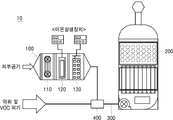
도 1은 본 발명의 일 실시예에 따른 수산화라디칼을 이용한 공기정화장치의 구성도.
도 2는 본 발명의 일 실시예에 따른 수산화라디칼을 이용한 공기정화장치의 라디칼생성부를 도시한 도면.
도 3은 본 발명의 일 실시예에 따른 음전극촉매의 사시도.
도 4는 본 발명의 일 실시예에 따른 수산화라디칼을 이용한 공기정화장치의 처리부를 도시한 도면.
도 5는 본 발명의 일 실시예에 따른 라디칼을 이용한 공기정화장치의 톨루엔 제거 성능을 도시한 그래프.
도 6은 본 발명의 일 실시예에 따른 라디칼을 이용한 공기정화장치의 암모니아 제거 성능을 도시한 그래프.BRIEF DESCRIPTION OF THE DRAWINGS FIG. 1 is a configuration diagram of an air purification apparatus using a hydroxide radical according to an embodiment of the present invention; FIG.
2 illustrates a radical generator of an air purifier using a hydroxyl radical according to an embodiment of the present invention.
3 is a perspective view of a negative electrode catalyst according to an embodiment of the present invention.
4 is a view illustrating a processing unit of an air purifying apparatus using a hydroxyl radical according to an embodiment of the present invention.
5 is a graph showing the toluene removal performance of an air cleaning apparatus using a radical according to an embodiment of the present invention.
6 is a graph illustrating ammonia removal performance of an air cleaning apparatus using radicals according to an embodiment of the present invention.
첨부된 도면을 참조하여 본 발명에 따른 실시예를 상세히 설명한다. 이하, 본 발명에 따른 실시예를 설명함에 있어, 그리고 각 도면의 구성요소들에 참조부호를 부가함에 있어, 동일한 구성요소들에 대해서는 비록 다른 도면상에 표시되더라도 가능한 한 동일한 부호를 부가하였다.DETAILED DESCRIPTION OF THE PREFERRED EMBODIMENTS Referring to the accompanying drawings, embodiments of the present invention will be described in detail. DETAILED DESCRIPTION OF THE PREFERRED EMBODIMENTS Hereinafter, embodiments of the present invention will be described in detail with reference to the accompanying drawings.
도 1은 본 발명의 일 실시예에 따른 수산화라디칼을 이용한 공기정화장치의 구성을 나타낸 도면이다.FIG. 1 is a view showing a configuration of an air purifying apparatus using a hydroxyl radical according to an embodiment of the present invention.
도 1에 도시된 바와 같이, 본 발명의 수산화라디칼을 이용한 공기정화장치(10, 이하 '공기정화장치'라고 한다)는 라디칼생성부(100)와 처리부(200)를 포함한다. 라디칼생성부(100)는 처리부(200)의 전단부에 구비되어, 유입되는 공기가 라다칼생성부로부터 처리부(200)로 유동할 수 있도록 한다.As shown in FIG. 1, an air purifier 10 (hereinafter referred to as an "air purifier") using the hydroxyl radical of the present invention includes a
도 2는 본 발명의 일 실시예에 따른 수산화라디칼을 이용한 공기정화장치의 라디칼생성부를 나타낸 도면이다.2 is a diagram illustrating a radical generator of an air purifier using a hydroxyl radical according to an embodiment of the present invention.
도 2를 참조하면, 본 발명의 라디칼생성부(100)는 산소농축부(110), 활성산소생성부(120) 및 플라즈마발생부(130)의 구성으로 이루어진다.2, the
산소농축부(110)는 라디칼생성부(100)의 가장 전단에 구비된다. 산소농축부(110)는 해당 업계에 종사하는 보통의 기술자에게 적용이 용이한 장치로서, 가정용 정수기, 에어컨, 차량용 산소발생장치, 실내 환기용 산소 발생장치 등에 널리 사용되고 있는 것이므로, 산소농축부(110)에 대한 산소발생원리 및 구체적인 구성 설명은 생략한다.The
활성산소생성부(120)는 산소농축부(110)의 후방에 구비되어, 산소농축부(110)에서 농축된 산소가 활성산소생성부(120)로 유동할 수 있도록 한다. 이러한 활성산소생성부(120)는 활성산소전극모듈(122)과 AC전원공급장치(124)를 포함한다.The
활성산소전극모듈(122)은 탄소, 알루미늄, 니켈, 구리, 알루미늄, 철, 텅스턴, 금, 은, 몰리브덴, 크롬, 스테인레스, 또는 그들의 합금 중에서 선택되는 어느 하나의 물질로 구성되는 원형 또는 판 형상의 도체, 또는 사용하는 목적에 따라 필요로 하는 형상으로 그 형태를 다르게 형성한 도체로 구성할 수 있으며, 공지기술로부터 다양한 형태의 적용이 당업자에게 가능하다.The active
AC전원공급장치(124)는 활성산소전극모듈(122)과 연결된다. AC전원공급장치(124)에 상술한 활성산소전극모듈(122)에 고주파전압을 인가하면 활성산소전극모듈(122) 내에 강방전계를 발생시키게 되고, 이 강방전계 중에 산소를 통과시키면 활성산소가 생성된다. The
플라즈마발생부(130)는 활성산소생성부(120)의 후방에 구비되어, 활성산소생성부(120)로부터 공급된 활성산소에 플라즈마를 발생시킴으로써 수산화라디칼을 생성한다. 이러한 플라즈마발생부(130)는 플라즈마전극모듈(132), 음전극촉매(134) 및 DC전원공급장치(136)의 구성으로 이루어진다. The
플라즈마전극모듈(132)은 탄소, 알루미늄, 니켈, 구리, 알루미늄, 철, 텅스턴, 금, 은, 몰리브덴, 크롬, 스테인레스, 또는 그들의 합금 중에서 선택되는 어느 하나의 물질로 구성되는 원형 또는 판 형상의 도체, 또는 사용하는 목적에 따라 필요로 하는 형상으로 그 형태를 다르게 형성한 도체로 구성할 수 있으며. 공지기술로부터 다양한 형태의 적용이 당업자에게 가능하다.The
한편, 음전극촉매(134)는 상술한 플라즈마전극모듈(132)에 접지되어 플라즈마전극모듈(132)의 방전면적을 증대시킨다. 이러한 음전극촉매(134)는 플라즈마생성부를 유동하는 공기의 흐름에 평행으로 배향되게 배치되는데, 이는 유동하는 공기가 음전극촉매(134)와 보다 오래 접촉시키기 위함이다.Meanwhile, the
도 3은 본 발명의 일 실시예에 따른 음전극촉매를 도시한 도면이다.3 is a view illustrating a negative electrode catalyst according to an embodiment of the present invention.
도 3에 도시된 바와 같이, 음전극촉매(134)의 형상은 사각기둥으로 형성되어 적어도 한 개 이상 구비될 수 있으나, 이에 한정하는 것은 아니고 라디칼생성부(100)를 유동하는 공기가 음전극촉매(134)에 충분히 접촉될 수 있도록 형성되면 충분하다. 이러한 음전극촉매(134)는 다공성 격자 또는 벌집구조로 형성되는 것이 바람직하다. 음전극촉매(134)의 재질은 몸체 전체가 같은 재질로 이루어질 수도 있고, 지지체와 코팅층으로 구분하여 서로 다른 재질로 구성될 수도 있다. 다만, 음전극촉매(134)의 표면은 니켈, 망간, 철, 구리, 코발트, 리튬 및 그 수화물 중 어느 하나 이상을 포함하는 금속으로 이루어지도록 한다.As shown in FIG. 3, the shape of the
음전극촉매(134)가 지지체와 코팅층으로 구성되는 경우, 각 구성은 다음과 같다.When the
음전극촉매(134)의 지지체는 공기가 음전극촉매(134)를 통과하는 과정에서 압력손실을 최소화할 수 있는 구조를 가진다. 이때 음전극촉매(134)의 재질로는 제올라이트가 사용될 수 있는데, 이러한 제올라이트는 다공성 격자 또는 벌집구조(Honeycomb Type, 하니컴)의 다공성구조로 형성이 용이하여, 공기와의 접촉면적을 최대화할 수 있다.The support of the
또한, 음전극촉매(134)의 코팅층은 금속코팅층인 것이 바람직하다. 코팅층의 촉매는 전이금속을 포함하며, 전이금속의 담지량은 지지체 대비 0.1 ~ 30중량% 인 것이 바람직하다. 이러한 전이금속은 니켈, 망간, 철, 구리, 코발트(Co), 리튬 및 그 수화물일 수 있다.The coating layer of the
DC전원공급장치(136)는 플라즈마전극모듈(132)과 연결된다. DC전원공급장치(136)로부터 상술한 플라즈마전극모듈(132)에 전압을 인가하면 플라즈마전극모듈(132)은 플라즈마를 발생시키게 된다. 이때 플라즈마발생부(130)로 활성산소가 유입되면 공기 중의 수분과 반응하여 수산화라디칼이 생성된다. The
도 4는 본 발명의 일 실시예에 따른 수산화라디칼을 이용한 공기정화장치(10)의 처리부를 나타낸 도면이다.4 is a view illustrating a processing unit of the
본 발명의 처리부(200)는 라디칼생성부(100)의 후단에 마련된다. 이러한 처리부(200)에는 라디칼생성부(100)에서 생성된 수산화라디칼과 악취가스가 유입되는데, 이때 수산화라디칼을 이용하여 악취가스의 악취성분이 분해된다. 처리부(200)는 유입구(202) 및 배출구(206)를 포함하며, 촉매탑(210), 흡착탑(220) 또는 습식스크러버(230)를 더 구비할 수 있다.The
유입구(202)는 라디칼생성부(100)와 연통되도록 구비되어, 라디칼생성부(100)로부터 생성된 수산화라디칼이 후술하는 혼합탱크(400)에서 악취가스와 혼합된 후 유입될 수 있도록 한다. 이러한 유입구(202)에는 송풍팬(204)이 구비된다. 송풍팬(204)은 공기정화장치(10)가 운행되기 위한 공기의 순환을 유도한다. 정화가 완료된 가스는 배출구를 통해 외부로 배출된다. The
습식스크러버(210)는 기체-액체 접촉형 집진장치로서, 처리부(200)의 후방에 구비되어 수산화라디칼에 의해 제거되면서 생성된 물이 잔존하는 악취성분과 함께 존재하더라도, 악취성분을 효과적으로 흡착함으로써 악취성분의 처리가 이루어질 수 있도록 한다.The
또한, 촉매탑(220)은 한 종류 이상의 촉매로 이루어진 장치로서, 유입되는 악취성분의 처리가 이루어질 수 있도록 한다. 촉매의 종류는 유입되는 악취성분에 따라 이에 대응되는 것으로 구비할 수 있으며, 하나 이상 구비되어 다단으로 구성할 수 있다.In addition, the catalyst tower 220 is a device made up of one or more kinds of catalysts, and allows the treatment of the incoming odor components. The kind of the catalyst may be provided corresponding to the incoming odor component, and it may be constituted by one or more than one.
더불어, 흡착탑(230)은 한 종류 이상의 흡착제로 이루어진 장치로서, 배출되는 공기에 잔존하는 악취성분까지 흡착함으로써 악취성분의 처리가 이루어질 수 있도록 한다. 흡착제의 종류는 유입되는 악취성분에 따라 이에 대응되는 것으로 구비할 수 있으며, 하나 이상 구비되어 다단으로 구성할 수 있다.In addition, the adsorption tower 230 is made up of one or more kinds of adsorbents, and adsorbs the odor components remaining in the discharged air so that the odor component can be treated. The kind of the adsorbent may be provided corresponding to the incoming odor component, and one or more adsorbents may be provided in multiple stages.
습식스크러버(210), 촉매탑(220) 및 흡착탑(230)은 모두 함께 구비될 수도 있고, 이 중 어느 하나 만이 구비될 수도 있다.The
상술한 라디칼생성부(100)와 처리부(200)는 배관(300)을 통해서 연결된다. 배관(300)은 라디칼생성부(100)로부터 생성된 수산화라디칼을 처리부(200)로 누설 없이 공급할 수 있도록 한다.The
배관(300)에는 혼합탱크(400)가 더 구비될 수 있다. 혼합탱크(400)는 처리부(200)로 유입되는 수산화라디칼과 악취가스를 혼합하는 장치로서, 처리부(200)로 유입되기 전에 미리 혼합함으로써 수산화라디칼과 악취가스가 고르게 섞여 악취성분의 분해가 처리부(200)에서 더욱 효율적으로 이루어지도록 한다.
The
이하에서는, 도 1을 참조하여 본 실시예에 따른 수산화라디칼을 이용한 공기정화장치(10)를 이용한 공기정화과정을 살펴보도록 한다.Hereinafter, the air purification process using the
공기정화장치(10)에 전원이 인가되어 송풍팬(204)이 작동하면, 라디칼생성부(100)와 처리부(200)의 내부에 공기의 흐름이 발생한다. 즉, 공기가 외부로부터 유입되어 라디칼생성부(100)의 산소농축부(110), 활성산소생성부(120) 및 플라즈마발생부(130)를 따라 이동한 후, 처리부(200)로 유입된다. 한편, 악취가스는 외부에서 처리부(200)로 바로 유입될 수 있다. 이때, 활성산소전극모듈(122)에 의해서 활성산소가 생성되고, 생성된 활성산소에 플라즈마전극모듈(132)이 플라즈마를 발생시키면 수산화라디칼이 생성된다. 상술한 일련의 과정에 의해 생성된 수산화라디칼은 악취성분과 반응하여 무취성분으로 변환시킴으로써 공기의 정화를 도모하게 된다. 이때, 수산화라디칼은 오존이나 염소보다 훨씬 강력한 산화력을 가진 물질로서 처리부(200)에 유입됨으로써 유기화합물질이나 악취성분을 분해시켜 인체에 무해한 물과 이산화탄소로 변환시킨다.
When power is applied to the
실험예 1. 톨루엔 제거 효율 평가 실험EXPERIMENTAL EXAMPLE 1 Evaluation of Toluene Removal Efficiency
본 실시예에 따른 수산화라디칼을 이용한 공기정화장치(10)의 살균 성능을 확인하기 위하여, 다음과 같은 조건 처리풍량과 전압에 따른 살균 성능 평가 실험을 수행하였다. 살균 성능 평가 실험에 사용된 공기 중 악취성분은 톨루엔이다. 처리풍량이 5mㅃ/min이고, 인가전압이 3kV, 반응온도는 30℃이다.In order to confirm the sterilizing performance of the
도 5를 참조하면, 본 실시예에 따른 수산화라디칼을 이용한 공기정화장치(10)는 처리풍량과 전압에 따라 다음과 같은 살균 성능을 보였다. 즉, 처리풍량이 5mㅃ/min이고, 인가전압이 3kV인 경우 50ppm, 100ppm, 200ppm, 300ppm 농도의 톨루엔이 10분만에 99 % 이상 소멸됨을 알 수 있다.
Referring to FIG. 5, the
실험예 2. 암모니아 제거 효율 평가 실험EXPERIMENTAL EXAMPLE 2 Experiment to Evaluate Ammonia Removal Efficiency
본 실시예에 따른 수산화라디칼을 이용한 공기정화장치(10)의 살균 성능을 확인하기 위하여, 다음과 같은 조건 처리풍량과 전압에 따른 살균 성능 평가 실험을 수행하였다. 살균 성능 평가 실험에 사용된 공기 중 악취성분은 암모니아이다. 처리풍량이 5mㅃ/min이고, 인가전압이 3kV, 반응온도는30℃이다.In order to confirm the sterilizing performance of the
도 6을 참조하면, 본 실시예에 따른 수산화라디칼을 이용한 공기정화장치(10)는 처리풍량과 전압에 따라 다음과 같은 살균 성능을 보였다. 즉, 처리풍량이 5mㅃ/min이고, 인가전압이 3kV인 경우 30ppm, 50ppm, 100ppm, 150ppm 농도의 암모니아가 10분만에 99 % 이상 소멸됨을 알 수 있다.
Referring to FIG. 6, the
이상 본 발명을 바람직한 실시예를 통하여 설명하였는데, 상술한 실시예는 본 발명의 기술적 사상을 예시적으로 설명한 것에 불과하며, 본 발명의 기술적 사상을 벗어나지 않는 범위 내에서 다양한 변화가 가능함은 이 분야에서 통상의 지식을 가진 자라면 이해할 수 있을 것이다. 따라서 본 발명의 보호범위는 특정 실시예가 아니라 특허청구범위에 기재된 사항에 의해 해석되어야 하며, 그와 동등한 범위 내에 있는 모든 기술적 사상도 본 발명의 권리범위에 포함되는 것으로 해석되어야 할 것이다.
While the present invention has been particularly shown and described with reference to preferred embodiments thereof, it is to be understood that the invention is not limited to the disclosed embodiments, but, on the contrary, is intended to cover various modifications and equivalent arrangements included within the spirit and scope of the appended claims. Those skilled in the art will understand. Therefore, the scope of protection of the present invention should be construed not only in the specific embodiments but also in the scope of claims, and all technical ideas within the scope of the same shall be construed as being included in the scope of the present invention.
100: 라디칼생성부 110: 산소농축부
120: 활성산소생성부 130: 플라즈마발생부
200: 처리부 210: 습식스크러버
220: 촉매탑 230: 흡착탑
300: 배관 400: 혼합탱크100: radical generator 110: oxygen concentrator
120: active oxygen generator 130: plasma generator
200: processing part 210: wet scrubber
220: catalyst tower 230: adsorption tower
300: piping 400: mixing tank
Claims (16)
외부로부터 유입된 공기 중의 산소를 이용하여 수산화라디칼을 생성하는 라디칼생성부를 포함하는 것을 특징으로 하는 수산화라디칼을 이용한 공기정화장치.
1. An air purification apparatus for decomposing a malodorous component,
And a radical generating unit for generating a hydroxyl radical by using oxygen in the air introduced from the outside.
상기 라디칼생성부는,
외부로부터 유입된 공기 중의 산소를 농축하는 산소농축부;
상기 산소농축부로부터 농축된 산소를 이용하여 활성산소를 생성하는 활성산소생성부; 및
상기 활성산소생성부로부터 생성된 활성산소에 플라즈마를 발생시키는 플라즈마발생부를 포함하는 것을 특징으로 하는 수산화라디칼을 이용한 공기정화장치.
The method according to claim 1,
Wherein the radical generator comprises:
An oxygen concentration unit for concentrating oxygen in the air introduced from the outside;
An active oxygen generating unit for generating active oxygen using oxygen enriched from the oxygen enrichment unit; And
And a plasma generator for generating a plasma in the active oxygen generated from the active oxygen generator.
상기 활성산소생성부는,
무성방전을 발생시켜 활성산소를 생성하기 위한 활성산소전극모듈을 포함하는 것을 특징으로 하는 수산화라디칼을 이용한 공기정화장치.
The method of claim 2,
The active oxygen-
And an active oxygen electrode module for generating active oxygen by generating a silent discharge.
상기 플라즈마발생부는, 상기 활성산소생성부로부터 생성된 활성산소에 플라즈마를 발생시키기 위한 플라즈마전극모듈을 포함하는 것을 특징으로 하는 수산화라디칼을 이용한 공기정화장치.
The method of claim 3,
Wherein the plasma generating unit includes a plasma electrode module for generating a plasma on active oxygen generated from the active oxygen generating unit.
상기 플라즈마발생부는 상기 플라즈마전극모듈의 방전면적을 증대시키는 전도성 재질의 음전극촉매를 포함하는 것을 특징으로 하는 수산화라디칼을 이용한 공기정화장치.
The method of claim 4,
Wherein the plasma generating unit includes a negative electrode catalyst of a conductive material for increasing a discharge area of the plasma electrode module.
상기 음전극촉매는 사각기둥 형상인 것을 특징으로 하는 수산화라디칼을 이용한 공기정화장치.
The method of claim 5,
Wherein the negative electrode catalyst has a square pillar shape.
상기 음전극촉매는 다공성 격자 또는 벌집구조인 것을 특징으로 하는 수산화라디칼을 이용한 공기정화장치.
The method of claim 6,
Wherein the negative electrode catalyst is a porous lattice or a honeycomb structure.
상기 음전극촉매는 니켈(Ni), 망간(Mn), 구리(Cu), 철(Fe), 코발트(Co), 리튬(Li), 타이타늄(Ti) 및 이들의 산화물로 구성되는 군으로부터 선택되는 어느 하나 이상으로 이루어진 것을 특징으로 하는 수산화라디칼을 이용한 공기정화장치.
The method of claim 7,
Wherein the negative electrode catalyst is selected from the group consisting of Ni, Mn, Cu, Fe, Co, Li, Ti, Wherein the at least one oxidizing agent is at least one selected from the group consisting of hydrogen peroxide and hydrogen peroxide.
상기 음전극촉매는
지지체; 및
상기 지지체의 표면에 형성된 코팅층을 포함하는 것을 특징으로 하는 라디칼을 이용한 공기정화장치.
The method of claim 7,
The negative electrode catalyst
A support; And
And a coating layer formed on the surface of the support.
상기 지지체는, 제올라이트(Zeolite) 지지체를 포함하는 것을 특징으로 하는 라디칼을 이용한 공기정화장치.
The method of claim 9,
Characterized in that the support comprises a zeolite support.
상기 코팅층은, 금속촉매 코팅층을 포함하는 것을 특징으로 하는 라디칼을 이용한 공기정화장치.
The method of claim 10,
Wherein the coating layer comprises a metal catalyst coating layer.
상기 금속촉매는 니켈(Ni), 망간(Mn), 구리(Cu), 철(Fe), 코발트(Co), 리튬(Li), 타이타늄(Ti) 및 이들의 산화물로 구성되는 군으로부터 선택되는 어느 하나 이상인 것을 특징으로 하는 수산화라디칼을 이용한 공기정화장치.
The method of claim 11,
Wherein the metal catalyst is selected from the group consisting of Ni, Mn, Cu, Fe, Co, Li, Ti, Wherein the at least one hydroxyl radical is at least one hydroxyl group.
상기 라디칼생성부로부터 생성된 라디칼이 유입되어 악취성분의 분해가 이루어지는 처리부를 더 포함하는 것을 특징으로 하는 수산화라디칼을 이용한 공기정화장치.
The method according to any one of claims 1 to 12,
Further comprising a processing unit to which radicals generated from the radical generating unit are introduced to decompose odorous components.
상기 처리부는 촉매탑을 더 포함하는 것을 특징으로 하는 라디칼을 이용한 공기정화장치.
14. The method of claim 13,
Wherein the processing unit further comprises a catalyst tower.
상기 처리부는 흡착탑을 더 포함하는 것을 특징으로 하는 수산화라디칼을 이용한 공기정화장치.
15. The method of claim 14,
Wherein the treatment unit further comprises an adsorption tower.
상기 처리부는 습식 스크러버를 더 포함하는 것을 특징으로 하는 수산화라디칼을 이용한 공기정화장치.16. The method of claim 15,
Wherein the processing unit further comprises a wet scrubber.
Priority Applications (1)
| Application Number | Priority Date | Filing Date | Title |
|---|---|---|---|
| KR1020140120135A KR20160030679A (en) | 2014-09-11 | 2014-09-11 | Air furification apparatus using hydroxyl radical |
Applications Claiming Priority (1)
| Application Number | Priority Date | Filing Date | Title |
|---|---|---|---|
| KR1020140120135A KR20160030679A (en) | 2014-09-11 | 2014-09-11 | Air furification apparatus using hydroxyl radical |
Publications (1)
| Publication Number | Publication Date |
|---|---|
| KR20160030679A true KR20160030679A (en) | 2016-03-21 |
Family
ID=55650859
Family Applications (1)
| Application Number | Title | Priority Date | Filing Date |
|---|---|---|---|
| KR1020140120135A Ceased KR20160030679A (en) | 2014-09-11 | 2014-09-11 | Air furification apparatus using hydroxyl radical |
Country Status (1)
| Country | Link |
|---|---|
| KR (1) | KR20160030679A (en) |
Cited By (3)
| Publication number | Priority date | Publication date | Assignee | Title |
|---|---|---|---|---|
| KR101949943B1 (en) * | 2018-12-05 | 2019-02-19 | 주식회사 이에스티 | Deodorization system for removing odor |
| KR101925430B1 (en) * | 2018-04-16 | 2019-02-26 | 삼성엔지니어링 주식회사 | Ion catalyst activated by ions for odor removal and method for manufacturing the same |
| KR102570464B1 (en) * | 2022-05-18 | 2023-08-28 | 주식회사 제이제이이테크 | System for cleaning discharge gas and polluted cleaning water in scrubber |
-
2014
- 2014-09-11 KR KR1020140120135A patent/KR20160030679A/en not_active Ceased
Cited By (3)
| Publication number | Priority date | Publication date | Assignee | Title |
|---|---|---|---|---|
| KR101925430B1 (en) * | 2018-04-16 | 2019-02-26 | 삼성엔지니어링 주식회사 | Ion catalyst activated by ions for odor removal and method for manufacturing the same |
| KR101949943B1 (en) * | 2018-12-05 | 2019-02-19 | 주식회사 이에스티 | Deodorization system for removing odor |
| KR102570464B1 (en) * | 2022-05-18 | 2023-08-28 | 주식회사 제이제이이테크 | System for cleaning discharge gas and polluted cleaning water in scrubber |
Similar Documents
| Publication | Publication Date | Title |
|---|---|---|
| CN108568213B (en) | Bench type laboratory air pollutant removing machine | |
| KR101567334B1 (en) | Plasma absorption deodor apparatus | |
| KR102134292B1 (en) | Plasma low temperature oxidation adsorption catalyst deodorizer and deodorization method | |
| CN107983122A (en) | Integral composite photocatalysis plasma waste gas cleaning equipment | |
| CN105148656A (en) | Comprehensive disposal system for malodorous organic exhaust gas | |
| CN203276733U (en) | A video display device with one or more air disinfection and purification technologies | |
| CN112915739A (en) | Heterogeneous catalytic oxidation processing system of organic waste gas and foul smell waste gas | |
| CN108554172A (en) | Dimethylamine exhaust gas controlling device and its technique in a kind of synthetic leather industry | |
| CN202113707U (en) | Air purifier | |
| CN205109351U (en) | Stench waste gas treatment system | |
| JP5108492B2 (en) | Air purification method and air purification device | |
| KR101595335B1 (en) | Compound reactor for removing malodor gas | |
| KR100949164B1 (en) | Photocatalytic reactor having a function of deodorization and sterilization air pollution and method of the same, and stand-alone a foul smell treatment apparatus using the same | |
| KR20160030679A (en) | Air furification apparatus using hydroxyl radical | |
| KR100428965B1 (en) | Air purification method | |
| KR20090095169A (en) | Air Cleaner | |
| KR101817907B1 (en) | Apparatus for eliminating stink and harzardous gas | |
| KR200407830Y1 (en) | Industrial Combined Air Purifier | |
| CN202343079U (en) | High energy ion deodorant purifier | |
| KR102033472B1 (en) | Plasma odor and germ remover | |
| KR20230039974A (en) | Sterilization and Odor removal using plasma and UV light | |
| CN102728220A (en) | Device for purification treatment to malodorous gas in supergravity field photo-catalytic oxidation | |
| CN102772988A (en) | Energy-efficient purification treatment device for odorous waste gases | |
| CN206262316U (en) | A kind of plasma apparatus for removing kitchen garbage stench | |
| KR100475276B1 (en) | Air purification method |
Legal Events
| Date | Code | Title | Description |
|---|---|---|---|
| A201 | Request for examination | ||
| PA0109 | Patent application |
Patent event code: PA01091R01D Comment text: Patent Application Patent event date: 20140911 |
|
| PA0201 | Request for examination | ||
| A302 | Request for accelerated examination | ||
| PA0302 | Request for accelerated examination |
Patent event date: 20150925 Patent event code: PA03022R01D Comment text: Request for Accelerated Examination Patent event date: 20140911 Patent event code: PA03021R01I Comment text: Patent Application |
|
| E902 | Notification of reason for refusal | ||
| PE0902 | Notice of grounds for rejection |
Comment text: Notification of reason for refusal Patent event date: 20151118 Patent event code: PE09021S01D |
|
| E601 | Decision to refuse application | ||
| PE0601 | Decision on rejection of patent |
Patent event date: 20160310 Comment text: Decision to Refuse Application Patent event code: PE06012S01D Patent event date: 20151118 Comment text: Notification of reason for refusal Patent event code: PE06011S01I |
|
| PG1501 | Laying open of application |