KR20150042283A - Assay methods and systems - Google Patents
Assay methods and systems Download PDFInfo
- Publication number
- KR20150042283A KR20150042283A KR20157006619A KR20157006619A KR20150042283A KR 20150042283 A KR20150042283 A KR 20150042283A KR 20157006619 A KR20157006619 A KR 20157006619A KR 20157006619 A KR20157006619 A KR 20157006619A KR 20150042283 A KR20150042283 A KR 20150042283A
- Authority
- KR
- South Korea
- Prior art keywords
- probe
- nucleic acid
- var
- target
- primer
- Prior art date
- Legal status (The legal status is an assumption and is not a legal conclusion. Google has not performed a legal analysis and makes no representation as to the accuracy of the status listed.)
- Withdrawn
Links
- 238000003556 assay Methods 0.000 title abstract description 41
- 239000000523 sample Substances 0.000 claims abstract description 368
- 150000007523 nucleic acids Chemical group 0.000 claims abstract description 116
- 230000003321 amplification Effects 0.000 claims abstract description 110
- 238000003199 nucleic acid amplification method Methods 0.000 claims abstract description 110
- 238000000034 method Methods 0.000 claims abstract description 103
- 108091028043 Nucleic acid sequence Proteins 0.000 claims abstract description 40
- 238000006243 chemical reaction Methods 0.000 claims description 70
- 108020004707 nucleic acids Proteins 0.000 claims description 66
- 102000039446 nucleic acids Human genes 0.000 claims description 66
- 241000700647 Variola virus Species 0.000 claims description 38
- 230000000295 complement effect Effects 0.000 claims description 35
- 108020004711 Nucleic Acid Probes Proteins 0.000 claims description 28
- 239000002853 nucleic acid probe Substances 0.000 claims description 28
- 238000003752 polymerase chain reaction Methods 0.000 claims description 24
- 230000000694 effects Effects 0.000 claims description 17
- 239000000758 substrate Substances 0.000 claims description 16
- 239000003153 chemical reaction reagent Substances 0.000 claims description 15
- 238000010791 quenching Methods 0.000 claims description 9
- 102000004190 Enzymes Human genes 0.000 claims description 8
- 108090000790 Enzymes Proteins 0.000 claims description 8
- 108060002716 Exonuclease Proteins 0.000 claims description 8
- 102000013165 exonuclease Human genes 0.000 claims description 8
- 239000000203 mixture Substances 0.000 claims description 7
- 208000001203 Smallpox Diseases 0.000 claims description 6
- 239000007787 solid Substances 0.000 claims description 5
- 230000007423 decrease Effects 0.000 claims description 3
- 241000870995 Variola Species 0.000 claims description 2
- 230000003612 virological effect Effects 0.000 claims description 2
- 230000008569 process Effects 0.000 abstract description 13
- 238000001514 detection method Methods 0.000 description 71
- 108020004414 DNA Proteins 0.000 description 39
- 230000003287 optical effect Effects 0.000 description 31
- 241000700605 Viruses Species 0.000 description 27
- 239000011324 bead Substances 0.000 description 22
- 239000002773 nucleotide Substances 0.000 description 22
- 125000003729 nucleotide group Chemical group 0.000 description 22
- 238000009396 hybridization Methods 0.000 description 18
- 230000005284 excitation Effects 0.000 description 16
- 239000012530 fluid Substances 0.000 description 15
- 238000000576 coating method Methods 0.000 description 14
- 238000003753 real-time PCR Methods 0.000 description 14
- 238000003491 array Methods 0.000 description 11
- 239000000463 material Substances 0.000 description 11
- 108091093088 Amplicon Proteins 0.000 description 10
- 239000000243 solution Substances 0.000 description 10
- 238000005382 thermal cycling Methods 0.000 description 10
- 239000011248 coating agent Substances 0.000 description 9
- 241000700629 Orthopoxvirus Species 0.000 description 8
- 238000013459 approach Methods 0.000 description 8
- 238000002474 experimental method Methods 0.000 description 8
- 239000010410 layer Substances 0.000 description 8
- 238000004519 manufacturing process Methods 0.000 description 8
- 230000005855 radiation Effects 0.000 description 8
- 239000011541 reaction mixture Substances 0.000 description 8
- 230000027455 binding Effects 0.000 description 7
- 238000005516 engineering process Methods 0.000 description 7
- 238000005259 measurement Methods 0.000 description 7
- 229920000642 polymer Polymers 0.000 description 7
- 230000002829 reductive effect Effects 0.000 description 7
- 239000000872 buffer Substances 0.000 description 6
- 230000003750 conditioning effect Effects 0.000 description 6
- 238000013461 design Methods 0.000 description 6
- 238000002493 microarray Methods 0.000 description 6
- 239000002245 particle Substances 0.000 description 6
- 238000011144 upstream manufacturing Methods 0.000 description 6
- 239000004820 Pressure-sensitive adhesive Substances 0.000 description 5
- 239000000853 adhesive Substances 0.000 description 5
- 230000001070 adhesive effect Effects 0.000 description 5
- 238000004458 analytical method Methods 0.000 description 5
- 238000010586 diagram Methods 0.000 description 5
- 238000007834 ligase chain reaction Methods 0.000 description 5
- 238000003499 nucleic acid array Methods 0.000 description 5
- 238000012545 processing Methods 0.000 description 5
- 230000000171 quenching effect Effects 0.000 description 5
- 101710154606 Hemagglutinin Proteins 0.000 description 4
- 101710163270 Nuclease Proteins 0.000 description 4
- 101710093908 Outer capsid protein VP4 Proteins 0.000 description 4
- 101710135467 Outer capsid protein sigma-1 Proteins 0.000 description 4
- 101710176177 Protein A56 Proteins 0.000 description 4
- 230000015556 catabolic process Effects 0.000 description 4
- 238000003776 cleavage reaction Methods 0.000 description 4
- 238000006731 degradation reaction Methods 0.000 description 4
- 230000004069 differentiation Effects 0.000 description 4
- 239000000975 dye Substances 0.000 description 4
- 230000006870 function Effects 0.000 description 4
- 238000009830 intercalation Methods 0.000 description 4
- 230000000670 limiting effect Effects 0.000 description 4
- 239000003550 marker Substances 0.000 description 4
- 230000001717 pathogenic effect Effects 0.000 description 4
- 241000894007 species Species 0.000 description 4
- 238000000018 DNA microarray Methods 0.000 description 3
- 102100031780 Endonuclease Human genes 0.000 description 3
- VYPSYNLAJGMNEJ-UHFFFAOYSA-N Silicium dioxide Chemical compound O=[Si]=O VYPSYNLAJGMNEJ-UHFFFAOYSA-N 0.000 description 3
- 206010046865 Vaccinia virus infection Diseases 0.000 description 3
- 238000000137 annealing Methods 0.000 description 3
- 230000001419 dependent effect Effects 0.000 description 3
- 230000007613 environmental effect Effects 0.000 description 3
- 230000007274 generation of a signal involved in cell-cell signaling Effects 0.000 description 3
- 239000000185 hemagglutinin Substances 0.000 description 3
- 238000005286 illumination Methods 0.000 description 3
- 238000002955 isolation Methods 0.000 description 3
- 238000011068 loading method Methods 0.000 description 3
- 238000002844 melting Methods 0.000 description 3
- 230000008018 melting Effects 0.000 description 3
- -1 penta-fluorophenyl ester Chemical class 0.000 description 3
- 238000002360 preparation method Methods 0.000 description 3
- 230000002285 radioactive effect Effects 0.000 description 3
- 230000009467 reduction Effects 0.000 description 3
- 238000011160 research Methods 0.000 description 3
- 230000007017 scission Effects 0.000 description 3
- 238000003786 synthesis reaction Methods 0.000 description 3
- 208000007089 vaccinia Diseases 0.000 description 3
- 238000003466 welding Methods 0.000 description 3
- XKRFYHLGVUSROY-UHFFFAOYSA-N Argon Chemical compound [Ar] XKRFYHLGVUSROY-UHFFFAOYSA-N 0.000 description 2
- 241000497157 Bariella Species 0.000 description 2
- 108010042407 Endonucleases Proteins 0.000 description 2
- 108060004795 Methyltransferase Proteins 0.000 description 2
- 244000046052 Phaseolus vulgaris Species 0.000 description 2
- 235000010627 Phaseolus vulgaris Nutrition 0.000 description 2
- 241000489455 Sitta europaea Species 0.000 description 2
- 230000009471 action Effects 0.000 description 2
- 238000002820 assay format Methods 0.000 description 2
- 230000008901 benefit Effects 0.000 description 2
- 230000008033 biological extinction Effects 0.000 description 2
- 239000012472 biological sample Substances 0.000 description 2
- 230000015572 biosynthetic process Effects 0.000 description 2
- 230000001413 cellular effect Effects 0.000 description 2
- 230000008859 change Effects 0.000 description 2
- 238000001816 cooling Methods 0.000 description 2
- 238000000295 emission spectrum Methods 0.000 description 2
- 238000001917 fluorescence detection Methods 0.000 description 2
- 239000012634 fragment Substances 0.000 description 2
- 239000011521 glass Substances 0.000 description 2
- 238000007403 mPCR Methods 0.000 description 2
- 230000007246 mechanism Effects 0.000 description 2
- 230000036961 partial effect Effects 0.000 description 2
- 244000052769 pathogen Species 0.000 description 2
- 239000004033 plastic Substances 0.000 description 2
- 229920003023 plastic Polymers 0.000 description 2
- 239000004417 polycarbonate Substances 0.000 description 2
- 230000037452 priming Effects 0.000 description 2
- 239000002096 quantum dot Substances 0.000 description 2
- 230000008707 rearrangement Effects 0.000 description 2
- 230000010076 replication Effects 0.000 description 2
- 238000003757 reverse transcription PCR Methods 0.000 description 2
- 238000012552 review Methods 0.000 description 2
- 230000035945 sensitivity Effects 0.000 description 2
- 238000001228 spectrum Methods 0.000 description 2
- 239000002344 surface layer Substances 0.000 description 2
- 238000012360 testing method Methods 0.000 description 2
- 238000004448 titration Methods 0.000 description 2
- 238000012546 transfer Methods 0.000 description 2
- 201000006266 variola major Diseases 0.000 description 2
- 201000000627 variola minor Diseases 0.000 description 2
- 208000014016 variola minor infection Diseases 0.000 description 2
- XLYOFNOQVPJJNP-UHFFFAOYSA-N water Substances O XLYOFNOQVPJJNP-UHFFFAOYSA-N 0.000 description 2
- 208000019901 Anxiety disease Diseases 0.000 description 1
- NOWKCMXCCJGMRR-UHFFFAOYSA-N Aziridine Chemical compound C1CN1 NOWKCMXCCJGMRR-UHFFFAOYSA-N 0.000 description 1
- 241000894006 Bacteria Species 0.000 description 1
- 241000282836 Camelus dromedarius Species 0.000 description 1
- 201000006082 Chickenpox Diseases 0.000 description 1
- 102000010970 Connexin Human genes 0.000 description 1
- 108050001175 Connexin Proteins 0.000 description 1
- 241000711573 Coronaviridae Species 0.000 description 1
- 241000233866 Fungi Species 0.000 description 1
- 238000009015 Human TaqMan MicroRNA Assay kit Methods 0.000 description 1
- PEEHTFAAVSWFBL-UHFFFAOYSA-N Maleimide Chemical compound O=C1NC(=O)C=C1 PEEHTFAAVSWFBL-UHFFFAOYSA-N 0.000 description 1
- 108091034117 Oligonucleotide Proteins 0.000 description 1
- 238000012408 PCR amplification Methods 0.000 description 1
- 241000224016 Plasmodium Species 0.000 description 1
- 239000002202 Polyethylene glycol Chemical group 0.000 description 1
- 239000004793 Polystyrene Substances 0.000 description 1
- 108010092799 RNA-directed DNA polymerase Proteins 0.000 description 1
- 241000700618 Vaccinia virus Species 0.000 description 1
- 206010046980 Varicella Diseases 0.000 description 1
- 238000009825 accumulation Methods 0.000 description 1
- NIXOWILDQLNWCW-UHFFFAOYSA-N acrylic acid group Chemical group C(C=C)(=O)O NIXOWILDQLNWCW-UHFFFAOYSA-N 0.000 description 1
- 150000001266 acyl halides Chemical class 0.000 description 1
- 150000001299 aldehydes Chemical class 0.000 description 1
- 150000001336 alkenes Chemical class 0.000 description 1
- 150000001345 alkine derivatives Chemical class 0.000 description 1
- 150000001408 amides Chemical class 0.000 description 1
- 229910052786 argon Inorganic materials 0.000 description 1
- 150000001540 azides Chemical class 0.000 description 1
- 238000003705 background correction Methods 0.000 description 1
- SESFRYSPDFLNCH-UHFFFAOYSA-N benzyl benzoate Chemical compound C=1C=CC=CC=1C(=O)OCC1=CC=CC=C1 SESFRYSPDFLNCH-UHFFFAOYSA-N 0.000 description 1
- 239000011230 binding agent Substances 0.000 description 1
- 229920001222 biopolymer Polymers 0.000 description 1
- 239000000919 ceramic Substances 0.000 description 1
- 239000003795 chemical substances by application Substances 0.000 description 1
- 238000004891 communication Methods 0.000 description 1
- 239000012141 concentrate Substances 0.000 description 1
- 239000012611 container material Substances 0.000 description 1
- 238000012937 correction Methods 0.000 description 1
- 230000008878 coupling Effects 0.000 description 1
- 238000010168 coupling process Methods 0.000 description 1
- 238000005859 coupling reaction Methods 0.000 description 1
- 238000005520 cutting process Methods 0.000 description 1
- 238000007405 data analysis Methods 0.000 description 1
- 238000000354 decomposition reaction Methods 0.000 description 1
- 239000008367 deionised water Substances 0.000 description 1
- 229910021641 deionized water Inorganic materials 0.000 description 1
- 238000012217 deletion Methods 0.000 description 1
- 230000037430 deletion Effects 0.000 description 1
- 230000010460 detection of virus Effects 0.000 description 1
- 150000001993 dienes Chemical class 0.000 description 1
- 201000010099 disease Diseases 0.000 description 1
- 231100000676 disease causative agent Toxicity 0.000 description 1
- 208000037265 diseases, disorders, signs and symptoms Diseases 0.000 description 1
- 230000009977 dual effect Effects 0.000 description 1
- 238000000835 electrochemical detection Methods 0.000 description 1
- 238000010894 electron beam technology Methods 0.000 description 1
- 150000002118 epoxides Chemical class 0.000 description 1
- 150000002148 esters Chemical class 0.000 description 1
- CEIPQQODRKXDSB-UHFFFAOYSA-N ethyl 3-(6-hydroxynaphthalen-2-yl)-1H-indazole-5-carboximidate dihydrochloride Chemical compound Cl.Cl.C1=C(O)C=CC2=CC(C3=NNC4=CC=C(C=C43)C(=N)OCC)=CC=C21 CEIPQQODRKXDSB-UHFFFAOYSA-N 0.000 description 1
- 239000000835 fiber Substances 0.000 description 1
- 239000007850 fluorescent dye Substances 0.000 description 1
- 239000005350 fused silica glass Substances 0.000 description 1
- 230000004927 fusion Effects 0.000 description 1
- 238000013412 genome amplification Methods 0.000 description 1
- 238000003205 genotyping method Methods 0.000 description 1
- 238000010191 image analysis Methods 0.000 description 1
- 238000000126 in silico method Methods 0.000 description 1
- 238000011065 in-situ storage Methods 0.000 description 1
- 238000010348 incorporation Methods 0.000 description 1
- 239000010954 inorganic particle Substances 0.000 description 1
- 238000003780 insertion Methods 0.000 description 1
- 230000037431 insertion Effects 0.000 description 1
- 230000003993 interaction Effects 0.000 description 1
- 239000012948 isocyanate Substances 0.000 description 1
- 150000002513 isocyanates Chemical class 0.000 description 1
- 150000002540 isothiocyanates Chemical class 0.000 description 1
- 238000005304 joining Methods 0.000 description 1
- 150000002576 ketones Chemical class 0.000 description 1
- 238000002372 labelling Methods 0.000 description 1
- 238000004020 luminiscence type Methods 0.000 description 1
- 238000003913 materials processing Methods 0.000 description 1
- QSHDDOUJBYECFT-UHFFFAOYSA-N mercury Chemical compound [Hg] QSHDDOUJBYECFT-UHFFFAOYSA-N 0.000 description 1
- 229910052753 mercury Inorganic materials 0.000 description 1
- 229910052751 metal Inorganic materials 0.000 description 1
- 239000002184 metal Substances 0.000 description 1
- 238000012775 microarray technology Methods 0.000 description 1
- 238000012544 monitoring process Methods 0.000 description 1
- 208000005871 monkeypox Diseases 0.000 description 1
- 238000000465 moulding Methods 0.000 description 1
- 238000007899 nucleic acid hybridization Methods 0.000 description 1
- 239000003921 oil Substances 0.000 description 1
- 238000005457 optimization Methods 0.000 description 1
- 230000005693 optoelectronics Effects 0.000 description 1
- 239000005022 packaging material Substances 0.000 description 1
- 230000005298 paramagnetic effect Effects 0.000 description 1
- UCUUFSAXZMGPGH-UHFFFAOYSA-N penta-1,4-dien-3-one Chemical compound C=CC(=O)C=C UCUUFSAXZMGPGH-UHFFFAOYSA-N 0.000 description 1
- 238000005375 photometry Methods 0.000 description 1
- 239000013612 plasmid Substances 0.000 description 1
- 229920000515 polycarbonate Polymers 0.000 description 1
- 229920001223 polyethylene glycol Chemical group 0.000 description 1
- 108091033319 polynucleotide Proteins 0.000 description 1
- 102000040430 polynucleotide Human genes 0.000 description 1
- 239000002157 polynucleotide Substances 0.000 description 1
- 229920002223 polystyrene Polymers 0.000 description 1
- 238000007639 printing Methods 0.000 description 1
- 125000006239 protecting group Chemical group 0.000 description 1
- 238000000159 protein binding assay Methods 0.000 description 1
- 108090000623 proteins and genes Proteins 0.000 description 1
- 238000011002 quantification Methods 0.000 description 1
- 238000004445 quantitative analysis Methods 0.000 description 1
- 239000010453 quartz Substances 0.000 description 1
- 239000002994 raw material Substances 0.000 description 1
- 239000000376 reactant Substances 0.000 description 1
- 238000010223 real-time analysis Methods 0.000 description 1
- 238000011897 real-time detection Methods 0.000 description 1
- 230000003362 replicative effect Effects 0.000 description 1
- 239000011347 resin Substances 0.000 description 1
- 229920005989 resin Polymers 0.000 description 1
- 230000004044 response Effects 0.000 description 1
- 230000002441 reversible effect Effects 0.000 description 1
- 238000000926 separation method Methods 0.000 description 1
- 230000009919 sequestration Effects 0.000 description 1
- 230000011664 signaling Effects 0.000 description 1
- 230000007781 signaling event Effects 0.000 description 1
- 229910052710 silicon Inorganic materials 0.000 description 1
- 239000010703 silicon Substances 0.000 description 1
- 230000009870 specific binding Effects 0.000 description 1
- 238000011895 specific detection Methods 0.000 description 1
- 230000003595 spectral effect Effects 0.000 description 1
- 239000007858 starting material Substances 0.000 description 1
- 230000003068 static effect Effects 0.000 description 1
- 239000011550 stock solution Substances 0.000 description 1
- 239000000126 substance Substances 0.000 description 1
- 150000003461 sulfonyl halides Chemical class 0.000 description 1
- 238000001308 synthesis method Methods 0.000 description 1
- 230000008685 targeting Effects 0.000 description 1
- 238000002076 thermal analysis method Methods 0.000 description 1
- 230000005619 thermoelectricity Effects 0.000 description 1
- 150000007970 thio esters Chemical class 0.000 description 1
- 239000012780 transparent material Substances 0.000 description 1
- 238000013024 troubleshooting Methods 0.000 description 1
- 238000000870 ultraviolet spectroscopy Methods 0.000 description 1
- 125000000391 vinyl group Chemical group [H]C([*])=C([H])[H] 0.000 description 1
- 229920002554 vinyl polymer Polymers 0.000 description 1
- 239000013603 viral vector Substances 0.000 description 1
Images


Classifications
-
- C—CHEMISTRY; METALLURGY
- C12—BIOCHEMISTRY; BEER; SPIRITS; WINE; VINEGAR; MICROBIOLOGY; ENZYMOLOGY; MUTATION OR GENETIC ENGINEERING
- C12Q—MEASURING OR TESTING PROCESSES INVOLVING ENZYMES, NUCLEIC ACIDS OR MICROORGANISMS; COMPOSITIONS OR TEST PAPERS THEREFOR; PROCESSES OF PREPARING SUCH COMPOSITIONS; CONDITION-RESPONSIVE CONTROL IN MICROBIOLOGICAL OR ENZYMOLOGICAL PROCESSES
- C12Q1/00—Measuring or testing processes involving enzymes, nucleic acids or microorganisms; Compositions therefor; Processes of preparing such compositions
- C12Q1/70—Measuring or testing processes involving enzymes, nucleic acids or microorganisms; Compositions therefor; Processes of preparing such compositions involving virus or bacteriophage
- C12Q1/701—Specific hybridization probes
-
- C—CHEMISTRY; METALLURGY
- C12—BIOCHEMISTRY; BEER; SPIRITS; WINE; VINEGAR; MICROBIOLOGY; ENZYMOLOGY; MUTATION OR GENETIC ENGINEERING
- C12Q—MEASURING OR TESTING PROCESSES INVOLVING ENZYMES, NUCLEIC ACIDS OR MICROORGANISMS; COMPOSITIONS OR TEST PAPERS THEREFOR; PROCESSES OF PREPARING SUCH COMPOSITIONS; CONDITION-RESPONSIVE CONTROL IN MICROBIOLOGICAL OR ENZYMOLOGICAL PROCESSES
- C12Q1/00—Measuring or testing processes involving enzymes, nucleic acids or microorganisms; Compositions therefor; Processes of preparing such compositions
- C12Q1/68—Measuring or testing processes involving enzymes, nucleic acids or microorganisms; Compositions therefor; Processes of preparing such compositions involving nucleic acids
- C12Q1/6844—Nucleic acid amplification reactions
- C12Q1/6851—Quantitative amplification
-
- C—CHEMISTRY; METALLURGY
- C12—BIOCHEMISTRY; BEER; SPIRITS; WINE; VINEGAR; MICROBIOLOGY; ENZYMOLOGY; MUTATION OR GENETIC ENGINEERING
- C12Q—MEASURING OR TESTING PROCESSES INVOLVING ENZYMES, NUCLEIC ACIDS OR MICROORGANISMS; COMPOSITIONS OR TEST PAPERS THEREFOR; PROCESSES OF PREPARING SUCH COMPOSITIONS; CONDITION-RESPONSIVE CONTROL IN MICROBIOLOGICAL OR ENZYMOLOGICAL PROCESSES
- C12Q2521/00—Reaction characterised by the enzymatic activity
- C12Q2521/30—Phosphoric diester hydrolysing, i.e. nuclease
- C12Q2521/319—Exonuclease
-
- C—CHEMISTRY; METALLURGY
- C12—BIOCHEMISTRY; BEER; SPIRITS; WINE; VINEGAR; MICROBIOLOGY; ENZYMOLOGY; MUTATION OR GENETIC ENGINEERING
- C12Q—MEASURING OR TESTING PROCESSES INVOLVING ENZYMES, NUCLEIC ACIDS OR MICROORGANISMS; COMPOSITIONS OR TEST PAPERS THEREFOR; PROCESSES OF PREPARING SUCH COMPOSITIONS; CONDITION-RESPONSIVE CONTROL IN MICROBIOLOGICAL OR ENZYMOLOGICAL PROCESSES
- C12Q2537/00—Reactions characterised by the reaction format or use of a specific feature
- C12Q2537/10—Reactions characterised by the reaction format or use of a specific feature the purpose or use of
- C12Q2537/143—Multiplexing, i.e. use of multiple primers or probes in a single reaction, usually for simultaneously analyse of multiple analysis
-
- C—CHEMISTRY; METALLURGY
- C12—BIOCHEMISTRY; BEER; SPIRITS; WINE; VINEGAR; MICROBIOLOGY; ENZYMOLOGY; MUTATION OR GENETIC ENGINEERING
- C12Q—MEASURING OR TESTING PROCESSES INVOLVING ENZYMES, NUCLEIC ACIDS OR MICROORGANISMS; COMPOSITIONS OR TEST PAPERS THEREFOR; PROCESSES OF PREPARING SUCH COMPOSITIONS; CONDITION-RESPONSIVE CONTROL IN MICROBIOLOGICAL OR ENZYMOLOGICAL PROCESSES
- C12Q2563/00—Nucleic acid detection characterized by the use of physical, structural and functional properties
- C12Q2563/107—Nucleic acid detection characterized by the use of physical, structural and functional properties fluorescence
-
- C—CHEMISTRY; METALLURGY
- C12—BIOCHEMISTRY; BEER; SPIRITS; WINE; VINEGAR; MICROBIOLOGY; ENZYMOLOGY; MUTATION OR GENETIC ENGINEERING
- C12Q—MEASURING OR TESTING PROCESSES INVOLVING ENZYMES, NUCLEIC ACIDS OR MICROORGANISMS; COMPOSITIONS OR TEST PAPERS THEREFOR; PROCESSES OF PREPARING SUCH COMPOSITIONS; CONDITION-RESPONSIVE CONTROL IN MICROBIOLOGICAL OR ENZYMOLOGICAL PROCESSES
- C12Q2600/00—Oligonucleotides characterized by their use
- C12Q2600/16—Primer sets for multiplex assays
Landscapes
- Chemical & Material Sciences (AREA)
- Life Sciences & Earth Sciences (AREA)
- Organic Chemistry (AREA)
- Health & Medical Sciences (AREA)
- Engineering & Computer Science (AREA)
- Zoology (AREA)
- Wood Science & Technology (AREA)
- Proteomics, Peptides & Aminoacids (AREA)
- Immunology (AREA)
- Molecular Biology (AREA)
- Biochemistry (AREA)
- Microbiology (AREA)
- Biophysics (AREA)
- Analytical Chemistry (AREA)
- Physics & Mathematics (AREA)
- Genetics & Genomics (AREA)
- Biotechnology (AREA)
- Bioinformatics & Cheminformatics (AREA)
- General Engineering & Computer Science (AREA)
- General Health & Medical Sciences (AREA)
- Virology (AREA)
- Chemical Kinetics & Catalysis (AREA)
- Measuring Or Testing Involving Enzymes Or Micro-Organisms (AREA)
- Apparatus Associated With Microorganisms And Enzymes (AREA)
Abstract
샘플 내 표적 서열의 증폭을 나타내기 위해 표적 특이적 프로브 서열 및 포획 프로브 서열의 존재 하에서 그리고 이에 따라 샘플 내 표적 서열의 존재 하에서 증폭 공정 및 실시간 증폭 공정을 사용하는, 샘플 중에서 표적 핵산 서열을 검출하고 정량하는 어세이 방법 및 시스템.The target nucleic acid sequence is detected in the sample in the presence of the target specific probe sequence and the capture probe sequence to indicate the amplification of the target sequence in the sample and thus using the amplification process and the real time amplification process in the presence of the target sequence in the sample Assay methods and systems for quantifying.

Description
관련 출원의 상호 참조Cross reference of related application
본 출원은 미국 가특허 출원 연속 번호 제61/684,104호(2012년 8월 16일 출원)를 우선권으로 주장하며, 상기 명세서는 사실상 그 전문에 본원 참고 인용된다.This application claims priority from U.S. Provisional Patent Application Ser. No. 61 / 684,104 (filed August 16, 2012), the disclosure of which is hereby incorporated by reference in its entirety.
정부 지원 연구에 대한 진술STATEMENT OF GOVERNMENT SUPPORT RESEARCH
본 발명은 미 국토안보부 승인(계약 번호 HSHQDC-10-C-00053)의 지원으로 이루어졌다. 미 정부는 본 발명의 일정 권리를 갖는다.The invention was made with support from the US Department of Homeland Security (Contract No. HSHQDC-10-C-00053). The US government has certain rights to the invention.
샘플 혼합물 내 소정의 핵산 서열의 존재를 검출하기 위한 다수의 상이한 방법들이 개발된 바 있다. 이러한 방법들은 진단, 연구 도구, 병원체 검출, 및 다수의 다른 적용예의 목적을 위해 개발된다. 소정의 표적 핵산 서열의 존재를, 특히 상기 표적의 카피 수가 적을 것으로 예상되는 상황에서, 확인하는 데 상당히 유용한 것으로 입증된 한가지 방법은, 실시간 폴리머라제 연쇄반응, 또는 실시간 PCR이다.A number of different methods have been developed for detecting the presence of a given nucleic acid sequence in a sample mixture. These methods are developed for the purposes of diagnostics, research tools, pathogen detection, and many other applications. One method that has proved to be quite useful in identifying the presence of a given target nucleic acid sequence, particularly in situations where it is expected that the number of copies of said target is expected to be small, is a real-time polymerase chain reaction, or real-time PCR.
실시간 PCR은 생물학적 샘플에서 관심 핵산의 검출에 일상적으로 사용된다. 실시간 PCR의 검토를 위해, 예를 들면 [M Tevfik Dorak (Editor) (2006) Real-time PCR (Advanced Methods) Taylor & Francis, 1st edition ISBN-10: 041537734X ISBN-13: 978-0415377348], 및 [Logan et al. (eds.) (2009) Real-time PCR: Current Technology and Applications, Caister Academic Press, 1st edition ISBN-10: 1904455395, ISBN-13: 978-1904455394]를 참조한다. 추가의 상세한 사항의 경우, 또한 예를 들어 [Gelfand et al. "Homogeneous Assay System Using The Nuclease Activity of A Nucleic Acid Polymerase" USPN 5,210,015]; [Leone et al. (1995) "Molecular beacon probes combined with amplification by NASBA enable homogenous real-time detection of RNA" Nucleic Acids Res. 26:2150-2155]; 및 [Tyagi and Kramer (1996) "Molecular beacons: probes that fluoresce upon hybridization" Nature Biotechnology 14:303-308]을 참조한다.Real-time PCR is routinely used for the detection of nucleic acids of interest in biological samples. For the review of real-time PCR, for example, [M Tevfik Dorak (Editor) (2006) Real-time PCR (Advanced Methods) Taylor & Francis, 1st edition ISBN-10: 041537734X ISBN-13: 978-0415377348] Logan et al. (eds.) (2009) Real-time PCR: Current Technology and Applications, Caister Academic Press, 1st edition ISBN-10: 1904455395, ISBN-13: 978-1904455394. For further details, see also, for example, Gelfand et al. "Homogeneous Assay System Using The Nuclease Activity of A Nucleic Acid Polymerase" USPN 5,210,015; [Leone et al. (1995) "Molecular beacon probes combined with amplification by NASBA enable homogeneous real-time detection of RNA" Nucleic Acids Res. 26: 2150-2155; And [Tyagi and Kramer (1996) "Molecular beacons: probes that fluoresce upon hybridization" Nature Biotechnology 14: 303-308).
전형적으로, 단일 반응 용기(예, 다중웰 플레이트의 웰)에서 샘플 당 하나 이상의 표적 핵산을 검출하는 데 사용되는 단일 웰 다중화(multiplexing)는, 각각의 앰플리콘(amplicon)에 특이적인 자기-소광된 PCR 프로브, 예컨대 TAQMAN™ 또는 분자 비콘(beacon) 프로브를 사용하여 실현된다. 용액 중의 앰플리콘과의 결합시, 또는 PCR 동안 프로브의 분해시, 프로브는 비-소광되어, 검출가능한 신호를 생성하게 된다. 프로브는 상이한 파장의 형광단으로 표지되어, 단일 "원 포트" 반응에서 최대 약 5종의 표적의 다중화 능력을 허용한다. 실제 스펙트럼 범위 및 표지 방출 한계로 인해, 반응 당 약 5종 이상의 프로브를 달성하는 것은 어렵다. 이것은 단일 반응의 다중화를 엄격하게 한정하여, 그 결과로 샘플 당 많은 표적이 스크리닝될 수 있는 방법을 유의적으로 제한하고 관심 다중 표적을 검출하는 데 있어 시약 비용 및 기기 복잡성을 가중시킨다.Typically, single well multiplexing used to detect one or more target nucleic acids per sample in a single reaction vessel (e. G., A well of a multiwell plate) is achieved by incubating each amplicon with a self- PCR probes, such as TAQMAN (TM) or molecular beacon probes. Upon binding of the amplicon in solution, or upon degradation of the probe during PCR, the probe is non-extinguished and produces a detectable signal. Probes are labeled with fluorophore of different wavelengths, allowing up to about 5 targets to be multiplexed in a single "one-port" reaction. Due to the actual spectrum range and label emission limit, it is difficult to achieve about five or more probes per reaction. This severely limits the multiplexing of a single response, thereby significantly limiting the way in which many targets per sample can be screened and adding reagent cost and device complexity in detecting multiple targets of interest.
핵산 어레이는 증폭 생성물의 검출을 다중화하는 또다른 접근법을 나타낸다. 가장 통상적으로는, 샘플 상에서 증폭 반응이 수행되고, 핵산 어레이 상에서 앰플리콘이 개별적으로 검출된다. 예를 들면, [Sorge "Methods for Detection of a Target Nucleic Acid Using A Probe Comprising Secondary Structure" USPN 6,350,580]에는 증폭 혼합물로부터 프로브를 정제한 후 이를 검출함으로써 증폭시 방출되는 프로브의 포획이 제안된다. 앰플리콘을 제조하고 검출하는 이러한 다단계 접근법은 증폭 혼합물의 실시간 분석을 비현실적이도록 한다.The nucleic acid array represents another approach for multiplexing the detection of amplification products. Most typically, an amplification reaction is performed on a sample, and the amplicons are individually detected on the nucleic acid array. For example, in [Sorge "Methods for Detection of a Target Nucleic Acid Using A Probe Comprising Secondary Structure" USPN 6,350,580], capture of a probe released upon amplification is proposed by purifying the probe from the amplification mixture and detecting it. This multi-step approach to producing and detecting ampullicones makes real-time analysis of the amplification mixture impractical.
포획 핵산의 존재 하에서 반응물을 증폭시키는 다양한 접근법들이 또한 제안된 바 있다. 예를 들면, [Kleiber et al. "Integrated Method and System for Amplifying And Detecting Nucleic Acids," USPN 6,270,965]에는 소멸(evanescence) 유도된 형광을 통한 앰플리콘의 검출이 제안된다. 유사하게, [Alexandre, et al. "Identification and Quantification of a Plurality of Biological(Micro) Organisms or Their Components," USPN 7,829,313]에는 어레이 상의 앰플리콘의 검출이 제안된다. 또다른 예에서, 표적 폴리뉴클레오티드는, 예를 들어 전극과의 결합 후 전기화학적 검출에 의해 증폭의 결과로서 생성된 프로브 단편을 검출함으로써 검출된다. 예를 들면, [Aivazachvilli et al. "Detection of Nucleic Acid Amplification" US Pub. No. 2007/0099211]; [Aivazachvilli et al. "Systems and Methods for Detecting Nucleic Acids US Pub. No. 2008/0193940], 및 [Scaboo et al. "Methods And System for Detecting Nucleic Acids" US Pub. No. 2008/0241838]을 참조한다.Various approaches have also been proposed to amplify the reactants in the presence of captured nucleic acids. For example, [Kleiber et al. &Quot; Integrated Method and System for Amplifying and Detecting Nucleic Acids, "USPN 6,270,965 proposes detection of an amplicon through fluorescence induced by evanescence. Similarly, [Alexandre, et al. &Quot; Identification and Quantification of a Plurality of Biological (Micro) Organisms or Their Components, "USPN 7,829,313 proposes detection of an amplicon on an array. In another example, a target polynucleotide is detected by detecting a probe fragment generated as a result of amplification, for example, by electrochemical detection after binding with an electrode. For example, [Aivazachvilli et al. "Detection of Nucleic Acid Amplification" US Pub. No. 2007/0099211]; [Aivazachvilli et al. &Quot; Methods and Systems for Detecting Nucleic Acids ", US Pub. No. 2008/0241838.
이러한 방법은 모두 다중 표적 핵산 검출에 대해 이의 용도를 한정하는 실질적 한계를 갖는다. 예를 들면, Kleiber(USPN 6,270,965)는 어레이 표면에서 앰플리콘의 형광을 검출하기 위해 소멸 유도된 형광에 의존하고, 복잡하고 값비싼 광학소자(optic) 및 어레이를 필요로 한다. Alexandre(USPN 7,829,313)는 어레이 상에 앰플리콘의 검출을 제안하고; Kleiber의 경우에서와 같이, 이것은 유의적으로 어레이 비용을 증가시키는데, 그 이유는 각각 어레이가 각각의 앰플리콘을 검출하도록 주문 설계되어야하기 때문이다. 사실상, 특히 앰플리콘이 Alexandre의 경우에서와 같이 상대적으로 큰 경우, 어레이 상의 이종의 앰플리콘들에 대해 유사한 혼성화 속도(kinetic)를 실현하는 것은 어려울 수 있다. 더하여, 당업계는 높은 수준의 신호 배경도 포함하는 부수적인 용액상(solution phase)이 있는 어레이 상의, 또는 동일계 열 순환을 통해 안정한 상태로 유지되는 어레이들의 신호를 검출하는 방법에 관한 지침을 거의 제공하지 않는다.All of these methods have substantial limitations that limit their use for multiple target nucleic acid detection. For example, Kleiber (US Pat. No. 6,270,965) relies on extinction induced fluorescence to detect the fluorescence of an ampiclone at the array surface and requires complex and costly optics and arrays. Alexandre (USPN 7,829,313) proposes detection of an amplicon on an array; As in the case of Kleiber, this significantly increases the cost of the array because each array must be custom designed to detect each individual amplicon. In fact, it may be difficult to achieve similar hybridization kinetics for heterologous amplicons on the array, especially when the amplicon is relatively large, as in the case of Alexandre. In addition, the art has provided guidance on how to detect signals on arrays with ancillary solution phases that contain high levels of signal background, or on arrays that remain stable through in situ thermal cycling I never do that.
본 발명은 당업계에서 이러한 문제 및 다른 문제들을 극복한다. 본 발명의 더욱 완전한 이해는 하기 설명의 완전한 검토시 얻게 된다.The present invention overcomes these and other problems in the art. A more complete understanding of the present invention will be gained upon a thorough review of the following description.
본 발명은 신규 어세이 방법 및 시스템과, 상기 방법 및 시스템에 사용되는 디바이스, 시약 및 반응 혼합물을 제공한다. 적어도 하나의 측면에서, 본 발명은 샘플에서 적어도 제1 표적 핵산 서열의 존재를 검출하는 방법을 제공한다(경우에 따라 상기 서열의 양의 증가를 정량한다). 상기 방법은 적어도 제1 핵산 프로브 세트, 즉 제1 핵산 프로브 세트의 존재 하에서 표적 핵산 서열(들)을 증폭시킬 수 있는 증폭 반응을, 샘플에 실시하는 단계를 포함한다. 제1 프로브 세트는 결합된 형광단을 포함하는 포획 프로브, 포획 프로브의 적어도 일부 및 표적 핵산 서열의 적어도 일부에 상보적이며 결합된 켄처를 포함하는 표적 특이적 핵산 프로브를 포함하며, 그 결과 상기 켄처는 표적 특이적 프로브가 포획 프로브와 혼성화되었을 때 형광단으로부터 형광을 소광한다. 상기 방법은 폴리머라제 연쇄반응의 1회 이상의 사이클 후 샘플로부터 형광을 검출하는 단계를 추가로 포함하고, 형광의 증가는 표적 핵산 서열의 존재 및/또는 표적 핵산 서열의 양의 증가를 나타낸다.The present invention provides novel assay methods and systems and devices, reagents and reaction mixtures used in the methods and systems. In at least one aspect, the invention provides a method for detecting the presence of at least a first target nucleic acid sequence in a sample (optionally quantifying an increase in the amount of said sequence). The method includes performing an amplification reaction on the sample that can amplify the target nucleic acid sequence (s) in the presence of at least a first set of nucleic acid probes, i.e., a first nucleic acid probe set. The first set of probes comprises a target specific nucleic acid probe comprising a capture probe comprising a bound fluorophore, at least a portion of the capture probe and at least a portion of the target nucleic acid sequence, wherein the target specific nucleic acid probe comprises a complementary and bound sequence, Fluorescence quenching from the fluorophore when the target specific probe hybridizes with the capture probe. The method further comprises detecting fluorescence from the sample after at least one cycle of the polymerase chain reaction, wherein the increase in fluorescence indicates an increase in the presence of the target nucleic acid sequence and / or the amount of the target nucleic acid sequence.
관련하여, 본 발명은 또한 하나 이상의 관심 표적 핵산을 함유하는 샘플, 관심 표적 핵산 서열(들)을 증폭시키는 증폭 시약, 및 적어도, 결합된 형광단을 포함하는 포획 프로브, 및 포획 프로브의 적어도 일부 및 표적 핵산 서열의 적어도 일부에 상보적이며 결합된 켄처를 포함하는 표적 특이적 핵산 프로브를 포함하는 제1 프로브 세트를 포함하는 반응 혼합물을 포함한다. 켄처는 표적 특이적 프로브가 포획 프로브와 혼성화되었을 때 형광단으로부터 형광을 소광하도록 프로브에 결합된다.The present invention also relates to a kit comprising a sample containing one or more target nucleic acids of interest, an amplification reagent for amplifying the target nucleic acid sequence (s) of interest, and at least a capture probe comprising a bound fluorophore, And a first probe set comprising a target specific nucleic acid probe comprising a complementary and bound nucleic acid to at least a portion of the target nucleic acid sequence. The quencher is coupled to the probe to quench the fluorescence from the fluorophore when the target specific probe is hybridized with the capture probe.
본 발명은 또한 하나 이상의 관심 표적 핵산(들)을 함유하는 샘플, 관심 표적 핵산 서열(들)을 증폭시키는 증폭 시약, 및 적어도, 결합된 형광단을 포함하는 포획 프로브, 및 포획 프로브의 적어도 일부 및 표적 핵산 서열의 적어도 일부에 상보적이며 결합된 켄처를 포함하는 표적 특이적 핵산 프로브를 포함하여, 그 결과 표적 특이적 프로브가 포획 프로브에 혼성화되는 경우 켄처가 형광단으로부터 형광을 소광하는 제1 프로브 세트가 배치되는 반응 영역을 포함하는 반응 챔버를 포함한다.The present invention also relates to a kit comprising a sample containing one or more target nucleic acid (s) of interest, an amplification reagent for amplifying the target nucleic acid sequence (s) of interest, and at least a capture probe comprising a bound fluorophore, Specific nucleic acid probe comprising a complementary and bound nucleic acid sequence complementary to at least a portion of a target nucleic acid sequence such that when the target specific probe hybridizes to the capture probe, And a reaction zone in which the set is disposed.
본 발명은 또한 본 발명의 방법/디바이스의 구체예에 사용하고자 하는 증폭 프라이머 및 표적 프로브를 포함한다. 예를 들면, 본 발명은 (예컨대, 혼합 수두바이러스 내용물을 포함할 수 있는 샘플 유래의) 바리올라(variola) 바이러스의 특이적 검출에서 사용하기 위한 프라이머 및 프로브를 포함한다. 이러한 프라이머 및 프로브는 VAR-1 프로브, VAR-2 프로브, VAR-3 프로브, VAR-4 프로브, VAR-1 프라이머 1, VAR-1 프라이머 2, VAR-2 프라이머 1, VAR-2 프라이머 2; VAR-3 프라이머 1, VAR-3 프라이머 2, VAR-4 프라이머 1, 및 VAR-4 프라이머 2를 포함한다.The present invention also includes amplification primers and target probes for use in embodiments of methods / devices of the present invention. For example, the invention includes primers and probes for use in the specific detection of variola viruses (e.g., from samples that may contain mixed chickenpox virus content). These primers and probes include VAR-1 probe, VAR-2 probe, VAR-3 probe, VAR-4 probe, VAR-1
도 1에는 본 발명의 어세이 방법의 개략도가 도시된다.
도 2에는 본 발명에 따른 증폭 및 검출 반응을 수행함에 있어 사용하기 위한 반응/검출 챔버 디바이스의 개략도가 제공된다.
도 3에는 예시 형광 검출 시스템의 개략도가 도시된다.
도 4에는 본 발명에 따른 증폭 및 검출 반응을 수행하기 위한 대체 이동상 어세이 시스템의 개략도가 도시된다.
도 5에는 10종의 상이한 표적에 특이적인 모든 프라이머 및 프로브의 존재 하에서 MS2 표적의 10,000 카피의 증폭의 결과가 도시된다.
도 6에는 본 발명의 어세이를 사용한 MS2 표적 농도의 적정의 결과가 도시된다.
도 7에는 표지된 표적 특이적 프로브 서열 및 미표지된 포획 프로브의 존재 하에서 FluA/H3 표적 핵산 서열의 백만 카피의 증폭의 결과가 도시된다.Figure 1 shows a schematic diagram of an assay method of the present invention.
2 is a schematic diagram of a reaction / detection chamber device for use in performing an amplification and detection reaction in accordance with the present invention.
Figure 3 shows a schematic diagram of an exemplary fluorescence detection system.
Figure 4 shows a schematic diagram of an alternative mobile phase assay system for performing the amplification and detection reactions according to the present invention.
Figure 5 shows the results of amplification of 10,000 copies of the MS2 target in the presence of all primers and probes specific for 10 different targets.
Figure 6 shows the results of titration of the MS2 target concentration using an assay of the invention.
Figure 7 shows the results of amplification of a million copies of the FluA / H3 target nucleic acid sequence in the presence of the labeled target specific probe sequence and the unlabeled capture probe.
상세하게 본 발명을 설명하기에 앞서, 당업자라면 본 발명이 물론 다양할 수 있는 특정 디바이스 또는 생물학적 시스템으로 한정되지 않는다는 것을 이해할 것이다. 또한, 본원에 사용된 용어는 단지 특정 구체예를 설명하려는 목적이며, 한정하려는 것이 아님을 이해할 것이다. 명세서 및 첨부된 청구범위에 사용된 바와 같이, 단수 형태 "a", "an", 및 "the"는 달리 문맥상 명확하게 제시하지 않는 한 복수 형태를 포함한다. 따라서, 예를 들면, 본원에 논의되는 소모성 챔버 등의 "표면"에 대한 언급은 경우에 따라 둘 이상의 표면의 조합 등을 포함한다.Before describing the present invention in detail, it will be understood by those skilled in the art that the present invention is not limited to any particular device or biological system that may of course vary. It is also to be understood that the terminology used herein is for the purpose of describing particular embodiments only, and is not intended to be limiting. As used in the specification and the appended claims, the singular forms "a," "an," and "the" include plural forms unless the context clearly dictates otherwise. Thus, for example, reference to a "surface" of a consumable chamber or the like discussed herein may include combinations of two or more surfaces, as the case may be.
달리 규정하지 않는 한, 본원에 사용된 모든 기술적 및 과학적 용어는 본 발명이 속하는 업계의 당업자에게 공통적으로 이해되는 바와 동일한 의미를 갖는다. 본원에 기술된 것과 유사하거나 동등한 임의의 방법 및 재료가 본 발명의 테스트를 위한 실시에 사용될 수 있지만, 바람직한 재료 및 방법은 본원에 기술된다. 본 발명을 기술하고 청구할 때, 하기 제시된 정의에 따라 하기 용어가 사용된다.Unless otherwise defined, all technical and scientific terms used herein have the same meaning as commonly understood by one of ordinary skill in the art to which this invention belongs. Although any methods and materials similar or equivalent to those described herein can be used in the practice of the present invention, preferred materials and methods are described herein. In describing and claiming the present invention, the following terms are used in accordance with the definitions set forth below.
본 발명은 일반적으로 실시간 PCR 기반 검출 방법을 사용하여 샘플 재료 내 표적 핵산을 검출하는 방법 및 시스템에 관한 것이다. 본 발명은 앞서 기술된 방법보다 더 많은 다중화 및 감소된 신호 배경 수준을 제공하는 능력으로 이득을 얻는다.The present invention relates generally to methods and systems for detecting target nucleic acids in sample materials using real-time PCR-based detection methods. The present invention benefits from the ability to provide more multiplexed and reduced signal background levels than the previously described method.
상기 언급된 다중화 이슈에 대한 섬세한 접근법이 공유의 미국 특허 출원 번호 제13/399,872호에 제시되어 있으며, 이는 사실상 그 전문이 본원에 참고 인용된다. 간단히 말해서, 상기 접근법에서 프로브에는 표적 서열에 상보적인 제1 부분, 및 표적 서열에 상보적이지 않은 제2 표지된 플랩(flap) 부분이 제공된다. 표지된 플랩 부분은 표적 서열의 증폭시 방출되고 고체 지지체, 예컨대 기재 표면 상에 제공된 상보적 포획 프로브 서열에 의해 포획된다. 고체 지지체의 표면에서 표지된 플랩 부분의 축적은 표적 서열이 존재하고 증폭되고 있다는 것을 나타낸다. 어세이할 상이한 표적 서열에 상이한 플랩 부분 서열을 사용함으로써, 그리고 플랩 부분 서열과 상보적인 기재 상의 상이한 위치의 상이한 포획 프로브를 어레이함으로써, 단일 증폭 반응 공정을 통해 단일 샘플에서 다수의 상이한 표적 서열의 존재를 효과적으로 검출할 수 있다. 게다가, 표지된 플랩 부분이 표적과 혼성화될 필요가 없기 때문에, 이의 서열은 기재 상의 원하는 포획 프로브 서열(들)을 기초로 선택될 수 있다. 결과적으로, 보편적 포획 프로브, 또는 포획 프로브 세트는 임의의 표적 서열(들)을 어세이에 사용할 수 있다.A delicate approach to the multiplexing issues mentioned above is presented in commonly owned U.S. Patent Application Serial No. 13 / 399,872, which is hereby incorporated by reference in its entirety. Briefly, in this approach, the probe is provided with a first portion complementary to the target sequence and a second labeled flap portion not complementary to the target sequence. The labeled flap portion is released upon amplification of the target sequence and is captured by a complementary capture probe sequence provided on a solid support, e.g., a substrate surface. Accumulation of the labeled flap portion at the surface of the solid support indicates that the target sequence is present and is being amplified. By using different flap partial sequences for different target sequences to be assayed and by arraying different capture probes at different positions on the substrate complementary to the flap partial sequences, the presence of a large number of different target sequences in a single sample through a single amplification reaction process Can be detected effectively. In addition, since the labeled flap portion need not be hybridized with the target, its sequence can be selected based on the desired capture probe sequence (s) on the substrate. As a result, a universal capture probe, or a set of capture probes, can use any target sequence (s) in the assay.
본 발명은 향상된 신호 생성 및 감소된 배경 신호 수준을 유도하는 방법 상의 추가의 향상을 제공한다. 특히, 본 발명의 방법은 관심 표적 핵산 서열의 적어두 일부와 상보적인 표적 특이적 제1 핵산 프로브 세트를 이용한다. 표적 특이적 프로브는 또한 표적 특이적 프로브의 특정 위치에 결합된 켄처 기를 포함한다. 이 방법은 또한 표적 특이적 프로브와 상보적인 제2 핵산 포획 프로브의 세트를 사용한다. 포획 프로브는 또한 2종의 프로브가 함께 혼성화되고 형광단에 적절한 여기 조사를 실시하는 경우 표적 특이적 프로브 상의 켄처 기에 의해 형광단이 소광되도록 하는 포획 프로브 상의 위치에 결합된 형광단을 포함한다. 결과적으로, 비혼성화된 포획 프로브로부터의 형광 신호는 표적 특이적 프로브-포획 프로브 혼성체로부터의 것보다 상당히 더 많다.The present invention provides further enhancements in methods of deriving improved signal generation and reduced background signal levels. In particular, the methods of the present invention utilize a target specific first nucleic acid probe set complementary to at least a portion of the target nucleic acid sequence of interest. The target specific probe also includes a keeper group attached to a specific position of the target specific probe. The method also uses a set of second nucleic acid capture probes complementary to the target specific probe. The capture probe also includes a fluorophore coupled to a position on the capture probe where the two probes are hybridized together and the fluorophore is quenched by a quencher on the target specific probe when appropriate excitation is performed on the fluorophore. As a result, the fluorescence signal from the unhybridized capture probe is significantly higher than from the target specific probe-capture probe hybrid.
본 발명의 방법에서, 표적 핵산 서열의 존재에 대해 분석하게 되는 샘플 재료는 표적 특이적 핵산 프로브 및 표지된 포획 프로브의 존재 하에서 증폭된다. 본원에서 추가로 상세하게 설명하는 바와 같이, 본 발명의 방법은 또한 다수의 표적 특이적 프로브 및 공간적으로 분리된 다수의 포획 프로브, 예컨대 프로브 어레이의 사용을 통한 샘플 내 다중 표적 핵산 서열의 검출을 포함할 수 있다. 본원에 사용된 바와 같이, 증폭이란 표적 핵산 분자의 총 갯수를 증가시키는 관심 표적 서열의 반복성 복제를 지칭한다. 폴리머라제 연쇄반응(PCR), 및 리가아제 연쇄반응(LCR)을 비롯한 다수의 상이한 증폭 공정이 당업계에 잘 공지되어 있다.In the method of the present invention, the sample material to be analyzed for the presence of the target nucleic acid sequence is amplified in the presence of a target specific nucleic acid probe and a labeled capture probe. As described in further detail herein, the methods of the present invention also include the detection of multiple target nucleic acid sequences in a sample through the use of multiple target-specific probes and a plurality of spatially separated capture probes, such as probe arrays can do. As used herein, amplification refers to repeating replication of a target sequence of interest that increases the total number of target nucleic acid molecules. A number of different amplification processes, including polymerase chain reaction (PCR) and ligase chain reaction (LCR), are well known in the art.
특히 바람직한 측면에서, 표적 서열은 PCR 반응으로 증폭된다. 간단히 말해서, PCR 증폭 방법은 표적 서열의 상류에 관심 표적 서열을 포함하는 역평행 핵산 가닥과 상보적이고 이 가닥의 증폭을 프라이밍하는 2종의 프라이머 서열을 사용하며, 프라이머 연장은 표적 서열 및 이의 보체를 포함하는 핵산 서열을 복제한다. 반응은 표적 함유 서열의 상보적 가닥을 용융 분리시키는 반응 혼합물의 반복된 열적 사이클링 단계, 프라이머의 분리된 가닥에의 어닐링 단계, 폴리머라제 효소를 사용한 프라이머의 연장 단계, 및 상기 사이클을 반복하여 카피된 가닥을 용융 분리하고 이 복제물 가닥을 기반으로 추가의 카피를 만드는 단계를 수반한다. 반복 복제 공정의 결과로서, 표적 핵산은 기하급수적 방식으로 복제되는데, 예를 들면 하나의 표적이 카피되어 2개의 카피를 형성하고, 이것이 복제되어 4개의 카피를 만들게 된다.In a particularly preferred aspect, the target sequence is amplified by a PCR reaction. Briefly, the PCR amplification method uses two primer sequences complementary to the antiparallel nucleic acid strand containing the target sequence of interest upstream of the target sequence and priming the amplification of the strand, and the primer extension comprises the target sequence and its complement Replicating the containing nucleic acid sequence. The reaction may be carried out by repeated thermal cycling of the reaction mixture to melt the complementary strands of the target containing sequence, annealing to separate strands of the primer, extension of the primers using the polymerase enzyme, Followed by melting and separating the strands and making additional copies based on the duplicate strands. As a result of the iterative replication process, the target nucleic acid is replicated in an exponential manner, for example, one target is copied to form two copies, which are duplicated to make four copies.
본 발명에 따라 사용된 증폭 공정 동안, 각 증폭 사이클은 표지된 포획 프로브에 결합되어 이를 소광하는 것이 가능한 표적 특이적 프로브 분자의 양을 감소시킨다. 이용가능한 표적 특이적 프로브의 감소는 증폭된 샘플 내 증가하는 표적 서열의 수에 의한 표적 특이적 프로브의 격리, 또는 증폭 공정 동안 표적 특이적 프로브의 분해 중 하나 이상으로부터 유도될 수 있다.During the amplification process used in accordance with the present invention, each amplification cycle reduces the amount of target specific probe molecules that are capable of binding to a labeled capture probe and quenching it. The reduction in available target specific probes can be derived from one or more of isolation of the target specific probe by the number of increasing target sequences in the amplified sample, or degradation of the target specific probe during the amplification process.
실시간 PCR 반응과 관련하여, 관심 표적 서열을 함유하는 샘플에는, 관심 표적 서열을 증폭시키도록 구성되는, 예를 들어 표적 특이적 프로브와 포획 프로브 둘다의 존재 하에서 표적의 두 역평행 가닥의 상류 서열을 프라이밍하는 PCR 반응이 실시된다. 예를 들면, 고유의 엑소뉴클레아제 활성을 갖는 폴리머라제 효소를 사용하였을 때, 증폭 공정 동안 표적 서열과 혼성화되는 임의의 표적 특이적 프로브는 이러한 엑소뉴클레아제 활성을 통해 분해되게 된다. 다수의 증폭 사이클을 거쳐서, 표적 특이적 프로브의 양은 반응 혼합물 내에 상당히 감소되게 되고, 포획 프로브 상의 더 적은 수의 형광단이 소광되어서, 표적 서열이 증폭되게 됨에 따라 증가된 형광 신호를 유도하게 된다. 1회 이상의 증폭 사이클 후 반응으로부터 형광을 관찰함으로써, 표적 서열이 존재한다는 것을 확인할 수 있다. 마찬가지로, 하기 더욱 상세하게 논의되는 바와 같이, 다양한 증폭 사이클을 거쳐 형광 증가를 관찰함으로써, 심지어 출발 재료에 존재하는 표적의 양을 정량할 수도 있다.In the context of a real-time PCR reaction, a sample containing a target sequence of interest may be provided with an upstream sequence of two antiparallel strands of the target, for example, in the presence of both a target specific probe and a capture probe, A priming PCR reaction is carried out. For example, when a polymerase enzyme with its own exonuclease activity is used, any target specific probe that hybridizes with the target sequence during the amplification process will be degraded through such exonuclease activity. Through a number of amplification cycles, the amount of target specific probe is significantly reduced in the reaction mixture, and fewer fluorophores on the capture probe are quenched, leading to an increased fluorescence signal as the target sequence is amplified. By observing the fluorescence from the reaction after one or more amplification cycles, it can be confirmed that the target sequence is present. Likewise, as discussed in more detail below, the amount of target present in the starting material may even be quantified by observing the fluorescence increase via various amplification cycles.
도 1은 본 발명의 반응 공정을 개략적으로 도시한다. 도시된 바와 같이, 세트 각각의 프로브가 관련된 형광 모이어티 또는 형광단(F)을 보유하는 포획 프로브 세트(102)가 기재(104)의 표면 상에 고정된다. 포획 프로브가 바람직하게는 하기 더욱 상세하게 기술되는 바와 같이 심문(interrogation) 및 다중화의 용이성을 위해 기재 표면에 결합되지만, 이것은 본 발명의 방법 하에서 신호 생성 또는 검출에 필요하지 않다. 포획 프로브(102) 및 관심 표적 핵산 서열에 모두 상보적인 표적 특이적 프로브(106)가 또한 제공된다. 이러한 표적 특이적 프로브는 관련된 켄처 모이어티(Q)를 포함한다. 포획 프로브(102) 상의 형광단(F) 및 표적 특이적 프로브(106) 상의 켄처(Q)의 위치 지정은, 프로브(102 및 106)가 함께 혼성화되는 경우, 켄처(Q)가, 그렇지 않은 경우 여기 조사가 실시되었을 때 형광을 소광하도록, 형광단(F)에 충분히 근접하게 위치 지정되도록 선택된다.Fig. 1 schematically shows the reaction process of the present invention. As shown, a capture probe set 102 holding a fluorescent moiety or fluorophore F associated with each set of probes is immobilized on the surface of the
상기 프로브는 이후 관심 표적 핵산, 예컨대 표적 서열(108)을 함유하는 것으로 추측되는 샘플 재료와 접촉되며, 표적 서열에는, 예컨대 고유의 엑소뉴클레아제 활성을 포함하는 폴리머라제를 사용하여 PCR 반응 공정을 실시한다. PCR 공정은 다수의 반복 용융, 어닐링 및 연장 반응 단계를 포함하여 표적 서열(108)에 걸쳐 적절한 프라이머(110)의 연장을 유도한다. 각각의 어닐링 단계 동안, 표적 특이적 프로브(106)의 적어도 일부는 표적 서열(108)에 어닐링된다. 표적 서열이 연장 반응 동안 폴리머라제에 의해 복제됨에 따라, 표적에 혼성화된 표적 특이적 프로브(106)는 폴리머라제 효소의 엑소뉴클레아제 활성에 의해 분해되어, 포획 프로브(102)와의 혼성화를 방지하여, 포획 프로브의 관련된 형광단이 비-소광되도록 한다.The probe is then contacted with a sample material suspected of containing the target nucleic acid of interest, such as the
바람직한 측면에 있어서, 본 발명의 방법은, 상기 언급된 바와 같이, 고유의 엑소뉴클레아제 활성을 갖는 폴리머라제를 사용하여 PCR 반응을 사용하지만, 그러한 활성은 관심 표적 서열의 증폭시 신호 생성에 필요하지 않다. 특히, 평형은 포획 프로브 또는 표적 서열에 결합하는 표적 특이적 프로브를 위한 소정의 반응 혼합물에 존재한다. 표적 서열이 PCR 반응 동안 증폭함에 따라 표지된 포획 프로브에 결합하고 이를 소광하기 보다는 오히려 표적에 결합하는 표적 특이적 프로브 쪽으로 평형이 이동하게 된다. 결과적으로, 그 증폭은 형광 신호의 증가를 유도하게 된다.In a preferred aspect, the method of the present invention uses a PCR reaction using a polymerase having unique exonuclease activity, as mentioned above, but such activity is required for signaling upon amplification of the target sequence of interest I do not. In particular, equilibrium is present in a given reaction mixture for a target specific probe that binds to a capture probe or target sequence. As the target sequence amplifies during the PCR reaction, it binds to the labeled capture probe and moves the equilibrium towards the target specific probe rather than quenching it. As a result, the amplification leads to an increase in the fluorescence signal.
알 수 있는 바와 같이, 엑소뉴클레아제 활성을 갖는 방법 및 갖지 않는 방법의 경우, 증폭 반응의 과정에 걸쳐 반응의 민감도는 표적 특이적 프로브 및 포획 프로브의 상대적 농도에 적어도 일부 의존한다. 예를 들면, 그리고 상기 언급된 바와 같이, 표적 특이적 프로브의 평형 상태는 샘플 내 존재하는 임의의 표적 및 포획 프로브에 혼성화될 것으로 예상되어, 비혼성화 및 비-소광된 상태에 있는 일부 표지된 포획 프로브의 가능성이 유도된다. 표적 서열의 카피 수가 표적 특이적 프로브의 카피 수에 비해 낮은 경우, 일반적인 경우에서와 같이, 미약한 효과를 가질 것으로 예상된다. 통상, 증폭 동안 생성된 표적의 양은 너무 많아서 출발 표적 농도가 임의의 주목할만한 효과보다 훨씬 아래에 있을 수 있도록 한다. 표적 카피 수가 유의적으로 더 많은 경우, 표적 특이적 프로브의 격리의 결과로서 초기 배경 형광 수준을 상승시킬 수 있다. 이러한 상황에서, 이러한 효과에 대응하는 더 높은 농도의 표적 특이적 프로브를 제공하는 것이 바람직할 수 있다. 표적 특이적 프로브의 정확한 농도는 감소된 기선으로 조정된 표적 서열의 카피 수를 기초로 조정될 수 있다.As can be seen, in the case of methods with and without exonuclease activity, the sensitivity of the reaction over the course of the amplification reaction depends at least in part on the relative concentration of the target specific probe and the capture probe. For example, and as noted above, the equilibrium state of the target-specific probe is expected to be hybridized to any target and capture probe present in the sample so that some labeled capture in non-hybridized and non- Probability of probe is induced. If the copy number of the target sequence is lower than the copy number of the target specific probe, as in the general case, it is expected to have a slight effect. Typically, the amount of target generated during amplification is too high so that the starting target concentration can be well below any noticeable effect. If the target copy number is significantly higher, the initial background fluorescence level can be raised as a result of isolation of the target specific probe. In such situations, it may be desirable to provide a higher concentration of a target specific probe corresponding to this effect. The exact concentration of the target specific probe can be adjusted based on the number of copies of the target sequence adjusted to the reduced baseline.
대안적으로, 포획 프로브 영역은 2, 3 또는 그 이상의 밀도, 또는 포획 효율로 제공되어, 포획이 이전의 증폭 사이클부터 다음의 증폭 사이클까지의 농도 범위에 걸친 농도 범위에 민감하도록 최적으로 조정될 수 있다. 따라서, 임의의 제공된 증폭 반응을 위해, 예를 들어 최적화된 포획 효율을 갖는 적절한 어레이 영역을 선택할 수 있다.Alternatively, the capture probe region may be provided at a density of 2, 3, or more, or capture efficiency, so that the capture can be optimally adjusted to be sensitive to a range of concentrations over the concentration range from the previous amplification cycle to the next . Thus, for any given amplification reaction, an appropriate array region having, for example, an optimized capture efficiency can be selected.
상기 언급된 바와 같이, 바람직한 측면에서, 포획 프로브는 고체 지지체 상에 고정되어 제공된다. 포획 프로브의 고정은 포획 프로브, 예컨대 표준 형광 검출 기법을 사용하여 심문될 수 있는 표면과 관련된 신호를 농축시키는 편리한 메카니즘을 제공한다. 추가적으로, 다수의 상이한 포획 프로브, 즉 상이한 핵산 서열을 갖는 포획 프로브는, 별개의 위치에 제공되는 각각의 상이한 포획 프로브 서열을 갖는 표면 상에 어레이화될 수 있어서, 결과적으로 상이한 다수의 표적 서열이 단일 어레이를 사용하여 단일 반응 공정으로 검출될 수 있다. 특히, 상이한 다수의 표적 특이적 프로브 서열은 포획 프로브의 어레이의 존재 하에서 하나 이상의 상이한 표적 서열을 함유하는 것으로 추측되는 샘플과 접촉되고, 상기 어레이에서 각각의 위치는 상이한 표적 특이적 프로브에 상보적인 포획 프로브를 포함한다. 증폭시, 존재하는 이러한 표적 서열은, 관련된 표적 특이적 프로브의 분해를 유도하여, 결과적으로 관련된 형광 표지된 포획 프로브의 비-소광을 유도한다. 포획 프로브가 증가된 형광을 생성하는 것을 확인함으로써, 샘플 내 표적 서열이 존재하는지 알아낼 수 있다. 포획 프로브 어레이의 예시적 제조 방법은, 예를 들면 미국 특허 출원 번호 제13/399,872호 및 제61/600,569호에 기술되어 있으며, 이의 전체 내용은 사실상 본원에 그 전문이 참고 인용된다.As mentioned above, in a preferred aspect, the capture probe is provided fixedly on a solid support. Fixation of the capture probe provides a convenient mechanism to concentrate signals associated with the surface that can be interrogated using capture probes, such as standard fluorescence detection techniques. In addition, a number of different capture probes, i.e., capture probes with different nucleic acid sequences, can be arrayed on a surface having each different capture probe sequence provided at a separate location, resulting in a plurality of different target sequences being single Can be detected in a single reaction process using an array. In particular, a plurality of different target specific probe sequences are contacted with a sample suspected of containing one or more different target sequences in the presence of an array of capture probes, wherein each position in the array is a capture that is complementary to a different target specific probe Probe. Upon amplification, these target sequences present induce degradation of the associated target specific probe, resulting in non-extinguishing of the associated fluorescence labeled capture probe. By confirming that the capture probe produces increased fluorescence, it can be determined whether the target sequence in the sample is present. Exemplary methods of making capture probe arrays are described, for example, in U.S. Patent Application Nos. 13 / 399,872 and 61 / 600,569, the entire contents of which are hereby incorporated by reference in their entirety.
이와 관련하여, 본 발명은 예를 들어 생물학적 샘플 내 바이러스, 세균, 말라리아원충(plasmodium), 진균, 또는 다른 병원체의 검출을 위한 관심 핵산의 고도로 다중화된 검출을 허용하는 방법 및 관련 디바이스, 시스템 및 소모품을 제공한다. 바람직한 측면에서, 소모품은 챔버의 내부 표면 상에 고효율 열안정성 핵산 검출 어레이를 갖는 신호-최적화된 챔버를 포함한다. 상기 어레이는 최대 약 100종 이상의 상이한 표지된 포획 프로브를 포함하도록 구성된다. 상기 방법은 어레이 상의 포획 프로브에 상보적인 표적 특이적 프로브를 포함하고 이러한 표적 특이적 프로브는 상기 기술된 바와 같이 켄처 모이어티를 포함한다. 언급된 바와 같이, 챔버에서 관심 표적 핵산의 일부의 증폭 동안, 켄처 보유 표적 특이적 프로브는 분해되고 포획 프로브의 형광을 소광하는 능력이 실질적으로 소멸된다. 표적 특이적 프로브는 샘플을 어레이에 도입시키기 전에 어레이 상의 포획 프로브와 접촉시킴으로써 제공될 수 있다. 대안적으로, 샘플 재료는 어레이에 도입되기 전에 표적 특이적 프로브와 혼합될 수 있다.In this regard, the present invention relates to methods and related devices, systems and consumables for allowing highly multiplexed detection of nucleic acid of interest, for example for the detection of viruses, bacteria, plasmodium, fungi, or other pathogens in biological samples . In a preferred aspect, the consumable comprises a signal-optimized chamber having a high efficiency thermostable nucleic acid detection array on the interior surface of the chamber. The array is configured to include up to about 100 different labeled capture probes. The method comprises a target specific probe complementary to a capture probe on the array and the target specific probe comprises a quencher moiety as described above. As mentioned, during amplification of a portion of the target nucleic acid of interest in the chamber, the retainer target specific probe is degraded and the ability to extinguish the fluorescence of the capture probe is substantially extinguished. The target specific probe may be provided by contacting the sample with the capture probe on the array prior to introduction into the array. Alternatively, the sample material may be mixed with the target specific probe prior to introduction into the array.
따라서, 제1 측면에서, 표적 핵산의 검출 방법이 제공된다. 이것은 챔버의 적어도 한쪽 표면 상에 하나 이상의 고효율 핵산 검출 어레이를 갖는 검출 챔버를 제공하는 단계를 포함한다. 본원에 사용된 바와 같이, "고효율 핵산 어레이"는 혼성화 조건 하에서 표적 특이적 프로브에 효율적으로 혼성화시키는 포획 핵산 프로브의 어레이이다. 통상의 구체예에서, 어레이는 반응/검출 챔버의 내부 표면 상에 포멧화된다. 어레이는 스폿팅(spotting)부터 표면 상의 화학적 또는 광화학적 합성까지 임의의 통상적인 어레이 기법에 의해 형성될 수 있다. 고효율은 프로브를 인식하는 포획 프로브의 영역의 길이를 조절함으로써 달성된다(보다 짧은, 혼성화 조건을 위한 최소한의 혼성화 길이까지 짧아진 프로브는 긴 프로브보다 더 효율적으로 혼성화됨). 포획 부위, 즉 표적 프로브에 혼성화되는 포획 프로브 상의 위치는, 포획 부위와 표면 사이의 연결 서열 또는 구조를 포함함으로써 (이에 따라, 혼성화 상의 표면 효과를 감소시킬 수 있는, 표면으로부터 선택된 거리에서 포획 부위를 포멧팅함으로써) 표적 프로브와의 혼성화에 더욱 효율적으로/이용가능하게 만들어질 수 있다. 예를 들면, 핵산 서열 또는 폴리에틸렌 글리콜 링커 (또는 둘다)가 사용될 수 있다.Thus, in a first aspect, a method for detecting a target nucleic acid is provided. This includes providing a detection chamber having at least one highly efficient nucleic acid detection array on at least one surface of the chamber. As used herein, a "high efficiency nucleic acid array" is an array of captured nucleic acid probes that efficiently hybridize to a target specific probe under hybridization conditions. In a typical embodiment, the array is formatted on the inner surface of the reaction / detection chamber. The array can be formed by any conventional array technique, from spotting to chemical or photochemical synthesis on the surface. High efficiency is achieved by adjusting the length of the capture probe's perceived area of the probe (shorter, shorter hybridization lengths for hybridization conditions lead to more efficient hybridization than longer probes). The position on the capture site, the capture probe that hybridizes to the target probe, includes the linkage sequence or structure between the capture site and the surface (thereby reducing the surface effect of the hybridization, (E. G., By formatting the target probe). For example, a nucleic acid sequence or a polyethylene glycol linker (or both) can be used.
포획 핵산 프로브는 또한 어레이 효율을 증가시키는, 비교적 작은 프로브 핵산을 포획하도록 구성된다. 표적 특이적 프로브의 어레이에의 결합의 검출은 켄처 기를 포함하는 표적 특이적 프로브의 존재 하에서 어레이 상의 포획 프로브의 형광의 감소 또는 형광의 소광을 관찰함으로써 수행된다. 역으로, 표적 서열의 증폭의 검출은, 표적 특이적 소광 프로브가 증폭 반응에 의해 소모되고/되거나 증폭된 표적에 의해 격리되기 때문에, 포획 프로브로부터 형광의 증가를 관찰함으로써 달성된다.The captured nucleic acid probe is also configured to capture a relatively small probe nucleic acid that increases array efficiency. Detection of binding of the target specific probe to the array is performed by observing the reduction of fluorescence of the capture probe on the array or the quenching of fluorescence in the presence of a target specific probe comprising a quencher. Conversely, detection of amplification of the target sequence is achieved by observing an increase in fluorescence from the capture probe, since the target specific extinction probe is sequestered by amplified and / or amplified target.
바람직하게는, 전반적인 방법 및 검출을 향상시키도록 구성된 반응 또는 검출 챔버에서 수행된다. "반응 챔버" 또는 "검출 챔버"란 일반적으로 샘플이 분석되거나 또는 표적 핵산이 검출되는 일부 또는 전부 폐쇄된 구조물을 지칭한다. 챔버는 완전하게 폐쇄될 수 있거나, 또는 예를 들어 시약 또는 반응물의 전달을 위한 챔버에 유체 연결된 포트 또는 채널을 포함할 수 있다. 챔버의 형상은, 예를 들어 적용예 및 이용가능한 시스템 장치에 따라 다양할 수 있다. 일부 경우에, 챔버는 어레이에 근접한 배경 신호를 감소시키도록 구성될 수 있다. 챔버는, 예를 들어 어레이에 가까운 협소한 치수(예, 챔버 깊이)를 포함함으로써(이에 의해 어레이에 근접한 용액 생성된 신호의 양을 감소시킴) 신호 배경을 감소시키도록 치수 성형하는 것에 의해, 또는 예를 들어 코팅(예, 광학 코팅) 또는 구조(예, 배플(baffle) 또는 어레이에 근접한 다른 성형 구조)의 사용에 의해 챔버가 그렇지 않은 경우 배경을 감소시키도록 구성되었을 때 "어레이에 근접한 신호 배경을 감소시키도록 구성"될 수 있다. 통상, 용액 중의 신호가 어레이에서의 신호 차이를 검출할 수 있을 정도로 충분히 낮도록 상기 챔버는 어레이에 근접한 치수(예, 깊이)를 갖도록 구성된다. 예를 들면, 일 구체예에서, 챔버는 어레이보다 위에 약 1 mm 미만의 깊이를 갖고; 바람직하게는, 챔버는 약 500 ㎛ 미만의 깊이를 갖는다. 통상, 챔버는 어레이보다 위에 약 400 ㎛ 미만, 약 300 ㎛ 미만, 약 200 미만 또는 약 150 ㎛ 미만의 깊이를 갖는다. 본원에 제공된 일례에서, 상기 챔버는 약 142 ㎛의 깊이를 갖는다. 이러한 더 얇은 챔버는 또한 열용량이 덜하며, 더 두꺼운 챔버보다 더 신속하고 더 효율적으로 온도 사이클화될 수 있고, 이는 열적 사이클화 증폭 방법에 유용하다.Is preferably carried out in a reaction or detection chamber configured to enhance the overall method and detection. "Reaction chamber" or "detection chamber" generally refers to a partially or wholly closed structure in which a sample is analyzed or a target nucleic acid is detected. The chamber may be completely closed, or may include a port or channel that is fluidly connected to the chamber, for example, for delivery of a reagent or reagent. The shape of the chamber may vary, for example, depending on the application and the available system devices. In some cases, the chamber may be configured to reduce background signals proximate the array. The chamber may be dimensioned, for example, by dimensioning to reduce the signal background by including a narrow dimension (e. G., Chamber depth) close to the array (thereby reducing the amount of solution generated signal proximate the array) For example, by the use of a coating (e.g., an optical coating) or a structure (e.g., a baffle or other forming structure in close proximity to the array) Can be configured to " reduce " Typically, the chamber is configured to have a dimension (e.g., depth) close to the array such that the signal in the solution is low enough to detect a signal difference in the array. For example, in one embodiment, the chamber has a depth less than about 1 mm above the array; Preferably, the chamber has a depth of less than about 500 [mu] m. Typically, the chamber has a depth less than about 400 microns, less than about 300 microns, less than about 200 microns, or less than about 150 microns above the array. In one example provided herein, the chamber has a depth of about 142 [mu] m. These thinner chambers are also less heat-efficient and can be temperature cycled faster and more efficiently than thicker chambers, which is useful for thermal cycling amplification methods.
일부 구체예에서, 검출하고자 하는 표적 핵산의 하나 이상의 카피를 갖는 샘플은 검출 챔버 내에 로딩된다. 컨처 기를 포함하는 하나 이상의 증폭 프라이머 및 표적 특이적 프로브는 하나 이상의 표적 핵산 카피와 혼성화된다. 표적 핵산 카피 중 하나 이상의 적어도 일부는 증폭 프라이머 의존 증폭 반응으로 증폭된다. 증폭 반응은, 엑소뉴클레아제 활성을 갖는 폴리머라제를 사용하여 수행하였을 때, 예를 들어 증폭 효소의 뉴클레아제 활성으로 인해 표적 특이적 프로브의 절단을 유도한다. 이것은 어레이 상의 포획 프로브에 결합할 수 있는 표적 특이적 프로브 갯수의 감소를 유도하고, 이에 따라 포획 프로브 상의 형광단의 전반적인 소광을 감소시키게 되고, 즉 어레이 표면으로부터 검출되는 형광을 증가시키고, 이 증가는 샘플 내 표적 핵산의 존재를 나타낸다.In some embodiments, a sample having one or more copies of the target nucleic acid to be detected is loaded into the detection chamber. One or more amplification primers and a target specific probe comprising a con- tactor are hybridized with one or more target nucleic acid copies. At least a portion of at least one of the target nucleic acid copies is amplified by an amplification primer-dependent amplification reaction. The amplification reaction, when carried out using a polymerase having exonuclease activity, for example, induces cleavage of the target specific probe due to the nuclease activity of the amplification enzyme. This leads to a reduction in the number of target specific probes that can bind to the capture probe on the array, thereby reducing the overall quenching of the fluorophore on the capture probe, i.e. increasing the fluorescence detected from the array surface, Indicating the presence of the target nucleic acid in the sample.
언급된 바와 같이, 배경 신호의 원인이 될 수 있는 보다 낮은 열용량 및 감소된 유체 용적에 얇은 반응 챔버 또는 검출 챔버가 바람직하다. 통상의 구체예에서, 챔버는 깊이 또는 어레에 근접한 다른 치수가 약 1 mm 미만, 더욱 통상적으로는 어레이에 근접한 하나 이상의 치수에서 약 500 ㎛ 이하, 바람직하게는 약 250 ㎛ 이하, 예컨대 약 10 ㎛∼약 200 ㎛이고, 일부 구체예에서, 챔버는 어레이에 근접한 위치에서 약 150 ㎛이다. 본원의 일례에서, 챔버는 어레이보다 위에 약 142 ㎛의 깊이를 갖는다. 본원에서 또다른 예에서, 챔버는 약 100 ㎛의 깊이를 갖는다. 예를 들면, 어레이 상에 광을 통과시킴으로써 신호를 생성하는 경우, 관련 챔버 치수는 검출 시스템의 신호 검출 경로에 의해 좌우되고, 광의 일부가 어레이를 통해 빠져나와 어레이 위의 유체로 들어가는 경우, 관련 치수는 어레이 위의 챔버 깊이이다.As mentioned, a thin reaction chamber or detection chamber is desirable for lower heat capacity and reduced fluid volume that can cause background signals. In a typical embodiment, the chamber is configured such that the depth or other dimension close to the array is less than about 1 mm, more typically less than about 500 microns at one or more dimensions proximate the array, preferably less than about 250 microns, And in some embodiments, the chamber is about 150 [mu] m at a location proximate to the array. In one example of the invention, the chamber has a depth of about 142 [mu] m above the array. In yet another example herein, the chamber has a depth of about 100 [mu] m. For example, when generating a signal by passing light on an array, the associated chamber dimensions are dependent on the signal detection path of the detection system, and when a portion of the light exits through the array and enters the fluid on the array, Is the chamber depth above the array.
상기 기술된 다른 어세이 포멧의 경우, 예를 들어 미국 출원 번호 제13/399,872호에서 기술된 바와 같이, 어레이에는 통상 표지된 프로브, 예컨대 방출된 표지된 프로브 단편에 혼성화되는 비-비율 제한 수(non-rate limiting number)의 포획 핵산이 제공된다. 이러한 방법에서는, 표지된 프로브를 갖는 어레이를 포화시키지 않는 것이 바람직하다. 하지만, 본 발명과 관련하여, 표지된 포획 프로브의 수는 표적 서열의 증폭의 결과로서 포획 프로브에 결합되는 표적 프로브의 수에 주목할만한 변화를 생성하도록 조정된다. 증폭 동안 표적 농도 및 전형적 증폭 반응에서 소모되는 표적 특이적 프로브의 상응한 양에서의 상당한 변화로 인해, 표지된 포획 프로브에 결합되는 표적 프로브 양의 변화는 주목할만한 효과를 생성한다. 반응 혼합물 내 표적 특이적 프로브의 양이 광범위하게 다양할 수 있지만, 특히 바람직한 측면에서, 반응 혼합물 내 표적 특이적 프로브의 농도는 약 10 nM∼약 1 uM, 바람직하게는 약 50 nM∼약 200 nM의 범위이다.In the case of other assay formats described above, for example, as described in U.S. Patent Application Serial No. 13 / 399,872, arrays typically include a labeled probe, such as a non-limiting number of probes hybridizing to the labeled labeled probe fragment non-rate limiting number of captured nucleic acids are provided. In this way, it is desirable not to saturate the array with the labeled probe. However, in the context of the present invention, the number of labeled capture probes is adjusted to produce a notable change in the number of target probes bound to the capture probe as a result of amplification of the target sequence. Due to significant changes in the target concentration during amplification and the corresponding amount of target specific probe consumed in the typical amplification reaction, a change in the amount of target probe bound to the labeled capture probe produces a noticeable effect. Although the amount of the target specific probe in the reaction mixture can vary widely, in a particularly preferred aspect, the concentration of the target specific probe in the reaction mixture is from about 10 nM to about 1 uM, preferably from about 50 nM to about 200 nM .
통상의 포획 프로브 어레이 밀도는 약 350 fmol/cm2 이상, 예컨대 약 2,000 fmol/cm2 이상, 2,500 fmol/cm2 이상, 3,000 fmol/cm2 이상, 4,000 fmol/cm2 이상, 4,500 fmol/cm2 이상, 또는 5,000 fmol/cm2 이상이다. 어레이의 효율은 또한 포획하고자 하는 프로브의 길이의 함수이다. 프로브가 혼성화 동안 소정의 Tm에서 결합하기에 충분히 길어야 하지만, 더 짧은 프로브는 통상 더욱 효율적인 혼성화를 나타낸다. 어레이에 의해 포획되는 통상의 프로브는 약 50개 이하의 뉴클레오티드 길이를 갖고; 어레이는 상응하는 상보성 포획 핵산 서열을 갖는 부위를 포함한다(포획 프로브의 핵산 서열은 경우에 따라 예를 들어 표면 위의 상보성 부분(포획 부위)을 이격시켜, 예컨대 표면 효과를 감소시키기 위해 추가의 서열을 또한 포함할 수 있음). 더욱 통상적으로는, (이격에 사용되는 임의의 선택적 추가 서열을 포함하지 않는) 포획 부위의 프로브 및 서열은 약 40개 이하의 뉴클레오티드 길이, 예컨대 약 20∼약 35개의 뉴클레오티드의 길이를 갖는다.Conventional capture probe array density is about 350 fmol / cm 2 or more, such as about 2,000 fmol / cm 2 or more, 2,500 fmol / cm 2 or more, 3,000 fmol / cm 2 or more, 4,000 fmol / cm 2 or more, 4,500 fmol / cm 2 Or more, or 5,000 fmol / cm 2 or more. The efficiency of the array is also a function of the length of the probe to be captured. While the probe should be long enough to bind at a given T m during hybridization, shorter probes usually exhibit more efficient hybridization. Conventional probes captured by the array have a length of about 50 nucleotides or less; The array comprises a site having a corresponding complementary capture nucleic acid sequence (the nucleic acid sequence of the capture probe can optionally be separated, for example, by a complementary capture sequence (capture site) on the surface, May also be included). More generally, probes and sequences at the capture site (not including any optional additional sequences used in isolation) have a length of about 40 nucleotides or less, such as about 20 to about 35 nucleotides.
일부 경우에, 어레이의 포획 프로브, 및 소정의 분석에 사용되는 상보적 표적 특이적 프로브는 어레이의 모든 구성원에 대해 Tm의 협소한 범위를 제공하도록 선택된다. 특히, 포획 어레이와의 일관된 최적 혼성화를 보장하기 위해, 소정의 어레이에서 포획 프로브는 어레이의 모든 다른 구성원의 약 10℃ 이내의 Tm, 바람직하게는 어레이의 모든 다른 프로브의 약 7℃, 5℃ 또는 3℃ 이내의 Tm을 각각 갖는다. 이러한 협소한 Tm 범위는 일관된 혼성화를 가능하게 하고 어레이의 모든 구성원에 걸쳐 신호 발생을 유도한다. 표적 특이적 프로브가 관심 표적 서열에 의해 서열 좌우되기 때문에, 혼성체의 Tm을 제어하는 능력은 감소된다. 하지만, 일반적으로, 전반적인 표적 내 상이한 표적 특이적 서열은 더 협소한 Tm 범위를 달성하도록 선택될 수 있다.In some cases, the capture probe of the array, and the complementary target specific probe used for the given analysis, are selected to provide a narrow range of T m for all members of the array. In particular, to ensure consistent optimal hybridization with the capture array, the capture probe in a given array has a T m within about 10 ° C of all other members of the array, preferably about 7 ° C, 5 ° C Or T m within 3 ° C, respectively. This narrow range of T m enables consistent hybridization and induces signal generation across all members of the array. Because the target specific probe is sequenced by the target sequence of interest, the ability to control the T m of the hybrid is reduced. However, in general, different target specific sequences within the overall target can be selected to achieve a narrower T m range.
상기 언급된 바와 같이, 포획 프로브 상의 형광단 및 표적 특이적 프로브 상의 켄처의 위치는, 2개의 프로브가 함께 혼성화되는 경우, 켄처가 형광단에 충분히 근접하게 위치되어 여기 조사가 실시될 때 그 형광단으로부터 켄처에 에너지가 전달될 수 있도록 선택된다. 특정 측면에서, 이것은 각 프로브 서열 상의 상보적 염기에 켄처 및 형광단을 결합시킴으로써 달성된다. 표지 기 및 켄처의 뉴클레오티드에, 특히 뉴클레오티드의 핵염기 위치에 결합시키는 것은 당업계에 잘 공지되어 있다.As mentioned above, the position of the quencher on the fluorescent tip and the target specific probe on the capture probe is such that when the two probes are hybridized together, the kense is positioned sufficiently close to the fluorophore, So that energy can be delivered to the keeper. In a particular aspect, this is achieved by joining the quencher and the fluorophore to a complementary base on each probe sequence. It is well known in the art to bind to the nucleotides of the marker and the quencher, in particular at the nucleotide positions of the nucleotides.
특히 바람직한 측면에서, 켄처 기는 표적 특이적 프로브의 5' 위치에 또는 부근에 제공되어서, 증폭 반응 동안 절단/분해를 방해하지 않는다.In a particularly preferred aspect, the quencher is provided at or near the 5 'position of the target specific probe, so that it does not interfere with the cleavage / degradation during the amplification reaction.
어레이 표면 상의 포획 프로브의 배향은 또한 다양할 수 있다. 예를 들면, 포획 프로브는 이의 3' 또는 5' 말단에서 어레이 표면에 결합된 것이 제공될 수 있고, 형광단은 얼이의 표면에 다소 근접하게 제공될 수 있다. 특히 바람직한 측면에서, 포획 프로브는 이의 5' 말단을 통해 표면에 결합되고 그 말단, 예컨대 이의 3' 말단 뉴클레오티드 상에 근접하게 이의 형광단을 보유한다. 알 수 있는 바와 같이, 어레이 표면에 프로브를 결합시키는 것은 표면 또는 이 표면 상의 코팅에 직접 공유 결합을 통해, 또는 회합 분자를 개재시키는 것을 통해, 예를 들어 포획 프로브의 말단 상에 존재하는 태그 서열에 상보적인 분리된 결합 핵산 등을 사용하여 바이오틴-아비딘 연결, 핵산 혼성화 커플링을 통해 수행될 수 있다. 마찬가지로, 예시적 표면, 코팅 및 핵산 고정화 기법은, 예를 들어 미국 특허 출원 번호 제61/600,569호에 기술되어 있으며, 사실상 이의 전문이 앞서 본원에 참고 인용된다.The orientation of the capture probe on the array surface may also vary. For example, the capture probe may be provided coupled to the array surface at its 3 'or 5' end, and the fluorophore may be provided somewhat close to the surface of the probe. In a particularly preferred aspect, the capture probe binds to the surface through its 5 ' end and retains its fluorophore in close proximity to its end, e.g., its 3 ' terminal nucleotide. As will be appreciated, binding of the probe to the array surface can be achieved by direct covalent bonding to the surface or coating on the surface, or through interposition of associating molecules, for example, to the tag sequence present on the end of the capture probe Biotin-avidin linkage, nucleic acid hybridization coupling using a complementary separated binding nucleic acid or the like. Likewise, exemplary surface, coating, and nucleic acid immobilization techniques are described, for example, in U.S. Patent Application Serial No. 61 / 600,569, the entire disclosure of which is hereby incorporated by reference in its entirety.
샘플은 소모품의 정밀한 구성에 따라, 임의의 다양한 메카니즘에 의해 본 발명의 디바이스/시스템의 챔버 내에 로딩될 수 있다. 하나의 편리한 적용예에서, 샘플은 챔버와 작동가능한 소통 상태에 있는 하나 이상의 포트 또는 유체 채널을 통해 로딩된다. 예를 들면, 포트는 챔버 내로 안내하는 포트를 갖도록 소모품의 정상부 표면에서 제작될 수 있다. 이것은 예를 들면, 피펫 또는 다른 유체 전달 디바이스를 통한 단순화된 로딩을 제공한다. 대안적으로, 유체 또는 미세유체 채널, 모세관 등이 샘플 전달에 사용될 수 있다.The sample may be loaded into the chamber of the device / system of the present invention by any of a variety of mechanisms, depending on the precise configuration of the consumable. In one convenient application, the sample is loaded through one or more ports or fluid channels in operable communication with the chamber. For example, the port may be fabricated on the top surface of the consumable article to have a port for guiding into the chamber. This provides, for example, simplified loading through a pipette or other fluid delivery device. Alternatively, fluid or microfluidic channels, capillaries, etc. may be used for sample delivery.
본 발명의 방법은 샘플 내 관심 핵산의 검출 및/또는 핵산의 정량을, 예를 들면 실시간으로 수행하는 데 사용될 수 있다. 따라서, 일 측면에서, 어레이로부터 신호를 검출하기 전에 경우에 따라 표적 핵산을 다수의 증폭 사이클로 증폭시키는데, 이때 표적 핵산 부분은 신호 검출 후에, 즉 표지된 프로브의 추가 카피의 존재 하에서 추가로 증폭된다. 1회 이상의 증폭 사이클 후, 예를 들어 비분해되고 증폭된 표적 서열에 비혼성화된 반응 혼합물 내 자유롭게 남아있는 표적 특이적 프로브 서열은 어레이 상의 포획 프로브와 혼성화되게 되고, 관련 형광단을 소광한다. 이후 어레이는 형광의 존재에 대해 어세이하는데 이때 검출된 신호 강도는 샘플 내 존재하는 표적 핵산의 존재 및/또는 양과 상호 관련된다. 통상, 증폭 반응에 의해 소모되거나 증폭된 표적 서열의 증가된 양에 의해 격리된 표적 특이적 프로브의 수를 증가시켜 신호 수준을 증가시키기 위해 초기 검출 전에 샘플을 1회 이상의 사이클 동안 증폭한다. 예를 들면, 어레이로부터의 신호를 검출하기 전에 경우에 따라 표적 핵산을 예컨대, 적어도 2회, 3회, 4회, 5회 또는 그 이상의 증폭 사이클 동안 증폭할 수 있다.The method of the present invention can be used to detect nucleic acids of interest and / or quantify nucleic acids in a sample, for example, in real time. Thus, in one aspect, the target nucleic acid is amplified in multiple amplification cycles, as the case may be, before detecting the signal from the array, where the target nucleic acid moiety is further amplified after signal detection, i.e. in the presence of additional copies of the labeled probe. After more than one amplification cycle, for example, the remaining free target-specific probe sequence in the reaction mixture unhybridized to the amplified target sequence will hybridize with the capture probe on the array and quench the relevant fluorophore. The array then assesses the presence of fluorescence wherein the detected signal intensity correlates with the presence and / or amount of the target nucleic acid present in the sample. Typically, the sample is amplified for more than one cycle before the initial detection to increase the signal level by increasing the number of target specific probes isolated by the increased amount of target sequence consumed or amplified by the amplification reaction. For example, the target nucleic acid may be amplified, for example, at least twice, three times, four times, five times, or more before the signal from the array is detected.
표지된 프로브는 통상 형광 또는 발광 표지를 포함하지만, 다른 표지, 예컨대, 양자점도 사용될 수 있다. 한 바람직한 구체예에서, 표지는 형광 염료이다. 포획 프로브에 의해 생성된 신호는 통상 광학 신호이다. 유사하게, 표적 특이적 프로브 상의 켄처 기는 사용된 형광단으로부터 유래된, 예컨대 형광단에 의해 방출된 파장에서 에너지 수용체로서 작동하는 에너지 수용체가 되도록 선택된다. 본원에 사용된 바와 같이, 켄처는, 예를 들어 광의 형태로 에너지를 방출하는 일 없이 형광단으로부터 에너지를 수용하는 비-방사성 켄처일 수 있다. 대안적으로, 켄처는 어레이로부터의 형광을 분석하는 데 사용되는 검출 시스템에 의해 필터링되는 파장에서 광 에너지를 방출할 수 있다. 이에 따라, 켄처는 단지 형광단으로부터 형광 에너지를 수용하는 기를 지칭하며 형광단의 발광 파장에서 형광을 모니터링하는 데 사용되는 검출 시스템의 검출된 파장 범위 내에서 방출되지 않는다. 다른 측면에서, 표적 특이적 서열 상의 켄처는 방사성 켄처를 포함할 수 있고, 전반적인 분석적 기기 시스템은 "켄처"에 의해 방출되는 방사선을 구별하여 검출할 수 있고 표적 특이적 서열 상의 "켄처" 기의 부재 하에서 포획 프로브의 형광단에 의해 방출되는 광학 시스템을 포함할 수 있다. 결과적으로, 표적 특이적 서열이 어레이에 결합되고, 포획 프로브 형광단을 여기시키도록 표적화된 여기 파장으로 조사되는 경우, 형광단은 에너지 전달을 통해 "방사성" 켄처 기에 의해 흡수되는 제1 특징적 파장에서 방출된다. 결과적으로, 방사성 켄처는 제2 특징적 파장에서 방출된다. 표적 특이적 프로브가, 예를 들어 증폭 반응에 의해 소모되는 결과로서 어레이에 더 이상 결합되지 않는 경우, 비-소광된 포획 프로브의 형광단으로부터 방출된 에너지는 제1 특징적 파장에서 방출된다. 통상의 이중 파장 형광 검출 광학소자를 사용하여, 특징적 형광 신호를 기반으로 어레이의 상태를 둘다 검출할 수 있다.Labeled probes usually include fluorescent or luminescent labels, but other labels, such as quantum dots, may also be used. In one preferred embodiment, the label is a fluorescent dye. The signal generated by the capture probe is usually an optical signal. Similarly, the retainer on the target specific probe is selected to be an energy receptor derived from the fluorophore used, for example, acting as an energy receptor at the wavelength emitted by the fluorophore. As used herein, a quencher may be a non-radiating station that receives energy from a fluorophore, for example, without emitting energy in the form of light. Alternatively, the quencher may emit light energy at a wavelength that is filtered by the detection system used to analyze the fluorescence from the array. Thus, the quencher refers only to a group that accepts fluorescence energy from the fluorophore and is not emitted within the detected wavelength range of the detection system used to monitor the fluorescence at the emission wavelength of the fluorophore. In other respects, the target specific sequence sequencer can comprise a radioactive chain, and the overall analytical instrument system can discriminate and detect the radiation emitted by the "keeper " and can detect the absence of a " And an optical system that is emitted by the fluorescence end of the capture probe under the control of the capture probe. As a result, when the target specific sequence is bound to the array and is irradiated with the excitation wavelength targeted to excite the capture probe fluorophore, the fluorophore is transferred at the first characteristic wavelength absorbed by the "radioactive " . As a result, the radioactive quencher is emitted at the second characteristic wavelength. When the target specific probe is no longer bound to the array as a result of being consumed by, for example, an amplification reaction, the energy emitted from the fluorophore of the non-extinguished captured probe is released at the first characteristic wavelength. Using a conventional dual wavelength fluorescence detecting optical element, both of the states of the array can be detected based on the characteristic fluorescence signal.
신호는 통상 포획 프로브 상의 광학적 표지에 상응하는 하나 이상의 광학적 신호 파장을 검출함으로써 검출된다. 어레이 상의 표적 프로브의 결합 위치가 상이한 표적 특이적 프로브 사이에서 판별하는 데 사용될 수 있기 때문에, 다중화된 증폭 반응(표적 중 하나 이상이 샘플 내에 존재하는 경우, 다수의 표적 핵산을 증폭시키도록 설계된 증폭 반응)에서 프로브를 구별하는 데 상이한 프로브 상의 상이한 표지를 사용하는 것이 필요하지 않다. 다시 말해, 일부 구체예에서, 포획 프로브의 위치는 소정의 표적 서열에 특이적이다.The signal is typically detected by detecting one or more optical signal wavelengths corresponding to the optical label on the capture probe. Because the binding positions of the target probes on the array can be used to discriminate between different target specific probes, multiplexed amplification reactions (amplification reactions designed to amplify multiple target nucleic acids when one or more of the targets are present in the sample) It is not necessary to use different labels on different probes to distinguish the probe. In other words, in some embodiments, the location of the capture probe is specific to a given target sequence.
어레이 상의 포획 프로브에 결합되는 표지 기의 측면에서 일반적으로 기술되었지만, 당업자라면 예비 표지된 포획 프로브를 사용하지 않는 다른 검출 계획으 사용할 수 있다는 것을 알 것이다. 예를 들면, 일부 구체예에서, 인터칼레이팅 염료(intercalating dye)가 사용될 수 있다. 인터칼레이팅 염료는 통상 이중 가닥 핵산, 예컨대 포획 프로브/표적 특이적 프로브 혼성체 내에 혼입, 또는 삽입시 검출가능한 신호 사건을 제공한다. 본 발명과 관련하여, 어레이 상의 상보적 포획 프로브에의 표적 특이적 프로브의 혼성화는, 인터칼레이팅 염료를 혼입시키고 혼성화를 나타내는 독특한 신호를 제공할 수 있는 어레이 표면에서 이중 결합된 이중체를 생성한다. 인터칼레이팅 염료는 당업계에 잘 공지되어 있고, 예를 들어 [Gudnason et al., Nucleic Acids Research, (2007) Vol. 35, No. 19, e127]에 기술된 것을 포함하며, 이는 사실상 본원에 참고 인용된다. 유사하게, 표적 특이적 프로브 또는 프로브에는 형광 또는 다른 광학적으로 검출가능한 표지 기가 제공될 수 있지만, 포획 프로브는 표지화된 기 또는 상보적 기, 예컨대 켄처 또는 에너지 수용체 기를 포함하지 않는다. 표적 서열의 임의의 증폭 이전에, 이렇게 표지된 프로브는 상응한 포획 프로브에 혼성화되어, 기재의 표면, 예컨대 어레이에서 신호 농도를 생성한다. 용액 중 표적 서열(들)의 증폭 동안, 형광 표지된 표적 특이적 프로브가 분해되어, 용액 내에 표지가 방출되고 표면 상의 포획 프로브에 혼성화된 표지된 표적 특이적 프로브의 양을 감소시킨다. 상기에서와 같이, 샘플 내 표적 서열의 존재는 연속적인 증폭 사이클에 의해 표면 혼성화된 신호의 양의 감소를 유도한다. 일부 측면에서, 표적 특이적 프로브에는, 예를 들어 통상적인 TaqMan® 프로브 세트에서와 같이, 켄처 기가 포함되어 제공될 수 있다.Although generally described in terms of markers that are attached to capture probes on the array, those skilled in the art will appreciate that other detection schemes may be used without the use of pre-labeled capture probes. For example, in some embodiments, intercalating dyes may be used. Intercalating dyes typically provide a detectable signaling event upon incorporation into, or insertion of, a double-stranded nucleic acid, such as a capture probe / target specific probe hybrid. In the context of the present invention, hybridization of a target specific probe to a complementary capture probe on an array incorporates an intercalating dye and produces a duplexed duplex at the array surface that can provide a unique signal indicative of hybridization . Intercalating dyes are well known in the art and are described, for example, in Gudnason et al., Nucleic Acids Research , (2007) Vol. 35, No. 19, < RTI ID = 0.0 > e127, < / RTI > Similarly, a target specific probe or probe may be provided with a fluorescent or other optically detectable label, but the capture probe does not include a labeled group or a complementary group, such as a quencher or an energy acceptor group. Prior to any amplification of the target sequence, the labeled probe is hybridized to a corresponding capture probe to produce signal concentration on the surface of the substrate, e.g., an array. During amplification of the target sequence (s) in solution, the fluorescence labeled target specific probe is degraded to reduce the amount of labeled target specific probe that is released in the solution and hybridized to the capture probe on the surface. As above, the presence of the target sequence in the sample leads to a decrease in the amount of surface hybridized signal by a continuous amplification cycle. In some aspects, the target specific probe, for example, as in conventional TaqMan ® probe set can be provided includes kencheo group.
유사하게, 광학적 신호 검출 방법이 특히 바람직하지만, 프로브 구성 및 어세이 방법은 또한 일반적으로 비-광학적 표지 및/또는 검출 방법을 사용하여, 예를 들어, 경우에 따라 검출기 표면에 또는 부근에 어레이 프로브에 대한 표적 특이적 프로브의 혼성화의 검출을 증폭시키기 위해, 예를 들어 큰 하전된 기를 보유하는, 표적 특이적 프로브 상의 전기화학적 표지 기와 함께, ChemFETS, ISFETS 등과 같은 전기화학적 검출 방법을 사용하여 실시될 수 있다. 본 발명과 관련하여, 이에 따라 표적 특이적 프로브와 관련된 신호는, 표적 서열이 소모되거나 격리됨에 따라 증폭 공정 동안 감소된다.Similarly, although the optical signal detection method is particularly preferred, the probe configuration and the assay method can also generally be performed using non-optical labeling and / or detection methods, for example, on an array probe Such as ChemFETS, ISFETS, etc., in conjunction with an electrochemical label on a target-specific probe that retains a large charged group, for example, to amplify the detection of hybridization of a target specific probe . In connection with the present invention, the signal associated with the target specific probe is thus reduced during the amplification process as the target sequence is consumed or isolated.
어레이의 하나 이상의 영역에 대한 국소 배경이 검출될 수 있는데, 이때 신호 강도 측정치는 상기 배경에 대해 보정됨으로써 표준화된다. 통상, 표준화된 신호 강도는 총 신호의 약 10% 미만, 예를 들면, 총 신호의 약 1% 내지 약 10%이다. 하나의 예시적 부류의 구체예에서, 표준화된 신호 강도는 총 신호의 약 4% 내지 약 7%이다. 통상, 대략 1% 이상의 신호가 어레이에 국소화되어 있는 경우, 예를 들면, 약 1%, 2%, 3%, 4%, 5%, 6%, 7%, 8%, 9%, 10% 또는 그 이상의 신호가 챔버의 한 영역에 대한 어레이에 국소화되어 있는 경우, 어레이 신호를 배경으로부터 구별할 수 있다. 훨씬 더 낮은 수준의 신호를 배경으로부터 구별할 수 있지만, 이것은 일반적으로 바람직하지 않다. 상기 방법은 어레이 포획 핵산 스폿팅에서의 가변성에 대해 보정함으로써(예컨대, 스폿 크기, 스폿 밀도, 또는 이들 둘다에 대해 보정함으로써), 또는 어레이의 상이한 영역들의 불균일한 시야에 대해 보정함으로써 신호 강도를 표준화하는 단계를 또한 포함할 수 있다.A local background for one or more areas of the array may be detected, where signal strength measurements are normalized by being corrected for the background. Typically, the normalized signal strength is less than about 10% of the total signal, e.g., about 1% to about 10% of the total signal. In one exemplary class of embodiments, the normalized signal strength is from about 4% to about 7% of the total signal. Typically, about 1% or more of signals are localized in the array, for example, about 1%, 2%, 3%, 4%, 5%, 6%, 7%, 8%, 9%, 10% If further signals are localized in the array for one region of the chamber, the array signal can be distinguished from the background. Although a much lower level signal can be distinguished from the background, this is generally undesirable. The method can be used to standardize signal intensity by correcting for variability in array captured nucleic acid spotting (e.g., by correcting for spot size, spot density, or both), or for non-uniform field of view of different areas of the array The method comprising the steps of:
샘플 중의 다수의 표적 핵산을 동시에 검출하는 능력은 본 발명의 바람직한 측면을 나타낸다. 샘플은 하나의 표적 핵산 또는 다수의 표적 핵산을 가질 수 있고, 이때 어레이는 샘플 당 하나 이상의 표적을 검출할 수 있는 다수 유형의 포획 핵산을 포함한다. 포획 핵산 유형은 어레이 상에서 공간적으로 분리되어, (전술된 바와 같이, 다수의 표지가 사용될 수 있지만) 다수의 표지의 사용에 대한 필요성을 없앤다. 다중화 접근법에서, 상이한 핵산 표적에 대해 각각 특이적인 다수의 증폭 프로브는 하나 이상의 표적 핵산을 포함할 수 있는 샘플과 함께 인큐베이팅된다. 예를 들면, 일부 구체에에서, 약 5종 내지 약 100종 이상의 포획 핵산 유형이 존재할 수 있다. 검출하고자 하는 각각의 잠재적 표적도 상이한 표적 프로브를 이용하며, 예를 들면, 경우에 따라 증폭 반응에서 관심 잠재적 표적에 대해 각각 특이적인 약 5종 내지 약 100종 이상의 표지된 표적 프로브가 존재한다. 어레이는 상응하는 포획 핵산 프로브, 예를 들면, 약 5종 내지 약 100종 이상의 포획 핵산 프로브 유형을 포함한다. 이것은 상응하는 수의 신호가 어레이에 의해 검출되고 프로세싱되게 한다. 예를 들면, 프로브와 어레이의 혼성화 후 어레이 상의 신호의 위치 지정에 기초하여 약 5종 내지 약 100종 이상의 상이한 신호를 검출할 수 있다. 알 수 있는 바와 같이, 어레이 상의 포획 프로브 유형의 수는 일반적으로 단일 반응 용적 내에서 다중화될 수 있는 상이한 증폭 반응의 수에 의해 영향을 받는다. 하지만, 보다 많은 수의 상이한 포획 프로브, 예를 들면, 100종 초과, 1,000종 초과 또는 10,000종 이상의 포획 프로브 유형을 갖는 포획 어레이가 또한 일부 상황, 예컨대, 증폭 반응이 어레이에 의한 심문 등을 위해 풀링되는 경우에 사용될 수 있다.The ability to simultaneously detect multiple target nucleic acids in a sample represents a preferred aspect of the present invention. A sample may have one target nucleic acid or a plurality of target nucleic acids, wherein the array comprises a plurality of types of captured nucleic acids capable of detecting one or more targets per sample. The captured nucleic acid types are spatially separated on the array, eliminating the need for the use of multiple labels (although multiple labels can be used, as described above). In a multiplexing approach, a plurality of amplification probes, each specific for a different nucleic acid target, are incubated with the sample, which may comprise one or more target nucleic acids. For example, in some sphere, from about 5 to about 100 types of captured nucleic acid types may be present. There is a target probe that is different for each potential target to be detected, for example from about 5 to about 100 labeled target probes, each specific for a potential target of interest in an amplification reaction, as the case may be. The array includes corresponding captured nucleic acid probes, for example from about 5 to about 100 captured nucleic acid probe types. This allows a corresponding number of signals to be detected and processed by the array. For example, from about 5 to about 100 different signals can be detected based on the positioning of the signal on the array after hybridization of the probe and the array. As can be seen, the number of capture probe types on the array is generally influenced by the number of different amplification reactions that can be multiplexed within a single reaction volume. However, a larger number of different capture probes, such as capture arrays with more than 100 species, more than 1,000 species or more than 10,000 species of capture probes, may also be used in some situations, such as amplification reactions, Can be used.
본원의 논의 중 대부분이 PCR 기반 증폭에 관한 것이지만, 다른 증폭 반응으로 대체될 수 있다. 예를 들면, 증폭 반응에 커플링된 절단 반응을 수반하는 다중효소 시스템, 예컨대 자를 수 있는 결합의 절단(예, USPN 5,011,769; USPN 5,660,988; USPN 5,403,711; USPN 6,251,600 참조) 및 갈라진 핵산 구조(US 7,361,467; US 5,422,253; US 7,122,364; US 6,692,917)를 포함한 것이 사용될 수 있다. TaqMan® 유사 절단에 커플링된 헬리카제(helicase) 의존적 증폭(Tong, Y et al. 2008 BioTechniques 45:543-557)이 또한 사용될 수 있다. 핵산 서열 기반 증폭(NASBA), 또는 리가아제 연쇄반응(LCR)이 사용될 수 있다. NASBA 기반 접근법에서, 프로브는 PCR의 경우에서와 같이 증폭 프라이머(들)와 함께 템플릿에 혼성화될 수 있다. 프로브는 역전사효소, 또는 첨가된 엔도뉴클레아제의 뉴클레아제 작용에 의해 절단되어, PCR에서의 폴리머라제에 의한 방출과 유사한 방식으로 프로브를 파괴 또는 절단할 수 있다. NASBA의 하나의 잠재적 이점은 열적 사이클링이 요구되지 않는다는 점이다. 이것은 전반적인 디바이스 및 시스템의 요건을 단순화시킨다. NASBA의 설명의 경우, 예를 들면, [Compton (1991), "Nucleic acid-based amplification," Nature 350 (6313): 91-2]를 참조한다. 예를 들어 병원성 핵산 검출을 위해 NASBA를 사용하는 경우, 예컨대 [Keightley et al. (2005) "Real-time NASBA detection of SARS-associated coronavirus and comparison with real-time reverse transcription-PCR", Journal of Medical Virology 77 (4): 602-8]을 참조한다. LCR 방식의 반응이 사용되는 경우, 프로브는 증폭 효소의 뉴클레아제 활성에 의존하기 보다는 엔도뉴클레아제를 사용하여 절단될 수 있다.Most of the discussion herein is for PCR-based amplification, but can be replaced by other amplification reactions. For example, a multiple enzyme system involving a cleavage reaction coupled to an amplification reaction, such as cleavage of a cleavable bond (see, e.g., USPN 5,011,769; USPN 5,660,988; USPN 5,403,711; USPN 6,251,600) and a cleaved nucleic acid structure (US 7,361,467; US 5,422,253; US 7,122,364; US 6,692,917). TaqMan ® similarly couple the cutting ring helicase (helicase) dependent amplification (Tong, Y et al 2008 BioTechniques 45:. 543-557) can also be used. Nucleic acid sequence based amplification (NASBA), or ligase chain reaction (LCR) may be used. In the NASBA-based approach, probes can be hybridized to templates with amplification primer (s) as in the case of PCR. The probe may be cleaved by the action of a reverse transcriptase, or by the nuclease action of the added endonuclease, to break or cut the probe in a manner similar to the release by the polymerase in PCR. One potential benefit of NASBA is that thermal cycling is not required. This simplifies the overall device and system requirements. For a description of NASBA, see, for example, [Compton (1991), "Nucleic acid-based amplification," Nature 350 (6313): 91-2). For example, when using NASBA for the detection of pathogenic nucleic acids, see, for example, Keightley et al. (2005) "Real-time NASBA detection of SAR-associated coronavirus and comparison with real-time reverse transcription-PCR", Journal of Medical Virology 77 (4): 602-8. When an LCR-based reaction is used, the probe may be cleaved using an endonuclease rather than relying on the nuclease activity of the amplification enzyme.
통상의 구체예에서, 어레이로부터 방출되는 신호가 검출되고 신호 강도가 측정된다. 신호 강도는 샘플 중에 존재하는 표적 핵산의 존재 및/또는 양과 상호관련된다. 통상, 초기 검출 이전에 1회 이상의 사이클 동안 샘플을 증폭하여, 증폭에 의해 격리된 표적 프로브의 수를 증가시킴으로써 신호의 수준을 증가시킨다. 예를 들면, 표적 핵산은 경우에 따라 어레이에서 나온 신호를 검출하기 이전에 적어도, 예를 들어, 2, 3, 4, 5, 6, 7, 8, 9, 10회 또는 그 이상의 증폭 사이클 동안 증폭될 수 있다.In a typical embodiment, the signal emitted from the array is detected and the signal strength is measured. The signal strength correlates with the presence and / or amount of the target nucleic acid present in the sample. Typically, the sample is amplified during one or more cycles prior to initial detection, thereby increasing the signal level by increasing the number of isolated target probes by amplification. For example, the target nucleic acid may be amplified during at least, for example, 2, 3, 4, 5, 6, 7, 8, 9, 10 or more amplification cycles prior to detecting the signal from the array, .
하나의 통상적 구체예에서, 형광 또는 다른 광학적 이미지는 증폭 반응 동안 선택된 시간, 온도, 및 증폭 사이클 간격에서 어레이로부터 포획된다. 상기 이미지는 분석되어 표적 핵산(들)이 샘플 중에 존재하는 지를 확인하고, 샘플 내 출발 표적 핵산 농도의 정량을 제공한다. 상기 이미지는 평균 그레이 강도 측정, 배경 보정 및 기선 조정을 병용하여 분석된다. 배경은 어레이에서 각각의 스폿에 대해 국소적으로 측정될 수 있다. 배경은 관심 어레이 영역(예, 어레이 스폿)을 둘러싸는 용액의 동심원의 이미지 강도를 측정함으로써 계산된다. 각각의 영역으로부터의 신호는 이후 영역 내 국소적 배경에 대해 처리하도록 보정된다. 각각의 영역으로부터의 보정된 신호는 추가로 표준화되어 스폿팅에서의 가변성뿐만 아니라 시야에서의 불균일한 조사 문제를 처리할 수 있다. 처음 몇몇의 사이클, 통상 5∼15회의 사이클로부터 수득된 보정 강도 측정치의 평균은 기선을 조정하고 각각의 영역으로부터의 측정치를 표준화시키는 데 사용된다.In one typical embodiment, fluorescence or other optical images are captured from the array at selected times, temperatures, and amplification cycle intervals during the amplification reaction. The image is analyzed to determine if the target nucleic acid (s) are present in the sample and to provide a determination of the starting target nucleic acid concentration in the sample. The image is analyzed using average gray intensity measurements, background correction, and baseline adjustment. The background can be locally measured for each spot in the array. The background is calculated by measuring the image intensities of the concentric circles of the solution surrounding the array area of interest (e.g., array spot). The signal from each region is then corrected to process for the local background in the region. The corrected signal from each area is further standardized to handle variability in spotting as well as non-uniform illumination problems in the field of view. The average of the correction strength measurements obtained from the first several cycles, typically 5-15 cycles, is used to adjust the baseline and normalize the measurements from each region.
증폭 후 신호 강도 측정치를 기초로 핵산을 정량하는 방법에 관한 추가 세부사항은, 예를 들어 상기 언급된 문헌, 및 [Jang B. Rampal (Editor) (2010) Microarrays: Volume 2, Applications and Data Analysis (Methods in Molecular Biology) Humana Press]; [2nd Edition ISBN-10: 1617378526, ISBN-13: 978-1617378522]; [Stephen A. Bustin (Editor) (2004) A-Z of Quantitative PCR (IUL Biotechnology. No. 5) (IUL Biotechnology Series) International University Line]; [1st edition ISBN-10: 0963681788, ISBN-13: 978-0963681782]; 및 [Kamberova and Shah (2002) DNA Array Image Analysis: Nuts & Bolts (Nuts & Bolts series) DNA Press]; [2nd edition ISBN-10: 0966402758, ISBN-13: 978-0966402759]에서 찾아볼 수 있다.Additional details regarding methods for quantifying nucleic acids based on signal strength measurements after amplification can be found in, for example, Jang B. Rampal (Editor) (2010) Microarrays:
일부 구성에서, 포획 프로브는 경우에 따라, 정적 기재보다는 동적 기재, 예컨대 비드, 수지, 입자 등(일반적으로, "비드"로서 본원에서 혼용되어 지칭됨)에 커플링될 수 있다. 예를 들면, 본원에 임의의 부분에서 언급된 바와 같이, 평면 기재가 사용되어 표적 특이적 프로브 및 이와 관련된 켄처와 혼성화되는 어레이화 포획 프로브를 제공할 수 있다. 소정의 표적 핵산 서열의 존재는 포획 프로브 위치가 상보적 표적 특이적 프로브의 분해 또는 격리를 통해 비-소광되어 검출됨으로써 검출된다. 각각의 포획 프로브 및 이의 상보적 표적 특이적 프로브가 특정 표적 서열에 특이적이기 때문에, 상기 포획 프로브가 비-소광되는 경우, 표적이 존재하고 증폭된다는 것을 나타낸다.In some configurations, the capture probe may be coupled to a dynamic substrate, such as a bead, resin, particle, etc. (generally referred to herein as a "bead") rather than a static substrate, as the case may be. For example, as noted elsewhere herein, a planar substrate can be used to provide an arrayed capture probe that hybridizes with a target specific probe and its associated quencher. The presence of the desired target nucleic acid sequence is detected by detecting that the capture probe position is non-extinguished through decomposition or sequestration of the complementary target specific probe. Since each capture probe and its complementary target specific probe are specific to a particular target sequence, it indicates that the target is present and amplified when the capture probe is non-extinguished.
이동상 기재에서, 소정의 분석에서 각각의 상이한 유형의 포획 프로브가 독특한 표지를 또한 보유하는 상이한 동적 기재에 커플링된다. 이후, 비드, 및 암묵적으로 포획 프로브 둘다를 확인하고 포획 프로브가 소광 또는 비-소광되었는지 여부를 확인하기 위해 동적 기재를 검출 채널에 통과시킨다. 표지된 포획 프로브가 특정 포획 프로브에 상응한 소정의 비드 상에에서 비-소광되어 검출되는 경우, 포획 프로브 (및 상보적 표적 특이적 프로브)와 회합된 표적 서열은 샘플 내에 존재하며 증폭되었다는 것을 나타낸다. 본 발명의 이런 측면은, 예를 들어 전반적인 증폭 반응의 완료 후 종점 검출에 사용될 수 있지만, 또한 정량 분석, 예를 들어 1회 이상의 증폭 사이클 후 증폭 혼합물로부터 비드의 분획을 사이퍼닝(siphoning)하고 비드로부터 표지된 프로브 신호 강도를 측정하는 데 사용될 수 있다.In the mobile phase substrate, each different type of capture probe in a given assay is coupled to a different dynamic substrate that also retains a unique label. The dynamic substrate is then passed through the detection channel to identify both the beads and, implicitly, the capture probe and to determine whether the capture probe is quenched or non-quenched. When the labeled capture probe is detected to be non-extinguished on a predetermined bead corresponding to a specific capture probe, the target sequence associated with the capture probe (and the complementary target specific probe) is present in the sample and indicates that it has been amplified . This aspect of the invention can be used for end point detection after completion of, for example, an overall amplification reaction, but can also be used for quantitative analysis, for example, after one or more amplification cycles, siphoning fractions of beads from the amplification mixture, ≪ / RTI > can be used to measure the probe signal intensity labeled from the probe signal.
본 발명의 이러한 측면과 함께 다양한 상이한 비드 유형이 사용될 수 있다. 예를 들면, 폴리스티렌 입자, 셀룰로스성 입자, 아크릴계 입자, 비닐 입자, 실리카 입자, 상자성 입자 또는 다른 무기 입자, 또는 임의의 다양한 다른 유형의 비드를 사용할 수 있다. 언급된 바와 같이, 비드는 통상 독특한 표지 표식(signature)으로 구별하여 표지된다. 마찬가지로, 유기 형광 표지, 무기 형광 표지(예, 양자점), 발광 표지, 전기화학적 표지 등을 포함하는 다양한 상이한 표지 유형이 사용될 수 있다. 이러한 표지는 광범위하게 입수 가능하며 적절하게 활성된 비드에 쉽게 커플링되도록 구성된다. 형광 표지 기의 경우, 대다수의 표지 표식은, 다수의 레이저와 같은 여기 방사선의 광범위한 스펙트럼을 사용하는 일 없이 광범위한 범위의 독특한 표지 표식을 제공하도록, 2개, 3개, 4개 또는 그 이상의 스펙트럼 뚜렷한 형광 표지 기 및 상이한 수준의 각각의 표지의 상이한 조합을 제공함으로써 제공될 수 있다.A variety of different bead types may be used in conjunction with this aspect of the invention. For example, polystyrene particles, cellulosic particles, acrylic particles, vinyl particles, silica particles, paramagnetic particles or other inorganic particles, or any of a variety of other types of beads may be used. As noted, the beads are typically labeled with distinctive label signatures. Similarly, a variety of different label types may be used including organic fluorescent labels, inorganic fluorescent labels (e.g., quantum dots), luminescent labels, electrochemical labels, and the like. Such labels are widely available and are configured to readily couple to appropriately activated beads. In the case of fluorescent labels, most of the label markers may be labeled with two, three, four or more distinct spectral labels to provide a wide range of unique label markings without using a broad spectrum of excitation radiation, Fluorescent labels and different combinations of different labels at different levels.
상기 방법 또는 본 발명은 통상 본원의 디바이스, 시스템, 소모품 및 키트를 사용하여 수행된다. 디바이스, 시스템 및 소모품의 모든 특징부는 본원의 방법을 실시하는 데 제공될 수 있고, 본원의 방법은 디바이스, 시스템, 소모품 및 키트와 함께 실시될 수 있다.The method or the invention is typically carried out using the present devices, systems, consumables and kits. All features of a device, system, and consumable can be provided for practicing the methods herein, and the methods herein may be practiced with devices, systems, consumables, and kits.
본 발명의 반응/검출 챔버는 통상 예컨대 반응 및 검출이 동일 챔버에서 일어나는 원-포트 포멧으로 사용된다. 고효율 어레이가 챔버의 하나 이상의 내부 표면 상에 형성된다. 어레이는 통상 상기 방법의 증폭 및 어레이 혼성화 단계 동안의 증폭 반응물 및 생성물과 접촉된다. 이것은 사용자가 1회 이상의 증폭 반응 사이클을 실시하고, 실시간으로 어레이로부터 신호를 모니터링함으로써 결과를 검출하고, 1회 이상의 추가의 증폭 사이클을 실시한 후, 다시 검출을 실시할 수 있도록 한다. 이에 따라, 어레이로부터의 신호 강도는 하나 이상의 관심 핵산을 실시간으로 검출 및 정량하는 데 사용될 수 있다.The reaction / detection chamber of the present invention is typically used in a one-port format where reaction and detection occur in the same chamber, for example. A high efficiency array is formed on one or more inner surfaces of the chamber. The array is typically contacted with amplification reagents and products during the amplification and array hybridization steps of the method. This allows the user to perform one or more amplification reaction cycles, detect the result by monitoring the signal from the array in real time, perform one or more additional amplification cycles, and then perform the detection again. Thus, the signal strength from the array can be used to detect and quantify one or more nucleic acids of interest in real time.
본 발명의 소모품은 챔버 및 챔버의 내부 표면 상의 고효율 어레이를 포함한다. 챔버는, 예를 들어 약 1 mm 미만의 깊이를 가져서 통상 얇다(얕다). 일반적으로, 챔버가 얇을수록, 어레이 위에 용액이 더 적어지는데, 이것은 용액으로부터의 신호 배경을 감소시킨다. 통상의 바람직한 챔버 깊이는 약 1 ㎛∼약 500 ㎛ 범위 내에 있다. 소모품 제작의 용이성을 위해, 챔버는 종종 어레이 위에 약 10 ㎛∼약 250 ㎛ 범위의 깊이, 예를 들면, 약 100 ㎛∼약 150 ㎛ 범위의 깊이를 갖는다. 상기 챔버는, 예를 들어 수동 또는 자동화된 피펫터(pipettor)에 의한 샘플의 전달을 위해 시약 전달 포트를 갖는 표면을 포함할 수 있다.The consumables of the present invention include a chamber and a highly efficient array on the inner surface of the chamber. The chamber is typically thin (shallow) with a depth of, for example, less than about 1 mm. In general, the thinner the chamber, the less solution is on the array, which reduces the signal background from the solution. Typical preferred chamber depths are in the range of about 1 [mu] m to about 500 [mu] m. For ease of manufacture of the consumables, the chamber often has a depth in the range of about 10 microns to about 250 microns, for example, in the range of about 100 microns to about 150 microns on the array. The chamber may include a surface with a reagent delivery port for delivery of the sample, for example, by a manual or automated pipettor.
도 2에는 예시적 소모품의 확대 개략도가 제공된다. 이러한 예시에서, 바닥부 표면 층(1) 및 상부 표면 층(2)은 중간 층(3)에 의해 연결된다. 컷아웃(cutout)(4)은 층들(1, 2, 및 3)의 조립시 챔버를 형성한다. 포트(들)(5)는 조립시 챔버에 버퍼 및 시약을 전달하기에 편리한 방식을 형성한다. 고효율 어레이는 컷아웃의 정상부 또는 바닥부 표면을 형성하는 영역에서 정상부 또는 바닥부 층 상에 형성될 수 있다. 하나의 편리한 구체예에서, 에피형광(epifluorescent) 검출이 어레이에 결합된 표지의 검출에 사용되는 경우, 어레이는 하부 표면 상에 제작되고, 이때 소모품은 하부 표면 아래에 본 발명의 디바이스 및 시스템에 위치하는 검출 광학소자에 의해 가시화되도록 구성된다. 일반적으로, 정상부 또는 바닥부 표면 (또는 둘다)은 검출 광학소자가 어레이를 가시화할 수 있는 윈도를 포함한다.2 is an enlarged schematic view of an exemplary consumable. In this example, the
중간 층(3)은 사용하고자 하는 소모품 조립 방법에 따라 다양한 임의의 형태를 취할 수 있다. 하나의 편리한 구체예에서, 정상부 및 바닥부 표면(1 및 2)은 압력 민감성 접착재로 형성된 층(3)에 의해 연결된다. 압력 민감성 접착 층(예, 테이프)은 잘 공지되어 있고 광범위하게 입수가능하다. 예를 들면, [Benedek and Feldstein (Editors) (2008) Handbook of Pressure-Sensitive Adhesives and Products: Volume 1: Fundamentals of Pressure Sensitivity, Volume 2: Technology of Pressure-Sensitive Adhesives and Products, Volume 3: Applications of Pressure-Sensitive Products, CRC Press]; [1st edition ISBN-10: 1420059343, ISBN-13: 978-1420059342]를 참조한다.The
챔버를 형성하기 위해 정상부 ? 바닥부 표면을 연결하는 다른 제작 방법이 또한 사용될 수 있다. 예를 들면, 정상부 및 바닥부 표면이 상부 또는 하부 표면, 또는 둘다 상에 가스켓 또는 성형 특징부에 의해 함께 연결될 수 있다. 가스켓 또는 특징부는 경우에 따라 상부 또는 하부 표면, 또는 둘다의 상응한 영역에 융합 또는 접착된다. 실리콘 및 중합체 칩 제작 방법은 정상부 또는 바닥부 표면에서 특징부를 형성하는 데 적용될 수 있다. 마이크로-특징부 제작을 비롯한 특징부 제작 방법에 도입하기 위해, 예를 들면 [Franssila (2010) Introduction to Microfabrication Wiley]; [2nd edition ISBN-10: 0470749830, ISBN-13: 978-0470749838]; [Shen and Lin (2009) "Analysis of mold insert fabrication for the processing of microfluidic chip" Polymer Engineering and Science Publisher: Society of Plastics Engineers, Inc. Volume: 49 Issue: 1 Page: 104(11)]; [Abgrall (2009) Nanofluidics ISBN-10: 159693350X, ISBN-13: 978-1596933507]; [Kaajakari (2009) Practical MEMS: Design of microsystems, accelerometers, gyroscopes, RF MEMS, optical MEMS, and microfluidic systems Small Gear Publishing ISBN-10: 0982299109, ISBN-13: 978-0982299104]; [Saliterman (2006) Fundamentals of BioMEMS and Medical Microdevices SPIE Publications ISBN-10: 0819459771, ISBN-13: 978-0819459770]; 및 [Madou (2002) Fundamentals of Microfabrication: The Science of Miniaturization, Second Edition CRC Press; ISBN-10: 0849308267, ISBN-13: 978-0849308260]을 참조한다. 이러한 제작 방법은 본질적으로 정상부 또는 바닥부 표면 상에 바람직한 임의의 특징부를 형성하는 데 사용되어, 중간 층의 필요성을 없앨 수 있다. 예를 들면, 정상부 또는 바닥부 표면 (또는 둘다)에 함몰부가 형성될 수 있고 두 층이 연결됨으로써 챔버를 형성할 수 있다.Top to form the chamber? Other fabrication methods for connecting the bottom surface may also be used. For example, the top and bottom surfaces may be connected together by a gasket or molding feature on the top or bottom surface, or both. The gasket or feature may be fused or bonded to the upper or lower surface, or the corresponding region of both, as the case may be. Silicon and polymer chip fabrication methods can be applied to form features at the top or bottom surface. For example, [Franssila (2010) Introduction to Microfabrication Wiley ]; [2nd edition ISBN-10: 0470749830, ISBN-13: 978-0470749838]; [Shen and Lin (2009) "Analysis of mold insert fabrication for microfluidic chip" Polymer Engineering and Science Publisher: Society of Plastics Engineers, Inc. Volume: 49 Issue: 1 Page: 104 (11)]; [Abgrall (2009) Nanofluidics ISBN-10: 159693350X, ISBN-13: 978-1596933507]; [Kaajakari (2009) Practical MEMS: Design of microsystems, accelerometers, gyroscopes, RF MEMS, optical MEMS, and microfluidic systems Small Gear Publishing ISBN-10: 0982299109, ISBN-13: 978-0982299104; [Saliterman (2006) Fundamentals of BioMEMS and Medical Microdevices SPIE Publications ISBN-10: 0819459771, ISBN-13: 978-0819459770]; And [Madou (2002) Fundamentals of Microfabrication: The Science of Miniaturization , Second Edition CRC Press; ISBN-10: 0849308267, ISBN-13: 978-0849308260]. This fabrication method may be used to essentially form any desired feature on the top or bottom surface, thus eliminating the need for an intermediate layer. For example, depressions may be formed in the top or bottom surface (or both), and the two layers may be connected to form a chamber.
일부 구체예에서, 가스켓 또는 특징부는 UV 또는 방사선 경화성 접착제의 유동을 유도한다. 이러한 접착제는 상부 및 하부 표면 사이에 유동되고 UV 광 또는 방사선(예, 전자빔, 또는 "EB" 방사선)에 노출됨으로써, 상부 및 하부 표면을 연결한다. UV 및 방사선 경화성 접착제를 비롯한 입수가능한 접착제의 설명을 위해, 예를 들어, [Ebnesajjad (2010) Handbook of Adhesives and Surface Preparation: Technology, Applications and Manufacturing William Andrew]; [1st edition ISBN-10: 1437744613, ISBN-13: 978-1437744613]; [Drobny (2010) Radiation Technology for Polymers, Second Edition CRC Press]; [2 edition ISBN-10: 1420094041, ISBN-13: 978-1420094046]을 참조한다.In some embodiments, the gasket or feature induces flow of the UV or radiation curable adhesive. These adhesives flow between the upper and lower surfaces and are exposed to UV light or radiation (e.g., electron beam, or "EB" radiation) to connect the upper and lower surfaces. For a description of available adhesives, including UV and radiation curable adhesives, see, for example, Ebnesajjad (2010) Handbook of Adhesives and Surface Preparation: Technology, Applications and Manufacturing by William Andrew; [1st edition ISBN-10: 1437744613, ISBN-13: 978-1437744613]; [Drobny (2010) Radiation Technology for Polymers, Second Edition CRC Press]; [2 edition ISBN-10: 1420094041, ISBN-13: 978-1420094046].
다른 구체예에서, 상부 및 하부 표면은 융합되는 영역의 한계를 정하는 가스켓 또는 표면 특징부 또는 소모품에서 생성하고자 하는 다른 구조적 특징부를 갖도록 함께 초음파 융합될 수 있다. 초음파 용접 및 재료를 융합시키는 데 유용한 관련 기법은, 예를 들면 are taught in, [Astashev and Babitsky (2010) Ultrasonic Processes and Machines: Dynamics, Control and Applications (Foundations of Engineering Mechanics) Springer]; [1st Edition, edition ISBN-10: 3642091245, ISBN-13: 978-3642091247]; 및 [Leaversuch (2002) "How to use those fancy ultrasonic welding controls," Plastics Technology 48(10): 70-76]에 교시되어 있다.In other embodiments, the upper and lower surfaces may be ultrasonically fused together to have a gasket or surface feature that delimits the area to be fused, or other structural feature that is desired to be produced in the consumable. Related techniques useful for fusion of ultrasonic welding and materials are, for example, those taught in, [Astashev and Babitsky (2010) Ultrasonic Processes and Machines: Foundations of Engineering Mechanics, Springer); [1st Edition, edition ISBN-10: 3642091245, ISBN-13: 978-3642091247]; And [Leaversuch (2002) "How to use those fancy ultrasonic welding controls," Plastics Technology 48 (10): 70-76).
또다른 예시에서, 특징부는 상부 또는 하부 표면 상의 투명 영역 및 동족 상부 또는 하부 표면 상의 상응한 가려진 영역이다. 이러한 구체예에서, 상부 및 하부 표면은, 레이저 광이 투명 영역을 통해 상기 가려진 영역을 향하게 함으로써 함께 레이저 용접될 수 있다. 레이저 용접 방법은, 예를 들면 [Steen et al. (2010) Laser Material Processing Springer]; [4th ed. edition ISBN-10: 1849960615, ISBN-13: 978-1849960618]; [Kannatey-Asibu (2009) Principles of Laser Materials Processing (Wiley Series on Processing of Engineering Materials) Wiley ISBN-10: 0470177985, ISBN-13: 978-0470177983]; 및 [Duley (1998) Laser Welding Wiley-Interscience ISBN-10: 0471246794, ISBN-13: 978-0471246794]에 교시되어 있다.In yet another example, the feature is a transparent region on the top or bottom surface and a corresponding obscured region on the top surface or bottom surface. In this embodiment, the upper and lower surfaces can be laser welded together by directing laser light through the transparent region to the obscured region. The laser welding method is described, for example, in Steen et al. (2010) Laser Material Processing Springer]; [4th ed. edition ISBN-10: 1849960615, ISBN-13: 978-1849960618; [Kannatey-Asibu (2009) Principles of Laser Materials Processing (Wiley Series on Processing of Engineering Materials) Wiley ISBN-10: 0470177985, ISBN-13: 978-0470177983; And Duley (1998) Laser Welding Wiley-Interscience ISBN-10: 0471246794, ISBN-13: 978-0471246794.
일부 구체예에서, 포획 핵산 어레이는 통상 소모품, 검출 챔버 등의 일부로서 포함되는 윈도우 상의 열적으로 안정한 코팅에 연결된다. 상기 윈도우는 그 자체로 예를 들어 유리, 석영, 세라믹, 중합체 또는 다른 투명한 재료를 포함할 수 있다. 윈도우를 코팅하기에 적당한 다양한 코팅이 입수가능하다. 일반적으로, 코팅은 어레이 기재와의 상용성(예를 들어, 어레이가 접착된 챔버 표면이 유리인지 또는 중합체인지 여부), 어레이 구성원을 부탁하기에 적당한 반응성 기를 포함하도록 유도체화되거나 처리되는 능력, 및 공정 조건(예, 열안정성, 광안정성 등)과의 적합성을 기반으로 선택된다. 예를 들면, 코팅은 화학적 반응성 기, 전자친화성 기, NHS 에스테르, 테트라- 또는 펜타-플루오로페닐 에스테르, 모노- 또는 디-니트로페닐 에스테르, 티오에스테르, 이소시아네이트, 이소티오시아네이트, 아실 아지드, 에폭시드, 아지리딘, 알데히드, 비닐 케톤 또는 말레이미드를 포함하는 α,β-불포화된 케톤 또는 아미드, 아실 할라이드, 설포닐 할라이드, 이미데이트, 시클릭산 무수물, 고리화첨가 반응에 활성인 기, 알켄, 디엔, 알킨, 아지드, 또는 이의 조합을 포함할 수 있다. 표면 코팅 및 생체분자의 표면에의 접착에서의 이의 용도의 설명의 경우, 예를 들어 [Plackett (Editor) (2011) Biopolymers: New Materials for Sustainable Films and Coatings Wiley ISBN-10: 0470683414, ISBN-13: 978-0470683415]; [Niemeyer (Editor) (2010) Bioconjugation Protocols: Strategies and Methods (Methods in Molecular Biology) Humana Press]; [1st Edition, edition ISBN-10: 1617373540, ISBN-13: 978-1617373541]; [Lahann (Editor) (2009) Click Chemistry for Biotechnology and Materials Science Wiley ISBN-10: 0470699701, ISBN-13: 978-0470699706]; [Hermanson (2008) Bioconjugate Techniques, Second Edition Academic Press; 2nd edition ISBN-10: 0123705010, ISBN-13: 978-0123705013]; [Wuts and Greene (2006) Greene's Protective Groups in Organic Synthesis Wiley-Interscience]; [4th edition ISBN-10: 0471697540, # ISBN-13: 978-0471697541]; [Wittmann (Editor) (2006) Immobilisation of DNA on Chips II (Topics in Current Chemistry) Springer]; [1st edition ISBN-10: 3540284362, ISBN-13: 978-3540284369]; [Licari (2003) Coating Materials for Electronic Applications: Polymers, Processing, Reliability, Testing (Materials and Processes for Electronic Applications) William Andrew ISBN-10: 0815514921, ISBN-13: 978-0815514923]; [Conk (2002) Fabrication Techniques for Micro-Optical Device Arrays Storming Media ISBN-10: 1423509641, ISBN-13: 978-1423509646]; 및 [Oil and Colour Chemists' Association (1993) Surface Coatings - Raw materials and their usage, Third Edition Springer]; [3rd edition, ISBN-10: 0412552108, ISBN-13: 978-0412552106]을 참조한다.In some embodiments, the captured nucleic acid array is typically connected to a thermally stable coating on a window that is included as part of a consumable, detection chamber, or the like. The window may itself comprise, for example, glass, quartz, ceramic, polymer or other transparent material. A variety of coatings suitable for coating the window are available. Generally, the coating will be compatible with the array substrate (e.g., whether the chamber surface to which the array is bonded is free or a polymer), the ability to be derivatized or treated to include a reactive group suitable for asking the array member, and And compatibility with process conditions (eg, thermal stability, light stability, etc.). For example, the coating may be a chemically reactive group, an electron affinity group, an NHS ester, a tetra- or penta-fluorophenyl ester, a mono- or di-nitrophenyl ester, a thioester, an isocyanate, an isothiocyanate, An alpha, beta -unsaturated ketone or amide including an epoxide, an aziridine, an aldehyde, a vinyl ketone or a maleimide, an acyl halide, a sulfonyl halide, an imidate, a cyclic acid anhydride, , Alkenes, dienes, alkynes, azides, or combinations thereof. For a description of surface coatings and their use in adhesion of biomolecules to surfaces, see, for example, Plackett (Editor) (2011) Biopolymers: New Materials for Sustainable Films and Coatings Wiley ISBN-10: 0470683414, ISBN- 978-0470683415]; [Niemeyer (Editor) (2010) Bioconjugation Protocols: Strategies and Methods (Methods in Molecular Biology) Humana Press]; [1st Edition, edition ISBN-10: 1617373540, ISBN-13: 978-1617373541]; [Lahann (Editor) (2009) Click Chemistry for Biotechnology and Materials Science Wiley ISBN-10: 0470699701, ISBN-13: 978-0470699706]; [Hermanson (2008) Bioconjugate Techniques, Second Edition Academic Press; 2nd edition ISBN-10: 0123705010, ISBN-13: 978-0123705013]; [Wuts and Greene (2006) Greene's Protective Groups in Organic Synthesis Wiley-Interscience]; [4th edition ISBN-10: 0471697540, # ISBN-13: 978-0471697541]; [Wittmann (Editor) (2006) Immobilisation of DNA on Chips II (Topics in Current Chemistry) Springer]; [1st edition ISBN-10: 3540284362, ISBN-13: 978-3540284369]; William Andrew ISBN-10: 0815514921, ISBN-13: 978-0815514923; " Licari (2003) Coating Materials for Electronic Applications: Polymers, Processing, Reliability, Testing " [Conk (2002) Fabrication Techniques for Micro-Optical Device Arrays Storming Media ISBN-10: 1423509641, ISBN-13: 978-1423509646]; And Oil and Color Chemists' Association (1993) Surface Coatings - Raw materials and their usage, Third Edition Springer; [3rd edition, ISBN-10: 0412552108, ISBN-13: 978-0412552106].
핵산 어레이의 제조 방법은 이용가능하고 상기 어레이를 (예를 들어, 소모품, 검출 챔버 등의) 내부 챔버 표면 상에 형성함으로써 본 발명에 적합할 수 있다. 내부 챔버 표면 상에 어레이를 형성하는 데에 사용될 수 있는, 핵산 마이크로어레이를 형성하는 기법은, 예를 들면, 하기 참고문헌들에 기술되어 있다: [Rampal (Editor) Microarrays: Volume I: Synthesis Methods (Methods in Molecular Biology) Humana Press]; [2nd Edition ISBN-10: 1617376639, ISBN-13: 978-1617376634]; [Miiller and Nicolau (Editors) (2010) Microarray Technology and Its Applications (Biological and Medical Physics, Biomedical Engineering) Springer]; [1st Edition. ISBN-10: 3642061826, ISBN-13: 978-3642061820]; [Xing and Cheng (Eds.) (2010) Biochips: Technology and Applications (Biological and Medical Physics, Biomedical Engineering) Springer]; [1st Edition. ISBN-10: 3642055850, ISBN-13: 978-3642055850]; [Dill et al. (eds) (2010) Microarrays: Preparation, Microfluidics, Detection Methods, and Biological Applications (Integrated Analytical Systems) Springer ISBN-10: 1441924906, ISBN-13: 978-1441924902]; [Whittmann (2010) Immobilisation of DNA on Chips II (Topics in Current Chemistry) Springer]; [1st Edition ISBN-10: 3642066666, ISBN-13: 978-3642066665]; [Rampal (2010) DNA Arrays: Methods and Protocols (Methods in Molecular Biology) Humana Press]; [1st Edition ISBN-10: 1617372048, ISBN-13: 978-1617372049]; [Schena (Author, Editor) (2007) DNA Microarrays (Methods Express) Scion Publishing]; [1st edition, ISBN-10: 1904842151, ISBN-13: 978-1904842156]; [Appasani (Editor) (2007) Bioarrays: From Basics to Diagnostics Humana Press]; [1st edition ISBN-10: 1588294765, ISBN-13: 978-1588294760]; 및 [Ulrike Nuber (Editor) (2007) DNA Microarrays (Advanced Methods) Taylor & Francis ISBN-10: 0415358663, ISBN-13: 978-0415358668]을 참조한다. 표면에 DNA를 부착시켜 어레이를 형성하는 기법은 임의의 다양한 스폿팅 방법, 화학적 반응성 표면 또는 코팅의 사용, 광에 의해 유도된 합성, DNA 프린팅 기법, 및 당업계에서 이용가능한 많은 다른 방법을 포함할 수 있다.Methods of making nucleic acid arrays are available and may be suitable for the present invention by forming the arrays on the inner chamber surfaces (e.g., consumables, detection chambers, etc.). Techniques for forming nucleic acid microarrays, which can be used to form arrays on the inner chamber surfaces, are described, for example, in Rampal (Editor) Microarrays: Volume I: Synthesis Methods Methods in Molecular Biology) Humana Press]; [2nd Edition ISBN-10: 1617376639, ISBN-13: 978-1617376634]; [Miiller and Nicolau (Editors) (2010) Microarray Technology and Its Applications ( Springer , Biological and Medical Physics, Biomedical Engineering) ; [1st Edition. ISBN-10: 3642061826, ISBN-13: 978-3642061820]; [Xing and Cheng (Eds.) (2010) Biochips: Biological and Medical Physics, Biomedical Engineering Springer]; [1st Edition. ISBN-10: 3642055850, ISBN-13: 978-3642055850; [Dill et al. (eds) (2010) Microarrays: Preparation, Microfluidics, Detection Methods, and Biological Applications (Integrated Analytical Systems) Springer ISBN-10: 1441924906, ISBN-13: 978-1441924902; [Whittmann (2010) Immobilisation of DNA on Chips II (Topics in Current Chemistry) Springer]; [1st Edition ISBN-10: 3642066666, ISBN-13: 978-3642066665]; [Rampal (2010) DNA Arrays: Methods and Protocols (Methods in Molecular Biology) Humana Press]; [1st Edition ISBN-10: 1617372048, ISBN-13: 978-1617372049]; [Schena (Author, Editor) (2007) DNA Microarrays (Methods Express) Scion Publishing]; [1st edition, ISBN-10: 1904842151, ISBN-13: 978-1904842156]; [Appasani (Editor) (2007) Bioarrays: From Basics to Diagnostics Humana Press]; [1st edition ISBN-10: 1588294765, ISBN-13: 978-1588294760]; And Ulrike Nuber (Editor) (2007) DNA Microarrays (Advanced Methods) by Taylor & Francis ISBN-10: 0415358663, ISBN-13: 978-0415358668. Techniques for attaching DNA to a surface to form an array include any of a variety of spotting methods, the use of chemically reactive surfaces or coatings, light induced synthesis, DNA printing techniques, and many other methods available in the art .
어레이 밀도를 정량하는 방법은 상기 언급된 문헌 및 [Gong et al. (2006) "Multi-technique Comparisons of Immobilized and Hybridized Oligonucleotide Surface Density on Commercial Amine-Reactive Microarray Slides" Anal. Chem. 78:2342-2351]에서 제공된다.Methods for quantifying array density are described in the above-mentioned references [Gong et al. (2006) "Multi-technique Comparisons of Immobilized and Hybridized Oligonucleotide Surface Density on Commercial Amine-Reactive Microarray Slides" Anal. Chem. 78: 2342-2351.
본 발명의 소모품은 용기 또는 패키징 재료 내에 패키징되어 키트를 형성할 수 있다. 키트는 또한 소모품을 사용하는 데 유용한 성분, 예컨대 대조군 시약(예, 대조군 템플릿, 대조군 프로브, 대조군 프라이머 등), 버퍼 등도 포함할 수 있다.Consumables of the present invention may be packaged in a container or packaging material to form a kit. The kit may also contain components useful for consumable use, such as control reagents (e.g., control templates, control probes, control primers, etc.), buffers, and the like.
디바이스 및 시스템Devices and systems
본 발명의 방법의 실시 및/또는 소모품을 사용하는 디바이스 및 시스템이 또한 본 발명의 특징이다. 디바이스 또는 시스템은 소모품, 예를 들면, (소모품으로서 포맷팅되든 또는 디바이스의 전용 부분으로서 포맷팅되든지의) 반응 챔버 및 어레이의 특징을 포함할 수 있다. 가장 전형적으로, 디바이스는 어레이를 모니터링하기 위한 검출 광학소자와 함께, 수용기(receiver), 예를 들면 전술한 소모품을 탑재하는 스테이지(stage), 챔버를 열순환시기기 위한 모듈, 및 열순환, 검출, 신호 후(post-signal) 프로세싱을 제어하는 시스템 명령어(instruction)를 갖는 컴퓨터를 전형적으로 가질 것이다. Devices and systems using the practice of the inventive method and / or consumables are also a feature of the present invention. A device or system may include characteristics of a consumable, e.g., reaction chamber and array (whether formatted as a consumable or formatted as a dedicated portion of the device). Most typically, the device includes a receiver, for example a stage for loading the consumables described above, a module for instrumentation in the thermocycling of the chamber, and thermal cycling, detection , And system instructions to control post-signal processing.
예시적인 개략적 시스템이 도 3에 도시되어 있다. 나타낸 바와 같이, 소모품(10)은 스테이지(20) 상에 탑재된다. 환경 제어 모듈(ECM)(30)(예를 들면, 펠티에(Peltier) 디바이스, 냉각 팬 등을 포함)은 환경 제어(예를 들면, 온도의 열순환)을 제공한다. 조명 광은 광원(40)(예를 들면, 램프, 아크 램프, LED, 레이저 등)에 의해 제공된다. 광학 트레인(50)은 광이 조명 광원(40)으로부터 소모품(10)으로 향하게 한다. 소모품(10)으로부터의 신호는 광학 트레인에 의해 검출되고, 신호 정보는 컴퓨터(60)로 전송된다. 컴퓨터(60)는 또한 임의로 ECM(30)을 제어한다. 신호 정보는 컴퓨터(60)에 의해 프로세싱될 수 있고, 사용자가 볼 수 있는 디스플레이(70) 또는 프린터, 또는 이 둘 모두로 출력될 수 있다. ECM(30)은 소모품(10) 위에 또는 아래에 탑재될 수 있고, (스테이지(20) 위에 또는 아래에 위치한) 추가 가시화 광학소자(80)가 포함될 수 있다.An exemplary schematic system is shown in FIG. As shown, the consumable 10 is mounted on the
스테이지/수용기는 열순환 및 분석을 위해 소모품을 탑재하도록 구성된다. 스테이지는 소모품의 상응하는 특징부와 교접하는 정합(registration) 및 정렬 특징부, 예컨대, 정렬 아암(arm), 멈춤쇠(detent), 홀(hole), 페그(peg) 등을 포함할 수 있다. 스테이지는 소모품을 수용하고 배향시켜 상기 소모품을 다른 디바이스 소자와 작동가능하게 연결된 상태에 놓이게 하는 카세트를 포함할 수 있으나, 이것은 예를 들면, 소모품이 스테이지에 직접적으로 탑재되는 많은 실시양태에서 필수적이지 않다. 디바이스 소자는 소모품과 함께 작동하도록 구성되고 버퍼 및 시약을 소모품으로 전달하기 위한 유체 전달 시스템, 열순환 또는 다른 온도 제어 또는 환경 제어 모듈, 검출 광학소자 등을 포함할 수 있다. 챔버가 소모품 내로 도입되어 있기보다는 디바이스 내에 내장되어 있는 실시양태에서, 디바이스 소자는 전형적으로 챔버 상에서 또는 챔버 근처에서 작동하도록 구성된다.The stage / receiver is configured to mount consumables for thermal cycling and analysis. The stage may include registration and alignment features, such as alignment arms, detents, holes, pegs, etc., that are in contact with corresponding features of the consumable. The stage may include a cassette that receives and directs a consumable to place the consumable in operative connection with another device element, but this is not necessary in many embodiments, for example, where the consumable is directly mounted on the stage . The device element may be configured to operate with the consumable and may include a fluid delivery system for transferring the buffer and reagents to the consumables, a thermocycling or other temperature control or environmental control module, a sensing optical element, and the like. In embodiments where the chamber is embedded within the device rather than being introduced into the consumable, the device element is typically configured to operate on or near the chamber.
소모품으로의 유체 전달은 디바이스 또는 시스템에 의해 수행될 수 있거나 소모품이 디바이스 또는 시스템 내로 로딩되기 전에 수행될 수 있다. 유체 취급 소자는 디바이스 또는 시스템 내에 삽입될 수 있거나, 또는 디바이스 또는 시스템으로부터 분리된 별개의 프로세싱 스테이션(station) 내에 포맷팅될 수 있다. 유체 취급 소자는 시약 또는 버퍼를 소모품의 포트로 전달하는 (수동 또는 자동) 피펫터를 포함할 수 있거나, 또는 모세관, 미세제작된 디바이스 채널 등을 포함할 수 있다. 소모품을 로딩하는 데에 이용될 수 있는 수동 및 자동 피펫터 및 피펫터 시스템은 써모 사이언티픽(Thermo Scientific)(미국 소재), 에펜도르프(Eppendorf)(독일 소재), 라브트로닉스(Labtronics)(캐나다 소재) 등을 포함하는 다양한 공급원으로부터 입수될 수 있다. 일반적으로 말하면, 다양한 유체 취급 시스템이 이용 가능하고 본 발명의 디바이스 및 시스템 내로 도입될 수 있다. 예를 들면, 하기 참고문헌들을 참조한다: 문헌[Kirby (2010) Micro- and Nanoscale Fluid Mechanics: Transport in Microfluidic Devices ISBN-10: 0521119030, ISBN-13: 978-0521119030]; 문헌[Bruus (2007) Theoretical Microfluidics (Oxford Master Series in Physics) Oxford University Press, USA ISBN-10: 0199235090, ISBN-13: 978-0199235094]; 문헌[Nguyen (2006) Fundamentals And Applications of Microfluidics, Second Edition (Integrated Microsystems) ISBN-10: 1580539726, ISBN-13: 978-1580539722]; 및 문헌[Wells (2003) High Throughput Bioanalytical Sample Preparation: Methods and Automation Strategies (Progress in Pharmaceutical and Biomedical Analysis) Elsevier Science; 1st edition ISBN-10: 044451029X, ISBN-13: 978-0444510297]. 소모품은 임의로 전달 시스템과 교접하도록 구성된 포트, 예를 들면, 피펫 또는 모세관 전달 디바이스에 의한 로딩에 적합한 치수의 포트를 포함한다.Fluid transfer to a consumable may be performed by the device or system, or may be performed before the consumable is loaded into the device or system. The fluid handling element may be inserted into a device or system, or it may be formatted within a separate processing station separate from the device or system. The fluid handling element may include a pipettor (either manually or automatically) that transfers the reagent or buffer to a port of the consumable, or it may include a capillary, a microfabricated device channel, and the like. Manual and automatic pipettor and pipettor systems that can be used to load consumables include Thermo Scientific (USA), Eppendorf (Germany), Labtronics (Canada) ), And the like. Generally speaking, various fluid handling systems are available and may be introduced into the devices and systems of the present invention. See, for example, Kirby (2010) Micro- and Nanoscale Fluid Mechanics: Transport in Microfluidic Devices ISBN-10: 0521119030, ISBN-13: 978-0521119030; Oxford University Press, USA ISBN-10: 0199235090, ISBN-13: 978-0199235094; Bruus (2007) Theoretical Microfluidics (Oxford Master Series in Physics) ; Nguyen (2006) Fundamentals and Applications of Microfluidics, Second Edition (Integrated Microsystems) ISBN-10: 1580539726, ISBN-13: 978-1580539722; And Wells (2003) High Throughput Bioanalytical Sample Preparation: Methods and Automation Strategies Elsevier Science; 1st edition ISBN-10: 044451029X, ISBN-13: 978-0444510297]. The consumable may optionally comprise a port configured to contact the delivery system, e.g., a port sized for loading by a pipette or capillary delivery device.
ECM 또는 열 조절 모듈은 열순환을 용이하게 하는 특징부, 예컨대, 열전기 모듈, 펠티에 디바이스, 냉각 팬, 방열재(heat sink), 챔버의 외면의 일부와 교접하도록 구성된 금속 플레이트, 유체 배쓰(bath) 등을 포함할 수 있다. 다수의 이러한 열 조절 부품들이 본 발명의 디바이스 및 시스템 내로의 도입을 위해 이용 가능하다. 예를 들면, 하기 참고문헌들을 참조한다: 문헌[Kennedy and Oswald (Editors) (2011) PCR Troubleshooting and Optimization: The Essential Guide, Caister Academic Press ISBN-10: 1904455727; ISBN-13: 978-1904455721]; 문헌[Bustin (2009) The PCR Revolution: Basic Technologies and Applications Cambridge University Press; 1st edition ISBN-10: 0521882311, ISBN-13: 978-0521882316]; 문헌[Wittwer et al. (eds.) (2004) Rapid Cycle Real-Time PCR-Methods and Applications Springer; 1 edition, ISBN-10: 3540206299, ISBN-13: 978-3540206293]; 문헌[Goldsmid (2009) Introduction to Thermoelectricity (Springer Series in Materials Science) Springer; 1st edition, ISBN-10: 3642007155, ISBN-13: 978-3642007156]; 및 문헌[Rowe (ed.) (2005) Thermoelectrics Handbook: Macro to Nano CRC Press; 1 edition, ISBN-10: 0849322642, ISBN-13: 978-0849322648]. 열 조절 모듈은 예를 들면, 소모품을 수용하는 카세트 내에 포맷팅될 수 있거나, 또는 소모품에 작동가능하게 인접한 상태로 스테이지 상에 탑재될 수 있다.The ECM or heat conditioning module may include a feature facilitating thermal cycling, such as a thermoelectric module, a Peltier device, a cooling fan, a heat sink, a metal plate configured to abut a portion of the exterior surface of the chamber, a fluid bath, And the like. A number of such thermal conditioning components are available for introduction into the devices and systems of the present invention. See, for example, the following references: Kennedy and Oswald (Editors) (2011) PCR Troubleshooting and Optimization: The Essential Guide , Caister Academic Press ISBN-10: 1904455727; ISBN-13: 978-1904455721; Bustin (2009) The PCR Revolution: Basic Technologies and Applications Cambridge University Press; 1st edition ISBN-10: 0521882311, ISBN-13: 978-0521882316]; Wittwer et al. (eds.) (2004) Rapid Cycle Real-Time PCR-Methods and Applications Springer; 1 edition, ISBN-10: 3540206299, ISBN-13: 978-3540206293; Goldsmid (2009) Introduction to Thermoelectricity (Springer Series in Materials Science) Springer; 1st edition, ISBN-10: 3642007155, ISBN-13: 978-3642007156]; And Rowe (ed.) (2005) Thermoelectrics Handbook: Macro to Nano CRC Press; 1 edition, ISBN-10: 0849322642, ISBN-13: 978-0849322648]. The thermal conditioning module may be formatted, for example, in a cassette containing the consumable article, or may be mounted on the stage in operative proximity to the consumable article.
전형적으로, ECM 또는 열 조절 모듈은 상기 모듈을 제어하거나 상기 모듈의 일부인 컴퓨터에 작동가능하게 커플링된 피드백 가능한 제어 시스템을 가진다. 컴퓨터에 의해 유도된 피드백 가능한 제어는 기기 제어에 대해 이용 가능한 접근법이다. 예를 들면, 문헌[Tooley (2005) PC Based Instrumentation and Control, Third Edition, ISBN-10: 0750647167, ISBN-13: 978-0750647168]; 및 문헌[Dix et al. (2003) Human-Computer Interaction (3rd Edition) Prentice Hall, 3rd edition ISBN-10: 0130461091, ISBN-13: 978-0130461094]을 참조한다. 일반적으로, 시스템 제어는 예를 들면, 목표 온도 및 주기 시간을 발생시킬뿐만 아니라 영상이 검출 광학소자에 의해 가시화/촬영되는 때를 특정하기 위한 입력정보로서 스크립트(script) 파일을 사용할 수 있는 컴퓨터에 의해 수행된다. 사진 영상은 전형적으로 반응 동안 상이한 시간에서 촬영되고, 컴퓨터로 분석하여 강도 곡선을 시간의 함수로서 발생시켜 표적의 농도를 유추한다. Typically, the ECM or thermal conditioning module has a feedback controllable control system operatively coupled to a computer that controls or is part of the module. Computer-derived feedback control is an approach available for device control. For example, Tooley (2005) PC Based Instrumentation and Control, Third Edition , ISBN-10: 0750647167, ISBN-13: 978-0750647168; And Dix et < RTI ID = 0.0 > al. (2003) Human-Computer Interaction (3rd Edition) Prentice Hall, 3rd edition ISBN-10: 0130461091, ISBN-13: 978-0130461094. In general, the system control may include, for example, a computer capable of generating a target temperature and period time, as well as a script file as input information for specifying when an image is to be visualized / photographed by the detecting optical element Lt; / RTI > Photographic images are typically taken at different times during the reaction and are analyzed by computer to generate intensity curves as a function of time to infer the concentration of the target.
광학 트레인은 임의의 전형적인 광학 트레인 부품을 포함할 수 있거나, 또는 이러한 부품에 작동가능하게 커플링될 수 있다. 광학 트레인은 조명이 어레이 영역으로, 또는, 예를 들면 소모품의 어레이 상에 초점이 맞추어지도록, 소모품으로 향하게 한다. 광학 트레인은 또한 어레이로부터 방출된 광(예를 들면, 형광 또는 발광 신호)를 검출할 수 있다. 이용가능한 광학 부품에 대한 설명에 대해서는 예를 들면, 하기 참고문헌들을 참조한다: 문헌[Kasap et al. (2009) Cambridge Illustrated Handbook of Optoelectronics and Photonics Cambridge University Press; 1st edition ISBN-10: 0521815967, ISBN-13: 978-0521815963]; 문헌[Bass et al. (2009) Handbook of Optics, Third Edition Volume I: Geometrical and Physical Optics, Polarized Light, Components and Instruments(set) McGraw-Hill Professional; 3rd edition, ISBN-10: 0071498893, ISBN-13: 978-0071498890]; 문헌[Bass et al. (2009) Handbook of Optics, Third Edition Volume II: Design, Fabrication and Testing, Sources and Detectors, Radiometry and Photometry McGraw-Hill Professional; 3rd edition ISBN-10: 0071498907, ISBN-13: 978-0071498906]; 문헌[Bass et al. (2009) Handbook of Optics, Third Edition Volume III: Vision and Vision Optics McGraw-Hill Professional, ISBN-10: 0071498915, ISBN-13: 978-0071498913]; 문헌[Bass et al. (2009) Handbook of Optics, Third Edition Volume IV: Optical Properties of Materials, Nonlinear Optics, Quantum Optics McGraw-Hill Professional, 3rd edition, ISBN-10: 0071498923, ISBN-13: 978-0071498920]; 문헌[Bass et al. (2009) Handbook of Optics, Third Edition Volume V: Atmospheric Optics, Modulators, Fiber Optics, X-Ray and Neutron Optics McGraw-Hill Professional; 3rd edition, ISBN-10: 0071633138, ISBN-13: 978-0071633130]; 및 문헌[Gupta and Ballato (2006) The Handbook of Photonics, Second Edition, CRC Press, 2nd edition ISBN-10: 0849330955, ISBN-13: 978-0849330957]. 전형적인 광학 트레인 부품은 하기 부품들 중 임의의 부품을 포함한다: 여기 광원, 아크 램프, 수은 아크 램프, LED, 렌즈, 광학 필터, 프리즘, 카메라, 광검출기, CMOS 카메라, 및/또는 CCD 어레이. 한 바람직한 실시양태에서, 에피형광 검출 시스템이 이용된다. 디바이스는 또한 어레이에서의 신호의 위치를 검출될 핵산과 상호관련시키는 어레이 판독기 모듈을 포함할 수 있거나 상기 어레이 판독기 모듈에 커플링될 수 있다.The optical train may include, or be operatively coupled to, any of the typical optical train components. The optical train directs the illumination to the array area, or to a consumable, for example, to focus on an array of consumables. The optical train may also detect light (e.g., fluorescence or luminescence signal) emitted from the array. For a description of available optical components, see, for example, the following references: Kasap et al. (2009) Cambridge Illustrated Handbook of Optoelectronics and Photonics Cambridge University Press; 1st edition ISBN-10: 0521815967, ISBN-13: 978-0521815963]; Bass et al. (2009) Handbook of Optics, Third Edition Volume I: Geometrical and Physical Optics, Polarized Light, Components and Instruments (set) McGraw-Hill Professional; 3rd edition, ISBN-10: 0071498893, ISBN-13: 978-0071498890; Bass et al. (2009) Handbook of Optics, Third Edition Volume II: Design, Fabrication and Testing, Sources and Detectors, Radiometry and Photometry McGraw-Hill Professional; 3rd edition ISBN-10: 0071498907, ISBN-13: 978-0071498906]; Bass et al. (2009) Handbook of Optics, Third Edition Volume III: Vision and Vision Optics McGraw-Hill Professional, ISBN-10: 0071498915, ISBN-13: 978-0071498913; Bass et al. (2009) Handbook of Optics, Third Edition Volume IV: Optical Properties of Materials, Nonlinear Optics, Quantum Optics McGraw-Hill Professional, 3rd edition, ISBN-10: 0071498923, ISBN-13: 978-0071498920; Bass et al. (2009) Handbook of Optics, Third Edition Volume V: Atmospheric Optics, Modulators, Fiber Optics, X-Ray and Neutron Optics McGraw-Hill Professional; 3rd edition, ISBN-10: 0071633138, ISBN-13: 978-0071633130; And Gupta and Ballato (2006) The Handbook of Photonics, Second Edition , CRC Press, 2nd edition ISBN-10: 0849330955, ISBN-13: 978-0849330957. A typical optical train component includes any of the following components: an excitation light source, an arc lamp, a mercury arc lamp, an LED, a lens, an optical filter, a prism, a camera, a photodetector, a CMOS camera, and / or a CCD array. In one preferred embodiment, an epifluorescence detection system is used. The device may also include or be coupled to an array reader module that correlates the position of the signal in the array with a nucleic acid to be detected.
본 발명의 이동 기재 실시양태와 관련하여, 특정 양태에서, 반응 용기는 예를 들면 통합된 미세유체 채널 시스템 내에 있는, 검출 채널에 직접적으로 커플링될 수 있거나 증폭 혼합물과 검출 채널 사이의 적절한 유체 계면을 통해 커플링될 수 있다. 대안적으로, 유체 계면, 예컨대, 통상적인 유세포분석기에 존재하는 유체 계면이 증폭 반응 혼합물을 샘플링하기 위해 검출 채널 상에 제공될 수 있다. 전형적으로, 검출 채널은 실질적으로 단일 비드만이 주어진 시간에 상기 채널을 가로지르게 하는 치수를 갖도록 구성된다. 검출 채널은 전형적으로 비드의 여기 및 비드로부터 나오는 형광 신호의 수집을 가능하게 하는 검출 윈도우를 포함할 것이다. 많은 경우, 용융 실리카 또는 유리 모세관 또는 다른 투명한 미세유체 채널이 검출 채널로서 사용된다.With respect to the moving bed embodiments of the present invention, in certain embodiments, the reaction vessel may be coupled directly to the detection channel, for example, in an integrated microfluidic channel system, or may be coupled to a suitable fluid interface Lt; / RTI > Alternatively, a fluid interface, e.g., a fluid interface present in a conventional flow cell analyzer, may be provided on the detection channel to sample the amplification reaction mixture. Typically, the sensing channel is configured to have a dimension such that substantially only a single bead traverses the channel at a given time. The detection channel will typically include a detection window that enables collection of the fluorescence signal coming from the excitation and bead of the bead. In many cases, fused silica or glass capillaries or other transparent microfluidic channels are used as detection channels.
본 발명의 광학 검출 시스템은 전형적으로 하나 이상의 여기 파장에서 여기광을 전달할 수 있는 하나 이상의 여기 광원을 포함할 것이다. 또한 검출 채널로부터 나오는 광을 수집하고 형광 신호로부터 여기 광을 여과하도록 구성된 광학 트레인을 포함할 것이다. 광학 트레인은 또한 전형적으로, 형광 신호를 전송하고 비드로부터 나오는 형광 신호 성분(들)과 포획 프로브로부터 나오는 신호 성분(들)을 분리하기 위한 추가 분리 소자를 포함한다.The optical detection system of the present invention will typically include one or more excitation light sources capable of transmitting excitation light at one or more excitation wavelengths. And an optical train configured to collect light from the detection channel and filter the excitation light from the fluorescence signal. The optical train also typically includes additional separation elements for transmitting the fluorescence signal and for separating the fluorescence signal component (s) from the bead and the signal component (s) from the capture probe.
도 4는 예시적인 전체 검출 시스템인 시스템(400)의 개략도를 제공한다. 나타낸 바와 같이, 시스템은 상이한 파장에서 여기 광을 각각 제공하는 제1 여기 광원 및 제2 여기 광원, 예컨대, 레이저(402) 및 레이저(404)를 포함한다. 대안적으로, 단일 넓은 스펙트럼 광원 또는 다수의 좁은 스펙트럼 광원을 이용하여 적절한 파장 범위(들)에서 여기 광을 전달함으로써 샘플 중의 검출가능한 표지, 예를 들면, 비드와 회합된 표지 및 표지된 프로브와 회합된 표지를 여기시킬 수 있다.FIG. 4 provides a schematic diagram of a
각각의 레이저로부터의 여기 빔(beam)(직선 화살표로서 표시됨)은 예를 들면, 지향성 광학소자(directional optic), 예컨대, 이색성 소자(406)의 이용을 통해 검출 채널(408)로 향하게 된다. 검출 채널(408)의 비드(410)로부터 나오는 광은 수집 광학소자, 예를 들면, 대물렌즈(412)에 의해 수집된다. 이후 수집된 광은 수집된 여기 방사선을 거부하면서 방사된 형광(쇄선 화살표로서 표시됨)을 통과시키도록 구성되어 있는 필터(414)를 통과한다. 수집된 형광은 제1 방출 스펙트럼에서 포획 프로브 상의 표지로부터 방출된 형광뿐만 아니라 비드에서 사용된 표지의 수에 따라 하나 이상의 상이한 방출 스펙트럼에서 비드 표지 표식으로부터의 형광 신호도 포함한다. 이후, 수집된 형광은 포획 프로브로부터의 형광을 제1 검출기(420)로 반사시키는 이색성 소자(416)를 통과한다. 이후, 비드로부터의 나머지 형광 표식은 신호를 제2 이색성 소자(418)로 통과시킴으로써 추가 분리되고, 상기 제2 이색성 소자는 제1 비드 신호 성분을 제2 검출기(422)로 반사시키고 제2 비드 신호 성분을 제3 검출기(424)로 통과시킨다. 검출기는 전형적으로, 검출된 비드와 회합된 신호 데이터를 저장하고 신호 데이터를 분석하여 비드의 실체(identity)를 확인하고, 이로써 포획 프로브 및 회합된 표적 핵산 서열을 확인하기 위한 적절한 프로세서 또는 컴퓨터에 커플링된다. 추가로, 프로세서 또는 컴퓨터는 신호 데이터를 정량하고 표적 서열 카피 수를 유추하기 위한 프로그래밍을 포함할 수 있는데, 이때 경시적 실험(time course experiment)이 수행되며, 예를 들면, 비드가 전체 증폭 반응에서 1회 이상의 증폭 주기 후에 샘플링된다.An excitation beam from each laser (denoted by a straight arrow) is directed to the
본 발명의 디바이스 또는 시스템은 예를 들면, 컴퓨터 또는 컴퓨터 판독가능한 매체로 구현된 시스템 명령어를 포함할 수 있거나 이 시스템 명령어에 작동가능하게 커플링될 수 있다. 명령어는 예를 들면, 신호 강도의 하나 이상의 측정치를 열 조절 모듈에 의해 수행된 증폭 주기의 수와 상호관련시켜 디바이스에 의해 검출된 표적 핵산의 농도를 측정하도록 디바이스 또는 시스템의 임의의 양태를 제어할 수 있다.A device or system of the present invention may, for example, comprise or be operatively coupled to system instructions embodied in a computer or computer readable medium. The instructions may control, for example, any aspect of the device or system to correlate one or more measurements of signal strength with the number of amplification cycles performed by the thermal conditioning module to measure the concentration of the target nucleic acid detected by the device .
시스템은 예를 들면, 적절한 배선을 통해 또는 무선 연결을 통해 다른 디바이스 부품에 작동가능하게 커플링된 컴퓨터를 포함할 수 있다. 컴퓨터는 예를 들면, 전술된 바와 같이 피드백 제어를 이용하는 열 조절 모듈에 의한 열순환을 제어하고/하거나, 영상이 광학 트레인에 의해 촬영되거나 가시화될 때를 특정하는 명령어 등을 포함할 수 있다. 컴퓨터는 영상 정보를 수용할 수 있거나 영상 정보를 디지털 정보 및/또는 시간의 함수와 같은 신호 강도 곡선으로 전환시킬 수 있고/있거나, 디바이스에 의해 분석된 표적 핵산의 농도를 측정할 수 있고/있거나, 기타 기능을 수행할 수 있다. 컴퓨터는 신호 강도를 표준화하여 배경을 처리하기 위한 명령어, 예를 들면, 어레이의 하나 이상의 영역에 대한 국소 배경을 검출하기 위한 명령어 및 상기 배경에 대해 보정함으로써 어레이 신호 강도 측정치를 표준화하기 위한 명령어를 포함할 수 있다. 마찬가지로, 컴퓨터는 어레이 포획 핵산 스폿팅에서의 가변성, 어레이의 상이한 영역들의 불균일한 시야 등에 대해 보정함으로써 신호 강도를 표준화하기 위한 명령어를 포함할 수 있다.The system may include, for example, a computer operatively coupled to other device components via appropriate wiring or via a wireless connection. The computer may include, for example, instructions that control thermal cycling by a thermal conditioning module that utilizes feedback control, as described above, and / or specify when the image is taken or visualized by the optical train. The computer can receive the image information or can convert the image information into signal intensity curves, such as digital information and / or a function of time, and / or can measure the concentration of the target nucleic acid analyzed by the device and / Other functions can be performed. The computer includes instructions for normalizing the signal strength to process the background, e.g., instructions for detecting a local background for one or more areas of the array, and instructions for normalizing the array signal strength measurements by correcting for the background can do. Likewise, the computer may include instructions for normalizing signal strength by correcting for variability in array captured nucleic acid spotting, nonuniform field of view of different areas of the array, and the like.
본 발명의 방법을 하기와 같이 실험적으로 입증하였다:The method of the present invention has been experimentally demonstrated as follows:
한 실험에서, 모든 프라이머 및 프로브 서열을 IDT(미국 아이오와주 코랄빌 소재)에서 주문하여 냉동건조 상태로 받았다. 이후 이들을 물에서 스톡 농도(100 uM 내지 200 uM)로 재현탁하고 이를 사용하여 PCR 반응용 프라이머/프로브 스톡 용액을 제조하였다. NVS PCR 버퍼를 프라이머 및 프로브와 배합하여 PCR 마스터 믹스를 제조했다.In one experiment, all primers and probe sequences were ordered from IDT (Coralville, Iowa, USA) and received freeze-dried. They were then resuspended in water at a stock concentration (100 uM to 200 uM) and used to prepare primer / probe stock solutions for PCR reactions. The NVS PCR buffer was combined with primers and probes to produce a PCR master mix.
작용기화된 표면(작용기화된 중합체로 코팅된 COP 기재)를 어레이-잇 스폿보트(Array-It spotbot) 2(미국 캘리포니아주 서니베일 소재)를 통해 전통적인 마이크로어레이 스폿팅 기법을 사용하여 스폿팅했다. 스폿팅된 슬라이드를 75% 습도에서 8-15 시간 동안 인큐베이팅한 다음 탈이온수로 세정하고 아르곤으로 건조시켰다. 표지된 포획 프로브를 50mM pH 8.5 스폿팅 버퍼에서 100 nM 내지 50 uM 범위의 농도로 스폿팅하여, 신호 강도의 범위를 생성하였다.The functionalized surface (COP substrate coated with functionalized polymer) was spotted using a conventional microarray spotting technique via Array-It spotbot 2 (Sunnyvale, Calif., USA) . The spotted slides were incubated at 75% humidity for 8-15 hours, then rinsed with deionized water and dried with argon. The labeled capture probe was spotted at a concentration ranging from 100 nM to 50 uM in 50 mM pH 8.5 spotting buffer to produce a range of signal intensities.
칩 기반 반응 챔버를, 양면 압력 민감 접착제 개스킷, 폴리카보네이트 뚜껑 및 광학 투명 시일(seal)을 이용하여, 작용기화 및 어레이된 표면의 상부 상에 제작하였다. 반응 챔버의 총 부피는 대략 30 uL이고 높이는 150 um였다. The chip-based reaction chamber was fabricated on top of the functionalized and arrayed surfaces using double-sided pressure sensitive adhesive gaskets, polycarbonate lids and optical transparent seals. The total volume of the reaction chamber was approximately 30 uL and the height was 150 um.
공지 농도의 표적 서열을 PCR 마스터 믹스에 첨가하고 생성된 용액을 반응 용기에 로딩하였다. 용기를 밀봉하고 도 3에 나타낸 것과 유사한 브레드보드 열순환 기기에 로딩하였다. A known concentration of the target sequence was added to the PCR master mix and the resulting solution was loaded into the reaction vessel. The vessel was sealed and loaded into a breadboard thermocycling apparatus similar to that shown in FIG.
표적 서열을, 플라스미드 스톡으로부터 또는 앰플리콘 스톡을 수반하는 이전 반응으로부터 생성된 앰플리콘으로부터 수득하였다. 모든 표적 분자를, 나노드롭(NanoDrop) 2000 기기(써모 사이언티픽, 미국 매사추세츠주 월섬 소재) 상에서 UV-Vis 분광분석을 이용하여 정량하였다.The target sequence was obtained from the plasmid stock or from the amplicon generated from the previous reaction involving the ampullicon stock. All target molecules were quantified using UV-Vis spectroscopy on a NanoDrop 2000 instrument (Thermo Scientific, Waltham, Mass., USA).
열순환 조건은 95℃에서 85초간 핫 스타트 단계, 및 이어서 각각 5초 및 30초의 용융(melt) 및 연장(extension)의 40회 주기를 포함하였다. 연장 단계의 종료시 표면의 영상을 수집하였다. 각 어세이에 대한 스폿에서 평균 화소 강도를 계산하고 주기 수에 대해 플롯팅하여 실시간 PCR 곡선을 생성하였다. 10-플렉스(plex) 반응에 있어서, 모든 존재하는 어세이에 대해 250 nM 프로브/150 nM 프라이머 농도를 사용하였다. The thermal cycling conditions included a hot start step at 95 占 폚 for 85 seconds followed by 40 cycles of melt and extension of 5 seconds and 30 seconds, respectively. Images of the surface were collected at the end of the extension step. The average pixel intensity at the spot for each assay was calculated and plotted against the number of cycles to generate a real-time PCR curve. For the 10-plex reaction, a 250 nM probe / 150 nM primer concentration was used for all present assays.
도 5는 10가지 상이한 표적에 대해 특이적인 프로브 및 프라이머 전체의 존재 하에서 MS2 표적의 10,000 카피의 증폭 결과를 나타낸다. Figure 5 shows the amplification results of 10,000 copies of the MS2 target in the presence of the entire probe and primer specific for 10 different targets.
도 6은 본 발명의 어세이를 이용하는 MS2 표적 농도의 적정 결과를 나타낸다. Figure 6 shows the titration results of the MS2 target concentration using the assay of the present invention.
약 1백만 카피의 FluA/H3 표적 서열을 사용하여 유사한 실험을 수행하였다. 증폭 반응은 표적 서열에 상보적인 표준 택만(Taqman)® 프로브의 존재 하에 택만 프로브에 상보적인 비표지 포획 프로브를 이용하여 스폿팅된 어레이를 포함하는 반응 용기에서 수행하였다. 도 7은 다수의 증폭 주기에 대한 어레이 표면에서의 역 형광의 플롯을 나타낸다. 도 7에서 알 수 있는 바와 같이, 형광은 증폭 주기가 증가함에 따라 감소한다.A similar experiment was performed using about 1 million copies of the FluA / H3 target sequence. The amplification reaction was carried out in a reaction vessel containing a spotted array using an unlabeled capture probe complementary to a tacking probe in the presence of a standard Taqman® probe complementary to the target sequence. Figure 7 shows a plot of the inverse fluorescence at the array surface for a number of amplification periods. As can be seen from Fig. 7, the fluorescence decreases as the amplification period increases.
본 발명의 방법의 양태를 도시하는 또 다른 실험은 폭스바이러스(들)을 포함하는 샘플의 어세이에 관한 것이다. 이러한 실험에서, 다양한 표적 프로브 및 증폭 프라이머가 본 발명의 방법 및 디바이스에 사용되기 위해 디자인된다. 천연두(smallpox)의 병인(causative agent)인 바리올라 바이러스(variola virus)는, 인간 병원체인 백시니아(vaccinia), 우두, 원두(monkeypox), 및 몇몇 다른 관련 포유동물 바이러스를 또한 포함하는 폭스바이러스 과 및 오르토폭스바이러스 속의 일원이다. 바리올라 바이러스는 두 가지 형태 - 30-40%의 사망률을 갖는 심각한 질병의 원인인 바리올라 메이저(Variola major), 및 1% 미만의 사망률을 갖는 바리올라 마이너(Variola minor) - 를 취할 수 있다, 예를 들면, 문헌[Harrison, et al., PNAS 101:11178-92 (2004)]을 참조한다.Another experiment showing aspects of the method of the present invention relates to an assay of a sample comprising the poxvirus (s). In these experiments, various target probes and amplification primers are designed for use in the methods and devices of the present invention. The variola virus, a causative agent of smallpox, is a member of the family of viruses, including the viruses vaccinia, vaccinia, monkeypox, and some other related mammalian viruses, And members of the genus Orthopoxvirus. Bariola virus can take two forms: Variola major, a cause of serious disease with a 30-40% mortality rate, and Variola minor, with a mortality rate of less than 1%. See, for example, Harrison, et al., PNAS 101: 11178-92 (2004).
바리올라 바이러스 또는 오르토폭스 바이러스 속의 다른 일원을 검출하기 위한 몇 가지 PCR-기반 어세이가 기술되어 왔다. 그러나 이러한 어세이들 중 다수는 이들이 가진다고 주장하는 특이성 또는 범용성이 결여된 것으로 나타난다. 예를 들면, 이러한 이전의 어세이들 중 대부분은 헤마글루티닌(HA) 유전자를 표적으로 한다(예를 들면, 문헌[Ropp, S.L., et al. "PCR Strategy for Identification and Differentiation of Smallpox and Other Orthopoxviruses" Microbiology 33:2069-2076 (1995)]; 문헌[Ibrahim, M.S. et al. "Real-Time PCR Assay To Detect Smallpox Virus" Journal of Clinical Microbiology 41:3835-3839 (2003)]; 문헌[Aitichou, M. et al. "Dual-probe real-time PCR assay for detection of variola or other orthopoxviruses with dried reagents" Journal of Virological Methods 153:190-5 (2008)]; 문헌[Kulesh, D.A. et al. "Smallpox and pan-Orthopox Virus Detection by Real-Time 3J-Minor Groove Binder TaqMan Assays on the Roche LightCycler and the Cepheid Smart Cycler Platforms" Journal of Clinical Microbiology 42:601-609 (2004)]; 및 문헌[He, J. et al. "Simultaneous Detection of CDC Category "A" DNA and RNA Bioterrorism Agents by Use of Multiplex PCR & RT-PCR Enzyme Hybridization Assays" Viruses 1:441-459 (2009)]을 참조한다). 또한, 이전 어세이에서 사용되는 HA 유전자가, 폭스바이러스들간의 임의 차이점(divergence)을 갖는 것으로 기술된 반면(예를 들면, 문헌[Nitsche, A., et al. "Detection of Orthopoxvirus DNA by Real-Time PCR and Identification of Variola Virus DNA by Melting Analysis" Journal of Clinical Microbiology 42:1207-1213 (2004) 참조), 특정 바이러스들을 구분할 수 있는 작은 결실 및 SNP는 종종 바리올라 바이러스 균주들 자체 사이에서 보존되지 않으며, 이 표적이 어세이 디자인에 곤란한 것이 되게 한다. 예를 들면, 증폭을 위한 표적으로서 HA를 사용하는 바리올라 바이러스의 검출에 관한 것인 US20040029105를 참조한다. 다른 영역을 표적으로 하는 어세이가 또한 기술되어 왔다(예를 들면, 문헌[Kulesh, D.A., supra; Shchelkunov, S.N., et al. "Multiplex PCR detection and species differentiation of orthopoxviruses pathogenic to humans" Molecular and Cellular Probes 19:1-8 (2005)]; 문헌[Fedele, C.G., et al., "A Use of internally controlled real-time genome amplification for detection of variola virus and other orthopoxviruses infecting humans" Journal of Clinical Microbiology 44:4464-70 (2006)]; 문헌[Scaramozzino, N. et al. "Real-time PCR to identify variola virus or other human pathogenic orthopox viruses" Clinical Chemistry 53:606-13 (2007)]; 및 문헌[Loveless, B.M. et al. "Differentiation of Variola major and Variola minor variants by MGB-Eclipse probe melt curves and genotyping analysis" Molecular and Cellular Probes 23:166-170 (2009)] 참조). Several PCR-based assays have been described for detecting Bariola virus or other members of the genus Orthopoxvirus. However, many of these assays appear to lack the specificity or versatility they claim to have. For example, most of these previous assays target the hemagglutinin (HA) gene (see, for example, Ropp, SL, et al., "PCR Strategy for Identification and Differentiation of Smallpox and Other Orthopoxviruses " Microbiology 33: 2069-2076 (1995); Ibrahim, MS et al. "Real-Time PCR Assay To Detect Smallpox Virus" Journal of Clinical Microbiology 41: 3835-3839 (2003); Aitichou, M. et al. "Dual-probe real-time PCR assay for detection of variola or other orthopoxviruses with dried reagents" Journal of Virological Methods 153: 190-5 (2008); Kulesh, DA et al. "Smallpox and pan-Orthopox Virus Detection by Real-Time 3J-Minor Groove Binder TaqMan Assays on the Roche LightCycler and the Cepheid" Journal of Clinical Microbiology 42 : 601-609 (2004); And He, J. et al. "Simultaneous Detection of CDC Category" A "DNA and RNA Bioterrorism Agents by Use of Multiplex PCR and RT-PCR Enzyme Hybridization Assays" Viruses 1: 441-459 (2009)). In addition, while HA genes used in previous assays have been described as having a divergence between the Fox viruses (see, for example, Nitsche, A., et al., Detection of Orthopoxvirus DNA by Real- Time PCR and Identification of Variola Virus DNA by Melting Analysis "Journal of Clinical Microbiology 42: 1207-1213 (2004)), small deletions and SNPs that can distinguish particular viruses are often not conserved among the bariolavirus strains themselves, making this target difficult for the assay design. See, for example, US20040029105, which is directed to the detection of Bariola virus using HA as a target for amplification. Assays targeting other regions have also been described (e.g., Kulesh, DA, supra ; Shchelkunov, SN, et al., "Multiplex PCR detection and species differentiation of orthopoxviruses pathogenic to humans", Molecular and Cellular Probes 19: 1-8 (2005); "Fedele, CG, et al.," A Use of Internally-controlled Real-time Genome Amplification for Detection of Variola Viruses and Other Orthopoxviruses Infecting Humans " Journal of Clinical Microbiology 44: 4464-70 (2006); Scaramozzino, N. et al. "Real-time PCR to identify variola viruses or other human pathogenic orthopox viruses" Clinical Chemistry 53: 606-13 (2007); And Loveless, BM et al. "Differentiation of Variola major and Variola minor variants by MGB-Eclipse probe melt curves and genotyping analysis" Molecular and Cellular Probes 23: 166-170 (2009)).
하나의 바리올라 마이너 균주 및 다수의 바리올라 메이저 균주의 게놈 서열은, 폭스바이러스 과의 다수의 다른 일원들에 대한 게놈 서열과 같이, NCBI nr 데이터베이스에서 입수 가능하며, 이로써 이들의 게놈 내의 독특한 영역에 대한 인 실리코(in silico) 서치를 가능하게 한다. 하지만, 그렇다고 해도, 이전의 전통적인 어세이 포맷을 통한 이 바이러스들의 차등 검출은 고도의 게놈 서열 유사성으로 인해 어려울 수 있다. The genomic sequence of a Bariola minor strain and a number of Bariola major strains is available in the NCBI nr database, such as the genome sequence for a number of other members with the poxvirus, thereby creating a unique region in their genome Enables in silico search. However, even so, differential detection of these viruses through previous, traditional assay formats can be difficult due to the high degree of genomic sequence similarity.
본 실험에서, 인시니아(Insignia) 프로그램(URL "Insignia.cbcb.umd.edu"에서 온라인으로 이용 가능)을 사용하여 바리올라 바이러스(메이저 및 마이너 둘 다 포함함)의 독특한 게놈 영역을 식별하였다. 이 영역은, 바리올라 바이러스의 특이적 검출을 위한 본 발명의 핵산에 의해 유도된 어세이(즉 백시니아, 우두, 원두, 카멜폭스 등의 위양성 검출을 제공하지 않는 바리올라에 대해 특이적인 어세이)의 디자인에서 사용하기 위한 다른 폭스바이러스로부터의 충분한 차이점을 나타낸다. In this experiment, a unique genomic region of the Bariola virus (including both major and minor) was identified using the Insignia program (available online at the URL "Insignia.cbcb.umd.edu "). This region can be used to detect nucleic acid-specific assays specific to Bariola that do not provide for the detection of false positives such as vaccinia, wax, bean, camel Fox, etc., Lt; RTI ID = 0.0 > poxvirus < / RTI >
바리올라 바이러스 게놈의 독특한 영역을 식별하기 위해서, 인시니아 파라미터는 모든 바리올라 메이저 및 마이너 게놈에 포함되지만 임의 다른 게놈에 존재하지 않는(그럼으로써 모든 다른 서열화된 폭스바이러스 및 모든 다른 서열화된 유기체를 배제하는) 서열을 식별하도록 설정된다. 독특한 영역의 (뉴클레오티드에서의) 길이를 나타내는 표식 사슬 길이에 대한 인시니아 파라미터가 또한 설정된다. 다수의 유기체에 대하여, 100 이상의 뉴클레오티드에 대해 표식 사슬 길이를 설정하는 것은 종종 복수의 독특한 영역을 식별한다. 이러한 예시에서, 전체 영역은 핵산에 의해 유도된 어세이에 대한 표적으로서 사용될 수 있다(즉 순방향(forward) 증폭 프라이머, 역방향(reverse) 증폭 프라이머, 및 표적 프로브가 표적 유기체에 대해 독특한 서열로 모두 구성될 수 있다). 본 실험에 대하여, 바리올라 특이적인 인시니아 서치에서, 39 이하의 뉴클레오티드의 표식 사슬 길이만이 독특한 영역을 발생시킨다. 이것은 폭스바이러스 중의 고도의 서열 보존으로 인한 것일 가능성이 높다. In order to identify the unique regions of the viral vector genome, the insinitic parameters are included in all major regions of the major and minor genomes but not in any other genome (thereby excluding all other sequenced poxviruses and all other sequenced organisms) Lt; / RTI > sequence). An insinia parameter is also set for the marking chain length that indicates the length of the unique region (in nucleotides). For many organisms, setting the marker chain length for nucleotides greater than 100 often identifies a plurality of unique regions. In this example, the entire region can be used as a target for nucleic acid-derived assays (i.e., the forward amplification primer, the reverse amplification primer, and the target probe are both comprised of a sequence unique to the target organism . For this experiment, only a marker chain length of nucleotides of 39 or less in the Inlian-specific search for bariola produces a unique region. This is likely due to the high sequence conservation of the virus.
본 실험에서, 표식 사슬 길이가 35 이상의 뉴클레오티드로 설정된 경우, 14개의 영역이 발생한다(표 1; 바리올라 메이저 바이러스 뱅글데쉬(Bangledesh)-1975에 상응하는 게놈 넘버링). 이 영역들은 독특함에 대한 확인과 가장 가까운 서열 매칭을 나타내기 위한 NCBI nr 데이터베이스에 대한 BLAST 서치를 거친다. 14개 중 12개의 영역은 바리올라 특이적 어세이를 발생시키기에 충분치 않은 차이를 가질 법한 가장 가까운 히트(hit) 서열과 상이한 1 내지 3 뉴클레오티드만을 갖고, 반면 2개의 영역(표 1 중 영역 7 및 영역 8)은 가장 가까운 매칭과 고도의 차별성을 나타낸다. 따라서 이들 두 영역은 하기에 추가로 기술되는 바와 같이 어세이를 생성하기 위해 사용된다. In this experiment, when the marker chain length is set to 35 or more nucleotides, 14 regions are generated (Table 1; genome numbering corresponding to Bariola major virus Bangledesh -1975). These regions are subjected to a BLAST search for the NCBI nr database to identify uniqueness and to show the closest sequence matching. Twelve of the 14 regions had only 1 to 3 nucleotides different from the closest hit sequence that had a difference not enough to generate a specific binding assay, while two regions (
표 1은 바리올라 바이러스(메이저 및 마이너 포함) 특이적 영역에 대한 인시니아 결과를 나타낸다. 표식 사슬 길이는 35 이상의 뉴클레오티드로 설정하였다. Table 1 shows the incidence results for Bariola virus (including major and minor) specific regions. The label chain length was set at 35 or more nucleotides.
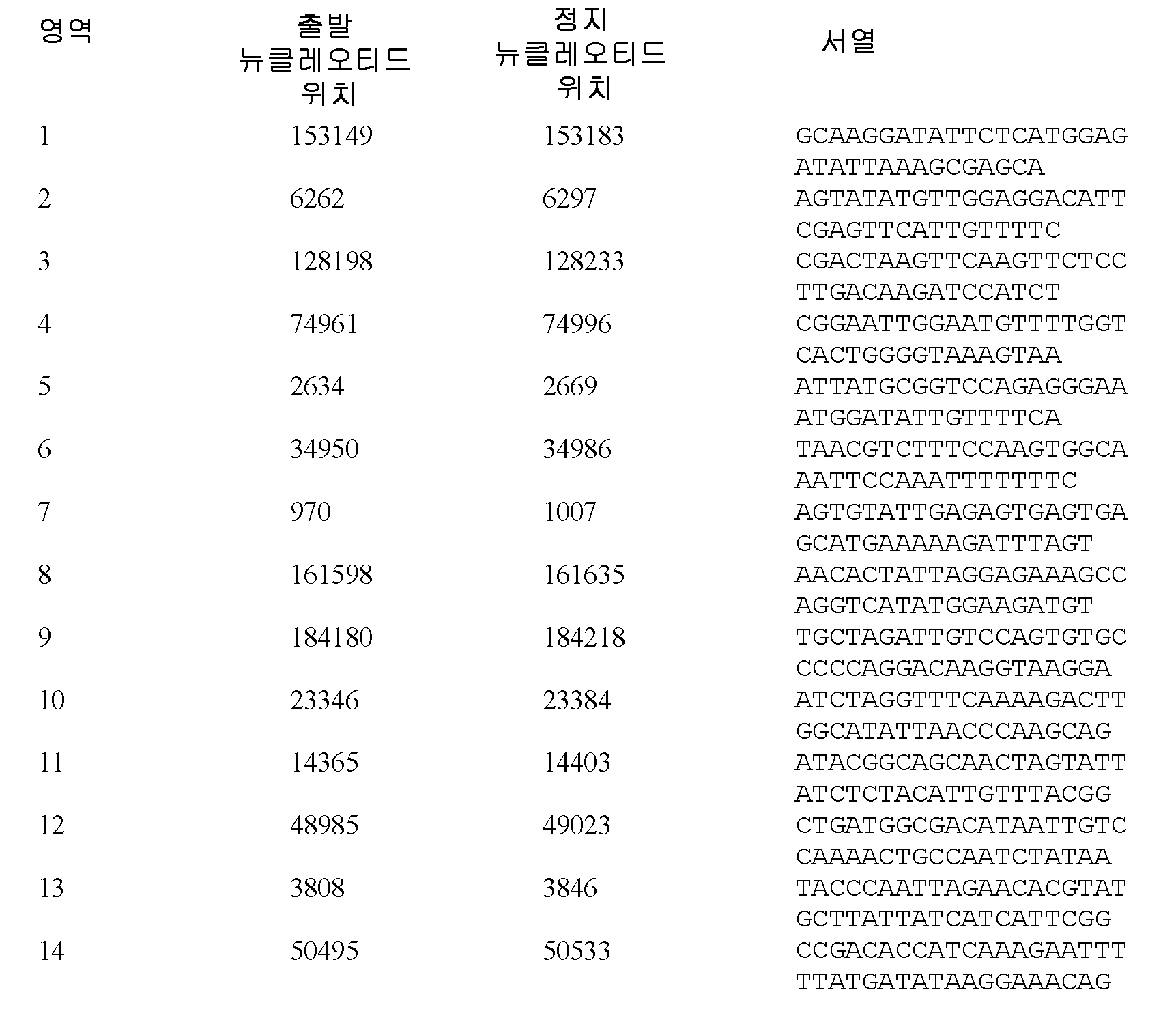
식별된 관심 있는 독특한 제1 영역(표 1 중 영역 7)은 바리올라 메이저 바이러스 뱅글데쉬-1975의 뉴클레오티드 970-1007에 상응한다. 이 38 뉴클레오티드 서열 주변의 더 큰 영역의 추가 분석에 따라, 뉴클레오티드 977-1007로부터 스트레칭되는 31 뉴클레오티드만이 모든 서열화된 바리올라 바이러스 균주 내에 보존된다는 점이 밝혀졌다. 상기 31 뉴클레오티드 영역 내에서, 5 뉴클레오티드는 가장 가까운 이웃인 우두 바이러스의 서열과 매칭되지 않는다. 이 차이점은 이 서열(표 2 참조)에 프라이머 1를 위치시킴으로써 어세이 VAR-1(증폭 프라이머 및 표적 프로브 서열에 대한 표 7 참조)에서 이용된다. 이 어세이의 프라이머 2는 2 추가 SNP를 이용하며, 프로브는 몇몇 폭스바이러스와 정확한 상동성을 가진다. The unique first region of interest identified (region 7 in Table 1) corresponds to nucleotides 970-1007 of Bariola major virus Bangladesh -1975. Further analysis of the larger region around this 38 nucleotide sequence revealed that only 31 nucleotides stretched from nucleotides 977-1007 were conserved in all the sequenced bariola virus strains. Within the region of 31 nucleotides, 5 nucleotides are not matched with the sequence of the nearest neighboring vaccinia virus. This difference is exploited in assays VAR-1 (see Table 7 for amplification primers and target probe sequences) by placing
표 2는 (바리올라 메이저 바이러스 뱅글데쉬-1975의 977-1095의 119 염기쌍 영역에 상응하는) 인시니아에 대해 식별된 영역 7 주위의 120 염기쌍 영역을 나타낸다. 영역 7 내의 보존된 31 뉴클레오티드는 밑줄이 그어져 있다. 증폭 프라이머 P1 및 P2와 VAR-1로부터의 표적 프로브는 굵은 이탤릭체로 표시되어 있다. 바리올라 바이러스와 다른 게놈 사이의 SNP는 검은 배경 처리로 강조되어 있다. (1 초과 게놈 서열의) 바리올라 바이러스 내의 SNP는 회색 배경 처리로 표시되어 있고, 바리올라 어세이 디자인에서 회피되고, 전형적으로 회피되어야 한다. Table 2 shows the 120 base pair region around Region 7 identified for insicina (corresponding to the 119 base pair region of 977-1095 of the Major Virus Bengal Dise-1975 in Bariola). The conserved 31 nucleotides in region 7 are underlined. Target probes from amplification primers P1 and P2 and VAR-1 are shown in bold italics. SNPs between Bariola virus and other genomes are highlighted with black background treatment. SNPs in bariola virus (of the over-1 genome sequence) are indicated by gray background treatment and should be avoided and typically avoided in the Bariella assays design.

식별된 제2 독특한 영역(표 1 중 영역 8)은 바리올라 메이저 바이러스 뱅글데쉬-1975의 뉴클레오티드 161598-161635에 상응한다. 이 서열을 NCBI nr 데이터베이스에 대한 BLAST 서치로 처리한 경우, 3 SNP가 이 영역에서 식별된다. 더욱 흥미롭게도, 이 서열 주위의 더 큰 영역을 분석하는 경우, 게놈 재배열이 가장 가깝게 연관된 게놈인 일부 우두 균주의 게놈 중 이 서열의 상류 및 하류 둘 다에서 발견된다는 것이 밝혀졌다(하기 표 3 참조). 이 재배열은 바리올라 바이러스에 인접하지만 다른 게놈에 비인접(연접부 영역)한 증폭 프라이머 또는 표적 프로브 스패닝 영역을 이용하는 어세이의 디자인을 가능하게 한다. 이러한 어세이는 차이점에 대해 오로지 SNP에 의존하는 것보다 더 큰 특이성을 제공할 수 있다. The identified second unique region (
표 3은 인시니아에 대해 식별된 영역 8 주변의 300 염기쌍 영역을 나타낸다. 영역 8은 밑줄이 그어져 있다. 바리올라 바이러스와 다른 게놈 사이의 SNP는 검은 배경 처리로 강조되어 있다. (1 초과 게놈 서열의) 바리올라 바이러스 내의 SNP는 회색 배경 처리로 표시되어 있으며, 이는 바리올라 어세이 디자인에서 회피되고, 전형적으로 회피되어야 한다. 서열 아래쪽의 # 부호에 의해 표기된 서열은 가장 가까운 이웃 게놈(일부 우두 게놈)에서 복제되며 상류 연접부를 형성한다. (또한 우두 게놈에 존재하는) 하류 연접부는 서열 아래쪽의 Λ 부호로 표기된 세 뉴클레오티드 사이에 놓인다.Table 3 shows the 300 base pair region around
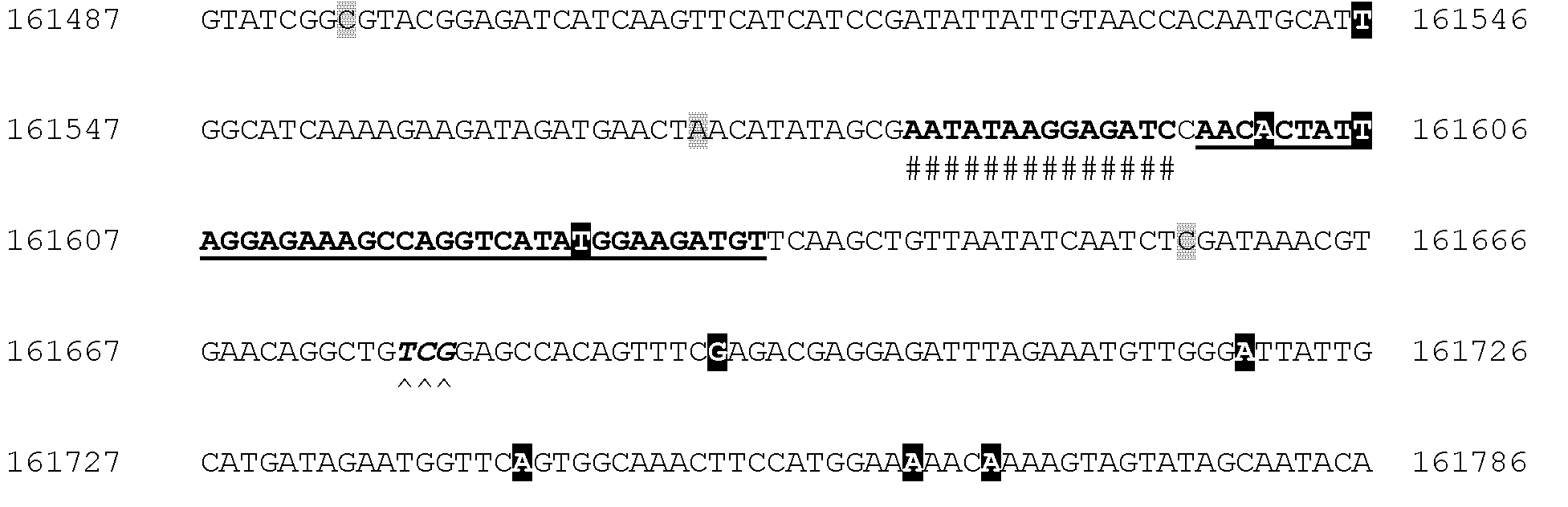
3가지 어세이는 이들 연접부 영역: VAR-2, VAR-3, 및 VAR-4를 이용하도록 디자인되었다(또한, 증폭 프라이머 및 표적 프로브 서열에 대한 표 7을 참조).Three assays were designed to use these junction regions: VAR-2, VAR-3, and VAR-4 (see also Table 7 for amplification primer and target probe sequences).
VAR-2 어세이(표 4)에서, P1 증폭 프라이머는 인시니아에 대해 식별된 영역 8의 바로 상류인 연접부 영역으로 스패닝되고, P2 증폭 프라이머는 이 영역의 연접부 영역 하류로 스패닝된다. 프로브는 인시니아에 대해 식별된 영역 8 자체 내에 위치하고 이 영역의 3 SNP를 이용한다. 표 4는 바리올라 특이적 어세이 VAR-2의 상대적 위치를 나타낸다. 증폭 프라이머 서열 P1 및 P2는 서열 아래쪽에 별표로 표기되고 프로브 영역은 서열 아래쪽에 + 부호로 표기된다. 명료함을 위해 검게 강조된 SNP를 생략한 것을 제외하고 다른 포맷들은 표 3에서와 같다. In the VAR-2 assay (Table 4), the P1 amplification primer spans to the junction region immediately upstream of the

VAR-3 어세이(표 5)는 상류 연접부 영역으로 스패닝하는 프로브를 갖고, P1 및 P2 증폭 프라이머는 각각 1 SNP를 이용할뿐만 아니라 (우두 게놈에서 약 300 염기쌍 떨어지고 서열이 그 게놈에서 역전된) 연접부의 상이한 측에 존재한다. 표 5는 바리올라 특이적 어세이 VAR-3를 나타낸다. P1 및 P2 증폭 프라이머는 서열 아래쪽에 별표로 표기되고 프로브 영역은 서열 아래쪽에 + 부호로 표기된다. 명료함을 위해 검게 강조된 SNP를 생략한 것을 제외하고 다른 포맷들은 표 3에서와 같다.The VAR-3 assay (Table 5) has a probe spanning the upstream junction region, and the P1 and P2 amplification primers utilize one SNP each (about 300 base pairs in the genomic DNA genome and the sequence is inverted in the genome) And are present on different sides of the joint. Table 5 shows the Varian specific assay VAR-3. P1 and P2 amplification primers are marked with an asterisk at the bottom of the sequence and the probe region is marked with a + sign at the bottom of the sequence. Other formats are shown in Table 3, except that the black highlighted SNP is omitted for clarity.

VAR-4 어세이(표 6)에서 증폭 프라이머(120 염기쌍)에 의해 증폭된 서열 영역은 하류 연접부로 스패닝하며, P1은 VAR-3 영역으로부터 P2와 (반대 배향으로) 겹쳐지고(118 bp) 1 SNP를 이용하며, 프로브는 하류 연접부로 스패닝하며, P2는 1 SNP를 이용하고 (약 7 kb 떨어지고 근접한 이웃에 역전되어) 연접부의 다른 쪽에 존재한다. 표 6은 바리올라 특이적 어세이 VAR-4을 나타낸다. P1 및 P2는 서열 아래쪽에 별표로 표기되고 프로브 영역은 서열 아래쪽에 + 부호로 표기된다. 명료함을 위해 검게 강조된 SNP를 생략한 것을 제외하고 다른 포맷들은 표 3에서와 같다.The sequence region amplified by the amplification primer (120 basepairs) in the VAR-4 assay (Table 6) spans to the downstream junction, P1 overlaps (118 bp) with P2 from the VAR-3 region The SNP is used, the probe spans the downstream junction, and P2 is located on the other side of the junction, using 1 SNP (about 7 kb falling and reversing to neighboring neighbors). Table 6 shows the Varian specific assay VAR-4. P1 and P2 are marked with an asterisk at the bottom of the sequence and the probe region is marked with a + sign at the bottom of the sequence. Other formats are shown in Table 3, except that the black highlighted SNP is omitted for clarity.


표 7은 프라이머/프로브 서열 및 바리올라 바이러스 특이적 어세이의 특징을 나타낸다.Table 7 shows the primer / probe sequences and characteristics of the virus specific virus assay.
상기 발명은 명료함 및 이해를 목적으로 다소 상세히 기재되어 있지만, 본 발명의 진정한 범위를 벗어나지 않으면서 형태 및 세부사항에서의 다양한 변화를 만들 수 있다는 것이 본 개시내용의 판독으로부터 당업자에게 명확할 것이다. 예를 들면, 전술된 모든 기법 및 장치는 다양한 조합으로 이용될 수 있다. 본원에서 인용된 모든 공개문헌, 특허, 특허출원 및/또는 다른 문헌들은 각각의 개별 공개문헌, 특허, 특허출원 및/또는 다른 문헌들이 모든 목적을 위해 참고로 도입되는 것으로 개별적으로 및 따로 표시되어 있는 것처럼 동일한 정도로 모든 목적을 위해 전체적으로 참고로 도입된다.Although the foregoing invention has been described in some detail for purposes of clarity and understanding, it will be apparent to those skilled in the art from a reading of the present disclosure that various changes in form and details may be made therein without departing from the true scope of the invention. For example, all of the techniques and apparatus described above may be used in various combinations. All publications, patents, patent applications, and / or other documents cited herein are hereby incorporated by reference in their entirety for all purposes to the same extent as if each individual publication, patent, patent application, and / To the same extent as a whole for all purposes.
SEQUENCE LISTING <110> NVS Technologies, Inc. <120> ASSAY METHODS AND SYSTEMS <130> 158-000150US <140> US 13/844,426 <141> 2013-03-15 <150> US 61/684,104 <151> 2012-08-16 <160> 28 <170> PatentIn version 3.5 <210> 1 <211> 35 <212> DNA <213> Variola virus <400> 1 gcaaggatat tctcatggag atattaaagc gagca 35 <210> 2 <211> 36 <212> DNA <213> Variola virus <400> 2 agtatatgtt ggaggacatt cgagttcatt gttttc 36 <210> 3 <211> 36 <212> DNA <213> Variola virus <400> 3 cgactaagtt caagttctcc ttgacaagat ccatct 36 <210> 4 <211> 36 <212> DNA <213> Variola virus <400> 4 cggaattgga atgttttggt cactggggta aagtaa 36 <210> 5 <211> 36 <212> DNA <213> Variola virus <400> 5 attatgcggt ccagagggaa atggatattg ttttca 36 <210> 6 <211> 37 <212> DNA <213> Variola virus <400> 6 taacgtcttt ccaagtggca aattccaaat ttttttc 37 <210> 7 <211> 38 <212> DNA <213> Variola virus <400> 7 agtgtattga gagtgagtga gcatgaaaaa gatttagt 38 <210> 8 <211> 38 <212> DNA <213> Variola virus <400> 8 aacactatta ggagaaagcc aggtcatatg gaagatgt 38 <210> 9 <211> 39 <212> DNA <213> Variola virus <400> 9 tgctagattg tccagtgtgc ccccaggaca aggtaagga 39 <210> 10 <211> 39 <212> DNA <213> Variola virus <400> 10 atctaggttt caaaagactt ggcatattaa cccaagcag 39 <210> 11 <211> 39 <212> DNA <213> Variola virus <400> 11 atacggcagc aactagtatt atctctacat tgtttacgg 39 <210> 12 <211> 39 <212> DNA <213> Variola virus <400> 12 ctgatggcga cataattgtc caaaactgcc aatctataa 39 <210> 13 <211> 39 <212> DNA <213> Variola virus <400> 13 tacccaatta gaacacgtat gcttattatc atcattcgg 39 <210> 14 <211> 39 <212> DNA <213> Variola virus <400> 14 ccgacaccat caaagaattt ttatgatata aggaaacag 39 <210> 15 <211> 120 <212> DNA <213> Variola virus <400> 15 tgagagtgag tgagcatgaa aaagatttag tatttagcag tgcggatatg atccaagagg 60 gtgaaatagt cgttctcgtt cagaatcttt tgcagcataa gtagtatgtc gatatactta 120 <210> 16 <211> 300 <212> DNA <213> Variola virus <400> 16 gtatcggcgt acggagatca tcaagttcat catccgatat tattgtaacc acaatgcatt 60 ggcatcaaaa gaagatagat gaactaacat atagcgaata taaggagatc caacactatt 120 aggagaaagc caggtcatat ggaagatgtt caagctgtta atatcaatct cgataaacgt 180 gaacaggctg tcggagccac agtttcgaga cgaggagatt tagaaatgtt gggattattg 240 catgatagaa tggttcagtg gcaaacttcc atggaaaaac aaaagtagta tagcaataca 300 <210> 17 <211> 24 <212> DNA <213> Variola virus <400> 17 tgagagtgag tgagcatgaa aaag 24 <210> 18 <211> 28 <212> DNA <213> Variola virus <400> 18 caaaagattc tgaacgagaa cgactatt 28 <210> 19 <211> 34 <212> DNA <213> Variola virus <400> 19 ttagtattta gcagtgcgga tatgatccaa gagg 34 <210> 20 <211> 27 <212> DNA <213> Variola virus <400> 20 acatatagcg aatataagga gatccaa 27 <210> 21 <211> 19 <212> DNA <213> Variola virus <400> 21 gctccgacag cctgttcac 19 <210> 22 <211> 33 <212> DNA <213> Variola virus <400> 22 tcttccatat gacctggctt tctcctaata gtg 33 <210> 23 <211> 20 <212> DNA <213> Variola virus <400> 23 accacaatgc attggcatca 20 <210> 24 <211> 27 <212> DNA <213> Variola virus <400> 24 tgatattaac agcttgaaca tcttcca 27 <210> 25 <211> 37 <212> DNA <213> Variola virus <400> 25 cgaatataag gagatccaac actattagga gaaagcc 37 <210> 26 <211> 24 <212> DNA <213> Variola virus <400> 26 ggtcatatgg aagatgttca agct 24 <210> 27 <211> 26 <212> DNA <213> Variola virus <400> 27 cattctatca tgcaataatc ccaaca 26 <210> 28 <211> 24 <212> DNA <213> Variola virus <400> 28 ctgtggctcc gacagcctgt tcac 24 SEQUENCE LISTING <110> NVS Technologies, Inc. <120> ASSAY METHODS AND SYSTEMS <130> 158-000150US <140> US 13 / 844,426 <141> 2013-03-15 ≪ 150 > US 61 / 684,104 <151> 2012-08-16 <160> 28 <170> PatentIn version 3.5 <210> 1 <211> 35 <212> DNA <213> Variola virus <400> 1 gcaaggatat tctcatggag atattaaagc gagca 35 <210> 2 <211> 36 <212> DNA <213> Variola virus <400> 2 agtatatgtt ggaggacatt cgagttcatt gttttc 36 <210> 3 <211> 36 <212> DNA <213> Variola virus <400> 3 cgactaagtt caagttctcc ttgacaagat ccatct 36 <210> 4 <211> 36 <212> DNA <213> Variola virus <400> 4 cggaattgga atgttttggt cactggggta aagtaa 36 <210> 5 <211> 36 <212> DNA <213> Variola virus <400> 5 attatgcggt ccagagggaa atggatattg ttttca 36 <210> 6 <211> 37 <212> DNA <213> Variola virus <400> 6 taacgtcttt ccaagtggca aattccaaat ttttttc 37 <210> 7 <211> 38 <212> DNA <213> Variola virus <400> 7 agtgtattga gagtgagtga gcatgaaaaa gatttagt 38 <210> 8 <211> 38 <212> DNA <213> Variola virus <400> 8 aacactatta ggagaaagcc aggtcatatg gaagatgt 38 <210> 9 <211> 39 <212> DNA <213> Variola virus <400> 9 tgctagattg tccagtgtgc ccccaggaca aggtaagga 39 <210> 10 <211> 39 <212> DNA <213> Variola virus <400> 10 atctaggttt caaaagactt ggcatattaa cccaagcag 39 <210> 11 <211> 39 <212> DNA <213> Variola virus <400> 11 atacggcagc aactagtatt atctctacat tgtttacgg 39 <210> 12 <211> 39 <212> DNA <213> Variola virus <400> 12 ctgatggcga cataattgtc caaaactgcc aatctataa 39 <210> 13 <211> 39 <212> DNA <213> Variola virus <400> 13 tacccaatta gaacacgtat gcttattatc atcattcgg 39 <210> 14 <211> 39 <212> DNA <213> Variola virus <400> 14 ccgacaccat caaagaattt ttatgatata aggaaacag 39 <210> 15 <211> 120 <212> DNA <213> Variola virus <400> 15 tgagagtgag tgagcatgaa aaagatttag tatttagcag tgcggatatg atccaagagg 60 gtgaaatagt cgttctcgtt cagaatcttt tgcagcataa gtagtatgtc gatatactta 120 <210> 16 <211> 300 <212> DNA <213> Variola virus <400> 16 gtatcggcgt acggagatca tcaagttcat catccgatat tattgtaacc acaatgcatt 60 ggcatcaaaa gaagatagat gaactaacat atagcgaata taaggagatc caacactatt 120 aggagaaagc caggtcatat ggaagatgtt caagctgtta atatcaatct cgataaacgt 180 gaacaggctg tcggagccac agtttcgaga cgaggagatt tagaaatgtt gggattattg 240 catgatagaa tggttcagtg gcaaacttcc atggaaaaac aaaagtagta tagcaataca 300 <210> 17 <211> 24 <212> DNA <213> Variola virus <400> 17 tgagagtgag tgagcatgaa aaag 24 <210> 18 <211> 28 <212> DNA <213> Variola virus <400> 18 caaaagattc tgaacgagaa cgactatt 28 <210> 19 <211> 34 <212> DNA <213> Variola virus <400> 19 ttagtattta gcagtgcgga tatgatccaa gagg 34 <210> 20 <211> 27 <212> DNA <213> Variola virus <400> 20 acatatagcg aatataagga gatccaa 27 <210> 21 <211> 19 <212> DNA <213> Variola virus <400> 21 gctccgacag cctgttcac 19 <210> 22 <211> 33 <212> DNA <213> Variola virus <400> 22 tcttccatat gacctggctt tctcctaata gtg 33 <210> 23 <211> 20 <212> DNA <213> Variola virus <400> 23 accacaatgc attggcatca 20 <210> 24 <211> 27 <212> DNA <213> Variola virus <400> 24 tgatattaac agcttgaaca tcttcca 27 <210> 25 <211> 37 <212> DNA <213> Variola virus <400> 25 cgaatataag gagatccaac actattagga gaaagcc 37 <210> 26 <211> 24 <212> DNA <213> Variola virus <400> 26 ggtcatatgg aagatgttca agct 24 <210> 27 <211> 26 <212> DNA <213> Variola virus <400> 27 cattctatca tgcaataatc ccaaca 26 <210> 28 <211> 24 <212> DNA <213> Variola virus <400> 28 ctgtggctcc gacagcctgt tcac 24
Claims (19)
샘플에, 적어도 제1 핵산 프로브 세트의 존재 하에서 표적 핵산 서열을 증폭시킬 수 있는 증폭 반응을 실시하는 단계로서, 제1 핵산 프로브 세트가, 결합된 형광단을 포함하는 포획 프로브; 포획 프로브 및 표적 핵산 서열의 적어도 일부에 상보적이며 결합된 켄처를 포함하는 표적 특이적 핵산 프로브를 포함하여, 표적 특이적 프로브가 포획 프로브에 혼성화되는 경우 켄처가 형광단으로부터 형광을 소광하는 단계; 및
폴리머라제 연쇄반응의 1회 이상의 사이클 후 샘플로부터 형광을 검출하는 단계로서, 형광의 증가가 표적 핵산 서열의 존재를 나타내는 단계
를 포함하는 방법.1. A method for detecting the presence of at least a first target nucleic acid sequence in a sample,
Subjecting the sample to an amplification reaction capable of amplifying the target nucleic acid sequence in the presence of at least a first nucleic acid probe set, wherein the first nucleic acid probe set comprises a capture probe comprising a bound fluorophore; Comprising a target specific nucleic acid probe comprising a capture probe and a target specific nucleic acid probe comprising at least a portion of the target nucleic acid sequence complementary and bound to quench the fluorescence from the fluorophore when the target specific probe hybridizes to the capture probe; And
Detecting fluorescence from the sample after at least one cycle of the polymerase chain reaction, wherein the step of increasing fluorescence indicates the presence of the target nucleic acid sequence
≪ / RTI >
관심 표적 핵산 서열을 증폭시키는 증폭 시약; 및
적어도 제1 프로브 세트로서, 결합된 형광단을 포함하는 포획 프로브, 및 포획 프로브 및 표적 핵산 서열의 적어도 일부에 상보적이며 결합된 켄처를 포함하는 표적 특이적 핵산 프로브를 포함하여, 표적 특이적 프로브가 포획 프로브에 혼성화되는 경우 켄처가 형광단으로부터 형광을 소광하는 제1 프로브 세트
를 포함하는 반응 혼합물.A sample containing the target nucleic acid of interest;
An amplification reagent that amplifies the target nucleic acid sequence of interest; And
And a target specific nucleic acid probe comprising at least a capture probe comprising a bound fluorophore and a capture probe complementary to at least a portion of the target nucleic acid sequence and a target specific nucleic acid probe, When the probe probe is hybridized to the capture probe, the first probe set
≪ / RTI >
관심 표적 핵산 서열을 증폭시키는 증폭 시약; 및
적어도 제1 프로브 세트로서, 결합된 형광단을 포함하는 포획 프로브, 및 포획 프로브 및 표적 핵산 서열의 적어도 일부에 상보적이며 결합된 켄처를 포함하는 표적 특이적 핵산 프로브를 포함하여, 표적 특이적 프로브가 포획 프로브에 혼성화되는 경우 켄처가 형광단으로부터 형광을 소광하는 제1 프로브 세트
가 배치되는 반응 영역
을 포함하는 반응 챔버.A sample containing the target nucleic acid of interest;
An amplification reagent that amplifies the target nucleic acid sequence of interest; And
And a target specific nucleic acid probe comprising at least a capture probe comprising a bound fluorophore and a capture probe complementary to at least a portion of the target nucleic acid sequence and a target specific nucleic acid probe, When the probe probe is hybridized to the capture probe, the first probe set
The reaction zone
. ≪ / RTI >
샘플에, 적어도 제1 핵산 프로브 세트의 존재 하에서 표적 핵산 서열을 증폭시킬 수 있는 증폭 반응을 실시하는 단계로서, 제1 핵산 프로브 세트가 표적 핵산 서열의 적어도 일부에 상보적이고 형광 표지가 연결된 표적 특이적 핵산 프로브, 고체 지지체와 연결되고 표적 특이적 핵산 프로브의 적어도 일부에 상보적인 포획 프로브를 포함하는 단계; 및
폴리머라제 연쇄반응의 1회 이상의 사이클 후 고체 지지체로부터 형광을 검출하는 단계로서, 형광의 감소가 표적 핵산 서열의 존재를 나타내는 단계
를 포함하는 방법.1. A method for detecting the presence of at least a first target nucleic acid sequence in a sample,
Subjecting the sample to an amplification reaction capable of amplifying the target nucleic acid sequence in the presence of at least a first set of nucleic acid probes, wherein the set of first nucleic acid probes is complementary to at least a portion of the target nucleic acid sequence and the target specific A nucleic acid probe, a capture probe coupled to the solid support and complementary to at least a portion of the target specific nucleic acid probe; And
Detecting fluorescence from the solid support after at least one cycle of the polymerase chain reaction, wherein the decrease in fluorescence indicates the presence of the target nucleic acid sequence < RTI ID = 0.0 >
≪ / RTI >
Applications Claiming Priority (3)
| Application Number | Priority Date | Filing Date | Title |
|---|---|---|---|
| US201261684104P | 2012-08-16 | 2012-08-16 | |
| US61/684,104 | 2012-08-16 | ||
| PCT/US2013/032691 WO2014028061A1 (en) | 2012-08-16 | 2013-03-15 | Assay methods and systems |
Publications (1)
| Publication Number | Publication Date |
|---|---|
| KR20150042283A true KR20150042283A (en) | 2015-04-20 |
Family
ID=50100442
Family Applications (1)
| Application Number | Title | Priority Date | Filing Date |
|---|---|---|---|
| KR20157006619A Withdrawn KR20150042283A (en) | 2012-08-16 | 2013-03-15 | Assay methods and systems |
Country Status (11)
| Country | Link |
|---|---|
| US (1) | US20140051593A1 (en) |
| EP (1) | EP2885430A4 (en) |
| JP (1) | JP2015524670A (en) |
| KR (1) | KR20150042283A (en) |
| CN (1) | CN105102630A (en) |
| AU (1) | AU2013303237A1 (en) |
| CA (1) | CA2882020A1 (en) |
| HK (1) | HK1212390A1 (en) |
| MX (1) | MX2015001961A (en) |
| SG (1) | SG11201501159UA (en) |
| WO (1) | WO2014028061A1 (en) |
Families Citing this family (10)
| Publication number | Priority date | Publication date | Assignee | Title |
|---|---|---|---|---|
| EP3155127B1 (en) | 2014-06-13 | 2020-07-22 | Life Technologies Corporation | Multiplex nucleic acid amplification |
| KR101696259B1 (en) * | 2014-07-23 | 2017-01-13 | 나노바이오시스 주식회사 | Multiplex pcr chip and multiplex pcr device comprising the same |
| JP2018516594A (en) * | 2015-05-18 | 2018-06-28 | カリミューン, インコーポレーティッド | Method for distinguishing between HIV-1 and a lentiviral vector |
| EP3859333A1 (en) * | 2015-09-10 | 2021-08-04 | InSilixa, Inc. | Systems for multiplex quantitative nucleic acid amplification |
| WO2017155858A1 (en) | 2016-03-07 | 2017-09-14 | Insilixa, Inc. | Nucleic acid sequence identification using solid-phase cyclic single base extension |
| CN110016500A (en) * | 2018-01-10 | 2019-07-16 | 深圳闪量科技有限公司 | Surface-probe quantifying PCR method |
| JP7077992B2 (en) * | 2019-02-22 | 2022-05-31 | 横河電機株式会社 | Nucleic acid sequence measurement device, nucleic acid sequence measurement method, and nucleic acid sequence measurement device |
| CN111394432B (en) * | 2020-03-27 | 2023-03-24 | 深圳闪量科技有限公司 | Multiple quantitative PCR detection system based on universal probe chip |
| CN114891785B (en) * | 2022-04-14 | 2023-06-13 | 深圳闪量科技有限公司 | Primer pool for simultaneously detecting multiple pathogens of cat and PCR rapid detection kit |
| CN117487896B (en) * | 2023-12-29 | 2024-06-25 | 清华大学 | Antagonist, PCR premix containing same, PCR detection kit and PCR detection method |
Family Cites Families (13)
| Publication number | Priority date | Publication date | Assignee | Title |
|---|---|---|---|---|
| US20040009514A1 (en) * | 2000-02-28 | 2004-01-15 | Frutos Anthony G. | Assembly for label-free detection of hybridized nucleic targets |
| CN1348096A (en) * | 2000-10-10 | 2002-05-08 | 栾国彦 | Homogeneous specific nucleic acid detecting probe and its application method |
| US7645456B2 (en) * | 2001-04-23 | 2010-01-12 | Sanofi Pasteur Biologics Co. | Vaccinia virus strains |
| CN100381456C (en) * | 2003-03-31 | 2008-04-16 | 中国疾病预防控制中心病毒病预防控制所 | A specific nucleotide sequence of variola virus genome |
| US8032310B2 (en) * | 2004-07-02 | 2011-10-04 | The United States Of America As Represented By The Secretary Of The Navy | Computer-implemented method, computer readable storage medium, and apparatus for identification of a biological sequence |
| US20070099211A1 (en) * | 2005-07-15 | 2007-05-03 | Vissarion Aivazachvili | Detection of nucleic acid amplification |
| EP1777298A1 (en) * | 2005-10-13 | 2007-04-25 | Roche Diagnostics GmbH | Multiplexed solid-phase nucleic acid amplification assay |
| EP2029775B1 (en) * | 2006-06-05 | 2014-10-15 | California Institute Of Technology | Real time micro arrays |
| EP2059614A4 (en) * | 2006-08-15 | 2010-06-30 | Zygene Biotech Llc | Probe-antiprobe compositions and methods for dna or rna detection |
| BRPI0721095B1 (en) * | 2006-12-13 | 2015-09-29 | Luminex Corporation | SYSTEMS AND METHODS FOR MULTIPLEX REAL-TIME PCR ANALYSIS |
| ES2717940T3 (en) * | 2007-07-23 | 2019-06-26 | Alere Tech Gmbh | essays |
| EP2077336A1 (en) * | 2007-12-19 | 2009-07-08 | Koninklijke Philips Electronics N.V. | Device and method for parallel quantitative analysis of multiple nucleic acids |
| MX2017015093A (en) * | 2011-01-11 | 2023-03-10 | Seegene Inc | Detection of target nucleic acid sequences by pto cleavage and extension assay. |
-
2013
- 2013-03-15 KR KR20157006619A patent/KR20150042283A/en not_active Withdrawn
- 2013-03-15 EP EP13829798.1A patent/EP2885430A4/en not_active Withdrawn
- 2013-03-15 AU AU2013303237A patent/AU2013303237A1/en not_active Abandoned
- 2013-03-15 JP JP2015527446A patent/JP2015524670A/en active Pending
- 2013-03-15 CA CA2882020A patent/CA2882020A1/en not_active Abandoned
- 2013-03-15 HK HK15112597.5A patent/HK1212390A1/en unknown
- 2013-03-15 CN CN201380052161.9A patent/CN105102630A/en active Pending
- 2013-03-15 MX MX2015001961A patent/MX2015001961A/en unknown
- 2013-03-15 WO PCT/US2013/032691 patent/WO2014028061A1/en not_active Ceased
- 2013-03-15 US US13/844,426 patent/US20140051593A1/en not_active Abandoned
- 2013-03-15 SG SG11201501159UA patent/SG11201501159UA/en unknown
Also Published As
| Publication number | Publication date |
|---|---|
| AU2013303237A1 (en) | 2015-04-09 |
| HK1212390A1 (en) | 2016-06-10 |
| US20140051593A1 (en) | 2014-02-20 |
| CN105102630A (en) | 2015-11-25 |
| EP2885430A4 (en) | 2016-07-27 |
| CA2882020A1 (en) | 2014-02-20 |
| SG11201501159UA (en) | 2015-09-29 |
| WO2014028061A1 (en) | 2014-02-20 |
| MX2015001961A (en) | 2015-09-10 |
| JP2015524670A (en) | 2015-08-27 |
| EP2885430A1 (en) | 2015-06-24 |
Similar Documents
| Publication | Publication Date | Title |
|---|---|---|
| CN103502471B (en) | Quantitative, highly multiplexed detection of nucleic acids | |
| KR20150042283A (en) | Assay methods and systems | |
| US20120040853A1 (en) | Real time multiplex pcr detection on solid surfaces using double stranded nucleic acid specific dyes | |
| JP2013539654A (en) | Real-time amplification and microarray-based detection of nucleic acid targets in flow chip assays | |
| KR20140094007A (en) | Quantitative, highly multiplexed detection of nucleic acids | |
| US10787700B2 (en) | Methods for detecting multiple nucleic acids in a sample using reporter compounds and binding members thereof | |
| US20140080726A1 (en) | Enhanced method for probe based detection of nucleic acids | |
| US8703653B2 (en) | Quantitative, highly multiplexed detection of nucleic acids | |
| HK40113575A (en) | Methods for detecting multiple nucleic acids in a sample | |
| HK40050543A (en) | Methods for detecting multiple nucleic acids in a sample |
Legal Events
| Date | Code | Title | Description |
|---|---|---|---|
| PA0105 | International application |
Patent event date: 20150316 Patent event code: PA01051R01D Comment text: International Patent Application |
|
| PG1501 | Laying open of application | ||
| PC1203 | Withdrawal of no request for examination | ||
| WITN | Application deemed withdrawn, e.g. because no request for examination was filed or no examination fee was paid |