KR20140111981A - Polymerization initiating system and method to produce highly reactive olefin functional polymers - Google Patents
Polymerization initiating system and method to produce highly reactive olefin functional polymers Download PDFInfo
- Publication number
- KR20140111981A KR20140111981A KR1020140028369A KR20140028369A KR20140111981A KR 20140111981 A KR20140111981 A KR 20140111981A KR 1020140028369 A KR1020140028369 A KR 1020140028369A KR 20140028369 A KR20140028369 A KR 20140028369A KR 20140111981 A KR20140111981 A KR 20140111981A
- Authority
- KR
- South Korea
- Prior art keywords
- group
- ether
- catalyst
- isobutene
- hydrocarbyl
- Prior art date
- Legal status (The legal status is an assumption and is not a legal conclusion. Google has not performed a legal analysis and makes no representation as to the accuracy of the status listed.)
- Granted
Links
- 238000006116 polymerization reaction Methods 0.000 title claims abstract description 51
- 238000000034 method Methods 0.000 title claims abstract description 34
- 230000000977 initiatory effect Effects 0.000 title claims abstract description 6
- 150000001336 alkenes Chemical class 0.000 title description 8
- JRZJOMJEPLMPRA-UHFFFAOYSA-N olefin Natural products CCCCCCCC=C JRZJOMJEPLMPRA-UHFFFAOYSA-N 0.000 title description 5
- 229920001002 functional polymer Polymers 0.000 title 1
- 230000008569 process Effects 0.000 claims abstract description 17
- RTZKZFJDLAIYFH-UHFFFAOYSA-N Diethyl ether Chemical compound CCOCC RTZKZFJDLAIYFH-UHFFFAOYSA-N 0.000 claims description 144
- VQTUBCCKSQIDNK-UHFFFAOYSA-N Isobutene Chemical compound CC(C)=C VQTUBCCKSQIDNK-UHFFFAOYSA-N 0.000 claims description 64
- 239000003999 initiator Substances 0.000 claims description 35
- 239000002879 Lewis base Substances 0.000 claims description 30
- 150000007527 lewis bases Chemical class 0.000 claims description 23
- 125000001183 hydrocarbyl group Chemical group 0.000 claims description 21
- 239000002841 Lewis acid Substances 0.000 claims description 20
- 150000007517 lewis acids Chemical group 0.000 claims description 20
- 239000000178 monomer Substances 0.000 claims description 16
- -1 benzyl carbon Chemical group 0.000 claims description 14
- 229910052799 carbon Inorganic materials 0.000 claims description 14
- 239000003054 catalyst Substances 0.000 claims description 13
- 229910052801 chlorine Inorganic materials 0.000 claims description 13
- 239000000460 chlorine Substances 0.000 claims description 12
- 229920001083 polybutene Polymers 0.000 claims description 12
- 239000002904 solvent Substances 0.000 claims description 12
- 125000006575 electron-withdrawing group Chemical group 0.000 claims description 11
- VXNZUUAINFGPBY-UHFFFAOYSA-N 1-Butene Chemical compound CCC=C VXNZUUAINFGPBY-UHFFFAOYSA-N 0.000 claims description 9
- 125000005843 halogen group Chemical group 0.000 claims description 9
- 239000000203 mixture Substances 0.000 claims description 9
- OKTJSMMVPCPJKN-UHFFFAOYSA-N Carbon Chemical compound [C] OKTJSMMVPCPJKN-UHFFFAOYSA-N 0.000 claims description 7
- 125000001309 chloro group Chemical group Cl* 0.000 claims description 7
- 229930195733 hydrocarbon Natural products 0.000 claims description 7
- IAQRGUVFOMOMEM-UHFFFAOYSA-N butene Natural products CC=CC IAQRGUVFOMOMEM-UHFFFAOYSA-N 0.000 claims description 6
- 229910052742 iron Inorganic materials 0.000 claims description 6
- NNPPMTNAJDCUHE-UHFFFAOYSA-N isobutane Chemical compound CC(C)C NNPPMTNAJDCUHE-UHFFFAOYSA-N 0.000 claims description 6
- 239000011968 lewis acid catalyst Substances 0.000 claims description 6
- 229910052751 metal Inorganic materials 0.000 claims description 6
- 239000002184 metal Substances 0.000 claims description 6
- KAKZBPTYRLMSJV-UHFFFAOYSA-N Butadiene Chemical compound C=CC=C KAKZBPTYRLMSJV-UHFFFAOYSA-N 0.000 claims description 4
- 125000000217 alkyl group Chemical group 0.000 claims description 4
- 229910052782 aluminium Inorganic materials 0.000 claims description 4
- 229910052794 bromium Inorganic materials 0.000 claims description 4
- 150000001875 compounds Chemical class 0.000 claims description 4
- 229910052736 halogen Inorganic materials 0.000 claims description 4
- 238000004519 manufacturing process Methods 0.000 claims description 4
- 125000004209 (C1-C8) alkyl group Chemical group 0.000 claims description 3
- NINIDFKCEFEMDL-UHFFFAOYSA-N Sulfur Chemical compound [S] NINIDFKCEFEMDL-UHFFFAOYSA-N 0.000 claims description 3
- 125000001033 ether group Chemical group 0.000 claims description 3
- 229910052733 gallium Inorganic materials 0.000 claims description 3
- 239000001282 iso-butane Substances 0.000 claims description 3
- 229910052717 sulfur Inorganic materials 0.000 claims description 3
- 239000011593 sulfur Substances 0.000 claims description 3
- 229910052721 tungsten Inorganic materials 0.000 claims description 3
- 229910052726 zirconium Inorganic materials 0.000 claims description 3
- QVGXLLKOCUKJST-UHFFFAOYSA-N atomic oxygen Chemical compound [O] QVGXLLKOCUKJST-UHFFFAOYSA-N 0.000 claims description 2
- 239000001301 oxygen Substances 0.000 claims description 2
- 229910052760 oxygen Inorganic materials 0.000 claims description 2
- IAQRGUVFOMOMEM-ONEGZZNKSA-N trans-but-2-ene Chemical compound C\C=C\C IAQRGUVFOMOMEM-ONEGZZNKSA-N 0.000 claims description 2
- 239000012454 non-polar solvent Substances 0.000 claims 2
- 229920000642 polymer Polymers 0.000 abstract description 15
- 229920000098 polyolefin Polymers 0.000 abstract description 2
- VLKZOEOYAKHREP-UHFFFAOYSA-N n-Hexane Chemical compound CCCCCC VLKZOEOYAKHREP-UHFFFAOYSA-N 0.000 description 36
- YMWUJEATGCHHMB-UHFFFAOYSA-N Dichloromethane Chemical compound ClCCl YMWUJEATGCHHMB-UHFFFAOYSA-N 0.000 description 33
- 229920002367 Polyisobutene Polymers 0.000 description 29
- 238000006243 chemical reaction Methods 0.000 description 26
- OKKJLVBELUTLKV-UHFFFAOYSA-N Methanol Chemical compound OC OKKJLVBELUTLKV-UHFFFAOYSA-N 0.000 description 15
- 150000002170 ethers Chemical class 0.000 description 14
- 238000005481 NMR spectroscopy Methods 0.000 description 8
- 230000000694 effects Effects 0.000 description 8
- 229920002521 macromolecule Polymers 0.000 description 8
- LSXWFXONGKSEMY-UHFFFAOYSA-N di-tert-butyl peroxide Chemical compound CC(C)(C)OOC(C)(C)C LSXWFXONGKSEMY-UHFFFAOYSA-N 0.000 description 7
- 239000012969 di-tertiary-butyl peroxide Substances 0.000 description 7
- WYURNTSHIVDZCO-UHFFFAOYSA-N Tetrahydrofuran Chemical compound C1CCOC1 WYURNTSHIVDZCO-UHFFFAOYSA-N 0.000 description 6
- 239000007788 liquid Substances 0.000 description 6
- 239000011541 reaction mixture Substances 0.000 description 6
- 238000010668 complexation reaction Methods 0.000 description 5
- 229910052731 fluorine Inorganic materials 0.000 description 5
- 239000007791 liquid phase Substances 0.000 description 5
- 239000000047 product Substances 0.000 description 5
- XLYOFNOQVPJJNP-UHFFFAOYSA-N water Substances O XLYOFNOQVPJJNP-UHFFFAOYSA-N 0.000 description 5
- 238000005160 1H NMR spectroscopy Methods 0.000 description 4
- 239000004215 Carbon black (E152) Substances 0.000 description 4
- 125000002091 cationic group Chemical group 0.000 description 4
- 239000002270 dispersing agent Substances 0.000 description 4
- 239000011737 fluorine Substances 0.000 description 4
- OFBQJSOFQDEBGM-UHFFFAOYSA-N n-pentane Natural products CCCCC OFBQJSOFQDEBGM-UHFFFAOYSA-N 0.000 description 4
- FALRKNHUBBKYCC-UHFFFAOYSA-N 2-(chloromethyl)pyridine-3-carbonitrile Chemical compound ClCC1=NC=CC=C1C#N FALRKNHUBBKYCC-UHFFFAOYSA-N 0.000 description 3
- ZAMOUSCENKQFHK-UHFFFAOYSA-N Chlorine atom Chemical compound [Cl] ZAMOUSCENKQFHK-UHFFFAOYSA-N 0.000 description 3
- PXGOKWXKJXAPGV-UHFFFAOYSA-N Fluorine Chemical compound FF PXGOKWXKJXAPGV-UHFFFAOYSA-N 0.000 description 3
- 238000005033 Fourier transform infrared spectroscopy Methods 0.000 description 3
- 150000001298 alcohols Chemical class 0.000 description 3
- 239000002585 base Substances 0.000 description 3
- 230000015572 biosynthetic process Effects 0.000 description 3
- 229920001577 copolymer Polymers 0.000 description 3
- 239000003085 diluting agent Substances 0.000 description 3
- 238000005516 engineering process Methods 0.000 description 3
- 150000002430 hydrocarbons Chemical class 0.000 description 3
- 230000003993 interaction Effects 0.000 description 3
- 238000000569 multi-angle light scattering Methods 0.000 description 3
- IJDNQMDRQITEOD-UHFFFAOYSA-N n-butane Chemical compound CCCC IJDNQMDRQITEOD-UHFFFAOYSA-N 0.000 description 3
- 239000002798 polar solvent Substances 0.000 description 3
- 229940014800 succinic anhydride Drugs 0.000 description 3
- YLQBMQCUIZJEEH-UHFFFAOYSA-N tetrahydrofuran Natural products C=1C=COC=1 YLQBMQCUIZJEEH-UHFFFAOYSA-N 0.000 description 3
- 238000012546 transfer Methods 0.000 description 3
- PAPNRQCYSFBWDI-UHFFFAOYSA-N 2,5-Dimethyl-1H-pyrrole Chemical compound CC1=CC=C(C)N1 PAPNRQCYSFBWDI-UHFFFAOYSA-N 0.000 description 2
- ZAFNJMIOTHYJRJ-UHFFFAOYSA-N Diisopropyl ether Chemical compound CC(C)OC(C)C ZAFNJMIOTHYJRJ-UHFFFAOYSA-N 0.000 description 2
- LFQSCWFLJHTTHZ-UHFFFAOYSA-N Ethanol Chemical compound CCO LFQSCWFLJHTTHZ-UHFFFAOYSA-N 0.000 description 2
- ATUOYWHBWRKTHZ-UHFFFAOYSA-N Propane Chemical compound CCC ATUOYWHBWRKTHZ-UHFFFAOYSA-N 0.000 description 2
- 150000001412 amines Chemical group 0.000 description 2
- 239000001273 butane Substances 0.000 description 2
- 125000004432 carbon atom Chemical group C* 0.000 description 2
- 239000003518 caustics Substances 0.000 description 2
- 230000008859 change Effects 0.000 description 2
- 230000009918 complex formation Effects 0.000 description 2
- 230000005595 deprotonation Effects 0.000 description 2
- 238000010537 deprotonation reaction Methods 0.000 description 2
- 239000003599 detergent Substances 0.000 description 2
- 150000001983 dialkylethers Chemical class 0.000 description 2
- 150000002148 esters Chemical class 0.000 description 2
- 238000000605 extraction Methods 0.000 description 2
- 150000002367 halogens Chemical group 0.000 description 2
- 229920001519 homopolymer Polymers 0.000 description 2
- 239000001257 hydrogen Substances 0.000 description 2
- 229910052739 hydrogen Inorganic materials 0.000 description 2
- 235000013847 iso-butane Nutrition 0.000 description 2
- 238000006317 isomerization reaction Methods 0.000 description 2
- FPYJFEHAWHCUMM-UHFFFAOYSA-N maleic anhydride Chemical compound O=C1OC(=O)C=C1 FPYJFEHAWHCUMM-UHFFFAOYSA-N 0.000 description 2
- 239000012038 nucleophile Substances 0.000 description 2
- 230000000737 periodic effect Effects 0.000 description 2
- 239000000376 reactant Substances 0.000 description 2
- 229920006395 saturated elastomer Polymers 0.000 description 2
- KZNICNPSHKQLFF-UHFFFAOYSA-N succinimide Chemical compound O=C1CCC(=O)N1 KZNICNPSHKQLFF-UHFFFAOYSA-N 0.000 description 2
- XULIXFLCVXWHRF-UHFFFAOYSA-N 1,2,2,6,6-pentamethylpiperidine Chemical compound CN1C(C)(C)CCCC1(C)C XULIXFLCVXWHRF-UHFFFAOYSA-N 0.000 description 1
- WSLDOOZREJYCGB-UHFFFAOYSA-N 1,2-Dichloroethane Chemical compound ClCCCl WSLDOOZREJYCGB-UHFFFAOYSA-N 0.000 description 1
- GPTVQTPMFOLLOA-UHFFFAOYSA-N 1-chloro-2-ethoxyethane Chemical compound CCOCCCl GPTVQTPMFOLLOA-UHFFFAOYSA-N 0.000 description 1
- UWKQJZCTQGMHKD-UHFFFAOYSA-N 2,6-di-tert-butylpyridine Chemical compound CC(C)(C)C1=CC=CC(C(C)(C)C)=N1 UWKQJZCTQGMHKD-UHFFFAOYSA-N 0.000 description 1
- ADSOSINJPNKUJK-UHFFFAOYSA-N 2-butylpyridine Chemical compound CCCCC1=CC=CC=N1 ADSOSINJPNKUJK-UHFFFAOYSA-N 0.000 description 1
- MJMQIMYDFATMEH-UHFFFAOYSA-N 2-chloro-2,4,4-trimethylpentane Chemical compound CC(C)(C)CC(C)(C)Cl MJMQIMYDFATMEH-UHFFFAOYSA-N 0.000 description 1
- ZNSMNVMLTJELDZ-UHFFFAOYSA-N Bis(2-chloroethyl)ether Chemical compound ClCCOCCCl ZNSMNVMLTJELDZ-UHFFFAOYSA-N 0.000 description 1
- 239000007848 Bronsted acid Substances 0.000 description 1
- UFHFLCQGNIYNRP-UHFFFAOYSA-N Hydrogen Chemical compound [H][H] UFHFLCQGNIYNRP-UHFFFAOYSA-N 0.000 description 1
- 108091034117 Oligonucleotide Proteins 0.000 description 1
- 239000004809 Teflon Substances 0.000 description 1
- 229920006362 Teflon® Polymers 0.000 description 1
- 230000009471 action Effects 0.000 description 1
- 150000001299 aldehydes Chemical class 0.000 description 1
- 239000003513 alkali Substances 0.000 description 1
- 150000001350 alkyl halides Chemical class 0.000 description 1
- IYABWNGZIDDRAK-UHFFFAOYSA-N allene Chemical compound C=C=C IYABWNGZIDDRAK-UHFFFAOYSA-N 0.000 description 1
- 150000001450 anions Chemical class 0.000 description 1
- 125000004429 atom Chemical group 0.000 description 1
- 244000309464 bull Species 0.000 description 1
- 150000001721 carbon Chemical group 0.000 description 1
- 238000004523 catalytic cracking Methods 0.000 description 1
- 230000003197 catalytic effect Effects 0.000 description 1
- 238000010538 cationic polymerization reaction Methods 0.000 description 1
- 238000005119 centrifugation Methods 0.000 description 1
- 238000012512 characterization method Methods 0.000 description 1
- 125000003636 chemical group Chemical group 0.000 description 1
- 239000003426 co-catalyst Substances 0.000 description 1
- 238000010960 commercial process Methods 0.000 description 1
- 239000012141 concentrate Substances 0.000 description 1
- 125000004122 cyclic group Chemical group 0.000 description 1
- 230000002950 deficient Effects 0.000 description 1
- 230000001419 dependent effect Effects 0.000 description 1
- 150000001993 dienes Chemical class 0.000 description 1
- 238000009792 diffusion process Methods 0.000 description 1
- 238000004821 distillation Methods 0.000 description 1
- 238000009826 distribution Methods 0.000 description 1
- 239000003480 eluent Substances 0.000 description 1
- 125000002573 ethenylidene group Chemical group [*]=C=C([H])[H] 0.000 description 1
- HHFAWKCIHAUFRX-UHFFFAOYSA-N ethoxide Chemical compound CC[O-] HHFAWKCIHAUFRX-UHFFFAOYSA-N 0.000 description 1
- 238000002474 experimental method Methods 0.000 description 1
- 239000012467 final product Substances 0.000 description 1
- 239000002816 fuel additive Substances 0.000 description 1
- 238000007306 functionalization reaction Methods 0.000 description 1
- 238000004442 gravimetric analysis Methods 0.000 description 1
- 125000005842 heteroatom Chemical group 0.000 description 1
- 238000004128 high performance liquid chromatography Methods 0.000 description 1
- 125000004435 hydrogen atom Chemical class [H]* 0.000 description 1
- 239000012535 impurity Substances 0.000 description 1
- 238000010348 incorporation Methods 0.000 description 1
- 239000012442 inert solvent Substances 0.000 description 1
- 150000002576 ketones Chemical class 0.000 description 1
- 239000003446 ligand Substances 0.000 description 1
- 238000010552 living cationic polymerization reaction Methods 0.000 description 1
- 239000000463 material Substances 0.000 description 1
- 150000002739 metals Chemical class 0.000 description 1
- 238000002156 mixing Methods 0.000 description 1
- 239000010705 motor oil Substances 0.000 description 1
- 150000002825 nitriles Chemical class 0.000 description 1
- 239000012299 nitrogen atmosphere Substances 0.000 description 1
- 239000002685 polymerization catalyst Substances 0.000 description 1
- LPNYRYFBWFDTMA-UHFFFAOYSA-N potassium tert-butoxide Chemical compound [K+].CC(C)(C)[O-] LPNYRYFBWFDTMA-UHFFFAOYSA-N 0.000 description 1
- 239000001294 propane Substances 0.000 description 1
- QQONPFPTGQHPMA-UHFFFAOYSA-N propylene Natural products CC=C QQONPFPTGQHPMA-UHFFFAOYSA-N 0.000 description 1
- 125000004805 propylene group Chemical group [H]C([H])([H])C([H])([*:1])C([H])([H])[*:2] 0.000 description 1
- 238000000425 proton nuclear magnetic resonance spectrum Methods 0.000 description 1
- 239000002994 raw material Substances 0.000 description 1
- 230000035484 reaction time Effects 0.000 description 1
- 230000009257 reactivity Effects 0.000 description 1
- 238000010992 reflux Methods 0.000 description 1
- 238000001226 reprecipitation Methods 0.000 description 1
- 238000001542 size-exclusion chromatography Methods 0.000 description 1
- 239000007787 solid Substances 0.000 description 1
- 238000001228 spectrum Methods 0.000 description 1
- 238000009987 spinning Methods 0.000 description 1
- 238000003756 stirring Methods 0.000 description 1
- 229960002317 succinimide Drugs 0.000 description 1
- 239000004094 surface-active agent Substances 0.000 description 1
- NBRKLOOSMBRFMH-UHFFFAOYSA-N tert-butyl chloride Chemical compound CC(C)(C)Cl NBRKLOOSMBRFMH-UHFFFAOYSA-N 0.000 description 1
- 125000000999 tert-butyl group Chemical group [H]C([H])([H])C(*)(C([H])([H])[H])C([H])([H])[H] 0.000 description 1
- 238000010998 test method Methods 0.000 description 1
- 238000002560 therapeutic procedure Methods 0.000 description 1
- 238000004227 thermal cracking Methods 0.000 description 1
- 150000003568 thioethers Chemical class 0.000 description 1
- 125000005323 thioketone group Chemical group 0.000 description 1
- PQDJYEQOELDLCP-UHFFFAOYSA-N trimethylsilane Chemical compound C[SiH](C)C PQDJYEQOELDLCP-UHFFFAOYSA-N 0.000 description 1
- 238000009827 uniform distribution Methods 0.000 description 1
- 238000005406 washing Methods 0.000 description 1
- 239000003643 water by type Substances 0.000 description 1
Images

Classifications
-
- C—CHEMISTRY; METALLURGY
- C08—ORGANIC MACROMOLECULAR COMPOUNDS; THEIR PREPARATION OR CHEMICAL WORKING-UP; COMPOSITIONS BASED THEREON
- C08F—MACROMOLECULAR COMPOUNDS OBTAINED BY REACTIONS ONLY INVOLVING CARBON-TO-CARBON UNSATURATED BONDS
- C08F4/00—Polymerisation catalysts
- C08F4/06—Metallic compounds other than hydrides and other than metallo-organic compounds; Boron halide or aluminium halide complexes with organic compounds containing oxygen
- C08F4/26—Metallic compounds other than hydrides and other than metallo-organic compounds; Boron halide or aluminium halide complexes with organic compounds containing oxygen of manganese, iron group metals or platinum group metals
-
- C—CHEMISTRY; METALLURGY
- C08—ORGANIC MACROMOLECULAR COMPOUNDS; THEIR PREPARATION OR CHEMICAL WORKING-UP; COMPOSITIONS BASED THEREON
- C08F—MACROMOLECULAR COMPOUNDS OBTAINED BY REACTIONS ONLY INVOLVING CARBON-TO-CARBON UNSATURATED BONDS
- C08F110/00—Homopolymers of unsaturated aliphatic hydrocarbons having only one carbon-to-carbon double bond
- C08F110/04—Monomers containing three or four carbon atoms
- C08F110/08—Butenes
- C08F110/10—Isobutene
Landscapes
- Chemical & Material Sciences (AREA)
- Health & Medical Sciences (AREA)
- Chemical Kinetics & Catalysis (AREA)
- Medicinal Chemistry (AREA)
- Polymers & Plastics (AREA)
- Organic Chemistry (AREA)
- Engineering & Computer Science (AREA)
- Materials Engineering (AREA)
- Addition Polymer Or Copolymer, Post-Treatments, Or Chemical Modifications (AREA)
- Polymerization Catalysts (AREA)
Abstract
본 발명은 폴리머 사슬의 50 mol% 이상이 말단 이중 결합을 갖는 고도로 반응성인 올레핀 폴리머를 생성하는 방법, 및 이를 달성하기 위한 신규한 중합 개시 시스템에 관한 것이다.The present invention relates to a process for producing a highly reactive olefin polymer in which at least 50 mol% of the polymer chain has terminal double bonds, and a novel polymerization initiation system for accomplishing this.
Description
본 발명은 폴리머 사슬의 50 mol% 이상이 말단 이중 결합을 갖는 고도로 반응성인 올레핀 폴리머를 생성하는 방법, 및 이를 달성하기 위한 신규한 중합화 개시 시스템에 관한 것이다.
The present invention relates to a process for producing a highly reactive olefin polymer in which at least 50 mol% of the polymer chain has terminal double bonds, and a novel polymerization initiation system for accomplishing this.
이소부틸렌 (IB)의 카보양이온성 중합화 (carbocationic polymerization)는 과학적 및 산업적 큰 관심 대상이다. 폴리이소부틸렌 (PIB) 즉, 화학적으로 안정한 완전히 포화된 폴리머의 독특한 특성으로 인해 이는 의료 기기로부터 모터 오일 및 연료 첨가제로서 사용하기에 적합한 무회분 (ashless) (금속-비함유) 분산제/세정제에 이르는 적용분야에 바람직한 물질이다. 이러한 무회분 분산제/세정제는 올레핀 말단기를 갖는 저분자량 (약 500 내지 약 5000의 수평균 분자량 (
올레핀 말단기를 갖는 저분자량 IB 호모폴리머 또는 코폴리머를 생성하기 위한 두 개의 주요 산업적 방법이 개발되었다. "통상적인" 방법은 C4 혼합물 및 알루미늄 할라이드계 촉매 시스템을 이용하고, 트리-치환된 올레핀 고함량의 폴리부텐을 생성한다. 트리-치환된 올레핀 말단기의 낮은 반응성으로 인해, 폴리부텐은 말레산 무수물과 반응하기 위해 클로르화되어 폴리부테닐숙신산 무수물을 제공해야 하고, 이는 후속하여 올리고알킬렌이민과 반응하여 폴리부테닐숙신이미드-타입 무회분 분산제/세정제를 생성한다. 다른 방법은 저온에서의 중합 반응 진행시 알코올 또는 에테르와 순수한 IB 공급 스트림 및 BF3 착물-기반 촉매를 사용하며, 이는 엑소-올레핀 말단기 고함량의 고도로 반응성인 PIB (HR PIB)를 생성한다. 통상적인 폴리부텐의 트리-치환된 올레핀과 반대로, PIB 엑소-올레핀은 열적 "엔" 반응 (thermal "ene" reaction)에서 말레산 무수물과 용이하게 반응하여 PIB 숙신산 무수물을 생성하고 후속하여 폴리이소부테닐숙신이미드 무회분 분산제를 생성한다. 최종 산물이 염소을 함유하지 않기 때문에, HR PIB가 통상적인 폴리부텐 보다 더욱 바람직하다. 그러나, BF3는 조작이 어려우며, 폴리머는 불소를 함유할 수 있다. 게다가, 상기 언급된 바와 같이, 이러한 방법은 순수한 IB 공급 스팀 및 저온 (예를 들어, -30℃)이 요구되며, 따라서 더욱 고가의 생성물이 유도된다.Two major industrial methods have been developed to produce low molecular weight IB homopolymers or copolymers with olefinic end groups. The "conventional" process utilizes a C 4 mixture and an aluminum halide based catalyst system to produce a poly-butene with a high tri-substituted olefin content. Due to the low reactivity of the tri-substituted olefinic end groups, polybutene must be chlorinated to react with maleic anhydride to provide polybutenyl succinic anhydride, which is subsequently reacted with an oligoalkyleneimine to form polybutenyl succinic anhydride To produce an imide-type ashless dispersant / detergent. Another method uses a pure IB feed stream and a BF 3 complex-based catalyst with an alcohol or ether in the course of the polymerization at low temperature, which produces a highly reactive PIB (HR PIB) with a high content of exo-olefinic end groups. In contrast to conventional tri-substituted olefins of polybutene, PIB exo-olefins readily react with maleic anhydride in a thermal "ene" reaction to produce PIB succinic anhydride, followed by polyisobutenyl Succinimide ashless dispersant. Since the final product does not contain chlorine, HR PIB is more preferable than conventional polybutene. However, BF 3 is difficult to manipulate, and the polymer may contain fluorine. In addition, as mentioned above, this process requires pure IB feed steam and low temperature (e.g., -30 ° C), thus leading to more expensive products.
HR PIB를 생성하기 위한 상기 기술된 상업적 공정은 미국 특허 제 5,408,018 호 (및 DE-A 2702604) (Rath)에 보고되었다. 그 후, 다양한 공정 개선점이 미국 특허 제 6,407,186호, 제 6,753,389호 및 제 7,217,773호 (Rath et al.) 및 미국 특허 제 6,846,903호, 제 6,939,943호 및 제 7,038,008호 (Wettling et al.)에 보고되었다. 다양한 온도 요법 및 짧은 체류 시간을 이용한 변형된 공정이 또한 종래에 기술되었다 (예를 들어, 미국 특허 제 6,562,913호 및 제 6,683,138호 (Baxter et al.)). 이러한 기술 모두는 BF3 촉매 및 알코올 또는 에테르 공-촉매로 수행된 중합화를 기술하고 있다. 이러한 촉매 공정은 특히 통상적으로 입수가능한 혼합된 C4 라피네이트 (Raffinate) I 스트림과 사용할 경우 폴리머중에 잔여 불소를 잔류시킬 수 있다. 심지어 소량의 불소가 존재하더라도 HF의 방출로 인한 작용화 반응기 다운스트림에서 문제를 초래하며, 따라서 고비용의 불소 제거 후-처리가 필요하다.The commercial process described above for generating HR PIB is reported in US Pat. No. 5,408,018 (and DE-A 2702604) (Rath). Various process improvements have been reported in U.S. Patent Nos. 6,407,186, 6,753,389 and 7,217,773 (Rath et al.) And U.S. Patents 6,846,903, 6,939,943 and 7,038,008 (Wettling et al.). Modified processes using various temperature therapies and short residence times have also been previously described (see, for example, U.S. Patent Nos. 6,562,913 and 6,683,138 (Baxter et al.)). All of these techniques describe polymerization carried out with BF 3 catalysts and alcohol or ether co-catalysts. This catalytic process can leave residual fluorine in the polymer, especially when used with a commercially available mixed C 4 Raffinate I stream. Even in the presence of a small amount of fluorine, it causes problems in the downstream of the functionalization reactor due to the release of HF, and therefore a costly post-fluorine removal post-treatment is required.
따라서, HR PIB를 생성하기 위한 다른 방법을 찾기 위해 많은 시도가 이루어졌다. 예를 들어, 거의 정량적 엑소-올레핀 말단기를 갖는 PIB가, 환류 테트라히드로푸란 (THF)중에서 강 염기 예컨대, 포타슘 3차-부톡시드 및 알칼리 에톡시드와 3차-클로라이드-말단화된 PIB (PIB-C1)를 20-24h 동안 반응시키고 (Kennedy, J.P.; Chang, V.S.C.; Smith, R.A.; Ivan, B. Polym . Bull . 1979, 1, 575); 리빙 PIB를 메탈릴트리메틸실란으로 켄칭시키고 (Nielsen, L.V.; Nielson, R.R.; Gao, B.; Kops, J.; Ivan, B. Polymer 1997, 38, 2528.); 리빙 PIB를 장애 염기 (예를 들어, 2,5-디메틸피롤 또는 1,2,2,6,6-펜타메틸피페리딘)으로 켄칭시키고 (Simison, K.L.; Stokes, C.D.; Harrison, J.J.; Storey, R.F. Macromolecules 2006, 39, 2481); 리빙 PIB를 알콕시실란 또는 에테르 화합물로 켄칭시키고 (Storey, R.F.; Kemp, L.L. U.S. Patent Application Publication, 2009/0318624 A1, Dec. 24, 2009); 리빙 PIB를 모노-설파이드와 반응시키고 이어서 생성된 설포늄 염을 염기로 분해함으로써 수득되었다 (Morgan. D.L.; Stokes, C.D.; Meierhoefer, M.A.; Storey, R.F. Macromolecules 2009, 42, 2344). 그러나, 상기 방법 모두는 저온하 적당한 극성 용매중에서의 리빙 양이온성 중합화를 포함하고 고가의 반응물을 이용하기 때문에 비용이 많이 소모된다.Thus, many attempts have been made to find other ways to generate HR PIBs. For example, PIB with nearly quantitative exo-olefinic end groups can be prepared by reacting PIB with a strong base such as potassium tert-butoxide and alkali ethoxide in refluxing tetrahydrofuran (THF) (PIB -C1) were reacted for 20-24 h (Kennedy, JP; Chang, VSC; Smith, RA; Ivan, B. Polym . Bull . 1979, 1 , 575); Living PIB is quenched with metalyl trimethylsilane (Nielsen, LV; Nielson, RR; Gao, B .; Kops, J .; Ivan, B. Polymer 1997, 38 , 2528.); The living PIB is quenched with a defective base (e.g., 2,5-dimethylpyrrole or 1,2,2,6,6-pentamethylpiperidine) (Simison, KL; Stokes, CD; Harrison, , RF Macromolecules 2006, 39 , 2481); Living PIB is quenched with alkoxysilane or ether compounds (Storey, RF; Kemp, LLUS Patent Application Publication, 2009/0318624 A1, Dec. 24, 2009); (Morgan, DL; Stokes, CD; Meierhoefer, MA; Storey, RF Macromolecules 2009, 42, 2344). However, all of these methods are costly because they involve living cationic polymerization in a suitable polar solvent at low temperature and use expensive reactants.
원소주기율표의 제 V 족 및 제 VI족의 옥사이드를 기반으로 하는 할로겐-비함유 금속 촉매에 대한 전반적인 내용이 미국 특허 제 6,441,110호 (Sigwart et al.)에 기술되어 있으나, 이들 촉매는 단지 적당량의 엑소-올레핀을 갖는 것으로서 불균질하며, 불량한 모노머 전환율을 제공한다. 니트릴 리간드 및 약하게 배위된 음이온을 갖는 원소 주기율표의 제 3 내지 제 12 주기의 금속을 기반으로 하는 또 다른 촉매 시스템이 미국특허 제 7,291,758호 (Bohnepoll et al.)에 기술되어 있다. 이들 촉매는 단지 극성 디클로로메탄 용액에만 사용되며; 비극성의 전-히드로카본 (all-hydrocarbon) 매질에 사용되는 것은 아니다.The entire contents of halogen-free metal catalysts based on oxides of groups V and VI of the Periodic Table of the Elements are described in U.S. Patent 6,441,110 (Sigwart et al.), - heterogeneous as having an olefin and providing poor monomer conversion. Another catalyst system based on metals of the third to twelfth cycles of the Periodic Table of the Elements having a nitrile ligand and a weakly coordinated anion is described in U.S. Patent No. 7,291,758 to Bohnepoll et al. These catalysts are used only for polar dichloromethane solutions; It is not used in non-polar, all-hydrocarbon media.
더욱 최근에는, 다양한 개시제 또는 부정성 (adventitious) 물과 함께 AlCl3-OBu2 착물이 IB의 중합화를 개시하며, 다양한 온도 (-60 내지 -20℃)하 극성 용매 (CH2Cl2/헥산 80/20 v/v)중에서 95%까지 고함량의 엑소-올레핀 말단 기를 갖는 PIB를 생성시키는 것으로 보고되었다 (Vasilenko, I.V.; Frolov, A.N.; Kostjuk, S.V. Macromolecules 2010, 43(13), 5503-5507). 독립적으로, -20 내지 20℃ 범위의 온도하 CH2Cl2 중에서 AlCl3 또는 FeCl3 디알킬 에테르 착물과 함께 개시제로서 부정성 물을 사용하여 유사한 결과가 유도되는 것으로 보고되었다 (Lui, Q.; Wu Y.; Zhang, Y.; Yan. P.F.; Xu, R.W. Polymers 2010, 51, 5960-5969). 그러나, 극성 용매 CH2Cl2의 필요로 인해, 이러한 방법의 상업적 잠재력은 의심스럽다. AlCl3-OBu2은 용매의 부재하에 그리고 첨가된 개시제 없이, 또는 첨가된 개시제로서 물을 사용하여 말단 비닐리덴 결합을 갖는 PIB를 생성하는 것으로 보고되었다 (USPG 2011/0201772A1 of Koenig et al.). 그러나, 통상적인 양이온성 개시제 예컨대, 알킬 할라이드, 에테르, 에스테르, 알코올 및 브뢴스테드 산 어느 것도 AlCl3을 지닌 비극성 매질중에서 직접적으로 중합화를 개시시키지 않는 것으로 밝혀졌다. 따라서, 비극성 히드로카본 매질중에서 고도로 반응성인 PIB 또는 폴리부텐의 제조를 위한 확고하고 경제적인 방법이 여전히 필요하다.More recently, the AlCl 3 -OBu 2 complex with various initiators or adventitious water initiates the polymerization of IB and is reacted with a polar solvent (CH 2 Cl 2 / hexane 80 (Vasilenko, IV; Frolov, AN; Kostjuk, SV Macromolecules 2010, 43 (13), 5503-5507) with a high content of exo-olefinic end groups up to 95% . Independently, to a temperature of -20 to 20 ℃ range of CH 2 Cl 2 Similar results have been reported using negativities as initiators with AlCl 3 or FeCl 3 dialkyl ether complexes in Liu, Q., Wu Y .; Zhang, Y .; Yan. PF; Xu, RW Polymers 2010, 51, 5960-5969). However, due to the need for the polar solvent CH 2 Cl 2 , the commercial potential of such a process is questionable. AlCl 3 -OBu 2 has been reported to produce PIB with terminal vinylidene linkages in the absence of solvent and without added initiator, or using water as an added initiator (USPG 2011 / 0201772A1 of Koenig et al.). However, none of the conventional cationic initiators such as alkyl halides, ethers, esters, alcohols and Bronsted acids have been found to initiate polymerization directly in a nonpolar medium with AlCl 3 . Therefore, there is still a need for a robust and economical method for the production of highly reactive PIBs or polybutenes in a non-polar hydrocarbon medium.
루이스산/루이스염기 착물의 특정 조합과 함께 사용된 통상적인 양이온성 개시제가 -30℃ 내지 +50℃의 온도하 히드로카본 용매중에서 IB의 중합화를 개시하고, 고수율의 고도로 반응성인 PIB를 생성하는 것으로 종래에 밝혀졌다. 더욱 특히, -30℃ 내지 +50℃의 온도하 히드로카본 용매중에서 IB의 중합화가 개시될 수 있으며, 비극성 매질중에서 루이스 염기 (B)에 착화된 루이스산 촉매 (MR"Yn)를 포함하는 촉매-개시제 시스템으로 고수율의 고도로 반응성인 PIB를 제공하는 것으로 밝혀졌다.Conventional cationic initiators used with certain combinations of Lewis acid / Lewis base complexes initiate the polymerization of IB in the hydrocarbon solvent at temperatures between -30 DEG C and + 50 DEG C, yielding a high yield of highly reactive PIB As shown in FIG. More specifically, the polymerization of IB can be initiated in a hydrocarbon solvent at a temperature between -30 ° C and + 50 ° C, and a catalyst comprising a Lewis acid catalyst (MR "Y n ) complexed to the Lewis base (B) It has been found that the initiator system provides a highly reactive PIB of high yield.
루이스 염기에 대한 루이스 산의 친화도는, 루이스 산이 적어도 부분적으로 통상적인 양이온성 개시제 (RX)와 상호작용할 수 있어 R+의 형성을 가능하게 하는 정도이며, 이는 이소부틸렌의 양이온성 중합화를 개시시킨다. 초기에 착화된 루이스 염기는 성장하는 카보양이온 사슬의 신속한 탈양성자화를 초래할 수 있어, 자유 용액으로의 염기의 확산 또는 양이온성 사슬의 이성질체화 전에 엑소-올레핀을 형성할 수 있다. 루이스 염기가 루이스 산에 착화되지 않는다면, 적어도 처음에는 성장하는 카보양이온의 탈양성자화는 이성질체화와 비교하여 충분히 빠르지 않아 요망되는 고수율의 엑소-올레핀을 제공할 수 없었다. 루이스 산과 루이스 염기의 상호작용이 매우 강하여 통상적인 개시제와의 상호작용을 방해하는 경우, 중합화는 비효율적이거나 전혀 발생하지 않았다. 루이스 산 또는 루이스 산-루이스 염기 착물은 부정성 물의 존재 또는 부재하에 통상적인 개시제와 추가로 상호작용할 수 있어야 한다. 양성자 트랩 (예를 들어, 2,6-디 3차-부틸피리딘 또는 "DTBP")의 존재하에 완전한 전환 손실에 의해 입증되는 바와 같이, 통상적인 개시제의 존재하에서도 촉매로의 모노머 전환이 실질적으로 부정성 물에 의존적인 경우 이러한 촉매는 적합하지 않았다. 상기 시스템에서, 적합한 루이스 염기로는 산소- 및/또는 황-함유 친핵체 예컨대, 에테르, 알코올, 케톤, 알데히드 및 에스테르, 및 황-함유 친핵체 예컨대, 티오에테르 및 티오케톤이 있다.The affinity of the Lewis acid for the Lewis base is such that the Lewis acid can at least partially interact with the conventional cationic initiator (RX) to enable the formation of R & lt ; + & gt ; , which is the cationic polymerization of isobutylene . The initially complexed Lewis base can lead to rapid deprotonation of the growing carbocation chain and can form exo-olefins before diffusion of the base into the free solution or isomerization of the cationic chain. Unless the Lewis base is complexed to the Lewis acid, at least initially the deprotonation of the growing carboxyanide was not fast enough compared to the isomerization and could not provide the desired high yield of exo-olefins. When the interaction between Lewis acid and Lewis base is so strong that it interferes with conventional initiator interactions, the polymerization is ineffective or not at all. The Lewis acid or Lewis acid-Lewis base complex should be capable of further interaction with conventional initiators in the presence or absence of negativity. Even in the presence of conventional initiators, as demonstrated by the complete conversion loss in the presence of a proton trap (e.g., 2,6-di tertiary-butyl pyridine or "DTBP"), These catalysts were not suitable when dependent on negativity. In this system, suitable Lewis bases include oxygen- and / or sulfur-containing nucleophiles such as ethers, alcohols, ketones, aldehydes and esters, and sulfur-containing nucleophiles such as thioethers and thioketones.
상기 중합화 시스템이 탁월한 수율의 고도로 반응성인 PIB를 제공하는 것으로 밝혀졌지만, 추가의 연구에 의해 이러한 수율이 루이스 염기의 적합한 선택 및 착물을 형성하는데 사용된 루이스 산 대 루이스 염기의 비율의 조정에 의해 추가로 증가될 수 있음이 밝혀졌다.Although it has been found that the polymerization system provides a highly reactive PIB with excellent yields, further studies have shown that such yields can be obtained by adjusting the ratio of Lewis acid to Lewis base used to form the Lewis base and the complex It can be further increased.
도 1은 0℃에서 헥산중의 t-BuCl/[FeCl3ㆍ에테르] 시스템에 의해 개시된 IB의 중합화에 있어서 시간에 따른 전환율 변화를 그래프로 나타낸 것이다. Figure 1 graphically shows the change in conversion over time in the polymerization of IB initiated by the t-BuCl / [FeCl 3. Ether] system in hexane at 0 ° C.
본 발명의 실시에 유용한 루이스 산 촉매는 화학식 (MR"mYn)으로 나타낼 수 있으며, 여기서 M은 Al, Fe, Ga, Hf, Zr 및 W로부터 선택되며; 바람직하게는, Ga 또는 Fe, 더욱 바람직하게는, Fe이고; R"는 히드로카르빌 기, 바람직하게는, C1 내지 C8 히드로카르빌 기, 더욱 바람직하게는, C1 내지 C8 알킬 기이며; m은 0 또는 1 내지 5의 정수, 바람직하게는, 0 또는 1, 더욱 바람직하게는, 0이며; Y는 할로겐 (F, Cl, Br), 바람직하게는, Cl 또는 Br, 더욱 바람직하게는, Cl이고, n은 1 내지 6, 바람직하게는, 3 내지 5의 정수이며; 단 m+n은 M의 원자가와 동일하다. 본원에 사용된 바와 같이, 용어 "히드로카르빌"은 수소 및 탄소 원자를 함유하며, 탄소 원자를 통해 직접적으로 화합물의 나머지 부분에 결합된 화합물의 화학적 기를 의미한다. 이러한 기는 탄소 및 수소 이외의 하나 또는 그 초과의 원자 (헤테로 원자)를 함유할 수 있으며, 단 이들은 기의 본질적인 히드로카르빌 성질에 영향을 끼치지 않는다. Lewis acid catalysts useful in the practice of the present invention may be represented by the formula (MR " m Y n ), where M is selected from Al, Fe, Ga, Hf, Zr and W; preferably Ga or Fe, Is preferably Fe; R "is a hydrocarbyl group, preferably a C 1 to C 8 hydrocarbyl group, more preferably a C 1 to C 8 alkyl group; m is 0 or an integer from 1 to 5, preferably 0 or 1, more preferably 0; Y is halogen (F, Cl, Br), preferably Cl or Br, more preferably Cl, and n is an integer from 1 to 6, preferably from 3 to 5; Provided that m + n is equal to the valence of M; As used herein, the term "hydrocarbyl" means a chemical group of a compound containing hydrogen and carbon atoms and bonded directly to the remainder of the compound through a carbon atom. Such groups may contain one or more atoms (heteroatoms) other than carbon and hydrogen, provided that they do not affect the intrinsic hydrocarbyl properties of the group.
루이스 염기 (B)는 디히드로카르빌 에테르이며, 여기서 각 히드로카르빌 기는 독립적으로, C1 내지 C8 히드로카르빌로부터 선택된다. 상기 루이스 염기의 히드로카르빌 기는 바람직하게는, 알킬 기이다. 에테르의 히드로카르빌 기는 분지되거나, 직쇄이거나 환형일 수 있다. 에테르의 히드로카르빌 기가 분지되거나 직쇄인 경우, 히드로카르빌 기는 바람직하게는, 알킬 기, 더욱 바람직하게는, C1 내지 C4 알킬이다. 디히드로카르빌 에테르 루이스 염기의 하나의 또는 각 히드로카르빌 기는 전자-끄는 기, 특히 할로겐 원자, 바람직하게는, 염소로 치환된다.The Lewis base (B) is a dihydrocarbyl ether, wherein each hydrocarbyl group is independently selected from C 1 to C 8 hydrocarbyl. The hydrocarbyl group of the Lewis base is preferably an alkyl group. The hydrocarbyl group of the ether may be branched, linear or cyclic. When the hydrocarbyl group of the ether is branched or straight-chain, the hydrocarbyl group is preferably an alkyl group, more preferably a C 1 to C 4 alkyl. One or each hydrocarbyl group of the dihydrocarbyl ether Lewis base is replaced by an electron-withdrawing group, especially a halogen atom, preferably chlorine.
"개시제"는 부정성 물의 존재 또는 부재하에 그리고 양성자 트랩의 존재하에 중합화를 개시시킬 수 있는 화합물로서 규정된다. 본 발명의 개시제 (RX)는 히드로카르빌 R 기 및 할로겐인 X 기를 포함하며, 여기서 기 R을 X에 연결하는 탄소는 3차 탄소, 벤질 탄소 또는 알릴 탄소이며, 히드로카르빌 기는 안정한 카보양이온 (예를 들어, t-부틸+)을 형성할 수 있다."Initiator" is defined as a compound capable of initiating polymerization in the presence or absence of negativity and in the presence of a proton trap. The initiator (RX) of the present invention comprises a hydrocarbyl R group and a halogen X group, wherein the carbon connecting the group R to X is tertiary carbon, benzyl carbon or allyl carbon, and the hydrocarbyl group is a stable carbocion For example, t-butyl + ).
중합화 매질은 실질적으로 또는 완전히 비극성 매질이어야 하며 예컨대, 헥산 또는 포화된 및 불포화된 C4 히드로카본의 혼합물이 있다.The polymerization medium should be a substantially or completely nonpolar medium, such as hexane or a mixture of saturated and unsaturated C 4 hydrocarbons.
본 발명의 중합화 공정에서, 공급원료는 순수한 이소부틸렌, 또는 이소부틸렌을 함유하는 혼합된 C4 히드로카르빌 공급원료 예컨대, 예를 들어, 나프타의 열 또는 촉매 분해 작용으로부터 유래된 C4 컷일 수 있다. 이와 같이, 적합한 공급원료는 공급물의 총 질량을 기준으로 하여, 전형적으로 10 질량% 이상 내지 100 질량% 이하의 이소부틸렌을 함유할 것이다. 이소부틸렌 이외에, 산업적으로 중요한 원료로서 사용하기에 적합한 통상적인 C4 컷은 전형적으로, 약 5% 내지 약 50% 부텐-1, 약 2% 내지 약 40% 부텐-2, 약 2% 내지 약 60% 이소-부탄, 약 2% 내지 약 20% n-부탄, 및 약 0.5% 이하의 부타디엔을 함유할 것이며, 모든 백분율은 총 공급물 질량을 기준으로 한 질량%이다. 이소부틸렌을 함유하는 공급원료는 또한, 미량 예를 들어, 전형적으로, 25% 미만, 바람직하게는, 약 10% 미만, 및 가장 바람직하게는, 5% 미만의 기타 비-C4 중합가능한 올레핀 모노머 예컨대, 프로파디엔, 프로필렌 및 C5 올레핀을 함유할 수 있다. C4 컷은 물, 극성 불순물 및 디엔을 제거하기 위한 통상적인 수단에 의해 정제될 수 있다.In the polymerization process of the present invention, the feedstock may be a mixture of pure C 4 hydrocarbyl feedstocks containing pure isobutylene or isobutylene, such as C 4 derived from the thermal or catalytic cracking action of naphtha Can be cut. As such, a suitable feedstock will typically contain from 10% to 100% by weight of isobutylene, based on the total mass of the feed. Conventional C 4 cuts suitable for use as industrially important raw materials in addition to isobutylene typically contain from about 5% to about 50% butene-1, from about 2% to about 40% butene-2, from about 2% Butane, 60% iso-butane, about 2% to about 20% n-butane, and up to about 0.5% butadiene and all percentages are in mass percent based on total feed mass. The feedstock containing isobutylene also contains minor amounts of other non-C 4 polymerizable olefins, typically less than 25%, preferably less than about 10%, and most preferably less than 5% Monomers such as propadiene, propylene and C 5 olefins. C 4 cuts can be purified by conventional means for removing water, polar impurities and dienes.
본원에 사용된 바와 같은 용어 "폴리부텐"은 이소부틸렌의 호모폴리머 뿐만 아니라 이소부틸렌의 코폴리머, 및 통상적인 C4 컷의 하나 또는 그 초과의 기타 C4 중합가능한 모노머 및 탄소 원자 5개를 함유하는 비-C4 에틸렌계 불포화 올레핀 모노머를 포함하는 것으로 의도되며, 단 이러한 코폴리머는 전형적으로, 폴리머 수평균 분자량 (
루이스 산 및 루이스 염기는 예를 들어, 용매 (예를 들어, 디클로로메탄 또는 1,2-디클로로에탄)중에 루이스 산을 용해시켜 용액을 형성시키고, 그 후 용액을 교반시키면서 루이스 염기를 이러한 용액에 첨가함으로써 착화될 수 있다. 착물은 용매를 지닌 중합화 매질에 첨가될 수 있다; 대안적으로, 용매는 착물을 중합화 매질에 첨가하기 전에 제거될 수 있다.The Lewis acid and Lewis base can be prepared by, for example, dissolving the Lewis acid in a solvent (e.g., dichloromethane or 1,2-dichloroethane) to form a solution, and then adding the Lewis base to this solution while stirring the solution . The complex may be added to the polymerization medium with the solvent; Alternatively, the solvent may be removed prior to adding the complex to the polymerization medium.
착물중의 루이스 산 대 루이스 염기의 몰 비는 전형적으로, 약 1:0.5 내지 약 1:2, 바람직하게는, 약 1:0.7 내지 약 1:1.5, 더욱 바람직하게는, 약 1:0.9 내지 약 1:1.4, 예컨대, 약 1:1 내지 약 1:1.3의 범위내에 유지될 것이다.The molar ratio of Lewis acid to Lewis base in the complex is typically from about 1: 0.5 to about 1: 2, preferably from about 1: 0.7 to about 1: 1.5, more preferably from about 1: 0.9 to about 1: 1: 1.4, such as from about 1: 1 to about 1: 1.3.
본 발명의 공정에 사용되는 루이스 산-루이스 염기 착물의 양은 개시제 및 모노머의 농도, 반응 시간 및 온도와 함께 조정되어, 폴리부텐 폴리머 생성물의 타겟 
개시제는 전형적으로, 액체상 반응 혼합물중에서 부텐 모노머와 접촉하기에 충분한 양으로서 약 1mM 내지 약 200 mM, 바람직하게는, 약 5 mM 내지 약 100 mM, 및 더욱 바람직하게는, 약 10 mM 내지 약 50 mM, 예컨대, 약 10 mM 내지 약 30 mM의 매질 1 리터 당 개시제 밀리몰의 농도로 사용될 것이며, 루이스 산-루이스 염기 착물의 양과는 무관하다.The initiator is typically present in an amount sufficient to contact the butene monomer in the liquid phase reaction mixture from about 1 mM to about 200 mM, preferably from about 5 mM to about 100 mM, and more preferably from about 10 mM to about 50 mM Such as from about 10 mM to about 30 mM, per milliliter of initiator per liter of medium and is independent of the amount of Lewis acid-Lewis base complex.
중합 반응은 배치식, 반연속식 또는 연속식으로 수행될 수 있다. 산업적 규모에서, 중합 반응은 바람직하게는, 연속으로 수행된다. 통상적인 반응기 예컨대, 관형 반응기, 튜브-다발 반응기 또는 루프 반응기, 또는 반응 물질이 연속 순환되는 튜브 또는 튜브-다발 반응기가 사용될 수 있다.The polymerization reaction can be carried out batchwise, semi-continuously or continuously. On an industrial scale, the polymerization reaction is preferably carried out continuously. Conventional reactors may be used, such as tubular reactors, tube-bundle reactors or loop reactors, or tubes or tube-bundle reactors in which the reactants are continuously circulated.
중합 반응이 액체상에서 수행되어 고리 또는 분지 형성과 반대되는 선형 또는 사슬-형 중합화를 유도한다. 따라서, 대기 온도하에 기체인 공급물을 사용하는 경우, 공급물을 액체상으로 유지시키기 위해, 반응 압력을 조정하고/거나 불활성 용매 또는 액체 희석제중에 공급물을 용해시키는 것이 바람직하다. 공급물을 포함하는 전형적인 C4 컷은 압력하에 액체이며, 용매 또는 희석제가 필요하지 않다. 공정에 사용하기에 적합한 전형적인 희석제는 C3 내지 C6 알칸, 예컨대, 프로판, 부탄, 펜탄, 이소부탄 등을 포함한다.The polymerization reaction is carried out in the liquid phase to induce linear or chain-type polymerization, which is opposite to ring or branch formation. Thus, if a feed that is gaseous at ambient temperature is used, it is desirable to adjust the reaction pressure and / or to dissolve the feed in an inert solvent or liquid diluent to maintain the feed in a liquid phase. A typical C 4 cut containing the feed is liquid under pressure, and no solvent or diluent is required. Typical diluents suitable for use in the process include C 3 to C 6 alkanes, such as propane, butane, pentane, isobutane, and the like.
루이스 산-루이스 염기 착물은 전형적으로 용매중에 부분적으로 또는 완전히 용해된 액체로서 또는 고형물로서 반응기에 유입된다. 중합화는 바람직하게는, 반응 온도에서 C4 공급물을 액체 상태로 유지시키기에 충분한 압력 또는 더 높은 압력에서 수행된다. 개시제는 루이스 산-루이스 염기 착물과 함께 액체 형태의 반응 혼합물 또는 모노머 공급물에 유입될 수 있거나, 바람직하게는, 루이스 산-루이스 염기 착물 첨가 라인과 별개의 라인에 의해 액체 형태의 반응 혼합물 또는 모노머 공급물에 유입된다.The Lewis acid-Lewis base complex is typically introduced into the reactor either as a partially or completely dissolved liquid in the solvent or as a solid. The polymerization is preferably carried out at a pressure sufficient or at a higher pressure to maintain the C 4 feed in the liquid state at the reaction temperature. The initiator may be introduced into the reaction mixture or monomer feed in liquid form together with the Lewis acid-Lewis base complex or may be introduced into the reaction mixture or monomer feed in liquid form, preferably by a separate line from the Lewis acid- And enters the feed.
액체상 반응 혼합물 온도는 통상적인 수단에 의해, 전형적으로, 약 -30℃ 내지 약 +50℃, 바람직하게는, 약 -10℃ 내지 약 +30℃, 더욱 바람직하게는, 0℃ 내지 약 +20℃, 예컨대, 0℃ 내지 약 +10℃로 조정된다.The liquid phase reaction mixture temperature is typically maintained at a temperature of from about -30 째 C to about + 50 째 C, preferably from about -10 째 C to about + 30 째 C, more preferably from 0 째 C to about + For example, from 0 [deg.] C to about +10 [deg.] C.
중합화되는 부텐의 체류 시간은 약 5초 내지 수 시간일 수 있으나, 전형적으로 약 1 내지 약 300분, 예컨대, 2 내지 약 120 분, 바람직하게는, 약 5 내지 약 60 분일 것이다.The residence time of the butene to be polymerized may be from about 5 seconds to several hours, but will typically be from about 1 to about 300 minutes, such as from 2 to about 120 minutes, preferably from about 5 to about 60 minutes.
반응기내의 촉매의 균일한 분포를 보장하기 위해, 반응기 내용물의 난류는 혼합에 의해 또는 적합한 배플 (baffle) 예컨대, 배플 플레이트 또는 진동 배플에 의해, 또는 적합한 유속이 확립되도록 반응기 튜브 단면을 디멘셔닝 (dimensioning)함으로써 유도될 수 있다. To ensure a uniform distribution of the catalyst in the reactor, the turbulence of the reactor contents can be controlled by mixing or by suitable baffles, such as baffle plates or vibrating baffles, or by dimensioning the reactor tube cross- ). ≪ / RTI >
본 발명의 공정은 전형적으로, 약 20% 내지 약 100% 이하, 바람직하게는, 약 50% 내지 약 100%, 및 더욱 바람직하게는, 약 70% 내지 약 100%의 범위의 이소부틸렌 전환율을 달성하는 방식으로 수행된다. 온도 제어와 촉매 공급율을 조합하여 이용함으로써, 약 400 달톤 내지 약 4000 달톤, 바람직하게는, 약 700 달톤 내지 약 3000 달톤, 더욱 바람직하게는, 약 1000 달톤 내지 약 2500 달톤의 
폴리머의 타겟 분자량이 달성되면, 폴리머 생성물은 반응기로부터 방출되어, 중합화 촉매를 탈활성화시키고 중합화를 종료시키는 매질로 이동될 수 있다. 적합한 탈활성화 매질은 물, 아민, 알코올 및 부식제를 포함한다. 그 후, 폴리이소부틸렌 생성물은 잔여 C4 히드로카본 및 저분자량 올리고머를 증류시킴으로써 분리될 수 있다. 바람직하게는, 잔여량의 촉매는 일반적으로 물 또는 부식제로의 세척에 의해 제거된다.Once the target molecular weight of the polymer is achieved, the polymer product may be released from the reactor and transferred to a medium that deactivates the polymerization catalyst and terminates the polymerization. Suitable deactivating media include water, amines, alcohols and caustic agents. The polyisobutylene product can then be separated by distillation of residual C 4 hydrocarbons and low molecular weight oligomers. Preferably, the remaining amount of catalyst is generally removed by washing with water or a corrosive agent.
본 발명은 하기 실시예를 참조로 하여 추가로 이해될 것이며, 이는 본 발명의 범위내의 모든 가능한 구체예를 기록한 것으로 의도된 것이 아니며 이렇게 해석되어서는 안된다.
The invention will be further understood with reference to the following examples, which are not intended and should not be construed as encompassing all possible embodiments within the scope of the invention.
실시예Example
중합화Polymerization
중합화를 MBraun 150-M 글로브 박스 (Innovative Technology Inc., Newburyport, Massachusetts)에서 건조 질소 대기하에 수행하였다. 이소부텐 (IB)을 -30℃하에 응축시키고 중합 반응기 즉, 스크류 탑 컬쳐 튜브 (screw top culture tubes) (75ml)에 분배시켰다. 중합화를 0℃에서 1M의 모노머 농도를 갖는 적합한 FeCl3 농축물로 공-개시 (co-initiate)되는 헥산중에서 수행하였다. 소정의 시간 후, 중합화를 0.2mL 메탄올의 첨가에 의해 종료하였다. 폴리머를 회수하고, NH4OH 용액으로부터 재-침전에 의해 정제하였다. 전환율을 중량 분석에 의해 측정하였다.The polymerization was carried out in a MBraun 150-M glovebox (Innovative Technology Inc., Newburyport, Mass.) Under a dry nitrogen atmosphere. Isobutene (IB) was condensed at -30 캜 and distributed in a polymerization reactor, that is, screw top culture tubes (75 ml). The polymerization at 0 ℃ Suitable FeCl 3 concentrate having a 1M concentration of the co-monomer were carried out in hexane disclosed (co-initiate). After a predetermined time, the polymerization was terminated by the addition of 0.2 mL methanol. The polymer was recovered and purified by re-precipitation from a NH 4 OH solution. Conversion rates were determined by gravimetric analysis.
루이스 산의 제조 (Production of Lewis acid ( LALA /에테르 /ether 착물Complex ))
FeCl3ㆍ디알킬 에테르 착물을 IB의 중합 직전에 실온에서 제조하였다. 글로브박스에서 DCM을 FeCl3에 첨가하였으며, 여기서 FeCl3는 미리 측량되고 20mL 스크류-캡 바이알에서 테플론 시일 (Teflon seal)로 밀봉시킨 것이다. 그 후, 등몰량의 적합한 에테르를 주사기를 통해 루이스산을 함유하는 밀봉된 바이알에 적가하면서 교반하여, 1.0M 루이스산/에테르 착물 용액을 형성시켰다. A FeCl 3 dialkyl ether complex was prepared at room temperature just prior to the polymerization of IB. In the glove box, DCM was added to FeCl 3 , where FeCl 3 was premeasured and sealed in a 20 mL screw-cap vial with a Teflon seal. An equimolar amount of the appropriate ether was then added dropwise via syringe to the sealed vial containing Lewis acid to form a 1.0 M Lewis acid / ether complex solution.
특징화Characterization
워터스 717 플러스 오토샘플러 (Waters 717 Plus autosampler), 515 HPLC 펌프 (515 HPLC pump), 2410 시차 굴절계 (2410 differential refractometer), 2487 UV-VIS 검출기 (2487 UV-VIS detector), 미니돈 멀티 앵글 레이저 광 산란 (MALLS: MiniDawn multi angle laser light scattering) 검출기 (44.7°, 90.0° 및 135.4°의 측정 각) (Wyatt Technology Inc.) 및 비스코스타 점도 검출기 (ViscoStar viscosity detector) (Wyatt Technology Inc.), 및 500, 103, 104, 105 및 100Å의 순서로 연결된 5개의 울트라스티라겔 GPC 칼럼 (Ultrastyragel GPC columns)을 이용한, 범용 보정 (universal calibration)되는 크기 배제 크로마토그래피로부터 폴리머의 수평균 분자량 (
A Waters 717 Plus autosampler, a 515 HPLC pump, a 2410 differential refractometer, a 2487 UV-VIS detector, a minidon multi-angle laser light scattering (Measuring angles of 44.7 DEG, 90.0 DEG and 135.4 DEG) (Wyatt Technology Inc.) and a ViscoStar viscosity detector (Wyatt Technology Inc.), and a MALLS (MiniDawn multi angle laser light scattering) From the universal calibrated size exclusion chromatography, using five Ultrastyragel GPC columns connected in the order of 10 3 , 10 4 , 10 5 and 100 Å, the number average molecular weight
핵자기공명Nuclear magnetic resonance
양성자 핵자기공명 (1H NMR) 스펙트럼을 용매로서 CDCl3을 사용한 브러커 500 MHz 분광기 (Bruker 500 MHz spectrometer)상에 기록하였다 (Cambridge Isotope Laboratory, Inc.). 폴리이소부텐 (PIB) 말단기 함량을 종래 보고된 바와 같이 1H NMR에 의해 측정하였다 (문헌 [Kumar, R.; Dimitrov, P.; Bartelson, K.J.; Faust, R., Macromolecules 2012, 45, 8598-8603] 참조).
Proton nuclear magnetic resonance (1 H NMR) spectra were recorded on a Bruker 500 MHz spectrometer (Bruker 500 MHz spectrometer) using CDCl 3 as solvent (Cambridge Isotope Laboratory, Inc.). The polyisobutene (PIB) end group content was determined by 1 H NMR as previously reported (Kumar, R .; Dimitrov, P.; Bartelson, KJ; Faust, R., Macromolecules 2012, 45, 8598 -8603]).
결과result
임의의 특정 이론으로 제한하고자 하는 것은 아니나, FeCl3로의 IB의 중합화를 위한 하나의 가능한 중합화 방식이 하기에 도시된 바와 같이 제안된다:Without wishing to be bound by any particular theory, one possible polymerization scheme for the polymerization of IB with FeCl 3 is proposed as shown below:
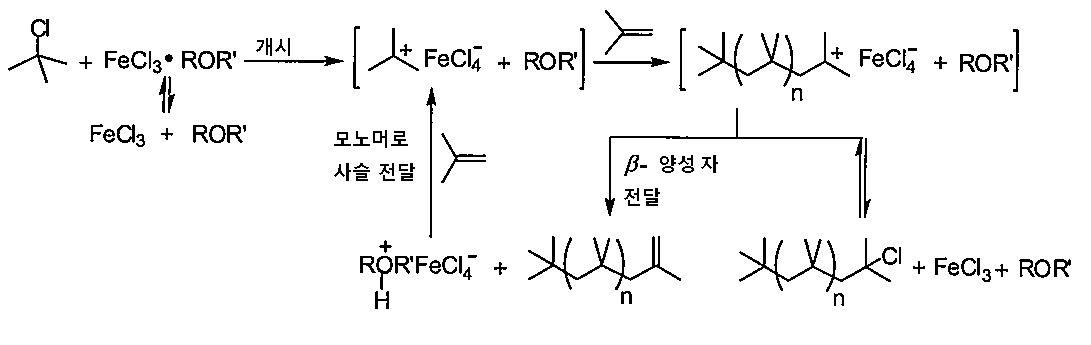
입체 및 전자 효과가 이온화 및 사슬 전달 (β-양성자 추출 이어서 양성자의 IB로의 전달)의 비율에 영향을 끼치므로, 중합화 비율, 분자량 및 엑소-올레핀은 모두 ROR'의 R 및 R' 기의 선택에 의해 영향을 받는다. 추가로, 입체 및 전자 효과는 또한, 루이스 산과 에테르의 평형상수에 영향을 끼칠 수 있다.Since the steric and electronic effects affect the ratio of ionization and chain transfer (transfer of proton to IB through β-proton extraction), the polymerization rate, molecular weight and exo-olefin are both selected for the R and R 'groups of ROR' Lt; / RTI > Additionally, steric and electronic effects can also affect the equilibrium constants of Lewis acid and ether.
하기 도시된 FeCL3과 에테르의 착물 형성은 ATR FT-IR 분광기를 사용하여 실온에서 1.0 M CH2Cl2 용액중에서 연구하였다. ATR FT-IR에 의한 FeCl3과 디이소프로필 에테르 (에테르 1)의 착물 형성에 대한 종래 연구는, FeCl3에 비해 과도량의 에테르가 첨가되는 경우 유리 에테르의 존재로 입증되는 바와 같이, 단지 1:1 착물이 형성되는 것으로 나타냈다 (문헌 [Liu, Q.; Wu, Y.; Yan, P.; Zhang, Y; Xu, R., Macromolecules 2011, 44, 1866-1875] 참조; 또한, 문헌 [Kumar, R.; Dimitrov, P.; Bartelson, K. J.; Emert, J.; Faust, R., Macromolecules 2012, 45, 8598-8603] 참조). The complexation of FeCl 3 and ether shown below was studied in a 1.0 M CH 2 Cl 2 solution at room temperature using an ATR FT-IR spectrometer. Conventional studies on the complex formation of FeCl 3 with diisopropyl ether (ether 1) by ATR FT-IR show that complexes of only 1 (1), as evidenced by the presence of free ether when an excess of ether is added relative to FeCl 3 , Xu, R., Macromolecules, 2011, 44, 1866-1875); see also Liu, Q., Wu, Y., Yan, P., Zhang, Kumar, R., Dimitrov, P., Bartelson, KJ, Emert, J .; Faust, R., Macromolecules 2012, 45, 8598-8603).
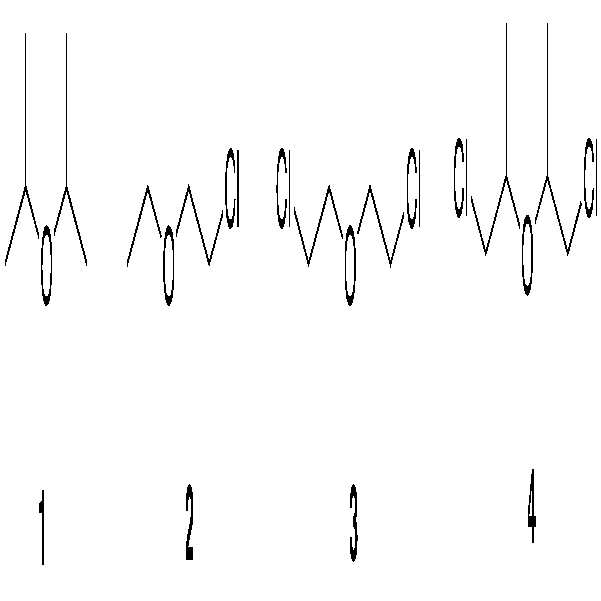
앞서 논의된 종래 보고된 결과와 일관되게, FeCl3와 디이소프로필 에테르 (에테르 1)의 1:1 착물은 어떠한 비용해된 FeCl3을 나타내지 않았으며, 이는 완전한 착화를 나타낸다. FeCl3과 (2-클로로에틸)에틸 에테르(에테르 2)의 1:1 착물은 비용해된 FeCl3을 나타내지 않았으나, 반면 FeCl3과 비스-(2-클로로에틸) 에테르 (에테르 3)와의 상응하는 착물은 나타내었다. FeCl3:에테르 3의 비율을 1:1.13으로 증가시키는 경우, 비용해된 FeCl3을 착물 용액에서 육안으로 더 이상 관찰할 수 없었다. FeCl3ㆍ에테르 4의 1:1 착물은 일부 비용해된 FeCl3을 나타내었으며, FeCl3과 에테르 3의 1:1 착물과 외관상 유사하였다. 에테르 IR 시그니처의 더 낮은 파장으로의 이동은 착화 사건과 일관된다; 착화는 에테르의 C-O 결합의 연장을 초래하고, 이는 관찰된 파장 이동을 유도한다.Consistent with the previously reported results discussed above, the 1: 1 complex of FeCl 3 and diisopropyl ether (ether 1) did not reveal any undissolved FeCl 3 , indicating complete complexation. The 1: 1 complex of FeCl 3 and (2-chloroethyl) ethyl ether (ether 2) did not show any FeCl 3 inefficiency, whereas the corresponding FeCl 3 and bis- (2-chloroethyl) ether (ether 3) Complex. When the ratio of FeCl 3 : ether 3 was increased to 1: 1.13, the ineffective FeCl 3 could no longer be observed visually in the complex solution. 1 of FeCl 3 and ether 4: 1 complexes exhibited the FeCl 3 to a fraction of the cost, FeCl 3 and 1 of ether 3: 1 complex was apparently similar. The transfer of ether IR signatures to lower wavelengths is consistent with ignition events; Complexation results in extension of the CO bond of the ether, which leads to the observed wavelength shift.
상기 관찰은 모두 다양한 에테르와의 다양한 착화 평형의 견지에서 해석될 수 있다. 1:1 FeCl3 대 에테르 옥시젠 화학양론 즉, 에테르 1 및 2에서 비용해된 FeCl3를 나타내지 않는 착물은 착화를 뒷받침하는 평형 상수를 분명히 갖는다. 반대로, 비용해된 FeCl3를 나타내는 착물; 에테르 3 및 4와의 착물은 더 낮은 착물 평형 상수를 갖는다. 에테르 4 및 4의 경우에, 착화의 더 낮은 평형 상수는 전자 효과로 인한 것일 수 있는데, 2개의 전자 끄는 염소 원자의 존재가 에테르 옥시젠의 전자 밀도를 현저하게 감소시키기 때문이다.All of these observations can be interpreted in terms of various ionization equilibria with various ethers. The 1: 1 FeCl 3 vs. etheroxygen stoichiometry, that is, the complexes which do not exhibit the decomposed FeCl 3 in ether 1 and 2 clearly have the equilibrium constants that support complexation. In contrast, complexes indicating the undissolved FeCl 3; The complexes with ethers 3 and 4 have lower complex equilibrium constants. In the case of ethers 4 and 4, the lower equilibrium constant of complexation may be due to the electron effect, since the presence of two electron withdrawing chlorine atoms significantly reduces the electron density of the etheroxygen.
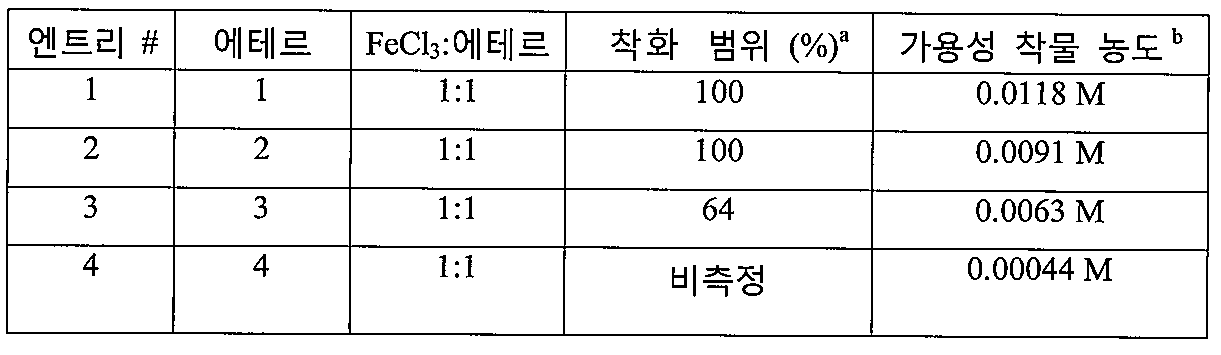
용해도 연구는 중합 조건을 시뮬레이션한 단순 원심분리 실험을 이용하여 에테르 1, 2, 3 및 4에 대해 수행하였다. 착물을 30mL 원심분리 튜브에서 디클로로메탄 (DCM)중의 1.0M 용액으로서 제조하였다. 그 후, 원심분리기를 적합한 온도 (0℃)로 설정하고, 적합한 양의 헥산을 원심분리 튜브에 첨가하였으며, 이렇게 한 착물 농도는 0.2 M 이었다. 원심분리 튜브를 10분 동안 3750rpm으로 회전시키기 전에 원심분리 튜브내 적합한 온도와 평형을 이루게 하였다. 완료시, 원심분리된 용액의 분취액을 둥근 바닥 플라스크에 옮기고, 용매 및 과다 에테르 (만약 여전히 잔존한다면)를 제거하고, 잔류물을 측량하였다. 이러한 데이타로부터, 전체 용액중에 용해된 착물의 양을 계산하였다 (표 1 참조).
Solubility studies were performed on ethers 1, 2, 3 and 4 using simple centrifugation experiments simulating polymerization conditions. The complex was prepared as a 1.0 M solution in dichloromethane (DCM) in a 30 mL centrifuge tube. The centrifuge was then set to the appropriate temperature (0 ° C) and the appropriate amount of hexane was added to the centrifuge tube, and the complex concentration was 0.2 M. The centrifuge tube was allowed to equilibrate with the appropriate temperature in the centrifuge tube before spinning at 3750 rpm for 10 minutes. Upon completion, the aliquots of the centrifuged solution were transferred to a round bottom flask, the solvent and excess ether (if still remaining) were removed and the residues were weighed. From this data, the amount of complex dissolved in the total solution was calculated (see Table 1).
표 1 - 0℃에서 헥산중에 0.020M의 FeCl3ㆍ에테르 착물 (새로 증류된 DCM중에 제조됨)에 대한 용해도 데이타 Table 1 - Solubility data for 0.020 M FeCl 3. Ether complex (prepared in freshly distilled DCM) in hexane at 0 ° C
a DCM중의 ATR FT-IR 연구에 기초함. b 헥산중의 용해도 연구에 기초함.
a Based on ATR FT-IR studies in DCM. b Based on solubility studies in hexane.
FeCl3와 클로르화된 에테르 2 및 3의 1:1 착물은 에테르 1과 비교하여 저하된 용해도를 나타내었다. 더 낮은 농도의 1:1 FeCl3ㆍ에테르 3 착물은 또한, 이러한 특정 에테르의 산소에서 감소된 전자 밀도로 인한 불완전한 착물 형성에 기인할 수 있다. 이러한 현상은 1:1 FeCl3ㆍ에테르 4 착물의 경우에 더욱 두드러지며, 반응 시스템중의 이러한 착물의 농도는 단지 0.00044 M이었다.The 1: 1 complex of FeCl 3 and chlorinated ethers 2 and 3 exhibited reduced solubility compared to ether 1. Lower concentrations of the 1: 1 FeCl 3. Ether ternary complex may also be due to incomplete complex formation due to reduced electron density in the oxygen of this particular ether. This phenomenon is more pronounced in the case of the 1: 1 FeCl 3 · ether tetra complex, and the concentration of this complex in the reaction system was only 0.00044 M.
그 후, 상기 용해도 데이타는 다양한 착물을 사용한 중합화로부터의 결과와 관련있다 (표 2).
The solubility data are then related to the results from polymerization using various complexes (Table 2).
표 2 - t-BuCl에 의해 개시되고 FeCl3ㆍ에테르 착물 (새로 증류된 DCM중에 제조됨)에 의해 공동개시되는, 0℃하 20분 동안의 헥산중의 IB의 중합화. (IB) = 1.0M, (t-BuCl) = 0.02 M 및 (FeCl3ㆍ에테르) = 0.02M. MeOH로 켄칭됨. Table 2 - Polymerization of IB in hexane for 20 min at 0 ° C, initiated by t- BuCl and co-initiated by FeCl 3. Ether complex (prepared in freshly distilled DCM). (IB) = 1.0M, (t -BuCl) = 0.02 M and (FeCl 3 and ether) = 0.02M. Quenched with MeOH.
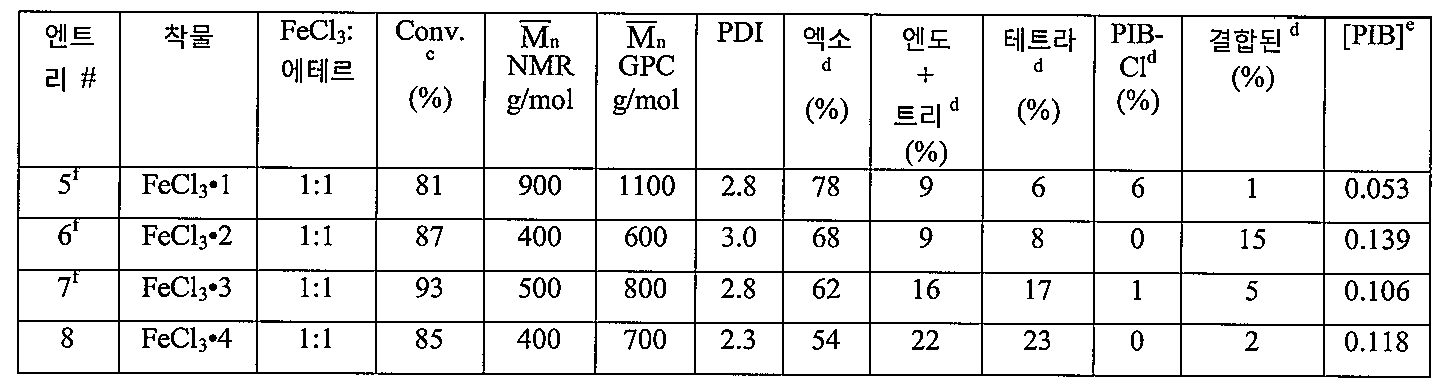
c중량 전환율. d 1H NMR 분광기에 의해 측정. e[PIB] = [IB] x 56.11 x (conv./ 
c Weight Conversion Rate. Measured by d 1 H NMR spectroscopy. e [PIB] = [IB] x 56.11 x (conv. /
중합화가 전자 끄는 염소 원자(들)을 갖는 에테르 2 또는 3으로 제조된 FeCl3 착물로 공동개시되는 경우, FeCl3ㆍ에테르 1로 수득된 것과 비교하여 (엔트리 6 및 7 vs. 엔트리 5), 전환율은 증가되나 (>60%), 약간 더 낮은 엑소-올레핀 함량 (
FeCl3 화학량론/에테르 화학량론 및 FeCl3ㆍ에테르 착물 농도의 영향은 각각 표 3 및 4에 기록되어 있다.
The effects of FeCl 3 stoichiometry / ether stoichiometry and FeCl 3 · ether complex concentration are reported in Tables 3 and 4, respectively.
표 3 - t-BuCl에 의해 개시되고 FeCl3ㆍ에테르 착물 (새로 증류된 DCM중에 제조됨)에 의해 공동개시되는, 0℃하 헥산중의 IB의 중합화에 대한 FeCl3:에테르 비의 영향. (IB) = 1.0M, (t-BuCl) = 0.02 M 및 (FeCl3ㆍ에테르) = 0.02M. MeOH로 켄칭됨. Table 3 - FeCl 3 to FeCl 3 is initiated by a t -BuCl and ether complex (prepared in a freshly distilled DCM) polymerization of IB in the 0 ℃ and hexane, disclosed jointly by: Effect of non-ether. (IB) = 1.0M, (t -BuCl) = 0.02 M and (FeCl 3 and ether) = 0.02M. Quenched with MeOH.

c중량 전환율. d 1H NMR 분광기에 의해 측정. e[PIB] = [IB] x 56.11 x (conv./ 
c Weight Conversion Rate. Measured by d 1 H NMR spectroscopy. e [PIB] = [IB] x 56.11 x (conv. /
중합화 전환율은 과량의 에테르 1 (엔트리 11)의 존재시 감소하나, 과량의 FeCl3 (엔트리 9) 존재시 실질적으로 변화되지 않은 채 유지되는 것으로 밝혀졌다. 반대로, FeCl3ㆍ에테르 2 및 FeCl3ㆍ에테르 3 착물로는, FeCl3:에테르 비의 연구된 범위 (엔트리 12 내지 21)에서 전환율 또는 엑소-올레핀 함량에서 유의한 변화가 나타나지 않았다. 이는 에테르 2 및 3의 전자 끄는 염소 원자의 존재로 인한 것일 수 있다.The polymerisation conversion was found to decrease in the presence of excess ether 1 (Entry 11), but to remain substantially unchanged in the presence of excess FeCl 3 (Entry 9). Conversely, with FeCl 3. Ether 2 and FeCl 3. Ether 3 complexes, no significant change in conversion or exo-olefin content was observed in the studied range of FeCl 3 : ether ratios (entries 12-21). This may be due to the presence of electron withdrawing chlorine atoms of ethers 2 and 3.
표 4 - t-BuCl에 의해 개시되고 FeCl3ㆍ에테르 착물 (새로 증류된 DCM중에 제조됨)에 의해 공동개시되는, 0℃하 헥산중의 IB의 착물 농도의 영향. (IB) = 1.0M, (t-BuCl) = 0.02 M 및 (FeCl3ㆍ에테르) = 0.02, 0.015M 또는 0.010M. MeOH로 켄칭됨. Table 4 - Effect of complex concentration of IB in hexane at 0 ° C, initiated by t- BuCl and co-initiated by FeCl 3. Ether complex (prepared in freshly distilled DCM). (IB) = 1.0M, (t -BuCl) = 0.02 M and (FeCl 3 and ether) = 0.02, 0.015M or 0.010M. Quenched with MeOH.

c중량 전환율. d 1H NMR 분광기에 의해 측정. e[PIB] = [IB] x 56.11 x (conv./ 
c Weight Conversion Rate. Measured by d 1 H NMR spectroscopy. e [PIB] = [IB] x 56.11 x (conv. /
비록 전환율에서의 약간의 감소 및 엑소-올레핀 함량에서의 약간의 증가가 관찰되었지만, 착물 농도의 감소는 중합화의 결과에 유의한 영향을 끼치지 못하였다 (엔트리 22 내지 27). 이들 결과는 촉매/개시 시스템의 견고성을 입증한다.Although a slight decrease in conversion and a slight increase in exo-olefin content were observed, the decrease in complex concentration did not have a significant effect on the result of polymerization (entries 22-27). These results demonstrate the robustness of the catalyst / initiation system.
0℃하 헥산중의 t-BuCl/FeCl3ㆍ에테르에 의해 개시된 IB 중합화의 동역학 비교는 도 1에 그래프 형태로 도시되어 있다. 포화 전환율이 모든 3개의 FeCl3ㆍ에테르 시스템에 대해서 20분 후에 얻어졌으며, 엑소-올레핀 함량은 중합화를 통틀어 상당히 일정하게 유지되었다.A kinetic comparison of the IB polymerization initiated by t- BuCl / FeCl 3. Ether in 0 ° C hexane is shown graphically in FIG. The saturation conversion was obtained after 20 minutes for all three FeCl 3 ether systems and the exo-olefin content remained fairly constant throughout the polymerization.
2-클로로-2,4,4-트리메틸펜탄 (TMPCl) 또는 t-BuCl에 의해 개시되고, FeCl3ㆍ에테르 착물에 의해 공동개시되는 IB의 중합화에 대한 양성자 트랩 2,6-디 3차-부틸피리딘 (DTBP)의 영향을 표 5에 기록하였다.
Proton traps for the polymerization of IB initiated by 2-chloro-2,4,4-trimethylpentane (TMPCl) or t- BuCl and co-initiated by FeCl 3 ether complexes 2,6- The effect of butylpyridine (DTBP) is reported in Table 5.
표 5 - TMPCl 또는 t-BuCl에 의해 개시되고, FeCl3ㆍ에테르 착물 (새로 증류된 DCM중에 제조됨)에 의해 공동개시되는, 0℃하 20분 동안의 헥산중의 IB의 중합화. (IB) = 1.0M, 개시제 = 0.02 M, DTBP = 0.005 M 및 (FeCl3ㆍ에테르) = 0.02 M. MeOH로 켄칭됨. Table 5 - Polymerization of IB in hexane for 20 min at 0 캜, initiated by TMPCl or t- BuCl and co-initiated by FeCl 3. Ether complex (prepared in freshly distilled DCM). (IB) = 1.0 M, initiator = 0.02 M, DTBP = 0.005 M and (FeCl 3. Ether) = 0.02 M. MeOH.
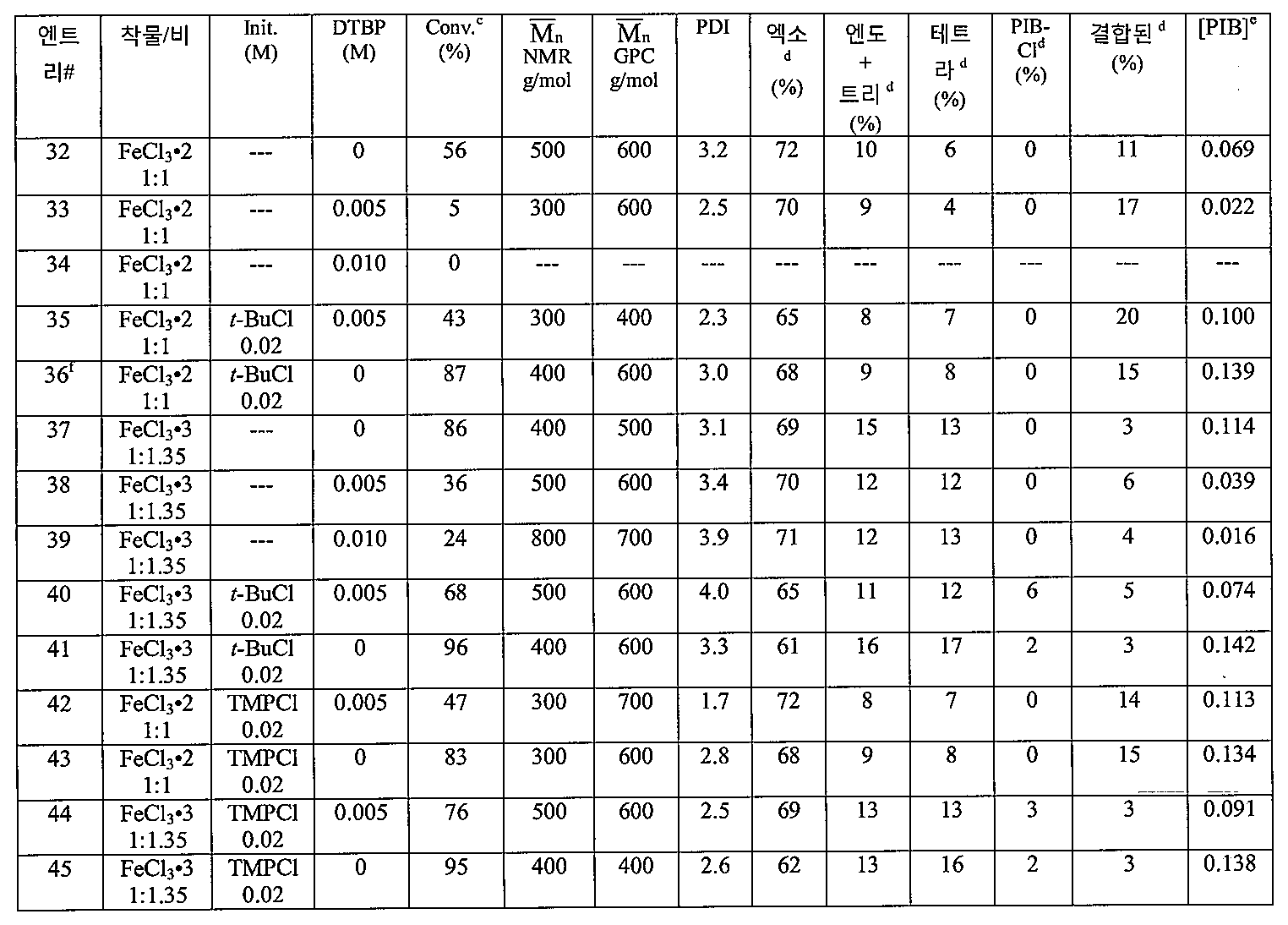
c중량 전환율. d 1H NMR 분광기에 의해 측정. e[PIB] = [IB] x 56.11 x (conv./ 
c Weight Conversion Rate. Measured by d 1 H NMR spectroscopy. e [PIB] = [IB] x 56.11 x (conv. /
개시제 및 DTBP의 부재시, FeCl3ㆍ에테르 1 시스템을 사용하면 
0.005 M의 DTBP의 존재시, 5% 및 36% 전환율이 20분에 도달되었다 (엔트리 33 및 38). 0.01M DTBP에서, 중합화는 에테르 2의 경우에 발생하지 않으며, 그러나 에테르 3로는 24% 전환율이 여전히 수득되었다 (엔트리 34 및 39). 에테르 부분이 생성물의 1H NMR 스펙트럼에서 관찰되지 않았으며, 따라서 에테르 3는 개시제가 아님이 주목된다.In the presence of 0.005 M DTBP, 5% and 36% conversion reached 20 minutes (entries 33 and 38). At 0.01 M DTBP, polymerization did not occur in the case of ether 2, but with ether 3, 24% conversion was still obtained (entries 34 and 39). It is noted that the ether moiety was not observed in the 1 H NMR spectrum of the product and therefore ether 3 is not an initiator.
에테르 3이 에테르 2 보다 덜 기본적 (basic)이라는 점으로 인해 에테르 2와 반대로 에테르 3에 대한 분자량이 일반적으로 높으며, 따라서, 성장하는 사슬 말단으로부터 양성자 추출이 감소되며, 이는 결론적으로 더 높은 분자량의 폴리머를 유도한다. t-BuCl의 첨가는 전환율을 증가시키며, 게다가, 
특정 대표적인 구체예 및 상세한 사항이 본 발명을 설명하기 위해 제공되었으나, 본원에 기재된 것으로부터 다양한 생성물 및 공정 변화가 본 발명의 범위로부터 벗어나지 않으면서 이루어질 수 있음이 자명할 것이다. 첨부된 청구범위는 본 발명의 범위를 규정한다.While certain exemplary embodiments and details have been provided to illustrate the invention, it will be appreciated that various changes in form and process from those set forth herein may be made without departing from the scope of the invention. The appended claims define the scope of the invention.
모든 언급된 특허, 시험 과정, 우선권 및 기타 인용된 문헌은, 이러한 자료가 본 명세서와 일관되는 범위까지 및 참조로서 통합이 허용되는 모든 범위에 대해 참조로서 통합된다.All mentioned patents, test procedures, priorities, and other cited documents are incorporated by reference to the extent that such data is consistent with the present disclosure and for all ranges in which incorporation is permitted by reference.
본 발명의 특정 특성은 일련의 상한치 및 일련의 하한치의 견지에서 기술되었다. 이러한 명세서는 이들 한계치의 임의의 조합에 의해 형성된 모든 범위를 기술한다. 상한치 및 하한치와 본원에 지정된 범위 및 비율 한계치는 독립적으로 조합될 수 있으며, 이들 한계치의 모든 조합은 다르게 명시되지 않은 한 본 발명의 범위 내에 있음을 이해해야 한다.Certain features of the invention have been described in terms of a series of upper limits and a series of lower limits. This specification describes all ranges formed by any combination of these limits. It is to be understood that the upper and lower limits and range and ratio limits specified herein may be combined independently and all combinations of these limits are within the scope of the present invention unless otherwise specified.
Claims (27)
상기 이소부텐 또는 이소부텐-함유 모노머 혼합물의 중합화를 개시제로 개시하는 것을 포함하는, 50 mol% 이상의 엑소-올레핀 함량을 갖는 폴리부텐을 제조하는 방법으로서,
상기 루이스 산 촉매는 화학식 MR"mYn의 루이스 산이며, 여기서, M은 Al, Fe, Ga, Hf, Zr 및 W로부터 선택된 금속이며; R"는 히드로카르빌 기이며; Y는 할로겐이며; m은 0 또는 1 내지 5의 정수이며; n은 1 내지 6의 정수이며, 단 m+n은 금속 M의 원자가와 동일하며;
상기 루이스 염기는 디히드로카르빌 에테르이며, 각각의 에테르 히드로카르빌 기는 독립적으로 C1 내지 C8 히드로카르빌로부터 선택되며, 상기 에테르 히드로카르빌 기중 하나 또는 각각은 전자-끄는 기로 치환되며;
개시제는 화학식 RX의 화합물이며, 여기서 X는 할라이드이며; R은 안정한 카보양이온을 형성할 수 있는 히드로카르빌 기이며, 기 R을 기 X에 연결하는 탄소는 3차 탄소, 벤질 탄소 또는 알릴 탄소인 방법.Contacting the isobutene or isobutene-containing monomer mixture with a Lewis acid catalyst complexed with an oxygen and / or sulfur-containing Lewis base in a substantially or completely non-polar solvent,
A process for preparing polybutene having an exo-olefin content of at least 50 mol%, comprising initiating polymerization of the isobutene or isobutene-containing monomer mixture as an initiator,
Wherein the Lewis acid catalyst is a Lewis acid of the formula MR " m Y n , wherein M is a metal selected from Al, Fe, Ga, Hf, Zr and W; R" is a hydrocarbyl group; Y is halogen; m is 0 or an integer from 1 to 5; n is an integer from 1 to 6, provided that m + n is equal to the valence of the metal M;
Wherein the Lewis base is a dihydrocarbyl ether, wherein each ether hydrocarbyl group is independently selected from C 1 to C 8 hydrocarbyl, wherein one or each of the ether hydrocarbyl groups is substituted with an electron-withdrawing group;
The initiator is a compound of formula RX, wherein X is a halide; R is a hydrocarbyl group capable of forming a stable carbo-cation, and the carbon connecting the group R to the group X is a tertiary carbon, benzyl carbon or allyl carbon.
상기 촉매는 루이스 염기로 착화된 루이스 산 촉매를 포함하며, 상기 루이스 산 촉매는 화학식 MR"mYn의 루이스 산이며, 여기서, M은 Al, Fe, Ga, Hf, Zr 및 W로부터 선택된 금속이며; R"는 히드로카르빌 기이며; Y는 할로겐이며; m은 0 또는 1 내지 5의 정수이며; n은 1 내지 6의 정수이며, 단 m+n은 금속 M의 원자가와 동일하며;
상기 루이스 염기는 디히드로카르빌 에테르이며, 각각의 에테르 히드로카르빌 기는 독립적으로 C1 내지 C8 히드로카르빌로부터 선택되며, 상기 에테르 히드로카르빌 기중 하나 또는 각각은 전자-끄는 기로 치환되며;
중합화는 화학식 RX의 개시제를 통해 개시되며, 여기서 X는 할라이드이며; R은 안정한 카보양이온을 형성할 수 있는 히드로카르빌 기이며, 기 R을 기 X에 연결하는 탄소는 3차 탄소, 벤질 탄소 또는 알릴 탄소인 촉매-개시제 시스템.A catalyst-initiator system for catalyzing the polymerization of an isobutene or isobutene-containing monomer mixture in a substantially or completely non-polar solvent to provide a polybutene product having an exo-olefin content of at least 50 mol%
Wherein the catalyst comprises a Lewis acid catalyst complexed with a Lewis base wherein the Lewis acid catalyst is a Lewis acid of the formula M R " m Y n wherein M is a metal selected from Al, Fe, Ga, Hf, Zr and W ; R "is a hydrocarbyl group; Y is halogen; m is 0 or an integer from 1 to 5; n is an integer from 1 to 6, provided that m + n is equal to the valence of the metal M;
Wherein the Lewis base is a dihydrocarbyl ether, wherein each ether hydrocarbyl group is independently selected from C 1 to C 8 hydrocarbyl, wherein one or each of the ether hydrocarbyl groups is substituted with an electron-withdrawing group;
The polymerization is initiated via an initiator of the formula RX wherein X is a halide; R is a hydrocarbyl group capable of forming a stable carbo-cation, and the carbon connecting the group R to the group X is a tertiary carbon, benzyl carbon or allyl carbon.
18. The catalyst-initiator system of claim 17, wherein the Lewis acid and the Lewis base are complexed by dissolving the Lewis acid in the solvent to form a solution, and then adding the Lewis base to the solution.
Applications Claiming Priority (2)
| Application Number | Priority Date | Filing Date | Title |
|---|---|---|---|
| US13/796,405 US9156924B2 (en) | 2013-03-12 | 2013-03-12 | Polymerization initiating system and method to produce highly reactive olefin functional polymers |
| US13/796,405 | 2013-03-12 |
Publications (2)
| Publication Number | Publication Date |
|---|---|
| KR20140111981A true KR20140111981A (en) | 2014-09-22 |
| KR102004502B1 KR102004502B1 (en) | 2019-07-26 |
Family
ID=50235963
Family Applications (1)
| Application Number | Title | Priority Date | Filing Date |
|---|---|---|---|
| KR1020140028369A Active KR102004502B1 (en) | 2013-03-12 | 2014-03-11 | Polymerization initiating system and method to produce highly reactive olefin functional polymers |
Country Status (8)
| Country | Link |
|---|---|
| US (1) | US9156924B2 (en) |
| EP (1) | EP2778181B1 (en) |
| JP (1) | JP6285221B2 (en) |
| KR (1) | KR102004502B1 (en) |
| CN (1) | CN104045750B (en) |
| CA (1) | CA2843356C (en) |
| ES (1) | ES2712726T3 (en) |
| SG (1) | SG2014015119A (en) |
Cited By (2)
| Publication number | Priority date | Publication date | Assignee | Title |
|---|---|---|---|---|
| KR20160134525A (en) * | 2015-05-13 | 2016-11-23 | 유니버시티 오브 매사추세츠 | Polymerization initiating system and method to produce highly reactive olefin functional polymers |
| KR101992080B1 (en) * | 2018-01-25 | 2019-06-21 | 유니버시티 오브 매사추세츠 | Method for forming highly reactive olefin functional polymers |
Families Citing this family (9)
| Publication number | Priority date | Publication date | Assignee | Title |
|---|---|---|---|---|
| US9034998B2 (en) | 2011-12-16 | 2015-05-19 | University Of Massachusetts | Polymerization initiating system and method to produce highly reactive olefin functional polymers |
| US9631038B2 (en) * | 2013-10-11 | 2017-04-25 | University Of Massachusetts | Polymerization initiating system and method to produce highly reactive olefin functional polymers |
| SG11201806357PA (en) * | 2016-02-16 | 2018-08-30 | Basf Se | Process for preparing high-reactivity isobutene homo- or copolymers |
| EP3487891B1 (en) * | 2016-07-22 | 2020-04-29 | Basf Se | Process for preparing high-reactivity isobutene homo- or copolymers |
| US10047174B1 (en) * | 2017-06-28 | 2018-08-14 | Infineum International Limited | Polymerization initiating system and method to produce highly reactive olefin functional polymers |
| US10167352B1 (en) * | 2017-06-28 | 2019-01-01 | University Of Massachusetts | Polymerization initiating system and method to produce highly reactive olefin functional polymers |
| US10829573B1 (en) | 2019-05-21 | 2020-11-10 | Infineum International Limited | Method for forming highly reactive olefin functional polymers |
| EP3943518A1 (en) | 2020-07-22 | 2022-01-26 | Indian Oil Corporation Limited | Polymerization catalyst system and process to produce highly reactive polyisobutylene |
| CN115703855A (en) * | 2021-08-13 | 2023-02-17 | 南京中科康润新材料科技有限公司 | Catalyst system for C4 liquefied petroleum gas cationic polymerization and polybutene production method |
Citations (2)
| Publication number | Priority date | Publication date | Assignee | Title |
|---|---|---|---|---|
| KR20130008551A (en) * | 2010-02-17 | 2013-01-22 | 바스프 에스이 | Method for producing highly reactive isobutene homo or copolymers |
| US20130158217A1 (en) * | 2011-12-16 | 2013-06-20 | Infineum International Limited | Polymerization initiating system and method to produce highly reactive olefin functional polymers |
Family Cites Families (40)
| Publication number | Priority date | Publication date | Assignee | Title |
|---|---|---|---|---|
| US2682531A (en) | 1951-03-31 | 1954-06-29 | Standard Oil Dev Co | Zirconium tetrachloride-ether complexes as low temperature polymerization catalyst |
| US3850897A (en) | 1971-11-26 | 1974-11-26 | Snam Progetti | Procedure for the production of polymers and copolymers of isobutylene |
| DE2702604C2 (en) | 1977-01-22 | 1984-08-30 | Basf Ag, 6700 Ludwigshafen | Polyisobutenes |
| CA2019908A1 (en) | 1989-12-28 | 1991-06-28 | Rudolf Lukas | Graft copolymers and the method and initiation system for preparation thereof |
| GB9025839D0 (en) | 1990-11-28 | 1991-01-09 | Bp Chem Int Ltd | Cationic polymerisation of 1-olefins |
| US5286823A (en) | 1991-06-22 | 1994-02-15 | Basf Aktiengesellschaft | Preparation of highly reactive polyisobutenes |
| US5350819A (en) | 1993-02-19 | 1994-09-27 | Exxon Chemical Patents Inc. | Carbocationic catalysts and process for using said catalysts |
| WO1994028036A1 (en) | 1993-05-20 | 1994-12-08 | Exxon Chemical Patents Inc. | Heterogeneous lewis acid-type catalysts |
| EP0713883B2 (en) * | 1994-06-09 | 2008-10-29 | Kanegafuchi Kagaku Kogyo Kabushiki Kaisha | Process for producing isobutene polymer |
| US5710225A (en) | 1996-08-23 | 1998-01-20 | The Lubrizol Corporation | Heteropolyacid catalyzed polymerization of olefins |
| DE19704482A1 (en) | 1997-02-06 | 1998-08-13 | Basf Ag | Process for the production of halogen-free, reactive polyisobutene |
| DE19734176A1 (en) | 1997-08-07 | 1999-02-11 | Basf Ag | Process for the production of halogen-free, reactive polyisobutene |
| US6407186B1 (en) | 1997-12-12 | 2002-06-18 | Basf Aktiengesellschaft | Method for producing low-molecular, highly reactive polyisobutylene |
| DE19825334A1 (en) * | 1998-06-05 | 1999-12-09 | Basf Ag | Process for the production of highly reactive polyisobutenes |
| DE69916834T2 (en) | 1998-06-12 | 2004-09-30 | Univation Technologies, LLC, Houston | METHOD FOR POLYMERIZING OLEFINES USING ACTIVATED LEWIS ACID BASE COMPLEXES |
| JP2000119310A (en) * | 1998-10-14 | 2000-04-25 | Nippon Petrochem Co Ltd | Butene polymerization catalyst and method for producing butene polymer using the same |
| US6407170B1 (en) | 1999-06-24 | 2002-06-18 | The Lubrizol Corporation | Dispersants prepared from high polydispersity olefin polymers |
| US6346585B1 (en) | 1999-06-24 | 2002-02-12 | The Lubrizol Corporation | Ammonium heteropolyacid catalized polymerization of olefins |
| US6562913B1 (en) | 1999-09-16 | 2003-05-13 | Texas Petrochemicals Lp | Process for producing high vinylidene polyisobutylene |
| DE19952030A1 (en) | 1999-10-28 | 2001-05-03 | Basf Ag | Process for the production of highly reactive polyisobutenes |
| US6858690B2 (en) | 1999-11-15 | 2005-02-22 | Exxonmobil Chemical Patents Inc. | Process for polymerizing cationically polymerizable monomers |
| DE10035298A1 (en) | 2000-07-18 | 2002-01-31 | Basf Ag | Highly reactive polyisobutene production involves polymerization of isobutene with boron trifluoride catalyst, using solid amine-type deactivator which is insoluble in reaction mixture |
| JP4106265B2 (en) | 2000-11-17 | 2008-06-25 | ビーエーエスエフ ソシエタス・ヨーロピア | Process for deactivation and recovery of boron trifluoride in the production of polyisobutene |
| DE10118182A1 (en) | 2001-04-11 | 2002-10-17 | Basf Ag | Working up liquid products from polyisobutene production by cationic polymerisation involves flash evaporation to give a liquid containing polyisobutene and a gas phase containing isobutene and inert diluent |
| DE10211418A1 (en) | 2002-03-15 | 2003-09-25 | Bayer Ag | Process for the production of highly reactive polyisobutenes |
| WO2004058828A1 (en) | 2002-12-20 | 2004-07-15 | Exxonmobil Chemical Patents Inc. | Polymerization processes |
| DE10303212A1 (en) | 2003-01-24 | 2004-08-05 | Basf Ag | Process for the production of polyisobutene |
| DE10356768A1 (en) | 2003-12-04 | 2005-07-07 | Universität Karlsruhe (TH) - Körperschaft des öffentlichen Rechts | Process for the preparation of salts of weakly coordinating anions, such salts and their use |
| US20080269440A1 (en) | 2005-01-05 | 2008-10-30 | Rudolf Faust | Polymerization of Olefins |
| DE102005055818A1 (en) | 2005-11-21 | 2007-05-24 | Basf Ag | Process for the preparation of highly reactive isobutene homo- or copolymers by means of metal-containing catalyst complexes |
| WO2008095933A1 (en) | 2007-02-09 | 2008-08-14 | Basf Se | Process for polymerizing ethylenically unsaturated monomers |
| US8394897B2 (en) | 2008-03-25 | 2013-03-12 | Chevron Oronite Company Llc | Production of vinylidene-terminated polyolefins via quenching with monosulfides |
| US8063154B2 (en) | 2008-06-24 | 2011-11-22 | The University Of Southern Mississippi | Preparation of exo-olefin terminated polyolefins via quenching with alkoxysilanes or ethers |
| WO2010139684A1 (en) | 2009-06-05 | 2010-12-09 | Basf Se | Compound made of a protonated aromatic and a weakly coordinating anion as a polymerization catalyst for isobutene or a monomer mixture containing isobutene |
| CN101955558B (en) | 2009-07-15 | 2013-03-13 | 北京化工大学 | Initiating system for preparing high-reaction activity polyisobutene and copolymer of polyisobutene |
| US20120208971A1 (en) | 2009-11-04 | 2012-08-16 | Basf Se | Method for the production of homo- or copolymers |
| US8349977B2 (en) | 2010-02-17 | 2013-01-08 | Basf Se | Process for preparing high-reactivity isobutene homo- or copolymers |
| US9562117B2 (en) | 2010-11-30 | 2017-02-07 | Basf Se | Preparation of derivatives of isobutene copolymers |
| MY166046A (en) * | 2011-08-11 | 2018-05-22 | Basf Se | Process for preparing high-reactivity isobutene homo-or copolymers |
| US9631038B2 (en) | 2013-10-11 | 2017-04-25 | University Of Massachusetts | Polymerization initiating system and method to produce highly reactive olefin functional polymers |
-
2013
- 2013-03-12 US US13/796,405 patent/US9156924B2/en active Active
-
2014
- 2014-02-13 SG SG2014015119A patent/SG2014015119A/en unknown
- 2014-02-20 CA CA2843356A patent/CA2843356C/en active Active
- 2014-03-04 ES ES14157689T patent/ES2712726T3/en active Active
- 2014-03-04 EP EP14157689.2A patent/EP2778181B1/en active Active
- 2014-03-10 JP JP2014046191A patent/JP6285221B2/en active Active
- 2014-03-11 CN CN201410087834.0A patent/CN104045750B/en active Active
- 2014-03-11 KR KR1020140028369A patent/KR102004502B1/en active Active
Patent Citations (2)
| Publication number | Priority date | Publication date | Assignee | Title |
|---|---|---|---|---|
| KR20130008551A (en) * | 2010-02-17 | 2013-01-22 | 바스프 에스이 | Method for producing highly reactive isobutene homo or copolymers |
| US20130158217A1 (en) * | 2011-12-16 | 2013-06-20 | Infineum International Limited | Polymerization initiating system and method to produce highly reactive olefin functional polymers |
Non-Patent Citations (2)
| Title |
|---|
| A cost-effective process for highly reactive polyisobutylenes via cationic polymerization coinitiated AlCl3, Polymer, 2010, 51(25), p. 5960-5969. * |
| Polymerization of Isobutylene by AlCl3/Ether Complexes in Nonpolar Solvent, Macromolecules, 2012, 45 (8), pp 3318-3325. * |
Cited By (2)
| Publication number | Priority date | Publication date | Assignee | Title |
|---|---|---|---|---|
| KR20160134525A (en) * | 2015-05-13 | 2016-11-23 | 유니버시티 오브 매사추세츠 | Polymerization initiating system and method to produce highly reactive olefin functional polymers |
| KR101992080B1 (en) * | 2018-01-25 | 2019-06-21 | 유니버시티 오브 매사추세츠 | Method for forming highly reactive olefin functional polymers |
Also Published As
| Publication number | Publication date |
|---|---|
| EP2778181A1 (en) | 2014-09-17 |
| CN104045750B (en) | 2016-08-17 |
| SG2014015119A (en) | 2014-10-30 |
| US9156924B2 (en) | 2015-10-13 |
| ES2712726T3 (en) | 2019-05-14 |
| KR102004502B1 (en) | 2019-07-26 |
| CN104045750A (en) | 2014-09-17 |
| CA2843356C (en) | 2019-12-24 |
| US20140275453A1 (en) | 2014-09-18 |
| JP2014173091A (en) | 2014-09-22 |
| CA2843356A1 (en) | 2014-09-12 |
| JP6285221B2 (en) | 2018-02-28 |
| EP2778181B1 (en) | 2018-11-21 |
Similar Documents
| Publication | Publication Date | Title |
|---|---|---|
| KR102004502B1 (en) | Polymerization initiating system and method to produce highly reactive olefin functional polymers | |
| KR102065510B1 (en) | Polymerization initiating system and method to produce highly reactive olefin functional polymers | |
| KR102294441B1 (en) | Polymerization initiating system and method to produce highly reactive olefin functional polymers | |
| JP5945605B2 (en) | Polymerization initiation system and method for producing highly reactive olefin functional polymer | |
| JP6594572B2 (en) | Method for forming highly reactive olefin functional polymers | |
| CN111978439B (en) | Improved process for forming highly reactive olefin functional polymers |
Legal Events
| Date | Code | Title | Description |
|---|---|---|---|
| PA0109 | Patent application |
Patent event code: PA01091R01D Comment text: Patent Application Patent event date: 20140311 |
|
| PG1501 | Laying open of application | ||
| PA0201 | Request for examination |
Patent event code: PA02012R01D Patent event date: 20190215 Comment text: Request for Examination of Application Patent event code: PA02011R01I Patent event date: 20140311 Comment text: Patent Application |
|
| PA0302 | Request for accelerated examination |
Patent event date: 20190215 Patent event code: PA03022R01D Comment text: Request for Accelerated Examination Patent event date: 20140311 Patent event code: PA03021R01I Comment text: Patent Application |
|
| E902 | Notification of reason for refusal | ||
| PE0902 | Notice of grounds for rejection |
Comment text: Notification of reason for refusal Patent event date: 20190307 Patent event code: PE09021S01D |
|
| E701 | Decision to grant or registration of patent right | ||
| PE0701 | Decision of registration |
Patent event code: PE07011S01D Comment text: Decision to Grant Registration Patent event date: 20190621 |
|
| GRNT | Written decision to grant | ||
| PR0701 | Registration of establishment |
Comment text: Registration of Establishment Patent event date: 20190722 Patent event code: PR07011E01D |
|
| PR1002 | Payment of registration fee |
Payment date: 20190722 End annual number: 3 Start annual number: 1 |
|
| PG1601 | Publication of registration | ||
| PR1001 | Payment of annual fee |
Payment date: 20220712 Start annual number: 4 End annual number: 4 |