KR20140110084A - Open loop channel reporting in a wireless communication system - Google Patents
Open loop channel reporting in a wireless communication system Download PDFInfo
- Publication number
- KR20140110084A KR20140110084A KR1020147022414A KR20147022414A KR20140110084A KR 20140110084 A KR20140110084 A KR 20140110084A KR 1020147022414 A KR1020147022414 A KR 1020147022414A KR 20147022414 A KR20147022414 A KR 20147022414A KR 20140110084 A KR20140110084 A KR 20140110084A
- Authority
- KR
- South Korea
- Prior art keywords
- cqi
- precoding matrices
- data transmission
- time
- base station
- Prior art date
- Legal status (The legal status is an assumption and is not a legal conclusion. Google has not performed a legal analysis and makes no representation as to the accuracy of the status listed.)
- Granted
Links
- 238000004891 communication Methods 0.000 title claims abstract description 30
- 230000005540 biological transmission Effects 0.000 claims abstract description 103
- 239000011159 matrix material Substances 0.000 claims abstract description 68
- 238000000034 method Methods 0.000 claims abstract description 66
- 238000012935 Averaging Methods 0.000 claims description 4
- 238000004590 computer program Methods 0.000 claims description 3
- 238000012545 processing Methods 0.000 claims description 3
- 238000013461 design Methods 0.000 abstract description 48
- 230000008569 process Effects 0.000 description 15
- 230000003595 spectral effect Effects 0.000 description 11
- 238000005516 engineering process Methods 0.000 description 9
- 239000013598 vector Substances 0.000 description 9
- 230000006870 function Effects 0.000 description 8
- 230000015654 memory Effects 0.000 description 7
- 238000013507 mapping Methods 0.000 description 6
- 229920006934 PMI Polymers 0.000 description 3
- 238000004364 calculation method Methods 0.000 description 3
- 125000004122 cyclic group Chemical group 0.000 description 3
- 230000007774 longterm Effects 0.000 description 3
- 230000004044 response Effects 0.000 description 3
- 238000004422 calculation algorithm Methods 0.000 description 2
- 238000010586 diagram Methods 0.000 description 2
- 239000000835 fiber Substances 0.000 description 2
- 238000005259 measurement Methods 0.000 description 2
- 230000003287 optical effect Effects 0.000 description 2
- 230000008520 organization Effects 0.000 description 2
- 230000001413 cellular effect Effects 0.000 description 1
- 230000008859 change Effects 0.000 description 1
- 230000002596 correlated effect Effects 0.000 description 1
- 238000001514 detection method Methods 0.000 description 1
- 230000000694 effects Effects 0.000 description 1
- 238000011156 evaluation Methods 0.000 description 1
- 238000005562 fading Methods 0.000 description 1
- 238000010295 mobile communication Methods 0.000 description 1
- 238000012986 modification Methods 0.000 description 1
- 230000004048 modification Effects 0.000 description 1
- 239000002245 particle Substances 0.000 description 1
- 230000000737 periodic effect Effects 0.000 description 1
- 230000002085 persistent effect Effects 0.000 description 1
- 238000004886 process control Methods 0.000 description 1
- 230000002441 reversible effect Effects 0.000 description 1
- 238000001228 spectrum Methods 0.000 description 1
- 238000012546 transfer Methods 0.000 description 1
- 230000001960 triggered effect Effects 0.000 description 1
Images


Classifications
-
- H—ELECTRICITY
- H04—ELECTRIC COMMUNICATION TECHNIQUE
- H04L—TRANSMISSION OF DIGITAL INFORMATION, e.g. TELEGRAPHIC COMMUNICATION
- H04L1/00—Arrangements for detecting or preventing errors in the information received
- H04L1/0001—Systems modifying transmission characteristics according to link quality, e.g. power backoff
- H04L1/0023—Systems modifying transmission characteristics according to link quality, e.g. power backoff characterised by the signalling
- H04L1/0026—Transmission of channel quality indication
-
- H—ELECTRICITY
- H04—ELECTRIC COMMUNICATION TECHNIQUE
- H04B—TRANSMISSION
- H04B7/00—Radio transmission systems, i.e. using radiation field
- H04B7/02—Diversity systems; Multi-antenna system, i.e. transmission or reception using multiple antennas
- H04B7/04—Diversity systems; Multi-antenna system, i.e. transmission or reception using multiple antennas using two or more spaced independent antennas
- H04B7/0413—MIMO systems
- H04B7/0452—Multi-user MIMO systems
-
- H—ELECTRICITY
- H04—ELECTRIC COMMUNICATION TECHNIQUE
- H04B—TRANSMISSION
- H04B7/00—Radio transmission systems, i.e. using radiation field
- H04B7/02—Diversity systems; Multi-antenna system, i.e. transmission or reception using multiple antennas
- H04B7/04—Diversity systems; Multi-antenna system, i.e. transmission or reception using multiple antennas using two or more spaced independent antennas
- H04B7/06—Diversity systems; Multi-antenna system, i.e. transmission or reception using multiple antennas using two or more spaced independent antennas at the transmitting station
- H04B7/0613—Diversity systems; Multi-antenna system, i.e. transmission or reception using multiple antennas using two or more spaced independent antennas at the transmitting station using simultaneous transmission
- H04B7/0615—Diversity systems; Multi-antenna system, i.e. transmission or reception using multiple antennas using two or more spaced independent antennas at the transmitting station using simultaneous transmission of weighted versions of same signal
- H04B7/0619—Diversity systems; Multi-antenna system, i.e. transmission or reception using multiple antennas using two or more spaced independent antennas at the transmitting station using simultaneous transmission of weighted versions of same signal using feedback from receiving side
- H04B7/0621—Feedback content
- H04B7/063—Parameters other than those covered in groups H04B7/0623 - H04B7/0634, e.g. channel matrix rank or transmit mode selection
-
- H—ELECTRICITY
- H04—ELECTRIC COMMUNICATION TECHNIQUE
- H04B—TRANSMISSION
- H04B7/00—Radio transmission systems, i.e. using radiation field
- H04B7/02—Diversity systems; Multi-antenna system, i.e. transmission or reception using multiple antennas
- H04B7/04—Diversity systems; Multi-antenna system, i.e. transmission or reception using multiple antennas using two or more spaced independent antennas
- H04B7/06—Diversity systems; Multi-antenna system, i.e. transmission or reception using multiple antennas using two or more spaced independent antennas at the transmitting station
- H04B7/0613—Diversity systems; Multi-antenna system, i.e. transmission or reception using multiple antennas using two or more spaced independent antennas at the transmitting station using simultaneous transmission
- H04B7/0615—Diversity systems; Multi-antenna system, i.e. transmission or reception using multiple antennas using two or more spaced independent antennas at the transmitting station using simultaneous transmission of weighted versions of same signal
- H04B7/0619—Diversity systems; Multi-antenna system, i.e. transmission or reception using multiple antennas using two or more spaced independent antennas at the transmitting station using simultaneous transmission of weighted versions of same signal using feedback from receiving side
- H04B7/0621—Feedback content
- H04B7/0632—Channel quality parameters, e.g. channel quality indicator [CQI]
-
- H—ELECTRICITY
- H04—ELECTRIC COMMUNICATION TECHNIQUE
- H04L—TRANSMISSION OF DIGITAL INFORMATION, e.g. TELEGRAPHIC COMMUNICATION
- H04L1/00—Arrangements for detecting or preventing errors in the information received
- H04L1/0001—Systems modifying transmission characteristics according to link quality, e.g. power backoff
- H04L1/0033—Systems modifying transmission characteristics according to link quality, e.g. power backoff arrangements specific to the transmitter
- H04L1/0035—Systems modifying transmission characteristics according to link quality, e.g. power backoff arrangements specific to the transmitter evaluation of received explicit signalling
-
- H—ELECTRICITY
- H04—ELECTRIC COMMUNICATION TECHNIQUE
- H04L—TRANSMISSION OF DIGITAL INFORMATION, e.g. TELEGRAPHIC COMMUNICATION
- H04L1/00—Arrangements for detecting or preventing errors in the information received
- H04L1/02—Arrangements for detecting or preventing errors in the information received by diversity reception
- H04L1/06—Arrangements for detecting or preventing errors in the information received by diversity reception using space diversity
- H04L1/0618—Space-time coding
- H04L1/0631—Receiver arrangements
-
- H—ELECTRICITY
- H04—ELECTRIC COMMUNICATION TECHNIQUE
- H04L—TRANSMISSION OF DIGITAL INFORMATION, e.g. TELEGRAPHIC COMMUNICATION
- H04L25/00—Baseband systems
- H04L25/02—Details ; arrangements for supplying electrical power along data transmission lines
- H04L25/03—Shaping networks in transmitter or receiver, e.g. adaptive shaping networks
- H04L25/03006—Arrangements for removing intersymbol interference
- H04L2025/0335—Arrangements for removing intersymbol interference characterised by the type of transmission
- H04L2025/03426—Arrangements for removing intersymbol interference characterised by the type of transmission transmission using multiple-input and multiple-output channels
Landscapes
- Engineering & Computer Science (AREA)
- Computer Networks & Wireless Communication (AREA)
- Signal Processing (AREA)
- Quality & Reliability (AREA)
- Physics & Mathematics (AREA)
- Mathematical Physics (AREA)
- Mobile Radio Communication Systems (AREA)
Abstract
무선 통신 시스템에서 채널 품질 표시자(CQI)를 리포팅하기 위한 기술이 기술된다. 일 설계에서, UE는 UE로의 데이터 송신을 위해 기지국에 의해 이용되고 있는 프리코딩 행렬들의 세트의 가정에 기초하여 CQI를 결정한다. 기지국은 UE에 의해 가정되는 프리코딩 행렬들의 세트를 실제로 이용하거나 이용하지 않을 수도 있다. UE는 CQI를 기지국으로 전송하고, 그 후, CQI에 기초하여 기지국에 의해 전송된 데이터 송신을 수신한다. 일 설계에서, UE는 UE로의 데이터 송신에 이용할 수 있는 시간-주파수 자원들의 세트에 대한 프리코딩 행렬들의 세트를 결정한다. UE는 그 시간-주파수 자원에 대한 프리코딩 행렬에 기초하여 각각의 시간-주파수 자원의 수신 신호 품질을 결정한다. 다음으로, UE는 시간-주파수 자원들의 세트의 수신 신호 품질들에 기초하여 CQI를 결정한다.Techniques for reporting channel quality indicators (CQI) in a wireless communication system are described. In one design, the UE determines the CQI based on the assumption of the set of precoding matrices being used by the base station for data transmission to the UE. The base station may or may not actually use a set of precoding matrices assumed by the UE. The UE sends the CQI to the base station and then receives the data transmission sent by the base station based on the CQI. In one design, the UE determines a set of precoding matrices for a set of time-frequency resources available for data transmission to the UE. The UE determines the received signal quality of each time-frequency resource based on the precoding matrix for that time-frequency resource. Next, the UE determines the CQI based on the received signal qualities of the set of time-frequency resources.
Description
본 출원은, 2009년 6월 29일 출원되고, 발명의 명칭이 "FEEDBACK MODES IN SUPPORT OF DL TRANSMISSION IN LTE-A"인 미국 가특허출원 제 61/221,478호에 대해 우선권을 주장하고, 이 가출원은 본 양수인에게 양도되고 본 명세서에 참조로 통합되었다.This application claims priority to U.S. Provisional Patent Application No. 61 / 221,478, filed on June 29, 2009, entitled " FEEDBACK MODES IN SUPPORT OF DL TRANSMISSION IN LTE-A " Assigned to the assignee hereof and incorporated herein by reference.
본 출원은 일반적으로 통신에 관한 것이고, 더 상세하게는, 무선 통신 시스템에서 채널 정보를 리포팅하기 위한 기술들에 관한 것이다.The present application relates generally to communication, and more particularly to techniques for reporting channel information in a wireless communication system.
무선 통신 시스템들은 음성, 비디오, 패킷 데이터, 메시징, 브로드캐스트 등과 같은 다양한 통신 컨텐츠를 제공하도록 널리 배치되고 있다. 이 무선 시스템들은 가용 시스템 자원들을 공유함으로써 다수의 사용자들을 지원할 수 있는 다중 액세스 시스템들일 수 있다. 이러한 다중 액세스 시스템들의 예들은 코드 분할 다중 액세스(CDMA) 시스템들, 시분할 다중 액세스(TDMA) 시스템들, 주파수 분할 다중 액세스(FDMA) 시스템들, 직교 주파수 분할 다중 액세스(OFDMA) 시스템들 및 싱글-캐리어 FDMA(SC-FDMA) 시스템들을 포함한다.Wireless communication systems are widely deployed to provide a variety of communication content such as voice, video, packet data, messaging, broadcast, and the like. These wireless systems may be multiple access systems capable of supporting multiple users by sharing available system resources. Examples of such multiple access systems include, but are not limited to, code division multiple access (CDMA) systems, time division multiple access (TDMA) systems, frequency division multiple access (FDMA) systems, orthogonal frequency division multiple access (OFDMA) FDMA (SC-FDMA) systems.
무선 통신 시스템은, 다수의 사용자 장비(UE)들을 위한 통신을 지원할 수 있는 다수의 기지국들을 포함할 수 있다. UE는 다운링크 및 업링크를 통해 기지국과 통신할 수 있다. 다운링크(또는 순방향 링크)는 기지국으로부터 UE로의 통신 링크를 지칭하고, 업링크(또는 역방향 링크)는 UE로부터 기지국으로의 통신 링크를 지칭한다.A wireless communication system may include multiple base stations capable of supporting communications for multiple user equipments (UEs). The UE may communicate with the base station on the downlink and uplink. The downlink (or forward link) refers to the communication link from the base station to the UE, and the uplink (or reverse link) refers to the communication link from the UE to the base station.
기지국은 무선 채널을 통해 UE에 데이터를 송신할 수 있다. UE로 하여금 무선 채널을 추정하고 채널 정보를 기지국에 리포팅하게 함으로써 양호한 성능이 달성될 수 있다. 다음으로, 기지국은 리포팅된 채널 정보에 기초하여 데이터를 송신할 수 있다. 무선 채널의 특징들은 페이딩, 다중경로, 간섭 등과 같은 다양한 요인들에 기인하여 시간에 따라 변할 수 있다. 또한, UE는 이동식일 수 있고, UE가 주위를 이동함에 따라 상이한 채널들을 관측할 수 있다. 따라서, 무선 통신 시스템에서 채널 정보를 정확하게 리포팅하기 위한 기술들이 이 분야에 요구된다.The base station may transmit data to the UE over the wireless channel. Good performance can be achieved by allowing the UE to estimate the radio channel and report the channel information to the base station. Next, the base station can transmit data based on the reported channel information. The characteristics of the wireless channel may change over time due to various factors such as fading, multipath, interference, and the like. In addition, the UE may be mobile and may observe different channels as the UE moves around. Accordingly, there is a need in the art for techniques for accurately reporting channel information in a wireless communication system.
무선 통신 시스템에서 채널 품질 표시자(CQI)를 리포팅하기 위한 기술들이 본 명세서에서 설명된다. 일 양상에서, 송신 다이버시티가 요구되는 특정한 동작 시나리오들(예를 들어, 높은 이동성 시나리오들) 하에서의 CQI 리포팅을 위해 개방 루프 리포팅 모드가 이용될 수 있다. 개방 루프 리포팅 모드는 더 정확한 CQI가 리포팅되게 할 수 있어서, 데이터 송신의 성능을 개선시킬 수 있다.Techniques for reporting channel quality indicators (CQI) in a wireless communication system are described herein. In an aspect, an open loop reporting mode may be used for CQI reporting under certain operational scenarios (e.g., high mobility scenarios) where transmit diversity is desired. The open-loop reporting mode can cause a more accurate CQI to be reported, thereby improving the performance of the data transmission.
일 양상에서, UE는 UE로의 데이터 송신을 위해 기지국에 의해 이용되는 프리코딩 행렬들의 세트의 가정에 기초하여 CQI를 결정할 수 있다. 기지국은 UE에 의해 가정된 프리코딩 행렬들의 세트를 실제로 이용하거나 이용하지 않을 수도 있다. UE는 프리코딩 행렬들의 세트를 전달하기 위한 피드백을 전송하지 않는다. UE는 기지국에 CQI를 전송할 수 있고, 따라서, 그 CQI에 기초하여 기지국에 의해 UE로 전송된 데이터 송신을 수신할 수 있다. 데이터 송신은 송신 다이버시티를 획득하기 위해 복수의 프리코딩 행렬들에 의한 프리코딩을 이용하여 전송될 수 있다. 기지국에 의해 이용된 복수의 프리코딩 행렬들은 UE에 의해 가정된 프리코딩 행렬들의 세트 중 일부 또는 전부의 프리코딩 행렬들을 포함하거나 포함하지 않을 수도 있다.In an aspect, the UE may determine the CQI based on the assumption of the set of precoding matrices used by the base station for data transmission to the UE. The base station may or may not actually use the set of precoding matrices assumed by the UE. The UE does not send feedback to convey a set of precoding matrices. The UE may transmit the CQI to the base station and thus may receive a data transmission sent by the base station to the UE based on the CQI. The data transmission may be transmitted using precoding with a plurality of precoding matrices to obtain transmit diversity. The plurality of precoding matrices used by the base station may or may not include some or all of the precoding matrices of the set of precoding matrices assumed by the UE.
일 설계에서, UE는 UE로의 데이터 송신에 이용할 수 있는 시간-주파수 자원들의 세트(예를 들어, 자원 블록들의 세트)에 대한 프리코딩 행렬들의 세트를 결정할 수 있다. UE는 그 시간-주파수 자원에 대한 프리코딩 행렬에 기초하여 각각의 시간-주파수 자원의 수신 신호 품질을 결정할 수 있다. 다음으로, UE는 시간-주파수 자원들의 세트의 수신 신호 품질들에 기초하여 CQI를 결정할 수 있다.In one design, the UE may determine a set of precoding matrices for a set of time-frequency resources (e.g., a set of resource blocks) available for data transmission to the UE. The UE may determine the received signal quality of each time-frequency resource based on the precoding matrix for that time-frequency resource. Next, the UE may determine the CQI based on the received signal qualities of the set of time-frequency resources.
일 설계에서, UE는, UE로의 데이터 송신에 이용될 수 있는 서로 다른 가능한 랭크들을 평가할 수 있다. UE는 각각의 가능한 랭크에 대한 프리코딩 행렬들의 세트를 결정할 수 있다. UE는 그 랭크에 대한 프리코딩 행렬들의 세트에 기초하여 각각의 랭크에 대한 메트릭(metric)을 결정할 수 있다. UE는 모든 랭크들에 대한 메트릭들에 기초하여 가능한 랭크들 중 하나를 선택할 수 있다. 다음으로, UE는 선택된 랭크에 대한 프리코딩 행렬들의 세트에 기초하여, 선택된 랭크에 대한 CQI를 결정할 수 있다. UE는 선택된 랭크를 표시하는 랭크 표시자(RI)를 기지국에 전송할 수 있다. 기지국은 L개의 데이터 패킷들을 포함하는 데이터 송신을 UE에 전송할 수 있고, 여기서, L은 선택된 랭크에 기초할 수 있다.In one design, the UE may evaluate the different possible ranks that may be used for data transmission to the UE. The UE may determine a set of precoding matrices for each possible rank. The UE may determine a metric for each rank based on the set of precoding matrices for that rank. The UE may select one of the possible ranks based on the metrics for all ranks. Next, the UE may determine the CQI for the selected rank based on the set of precoding matrices for the selected rank. The UE may send a rank indicator (RI) to the base station indicating the selected rank. The base station may send a data transmission comprising L data packets to the UE, where L may be based on the selected rank.
이하, 본 출원의 다양한 양상들 및 특징들을 더 상세히 설명한다.Various aspects and features of the present application are described in further detail below.
도 1은 무선 통신 시스템을 도시한다.
도 2는 예시적인 자원 구조를 도시한다
도 3은 예시적인 서브프레임 포맷을 도시한다.
도 4는 폐 루프 리포팅 모드의 동작을 도시한다.
도 5는 개방 루프 리포팅 모드의 동작을 도시한다.
도 6은 CQI를 리포팅하기 위한 프로세스를 도시한다.
도 7은 CQI를 리포팅하기 위한 장치를 도시한다.
도 8은 CQI를 수신하기 위한 프로세스를 도시한다.
도 9는 CQI를 수신하기 위한 장치를 도시한다.
도 10은 기지국 및 UE의 블록도를 도시한다.1 shows a wireless communication system.
Figure 2 illustrates an exemplary resource structure
Figure 3 shows an exemplary subframe format.
4 shows the operation of the closed loop reporting mode.
Figure 5 shows the operation of the open loop reporting mode.
6 shows a process for reporting a CQI.
7 shows an apparatus for reporting a CQI.
Figure 8 shows a process for receiving a CQI.
9 shows an apparatus for receiving a CQI.
10 shows a block diagram of a base station and a UE.
본 명세서에서 설명되는 기술들은 CDMA, TDMA, FDMA, OFDMA, SC-FDMA 및 다른 시스템들과 같은 다양한 무선 통신 시스템들에 이용될 수 있다. 용어 "시스템" 및 "네트워크"는 종종 상호교환하여 사용된다. CDMA 시스템은 유니버셜 지상 무선 액세스(UTRA), cdma2000 등과 같은 무선 기술을 구현할 수 있다. UTRA는 광대역 CDMA(WCDMA) 및 CDMA의 다른 변형예들을 포함한다. cdma2000은 IS-2000, IS-95 및 IS-856 표준들을 커버한다. TDMA 시스템은 이동 통신용 범용 시스템(GSM)과 같은 무선 기술을 구현할 수 있다. OFDMA 시스템은 이볼브드 UTRA(E-UTRA), 울트라 모바일 브로드밴드(UMB), IEEE 802.11(Wi-Fi), IEEE 802.16(WiMAX), IEEE 802.20, Flash-OFDM® 등과 같은 무선 기술을 구현할 수 있다. UTRA 및 E-UTRA는 유니버셜 모바일 통신 시스템(UMTS)의 일부이다. 3GPP 롱 텀 에볼루션(LTE) 및 LTE-어드밴스드(LTE-A)는, E-UTRA를 이용하는 UMTS의 새로운 릴리스들이고, E-UTRA는 다운링크에서는 OFDMA를 이용하고 업링크에서는 SC-FDMA를 이용한다. UTRA, E-UTRA, UMTS, LTE, LTE-A 및 GSM은 "3세대 파트너쉽 프로젝트(3GPP)"로 명명된 기구로부터의 문서들에 제시된다. 또한, cdma2000 및 UMB는 "3세대 파트너쉽 프로젝트 2(3GPP2)"로 명명된 기구로부터의 문서들에 제시된다. 본 명세서에서 설명되는 기술들은 전술한 시스템들 및 무선 기술들 뿐만 아니라 다른 무선 시스템들 및 무선 기술들에 이용될 수 있다. 명확화를 위해, 이 기술들의 특정 양상들이 LTE에 대해 이하에 설명되고, 하기 설명의 대부분에서 LTE 용어들이 이용된다.The techniques described herein may be used in various wireless communication systems such as CDMA, TDMA, FDMA, OFDMA, SC-FDMA, and other systems. The terms "system" and "network" are often used interchangeably. CDMA systems can implement wireless technologies such as Universal Terrestrial Radio Access (UTRA), cdma2000, and the like. UTRA includes wideband CDMA (WCDMA) and other variants of CDMA. cdma2000 covers IS-2000, IS-95 and IS-856 standards. A TDMA system may implement a radio technology such as a general purpose system for mobile communications (GSM). OFDMA systems can implement wireless technologies such as Evolved UTRA (E-UTRA), Ultra Mobile Broadband (UMB), IEEE 802.11 (Wi-Fi), IEEE 802.16 (WiMAX), IEEE 802.20, Flash-OFDM®, UTRA and E-UTRA are part of the Universal Mobile Telecommunications System (UMTS). 3GPP Long Term Evolution (LTE) and LTE-Advanced (LTE-A) are new releases of UMTS using E-UTRA and E-UTRA uses OFDMA in the downlink and SC-FDMA in the uplink. UTRA, E-UTRA, UMTS, LTE, LTE-A and GSM are presented in documents from an organization named "3rd Generation Partnership Project (3GPP) ". In addition, cdma2000 and UMB are presented in documents from an organization named "3rd Generation Partnership Project 2 (3GPP2) ". The techniques described herein may be used in the above-described systems and wireless technologies as well as other wireless systems and wireless technologies. For clarity, certain aspects of these techniques are described below for LTE, and LTE terms are used in most of the following description.
도 1은, LTE 시스템 또는 몇몇 다른 시스템일 수 있는 무선 통신 시스템(100)을 도시한다. 시스템(100)은 다수의 이볼브드 노드 B들(eNBs)(110) 및 다른 네트워크 엔티티들을 포함할 수 있다. eNB는, UE들과 통신하는 엔티티일 수 있고, 또한 노드 B, 기지국, 액세스 포인트 등으로 지칭될 수 있다. 각각의 eNB는 특정한 지리적 영역을 위한 통신 커버리지를 제공할 수 있고, 그 커버리지 영역 내에 위치된 UE들에 대한 통신을 지원할 수 있다. 시스템 용량을 개선시키기 위해, eNB의 전체 커버리지 영역은 다수의(예를 들어, 3개의) 더 작은 영역들로 분할될 수 있다. 각각의 더 작은 영역들은 각각의 eNB 서브시스템에 의해 서빙될 수 있다. 3GPP에서, 용어 "셀"은 eNB의 가장 작은 커버리지 영역 및/또는 이 커버리지 영역을 서빙하는 eNB 서브시스템을 지칭할 수 있다.1 illustrates a
다수의 UE들이 시스템 전체에 산재될 수 있고, 각각의 UE는 고정식이거나 이동식일 수 있다. UE는 또한 이동국, 단말, 액세스 단말, 가입자 유닛, 스테이션 등으로 지칭될 수 있다. UE는 셀룰러 폰, 개인 휴대 정보 단말(PDA), 무선 모뎀, 무선 통신 디바이스, 핸드헬드 디바이스, 랩탑 컴퓨터, 코드리스 폰, 무선 로컬 루프(WLL) 스테이션, 스마트폰, 넷북, 스마트북 등일 수 있다.Multiple UEs may be interspersed throughout the system, and each UE may be stationary or mobile. A UE may also be referred to as a mobile station, a terminal, an access terminal, a subscriber unit, a station, and so on. The UE may be a cellular phone, a personal digital assistant (PDA), a wireless modem, a wireless communication device, a handheld device, a laptop computer, a cordless phone, a wireless local loop (WLL) station, a smartphone, a netbook,
LTE는 다운링크에서 직교 주파수 분할 멀티플렉싱(OFDM)을 이용하고, 업링크에서 싱글 캐리어 주파수 분할 멀티플렉싱(SC-FDM)을 이용한다. OFDM 및 SC-FDM은 주파수 범위를 다수의(NFFT) 직교 서브캐리어들로 분할하고, 서브캐리어들은 또한 통상적으로 톤들, 빈들 등으로 지칭된다. 각각의 서브캐리어는 데이터로 변조될 수 있다. 일반적으로, 변조 심볼들은 OFDM에 의해 주파수 도메인에서 및 SC-FDM에 의해 시간 도메인에서 전송된다. 인접한 서브캐리어들 사이의 간격(spacing)은 고정될 수 있고, 서브캐리어들의 총 수(NFFT)는 시스템 대역폭에 의존할 수 있다. 예를 들어, NFFT는 1.25, 2.5, 5, 10 또는 20 메가헤르쯔(MHz)의 시스템 대역폭에 대해 각각 128, 256, 512, 1024 또는 2048과 동일할 수 있다. 시스템 대역폭은 또한 부대역들로 분할될 수 있고, 각각의 부대역은 예를 들어, 1.25 MHz와 같은 주파수들의 범위를 커버할 수 있다. 시스템 대역폭은 또한 대역폭 부분들로 분할될 수 있고, 각각의 대역폭 부분은, 예를 들어, 정수개의 부대역들과 같은 구성가능한 주파수 범위를 커버할 수 있다.LTE uses orthogonal frequency division multiplexing (OFDM) in the downlink and single carrier frequency division multiplexing (SC-FDM) in the uplink. OFDM and SC-FDM divide the frequency range into multiple (N FFT ) orthogonal subcarriers, and the subcarriers are also commonly referred to as tones, bins, and the like. Each subcarrier may be modulated with data. In general, modulation symbols are transmitted in the frequency domain by OFDM and in the time domain by SC-FDM. The spacing between adjacent subcarriers can be fixed and the total number of subcarriers (N FFT ) can depend on the system bandwidth. For example, the N FFT may be equal to 128, 256, 512, 1024, or 2048 for a system bandwidth of 1.25, 2.5, 5, 10, or 20 megahertz (MHz), respectively. The system bandwidth can also be divided into subbands, and each subband can cover a range of frequencies, for example, 1.25 MHz. The system bandwidth may also be divided into bandwidth portions, each of which may cover a configurable frequency range, such as, for example, an integer number of subbands.
도 2는 LTE에서 이용되는 예시적인 자원 구조(200)를 도시한다. 송신 타임라인은 서브프레임들의 단위들로 분할될 수 있다. 각각의 서브프레임은 미리 결정된 지속기간(예를 들어, 1 밀리초(ms))을 가질 수 있고, 2개의 슬롯들로 분할될 수 있다. 각각의 슬롯은 S개의 심볼 기간들, 예를 들어, 정규의 사이클릭 프리픽스에 대해서는 7개의 심볼 기간들 또는 확장된 사이클릭 프리픽스에 대해서는 6개의 심볼 기간들을 포함할 수 있다.2 illustrates an
NFFT개의 총 서브캐리어들을 갖는 각각의 슬롯에 대해 NRB개의 자원 블록들(RBs)이 정의될 수 있고, 이 자원 블록들은 또한 물리 자원 블록들(PRBs)로 지칭될 수 있다. 각각의 슬롯의 자원 블록들의 수는 시스템 대역폭에 의존할 수 있고, 1.25 내지 20 MHz의 시스템 대역폭에 대해 각각 6 내지 110의 범위일 수 있다. 각각의 자원 블록은 하나의 슬롯에 12개의 서브캐리어들을 커버할 수 있고, 다수의 자원 엘리먼트들을 포함할 수 있다. 각각의 자원 엘리먼트는 1 심볼 기간에서 하나의 서브캐리어를 커버할 수 있고, 실수 또는 복소수 값일 수 있는 1 변조 심볼을 송신하는데 이용될 수 있다.N RB resource blocks (RBs) may be defined for each slot with N FFT total subcarriers, which may also be referred to as physical resource blocks (PRBs). The number of resource blocks in each slot may depend on the system bandwidth and may range from 6 to 110 for a system bandwidth of 1.25 to 20 MHz, respectively. Each resource block may cover 12 subcarriers in one slot and may include multiple resource elements. Each resource element may cover one subcarrier in one symbol period and may be used to transmit a one modulation symbol that may be a real or complex value.
도 3은 정규의 사이클릭 프리픽스를 갖는 다운링크에 대한 예시적인 서브프레임 포맷(300)을 도시한다. 서브프레임 포맷(300)은 4개의 안테나들을 구비한 eNB에 이용될 수 있다. 셀-특정 레퍼런스 신호(CRS)가 심볼 기간들 0, 4, 7 및 11에서 안테나들 0 및 1로부터 송신될 수 있고, 심볼 기간들 1 및 8에서 안테나들 2 및 3으로부터 송신될 수 있다. 레퍼런스 신호는 송신기 및 수신기에 의해 선험적으로(a priori) 알려진 신호이고, 또한 파일럿으로도 지칭될 수 있다. CRS는, 예를 들어, 셀 아이덴티티(ID)에 기초하여 생성되는, 셀에 특정된 레퍼런스 신호이다. 도 3에서, 라벨 Rt(t=0, 1, 2 또는 3)를 갖는 소정의 자원 블록의 경우, 변조 심볼은 안테나 t로부터 그 자원 엘리먼트 상에서 송신될 수 있고, 어떠한 변조 심볼들도 다른 안테나들로부터 그 자원 엘리먼트 상에서 송신되지 않을 것이다. CRS에 이용되지 않는 자원 엘리먼트들은 데이터 및/또는 제어 정보를 송신하는데 이용될 수 있다.FIG. 3 illustrates an
시스템은 높은 스펙트럼 효율을 달성하기 위해 다중-안테나 송신 기술들을 지원할 수 있다. 이 다중-안테나 송신 기술들은 표 1에 간략하게 설명되는, 단일-사용자 다중입력 다중출력(SU-MIMO), 다중-사용자 MIMO(MU-MIMO) 및 협력형 다중-포인트(CoMP)를 포함할 수 있다. MU-MIMO는 또한 인트라-셀 MU-MIMO 또는 공간 분할 다중 액세스(SDMA)로 지칭될 수 있다. CoMP는 또한 인터-셀 MU-MIMO로 지칭될 수 있다.The system may support multi-antenna transmission techniques to achieve high spectral efficiency. These multi-antenna transmission techniques may include single-user multiple-input multiple-output (SU-MIMO), multi-user MIMO (MU-MIMO) and cooperative multi-point (CoMP) have. MU-MIMO may also be referred to as intra-cell MU-MIMO or space division multiple access (SDMA). CoMP may also be referred to as inter-cell MU-MIMO.
UE는 채널 정보를 결정할 수 있고, 다중-안테나 송신 기술들을 지원하기 위해 자신의 서빙 eNB에 이 정보를 리포팅할 수 있다. 일반적으로, 채널 정보는, 데이터를 수신기에 송신하기 위해 송신기에 의해 이용될 수 있는 임의의 정보를 포함할 수 있다. 채널 정보는 채널 품질 표시자(CQI), 랭크 표시자(RI), 프리코딩 행렬 표시자(PMI) 등을 포함할 수 있다. CQI는 송신기로부터 수신기로의 통신 채널의 품질을 표시할 수 있다. RI는 수신기로 동시에 송신되는 데이터 스트림들의 수를 표시할 수 있다. 각각의 데이터 스트림은 코드워드, 데이터 패킷, 전송 블록, 공간 채널 등에 대응할 수 있다. PMI는 수신기로의 송신 전에 데이터를 공간 프로세싱(또는 프리코딩)하기 위해 이용하는 프리코딩 행렬을 표시할 수 있다. 프리코딩 행렬은, 수신기 쪽으로 및/또는 다른 수신기들로부터 데이터 송신을 스티어링(steer)할 수 있는 공간 빔에 대응할 수 있다.The UE may determine the channel information and may report this information to its serving eNB to support multi-antenna transmission techniques. In general, the channel information may include any information that can be used by the transmitter to transmit data to the receiver. The channel information may include a channel quality indicator (CQI), a rank indicator (RI), a precoding matrix indicator (PMI), and the like. The CQI can indicate the quality of the communication channel from the transmitter to the receiver. The RI may indicate the number of data streams being simultaneously transmitted to the receiver. Each data stream may correspond to a codeword, a data packet, a transport block, a spatial channel, and so on. The PMI may indicate a precoding matrix to use for spatial processing (or precoding) of data prior to transmission to the receiver. The precoding matrix may correspond to a spatial beam that may steer the data transmission towards the receiver and / or from other receivers.
일 양상에서, 채널 정보를 리포팅하기 위해 다수의 리포팅 모드들이 지원될 수 있고, 이 다수의 리포팅 모드들은 폐 루프 리포팅 모드 및 개방 루프 리포팅 모드를 포함할 수 있다. 표 2는 2개의 리포팅 모드들 각각의 간략한 설명을 제공한다. 폐 루프 리포팅 모드는 낮은 이동성의 UE들에 대해 이용될 수 있고, 예를 들어, 상관된 안테나 구성들에 기인하는 것과 같은 영속적 공간 특성들을 갖는 높은 이동성의 UE들에 대해서도 이용될 수 있다. 개방 루프 리포팅 모드는 높은 이동성의 UE들에 대해 이용될 수 있고, 또한 PMI의 피드백이 이용될 수 없는 경우에도 이용될 수 있다.In an aspect, a plurality of reporting modes may be supported to report channel information, and the plurality of reporting modes may include a closed-loop reporting mode and an open-loop reporting mode. Table 2 provides a brief description of each of the two reporting modes. The closed loop reporting mode can be used for low mobility UEs and for high mobility UEs with persistent spatial characteristics, such as for example, due to correlated antenna configurations. The open-loop reporting mode can be used for UEs with high mobility and can also be used when PMI feedback can not be used.
개방 루프 리포팅 모드
Open Loop Reporting Mode
도 4는 SU-MIMO에 대한 폐 루프 리포팅 모드의 동작을 도시한다. eNB가 채널 상태 정보 레퍼런스 신호(CSI-RS) 및/또는 CRS를 다운링크 상에서 송신할 수 있다(단계 1). CSI-RS는 모든 송신 안테나들로부터 전송되는 레퍼런스 신호이고 CQI 측정에 이용될 수 있다. UE가 CSI-RS 및/또는 CRS를 eNB로부터 수신할 수 있고, eNB로부터 UE로의 무선 채널을 평가할 수 있다. 예를 들어, UE는 CSI-RS 및/또는 CRS에 기초하여 채널 추정치를 획득할 수 있고, 그 UE로의 데이터 송신에 이용될 수 있는 상이한 랭크들의 상이한 가능한 프리코딩 행렬들을 평가할 수 있다. 각각의 가능한 랭크에 대해 프리코딩 행렬들의 코드북이 지원될 수 있고, 각각의 프리코딩 행렬에는 고유한 인덱스가 할당될 수 있다. 소정의 랭크의 각각의 가능한 프리코딩 행렬에 대해, UE는 그 프리코딩 행렬에 대한 (예를 들어, 스펙트럼 행렬, 스루풋 등에 대한) 메트릭을 결정할 수 있다. UE는 최상의 메트릭을 갖는 프리코딩 행렬을 선택할 수 있고, 선택된 프리코딩 행렬에 기초하여 PMI 및 RI를 결정할 수 있고, 선택된 프리코딩 행렬을 갖는 CQI를 결정할 수 있다(단계 2). PMI는 선택된 프리코딩 행렬의 인덱스를 포함할 수 있다. 다음으로, UE는 PMI, RI 및 CQI를 포함하는 채널 정보를 eNB에 전송할 수 있다(단계 3). UE는 관심있는 각각의 주파수 단위에 대해 광대역(예를 들어, 전체 시스템 대역폭) 또는 협대역에 대한 채널 정보를 결정 및 리포팅할 수 있다. 각각의 주파수 단위는 부대역, 또는 대역폭 일부, 또는 몇몇 다른 단위의 주파수에 대응할 수 있다.Figure 4 shows the operation of the closed loop reporting mode for SU-MIMO. eNB may transmit the channel state information reference signal (CSI-RS) and / or CRS on the downlink (step 1). The CSI-RS is a reference signal transmitted from all transmit antennas and can be used for CQI measurement. The UE may receive the CSI-RS and / or CRS from the eNB and may evaluate the wireless channel from the eNB to the UE. For example, the UE may obtain a channel estimate based on CSI-RS and / or CRS and may evaluate different possible precoding matrices of different ranks that may be used for data transmission to the UE. For each possible rank, a codebook of precoding matrices may be supported, and each precoding matrix may be assigned a unique index. For each possible precoding matrix of a given rank, the UE may determine a metric (e.g., for a spectral matrix, throughput, etc.) for that precoding matrix. The UE can select the precoding matrix with the best metric, determine the PMI and RI based on the selected precoding matrix, and determine the CQI with the selected precoding matrix (step 2). The PMI may include an index of the selected precoding matrix. Next, the UE may transmit channel information including PMI, RI and CQI to the eNB (step 3). The UE may determine and report channel information for a broadband (e.g., total system bandwidth) or narrowband for each frequency unit of interest. Each frequency unit may correspond to a subband, a portion of the bandwidth, or some other unit of frequency.
eNB는 리포팅된 PMI, RI 및 CQI를 이용하여 UE에 데이터를 송신할 수 있다(단계 4). 예를 들어, eNB는 리포팅된 RI에 기초하여 송신할 패킷들 또는 코드워드들의 수를 결정할 수 있고, 리포팅된 CQI에 기초하여 결정된 변조 및 코딩 방식(MCS)에 기초하여 각각의 패킷을 인코딩 및 변조할 수 있다. eNB는 또한 리포팅된 PMI에 기초하여 이 데이터에 대해 프리코딩을 수행할 수 있다.The eNB may send data to the UE using the reported PMI, RI and CQI (step 4). For example, the eNB may determine the number of packets or codewords to transmit based on the reported RI and may encode and modulate each packet based on the Modulation and Coding Scheme (MCS) determined based on the reported CQI can do. The eNB may also perform precoding on this data based on the reported PMI.
폐 루프 리포팅 모드는 SU-MIMO, MU-MIMO 및 CoMP에 대해 이용될 수 있다. SU-MIMO의 경우, UE는 모든 가능한 프리코딩 행렬들 중 최상의 메트릭을 갖는 프리코딩 행렬을 선택할 수 있고, 선택된 프리코딩 행렬에 기초하여 RI 및 CQI를 결정할 수 있다. eNB가, UE에 의해 선택되고 PMI를 통해 eNB에 전송된 프리코딩 행렬을 이용하면, CQI는 채널 품질의 정확한 추정치일 수 있다.The closed-loop reporting mode can be used for SU-MIMO, MU-MIMO and CoMP. For SU-MIMO, the UE may select a precoding matrix having the best metric among all possible precoding matrices, and may determine the RI and CQI based on the selected precoding matrix. If the eNB uses a precoding matrix selected by the UE and sent to the eNB via the PMI, the CQI may be an accurate estimate of the channel quality.
MU-MIMO의 경우, eNB는 다수의 UE들에 동시에 송신할 수 있다. 각각의 UE는 SU-MIMO에서와 유사한 방식으로 eNB로부터 그 UE로의 무선 채널을 평가할 수 있고, PMI, RI 및 CQI를 eNB에 리포팅할 수 있다. eNB는 MU-MIMO를 이용한 데이터 송신을 위해 UE들의 세트를 스케줄링할 수 있다. eNB는 모든 스케줄링된 UE들로부터의 PMI들에 기초하여, 데이터가 그 UE들로 스티어링되도록 프리코딩 행렬을 선택할 수 있다. 예를 들어, 프리코딩 행렬은 모든 스케줄링된 UE들의 선호되는 빔들을 가능한 한 최상으로 매칭하도록 선택될 수 있다. 대안적으로 또는 추가적으로, eNB는, 스케줄링된 UE들로부터의 PMI들에 기초하여, 스케줄링된 UE들에 대한 다중-사용자(MU) 간섭을 최소화하는 프리코딩 행렬을 선택할 수 있다. 다음으로, eNB는 선택된 프리코딩 행렬을 이용하여, 스케줄링된 UE들에 데이터를 송신할 수 있다.In the case of MU-MIMO, the eNB can transmit to multiple UEs at the same time. Each UE can evaluate the radio channel from the eNB to the UE in a manner similar to that in SU-MIMO and can report the PMI, RI and CQI to the eNB. The eNB may schedule a set of UEs for data transmission using MU-MIMO. The eNB may select a precoding matrix based on the PMIs from all scheduled UEs, such that data is steered to the UEs. For example, the precoding matrix may be selected to match the preferred beams of all scheduled UEs as best as possible. Alternatively or additionally, the eNB may select a precoding matrix that minimizes multi-user (MU) interference for the scheduled UEs based on the PMIs from the scheduled UEs. Next, the eNB may transmit data to the scheduled UEs using the selected precoding matrix.
MU-MIMO의 경우, 각각의 UE는 다른 스케줄링된 UE(들)에 대한 지식없이 자신의 eNB로의 무선 채널에 대한 최상의 프리코딩 행렬을 선택할 수 있고, 선택된 프리코딩 행렬에 기초하여 RI 및 CQI를 결정할 수 있다. 각각의 UE는 eNB에 의한 스케줄링 판정들 전에는, 함께 스케줄링된 다른 UE(들) 및 그들의 선호되는 빔들에 대한 정보를 갖지 못할 수 있다. 각각의 UE는 CQI 및 RI를 결정할 때 eNB에 의해 선택된 프리코딩 행렬로부터 유발되는 단기(short-term) 다중-사용자 간섭을 정확하게 추정하지 못할 수 있다. eNB는 자신의 스케줄링 판정들에 기초하여, 스케줄링된 UE들의 RI 및/또는 CQI에 대해 조정할 수 있다. 예를 들어, eNB는 UE에 의해 리포팅된 PMI에 기초하여 MU 간섭을 예측할 수 있고, MU-MIMO 또는 SU-MIMO 스케줄링이 더 양호한 성능을 제공할지 여부를 결정할 수 있다. MU 간섭이 결정되면, eNB는, UE에 의해 리포팅된 CQI로부터 대략적으로 추론될 수 있는 나머지 간섭 성분(예를 들어, 다른 셀로부터의 간섭 플러스 열 잡음)에 그 MU 간섭 성분을 추가함으로써 UE에 의해 관측되는 총 간섭을 추정할 수 있다.In the case of MU-MIMO, each UE may select the best precoding matrix for the wireless channel to its eNB without knowledge of other scheduled UE (s), and determine the RI and CQI based on the selected precoding matrix . Each UE may not have information about other UE (s) and their preferred beams that are scheduled together before scheduling decisions by the eNB. Each UE may not be able to accurately estimate the short-term multi-user interference caused by the precoding matrix selected by the eNB when determining the CQI and RI. The eNB may adjust for the RI and / or CQI of the scheduled UEs based on its scheduling decisions. For example, the eNB can predict MU interference based on the PMI reported by the UE and can determine whether MU-MIMO or SU-MIMO scheduling will provide better performance. Once the MU interference is determined, the eNB may send the MU interference component to the UE by adding the MU interference component to the remaining interference component (e.g. interference plus thermal noise from another cell) that can be roughly deduced from the CQI reported by the UE The total interference observed can be estimated.
각각의 스케줄링된 UE의 경우, eNB는 그 UE에 대해 수신 또는 조정된 RI 및 CQI에 기초하여, 코드워드들의 수 및 각각의 코드워드에 대한 변조 및 코딩 방식을 선택할 수 있다. 각각의 스케줄링된 UE에 대해 eNB에 의해 이용된 CQI와 그 UE에 의해 관측된 실제 CQI 사이에 일부 에러들이 존재할 수 있다. 이 에러들은 하이브리드 자동 재전송(HARQ)을 이용하여 처리될 수 있다. 다운링크에서의 HARQ의 경우, eNB는 코드워드의 송신을 전송할 수 있고, 필요하다면, 코드워드가 UE에 의해 정확하게 디코딩될 때까지, 또는 최대 수의 송신들이 전송될 때까지, 또는 일부 다른 종료 조건이 충족될 때까지, 코드워드의 하나 이상의 추가적 송신들을 전송할 수 있다.For each scheduled UE, the eNB may select the number of codewords and the modulation and coding scheme for each codeword based on the received or adjusted RI and CQI for that UE. There may be some errors between the CQI used by the eNB for each scheduled UE and the actual CQI observed by that UE. These errors can be handled using Hybrid Automatic Retransmission (HARQ). For HARQ in the downlink, the eNB may send a transmission of a codeword, and if necessary, until the codeword is correctly decoded by the UE, until the maximum number of transmissions are transmitted, or some other end condition Can be transmitted, one or more additional transmissions of the codeword may be transmitted.
CoMP의 경우, 하나 이상의 eNB들의 다수의 셀들은 하나 이상의 UE들에 동시에 데이터를 송신할 수 있다. 각각의 UE는 SU-MIMO에서와 유사한 방식으로 상이한 셀들로부터 그 UE로의 무선 채널을 평가할 수 있고, 서빙 셀에 PMI, RI 및 CQI를 리포팅할 수 있다. UE들의 세트가 CoMP를 이용하여 다수의 셀들로부터의 데이터 송신을 위해 스케줄링될 수 있다. 프리코딩 행렬은, 모든 스케줄링된 UE들로부터의 PMI들에 기초하여, 데이터가 그 UE들 쪽으로 스티어링되도록, 스케줄링된 UE들에 대한 각각의 셀에 대해 선택될 수 있다. 각각의 셀은 그 셀에 대해 선택된 프리코딩 행렬을 이용하여 스케줄링된 UE들로 데이터를 송신할 수 있다. 다수의 셀들은 동일하거나 상이한 송신 전력 레벨들로, 스케줄링된 UE들에 데이터를 송신할 수 있다.In the case of CoMP, multiple cells of one or more eNBs may simultaneously transmit data to one or more UEs. Each UE can evaluate the radio channel from the different cells to the UE in a manner similar to that in SU-MIMO, and can report the PMI, RI and CQI to the serving cell. A set of UEs may be scheduled for data transmission from multiple cells using CoMP. The precoding matrix may be selected for each cell for the scheduled UEs so that the data is steered towards those UEs, based on the PMIs from all the scheduled UEs. Each cell may transmit data to the UEs scheduled using the selected precoding matrix for that cell. The plurality of cells may transmit data to the scheduled UEs at the same or different transmission power levels.
CoMP의 경우, 각각의 UE는, 그 UE와 함께 어떤 다른 UE들이 스케줄링되는지 여부, 그 다른 UE들의 선호되는 빔들, 상이한 UE들에 대한 셀들에 의해 이용되는 송신 전력 레벨들 등과 같은 다른 정보에 대한 지식없이, 상이한 셀들로의 자신의 무선 채널에 대한 최상의 프리코딩 행렬을 선택할 수 있다. 각각의 UE는 그 UE에 의해 선택된 프리코딩 행렬에 기초하여 RI 및 CQI를 결정할 수 있다. 각각의 UE는, 스케줄링 판정들 전에는, 함께 스케줄링되는 다른 UE(들) 및 그들의 선호되는 빔들에 대한 정보를 갖지 못할 수 있다. 따라서, 각각의 UE는 CQI 및 RI를 결정할 때 단기 다중-사용자 간섭을 정확하게 추정하지 못할 수 있다. 스케줄링된 UE들의 RI 및/또는 CQI는 스케줄링 판정들에 기초하여 조정될 수 있다.In the case of a CoMP, each UE must know knowledge of other information, such as which other UEs are scheduled with that UE, the preferred beams of the other UEs, the transmission power levels used by the cells for different UEs, , It is possible to select the best precoding matrix for its radio channel to different cells. Each UE may determine the RI and CQI based on the precoding matrix selected by the UE. Each UE may not have information on other UEs and their preferred beams to be scheduled together before scheduling decisions. Thus, each UE may not be able to accurately estimate short-term multi-user interference when determining the CQI and RI. The RI and / or CQI of the scheduled UEs may be adjusted based on the scheduling decisions.
MU-MIMO 및 CoMP 모두의 경우, UE들에 의한 더 정확한 CQI 리포팅은, 각각의 eNB로 하여금 그 eNB에 의한 실제 데이터 송신 전에 프리코딩된 레퍼런스 신호를 송신하게 함으로써 달성될 수 있다. 프리코딩된 레퍼런스 신호는 후속 데이터 송신에 이용될 프리코딩 행렬에 기초하여 생성될 수 있다. 각각의 UE는 프리코딩된 레퍼런스 신호에 기초하여 (다른 가능한 프리코딩 행렬들의 평가없이) RI 및 CQI를 결정할 수 있다. eNB들은 또한 이 eNB에 의해 선택된 프리코딩 행렬들을 표시하는 프리코딩 정보를 백홀을 통해 교환할 수 있다. 프리코딩된 레퍼런스 신호들의 이용은, UE들이 단기 간섭 조건들을 더 정확하게 추정하도록 할 수 있다. 이것은 또한, UE들에 의한 더 정확한 RI 및 CQI 리포팅, UE들로부터의 RI/CQI 리포트들에 기초하여 함께 스케줄링될 UE들의 더 양호한 선택, 및 스케줄링되는 UE들에 대한 변조 및 코딩 방식들의 더 정확한 선택을 가능하게 할 수 있다.For both MU-MIMO and CoMP, more accurate CQI reporting by UEs can be achieved by having each eNB send a precoded reference signal before actual data transmission by that eNB. The precoded reference signal may be generated based on a precoding matrix to be used for subsequent data transmission. Each UE may determine the RI and CQI (without evaluation of other possible precoding matrices) based on the precoded reference signal. The eNBs may also exchange precoding information indicative of the precoding matrices selected by the eNB through the backhaul. The use of precoded reference signals may allow UEs to more accurately estimate short term interference conditions. This may also be achieved by more accurate selection of the modulation and coding schemes for the scheduled UEs and more precise selection of the UEs to be scheduled together based on more accurate RI and CQI reporting by the UEs, RI / CQI reports from the UEs, . ≪ / RTI >
다른 양상에서는, 송신 다이버시티가 원해지는 특정한 동작 시나리오들 하에서 CQI 리포팅을 위해 개방 루프 리포팅 모드가 이용될 수 있다. 예를 들어, 개방 루프 리포팅 모드는 높은 이동성의 시나리오들, 또는 낮은 지오메트리 시나리오들, 또는 PMI의 피드백이 이용될 수 없는 경우 등에 이용될 수 있다. 개방 루프 리포팅 모드는 더 정확한 CQI의 리포팅을 가능하게 할 수 있고, 이것은 데이터 송신의 성능을 개선시킬 수 있다.In another aspect, an open-loop reporting mode may be used for CQI reporting under certain operating scenarios where transmit diversity is desired. For example, the open-loop reporting mode may be used for high mobility scenarios, low geometry scenarios, or when PMI feedback can not be used. The open-loop reporting mode may enable more accurate reporting of the CQI, which may improve the performance of the data transmission.
도 5는 SU-MIMO에 대한 개방 루프 리포팅 모드의 동작을 도시한다. eNB는 다운링크에서 CSI-RS 및/또는 CRS를 송신할 수 있다(단계 1). UE는 eNB로부터 CSI-RS 및/또는 CRS를 수신할 수 있고, eNB로부터 UE로의 무선 채널을 평가할 수 있다. 예를 들어, UE는 CSI-RS 및/또는 CRS에 기초하여 채널 추정치를 획득할 수 있고, 후술하는 바와 같이, UE로의 후속 데이터 송신에 이용되는 송신 다이버시티의 가정에 기초하여 CQI를 결정할 수 있다. UE는, CSI-RS 및/또는 CRS에 기초하여, 그리고 송신 다이버시티의 가정에 추가로 기초하여, CQI 및 가능한 RI를 결정할 수 있다(단계 2). 다음으로, UE는 CQI 및 가능한 RI를 포함하는 채널 정보를 eNB에 전송할 수 있다(단계 3). UE는 광대역 또는 협대역에 대한 채널 정보를 결정 및 리포팅할 수 있다. eNB는 리포팅된 CQI 및 가능한 RI를 이용하여 UE에 데이터를 송신할 수 있다(단계 4).Figure 5 shows the operation of the open-loop reporting mode for SU-MIMO. The eNB may transmit CSI-RS and / or CRS on the downlink (step 1). The UE may receive the CSI-RS and / or CRS from the eNB and may evaluate the wireless channel from the eNB to the UE. For example, the UE may obtain a channel estimate based on CSI-RS and / or CRS and may determine the CQI based on the assumption of transmit diversity used for subsequent data transmission to the UE, as described below . The UE may determine the CQI and the possible RI based on the CSI-RS and / or CRS and further on the assumption of transmit diversity (step 2). Next, the UE may transmit channel information including CQI and possible RI to the eNB (step 3). The UE may determine and report channel information for the wideband or narrowband. The eNB may send data to the UE using the reported CQI and possible RI (step 4).
개방 루프 리포팅 모드는 SU-MIMO, MU-MIMO 및 CoMP에 이용될 수 있다. 이 리포팅 모드는, 단기 채널 및 간섭 조건들이 급격하게 변동될 수 있어서 다가올 데이터 송신에 대한 CQI 및 RI를 결정하는데 그 조건들이 이용되어서는 안되는 경우인 높은 이동성의 UE들에 이용될 수 있다. 빔 스티어링은 높은 이동성의 시나리오들에서는 비실용적일 수 있기 때문에, 신뢰할 수 있는 데이터 송신을 보장하기 위해 송신 다이버시티가 이용될 수 있다. 송신 다이버시티의 일 설계에서, eNB는 상이한 시간 및/또는 주파수 자원들에 대한 상이한 프리코딩 행렬들을 이용하여 (예를 들어, 상이한 서브프레임들에서 또는 상이한 자원 블록들의 그룹에서) 데이터를 송신할 수 있어서, 수신 UE는 이 프리코딩 행렬들에 의해 정의된 유효 채널들의 총체(ensemble)를 관측할 수 있다. 이것은, UE가 평균적 채널 조건들을 관측하고 최악의 채널 조건들을 회피하게 할 수 있다.The open-loop reporting mode can be used for SU-MIMO, MU-MIMO and CoMP. This reporting mode may be used for high mobility UEs where the conditions may not be used to determine the CQI and RI for upcoming data transmission as the short-term channel and interference conditions may be abruptly varied. Because beam steering can be impractical in high mobility scenarios, transmit diversity can be used to ensure reliable data transmission. In one design of transmit diversity, the eNB may transmit data (e.g., in different subframes or in different groups of resource blocks) using different precoding matrices for different time and / or frequency resources , So that the receiving UE can observe the ensemble of effective channels defined by these precoding matrices. This may allow the UE to observe average channel conditions and avoid worst-case channel conditions.
프리코딩 행렬들은 개방 루프 리포팅 모드에 대해 상이한 방식들로 선택될 수 있다. 대략적으로(loosely) 정의된 개방 루프 송신으로 지칭될 수 있는 일 설계에서, UE는, eNB가 상이한 자원 블록들에 대해 상이한 프리코딩 행렬들을 의사-랜덤으로(pseudo-randomly) 선택할 것이라고 가정할 수 있다. 선택된 프리코딩 행렬들은 폐 루프 리포팅 모드에 대해 지원되는 프리코딩 행렬들의 코드북으로부터의 프리코딩 행렬들이거나 다른 방식들로 선택된 프리코딩 행렬들일 수 있다. 엄격하게(tightly) 정의된 개방 루프 송신으로 지칭될 수 있는 다른 설계에서, UE는 프리코딩 행렬들의 자원 블록들로의 미리 결정된 맵핑에 기초하여 각각의 자원 블록에 대한 특정한 프리코딩 행렬을 가정할 수 있다. 이 맵핑은 UE 및 eNB에 의해 선험적으로 알려질 수 있다. 또 다른 양상에서, UE는 프리코딩 행렬들의 시퀀스를 통해 순환할 수 있고, CQI를 계산할 각각의 자원 블록에 대한 시퀀스에서 하나의 프리코딩 행렬을 선택할 수 있다. 프리코딩 행렬들은 또한 개방 루프 리포팅 모드에 대해 다른 방식들로 선택될 수 있다.Precoding matrices may be selected in different manners for the open loop reporting mode. In one design, which may be referred to as loosely defined open loop transmission, the UE may assume that the eNB will pseudo-randomly select different precoding matrices for different resource blocks . The selected precoding matrices may be precoding matrices from the codebook of the precoding matrices supported for the closed-loop reporting mode or selected precoding matrices in other manners. In another design, which may be referred to as a tightly defined open loop transmission, the UE may assume a specific precoding matrix for each resource block based on a predetermined mapping of precoding matrices to resource blocks have. This mapping can be known a priori by the UE and the eNB. In another aspect, the UE may cycle through a sequence of precoding matrices and may select a precoding matrix in a sequence for each resource block for which to calculate the CQI. The precoding matrices may also be selected in other manners for the open loop reporting mode.
일 설계에서, 상이한 프리코딩 행렬들은 CQI를 계산할 상이한 자원 블록들에 대해 선택될 수 있다. 다른 설계에서, CQI를 계산할 상이한 부대역들에 대해 상이한 프리코딩 행렬들이 선택될 수 있다. 일반적으로, 상이한 시간-주파수 자원들에 대해 상이한 프리코딩 행렬들이 선택될 수 있다. 각각의 시간-주파수 자원은 임의의 적절한 시간 지속기간 및 임의의 적절한 주파수 범위를 커버할 수 있다. 각각의 프리코딩 행렬은 eNB에서의 각각의 송신 안테나에 대한 하나의 벡터를 포함할 수 있다. 상이한 수의 송신 안테나들에 대해 프리코딩 행렬들의 상이한 세트들이 이용될 수 있다. 예를 들어, eNB에서의 2개의 송신 안테나들에 대해 (각각 2개의 벡터들을 갖는) 프리코딩 행렬들의 제 1 세트가 이용될 수 있고, eNB에서의 4개의 송신 안테나들에 대해 (각각 4개의 벡터들을 갖는) 프리코딩 행렬들의 제 2 세트가 이용될 수 있고, eNB에서의 8개의 송신 안테나들에 대해 (각각 8개의 벡터들을 갖는) 프리코딩 행렬들의 제 3 세트가 이용될 수 있는 식이다.In one design, different precoding matrices may be selected for different resource blocks for which to calculate the CQI. In other designs, different precoding matrices may be selected for different subbands for which to calculate the CQI. In general, different precoding matrices may be selected for different time-frequency resources. Each time-frequency resource may cover any suitable time duration and any suitable frequency range. Each precoding matrix may comprise one vector for each transmit antenna at the eNB. Different sets of precoding matrices may be used for different numbers of transmit antennas. For example, a first set of precoding matrices (each with two vectors) may be used for two transmit antennas at the eNB, and for the four transmit antennas at the eNB (each of four vectors ) And a third set of precoding matrices (each with 8 vectors) for 8 transmit antennas at the eNB may be used.
일 설계에서, 모든 eNB들에 대해 동일한 프리코딩 행렬들이 이용될 수 있다. 다른 설계에서, 상이한 eNB들에 대해 상이한 프리코딩 행렬들(또는 프리코딩 행렬들의 상이한 세트들)이 이용될 수 있다. 이 설계는 간섭 조건들을 랜덤화할 수 있다.In one design, the same precoding matrices may be used for all eNBs. In other designs, different precoding matrices (or different sets of precoding matrices) may be used for different eNBs. This design can randomize the interference conditions.
CQI 측정을 지원하기 위해, eNB는 eNB의 모든 송신 안테나들(또는 안테나 포트들)로부터 CSI-RS 및/또는 CRS를 송신할 수 있다. eNB는 CSI-RS 및/또는 CRS를 (예를 들어, 도 2에 도시된 바와 같이) 각각의 자원 블록의 몇몇 자원 엘리먼트들을 통해 또는 오직 특정한 자원 블록들의 몇몇 자원 엘리먼트들을 통해 송신할 수 있다.To support CQI measurement, the eNB may transmit CSI-RS and / or CRS from all transmit antennas (or antenna ports) of the eNB. The eNB may transmit the CSI-RS and / or CRS through some resource elements of each resource block (e.g., as shown in FIG. 2) or only some resource elements of specific resource blocks.
UE는 eNB로부터 CSI-RS 및/또는 CRS를 수신할 수 있다. 수신된 CSI-RS 또는 CRS는,The UE may receive CSI-RS and / or CRS from the eNB. The received CSI-RS or CRS,

로서 표현될 수 있고, 여기서,, Where < RTI ID = 0.0 >
r(t,k)는 eNB에서 송신 안테나 t로부터 자원 엘리먼트 k를 통해 전송된 레퍼런스 심볼이고,r (t, k) is the reference symbol transmitted on resource element k from transmit antenna t in the eNB,
h(t,k)는 eNB에서의 송신 안테나 t로부터 UE에서의 R개의 수신 안테나들로의 무선 채널에 대한 R×1 채널 벡터이고, h (t, k) is the R x 1 channel vector for the radio channel from the transmit antenna t at the eNB to the R receive antennas at the UE,
y(t,k)는 UE에서의 R개의 수신 안테나들로부터의 R개의 수신된 레퍼런스 심볼들을 포함하는 R×1 벡터이고, y (t, k) is an R x 1 vector containing R received reference symbols from R receive antennas at the UE,
n(t,k)는 UE에 의해 관측된 잡음 및 간섭의 R×1 벡터이다.
n (t, k) is the R x 1 vector of noise and interference observed by the UE.
eNB는 예를 들어, 도 3에 도시된 바와 같이 각각의 자원 엘리먼트를 통해 많아야 하나의 송신 안테나로부터 레퍼런스 심볼을 송신할 수 있다. 다음으로, UE는 수신된 레퍼런스 심볼들에 기초하여, 그리고, 최소 평균 제곱 에러(MMSE), 제로-포싱(ZF), 최대 비 결합(MRC) 또는 몇몇 다른 채널 추정 기술을 이용하여, 각각의 송신 안테나에 대한 무선 채널의 응답을 추정할 수 있다. 예를 들어, UE는 MMSE에 기초하여,The eNB may transmit reference symbols from at most one transmit antenna via each resource element, for example, as shown in FIG. Next, the UE determines the transmission power of each transmission based on the received reference symbols and using a minimum mean square error (MMSE), zero-forcing (ZF), maximum ratio combining (MRC) It is possible to estimate the response of the wireless channel to the antenna. For example, based on the MMSE,

와 같이 채널 추정치를 도출할 수 있고, 여기서,, ≪ / RTI > where < RTI ID =

r*(r,k)는 r(t,k)의 복소 켤레이고,r * (r, k) is a complex conjugate of r (t, k)
N0은 n(t,k)에서 잡음 및 간섭의 분산이다.N 0 is the variance of noise and interference at n (t, k).
UE는 또한 다른 방식들로 채널 추정치를 도출할 수 있다. UE는 eNB에서의 모든 T개의 송신 안테나들에 대한 추정된 채널 벡터들에 기초하여, 추정된 채널 행렬 

UE는 각각의 자원 엘리먼트에 대한 유효 채널 행렬을,The UE sends an effective channel matrix for each resource element,

와 같이 계산할 수 있고, 여기서,, Where < RTI ID = 0.0 >
W(k)는 자원 엘리먼트 k에 대한 랭크 L의 T×L 프리코딩 행렬이고, W (k) is a TxL precoding matrix of rank L for resource element k,
G(k)는 프리코딩 행렬 W(k)에 의한 R×L 유효 채널 행렬이다. G (k) is an R x L effective channel matrix by a precoding matrix W (k).
일 설계에서, UE는 각각의 자원 블록의 모든 자원 엘리먼트들에 대해 동일한 프리코딩 행렬 W(k)를 이용할 수 있고, 상이한 자원 블록들에 대해 상이한 프리코딩 행렬들을 이용할 수 있다. 다른 설계에서, UE는 상이한 자원 엘리먼트들에 대해 상이한 프리코딩 행렬들을 이용할 수 있다. 일반적으로, UE는 상이한 시간-주파수 자원들에 대해 상이한 프리코딩 행렬들을 이용할 수 있고, 각각의 시간-주파수 자원은 임의의 차원의 시간 및 주파수를 커버할 수 있다.In one design, the UE may use the same precoding matrix W (k) for all resource elements of each resource block, and may use different precoding matrices for different resource blocks. In other designs, the UE may use different precoding matrices for different resource elements. In general, a UE may use different precoding matrices for different time-frequency resources, and each time-frequency resource may cover time and frequency of any dimension.
UE는 유효 채널 행렬에 기초하여,Based on the effective channel matrix,

와 같이 잡음 및 간섭을 추정할 수 있고, 여기서,, ≪ / RTI > where < RTI ID = 0.0 >
r(k)는 eNB에서의 모든 T개의 안테나들로부터 자원 엘리먼트 k를 통해 전송된 레퍼런스 심볼들의 벡터이고, r (k) is a vector of reference symbols transmitted via resource element k from all T antennas at the eNB,
I(k)는 자원 엘리먼트 k에 대한 추정된 잡음 및 간섭이다.I (k) is the estimated noise and interference for resource element k.
식(2) 내지 (4)는 잡음 및 간섭 추정의 예시적인 설계를 나타낸다. 잡음 및 간섭은 또한, 예를 들어, "Universal Terrestrial Radio Access(E-UTRA); Physical layer - Measurements"로 명명된, 공개적으로 입수할 수 있는 3GPP TS 36.214에 설명된 바와 같이 다른 방식으로 추정될 수 있다.Equations (2) through (4) represent exemplary designs of noise and interference estimation. Noise and interference can also be estimated in other ways, as described in, for example, 3GPP TS 36.214, publicly available, entitled " Universal Terrestrial Radio Access (E-UTRA) have.
UE는 각각의 자원 엘리먼트의 수신 신호 품질을 추정할 수 있다. 수신 신호 품질은 신호 대 잡음 및 간섭 비(SINR), 캐리어 대 간섭 비(C/I) 등에 의해 정량화될 수 있다. 각각의 자원 엘리먼트의 SINR은,The UE may estimate the received signal quality of each resource element. The received signal quality can be quantified by signal to noise and interference ratio (SINR), carrier to interference ratio (C / I), and the like. The SINR of each resource element,
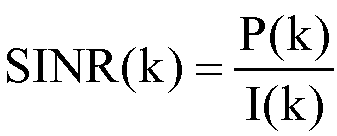
로서 표현될 수 있고, 여기서,, Where < RTI ID = 0.0 >
P(k)는 자원 엘리먼트 k를 통한 레퍼런스 심볼의 송신 전력이고,P (k) is the transmit power of the reference symbol via resource element k,
SINR(k)은 자원 엘리먼트 k의 SINR이다(선형 단위).SINR (k) is the SINR of the resource element k (linear unit).
UE는 또한 각각의 자원 엘리먼트의 SINR을 다른 방식들로 추정할 수 있다. 예를 들어, UE는 수신된 레퍼런스 심볼들, 추정된 채널 행렬 및 선택된 프리코딩 행렬에 기초하여, 그리고 MMSE 또는 몇몇 다른 기술을 이용하여 SINR을 추정할 수 있다.The UE may also estimate the SINR of each resource element in other manners. For example, the UE may estimate the SINR based on the received reference symbols, the estimated channel matrix and the selected precoding matrix, and using MMSE or some other technique.
UE는, 다음과 같이,The UE, as follows,
SE(k) = f(SINR(k))SE (k) = f (SINR (k))
용량/맵핑 함수에 기초하여 SINR을 스펙트럼 효율에 맵핑할 수 있고, 여기서, The SINR may be mapped to spectral efficiency based on the capacity / mapping function,
SE(k)는 자원 엘리먼트 k에 대한 스펙트럼 효율이고,SE (k) is the spectral efficiency for the resource element k,
f()는 스펙트럼 효율에 대한 맵핑 함수를 나타낸다.f () represents a mapping function for spectral efficiency.
맵핑 함수 f()는 변조 방식(예를 들어, QPSK, 16-QAM, 64-QAM 등), 불완전한 수신기 프로세싱에 기인한 SINR 손실 등과 같은 다양한 효과들을 캡쳐할 수 있다.The mapping function f () can capture various effects such as modulation scheme (e.g., QPSK, 16-QAM, 64-QAM, etc.), SINR loss due to incomplete receiver processing,
UE는 다음과 같이,The UE may, as follows,

관심있는 모든 자원 엘리먼트들에 대한 평균 스펙트럼 효율을 결정할 수 있고, 여기서,The average spectral efficiency for all the resource elements of interest can be determined,
K는 평균할 자원 엘리먼트들의 수이고,K is the number of resource elements to average,
SEavg는 모든 자원 엘리먼트들에 대한 평균 스펙트럼 효율이다.SE avg is the average spectral efficiency for all resource elements.
UE는 평균 스펙트럼 효율을 변조 및 코딩 방식(MCS)에 맵핑할 수 있고, 변조 및 코딩 방식(MCS)은 CQI의 형태로 UE에 의해 리포팅될 수 있다. 일 설계에서, UE는 다음과 같이,The UE may map the average spectral efficiency to a modulation and coding scheme (MCS), and the modulation and coding scheme (MCS) may be reported by the UE in the form of a CQI. In one design, the UE may, as follows,
SINRavg = 2 exp(SEavg - 1) 식(8)SINRavg = 2 exp (SEavg - 1) Equation (8)
평균 스펙트럼 효율을 평균 SINR로 변환할 수 있고, 여기서, "exp"는 지수 함수를 나타낸다.The average spectral efficiency can be converted to an average SINR, where "exp" represents an exponential function.
UE는 평균 SINR을 선형 단위로부터 데시벨(dB)인 산술 단위로 변환할 수 있다. 다음으로, UE는 상이한 SINR 값들의 상이한 CQI 값들로의 맵핑에 기초하여 평균 SINR(dB 단위들)을 CQI로 맵핑할 수 있다.The UE may convert the average SINR from an linear unit to an arithmetic unit in decibels (dB). Next, the UE may map the average SINR (in dB units) to the CQI based on the mapping of the different SINR values to different CQI values.
식(2) 내지 (8)은 특정한 프리코딩 행렬 W(k)에 대한 평균 SINR을 계산하는 예시적인 설계를 나타낸다. 이 계산은 다른 방식들로 수행될 수 있다. 예를 들어, UE는 채널 행렬 H(k) 및/또는 잡음 및 간섭 I(k)를 다른 방식들로 추정할 수 있다. UE는 또한 모든 자원 엘리먼트들에 걸쳐 SE(k) 대신에 I(k), 또는 SINR(k) 또는 몇몇 다른 양을 평균낼 수 있다.Equations (2) - (8) illustrate an exemplary design for calculating the average SINR for a particular precoding matrix W (k). This calculation can be performed in other ways. For example, the UE may estimate the channel matrix H (k) and / or the noise and interference I (k) in other manners. The UE may also average I (k), or SINR (k), or some other quantity, instead of SE (k) over all resource elements.
일 설계에서, UE는 그 UE에 대해 선택될 수 있는 각각의 가능한 랭크에 대해 CQI 계산을 (예를 들어, 전술한 바와 같이) 수행할 수 있다. 예를 들어, UE는 랭크 1에 대한 프리코딩 행렬들의 세트에 대한 CQI 계산을 수행할 수 있고, 하나의 코드워드에 대해 하나의 평균 SINR을 획득할 수 있고, 랭크 2에 대한 프리코딩 행렬들의 다른 세트에 대한 CQI 계산을 수행할 수 있고, 2개의 코드워드들에 대해 2개의 평균 SINR들을 획득할 수 있는 식이다. 프리코딩 행렬들의 각각의 세트는, CQI를 계산할 각각의 시간-주파수 자원(예를 들어, 각각의 자원 블록)에 대해 하나의 프리코딩 행렬을 포함할 수 있다. UE는 최상의 랭크를 선택할 수 있고, 최상의 랭크는 최고의 전체 스펙트럼 효율 또는 몇몇 다른 메트릭과 연관될 수 있다. UE는 선택된 랭크 L에 대해 L개까지의 코드워드들에 대한 L개까지의 CQI를 리포팅할 수 있고, 여기서, L은 1, 2 등과 동일할 수 있다. UE는 또한 선택된 랭크 L을 표시하는 RI를 리포팅할 수 있다.In one design, the UE may perform CQI computation (e.g., as described above) for each possible rank that may be selected for that UE. For example, the UE may perform CQI calculations on a set of precoding matrices for rank 1, obtain one average SINR for one codeword, Set, and obtain two average SINRs for the two codewords. Each set of precoding matrices may include one precoding matrix for each time-frequency resource (e.g., each resource block) for which to calculate the CQI. The UE may select the best rank, and the best rank may be associated with the highest total spectrum efficiency or some other metric. The UE may report up to L CQIs for up to L codewords for the selected rank L, where L may be equal to 1, 2, and so on. The UE may also report the RI indicating the selected rank L. [
다른 설계에서, UE는 그 UE에 대해 이용될 수 있는 특정한 랭크에 대한 CQI 계산을 수행할 수 있다. 이 랭크는 UE의 능력들, 채널 조건들 등에 기초하여 선택될 수 있다. 예를 들어, 장기(long-term) 평균 SINR이 임계치 미만이면, 랭크 1이 이용될 수 있고, 장기 평균 SINR이 임계치보다 크면 랭크 2가 이용될 수 있다. UE는 특정한 랭크에 대한 CQI를 리포팅할 수 있고, RI 리포팅을 스킵할 수 있다.In other designs, the UE may perform CQI calculations for a particular rank that may be used for that UE. This rank can be selected based on the UE ' s capabilities, channel conditions, and the like. For example, if the long-term average SINR is less than the threshold, rank 1 may be used, and rank 2 may be used if the long-term average SINR is greater than the threshold. The UE may report the CQI for a particular rank and may skip RI reporting.
일 설계에서, UE는 CQI를, 전체 시스템 대역폭에 대해, 또는 관심있는 각각의 부대역에 대해, 또는 관심있는 각각의 자원 블록에 대해, 또는 관심있는 몇몇 다른 시간-주파수 자원들에 대해 계산 및 리포팅할 수 있다. 관심있는 시간-주파수 자원들은, 데이터 송신을 위해 UE가 스케줄링할 수 있는 자원들일 수 있고, 그 UE에 대해 구성될 수 있거나 다른 방식들로 UE에 알려질 수 있다.In one design, the UE may calculate and report CQIs for the entire system bandwidth, or for each subband of interest, for each resource block of interest, or for some other time-frequency resource of interest can do. The time-frequency resources of interest may be resources that the UE may schedule for data transmission, may be configured for the UE, or may be known to the UE in other manners.
대략적으로 정의된 개방 루프 송신 및 엄격하게 정의된 개방 루프 송신 모두에 대해, UE는 CQI를 계산 및 리포팅하기 위해 특정한 프리코딩 행렬들을 이용할 수 있다. eNB는 (i) (예를 들어, SU-MIMO의 경우) CQI를 계산하기 위해 UE에 의해 이용된 동일한 프리코딩 행렬들, 또는 (ii) (예를 들어, MU-MIMO 또는 CoMP의 경우) 상이한 프리코딩 행렬들을 이용하여 데이터를 송신할 수 있다. UE는 특정한 시간-주파수 자원들에 대한 CQI를 계산 및 리포팅할 수 있다. eNB는, CQI가 계산된 시간-주파수 자원들의 일부 또는 전부에 대해 UE를 스케줄링할 수 있다. 어떤 경우든, UE에 의해 리포팅된 CQI와 그 UE에 의해 관측되는 실제 CQI 사이에는 몇몇 에러들이 존재할 수 있다. 이 에러들은 HARQ에 의해 처리될 수 있다.For both roughly defined open-loop transmission and strictly defined open-loop transmission, the UE may use specific precoding matrices to calculate and report the CQI. eNB may use the same precoding matrices used by the UE to compute the CQI for (i) (e.g., SU-MIMO), or (ii) (for MU-MIMO or CoMP) Data can be transmitted using precoding matrices. The UE may calculate and report CQIs for specific time-frequency resources. The eNB may schedule the UE for some or all of the time-frequency resources for which the CQI is calculated. In any case, there may be some errors between the CQI reported by the UE and the actual CQI observed by the UE. These errors can be handled by HARQ.
개방 루프 리포팅 모드는, UE에 의해 리포트가 주기적으로 전송되는 주기적 CQI/RI 리포팅에 대해 이용될 수 있다. 개방 루프 리포팅 모드는 또한, 요청되거나 트리거링되는 경우에는 항상 UE에 의해 리포트가 전송되는 비주기적 CQI/RI 리포팅에 대해 이용될 수도 있다.The open loop reporting mode may be used for periodic CQI / RI reporting where reports are periodically transmitted by the UE. The open loop reporting mode may also be used for aperiodic CQI / RI reporting where reports are always sent by the UE when requested or triggered.
eNB는 UE로부터 주기적으로 CQI 및 가능한 RI를 수신할 수 있다. 일 설계에서, eNB는 수신된 RI에 기초하여 UE에 송신할 코드워드들의 수를 선택할 수 있고, 수신된 CQI에 기초하여 하나 이상의 코드워드들에 대한 하나 이상의 변조 및 코딩 방식들을 선택할 수 있다. 다른 설계에서, eNB는 무한 임펄스 응답(IIR) 필터, 유한 임펄스 응답(FIR) 필터 또는 몇몇 다른 필터에 기초하여, 수신된 CQI 및 가능한 RI를 필터링할 수 있다. 다음으로, eNB는 필터링된 RI에 기초하여 송신할 코드워드들의 수를 선택할 수 있고, 필터링된 CQI에 기초하여 하나 이상의 변조 및 코딩 방식들을 선택할 수 있다.The eNB may periodically receive the CQI and possible RI from the UE. In one design, the eNB may select the number of codewords to send to the UE based on the received RI, and may select one or more modulation and coding schemes for one or more codewords based on the received CQI. In other designs, the eNB may filter the received CQI and possible RI based on an infinite impulse response (IIR) filter, a finite impulse response (FIR) filter, or some other filter. The eNB may then select the number of codewords to transmit based on the filtered RI, and may select one or more modulation and coding schemes based on the filtered CQI.
일 설계에서, eNB는 백오프를 적용할 수 있고, 수신되거나 필터링된 CQI를 고정량 또는 가변량만큼 감소시킬 수 있다. 백오프의 가변량은 수신되거나 필터링된 CQI의 예측 정확도에 의존할 수 있다. 다음으로, eNB는 감소된 CQI에 기초하여 하나 이상의 변조 및 코딩 방식들을 선택할 수 있다.In one design, the eNB may apply a backoff and reduce the received or filtered CQI by a fixed amount or a variable amount. The variable amount of backoff may depend on the prediction accuracy of the received or filtered CQI. The eNB may then select one or more modulation and coding schemes based on the reduced CQI.
일반적으로, eNB는 임의의 함수에 기초하여, 수신된 CQI 및 가능한 RI를 프로세싱할 수 있다. eNB는 프로세싱된 RI에 기초하여 UE에 송신할 코드워드들의 수를 선택할 수 있고, 프로세싱된 CQI에 기초하여 하나 이상의 코드워드들에 대한 하나 이상의 변조 및 코딩 방식들을 선택할 수 있다.In general, the eNB may process the received CQI and possible RI based on an arbitrary function. The eNB may select the number of codewords to send to the UE based on the processed RI and may select one or more modulation and coding schemes for one or more codewords based on the processed CQI.
도 6은 CQI를 리포팅하기 위한 프로세스(600)의 설계를 도시한다. 프로세스(600)는 (후술하는 바와 같이) UE 또는 몇몇 다른 엔티티에 의해 수행될 수 있다. UE는 UE로의 데이터 송신을 위해 기지국에 의해 이용되고 있는 프리코딩 행렬들의 세트의 가정에 기초하여 CQI를 결정할 수 있다(블록 612). 기지국은 UE에 의해 가정되는 프리코딩 행렬들의 세트를 실제로 이용하거나 이용하지 않을 수 있다. UE는 기지국에 CQI를 전송할 수 있지만, 프리코딩 행렬들의 세트는 전송하지 않을 것이다(블록 614). 그 후, UE는 CQI에 기초하여 기지국에 의해 UE로 전송된 데이터 송신을 수신할 수 있다(블록 616). 데이터 송신은, 송신 다이버시티를 획득하기 위해 복수의 프리코딩 행렬들에 의한 프리코딩을 이용하여 전송될 수 있다. 복수의 프리코딩 행렬들은 UE에 의해 가정된 프리코딩 행렬들의 세트 중 일부 또는 전부의 프리코딩 행렬들을 포함하거나 포함하지 않을 수도 있다.FIG. 6 shows a design of a
블록(612)의 일 설계에서, UE는 UE로의 데이터 송신에 이용될 수 있는 시간-주파수 자원들의 세트에 대한 프리코딩 행렬들의 세트를 결정할 수 있다. 시간-주파수 자원들의 세트는 자원 블록들의 세트, 또는 부대역들의 세트, 또는 대역폭 부분들의 세트, 또는 자원 엘리먼트들의 세트, 또는 전체 시스템 대역폭, 또는 시간 및 주파수의 몇몇 다른 단위들에 대응할 수 있다. 프리코딩 행렬들 세트 중 하나의 프리코딩 행렬은 예를 들어, 1 슬롯에서 12개의 서브캐리어들을 커버하는 각각의 자원 블록에 대한, 또는 1 서브프레임들에서 12개의 서브캐리어들을 커버하는 각 쌍의 자원 블록들에 대한, 또는 몇몇 다른 수의 자원 블록들에 대한, 하나의 프리코딩 행렬과 같이, 각각의 시간-주파수 자원들에 대해 이용될 수 있다. 일 설계에서, UE는 시간-주파수 자원들의 세트에 대해 랜덤 프리코딩 행렬들을 선택할 수 있다. 다음으로, 프리코딩 행렬들의 세트는 랜덤 프리코딩 행렬들을 포함할 수 있다. 다른 설계에서, UE는 각각의 시간-주파수 자원에 대해 지정된 프리코딩 행렬을 이용할 수 있다. 다음으로, 프리코딩 행렬들의 세트는 각각의 시간-주파수 자원에 대해 지정된 프리코딩 행렬을 포함할 수 있다. UE는 또한 프리코딩 행렬들의 세트를 다른 방식들로 결정할 수 있다.In one design of
UE는 시간-주파수 자원들의 세트에 대한 프리코딩 행렬들의 세트를 이용함으로써 CQI를 결정할 수 있다. 일 설계에서, UE는 그 시간-주파수 자원에 대한 프리코딩 행렬에 기초하여 각각의 시간-주파수 자원의 수신 신호 품질을 결정할 수 있다. 각각의 시간-주파수 자원의 경우, UE는 그 시간-주파수 자원에 대해 기지국으로부터 UE로의 무선 채널에 대한 채널 행렬을 추정할 수 있다. UE는, 예를 들어, 식(3)에 나타낸 바와 같이, 시간-주파수 자원에 대한 프리코딩 행렬 및 추정된 채널 행렬에 기초하여 각각의 시간-주파수 자원에 대한 유효 채널 행렬을 결정할 수 있다. UE는 그 시간-주파수 자원에 대한 유효 채널 행렬에 기초하여 각각의 시간-주파수 자원의 수신 신호 품질을 추정할 수 있다. 다음으로, UE는 시간-주파수 자원들의 세트의 수신 신호 품질들에 기초하여 CQI를 결정할 수 있다. 일 설계에서, UE는 평균 수신 신호 품질을 획득하기 위해 시간-주파수 자원들의 세트의 수신 신호 품질들을 평균낼 수 있다. 이 평균은 다양한 방식들, 예를 들어, 수신 신호 품질, 스펙트럼 효율 등에 기초하여 수행될 수 있다. UE는 평균된 수신 신호 품질에 기초하여 CQI를 결정할 수 있다.The UE may determine the CQI by using a set of precoding matrices for a set of time-frequency resources. In one design, the UE may determine the received signal quality of each time-frequency resource based on the precoding matrix for that time-frequency resource. For each time-frequency resource, the UE may estimate the channel matrix for the radio channel from the base station to the UE for that time-frequency resource. The UE may determine an effective channel matrix for each time-frequency resource based on, for example, a precoding matrix and an estimated channel matrix for the time-frequency resource, as shown in equation (3). The UE may estimate the received signal quality of each time-frequency resource based on the effective channel matrix for that time-frequency resource. Next, the UE may determine the CQI based on the received signal qualities of the set of time-frequency resources. In one design, the UE may average the received signal qualities of a set of time-frequency resources to obtain an average received signal quality. This averaging may be performed based on various schemes, e.g., received signal quality, spectral efficiency, and the like. The UE may determine the CQI based on the averaged received signal quality.
일 설계에서, UE는 그 UE로의 데이터 송신에 이용될 수 있는 상이한 가능한 랭크들을 평가할 수 있다. UE는 복수의 랭크들 각각에 대한 프리코딩 행렬들의 세트를 결정할 수 있다. UE는 그 랭크에 대한 프리코딩 행렬들의 세트에 기초하여 각각의 랭크에 대한 메트릭을 결정할 수 있다. 메트릭은 수신 신호 품질, 스펙트럼 효율, 스루풋 등에 기초할 수 있다. UE는 모든 랭크들에 대한 메트릭들에 기초하여 복수의 랭크들 중 하나를 선택할 수 있다. UE는 선택된 랭크에 대한 프리코딩 행렬들의 세트에 기초하여 선택된 랭크에 대한 CQI를 결정할 수 있다. UE는 선택된 랭크를 표시하는 RI를 기지국에 전송할 수 있다. 그 후, UE는 기지국으로부터 L개의 데이터 패킷들 또는 코드워드들을 포함하는 데이터 송신을 수신할 수 있고, 여기서, L은 선택된 랭크에 기초하여 결정될 수 있다(예를 들어, 그와 동일할 수 있다).In one design, the UE may evaluate different possible ranks that may be used for data transmission to the UE. The UE may determine a set of precoding matrices for each of a plurality of ranks. The UE may determine a metric for each rank based on the set of precoding matrices for that rank. The metric may be based on received signal quality, spectral efficiency, throughput, and the like. The UE may select one of a plurality of ranks based on the metrics for all ranks. The UE may determine the CQI for the selected rank based on the set of precoding matrices for the selected rank. The UE may send an RI indicating the selected rank to the base station. The UE may then receive from the base station a data transmission comprising L data packets or codewords, where L may be determined based on the selected rank (e.g., it may be the same) .
도 7은 CQI를 리포팅하기 위한 장치(700)의 설계를 도시한다. 장치(700)는, UE로의 데이터 송신을 위해 기지국에 의해 이용되는 프리코딩 행렬들의 세트의 가정에 기초하여 UE에 의해 CQI를 결정하기 위한 모듈(712), CQI를 UE로부터 기지국으로 전송하기 위한 모듈(714), 및 CQI에 기초하여 기지국에 의해 UE로 전송되는 데이터 송신을 수신하기 위한 모듈(716)을 포함하고, 데이터 송신은, 송신 다이버시티를 획득하기 위해 복수의 프리코딩 행렬들을 이용하여 전송된다.FIG. 7 shows a design of an
도 8은 CQI를 수신하기 위한 프로세스(800)의 설계를 도시한다. 도 8은 (후술하는 바와 같이) 기지국 또는 몇몇 다른 엔티티에 의해 수행될 수 있다. 기지국은 UE로의 데이터 송신을 위해 기지국에 의해 이용되고 있는 프리코딩 행렬들의 세트의 가정에 기초하여 UE에 의해 결정되는 CQI를 수신할 수 있다(블록 812). 기지국은 CQI에 기초하여 UE에 데이터 송신을 전송할 수 있다(블록 814). 블록 814의 일 설계에서, 기지국은 CQI에 기초하여 적어도 하나의 MCS를 선택할 수 있다. 다음으로, 기지국은 적어도 하나의 MCS에 기초하여 UE에 대한 데이터를 프로세싱할 수 있다.FIG. 8 shows a design of a
기지국은 송신 다이버시티를 획득하기 위해 복수의 프리코딩 행렬들에 기초하여 데이터 송신을 위한 프리코딩을 수행할 수 있다. 일 설계에서, 복수의 프리코딩 행렬들은 UE에 의해 가정되는 프리코딩 행렬들의 세트 중 적어도 하나의 프리코딩 행렬을 포함할 수 있다. 일 설계에서, 복수의 프리코딩 행렬들은 프리코딩 행렬들의 세트가 아닌 적어도 하나의 프리코딩 행렬을 포함할 수 있다. 일반적으로, 기지국에 의해 이용되는 복수의 프리코딩 행렬들은 UE에 의해 가정되는 프리코딩 행렬들의 세트 중 몇몇 또는 전부의 프리코딩 행렬들을 포함하거나 포함하지 않을 수 있다.The base station may perform precoding for data transmission based on a plurality of precoding matrices to obtain transmit diversity. In one design, the plurality of precoding matrices may comprise at least one precoding matrix of a set of precoding matrices assumed by the UE. In one design, the plurality of precoding matrices may comprise at least one precoding matrix rather than a set of precoding matrices. In general, the plurality of precoding matrices used by the base station may or may not include some or all of the precoding matrices in the set of precoding matrices assumed by the UE.
일 설계에서, 기지국은 UE로부터 CQI를 주기적으로 수신할 수 있고, CQI를 평균낼 수 있다. 기지국은 평균된 CQI에 기초하여 데이터 송신을 전송할 수 있다. 일 설계에서, 기지국은 백오프에 기초하여 CQI를 조정할 수 있고, 조정된 CQI에 기초하여 데이터 송신을 전송할 수 있다. 기지국은 또한 다른 방식들로 UE로부터 CQI를 프로세싱할 수 있고, UE로의 데이터 송신을 위해 (수신된 CQI 대신에) 그 프로세싱된 CQI를 이용할 수 있다.In one design, the base station may periodically receive the CQI from the UE and average the CQI. The base station may transmit the data transmission based on the averaged CQI. In one design, the base station may adjust the CQI based on the backoff and transmit the data transmission based on the adjusted CQI. The base station may also process the CQI from the UE in other manners and may use the processed CQI (instead of the received CQI) for data transmission to the UE.
일 설계에서, 기지국은 UE에 의해 선택된 랭크를 표시하는 RI를 수신할 수 있다. 기지국은 데이터 송신을 위한 L개의 데이터 패킷들 또는 코드워드들을 전송할 수 있고, 여기서, L은 UE에 의해 선택되는 랭크에 기초하여 결정될 수 있다.In one design, the base station may receive an RI indicating the rank selected by the UE. The base station may transmit L data packets or codewords for data transmission, where L may be determined based on the rank selected by the UE.
일 설계에서, UE는, CQI가 결정되는 시간-주파수 자원들의 서브세트를 통한 데이터 송신을 위해 스케줄링될 수 있다. 다른 설계에서, UE는 CQI가 결정되는 시간-주파수 자원들 전부에 대해 스케줄링될 수 있다. 일 설계에서, UE는 기지국에 의한 SU-MIMO 송신을 위해 스케줄링될 수 있다. 다른 설계에서, 그 UE 및 적어도 하나의 다른 UE는 기지국에 의한 MU-MIMO 송신을 위해 스케줄링될 수 있다. 또 다른 설계에서, 그 UE 및 적어도 하나의 다른 UE는 다수의 셀들에 의한 CoMP 송신을 위해 스케줄링될 수 있고, 다수의 셀들은 기지국의 적어도 하나의 셀을 포함할 수 있다. UE는 또한 다른 방식들로 스케줄링될 수 있다.In one design, the UE may be scheduled for data transmission over a subset of time-frequency resources for which the CQI is determined. In another design, the UE may be scheduled for all of the time-frequency resources for which the CQI is determined. In one design, the UE may be scheduled for SU-MIMO transmission by the base station. In another design, the UE and at least one other UE may be scheduled for MU-MIMO transmission by the base station. In yet another design, the UE and at least one other UE may be scheduled for CoMP transmission by multiple cells, and multiple cells may comprise at least one cell of the base station. The UE may also be scheduled in other manners.
도 9는 CQI를 수신하기 위한 장치(900)의 설계를 도시한다. 장치(900)는 UE로의 데이터 송신을 위해 기지국에 의해 이용되고 있는 프리코딩 행렬들의 세트의 가정에 기초하여 UE에 의해 결정되는 CQI를 수신하기 위한 모듈(912), 및 CQI에 기초하여 기지국으로부터 UE로 데이터 송신을 전송하기 위한 모듈(914)을 포함한다.9 shows a design of an
도 7 및 9의 모듈들은 프로세서들, 전자 디바이스들, 하드웨어 디바이스들, 전자 컴포넌트들, 로직 회로들, 메모리들, 소프트웨어 코드들, 펌웨어 코드들 등, 또는 이들의 임의의 조합을 포함할 수 있다.The modules of FIGS. 7 and 9 may include processors, electronic devices, hardware devices, electronic components, logic circuits, memories, software codes, firmware codes, etc., or any combination thereof.
도 10은 도 1의 기지국들/eNB들 중 하나 및 UE들 중 하나일 수 있는 기지국/eNB(110) 및 UE(120)의 설계의 블록도를 도시한다. 기지국(110)에는 T개의 안테나들(1034a 내지 1034t)이 구비될 수 있고, UE(120)에는 R 개의 안테나들(1052a 내지 1052r)이 구비될 수 있으며, 여기서, 일반적으로 T>1 및 R≥1이다.FIG. 10 shows a block diagram of the design of base station /
기지국(110)에서, 송신 프로세서(1020)는 하나 이상의 UE들에 대한 데이터 소스(1012)로부터 데이터를 수신하고, 각각의 UE에 대해 선택된 하나 이상의 변조 및 코딩 방식들에 기초하여 각각의 UE에 대한 데이터를 프로세싱(예를 들어, 인코딩 및 변조)하고, 모든 UE들에 대한 데이터 심볼들을 제공할 수 있다. 송신 프로세서(1020)는 또한, 제어 정보를 프로세싱하고, 제어 심볼들을 제공할 수 있다. 송신 프로세서(1020)는 또한 CRS, CSI-RS, UE-RS 등과 같은 하나 이상의 레퍼런스 신호들에 대한 레퍼런스 심볼들을 생성할 수 있다. 송신(TX) MIMO 프로세서(1030)는, (적용가능하다면) 데이터 심볼들, 제어 심볼들 및/또는 레퍼런스 심볼들을 프리코딩할 수 있고, T개의 변조기들(MOD; 1032a 내지 1032t)에 T개의 출력 심볼 스트림들을 제공할 수 있다. 각각의 변조기(1032)는 (예를 들어, OFDM 등을 위해) 자신의 출력 심볼 스트림을 프로세싱하여, 출력 샘플 스트림을 획득할 수 있다. 각각의 변조기(1032)는, 자신의 출력 샘플 스트림을 추가로 조정(예를 들어, 아날로그로 변환, 필터링, 증폭 및 상향변환)하여 다운링크 신호를 생성할 수 있다. 변조기들(1032a 내지 1032t)로부터의 T개의 다운링크 신호들은 T개의 안테나들(1034a 내지 1034t)을 통해 각각 송신될 수 있다.At
UE(120)에서, R개의 안테나들(1052a 내지 1052r)은 기지국(110) 및 다른 기지국들로부터 다운링크 신호들을 수신할 수 있고, 각각의 안테나(1052)는 수신된 신호를 연관된 복조기(DEMOD; 1054)에 제공할 수 있다. 각각의 복조기(1054)는 자신의 수신된 신호를 조정(예를 들어, 필터링, 증폭, 하향변환 및 디지털화)하여, 샘플들을 획득할 수 있고, 이 샘플들을 (예를 들어, OFDM 등을 위해) 추가로 프로세싱하여 수신 심볼들을 획득할 수 있다. 각각의 복조기(1054)는 수신된 데이터 심볼들을 MIMO 검출기(1060)에 제공할 수 있고, 수신된 레퍼런스 심볼들을 채널 프로세서(1094)에 제공할 수 있다. 채널 프로세서(1094)는 수신된 레퍼런스 심볼들에 기초하여 기지국(110)으로부터 UE(120)로의 무선 채널에 대한 채널 추정치를 유도할 수 있다. 채널 프로세서(1094)는 또한 전술한 바와 같이 수신된 레퍼런스 심볼들에 기초하여 CQI 및 가능한 RI를 결정할 수 있다. 채널 프로세서(1094)는 채널 추정치를 MIMO 검출기(1060)에 제공할 수 있고, CQI 및 가능한 RI를 제어기/프로세서(1090)에 제공할 수 있다. MIMO 검출기(1060)는 채널 추정치에 기초하여 (적용가능하다면) 수신된 데이터 심볼들에 대해 MIMO 검출을 수행할 수 있고, 검출된 심볼들을 제공할 수 있다. 수신 프로세서(1070)는 검출된 심볼들을 프로세싱(예를 들어, 복조 및 디코딩)할 수 있고, UE(120)에 대한 디코딩된 데이터를 데이터 싱크(1072)에 제공할 수 있고, 디코딩된 제어 정보를 제어기/프로세서(1090)에 제공할 수 있다.At the
UE(120)는 전술한 바와 같이, CQI 및 가능한 RI를 결정할 수 있다. 채널 정보(예를 들어, CQI, 가능한 RI 등을 포함함), 다른 제어 정보 및 데이터 소스(1078)로부터의 데이터는 송신 프로세서(1080)에 의해 프로세싱되고, 적용가능하다면 TX MIMO 프로세서(1082)에 의해 프리코딩되고, 변조기들(1054a 내지 1054r)에 의해 추가로 프로세싱되고, 기지국(110)에 송신될 수 있다. 기지국(110)에서, UE(120) 및 다른 UE들로부터의 업링크 신호들은 안테나들(1034)에 의해 수신되고, 복조기들(1032)에 의해 프로세싱되고, 적용가능하다면 MIMO 검출기(1036)에 의해 검출되고, UE(120) 및 다른 UE들에 의해 전송되는 데이터 및 제어 정보를 복원하기 위해 수신 프로세서(1038)에 의해 추가로 프로세싱될 수 있다. 프로세서(1038)는 복원된 데이터를 데이터 싱크(1039)에 제공할 수 있고, 복원된 제어 정보 및 채널 정보를 제어기/프로세서(1040)에 제공할 수 있다.
제어기들/프로세서들(1040 및 1090)은 기지국(110) 및 UE(120)에서의 동작을 각각 지시(direct)할 수 있다. 기지국(110)의 프로세서(1040) 및/또는 다른 프로세서들 및 모듈들은 도 8의 프로세스(800) 및/또는 본 명세서에서 설명되는 기술들을 위한 다른 프로세스들을 수행 또는 지시할 수 있다. UE(120)의 프로세서(1090) 및/또는 다른 프로세서들 및 모듈들은 도 6의 프로세스(600) 및/또는 본 명세서에서 설명되는 기술들을 위한 다른 프로세스들을 수행 또는 지시할 수 있다. 메모리들(1042 및 1092)은 기지국(110) 및 UE(120)에 대한 데이터 및 프로그램 코드들을 각각 저장할 수 있다. 스케줄러(1044)는 모든 UE들로부터 수신된 채널 정보에 기초하여, 다운링크 및/또는 업링크를 통한 데이터 송신을 위해 UE(120) 및/또는 다른 UE들을 스케줄링할 수 있다.The controllers /
당업자는 정보 및 신호들이 임의의 다양한 서로 다른 기술들 및 기법들을 사용하여 표현될 수 있음을 이해할 것이다. 예를 들어, 상세한 설명 전체에 걸쳐 참조될 수 있는 데이터, 지시들, 명령들, 정보, 신호들, 비트들, 심볼들, 및 칩들은 전압들, 전류들, 전자기파들, 자기장들 또는 자기 입자들, 광 필드들 또는 광 입자들, 또는 이들의 임의의 조합으로 표현될 수 있다.Those skilled in the art will appreciate that information and signals may be represented using any of a variety of different technologies and techniques. For example, data, instructions, commands, information, signals, bits, symbols, and chips that may be referenced throughout the detailed description may include voltages, currents, electromagnetic waves, magnetic fields, , Light fields or light particles, or any combination thereof.
당업자는 본 명세서와 관련하여 설명되는 다양한 예시적인 논리 블록들, 모듈들, 회로들, 및 알고리즘 단계들이 전자 하드웨어, 컴퓨터 소프트웨어, 또는 이 둘의 조합으로서 구현될 수도 있음을 또한 이해할 것이다. 하드웨어와 소프트웨어의 상호 호환성을 명확하게 설명하기 위해, 다양한 예시적인 컴포넌트들, 블록들, 모듈들, 회로들, 및 단계들이 일반적으로 이들의 기능적 관점에서 설명되었다. 이러한 기능이 하드웨어로 구현되는지, 또는 소프트웨어로 구현되는지는 특정 애플리케이션 및 전체 시스템에 대해 부과된 설계 제한들에 의존한다. 당업자들은 설명된 기능을 각각의 특정 애플리케이션에 대해 다양한 방식들로 구현할 수 있지만, 이러한 구현 결정들이 본 출원의 범주를 벗어나는 것으로 해석되어서는 안 된다.Those skilled in the art will further appreciate that the various illustrative logical blocks, modules, circuits, and algorithm steps described in connection with the specification may be implemented as electronic hardware, computer software, or combinations of both. To clearly illustrate the interchangeability of hardware and software, various illustrative components, blocks, modules, circuits, and steps have been described generally in terms of their functionality. Whether such functionality is implemented in hardware or software depends upon the design constraints imposed on the particular application and the overall system. Skilled artisans may implement the described functionality in varying ways for each particular application, but such implementation decisions should not be interpreted as causing a departure from the scope of the present application.
본 명세서와 관련하여 설명되는 다양한 예시적인 논리 블록들, 모듈들, 및 회로들이 범용 프로세서, 디지털 신호 프로세서(DSP), 주문형 집적회로(ASIC), 필드 프로그래머블 게이트 어레이(FPGA) 또는 다른 프로그래머블 논리 디바이스, 이산 게이트 또는 트랜지스터 로직, 이산 하드웨어 컴포넌트들 또는 본 명세서에 설명된 기능들을 구현하도록 설계된 이들의 임의의 조합으로 구현 또는 수행될 수 있다. 범용 프로세서는 마이크로프로세서일 수 있지만, 대안적으로, 프로세서는 임의의 종래의 프로세서, 제어기, 마이크로제어기, 또는 상태 머신일 수 있다. 프로세서는 컴퓨팅 디바이스들의 조합, 예를 들어 DSP 및 마이크로프로세서의 조합, 복수의 마이크로프로세서들, DSP 코어와 결합된 하나 이상의 마이크로프로세서들, 또는 임의의 다른 이러한 구성으로서 구현될 수 있다.The various illustrative logical blocks, modules, and circuits described in connection with the disclosure may be implemented or performed with a general purpose processor, a digital signal processor (DSP), an application specific integrated circuit (ASIC), a field programmable gate array (FPGA) Discrete gate or transistor logic, discrete hardware components, or any combination thereof designed to implement the functions described herein. A general purpose processor may be a microprocessor, but, in the alternative, the processor may be any conventional processor, controller, microcontroller, or state machine. A processor may be implemented as a combination of computing devices, e.g., a combination of a DSP and a microprocessor, a plurality of microprocessors, one or more microprocessors in conjunction with a DSP core, or any other such configuration.
본 명세서와 관련하여 설명되는 알고리즘 또는 방법의 단계들은 직접적으로 하드웨어로, 프로세서에 의해 실행되는 소프트웨어 모듈로, 또는 이들의 조합으로 구현될 수 있다. 소프트웨어 모듈은 RAM 메모리, 플래쉬 메모리, ROM 메모리, EPROM 메모리, EEPROM 메모리, 레지스터들, 하드디스크, 휴대용 디스크, CD-ROM, 또는 공지된 임의의 다른 형태의 저장 매체에 상주할 수 있다. 예시적인 저장 매체는, 프로세서가 저장 매체로부터 정보를 판독하고, 저장 매체에 정보를 기록할 수 있도록 프로세서에 연결된다. 대안적으로, 저장 매체는 프로세서에 통합될 수 있다. 프로세서 및 저장 매체는 ASIC에 상주할 수도 있다. ASIC는 사용자 단말에 상주할 수 있다. 대안적으로, 프로세서 및 저장 매체는 사용자 단말에서 개별 컴포넌트들로서 존재할 수 있다.The steps of an algorithm or method described in connection with the specification may be embodied directly in hardware, in a software module executed by a processor, or in a combination of the two. The software module may reside in a RAM memory, a flash memory, a ROM memory, an EPROM memory, an EEPROM memory, registers, a hard disk, a portable disk, a CD-ROM, or any other form of storage medium known in the art. An exemplary storage medium is coupled to the processor such that the processor can read information from, and write information to, the storage medium. Alternatively, the storage medium may be integrated into the processor. The processor and the storage medium may reside in an ASIC. The ASIC may reside in a user terminal. In the alternative, the processor and the storage medium may reside as discrete components in a user terminal.
하나 이상의 예시적인 설계들에서, 설명된 기능들은 하드웨어, 소프트웨어, 펌웨어 또는 이들의 임의의 조합으로 구현될 수 있다. 소프트웨어로 구현되는 경우, 상기 기능들은 컴퓨터 판독가능 매체 상에 하나 이상의 명령들 또는 코드로서 저장되거나 이들을 통해 전송될 수 있다. 컴퓨터 판독가능 매체는 컴퓨터 저장 매체, 및 일 장소에서 다른 장소로 컴퓨터 프로그램의 이전을 용이하게 하는 임의의 매체를 포함하는 통신 매체를 포함한다. 저장 매체는 범용 컴퓨터 또는 특수 목적 컴퓨터에 의해 액세스될 수 있는 임의의 가용 매체일 수 있다. 예를 들어, 이러한 컴퓨터 판독가능 매체는 RAM, ROM, EEPROM, CD-ROM 또는 다른 광학 디스크 저장소, 자기 디스크 저장소 또는 다른 자기 저장 디바이스들, 또는 명령들 또는 데이터 구조들의 형태로 요구되는 프로그램 코드 수단을 저장 또는 전달하는데 사용될 수 있고, 범용 컴퓨터 또는 특수 목적 컴퓨터 또는 범용 프로세서 또는 특수 목적 프로세서에 의해 액세스될 수 있는 임의의 다른 매체를 포함할 수 있지만, 이들로 제한되는 것은 아니다. 또한, 임의의 연결 수단이 컴퓨터 판독가능 매체로 간주될 수 있다. 예를 들어, 소프트웨어가 웹사이트, 서버, 또는 다른 원격 소스로부터 동축 케이블, 광섬유 케이블, 꼬임 쌍선, 디지털 가입자 라인(DSL), 또는 적외선, 라디오, 및 마이크로웨이브와 같은 무선 기술들을 통해 전송되는 경우, 동축 케이블, 광섬유 케이블, 꼬임 쌍선, DSL, 또는 적외선, 라디오, 및 마이크로웨이브와 같은 무선 기술들이 이러한 매체의 정의에 포함될 수 있다. 여기서 사용되는 disk 및 disc는 컴팩트 disc(CD), 레이저 disc, 광 disc, DVD, 플로피 disk, 및 블루-레이 disc를 포함하며, 여기서 disk들은 보통 데이터를 자기적으로 재생하지만, disc들은 보통 레이저를 이용하여 광학적으로 데이터를 재생한다. 상기의 조합들 또한 컴퓨터 판독가능 매체의 범위 내에 포함되어야 한다.In one or more exemplary designs, the functions described may be implemented in hardware, software, firmware, or any combination thereof. When implemented in software, the functions may be stored on or transmitted via one or more instructions or code on a computer readable medium. Computer-readable media includes computer storage media and communication media including any medium that facilitates transfer of a computer program from one place to another. The storage medium may be any general purpose computer or any available media that can be accessed by a special purpose computer. For example, such a computer-readable medium may comprise program code means as required in the form of RAM, ROM, EEPROM, CD-ROM or other optical disk storage, magnetic disk storage or other magnetic storage devices, Storage, or transmission of instructions, and may include, but is not limited to, a general purpose computer or special purpose computer or any other medium that can be accessed by a general purpose processor or special purpose processor. In addition, any connection means can be considered as a computer-readable medium. For example, if the software is transmitted over a wireless technology such as a coaxial cable, a fiber optic cable, a twisted pair, a digital subscriber line (DSL), or infrared, radio, and microwave from a web site, server, Wireless technologies such as coaxial cable, fiber optic cable, twisted pair cable, DSL, or infrared, radio, and microwave may be included in the definition of such a medium. The discs and discs used here include compact discs (CDs), laser discs, optical discs, DVDs, floppy discs, and Blu-ray discs where discs usually reproduce data magnetically, And reproduces the data optically by using the data. Combinations of the above should also be included within the scope of computer readable media.
본 출원의 전술한 설명은 당업자가 본 출원을 이용하거나 또는 실시할 수 있도록 제공된다. 본 출원에 대한 다양한 변형들은 당업자에게 명백할 것이며, 여기에 정의된 일반적인 원리들은 본 출원의 사상 또는 범주를 벗어남이 없이 다른 변형들에 적용될 수 있다. 따라서, 본 출원은 여기에 제시된 예들 및 설계들로 한정되는 것이 아니라, 본 명세서에 개시된 원리들 및 신규한 특징들과 부합하는 가장 넓은 범위와 조화된다.The previous description of the present application is provided to enable any person skilled in the art to make or use the present invention. Various modifications to the present application will be apparent to those skilled in the art, and the generic principles defined herein may be applied to other variations without departing from the spirit or scope of the present application. Accordingly, the present application is not limited to the examples and designs illustrated herein, but is to be accorded the widest scope consistent with the principles and novel features disclosed herein.
Claims (38)
사용자 장비(UE)로의 데이터 송신을 위해 기지국에 의해 이용되고 있는 프리코딩 행렬들의 세트의 가정에 기초하여 상기 UE에 의해 채널 품질 표시자(CQI)를 결정하는 단계; 및
상기 CQI를 상기 UE로부터 상기 기지국으로 전송하는 단계를 포함하는,
무선 통신을 위한 방법.CLAIMS 1. A method for wireless communication,
Determining a channel quality indicator (CQI) by the UE based on an assumption of a set of precoding matrices being used by a base station for data transmission to a user equipment (UE); And
And transmitting the CQI from the UE to the base station.
Method for wireless communication.
상기 CQI에 기초하여 상기 기지국에 의해 상기 UE로 전송되는 데이터 송신을 수신하는 단계를 더 포함하고,
상기 데이터 송신은 송신 다이버시티를 획득하기 위해 복수의 프리코딩 행렬들을 이용하여 전송되는, 무선 통신을 위한 방법.The method according to claim 1,
Further comprising receiving a data transmission sent by the base station to the UE based on the CQI,
Wherein the data transmission is transmitted using a plurality of precoding matrices to obtain transmit diversity.
상기 CQI를 결정하는 단계는,
상기 UE로의 데이터 송신에 이용할 수 있는 시간-주파수 자원들의 세트에 대한 프리코딩 행렬들의 세트를 결정하는 단계; 및
상기 시간-주파수 자원들의 세트에 대한 상기 프리코딩 행렬들의 세트를 이용함으로써 상기 CQI를 결정하는 단계를 포함하는, 무선 통신을 위한 방법.The method according to claim 1,
The step of determining the CQI comprises:
Determining a set of precoding matrices for a set of time-frequency resources available for data transmission to the UE; And
And determining the CQI by using the set of precoding matrices for the set of time-frequency resources.
상기 프리코딩 행렬들의 세트를 결정하는 단계는 상기 시간-주파수 자원들의 세트에 대한 랜덤 프리코딩 행렬들을 선택하는 단계를 포함하고, 상기 프리코딩 행렬들의 세트는 상기 랜덤 프리코딩 행렬들을 포함하는, 무선 통신을 위한 방법.The method of claim 3,
Wherein determining the set of precoding matrices comprises selecting random precoding matrices for the set of time-frequency resources, wherein the set of precoding matrices comprises the random precoding matrices, Lt; / RTI >
상기 프리코딩 행렬들의 세트를 결정하는 단계는, 상기 시간-주파수 자원들의 세트 각각에 대한 지정된 프리코딩 행렬을 이용하는 단계를 포함하고, 상기 프리코딩 행렬들의 세트는 각각의 시간-주파수 자원에 대한 상기 지정된 프리코딩 행렬을 포함하는, 무선 통신을 위한 방법.The method of claim 3,
Wherein the step of determining a set of precoding matrices comprises using a designated precoding matrix for each of the set of time-frequency resources, wherein the set of precoding matrices comprises a set of precoding matrices for each time- And a precoding matrix.
상기 시간-주파수 자원들의 세트는 자원 블록들의 세트에 대응하고, 상기 프리코딩 행렬들의 세트 중 하나의 프리코딩 행렬은 상기 자원 블록들의 세트 중 각각의 자원 블록에 대해 이용되는, 무선 통신을 위한 방법.The method of claim 3,
Wherein the set of time-frequency resources corresponds to a set of resource blocks, and one of the sets of precoding matrices is used for each resource block of the set of resource blocks.
상기 시간-주파수 자원들의 세트에 대한 상기 프리코딩 행렬들의 세트를 이용함으로써 상기 CQI를 결정하는 단계는,
상기 프리코딩 행렬들의 세트 중 상기 시간-주파수 자원에 대한 프리코딩 행렬에 기초하여, 복수의 시간-주파수 자원들 각각의 수신 신호 품질을 결정하는 단계; 및
상기 시간-주파수 자원들의 세트의 수신 신호 품질들에 기초하여 상기 CQI를 결정하는 단계를 포함하는, 무선 통신을 위한 방법.The method of claim 3,
Wherein determining the CQI by using the set of precoding matrices for the set of time-frequency resources comprises:
Determining a received signal quality of each of a plurality of time-frequency resources based on a precoding matrix for the time-frequency resource in the set of precoding matrices; And
And determining the CQI based on received signal qualities of the set of time-frequency resources.
상기 시간-주파수 자원 각각의 상기 수신 신호 품질을 결정하는 단계는,
상기 시간-주파수 자원에 대해 상기 기지국으로부터 상기 UE로의 무선 채널에 대한 채널 행렬을 추정하는 단계;
상기 시간-주파수 자원에 대한 프리코딩 행렬 및 상기 추정된 채널 행렬에 기초하여 유효(effective) 채널 행렬을 결정하는 단계; 및
상기 유효 채널 행렬에 기초하여 상기 시간-주파수 자원의 상기 수신 신호 품질을 추정하는 단계를 포함하는, 무선 통신을 위한 방법.8. The method of claim 7,
Wherein determining the received signal quality of each of the time-
Estimating a channel matrix for a radio channel from the base station to the UE for the time-frequency resource;
Determining an effective channel matrix based on the precoding matrix for the time-frequency resource and the estimated channel matrix; And
And estimating the received signal quality of the time-frequency resource based on the effective channel matrix.
상기 시간-주파수 자원들의 세트의 상기 수신 신호 품질에 기초하여 상기 CQI를 결정하는 단계는,
평균 수신 신호 품질을 획득하기 위해, 상기 시간-주파수 자원들의 세트의 상기 수신 신호 품질들을 평균내는 단계, 및
상기 평균 수신 신호 품질에 기초하여 상기 CQI를 결정하는 단계를 포함하는, 무선 통신을 위한 방법.8. The method of claim 7,
Wherein determining the CQI based on the received signal quality of the set of time-
Averaging the received signal qualities of the set of time-frequency resources to obtain an average received signal quality, and
And determining the CQI based on the average received signal quality.
복수의 랭크들 각각에 대한 프리코딩 행렬들의 세트를 결정하는 단계;
상기 랭크에 대한 상기 프리코딩 행렬들의 세트에 기초하여 상기 복수의 랭크들 각각에 대한 메트릭을 결정하는 단계; 및
각각의 랭크에 대한 상기 메트릭에 기초하여 상기 복수의 랭크들 중 하나를 선택하는 단계를 더 포함하고,
상기 CQI는, 선택된 랭크에 대한 프리코딩 행렬들의 세트에 기초하여 결정되는, 무선 통신을 위한 방법.The method according to claim 1,
Determining a set of precoding matrices for each of a plurality of ranks;
Determining a metric for each of the plurality of ranks based on the set of precoding matrices for the rank; And
Further comprising selecting one of the plurality of ranks based on the metric for each rank,
Wherein the CQI is determined based on a set of precoding matrices for a selected rank.
상기 선택된 랭크를 표시하는 랭크 표시자(RI)를 상기 기지국으로 전송하는 단계; 및
상기 CQI에 기초하여 상기 기지국에 의해 상기 UE로 전송되는 L개의 데이터 패킷들을 포함하는 데이터 송신을 수신하는 단계를 더 포함하고,
상기 L은 상기 선택된 랭크에 기초하여 결정되는, 무선 통신을 위한 방법.11. The method of claim 10,
Transmitting a rank indicator (RI) indicating the selected rank to the base station; And
Further comprising receiving a data transmission comprising L data packets transmitted by the base station to the UE based on the CQI,
And wherein the L is determined based on the selected rank.
사용자 장비(UE)로의 데이터 송신을 위해 기지국에 의해 이용되고 있는 프리코딩 행렬들의 세트의 가정에 기초하여 채널 품질 표시자(CQI)를 결정하기 위한 수단; 및
상기 CQI를 상기 UE로부터 상기 기지국으로 전송하기 위한 수단을 포함하는,
무선 통신을 위한 장치.An apparatus for wireless communication,
Means for determining a channel quality indicator (CQI) based on an assumption of a set of precoding matrices being used by a base station for data transmission to a user equipment (UE); And
And means for transmitting the CQI from the UE to the base station.
Apparatus for wireless communication.
상기 CQI에 기초하여 상기 기지국에 의해 상기 UE로 전송되는 데이터 송신을 수신하기 위한 수단을 더 포함하고,
상기 데이터 송신은 송신 다이버시티를 획득하기 위해 복수의 프리코딩 행렬들을 이용하여 전송되는, 무선 통신을 위한 장치.13. The method of claim 12,
Further comprising means for receiving a data transmission sent by the base station to the UE based on the CQI,
Wherein the data transmission is transmitted using a plurality of precoding matrices to obtain transmit diversity.
상기 CQI를 결정하기 위한 수단은,
상기 UE로의 데이터 송신에 이용할 수 있는 시간-주파수 자원들의 세트에 대한 프리코딩 행렬들의 세트를 결정하기 위한 수단; 및
상기 시간-주파수 자원들의 세트에 대한 상기 프리코딩 행렬들의 세트를 이용함으로써 상기 CQI를 결정하기 위한 수단을 포함하는, 무선 통신을 위한 장치.13. The method of claim 12,
Wherein the means for determining the CQI comprises:
Means for determining a set of precoding matrices for a set of time-frequency resources available for data transmission to the UE; And
And means for determining the CQI by using the set of precoding matrices for the set of time-frequency resources.
상기 시간-주파수 자원들의 세트에 대한 상기 프리코딩 행렬들의 세트를 이용함으로써 상기 CQI를 결정하기 위한 수단은,
상기 프리코딩 행렬들의 세트 중 상기 시간-주파수 자원에 대한 프리코딩 행렬에 기초하여, 복수의 시간-주파수 자원들 각각의 수신 신호 품질을 결정하기 위한 수단; 및
상기 시간-주파수 자원들의 세트의 수신 신호 품질들에 기초하여 상기 CQI를 결정하기 위한 수단을 포함하는, 무선 통신을 위한 장치.15. The method of claim 14,
Wherein the means for determining the CQI by using the set of precoding matrices for the set of time-
Means for determining a received signal quality of each of a plurality of time-frequency resources based on a precoding matrix for the time-frequency resource in the set of precoding matrices; And
And means for determining the CQI based on received signal qualities of the set of time-frequency resources.
복수의 랭크들 각각에 대한 프리코딩 행렬들의 세트를 결정하기 위한 수단;
상기 랭크에 대한 상기 프리코딩 행렬들의 세트에 기초하여 상기 복수의 랭크들 각각에 대한 메트릭을 결정하기 위한 수단; 및
각각의 랭크에 대한 상기 메트릭에 기초하여 상기 복수의 랭크들 중 하나를 선택하기 위한 수단을 더 포함하고,
상기 CQI는, 선택된 랭크에 대한 프리코딩 행렬들의 세트에 기초하여 결정되는, 무선 통신을 위한 장치.13. The method of claim 12,
Means for determining a set of precoding matrices for each of a plurality of ranks;
Means for determining a metric for each of the plurality of ranks based on the set of precoding matrices for the rank; And
Further comprising means for selecting one of the plurality of ranks based on the metric for each rank,
Wherein the CQI is determined based on a set of precoding matrices for a selected rank.
사용자 장비(UE)로의 데이터 송신을 위해 기지국에 의해 이용되고 있는 프리코딩 행렬들의 세트의 가정에 기초하여 채널 품질 표시자(CQI)를 결정하고, 상기 CQI를 상기 UE로부터 상기 기지국으로 전송하도록 구성되는 적어도 하나의 프로세서를 포함하는,
무선 통신을 위한 장치.An apparatus for wireless communication,
(CQI) based on the assumption of a set of precoding matrices being used by a base station for data transmission to a user equipment (UE), and to transmit the CQI from the UE to the base station Comprising at least one processor,
Apparatus for wireless communication.
상기 적어도 하나의 프로세서는, 상기 CQI에 기초하여 상기 기지국에 의해 상기 UE로 전송되는 데이터 송신을 수신하도록 구성되고,
상기 데이터 송신은 송신 다이버시티를 획득하기 위해 복수의 프리코딩 행렬들을 이용하여 전송되는, 무선 통신을 위한 장치.18. The method of claim 17,
Wherein the at least one processor is configured to receive a data transmission sent by the base station to the UE based on the CQI,
Wherein the data transmission is transmitted using a plurality of precoding matrices to obtain transmit diversity.
상기 적어도 하나의 프로세서는, 상기 UE로의 데이터 송신에 이용할 수 있는 시간-주파수 자원들의 세트에 대한 프리코딩 행렬들의 세트를 결정하고, 상기 시간-주파수 자원들의 세트에 대한 상기 프리코딩 행렬들의 세트를 이용함으로써 상기 CQI를 결정하도록 추가로 구성되는, 무선 통신을 위한 장치.18. The method of claim 17,
Wherein the at least one processor is further configured to determine a set of precoding matrices for a set of time-frequency resources available for data transmission to the UE and to use a set of precoding matrices for the set of time- To determine the CQI. ≪ Desc / Clms Page number 22 >
상기 적어도 하나의 프로세서는, 상기 프리코딩 행렬들의 세트 중 상기 시간-주파수 자원에 대한 프리코딩 행렬에 기초하여, 복수의 시간-주파수 자원들 각각의 수신 신호 품질을 결정하고, 상기 시간-주파수 자원들의 세트의 수신 신호 품질들에 기초하여 상기 CQI를 결정하도록 구성되는, 무선 통신을 위한 장치.20. The method of claim 19,
Wherein the at least one processor is configured to determine a received signal quality of each of a plurality of time-frequency resources based on a precoding matrix for the time-frequency resource in the set of precoding matrices, And to determine the CQI based on the set of received signal qualities.
상기 적어도 하나의 프로세서는, 복수의 랭크들 각각에 대한 프리코딩 행렬들의 세트를 결정하고, 상기 랭크에 대한 상기 프리코딩 행렬들의 세트에 기초하여 상기 복수의 랭크들 각각에 대한 메트릭을 결정하고, 각각의 랭크에 대한 상기 메트릭에 기초하여 상기 복수의 랭크들 중 하나를 선택하고, 선택된 랭크에 대한 프리코딩 행렬들의 세트에 기초하여 상기 CQI를 결정하도록 구성되는, 무선 통신을 위한 장치.18. The method of claim 17,
Wherein the at least one processor is configured to determine a set of precoding matrices for each of a plurality of ranks, determine a metric for each of the plurality of ranks based on the set of precoding matrices for the ranks, And to determine the CQI based on the set of precoding matrices for the selected rank. ≪ Desc / Clms Page number 22 >
상기 비일시적 컴퓨터 판독가능 매체는,
적어도 하나의 컴퓨터로 하여금, 사용자 장비(UE)로의 데이터 송신을 위해 기지국에 의해 이용되고 있는 프리코딩 행렬들의 세트의 가정에 기초하여 채널 품질 표시자(CQI)를 결정하게 하기 위한 코드; 및
상기 적어도 하나의 컴퓨터로 하여금, 상기 CQI를 상기 UE로부터 상기 기지국으로 전송하게 하기 위한 코드를 포함하는,
컴퓨터 프로그램 물건.A computer program product comprising a non-transitory computer readable medium,
The non-transitory computer readable medium may further comprise:
Code for causing at least one computer to determine a channel quality indicator (CQI) based on an assumption of a set of precoding matrices being used by a base station for data transmission to a user equipment (UE); And
And code for causing the at least one computer to transmit the CQI from the UE to the base station.
Computer program stuff.
사용자 장비(UE)로의 데이터 송신을 위해 기지국에 의해 이용되고 있는 프리코딩 행렬들의 세트의 가정에 기초하여 상기 UE에 의해 결정된 채널 품질 표시자(CQI)를 수신하는 단계; 및
상기 CQI에 기초하여 상기 기지국으로부터 상기 UE로 데이터 송신을 전송하는 단계를 포함하는,
무선 통신을 위한 방법.CLAIMS 1. A method for wireless communication,
Comprising: receiving a channel quality indicator (CQI) determined by the UE based on an assumption of a set of precoding matrices being used by a base station for data transmission to a user equipment (UE); And
And transmitting a data transmission from the base station to the UE based on the CQI.
Method for wireless communication.
상기 데이터 송신을 전송하는 단계는,
상기 CQI에 기초하여 적어도 하나의 변조 및 코딩 방식(MCS)을 선택하는 단계; 및
상기 적어도 하나의 MCS에 기초하여 상기 UE에 대한 데이터를 프로세싱하는 단계를 포함하는, 무선 통신을 위한 방법.24. The method of claim 23,
Wherein the transmitting the data transmission comprises:
Selecting at least one modulation and coding scheme (MCS) based on the CQI; And
And processing data for the UE based on the at least one MCS.
상기 프리코딩 행렬들의 세트 중 적어도 하나의 프리코딩 행렬을 포함하는 복수의 프리코딩 행렬들에 기초하여 상기 데이터 송신에 대한 프리코딩을 수행하는 단계를 더 포함하는, 무선 통신을 위한 방법.24. The method of claim 23,
And performing precoding for the data transmission based on a plurality of precoding matrices including at least one precoding matrix of the set of precoding matrices.
상기 프리코딩 행렬들의 세트가 아닌 적어도 하나의 프리코딩 행렬을 포함하는 복수의 프리코딩 행렬들에 기초하여 상기 데이터 송신에 대한 프리코딩을 수행하는 단계를 더 포함하는, 무선 통신을 위한 방법.24. The method of claim 23,
Further comprising performing precoding for the data transmission based on a plurality of precoding matrices including at least one precoding matrix that is not a set of precoding matrices.
상기 CQI는, 상기 UE로의 데이터 송신을 위해 이용할 수 있는 시간-주파수 자원들의 세트에 대한 프리코딩 행렬들의 세트를 이용하여 상기 UE에 의해 결정되는, 무선 통신을 위한 방법.24. The method of claim 23,
Wherein the CQI is determined by the UE using a set of precoding matrices for a set of time-frequency resources available for data transmission to the UE.
상기 UE로부터 주기적으로 수신되는 CQI를 평균내는 단계를 더 포함하고,
상기 데이터 송신을 전송하는 단계는, 평균된 CQI에 기초하여 상기 데이터 송신을 전송하는 단계를 포함하는, 무선 통신을 위한 방법.24. The method of claim 23,
Further comprising averaging CQIs periodically received from the UE,
Wherein transmitting the data transmission comprises transmitting the data transmission based on an averaged CQI.
상기 CQI를 백오프에 기초하여 조정하는 단계를 더 포함하고,
상기 데이터 송신을 전송하는 단계는, 조정된 CQI에 기초하여 상기 데이터 송신을 전송하는 단계를 포함하는, 무선 통신을 위한 방법.24. The method of claim 23,
Further comprising adjusting the CQI based on a backoff,
Wherein transmitting the data transmission comprises transmitting the data transmission based on the adjusted CQI.
상기 UE에 의해 선택되는 랭크를 표시하는 랭크 표시자(RI)를 수신하는 단계를 더 포함하고,
상기 데이터 송신을 전송하는 단계는, 상기 데이터 송신에 대한 L개의 데이터 패킷들을 전송하는 단계를 포함하고, 상기 L은 선택된 랭크에 기초하여 결정되는, 무선 통신을 위한 방법.24. The method of claim 23,
Further comprising receiving a rank indicator (RI) indicating a rank selected by the UE,
Wherein transmitting the data transmission comprises transmitting L data packets for the data transmission, wherein L is determined based on the selected rank.
상기 시간-주파수 자원들의 세트 중 적어도 서브세트를 통한 데이터 송신을 위해 상기 UE를 스케줄링하는 단계를 더 포함하는, 무선 통신을 위한 방법.28. The method of claim 27,
And scheduling the UE for data transmission via at least a subset of the set of time-frequency resources.
상기 기지국에 의한 다중-사용자 다중입력 다중출력(MU-MIMO) 송신을 위해 상기 UE 및 적어도 하나의 다른 UE를 스케줄링하는 단계를 더 포함하는, 무선 통신을 위한 방법.24. The method of claim 23,
Further comprising scheduling the UE and at least one other UE for multi-user multiple-input multiple-output (MU-MIMO) transmission by the base station.
상기 기지국의 적어도 하나의 셀을 포함하는 다수의 셀들에 의한 조정된 다중-포인트(CoMP) 송신을 위해 상기 UE 및 적어도 하나의 다른 UE를 스케줄링하는 단계를 더 포함하는, 무선 통신을 위한 방법.24. The method of claim 23,
Further comprising the step of scheduling the UE and at least one other UE for coordinated multi-point (CoMP) transmission by a plurality of cells comprising at least one cell of the base station.
사용자 장비(UE)로의 데이터 송신을 위해 기지국에 의해 이용되고 있는 프리코딩 행렬들의 세트의 가정에 기초하여 상기 UE에 의해 결정된 채널 품질 표시자(CQI)를 수신하기 위한 수단; 및
상기 CQI에 기초하여 상기 기지국으로부터 상기 UE로 데이터 송신을 전송하기 위한 수단을 포함하는,
무선 통신을 위한 장치.An apparatus for wireless communication,
Means for receiving a channel quality indicator (CQI) determined by the UE based on an assumption of a set of precoding matrices being used by a base station for data transmission to a user equipment (UE); And
And means for transmitting a data transmission from the base station to the UE based on the CQI.
Apparatus for wireless communication.
상기 프리코딩 행렬들의 세트 중 적어도 하나의 프리코딩 행렬을 포함하는 복수의 프리코딩 행렬들에 기초하여 상기 데이터 송신에 대한 프리코딩을 수행하기 위한 수단을 더 포함하는, 무선 통신을 위한 장치.35. The method of claim 34,
And means for performing precoding for the data transmission based on a plurality of precoding matrices comprising at least one precoding matrix of the set of precoding matrices.
상기 프리코딩 행렬들의 세트가 아닌 적어도 하나의 프리코딩 행렬을 포함하는 복수의 프리코딩 행렬들에 기초하여 상기 데이터 송신에 대한 프리코딩을 수행하기 위한 수단을 더 포함하는, 무선 통신을 위한 장치.35. The method of claim 34,
Means for performing precoding for the data transmission based on a plurality of precoding matrices comprising at least one precoding matrix that is not a set of precoding matrices.
상기 UE로부터 주기적으로 수신되는 CQI를 평균내기 위한 수단을 더 포함하고,
상기 데이터 송신을 전송하기 위한 수단은, 평균된 CQI에 기초하여 상기 데이터 송신을 전송하기 위한 수단을 포함하는, 무선 통신을 위한 장치.35. The method of claim 34,
Means for averaging CQIs periodically received from the UE,
Wherein the means for transmitting the data transmission comprises means for transmitting the data transmission based on an averaged CQI.
상기 UE에 의해 선택되는 랭크를 표시하는 랭크 표시자(RI)를 수신하기 위한 수단을 더 포함하고,
상기 데이터 송신을 전송하기 위한 수단은, 상기 데이터 송신에 대한 L개의 데이터 패킷들을 전송하기 위한 수단을 포함하고, 상기 L은 선택된 랭크에 기초하여 결정되는, 무선 통신을 위한 장치.35. The method of claim 34,
Further comprising means for receiving a rank indicator (RI) indicating a rank selected by the UE,
Wherein the means for transmitting the data transmission comprises means for transmitting L data packets for the data transmission and wherein the L is determined based on the selected rank.
Applications Claiming Priority (5)
| Application Number | Priority Date | Filing Date | Title |
|---|---|---|---|
| US22147809P | 2009-06-29 | 2009-06-29 | |
| US61/221,478 | 2009-06-29 | ||
| US12/822,086 US8923143B2 (en) | 2009-06-29 | 2010-06-23 | Open loop channel reporting in a wireless communication system |
| US12/822,086 | 2010-06-23 | ||
| PCT/US2010/040308 WO2011008519A1 (en) | 2009-06-29 | 2010-06-29 | Open loop channel reporting in a wireless communication system |
Related Parent Applications (1)
| Application Number | Title | Priority Date | Filing Date |
|---|---|---|---|
| KR1020127002588A Division KR20120033342A (en) | 2009-06-29 | 2010-06-29 | Open loop channel reporting in a wireless communication system |
Publications (2)
| Publication Number | Publication Date |
|---|---|
| KR20140110084A true KR20140110084A (en) | 2014-09-16 |
| KR101571738B1 KR101571738B1 (en) | 2015-11-25 |
Family
ID=42797169
Family Applications (2)
| Application Number | Title | Priority Date | Filing Date |
|---|---|---|---|
| KR1020127002588A Ceased KR20120033342A (en) | 2009-06-29 | 2010-06-29 | Open loop channel reporting in a wireless communication system |
| KR1020147022414A Active KR101571738B1 (en) | 2009-06-29 | 2010-06-29 | Open loop channel reporting in a wireless communication system |
Family Applications Before (1)
| Application Number | Title | Priority Date | Filing Date |
|---|---|---|---|
| KR1020127002588A Ceased KR20120033342A (en) | 2009-06-29 | 2010-06-29 | Open loop channel reporting in a wireless communication system |
Country Status (8)
| Country | Link |
|---|---|
| US (1) | US8923143B2 (en) |
| EP (1) | EP2449709B1 (en) |
| JP (1) | JP5642782B2 (en) |
| KR (2) | KR20120033342A (en) |
| CN (1) | CN102474385A (en) |
| ES (1) | ES2864581T3 (en) |
| TW (1) | TW201126955A (en) |
| WO (1) | WO2011008519A1 (en) |
Families Citing this family (86)
| Publication number | Priority date | Publication date | Assignee | Title |
|---|---|---|---|---|
| DE4410495A1 (en) | 1994-03-27 | 1995-09-28 | Schrick Gmbh Dr | Piston machine with compensation of free mass forces |
| US11394436B2 (en) | 2004-04-02 | 2022-07-19 | Rearden, Llc | System and method for distributed antenna wireless communications |
| US10886979B2 (en) | 2004-04-02 | 2021-01-05 | Rearden, Llc | System and method for link adaptation in DIDO multicarrier systems |
| US11451275B2 (en) | 2004-04-02 | 2022-09-20 | Rearden, Llc | System and method for distributed antenna wireless communications |
| US11309943B2 (en) | 2004-04-02 | 2022-04-19 | Rearden, Llc | System and methods for planned evolution and obsolescence of multiuser spectrum |
| US10425134B2 (en) | 2004-04-02 | 2019-09-24 | Rearden, Llc | System and methods for planned evolution and obsolescence of multiuser spectrum |
| US10985811B2 (en) | 2004-04-02 | 2021-04-20 | Rearden, Llc | System and method for distributed antenna wireless communications |
| US9184511B2 (en) * | 2009-07-10 | 2015-11-10 | Futurewei Technologies, Inc. | System and method for downlink channel sounding in wireless communications systems |
| CN101626262B (en) * | 2009-08-11 | 2012-12-19 | 中兴通讯股份有限公司 | Method and device for selecting precoding matrix |
| EP4160973A1 (en) | 2009-08-14 | 2023-04-05 | LG Electronics Inc. | Method and apparatus for transmitting downlink reference signal in wireless communication system that supports multiple antennas |
| EP2466836B1 (en) | 2009-08-14 | 2020-12-30 | LG Electronics Inc. | Method and apparatus for transmitting downlink reference signal in wireless communication system that supports multiple antennas |
| US8824384B2 (en) * | 2009-12-14 | 2014-09-02 | Samsung Electronics Co., Ltd. | Systems and methods for transmitting channel quality information in wireless communication systems |
| US8599708B2 (en) * | 2010-01-14 | 2013-12-03 | Qualcomm Incorporated | Channel feedback based on reference signal |
| US9148205B2 (en) | 2010-01-25 | 2015-09-29 | Qualcomm Incorporated | Feedback for supporting SU-MIMO and MU-MIMO operation in wireless communication |
| CN102201886B (en) * | 2010-03-22 | 2014-03-12 | 中兴通讯股份有限公司 | Pre-coding matrix selection method and system for closed loop multiple input multiple output system |
| CN102244559A (en) * | 2010-05-12 | 2011-11-16 | 华为技术有限公司 | Method and device for sending and receiving precoding information |
| WO2011155763A2 (en) * | 2010-06-08 | 2011-12-15 | 엘지전자 주식회사 | Method and device for transmitting/receiving channel state information in coordinated multipoint communication system |
| US8780766B2 (en) * | 2010-08-16 | 2014-07-15 | Qualcomm Incorporated | Interleaving for relay physical downlink control channel (R-PDCCH) |
| IN2010DE02109A (en) * | 2010-09-03 | 2015-08-14 | Motorola Mobility Inc | |
| JP5356339B2 (en) * | 2010-09-03 | 2013-12-04 | シャープ株式会社 | Terminal apparatus, base station apparatus, communication system, and communication method |
| JP5557704B2 (en) * | 2010-11-09 | 2014-07-23 | シャープ株式会社 | Wireless transmission device, wireless reception device, wireless communication system, and integrated circuit |
| JP5727201B2 (en) * | 2010-11-24 | 2015-06-03 | シャープ株式会社 | Base station apparatus and communication method |
| WO2012081881A2 (en) * | 2010-12-14 | 2012-06-21 | 엘지전자 주식회사 | Method for transmitting and method for receiving a channel state information reference signal in a distributed multi-node system |
| EP2658154B1 (en) * | 2010-12-23 | 2018-12-12 | LG Electronics Inc. | Method for reporting channel status information in a multi-cell cooperative wireless communication system, and device for same |
| CN102594420B (en) * | 2011-01-10 | 2015-08-05 | 上海贝尔股份有限公司 | Disturbance restraining method in multipoint coordinated transmission system and device |
| CN105610483B (en) * | 2011-03-29 | 2019-03-12 | Lg电子株式会社 | The method and its equipment of resource specific transmission mode are determined in a wireless communication system |
| US8971197B2 (en) | 2011-04-01 | 2015-03-03 | Industrial Technology Research Institute | Method for reporting uplink control information and wireless communication device using the same |
| TW201705698A (en) * | 2011-04-29 | 2017-02-01 | 內數位專利控股公司 | Open loop spatial processing |
| CN106850468B (en) | 2011-05-13 | 2020-12-01 | Lg电子株式会社 | Method and device for channel estimation based on CSI-RS in wireless communication system |
| CN102255691B (en) * | 2011-07-13 | 2018-08-24 | 中兴通讯股份有限公司 | A kind of launching technique and device of uplink multiaerial system Open-Loop Spatial Multiplexing |
| US9344909B2 (en) | 2011-07-25 | 2016-05-17 | Lg Electronics Inc. | Method and apparatus for monitoring a wireless link in a wireless communication system |
| EP2742748A4 (en) * | 2011-08-12 | 2015-08-26 | Intel Corp | System and method of uplink power control in a wireless communication system |
| JP5935262B2 (en) * | 2011-08-17 | 2016-06-15 | 富士通株式会社 | Wireless device and communication control program |
| EP2562952B1 (en) * | 2011-08-24 | 2018-05-23 | BlackBerry Limited | A method and user equipment for determining channel state information |
| EP2761771A4 (en) * | 2011-09-29 | 2015-06-24 | Intel Corp | Higher order mu-mimo for lte-a |
| US9219533B2 (en) * | 2011-10-25 | 2015-12-22 | Transpacific Ip Management Group Ltd. | Systems and methods for downlink scheduling in multiple input multiple output wireless communications systems |
| CN103959891A (en) * | 2011-10-31 | 2014-07-30 | 日本电气株式会社 | Apparatus and method for CSI calculation and reporting |
| US8897731B2 (en) * | 2012-03-02 | 2014-11-25 | Apple Inc. | Methods and apparatus for adaptive receiver diversity in a wireless network |
| US9204317B2 (en) * | 2012-05-11 | 2015-12-01 | Telefonaktiebolaget L M Ericsson (Publ) | Methods and arrangements for CSI reporting |
| US9198070B2 (en) * | 2012-05-14 | 2015-11-24 | Google Technology Holdings LLC | Radio link monitoring in a wireless communication device |
| US9300373B2 (en) * | 2012-06-19 | 2016-03-29 | Telefonaktiebolaget L M Ericsson (Publ) | Selection of precoding vectors in lean-carrier systems |
| US9042336B2 (en) * | 2012-06-19 | 2015-05-26 | Telefonaktiebolaget L M Ericsson (Publ) | Signaling of precoding vector pattern in a lean-carrier system |
| US9935699B2 (en) | 2012-06-22 | 2018-04-03 | Samsung Electronics Co., Ltd. | Communication method and apparatus using beamforming in a wireless communication system |
| US9572059B2 (en) | 2012-07-11 | 2017-02-14 | Apple Inc. | Missed rank report in dual network radio resource management |
| CN103581997B (en) * | 2012-07-20 | 2017-07-28 | 华为技术有限公司 | Method and device for mobility management |
| US8885752B2 (en) | 2012-07-27 | 2014-11-11 | Intel Corporation | Method and apparatus for feedback in 3D MIMO wireless systems |
| CN103582043A (en) * | 2012-08-09 | 2014-02-12 | 华为技术有限公司 | Neighborhood selection method and terminal |
| EP2890176B1 (en) | 2012-08-21 | 2019-04-10 | Huawei Technologies Co., Ltd. | Radio link monitoring method and device |
| US20140098757A1 (en) * | 2012-10-09 | 2014-04-10 | Qualcomm Incorporated | Cqi reporting and generation in wireless network |
| US20140098688A1 (en) * | 2012-10-10 | 2014-04-10 | Qual Comm Incorporated | Outer loop control of cqi reporting and generation in wireless network |
| WO2014073846A1 (en) * | 2012-11-07 | 2014-05-15 | 주식회사 팬택 | Method and apparatus for transceiving channel information in wireless communication system |
| US10194346B2 (en) * | 2012-11-26 | 2019-01-29 | Rearden, Llc | Systems and methods for exploiting inter-cell multiplexing gain in wireless cellular systems via distributed input distributed output technology |
| US11190947B2 (en) | 2014-04-16 | 2021-11-30 | Rearden, Llc | Systems and methods for concurrent spectrum usage within actively used spectrum |
| US11189917B2 (en) | 2014-04-16 | 2021-11-30 | Rearden, Llc | Systems and methods for distributing radioheads |
| US11050468B2 (en) | 2014-04-16 | 2021-06-29 | Rearden, Llc | Systems and methods for mitigating interference within actively used spectrum |
| KR102126905B1 (en) * | 2012-12-18 | 2020-06-25 | 삼성전자주식회사 | A method and apparatus for multiple input multiple output transmission using a plurality of cells in a multi-cell communication system |
| US9854490B2 (en) | 2013-01-03 | 2017-12-26 | Intel Corporation | Rank indicator inheritance for subframe restricted channel state information reporting |
| US10511504B2 (en) | 2013-01-25 | 2019-12-17 | Qualcomm Incorporated | Cell-specific reference signal interference averaging |
| KR102054203B1 (en) * | 2013-01-31 | 2019-12-10 | 삼성전자주식회사 | Method and apparatus for channel estimation feedback of Multi-Input Multi-Output system |
| KR101668709B1 (en) | 2013-02-24 | 2016-11-09 | 엘지전자 주식회사 | Method for reporting channel state information for 3-dimensional beam forming in wireless communications system |
| US10164698B2 (en) | 2013-03-12 | 2018-12-25 | Rearden, Llc | Systems and methods for exploiting inter-cell multiplexing gain in wireless cellular systems via distributed input distributed output technology |
| US10547358B2 (en) | 2013-03-15 | 2020-01-28 | Rearden, Llc | Systems and methods for radio frequency calibration exploiting channel reciprocity in distributed input distributed output wireless communications |
| CN109005012A (en) * | 2013-10-31 | 2018-12-14 | 华为技术有限公司 | Information notification, reporting and data receiving method and device |
| KR102285852B1 (en) * | 2013-12-17 | 2021-08-05 | 삼성전자 주식회사 | Method and apparatus for communication in full dimension mimo mobile communication system |
| US9787376B2 (en) * | 2014-01-06 | 2017-10-10 | Intel IP Corporation | Systems, methods, and devices for hybrid full-dimensional multiple-input multiple-output |
| US11290162B2 (en) | 2014-04-16 | 2022-03-29 | Rearden, Llc | Systems and methods for mitigating interference within actively used spectrum |
| CN105337701B (en) * | 2014-08-08 | 2019-01-11 | 上海诺基亚贝尔股份有限公司 | A kind of chain circuit self-adaptive method and device for descending multi-user mimo system |
| US9680535B2 (en) | 2015-01-16 | 2017-06-13 | Samsung Electronics Co., Ltd. | Method and apparatus for reduced feedback FD-MIMO |
| US20160226647A1 (en) * | 2015-01-30 | 2016-08-04 | Nokia Solutions And Networks Oy | Reference precoding vectors for multiple rank indications for channel quality indication (cqi) reporting in a wireless |
| CN105991174B (en) * | 2015-03-04 | 2021-03-09 | 株式会社Ntt都科摩 | Method for optimizing rank of channel matrix, wireless base station and mobile station |
| CN110518953B (en) | 2015-11-06 | 2023-08-04 | 大唐移动通信设备有限公司 | Channel state information feedback and data transmission method and device |
| EP3419190A4 (en) * | 2016-03-10 | 2019-01-02 | Huawei Technologies Co., Ltd. | Transmission diversity method, device and system |
| CN107196690B (en) * | 2016-03-11 | 2019-05-21 | 电信科学技术研究院 | A kind of transmission method and device of feedback information |
| CN107294578B (en) * | 2016-04-01 | 2021-01-29 | 华为技术有限公司 | Data transmission method and device |
| WO2017166287A1 (en) | 2016-04-01 | 2017-10-05 | Qualcomm Incorporated | Ue-rs-based open-loop and semi-open-loop mimo |
| US10264566B2 (en) | 2016-07-22 | 2019-04-16 | Qualcomm Incorporated | Enhanced control channel for DL sub-band scheduling |
| CN107733592B (en) | 2016-08-10 | 2020-11-27 | 华为技术有限公司 | Transmission scheme indication method, data transmission method, device and system |
| WO2018027908A1 (en) * | 2016-08-12 | 2018-02-15 | Qualcomm Incorporated | Dynamic multi-beam transmission for new radio technology multiple-input multiple-output |
| EP3301839B1 (en) * | 2016-09-30 | 2019-09-04 | Intel IP Corporation | Method and device for providing cqi reports |
| US10419188B2 (en) * | 2017-03-24 | 2019-09-17 | Qualcomm Incorporated | Virtual time-domain multiplexing for reference signals and data with modified cyclic prefix |
| CN108809392B (en) * | 2017-04-26 | 2020-07-28 | 华为技术有限公司 | Data transmission method, data reception method, network device and terminal device |
| US11483189B2 (en) * | 2017-05-04 | 2022-10-25 | Qualcomm Incorporated | Limits for modulation and coding scheme values |
| WO2018227542A1 (en) * | 2017-06-16 | 2018-12-20 | Qualcomm Incorporated | Channel state information feedback for semi-open-loop and open loop schemes |
| US11824688B2 (en) | 2018-11-21 | 2023-11-21 | Qualcomm Incorporated | Configuring channel state information reference signal subband precoding resource block groups |
| EP4094374B1 (en) * | 2020-01-23 | 2024-10-30 | Qualcomm Incorporated | Precoding matrix indicator feedback for multiple transmission hypotheses |
| WO2023087203A1 (en) * | 2021-11-18 | 2023-05-25 | Qualcomm Incorporated | Method and apparatus for codebook design for closed loop operation |
Family Cites Families (23)
| Publication number | Priority date | Publication date | Assignee | Title |
|---|---|---|---|---|
| US7633994B2 (en) * | 2004-07-30 | 2009-12-15 | Rearden, LLC. | System and method for distributed input-distributed output wireless communications |
| US8760994B2 (en) * | 2005-10-28 | 2014-06-24 | Qualcomm Incorporated | Unitary precoding based on randomized FFT matrices |
| US20080096488A1 (en) * | 2005-12-26 | 2008-04-24 | Samsung Electronics Co., Ltd. | Apparatus and method for transmitting and receiving data in a communication system |
| US10044532B2 (en) * | 2006-03-20 | 2018-08-07 | Texas Instruments Incorporated | Pre-coder selection based on resource block grouping |
| US8914015B2 (en) * | 2006-03-20 | 2014-12-16 | Qualcomm Incorporated | Grouping of users for MIMO transmission in a wireless communication system |
| AU2007270227B2 (en) * | 2006-07-06 | 2010-07-29 | Lg Electronics, Inc. | Method and apparatus for correcting errors in a multiple subcarriers communication system using multiple antennas |
| KR101249359B1 (en) * | 2006-08-18 | 2013-04-01 | 삼성전자주식회사 | Method and apparatus for transmitting/receiving channel quality information in an orthogonal frequency division multiplexing system supporting a multi-input multi-output |
| US8503560B2 (en) * | 2006-10-02 | 2013-08-06 | Samsung Electronics Co., Ltd | System and method for performing precoding in a wireless communication system |
| US8073069B2 (en) * | 2007-01-05 | 2011-12-06 | Apple Inc. | Multi-user MIMO-SDMA for finite rate feedback systems |
| US8179775B2 (en) * | 2007-08-14 | 2012-05-15 | Texas Instruments Incorporated | Precoding matrix feedback processes, circuits and systems |
| BR122013003058A2 (en) | 2007-06-19 | 2015-07-14 | Ntt Docomo Inc | Transmitter and Transmission Method |
| US8014265B2 (en) * | 2007-08-15 | 2011-09-06 | Qualcomm Incorporated | Eigen-beamforming for wireless communication systems |
| CN101388699A (en) | 2007-09-12 | 2009-03-18 | 夏普株式会社 | Space-time-frequency domain-based information feedback method and system, user equipment and base station |
| US8948093B2 (en) | 2007-10-02 | 2015-02-03 | Apple Inc. | Rank adaptation for an open loop multi-antenna mode of wireless communication |
| EP2220784B1 (en) | 2007-12-03 | 2011-05-25 | Telefonaktiebolaget LM Ericsson (publ) | Method and apparatus for for spatially precoding |
| EP2582173B1 (en) * | 2007-12-21 | 2017-10-04 | Telefonaktiebolaget LM Ericsson (publ) | A method apparatus and network node for applying conditional cqi reporting |
| GB0800366D0 (en) * | 2008-01-09 | 2008-02-20 | Icera Inc | System and method of wireless communication |
| CN101286824B (en) | 2008-01-24 | 2011-04-13 | 北京邮电大学 | Pre-coding method and system in MIMO system with multiple users |
| TWI514805B (en) * | 2008-07-02 | 2015-12-21 | Interdigital Patent Holdings | Multi-input multi-output communication sequencing and precoding matrix measurement and reporting method and device |
| US20100041344A1 (en) * | 2008-08-13 | 2010-02-18 | Bong Hoe Kim | Method for transmitting channel quality indicators |
| KR101582685B1 (en) * | 2008-12-03 | 2016-01-06 | 엘지전자 주식회사 | Apparatus and method for transmitting data using multiple antennas |
| US8442545B2 (en) * | 2009-06-17 | 2013-05-14 | Telefonaktiebolaget L M Ericsson (Publ) | Network-wide inter-cell interference minimization via coordinated multipoint cell scheduling coordination |
| KR101715939B1 (en) * | 2009-06-18 | 2017-03-14 | 엘지전자 주식회사 | Method and apparatus for channel state information feedback |
-
2010
- 2010-06-23 US US12/822,086 patent/US8923143B2/en active Active
- 2010-06-29 WO PCT/US2010/040308 patent/WO2011008519A1/en not_active Ceased
- 2010-06-29 ES ES10730653T patent/ES2864581T3/en active Active
- 2010-06-29 EP EP10730653.2A patent/EP2449709B1/en active Active
- 2010-06-29 TW TW099121293A patent/TW201126955A/en unknown
- 2010-06-29 JP JP2012517844A patent/JP5642782B2/en active Active
- 2010-06-29 KR KR1020127002588A patent/KR20120033342A/en not_active Ceased
- 2010-06-29 CN CN2010800292739A patent/CN102474385A/en active Pending
- 2010-06-29 KR KR1020147022414A patent/KR101571738B1/en active Active
Also Published As
| Publication number | Publication date |
|---|---|
| CN102474385A (en) | 2012-05-23 |
| EP2449709A1 (en) | 2012-05-09 |
| KR20120033342A (en) | 2012-04-06 |
| US20110149765A1 (en) | 2011-06-23 |
| JP5642782B2 (en) | 2014-12-17 |
| TW201126955A (en) | 2011-08-01 |
| ES2864581T3 (en) | 2021-10-14 |
| US8923143B2 (en) | 2014-12-30 |
| WO2011008519A1 (en) | 2011-01-20 |
| JP2012532495A (en) | 2012-12-13 |
| EP2449709B1 (en) | 2021-03-31 |
| KR101571738B1 (en) | 2015-11-25 |
Similar Documents
| Publication | Publication Date | Title |
|---|---|---|
| KR101571738B1 (en) | Open loop channel reporting in a wireless communication system | |
| US8140098B2 (en) | Spatial interference mitigation for wireless communication | |
| US9137802B2 (en) | DL MU-MIMO operation in LTE-A | |
| US8594688B2 (en) | Method and system for rate prediction in coordinated multi-point transmission | |
| US9509426B2 (en) | Interference estimation resource definition and usage for enhanced receivers | |
| KR101394898B1 (en) | Scalable channel feedback for wireless communication | |
| US8837437B2 (en) | Method and apparatus for computing and reporting channel quality indication (CQI) | |
| US12058017B2 (en) | Cell-specific reference signal interference averaging | |
| EP2949064A1 (en) | Configuration of interference averaging for channel measurements |
Legal Events
| Date | Code | Title | Description |
|---|---|---|---|
| A107 | Divisional application of patent | ||
| PA0104 | Divisional application for international application |
Comment text: Divisional Application for International Patent Patent event code: PA01041R01D Patent event date: 20140811 Application number text: 1020127002588 Filing date: 20120130 |
|
| PG1501 | Laying open of application | ||
| A201 | Request for examination | ||
| PA0201 | Request for examination |
Patent event code: PA02012R01D Patent event date: 20150622 Comment text: Request for Examination of Application |
|
| E701 | Decision to grant or registration of patent right | ||
| PE0701 | Decision of registration |
Patent event code: PE07011S01D Comment text: Decision to Grant Registration Patent event date: 20150828 |
|
| GRNT | Written decision to grant | ||
| PR0701 | Registration of establishment |
Comment text: Registration of Establishment Patent event date: 20151119 Patent event code: PR07011E01D |
|
| PR1002 | Payment of registration fee |
Payment date: 20151120 End annual number: 3 Start annual number: 1 |
|
| PG1601 | Publication of registration | ||
| FPAY | Annual fee payment |
Payment date: 20180928 Year of fee payment: 4 |
|
| PR1001 | Payment of annual fee |
Payment date: 20180928 Start annual number: 4 End annual number: 4 |
|
| FPAY | Annual fee payment |
Payment date: 20190924 Year of fee payment: 5 |
|
| PR1001 | Payment of annual fee |
Payment date: 20190924 Start annual number: 5 End annual number: 5 |
|
| PR1001 | Payment of annual fee |
Payment date: 20210929 Start annual number: 7 End annual number: 7 |
|
| PR1001 | Payment of annual fee |