KR20140037868A - Methods of modulating micrornas in the treatment of pulmonary arterial hypertension - Google Patents
Methods of modulating micrornas in the treatment of pulmonary arterial hypertension Download PDFInfo
- Publication number
- KR20140037868A KR20140037868A KR1020137032530A KR20137032530A KR20140037868A KR 20140037868 A KR20140037868 A KR 20140037868A KR 1020137032530 A KR1020137032530 A KR 1020137032530A KR 20137032530 A KR20137032530 A KR 20137032530A KR 20140037868 A KR20140037868 A KR 20140037868A
- Authority
- KR
- South Korea
- Prior art keywords
- mir
- inhibitor
- sequence
- antisense oligonucleotide
- modification
- Prior art date
- Legal status (The legal status is an assumption and is not a legal conclusion. Google has not performed a legal analysis and makes no representation as to the accuracy of the status listed.)
- Withdrawn
Links
- 206010064911 Pulmonary arterial hypertension Diseases 0.000 title claims abstract description 97
- 238000000034 method Methods 0.000 title claims abstract description 63
- 238000011282 treatment Methods 0.000 title claims abstract description 24
- 108091070501 miRNA Proteins 0.000 title description 14
- 108091028684 Mir-145 Proteins 0.000 claims abstract description 321
- 239000003112 inhibitor Substances 0.000 claims abstract description 101
- 230000003405 preventing effect Effects 0.000 claims abstract description 16
- 208000002815 pulmonary hypertension Diseases 0.000 claims abstract description 16
- 230000002265 prevention Effects 0.000 claims abstract description 10
- 239000000074 antisense oligonucleotide Substances 0.000 claims description 78
- 238000012230 antisense oligonucleotides Methods 0.000 claims description 78
- 108091034117 Oligonucleotide Proteins 0.000 claims description 59
- 241000282414 Homo sapiens Species 0.000 claims description 49
- 230000000295 complement effect Effects 0.000 claims description 46
- 125000003729 nucleotide group Chemical group 0.000 claims description 41
- 230000004048 modification Effects 0.000 claims description 39
- 238000012986 modification Methods 0.000 claims description 39
- 239000002773 nucleotide Substances 0.000 claims description 38
- 108090000623 proteins and genes Proteins 0.000 claims description 32
- 230000035772 mutation Effects 0.000 claims description 29
- 108020000948 Antisense Oligonucleotides Proteins 0.000 claims description 25
- 235000000346 sugar Nutrition 0.000 claims description 21
- 102000039446 nucleic acids Human genes 0.000 claims description 16
- 108020004707 nucleic acids Proteins 0.000 claims description 16
- 150000007523 nucleic acids Chemical class 0.000 claims description 16
- 239000000843 powder Substances 0.000 claims description 12
- 239000002777 nucleoside Substances 0.000 claims description 10
- 150000003833 nucleoside derivatives Chemical class 0.000 claims description 9
- 125000002619 bicyclic group Chemical group 0.000 claims description 8
- 102000004169 proteins and genes Human genes 0.000 claims description 8
- RYYWUUFWQRZTIU-UHFFFAOYSA-K thiophosphate Chemical compound [O-]P([O-])([O-])=S RYYWUUFWQRZTIU-UHFFFAOYSA-K 0.000 claims description 6
- 239000008263 liquid aerosol Substances 0.000 claims description 5
- 210000000988 bone and bone Anatomy 0.000 claims description 3
- 230000000921 morphogenic effect Effects 0.000 claims 2
- 230000014509 gene expression Effects 0.000 abstract description 108
- 230000000694 effects Effects 0.000 abstract description 22
- 239000008194 pharmaceutical composition Substances 0.000 abstract description 13
- 241000699670 Mus sp. Species 0.000 description 118
- 206010021143 Hypoxia Diseases 0.000 description 71
- 210000004072 lung Anatomy 0.000 description 63
- 108091032973 (ribonucleotides)n+m Proteins 0.000 description 47
- 230000001146 hypoxic effect Effects 0.000 description 41
- 239000002679 microRNA Substances 0.000 description 41
- 108091027766 Mir-143 Proteins 0.000 description 40
- 210000004027 cell Anatomy 0.000 description 40
- 108700011259 MicroRNAs Proteins 0.000 description 37
- 102100025422 Bone morphogenetic protein receptor type-2 Human genes 0.000 description 34
- 101000934635 Homo sapiens Bone morphogenetic protein receptor type-2 Proteins 0.000 description 34
- 239000000203 mixture Substances 0.000 description 34
- 238000004458 analytical method Methods 0.000 description 33
- QVGXLLKOCUKJST-UHFFFAOYSA-N atomic oxygen Chemical compound [O] QVGXLLKOCUKJST-UHFFFAOYSA-N 0.000 description 31
- 239000001301 oxygen Substances 0.000 description 30
- 229910052760 oxygen Inorganic materials 0.000 description 30
- 108050003627 Wnt Proteins 0.000 description 29
- 102000013814 Wnt Human genes 0.000 description 29
- 230000007954 hypoxia Effects 0.000 description 29
- 210000001147 pulmonary artery Anatomy 0.000 description 29
- 238000003753 real-time PCR Methods 0.000 description 26
- 241001465754 Metazoa Species 0.000 description 24
- 239000000243 solution Substances 0.000 description 23
- 210000001519 tissue Anatomy 0.000 description 23
- 230000008859 change Effects 0.000 description 22
- 239000000523 sample Substances 0.000 description 22
- 230000011664 signaling Effects 0.000 description 22
- 208000020875 Idiopathic pulmonary arterial hypertension Diseases 0.000 description 20
- 108091031479 miR-204 stem-loop Proteins 0.000 description 20
- 239000000126 substance Substances 0.000 description 20
- 108091032382 miR-204-1 stem-loop Proteins 0.000 description 18
- 108091085803 miR-204-2 stem-loop Proteins 0.000 description 18
- 108091089766 miR-204-3 stem-loop Proteins 0.000 description 18
- 108091073500 miR-204-4 stem-loop Proteins 0.000 description 18
- 108091053626 miR-204-5 stem-loop Proteins 0.000 description 18
- MWUXSHHQAYIFBG-UHFFFAOYSA-N nitrogen oxide Inorganic materials O=[N] MWUXSHHQAYIFBG-UHFFFAOYSA-N 0.000 description 18
- 102000040430 polynucleotide Human genes 0.000 description 17
- 108091033319 polynucleotide Proteins 0.000 description 17
- 239000002157 polynucleotide Substances 0.000 description 17
- 239000005557 antagonist Substances 0.000 description 16
- 230000001965 increasing effect Effects 0.000 description 16
- 208000000924 Right ventricular hypertrophy Diseases 0.000 description 15
- 241000699666 Mus <mouse, genus> Species 0.000 description 14
- 210000004204 blood vessel Anatomy 0.000 description 14
- 230000002401 inhibitory effect Effects 0.000 description 14
- 102000007469 Actins Human genes 0.000 description 13
- 108010085238 Actins Proteins 0.000 description 13
- 150000001875 compounds Chemical class 0.000 description 13
- 108090000765 processed proteins & peptides Proteins 0.000 description 13
- 230000002685 pulmonary effect Effects 0.000 description 13
- 108020004414 DNA Proteins 0.000 description 12
- LFQSCWFLJHTTHZ-UHFFFAOYSA-N Ethanol Chemical compound CCO LFQSCWFLJHTTHZ-UHFFFAOYSA-N 0.000 description 12
- 230000001684 chronic effect Effects 0.000 description 12
- 230000002829 reductive effect Effects 0.000 description 12
- 238000012360 testing method Methods 0.000 description 12
- LOKCTEFSRHRXRJ-UHFFFAOYSA-I dipotassium trisodium dihydrogen phosphate hydrogen phosphate dichloride Chemical compound P(=O)(O)(O)[O-].[K+].P(=O)(O)([O-])[O-].[Na+].[Na+].[Cl-].[K+].[Cl-].[Na+] LOKCTEFSRHRXRJ-UHFFFAOYSA-I 0.000 description 11
- 239000003814 drug Substances 0.000 description 11
- 239000002953 phosphate buffered saline Substances 0.000 description 11
- 210000000329 smooth muscle myocyte Anatomy 0.000 description 11
- 238000009472 formulation Methods 0.000 description 10
- 239000000546 pharmaceutical excipient Substances 0.000 description 10
- 230000008685 targeting Effects 0.000 description 10
- 230000003827 upregulation Effects 0.000 description 10
- 230000002861 ventricular Effects 0.000 description 10
- FWMNVWWHGCHHJJ-SKKKGAJSSA-N 4-amino-1-[(2r)-6-amino-2-[[(2r)-2-[[(2r)-2-[[(2r)-2-amino-3-phenylpropanoyl]amino]-3-phenylpropanoyl]amino]-4-methylpentanoyl]amino]hexanoyl]piperidine-4-carboxylic acid Chemical compound C([C@H](C(=O)N[C@H](CC(C)C)C(=O)N[C@H](CCCCN)C(=O)N1CCC(N)(CC1)C(O)=O)NC(=O)[C@H](N)CC=1C=CC=CC=1)C1=CC=CC=C1 FWMNVWWHGCHHJJ-SKKKGAJSSA-N 0.000 description 9
- 102100021242 Dymeclin Human genes 0.000 description 9
- 101000817629 Homo sapiens Dymeclin Proteins 0.000 description 9
- 239000002585 base Substances 0.000 description 9
- 230000003828 downregulation Effects 0.000 description 9
- 108020004999 messenger RNA Proteins 0.000 description 9
- 102000005962 receptors Human genes 0.000 description 9
- 108020003175 receptors Proteins 0.000 description 9
- 101001139134 Homo sapiens Krueppel-like factor 4 Proteins 0.000 description 8
- 102100020677 Krueppel-like factor 4 Human genes 0.000 description 8
- 102000004887 Transforming Growth Factor beta Human genes 0.000 description 8
- 108090001012 Transforming Growth Factor beta Proteins 0.000 description 8
- 206010052428 Wound Diseases 0.000 description 8
- 208000027418 Wounds and injury Diseases 0.000 description 8
- 210000001367 artery Anatomy 0.000 description 8
- 239000000872 buffer Substances 0.000 description 8
- 230000012010 growth Effects 0.000 description 8
- 238000007901 in situ hybridization Methods 0.000 description 8
- 239000003446 ligand Substances 0.000 description 8
- 230000004807 localization Effects 0.000 description 8
- 238000002493 microarray Methods 0.000 description 8
- 239000013642 negative control Substances 0.000 description 8
- 238000001543 one-way ANOVA Methods 0.000 description 8
- 102000004196 processed proteins & peptides Human genes 0.000 description 8
- 238000007634 remodeling Methods 0.000 description 8
- 230000004044 response Effects 0.000 description 8
- 230000020874 response to hypoxia Effects 0.000 description 8
- 150000003839 salts Chemical class 0.000 description 8
- ZRKFYGHZFMAOKI-QMGMOQQFSA-N tgfbeta Chemical compound C([C@H](NC(=O)[C@H](C(C)C)NC(=O)CNC(=O)[C@H](CCC(O)=O)NC(=O)[C@H](CCCNC(N)=N)NC(=O)[C@H](CC(N)=O)NC(=O)[C@H](CC(C)C)NC(=O)[C@H]([C@@H](C)O)NC(=O)[C@H](CCC(O)=O)NC(=O)[C@H]([C@@H](C)O)NC(=O)[C@H](CC(C)C)NC(=O)CNC(=O)[C@H](C)NC(=O)[C@H](CO)NC(=O)[C@H](CCC(N)=O)NC(=O)[C@@H](NC(=O)[C@H](C)NC(=O)[C@H](C)NC(=O)[C@@H](NC(=O)[C@H](CC(C)C)NC(=O)[C@@H](N)CCSC)C(C)C)[C@@H](C)CC)C(=O)N[C@@H]([C@@H](C)O)C(=O)N[C@@H](C(C)C)C(=O)N[C@@H](CC=1C=CC=CC=1)C(=O)N[C@@H](C)C(=O)N1[C@@H](CCC1)C(=O)N[C@@H]([C@@H](C)O)C(=O)N[C@@H](CC(N)=O)C(=O)N[C@@H](CCC(O)=O)C(=O)N[C@@H](C)C(=O)N[C@@H](CC=1C=CC=CC=1)C(=O)N[C@@H](CCCNC(N)=N)C(=O)N[C@@H](C)C(=O)N[C@@H](CC(C)C)C(=O)N1[C@@H](CCC1)C(=O)N1[C@@H](CCC1)C(=O)N[C@@H](CCCNC(N)=N)C(=O)N[C@@H](CCC(O)=O)C(=O)N[C@@H](CCCNC(N)=N)C(=O)N[C@@H](CO)C(=O)N[C@@H](CCCNC(N)=N)C(=O)N[C@@H](CC(C)C)C(=O)N[C@@H](CC(C)C)C(O)=O)C1=CC=C(O)C=C1 ZRKFYGHZFMAOKI-QMGMOQQFSA-N 0.000 description 8
- 239000013598 vector Substances 0.000 description 8
- 102100030988 Angiotensin-converting enzyme Human genes 0.000 description 7
- 101710185050 Angiotensin-converting enzyme Proteins 0.000 description 7
- 238000000636 Northern blotting Methods 0.000 description 7
- 208000032594 Vascular Remodeling Diseases 0.000 description 7
- 238000002679 ablation Methods 0.000 description 7
- 230000002792 vascular Effects 0.000 description 7
- XLYOFNOQVPJJNP-UHFFFAOYSA-N water Substances O XLYOFNOQVPJJNP-UHFFFAOYSA-N 0.000 description 7
- SNICXCGAKADSCV-JTQLQIEISA-N (-)-Nicotine Chemical compound CN1CCC[C@H]1C1=CC=CN=C1 SNICXCGAKADSCV-JTQLQIEISA-N 0.000 description 6
- 102100028572 Disabled homolog 2 Human genes 0.000 description 6
- PEDCQBHIVMGVHV-UHFFFAOYSA-N Glycerine Chemical compound OCC(O)CO PEDCQBHIVMGVHV-UHFFFAOYSA-N 0.000 description 6
- 101000915391 Homo sapiens Disabled homolog 2 Proteins 0.000 description 6
- 101001139130 Homo sapiens Krueppel-like factor 5 Proteins 0.000 description 6
- 101000665937 Homo sapiens Wnt inhibitory factor 1 Proteins 0.000 description 6
- 102100020680 Krueppel-like factor 5 Human genes 0.000 description 6
- 102100030053 Secreted frizzled-related protein 3 Human genes 0.000 description 6
- 108020004459 Small interfering RNA Proteins 0.000 description 6
- 108010020277 WD repeat containing planar cell polarity effector Proteins 0.000 description 6
- 102100038258 Wnt inhibitory factor 1 Human genes 0.000 description 6
- 230000033228 biological regulation Effects 0.000 description 6
- HVYWMOMLDIMFJA-DPAQBDIFSA-N cholesterol Chemical group C1C=C2C[C@@H](O)CC[C@]2(C)[C@@H]2[C@@H]1[C@@H]1CC[C@H]([C@H](C)CCCC(C)C)[C@@]1(C)CC2 HVYWMOMLDIMFJA-DPAQBDIFSA-N 0.000 description 6
- 230000008045 co-localization Effects 0.000 description 6
- 239000013068 control sample Substances 0.000 description 6
- 230000006870 function Effects 0.000 description 6
- 230000001939 inductive effect Effects 0.000 description 6
- 229960002715 nicotine Drugs 0.000 description 6
- SNICXCGAKADSCV-UHFFFAOYSA-N nicotine Natural products CN1CCCC1C1=CC=CN=C1 SNICXCGAKADSCV-UHFFFAOYSA-N 0.000 description 6
- 239000012188 paraffin wax Substances 0.000 description 6
- 229920001184 polypeptide Polymers 0.000 description 6
- 230000001105 regulatory effect Effects 0.000 description 6
- 210000005241 right ventricle Anatomy 0.000 description 6
- 210000002460 smooth muscle Anatomy 0.000 description 6
- 238000010186 staining Methods 0.000 description 6
- 238000011870 unpaired t-test Methods 0.000 description 6
- 210000004509 vascular smooth muscle cell Anatomy 0.000 description 6
- 108060000903 Beta-catenin Proteins 0.000 description 5
- 102000015735 Beta-catenin Human genes 0.000 description 5
- 108010007726 Bone Morphogenetic Proteins Proteins 0.000 description 5
- 102000007350 Bone Morphogenetic Proteins Human genes 0.000 description 5
- 102100031181 Glyceraldehyde-3-phosphate dehydrogenase Human genes 0.000 description 5
- 238000001190 Q-PCR Methods 0.000 description 5
- FAPWRFPIFSIZLT-UHFFFAOYSA-M Sodium chloride Chemical compound [Na+].[Cl-] FAPWRFPIFSIZLT-UHFFFAOYSA-M 0.000 description 5
- 230000000903 blocking effect Effects 0.000 description 5
- 229940112869 bone morphogenetic protein Drugs 0.000 description 5
- 238000006243 chemical reaction Methods 0.000 description 5
- 239000006185 dispersion Substances 0.000 description 5
- 238000011156 evaluation Methods 0.000 description 5
- 238000002474 experimental method Methods 0.000 description 5
- 108020004445 glyceraldehyde-3-phosphate dehydrogenase Proteins 0.000 description 5
- 238000003364 immunohistochemistry Methods 0.000 description 5
- 238000001727 in vivo Methods 0.000 description 5
- 239000010410 layer Substances 0.000 description 5
- 235000013372 meat Nutrition 0.000 description 5
- 239000012528 membrane Substances 0.000 description 5
- 210000003205 muscle Anatomy 0.000 description 5
- 230000000399 orthopedic effect Effects 0.000 description 5
- 230000000144 pharmacologic effect Effects 0.000 description 5
- 230000001681 protective effect Effects 0.000 description 5
- 235000018102 proteins Nutrition 0.000 description 5
- 238000011002 quantification Methods 0.000 description 5
- 230000009467 reduction Effects 0.000 description 5
- 125000002652 ribonucleotide group Chemical group 0.000 description 5
- 230000009885 systemic effect Effects 0.000 description 5
- 230000001225 therapeutic effect Effects 0.000 description 5
- 238000001890 transfection Methods 0.000 description 5
- 238000005406 washing Methods 0.000 description 5
- 239000005541 ACE inhibitor Substances 0.000 description 4
- 101150054149 ANGPTL4 gene Proteins 0.000 description 4
- 108091003079 Bovine Serum Albumin Proteins 0.000 description 4
- 102000006311 Cyclin D1 Human genes 0.000 description 4
- 108010058546 Cyclin D1 Proteins 0.000 description 4
- 102000010170 Death domains Human genes 0.000 description 4
- 108050001718 Death domains Proteins 0.000 description 4
- 102100036089 Fascin Human genes 0.000 description 4
- WSFSSNUMVMOOMR-UHFFFAOYSA-N Formaldehyde Chemical compound O=C WSFSSNUMVMOOMR-UHFFFAOYSA-N 0.000 description 4
- ZHNUHDYFZUAESO-UHFFFAOYSA-N Formamide Chemical compound NC=O ZHNUHDYFZUAESO-UHFFFAOYSA-N 0.000 description 4
- 101100437773 Homo sapiens BMPR2 gene Proteins 0.000 description 4
- 101001021925 Homo sapiens Fascin Proteins 0.000 description 4
- 102100025725 Mothers against decapentaplegic homolog 4 Human genes 0.000 description 4
- 101710143112 Mothers against decapentaplegic homolog 4 Proteins 0.000 description 4
- 206010028980 Neoplasm Diseases 0.000 description 4
- IQFYYKKMVGJFEH-XLPZGREQSA-N Thymidine Chemical compound O=C1NC(=O)C(C)=CN1[C@@H]1O[C@H](CO)[C@@H](O)C1 IQFYYKKMVGJFEH-XLPZGREQSA-N 0.000 description 4
- 102100040247 Tumor necrosis factor Human genes 0.000 description 4
- DRTQHJPVMGBUCF-XVFCMESISA-N Uridine Chemical compound O[C@@H]1[C@H](O)[C@@H](CO)O[C@H]1N1C(=O)NC(=O)C=C1 DRTQHJPVMGBUCF-XVFCMESISA-N 0.000 description 4
- JLCPHMBAVCMARE-UHFFFAOYSA-N [3-[[3-[[3-[[3-[[3-[[3-[[3-[[3-[[3-[[3-[[3-[[5-(2-amino-6-oxo-1H-purin-9-yl)-3-[[3-[[3-[[3-[[3-[[3-[[5-(2-amino-6-oxo-1H-purin-9-yl)-3-[[5-(2-amino-6-oxo-1H-purin-9-yl)-3-hydroxyoxolan-2-yl]methoxy-hydroxyphosphoryl]oxyoxolan-2-yl]methoxy-hydroxyphosphoryl]oxy-5-(5-methyl-2,4-dioxopyrimidin-1-yl)oxolan-2-yl]methoxy-hydroxyphosphoryl]oxy-5-(6-aminopurin-9-yl)oxolan-2-yl]methoxy-hydroxyphosphoryl]oxy-5-(6-aminopurin-9-yl)oxolan-2-yl]methoxy-hydroxyphosphoryl]oxy-5-(6-aminopurin-9-yl)oxolan-2-yl]methoxy-hydroxyphosphoryl]oxy-5-(6-aminopurin-9-yl)oxolan-2-yl]methoxy-hydroxyphosphoryl]oxyoxolan-2-yl]methoxy-hydroxyphosphoryl]oxy-5-(5-methyl-2,4-dioxopyrimidin-1-yl)oxolan-2-yl]methoxy-hydroxyphosphoryl]oxy-5-(4-amino-2-oxopyrimidin-1-yl)oxolan-2-yl]methoxy-hydroxyphosphoryl]oxy-5-(5-methyl-2,4-dioxopyrimidin-1-yl)oxolan-2-yl]methoxy-hydroxyphosphoryl]oxy-5-(5-methyl-2,4-dioxopyrimidin-1-yl)oxolan-2-yl]methoxy-hydroxyphosphoryl]oxy-5-(6-aminopurin-9-yl)oxolan-2-yl]methoxy-hydroxyphosphoryl]oxy-5-(6-aminopurin-9-yl)oxolan-2-yl]methoxy-hydroxyphosphoryl]oxy-5-(4-amino-2-oxopyrimidin-1-yl)oxolan-2-yl]methoxy-hydroxyphosphoryl]oxy-5-(4-amino-2-oxopyrimidin-1-yl)oxolan-2-yl]methoxy-hydroxyphosphoryl]oxy-5-(4-amino-2-oxopyrimidin-1-yl)oxolan-2-yl]methoxy-hydroxyphosphoryl]oxy-5-(6-aminopurin-9-yl)oxolan-2-yl]methoxy-hydroxyphosphoryl]oxy-5-(4-amino-2-oxopyrimidin-1-yl)oxolan-2-yl]methyl [5-(6-aminopurin-9-yl)-2-(hydroxymethyl)oxolan-3-yl] hydrogen phosphate Polymers Cc1cn(C2CC(OP(O)(=O)OCC3OC(CC3OP(O)(=O)OCC3OC(CC3O)n3cnc4c3nc(N)[nH]c4=O)n3cnc4c3nc(N)[nH]c4=O)C(COP(O)(=O)OC3CC(OC3COP(O)(=O)OC3CC(OC3COP(O)(=O)OC3CC(OC3COP(O)(=O)OC3CC(OC3COP(O)(=O)OC3CC(OC3COP(O)(=O)OC3CC(OC3COP(O)(=O)OC3CC(OC3COP(O)(=O)OC3CC(OC3COP(O)(=O)OC3CC(OC3COP(O)(=O)OC3CC(OC3COP(O)(=O)OC3CC(OC3COP(O)(=O)OC3CC(OC3COP(O)(=O)OC3CC(OC3COP(O)(=O)OC3CC(OC3COP(O)(=O)OC3CC(OC3COP(O)(=O)OC3CC(OC3COP(O)(=O)OC3CC(OC3CO)n3cnc4c(N)ncnc34)n3ccc(N)nc3=O)n3cnc4c(N)ncnc34)n3ccc(N)nc3=O)n3ccc(N)nc3=O)n3ccc(N)nc3=O)n3cnc4c(N)ncnc34)n3cnc4c(N)ncnc34)n3cc(C)c(=O)[nH]c3=O)n3cc(C)c(=O)[nH]c3=O)n3ccc(N)nc3=O)n3cc(C)c(=O)[nH]c3=O)n3cnc4c3nc(N)[nH]c4=O)n3cnc4c(N)ncnc34)n3cnc4c(N)ncnc34)n3cnc4c(N)ncnc34)n3cnc4c(N)ncnc34)O2)c(=O)[nH]c1=O JLCPHMBAVCMARE-UHFFFAOYSA-N 0.000 description 4
- 239000004480 active ingredient Substances 0.000 description 4
- 239000000443 aerosol Substances 0.000 description 4
- 229940044094 angiotensin-converting-enzyme inhibitor Drugs 0.000 description 4
- 230000004872 arterial blood pressure Effects 0.000 description 4
- 229940098773 bovine serum albumin Drugs 0.000 description 4
- 230000015556 catabolic process Effects 0.000 description 4
- 238000006731 degradation reaction Methods 0.000 description 4
- 239000005547 deoxyribonucleotide Substances 0.000 description 4
- 125000002637 deoxyribonucleotide group Chemical group 0.000 description 4
- 238000011161 development Methods 0.000 description 4
- 230000018109 developmental process Effects 0.000 description 4
- 229940079593 drug Drugs 0.000 description 4
- 239000013604 expression vector Substances 0.000 description 4
- 210000004602 germ cell Anatomy 0.000 description 4
- 238000009396 hybridization Methods 0.000 description 4
- 238000000338 in vitro Methods 0.000 description 4
- 238000002347 injection Methods 0.000 description 4
- 239000007924 injection Substances 0.000 description 4
- 230000035800 maturation Effects 0.000 description 4
- 230000001404 mediated effect Effects 0.000 description 4
- 238000010172 mouse model Methods 0.000 description 4
- 230000037361 pathway Effects 0.000 description 4
- 238000002360 preparation method Methods 0.000 description 4
- 239000002464 receptor antagonist Substances 0.000 description 4
- 229940044551 receptor antagonist Drugs 0.000 description 4
- 150000003384 small molecules Chemical class 0.000 description 4
- 239000011734 sodium Substances 0.000 description 4
- 229940124597 therapeutic agent Drugs 0.000 description 4
- 238000007492 two-way ANOVA Methods 0.000 description 4
- 102100033347 AP-2 complex subunit beta Human genes 0.000 description 3
- 102000045205 Angiopoietin-Like Protein 4 Human genes 0.000 description 3
- 108700042530 Angiopoietin-Like Protein 4 Proteins 0.000 description 3
- 102100031168 CCN family member 2 Human genes 0.000 description 3
- 102000000905 Cadherin Human genes 0.000 description 3
- 108050007957 Cadherin Proteins 0.000 description 3
- 102100033093 Calcium/calmodulin-dependent protein kinase type II subunit alpha Human genes 0.000 description 3
- 102000004127 Cytokines Human genes 0.000 description 3
- 108090000695 Cytokines Proteins 0.000 description 3
- 108010049207 Death Domain Receptors Proteins 0.000 description 3
- 102000009058 Death Domain Receptors Human genes 0.000 description 3
- 208000004248 Familial Primary Pulmonary Hypertension Diseases 0.000 description 3
- 241000282412 Homo Species 0.000 description 3
- 101000732341 Homo sapiens AP-2 complex subunit beta Proteins 0.000 description 3
- 101000777550 Homo sapiens CCN family member 2 Proteins 0.000 description 3
- 101000944249 Homo sapiens Calcium/calmodulin-dependent protein kinase type II subunit alpha Proteins 0.000 description 3
- 101000976713 Homo sapiens Integrin beta-like protein 1 Proteins 0.000 description 3
- 101000635958 Homo sapiens Transforming growth factor beta-2 proprotein Proteins 0.000 description 3
- 101000611183 Homo sapiens Tumor necrosis factor Proteins 0.000 description 3
- 206010020772 Hypertension Diseases 0.000 description 3
- 102100034343 Integrase Human genes 0.000 description 3
- 102100023481 Integrin beta-like protein 1 Human genes 0.000 description 3
- 102100030610 Mothers against decapentaplegic homolog 5 Human genes 0.000 description 3
- 101710143113 Mothers against decapentaplegic homolog 5 Proteins 0.000 description 3
- 108091028043 Nucleic acid sequence Proteins 0.000 description 3
- 108091093037 Peptide nucleic acid Proteins 0.000 description 3
- DNIAPMSPPWPWGF-UHFFFAOYSA-N Propylene glycol Chemical compound CC(O)CO DNIAPMSPPWPWGF-UHFFFAOYSA-N 0.000 description 3
- 108091028664 Ribonucleotide Proteins 0.000 description 3
- 102100026260 Titin Human genes 0.000 description 3
- 108010009583 Transforming Growth Factors Proteins 0.000 description 3
- 102000009618 Transforming Growth Factors Human genes 0.000 description 3
- 102100030737 Transforming growth factor beta-2 proprotein Human genes 0.000 description 3
- 235000001014 amino acid Nutrition 0.000 description 3
- 150000001413 amino acids Chemical class 0.000 description 3
- 230000001772 anti-angiogenic effect Effects 0.000 description 3
- 230000006907 apoptotic process Effects 0.000 description 3
- 239000007864 aqueous solution Substances 0.000 description 3
- 238000007385 chemical modification Methods 0.000 description 3
- 239000003795 chemical substances by application Substances 0.000 description 3
- 235000012000 cholesterol Nutrition 0.000 description 3
- 239000002299 complementary DNA Substances 0.000 description 3
- 230000008602 contraction Effects 0.000 description 3
- 230000007423 decrease Effects 0.000 description 3
- 238000001514 detection method Methods 0.000 description 3
- 201000010099 disease Diseases 0.000 description 3
- 208000037265 diseases, disorders, signs and symptoms Diseases 0.000 description 3
- 239000003937 drug carrier Substances 0.000 description 3
- 210000002889 endothelial cell Anatomy 0.000 description 3
- 230000002068 genetic effect Effects 0.000 description 3
- 239000004615 ingredient Substances 0.000 description 3
- 230000005764 inhibitory process Effects 0.000 description 3
- 230000003993 interaction Effects 0.000 description 3
- 238000001990 intravenous administration Methods 0.000 description 3
- 238000011813 knockout mouse model Methods 0.000 description 3
- 230000000670 limiting effect Effects 0.000 description 3
- 239000007788 liquid Substances 0.000 description 3
- 238000010208 microarray analysis Methods 0.000 description 3
- 238000002156 mixing Methods 0.000 description 3
- 210000000663 muscle cell Anatomy 0.000 description 3
- 210000000056 organ Anatomy 0.000 description 3
- ZJAOAACCNHFJAH-UHFFFAOYSA-N phosphonoformic acid Chemical compound OC(=O)P(O)(O)=O ZJAOAACCNHFJAH-UHFFFAOYSA-N 0.000 description 3
- 201000008312 primary pulmonary hypertension Diseases 0.000 description 3
- 230000035755 proliferation Effects 0.000 description 3
- 239000002336 ribonucleotide Substances 0.000 description 3
- 210000002966 serum Anatomy 0.000 description 3
- 239000011780 sodium chloride Substances 0.000 description 3
- 239000002904 solvent Substances 0.000 description 3
- 238000001262 western blot Methods 0.000 description 3
- 108020005345 3' Untranslated Regions Proteins 0.000 description 2
- 102100027499 5-hydroxytryptamine receptor 1B Human genes 0.000 description 2
- 101710138639 5-hydroxytryptamine receptor 1B Proteins 0.000 description 2
- 241000272517 Anseriformes Species 0.000 description 2
- 241000271566 Aves Species 0.000 description 2
- DWRXFEITVBNRMK-UHFFFAOYSA-N Beta-D-1-Arabinofuranosylthymine Natural products O=C1NC(=O)C(C)=CN1C1C(O)C(O)C(CO)O1 DWRXFEITVBNRMK-UHFFFAOYSA-N 0.000 description 2
- 241000283707 Capra Species 0.000 description 2
- 102000053642 Catalytic RNA Human genes 0.000 description 2
- 108090000994 Catalytic RNA Proteins 0.000 description 2
- 208000002330 Congenital Heart Defects Diseases 0.000 description 2
- UIKROCXWUNQSPJ-UHFFFAOYSA-N Cotinine Natural products C1CC(=O)N(C)C1C1=CC=CN=C1 UIKROCXWUNQSPJ-UHFFFAOYSA-N 0.000 description 2
- 102000053602 DNA Human genes 0.000 description 2
- 239000006144 Dulbecco’s modified Eagle's medium Substances 0.000 description 2
- 206010014561 Emphysema Diseases 0.000 description 2
- 108010067770 Endopeptidase K Proteins 0.000 description 2
- 101000597770 Homo sapiens Tropomodulin-1 Proteins 0.000 description 2
- 241000701024 Human betaherpesvirus 5 Species 0.000 description 2
- VEXZGXHMUGYJMC-UHFFFAOYSA-N Hydrochloric acid Chemical compound Cl VEXZGXHMUGYJMC-UHFFFAOYSA-N 0.000 description 2
- DGAQECJNVWCQMB-PUAWFVPOSA-M Ilexoside XXIX Chemical compound C[C@@H]1CC[C@@]2(CC[C@@]3(C(=CC[C@H]4[C@]3(CC[C@@H]5[C@@]4(CC[C@@H](C5(C)C)OS(=O)(=O)[O-])C)C)[C@@H]2[C@]1(C)O)C)C(=O)O[C@H]6[C@@H]([C@H]([C@@H]([C@H](O6)CO)O)O)O.[Na+] DGAQECJNVWCQMB-PUAWFVPOSA-M 0.000 description 2
- 108700002232 Immediate-Early Genes Proteins 0.000 description 2
- XEEYBQQBJWHFJM-UHFFFAOYSA-N Iron Chemical compound [Fe] XEEYBQQBJWHFJM-UHFFFAOYSA-N 0.000 description 2
- 206010058467 Lung neoplasm malignant Diseases 0.000 description 2
- 241000124008 Mammalia Species 0.000 description 2
- FXFANIORDKRCCA-UHFFFAOYSA-N Norcotinine Chemical compound N1C(=O)CCC1C1=CC=CN=C1 FXFANIORDKRCCA-UHFFFAOYSA-N 0.000 description 2
- CTQNGGLPUBDAKN-UHFFFAOYSA-N O-Xylene Chemical compound CC1=CC=CC=C1C CTQNGGLPUBDAKN-UHFFFAOYSA-N 0.000 description 2
- 229930040373 Paraformaldehyde Natural products 0.000 description 2
- 241001494479 Pecora Species 0.000 description 2
- 108010033276 Peptide Fragments Proteins 0.000 description 2
- 102000007079 Peptide Fragments Human genes 0.000 description 2
- ISWSIDIOOBJBQZ-UHFFFAOYSA-N Phenol Chemical compound OC1=CC=CC=C1 ISWSIDIOOBJBQZ-UHFFFAOYSA-N 0.000 description 2
- NBIIXXVUZAFLBC-UHFFFAOYSA-N Phosphoric acid Chemical compound OP(O)(O)=O NBIIXXVUZAFLBC-UHFFFAOYSA-N 0.000 description 2
- 208000010378 Pulmonary Embolism Diseases 0.000 description 2
- 238000002123 RNA extraction Methods 0.000 description 2
- 108010092799 RNA-directed DNA polymerase Proteins 0.000 description 2
- 238000011529 RT qPCR Methods 0.000 description 2
- 241000283984 Rodentia Species 0.000 description 2
- 108091005735 TGF-beta receptors Proteins 0.000 description 2
- 102000016715 Transforming Growth Factor beta Receptors Human genes 0.000 description 2
- 102100035291 Tropomodulin-1 Human genes 0.000 description 2
- 102100040112 Tumor necrosis factor receptor superfamily member 10B Human genes 0.000 description 2
- 101710187743 Tumor necrosis factor receptor superfamily member 1A Proteins 0.000 description 2
- 102100033732 Tumor necrosis factor receptor superfamily member 1A Human genes 0.000 description 2
- 102100022203 Tumor necrosis factor receptor superfamily member 25 Human genes 0.000 description 2
- 241000700605 Viruses Species 0.000 description 2
- 230000002159 abnormal effect Effects 0.000 description 2
- 230000005856 abnormality Effects 0.000 description 2
- 239000003070 absorption delaying agent Substances 0.000 description 2
- OIRDTQYFTABQOQ-KQYNXXCUSA-N adenosine Chemical compound C1=NC=2C(N)=NC=NC=2N1[C@@H]1O[C@H](CO)[C@@H](O)[C@H]1O OIRDTQYFTABQOQ-KQYNXXCUSA-N 0.000 description 2
- 239000004037 angiogenesis inhibitor Substances 0.000 description 2
- 239000003242 anti bacterial agent Substances 0.000 description 2
- 230000000844 anti-bacterial effect Effects 0.000 description 2
- 230000000692 anti-sense effect Effects 0.000 description 2
- 239000003429 antifungal agent Substances 0.000 description 2
- 229940121375 antifungal agent Drugs 0.000 description 2
- 239000000427 antigen Substances 0.000 description 2
- 108091007433 antigens Proteins 0.000 description 2
- 102000036639 antigens Human genes 0.000 description 2
- 239000011324 bead Substances 0.000 description 2
- IQFYYKKMVGJFEH-UHFFFAOYSA-N beta-L-thymidine Natural products O=C1NC(=O)C(C)=CN1C1OC(CO)C(O)C1 IQFYYKKMVGJFEH-UHFFFAOYSA-N 0.000 description 2
- DRTQHJPVMGBUCF-PSQAKQOGSA-N beta-L-uridine Natural products O[C@H]1[C@@H](O)[C@H](CO)O[C@@H]1N1C(=O)NC(=O)C=C1 DRTQHJPVMGBUCF-PSQAKQOGSA-N 0.000 description 2
- 210000004556 brain Anatomy 0.000 description 2
- 210000000621 bronchi Anatomy 0.000 description 2
- 230000010261 cell growth Effects 0.000 description 2
- 230000001413 cellular effect Effects 0.000 description 2
- 239000003153 chemical reaction reagent Substances 0.000 description 2
- OSASVXMJTNOKOY-UHFFFAOYSA-N chlorobutanol Chemical compound CC(C)(O)C(Cl)(Cl)Cl OSASVXMJTNOKOY-UHFFFAOYSA-N 0.000 description 2
- 210000000349 chromosome Anatomy 0.000 description 2
- 239000011248 coating agent Substances 0.000 description 2
- 238000000576 coating method Methods 0.000 description 2
- 208000028831 congenital heart disease Diseases 0.000 description 2
- 210000004351 coronary vessel Anatomy 0.000 description 2
- 229950006073 cotinine Drugs 0.000 description 2
- 230000006378 damage Effects 0.000 description 2
- 239000005549 deoxyribonucleoside Substances 0.000 description 2
- 230000001419 dependent effect Effects 0.000 description 2
- 230000004069 differentiation Effects 0.000 description 2
- 239000003085 diluting agent Substances 0.000 description 2
- 239000002612 dispersion medium Substances 0.000 description 2
- 230000008030 elimination Effects 0.000 description 2
- 238000003379 elimination reaction Methods 0.000 description 2
- 239000000839 emulsion Substances 0.000 description 2
- 239000006274 endogenous ligand Substances 0.000 description 2
- 238000000605 extraction Methods 0.000 description 2
- 239000012530 fluid Substances 0.000 description 2
- 238000010230 functional analysis Methods 0.000 description 2
- 210000003917 human chromosome Anatomy 0.000 description 2
- 238000010249 in-situ analysis Methods 0.000 description 2
- 238000011065 in-situ storage Methods 0.000 description 2
- 238000001361 intraarterial administration Methods 0.000 description 2
- 238000007918 intramuscular administration Methods 0.000 description 2
- 238000007912 intraperitoneal administration Methods 0.000 description 2
- 239000007951 isotonicity adjuster Substances 0.000 description 2
- 210000003734 kidney Anatomy 0.000 description 2
- 230000003902 lesion Effects 0.000 description 2
- -1 lipofection Polymers 0.000 description 2
- 239000002502 liposome Substances 0.000 description 2
- 201000005202 lung cancer Diseases 0.000 description 2
- 208000020816 lung neoplasm Diseases 0.000 description 2
- 238000004519 manufacturing process Methods 0.000 description 2
- 239000000463 material Substances 0.000 description 2
- 239000002207 metabolite Substances 0.000 description 2
- 239000000693 micelle Substances 0.000 description 2
- 244000005700 microbiome Species 0.000 description 2
- 230000009456 molecular mechanism Effects 0.000 description 2
- 125000004573 morpholin-4-yl group Chemical group N1(CCOCC1)* 0.000 description 2
- 108091027963 non-coding RNA Proteins 0.000 description 2
- 102000042567 non-coding RNA Human genes 0.000 description 2
- 239000003921 oil Substances 0.000 description 2
- 235000019198 oils Nutrition 0.000 description 2
- 229920002866 paraformaldehyde Polymers 0.000 description 2
- 239000002245 particle Substances 0.000 description 2
- 239000013612 plasmid Substances 0.000 description 2
- 229920001223 polyethylene glycol Polymers 0.000 description 2
- 239000002243 precursor Substances 0.000 description 2
- 238000012545 processing Methods 0.000 description 2
- 239000000047 product Substances 0.000 description 2
- 208000005069 pulmonary fibrosis Diseases 0.000 description 2
- 239000002510 pyrogen Substances 0.000 description 2
- ZAHRKKWIAAJSAO-UHFFFAOYSA-N rapamycin Natural products COCC(O)C(=C/C(C)C(=O)CC(OC(=O)C1CCCCN1C(=O)C(=O)C2(O)OC(CC(OC)C(=CC=CC=CC(C)CC(C)C(=O)C)C)CCC2C)C(C)CC3CCC(O)C(C3)OC)C ZAHRKKWIAAJSAO-UHFFFAOYSA-N 0.000 description 2
- 238000011084 recovery Methods 0.000 description 2
- 230000022532 regulation of transcription, DNA-dependent Effects 0.000 description 2
- 230000029058 respiratory gaseous exchange Effects 0.000 description 2
- 230000008458 response to injury Effects 0.000 description 2
- 238000010839 reverse transcription Methods 0.000 description 2
- 239000003161 ribonuclease inhibitor Substances 0.000 description 2
- 108091092562 ribozyme Proteins 0.000 description 2
- 208000037812 secondary pulmonary hypertension Diseases 0.000 description 2
- BNRNXUUZRGQAQC-UHFFFAOYSA-N sildenafil Chemical compound CCCC1=NN(C)C(C(N2)=O)=C1N=C2C(C(=CC=1)OCC)=CC=1S(=O)(=O)N1CCN(C)CC1 BNRNXUUZRGQAQC-UHFFFAOYSA-N 0.000 description 2
- QFJCIRLUMZQUOT-HPLJOQBZSA-N sirolimus Chemical compound C1C[C@@H](O)[C@H](OC)C[C@@H]1C[C@@H](C)[C@H]1OC(=O)[C@@H]2CCCCN2C(=O)C(=O)[C@](O)(O2)[C@H](C)CC[C@H]2C[C@H](OC)/C(C)=C/C=C/C=C/[C@@H](C)C[C@@H](C)C(=O)[C@H](OC)[C@H](O)/C(C)=C/[C@@H](C)C(=O)C1 QFJCIRLUMZQUOT-HPLJOQBZSA-N 0.000 description 2
- 229960002930 sirolimus Drugs 0.000 description 2
- 229910052708 sodium Inorganic materials 0.000 description 2
- 210000000952 spleen Anatomy 0.000 description 2
- 239000007921 spray Substances 0.000 description 2
- 150000003431 steroids Chemical class 0.000 description 2
- 238000003860 storage Methods 0.000 description 2
- 210000003699 striated muscle Anatomy 0.000 description 2
- 238000007920 subcutaneous administration Methods 0.000 description 2
- 125000000446 sulfanediyl group Chemical group *S* 0.000 description 2
- 239000004094 surface-active agent Substances 0.000 description 2
- 208000024891 symptom Diseases 0.000 description 2
- 229940104230 thymidine Drugs 0.000 description 2
- 238000013518 transcription Methods 0.000 description 2
- 230000035897 transcription Effects 0.000 description 2
- 230000002103 transcriptional effect Effects 0.000 description 2
- GETQZCLCWQTVFV-UHFFFAOYSA-N trimethylamine Chemical compound CN(C)C GETQZCLCWQTVFV-UHFFFAOYSA-N 0.000 description 2
- DRTQHJPVMGBUCF-UHFFFAOYSA-N uracil arabinoside Natural products OC1C(O)C(CO)OC1N1C(=O)NC(=O)C=C1 DRTQHJPVMGBUCF-UHFFFAOYSA-N 0.000 description 2
- 229940045145 uridine Drugs 0.000 description 2
- 238000001291 vacuum drying Methods 0.000 description 2
- 231100000216 vascular lesion Toxicity 0.000 description 2
- 239000013603 viral vector Substances 0.000 description 2
- 238000012800 visualization Methods 0.000 description 2
- 239000008096 xylene Substances 0.000 description 2
- WZUVPPKBWHMQCE-XJKSGUPXSA-N (+)-haematoxylin Chemical compound C12=CC(O)=C(O)C=C2C[C@]2(O)[C@H]1C1=CC=C(O)C(O)=C1OC2 WZUVPPKBWHMQCE-XJKSGUPXSA-N 0.000 description 1
- UIKROCXWUNQSPJ-VIFPVBQESA-N (-)-cotinine Chemical compound C1CC(=O)N(C)[C@@H]1C1=CC=CN=C1 UIKROCXWUNQSPJ-VIFPVBQESA-N 0.000 description 1
- MYKUKUCHPMASKF-VIFPVBQESA-N (S)-nornicotine Chemical compound C1CCN[C@@H]1C1=CC=CN=C1 MYKUKUCHPMASKF-VIFPVBQESA-N 0.000 description 1
- DPKCLDSTXVCYSN-NTMALXAHSA-N (Z)-[ethyl-[2-(ethylamino)ethyl]amino]-hydroxyimino-oxidoazanium Chemical compound CCNCCN(CC)[N+](\[O-])=N\O DPKCLDSTXVCYSN-NTMALXAHSA-N 0.000 description 1
- IIZPXYDJLKNOIY-JXPKJXOSSA-N 1-palmitoyl-2-arachidonoyl-sn-glycero-3-phosphocholine Chemical compound CCCCCCCCCCCCCCCC(=O)OC[C@H](COP([O-])(=O)OCC[N+](C)(C)C)OC(=O)CCC\C=C/C\C=C/C\C=C/C\C=C/CCCCC IIZPXYDJLKNOIY-JXPKJXOSSA-N 0.000 description 1
- QKNYBSVHEMOAJP-UHFFFAOYSA-N 2-amino-2-(hydroxymethyl)propane-1,3-diol;hydron;chloride Chemical compound Cl.OCC(N)(CO)CO QKNYBSVHEMOAJP-UHFFFAOYSA-N 0.000 description 1
- HSTOKWSFWGCZMH-UHFFFAOYSA-N 3,3'-diaminobenzidine Chemical compound C1=C(N)C(N)=CC=C1C1=CC=C(N)C(N)=C1 HSTOKWSFWGCZMH-UHFFFAOYSA-N 0.000 description 1
- YHXKVHQFWVYXIC-UHFFFAOYSA-N 3-(1-methylpyrrolidin-2-yl)-1-oxidopyridin-1-ium Chemical class CN1CCCC1C1=CC=C[N+]([O-])=C1 YHXKVHQFWVYXIC-UHFFFAOYSA-N 0.000 description 1
- XOKCJXZZNAUIQN-IENPIDJESA-N 3-hydroxycotinine Chemical compound C1C(O)C(=O)N(C)[C@@H]1C1=CC=CN=C1 XOKCJXZZNAUIQN-IENPIDJESA-N 0.000 description 1
- BBNHNZGTKSWIHD-SNVBAGLBSA-N 5'-Hydroxycotinine Chemical compound CN1C(=O)CC[C@@]1(O)C1=CC=CN=C1 BBNHNZGTKSWIHD-SNVBAGLBSA-N 0.000 description 1
- QRXMUCSWCMTJGU-UHFFFAOYSA-N 5-bromo-4-chloro-3-indolyl phosphate Chemical compound C1=C(Br)C(Cl)=C2C(OP(O)(=O)O)=CNC2=C1 QRXMUCSWCMTJGU-UHFFFAOYSA-N 0.000 description 1
- QGZKDVFQNNGYKY-UHFFFAOYSA-O Ammonium Chemical compound [NH4+] QGZKDVFQNNGYKY-UHFFFAOYSA-O 0.000 description 1
- 206010002091 Anaesthesia Diseases 0.000 description 1
- 102400000068 Angiostatin Human genes 0.000 description 1
- 108010079709 Angiostatins Proteins 0.000 description 1
- 102400000345 Angiotensin-2 Human genes 0.000 description 1
- 101800000733 Angiotensin-2 Proteins 0.000 description 1
- 241000156724 Antirhea Species 0.000 description 1
- 102000004411 Antithrombin III Human genes 0.000 description 1
- 108090000935 Antithrombin III Proteins 0.000 description 1
- 101710081722 Antitrypsin Proteins 0.000 description 1
- 108091023037 Aptamer Proteins 0.000 description 1
- 239000004475 Arginine Substances 0.000 description 1
- DCXYFEDJOCDNAF-UHFFFAOYSA-N Asparagine Natural products OC(=O)C(N)CC(N)=O DCXYFEDJOCDNAF-UHFFFAOYSA-N 0.000 description 1
- 241000972773 Aulopiformes Species 0.000 description 1
- 241000894006 Bacteria Species 0.000 description 1
- XPCFTKFZXHTYIP-PMACEKPBSA-N Benazepril Chemical compound C([C@@H](C(=O)OCC)N[C@@H]1C(N(CC(O)=O)C2=CC=CC=C2CC1)=O)CC1=CC=CC=C1 XPCFTKFZXHTYIP-PMACEKPBSA-N 0.000 description 1
- 102100024505 Bone morphogenetic protein 4 Human genes 0.000 description 1
- 108050008407 Bone morphogenetic protein receptor type-2 Proteins 0.000 description 1
- 241000283690 Bos taurus Species 0.000 description 1
- 102400000667 Brain natriuretic peptide 32 Human genes 0.000 description 1
- 101800000407 Brain natriuretic peptide 32 Proteins 0.000 description 1
- 101800002247 Brain natriuretic peptide 45 Proteins 0.000 description 1
- 206010006187 Breast cancer Diseases 0.000 description 1
- 208000026310 Breast neoplasm Diseases 0.000 description 1
- 239000002126 C01EB10 - Adenosine Substances 0.000 description 1
- 239000002083 C09CA01 - Losartan Substances 0.000 description 1
- 239000004072 C09CA03 - Valsartan Substances 0.000 description 1
- 239000002947 C09CA04 - Irbesartan Substances 0.000 description 1
- 239000002053 C09CA06 - Candesartan Substances 0.000 description 1
- 102000007499 CD27 Ligand Human genes 0.000 description 1
- 108010046080 CD27 Ligand Proteins 0.000 description 1
- 108010017987 CD30 Ligand Proteins 0.000 description 1
- 108010029697 CD40 Ligand Proteins 0.000 description 1
- 102100032937 CD40 ligand Human genes 0.000 description 1
- 102100025805 Cadherin-1 Human genes 0.000 description 1
- OYPRJOBELJOOCE-UHFFFAOYSA-N Calcium Chemical compound [Ca] OYPRJOBELJOOCE-UHFFFAOYSA-N 0.000 description 1
- 241000282836 Camelus dromedarius Species 0.000 description 1
- 241000282472 Canis lupus familiaris Species 0.000 description 1
- 241001631457 Cannula Species 0.000 description 1
- 208000024172 Cardiovascular disease Diseases 0.000 description 1
- 241000700198 Cavia Species 0.000 description 1
- 108091007854 Cdh1/Fizzy-related Proteins 0.000 description 1
- 102000000844 Cell Surface Receptors Human genes 0.000 description 1
- 108010001857 Cell Surface Receptors Proteins 0.000 description 1
- 241000282693 Cercopithecidae Species 0.000 description 1
- 102100031162 Collagen alpha-1(XVIII) chain Human genes 0.000 description 1
- 108020004635 Complementary DNA Proteins 0.000 description 1
- 241000701022 Cytomegalovirus Species 0.000 description 1
- HMFHBZSHGGEWLO-SOOFDHNKSA-N D-ribofuranose Chemical compound OC[C@H]1OC(O)[C@H](O)[C@@H]1O HMFHBZSHGGEWLO-SOOFDHNKSA-N 0.000 description 1
- 102000004163 DNA-directed RNA polymerases Human genes 0.000 description 1
- 108090000626 DNA-directed RNA polymerases Proteins 0.000 description 1
- 101150046623 Dab2 gene Proteins 0.000 description 1
- 101100317380 Danio rerio wnt4a gene Proteins 0.000 description 1
- 229920002307 Dextran Polymers 0.000 description 1
- 101710158332 Diuretic hormone Proteins 0.000 description 1
- 101710204261 Diuretic hormone class 2 Proteins 0.000 description 1
- 108010069091 Dystrophin Proteins 0.000 description 1
- 102000001039 Dystrophin Human genes 0.000 description 1
- 102100040278 E3 ubiquitin-protein ligase RNF19A Human genes 0.000 description 1
- 241000196324 Embryophyta Species 0.000 description 1
- 108010079505 Endostatins Proteins 0.000 description 1
- 102400000686 Endothelin-1 Human genes 0.000 description 1
- 101800004490 Endothelin-1 Proteins 0.000 description 1
- 102000004190 Enzymes Human genes 0.000 description 1
- 108090000790 Enzymes Proteins 0.000 description 1
- LMHIPJMTZHDKEW-XQYLJSSYSA-M Epoprostenol sodium Chemical compound [Na+].O1\C(=C/CCCC([O-])=O)C[C@@H]2[C@@H](/C=C/[C@@H](O)CCCCC)[C@H](O)C[C@@H]21 LMHIPJMTZHDKEW-XQYLJSSYSA-M 0.000 description 1
- 241000283086 Equidae Species 0.000 description 1
- 108700039887 Essential Genes Proteins 0.000 description 1
- HKVAMNSJSFKALM-GKUWKFKPSA-N Everolimus Chemical compound C1C[C@@H](OCCO)[C@H](OC)C[C@@H]1C[C@@H](C)[C@H]1OC(=O)[C@@H]2CCCCN2C(=O)C(=O)[C@](O)(O2)[C@H](C)CC[C@H]2C[C@H](OC)/C(C)=C/C=C/C=C/[C@@H](C)C[C@@H](C)C(=O)[C@H](OC)[C@H](O)/C(C)=C/[C@@H](C)C(=O)C1 HKVAMNSJSFKALM-GKUWKFKPSA-N 0.000 description 1
- 241000282326 Felis catus Species 0.000 description 1
- 241000233866 Fungi Species 0.000 description 1
- 241000287828 Gallus gallus Species 0.000 description 1
- 102100022951 Gamma-secretase subunit APH-1A Human genes 0.000 description 1
- 108010010803 Gelatin Proteins 0.000 description 1
- XURCMZMFZXXQDJ-UKNJCJGYSA-N Gestonorone caproate Chemical compound C1CC2=CC(=O)CC[C@@H]2[C@@H]2[C@@H]1[C@@H]1CC[C@@](C(C)=O)(OC(=O)CCCCC)[C@@]1(C)CC2 XURCMZMFZXXQDJ-UKNJCJGYSA-N 0.000 description 1
- WQZGKKKJIJFFOK-GASJEMHNSA-N Glucose Natural products OC[C@H]1OC(O)[C@H](O)[C@@H](O)[C@@H]1O WQZGKKKJIJFFOK-GASJEMHNSA-N 0.000 description 1
- 102100025296 Guanine nucleotide-binding protein G(o) subunit alpha Human genes 0.000 description 1
- 229940121710 HMGCoA reductase inhibitor Drugs 0.000 description 1
- WZUVPPKBWHMQCE-UHFFFAOYSA-N Haematoxylin Natural products C12=CC(O)=C(O)C=C2CC2(O)C1C1=CC=C(O)C(O)=C1OC2 WZUVPPKBWHMQCE-UHFFFAOYSA-N 0.000 description 1
- 206010019280 Heart failures Diseases 0.000 description 1
- 208000021124 Heritable pulmonary arterial hypertension Diseases 0.000 description 1
- 241001272567 Hominoidea Species 0.000 description 1
- 101000762379 Homo sapiens Bone morphogenetic protein 4 Proteins 0.000 description 1
- 101000757496 Homo sapiens Gamma-secretase subunit APH-1A Proteins 0.000 description 1
- 101000857837 Homo sapiens Guanine nucleotide-binding protein G(o) subunit alpha Proteins 0.000 description 1
- 101000741790 Homo sapiens Peroxisome proliferator-activated receptor gamma Proteins 0.000 description 1
- 101000864743 Homo sapiens Secreted frizzled-related protein 1 Proteins 0.000 description 1
- 101000864786 Homo sapiens Secreted frizzled-related protein 2 Proteins 0.000 description 1
- 101100100117 Homo sapiens TNFRSF10B gene Proteins 0.000 description 1
- 101000645320 Homo sapiens Titin Proteins 0.000 description 1
- 101000610605 Homo sapiens Tumor necrosis factor receptor superfamily member 10A Proteins 0.000 description 1
- 101000610604 Homo sapiens Tumor necrosis factor receptor superfamily member 10B Proteins 0.000 description 1
- 101000679903 Homo sapiens Tumor necrosis factor receptor superfamily member 25 Proteins 0.000 description 1
- 101000611023 Homo sapiens Tumor necrosis factor receptor superfamily member 6 Proteins 0.000 description 1
- 101000808011 Homo sapiens Vascular endothelial growth factor A Proteins 0.000 description 1
- 101000742579 Homo sapiens Vascular endothelial growth factor B Proteins 0.000 description 1
- 108010001336 Horseradish Peroxidase Proteins 0.000 description 1
- 229920002153 Hydroxypropyl cellulose Polymers 0.000 description 1
- 208000001953 Hypotension Diseases 0.000 description 1
- CZGUSIXMZVURDU-JZXHSEFVSA-N Ile(5)-angiotensin II Chemical compound C([C@@H](C(=O)N[C@@H]([C@@H](C)CC)C(=O)N[C@@H](CC=1NC=NC=1)C(=O)N1[C@@H](CCC1)C(=O)N[C@@H](CC=1C=CC=CC=1)C([O-])=O)NC(=O)[C@@H](NC(=O)[C@H](CCCNC(N)=[NH2+])NC(=O)[C@@H]([NH3+])CC([O-])=O)C(C)C)C1=CC=C(O)C=C1 CZGUSIXMZVURDU-JZXHSEFVSA-N 0.000 description 1
- 102000001706 Immunoglobulin Fab Fragments Human genes 0.000 description 1
- 108010054477 Immunoglobulin Fab Fragments Proteins 0.000 description 1
- 101710203526 Integrase Proteins 0.000 description 1
- 102000008070 Interferon-gamma Human genes 0.000 description 1
- 108010074328 Interferon-gamma Proteins 0.000 description 1
- 108091029795 Intergenic region Proteins 0.000 description 1
- 108010002352 Interleukin-1 Proteins 0.000 description 1
- 102000000589 Interleukin-1 Human genes 0.000 description 1
- 108010002350 Interleukin-2 Proteins 0.000 description 1
- 102000000588 Interleukin-2 Human genes 0.000 description 1
- PIWKPBJCKXDKJR-UHFFFAOYSA-N Isoflurane Chemical compound FC(F)OC(Cl)C(F)(F)F PIWKPBJCKXDKJR-UHFFFAOYSA-N 0.000 description 1
- HNDVDQJCIGZPNO-YFKPBYRVSA-N L-histidine Chemical compound OC(=O)[C@@H](N)CC1=CN=CN1 HNDVDQJCIGZPNO-YFKPBYRVSA-N 0.000 description 1
- 102000004083 Lymphotoxin-alpha Human genes 0.000 description 1
- 108090000542 Lymphotoxin-alpha Proteins 0.000 description 1
- 102000002274 Matrix Metalloproteinases Human genes 0.000 description 1
- 108010000684 Matrix Metalloproteinases Proteins 0.000 description 1
- 102000003792 Metallothionein Human genes 0.000 description 1
- 108090000157 Metallothionein Proteins 0.000 description 1
- 102100024193 Mitogen-activated protein kinase 1 Human genes 0.000 description 1
- 241000713333 Mouse mammary tumor virus Species 0.000 description 1
- 241000699660 Mus musculus Species 0.000 description 1
- 101100144701 Mus musculus Drosha gene Proteins 0.000 description 1
- 101001092908 Mus musculus Serum amyloid P-component Proteins 0.000 description 1
- 102100038895 Myc proto-oncogene protein Human genes 0.000 description 1
- 101710135898 Myc proto-oncogene protein Proteins 0.000 description 1
- 102000005604 Myosin Heavy Chains Human genes 0.000 description 1
- 102100026925 Myosin regulatory light chain 2, ventricular/cardiac muscle isoform Human genes 0.000 description 1
- 208000034827 Neointima Diseases 0.000 description 1
- 102000008299 Nitric Oxide Synthase Human genes 0.000 description 1
- 108010021487 Nitric Oxide Synthase Proteins 0.000 description 1
- 102100028452 Nitric oxide synthase, endothelial Human genes 0.000 description 1
- 101710090055 Nitric oxide synthase, endothelial Proteins 0.000 description 1
- 239000004677 Nylon Substances 0.000 description 1
- 108700020796 Oncogene Proteins 0.000 description 1
- 241000283973 Oryctolagus cuniculus Species 0.000 description 1
- 238000010222 PCR analysis Methods 0.000 description 1
- 206010033557 Palpitations Diseases 0.000 description 1
- 241000282579 Pan Species 0.000 description 1
- 108091005804 Peptidases Proteins 0.000 description 1
- 102000003992 Peroxidases Human genes 0.000 description 1
- 102100038825 Peroxisome proliferator-activated receptor gamma Human genes 0.000 description 1
- 241000286209 Phasianidae Species 0.000 description 1
- NTUPOKHATNSWCY-JYJNAYRXSA-N Phe-Pro-Arg Chemical compound C([C@H](N)C(=O)N1[C@@H](CCC1)C(=O)N[C@@H](CCCN=C(N)N)C(O)=O)C1=CC=CC=C1 NTUPOKHATNSWCY-JYJNAYRXSA-N 0.000 description 1
- 108091000080 Phosphotransferase Proteins 0.000 description 1
- 101150076840 PolI gene Proteins 0.000 description 1
- 229920001213 Polysorbate 20 Polymers 0.000 description 1
- ZLMJMSJWJFRBEC-UHFFFAOYSA-N Potassium Chemical compound [K] ZLMJMSJWJFRBEC-UHFFFAOYSA-N 0.000 description 1
- 241000288906 Primates Species 0.000 description 1
- OFOBLEOULBTSOW-UHFFFAOYSA-N Propanedioic acid Natural products OC(=O)CC(O)=O OFOBLEOULBTSOW-UHFFFAOYSA-N 0.000 description 1
- 239000004365 Protease Substances 0.000 description 1
- 102000004245 Proteasome Endopeptidase Complex Human genes 0.000 description 1
- 108090000708 Proteasome Endopeptidase Complex Proteins 0.000 description 1
- 102000005569 Protein Phosphatase 1 Human genes 0.000 description 1
- 108010059000 Protein Phosphatase 1 Proteins 0.000 description 1
- 102000017143 RNA Polymerase I Human genes 0.000 description 1
- 108010013845 RNA Polymerase I Proteins 0.000 description 1
- 102000009572 RNA Polymerase II Human genes 0.000 description 1
- 108010009460 RNA Polymerase II Proteins 0.000 description 1
- 102000014450 RNA Polymerase III Human genes 0.000 description 1
- 108010078067 RNA Polymerase III Proteins 0.000 description 1
- 238000010802 RNA extraction kit Methods 0.000 description 1
- 102100035772 Regulator of G-protein signaling 12 Human genes 0.000 description 1
- 101710148337 Regulator of G-protein signaling 12 Proteins 0.000 description 1
- 108091027981 Response element Proteins 0.000 description 1
- 102100037486 Reverse transcriptase/ribonuclease H Human genes 0.000 description 1
- PYMYPHUHKUWMLA-LMVFSUKVSA-N Ribose Natural products OC[C@@H](O)[C@@H](O)[C@@H](O)C=O PYMYPHUHKUWMLA-LMVFSUKVSA-N 0.000 description 1
- 206010039163 Right ventricular failure Diseases 0.000 description 1
- 241000714474 Rous sarcoma virus Species 0.000 description 1
- 108010017324 STAT3 Transcription Factor Proteins 0.000 description 1
- 240000004808 Saccharomyces cerevisiae Species 0.000 description 1
- 102100030058 Secreted frizzled-related protein 1 Human genes 0.000 description 1
- 102100030054 Secreted frizzled-related protein 2 Human genes 0.000 description 1
- MTCFGRXMJLQNBG-UHFFFAOYSA-N Serine Natural products OCC(N)C(O)=O MTCFGRXMJLQNBG-UHFFFAOYSA-N 0.000 description 1
- 102100022056 Serum response factor Human genes 0.000 description 1
- 102100024040 Signal transducer and activator of transcription 3 Human genes 0.000 description 1
- 102000007374 Smad Proteins Human genes 0.000 description 1
- 108010007945 Smad Proteins Proteins 0.000 description 1
- 102000008063 Small Heat-Shock Proteins Human genes 0.000 description 1
- 108010088928 Small Heat-Shock Proteins Proteins 0.000 description 1
- 101150037203 Sox2 gene Proteins 0.000 description 1
- 101150004321 Srgap2 gene Proteins 0.000 description 1
- 238000000692 Student's t-test Methods 0.000 description 1
- 208000037065 Subacute sclerosing leukoencephalitis Diseases 0.000 description 1
- 206010042297 Subacute sclerosing panencephalitis Diseases 0.000 description 1
- 241000282887 Suidae Species 0.000 description 1
- 102000002154 T-Lymphoma Invasion and Metastasis-inducing Protein 1 Human genes 0.000 description 1
- 108010001288 T-Lymphoma Invasion and Metastasis-inducing Protein 1 Proteins 0.000 description 1
- 102100033456 TGF-beta receptor type-1 Human genes 0.000 description 1
- 101710084191 TGF-beta receptor type-1 Proteins 0.000 description 1
- 102100033455 TGF-beta receptor type-2 Human genes 0.000 description 1
- 101710084188 TGF-beta receptor type-2 Proteins 0.000 description 1
- QJJXYPPXXYFBGM-LFZNUXCKSA-N Tacrolimus Chemical compound C1C[C@@H](O)[C@H](OC)C[C@@H]1\C=C(/C)[C@@H]1[C@H](C)[C@@H](O)CC(=O)[C@H](CC=C)/C=C(C)/C[C@H](C)C[C@H](OC)[C@H]([C@H](C[C@H]2C)OC)O[C@@]2(O)C(=O)C(=O)N2CCCC[C@H]2C(=O)O1 QJJXYPPXXYFBGM-LFZNUXCKSA-N 0.000 description 1
- 239000004098 Tetracycline Substances 0.000 description 1
- RYYWUUFWQRZTIU-UHFFFAOYSA-N Thiophosphoric acid Chemical group OP(O)(S)=O RYYWUUFWQRZTIU-UHFFFAOYSA-N 0.000 description 1
- 108090000190 Thrombin Proteins 0.000 description 1
- AUYYCJSJGJYCDS-LBPRGKRZSA-N Thyrolar Chemical class IC1=CC(C[C@H](N)C(O)=O)=CC(I)=C1OC1=CC=C(O)C(I)=C1 AUYYCJSJGJYCDS-LBPRGKRZSA-N 0.000 description 1
- 101710150448 Transcriptional regulator Myc Proteins 0.000 description 1
- 108700019146 Transgenes Proteins 0.000 description 1
- SHGAZHPCJJPHSC-NWVFGJFESA-N Tretinoin Chemical compound OC(=O)/C=C(\C)/C=C/C=C(C)C=CC1=C(C)CCCC1(C)C SHGAZHPCJJPHSC-NWVFGJFESA-N 0.000 description 1
- 239000007983 Tris buffer Substances 0.000 description 1
- 108060008682 Tumor Necrosis Factor Proteins 0.000 description 1
- 108060008683 Tumor Necrosis Factor Receptor Proteins 0.000 description 1
- 102100032100 Tumor necrosis factor ligand superfamily member 8 Human genes 0.000 description 1
- 102100040113 Tumor necrosis factor receptor superfamily member 10A Human genes 0.000 description 1
- 102100040403 Tumor necrosis factor receptor superfamily member 6 Human genes 0.000 description 1
- 102100039037 Vascular endothelial growth factor A Human genes 0.000 description 1
- 102100038217 Vascular endothelial growth factor B Human genes 0.000 description 1
- 208000035868 Vascular inflammations Diseases 0.000 description 1
- 206010053648 Vascular occlusion Diseases 0.000 description 1
- 108010051583 Ventricular Myosins Proteins 0.000 description 1
- 241000251539 Vertebrata <Metazoa> Species 0.000 description 1
- 101150010310 WNT-4 gene Proteins 0.000 description 1
- 101150019524 WNT2 gene Proteins 0.000 description 1
- 230000004156 Wnt signaling pathway Effects 0.000 description 1
- 108700020986 Wnt-2 Proteins 0.000 description 1
- 102000052556 Wnt-2 Human genes 0.000 description 1
- 102000052548 Wnt-4 Human genes 0.000 description 1
- 108700020984 Wnt-4 Proteins 0.000 description 1
- 101100334377 Xenopus laevis fscn gene Proteins 0.000 description 1
- 101100485099 Xenopus laevis wnt2b-b gene Proteins 0.000 description 1
- SXEHKFHPFVVDIR-UHFFFAOYSA-N [4-(4-hydrazinylphenyl)phenyl]hydrazine Chemical compound C1=CC(NN)=CC=C1C1=CC=C(NN)C=C1 SXEHKFHPFVVDIR-UHFFFAOYSA-N 0.000 description 1
- QRSFFHRCBYCWBS-UHFFFAOYSA-N [O].[O] Chemical compound [O].[O] QRSFFHRCBYCWBS-UHFFFAOYSA-N 0.000 description 1
- 210000001015 abdomen Anatomy 0.000 description 1
- 238000010521 absorption reaction Methods 0.000 description 1
- 238000009825 accumulation Methods 0.000 description 1
- 239000002253 acid Substances 0.000 description 1
- 230000009471 action Effects 0.000 description 1
- 239000013543 active substance Substances 0.000 description 1
- 229960005305 adenosine Drugs 0.000 description 1
- 239000002671 adjuvant Substances 0.000 description 1
- 229930013930 alkaloid Natural products 0.000 description 1
- 230000000172 allergic effect Effects 0.000 description 1
- 102000013640 alpha-Crystallin B Chain Human genes 0.000 description 1
- 108010051585 alpha-Crystallin B Chain Proteins 0.000 description 1
- HMFHBZSHGGEWLO-UHFFFAOYSA-N alpha-D-Furanose-Ribose Natural products OCC1OC(O)C(O)C1O HMFHBZSHGGEWLO-UHFFFAOYSA-N 0.000 description 1
- 229910000147 aluminium phosphate Inorganic materials 0.000 description 1
- 230000001668 ameliorated effect Effects 0.000 description 1
- JKOQGQFVAUAYPM-UHFFFAOYSA-N amifostine Chemical compound NCCCNCCSP(O)(O)=O JKOQGQFVAUAYPM-UHFFFAOYSA-N 0.000 description 1
- 229960001097 amifostine Drugs 0.000 description 1
- 229940024606 amino acid Drugs 0.000 description 1
- 125000003277 amino group Chemical group 0.000 description 1
- 229960000528 amlodipine Drugs 0.000 description 1
- HTIQEAQVCYTUBX-UHFFFAOYSA-N amlodipine Chemical compound CCOC(=O)C1=C(COCCN)NC(C)=C(C(=O)OC)C1C1=CC=CC=C1Cl HTIQEAQVCYTUBX-UHFFFAOYSA-N 0.000 description 1
- 230000003321 amplification Effects 0.000 description 1
- 238000012197 amplification kit Methods 0.000 description 1
- 230000037005 anaesthesia Effects 0.000 description 1
- 230000033115 angiogenesis Effects 0.000 description 1
- 238000002399 angioplasty Methods 0.000 description 1
- 229950006323 angiotensin ii Drugs 0.000 description 1
- 238000010171 animal model Methods 0.000 description 1
- 210000003423 ankle Anatomy 0.000 description 1
- 230000001475 anti-trypsic effect Effects 0.000 description 1
- 239000003146 anticoagulant agent Substances 0.000 description 1
- 229940127219 anticoagulant drug Drugs 0.000 description 1
- 229940127218 antiplatelet drug Drugs 0.000 description 1
- 229960005348 antithrombin iii Drugs 0.000 description 1
- 210000000709 aorta Anatomy 0.000 description 1
- 238000013459 approach Methods 0.000 description 1
- 239000012736 aqueous medium Substances 0.000 description 1
- ODKSFYDXXFIFQN-UHFFFAOYSA-N arginine Natural products OC(=O)C(N)CCCNC(N)=N ODKSFYDXXFIFQN-UHFFFAOYSA-N 0.000 description 1
- 229960001230 asparagine Drugs 0.000 description 1
- 235000009582 asparagine Nutrition 0.000 description 1
- 125000000613 asparagine group Chemical group N[C@@H](CC(N)=O)C(=O)* 0.000 description 1
- FZCSTZYAHCUGEM-UHFFFAOYSA-N aspergillomarasmine B Natural products OC(=O)CNC(C(O)=O)CNC(C(O)=O)CC(O)=O FZCSTZYAHCUGEM-UHFFFAOYSA-N 0.000 description 1
- 238000003556 assay Methods 0.000 description 1
- 208000010668 atopic eczema Diseases 0.000 description 1
- 229960004530 benazepril Drugs 0.000 description 1
- 230000009286 beneficial effect Effects 0.000 description 1
- WQZGKKKJIJFFOK-VFUOTHLCSA-N beta-D-glucose Chemical compound OC[C@H]1O[C@@H](O)[C@H](O)[C@@H](O)[C@@H]1O WQZGKKKJIJFFOK-VFUOTHLCSA-N 0.000 description 1
- 230000015572 biosynthetic process Effects 0.000 description 1
- 238000009395 breeding Methods 0.000 description 1
- 230000001488 breeding effect Effects 0.000 description 1
- 239000011575 calcium Substances 0.000 description 1
- 229910052791 calcium Inorganic materials 0.000 description 1
- 239000001506 calcium phosphate Substances 0.000 description 1
- 229910000389 calcium phosphate Inorganic materials 0.000 description 1
- 235000011010 calcium phosphates Nutrition 0.000 description 1
- 201000011510 cancer Diseases 0.000 description 1
- 229960000932 candesartan Drugs 0.000 description 1
- SGZAIDDFHDDFJU-UHFFFAOYSA-N candesartan Chemical compound CCOC1=NC2=CC=CC(C(O)=O)=C2N1CC(C=C1)=CC=C1C1=CC=CC=C1C1=NN=N[N]1 SGZAIDDFHDDFJU-UHFFFAOYSA-N 0.000 description 1
- 239000002775 capsule Substances 0.000 description 1
- 229960000830 captopril Drugs 0.000 description 1
- FAKRSMQSSFJEIM-RQJHMYQMSA-N captopril Chemical compound SC[C@@H](C)C(=O)N1CCC[C@H]1C(O)=O FAKRSMQSSFJEIM-RQJHMYQMSA-N 0.000 description 1
- 239000004202 carbamide Substances 0.000 description 1
- 150000001720 carbohydrates Chemical class 0.000 description 1
- 235000014633 carbohydrates Nutrition 0.000 description 1
- 125000003178 carboxy group Chemical group [H]OC(*)=O 0.000 description 1
- 239000002371 cardiac agent Substances 0.000 description 1
- 210000001715 carotid artery Anatomy 0.000 description 1
- 230000021164 cell adhesion Effects 0.000 description 1
- 230000024245 cell differentiation Effects 0.000 description 1
- 230000003915 cell function Effects 0.000 description 1
- 230000004663 cell proliferation Effects 0.000 description 1
- 230000007248 cellular mechanism Effects 0.000 description 1
- 230000033077 cellular process Effects 0.000 description 1
- 230000002490 cerebral effect Effects 0.000 description 1
- 239000002975 chemoattractant Substances 0.000 description 1
- 210000000038 chest Anatomy 0.000 description 1
- 229960004926 chlorobutanol Drugs 0.000 description 1
- 229950006523 cilexetil Drugs 0.000 description 1
- 230000004087 circulation Effects 0.000 description 1
- 238000004140 cleaning Methods 0.000 description 1
- 238000000975 co-precipitation Methods 0.000 description 1
- 238000001246 colloidal dispersion Methods 0.000 description 1
- 238000011284 combination treatment Methods 0.000 description 1
- 230000002301 combined effect Effects 0.000 description 1
- 230000006835 compression Effects 0.000 description 1
- 238000007906 compression Methods 0.000 description 1
- 238000009833 condensation Methods 0.000 description 1
- 230000005494 condensation Effects 0.000 description 1
- 238000011109 contamination Methods 0.000 description 1
- 230000001276 controlling effect Effects 0.000 description 1
- 210000004748 cultured cell Anatomy 0.000 description 1
- WZHCOOQXZCIUNC-UHFFFAOYSA-N cyclandelate Chemical compound C1C(C)(C)CC(C)CC1OC(=O)C(O)C1=CC=CC=C1 WZHCOOQXZCIUNC-UHFFFAOYSA-N 0.000 description 1
- 230000001351 cycling effect Effects 0.000 description 1
- VTDCYOLLYVAJSY-UHFFFAOYSA-N cyclohexyl propan-2-yl carbonate Chemical compound CC(C)OC(=O)OC1CCCCC1 VTDCYOLLYVAJSY-UHFFFAOYSA-N 0.000 description 1
- 235000018417 cysteine Nutrition 0.000 description 1
- XUJNEKJLAYXESH-UHFFFAOYSA-N cysteine Natural products SCC(N)C(O)=O XUJNEKJLAYXESH-UHFFFAOYSA-N 0.000 description 1
- 125000000151 cysteine group Chemical group N[C@@H](CS)C(=O)* 0.000 description 1
- 210000005220 cytoplasmic tail Anatomy 0.000 description 1
- 230000003436 cytoskeletal effect Effects 0.000 description 1
- 210000004292 cytoskeleton Anatomy 0.000 description 1
- 231100000433 cytotoxic Toxicity 0.000 description 1
- 230000001472 cytotoxic effect Effects 0.000 description 1
- 238000007405 data analysis Methods 0.000 description 1
- 238000011157 data evaluation Methods 0.000 description 1
- 230000003247 decreasing effect Effects 0.000 description 1
- 230000007812 deficiency Effects 0.000 description 1
- 230000002950 deficient Effects 0.000 description 1
- 230000007850 degeneration Effects 0.000 description 1
- 230000003111 delayed effect Effects 0.000 description 1
- 238000002716 delivery method Methods 0.000 description 1
- UQLDLKMNUJERMK-UHFFFAOYSA-L di(octadecanoyloxy)lead Chemical compound [Pb+2].CCCCCCCCCCCCCCCCCC([O-])=O.CCCCCCCCCCCCCCCCCC([O-])=O UQLDLKMNUJERMK-UHFFFAOYSA-L 0.000 description 1
- 235000014113 dietary fatty acids Nutrition 0.000 description 1
- UGMCXQCYOVCMTB-UHFFFAOYSA-K dihydroxy(stearato)aluminium Chemical compound CCCCCCCCCCCCCCCCCC(=O)O[Al](O)O UGMCXQCYOVCMTB-UHFFFAOYSA-K 0.000 description 1
- 229960004166 diltiazem Drugs 0.000 description 1
- HSUGRBWQSSZJOP-RTWAWAEBSA-N diltiazem Chemical compound C1=CC(OC)=CC=C1[C@H]1[C@@H](OC(C)=O)C(=O)N(CCN(C)C)C2=CC=CC=C2S1 HSUGRBWQSSZJOP-RTWAWAEBSA-N 0.000 description 1
- UKWLRLAKGMZXJC-QIECWBMSSA-L disodium;[4-chloro-3-[(3r,5s)-1-chloro-3'-methoxyspiro[adamantane-4,4'-dioxetane]-3'-yl]phenyl] phosphate Chemical compound [Na+].[Na+].O1OC2([C@@H]3CC4C[C@H]2CC(Cl)(C4)C3)C1(OC)C1=CC(OP([O-])([O-])=O)=CC=C1Cl UKWLRLAKGMZXJC-QIECWBMSSA-L 0.000 description 1
- XEYBHCRIKKKOSS-UHFFFAOYSA-N disodium;azanylidyneoxidanium;iron(2+);pentacyanide Chemical compound [Na+].[Na+].[Fe+2].N#[C-].N#[C-].N#[C-].N#[C-].N#[C-].[O+]#N XEYBHCRIKKKOSS-UHFFFAOYSA-N 0.000 description 1
- 239000002270 dispersing agent Substances 0.000 description 1
- 208000002173 dizziness Diseases 0.000 description 1
- 239000002552 dosage form Substances 0.000 description 1
- 238000001035 drying Methods 0.000 description 1
- 238000004520 electroporation Methods 0.000 description 1
- 210000004212 embryonic organizer Anatomy 0.000 description 1
- 210000001671 embryonic stem cell Anatomy 0.000 description 1
- 239000002309 endothelin receptor agonist Substances 0.000 description 1
- 239000002158 endotoxin Substances 0.000 description 1
- 238000005516 engineering process Methods 0.000 description 1
- 230000002708 enhancing effect Effects 0.000 description 1
- 229940088598 enzyme Drugs 0.000 description 1
- 229960001123 epoprostenol Drugs 0.000 description 1
- BEFDCLMNVWHSGT-UHFFFAOYSA-N ethenylcyclopentane Chemical compound C=CC1CCCC1 BEFDCLMNVWHSGT-UHFFFAOYSA-N 0.000 description 1
- 229960005167 everolimus Drugs 0.000 description 1
- 210000001723 extracellular space Anatomy 0.000 description 1
- 206010016256 fatigue Diseases 0.000 description 1
- 229930195729 fatty acid Natural products 0.000 description 1
- 239000000194 fatty acid Substances 0.000 description 1
- 150000004665 fatty acids Chemical class 0.000 description 1
- 210000002950 fibroblast Anatomy 0.000 description 1
- 239000012634 fragment Substances 0.000 description 1
- 239000012458 free base Substances 0.000 description 1
- 238000004108 freeze drying Methods 0.000 description 1
- 229940044627 gamma-interferon Drugs 0.000 description 1
- 239000007789 gas Substances 0.000 description 1
- 239000000499 gel Substances 0.000 description 1
- 239000008273 gelatin Substances 0.000 description 1
- 229920000159 gelatin Polymers 0.000 description 1
- 235000019322 gelatine Nutrition 0.000 description 1
- 235000011852 gelatine desserts Nutrition 0.000 description 1
- 238000003633 gene expression assay Methods 0.000 description 1
- 239000008103 glucose Substances 0.000 description 1
- 229940125672 glycoprotein IIb/IIIa inhibitor Drugs 0.000 description 1
- 229930182470 glycoside Natural products 0.000 description 1
- 150000002338 glycosides Chemical class 0.000 description 1
- 230000013595 glycosylation Effects 0.000 description 1
- 238000006206 glycosylation reaction Methods 0.000 description 1
- 239000003102 growth factor Substances 0.000 description 1
- 239000003119 guanylate cyclase activator Substances 0.000 description 1
- 230000000004 hemodynamic effect Effects 0.000 description 1
- 229940094991 herring sperm dna Drugs 0.000 description 1
- HNDVDQJCIGZPNO-UHFFFAOYSA-N histidine Natural products OC(=O)C(N)CC1=CN=CN1 HNDVDQJCIGZPNO-UHFFFAOYSA-N 0.000 description 1
- 102000055983 human BMPR2 Human genes 0.000 description 1
- 150000004679 hydroxides Chemical class 0.000 description 1
- 239000002471 hydroxymethylglutaryl coenzyme A reductase inhibitor Substances 0.000 description 1
- 239000001863 hydroxypropyl cellulose Substances 0.000 description 1
- 235000010977 hydroxypropyl cellulose Nutrition 0.000 description 1
- 230000003463 hyperproliferative effect Effects 0.000 description 1
- 230000036543 hypotension Effects 0.000 description 1
- 229960002240 iloprost Drugs 0.000 description 1
- HIFJCPQKFCZDDL-ACWOEMLNSA-N iloprost Chemical compound C1\C(=C/CCCC(O)=O)C[C@@H]2[C@@H](/C=C/[C@@H](O)C(C)CC#CC)[C@H](O)C[C@@H]21 HIFJCPQKFCZDDL-ACWOEMLNSA-N 0.000 description 1
- 229960001195 imidapril Drugs 0.000 description 1
- KLZWOWYOHUKJIG-BPUTZDHNSA-N imidapril Chemical compound C([C@@H](C(=O)OCC)N[C@@H](C)C(=O)N1C(N(C)C[C@H]1C(O)=O)=O)CC1=CC=CC=C1 KLZWOWYOHUKJIG-BPUTZDHNSA-N 0.000 description 1
- 239000003018 immunosuppressive agent Substances 0.000 description 1
- 229940125721 immunosuppressive agent Drugs 0.000 description 1
- 230000001976 improved effect Effects 0.000 description 1
- 239000012535 impurity Substances 0.000 description 1
- 238000011534 incubation Methods 0.000 description 1
- 208000015181 infectious disease Diseases 0.000 description 1
- 230000036512 infertility Effects 0.000 description 1
- 230000000977 initiatory effect Effects 0.000 description 1
- 239000007972 injectable composition Substances 0.000 description 1
- 150000007529 inorganic bases Chemical class 0.000 description 1
- 108010044426 integrins Proteins 0.000 description 1
- 102000006495 integrins Human genes 0.000 description 1
- 230000002452 interceptive effect Effects 0.000 description 1
- 239000011229 interlayer Substances 0.000 description 1
- 230000003834 intracellular effect Effects 0.000 description 1
- 238000010253 intravenous injection Methods 0.000 description 1
- 229960002198 irbesartan Drugs 0.000 description 1
- YCPOHTHPUREGFM-UHFFFAOYSA-N irbesartan Chemical compound O=C1N(CC=2C=CC(=CC=2)C=2C(=CC=CC=2)C=2[N]N=NN=2)C(CCCC)=NC21CCCC2 YCPOHTHPUREGFM-UHFFFAOYSA-N 0.000 description 1
- 229910052742 iron Inorganic materials 0.000 description 1
- 229960002725 isoflurane Drugs 0.000 description 1
- JJWLVOIRVHMVIS-UHFFFAOYSA-N isopropylamine Chemical compound CC(C)N JJWLVOIRVHMVIS-UHFFFAOYSA-N 0.000 description 1
- 229960000201 isosorbide dinitrate Drugs 0.000 description 1
- MOYKHGMNXAOIAT-JGWLITMVSA-N isosorbide dinitrate Chemical compound [O-][N+](=O)O[C@H]1CO[C@@H]2[C@H](O[N+](=O)[O-])CO[C@@H]21 MOYKHGMNXAOIAT-JGWLITMVSA-N 0.000 description 1
- 238000002372 labelling Methods 0.000 description 1
- 239000000787 lecithin Substances 0.000 description 1
- 235000010445 lecithin Nutrition 0.000 description 1
- 229940067606 lecithin Drugs 0.000 description 1
- 210000005240 left ventricle Anatomy 0.000 description 1
- 150000002632 lipids Chemical class 0.000 description 1
- 238000001638 lipofection Methods 0.000 description 1
- 244000144972 livestock Species 0.000 description 1
- 229960004773 losartan Drugs 0.000 description 1
- KJJZZJSZUJXYEA-UHFFFAOYSA-N losartan Chemical compound CCCCC1=NC(Cl)=C(CO)N1CC1=CC=C(C=2C(=CC=CC=2)C=2[N]N=NN=2)C=C1 KJJZZJSZUJXYEA-UHFFFAOYSA-N 0.000 description 1
- 210000005265 lung cell Anatomy 0.000 description 1
- 239000006166 lysate Substances 0.000 description 1
- 229920002521 macromolecule Polymers 0.000 description 1
- 238000012423 maintenance Methods 0.000 description 1
- VZCYOOQTPOCHFL-UPHRSURJSA-N maleic acid Chemical compound OC(=O)\C=C/C(O)=O VZCYOOQTPOCHFL-UPHRSURJSA-N 0.000 description 1
- 239000011976 maleic acid Substances 0.000 description 1
- 210000004962 mammalian cell Anatomy 0.000 description 1
- OCSMOTCMPXTDND-OUAUKWLOSA-N marimastat Chemical compound CNC(=O)[C@H](C(C)(C)C)NC(=O)[C@H](CC(C)C)[C@H](O)C(=O)NO OCSMOTCMPXTDND-OUAUKWLOSA-N 0.000 description 1
- 229950008959 marimastat Drugs 0.000 description 1
- 239000003550 marker Substances 0.000 description 1
- 238000005259 measurement Methods 0.000 description 1
- 230000007246 mechanism Effects 0.000 description 1
- 239000002609 medium Substances 0.000 description 1
- 238000002844 melting Methods 0.000 description 1
- 230000008018 melting Effects 0.000 description 1
- QSHDDOUJBYECFT-UHFFFAOYSA-N mercury Chemical compound [Hg] QSHDDOUJBYECFT-UHFFFAOYSA-N 0.000 description 1
- 229910052753 mercury Inorganic materials 0.000 description 1
- 108091042948 miR-145 stem-loop Proteins 0.000 description 1
- 108091059964 miR-154 stem-loop Proteins 0.000 description 1
- 108091007426 microRNA precursor Proteins 0.000 description 1
- 230000000813 microbial effect Effects 0.000 description 1
- 210000003632 microfilament Anatomy 0.000 description 1
- 238000000520 microinjection Methods 0.000 description 1
- 239000004005 microsphere Substances 0.000 description 1
- 150000007522 mineralic acids Chemical class 0.000 description 1
- 229940126619 mouse monoclonal antibody Drugs 0.000 description 1
- 210000004165 myocardium Anatomy 0.000 description 1
- 210000000651 myofibroblast Anatomy 0.000 description 1
- 108010065781 myosin light chain 2 Proteins 0.000 description 1
- KCXCCSJYRGUQFM-UHFFFAOYSA-N n-[ethyl-[2-(ethylamino)ethyl]amino]-n-hydroxynitrous amide Chemical compound CCNCCN(CC)N(O)N=O KCXCCSJYRGUQFM-UHFFFAOYSA-N 0.000 description 1
- 239000002088 nanocapsule Substances 0.000 description 1
- 230000008692 neointimal formation Effects 0.000 description 1
- HPNRHPKXQZSDFX-OAQDCNSJSA-N nesiritide Chemical compound C([C@H]1C(=O)NCC(=O)N[C@@H](CCCNC(N)=N)C(=O)N[C@@H](CCCCN)C(=O)N[C@@H](CCSC)C(=O)N[C@@H](CC(O)=O)C(=O)N[C@@H](CCCNC(N)=N)C(=O)N[C@H](C(N[C@@H](CO)C(=O)N[C@@H](CO)C(=O)N[C@@H](CO)C(=O)N[C@@H](CO)C(=O)NCC(=O)N[C@@H](CC(C)C)C(=O)NCC(=O)N[C@@H](CSSC[C@@H](C(=O)N1)NC(=O)CNC(=O)[C@H](CO)NC(=O)CNC(=O)[C@H](CCC(N)=O)NC(=O)[C@@H](NC(=O)[C@H](CCSC)NC(=O)[C@H](CCCCN)NC(=O)[C@H]1N(CCC1)C(=O)[C@@H](N)CO)C(C)C)C(=O)N[C@@H](CCCCN)C(=O)N[C@@H](C(C)C)C(=O)N[C@@H](CC(C)C)C(=O)N[C@@H](CCCNC(N)=N)C(=O)N[C@@H](CCCNC(N)=N)C(=O)N[C@@H](CC=1N=CNC=1)C(O)=O)=O)[C@@H](C)CC)C1=CC=CC=C1 HPNRHPKXQZSDFX-OAQDCNSJSA-N 0.000 description 1
- 230000007935 neutral effect Effects 0.000 description 1
- 229960001597 nifedipine Drugs 0.000 description 1
- HYIMSNHJOBLJNT-UHFFFAOYSA-N nifedipine Chemical compound COC(=O)C1=C(C)NC(C)=C(C(=O)OC)C1C1=CC=CC=C1[N+]([O-])=O HYIMSNHJOBLJNT-UHFFFAOYSA-N 0.000 description 1
- 238000010606 normalization Methods 0.000 description 1
- 238000003199 nucleic acid amplification method Methods 0.000 description 1
- 210000004940 nucleus Anatomy 0.000 description 1
- 229920001778 nylon Polymers 0.000 description 1
- 230000003287 optical effect Effects 0.000 description 1
- 150000007524 organic acids Chemical class 0.000 description 1
- 235000005985 organic acids Nutrition 0.000 description 1
- 150000007530 organic bases Chemical class 0.000 description 1
- 229940094443 oxytocics prostaglandins Drugs 0.000 description 1
- 230000036407 pain Effects 0.000 description 1
- 210000004738 parenchymal cell Anatomy 0.000 description 1
- 238000007911 parenteral administration Methods 0.000 description 1
- 230000001936 parietal effect Effects 0.000 description 1
- 230000036961 partial effect Effects 0.000 description 1
- 230000007310 pathophysiology Effects 0.000 description 1
- 239000013610 patient sample Substances 0.000 description 1
- 229960002582 perindopril Drugs 0.000 description 1
- IPVQLZZIHOAWMC-QXKUPLGCSA-N perindopril Chemical compound C1CCC[C@H]2C[C@@H](C(O)=O)N(C(=O)[C@H](C)N[C@@H](CCC)C(=O)OCC)[C@H]21 IPVQLZZIHOAWMC-QXKUPLGCSA-N 0.000 description 1
- 210000005259 peripheral blood Anatomy 0.000 description 1
- 239000011886 peripheral blood Substances 0.000 description 1
- 230000002093 peripheral effect Effects 0.000 description 1
- 108040007629 peroxidase activity proteins Proteins 0.000 description 1
- 238000004634 pharmacological analysis method Methods 0.000 description 1
- 230000009038 pharmacological inhibition Effects 0.000 description 1
- 229960003742 phenol Drugs 0.000 description 1
- 150000004713 phosphodiesters Chemical class 0.000 description 1
- 102000020233 phosphotransferase Human genes 0.000 description 1
- 230000008288 physiological mechanism Effects 0.000 description 1
- 229940096701 plain lipid modifying drug hmg coa reductase inhibitors Drugs 0.000 description 1
- 239000000106 platelet aggregation inhibitor Substances 0.000 description 1
- 229920000768 polyamine Polymers 0.000 description 1
- 229920005862 polyol Polymers 0.000 description 1
- 150000003077 polyols Chemical class 0.000 description 1
- 239000000256 polyoxyethylene sorbitan monolaurate Substances 0.000 description 1
- 235000010486 polyoxyethylene sorbitan monolaurate Nutrition 0.000 description 1
- 230000029279 positive regulation of transcription, DNA-dependent Effects 0.000 description 1
- 239000011591 potassium Substances 0.000 description 1
- 229910052700 potassium Inorganic materials 0.000 description 1
- 239000003450 potassium channel blocker Substances 0.000 description 1
- 239000003755 preservative agent Substances 0.000 description 1
- 230000002335 preservative effect Effects 0.000 description 1
- 108091007428 primary miRNA Proteins 0.000 description 1
- MFDFERRIHVXMIY-UHFFFAOYSA-N procaine Chemical compound CCN(CC)CCOC(=O)C1=CC=C(N)C=C1 MFDFERRIHVXMIY-UHFFFAOYSA-N 0.000 description 1
- 229960004919 procaine Drugs 0.000 description 1
- 230000002035 prolonged effect Effects 0.000 description 1
- 239000003380 propellant Substances 0.000 description 1
- 238000011321 prophylaxis Methods 0.000 description 1
- 150000003180 prostaglandins Chemical class 0.000 description 1
- 230000006916 protein interaction Effects 0.000 description 1
- 230000004088 pulmonary circulation Effects 0.000 description 1
- 208000008128 pulmonary tuberculosis Diseases 0.000 description 1
- 229960003401 ramipril Drugs 0.000 description 1
- HDACQVRGBOVJII-JBDAPHQKSA-N ramipril Chemical compound C([C@@H](C(=O)OCC)N[C@@H](C)C(=O)N1[C@@H](C[C@@H]2CCC[C@@H]21)C(O)=O)CC1=CC=CC=C1 HDACQVRGBOVJII-JBDAPHQKSA-N 0.000 description 1
- 230000009711 regulatory function Effects 0.000 description 1
- 230000010076 replication Effects 0.000 description 1
- 230000002207 retinal effect Effects 0.000 description 1
- 229930002330 retinoic acid Natural products 0.000 description 1
- 230000001177 retroviral effect Effects 0.000 description 1
- 239000002342 ribonucleoside Substances 0.000 description 1
- 229920002477 rna polymer Polymers 0.000 description 1
- 235000019515 salmon Nutrition 0.000 description 1
- 230000035945 sensitivity Effects 0.000 description 1
- 238000000926 separation method Methods 0.000 description 1
- 230000035939 shock Effects 0.000 description 1
- 229960003310 sildenafil Drugs 0.000 description 1
- 210000003491 skin Anatomy 0.000 description 1
- 239000001509 sodium citrate Substances 0.000 description 1
- NLJMYIDDQXHKNR-UHFFFAOYSA-K sodium citrate Chemical compound O.O.[Na+].[Na+].[Na+].[O-]C(=O)CC(O)(CC([O-])=O)C([O-])=O NLJMYIDDQXHKNR-UHFFFAOYSA-K 0.000 description 1
- 229940083618 sodium nitroprusside Drugs 0.000 description 1
- 229940075582 sorbic acid Drugs 0.000 description 1
- 235000010199 sorbic acid Nutrition 0.000 description 1
- 239000004334 sorbic acid Substances 0.000 description 1
- 230000002269 spontaneous effect Effects 0.000 description 1
- 238000007619 statistical method Methods 0.000 description 1
- 239000008221 sterile excipient Substances 0.000 description 1
- 239000008174 sterile solution Substances 0.000 description 1
- 230000001954 sterilising effect Effects 0.000 description 1
- 238000004659 sterilization and disinfection Methods 0.000 description 1
- 239000003270 steroid hormone Substances 0.000 description 1
- 230000000638 stimulation Effects 0.000 description 1
- 210000002948 striated muscle cell Anatomy 0.000 description 1
- 238000010254 subcutaneous injection Methods 0.000 description 1
- 239000007929 subcutaneous injection Substances 0.000 description 1
- 239000000758 substrate Substances 0.000 description 1
- 150000008163 sugars Chemical class 0.000 description 1
- 239000013589 supplement Substances 0.000 description 1
- 230000008961 swelling Effects 0.000 description 1
- 206010042772 syncope Diseases 0.000 description 1
- 230000004873 systolic arterial blood pressure Effects 0.000 description 1
- 238000012353 t test Methods 0.000 description 1
- 229960000835 tadalafil Drugs 0.000 description 1
- IEHKWSGCTWLXFU-IIBYNOLFSA-N tadalafil Chemical compound C1=C2OCOC2=CC([C@@H]2C3=C([C]4C=CC=CC4=N3)C[C@H]3N2C(=O)CN(C3=O)C)=C1 IEHKWSGCTWLXFU-IIBYNOLFSA-N 0.000 description 1
- 238000012911 target assessment Methods 0.000 description 1
- 229930101283 tetracycline Natural products 0.000 description 1
- 229960002180 tetracycline Drugs 0.000 description 1
- 235000019364 tetracycline Nutrition 0.000 description 1
- 150000003522 tetracyclines Chemical class 0.000 description 1
- RTKIYNMVFMVABJ-UHFFFAOYSA-L thimerosal Chemical compound [Na+].CC[Hg]SC1=CC=CC=C1C([O-])=O RTKIYNMVFMVABJ-UHFFFAOYSA-L 0.000 description 1
- 229940033663 thimerosal Drugs 0.000 description 1
- 229960004072 thrombin Drugs 0.000 description 1
- 239000005495 thyroid hormone Substances 0.000 description 1
- 229940036555 thyroid hormone Drugs 0.000 description 1
- VZCYOOQTPOCHFL-UHFFFAOYSA-N trans-butenedioic acid Natural products OC(=O)C=CC(O)=O VZCYOOQTPOCHFL-UHFFFAOYSA-N 0.000 description 1
- 238000011222 transcriptome analysis Methods 0.000 description 1
- 238000011830 transgenic mouse model Methods 0.000 description 1
- 238000013519 translation Methods 0.000 description 1
- 229960005032 treprostinil Drugs 0.000 description 1
- PAJMKGZZBBTTOY-ZFORQUDYSA-N treprostinil Chemical compound C1=CC=C(OCC(O)=O)C2=C1C[C@@H]1[C@@H](CC[C@@H](O)CCCCC)[C@H](O)C[C@@H]1C2 PAJMKGZZBBTTOY-ZFORQUDYSA-N 0.000 description 1
- 229960001727 tretinoin Drugs 0.000 description 1
- QORWJWZARLRLPR-UHFFFAOYSA-H tricalcium bis(phosphate) Chemical compound [Ca+2].[Ca+2].[Ca+2].[O-]P([O-])([O-])=O.[O-]P([O-])([O-])=O QORWJWZARLRLPR-UHFFFAOYSA-H 0.000 description 1
- LENZDBCJOHFCAS-UHFFFAOYSA-N tris Chemical compound OCC(N)(CO)CO LENZDBCJOHFCAS-UHFFFAOYSA-N 0.000 description 1
- 239000002753 trypsin inhibitor Substances 0.000 description 1
- 102000003298 tumor necrosis factor receptor Human genes 0.000 description 1
- 238000002604 ultrasonography Methods 0.000 description 1
- 241000701161 unidentified adenovirus Species 0.000 description 1
- 229960004699 valsartan Drugs 0.000 description 1
- SJSNUMAYCRRIOM-QFIPXVFZSA-N valsartan Chemical compound C1=CC(CN(C(=O)CCCC)[C@@H](C(C)C)C(O)=O)=CC=C1C1=CC=CC=C1C1=NN=N[N]1 SJSNUMAYCRRIOM-QFIPXVFZSA-N 0.000 description 1
- 208000021331 vascular occlusion disease Diseases 0.000 description 1
- 230000004865 vascular response Effects 0.000 description 1
- 210000005166 vasculature Anatomy 0.000 description 1
- 229940124549 vasodilator Drugs 0.000 description 1
- 239000003071 vasodilator agent Substances 0.000 description 1
- 235000015112 vegetable and seed oil Nutrition 0.000 description 1
- 239000008158 vegetable oil Substances 0.000 description 1
- 239000003981 vehicle Substances 0.000 description 1
- 230000003612 virological effect Effects 0.000 description 1
- 239000011782 vitamin Substances 0.000 description 1
- 229940088594 vitamin Drugs 0.000 description 1
- 229930003231 vitamin Natural products 0.000 description 1
- 235000013343 vitamin Nutrition 0.000 description 1
- 150000003722 vitamin derivatives Chemical class 0.000 description 1
- 229960005080 warfarin Drugs 0.000 description 1
- PJVWKTKQMONHTI-UHFFFAOYSA-N warfarin Chemical compound OC=1C2=CC=CC=C2OC(=O)C=1C(CC(=O)C)C1=CC=CC=C1 PJVWKTKQMONHTI-UHFFFAOYSA-N 0.000 description 1
Images


Classifications
-
- A—HUMAN NECESSITIES
- A61—MEDICAL OR VETERINARY SCIENCE; HYGIENE
- A61K—PREPARATIONS FOR MEDICAL, DENTAL OR TOILETRY PURPOSES
- A61K48/00—Medicinal preparations containing genetic material which is inserted into cells of the living body to treat genetic diseases; Gene therapy
-
- C—CHEMISTRY; METALLURGY
- C12—BIOCHEMISTRY; BEER; SPIRITS; WINE; VINEGAR; MICROBIOLOGY; ENZYMOLOGY; MUTATION OR GENETIC ENGINEERING
- C12N—MICROORGANISMS OR ENZYMES; COMPOSITIONS THEREOF; PROPAGATING, PRESERVING, OR MAINTAINING MICROORGANISMS; MUTATION OR GENETIC ENGINEERING; CULTURE MEDIA
- C12N15/00—Mutation or genetic engineering; DNA or RNA concerning genetic engineering, vectors, e.g. plasmids, or their isolation, preparation or purification; Use of hosts therefor
- C12N15/09—Recombinant DNA-technology
- C12N15/11—DNA or RNA fragments; Modified forms thereof; Non-coding nucleic acids having a biological activity
- C12N15/113—Non-coding nucleic acids modulating the expression of genes, e.g. antisense oligonucleotides; Antisense DNA or RNA; Triplex- forming oligonucleotides; Catalytic nucleic acids, e.g. ribozymes; Nucleic acids used in co-suppression or gene silencing
-
- A—HUMAN NECESSITIES
- A61—MEDICAL OR VETERINARY SCIENCE; HYGIENE
- A61P—SPECIFIC THERAPEUTIC ACTIVITY OF CHEMICAL COMPOUNDS OR MEDICINAL PREPARATIONS
- A61P11/00—Drugs for disorders of the respiratory system
-
- A—HUMAN NECESSITIES
- A61—MEDICAL OR VETERINARY SCIENCE; HYGIENE
- A61P—SPECIFIC THERAPEUTIC ACTIVITY OF CHEMICAL COMPOUNDS OR MEDICINAL PREPARATIONS
- A61P9/00—Drugs for disorders of the cardiovascular system
- A61P9/12—Antihypertensives
-
- C—CHEMISTRY; METALLURGY
- C12—BIOCHEMISTRY; BEER; SPIRITS; WINE; VINEGAR; MICROBIOLOGY; ENZYMOLOGY; MUTATION OR GENETIC ENGINEERING
- C12N—MICROORGANISMS OR ENZYMES; COMPOSITIONS THEREOF; PROPAGATING, PRESERVING, OR MAINTAINING MICROORGANISMS; MUTATION OR GENETIC ENGINEERING; CULTURE MEDIA
- C12N2310/00—Structure or type of the nucleic acid
- C12N2310/10—Type of nucleic acid
- C12N2310/11—Antisense
- C12N2310/113—Antisense targeting other non-coding nucleic acids, e.g. antagomirs
-
- C—CHEMISTRY; METALLURGY
- C12—BIOCHEMISTRY; BEER; SPIRITS; WINE; VINEGAR; MICROBIOLOGY; ENZYMOLOGY; MUTATION OR GENETIC ENGINEERING
- C12N—MICROORGANISMS OR ENZYMES; COMPOSITIONS THEREOF; PROPAGATING, PRESERVING, OR MAINTAINING MICROORGANISMS; MUTATION OR GENETIC ENGINEERING; CULTURE MEDIA
- C12N2310/00—Structure or type of the nucleic acid
- C12N2310/10—Type of nucleic acid
- C12N2310/14—Type of nucleic acid interfering nucleic acids [NA]
-
- C—CHEMISTRY; METALLURGY
- C12—BIOCHEMISTRY; BEER; SPIRITS; WINE; VINEGAR; MICROBIOLOGY; ENZYMOLOGY; MUTATION OR GENETIC ENGINEERING
- C12N—MICROORGANISMS OR ENZYMES; COMPOSITIONS THEREOF; PROPAGATING, PRESERVING, OR MAINTAINING MICROORGANISMS; MUTATION OR GENETIC ENGINEERING; CULTURE MEDIA
- C12N2310/00—Structure or type of the nucleic acid
- C12N2310/30—Chemical structure
- C12N2310/32—Chemical structure of the sugar
- C12N2310/323—Chemical structure of the sugar modified ring structure
- C12N2310/3231—Chemical structure of the sugar modified ring structure having an additional ring, e.g. LNA, ENA
Landscapes
- Health & Medical Sciences (AREA)
- Life Sciences & Earth Sciences (AREA)
- Engineering & Computer Science (AREA)
- Genetics & Genomics (AREA)
- Biomedical Technology (AREA)
- Chemical & Material Sciences (AREA)
- Organic Chemistry (AREA)
- Bioinformatics & Cheminformatics (AREA)
- Molecular Biology (AREA)
- Biotechnology (AREA)
- General Engineering & Computer Science (AREA)
- Wood Science & Technology (AREA)
- Zoology (AREA)
- General Health & Medical Sciences (AREA)
- Plant Pathology (AREA)
- Microbiology (AREA)
- Biophysics (AREA)
- Physics & Mathematics (AREA)
- Biochemistry (AREA)
- Medicinal Chemistry (AREA)
- Pharmacology & Pharmacy (AREA)
- Veterinary Medicine (AREA)
- Public Health (AREA)
- Animal Behavior & Ethology (AREA)
- General Chemical & Material Sciences (AREA)
- Nuclear Medicine, Radiotherapy & Molecular Imaging (AREA)
- Chemical Kinetics & Catalysis (AREA)
- Pulmonology (AREA)
- Heart & Thoracic Surgery (AREA)
- Cardiology (AREA)
- Epidemiology (AREA)
- Pharmaceuticals Containing Other Organic And Inorganic Compounds (AREA)
- Medicines That Contain Protein Lipid Enzymes And Other Medicines (AREA)
- Medicinal Preparation (AREA)
- Medicines Containing Material From Animals Or Micro-Organisms (AREA)
Abstract
본 발명은 miR-145 발현 또는 활성의 억제제를 대상에게 투여함으로써 치료 또는 예방이 필요한 대상에서 폐동맥 고혈압을 치료 또는 예방하는 방법을 제공한다. 폐동맥 고혈압을 치료하기 위한 miR-145 억제제를 포함하는 약학적 조성물 및 키트 또한 개시된다.The present invention provides a method of treating or preventing pulmonary hypertension in a subject in need of treatment or prevention by administering to the subject an inhibitor of miR-145 expression or activity. Also disclosed are pharmaceutical compositions and kits comprising miR-145 inhibitors for treating pulmonary arterial hypertension.
Description
본 발명은 마이크로RNA(miRNA)의 활성 또는 발현을 조절하는 물질을 투여하는 폐동맥 고혈압의 치료 및 예방에 관한 것이다. 특히, 본 발명은 치료 또는 예방이 필요한 대상의 세포에서 miR-145의 발현 또는 활성을 억제함으로써 폐동맥 고혈압을 치료 또는 예방하는 방법을 제공한다.The present invention relates to the treatment and prevention of pulmonary arterial hypertension, in which a substance that modulates the activity or expression of microRNA (miRNA) is administered. In particular, the present invention provides a method for treating or preventing pulmonary arterial hypertension by inhibiting the expression or activity of miR-145 in cells of a subject in need of treatment or prevention.
폐동맥 고혈압(PAH)은 PA 압력의 증가 및 폐동맥 저하의 점진적 발현을 유도하는 혈관 재형성을 특징으로 하는 소형 폐동맥(PAs)의 병이다(Rich et al ., 1987). 혈관 폐색의 결과는 우심부전 및 높은 사망률이다(Jeffery et al ., 2002; Voelkel et al ., 1997). 변환성장인자(TGF)-β 슈퍼-패밀리에 대한 수용체인 골형태형성단백질(BMP) 타입-2 수용체(BMPR2)를 암호화하는 유전자에서 생식세포 돌연변이는 유전가능한 형태의 PAH(hPAH)를 가진 환자의 대략 70%에서 확인되었다(Morrell et al ., 2001). 또한, BMPR2 발현은 이런 유전자(특발성 PAH, iPAH)에서 돌연변이의 부존재하에서 PAH 케이스에서 현저하게 감소하며, 이는 PAH의 개발에서 이런 수용체 경로에 대한 더 넓은 역할을 암시한다. 폐동맥 민무늬 근육 세포들(PASMCs)에서 BMPR2에서의 돌연변이는 BMPs 및 TGF-β에 대한 비정상적 성장 반응과 관련이 있다. 내피 세포들에서, 이런 돌연변이는 세포자멸사에 대한 세포들의 민감성(PAECs)을 증가시킨다(Morrell et al ., 2001). 일부 패밀리 및 대다수의 iPAH 케이스에서 BMPR2 돌연변이의 부존재는 가능하게 TGF-β 수퍼-패밀리와 관련된 추가 생리학적 메커니즘이 여전히 확인될 필요가 있다는 것을 암시한다.Pulmonary arterial hypertension (PAH) is a disease of small pulmonary arteries (PAs) characterized by vascular remodeling that leads to increased PA pressure and gradual expression of pulmonary artery degeneration (Rich et al. al . , 1987). The consequences of vascular occlusion are right heart failure and high mortality (Jeffery et. al . , 2002; Voelkel et al . , 1997). Germ cell mutations in genes encoding bone morphogenetic protein (BMP)
모든 형태의 PAH에 공통인 주요 조직생리학적 특징들 중 하나는 주변 폐동맥에서 민무늬근 특이적 α-액틴(SMA)을 발현하는 세포들의 축적이다. 이것은 신생내막(neointima)에서 SMA-양성 세포들의 출현 및 일반적으로 민무늬근이 없는 전모세혈관 폐동맥 속으로 SMA-양성 세포들의 확장을 포함한다(Mandegar et al ., 2004). PA의 이런 원부(distal part)의 근육화에 원인이 되는 세포적 과정들은 분명하지 않으나, 이런 관찰들은 PAH의 성장에서 PASMCs에 대한 중요한 역할을 암시한다.One of the major histophysiological features common to all forms of PAH is the accumulation of cells expressing smooth muscle specific α-actin (SMA) in the surrounding pulmonary artery. This includes the appearance of SMA-positive cells in neointima and the expansion of SMA-positive cells into the precapillary pulmonary artery, which is generally devoid of smooth muscle (Mandegar et. al . , 2004). The cellular processes that contribute to the muscleization of this distal part of PA are not clear, but these observations suggest an important role for PASMCs in the growth of PAH.
마이크로RNAs(miRNAs)는 특이적 메신저 RNAs(mRNAs)를 표적으로 하고 이들의 분해 또는 번역 억제를 유도함으로써 유전자 발현을 음성적으로 제어할 수 있는 작고, 내인성이며 비-암호화 RNAs의 한 종류이다(Ambros, 2004; Bartel, 2009). 최근 연구는 mRNA 분해를 miRNA:mRNA 표적의 지배적인 기계적 작용으로 정의하였다(Guo et al ., 2010). 여러 최근 연구는 혈관 염증 및 혈관 병변의 성장에서 miRNAs의 직접적 역할을 평가하였다(Kartha and Subramanian, 2010; Urbich et al ., 2008). 최근 한 연구에서, miR-145는 혈관벽에서 풍부하게 발현되는 것으로 입증되었다(Cheng et al ., 2009). MiR-145는 인간 염색체 5(Lio et al ., 2010) 및 보존된 SRF-결합 부위에 의해 제어된 생쥐 염색체 18(Xin et al., 2009)에 대한 miR-143 및 miR-145 모두를 암호화하는 긴 pri-miRNA로 전사된다. 혈관벽에 대한 miR-145의 국소화는 외막 섬유아세포 및 내피 세포와 비교하여 민무늬근 층에서 높은 발현을 나타내었다(Cheng et al ., 2009). 이런 이유로, miR-145는 표적 유전자 KLF-5 및 하류 신호 분자, 미오카딘을 통해 민무늬근 세포(SMC) 성숙과 증식, 혈관 신생내막 상처 형성을 제어할 수 있는, 민무늬근 세포 표현형 마커 및 조절제로 생각된다(Cheng et al ., 2009; Elia et al ., 2009). TGF-β 슈퍼패밀리 내의 길항제는 Smad-의존성 결로를 통해 miR-143/145 클러스터를 활성화하는 것으로 나타났다(Davis-Dusenbery et al., 2011; Long et al., 2011). 또한 miR-145, miR-143 및 miR-143/145 낙-아웃(ko, -/-) 생쥐의 분석은 액틴 필라멘트의 파괴에 의해 유도된 감소된 SMC 크기 때문에, 대동맥 및 다른 말초 혈관의 현저하게 더 얇은 민무늬근층을 나타내었다(Elia et al ., 2009). 이것이 중간 전신 저혈압 및 miR-145-/- 생쥐에서 손상에 반응한 신생내막 형성의 부재를 유도한다(Xin et al., 2009). 또한, 단일 및 이중 ko 동물로부터 분리된 혈관 민무늬근세포(VSMCs)는 과증식력 및 VSMCs에 대한 공지된 화학유인물인 혈소판-유도 성장 인자(PDGF) 쪽으로 이동하는 높은 능력을 나타내었다(Elia et al ., 2009; Xin et al., 2009). 게다가, miR-143(145) ko 생쥐의 혈관의 약리학적 분석은 혈관압력 자극에 대한 무딘 반응을 나타내었다(Elia et al ., 2009; Xin et al., 2009). 종합적으로 고려하면, 이런 발견은 miR-145 ko 및 miR-143/145 이중 ko 생쥐에서 VSMCs의 탈분화 표현형을 나타낸다.MicroRNAs (miRNAs) are a class of small, endogenous, non-coding RNAs that can negatively control gene expression by targeting specific messenger RNAs (mRNAs) and inducing their degradation or translation inhibition (Ambros, 2004; Bartel, 2009). Recent studies have defined mRNA degradation as the dominant mechanical action of miRNA: mRNA targets (Guo et al . , 2010). Several recent studies have evaluated the direct role of miRNAs in the growth of vascular inflammation and vascular lesions (Kartha and Subramanian, 2010; Urbich et. al . , 2008). In a recent study, miR-145 was demonstrated to be abundantly expressed in the vessel wall (Cheng et. al . , 2009). MiR-145 is a human chromosome 5 (Lio et. al . , 2010) and mouse chromosome 18 controlled by conserved SRF-binding sites (Xin et al ., 2009), transcribed into long pri-miRNA encoding both miR-143 and miR-145. Localization of miR-145 to the vascular wall showed higher expression in the smooth muscle layer compared to outer membrane fibroblasts and endothelial cells (Cheng et al. al . , 2009). For this reason, miR-145 is thought to be a myofiocyte phenotype marker and modulator that can control myofiocyte muscle (SMC) maturation and proliferation, angiogenesis wound formation through the target gene KLF-5 and its downstream signal molecule, myocadine. (Cheng et al . , 2009; Elia et al . , 2009). Antagonists in the TGF-β superfamily have been shown to activate miR-143 / 145 clusters through Smad-dependent condensation (Davis-Dusenbery et. al ., 2011; Long meat al ., 2011). In addition, the analysis of miR-145, miR-143 and miR-143 / 145 knock-out (ko,-/-) mice showed significant reduction of aorta and other peripheral blood vessels due to the reduced SMC size induced by the destruction of actin filaments. Thinner, flattened muscle layer (Elia et. al . , 2009). This leads to intermediate systemic hypotension and the absence of neointimal formation in response to injury in miR-145-/-mice (Xin et al ., 2009). In addition, vascular smooth muscle cells (VSMCs) isolated from single and double ko animals showed a high ability to migrate towards platelet-induced growth factor (PDGF), a hyperproliferative and known chemical attractant for VSMCs (Elia et al. al . , 2009; Xin et al ., 2009). In addition, pharmacological analysis of blood vessels in miR-143 (145) mice showed a blunt response to vascular pressure stimulation (Elia et. al . , 2009; Xin et al ., 2009). Taken together, this finding represents the dedifferentiated phenotype of VSMCs in miR-145 ko and miR-143 / 145 double ko mice.
기초 유전학의 향상된 이해에도 불구하고, PAH는 심각하고 빈번한 치명적 병으로 존속한다. 폐동맥 민무늬근 세포(PASMCs)의 증식을 포함하는 소형 폐동맥의 과도한 재형성은 병변을 특징으로 한다. PAH에 대한 현재 치료는 PAH 병변의 근거가 되는 민무늬근 증식을 적절하게 처리하는데 실패하였다. 따라서, PAH에 대한 새로운 치료들의 개발에 대한 당업계에 요구가 존재한다. 혈관 재형성에 중요한 역할을 하는 것으로 보고된 마이크로RAN는 PAH의 효과적인 치료의 개발인 잠재적인 새로운 치료 목표를 나타낸다.Despite improved understanding of basic genetics, PAH persists as a serious and frequent fatal disease. Excessive remodeling of the small pulmonary artery, including the proliferation of pulmonary artery pattern muscle cells (PASMCs), is characterized by the lesion. Current treatments for PAH have failed to adequately address the smooth muscle proliferation that underlies PAH lesions. Thus, there is a need in the art for the development of new treatments for PAH. MicroRAN reported to play an important role in vascular remodeling represents a potential new therapeutic target that is the development of effective treatment of PAH.
본 발명은 miR-145는 PAH의 생쥐 모델에서 이상조절되고 특발성 및 유전 형태의 PAH 모두를 앓고 있는 인간의 폐 조직에서 상향 조절된다는 발견을 부분적으로 기초로 한다. 발현중인 낙아웃 동물에서 miR-145 발현의 제거는 PAH의 발현에 대한 보호를 제공한다. 따라서, 본 발명은 대상에게 miR-145 발현 또는 기능의 억제제를 투여함으로써 치료 또는 예방이 필요한 대상에서 PAH를 치료 또는 예방하는 방법을 제공한다.The present invention is based in part on the discovery that miR-145 is upregulated in a mouse model of PAH and upregulated in human lung tissue suffering from both idiopathic and genetic forms of PAH. Elimination of miR-145 expression in expressing knockout animals provides protection against expression of PAH. Accordingly, the present invention provides a method of treating or preventing PAH in a subject in need of treatment or prevention by administering to the subject an inhibitor of miR-145 expression or function.
한 실시태양에서, 상기 방법은 대상에게 miR-145 서열(예를 들어, pri-miR-145, pre-miR-145 또는 성숙한 miR-145)에 적어도 부분적으로 상보적인 서열을 포함하는 안티센스 올리고뉴클레오티드를 투여하는 단계를 포함한다. 특정 실시태양에서, 안티센스 올리고뉴클레오티드는 인간 성숙 miR-145 서열에 적어도 부분적으로 상보적인 서열을 포함한다. 안티센스 올리고뉴클레오티드는 포스포로티오에이트 연결, 2'-O-알킬 변형 및 바이사이클릭 당 뉴클레오시드 변형(예를 들어, 잠금 핵산(LNAs))과 같은 하나 이상의 주쇄 또는 당 변형을 포함할 수 있다. 일부 실시태양에서, miR-145를 표적으로 하는 안티센스 올리고뉴클레오티드 억제제는 약 8 내지 약 18 뉴클레오티드 길이이다. 특정 실시태양에서, miR-145를 표적으로 하는 안티센스 올리고뉴클레오티드는 약 12 내지 약 16 뉴클레오티드 또는 약 10 내지 약 14 뉴클레오티드 길이이다.In one embodiment, the method provides a subject with an antisense oligonucleotide comprising a sequence that is at least partially complementary to a miR-145 sequence (eg, pri-miR-145, pre-miR-145, or mature miR-145). Administering. In certain embodiments, the antisense oligonucleotide comprises a sequence that is at least partially complementary to human mature miR-145 sequence. Antisense oligonucleotides may include one or more backbone or sugar modifications, such as phosphorothioate linkages, 2′-O-alkyl modifications, and bicyclic sugar nucleoside modifications (eg, locked nucleic acids (LNAs)). . In some embodiments, the antisense oligonucleotide inhibitor targeting miR-145 is about 8 to about 18 nucleotides in length. In certain embodiments, the antisense oligonucleotides targeting miR-145 are about 12 to about 16 nucleotides or about 10 to about 14 nucleotides in length.
한 실시태양에서, 안티센스 올리고뉴클레오티드는 antimiR이다. antimiR은 miR-145를 표적으로 하고 억제하는 안티센스 올리고뉴클레오티드이다. antimiR은 LNA antimiR일 수 있다. 한 실시태양에서, antimiR은 성숙한 miR-145의 염기 2-17을 표적으로 한다. 다른 실시태양에서, antimiR는 길이 16개 뉴클레오티드이다. 또 다른 실시태양에서, antimiR은 완전히 포스포로티올레이트화된다. antimiR은 완전히 포스포로티올레이트화되고 miR-145의 5' 영역에 완벽하게 상보적이다. 또한 antimiR은 LNA 및 DNA의 혼합물로서 합성될 수 있다.In one embodiment, the antisense oligonucleotide is antimiR. antimiR is an antisense oligonucleotide that targets and inhibits miR-145. antimiR may be LNA antimiR. In one embodiment, antimiR targets base 2-17 of mature miR-145. In other embodiments, the antimiR is 16 nucleotides in length. In another embodiment, the antimiR is fully phosphorothiolate. antimiR is fully phosphorothiolate and is perfectly complementary to the 5 'region of miR-145. AntimiR can also be synthesized as a mixture of LNA and DNA.
본 발명의 다른 실시태양에서,, miR-145 억제제는 폐 고혈압 또는 폐동맥 고혈압(PAH)으로 진단되거나 발현할 위험이 있는 대상에게 투여된다. 대상이 진단되거나 발현할 위험이 있을 수 있는 폐 고혈압의 형태는 특발성 PAH, 유전성 또는 가족성 PAH 및 2차 폐 고혈압(예를 들어, 폐 색전, 기종, 폐 섬유증 및 선천성 심장병으로부터 유발하는 고혈압)을 포함하나 이에 제한되지 않는다. 한 실시태양에서, 대상은 특발성 PAH 또는 유전성 PAH로 진단된다. 일부 실시태양에서, PAH가 발현할 위험이 있는 대상은 골 형성 단백질 타입-2 수용체를 암호화하는 유전자에 변형을 가진다. 특정 실시태양에서, 대상은 인간이다.In another embodiment of the invention, the miR-145 inhibitor is administered to a subject at risk of being diagnosed or expressed with pulmonary hypertension or pulmonary hypertension (PAH). Types of pulmonary hypertension in which the subject may be at risk of being diagnosed or expressed include idiopathic PAH, hereditary or familial PAH, and secondary pulmonary hypertension (eg, hypertension resulting from pulmonary embolism, emphysema, pulmonary fibrosis, and congenital heart disease). Including but not limited to. In one embodiment, the subject is diagnosed with idiopathic PAH or hereditary PAH. In some embodiments, the subject at risk of expressing PAH has a modification to a gene encoding a bone forming protein type-2 receptor. In certain embodiments, the subject is a human.
miR-145 억제제는 (정맥내, 동맥내, 비강, 경구 또는 폐 경로(예를 들어, 코 또는 입을 통한 흡입을 통해)를 포함하는) 여러 경로를 통해 대상에게 투여될 수 있다. 특정 실시태양에서, miR-145 억제제는 폐 전달 장치를 통해 흡입 경로에 의해 투여된다. 이런 실시태양에서, miR-145 억제제는 건조 분말 또는 액체 에어로졸로 제제화될 수 있다.The miR-145 inhibitor can be administered to a subject via several routes (including intravenous, intraarterial, nasal, oral or pulmonary routes (eg, via inhalation through the nose or mouth)). In certain embodiments, the miR-145 inhibitor is administered by the inhalation route via a pulmonary delivery device. In such embodiments, the miR-145 inhibitor can be formulated as a dry powder or liquid aerosol.
본 발명은 또한 폐동맥 고혈압의 치료 또는 예방을 위한 키트를 포함한다. 한 실시태양에서, 키트는 본 발명에 기술된 miR-145의 억제제 및 투여 장치를 포함한다. 투여 장치는 흡입기, 분무기, 취입기, 점적기 및 에어로졸화기와 같은 폐 전달을 위해 설계될 수 있다. 다른 실시태양에서, 투여 장치는 카테터와 같은 정맥내 또는 동맥내 전달을 위해 설계될 수 있다. miR-145 억제제는 선택적으로 투여 장치에 저장되도록 제제화될 수 있다. 키트는 PAH를 치료하거나 예방하기 위한 대상(예를 들어, 인간)에게 miR-145 억제제를 투여하기 위한 지시를 더 포함할 수 있다.The present invention also includes kits for the treatment or prevention of pulmonary arterial hypertension. In one embodiment, the kit comprises an inhibitor of miR-145 and an administration device described herein. Dosing devices can be designed for pulmonary delivery, such as inhalers, nebulizers, blowers, droppers, and aerosolizers. In other embodiments, the administration device may be designed for intravenous or intraarterial delivery, such as a catheter. miR-145 inhibitors may optionally be formulated to be stored on an administration device. The kit may further comprise instructions for administering the miR-145 inhibitor to a subject (eg, a human) for treating or preventing PAH.
본 발명의 내용 중에 포함되어 있다.Are included in the scope of the present invention.
도 1. miR 145 프로브의 SMC에 대한 공동 국소화. 정상 인간 폐 부분들은 실시예들에 상술한 대로 염색한 miR 145 및 SMA에 대해 처리하였다. (A) miR 145 프로브 및 SM 액틴, (B) 대조군 프로브 및 SM 액틴. x 10배. (c) 정상 인간 폐 및 iPAH 및 fPAH를 가진 환자로부터의 폐의 분석.
도 2. 정상산소 대 저산소 생쥐의 생쥐 폐 부분에서 miR-145 국소화 및 발현. (A) 생쥐 폐에서 miR-145 국소화를 나타내는 제자리 혼성화(in situ hybridization). 파리핀 부분은 재수화되었고 음성 대조군으로 anti-miR-145 또는 스크램블 프로브로 배양되었다. 공동 국소화를 위해서, 면역조직화학 분석법을 사용하여 α-액틴을 동일한 샘플에서 탐지하였고, 음성 대조군으로 비면역 아이소형-IgG 항체를 가진다. 이미지 x100 또는 x400 배 = 50㎛. 정상산소 및 14일 저산소 야생형 생쥐의 q-PCR 분석. 전체 RNA는 정상산소(흰 막대) 또는 저산소(검은 막대) 10주령 생쥐의 (B) 전체 폐 또는 (C) 우심실로부터 추출하였다. 6마리 생쥐/그룹을 분석하였다. 각 샘플을 3중으로 테스트하였다. 결과는 U6 값으로 정규화되었고 상대적 배수 변화로 표현되고, 1의 임의의 값을 대조군에 부여하였다. 데이터는 언페어드 t-테스트를 사용하여 분석하였다(***p<0.001 vs. 대조군 샘플).
도 3. 정상산소 vs 저산소 생쥐에서 miR-143. 정상산소 및 14일 저산소 wt 생쥐의 q-PCR 분석. 전체 RNA는 정상산소(흰 막대) 또는 저산소(검은 막대) 10주령 생쥐의 (A) 전체 폐 또는 (B) 우심실로부터 추출하였다. 6마리 생쥐/그룹을 분석하였다. 각 샘플을 3중으로 테스트하였다. 결과는 U6 값으로 정규화되었고 상대적 배수 변화로 표현되고, 1의 임의의 값을 대조군에 부여하였다. 데이터는 언페어드 t-테스트를 사용하여 분석하였다(*p<0.05, ***p<0.001 vs. 정상산소 샘플).
도 4. 저산소 wt 생쥐의 뇌, 신장 및 비장에서 miR-145 발현. 정상산소(흰 막대) 또는 저산소(검은 막대) 생쥐의 (각각 A, B, C). 전체 RNA는 각 기관으로부터 4중으로 추출하였고 q-PCR로 분석하였다. 데이터를 t-테스트를 사용하여 분석하였으나 유의성이 확인되지 않았다.
도 5. 인비트로로 5% 저산소증에 노출된 SMC에서 miR-145 발현. 프라이머리 먼 폐동맥 민무늬근 세포들은 인비트로로 (A)24h 또는 (B)72h 5% 저산소증에 노출되었고 억제제 SB203580(p38 억제제 - 5μM); SB431542(TGF-β 억제제 - 1μM); U0126(ERK 억제제 - 1μM)의 존재 및 부존재에서 24에 miR145의 수준에 대해 평가하였다.
도 6. wt 생쥐와 비교한 miR-145 -/- 생쥐에서 miR-145 발현의 분석. ko 생쥐에서 miR-145 절제는 (A) q-PCR 및 (B) 제자리 분석으로 확인되었다. 이미지 모두 x100 배, 눈금 막대 = 100㎛.
도 7. 저산소증에 반응한 야생형 및 miR-145 -/- 생쥐에서 miR-143 발현. 정상산소 및 14일 저산소 야생형(WT) 및 낙아웃(KO) 생쥐의 q-PCR 분석. 전체 RNA는 정상산소(검은 막대) 또는 저산소(줄무늬 막대) 10주령 생쥐로부터 추출하였다. 6마리 생쥐/그룹을 분석하였다. 결과는 U6 값으로 정규화되었고 상대적 배수 변화로 표현되고, 1의 임의의 값을 대조군에 부여하였다. 데이터는 투-웨이 ANOVA 후 본페로니 사후 테스트를 사용하여 분석하였다(***p<0.001 vs. 대조군 샘플).
도 8. 생쥐에서 PAH 및 혈관 재형성의 발현에 대한 miR-145 절제의 효과. (A) 수축 우심실 압력(sRVP, n = 9-10) 및 (B) 우심실 비대(RVH, n = 9-10)의 평가. (C) 엘라스틱-반 지에슨(elastic-Van Gieson)으로 염색된 대표적 폐동맥. 이미지 모두 400x 배, 눈금 막대 = 50㎛. (D) 정상산소 및 저산소 야생형(WT) 및 miR-145 -/- 생쥐(n=5) 모두로부터의 폐동맥 재형성. 생쥐를 14일 동안 저산소증에 노출시켰다. n, 생쥐의 수. 데이터는 투-웨이 ANOVA 후 본페로니 사후 테스트를 사용하여 분석하였다(*p<0.05 vs. WT 정상산소 생쥐).
도 9. 정상산소 또는 저산소 조건에 노출된 야생형 및 miR-145 -/- 생쥐에서 (A) 전신 동맥압(SAP, n = 6-9), 및 (B) 심박수(HR, n = 6-10)의 평가. 생쥐를 14일 동안 저산소증에 노출시켰다. n, 생쥐의 수. 데이터는 투-웨이 ANOVA 후 본페로니 사후 테스트를 사용하여 분석하였다(*p<0.05, **p<0.005, ***p<0.001 vs. 야생형 정상산소 생쥐).
도 10. miR-145 선택 표적의 분석. (A) SMAD5, (B) SMAD4, (C) KLF4 및 (D) KLF5의 발현 수준은 정상산소 및 저산소의 wt 및 miR-145 -/- 생쥐의 전체 폐에서 q-PCR로 평가하였다. 데이터는 원-웨이 ANOVA 후 본페로니 사후 테스트를 사용하여 분석하였다(*p<0.05, ***p<0.001).
도 11. 야생형 및 miR-145 -/- 저산소 암컷 생쥐에서 KLF4 및 KLF5 단백질 발현 수준의 분석. (A,D) KLF4 및 KLF5의 발현 수준은 14일 동안 만성 저산소증에 노출된 WT 및 miR-145 -/- 생쥐의 전체 폐에서 웨스턴 블럿에 의해 평가하였다. 4마리 생쥐/그룹을 분석하였고, 웨스턴 블럿 밴드의 강도를 특정 소프트웨어(Scion Image software)를 사용하여 측정하였다. 얻은 정량화 막대는 (B), (C), (E) 및 (F)로 그래프로 나타낸다. 결과는 GAPDH 값으로 정규화하였고 배수 증가로 표현되었고, 1의 임의의 값을 WT 그룹에 부여하였다. 데이터는 언페어드 t-테스트를 사용하여 분석하였다. **p<0.005 cf. wt 생쥐.
도 12. 마이크로어레이 데이터의 평가. (A) WIF1, (B) TGFB2, (C) FRZB, (D) DAB2, (E) ACE, (F) FSCN1 , (G) CTGF, (H) Angptl4, (I) AP2B1 및 (J) ITGBL1I의 발현 수준은 정상산소 및 저산소의 wt 및 miR-145 -/- 생쥐의 폐동맥에서 q-PCR로 평가하였다. 데이터는 원-웨이 ANOVA 후 본페로니 사후 테스트를 사용하여 분석하였다(*p<0.05, ***p<0.001).
도 13. 특이적 antimiR miRNA의 주사 이후 얻은 miR-145 또는 miR-143의 선택적 낙다운. 8주령 암컷 생쥐를 성숙한 miR-143 또는 miR-145의 5' 영역에 완벽하게 상보적인 antimiR로 피하로 주사하였고 14일 동안 만성 저산소증에 노출되었다. 8일의 저산소증 이후 2차 주사를 받았다. 14일 후, 생쥐를 희생하고 전체 RNA를 폐로부터 추출하였다. 정상산소 부형제 처리 동물, 저산소 부형제 처리 동물 및 스크램블, miR-145 또는 miR-143 antimiR로 주사된 저산소 동물에서 (A) miR-145 및 (B) miR-143 발현. (C)-(D) miR-145 또는 (E)-(F) miR-143 발현 수준을 나타내는 (C)-(F) q-PCR에 의해 평가된 동일한 RNA의 노던 블럿 분석. 데이터는 원-웨이 ANOVA 후 본페로니 사후 테스트를 사용하여 분석하였다(*p<0.05, ***p<0.001. miR-145 및 miR-143 하향 제어는 모든 다른 그룹들과 비교하여 통계적으로 유의하다).
도 14. 생쥐에서 PAH 및 혈관 재형성의 발현에 대한 miR-145 또는 miR-143 낙다운의 효과. miR-145 또는 miR-143에 특이적인 antimiR, 스크램블드 antimiR 또는 부형제로 처리되고 14일 동안 만성 저산소증에 노출된 C57B16 생쥐에서 (A) 수축 우심실 압력(sRVP, n = 6-10) 및 (B) 우심실 비대(RVH, n = 7-13)의 평가. (C) 동일한 그룹(n=4)에서 측정된 폐동맥 재형성. n = 생쥐의 수. 데이터는 원-웨이 ANOVA 후 본페로니 사후 테스트를 사용하여 분석하였다(*p<0.05, **p<0.005, ***p<0.001). (D) 엘라스틱-반 지에슨(elastic-Van Gieson)으로 염색된 대표적 폐동맥. 이미지 모두 x40 배, 눈금 막대 = 20㎛.
도 15. 부형제 - 처리된 정상산소 생쥐 및 부형제, 스크램블드, miR-145 또는 miR-143 antimiR로 주사된 저산소 생쥐에서 (A) 전신 동맥압(SAP, n = 6-8) 및 (B) 심박수(HR, n = 7-13)의 평가. 데이터는 원-웨이 ANOVA 후 본페로니 사후 테스트를 사용하여 분석하였다.
도 16. iPAH 및 hPAH 인간 폐에서 miR-145 발현 수준의 평가. (A) miR-145의 발현 수준을 나타내는 iPAH(n = 6), hPAH(n = 5) 및 대조군 환자(n = 6)의 파리핀-삽입 인간 폐로부터 추출한 RNA의 q-PCR 분석. 모든 샘플을 Rnu-48 값에 정규화되었고 상대적 배수 변화로 표현되고, 1의 임의의 값을 대조군에 부여하였다. 데이터는 원-웨이 ANOVA 후 본페로니 사후 테스트를 사용하여 분석하였다(*p<0.05, **p<0.005). (B) q-PCR 분석에 대해 사용된 동일한 샘플로부터 얻은 파라핀 부분에서 miR-145 발현의 제자리 분석. 스크램블 프로브는 음성 대조군으로 사용하였다. 공동 국소화를 위해서, α-액틴은 연속 부분에 대한 면역조직화학을 사용하여 동일한 샘플에서 탐지하였고, 음성 대조군으로 비면역 아이소형-IgG 항체를 가진다. 이미지는 전형적인 복합 상처 및 새롭게 근육화된 소동맥에서 α-액틴 및 miR-145의 증가된 발현을 나타낸다. 이미지 모두 400x 배, 눈금 막대 = 50㎛. (C) hPAH 환자의 신생내막 상처에서 miR-145 하향 제어. 공동 국소화를 위해서, α-액틴 발현은 면역조직화학에 의해 탐지되었다.
도 17. 인간 BMPR2-돌연변이 PASMCs의 분석. (A) PASMCs에서 miR-145의 qPCR 분석. 전체 RNA는 BMPR2 유전자에서 돌연변이를 가진 hPAH 환자의 PASMCs로부터 추출하였다. 패시지(passage) 4 프라이머리 세포들을 사용하였다. 영향받지 않은 대조군과 비교하여 pre- 및 성숙-miR-145 발현에 대해 cDNA를 분석하였다. 결과는 pre-miR-145에 대한 (A) GAPDH 및 성숙한 miR-145에 대한 (B) Rnu-48에 정규화되었고 배수 변화로 표현되었고, 1의 임의의 값을 WT 그룹에 부여하였다. 데이터는 언페어드 t-테스트를 사용하여 분석하였다(**p<0.05, ***p<0.001 vs. 대조군 샘플). (C) 야생형 및 BMPR2-돌연변이 세포로부터 추출된 동일한 전체 RNA는 q-PCR 결과를 확인하도록 노던 블럿 분석에 대해 사용하였다. 블럿 정량화를 사이온 이미지 소프트웨어로 실행하였다: 관심 miRNA의 밴드 강도가 설정되었고 상대적 U6 신호에 대해 정규화되었다 (D). 데이터는 언페어드 t-테스트를 사용하여 분석하였다(***p<0.001 vs. 대조군 샘플).
도 18. siRNA를 통한 BMPR2 발현에 대해 하향제어된 인간 PASMCs에서 miR-143 및 miR-145 상향 제어. 프라이머리 인간 PASMCs는 특이적으로 BMPR2 발현을 표적으로 하고 억제할 수 있는 siRNA 또는 음성 대조군으로 에스아이스크램블(siScramble)로 형질감염되었다. 비교를 위해 이런 샘플 및 미처리된 세포로부터 72시간 후 전체 RNA를 추출하였다. BMPR2 하향제어의 효율은 (A) TaqMan 실시간 PCR로 평가하였다. (B) miR-143 및 (C) miR-145 발현은 동일한 샘플에서 평가하였다. 결과는 BMPR2에 대한 GAPDH 및 miR-143와 miR-145에 대한 Rnu-48로 정규화되었고 상대적 배수 변화로 표현되었고, 1의 임의의 값을 WT 그룹에 부여하였다. 데이터는 원-웨이 ANOVA 후 본페로니 사후 테스트를 사용하여 분석하였다. **p<0.005, ***p<0.001 cf. 표시한 대로 CTR 또는 에스아이스크램블 그룹.
도 19. wt 및 BMPR2 BMPR2 R899X 생쥐에서 miR-145 발현. RNA는 4 wt 또는 BMPR2 돌연변이 생쥐의 전체 폐로부터 추출되었고 (A) q-PCR, 각 샘플은 3중으로 분석하고 결과는 U6에 대해 정규화하였고 상대적 배수 변화로 표현되었고, 1의 임의의 값을 대조군에 부여하였다(***p<0.001 vs. 대조군 샘플); 및 (B)-(C) 노던 블럿에 의해 miR-145 발현에 대해 평가하였다. (D) 동일한 생쥐의 폐에서 miR-145 국소화를 나타내는 제자리 혼성화. 파라핀 부분은 재수화되었고 음성 대조군으로 anti-miR-145 또는 스크램블 프로브로 배양되었다. 공동 국소화를 위해서, 면역조직화학 분석법을 사용하여 α-액틴을 동일한 샘플에서 탐지하였고, 음성 대조군으로 비면역 아이소형-IgG 항체를 가진다. 이미지 x200 배, 눈금 막대 = 50㎛.Figure 1. Co-localization of SMC of
Figure 2. Localization and expression of miR-145 in the mouse lung part of normal oxygen versus hypoxic mice. (A) In situ hybridization showing miR-145 localization in mouse lungs. The paraffin moieties were rehydrated and incubated with anti-miR-145 or scrambled probes as negative controls. For co-localization, α-actin was detected in the same sample using immunohistochemistry and had a non-immune isotype-IgG antibody as a negative control. Image x100 or x400 times = 50 μm. Q-PCR analysis of normal and 14-day hypoxic wild-type mice. Total RNA was extracted from (B) whole lungs or (C) right ventricle of 10-week-old mice of normal oxygen (white bar) or hypoxic (black bar) mice. Six mice / groups were analyzed. Each sample was tested in triplicate. Results were normalized to U6 values and expressed as relative fold change, and any value of 1 was assigned to the control. Data was analyzed using an unpaired t-test ( *** p <0.001 vs. control sample).
3. miR-143 in normal oxygen vs hypoxic mice. Q-PCR analysis of normal oxygen and 14 days hypoxic wt mice. Total RNA was extracted from (A) entire lungs or (B) right ventricle of 10-week-old mice of normal oxygen (white bar) or hypoxic (black bar) mice. Six mice / groups were analyzed. Each sample was tested in triplicate. Results were normalized to U6 values and expressed as relative fold change, and any value of 1 was assigned to the control. Data was analyzed using an unpaired t-test ( * p <0.05, *** p <0.001 vs. normal oxygen sample).
4. miR-145 expression in the brain, kidney and spleen of hypoxic wt mice. In normal oxygen (white bar) or hypoxic (black bar) mice (A, B, C, respectively). Total RNA was extracted in triplicate from each organ and analyzed by q-PCR. Data was analyzed using t-test but no significance was confirmed.
5. miR-145 expression in SMC exposed to 5% hypoxia in vitro. Primary distant pulmonary artery angioplasty cells were exposed to (A) 24h or (B) 72h 5% hypoxia in vitro and inhibitor SB203580 (p38 inhibitor-5 μM); SB431542 (TGF-β Inhibitor-1 μM); The level of miR145 at 24 in the presence and absence of U0126 (ERK inhibitor-1 μM) was assessed.
Figure 6. Analysis of miR-145 expression in miR-145-/-mice compared to wt mice. en miR-145 ablation in mice was confirmed by (A) q-PCR and (B) in situ analysis. All images x100 times, scale bar = 100 μm.
7. miR-143 expression in wild-type and miR-145 − / − mice in response to hypoxia. Q-PCR analysis of normal oxygen and 14-day hypoxic wild-type (WT) and knockout (KO) mice. Total RNA was extracted from normal oxygen (black bars) or hypoxic (striped bar) 10 week old mice. Six mice / groups were analyzed. Results were normalized to U6 values and expressed as relative fold change, and any value of 1 was assigned to the control. Data was analyzed using a two-way ANOVA post Bonferroni post test ( *** p <0.001 vs. control sample).
8. Effect of miR-145 ablation on expression of PAH and vascular remodeling in mice. Evaluation of (A) contractile right ventricular pressure (sRVP, n = 9-10) and (B) right ventricular hypertrophy (RVH, n = 9-10). (C) Representative pulmonary arteries stained with elastic-Van Gieson. Images are all 400x times, scale bars = 50 μm. (D) Pulmonary artery remodeling from both normal and hypoxic wild type (WT) and miR-145 − / − mice (n = 5). Mice were exposed to hypoxia for 14 days. n, number of mice. Data were analyzed using two-way ANOVA followed by Bonferroni's post test ( * p <0.05 vs. WT normal oxygen mice).
9. (A) Systemic arterial pressure (SAP, n = 6-9), and (B) heart rate (HR, n = 6-10) in wild-type and miR-145 − / − mice exposed to normal or hypoxic conditions. Evaluation. Mice were exposed to hypoxia for 14 days. n, number of mice. Data were analyzed using a two-way ANOVA post Bonferroni post test ( * p <0.05, ** p <0.005, *** p <0.001 vs. wild type normal oxygen mice).
10. Analysis of miR-145 select targets. It was evaluated by q-PCR throughout the lungs of mice - (A) SMAD5, (B ) SMAD4, (C) KLF4 and (D) the level of expression of KLF5 is wt and miR-145 in normal and low oxygen oxygen-/. Data were analyzed using Bonferroni post-test after one-way ANOVA ( * p <0.05, *** p <0.001).
11. Analysis of KLF4 and KLF5 protein expression levels in wild type and miR-145 − / − hypoxic female mice. (A, D) Expression levels of KLF4 and KLF5 were assessed by Western blot in the total lung of WT and miR-145 − / − mice exposed to chronic hypoxia for 14 days. Four mice / groups were analyzed and the intensity of western blot bands was measured using specific software (Scion Image software). The quantification bars obtained are graphically represented by (B), (C), (E) and (F). Results were normalized to GAPDH values and expressed as fold increase, and random values of 1 were assigned to the WT group. Data was analyzed using an unpaired t-test. ** p <0.005 cf. wt mice.
12. Evaluation of microarray data. (A) WIF1 , (B) TGFB2 , (C) FRZB , (D) DAB2, (E) ACE , (F) FSCN1 , (G) CTGF , (H) Angptl4 , (I) AP2B1 and (J) ITGBL1I Expression levels were assessed by q-PCR in the normal and hypoxic wt and pulmonary arteries of miR-145 − / − mice. Data were analyzed using Bonferroni post-test after one-way ANOVA ( * p <0.05, *** p <0.001).
13. Selective knockdown of miR-145 or miR-143 obtained after injection of specific antimiR miRNAs. Eight-week old female mice were injected subcutaneously with antimiR completely complementary to the 5 'region of mature miR-143 or miR-145 and exposed to chronic hypoxia for 14 days. After 8 days of hypoxia, a second injection was given. After 14 days, mice were sacrificed and total RNA was extracted from the lungs. (A) miR-145 and (B) miR-143 expression in normal oxygen excipient treated animals, hypoxic excipient treated animals and hypoxic animals injected with scramble, miR-145 or miR-143 antimiR. Northern blot analysis of the same RNA assessed by (C)-(F) q-PCR showing (C)-(D) miR-145 or (E)-(F) miR-143 expression levels. Data were analyzed using Bonferroni post-test after one-way ANOVA ( * p <0.05, *** p <0.001. MiR-145 and miR-143 down control were statistically significant compared to all other groups). Do).
14. Effect of miR-145 or miR-143 knockdown on expression of PAH and vascular remodeling in mice. (A) Contractile right ventricular pressure (sRVP, n = 6-10) and (B) in C57B16 mice treated with antimiR, scrambled antimiR or excipient specific for miR-145 or miR-143 and exposed to chronic hypoxia for 14 days Evaluation of right ventricular hypertrophy (RVH, n = 7-13). (C) Pulmonary artery remodeling measured in the same group (n = 4). n = number of mice. Data were analyzed using Bonferroni post-test after one-way ANOVA ( * p <0.05, ** p <0.005, *** p <0.001). (D) Representative pulmonary arteries stained with elastic-Van Gieson. All images x40 times, scale bar = 20 μm.
Figure 15. (A) Systemic arterial pressure (SAP, n = 6-8) and (B) heart rate in excipient-treated normal oxygen mice and hypoxic mice injected with excipients, scrambled, miR-145 or miR-143 antimiR HR, n = 7-13). Data were analyzed using a one-way ANOVA post Bonferroni post test.
16. Assessment of miR-145 expression levels in iPAH and hPAH human lungs. (A) q-PCR analysis of RNA extracted from paraffin-embedded human lungs of iPAH (n = 6), hPAH (n = 5) and control patients (n = 6) showing expression levels of miR-145. All samples were normalized to Rnu-48 values and expressed as relative fold change and any value of 1 was assigned to the control. Data were analyzed using one-way ANOVA followed by Bonferroni's post test ( * p <0.05, ** p <0.005). (B) In situ analysis of miR-145 expression in the paraffin moiety obtained from the same sample used for q-PCR analysis. Scrambled probe was used as negative control. For co-localization, α-actin was detected in the same sample using immunohistochemistry for contiguous portions, with non-immune isotype-IgG antibodies as negative controls. The image shows increased expression of α-actin and miR-145 in typical complex wounds and newly muscled artery. Images are all 400x times, scale bars = 50 μm. (C) Down-regulated miR-145 in neointimal wounds of hPAH patients. For co-localization, α-actin expression was detected by immunohistochemistry.
17. Analysis of human BMPR2 -mutant PASMCs. (A) qPCR analysis of miR-145 in PASMCs. Total RNA was extracted from PASMCs of hPAH patients with mutations in the BMPR2 gene.
18. miR-143 and miR-145 up-regulation in human PASMCs down-regulated for BMPR2 expression via siRNA. Primary human PASMCs were specifically transfected with siScramble with siRNA or negative controls capable of specifically targeting and inhibiting BMPR2 expression. Total RNA was extracted after 72 hours from this sample and untreated cells for comparison. The efficiency of BMPR2 down-regulation was evaluated by (A) TaqMan real-time PCR. (B) miR-143 and (C) miR-145 expression was evaluated in the same sample. Results were normalized to GAPDH for BMPR2 and Rnu-48 for miR-143 and miR-145, expressed as relative fold change, and a random value of 1 was assigned to the WT group. Data were analyzed using a one-way ANOVA post Bonferroni post test. ** p <0.005, *** p <0.001 cf. CTR or S-scrambled groups as indicated.
19. miR-145 expression in wt and BMPR2 BMPR2 R899X mice. RNA was extracted from whole lungs of 4 wt or BMPR2 mutant mice (A) q-PCR, each sample was analyzed in triplicate and the results normalized to U6 and expressed as relative fold change, and any value of 1 was added to the control group. ( *** p <0.001 vs. control sample); And (B)-(C) Northern blots for miR-145 expression. (D) In situ hybridization showing miR-145 localization in the lungs of the same mice. Paraffin sections were rehydrated and incubated with anti-miR-145 or scrambled probes as negative controls. For co-localization, α-actin was detected in the same sample using immunohistochemistry and had a non-immune isotype-IgG antibody as a negative control. Image x200 times, scale bar = 50 μm.
본 발명은 miR-145 발현 및 기능이 폐동맥 고혈압(PAH)의 발현에 중요한 역할을 한다는 놀라운 발견을 부분적으로 기초로 한다. 본 발명자들은 miR-145가 만성 저산소증에 반응하여 생쥐에서 현저하게 상향 제어된다는 것과 miR-145의 유전적 또는 약리학적 억제가 생쥐에서 PAH의 발현에 대해 보호된다는 것을 입증하였다. 인간 조직들에서, 본 발명자들은 대조군과 비교된 BMPR2 유전자에서 돌연변이를 가진 PAH 환자로부터 얻은 폐 조직 및 분리된 폐동맥 민무늬근 세포에서 miR-145의 프리(pre)-형태 및 성숙한 형태의 증가를 보고한다. 따라서, 본 발명은 PAH에 대한 치료적 개입을 위한 새로운 표적으로서 miR-145를 제공한다.The present invention is based in part on the surprising finding that miR-145 expression and function play an important role in the expression of pulmonary arterial hypertension (PAH). We have demonstrated that miR-145 is significantly up-regulated in mice in response to chronic hypoxia and that genetic or pharmacological inhibition of miR-145 is protected against expression of PAH in mice. In human tissues, we report an increase in the pre- and mature forms of miR-145 in lung tissue and isolated pulmonary artery albino cells obtained from PAH patients with mutations in the BMPR2 gene compared to the control. Thus, the present invention provides miR-145 as a new target for therapeutic intervention on PAH.
한 실시태양에서, 본 발명은 대상에게 miR-145 발현 및/또는 활성의 억제제를 투여하는 단계를 포함하여 치료 또는 예방이 필요한 대상에서, 폐 고혈압, 특히 PAH를 치료 또는 예방하는 방법을 제공한다. 폐 고혈압은 폐에 있는 폐동맥이 좁아지고, 봉쇄되거나 손상되어 동맥 혈압에 증가를 유발할 때 초래된다. 우심실에 대해 증가된 부하는 심근에 대해 변형을 유발하고 심부전을 유도할 수 있다. PAH의 증상들은 초기에는 운동하는 동안이나 결국은 쉴 때의 호흡의 단축, 피로, 어지러움 또는 기절 발작, 가슴 압박 또는 통증, 하체(발목 및 다리) 및 복부의 팽창, 피부와 입술에 푸른 빛 색깔 및 급한 맥박 또는 심계항진을 포함하나 이에 제한되지 않는다. 바람직하게는, 치료를 받지 않은 대상과 비교하여 miR-145 억제제의 투여 후 PAH를 앓고 있는 환자에서 상기 증상들 중 하나 이상이 개선되거나 제거되거나 PAH의 발현이 지연된다. 일부 실시태양에서, 대상에서 우심실 수축 압력은 miR-145 억제제 투여 후 감소한다. In one embodiment, the invention provides a method of treating or preventing pulmonary hypertension, in particular PAH, in a subject in need of treatment or prevention, comprising administering to the subject an inhibitor of miR-145 expression and / or activity. Pulmonary hypertension is caused when the pulmonary arteries in the lung become narrowed, blocked or damaged, causing an increase in arterial blood pressure. Increased load on the right ventricle can lead to deformation of the myocardium and lead to heart failure. Symptoms of PAH are initially shortened breathing during exercise and eventually rest, fatigue, dizziness or fainting strokes, chest compressions or pain, swelling in the lower body (ankles and legs) and abdomen, blue color on the skin and lips and Including, but not limited to, rapid pulse or palpitations. Preferably, one or more of the above symptoms are ameliorated or eliminated or the expression of PAH is delayed in a patient suffering from PAH following administration of the miR-145 inhibitor as compared to the untreated subject. In some embodiments, the right ventricular contraction pressure in the subject decreases after administration of the miR-145 inhibitor.
본 발명의 방법으로 치료될 수 있는 폐 고혈압의 형태는 특발성 PAH, 유전성 또는 가족성 PAH 및 2차 폐 고혈압(예를 들어, 폐 색전, 기종, 폐 섬유증 및 선천성 심장병으로부터 유발하는 고혈압)을 포함하나 이에 제한되지 않는다. 가족성 또는 유전성 형태의 PAH는 특정 유전자의 돌연변이와 관련되어 있다. 예를 들어, 유전성 형태의 PAH를 가진 환자들의 70%는 골형태형성단백질(BMP) 타입-2 수용체(BMPR2)를 암호화하는 유전자에서 생식세포 돌연변이를 가진다(Morrell et al ., 2001). 따라서, 일부 실시태양에서, 본 발명의 방법에 의해 치료될 대상은 PAH를 발현할 위험이 있다. 한 실시태양에서, 위험이 있는 대상(예를 들어, 인간)은 BMPR2를 암호화하는 유전자에서 돌연변이를 가진다.The forms of pulmonary hypertension that can be treated with the methods of the invention include idiopathic PAH, hereditary or familial PAH and secondary pulmonary hypertension (eg, hypertension resulting from pulmonary embolism, emphysema, pulmonary fibrosis and congenital heart disease) This is not restrictive. Familial or hereditary forms of PAH are associated with mutations in certain genes. For example, 70% of patients with hereditary forms of PAH have germ cell mutations in genes encoding bone morphogenetic protein (BMP)
본 발명에서 사용된 용어 "대상" 또는 "환자"는 인간 및 다른 영장류(예를 들어, 침팬지 및 다른 유인원 및 원숭이 종), 가축(예를 들어, 소, 양, 돼지, 염소 및 말), 가정 포유류(예를 들어, 개 및 고양이), 실험실 동물(예를 들어, 생쥐, 쥐, 및 기니피그와 같은 설치류), 및 새(예를 들어, 사육, 야생 및 닭, 칠면조와 같은 게임 버드 및 다른 순계류, 오리, 거위 등)를 포함하지만 이에 제한되지 않는 임의의 척추동물을 말한다. 일부 실시태양에서 대상은 포유동물이다. 다른 실시태양에서 대상은 인간이다.As used herein, the term “subject” or “patient” refers to humans and other primates (eg, chimpanzees and other apes and monkey species), livestock (eg, cattle, sheep, pigs, goats and horses), households Mammals (e.g. dogs and cats), laboratory animals (e.g. rodents such as mice, mice, and guinea pigs), and birds (e.g., breeding, wild and chicken, game birds such as turkeys and other nets Any vertebrate, including but not limited to moorings, ducks, geese, and the like. In some embodiments, the subject is a mammal. In another embodiment, the subject is a human.
MiR-145는 설치류 염색체 18 및 인간 염색체 5에 대한 유전자간 지역(intergenic region)에서 miR-143과의 클러스터에 위치한다. 서로 상동성이 없는 miR-145 및 miR-143은 단일 전사체로서 공동 전사된다. miR-145에 대한 pre-miRNA 서열은 성숙한 서열 및 스타(star)(즉, 미성숙(minor)) 서열로 처리된다. 스타 서열은 스템 루프 구조의 다른 암(arm)으로부터 처리된다. 생쥐 및 인간 miR-145에 대한 pre-miRNA(예를 들어, 스템-루프 서열), 성숙한 서열 및 스타 서열이 아래 제공된다:MiR-145 is located in a cluster with miR-143 in the intergenic region for rodent chromosome 18 and
인간 성숙 miR-145 (SEQ ID NO: 1)Human maturation miR-145 (SEQ ID NO: 1)
5'-GUCCAGUUUUCCCAGGAAUCCCU-3'5'-GUCCAGUUUUCCCAGGAAUCCCU-3 '
인간 miR-145* (SEQ ID NO: 2)Human miR-145 * (SEQ ID NO: 2)
5'-GGAUUCCUGGAAAUACUGUUCU-3' 5'-GGAUUCCUGGAAAUACUGUUCU-3 '
인간 pre-miR-145 (SEQ ID NO: 3)Human pre-miR-145 (SEQ ID NO: 3)
5'-CACCUUGUCCUCACGGUCCAGUUUUCCCAGGAAUCCCUUAGAUGCUAAGAUGGGGAUUCCUGGAAAUA5'-CACCUUGUCCUCACGGUCCAGUUUUCCCAGGAAUCCCUUAGAUGCUAAGAUGGGGAUUCCUGGAAAUA
CUGUUCUUGAGGUCAUGGUU-3'CUGUUCUUGAGGUCAUGGUU-3 '
생쥐 성숙 miR-145 (SEQ ID NO: 4)Mouse maturation miR-145 (SEQ ID NO: 4)
5'-GUCCAGUUUUCCCAGGAAUCCCU-3' 5'-GUCCAGUUUUCCCAGGAAUCCCU-3 '
생쥐 miR-145* (SEQ ID NO: 5)Mouse miR-145 * (SEQ ID NO: 5)
5'-AUUCCUGGAAAUACUGUUCUUG-3' 5'-AUUCCUGGAAAUACUGUUCUUG-3 '
생쥐 pre-miR-145 (SEQ ID NO: 6)Mice pre-miR-145 (SEQ ID NO: 6)
5'-CUCACGGUCCAGUUUUCCCAGGAAUCCCUUGGAUGCUAAGAUGGGGAUUCCUGGAAAUACUGUUCUU5'-CUCACGGUCCAGUUUUCCCAGGAAUCCCUUGGAUGCUAAGAUGGGGAUUCCUGGAAAUACUGUUCUU
GAG-3'GAG-3 '
상기 서열들은 리보핵산 서열 또는 데옥시리보핵산 서열 또는 둘의 조합(즉, 리보뉴클레오티드와 데옥시리보뉴클레오티드 모두를 포함하는 핵산)일 수 있다. 본 발명에 기술된 서열들의 임의의 하나를 포함하는 핵산은 DNA 서열에 대한 우리딘 염기를 대신하여 티미딘 염기를 가질 것이며 RNA 서열에 대한 티미딘 염기를 대신하여 우리딘 염기를 가질 것이다.The sequences may be ribonucleic acid sequences or deoxyribonucleic acid sequences or a combination of both (ie, nucleic acids comprising both ribonucleotides and deoxyribonucleotides). A nucleic acid comprising any one of the sequences described herein will have a thymidine base in place of the uridine base for the DNA sequence and a uridine base in place of the thymidine base for the RNA sequence.
본 발명의 방법에 사용하는데 적절한 miR-145 발현 또는 활성의 억제제는 안티센스 올리고뉴클레오티드, 안타고미르, 합성 리보자임 또는 압타머를 포함한다. 특정 실시태양에서, miRNA-145의 억제제는 안티센스 올리고뉴클레오티드이다. 안티센스 올리고뉴클레오티드는 리보뉴클레오티드 또는 데옥시리보뉴클레오티드 또는 이들의 조합을 포함할 수 있다. 바람직하게, 안티센스 올리고뉴클레오티드는 적어도 하나의 화학적 변형(예를 들어, 당(sugar) 또는 골격(backbone) 변형)을 가진다. 예를 들어, 적합한 안티센스 올리고뉴클레오티드는 하나 이상의 "형태적으로 속박된(conformationally constrained)" 또는 바이사이클릭 당 뉴클레오시드 변형들(BSN)로 이루어질 수 있으며 이들은 BSN을 포함하는 올리고뉴클레오티드 및 그들의 상보적 microRNA 표적 가닥 사이에 형성된 복합체에 증가된 열적 안정성을 부여한다. 예를 들어, 한 실시태양에서 안티센스 올리고뉴클레오티드는 적어도 하나의“잠금 핵산(locked nucleic acids)”을 포함한다. 잠금 핵산(LNAs)은 2'-O,4'-C-메틸렌 리보뉴클레오시드(구조식 A)를 포함하며, 여기서 리보오스 당 모이어티는 "잠금" 형태이다. 다른 실시태양에서 안티센스 올리고뉴클레오티드는 적어도 하나의 2',4'-C-연결된 2' 데옥시리보뉴클레오시드(2',4'-C-bridged 2' deoxyribonucleoside)(CDNA, 구조식 B)를 포함한다. 예를 들어, 모두 본 명세서에 그 전체로써 참조로 포함되는 미국특허 6,403,566 및 Wang 등의(1999) Bioorganic 및 Medicinal Chemistry Letters, Vol. 9: 1147-1150 참조. 또 다른 실시태양에서 안티센스 올리고뉴클레오티드는 구조식 C에 도시된 구조를 가진 적어도 하나의 변형된 뉴클레오시드를 포함한다. miRNA-145를 표적으로 하는 안티센스 올리고뉴클레오티드는 BSN (LNA, CDNA 등) 또는 다른 변형된 뉴클레오티드, 및 리보뉴클레오티드 또는 데옥시리보뉴클레오티드의 조합을 포함할 수 있다. 일부 실시태양에서, miR-145를 표적으로 하는 안티센스 올리고뉴클레오티드는 LNA 및 DNA 뉴클레오티드의 조합을 포함한다.Inhibitors of miR-145 expression or activity suitable for use in the methods of the invention include antisense oligonucleotides, antagonists, synthetic ribozymes or aptamers. In certain embodiments, the inhibitor of miRNA-145 is an antisense oligonucleotide. Antisense oligonucleotides may comprise ribonucleotides or deoxyribonucleotides or combinations thereof. Preferably, the antisense oligonucleotides have at least one chemical modification (eg, sugar or backbone modification). For example, suitable antisense oligonucleotides may consist of one or more "conformationally constrained" or bicyclic per nucleoside modifications (BSN), which are oligonucleotides comprising BSN and their complementary confer increased thermal stability to complexes formed between microRNA target strands. For example, in one embodiment the antisense oligonucleotides comprise at least one "locked nucleic acids." Locking nucleic acids (LNAs) include 2'-0,4'-C-methylene ribonucleosides (formula A), wherein the ribose sugar moiety is in the "locked" form. In another embodiment the antisense oligonucleotide comprises at least one 2 ', 4'-C-linked 2' deoxyribonucleoside (2 ', 4'-C-bridged 2' deoxyribonucleoside) (CDNA, Formula B) do. See, eg, US Pat. Nos. 6,403,566 and Wang et al. (1999) Bioorganic and Medicinal Chemistry Letters, Vol. 9: See 1147-1150. In another embodiment, the antisense oligonucleotide comprises at least one modified nucleoside having the structure shown in Formula C. Antisense oligonucleotides targeting miRNA-145 may comprise a combination of BSN (LNA, CDNA, etc.) or other modified nucleotides, and ribonucleotides or deoxyribonucleotides. In some embodiments, antisense oligonucleotides targeting miR-145 comprise a combination of LNA and DNA nucleotides.
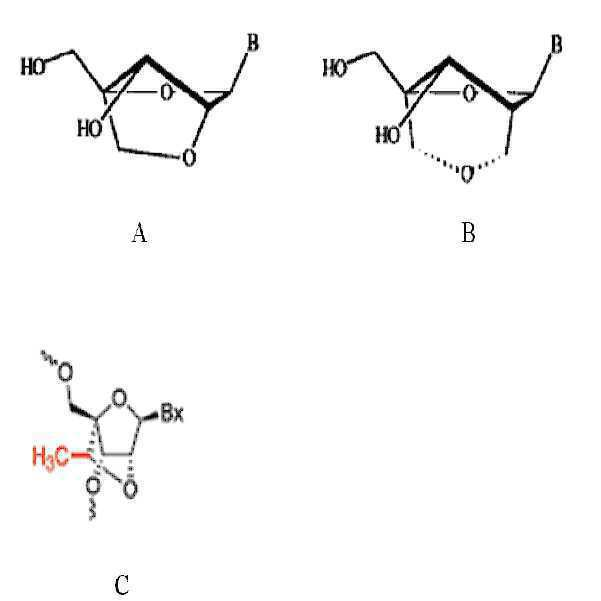
선택적으로, 안티센스 올리고뉴클레오티드들은 당-인산 골격(sugar-phosphate backbone) 대신 펩티드-기본 골격(peptide-based backbone)을 포함하는 펩티드 핵산(peptide nucleic acids; PNAs)을 포함할 수 있다. 또한 안티센스 올리고뉴클레오티드에 대한 다른 변형된 당 또는 포스포다이에스터 변형이 고려될 수 있다. 예를 들어, 안티센스 올리고뉴클레오티드가 포함할 수 있는 다른 화학적 변형들은 2'-O-알킬(예를 들어, 2'-O-메틸, 2'-O-메톡시에틸), 2'-플루오로, 및 4' 티오 변형과 같은 당 변형(sugar modification), 및 하나 이상의 포스포로티오에이트(phosphorothioate), 모르폴리노(morpholino), 또는 포스포노카복실레이트 결합(phosphonocarboxylate linkages)과 같은 골격 변형(backbone modifications)을 포함하나 이에 한정되는 것은 아니다(예를 들어, 그 전체가 본 명세서에 참고로 포함되는 미국특허 No. 6,693,187 및 7,067,641 참조). 특정 실시태양에서, 안티센스 올리고뉴클레오티드는 전체 포스포로티오에이트-연결 주쇄를 포함한다. 한 실시태양에서, miR-145를 표적으로 하는 안티센스 올리고뉴클레오티드는 각 염기(base)에 2'O-메틸 당 변형을 포함하며 포스포로티오에이트 결합으로 연결된다. 안티센스 올리고뉴클레오티드, 특히 짧은 길이의 것들은(예를 들어, 뉴클레오티드 15개 미만) 하나 이상의 LNA, 바이사이클릭 뉴클레오시드(bicyclic nucleoside), 포스포노포르메이트(phosphonoformates), 2'O-알킬 변형 등과 같은 하지만 여기에 한정되지 않는 친화도 증가 변형(affinity enhancing modifications)을 포함할 수 있다. 일부 실시태양에서, 적합한 안티센스 올리고뉴클레오티드는 5' 및 3' 양쪽 말단 모두에 2'-O-메톡시에틸-변형된 리보뉴클레오티드를 포함하며 적어도 10개의 디옥시리보뉴클레오티드를 중심에 가지는 2'-O-메톡시에틸“갑머(gapmers)”이다. 이러한“갑머”는 RNA 표적의 RNase H-의존적 분해 메커니즘을 유발할 수 있다. 그 전체가 본 명세서에 참고로 포함되는 미국특허 6,838,283에 기술된 것과 같은 안정성을 증가시키고 효율을 향상시키기 위한 안티센스 올리고뉴클레오티드들의 다른 변형들은 당업계에 알려졌으며 본 발명의 방법에 사용하기에 적합하다. 예를 들어, 인 비보 전달 및 안정성을 돕기 위해 안티센스 올리고뉴클레오티드는 이의 3' 말단에서 콜레스테롤 모이어티, 비타민, 지방산, 탄수화물 또는 글리코시드, 펩티드, 또는 다른 소형 분자 리간드와 같은 스테로이드에 연결될 수 있다. Optionally, the antisense oligonucleotides may comprise peptide nucleic acids (PNAs) that include a peptide-based backbone instead of a sugar-phosphate backbone. Other modified sugar or phosphodiester modifications to antisense oligonucleotides can also be considered. For example, other chemical modifications that antisense oligonucleotides may include include 2'-0-alkyl (eg, 2'-0-methyl, 2'-0-methoxyethyl), 2'-fluoro, And sugar modifications, such as 4 'thio modifications, and backbone modifications, such as one or more phosphorothioate, morpholino, or phosphonocarboxylate linkages. Including but not limited to (see, eg, US Pat. Nos. 6,693,187 and 7,067,641, which are incorporated by reference in their entirety). In certain embodiments, the antisense oligonucleotides comprise the entire phosphorothioate-linked backbone. In one embodiment, antisense oligonucleotides targeting miR-145 comprise 2'O-methyl sugar modifications at each base and are linked by phosphorothioate bonds. Antisense oligonucleotides, particularly those of short length (e. G., Less than 15 nucleotides) can be used in conjunction with one or more LNAs, such as bicyclic nucleosides, phosphonoformates, 2'O- But not limited to, affinity enhancing modifications. In some embodiments, a suitable antisense oligonucleotide comprises 2'-0-methoxyethyl-modified ribonucleotides at both 5 'and 3' ends and has a 2'-0-meth, centered at least 10 deoxyribonucleotides. Oxyethyl "gapmers". Such “gap” can trigger a RNase H-dependent degradation mechanism of the RNA target. Other modifications of the antisense oligonucleotides to increase stability and improve efficiency, such as those described in U.S. Patent 6,838,283, which is incorporated herein by reference in its entirety, are known in the art and are suitable for use in the methods of the present invention. For example, to aid in vivo delivery and stability, the antisense oligonucleotide may be linked to a steroid, such as a cholesterol moiety, a vitamin, a fatty acid, a carbohydrate or a glycoside, a peptide, or other small molecule ligand at its 3 '
miRNA들의 활성을 억제하기에 유용한 바람직한 안티센스 올리고뉴클레오티드는 약 5 내지 약 25 뉴클레오티드 길이, 약 10 내지 약 30 뉴클레오티드 길이, 또는 약 20 내지 약 25 뉴클레오티드 길이이다. 특정 실시태양에서, miR-145를 표적으로 하는 안티센스 올리고뉴클레오티드는 약 8 내지 약 18 뉴클레오티드 길이, 약 12 내지 약 16 뉴클레오티드 길이, 약 10 내지 약 14 뉴클레오티드 길이, 또는 약 11 내지 약 15 뉴클레오티드 길이이다. miR-145에 상보적인 임의의 8-머(8-mer) 또는 그 이상의 것이 사용될 수 있다.Preferred antisense oligonucleotides useful for inhibiting the activity of miRNAs are about 5 to about 25 nucleotides in length, about 10 to about 30 nucleotides in length, or about 20 to about 25 nucleotides in length. In certain embodiments, the antisense oligonucleotides targeting miR-145 are about 8 to about 18 nucleotides in length, about 12 to about 16 nucleotides in length, about 10 to about 14 nucleotides in length, or about 11 to about 15 nucleotides in length. Any 8-mer or more complementary to miR-145 can be used.
예를 들어, 한 실시태양에서, 안티센스 올리고뉴클레오티드는 5'-AGGGAUUCCUGGGAAAACUGGAC-3'(SEQ ID NO: 7)의 서열을 가진다. 다른 실시태양에서, 안티센스 올리고뉴클레오티드는 5'-CCUGGGAAAACUGGAC-3'(SEQ ID NO: 8)의 서열을 가진다. 다른 실시태양에서, 안티센스 올리고뉴클레오티드는 5'-UGGGAAAACUGGAC-3'(SEQ ID NO: 9)의 서열을 가진다. 다른 실시태양에서, 안티센스 올리고뉴클레오티드는 5'-GGAAAACUGGAC-3'(SEQ ID NO: 10)의 서열을 가진다. 또 다른 실시태양에서, 안티센스 올리고뉴클레오티드는 5'-AAAACUGGAC-3'(SEQ ID NO: 11)의 서열을 가진다. 또 다른 실시태양에서, 안티센스 올리고뉴클레오티드는 5'-AACUGGAC-3'(SEQ ID NO: 12)의 서열을 가진다. 안티센스 올리고뉴클레오티드는 성숙한 또는 미성숙한(즉, 스타) miR-145 서열에 적어도 부분적으로 상보적인, 예를 들어, 성숙한 또는 미성숙한(즉, 스타) miR-145 서열(예를 들어, SEQ ID NO: 1 또는 SEQ ID NO: 2)에 적어도 약 75%, 80%, 85%, 90%, 95%, 96%, 97%, 98%, 또는 99% 상보적인 서열을 포함할 수 있다. 일부 실시태양에서, 안티센스 올리고뉴클레오티드는 성숙한 또는 미성숙한 miR-145 서열에 실질적으로 상보적인, 즉 표적 폴리뉴클레오티드 서열에 적어도 약 90%, 95%, 96%, 97%, 98%, 또는 99% 상보적일 수 있다. 한 실시태양에서, 안티센스 올리고뉴클레오티드는 성숙한 또는 미성숙한 miR-145 서열에 100% 상보적인 서열을 포함한다. 특정 실시태양에서, 안티센스 올리고뉴클레오티드는 SEQ ID NO: 1에 적어도 부분적으로 상보적이다. 다른 실시태양에서, 안티센스 올리고뉴클레오티드는 SEQ ID NO: 2에 적어도 부분적으로 상보적이다.For example, in one embodiment, the antisense oligonucleotide has a sequence of 5'-AGGGAUUCCUGGGAAAACUGGAC-3 '(SEQ ID NO: 7). In another embodiment, the antisense oligonucleotide has a sequence of 5'-CCUGGGAAAACUGGAC-3 '(SEQ ID NO: 8). In another embodiment, the antisense oligonucleotide has a sequence of 5'-UGGGAAAACUGGAC-3 '(SEQ ID NO: 9). In another embodiment, the antisense oligonucleotide has a sequence of 5'-GGAAAACUGGAC-3 '(SEQ ID NO: 10). In another embodiment, the antisense oligonucleotide has a sequence of 5'-AAAACUGGAC-3 '(SEQ ID NO: 11). In another embodiment, the antisense oligonucleotide has a sequence of 5'-AACUGGAC-3 '(SEQ ID NO: 12). The antisense oligonucleotides may be at least partially complementary to a mature or immature (ie star) miR-145 sequence, eg, a mature or immature (ie star) miR-145 sequence (eg, SEQ ID NO: 1 or SEQ ID NO: 2), at least about 75%, 80%, 85%, 90%, 95%, 96%, 97%, 98%, or 99% complementary sequence. In some embodiments, the antisense oligonucleotide is substantially complementary to a mature or immature miR-145 sequence, ie at least about 90%, 95%, 96%, 97%, 98%, or 99% complementary to the target polynucleotide sequence. It can be enemy. In one embodiment, the antisense oligonucleotide comprises a sequence that is 100% complementary to a mature or immature miR-145 sequence. In certain embodiments, the antisense oligonucleotides are at least partially complementary to SEQ ID NO: 1. In other embodiments, the antisense oligonucleotide is at least partially complementary to SEQ ID NO: 2.
안티센스는 miR에 부분적으로 또는 완전히 상보적인 antimiR, 안티센스 올리고뉴클레오티드일 수 있다. antimiR은 miRNA의 5' 말단에 상보적일 수 있고 SEQ ID NOs: 7-12의 서열을 포함하거나 가지는 miRNA의 서열의 완전 상보적 서열을 가로질러 전진할 수 있다. antimiR은 성숙한 또는 미성숙한(즉, 스타) miR-145 서열에 적어도 부분적으로 상보적인, 예를 들어, 성숙한 또는 미성숙한(즉, 스타) miR-145 서열(예를 들어, SEQ ID NO: 1 또는 SEQ ID NO: 2)에 적어도 약 75%, 80%, 85%, 90%, 95%, 96%, 97%, 98%, 또는 99% 상보적인 서열일 수 있다. 일부 실시태양에서, antimiR은 성숙한 또는 미성숙한 miR-145 서열에 실질적으로 상보적인, 즉 표적 폴리뉴클레오티드 서열에 적어도 약 90%, 95%, 96%, 97%, 98%, 또는 99% 상보적일 수 있다. 한 실시태양에서, antimiR은 성숙한 또는 미성숙한 miR-145 서열에 100% 상보적인 서열을 포함한다. 특정 실시태양에서, antimiR은 SEQ ID NO: 1에 적어도 부분적으로 상보적이다. 다른 실시태양에서, antimiR은 SEQ ID NO: 2에 적어도 부분적으로 상보적이다.The antisense can be an antimiR, antisense oligonucleotide that is partially or completely complementary to miR. The antimiR may be complementary at the 5 'end of the miRNA and may advance across the complete complementary sequence of the sequence of miRNA comprising or having the sequence of SEQ ID NOs: 7-12. The antimiR is at least partially complementary to a mature or immature (ie star) miR-145 sequence, eg, a mature or immature (ie star) miR-145 sequence (eg, SEQ ID NO: 1 or At least about 75%, 80%, 85%, 90%, 95%, 96%, 97%, 98%, or 99% complementary to SEQ ID NO: 2). In some embodiments, the antimiR may be substantially complementary to a mature or immature miR-145 sequence, ie at least about 90%, 95%, 96%, 97%, 98%, or 99% complementary to the target polynucleotide sequence. have. In one embodiment, the antimiR comprises a sequence that is 100% complementary to a mature or immature miR-145 sequence. In certain embodiments, antimiR is at least partially complementary to SEQ ID NO: 1. In other embodiments, the antimiR is at least partially complementary to SEQ ID NO: 2.
antimiR은 약 5 내지 약 25 뉴클레오티드 길이, 약 10 내지 약 30 뉴클레오티드 길이, 또는 약 20 내지 약 25 뉴클레오티드 길이이다. 특정 실시태양에서, miR-145를 표적으로 하는 antimiR은 약 8 내지 약 18 뉴클레오티드 길이, 약 12 내지 약 16 뉴클레오티드 길이, 약 10 내지 약 14 뉴클레오티드 길이, 또는 약 11 내지 약 15 뉴클레오티드 길이이다. 한 실시태양에서, antimiR은 약 16 뉴클레오티드 길이이다. antimiR은 완전히, 부분적으로 포스포로티올레이트화되거나 되지 않는다. 한 실시태양에서, antimiR은 LNA antimiR이다. 한 실시태양에서, antimiR은 성숙한 miR-145의 염기 2-17을 표적으로 한다. 예를 들어, antimiR은 5'-UCCUGGGAAAACUGGA-3'(SEQ ID NO: 13)의 서열을 가질 수 있다. 한 실시태양에서, antimiR은 SEQ ID NO: 13의 서열을 가지며 완전히 포스포로티올레이트화된다. 또 다른 실시태양에서, SEQ ID NO: 13의 서열을 가지는 antimiR은 LNA antimiR이다. SEQ ID NO: 13의 서열을 가지는 antimiR은 LNA 및 DNA의 혼합물일 수 있다. 또 다른 실시태양에서, SEQ ID NO: 13의 서열을 가지는 antimiR은 완전히 포스포로티올레이트화된 LNA antimiR이다.The antimiR is about 5 to about 25 nucleotides in length, about 10 to about 30 nucleotides in length, or about 20 to about 25 nucleotides in length. In certain embodiments, the antimiR targeting miR-145 is about 8 to about 18 nucleotides in length, about 12 to about 16 nucleotides in length, about 10 to about 14 nucleotides in length, or about 11 to about 15 nucleotides in length. In one embodiment, the antimiR is about 16 nucleotides in length. antimiR may or may not be fully or partially phosphorothiolate. In one embodiment, the antimiR is LNA antimiR. In one embodiment, antimiR targets base 2-17 of mature miR-145. For example, the antimiR may have a sequence of 5'-UCCUGGGAAAACUGGA-3 '(SEQ ID NO: 13). In one embodiment, the antimiR has the sequence of SEQ ID NO: 13 and is fully phosphorothiolate. In another embodiment, the antimiR having the sequence of SEQ ID NO: 13 is LNA antimiR. The antimiR having the sequence of SEQ ID NO: 13 may be a mixture of LNA and DNA. In another embodiment, the antimiR having the sequence of SEQ ID NO: 13 is a fully phosphorothiolated LNA antimiR.
일부 실시태양에서, 안티센스 올리고뉴클레오티드는 안타고미르(antagomirs)이다.“안타고미르”는 miR-145 서열에 적어도 부분적으로 상보적인 단일 가닥의, 화학적으로 변형된 리보뉴클레오티드들이다. 안타고미르는 2'-O-메틸-당 변형(2'-O-methyl-sugar modifications)과 같은 하나 이상의 변형된 뉴클레오티드를 포함할 수 있다. 일부 실시태양에서, 안타고미르는 오직 변형된 뉴클레오티드만을 포함한다. 안타고미르는 부분 또는 전체 포스포로티오에이트 골격을 초래하는 하나 또는 그 이상의 포스포로티오에이트 연결(phosphorothioate linkage)을 포함할 수 있다. 인 비보 전달(delivery) 및 안정(stability)을 돕기 위하여, 안타고미르는 자신의 3' 말단에서 콜레스테롤 또는 다른 모이어티와 연결될 수 있다. miR-145를 억제하기에 적합한 안타고미르는 약 15 내지 약 50 뉴클레오티드 길이, 약 18 내지 약 30 뉴클레오티드 길이, 및 약 20 내지 약 25 뉴클레오티드 길이 또는 약 10 내지 약 14 뉴클레오티드 길이일 수 있다. 안타고미르는 성숙한 또는 미성숙한 miR-145 서열과 적어도 약 75%, 80%, 85%, 90%, 95%, 96%, 97%, 98%, 또는 99% 상보적일 수 있다. 일부 실시태양에서, 안타고미르는 성숙한 또는 미성숙한 miR-145 서열과 실질적으로 상보적일 수 있으며, 즉 표적 폴리뉴클레오티드 서열에 적어도 약 90%, 95%, 96%, 97%, 98%, 또는 99% 상보적이다. 다른 실시태양에서, 안타고미르는 성숙한 또는 미성숙한 miR-145 서열에 100% 상보적이다.In some embodiments, the antisense oligonucleotides are antagomirs. “Antagomirs” are single stranded, chemically modified ribonucleotides that are at least partially complementary to the miR-145 sequence. Anthagomir can include one or more modified nucleotides such as 2'-O-methyl-sugar modifications. In some embodiments, the antagomir comprises only modified nucleotides. Antagomir may comprise one or more phosphorothioate linkages resulting in a partial or full phosphorothioate backbone. In Vivo To aid delivery and stability, anthagomir can be linked to cholesterol or other moieties at its 3 'end. Antagonists suitable for inhibiting miR-145 can be about 15 to about 50 nucleotides in length, about 18 to about 30 nucleotides in length, and about 20 to about 25 nucleotides in length or about 10 to about 14 nucleotides in length. Antagomir may be at least about 75%, 80%, 85%, 90%, 95%, 96%, 97%, 98%, or 99% complementary to a mature or immature miR-145 sequence. In some embodiments, antagomir may be substantially complementary to a mature or immature miR-145 sequence, ie at least about 90%, 95%, 96%, 97%, 98%, or 99% to the target polynucleotide sequence. It is complementary. In other embodiments, antagonists are 100% complementary to mature or immature miR-145 sequences.
본 발명에서 기술된 억제성 뉴클레오티드 분자들은 바람직하게는 miR-145의 성숙한 서열(SEQ ID NO: 1)을 표적으로 한다. 한 실시태양에서, 본 발명에서 기술된 억제성 뉴클레오티드 분자들은 바람직하게는 miR-145의 미성숙한(즉, 스타) 서열(SEQ ID NO: 2)을 표적으로 한다. 일부 실시태양에서, miR-145의 억제제는 성숙한 또는 미성숙한 miR-145 서열에 완벽하게 상보적인 서열을 포함하는 안타고미르이다. 한 실시태양에서, miR-145의 억제제는 SEQ ID NO: 1에 부분적으로 또는 완벽하게 상보적인 서열을 가진 안타고미르이다. 다른 실시태양에서, miR-145의 억제제는 SEQ ID NO: 2에 부분적으로 또는 완벽하게 상보적인 서열을 가진 안타고미르이다. 일부 실시태양에서, miR-145의 억제제는 화학적으로 변형된 안티센스 올리고뉴클레오티드이다. 한 실시태양에서, miR-145의 억제제는 SEQ ID NO: 1에 실질적으로 상보적인 서열을 포함하는 화학적으로 변형된 안티센스 올리고뉴클레오티드이다. 다른 실시태양에서, miR-145의 억제제는 SEQ ID NO: 2에 실질적으로 상보적인 서열을 포함하는 화학적으로 변형된 안티센스 올리고뉴클레오티드이다. 본 발명에서 사용된 대로 "실질적으로 상보적인"은 표적 폴리뉴클레오티드 서열(예를 들어, 성숙, 미성숙 또는 전구체 miRNA 서열)에 적어도 약 95%, 96%, 97%, 98%, 99%, 또는 100% 상보적인 서열을 의미한다.Inhibitory nucleotide molecules described herein preferably target the mature sequence of miR-145 (SEQ ID NO: 1). In one embodiment, the inhibitory nucleotide molecules described herein preferably target the immature (ie, star) sequence (SEQ ID NO: 2) of miR-145. In some embodiments, the inhibitor of miR-145 is antagomir comprising a sequence that is perfectly complementary to a mature or immature miR-145 sequence. In one embodiment, the inhibitor of miR-145 is antagomir with a sequence partially or completely complementary to SEQ ID NO: 1. In another embodiment, the inhibitor of miR-145 is antagomir with a sequence partially or completely complementary to SEQ ID NO: 2. In some embodiments, the inhibitor of miR-145 is a chemically modified antisense oligonucleotide. In one embodiment, the inhibitor of miR-145 is a chemically modified antisense oligonucleotide comprising a sequence substantially complementary to SEQ ID NO: 1. In another embodiment, the inhibitor of miR-145 is a chemically modified antisense oligonucleotide comprising a sequence substantially complementary to SEQ ID NO: 2. As used herein, “substantially complementary” means at least about 95%, 96%, 97%, 98%, 99%, or 100 to a target polynucleotide sequence (eg, mature, immature or precursor miRNA sequence). % Complementary sequence.
안티센스 올리고뉴클레오티드 또는 안타고미르는 miR-145에 대한 전구체 miRNA 서열(pre-miRNA) 또는 프라이머리 miRNA 서열(pri-miRNA)에 실질적으로 상보적인 서열을 포함할 수 있다. 일부 실시태양에서, 안티센스 올리고뉴클레오티드는 pre-miR 서열의 스템 루프 지역 외부에 위치한 서열에 실질적으로 상보적인 서열을 포함한다. 한 실시태양에서, miR-145 기능의 억제제는 pre-miR-145 서열(SEQ ID NO: 3)에 실질적으로 상보적인 서열을 가진 안티센스 올리고뉴클레오티드이다.The antisense oligonucleotides or antagonists may comprise sequences that are substantially complementary to the precursor miRNA sequence (pre-miRNA) or primary miRNA sequence (pri-miRNA) for miR-145. In some embodiments, the antisense oligonucleotide comprises a sequence that is substantially complementary to a sequence located outside the stem loop region of the pre-miR sequence. In one embodiment, the inhibitor of miR-145 function is an antisense oligonucleotide having a sequence substantially complementary to the pre-miR-145 sequence (SEQ ID NO: 3).
본 발명에 기술된 miR-145의 억제제 중 하나는 세포에 miR-145 억제제를 암호화하는 발현 벡터를 전달함으로써 표적 세포(예를 들어, 민무늬근 세포)에 전달될 수 있다. "벡터"는 관심 핵산을 세포의 내부로 전달하기 위해 사용될 수 있는 물질의 조성물이다. 선형 폴리뉴클레오티드, 이온성 또는 친양쪽성 화합물과 연관된 폴리뉴클레오티드, 플라스미드, 및 바이러스를 포함하지만 여기에 제한되지 않는 수많은 벡터가 당업계에 알려져 있다. 따라서 용어 "벡터"는 자율적으로 복제하는 플라스미드 또는 바이러스를 포함한다. 바이러스성 벡터의 예는 아데노바이러스 벡터, 아데노-연관 바이러스 벡터, 레트로바이러스 벡터 등을 포함하나 여기에 제한되지 않는다. 발현 구조체(expression construct)는 살아있는 세포(living cell)에서 복제되거나 또는 합성적으로 만들어질 수 있다. 이러한 응용 목적을 위하여 용어 "발현 구조체", "발현 벡터", 및 "벡터"라는 용어는 일반적이고, 설명적인 의미에서 본 발명의 출원을 설명하기 위해 상호 교환적으로 사용되며 본 발명을 제한하려는 것은 아니다.One of the inhibitors of miR-145 described herein can be delivered to target cells (eg, smooth muscle cells) by delivering an expression vector encoding a miR-145 inhibitor to the cell. A "vector" is a composition of matter that can be used to deliver a nucleic acid of interest into the interior of a cell. Numerous vectors are known in the art including, but not limited to, linear polynucleotides, polynucleotides associated with ionic or amphipathic compounds, plasmids, and viruses. Thus, the term "vector" includes plasmids or viruses that autonomously replicate. Examples of viral vectors include, but are not limited to, adenoviral vectors, adeno-associated viral vectors, retroviral vectors, and the like. Expression constructs can be replicated in living cells or made synthetically. For purposes of this application, the terms "expression construct", "expression vector", and "vector" are used interchangeably to describe the invention's application in a general, illustrative sense, no.
한 실시태양에서, miR-145의 억제제를 발현하기 위한 발현 벡터는 안티센스 올리고뉴클레오티드를 암호화하는 폴리뉴클레오티드에 작동가능하게 연결된 프로모터를 포함하며, 발현된 안티센스 올리고뉴클레오티드의 서열은 miR-145의 성숙한 또는 미성숙한 서열(예를 들어, SEQ ID NO: 1 또는 SEQ ID NO: 2)에 부분적으로 또는 완벽하게 상보적이다. 본 발명에서 사용된 "작동가능하게 연결된(operably linked)" 또는 "전사 조절 하에서(under transcriptional control)"라는 문구는 프로모터가 RNA 중합효소 및 폴리뉴클레오티드의 발현에 의해 전사의 개시를 제어하기 위해 폴리뉴클레오티드에 대한 관계에서 정확한 위치와 방향에 있다는 것을 의미한다. In one embodiment, the expression vector for expressing an inhibitor of miR-145 comprises a promoter operably linked to a polynucleotide encoding an antisense oligonucleotide, wherein the sequence of the expressed antisense oligonucleotide is the mature or immature of miR-145. Partially or completely complementary to one sequence (eg SEQ ID NO: 1 or SEQ ID NO: 2). The phrase "operably linked" or "under transcriptional control ", as used herein, refers to the ability of a promoter to inhibit the initiation of transcription by expression of RNA polymerase and polynucleotides, In the position and direction.
본 발명에 사용된 대로, "프로모터"는 세포의 합성 기관(synthetic machinery) 또는 유전자의 특정 전사를 시작하기에 필요한 유도된 합성 기관(induced synthetic machinery)에 의해 인식된 DNA 서열을 나타낸다. 적합한 프로모터는 RNA 중합효소I(polI), RNA 중합효소II(polII), RNA 중합효소III(polIII), 및 바이러스성 프로모터(viral promoter)[예를 들어, 인간 세포거대바이러스 즉각 조기 유전자 프로모터(human cytomegalovirus (CMV) immediate early gene promoter), SV40 초기 프로모터(SV40 early promoter), 및 라우스육종바이러스 긴말단반복(the Rous sarcoma virus long terminal repeat)]를 포함하나 이에 한정되는 것은 아니다. 일 실시태양에서, 프로모터는 조직 특이적 프로모터이다. 특히 관심있는 것은 혈관 특이적 프로모터들이며, 더욱 특히 알파 민무늬근 액틴 프로모터와 같은 근육 특이적 프로모터들이다. 다른 적절한 프로모터는 미오신 경쇄-2 프로모터(the myosin light chain-2 promoter)(Franz 외. (1994) Cardioscience, Vol. 5(4):235-43; Kelly 외 (1995) J. Cell Biol, Vol. 129(2):383-396), 알파 액틴 프로모터(the alpha actin promoter)(Moss 외 (1996) Biol . Chem ., Vol. 271(49):31688-31694), 트로포닌 1 프로모터(the troponin 1 promoter)(Bhavsar 외. (1996) Genomics, Vol. 35(1): 11-23); Na+/Ca2+ 교환기 프로모터(the Na+/Ca2+ exchanger promoter)(Barnes 외 (1997) J. Biol . Chem., Vol. 272(17):11510-11517), 디스트로핀 프로모터(the dystrophin promoter)(Kimura 외. (1997) Dev . Growth Differ., Vol. 39(3):257-265), 알파7 인테그린 프로모터(the alpha7 integrin promoter)(Ziober and Kramer (1996) J. Bio . Chem., Vol. 271(37):22915-22), 뇌성나트륨이뇨펩타이드 프로모터(the brain natriuretic peptide promoter)(LaPointe 외 (1996) Hypertension, Vol. 27(3 Pt 2):715-22) 및 알파 B-크리스탈린/작은열충격단백질 프로모터(the alpha B-crystallin/small heat shock protein promoter)(Gopal-Srivastava (1995) J. MoI . Cell . Biol, Vol. 15(12):7081-709O), 알파 미오신 중쇄 프로모터(alpha myosin heavy chain promoter)(Yamauchi-Takihara 외 (1989) Proc . Natl . Acad . Sci USA, Vol. 86(10):3504-3508) 및 ANF 프로모터(ANF promoter)(LaPointe 외. (1988) J. Biol . Chem., Vol. 263(19):9075-9078)를 포함한다.As used herein, the term "promoter " refers to a DNA sequence recognized by a synthetic machinery of cells or an induced synthetic machinery necessary to initiate a specific transcription of a gene. Suitable promoters include RNA polymerase I (polI), RNA polymerase II (polII), RNA polymerase III (polIII), and viral promoters [eg, human cytomegalovirus immediate early gene promoters (human cytomegalovirus (CMV) immediate early gene promoter, SV40 early promoter, and the Rous sarcoma virus long terminal repeat. In one embodiment, the promoter is a tissue specific promoter. Of particular interest are vascular specific promoters, and more particularly muscle specific promoters such as alpha striated muscle actin promoter. Other suitable promoters are the myosin light chain-2 promoter (Franz et al . (1994) Cardioscience , Vol. 5 (4): 235-43; Kelly et al. (1995) J. Cell Biol , Vol. 129 (2): 383-396), the alpha actin promoter (Moss et al . (1996) Biol . Chem . , Vol. 271 (49): 31688-31694), the
특정 실시태양에서, miR-154 억제제를 암호화하는 폴리뉴클레오티드에 작동 가능하게 연결된 프로모터는 유도성 프로모터(inducible promoter)일 수 있다. 테트라사이클린 프로모터(tetracycline promoter), 메탈로티오네인 IIA 프로모터(metallothionein IIA promoter), 열충격 프로모터(heat shock promoter), 스테로이드/갑상선호르몬/레티노산 반응 요소(steroid/thyroid hormone/retinoic acid response elements), 아데노바이러스 후기 프로모터(the adenovirus late promoter), 및 유도성 생쥐 유방 종양 바이러스 LTR(the inducible mouse mammary tumor virus LTR)을 포함하는, 하지만 여기에 한정되지 않는, 유도성 프로모터들이 당업계에 알려져 있다.In certain embodiments, the promoter operably linked to the polynucleotide encoding the miR-154 inhibitor may be an inducible promoter. Tetracycline promoter, metallothionein IIA promoter, heat shock promoter, steroid / thyroid hormone / retinoic acid response elements, adenosine Inducible promoters are known in the art, including but not limited to the adenovirus late promoter, and the inducible mouse mammary tumor virus LTR.
발현 구조체와 핵산을 세포에 전달하는 방법은 당업계에 공지되어 있고, 예를 들어, 인산칼슘 공동 침전, 전기천공법, 미세주사, DEAE-덱스트란, 리포펙션, 폴리아민 형질감염 시약을 사용하는 형질감염, 세포 초음파, 고속 미세추진체를 사용하는 유전자 충돌 및 수용체-매개 형질감염을 포함할 수 있다.Methods for delivering expression constructs and nucleic acids to cells are well known in the art and include, for example, calcium phosphate co-precipitation, electroporation, microinjection, DEAE-dextran, lipofection, polyamine transfection reagent- Infection, cellular ultrasound, genetic collisions using high-speed micro-propellants, and receptor-mediated transfection.
본 발명은 또한 처리 이후 miR-145를 청소 또는 제거하기 위한 방법을 포함한다. 이 방법은 폐 조직에 miR-145 억제제에 대한 결합 부위를 과다발현하는 것을 포함할 수 있다. 결합 부위 영역은 바람직하게는 miR-145에 대한 씨드 영역의 서열을 포함한다. 씨드 영역은 표적 인식에 중요한 염기 2-8에 미치는 miRNA의 5' 부분이다. 일부 실시태양에서, 결합 부위는 KLF4, KLF-5, Srgap1, 및 Srgap2와 같은 miR-145의 하나 이상의 표적의 3'UTR로부터의 서열을 포함할 수 있다.The invention also includes a method for cleaning or removing miR-145 after treatment. The method may include overexpressing a binding site for miR-145 inhibitors in lung tissue. The binding site region preferably comprises the sequence of the seed region for miR-145. The seed region is the 5 'portion of the miRNA that affects bases 2-8, which are important for target recognition. In some embodiments, the binding site may comprise a sequence from the 3'UTR of one or more targets of miR-145, such as KLF4, KLF-5, Srgap1, and Srgap2.
본 발명은 또한 miR-145의 억제제를 포함하는 약학적 조성물을 포함한다. 임상적 응용분야가 고려될 때, 약학적 조성물은 의도된 응용분야에 적절한 형태로 제조될 수 있다. 일반적으로, 이 발명은 인간 또는 동물에 해로울 수 있는 발열원 뿐만 아니라 다른 불순물이 필수적으로 제거된 조성물을 제조하는 것을 포함할 것이다.The invention also includes pharmaceutical compositions comprising an inhibitor of miR-145. When clinical applications are contemplated, pharmaceutical compositions may be prepared in a form suitable for the intended application. In general, the present invention will involve the preparation of a composition that is essentially free of pyrogen as well as other impurities that may be harmful to humans or animals.
한 실시태양에서, 약학적 조성물은 유효량의 miR-145 억제제 및 약학적으로 허용가능한 담체를 포함한다. 예를 들어, 약학적 조성물은 본 발명에 기술된 miR-145를 표적으로 하는 유효량의 변형 안티센스 올리고뉴클레오티드를 포함한다. 일부 실시태양에서, 약학적 조성물은 SEQ ID NO: 7, SEQ ID NO: 8, SEQ ID NO: 9, SEQ ID NO: 10, SEQ ID NO: 11로 이루어진 그룹으로부터 선택된 서열을 가진 변형 안티센스 올리고뉴클레오티드를 포함한다. 한 실시태양에서, 약학적 조성물은 SEQ ID NO: 13의 서열을 가진 antimiR과 같은 유효량의 합성 안티센스 올리고뉴클레오티드를 포함한다. 한 실시태양에서, 약학적 조성물은 완전히 포스포로티올레이트화된 SEQ ID NO: 13의 서열을 가진 유효량의 antimiR을 포함한다. 또 다른 실시태양에서, 약학적 조성물은 SEQ ID NO: 13의 서열을 가진 유효량의 LNA를 포함하며, antimiR은 완전히 포스포로티올레이트화된다.In one embodiment, the pharmaceutical composition comprises an effective amount of a miR-145 inhibitor and a pharmaceutically acceptable carrier. For example, the pharmaceutical composition includes an effective amount of a modified antisense oligonucleotide that targets miR-145 described herein. In some embodiments, the pharmaceutical composition comprises a modified antisense oligonucleotide having a sequence selected from the group consisting of SEQ ID NO: 7, SEQ ID NO: 8, SEQ ID NO: 9, SEQ ID NO: 10, SEQ ID NO: 11. It includes. In one embodiment, the pharmaceutical composition comprises an effective amount of synthetic antisense oligonucleotides such as antimiR having the sequence of SEQ ID NO: 13. In one embodiment, the pharmaceutical composition comprises an effective amount of antimiR having the sequence of SEQ ID NO: 13 fully phosphorothiolated. In another embodiment, the pharmaceutical composition comprises an effective amount of LNA with the sequence of SEQ ID NO: 13, wherein the antimiR is fully phosphorothiolate.
"유효량"은 유익한 또는 요구되는 의학적 결과를 가져오기에 충분한 양이다. 본 발명의 miRNA 억제제의 유효량은 약 0.001 mg/kg 내지 약 100 mg/kg, 약 0.01 mg/kg 내지 약 10 mg/kg, 약 0.1 mg/kg 내지 약 10 mg/kg, 약 1 mg/kg 내지 약 10 mg/kg, 약 2.5 mg/kg 내지 약 50 mg/kg, 또는 약 5 mg/kg 내지 약 25 mg/kg일 수 있다. 유효량으로 여겨지는 양에 대한 정확한 결정은 크기, 나이, 폐동맥 고혈압의 심각성 및 억제제의 성질(예를 들어, 안타고미어, 발현 구조체, 안티센스 올리고뉴클레오티드 등)을 포함하는 각 환자 개인의 요인들에 기초를 둘 수 있다. 그러므로, 상기 양은 당업계의 통상적인 기술을 가진자가 본 명세서 및 당업계의 지식을 통해 쉽게 알아낼 수 있다.An "effective amount" is an amount sufficient to produce a beneficial or desired medical result. Effective amounts of miRNA inhibitors of the invention range from about 0.001 mg / kg to about 100 mg / kg, from about 0.01 mg / kg to about 10 mg / kg, from about 0.1 mg / kg to about 10 mg / kg, from about 1 mg / kg About 10 mg / kg, about 2.5 mg / kg to about 50 mg / kg, or about 5 mg / kg to about 25 mg / kg. The exact determination of the amount considered effective amount is based on factors of each patient individual, including size, age, severity of pulmonary hypertension and the nature of the inhibitor (eg, antagonists, expression constructs, antisense oligonucleotides, etc.). You can put it. Therefore, the amount can be easily determined by those skilled in the art through knowledge of the present specification and the art.
거대분자 복합체(macromolecule complexes), 나노캡슐(nanocapsules), 마이크로스피어(microspheres), 비드(beads), 및 오일이 물에 분산된 에멀전을 포함하는 지질 기반 시스템(lipid-based systems including oil-in-water emulsions), 마이셀(micelles), 혼합된 마이셀(mixed micelles), 및 리포솜(liposomes)과 같은 콜로이드 분산 시스템(Colloidal dispersion systems)은 miR-145 기능의 올리고뉴클레오티드 억제제, 특정 miRNA 억제제를 발현하는 구조체를 위한 전달 부형제(delivery vehicles)로 사용될 수 있다. 특정 실시태양에서, miR-145 억제제는 폐 전달을 위해 제제화된다. 본 발명에 사용된 대로, "폐 전달" 또는 "호흡 전달"은 입 또는 코를 통해 폐 속으로 흡입함으로써 대상에게 miR-145 억제제의 전달을 의미한다. 예를 들어, miR-145 억제제는 스너프, 에어로졸, 분무용 용액 또는 살포용 미세 분말로 제제화될 수 있다. miR-145 억제제가 건조 분말로 제제화되는 실시태양에서, 활성 화합물의 입자들은 적절하게는 1 내지 5 마이크론 또는 2 내지 5 마이크론과 같은 50 마이크론 미만, 바람직하게는 10 마이크론 미만의 지름을 가진다.Lipid-based systems including oil-in-water, including macromolecule complexes, nanocapsules, microspheres, beads, and emulsions in which oil is dispersed in water. Colloidal dispersion systems such as emulsions, micelles, mixed micelles, and liposomes are used for oligonucleotide inhibitors with miR-145 function, for constructs expressing certain miRNA inhibitors. It can be used as delivery vehicles. In certain embodiments, miR-145 inhibitors are formulated for pulmonary delivery. As used herein, "pulmonary delivery" or "breathing delivery" means delivery of a miR-145 inhibitor to a subject by inhalation into the lungs through the mouth or nose. For example, miR-145 inhibitors may be formulated into snuffs, aerosols, spray solutions or fine powders for sparging. In embodiments wherein the miR-145 inhibitor is formulated as a dry powder, the particles of the active compound suitably have a diameter of less than 50 microns, preferably less than 10 microns, such as 1 to 5 microns or 2 to 5 microns.
누군가는 일반적으로 전달 부형제를 안정하고, 표적 세포에 의해 흡수되도록 만들기 위하여 적절한 염 및 버퍼를 사용하고자 할 것이다. 본 발명의 수용성 조성물은 약학적으로 허용 가능한 담체(carrier) 또는 수성 매질(aqueous medium)에 용해 또는 분산된 억제제 폴리뉴클레오티드들(예를 들어, 리포솜 또는 다른 복합체 또는 발현벡터)을 포함하는 유효한 양의 전달 부형제를 포함한다. "약학적으로 허용가능한" 또는 "약리학적으로 허용가능한"은 동물 또는 사람에게 투여되었을 때, 해로운, 알레르기의, 또는 다른 뜻밖의(untoward) 반응들을 만들지 않는 분자 독립체들(molecular entities) 및 조성물을 나타낸다. 여기에서 사용된 "약학적으로 허용가능한 담체"는 용매, 버퍼, 용액, 분산매, 코팅, 항균 및 항진균 약품(antibacterial and antifungal agents), 등장성 및 흡수 지연 약품(isotonic and absorption delaying agents) 및 인간에 투여하기 적합한 약과 같은 약의 제제화에 사용이 허용되는 기타 같은 종류의 것을 포함한다. 약학적 활성 물질들을 위한 이와 같은 매질(media) 및 약품(agent)의 사용은 당업계에 잘 알려져 있다. 본 발명의 활성 성분과 맞지 않는 어떠한 전통적인 매질 또는 약품을 제외하는 한에 있어서, 치료학적 조성물에 있어서의 이의 용도는 고려된다. 보충적인 활성 성분들 또한 만약 조성물의 벡터 또는 폴리뉴클레오티드를 불활성화시키지 않는다면 조성물에 혼합될 수 있다.One would generally want to use appropriate salts and buffers to make delivery excipients stable and uptake by target cells. A water soluble composition of the invention comprises an effective amount of inhibitor polynucleotides (eg, liposomes or other complexes or expression vectors) dissolved or dispersed in a pharmaceutically acceptable carrier or aqueous medium. Delivery excipients. &Quot; Pharmaceutically acceptable "or" pharmacologically acceptable "refers to molecular entities and compositions that, when administered to an animal or human, do not cause harmful, allergic, or other untoward reactions . As used herein, "pharmaceutically acceptable carrier" refers to a solvent, buffer, solution, dispersion medium, coating, antibacterial and antifungal agents, isotonic and absorption delaying agents, And other such classes that are acceptable for use in the formulation of a medicament such as a medicament suitable for administration. The use of such media and agents for pharmaceutically active substances is well known in the art. Except insofar as any conventional media or drug is incompatible with the active ingredients of the invention, its use in the therapeutic compositions is contemplated. Supplementary active ingredients can also be mixed into the composition if it does not inactivate the vector or polynucleotide of the composition.
본 발명의 활성 조성물은 전통적인 약학적 제형을 포함할 수 있다. 본 발명에 따른 이러한 조성물의 투여는 표적 조직이 그 경로를 통해 이용 가능한 한 어떠한 일반적인 경로라도 통할 수 있다. 이는 경구(oral), 비강(nasal), 또는 구강(buccal)을 포함한다. 선택적으로, 투여는 내피(intradermal), 피하(subcutaneous), 근육내(intramuscular), 복막내(intraperitoneal) 또는 정맥내(intravenous) 주사에 의할 수 있다. 특정 실시태양에서, miR-145 억제제를 포함하는 약학적 조성물은 흡입에 의해 투여된다. miRNA 억제제를 포함하는 약학적 조성물 또는 miRNA 억제제를 포함하는 발현 구조체는 또한 카테터 시스템(catheter systems) 또는 치료 약품을 심장 및 폐에 전달하기 위해 관상/폐 순환을 분리하는 시스템에 의해 투여될 수 있다. 치료 약품을 심장 및 관상 맥관구조(coronary vasculature)에 전달하기 위한 다양한 카테터 시스템은 당업계에 알려져 있다. 본 발명의 사용에 적합한 카테터-기반 전달 방법 또는 관상동맥 분리 방법의 일부 비-제한적인 예는 그 전체가 본 명세서에 참고로 포함되는 미국특허 No. 6,416,510; 미국특허 No. 6,716,196; 미국특허 No. 6,953,466, WO 2005/082440, WO 2006/089340, 미국공개특허 No. 2007/0203445, 미국공개특허 No. 2006/0148742, 및 미국공개특허 No. 2007/0060907에 개시되어 있다. 이와 같은 조성물은 일반적으로 여기에서 설명한 바와 같이, 약학적으로 허용가능한 조성물로써 투여될 수 있다.The active compositions of the present invention may comprise traditional pharmaceutical formulations. Administration of such compositions according to the invention can be via any general route as long as the target tissue is available via that route. This includes oral, nasal or buccal. Alternatively, administration can be by intradermal, subcutaneous, intramuscular, intraperitoneal or intravenous injection. In certain embodiments, pharmaceutical compositions comprising miR-145 inhibitors are administered by inhalation. Pharmaceutical compositions comprising miRNA inhibitors or expression constructs comprising miRNA inhibitors may also be administered by catheter systems or systems that separate the coronary / pulmonary circulation to deliver therapeutic agents to the heart and lung. Various catheter systems are known in the art for delivering therapeutic agents to the heart and coronary vasculature. Some non-limiting examples of catheter-based delivery methods or coronary artery separation methods suitable for use in the present invention are described in US Pat. 6,416,510; U.S. Pat. 6,716,196; U.S. Pat. 6,953,466, WO 2005/082440, WO 2006/089340, US published patent no. 2007/0203445, US published patent no. 2006/0148742, and US Published Patent No. Disclosed in 2007/0060907. Such compositions may generally be administered as pharmaceutically acceptable compositions, as described herein.
활성 화합물은 또한 비경구적으로(parenterally) 또는 복강내로(intraperitoneally) 투여될 수 있다. 실례로써, 유리 염기(free base) 또는 약리학적으로 허용가능한 염으로서의 활성 화합물의 용액은 하이드록시프로필셀룰로오스(hydroxypropylcellulose)와 같은 계면활성제(surfactant)와 적절하게 혼합되어 물에서 조제될 수 있다. 분산액(dispersions)은 또한 글리세롤, 액상 폴리에틸렌글라이콜, 및 이들의 혼합물 내에서, 및 오일 내에서 조제될 수 있다. 저장 및 사용의 일반적인 조건 하에서, 이러한 제형은 미생물의 성장을 막기 위한 방부제를 일반적으로 포함한다.The active compound can also be administered parenterally or intraperitoneally. By way of example, a solution of the active compound as a free base or pharmacologically acceptable salt may be formulated in water by appropriate mixing with a surfactant such as hydroxypropylcellulose. Dispersions can also be formulated in glycerol, liquid polyethylene glycols, and mixtures thereof, and in oils. Under ordinary conditions of storage and use, these formulations generally contain a preservative to prevent the growth of microorganisms.
주사 가능한 용도, 카테터 전달 또는 흡입 전달에 적합한 약학적인 형태는 예를 들어, 살균된 수용액 또는 분산액(sterile aqueous solutions or dispersions) 및 살균된 주사 용액 또는 분산액(예를 들어, 에어로졸, 분무 용액)의 즉석 조제를 위한 살균된 파우더(sterile powders)를 포함한다. 일반적으로, 이러한 제형들은 무균이며, 쉬운 주사성 또는 에어로졸성/분무성이 존재하는 정도로 유동적이다. 제형은 제조 및 저장 조건 하에서 안정해야하며, 박테리아 및 균류와 같은 미생물의 오염 활동에 대비하여 보존되어야 한다. 적절한 용매 또는 분산매는 예를 들어, 물, 에탄올, 폴리올(예를 들어, 글리세롤, 플로필렌글리콜, 및 액상 폴리에틸렌글리콜, 및 기타 같은 종류의 것), 이들의 적절한 혼합물, 및 식물성 기름을 포함할 수 있다. 적절한 유동성은 예를 들어, 레시틴과 같은 코팅의 사용에 의해, 분산의 경우 필요로 하는 입자 사이즈의 유지에 의해, 및 계면활성제의 사용에 의해 유지될 수 있다. 미생물 활동의 방지는 대체로 다양한 항균 및 항진균 약품(antibacterial and antifungal agents), 예를 들어, 파라벤(parabens), 클로로부탄올(chlorobutanol), 페놀(phenol), 소르빈산(sorbic acid), 티메로살(thimerosal), 및 기타 같은 종류의 것들에 의해 이루어질 수 있다. 많은 경우에, 등장성 약품(isotonic agents), 예를 들어, 당(sugar) 또는 소듐클로라이드(sodium chloride)를 포함하는 것이 선호된다. 주사 가능한 조성물의 장기 흡수(prolonged absorption)는 대체로 흡수 지연 약품, 예를 들어, 알루미늄 모노스테아레이트(aluminum monostearate) 및 젤라틴(gelatin)을 조성물에 사용함으로써 일어난다.Pharmaceutical forms suitable for injectable use, catheter delivery or inhalation delivery include, for example, immediate application of sterile aqueous solutions or dispersions and sterile injectable solutions or dispersions (eg, aerosols, spray solutions). Sterilized powders for preparation. In general, these formulations are sterile and are fluid to the extent that easy injection or aerosol / sprayability is present. The formulation must be stable under the conditions of manufacture and storage and must be preserved against the contaminating activity of microorganisms such as bacteria and fungi. Suitable solvents or dispersants may include, for example, water, ethanol, polyols (eg, glycerol, propylene glycol, and liquid polyethylene glycols, and the like), suitable mixtures thereof, and vegetable oils. have. Proper fluidity can be maintained, for example, by the use of a coating such as lecithin, by the maintenance of the required particle size in the case of dispersion, and by the use of surfactants. Prevention of microbial activity is largely due to a variety of antibacterial and antifungal agents, for example, parabens, chlorobutanol, phenol, sorbic acid, thimerosal. , And the like. In many cases, it is preferred to include isotonic agents, for example sugars or sodium chloride. Prolonged absorption of the injectable compositions generally occurs by using absorption delaying agents, such as aluminum monostearate and gelatin, in the composition.
살균된 주사 가능한 용액은 적절한 양의 활성 화합물을 요구되는 다른 성분들(예를 들어, 상기에서 열거한 바와 같은)과 함께 용매에 혼합함으로써 조제될 수 있으며, 여과된 살균(filtered sterilization)이 뒤따른다. 일반적으로, 분산액은 다양한 살균된 활성 성분들을 기본적인 분산매 및 요구되는 다른 성분들, 예를 들어, 상기에서 열거한 것과 같은 것을 포함하는 살균된 부형제에 혼합함으로써 조제된다. 살균된 용액의 제조를 위한 살균된 파우더의 경우, 바람직한 제조방법은 상기 살균-여과된 용액(sterile-filtered solution)으로부터 어떠한 추가적으로 요구되는 성분들을 더한 활성 성분(들)의 파우더를 생산하는 진공-건조(vacuum-drying) 및 동결-건조(freeze-drying) 기술을 포함한다. 일부 실시태양에서, 살균 분말은, 예를 들어, 살포기 또는 흡입 장치를 통해 대상에게 직접(즉 희석제에 재구성 없이) 투여될 수 있다.Sterilized injectable solutions can be prepared by mixing the appropriate amount of active compound with the other ingredients required (eg, as listed above) in a solvent, followed by filtered sterilization. . Generally, dispersions are prepared by mixing the various sterilized active ingredients with a sterile excipient comprising a basic dispersion medium and the required other ingredients, such as those listed above. In the case of sterile powders for the preparation of sterile solutions, the preferred method of preparation is vacuum-drying to produce a powder of the active ingredient (s) plus any additional required ingredients from the sterile-filtered solution. vacuum-drying and freeze-drying techniques. In some embodiments, the sterile powder may be administered directly to the subject (eg, without reconstitution in the diluent), eg, via a sparger or inhalation device.
본 발명의 조성물은 일반적으로 중성 또는 염 형태(neutral or salt form)로 제형화될 수 있다. 약학적으로-허용가능한 염은 예를 들어, 무기산(예를 들어, 하이드로클로릭 또는 포스포릭 산) 또는 유기산(예를 들어, 아세틱, 옥살릭, 타르타릭, 만델릭, 및 기타 같은 종류의 것)으로부터 유래한 산부가염(acid addition salts)(단백질의 자유 아미노 그룹들로 형성된다)을 포함한다. 단백질의 자유 카복실 그룹으로 형성된 염들은 무기 염기(예를 들어, 소듐, 포타슘, 암모늄, 칼슘, 또는 철의 수산화물)로부터 또는 유기 염기(예를 들어, 이소프로필아민(isopropylamine), 트리메틸아민(trimethylamine), 히스티딘(histidine), 프로카인(procaine) 및 기타 같은 종류의 것)으로부터 유래될 수 있다.Compositions of the present invention may generally be formulated in neutral or salt form. Pharmaceutically-acceptable salts include, for example, inorganic acids (eg hydrochloric or phosphoric acid) or organic acids (eg, acetic, oxalic, tartaric, mandelic, and the like) Acid addition salts (formed from free amino groups of the protein) derived from Salts formed from free carboxyl groups of proteins are derived from inorganic bases (eg, hydroxides of sodium, potassium, ammonium, calcium, or iron) or from organic bases (eg, isopropylamine, trimethylamine). , Histidine, procaine and the like.
제형(formulation)에서, 용액들은 되도록 투약 제형(dosage formulation)에 적합한 방식 및 치료에 효과적인 양으로 투여된다. 제형은 주사 가능한 용액, 약물 방출 캡슐, 단위 용량 흡입제 및 기타 같은 종류의 것과 같은 다양한 투약 형태로 쉽게 투여될 수 있다. 수용액에서 비경구적 투여를 위해서, 예를 들어, 용액은 일반적으로 적절하게 완충되고(buffered), 액상 희석액은 먼저 예를 들어 충분한 염 또는 글루코스로 등장성을 만든다. 이와 같은 수용액은 예를 들어, 정맥내(intravenous), 근육내(intramuscular), 피하(subcutaneous) 및 복막내(intraperitoneal) 투여에 사용될 수 있다. 바람직하게는, 특히 본 발명의 관점에서, 당업계의 통상적인 기술을 가진자에게 이미 알려진 바대로 살균된 수용 매질이 사용된다. 실례로서, 단일 용량은 1ml의 등장성 NaCl 용액에 용해되고, 1000ml의 피하주액 유체(hypodermoclysis fluid)에 첨가되거나 또는 예정된 주입 부위에 주사될 수 있다(예를 들어, "Remington's Pharmaceutical Sciences" 15th Edition, 페이지 1035-1038 및 1570-1580 참조). 치료받는 대상의 상태에 따라 용량의 일부 변화는 필연적으로 생기게 된다. 투여에 대해 책임을 지는 사람은 대상 각각에게 적절한 용량을 결정할 것이다. 또한, 인간에게 투여함에 있어서, 제형들은 FDA 생물학 기준에 의해 요구되는 무균성(sterility), 발열원성(pyrogenicity), 일반적인 안전(general safety) 및 순도 기준(purity standards)을 만족해야만 한다.In the formulation, the solutions are administered in an amount as effective as possible and in a manner suitable for the dosage formulation. The formulations can be easily administered in a variety of dosage forms such as injectable solutions, drug release capsules, unit dose inhalants and the like. For parenteral administration in aqueous solution, for example, the solution is generally adequately buffered and the liquid diluent first makes isotonicity, for example with sufficient salt or glucose. Such aqueous solutions can be used, for example, for intravenous, intramuscular, subcutaneous and intraperitoneal administration. Preferably, in particular in view of the present invention, sterilized water medium is used as is already known to those of ordinary skill in the art. As an example, a single dose may be dissolved in 1 ml of isotonic NaCl solution and added to 1000 ml of hypodermoclysis fluid or injected at a predetermined injection site (eg, "Remington's Pharmaceutical Sciences" 15th Edition, See pages 1035-1038 and 1570-1580). Depending on the condition of the subject being treated, some change in dose will necessarily occur. The person responsible for the administration will determine the appropriate dose for each subject. In addition, for administration to humans, the formulations must meet the sterility, pyrogenicity, general safety and purity standards required by FDA biological standards.
본 발명의 다른 실시태양에서, miR-145의 억제제는 다른 치료 모달리티(modalities), 예를 들어, PAH를 억제하는 다른 물질과 조합하여 사용된다. 조합 치료의 예는 상기한 것 중 임의의 것을 포함한다. 조합은 단일 조성물 또는 두 물질을 포함하는 약학적 제제 또는 두 개의 구별된 조성물 또는 제제로 성취될 수 있으며, 동시에 한 조성물은 miR-145 억제제 및 하나 이상의 다른 물질을 포함한다. 선택적으로, miR-145 억제제를 사용하는 치료는 수분 내지 수주의 간격으로 다른 물질(들)의 투여 앞에 오거나 뒤에 올 수 있다. 다른 물질 및 miR-145 억제제가 세포에 개별적으로 사용되는 실시태양에서, 누구나 일반적으로 각 전달의 시간 사이에 상당한 기간이 지나가지 않도록 하여, 물질과 miR-145 억제제가 여전히 세포에 조합된 효과를 유리하게 나타내게 할 수 있다. 이런 경우에, 통상적으로 서로 약 12-24시간 내, 더욱 바람직하게는, 서로 약 6-12시간 내, 가장 바람직하게는 약 12시간의 지연 시간으로 세포를 두 모달리티와 접촉하는 것이 고려된다. 일부 경우에, 치료기간을 현저하게 늘리는 것이 바람직할 수 있으나, 개별 투여 사이에 수일(2, 3, 4, 5, 6 또는 7) 내지 수주(1, 2, 3, 4, 5, 6, 7 또는 8)가 경과한다. In another embodiment of the invention, inhibitors of miR-145 are used in combination with other therapeutic modalities, for example, other substances that inhibit PAH. Examples of combination treatments include any of the above. The combination may be accomplished with a single composition or pharmaceutical formulation comprising two substances or two distinct compositions or formulations, while at the same time one composition comprises a miR-145 inhibitor and one or more other substances. Optionally, treatment with the miR-145 inhibitor may precede or follow administration of the other substance (s) at intervals of several minutes to several weeks. In embodiments in which different substances and miR-145 inhibitors are used individually in a cell, anyone generally avoids a significant period of time between each delivery time, thus benefiting the combined effect of the substance and miR-145 inhibitors on the cell. Can be represented. In such cases, it is usually contemplated to contact the cells with the two modalities with a delay of about 12-24 hours with each other, more preferably within about 6-12 hours with each other, most preferably about 12 hours. In some cases, it may be desirable to significantly increase the duration of treatment, but days (2, 3, 4, 5, 6 or 7) to weeks (1, 2, 3, 4, 5, 6, 7) between individual administrations Or 8) elapses.
한 실시태양에서, miR-145 또는 다른 물질(들)의 1회 이상의 투여가 바람직한 것으로 생각된다. 이와 관련하여, 다양한 조합이 사용될 수 있다. 예를 들어, miRNA의 조절제가 "A"이고 다른 심장 제제가 "B"인 경우, 3 및 4 전체 투여를 기준으로 다음 순서를 예로 들 수 있다: A/B/A, B/A/B, B/B/A, A/A/B, B/A/A, A/B/B, B/B/B/A, B/B/A/B, A/A/B/B, A/B/A/B, A/B/B/A, B/B/A/A, B/A/B/A, B/A/A/B, B/B/B/A, A/A/A/B, B/A/A/A, A/B/A/A, A/A/B/A, A/B/B/B, B/A/B/B, B/B/A/B. 마찬가지로 다른 조합도 고려된다. 다른 물질과 치료제의 구체적인 예는 아래 제공된다.In one embodiment, one or more administrations of miR-145 or other substance (s) is considered desirable. In this regard, various combinations can be used. For example, if the modulator of miRNA is "A" and the other cardiac agent is "B", the following sequence may be exemplified based on 3 and 4 total administration: A / B / A, B / A / B, B / B / A, A / A / B, B / A / A, A / B / B, B / B / B / A, B / B / A / B, A / A / B / B, A / B / A / B, A / B / B / A, B / B / A / A, B / A / B / A, B / A / A / B, B / B / B / A, A / A / A / B, B / A / A / A, A / B / A / A, A / A / B / A, A / B / B / B, B / A / B / B, B / B / A / B. Similarly other combinations are contemplated. Specific examples of other substances and therapeutic agents are provided below.
본 발명의 한 실시태양에서, 억제, 예방 또는 치료가 필요한 대상에서 PAH를 억제, 예방 또는 치료하는 방법은 대상에게 본 발명에서 기술한 antimiR-145와 같은 miR-145 억제제 및 PAH를 억제, 예방 또는 치료하는 보조 물질 및 하나 이상의 추가 물질(들)을 투여하는 단계를 포함한다. 한 실시태양에서, 본 발명에 기술된 miR-145와 같은 다른 miR-145 억제제 및 miR-145의 소형 분자 억제제의 조합이 투여된다.In one embodiment of the invention, a method of inhibiting, preventing or treating PAH in a subject in need of inhibition, prophylaxis or treatment may comprise the subject inhibiting, preventing or inhibiting a miR-145 inhibitor such as antimiR-145 and PAH described herein. Administering an adjuvant to be treated and one or more additional substance (s). In one embodiment, a combination of other miR-145 inhibitors, such as miR-145 described herein, and small molecule inhibitors of miR-145 are administered.
한 실시태양에서, 추가 또는 다른 물질은 miR-204의 길항제이다. 인간 miR-204-5p 서열은 5'-UUCCCUUUGUCAUCCUAUGCCU-3'(SEQ ID NO: 15)이다. 인간 miR-204-3p 서열은 5'-GCUGGGAAGGCAAAGGGACGU-3'(SEQ ID NO: 16)이다. miR-204의 길항제는 성숙한 miR-204 서열을 포함하는 폴리뉴클레오티드일 수 있다. 일부 실시태양에서, 폴리뉴클레오티드는 miR-204에 대한 pri-miRNA 또는 pre-miRNA 서열의 서열을 포함한다. 성숙한 miR-204, pre-miR-204 또는 pri-miR-204 서열을 포함하는 폴리뉴클레오티드는 단일 가닥 또는 이중 가닥일 수 있다. 한 실시태양에서, miR-204 길항제는 약 15 내지 약 50 뉴클레오티드 길이, 약 18 내지 약 30 뉴클레오티드 길이, 약 20 내지 약 25 뉴클레오티드 길이 또는 약 10 내지 약 14 뉴클레오티드 길이일 수 있다. miR-204 길항제는 miR-204의 성숙한 miR-204, pri-miR-204 또는 pre-miR-204 서열과 적어도 약 75%, 80%, 85%, 90%, 95%, 96%, 97%, 98%, 99%, 또는 100% 동일할 수 있다. 한 실시태양에서, miR-204 길항제는 SEQ ID NO: 15 또는 16의 서열을 가진다. 폴리뉴클레오티드인 miR204 길항제는 잠금 핵산, 펩티드 핵산, 2'-O-알킬(예를 들어, 2'-O-메틸, 2'-O-메톡시에틸), 2'-플루오로, 및 4' 티오 변형과 같은 당 변형(sugar modification), 및 하나 이상의 포스포로티오에이트(phosphorothioate), 모르폴리노(morpholino), 또는 포스포노카복실레이트 결합(phosphonocarboxylate linkages)과 같은 골격 변형(backbone modifications)과 같은 하나 이상의 화학적 변형을 포함할 수 있다. 한 실시태양에서, miR-204 서열을 포함하는 폴리뉴클레오티드는 콜레스테롤에 접합된다. miR-204 서열을 포함하는 폴리뉴클레오티드는 벡터로부터 인비보 발현 및/또는 상기한 것과 같이 프로모터에 작동가능하게 연결될 수 있다.In one embodiment, the additional or other substance is an antagonist of miR-204. Human miR-204-5p sequence is 5'-UUCCCUUUGUCAUCCUAUGCCU-3 '(SEQ ID NO: 15). Human miR-204-3p sequence is 5'-GCUGGGAAGGCAAAGGGACGU-3 '(SEQ ID NO: 16). The antagonist of miR-204 can be a polynucleotide comprising a mature miR-204 sequence. In some embodiments, the polynucleotide comprises a sequence of pri-miRNA or pre-miRNA sequences for miR-204. Polynucleotides comprising mature miR-204, pre-miR-204 or pri-miR-204 sequences may be single stranded or double stranded. In one embodiment, the miR-204 antagonist may be about 15 to about 50 nucleotides in length, about 18 to about 30 nucleotides in length, about 20 to about 25 nucleotides in length or about 10 to about 14 nucleotides in length. miR-204 antagonists are at least about 75%, 80%, 85%, 90%, 95%, 96%, 97%, with the mature miR-204, pri-miR-204 or pre-miR-204 sequences of miR-204, 98%, 99%, or 100% may be the same. In one embodiment, the miR-204 antagonist has the sequence of SEQ ID NO: 15 or 16. The polynucleotide miR204 antagonist is a locked nucleic acid, a peptide nucleic acid, 2'-0-alkyl (e.g., 2'-0-methyl, 2'-0-methoxyethyl), 2'-fluoro, and 4'thio Sugar modifications, such as modifications, and one or more such as backbone modifications such as one or more phosphorothioate, morpholino, or phosphonocarboxylate linkages And chemical modifications. In one embodiment, the polynucleotide comprising the miR-204 sequence is conjugated to cholesterol. Polynucleotides comprising the miR-204 sequence may be operatively linked to the in vivo expression from a vector and / or to a promoter as described above.
다른 실시태양에서, miR-204의 길항제는 miR-204의 기능을 증가, 보충 또는 대체하는 역할을 하는 miR-204와 구별된 물질일 수 있다. 예를 들어, PDGF, 엔도텔린-1, 안지오텐신 II 및 STAT3 발현 또는 활성을 억제하는 물질은 PAH를 치료, 예방 또는 억제하기 위한 miR-145 억제제와 조합하여 사용될 수 있다. 물질은 폴리펩티드, 펩티드, 소형 유기 분자, 관심 폴리펩티드를 암호화하는 핵산 등의 형태로 전달될 수 있다. 폴리펩티드는 크기 및 당화와 무관하게 핵산의 임의의 전사 산물일 수 있다. 물질은 단일 약물, 펩티드, 펩티드 단편, DNA, RNA, 리보자임 또는 핵산과 펩티드의 가공된 하이브리드 또는 펩티드 단편 또는 각각의 유도체 형태일 수 있다. In other embodiments, the antagonist of miR-204 may be a substance distinct from miR-204 that serves to increase, supplement, or replace the function of miR-204. For example, agents that inhibit PDGF, endothelin-1, angiotensin II, and STAT3 expression or activity can be used in combination with miR-145 inhibitors for treating, preventing or inhibiting PAH. The substance can be delivered in the form of a polypeptide, peptide, small organic molecule, nucleic acid encoding a polypeptide of interest, and the like. The polypeptide may be any transcriptional product of a nucleic acid, regardless of size and glycosylation. The substance may be in the form of a single drug, peptide, peptide fragment, DNA, RNA, ribozyme or a processed hybrid or peptide fragment of nucleic acid and peptide or derivatives of each.
PAH를 치료, 예방 또는 억제하기 위한 조합은 miR-145 억제제 및 에포프로스테놀과 같으나 이에 제한되지 않는 혈관 확장제(vasodilator)를 포함할 수 있다. miR-145 억제제와 사용될 수 있는 다른 물질은 보센탄, 시탁센탄 및 암브리에센탄과 같은 엔도테린 수용체 효현제; 포스포로다이에스테라제 타입 5 억제제, 실데나필 및 타달라필과 같은 포스포로다이에스테라제 억제제; 암로디핀, 딜티아젬 및 니페디핀과 같은 칼륨 채널 차단제; 트레프로스티닐, 일로프로스트 및 베라프로스트와 같은 프로스타글란딘; 아이소소르비드 다이나이트레이트; 및 시나시구아트 및 리오시구아트와 같은 구아닐레이트 사이클라제 활성제를 포함하나 이에 제한되지 않는다.Combinations for treating, preventing or inhibiting PAH may include vasodilators such as, but not limited to, miR-145 inhibitors and epoprostenol. Other materials that can be used with miR-145 inhibitors include endothelin receptor agonists such as bosentane, citaxentane and ambriesentane; Phosphorodiesterase inhibitors such as
와파린 및 트라이펩티드 모티프 D-Phe-Pro-Arg를 기초로 한 화합물; 예를 들어, LY287045 등과 같은 트롬빈을 차단하거나 억제하는 응고방지제 또는 화합물이 사용될 수 있다. 이고가트란 및 멜라가트린과 같은 여러 화합물이 당업계에 공지되어 있고 사용될 수 있다. 비 제한적인 예로서, 다른 것들 중에서 U.S. Pat. Nos. 6,326,386; 6,232,315; 6,201,006; 6,174,855; 6,060,451; 및 5,985,833 참조.Compounds based on warfarin and tripeptide motifs D-Phe-Pro-Arg; For example, anticoagulants or compounds that block or inhibit thrombin, such as LY287045, may be used. Various compounds are known in the art and can be used, such as igogatran and melagathrin. As a non-limiting example, U.S. Pat. Nos. 6,326,386; 6,232,315; 6,201,006; 6,174,855; 6,060,451; And 5,985,833.
miR-145 억제제와 사용될 수 있는 추가 물질은 안지오텐신 변환 효소 억제제; 나코틴 수용체 길항제; 질소 산화물의 농도를 증가시키는 물질, 항-혈관신생제; TGF-β 수용체의 길항제; 및 사망 도메인 수용체 리간드를 포함한다.Additional substances that can be used with the miR-145 inhibitor include angiotensin converting enzyme inhibitors; Nacotin receptor antagonists; Substances that increase the concentration of nitrogen oxides, anti-angiogenic agents; Antagonists of TGF-β receptors; And death domain receptor ligands.
PAH를 치료, 억제 또는 예방하기 위한 miR-145 억제제와 조합하여 사용될 수 있는 안지오텐신 변환 효소 억제제(ACE-I)는 캡토프릴, 베나제프릴, 에나라프릴라트, 포시노프릴, 리시노프릴, 퀴나프릴, 라미프릴, 이미다프릴, 페린도프릴, 에르브민 및 트랜도라프릴을 포함한다. ACE 억제제를 대신하여 또는 ACE 억제제와 함께 ACE 수용체 차단제가 사용될 수 있으며, 로사르탄, 이르베사르탄, 칸데사르탄, 실렉세틸 및 발사르탄을 포함하나 이에 제한되지 않는다.Angiotensin converting enzyme inhibitors (ACE-I) that can be used in combination with miR-145 inhibitors for treating, inhibiting or preventing PAH include captopril, benazepril, enarafrilat, posinopril, ricinopril, quina Prills, ramipril, imidapril, perindopril, erbmin, and transdorapril. ACE receptor blockers may be used in place of or in combination with ACE inhibitors, including but not limited to losartan, irbesartan, candesartan, cilexetil and valsartan.
니코틴 수용체 길항제, 예를 들어, 니코틴(S-3-(1-메틸-2-피롤리딘일)피리딘) 및 니코틴 수용체를 실질적으로 특이적으로 결합하고 약리학적 효과를 제공하는 다른 화합물은 PAH를 치료, 억제 또는 예방하기 위한 miR-145 억제제와 조합하여 사용될 수 있다. 니코틴 수용체 길항제는 천연 발생 화합물(소형 분자, 폴리펩티드, 펩티드 및 천연 발생 식물 알카로이드와 같은 물질), 내인성 리간드(예를 들어, 천연 원료로부터 정제, 재조합적으로 생산 또는 합성 및 이런 내인성 리간드의 유도체 및 변형체) 및 합성적으로 생산된 화합물(예를 들어, 소형 분자, 펩티드 등)을 포함한다. 용어 "니코틴"은 니코틴과 유사한 약리치료적 특성을 나타내는 니코틴의 임의의 약리학적으로 허용가능한 유도체 또는 대사산물을 더 포함한다. 이런 유도체, 대사산물 및 대사산물의 유도체는 당업계에 공지되어 있고 코티닌, 노르코티닌, 노르니코틴, 니코틴 N-산화물, 코티닌 N-산화물, 3-하이드록시코티닌 및 5-하이드록시코티닌 또는 이의 약학적으로 허용가능한 염을 포함하나 이에 반드시 제한되지 않는다.Nicotine receptor antagonists such as nicotine (S-3- (1-methyl-2-pyrrolidinyl) pyridine) and other compounds that substantially bind the nicotine receptor and provide pharmacological effects treat PAH It can be used in combination with a miR-145 inhibitor for inhibiting, or preventing. Nicotine receptor antagonists are naturally occurring compounds (substances such as small molecules, polypeptides, peptides and naturally occurring plant alkaloids), endogenous ligands (eg, purified, recombinantly produced or synthesized from natural sources and derivatives and variants of such endogenous ligands). ) And synthetically produced compounds (eg small molecules, peptides, etc.). The term “nicotine” further includes any pharmacologically acceptable derivative or metabolite of nicotine that exhibits pharmacological properties similar to nicotine. Such derivatives, metabolites and derivatives of metabolites are known in the art and are cotinine, norcotinine, nornicotin, nicotine N-oxides, cotinine N-oxides, 3-hydroxycotinine and 5-hydroxycotinine or pharmaceuticals thereof And acceptable salts thereof are not necessarily limited thereto.
miR-145 억제제는 PAH를 치료, 억제 또는 예방하기 위해 질소 산화물을 증가시키는 하나 이상의 물질과 사용될 수 있다. 질소 산화물 촉진제의 예는 S-나이트로소페닐실아민, 소듐 나이트로프루시드, N-에틸-2-(1-에틸-2-하이드록시-2 나이트로소하이드라지노) 에테인아민(NOC 12) 및 기타를 포함하나 이에 제한되지 않는다. 질소 산화물의 생산은 효소, 질소 산화물 합성효소에 대한 이들의 효과 때문에 γ-인터페론, 종양 괴사 인자, IL-1, IL-2 및 내독소와 같은 사이토카인에 의해 조절될 수 있다. NO 합성효소의 유도가능한 형태는 사이토카인에 의해 증가되며 구조적 형태는 사이토카인에 의해 감소될 것으로 보인다. HMG-CoA 환원효소 억제제는 U.S. Pat. No. 6,147,109, 리오 등에 기술된 대로 내피 세포 NOS 활성을 상향제어하는 것으로 발견되었다. 질소 산화물 합성효소의 형태들 중 임의의 것이 단백질 또는 이로부터 유래된 활성 단편 또는 발현을 위한 DNA 구조체로서, 사용될 수 있다. miR-145 inhibitors may be used with one or more substances that increase nitrogen oxides to treat, inhibit or prevent PAH. Examples of nitrogen oxide promoters are S-nitrosophenylsylamine, sodium nitroprusside, N-ethyl-2- (1-ethyl-2-hydroxy-2 nitrosohydrazino) ethaneamine (NOC 12) And others, including but not limited to. The production of nitrogen oxides can be regulated by cytokines such as γ-interferon, tumor necrosis factor, IL-1, IL-2 and endotoxin because of their effects on enzymes, nitrogen oxide synthase. Inducible forms of NO synthase are increased by cytokines and structural forms are likely to be reduced by cytokines. HMG-CoA reductase inhibitors are described in U.S. Pat. No. 6,147,109, has been found to up-regulate endothelial NOS activity as described in Rio et al. Any of the forms of nitrogen oxide synthase can be used as the DNA construct for expression or the active fragment or protein derived therefrom.
항-혈관신생 효과를 가진 물질은 PAH를 치료, 억제 또는 예방하기 위한 miR-145 억제제와 조합하여 사용될 수 있다. 이들은 항-혈관신생 폴리펩타이드: 안지오스타틴; 엔도스타틴; 및 항-혈관신생 항-트롬빈 III; 등을 포함하나 이에 제한되지 않으며, 기능적으로 활성 변형체 및 이의 유도체를 더 포함한다. 다른 항-혈관신생제는 기질 금속단백분해효소의 억제제, 예를 들어, 아미포스틴, WR-1065; 마리마스타트, 프리모마스타트, a-1 안티트립신; 스핀고신 등을 포함한다.Substances with anti-angiogenic effects may be used in combination with miR-145 inhibitors for treating, inhibiting or preventing PAH. These include anti-angiogenic polypeptides: angiostatin; Endostatin; And anti-angiogenic anti-thrombin III; And the like, but are not limited thereto, and further include functionally active variants and derivatives thereof. Other anti-angiogenic agents include inhibitors of matrix metalloproteinases such as amifostine, WR-1065; Marimastat, primostat, a-1 antitrypsin; Spingosin and the like.
TGF-β 수용체의 길항제는 또한 관심대상이다. TGF-β 수용체 타입 I 및 타입 II는 TGF-β의 대부분의 활성을 매개한다. 리간드는 TGF-β, 및 이의 모방체 및 생물학적으로 활성인 유도체를 포함한다.Antagonists of TGF-β receptors are also of interest. TGF-β receptor Type I and Type II mediate most of the activity of TGF-β. Ligands include TGF-β, and mimetics and biologically active derivatives thereof.
miR-145 억제제와 사용하기 위한 다른 관심 물질은 사망 도메인을 포함하는 포유류 세포 표면 수용체, 이의 상동체 또는 올소로그(ortholog)에 결합하며, 결합함으로써 세포자멸사에 대한 신호를 세포에 전달하는 화합물, 주로 폴리펩티드 화합물인 사망 도메인 수용체 리간드를 포함한다. 이런 수용체에 의해 유발된 세포내 단백질 상호작용은 TNF-R1의 C-말단 근처의 대략 80개 아미노산 도메인과 상동하고 세포독성 신호전달에 원인이 되는 사망 도메인의 결합 상호작용에 기인할 수 있다. TNF 수용체 사망 도메인 패밀리는 TNF-R1, Fas (CD95), TRAMP (wsI/Apo-3/DR-3), TRAIL-R1 (DR-4) 및 TRAIL-R2 (DR-5, TRICK2, KILLER)를 포함한다. 사망 도메인 리간드는 특정 사망 도메인 수용체에 결합함으로써 세포 확장과 분화를 제어하는 단백질을 포함한다. 이런 리간드는 TNF 패밀리, 예를 들어, TNF, 림포톡신, CD30 리간드, 4-1 BB 리간드, CD40 리간드, CD27 리간드, 및 TRAIL(TNF-관련 세포자멸사-유도 리간드), 및 이의 상동체 및 유사체를 포함한다.Other substances of interest for use with miR-145 inhibitors are compounds that bind to mammalian cell surface receptors, including their death domains, their homologues or orthologs, thereby binding a signal to the cell for apoptosis, mainly Death domain receptor ligands that are polypeptide compounds. Intracellular protein interactions induced by such receptors may be due to binding interactions of approximately 80 amino acid domains near the C-terminus of TNF-R1 with death domains that contribute to cytotoxic signaling. TNF receptor death domain family includes TNF-R1, Fas (CD95), TRAMP (wsI / Apo-3 / DR-3), TRAIL-R1 (DR-4) and TRAIL-R2 (DR-5, TRICK2, KILLER) Include. Death domain ligands include proteins that control cell expansion and differentiation by binding to specific death domain receptors. Such ligands include the TNF family, eg, TNF, lymphotoxin, CD30 ligand, 4-1 BB ligand, CD40 ligand, CD27 ligand, and TRAIL (TNF-associated apoptosis-inducing ligand), and homologues and analogs thereof. Include.
일반적으로 면역억제제로 사용되나 최근에 혈관 민무늬근 세포의 확장을 억제하는 것으로 발견된 타크로리무스(FK-506), 시롤리무스 및 에베로리무스와 같은 라파마이신의 유사체가 miR-145 억제제와 조합으로 사용될 수 있다. 세포 복제의 진행에 중요한 단백질 c-myc의 안티센스 낙다운은 동맥벽에서 세포 확장을 억제하는 다른 접근법이며 miR-145 억제제와 조합으로 사용될 수 있다.Analogs of rapamycin, such as tacrolimus (FK-506), sirolimus, and everolimus, which are commonly used as immunosuppressive agents but have recently been found to inhibit the expansion of vascular smooth muscle cells, can be used in combination with miR-145 inhibitors. have. Antisense knockdown of the protein c-myc, which is important for the progression of cell replication, is another approach to inhibit cell expansion in the arterial wall and can be used in combination with miR-145 inhibitors.
한 실시태양에서, miR-145 억제제와 조합으로 사용될 수 있는 GPIIb/IIIa 억제제, 예를 들어, RheoPro를 포함하는 항혈소판제의 공유 또는 비 공유 결합은 관심대상이다. 처리 또는 산소 치료와 같은 치료는 miR-145 억제제의 투여와 조합으로 사용될 수 있다. In one embodiment, covalent or non-covalent binding of antiplatelet agents, including GPIIb / IIIa inhibitors such as RheoPro, which can be used in combination with miR-145 inhibitors, is of interest. Treatments such as treatment or oxygen treatment can be used in combination with administration of miR-145 inhibitors.
본 발명은 또한 폐동맥 고혈압을 치료 또는 예방하기 위한 키트를 포함한다. 한 실시태양에서, 키트는 본 발명에 기술된 적어도 하나의 miR-145 억제제 및 투여 장치를 포함한다. 특정 실시태양에서, 투여 장치는 코 또는 입을 통해 폐에 miR-145 억제제를 전달하도록 설계된 장치이다. 예를 들어, 폐 전달을 위한 적절한 투여 장치는 점적기, 면봉, 에어로졸화기, 살포기, 분무기, 흡입기(예를 들어, 에어로졸계 계량된 양 흡입기), 건조 분말 분산 장치 및 수동 작동, 기체 추진, 음파 구동 등을 포함하는 다른 폐 전달 장치를 포함하나 이에 제한되지 않는다. 일부 실시태양에서, miR-145 억제제는 투여 장치 내에 포함된 분말로 제제화된다. 다른 실시태양에서, miR-145 억제제는 투여 장치 내에 포함된 액체 에어로졸로 제제화된다. 특정 실시태양에서, 투여 장치는 흡입기이다. miR-145 억제제가 정맥내 또는 동맥내로 전달되는 실시태양에서, 키트는 카테터 또는 적절한 투여 장치와 같은 다른 것을 포함할 수 있다. 키트는 폐동맥 고혈압을 치료하기 위해 대상에게 유효량의 miR-145 억제제를 투여하기 위한 지시를 더 포함할 수 있다. 일부 실시태양에서, 키트는 상기한 대로 하나 이상의 추가 물질 또는 치료제를 포함한다.The invention also includes a kit for treating or preventing pulmonary arterial hypertension. In one embodiment, the kit comprises at least one miR-145 inhibitor and the administration device described herein. In certain embodiments, the administration device is a device designed to deliver a miR-145 inhibitor to the lungs through the nose or mouth. For example, suitable dosing devices for pulmonary delivery include droppers, swabs, aerosolizers, spreaders, nebulizers, inhalers (e.g., aerosol-based metered sheep inhalers), dry powder dispersers and manual operation, gas propulsion, sound waves Other lung delivery devices including, but not limited to, driving. In some embodiments, the miR-145 inhibitor is formulated into a powder contained within the administration device. In another embodiment, the miR-145 inhibitor is formulated with a liquid aerosol included in the administration device. In certain embodiments, the administration device is an inhaler. In embodiments in which the miR-145 inhibitor is delivered intravenously or intraarterally, the kit may comprise another such as a catheter or a suitable administration device. The kit may further comprise instructions for administering an effective amount of a miR-145 inhibitor to the subject for treating pulmonary arterial hypertension. In some embodiments, the kit includes one or more additional agents or therapeutic agents as described above.
본 발명은 제한적으로 해석되지 않는 다음 추가 실시예에 의해 추가로 설명된다. 당업자는 본 발명의 관점에서 개시된 특정 실시태양에 여러 변화를 가할 수 있고 본 발명의 취지와 범위를 벗어나지 않고 유사하거나 동일한 결과를 여전히 얻을 수 있다는 것을 안다.The invention is further illustrated by the following additional examples which are not to be construed as limiting. Those skilled in the art will recognize that various changes may be made to the particular embodiments disclosed in view of the present invention and still obtain similar or identical results without departing from the spirit and scope of the invention.
실시예Example
실시예 1. 인간 폐동맥 민무늬근 세포(PASMCs)의 초기 배양.Example 1. Initial Culture of Human Pulmonary Artery Pattern Muscle Cells (PASMCs).
상기한 대로 말초 동맥으로 PASMCs를 체외배양하였다(Yang et al ., 2005). 민무늬근 세포주를 BMPR2에서 돌연변이를 갖는 것으로 PAH를 가진 4명 환자로부터 얻었다. 이들은: 아르기닌이 위치 347(C347R)에서 시스테인을 대체하는 BMPR2의 키나아제 도메인에서 돌연변이를 가진 1명 환자; BMPR2의 세포질 꼬리에 미스센스 돌연변이를 가져서, 세린이 위치 903(N903S)에서 아스파라긴을 대체하는 1명 환자; 아미노산 위치 9(W9X)에서 절단 돌연변이를 가진 1명 환자 및 아미노산 위치 899(R899X)에서 절단 돌연변이를 가진 1명 환자를 포함한다. 3개의 추가 PASMC 제제를 영향받지 않은 대상들로부터 얻었다. 세포들을 미리 기술한 대로 배양하였다(Yang et al ., 2005).PASMCs were cultured in vitro into peripheral arteries as described above (Yang et. al . , 2005). The smooth muscle cell line was obtained from four patients with PAH as having a mutation in BMPR2 . These include: one patient with a mutation in the kinase domain of BMPR2 where arginine replaces cysteine at position 347 (C347R); One patient with a missense mutation in the cytoplasmic tail of BMPR2 so that serine replaces asparagine at position 903 (N903S); One patient with a truncation mutation at amino acid position 9 (W9X) and one patient with a truncation mutation at amino acid position 899 (R899X). Three additional PASMC formulations were obtained from unaffected subjects. The cells were incubated as previously described (Yang et al . , 2005).
실시예 2. 동결된 폐, PASMCs 및 역전사로부터 RNA 추출Example 2. RNA Extraction from Frozen Lungs, PASMCs and Reverse Transcription
조직과 세포로부터의 전체 RNA를 제조사 지시에 따라 miRNeasy 키트(Qiagen, Hilden, Germany)를 사용하여 얻었고, 게놈 DNA 오염을 제거하기 위해 DNAse 1(증폭 등급; Sigma, St. Louis, MO, USA)로 처리하였고, 나노드랍 ND-1000 분광 측광기(Nano-Drop Technologies, Wilmington, DE, USA)를 사용하여 정량하였다. miRNA 분석을 위해 cDNA를 TaqMan MiRNA 분석 프로토콜(Applied Biosystems , Foster City, CA, USA)에 따라 스템 루프 역전사 프로이머를 사용하여 전체 RNA로부터 합성하였다. 각 반응액은 50ng의 추출된 전체 RNA, 50nM 스템 루프 RT 프라이머, 1xRT 버퍼, 각 0.25mM의 dNTPs, 3.33 U/ml 멀티스크라이브 역전사효소(Multiscribe reverse transcriptase) 및 0.25U/ml RNase 억제제를 포함하였다. 15ml 반응액을 16℃에서 30분 동안, 42℃에서 30분 동안, 85℃에서 5분 동안, 96웰 플레이트에서 배양하였고 4℃로 유지하였다. premiRNA 분석을 위한 전체 cDNA를 슈퍼스크립트 II 역전사효소(Invitrogen, Paisley, UK)를 사용하여 전체 RNA로부터 얻었다. 각 반응액은 1mg의 전체 RNA, 1x슈퍼스크립트 II 버퍼, 10U/ml 슈퍼스크립트 II RT, 0.15mg/ml의 랜덤 핵사머 프라이머(Invitrogen, Paisley, UK), 1U/ml의 RNase 억제제(Promega, Madison, WI, USA) 및 각 0.25mM의 dNTPs를 포함하였다. 사이클링 조건은 다음과 같았다: 25℃에서 10분, 48℃에서 30분, 95℃에서 5분. cDNA를 -20℃에서 저장하였다. GAPDH를 모든 인비보 그룹 중에서 이의 안정성 때문에 하우스키핑(housekeeping) 유전자로 선택하였다.Total RNA from tissues and cells was obtained using the miRNeasy kit (Qiagen, Hilden, Germany) according to the manufacturer's instructions and transferred to DNAse 1 (amplification grade; Sigma, St. Louis, MO, USA) to remove genomic DNA contamination. And quantified using a nanodrop ND-1000 spectrophotometer (Nano-Drop Technologies, Wilmington, DE, USA). along the cDNA for analysis on a TaqMan miRNA MiRNA resolution protocol (Applied Biosystem s, Foster City, CA, USA) using stem-loop reverse transcription Pro timer was synthesized from the total RNA. Each reaction solution contained 50 ng of extracted total RNA, 50 nM stem loop RT primer, 1 × RT buffer, 0.25 mM dNTPs, 3.33 U / ml Multiscribe reverse transcriptase and 0.25 U / ml RNase inhibitor. The 15 ml reaction was incubated in a 96 well plate for 30 minutes at 16 ° C., 30 minutes at 42 ° C., 5 minutes at 85 ° C. and maintained at 4 ° C. Total cDNA for premiRNA analysis was obtained from total RNA using SuperScript II reverse transcriptase (Invitrogen, Paisley, UK). Each reaction solution contains 1 mg total RNA, 1x Superscript II buffer, 10 U / ml SuperScript II RT, 0.15 mg / ml random nucleomer primer (Invitrogen, Paisley, UK), 1 U / ml RNase inhibitor (Promega, Madison) , WI, USA) and 0.25 mM dNTPs each. Cycling conditions were as follows: 10 minutes at 25 ° C, 30 minutes at 48 ° C, 5 minutes at 95 ° C. cDNA was stored at -20 ° C. GAPDH was chosen as the housekeeping gene because of its stability among all in vivo groups.
실시예 3. 파라핀-삽입 인간 폐로부터 miRNA 추출Example 3. miRNA extraction from paraffin-inserted human lungs
포말린 고정 파라핀 왁스 삽입 조직 블럭을 LREC 및 HTA 가이드라인에 부착되는 팝워스 NHS 파운데이션 트러스트 병원 조직 뱅크(Papworth NHS Foundation Trust Hospital Tissue Bank)로부터 얻었다. 말단 폐 고혈압을 위한 팝워스 병원에서 장기이식을 받은 공지되고 동의받은 환자로부터의 폐 샘플을 사용하였다. 돌연변이 BMPR2와 관련된 hPAH(n=5), iPAH(n=6) 및 대조군(n=6)을 포함하는 다양한 질환으로부터의 조직을 얻었다. 대조군은 폐암을 위한 전폐절제술을 받은 환자로부터의 종양이 제거된 폐의 엽(lobes)으로부터 얻은 조직으로 구성되었고 조직학자에 의해 종양이 제거된 것으로 보고하였다. 회수된 모든 전체 RNA 분리 키트(Ambion, Streetsville, Canada)를 사용하여 포말린 고정, 파라핀 삽입 FFPE 샘플로부터 전체 RNA(miRNA 포함)를 추출하였다. 세 개 10mm 조각을 50℃에서 3분 동안 자일렌으로 탈왁스하였고, 에탄올로 2회 세척하였고 15분 동안 50℃로, 그런 후에 80℃에서 15분 동안 프로테아제로 분해하였다. 용해물을 필터 카트리지에 통과시켰고 DNAse 분해하였고, RNA를 30ml의 RNAse 제거수에 용출하였고 나노드랍 ND-1000 분광 측광기를 사용하여 정량화하였다.Formalin fixed paraffin wax insert tissue blocks were obtained from the Popworth NHS Foundation Trust Hospital Tissue Bank attached to LREC and HTA guidelines. Lung samples from known and agreed patients who received organ transplants at Popworth Hospital for terminal pulmonary hypertension were used. Tissues from various diseases were obtained, including hPAH (n = 5), iPAH (n = 6) and control (n = 6) associated with mutant BMPR2 . The control group consisted of tissue from the lobes of the lung from which the tumors from patients who underwent pneumonectomy for lung cancer were removed and reported by the histologist to remove the tumors. Total RNA (including miRNA) was extracted from formalin fixed, paraffin-embedded FFPE samples using all recovered total RNA isolation kits (Ambion, Streetsville, Canada). Three 10 mm pieces were waxed with xylene for 3 minutes at 50 ° C., washed twice with ethanol and decomposed with protease at 50 ° C. for 15 minutes and then at 80 ° C. for 15 minutes. Lysates were passed through a filter cartridge and DNAse digested, RNA was eluted in 30 ml of RNAse removal water and quantified using a nanodrop ND-1000 spectrophotometer.
실시예 4. 성숙한 miRNAs 및 mRNAs의 TaqMan q-PCR 분석Example 4 TaqMan q-PCR Analysis of Mature miRNAs and mRNAs
정량적 PCR(q-PCR)의 경우, 10ml 반응액을 10분 동안 95℃에서 386-웰 광학 플레이트에 배양하였고, 15초 동안 95℃ 및 1분 동안 60℃의 40 사이클이 이어졌다. 결과는 생쥐 및 인간 miRNAs 각각에 대한 U6 또는 Rnu-48 값에 대해 정규화하였고 pre-miR-145 발현에 대한 GAPDH에 대해 정규화하였다. 각 miRNA 발현에 대한 배수 변화는 2-D D Ct 방법(1,2)을 사용하여 얻었다. 각 miRNA에 대한 q-PCR를 3중으로 실시하였고 결과는 샘플의 평균±표준편차로 제공된다.For quantitative PCR (q-PCR), 10 ml reactions were incubated in 386-well optical plates at 95 ° C. for 10 minutes followed by 40 cycles of 95 ° C. for 15 seconds and 60 ° C. for 1 minute. Results were normalized to U6 or Rnu-48 values for mouse and human miRNAs respectively and normalized to GAPDH for pre-miR-145 expression. Fold change for each miRNA expression was obtained using the 2-D D Ct method (1,2). Q-PCR for each miRNA was performed in triplicate and the results are given as mean ± standard deviation of the sample.
모든 q-PCR 실험을 위해 값은 배수 변화 또는 평균±표준편차로 표현된다. 모든 데이터는 도면 범례에 기술된 대로, 적절한 대로 투웨이 ANOVA 후 본페로니 사후 테스트, 원웨이 ANOVA 후 본페로니 사후 테스트 또는 언페어드 t-테스트를 사용하였다. *p<0.05, **p<0.005, ***p<0.001.For all q-PCR experiments, values are expressed as fold change or mean ± standard deviation. All data used two way ANOVA post Bonferroni post test, one way ANOVA post Bonferroni post test or unpaired t-test as appropriate in the figure legend. * p <0.05, ** p <0.005, *** p <0.001.
실시예 5. 야생형(wt) 및 miR-145 -/- 폐동맥의 마이크로어레이 분석Example 5. Microarray analysis of wild type (wt) and miR-145-/-pulmonary arteries
10주령의 각 그룹으로부터 6마리 생쥐로부터 주요 가지 폐동맥을 절단하고 RNA 분리 이전 -80℃에서 동결 건조하였다. RNA 양과 품질은 NanoDrop® ND-1000 분광 측광기(Thermo Scientific, Wilmington, DE, USA)로 평가하였다. RNA 강도를 RNA 6000 나노키트(Santa Clara, CA)를 사용하여 애질런트 2100 바이오분석기(Agilent 2100 bioanalyser)로 분석하였다. 일루미나 분석법(Applied biosystems Carlsbad, California)에 의한 혼성화를 위해서, 일루미나 TotalPrep RNA 증폭 키트(Ambion)를 사용하여 500ng 인풋 RNA로부터 바이오티닐화, 증폭 RNA를 생성하였다. 일루미나 생쥐 WG-6 v2.0 발현 비드칩(beadchips)을 제조사 프로토콜에 따라 혼성화하고, 일루미나 비드어레이 리더로 스캔하고 일루미나 지놈스튜디오®소프트웨어(버전 1.1.1)로 판독하였다. 마이크로어레이 데이터 분석 및 평가를 위해서, R에서 데이터 처리와 분석을 위해 퀀타일 정규화 및 백그라운드 추출 강도 값을 데이터 처리와 분석을 위해 지놈스튜디오®소프트웨어로부터 추출하였고, 랭크 프로덕트(rank product) 통계 분석을 실행하였다. 4개 그룹 사이에 인접 비교를 실행하였다. 0.05 미만의 거짓 발견율을 가진 프로브는 유의한 것으로 생각하였다. Taqman 유전자 발현 분석법(Applied Biosystems, Foster City, CA, USA)을 마이크로어레이에 대해 사용된 24개 샘플로부터 유래된 cDNA에 대한 표적 평가에 사용하였다.Major branch pulmonary arteries were cut from 6 mice from each group at 10 weeks of age and lyophilized at −80 ° C. prior to RNA isolation. RNA quantity and quality were evaluated with a NanoDrop® ND-1000 spectrophotometer (Thermo Scientific, Wilmington, DE, USA). RNA intensity was analyzed using an Agilent 2100 bioanalyser using RNA 6000 nanokit (Santa Clara, Calif.). For hybridization by Illumina assay (Applied biosystems Carlsbad, Calif.), Biotinylated, amplified RNA was generated from 500 ng input RNA using the Illumina TotalPrep RNA Amplification Kit (Ambion). Illumina mouse WG-6 v2.0 expressing beadchips were hybridized according to the manufacturer's protocol, scanned with an Illumina bead array reader and read with Illumina Genome Studio® software (version 1.1.1). For microarray data analysis and evaluation, quantile normalization and background extraction intensity values were extracted from GenomeStudio® software for data processing and analysis in R and run rank product statistical analysis for data processing and analysis. It was. Adjacent comparisons between four groups were performed. Probes with false discovery rates below 0.05 were considered significant. Taqman gene expression assay (Applied Biosystems, Foster City, Calif., USA) was used for target assessment for cDNAs derived from 24 samples used for microarrays.
실시예 6. 노던 블럿 분석Example 6 Northern Blot Analysis
전체 RNA를 15% TBE-우레아 겔(Invitrogen, Paisley, UK) 상에서 분리하였고, 트랜스-블럿 반건조 시스템(Bio-Rad Laboratories, Hemel Hempstead, UK)을 사용하여 하전되지 않은 나일론 막, Hybodn-NX(Amersham Bioscience UK Ltd, Buckingham, UK)에 옮겼고 UV 가교하였다. 사전 혼성화를 혼성화 버퍼(50% 탈이온 포름아마이드, 5X SSPE, 5X 덴하르트 용액, 0.1% SDS 및 2㎍의 열 변성 청어 정자 DNA)로 30분 동안 55℃에서 실행하였다. 그런 후에 25pmol의 miR-145 또는 U6 miRCURY LNATM 탐지 프로브, 5'-디곡시제닌(DIG)-표지화(Exiqon, Denmark)를 동일한 사전 혼성화 온도로 밤새 첨가하였다. 혼성화 이후, 막을 낮은 엄격함의 세척 용액(invitrogen, Paisley, UK)으로 50℃에서 30분 동안 세척하였고 높은 엄격함의 세척 용액(invitrogen, Paisley, UK)으로 30분 동안 세척하였다. 그 후, 막을 차단 용액(말레산 속 1% 차단 시약)에서 30분 동안 차단하였고 실온에서 안티-DIG 항체(Roche Applied Science, Indianapolis, IN, USA) 1:5000로 30분 동안 배양하였다. CDP 스타 화학발광 기질(Sigma-Aldrich, Poole, UK)을 사용하여 막에서 관심 miRNA의 존재를 탐지하였다. miRNA 정량화를 사이온 이미지 소프트웨어로 실행하였다: 관심 miRNA의 밴드 강도를 설정하고 상대적 U6 신호에 대해 정규화하였다.Total RNA was isolated on 15% TBE-urea gel (Invitrogen, Paisley, UK) and uncharged nylon membrane, Hybodn-NX (Bio-Rad Laboratories, Hemel Hempstead, UK) using a trans-blot semi-drying system (Bio-Rad Laboratories, Hemel Hempstead, UK) Amersham Bioscience UK Ltd, Buckingham, UK) and UV crosslinked. Prehybridization was performed at 55 ° C. for 30 minutes with hybridization buffer (50% deion formamide, 5 × SSPE, 5 × Denhardt's solution, 0.1% SDS and 2 μg of thermally denatured herring sperm DNA). Then 25 pmol miR-145 or U6 miRCURY LNA TM Detection probe, 5'-digoxigenin (DIG) -labeled (Exiqon, Denmark) was added overnight at the same prehybridization temperature. After hybridization, the membranes were washed for 30 minutes at 50 ° C. with low stringency washing solution (invitrogen, Paisley, UK) and for 30 minutes with high stringency washing solution (invitrogen, Paisley, UK). The membrane was then blocked for 30 minutes in blocking solution (1% blocking reagent in maleic acid) and incubated for 30 minutes with anti-DIG antibody (Roche Applied Science, Indianapolis, IN, USA) 1: 5000 at room temperature. CDP star chemiluminescent substrates (Sigma-Aldrich, Poole, UK) were used to detect the presence of miRNA of interest in the membrane. miRNA quantification was performed with cion imaging software: band intensities of miRNAs of interest were set and normalized to relative U6 signals.
실시예 7. 면역조직화학Example 7. Immunohistochemistry
인간 및 생쥐 폐를 18시간 동안 40℃에서 4% 파라포름알데하이드 용액에 고정하고 파라핀에 삽입하였다. 자일렌과 에탄올의 등급을 나눈 농도로 탈파라핀화 후, 슬라이드를 실온에서 30분 동안 포스페이트 버퍼 식염수(PBS) 속 3% H2O2에 침지하여 내인성 퍼옥시다아제 활성을 차단하였다. 그런 후에, 30분 동안 20% 정상 염소 혈청으로 배양하여 비 특이적 배경 염색을 감소시켰다. 그런 후에 부분들을 PBS 속 1%(w/v) 소혈청 알부민(BSA)에서 α-민무늬 액틴에 대한 생쥐 단클론 항체(Dako, Clone 1A4, High Wycombe, UK) 또는 아이소형 일치 생쥐 IgG 비면역 대조군(Dako, High Wycombe, UK)으로 배양하였다. 부분들을 PBS 속 1%(w/v) BSA에 1:200 희석된 적절한 바이오티닐화 2차 항체(Dako, High Wycombe, UK)로 배양한 후 PBS 속 1%(w/v) BSA에 1:400 희석된 호오스래디쉬 페옥시다아제-표지화 엑스트라비딘TM(Sigma, St. Louis, MO, USA)으로 배양하였다. 염색은 3.3 다이아미노벤지딘을 사용하여 시각화하고 핵을 메이어 해마토실린(Mayer's haematoxylin)으로 반대염색하였다.Human and mouse lungs were fixed in 4% paraformaldehyde solution at 40 ° C. for 18 hours and inserted into paraffin. After deparaffinization to xylene and ethanol divided concentrations, the slides were immersed in 3% H 2
실시예 8. 탐지된 miRNA 국소화를 위한 제자리 혼성화Example 8. In Situ Hybridization for Detected miRNA Localization
생쥐 및 인간 폐에서 miR-145의 탐지를 위해서, 부분들을 히스토클리어 nd 등급 농도의 에탄올로 재수화하였다. 그런 후에 슬라이드를 10mM 시트르산나트륨 pH 6.0 내에서 10분 동안 끓이고, 실온(RT)으로 냉각하고, 15분 동안 37℃에서 10mg/ml 프로테아제 K로 배양하였고 마지막으로 항원 회수를 위해 실온에서 10분 동안 4% PFA에 고정하였다. 항원 회수 이후, 슬라이드를 1시간 동안 60℃에서 혼성화 버퍼(50% 포름아마이드, 4X SSC, 2.5X 덴하르트 용액, 2.5mg/ml 연어 DNA, 0.6mg/ml 효모 tRNA, 0.025% SDS 및 0.1% 차단제)로 배양하고 동일한 버퍼에서 40nM miR-145 또는 스크램블 수은 LNATM 탐지 프로브, 5'-DIG 표지화(Exiqon, Denmark)로 60℃ 밤새 배양하였다. 용융 온도는 각각 79℃ 및 78℃이었다. 면역탐지는 RT에서 1시간 동안 PBS 속 1% 차단 시약 및 10% FCS에 부분들을 차단하고 1:1000 희석된 항-DIG 항체(Roche Applied Science, Indianapolis, IN, USA)로 4℃에서 밤새 배양하였다. 그런 후에 슬라이드를 0.1M Tris pH 9.0으로 5분 동안 배양하였다. miR-145를 염색하기 위해서, BM 자줏빛 용액(Roche Applied Science, Mannheim, Germany) 또는 NBT/BCIP 용액(Roche Applied Science, Mannheim, Germany)을 각 인간 또는 생쥐 부분에 첨가하고 3일 동안 실온에서 방치하였다.For detection of miR-145 in mouse and human lungs, portions were rehydrated with histoclear nd grade concentrations of ethanol. The slides are then boiled in 10 mM sodium citrate pH 6.0 for 10 minutes, cooled to room temperature (RT), incubated with 10 mg / ml protease K at 37 ° C. for 15 minutes and finally 4 minutes at room temperature for antigen recovery. Fixed in% PFA. After antigen recovery, slides were allowed to hybridize buffer (50% formamide, 4X SSC, 2.5X Denhardt solution, 2.5mg / ml salmon DNA, 0.6mg / ml yeast tRNA, 0.025% SDS and 0.1% blocker at 60 ° C for 1 hour). ) And incubated at 40 ° C. overnight with 40 nM miR-145 or scrambled mercury LNA ™ detection probe, 5′-DIG labeling (Exiqon, Denmark) in the same buffer. Melting temperatures were 79 ° C and 78 ° C, respectively. Immunodetection blocked portions in 1% blocking reagent in PBS and 10% FCS for 1 hour at RT and incubated overnight at 4 ° C. with 1: 1000 diluted anti-DIG antibody (Roche Applied Science, Indianapolis, IN, USA). . The slides were then incubated for 5 minutes with 0.1M Tris pH 9.0. To stain miR-145, BM purple solution (Roche Applied Science, Mannheim, Germany) or NBT / BCIP solution (Roche Applied Science, Mannheim, Germany) was added to each human or mouse portion and left at room temperature for 3 days. .
실시예 9. SMA 및 miR145의 공동 국소화Example 9 Co-Localization of SMA and miR145
마이크로RNA 제자리 혼성화를 상기한 대로 일반적으로 고정한 파라핀-삽입 6㎛ 인간 폐 부분에 대해 실행하였다. 슬라이드를 히스토클리어로 탈파라핀화하고, 20분 동안 37℃에서 10ug/ml 프로테아제 K(Sigma)로 처리한 후 10분 동안 4% 파라포름알데하이드로 고정하였다. 인산염 버퍼 식염수(PBS)로 세척한 후, 슬라이드를 1시간 동안 60도에서 혼성화 버퍼로 배양하였다. 그런 후에 60℃에서 밤새 슬라이드를 40nM DIG-표지화 miR 145 또는 스크램블 프로브(Exiqon)로 혼성화하였다. 세척하고 차단 후, 슬라이드를 4℃에서 밤새 차단 용액에 항-DIG_AP Fab 단편(Roche)으로 배양하고 PBST(PBS + 0.1% Tween 20) 및 0.1M Tris-HCl(pH 9.5)로 세척하였다. miR-145를 염색이 현미경하에서 보일 때까지 실온에서 1-2일 동안 BM 자줏빛 용액(Roche)으로 시각화하였다. PBS로 세척 후, 슬라이드를 10분 동안 PBS 속 0.3% H2O2로 급랭하였다. 비 특이적 배경을 차단하기 위해서, 10% 토끼 정상 혈청을 1시간 동안 슬라이드에 가한 후, 슬라이드를 4℃에서 밤새 10% 정상 혈청에서 단클론 항인간 알파 민무늬근 액틴(DAKO)으로 배양하였다. 슬라이드를 5분 동안 색원체로서 3,3'-다이아미노벤지딘으로 시각화하였다. 시각화는 도 1에 도시된다.MicroRNA in situ hybridization was performed on paraffin-inserted 6 μm human lung sections generally fixed as described above. The slides were deparaffinized with histoclear, treated with 10 ug / ml protease K (Sigma) at 37 ° C. for 20 minutes and then fixed with 4% paraformaldehyde for 10 minutes. After washing with phosphate buffered saline (PBS), slides were incubated with hybridization buffer at 60 degrees for 1 hour. The slides were then hybridized overnight at 60 ° C. with 40 nM DIG-labeled
실시예 10. miR-145 발현의 제거가 생쥐에서 폐동맥 고혈압의 발현에 대해 보호한다Example 10 Elimination of miR-145 Expression Protects Against the Expression of Pulmonary Hypertension in Mice
miR-145가 폐 조직에서 발현되었는지를 평가하기 위해서, 제자리 혼성화를 상기한 대로 야생형(wt) 생쥐의 폐 조직 부분에 실행하였다. miR-145에 대한 양성 염색을 생쥐의 폐에서 혈관과 기관지의 민무늬근 층 내에서 관찰하였다(도 2a). miR-145 발현이 손상에 대한 반응 동안 변하는지를 평가하기 위해서, miR-145의 발현을 14일 동안 저산소증에 노출된 wt 생쥐로부터의 전체 폐 및 우심실에서 정량적 CR로 평가하였고 이 발현을 정상산소 조건에 노출된 생쥐와 비교하였다. 분석은 폐 및 우심실 모두에서 저산소증에 반응하여 miR-145의 현저한 상향 조절을 나타내었다(각각 도 2b, c). miR-143 수준 또한 상향 조절되었다(도 3). 동일한 동물의 뇌, 신장 및 비장에서 miR-145 발현의 분석은 어떠한 이상도 발견하지 못했다(도 4). 따라서, miR-145는 생쥐의 폐에서 민무늬근 세포에서 발현되며 폐에서 선택적으로 저산소증에 반응하여 상승 조절된다. 분리된 인간 먼 폐 동맥 SMC에서, 저산소증에 대한 24h 및 72h 노출에 대한 miR-145의 변화는 탐지되지 않았고, 다세포 혈관 구획 내에서 인비보 복합 조절을 나타낸다(도 5).To assess whether miR-145 was expressed in lung tissue, in situ hybridization was performed on the lung tissue portion of wild-type (wt) mice as described above. Positive staining for miR-145 was observed in the parietal muscle layer of blood vessels and bronchi in the lungs of mice (FIG. 2A). To assess whether miR-145 expression changes during the response to injury, expression of miR-145 was assessed by quantitative CR in whole lung and right ventricle from wt mice exposed to hypoxia for 14 days and this expression was evaluated under normal oxygen conditions. Compared to exposed mice. The analysis showed significant upregulation of miR-145 in response to hypoxia in both the lung and the right ventricle (FIGS. 2B and C, respectively). miR-143 levels were also upregulated (FIG. 3). Analysis of miR-145 expression in the brain, kidney and spleen of the same animal did not find any abnormalities (FIG. 4). Thus, miR-145 is expressed in smooth muscle cells in the lungs of mice and is upregulated in response to hypoxia selectively in the lungs. In isolated human distant pulmonary artery SMC, no change in miR-145 was detected for 24h and 72h exposure to hypoxia, indicating in vivo complex regulation in multicellular vascular compartments (FIG. 5).
다음으로, PAH의 발현에 대한 miR-145의 유전자 제거의 효과를 평가하였다. miR-145 낙아웃 생쥐는 이미 기술하였다(Xin et al. (2009) Genes Dev., Vol. 23: 2166-2178). 상동성 miR-145 -/- 암컷 생쥐 또는 연령 일치 야생형 대조군(균주 C57BL6J/129SVEV, 8주령)을 14일 동안 만성 저산소증에 노출하거나 정상산소 조건에 유지하였고 10주에 평가하였다.Next, the effect of gene removal of miR-145 on the expression of PAH was evaluated. miR-145 knockout mice have already been described (Xin meat al . (2009) Genes Dev., Vol. 23: 2166-2178). Homologous miR-145 − / − female mice or age matched wild type controls (strain C57BL6J / 129SVEV, 8 weeks old) were exposed to chronic hypoxia for 14 days or maintained at normal oxygen conditions and evaluated at 10 weeks.
8주령 miR-145 낙아웃(miR-145 -/-) 생쥐 및 대조군 나이 일치 새끼를 14일 동안 만성 저산소증에 노출하거나 정상산소 조건에 유지하였고 10주에 PAH의 발현에 대해 평가하였다. 모든 실험을 위해, 우심실에 횡격막을 통과하여 전진된 바늘을 통해 아이소플루란(O2에서 1.5%) 마취하에서 생쥐에서 우심실 수축 압력(sRVP)을 측정하였다. 전신 동맥 압력(SAP)을 상기한 대로(Keegan et al ., 2001) 경동맥에 놓인 캐눌라를 통해 기록하였다. 우심실 비대(RVH)는 우심실벽(RV) 무게 대 좌심실 + 격막(LV + S) 무게의 비율로 측정하였다. 폐 부분을 엘라스틱-반 지에슨(elastic-Van Gieson) 염료로 염색하였고 재형성 혈관의 백분율을 상기한 대로(Keegan et al ., 2001) 블라인드 방식으로 평가하였다. 동맥들은 혈관 단면의 지름의 적어도 절반에 대해 볼 수 있는 구별된 이중-탄력층을 가진 경우에 근육화된 것으로 생각된다. 재형성에 대해 5마리 생쥐/그룹을 분석하였다. 각 폐 부분으로부터 대략 150개 동맥을 평가하였다. 8-week-old miR-145 knockout (miR-145 − / −) mice and control age matched pups were exposed to chronic hypoxia for 14 days or maintained in normal oxygen conditions and evaluated for expression of PAH at 10 weeks. For all experiments, right ventricular contraction pressure (sRVP) was measured in mice under isoflurane (1.5% in O 2 ) anesthesia through a needle advanced through the diaphragm to the right ventricle. Systemic arterial pressure (SAP) as described above (Keegan meat al . , 2001) through cannulas placed in the carotid artery. Right ventricular hypertrophy (RVH) was measured as the ratio of right ventricular wall (RV) weight to left ventricular plus septum (LV + S) weight. The lung area was stained with an elastic-Van Gieson dye and the percentage of remodeling vessels as described above (Keegan meat al . , 2001). Arteries are thought to be muscled when they have distinct double-elastic layers visible for at least half of the diameter of the blood vessel cross section. Five mice / groups were analyzed for remodeling. Approximately 150 arteries were evaluated from each lung section.
연구에 사용된 낙아웃 동물에서 miR-145 발현의 부존재는 정량적 PCR(q-PCR)과 제자리 혼성화에 의해 확인하였다(도 6). miR-145는 miR-143와 덩어리된 pri-miRNA 형태로 전사되기 때문에, miR-143의 발현은 정상산소 및 저산소 조건하에서 야생형 및 낙아웃 동물에서 분석하여 miR-143 수준은 miR-145의 유전자 제거 이후 폐에서 및 저산소 손상에 반응하여 실질적으로 변하지 않는다는 것을 확인하였다. 야생형 및 miR-145 -/- 생쥐의 전체 폐로부터 추출된 RNA에서 miR-143 발현의 Q-PCR 분석은 야생형 및 miR-145 -/- 동물 사이에서 저산소증에 반응하여 차이를 보이지 않았다(도 7). 따라서, miR-145 -/-에서 저산소증에 반응하여 PAH의 발현에서 임의의 변화는 miR-145의 선택적 손실에 특이적이었다. The absence of miR-145 expression in the knockout animals used in the study was confirmed by quantitative PCR (q-PCR) and in situ hybridization (FIG. 6). Since miR-145 is transcribed in the form of agglomerated pri-miRNA with miR-143, expression of miR-143 was analyzed in wild-type and knockout animals under normal and hypoxic conditions, indicating that miR-143 levels eliminated the gene of miR-145. It was then confirmed that it did not change substantially in the lungs and in response to hypoxic damage. Q-PCR analysis of miR-143 expression in RNA extracted from whole lungs of wild-type and miR-145 − / − mice showed no difference in response to hypoxia between wild type and miR-145 − / − animals (FIG. 7). . Thus, any change in the expression of PAH in response to hypoxia at miR-145 − / − was specific for the selective loss of miR-145.
다음으로, 야생형 및 miR-145 -/- 생쥐에서 PAH의 발현을 정량화하였다. 야생형 생쥐에서, 수축 RVP 및 RVH에 현저하고 예상된 증가가 관찰되었다(도 8a, b). 반대로, miR-145 -/- 동물은 수축 RVP 또는 RVH에 증가를 나타내지 않았다( 도 8a, b). 흥미롭게도, 야생형 및 miR-145 -/- 생쥐 사이에 기준 수축 RVP 또는 RVH에 차이가 없었다(도 8a, b). 표 1과 2에 측정값을 나타낸다:Next, expression of PAH in wild type and miR-145 − / − mice was quantified. In wild type mice, a significant and expected increase in contractive RVP and RVH was observed (FIG. 8A, b). In contrast, miR-145 − / − animals showed no increase in contractile RVP or RVH (FIGS. 8A, B). Interestingly, there was no difference in baseline contractile RVP or RVH between wild type and miR-145 − / − mice (FIG. 8A, b). Tables 1 and 2 show the measured values:
우심실(RV) 무게, 좌심실 + 격막(LV+S) 무게 및 RV/LV+S 비. ***P<0.001 cf. WT 정상산소 생쥐; †††<0.001 cf. WT 저산소 생쥐; 평균+SEM으로 표현된 데이터. n=9-10.Right ventricular (RV) weight, left ventricle + diaphragm (LV + S) weight, and RV / LV + S ratio. *** P <0.001 cf. WT normal oxygen mice; ††† <0.001 cf. WT hypoxic mice; Data expressed as mean + SEM. n = 9-10.
정상산소 및 만성 저산소 암컷 WT 및 miR-145 -/- 생쥐에서 수축 우심실 압력(sRVP), 전신 수축 동맥압(SAP) 및 심장박동 측정. ***P<0.001 cf. WT 정상산소 생쥐; †††<0.001 cf. WT 저산소 생쥐; 평균+SEM으로 표현된 데이터. n=6-10.Measurement of systolic right ventricular pressure (sRVP), systemic systolic arterial pressure (SAP), and heart rate in normal and chronic hypoxic female WT and miR-145-/-mice. *** P <0.001 cf. WT normal oxygen mice; ††† <0.001 cf. WT hypoxic mice; Data expressed as mean + SEM. n = 6-10.
조직학적 분석은 저산소증에 대한 노출 이후 야생형 동물의 소형 폐동맥(PAs)에서 폐동맥 재형성의 존재를 나타내었으나 이런 재형성은 miR-145 -/- 동물로부터 수확된 폐에서 감소하였고, 이는 정량적 스코어링에 의해 확인된 발견이다(도 8c, d). 따라서, miR-145의 유전자 절제는 저산소증에 반응하여 PAH의 발현에 대해 생쥐를 보호한다.Histological analysis indicated the presence of pulmonary artery remodeling in the small pulmonary arteries (PAs) of wild-type animals after exposure to hypoxia, but this remodeling was reduced in lungs harvested from miR-145 − / − animals, which was determined by quantitative scoring. Confirmed findings (FIGS. 8C, d). Thus, gene ablation of miR-145 protects mice against expression of PAH in response to hypoxia.
평균 SAP는 예상한 대로 대조군과 비교하여 miR-145 -/- 생쥐에서 더 낮았고 이전 발행된 문헌(Elia et al ., 2009; Xin et al ., 2009)과 일치하였다. 야생형 또는 miR-145 -/- 생쥐 SAP는 저산소증에 대한 노출에 의해 변형되지 않았고(도 9a) wt 또는 저산소증에 노출된 miR-145 -/- 생쥐의 심장 박동(HR)에서 변화가 관찰되지 않았다(도 9b). The mean SAP was lower in miR-145 − / − mice compared to the control as expected and was previously published (Elia et. al . , 2009; Xin et al . , 2009). Wild type or miR-145 − / − mouse SAP was not modified by exposure to hypoxia (FIG. 9A) and no change was observed in heart rate (HR) of miR-145 − / − mice exposed to wt or hypoxia (FIG. 9A). 9b).
이런 연속적 실험의 결과는 miR-145는 정상산소 또는 저산소 조건에 노출된 생쥐로부터 얻은 폐에서 민무늬근 세포 구획에서 배타적으로 발현되는 것을 나타낸다. 저산소 생쥐 모델에서, miR-145 수준은 대조군과 비교하여 상승하며 miR-145의 유전자 절제는 PAH의 발현을 예방한다. miR-145 -/- 생쥐의 혈관의 기능적 분석은 저산소증에 대해 감소된 반응을 나타내었다: 이런 생쥐가 2주 동안 저산소증에 노출되었을 때, 수축 압력은 야생형 생쥐에서 현저한 상승을 나타내지 않는다. 유사한 결과를 우심실 비대에 대해서 얻었다. 또한, 재형성된 혈관의 백분율은 낙아웃 동물에서 현저하게 감소하였고, PAH 발현에서 miR-145 절제에 대한 보호 역할을 강하게 나타낸다. 이런 효과는 miR-143의 임의의 변형의 부존재하에서 발생하였고, 따라서 PAH 발현에서 miR-145의 중요성을 확인하였다. 따라서, 이런 발견은 miR-145는 PAH에 대한 치료를 설계하기 위한 실행가능한 치료 목표일 수 있다.The results of this series of experiments show that miR-145 is exclusively expressed in the parenchymal cell compartment in lungs from mice exposed to normal or hypoxic conditions. In hypoxic mouse models, miR-145 levels are elevated compared to controls and gene ablation of miR-145 prevents the expression of PAH. Functional analysis of the blood vessels of miR-145 − / − mice showed a reduced response to hypoxia: when these mice were exposed to hypoxia for two weeks, the contraction pressure did not show a significant rise in wild type mice. Similar results were obtained for right ventricular hypertrophy. In addition, the percentage of remodeled blood vessels was markedly reduced in knockout animals, strongly indicating a protective role for miR-145 ablation in PAH expression. This effect occurred in the absence of any modification of miR-143, thus confirming the importance of miR-145 in PAH expression. Thus, this finding may be miR-145 a viable therapeutic target for designing treatments for PAH.
실시예 11. 대조군과 비교된 miR-145 -/- 생쥐의 폐에서 miR-145 예측 표적들의 분석Example 11. Analysis of miR-145 predictive targets in lungs of miR-145 − / − mice compared to controls
유전자 및 단백질 발현에 대한 miR-145 절제의 효과를 확인하기 위해서, 문헌에서 이미 입증되거나 표적스캔(TargetScan) 및 PicTar 예측 알고리즘을 사용하여 확인되고 PAH에서 잠재적 관여에 대해 선택된 여러 miR-145 유전자 표적을 wt 및 miR-145 ko 동물의 폐 조직에서 q-PCR로 분석하였다. 이들은 SMC 확장과 분화에 모두 관여한 KLF4 및 KLF5(크루펠 유사 인자 4 및 5) 및 TGF-β 슈퍼 패밀리에 대한 신호 중간체 SMAD4 및 SMAD5를 포함하였다. RNA의 분석은 wt 정상산소 생쥐와 비교하여 miR-145 -/- 정상산소 생쥐에서 SMAD4 및 SMAD5 모두의 현저한 상향 조절을 나타내었다(도 10a, b). KLF4는 정상산소 및 저산소 miR-145 -/- 생쥐 모두에서 상승한 반면 KLF5 발현은 wt 저산소 대 miR-145 -/- 저산소 생쥐에서 현저하게 상향 조절되었다(도 10c, d). 저산소 조건에서 WT 및 KO 동물에서 KLF4 단백질 발현의 웨스턴 블럿 분석은 이런 표적의 현저한 상향 조절을 확인하였고, 반면 정상산소증에서는 현저한 변화가 관찰되지 않았다(도 11). 반대로, KLF5 단백질 수준은 정상산소 및 저산소 조건 모두에서 동일한 샘플에서 현저하게 상향 조절되지 않았다(도 11).To confirm the effect of miR-145 ablation on gene and protein expression, several miR-145 gene targets that have already been demonstrated in the literature or have been identified using TargetScan and PicTar prediction algorithms and selected for potential involvement in PAH wt and miR-145 ko Animal lung tissue was analyzed by q-PCR. These included the intermediate signal and SMAD4 SMAD5 on SMC growth and a KLF4 and KLF5 all involved in differentiation (crew pel similar factors. 4 and 5) and the TGF-β superfamily. Analysis of RNA showed significant upregulation of both SMAD4 and SMAD5 in miR-145 − / − normal oxygen mice compared to wt normal oxygen mice (FIG. 10A, b). KLF4 is normal and the hypoxic oxygen miR-145 - was markedly up-regulated in the hypoxic mice (Fig. 10c, d) - KLF5 is expressed wt hypoxic for miR-145, while elevated in both mice - - / /. Western blot analysis of KLF4 protein expression in WT and KO animals under hypoxic conditions confirmed significant upregulation of this target, whereas no significant change was observed in normal oxygen (FIG. 11). In contrast, KLF5 protein levels were not significantly upregulated in the same sample under both normal and hypoxic conditions (FIG. 11).
실시예 12. WT 동물과 비교하여 miR-145 -/- 생쥐의 PAs에서 유전자 발현 프로파일의 마이크로어레이 분석Example 12 Microarray Analysis of Gene Expression Profiles in PAs of miR-145 − / − Mice Compared to WT Animals
글로벌 전사체 분석(Global transcriptome analysis)을 miR-145 -/- 저산소, WT 저산소 miR-145 -/- 정상산소 및 WT 정상산소 그룹의 각각으로부터 6개 샘플로 실행하였다. miR 워크(Walk)에서 데이터베이스의 적어도 3개에서 예측된 대로 3'UTR miRNA 결합 영역 및 miR-145 -/- 저산소 vs WT 저산소 비교에서 현저한 거짓 발견 비율을 가진 잠재적 miR-145 표적들을 추가 분석을 위해 선택하였다. 인제뉴이티 경로 분석 소프트웨어(Ingenuity pathway analysis software) 및 어노테이션, 시각화 및 통합 발견을 위한 데이터베이스(Database for Annotation, Visualization and Integrated Discover(DAVID))를 사용하여 폐 고혈압과 관련이 있는 경로들에 존재하는 표적을 선택하였다. 전체 13개 표적을 이런 선택 기준을 사용하여 실시간 PCR에 의해 입증하도록 선택하였다(표 3).Global transcriptome analysis was performed with six samples from each of the miR-145 − / − hypoxic, WT hypoxic miR-145 − /-normal and WT normal oxygen groups. For further analysis of potential miR-145 targets with significant false discovery rates in the 3'UTR miRNA binding region and miR-145-/-hypoxic vs WT hypoxic comparison as predicted in at least three of the databases in the miR Walk. Selected. Targets present in pathways associated with pulmonary hypertension using Ingenuity pathway analysis software and Database for Annotation, Visualization and Integrated Discover (DAVID) Was selected. All 13 targets were selected to be verified by real time PCR using these selection criteria (Table 3).
입증된 miR-145 표적 FSCN1, DAB2 및 ACE를 추가 분석을 위해 선택하였다(Cheng et al ., 2009; Boettger et al., 2009; Kano et al., 2010; Xu et al., 2009). 실시간 PCR이 마이크로어레이로부터 선택된 표적들 중 10개를 입증하였다(도 12). WT 저산소 그룹은 TGFB2, FRZB, ACE, CTGF, ANGPTL4, AP2B1 and ITGBL1 표적의 7에 대해 모든 다른 그룹에 대해 현저하게 증가된 발현을 나타내었다(도 12). 또한, 실시간 PCR 데이터는 WIF1, CAMK2A, TTN, ACE, DAB2 및 FSCN1(표 3)에 대한 마이크로어레이에서 관찰된 그룹들 사이에 변화들을 반영하였고 이런 변화들은 현저하였다는 것을 나타내었다(도 12). 마이크로어레이에서 관찰된 변화들은 TMOD1 및 APH1A 에 대해 입증하지 못했다(도시되지 않음). 입증된 표적들은 5개 그룹으로 분류하였다: wnt 신호전달의 억제제(WIF1, FRZB, DAB2), 액틴 세포골격의 조절(FSCN, TTN), 전사 제어(CAMK2A), 세포 부착(ITGBL1) 및 내피세포 기능(ACE, ANGPTL4). 어레이 데이터로부터의 추가 분석은 WNT 신호전달 경로의 여러 구성요소에 현저한 변화들을 나타내었다(표 4).Proven miR-145 targets FSCN1, DAB2 and ACE were selected for further analysis (Cheng et. al . , 2009; Boettger et al., 2009; Kano et al., 2010; Xu et al., 2009). Real time PCR demonstrated 10 of the selected targets from the microarray (FIG. 12). The WT hypoxic group showed significantly increased expression for all other groups for 7 of the TGFB2, FRZB, ACE, CTGF, ANGPTL4, AP2B1 and ITGBL1 targets (FIG. 12). In addition, real-time PCR data reflected changes between the groups observed in the microarrays for WIF1, CAMK2A, TTN, ACE, DAB2 and FSCN1 (Table 3) and showed that these changes were significant (FIG. 12). The changes observed in the microarrays did not demonstrate for TMOD1 and APH1A (not shown). Proven targets were classified into five groups: inhibitors of wnt signaling (WIF1, FRZB, DAB2), regulation of actin cytoskeleton (FSCN, TTN), transcriptional control (CAMK2A), cell adhesion (ITGBL1) and endothelial cell function (ACE, ANGPTL4). Further analysis from the array data showed significant changes in the various components of the WNT signaling pathway (Table 4).
따라서, 분리된 폐동맥에 대한 전체 전사체 마이크로어레이 연구는 저산소증에 대한 전사 반응을 정량화하는데 사용하였다. KLF4 및 5 발현은 miR-145 조절과 관련이 있고, 저산소 miR-145 낙아웃 생쥐에서 이런 표적 모두의 현저한 상향 조절을 가진다. WT 저산소 vs miR 145 -/- 저산소 비교로부터 3개의 입증된 표적은 정형 wnt/β-카테닌 신호전달을 억제한다. WIF1 및 FRZB는 세포외 공간에서 Wnt 단백질과 결합하고 리간드-수용체 상호작용을 억제하는 반면(Leyns et al ., 1997; Hsieh et al., 1999; Jiang et al ., 2009; Baldin et al ., 1993; Baranwal et al ., 2009), DAB2는 β-카테닌의 프로테아좀성 분해를 증가시킴으로써 포스포릴화 액신을 안정화하고 Wnt/β-카테닌 신호전달을 약화시킨다(Jiang et al ., 2009). 이런 인자들은 또한 miR 145 -/- 저산소 그룹에서 하향조절되는 것으로 발견된(표 2), 사이클린 D1(CCND1) 및 E 카드헤린(CDH)와 같은 wnt 표적 유전자의 감소된 발현을 유도하는 wnt 신호전달을 억제한다. CDH 및 CCND1의 하향조절은 각각 세포골격 재구성 및 감소된 확장을 유발할 수 있다(Baldin et al ., 1993; Baranwal et al ., 2009). 따라서, Wnt/β-카테닌 신호전달의 억제는 miR 145 -/- 생쥐에서 저산소증에서 관찰된 표현형에 기여할 수 있다. Thus, a full transcriptome microarray study of isolated pulmonary arteries was used to quantify the transcriptional response to hypoxia. KLF4 and 5 expression is associated with miR-145 regulation and has significant upregulation of all these targets in hypoxic miR-145 knockout mice. Three proven targets from the WT hypoxic vs
실시예 13. 대조군과 miR-143 antimiR로 처리된 wt 생쥐와 비교한 miR-145 antimiR로 처리된 wt 생쥐에서 PAH의 발현의 정량화Example 13. Quantification of PAH expression in control mice and wt mice treated with miR-145 antimiR compared to wt mice treated with miR-143 antimiR
만성 저산소증에 반응하여 miR-145 절제 생쥐에서 관찰된 PAH의 발현에 대한 보호 효과가 miR-145의 약리학적 조작에 의해 복제될 수 있는지를 측정하기 위해서, LNA antimiR를 사용하였다.LNA antimiR was used to determine whether the protective effect on the expression of PAH observed in miR-145 excision mice in response to chronic hypoxia could be replicated by pharmacological manipulation of miR-145.
LNA antimiR은 성숙한 miR-145(SEQ ID NO: 13) 또는 성숙한 miR-143(5'-TACAGTGCTTCATCTC-3'; SEQ ID NO: 14)의 염기 2-17을 표적으로 하는 16 뉴클레오티드 길이이었고 완전히 포스포로티올레이트화된 올리고뉴클레오티드로서, miR-143 또는 miR-145의 5' 영역에 완전히 상보적이었고 LNA 및 DNA의 혼합물로서 합성되었다. LNA 대조군 올리고뉴클레오티드(스크램블)는 비교할만한 LNA/DNA 함량을 가진 꼬마선충(C. elegans) 특이적 miRNA에 대한 서열로 이루어졌다. antimiR 및 대조군 올리고뉴클레오티드는 피하 주사(0.2ml 식염수 속 25mg/kg)를 통해 암컷 C57B16 생쥐(8-10주령)에 투여하였다. 생쥐에 14일 저산소 노출의 1일 및 8일에 올리고뉴클레오티드 또는 부형제를 주사하였다. LNA antimiR was 16 nucleotides long and fully phosphorylated, targeting base 2-17 of mature miR-145 (SEQ ID NO: 13) or mature miR-143 (5'-TACAGTGCTTCATCTC-3 '; SEQ ID NO: 14). As a thiolated oligonucleotide, it was completely complementary to the 5 'region of miR-143 or miR-145 and synthesized as a mixture of LNA and DNA. LNA control oligonucleotides (scrambled) consisted of sequences for C. elegans specific miRNAs with comparable LNA / DNA content. AntimiR and control oligonucleotides were administered to female C57B16 mice (8-10 weeks old) via subcutaneous injection (25 mg / kg in 0.2 ml saline). Mice were injected with oligonucleotides or excipients on
8주령 암컷 C57B16 생쥐에 miR-145 또는 miR-143에 특이적인 antimiR로 피하로 주사한 후 2주 동안 만성 저산소증에 노출하고 부형제- 및 스크램블-처리 생쥐와 비교하였다. 저산소 노출의 8일에 2차 복용량을 주사하였다. 처리된 동물들에서 miR-145 또는 miR-143의 선택적이고 실질적인 하향 조절이 q-PCR에 의해 폐에서 확인되었다(도 13a, b). 스크램블-처리된 생쥐는 miR-143 및 miR-145 모두의 발현에 변화를 나타내지 않았다(도 13a, b). 노던 블럿이 선택적 하향 조절을 확인하였다(도 13c-f). 대조군과 비교하여 처리된 생쥐에서 PAH의 발현을 평가하였다. 부형제 처리된 저산소 생쥐에서 부형제 처리된 정상산소 생쥐와 비교하여 수축 RVP 및 RVH에 현저하고 예상된 증가가 관찰되었다(도 14). 동일한 효과를 스크램블-처리 및 antimiR-143 동물에서 관찰하였으나, miR-145에 대한 antimiR로 처리한 생쥐는 수축 RVP에 현저한 감소를 나타내었다(도 14a). antimiR-145 또는 antimiR-143 처리 생쥐에서 RVH 및 SAP에 변화가 관찰되지 않았다(도 14b). 조직학적 분석은 저산소증에 노출된 부형제- 또는 스크램블-처리 생쥐에서 관찰된 재형성의 백분율과 비교하여 만성 저산소증에 노출된 antimiR-145의 소형 PA에 폐혈관 재형성의 현저한 감소를 나타내었다(도 14c, d). 이런 데이터는 miR-143이 아닌, miR-145의 선택적 약리학적 조작이 저산소증에 노출된 생쥐에서 PAH의 발현을 예방한다는 것을 나타낸다. 평균 SAP에 변화가 관찰되지 않았다(도 15a). HR에서 그룹간에 변화가 관찰되지 않았다(도 15b).Eight-week-old female C57B16 mice were injected subcutaneously with antimiR specific to miR-145 or miR-143 and then exposed to chronic hypoxia for two weeks and compared with excipient- and scramble-treated mice. Second doses were injected on
실시예 14. miR-145 발현은 특발성 또는 유전성 PAH를 가진 인간 환자의 폐 조직에서 증가한다.Example 14. miR-145 expression is increased in lung tissue of human patients with idiopathic or hereditary PAH.
PAH의 발현에서 miR-145의 역할을 추가로 설명하기 위해서, 특발성 PAH(iPAH) 또는 유전성 PAH(hPAH)를 가진 환자로부터 얻은 폐 조직에서 miR-145 발현을 대조군 폐 조직과 비교하였다. 폐 샘플을 장기이식을 받은 환자로부터 얻었다. 폐 조직을 돌연변이 BMPR2와 관련된 hPAH(n=5) 또는 iPAH(n=6)와 관련된 hPAH로 진단된 환자로부터 얻었다. 대조군 샘플(n=6)은 폐암을 위한 전폐절제술을 받은 환자로부터의 종양이 제거된 폐의 엽(lobes)으로부터 얻은 조직으로 구성되었고 조직학자에 의해 종양이 제거된 것으로 보고하였다.To further illustrate the role of miR-145 in the expression of PAH, miR-145 expression in lung tissue obtained from patients with idiopathic PAH (iPAH) or hereditary PAH (hPAH) was compared with control lung tissue. Lung samples were obtained from patients undergoing organ transplants. Lung tissue was obtained from patients diagnosed with hPAH associated with mutant BMPR2 (n = 5) or hPAH associated with iPAH (n = 6). The control sample (n = 6) consisted of tissue from the lobes of the lung from which the tumors from patients who underwent pneumonectomy for lung cancer were removed and reported as cleared by the histologist.
파라핀-삽입 폐 조직으로부터 miRNA를 추출하였고 발현 수준은 상기한 대로 정량적 PCR로 평가하였다. 대조군과 비교하여, miR-145는 hPAH 및 iPAH 모두에서 현저하게 증가하였다(도 16a). 다음으로, 제자리 혼성화를 사용하여 상기 환자 그룹으로부터 선택된 인간 폐에서 miR-145의 발현을 국소화하였다(도 16b). 생쥐 폐의 분석과 일치하여, 대조군 폐 부분에서 miR-145의 발현은 혈관 및 기관지 계통 모두를 포함하는 폐에서 민무늬근 세포들에 한정되었다(도 16b). PAH는 선방(acinar) 앞 및 사이 폐동맥을 포함하는 동심(concentric) 및 망상(plexiform) 동맥 상처의 발현을 특징으로 한다. iPAH 및 hPAH를 가진 환자에서, miR-145는 동맥 민무늬근 세포에 의해 발현되었고 존재하는 곳 어디나 동심 상처 및 망상 혈관 상처 내에 관찰되었다(도 16b). miR-145 양성 세포들은 혈관이 근육화된 선방 앞 및 사이 동맥에서 관찰되었다(도 16b). 또한, 허파꽈리관의 수준에서 새롭게 근육화된 동맥은 풍부한 miR-145 mRNA를 발현하였다(도 16b). 비록 제자리 혼성화가 정량적이지 않지만, miR-145 발현은 중간층 내에 존재하는 더욱 분화된 SMCs와 비교하여 신생내막 근섬유모세포에서 현저하게 감소하였다(예를 들어, 도 16c). 함께 고려하면, 인간 폐에서, miR-145는 민무늬근 세포 구획에서 발현된다. miR-145 발현은 또한 hPAH 및 iPAH를 가진 환자에서 복합 상처의 재형성된 혈관 내에서 관찰된다. 일부 혈관에서, miR-145의 수준은 신생내막 세포에서 감소하게 나타난다.MiRNAs were extracted from paraffin-inserted lung tissue and expression levels were assessed by quantitative PCR as described above. Compared to the control, miR-145 was significantly increased in both hPAH and iPAH (FIG. 16A). In situ hybridization was then used to localize the expression of miR-145 in human lungs selected from the patient group (FIG. 16B). Consistent with analysis of the mouse lungs, expression of miR-145 in the control lung portion was limited to smooth muscle cells in the lung, including both the vascular and bronchial lineages (FIG. 16B). PAH is characterized by the expression of concentric and complex arterial wounds, including pulmonary arteries before and between the acinar. In patients with iPAH and hPAH, miR-145 was expressed by arterial smooth muscle cells and was observed in concentric and retinal vascular wounds wherever present (FIG. 16B). miR-145 positive cells were observed in the anterior and intervening arteries where blood vessels were muscled (Figure 16b). In addition, the newly muscled arteries at the level of the lung tuberculosis expressed abundant miR-145 mRNA (FIG. 16B). Although in situ hybridization is not quantitative, miR-145 expression was markedly reduced in neointimal myofibroblasts compared to more differentiated SMCs present in the interlayer (eg, FIG. 16C). Taken together, in human lungs, miR-145 is expressed in smooth muscle cell compartment. miR-145 expression is also observed in the remodeled blood vessels of complex wounds in patients with hPAH and iPAH. In some blood vessels, the level of miR-145 appears to decrease in neointimal cells.
BMPR2 돌연변이를 가진 환자로부터 분리된 PASMCs의 성장과 특징은 생식선 돌연변이가 없는 환자로부터 분리된 것들과 기본적으로 다르기 때문에, 배양액에서 인간 프라이머리 세포는 miR-145 조절에 대한 BMPR2 돌연변이의 효과를 평가하는데 사용하였다. PAH 환자로부터 얻은 프라이머리 인간 PASMCs를 배양하고 배양된 세포들에서 pre-miRNA 및 성숙한 miRNA 수준에서 miRNA 수준을 정량화하였다. pre-miR-145 및 성숙한 miR-145는 영향받지 않은 대조군과 비교하여 공지된 BMPR2 돌연변이를 가진 환자로부터 유래된 세포들에서 현저하게 증가하였다(도 17a, b). 노던 블럿 분석을 실행하여 동일한 샘플들에서 성숙한 miR-145의 차별 수준을 확인하고 정량화하였다. PCR 분석과 일치하여, miR-145는 비 돌연변이 대조군 PASMCs와 비교하여 BMPR2에서의 돌연변이를 가진 환자들로부터 추출된 RNA에서 현저하게 증가하였다(도 17c, d). 따라서, miR 145의 기초 수준은 생식선 BMPR2 돌연변이를 가진 환자에서 증가한다.Since the growth and characteristics of PASMCs isolated from patients with BMPR2 mutations are fundamentally different from those isolated from patients without germline mutations, human primary cells in culture are used to assess the effect of BMPR2 mutations on miR-145 regulation. It was. Primary human PASMCs obtained from PAH patients were cultured and quantified miRNA levels at pre-miRNA and mature miRNA levels in cultured cells. pre-miR-145 and mature miR-145 were markedly increased in cells derived from patients with known BMPR2 mutations compared to unaffected controls (FIGS. 17A, b). Northern blot analysis was performed to identify and quantify the level of differentiation of mature miR-145 in the same samples. Consistent with PCR analysis, miR-145 was significantly increased in RNA extracted from patients with mutations in BMPR2 compared to non-mutant control PASMCs (FIG. 17C, d). Thus, basal levels of
실시예 15. 인간 PASMCs에서 miR-143 및 miR-145 발현에 대한 BMPR2 하향 조절의 효과Example 15 Effect of BMPR2 Downregulation on miR-143 and miR-145 Expression in Human PASMCs
인간 WT PASMCs에서 miR-143 및 miR-145 발현 수준에 대한 BMPR2의 siRNA-매개 낙다운의 인비트로 효과를 평가하기 위해서, 세포들을 특이적으로 BMPR2를 표적으로 하고 하향 조절할 수 있는 짧은 간섭 (si) 서열 또는 음성 대조군으로서 에스아이스크램블로 형질감염시켰다.To the human WT PASMCs evaluating the in vitro effect of siRNA- mediated camel down BMPR2 for miR-143 and miR-145 expression level, a short interfering (si) that can specifically target cells and adjust down to the BMPR2 Transfection was carried out with S. scrambling as a sequence or negative control.
PASMCs를 6웰 플레이트(1.5 x 10⁵ cells/well)에 뿌리고 DMEM/10%FBS에서 2일 동안 성장시켰다. 형질감염 전에, PASMCs를 3시간 동안 Optimem I에서 배양하였다. PASMCs를 0일에 Optimem I에 희석한 DharmaFECT1TM(4ml/well)과 복합하여 최종 농도의 10nM siRNA[DharmaconTMOn-TARGETplus siRNA for BMPR-II 또는 Smad4, 또는 siControl Nontargeting Pool (siCP)(Perbio Science UK Ltd)]로 형질감염하였다. 드하르마펙트를 5분 동안 Optimem I의 최종 부피(1웰 당 200ml) 절반에서 배양하였고 관련 siRNA의 10X 최종 농도를 포함하는 Optimem I(1웰 당 200ml)을 첨가하여, siRNA를 5X 최종 농도로 만들었다. 혼합물을 20분 동안 실온에서 배양하여 리포플렉스(lipoplexes)를 형성하였다. 형질감염 혼합물(400ml/well)을 새로운 Optimem I(1.6ml/well)에서 세포들에 적하하였고, 세포를 완전히 덮었다. 세포들을 37℃에서 4시간 동안 복합물로 배양하였고 24시간 1일 동안 DMEM/10% FBS로 대체하였다.PASMCs were sprayed into 6 well plates (1.5 × 10 5 cells / well) and grown for 2 days in DMEM / 10% FBS. Prior to transfection, PASMCs were incubated in Optimem I for 3 hours. PASMCs were combined with DharmaFECT1 ™ (4ml / well) diluted in Optimem I on
RNA를 4일 후 이런 샘플 및 처리되지 않은 세포로부터 추출하였다. BMPR2의 하향 조절은 miR-143 및 miR-145 모두의 현저한 상향 조절을 유도한 반면, 처리되거나 si스크램블-처리 세포에서 변화가 관찰되지 않았다(도 18).RNA was extracted from these samples and untreated cells after 4 days. Downregulation of BMPR2 led to significant upregulation of both miR-143 and miR-145, while no change was observed in treated or siscramble-treated cells (FIG. 18).
이런 연속 실험의 결과는 miR-145 수준이 hPAH 및 iPAH를 가진 환자들로부터의 인간 샘플에서 증가하며 miR-145 발현이 복합 상처의 중간 및 신생내막 SMCs에 국소화되는 것을 나타낸다. 결과는 또한 폐 민무늬근 세포에서 BMPR2 돌연변이와 miR-145의 증가된 수준 사이에 구체적인 관계를 입증한다. 흥미롭게도, 분석된 PAH 환자의 전체 폐에서 miR-145의 상향 조절에도 불구하고, iPAH 및 hPAH 환자의 혈관에서 이런 miRNA의 제자리 국소화는 비대된 동맥, 폐혈관 상처 및 새롭게 근육화된 동맥에서 풍부한 miR-145 mRNA 발현을 나타내었다. miR-145 발현의 조작은 PAH의 발현에 상당한 충격을 발휘하는 것으로 보이며, 따라서, miR-145 하향 조절은 PAH를 위한 새로운 치료법이다.The results of this serial experiment show that miR-145 levels are increased in human samples from patients with hPAH and iPAH and miR-145 expression is localized to the middle and neointimal SMCs of complex wounds. The results also demonstrate a specific relationship between BMPR2 mutations and increased levels of miR-145 in pulmonary striated muscle cells. Interestingly, despite upregulation of miR-145 in the overall lungs of PAH patients analyzed, in situ localization of these miRNAs in the blood vessels of iPAH and hPAH patients resulted in abundant miRs in enlarged arteries, pulmonary vascular wounds and newly muscled arteries. -145 mRNA expression was shown. Manipulation of miR-145 expression appears to have a significant impact on the expression of PAH, and thus miR-145 downregulation is a new treatment for PAH.
실시예 16. BMPR2 R899X 생쥐에서 miR-145 발현Example 16. miR-145 Expression in BMPR2 R899X Mice
PAH의 생쥐 모델 및 BMPR2 유전자에서 돌연변이를 가진 PAH 환자들로부터 추출된 PASMCs에서 miR-145 조절의 중요성을 고려하면, 이형접합 R899X +/- 생쥐에서 miR-145 발현에 대한 절단하는 BMPR2 돌연변이의 효과를 평가하였다. 상기한 R899X 형질전환 생쥐(West et al., 2008)와 유사한 이런 생쥐는 자발적인 폐 고혈압을 발현시킨다.Considering the importance of miR-145 regulation in PASMCs extracted from mouse models of PAH and PAH patients with mutations in the BMPR2 gene, the effects of truncated BMPR2 mutations on miR-145 expression in heterozygous R899X +/- mice Evaluated. R899X transgenic mice described above (West et Similar to al ., 2008), these mice express spontaneous pulmonary hypertension.
RNA를 6개월령 생쥐의 전체 폐로부터 추출하고 miR-145에 대해 q-PCR과 노던 블럿으로 분석하였다. 이것이 대조군과 비교된 돌연변이 생쥐에서 miR-145의 현저한 상향 조절을 나타내었다(도 19a-c). 파라핀 폐 부분에서 miR-145의 제자리 국소화가 wt 및 BMPR2 돌연변이 생쥐 모두의 폐 혈관 및 기관지의 민무늬근 층 내에 양성 염색을 확인하였고, 강한 염색이 돌연변이 동물들에서 관찰되었다(도 19d).RNA was extracted from whole lungs of 6 month old mice and analyzed by q-PCR and Northern blot for miR-145. This showed significant upregulation of miR-145 in mutant mice compared to the control (FIGS. 19A-C). In situ localization of miR-145 in the paraffin lung region confirmed positive staining in the striated muscle layer of the pulmonary blood vessels and bronchus of both wt and BMPR2 mutant mice, and strong staining was observed in mutant animals (FIG. 19D).
실시예들은 생쥐 폐에서 miR-145의 민무늬근에 대한 국소화를 입증한다. 정량적 PCR(q-PCR)을 사용하여, 저산소증에 노출된 야생형(wt) 생쥐에서 miR-145의 증가된 발현이 입증되었다. miR-145는 만성 저산소증에 반응하여 생쥐에서 현저하게 상향 조절되며 miR-145의 유전자 절제 또는 antimiR 구동 약리학적 환원은 생쥐에서 PAH의 발현에 대해 보호적이다.The Examples demonstrate the localization of miR-145 to smooth muscle in mouse lungs. Quantitative PCR (q-PCR) was used to demonstrate increased expression of miR-145 in wild type (wt) mice exposed to hypoxia. miR-145 is significantly upregulated in mice in response to chronic hypoxia and gene excision or antimiR driven pharmacological reduction of miR-145 is protective against expression of PAH in mice.
miR-145 -/- 생쥐의 혈관의 기능적 분석은 만성 저산소증에 반응하여 감소된 폐혈관 반응과 감소된 우심실 비대를 나타내었다. 수축 우심실 압력(sRVP), 우심실 비대(RVH) 및 재형성된 폐동맥의 백분율의 측정을 통해 miR-145 및 antimiRs로 처리한 생쥐에서 PAH를 평가하였다. 또한, 재형성된 혈관들의 백분율은 낙아웃 동물들에서 현저하게 감소하였고, 이는 PAH 발현에서 miR-145 절제에 대한 보호 역할을 강하게 나타낸다. 유사한 보호 효과가 miR-145 발현을 실질적으로 감소시킬 수 있는 antimiR로 처리한 wt 생쥐에서 관찰되었다. 따라서, miR-145 결핍 및 antimiR-매개 환원은 PAH의 발현으로부터 현저한 보호를 초래하였다. 반대로, miR-143 antimiR은 효과가 없었다.Functional analysis of the blood vessels of miR-145 − / − mice showed reduced pulmonary vascular response and decreased right ventricular hypertrophy in response to chronic hypoxia. PAH was evaluated in mice treated with miR-145 and antimiRs by measuring contractile right ventricular pressure (sRVP), right ventricular hypertrophy (RVH), and percentage of remodeled pulmonary artery. In addition, the percentage of reshaped blood vessels was markedly reduced in knockout animals, strongly indicating a protective role for miR-145 ablation in PAH expression. Similar protective effects were observed in wt mice treated with antimiR, which could substantially reduce miR-145 expression. Thus, miR-145 deficiency and antimiR-mediated reduction resulted in significant protection from the expression of PAH. In contrast, miR-143 antimiR was ineffective.
게다가, 영향받지 않은 대조군과 비교한 특발성 및 유전성 PAH(iPAH, hPAH)를 가진 환자로부터 얻은 폐 조직에서 miR-145의 상향 조절이 관찰되었고 재형성된 혈관의 SMC에서 miR-145의 발현이 입증되었다. 인간 조직에서, 프리(pre)- 및 성숙 형태의 miR-145는 대조군과 비교하여 BMPR2 유전자에서 돌연변이를 가진 PAH 환자들로부터 얻은 조직 및 분리된 PASMCs에서 증가한다. BMPR2 돌연변이를 가진 환자들로부터 배양된 프라이머리 PASMCs 및 bmpr2 결핍 생쥐의 폐에서 miR-145 발현의 증가된 수준이 있었다. 이런 보존된 이상은 miR-145의 조절과 TGF-베타 슈퍼-패밀리 사이에 관련의 존재를 나타낸다.In addition, upregulation of miR-145 was observed in lung tissue obtained from patients with idiopathic and hereditary PAH (iPAH, hPAH) compared to unaffected controls and demonstrated expression of miR-145 in SMC of remodeled blood vessels. In human tissues, the pre- and mature forms of miR-145 are increased in isolated PASMCs and in tissues obtained from PAH patients with mutations in the BMPR2 gene compared to the control. There was increased levels of miR-145 expression in the lungs of primary PASMCs and bmpr2 deficient mice cultured from patients with BMPR2 mutations. This conserved abnormality indicates the presence of a relationship between the regulation of miR-145 and the TGF-beta super-family.
miR-145는 PAH의 생쥐 모델에서 이상조절되고 miR-145의 하향 조절은 PAH의 발현에 대해 보호한다. hPAH 및 iPAH의 환자 샘플들에서, miR-145는 재형성된 혈관들에서 발현되고 BMPR2에서의 돌연변이는 생쥐 및 PAH 환자에서 miR-145의 상향 조절을 유도한다. 이런 관찰을 기초로, PAH의 발현에서 miR-145에 대한 중요한 역할이 있고 miR-145의 조작은 PAH 치료에 새로운 전략에 해당한다.miR-145 is aberrantly regulated in a mouse model of PAH and downregulation of miR-145 protects against expression of PAH. In patient samples of hPAH and iPAH, miR-145 is expressed in reshaped blood vessels and mutations in BMPR2 induce upregulation of miR-145 in mice and PAH patients. Based on these observations, there is an important role for miR-145 in the expression of PAH and manipulation of miR-145 is a new strategy for PAH treatment.
여기에서 토론되고 인용된 모든 간행물, 특허 및 특허공개공보들은 모두가 그 전체로서 본 명세서에 참고로 포함된다. 본 발명에 개시된 특별한 방법론, 프로토콜 및 물질은 변할 수 있기 때문에 기재된 것에 한정되지 않는 것으로 이해된다. 또한 여기에서 사용된 용어는 단지 특정한 실시태양을 설명하기 위한 목적으로 이해되며, 본 발명의 범위를 제한하려는 의도는 아니며, 상기 발명의 범위는 오직 첨부되는 청구항에 의해서만 제한될 것이다.All publications, patents, and patent publications discussed and cited herein are all incorporated herein by reference in their entirety. It is understood that the particular methodologies, protocols, and materials disclosed herein are not limited to those described as such may vary. It is also to be understood that the terminology used herein is for the purpose of describing particular embodiments only, and is not intended to limit the scope of the present invention, which will be limited only by the appended claims.
당업자는 여기에서 기술된 통상적인 실험, 본 발명의 특정 실시태양에 대한 여러 등가물을 사용하여 인식 또는 확인할 수 있을 것이다. 이와 같은 등가물들은 다음 청구항들에 의해 포함되는 것으로 의도된다.Those skilled in the art will be able to recognize or identify using the conventional experiments described herein, various equivalents to particular embodiments of the invention. Such equivalents are intended to be encompassed by the following claims.
참조문헌References
1. Rich S, Dantzker DR, Ayres SM, Bergofsky EH, Brundage BH, Detre KM, Fishman AP, Goldring RM, Groves BM, Koerner SK, et al. Primary pulmonary hypertension. A national prospective study. Ann Intern Med. 1987;107:216-2231. Rich S, Dantzker DR, Ayres SM, Bergofsky EH, Brundage BH, Detre KM, Fishman AP, Goldring RM, Groves BM, Koerner SK, et al. Primary pulmonary hypertension. A national prospective study. Ann Intern Med. 1987; 107: 216-223
2. Jeffery TK, Morrell NW. Molecular and cellular basis of pulmonary vascular remodeling in pulmonary hypertension. Prog Cardiovasc Dis. 2002;45:173-202Jeffery TK, Morrell NW. Molecular and cellular basis of pulmonary vascular remodeling in pulmonary hypertension. Prog Cardiovasc Dis. 2002; 45: 173-202
3. Voelkel N, Tuder R, Weir E. Pathophysiology of primary pulmonary hypertension. In: Rubin, l. Rich, s. Editors. Primary Pulmonary Hypertension, New York, NY: Marcel Dekker. 1997:83-1293. Voelkel N, Tuder R, Weir E. Pathophysiology of primary pulmonary hypertension. In: Rubin, l. Rich, s. Editors. Primary Pulmonary Hypertension, New York, NY: Marcel Dekker. 1997: 83-129
4. Morrell NW, Yang X, Upton PD, Jourdan KB, Morgan N, Sheares KK, Trembath RC. Altered growth responses of pulmonary artery smooth muscle cells from patients with primary pulmonary hypertension to transforming growth factor beta-(1) and bone morphogenetic proteins. Circulation. 2001;104:790-795Morrell NW, Yang X, Upton PD, Jourdan KB, Morgan N, Sheares KK, Trembath RC. Altered growth responses of pulmonary artery smooth muscle cells from patients with primary pulmonary hypertension to transforming growth factor beta- (1) and bone morphogenetic proteins. Circulation. 2001; 104: 790-795
5. Mandegar M, Fung YC, Huang W, Remillard CV, Rubin LJ, Yuan JX. Cellular and molecular mechanisms of pulmonary vascular remodeling: Role in the development of pulmonary hypertension. Microvasc Res. 2004;68:75-1035. Mandegar M, Fung YC, Huang W, Remillard CV, Rubin LJ, Yuan JX. Cellular and molecular mechanisms of pulmonary vascular remodeling: Role in the development of pulmonary hypertension. Microvasc Res. 2004; 68: 75-103
6. Ambros V. The functions of animal micrornas. Nature. 2004;431:350-355Ambros V. The functions of animal micrornas. Nature. 2004; 431: 350-355
7. Bartel DP. Micrornas: Target recognition and regulatory functions. Cell. 2009;136:215-2337. Bartel DP. Micrornas: Target recognition and regulatory functions. Cell. 2009; 136: 215-233
8. Guo H, Ingolia NT, Weissman JS, Bartel DP. Mammalian micrornas predominantly act to decrease target mrna levels. Nature. 2010;466:835-8408. Guo H, Ingolia NT, Weissman JS, Bartel DP. Mammalian micrornas predominantly act to decrease target mrna levels. Nature. 2010; 466: 835-840
9. Kartha RV, Subramanian S. Micrornas in cardiovascular diseases: Biology and potential clinical applications. J Cardiovasc Transl Res. 2010;3:256-2709. Kartha RV, Subramanian S. Micrornas in cardiovascular diseases: Biology and potential clinical applications. J Cardiovasc Transl Res. 2010; 3: 256-270
10. Urbich C, Kuehbacher A, Dimmeler S. Role of micrornas in vascular diseases, inflammation, and angiogenesis. Cardiovasc Res. 2008;79:581-58810.Urbich C, Kuehbacher A, Dimmeler S. Role of micrornas in vascular diseases, inflammation, and angiogenesis. Cardiovasc Res. 2008; 79: 581-588
11. Cheng Y, Liu X, Yang J, Lin Y, Xu DZ, Lu Q, Deitch EA, Huo Y, Delphin ES, Zhang C. Microrna-145, a novel smooth muscle cell phenotypic marker and modulator, controls vascular neointimal lesion formation. Circ Res. 2009;105:158-16611.Cheng Y, Liu X, Yang J, Lin Y, Xu DZ, Lu Q, Deitch EA, Huo Y, Delphin ES, Zhang C. Microrna-145, a novel smooth muscle cell phenotypic marker and modulator, controls vascular neointimal lesion formation. Circ Res. 2009; 105: 158-166
12. Lio A, Nakagawa Y, Hirata I, Naoe T, Akao Y. Identification of non-coding RNAs embracing microrna-143/145 cluster. Mol Cancer. 2010;9:13612. Lio A, Nakagawa Y, Hirata I, Naoe T, Akao Y. Identification of non-coding RNAs embracing microrna-143 / 145 cluster. Mol Cancer. 2010; 9: 136
13. Xin M, Small EM, Sutherland LB, Qi X, McAnally J, Plato CF, Richardson JA, Bassel-Duby R, Olson EN. Micrornas mir-143 and mir-145 modulate cytoskeletal dynamics and responsiveness of smooth muscle cells to injury. Genes Dev. 2009;23:2166-217813.Xin M, Small EM, Sutherland LB, Qi X, McAnally J, Plato CF, Richardson JA, Bassel-Duby R, Olson EN. Micrornas mir-143 and mir-145 modulate cytoskeletal dynamics and responsiveness of smooth muscle cells to injury. Genes Dev. 2009; 23: 2166-2178
14. Elia L, Quintavalle M, Zhang J, Contu R, Cossu L, Latronico MV, Peterson KL, Indolfi C, Catalucci D, Chen J, Courtneidge SA, Condorelli G. The knockout of mir-143 and -145 alters smooth muscle cell maintenance and vascular homeostasis in mice: Correlates with human disease. Cell Death Differ. 2009;16:1590-159814.Elia L, Quintavalle M, Zhang J, Contu R, Cossu L, Latronico MV, Peterson KL, Indolfi C, Catalucci D, Chen J, Courtneidge SA, Condorelli G. The knockout of mir-143 and -145 alters smooth muscle cell maintenance and vascular homeostasis in mice: Correlates with human disease. Cell Death Differ. 2009; 16: 1590-1598
15. Keegan A, Morecroft I, Smillie D, Hicks MN, MacLean MR. Contribution of the 5-ht(1b) receptor to hypoxia-induced pulmonary hypertension: Converging evidence using 5-ht(1b)-receptor knockout mice and the 5-ht(1b/1d)-receptor antagonist gr127935. Circ Res. 2001;89:1231-123915. Keegan A, Morecroft I, Smillie D, Hicks MN, MacLean MR. Contribution of the 5-ht (1b) receptor to hypoxia-induced pulmonary hypertension: Converging evidence using 5-ht (1b) -receptor knockout mice and the 5-ht (1b / 1d) -receptor antagonist gr127935. Circ Res. 2001; 89: 1231-1239
16. Yang X, Long L, Southwood M, Rudarakanchana N, Upton PD, Jeffery TK, Atkinson C, Chen H, Trembath RC, Morrell NW. Dysfunctional smad signaling contributes to abnormal smooth muscle cell proliferation in familial pulmonary arterial hypertension. Circ Res. 2005;96:1053-106316. Yang X, Long L, Southwood M, Rudarakanchana N, Upton PD, Jeffery TK, Atkinson C, Chen H, Trembath RC, Morrell NW. Dysfunctional smad signaling contributes to abnormal smooth muscle cell proliferation in familial pulmonary arterial hypertension. Circ Res. 2005; 96: 1053-1063
17. Cikos S, Bukovska A, Koppel J. Relative quantification of mrna: Comparison of methods currently used for real-time pcr data analysis. BMC Mol Biol. 2007;8:113 18. Livak KJ, Schmittgen TD. Analysis of relative gene expression data using realtime quantitative pcr and the 2(-delta delta c(t)) method. Methods. 2001;25:402-40817. Cikos S, Bukovska A, Koppel J. Relative quantification of mrna: Comparison of methods currently used for real-time pcr data analysis. BMC Mol Biol. 2007; 8: 113 18. Livak KJ, Schmittgen TD. Analysis of relative gene expression data using realtime quantitative pcr and the 2 (-delta delta c (t)) method. Methods. 2001; 25: 402-408
18. Cordes KR, Sheehy NT, White MP, Berry EC, Morton SU, Muth AN, Lee TH, Miano JM, Ivey KN, Srivastava D. Mir-145 and mir-143 regulate smooth muscle cell fate and plasticity. Nature. 2009;460:705-71018. Cordes KR, Sheehy NT, White MP, Berry EC, Morton SU, Muth AN, Lee TH, Miano JM, Ivey KN, Srivastava D. Mir-145 and mir-143 regulate smooth muscle cell fate and plasticity. Nature. 2009; 460: 705-710
19. Davis BN, Hilyard AC, Lagna G, Hata A. Smad proteins control drosha-mediated microrna maturation. Nature. 2008;454:56-6119. Davis BN, Hilyard AC, Lagna G, Hata A. Smad proteins control drosha-mediated microrna maturation. Nature. 2008; 454: 56-61
20. Courboulin A, Paulin R, Giguere NJ, Saksouk N, Perreault T, Meloche J, Paquet ER, Biardel S, Provencher S, Cote J, Simard MJ, Bonnet S. Role for mir-204 in human pulmonary arterial hypertension. The Journal of Experimental Medicine. 2011;208:535-54820.Courboulin A, Paulin R, Giguere NJ, Saksouk N, Perreault T, Meloche J, Paquet ER, Biardel S, Provencher S, Cote J, Simard MJ, Bonnet S. Role for mir-204 in human pulmonary arterial hypertension. The Journal of Experimental Medicine. 2011; 208: 535-548
21. Davis-Dusenbery BN, Chan MC, Reno KE, Weisman AS, Layne MD, Lagna G, Hata A. Downregulation of klf4 by mir-143/145 is critical for modulation of vascular smooth muscle cell phenotype by tgf-{beta} and bmp. J Biol Chem. 2011; 286:28097-11021.David-Dusenbery BN, Chan MC, Reno KE, Weisman AS, Layne MD, Lagna G, Hata A. Downregulation of klf4 by mir-143 / 145 is critical for modulation of vascular smooth muscle cell phenotype by tgf- {beta} and bmp. J Biol Chem. 2011; 286: 28097-110
22. Long X, Miano JM. Tgf{beta}1 utilizes distinct pathways for the transcriptional activation of microrna 143/145 in human coronary artery smooth muscle cells. J Biol Chem. 2011; 286, 30119-3012922. Long X, Miano JM. Tgf {beta} 1 utilizes distinct pathways for the transcriptional activation of
23. Boettger T, Beetz N, Kostin S, Schneider J, Kruger M, Hein L, Braun T. Acquisition of the contractile phenotype by murine arterial smooth muscle cells depends on the mir143/145 gene cluster. J Clin Invest. 2009;119:2634-264723.Boettger T, Beetz N, Kostin S, Schneider J, Kruger M, Hein L, Braun T. Acquisition of the contractile phenotype by murine arterial smooth muscle cells depends on the mir143 / 145 gene cluster. J Clin Invest. 2009; 119: 2634-2647
24. Kano M, Seki N, Kikkawa N, Fujimura L, Hoshino I, Akutsu Y, Chiyomaru T, Enokida H, Nakagawa M, Matsubara H. Mir-145, mir-133a and mir-133b: Tumorsuppressive mirnas target fscn1 in esophageal squamous cell carcinoma. Int J Cancer. 2010;127:2804-281424.Kano M, Seki N, Kikkawa N, Fujimura L, Hoshino I, Akutsu Y, Chiyomaru T, Enokida H, Nakagawa M, Matsubara H. Mir-145, mir-133a and mir-133b: Tumorsuppressive mirnas target fscn1 in esophageal squamous cell carcinoma. Int J Cancer. 2010; 127: 2804-2814
25. Xu N, Papagiannakopoulos T, Pan G, Thomson JA, Kosik KS. Microrna-145 regulates oct4, sox2, and klf4 and represses pluripotency in human embryonic stem cells. Cell. 2009;137:647-65825. Xu N, Papagiannakopoulos T, Pan G, Thomson JA, Kosik KS. Microrna-145 regulates oct4, sox2, and klf4 and represses pluripotency in human embryonic stem cells. Cell. 2009; 137: 647-658
26. West J, Harral J, Lane K, Deng Y, Ickes B, Crona D, Albu S, Stewart D, Fagan K. Mice expressing bmpr2r899x transgene in smooth muscle develop pulmonary vascular lesions. Am J Physiol Lung Cell Mol Physiol. 2008;295:L744-75526.West J, Harral J, Lane K, Deng Y, Ickes B, Crona D, Albu S, Stewart D, Fagan K. Mice expressing bmpr2r899x transgene in smooth muscle develop pulmonary vascular lesions. Am J Physiol Lung Cell Mol Physiol. 2008; 295: L744-755
27. Leyns L, Bouwmeester T, Kim SH, Piccolo S, De Robertis EM. Frzb-1 is a secreted antagonist of wnt signaling expressed in the spemann organizer. Cell. 1997;88:747-75627. Leyns L, Bouwmeester T, Kim SH, Piccolo S, De Robertis EM. Frzb-1 is a secreted antagonist of wnt signaling expressed in the spemann organizer. Cell. 1997; 88: 747-756
28. Hsieh JC, Kodjabachian L, Rebbert ML, Rattner A, Smallwood PM, Samos CH, Nusse R, Dawid IB, Nathans J. A new secreted protein that binds to wnt proteins and inhibits their activities. Nature. 1999;398:431-43628.Hsieh JC, Kodjabachian L, Rebbert ML, Rattner A, Smallwood PM, Samos CH, Nusse R, Dawid IB, Nathans J. A new secreted protein that binds to wnt proteins and inhibits their activities. Nature. 1999; 398: 431-436
29. Jiang Y, Luo W, Howe PH. Dab2 stabilizes axin and attenuates wnt/beta-catenin signaling by preventing protein phosphatase 1 (pp1)-axin interactions. Oncogene. 2009;28:2999-300729. Jiang Y, Luo W, Howe PH. Dab2 stabilizes axin and attenuates wnt / beta-catenin signaling by preventing protein phosphatase 1 (pp1) -axin interactions. Oncogene. 2009; 28: 2999-3007
30. Baldin V, Lukas J, Marcote MJ, Pagano M, Draetta G. Cyclin d1 is a nuclear protein required for cell cycle progression in g1. Genes Dev. 1993;7:812-821 30.Baldin V, Lukas J, Marcote MJ, Pagano M, Draetta G. Cyclin d1 is a nuclear protein required for cell cycle progression in g1. Genes Dev. 1993; 7: 812-821
31. Baranwal S, Alahari SK. Molecular mechanisms controlling e-cadherin expression in breast cancer. Biochem Biophys Res Commun. 2009;384:6-1131. Baranwal S, Alahari SK. Molecular mechanisms controlling e-cadherin expression in breast cancer. Biochem Biophys Res Commun. 2009; 384: 6-11
SEQUENCE LISTING <110> University of Glasgow Cambridge Enterprise Limited Baker, Andrew Maclean, Margaret Morrell, Nicholas <120> METHODS OF MODULATING MICRORNAS IN THE TREATMENT OF PULMONARY ARTERIAL HYPERTENSION <130> MIRG-028/02WO 308934-2237 <140> PCT/GB2012/051018 <141> 2012-05-09 <150> US 61/605,376 <151> 2012-03-01 <150> US 61/484,091 <151> 2011-05-09 <160> 16 <170> PatentIn version 3.5 <210> 1 <211> 23 <212> RNA <213> Homo sapiens <400> 1 guccaguuuu cccaggaauc ccu 23 <210> 2 <211> 22 <212> RNA <213> Homo sapiens <400> 2 ggauuccugg aaauacuguu cu 22 <210> 3 <211> 88 <212> RNA <213> Homo sapiens <400> 3 caccuugucc ucacggucca guuuucccag gaaucccuua gaugcuaaga uggggauucc 60 uggaaauacu guucuugagg ucaugguu 88 <210> 4 <211> 23 <212> RNA <213> Mus sp. <400> 4 guccaguuuu cccaggaauc ccu 23 <210> 5 <211> 22 <212> RNA <213> Mus sp. <400> 5 auuccuggaa auacuguucu ug 22 <210> 6 <211> 70 <212> RNA <213> Mus sp. <400> 6 cucacggucc aguuuuccca ggaaucccuu ggaugcuaag auggggauuc cuggaaauac 60 uguucuugag 70 <210> 7 <211> 23 <212> RNA <213> Artificial Sequence <220> <223> miR-145 antisense oligonucleotide <400> 7 agggauuccu gggaaaacug gac 23 <210> 8 <211> 16 <212> RNA <213> Artificial Sequence <220> <223> miR-145 antisense oligonucleotide <400> 8 ccugggaaaa cuggac 16 <210> 9 <211> 14 <212> RNA <213> Artificial Sequence <220> <223> miR-145 antisense oligonucleotide <400> 9 ugggaaaacu ggac 14 <210> 10 <211> 12 <212> RNA <213> Artificial Sequence <220> <223> miR-145 antisense oligonucleotide <400> 10 ggaaaacugg ac 12 <210> 11 <211> 10 <212> RNA <213> Artificial Sequence <220> <223> miR-145 antisense oligonucleotide <400> 11 aaaacuggac 10 <210> 12 <211> 8 <212> RNA <213> Artificial Sequence <220> <223> miR-145 antisense oligonucleotide <400> 12 aacuggac 8 <210> 13 <211> 16 <212> RNA <213> Artificial Sequence <220> <223> miR-145 antisense oligonucleotide <220> <221> misc_feature <222> (1)..(16) <223> May be fully phosphorothiolated <220> <221> misc_feature <222> (1)..(16) <223> May be composed of locked nucleic acids <220> <221> misc_feature <222> (1)..(16) <223> May be composed of a mixture of locked nucleic acids and deoxyribonucleic acids <400> 13 uccugggaaa acugga 16 <210> 14 <211> 16 <212> DNA <213> Homo sapiens <400> 14 tacagtgctt catctc 16 <210> 15 <211> 22 <212> RNA <213> Homo sapiens <400> 15 uucccuuugu cauccuaugc cu 22 <210> 16 <211> 21 <212> RNA <213> Homo sapiens <400> 16 gcugggaagg caaagggacg u 21 SEQUENCE LISTING <110> University of Glasgow Cambridge Enterprise Limited Baker, Andrew Maclean, Margaret Morrell, Nicholas <120> METHODS OF MODULATING MICRORNAS IN THE TREATMENT OF PULMONARY ARTERIAL HYPERTENSION <130> MIRG-028 / 02WO 308934-2237 <140> PCT / GB2012 / 051018 <141> 2012-05-09 <150> US 61 / 605,376 <151> 2012-03-01 <150> US 61 / 484,091 <151> 2011-05-09 <160> 16 <170> PatentIn version 3.5 <210> 1 <211> 23 <212> RNA <213> Homo sapiens <400> 1 guccaguuuu cccaggaauc ccu 23 <210> 2 <211> 22 <212> RNA <213> Homo sapiens <400> 2 ggauuccugg aaauacuguu cu 22 <210> 3 <211> 88 <212> RNA <213> Homo sapiens <400> 3 caccuugucc ucacggucca guuuucccag gaaucccuua gaugcuaaga uggggauucc 60 uggaaauacu guucuugagg ucaugguu 88 <210> 4 <211> 23 <212> RNA <213> Mus sp. <400> 4 guccaguuuu cccaggaauc ccu 23 <210> 5 <211> 22 <212> RNA <213> Mus sp. <400> 5 auuccuggaa auacuguucu ug 22 <210> 6 <211> 70 <212> RNA <213> Mus sp. <400> 6 cucacggucc aguuuuccca ggaaucccuu ggaugcuaag auggggauuc cuggaaauac 60 uguucuugag 70 <210> 7 <211> 23 <212> RNA <213> Artificial Sequence <220> <223> miR-145 antisense oligonucleotide <400> 7 agggauuccu gggaaaacug gac 23 <210> 8 <211> 16 <212> RNA <213> Artificial Sequence <220> <223> miR-145 antisense oligonucleotide <400> 8 ccugggaaaa cuggac 16 <210> 9 <211> 14 <212> RNA <213> Artificial Sequence <220> <223> miR-145 antisense oligonucleotide <400> 9 ugggaaaacu ggac 14 <210> 10 <211> 12 <212> RNA <213> Artificial Sequence <220> <223> miR-145 antisense oligonucleotide <400> 10 ggaaaacugg ac 12 <210> 11 <211> 10 <212> RNA <213> Artificial Sequence <220> <223> miR-145 antisense oligonucleotide <400> 11 aaaacuggac 10 <210> 12 <211> 8 <212> RNA <213> Artificial Sequence <220> <223> miR-145 antisense oligonucleotide <400> 12 aacuggac 8 <210> 13 <211> 16 <212> RNA <213> Artificial Sequence <220> <223> miR-145 antisense oligonucleotide <220> <221> misc_feature (222) (1) .. (16) <223> May be fully phosphorothiolated <220> <221> misc_feature (222) (1) .. (16) <223> May be composed of locked nucleic acids <220> <221> misc_feature (222) (1) .. (16) <223> May be composed of a mixture of locked nucleic acids and deoxyribonucleic acids <400> 13 uccugggaaa acugga 16 <210> 14 <211> 16 <212> DNA <213> Homo sapiens <400> 14 tacagtgctt catctc 16 <210> 15 <211> 22 <212> RNA <213> Homo sapiens <400> 15 uucccuuugu cauccuaugc cu 22 <210> 16 <211> 21 <212> RNA <213> Homo sapiens <400> 16 gcugggaagg caaagggacg u 21
Claims (43)
miR-145의 억제제는 성숙한 miR-145 서열에 적어도 부분적으로 상보적인 서열을 포함하는 안티센스 올리고뉴클레오티드인 방법.The method of claim 1,
The inhibitor of miR-145 is an antisense oligonucleotide comprising a sequence that is at least partially complementary to a mature miR-145 sequence.
안티센스 올리고뉴클레오티드는 5'-GUCCAGUUUUCCCAGGAAUCCCU-3' 또는 5'-GGAUUCCUGGAAAUACUGUUCU-3'의 서열에 적어도 부분적으로 상보적인 서열을 포함하는 방법.3. The method of claim 2,
The antisense oligonucleotide comprises a sequence that is at least partially complementary to the sequence of 5'-GUCCAGUUUUCCCAGGAAUCCCU-3 'or 5'-GGAUUCCUGGAAAUACUGUUCU-3'.
안티센스 올리고뉴클레오티드는 적어도 하나의 당 변형을 포함하는 방법.The method according to claim 2 or 3,
The antisense oligonucleotide comprises at least one sugar modification.
적어도 하나의 당 변형은 2'-O-알킬 변형 또는 바이사이클릭 당 뉴클레오시드 변형인 방법.5. The method of claim 4,
At least one sugar modification is a 2'-0-alkyl modification or a bicyclic sugar nucleoside modification.
바이사이클릭 당 뉴클레오시드 변형은 잠금 핵산인 방법.The method of claim 5, wherein
The bicyclic sugar nucleoside modification is a locked nucleic acid.
안티센스 올리고뉴클레오티드는 적어도 하나의 주쇄 변형을 포함하는 방법.7. The method according to any one of claims 2 to 6,
The antisense oligonucleotide comprises at least one backbone modification.
주쇄 변형은 포스포로티오에이트 결합인 방법.The method of claim 7, wherein
Wherein the backbone modification is a phosphorothioate bond.
안티센스 올리고뉴클레오티드는 약 8 내지 약 18 뉴클레오티드 길이인 방법.9. The method according to any one of claims 2 to 8,
The antisense oligonucleotide is about 8 to about 18 nucleotides in length.
안티센스 올리고뉴클레오티드는 약 12 내지 약 16 뉴클레오티드 길이인 방법.The method of claim 9,
The antisense oligonucleotide is about 12 to about 16 nucleotides in length.
억제제는 흡입 투여 경로에 의해 대상에게 투여되는 방법.11. The method according to any one of claims 1 to 10,
The inhibitor is administered to the subject by inhalation route of administration.
억제제는 건조 분말로 제제화되는 방법.The method of claim 11,
The inhibitor is formulated into a dry powder.
억제제는 액체 에어로졸로 제제화되는 방법.The method of claim 11,
Inhibitors are formulated with liquid aerosols.
대상은 인간인 방법.14. The method according to any one of claims 1 to 13,
The subject is a human being.
인간은 골형태형성단백질 타입-2 수용체를 암호화하는 유전자에서 돌연변이를 가지는 방법.15. The method of claim 14,
A human has a mutation in a gene encoding a bone morphogenic protein type 2 receptor.
투여 장치는 흡입기인 키트.17. The method of claim 16,
The dosage device is an inhaler.
miR-145의 억제제는 성숙한 miR-145 서열에 적어도 부분적으로 상보적인 서열을 포함하는 안티센스 올리고뉴클레오티드인 키트.18. The method according to claim 16 or 17,
An inhibitor of miR-145 is an antisense oligonucleotide comprising a sequence at least partially complementary to a mature miR-145 sequence.
안티센스 올리고뉴클레오티드는 5'-GUCCAGUUUUCCCAGGAAUCCCU-3' 또는 5'-GGAUUCCUGGAAAUACUGUUCU-3'의 서열에 적어도 부분적으로 상보적인 서열을 포함하는 키트.The method of claim 18,
And wherein the antisense oligonucleotide comprises a sequence that is at least partially complementary to the sequence of 5'-GUCCAGUUUUCCCAGGAAUCCCU-3 'or 5'-GGAUUCCUGGAAAUACUGUUCU-3'.
안티센스 올리고뉴클레오티드는 적어도 하나의 당 변형을 포함하는 키트.20. The method according to claim 18 or 19,
And the antisense oligonucleotide comprises at least one sugar modification.
적어도 하나의 당 변형은 2'-O-알킬 변형 또는 바이사이클릭 당 뉴클레오시드 변형인 키트.21. The method of claim 20,
Wherein at least one sugar modification is a 2′-O-alkyl modification or a bicyclic sugar nucleoside modification.
바이사이클릭 당 뉴클레오시드 변형은 잠금 핵산인 키트.22. The method of claim 21,
The kit of bicyclic sugar nucleoside modifications is a locked nucleic acid.
안티센스 올리고뉴클레오티드는 적어도 하나의 주쇄 변형을 포함하는 키트.23. The method according to any one of claims 18 to 22,
And the antisense oligonucleotide comprises at least one backbone modification.
주쇄 변형은 포스포로티오에이트 결합인 키트.24. The method of claim 23,
The backbone modification is a phosphorothioate linkage.
안티센스 올리고뉴클레오티드는 약 8 내지 약 18 뉴클레오티드 길이인 키트.25. The method according to any one of claims 18 to 24,
The antisense oligonucleotide is about 8 to about 18 nucleotides in length.
안티센스 올리고뉴클레오티드는 약 12 내지 약 16 뉴클레오티드 길이인 키트.The method of claim 25,
The antisense oligonucleotide is about 12 to about 16 nucleotides in length.
억제제는 투여 장치 내에 포함된 분말로서 제제화되는 키트.27. The method according to any one of claims 16 to 26,
The inhibitor is formulated as a powder contained in an administration device.
억제제는 투여 장치 내에 포함된 액체 에어로졸로서 제제화되는 키트.27. The method according to any one of claims 16 to 26,
The inhibitor is formulated as a liquid aerosol contained within the administration device.
miR-145의 억제제는 성숙한 miR-145 서열에 적어도 부분적으로 상보적인 서열을 포함하는 안티센스 올리고뉴클레오티드인 miR-145의 억제제.30. The method of claim 29,
An inhibitor of miR-145 is an inhibitor of miR-145, which is an antisense oligonucleotide comprising a sequence at least partially complementary to a mature miR-145 sequence.
안티센스 올리고뉴클레오티드는 5'-GUCCAGUUUUCCCAGGAAUCCCU-3' 또는 5'-GGAUUCCUGGAAAUACUGUUCU-3'의 서열에 적어도 부분적으로 상보적인 서열을 포함하는miR-145의 억제제.31. The method of claim 30,
And the antisense oligonucleotide comprises a sequence that is at least partially complementary to the sequence of 5'-GUCCAGUUUUCCCAGGAAUCCCU-3 'or 5'-GGAUUCCUGGAAAUACUGUUCU-3'.
안티센스 올리고뉴클레오티드는 적어도 하나의 당 변형을 포함하는 miR-145의 억제제.32. The method according to claim 30 or 31,
An antisense oligonucleotide is an inhibitor of miR-145 comprising at least one sugar modification.
적어도 하나의 당 변형은 2'-O-알킬 변형 또는 바이사이클릭 당 뉴클레오시드 변형인 miR-145의 억제제.33. The method of claim 32,
At least one sugar modification is a 2'-0-alkyl modification or a bicyclic sugar nucleoside modification.
바이사이클릭 당 뉴클레오시드 변형은 잠금 핵산인 miR-145의 억제제.34. The method of claim 33,
The bicyclic sugar nucleoside modification is an inhibitor of miR-145, which is a locking nucleic acid.
안티센스 올리고뉴클레오티드는 적어도 하나의 주쇄 변형을 포함하는 miR-145의 억제제.35. The method according to any one of claims 30 to 34,
The antisense oligonucleotides comprise at least one backbone modification.
주쇄 변형은 포스포로티오에이트 결합인 miR-145의 억제제.36. The method of claim 35,
The backbone modification is an inhibitor of miR-145, which is a phosphorothioate bond.
안티센스 올리고뉴클레오티드는 약 8 내지 약 18 뉴클레오티드 길이인 miR-145의 억제제.37. The method according to any one of claims 30-36,
The antisense oligonucleotide is an inhibitor of miR-145 that is about 8 to about 18 nucleotides in length.
안티센스 올리고뉴클레오티드는 약 12 내지 약 16 뉴클레오티드 길이인 miR-145의 억제제.39. The method of claim 37,
The antisense oligonucleotide is an inhibitor of miR-145 that is about 12 to about 16 nucleotides in length.
억제제는 흡입 투여 경로에 의해 대상에게 투여되거나 억제제는 흡입 투여 경로에 의해 대상에게 투여될 것이 적합한 miR-145의 억제제.39. The method according to any one of claims 29 to 38,
An inhibitor of miR-145, wherein the inhibitor is suitably administered to the subject by the inhalation route of administration or the inhibitor is administered to the subject by the inhalation route of administration.
억제제는 건조 분말로서 제제화되는 miR-145의 억제제.40. The method of claim 39,
The inhibitor is an inhibitor of miR-145, formulated as a dry powder.
억제제는 액체 에어로졸로서 제제화되는 miR-145의 억제제.40. The method of claim 39,
The inhibitor is an inhibitor of miR-145, formulated as a liquid aerosol.
대상은 인간인 miR-145의 억제제.The method according to any one of claims 29 to 41,
The subject is an inhibitor of miR-145 which is human.
인간은 골형태형성단백질 타입-2 수용체를 암호화하는 유전자에서 돌연변이를 가지는 miR-145의 억제제.43. The method of claim 42,
Human is an inhibitor of miR-145 having a mutation in a gene encoding a bone morphogenic protein type 2 receptor.
Applications Claiming Priority (5)
| Application Number | Priority Date | Filing Date | Title |
|---|---|---|---|
| US201161484091P | 2011-05-09 | 2011-05-09 | |
| US61/484,091 | 2011-05-09 | ||
| US201261605376P | 2012-03-01 | 2012-03-01 | |
| US61/605,376 | 2012-03-01 | ||
| PCT/GB2012/051018 WO2012153135A1 (en) | 2011-05-09 | 2012-05-09 | Methods of modulating micrornas in the treatment of pulmonary arterial hypertension |
Publications (1)
| Publication Number | Publication Date |
|---|---|
| KR20140037868A true KR20140037868A (en) | 2014-03-27 |
Family
ID=46178572
Family Applications (1)
| Application Number | Title | Priority Date | Filing Date |
|---|---|---|---|
| KR1020137032530A Withdrawn KR20140037868A (en) | 2011-05-09 | 2012-05-09 | Methods of modulating micrornas in the treatment of pulmonary arterial hypertension |
Country Status (11)
| Country | Link |
|---|---|
| US (1) | US9267134B2 (en) |
| EP (1) | EP2707485B1 (en) |
| JP (1) | JP6049700B2 (en) |
| KR (1) | KR20140037868A (en) |
| CN (1) | CN103814131A (en) |
| AU (1) | AU2012252165A1 (en) |
| BR (1) | BR112013029016A2 (en) |
| CA (1) | CA2835568A1 (en) |
| CO (1) | CO6870004A2 (en) |
| SG (1) | SG194901A1 (en) |
| WO (1) | WO2012153135A1 (en) |
Cited By (1)
| Publication number | Priority date | Publication date | Assignee | Title |
|---|---|---|---|---|
| WO2022154636A1 (en) * | 2021-01-18 | 2022-07-21 | (주)스템메디텍 | Composition comprising mir 145 inhibitor as active ingredient for treatment of myocardial infarction |
Families Citing this family (9)
| Publication number | Priority date | Publication date | Assignee | Title |
|---|---|---|---|---|
| KR20150131365A (en) | 2013-03-15 | 2015-11-24 | 미라젠 세러퓨틱스 인코포레이티드 | Bridged Bicyclic Nucleosides |
| CA2902623A1 (en) * | 2013-03-15 | 2014-09-25 | MiRagen Therapeutics, Inc. | Locked nucleic acid inhibitor of mir-145 and uses thereof |
| JP2016540049A (en) * | 2013-12-02 | 2016-12-22 | ザ ユニバーシティー コート オブ ザ ユニバーシティー オブ グラスゴー | Materials and methods for the treatment of pulmonary arterial hypertension |
| US20170202918A1 (en) * | 2014-08-01 | 2017-07-20 | The Brigham And Women's Hospital, Inc. | Methods and compositions relating to treatment of pulmonary arterial hypertension |
| JP6890540B2 (en) * | 2015-01-13 | 2021-06-18 | バイバス・インコーポレイテッドVivus, Inc. | Combination therapy for pulmonary hypertension |
| CA3041761A1 (en) * | 2016-10-31 | 2018-05-03 | Gifu University | Double-stranded nucleic acid molecule and use thereof |
| JP2023514000A (en) * | 2019-12-09 | 2023-04-05 | エンピリコ インク. | Oligonucleotides for the treatment of angiopoietin-like 4 (ANGPTL4)-related diseases |
| CN113332306A (en) * | 2021-04-28 | 2021-09-03 | 武汉华纪元生物技术开发有限公司 | MicroRNA-30a inhibitor for treating pulmonary hypertension and application thereof |
| GB202215974D0 (en) * | 2022-10-28 | 2022-12-14 | Imperial College Innovations Ltd | Microrna panels for pulmonary hypertension |
Family Cites Families (25)
| Publication number | Priority date | Publication date | Assignee | Title |
|---|---|---|---|---|
| US6060451A (en) | 1990-06-15 | 2000-05-09 | The National Research Council Of Canada | Thrombin inhibitors based on the amino acid sequence of hirudin |
| WO1995003843A1 (en) | 1993-07-30 | 1995-02-09 | The Regents Of The University Of California | Endocardial infusion catheter |
| GB9525620D0 (en) | 1995-12-15 | 1996-02-14 | Glaxo Group Ltd | Chemical compounds |
| SE9600216D0 (en) | 1996-01-18 | 1996-01-18 | Hans Arne Hansson | Control of healing processes |
| EP0918768B1 (en) | 1996-05-31 | 2002-01-09 | C & C Research Laboratories | Aromatic amidine derivatives useful as selective thrombin inhibitors |
| US5985833A (en) | 1996-09-17 | 1999-11-16 | Wisconsin Alumni Research Foundation | Thrombin inhibitor |
| US6416510B1 (en) | 1997-03-13 | 2002-07-09 | Biocardia, Inc. | Drug delivery catheters that attach to tissue and methods for their use |
| US6147109A (en) | 1997-10-14 | 2000-11-14 | The General Hospital Corporation | Upregulation of Type III endothelial cell Nitric Oxide Synthase by HMG-CoA reductase inhibitors |
| US6749617B1 (en) | 1997-11-04 | 2004-06-15 | Scimed Life Systems, Inc. | Catheter and implants for the delivery of therapeutic agents to tissues |
| PL344303A1 (en) | 1998-05-26 | 2001-10-22 | Icn Pharmaceuticals | Novel nucleosides having bicyclic sugar moiety |
| AU760735B2 (en) | 1998-09-28 | 2003-05-22 | Merck & Co., Inc. | A method for treating inflammatory diseases by administering a thrombin inhibitor |
| US6838283B2 (en) | 1998-09-29 | 2005-01-04 | Isis Pharmaceuticals Inc. | Antisense modulation of survivin expression |
| US6693187B1 (en) | 2000-10-17 | 2004-02-17 | Lievre Cornu Llc | Phosphinoamidite carboxlates and analogs thereof in the synthesis of oligonucleotides having reduced internucleotide charge |
| US7683036B2 (en) * | 2003-07-31 | 2010-03-23 | Regulus Therapeutics Inc. | Oligomeric compounds and compositions for use in modulation of small non-coding RNAs |
| US20070203445A1 (en) | 2004-02-26 | 2007-08-30 | V-Kardia Pty Ltd | Isolating cardiac circulation |
| US20060148742A1 (en) | 2004-02-26 | 2006-07-06 | Kaye David M | Polynucleotide delivery to cardiac tissue |
| CN1946449A (en) | 2004-02-26 | 2007-04-11 | V-卡迪亚控股有限公司 | Isolating cardiac circulation |
| US7722596B2 (en) | 2004-02-26 | 2010-05-25 | Osprey Medical, Inc. | Regional cardiac tissue treatment |
| PT1969125E (en) | 2005-12-12 | 2012-08-16 | Univ North Carolina | Micrornas that regulate muscle cell proliferation and differentiation |
| WO2009121031A1 (en) * | 2008-03-27 | 2009-10-01 | Vascular Biosciences, Inc. | Methods of novel therapeutic candidate identification through gene expression analysis in vascular-related diseases |
| US8735568B2 (en) * | 2009-03-09 | 2014-05-27 | The J. David Gladstone Institutes | Methods of modulating smooth muscle cell proliferation and differentiation |
| CN101843632B (en) * | 2009-03-24 | 2012-07-04 | 复旦大学附属华山医院 | Application of miR-145 in preparing medicament for treating inflammation |
| SG176716A1 (en) * | 2009-06-08 | 2012-01-30 | Miragen Therapeutics | CHEMICAL MODIFICATION MOTIFS FOR miRNA INHIBITORS AND MIMETICS |
| EP2513307A4 (en) * | 2009-12-15 | 2014-02-26 | Univ Texas | MICRO-RNA REGULATION IN ISCHEMIA AND ISCHEMIA-REPERFUSION INJURY |
| CN102382824A (en) | 2010-09-01 | 2012-03-21 | 中国科学院上海药物研究所 | Human miR-145 antisense nucleic acid and application thereof |
-
2012
- 2012-05-09 KR KR1020137032530A patent/KR20140037868A/en not_active Withdrawn
- 2012-05-09 US US14/116,724 patent/US9267134B2/en not_active Expired - Fee Related
- 2012-05-09 SG SG2013083480A patent/SG194901A1/en unknown
- 2012-05-09 AU AU2012252165A patent/AU2012252165A1/en not_active Abandoned
- 2012-05-09 JP JP2014509823A patent/JP6049700B2/en not_active Expired - Fee Related
- 2012-05-09 CN CN201280034183.8A patent/CN103814131A/en active Pending
- 2012-05-09 CA CA2835568A patent/CA2835568A1/en not_active Abandoned
- 2012-05-09 WO PCT/GB2012/051018 patent/WO2012153135A1/en not_active Ceased
- 2012-05-09 EP EP12724369.9A patent/EP2707485B1/en not_active Not-in-force
- 2012-05-09 BR BR112013029016A patent/BR112013029016A2/en not_active IP Right Cessation
-
2013
- 2013-11-14 CO CO13268130A patent/CO6870004A2/en not_active Application Discontinuation
Cited By (2)
| Publication number | Priority date | Publication date | Assignee | Title |
|---|---|---|---|---|
| WO2022154636A1 (en) * | 2021-01-18 | 2022-07-21 | (주)스템메디텍 | Composition comprising mir 145 inhibitor as active ingredient for treatment of myocardial infarction |
| EP4279091A4 (en) * | 2021-01-18 | 2024-12-11 | Regen Innopharm Inc. | COMPOSITION WITH MIR145 INHIBITOR AS ACTIVE INGREDIENT FOR THE TREATMENT OF MYOCARDIAL INFARCTION |
Also Published As
| Publication number | Publication date |
|---|---|
| CO6870004A2 (en) | 2014-02-20 |
| EP2707485A1 (en) | 2014-03-19 |
| JP2014516027A (en) | 2014-07-07 |
| US20140163086A1 (en) | 2014-06-12 |
| SG194901A1 (en) | 2013-12-30 |
| BR112013029016A2 (en) | 2017-01-17 |
| EP2707485B1 (en) | 2016-12-14 |
| CA2835568A1 (en) | 2012-11-15 |
| US9267134B2 (en) | 2016-02-23 |
| JP6049700B2 (en) | 2016-12-21 |
| AU2012252165A1 (en) | 2013-03-21 |
| WO2012153135A1 (en) | 2012-11-15 |
| CN103814131A (en) | 2014-05-21 |
Similar Documents
| Publication | Publication Date | Title |
|---|---|---|
| EP2707485B1 (en) | Methods of modulating micrornas in the treatment of pulmonary arterial hypertension | |
| JP5898843B2 (en) | Methods for promoting angiogenesis, angiogenesis, or vascular repair or inhibiting tumor angiogenesis | |
| KR101928418B1 (en) | Oligonucleotide-Based Inhibitors Comprising Locked Nucleic Acid Motif | |
| JP6157852B2 (en) | Use of microRNA to treat diseases associated with ciliary dysfunction in multicilia epithelial cells | |
| KR20110128838A (en) | Dual Targeting of MIR-208 and MIR-499 in the Treatment of Heart Disease | |
| EP2275545A1 (en) | Use of microRNA-24 and/or its targets for the treatment and prevention of ischemia and induction of angiogenesis | |
| US20120282326A1 (en) | Compositions and methods related to mirna in diabetic conditions | |
| CN101563458A (en) | Compositions and methods for treating muscular and cardiovascular disorders | |
| CN103380215A (en) | MicroRNA inhibitors comprising locked nucleotides | |
| JP7646359B2 (en) | miR-181 inhibitors and uses thereof | |
| KR20170103841A (en) | Mir-92 inhibitors and uses thereof | |
| EP2968396B1 (en) | Locked nucleic acid inhibitor of mir-145 and uses thereof | |
| JP6430945B2 (en) | Regulation of RNA activity and vascular permeability | |
| WO2020184700A1 (en) | Nucleic acid complex for modulating ihh expression |
Legal Events
| Date | Code | Title | Description |
|---|---|---|---|
| PA0105 | International application |
Patent event date: 20131206 Patent event code: PA01051R01D Comment text: International Patent Application |
|
| PG1501 | Laying open of application | ||
| PC1203 | Withdrawal of no request for examination | ||
| WITN | Application deemed withdrawn, e.g. because no request for examination was filed or no examination fee was paid |