KR20140008313A - Prevention of adverse effects caused by cd3 specific binding domains - Google Patents
Prevention of adverse effects caused by cd3 specific binding domains Download PDFInfo
- Publication number
- KR20140008313A KR20140008313A KR1020137014669A KR20137014669A KR20140008313A KR 20140008313 A KR20140008313 A KR 20140008313A KR 1020137014669 A KR1020137014669 A KR 1020137014669A KR 20137014669 A KR20137014669 A KR 20137014669A KR 20140008313 A KR20140008313 A KR 20140008313A
- Authority
- KR
- South Korea
- Prior art keywords
- binding domain
- ser
- dose
- gly
- thr
- Prior art date
- Legal status (The legal status is an assumption and is not a legal conclusion. Google has not performed a legal analysis and makes no representation as to the accuracy of the status listed.)
- Granted
Links
Classifications
-
- A—HUMAN NECESSITIES
- A61—MEDICAL OR VETERINARY SCIENCE; HYGIENE
- A61K—PREPARATIONS FOR MEDICAL, DENTAL OR TOILETRY PURPOSES
- A61K31/00—Medicinal preparations containing organic active ingredients
- A61K31/56—Compounds containing cyclopenta[a]hydrophenanthrene ring systems; Derivatives thereof, e.g. steroids
- A61K31/57—Compounds containing cyclopenta[a]hydrophenanthrene ring systems; Derivatives thereof, e.g. steroids substituted in position 17 beta by a chain of two carbon atoms, e.g. pregnane or progesterone
- A61K31/573—Compounds containing cyclopenta[a]hydrophenanthrene ring systems; Derivatives thereof, e.g. steroids substituted in position 17 beta by a chain of two carbon atoms, e.g. pregnane or progesterone substituted in position 21, e.g. cortisone, dexamethasone, prednisone or aldosterone
-
- A—HUMAN NECESSITIES
- A61—MEDICAL OR VETERINARY SCIENCE; HYGIENE
- A61K—PREPARATIONS FOR MEDICAL, DENTAL OR TOILETRY PURPOSES
- A61K39/00—Medicinal preparations containing antigens or antibodies
- A61K39/395—Antibodies; Immunoglobulins; Immune serum, e.g. antilymphocytic serum
-
- A—HUMAN NECESSITIES
- A61—MEDICAL OR VETERINARY SCIENCE; HYGIENE
- A61K—PREPARATIONS FOR MEDICAL, DENTAL OR TOILETRY PURPOSES
- A61K39/00—Medicinal preparations containing antigens or antibodies
- A61K39/395—Antibodies; Immunoglobulins; Immune serum, e.g. antilymphocytic serum
- A61K39/39533—Antibodies; Immunoglobulins; Immune serum, e.g. antilymphocytic serum against materials from animals
- A61K39/3955—Antibodies; Immunoglobulins; Immune serum, e.g. antilymphocytic serum against materials from animals against proteinaceous materials, e.g. enzymes, hormones, lymphokines
-
- A—HUMAN NECESSITIES
- A61—MEDICAL OR VETERINARY SCIENCE; HYGIENE
- A61K—PREPARATIONS FOR MEDICAL, DENTAL OR TOILETRY PURPOSES
- A61K39/00—Medicinal preparations containing antigens or antibodies
- A61K39/395—Antibodies; Immunoglobulins; Immune serum, e.g. antilymphocytic serum
- A61K39/39533—Antibodies; Immunoglobulins; Immune serum, e.g. antilymphocytic serum against materials from animals
- A61K39/39558—Antibodies; Immunoglobulins; Immune serum, e.g. antilymphocytic serum against materials from animals against tumor tissues, cells, antigens
-
- A—HUMAN NECESSITIES
- A61—MEDICAL OR VETERINARY SCIENCE; HYGIENE
- A61P—SPECIFIC THERAPEUTIC ACTIVITY OF CHEMICAL COMPOUNDS OR MEDICINAL PREPARATIONS
- A61P25/00—Drugs for disorders of the nervous system
-
- A—HUMAN NECESSITIES
- A61—MEDICAL OR VETERINARY SCIENCE; HYGIENE
- A61P—SPECIFIC THERAPEUTIC ACTIVITY OF CHEMICAL COMPOUNDS OR MEDICINAL PREPARATIONS
- A61P25/00—Drugs for disorders of the nervous system
- A61P25/08—Antiepileptics; Anticonvulsants
-
- A—HUMAN NECESSITIES
- A61—MEDICAL OR VETERINARY SCIENCE; HYGIENE
- A61P—SPECIFIC THERAPEUTIC ACTIVITY OF CHEMICAL COMPOUNDS OR MEDICINAL PREPARATIONS
- A61P25/00—Drugs for disorders of the nervous system
- A61P25/28—Drugs for disorders of the nervous system for treating neurodegenerative disorders of the central nervous system, e.g. nootropic agents, cognition enhancers, drugs for treating Alzheimer's disease or other forms of dementia
-
- A—HUMAN NECESSITIES
- A61—MEDICAL OR VETERINARY SCIENCE; HYGIENE
- A61P—SPECIFIC THERAPEUTIC ACTIVITY OF CHEMICAL COMPOUNDS OR MEDICINAL PREPARATIONS
- A61P43/00—Drugs for specific purposes, not provided for in groups A61P1/00-A61P41/00
-
- C—CHEMISTRY; METALLURGY
- C07—ORGANIC CHEMISTRY
- C07K—PEPTIDES
- C07K16/00—Immunoglobulins [IGs], e.g. monoclonal or polyclonal antibodies
- C07K16/18—Immunoglobulins [IGs], e.g. monoclonal or polyclonal antibodies against material from animals or humans
- C07K16/28—Immunoglobulins [IGs], e.g. monoclonal or polyclonal antibodies against material from animals or humans against receptors, cell surface antigens or cell surface determinants
-
- C—CHEMISTRY; METALLURGY
- C07—ORGANIC CHEMISTRY
- C07K—PEPTIDES
- C07K16/00—Immunoglobulins [IGs], e.g. monoclonal or polyclonal antibodies
- C07K16/18—Immunoglobulins [IGs], e.g. monoclonal or polyclonal antibodies against material from animals or humans
- C07K16/28—Immunoglobulins [IGs], e.g. monoclonal or polyclonal antibodies against material from animals or humans against receptors, cell surface antigens or cell surface determinants
- C07K16/2803—Immunoglobulins [IGs], e.g. monoclonal or polyclonal antibodies against material from animals or humans against receptors, cell surface antigens or cell surface determinants against the immunoglobulin superfamily
-
- C—CHEMISTRY; METALLURGY
- C07—ORGANIC CHEMISTRY
- C07K—PEPTIDES
- C07K16/00—Immunoglobulins [IGs], e.g. monoclonal or polyclonal antibodies
- C07K16/18—Immunoglobulins [IGs], e.g. monoclonal or polyclonal antibodies against material from animals or humans
- C07K16/28—Immunoglobulins [IGs], e.g. monoclonal or polyclonal antibodies against material from animals or humans against receptors, cell surface antigens or cell surface determinants
- C07K16/2803—Immunoglobulins [IGs], e.g. monoclonal or polyclonal antibodies against material from animals or humans against receptors, cell surface antigens or cell surface determinants against the immunoglobulin superfamily
- C07K16/2809—Immunoglobulins [IGs], e.g. monoclonal or polyclonal antibodies against material from animals or humans against receptors, cell surface antigens or cell surface determinants against the immunoglobulin superfamily against the T-cell receptor (TcR)-CD3 complex
-
- A—HUMAN NECESSITIES
- A61—MEDICAL OR VETERINARY SCIENCE; HYGIENE
- A61K—PREPARATIONS FOR MEDICAL, DENTAL OR TOILETRY PURPOSES
- A61K39/00—Medicinal preparations containing antigens or antibodies
- A61K2039/505—Medicinal preparations containing antigens or antibodies comprising antibodies
-
- A—HUMAN NECESSITIES
- A61—MEDICAL OR VETERINARY SCIENCE; HYGIENE
- A61K—PREPARATIONS FOR MEDICAL, DENTAL OR TOILETRY PURPOSES
- A61K2300/00—Mixtures or combinations of active ingredients, wherein at least one active ingredient is fully defined in groups A61K31/00 - A61K41/00
-
- C—CHEMISTRY; METALLURGY
- C07—ORGANIC CHEMISTRY
- C07K—PEPTIDES
- C07K2317/00—Immunoglobulins specific features
- C07K2317/30—Immunoglobulins specific features characterized by aspects of specificity or valency
- C07K2317/31—Immunoglobulins specific features characterized by aspects of specificity or valency multispecific
Landscapes
- Health & Medical Sciences (AREA)
- Chemical & Material Sciences (AREA)
- Immunology (AREA)
- Life Sciences & Earth Sciences (AREA)
- Medicinal Chemistry (AREA)
- General Health & Medical Sciences (AREA)
- Organic Chemistry (AREA)
- Veterinary Medicine (AREA)
- Animal Behavior & Ethology (AREA)
- Public Health (AREA)
- Pharmacology & Pharmacy (AREA)
- Engineering & Computer Science (AREA)
- Bioinformatics & Cheminformatics (AREA)
- Epidemiology (AREA)
- Microbiology (AREA)
- Mycology (AREA)
- Proteomics, Peptides & Aminoacids (AREA)
- Genetics & Genomics (AREA)
- Biophysics (AREA)
- Biochemistry (AREA)
- Molecular Biology (AREA)
- Biomedical Technology (AREA)
- General Chemical & Material Sciences (AREA)
- Neurology (AREA)
- Neurosurgery (AREA)
- Chemical Kinetics & Catalysis (AREA)
- Nuclear Medicine, Radiotherapy & Molecular Imaging (AREA)
- Oncology (AREA)
- Endocrinology (AREA)
- Psychiatry (AREA)
- Hospice & Palliative Care (AREA)
- Pain & Pain Management (AREA)
- Medicines Containing Antibodies Or Antigens For Use As Internal Diagnostic Agents (AREA)
- Peptides Or Proteins (AREA)
- Pharmaceuticals Containing Other Organic And Inorganic Compounds (AREA)
- Medicines Containing Material From Animals Or Micro-Organisms (AREA)
- Steroid Compounds (AREA)
- Materials For Medical Uses (AREA)
- Developing Agents For Electrophotography (AREA)
- Adhesives Or Adhesive Processes (AREA)
Abstract
본 발명은 CD3 결합 도메인에 의해 유발된 신경학적/정신과적 유해 사례의 개선, 치료 또는 예방에 사용하기 위한 글루코코르티코이드(GC)에 관한 것이다. GC, CD3 결합 도메인 및 GC가 상기 CD3 결합 도메인에 의해 유발된 신경학적 유해 사례의 치료, 개선 및/또는 예방에 사용되기 위한 것임을 표시하는 사용 설명서를 포함하는 키트가 또한 개시된다.The present invention relates to glucocorticoids (GCs) for use in ameliorating, treating or preventing neurological / psychiatric adverse events caused by CD3 binding domains. Also disclosed are kits comprising instructions for indicating that GC, CD3 binding domain and GC are for use in the treatment, amelioration and / or prevention of neurological adverse events caused by the CD3 binding domain.
Description
본 발명은 CD3 결합 도메인에 의해 유발된 신경학적/정신과적 유해 사례(adverse event)의 개선, 치료 또는 예방에 사용하기 위한 글루코코르티코이드(GC)에 관한 것이다. GC, CD3 결합 도메인 및 GC가 상기 CD3 결합 도메인에 의해 유발된 신경학적 유해 사례의 치료, 개선 및/또는 예방에 사용되기 위한 것임을 표시하는 사용 설명서를 포함하는 키트가 또한 개시된다.The present invention relates to glucocorticoids (GCs) for use in the amelioration, treatment or prevention of neurological / psychiatric adverse events caused by CD3 binding domains. Also disclosed are kits comprising instructions for indicating that GC, CD3 binding domain and GC are for use in the treatment, amelioration and / or prevention of neurological adverse events caused by the CD3 binding domain.
항체-기반 암 요법은 활성을 띠기 위해서 암세포의 표면에 견고하게 결합된 표적 항원을 요한다. 표면 표적에 결합함으로써, 항체는 치명적인 신호를 암세포에 직접적으로 전달하거나 또는 항체가 이중특이적 항체인 경우, 예를 들어 세포독성 T세포를 소집함으로써 간접적으로 전달할 수 있다. 이상적인 치료 시나리오에서, 표적 항원은 모든 암세포상에 풍부하게 존재하고 접근이 용이하며, 정상 세포상에는 부재하고, 차폐되어있거나 또는 훨씬 덜 풍부하다. 이러한 상황은 규정량의 항체-기반 치료제가 암세포에는 효과적으로 타격을 가하지만 정상 세포에는 위해를 가하지 않는 치료역(therapeutic window)에 대한 토대를 제공한다.Antibody-based cancer therapy requires a target antigen that is firmly bound to the surface of cancer cells in order to be active. By binding to a surface target, an antibody can deliver a lethal signal directly to cancer cells, or indirectly if the antibody is a bispecific antibody, for example by recruiting cytotoxic T cells. In an ideal treatment scenario, the target antigen is abundantly present and accessible on all cancer cells, absent on normal cells, masked or much less abundant. This situation provides the basis for a therapeutic window in which a prescribed amount of antibody-based therapeutic agent effectively strikes cancer cells but does not harm normal cells.
비록 항체와 같은 결합 도메인이 다수의 장애, 특히 암의 치료에 있어서 효과적인 수단이기는 하지만, 그들의 투여가 반드시 부작용이 전혀 없는 것은 아니다. 악영향은 환자의 건강 상태에 가역적 또는 비가역적 변화를 초래할 수 있다. 악영향은 유해하고 바람직하지 않을 수 있으므로, 그들을 피하는 것이 매우 바람직하다. 그러나, 비록 어떤 약제가 악영향을 유발할 수 있다고 알려져 있더라도, 그의 처방 및 투여를 피할 수 없거나 또는 용인되는데, 그 이유는 그 약제가 탁월하게 유익한 치료효과가 있거나 또는 심지어는 생명을 구할 수도 있기 때문이다.Although binding domains, such as antibodies, are effective tools in the treatment of many disorders, particularly cancer, their administration is not necessarily devoid of side effects. Adverse effects can result in a reversible or irreversible change in the patient's state of health. Since adverse effects can be harmful and undesirable, it is highly desirable to avoid them. However, even though it is known that certain agents can cause adverse effects, their prescription and administration are unavoidable or acceptable because the agents may have an excellent beneficial therapeutic effect or even save lives.
임상시험에서, 악영향(AE)과 심한 악영향(SAE)간에는 일반적인 구별이 있을 수 있다. 구체적으로, 악영향은 부작용 공통용어기준(CTCAE)에 따라 5개 등급으로 분류될 수 있다. 등급 1은 경증의 AE, 등급 2는 중등도의 AE, 등급 3은 중증의 AE, 등급 4는 생명의 위협 또는 불구가능성 있는 AE를 말하며, 반면에 등급 5는 AE에 관계된 사망을 의미한다.In clinical trials, there may be a general distinction between adverse effects (AEs) and severe adverse effects (SAEs). Specifically, the adverse effects can be classified into five grades according to the Side Effects Common Terminology Standard (CTCAE). Grade 1 is mild AE, grade 2 is moderate AE, grade 3 is severe AE, and grade 4 is life threatening or probable AE, while grade 5 is death associated with AE.
항체 요법에서 관찰되는 악영향은 주입-관련 부작용, 예컨대 사이토킨 방출 증후군("CRS")의 발생이다. CRS와 관련이 있는 것으로 말해지는 다른 부작용으로는 피로, 구토, 빈맥, 고혈압, 요통뿐만 아니라, 중추신경계 반응(CNS 반응, 신경학적 및/또는 정신과적), 예컨대 발작, 뇌병증, 뇌부종, 무균성 수막염, 및 두통이 있다.An adverse effect observed in antibody therapy is the development of infusion-related side effects such as cytokine release syndrome (“CRS”). Other side effects that are said to be associated with CRS include fatigue, vomiting, tachycardia, high blood pressure, back pain, as well as central nervous system responses (CNS response, neurological and / or psychiatric) such as seizures, encephalopathy, cerebral edema, aseptic meningitis Have headaches, and.
유해 사례, 예컨대 사이토킨 방출 및 신경학적/정신과적 반응은 T세포 수용체에의 항체의 결합으로 관찰될 뿐만 아니라, T세포 수용체의 CD3 부분에의 CD19xCD3 이중특이적 단일쇄 항체(블리나투모마브, Blinatumomab(MT103)로 불림)의 결합으로도 관찰되어 왔다. 블리나투모마브(MT103)는 거의 모든 B세포 및 B 종양 세포의 표면상의 CD19에 결합하고, 동시에 T세포를 끌어들일 수 있으며, 그리하여 T세포가 표적 B세포 또는 B 종양 세포를 살해하도록 촉발하는 림프종-지향성 재조합 이중특이적 단일쇄 CD19xCD3 항체이다. 블리나투모마브는 단일 폴리펩티드 쇄로 조립되는 4개의 면역글로불린 가변 도메인으로 이루어져 있다. 가변 도메인중 두 개는 대부분의 B세포 및 B 종양 세포상에 발현되는 세포 표면 항원인 CD19에 대한 결합 부위를 형성한다. 다른 두 개의 가변 도메인은 T세포상의 CD3 복합체에 대한 결합 부위를 형성한다. 블리나투모마브는 신체의 세포독성 또는 세포-파괴성 T세포가 종양 세포에 맞서 대항하게 지시하도록 설계되며, 암 요법에 대한 새로운 치료방법을 나타낸다. 블리나투모마브는 현재 임상시험중에 있다.Adverse events such as cytokine release and neurological / psychiatric responses are observed not only by binding of antibodies to T cell receptors, but also CD19xCD3 bispecific single chain antibodies (Blinatumomab, Blinatumomab) to the CD3 portion of T cell receptors. (Also called MT103) has been observed. Blinatumomab (MT103) binds to CD19 on the surface of almost all B and B tumor cells and can simultaneously attract T cells, thus triggering T cells to kill target B cells or B tumor cells. Directional recombinant bispecific single chain CD19 × CD3 antibody. Blinatumomab consists of four immunoglobulin variable domains assembled into a single polypeptide chain. Two of the variable domains form a binding site for CD19, a cell surface antigen that is expressed on most B and B tumor cells. The other two variable domains form binding sites for the CD3 complex on T cells. Blinatumomab is designed to direct the body's cytotoxic or cell-destructive T cells against tumor cells and represents a new treatment for cancer therapy. Blinatumomab is currently in clinical trials.
예를 들어 WO 99/54440에 기재된 바와 같이, B세포-유래 만성 림프성 백혈병(B-CLL) 환자에 반복된 볼러스(bolus) 투여로 적용된 블리나투모마브로 수행된 이전의 연구에서 악영향이 관찰되었다. WO 99/54440의 도 19 및 20에서 보여지는 바와 같이, 언급된 이중특이적 단일쇄 항체의 3 마이크로그램 및 10 마이크로그램의 투여된 20분-주입의 각각에 응하여 TNF, IL-6 및 IL-8의 방출이 각각 발견되었으며, 이와 더불어 각각의 투여 후에 사이토킨 방출이 있었다. 최대 사이토킨 방출은 10 마이크로그램의 이중특이적 단일쇄 항체 투여 후에 관찰되었다. 점증 용량의 CD19xCD3 이중특이적 단일쇄 항체를 B세포 악성종양 환자에 볼러스 투여로서 투여한 하기 임상시험 연구에서, 악영향이 또한 관찰되었다. 후향적 분석에 따르면, 22인의 환자중에서 7인이 예를 들어, 혼란, 운동실조, 언어장애, 또는 방향감각상실을 비롯한 조기 신경학적 반응을 보였다.As described in WO 99/54440, the adverse effects in previous studies performed with blnatumomab applied with repeated bolus administration to B cell-derived chronic lymphocytic leukemia (B-CLL) patients Was observed. As shown in FIGS. 19 and 20 of WO 99/54440, TNF, IL-6 and IL- in response to 3 micrograms and 10 micrograms of administered 20 min-injection of the mentioned bispecific single chain antibodies, respectively. Eight releases were found, with cytokine release following each administration. Maximal cytokine release was observed after administration of 10 micrograms of bispecific single chain antibody. In the following clinical trial studies in which increasing doses of CD19 × CD3 bispecific single chain antibodies were administered as bolus administration to B cell malignancies, adverse effects were also observed. Retrospective analysis showed that of 22 patients, 7 had early neurological reactions including, for example, confusion, ataxia, speech impairment, or disorientation.
문헌[Bargou et al., Science 321 (2008): 974-7)]에 나타난 바와 같이, 4주에 걸쳐서 비호지킨 림프종 환자에 연속적으로 투여한 0.005 밀리그램/m2/d 정도의 낮은 용량이 혈액중 림프종 표적 세포의 제거를 유도하였다. 부분 및 완전 종양 퇴행이 0.015 밀리그램/m2/d의 용량 수준에서 처음으로 관찰되었고, 0.06 밀리그램/m2/d의 용량 수준으로 처리한 7인의 환자 전부가 종양 퇴행을 경험하였다(Bargou et al., 상기 문헌). CD19xCD3 이중특이적 단일쇄 항체는 또한 골수 및 간으로부터 종양 세포의 소거를 유도하였다. 그러나, 비록 이러한 (여전히 진행중인) 연구는 혈구-유래 암의 치료에서 CD19xCD3 이중특이적 단일쇄 항체 포맷의 치료효능에 대한 개념의 임상적 증거를 확립하였지만, 전술한 임상시험의 경과중에 신경학적 반응이 발견되었다. 이들 원치않은 부작용을 제어하기 위해, 상기 항체의 투여를 볼러스 투여에서 좀더 오랜 기간 동안의 연속적인 정맥내 투여로 전환하였다는 점에서 CD19xCD3 이중특이적 단일쇄 항체의 투여 방식에 변화를 주었다. 따라서, 블리나투모마브는 비호지킨 림프종(NHL), 예컨대, 미만성 대세포형 B세포 림프종(DLBCL), 여포성 림프종 및 맨틀세포 림프종(MCL), 급성 림프아구성 백혈병(ALL), 및/또는 만성 림프구성 백혈병(CLL) 치료를 위한 매우 유망한 후보 약제이므로, CD19xCD3 이중특이적 단일쇄 항체로 치료를 요하는 환자의 치료시 원치않은 부작용을 줄이거나 또는 심지어는 완전히 피하는 것이 대단히 바람직하다.As indicated by Bargou et al., Science 321 (2008): 974-7), low doses of 0.005 mg / m 2 / d in blood were continuously administered to patients with non-Hodgkin's lymphoma over four weeks. Removal of lymphoma target cells was induced. Partial and complete tumor regression was first observed at a dose level of 0.015 mg / m 2 / d, and all seven patients treated with a dose level of 0.06 mg / m 2 / d experienced tumor regression (Bargou et al. , Supra. CD19 × CD3 bispecific single chain antibodies also induced the clearance of tumor cells from bone marrow and liver. However, although these (still ongoing) studies have established clinical evidence of the concept of therapeutic efficacy of the CD19xCD3 bispecific single chain antibody format in the treatment of hematopoietic-derived cancers, the neurological response has not changed over the course of the above clinical trials. Found. To control these unwanted side effects, the mode of administration of the CD19 × CD3 bispecific single chain antibody was changed in that the administration of the antibody was switched from bolus administration to longer intravenous administration. Accordingly, blnatumomab is non-Hodgkin's lymphoma (NHL), such as diffuse large cell B-cell lymphoma (DLBCL), follicular lymphoma and mantle cell lymphoma (MCL), acute lymphoblastic leukemia (ALL), and / or As a very promising candidate agent for the treatment of chronic lymphocytic leukemia (CLL), it is highly desirable to reduce or even completely avoid unwanted side effects in the treatment of patients in need of treatment with CD19xCD3 bispecific single chain antibodies.
그러나 CNS(신경학적 및/또는 정신과적) 반응을 유발하지 않는 CD19xCD3 항체-기반 요법을 설계하거나 또는 그것을 다르게 적용하기란 어려움이 따르며, 환자 인용성(忍容性)이 증대된, 즉 CNS 반응과 같은 원치않은 악영향이 감소되거나 또는 더 나아가서는 전혀 없는 CD19xCD13 항체-기반 약물요법을 제공하는 것이 요망된다.However, it is difficult to design or otherwise apply CD19xCD3 antibody-based therapies that do not induce a CNS (neurologic and / or psychiatric) response, resulting in increased patient citation, i.e. It would be desirable to provide a CD19 × CD13 antibody-based pharmacotherapy with the same unwanted adverse effects reduced or even further absent.
비록 T세포 집단의 좀더 점진적인 활성화를 허용하는 제약학적 수단 및 방법(WO 2007/068354 참조)이 이미 CD19xCD3 이중특이적 단일쇄 항체로 처리한 환자에서 현저한 부작용을 피하는 데 도움을 주었지만, 특히 5 내지 10 마이크로그램/m2/d(즉, 24h) 용량의 항체가 투여된 경우에 이들 수단으로는 유감스럽게도 신경학적 반응을 막을 수가 없었다.Although pharmaceutical means and methods (see WO 2007/068354) that allow more gradual activation of T cell populations have helped to avoid significant side effects in patients already treated with CD19xCD3 bispecific single chain antibodies, in particular from 5 to When 10 micrograms / m 2 / d (ie 24 h) of antibody was administered, these means unfortunately could not prevent neurological responses.
따라서, 본 발명의 밑바탕에 있는 기술적 과제는 상기 문제점을 극복하기 위한 수단 및 방법을 제공하는 것이다.Accordingly, the technical problem underlying the present invention is to provide a means and a method for overcoming the above problem.
본 발명은 이러한 요구를 역점을 두어 다루며, 따라서 CD19xCD3 이중특이적 항체와 같은 CD3 결합 도메인에 의해 유발되는 신경학적 악영향의 개선, 치료 또는 예방에 사용하기 위한 수단 및 방법에 관한 실시양태를 제공한다.The present invention addresses this need and therefore provides embodiments relating to means and methods for use in ameliorating, treating or preventing neurological adverse effects caused by CD3 binding domains, such as CD19xCD3 bispecific antibodies.
이들 실시양태는 본원에서 특징분석 및 설명되고 특허청구범위에 반영된다.These embodiments are characterized and described herein and are reflected in the claims.
본원에서 사용되고 있듯이, 단수형은 문맥상 명백히 달리 표시하지 않는 한 복수형을 포함한다는 사실에 특히 주의할 것. 따라서, 예를 들어, "시약"에 대한 언급은 1종 이상의 그러한 상이한 시약을 포함하고, "방법"에 대한 언급은 본원 기재의 방법에 변경이 가해질 수 있거나 또는 그를 대체할 수 있는 당업자 공지의 동등한 단계 및 방법에 대한 언급을 포함한다.As used herein, note that singular forms include plural forms unless the context clearly dictates otherwise. Thus, for example, reference to "reagent" includes one or more such different reagents, and reference to "method" is equivalent to one of ordinary skill in the art that may alter or replace the methods described herein. It includes references to steps and methods.
본원 개시에 인용되는 모든 출판물 및 특허는 그 전문이 본원에 참고로 포함된다. 참고로 포함되는 자료가 본원 명세서와 모순되거나 또는 일치하지 않는범위내에서, 본원 명세서는 임의의 그러한 자료에 대신할 것이다. 달리 표시하지 않는 한, 일련의 요소 앞에 오는 용어 "적어도(at least)"란 시리즈의 모든 요소를 언급하는 것으로 이해되어야 한다. 당업자라면 본원 기재의 본 발명의 구체적 실시양태에 대한 다수의 등가물을 인식하거나 또는 그저 일상적인 정도의 실험을 이용하여 그들을 확인할 수 있을 것이다. 그러한 등가물을 본 발명에 포함시키고자 한다.All publications and patents cited in the present disclosure are hereby incorporated by reference in their entirety. To the extent that the materials incorporated by reference are inconsistent or inconsistent with the present specification, the present specification will supersede any such material. Unless otherwise indicated, the term "at least" followed by a series of elements should be understood to refer to all elements of the series. Those skilled in the art will be able to recognize many equivalents to the specific embodiments of the invention described herein, or to identify them using routine experimentation. Such equivalents are intended to be included in the present invention.
본원 명세서 및 후술하는 특허청구범위 전역에서, 문맥상 달리 규정하지 않는 한, 단어 "~을 포함한다(comprise)" 및 어미 변화형, 예컨대 "~을 포함한다(comprises)" 및 "~을 포함하는(comprising)"는 언급된 정수 또는 단계 또는 정수 또는 단계의 그룹을 포함하되 여타 정수 또는 단계 또는 정수 또는 단계의 그룹을 배제하지는 않음을 의미하는 것으로 이해될 것이다.Throughout this specification and the appended claims, unless otherwise specified in context, the words "comprise" and ending variations, such as "comprises" and "comprising" include "comprising" is to be understood to include the stated integers or steps or groups of integers or steps but does not exclude other integers or steps or groups of integers or steps.
각 경우에 본원에서, 용어 "~을 포함하는", "본질적으로 ~로 이루어지는" 및 "~로 이루어지는"중 어느 것이라도 나머지 두 용어중 어느 것으로 대체될 수 있다.In each case herein, any of the terms "comprising", "consisting essentially of" and "consisting of" may be replaced with any of the other two terms.
본원 명세서의 텍스트 전역에서 몇몇 문서가 인용된다. 본원에서 인용되는 문서(모든 특허, 특허출원, 과학출판물, 제조자의 명세서, 사용 설명서 등 포함)의 각각은 상기(supra) 또는 하기(infra) 표시를 막론하고 그 전문이 본원에 참고로 포함된다. 본원에서의 어떤 것도 본 발명이 종래 발명에 의한 그러한 개시내용에 앞서도록 자격이 부여되지 않음을 용인하는 것으로 해석되지 않는다.Several documents are cited throughout the text of this specification. Each of the documents cited herein (including all patents, patent applications, scientific publications, manufacturer's specifications, instructions for use, etc.), whether supra or infra, are hereby incorporated by reference in their entirety. Nothing herein is to be construed as an admission that the present invention is not entitled to antedate such disclosure by virtue of prior invention.
상기 섹션에서 기술한 유해 사례, 특히 CD3-특이적 결합 도메인으로 관찰된 신경학적 반응을 포함한 CNS 악영향에 비추어, CD3-특이적 결합 도메인의 투여에 글루코코르티코이드의 투여가 수반되거나 선행되면 이들 악영향을 완화시킬 수 있거나 심지어는 예방도 할 수 있다는 발견은 명백히 주목할만한 것이다.In view of the adverse events described in the section above, particularly the CNS adverse effects including neurological responses observed with CD3-specific binding domains, these adverse effects are alleviated if the administration of the CD3-specific binding domain is accompanied or preceded by the administration of glucocorticoids. The discovery that it can, or even prevent, is obviously notable.
구체적으로, 본 발명자들은 CD19xCD3 이중특이적 항체를 투여한 그들 환자는 신경학적 부작용에 직면하였으며, 또한 이들 신경학적 부작용은 글루코코르티코이드 선행요법 및/또는 공동 요법에 의해 예방 또는 완화시킬 수 있음을 관찰하였다.Specifically, the inventors observed that their patients who received the CD19xCD3 bispecific antibody faced neurological side effects and that these neurological side effects could be prevented or alleviated by glucocorticoid prior therapy and / or co-therapy. .
따라서, 본 발명은 덱사메타손과 같은 글루코코르티코이드가 CD3-특이적 결합 도메인으로의 치료중에 발생할 수 있는 신경학적/정신과적 악영향을 완화 또는 더 나아가서는 예방한다는 점을 최초로 확립한다(또한 실시예 섹션 참조).Thus, the present invention first establishes that glucocorticoids, such as dexamethasone, alleviate or further prevent neurological / psychiatric adverse effects that may occur during treatment with CD3-specific binding domains (see also the Examples section). .
글루코코르티코이드(GC)는 여전히 염증성 장애 및 자가면역 질환의 치료에 가장 널리 사용되는 면역억제제이다. 글루코코르티코이드(GC)는 인간을 포함한 거의 모든 척추동물 세포에 존재하는, 글루코코르티코이드 수용체(GR)에 결합하는 스테로이드 호르몬의 일 부류이다. 이들 화합물은 염증의 원인에 관계없이 강력한 소염제이다. 글루코코르티코이드는 그 중에서도 사이토킨 IL-1, IL-2, IL-3, IL-4, IL-5, IL-6, IL-8 및 IFN-γ를 코딩하는 유전자를 억제함으로써 세포-매개 면역을 억제한다.Glucocorticoids (GCs) are still the most widely used immunosuppressive agents in the treatment of inflammatory disorders and autoimmune diseases. Glucocorticoids (GCs) are a class of steroid hormones that bind to the glucocorticoid receptor (GR), which is present in almost all vertebrate cells, including humans. These compounds are potent anti-inflammatory agents regardless of the cause of inflammation. Glucocorticoids inhibit cell-mediated immunity, inter alia by inhibiting genes encoding cytokines IL-1, IL-2, IL-3, IL-4, IL-5, IL-6, IL-8 and IFN-γ do.
GC 그룹에 속하는 코르티손은 애디슨병에서부터 류머티스성 관절염에 이르는 다수 질병과 투병하는 데 사용되는 중요한 치료 약제이다. 특효약으로서의 환호를 이끌어 낸 그의 항-류머티스성의 발견 이래로 오랫동안, 특정 질병과 더 잘 투병하도록 증진된 특성을 지닌 코르티손의 다수의 유도체가 생산되어 왔다. 코르티손은 코르티코스테로이드로 알려진 스테로이드 그룹에 속한다. 이들 스테로이드는, 신장 부근에 위치한, 부신의 외측부인 부신피질에 의해 생성된다. 코르티코스테로이드는 두 주요 그룹: 지방, 단백질, 칼슘 및 탄수화물 대사를 조절하는 글루코코르티코이드(GC)와, 나트륨 및 칼륨 수준을 조절하는 미네랄로코르티코이드로 분류된다. 코르티손은 전자의 그룹, 즉 GC에 속한다. 코르티손 및 그의 다수 유도체는 다양한 질환에 사용되고 있다. 코르티손은 또한 이식 장기에 존재하는 이종 단백질에 대한 신체의 방어 반응을 최소화하고 그에 따라 이식 장기의 기능성 손상을 최소화하는 그의 능력에 기인하여 장기 이식을 실현하는 데 도움을 주었다. 그러나, 50년이 넘는 동안의 임상적 사용에도 불구하고, 면역계의 상이한 세포내 구획에 미치는 GC의 구체적인 항염증효과는 아직까지는 분명하지 않다. GC는 면역계의 거의 모든 세포에 영향을 미치며, 세포형-특이적 메커니즘에 대한 증거가 증가하고 있다.Cortisone, a member of the GC group, is an important therapeutic agent used to fight a number of diseases, from Addison's disease to rheumatoid arthritis. Since its discovery of anti-rheumatic properties that have led to cheer as specialty drugs, a number of derivatives of cortisone have been produced with enhanced properties to better cope with certain diseases. Cortisone belongs to the group of steroids known as corticosteroids. These steroids are produced by the adrenal cortex, the lateral part of the adrenal gland, located near the kidneys. Corticosteroids are classified into two main groups: glucocorticoids (GC), which regulate fat, protein, calcium, and carbohydrate metabolism, and mineralocorticoids, which regulate sodium and potassium levels. Cortisone belongs to the group of the former, GC. Cortisone and its many derivatives are used in a variety of diseases. Cortisone also helped to realize organ transplantation due to its ability to minimize the body's defense response to heterologous proteins present in the transplanted organ and thus minimize functional damage of the transplanted organ. However, despite clinical use for over 50 years, the specific anti-inflammatory effects of GC on different intracellular compartments of the immune system are not yet clear. GC affects almost all cells of the immune system and there is increasing evidence for cell type-specific mechanisms.
제1 실시양태에서, 본 발명은 CD3 결합 도메인에 의해 유발된 신경학적 악영향의 개선, 치료 또는 예방에 사용하기 위한 글루코코르티코이드(GC)에 관한 것이다. 상기 개설한 바와 같이, 이들 바람직하지 못한 악영향은 빈번하게 CD3 결합 도메인으로의 요법에 수반하여 일어난다. 본 발명은 이들 단점을 개선하고, CD3 결합 도메인으로의 요법을 받는 환자에서 신경학적 악영향의 개선, 치료 또는 예방에 사용하기 위한 글루코코르티코이드(들)을 제공한다. 따라서, 본 발명은 CD3 결합 도메인에 의해 유발된 신경학적 악영향의 개선, 치료 또는 예방에서의 방법에 사용하기 위한 글루코코르티코이드(GC)에 관한 것이다.In a first embodiment, the invention relates to glucocorticoids (GCs) for use in ameliorating, treating or preventing neurological adverse effects caused by CD3 binding domains. As outlined above, these undesirable adverse effects occur frequently with therapy with CD3 binding domains. The present invention ameliorates these shortcomings and provides glucocorticoid (s) for use in improving, treating or preventing neurological adverse effects in patients undergoing therapy with CD3 binding domains. Accordingly, the present invention relates to glucocorticoids (GCs) for use in methods in ameliorating, treating or preventing neurological adverse effects caused by CD3 binding domains.
본 발명은 따라서 인간 환자에서 CD3 결합 도메인에 의해 유발된 신경학적 악영향의 개선, 치료 또는 예방에 사용하기 위한 GC에 관한 것이며, 여기서 상기 GC는 상기 결합 도메인의 투여 전, 상기 결합 도메인의 투여와 동시에 및/또는 상기 결합 도메인의 투여에 후속하여 투여된다.The present invention therefore relates to a GC for use in ameliorating, treating or preventing a neurological adverse effect caused by a CD3 binding domain in a human patient, wherein said GC is concurrent with administration of said binding domain prior to administration of said binding domain. And / or subsequent to administration of said binding domain.
또한, 본 발명은 CD3 결합 도메인에 의해 유발된 신경학적 악영향의 개선, 치료 또는 예방 방법에 관한 것으로, 상기 방법은 신경학적 악영향의 개선, 치료 또는 예방을 요하는 환자에 글루코코르티코이드(GC)를 투여하는 것을 포함한다. GC는 바람직하게는 CD3 결합 도메인에 의해 유발된 상기 신경학적 악영향을 개선, 치료 또는 예방하기에 충분한 양으로 투여된다.The present invention also relates to a method for improving, treating or preventing neurological adverse effects induced by a CD3 binding domain, the method comprising administering glucocorticoid (GC) to a patient in need of improvement, treatment or prevention of neurological adverse effects. It involves doing. GC is preferably administered in an amount sufficient to ameliorate, treat or prevent the neurological adverse effects caused by the CD3 binding domain.
신경학적 부작용은 환자에의 CD3 결합 도메인의 투여"에 의해 유발"된다. 용어 "~에 의해 유발"은 CD3 결합 도메인이 신경학적 부작용에 대한 원인이 됨을 의미한다. 당업자는 CD3 결합 도메인의 투여가 신경학적 작용에 대한 원인이 되는지 여부를 용이하게 평가할 수 있다. 이를 달성하기 위해서는, 투여를 진행하는 동안 환자를 면밀히 모니터링하고, 그렇게하여 CD3 결합 도메인의 투여가 신경학적 부작용에 대한 원인이 되었음을 검출하는 것이 필요할 뿐이다. 마찬가지로, CD3 결합 도메인의 투여를 중단하고 그렇게 함으로써 신경학적 부작용이 개선되거나 또는 더 나아가서는 사라져 없어지는지를 평가하는 것이 구상되는데, 이는 또한 신경학적 부작용이 상기 CD3 결합 도메인에 의해 유발되었음을 표시한다.Neurological side effects are "induced" by the administration of the CD3 binding domain to the patient. The term "induced by" means that the CD3 binding domain is responsible for neurological side effects. One skilled in the art can readily assess whether administration of the CD3 binding domain is responsible for neurological action. To achieve this, it is only necessary to closely monitor the patient during the course of the administration and thus detect that the administration of the CD3 binding domain has caused the neurological side effects. Likewise, it is envisioned to stop the administration of the CD3 binding domain and to assess whether the neurological side effects are improved or even disappeared by doing so, which also indicates that the neurological side effects were caused by the CD3 binding domain.
용어 "글루코르티코이드"는 바람직하게는 글루코코르티코이드 수용체에 특이적으로 결합하는 화합물을 의미한다. 상기 용어는 코르티손, 코르티솔 (히드로코르티손), 클로프레드놀, 프레드니손, 프레드니솔론, 메틸프레드니솔론, 데플라자코트, 플루오코르톨론, 트리암시놀론(트리암시놀론아세토니드 포함), 덱사메타손, 베타메타손, 코르티바졸, 파라메타손, 플루스티카손프로피오네이트, 트리암시놀론아세토니드 및/또는 플루티카손(플루스티카손프로피오네이트 포함)과, 이들의 제약상 허용되는 유도체를 포함하여 이루어진 그룹중에서 선택된 화합물(들)을 포함한다. 본 발명의 실시양태와 관련하여, 언급된 화합물은 단독으로 또는 조합하여 사용될 수 있다. 덱사메타손이 바람직하다. 본 발명은 그러나 전술한 특정 GC에 한정되지 않는다. "글루코코르티코이드"로서 이미 분류되고 있거나 또는 분류될 모든 물질이 또한 본 발명과 관련하여 채용될 수 있음이 구상된다. 그러한 미래의 글루코코르티코이드로는 글루코코르티코이드 수용체에 특이적으로 결합하여 그를 활성화하는 화합물이 포함된다. 용어 "GC 수용체에 특이적으로 결합"이란 본 발명에 따르면 GC (또는 GC처럼 작용하는 것으로 추정되는 화합물)이 일반적으로 단백질/수용체와의 회합(즉, 비-특이적 결합)에 비하여 GC 수용체(NR3C1로도 알려져 있음)와 통계학상 유의미한 정도로 회합(예를 들어, 상호작용)함을 의미한다. GC 수용체가 글루코코르티코이드에 결합하는 경우, 그의 일차적인 작용 메커니즘은 유전자 전사의 조절이다. GC의 부재하에서, 글루코코르티코이드 수용체(GR)는 열 쇼크 단백질 90(hsp90), 열 쇼크 단백질 70(hsp70) 및 단백질 FKBP52(FK506-결합 단백질 52)을 포함한 다양한 단백질과 복합체를 이루어 사이토졸에 주재한다. 글루코코르티코이드 수용체(GR)에의 GC 결합은 열 쇼크 단백질의 방출을 초래한다. 따라서 미래의 GC 또는 GC의 제약상 허용되는 유도체 또는 염은 바람직하게는 GC 수용체에 결합하고 전술한 열 쇼크 단백질을 방출시킬 수 있음이 구상된다. 활성화된 GR 복합체는 핵에서 항염증 단백질의 발현을 상향조절하거나 또는 (사이토졸로부터 핵중으로의 다른 전사인자의 전좌를 방해함으로써) 사이토졸에서 전염증성(pro-inflammatory) 단백질의 발현을 억제한다.The term "glucocorticoid" preferably means a compound that specifically binds to a glucocorticoid receptor. The term is cortisone, cortisol (hydrocortisone), clopredol, prednisone, prednisolone, methylprednisolone, deplazacoat, fluorocortolone, triamcinolone (including triamcinolone acetonide), dexamethasone, betamethasone, cortibazol, paramethasone, flustigasone Compound (s) selected from the group consisting of handpropionate, triamcinoloneacetonide and / or fluticasone (including fluticasonepropionate) and pharmaceutically acceptable derivatives thereof. In the context of embodiments of the present invention, the compounds mentioned may be used alone or in combination. Dexamethasone is preferred. The present invention, however, is not limited to the specific GC described above. It is envisioned that all materials already classified or to be classified as "glucocorticoids" may also be employed in connection with the present invention. Such future glucocorticoids include compounds that specifically bind to and activate the glucocorticoid receptor. The term “specifically binds to a GC receptor” means that according to the invention GC (or a compound presumed to act like GC) is generally associated with a GC receptor (ie, non-specific binding) with a protein / receptor (ie Also known as NR3C1) and statistically significant associations (eg, interactions). When the GC receptor binds to glucocorticoids, its primary mechanism of action is the regulation of gene transcription. In the absence of GC, the glucocorticoid receptor (GR) complexes with a variety of proteins, including heat shock protein 90 (hsp90), heat shock protein 70 (hsp70), and protein FKBP52 (FK506-binding protein 52), and presides over the cytosol. . GC binding to the glucocorticoid receptor (GR) results in the release of heat shock protein. It is therefore envisioned that future GCs or pharmaceutically acceptable derivatives or salts of GCs may preferably bind to GC receptors and release the aforementioned heat shock proteins. Activated GR complexes upregulate the expression of anti-inflammatory proteins in the nucleus or inhibit the expression of pro-inflammatory proteins in the cytosol (by interfering with the translocation of other transcription factors from the cytosol to the nucleus).
바람직한 실시양태에서, 상기 GC는 덱사메타손, 플루티카손프로피오네이트, 프레드니솔론, 메틸프레드니솔론, 베타메타손, 트리암시놀론아세토니드 또는 그들의 조합 같이 가장 임상적으로 사용되는 적절한 GC중에서 선택된다.In a preferred embodiment, said GC is selected from the most appropriately used GCs, such as dexamethasone, fluticasone propionate, prednisolone, methylprednisolone, betamethasone, triamcinolone acetonide, or a combination thereof.
한층 더 바람직한 실시양태에서, 상기 GC는 덱사메타손이다.In a still more preferred embodiment, said GC is dexamethasone.
덱사메타손은 가장 보편적으로 사용되는 스테로이드중 최고 글루코코르티코이드 효능을 가지며, 아울러 최장의 반감기를 갖는다(하기 표 참조). 그러나 당업자는 일부가 본원에 개시되는 다른 공지의 글루코코르티코이드중 하나를 선택할 수 있으며, 치료를 요하는 환자, 예컨대 DLBCL 환자를 CD3 결합 도메인을 함유하는 이중특이적 항체 분자, 예컨대 CD19xCD3 이중특이적 단일쇄 항체로 치료함으로써 생길 수 있는 신경학적 유해 사례를 개선 또는 예방하기 위해 적정 유효 용량을 선택할 수 있다.Dexamethasone has the highest glucocorticoid efficacy among the most commonly used steroids and also has the longest half-life (see table below). However, one of ordinary skill in the art can select one of the other known glucocorticoids, some of which are disclosed herein, and use a bispecific antibody molecule containing a CD3 binding domain, such as a CD19xCD3 bispecific single chain, in a patient in need thereof, such as a DLBCL patient. Appropriate effective doses may be selected to ameliorate or prevent neurological adverse events that may result from treatment with antibodies.
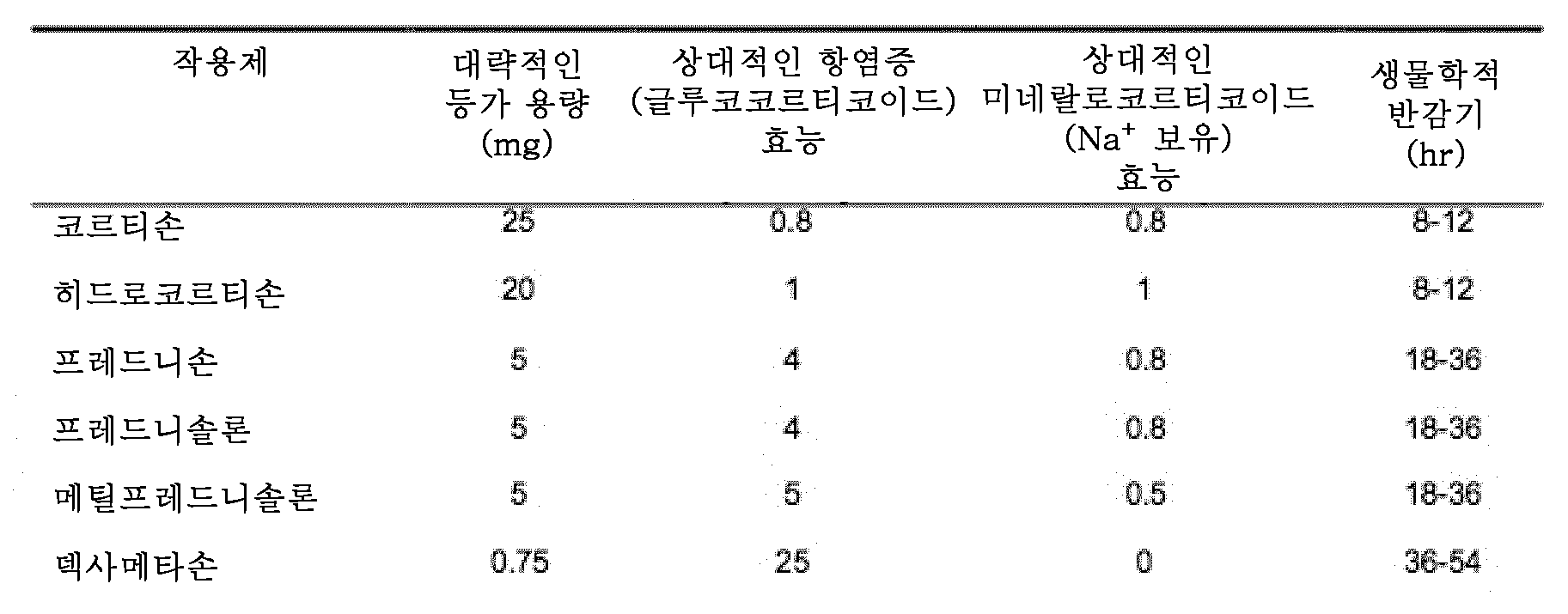
덱사메타손은 또한 악성 중추신경계(CNS) 질환(예를 들어, CNS 림프종 또는 뇌 전이)에 유익한 효과가 있다 - 아마도 CNS로의 특이적 침투에 기인하는 듯. 덱사메타손은 또한 뇌부종의 치료에 (다른 스테로이드에 비해) 우선적으로 사용된다. 비록 코르티코스테로이드는 종양 자체에서 모세혈관 투과성을 감소시키지만, 동물 모델에서는 덱사메타손이 다르게 작용하고 종양으로부터 떨어져서 벌크 유동에 미치는 영향에 의해 부종을 감소시킬 수 있음이 발견되었다(Molnar, Lapin, & Goothuis, 1995, Neurooncol. 1995; 25(1):19-28).Dexamethasone also has a beneficial effect on malignant central nervous system (CNS) diseases (eg, CNS lymphoma or brain metastasis)-probably due to specific penetration into the CNS. Dexamethasone is also used preferentially (compared to other steroids) in the treatment of brain edema. Although corticosteroids reduce capillary permeability in the tumor itself, it has been found in animal models that dexamethasone can act differently and reduce edema by the effect on bulk flow away from the tumor (Molnar, Lapin, & Goothuis, 1995). , Neurooncol. 1995; 25 (1): 19-28).
DLBCL에 의해 유발된 림프절 조직 및/또는 절외성(節外性) 림프종의 종양괴의 치료를 위한 CD19xCD3 이중특이적 단일쇄 항체의 적용과 관련한 임상시험을 위하여, 본 발명자들은 환자의 대부분에 의해 효율적이었고 잘 용인되는 치료처방을 개발하여야 하였다. 이런 목적을 달성하기 위해, 본 발명자들은 5/15/60 ㎍/m2/24h을 환자에 투여하였다는 점에서 CD19xCD3 이중특이적 단일쇄 항체의 단계적 적용을 적용하였다. 그렇게 하여, 악영향, 특히 신경학적/정신과적 사상이 숫적으로 감소하고, 개선 및 심지어는 예방될 수 있었다. 또한 CD19xCD3 이중특이적 단일쇄 항체의 단계적 투여에는 환자의 치료 지속기간 동안 5/15 ㎍/m2/24h, 5/60 ㎍/m2/24h, 또는 15/60 ㎍/m2/24h와 같은 투여량의 두 가지를 사용하는 치료처방이 고려된다. 적정 투여량은 환자에서의 악영향을 최소로 하면서 효능, 인용성 및 안전성을 토대로 임상의에 의해 선택될 수 있다.For clinical trials involving the application of CD19xCD3 bispecific single-chain antibodies for the treatment of tumor masses of lymph node tissue and / or ectopic lymphoma induced by DLBCL, the inventors have found that And well-tolerated treatment regimens had to be developed. To achieve this goal, the inventors applied a stepwise application of CD19 × CD3 bispecific single chain antibodies in that 5/15/60 μg / m 2 / 24h was administered to the patient. In doing so, adverse effects, in particular neurological / psychiatric thought, could be reduced numerically, improved and even prevented. In addition, stepwise administration of CD19xCD3 bispecific single-chain antibodies may include 5/15 μg / m 2 / 24h, 5/60 μg / m 2 / 24h, or 15/60 μg / m 2 / 24h for the duration of the patient's treatment. Treatment regimens using two dosages are contemplated. Appropriate dosages can be selected by the clinician based on efficacy, citation and safety with minimal adverse effects in the patient.
그러나 본 발명자들은 또한 후속 고-용량으로의 용량 점증없이 평탄 용량(flat dose)의 연속 투여를 포함하기 위한, DLBCL에 의해 유발된 림프절 조직 및/또는 절외성 림프종의 종양괴의 치료를 고려한다. 예를 들어, 본 치료처방은 양호한 인용성과 악영향 없이 8주[56일]까지의 치료 과정의 종결시까지, 및 더 나아가서는 안전하고 유효하다고 결정되면 좀더 장기간 동안 5 ㎍/m2/24h, 15 ㎍/m2/24h, 또는 60 ㎍/m2/24h의 CD19xCD3 이중특이적 단일쇄 항체의 투여를 포함한다.However, we also contemplate the treatment of tumor masses of lymph node tissue and / or excisional lymphoma caused by DLBCL to include continuous administration of flat doses without increasing dose to subsequent high-dose. For example, this treatment regimen may be used for up to 5 μg / m 2 / 24h, 15 for longer periods of time until the conclusion of the course of treatment up to 8 weeks [56 days] without further good citation and adverse effects, and furthermore if it is determined to be safe and effective. Administration of a CD19 × CD3 bispecific single chain antibody at μg / m 2 / 24h, or 60 μg / m 2 / 24h.
본원 개시의 용량의 각각은 각각의 용량에 계수 1.9를 곱함으로써 (㎍/m2/d)으로 나타낸 양에서 ㎍/d으로 환산할 수 있는 것이 일반적으로 바람직하다. 따라서, 본원 개시 용량의 각각이 거기에 계수 1.9를 곱함으로써 그 방법과 용도에 적용될 수 있다. 예를 들어, 5 ㎍/m2/d의 용량은 9.5 ㎍/d으로 환산되고, 15 ㎍/m2/d의 용량은 28.5 ㎍/d로 환산되고, 60 ㎍/m2/d의 용량은 114 ㎍/d로 환산된다. 곱셈으로부터 생기는 10진수는 각각 정수가 되도록 우수리가 없게 잘라올림되거나 또는 잘라내림되는 것이 바람직하다. 예를 들어, 9.5 ㎍/d의 용량은 9 ㎍/d로 우수리 잘라내림될 수 있고, 28.5 ㎍/d의 용량은 28 ㎍/d로 우수리 잘라내림될 수 있다. 마찬가지로, 9.5 ㎍/d의 용량은 10 ㎍/d로 우수리 잘라올림될 수 있고, 28.5 ㎍/d의 용량은 29 ㎍/d로 우수리 잘라올림될 수 있다.It is generally preferred that each of the doses of the present disclosure can be converted to μg / d in the amount indicated by (μg / m 2 / d) by multiplying each dose by a factor of 1.9. Thus, each of the disclosed doses can be applied to the method and the application by multiplying it by a factor of 1.9. For example, the dose of 5 μg / m 2 / d is converted to 9.5 μg / d, and the dose of 15 μg / m 2 / d is The dose of 28.5 μg / d and the dose of 60 μg / m 2 / d are converted to 114 μg / d. The decimal number resulting from the multiplication is preferably truncated or truncated so that each is an integer. For example, a dose of 9.5 μg / d can be truncated to 9 μg / d and a dose of 28.5 μg / d Ussalis can be cut to 28 μg / d. Likewise, a dose of 9.5 μg / d can be truncated to 10 μg / d and a dose of 28.5 μg / d It can be truncated to 29 μg / d.
용어 "제약상 허용되는 유도체"는 그의 염, 에스테르, 엔올 에테르, 엔올 에스테르, 아세탈, 케탈, 오르토에스테르, 헤미아세탈, 헤미케탈, 산, 염기, 용매화물, 수화물 또는 전구약물을 포함한다. 그러한 유도체는 그러한 유도체화를 위한 공지의 방법을 이용하여 당업자에 의해 쉽사리 제조될 수 있다.The term “pharmaceutically acceptable derivatives” includes salts, esters, enol ethers, enol esters, acetals, ketals, orthoesters, hemiacetals, hemiketals, acids, bases, solvates, hydrates or prodrugs thereof. Such derivatives can be readily prepared by those skilled in the art using known methods for such derivatization.
본 발명의 실시양태에 따라 사용될 GC의 용량은 제한이 없으며, 즉, 개별 환자의 상황에 따라 결정될 것이다. GC는 정맥내 또는 경구 투여될 수 있다. 그러나 GC의 바람직한 투여량은 40 mg/d(덱사메타손 상당량)까지 투약의 하한으로 하여 1 내지 6 mg(덱사메타손 상당량)을 포함한다. 상기 투여량은 한꺼번에 전부 투여될 수 있거나 또는 좀더 적은 투여량으로 세분될 수 있다(첨부 실시예 참조). 특히 바람직한 것은 4 내지 24 mg/d의 투여량이다. 4, 8, 12, 16, 20 또는 24 mg/d의 1일 투여량이 한층 더 바람직하다. 1 x 4 mg/일, 2 x 4 mg/일, 1 x 8 mg/일; 1x4 mg + 1x8 mg/일, 2 x 8 mg/일, 2 x 10 mg/일 또는 5 x 4 mg/일 및 3 x 8 mg/일의 덱사메타손 투여량이 특히 바람직하다. "d"는 1일을 의미한다. 추가의 투여량 처방은 첨부 실시예로부터 유도해낼 수 있다. 이 단락에서 주어진 모든 투여량은 덱사메타손 상당량을 말한다.The dose of GC to be used according to an embodiment of the present invention is not limited, i.e., it will depend on the situation of the individual patient. GC may be administered intravenously or orally. However, preferred dosages of GC include 1 to 6 mg (equivalent to dexamethasone) as the lower limit of dosing up to 40 mg / d (equivalent to dexamethasone). The dosages may be administered all at once or subdivided into smaller dosages (see attached example). Especially preferred are dosages of 4 to 24 mg / d. A daily dosage of 4, 8, 12, 16, 20 or 24 mg / d is even more preferred. 1 x 4 mg / day, 2 x 4 mg / day, 1 x 8 mg / day; Particularly preferred are dexamethasone doses of 1 × 4 mg + 1 × 8 mg / day, 2 × 8 mg / day, 2 × 10 mg / day or 5 × 4 mg / day and 3 × 8 mg / day. "d" means 1 day. Additional dosage regimens may be derived from the accompanying examples. All doses given in this paragraph refer to significant amounts of dexamethasone.
종종 "부작용" 또는 "유해 사례"(임상 연구에서)로도 표시되고 있는 "악영향"이란 CD3 결합 도메인으로 환자의 치료시에 투약으로 발생하는 유해하고 원치않는 영향이다. 종종 신경학적 증상 또는 CNS 악영향으로도 표시되고 있는 "신경학적/정신과적 악영향"으로는 두통 및 요통을 비롯한 모든 형태의 통증, 근쇠약 또는 근협조부전, 피부에서의 지각이상, 및 감각장애, 발작, 뇌병증, 뇌부종, 혼란, 운동실조, 언어장애, 환각, 행위상실증, 부전마비, 진전, 두통, 또는 방향감각상실과 같은 인간 환자의 상태를 포함한다. 본원에서 사용되는 바와 같은 신경학적 영향은 바람직하게는 정신과적 악영향을 포함한다. 그러나, 종종 용어 "신경학적 악영향" 및 "정신과적 악영향"은 상호교환적으로 사용될 수 있다.Often referred to as "side effects" or "hazardous cases" (in clinical studies), "adverse effects" are deleterious and unwanted effects arising from dosing in the treatment of patients with CD3 binding domains. Often referred to as neurological symptoms or adverse effects on the CNS, “neurologic / psychiatric adverse effects” include all forms of pain, muscle weakness or muscular coordination, paresthesia in the skin, and sensory disorders, seizures, Conditions of human patients such as encephalopathy, cerebral edema, confusion, ataxia, speech impairment, hallucinations, loss of behavior, dyspareunia, tremor, headache, or disorientation. Neurological effects as used herein preferably include psychiatric adverse effects. However, often the terms "neurologic adverse effects" and "psychiatric adverse effects" can be used interchangeably.
구체적으로, CD3 결합 도메인으로의 치료중에 관찰되는 신경학적/정신과적 반응은 예를 들어, 혼란 및 방향감각상실을 포함한다. 본원에서 사용되는 "혼란"이란 용어는 시간, 위치와 개인의 신원, 및 종종 과거 사건을 정확하게 생각해 내거나 또는 새로운 것을 배우는 능력인 기억력에 의하여 자신을 세상속에 정확하게 배치하는 능력인 정위력(定位力)의 상실을 말한다. 환자는 대개는 집중하는 데에 어려움을 겪으며, 사고는 흐릿하고 불분명할 뿐만 아니라 종종 현저하게 둔화된다. 신경학적/정신과적 반응을 보이는 환자는 또한 기억 상실로도 고생한다. 빈번하게, 혼란은 사람 및/또는 장소의 인지능력, 또는 시간 및 날짜의 식별능력의 상실을 초래한다. 방향감각상실의 감정은 혼란에서 공통이며, 의사결정능력이 손상된다. 신경학적 반응은 불분명발음 및/또는 단어찾기의 어려움을 추가로 포함한다. 이러한 장애는 언어의 표현과 이해 및 읽기와 쓰기 모두에 손상을 줄 수 있다. 요실금 외에도, 일부 환자에서의 신경학적 반응은 또한 현기증 및 어지러움을 동반할 수 있다.Specifically, neurological / psychiatric responses observed during treatment with CD3 binding domains include, for example, confusion and disorientation. As used herein, the term "confusion" refers to stereotype, the ability to accurately place one's world in the world by time, location, and the identity of the individual, and often by the ability to accurately recall past events or learn new things. Says loss of. Patients often have difficulty concentrating, and accidents are not only blurry and unclear, but also often slow significantly. Patients with neurological / psychological responses also suffer from memory loss. Frequently, confusion results in loss of cognition of people and / or places, or discernment of time and date. Feelings of disorientation are common in confusion and impair decision-making. Neurological responses further include difficulty with unambiguous pronunciation and / or word finding. These disorders can impair the expression and understanding of language and both reading and writing. In addition to urinary incontinence, neurological reactions in some patients may also be accompanied by dizziness and dizziness.
본원에서 언급되는 "환자"는 CD3 결합 도메인으로 치료받을 예정이거나 또는 (이미) 치료받고 있는 포유동물, 바람직하게는 인간이다.A “patient” as referred to herein is a mammal, preferably a human, who is to be (or already) being treated with a CD3 binding domain.
환자는 1:5 미만의 B/T 세포비를 특징으로 함이 또한 구상된다(PCT/EP2010/066207 참조).It is also envisioned that the patient is characterized by a B / T cell ratio of less than 1: 5 (see PCT / EP2010 / 066207).
바람직한 실시양태에서, 환자는 악성 CD19+ 림프구(특히, B세포)를 포함하는 것으로 추정/가정되거나 또는 이미 포함하고 있다. 후자의 경우에, 상기 환자는 그러한 세포를 포함하는 것으로 이미 진단을 받았다. 이들 악성 CD19+ 림프구(특히, B세포)는 백혈병 및/또는 림프종이 발병하고/하거나 이들 질환을 앓고 있는 환자에 존재한다.In a preferred embodiment, the patient is presumed or already contains malignant CD19 + lymphocytes (especially B cells). In the latter case, the patient has already been diagnosed as containing such cells. These malignant CD19 + lymphocytes (especially B cells) are present in patients with leukemia and / or lymphoma and / or suffering from these diseases.
"CD3 결합 도메인"은 본 발명과 관련하여, 프레임워크 영역 및 CD3 항원과 특이적으로 상호작용할 수 있는 "항원-결합 부위" 또는 "항원-상호작용 부위"를 포함하는 결합 도메인을 특징으로 한다. 상기 결합/상호작용은 또한 "특이적 인식"을 정의하는 것으로 이해된다. 용어 "특이적으로 상호작용한다/상호작용하는"이란 본 발명에 따르면 결합 도메인이 CD3 항원, 바람직하게는 CD3엡실론 항원, 더욱 바람직하게는 인간 CD3엡실론 항원의 적어도 2개, 바람직하게는 적어도 3개, 더욱 바람직하게는 적어도 4개 아미노산과 결합할 수 있음을 의미한다. 그러한 CD3 결합 도메인 및 특이적 CD3엡실론 에피토프는 당업자에 주지이고, 예를 들어 WO2008119567에 또는 WO2008119566에 상세히 예시되어 있으며, 이들 두 문헌 모두는 본원에 그에 대한 참고로 포함된다."CD3 binding domain" is characterized in the context of the present invention by a binding domain comprising a framework region and an "antigen-binding site" or "antigen-interacting site" capable of specific interaction with the CD3 antigen. Such binding / interaction is also understood to define "specific recognition". The term "specifically interacts / interacts" according to the invention means that the binding domain comprises at least two, preferably at least three, CD3 antigens, preferably CD3 epsilon antigens, more preferably human CD3 epsilon antigens. More preferably at least 4 amino acids. Such CD3 binding domains and specific CD3 epsilon epitopes are well known to those skilled in the art and are for example exemplified in detail in WO2008119567 or WO2008119566, both of which are incorporated herein by reference.
본원에서 사용되는 바와 같이, "CD3"는 T세포 수용체의 일부로서 발현되는 분자를 표시하며, 종래기술에서 전형적으로 거기에 속한다고 여겨지는 바의 의미를 갖는다. 인간의 경우에, CD3는 개별적으로 또는 독립적으로 조합된 형태로 모든 공지의 CD3 서브유닛, 예를 들어 CD3 엡실론, CD3 델타, CD3 감마, CD3 제타, CD3 알파 및 CD3 베타를 포함한다. 인간 CD3 엡실론은 진뱅크 등록번호 NM_000733로 표시된다.As used herein, "CD3" refers to a molecule that is expressed as part of a T cell receptor and has the meaning as typically considered to belong therein in the prior art. In humans, CD3 includes all known CD3 subunits, such as CD3 epsilon, CD3 delta, CD3 gamma, CD3 zeta, CD3 alpha and CD3 beta, either individually or independently in combined form. Human CD3 epsilon is indicated by GenBank Accession No. NM_000733.
인간 CD3 엡실론에 결합하는 CD3 결합 분자가 바람직하다. WO2008119567에 또는 WO2008119566에 상세히 개시된 CD3엡실론 에피토프가 한층 더 바람직하다.Preference is given to CD3 binding molecules that bind to human CD3 epsilon. Even more preferred are the CD3 epsilon epitopes disclosed in detail in WO2008119567 or WO2008119566.
용어 "프레임워크"는 항원-결합 부위에 대한 골격을 포함한다. 예를 들어, 그러한 골격은 단백질 A, 특히 그의 Z-도메인 (어피바디, affibody), ImmE7 (면역 단백질), BPTI/APPI (쿤니츠, Kunitz 도메인), Ras-결합 단백질 AF-6 (PDZ 도메인), 카리브도톡신 (전갈 독소), CTLA-4, Min-23 (크노틴, knottin), 리포칼린 (안티칼린), 네오카르지노스타틴, 피브로넥틴 도메인, 안키린 컨센서스 반복(consensus repeat) 도메인 또는 티오레독신(Skerra, Curr. Opin. Biotechnol. 18, 295-304 (2005); Hosse et al., Protein Sci. 15, 14-27 (2006); Nicaise et al., Protein Sci. 13, 1882-1891 (2004); 및 Nygren and Uhlen, Curr. Opin. Struc. Biol. 7, 463-469 (1997))에 의해 제공될 수 있다.The term "framework" includes the backbone for the antigen-binding site. For example, such a backbone is protein A, in particular its Z-domain (affibody), ImmE7 (immune protein), BPTI / APPI (Kunitz, Kunitz domain), Ras-binding protein AF-6 (PDZ domain) , Caribdotoxin (scorpion toxin), CTLA-4, Min-23 (knottin, knottin), lipocalin (anticalin), neocarcinostatin, fibronectin domain, ankyrin consensus repeat domain or thiore Single (Skerra, Curr. Opin. Biotechnol. 18, 295-304 (2005); Hosse et al., Protein Sci. 15, 14-27 (2006); Nicaise et al., Protein Sci. 13, 1882-1891 ( 2004) and Nygren and Uhlen, Curr. Opin. Struc. Biol. 7, 463-469 (1997).
바람직한 "프레임워크"는 본 발명의 문맥에서, 항체의 가변 영역내 좀더 발산하는(즉, 초가변적인) 상보성 결정영역(CDR) 사이에 존재하는 항체 가변 영역의 당해기술 분야에서 승인되어 있는(art-recognized) 부분이다. 그러한 프레임워크 영역은 통상적으로 프레임워크 1 내지 4(FR1, FR2, FR3, 및 FR4)로서 호칭되며, 항원-결합 표면을 형성하기 위하여 3차원 공간에 6개 CDR(3개는 중쇄로부터 및 나머지 3개는 경쇄로부터)의 제시를 위한 골격을 제공한다.Preferred "framework" is, in the context of the present invention, approved in the art of antibody variable regions existing between more divergent (ie, hypervariable) complementarity determining regions (CDRs) within the variable regions of the antibody (art -recognized) part. Such framework regions are commonly referred to as frameworks 1 to 4 (FR1, FR2, FR3, and FR4), with six CDRs (three from the heavy chain and three from the heavy chain) to form an antigen-binding surface. The dog provides a framework for the presentation of the light chain).
본 발명과 부합하는 CD3 결합 도메인의 바람직한 예는 항체이다. 결합 도메인은 모노클로날 또는 폴리클로날 항체일 수 있거나 또는 모노클로날 또는 폴리클로날 항체로부터 유도될 수 있다. 용어 "항체"는 여전히 결합 특이성을 보유하고 있는 그의 유도체 또는 기능성 단편을 포함한다. 항체의 생성 기술은 당업계에 주지이고, 예를 들어 문헌[Harlow and Lane "Antibodies, A Laboratory Manual", Cold Spring Harbor Laboratory Press, 1988 and Harlow and Lane "Using Antibodies: A Laboratory Manual" Cold Spring Harbor Laboratory Press, 1999]에 기재되어 있다. 용어 "항체"는 또한 상이한 클래스(즉, IgA, IgG, IgM, IgD 및 IgE) 및 서브클래스(예컨대, IgG1, IgG2 등)의 면역글로불린(Ig)을 포함한다.Preferred examples of CD3 binding domains consistent with the invention are antibodies. The binding domain can be a monoclonal or polyclonal antibody or can be derived from a monoclonal or polyclonal antibody. The term “antibody” includes derivatives or functional fragments thereof that still retain binding specificity. Techniques for generating antibodies are well known in the art and are described, for example, in Harlow and Lane "Antibodies, A Laboratory Manual", Cold Spring Harbor Laboratory Press, 1988 and Harlow and Lane "Using Antibodies: A Laboratory Manual" Cold Spring Harbor Laboratory Press, 1999. The term “antibody” also includes immunoglobulins (Ig) of different classes (ie, IgA, IgG, IgM, IgD and IgE) and subclasses (eg, IgG1, IgG2, etc.).
용어 "항체"의 정의는 또한 키메라, 일본쇄, 탈면역화 및 인간화 항체와, 그중에서도 Fab 단편같은 항체 단편과 같은 양태를 포함한다. 항체 단편 또는 유도체는 F(ab')2, Fv, scFv 단편 또는 단일 도메인 항체, 단일 가변 도메인 항체 또는 다른 V 영역 또는 도메인과는 무관하게 항원 또는 에피토프에 특이적으로 결합하는, VH 또는 VL일 수 있는 오직 하나의 가변 도메인만을 포함하는 면역글로불린 단일 가변 도메인을 추가로 포함한다; 예를 들어, 상기 문헌[Harlow and Lane (1988) and (1999)] 참조. 그러한 면역글로불린 단일 가변 도메인은 단리 항체 단일 가변 도메인 폴리펩티드뿐만 아니라, 항체 단일 가변 도메인 폴리펩티드 서열의 하나 이상의 모노머를 포함하는 대형 폴리펩티드도 포함한다.The definition of the term “antibody” also includes embodiments such as chimeric, single-chain, de-immunized and humanized antibodies, and antibody fragments such as Fab fragments, among others. The antibody fragment or derivative may be a VH or VL that specifically binds to an antigen or epitope independent of F (ab ′) 2, Fv, scFv fragment or single domain antibody, single variable domain antibody or other V region or domain. Further comprises an immunoglobulin single variable domain comprising only one variable domain present; See, eg, Harlow and Lane (1988) and (1999), supra. Such immunoglobulin single variable domains include isolated antibody single variable domain polypeptides, as well as large polypeptides comprising one or more monomers of an antibody single variable domain polypeptide sequence.
이중특이적 항체 포맷이 바람직하지만; 다른 다중특이적 항체 포맷(삼중특이적, 테트라바디 등)이 배제되지는 않는다.Bispecific antibody formats are preferred; Other multispecific antibody formats (trispecific, tetrabody, etc.) are not excluded.
추가의 바람직한 실시양태에서, 본 발명은 인간 CD3 엡실론 쇄의 에피토프에 결합할 수 있는 제1 결합 도메인 및 인간 CD19에 결합할 수 있는 제2 결합 도메인을 포함하는 CD19xCD3 이중특이적 항체를 채용하는 치료/투여량 처방의 방법에 관한 것이다. 본 발명의 방법에 따른 이중특이적 분자에 대한 예는 WO 99/54440 및 WO 2004/106381 및 WO 2008/119565에 상세히 기재되어 있다. 거기에 개시된 모든 특정 CD19xCD3 이중특이적 항체는 그들의 변이체, 단편, 등가물 등을 포함하여 본 발명의 특히 바람직한 CD19xCD3 이중특이적 항체이다.In a further preferred embodiment, the invention provides a treatment / adoption of a CD19 × CD3 bispecific antibody comprising a first binding domain capable of binding to an epitope of human CD3 epsilon chain and a second binding domain capable of binding to human CD19 To a method of dosage formulation. Examples of bispecific molecules according to the methods of the present invention are described in detail in WO99 / 54440 and WO # 2004/106381 and WO # 2008/119565. All specific CD19xCD3 bispecific antibodies disclosed therein are particularly preferred CD19xCD3 bispecific antibodies of the present invention, including variants, fragments, equivalents, and the like.
본원에서 사용되는 바와 같이, "CD19xCD3 이중특이적 항체"(CD19xCD3 이중특이적 단일쇄 항체 포함)는 두 개의 결합 도메인을 포함하는 단일 폴리펩티드 쇄를 의미한다. 그러한 일본쇄 항체가 본 발명의 방법/투여량 처방과 관련하여 바람직하다. 각각의 결합 도메인은 항체 중쇄로부터의 적어도 하나의 가변 영역("VH 또는 H 영역")을 포함하며, 여기서 제1 결합 도메인의 VH 영역은 CD3 엡실론 분자에 특이적으로 결합하고, 제2 결합 도메인의 VH 영역은 CD19에 특이적으로 결합한다. 두 결합 도메인은 임의로는 단형 폴리펩티드 스페이서에 의해 상호 연결된다. 폴리펩티드 스페이서에 대한 비-제한적인 예는 Gly-Gly-Gly-Gly-Ser (G-G-G-G-S) 및 그의 반복체이다. 각각의 결합 도메인은 항체 경쇄로부터의 하나의 가변 영역("VL 또는 L 영역")을 추가로 포함할 수 있으며, 제1 및 제2 결합 도메인의 각각 내의 VH 영역 및 VL 영역은 예를 들어 EP 623679 B1에 개시되고 권리주장되는 유형의 폴리펩티드 링커를 통해 상호 연결되지만, 어떠한 경우에도 제1 결합 도메인의 VH 영역과 VL 영역 및 제2 결합 도메인의 VH 영역과 VL 영역이 상호간에 쌍을 이루도록 허용하기에 충분히 길어서, 함께 그들은 각각의 제1 및 제2 결합 도메인에 특이적으로 결합할 수 있게 된다. 그러한 CD19xCD3 이중특이적 단일쇄 항체는 WO 99/54440 및 WO 2004/106381에 상세히 기술되어 있다.As used herein, “CD19 × CD3 bispecific antibody” (including a CD19 × CD3 bispecific single chain antibody) refers to a single polypeptide chain comprising two binding domains. Such single chain antibodies are preferred in connection with the method / dose regimens of the present invention. Each binding domain comprises at least one variable region (“VH or H region”) from the antibody heavy chain, wherein the VH region of the first binding domain specifically binds to the CD3 epsilon molecule and that of the second binding domain The VH region specifically binds CD19. The two binding domains are optionally interconnected by a single polypeptide spacer. Non-limiting examples for polypeptide spacers are Gly-Gly-Gly-Gly-Ser (G-G-G-G-S) and repeats thereof. Each binding domain may further comprise one variable region (“VL or L region”) from the antibody light chain, wherein the VH and VL regions in each of the first and second binding domains are described, for example, in EP 623679. Interconnected via a polypeptide linker of the type disclosed and claimed in B1, but in any case allowing the VH and VL regions of the first binding domain and the VH and VL regions of the second binding domain to be paired with each other Long enough, together they are able to specifically bind their respective first and second binding domains. Such CD19 × CD3 bispecific single chain antibodies are described in detail in WO 99/54440 and WO 2004/106381.
인간 CD19 단백질은 진뱅크 등록번호 AAA69966로 표시된다.Human CD19 protein is represented by GenBank Accession No. AAA69966.
바람직하게는, 본 발명의 방법/투여량 처방에 적용되는 이중특이적 항체는 도메인 배열 VL(CD19)-VH(CD19)-VH(CD3)-VL(CD3)을 갖는다.Preferably, the bispecific antibodies applied to the methods / dose regimens of the invention have a domain arrangement VL (CD19) -VH (CD19) -VH (CD3) -VL (CD3).
그러나, 본 발명의 방법은 하기와 같은 다른 도메인 배열의 CD19xCD3 이중특이적 단일쇄 항체로 수행될 수 있음이 또한 구상된다:However, it is also envisioned that the methods of the present invention can be performed with CD19 × CD3 bispecific single chain antibodies in other domain arrangements as follows:
VH(CD19)-VL(CD19)-VH(CD3)-VL(CD3),VH (CD19) -VL (CD19) -VH (CD3) -VL (CD3),
VL(CD19)-VH(CD19)-VL(CD3)-VH(CD3),VL (CD19) -VH (CD19) -VL (CD3) -VH (CD3),
VH(CD19)-VL(CD19)-VL(CD3)-VH(CD3),VH (CD19) -VL (CD19) -VL (CD3) -VH (CD3),
VL(CD3)-VH(CD3)-VH(CD19)-VL(CD19),VL (CD3) -VH (CD3) -VH (CD19) -VL (CD19),
VH(CD3)-VL(CD3)-VH(CD19)-VL(CD19),VH (CD3) -VL (CD3) -VH (CD19) -VL (CD19),
VL(CD3)-VH(CD3)-VL(CD19)-VH(CD19), 또는VL (CD3) -VH (CD3) -VL (CD19) -VH (CD19), or
VH(CD3)-VL(CD3)-VL(CD19)-VH(CD19).VH (CD3) -VL (CD3) -VL (CD19) -VH (CD19).
본 발명의 방법에 적용되는 바람직한 CD19xCD3 이중특이적 항체는:Preferred CD19xCD3 bispecific antibodies applied to the methods of the invention are:
(a) 서열 11(RYTMH), 더욱 바람직하게는 서열 11(GYTFTRYTMH)에 CD3 CDR-H1, 서열 12(YINPSRGYTNYNQKFKD)에 CD3 CDR-H2 및 서열 13(YYDDHYCLDY)에 CD3 CDR-H3로서 나타낸 중쇄의 항-CD3 CDR; 및/또는(a) the term of the heavy chain shown as CD3 CDR-H1 in SEQ ID NO: 11 (RYTMH), more preferably in SEQ ID NO: 11 (GYTFTRYTMH), CD3 CDR-H2 in SEQ ID NO: 12 (YINPSRGYTNYNQKFKD) and CD3 CDR-H3 in SEQ ID NO: 13 (YYDDHYCLDY) CD3 CDR; And / or
(b) 서열 14(RASSSVSYMN)에 CD3 CDR-L1, 서열 15(DTSKVAS)에 CD3 CDR-L2 및 서열 16(QQWSSNPLT)에 CD3 CDR-L3로서 나타낸 경쇄의 항-CD3 CDR; 및/또는(b) the anti-CD3 CDR of the light chain shown as CD3 CDR-L1 in SEQ ID NO: 14 (RASSSVSYMN), CD3 CDR-L2 in SEQ ID NO: 15 (DTSKVAS) and CD3 CDR-L3 in SEQ ID NO: 16 (QQWSSNPLT); And / or
(c) 서열 17(SYWMN), 더욱 바람직하게는 서열 17(GYAFSSYWMN)에 CD19 CDR-H1, 서열 18(QIWPGDGDTNYNGKFKG)에 CD19 CDR-H2 및 서열 19(RETTTVGRYYYAMDY)에 CD19 CDR-H3로서 나타낸 중쇄의 항-CD19 CDR; 및/또는(c) an anti-heavy chain of CD19 CDR-H1 in SEQ ID NO: 17 (SYWMN), more preferably SEQ ID NO: 17 (GYAFSSYWMN), CD19 CDR-H2 in SEQ ID NO: 18 (QIWPGDGDTNYNGKFKG) and CD19 CDR-H3 in SEQ ID NO: 19 (RETTTVGRYYYAMDY) CD19 CDR; And / or
(d) 서열 20(KASQSVDYDGDSYLN)에 CD19 CDR-L1, 서열 21(DASNLVS)에 CD19 CDR-L2 및 서열 22(QQSTEDPWT)에 CD19 CDR-L3로서 나타낸 경쇄의 항-CD19 CDR을 포함한다.(d) an anti-CD19 CDR of light chain shown as CD19 CDR-L1 in SEQ ID NO: 20 (KASQSVDYDGDSYLN), CD19 CDR-L2 in SEQ ID NO: 21 (DASNLVS) and CD19 CDR-L3 in SEQ ID NO: 22 (QQSTEDPWT).
본 발명의 방법에 적용된 CD19xCD3 이중특이적 항체는 중쇄 및 경쇄의 CD3 CDR을 포함하는 것이 더욱 바람직하다. 한층 더 바람직하게는, 본 발명의 방법에 적용되는 CD19xCD3 이중특이적 항체는 중쇄 및 경쇄의 CD3 CDR과 중쇄 및 경쇄의 CD19 CDR을 포함한다.More preferably, the CD19 × CD3 bispecific antibodies applied in the methods of the invention comprise CD3 CDRs of the heavy and light chains. Even more preferably, the CD19 × CD3 bispecific antibody applied to the method of the present invention comprises CD3 CDRs of heavy and light chains and CD19 CDRs of heavy and light chains.
본원에서 언급되는 CDR은 카바트(Kabat) 번호부여 시스템에 준한다. 카바트 번호부여 체계는 일관된 방법으로 항체중의 잔기에 번호를 부여하기 위한 널리 채택되는 표준이다(Kabat et al., Sequences of Proteins of Immunological Interest, 1991).CDRs referred to herein are in accordance with the Kabat numbering system. The Kabat numbering scheme is a widely adopted standard for numbering residues in antibodies in a consistent manner (Kabat et al., Sequences of Proteins of Immunological Interest, 1991).
이와 달리, 본 발명의 방법에 적용되는 CD19xCD3 이중특이적 항체는:In contrast, the CD19 × CD3 bispecific antibodies applied to the methods of the invention are:
(a) 서열 3에 나타낸 CD19 가변 중쇄(뉴클레오티드 서열은 서열 4에 나타내었다); 및/또는(a) the CD19 variable heavy chain shown in SEQ ID NO: 3 (nucleotide sequence is shown in SEQ ID NO: 4); And / or
(b) 서열 5에 나타낸 CD19 가변 경쇄(뉴클레오티드 서열은 서열 6에 나타내었다); 및/또는(b) the CD19 variable light chain shown in SEQ ID NO: 5 (nucleotide sequence is shown in SEQ ID NO: 6); And / or
(c) 서열 7에 나타낸 CD3 가변 중쇄(뉴클레오티드 서열은 서열 8에 나타내었다); 및/또는(c) the CD3 variable heavy chain shown in SEQ ID NO: 7 (nucleotide sequence is shown in SEQ ID NO: 8); And / or
(d) 서열 9에 나타낸 CD3 가변 경쇄(뉴클레오티드 서열은 서열 10에 나타내었다)를 포함하는 것이 바람직하다.(d) Preferably, the CD3 variable light chain shown in SEQ ID NO: 9 (nucleotide sequence is shown in SEQ ID NO: 10).
더욱 바람직하게는, 본 발명의 방법에 적용되는 CD19xCD3 이중특이적 항체는 CD19 가변 중쇄 및 경쇄 및/또는 CD3 가변 중쇄 및 경쇄를 포함한다. 한층 더 바람직하게는, 본 발명의 방법에 적용되는 CD19xCD3 이중특이적 항체는 CD19 가변 중쇄 및 경쇄와 CD3 가변 중쇄 및 경쇄를 포함한다.More preferably, the CD19 × CD3 bispecific antibodies applied to the methods of the invention comprise CD19 variable heavy and light chains and / or CD3 variable heavy and light chains. Even more preferably, the CD19 × CD3 bispecific antibodies applied to the methods of the invention include CD19 variable heavy and light chains and CD3 variable heavy and light chains.
또 다른 대안으로, 상기 이중특이적 단일쇄 항체는 하기 (a) 내지 (d)로 이루어진 그룹중에서 선택된 아미노산 서열을 포함하는 것이 또한 바람직하다:In another alternative, the bispecific single chain antibody also preferably comprises an amino acid sequence selected from the group consisting of (a) to (d):
(a) 서열 1에 나타낸 바와 같은 아미노산 서열;(a) an amino acid sequence as shown in SEQ ID NO: 1;
(b) 서열 2에 나타낸 바와 같은 핵산 서열에 의해 코딩된 아미노산 서열;(b) an amino acid sequence encoded by a nucleic acid sequence as shown in SEQ ID NO: 2;
(c) (b)의 핵산 서열과 적어도 70%, 80%, 90%, 95% 또는 99% 동일성을 갖는 핵산 서열에 의해 코딩된 아미노산 서열(여기서, 상기 아미노산 서열은 CD3 및 CD19에 특이적으로 결합할 수 있다); 및(c) an amino acid sequence encoded by a nucleic acid sequence having at least 70%, 80%, 90%, 95%, or 99% identity with the nucleic acid sequence of (b), wherein the amino acid sequence is specific for CD3 and CD19 Can be combined); And
(d) (b)의 뉴클레오티드 서열에 대한 유전암호의 결과로서 축퇴성인 핵산 서열에 의해 코딩된 아미노산 서열(여기서, 상기 아미노산 서열은 CD3 및 CD19에 특이적으로 결합할 수 있다).(d) an amino acid sequence encoded by a degenerate nucleic acid sequence as a result of the genetic code for the nucleotide sequence of (b), wherein said amino acid sequence may specifically bind CD3 and CD19.
당연한 얘기지만 서열 동일성은 전체 아미노산 서열에 걸쳐서 결정된다. 서열 정렬을 위해, 예를 들어, GCG 소프트웨어 패키지(제네틱스 컴퓨터 그룹, Genetics Computer Group, 미국(우편번호: 53711) 위스콘신주 매디슨 사이언스 드라이브 575 (1991)에 동봉되어 있는, 프로그램 갭(Gap) 또는 베스트핏(BestFit)이 사용될 수 있다(Needleman and Wunsch J. Mol. Biol. 48 (1970), 443-453; 및 Smith and Waterman, Adv. Appl. Math 2 (1981), 482-489). 당업자가 본원 기재의 CD19xCD3 이중특이적 항체(바람직하게는 MT103)의 아미노산 서열과 예를 들어 70%, 80%, 90%, 95%, 96%, 97%, 98% 또는 99% 서열 동일성을 갖는 아미노산 서열을 결정 및 확인하는 것은 일상적인 방법이다. 예를 들어, 크릭 우블(Crick's Wobble) 가설에 따르면, 안티코돈상의 5' 염기는 다른 두 염기만큼 공간적으로 제한되지는 않으며, 따라서 비-표준 염기쌍을 가질 수 있다. 바꿔 말하면: 코돈 트리플릿(codon triplet)에서의 세번째 위치는 변동될 수 있어서 이 세번째 위치에서 상이한 두 트리플릿이 동일한 아미노산 잔기를 코딩할 수 있다. 상기 가설은 당업자에 주지이다(예를 들어, http://en.wikipedia.org/wiki/Wobble_Hypothesis; Crick, J Mol Biol 19 (1966): 548-5 참조). 또한 당업자가 본원 기재의 CD19xCD3 이중특이적 단일쇄 항체의 뉴클레오티드 또는 아미노산 서열과 예를 들어 70%, 80%, 90%, 95%, 96%, 97%, 98% 또는 99% 서열 동일성을 갖는 그러한 아미노산 서열의 세포독성을 측정하는 것도 일상적인 절차이다. CD19xCD3 이중특이적 단일쇄 항체 또는 CD19xCD3 이중특이적 단일쇄 항체의 아미노산 서열과 예를 들어 70%, 80%, 90%, 95%, 96%, 97%, 98% 또는 99% 서열 동일성을 갖는 항체 구축물의 세포독성은 예를 들어 WO 99/54440에 설명된 바와 같은 방법에 의해 측정될 수 있다.Naturally, sequence identity is determined over the entire amino acid sequence. For sequence alignment, for example, the GCG software package (Genetics Computer Group, Genetics Computer Group, USA (zip code: 53711), Wisconsin, Madison Science Drive 575 (1991), program gap or best fit. BestFit can be used (Needleman and Wunsch J. Mol. Biol. 48 (1970), 443-453; and Smith and Waterman, Adv. Appl. Math 2 (1981), 482-489). Determine an amino acid sequence having, for example, 70%, 80%, 90%, 95%, 96%, 97%, 98% or 99% sequence identity with the amino acid sequence of a CD19xCD3 bispecific antibody (preferably MT103) And identification is a routine method, for example, according to the Crick's Wobble hypothesis, that the 5 'base on the anticodon is not as spatially limited as the other two bases and can therefore have non-standard base pairs. In other words: three in a codon triplet The second position can be varied so that two different triplets at this third position can encode the same amino acid residues The hypothesis is well known to those skilled in the art (eg, http://en.wikipedia.org/wiki/Wobble_Hypothesis; Crick). (See also J Mol Biol 19 (1966): 548-5.) Also one skilled in the art would appreciate the nucleotide or amino acid sequences of the “CD19 × CD3 bispecific single chain antibodies described herein, for example 70%, 80%, 90%, 95%, 96 Measuring the cytotoxicity of such amino acid sequences with%, 97%, 98% or 99% sequence identity is also a routine procedure.Amino acid sequences and examples of CD19xCD3 bispecific single chain antibodies or CD19xCD3 bispecific single chain antibodies are also routine procedures. Cytotoxicity of antibody constructs having, for example, 70%, 80%, 90%, 95%, 96%, 97%, 98% or 99% sequence identity is measured by methods as described, for example, in WO # 99/54440. Can be.
특히 바람직하게는, 상기 CD19xCD3 이중특이적 단일쇄 항체는 서열 1에 나타낸 아미노산 서열을 갖는다.Especially preferably, said CD19xCD3 bispecific single chain antibody has the amino acid sequence shown in SEQ ID NO: 1.
또한 특히 바람직한 것은 WO 99/54440에 기재된 CD19xCD3 이중특이적 항체 MT103와, WO 2004/106381 및 WO 2008/119565에 기재된 그들 CD19xCD3 이중특이적 항체이다.Also particularly preferred are the CD19xCD3 bispecific antibodies MT103 described in WO # 99/54440 and those CD19xCD3 bispecific antibodies described in WO # 2004/106381 and WO # 2008/119565.
본 발명은 또한 인간 환자에서 악성 CD19+ 림프구의 치료에 사용하기 위한 CD19xCD3 이중특이적 항체에 관한 것으로, 여기서 상기 항체는 GC의 투여 전, GC의 투여와 동시에 및/또는 GC의 투여에 후속하여 투여된다.The invention also relates to a CD19xCD3 bispecific antibody for use in the treatment of malignant CD19 + lymphocytes in human patients, wherein the antibody is administered prior to, concurrently with and / or subsequent to the administration of the GC. .
본 발명은 추가로,The present invention further provides,
(i) CD3 결합 도메인, 예컨대 CD19xCD3 이중특이적 항체를 인간 환자에 투여하거나, 또는(i) administering a CD3 binding domain, such as a CD19 × CD3 bispecific antibody, to a human patient, or
(ii) CD3 결합 도메인을 투여함으로써 인간 환자에서 악성 CD19+ 림프구를 치료하는 방법에 관한 것으로;(ii) a method of treating malignant CD19 + lymphocytes in a human patient by administering a CD3 binding domain;
여기서 상기 항체는 GC의 투여 전, GC의 투여에 후속하여 및/또는 GC와 병용하여 투여된다.Wherein said antibody is administered before administration of GC, following administration of GC and / or in combination with GC.
CD3 결합 도메인의 투여 또는 상기 CD3 결합 도메인을 포함하는 제약 조성물의 투여는 바람직하게는 정맥내 투여이다. GC 또는 상기 GC을 포함하는 제약 조성물의 투여는 바람직하게는 정맥내 또는 경구(p.o.) 투여이다. 그들은 볼러스 주입으로서 또는 연속적으로 (계속적으로) 투여될 수 있으며, 연속적으로 투여하는 것이 바람직하다. 연속 투여란 본질적으로 중지 없이 행해지는 투여를 말한다. "본질적으로 중지 없이"란 용어는 일반적으로 연속된 유동(uninterrupted flow) 또는 공간 확장 없이 행하는 연속 투여를 포함한다. 예로서, WO 2007/068354에서는 구체적으로 본원에 그에 대한 참고로 포함되는 치료처방에 대해 개시하고 있다. 본 발명의 맥락에서 구상되는 다른 치료처방이 PCT/EP2010/066207에 개시되어 있다.Administration of the CD3 binding domain or pharmaceutical composition comprising the CD3 binding domain is preferably intravenous. Administration of the GC or pharmaceutical composition comprising said GC is preferably intravenous or oral (p.o.) administration. They may be administered as bolus infusion or continuously (continuously), with continuous administration being preferred. Continuous administration refers to administration that is performed essentially without interruption. The term “essentially without interruption” encompasses continuous administration, usually done without uninterrupted flow or spatial expansion. As an example, WO # 2007/068354 discloses therapeutic prescriptions specifically incorporated herein by reference. Other treatment regimens envisioned in the context of the present invention are disclosed in PCT / EP2010 / 066207.
바람직한 실시양태에서, CD3 결합 도메인의 제1 용량이 제1 기간 동안 투여되고; 임의로는 연속해서 CD3 결합 도메인의 제2 용량이 제2 기간 동안 투여되며, 여기서 제2 용량은 제1 용량을 초과한다.In a preferred embodiment, the first dose of CD3 binding domain is administered during the first period of time; Optionally, a second dose of the CD3 binding domain is administered continuously during the second period of time, where the second dose exceeds the first dose.
용어 "초과한다"란 제2 기간이 제1 기간보다 적어도 1일 더 길다는 것을 의미한다.The term "exceeds" means that the second period is at least one day longer than the first period.
본 출원의 또 다른 바람직한 실시양태에서, 제1 및 제2 기간 동안 제1 및 제2 용량의 투여 후, CD3 결합 도메인의 제3 용량이 제3 기간 동안 투여된다. 따라서, 본 발명은 본원 기재의 용도 및 방법에 적용하고자 하는 3-단계 투여 체계(투여량 처방)를 제공한다.In another preferred embodiment of the present application, after administration of the first and second doses during the first and second periods of time, a third dose of the CD3 binding domain is administered during the third period of time. Accordingly, the present invention provides a three-step dosage regimen (dose regimen) intended to be applied to the uses and methods described herein.
추가의 바람직한 실시양태에서, 본 발명은 후속 고-용량으로의 용량 점증없이 CD3 결합 도메인의 평탄 용량의 연속 투여를 포함한다. 예를 들어, 당해 투여는 8주[56일]까지의 치료 과정의 종결시까지, 및 더 나아가서 안전하고 유효하다고 결정되면 좀더 장기간 동안 60 ㎍/m2/24h, 15 ㎍/m2/24h 또는 5 ㎍/m2/24h의 CD3 결합 도메인, 특히 CD19xCD3 이중특이적 단일쇄 항체의 투여를 포함한다.In a further preferred embodiment, the invention comprises the continuous administration of the flat dose of the CD3 binding domain without increasing the dose to subsequent high-dose. For example, the administration can be done at the end of the course of treatment up to 8 weeks [56 days], and further, for a longer period of time, 60 μg / m 2 / 24h, 15 μg / m 2 / 24h or Administration of a CD3 binding domain of 5 μg / m 2 / 24h, in particular a CD19 × CD3 bispecific single chain antibody.
좀더 구체적으로, 3-단계 투여 체계에서, 덱사메타손은 CD3 결합 도메인의 제1 용량의 투여 6 내지 48시간 전, 더욱 바람직하게는 6 내지 12시간 전, 더욱 더 바람직하게는 제1 용량 투여 12시간 전에 투여된다. 이어서, 제1 용량의 결합 도메인이 투여되기 대략 1시간 전에(30 min, 45 min, 60 min, 75 min, 90 min을 포함하여 15min 내지 2h 범위), 소정 용량의 덱사메타손이 환자에 재차 투여된다. 이어서, 덱사메타손을 제1 용량의 항체 투여한지 1일 이상 후, 바람직하게는 2 내지 3일 후, 바람직하게는 제1 결합 도메인 투여 후 2일차에 투여하고, 각각의 용량 증가 1일 이상 후, 바람직하게는 2일 이상 후, 바람직하게는 결합 도메인의 용량 증가의 투여 후 2일차에 투여한다. 덱사메타손 용량의 각각은 바람직하게는 6 내지 40 mg이고, 바람직하게는 투약당 대략 20 또는 24 mg이다.More specifically, in a three-step administration system, dexamethasone is administered 6 to 48 hours prior to administration of the first dose of the CD3 binding domain, more preferably 6 to 12 hours prior, even more preferably 12 hours before administration of the first dose. Administered. Subsequently, approximately 1 hour before the first dose of the binding domain is administered (in the range 15 min to 2 h, including 30 min, 45 min, 60 min, 75 min, 90 min), the dose of dexamethasone is administered again to the patient. Dexamethasone is then administered at least one day after administration of the first dose of antibody, preferably two to three days, preferably two days after administration of the first binding domain, and at least one day after each dose increase, Preferably at least 2 days later, preferably on day 2 after administration of an increased dose of binding domain. Each of the dexamethasone doses is preferably 6 to 40 mg, preferably approximately 20 or 24 mg per dose.
6 내지 48시간의 시간 범위는 그 덱사메타손 용량의 투여를 포함하며, 결합 도메인의 제1 투여 전의 시간이 6, 7, 8, 9, 10, 11, 12, 13, 14, 15, 16, 17, 18, 19, 20, 21, 22, 23, 24, 25, 26, 27, 28, 29, 30, 31, 32, 33, 34, 35, 36, 37, 38, 39, 40, 41, 42, 43, 44, 45, 46, 47 및 48시간임을 의미한다. 마찬가지로, 6 내지 12시간의 바람직한 시간 범위는 결합 도메인의 제1 투여 전 덱사메타손 용량의 투여를 포함하고 6, 7, 8, 9, 10, 11 및 12시간을 포함한다.A time range of 6 to 48 hours includes administration of the dexamethasone dose, wherein the time before the first administration of the binding domain is 6, 7, 8, 9, 10, 11, 12, 13, 14, 15, 16, 17, 18, 19, 20, 21, 22, 23, 24, 25, 26, 27, 28, 29, 30, 31, 32, 33, 34, 35, 36, 37, 38, 39, 40, 41, 42, 43, 44, 45, 46, 47 and 48 hours. Likewise, preferred time ranges of 6 to 12 hours include administration of dexamethasone doses prior to the first administration of the binding domain and include 6, 7, 8, 9, 10, 11 and 12 hours.
추가 실시양태에서, 덱사메타손은 결합 도메인의 용량이 증가되는 2, 3, 4 또는 5일의 기간 동안 투여된다. 예를 들어, 덱사메타손은 제1 시점에서 6 내지 40 mg 또는 6 내지 48 mg, 바람직하게는 20, 24, 28, 32, 36, 40, 44 또는 48 mg의 용량으로 투여되고, 20 또는 24 mg이 바람직하며, 제2 시점에서는 바람직하게는 8, 12, 16, 20 또는 24 mg의 용량으로 투여되고, 16 mg이 바람직하며, 및/또는 제3 시점에서는 바람직하게는 2, 4, 6, 8, 10 또는 12 mg의 용량으로 투여되고, 8 mg이 바람직하다. 덱사메타손은 또한 제4 시점에서 또는 제4 및 제5 시점에서 바람직하게는 2, 4, 6, 8, 10 또는 12 mg의 용량으로 투여될 수 있고, 8 mg이 바람직하다.In further embodiments, dexamethasone is administered for a period of 2, 3, 4 or 5 days where the dose of binding domain is increased. For example, dexamethasone is administered at a dose of 6 to 40 mg or 6 to 48 mg, preferably 20, 24, 28, 32, 36, 40, 44 or 48 mg, and 20 or 24 mg Preferably at a second time point, preferably at a dose of 8, 12, 16, 20 or 24 mg, 16 mg is preferred, and / or at a third time point preferably 2, 4, 6, 8, Administration is at a dose of 10 or 12 mg, with 8 mg being preferred. Dexamethasone may also be administered at a dose of 2, 4, 6, 8, 10 or 12 mg, preferably at the fourth time point or at the fourth and fifth time points, with 8 mg being preferred.
또한 본 발명의 인간 환자는 1:5 미만의 B/T 세포비를 특징으로 함이 구상된다(PCT/EP2010/066207 참조). PCT/EP2010/066207에 상세히 개시된 바와 같이, 신경학적 부작용은 빈번하게는 1:5 미만의 B/T 세포비를 특징으로하는 환자에서 CD19xCD3 이중특이적 항체의 투여에 수반하여 일어난다. 그러나 본원 개시의 GC 요법에 의한 CD3 결합 도메인-유발 신경학적 부작용의 예방, 개선 또는 치료는 또한 1:5보다 큰 B/T 세포비를 특징으로하는 환자에도 적용가능하다(PCT/EP2010/066207 참조).It is also envisioned that the human patient of the present invention is characterized by a B / T cell ratio of less than 1: 5 (see PCT / EP2010 / 066207). As described in detail in PCT / EP2010 / 066207, neurological side effects frequently occur with the administration of CD19 × CD3 bispecific antibodies in patients characterized by B / T cell ratios of less than 1: 5. However, the prevention, amelioration or treatment of CD3 binding domain-induced neurological side effects by the GC therapy of the present disclosure is also applicable to patients characterized by B / T cell ratios greater than 1: 5 (see PCT / EP2010 / 066207). ).
본 발명은 또한 GC 및/또는 CD3 결합 도메인, 및 GC가 상기 CD3 결합 도메인에 의해 유발된 신경학적 유해 사례의 치료, 개선 및/또는 예방에 사용되기 위한 것임을 표시하는 사용 설명서 및/또는 인쇄물을 포함하는 (제약) 키트 또는 패키지에 관한 것이다. 상기 GC 및 CD3 결합 도메인은 바람직하게는 하나의 밀봉된 패키지 또는 키트에 함께 포장된다. 또한 본 발명의 패키지 또는 키트는 환자에 GC 및/또는 CD3 결합 도메인을 투여하기 위한 수단 및/또는 치료제의 주입을 위해 보통 사용되는 완충제, 바이얼, 테플론백 또는 주입백을 추가로 포함하는 것이 구상된다. 그에 따라 "수단"은 주사기, 피하주사바늘, 캐뉼러, 카테터, 정맥내 투여용 주입백, 정맥내 비히클, 바이얼, 완충제, 안정제, 본 발명의 각각의 용량 및 주입액의 제조시에 당업자에 도움을 주는 취급설명서 등으로 이루어진 그룹중에서 선택된 하나 이상의 품목(들)을 포함한다.The invention also includes instructions for use and / or printed material indicating that the GC and / or CD3 binding domain is intended for use in the treatment, amelioration and / or prevention of neurological adverse events caused by the CD3 binding domain. To a (pharmaceutical) kit or package. The GC and CD3 binding domains are preferably packaged together in one sealed package or kit. It is also envisioned that the package or kit of the present invention further comprises buffers, vials, teflon bags or infusion bags commonly used for the infusion of a therapeutic agent and / or means for administering a GC and / or CD3 binding domain to a patient. do. Thus, the "means" means those skilled in the art in the manufacture of syringes, hypodermic needles, cannula, catheters, infusion bags for intravenous administration, intravenous vehicles, vials, buffers, stabilizers, respective doses and infusions of the invention. Include one or more item (s) selected from the group consisting of helpful instruction manuals, etc.
"완전 반응"이란 방사선학적 연구와 같은 임의의 이전에 행해진 이상(abnormal) 화상 연구의 정규화로는 임상적으로 검출가능한 질환이 부재함을 의미한다. 그러한 반응은 본 발명에 따른 치료 뒤에 바람직하게는 적어도 4 내지 8주, 종종 6 내지 8주 또는 더 길게는 8, 10, 12, 14, 16, 18 또는 20주 또는 그보다 오랜기간 지속한다. 이와 달리, 그 질환에 있어서의 개선은 부분 반응인 것으로서 분류될 수 있다."Complete response" means that there is no clinically detectable disease with normalization of any previously performed abnormal imaging studies, such as radiological studies. Such a response preferably lasts at least 4 to 8 weeks, often 6 to 8 weeks or longer, 8, 10, 12, 14, 16, 18 or 20 weeks or longer following treatment according to the invention. In contrast, improvements in the disease can be classified as being partial responses.
바람직하게는, ALL에 있어서의 완전 회복은 골수에 있어서 5% 이하의 아구수(blast count) 및 골수 기능의 회복으로서 정의된다. NHL 환자에 대한 세부적인 회복 및 반응 정의는 문헌[Cheson et al., 1999, J Clin Oncol. Apr;17(4):1244]에 준하여 사용된다.Preferably, complete recovery in ALL is defined as less than 5% blast count and recovery of bone marrow function in the bone marrow. Detailed recovery and response definitions for NHL patients are described in Cheson et al., 1999, J Clin Oncol. Apr; 17 (4): 1244.
"부분 반응"이란 새로운 병변의 부재하에 모든 측정가능한 전신종양조직량(tumor burden)(즉, 환자에 존재하는 악성 세포의 수, 또는 `종양괴의 측정된 용적)이 적어도 약 50% 감소하고 그러한 감소가 4 내지 8주 또는 더 길게는 8, 10, 12, 14, 16, 18 또는 20주 또는 그보다 오랜기간 지속함을 의미한다. 그러나 "완전 반응"이란 반드시 질환이 치유되었음을 가리키는 것은 아니며, 그 이유는 환자는 병이 재발할 수 있기 때문이다. 그러나, 재발한 경우, 그 환자는 본원 기재의 CD19xCD3 이중특이적 항체를 포함하는 조성물로 다시 치료될 수 있다.“Partial response” means that in the absence of new lesions, all measurable systemic tumor burden (ie, the number of malignant cells or the measured volume of tumor mass) present in a patient is reduced by at least about 50% It means that the reduction lasts 4-8 weeks or longer, 8, 10, 12, 14, 16, 18 or 20 weeks or longer. However, a "complete response" does not necessarily indicate that the disease has healed, as the patient may relapse. However, if relapsed, the patient can be treated again with a composition comprising a CD19 × CD3 bispecific antibody described herein.
실시예Example
하기 실시예는 본 발명을 실례를 들어 설명한다. 이들 실시예는 본 발명의 범위를 제한하는 것으로 해석되지 않아야 한다. 실시예는 설명의 목적으로 포함시키며 본 발명은 특허청구범위에 의해서만 제한된다.The following examples illustrate the invention by way of example. These examples should not be construed as limiting the scope of the invention. The examples are included for purposes of illustration and the invention is limited only by the claims.
환자를 블리나투모마브로 처리하였으며, 덱사메타손의 공동-투약은 신경학적 및/또는 정신과적 유해 사례의 개선, 치료 또는 예방조처로서 작용하였다.Patients were treated with Blinatumomab and co-administration of dexamethasone served as amelioration, treatment or preventive measure for neurological and / or psychiatric adverse events.
치료제 덱사메타손의 투여는 블리나투모마브에 의한 치료를 중단할 필요없이도 신경학적 및/또는 정신과적 증상이 사라졌다는 점에서 유익하였다.Administration of the therapeutic dexamethasone was beneficial in that the neurological and / or psychiatric symptoms disappeared without the need to stop treatment with blnatumomab.
여포성 림프종 환자 109-015는 치료개시 직후부터(즉, 용량 점증 단계없이) 블리나투모마브를 60 ㎍/m2/d의 용량으로 4주 동안 투여받았으며, 그 환자는 두통 치료를 위해 덱사메타손을 4 내지 5일차에 3x 8mg p.o.로 및 6 내지 7일차에 1x8mg p.o로 부가적으로 투여받았다. 이 치료 사이클은 신경학적/정신과적 유해 사례로 인하여 중단해야할 필요는 없었다.Patients with follicular lymphoma 109-015 received Blinatumomab at a dose of 60 μg / m 2 / d for 4 weeks immediately after initiation of treatment (ie without a dose escalation step), and the patient received dexamethasone for headache treatment. Additionally at 3 × 8 mg po on days 4-5 and 1 × 8 mg po on days 6-7. This treatment cycle did not have to be stopped due to neurological / psychiatric adverse events.
여포성 림프종 환자 109-017는 치료개시 직후부터(즉, 용량 점증 단계없이) 블리나투모마브를 60 ㎍/m2/d의 용량으로 5주 동안 투여받았으며; 진전을 치료하기 위하여 덱사메타손을 7일차에 8mg-4mg-4mg; 8+9일차에 8mg-4mg-0mg; 10-11일차에 4mg-4mg-0mg; 12-15일차에 4mg-0mg-0mg로 p.o. 투여하였다. 이 치료 사이클은 신경학적/정신과적 유해 사례로 인하여 중단해야할 필요는 없었다.Patients with follicular lymphoma 109-017 received Blinatumomab at a dose of 60 μg / m 2 / d for 5 weeks immediately after initiation of treatment (ie, without a dose escalation step); Dexamethasone at 8 mg-4 mg-4 mg on day 7 to treat tremor; 8 mg-4 mg-0 mg on day 8 + 9; 4 mg-4 mg-0 mg on days 10-11; Po was administered at 4 mg-0mg-0mg on days 12-15. This treatment cycle did not have to be stopped due to neurological / psychiatric adverse events.
MCL 환자 109-026는 블리나투모마브를 1주 동안은 5 ㎍/m2/d의 용량으로 투여받고, 이어서 나머지 6주 동안은 60 ㎍/m2/d의 용량으로 투여받았다. 환자는 행위상실증을 치료하기 위해 11일차에 3x8mg 및 12일차에 2x8mg의 용량으로 덱사메타손을 p.o. 투여받았다. 이 치료 사이클은 신경학적/정신과적 유해 사례로 인하여 중단해야할 필요는 없었다.MCL patients 109-026 received Blinatumomab at a dose of 5 μg / m 2 / d for 1 week, followed by 60 μg / m 2 / d for the remaining 6 weeks. Patients received poxa dexamethasone at doses of 3 × 8 mg on day 11 and 2 × 8 mg on day 12 to treat behavioral problems. This treatment cycle did not have to be stopped due to neurological / psychiatric adverse events.
DLBCL 환자 135-001는 블리나투모마브를 5 ㎍/m2/d의 용량으로 1주 동안, 15 ㎍/m2/d의 용량으로 둘째 주 동안, 그리고 60 ㎍/m2/d의 용량으로 4일 더 투여받았다. 환자는 진전을 치료하기 위하여 덱사메타손을 5 ㎍/m2/d의 용량으로 3일차에(3x8mg) 투여받았고, 1주 미만의 기간에 걸쳐서 감소하는 용량으로 지속하였다. 15 ㎍으로의 용량 점증 후에도 신경학적 사상은 없었으며, 이는 덱사메타손의 예방 효과로 설명될 수 있었다. 그러나, 60 ㎍/m2/d로의 단계 후 4일차에, 환자는 덱사메타손으로 개입하기에는 너무 빨리 발생한 신경학적/정신과적 유해 사례에 기인하여 중단하여야 했다.Patients 135-001 with DLBCL received Blinatumomab at a dose of 5 μg / m 2 / d for 1 week, at a dose of 15 μg / m 2 / d for 2 weeks, and at a dose of 60 μg / m 2 / d Four more days. Patients received dexamethasone at day 3 (3 × 8 mg) at a dose of 5 μg / m 2 / d to treat tremor and continued at a decreasing dose over a period of less than one week. There was no neurological event after dose escalation to 15 μg, which could be explained by the prophylactic effect of dexamethasone. However, on day 4 after the step to 60 μg / m 2 / d, the patient had to stop due to neurological / psychiatric adverse events that occurred too soon to intervene with dexamethasone.
여포성 림프종 환자 109-036는 첫째 주 동안은 5 ㎍/m2/d의 용량으로 처리하고, 이어서 60 ㎍/m2/d 블리나투모마브로 치료의 나머지 6주 동안을 처리하였다. 환자는 11일차에, 즉, 60 ㎍/m2/d로의 단계 4일 후에 시작되는 신경학적 유해 사례(진전 및 행위상실증)를 경험하였다. 덱사메타손을 i.v. 투여하였으며(3x8 mg), 블리나투모마브로의 지속적인 치료하에서 신경학적 유해 사례가 소멸되었다.Patients with follicular lymphoma 109-036 were treated with a dose of 5 μg / m 2 / d for the first week, followed by the remaining 6 weeks of treatment with 60 μg / m 2 / d blinatumomab. The patient experienced neurological adverse events (progression and loss of behavior) beginning on day 11, ie after 4 days of stage at 60 μg / m 2 / d. Dexamethasone was administered iv (3x8 mg) and neurological adverse events disappeared under continuous treatment with blnatumomab.
DLBCL 환자 109-038는 블리나투모마브를 1주 동안은 5 ㎍/m2/d로, 둘째 주 동안은 15 ㎍/m2/d로, 그리고 치료의 나머지 6주 동안은 60 ㎍/m2/d로 투여받았다. 15일차에, 환자는 기도 진전(intention tremor)이 발생하였으며 덱사메타손 (3x8mg i.v.)의 투여(지속적인 블리나투모마브 처리) 후에 소멸되었다.DLBCL patient 109-038 is for one week or the assembly Tomorrow MAB is 5 ㎍ / m 2 / d, the second week of the 15 ㎍ / m 2 / d in, and for the rest of the 6 week therapy is 60 ㎍ / m 2 for dosed at / d. On day 15, the patient developed an intention tremor and disappeared after administration of dexamethasone (3 × 8 mg iv) (continuous blinatumomab treatment).
MCL 환자 109-039는 블리나투모마브를 1주 동안은 5 ㎍/m2/d로, 둘째 주 동안은 15 ㎍/m2/d로, 그리고 치료의 나머지 12일 동안은 60 ㎍/m2/d로 투여받았다. 17일차에, 환자는 진전 및 경미한 언어장애가 발생하였으며, 3x8mg의 덱사메타손을 i.v. 투여(지속적인 블리나투모마브 처리) 후 소멸되었다.MCL patients is 109-039 for one week the assembly and Tomorrow MAB is 5 ㎍ / m 2 / d, the second week of the 15 ㎍ / m 2 / d a, and the remaining 12 days of treatment are 60 ㎍ / m 2 for dosed at / d. On day 17, the patient developed tremor and mild speech impairment and disappeared after 3 × 8 mg dexamethasone iv administration (continuous blnatumomab treatment).
MCL 환자 153-002는 블리나투모마브를 1주 동안은 5 ㎍/m2/d로, 둘째 주 동안은 15 ㎍/m2/d로, 그리고 1주 동안은 60 ㎍/m2/d로 투여받았다. 환자는 4일차에 경미한 회화 장애가 발생하였으며, 덱사메타손을 수일에 걸쳐서 감소하는 용량으로 투여 후(3x8mg p.o.) 완전히 소멸되었다. 22일차에 환자는 치료개입없이 사라진 부전마비에 기인하여 치료를 중단하여야 했다.Patients with MCL 153-002 receive Blinatumomab at 5 μg / m 2 / d for 1 week, 15 μg / m 2 / d for second week and 60 μg / m 2 / d for 1 week Received. The patient developed a mild speech disorder on Day 4 and completely disappeared after administration of dexamethasone at a reduced dose over several days (3 × 8 mg po). On day 22, the patient was discontinued due to dyspareunia that disappeared without intervention.
신경학적 유해 사례를 완화하기 위한 덱사메타손의 치료적 사용 외에도, 덱사메타손은 또한 신경학적 유해 사례를 예방하기 위한 예방약으로도 사용되었다.In addition to the therapeutic use of dexamethasone to alleviate neurological adverse events, dexamethasone has also been used as a prophylactic to prevent neurological adverse events.
DLBCL 환자 135-002는 블리나투모마브를 1주 동안은 5 ㎍/m2/d로, 둘째 주 동안은 15 ㎍/m2/d로, 그리고 나머지 2주 동안은 60 ㎍/m2/d로 투여받았고, 그 외에도 덱사메타손 예방약(용량: 블리나투모마브 치료 개시일에 및 용량 점증 단계일에 3x8 mg)을 투여받았다. 환자는 신경학적 유해 사례에 기인하여 블리나투모마브로의 치료를 중단해야할 필요는 없었다.Patients 135-002 with DLBCL received Blinatumomab at 5 μg / m 2 / d for one week, 15 μg / m 2 / d for the second week, and 60 μg / m 2 / d for the remaining two weeks. And dexamethasone prophylaxis (dose: 3x8 mg on the day of the start of blnatumomab treatment and on the day of increasing dose). The patient did not need to discontinue treatment with blnatumomab due to neurological adverse events.
시험 103-206에서의 ALL-재발 환자 155-001는 15 ㎍/m2/d의 투여량으로 16일 동안 블리나투모마브의 연속 주입으로 처리하였다. 환자는 본 출원의 교시에 따라 블리나투모마브의 투여 전에 덱사메타손을 투여받았다. 구체적으로, 덱사메타손 예방약을 투여받았다(치료 개시 전 8mg): 환자는 유해 사례에 기인하여 치료를 중단해야할 필요는 없었다. 환자는 완전 회복을 달성하였다.ALL-relapsed patients 155-001 in trial 103-206 were treated with continuous infusion of blnatumab for 16 days at a dose of 15 μg / m 2 / d. The patient was administered dexamethasone prior to the administration of blnatumomab according to the teachings of the present application. Specifically, dexamethasone prophylaxis was administered (8 mg before initiation of treatment): The patient did not need to discontinue treatment due to adverse events. The patient achieved full recovery.
시험 103-104에서의 다음과 같은 5인의 환자 각각(모두 DLBCL 환자)을 첫째 주 동안은 5 ㎍/m2/d로, 이어서 둘째 주 동안은 15 ㎍/m2/d로, 그리고 부가적인 2 내지 6주일 수 있는 나머지 치료 기간 동안은 60 ㎍/m2/d로 블리나투모마브 연속 주입으로 처리하였다. 또한 다음의 환자 각각을 블리나투모마브 처리의 개시 12시간 및 1시간 전에 및 5 ㎍에서 15 ㎍으로 및 15 ㎍에서 60 ㎍로의 각각의 용량 증량 전에 20 mg의 덱사메타손으로 예방적으로 처리하였다.Each of the following five patients (all DLBCL patients) in Trials 103-104 at 5 μg / m 2 / d for the first week, then 15 μg / m 2 / d for the second week, and additional 2 The remaining treatment periods, which may be from 6 weeks, were treated with blinatumomab continuous infusion at 60 μg / m 2 / d. Each of the following patients was also prophylactically treated with 20 mg of dexamethasone at 12 and 1 hour prior to the start of the blinatumomob treatment and prior to each dose escalation from 5 μg to 15 μg and 15 μg to 60 μg.
환자 135-003는 신경학적/정신과적 유해 사례에 기인하여 치료를 중단해야할 필요는 없었다.Patients 135-003 did not need to discontinue treatment due to neurological / psychiatric adverse events.
환자 108-007는 신경학적/정신과적 유해 사례에 기인하여 치료를 중단해야할 필요는 없었다. 이 환자는 림프종의 완전 회복을 달성하였다.Patients 108-007 did not need to discontinue treatment due to neurological / psychiatric adverse events. This patient achieved complete recovery of lymphoma.
환자 108-008는 신경학적/정신과적 유해 사례에 기인하여 치료를 중단해야할 필요는 없었다.Patients 108-008 did not need to discontinue treatment due to neurological / psychiatric adverse events.
환자 108-009는 신경학적/정신과적 유해 사례에 기인하여 치료를 중단해야할 필요는 없었다. 이 환자는 림프종의 객관적 반응을 달성하였다.Patients 108-009 did not need to stop treatment due to neurological / psychiatric adverse events. This patient achieved an objective response of lymphoma.
환자 108-010는 주입 개시 1시간 전에 100 mg 프레드니솔론을 부가적으로 투여받았다. 환자는 신경학적/정신과적 유해 사례에 기인하여 치료를 중단해야할 필요는 없었다.Patients 108-010 additionally received 100 mg prednisolone 1 hour prior to infusion start. The patient did not need to discontinue treatment due to neurological / psychiatric adverse events.
덱사메타손을 지정 환자 예외적 사용(named patient compassionate use)에 기초하여 15 ㎍/m2/d 블리나투모마브로 처리한 14세 여성 ALL 환자에서 신경학적 유해 사례에 대한 예방약으로 사용하였다. 첫번째 사이클에서 4주 동안 환자는 덱사메타손을 1일차: 3x6 mg p.o., 2일차: 2x6mg p.o. 및 3일차: 1x6mg으로 투여받았다. 환자는 유해 사례에 기인하여 치료를 중단해야할 필요는 없었다. 환자는 완전 회복을 달성하였다.Dexamethasone was used as a prophylactic for neurological adverse events in 14-year-old female ALL patients treated with 15 μg / m 2 / d blinatumomob based on named patient compassionate use. For 4 weeks in the first cycle, the patient received dexamethasone at Day 1: 3 × 6 mg po, Day 2: 2 × 6 mg po and Day 3: 1 × 6 mg. The patient did not need to discontinue treatment due to adverse events. The patient achieved full recovery.
I상 임상시험을 DLBCL을 포함한 각종 B-NHL에 걸린 환자에서 수행하여 DLBCL 환자에서 CD19xCD3 이중특이적 항체 구축물을 평가하였다. 환자를 4 내지 8주 동안 다음의 단계적 투여 계획으로 항체의 연속 i.v. 투여에 의해 처리하였다: 제1 주, 5 ㎍/m2/d, 제2 주, 15 ㎍/m2/d 및 나머지 치료 기간 동안, 60 ㎍/m2/d.Phase I clinical trials were performed in patients with various B-NHL including DLBCL to evaluate CD19 × CD3 bispecific antibody constructs in DLBCL patients. Patients were treated by continuous iv administration of the antibody with the following stepwise dosing regimen for 4 to 8 weeks: week 1, 5 μg / m 2 / d, week 2, 15 μg / m 2 / d and remaining treatment period While, 60 μg / m 2 / d.
각각 6인의 DLBCL 환자로 이루어진 두 코호트(cohort)를 병적에 올렸다. 두 코호트는 유해 사례의 완화를 위해 항체 주입 초기에 투여한 글루코코르티코이드 투약의 용량 및 스케쥴에서만 차이가 났다.Two cohorts of six DLBCL patients were enrolled in the pathology. The two cohorts differed only in the dose and schedule of glucocorticoid doses administered at the beginning of antibody injection to mitigate adverse events.
12인의 환자 가운데, 5인은 남성, 7인은 여성이었다. 연령중앙치는 57세였다(24세 내지 78세 범위에 걸쳐 분포). 환자는 4 선행 처방의 중앙값을 받았다(2 내지 6 범위). 모든 환자를 리툭시마브에 노출시켰다. 12인 환자중 8인이 ASCT를 겪었다. 스크링닝시의 국제예후지표(IPI)는 1 내지 3 범위이고, 중앙값은 2이었다. 제1 코호트에서는 100 mg 프레드니솔론을 개시 1시간 전에 투여하였고; 제2 코호트에서는 환자는 덱사메타손(3x8 mg)을 1일차, 2일차, 및 3일차에 투여받았다. 제2 코호트에서 치료 개시 전에, 20 mg 덱사메타손을 CD19xCD3 이중특이적 항체 구축물의 투여 12시간 및 1시간 전에 투여하였다.Of the 12 patients, five were male and seven were female. The median age was 57 years old (distributed over the range of 24 to 78 years). Patients received median of 4 prior prescriptions (range 2-6). All patients were exposed to rituximab. Eight of the 12 patients had ASCT. International prognostic indicators (IPIs) at screening ranged from 1 to 3, with a median of 2. In the first cohort, 100 mg prednisolone was administered 1 hour prior to initiation; In the second cohort, patients received dexamethasone (3 × 8 mg) on Day 1, Day 2, and Day 3. Prior to initiation of treatment in the second cohort, 20 mg dexamethasone was administered 12 hours and 1 hour prior to administration of the CD19 × CD3 bispecific antibody construct.
비록 단 하나의 DLT(가역적 CNS 사상 등급 3)이 프레드니솔론 DLBCL 코호트에서 발생하였고, 따라서 그 코호트는 안전한 것으로 생각되지만, 예방제 덱사메타손(주입 개시시에 3x8 mg 또는 그 뒤에 오는 2일차에 각각 3x6 mg 또는 3x4 mg으로 용량 증감)을 적용하는 추가의 DLBCL 코호트를 개방하여 CNS 사상의 관리를 최적화하였다. 가역적 CNS 유해 사례에 기인하여 DLT에 걸린 처음 두 환자중 1인에 비추어, 수정된 "조기 덱사메타손" 스케쥴(주입 12 내지 6시간 전과 1시간 전, 주입 또는 용량 증량의 개시시에 20 mg, 및 그 뒤에 오는 2일 동안 3x8 mg)을 도입하여 덱사메타손의 좀더 조기의 좀더 집중적인 투여가 CNS 유해 사례를 개선할 수 있는지를 시험하였다. 덱사메타손 스케쥴을 이렇게 조정한 후에는 더 이상의 DLT이 관찰되지 않았다. 따라서, 덱사메타손 코호트 및 "조기 덱사메타손 투여" 둘 모두 안전한 것으로 생각된다. "조기 덱사메타손 스케쥴"로 치료한 총 5인의 DLBCL 환자중에서는 DLT이 관찰되지 않았다. 따라서, "조기 덱사메타손"의 부가적인 투여는 DLBCL 환자에 블리나투모마브를 투여하기 위한 가장 안전한 방법이라고 결론지워졌다. 또한 "조기 덱사메타손" 투여 환자에 대해서도 객관적 반응이 관찰되었다.Although only one DLT (reversible CNS mapping grade 3) occurred in the prednisolone DLBCL cohort, and therefore the cohort is considered safe, the prophylactic dexamethasone (3x8 mg or 3x4 each on day 2 followed by 3x8 mg or later, respectively) An additional DLBCL cohort applying dose increase / decrease in mg was opened to optimize management of CNS events. In the light of one of the first two patients with DLT due to reversible CNS adverse events, a modified "early dexamethasone" schedule (20 mg at 12 to 6 hours before and 1 hour before infusion or dose escalation, and its In the following two days 3x8 mg) was introduced to test whether earlier, more intensive administration of dexamethasone could improve CNS adverse events. After this adjustment of the dexamethasone schedule, no further DLT was observed. Thus, both the dexamethasone cohort and "early dexamethasone administration" are considered safe. DLT was not observed in a total of five DLBCL patients treated with the "early dexamethasone schedule." Thus, it was concluded that additional administration of “early dexamethasone” is the safest method of administering blnatumomab to DLBCL patients. In addition, an objective response was observed for patients with "early dexamethasone" administration.
SEQUENCE LISTING <110> Micromet GmbH <120> Prevention of adverse effects caused by CD3 specific binding domains <130> MIM13896PCT <150> US 61/412,229 <151> 2010-11-10 <160> 22 <170> PatentIn version 3.5 <210> 1 <211> 498 <212> PRT <213> Artificial Sequence <220> <223> CD19xCD3 bispecific single chain antibody <400> 1 Asp Ile Gln Leu Thr Gln Ser Pro Ala Ser Leu Ala Val Ser Leu Gly 1 5 10 15 Gln Arg Ala Thr Ile Ser Cys Lys Ala Ser Gln Ser Val Asp Tyr Asp 20 25 30 Gly Asp Ser Tyr Leu Asn Trp Tyr Gln Gln Ile Pro Gly Gln Pro Pro 35 40 45 Lys Leu Leu Ile Tyr Asp Ala Ser Asn Leu Val Ser Gly Ile Pro Pro 50 55 60 Arg Phe Ser Gly Ser Gly Ser Gly Thr Asp Phe Thr Leu Asn Ile His 65 70 75 80 Pro Val Glu Lys Val Asp Ala Ala Thr Tyr His Cys Gln Gln Ser Thr 85 90 95 Glu Asp Pro Trp Thr Phe Gly Gly Gly Thr Lys Leu Glu Ile Lys Gly 100 105 110 Gly Gly Gly Ser Gly Gly Gly Gly Ser Gly Gly Gly Gly Ser Gln Val 115 120 125 Gln Leu Gln Gln Ser Gly Ala Glu Leu Val Arg Pro Gly Ser Ser Val 130 135 140 Lys Ile Ser Cys Lys Ala Ser Gly Tyr Ala Phe Ser Ser Tyr Trp Met 145 150 155 160 Asn Trp Val Lys Gln Arg Pro Gly Gln Gly Leu Glu Trp Ile Gly Gln 165 170 175 Ile Trp Pro Gly Asp Gly Asp Thr Asn Tyr Asn Gly Lys Phe Lys Gly 180 185 190 Lys Ala Thr Leu Thr Ala Asp Glu Ser Ser Ser Thr Ala Tyr Met Gln 195 200 205 Leu Ser Ser Leu Ala Ser Glu Asp Ser Ala Val Tyr Phe Cys Ala Arg 210 215 220 Arg Glu Thr Thr Thr Val Gly Arg Tyr Tyr Tyr Ala Met Asp Tyr Trp 225 230 235 240 Gly Gln Gly Thr Thr Val Thr Val Ser Ser Gly Gly Gly Gly Ser Asp 245 250 255 Ile Lys Leu Gln Gln Ser Gly Ala Glu Leu Ala Arg Pro Gly Ala Ser 260 265 270 Val Lys Met Ser Cys Lys Thr Ser Gly Tyr Thr Phe Thr Arg Tyr Thr 275 280 285 Met His Trp Val Lys Gln Arg Pro Gly Gln Gly Leu Glu Trp Ile Gly 290 295 300 Tyr Ile Asn Pro Ser Arg Gly Tyr Thr Asn Tyr Asn Gln Lys Phe Lys 305 310 315 320 Asp Lys Ala Thr Leu Thr Thr Asp Lys Ser Ser Ser Thr Ala Tyr Met 325 330 335 Gln Leu Ser Ser Leu Thr Ser Glu Asp Ser Ala Val Tyr Tyr Cys Ala 340 345 350 Arg Tyr Tyr Asp Asp His Tyr Cys Leu Asp Tyr Trp Gly Gln Gly Thr 355 360 365 Thr Leu Thr Val Ser Ser Val Glu Gly Gly Ser Gly Gly Ser Gly Gly 370 375 380 Ser Gly Gly Ser Gly Gly Val Asp Asp Ile Gln Leu Thr Gln Ser Pro 385 390 395 400 Ala Ile Met Ser Ala Ser Pro Gly Glu Lys Val Thr Met Thr Cys Arg 405 410 415 Ala Ser Ser Ser Val Ser Tyr Met Asn Trp Tyr Gln Gln Lys Ser Gly 420 425 430 Thr Ser Pro Lys Arg Trp Ile Tyr Asp Thr Ser Lys Val Ala Ser Gly 435 440 445 Val Pro Tyr Arg Phe Ser Gly Ser Gly Ser Gly Thr Ser Tyr Ser Leu 450 455 460 Thr Ile Ser Ser Met Glu Ala Glu Asp Ala Ala Thr Tyr Tyr Cys Gln 465 470 475 480 Gln Trp Ser Ser Asn Pro Leu Thr Phe Gly Ala Gly Thr Lys Leu Glu 485 490 495 Leu Lys <210> 2 <211> 1494 <212> DNA <213> Artificial Sequence <220> <223> CD19xCD3 bispecific single chain antibody <400> 2 gatatccagc tgacccagtc tccagcttct ttggctgtgt ctctagggca gagggccacc 60 atctcctgca aggccagcca aagtgttgat tatgatggtg atagttattt gaactggtac 120 caacagattc caggacagcc acccaaactc ctcatctatg atgcatccaa tctagtttct 180 gggatcccac ccaggtttag tggcagtggg tctgggacag acttcaccct caacatccat 240 cctgtggaga aggtggatgc tgcaacctat cactgtcagc aaagtactga ggatccgtgg 300 acgttcggtg gagggaccaa gctcgagatc aaaggtggtg gtggttctgg cggcggcggc 360 tccggtggtg gtggttctca ggtgcagctg cagcagtctg gggctgagct ggtgaggcct 420 gggtcctcag tgaagatttc ctgcaaggct tctggctatg cattcagtag ctactggatg 480 aactgggtga agcagaggcc tggacagggt cttgagtgga ttggacagat ttggcctgga 540 gatggtgata ctaactacaa tggaaagttc aagggtaaag ccactctgac tgcagacgaa 600 tcctccagca cagcctacat gcaactcagc agcctagcat ctgaggactc tgcggtctat 660 ttctgtgcaa gacgggagac tacgacggta ggccgttatt actatgctat ggactactgg 720 ggccaaggga ccacggtcac cgtctcctcc ggaggtggtg gatccgatat caaactgcag 780 cagtcagggg ctgaactggc aagacctggg gcctcagtga agatgtcctg caagacttct 840 ggctacacct ttactaggta cacgatgcac tgggtaaaac agaggcctgg acagggtctg 900 gaatggattg gatacattaa tcctagccgt ggttatacta attacaatca gaagttcaag 960 gacaaggcca cattgactac agacaaatcc tccagcacag cctacatgca actgagcagc 1020 ctgacatctg aggactctgc agtctattac tgtgcaagat attatgatga tcattactgc 1080 cttgactact ggggccaagg caccactctc acagtctcct cagtcgaagg tggaagtgga 1140 ggttctggtg gaagtggagg ttcaggtgga gtcgacgaca ttcagctgac ccagtctcca 1200 gcaatcatgt ctgcatctcc aggggagaag gtcaccatga cctgcagagc cagttcaagt 1260 gtaagttaca tgaactggta ccagcagaag tcaggcacct cccccaaaag atggatttat 1320 gacacatcca aagtggcttc tggagtccct tatcgcttca gtggcagtgg gtctgggacc 1380 tcatactctc tcacaatcag cagcatggag gctgaagatg ctgccactta ttactgccaa 1440 cagtggagta gtaacccgct cacgttcggt gctgggacca agctggagct gaaa 1494 <210> 3 <211> 124 <212> PRT <213> Artificial Sequence <220> <223> VH anti CD19 <400> 3 Gln Val Gln Leu Gln Gln Ser Gly Ala Glu Leu Val Arg Pro Gly Ser 1 5 10 15 Ser Val Lys Ile Ser Cys Lys Ala Ser Gly Tyr Ala Phe Ser Ser Tyr 20 25 30 Trp Met Asn Trp Val Lys Gln Arg Pro Gly Gln Gly Leu Glu Trp Ile 35 40 45 Gly Gln Ile Trp Pro Gly Asp Gly Asp Thr Asn Tyr Asn Gly Lys Phe 50 55 60 Lys Gly Lys Ala Thr Leu Thr Ala Asp Glu Ser Ser Ser Thr Ala Tyr 65 70 75 80 Met Gln Leu Ser Ser Leu Ala Ser Glu Asp Ser Ala Val Tyr Phe Cys 85 90 95 Ala Arg Arg Glu Thr Thr Thr Val Gly Arg Tyr Tyr Tyr Ala Met Asp 100 105 110 Tyr Trp Gly Gln Gly Thr Thr Val Thr Val Ser Ser 115 120 <210> 4 <211> 372 <212> DNA <213> Artificial Sequence <220> <223> VH anti CD19 <400> 4 caggtgcagc tgcagcagtc tggggctgag ctggtgaggc ctgggtcctc agtgaagatt 60 tcctgcaagg cttctggcta tgcattcagt agctactgga tgaactgggt gaagcagagg 120 cctggacagg gtcttgagtg gattggacag atttggcctg gagatggtga tactaactac 180 aatggaaagt tcaagggtaa agccactctg actgcagacg aatcctccag cacagcctac 240 atgcaactca gcagcctagc atctgaggac tctgcggtct atttctgtgc aagacgggag 300 actacgacgg taggccgtta ttactatgct atggactact ggggccaagg gaccacggtc 360 accgtctcct cc 372 <210> 5 <211> 111 <212> PRT <213> Artificial Sequence <220> <223> VL anti CD19 <400> 5 Asp Ile Gln Leu Thr Gln Ser Pro Ala Ser Leu Ala Val Ser Leu Gly 1 5 10 15 Gln Arg Ala Thr Ile Ser Cys Lys Ala Ser Gln Ser Val Asp Tyr Asp 20 25 30 Gly Asp Ser Tyr Leu Asn Trp Tyr Gln Gln Ile Pro Gly Gln Pro Pro 35 40 45 Lys Leu Leu Ile Tyr Asp Ala Ser Asn Leu Val Ser Gly Ile Pro Pro 50 55 60 Arg Phe Ser Gly Ser Gly Ser Gly Thr Asp Phe Thr Leu Asn Ile His 65 70 75 80 Pro Val Glu Lys Val Asp Ala Ala Thr Tyr His Cys Gln Gln Ser Thr 85 90 95 Glu Asp Pro Trp Thr Phe Gly Gly Gly Thr Lys Leu Glu Ile Lys 100 105 110 <210> 6 <211> 333 <212> DNA <213> Artificial Sequence <220> <223> VL anti CD19 <400> 6 gatatccagc tgacccagtc tccagcttct ttggctgtgt ctctagggca gagggccacc 60 atctcctgca aggccagcca aagtgttgat tatgatggtg atagttattt gaactggtac 120 caacagattc caggacagcc acccaaactc ctcatctatg atgcatccaa tctagtttct 180 gggatcccac ccaggtttag tggcagtggg tctgggacag acttcaccct caacatccat 240 cctgtggaga aggtggatgc tgcaacctat cactgtcagc aaagtactga ggatccgtgg 300 acgttcggtg gagggaccaa gctcgagatc aaa 333 <210> 7 <211> 119 <212> PRT <213> Artificial Sequence <220> <223> VH anti CD3 <400> 7 Asp Ile Lys Leu Gln Gln Ser Gly Ala Glu Leu Ala Arg Pro Gly Ala 1 5 10 15 Ser Val Lys Met Ser Cys Lys Thr Ser Gly Tyr Thr Phe Thr Arg Tyr 20 25 30 Thr Met His Trp Val Lys Gln Arg Pro Gly Gln Gly Leu Glu Trp Ile 35 40 45 Gly Tyr Ile Asn Pro Ser Arg Gly Tyr Thr Asn Tyr Asn Gln Lys Phe 50 55 60 Lys Asp Lys Ala Thr Leu Thr Thr Asp Lys Ser Ser Ser Thr Ala Tyr 65 70 75 80 Met Gln Leu Ser Ser Leu Thr Ser Glu Asp Ser Ala Val Tyr Tyr Cys 85 90 95 Ala Arg Tyr Tyr Asp Asp His Tyr Cys Leu Asp Tyr Trp Gly Gln Gly 100 105 110 Thr Thr Leu Thr Val Ser Ser 115 <210> 8 <211> 357 <212> DNA <213> Artificial Sequence <220> <223> VH anti CD3 <400> 8 gatatcaaac tgcagcagtc aggggctgaa ctggcaagac ctggggcctc agtgaagatg 60 tcctgcaaga cttctggcta cacctttact aggtacacga tgcactgggt aaaacagagg 120 cctggacagg gtctggaatg gattggatac attaatccta gccgtggtta tactaattac 180 aatcagaagt tcaaggacaa ggccacattg actacagaca aatcctccag cacagcctac 240 atgcaactga gcagcctgac atctgaggac tctgcagtct attactgtgc aagatattat 300 gatgatcatt actgccttga ctactggggc caaggcacca ctctcacagt ctcctca 357 <210> 9 <211> 106 <212> PRT <213> Artificial Sequence <220> <223> VL anti CD3 <400> 9 Asp Ile Gln Leu Thr Gln Ser Pro Ala Ile Met Ser Ala Ser Pro Gly 1 5 10 15 Glu Lys Val Thr Met Thr Cys Arg Ala Ser Ser Ser Val Ser Tyr Met 20 25 30 Asn Trp Tyr Gln Gln Lys Ser Gly Thr Ser Pro Lys Arg Trp Ile Tyr 35 40 45 Asp Thr Ser Lys Val Ala Ser Gly Val Pro Tyr Arg Phe Ser Gly Ser 50 55 60 Gly Ser Gly Thr Ser Tyr Ser Leu Thr Ile Ser Ser Met Glu Ala Glu 65 70 75 80 Asp Ala Ala Thr Tyr Tyr Cys Gln Gln Trp Ser Ser Asn Pro Leu Thr 85 90 95 Phe Gly Ala Gly Thr Lys Leu Glu Leu Lys 100 105 <210> 10 <211> 318 <212> DNA <213> Artificial Sequence <220> <223> VL anti CD3 <400> 10 gacattcagc tgacccagtc tccagcaatc atgtctgcat ctccagggga gaaggtcacc 60 atgacctgca gagccagttc aagtgtaagt tacatgaact ggtaccagca gaagtcaggc 120 acctccccca aaagatggat ttatgacaca tccaaagtgg cttctggagt cccttatcgc 180 ttcagtggca gtgggtctgg gacctcatac tctctcacaa tcagcagcat ggaggctgaa 240 gatgctgcca cttattactg ccaacagtgg agtagtaacc cgctcacgtt cggtgctggg 300 accaagctgg agctgaaa 318 <210> 11 <211> 10 <212> PRT <213> artificial <220> <223> CD3 CDR-H1 <400> 11 Gly Tyr Thr Phe Thr Arg Tyr Thr Met His 1 5 10 <210> 12 <211> 17 <212> PRT <213> artificial <220> <223> CD3 CDR-H2 <400> 12 Tyr Ile Asn Pro Ser Arg Gly Tyr Thr Asn Tyr Asn Gln Lys Phe Lys 1 5 10 15 Asp <210> 13 <211> 10 <212> PRT <213> artificial <220> <223> CD3 CDR-H3 <400> 13 Tyr Tyr Asp Asp His Tyr Cys Leu Asp Tyr 1 5 10 <210> 14 <211> 10 <212> PRT <213> artificial <220> <223> CD3 CDR-L1 <400> 14 Arg Ala Ser Ser Ser Val Ser Tyr Met Asn 1 5 10 <210> 15 <211> 7 <212> PRT <213> artificial <220> <223> CD3 CDR-L2 <400> 15 Asp Thr Ser Lys Val Ala Ser 1 5 <210> 16 <211> 9 <212> PRT <213> artificial <220> <223> CD3 CDR-L3 <400> 16 Gln Gln Trp Ser Ser Asn Pro Leu Thr 1 5 <210> 17 <211> 10 <212> PRT <213> artificial <220> <223> CD19 CDR-H1 <400> 17 Gly Tyr Ala Phe Ser Ser Tyr Trp Met Asn 1 5 10 <210> 18 <211> 17 <212> PRT <213> artificial <220> <223> CD19 CDR-H2 <400> 18 Gln Ile Trp Pro Gly Asp Gly Asp Thr Asn Tyr Asn Gly Lys Phe Lys 1 5 10 15 Gly <210> 19 <211> 15 <212> PRT <213> artificial <220> <223> CD19 CDR-H3 <400> 19 Arg Glu Thr Thr Thr Val Gly Arg Tyr Tyr Tyr Ala Met Asp Tyr 1 5 10 15 <210> 20 <211> 15 <212> PRT <213> artificial <220> <223> CD19 CDR-L1 <400> 20 Lys Ala Ser Gln Ser Val Asp Tyr Asp Gly Asp Ser Tyr Leu Asn 1 5 10 15 <210> 21 <211> 7 <212> PRT <213> artificial <220> <223> CD19 CDR-L2 <400> 21 Asp Ala Ser Asn Leu Val Ser 1 5 <210> 22 <211> 9 <212> PRT <213> artificial <220> <223> CD19 CDR-L3 <400> 22 Gln Gln Ser Thr Glu Asp Pro Trp Thr 1 5 SEQUENCE LISTING <110> Micromet GmbH <120> Prevention of adverse effects caused by CD3 specific binding domains <130> MIM13896PCT <150> US 61 / 412,229 <151> 2010-11-10 <160> 22 <170> PatentIn version 3.5 <210> 1 <211> 498 <212> PRT <213> Artificial Sequence <220> <223> CD19x CD3 bispecific single chain antibody <400> 1 Asp Ile Gln Leu Thr Gln Ser Pro Ala Ser Leu Ala Val Ser Leu Gly 1 5 10 15 Gln Arg Ala Thr Ile Ser Cys Lys Ala Ser Gln Ser Val Asp Tyr Asp 20 25 30 Gly Asp Ser Tyr Leu Asn Trp Tyr Gln Gln Ile Pro Gly Gln Pro Pro 35 40 45 Lys Leu Leu Ile Tyr Asp Ala Ser Asn Leu Val Ser Gly Ile Pro Pro 50 55 60 Arg Phe Ser Gly Ser Gly Ser Gly Thr Asp Phe Thr Leu Asn Ile His 65 70 75 80 Pro Val Glu Lys Val Asp Ala Ala Thr Tyr His Cys Gln Gln Ser Thr 85 90 95 Glu Asp Pro Trp Thr Phe Gly Gly Gly Thr Lys Leu Glu Ile Lys Gly 100 105 110 Gly Gly Gly Ser Gly Gly Gly Gly Ser Gly Gly Gly Gly Ser Gln Val 115 120 125 Gln Leu Gln Gln Ser Gly Ala Glu Leu Val Arg Pro Gly Ser Ser Val 130 135 140 Lys Ile Ser Cys Lys Ala Ser Gly Tyr Ala Phe Ser Ser Tyr Trp Met 145 150 155 160 Asn Trp Val Lys Gln Arg Pro Gly Gln Gly Leu Glu Trp Ile Gly Gln 165 170 175 Ile Trp Pro Gly Asp Gly Asp Thr Asn Tyr Asn Gly Lys Phe Lys Gly 180 185 190 Lys Ala Thr Leu Thr Ala Asp Glu Ser Ser Ser Thr Ala Tyr Met Gln 195 200 205 Leu Ser Ser Leu Ala Ser Glu Asp Ser Ala Val Tyr Phe Cys Ala Arg 210 215 220 Arg Glu Thr Thr Thr Val Val Gly Arg Tyr Tyr Tyr Ala Met Asp Tyr Trp 225 230 235 240 Gly Gln Gly Thr Thr Val Val Thr Ser Ser Gly Gly Gly Gly Ser Asp 245 250 255 Ile Lys Leu Gln Gln Ser Gly Ala Glu Leu Ala Arg Pro Gly Ala Ser 260 265 270 Val Lys Met Ser Cys Lys Thr Ser Gly Tyr Thr Phe Thr Arg Tyr Thr 275 280 285 Met His Trp Val Lys Gln Arg Pro Gly Gln Gly Leu Glu Trp Ile Gly 290 295 300 Tyr Ile Asn Pro Ser Arg Gly Tyr Thr Asn Tyr Asn Gln Lys Phe Lys 305 310 315 320 Asp Lys Ala Thr Leu Thr Thr Asp Lys Ser Ser Ser Thr Ala Tyr Met 325 330 335 Gln Leu Ser Ser Leu Thr Ser Glu Asp Ser Ala Val Tyr Tyr Cys Ala 340 345 350 Arg Tyr Tyr Asp Asp His Tyr Cys Leu Asp Tyr Trp Gly Gln Gly Thr 355 360 365 Thr Leu Thr Val Ser Ser Val Glu Gly Gly Ser Gly Gly Ser Gly Gly 370 375 380 Ser Gly Gly Ser Gly Gly Val Asp Asp Ile Gln Leu Thr Gln Ser Pro 385 390 395 400 Ala Ile Met Ser Ala Ser Pro Gly Glu Lys Val Thr Met Thr Cys Arg 405 410 415 Ala Ser Ser Ser Val Ser Tyr Met Asn Trp Tyr Gln Gln Lys Ser Gly 420 425 430 Thr Ser Pro Lys Arg Trp Ile Tyr Asp Thr Ser Lys Val Ala Ser Gly 435 440 445 Val Pro Tyr Arg Phe Ser Gly Ser Gly Ser Gly Thr Ser Tyr Ser Leu 450 455 460 Thr Ile Ser Ser Glu Ala Glu Asp Ala Ala Thr Tyr Tyr Cys Gln 465 470 475 480 Gln Trp Ser Ser Asn Pro Leu Thr Phe Gly Ala Gly Thr Lys Leu Glu 485 490 495 Leu Lys <210> 2 <211> 1494 <212> DNA <213> Artificial Sequence <220> <223> CD19x CD3 bispecific single chain antibody <400> 2 gatatccagc tgacccagtc tccagcttct ttggctgtgt ctctagggca gagggccacc 60 atctcctgca aggccagcca aagtgttgat tatgatggtg atagttattt gaactggtac 120 caacagattc caggacagcc acccaaactc ctcatctatg atgcatccaa tctagtttct 180 gggatcccac ccaggtttag tggcagtggg tctgggacag acttcaccct caacatccat 240 cctgtggaga aggtggatgc tgcaacctat cactgtcagc aaagtactga ggatccgtgg 300 acgttcggtg gagggaccaa gctcgagatc aaaggtggtg gtggttctgg cggcggcggc 360 tccggtggtg gtggttctca ggtgcagctg cagcagtctg gggctgagct ggtgaggcct 420 gggtcctcag tgaagatttc ctgcaaggct tctggctatg cattcagtag ctactggatg 480 aactgggtga agcagaggcc tggacagggt cttgagtgga ttggacagat ttggcctgga 540 gatggtgata ctaactacaa tggaaagttc aagggtaaag ccactctgac tgcagacgaa 600 tcctccagca cagcctacat gcaactcagc agcctagcat ctgaggactc tgcggtctat 660 ttctgtgcaa gacgggagac tacgacggta ggccgttatt actatgctat ggactactgg 720 ggccaaggga ccacggtcac cgtctcctcc ggaggtggtg gatccgatat caaactgcag 780 cagtcagggg ctgaactggc aagacctggg gcctcagtga agatgtcctg caagacttct 840 ggctacacct ttactaggta cacgatgcac tgggtaaaac agaggcctgg acagggtctg 900 gaatggattg gatacattaa tcctagccgt ggttatacta attacaatca gaagttcaag 960 gacaaggcca cattgactac agacaaatcc tccagcacag cctacatgca actgagcagc 1020 ctgacatctg aggactctgc agtctattac tgtgcaagat attatgatga tcattactgc 1080 cttgactact ggggccaagg caccactctc acagtctcct cagtcgaagg tggaagtgga 1140 ggttctggtg gaagtggagg ttcaggtgga gtcgacgaca ttcagctgac ccagtctcca 1200 gcaatcatgt ctgcatctcc aggggagaag gtcaccatga cctgcagagc cagttcaagt 1260 gtaagttaca tgaactggta ccagcagaag tcaggcacct cccccaaaag atggatttat 1320 gacacatcca aagtggcttc tggagtccct tatcgcttca gtggcagtgg gtctgggacc 1380 tcatactctc tcacaatcag cagcatggag gctgaagatg ctgccactta ttactgccaa 1440 cagtggagta gtaacccgct cacgttcggt gctgggacca agctggagct gaaa 1494 <210> 3 <211> 124 <212> PRT <213> Artificial Sequence <220> <223> VH anti CD19 <400> 3 Gln Val Gln Leu Gln Gln Ser Gly Ala Glu Leu Val Arg Pro Gly Ser 1 5 10 15 Ser Val Lys Ile Ser Cys Lys Ala Ser Gly Tyr Ala Phe Ser Ser Tyr 20 25 30 Trp Met Asn Trp Val Lys Gln Arg Pro Gly Gln Gly Leu Glu Trp Ile 35 40 45 Gly Gln Ile Trp Pro Gly Asp Gly Asp Thr Asn Tyr Asn Gly Lys Phe 50 55 60 Lys Gly Lys Ala Thr Leu Thr Ala Asp Glu Ser Ser Ser Thr Ala Tyr 65 70 75 80 Met Gln Leu Ser Ser Leu Ala Ser Glu Asp Ser Ala Val Tyr Phe Cys 85 90 95 Ala Arg Arg Glu Thr Thr Thr Val Gly Arg Tyr Tyr Tyr Ala Met Asp 100 105 110 Tyr Trp Gly Gln Gly Thr Thr Val Val Val Ser Ser 115 120 <210> 4 <211> 372 <212> DNA <213> Artificial Sequence <220> <223> VH anti CD19 <400> 4 caggtgcagc tgcagcagtc tggggctgag ctggtgaggc ctgggtcctc agtgaagatt 60 tcctgcaagg cttctggcta tgcattcagt agctactgga tgaactgggt gaagcagagg 120 cctggacagg gtcttgagtg gattggacag atttggcctg gagatggtga tactaactac 180 aatggaaagt tcaagggtaa agccactctg actgcagacg aatcctccag cacagcctac 240 atgcaactca gcagcctagc atctgaggac tctgcggtct atttctgtgc aagacgggag 300 actacgacgg taggccgtta ttactatgct atggactact ggggccaagg gaccacggtc 360 accgtctcct cc 372 <210> 5 <211> 111 <212> PRT <213> Artificial Sequence <220> <223> VL anti CD19 <400> 5 Asp Ile Gln Leu Thr Gln Ser Pro Ala Ser Leu Ala Val Ser Leu Gly 1 5 10 15 Gln Arg Ala Thr Ile Ser Cys Lys Ala Ser Gln Ser Val Asp Tyr Asp 20 25 30 Gly Asp Ser Tyr Leu Asn Trp Tyr Gln Gln Ile Pro Gly Gln Pro Pro 35 40 45 Lys Leu Leu Ile Tyr Asp Ala Ser Asn Leu Val Ser Gly Ile Pro Pro 50 55 60 Arg Phe Ser Gly Ser Gly Ser Gly Thr Asp Phe Thr Leu Asn Ile His 65 70 75 80 Pro Val Glu Lys Val Asp Ala Ala Thr Tyr His Cys Gln Gln Ser Thr 85 90 95 Glu Asp Pro Trp Thr Phe Gly Gly Gly Thr Lys Leu Glu Ile Lys 100 105 110 <210> 6 <211> 333 <212> DNA <213> Artificial Sequence <220> <223> VL anti CD19 <400> 6 gatatccagc tgacccagtc tccagcttct ttggctgtgt ctctagggca gagggccacc 60 atctcctgca aggccagcca aagtgttgat tatgatggtg atagttattt gaactggtac 120 caacagattc caggacagcc acccaaactc ctcatctatg atgcatccaa tctagtttct 180 gggatcccac ccaggtttag tggcagtggg tctgggacag acttcaccct caacatccat 240 cctgtggaga aggtggatgc tgcaacctat cactgtcagc aaagtactga ggatccgtgg 300 acgttcggtg gagggaccaa gctcgagatc aaa 333 <210> 7 <211> 119 <212> PRT <213> Artificial Sequence <220> <223> VH anti CD3 <400> 7 Asp Ile Lys Leu Gln Gln Ser Gly Ala Glu Leu Ala Arg Pro Gly Ala 1 5 10 15 Ser Val Lys Met Ser Cys Lys Thr Ser Gly Tyr Thr Phe Thr Arg Tyr 20 25 30 Thr Met His Trp Val Lys Gln Arg Pro Gly Gln Gly Leu Glu Trp Ile 35 40 45 Gly Tyr Ile Asn Pro Ser Arg Gly Tyr Thr Asn Tyr Asn Gln Lys Phe 50 55 60 Lys Asp Lys Ala Thr Leu Thr Thr Asp Lys Ser Ser Ser Thr Ala Tyr 65 70 75 80 Met Gln Leu Ser Ser Leu Thr Ser Glu Asp Ser Ala Val Tyr Tyr Cys 85 90 95 Ala Arg Tyr Asp Asp His Tyr Cys Leu Asp Tyr Trp Gly Gln Gly 100 105 110 Thr Thr Leu Thr Val Ser Ser 115 <210> 8 <211> 357 <212> DNA <213> Artificial Sequence <220> <223> VH anti CD3 <400> 8 gatatcaaac tgcagcagtc aggggctgaa ctggcaagac ctggggcctc agtgaagatg 60 tcctgcaaga cttctggcta cacctttact aggtacacga tgcactgggt aaaacagagg 120 cctggacagg gtctggaatg gattggatac attaatccta gccgtggtta tactaattac 180 aatcagaagt tcaaggacaa ggccacattg actacagaca aatcctccag cacagcctac 240 atgcaactga gcagcctgac atctgaggac tctgcagtct attactgtgc aagatattat 300 gatgatcatt actgccttga ctactggggc caaggcacca ctctcacagt ctcctca 357 <210> 9 <211> 106 <212> PRT <213> Artificial Sequence <220> <223> VL anti CD3 <400> 9 Asp Ile Gln Leu Thr Gln Ser Pro Ala Ile Met Ser Ala Ser Pro Gly 1 5 10 15 Glu Lys Val Thr Met Thr Cys Arg Ala Ser Ser Ser Val Ser Tyr Met 20 25 30 Asn Trp Tyr Gln Gln Lys Ser Gly Thr Ser Pro Lys Arg Trp Ile Tyr 35 40 45 Asp Thr Ser Lys Val Ala Ser Gly Val Pro Tyr Arg Phe Ser Gly Ser 50 55 60 Gly Ser Gly Thr Ser Tyr Ser Leu Thr Ser Ser Glu Ala Glu 65 70 75 80 Asp Ala Ala Thr Tyr Tyr Cys Gln Gln Trp Ser Ser Asn Pro Leu Thr 85 90 95 Phe Gly Ala Gly Thr Lys Leu Glu Leu Lys 100 105 <210> 10 <211> 318 <212> DNA <213> Artificial Sequence <220> <223> VL anti CD3 <400> 10 gacattcagc tgacccagtc tccagcaatc atgtctgcat ctccagggga gaaggtcacc 60 atgacctgca gagccagttc aagtgtaagt tacatgaact ggtaccagca gaagtcaggc 120 acctccccca aaagatggat ttatgacaca tccaaagtgg cttctggagt cccttatcgc 180 ttcagtggca gtgggtctgg gacctcatac tctctcacaa tcagcagcat ggaggctgaa 240 gatgctgcca cttattactg ccaacagtgg agtagtaacc cgctcacgtt cggtgctggg 300 accaagctgg agctgaaa 318 <210> 11 <211> 10 <212> PRT <213> artificial <220> <223> CD3 CDR-H1 <400> 11 Gly Tyr Thr Phe Thr Arg Tyr Thr Met His 1 5 10 <210> 12 <211> 17 <212> PRT <213> artificial <220> <223> CD3 CDR-H2 <400> 12 Tyr Ile Asn Pro Ser Arg Gly Tyr Thr Asn Tyr Asn Gln Lys Phe Lys 1 5 10 15 Asp <210> 13 <211> 10 <212> PRT <213> artificial <220> <223> CD3 CDR-H3 <400> 13 Tyr Tyr Asp Asp His Tyr Cys Leu Asp Tyr 1 5 10 <210> 14 <211> 10 <212> PRT <213> artificial <220> <223> CD3 CDR-L1 <400> 14 Arg Ala Ser Ser Ser Val Ser Tyr Met Asn 1 5 10 <210> 15 <211> 7 <212> PRT <213> artificial <220> <223> CD3 CDR-L2 <400> 15 Asp Thr Ser Lys Val Ala Ser 1 5 <210> 16 <211> 9 <212> PRT <213> artificial <220> <223> CD3 CDR-L3 <400> 16 Gln Gln Trp Ser Ser Asn Pro Leu Thr 1 5 <210> 17 <211> 10 <212> PRT <213> artificial <220> CD223 CDR-H1 <400> 17 Gly Tyr Ala Phe Ser Ser Tyr Trp Met Asn 1 5 10 <210> 18 <211> 17 <212> PRT <213> artificial <220> CD223 CDR-H2 <400> 18 Gln Ile Trp Pro Gly Asp Gly Asp Thr Asn Tyr Asn Gly Lys Phe Lys 1 5 10 15 Gly <210> 19 <211> 15 <212> PRT <213> artificial <220> <223> CD19 CDR-H3 <400> 19 Arg Glu Thr Thr Thr Val Gly Arg Tyr Tyr Tyr Ala Met Asp Tyr 1 5 10 15 <210> 20 <211> 15 <212> PRT <213> artificial <220> <223> CD19 CDR-L1 <400> 20 Lys Ala Ser Gln Ser Val Asp Tyr Asp Gly Asp Ser Tyr Leu Asn 1 5 10 15 <210> 21 <211> 7 <212> PRT <213> artificial <220> <223> CD19 CDR-L2 <400> 21 Asp Ala Ser Asn Leu Val Ser 1 5 <210> 22 <211> 9 <212> PRT <213> artificial <220> <223> CD19 CDR-L3 <400> 22 Gln Gln Ser Thr Glu Asp Pro Trp Thr 1 5
Claims (14)
Applications Claiming Priority (3)
| Application Number | Priority Date | Filing Date | Title |
|---|---|---|---|
| US41222910P | 2010-11-10 | 2010-11-10 | |
| US61/412,229 | 2010-11-10 | ||
| PCT/EP2011/068862 WO2012062596A1 (en) | 2010-11-10 | 2011-10-27 | Prevention of adverse effects caused by cd3 specific binding domains |
Publications (2)
| Publication Number | Publication Date |
|---|---|
| KR20140008313A true KR20140008313A (en) | 2014-01-21 |
| KR101891845B1 KR101891845B1 (en) | 2018-08-24 |
Family
ID=45044532
Family Applications (1)
| Application Number | Title | Priority Date | Filing Date |
|---|---|---|---|
| KR1020137014669A Active KR101891845B1 (en) | 2010-11-10 | 2011-10-27 | Prevention of adverse effects caused by cd3 specific binding domains |
Country Status (32)
| Country | Link |
|---|---|
| US (2) | US10130638B2 (en) |
| EP (3) | EP3228315B1 (en) |
| JP (2) | JP6023717B2 (en) |
| KR (1) | KR101891845B1 (en) |
| CN (2) | CN103533943B (en) |
| AU (3) | AU2011328393B2 (en) |
| CA (1) | CA2816668C (en) |
| CL (1) | CL2013001287A1 (en) |
| CR (1) | CR20130278A (en) |
| CY (1) | CY1118894T1 (en) |
| DK (1) | DK2637670T4 (en) |
| EA (1) | EA026075B1 (en) |
| ES (2) | ES2627538T5 (en) |
| FI (1) | FI2637670T4 (en) |
| HR (1) | HRP20170814T4 (en) |
| HU (1) | HUE032782T2 (en) |
| IL (2) | IL226268B (en) |
| LT (1) | LT2637670T (en) |
| MA (1) | MA34726B1 (en) |
| ME (1) | ME02722B (en) |
| MY (1) | MY173177A (en) |
| NZ (1) | NZ610034A (en) |
| PH (1) | PH12013500940A1 (en) |
| PL (1) | PL2637670T5 (en) |
| PT (1) | PT2637670T (en) |
| RS (1) | RS55995B2 (en) |
| SG (2) | SG190174A1 (en) |
| SI (1) | SI2637670T2 (en) |
| SM (1) | SMT201700250T1 (en) |
| TN (1) | TN2013000250A1 (en) |
| UA (1) | UA113397C2 (en) |
| WO (1) | WO2012062596A1 (en) |
Cited By (1)
| Publication number | Priority date | Publication date | Assignee | Title |
|---|---|---|---|---|
| KR20180090600A (en) | 2017-02-03 | 2018-08-13 | 주식회사 대유위니아 | Electric Cooker |
Families Citing this family (72)
| Publication number | Priority date | Publication date | Assignee | Title |
|---|---|---|---|---|
| EP1874821B1 (en) | 2005-04-26 | 2013-04-17 | Trion Pharma Gmbh | Combination of antibodies and glucocorticoids for treating cancer |
| KR101891845B1 (en) | 2010-11-10 | 2018-08-24 | 암젠 리서치 (뮌헨) 게엠베하 | Prevention of adverse effects caused by cd3 specific binding domains |
| EP3753572A1 (en) * | 2011-04-28 | 2020-12-23 | Amgen Research (Munich) GmbH | Dosage regimen for administering a cd19xcd3 bispecific antibody to patients at risk for potential adverse effects |
| US10851178B2 (en) | 2011-10-10 | 2020-12-01 | Xencor, Inc. | Heterodimeric human IgG1 polypeptides with isoelectric point modifications |
| US12466897B2 (en) | 2011-10-10 | 2025-11-11 | Xencor, Inc. | Heterodimeric human IgG1 polypeptides with isoelectric point modifications |
| US10131710B2 (en) | 2013-01-14 | 2018-11-20 | Xencor, Inc. | Optimized antibody variable regions |
| US9701759B2 (en) | 2013-01-14 | 2017-07-11 | Xencor, Inc. | Heterodimeric proteins |
| US9605084B2 (en) | 2013-03-15 | 2017-03-28 | Xencor, Inc. | Heterodimeric proteins |
| US10487155B2 (en) | 2013-01-14 | 2019-11-26 | Xencor, Inc. | Heterodimeric proteins |
| US10738132B2 (en) | 2013-01-14 | 2020-08-11 | Xencor, Inc. | Heterodimeric proteins |
| US11053316B2 (en) | 2013-01-14 | 2021-07-06 | Xencor, Inc. | Optimized antibody variable regions |
| JO3529B1 (en) * | 2013-02-08 | 2020-07-05 | Amgen Res Munich Gmbh | Anti-leukocyte adhesion for the mitigation of potential adverse events caused by CD3-specific binding domains |
| EP3421495A3 (en) | 2013-03-15 | 2019-05-15 | Xencor, Inc. | Modulation of t cells with bispecific antibodies and fc fusions |
| US10858417B2 (en) | 2013-03-15 | 2020-12-08 | Xencor, Inc. | Heterodimeric proteins |
| US10106624B2 (en) | 2013-03-15 | 2018-10-23 | Xencor, Inc. | Heterodimeric proteins |
| CN111138543B (en) * | 2013-03-15 | 2024-06-11 | Xencor股份有限公司 | Heterodimer protein |
| EP3192812B1 (en) | 2013-12-17 | 2020-05-27 | Genentech, Inc. | Anti-cd3 antibodies and methods of use |
| LT3122781T (en) | 2014-03-28 | 2020-03-25 | Xencor, Inc. | Bispecific antibodies that bind to cd38 and cd3 |
| BR112017004802A2 (en) | 2014-09-12 | 2017-12-12 | Genentech Inc | anti-cll-1 and immunoconjugate antibodies |
| TN2017000223A1 (en) | 2014-11-26 | 2018-10-19 | Xencor Inc | Heterodimeric antibodies that bind cd3 and tumor antigens |
| US10259887B2 (en) | 2014-11-26 | 2019-04-16 | Xencor, Inc. | Heterodimeric antibodies that bind CD3 and tumor antigens |
| IL252467B (en) | 2014-11-26 | 2022-06-01 | Xencor Inc | Heterodimeric antibodies that bind cd3 and cd38 |
| PT3227336T (en) | 2014-12-05 | 2019-09-09 | Hoffmann La Roche | Anti-cd79b antibodies and methods of use |
| US10428155B2 (en) | 2014-12-22 | 2019-10-01 | Xencor, Inc. | Trispecific antibodies |
| US10227411B2 (en) | 2015-03-05 | 2019-03-12 | Xencor, Inc. | Modulation of T cells with bispecific antibodies and FC fusions |
| HUE063270T2 (en) | 2015-06-16 | 2024-01-28 | Hoffmann La Roche | Humanized and affinity matured antibodies to fcrh5 and methods of use |
| EP3310378B1 (en) | 2015-06-16 | 2024-01-24 | F. Hoffmann-La Roche AG | Anti-cll-1 antibodies and methods of use |
| CN108137706A (en) | 2015-07-15 | 2018-06-08 | 酵活有限公司 | Drug-conjugated bispecific antigen-binding constructs |
| TWI744242B (en) | 2015-07-31 | 2021-11-01 | 德商安美基研究(慕尼黑)公司 | Antibody constructs for egfrviii and cd3 |
| EA039859B1 (en) * | 2015-07-31 | 2022-03-21 | Эмджен Рисерч (Мюник) Гмбх | Bispecific antibody constructs binding egfrviii and cd3 |
| TWI829617B (en) | 2015-07-31 | 2024-01-21 | 德商安美基研究(慕尼黑)公司 | Antibody constructs for flt3 and cd3 |
| TWI796283B (en) | 2015-07-31 | 2023-03-21 | 德商安美基研究(慕尼黑)公司 | Antibody constructs for msln and cd3 |
| CN106810611A (en) * | 2015-11-30 | 2017-06-09 | 中国科学院深圳先进技术研究院 | Double targeting antibodies of anti-cMet and CD3 specificity and its preparation method and application, the minicircle dna containing this pair of targeting antibodies expression cassette and application |
| CN106810610A (en) * | 2015-11-30 | 2017-06-09 | 中国科学院深圳先进技术研究院 | Anti-EpCAM and the double targeting antibodies of CD3 specificity and its preparation method and application, the minicircle dna containing this pair of targeting antibodies expression cassette and application |
| KR20180085800A (en) | 2015-12-07 | 2018-07-27 | 젠코어 인코포레이티드 | CD3 and heterodimeric antibodies that bind to PSMA |
| MA43959A (en) | 2016-02-03 | 2018-12-12 | Amgen Res Munich Gmbh | CONSTRUCTIONS OF ANTIBODIES INVOLVING BISPECIFIC PSMA AND CD3 T-CELLS |
| MA45255A (en) | 2016-06-14 | 2019-04-17 | Xencor Inc | BISPECIFIC CONTROL POINT INHIBITORS ANTIBODIES |
| CA3029328A1 (en) | 2016-06-28 | 2018-01-04 | Xencor, Inc. | Heterodimeric antibodies that bind somatostatin receptor 2 |
| US10793632B2 (en) | 2016-08-30 | 2020-10-06 | Xencor, Inc. | Bispecific immunomodulatory antibodies that bind costimulatory and checkpoint receptors |
| JP7142630B2 (en) | 2016-10-14 | 2022-09-27 | ゼンコア インコーポレイテッド | IL15/IL15Rα heterodimeric FC-fusion protein |
| CA3042435A1 (en) | 2016-11-15 | 2018-05-24 | Genentech, Inc. | Dosing for treatment with anti-cd20/anti-cd3 bispecific antibodies |
| MA46963A (en) * | 2016-12-03 | 2019-10-09 | Juno Therapeutics Inc | METHODS FOR DETERMINING THE DOSAGE OF CAR-T CELLS |
| EP4353818A3 (en) | 2017-02-27 | 2024-06-19 | Juno Therapeutics, Inc. | Compositions, articles of manufacture and methods related to dosing in cell therapy |
| EP3409322A1 (en) * | 2017-06-01 | 2018-12-05 | F. Hoffmann-La Roche AG | Treatment method |
| AU2018291497A1 (en) | 2017-06-30 | 2020-01-16 | Xencor, Inc. | Targeted heterodimeric Fc fusion proteins containing IL-15/IL-15Ra and antigen binding domains |
| WO2019046233A1 (en) * | 2017-08-30 | 2019-03-07 | Bristol-Myers Squibb Company | A method to monitor pharmacodynamic responses mediated by in vivo administration of glucocorticoids |
| US11564946B2 (en) | 2017-11-01 | 2023-01-31 | Juno Therapeutics, Inc. | Methods associated with tumor burden for assessing response to a cell therapy |
| US10981992B2 (en) | 2017-11-08 | 2021-04-20 | Xencor, Inc. | Bispecific immunomodulatory antibodies that bind costimulatory and checkpoint receptors |
| US11312770B2 (en) | 2017-11-08 | 2022-04-26 | Xencor, Inc. | Bispecific and monospecific antibodies using novel anti-PD-1 sequences |
| US10537585B2 (en) | 2017-12-18 | 2020-01-21 | Dexcel Pharma Technologies Ltd. | Compositions comprising dexamethasone |
| JP7765181B2 (en) | 2017-12-19 | 2025-11-06 | ゼンコア インコーポレイテッド | Modified IL-2 FC fusion proteins |
| CR20200391A (en) | 2018-02-08 | 2020-10-19 | Genentech Inc | Bispecific antigen-binding molecules and methods of use |
| US10982006B2 (en) | 2018-04-04 | 2021-04-20 | Xencor, Inc. | Heterodimeric antibodies that bind fibroblast activation protein |
| CN112867734A (en) | 2018-04-18 | 2021-05-28 | Xencor股份有限公司 | PD-1 targeting heterodimeric fusion proteins comprising an IL-15/IL-15Ra Fc fusion protein and a PD-1 antigen binding domain and uses thereof |
| CA3097741A1 (en) | 2018-04-18 | 2019-10-24 | Xencor, Inc. | Tim-3 targeted heterodimeric fusion proteins containing il-15/il-15ra fc-fusion proteins and tim-3 antigen binding domains |
| AU2019355971B2 (en) | 2018-10-03 | 2025-05-08 | Xencor, Inc. | IL-12 heterodimeric Fc-fusion proteins |
| BR112021016955A2 (en) | 2019-03-01 | 2021-11-23 | Xencor Inc | Composition, nucleic acid composition, expression vector composition, expression vector, host cell, methods of producing an ectonucleotide pyrophosphatase/phosphodiesterase family 3 member binding domain and of treating a cancer, anti-enpp3 antibody , and, heterodimeric antibody |
| BR112021022682A2 (en) | 2019-05-14 | 2022-02-22 | Provention Bio Inc | Methods and compositions for preventing type 1 diabetes |
| KR20250156861A (en) | 2019-05-21 | 2025-11-03 | 노파르티스 아게 | Cd19 binding molecules and uses thereof |
| RU2738802C1 (en) * | 2019-08-21 | 2020-12-17 | Общество с ограниченной ответственностью "Международный Биотехнологический Центр "Генериум" | Complementarity-determining regions for binding cd3 and a bispecific antigen-binding molecule containing thereof |
| EP4072584B1 (en) | 2019-12-13 | 2026-01-28 | Genentech, Inc. | Anti-ly6g6d antibodies and methods of use |
| US11919956B2 (en) | 2020-05-14 | 2024-03-05 | Xencor, Inc. | Heterodimeric antibodies that bind prostate specific membrane antigen (PSMA) and CD3 |
| CA3182445A1 (en) | 2020-06-11 | 2021-12-16 | Francisco Leon | Methods and compositions for preventing type 1 diabetes |
| KR20230166150A (en) | 2020-08-19 | 2023-12-06 | 젠코어 인코포레이티드 | Anti-cd28 compositions |
| CA3196539A1 (en) | 2020-11-04 | 2022-05-12 | Chi-Chung Li | Dosing for treatment with anti-cd20/anti-cd3 bispecific antibodies |
| US12516118B2 (en) | 2020-11-04 | 2026-01-06 | Genentech, Inc. | Dosing for treatment with anti-CD20/anti-CD3 bispecific antibodies and anti-CD79b antibody drug conjugates |
| JP7716473B2 (en) | 2020-11-04 | 2025-07-31 | ジェネンテック, インコーポレイテッド | Subcutaneous administration of anti-CD20/anti-CD3 bispecific antibodies |
| US11739144B2 (en) | 2021-03-09 | 2023-08-29 | Xencor, Inc. | Heterodimeric antibodies that bind CD3 and CLDN6 |
| KR20230154311A (en) | 2021-03-10 | 2023-11-07 | 젠코어 인코포레이티드 | Heterodimeric antibodies binding to CD3 and GPC3 |
| WO2022216702A1 (en) * | 2021-04-06 | 2022-10-13 | Memorial Sloan-Kettering Cancer Center | Combination therapy with dexamethasone and tumor-specific t cell engaging multi-specific antibodies for treating cancer |
| BR112023023775A2 (en) | 2021-05-14 | 2024-02-20 | Genentech Inc | METHODS FOR TREATING AN INDIVIDUAL WITH A CD20-POSITIVE CELL PROLIFERATIVE DISORDER AND FOR TREATING A POPULATION OF INDIVIDUALS WITH A CD20-POSITIVE CELL PROLIFERATIVE DISORDER |
| WO2023057650A1 (en) | 2021-10-10 | 2023-04-13 | Centre Hospitalier Universitaire Vaudois (Chuv) | A method for predicting side effects of drugs and vaccines |
Family Cites Families (15)
| Publication number | Priority date | Publication date | Assignee | Title |
|---|---|---|---|---|
| DE3853515T3 (en) | 1987-05-21 | 2005-08-25 | Micromet Ag | MULTIFUNCTIONAL PROTEINS WITH SPECIFIC OBJECTIVES. |
| CA2326389C (en) | 1998-04-21 | 2007-01-23 | Micromet Gesellschaft Fur Biomedizinische Forschung Mbh | Novel cd19xcd3 specific polypeptides and uses thereof |
| US20070224191A1 (en) | 2002-12-05 | 2007-09-27 | Pdl Biopharma, Inc. | Methods of treatment of Ulcerative Colitis and Crohn's disease with anti-CD3 antibodies |
| CA2522586C (en) | 2003-05-31 | 2017-02-21 | Micromet Ag | Pharmaceutical compositions comprising bispecific anti-cd3, anti-cd19 antibody constructs for the treatment of b-cell related disorders |
| EP1874821B1 (en) | 2005-04-26 | 2013-04-17 | Trion Pharma Gmbh | Combination of antibodies and glucocorticoids for treating cancer |
| CN101331151A (en) * | 2005-12-16 | 2008-12-24 | 麦克罗梅特股份公司 | Means and methods for treating neoplastic diseases |
| CA2633594C (en) | 2005-12-16 | 2021-10-26 | Micromet Ag | Means and methods for the treatment of tumorous diseases |
| KR101626988B1 (en) | 2007-04-03 | 2016-06-02 | 암젠 리서치 (뮌헨) 게엠베하 | Cross-species-specific bispecific binders |
| PT2520590T (en) | 2007-04-03 | 2018-11-14 | Amgen Res Munich Gmbh | CROSS-SPECIFIC CONNECTION DOMAIN |
| CN103694350B (en) | 2007-04-03 | 2018-04-24 | 安进研发(慕尼黑)股份有限公司 | Cross-species-specific cd 3-epsilon binding domain |
| US9308257B2 (en) | 2007-11-28 | 2016-04-12 | Medimmune, Llc | Protein formulation |
| EP2982696B1 (en) * | 2008-11-07 | 2019-03-27 | Amgen Research (Munich) GmbH | Treatment of acute lymphoblastic leukemia |
| KR102406407B1 (en) | 2009-10-27 | 2022-06-08 | 암젠 리서치 (뮌헨) 게엠베하 | Dosage regimen for administering a CD19xCD3 bispecific antibody |
| WO2012055961A1 (en) | 2010-10-27 | 2012-05-03 | Micromet Gmbh | Means and methods for treating dlbcl |
| KR101891845B1 (en) | 2010-11-10 | 2018-08-24 | 암젠 리서치 (뮌헨) 게엠베하 | Prevention of adverse effects caused by cd3 specific binding domains |
-
2011
- 2011-10-27 KR KR1020137014669A patent/KR101891845B1/en active Active
- 2011-10-27 SG SG2013034731A patent/SG190174A1/en unknown
- 2011-10-27 LT LTEP11788077.3T patent/LT2637670T/en unknown
- 2011-10-27 US US13/884,497 patent/US10130638B2/en active Active
- 2011-10-27 ME MEP-2017-104A patent/ME02722B/en unknown
- 2011-10-27 PL PL11788077.3T patent/PL2637670T5/en unknown
- 2011-10-27 JP JP2013538125A patent/JP6023717B2/en active Active
- 2011-10-27 RS RS20170458A patent/RS55995B2/en unknown
- 2011-10-27 CA CA2816668A patent/CA2816668C/en active Active
- 2011-10-27 MY MYPI2013001611A patent/MY173177A/en unknown
- 2011-10-27 CN CN201180064622.5A patent/CN103533943B/en active Active
- 2011-10-27 EP EP17159560.6A patent/EP3228315B1/en active Active
- 2011-10-27 WO PCT/EP2011/068862 patent/WO2012062596A1/en not_active Ceased
- 2011-10-27 FI FIEP11788077.3T patent/FI2637670T4/en active
- 2011-10-27 AU AU2011328393A patent/AU2011328393B2/en active Active
- 2011-10-27 PH PH1/2013/500940A patent/PH12013500940A1/en unknown
- 2011-10-27 EA EA201390621A patent/EA026075B1/en not_active IP Right Cessation
- 2011-10-27 PT PT117880773T patent/PT2637670T/en unknown
- 2011-10-27 ES ES11788077T patent/ES2627538T5/en active Active
- 2011-10-27 EP EP20209362.1A patent/EP3831386A1/en active Pending
- 2011-10-27 DK DK11788077.3T patent/DK2637670T4/en active
- 2011-10-27 ES ES17159560T patent/ES2842937T3/en active Active
- 2011-10-27 NZ NZ610034A patent/NZ610034A/en unknown
- 2011-10-27 UA UAA201307130A patent/UA113397C2/en unknown
- 2011-10-27 HU HUE11788077A patent/HUE032782T2/en unknown
- 2011-10-27 SG SG10201508789TA patent/SG10201508789TA/en unknown
- 2011-10-27 EP EP11788077.3A patent/EP2637670B2/en active Active
- 2011-10-27 SI SI201131196T patent/SI2637670T2/en unknown
- 2011-10-27 CN CN201810044039.1A patent/CN108403702A/en active Pending
- 2011-10-27 HR HRP20170814TT patent/HRP20170814T4/en unknown
- 2011-10-27 SM SM20170250T patent/SMT201700250T1/en unknown
-
2013
- 2013-05-09 IL IL226268A patent/IL226268B/en active IP Right Grant
- 2013-05-09 CL CL2013001287A patent/CL2013001287A1/en unknown
- 2013-06-10 MA MA35999A patent/MA34726B1/en unknown
- 2013-06-10 TN TNP2013000250A patent/TN2013000250A1/en unknown
- 2013-06-10 CR CR20130278A patent/CR20130278A/en unknown
-
2016
- 2016-07-06 JP JP2016133918A patent/JP6189491B2/en active Active
-
2017
- 2017-03-29 AU AU2017202079A patent/AU2017202079B2/en active Active
- 2017-05-08 CY CY20171100491T patent/CY1118894T1/en unknown
-
2018
- 2018-01-25 IL IL257164A patent/IL257164B/en active IP Right Grant
- 2018-02-07 AU AU2018200915A patent/AU2018200915B2/en active Active
- 2018-10-11 US US16/157,985 patent/US11633408B2/en active Active
Non-Patent Citations (1)
| Title |
|---|
| Cancer Immunol Immunother., 2007.10., Vol.56, No.10., pp 1551-1563 * |
Cited By (1)
| Publication number | Priority date | Publication date | Assignee | Title |
|---|---|---|---|---|
| KR20180090600A (en) | 2017-02-03 | 2018-08-13 | 주식회사 대유위니아 | Electric Cooker |
Also Published As
Similar Documents
| Publication | Publication Date | Title |
|---|---|---|
| KR101891845B1 (en) | Prevention of adverse effects caused by cd3 specific binding domains | |
| KR102345943B1 (en) | Dosage regimen for administering a cd19xcd3 bispecific antibody to patients at risk for potential adverse effects | |
| KR101841781B1 (en) | Dosage regimen for administering a CD19xCD3 bispecific antibody | |
| KR20140019298A (en) | Means and methods for treating dlbcl | |
| AU2015265578B2 (en) | Risk-stratification of B-precursor acute lymphoblastic leukemia patients | |
| HK1247811A1 (en) | Prevention of adverse effects caused by cd3 specific binding domains | |
| HK1247811B (en) | Prevention of adverse effects caused by cd3 specific binding domains | |
| HK1187279A (en) | Prevention of adverse effects caused by cd3 specific binding domains | |
| HK1187279B (en) | Prevention of adverse effects caused by cd3 specific binding domains |
Legal Events
| Date | Code | Title | Description |
|---|---|---|---|
| PA0105 | International application |
St.27 status event code: A-0-1-A10-A15-nap-PA0105 |
|
| PG1501 | Laying open of application |
St.27 status event code: A-1-1-Q10-Q12-nap-PG1501 |
|
| A201 | Request for examination | ||
| P11-X000 | Amendment of application requested |
St.27 status event code: A-2-2-P10-P11-nap-X000 |
|
| P13-X000 | Application amended |
St.27 status event code: A-2-2-P10-P13-nap-X000 |
|
| PA0201 | Request for examination |
St.27 status event code: A-1-2-D10-D11-exm-PA0201 |
|
| PE0902 | Notice of grounds for rejection |
St.27 status event code: A-1-2-D10-D21-exm-PE0902 |
|
| R17-X000 | Change to representative recorded |
St.27 status event code: A-3-3-R10-R17-oth-X000 |
|
| T11-X000 | Administrative time limit extension requested |
St.27 status event code: U-3-3-T10-T11-oth-X000 |
|
| E13-X000 | Pre-grant limitation requested |
St.27 status event code: A-2-3-E10-E13-lim-X000 |
|
| P11-X000 | Amendment of application requested |
St.27 status event code: A-2-2-P10-P11-nap-X000 |
|
| P13-X000 | Application amended |
St.27 status event code: A-2-2-P10-P13-nap-X000 |
|
| PE0701 | Decision of registration |
St.27 status event code: A-1-2-D10-D22-exm-PE0701 |
|
| GRNT | Written decision to grant | ||
| PR0701 | Registration of establishment |
St.27 status event code: A-2-4-F10-F11-exm-PR0701 |
|
| PR1002 | Payment of registration fee |
St.27 status event code: A-2-2-U10-U12-oth-PR1002 Fee payment year number: 1 |
|
| PG1601 | Publication of registration |
St.27 status event code: A-4-4-Q10-Q13-nap-PG1601 |
|
| PR1001 | Payment of annual fee |
St.27 status event code: A-4-4-U10-U11-oth-PR1001 Fee payment year number: 4 |
|
| PR1001 | Payment of annual fee |
St.27 status event code: A-4-4-U10-U11-oth-PR1001 Fee payment year number: 5 |
|
| PR1001 | Payment of annual fee |
St.27 status event code: A-4-4-U10-U11-oth-PR1001 Fee payment year number: 6 |
|
| PR1001 | Payment of annual fee |
St.27 status event code: A-4-4-U10-U11-oth-PR1001 Fee payment year number: 7 |
|
| PR1001 | Payment of annual fee |
St.27 status event code: A-4-4-U10-U11-oth-PR1001 Fee payment year number: 8 |
|
| U11 | Full renewal or maintenance fee paid |
Free format text: ST27 STATUS EVENT CODE: A-4-4-U10-U11-OTH-PR1001 (AS PROVIDED BY THE NATIONAL OFFICE) Year of fee payment: 8 |