KR20130069866A - Process for producing nucleic acid sample, and process for producing nucleic acid amplification product using the nucleic acid sample - Google Patents
Process for producing nucleic acid sample, and process for producing nucleic acid amplification product using the nucleic acid sample Download PDFInfo
- Publication number
- KR20130069866A KR20130069866A KR1020137013392A KR20137013392A KR20130069866A KR 20130069866 A KR20130069866 A KR 20130069866A KR 1020137013392 A KR1020137013392 A KR 1020137013392A KR 20137013392 A KR20137013392 A KR 20137013392A KR 20130069866 A KR20130069866 A KR 20130069866A
- Authority
- KR
- South Korea
- Prior art keywords
- nucleic acid
- carrier
- cell
- sample
- treatment
- Prior art date
- Legal status (The legal status is an assumption and is not a legal conclusion. Google has not performed a legal analysis and makes no representation as to the accuracy of the status listed.)
- Ceased
Links
- 150000007523 nucleic acids Chemical class 0.000 title claims abstract description 363
- 108020004707 nucleic acids Proteins 0.000 title claims abstract description 362
- 102000039446 nucleic acids Human genes 0.000 title claims abstract description 362
- 238000000034 method Methods 0.000 title claims abstract description 126
- 238000003199 nucleic acid amplification method Methods 0.000 title claims abstract description 62
- 230000003321 amplification Effects 0.000 title claims abstract description 51
- 238000011282 treatment Methods 0.000 claims abstract description 223
- 210000004027 cell Anatomy 0.000 claims abstract description 200
- 239000007788 liquid Substances 0.000 claims abstract description 188
- 238000004519 manufacturing process Methods 0.000 claims abstract description 82
- 239000002612 dispersion medium Substances 0.000 claims abstract description 66
- 238000010438 heat treatment Methods 0.000 claims abstract description 34
- 239000003153 chemical reaction reagent Substances 0.000 claims description 162
- 239000004094 surface-active agent Substances 0.000 claims description 81
- 239000004365 Protease Substances 0.000 claims description 80
- 108020004414 DNA Proteins 0.000 claims description 78
- 108091005804 Peptidases Proteins 0.000 claims description 78
- 102100037486 Reverse transcriptase/ribonuclease H Human genes 0.000 claims description 77
- 235000019419 proteases Nutrition 0.000 claims description 77
- 210000004369 blood Anatomy 0.000 claims description 76
- 239000008280 blood Substances 0.000 claims description 76
- 239000011324 bead Substances 0.000 claims description 28
- -1 polyoxyethylene nonylphenyl ether Polymers 0.000 claims description 20
- 238000002156 mixing Methods 0.000 claims description 18
- 210000003527 eukaryotic cell Anatomy 0.000 claims description 17
- 238000012545 processing Methods 0.000 claims description 15
- 210000001236 prokaryotic cell Anatomy 0.000 claims description 13
- 239000004745 nonwoven fabric Substances 0.000 claims description 12
- 229920000642 polymer Polymers 0.000 claims description 12
- 238000005057 refrigeration Methods 0.000 claims description 12
- 238000003860 storage Methods 0.000 claims description 12
- 238000010257 thawing Methods 0.000 claims description 11
- 239000002759 woven fabric Substances 0.000 claims description 11
- 239000003795 chemical substances by application Substances 0.000 claims description 10
- 108020005196 Mitochondrial DNA Proteins 0.000 claims description 9
- 239000004743 Polypropylene Substances 0.000 claims description 8
- 210000003296 saliva Anatomy 0.000 claims description 8
- 229910052751 metal Inorganic materials 0.000 claims description 7
- 239000002184 metal Substances 0.000 claims description 7
- 108090000623 proteins and genes Proteins 0.000 claims description 7
- 239000004698 Polyethylene Substances 0.000 claims description 6
- 229910052782 aluminium Inorganic materials 0.000 claims description 6
- XAGFODPZIPBFFR-UHFFFAOYSA-N aluminium Chemical compound [Al] XAGFODPZIPBFFR-UHFFFAOYSA-N 0.000 claims description 6
- 229920001155 polypropylene Polymers 0.000 claims description 6
- 102000004169 proteins and genes Human genes 0.000 claims description 6
- 239000004793 Polystyrene Substances 0.000 claims description 5
- 210000000601 blood cell Anatomy 0.000 claims description 5
- 239000011148 porous material Substances 0.000 claims description 5
- 239000002738 chelating agent Substances 0.000 claims description 4
- 239000002736 nonionic surfactant Substances 0.000 claims description 4
- 229920000728 polyester Polymers 0.000 claims description 4
- 229920000573 polyethylene Polymers 0.000 claims description 4
- 229920002223 polystyrene Polymers 0.000 claims description 4
- 229920002635 polyurethane Polymers 0.000 claims description 4
- 239000004814 polyurethane Substances 0.000 claims description 4
- 239000004952 Polyamide Substances 0.000 claims description 3
- 210000002200 mouth mucosa Anatomy 0.000 claims description 3
- 210000000282 nail Anatomy 0.000 claims description 3
- 229920002647 polyamide Polymers 0.000 claims description 3
- 239000004810 polytetrafluoroethylene Substances 0.000 claims description 3
- 229920001343 polytetrafluoroethylene Polymers 0.000 claims description 3
- 102000003908 Cathepsin D Human genes 0.000 claims description 2
- 108090000258 Cathepsin D Proteins 0.000 claims description 2
- 108090000317 Chymotrypsin Proteins 0.000 claims description 2
- 108010067770 Endopeptidase K Proteins 0.000 claims description 2
- IGFHQQFPSIBGKE-UHFFFAOYSA-N Nonylphenol Natural products CCCCCCCCCC1=CC=C(O)C=C1 IGFHQQFPSIBGKE-UHFFFAOYSA-N 0.000 claims description 2
- 108090000526 Papain Proteins 0.000 claims description 2
- 102000057297 Pepsin A Human genes 0.000 claims description 2
- 108090000284 Pepsin A Proteins 0.000 claims description 2
- 239000004721 Polyphenylene oxide Substances 0.000 claims description 2
- RTAQQCXQSZGOHL-UHFFFAOYSA-N Titanium Chemical compound [Ti] RTAQQCXQSZGOHL-UHFFFAOYSA-N 0.000 claims description 2
- 229960002376 chymotrypsin Drugs 0.000 claims description 2
- 210000004602 germ cell Anatomy 0.000 claims description 2
- 210000004209 hair Anatomy 0.000 claims description 2
- SNQQPOLDUKLAAF-UHFFFAOYSA-N nonylphenol Chemical compound CCCCCCCCCC1=CC=CC=C1O SNQQPOLDUKLAAF-UHFFFAOYSA-N 0.000 claims description 2
- 235000019834 papain Nutrition 0.000 claims description 2
- 229940055729 papain Drugs 0.000 claims description 2
- 229940111202 pepsin Drugs 0.000 claims description 2
- 229920000570 polyether Polymers 0.000 claims description 2
- 239000004800 polyvinyl chloride Substances 0.000 claims description 2
- 229920000915 polyvinyl chloride Polymers 0.000 claims description 2
- 210000001082 somatic cell Anatomy 0.000 claims description 2
- 229910001220 stainless steel Inorganic materials 0.000 claims description 2
- 239000010935 stainless steel Substances 0.000 claims description 2
- 239000010936 titanium Substances 0.000 claims description 2
- 229910052719 titanium Inorganic materials 0.000 claims description 2
- 210000004881 tumor cell Anatomy 0.000 claims description 2
- 229920001214 Polysorbate 60 Polymers 0.000 claims 1
- 239000002253 acid Substances 0.000 claims 1
- 150000003839 salts Chemical class 0.000 abstract description 9
- 230000003196 chaotropic effect Effects 0.000 abstract description 6
- 210000003470 mitochondria Anatomy 0.000 abstract 1
- 239000000523 sample Substances 0.000 description 170
- 238000011084 recovery Methods 0.000 description 101
- 239000000243 solution Substances 0.000 description 34
- 238000006243 chemical reaction Methods 0.000 description 33
- 238000000018 DNA microarray Methods 0.000 description 22
- 239000000969 carrier Substances 0.000 description 22
- 239000000306 component Substances 0.000 description 21
- 239000000758 substrate Substances 0.000 description 17
- 238000003752 polymerase chain reaction Methods 0.000 description 15
- 239000002904 solvent Substances 0.000 description 14
- 210000004748 cultured cell Anatomy 0.000 description 13
- 238000007599 discharging Methods 0.000 description 12
- 238000010586 diagram Methods 0.000 description 11
- 210000000265 leukocyte Anatomy 0.000 description 11
- 238000005406 washing Methods 0.000 description 11
- 238000001514 detection method Methods 0.000 description 9
- 238000004140 cleaning Methods 0.000 description 8
- 241000588724 Escherichia coli Species 0.000 description 7
- 239000007853 buffer solution Substances 0.000 description 7
- 230000006837 decompression Effects 0.000 description 7
- 230000008014 freezing Effects 0.000 description 7
- 238000007710 freezing Methods 0.000 description 7
- 239000000203 mixture Substances 0.000 description 7
- 239000013612 plasmid Substances 0.000 description 7
- VYPSYNLAJGMNEJ-UHFFFAOYSA-N Silicium dioxide Chemical compound O=[Si]=O VYPSYNLAJGMNEJ-UHFFFAOYSA-N 0.000 description 6
- 239000006285 cell suspension Substances 0.000 description 6
- 210000004940 nucleus Anatomy 0.000 description 5
- 238000003825 pressing Methods 0.000 description 5
- XLYOFNOQVPJJNP-UHFFFAOYSA-N water Substances O XLYOFNOQVPJJNP-UHFFFAOYSA-N 0.000 description 5
- QKNYBSVHEMOAJP-UHFFFAOYSA-N 2-amino-2-(hydroxymethyl)propane-1,3-diol;hydron;chloride Chemical compound Cl.OCC(N)(CO)CO QKNYBSVHEMOAJP-UHFFFAOYSA-N 0.000 description 4
- LFQSCWFLJHTTHZ-UHFFFAOYSA-N Ethanol Chemical compound CCO LFQSCWFLJHTTHZ-UHFFFAOYSA-N 0.000 description 4
- SEQKRHFRPICQDD-UHFFFAOYSA-N N-tris(hydroxymethyl)methylglycine Chemical compound OCC(CO)(CO)[NH2+]CC([O-])=O SEQKRHFRPICQDD-UHFFFAOYSA-N 0.000 description 4
- 239000012472 biological sample Substances 0.000 description 4
- 239000000872 buffer Substances 0.000 description 4
- 230000000052 comparative effect Effects 0.000 description 4
- 238000005138 cryopreservation Methods 0.000 description 4
- 239000000835 fiber Substances 0.000 description 4
- 239000002504 physiological saline solution Substances 0.000 description 4
- 229920000136 polysorbate Polymers 0.000 description 4
- 239000007787 solid Substances 0.000 description 4
- 102000007469 Actins Human genes 0.000 description 3
- 108010085238 Actins Proteins 0.000 description 3
- KCXVZYZYPLLWCC-UHFFFAOYSA-N EDTA Chemical compound OC(=O)CN(CC(O)=O)CCN(CC(O)=O)CC(O)=O KCXVZYZYPLLWCC-UHFFFAOYSA-N 0.000 description 3
- PEDCQBHIVMGVHV-UHFFFAOYSA-N Glycerine Chemical compound OCC(O)CO PEDCQBHIVMGVHV-UHFFFAOYSA-N 0.000 description 3
- FSVCELGFZIQNCK-UHFFFAOYSA-N N,N-bis(2-hydroxyethyl)glycine Chemical compound OCCN(CCO)CC(O)=O FSVCELGFZIQNCK-UHFFFAOYSA-N 0.000 description 3
- 239000004677 Nylon Substances 0.000 description 3
- 210000000170 cell membrane Anatomy 0.000 description 3
- KRKNYBCHXYNGOX-UHFFFAOYSA-N citric acid Chemical compound OC(=O)CC(O)(C(O)=O)CC(O)=O KRKNYBCHXYNGOX-UHFFFAOYSA-N 0.000 description 3
- 230000006378 damage Effects 0.000 description 3
- 210000003743 erythrocyte Anatomy 0.000 description 3
- RAXXELZNTBOGNW-UHFFFAOYSA-N imidazole Natural products C1=CNC=N1 RAXXELZNTBOGNW-UHFFFAOYSA-N 0.000 description 3
- 239000000463 material Substances 0.000 description 3
- 230000002438 mitochondrial effect Effects 0.000 description 3
- 239000002777 nucleoside Substances 0.000 description 3
- 229920001778 nylon Polymers 0.000 description 3
- 239000003960 organic solvent Substances 0.000 description 3
- 238000000926 separation method Methods 0.000 description 3
- 239000001226 triphosphate Substances 0.000 description 3
- 235000011178 triphosphate Nutrition 0.000 description 3
- 108091032973 (ribonucleotides)n+m Proteins 0.000 description 2
- JKMHFZQWWAIEOD-UHFFFAOYSA-N 2-[4-(2-hydroxyethyl)piperazin-1-yl]ethanesulfonic acid Chemical compound OCC[NH+]1CCN(CCS([O-])(=O)=O)CC1 JKMHFZQWWAIEOD-UHFFFAOYSA-N 0.000 description 2
- AJTVSSFTXWNIRG-UHFFFAOYSA-N 2-[bis(2-hydroxyethyl)amino]ethanesulfonic acid Chemical compound OCC[NH+](CCO)CCS([O-])(=O)=O AJTVSSFTXWNIRG-UHFFFAOYSA-N 0.000 description 2
- LVQFQZZGTZFUNF-UHFFFAOYSA-N 2-hydroxy-3-[4-(2-hydroxy-3-sulfonatopropyl)piperazine-1,4-diium-1-yl]propane-1-sulfonate Chemical compound OS(=O)(=O)CC(O)CN1CCN(CC(O)CS(O)(=O)=O)CC1 LVQFQZZGTZFUNF-UHFFFAOYSA-N 0.000 description 2
- DVLFYONBTKHTER-UHFFFAOYSA-N 3-(N-morpholino)propanesulfonic acid Chemical compound OS(=O)(=O)CCCN1CCOCC1 DVLFYONBTKHTER-UHFFFAOYSA-N 0.000 description 2
- RZQXOGQSPBYUKH-UHFFFAOYSA-N 3-[[1,3-dihydroxy-2-(hydroxymethyl)propan-2-yl]azaniumyl]-2-hydroxypropane-1-sulfonate Chemical compound OCC(CO)(CO)NCC(O)CS(O)(=O)=O RZQXOGQSPBYUKH-UHFFFAOYSA-N 0.000 description 2
- 108700016232 Arg(2)-Sar(4)- dermorphin (1-4) Proteins 0.000 description 2
- 239000007992 BES buffer Substances 0.000 description 2
- 102000004190 Enzymes Human genes 0.000 description 2
- 108090000790 Enzymes Proteins 0.000 description 2
- DHMQDGOQFOQNFH-UHFFFAOYSA-N Glycine Chemical compound NCC(O)=O DHMQDGOQFOQNFH-UHFFFAOYSA-N 0.000 description 2
- 239000007995 HEPES buffer Substances 0.000 description 2
- OWXMKDGYPWMGEB-UHFFFAOYSA-N HEPPS Chemical compound OCCN1CCN(CCCS(O)(=O)=O)CC1 OWXMKDGYPWMGEB-UHFFFAOYSA-N 0.000 description 2
- GIZQLVPDAOBAFN-UHFFFAOYSA-N HEPPSO Chemical compound OCCN1CCN(CC(O)CS(O)(=O)=O)CC1 GIZQLVPDAOBAFN-UHFFFAOYSA-N 0.000 description 2
- XEEYBQQBJWHFJM-UHFFFAOYSA-N Iron Chemical compound [Fe] XEEYBQQBJWHFJM-UHFFFAOYSA-N 0.000 description 2
- 239000007993 MOPS buffer Substances 0.000 description 2
- JOCBASBOOFNAJA-UHFFFAOYSA-N N-tris(hydroxymethyl)methyl-2-aminoethanesulfonic acid Chemical compound OCC(CO)(CO)NCCS(O)(=O)=O JOCBASBOOFNAJA-UHFFFAOYSA-N 0.000 description 2
- PXHVJJICTQNCMI-UHFFFAOYSA-N Nickel Chemical compound [Ni] PXHVJJICTQNCMI-UHFFFAOYSA-N 0.000 description 2
- 229920002873 Polyethylenimine Polymers 0.000 description 2
- UZMAPBJVXOGOFT-UHFFFAOYSA-N Syringetin Natural products COC1=C(O)C(OC)=CC(C2=C(C(=O)C3=C(O)C=C(O)C=C3O2)O)=C1 UZMAPBJVXOGOFT-UHFFFAOYSA-N 0.000 description 2
- 239000007994 TES buffer Substances 0.000 description 2
- 239000007997 Tricine buffer Substances 0.000 description 2
- 208000034953 Twin anemia-polycythemia sequence Diseases 0.000 description 2
- 230000004308 accommodation Effects 0.000 description 2
- 239000000654 additive Substances 0.000 description 2
- 230000000996 additive effect Effects 0.000 description 2
- 238000004458 analytical method Methods 0.000 description 2
- 239000003125 aqueous solvent Substances 0.000 description 2
- 239000007998 bicine buffer Substances 0.000 description 2
- 239000006172 buffering agent Substances 0.000 description 2
- 210000002421 cell wall Anatomy 0.000 description 2
- 210000000349 chromosome Anatomy 0.000 description 2
- KCFYHBSOLOXZIF-UHFFFAOYSA-N dihydrochrysin Natural products COC1=C(O)C(OC)=CC(C2OC3=CC(O)=CC(O)=C3C(=O)C2)=C1 KCFYHBSOLOXZIF-UHFFFAOYSA-N 0.000 description 2
- OGGXGZAMXPVRFZ-UHFFFAOYSA-N dimethylarsinic acid Chemical compound C[As](C)(O)=O OGGXGZAMXPVRFZ-UHFFFAOYSA-N 0.000 description 2
- 238000010828 elution Methods 0.000 description 2
- 229940088598 enzyme Drugs 0.000 description 2
- DEFVIWRASFVYLL-UHFFFAOYSA-N ethylene glycol bis(2-aminoethyl)tetraacetic acid Chemical compound OC(=O)CN(CC(O)=O)CCOCCOCCN(CC(O)=O)CC(O)=O DEFVIWRASFVYLL-UHFFFAOYSA-N 0.000 description 2
- KWIUHFFTVRNATP-UHFFFAOYSA-N glycine betaine Chemical compound C[N+](C)(C)CC([O-])=O KWIUHFFTVRNATP-UHFFFAOYSA-N 0.000 description 2
- YMAWOPBAYDPSLA-UHFFFAOYSA-N glycylglycine Chemical compound [NH3+]CC(=O)NCC([O-])=O YMAWOPBAYDPSLA-UHFFFAOYSA-N 0.000 description 2
- 238000002844 melting Methods 0.000 description 2
- 230000008018 melting Effects 0.000 description 2
- 239000002245 particle Substances 0.000 description 2
- 229920003229 poly(methyl methacrylate) Polymers 0.000 description 2
- 239000004926 polymethyl methacrylate Substances 0.000 description 2
- 108090000765 processed proteins & peptides Proteins 0.000 description 2
- 238000003753 real-time PCR Methods 0.000 description 2
- 238000003757 reverse transcription PCR Methods 0.000 description 2
- LWIHDJKSTIGBAC-UHFFFAOYSA-K tripotassium phosphate Chemical compound [K+].[K+].[K+].[O-]P([O-])([O-])=O LWIHDJKSTIGBAC-UHFFFAOYSA-K 0.000 description 2
- GPRLSGONYQIRFK-MNYXATJNSA-N triton Chemical compound [3H+] GPRLSGONYQIRFK-MNYXATJNSA-N 0.000 description 2
- 239000011800 void material Substances 0.000 description 2
- QZTKDVCDBIDYMD-UHFFFAOYSA-N 2,2'-[(2-amino-2-oxoethyl)imino]diacetic acid Chemical compound NC(=O)CN(CC(O)=O)CC(O)=O QZTKDVCDBIDYMD-UHFFFAOYSA-N 0.000 description 1
- IHPYMWDTONKSCO-UHFFFAOYSA-N 2,2'-piperazine-1,4-diylbisethanesulfonic acid Chemical compound OS(=O)(=O)CCN1CCN(CCS(O)(=O)=O)CC1 IHPYMWDTONKSCO-UHFFFAOYSA-N 0.000 description 1
- IUVCFHHAEHNCFT-INIZCTEOSA-N 2-[(1s)-1-[4-amino-3-(3-fluoro-4-propan-2-yloxyphenyl)pyrazolo[3,4-d]pyrimidin-1-yl]ethyl]-6-fluoro-3-(3-fluorophenyl)chromen-4-one Chemical compound C1=C(F)C(OC(C)C)=CC=C1C(C1=C(N)N=CN=C11)=NN1[C@@H](C)C1=C(C=2C=C(F)C=CC=2)C(=O)C2=CC(F)=CC=C2O1 IUVCFHHAEHNCFT-INIZCTEOSA-N 0.000 description 1
- URDCARMUOSMFFI-UHFFFAOYSA-N 2-[2-[bis(carboxymethyl)amino]ethyl-(2-hydroxyethyl)amino]acetic acid Chemical compound OCCN(CC(O)=O)CCN(CC(O)=O)CC(O)=O URDCARMUOSMFFI-UHFFFAOYSA-N 0.000 description 1
- RAEOEMDZDMCHJA-UHFFFAOYSA-N 2-[2-[bis(carboxymethyl)amino]ethyl-[2-[2-[bis(carboxymethyl)amino]ethyl-(carboxymethyl)amino]ethyl]amino]acetic acid Chemical compound OC(=O)CN(CC(O)=O)CCN(CC(=O)O)CCN(CCN(CC(O)=O)CC(O)=O)CC(O)=O RAEOEMDZDMCHJA-UHFFFAOYSA-N 0.000 description 1
- INEWUCPYEUEQTN-UHFFFAOYSA-N 3-(cyclohexylamino)-2-hydroxy-1-propanesulfonic acid Chemical compound OS(=O)(=O)CC(O)CNC1CCCCC1 INEWUCPYEUEQTN-UHFFFAOYSA-N 0.000 description 1
- NUFBIAUZAMHTSP-UHFFFAOYSA-N 3-(n-morpholino)-2-hydroxypropanesulfonic acid Chemical compound OS(=O)(=O)CC(O)CN1CCOCC1 NUFBIAUZAMHTSP-UHFFFAOYSA-N 0.000 description 1
- 239000007991 ACES buffer Substances 0.000 description 1
- 239000007988 ADA buffer Substances 0.000 description 1
- QTBSBXVTEAMEQO-UHFFFAOYSA-M Acetate Chemical compound CC([O-])=O QTBSBXVTEAMEQO-UHFFFAOYSA-M 0.000 description 1
- 239000008000 CHES buffer Substances 0.000 description 1
- 229920001661 Chitosan Polymers 0.000 description 1
- 108020004638 Circular DNA Proteins 0.000 description 1
- 208000035473 Communicable disease Diseases 0.000 description 1
- 229920000742 Cotton Polymers 0.000 description 1
- 102000016928 DNA-directed DNA polymerase Human genes 0.000 description 1
- 108010014303 DNA-directed DNA polymerase Proteins 0.000 description 1
- 238000002738 Giemsa staining Methods 0.000 description 1
- 239000004471 Glycine Substances 0.000 description 1
- 108010008488 Glycylglycine Proteins 0.000 description 1
- HTTJABKRGRZYRN-UHFFFAOYSA-N Heparin Chemical compound OC1C(NC(=O)C)C(O)OC(COS(O)(=O)=O)C1OC1C(OS(O)(=O)=O)C(O)C(OC2C(C(OS(O)(=O)=O)C(OC3C(C(O)C(O)C(O3)C(O)=O)OS(O)(=O)=O)C(CO)O2)NS(O)(=O)=O)C(C(O)=O)O1 HTTJABKRGRZYRN-UHFFFAOYSA-N 0.000 description 1
- 208000026350 Inborn Genetic disease Diseases 0.000 description 1
- OUYCCCASQSFEME-QMMMGPOBSA-N L-tyrosine Chemical compound OC(=O)[C@@H](N)CC1=CC=C(O)C=C1 OUYCCCASQSFEME-QMMMGPOBSA-N 0.000 description 1
- 238000007397 LAMP assay Methods 0.000 description 1
- QPCDCPDFJACHGM-UHFFFAOYSA-N N,N-bis{2-[bis(carboxymethyl)amino]ethyl}glycine Chemical compound OC(=O)CN(CC(O)=O)CCN(CC(=O)O)CCN(CC(O)=O)CC(O)=O QPCDCPDFJACHGM-UHFFFAOYSA-N 0.000 description 1
- DBXNUXBLKRLWFA-UHFFFAOYSA-N N-(2-acetamido)-2-aminoethanesulfonic acid Chemical compound NC(=O)CNCCS(O)(=O)=O DBXNUXBLKRLWFA-UHFFFAOYSA-N 0.000 description 1
- MKWKNSIESPFAQN-UHFFFAOYSA-N N-cyclohexyl-2-aminoethanesulfonic acid Chemical compound OS(=O)(=O)CCNC1CCCCC1 MKWKNSIESPFAQN-UHFFFAOYSA-N 0.000 description 1
- 108091028043 Nucleic acid sequence Proteins 0.000 description 1
- 239000007990 PIPES buffer Substances 0.000 description 1
- 102000035195 Peptidases Human genes 0.000 description 1
- 229920001213 Polysorbate 20 Polymers 0.000 description 1
- WCUXLLCKKVVCTQ-UHFFFAOYSA-M Potassium chloride Chemical compound [Cl-].[K+] WCUXLLCKKVVCTQ-UHFFFAOYSA-M 0.000 description 1
- OFOBLEOULBTSOW-UHFFFAOYSA-N Propanedioic acid Natural products OC(=O)CC(O)=O OFOBLEOULBTSOW-UHFFFAOYSA-N 0.000 description 1
- 229910004298 SiO 2 Inorganic materials 0.000 description 1
- FAPWRFPIFSIZLT-UHFFFAOYSA-M Sodium chloride Chemical compound [Na+].[Cl-] FAPWRFPIFSIZLT-UHFFFAOYSA-M 0.000 description 1
- DBMJMQXJHONAFJ-UHFFFAOYSA-M Sodium laurylsulphate Chemical compound [Na+].CCCCCCCCCCCCOS([O-])(=O)=O DBMJMQXJHONAFJ-UHFFFAOYSA-M 0.000 description 1
- 239000004809 Teflon Substances 0.000 description 1
- 229920006362 Teflon® Polymers 0.000 description 1
- XSQUKJJJFZCRTK-UHFFFAOYSA-N Urea Chemical compound NC(N)=O XSQUKJJJFZCRTK-UHFFFAOYSA-N 0.000 description 1
- 238000011481 absorbance measurement Methods 0.000 description 1
- 239000008186 active pharmaceutical agent Substances 0.000 description 1
- 239000000853 adhesive Substances 0.000 description 1
- 230000001070 adhesive effect Effects 0.000 description 1
- 239000003513 alkali Substances 0.000 description 1
- QVGXLLKOCUKJST-UHFFFAOYSA-N atomic oxygen Chemical compound [O] QVGXLLKOCUKJST-UHFFFAOYSA-N 0.000 description 1
- 229960003237 betaine Drugs 0.000 description 1
- OWMVSZAMULFTJU-UHFFFAOYSA-N bis-tris Chemical compound OCCN(CCO)C(CO)(CO)CO OWMVSZAMULFTJU-UHFFFAOYSA-N 0.000 description 1
- KGBXLFKZBHKPEV-UHFFFAOYSA-N boric acid Chemical compound OB(O)O KGBXLFKZBHKPEV-UHFFFAOYSA-N 0.000 description 1
- 239000004327 boric acid Substances 0.000 description 1
- 229960002645 boric acid Drugs 0.000 description 1
- 229950004243 cacodylic acid Drugs 0.000 description 1
- 239000004202 carbamide Substances 0.000 description 1
- 125000003178 carboxy group Chemical group [H]OC(*)=O 0.000 description 1
- 210000003855 cell nucleus Anatomy 0.000 description 1
- 238000005119 centrifugation Methods 0.000 description 1
- 229960004106 citric acid Drugs 0.000 description 1
- 238000007796 conventional method Methods 0.000 description 1
- 229920001577 copolymer Polymers 0.000 description 1
- 239000003398 denaturant Substances 0.000 description 1
- 239000006185 dispersion Substances 0.000 description 1
- 238000006073 displacement reaction Methods 0.000 description 1
- VHJLVAABSRFDPM-QWWZWVQMSA-N dithiothreitol Chemical compound SC[C@@H](O)[C@H](O)CS VHJLVAABSRFDPM-QWWZWVQMSA-N 0.000 description 1
- 238000001035 drying Methods 0.000 description 1
- 210000002889 endothelial cell Anatomy 0.000 description 1
- 238000006911 enzymatic reaction Methods 0.000 description 1
- 238000001914 filtration Methods 0.000 description 1
- 208000016361 genetic disease Diseases 0.000 description 1
- 230000002068 genetic effect Effects 0.000 description 1
- 229960005150 glycerol Drugs 0.000 description 1
- 229960002449 glycine Drugs 0.000 description 1
- 229940043257 glycylglycine Drugs 0.000 description 1
- PJJJBBJSCAKJQF-UHFFFAOYSA-N guanidinium chloride Chemical compound [Cl-].NC(N)=[NH2+] PJJJBBJSCAKJQF-UHFFFAOYSA-N 0.000 description 1
- 210000002768 hair cell Anatomy 0.000 description 1
- 108010036302 hemoglobin AS Proteins 0.000 description 1
- 230000002949 hemolytic effect Effects 0.000 description 1
- 229960002897 heparin Drugs 0.000 description 1
- 229920000669 heparin Polymers 0.000 description 1
- 229910052742 iron Inorganic materials 0.000 description 1
- SZVJSHCCFOBDDC-UHFFFAOYSA-N iron(II,III) oxide Inorganic materials O=[Fe]O[Fe]O[Fe]=O SZVJSHCCFOBDDC-UHFFFAOYSA-N 0.000 description 1
- JEIPFZHSYJVQDO-UHFFFAOYSA-N iron(III) oxide Inorganic materials O=[Fe]O[Fe]=O JEIPFZHSYJVQDO-UHFFFAOYSA-N 0.000 description 1
- 239000010410 layer Substances 0.000 description 1
- DJQJFMSHHYAZJD-UHFFFAOYSA-N lidofenin Chemical compound CC1=CC=CC(C)=C1NC(=O)CN(CC(O)=O)CC(O)=O DJQJFMSHHYAZJD-UHFFFAOYSA-N 0.000 description 1
- 239000007791 liquid phase Substances 0.000 description 1
- 229940071264 lithium citrate Drugs 0.000 description 1
- WJSIUCDMWSDDCE-UHFFFAOYSA-K lithium citrate (anhydrous) Chemical compound [Li+].[Li+].[Li+].[O-]C(=O)CC(O)(CC([O-])=O)C([O-])=O WJSIUCDMWSDDCE-UHFFFAOYSA-K 0.000 description 1
- 239000000696 magnetic material Substances 0.000 description 1
- 230000005389 magnetism Effects 0.000 description 1
- VZCYOOQTPOCHFL-UPHRSURJSA-N maleic acid Chemical compound OC(=O)\C=C/C(O)=O VZCYOOQTPOCHFL-UPHRSURJSA-N 0.000 description 1
- 239000011976 maleic acid Substances 0.000 description 1
- 230000001404 mediated effect Effects 0.000 description 1
- 239000002609 medium Substances 0.000 description 1
- 239000012533 medium component Substances 0.000 description 1
- 150000002739 metals Chemical class 0.000 description 1
- 230000035772 mutation Effects 0.000 description 1
- 229910052759 nickel Inorganic materials 0.000 description 1
- 210000000633 nuclear envelope Anatomy 0.000 description 1
- 239000002773 nucleotide Substances 0.000 description 1
- 125000003729 nucleotide group Chemical group 0.000 description 1
- 230000003287 optical effect Effects 0.000 description 1
- 238000000879 optical micrograph Methods 0.000 description 1
- 239000001301 oxygen Substances 0.000 description 1
- 229910052760 oxygen Inorganic materials 0.000 description 1
- 238000004806 packaging method and process Methods 0.000 description 1
- 210000002381 plasma Anatomy 0.000 description 1
- 229920003023 plastic Polymers 0.000 description 1
- 239000004033 plastic Substances 0.000 description 1
- 239000004626 polylactic acid Substances 0.000 description 1
- 239000000256 polyoxyethylene sorbitan monolaurate Substances 0.000 description 1
- 235000010486 polyoxyethylene sorbitan monolaurate Nutrition 0.000 description 1
- 229910000160 potassium phosphate Inorganic materials 0.000 description 1
- 235000011009 potassium phosphates Nutrition 0.000 description 1
- 238000002203 pretreatment Methods 0.000 description 1
- 108091008146 restriction endonucleases Proteins 0.000 description 1
- 239000000377 silicon dioxide Substances 0.000 description 1
- 239000002356 single layer Substances 0.000 description 1
- 239000011780 sodium chloride Substances 0.000 description 1
- 239000001509 sodium citrate Substances 0.000 description 1
- NLJMYIDDQXHKNR-UHFFFAOYSA-K sodium citrate Chemical compound O.O.[Na+].[Na+].[Na+].[O-]C(=O)CC(O)(CC([O-])=O)C([O-])=O NLJMYIDDQXHKNR-UHFFFAOYSA-K 0.000 description 1
- 235000019333 sodium laurylsulphate Nutrition 0.000 description 1
- 239000001488 sodium phosphate Substances 0.000 description 1
- 229910000162 sodium phosphate Inorganic materials 0.000 description 1
- 239000011550 stock solution Substances 0.000 description 1
- 239000000126 substance Substances 0.000 description 1
- 238000012360 testing method Methods 0.000 description 1
- UZVUJVFQFNHRSY-OUTKXMMCSA-J tetrasodium;(2s)-2-[bis(carboxylatomethyl)amino]pentanedioate Chemical compound [Na+].[Na+].[Na+].[Na+].[O-]C(=O)CC[C@@H](C([O-])=O)N(CC([O-])=O)CC([O-])=O UZVUJVFQFNHRSY-OUTKXMMCSA-J 0.000 description 1
- VZCYOOQTPOCHFL-UHFFFAOYSA-N trans-butenedioic acid Natural products OC(=O)C=CC(O)=O VZCYOOQTPOCHFL-UHFFFAOYSA-N 0.000 description 1
- 238000013518 transcription Methods 0.000 description 1
- 230000035897 transcription Effects 0.000 description 1
- RYFMWSXOAZQYPI-UHFFFAOYSA-K trisodium phosphate Chemical compound [Na+].[Na+].[Na+].[O-]P([O-])([O-])=O RYFMWSXOAZQYPI-UHFFFAOYSA-K 0.000 description 1
- OUYCCCASQSFEME-UHFFFAOYSA-N tyrosine Natural products OC(=O)C(N)CC1=CC=C(O)C=C1 OUYCCCASQSFEME-UHFFFAOYSA-N 0.000 description 1
- 210000003606 umbilical vein Anatomy 0.000 description 1
- DGVVWUTYPXICAM-UHFFFAOYSA-N β‐Mercaptoethanol Chemical compound OCCS DGVVWUTYPXICAM-UHFFFAOYSA-N 0.000 description 1
Images


Classifications
-
- C—CHEMISTRY; METALLURGY
- C12—BIOCHEMISTRY; BEER; SPIRITS; WINE; VINEGAR; MICROBIOLOGY; ENZYMOLOGY; MUTATION OR GENETIC ENGINEERING
- C12Q—MEASURING OR TESTING PROCESSES INVOLVING ENZYMES, NUCLEIC ACIDS OR MICROORGANISMS; COMPOSITIONS OR TEST PAPERS THEREFOR; PROCESSES OF PREPARING SUCH COMPOSITIONS; CONDITION-RESPONSIVE CONTROL IN MICROBIOLOGICAL OR ENZYMOLOGICAL PROCESSES
- C12Q1/00—Measuring or testing processes involving enzymes, nucleic acids or microorganisms; Compositions therefor; Processes of preparing such compositions
- C12Q1/68—Measuring or testing processes involving enzymes, nucleic acids or microorganisms; Compositions therefor; Processes of preparing such compositions involving nucleic acids
- C12Q1/6806—Preparing nucleic acids for analysis, e.g. for polymerase chain reaction [PCR] assay
-
- C—CHEMISTRY; METALLURGY
- C12—BIOCHEMISTRY; BEER; SPIRITS; WINE; VINEGAR; MICROBIOLOGY; ENZYMOLOGY; MUTATION OR GENETIC ENGINEERING
- C12N—MICROORGANISMS OR ENZYMES; COMPOSITIONS THEREOF; PROPAGATING, PRESERVING, OR MAINTAINING MICROORGANISMS; MUTATION OR GENETIC ENGINEERING; CULTURE MEDIA
- C12N15/00—Mutation or genetic engineering; DNA or RNA concerning genetic engineering, vectors, e.g. plasmids, or their isolation, preparation or purification; Use of hosts therefor
- C12N15/09—Recombinant DNA-technology
- C12N15/10—Processes for the isolation, preparation or purification of DNA or RNA
- C12N15/1003—Extracting or separating nucleic acids from biological samples, e.g. pure separation or isolation methods; Conditions, buffers or apparatuses therefor
-
- C—CHEMISTRY; METALLURGY
- C07—ORGANIC CHEMISTRY
- C07H—SUGARS; DERIVATIVES THEREOF; NUCLEOSIDES; NUCLEOTIDES; NUCLEIC ACIDS
- C07H21/00—Compounds containing two or more mononucleotide units having separate phosphate or polyphosphate groups linked by saccharide radicals of nucleoside groups, e.g. nucleic acids
-
- C—CHEMISTRY; METALLURGY
- C12—BIOCHEMISTRY; BEER; SPIRITS; WINE; VINEGAR; MICROBIOLOGY; ENZYMOLOGY; MUTATION OR GENETIC ENGINEERING
- C12N—MICROORGANISMS OR ENZYMES; COMPOSITIONS THEREOF; PROPAGATING, PRESERVING, OR MAINTAINING MICROORGANISMS; MUTATION OR GENETIC ENGINEERING; CULTURE MEDIA
- C12N15/00—Mutation or genetic engineering; DNA or RNA concerning genetic engineering, vectors, e.g. plasmids, or their isolation, preparation or purification; Use of hosts therefor
- C12N15/09—Recombinant DNA-technology
- C12N15/10—Processes for the isolation, preparation or purification of DNA or RNA
- C12N15/1003—Extracting or separating nucleic acids from biological samples, e.g. pure separation or isolation methods; Conditions, buffers or apparatuses therefor
- C12N15/1006—Extracting or separating nucleic acids from biological samples, e.g. pure separation or isolation methods; Conditions, buffers or apparatuses therefor by means of a solid support carrier, e.g. particles, polymers
-
- C—CHEMISTRY; METALLURGY
- C12—BIOCHEMISTRY; BEER; SPIRITS; WINE; VINEGAR; MICROBIOLOGY; ENZYMOLOGY; MUTATION OR GENETIC ENGINEERING
- C12P—FERMENTATION OR ENZYME-USING PROCESSES TO SYNTHESISE A DESIRED CHEMICAL COMPOUND OR COMPOSITION OR TO SEPARATE OPTICAL ISOMERS FROM A RACEMIC MIXTURE
- C12P19/00—Preparation of compounds containing saccharide radicals
- C12P19/26—Preparation of nitrogen-containing carbohydrates
- C12P19/28—N-glycosides
- C12P19/30—Nucleotides
- C12P19/34—Polynucleotides, e.g. nucleic acids, oligoribonucleotides
Landscapes
- Chemical & Material Sciences (AREA)
- Health & Medical Sciences (AREA)
- Engineering & Computer Science (AREA)
- Life Sciences & Earth Sciences (AREA)
- Genetics & Genomics (AREA)
- Organic Chemistry (AREA)
- Biomedical Technology (AREA)
- Zoology (AREA)
- Wood Science & Technology (AREA)
- Biotechnology (AREA)
- Bioinformatics & Cheminformatics (AREA)
- General Engineering & Computer Science (AREA)
- Molecular Biology (AREA)
- Biochemistry (AREA)
- General Health & Medical Sciences (AREA)
- Microbiology (AREA)
- Analytical Chemistry (AREA)
- Physics & Mathematics (AREA)
- Biophysics (AREA)
- Crystallography & Structural Chemistry (AREA)
- Plant Pathology (AREA)
- Chemical Kinetics & Catalysis (AREA)
- Proteomics, Peptides & Aminoacids (AREA)
- Immunology (AREA)
- General Chemical & Material Sciences (AREA)
- Measuring Or Testing Involving Enzymes Or Micro-Organisms (AREA)
- Apparatus Associated With Microorganisms And Enzymes (AREA)
- Micro-Organisms Or Cultivation Processes Thereof (AREA)
Abstract
위험성이 높은 카오트로픽염(chaotropic salt) 등을 대량으로 사용할 필요가 없고, 특수한 담체(擔體)에 제한되지 않고, 안정성이 뛰어나고, 간편한 핵산 시료의 제조 방법 및 그것을 사용한 핵산 증폭물의 제조 방법을 제공한다. 세포를 함유하는 세포 시료에 대해, 상기 세포로부터 핵산 복합물을 방출시키고, 이 처리액을 담체와 접촉시킴으로써 상기 핵산 복합체를 상기 담체에 유지시킨다. 그리고, 분산매의 존재 하, 상기 담체에 가열 처리를 실시함으로써, 상기 분산매 중에 게놈이나 미토콘드리아 등의 DNA 및 RNA를 방출시킨다. 이것에 의해 핵산 시료를 회수할 수 있다.Provides a method for preparing a nucleic acid amplification product using a high-risk chaotropic salt, such as a large amount of high-risk, not limited to a special carrier, excellent stability, easy to use, and a method for producing a nucleic acid amplification product using the same. do. For the cell sample containing the cells, the nucleic acid complex is released from the cell and the nucleic acid complex is held on the carrier by contacting the treatment liquid with the carrier. Then, the carrier is subjected to heat treatment in the presence of a dispersion medium to release DNA and RNA such as genome and mitochondria in the dispersion medium. As a result, the nucleic acid sample can be recovered.
Description
본 발명은, 세포를 함유하는 세포 시료로부터 핵산을 회수하여 핵산 시료를 제조하는 방법, 및, 그것을 사용한 핵산 증폭물의 제조 방법에 관한 것이다.The present invention relates to a method for producing a nucleic acid sample by recovering a nucleic acid from a cell sample containing cells, and to a method for producing a nucleic acid amplified product using the same.
의료 분야에 있어서, 감염증 및 유전자 질환 등을 유전자 레벨로 진단하는 방법으로서, 환자로부터 채취한 DNA 등의 핵산을 주형으로 하여 핵산 증폭을 행하여, 특정한 변이 또는 1염기 다형(SNP)을 해석하는 방법이 널리 실시되고 있다. 핵산은, 통상, 환자의 전혈로부터 회수되지만, 전혈에는, 적혈구나 혈장 등의 다양한 성분이 함유되고, 그 중에는, 다량으로 잔존하면, 후의 증폭 반응에 영향을 미치는 성분도 존재한다. 또한, 핵산은, 일반적으로 백혈구에 함유되지만, 핵산을 방출한 후의 백혈구의 잔해도, 후의 증폭 반응에 영향을 미칠 가능성이 있다. 이 때문에, 환자의 혈액 시료로부터 주형이 되는 핵산을 회수하기에 있어는, 백혈구로부터 핵산을 방출시키고, 또한, 불필요한 성분을 어느 정도 제거하는 것이 필요로 되고 있다.In the medical field, as a method of diagnosing infectious diseases and genetic diseases at the genetic level, a method of analyzing a specific mutation or monobasic polymorphism (SNP) by performing nucleic acid amplification using a nucleic acid such as DNA collected from a patient as a template It is widely practiced. Nucleic acid is usually recovered from whole blood of a patient, but the whole blood contains various components such as red blood cells and plasma, and among them, components that, if left in large amounts, affect the subsequent amplification reaction are also present. In addition, the nucleic acid is generally contained in leukocytes, but there is a possibility that the remains of leukocytes after releasing the nucleic acid may affect the subsequent amplification reaction. For this reason, in recovering a nucleic acid serving as a template from a blood sample of a patient, it is necessary to release the nucleic acid from leukocytes and to remove unnecessary components to some extent.
또한, 근래, 유전자의 해석 장치 및 그것에 사용하는 칩 등의 툴의 소형화가 요구되고 있다. 그리고, 그것에 따라, 소량의 전혈로부터 효율좋게 주형이 되는 핵산을 회수하는 것도 필요로 되고 있다. 이와 같이, 불필요한 성분의 제거 및 소량의 생체 시료로부터의 핵산의 고효율 회수가 요구되므로, 이하와 같은 방법이 개시되어 있다.Further, in recent years, miniaturization of tools such as a gene analysis device and a chip used therein is required. And, accordingly, it is also necessary to efficiently recover a nucleic acid serving as a template from a small amount of whole blood. As described above, since the removal of unnecessary components and highly efficient recovery of nucleic acids from a small amount of biological samples are required, the following method is disclosed.
우선, 제1 방법으로서, 고농도의 카오트로픽염(chaotropic salt)의 존재 하에서, 핵산을 실리카 입자에 결합시키는 방법을 들 수 있다(특허문헌 1). 이 방법에 의하면, 핵산이 실리카 입자에 결합하기 때문에, 핵산과 실리카 입자와의 복합체를 액체 획분(劃分)과 분리함으로써, 핵산을 회수할 수 있다. 그러나, 카오트로픽염은, 부식성을 갖는 변성제이며, 인체 및 환경에의 영향이 문제시되고 있다. 또한, 카오트로픽염은, 핵산과 실리카 입자와의 결합에 필수이지만, DNA 폴리머라제 및 제한 효소 등의 많은 효소의 반응을 저해하기 때문에, 에탄올 등의 핵산 불용성의 유기 용매에 의한 세정이 필요하다. 그러나, 에탄올 등의 유기 용매도, 여러가지 효소 반응을 저해하기 때문에, 예를 들면, 건조에 의해 완전하게 제거하는 것이 필요하며, 조작이 번잡하다는 문제가 있다. 또한, 상기 유기 용매는, 통상, 휘발성이므로, 취급도 곤란하다. 또한, 이 방법에서는, 핵산을 회수하기 위한 담체(擔體)가, 실리카 및 그 유도체의 입자에 한정되고, 또한, 시약도, 카오트로픽염을 함유하는 특수한 시약에 한정된다. 이 때문에, 이들 이외의 담체나 시약으로 대용할 수 없어, 비용 및 제조에 수고가 든다는 문제가 있다.First, as a first method, a method of binding a nucleic acid to silica particles in the presence of a high concentration chaotropic salt is mentioned (Patent Document 1). According to this method, since the nucleic acid binds to the silica particles, the nucleic acid can be recovered by separating the complex between the nucleic acid and the silica particles from the liquid fraction. However, chaotropic salts are corrosive denaturants, and their influence on the human body and the environment is a problem. In addition, chaotropic salts are essential for binding of nucleic acids to silica particles, but since they inhibit the reaction of many enzymes such as DNA polymerase and restriction enzymes, washing with a nucleic acid-insoluble organic solvent such as ethanol is required. However, since organic solvents such as ethanol also inhibit various enzymatic reactions, it is necessary to completely remove them by, for example, drying, and there is a problem that the operation is complicated. In addition, since the organic solvent is usually volatile, handling is also difficult. Further, in this method, the carrier for recovering the nucleic acid is limited to particles of silica and its derivatives, and the reagent is also limited to a special reagent containing a chaotropic salt. For this reason, there is a problem that it cannot be substituted with carriers or reagents other than these, and costs and troubles in manufacturing are required.
제2 방법은, 생체 시료를 계면활성제의 존재 하, 비드상 지지체에 접촉시킴으로써, 상기 생체 시료 중의 DNA를 상기 지지체에 결합시켜, 회수하는 방법이다(특허문헌 2). 이 방법에서는, DNA는, 겔상의 DNA-비드 복합체로서 회수할 수 있다. 그러나, 이 방법에서는, 생체 시료로부터 충분량의 DNA를 방출시키기 위해서, 다량의 세포 현탁액을 계면활성제로 처리할 필요가 있어, 결과적으로, 샘플량이 많아져, 효율좋게 비드와 접촉할 수 없을 우려가 있다. 이 때문에, 미리, 원심 여과 등에 의해 세포를 농축하는, 혹은, 불필요한 세포나 물질을 제거하고나서 필요한 세포를 농축하는 등의 전처리가 생겨, 조작이 번잡하게 된다. 또한, 이 복합체는, 피펫팅 및 보르텍스(vortex) 혼합 등의 조작으로 간단하게 파괴되어, DNA의 수량이 현저하게 감소한다는 문제가 있다. 이 때문에, 서서히 조작하거나, 또는, 자성 비드를 사용하여, DNA가 결합한 자성 비드를 자석에 의해 회수함으로써, 액상으로부터 분리할 필요가 있다.The second method is a method in which DNA in the biological sample is bound to the support and recovered by contacting the biological sample with a bead-like support in the presence of a surfactant (Patent Document 2). In this method, DNA can be recovered as a gel-like DNA-bead complex. However, in this method, in order to release a sufficient amount of DNA from a biological sample, it is necessary to treat a large amount of cell suspension with a surfactant. . For this reason, pre-treatment such as concentrating cells by centrifugal filtration or the like or concentrating necessary cells after removing unnecessary cells or substances occurs in advance, and the operation becomes complicated. Further, there is a problem that this complex is simply destroyed by operations such as pipetting and vortex mixing, and the amount of DNA is remarkably reduced. For this reason, it is necessary to separate from the liquid phase by gradually operating or by using magnetic beads to recover the magnetic beads to which DNA is bound with a magnet.
제3 방법은, 세포 추출액을 부직포에 접촉시킴으로써, 상기 세포 추출액 중의 핵산을 부직포에 흡착시키는 방법이다(특허문헌 3). 그러나, 이 방법에 의하면, 핵산을 부직포에 흡착시키기 위해서, 상기 세포 추출액을 고(高)염농도 조건으로 할 필요가 있다. 이 때문에, 얻어진 핵산을 핵산 증폭에 사용하는 경우, 예를 들면, 염에 의한 영향을 회피하기 위해서, 미리, 염을 제거할 필요가 있어, 조작이 번잡하다. 또한, 핵산은 부직포에 매우 강고하게 부착하기 때문에, 부직포로부터의 DNA의 용출이 곤란하다. 이 때문에, 용출은, 극히 가혹한 환경 하에서의 처리, 예를 들면, pH12와 같은 강알칼리 조건 하에서의 장시간 가열 처리, 그 밖에도, 활성 산소로의 처리 등이 필요하게 된다. 이와 같은 방법에서는, 조작이 번잡할 뿐아니라, 용출에 의해 핵산에 손상이 생길 가능성이 극히 높다고 생각된다.The third method is a method of adsorbing the nucleic acid in the cell extract to the nonwoven fabric by bringing the cell extract into contact with the nonwoven fabric (Patent Document 3). However, according to this method, in order to adsorb the nucleic acid onto the nonwoven fabric, the cell extract must be subjected to a high salt concentration condition. For this reason, when the obtained nucleic acid is used for nucleic acid amplification, for example, in order to avoid the influence of the salt, it is necessary to remove the salt in advance, and the operation is complicated. Further, since the nucleic acid adheres very strongly to the nonwoven fabric, it is difficult to elute the DNA from the nonwoven fabric. For this reason, elution requires treatment under an extremely harsh environment, for example, a long-time heat treatment under strong alkali conditions such as
그래서, 본 발명은, 종래와 같이, 예를 들면, 위험성이 높은 카오트로픽염 등을 대량으로 사용할 필요가 없어, 특수한 담체에 제한되지 않고, 안전성이 뛰어나고, 간편한 핵산 시료의 제조 방법 및 그것을 사용한 핵산 증폭물의 제조 방법의 제공을 목적으로 한다.Therefore, the present invention does not require the use of a large amount of, for example, a high-risk chaotropic salt, as in the prior art, and is not limited to a special carrier, has excellent safety, and is a simple method for preparing a nucleic acid sample and a nucleic acid using the same. It is intended to provide a method for producing an amplification product.
본 발명의 핵산 시료의 제조 방법은, 세포로부터 핵산을 회수하는 핵산 시료의 제조 방법으로서, 하기 (A)∼(E) 공정을 포함하는 것을 특징으로 한다.The method for producing a nucleic acid sample of the present invention is a method for producing a nucleic acid sample for recovering a nucleic acid from a cell, and is characterized in that it includes the following steps (A) to (E).
(A) 상기 세포를 함유하는 세포 시료에 대해, 상기 세포로부터 핵산 복합체를 방출시키는 공정(A) A step of releasing a nucleic acid complex from the cell with respect to a cell sample containing the cell
(B) 상기 (A) 공정 후의 상기 세포 시료를 함유하는 처리액과, 담체를 접촉시키는 공정(B) Step of bringing the treatment liquid containing the cell sample after step (A) into contact with the carrier
(C) 상기 담체와 상기 처리액을 분리하는 공정(C) the step of separating the carrier and the treatment liquid
(D) 상기 담체에 가열 처리를 실시하는 공정(D) Step of subjecting the carrier to heat treatment
(E) 상기 (D) 공정의 전 또는 후, 상기 담체에 분산매를 첨가하는 공정(E) step of adding a dispersion medium to the carrier before or after step (D)
본 발명의 핵산 증폭물의 제조 방법은, 핵산 증폭 방법에 의해, 목적 서열의 핵산 증폭물을 제조하는 방법으로서, 하기 (a) 및 (b) 공정을 포함하는 것을 특징으로 한다.The method for producing a nucleic acid amplification product of the present invention is a method of producing a nucleic acid amplification product of a target sequence by a nucleic acid amplification method, and is characterized in that it includes the following steps (a) and (b).
(a) 본 발명의 핵산 시료의 제조 방법에 의해, 세포를 함유하는 세포 시료로부터 핵산 시료를 회수하는 공정(a) Step of recovering a nucleic acid sample from a cell sample containing cells by the method for producing a nucleic acid sample of the present invention
(b) 상기 (a) 공정에서 회수한 상기 핵산 시료 중의 핵산을 주형으로 하여, 핵산 증폭 방법에 의해, 상기 주형 핵산에 있어서의 목적 서열의 핵산 증폭물을 제조하는 공정(b) using the nucleic acid in the nucleic acid sample recovered in the step (a) as a template, and producing a nucleic acid amplification product of the target sequence in the template nucleic acid by a nucleic acid amplification method.
본 발명에 의하면, 세포로부터 핵산 복합체를 방출시킴으로써, 뛰어난 효율로 핵산을 회수할 수 있다. 이 때문에, 예를 들면, 게놈 DNA나 RNA 이외에, 미토콘드리아 DNA의 회수도 가능하다. 또한, 상기 세포로부터의 핵산 복합체의 방출은, 예를 들면, 특수한 시약을 사용하지 않고 행할 수 있기 때문에, 안전성이나 조작성도 뛰어나다. 이와 같이, 본 발명은, 안전성 및 조작성이 뛰어나고, 또한, 회수율이 뛰어나므로, 예를 들면, 소량의 세포나 소량의 세포 시료로부터도, 핵산 증폭 등에 필요한 주형이 되는 핵산을 충분량 회수할 수 있다. 또한, 이와 같이 소량의 세포나 소량의 세포 시료로부터의 회수를 간편한 조작으로 효율좋게 행할 수 있으므로, 예를 들면, 근래 주목받고 있는 마이크로칩 및 마이크로타스(microTAS) 등을 사용한 핵산 회수 및 핵산 증폭에도 유용하다고 할 수 있다.According to the present invention, the nucleic acid can be recovered with excellent efficiency by releasing the nucleic acid complex from the cell. For this reason, for example, in addition to genomic DNA and RNA, mitochondrial DNA can also be recovered. In addition, since the nucleic acid complex can be released from the cells, for example, without the use of special reagents, safety and operability are also excellent. As described above, since the present invention is excellent in safety and operability, and also has excellent recovery rate, for example, a sufficient amount of nucleic acid serving as a template required for nucleic acid amplification or the like can be recovered even from a small amount of cells or a small amount of cell sample. In addition, since the recovery of a small amount of cells or a small amount of cell samples can be efficiently performed with a simple operation, for example, it is also possible to recover nucleic acids and amplify nucleic acids using microchips and microTAS, which are attracting attention in recent years. It can be said to be useful.
도 1은, 본 발명에서의 핵산 회수용 피펫 팁의 일례를 나타내는 단면도.
도 2(A)∼(D)는, 본 발명에서의 핵산 회수용 피펫 팁을 사용한 핵산 회수 방법의 개략을 나타내는 모식도.
도 3(A)∼(D)은, 본 발명에서의 핵산 회수용 바이오칩의 일례를 나타내는 모식도.
도 4(A)∼(D)는, 본 발명에서의 핵산 증폭용 바이오칩의 일례를 나타내는 모식도.
도 5는, 본 발명의 실시예1에서 사용한 지그(jig) 장치의 일례를 나타내는 모식도이며, (A)가 상면도, (B)가 단면도, (C)가 담체에 대한 액체의 통과 방향을 나타내는 모식도.
도 6은, 본 발명의 실시예2에서 사용한 지그 장치의 일례를 나타내는 모식도이며, (A) 및 (B)가 사시도, (C)가 상면도, (D)가 단면도.
도 7은, 참고예에 있어서의 핵산 복합체의 김자 염색(Giemsa stain)을 나타내는 사진.1 is a cross-sectional view showing an example of a pipette tip for recovering nucleic acids in the present invention.
2(A)-(D) are schematic diagrams showing an outline of a nucleic acid recovery method using a pipette tip for nucleic acid recovery according to the present invention.
3(A)-(D) are schematic diagrams showing an example of a nucleic acid recovery biochip in the present invention.
4(A)-(D) are schematic diagrams showing an example of a nucleic acid amplification biochip in the present invention.
Fig. 5 is a schematic diagram showing an example of a jig device used in Example 1 of the present invention, where (A) is a top view, (B) is a cross-sectional view, and (C) is a flow direction of a liquid through a carrier. Schematic diagram.
Fig. 6 is a schematic diagram showing an example of a jig device used in Example 2 of the present invention, wherein (A) and (B) are perspective views, (C) are top views, and (D) are cross-sectional views.
Fig. 7 is a photograph showing Giemsa staining of a nucleic acid complex in a reference example.
<핵산 시료의 제조 방법><Method of preparing nucleic acid sample>
본 발명의 핵산 시료의 제조 방법은, 상술한 바와 같이, 세포로부터 핵산을 회수하는 핵산 시료의 제조 방법으로서, 하기 (A)∼(E) 공정을 포함하는 것을 특징으로 한다. 본 발명의 핵산 시료의 제조 방법은, 핵산 시료의 제조 방법, 핵산 시료의 회수 방법 또는 세포로부터의 핵산의 회수 방법이라 할 수도 있다.As described above, the method for producing a nucleic acid sample of the present invention is a method for producing a nucleic acid sample for recovering a nucleic acid from a cell, and is characterized in that it includes the following steps (A) to (E). The method for preparing a nucleic acid sample of the present invention may be referred to as a method for preparing a nucleic acid sample, a method for recovering a nucleic acid sample, or a method for recovering a nucleic acid from a cell.
(A) 상기 세포를 함유하는 세포 시료에 대해, 상기 세포로부터 핵산 복합체를 방출시키는 공정(A) A step of releasing a nucleic acid complex from the cell with respect to a cell sample containing the cell
(B) 상기 (A) 공정 후의 상기 세포 시료를 함유하는 처리액과, 담체를 접촉시키는 공정(B) Step of bringing the treatment liquid containing the cell sample after step (A) into contact with the carrier
(C) 상기 담체와 상기 처리액을 분리하는 공정(C) the step of separating the carrier and the treatment liquid
(D) 상기 담체에 가열 처리를 실시하는 공정(D) Step of subjecting the carrier to heat treatment
(E) 상기 (D) 공정의 전 또는 후, 상기 담체에 분산매를 첨가하는 공정(E) step of adding a dispersion medium to the carrier before or after step (D)
본 발명의 제조 방법에 있어서, 핵산의 회수는, 이하의 메커니즘에 의한다고 추정되지만, 본 발명은 이것에는 한정되지 않는다. 종래의 핵산 회수, 특히, 게놈 DNA의 회수에서는, 통상, 우선, 혈액 등의 시료의 처리로서, 세포(예를 들면, 백혈구) 내의 핵의 파괴, 상기 핵 내에서 팩키징된 염색체의 방출, 불필요한 단백질 및 섬유 등의 제거에 의한 핵 게놈의 직쇄화를 행하고나서, 예를 들면, 여러가지 담체에 핵 게놈을 유지시켜, 상기 담체와 액체 획분과의 분리에 의해 핵 게놈을 회수하고 있다. 이것에 대해, 본 발명에서는, 세포의 핵으로부터 핵 게놈을 함유하는 염색체를 방출시키지만, 핵 게놈을 직쇄화시키는 것이 아니라, 핵 게놈이 서로 얽힌 고도의 고차 구조인 입자 형상의 핵산 복합체로서, 핵 게놈을 유지시키고 있다. 이 핵산 복합체는, 통상, 직경 50∼200㎛ 정도이며, 직경이 10㎛ 이하인 핵보다도 크고, 또한, 직쇄의 핵 게놈보다도 입체 장해가 크고, 또한, 고도의 고차 구조를 취하고 있다. 이 때문에, 예를 들면, 담체에 유지되기 쉽다. 따라서, 세포 유래의 핵 게놈을 효율좋게 담체로 포획할 수 있다. 또한, 이와 같이 핵산 복합체의 상태에서 핵 게놈을 상기 담체에 포획시킴으로써, 미토콘드리아 게놈의 회수도 가능하다. 미토콘드리아 게놈은, 약 17,000개 정도의 뉴클레오티드가 연결된 환상 DNA로서, 매우 미세하므로, 이것을 회수하는 것은 극히 곤란하였다. 그러나, 본 발명에 의하면, 상기 담체에 포획된 핵산 복합체는, 핵산이 서로 얽힌 구조이기 때문에, 이 구조 내에, 미토콘드리아 게놈이 더 포획된다고 생각된다. 또한, 이와 같은 핵산 복합체는, 예를 들면, 직쇄의 핵 게놈과 비교하면, 매우 안정성이 뛰어나기 때문에, 예를 들면, 피펫팅 및 보르텍스 혼합 등의 조작에 의해서도 파괴되기 어렵다. 이 때문에, 회수 조작에 의한 회수율의 저하를 방지할 수 있다. 그리고, 상기 담체에 포획된 핵산 복합체에 가열 처리를 실시하는 것만으로, 상기 핵산 복합체에 함유되는 각종 핵산, 예를 들면, 게놈 DNA, 미토콘드리아 DNA, 플라스미드 DNA, RNA 등을 분산매 중에 회수할 수 있다.In the production method of the present invention, the recovery of the nucleic acid is presumed to be based on the following mechanism, but the present invention is not limited thereto. In the conventional nucleic acid recovery, in particular, genomic DNA recovery, in general, first, as a treatment of a sample such as blood, destruction of the nucleus in cells (eg, leukocytes), release of chromosomes packaged in the nucleus, and unnecessary proteins And linearization of the nuclear genome by removing fibers or the like, for example, by holding the nuclear genome on various carriers, and separating the carrier from the liquid fraction to recover the nuclear genome. On the other hand, in the present invention, although the chromosome containing the nuclear genome is released from the nucleus of the cell, the nuclear genome is not linearized, but is a particle-shaped nucleic acid complex having a high-order structure in which the nuclear genomes are intertwined. I keep it. This nucleic acid complex usually has a diameter of about 50 to 200 µm, larger than a nucleus having a diameter of 10 µm or less, has a greater steric hindrance than a straight-chain nuclear genome, and has a high-order structure. For this reason, it is easy to be held on a carrier, for example. Therefore, it is possible to efficiently capture the cell-derived nuclear genome with a carrier. In addition, the mitochondrial genome can also be recovered by capturing the nuclear genome in the carrier in the form of a nucleic acid complex as described above. The mitochondrial genome is a circular DNA in which about 17,000 nucleotides are linked, and it is very fine, so it was extremely difficult to recover it. However, according to the present invention, since the nucleic acid complex captured by the carrier has a structure in which the nucleic acids are entangled, it is considered that the mitochondrial genome is further captured within this structure. In addition, since such a nucleic acid complex is very stable compared to, for example, a straight-chain nuclear genome, it is difficult to be destroyed even by operations such as pipetting and vortex mixing. For this reason, it is possible to prevent a decrease in the recovery rate due to the recovery operation. Further, by simply subjecting the nucleic acid complex captured by the carrier to heat treatment, various nucleic acids, such as genomic DNA, mitochondrial DNA, plasmid DNA, RNA, and the like contained in the nucleic acid complex can be recovered in a dispersion medium.
상기 (B) 공정에서, 상기 (A) 공정 후의 상기 처리액과, 상기 담체를 접촉시키는 방법, 및, 상기 (C) 공정에서, 상기 담체와 상기 처리액을 분리하는 방법은, 각각, 특히 제한되지 않고, 예를 들면, 후술하는 바와 같이, 상기 담체의 형상이나, 그 배치 상태 등에 따라 적절히 결정할 수 있다. 상기 (C) 공정에서, 상기 담체와 상기 처리액과의 분리는, 예를 들면, 상기 담체와 액체 획분과의 분리라 할 수도 있고, 또한, 상기 처리액 또는 상기 액체 획분의 제거라 할 수도 있다. 또, 상기 처리액(액체 획분)은, 예를 들면, 상기 담체로부터 완전하게 제거되지 않아도 되고, 예를 들면, 상기 담체에 상기 처리액이 잔존해도 된다.In the (B) step, the method of contacting the treatment liquid after the (A) step with the carrier, and the method of separating the carrier and the treatment liquid in the (C) step, respectively, are particularly limited. And, for example, as will be described later, it can be appropriately determined depending on the shape of the carrier, its arrangement, and the like. In the step (C), separation of the carrier and the treatment liquid may be referred to as, for example, separation of the carrier and the liquid fraction, or removal of the treatment liquid or the liquid fraction. . In addition, the treatment liquid (liquid fraction) may not be completely removed from the carrier, for example, and, for example, the treatment liquid may remain on the carrier.
상기 (E) 공정에서의 분산매의 첨가는, 상술한 바와 같이, 가열 처리를 실시하는 상기 (D) 공정 전에 행해도 되고, 후에 행해도 된다. 상기 (E) 공정을 상기 (D) 공정 후에 행하는 경우, 본 발명의 제조 방법은, 예를 들면, 상기 (A) 공정∼(C) 공정을 이 순서로 행하고, 계속해서 가열 처리의 상기 (D) 공정을 행한 후에, 상기 분산매를 첨가하는 상기 (E) 공정을 행한다. 또한, 상기 (E) 공정을 상기 (D) 공정 전에 행하는 경우, 본 발명의 제조 방법은, 예를 들면, 상기 (A) 공정∼(C) 공정을 이 순서로 행하고, 계속해서 상기 분산매를 첨가하는 상기 (E) 공정을 행한 후에, 가열 처리의 상기 (D) 공정을 행한다.As described above, the addition of the dispersion medium in the step (E) may be performed before or after the step (D) in which the heat treatment is performed. When the (E) step is performed after the (D) step, the manufacturing method of the present invention, for example, performs the (A) step to (C) step in this order, and then the heat treatment (D After performing the) step, the (E) step of adding the dispersion medium is performed. In addition, when the (E) step is performed before the (D) step, the manufacturing method of the present invention, for example, performs the (A) step to (C) step in this order, and then the dispersion medium is added. After performing the said (E) process to do, the said (D) process of heat treatment is performed.
(제1 실시 형태)(First embodiment)
본 발명의 핵산 시료의 제조 방법에 있어서, 상기 (A) 공정의 핵산 복합체를 방출시키는 수단은, 특히 제한되지 않는다. 본 발명의 핵산 시료의 제조 방법의 일례로서, 상기 (A) 공정이, 예를 들면, 프로테아제 및 계면활성제를 함유하는 처리 시약과, 상기 세포 시료를 혼합하는 (A1) 공정인, 제1 제조 방법을 들 수 있다. 제1 제조 방법에 있어서는, 예를 들면, 이와 같이, 상기 (A) 공정에서, 상기 세포 시료와 상기 처리 시약을 혼합함으로써, 상기 세포로부터 핵산 복합체를 방출시킨 처리액이 얻어진다.In the method for producing a nucleic acid sample of the present invention, the means for releasing the nucleic acid complex in the step (A) is not particularly limited. As an example of the method for producing a nucleic acid sample of the present invention, the step (A) is, for example, a treatment reagent containing a protease and a surfactant, and a step (A1) of mixing the cell sample. Can be mentioned. In the first production method, for example, by mixing the cell sample and the treatment reagent in the step (A) as described above, a treatment solution obtained by releasing a nucleic acid complex from the cells is obtained.
이하에, 본 발명의 제1 제조 방법에 대해 설명하지만, 본 발명은, 이것에는 제한되지 않는다. 본 발명에서, 이하, 세포 시료와 혼합하기 전의, 상기 프로테아제 및 계면활성제를 함유하는 시약을 「처리 시약」이라 하고, 상기 처리 시약과 세포 시료를 혼합한 것을 「처리액」 또는 「혼합 처리액」이라 한다. 또, 본 발명에서, 상기 세포 시료와 상기 처리 시약과의 혼합이란, 예를 들면, 상기 처리 시약을 상기 세포 시료에 첨가해도 되고, 상기 처리 시약에 상기 세포 시료를 첨가해도 된다. 본 발명의 제1 제조 방법에 있어서 사용하는 상기 처리 시약은, 예를 들면, 「제1 처리 시약」이라고도 한다.Hereinafter, although the 1st manufacturing method of this invention is demonstrated, this invention is not limited to this. In the present invention, hereinafter, a reagent containing the protease and surfactant before mixing with a cell sample is referred to as a "treatment reagent", and a mixture of the treatment reagent and a cell sample is referred to as a "treatment solution" or a "mixed treatment solution". It is called this. In the present invention, the mixing of the cell sample and the treatment reagent means, for example, that the treatment reagent may be added to the cell sample, or the cell sample may be added to the treatment reagent. The treatment reagent used in the first production method of the present invention is also referred to as "first treatment reagent", for example.
상기 처리 시약과 상기 세포 시료를 혼합한 처리액에 있어서, 상기 프로테아제의 농도는, 예를 들면, 0.5mU/μL 이상이며, 상기 계면활성제의 농도는, 예를 들면, 0.1체적% 이상인 것이 바람직하다. 이와 같은 조건에서 상기 세포 시료를 처리함으로써, 상기 핵산 복합체를 충분히 방출할 수 있다. 상기 프로테아제 농도 및 상기 계면활성제 농도는, 예를 들면, 각각, 상기 처리 시약과 상기 세포 시료를 함유하는 처리액에 있어서의 농도로서, 상기 처리액에 있어서의 세포의 함유량을 약 1×10²∼1×10⁹개로 가정한 경우의 농도이다. 또한, 상기 프로테아제 농도 및 상기 계면활성제 농도는, 예를 들면, 각각, 상기 처리 시약과 상기 세포 시료를 함유하는 처리액에 있어서의 농도로서, 상기 처리액에 있어서의 상기 세포 시료의 첨가 비율을 50∼100μL, 바람직하게는 50μL로 가정한 경우의 농도이어도 된다.In the treatment solution obtained by mixing the treatment reagent and the cell sample, the concentration of the protease is, for example, 0.5 mU/μL or more, and the concentration of the surfactant is preferably, for example, 0.1% by volume or more. . By treating the cell sample under such conditions, the nucleic acid complex can be sufficiently released. The protease concentration and the surfactant concentration are, for example, concentrations in a treatment liquid containing the treatment reagent and the cell sample, respectively, and the cell content in the treatment liquid is about 1×10 2 to This is the concentration assuming 1×10 9 pieces. In addition, the protease concentration and the surfactant concentration are, for example, concentrations in a treatment liquid containing the treatment reagent and the cell sample, respectively, and the addition ratio of the cell sample in the treatment liquid is 50 It may be a concentration of -100 µL, preferably 50 µL.
상기 처리액에 있어서, 상기 프로테아제의 농도의 하한은, 예를 들면, 0.5mU/μL 이상이며, 바람직하게는 1mU/μL 이상이며, 보다 바람직하게는 2mU/μL 이상이다. 상기 처리액에 있어서, 상기 프로테아제 농도의 상한은, 특히 제한되지 않지만, 예를 들면, 1U/μL 이하이며, 바람직하게는 500mU/μL 이하이다. 상기 프로테아제의 농도 범위로서는, 예를 들면, 0.5∼1000mU/μL이며, 바람직하게는 1∼1000mU/μL이며, 보다 바람직하게는 2∼500mU/μL이며, 특히 바람직하게는 5∼15mU/μL의 범위이다. 프로테아제의 활성 단위(U : 유닛)는, 일반적으로, 헤모글로빈을 기질로 하여 37℃에서 1분간에 1㎛ol의 티로신에 상당하는 펩티드를 생성하는 효소량을 1U라 한다.In the treatment liquid, the lower limit of the concentration of the protease is, for example, 0.5 mU/μL or more, preferably 1 mU/μL or more, and more preferably 2 mU/μL or more. In the treatment liquid, the upper limit of the concentration of the protease is not particularly limited, but is, for example, 1 U/µL or less, and preferably 500 mU/µL or less. The concentration range of the protease is, for example, 0.5 to 1000 mU/μL, preferably 1 to 1000 mU/μL, more preferably 2 to 500 mU/μL, and particularly preferably 5 to 15 mU/μL. to be. As for the active unit (U: unit) of a protease, generally, the amount of enzyme that produces a peptide equivalent to 1 µmol of tyrosine per minute at 37° C. using hemoglobin as a substrate is 1 U.
상기 처리액에 있어서, 예를 들면, 상기 세포 1×10²∼1×10⁹개에 대한 프로테아제의 비율은, 특히 제한되지 않지만, 하한이, 예를 들면, 0.02mU 이상이며, 바람직하게는 0.08mU 이상이며, 상한이, 예를 들면, 100U 이하이며, 바람직하게는 50U 이하이다. 또한, 상기 처리액에 있어서, 예를 들면, 상기 세포 시료 50μL에 대한 프로테아제의 비율은, 특히 제한되지 않지만, 하한이, 예를 들면, 0.02mU 이상이며, 바람직하게는 0.08mU 이상이며, 상한이, 예를 들면, 100U 이하이며, 바람직하게는 50U 이하이다.In the treatment liquid, for example, the ratio of protease to 1×10 2 to 1×10 9 cells is not particularly limited, but the lower limit is, for example, 0.02 mU or more, preferably 0.08 It is mU or more, and the upper limit is, for example, 100U or less, and preferably 50U or less. In addition, in the treatment liquid, for example, the ratio of the protease to 50 μL of the cell sample is not particularly limited, but the lower limit is, for example, 0.02 mU or more, preferably 0.08 mU or more, and the upper limit is , For example, it is 100U or less, Preferably it is 50U or less.
상기 처리액에 있어서, 상기 계면활성제의 농도의 하한은, 특히 제한되지 않지만, 예를 들면, 0.1체적% 이상이며, 바람직하게는 0.2체적% 이상이다. 또한, 상기 처리액에 있어서, 상기 계면활성제의 상한은, 특히 제한되지 않지만, 예를 들면, 20체적% 이하이며, 바람직하게는 10체적% 이하이며, 보다 바람직하게는 5체적% 이하이며, 더욱 바람직하게는 2체적% 이하이다. 상기 계면활성제의 농도 범위는, 예를 들면, 0.1∼20체적%이며, 바람직하게는 0.1∼5체적%이며, 보다 바람직하게는 0.1∼2체적%이며, 특히 바람직하게는 0.2∼0.8체적%의 범위이다.In the treatment liquid, the lower limit of the concentration of the surfactant is not particularly limited, but is, for example, 0.1% by volume or more, and preferably 0.2% by volume or more. In addition, in the treatment liquid, the upper limit of the surfactant is not particularly limited, for example, 20% by volume or less, preferably 10% by volume or less, more preferably 5% by volume or less, further It is preferably 2% by volume or less. The concentration range of the surfactant is, for example, 0.1 to 20% by volume, preferably 0.1 to 5% by volume, more preferably 0.1 to 2% by volume, and particularly preferably 0.2 to 0.8% by volume. Range.
또한, 상기 처리액에 있어서, 상기 세포 1×10²∼1×10⁹개에 대한 계면활성제의 비율은, 특히 제한되지 않지만, 하한이, 예를 들면, 1펨토몰(1×10- 15몰) 이상이며, 바람직하게는, 2펨토몰 이상이며, 상한이, 예를 들면, 200펨토몰 이하이며, 바람직하게는 100펨토몰 이하이다. 또한, 상기 처리액에 있어서, 상기 세포 시료 50μL에 대한 상기 계면활성제의 비율은, 특히 제한되지 않지만, 하한이, 예를 들면, 1펨토몰 이상이며, 바람직하게는, 2펨토몰 이상이며, 상한이, 예를 들면, 200펨토몰 이하이며, 바람직하게는 100펨토몰 이하이다.Moreover, in the processing solution, the ratio of surfactant to 1 × 10 2 ~1 × 10 9 gae the cell is not particularly limited, the lower limit is, for example, 1 femto mole (1 × 10 - 15 mole ) Or more, preferably 2 femtomoles or more, and the upper limit is, for example, 200 femtomoles or less, and preferably 100 femtomoles or less. In addition, in the treatment liquid, the ratio of the surfactant to 50 μL of the cell sample is not particularly limited, but the lower limit is, for example, 1 femtomole or more, preferably 2 femtomole or more, and the upper limit This, for example, is 200 femtomol or less, preferably 100 femtomol or less.
상술한 프로테아제 및 계면활성제의 비율은, 상기 세포가 진핵 세포(유핵 세포)의 경우, 바람직하게는 1×10²∼1×10⁸개에 대한 비율인 것이 바람직하고, 보다 바람직하게는 1×10³∼1×10⁷개에 대한 비율이다. 상기 진핵 세포 중에서도, 특히, 상기 세포가 전혈 유래의 세포(예를 들면, 백혈구)의 경우, 예를 들면, 5×10³∼1×10⁷개에 대한 비율인 것이 바람직하고, 보다 바람직하게는 2.5×10⁴∼1×10⁷개에 대한 비율이다. 상기 진핵 세포 중에서도, 특히 타액 유래의 세포의 경우, 예를 들면, 1×10²∼1×10⁷개에 대한 비율인 것이 바람직하고, 보다 바람직하게는 1×10³∼1×10⁶개에 대한 비율이다. 또한, 상기 세포가 원핵 세포의 경우, 예를 들면, 1×10³∼1×10⁹개에 대한 비율인 것이 바람직하고, 보다 바람직하게는 1×10³∼1×10⁸개에 대한 비율이며, 예를 들면, 대장균 등도 마찬가지이다.The ratio of the above-described protease and surfactant is preferably a ratio of 1×10 2 to 1×10 8 cells, and more preferably 1×10 when the cells are eukaryotic cells (nucleated cells). It is a ratio of 3 to 1×10 7 pieces. Among the eukaryotic cells, in particular, in the case of cells derived from whole blood (e.g., leukocytes), it is preferable that the ratio is based on , for example, 5×10 3 to 1×10 7 cells, and more preferably It is the ratio for 2.5×10 4 to 1×10 7 pieces. Among the eukaryotic cells, particularly in the case of cells derived from saliva, for example, the ratio is preferably 1×10 2 to 1×10 7 cells, and more preferably 1×10 3 to 1×10 6 cells. Is the ratio for. In addition, when the cell is a prokaryotic cell, for example, it is preferably a ratio for 1×10 3 to 1×10 9 cells, and more preferably a ratio for 1×10 3 to 1×10 8 cells. , For example, E. coli and the like are also the same.
상기 처리 시약에 있어서의 프로테아제 농도 및 계면활성제 농도는, 특히 제한되지 않고, 예를 들면, 상기 처리 시약을 상기 세포 시료와 혼합했을 때에, 상기 처리액에 있어서, 상술한 농도가 되도록 설정하는 것이 바람직하다.The protease concentration and surfactant concentration in the treatment reagent are not particularly limited, and for example, when the treatment reagent is mixed with the cell sample, it is preferable to set so that the concentration described above is in the treatment liquid. Do.
상기 처리 시약에 있어서의 프로테아제의 농도는, 특히 제한되지 않지만, 하한이, 예를 들면, 1mU/μL 이상이며, 바람직하게는 2mU/μL 이상이며, 보다 바람직하게는 4mU/μL 이상이며, 상한이, 예를 들면, 2U/μL 이하이며, 바람직하게는 1U/μL 이하이며, 농도 범위는, 예를 들면, 1∼2000mU/μL이며, 바람직하게는 2∼2000mU/μL이며, 보다 바람직하게는 4∼1000mU/μL이며, 특히 바람직하게는 10∼30mU/mL의 범위이다. 상기 처리 시약에 있어서의 계면활성제의 농도로서는, 특히 제한되지 않지만, 하한이, 예를 들면, 0.2체적% 이상인 것이 바람직하고, 상한이, 예를 들면, 40체적% 이하이며, 보다 바람직하게는 20체적% 이하이며, 더욱 바람직하게는 10체적% 이하이며, 특히 바람직하게는 4체적% 이하이며, 농도 범위는, 예를 들면, 0.2∼40체적%이며, 바람직하게는 0.2∼10체적%이며, 보다 바람직하게는 0.2∼4체적%이며, 특히 바람직하게는 0.4∼1.6체적%의 범위이다.The concentration of the protease in the treatment reagent is not particularly limited, but the lower limit is, for example, 1 mU/μL or more, preferably 2 mU/μL or more, more preferably 4 mU/μL or more, and the upper limit is , For example, 2 U/μL or less, preferably 1 U/μL or less, and the concentration range is, for example, 1 to 2000 mU/μL, preferably 2 to 2000 mU/μL, more preferably 4 It is -1000 mU/µL, particularly preferably in the range of 10 to 30 mU/mL. The concentration of the surfactant in the treatment reagent is not particularly limited, but the lower limit is preferably, for example, 0.2% by volume or more, and the upper limit is, for example, 40% by volume or less, more preferably 20 Volume% or less, more preferably 10 volume% or less, particularly preferably 4 volume% or less, and the concentration range is, for example, 0.2 to 40 volume%, preferably 0.2 to 10 volume%, It is more preferably 0.2 to 4% by volume, and particularly preferably in the range of 0.4 to 1.6% by volume.
상기 세포 시료(S)와 상기 처리 시약(T)과의 첨가 비율(체적비 S:T)은, 특히 제한되지 않지만, 예를 들면, 1:0.5∼1:20이며, 바람직하게는 1:0.5∼1:10이며, 보다 바람직하게는 1:0.5∼1:5이다.The addition ratio (volume ratio S:T) of the cell sample (S) and the treatment reagent (T) is not particularly limited, but is, for example, 1:0.5 to 1:20, preferably 1:0.5 to It is 1:10, More preferably, it is 1:0.5-1:5.
상기 프로테아제로서는, 예를 들면, 프로테이나제K, 키모트립신, 펩신, 카텝신D, 파파인 등을 들 수 있다. 이들의 프로테아제는, 어느 1종류이어도 되고, 2종류 이상을 병용해도 된다.Examples of the protease include proteinase K, chymotrypsin, pepsin, cathepsin D, papain, and the like. Any one type of these proteases may be used, and two or more types may be used in combination.
상기 계면활성제로서는, 특히 제한되지 않지만, 예를 들면, 비이온성 계면활성제가 바람직하다. 상기 비이온성 계면활성제로서는, 예를 들면, 폴리옥시에틸렌-p-이소옥틸페놀(polyoxyethylene-p-isooctylphenol), 폴리옥시에틸렌소르비탄모노라우릴산(polyoxyethylene Sorbitan Monolaurate), 폴리옥시에틸렌노닐페닐에테르, 노닐페놀폴리티오에톡실레이트 등을 들 수 있다. 이들의 계면활성제로서는, 예를 들면, 트리톤(Triton)(상표) X-100, 트리톤(상표) X-114 등의 트리톤계, 노니데트(Nonidet)(상표) P40 등의 노니데트계, 트윈(Tween)(상표) 20, 트윈(상표) 80 등의 트윈계의 계면활성제를 들 수 있다. 이들의 계면활성제는, 어느 1종류이어도 되고, 2종류 이상을 병용해도 된다.Although it does not specifically limit as said surfactant, For example, a nonionic surfactant is preferable. Examples of the nonionic surfactant include polyoxyethylene-p-isooctylphenol, polyoxyethylene sorbitan monolaurate, polyoxyethylene nonylphenyl ether, Nonylphenol polythioethoxylate, etc. are mentioned. As these surfactants, for example, Triton (trademark) X-100, Triton (trademark) X-114, etc., Nonidet (trademark) P40, such as Nonidet, Tween ( Tween) (trademark) 20, Tween (trademark) 80, and other tween surfactants are mentioned. Any one type of these surfactants may be used, and two or more types may be used in combination.
상기 처리 시약의 형태는, 특히 제한되지 않고, 예를 들면, 고체(건조체)이어도 되고, 액체이어도 된다. 후자의 경우, 예를 들면, 용매에, 상기 프로테아제 및 상기 계면활성제가 첨가되어 있는 것이 바람직하다. 상기 용매는, 특히 제한되지 않지만, 예를 들면, 물, 각종 완충액, 완충 생리 식염수 등의 수성 용매, 또는, 그들의 혼합액을 들 수 있다. 상기 완충액으로서는, 예를 들면, Tris-HCl, BES, PIPES, SSC, TAE, TBE, TG, MES, Bis-Tris, ADA, ACES, MOPSO, MOPS, TES, HEPES, DlPSO, TAPSO, POPSO, HEPPSO, EPPS, Tricine, Bicine, TAPS, CHES, CAPSO, CAPS, PBS, 붕산, 카코딜산, 시트르산, 글리신, 글리실글리신, 이미다졸, 시트르산리튬, 인산칼륨, 시트르산나트륨, 인산나트륨, 트리틸아세트산암모늄(Trithylammonium Acetate) 등을 들 수 있다. 상기 처리 시약에 있어서의 완충액의 농도는, 특히 제한되지 않지만, 예를 들면, 0.1∼100mmol/L이며, 보다 바람직하게는 0.1∼50mmol/L이며, 특히 바람직하게는 0.1∼20mmol/L이다. 상기 처리 시약의 pH는, 예를 들면, 7.8∼9.5이며, 8.5∼8.9가 바람직하다.The form of the treatment reagent is not particularly limited, and may be, for example, a solid (dry) or a liquid. In the latter case, for example, it is preferable that the protease and the surfactant are added to a solvent. The solvent is not particularly limited, and examples thereof include aqueous solvents such as water, various buffers, and buffered physiological saline, or a mixture thereof. Examples of the buffer solution include Tris-HCl, BES, PIPES, SSC, TAE, TBE, TG, MES, Bis-Tris, ADA, ACES, MOPSO, MOPS, TES, HEPES, DlPSO, TAPSO, POPSO, HEPPSO, EPPS, Tricine, Bicine, TAPS, CHES, CAPSO, CAPS, PBS, boric acid, cacodylic acid, citric acid, glycine, glycylglycine, imidazole, lithium citrate, potassium phosphate, sodium citrate, sodium phosphate, trithylammonium Acetate) and the like. The concentration of the buffer solution in the treatment reagent is not particularly limited, but is, for example, 0.1 to 100 mmol/L, more preferably 0.1 to 50 mmol/L, and particularly preferably 0.1 to 20 mmol/L. The pH of the treatment reagent is, for example, 7.8 to 9.5, preferably 8.5 to 8.9.
상기 처리 시약은, 예를 들면, 또한, 단백질 변성제 등을 함유해도 된다. 상기 단백질 변성제로서는, 예를 들면, 요소, β-메르캅토에탄올, 라우릴황산나트륨, 디티오트레이톨, 구아니딘염산 등을 들 수 있다. 상기 처리 시약에 있어서의 상기 단백질 변성제의 농도는, 특히 제한되지 않지만, 예를 들면, 0∼8mol/mL이며, 바람직하게는 1∼5mol/mL이며, 보다 바람직하게는 1∼3mol/mL이다. 이들은, 1종류이어도 되고, 2종류 이상을 병용해도 된다.The treatment reagent may further contain, for example, a protein denaturing agent or the like. Examples of the protein denaturing agent include urea, β-mercaptoethanol, sodium lauryl sulfate, dithiothreitol, guanidine hydrochloric acid, and the like. The concentration of the protein denaturing agent in the treatment reagent is not particularly limited, but is, for example, 0 to 8 mol/mL, preferably 1 to 5 mol/mL, and more preferably 1 to 3 mol/mL. These may be one type and may use two or more types together.
상기 처리 시약은, 예를 들면, 또한, 킬레이트제를 함유해도 된다. 상기 킬레이트제로서는, 예를 들면, EDTA, EGTA, NTA, DTPA, GLDA, HEDTA, GEDTA, TTHA, HIDA, DHEG 등을 들 수 있다. 상기 처리 시약에 있어서의 상기 킬레이트제의 농도는, 특히 제한되지 않지만, 예를 들면, 0∼10mmol/mL이며, 바람직하게는 0∼1mmol/mL이며, 보다 바람직하게는 0∼0.1mmol/mL이다.The treatment reagent may further contain, for example, a chelating agent. Examples of the chelating agent include EDTA, EGTA, NTA, DTPA, GLDA, HEDTA, GEDTA, TTHA, HIDA, DHEG, and the like. The concentration of the chelating agent in the treatment reagent is not particularly limited, but is, for example, 0 to 10 mmol/mL, preferably 0 to 1 mmol/mL, and more preferably 0 to 0.1 mmol/mL. .
상기 세포로서는, 예를 들면, 핵산을 함유하고 있는 세포이면 되고, 진핵 세포 및 원핵 세포를 들 수 있다. 상기 진핵 세포로서는, 예를 들면, 백혈구 등의 혈중 세포, 구강내 세포, 손톱의 세포 및 모발의 세포 등의 체세포, 생식 세포 및 종양 세포 등을 들 수 있고, 또한, 이들의 배양 세포이어도 된다. 또한, 상기 세포로서 상기 진핵 세포를 함유하는 세포 시료는, 특히 제한되지 않지만, 예를 들면, 혈액, 타액, 구강 점막, 손톱 및 모발 등을 들 수 있고, 또한, 상기 진핵 세포의 배양물이어도 된다. 상기 원핵 세포로서는, 특히 제한되지 않지만, 예를 들면, 대장균 등을 들 수 있고, 또한, 그 배양 세포이어도 된다. 또한, 상기 세포로서 상기 원핵 세포를 함유하는 세포 시료는, 특히 제한되지 않지만, 예를 들면, 상기 원핵 세포의 배양물이어도 된다. 상기 배양물로서는, 예를 들면, 세포의 배양액, 회수한 배양 세포 등을 들 수 있다. 또한, 상기 세포 시료는, 예를 들면, 미희석의 세포 시료 및 희석한 세포 시료의 어느 것이어도 좋지만, 본 발명은, 미희석의 세포 시료로부터의 핵산 회수에 적용하는 것이 바람직하다. 상기 세포 시료가, 예를 들면, 구강내 세포, 또는, 배양 후에 회수한 배양 세포 등의 경우, 예를 들면, 미리 생리 식염수나 완충액 등에 상기 세포를 현탁한 것을 세포 시료로 하여, 상기 처리 시약과 혼합해도 되고, 세포를 그대로 세포 시료로서, 상기 처리 시약과 혼합해도 된다. 또한, 상기 세포 시료는, 예를 들면, 채취 직후의 세포 시료이어도 되고, 실온 방치, 냉장 보존, 또는 동결 후 융해한 세포 시료이어도 된다.As the cell, for example, a cell containing a nucleic acid may be used, and eukaryotic cells and prokaryotic cells are exemplified. Examples of the eukaryotic cells include blood cells such as leukocytes, intraoral cells, somatic cells such as nail cells and hair cells, germ cells and tumor cells, and cultured cells thereof. In addition, the cell sample containing the eukaryotic cell as the cell is not particularly limited, and examples thereof include blood, saliva, oral mucosa, nails and hair, and may be a culture of the eukaryotic cell. . Although it does not specifically limit as said prokaryotic cell, For example, E. coli etc. are mentioned, and the cultured cell may be sufficient as it. Further, the cell sample containing the prokaryotic cells as the cells is not particularly limited, but may be, for example, a culture of the prokaryotic cells. Examples of the culture material include a culture solution of cells and cultured cells that have been recovered. Further, the cell sample may be, for example, an undiluted cell sample or a diluted cell sample, but the present invention is preferably applied to the recovery of nucleic acids from an undiluted cell sample. When the cell sample is, for example, intraoral cells, or cultured cells recovered after cultivation, for example, a cell sample obtained by suspending the cells in physiological saline or a buffer solution in advance, and the treatment reagent and You may mix, or the cells may be mixed with the treatment reagent as it is as a cell sample. Further, the cell sample may be, for example, a cell sample immediately after collection, or may be a cell sample that has been left to stand at room temperature, stored in a refrigerator, or thawed after freezing.
상기 혈액으로서는, 예를 들면, 전혈, 용혈한 전혈, 전혈의 혈구 획분, 상기 혈구 획분의 분산액 등을 들 수 있다. 상기 혈액은, 미희석 혈액 및 희석 혈액의 어느 것이어도 좋지만, 예를 들면, 미희석 혈액으로부터의 핵산 회수에 적용하는 것이 바람직하다. 상기 혈액은, 예를 들면, 채취 직후의 혈액이어도 되고, 실온 방치, 냉장 보존 또는 동결 후 융해한 혈액이어도 된다.Examples of the blood include whole blood, hemolytic whole blood, a blood cell fraction of whole blood, a dispersion of the blood cell fraction, and the like. The blood may be either undiluted blood or diluted blood, but is preferably applied to nucleic acid recovery from undiluted blood, for example. The blood may be, for example, blood immediately after collection, or blood that has been left to stand at room temperature, refrigerated, or frozen and then melted.
본 발명에 의해 회수되는 핵산은, 예를 들면, DNA 및 RNA의 적어도 한쪽이다. 상기 DNA로서는, 예를 들면, 게놈 DNA 이외에, 플라스미드 DNA, 미토콘드리아 DNA 등을 들 수 있다.The nucleic acid recovered by the present invention is, for example, at least one of DNA and RNA. As said DNA, in addition to genomic DNA, plasmid DNA, mitochondrial DNA, etc. are mentioned, for example.
상기 (B) 공정에서는, 상기 (A) 공정 후의 상기 세포 시료를 함유하는 처리액, 예를 들면, 상기 처리 시약과 상기 세포 시료를 혼합한 처리액에, 상기 담체를 접촉시킨다. 상기 (B) 공정에서의 담체는, 특히 제한되지 않고, 예를 들면, 상기 (A) 공정에서, 상기 처리 시약과의 처리에 의해 상기 세포로부터 방출된 상기 핵산 복합체를 포획할 수 있으면 된다. 상기 핵산 복합체의 평균 직경은, 예를 들면, 50∼200㎛이다. 따라서, 상기 담체는, 예를 들면, 상기 핵산 복합체가 통과하기 어렵고, 또한, 액체 획분이 통과할 수 있는 공극을 갖는 것이 바람직하다. 이것에 의해, 예를 들면, 상기 핵산 복합체를 유지하고, 또한, 액체 획분을 제거할 수 있다. 또한, 상기 핵산 복합체는, 상술한 바와 같이 고도의 고차 구조를 갖고 있기 때문에, 예를 들면, 섬유 등에 부착하기 쉽다(얽히기 쉽다). 이 때문에, 상기 담체에 있어서의 공극의 크기는, 특히 제한되지 않고, 예를 들면, 직포 및 부직포의 섬유 등의 담체 자체에, 상기 핵산 복합체가 부착함으로써, 상기 핵산 복합체가 유지되어도 된다. 또한, 그 고차 구조로부터, 상기 담체에 부착한 핵산 복합체에 의해, 또다른 핵산 복합체가 유지된다고 생각된다.In the step (B), the carrier is brought into contact with a treatment liquid containing the cell sample after step (A), for example, a treatment liquid obtained by mixing the treatment reagent and the cell sample. The carrier in the step (B) is not particularly limited, and for example, in the step (A), the nucleic acid complex released from the cells may be captured by treatment with the treatment reagent. The average diameter of the nucleic acid complex is, for example, 50 to 200 µm. Therefore, it is preferable that the carrier has a void through which, for example, the nucleic acid complex is difficult to pass and the liquid fraction can pass. Thereby, for example, the nucleic acid complex can be held and the liquid fraction can be removed. In addition, since the nucleic acid complex has a high-order structure as described above, it is easy to adhere to, for example, fibers or the like (easy to get entangled). For this reason, the size of the pores in the carrier is not particularly limited, and for example, the nucleic acid complex may be held by adhering the nucleic acid complex to the carrier itself, such as a woven or nonwoven fiber. Further, it is thought that from the higher-order structure, another nucleic acid complex is held by the nucleic acid complex attached to the carrier.
상기 담체로서는, 예를 들면, 부직포, 메시(mesh)상 직포 등의 직포, 스폰지 등의 다공질체 등을 들 수 있다. 그 형상도 특히 제한되지 않고, 예를 들면, 시트상, 필름상, 블록상, 비드상 등을 들 수 있다. 또한, 상기 비드상의 담체는, 예를 들면, 부직포, 직포, 다공질체 등으로 형성되어도 되고, 비공질체로 형성되어도 된다.Examples of the carrier include woven fabrics such as nonwoven fabrics and mesh-like woven fabrics, and porous bodies such as sponges. The shape is also not particularly limited, and examples thereof include a sheet shape, a film shape, a block shape, and a bead shape. Further, the bead-shaped carrier may be formed of, for example, a non-woven fabric, a woven fabric, a porous body, or the like, or may be formed of a non-porous body.
이하에, 상기 각 담체의 특성을 예시하지만, 본 발명은, 이것에는 제한되지 않는다.In the following, the characteristics of each of the carriers are illustrated, but the present invention is not limited thereto.
<부직포><Non-woven fabric>
평균 섬유 직경 : 예를 들면, 20nm∼100㎛, 바람직하게는 약 2㎛Average fiber diameter: for example, 20 nm to 100 μm, preferably about 2 μm
단위면적당 중량 : 예를 들면, 20∼150g/m2, 바람직하게는 약 20g/m2 Weight per unit area: for example, 20~150g / m 2, preferably about 20g / m 2
<직포><woven fabric>
메시의 사이즈 : 예를 들면, 10∼1000㎛, 바람직하게는, 100∼250㎛Mesh size: For example, 10 to 1000 µm, preferably 100 to 250 µm
실의 직경(선경) : 예를 들면, 40∼500㎛, 바람직하게는, 47∼152㎛Thread diameter (wire diameter): For example, 40 to 500 µm, preferably 47 to 152 µm
오프닝 : 예를 들면, 50∼300㎛, 바람직하게는, 50∼105㎛Opening: For example, 50 to 300 µm, preferably 50 to 105 µm
<다공질체><Porous body>
평균 공경(孔徑) : 예를 들면, 10㎛∼1000㎛, 바람직하게는, 30㎛∼1000㎛Average pore diameter: For example, 10 µm to 1000 µm, preferably 30 µm to 1000 µm
평균 밀도 : 예를 들면, 15∼85kg/m3, 바람직하게는, 30∼80kg/m3 Average density: For example, 15 to 85 kg/m 3 , preferably 30 to 80 kg/m 3
구멍의 형상 : 예를 들면, 독립 기포체, 연속 기포체Hole shape: For example, closed cells, continuous cells
<비드><bead>
형상 : 진구, 타원구 등의 구형Shape: Spherical sphere, elliptical sphere, etc.
직경(입경) : 예를 들면, 30nm∼100㎛, 바람직하게는, 약 5㎛Diameter (particle diameter): For example, 30 nm to 100 μm, preferably about 5 μm
표면적비 : 예를 들면, 0.5∼200m2/g, 바람직하게는, 1.1m2/gSurface area ratio: For example, 0.5 to 200 m 2 /g, preferably 1.1 m 2 /g
충전율 : 예를 들면, 0.1∼10%, 바람직하게는, 0.1∼5%Filling rate: For example, 0.1 to 10%, preferably 0.1 to 5%
상기 담체는, 예를 들면, 폴리머제 담체를 들 수 있다. 상기 폴리머로서는, 특히 제한되지 않고, 예를 들면, 폴리프로필렌, 폴리에틸렌, 폴리에스테르, 폴리아미드(예를 들면, 상품명 나일론), 폴리우레탄, 폴리에테르, 폴리스티렌, 폴리염화비닐, 예를 들면, 테플론(등록상표) 등의 폴리테트라플루오로에틸렌 등을 들 수 있다. 그 중에서도, 예를 들면, 폴리테트라플루오로에틸렌, 폴리프로필렌, 폴리아미드, 폴리우레탄, 폴리에스테르가 바람직하고, 보다 바람직하게는 폴리프로필렌, 폴리우레탄, 폴리에스테르이다.Examples of the carrier include a polymer carrier. The polymer is not particularly limited, and for example, polypropylene, polyethylene, polyester, polyamide (e.g., brand name nylon), polyurethane, polyether, polystyrene, polyvinyl chloride, such as Teflon ( Polytetrafluoroethylene, such as registered trademark), etc. are mentioned. Among them, for example, polytetrafluoroethylene, polypropylene, polyamide, polyurethane, and polyester are preferable, and polypropylene, polyurethane, and polyester are more preferable.
상기 폴리머제 담체는, 예를 들면, 전체가 상기 폴리머로 형성된 담체이어도 되고, 혈액과 접촉하는 부분만, 예를 들면, 노출 표면만이, 상기 폴리머에 피복된 담체이어도 된다.The polymeric carrier may be, for example, a carrier formed entirely of the polymer, or may be a carrier coated with the polymer only in a portion in contact with blood, such as only an exposed surface.
상기 비드상의 폴리머제 담체는, 예를 들면, 상술한 바와 같이, 다공질체로 형성되어도 되고, 비다공질체로 형성되어도 된다. 상기 비드상의 폴리머제 담체로서는, 예를 들면, 자석에 의한 회수가 가능하므로, 자성을 띤 자성 비드도 바람직하다. 상기 자성 비드를 구성하는 폴리머로서는, 특히 제한되지 않지만, 예를 들면, 폴리스티렌, 폴리에틸렌이민(PEI), 폴리메틸메타크릴레이트(PMMA), 폴리젖산(PLA), 키토산이나, 이들의 폴리머와 말레산과의 공중합체 등을 들 수 있다. 또한, 상기 자성 비드는, 예를 들면, PEG-COOH, alkyl-OH, SO3H, SiO2 등으로 표면 처리되어 있어도 된다. 또한, 상기 자성 비드는, 예를 들면, 금속 등의 자성체로부터 구성되는 비드의 표면에, 상술한 폴리머가 피복되어 있는 것이어도 된다. 상기 금속으로서는, 예를 들면, 마그네타이트, 마그헤마이트, 철, 니켈 등을 들 수 있다.The bead-shaped polymer carrier may be formed of a porous body or may be formed of a non-porous body, as described above, for example. As the bead-shaped polymer carrier, for example, magnetic beads with magnetism are also preferred, since they can be recovered by magnets. The polymer constituting the magnetic bead is not particularly limited, but examples include polystyrene, polyethyleneimine (PEI), polymethyl methacrylate (PMMA), polylactic acid (PLA), chitosan, and polymers thereof and maleic acid. And copolymers of. Further, the magnetic beads may be surface-treated with, for example, PEG-COOH, alkyl-OH, SO 3 H, SiO 2 or the like. In addition, the magnetic beads may be those in which the above-described polymer is coated on the surface of a bead made of a magnetic material such as a metal, for example. Examples of the metal include magnetite, maghemite, iron, and nickel.
또한, 상기 담체로서는, 이외에, 예를 들면, 금속제 담체를 들 수 있다. 상기 금속으로서는, 예를 들면, 스테인리스, 티탄, 알루미늄 등을 들 수 있다. 이들의 금속은, 1종류이어도 되고, 2종류 이상이어도 된다.In addition, as the carrier, for example, a metal carrier may be mentioned. Examples of the metal include stainless steel, titanium, and aluminum. One type of these metals may be sufficient, and two or more types may be sufficient as them.
상기 담체는, 예를 들면, 단층체이어도 되고, 2층 이상의 적층체이어도 된다. 상기 적층체는, 예를 들면, 어느 1종류의 부재로 구성되어도 되고, 다른 2종류 이상의 부재로 구성되어도 되고, 또한, 다른 재질의 부재로 구성되어도 된다.The carrier may be, for example, a single layer or a laminate of two or more layers. The laminate may be composed of, for example, any one type of member, may be composed of two or more other types of members, or may be composed of members of different materials.
사용하는 상기 담체의 크기는, 제한되지 않고, 예를 들면, 상기 (A) 공정에서의 상기 세포 시료의 양, 상기 세포 시료와 상기 처리 시약을 혼합한 처리액의 양, 및, 상기 담체의 형상 등에 따라 적절히 결정할 수 있다. 또, 구체예에 대해서는, 후술한다.The size of the carrier to be used is not limited, for example, the amount of the cell sample in the step (A), the amount of the treatment liquid obtained by mixing the cell sample and the treatment reagent, and the shape of the carrier. It can be appropriately determined according to the situation. In addition, a specific example is mentioned later.
상기 (B) 공정에서, 상기 처리액과 상기 담체를 접촉시키는 방법, 및, 상기 (C) 공정에서, 상기 처리액과 상기 담체를 분리하는 방법은, 각각, 특히 제한되지 않고, 예를 들면, 후술하는 바와 같이, 상기 담체의 형상이나, 그 배치 상태 등에 따라 적절히 결정할 수 있다. 또, 상기 담체로부터 상기 처리액은, 상술한 바와 같이, 완전하게 분리되지 않아도 된다.The method of contacting the treatment liquid and the carrier in the step (B), and the method of separating the treatment liquid and the carrier in the step (C) are not particularly limited, respectively, and, for example, As will be described later, it can be appropriately determined depending on the shape of the carrier, its arrangement, and the like. In addition, the treatment liquid does not need to be completely separated from the carrier as described above.
본 발명의 제1 핵산 시료의 제조 방법에 대해, 일례로서, 전혈로부터 핵산을 회수하는 방법을 설명하지만, 본 발명은, 이것에는 한정되지 않는다.As an example of the method for preparing the first nucleic acid sample of the present invention, a method for recovering nucleic acids from whole blood will be described, but the present invention is not limited thereto.
혈액의 처리 공정Blood treatment process
우선, 전혈에 상기 처리 시약을 첨가한다. 이것에 의해, 전혈의 백혈구로부터 핵산 복합체가 방출된다. 이 핵산 복합체에는, 예를 들면, 게놈 DNA나 RNA 이외에, 미토콘드리아 DNA가 함유된다.First, the treatment reagent is added to whole blood. As a result, the nucleic acid complex is released from the leukocytes of whole blood. This nucleic acid complex contains, for example, mitochondrial DNA in addition to genomic DNA and RNA.
상기 처리 시약에 의한 처리 조건은, 특히 제한되지 않지만, 처리 시간은, 예를 들면, 1∼600초이며, 바람직하게는 5∼600초이며, 보다 바람직하게는 5∼300초이다. 처리 온도는, 예를 들면, 4∼60℃이며, 바람직하게는 10∼60℃이며, 보다 바람직하게는 15∼40℃이다.The treatment conditions by the treatment reagent are not particularly limited, but the treatment time is, for example, 1 to 600 seconds, preferably 5 to 600 seconds, and more preferably 5 to 300 seconds. The treatment temperature is, for example, 4 to 60°C, preferably 10 to 60°C, and more preferably 15 to 40°C.
담체와의With carrier 접촉 공정 Contact process
계속해서, 상기 전혈과 상기 처리 시약을 혼합한 상기 처리액을 상기 담체에 접촉시킨다. 이것에 의해, 상기 담체에, 핵산 함유 세포인 전혈의 백혈구로부터 방출된 핵산 복합체가 포획된다.Subsequently, the treatment liquid obtained by mixing the whole blood and the treatment reagent is brought into contact with the carrier. Thereby, the nucleic acid complex released from the leukocyte of whole blood, which is a nucleic acid-containing cell, is captured in the carrier.
상기 담체의 크기는, 상술한 바와 같이, 특히 제한되지 않고, 예를 들면, 처리하는 전혈의 양, 상기 담체의 재질 및 형상 등에 따라 적절히 결정할 수 있다. 구체예를 이하에 나타낸다.The size of the carrier, as described above, is not particularly limited, and may be appropriately determined depending on, for example, the amount of whole blood to be treated, the material and shape of the carrier, and the like. A specific example is shown below.
상기 담체가 예를 들면, 부직포, 직포 또는 다공질체로부터 구성되는 시트상, 필름상 또는 블록상 등의 담체인 경우, 예를 들면, 이하와 같은 조건에서, 전혈과 담체를 접촉시킨다. 상기 (A) 공정에서 처리한 전혈의 체적(X)에 대한 상기 담체의 체적(Y : 공극을 포함한다)의 비(X:Y)는, 예를 들면, 1:2.2×10⁻³∼1:0.7이며, 바람직하게는 1:2.2×10⁻³∼1:0.31이며, 보다 바람직하게는 1:2.2×10⁻³∼1:0.13이다. 또한, 상기 (A) 공정 후의 전혈을 함유하는 상기 처리액의 체적(X')에 대한 상기 담체의 체적(Y : 공극을 포함한다)의 비(X':Y)는, 예를 들면, 1:1.1×10⁻³∼1:0.35이며, 바람직하게는 1:1.1×10⁻³∼1:0.16이며, 보다 바람직하게는 1:1.1×10⁻³∼1:0.07이다.When the carrier is, for example, a sheet-like, film-like, or block-like carrier made of a non-woven fabric, woven fabric, or porous body, for example, whole blood and the carrier are brought into contact with the carrier under the following conditions. The ratio (X:Y) of the volume (Y: including voids) of the carrier to the volume (X) of whole blood treated in the step (A) is, for example, 1:2.2×10 -3 to 1 :0.7, preferably 1:2.2×10 -3 to 1:0.31, more preferably 1:2.2×10 -3 to 1:0.13. In addition, the ratio (X':Y) of the volume (Y: including voids) of the carrier to the volume (X') of the treatment liquid containing whole blood after the step (A) is 1 :1.1×10 -3 to 1:0.35, preferably 1:1.1×10 -3 to 1:0.16, more preferably 1:1.1×10 -3 to 1:0.07.
상기 담체가 예를 들면, 비드인 경우, 복수의 비드를 사용하는 것이 바람직하다. 상기 비드의 형상은, 특히 제한되지 않지만, 예를 들면, 진구, 대략 진구, 타원구 등을 들 수 있다. 상기 비드의 평균 직경은, 예를 들면, 30nm∼100㎛이며, 바람직하게는 30nm∼20㎛이며, 보다 바람직하게는 30nm∼5㎛이다. 예를 들면, 전혈 50μL로부터 핵산을 회수하는 경우, 상기 복수의 비드의 총표면적(Z)은, 예를 들면, 5∼2000cm2이며, 바람직하게는 10∼2000cm2이며, 보다 바람직하게는 200∼2000cm2이다. 또한, 상기 비드의 충전율은, 예를 들면, 0.1∼10%이며, 바람직하게는, 0.1∼5%이며, 보다 바람직하게는, 1∼5%이다.When the carrier is, for example, beads, it is preferable to use a plurality of beads. The shape of the bead is not particularly limited, and examples thereof include a spherical sphere, a substantially spherical sphere, and an elliptical sphere. The average diameter of the beads is, for example, 30 nm to 100 μm, preferably 30 nm to 20 μm, and more preferably 30 nm to 5 μm. For example, in the case of recovering nucleic acids from 50 μL of whole blood, the total surface area (Z) of the plurality of beads is, for example, 5 to 2000 cm 2 , preferably 10 to 2000 cm 2 , and more preferably 200 to It is 2000cm 2 . In addition, the filling rate of the beads is, for example, 0.1 to 10%, preferably 0.1 to 5%, and more preferably 1 to 5%.
상기 처리액과 상기 담체를 접촉시켜, 상기 핵산 복합체를 상기 담체에 포획시킬 때의 처리 조건은, 특히 제한되지 않지만, 처리 온도가, 예를 들면, 15∼40℃이며, 바람직하게는 20∼35℃이며, 특히 바람직하게는 실온(약 25℃)이며, 처리 시간은, 예를 들면, 1초∼10분이며, 바람직하게는 30초∼5분이다.The treatment conditions when the treatment liquid and the carrier are brought into contact with the carrier to capture the nucleic acid complex in the carrier are not particularly limited, but the treatment temperature is, for example, 15 to 40°C, preferably 20 to 35 °C, particularly preferably room temperature (about 25°C), and the treatment time is, for example, 1 second to 10 minutes, preferably 30 seconds to 5 minutes.
상기 처리액과 상기 담체를 접촉시키는 방법은, 특히 제한되지 않고, 상술한 바와 같이, 예를 들면, 상기 담체의 형상 등에 따라 적절히 결정할 수 있다. 상기 양자는, 예를 들면, 에펜도르프 튜브(Eppendorf tube), 시험관, 유로를 구비하는 칩 등의 용기 내에서 접촉시킬 수 있다. 구체적으로는, 상기 용기 내에, 상기 담체와 상기 처리액을 넣음으로써 상기 양자를 접촉시켜도 되고, 미리 상기 담체를 고정화한 상기 용기에, 상기 처리액을 넣음으로써, 상기 양자를 접촉시켜도 된다.The method of bringing the treatment liquid into contact with the carrier is not particularly limited, and as described above, for example, can be appropriately determined according to the shape of the carrier. Both of the above can be brought into contact in a container such as an Eppendorf tube, a test tube, or a chip having a flow path. Specifically, the carrier may be brought into contact with the processing liquid by placing the carrier and the processing liquid in the container, or may be brought into contact with the processing liquid by placing the processing liquid in the container to which the carrier has been immobilized in advance.
또한, 후술하는 바와 같이, 예를 들면, 칩 등의 유로 내에 상기 담체를 배치하여, 상기 유로에 상기 처리액을 흐르게 하고, 상기 담체의 내부를 통과시킴으로써, 양자를 접촉시켜도 된다. 이와 같은 방법에 의하면, 상기 처리액 중의 핵산 복합체는, 상기 담체에 유지되고, 그 이외의 성분을 제거할 수 있다. 여기서, 「상기 담체를 통과」란, 예를 들면, 상기 처리액이, 상기 담체 내부로 들어가, 상기 담체의 내부를 이동하는 것을 의미한다. 특히, 상기 담체에 공급한 상기 처리액의 전부 또는 일부가, 상기 담체의 내부로 들어가, 상기 담체의 내부로부터 상기 담체의 외부로 통과하는 것이 바람직하다. 이와 같이 상기 담체의 내부로부터 상기 담체의 외부로 상기 처리액을 통과시키면, 예를 들면, 상기 담체 내에 잔존하는 상기 처리액 중의 불필요 성분의 양을 저감할 수 있다. 이것에 의해, 최종적으로 얻어지는 핵산 시료에 있어서의 불필요 성분의 함유량을 더욱 저감할 수 있다. 또한, 예를 들면, 칩 등의 유로 내에 복수의 상기 담체(예를 들면, 비드)를 배치하여, 상기 처리액을, 상기 담체와 담체 사이를 통과시킴으로써, 양자를 접촉시켜도 된다. 이것에 의해서도, 상술한 바와 같이, 상기 핵산 복합체는 상기 담체에 유지되고, 그 이외의 성분을 제거할 수 있다. 상기 처리액은, 예를 들면, 감압 또는 가압에 의해, 상기 유로 내의 상기 담체의 내부, 또는, 상기 담체 사이를 통과시킬 수 있다.As will be described later, for example, by disposing the carrier in a flow path such as a chip, allowing the treatment liquid to flow through the flow path, and passing through the inside of the carrier, the carriers may be brought into contact with each other. According to such a method, the nucleic acid complex in the treatment liquid is held on the carrier, and other components can be removed. Here, "passing through the carrier" means, for example, that the treatment liquid enters the carrier and moves inside the carrier. In particular, it is preferable that all or part of the treatment liquid supplied to the carrier enters the interior of the carrier and passes from the interior of the carrier to the exterior of the carrier. When the treatment liquid is passed from the inside of the carrier to the outside of the carrier in this way, for example, the amount of unnecessary components in the treatment liquid remaining in the carrier can be reduced. Thereby, the content of unnecessary components in the finally obtained nucleic acid sample can be further reduced. Further, for example, a plurality of the carriers (eg, beads) may be placed in a flow path such as a chip, and the treatment liquid may be passed between the carrier and the carrier, so that both may be brought into contact with each other. Also by this, as described above, the nucleic acid complex is held on the carrier, and other components can be removed. The treatment liquid can be passed through the inside of the carrier in the flow path or between the carriers by, for example, reduced pressure or pressurization.
분리 공정Separation process
계속해서, 상기 담체와 상기 처리액을 분리한다. 상기 양자의 분리 방법은, 특히 제한되지 않고, 예를 들면, 상기 담체의 형상이나, 그 배치 상태 등에 따라 적절히 결정할 수 있다. 상기 담체가 용기에 고정되어 있지 않는 경우, 예를 들면, 상기 용기로부터 상기 담체 또는 상기 처리액을 취출함으로써, 양자를 분리할 수 있다. 또한, 상술한 자성체 비드의 경우는, 예를 들면, 자석 등으로 비드를 회수함으로써, 양자를 분리할 수 있다. 한편, 상기 담체가 용기에 고정되어 있는 경우, 예를 들면, 상기 용기로부터 상기 처리액을 제거(배출)함으로써, 양자를 분리할 수 있다. 또한, 상술한 바와 같이 유로 내에 상기 담체를 배치하여 있는 경우는, 상기 담체의 내부 또는 복수의 상기 담체와 담체 사이에 상기 처리액을 통과시킴으로써, 예를 들면, 혈중 세포로부터 상기 처리액 중에 방출된 핵산 복합체를 상기 담체에 포획시킴과 함께, 상기 처리액과 상기 담체를 분리할 수 있다.Subsequently, the carrier and the treatment liquid are separated. The method of separating the two is not particularly limited, and can be appropriately determined depending on, for example, the shape of the carrier, its arrangement, and the like. When the carrier is not fixed to the container, both can be separated by, for example, taking out the carrier or the processing liquid from the container. Further, in the case of the magnetic beads described above, both can be separated by recovering the beads with, for example, a magnet or the like. On the other hand, when the carrier is fixed to the container, both can be separated by, for example, removing (discharging) the processing liquid from the container. In addition, when the carrier is disposed in the flow path as described above, by passing the treatment liquid inside the carrier or between the plurality of carriers and the carrier, for example, discharged from blood cells into the treatment liquid. While the nucleic acid complex is captured in the carrier, the treatment liquid and the carrier can be separated.
분산매의Dispersion medium 첨가 공정 Addition process
이어서, 상기 처리액을 제거한 상기 담체에 분산매를 첨가한다. 또, 상기 분산매의 첨가는, 이와 같이, 다음 공정의 가열 처리 전에 행해도 되고, 가열 처리 후에 행해도 된다.Subsequently, a dispersion medium is added to the carrier from which the treatment liquid has been removed. Moreover, as described above, the addition of the dispersion medium may be performed before the heat treatment in the next step or after the heat treatment.
상기 분산매의 첨가에 의해, 상기 담체가 상기 분산매 중에 침지한 상태가 되는 것이 바람직하다. 상기 분산매는, 특히 제한되지 않지만, 물, 각종 완충액, 완충 생리 식염수 등의 수성 용매, 또는, 그들의 혼합액을 들 수 있다. 상기 완충액으로서는, 예를 들면, Tris-HCl, BES, MOPS, TES, HEPES, DlPSO, TAPSO, POPSO, HEPPSO, EPPS, Tricine, Bicine, TAPS 등을 들 수 있다. 상기 완충액의 농도는, 특히 제한되지 않지만, 예를 들면, 0.1∼100mmol/L이며, 바람직하게는, 0.1∼50mmol/L이며, 특히 바람직하게는, 0.1∼10mmol/L이다. 상기 분산매의 pH는, 예를 들면, 7.8∼9.5이며, 8.5∼8.9가 바람직하다.It is preferable that the carrier is immersed in the dispersion medium by the addition of the dispersion medium. The dispersion medium is not particularly limited, and includes water, various buffers, aqueous solvents such as buffered physiological saline, or a mixture thereof. Examples of the buffer solution include Tris-HCl, BES, MOPS, TES, HEPES, DlPSO, TAPSO, POPSO, HEPPSO, EPPS, Tricine, Bicine, TAPS, and the like. The concentration of the buffer solution is not particularly limited, but is, for example, 0.1 to 100 mmol/L, preferably 0.1 to 50 mmol/L, and particularly preferably 0.1 to 10 mmol/L. The pH of the dispersion medium is, for example, 7.8 to 9.5, preferably 8.5 to 8.9.
상기 분산매의 첨가 비율은, 특히 제한되지 않지만, 예를 들면, 상기 (A) 공정에서 처리한 전혈의 체적(X)에 대한 분산매의 체적(D)의 비(체적비 X:D)는, 예를 들면, 1:0.5∼1:10이며, 바람직하게는, 1:0.5∼1:5이며, 보다 바람직하게는, 1:1∼1:3이다.The addition ratio of the dispersion medium is not particularly limited, for example, the ratio (volume ratio X:D) of the volume (D) of the dispersion medium to the volume (X) of whole blood treated in the step (A) is, for example, For example, it is 1:0.5-1:10, Preferably it is 1:0.5-1:5, More preferably, it is 1:1-1:3.
또, 상기 담체에의 상기 분산매의 공급에 앞서, 예를 들면, 세정액의 공급 및 제거를 행해도 된다. 이것에 의해, 상기 담체에 잔존하여 있는 불필요한 성분을 더 배제할 수 있다. 상기 세정액으로서는, 특히 제한되지 않고, 예를 들면, 상기 분산매와 동일한 것을 사용할 수 있다. 또한, 상기 분산매의 공급에 앞서, 가열 처리를 실시하는 경우는, 상기 가열 처리에 앞서, 상기 담체에의 세정액의 공급 및 상기 세정액의 제거를 행하는 것이 바람직하다.Further, prior to the supply of the dispersion medium to the carrier, for example, a washing liquid may be supplied and removed. Thereby, unnecessary components remaining in the carrier can be further removed. The washing liquid is not particularly limited, and for example, the same dispersion medium as the dispersion medium can be used. In addition, when heat treatment is performed prior to supply of the dispersion medium, it is preferable to supply a cleaning liquid to the carrier and remove the cleaning liquid prior to the heat treatment.
가열 처리 공정Heat treatment process
상기 분산매 중의 상기 담체에 가열 처리를 실시한다. 이것에 의해, 상기 담체에 포획된 상기 핵산 복합체로부터 핵산이 방출되고, 상기 방출된 핵산이, 상기 분산매 중에 해방(유리)된다.Heat treatment is performed on the carrier in the dispersion medium. Thereby, the nucleic acid is released from the nucleic acid complex captured by the carrier, and the released nucleic acid is released (released) in the dispersion medium.
가열 처리의 온도는, 특히 제한되지 않지만, 예를 들면, 50∼130℃이며, 바람직하게는 80∼130℃이며, 보다 바람직하게는 90∼100℃이다. 가열 처리는, 예를 들면, 일정한 온도로 행해도 되고, 온도를 연속적 또는 단계적으로 상승시켜도 된다. 또한, 처리 시간은, 특히 제한되지 않지만, 예를 들면, 1∼30분이며, 바람직하게는 1∼5분이다.The temperature of the heat treatment is not particularly limited, but is, for example, 50 to 130°C, preferably 80 to 130°C, and more preferably 90 to 100°C. The heat treatment may be performed at, for example, a constant temperature, or may be increased continuously or stepwise. In addition, the treatment time is not particularly limited, but is, for example, 1 to 30 minutes, preferably 1 to 5 minutes.
또, 상기 분산매의 첨가에 앞서 가열 처리를 행한 경우는, 가열 처리에 의해 상기 핵산 복합체로부터 핵산을 방출시킨 후, 상기 분산매를 첨가하여, 상기 방출된 핵산을 상기 분산매 중에 유리시키면 된다.Further, when heat treatment is performed prior to addition of the dispersion medium, the nucleic acid is released from the nucleic acid complex by heat treatment, and then the dispersion medium is added to release the released nucleic acid in the dispersion medium.
계속해서, 가열 처리 후의 상기 분산매를 회수한다. 상술한 바와 같이, 핵산이 상기 분산매 중에 방출되어 있기 때문에, 이 분산매를, 전혈 유래의 핵산을 함유하는 핵산 시료로서 회수할 수 있다. 본 발명에 의해 얻어지는 핵산 시료의 용도는, 특히 제한되지 않지만, 예를 들면, 후술하는 핵산 증폭에 사용하는 것이 바람직하다. 또, 전혈 이외의 세포 시료에 대해서도, 마찬가지로 처리를 행하여, 핵산 시료를 회수할 수 있다.Subsequently, the dispersion medium after heat treatment is recovered. As described above, since the nucleic acid is released in the dispersion medium, the dispersion medium can be recovered as a nucleic acid sample containing a nucleic acid derived from whole blood. The use of the nucleic acid sample obtained by the present invention is not particularly limited, but it is preferably used, for example, for nucleic acid amplification described later. Further, a cell sample other than whole blood may be treated similarly to recover a nucleic acid sample.
본 발명의 방법에 의하면, 예를 들면, 상기 세포 시료가 전혈이며, 처리하는 전혈이 50μL, 사용하는 상기 처리 시약이 50μL, 상기 분산매가 100μL의 경우, 예를 들면, 100∼10000copy/μL의 핵산 시료를 회수할 수 있다. 이 양의 핵산이면, 예를 들면, PCR 등의 핵산 증폭법에 있어서 충분한 주형이 될 수 있다. 또한, 본 발명의 방법에 의하면, 게놈 DNA나 RNA 뿐아니라, 종래, 회수가 곤란했던 미토콘드리아 DNA도 회수 가능하다.According to the method of the present invention, for example, when the cell sample is whole blood, 50 μL of whole blood to be treated, 50 μL of the treatment reagent used, and 100 μL of the dispersion medium, for example, 100 to 10000 copies/μL of nucleic acid The sample can be recovered. A nucleic acid of this amount can be a sufficient template in a nucleic acid amplification method such as PCR, for example. Further, according to the method of the present invention, not only genomic DNA and RNA, but also mitochondrial DNA, which has been difficult to recover in the past, can be recovered.
(제2 실시 형태)(2nd embodiment)
본 발명의 제조 방법에 있어서, 세포가 진핵 세포로서, 진핵 세포를 함유하는 세포 시료가, 냉장 보존 또는 동결 해동 후의 시료인 경우, 예를 들면, 이하에 나타내는 제2 제조 방법이 바람직하다. 본 발명의 제2 제조 방법은, 예를 들면, 상기 (A) 공정이, 계면활성제 무첨가이며 또한 프로테아제를 함유하는 처리 시약과, 동결 해동 후 또는 냉장 보존 후의 상기 세포 시료를 혼합하는 (A2) 공정의 제조 방법이다. 본 발명의 제2 제조 방법에 있어서 사용하는 상기 처리 시약은, 예를 들면, 「제2 처리 시약」이라고도 한다. 또, 특별히 명시가 없는 한, 제2 제조 방법은, 예를 들면, 상기 (A1) 공정 대신에 상기 (A2) 공정을 행하면 되고, 그 밖에는, 상기 제1 제조 방법과 같이 행할 수 있다.In the production method of the present invention, when the cell is a eukaryotic cell and the cell sample containing the eukaryotic cell is a sample after refrigeration storage or freeze-thaw, for example, the second production method shown below is preferred. In the second production method of the present invention, for example, the step (A) is a step (A2) of mixing a treatment reagent containing no surfactant and containing a protease, and the cell sample after freeze-thaw or refrigeration. It is a manufacturing method of. The treatment reagent used in the second production method of the present invention is also referred to as a "second treatment reagent", for example. In addition, unless otherwise specified, the second manufacturing method may be performed in the same manner as the first manufacturing method, for example, instead of the (A1) step, the (A2) step may be performed.
본 발명에서의 세포 시료로서는, 상술한 진핵 세포를 함유하는 세포 시료를 들 수 있다. 본 발명의 제2 제조 방법에 있어서, 상기 제2 처리 시약은, 상술한 바와 같이, 계면활성제 무첨가이며 또한 프로테아제를 함유하는 시약을 사용할 수 있다. 동결 해동 후 또는 냉장 보존 후의 세포 시료는, 진핵 세포의 세포막의 일부 혹은 대부분이 파괴되어 있기 때문에, 예를 들면, 계면활성제에 의한 세포막의 파괴를 생략할 수 있어, 계면활성제를 함유하지 않는 상기 처리 시약이어도, 효율좋게 핵산 복합체를 방출할 수 있다고 추측된다. 이 때문에, 처리 시약의 비용을 보다 한층 저하할 수 있다. 또, 이 추측은, 본 발명을 하등 제한하지 않는다.As the cell sample in the present invention, a cell sample containing the eukaryotic cells described above can be mentioned. In the second production method of the present invention, as described above, as the second treatment reagent, a reagent without addition of a surfactant and containing a protease can be used. For cell samples after freeze-thaw or refrigeration storage, since part or most of the cell membrane of eukaryotic cells is destroyed, for example, destruction of the cell membrane by a surfactant can be omitted, and the above treatment does not contain a surfactant. Even if it is a reagent, it is estimated that the nucleic acid complex can be efficiently released. For this reason, the cost of the treatment reagent can be further reduced. In addition, this guess does not limit the present invention at all.
상기 세포 시료의 동결 해동의 조건은, 하등 제한되지 않고, 세포 시료를 동결한 후, 융해하면 된다. 동결 온도는, 예를 들면, -15∼-200℃이며, 융해 온도는, 예를 들면, 4∼50℃이다. 또한, 상기 세포 시료의 냉장 보존의 조건은, 하등 제한되지 않지만, 예를 들면, 냉장 온도는, 예를 들면, 0∼8℃이며, 보존시간은, 예를 들면, 4일∼1년이며, 1주간∼1개월이어도 된다.The conditions for freezing and thawing of the cell sample are not limited at all, and the cell sample may be frozen and then thawed. The freezing temperature is, for example, -15 to -200°C, and the melting temperature is, for example, 4 to 50°C. In addition, the conditions for refrigeration storage of the cell sample are not limited at all, but for example, the refrigeration temperature is, for example, 0 to 8°C, and the storage time is, for example, 4 days to 1 year, It may be from 1 week to 1 month.
상기 제2 처리 시약은, 예를 들면, 냉장 보존 전 또는 동결 보존 전부터, 상기 세포 시료에 첨가해도 되고, 냉장 보존 후 또는 동결 해동 후에, 상기 세포 시료에 첨가해도 된다.The second treatment reagent may be added to the cell sample before refrigeration or cryopreservation, for example, or may be added to the cell sample after refrigeration or freeze-thaw.
상기 제2 처리 시약의 조성은, 계면활성제 무첨가인 이외는, 상기 제1 제조 방법에 있어서의 제1 처리 시약과 마찬가지이다. 또한, 상기 제2 처리 시약과 세포 시료를 혼합한 처리액에 있어서, 진핵 세포 및 세포 시료에 대한 프로테아제의 비율도, 상기 제1 제조 방법과 마찬가지이다.The composition of the second treatment reagent is the same as that of the first treatment reagent in the first production method except that a surfactant is not added. In addition, in the treatment solution obtained by mixing the second treatment reagent and the cell sample, the ratio of the protease to the eukaryotic cell and the cell sample is also the same as that of the first production method.
(제3 실시 형태)(3rd embodiment)
본 발명의 제조 방법에 있어서, 세포가 진핵 세포로서, 진핵 세포를 함유하는 세포 시료가, 동결 해동 후의 시료인 경우, 예를 들면, 이하에 나타내는 제3 제조 방법이 바람직하다. 본 발명의 제3 제조 방법은, 예를 들면, 상기 (A) 공정이, 계면활성제 무첨가 또한 프로테아제 무첨가의 처리 시약과, 동결 해동 후의 상기 세포 시료를 혼합하는 (A3) 공정의 제조 방법이다. 본 발명의 제3 제조 방법에 있어서 사용하는 상기 처리 시약은, 예를 들면, 「제3 처리 시약」이라고도 한다. 또, 특별히 명시가 없는 한, 제3 제조 방법은, 예를 들면, 상기 (A1) 또는 (A2) 공정 대신에, 상기 (A3) 공정을 행하면 되고, 그 밖에는, 상기 제1 또는 제2 제조 방법과 같이 행할 수 있다. 또한, 제3 제조 방법에 있어서는, 예를 들면, 상기 (A) 공정에서 상기 제3 처리 시약과 혼합하지 않고, 상기 (B) 공정에서, 상기 동결 해동 후의 상기 세포 시료를 상기 담체에 접촉시켜도 된다.In the production method of the present invention, when the cell is a eukaryotic cell and the cell sample containing the eukaryotic cell is a sample after freeze-thawing, for example, the third production method shown below is preferred. The third manufacturing method of the present invention is, for example, a manufacturing method of the step (A3) in which the step (A) mixes a treatment reagent without addition of a surfactant and no addition of a protease, and the cell sample after freeze-thaw. The treatment reagent used in the third production method of the present invention is also referred to as "third treatment reagent", for example. In addition, unless otherwise specified, the third manufacturing method may be, for example, instead of the above (A1) or (A2) step, the above (A3) step may be performed, and otherwise, the first or second manufacturing method You can do it like this: In the third manufacturing method, for example, the cell sample after freeze-thaw may be brought into contact with the carrier in the step (B) without mixing with the third treatment reagent in the step (A). .
본 발명에서의 세포 시료로서는, 상술한 진핵 세포를 함유하는 세포 시료를 들 수 있다. 본 발명의 제3 제조 방법에 있어서, 상기 제3 처리 시약은, 상술한 바와 같이, 계면활성제 무첨가 또한 프로테아제 무첨가의 시약을 사용할 수 있다. 동결 해동 후의 세포 시료는, 진핵 세포의 세포막 및 핵막의 일부 또는 대부분이 파괴되고, 동시에, 일부의 세포에서는 핵 내에서 핵산을 팩키징하고 있던 단백질이 변성하여, 팩키지의 기능을 소실함으로써, 핵산 복합체를 방출한다고 생각된다. 이 때문에, 예를 들면, 계면활성제 및 프로테아제를 함유하지 않는 처리 시약이어도, 효율좋게 핵산 복합체를 방출시킬 수 있다. 이 때문에, 처리 시약의 비용을 보다 한층 저하할 수 있다.As the cell sample in the present invention, a cell sample containing the eukaryotic cells described above can be mentioned. In the third production method of the present invention, as the third treatment reagent, as described above, a reagent without surfactant or protease can be used. In the cell sample after freeze-thawing, a part or most of the cell membrane and nuclear membrane of eukaryotic cells are destroyed, and at the same time, in some cells, the protein that was packaging the nucleic acid in the nucleus is denatured and the function of the package is lost, thereby forming a nucleic acid complex. It is thought to emit. For this reason, even if it is a treatment reagent which does not contain a surfactant and a protease, for example, a nucleic acid complex can be released efficiently. For this reason, the cost of the treatment reagent can be further reduced.
상기 세포 시료의 동결 해동의 조건은, 하등 제한되지 않고, 세포 시료를 동결한 후, 융해하면 된다. 동결 온도는, 예를 들면, -15∼-200℃이며, 융해 온도는, 예를 들면, 4∼50℃이다.The conditions for freezing and thawing of the cell sample are not limited at all, and the cell sample may be frozen and then thawed. The freezing temperature is, for example, -15 to -200°C, and the melting temperature is, for example, 4 to 50°C.
상기 제3 처리 시약은, 예를 들면, 동결 보존 전부터, 상기 세포 시료에 첨가해도 되고, 동결 해동 후에, 상기 세포 시료에 첨가해도 된다.The third treatment reagent may be added to the cell sample before cryopreservation, for example, or may be added to the cell sample after freezing and thawing.
상기 제3 처리 시약의 조성은, 예를 들면, 계면활성제 및 프로테아제 무첨가인 이외는, 상기 제1 제조 방법에 있어서의 제1 처리 시약과 같으며, 예를 들면, 상술한 각종 용매 등을 들 수 있다.The composition of the third treatment reagent is the same as the first treatment reagent in the first production method except that, for example, surfactant and protease are not added, and examples thereof include various solvents described above. have.
(제4 실시 형태)(4th embodiment)
본 발명의 제조 방법에 있어서, 세포가 원핵 세포로서, 원핵 세포를 함유하는 세포 시료가, 냉장 보존 또는 동결 해동 후의 시료인 경우, 예를 들면, 이하에 나타내는 제4 제조 방법이 바람직하다. 본 발명의 제4 제조 방법은, 예를 들면, 상기 (A) 공정이, 상기 원핵 세포를 함유하는 세포 시료를 동결 해동 또는 냉장 보존하는 공정의 제조 방법이다. 또, 특별히 명시가 없는 한, 제4 제조 방법은, 예를 들면, 상기 (A1), (A2) 또는 (A3) 공정 대신에, 상기 (A4) 공정을 행하면 되고, 그 밖에는, 상기 제1∼제3 제조 방법과 같이 행할 수 있다.In the production method of the present invention, when the cell is a prokaryotic cell and the cell sample containing the prokaryotic cell is a sample after refrigeration storage or freeze-thaw, for example, the fourth production method shown below is preferred. The fourth manufacturing method of the present invention is, for example, a manufacturing method in which the step (A) is a step of freezing-thawing or refrigerating a cell sample containing the prokaryotic cells. In addition, unless otherwise specified, the fourth manufacturing method may be performed by performing the step (A4) instead of the step (A1), (A2) or (A3), for example, and otherwise, the first to It can be performed like the 3rd manufacturing method.
본 발명에서의 세포 시료로서는, 상술한 원핵 세포를 함유하는 세포 시료를 들 수 있다. 제4 제조 방법에 있어서는, 예를 들면, 세포 시료를 냉장 보존 또는 동결 해동하는 것만으로, 상기 핵산 복합체를 방출시킬 수 있다.As the cell sample in the present invention, a cell sample containing the prokaryotic cells described above can be mentioned. In the fourth production method, the nucleic acid complex can be released only by refrigerating or freeze-thawing a cell sample, for example.
제4 제조 방법에 있어서는, 예를 들면, 상술한 바와 같이, 상기 (A) 공정에서, 상기 세포 시료를 동결 해동 또는 냉장 보존함으로써, 상기 세포로부터 핵산 복합체를 방출시킨 처리액이 얻어진다. 이 상기 (A) 공정 후의 처리액은, 예를 들면, 상기 담체에 접촉시키는 상기 (B) 공정 전에, 예를 들면, 처리 시약과 혼합하는 것이 바람직하다. 상기 처리 시약으로서는, 예를 들면, 상기 프로테아제 및 상기 계면활성제의 어느 것도 함유하지 않는 시약, 또는, 상기 프로테아제 및 상기 계면활성제의 어느 한쪽을 함유하고 또한 다른 쪽이 무첨가인 시약을 들 수 있다. 본 발명의 제4 제조 방법에 있어서 사용하는 상기 처리 시약은, 예를 들면, 「제4 처리 시약」이라고도 한다. 상기 제4 처리 시약이 프로테아제 또는 계면활성제를 함유하는 경우, 그 첨가 비율은, 예를 들면, 상기 제1 제조 방법에 있어서의 제1 처리 시약과 마찬가지이다. 또한, 세포 시료에 대한 첨가 비율도, 상기 제1 제조 방법과 마찬가지이다. 상기 제4 처리 시약이 프로테아제 및 계면활성제를 함유하지 않는 경우, 상기 제4 처리 시약은, 예를 들면, 이들이 무첨가인 이외는, 상기 제1 제조 방법에 있어서의 제1 처리 시약과 같으며, 예를 들면, 상술한 각종 용매 등을 들 수 있다.In the fourth production method, for example, as described above, in the step (A), the cell sample is freeze-thaw or refrigerated to obtain a treatment solution in which the nucleic acid complex is released from the cells. The treatment liquid after the step (A) is preferably mixed with a treatment reagent, for example, before the step (B) to be brought into contact with the carrier. Examples of the treatment reagent include a reagent containing neither the protease nor the surfactant, or a reagent containing one of the protease and the surfactant and the other is no addition. The treatment reagent used in the fourth production method of the present invention is also referred to as "fourth treatment reagent", for example. When the fourth treatment reagent contains a protease or a surfactant, the addition ratio is the same as the first treatment reagent in the first production method, for example. In addition, the addition ratio to the cell sample is also the same as that of the first manufacturing method. When the fourth treatment reagent does not contain a protease and a surfactant, the fourth treatment reagent is the same as the first treatment reagent in the first production method, except that, for example, they are not added. For example, the various solvents mentioned above are mentioned.
동결 해동 후 또는 냉장 보존 후의 세포 시료는, 원핵 세포의 세포벽이 파괴되어 있거나, 혹은, 파괴되기 쉬워져 있다. 그리고, 원핵 세포는, 세포핵이 존재하지 않기 때문에, 상술한 바와 같이 세포벽이 파괴되어 있거나, 또는, 파괴되기 쉬워져 있다. 이것에 의해, 예를 들면, 계면활성제 및 프로테아제, 또는, 어느 한쪽을 함유하지 않는 제4 처리 시약이어도, 효율좋게 핵산 복합체를 방출시킬 수 있다. 이 때문에, 처리 시약의 비용을 보다 한층 저하할 수 있다.In the cell sample after freeze-thaw or refrigeration storage, the cell wall of the prokaryotic cell is destroyed or is liable to be destroyed. In addition, in a prokaryotic cell, since the cell nucleus does not exist, the cell wall is destroyed or is liable to be destroyed as described above. Thereby, for example, even if it is a surfactant and a protease, or the 4th processing reagent which does not contain either, a nucleic acid complex can be released efficiently. For this reason, the cost of the treatment reagent can be further reduced.
상기 제4 처리 시약은, 예를 들면, 냉장 보존 전 또는 동결 보존 전부터, 상기 세포 시료에 첨가해도 되고, 냉장 보존 후 또는 동결 해동 후에, 상기 세포 시료에 첨가해도 된다.The fourth treatment reagent may be added to the cell sample before refrigeration or cryopreservation, for example, or may be added to the cell sample after refrigeration or freeze-thaw.
<증폭산물의 제조 방법><Method of manufacturing an amplified product>
이상과 같이, 본 발명의 핵산 시료의 제조 방법에 의해 얻어진 핵산 시료는, 예를 들면, 각종 핵산 증폭 방법의 주형 시료로서 사용할 수 있다. 그래서, 본 발명은, 핵산 증폭 방법에 의해, 목적 서열의 핵산 증폭물을 제조하는 방법으로서, 하기 (a) 및 (b) 공정을 포함하는 것을 특징으로 한다. 또한, 본 발명은, 목적 서열의 증폭 방법이라 할 수도 있다.As described above, the nucleic acid sample obtained by the method for producing a nucleic acid sample of the present invention can be used, for example, as a template sample for various nucleic acid amplification methods. Thus, the present invention is a method for producing a nucleic acid amplification product of a target sequence by a nucleic acid amplification method, characterized by comprising the following steps (a) and (b). In addition, the present invention can also be referred to as a method for amplifying a target sequence.
(a) 본 발명의 핵산 시료의 제조 방법에 의해, 세포를 함유하는 세포 시료로부터 핵산 시료를 회수하는 공정(a) Step of recovering a nucleic acid sample from a cell sample containing cells by the method for producing a nucleic acid sample of the present invention
(b) 상기 (a) 공정에서 회수한 상기 핵산 시료 중의 핵산을 주형으로 하여, 핵산 증폭 방법에 의해, 상기 주형에 있어서의 목적 서열의 핵산 증폭물을 제조하는 공정(b) using the nucleic acid in the nucleic acid sample recovered in the step (a) as a template, and producing a nucleic acid amplification product of the target sequence in the template by a nucleic acid amplification method
본 발명의 핵산 증폭물의 제조 방법은, 본 발명의 핵산 시료의 제조 방법에 의해 핵산을 회수하는 점이 특징이며, 그 밖의 공정이나 조건 등은, 하등 제한되지 않는다. 또한, 상술한 바와 같이, 본 발명의 핵산 시료의 제조 방법에 의하면, 주형으로서 사용 가능한 충분량의 핵산을 얻을 수 있기 때문에, 예를 들면, 상기 (a) 공정의 핵산을 그대로 상기 (b) 공정에 사용할 수 있다.The method for producing a nucleic acid amplified product of the present invention is characterized in that the nucleic acid is recovered by the method for producing a nucleic acid sample of the present invention, and other processes and conditions are not limited at all. In addition, as described above, according to the method for producing a nucleic acid sample of the present invention, since a sufficient amount of nucleic acid usable as a template can be obtained, for example, the nucleic acid of the step (a) is transferred to the step (b) as it is. Can be used.
상기 (b) 공정에서의 핵산 증폭 방법의 종류는, 하등 제한되지 않고, 종래 공지의 증폭 방법을 들 수 있다. 구체예로서는, PCR(Polymerase Chain Reaction)법, NASBA(Nucleic acid sequence based amplification)법, TM(Transcription-mediated amplification)법, SDA(Strand Displacement Amplification)법, SMAP(SMart Amplification Process)법, LAMP(Loop-Mediated Isothermal Amplification)법, ICAN(Isothermal and Chimeric primer-initiated Amplification of Nucleic acids)법 등을 들 수 있다. 또한, 각종 핵산 증폭 방법의 공정이나 반응 조건 등은, 제한되지 않고, 예를 들면, 종래 공지의 조건에 따라 행할 수 있다.The kind of the nucleic acid amplification method in the step (b) is not limited at all, and a conventionally known amplification method is exemplified. Specific examples include PCR (Polymerase Chain Reaction) method, NASBA (Nucleic acid sequence based amplification) method, TM (Transcription-mediated amplification) method, SDA (Strand Displacement Amplification) method, SMAP (SMart Amplification Process) method, LAMP (Loop- Mediated Isothermal Amplification) method, ICAN (Isothermal and Chimeric primer-initiated Amplification of Nucleic acids) method, and the like. In addition, the steps and reaction conditions of various nucleic acid amplification methods are not limited and, for example, can be performed according to conventionally known conditions.
상기 핵산 증폭 방법에 사용하는 시약으로서는, 특히 제한되지 않고, 종래 공지의 시약을 사용할 수 있고, 예를 들면, 폴리머라제, 뉴클레오시드3인산(dNTP), 완충제, 물이나 완충액 등의 용매 등을 들 수 있다. 이 밖에도, 예를 들면, 글리세롤, 헤파린, 베타인, KCl, MgCl2, MgSO4 등을 함유해도 된다.The reagent used in the nucleic acid amplification method is not particularly limited, and a conventionally known reagent can be used. For example, a polymerase, a nucleoside triphosphate (dNTP), a buffer, a solvent such as water or a buffer, etc. may be used. Can be lifted. In addition, for example, glycerol, heparin, betaine, KCl, MgCl 2 , MgSO 4 and the like may be contained.
<핵산 회수용 시약><Reagent for recovery of nucleic acid>
본 발명의 제1 핵산 회수용 시약은, 본 발명의 제1 핵산 시료의 제조 방법에 사용하기 위한 시약이며, 상기 프로테아제 및 상기 계면활성제를 함유한다. 본 발명의 제1 핵산 회수용 시약은, 예를 들면, 본 발명의 제1 핵산 시료의 제조 방법에 있어서의 제1 처리 시약과 마찬가지이다. 상기 핵산 회수용 시약에 있어서, 상기 프로테아제 및 계면활성제는, 상기 세포 시료와 혼합했을 때에, 상기 세포 1×10²∼1×10⁹개에 대한 상기 프로테아제의 비율이, 예를 들면, 0.02mU 이상이 되고, 상기 세포 1×10²∼1×10⁹개에 대한 상기 계면활성제의 비율이 1펨토몰 이상이 되도록, 배합되어 있는 것을 특징으로 한다.The first nucleic acid recovery reagent of the present invention is a reagent for use in the method for preparing a first nucleic acid sample of the present invention, and contains the protease and the surfactant. The first nucleic acid recovery reagent of the present invention is, for example, the same as the first treatment reagent in the method for producing a first nucleic acid sample of the present invention. In the nucleic acid recovery reagent, when the protease and surfactant are mixed with the cell sample, the ratio of the protease to 1×10 2 to 1×10 9 cells is, for example, 0.02 mU or more. It is characterized in that it is blended so that the ratio of the surfactant to 1×10 2 to 1×10 9 cells is 1 femtomol or more.
또, 본 발명의 제1 핵산 회수용 시약은, 예를 들면, 상기 세포 시료와 혼합했을 때, 상술한 범위가 되도록, 상기 프로테아제 및 계면활성제가 배합되어 있으면 된다.In addition, the first nucleic acid recovery reagent of the present invention may contain the protease and surfactant so as to be within the above-described range, for example, when mixed with the cell sample.
본 발명의 제2 핵산 회수용 시약은, 본 발명의 제2 핵산 시료의 제조 방법에 사용하기 위한 시약이며, 특히 제한되지 않지만, 적어도 프로테아제를 함유하고 있으면 되고, 상기 세포 시료와 혼합했을 때에, 상기 제1 처리 시약과 같은 범위가 되도록, 상기 프로테아제를 함유하고 있는 것이 바람직하다. 본 발명의 제2 핵산 회수용 시약은, 예를 들면, 본 발명의 제2 핵산 시료의 제조 방법에 있어서의 제2 처리 시약과 마찬가지이다. 또한, 본 발명의 제3 핵산 회수용 시약은, 본 발명의 제3 핵산 시료의 제조 방법에 사용하기 위한 시약이며, 예를 들면, 상기 프로테아제 및 상기 계면활성제의 어느 한쪽을 함유해도 되고, 어느 것도 함유하지 않는 용매이어도 된다. 본 발명의 제3 핵산 회수용 시약은, 예를 들면, 본 발명의 제3 핵산 시료의 제조 방법에 있어서의 제3 처리 시약과 마찬가지이다. 본 발명의 제4 핵산 회수용 시약은, 본 발명의 제4 핵산 시료의 제조 방법에 사용하기 위한 시약이며, 예를 들면, 상기 프로테아제 및 상기 계면활성제의 어느 것도 함유하지 않는 용매이어도 되고, 상기 프로테아제 및 상기 계면활성제의 어느 한쪽을 함유하고 또한 다른 쪽이 무첨가인 용매이어도 된다. 본 발명의 제4 핵산 회수용 시약은, 예를 들면, 본 발명의 제4 핵산 시료의 제조 방법에 있어서의 제4 처리 시약과 마찬가지이다.The second reagent for recovering nucleic acid of the present invention is a reagent for use in the method for preparing a second nucleic acid sample of the present invention, and is not particularly limited, but only needs to contain at least a protease, and when mixed with the cell sample, the above It is preferable that the protease is contained in the same range as the first treatment reagent. The second nucleic acid recovery reagent of the present invention is, for example, the same as the second treatment reagent in the method for producing a second nucleic acid sample of the present invention. In addition, the third reagent for recovering nucleic acid of the present invention is a reagent for use in the method for producing a third nucleic acid sample of the present invention, and for example, may contain either of the protease and the surfactant, and either It may be a solvent not contained. The third nucleic acid recovery reagent of the present invention is, for example, the same as the third treatment reagent in the method for producing a third nucleic acid sample of the present invention. The fourth reagent for recovering nucleic acid of the present invention is a reagent for use in the method for preparing a fourth nucleic acid sample of the present invention, and for example, may be a solvent containing neither the protease nor the surfactant, or the protease. And a solvent containing either one of the above surfactants and the other is no additive. The fourth nucleic acid recovery reagent of the present invention is, for example, the same as the fourth treatment reagent in the method for producing a fourth nucleic acid sample of the present invention.
본 발명의 각 핵산 회수용 시약은, 예를 들면, 액체이어도 고체이어도 된다. 액체의 경우, 예를 들면, 원액을 그대로 상술한 처리 시약으로서 사용해도 되고, 사용 전에 희석한 희석액을 상술한 처리 시약으로서 사용해도 된다. 고체의 경우, 예를 들면, 상기 세포 시료와 혼합하기 전에, 상술한 처리 시약의 용매에 용해 또는 분산하고, 이것을 상술한 처리 시약으로서 사용할 수도 있다. 본 발명의 각 핵산 회수용 시약은, 예를 들면, 또다른 성분을 함유해도 된다. 본 발명의 핵산 회수용 시약을 사용하여, 예를 들면, 세포로부터의 핵산의 회수 및 목적 서열의 핵산 증폭을 행하는 경우, 본 발명의 각 핵산 회수용 시약은, 또한, 핵산 증폭에 필요한 성분을 적절히 함유해도 되고, 예를 들면, 폴리머라제, 뉴클레오시드3인산(dNTP), 완충제, 물이나 완충액 등의 용매 등을 들 수 있다. 본 발명의 각 핵산 회수용 시약은, 예를 들면, 본 발명의 핵산 증폭물의 제조 방법에 사용하기 위한 제조용 시약이라고도 할 수 있다.Each nucleic acid recovery reagent of the present invention may be, for example, a liquid or a solid. In the case of a liquid, for example, the stock solution may be used as it is as the treatment reagent described above, or the diluted liquid diluted before use may be used as the treatment reagent described above. In the case of a solid, for example, before mixing with the cell sample, it may be dissolved or dispersed in a solvent of the above-described treatment reagent, and this may be used as the above-described treatment reagent. Each nucleic acid recovery reagent of the present invention may contain, for example, another component. When the nucleic acid recovery reagent of the present invention is used to recover a nucleic acid from a cell and amplify a nucleic acid of a target sequence, each of the nucleic acid recovery reagents of the present invention further appropriately contains components required for nucleic acid amplification. It may contain, for example, a polymerase, a nucleoside triphosphate (dNTP), a buffering agent, a solvent such as water or a buffer solution, etc. are mentioned. Each nucleic acid recovery reagent of the present invention can also be referred to as a reagent for production for use in the method for producing a nucleic acid amplified product of the present invention.
<핵산 회수용 키트><Nucleic acid recovery kit>
본 발명의 제1 핵산 회수용 키트는, 본 발명의 제1 핵산 시료의 제조 방법에 사용하기 위한 키트이며, 상기 담체와, 상기 프로테아제와, 상기 계면활성제를 포함하는 것을 특징으로 한다. 본 발명에서, 상기 담체, 상기 프로테아제 및 상기 계면활성제는, 상술한 바와 같다.The first nucleic acid recovery kit of the present invention is a kit for use in the method for producing a first nucleic acid sample of the present invention, and is characterized in that it contains the carrier, the protease, and the surfactant. In the present invention, the carrier, the protease, and the surfactant are as described above.
본 발명의 제1 핵산 회수용 키트는, 상기 담체로서, 예를 들면, 후술하는, 상기 담체를 갖는 본 발명의 핵산 회수용 칩 또는 핵산 증폭용 칩을 포함해도 된다.The first nucleic acid recovery kit of the present invention may include, as the carrier, for example, a nucleic acid recovery chip or a nucleic acid amplification chip of the present invention having the carrier described below.
본 발명의 제1 핵산 회수용 키트에 있어서, 상기 프로테아제와 상기 계면활성제는, 예를 들면, 각각 별개의 용기에 수용되어도 되고, 양자가 공존하여 동일한 용기에 수용되어도 된다. 상기 프로테아제와 상기 계면활성제가 공존하고 있는 경우, 본 발명의 제1 핵산 회수용 키트는, 예를 들면, 상기 담체와 상기 본 발명의 제1 핵산 회수용 시약을 포함하는 것이 바람직하다. 상기 본 발명의 제1 핵산 회수용 시약은, 상술한 바와 같으며, 상기 프로테아제와 상기 계면활성제를 포함하고 있으면 되고, 액체이어도 고체이어도 된다. 본 발명의 제1 핵산 회수용 키트에 있어서, 상기 프로테아제와 상기 계면활성제와의 비율은, 특히 제한되지 않고, 예를 들면, 사용시에 있어서, 상술한 비율이 되도록 사용할 수 있으면 된다.In the first nucleic acid recovery kit of the present invention, the protease and the surfactant may be stored in separate containers, for example, or both may coexist and be accommodated in the same container. When the protease and the surfactant coexist, the first nucleic acid recovery kit of the present invention preferably includes, for example, the carrier and the first nucleic acid recovery reagent of the present invention. The first nucleic acid recovery reagent of the present invention is as described above, and may contain the protease and the surfactant, and may be a liquid or a solid. In the first nucleic acid recovery kit of the present invention, the ratio of the protease and the surfactant is not particularly limited, and for example, when used, it may be used so that the ratio described above can be achieved.
본 발명의 제2 핵산 회수용 키트는, 본 발명의 제2 핵산 시료의 제조 방법에 사용하기 위한 키트이며, 특히 제한되지 않지만, 상기 담체와, 상기 프로테아제를 포함하고, 예를 들면, 상기 담체와 상기 본 발명의 제2 핵산 회수용 시약을 포함해도 된다. 또한, 본 발명의 제3 핵산 회수용 키트는, 본 발명의 제3 핵산 시료의 제조 방법에 사용하기 위한 키트이며, 예를 들면, 상기 담체와, 상기 프로테아제 및 상기 계면활성제의 어느 한쪽을 포함해도 되고, 상기 담체와, 상기 프로테아제 및 상기 계면활성제의 어느 것도 함유하지 않는 용매를 포함해도 되고, 또한, 예를 들면, 상기 담체와 상기 본 발명의 제3 핵산 회수용 시약을 포함해도 된다. 본 발명의 제4 핵산 회수용 키트는, 본 발명의 제4 핵산 시료의 제조 방법에 사용하기 위한 키트이며, 예를 들면, 상기 담체와, 상기 프로테아제 및 상기 계면활성제의 어느 것도 함유하지 않는 용매를 포함해도 되고, 상기 담체와, 상기 프로테아제 및 상기 계면활성제의 어느 한쪽을 함유하고 또한 다른 쪽이 무첨가인 용매를 포함해도 되고, 또한, 예를 들면, 상기 담체와 상기 본 발명의 제4 핵산 회수용 시약을 포함해도 된다.The second nucleic acid recovery kit of the present invention is a kit for use in a method for preparing a second nucleic acid sample of the present invention, and is not particularly limited, but includes the carrier and the protease, for example, the carrier and The second nucleic acid recovery reagent of the present invention may be included. In addition, the third nucleic acid recovery kit of the present invention is a kit for use in the method for producing a third nucleic acid sample of the present invention, and for example, may contain the carrier, the protease, and any one of the surfactant. Alternatively, the carrier and a solvent containing neither the protease nor the surfactant may be included, and, for example, the carrier and the third reagent for recovering nucleic acids of the present invention may be included. The fourth nucleic acid recovery kit of the present invention is a kit for use in the method for preparing a fourth nucleic acid sample of the present invention, and, for example, a solvent containing neither the carrier, the protease, and the surfactant. It may be included, the carrier and a solvent containing either one of the protease and the surfactant, and the other is no additive, and, for example, the carrier and the fourth nucleic acid recovery of the present invention You may include a reagent.
본 발명의 각 핵산 회수용 키트는, 예를 들면, 또한, 사용 설명서를 포함해도 된다. 또한, 본 발명의 각 핵산 회수용 키트는, 예를 들면, 또다른 성분을 포함해도 된다. 본 발명의 핵산 회수용 키트를 사용하여, 예를 들면, 세포로부터의 핵산의 회수 및 목적 서열의 핵산 증폭을 행하는 경우, 본 발명의 핵산 회수용 키트는, 또한, 핵산 증폭에 필요한 성분을 적절히 포함해도 되고, 예를 들면, 폴리머라제, 뉴클레오시드3인산(dNTP), 완충제, 물이나 완충액 등의 용매 등을 들 수 있다. 본 발명의 핵산 회수용 키트는, 예를 들면, 본 발명의 핵산 증폭물의 제조 방법에 사용하기 위한 제조용 키트라고도 할 수 있다.Each nucleic acid recovery kit of the present invention may further include, for example, an instruction manual. In addition, each nucleic acid recovery kit of the present invention may contain, for example, another component. When the nucleic acid recovery kit of the present invention is used to recover nucleic acids from cells and amplify the nucleic acid of the target sequence, the nucleic acid recovery kit of the present invention also suitably contains components necessary for nucleic acid amplification. It may be possible, for example, a polymerase, a nucleoside triphosphate (dNTP), a buffering agent, a solvent such as water or a buffer solution, and the like may be mentioned. The kit for recovering a nucleic acid of the present invention may also be referred to as a kit for use in the method for producing a nucleic acid amplified product of the present invention.
<핵산 회수용 칩><Chip for recovery of nucleic acid>
본 발명의 핵산 회수용 칩은, 본 발명의 핵산 시료의 제조 방법에 사용하기 위한 칩이며, 칩 본체와 상기 담체를 갖고, 상기 칩 본체가, 액체의 유로를 구비하고, 상기 유로 내에 상기 담체가 배치되어 있는 것을 특징으로 한다. 본 발명의 핵산 회수용 칩과 상기 본 발명의 핵산 회수용 시약을 사용함으로써, 예를 들면, 본 발명의 핵산 시료의 제조 방법을 실시할 수 있다.The nucleic acid recovery chip of the present invention is a chip for use in the method for producing a nucleic acid sample of the present invention, has a chip body and the carrier, the chip body has a liquid flow path, and the carrier is in the flow path. It is characterized in that it is arranged. By using the nucleic acid recovery chip of the present invention and the nucleic acid recovery reagent of the present invention, for example, the method for preparing a nucleic acid sample of the present invention can be carried out.
본 발명의 핵산 회수용 칩은, 예를 들면, 상기 세포 시료 및 상기 처리 시약 등의 액체가 통과하는 유로에, 상기 담체가 배치되어 있으면 되고, 그 밖의 구성이나 형상 등은 하등 제한되지 않는다. 이하에, 본 발명의 핵산 회수용 칩의 형태를 예시하지만, 본 발명은, 이것에는 제한되지 않는다.In the nucleic acid recovery chip of the present invention, for example, the carrier may be disposed in a flow path through which liquids such as the cell sample and the treatment reagent pass, and other configurations, shapes, etc. are not limited at all. Hereinafter, the form of the nucleic acid recovery chip of the present invention is illustrated, but the present invention is not limited thereto.
(제1 핵산 회수용 칩)(The first nucleic acid recovery chip)
제1 핵산 회수용 칩은, 예를 들면, 상기 칩 본체와 상기 담체를 갖고, 상기 칩 본체가, 액체의 유로를 갖고, 상기 유로의 일단(一端)이 액체를 도입 및 배출하기 위한 제1 개구부를 구비하고, 상기 유로의 타단(他端)이 압력 제어 수단과 연결 가능한 제2 개구부를 구비하고, 상기 유로 내에 상기 담체가 배치되어 있다. 상기 담체는, 예를 들면, 필터가 되는 시트상 담체이어도 되고, 복수의 비드상 담체이어도 된다.The first nucleic acid recovery chip includes, for example, the chip body and the carrier, the chip body has a liquid flow path, and one end of the flow path is a first opening for introducing and discharging liquid. And a second opening at which the other end of the flow path is connectable to a pressure control means, and the carrier is disposed in the flow path. The carrier may be, for example, a sheet-like carrier serving as a filter, or a plurality of bead-like carriers.
상기 제1 핵산 회수용 칩은, 예를 들면, 사용시에 있어서, 상기 제2 개구부에 압력 제어 수단을 연결하고, 상기 압력 제어 수단에 의해 상기 유로를 감압 조건으로 제어함으로써, 액체를 상기 제1 개구부로부터 상기 유로 내부에 도입하고, 상기 압력 제어 수단에 의해 상기 유로를 가압 조건으로 제어함으로써, 도입된 액체를 상기 제1 개구부로부터 상기 유로 외부로 배출할 수 있다. 이 때문에, 우선, 감압 조건에서, 상기 세포 시료를 함유하는 상기 처리액을 상기 유로 내부에 도입하면, 상기 처리액이, 배치된 상기 담체를 통과한다. 이 때문에, 예를 들면, 상기 처리 시약에 의해 세포 시료 중의 세포로부터 방출한 핵산 복합체가, 통과시, 상기 담체에 포획된다. 계속해서, 가압 상태에서, 도입된 상기 처리액을 상기 유로 외부로 배출하면, 상기 세포 시료 유래의 불필요 성분을 제거할 수 있다. 그리고, 감압 조건에서 상기 분산매를 상기 유로 내부에 도입한 후, 상기 분산매의 존재 하에서 상기 담체에 가열 처리를 실시하면, 상기 담체에 포획된 상기 핵산 복합체로부터 핵산이 상기 분산매 중에 방출된다. 그래서, 가압 조건에서, 상기 분산매를 상기 유로 외부로 배출하면, 상기 핵산을 함유하는 분산매를 핵산 시료로 하여 회수할 수 있다. 핵산 회수용 칩과 압력 제어 수단과의 연결은, 직접적이어도 간접적이어도 된다. 또, 상기 세포 시료 및 상기 처리 시약의 도입 방법은, 특히 제한되지 않고, 예를 들면, 미리, 상기 세포 시료와 상기 처리 시약을 혼합한 처리액을 준비하고, 이것을 도입해도 되고, 한쪽을 도입하고 이것을 다른 쪽으로 배출하는 조작(피펫팅)을 반복하여, 최종적으로, 상기 처리액을 도입해도 된다.In the first nucleic acid recovery chip, for example, in use, a pressure control means is connected to the second opening, and the flow path is controlled under a reduced pressure condition by the pressure control means, so that the liquid is transferred to the first opening. The flow path is introduced into the flow path by the pressure control means, and the flow path is controlled under a pressurizing condition, so that the introduced liquid can be discharged from the first opening to the outside of the flow path. For this reason, first, under reduced pressure conditions, when the treatment liquid containing the cell sample is introduced into the flow path, the treatment liquid passes through the disposed carrier. For this reason, for example, the nucleic acid complex released from the cells in the cell sample by the treatment reagent is trapped by the carrier upon passage. Subsequently, in a pressurized state, when the introduced treatment liquid is discharged to the outside of the flow path, unnecessary components derived from the cell sample can be removed. In addition, after introducing the dispersion medium into the flow path under reduced pressure conditions, when the carrier is subjected to heat treatment in the presence of the dispersion medium, nucleic acids are released from the nucleic acid complex captured by the carrier into the dispersion medium. Thus, when the dispersion medium is discharged to the outside of the flow path under pressurized conditions, the dispersion medium containing the nucleic acid can be recovered as a nucleic acid sample. The connection between the nucleic acid recovery chip and the pressure control means may be direct or indirect. In addition, the method of introducing the cell sample and the treatment reagent is not particularly limited, and for example, a treatment solution obtained by mixing the cell sample and the treatment reagent in advance may be prepared, and this may be introduced, or one may be introduced. The operation of discharging this to the other side (pipetting) may be repeated, and finally, the treatment liquid may be introduced.
이와 같은 형태의 핵산 회수용 칩으로서는, 예를 들면, 흡인 장치에 장착하여 사용하는 피펫 팁을 들 수 있다. 이 경우, 예를 들면, 수동이나 자동의 피펫터 등의 흡인 장치가, 상기 압력 제어 수단에 해당한다. 상기 제1 핵산 회수용 칩으로서, 피펫 팁을 예로 들어, 도 1을 사용하여 설명한다. 동(同) 도면은, 핵산 회수용 피펫 팁(이하, 「피펫 팁」이라 한다)의 단면도이다. 동 도면에 나타내는 바와 같이, 피펫 팁(1)은, 중공의 원추상 본체(13), 액체의 도출구인 제1 개구부(11) 및 피펫터에 장착 가능한 제2 개구부(12)를 구비하고, 원추상 본체(13)의 내부로서, 제1 개구부(11)측에, 담체(10)가 배치되어 있다. 피펫 팁(1)에 있어서, 원추상 본체(13)의 내부의 공극이, 액체의 유로 및 도입된 액체의 수용부가 된다.As such a type of nucleic acid recovery chip, for example, a pipette tip mounted on a suction device and used is mentioned. In this case, for example, a suction device such as a manual or automatic pipetter corresponds to the pressure control means. As the first nucleic acid recovery chip, a pipette tip will be described with reference to FIG. 1 as an example. The figure is a cross-sectional view of a pipette tip for recovering nucleic acids (hereinafter, referred to as "pipette tip"). As shown in the figure, the pipette tip 1 includes a hollow
상기 피펫 팁의 크기나 형상은, 특히 제한되지 않고, 예를 들면, 도입하는 상기 세포 시료를 함유하는 상기 처리액의 양에 따라, 적절히 설정할 수 있다. 또한, 본 발명의 핵산 회수용 칩은, 상술한 바와 같이, 상기 담체를 구비하는 것이 특징이므로, 예를 들면, 시판의 피펫 팁에 상기 담체를 배치하는 것만으로 제조 가능하다. 또한, 피펫 등의 흡인 장치에의 장착 방법 등도 종래와 같이 행할 수 있다.The size or shape of the pipette tip is not particularly limited, and may be appropriately set, for example, depending on the amount of the treatment liquid containing the cell sample to be introduced. In addition, since the nucleic acid recovery chip of the present invention is characterized by having the carrier as described above, it can be manufactured, for example, by simply disposing the carrier on a commercially available pipette tip. In addition, a method of attaching to a suction device such as a pipette can be carried out in the same manner as in the prior art.
피펫 팁(1)을 사용한 핵산 시료의 제조 방법(핵산 회수 방법)의 일례를, 도 2를 사용하여 설명한다. 또, 본 발명은 이것에 제한되지 않는다. 도 2는, 피펫 팁을 사용한 핵산 시료의 제조 방법의 공정의 개략을 시한 단면도이다. 도 2에 있어서, 도 1과 동일 개소에는 동일 부호를 붙이고 있다.An example of a method for preparing a nucleic acid sample (a method for recovering nucleic acid) using the pipette tip 1 will be described with reference to FIG. 2. In addition, the present invention is not limited to this. 2 is a cross-sectional view schematically illustrating a step of a method for producing a nucleic acid sample using a pipette tip. In Fig. 2, the same reference numerals are attached to the same places as in Fig. 1.
우선, 피펫 팁(1)을 제2 개구부(12)로부터 피펫터(도시하지 않음)에 장착한다. 그리고, 도 2(A)에 나타내는 바와 같이, 피펫터의 조작에 의해, 제1 개구부(11)로부터 처리액(20)을 흡인한다. 그 때, 흡인한 처리액(20)의 모두가, 피펫 팁(1) 내의 담체(10)를 통과하는 것이 바람직하다. 이것에 의해, 처리액(20) 중에 방출된 핵산 복합체가 담체(10)에 포획된다. 이어서, 도 2(B)에 나타내는 바와 같이, 피펫터의 조작에 의해, 흡인한 처리액(20)을 제1 개구부(11)로부터 외부로 배출한다. 여기서 배출되는 처리액(20')은, 핵산 복합체가 담체(10)에 의해 제거되어 있고, 핵산 회수에 불필요한 성분, 예를 들면, 적혈구 등을 함유하는 액체이다. 계속해서, 도 2(C)에 나타내는 바와 같이, 피펫터의 조작에 의해, 제1 개구부(11)로부터 분산매(30)를 흡인한다. 이 때, 피펫 팁(1) 내의 담체(10)가, 흡인한 분산매(30)로 채워져 있는 것이 바람직하다. 그리고, 이 상태, 즉, 담체(10)가 분산매(30) 중에 존재하는 상태에서, 상술한 가열 처리를 행한다. 마지막으로, 도 2(D)에 나타내는 바와 같이, 피펫터의 조작에 의해, 제1 개구부(11)로부터 가열 처리 후의 분산매(40)를 외부로 배출한다. 배출한 분산매(40)에는, 상술한 바와 같이, 담체(10)에 포획되어 있던 상기 핵산 복합체로부터 방출된 핵산이 함유되어 있다. 이 분산매(40)를 핵산 시료로 하여 회수하면, 예를 들면, 핵산 증폭의 주형 시료에 이용할 수 있다. 이 핵산 시료는, 도 2(B)로 표시되는 공정에서, 핵산 회수에 불필요한 성분이 배출되어 있으므로, 상기 불필요 성분의 함유량도 저감되어 있다.First, the pipette tip 1 is mounted on a pipette (not shown) from the
(제2 핵산 회수용 칩)(2nd nucleic acid recovery chip)
제2 핵산 회수용 칩은, 예를 들면, 상기 칩 본체와 상기 담체를 갖고, 상기 칩 본체가, 액체의 유로를 갖고, 상기 유로의 일단이 가압 수단과 연결 가능하며 또한 액체를 도입하기 위한 제1 개구부를 구비하고, 상기 유로의 타단이 액체를 배출하기 위한 제2 개구부를 구비하고, 상기 유로 내에 본 발명의 핵산 회수용 담체가 배치되어 있다.The second nucleic acid recovery chip includes, for example, the chip body and the carrier, the chip body has a liquid flow path, one end of the flow path is connectable to a pressurizing means, and an agent for introducing a liquid. One opening is provided, the other end of the flow path has a second opening for discharging the liquid, and the nucleic acid recovery carrier of the present invention is disposed in the flow path.
상기 제2 핵산 회수용 칩은, 사용시에 있어서, 상기 제1 개구부에 가압 수단을 연결하고, 상기 가압 수단에 의해 액체를 가압함으로써, 상기 액체를 상기 제1 개구부로부터 상기 유로 내부에 도입하고, 상기 가압 수단에 의해 상기 유로를 가압하여, 도입된 액체를 상기 제2 개구부로부터 상기 유로 외부로 배출할 수 있다. 이 때문에, 우선, 가압 조건 하에서 상기 처리액을 상기 유로 내부에 도입하면, 상기 처리액은 배치된 상기 담체를 통과하기 때문에, 상기 담체에 상기 처리액 중의 핵산 복합체가 포획된다. 이어서, 가압 조건 하에서 도입된 상기 처리액을 상기 유로 외부로 배출하면, 세포 시료 유래의 불필요 성분을 제거할 수 있다. 그리고, 가압 조건에서 상기 분산매를 상기 유로 내부에 도입한 후, 상기 분산매의 존재 하에서 상기 담체에 가열 처리를 실시하면, 상기 담체에 포획되어 있는 상기 핵산 복합체로부터 핵산이 상기 분산매 중에 해방된다. 그래서, 가압 조건에서 상기 분산매를 상기 유로 외부로 배출하면, 핵산을 함유하는 분산매를 핵산 시료로 하여 회수할 수 있다. 또, 핵산 회수용 칩과 가압 수단과의 연결은, 직접적이어도 간접적이어도 된다(이하, 같음).When the second nucleic acid recovery chip is in use, by connecting a pressing means to the first opening and pressing the liquid by the pressing means, the liquid is introduced into the flow path from the first opening, and the The flow path is pressurized by a pressurizing means, so that the introduced liquid can be discharged from the second opening to the outside of the flow path. For this reason, first, when the treatment liquid is introduced into the flow path under pressurized conditions, the treatment liquid passes through the disposed carrier, so that the nucleic acid complex in the treatment liquid is captured by the carrier. Subsequently, when the treatment liquid introduced under pressurized conditions is discharged to the outside of the flow path, unnecessary components derived from the cell sample can be removed. Then, after introducing the dispersion medium into the flow path under pressurized conditions, when the carrier is subjected to heat treatment in the presence of the dispersion medium, the nucleic acid is released from the nucleic acid complex trapped in the carrier in the dispersion medium. Thus, when the dispersion medium is discharged to the outside of the flow path under pressurized conditions, the dispersion medium containing the nucleic acid can be recovered as a nucleic acid sample. In addition, the connection between the nucleic acid recovery chip and the pressurizing means may be either direct or indirect (hereinafter, the same applies).
이와 같은 형태의 핵산 회수용 칩으로서는, 예를 들면, 표면에 오목상의 유로가 형성된 지지 기판과, 상기 표면을 덮는 커버 기판으로 형성되는, 이른바 바이오칩을 들 수 있다. 상기 제2 핵산 회수용 칩으로서, 바이오칩을 예로 들어, 도 3을 사용하여 설명한다. 동 도면은, 핵산 회수용 바이오칩(이하, 「바이오칩」이라 한다)의 개략을 나타내는 모식도이며, (A)는 측면도, (B)는 상면도, (D)는 상기 (B)의 A-A 방향 단면도이다. 또한, 동 도면(C)은, 바이오칩을 구성하는 지지 기판(22)의 상면도이다. 동 도면에 나타내는 바와 같이, 바이오칩(2)은, 지지 기판(22)과 커버 기판(21)을 포함한다. 지지 기판(22)의 표면에는, 유로(23), 유로(23)로부터 분기하는 유로(27), 유로(27)에 연결된 배액부(24), 유로(23)에 연결된 핵산 함유액(핵산 시료)의 수용부(25)가, 오목상의 홈으로서 형성되어 있다. 커버 기판(21)은, 지지 기판(22)의 오목상의 홈이 형성된 표면에 피복되어 있고, 이것에 의해, 유로(23)의 말단(도면에 있어서 좌단)이 액체의 도입구(26)가 된다. 그리고, 유로(23) 내부로서, 배액부(24) 및 수용부(25)와의 연결부보다도 도입구(26)측에, 담체(10)가 배치되어 있다. 유로(23)는, 핵산 시료의 수용부(25)와, 유로(27)를 거쳐 배액부(24)와의 양방에 연결하고 있지만, 배액부(24)에의 액체의 도입과 수용부(25)에의 액체의 도입은, 적절히 전환 가능하다. 바이오칩의 크기나 형상은, 특히 제한되지 않는다.Examples of the nucleic acid recovery chip of this type include a support substrate in which a concave flow path is formed on a surface, and a so-called biochip formed of a cover substrate covering the surface. As the second nucleic acid recovery chip, a biochip is taken as an example and will be described with reference to FIG. 3. The figure is a schematic diagram showing an outline of a nucleic acid recovery biochip (hereinafter referred to as ``biochip''), (A) is a side view, (B) is a top view, and (D) is a cross-sectional view in the AA direction of (B). . In addition, the figure (C) is a top view of the
바이오칩(2)을 사용한 핵산 회수 방법으로서, 시린지 가압 등의 가압 송액 장치를 사용한 일례를, 도 3을 사용하여 설명한다. 또, 본 발명은 이것에 제한되지 않는다.As a nucleic acid recovery method using the biochip 2, an example using a pressurized liquid delivery device such as syringe pressurization will be described with reference to FIG. 3. In addition, the present invention is not limited to this.
가압 송액 장치(도시하지 않음)에 의해, 도입구(26)로부터 처리액을 송액한다. 이것에 의해, 송액된 처리액은, 유로(23) 내에 배치된 담체(10)를 통과하여, 유로(27)를 거쳐 배액부(24)에 수용된다. 그리고, 처리액 중에 방출되어 있는 핵산 복합체가 담체(10)에 포획된다. 여기서 배액부(24)에 수용되는 처리액은, 상기 핵산 복합체가 담체(10)에 의해 제거되어 있고, 핵산 회수에 불필요한 성분, 예를 들면, 적혈구 등을 함유하는 액체이다. 이어서, 마찬가지로 하여, 가압 송액 장치에 의해, 도입구(26)로부터 분산매를 송액한다. 이 때, 유로(23) 내의 담체(10)가, 분산매로 채워져 있는 것이 바람직하다. 그리고, 이 상태, 즉, 담체(10)가 분산매 중에 존재하는 상태에서, 상술한 가열 처리를 행한다. 마지막으로, 가압 송액 장치에 의해, 가열 처리 후의 분산매를 핵산 함유액의 수용부(25)로 이동시킨다. 수용부(25)에 수용된 분산매에는, 상술한 바와 같이, 포획되어 있던 상기 핵산 복합체로부터 방출된 핵산이 함유되어 있다. 이 핵산을 함유하는 분산매를 핵산 시료로 하여, 예를 들면, 핵산 증폭의 주형 시료에 이용할 수 있다. 또한, 이 핵산 시료는, 핵산 회수에 불필요한 성분이 배출되어 있으므로, 상기 불필요 성분의 함유량도 저감되어 있다.The processing liquid is delivered from the
상술한 방법은, 가압에 의해 액체를 도입 및 배출하는 예이지만, 본 발명은, 이것에 제한되지 않는다. 즉, 예를 들면, (1) 감압에 의해 액체를 도입 및 배출, (2) 가압에 의해 액체를 도입하여 감압에 의해 액체를 배출, 또는, (3) 감압에 의해 액체를 도입하여 가압에 의해 액체를 배출할 수도 있다. 상기 (1)의 방법에 사용하는 핵산 회수용 칩으로서는, 예를 들면, 상기 칩 본체가, 상기 유로의 일단에, 액체를 도입하기 위한 제1 개구부를 구비하고, 상기 유로의 타단에, 감압 수단과 연결 가능하며, 또한, 액체를 배출하기 위한 제2 개구부를 구비하는 것이 바람직하다. 이 핵산 회수용 칩은, 예를 들면, 사용시에 있어서, 상기 제2 개구부에 감압 수단을 연결하고, 상기 감압 수단에 의해 상기 유로 내부를 감압하여, 상기 액체를 상기 제1 개구부로부터 상기 유로 내부에 도입하고, 또한, 도입된 액체를 상기 제2 개구부로부터 상기 유로 외부로 배출하는 것이 바람직하다. 또, 핵산 회수용 칩과 감압 수단과의 연결은, 직접적이어도 간접적이어도 된다(이하, 같음). 또한, 상기 (2)의 방법에 사용하는 핵산 회수용 칩으로서는, 예를 들면, 상기 칩 본체가, 상기 유로의 일단에, 가압 수단과 연결 가능하며, 또한, 액체를 도입하기 위한 제1 개구부를 구비하고, 상기 유로의 타단에, 감압 수단과 연결 가능하며, 또한, 액체를 배출하기 위한 제2 개구부를 구비하는 것이 바람직하다. 이 핵산 회수용 칩은, 예를 들면, 사용시에 있어서, 상기 제1 개구부에 가압 수단을 연결하고, 상기 가압 수단에 의해 액체를 가압하여, 상기 액체를 상기 제1 개구부로부터 상기 유로 내부에 도입하고, 상기 제2 개구부에 감압 수단을 연결하고, 상기 감압 수단에 의해 상기 유로 내부를 감압하여, 도입된 액체를 상기 제2 개구부로부터 상기 유로 외부로 배출하는 것이 바람직하다. 또한, 상기 (3)의 방법에 사용하는 핵산 회수용 칩으로서는, 예를 들면, 상기 칩 본체가, 상기 유로의 일단에, 가압 수단과 연결 가능하며, 또한, 액체를 도입하기 위한 제1 개구부를 구비하고, 상기 유로의 타단에, 감압 수단과 연결 가능하며, 또한, 액체를 배출하기 위한 제2 개구부를 구비하고, 사용시에 있어서, 상기 제2 개구부에 감압 수단을 연결하고, 상기 감압 수단에 의해 상기 유로 내부를 감압하여, 상기 액체를 상기 제1 개구부로부터 상기 유로 내부에 도입하고, 상기 제1 개구부에 가압 수단을 연결하고, 상기 가압 수단에 의해 상기 유로를 가압하여, 도입된 액체를 상기 제2 개구부로부터 상기 유로 외부로 배출하는 것이 바람직하다. 이들의 형태는, 예를 들면, 액체를 도입하는 제1 개구부를 가압 수단과 연결 가능하게 하거나, 액체를 배출하는 제2 개구부를 감압 수단과 연결 가능하게 하는 등, 조합에 의해 적절히 설정 가능하다.The above-described method is an example of introducing and discharging a liquid by pressurization, but the present invention is not limited thereto. That is, for example, (1) introducing and discharging liquid by decompression, (2) introducing and discharging liquid by pressurization, or (3) introducing and discharging liquid by decompression. You can also drain the liquid. As the nucleic acid recovery chip used in the method of the above (1), for example, the chip main body has a first opening for introducing a liquid at one end of the flow path, and a depressurization means at the other end of the flow path. It is possible to connect with, and it is preferable to have a second opening for discharging the liquid. In the nucleic acid recovery chip, for example, in use, a decompression means is connected to the second opening, and the inside of the flow path is depressurized by the decompression means, so that the liquid is transferred from the first opening to the inside of the flow path. It is preferable to introduce and further discharge the introduced liquid from the second opening to the outside of the flow path. In addition, the connection between the nucleic acid recovery chip and the decompression means may be directly or indirectly (the same applies hereinafter). In addition, as the nucleic acid recovery chip used in the method (2), for example, the chip main body can be connected to a pressurizing means at one end of the flow path, and a first opening for introducing a liquid is provided. It is preferable to provide, at the other end of the flow path, connectable to a depressurization means, and further include a second opening for discharging the liquid. In the nucleic acid recovery chip, for example, in use, a pressurizing means is connected to the first opening, a liquid is pressurized by the pressurizing means, and the liquid is introduced into the flow path from the first opening. It is preferable that a decompression means is connected to the second opening, the inside of the flow path is depressurized by the decompression means, and the introduced liquid is discharged from the second opening to the outside of the flow path. In addition, as the nucleic acid recovery chip used in the method (3), for example, the chip main body can be connected to a pressurizing means at one end of the flow path, and a first opening for introducing a liquid is provided. And, at the other end of the flow path, it is connectable to a pressure reducing means, and further includes a second opening for discharging a liquid, and in use, a pressure reducing means is connected to the second opening, by means of the pressure reducing means. The inside of the flow path is depressurized, the liquid is introduced into the flow path from the first opening, a pressing means is connected to the first opening, and the flow path is pressurized by the pressing means, so that the introduced liquid is removed from the flow path. 2 It is preferable to discharge from the opening to the outside of the flow path. These shapes can be appropriately set by a combination, for example, enabling the first opening for introducing the liquid to be connected to the pressurizing means, or enabling the second opening for discharging the liquid to be connected to the pressure reducing means.
또, 상기 담체로서, 예를 들면, 비드상 등의 담체를 복수 사용할 수도 있다. 이 경우, 예를 들면, 상기 유로 내에 상기 비드상 담체가 충전된 형태를 들 수 있다. 본 형태에 있어서는, 예를 들면, 상기 유로에 상기 처리액을 송액함으로써, 상기 비드상 담체 사이를 상기 처리액이 통과하고, 그 때에, 각 비드상 담체의 표면에 있어서 상기 처리액 중의 핵산 복합체가 포획된다. 또한, 상기 비드상 담체가, 예를 들면, 다공질체의 경우는, 외측의 표면 뿐아니라, 예를 들면, 공극부의 노출 표면에 있어서도, 상기 핵산 복합체를 포획하는 것이 가능하다.In addition, as the carrier, for example, a plurality of carriers, such as bead form, may be used. In this case, for example, the flow path may be filled with the bead-shaped carrier. In this embodiment, for example, by feeding the treatment liquid into the flow path, the treatment liquid passes between the bead-like carriers, and at that time, the nucleic acid complex in the treatment liquid on the surface of each bead-like carrier Is captured. Further, in the case of the bead-like carrier, for example, in the case of a porous body, it is possible to capture the nucleic acid complex not only on the outer surface but also on the exposed surface of the void portion, for example.
본 발명의 핵산 회수용 바이오칩은, 예를 들면, 또한, 핵산을 사용한 각종 반응을 행하는 반응부 및 검출부, 상기 반응에 필요한 시약을 수용하는 시약부 등을 갖고 있어도 된다. 구체적으로는, 핵산 회수용 바이오칩 내에 있어서, 상기 수용부가, 유로를 거쳐, 반응부와 연결되어 있어도 되고, 또한, 상기 반응부가, 유로를 거쳐, 상기 시약부 및 검출부 등과 연결되어 있어도 된다. 또한, 미리, 상기 수용부에 목적의 반응에 필요한 시약을 배치해도 되고, 상기 수용부가, 유로를 거쳐, 상기 시약부와 연결되어도 된다. 이와 같은 형태에 있어서는, 예를 들면, 상기 수용부가 상기 반응부가 된다. 이와 같이 반응부 및 검출부 등이 연결됨으로써, 예를 들면, 하나의 바이오칩 내에서, 세포 시료로부터의 핵산의 회수 뿐아니라, 회수한 핵산을 사용하여 목적의 반응을 행하고, 또한 그 반응 결과를 측정하는 것도 가능하게 된다. 이 때문에, 본 발명을 핵산을 사용하는 각종 분석, 예를 들면, 핵산 증폭이나 SNP 검출 등에 이용함으로써, 종래보다도 더욱 간편한 분석이 가능하게 된다. 또한, 본 발명의 핵산 회수용 칩은, 유로에 상기 담체를 배치하는 것만으로 만족하므로, 예를 들면, 바이오칩의 소형화도 가능하게 된다. 이와 같은 바이오칩의 또다른 형태로서, 이하에, 일례로서 핵산 증폭용 칩을 든다.The biochip for recovering nucleic acids of the present invention may further include, for example, a reaction unit and a detection unit for performing various reactions using nucleic acids, a reagent unit for accommodating reagents required for the reaction, and the like. Specifically, in the nucleic acid recovery biochip, the accommodating portion may be connected to the reaction unit via a flow path, and the reaction unit may be connected to the reagent unit, detection unit, and the like via a flow channel. Further, in advance, a reagent required for a target reaction may be disposed in the receiving portion, or the receiving portion may be connected to the reagent portion through a flow path. In such a form, for example, the receiving portion becomes the reaction portion. By connecting the reaction unit and the detection unit in this way, for example, in one biochip, not only recovering nucleic acids from cell samples, but also performing a target reaction using the recovered nucleic acids, and measuring the reaction results. It also becomes possible. For this reason, by using the present invention in various analyzes using nucleic acids, for example, nucleic acid amplification or SNP detection, it becomes possible to perform more simple analysis than before. In addition, since the nucleic acid recovery chip of the present invention is satisfied only by arranging the carrier in the flow path, it is possible to downsize a biochip, for example. As another form of such a biochip, a chip for nucleic acid amplification is given below as an example.
<핵산 증폭용 칩><Chip for Nucleic Acid Amplification>
본 발명의 핵산 증폭용 칩은, 본 발명의 핵산 증폭물의 제조 방법에 사용하기 위한 칩으로서,The nucleic acid amplification chip of the present invention is a chip for use in the method of manufacturing a nucleic acid amplification product of the present invention,
칩 본체와 담체를 갖고,Having a chip body and a carrier,
상기 칩 본체가, 액체를 도입하는 개구부, 배액을 수용하는 배액부, 핵산 증폭 반응을 실시하는 반응부, 및, 액체의 유로를 갖고,The chip main body has an opening for introducing a liquid, a drainage section for accommodating drainage, a reaction section for performing a nucleic acid amplification reaction, and a flow path for a liquid,
상기 유로의 일단이 상기 개구부이며,One end of the flow path is the opening,
상기 유로가, 상기 배액부 및 상기 반응부와 연결되고,The flow path is connected to the drainage part and the reaction part,
상기 유로 내로서, 상기 배액부 및 상기 반응부와의 연결부보다도 상기 개구부측에, 상기 담체가 배치되어 있는 것을 특징으로 한다. 본 발명의 핵산 증폭용 칩과 상기 본 발명의 핵산 회수용 시약을 사용함으로써, 예를 들면, 본 발명의 핵산 시료의 제조 방법을 이용한 핵산 증폭물의 제조 방법을 실시할 수 있다.In the flow path, the carrier is disposed at a side of the opening portion rather than a connection portion between the liquid drain portion and the reaction portion. By using the nucleic acid amplification chip of the present invention and the nucleic acid recovery reagent of the present invention, for example, a method for producing a nucleic acid amplification product using the method for preparing a nucleic acid sample of the present invention can be carried out.
본 발명의 핵산 증폭용 칩은, 상기 처리액, 상기 세포 시료 및 상기 처리 시약 등의 액체가 통과하는 유로에, 상기 담체를 구비되어 있으면 되고, 그 밖의 구성이나 형상은 제한되지 않는다.The nucleic acid amplification chip of the present invention may be provided with the carrier in a flow path through which liquids such as the treatment liquid, the cell sample, and the treatment reagent pass, and other configurations and shapes are not limited.
본 발명의 핵산 증폭용 칩은, 예를 들면, 상기 유로(제1 유로)에 더하여, 제2 유로 및 제3 유로를 더 포함하고, 상기 반응부가, 상기 제2 유로에 의해 직접 또는 간접적으로 상기 제1 유로와 연결되고, 상기 배액부가, 상기 제3 유로에 의해 직접 또는 간접적으로 상기 제1 유로와 연결되어 있어도 된다. 또한, 본 발명의 핵산 증폭용 칩은, 예를 들면, 상기 배액부에의 액체의 도입과 상기 반응부에의 액체의 도입이 전환 가능한 것이 바람직하다. 보다 구체적으로는, 예를 들면, 상기 제2 유로에의 액체의 도입과 상기 제3 유로에의 액체의 도입이 전환 가능함으로써, 상기 배액부에의 액체의 도입과 상기 반응부에의 액체의 도입이 전환 가능한 것이 더욱 바람직하다.The nucleic acid amplification chip of the present invention further includes, for example, a second flow path and a third flow path, in addition to the flow path (first flow path), and the reaction unit directly or indirectly includes the second flow path. It is connected to the first flow path, and the drainage part may be directly or indirectly connected to the first flow path by the third flow path. In addition, it is preferable that the nucleic acid amplification chip of the present invention is capable of switching, for example, introduction of liquid into the drainage portion and introduction of liquid into the reaction portion. More specifically, for example, introduction of the liquid into the second flow path and introduction of the liquid into the third flow path are switchable, so that the introduction of the liquid into the drainage portion and the introduction of the liquid into the reaction portion It is more preferable that this switchable is possible.
본 발명에서, 상기 담체에 포획된 상기 핵산 복합체로부터의 핵산의 방출 및 증폭 반응에 필요한 처리는, 모두 가열 처리이다. 따라서, 본 발명의 핵산 증폭용 칩에 의하면, 예를 들면, 온도 제어 수단을 구비하는 장치에 셋팅하여 온도 제어를 행하는 것만으로, 핵산의 회수 및 증폭 반응을 실시할 수 있다.In the present invention, all treatments necessary for the release and amplification reaction of the nucleic acid from the nucleic acid complex captured by the carrier are heat treatment. Therefore, according to the nucleic acid amplification chip of the present invention, the nucleic acid can be recovered and amplified by simply setting it in an apparatus equipped with a temperature control means and performing temperature control.
이와 같은 형태의 핵산 증폭용 칩으로서는, 예를 들면, 표면에 오목상의 유로가 형성된 지지 기판과, 상기 표면을 덮는 커버 기판으로 형성되는, 이른바 바이오칩을 들 수 있다. 본 발명의 핵산 증폭용 칩으로서, 바이오칩을 예로 들어, 도 4를 사용하여 설명한다. 또, 도 4에 나타내는 바이오칩은, 특별히 명시가 없는 한, 도 3에 나타내는 바이오칩과 같은 형태이며, 또한, 마찬가지로 하여 사용할 수 있다.Examples of the chip for nucleic acid amplification of this type include a support substrate having a concave flow path formed on the surface thereof, and a so-called biochip formed of a cover substrate covering the surface. As the nucleic acid amplification chip of the present invention, a biochip is taken as an example and will be described with reference to FIG. 4. In addition, the biochip shown in Fig. 4 has the same form as the biochip shown in Fig. 3, and can be used similarly, unless otherwise specified.
도 4는, 핵산 증폭용 바이오칩(이하, 「바이오칩」이라 한다)의 개략을 나타내는 모식도이며, (A)는 측면도, (B)는 상면도, (D)는 상기 (B)의 A-A 방향 단면도이다. 또한, 동 도면(C)은, 바이오칩을 구성하는 지지 기판(22)의 상면도이다. 동 도면에 있어서, 도 3과 동일 개소에는 동일 부호를 붙이고 있다. 동 도면에 나타내는 바와 같이, 바이오칩(3)은, 지지 기판(22)과 커버 기판(21)을 포함한다. 지지 기판(22)의 표면에는, 제1 유로(23), 제1 유로(23)에 연결된 제3 유로(27), 제3 유로(27)에 연결된 배액부(24), 제1 유로(23)에 연결된 핵산 함유액(핵산 시료)의 수용부(25), 수납부(25)에 연결된 제2 유로(33), 제2 유로(33)에 연결된 반응부(31)가, 오목상의 홈으로서 형성되어 있다. 커버 기판(21)은, 지지 기판(22)의 오목상의 홈이 형성된 표면에 피복되어 있고, 이것에 의해, 유로(23)의 말단(도면에 있어서 좌단)이 액체의 도입구(26)가 된다. 그리고, 유로(23) 내부로서, 배액부(24) 및 수용부(25)와의 연결부(제3 유로(27)와의 연결부)보다도 도입구(26)측에, 담체(10)가 배치되어 있다. 또, 유로(23)는, 핵산 함유액의 수용부(25)와 제3 유로(27)를 거쳐 배액부(24)와의 양방에 연결하고 있지만, 배액부(24)에의 액체의 도입과 수용부(25)에의 액체의 도입은, 적절히 전환 가능하다.Fig. 4 is a schematic diagram showing an outline of a nucleic acid amplification biochip (hereinafter referred to as ``biochip''), (A) is a side view, (B) is a top view, and (D) is a cross-sectional view in the AA direction of (B). . In addition, the figure (C) is a top view of the
바이오칩(3)에서는, 수용부(25)에 수납된 핵산 함유액을, 예를 들면, 제2 유로(33)를 더 거쳐 반응부(31)로 이동시킨다. 그리고, 증폭 반응에 필요한 시약이 반응부(31)에 배치되어 있는 경우는, 그대로 증폭 반응을 개시시킬 수 있다. 또한, 별개로 시약을 수용한 시약부(도시하지 않음)를 구비하는 경우에는, 예를 들면, 시약부 내의 시약을 반응부(31)로 송액한 후, 증폭 반응을 개시시킬 수 있다. 증폭 반응의 검출은, 예를 들면, 반응부(31)에서 그대로 행해도 되고, 또한, 검출부(도시하지 않음)를 구비하는 경우는, 예를 들면, 반응부(31)로부터 반응액을 검출부로 송액하고, 상기 검출부에서 검출을 행해도 된다.In the biochip 3, the nucleic acid-containing liquid stored in the
[실시예][Example]
이어서, 본 발명의 실시예에 대해 설명한다. 단, 본 발명은 하기 실시예에 의해 제한되지 않는다.Next, examples of the present invention will be described. However, the present invention is not limited by the following examples.
[실시예1][Example 1]
하기 표 2에 나타내는 각종 담체(1a 및 1b)를 직경 2mm의 원형으로 잘라내고, 이것을 도 5에 나타내는 바와 같이 지그 장치에 셋팅했다. 도 5는, 담체를 셋팅한 지그 장치의 모식도이다. 동 도면에 있어서, (A)가, 담체를 셋팅한 지그 장치의 상면도, (B)가, 상기 (A)의 I-I 방향 단면도, (C)가, 담체에 대한 액체의 통과 방향을 나타내는 모식도이다. 지그 장치(4)는, 유로(23)와 담체(10)를 갖고 있고, 유로(23)의 축 방향 중앙 부근에 담체(10)가 배치되어 있다. 구체적으로는, 지그 장치(4)에 있어서, 담체(10)는, 알루미늄제의 오목상 부재(6a)의 오목부에 배치되고, 또한, 상기 오목부에 알루미늄제의 볼록상 부재(6b)의 볼록부를 감입(嵌入)함으로써, 오목상 부재(6a)와 볼록상 부재(6b)로 이루어지는 알루미늄 블록 내에 고정되어 있다. 또, 도시하고 있지 않지만, 상기 알루미늄 블록은, 바닥면(동 도면(B)에 있어서 하측의 면)이 노출하도록, 플라스틱제 부재로 고정되어 있다. 이 지그 장치(4)를, 상기 노출한 바닥면이 접촉하도록, 히트 블록 위에 배치했다. 각 도면에 있어서 화살표는, 액체의 진행 방향을 나타낸다. 동 도면(C)의 화살표에 나타내는 바와 같이, 본 실시예에 있어서, 액체는, 담체(10)의 원형 표면으로부터 도입되고, 다른 쪽의 표면으로부터 배출된다.Various carriers 1a and 1b shown in Table 2 below were cut into a circle having a diameter of 2 mm, and this was set in a jig device as shown in FIG. 5. 5 is a schematic diagram of a jig device in which a carrier is set. In the figure, (A) is a top view of the jig device in which the carrier is set, (B) is a cross-sectional view in the II direction of the above (A), and (C) is a schematic diagram showing the passage direction of the liquid to the carrier. . The jig device 4 has a
한편, 전혈 50μL와 하기 표 1의 처리 시약1-1 50μL를 혼합하여 처리액 100μL를 준비했다. 상기 처리액에 있어서, 전혈 50μL에 대해, 프로테아제의 첨가량은 5.4U이며, 계면활성제의 첨가 비율은 0.25체적%로 했다. 그리고, 상기 처리액 100μL를 지그 장치(4)의 유로(23)의 일단의 개구부로부터 유로(23) 내부로 가압에 의해 주입하고, 담체(10)를 통과시켜, 유로(23)의 타단의 개구부로부터 배출시켰다. 이어서, 하기 표 1의 세정액 100μL를 마찬가지로 하여 주입하고, 담체(10)에 통과시킨 후, 배출했다. 그리고, 히트 블록에 의해, 지그 장치(4) 내의 담체(10)를 96℃에서 5분간 가열한 후, 하기 표 1의 분산매 100μL를 마찬가지로 하여 주입하고, 담체(10)에 상기 분산매를 통과시켜, 상기 분산매를 배출시켰다. 배출시킨 상기 분산매를 핵산 시료로 했다.On the other hand, 50 µL of whole blood and 50 µL of the treatment reagent 1-1 of Table 1 were mixed to prepare 100 µL of a treatment solution. In the treatment liquid, with respect to 50 µL of whole blood, the addition amount of the protease was 5.4 U, and the addition ratio of the surfactant was 0.25% by volume. Then, 100 μL of the treatment liquid is injected by pressurization from the opening of one end of the
[표 1] [Table 1]

[표 2] [Table 2]

1a : 상품명 나일론, SEFAR사제1a: Brand name nylon, manufactured by SEFAR
1b : 상품명 MF80A, 노이악코포레이션사제1b: Trade name MF80A, manufactured by Noiac Corporation
회수한 핵산 시료에 대해, 게놈 DNA의 농도를 리얼타임 PCR법에 의해 측정했다. 또한, 전혈 50μL당의 게놈 DNA량의 이론값을 산출하여, 하기식으로부터, 상기 각 담체에 의한 게놈 DNA의 회수율을 산출했다. 이들의 결과를 상기 표 2에 아울러 나타낸다.For the recovered nucleic acid samples, the concentration of genomic DNA was measured by a real-time PCR method. Further, the theoretical value of the amount of genomic DNA per 50 µL of whole blood was calculated, and the recovery rate of genomic DNA by each of the carriers was calculated from the following formula. These results are combined with Table 2 and shown.
회수율(%)=100×(A×B)/CRecovery (%) = 100 × (A × B) / C
A : 핵산 시료의 DNA 농도A: DNA concentration of nucleic acid sample
B : 핵산 시료의 체적B: Volume of nucleic acid sample
C : 전혈 50μL당의 DNA량의 이론값C: Theoretical value of the amount of DNA per 50 μL of whole blood
상기 표 2에 나타내는 바와 같이, 본 실시예의 방법에 의하면, 종래와는 달리, 예를 들면, 특수한 약제를 사용하지 않고, 간편하게 게놈 DNA를 회수할 수 있었다. 또한, 회수한 핵산 시료 중의 게놈 DNA 농도도, 500copy/μL 이상이며, PCR 등에 있어서의 필요량인 것이 확인할 수 있었다.As shown in Table 2 above, according to the method of this example, unlike the prior art, for example, genomic DNA could be easily recovered without using a special agent. Further, it was confirmed that the genomic DNA concentration in the recovered nucleic acid sample was 500 copies/µL or more, and that it was a necessary amount in PCR or the like.
[실시예2][Example 2]
하기 표 3에 나타내는 각종 담체(2a∼2j)를 준비했다. 2b(직포), 2c(직포) 및 2j(부직포)의 담체는, 직경 2mm의 원형으로 잘라내고, 두께가 1.5mm가 되도록 적층하여, 원주상의 담체로 했다. 남은 담체는, 직경 2mm, 높이 1.5mm의 원주상으로 잘라내었다. 2b, 2c 및 2j의 적층체 및 다른 단층체를 각각 원주상 담체로서, 도 6에 나타내는 바와 같이 지그 장치에 셋팅했다. 도 6은, 상기 담체를 셋팅한 지그 장치의 모식도이다. 동 도면에 있어서, (A)가, 지그 장치 본체와 담체를 나타내는 사시도, (B)가 본체에 담체를 셋팅한 지그 장치의 사시도, (C)가 상기 (B)의 상면도, (D)가 상기 (C)의 Ⅱ-Ⅱ 방향 단면도이다. 지그 장치(5)는, 직경 1mm의 유로(23)와 담체 배치부(8)를 갖는 본체(7), 및, 담체(10)를 구비하고, 유로(23)의 축 방향 중앙 부근에, 담체 배치부(8)가 마련되고, 담체 배치부(8) 내에 담체(10)가 배치되어 있다. 또한, 도시하고 있지 않지만, 담체(10)의 노출면(동 도면(D)에 있어서 상측의 면)은, 점착 시트로 덮여 있다. 또, 본 실시예에 있어서는, 도 6(B)∼(D)의 화살표에 나타내는 바와 같이, 각종 액체는, 원주상 담체의 측면으로부터 도입되고, 측면으로부터 배출된다.Various carriers (2a to 2j) shown in Table 3 below were prepared. The carriers of 2b (woven fabric), 2c (woven fabric), and 2j (nonwoven fabric) were cut into a circle having a diameter of 2 mm, and laminated to have a thickness of 1.5 mm to obtain a columnar carrier. The remaining carrier was cut out into a column shape with a diameter of 2 mm and a height of 1.5 mm. The laminates of 2b, 2c, and 2j and the other monolayers were respectively set as columnar carriers in a jig device as shown in FIG. 6. 6 is a schematic diagram of a jig device in which the carrier is set. In the figure, (A) is a perspective view showing the main body of the jig device and a carrier, (B) is a perspective view of the jig device in which a carrier is set in the main body, (C) is a top view of (B), and (D) is It is a cross-sectional view in the II-II direction of (C). The jig device 5 includes a
한편, 전혈 50μL와 상기 실시예1의 처리 시약1-1 50μL를 혼합하여 처리액 100μL를 준비했다. 그리고, 상기 처리액 100μL를 지그 장치(5)의 유로(23)의 일단의 개구부로부터 유로(23) 내부에 가압에 의해 주입하고, 담체(10)를 통과시켜, 유로(23)의 타단의 개구부로부터 배출시켰다. 이어서, 상기 실시예1의 세정액 100μL를 마찬가지로 하여 주입하고, 상기 세정액을 담체(10)에 통과시킨 후, 배출했다. 그리고, 지그 장치(5)로부터 담체(10)를 취출하여, 상기 실시예1의 분산매 100μL 중에 침지시켰다. 그리고, 상기 각 담체를 96℃에서 5분간 가열했다. 가열 후의 상기 분산매를 회수하고, 이것을 핵산 시료로 했다.On the other hand, 50 µL of whole blood and 50 µL of the treatment reagent 1-1 of Example 1 were mixed to prepare 100 µL of a treatment solution. Then, 100 μL of the treatment liquid is injected into the inside of the
[표 3] [Table 3]
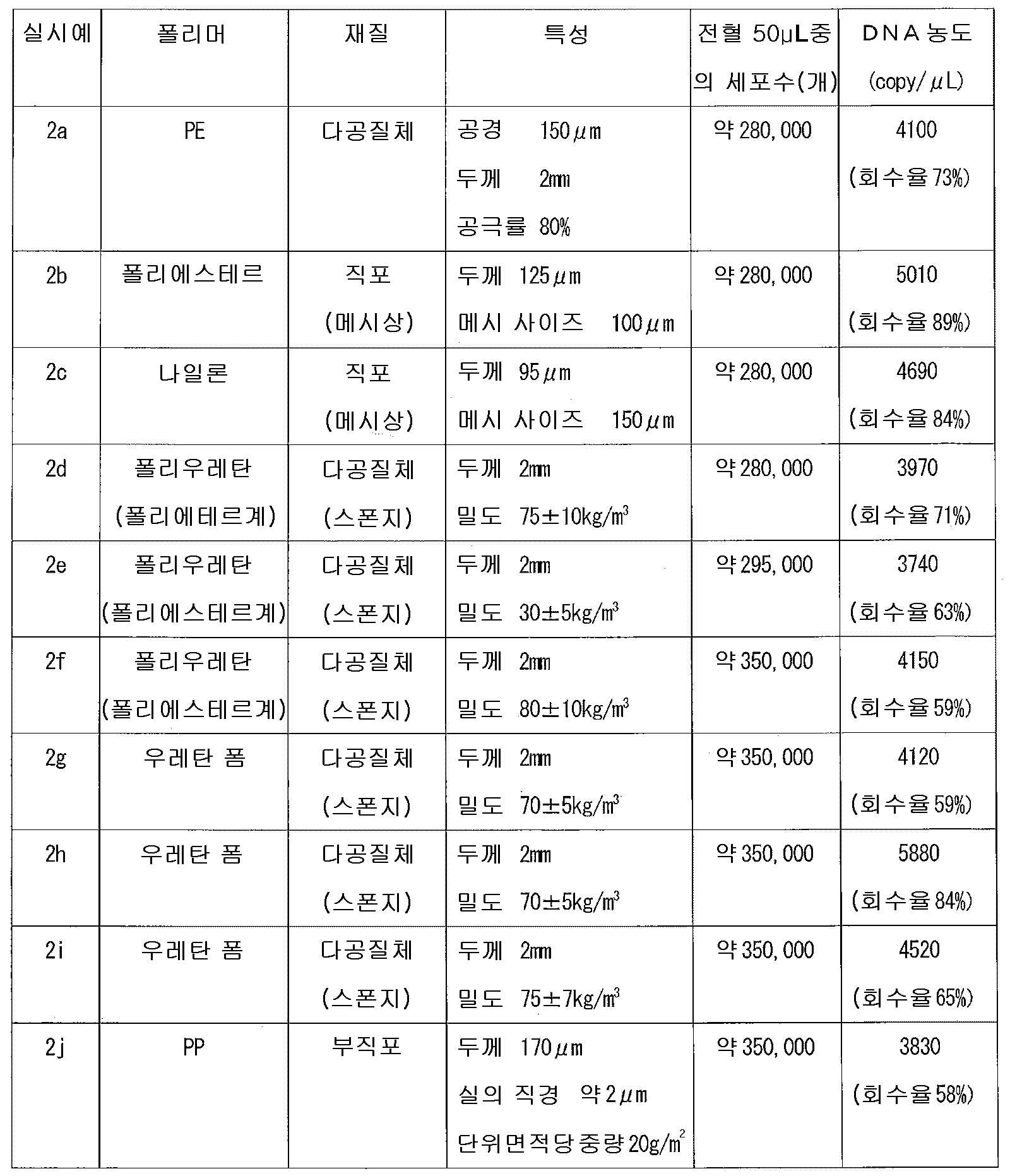
2a : 상품명 MAPS, 노이악코포레이션사제2a: Trade name MAPS, manufactured by Noiac Corporation
2b : 상품명 PET150-HD, SEFAR사제2b: Brand name PET150-HD, manufactured by SEFAR
2c : 상품명 9P-150, SEFAR사제2c: Brand name 9P-150, manufactured by SEFAR
2d : 상품명 CFS, 노이악코포레이션사제2d: Trade name CFS, manufactured by Noiac Corporation
2e : 상품명 MF50, 노이악코포레이션사제2e: Trade name MF50, manufactured by Noiac Corporation
2f : 상품명 MF80, 노이악코포레이션사제2f: Trade name MF80, manufactured by Noiac Corporation
2g : 상품명 800EA, 쿠라보보세키가부시키가이샤제2g: Brand name 800EA, manufactured by Kurabo Seki Co., Ltd.
2h : 상품명 806EA, 쿠라보보세키가부시키가이샤제2h: Product name 806EA, manufactured by Kurabo Seki Co., Ltd.
2i : 상품명 852EA, 쿠라보보세키가부시키가이샤제2i: Trade name 852EA, manufactured by Kurabo Seki Co., Ltd.
2j : 상품명 EM02010, 도레·파인케미컬가부시키가이샤제2j: Product name EM02010, manufactured by Toray Fine Chemicals Co., Ltd.
PP : 폴리프로필렌PP: Polypropylene
PE : 폴리에틸렌PE: polyethylene
회수한 핵산 시료에 대해, 상기 실시예1과 같이, 게놈 DNA의 농도를 측정하여, 상기 각 담체에 의한 게놈 DNA의 회수율을 산출했다. 이들의 결과를 상기 표 3에 아울러 나타낸다.For the recovered nucleic acid sample, the concentration of genomic DNA was measured as in Example 1, and the recovery rate of genomic DNA by the respective carriers was calculated. These results are combined with Table 3 and shown.
실시예2a의 핵산 시료에 대해서는, 미토콘드리아 DNA의 농도를 리얼타임 PCR법에 의해 측정했다. 그 결과, 약 105copy/μL이었다.For the nucleic acid sample of Example 2a, the concentration of mitochondrial DNA was measured by a real-time PCR method. As a result, it was about 10 5 copy/μL.
상기 표 3에 나타내는 바와 같이, 본 실시예의 방법에 의하면, 종래와는 달리, 예를 들면, 특수한 약제를 사용하지 않고, 간편하게 게놈 DNA를 회수할 수 있었다. 회수한 핵산 시료 중의 게놈 DNA 농도도, 3000copy/μL 이상이며, PCR 등에 있어서의 필요량인 것이 확인할 수 있었다. 또한, 미토콘드리아 DNA에 대해서도, 충분량을 회수할 수 있었다.As shown in Table 3 above, according to the method of this example, unlike the prior art, for example, genomic DNA could be easily recovered without using a special agent. The genomic DNA concentration in the recovered nucleic acid sample was also 3000 copies/µL or more, and it was confirmed that it was a necessary amount in PCR or the like. In addition, a sufficient amount of mitochondrial DNA was also able to be recovered.
[실시예3][Example 3]
우선, 전혈 50μL와 상기 실시예1의 처리 시약1-1 50μL를 혼합하여 처리액 100μL를 준비했다. 한편, 담체로서, 하기 표 4에 나타내는 각종 담체(실시예3a∼3g)를 직경 2mm의 원형으로 잘라내었다. 1.5mL 용량의 튜브 내에, 잘라낸 상기 각 담체와 상기 처리액 100μL를 넣고, 보르텍스로 혼합한 후, 상기 처리액을 제거했다. 상기 튜브 내에, 상기 실시예1의 세정액 100μL를 첨가하고, 보르텍스로 혼합한 후, 상기 세정액을 폐기했다. 그리고, 상기 튜브로부터 상기 각 담체를 취출하여, 새로운 튜브 내에, 상기 실시예1의 분산매 100μL와 함께 넣고, 96℃에서 5분간 가열했다. 가열 후의 상기 분산매를 회수하여, 핵산 시료로 했다.First, 50 µL of whole blood and 50 µL of the treatment reagent 1-1 of Example 1 were mixed to prepare 100 µL of a treatment solution. On the other hand, as a carrier, various carriers (Examples 3a to 3g) shown in Table 4 below were cut out into a circle having a diameter of 2 mm. In a 1.5 mL tube, each of the cut-out carriers and 100 µL of the treatment liquid were put, and after mixing with vortex, the treatment liquid was removed. In the tube, 100 μL of the cleaning liquid of Example 1 was added, mixed with vortex, and the cleaning liquid was discarded. Then, each of the carriers was taken out from the tube, put in a new tube, together with 100 µL of the dispersion medium of Example 1, and heated at 96°C for 5 minutes. The dispersion medium after heating was recovered to obtain a nucleic acid sample.
[표 4] [Table 4]

3a : 상품명 LV, 셀폴고교사제3a: Brand name LV, manufactured by Cellpol High School
3b : 상품명 MAPS, 노이악코포레이션사제3b: Trade name MAPS, manufactured by Noiac Corporation
3c : 상품명 PET250-HD, SEFAR사제3c: Brand name PET250-HD, manufactured by SEFAR
3d : 상품명 PET150-HD, SEFAR사제3d: Brand name PET150-HD, manufactured by SEFAR
3e : 상품명 9P-150, SEFAR사제3e: Brand name 9P-150, manufactured by SEFAR
3f : 상품명 CFS, 노이악코포레이션사제3f: Trade name CFS, manufactured by Noiac Corporation
3g : 상품명 EM02010, 도레·파인케미컬가부시키가이샤제3g: Product name EM02010, manufactured by Toray Fine Chemicals Co., Ltd.
PE : 폴리에틸렌PE: polyethylene
PP : 폴리프로필렌PP: Polypropylene
회수한 핵산 시료에 대해, 상기 실시예1과 같이, 게놈 DNA의 농도를 측정하여, 상기 각 담체에 의한 게놈 DNA의 회수율을 산출했다. 이들의 결과를 상기 표 4에 아울러 나타낸다.For the recovered nucleic acid sample, the concentration of genomic DNA was measured as in Example 1, and the recovery rate of genomic DNA by the respective carriers was calculated. These results are combined with Table 4 and shown.
상기 표 4에 나타내는 바와 같이, 본 실시예의 방법에 의하면, 종래와는 달리, 예를 들면, 특수한 약제를 사용하지 않고, 간편하게 게놈 DNA를 회수할 수 있었다. 또한, 회수한 핵산 시료 중의 게놈 DNA 농도도, 1500copy/μL 이상이며, PCR 등에 있어서의 필요량인 것이 확인할 수 있었다.As shown in Table 4 above, according to the method of this example, unlike in the prior art, for example, genomic DNA could be easily recovered without using a special agent. In addition, it was confirmed that the genomic DNA concentration in the recovered nucleic acid sample was 1500 copies/µL or more, and that it was a necessary amount in PCR or the like.
[실시예4][Example 4]
1.5mL 용량의 튜브 내에서, 전혈 50μL와 상기 실시예1의 처리 시약1-1 50μL를 혼합하여 처리액 100μL를 준비했다. 상기 튜브에, 또한, 담체로서, 하기 표 5에 나타내는 각종 자성 비드(실시예4a 및 4b)를 총량 1mg 첨가하여, 보르텍스로 혼합했다. 자석으로 상기 자성 비드를 회수하고, 상기 튜브 내의 상기 처리액을 제거하여, 상기 튜브 내에, 회수한 상기 자성 비드와 상기 실시예1의 세정액 100μL를 넣고, 보르텍스로 혼합하고, 재차, 상기 자성 비드를 회수하여, 상기 세정액을 제거했다. 그리고, 상기 튜브에, 회수한 상기 자성 비드와 상기 실시예1의 분산매 100μL를 넣고, 보르텍스로 혼합하고, 96℃에서 5분간 가열했다. 가열 후, 상기 튜브를 원심 분리에 제공하여 상기 자성 비드를 제거하여, 상기 분산매를 회수했다. 이것을 핵산 시료로 했다.In a 1.5 mL tube, 50 µL of whole blood and 50 µL of the treatment reagent 1-1 of Example 1 were mixed to prepare 100 µL of a treatment solution. To the tube, as a carrier, various magnetic beads shown in Table 5 (Examples 4a and 4b) were added in a total amount of 1 mg, and mixed by vortex. The magnetic beads were recovered with a magnet, the treatment liquid in the tube was removed, and the recovered magnetic beads and 100 μL of the cleaning liquid of Example 1 were put in the tube, mixed with vortex, and again, the magnetic beads Was recovered, and the washing liquid was removed. Then, the recovered magnetic beads and 100 µL of the dispersion medium of Example 1 were put into the tube, mixed with vortex, and heated at 96°C for 5 minutes. After heating, the tube was subjected to centrifugation to remove the magnetic beads, and the dispersion medium was recovered. This was taken as a nucleic acid sample.
[표 5] [Table 5]

4a 및 4b : 상품명 micromer(상표) M, micromod사제4a and 4b: brand name micromer (trademark) M, manufactured by micromod company
PS : 폴리스티렌PS: Polystyrene
회수한 핵산 시료에 대해, 상기 실시예1과 같이, 게놈 DNA의 농도를 측정하여, 상기 각 담체에 의한 게놈 DNA의 회수율을 산출했다. 이들의 결과를 상기 표 5에 아울러 나타낸다.For the recovered nucleic acid sample, the concentration of genomic DNA was measured as in Example 1, and the recovery rate of genomic DNA by the respective carriers was calculated. These results are combined with Table 5 and shown.
상기 표 5에 나타내는 바와 같이, 본 실시예의 방법에 의하면, 종래와는 달리, 예를 들면, 특수한 약제를 사용하지 않고, 간편하게 DNA를 회수할 수 있었다. 또한, 회수한 핵산 시료 중의 DNA 농도도, 400copy/μL 이상이며, PCR 등에 있어서의 필요량인 것이 확인할 수 있었다.As shown in Table 5 above, according to the method of this example, unlike the prior art, for example, DNA could be easily recovered without using a special agent. Further, it was confirmed that the DNA concentration in the recovered nucleic acid sample was 400 copies/µL or more, and that it was a necessary amount in PCR or the like.
[참고예1][Reference Example 1]
전혈을 본 발명의 핵산 회수용 시약(처리 시약)으로 처리하여, 필터상의 담체에 유지되는 핵산 복합체를 확인했다.Whole blood was treated with the nucleic acid recovery reagent (treatment reagent) of the present invention, and the nucleic acid complex held on the carrier on the filter was confirmed.
전혈 10μL와 하기 표 6의 처리 시약 10μL를 혼합하여 처리액 20μL를 준비했다. 담체로서는, 오프닝 100㎛의 필터(상품명 나일론메시; SEFAR사제)를 사용했다. 이 처리액 20μL를, 상기 실시예1과 같이 하여, 상기 담체에 통과시켰다. 그리고, 상기 담체를 통상의 방법에 따라 김자 염색하고, 광학 현미경으로 관찰했다. 이 결과를 도 7에 나타낸다. 동 도면의 광학 현미경 사진에 있어서, 화살표로 표시하는 바와 같이, 직경 약 200㎛ 정도의 자색으로 염색된 핵산 복합체가, 담체에 부착하여 있는 것이 확인되었다.10 µL of whole blood and 10 µL of treatment reagents shown in Table 6 were mixed to prepare 20 µL of a treatment solution. As the carrier, a filter with an opening of 100 µm (brand name nylon mesh; manufactured by SEFAR) was used. 20 µL of this treatment solution was passed through the carrier in the same manner as in Example 1. Then, the carrier was dyed Kimja according to a conventional method, and observed with an optical microscope. Fig. 7 shows the results. In the optical micrograph of the figure, as indicated by the arrow, it was confirmed that the nucleic acid complex stained in purple with a diameter of about 200 μm adhered to the carrier.
[표 6] [Table 6]

[실시예5][Example 5]
전혈로부터의From whole blood RNARNA 의 회수Recovery of
담체로서, 상품명 MF-80A(노이악코포레이션사제)를 사용했다. 이 담체를 직경 2mm의 원형으로 잘라내어, 상기 실시예1과 같이 하여 지그 장치에 셋팅했다. 한편, 다른 검체로부터 3종류의 전혈(신선혈)을 준비하고, 각 전혈 50μL와 하기 표 7의 처리 시약5-1 50μL를 혼합하여 처리액 100μL를 제조했다. 상기 처리액에 있어서, 전혈 50μL에 대해, 프로테아제의 첨가량은 1.35U이며, 계면활성제의 첨가 비율은 0.25체적%이다. 그리고, 하기 표 7의 세정액 및 분산매를 사용한 이외는, 상기 실시예1과 같이 하여, 핵산 시료를 제조했다. 회수한 핵산 시료에 대해, One Step SYBR Prime Script RT-PCR Kit Ⅱ(TAKARA) 및 β-액틴용의 하기 프라이머 셋트를 사용하여, RNA의 정량을 행했다. 컨트롤로서, 동일한 전혈로부터 QIAamp RNA Blood Mini(QIAGEN사제)를 사용하여 정제한 핵산 시료에 대해서도, 마찬가지로 RNA의 정량을 행했다. 그리고, 컨트롤의 회수 RNA량을 100%로 한 경우의, 본 실시예의 회수 RNA량의 상대값(%)을 구했다.As a carrier, a brand name MF-80A (manufactured by Noiac Corporation) was used. This carrier was cut out into a circle having a diameter of 2 mm, and set in a jig apparatus in the same manner as in Example 1 above. On the other hand, three kinds of whole blood (fresh blood) were prepared from other specimens, 50 µL of each whole blood and 50 µL of treatment reagent 5-1 shown in Table 7 were mixed to prepare 100 µL of a treatment solution. In the treatment liquid, with respect to 50 µL of whole blood, the addition amount of protease is 1.35 U, and the addition ratio of surfactant is 0.25 vol%. In addition, a nucleic acid sample was prepared in the same manner as in Example 1 except that the washing liquid and dispersion medium of Table 7 were used. For the recovered nucleic acid samples, RNA was quantified using the One Step SYBR Prime Script RT-PCR Kit II (TAKARA) and the following primer sets for β-actin. As a control, RNA was similarly quantified for nucleic acid samples purified from the same whole blood using QIAamp RNA Blood Mini (manufactured by QIAGEN). Then, the relative value (%) of the amount of recovered RNA in this example was determined when the amount of recovered RNA in the control was 100%.
[표 7] [Table 7]

그 결과, 3종류의 검체에 대한 결과는, 각각 5.6%, 12.3%, 7.2%이었다. 이 회수율은, 예를 들면, RT-PCR의 주형으로서는 충분량이다. 따라서, 본 실시예에 의하면, 종래와는 달리, 특수한 약제를 사용하지 않고, 간편하게 필요량의 RNA를 회수할 수 있었다.As a result, the results for the three specimens were 5.6%, 12.3%, and 7.2%, respectively. This recovery rate is, for example, a sufficient amount as a template for RT-PCR. Therefore, according to this example, unlike in the prior art, it was possible to easily recover a required amount of RNA without using a special agent.
[실시예6][Example 6]
타액으로부터의 게놈 Genome from saliva DNADNA 의 회수Recovery of
우선, 타액 100μL(인간 핵산 함유 세포수 : 약 150,000개)와 하기 표 8의 각 처리 시약 100μL를 혼합하여 처리액 200μL를 준비했다. 상기 처리액에 있어서, 타액 50μL에 대해, 프로테아제의 첨가량은 1U이며, 계면활성제의 첨가 비율은 0.5체적%, 1체적%, 2체적%이다. 한편, 담체로서, 공경 60㎛의 PET제 메시상 직포(산프라테크사제, 메시 사이즈 60㎛)를 사용했다. 이 담체를 직경 3.5mm의 원형으로 잘라내어, 도 1에 나타내는 피펫 팁(용량 200μL) 내부에 장착했다(유효경 2.2mm). 상기 유효경이란, 상기 피펫 팁 내부에 장착한 상기 담체에 있어서, 실제로 통액 가능한 직경을 의미한다. 이 피펫 팁을 피펫터에 장착하고, 상기 처리액 200μL를 흡인 토출한 후, 상기 실시예1의 세정액 200μL의 흡인 토출을 행했다. 재차, 새로운 상기 세정액 200μL를 흡인 토출한 후, 상기 피펫 팁으로부터 담체를 취출했다. 이 담체를 상기 실시예1의 분산매 100μL에 침지하고, 95℃에서 5분간 가열함으로써, 핵산 시료를 얻었다. 이들 핵산 시료에 대해, 상기 실시예1과 같이 하여, 게놈 DNA의 농도를 측정했다. 이들의 결과를 하기 표 8에 아울러 나타낸다.First, 100 µL of saliva (the number of human nucleic acid-containing cells: about 150,000) and 100 µL of each treatment reagent in Table 8 were mixed to prepare 200 µL of a treatment solution. In the treatment liquid, the amount of protease added is 1 U, and the ratio of the surfactant added is 0.5% by volume, 1% by volume, and 2% by volume with respect to 50 μL of saliva. On the other hand, as a carrier, a PET mesh woven fabric (manufactured by Sanpratech, 60 µm in mesh size) having a pore diameter of 60 µm was used. This carrier was cut out into a circle having a diameter of 3.5 mm and mounted inside the pipette tip (capacity 200 µL) shown in Fig. 1 (effective diameter: 2.2 mm). The effective diameter means a diameter that can actually pass through the carrier mounted inside the pipette tip. After attaching this pipette tip to a pipette, 200 µL of the treatment liquid was suction-discharged, and then 200 µL of the cleaning solution of Example 1 was suction-discharged. Again, 200 µL of the new washing solution was sucked and discharged, and then the carrier was taken out from the pipette tip. This carrier was immersed in 100 µL of the dispersion medium of Example 1 and heated at 95°C for 5 minutes to obtain a nucleic acid sample. For these nucleic acid samples, the concentration of genomic DNA was measured in the same manner as in Example 1 above. These results are combined with Table 8 below and shown.
[표 8] [Table 8]

상기 표 8에 나타내는 바와 같이, 본 실시예의 방법에 의하면, 타액에 대해서도, PCR의 주형으로서 충분량인 3000copy/μL 정도의 게놈 DNA를 회수할 수 있었다.As shown in Table 8 above, according to the method of this example, even in saliva, genomic DNA of about 3000 copies/µL, which is a sufficient amount as a template for PCR, could be recovered.
[실시예7][Example 7]
구강 점막 세포로부터의 게놈 Genome from oral mucosal cells DNADNA 의 회수Recovery of
우선, 면봉(1P1501V, 일본면봉제)으로 뺨의 내측을 좌우 각각 10회, 원을 그리듯이 긁고, 하기 표 9의 각 처리 시약 200μL에 혼합하여 처리액 200μL(인간 핵산 함유 세포수 : 약 250,000개)를 준비했다. 상기 처리액에 있어서, 구강 점막 세포 현탁액 50μL에 대해, 프로테아제의 첨가량은 1U이며, 계면활성제의 첨가량은 0.5체적%, 1체적%, 2체적%이다. 한편, 상기 실시예6에 있어서의 담체를 장착한 피펫 팁을 사용하여, 마찬가지로 하여, 핵산 시료를 제조했다. 이들 핵산 시료에 대해, 상기 실시예1과 같이 하여, 게놈 DNA의 농도를 측정했다. 이들의 결과를 하기 표 9에 아울러 나타낸다.First, with a cotton swab (1P1501V, made in Japan), scratch the inside of the
[표 9] [Table 9]

상기 표 9에 나타내는 바와 같이, 본 실시예의 방법에 의하면, 구강 점막 세포에 대해서도, PCR의 주형으로서 충분량인 1000∼2000copy/μL 정도의 게놈 DNA를 회수할 수 있었다.As shown in Table 9 above, according to the method of this example, even for oral mucosal cells, genomic DNA of about 1000 to 2000 copies/µL, which is a sufficient amount as a template for PCR, could be recovered.
[실시예8][Example 8]
배양 세포로부터의 게놈 Genome from cultured cells DNADNA 의 회수Recovery of
우선, 아시아인 유래 정상 제대 정맥 혈관 내피 세포(KJB-110, DS PHARMA BIOMEDICAL)의 배양 세포 현탁액을 생리 식염수로 세정하여 배지 성분을 제거하고, 상기 배양 세포를 1×10³cells/μL가 되도록 생리 식염수에 현탁했다. 상기 배양 세포 현탁액 100μL(핵산 함유 세포수 : 약 1×10⁵개)를 하기 표 10의 각 처리 시약 100μL에 혼합하여 처리액 200μL를 준비했다. 상기 처리액에 있어서, 배양 세포 현탁액 50μL에 대해, 프로테아제의 첨가량은 1U이며, 계면활성제의 첨가 비율은 0.5체적%, 1체적%, 2체적%로 했다. 한편, 상기 실시예6에 있어서의 담체를 장착한 피펫 팁을 사용하여, 마찬가지로 하여, 핵산 시료를 제조했다. 이들 핵산 시료에 대해, 상기 실시예1과 같이 하여, 게놈 DNA의 농도를 측정했다. 이들의 결과를 하기 표 10에 아울러 나타낸다.First, the cultured cell suspension of Asian-derived normal umbilical vein endothelial cells (KJB-110, DS PHARMA BIOMEDICAL) was washed with physiological saline to remove the medium component, and the cultured cells were physiologically physiologically to be 1×10 3 cells/μL Suspended in saline. 100 µL of the cultured cell suspension (nucleic acid-containing cells: about 1×10 5 cells) was mixed with 100 µL of each treatment reagent shown in Table 10 to prepare 200 µL of a treatment solution. In the treatment solution, the amount of protease added was 1 U, and the ratio of the surfactant was 0.5% by volume, 1% by volume, and 2% by volume with respect to 50 μL of the cultured cell suspension. On the other hand, a nucleic acid sample was prepared in the same manner using the pipette tip equipped with the carrier in Example 6 above. For these nucleic acid samples, the concentration of genomic DNA was measured in the same manner as in Example 1 above. These results are combined with Table 10 below and shown.
[표 10] [Table 10]

상기 표 10에 나타내는 바와 같이, 본 실시예의 방법에 의하면, 배양 세포에 대해서도, PCR의 주형으로서 충분량인 수백copy/μL 정도의 게놈 DNA를 회수할 수 있었다.As shown in Table 10 above, according to the method of this example, even for cultured cells, a sufficient amount of genomic DNA, which is a sufficient amount as a PCR template, could be recovered.
[실시예9][Example 9]
대장균으로부터의 플라스미드 Plasmid from E. coli DNADNA 의 회수Recovery of
우선, IAPP(췌도(膵島) 아밀로이드펩티드) 서열을 편성한 플라스미드 DNA를 갖는 대장균을 LB배지로 12시간 배양한 후, 배양액 100μL(핵산 함유 세포수 : 약 1×10⁷개)를 이하의 각 처리 시약 100μL에 혼합하여, 처리액 200μL를 준비했다. 또, 하기 표 11의 처리 시약9-1에서 처리하는 대장균은, 배양 후, 배양액 그대로 -80℃로 동결하고, 사용시에 25℃에서 융해시킨 후, 마찬가지로 하여 상기 처리 시약9-1과 혼합했다. 상기 처리액에 있어서, 배양 세포 현탁액 50μL에 대해, 프로테아제의 첨가량은, 0, 1U이며, 계면활성제의 첨가 비율은, 0체적%, 0.5체적%, 1체적%, 2체적%이다. 한편, 상기 실시예6에 있어서의 담체를 장착한 피펫 팁을 사용하여, 마찬가지로 하여, 핵산 시료를 제조했다. 이들 핵산 시료에 대해, 상기 실시예1과 같이 하여, 플라스미드 DNA의 농도를 측정했다. 또한, 이들 핵산 시료에 대해, 260nm의 흡광도 측정으로부터, 게놈 DNA의 농도를 측정했다. 이들의 결과를 하기 표 11에 아울러 나타낸다.First, E. coli having the plasmid DNA of the IAPP (islet amyloid peptide) sequence was cultured in LB medium for 12 hours, and then 100 μL of the culture solution (number of cells containing nucleic acid: about 1×10 7 cells) was treated as follows. It was mixed with 100 µL of a reagent to prepare 200 µL of a treatment liquid. In addition, the E. coli treated in the treatment reagent 9-1 shown in Table 11 below was frozen at -80°C as the culture solution after cultivation, and melted at 25°C during use, and then mixed with the treatment reagent 9-1 in the same manner. In the treatment solution, the amount of protease added to 50 μL of the cultured cell suspension is 0 and 1 U, and the addition ratio of the surfactant is 0 vol%, 0.5 vol%, 1 vol%, and 2 vol%. On the other hand, a nucleic acid sample was prepared in the same manner using the pipette tip equipped with the carrier in Example 6 above. For these nucleic acid samples, the concentration of plasmid DNA was measured in the same manner as in Example 1 above. Further, for these nucleic acid samples, the concentration of genomic DNA was measured from the absorbance measurement at 260 nm. These results are combined with Table 11 below and shown.
[표 11] [Table 11]

상기 표 11에 나타내는 바와 같이, 본 실시예의 방법에 의하면, 대장균의 배양 세포에 대해서도, PCR의 주형으로서 충분량인 약 50만copy/μL 정도의 플라스미드 DNA, 약 3만copy/μL의 게놈 DNA를 각각 회수할 수 있었다. 또한, 각 처리 시약9-1을 사용한 결과에서, 대장균의 배양 세포를 동결 해동함으로써, 프로테아제 및 계면활성제를 사용하지 않고, 동일 정도의 플라스미드 DNA 및 게놈 DNA를 회수할 수 있음을 알 수 있었다.As shown in Table 11 above, according to the method of this example, for the cultured cells of E. coli, about 500,000 copies/μL of plasmid DNA and about 30,000 copies/μL of genomic DNA, which are sufficient amounts as a template for PCR, were respectively obtained. I was able to recover. Further, from the results of using each treatment reagent 9-1, it was found that the same degree of plasmid DNA and genomic DNA could be recovered without using protease and surfactant by freezing and thawing cultured cells of E. coli.
[실시예10][Example 10]
전혈로부터의From whole blood 게놈 Genome DNADNA 의 회수Recovery of
우선, 4℃에서 70일간 냉장 보존한 전혈 100μL, 및, -30℃에서 9개월간 동결 보존 후, 융해한 전혈 100μL를 각각, 하기 표 12의 각 처리 시약 100μL에 혼합하여 처리액 200μL를 준비했다. 상기 냉장 보존 전혈 100μL 중의 핵산 함유 세포수는, 약 580,000개이며, 상기 동결 해동 전혈 100μL 중의 핵산 함유 세포수는, 약 560,000개이었다. 상기 처리액에 있어서, 전혈 50μL에 대해, 프로테아제의 첨가량은 1U, 2U이며, 계면활성제는 무첨가이다. 한편, 상기 실시예6에 있어서의 담체를 장착한 피펫 팁을 사용하여, 마찬가지로 하여, 핵산 시료를 제조했다. 이들 핵산 시료에 대해, 상기 실시예1과 같이 하여, 게놈 DNA의 농도를 측정했다. 이들의 결과를 하기 표 12에 아울러 나타낸다.First, 100 µL of whole blood stored refrigerated at 4°C for 70 days, and 100 µL of melted whole blood after cryopreservation at -30°C for 9 months were mixed with 100 µL of each treatment reagent shown in Table 12 below to prepare 200 µL of a treatment solution. The number of nucleic acid-containing cells in 100 µL of cold-preserved whole blood was about 580,000, and the number of nucleic acid-containing cells in 100 µL of the freeze-thawed whole blood was about 560,000. In the treatment liquid, the amount of protease added is 1U or 2U, and no surfactant is added to 50 µL of whole blood. On the other hand, a nucleic acid sample was prepared in the same manner using the pipette tip equipped with the carrier in Example 6 above. For these nucleic acid samples, the concentration of genomic DNA was measured in the same manner as in Example 1 above. These results are combined with Table 12 below and shown.
[표 12] [Table 12]
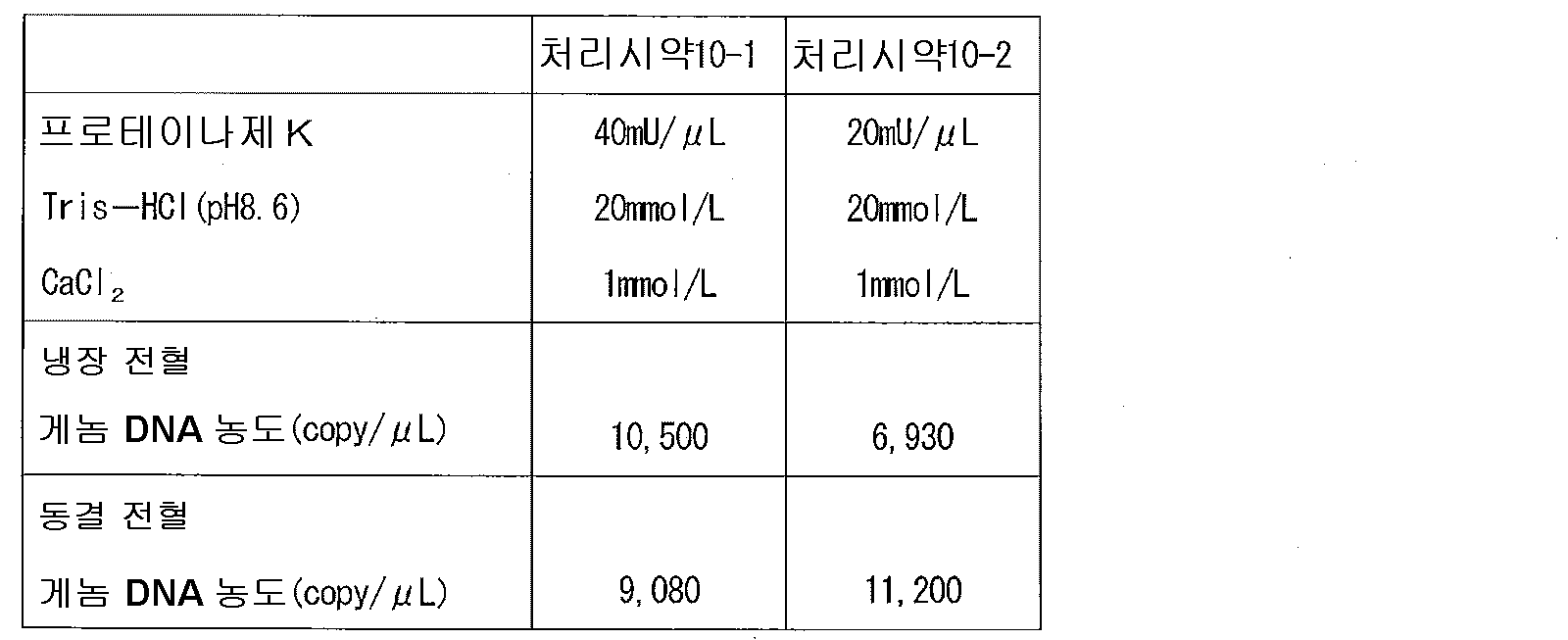
상기 표 12에 나타내는 바와 같이, 본 실시예의 방법에 의하면, 전혈을 냉장 보존 또는 동결 해동함으로써, 계면활성제를 사용하지 않고, PCR의 주형으로서 충분량인 게놈 DNA를 회수할 수 있었다.As shown in Table 12 above, according to the method of this example, whole blood was stored in a refrigerator or freeze-thaw to recover a sufficient amount of genomic DNA as a template for PCR without using a surfactant.
[실시예11][Example 11]
1.One. 신선혈로부터의From fresh blood 게놈 Genome DNADNA 의 회수Recovery of
냉장 또는 냉동 보존하여 있지 않은 채혈 당일의 신선 전혈을 이하에 나타내는 여러가지 조건에서 처리한 후, 게놈 DNA의 회수를 행했다. 상기 신선 전혈의 백혈구수는, 약 5,500개/μL이었다.Fresh whole blood on the day of blood collection not refrigerated or cryopreserved was treated under various conditions shown below, and then genomic DNA was recovered. The number of white blood cells in the fresh whole blood was about 5,500 cells/μL.
튜브 내에, 50μL의 하기 표 13의 처리 시약6과 50μL의 신선 전혈을 넣고, 처리액을 제조했다. 또, 상기 처리 시약6에 있어서의 프로테아제 및 계면활성제의 농도는, 하기 표 14에 나타낸다. 또한, 상기 처리액에 있어서의 프로테아제 및 계면활성제의 농도는, 하기 표 14의 농도의 1/2이다(이하, 같음). 한편, 담체로서, 공경 105㎛의 PET제 메시상 직포(상품명 PET105, SEFAR사제, 메시 사이즈 105㎛)를 준비했다. 이 담체를 직경 2.5mm의 원형으로 잘라내어, 도 1에 나타내는 피펫 팁(용량 200μL) 내부에 장착했다(유효경 1.4mm). 이 피펫 팁을 피펫터에 장착하고, 상기 처리액 100μL의 흡인 토출을 20회 행하여, 상기 처리액을 토출했다. 계속해서, 새로운 튜브에 세정액1(250mmol/L KCl수용액) 100μL를 넣고, 상기 피펫 팁을 사용하여 흡인 토출을 10회 행하여, 상기 세정액1을 토출했다. 또한, 새로운 튜브에 세정액2(0.1mmol/L EDTA 및 1mmol/L Tris-HCl, pH8.0) 100μL를 넣고, 상기 피펫 팁에의 흡인 토출을 10회 행하여, 상기 세정액2를 토출한 후, 상기 피펫 팁으로부터 담체를 취출했다. 이 담체를 분산매(0.1mmol/L EDTA 및 1mmol/L Tris-HCl, pH8.0) 100μL에 침지하고, 그 상태에서, 5분간 95℃에서 처리함으로써, 핵산 시료를 얻었다. 이들 핵산 시료에 대해, 상기 실시예1과 같이 하여, 게놈 DNA의 농도를 측정했다. 이들의 결과를 하기 표 14에 아울러 나타낸다. 또, 프로테아제 및 계면활성제를 함유하는 처리 시약을 사용한 예를 실시예A1∼A6, 어느 한쪽 또는 양방이 무첨가인 처리 시약을 사용한 예를 비교예A1∼A3으로 했다.In the tube, 50 µL of the treatment reagent 6 shown in Table 13 below and 50 µL of fresh whole blood were added to prepare a treatment solution. In addition, the concentrations of the protease and surfactant in the treatment reagent 6 are shown in Table 14 below. In addition, the concentration of the protease and surfactant in the treatment liquid is 1/2 of the concentration in Table 14 below (the same applies hereinafter). On the other hand, as a carrier, a mesh-shaped woven fabric made of PET having a pore diameter of 105 µm (trade name PET105, manufactured by SEFAR, and a mesh size of 105 µm) was prepared. This carrier was cut out into a circle having a diameter of 2.5 mm, and mounted inside the pipette tip (capacity 200 μL) shown in Fig. 1 (effective diameter 1.4 mm). This pipette tip was mounted on a pipette, and 100 µL of the treatment liquid was sucked and discharged 20 times to discharge the treatment liquid. Subsequently, 100 µL of washing solution 1 (250 mmol/L aqueous KCl solution) was added to a new tube, and suction and discharge were performed 10 times using the pipette tip, and the washing solution 1 was discharged. In addition, 100 μL of washing solution 2 (0.1 mmol/L EDTA and 1 mmol/L Tris-HCl, pH 8.0) was added to a new tube, and suction and discharge were performed 10 times to the pipette tip, and the washing solution 2 was discharged. The carrier was taken out from the pipette tip. This carrier was immersed in 100 µL of a dispersion medium (0.1 mmol/L EDTA and 1 mmol/L Tris-HCl, pH 8.0) and treated at 95° C. for 5 minutes in that state to obtain a nucleic acid sample. For these nucleic acid samples, the concentration of genomic DNA was measured in the same manner as in Example 1 above. These results are combined with Table 14 below and shown. In addition, Examples A1 to A6 were used as examples of using treatment reagents containing a protease and surfactant, and Comparative Examples A1 to A3 were used as treatment reagents in which either or both were not added.
[표 13] [Table 13]

[표 14] [Table 14]

상기 표 14에 나타내는 바와 같이, 본 실시예에 의하면, 신선 전혈로부터, PCR의 주형으로서 충분량인 약 100copy/μL 정도의 게놈 DNA를 각각 회수할 수 있었다. 이것에 대해, 프로테아제 및 계면활성제를 첨가하여 있지 않은 비교예A1, 어느 한쪽을 첨가하여 있지 않은 비교예A2 및 A3에 대해서는, DNA가 거의 회수할 수 없었다.As shown in Table 14, according to this example, genomic DNA of about 100 copies/µL, which is a sufficient amount as a template for PCR, could be recovered from fresh whole blood, respectively. On the other hand, in Comparative Example A1 in which no protease and surfactant were added, and in Comparative Examples A2 and A3 in which either one was not added, DNA could hardly be recovered.
2.2. 냉장혈로부터의From cold blood 게놈 Genome DNADNA 의 회수Recovery of
2개월간 냉장 보존한 전혈을 이하에 나타내는 여러가지 조건에서 처리한 후, 게놈 DNA의 회수를 행했다. 상기 냉장혈의 백혈구수는, 약 6,900개/μL이었다.Whole blood stored in refrigerator for 2 months was treated under various conditions shown below, and then genomic DNA was recovered. The number of white blood cells in the refrigerated blood was about 6,900 cells/μL.
상기 처리 시약6에 있어서의 프로테아제 및 계면활성제의 농도를 하기 표 15에 나타내는 농도로 한 이외는, 상기 신선 전혈과 같이 하여 게놈의 회수 및 측정을 행했다.The genome was recovered and measured in the same manner as the fresh whole blood, except that the concentrations of the protease and surfactant in the treatment reagent 6 were set to the concentrations shown in Table 15 below.
[표 15] [Table 15]

상기 표 15의 실시예B1에 나타내는 바와 같이, 냉장혈이면, 계면활성제 무첨가 또한 프로테아제를 함유하는 처리 시약으로 처리한 후, 상술한 바와 같이 가열 처리함으로써, PCR의 주형으로서 충분량인 게놈 DNA를 회수할 수 있었다. 이와 같이, 전혈을 냉장 보존한 경우는, 상기 처리 시약이 계면활성제를 함유하지 않아도, 효율좋게 DNA를 회수할 수 있음을 알 수 있었다. 또한, 상기 표 15의 실시예B2에 나타내는 바와 같이, 상기 처리 시약이, 프로테아제 이외에, 계면활성제를 더 함유함으로써, 보다 한층 게놈 DNA의 회수율을 향상할 수 있음을 알 수 있었다. 이것에 대해, 상기 표 15에 나타내는 바와 같이, 프로테아제 및 계면활성제를 첨가하여 있지 않은 비교예B1에 대해서는, DNA를 거의 회수할 수 없었다.As shown in Example B1 of Table 15 above, in the case of cold blood, a sufficient amount of genomic DNA as a template for PCR can be recovered by treatment with a treatment reagent containing no surfactant and a protease, followed by heat treatment as described above. Could. In this way, when whole blood was stored in a refrigerator, it was found that even if the treatment reagent did not contain a surfactant, DNA could be efficiently recovered. In addition, as shown in Example B2 of Table 15, it was found that by further containing a surfactant in addition to a protease, the treatment reagent could further improve the recovery rate of genomic DNA. On the other hand, as shown in Table 15 above, in Comparative Example B1 to which no protease and surfactant were added, almost no DNA could be recovered.
3.3. 동결혈로부터의From frozen blood 게놈 Genome DNADNA 의 회수Recovery of
-30℃에서 2시간 동결 보존한 전혈을 실온 해동하여 이하에 나타내는 여러가지 조건에서 처리한 후, 게놈 DNA의 회수를 행했다. 상기 동결혈의 백혈구수는, 약 5,500개/μL이었다.Whole blood, which had been cryopreserved at -30°C for 2 hours, was thawed at room temperature and treated under various conditions shown below, and then genomic DNA was recovered. The number of white blood cells in the frozen blood was about 5,500 cells/μL.
상기 처리 시약6에 있어서의 프로테아제 및 계면활성제의 농도를 하기 표 16에 나타내는 농도로 한 이외는, 상기 신선 전혈과 같이 하여 게놈의 회수 및 측정을 행했다.The genome was recovered and measured in the same manner as the fresh whole blood, except that the concentrations of the protease and surfactant in the treatment reagent 6 were set to the concentrations shown in Table 16 below.
[표 16] [Table 16]

상기 표 16의 실시예C1에 나타내는 바와 같이, 동결 해동 후의 전혈이면, 계면활성제 및 프로테아제가 무첨가이어도, 상술한 바와 같이 가열 처리함으로써, PCR의 주형으로서 충분량인 게놈 DNA를 회수할 수 있었다. 또한, 실시예C2 및 C3에 나타내는 바와 같이, 프로테아제를 함유하는 처리 시약을 사용함으로써, DNA의 회수율을 향상할 수 있고, 또한, 실시예C4에 나타내는 바와 같이, 프로테아제와 계면활성제를 함유하는 처리 시약을 사용함으로써, 보다 한층 DNA의 회수율을 향상할 수 있음을 알 수 있었다.As shown in Example C1 of Table 16, if whole blood after freeze-thaw, even if surfactant and protease were not added, by heat treatment as described above, a sufficient amount of genomic DNA as a template for PCR could be recovered. In addition, as shown in Examples C2 and C3, by using a treatment reagent containing a protease, the recovery rate of DNA can be improved, and as shown in Example C4, a treatment reagent containing a protease and a surfactant. It was found that, by using, the recovery rate of DNA can be further improved.
이상과 같이, 본 발명에 의하면, 예를 들면, 특수한 시약을 사용하지 않고, 간편하게 핵산을 회수할 수 있다. 또한, 본 발명에 의하면, 뛰어난 효율로 세포로부터의 핵산 회수가 가능하며, 예를 들면, 게놈 DNA나 RNA 이외에, 미토콘드리아 DNA의 회수도 가능하다. 이와 같이, 본 발명은, 안전성 및 조작성이 뛰어나고, 또한, 핵산의 회수율도 뛰어나므로, 예를 들면, 소량의 세포 시료로부터도, 핵산 증폭 등에 필요한 주형 핵산을 충분량 회수할 수 있다. 또한, 이와 같이 소량의 세포 시료로부터의 회수를 간편한 조작으로 행하는 것이 가능하므로, 예를 들면, 근래 주목받고 있는 마이크로칩이나 마이크로타스 등을 사용한 핵산 회수나 핵산 증폭에도 유용하다고 할 수 있다.As described above, according to the present invention, for example, nucleic acids can be easily recovered without using special reagents. Further, according to the present invention, it is possible to recover nucleic acids from cells with excellent efficiency. For example, in addition to genomic DNA and RNA, mitochondrial DNA can also be recovered. As described above, the present invention is excellent in safety and operability, and also has an excellent recovery rate of nucleic acids, so that a sufficient amount of template nucleic acid required for nucleic acid amplification or the like can be recovered even from a small amount of cell samples. In addition, since it is possible to perform the recovery from a small amount of cell samples in this manner by a simple operation, for example, it can be said that it is useful for nucleic acid recovery and nucleic acid amplification using microchips, microtas, etc., which are attracting attention in recent years.
SEQUENCE LISTING
<110> ARKRAY, INC.
<120> Method of Producing Nucleic Acid Sample, and Method of Producing Amplified Nucleic Acid Used the Same
<130> TF09046-01
<150> JP09/008091
<151> 2009-01-16
<160> 2
<170> PatentIn version 3.1
<210> 1
<211> 20
<212> DNA
<213> Artificial
<220>
<223> primer for beta-actin
<400> 1
tgaaccccaa ggccaaccgc 20
<210> 2
<211> 20
<212> DNA
<213> Artificial
<220>
<223> primer for beta-actin
<400> 2
ttgtgctggg tgccagggca 20
SEQUENCE LISTING
<110> ARKRAY, INC.
<120> Method of Producing Nucleic Acid Sample, and Method of Producing Amplified Nucleic Acid Used the Same
<130> TF09046-01
<150> JP09/008091
<151> 2009-01-16
<160> 2
<170> PatentIn version 3.1
<210> 1
<211> 20
<212> DNA
<213> Artificial
<220>
<223> primer for beta-actin
<400> 1
tgaaccccaa ggccaaccgc 20
<210> 2
<211> 20
<212> DNA
<213> Artificial
<220>
<223> primer for beta-actin
<400> 2
Claims (31)
하기 (A)∼(E) 공정을 포함하는 것을 특징으로 하는 제조 방법.
(A) 상기 세포를 함유하는 세포 시료에 대해, 상기 세포로부터 핵산 복합체를 방출시키는 공정
(B) 상기 (A) 공정 후의 상기 세포 시료를 함유하는 처리액과, 담체(擔體)를 접촉시키는 공정
(C) 상기 담체와 상기 처리액을 분리하는 공정
(D) 상기 담체에 가열 처리를 실시하는 공정
(E) 상기 (D) 공정의 전 또는 후, 상기 담체에 분산매를 첨가하는 공정A method for producing a nucleic acid sample for recovering nucleic acid from a cell,
The manufacturing method characterized by including following (A)-(E) process.
(A) releasing the nucleic acid complex from the cell with respect to the cell sample containing the cell
(B) A step of bringing the treating solution containing the cell sample after the step (A) into contact with a carrier
(C) separating the carrier and the treatment liquid
(D) heating the carrier
(E) adding a dispersion medium to the carrier before or after the step (D)
상기 (A) 공정이, 프로테아제 및 계면활성제를 함유하는 처리 시약과, 상기 세포 시료를 혼합하는 공정이며,
상기 처리 시약과 상기 세포 시료를 혼합한 처리액에 있어서, 상기 프로테아제의 농도가 0.5mU/μL 이상이며, 계면활성제의 농도가, 0.1체적% 이상인, 제조 방법.The method of claim 1,
Said (A) process is a process of mixing the processing reagent containing a protease and surfactant, and the said cell sample,
The process liquid which mixed the said processing reagent and the said cell sample, The density | concentration of the said protease is 0.5 mU / microliter or more, and the density | concentration of surfactant is 0.1 volume% or more.
상기 처리액에 있어서, 상기 프로테아제의 농도가 0.5∼1000mU/μL이며, 상기 계면활성제의 농도가 0.1∼20체적%인, 제조 방법.The method of claim 2,
The said process liquid WHEREIN: The manufacturing method of which the density | concentration of the said protease is 0.5-1000 mU / microliter, and the density | concentration of the said surfactant is 0.1-20 volume%.
상기 처리액에 있어서, 상기 세포 1×10²∼1×10⁹개에 대한 상기 프로테아제의 비율이 0.02mU 이상이며, 상기 세포 1×10²∼1×10⁹개에 대한 상기 계면활성제의 비율이 1펨토몰(1×10- 15몰) 이상인, 제조 방법.The method of claim 2,
In the treatment solution, wherein the cells 1 × 10 2 ~1 × 10 is at least a 9 ratio of the protease to the 0.02mU, the ratio of the surfactant to 1 × 10 2 ~1 × 10 9 cells, the The method of producing at least - (15 mol of 1 × 10) 1 femto mole.
상기 처리액에 있어서, 상기 세포 시료 50μL에 대한 상기 프로테아제의 비율이 0.02mU 이상이며, 상기 세포 시료 50μL에 대한 상기 계면활성제의 비율이 1펨토몰 이상인, 제조 방법.The method of claim 2,
In the said processing liquid, the ratio of the said protease with respect to 50 microliters of said cell samples is 0.02 mU or more, and the ratio of the said surfactant with respect to 50 microliters of said cell samples is 1 femtomol or more.
상기 프로테아제가 프로테이나제K, 키모트립신, 펩신, 카텝신D 및 파파인으로 이루어지는 군에서 선택된 적어도 하나의 프로테아제인, 제조 방법.The method of claim 2,
The protease is at least one protease selected from the group consisting of proteinase K, chymotrypsin, pepsin, cathepsin D and papain.
상기 계면활성제가 비이온성 계면활성제인, 제조 방법.The method of claim 2,
And the surfactant is a nonionic surfactant.
상기 비이온성 계면활성제가 폴리옥시에틸렌-p-이소옥틸페놀, 폴리옥시에틸렌소르비탄모노라우릴산, 폴리옥시에틸렌노닐페닐에테르, 및, 노닐페놀폴리티오에톡실레이트로 이루어지는 군에서 선택된 적어도 하나의 계면활성제인, 제조 방법.The method of claim 7, wherein
The nonionic surfactant is at least one selected from the group consisting of polyoxyethylene-p-isooctylphenol, polyoxyethylene sorbitan monolauryl acid, polyoxyethylene nonylphenyl ether, and nonylphenol polythioethoxylate The manufacturing method which is surfactant.
상기 처리 시약이, 또한, 킬레이트제 및 단백질 변성제의 적어도 한쪽을 함유하는, 제조 방법.The method of claim 2,
The said manufacturing reagent further contains at least one of a chelating agent and a protein denaturing agent.
상기 세포가 진핵 세포이며,
상기 (A) 공정이, 계면활성제 무첨가이며 또한 프로테아제를 함유하는 처리 시약과, 동결 융해 후 또는 냉장 보존 후의 상기 세포 시료를 혼합하는 공정인, 제조 방법.The method of claim 1,
The cell is a eukaryotic cell,
The said (A) process is a process which mixes the processing reagent which does not contain surfactant and contains a protease, and the said cell sample after freeze-thawing or cold storage.
상기 세포가 혈중 세포, 타액중 세포, 구강 점막 세포, 체세포, 생식 세포 및 종양 세포로 이루어지는 군에서 선택된 적어도 하나인, 제조 방법.The method of claim 1,
The cell is at least one selected from the group consisting of blood cells, saliva cells, oral mucosa cells, somatic cells, germ cells and tumor cells.
상기 세포가 배양 세포인, 제조 방법.The method of claim 1,
The cell is a culture cell.
상기 세포 시료가 혈액, 타액, 구강 점막, 손톱 및 모발로 이루어지는 군에서 선택된 적어도 하나인, 제조 방법.The method of claim 1,
The cell sample is at least one selected from the group consisting of blood, saliva, oral mucosa, nails and hair.
상기 세포 시료가 세포의 배양물인, 제조 방법.The method of claim 1,
The cell sample is a culture of cells.
상기 세포 시료가 미희석의 세포 시료인, 제조 방법.The method of claim 1,
The cell sample is an undiluted cell sample.
상기 세포가 원핵 세포이며,
상기 (A) 공정이, 상기 원핵 세포를 함유하는 세포 시료를 동결 융해 또는 냉장 보존하는 공정인, 제조 방법.The method of claim 1,
The cell is a prokaryotic cell,
The said (A) process is a process of freezing-thawing or refrigeration of the cell sample containing the said prokaryotic cell.
상기 (A) 공정에서, 프로테아제 무첨가이며 또한 계면활성제를 함유하는 처리 시약 또는 계면활성제 무첨가이며 또한 프로테아제를 함유하는 처리 시약과, 동결 융해 후 또는 냉장 보존 후의 상기 세포 시료를 혼합하는 공정인, 제조 방법.17. The method of claim 16,
In the step (A), the production method is a step of mixing a protease-free and a surfactant-containing treatment reagent or a surfactant-free and protease-containing treatment reagent with the cell sample after freeze-thawing or cold storage. .
상기 담체가 부직포, 직포 및 다공질체로 이루어지는 군에서 선택된 적어도 하나인, 제조 방법.The method of claim 1,
The carrier is at least one selected from the group consisting of a nonwoven fabric, a woven fabric and a porous body.
상기 담체가 다공질체이며, 그 평균 공경이 10∼1000㎛인, 제조 방법.The method of claim 1,
The said carrier is a porous body, The average pore diameter is 10-1000 micrometers, The manufacturing method.
상기 담체가 부직포이며, 그 단위면적당 중량이 20∼150g/m2인, 제조 방법.The method of claim 1,
The carrier is a nonwoven fabric, and the weight per unit area thereof is 20 to 150 g / m 2 .
상기 담체가 직포이며, 그 메시(mesh) 사이즈가 10∼1000㎛인, 제조 방법.The method of claim 1,
The said carrier is a woven fabric, and the mesh size is 10-1000 micrometers.
상기 담체의 형상이 필터상, 시트상, 블록상 및 비드상으로 이루어지는 군에서 선택된 적어도 하나인, 제조 방법.The method of claim 1,
The shape of the carrier is at least one selected from the group consisting of filter, sheet, block and bead.
상기 담체가 비드이며, 체적 충전율이 0.1∼10%의 범위인, 제조 방법.The method of claim 1,
The carrier is a bead, the volume filling rate is in the range of 0.1 to 10%.
상기 담체가 폴리머제 담체 및 금속제 담체의 적어도 한쪽인, 제조 방법.The method of claim 1,
The carrier is at least one of a polymer carrier and a metal carrier.
상기 폴리머가 폴리프로필렌, 폴리에틸렌, 폴리에스테르, 폴리아미드, 폴리우레탄, 폴리에테르, 폴리스티렌, 폴리염화비닐 및 폴리테트라플루오로에틸렌으로 이루어지는 군에서 선택된 적어도 하나의 폴리머인, 제조 방법.25. The method of claim 24,
And the polymer is at least one polymer selected from the group consisting of polypropylene, polyethylene, polyester, polyamide, polyurethane, polyether, polystyrene, polyvinyl chloride and polytetrafluoroethylene.
상기 금속이 스테인리스, 티탄 및 알루미늄으로 이루어지는 군에서 선택된 적어도 하나인, 제조 방법.25. The method of claim 24,
And the metal is at least one selected from the group consisting of stainless steel, titanium and aluminum.
상기 (D) 공정에서의 가열 온도가 50∼130℃인, 제조 방법.The method of claim 1,
The heating method in the said (D) process is 50-130 degreeC.
상기 (D) 공정에서의 가열 시간이 1∼30분인, 제조 방법.The method of claim 1,
The heating method in the said (D) process is 1 to 30 minutes.
상기 핵산이 DNA 및 RNA의 적어도 한쪽인, 제조 방법.The method of claim 1,
The nucleic acid is at least one of DNA and RNA.
상기 DNA가 게놈 DNA 및 미토콘드리아 DNA의 적어도 한쪽인, 제조 방법.30. The method of claim 29,
And said DNA is at least one of genomic DNA and mitochondrial DNA.
하기 (a) 및 (b) 공정을 포함하는 것을 특징으로 하는 핵산 증폭물의 제조 방법.
(a) 제1항에 기재된 핵산 시료의 제조 방법에 의해, 세포를 함유하는 세포 시료로부터 핵산 시료를 회수하는 공정
(b) 상기 (a) 공정에서 회수한 상기 핵산 시료 중의 핵산을 주형으로 하여, 핵산 증폭 방법에 의해, 상기 주형에 있어서의 목적 서열의 핵산 증폭물을 제조하는 공정As a method for producing a nucleic acid amplification product of a target sequence by a nucleic acid amplification method,
A method for producing a nucleic acid amplification product, comprising the following steps (a) and (b).
(a) A step of recovering a nucleic acid sample from a cell sample containing cells by the method for producing a nucleic acid sample according to claim 1.
(b) A step of producing a nucleic acid amplified product of the target sequence in the template by the nucleic acid amplification method, using the nucleic acid in the nucleic acid sample recovered in the step (a) as a template
Applications Claiming Priority (3)
| Application Number | Priority Date | Filing Date | Title |
|---|---|---|---|
| JP2009008091 | 2009-01-16 | ||
| JPJP-P-2009-008091 | 2009-01-16 | ||
| PCT/JP2010/050426 WO2010082631A1 (en) | 2009-01-16 | 2010-01-15 | Process for producing nucleic acid sample, and process for producing nucleic acid amplification product using the nucleic acid sample |
Related Parent Applications (1)
| Application Number | Title | Priority Date | Filing Date |
|---|---|---|---|
| KR1020107020466A Division KR101512709B1 (en) | 2009-01-16 | 2010-01-15 | Process for producing nucleic acid sample, and process for producing nucleic acid amplification product using the nucleic acid sample |
Publications (1)
| Publication Number | Publication Date |
|---|---|
| KR20130069866A true KR20130069866A (en) | 2013-06-26 |
Family
ID=42339884
Family Applications (2)
| Application Number | Title | Priority Date | Filing Date |
|---|---|---|---|
| KR1020137013392A Ceased KR20130069866A (en) | 2009-01-16 | 2010-01-15 | Process for producing nucleic acid sample, and process for producing nucleic acid amplification product using the nucleic acid sample |
| KR1020107020466A Active KR101512709B1 (en) | 2009-01-16 | 2010-01-15 | Process for producing nucleic acid sample, and process for producing nucleic acid amplification product using the nucleic acid sample |
Family Applications After (1)
| Application Number | Title | Priority Date | Filing Date |
|---|---|---|---|
| KR1020107020466A Active KR101512709B1 (en) | 2009-01-16 | 2010-01-15 | Process for producing nucleic acid sample, and process for producing nucleic acid amplification product using the nucleic acid sample |
Country Status (6)
| Country | Link |
|---|---|
| US (1) | US20110275126A1 (en) |
| EP (1) | EP2383335B1 (en) |
| JP (1) | JP5570422B2 (en) |
| KR (2) | KR20130069866A (en) |
| CN (1) | CN102105587A (en) |
| WO (1) | WO2010082631A1 (en) |
Families Citing this family (6)
| Publication number | Priority date | Publication date | Assignee | Title |
|---|---|---|---|---|
| US8865456B2 (en) | 2011-04-28 | 2014-10-21 | Arkray, Inc. | Nucleic acid collection device and nucleic acid collection amount estimation method |
| JP6024266B2 (en) * | 2012-08-01 | 2016-11-16 | セイコーエプソン株式会社 | DNA extraction method |
| KR101576709B1 (en) * | 2013-06-19 | 2015-12-10 | 연세대학교 산학협력단 | Method of collecting sequence-verified nucleic acid fragments and the equipment for amplifying sequence-verified nucleic acid fragments |
| JP2015073485A (en) * | 2013-10-09 | 2015-04-20 | セイコーエプソン株式会社 | Nucleic acid amplification method, device for nucleic acid extraction, cartridge for nucleic acid amplification reaction, and kit for nucleic acid amplification reaction |
| GB201704401D0 (en) * | 2017-03-20 | 2017-05-03 | Epistem Ltd | Use of anticoagulants |
| WO2024080275A1 (en) * | 2022-10-10 | 2024-04-18 | 国立大学法人山口大学 | Method for recovering environmental dna or environmental rna |
Family Cites Families (12)
| Publication number | Priority date | Publication date | Assignee | Title |
|---|---|---|---|---|
| NL8900725A (en) | 1989-03-23 | 1990-10-16 | Az Univ Amsterdam | METHOD AND COMBINATION OF AGENTS FOR INSULATING NUCLEIC ACID. |
| US5234824A (en) * | 1990-11-13 | 1993-08-10 | Specialty Laboratories, Inc. | Rapid purification of DNA |
| EP0587951B1 (en) * | 1992-09-18 | 1997-12-17 | AMERSHAM INTERNATIONAL plc | Cell nuclei capture method and device used therefor |
| GB9425138D0 (en) * | 1994-12-12 | 1995-02-08 | Dynal As | Isolation of nucleic acid |
| JP3812696B2 (en) * | 1997-11-17 | 2006-08-23 | 東洋紡績株式会社 | Ribonucleic acid extraction method |
| KR100807931B1 (en) * | 2001-05-25 | 2008-02-28 | 가부시키가이샤 히타치세이사쿠쇼 | Nucleic Acid Purification Apparatus and Nucleic Acid Purification Method |
| JPWO2003006650A1 (en) * | 2001-07-09 | 2004-11-04 | 旭化成株式会社 | Nucleic acid purification method and detection method using nonwoven fabric |
| JP2003204799A (en) | 2002-01-11 | 2003-07-22 | Jsr Corp | Method for separating nucleic acids from leukocyte-containing sample |
| JP4196185B2 (en) * | 2002-07-29 | 2008-12-17 | Jsr株式会社 | Nucleic acid separation method |
| US7601491B2 (en) * | 2003-02-06 | 2009-10-13 | Becton, Dickinson And Company | Pretreatment method for extraction of nucleic acid from biological samples and kits therefor |
| US20060210988A1 (en) * | 2003-04-22 | 2006-09-21 | Ken Inose | Method for isolating nucleic acid and, for nucleic acid isolation, kit and apparatus |
| EP1719816B1 (en) * | 2004-02-12 | 2011-06-01 | GL Sciences Incorporated | Mechanism of separating and purifying dna |
-
2010
- 2010-01-15 KR KR1020137013392A patent/KR20130069866A/en not_active Ceased
- 2010-01-15 JP JP2010525550A patent/JP5570422B2/en active Active
- 2010-01-15 WO PCT/JP2010/050426 patent/WO2010082631A1/en not_active Ceased
- 2010-01-15 CN CN2010800021991A patent/CN102105587A/en active Pending
- 2010-01-15 KR KR1020107020466A patent/KR101512709B1/en active Active
- 2010-01-15 US US13/144,850 patent/US20110275126A1/en not_active Abandoned
- 2010-01-15 EP EP10731300.9A patent/EP2383335B1/en active Active
Also Published As
| Publication number | Publication date |
|---|---|
| US20110275126A1 (en) | 2011-11-10 |
| EP2383335B1 (en) | 2017-08-16 |
| CN102105587A (en) | 2011-06-22 |
| WO2010082631A1 (en) | 2010-07-22 |
| EP2383335A4 (en) | 2012-07-18 |
| KR20100115368A (en) | 2010-10-27 |
| EP2383335A1 (en) | 2011-11-02 |
| JP5570422B2 (en) | 2014-08-13 |
| JPWO2010082631A1 (en) | 2012-07-05 |
| KR101512709B1 (en) | 2015-04-28 |
Similar Documents
| Publication | Publication Date | Title |
|---|---|---|
| EP2766493B1 (en) | Sample processing method and sample processing cartridge | |
| RU2654666C2 (en) | System and method for collecting sample of nucleic acid | |
| JP5441290B2 (en) | Methods and materials using chemicals as tools for storing nucleic acids on nucleic acid purification system media | |
| EP1892295B1 (en) | Method and device of isolating and amplifying nucleic acid from microorganism cell using nonplanar solid substrate | |
| US20100129878A1 (en) | Methods for nucleic acid amplification | |
| EP3129498B1 (en) | Nucleic acid purification method | |
| CN101255417A (en) | Nucleic acid isolation method by heating on magnetic support | |
| KR101512709B1 (en) | Process for producing nucleic acid sample, and process for producing nucleic acid amplification product using the nucleic acid sample | |
| WO2003016552A2 (en) | Dna purification and recovery from high particulate and solids samples | |
| CN101044248B (en) | Nucleic acid capture method using 2-valent metal | |
| US20070238118A1 (en) | Methods and kits for sequentially isolating rna and genomic dna from cells | |
| JP4956727B2 (en) | RNA separation and purification method | |
| Thatcher | Nucleic acid isolation | |
| JP2009125033A (en) | Method for isolating nucleic acid, nucleic acid extraction device, and method for identifying cell type using them, and method for detecting gene using them | |
| EP4389911A1 (en) | Methods and systems for isolating an analyte | |
| EP1462520A1 (en) | DNA isolation method | |
| JP4825528B2 (en) | Nucleic acid separation and purification method | |
| WO2008134464A2 (en) | Sample-processing reagent compositions, methods, and devices | |
| JP4825527B2 (en) | Nucleic acid separation and purification method | |
| JP2005154299A (en) | Method for separating and purifying nucleic acid | |
| JP2005253464A (en) | Simple nucleic acid extraction method | |
| HK40112238A (en) | Methods and systems for isolating an analyte | |
| JP2005176678A (en) | Method for separating and purifying nucleic acid | |
| JP2005168450A (en) | Method for separation and purification of nucleic acid | |
| JP2005118019A (en) | Method for separating and purifying nucleic acid |
Legal Events
| Date | Code | Title | Description |
|---|---|---|---|
| A107 | Divisional application of patent | ||
| PA0104 | Divisional application for international application |
Comment text: Divisional Application for International Patent Patent event code: PA01041R01D Patent event date: 20130524 |
|
| PG1501 | Laying open of application | ||
| A201 | Request for examination | ||
| PA0201 | Request for examination |
Patent event code: PA02012R01D Patent event date: 20130702 Comment text: Request for Examination of Application |
|
| E902 | Notification of reason for refusal | ||
| PE0902 | Notice of grounds for rejection |
Comment text: Notification of reason for refusal Patent event date: 20130813 Patent event code: PE09021S01D |
|
| E90F | Notification of reason for final refusal | ||
| PE0902 | Notice of grounds for rejection |
Comment text: Final Notice of Reason for Refusal Patent event date: 20140321 Patent event code: PE09021S02D |
|
| E601 | Decision to refuse application | ||
| E801 | Decision on dismissal of amendment | ||
| PE0601 | Decision on rejection of patent |
Patent event date: 20140926 Comment text: Decision to Refuse Application Patent event code: PE06012S01D Patent event date: 20140321 Comment text: Final Notice of Reason for Refusal Patent event code: PE06011S02I Patent event date: 20130813 Comment text: Notification of reason for refusal Patent event code: PE06011S01I |
|
| PE0801 | Dismissal of amendment |
Patent event code: PE08012E01D Comment text: Decision on Dismissal of Amendment Patent event date: 20140926 Patent event code: PE08011R01I Comment text: Amendment to Specification, etc. Patent event date: 20140519 Patent event code: PE08011R01I Comment text: Amendment to Specification, etc. Patent event date: 20131113 Patent event code: PE08011R01I Comment text: Amendment to Specification, etc. Patent event date: 20130702 |