KR20120109650A - Communication system, communication terminal, server, communication method, and program - Google Patents
Communication system, communication terminal, server, communication method, and program Download PDFInfo
- Publication number
- KR20120109650A KR20120109650A KR1020127022153A KR20127022153A KR20120109650A KR 20120109650 A KR20120109650 A KR 20120109650A KR 1020127022153 A KR1020127022153 A KR 1020127022153A KR 20127022153 A KR20127022153 A KR 20127022153A KR 20120109650 A KR20120109650 A KR 20120109650A
- Authority
- KR
- South Korea
- Prior art keywords
- communication
- communication terminal
- posture state
- terminal
- counterpart
- Prior art date
- Legal status (The legal status is an assumption and is not a legal conclusion. Google has not performed a legal analysis and makes no representation as to the accuracy of the status listed.)
- Ceased
Links
Images




Classifications
-
- H—ELECTRICITY
- H04—ELECTRIC COMMUNICATION TECHNIQUE
- H04M—TELEPHONIC COMMUNICATION
- H04M1/00—Substation equipment, e.g. for use by subscribers
- H04M1/26—Devices for calling a subscriber
- H04M1/27—Devices whereby a plurality of signals may be stored simultaneously
- H04M1/274—Devices whereby a plurality of signals may be stored simultaneously with provision for storing more than one subscriber number at a time, e.g. using toothed disc
- H04M1/2745—Devices whereby a plurality of signals may be stored simultaneously with provision for storing more than one subscriber number at a time, e.g. using toothed disc using static electronic memories, e.g. chips
- H04M1/27467—Methods of retrieving data
-
- H—ELECTRICITY
- H04—ELECTRIC COMMUNICATION TECHNIQUE
- H04M—TELEPHONIC COMMUNICATION
- H04M1/00—Substation equipment, e.g. for use by subscribers
- H04M1/72—Mobile telephones; Cordless telephones, i.e. devices for establishing wireless links to base stations without route selection
- H04M1/724—User interfaces specially adapted for cordless or mobile telephones
- H04M1/72448—User interfaces specially adapted for cordless or mobile telephones with means for adapting the functionality of the device according to specific conditions
- H04M1/72454—User interfaces specially adapted for cordless or mobile telephones with means for adapting the functionality of the device according to specific conditions according to context-related or environment-related conditions
-
- H—ELECTRICITY
- H04—ELECTRIC COMMUNICATION TECHNIQUE
- H04B—TRANSMISSION
- H04B1/00—Details of transmission systems, not covered by a single one of groups H04B3/00 - H04B13/00; Details of transmission systems not characterised by the medium used for transmission
- H04B1/38—Transceivers, i.e. devices in which transmitter and receiver form a structural unit and in which at least one part is used for functions of transmitting and receiving
- H04B1/40—Circuits
-
- G—PHYSICS
- G06—COMPUTING OR CALCULATING; COUNTING
- G06F—ELECTRIC DIGITAL DATA PROCESSING
- G06F13/00—Interconnection of, or transfer of information or other signals between, memories, input/output devices or central processing units
-
- H—ELECTRICITY
- H04—ELECTRIC COMMUNICATION TECHNIQUE
- H04M—TELEPHONIC COMMUNICATION
- H04M1/00—Substation equipment, e.g. for use by subscribers
- H04M1/72—Mobile telephones; Cordless telephones, i.e. devices for establishing wireless links to base stations without route selection
- H04M1/724—User interfaces specially adapted for cordless or mobile telephones
- H04M1/72403—User interfaces specially adapted for cordless or mobile telephones with means for local support of applications that increase the functionality
- H04M1/72409—User interfaces specially adapted for cordless or mobile telephones with means for local support of applications that increase the functionality by interfacing with external accessories
- H04M1/72412—User interfaces specially adapted for cordless or mobile telephones with means for local support of applications that increase the functionality by interfacing with external accessories using two-way short-range wireless interfaces
-
- H—ELECTRICITY
- H04—ELECTRIC COMMUNICATION TECHNIQUE
- H04M—TELEPHONIC COMMUNICATION
- H04M2250/00—Details of telephonic subscriber devices
- H04M2250/04—Details of telephonic subscriber devices including near field communication means, e.g. RFID
-
- H—ELECTRICITY
- H04—ELECTRIC COMMUNICATION TECHNIQUE
- H04M—TELEPHONIC COMMUNICATION
- H04M2250/00—Details of telephonic subscriber devices
- H04M2250/12—Details of telephonic subscriber devices including a sensor for measuring a physical value, e.g. temperature or motion
-
- H—ELECTRICITY
- H04—ELECTRIC COMMUNICATION TECHNIQUE
- H04M—TELEPHONIC COMMUNICATION
- H04M3/00—Automatic or semi-automatic exchanges
- H04M3/42—Systems providing special services or facilities to subscribers
- H04M3/42008—Systems for anonymous communication between parties, e.g. by use of disposal contact identifiers
Landscapes
- Engineering & Computer Science (AREA)
- Computer Networks & Wireless Communication (AREA)
- Signal Processing (AREA)
- Human Computer Interaction (AREA)
- Theoretical Computer Science (AREA)
- Environmental & Geological Engineering (AREA)
- Physics & Mathematics (AREA)
- General Physics & Mathematics (AREA)
- General Engineering & Computer Science (AREA)
- Telephonic Communication Services (AREA)
- Telephone Function (AREA)
- Information Transfer Between Computers (AREA)
- Mobile Radio Communication Systems (AREA)
Abstract
본 발명은, 적어도 2 이상의 통신 단말기를 갖는 통신 시스템으로서, 통신 단말기의 자세 상태를 검출하는 자세 상태 검출 수단과, 상기 자세 상태 검출 수단에서 검출된 각 통신 단말기의 자세 상태에 기초하여, 상기 통신 단말기 간의 자세 상태의 관계성을 계산하는 관계성 계산 수단과, 상기 통신 단말기 간의 자세 상태의 관계성에 기초하여, 상기 통신 단말기 간에서 적용되는 통신 폴리시를 결정하는 통신 폴리시 결정 수단을 갖는 통신 시스템이다.The present invention is a communication system having at least two communication terminals, comprising: posture state detection means for detecting a posture state of a communication terminal and the posture state of each communication terminal detected by the posture state detection means; And a communication policy determining means for determining a communication policy applied between the communication terminals based on the relationship calculating means for calculating the relationship between the posture states between the communication terminals.
Description
본 발명은, 통신 시스템, 통신 단말기, 서버, 통신 방법 및 프로그램에 관한 것이다.The present invention relates to a communication system, a communication terminal, a server, a communication method and a program.
인터넷에서 물품의 거래를 행하는 옥션이나 레스토랑 예약시 등에 자신의 이름과 연락처(메일 어드레스나 전화 번호)를 전달해야만 하는 기회가 많다.There are many opportunities to provide your name and contact information (e-mail address or phone number) for auctions or restaurant reservations where goods are traded on the Internet.
그러나, 메일 어드레스나 전화 번호 등은 개인 정보로서, 자기 자신의 정보 유출은 피하기 바란다. 또한, 타인의 메일 어드레스를 듣는 행위는 개인 정보를 듣는 행위로서, 들려지는 상대에게 있어서도, 듣는 자기 자신에게 있어서도 마음 편하게는 대응할 수 없는 것이 현상이다.However, mail addresses, telephone numbers, and the like are personal information, so please avoid leaking your own information. In addition, the act of listening to another person's e-mail address is an act of listening to personal information, which is a phenomenon that cannot be comfortably handled by the person to be heard or by the person to listen to.
그래서, 익명으로 타인과 연락할 수 있는 서비스나 연구 개발이 열심히 행해지고 있다. 예를 들면, 특허 문헌 1에서는, 유저가 메일을 메일링 리스트에 투고를 할 때에 메일의 본문에 익명으로 하고 싶은 상대의 메일 어드레스 기재함으로써, 유저는 익명으로 메일을 송신할 수 있다.For this reason, services and research and development that can connect with others anonymously are in earnest. For example, in
또한, 특허 문헌 2는, 유저 A가 익명의 메일 어드레스를 취득할 때에, 메일을 익명 메일 어드레스 발행 서버에 송신하기만 하면 익명 메일 어드레스를 취득할 수 있다. 이 익명 메일 어드레스를 이용함으로써, 유저 A가 익명으로 연락을 하고 싶은 유저 B와 익명으로 연락을 취할 수 있다.In addition,
그러나, 배경기술에서 예로 든 문헌의 기술은 이하와 같은 문제점이 있다.However, the literature described as an example in the background has the following problems.
특허 문헌 1은, 익명으로 통신을 하는 상대의 메일 어드레스를 메일의 본문에 기재해야 한다. 이 경우, 상대의 메일 어드레스를 모르면 익명으로 통신을 할 수 없다는 문제가 있었다.
특허 문헌 2는, 유저 A와 유저 B가 익명 통신을 하고자 하는 경우에, 유저 A가 취득한 익명 메일 어드레스를 유저 B에게 알리기 위해서는, QR 코드로 인쇄를 해서 전달하거나, 종이에 쓰거나 해야만 하여, 시간이 걸리는 문제가 있었다.
그래서, 본 발명은 상기 과제를 감안하여 이루어진 것으로서, 그 목적은, 폴리시(policy)를 반영시킨 통신을 행할 때, 간단히 폴리시를 결정해서 통신을 행할 수 있는 통신 시스템, 통신 단말기, 서버, 통신 방법 및 프로그램을 제공하는 것에 있다.Accordingly, the present invention has been made in view of the above-described problems, and an object thereof is to provide a communication system, a communication terminal, a server, a communication method, which can easily communicate by determining a policy when performing communication reflecting a policy. It's about providing the program.
상기 과제를 해결하는 본 발명은, 적어도 2 이상의 통신 단말기를 갖는 통신 시스템으로서, 통신 단말기의 자세 상태를 검출하는 자세 상태 검출 수단과, 상기 자세 상태 검출 수단에서 검출된 각 통신 단말기의 자세 상태에 기초하여, 상기 통신 단말기 간의 자세 상태의 관계성을 계산하는 관계성 계산 수단과, 상기 통신 단말기 간의 자세 상태의 관계성에 기초하여, 상기 통신 단말기 간에서 적용되는 통신 폴리시를 결정하는 통신 폴리시 결정 수단을 갖는 통신 시스템이다.The present invention for solving the above problems is a communication system having at least two communication terminals, comprising: posture state detection means for detecting a posture state of a communication terminal and a posture state of each communication terminal detected by the posture state detection means. And relationship calculating means for calculating the relationship between the posture states between the communication terminals and communication policy determining means for determining the communication policy applied between the communication terminals based on the relationship between the posture states between the communication terminals. Communication system.
상기 과제를 해결하는 본 발명은, 적어도 1 이상의 제1 통신 단말기 및 제2 통신 단말기와 서버를 갖고, 제1 통신 단말기는, 자(自) 제1 통신 단말기의 자세 상태를 검출하는 자세 상태 검출 수단과, 상기 검출된 자세 상태와, 자신의 통신 단말기의 식별자를, 상기 제2 통신 단말기에 송신하는 송신부를 갖고, 제2 통신 단말기는, 자 제2 통신 단말기의 자세 상태를 검출하는 자세 상태 검출 수단과, 상기 제1 통신 단말기의 자세 상태와 상기 제2 통신 단말기의 자세 상태에 기초하여, 상기 제1 통신 단말기와 상기 제2 통신 단말기의 자세 상태의 관계성을 계산하는 관계성 계산 수단과, 상기 자세 상태의 관계성에 기초하여, 상기 제1 통신 단말기와 상기 제2 통신 단말기 사이에서 적용되는 통신 폴리시를 결정하는 통신 폴리시 결정 수단과, 상기 통신 폴리시와, 상기 제1 통신 단말기 및 상기 제2 통신 단말기의 식별자를, 상기 서버에 송신하는 송신 수단을 갖고, 상기 서버는, 상기 제1 통신 단말기 및 상기 제2 통신 단말기의 식별자와 상기 통신 폴리시에 기초하여, 상기 제1 통신 단말기와 상기 제2 통신 단말기 사이의 통신에 대하여, 상기 통신 폴리시에 기초한 통신을 설정하는 통신 수단을 갖는 통신 시스템이다.The present invention for solving the above problems has at least one or more first communication terminals, second communication terminals and a server, the first communication terminal, the posture state detection means for detecting the posture state of the first communication terminal And a transmission unit for transmitting the detected posture state and an identifier of its own communication terminal to the second communication terminal, wherein the second communication terminal includes posture state detection means for detecting a posture state of the second communication terminal. And relationship calculating means for calculating a relationship between the posture state of the first communication terminal and the second communication terminal based on the posture state of the first communication terminal and the posture state of the second communication terminal; Communication policy determining means for determining a communication policy applied between the first communication terminal and the second communication terminal, based on the relationship of the posture state, the communication policy; And transmitting means for transmitting an identifier of the first communication terminal and the second communication terminal to the server, wherein the server is based on the identifiers of the first communication terminal and the second communication terminal and the communication policy. A communication system having communication means for setting communication based on the communication policy for communication between the first communication terminal and the second communication terminal.
상기 과제를 해결하는 본 발명은, 통신 단말기 간의 자세 상태의 관계성에 기초하여, 상기 통신 단말기 간에서 적용되는 통신 폴리시를 결정하는 통신 폴리시 결정 수단을 갖는 통신 시스템에 있어서의 통신 단말기로서, 자신의 통신 단말기의 자세 상태를 검출하는 자세 상태 검출 수단과, 통신 상대편으로 되는 통신 상대편 통신 단말기의 자세 상태와, 상기 통신 상대편 통신 단말기의 식별자를 수신하는 수신 수단과, 상기 자신의 통신 단말기의 자세 상태와 상기 통신 상대편 통신 단말기의 자세 상태에 기초하여, 상기 자신의 통신 단말기와 상기 통신 상대편 통신 단말기의 자세 상태의 관계성을 계산하는 관계성 계산 수단과, 상기 자세 상태의 관계성과, 상기 자신의 통신 단말기 및 상기 통신 상대편 통신 단말기의 식별자를, 상기 통신 폴리시 결정 수단에 송신하는 송신 수단을 갖는 통신 단말기이다.MEANS TO SOLVE THE PROBLEM This invention which solves the said subject is a communication terminal in the communication system which has communication policy determination means which determines the communication policy applied between the said communication terminals based on the relationship of the attitude | position state between communication terminals, It is own communication. A posture state detecting means for detecting a posture state of the terminal, a posture state of a communication counterpart of a communication counterpart to be a communication counterpart, receiving means for receiving an identifier of the communication counterpart of the communication counterpart, a posture state of the own communication terminal and the Relationship calculating means for calculating a relationship between the own communication terminal and the posture state of the communication counterpart communication terminal based on the posture state of the communication counterpart of the communication counterpart, the relationship between the posture state and the communication terminal of the own; The identifier of the communication terminal of the communication counterpart is determined by the communication policy. A communication terminal having a transmitting means for transmitting to the means.
상기 과제를 해결하는 본 발명은, 통신 단말기 간에서 소정의 통신 폴리시에 기초한 통신을 설정하는 통신 수단을 갖는 통신 시스템에 있어서의 통신 단말기로서, 자신의 통신 단말기의 자세 상태를 검출하는 자세 상태 검출 수단과, 통신 상대편으로 되는 통신 상대편 통신 단말기의 자세 상태와, 상기 통신 상대편 통신 단말기의 식별자를 수신하는 수신 수단과, 상기 자신의 통신 단말기의 자세 상태와 상기 통신 상대편 통신 단말기의 자세 상태에 기초하여, 상기 자신의 통신 단말기와 상기 통신 상대편 통신 단말기의 자세 상태의 관계성을 계산하는 관계성 계산 수단과, 상기 자세 상태의 관계성에 기초하여, 상기 자신의 통신 단말기와 상기 통신 상대편 통신 단말기 사이에서 적용되는 통신 폴리시를 결정하는 통신 폴리시 결정 수단과, 상기 통신 폴리시와, 상기 자신의 통신 단말기 및 상기 통신 상대편 통신 단말기의 식별자를, 상기 통신 수단에 송신하는 송신 수단을 갖는 통신 단말기이다.The present invention for solving the above problems is a communication terminal in a communication system having a communication means for setting communication based on a predetermined communication policy between communication terminals, and the posture state detection means for detecting a posture state of its own communication terminal. On the basis of the posture state of the communication opposite party communication terminal, the receiving means for receiving an identifier of the communication opposite party communication terminal, the posture state of the own communication terminal and the posture state of the communication opposite party communication terminal, Relationship between the communication terminal of the own communication terminal and the communication counterpart of the communication counterpart, and the relationship between the communication terminal and the communication counterpart of the communication terminal based on the relationship between the posture state. Communication policy determining means for determining a communication policy, and the communication The receiver and the identifier of the own terminal and the communication other party terminal, the terminal having a transmitting means for transmitting to said communication means.
상기 과제를 해결하는 본 발명은, 자신의 통신 단말기의 자세 상태를 검출하는 자세 상태 검출 수단과, 통신 상대편으로 되는 통신 상대편 통신 단말기의 자세 상태와, 상기 통신 상대편 통신 단말기의 식별자를 수신하는 수신 수단과, 상기 자신의 통신 단말기의 자세 상태와 상기 통신 상대편 통신 단말기의 자세 상태에 기초하여, 상기 자신의 통신 단말기와 상기 통신 상대편 통신 단말기의 자세 상태의 관계성을 계산하는 관계성 계산 수단과, 상기 자세 상태의 관계성에 기초하여, 상기 자신의 통신 단말기와 상기 통신 상대편 통신 단말기 사이에서 적용되는 통신 폴리시를 결정하는 통신 폴리시 결정 수단과, 상기 자신의 통신 단말기와 상기 통신 상대편 통신 단말기 사이에서 상기 통신 폴리시에 기초한 통신을 행하는 통신 수단을 갖는 통신 단말기이다.The present invention for solving the above problems is a posture state detection means for detecting a posture state of its own communication terminal, a posture state of a communication opposite party's communication terminal to be a communication opposite party, and a receiving means for receiving an identifier of the communication opposite party's communication terminal. And relationship calculating means for calculating a relation between the posture state of the own communication terminal and the communication counterpart communication terminal on the basis of the posture state of the own communication terminal and the posture state of the communication counterpart communication terminal; Communication policy determining means for determining a communication policy applied between said own communication terminal and said communication counterpart communication terminal, and said communication policy between said own communication terminal and said communication counterpart communication terminal based on the relationship of the posture state; A communication terminal having communication means for performing communication based on A.
상기 과제를 해결하는 본 발명은, 적어도 2 이상의 통신 단말기를 갖는 통신 시스템에 있어서의 통신 방법으로서, 각 통신 단말기의 자세 상태를 검출하고, 상기 각 통신 단말기의 자세 상태에 기초하여, 상기 통신 단말기 간의 자세 상태의 관계성을 계산하고, 상기 통신 단말기 간의 자세 상태의 관계성에 기초하여, 상기 통신 단말기 중 적어도 1 이상의 통신 단말기에 송신하는 정보를 결정하는 통신 방법이다.The present invention for solving the above problems is a communication method in a communication system having at least two or more communication terminals, the posture state of each communication terminal being detected, based on the posture state of each communication terminal, between the communication terminals. It is a communication method which calculates the relationship of a posture state, and determines the information to transmit to at least 1 or more communication terminals of the said communication terminal based on the relationship of the posture state between the said communication terminals.
상기 과제를 해결하는 본 발명은, 통신 단말기 간의 자세 상태의 관계성에 기초하여, 상기 통신 단말기 간에서 적용되는 통신 폴리시를 결정하는 통신 폴리시 결정 수단을 갖는 통신 시스템에 있어서의 통신 단말기의 프로그램으로서, 자신의 통신 단말기의 자세 상태를 검출하는 자세 상태 검출 처리와, 통신 상대편으로 되는 통신 상대편 통신 단말기의 자세 상태와, 상기 통신 상대편 통신 단말기의 식별자를 수신하는 수신 처리와, 상기 자신의 통신 단말기의 자세 상태와 상기 통신 상대편 통신 단말기의 자세 상태에 기초하여, 상기 자신의 통신 단말기와 상기 통신 상대편 통신 단말기의 자세 상태의 관계성을 계산하는 관계성 계산 처리와, 상기 자세 상태의 관계성과, 상기 자신의 통신 단말기 및 상기 통신 상대편 통신 단말기의 식별자를, 상기 통신 폴리시 결정 수단에 송신하는 송신 처리를 통신 단말기에 실행시키는 프로그램이다.MEANS TO SOLVE THE PROBLEM This invention which solves the said subject is a program of the communication terminal in the communication system which has communication policy determination means which determines the communication policy applied between these communication terminals based on the relationship of the posture state between communication terminals, A posture state detection process for detecting a posture state of a communication terminal of the communication terminal, a posture state of a communication counterpart of a communication counterpart to be a communication counterpart, a reception process of receiving an identifier of the communication counterpart communication terminal, and a posture state of the own communication terminal And relationship calculation processing for calculating the relationship between the own communication terminal and the posture state of the communication counterpart communication terminal based on the posture state of the communication opposite party communication terminal, the relationship between the posture state, and the own communication. The identifier of the terminal and the communication terminal on the other end of the communication; A program for causing a communication terminal to execute a transmission process for transmitting to a new policy determination means.
상기 과제를 해결하는 본 발명은, 통신 단말기 간에서 소정의 통신 폴리시에 기초한 통신을 설정하는 통신 수단을 갖는 통신 시스템에 있어서의 통신 단말기의 프로그램으로서, 자신의 통신 단말기의 자세 상태를 검출하는 자세 상태 검출 처리와, 통신 상대편으로 되는 통신 상대편 통신 단말기의 자세 상태와, 상기 통신 상대편 통신 단말기의 식별자를 수신하는 수신 처리와, 상기 자신의 통신 단말기의 자세 상태와 상기 통신 상대편 통신 단말기의 자세 상태에 기초하여, 상기 자신의 통신 단말기와 상기 통신 상대편 통신 단말기의 자세 상태의 관계성을 계산하는 관계성 계산 처리와, 상기 자세 상태의 관계성에 기초하여, 상기 자신의 통신 단말기와 상기 통신 상대편 통신 단말기 사이에서 적용되는 통신 폴리시를 결정하는 통신 폴리시 결정 처리와, 상기 통신 폴리시와, 상기 자신의 통신 단말기 및 상기 통신 상대편 통신 단말기의 식별자를, 상기 통신 수단에 송신하는 송신 처리를 통신 단말기에 실행시키는 프로그램이다.The present invention which solves the above problems is a posture state of detecting a posture state of its own communication terminal as a program of a communication terminal in a communication system having a communication means for setting communication based on a predetermined communication policy between communication terminals. Based on the detection processing, the posture state of the communication counterpart of the communication counterpart to be the communication counterpart, the reception process of receiving an identifier of the communication counterpart of the communication counterpart, and the posture state of the own communication terminal and the posture state of the communication counterpart communication terminal. Between the communication terminal of the own communication terminal and the communication communication terminal on the basis of the relationship between the communication terminal of the communication terminal and the posture state of calculating the relationship between the posture state of the communication terminal of the own communication terminal and the posture state. Communication policy decision processing to determine the applied communication policy , A program for executing a transmission process for transmitting the identifier of the communication policy and the own terminal and the communication other party terminal, said communication means to the communication terminal.
상기 과제를 해결하는 본 발명은, 통신 단말기의 프로그램으로서, 자신의 통신 단말기의 자세 상태를 검출하는 자세 상태 검출 처리와, 통신 상대편으로 되는 통신 상대편 통신 단말기의 자세 상태와, 상기 통신 상대편 통신 단말기의 식별자를 수신하는 수신 처리와, 상기 자신의 통신 단말기의 자세 상태와 상기 통신 상대편 통신 단말기의 자세 상태에 기초하여, 상기 자신의 통신 단말기와 상기 통신 상대편 통신 단말기의 자세 상태의 관계성을 계산하는 관계성 계산 처리와, 상기 자세 상태의 관계성에 기초하여, 상기 자신의 통신 단말기와 상기 통신 상대편 통신 단말기 사이에서 적용되는 통신 폴리시를 결정하는 통신 폴리시 결정 처리와, 상기 자신의 통신 단말기와 상기 통신 상대편 통신 단말기 사이에서 상기 통신 폴리시에 기초한 통신을 행하는 통신 처리를 통신 단말기에 실행시키는 프로그램이다.The present invention to solve the above problems is a program of the communication terminal, the posture state detection processing for detecting the posture state of its own communication terminal, the posture state of the communication counterpart communication terminal to be the communication counterpart and the communication terminal of the communication counterpart A relationship for calculating a relationship between the posture state of the own communication terminal and the posture state of the communication counterpart communication terminal based on the reception process of receiving the identifier and the posture state of the communication counterpart communication terminal of the own communication terminal; A communication policy determination process for determining a communication policy applied between the communication terminal of the own and the communication counterpart of the communication counterpart based on the relationship between the sex calculation process and the posture state, and the communication counterpart of the communication counterpart of the own communication terminal. Perform communication based on the communication policy between terminals; Is a program for executing the communication processing to the communication terminal.
본 발명에 따르면, 폴리시를 반영시킨 통신을 행할 때, 간단히 폴리시를 결정해서 통신을 행할 수 있다.According to the present invention, when performing communication in which the policy is reflected, communication can be easily performed by determining the policy.
도 1은 본 발명의 실시 형태의 개요를 도시한 블록도.
도 2는 본 발명의 실시 형태를 설명하기 위한 도면.
도 3은 본 발명의 실시 형태를 설명하기 위한 도면.
도 4는 본 발명의 실시 형태를 설명하기 위한 도면.
도 5는 본 발명의 실시 형태를 설명하기 위한 도면.
도 6은 본 발명의 실시 형태를 설명하기 위한 도면.
도 7은 제1 실시 형태의 구성예를 도시하는 블록도.
도 8은 휴대 전화 A, B의 각 송신 데이터 결정부(14)에 저장되어 있는 데이터 테이블의 일례를 도시하는 도면.
도 9는 제1 실시 형태를 설명하기 위한 도면.
도 10은 제2 실시 형태의 구성예를 도시하는 블록도.
도 11은 휴대 전화 A와 비접촉형 카드 리더 C의 각 송신 데이터 결정부에 저장되어 있는 데이터 테이블의 일례를 도시한 도면.
도 12는 제2 실시 형태를 설명하기 위한 도면.
도 13은 제2 실시 형태를 설명하기 위한 도면.
도 14는 제2 실시 형태를 설명하기 위한 도면.
도 15는 제3 실시 형태의 구성예를 도시하는 블록도.
도 16은 폴리시 결정부(92)에 기억되어 있는 데이터 테이블의 일례.
도 17은 2대의 휴대 전화 A와 휴대 전화 B가 이루는 각도가 90도인 상태를 도시하는 도면.
도 18은 제3 실시 형태를 설명하기 위한 도면.
도 19는 제4 실시 형태의 블록도.
도 20은 제4 실시 형태에 있어서의 폴리시 결정부(130)가 기억하고 있는 데이터 테이블의 일례를 도시하는 도면.
도 21은 제5 실시 형태의 구성예를 도시하는 블록도.
도 22는 제5 실시 형태에 있어서의 유저 단말기의 기울기를 도시한 도면.
도 23은 폴리시 결정부(150)에서 기억되어 있는 대응표의 일례를 도시한 도면.
도 24는 폴리시 결정부(150)에서 기억되어 있는 다른 대응표의 일례를 도시한 도면.
도 25는 제5 실시 형태의 동작을 설명하기 위한 도면.
도 26은 제5 실시 형태의 동작을 설명하기 위한 도면.
도 27은 제6 실시 형태를 도시하는 구성도.
도 28은 그룹 정보 기억부(700)에 기억예를 도시한 도면.
도 29는, 제6 실시 형태의 동작을 설명하기 위한 도면.
도 30은 제7 실시 형태를 도시하는 구성도.
도 31은 스케줄의 일례를 도시한 도면.
도 32는 그룹 정보 기억부(700)의 기억 내용의 일례를 도시한 도면.
도 33은 제7 실시 형태의 동작을 설명하기 위한 도면.1 is a block diagram showing an outline of an embodiment of the present invention.
2 is a diagram for explaining an embodiment of the present invention.
3 is a diagram for explaining an embodiment of the present invention.
4 is a diagram for explaining an embodiment of the present invention.
5 is a diagram for explaining an embodiment of the present invention.
6 is a diagram for explaining an embodiment of the present invention.
7 is a block diagram illustrating a configuration example of the first embodiment.
8 is a diagram showing an example of a data table stored in each transmission
9 is a diagram for explaining a first embodiment.
10 is a block diagram illustrating a configuration example of the second embodiment.
FIG. 11 is a diagram showing an example of a data table stored in each transmission data determination unit of the cellular phone A and the contactless card reader C. FIG.
12 is a diagram for explaining a second embodiment.
13 is a diagram for explaining a second embodiment.
14 is a diagram for explaining a second embodiment.
15 is a block diagram illustrating a configuration example of the third embodiment.
16 is an example of a data table stored in the policy determination unit 92. FIG.
Fig. 17 is a diagram showing a state where an angle formed by two cellular phones A and B is 90 degrees.
18 is a diagram for explaining a third embodiment.
19 is a block diagram of a fourth embodiment.
FIG. 20 is a diagram showing an example of a data table stored in the
21 is a block diagram illustrating a configuration example of the fifth embodiment.
Fig. 22 shows the inclination of the user terminal in the fifth embodiment.
FIG. 23 is a diagram showing an example of the correspondence table stored in the
FIG. 24 is a diagram showing an example of another correspondence table stored in the
25 is a diagram for explaining an operation of the fifth embodiment;
Fig. 26 is a diagram for explaining the operation of the fifth embodiment;
27 is a block diagram showing a sixth embodiment;
28 is a diagram showing a storage example in the group information storage unit 700;
29 is a diagram for explaining the operation of the sixth embodiment;
30 is a configuration diagram showing a seventh embodiment.
31 shows an example of a schedule.
32 is a diagram showing an example of the contents of the group information storage unit 700;
33A to 33D illustrate the operation of the seventh embodiment.
본 발명의 실시 형태를 설명한다.An embodiment of the present invention will be described.
도 1은 본 발명의 실시 형태의 개요를 도시한 블록도이다.1 is a block diagram showing an outline of an embodiment of the present invention.
도 1 중, 도면 부호 11, 12는 자세 상태 검출부이고, 도면 부호 2는 관계성 계산부이며, 도면 부호 3은 통신 폴리시 결정부이다.In Fig. 1,
자세 상태 검출부(11)는, 통신 단말기 A의 자세 상태를 검출한다. 자세 상태 검출부(12)는, 통신 단말기 B의 자세 상태를 검출한다. 여기서, 통신 단말기의 자세 상태란, 통신 단말기가 어떠한 자세의 상태인지를 말한다. 예를 들면, 도 2에 도시하는 바와 같은, 지면으로부터 수직 방향을 향한 축을 기준으로 한 경우의 기준축에 대한 통신 단말기 A의 경도나, 도 3에 도시하는 바와 같이, 통신 단말기 A를 상하 좌우로 흔들고 있는 상태 등을 말한다. 또한, 자세 상태 검출부(11, 12)는, 통신 단말기 A, B의 내부에 있어도, 외부에 있어도 상관없다.Posture state detector (11) detects the posture state of the communication terminal A. The posture
관계성 계산부(2)는, 자세 상태 검출부(11, 12)가 검출한 통신 단말기의 자세 상태에 기초하여, 통신 단말기 A, B의 자세 상태의 관계성을 계산한다. 여기서, 자세 상태의 관계성이란, 통신 단말기 간의 자세 상태가 어떠한 관계에 있는지를 말한다. 예를 들면, 통신 단말기의 자세 상태가 통신 단말기의 경도인 경우, 도 4에 도시하는 바와 같이, 자세 상태의 관계성은 통신 단말기 A, B간에서 이루는 각도이다. 또한, 통신 단말기의 자세 상태가 가속도의 변화인 경우, 자세 상태의 관계성은, 도 5에 도시하는 바와 같이, 통신 단말기 A, B간에서 각각의 단말기가 흔들어진 횟수 등이다. 또한, 관계성 계산부(2)는, 통신을 행하는 통신 단말기 중 적어도 어느 하나에 있으면 되고, 또한, 통신 단말기와 통신할 수 있는 외부의 서버 등에 있어도 된다.The
통신 폴리시 결정부(3)는, 관계성 계산부(2)가 계산한 자세 상태의 관계성에 기초하여, 통신 단말기 A, B간의 통신의 통신 폴리시를 결정한다.The communication policy determination unit 3 determines the communication policy of communication between the communication terminals A and B based on the relationship of the posture state calculated by the
여기서, 통신 폴리시란, 통신 상대편에 송신하는 정보의 개시 레벨, 익명 레벨, 유효 기한, 및 개시 범위 등이다. 또한, 이들의 것을 조합해서 하나의 통신 폴리시로 해도 된다.Here, the communication policy is a start level, anonymity level, expiration date, start range, and the like of information to be transmitted to the communication counterpart. In addition, these may be combined into one communication policy.
여기서, 개시 레벨이란, 유저의 정보를 어디까지 개시할지의 레벨이며, 예를 들면, 「이름」만, 「이름 및 전화 번호」, 「이름, 전화 번호 및 메일 어드레스」와 같이 레벨에 따른 개시하는 범위이다.Here, the start level is a level of how far the user's information is started. For example, only the "name" is started according to the level, such as "name and phone number", "name, phone number, and mail address." Range.
또한, 익명 레벨이란, 새롭게 생성한 컨택트 어드레스에 대하여 그것을 이용할 수 있는 유저 또는 통신 단말기의 범위를 말한다. 예를 들면, 익명 레벨의 예로서는, 실명 통신, 가명 통신, 익명 통신 등이 있다. 실명 통신의 경우, 컨택트 어드레스는, 어느 통신 단말기에 있어서도, 그 컨택트 어드레스가 이용 가능하다. 또한, 가명 통신의 경우, 컨택트 어드레스는, 그 컨택트 어드레스를 통지한 상대의 통신 단말기가 소속한 그룹 내에서 이용 가능하지만, 그룹에 소속하지 않는 통신 단말기의 이용은 제한된다. 또한, 익명 통신의 경우, 컨택트 어드레스는, 그 컨택트 어드레스를 통지한 상대의 통신 단말기에서만 이용 가능하다.In addition, anonymity level means the range of the user or communication terminal which can use it with respect to the newly created contact address. For example, examples of the anonymous level include real name communication, pseudonym communication, anonymous communication, and the like. In the case of real name communication, the contact address can be used in any communication terminal. In the case of pseudonym communication, the contact address can be used in the group to which the communication terminal of the counterpart who informed the contact address belongs, but the use of the communication terminal not belonging to the group is limited. In the case of anonymous communication, the contact address can be used only at the communication terminal of the counterpart who informed the contact address.
또한, 유효 기한이란, 예를 들면, 통신 상대편의 통신 단말기와 통신을 할 수 있는 기간이나, 통신 상대편에 송신한 정보의 유효 기한 등이다.In addition, the expiration date is, for example, a period in which communication with the communication terminal of the communication counterpart is possible, an expiration date of information transmitted to the communication counterpart, and the like.
또한, 개시 범위란, 송신하는 정보의 개시 범위이다.In addition, a start range is a start range of the information to transmit.
통신 폴리시 결정부(3)는, 상술한 바와 같은 통신 폴리시와 자세 상태의 관계성의 대응 테이블을 갖고 있고, 자세 상태의 관계성에 대응하는 통신 폴리시를 결정한다. 도 6은 대응 테이블의 일례이며, 자세 상태 관계성(각도)과 통신 폴리시(개시 레벨)가 대응지어져 있다. 예를 들면, 자세 상태 관계성(각도)이 90도인 경우, 통신 폴리시(개시 레벨)로서 이름 및 메일 어드레스를 결정한다. 또한, 통신 폴리시 결정부(3)는, 통신을 행하는 통신 단말기 중 적어도 어느 하나에 있으면 되고, 또한, 통신 단말기와 통신할 수 있는 외부의 서버 등에 있어도 된다.The communication policy determination unit 3 has a correspondence table of the relationship between the communication policy and the posture state as described above, and determines the communication policy corresponding to the relationship between the posture state. 6 is an example of the correspondence table, and the posture state relation (angle) and the communication policy (starting level) are associated with each other. For example, when the posture state relationship (angle) is 90 degrees, the name and the mail address are determined as the communication policy (start level). In addition, the communication policy determination unit 3 may be in at least one of the communication terminals which perform communication, and may be in an external server or the like that can communicate with the communication terminal.
이와 같이, 본 실시 형태에 따르면, 통신 단말기 간에서 통신할 때, 통신 단말기에서의 복잡한 처리를 필요로 하지 않고, 통신 폴리시를 결정할 수 있다.As described above, according to the present embodiment, when communicating between communication terminals, the communication policy can be determined without requiring complicated processing at the communication terminal.
이하, 구체적인 실시 형태를 설명한다.Hereinafter, specific embodiment is described.
<제1 실시 형태><1st embodiment>
제1 실시 형태는, 2대의 휴대 전화를 함께 흔들고, 그 흔든 횟수에 의해, 2대의 휴대 전화간에서 교환하는 데이터의 개시 레벨(공개도)을 변경하는 경우에 대해서 설명한다. 구체적으로는, 휴대 전화를 3회 함께 흔들면 이름을, 7회 흔들면 이름 및 전화 번호를, 15회 흔들면 이름, 전화 번호 및 메일 어드레스를 상대방의 휴대 전화에 각각 송신하는 예를 설명한다.The first embodiment describes a case in which two mobile phones are shaken together and the start level (the degree of openness) of data exchanged between the two mobile phones is changed by the number of times they are shaken. Specifically, an example is described in which a mobile phone is shaken three times, a name is transmitted seven times, a name and a phone number are shaken, and a name, a phone number and an e-mail address are transmitted to the other party's mobile phone, respectively.
도 7은 제1 실시 형태의 구성예를 도시하는 블록도이다.7 is a block diagram illustrating a configuration example of the first embodiment.
도 7에 도시하는 바와 같이, 통신 사업자에 가입해 있는 서로 다른 유저가 소유하는 휴대 전화 A와 휴대 전화 B가 있다.As shown in Fig. 7, there are a mobile phone A and a mobile phone B owned by different users subscribed to a communication service provider.
휴대 전화 A, B는, 네트워크를 거치지 않고 근처의 휴대 전화와 통신을 행하는 근거리 통신부(11)와, 휴대 전화의 가속도를 취득하는 가속도 센서(12)와, 자 휴대 전화의 가속도 센서의 값과 근거리 통신부(11)에서 수신한 통신 상대의 휴대 전화의 가속도 센서의 값을 비교하여, 자 휴대 전화와 통신 상대편 휴대 전화가 함께 흔들어진 횟수를 산출하는 진동 검출부(13)와, 함께 흔들어진 횟수에 대응하는 송신 데이터를 기억하고, 함께 흔들어진 횟수에 대응하는 송신 데이터를 결정하는 송신 데이터 결정부(14)와, 통신 상대편으로부터 수신한 데이터를 기억하는 데이터 기억부(15)를 갖는다.The mobile phones A and B have a short
또한, 가속도 센서(12)가 자세 상태 검출부에 상당하고, 진동 검출부(13)가 관계성 계산부에 상당하고, 송신 데이터 결정부(14)가 통신 폴리시 결정부에 상당한다.Incidentally, the acceleration sensor 12 corresponds to the posture state detecting unit, the vibration detecting unit 13 corresponds to the relationship calculating unit, and the transmission
도 8은 휴대 전화 A, B의 각 송신 데이터 결정부(14)에 저장되어 있는 데이터 테이블의 일례로서, 도 8(a)는 휴대 전화 A의 송신 데이터 결정부(14)에 저장되어 있는 데이터 테이블이고, 도 8(b)는 휴대 전화 B의 송신 데이터 결정부(14)에 저장되어 있는 데이터 테이블이다. 도 8의 데이터 테이블은, 진동 검출부(13)에서 산출된 진동 횟수의 범위와, 그 진동 횟수에 대응한 송신 데이터가 관련지어져 기억되어 있다. 예를 들면, 도 8의 (b)에서 나타내지는 휴대 전화 B의 송신 데이터 결정부(14)에 저장되어 있는 데이터 테이블에서는, 진동 횟수가 1회 내지 5회인 경우와 이름 「Bob」가 대응지어지고, 진동 횟수가 6회 내지 10회인 경우와 이름 「Bob」 및 전화 번호 「090-1111-2222」가 대응지어지고, 11회째 이후인 경우와 이름 「Bob」, 전화 번호 「090-1111-2222」 및 메일 어드레스 「bob@carrier.com」가 관련지어져 있다.FIG. 8 is an example of a data table stored in each transmission
다음으로, 제1 실시 형태의 동작에 대해서, 도 7을 이용하여 설명한다.Next, operation | movement of 1st Embodiment is demonstrated using FIG.
우선, 도 9에 도시하는 바와 같이, 휴대 전화 A와 휴대 전화 B가 함께 흔들어져 있는 것으로 한다.First, as shown in FIG. 9, it is assumed that mobile phone A and mobile phone B are shaken together.
휴대 전화 A 내의 가속도 센서(12)로부터 근거리 통신부(11)에 가속도 센서의 값이 송신된다(도 7의 Step 101). 또한, 송신하는 타이밍은, 휴대 전화의 소유자가 전용의 어플리케이션 등을 기동한 타이밍이어도, 통신 상대가 근처에 있으면 근거리 통신부가 감지한 타이밍이어도, 가속도 센서의 값이 임계값(인간에 의해 고의로 휴대 전화를 흔들어졌다고 인식 가능한 임계값)을 초과한 타이밍이어도 상관없다.The value of the acceleration sensor is transmitted from the acceleration sensor 12 in the cellular phone A to the near field communication unit 11 (
휴대 전화 A는, 취득한 가속도 센서의 값을 근거리 통신부(11)로부터 휴대 전화 B에 송신한다(도 7의 Step 102).The cellular phone A transmits the value of the acquired acceleration sensor from the near
휴대 전화 B는, 근거리 통신부(11)로부터 휴대 전화 A의 가속도 센서의 값을 수신하고, 진동 검출부(13)에 송신한다(도 7의 Step 103).The cellular phone B receives the value of the acceleration sensor of the cellular phone A from the short
휴대 전화 B 내의 가속도 센서(12)로부터 근거리 통신부(11)에 휴대 전화 B의 가속도 센서의 값이 송신된다(도 7의 Step 104).The value of the acceleration sensor of the cellular phone B is transmitted from the acceleration sensor 12 in the cellular phone B to the near field communication unit 11 (
휴대 전화 B의 진동 검출부(13)는, 휴대 전화 A의 가속도 센서의 값과 휴대 전화 B의 가속도 센서의 값을 비교해서 함께 흔들어졌는지의 여부를 판정하고(동기하고 있는지의 여부를 판정), 함께 흔들어진 횟수(이하, 진동 횟수)를 산출한다. 여기서, 휴대 전화 A와 휴대 전화 B가 함께 6회 흔들어진 것으로 하면, 휴대 전화 A, B의 진동 횟수가 모두 「6」이므로, 휴대 전화 B의 진동 검출부(13)는 진동 횟수가 「6」인 것을 검출한다. 그리고, 이 진동 횟수 「6」을 휴대 전화 B의 송신 데이터 결정부(14)에 송신한다(도 7의 Step 105).The vibration detection unit 13 of the mobile phone B compares the value of the acceleration sensor of the mobile phone A with the value of the acceleration sensor of the mobile phone B to determine whether or not they are shaken together (determining whether or not they are synchronized) and together. The number of shakes (hereinafter referred to as the number of vibrations) is calculated. Here, if the mobile phone A and the mobile phone B are shaken together six times, since the vibration number of the mobile phones A and B is both "6", the vibration detection part 13 of the mobile phone B has the vibration frequency of "6". To detect that. Then, the vibration number "6" is transmitted to the transmission
휴대 전화 B의 송신 데이터 결정부(14)는, 기억하고 있는 데이터 테이블에 기초하여, 상대의 휴대 전화에 송신하는 송신 데이터를 결정한다. 상술한 예에서는, 휴대 전화 B의 진동 검출부(13)로부터 수신한 진동 횟수는 「6」이므로, 도 8(b)의 데이터 테이블의 예에 따르면, 휴대 전화 B로부터 휴대 전화 A에 송신하는 송신 데이터는, 이름 「Bob」 및 전화 번호 「090-1111-2222」이다. 따라서, 휴대 전화 B의 송신 데이터 결정부(14)는, 이름 「Bob」 및 전화 번호 「090-1111-2222」를 근거리 통신부(11)에 송신한다(도 7의 Step 106).The transmission
휴대 전화 B의 근거리 통신부(11)는, 이름 「Bob」 및 전화 번호 「090-1111-2222」를 휴대 전화 A에 송신한다(도 7의 Step 107).The short
휴대 전화 A의 근거리 통신부(11)는, 이름 「Bob」 및 전화 번호 「090-1111-2222」를 수신하고, 데이터 기억부(15)에 기억한다(도 7의 Step 108).The short
상술한 설명에서는, 휴대 전화 B로부터 휴대 전화 A에 통신 폴리시에 기초한 데이터를 송신하는 예를 설명했지만, 휴대 전화 A로부터 휴대 전화 B에 통신 폴리시에 기초한 데이터를 송신해도 된다. 이 경우, 휴대 전화 A는 휴대 전화 B와 마찬가지의 동작을 행한다. 또한, 휴대 전화 A와 휴대 전화 B 모두 마찬가지의 처리를 행하고, 데이터를 교환하도록 해도 된다. 이 경우, 휴대 전화 A와 휴대 전화 B의 동작의 순번은 휴대 전화 A가 먼저이어도 휴대 전화 B가 먼저이어도 상관없으며, 동시에 처리를 해도 상관없다.In the above description, an example of transmitting data based on the communication policy from the mobile phone B to the mobile phone A has been described, but data based on the communication policy may be transmitted from the mobile phone A to the mobile phone B. FIG. In this case, mobile phone A performs the same operation as mobile phone B. FIG. In addition, both the mobile phone A and the mobile phone B may perform the same process and exchange data. In this case, the order of the operations of the cellular phone A and the cellular phone B may be the mobile phone A first or the mobile phone B first, and the processing may be performed simultaneously.
또한, 휴대 전화 A가 휴대 전화 B로부터의 데이터를 수신하고, 휴대 전화 B가 휴대 전화 A로부터의 데이터를 수신하고, 서로의 데이터가 교환된 것을 확인하는 확인부를 구비해도 상관없다.In addition, the cellular phone A may receive a data from the cellular phone B, the cellular phone B may receive a data from the cellular phone A, and may include a confirmation unit for confirming that data is exchanged with each other.
본 실시 형태는, 간단한 조작으로, 통신 상대의 개시 레벨에 따른 정보를, 통신 상대의 통신 단말기에 송신할 수 있다.In this embodiment, the information corresponding to the communication partner's start level can be transmitted to the communication terminal of the communication partner with a simple operation.
<제2 실시 형태>≪ Second Embodiment >
제2 실시 형태를 설명한다.The second embodiment will be described.
제2 실시 형태는, 고정된 비접촉형 카드 리더에, 각도를 주어 휴대 전화를 꽂는 것에 의해, 전화 번호를 교환하는 예이다. 즉, 본 실시 형태에서는, 비접촉형 카드 리더와 휴대 전화가 이루는 각도에 따라서 교환하는 전화 번호를 변경하는 예에 대해서 설명한다. 예를 들면, 휴대 전화가 2in1인 경우, 각도가 0도와 각도가 90도에서 번호를 절환한다.The second embodiment is an example of exchanging telephone numbers by inserting a mobile phone at an angle to a fixed contactless card reader. That is, this embodiment demonstrates the example which changes the telephone number to exchange according to the angle which a contactless card reader and a mobile telephone make. For example, when the mobile phone is 2in1, the number is switched at 0 degrees and 90 degrees.
도 10은 제2 실시 형태의 구성예를 도시하는 블록도이다.10 is a block diagram illustrating a configuration example of the second embodiment.
도 10에 도시하는 바와 같이 통신 사업자에 가입하고 있는 유저가 소유하는 휴대 전화 A와, 비접촉형 카드 리더 C와, 카드 리더 관리 서버 D와, 전화기 E와, 통화 서버F가 네트워크를 거쳐서 접속되어 있다.As shown in Fig. 10, a cellular phone A owned by a user who subscribes to a communication service provider, a contactless card reader C, a card reader management server D, a telephone E, and a call server F are connected through a network. .
휴대 전화 A는, 네트워크를 거치지 않고 근처의 비접촉형 카드 리더 C와 통신을 행하는 근거리 통신부(41)와, 휴대 전화 A의 기울기를 검출하는 자이로 센서(42)와, 휴대 전화 A 내의 자이로 센서의 값과, 근거리 통신부(41)에서 수신한 비접촉형 카드 리더 C의 자이로 센서의 값을 비교하여, 휴대 전화 A와 비접촉형 카드 리더 C의 기울기로부터 휴대 전화 A와 비접촉형 카드 리더 C가 이루는 각도를 산출하는 각도 검출부(43)와, 휴대 전화 A와 비접촉형 카드 리더 C가 이루는 각도에 대응하는 송신 데이터를 기억하고, 각도에 대응한 데이터를 결정하는 송신 데이터 결정부(44)와, 수신한 데이터를 기억하는 전화번호부 기억부(45)와, 네트워크를 거친 통신을 행하는 통신부(46)와, 통화를 행하는 통화부(47)를 갖는다.The mobile phone A includes a near field communication unit 41 that communicates with a nearby noncontact card reader C without passing through a network, a gyro sensor 42 that detects the inclination of the mobile phone A, and a value of the gyro sensor in the mobile phone A. And the value of the gyro sensor of the contactless card reader C received by the near field communication unit 41, and calculating the angle between the mobile phone A and the contactless card reader C from the inclination of the mobile phone A and the contactless card reader C. The transmission
도 11은 휴대 전화 A와 비접촉형 카드 리더 C의 각 송신 데이터 결정부에 저장되어 있는 데이터 테이블의 일례로서, 도 11(a)는 휴대 전화 A의 송신 데이터 결정부(44)에 저장되어 있는 데이터 테이블이며, 도 11(b)는 비접촉형 카드 리더 C의 송신 데이터 결정부(54)에 저장되어 있는 데이터 테이블이다.FIG. 11 is an example of a data table stored in each transmission data determination unit of the cellular phone A and the contactless card reader C. FIG. 11A shows data stored in the transmission
도 11의 데이터 테이블은, 각도 검출부에서 산출된 각도와 전화 번호가 대응지어져 기억되어 있다. 예를 들면, 도 11의 (a)에서 나타내지는 휴대 전화 A의 송신 데이터 결정부(44)에 저장되어 있는 데이터 테이블에서는, 각도가 0도인 경우와 전화 번호 「090-8765-4321」이 대응지어지고, 각도가 90도인 경우와 전화 번호 「090-9876-5432」가 대응지어져 있다. 또한, 이 데이터(전화 번호)는 통신 사업자와 계약을 해서 통화 가능한 상태에 있는 유효한 전화 번호로 한다.In the data table of FIG. 11, the angle calculated by the angle detector and the telephone number are stored in association with each other. For example, in the data table stored in the transmission
비접촉형 카드 리더 C는, 네트워크를 거치지 않고 근처의 휴대 전화 A와 통신을 행하는 근거리 통신부(51)와, 비접촉형 카드 리더 C의 기울기를 검출하는 자이로 센서(52)와, 비접촉형 카드 리더 C 내의 자이로 센서의 값과, 근거리 통신부(51)에서 수신한 휴대 전화 A의 자이로 센서의 값을 비교하여, 휴대 전화 A와 비접촉형 카드 리더 C의 기울기로부터 휴대 전화 A와 비접촉형 카드 리더 C가 이루는 각도를 산출하는 각도 검출부(53)와, 휴대 전화 A와 비접촉형 카드 리더 C가 이루는 각도에 대응하는 송신 데이터를 기억하고, 각도에 대응한 데이터를 결정하는 송신 데이터 결정부(54)와, 네트워크를 거친 통신을 행하는 통신부(55)를 갖는다.The contactless card reader C includes a short range communication unit 51 that communicates with a nearby mobile phone A without passing through a network, a gyro sensor 52 that detects an inclination of the contactless card reader C, and a contactless card reader C. The value of the gyro sensor and the value of the gyro sensor of the cellular phone A received by the near field communication unit 51 are compared, and the angle formed by the cellular phone A and the noncontact card reader C from the inclination of the cellular phone A and the noncontact card reader C is achieved. An angle detection unit 53 for calculating the data, a transmission
카드 리더 관리 서버 D는, 통신부(61)와 전화번호부 기억부(62)를 갖고, 통신부(61)에 의해 비접촉형 카드 리더 C로부터의 휴대 전화 A의 수신 데이터를 전화번호부 기억부(62)에 기억한다.The card reader management server D has a communication unit 61 and a phone book storage unit 62, and the communication unit 61 transmits received data of the cellular phone A from the non-contact card reader C to the phone book storage unit 62. Remember
도 12는, 휴대 전화 A와 비접촉형 카드 리더 C가 각도를 주어 꽂는 예이다. 도 12에서는 각도가 90도이다.12 shows an example in which the cellular phone A and the contactless card reader C are inserted at an angle. In FIG. 12, the angle is 90 degrees.
다음으로, 도 10, 도 13 및 도 14를 이용해서 제2 실시 형태의 동작을 설명한다. 또한, 이하의 설명에서는, 도 12에 도시하는 바와 같이, 휴대 전화 A를 비접촉형 카드 리더 C에 대하여 각도 90도로 꽂은 경우를 설명한다. 또한, 전화기 E는 카드 리더 관리 서버C의 관리자가 소지하고 있는 것으로 한다.Next, operation | movement of 2nd Embodiment is demonstrated using FIG. 10, FIG. 13, and FIG. In addition, in the following description, as shown in FIG. 12, the case where the cellular phone A is inserted by 90 degree angle with respect to the non-contact type card reader C is demonstrated. The telephone E is assumed to be held by the administrator of the card reader management server C. FIG.
우선, 도 10을 이용하여, 비접촉형 카드 리더 C의 데이터를 휴대 전화에 송신하는 동작을 설명한다.First, the operation of transmitting data of the contactless card reader C to the cellular phone will be described with reference to FIG.
휴대 전화 A 내의 자이로 센서(42)로부터 근거리 통신부(41)에 자이로 센서(42)의 값을 송신한다. 송신하는 타이밍은, 휴대 전화 A의 소유자가 어플리케이션 등을 기동한 타이밍이어도, 근거리 통신부(41)가, 통신 상대가 근처에 있다고 감지한 타이밍이어도 상관없다. 비접촉형 카드 리더 C의 자이로 센서(51)도 기동을 시켜서 값을 근거리 통신부에 송신한다(도 10의 Step 201).The value of the gyro sensor 42 is transmitted from the gyro sensor 42 in the cellular phone A to the near field communication unit 41. The transmission timing may be either a timing at which the owner of the cellular phone A activates an application or the like, or a timing at which the local area communication unit 41 detects that a communication partner is nearby. The gyro sensor 51 of the non-contact card reader C is also started and sent to the short range communication unit (
휴대 전화 A의 근거리 통신부(41)로부터 비접촉형 카드 리더 C의 근거리 통신부(51)에, 휴대 전화 A의 자이로 센서(42)로부터 수신한 값을 송신한다(도 10의 Step 202).The value received from the gyro sensor 42 of the cellular phone A is transmitted from the near field communication unit 41 of the cellular phone A to the near field communication unit 51 of the non-contact card reader C (Step 202 of FIG. 10).
비접촉형 카드 리더 C의 근거리 통신부(51)로부터 각도 검출부(53)에, 수신한 휴대 전화 A의 자이로 센서의 값을 송신한다(도 10의 Step 203).The received value of the gyro sensor of the cellular phone A is transmitted from the near field communication unit 51 of the non-contact type card reader C to the angle detection unit 53 (
비접촉형 카드 리더 C의 자이로 센서(52)로부터 각도 검출부(53)에 자이로 센서의 값을 송신한다. 또한, 송신하는 타이밍은 휴대 전화 A로부터 자이로 센서의 값을 수신한 타이밍이어도 상관없고, 일정 간격으로 항상 데이터를 송신하고 있어도 상관없다(도 10의 Step 204).The value of the gyro sensor is transmitted from the gyro sensor 52 of the non-contact type card reader C to the angle detector 53. In addition, the timing to transmit may be the timing of receiving the value of the gyro sensor from the cellular phone A, and may transmit data at regular intervals (
비접촉형 카드 리더 C의 각도 검출부(53)에서, 휴대 전화 A의 자이로 센서의 값과 비접촉형 카드 리더 C의 자이로 센서의 값을 비교하여, 비접촉형 카드 리더 C와 휴대 전화 A가 이루는 각도를 산출한다. 여기서는, 각도 검출부(53)가 산출한 각도를 「90」로 한다. 각도 검출부(53)는, 송신 데이터 결정부(54)에 산출한 각도 「90」을 송신한다(도 10의 Step 205).The angle detecting unit 53 of the non-contact card reader C compares the value of the gyro sensor of the mobile phone A with the value of the gyro sensor of the non-contact card reader C, and calculates the angle between the non-contact card reader C and the mobile phone A. do. Here, the angle calculated by the angle detector 53 is set to "90". The angle detector 53 transmits the angle “90” calculated to the transmission data determiner 54 (
비접촉형 카드 리더 C의 송신 데이터 결정부(54)는, 각도 검출부(53)로부터 수신한 각도 「90」에 대응하는 데이터를 기억하고 있는 데이터 테이블로부터 검색한다. 도 11의 (b)의 예에서는, 각도 「90」에 대응하는 데이터는 「03-2468-1357」이다. 따라서, 송신 데이터 결정부(54)는, 송신하는 데이터를 「03-2468-1357」이라고 결정한다. 그리고, 송신 데이터 결정부(54)로부터 근거리 통신부(51)에, 결정한 데이터 「03-2468-1357」을 송신한다(도 10의 Step 206).The transmission
비접촉형 카드 리더 C로부터 휴대 전화 A의 근거리 통신부(41)에, 결정한 데이터 「03-2468-1357」을 송신한다(도 10의 Step 207).The determined data "03-2468-1357" is transmitted from the non-contact type card reader C to the near field communication unit 41 of the cellular phone A (
휴대 전화 A의 근거리 통신부(41)는, 비접촉형 카드 리더 C로부터 「03-2468-1357」을 수신하고, 전화번호부 기억부(45)에 데이터 「03-2468-1357」을 송신한다. 그리고, 데이터 「03-2468-1357」이 전화번호부 기억부(45)에 기억된다(도 10의 Step 208).The short range communication unit 41 of the cellular phone A receives "03-2468-1357" from the non-contact type card reader C, and transmits data "03-2468-1357" to the phone
다음으로, 도 13을 이용하여, 휴대 전화 A로부터 비접촉형 카드 리더 C에 데이터를 송신할 때의 동작을 설명한다.Next, the operation at the time of transmitting data from the cellular phone A to the contactless card reader C will be described with reference to FIG.
비접촉형 카드 리더 C 내의 자이로 센서(52)로부터 근거리 통신부(51)에 자이로 센서의 값을 송신한다(도 13의 Step 301).The value of the gyro sensor is transmitted from the gyro sensor 52 in the non-contact type card reader C to the near field communication unit 51 (
비접촉형 카드 리더 C로부터 휴대 전화 A에, 비접촉형 카드 리더 C의 자이로 센서로부터 수신한 값을 송신한다(도 13의 Step 302).The value received from the gyro sensor of the noncontact card reader C is transmitted from the noncontact card reader C to the mobile phone A (
휴대 전화 A의 근거리 통신부(41)로부터 각도 검출부(43)에, 수신한 비접촉형 카드 리더 C의 자이로 센서의 값을 송신한다(도 13의 Step 303).The received value of the gyro sensor of the contactless card reader C received from the short range communication section 41 of the cellular phone A is transmitted (
휴대 전화 A의 자이로 센서(42)로부터 각도 검출부(43)에, 자이로 센서의 값을 송신한다(도 13의 Step 304).The value of the gyro sensor is transmitted from the gyro sensor 42 of the cellular phone A to the angle detector 43 (
각도 검출부(43)는, 휴대 전화 A의 자이로 센서의 값과 비접촉형 카드 리더 C의 자이로 센서의 값을 비교하여, 비접촉형 카드 리더 C와 휴대 전화 A가 이루는 각도를 산출한다. 여기서는, 각도 검출부(43)가 산출한 각도를 「90」으로 한다. 각도 검출부(43)는, 송신 데이터 결정부(44)에 산출한 각도 「90」을 송신한다(도 13의 Step 305).The angle detector 43 compares the value of the gyro sensor of the mobile phone A with the value of the gyro sensor of the noncontact card reader C, and calculates the angle between the noncontact card reader C and the mobile phone A. Here, the angle calculated by the angle detector 43 is set to "90". The angle detection unit 43 transmits the angle "90" calculated to the transmission data determination unit 44 (
송신 데이터 결정부(44)는, 각도 검출부(43)로부터 수신한 각도 「90」에 대응하는 데이터를 기억하고 있는 데이터 테이블로부터 검색한다. 도 11의 (a)의 예에서는, 각도 「90」에 대응하는 데이터는 「090-9876-5432」이다. 따라서, 송신 데이터 결정부(44)는, 송신하는 데이터를 「090-9876-5432」라고 결정한다. 그리고, 송신 데이터 결정부(44)로부터 근거리 통신부(41)에, 결정한 데이터 「090-9876-5432」를 송신한다(도 13의 Step 306).The transmission
휴대 전화 A로부터 비접촉형 카드 리더 C의 근거리 통신부(51)에, 결정한 송신 데이터 「090-9876-5432」를 송신한다(도 13의 Step 307).The determined transmission data "090-9876-5432" is transmitted from the cellular phone A to the near field communication unit 51 of the noncontact card reader C (
비접촉형 카드 리더 C의 근거리 통신부(51)는, 수신한 데이터 「090-9876-5432」를 통신부(55)에 송신한다(도 13의 Step 308).The short range communication unit 51 of the non-contact type card reader C transmits the received data "090-9876-5432" to the communication unit 55 (
비접촉형 카드 리더 C의 통신부(55)는, 카드 리더 관리 서버 E의 통신부(61)에, 휴대 전화 A가 결정한 데이터 「090-9876-5432」를 송신한다(도 13의 Step 309).The communication unit 55 of the non-contact type card reader C transmits the data "090-9876-5432" determined by the cellular phone A to the communication unit 61 of the card reader management server E (
카드 리더 관리 서버 E의 통신부(61)는, 수신한 데이터 「090-9876-5432」를 전화번호부 기억부(62)에 송신한다. 그리고, 수신한 데이터 「090-9876-5432」는 전화번호부 기억부(62)에 기억된다(도 13의 Step 310).The communication unit 61 of the card reader management server E transmits the received data "090-9876-5432" to the phone book storage unit 62. The received data "090-9876-5432" is stored in the phone book storage 62 (
계속해서, 도 14를 이용하여, 교환한 전화 번호를 이용해서 휴대 전화 A로부터 전화를 행한 경우의 동작의 설명을 한다.Subsequently, an operation in the case where a call is made from the cellular phone A using the exchanged telephone number will be described with reference to FIG.
휴대 전화 A의 통화부(47)는, 전화번호부 기억부(45)에 비접촉형 카드 리더 C로부터 취득한 전화 번호의 취득 요구를 행한다(도 14의 Step 401).The calling unit 47 of the cellular phone A makes a request for acquiring the telephone number acquired from the noncontact card reader C to the telephone book storage unit 45 (
전화번호부 기억부(45)는, 기억되어 있는 비접촉형 카드 리더 C로부터 취득한 전화 번호 「03-2468-1357」을 통화부(47)에 송신한다(도 14의 Step 402).The phone
통화부(47)로부터 통신부(46)에, 통화 서버F를 거쳐서, 전화 번호 「03-2468-1357」을 이용해서 통화 요구(섹션의 확립 요구)를 한다(도 14의 Step 403).A call request (section establishment request) is made from the call section 47 to the communication section 46 via the call server F using the telephone number "03-2468-1357" (
전화 번호 「03-2468-1357」을 통신 사업자에 의해 할당되어 있는 전화기 E에 착신한다(도 14의 Step 404).The telephone number "03-2468-1357" is received at the telephone E assigned by the communication service provider (
또한, 카드 리더 관리 서버 D로부터 휴대 전화 A에의 전화도 마찬가지이다. 또한, 상술한 동작에 있어서, 휴대 전화 A와 비접촉형 카드 리더 C의 동작의 순번은, 휴대 전화 A가 먼저이어도 비접촉형 카드 리더 C가 먼저이어도 되고, 동시에 처리되어도 된다. 또한, 휴대 전화 A가 비접촉형 카드 리더 C로부터의 데이터를 수신하고, 비접촉형 카드 리더 C가 휴대 전화 A로부터의 데이터를 수신하고, 서로의 데이터가 교환된 것을 확인하는 부를 설치하고, 데이터 교환이 확인되고나서 데이터를 기억해도 상관없다. 또한, 다른 예로서, 복수의 크레디트 번호를 저장한 휴대 전화와 비접촉 카드 리더 사이에서 정보 교환하는 서비스에 이용할 수도 있다. 이 경우, 예를 들면, 휴대 전화로부터 비접촉 카드 리더에는, 휴대 전화와 비접촉 카드 리더의 각도에 따라서 선택된 크레디트 번호를 송신하고, 비접촉 카드 리더로부터 휴대 전화에는 크레디트의 종류마다 상이한 포인트를 보낼 수 있다.The same applies to the call from the card reader management server D to the mobile phone A. FIG. In addition, in the above-mentioned operation | movement, the order of the operation | movement of the cellular phone A and the contactless card reader C may be preceded by the cellular phone A first, or may be processed first by the contactless card reader C first. In addition, the mobile phone A receives data from the contactless card reader C, the contactless card reader C receives data from the mobile phone A, and installs a section for confirming that data is exchanged with each other. After confirmation, the data may be stored. As another example, the present invention can be used for a service for exchanging information between a cellular phone storing a plurality of credit numbers and a contactless card reader. In this case, for example, a credit number selected according to the angle of the cellular phone and the contactless card reader can be transmitted from the cellular phone to the contactless card reader, and points different for each type of credit can be sent from the contactless card reader to the cellular phone.
<제3 실시 형태>≪ Third Embodiment >
제3 실시 형태는, 2대의 휴대 전화가 이루는 각도에 따라서 통신 폴리시가 결정되고, 통신 폴리시에 기초한 컨택트 어드레스가 생성되는 예이다. 본 실시 형태에서는, 각도가 0도이면 1시간 유효한 전화 번호, 각도가 90도이면 3일간 유효한 전화 번호를 불출하는 예를 설명한다.The third embodiment is an example in which a communication policy is determined according to an angle formed by two cellular phones, and a contact address based on the communication policy is generated. In this embodiment, an example is described in which a telephone number valid for one hour when the angle is 0 degrees and a telephone number valid for three days when the angle is 90 degrees will be described.
도 15는 제3 실시 형태의 구성예를 도시하는 블록도이다.15 is a block diagram illustrating a configuration example of the third embodiment.
도 15에 도시하는 바와 같이, 통신 사업자에 가입하고 있는 유저가 소유하는 휴대 전화 A와 휴대 전화 B, 가명 통신 서버 G, 통화 서버 H가 네트워크를 거쳐서 접속되어 있다. 또한, 휴대 전화 A와 휴대 전화 B과는, 상술한 실시 형태로 마찬가지인 것으므로, 상세한 설명은 생략한다.As shown in Fig. 15, the cellular phone A owned by the user who subscribes to the communication service provider, the cellular phone B, the pseudonym communication server G, and the call server H are connected via a network. In addition, since mobile phone A and mobile phone B are the same in embodiment mentioned above, detailed description is abbreviate | omitted.
가명 통신 서버 G는, 네트워크를 거쳐서 다른 통신 장치와 통신을 행하는 통신부(91)과, 휴대 전화 A와 휴대 전화 B가 이루는 각도와 이 각도에 대응하는 폴리시를 기억하고, 각도에 대응하는 폴리시를 결정하는 폴리시 결정부(92)와, 폴리시 결정부(92)에서 결정된 폴리시에 따른 컨택트 어드레스를 생성하는 컨택트 어드레스 생성부(93)를 갖는다.The pseudo-communication server G stores a communication unit 91 which communicates with other communication apparatuses via a network, an angle formed by the cellular phone A and the cellular phone B, and a policy corresponding to the angle, and determines the policy corresponding to the angle. And a contact address generator 93 for generating a contact address in accordance with the policy determined by the policy determiner 92.
도 16은, 폴리시 결정부(92)에 기억되어 있는 데이터 테이블의 일례이다. 각도 검출부에서 산출된 각도(휴대 전화 A와 휴대 전화 B가 이루는 각도)와 폴리시의 항목이 대응지어져 기억되어 있다. 예를 들면, 도 16에서는, 각도가 0도와 1시간 유효가 대응지어지고, 각도가 90도와 3일간 유효한 폴리시가 대응지어지고, 각도가 180도와 1주일 유효한 폴리시가 대응지어져 있다.16 is an example of a data table stored in the policy determination unit 92. The angle calculated by the angle detection unit (the angle formed by the mobile phone A and the mobile phone B) and the items at the time of polling are associated and stored. For example, in FIG. 16, an angle of 0 degrees and an effective time are associated with each other, an angle of 90 degrees and a policy valid for 3 days are associated, and an angle of 180 degrees and a policy valid for 1 week are associated with each other.
도 17은 2대의 휴대 전화 A와 휴대 전화 B가 이루는 각도가 90도의 상태를 나타내고 있다.FIG. 17 shows a state where an angle formed by two cellular phones A and B is 90 degrees.
다음으로, 도 15, 도 18을 이용하여 제3 실시 형태의 동작을 설명한다. 또한, 이하의 동작에서는, 휴대 전화 A에 컨택트 어드레스를 불출하는 설명을 한다.Next, operation | movement of 3rd Embodiment is demonstrated using FIG. 15, FIG. In addition, the following operation demonstrates sending a contact address to the mobile telephone A. FIG.
휴대 전화 A 내의 자이로 센서(42)로부터 근거리 통신부(41)에 자이로 센서의 값을 송신한다(도 15의 Step 501).The value of the gyro sensor is transmitted from the gyro sensor 42 in the cellular phone A to the near field communication unit 41 (
휴대 전화 A의 근거리 통신부(41)는, 휴대 전화 A의 자이로 센서로부터 수신한 값과 휴대 전화 A의 소유자의 유저 식별자 [user001]와, 휴대 전화 B에 송신한다(도 15의 Step 502).The short range communication unit 41 of the cellular phone A transmits the value received from the gyro sensor of the cellular phone A, the user identifier [user001] of the owner of the cellular phone A, and the cellular phone B (
휴대 전화 B의 근거리 통신부(41)는, 수신한 휴대 전화 A의 자이로 센서의 값과 휴대 전화 A의 유저 식별자 [user001]을, 각도 검출부(43)에 송신한다(도 15의 Step 503).The short range communication unit 41 of the mobile phone B transmits the received value of the gyro sensor of the mobile phone A and the user identifier [user001] of the mobile phone A to the angle detector 43 (
휴대 전화 B의 자이로 센서(42)는, 각도 검출부(43)에 자이로 센서의 값을 송신한다(도 15의 Step 504).The gyro sensor 42 of the cellular phone B transmits the value of the gyro sensor to the angle detector 43 (
휴대 전화 B의 각도 검출부(43)는, 휴대 전화 A의 자이로 센서의 값과 휴대 전화 B의 자이로 센서의 값을 비교하여, 휴대 전화 A와 휴대 전화 B가 이루는 각도를 산출한다. 여기서는, 도 11에 도시되는 바와 같이 2대의 휴대 전화 A와 휴대 전화 B가 이루는 각도가 90도의 상태인 것으로 하고, 각도 검출부(43)는 각도 「90」을 산출한다. 그리고, 각도 검출부(43)는, 산출한 각도 「90」과 휴대 전화 A의 유저 식별자 [user001]을 통신부(46)에 송신한다(도 15의 Step 505).The angle detector 43 of the mobile phone B compares the value of the gyro sensor of the mobile phone A with the value of the gyro sensor of the mobile phone B, and calculates the angle between the mobile phone A and the mobile phone B. Here, as shown in FIG. 11, it is assumed that the angle formed by the two mobile phones A and B is 90 degrees, and the angle detector 43 calculates the angle "90". Then, the angle detector 43 transmits the calculated angle "90" and the user identifier [user001] of the cellular phone A to the communication unit 46 (
휴대 전화 B의 통신부(46)는, 가명 통신 서버의 통신부G에, 각도 「90」과 휴대 전화 A의 유저 식별자 [user001]과 휴대 전화 B의 유저 식별자 [user002]를 송신한다(도 15의 Step 506).The communication unit 46 of the cellular phone B transmits the angle "90", the user identifier [user001] of the cellular phone A, and the user identifier [user002] of the cellular phone B to the communication unit G of the pseudo communication server (Step in FIG. 15). 506).
가명 통신 서버 G의 통신부(91)는, 수신한 각도 「90」과 휴대 전화 A의 유저 식별자 [user001]와 휴대 전화 B의 유저 식별자 [user002]를, 폴리시 결정부(92)에 송신한다(도 15의 Step 507).The communication unit 91 of the alias communication server G transmits the received angle "90", the user identifier [user001] of the mobile phone A, and the user identifier [user002] of the mobile phone B to the policy determination unit 92 (Fig. Step 507 of 15).
가명 통신 서버 G의 폴리시 결정부(92)는, 각도 「90」에 대응하는 폴리시를 데이터 테이블로부터 검색하고, 각도 「90」에 대응하는 폴리시를 「3일간 유효」하다고 결정을 한다. 그리고, 폴리시 결정부(92)는, 컨택트 어드레스 생성부(93)에, 폴리시 「3일간 유효」와 유저 식별자 [user001]과 유저 식별자 [user002]를 송신한다(도 15의 Step 508).The policy determination unit 92 of the alias communication server G searches for a policy corresponding to the angle "90" from the data table, and determines that the policy corresponding to the angle "90" is "valid for 3 days". The policy determination unit 92 then sends the policy "valid for three days", the user identifier [user001], and the user identifier [user002] to the contact address generator 93 (Step 508 in Fig. 15).
가명 통신 서버 G의 컨택트 어드레스 생성부(93)는, 수신한 유저 식별자 [user001]과 유저 식별자 [user002] 사이에서 3일간 유효한 전화 번호, 예를 들면, 「03-9999-9999」를 생성한다. 그리고, 컨택트 어드레스 생성부(93)는, 생성한 전화 번호 「03-9999-9999」를 통신부(91)에 송신한다(도 15의 Step 509).The contact address generator 93 of the alias communication server G generates a telephone number valid for three days, for example, "03-9999-9999" between the received user identifier [user001] and the user identifier [user002]. Then, the contact address generation unit 93 transmits the generated telephone number "03-9999-9999" to the communication unit 91 (
가명 통신 서버 G의 통신부(91)는, 휴대 전화 A의 통신부(46)에, 생성한 전화 번호 「03-9999-9999」를 송신한다(도 15의 Step 510).The communication unit 91 of the alias communication server G transmits the generated telephone number "03-9999-9999" to the communication unit 46 of the cellular phone A (
휴대 전화 A의 통신부(46)는, 수신한 전화 번호 「03-9999-9999」를 전화번호부 기억부(45)에 송신하고, 전화 번호 「03-9999-9999」가 전화번호부 기억부(45)에 기억된다(도 15의 Step 511).The communication unit 46 of the cellular phone A transmits the received phone number "03-9999-9999" to the phone
상술한 동작과 마찬가지의 동작에 의해, 휴대 전화 B의 전화번호부 기억부(45)에도, 휴대 전화 A와 3일간 유효한 전화 번호가 기억된다.By the operation similar to the above-described operation, the phone number valid for three days with the mobile phone A is also stored in the phone
계속해서, 도 18을 이용하여, 휴대 전화 B로부터 휴대 전화 A에 전화를 했을 때의 동작에 대해서 설명한다.18, the operation at the time of calling the cellular phone A from the cellular phone B will be described.
휴대 단말기 A의 전화번호부 기억부(45)로부터 휴대 전화 B의 전화 번호 「03-9999-9999」가 취득된다(도 18의 Step 512).The telephone number "03-9999-9999" of the mobile telephone B is obtained from the phone
휴대 단말기 A의 통화부(46)는, 통신부(45)에 통화를 위한 세션 확립을 요구한다(도 18의 Step 513).The call unit 46 of the mobile terminal A requests the
휴대 전화 A의 통신부(45)로부터 통화 서버 H에 통화 요구를 행한다(도 18의 Step 514).A call request is made from the
휴대 전화 B에 휴대 전화 A로부터의 전화가 착신된다(도 18의 Step 515).The mobile telephone B receives a call from the mobile telephone A (
이상과 같이, 제3 실시 형태에서는, 유저 단말기끼리를 임의의 방향으로 각각 기울여서 통신을 행한다고 하는 간단한 조작을 행하기만 하면, 통신 폴리시를 결정할 수 있다. 그 때문에, 다른 유저와의 사이에서 익명?가명?실명 등의 가명 레벨 등을 변경 가능한 가명 컨택트 어드레스를 용이하게 불출할 수 있다.As described above, in the third embodiment, the communication policy can be determined only by performing a simple operation of performing communication by tilting the user terminals with each other in an arbitrary direction. Therefore, pseudonym contact addresses which can change the pseudonym level, such as anonymity, anonymity, real name, etc., can be easily issued between other users.
또한, 통신 사업자는, 컨택트 어드레스를 불출할 때의 유저 조작이 간단해진 것에 의해, 가명 통신 시스템의 이용자의 증가가 예상되어, 고객이나 시장을 확대한다.In addition, the communication service provider is expected to increase the number of users of the pseudonym communication system by simplifying the user operation when distributing the contact address, thereby expanding the customer and the market.
서비스 사업자의 효과는, 유저가 일시적인 익명의 컨택트 어드레스를 용이하게 이용할 수 있게 되고, 유저가 실명으로 서비스를 이용하는 일이 감소하여, 서비스 사업자의 개인 정보 보호의 코스트가 감소한다.The effect of the service provider is that the user can easily use the temporary anonymous contact address, the user is less likely to use the service in the real name, and the cost of protecting the personal information of the service provider is reduced.
<제4 실시 형태>≪ Fourth Embodiment &
제4 실시 형태는, 제1 실시 형태와 마찬가지로 2대의 휴대 전화를 흔든 횟수에 대응해서 익명 레벨을 결정한다.In the fourth embodiment, similarly to the first embodiment, the anonymous level is determined corresponding to the number of times two mobile phones are shaken.
여기서, 익명 레벨이란, 새롭게 생성한 컨택트 어드레스에 대하여 그것을 이용할 수 있는 유저 또는 통신 단말기의 범위라고 정의한다. 예를 들면, 실명 통신의 컨택트 어드레스는, 어느 통신 단말기에 있어서도, 그 컨택트 어드레스가 이용 가능한 것으로 하고, 가명 통신의 컨택트 어드레스는, 그 컨택트 어드레스를 통지한 상대의 통신 단말기가 소속된 그룹 내에서는 이용 가능하지만, 그룹에 소속되지 않는 통신 단말기의 이용을 제한하는 것으로 하고, 익명 통신의 컨택트 어드레스는, 그 컨택트 어드레스를 통지한 상대의 통신 단말기에서만이 이용 가능하도록 제어하는 것으로 한다.Here, anonymity level is defined as the range of a user or communication terminal that can use the newly created contact address. For example, the contact address of the real name communication is assumed to be available to any communication terminal, and the contact address of the pseudonym communication is used within the group to which the communication terminal of the counterpart which informed the contact address belongs. It is possible to limit the use of communication terminals not belonging to the group, and to control the contact address of the anonymous communication to be available only to the communication terminal of the counterpart that informed the contact address.
가명 통신의 컨택트 어드레스의 예로서는, 특정한 서비스 사업자, 예를 들면 레스토랑의 종업원에게 불출한 컨택트 어드레스는 그 레스토랑에 소속하는 모든 종업원의 통신 단말기에서 이용 가능하도록 제어할 수 있다.As an example of the contact address of an alias communication, a contact address issued to a specific service provider, for example, an employee of a restaurant, can be controlled to be available to the communication terminals of all employees belonging to the restaurant.
제4 실시 형태의 블록도를 도 19에 나타낸다.19 is a block diagram of the fourth embodiment.
제3 실시예의 블록도와의 상위는, 가명 통신 서버 내의 폴리시 결정부(92) 대신에, 휴대 전화 A와 휴대 전화 B가 폴리시 결정부(130)를 구비하는 것이다.The difference from the block diagram of the third embodiment is that the mobile telephone A and the mobile telephone B include the
도 20은, 제4 실시 형태에 있어서의 폴리시 결정부(130)가 기억하고 있는 데이터 테이블의 일례를 도시하는 도면이다. 도 20에 나타내지는 데이터 테이블은, 진동 검출부에서 산출된 진동 횟수에 대응한 익명 레벨에 관한 폴리시의 항목을 갖는다. 예를 들면, 진동 횟수가 1회 내지 5회인 경우에는 폴리시가 익명 통신, 진동 횟수가 6회 내지 10회인 경우에는 폴리시가 가명 통신, 진동 횟수가 11회 이상인 경우에는 폴리시가 실명 통신인 것을 나타내고 있다.20 is a diagram illustrating an example of a data table stored in the
계속해서, 제4 실시 형태의 동작을, 도 19를 이용하여 제3 실시 형태의 동작예와 상이한 부분을 중심으로 설명한다. 또한, 본 예에서는, 휴대 전화 B로부터 휴대 전화 A에 가명의 컨택트 어드레스를 불출하는 동작의 설명을 한다.Subsequently, the operation of the fourth embodiment will be described focusing on portions different from the operation example of the third embodiment using FIG. 19. In this example, an operation of dispensing an alias contact address from the cellular phone B to the cellular phone A will be described.
휴대 전화 A의 가속도 센서(12)는 휴대 전화 A의 센서의 값을 검출하고, 이 값을 근거리 통신부(41)에 송신한다(도 19의 Step 601).The acceleration sensor 12 of the cellular phone A detects the value of the sensor of the cellular phone A, and transmits this value to the near field communication unit 41 (
근거리 통신부(41)는, 휴대 전화 A의 가속도 센서로부터 수신한 값과 휴대 전화 A의 소유자의 유저 식별자 [user001]을, 휴대 전화 B에 송신한다(도 19의 Step 602).The short range communication unit 41 transmits the value received from the acceleration sensor of the mobile phone A and the user identifier [user001] of the owner of the mobile phone A to the mobile phone B (Step 602 of FIG. 19).
휴대 전화 B의 근거리 통신부(41)는, 수신한 휴대 전화 A의 가속도 센서의 값과 휴대 전화 A의 유저 식별자 [user001]을 진동 검출부(13)에 송신한다(도 19의 Step 603).The short range communication unit 41 of the mobile phone B transmits the received value of the acceleration sensor of the mobile phone A and the user identifier [user001] of the mobile phone A to the vibration detection unit 13 (
휴대 전화 B의 가속도 센서(12)로부터 진동 검출부(13)에 가속도 센서의 값을 송신한다(도 19의 Step 604).The value of the acceleration sensor is transmitted from the acceleration sensor 12 of the cellular phone B to the vibration detection unit 13 (
휴대 전화 B의 진동 검출부(13)는, 휴대 전화 A의 가속도 센서의 값과 휴대 전화 B의 가속도 센서의 값을 비교하여, 진동 횟수를 산출한다. 여기서, 산출한 진동 횟수를 7회로 한다. 그렇게 하면, 진동 검출부(13)로부터 폴리시 결정부(130)에 산출한 진동 횟수 「7」과 휴대 전화 A의 유저 식별자 [user001]을 송신한다(도 19의 Step 605).The vibration detection unit 13 of the mobile phone B compares the value of the acceleration sensor of the mobile phone A with the value of the acceleration sensor of the mobile phone B, and calculates the number of vibrations. Here, the calculated number of vibrations is seven times. Then, the vibration frequency "7" and the user identifier [user001] of the cellular phone A calculated by the vibration detection unit 13 to the
휴대 전화 B의 폴리시 결정부(130)는, 기억되어 있는 데이터 테이블로부터, 진동 횟수 「7」에 대응하는 익명 레벨 「가명 통신」을 검색하고, 폴리시를 익명 레벨 「가명 통신」이라고 결정한다. 폴리시 결정부(130)로부터 통신부에, 익명 레벨 「가명 통신」과 유저 식별자 [user001] 및 [user002]를 송신한다(도 19의 Step 606).The
휴대 전화 B의 통신부는, 가명 통신 서버의 통신부에, 익명 레벨 「가명 통신」과 휴대 전화 A의 유저 식별자 [user001]과 휴대 전화 B의 유저 식별자 [user002]를 송신한다(도 19의 Step 607).The communication unit of the cellular phone B transmits the anonymous level "anonymous communication", the user identifier [user001] of the cellular phone A, and the user identifier [user002] of the cellular phone B to the communication unit of the pseudo communication server (
가명 통신 서버의 통신부(91)는, 컨택트 어드레스 생성부에, 익명 레벨 「가명 통신」과 휴대 전화 A의 유저 식별자 [user001]과 휴대 전화 B의 유저 식별자 [user002]를 송신한다(도 19의 Step 608).The communication unit 91 of the alias communication server transmits the anonymous level "anonymous communication", the user identifier [user001] of the cellular phone A, and the user identifier [user002] of the cellular phone B to the contact address generator (Step in FIG. 19). 608).
가명 통신 서버의 컨택트 어드레스 생성부(93)는, 수신한 익명 레벨 「가명 통신」에 기초해서 컨택트 어드레스를 생성한다. 컨택트 어드레스 생성부는, 통신부에 생성한 컨택트 어드레스를 송신한다(도 19의 Step 609).The contact address generation unit 93 of the alias communication server generates a contact address based on the received anonymous level "anonymous communication". The contact address generation unit transmits the contact address generated in the communication unit (
가명 통신 서버 내의 통신부(91)는, 휴대 전화 A의 통신부에 생성한 컨택트 어드레스를 송신한다(도 19의 Step 610).The communication unit 91 in the alias communication server transmits the contact address generated in the communication unit of the cellular phone A (
휴대 전화 A의 통신부(46)는, 수신한 컨택트 어드레스를 전화번호부 기억부에 송신하고, 전화번호부 기억부에는 수신한 컨택트 어드레스가 기억된다(도 19의 Step 611).The communication unit 46 of the cellular phone A transmits the received contact address to the phone book storage unit, and the received contact address is stored in the phone book storage unit (
또한, 휴대 전화 B에 가명의 컨택트 어드레스를 불출하는 동작도 마찬가지이다. 또한, 휴대 전화 A에의 컨택트 어드레스의 불출과 휴대 전화 B에의 컨택트 어드레스의 불출은, 어느 쪽이 먼저이어도 상관없고, 동시에 처리되어도 상관없다.The same applies to the operation of issuing an aliased contact address to the cellular phone B. FIG. The release of the contact address to the cellular phone A and the release of the contact address to the cellular phone B may be either first or may be processed at the same time.
이상과 같이, 제4 실시 형태에서는, 함께 유저 단말기를 흔들기만 하면, 통신 폴리시를 결정할 수 있다. 그 때문에, 다른 유저와의 사이에서 익명?가명?실명 등의 가명 레벨 등을 변경 가능한 가명 컨택트 어드레스를 용이하게 불출할 수 있다.As described above, in the fourth embodiment, the communication policy can be determined by simply shaking the user terminal together. Therefore, pseudonym contact addresses which can change the pseudonym level, such as anonymity, anonymity, real name, etc., can be easily issued between other users.
또한, 통신 사업자는, 컨택트 어드레스를 불출할 때의 유저 조작이 간단해진 것에 의해, 가명 통신 시스템의 이용자의 증가가 예상되어, 고객이나 시장을 확대한다.In addition, the communication service provider is expected to increase the number of users of the pseudonym communication system by simplifying the user operation when distributing the contact address, thereby expanding the customer and the market.
서비스 사업자의 효과는, 유저가 일시적인 익명의 컨택트 어드레스를 용이하게 이용할 수 있게 되고, 유저가 실명으로 서비스를 이용하는 일이 감소하여, 서비스 사업자의 개인 정보 보호의 코스트가 감소한다.The effect of the service provider is that the user can easily use the temporary anonymous contact address, the user is less likely to use the service in the real name, and the cost of protecting the personal information of the service provider is reduced.
<제5 실시 형태> ≪
제5 실시 형태의 구성예에 대해서 설명한다.The structural example of 5th Embodiment is demonstrated.
도 21은, 제5 실시 형태의 구성예를 도시하는 블록도이다.21 is a block diagram illustrating a configuration example of the fifth embodiment.
도 21에 도시하는 바와 같이, 통신 사업자에 가입하고 있는 유저가 소유하는 휴대 전화나 PDA 등의 유저 단말기(100)와, 유저 단말기(200)와, 폴리시를 반영시킨 통신을 행하는 가명 통신 서버(300)와, 통신 사업자가 소유하는 통신 확인 서버(400)가, 네트워크를 거쳐서 접속되어 있다. 또한, 통신 사업자란, 고정 전화나 휴대 전화 등의 전기 통신 서비스를 제공하는 회사를 말한다.As shown in FIG. 21, the pseudo communication server 300 which performs communication which reflected the policy with the user terminal 100, such as a mobile telephone and a PDA owned by a user who subscribes to a communication service provider, and the user terminal 200. ) And a communication confirmation server 400 owned by the communication company are connected via a network. In addition, a communication company means the company which provides telecommunications services, such as a fixed telephone and a mobile telephone.
유저 단말기(100) 내에는, 네트워크를 거친 통신을 행하는 통신부(110)와, 유저 단말기의 가속도나 회전각을 취득하는 가속도 센서(120)와, 네트워크를 거치지 않고 근처의 유저 단말기와 통신을 행하는 근거리 통신부(130)와, 유저 단말기(100) 내의 가속도 센서의 값과 근거리 통신부(130)로부터 얻은 통신 상대의 가속도 센서의 값으로부터, 유저 단말기(100)와 통신 상대의 유저 단말기(200)의 각도를 구하는 각도 검출부(140)와, 각도와 가명 레벨(익명?가명?실명)의 대응표를 기억하고, 각도에 따른 통신 폴리시를 결정하는 폴리시 결정부(150)와, 연락처와 연락처의 명칭을 기억하는 전화번호부를 구비한다.In the user terminal 100, a
또한, 가속도 센서로부터 검출되는 값은 유저 단말기의 기울기를 나타내고 있다. 기울기는, 지면으로부터 수직 방향을 향한 축을 기준으로 하고, 좌측 어깨로부터 우측 어깨로 단말기가 기울어 있는 경우에는 기울기 90도, 머리나 하측 방향으로 단말기가 기울어 있는 경우에는 180도, 우측 어깨로부터 좌측 어깨로 단말기가 기울어 있는 경우에는 기울기 270도로 한다. 도 22는 유저 단말기의 기울기를 나타내고 있고, 도면 부호 1010은 0도, 도면 부호 1020은 90도, 도면 부호 1030은 180도, 도면 부호 1040은 270도이다.In addition, the value detected from the acceleration sensor represents the inclination of the user terminal. The inclination is based on the axis from the ground in the vertical direction, the inclination is 90 degrees when the terminal is inclined from the left shoulder to the right shoulder, 180 degrees when the terminal is inclined in the head or lower direction, and the right shoulder to the left shoulder. If the terminal is tilted, the tilt is 270 degrees. Fig. 22 shows the inclination of the user terminal.
각도 검출부(140)는 유저 단말기에 있어도 되고, 네트워크를 거친 서버 내에 있어도 된다.The
도 23은, 폴리시 결정부(150)에서 기억되어 있는 대응표의 일례이며, 각도 검출부(140)에서 산출된 검출 각도와 그 각도에 대응한 통신 폴리시의 항목을 갖고, 각도마다 통신 폴리시가기재되어 있다. 예를 들면, 도면 부호 1510은 각도가 180도인 경우에, 실명 통신을 하는 것을 나타내고 있다.FIG. 23 is an example of the correspondence table stored in the
실명 통신이란, 실명으로 통신을 하는 것이다. 실명이란, 전화 번호이면 자신의 자택의 전화 번호나 휴대 전화번호 등 본명이나 자택의 주소, 근무처 등을 제시해서 취득한 개인을 특정 가능한 번호이다.Real name communication is communication under real name. A real name is a phone number which can identify an individual acquired by presenting his / her real name such as his / her home phone number or mobile phone number, his / her home address, his / her place of work, and the like.
가명 통신이란 이전에 생성한 실명 이외의 컨택트 어드레스를 이용해서 통신 상대와 통신하는 것이다. 예를 들면, 개인을 특정 가능한 정보를 포함하지 않고, 실명이나 자택의 주소 등을 제시하지 않고 용이하게 취득 가능하며, 또한 용이하게 폐기 가능한 무료로 취득한 메일 어드레스 등이다.An alias communication is communication with a communication partner using a contact address other than the real name previously generated. For example, it is a freely obtained e-mail address that does not include information that can identify an individual and can be easily obtained without presenting a real name, home address, or the like, and can be easily discarded.
익명 통신이란, 개인을 특정 불가능한 컨택트 어드레스를 이용해서 상대와 통신을 하는 것이다. 서로 다른 통신 상대와 통신할 때에, 서로 다른 컨택트 어드레스를 생성한다.Anonymous communication is a person communicating with a partner using an unspecified contact address. When communicating with different communication partners, different contact addresses are generated.
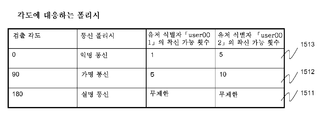
또한, 폴리시 결정부(150)에서의 대응표의 통신 폴리시에는 가명 레벨뿐만 아니라, 가명의 컨택트 어드레스의 유효 기한, 무효?유효한 조건, 사용 가능 횟수 등이 기입되어 있어도 된다. 또한, 각도와 통신 폴리시 외에, 컨택트 어드레스의 유효 기한? 유효 횟수 등을 유저가 자유롭게 설정해도 상관없다. 또한, 대응표는 유저 단말기 내의 폴리시 결정부가 아니라 네트워크상에서 관리되고 있어도 상관없다.In addition, in the communication policy of the correspondence table in the
예를 들면, 도 24는 각도와 가명 레벨 외에, 유저 식별자마다의 착신 가능 횟수를 기재한 예이다. 도면 부호 1511은 각도가 180도에서 실명 통신을 행할 때의 착신 가능 횟수는 무제한인 것을 나타내고 있다. 또한 도면 부호 1512는 각도가 90도에서 가명 통신을 행할 때의 착신 가능 횟수는 10회까지인 것을 나타내고 있다. 또한, 도면 부호 1513은 각도가 0도에서 익명 통신을 행할 때의 착신 횟수는 5회인 것을 나타내고 있다.For example, FIG. 24 is an example in which the number of possible calls for each user identifier is described in addition to the angle and alias level.
유저 단말기(100)와 마찬가지로, 유저 단말기(200)도 구성되어 있는 것으로 한다.Like the user terminal 100, the user terminal 200 is also configured.
가명 통신 서버(300)는, 네트워크를 거친 통신을 행하는 통신부(310)와, 익명 레벨에 따른 컨택트 어드레스를 생성하는 컨택트 어드레스 생성부(320)를 구비한다.The alias communication server 300 includes a
통신 확인 서버(400) 내에는, 네트워크를 거친 통신을 행하는 통신부(410)와, 통신부(410)에서 수신한 데이터에 기초하여, 양쪽 유저로부터의 통신을 수신한 것의 확인을 행하는 통신 설정 확인부(420)를 구비한다.In the communication confirmation server 400, a communication setting confirmation unit for confirming that communication has been received from both users based on a
또한, 유저 식별자는, 통신 회사가 유저 또는 유저 단말기를 식별하기 위한 값이다. 예를 들면, 휴대 전화라면 전화 번호 등이 해당한다.In addition, a user identifier is a value for a telecommunication company to identify a user or a user terminal. For example, a phone number corresponds to a mobile phone.
또한, 각 유저는 유저 단말기를 1대씩 소유하고 있고, 유저 A는 유저 식별자 「user001」을 통신 사업자로부터 할당받고 있고, 유저 단말기(100)를 소지하고 있는 것으로 한다. 마찬가지로 유저 B는 유저 식별자 「user002」에서 유저 단말기(100)를 소지하고 있는 것으로 한다.It is assumed that each user owns one user terminal, user A is assigned a user identifier "user001" from a communication provider, and possesses the user terminal 100. Similarly, it is assumed that the user B possesses the user terminal 100 with the user identifier "user002".
다음으로, 제5 실시 형태의 동작예에 대해서 설명한다.Next, an operation example of the fifth embodiment will be described.
도 25와 도 26은, 제5 실시 형태의 동작의 예를 나타내는 시퀀스도이다.25 and 26 are sequence diagrams showing examples of the operation of the fifth embodiment.
유저 A와 유저 B가 신호를 해서 유저 단말기의 조작을 행하고, 유저 단말기(100)의 근거리 통신부(130)와 유저 단말기(200)의 근거리 통신부(230)에서 통신을 개시한다(도 25의 A1, A2). 또한, 근거리 통신의 개시의 트리거로서, 가속도 센서의 값이 설정되어 있는 임계값을 초과한 것을 이용해도 된다. 그리고, 유저 단말기(100)와 유저 단말기(200)를 임의의 기울기로 겹친다. 이하의 설명에서는, 지면으로부터 수직 방향을 향한 축을 기준으로 하고, 유저 단말기(100)의 기울기가 0도, 유저 단말기(200)의 기울기가 90도 좌측 어깨로부터 우측 어깨로 단말기가 기울어 있는 경우를 설명한다.The user A and the user B signal to perform the operation of the user terminal, and communication is started by the short
근거리 통신부(130)는, 가속도 센서(120)로부터 유저 단말기의 기울기인 가속도 센서의 값 「0도」를 취득한다(도 25의 A3). 가속도 센서의 값 「0도」를 수신한 근거리 통신부(130)는, 가속도 센서의 값 「0도」와 유저 식별자 「user001」을 유저 단말기(200) 내의 근거리 통신부(230)에 송신한다(도 25의 A4).The short
가속도 센서(120)의 데이터 「0도」와 유저 식별자 「user001」을 수신한, 유저 단말기(200) 내의 근거리 통신부(230)는, 각도 검출부(240)에 데이터를 전송한다(도 25의 A5).The short-
또한, 유저 단말기(200)의 가속도 센서(220)에서 취득한 값 「90도」와 유저 식별자 「user002」를 각도 검출부(240)에 송신한다(도 25의 A6).Further, the value "90 degrees" and the user identifier "user002" acquired by the
유저 단말기(100)의 가속도 「0도」 및 유저 식별자 「user001」과, 유저 단말기(200)의 가속도 「90도」 및 유저 식별자 「user002」를 수신한 각도 검출부(240)는, 가속도 센서의 값으로부터 유저 단말기(100)와 유저 단말기(200)가 이루는 각도를, |유저 단말기(100)의 가속도 센서의 값 「0도」-유저 단말기(200)의 가속도 센서의 값 「90도」|=90도라고 산출한다(도 25의 A7).The angle detector 240 that receives the acceleration "0 degree" and the user identifier "user001" of the user terminal 100 and the acceleration "90 degree" and the user identifier "user002" of the user terminal 200 is a value of an acceleration sensor. The angle formed between the user terminal 100 and the user terminal 200 is determined from the value "0 degree" of the acceleration sensor of the user terminal 100-the value "90 degree" of the acceleration sensor of the user terminal 200. It calculates as a degree (A7 of FIG. 25).
그리고, 각도 검출부(240)는, 산출한 값 「90도」와 유저 단말기(100)의 유저 식별자 「user001」을 폴리시 결정부(250)에 송신한다(도 25의 A8).And the angle detection part 240 transmits the calculated value "90 degree" and the user identifier "user001" of the user terminal 100 to the policy determination part 250 (A8 of FIG. 25).
각도 「90도」를 수신한 폴리시 결정부(250)는, 각도에 대응하는 통신 폴리시를 도 22의 대응표(1520)로부터 「가명 통신」이라고 결정하고, 결정한 통신 폴리시를 통신부(210)에 송신한다(도 25의 A9).The
통신 폴리시 「가명 통신」을 수신한 통신부(210)는, 유저 단말기 B의 유저 식별자 「user002」와, 통신 상대의 유저 식별자 「user001」, 통신 폴리시 「가명 통신」을, 통신 확인 서버(400) 내의 통신부(410)에 송신한다(도 25의 A10).The communication unit 210 that has received the communication policy "a pseudonym communication", transmits the user identifier "user002" of the user terminal B, the user identifier "user001" of the communication partner, and the communication policy "anonymous communication" in the communication confirmation server 400. FIG. It transmits to the communication part 410 (A10 of FIG. 25).
통신 폴리시를 「가명 통신」, 폴리시를 설정하는 측의 유저 식별자 「user001」과, 통신 상대의 유저 식별자 「user002」를 수신한 통신부(410)는, 통신 설정 확인부(420)에 설정하는 통신 폴리시 「가명 통신」을 송신한다(도 25의 A11).The communication policy which sets the communication policy "anonymous communication", the user identifier "user001" of the side which sets the policy, and the user identifier "user002" of the communication partner is set to the communication
A1, A2 후, 유저 단말기(200) 내의 가속도 센서(120)에서 취득한 값 「90도」를, 근거리 통신부(230)에 통지한다(도 26의 A12).After A1 and A2, the near
가속도 센서의 값 「90도」를 수신한 근거리 통신부(230)는, 유저 식별자 「user002」와 함께 가속도 센서의 값 「90도」를 유저 단말기(100) 내의 근거리 통신부(130)에 송신한다(도 26의 A13).The short-
가속도 센서(220)의 데이터 「90도」와 유저 식별자 「user002」를 수신한, 유저 단말기(100) 내의 근거리 통신부(130)는, 각도 검출부(140)에 데이터를 전송한다(도 26의 A14). The short-
또한, 유저 단말기(100)의 가속도 센서(120)는, 취득한 값 「0도」와 유저 식별자 「user001」을 각도 검출부(140)에 송신한다(도 26의 A15).In addition, the
유저 단말기(100)의 가속도 「0도」 및 유저 식별자 「user001」과, 유저 단말기(200)의 가속도 「90도」 및 유저 식별자 「user002」를 수신한 각도 검출부(140)는, 가속도 센서의 값으로부터 휴대 단말기 A와 휴대 단말기 B가 이루는 각도는 |유저 단말기(100)의 가속도 센서의 값 「0도」-유저 단말기(200)의 가속도 센서의 값 「90도」|=90도라고 산출한다(도 26의 A16).The
그리고, 각도 검출부(140)는, 산출된 값 「90도」와 유저 식별자 「user002」를 폴리시 결정부(150)에 송신한다(도 26의 A17).The
각도 「90도」를 수신한 폴리시 결정부(150)는, 각도에 대응하는 통신 폴리시를 도 23의 도면 부호 1520으로부터 「가명 통신」이라고 결정하고, 결정한 통신 폴리시 「가명 통신」을 통신부(110)에 송신한다(도 26의 A18).The
통신 폴리시 「가명 통신」을 수신한 통신부(110)는, 휴대 단말기 A의 유저 식별자 「user001」, 통신 상대의 유저 식별자 「user002」, 및 통신 폴리시 「가명 통신」을, 통신 확인 서버(400) 내의 통신부(410)에 송신한다(도 26의 A19).The
통신 폴리시를 「가명 통신」, 폴리시를 설정하는 발신측의 유저 식별자 「user001」, 통신 상대의 유저 식별자 「user002」 수신한 통신부(410)는, 통신 확인부(420)에 설정하는 통신 폴리시 「가명 통신」을 송신한다(도 26의 A20).The
또한, A3?A11과 A12?A20은 동시에 행해져도 되고, 순서가 반대이어도 되고, A1?A11만 또는 A1?A2와 A12?A20만이어도 상관없다.In addition, A3-A11 and A12-A20 may be performed simultaneously, and may be reversed, and only A1-A11 or A1-A2 and A12-A20 may be sufficient.
통신 설정 확인부(420)는, 유저 식별자 「user001」과 유저 식별자 「user002」의 양방으로부터 통신 폴리시를 수신한 것을 확인한다(도 26의 A21).The communication
통신 폴리시의 수신의 확인을 한 통신 설정 확인부(420)는, 유저 식별자 「user001」「user002」와, 결정한 통신 폴리시 「가명 통신」을, 가명 통신 서버의 컨택트 어드레스 생성부(320)에 송신한다(도 26의 A22, A23).The communication
유저 식별자 「user001」 및 「user002」와 통신 폴리시 「가명 통신」을 수신한 컨택트 어드레스 생성부(320)는, 유저 식별자 「user001」의 가명의 컨택트 어드레스 「kamei111@nec.com」과, 유저 식별자 「user002」의 「kamei222@nec.com」을 생성한다. 또한, 생성하는 가명의 컨택트 어드레스는, 유저 식별자 「user001」과 유저 식별자 「user002」의 양자가, 가명 레벨에 부가해서 지정한 유효 횟수 등의 폴리시를 따라서발착신 가능한 컨택트 어드레스를 1개 생성해도 상관없다.The contact
컨택트 어드레스 생성부(320)는, 통신부(310)를 거쳐서, 생성한 가명의 컨택트 어드레스 「kamei111@nec.com」을 유저 식별자 「user002」에 통지한다. 그리고, 유저 단말기(200)의 통신부(210)는, 수신한 컨택트 어드레스 「kamei111@nec.com」을, 유저 단말기(200) 내의 전화번호부(260)에 보존한다(도 26의 A24, A25, A26).The contact
마찬가지로, 컨택트 어드레스 생성부(320)는, 통신부(310)를 거쳐서, 생성한 가명의 컨택트 어드레스 「kamei222@nec.com」을 유저 식별자 「user001」에 통지한다. 그리고, 유저 단말기(100)의 통신부(110)는, 수신한 컨택트 어드레스 「kamei222@nec.com」을, 유저 단말기(100) 내의 전화번호부(160)에 보존한다(도 26의 A24, A27, A28).Similarly, the contact
가명의 컨택트 어드레스의 통지는 순서를 문제삼지 않는다. 또한 통지된 컨택트 어드레스는 전화번호부에 등록을 해도 되고 하지 않아도 상관없다.Notification of an aliased contact address does not matter the order. The notified contact address may or may not be registered in the telephone book.
유저 식별자 「user001」의 유저 단말기(100)는, 가명의 컨택트 어드레스 「kamei222@nec.com」을 이용해서 유저 식별자 「user002」에 연락을 한다.The user terminal 100 of the user identifier "user001" communicates with the user identifier "user002" using the aliased contact address "kamei222_nec.com".
연락 방법의 일례로서 유저 식별자 「user001」의 유저 단말기(100)가 유저 식별자 「user002」에 메일을 보내는 경우, 유저 식별자 「user001」은 「TO:kamei222@nec.com, FM:user001」이라고 송신한다. 가명 통신 서버(400)에서는, 「kamei222@nec.com」을 「user002」로 변환하고, 「user001」을 「kamei111@nec.com」으로 변환해서 메일을 송신한다. 그리고, 유저 식별자 「user002」의 유저 단말기(200)는, 「TO:user002, FM: kamei111@nec.com」이라고 하는 메일을 수신하는 것 등을 들 수 있다.As an example of a communication method, when the user terminal 100 of the user identifier "user001" sends a mail to the user identifier "user002", the user identifier "user001" is transmitted as "TO: kamei222@nec.com, FM: user001". . The alias communication server 400 converts "kamei222_nec.com" into "user002", converts "user001" into "kamei111_nec.com", and sends an e-mail. And the user terminal 200 of user identifier "user002" may receive the mail "TO: user002, FM: kamei111@nec.com", etc. are mentioned.
이상과 같이, 제5 실시 형태에서는, 유저 단말기끼리를 임의의 방향으로 각각 기울여서 통신을 행한다고 하는 간단한 조작을 행하기만 하면, 통신 폴리시를 결정할 수 있다. 그 때문에, 다른 유저와의 사이에서 익명?가명?실명 등의 가명 레벨 등을 변경 가능한 가명 컨택트 어드레스를 용이하게 불출할 수 있다.As described above, in the fifth embodiment, the communication policy can be determined by simply performing a simple operation of performing communication by tilting the user terminals in arbitrary directions, respectively. Therefore, pseudonym contact addresses which can change the pseudonym level, such as anonymity, anonymity, real name, etc., can be easily issued between other users.
또한, 통신 사업자는, 컨택트 어드레스를 불출할 때의 유저 조작이 간단해진 것에 의해, 가명 통신 시스템의 이용자의 증가가 예상되어, 고객이나 시장을 확대한다.In addition, the communication service provider is expected to increase the number of users of the pseudonym communication system by simplifying the user operation when distributing the contact address, thereby expanding the customer and the market.
서비스 사업자의 효과는, 유저가 일시적인 익명의 컨택트 어드레스를 용이하게 이용할 수 있게 되고, 유저가 실명으로 서비스를 이용하는 일이 감소하여, 서비스 사업자의 개인 정보 보호의 코스트를 삭감할 수 있다.The effect of the service provider is that the user can easily use the temporary anonymous contact address, and the user can use the service by his real name, thereby reducing the cost of protecting the personal information of the service provider.
<제6 실시 형태>≪ Sixth Embodiment &
제6 실시 형태를 설명한다.The sixth embodiment will be described.
제6 실시 형태는, 유저가 선택한 그룹의 전원에 대응하는 컨택트 어드레스를 생성하는 예를 설명한다. 예를 들면, 종래, 유저 A가 레스토랑에 내점한 바, 레스토랑이 붐비고 있는 경우, 레스토랑의 종업원은 자리의 준비가 되는 대로 유저 A에게 연락을 하고자 하여, 유저 A에게 휴대 전화번호 등을 묻는 케이스가 많다. 그러나, 유저 A는 얼굴이 알려져도, 개인 정보에 해당하는 휴대 전화번호 등을 간단히 타인에게 가르쳐 주고 싶지 않은 것이다. 그래서, 제6 실시 형태에서는, 유저 A의 단말기와 레스토랑의 종업원의 단말기나 레스토랑 전용의 단말기를 이용하여, 익명성이 있는 컨택트 어드레스를 불출하는 것에 의해, 유저 A는 레스토랑의 종업원과 익명 통신을 행하도록 한다. 구체적으로는, 유저 A와 레스토랑의 종업원 1명인 유저 B 사이에서 컨택트 어드레스를 생성한 경우, 유저 A와 레스토랑의 종업원 모두의 사이에서 컨택트 어드레스를 유효하게 한다. 그 결과, 공석 시의 좌석 안내 업무에, 레스토랑 모든 종업원이 행할 수 있게 된다.The sixth embodiment describes an example of generating a contact address corresponding to a power source of a group selected by a user. For example, when a user A visits a restaurant, and the restaurant is crowded, a case in which a restaurant employee wants to contact the user A as soon as the seat is ready and asks the user A for a mobile number or the like. many. However, even if the user A has a known face, he or she does not want to simply teach others the mobile phone number corresponding to the personal information. Therefore, in the sixth embodiment, the user A makes anonymous communication with the restaurant employee by sending an anonymous contact address by using the user A terminal, the terminal of the employee of the restaurant, or the terminal dedicated to the restaurant. Do it. Specifically, when a contact address is generated between user A and user B, which is one employee of the restaurant, the contact address is valid between both user A and the employee of the restaurant. As a result, all the employees of a restaurant can perform the seat guidance work at the time of vacancy.
도 27은 제6 실시 형태를 도시하는 구성도이다.It is a block diagram which shows 6th Embodiment.
제6 실시 형태의 구성도에 대해서, 제5 실시 형태와의 차분을 설명한다.About the block diagram of 6th Embodiment, the difference with 5th Embodiment is demonstrated.
제6 실시 형태의 구성도에 있어서, 각 유저 단말기는, 그룹 정보 기억부(700)와, 그룹 선택부(701)를 구비한다.In the configuration diagram of the sixth embodiment, each user terminal includes a group information storage section 700 and a
그룹 선택부(701)는, 가명 통신 서버(300)로부터 발행된 통신 어드레스를, 개인에 대하여 결부시킬지, 어디의 그룹에 대하여 결부시킬지의 선택을 행한다.The
도 28은, 유저 B가 보유하는 유저 식별자 「user002」의 유저 단말기 B의 그룹 정보 기억부(700)의 기억 내용의 일례를 도시한 도면이다. 그룹 정보 기억부(700)는, 도 28과 같이, 그룹 번호마다 그룹명이 붙여지고, 그 그룹에 소속하는 유저의 유저 식별자가 기재되어 있다. 도면 부호 5210은, 그룹 번호 「1」인 그룹명 「레스토랑 종업원」에 유저 식별자 「user002」, 「user004」 및 「user006」이 소속되어 있는 것을 나타내고 있다.FIG. 28 is a diagram showing an example of the contents of the group information storage unit 700 of the user terminal B of the user identifier " user002 " held by the user B. As shown in FIG. In the group information storage unit 700, as shown in Fig. 28, a group name is assigned to each group number, and a user identifier of a user belonging to the group is described.
또한, 그룹 정보 기억부(700)의 내용은, 유저 단말기 내에 전화번호부의 일부로서 등록되어 있어도, 네트워크 전화번호부의 일부로서 등록되어 있어도 상관없다.The contents of the group information storage unit 700 may be registered as part of the phone book in the user terminal or as part of the network phone book.
다음으로, 제6 실시예의 형태의 동작예에 대해서 설명한다. 도 29는, 제6 실시 형태의 동작의 예를 나타내는 시퀀스도이다.Next, an operation example of the form of the sixth embodiment will be described. 29 is a sequence diagram illustrating an example of the operation of the sixth embodiment.
이하의 설명에 있어서, 유저 식별자 「user001」은 유저 A이고, 유저 식별자 「user002」는 유저 B이며, 유저 식별자 「user004」는 유저 D이고, 유저 식별자 「user006」은 유저 F인 것으로 한다. 또한, 유저 A는 유저 단말기 A를 소유하고, 유저 B는 유저 단말기 B를 소유하고, 유저 D는 유저 단말기D를 소유하고, 유저 F는 유저 단말기 F를 소유하고 있는 것으로 한다. 그리고, 유저 A가 레스토랑에 내점한 경우에, 유저 A와 레스토랑의 종업원 1명인 유저 B 사이에서 컨택트 어드레스를 생성하고, 유저 A와 레스토랑의 종업원인 유저 B, 유저 D 및 유저 F 사이에서 컨택트 어드레스를 유효하게 하는 경우를 설명한다.In the following description, it is assumed that user identifier "user001" is user A, user identifier "user002" is user B, user identifier "user004" is user D, and user identifier "user006" is user F. In addition, it is assumed that user A owns user terminal A, user B owns user terminal B, user D owns user terminal D, and user F owns user terminal F. When user A comes to the restaurant, a contact address is generated between user A and user B, which is one employee of the restaurant, and a contact address is created between user A and user B, user D, and user F who are employees of the restaurant. The case where it becomes effective is demonstrated.
우선, 유저 단말기 A와 유저 단말기 B 사이에서 상술한 제5 실시 형태에 있어서의 A1?A2의 동작이 행해진다. 여기서는, 유저 단말기 A와 유저 단말기 B가 이루는 각도가 90도이었던 것으로 한다.First, the operation of A1-A2 in 5th Embodiment mentioned above between user terminal A and user terminal B is performed. It is assumed here that the angle formed by the user terminal A and the user terminal B was 90 degrees.
유저 단말기 B의 소유자인 유저 B는, 그룹 선택부(701)에 의해 그룹 식별자 「1」(그룹 명「레스토랑 종업원」을 선택)을 입력한다(도 29의 B1).The user B, who is the owner of the user terminal B, inputs the group identifier "1" (selecting the group name "restaurant employee") by the group selector 701 (B1 in Fig. 29).
유저 단말기 A와 유저 단말기 B 사이에서, 제5 실시 형태에 있어서의 A3?A8의 동작을 행한다.Between user terminal A and user terminal B, the operation of A3-A8 in 5th Embodiment is performed.
유저 단말기 B의 각도 검출부(140)로부터 각도 「90도」를 수신한 폴리시 결정부(250)는, 각도에 대응하는 통신 폴리시를 도 24의 대응표로부터 「가명 통신」이라고 결정하고, 결정한 통신 폴리시와 그룹 정보 식별자 「1」을 그룹 정보 선택부(701)에 송신한다(도 29의 B2).The
유저 단말기 B200의 그룹 정보 선택부(701)는, 유저 식별자 「user002」, 통신 상대의 유저 식별자 「user001」, 통신 폴리시 「가명 통신」, 및 그룹 식별자 「1」을 그룹 정보 기억부(700)에 송신한다(도 29의 B3).The group
그룹 식별자 「1」을 수취한 그룹 정보 기억부(700)는, 그룹 식별자 「1」에 대응하는 유저 식별자 「user002」, 「user004」 및 「user006」과, 통신 상대의 유저 식별자 「user001」과, 통신 폴리시 「가명 통신」을 통신부(110)에 송신한다(도 29의 B4).Receiving the group identifier "1", the group information storage unit 700 includes the user identifiers "user002", "user004" and "user006" corresponding to the group identifier "1", the user identifier "user001" of the communication partner, The communication policy "anonymous communication" is transmitted to the communication unit 110 (B4 in FIG. 29).
이 후, A11?A23의 동작은 제5 실시 형태와 마찬가지이다.Thereafter, the operations of A11 to A23 are the same as in the fifth embodiment.
유저 식별자 「user001」, 「user002」, 「user004」 및 「user006」과, 통신 폴리시 「가명 통신」을 수신한 컨택트 어드레스 생성부(320)는, 유저 식별자 「user001」에 대응하는 가명의 컨택트 어드레스 「kamei111@nec.com」과, 유저 식별자 「user002」, 「user004」 및 「user006」에 대응하는 가명의 컨택트 어드레스 「circleA@nec.com」을 생성한다.The contact
유저 식별자 「user002」 「user004」 「user006」에 대응하는 가명의 컨택트 어드레스 「circleA@nec.com」은 예를 들면 메일링 리스트 등이다.The contact address "circleA'nec.com" of the aliases corresponding to the user identifiers "user002", "user004" and "user006" is, for example, a mailing list or the like.
그리고, 가명 통신 서버(300)로부터, 생성한 가명의 컨택트 어드레스 「kamei111@nec.com」을, 유저 식별자 「user002」의 유저 단말기 B에 통지한다(도 29의 B5).Then, the alias communication server 300 notifies the user terminal B of the generated alias contact address "kamei111@nec.com" of the user identifier "user002" (B5 of FIG. 29).
또한, 가명 통신 서버(300)로부터, 생성한 가명의 컨택트 어드레스 「kamei111@nec.com」을, 유저 식별자 「user006」의 유저 단말기 F에 통지한다(도 29의 B6).Furthermore, the alias communication server 300 notifies the user terminal F of the user name "user006" of the generated contact address "kamei111@nec.com" (B6 in FIG. 29).
또한, 가명 통신 서버(300)로부터, 생성한 가명의 컨택트 어드레스 「kamei111@nec.com」을, 유저 식별자 「user004」의 유저 단말기D에 통지한다(도 29의 B7).Furthermore, the alias communication server 300 notifies the user terminal D of the user name "user004" of the contact name "kamei111@nec.com" which was created (B7 of FIG. 29).
또한, 가명 통신 서버(300)로부터, 생성한 가명의 컨택트 어드레스 「circleA@nec.com」을, 유저 식별자 「user001」의 유저 단말기 A에 통지한다(도 29의 B8).Furthermore, the alias communication server 300 notifies the user terminal A of the user identifier "user001" of the generated contact address "circleA'nec.com" (B8 of FIG. 29).
또한, B5?B8의 순서는 문제삼지 않는다.In addition, the order of B5-B8 does not matter.
가명의 컨택트 어드레스를 수신한 유저 식별자 「user001」의 유저 A는, 가명의 컨택트 어드레스 「circleA@nec.com」을 이용하여, 메일을 송신하면, 유저 식별자 「user002」의 유저 단말기 B, 「user004」의 유저 단말기D, 및 「user006」의 유저 단말기 F의 전원이 유저 식별자 「user001」로부터의 메일을 수신한다.When the user A of the user identifier "user001" having received the pseudonym contact address sends a mail using the pseudonym contact address "circleA'nec.com", the user terminal B of the user identifier "user002", "user004" The power supply of the user terminal D and the user terminal F of "user006" receives mail from the user identifier "user001".
또한, 유저 식별자 「user002」가 선택한 그룹의 유저가 유저 식별자 「user001」의 유저 단말기 A와 컨택트를 취할 때에는, 폴리시 결정부(150)에서 결정한 폴리시가 적용된다. 예를 들면, 유저 식별자 「user004」로부터 유저 식별자 「user001」에 가명의 컨택트 어드레스 「kamei111@nec.com」을 이용해서 컨택트를 취할 경우에, 유저 식별자 「user004」의 유저 단말기D는 가명으로 유저 식별자 「user001」의 유저 단말기 A와 통신이 행해진다.When the user of the group selected by the user identifier "user002" makes contact with the user terminal A of the user identifier "user001", the policy determined by the
이상과 같이, 제6 실시 형태에서는, 예를 들면, 레스토랑이나 가라오케 등의 공석 대기 시에, 실명 등을 포함한 어드레스 등을 서비스 사업자에게 전달할 필요가 없어, 그들의 정보를 전달하는 것에 저항이 없어, 지금까지 서비스를 받지 않았던 유저의 이용 증가가 도모된다.As described above, in the sixth embodiment, for example, there is no need to deliver an address including the real name, etc. to the service provider when waiting for vacancies such as a restaurant or karaoke, and there is no resistance to delivering their information. It is possible to increase the use of users who did not receive services until now.
<제7 실시 형태>Seventh Embodiment
제7 실시 형태를 설명한다.The seventh embodiment will be described.
제7 실시 형태는, 개인의 스케줄의 내용과 그룹이 대응하는지의 여부를 자동적으로 판단한다. 예를 들면, 서클이나 아르바이트 등의 활동 시간대는, 조직의 일원으로서 개인이 활동한다. 따라서, 유저의 스케줄부에 「서클」이라고 기재되어 있는 경우에는, 그 유저는 서클 활동을 하고 있는 것이 자명하다. 그래서, 그룹의 선택과 스케줄러를 연동시키는 것에 의해, 자동적으로 스케줄에 적합한 그룹을 선택하도록 구성하고, 수고를 들이지 않고, 스케줄의 예정에 있던 그룹에 적합한 폴리시의 어드레스를 불출할 수 있는 예를 설명한다.The seventh embodiment automatically determines whether the contents of the individual schedule and the group correspond. For example, in an activity time zone such as a circle or part-time job, an individual acts as a member of an organization. Therefore, when "circle" is described in the schedule part of a user, it is obvious that the user is performing a circle activity. Thus, an example in which a group suitable for a schedule can be automatically selected by integrating the group selection and the scheduler, and the address of a policy suitable for the scheduled group can be issued without any trouble will be described. .
도 30은 제7 실시 형태를 도시하는 구성도이다.30 is a configuration diagram showing the seventh embodiment.
제7 실시 형태의 구성도에 대해서, 제6 실시예와의 차분을 설명한다.The difference from the 6th Example is demonstrated about the block diagram of 7th Embodiment.
제7 실시 형태의 구성도에 있어서, 스케줄러(705)를 구비한다.In the configuration diagram of the seventh embodiment, a
스케줄러(705)는, 도 31의 도면 부호 5110와 같이, 유저 식별자마다 스케줄이 등록되어 있다. 도면 부호 5110은 스케줄의 일례이다. 이 스케줄러(705)의 일례에서는, 유저 식별자 「user002」의 유저 B는, 2009년 4월 12일에 13시부터 15시까지, 서클의 신인 권유 활동이 있는 것을 나타내고 있다. 또한, 괄호로 둘러싼 부분은 그룹 식별자인 것을 나타낸다. 도면 부호 5110의 스케줄예는 그룹 식별자 「서클」인 것을 나타낸다.The
도 32는, 제7 실시 형태에 있어서의 유저 B가 보유하는 유저 식별자 「user002」의 유저 단말기 B의 그룹 정보 기억부(700)의 기억 내용의 일례를 도시한 도면이다. 도 32의 일례에서는, 그룹 정보 기억부(700)는, 그룹 번호마다 그룹명이 붙여지고, 그 그룹에 소속하는 유저의 유저 식별자가 기재되어 있다. 도 32의 도면 부호 5220은, 그룹 번호 「1」인 그룹명 「서클」에 유저 식별자 「user002」, 「user004」 및 「user006」이 소속해 있는 것을 나타내고 있다.32 is a diagram showing an example of the contents of the group information storage unit 700 of the user terminal B of the user identifier "user002" held by the user B in the seventh embodiment. In the example of FIG. 32, group information storage | storage part 700 attaches a group name to every group number, and describes the user identifier of the user which belongs to the group.
다음으로, 제7 실시 형태의 동작예에 대해서 설명한다. 도 33은, 제7 실시 형태의 동작의 예를 나타내는 시퀀스도이다.Next, an operation example of the seventh embodiment will be described. 33 is a sequence diagram illustrating an example of the operation of the seventh embodiment.
이하의 설명에 있어서, 유저 식별자 「user001」은 유저 A이고, 유저 식별자 「user002」는 유저 B이며, 유저 식별자 「user004」은 유저 D이고, 유저 식별자 「user006」은 유저 F인 것으로 한다. 또한, 유저 A는 유저 단말기 A를 소유하고, 유저 B는 유저 단말기 B를 소유하고, 유저 D는 유저 단말기D를 소유하고, 유저 F는 유저 단말기 F를 소유하고 있는 것으로 한다. 그리고, 유저 B는, 신인 권유 활동에 의해, 유저 A를 권유한 경우, 유저 A와 서클의 멤버의 1명인 유저 B 사이에서 컨택트 어드레스를 생성하고, 유저 A와 서클의 멤버인 유저 B, 유저 D 및 유저 F 사이에서 컨택트 어드레스를 유효하게 하는 경우를 설명한다.In the following description, it is assumed that user identifier "user001" is user A, user identifier "user002" is user B, user identifier "user004" is user D, and user identifier "user006" is user F. In addition, it is assumed that user A owns user terminal A, user B owns user terminal B, user D owns user terminal D, and user F owns user terminal F. And when the user B invites user A by a rookie invitation activity, the user B produces | generates a contact address between user A and user B which is one member of a circle, and user B and user D which are members of a circle and user D And the case where the contact address is valid between the user F will be described.
우선, 유저 단말기 A와 유저 단말기 B 사이에서 상술한 제5 실시 형태에 있어서의 A1?A2의 동작이 행해진다. 여기서는, 유저 단말기 A와 유저 단말기 B가 이루는 각도가 90도인 것으로 한다. 그 후의 동작인 A1?A8은, 제5 실시 형태와 마찬가지이다.First, the operation of A1-A2 in 5th Embodiment mentioned above between user terminal A and user terminal B is performed. It is assumed here that the angle formed by the user terminal A and the user terminal B is 90 degrees. The subsequent operations A1 to A8 are the same as in the fifth embodiment.
각도 「90도」를 수신한 폴리시 결정부(150)는, 각도에 대응하는 통신 폴리시를 도 24의 대응표로부터 「가명 통신」이라고 결정하고, 결정한 통신 폴리시 「가명 통신」과 유저 식별자 「user002」를 스케줄러에 송신한다(도 33의 C1).The
스케줄러(705)는, 유저 식별자 「user002」의 스케줄에서, 유저 식별자를 수신한 시각 「2009년 4월 12일」에 대응하는 스케줄의 유무와 내용을 확인한다(도 33의 C2).The
스케줄러(705)의 스케줄에는, 도 31에 도시되는 바와 같이, 「13-15시 [서클] 신인 권유 활동」이 기억되어 있으므로 그룹 식별자 「서클」을, 그룹 정보부에 송신한다(도 33의 C3). 또한, 시각은 네트워크 시계로부터 취득해도, 전파 시계의 데이터를 전파로부터 취득해도 상관없다.As shown in Fig. 31, the
그룹 식별자 「서클」을 수신한 그룹 정보 기억부(700)는, 도 32의 대응표에 따라, 그룹 식별자 「서클」에 대응하는 유저 식별자 「user002」, 「user004」 및 「user006」을 통신부(110)에 송신한다(도 33의 C4).Upon receiving the group identifier "circle", the group information storage unit 700 transmits the user identifiers "user002", "user004", and "user006" corresponding to the group identifier "circle" according to the correspondence table in FIG. (C4 in Fig. 33).
이후는, 상술한 제5 실시 형태 및 제6 실시 형태와 마찬가지의 동작이다.Subsequently, operations are the same as those of the fifth and sixth embodiments described above.
이상과 같이, 제7 실시 형태에서는, 스케줄러와 연동을 시키는 것에 의해, 유저가 그룹을 선택하는 수고를 들이지 않고, 선택된 그룹에 적합한 가명 어드레스를 불출할 수 있다.As described above, in the seventh embodiment, by linking with the scheduler, an alias address suitable for the selected group can be issued without the user having to select a group.
또한, 상술한 실시 형태에서는, 각 부를 하드웨어로 구성했지만, 각 부와 마찬가지의 동작을 CPU 등에 실행시키는 프로그램에 의해서도 구성할 수 있다.In addition, although each part was comprised by the hardware in above-mentioned embodiment, it can also be comprised by the program which performs the same operation as each part etc. in a CPU.
이상 바람직한 실시 형태를 들어서 본 발명을 설명했지만, 본 발명은 반드시 상기 실시 형태에 한정되는 것은 아니고, 그 기술적 사상의 범위 내에 있어서 여러 가지로 변형하여 실시할 수 있다.Although the present invention has been described with reference to preferred embodiments, the present invention is not necessarily limited to the above embodiments, and various modifications can be made within the scope of the technical idea.
또한, 상기한 실시 형태의 일부 또는 전부는, 이하의 부기와 같이 기재될 수도 있지만, 이하에는 한정되지 않는다.In addition, although some or all of said embodiment may be described like the following bookkeeping, it is not limited to the following.
(부기 1) 적어도 2 이상의 통신 단말기를 갖는 통신 시스템으로서, (Appendix 1) A communication system having at least two communication terminals,
통신 단말기의 자세 상태를 검출하는 자세 상태 검출 수단과, Posture state detection means for detecting a posture state of the communication terminal;
상기 자세 상태 검출 수단에서 검출된 각 통신 단말기의 자세 상태에 기초하여, 상기 통신 단말기 간의 자세 상태의 관계성을 계산하는 관계성 계산 수단과, Relationship calculating means for calculating the relationship between the posture states between the communication terminals based on the posture states of the communication terminals detected by the posture state detecting means;
상기 통신 단말기 간의 자세 상태의 관계성에 기초하여, 상기 통신 단말기 간에서 적용되는 통신 폴리시를 결정하는 통신 폴리시 결정 수단을 갖는 통신 시스템.And communication policy determining means for determining a communication policy applied between the communication terminals based on the relationship of the posture states between the communication terminals.
(부기 2) 상기 자세 상태 검출 수단은, 상기 통신 단말기의 소정 자세를 기준으로 한 경도를 검출하고, (Supplementary Note 2) The posture state detecting means detects a hardness based on a predetermined posture of the communication terminal,
상기 관계성 계산 수단은, 상기 자세 상태 검출 수단에서 검출된 각 통신 단말기의 경도에 기초하여, 통신 단말기 간에서 이루는 각도를 계산하는 부기 1에 기재된 통신 시스템.The communication system according to
(부기 3) 상기 자세 상태 검출 수단은, 통신 단말기의 가속도의 변화를 검출하고, (Supplementary Note 3) The posture state detecting means detects a change in acceleration of the communication terminal,
상기 관계성 계산 수단은, 상기 자세 상태 검출 수단에서 검출된 각 통신 단말기의 가속도의 변화에 기초하여, 상기 통신 단말기 간에 있어서의 동작의 동기수를 계산하는 부기 1에 기재된 통신 시스템.The communication system according to
(부기 4) 상기 통신 폴리시에 기초하여, 상기 통신 단말기 중 적어도 1 이상의 통신 단말기에 송신하는 정보를 결정 또는 생성하는 정보 결정 수단을 갖는 부기 1 내지 부기 3 중 어느 하나에 기재된 통신 시스템.(Supplementary note 4) The communication system according to any one of
(부기 5) 상기 통신 폴리시가, 상기 통신 단말기 중 적어도 1 이상의 통신 단말기에 송신하는 정보의 개시 레벨, 익명 레벨, 유효 기한, 개시 범위를 정한 것 중 적어도 어느 하나, 또는, 그 조합인 부기 1 내지 부기 4 중 어느 하나에 기재된 통신 시스템.(Supplementary Note 5)
(부기 6) 상기 통신 단말기에 송신하는 정보가, 메일 어드레스, 전화 번호 또는 소정의 개인 정보 중 적어도 어느 하나인 부기 1 내지 부기 5 중 어느 하나에 기재된 통신 시스템.(Supplementary note 6) The communication system according to any one of
(부기 7) 상기 통신 단말기가, 상기 자세 상태 검출 수단과, 상기 통신 단말기 간의 자세 상태의 관계성을 계산하는 관계성 계산 수단과, 상기 통신 폴리시 결정 수단과, 상기 정보 결정 수단을 갖는 부기 1 내지 부기 6 중 어느 하나에 기재된 통신 시스템.(Supplementary note 7)
(부기 8) 상기 통신 단말기가, 상기 자세 상태 검출 수단과, 상기 통신 단말기 간의 자세 상태의 관계성을 계산하는 관계성 계산 수단과, 상기 통신 폴리시 결정 수단을 갖고, (Supplementary note 8) The communication terminal includes relationship calculating means for calculating the relationship between the posture state detecting means, the posture state between the communication terminal, and the communication policy determining means.
상기 각 통신 단말기와 통신을 행하는 서버가, 상기 정보 결정 수단을 갖는 부기 1 내지 부기 6 중 어느 하나에 기재된 통신 시스템.The communication system according to any one of
(부기 9) 적어도 1 이상의 제1 통신 단말기 및 제2 통신 단말기와 서버를 갖고, (Supplementary note 9) having at least one first communication terminal and second communication terminal and a server,
제1 통신 단말기는, The first communication terminal,
자 제1 통신 단말기의 자세 상태를 검출하는 자세 상태 검출 수단과, Posture state detection means for detecting a posture state of the first communication terminal;
상기 검출된 자세 상태와, 자신의 통신 단말기의 식별자를, 상기 제2 통신 단말기에 송신하는 송신부를 갖고, A transmitting unit for transmitting the detected attitude state and an identifier of its own communication terminal to the second communication terminal,
제2 통신 단말기는, The second communication terminal,
자 제2 통신 단말기의 자세 상태를 검출하는 자세 상태 검출 수단과, Posture state detection means for detecting a posture state of the second communication terminal;
상기 제1 통신 단말기의 자세 상태와 상기 제2 통신 단말기의 자세 상태에 기초하여, 상기 제1 통신 단말기와 상기 제2 통신 단말기의 자세 상태의 관계성을 계산하는 관계성 계산 수단과, Relationship calculating means for calculating a relationship between the posture state of the first communication terminal and the second communication terminal based on the posture state of the first communication terminal and the posture state of the second communication terminal;
상기 자세 상태의 관계성에 기초하여, 상기 제1 통신 단말기와 상기 제2 통신 단말기 사이에서 적용되는 통신 폴리시를 결정하는 통신 폴리시 결정 수단과, Communication policy determining means for determining a communication policy applied between the first communication terminal and the second communication terminal based on the relationship of the posture state;
상기 통신 폴리시와, 상기 제1 통신 단말기 및 상기 제2 통신 단말기의 식별자를, 상기 서버에 송신하는 송신 수단을 갖고, And a transmitting means for transmitting the communication policy and identifiers of the first communication terminal and the second communication terminal to the server,
상기 서버는, The server,
상기 제1 통신 단말기 및 상기 제2 통신 단말기의 식별자와 상기 통신 폴리시에 기초하여, 상기 제1 통신 단말기와 상기 제2 통신 단말기 사이의 통신에 대하여, 상기 통신 폴리시에 기초한 통신을 설정하는 통신 수단을 갖는 통신 시스템.Communication means for establishing communication based on the communication policy for communication between the first communication terminal and the second communication terminal based on an identifier of the first communication terminal and the second communication terminal and the communication policy. Having communication system.
(부기 10) 상기 제1 통신 단말기는, (Supplementary note 10) The first communication terminal,
상기 제1 통신 단말기의 자세 상태와 상기 제2 통신 단말기의 자세 상태에 기초하여, 상기 제1 통신 단말기와 상기 제2 통신 단말기의 자세 상태의 관계성을 계산하는 관계성 계산 수단과, Relationship calculating means for calculating a relationship between the posture state of the first communication terminal and the second communication terminal based on the posture state of the first communication terminal and the posture state of the second communication terminal;
상기 자세 상태의 관계성에 기초하여, 상기 제1 통신 단말기와 상기 제2 통신 단말기 사이에서 적용되는 통신 폴리시를 결정하는 통신 폴리시 결정 수단과, Communication policy determining means for determining a communication policy applied between the first communication terminal and the second communication terminal based on the relationship of the posture state;
상기 통신 폴리시와 상기 제1 통신 단말기의 식별자를, 상기 제2 통신 단말기에 송신하는 송신 수단을 갖고, A transmitting means for transmitting the communication policy and the identifier of the first communication terminal to the second communication terminal,
제2 통신 단말기의 송신 수단은, 상기 제1 통신 단말기로부터의 통신 폴리시와 상기 제2 통신 단말기로부터의 통신 폴리시의 일치를 확인하고, 일치한 경우에는 상기 통신 폴리시와 상기 제1 통신 단말기 및 상기 제2 통신 단말기의 식별자를 상기 서버에 송신하는 부기 9에 기재된 통신 시스템.The transmitting means of the second communication terminal confirms the correspondence between the communication policy from the first communication terminal and the communication policy from the second communication terminal, and if it matches, the communication policy and the first communication terminal and the first communication terminal. 2 The communication system according to Appendix 9, which transmits an identifier of a communication terminal to the server.
(부기 11) 상기 제2 통신 단말기는, (Appendix 11) The second communication terminal,
적어도 1 이상의 통신 단말기의 식별자와 상기 통신 단말기의 식별자를 포함하는 그룹 식별자가 대응지어진 그룹 테이블과, 상기 통신 폴리시를 적용하는 그룹 식별자를 상기 그룹 테이블로부터 선택하는 선택 수단을 갖고, A group table to which at least one communication terminal identifier and a group identifier including the identifier of the communication terminal are associated, and selection means for selecting from the group table a group identifier to which the communication policy is applied;
상기 제2 통신 단말기의 송신 수단은, 상기 통신 폴리시와, 상기 제1 통신 단말기, 상기 제2 통신 단말기 및 상기 선택된 그룹 식별자의 그룹에 포함되는 통신 단말기의 식별자를 상기 서버에 송신하고, The transmitting means of the second communication terminal transmits the communication policy and an identifier of the communication terminal included in the group of the first communication terminal, the second communication terminal and the selected group identifier to the server,
상기 서버의 통신 수단은, 상기 통신 폴리시와, 상기 제1 통신 단말기, 상기 제2 통신 단말기 및 상기 선택된 통신 단말기의 식별자에 기초하여, 상기 제1 통신 단말기와 상기 제2 통신 단말기 및 상기 선택된 그룹의 통신 단말기 사이의 통신에 대하여, 상기 통신 폴리시에 기초한 통신을 설정하는 부기 9 또는 부기 10에 기재된 통신 시스템.The communication means of the server is based on the communication policy and the identifiers of the first communication terminal, the second communication terminal, and the selected communication terminal, wherein the first communication terminal, the second communication terminal, and the selected group. The communication system according to supplementary note 9 or
(부기 12) 상기 제2 통신 단말기는, 일시와 일시에 대응해서 상기 그룹의 식별자가 기억된 스케줄 기억 수단을 갖고, (Supplementary note 12) The second communication terminal has schedule storage means in which an identifier of the group is stored corresponding to a date and time,
상기 선택 수단은, 상기 자세 상태 검출 수단의 검출 일시에 대응하는 그룹 식별자를 상기 스케줄 기억 수단으로부터 검색하고, 이 그룹 식별자의 그룹을 상기 통신 폴리시를 적용하는 그룹으로서 선택하는 부기 11에 기재된 통신 시스템.The communication system according to
(부기 13) 상기 자세 상태 검출 수단은, 상기 통신 단말기의 소정 자세를 기준으로 한 경도를 검출하고, (Supplementary Note 13) The posture state detecting means detects a longitude based on a predetermined posture of the communication terminal,
상기 관계성 계산 수단은, 상기 자세 상태 검출 수단에서 검출된 각 통신 단말기의 경도에 기초하여, 통신 단말기 간에서 이루는 각도를 계산하는 부기 9 내지 부기 12 중 어느 하나에 기재된 통신 시스템.The communication system according to any one of notes 9 to 12, wherein the relationship calculating means calculates an angle formed between communication terminals based on the hardness of each communication terminal detected by the posture state detecting means.
(부기 14) 상기 자세 상태 검출 수단은, 통신 단말기의 가속도의 변화를 검출하고, (Supplementary note 14) The posture state detecting means detects a change in acceleration of the communication terminal,
상기 관계성 계산 수단은, 상기 자세 상태 검출 수단에서 검출된 각 통신 단말기의 가속도의 변화에 기초하여, 상기 통신 단말기 간에 있어서의 동작의 동기수를 계산하는 부기 9 내지 부기 12 중 어느 하나에 기재된 통신 시스템.The relationship calculating means is the communication according to any one of notes 9 to 12 for calculating the synchronous number of operations between the communication terminals on the basis of a change in acceleration of each communication terminal detected by the posture state detecting means. system.
(부기 15) 상기 통신 폴리시가, 통신의 익명 레벨, 통신의 유효 기한, 정보의 개시 레벨, 정보의 개시 범위를 정한 것 중 적어도 어느 하나, 또는, 그 조합인 부기 9 내지 부기 14 중 어느 하나에 기재된 통신 시스템.(Supplementary Note 15) In any one of Supplementary Note 9 to
(부기 16) 통신 단말기 간의 자세 상태의 관계성에 기초하여, 상기 통신 단말기 간에서 적용되는 통신 폴리시를 결정하는 통신 폴리시 결정 수단을 갖는 통신 시스템에 있어서의 통신 단말기로서, (Supplementary note 16) A communication terminal in a communication system having communication policy determining means for determining a communication policy applied between the communication terminals on the basis of the relationship of the posture state between the communication terminals,
자신의 통신 단말기의 자세 상태를 검출하는 자세 상태 검출 수단과, Posture state detection means for detecting a posture state of the own communication terminal;
통신 상대편으로 되는 통신 상대편 통신 단말기의 자세 상태와, 상기 통신 상대편 통신 단말기의 식별자를 수신하는 수신 수단과, Receiving means for receiving a posture state of a communication counterpart communication terminal to be a communication counterpart, an identifier of the communication terminal of the communication counterpart,
상기 자신의 통신 단말기의 자세 상태와 상기 통신 상대편 통신 단말기의 자세 상태에 기초하여, 상기 자신의 통신 단말기와 상기 통신 상대편 통신 단말기의 자세 상태의 관계성을 계산하는 관계성 계산 수단과, Relationship calculating means for calculating a relationship between the posture state of the own communication terminal and the communication counterpart communication terminal based on the posture state of the own communication terminal and the posture state of the communication counterpart communication terminal;
상기 자세 상태의 관계성과, 상기 자신의 통신 단말기 및 상기 통신 상대편 통신 단말기의 식별자를, 상기 통신 폴리시 결정 수단에 송신하는 송신 수단을 갖는 통신 단말기.And a transmitting means for transmitting the relationship between the posture state and the identifiers of the own communication terminal and the communication counterpart of the communication counterpart to the communication policy determining means.
(부기 17) 통신 단말기 간에서 소정의 통신 폴리시에 기초한 통신을 설정하는 통신 수단을 갖는 통신 시스템에 있어서의 통신 단말기로서, (Appendix 17) A communication terminal in a communication system having communication means for setting communication based on a predetermined communication policy between communication terminals,
자신의 통신 단말기의 자세 상태를 검출하는 자세 상태 검출 수단과, Posture state detection means for detecting a posture state of the own communication terminal;
통신 상대편으로 되는 통신 상대편 통신 단말기의 자세 상태와, 상기 통신 상대편 통신 단말기의 식별자를 수신하는 수신 수단과, Receiving means for receiving a posture state of a communication counterpart communication terminal to be a communication counterpart, an identifier of the communication terminal of the communication counterpart,
상기 자신의 통신 단말기의 자세 상태와 상기 통신 상대편 통신 단말기의 자세 상태에 기초하여, 상기 자신의 통신 단말기와 상기 통신 상대편 통신 단말기의 자세 상태의 관계성을 계산하는 관계성 계산 수단과, Relationship calculating means for calculating a relationship between the posture state of the own communication terminal and the communication counterpart communication terminal based on the posture state of the own communication terminal and the posture state of the communication counterpart communication terminal;
상기 자세 상태의 관계성에 기초하여, 상기 자신의 통신 단말기와 상기 통신 상대편 통신 단말기 사이에서 적용되는 통신 폴리시를 결정하는 통신 폴리시 결정 수단과, Communication policy determining means for determining a communication policy applied between said own communication terminal and said communication counterpart communication terminal on the basis of the relationship of said posture state;
상기 통신 폴리시와, 상기 자신의 통신 단말기 및 상기 통신 상대편 통신 단말기의 식별자를, 상기 통신 수단에 송신하는 송신 수단을 갖는 통신 단말기.And a communication means for transmitting the communication policy and the identifiers of the own communication terminal and the communication counterpart of the communication counterpart to the communication means.
(부기 18) 자신의 통신 단말기의 자세 상태를 검출하는 자세 상태 검출 수단과, (Supplementary note 18) posture state detection means for detecting a posture state of the own communication terminal,
통신 상대편으로 되는 통신 상대편 통신 단말기의 자세 상태와, 상기 통신 상대편 통신 단말기의 식별자를 수신하는 수신 수단과, Receiving means for receiving a posture state of a communication counterpart communication terminal to be a communication counterpart, an identifier of the communication terminal of the communication counterpart,
상기 자신의 통신 단말기의 자세 상태와 상기 통신 상대편 통신 단말기의 자세 상태에 기초하여, 상기 자신의 통신 단말기와 상기 통신 상대편 통신 단말기의 자세 상태의 관계성을 계산하는 관계성 계산 수단과, Relationship calculating means for calculating a relationship between the posture state of the own communication terminal and the communication counterpart communication terminal based on the posture state of the own communication terminal and the posture state of the communication counterpart communication terminal;
상기 자세 상태의 관계성에 기초하여, 상기 자신의 통신 단말기와 상기 통신 상대편 통신 단말기 사이에서 적용되는 통신 폴리시를 결정하는 통신 폴리시 결정 수단과, Communication policy determining means for determining a communication policy applied between said own communication terminal and said communication counterpart communication terminal on the basis of the relationship of said posture state;
상기 자신의 통신 단말기와 상기 통신 상대편 통신 단말기 사이에서 상기 통신 폴리시에 기초한 통신을 행하는 통신 수단을 갖는 통신 단말기.And communication means for performing communication based on said communication policy between said own communication terminal and said communication counterpart communication terminal.
(부기 19) 상기 송신 수단은, 상기 통신 상대편 통신 단말기로부터 수신한 통신 폴리시와, 상기 결정한 자신의 통신 단말기의 통신 폴리시의 일치를 확인하고, 일치한 경우에는 상기 통신 폴리시와 상기 자신의 통신 단말기 및 상기 통신 상대편 통신 단말기의 식별자를, 상기 통신 수단에 송신하는 부기 16 내지 부기 18 중 어느 하나에 기재된 통신 단말기.(Supplementary Note 19) The transmission means confirms the correspondence between the communication policy received from the communication terminal of the communication counterpart and the communication policy of the determined communication terminal thereof, and when the communication means matches, the communication policy and the communication terminal of its own and The communication terminal according to any one of note 16 to note 18, which transmits an identifier of the communication counterpart communication terminal to the communication means.
(부기 20) 적어도 1 이상의 통신 단말기의 식별자와 상기 통신 단말기의 식별자를 포함하는 그룹 식별자가 대응지어진 그룹 테이블과, 상기 통신 폴리시를 적용하는 그룹 식별자를 상기 그룹 테이블로부터 선택하는 선택 수단을 갖고,(Supplementary note 20) a group table to which at least one communication terminal identifier and a group identifier including the identifier of the communication terminal are associated, and selection means for selecting a group identifier to which the communication policy is applied from the group table,
상기 송신 수단은, 상기 통신 폴리시와, 상기 자신의 통신 단말기, 상기 통신 상대편 통신 단말기 및 상기 선택된 그룹 식별자의 그룹에 포함되는 통신 단말기의 식별자를, 상기 통신 수단에 송신하는 부기 16 내지 부기 20 중 어느 하나에 기재된 통신 단말기.The transmitting means includes any one of notes 16 to 20 for transmitting the communication policy and the identifier of the communication terminal included in the communication terminal, the communication counterpart communication terminal, and the selected group identifier to the communication means. The communication terminal described in one.
(부기 21) 일시와 일시에 대응해서 상기 그룹의 식별자가 기억된 스케줄 기억 수단을 갖고, (Supplementary note 21) Schedule storage means in which the identifier of the group is stored corresponding to the date and time,
상기 선택 수단은, 상기 자세 상태 검출 수단의 검출 일시에 대응하는 그룹 식별자를 상기 스케줄 기억 수단으로부터 검색하고, 이 그룹 식별자의 그룹을 상기 통신 폴리시를 적용하는 그룹으로서 선택하는 부기 20에 기재된 통신 단말기.The said selecting means searches the group identifier corresponding to the detection date and time of the said attitude state detection means from the said schedule storage means, and selects the group of this group identifier as a group which applies the said communication policy.
(부기 22) 상기 자세 상태 검출 수단은, 상기 통신 단말기의 소정 자세를 기준으로 한 경도를 검출하고, (Supplementary Note 22) The posture state detecting means detects a longitude based on a predetermined posture of the communication terminal,
상기 관계성 계산 수단은, 상기 자세 상태 검출 수단에서 검출된 각 통신 단말기의 경도에 기초하여, 통신 단말기 간에서 이루는 각도를 계산하는 부기 16 내지 부기 21 중 어느 하나에 기재된 통신 단말기.The communication terminal according to any one of notes 16 to 21, wherein the relationship calculating means calculates an angle between communication terminals based on the hardness of each communication terminal detected by the posture state detecting means.
(부기 23) 상기 자세 상태 검출 수단은, 통신 단말기의 가속도의 변화를 검출하고, (Supplementary note 23) The posture state detecting means detects a change in acceleration of the communication terminal,
상기 관계성 계산 수단은, 상기 자세 상태 검출 수단에서 검출된 각 통신 단말기의 가속도의 변화에 기초하여, 상기 통신 단말기 간에 있어서의 동작의 동기수를 계산하는 부기 16 내지 부기 21 중 어느 하나에 기재된 통신 단말기.Said relationship calculating means is a communication as described in any one of note 16-21 which calculates the synchronous number of the operation between the said communication terminals based on the change of the acceleration of each communication terminal detected by the said attitude state detection means. terminal.
(부기 24) 상기 통신 폴리시가, 통신의 익명 레벨, 통신의 유효 기한, 정보의 개시 레벨, 정보의 개시 범위를 정한 것 중 적어도 어느 하나, 또는, 그 조합인 부기 16 내지 부기 23 중 어느 하나에 기재된 통신 단말기.(Supplementary note 24) In any one of supplementary notes 16 to 23, the communication policy sets at least one of anonymity level of communication, expiration date of communication, start level of information, start range of information, or a combination thereof. Described communication terminals.
(부기 25) 적어도 2 이상의 통신 단말기를 갖는 통신 시스템에 있어서의 통신 방법으로서, (Supplementary Note 25) A communication method in a communication system having at least two communication terminals,
각 통신 단말기의 자세 상태를 검출하고, Detects a posture state of each communication terminal,
상기 각 통신 단말기의 자세 상태에 기초하여, 상기 통신 단말기 간의 자세 상태의 관계성을 계산하고, Calculating the relationship between the posture states between the communication terminals based on the posture states of the respective communication terminals,
상기 통신 단말기 간의 자세 상태의 관계성에 기초하여, 상기 통신 단말기 중 적어도 1 이상의 통신 단말기에 송신하는 정보를 결정하는 통신 방법.A communication method for determining information to be transmitted to at least one of the communication terminals based on the relationship of the posture state between the communication terminals.
(부기 26) 상기 각 통신 단말기의 자세 상태가 상기 각 통신 단말기의 소정 자세를 기준으로 한 경도이며, 상기 통신 단말기 간의 자세 상태의 관계성이 상기 각 통신 단말기의 경도에 기초하는 통신 단말기 간에서 이루는 각도인 부기 25에 기재된 통신 방법.(Supplementary note 26) The posture state of each communication terminal is a longitude based on a predetermined posture of each communication terminal, and the relationship between the posture states between the communication terminals is achieved between communication terminals based on the longitude of each communication terminal. The communication method according to note 25, which is an angle.
(부기 27) 상기 각 통신 단말기의 자세 상태가 상기 각 통신 단말기의 가속도의 변화 동작이며, 상기 통신 단말기 간의 자세 상태의 관계성이 통신 단말기 간에 있어서의 동작의 동기수인 부기 25에 기재된 통신 방법.(Supplementary note 27) The communication method according to supplementary note 25, wherein the posture state of each communication terminal is a change operation of acceleration of each communication terminal, and the relationship of the posture state between the communication terminals is a synchronous number of the operation between communication terminals.
(부기 28) 상기 통신 단말기에 송신하는 정보가, 메일 어드레스, 전화 번호 또는 소정의 개인 정보 중 적어도 어느 하나인 부기 25 내지 부기 27 중 어느 하나에 기재된 통신 방법.(Supplementary note 28) The communication method according to any one of supplementary notes 25 to 27, wherein the information transmitted to the communication terminal is at least one of a mail address, a telephone number, or predetermined personal information.
(부기 29) 상기 통신 단말기 간의 자세 상태에 기초하여, 통신 단말기 간의 통신 폴리시를 결정하고, (Supplementary note 29) Based on the attitude state between the communication terminals, the communication policy between the communication terminals is determined,
상기 통신 폴리시에 기초하여, 통신 단말기에 송신하는 정보를 결정하는 부기 25 내지 부기 28 중 어느 하나에 기재된 통신 방법.The communication method according to any one of notes 25 to 28, which determines information to be transmitted to a communication terminal based on the communication policy.
(부기 30) 상기 통신 폴리시가, 통신의 익명 레벨, 통신의 유효 기한, 정보의 개시 레벨, 정보의 개시 범위를 정한 것 중 적어도 어느 하나, 또는, 그 조합인 부기 25 내지 부기 28 중 어느 하나에 기재된 통신 방법.(Supplementary note 30) In any one of supplementary notes 25 to supplementary note 28, wherein the communication policy determines at least one of anonymity level of communication, expiration date of communication, start level of information, and start range of information, or a combination thereof. The communication method described.
(부기 31) 통신 단말기 간의 자세 상태의 관계성에 기초하여, 상기 통신 단말기 간에서 적용되는 통신 폴리시를 결정하는 통신 폴리시 결정 수단을 갖는 통신 시스템에 있어서의 통신 단말기의 프로그램으로서, (Supplementary Note 31) A program of a communication terminal in a communication system having communication policy determining means for determining a communication policy applied between the communication terminals based on the relationship of the posture states between the communication terminals,
자신의 통신 단말기의 자세 상태를 검출하는 자세 상태 검출 처리와, A posture state detection process for detecting a posture state of the own communication terminal,
통신 상대편으로 되는 통신 상대편 통신 단말기의 자세 상태와, 상기 통신 상대편 통신 단말기의 식별자를 수신하는 수신 처리와, A reception process of receiving a posture state of a communication terminal of the communication counterpart on the communication counterpart, an identifier of the communication terminal of the communication counterpart of the communication counterpart,
상기 자신의 통신 단말기의 자세 상태와 상기 통신 상대편 통신 단말기의 자세 상태에 기초하여, 상기 자신의 통신 단말기와 상기 통신 상대편 통신 단말기의 자세 상태의 관계성을 계산하는 관계성 계산 처리와, A relationship calculation process of calculating a relationship between the posture state of the own communication terminal and the communication counterpart communication terminal based on the posture state of the own communication terminal and the posture state of the communication counterpart communication terminal;
상기 자세 상태의 관계성과, 상기 자신의 통신 단말기 및 상기 통신 상대편 통신 단말기의 식별자를, 상기 통신 폴리시 결정 수단에 송신하는 송신 처리를 통신 단말기에 실행시키는 프로그램.A program for causing a communication terminal to execute a transmission process for transmitting the relationship between the posture state and the identifiers of the communication terminal of its own and the communication counterpart of the communication counterpart to the communication policy determination means.
(부기 32) 통신 단말기 간에서 소정의 통신 폴리시에 기초한 통신을 설정하는 통신 수단을 갖는 통신 시스템에 있어서의 통신 단말기의 프로그램으로서, (Appendix 32) A program of a communication terminal in a communication system having communication means for setting communication based on a predetermined communication policy between communication terminals,
자신의 통신 단말기의 자세 상태를 검출하는 자세 상태 검출 처리와, A posture state detection process for detecting a posture state of the own communication terminal,
통신 상대편으로 되는 통신 상대편 통신 단말기의 자세 상태와, 상기 통신 상대편 통신 단말기의 식별자를 수신하는 수신 처리와, A reception process of receiving a posture state of a communication terminal of the communication counterpart on the communication counterpart, an identifier of the communication terminal of the communication counterpart of the communication counterpart,
상기 자신의 통신 단말기의 자세 상태와 상기 통신 상대편 통신 단말기의 자세 상태에 기초하여, 상기 자신의 통신 단말기와 상기 통신 상대편 통신 단말기의 자세 상태의 관계성을 계산하는 관계성 계산 처리와, A relationship calculation process of calculating a relationship between the posture state of the own communication terminal and the communication counterpart communication terminal based on the posture state of the own communication terminal and the posture state of the communication counterpart communication terminal;
상기 자세 상태의 관계성에 기초하여, 상기 자신의 통신 단말기와 상기 통신 상대편 통신 단말기 사이에서 적용되는 통신 폴리시를 결정하는 통신 폴리시 결정 처리와, A communication policy determination process of determining a communication policy applied between the communication terminal of its own and the communication counterpart of the communication counterpart based on the relationship of the posture state;
상기 통신 폴리시와, 상기 자신의 통신 단말기 및 상기 통신 상대편 통신 단말기의 식별자를, 상기 통신 수단에 송신하는 송신 처리를 통신 단말기에 실행시키는 프로그램.A program for causing a communication terminal to execute a transmission process of transmitting the communication policy and identifiers of the communication terminal of its own and the communication counterpart of the communication counterpart to the communication means.
(부기 33) 통신 단말기의 프로그램으로서, (Appendix 33) A program of the communication terminal,
자신의 통신 단말기의 자세 상태를 검출하는 자세 상태 검출 처리와, A posture state detection process for detecting a posture state of the own communication terminal,
통신 상대편으로 되는 통신 상대편 통신 단말기의 자세 상태와, 상기 통신 상대편 통신 단말기의 식별자를 수신하는 수신 처리와, A reception process of receiving a posture state of a communication terminal of the communication counterpart on the communication counterpart, an identifier of the communication terminal of the communication counterpart of the communication counterpart,
상기 자신의 통신 단말기의 자세 상태와 상기 통신 상대편 통신 단말기의 자세 상태에 기초하여, 상기 자신의 통신 단말기와 상기 통신 상대편 통신 단말기의 자세 상태의 관계성을 계산하는 관계성 계산 처리와, A relationship calculation process of calculating a relationship between the posture state of the own communication terminal and the communication counterpart communication terminal based on the posture state of the own communication terminal and the posture state of the communication counterpart communication terminal;
상기 자세 상태의 관계성에 기초하여, 상기 자신의 통신 단말기와 상기 통신 상대편 통신 단말기 사이에서 적용되는 통신 폴리시를 결정하는 통신 폴리시 결정 처리와, A communication policy determination process of determining a communication policy applied between the communication terminal of its own and the communication counterpart of the communication counterpart based on the relationship of the posture state;
상기 자신의 통신 단말기와 상기 통신 상대편 통신 단말기 사이에서 상기 통신 폴리시에 기초한 통신을 행하는 통신 처리를 통신 단말기에 실행시키는 프로그램.A program for causing a communication terminal to execute a communication process of performing communication based on the communication policy between the communication terminal of its own and the communication counterpart of the communication counterpart.
본 출원은, 2010년 2월 26일에 출원된 일본 출원 특허 출원 2010-041990호를 기초로 하는 우선권을 주장하고, 그 개시의 모두를 여기에 원용한다.This application claims priority based on Japanese Patent Application No. 2010-041990 for which it applied on February 26, 2010, and uses all of those indications here.
11, 12 : 자세 상태 검출부
2 : 관계성 계산부
3 : 통신 폴리시 결정부1 1 , 1 2 : posture state detection unit
2: relationship calculation unit
3: communication policy determining unit
Claims (17)
통신 단말기의 자세 상태를 검출하는 자세 상태 검출 수단과,
상기 자세 상태 검출 수단에서 검출된 각 통신 단말기의 자세 상태에 기초하여, 상기 통신 단말기 간의 자세 상태의 관계성을 계산하는 관계성 계산 수단과,
상기 통신 단말기 간의 자세 상태의 관계성에 기초하여, 상기 통신 단말기 간에서 적용되는 통신 폴리시(policy)를 결정하는 통신 폴리시 결정 수단
을 갖는 통신 시스템.A communication system having at least two communication terminals,
Posture state detection means for detecting a posture state of the communication terminal;
Relationship calculating means for calculating the relationship between the posture states between the communication terminals based on the posture states of the communication terminals detected by the posture state detecting means;
Communication policy determining means for determining a communication policy applied between the communication terminals based on the relationship of the posture states between the communication terminals.
Communication system.
상기 자세 상태 검출 수단은, 상기 통신 단말기의 소정 자세를 기준으로 한 경도(傾度)를 검출하고,
상기 관계성 계산 수단은, 상기 자세 상태 검출 수단에서 검출된 각 통신 단말기의 경도에 기초하여, 통신 단말기 간에서 이루는 각도를 계산하는 통신 시스템.The method of claim 1,
The posture state detecting means detects a hardness based on a predetermined posture of the communication terminal,
And said relationship calculating means calculates an angle formed between communication terminals based on the hardness of each communication terminal detected by said posture state detecting means.
상기 자세 상태 검출 수단은, 통신 단말기의 가속도의 변화를 검출하고,
상기 관계성 계산 수단은, 상기 자세 상태 검출 수단에서 검출된 각 통신 단말기의 가속도의 변화에 기초하여, 상기 통신 단말기 간에 있어서의 동작의 동기수를 계산하는 통신 시스템.The method of claim 1,
The posture state detecting means detects a change in acceleration of the communication terminal,
And said relationship calculating means calculates a synchronous number of operations between said communication terminals based on a change in acceleration of each communication terminal detected by said attitude state detecting means.
상기 통신 폴리시에 기초하여, 상기 통신 단말기 중 적어도 1 이상의 통신 단말기에 송신하는 정보를 결정 또는 생성하는 정보 결정 수단을 갖는 통신 시스템.4. The method according to any one of claims 1 to 3,
And information determining means for determining or generating information to be transmitted to at least one of the communication terminals based on the communication policy.
상기 통신 폴리시가, 상기 통신 단말기 중 적어도 1 이상의 통신 단말기에 송신하는 정보의 개시 레벨, 익명 레벨, 유효 기한, 개시 범위를 정한 것 중 적어도 어느 하나, 또는, 그 조합인 통신 시스템.5. The method according to any one of claims 1 to 4,
And a communication system wherein the communication policy is at least one of a start level, an anonymous level, an expiration date, and a start range of information to be transmitted to at least one of the communication terminals.
상기 통신 단말기에 송신하는 정보가, 메일 어드레스, 전화 번호 또는 소정의 개인 정보 중 적어도 어느 하나인 통신 시스템.The method according to any one of claims 1 to 5,
And the information to be transmitted to the communication terminal is at least one of a mail address, a telephone number, and predetermined personal information.
상기 통신 단말기가, 상기 자세 상태 검출 수단과, 상기 통신 단말기 간의 자세 상태의 관계성을 계산하는 관계성 계산 수단과, 상기 통신 폴리시 결정 수단과, 상기 정보 결정 수단을 갖는 통신 시스템.7. The method according to any one of claims 1 to 6,
And said communication terminal comprises relationship calculating means for calculating a relationship between the posture state detecting means and the posture state between said communication terminal, said communication policy determining means, and said information determining means.
상기 통신 단말기가, 상기 자세 상태 검출 수단과, 상기 통신 단말기 간의 자세 상태의 관계성을 계산하는 관계성 계산 수단과, 상기 통신 폴리시 결정 수단을 갖고,
상기 각 통신 단말기와 통신을 행하는 서버가, 상기 정보 결정 수단을 갖는 통신 시스템.7. The method according to any one of claims 1 to 6,
The communication terminal includes relationship calculating means for calculating a relationship between the attitude state detecting means, the attitude state between the communication terminal, and the communication policy determining means,
The communication system with which each server communicates with the said information determination means is provided.
제1 통신 단말기는,
자신의 제1 통신 단말기의 자세 상태를 검출하는 자세 상태 검출 수단과,
상기 검출된 자세 상태와, 자신의 통신 단말기의 식별자를, 상기 제2 통신 단말기에 송신하는 송신부를 갖고,
제2 통신 단말기는,
자신의 제2 통신 단말기의 자세 상태를 검출하는 자세 상태 검출 수단과,
상기 제1 통신 단말기의 자세 상태와 상기 제2 통신 단말기의 자세 상태에 기초하여, 상기 제1 통신 단말기와 상기 제2 통신 단말기의 자세 상태의 관계성을 계산하는 관계성 계산 수단과,
상기 자세 상태의 관계성에 기초하여, 상기 제1 통신 단말기와 상기 제2 통신 단말기 사이에서 적용되는 통신 폴리시를 결정하는 통신 폴리시 결정 수단과,
상기 통신 폴리시와, 상기 제1 통신 단말기 및 상기 제2 통신 단말기의 식별자를, 상기 서버에 송신하는 송신 수단을 갖고,
상기 서버는,
상기 제1 통신 단말기 및 상기 제2 통신 단말기의 식별자와 상기 통신 폴리시에 기초하여, 상기 제1 통신 단말기와 상기 제2 통신 단말기 사이의 통신에 대하여, 상기 통신 폴리시에 기초한 통신을 설정하는 통신 수단을 갖는 통신 시스템.Having at least one first communication terminal and a second communication terminal and a server,
The first communication terminal,
Posture state detection means for detecting a posture state of the first communication terminal thereof;
A transmitting unit for transmitting the detected attitude state and an identifier of its own communication terminal to the second communication terminal,
The second communication terminal,
Posture state detection means for detecting a posture state of the second communication terminal thereof;
Relationship calculating means for calculating a relationship between the posture state of the first communication terminal and the second communication terminal based on the posture state of the first communication terminal and the posture state of the second communication terminal;
Communication policy determining means for determining a communication policy applied between the first communication terminal and the second communication terminal based on the relationship of the posture state;
And a transmitting means for transmitting the communication policy and identifiers of the first communication terminal and the second communication terminal to the server,
The server,
Communication means for establishing communication based on the communication policy for communication between the first communication terminal and the second communication terminal based on an identifier of the first communication terminal and the second communication terminal and the communication policy. Having communication system.
상기 제1 통신 단말기는,
상기 제1 통신 단말기의 자세 상태와 상기 제2 통신 단말기의 자세 상태에 기초하여, 상기 제1 통신 단말기와 상기 제2 통신 단말기의 자세 상태의 관계성을 계산하는 관계성 계산 수단과,
상기 자세 상태의 관계성에 기초하여, 상기 제1 통신 단말기와 상기 제2 통신 단말기 사이에서 적용되는 통신 폴리시를 결정하는 통신 폴리시 결정 수단과,
상기 통신 폴리시와 상기 제1 통신 단말기의 식별자를, 상기 제2 통신 단말기에 송신하는 송신 수단을 갖고,
제2 통신 단말기의 송신 수단은, 상기 제1 통신 단말기로부터의 통신 폴리시와 상기 제2 통신 단말기로부터의 통신 폴리시의 일치를 확인하고, 일치한 경우에는 상기 통신 폴리시와 상기 제1 통신 단말기 및 상기 제2 통신 단말기의 식별자를 상기 서버에 송신하는 통신 시스템.10. The method of claim 9,
The first communication terminal,
Relationship calculating means for calculating a relationship between the posture state of the first communication terminal and the second communication terminal based on the posture state of the first communication terminal and the posture state of the second communication terminal;
Communication policy determining means for determining a communication policy applied between the first communication terminal and the second communication terminal based on the relationship of the posture state;
A transmitting means for transmitting the communication policy and the identifier of the first communication terminal to the second communication terminal,
The transmitting means of the second communication terminal confirms the correspondence between the communication policy from the first communication terminal and the communication policy from the second communication terminal, and if it matches, the communication policy and the first communication terminal and the first communication terminal. 2 A communication system for transmitting an identifier of a communication terminal to the server.
자신의 통신 단말기의 자세 상태를 검출하는 자세 상태 검출 수단과,
통신 상대편으로 되는 통신 상대편 통신 단말기의 자세 상태와, 상기 통신 상대편 통신 단말기의 식별자를 수신하는 수신 수단과,
상기 자신의 통신 단말기의 자세 상태와 상기 통신 상대편 통신 단말기의 자세 상태에 기초하여, 상기 자신의 통신 단말기와 상기 통신 상대편 통신 단말기의 자세 상태의 관계성을 계산하는 관계성 계산 수단과,
상기 자세 상태의 관계성과, 상기 자신의 통신 단말기 및 상기 통신 상대편 통신 단말기의 식별자를, 상기 통신 폴리시 결정 수단에 송신하는 송신 수단을 갖는 통신 단말기.A communication terminal in a communication system having communication policy determining means for determining a communication policy applied between communication terminals on the basis of the relationship of posture states between communication terminals,
Posture state detection means for detecting a posture state of the own communication terminal;
Receiving means for receiving a posture state of a communication counterpart communication terminal to be a communication counterpart, an identifier of the communication terminal of the communication counterpart,
Relationship calculating means for calculating a relationship between the posture state of the own communication terminal and the communication counterpart communication terminal based on the posture state of the own communication terminal and the posture state of the communication counterpart communication terminal;
And a transmitting means for transmitting the relationship between the posture state and the identifiers of the own communication terminal and the communication counterpart of the communication counterpart to the communication policy determining means.
자신의 통신 단말기의 자세 상태를 검출하는 자세 상태 검출 수단과,
통신 상대편으로 되는 통신 상대편 통신 단말기의 자세 상태와, 상기 통신 상대편 통신 단말기의 식별자를 수신하는 수신 수단과,
상기 자신의 통신 단말기의 자세 상태와 상기 통신 상대편 통신 단말기의 자세 상태에 기초하여, 상기 자신의 통신 단말기와 상기 통신 상대편 통신 단말기의 자세 상태의 관계성을 계산하는 관계성 계산 수단과,
상기 자세 상태의 관계성에 기초하여, 상기 자신의 통신 단말기와 상기 통신 상대편 통신 단말기 사이에서 적용되는 통신 폴리시를 결정하는 통신 폴리시 결정 수단과,
상기 통신 폴리시와, 상기 자신의 통신 단말기 및 상기 통신 상대편 통신 단말기의 식별자를, 상기 통신 수단에 송신하는 송신 수단을 갖는 통신 단말기.A communication terminal in a communication system having communication means for setting communication based on a predetermined communication policy between communication terminals,
Posture state detection means for detecting a posture state of the own communication terminal;
Receiving means for receiving a posture state of a communication counterpart communication terminal to be a communication counterpart, an identifier of the communication terminal of the communication counterpart,
Relationship calculating means for calculating a relationship between the posture state of the own communication terminal and the communication counterpart communication terminal based on the posture state of the own communication terminal and the posture state of the communication counterpart communication terminal;
Communication policy determining means for determining a communication policy applied between said own communication terminal and said communication counterpart communication terminal on the basis of the relationship of said posture state;
And a communication means for transmitting the communication policy and the identifiers of the own communication terminal and the communication counterpart of the communication counterpart to the communication means.
통신 상대편으로 되는 통신 상대편 통신 단말기의 자세 상태와, 상기 통신 상대편 통신 단말기의 식별자를 수신하는 수신 수단과,
상기 자신의 통신 단말기의 자세 상태와 상기 통신 상대편 통신 단말기의 자세 상태에 기초하여, 상기 자신의 통신 단말기와 상기 통신 상대편 통신 단말기의 자세 상태의 관계성을 계산하는 관계성 계산 수단과,
상기 자세 상태의 관계성에 기초하여, 상기 자신의 통신 단말기와 상기 통신 상대편 통신 단말기 사이에서 적용되는 통신 폴리시를 결정하는 통신 폴리시 결정 수단과,
상기 자신의 통신 단말기와 상기 통신 상대편 통신 단말기 사이에서 상기 통신 폴리시에 기초한 통신을 행하는 통신 수단을 갖는 통신 단말기.Posture state detection means for detecting a posture state of the own communication terminal;
Receiving means for receiving a posture state of a communication counterpart communication terminal to be a communication counterpart, an identifier of the communication terminal of the communication counterpart,
Relationship calculating means for calculating a relationship between the posture state of the own communication terminal and the communication counterpart communication terminal based on the posture state of the own communication terminal and the posture state of the communication counterpart communication terminal;
Communication policy determining means for determining a communication policy applied between said own communication terminal and said communication counterpart communication terminal on the basis of the relationship of said posture state;
And communication means for performing communication based on said communication policy between said own communication terminal and said communication counterpart communication terminal.
각 통신 단말기의 자세 상태를 검출하고,
상기 각 통신 단말기의 자세 상태에 기초하여, 상기 통신 단말기 간의 자세 상태의 관계성을 계산하고,
상기 통신 단말기 간의 자세 상태의 관계성에 기초하여, 상기 통신 단말기 중 적어도 1 이상의 통신 단말기에 송신하는 정보를 결정하는 통신 방법.A communication method in a communication system having at least two communication terminals,
Detects a posture state of each communication terminal,
Calculating the relationship between the posture states between the communication terminals based on the posture states of the respective communication terminals,
A communication method for determining information to be transmitted to at least one of the communication terminals based on the relationship of the posture state between the communication terminals.
자신의 통신 단말기의 자세 상태를 검출하는 자세 상태 검출 처리와,
통신 상대편으로 되는 통신 상대편 통신 단말기의 자세 상태와, 상기 통신 상대편 통신 단말기의 식별자를 수신하는 수신 처리와,
상기 자신의 통신 단말기의 자세 상태와 상기 통신 상대편 통신 단말기의 자세 상태에 기초하여, 상기 자신의 통신 단말기와 상기 통신 상대편 통신 단말기의 자세 상태의 관계성을 계산하는 관계성 계산 처리와,
상기 자세 상태의 관계성과, 상기 자신의 통신 단말기 및 상기 통신 상대편 통신 단말기의 식별자를, 상기 통신 폴리시 결정 수단에 송신하는 송신 처리를 통신 단말기에 실행시키는 프로그램.A program of a communication terminal in a communication system having communication policy determining means for determining a communication policy applied between the communication terminals based on the relationship of posture states between communication terminals,
A posture state detection process for detecting a posture state of the own communication terminal,
A reception process of receiving a posture state of a communication terminal of the communication counterpart on the communication counterpart, an identifier of the communication terminal of the communication counterpart of the communication counterpart,
A relationship calculation process of calculating a relationship between the posture state of the own communication terminal and the communication counterpart communication terminal based on the posture state of the own communication terminal and the posture state of the communication counterpart communication terminal;
A program for causing a communication terminal to execute a transmission process for transmitting the relationship between the posture state and the identifiers of the communication terminal of its own and the communication counterpart of the communication counterpart to the communication policy determination means.
자신의 통신 단말기의 자세 상태를 검출하는 자세 상태 검출 처리와,
통신 상대편으로 되는 통신 상대편 통신 단말기의 자세 상태와, 상기 통신 상대편 통신 단말기의 식별자를 수신하는 수신 처리와,
상기 자신의 통신 단말기의 자세 상태와 상기 통신 상대편 통신 단말기의 자세 상태에 기초하여, 상기 자신의 통신 단말기와 상기 통신 상대편 통신 단말기의 자세 상태의 관계성을 계산하는 관계성 계산 처리와,
상기 자세 상태의 관계성에 기초하여, 상기 자신의 통신 단말기와 상기 통신 상대편 통신 단말기 사이에서 적용되는 통신 폴리시를 결정하는 통신 폴리시 결정 처리와,
상기 통신 폴리시와, 상기 자신의 통신 단말기 및 상기 통신 상대편 통신 단말기의 식별자를, 상기 통신 수단에 송신하는 송신 처리를 통신 단말기에 실행시키는 프로그램.A program of a communication terminal in a communication system having communication means for setting communication based on a predetermined communication policy between communication terminals,
A posture state detection process for detecting a posture state of the own communication terminal,
A reception process of receiving a posture state of a communication terminal of the communication counterpart on the communication counterpart, an identifier of the communication terminal of the communication counterpart of the communication counterpart,
A relationship calculation process of calculating a relationship between the posture state of the own communication terminal and the communication counterpart communication terminal based on the posture state of the own communication terminal and the posture state of the communication counterpart communication terminal;
A communication policy determination process of determining a communication policy applied between the communication terminal of its own and the communication counterpart of the communication counterpart based on the relationship of the posture state;
A program for causing a communication terminal to execute a transmission process for transmitting the communication policy and the identifiers of the communication terminal of its own and the communication counterpart of the communication counterpart to the communication means.
자신의 통신 단말기의 자세 상태를 검출하는 자세 상태 검출 처리와,
통신 상대편으로 되는 통신 상대편 통신 단말기의 자세 상태와, 상기 통신 상대편 통신 단말기의 식별자를 수신하는 수신 처리와,
상기 자신의 통신 단말기의 자세 상태와 상기 통신 상대편 통신 단말기의 자세 상태에 기초하여, 상기 자신의 통신 단말기와 상기 통신 상대편 통신 단말기의 자세 상태의 관계성을 계산하는 관계성 계산 처리와,
상기 자세 상태의 관계성에 기초하여, 상기 자신의 통신 단말기와 상기 통신 상대편 통신 단말기 사이에서 적용되는 통신 폴리시를 결정하는 통신 폴리시 결정 처리와,
상기 자신의 통신 단말기와 상기 통신 상대편 통신 단말기 사이에서 상기 통신 폴리시에 기초한 통신을 행하는 통신 처리를 통신 단말기에 실행시키는 프로그램.As a program of the communication terminal,
A posture state detection process for detecting a posture state of the own communication terminal,
A reception process of receiving a posture state of a communication terminal of the communication counterpart on the communication counterpart, an identifier of the communication terminal of the communication counterpart of the communication counterpart,
A relationship calculation process of calculating a relationship between the posture state of the own communication terminal and the communication counterpart communication terminal based on the posture state of the own communication terminal and the posture state of the communication counterpart communication terminal;
A communication policy determination process of determining a communication policy applied between the communication terminal of its own and the communication counterpart of the communication counterpart based on the relationship of the posture state;
A program for causing a communication terminal to execute a communication process of performing communication based on the communication policy between the communication terminal of its own and the communication counterpart of the communication counterpart.
Applications Claiming Priority (2)
| Application Number | Priority Date | Filing Date | Title |
|---|---|---|---|
| JPJP-P-2010-041990 | 2010-02-26 | ||
| JP2010041990 | 2010-02-26 |
Publications (1)
| Publication Number | Publication Date |
|---|---|
| KR20120109650A true KR20120109650A (en) | 2012-10-08 |
Family
ID=44506730
Family Applications (1)
| Application Number | Title | Priority Date | Filing Date |
|---|---|---|---|
| KR1020127022153A Ceased KR20120109650A (en) | 2010-02-26 | 2011-02-21 | Communication system, communication terminal, server, communication method, and program |
Country Status (7)
| Country | Link |
|---|---|
| US (1) | US9071700B2 (en) |
| EP (1) | EP2541878A4 (en) |
| JP (1) | JP5874930B2 (en) |
| KR (1) | KR20120109650A (en) |
| CN (1) | CN102742253B (en) |
| BR (1) | BR112012020462A2 (en) |
| WO (1) | WO2011105322A1 (en) |
Families Citing this family (7)
| Publication number | Priority date | Publication date | Assignee | Title |
|---|---|---|---|---|
| US20120231767A1 (en) * | 2009-11-17 | 2012-09-13 | Nec Corporation | Anonymous communication method |
| JP5724857B2 (en) * | 2011-12-02 | 2015-05-27 | 株式会社Jvcケンウッド | Information terminal device, data transmission / reception system, and access destination identification method |
| KR101469593B1 (en) | 2013-02-20 | 2014-12-05 | 서용창 | Method for detecting synchronized terminal posed similar to a base pose data, method for sending a message and computer readable recording medium storing program for the same |
| EP2785083A1 (en) * | 2013-03-28 | 2014-10-01 | NEC Corporation | Improved wireless communication of private data between two terminals |
| KR101511995B1 (en) * | 2013-06-10 | 2015-04-14 | 네이버 주식회사 | Method and system for setting relationship between users of service using gestures information |
| JP5836556B2 (en) * | 2013-11-27 | 2015-12-24 | シャープ株式会社 | Information processing system |
| JP5920399B2 (en) * | 2014-05-08 | 2016-05-18 | カシオ計算機株式会社 | Terminal device and program |
Family Cites Families (19)
| Publication number | Priority date | Publication date | Assignee | Title |
|---|---|---|---|---|
| JP2004172986A (en) * | 2002-11-20 | 2004-06-17 | Nec Access Technica Ltd | Portable terminal and its posture detection method |
| JP2005292893A (en) * | 2004-03-31 | 2005-10-20 | Nec Access Technica Ltd | Portable information terminal device |
| US7106189B2 (en) * | 2004-04-29 | 2006-09-12 | Tracetech Incorporated | Tracking system and methods thereof |
| JP2006236264A (en) | 2005-02-28 | 2006-09-07 | Toshiba Corp | Communication management device |
| JP4332738B2 (en) * | 2005-03-31 | 2009-09-16 | ソニー株式会社 | Data communication apparatus, data communication method, and data communication packet |
| US7650140B2 (en) * | 2005-10-28 | 2010-01-19 | Research In Motion Limited | System and method of maintaining communications policy settings in a wireless network |
| JP4986555B2 (en) | 2006-09-13 | 2012-07-25 | ソニーモバイルコミュニケーションズ株式会社 | Communication apparatus, process execution method, and process execution program |
| JP2008092304A (en) | 2006-10-02 | 2008-04-17 | Matsushita Electric Ind Co Ltd | Mobile terminal device |
| US8006002B2 (en) * | 2006-12-12 | 2011-08-23 | Apple Inc. | Methods and systems for automatic configuration of peripherals |
| JP2008154004A (en) | 2006-12-18 | 2008-07-03 | Sony Ericsson Mobilecommunications Japan Inc | Portable terminal and information communicating method |
| US8391786B2 (en) * | 2007-01-25 | 2013-03-05 | Stephen Hodges | Motion triggered data transfer |
| JP2009086916A (en) * | 2007-09-28 | 2009-04-23 | Hitachi Ltd | Mail mediation system and mail system |
| JP2009188764A (en) | 2008-02-06 | 2009-08-20 | Pfu Ltd | Short-range communication method, short-range communication system, and portable terminal |
| JP5100477B2 (en) * | 2008-04-01 | 2012-12-19 | エヌ・ティ・ティ・コミュニケーションズ株式会社 | Telephone communication system |
| JP2010021810A (en) | 2008-07-10 | 2010-01-28 | Ubiquitous Entertainment Inc | File transfer program and file transfer method via wireless communication network |
| JP4245655B1 (en) | 2008-07-15 | 2009-03-25 | 株式会社インテリジェントアセットマネジメント | Supplementary powder manufacturing method and supplement |
| CN101383870B (en) * | 2008-10-13 | 2013-08-07 | 深圳市同洲电子股份有限公司 | Mobile terminal, data transmitting method, system and network system thereof |
| US20100223096A1 (en) * | 2009-02-27 | 2010-09-02 | Sorel Bosan | Subsidized Mobile Device Usage |
| US20120064951A1 (en) * | 2010-09-13 | 2012-03-15 | Sony Ericsson Mobile Communications Ab | Hands-Free Control of Mobile Communication Device Based on Head Movement |
-
2011
- 2011-02-21 WO PCT/JP2011/053661 patent/WO2011105322A1/en not_active Ceased
- 2011-02-21 BR BR112012020462A patent/BR112012020462A2/en not_active IP Right Cessation
- 2011-02-21 JP JP2012501765A patent/JP5874930B2/en active Active
- 2011-02-21 CN CN201180007884.8A patent/CN102742253B/en active Active
- 2011-02-21 KR KR1020127022153A patent/KR20120109650A/en not_active Ceased
- 2011-02-21 US US13/581,235 patent/US9071700B2/en active Active
- 2011-02-21 EP EP11747283.7A patent/EP2541878A4/en not_active Withdrawn
Also Published As
| Publication number | Publication date |
|---|---|
| US20120322425A1 (en) | 2012-12-20 |
| JPWO2011105322A1 (en) | 2013-06-20 |
| CN102742253A (en) | 2012-10-17 |
| BR112012020462A2 (en) | 2016-05-17 |
| JP5874930B2 (en) | 2016-03-02 |
| EP2541878A1 (en) | 2013-01-02 |
| WO2011105322A1 (en) | 2011-09-01 |
| EP2541878A4 (en) | 2016-01-20 |
| CN102742253B (en) | 2014-11-19 |
| US9071700B2 (en) | 2015-06-30 |
Similar Documents
| Publication | Publication Date | Title |
|---|---|---|
| US8433294B2 (en) | Messaging server to redirect an instant message to a mobile device | |
| KR20120109650A (en) | Communication system, communication terminal, server, communication method, and program | |
| US8477028B2 (en) | Misplaced device recovery | |
| US20120066037A1 (en) | Identity non-disclosure multi-channel auto-responder | |
| KR100436551B1 (en) | System and method for providing e-mail address information using mobile phone number | |
| US20140089412A1 (en) | Method and System for Connecting People in a Social Network | |
| US20050208940A1 (en) | Network service system using a temporary use identifier | |
| EP2222056A1 (en) | Method and system for updating a virtual business card | |
| US20170070585A1 (en) | Method and Apparatus for Providing Presence Information | |
| JP4433171B2 (en) | Telephone number change notification method and telephone number change notification system | |
| US8909717B2 (en) | Presenting instant messaging contacts listed by proximity to set location | |
| JP2009258854A (en) | Anonymous delivery method, anonymous delivery system and home delivery id generation management server | |
| JP2013135417A (en) | Message relay system, message relay method, and program | |
| JP2002354121A (en) | Authentication System for Location Information Providing System | |
| KR20130053471A (en) | An e-mail delivery system using mobile-phone number and the e-mail delivery method | |
| WO2010090047A1 (en) | Mobile terminal, mail return method, and server | |
| KR20010048851A (en) | Method and system for email service using mobile phone number | |
| US8615509B2 (en) | Abstracting information from a device | |
| EP2525613B1 (en) | Presenting instant messaging contacts listed by proximity to set location | |
| KR100389137B1 (en) | E-mail system issuing accounts dynamically and e-mail sending/receiving method | |
| JP2003085247A (en) | Article delivery system and article delivery method | |
| JP2005086291A (en) | E-mail reception rejecting method and mail server | |
| JP2023025301A (en) | Method and program with which user using service of video call, voice call or message notification service transmits communication request and list of desired communication means and applications to communication desiring partner before transmitting the video call, the voice call or the message notification, and returns list of responsive communication means and applications based on whether or not response is possible and the received list of desired communication means and applications from the party desiring communication | |
| JP2006039680A (en) | Server client system | |
| KR20030082666A (en) | Method to transmit e-mail by using mobile phone numbers |
Legal Events
| Date | Code | Title | Description |
|---|---|---|---|
| A201 | Request for examination | ||
| PA0105 | International application |
Patent event date: 20120824 Patent event code: PA01051R01D Comment text: International Patent Application |
|
| PA0201 | Request for examination | ||
| PG1501 | Laying open of application | ||
| E902 | Notification of reason for refusal | ||
| PE0902 | Notice of grounds for rejection |
Comment text: Notification of reason for refusal Patent event date: 20131023 Patent event code: PE09021S01D |
|
| E601 | Decision to refuse application | ||
| PE0601 | Decision on rejection of patent |
Patent event date: 20140121 Comment text: Decision to Refuse Application Patent event code: PE06012S01D Patent event date: 20131023 Comment text: Notification of reason for refusal Patent event code: PE06011S01I |