KR20120091339A - Medical articles and methods of making using immiscible material - Google Patents
Medical articles and methods of making using immiscible material Download PDFInfo
- Publication number
- KR20120091339A KR20120091339A KR1020127014829A KR20127014829A KR20120091339A KR 20120091339 A KR20120091339 A KR 20120091339A KR 1020127014829 A KR1020127014829 A KR 1020127014829A KR 20127014829 A KR20127014829 A KR 20127014829A KR 20120091339 A KR20120091339 A KR 20120091339A
- Authority
- KR
- South Korea
- Prior art keywords
- psa
- mvtr
- layer
- modifying
- acid
- Prior art date
- Legal status (The legal status is an assumption and is not a legal conclusion. Google has not performed a legal analysis and makes no representation as to the accuracy of the status listed.)
- Withdrawn
Links
- 239000000463 material Substances 0.000 title claims abstract description 238
- 238000000034 method Methods 0.000 title claims description 38
- 239000010410 layer Substances 0.000 claims abstract description 403
- XLYOFNOQVPJJNP-UHFFFAOYSA-N water Chemical compound O XLYOFNOQVPJJNP-UHFFFAOYSA-N 0.000 claims abstract description 42
- 230000001070 adhesive effect Effects 0.000 claims description 234
- 239000000853 adhesive Substances 0.000 claims description 233
- 229920000642 polymer Polymers 0.000 claims description 93
- 239000000178 monomer Substances 0.000 claims description 73
- 125000000524 functional group Chemical group 0.000 claims description 65
- 230000002378 acidificating effect Effects 0.000 claims description 42
- 239000012530 fluid Substances 0.000 claims description 42
- 239000012790 adhesive layer Substances 0.000 claims description 39
- 239000002250 absorbent Substances 0.000 claims description 38
- 230000002745 absorbent Effects 0.000 claims description 38
- 239000000126 substance Substances 0.000 claims description 38
- 238000001914 filtration Methods 0.000 claims description 32
- HEMHJVSKTPXQMS-UHFFFAOYSA-M Sodium hydroxide Chemical compound [OH-].[Na+] HEMHJVSKTPXQMS-UHFFFAOYSA-M 0.000 claims description 30
- KRKNYBCHXYNGOX-UHFFFAOYSA-N citric acid Chemical compound OC(=O)CC(O)(C(O)=O)CC(O)=O KRKNYBCHXYNGOX-UHFFFAOYSA-N 0.000 claims description 30
- 229920002635 polyurethane Polymers 0.000 claims description 29
- 239000004814 polyurethane Substances 0.000 claims description 29
- 239000006260 foam Substances 0.000 claims description 27
- CDBYLPFSWZWCQE-UHFFFAOYSA-L Sodium Carbonate Chemical compound [Na+].[Na+].[O-]C([O-])=O CDBYLPFSWZWCQE-UHFFFAOYSA-L 0.000 claims description 26
- 150000003839 salts Chemical class 0.000 claims description 24
- WMFOQBRAJBCJND-UHFFFAOYSA-M Lithium hydroxide Chemical compound [Li+].[OH-] WMFOQBRAJBCJND-UHFFFAOYSA-M 0.000 claims description 18
- KWYUFKZDYYNOTN-UHFFFAOYSA-M Potassium hydroxide Chemical compound [OH-].[K+] KWYUFKZDYYNOTN-UHFFFAOYSA-M 0.000 claims description 18
- 229920001971 elastomer Polymers 0.000 claims description 17
- 229920001296 polysiloxane Polymers 0.000 claims description 14
- 239000005060 rubber Substances 0.000 claims description 14
- 239000004744 fabric Substances 0.000 claims description 13
- 230000035699 permeability Effects 0.000 claims description 13
- 229910000029 sodium carbonate Inorganic materials 0.000 claims description 13
- BWHMMNNQKKPAPP-UHFFFAOYSA-L potassium carbonate Chemical compound [K+].[K+].[O-]C([O-])=O BWHMMNNQKKPAPP-UHFFFAOYSA-L 0.000 claims description 12
- CPRMKOQKXYSDML-UHFFFAOYSA-M rubidium hydroxide Chemical compound [OH-].[Rb+] CPRMKOQKXYSDML-UHFFFAOYSA-M 0.000 claims description 12
- 229920001002 functional polymer Polymers 0.000 claims description 11
- 150000001412 amines Chemical class 0.000 claims description 10
- 229920013639 polyalphaolefin Polymers 0.000 claims description 9
- 125000003277 amino group Chemical group 0.000 claims description 8
- 239000011736 potassium bicarbonate Substances 0.000 claims description 8
- 235000015497 potassium bicarbonate Nutrition 0.000 claims description 8
- 229910000028 potassium bicarbonate Inorganic materials 0.000 claims description 8
- TYJJADVDDVDEDZ-UHFFFAOYSA-M potassium hydrogencarbonate Chemical compound [K+].OC([O-])=O TYJJADVDDVDEDZ-UHFFFAOYSA-M 0.000 claims description 8
- UIIMBOGNXHQVGW-DEQYMQKBSA-M Sodium bicarbonate-14C Chemical compound [Na+].O[14C]([O-])=O UIIMBOGNXHQVGW-DEQYMQKBSA-M 0.000 claims description 7
- 150000004677 hydrates Chemical class 0.000 claims description 7
- 229920000058 polyacrylate Polymers 0.000 claims description 7
- MFGOFGRYDNHJTA-UHFFFAOYSA-N 2-amino-1-(2-fluorophenyl)ethanol Chemical compound NCC(O)C1=CC=CC=C1F MFGOFGRYDNHJTA-UHFFFAOYSA-N 0.000 claims description 6
- ATRRKUHOCOJYRX-UHFFFAOYSA-N Ammonium bicarbonate Chemical compound [NH4+].OC([O-])=O ATRRKUHOCOJYRX-UHFFFAOYSA-N 0.000 claims description 6
- VHUUQVKOLVNVRT-UHFFFAOYSA-N Ammonium hydroxide Chemical compound [NH4+].[OH-] VHUUQVKOLVNVRT-UHFFFAOYSA-N 0.000 claims description 6
- 239000001099 ammonium carbonate Substances 0.000 claims description 6
- 235000012501 ammonium carbonate Nutrition 0.000 claims description 6
- 239000000908 ammonium hydroxide Substances 0.000 claims description 6
- RQPZNWPYLFFXCP-UHFFFAOYSA-L barium dihydroxide Chemical compound [OH-].[OH-].[Ba+2] RQPZNWPYLFFXCP-UHFFFAOYSA-L 0.000 claims description 6
- 229910001863 barium hydroxide Inorganic materials 0.000 claims description 6
- UCVMQZHZWWEPRC-UHFFFAOYSA-L barium(2+);hydrogen carbonate Chemical compound [Ba+2].OC([O-])=O.OC([O-])=O UCVMQZHZWWEPRC-UHFFFAOYSA-L 0.000 claims description 6
- FJDQFPXHSGXQBY-UHFFFAOYSA-L caesium carbonate Chemical compound [Cs+].[Cs+].[O-]C([O-])=O FJDQFPXHSGXQBY-UHFFFAOYSA-L 0.000 claims description 6
- 229910000024 caesium carbonate Inorganic materials 0.000 claims description 6
- HUCVOHYBFXVBRW-UHFFFAOYSA-M caesium hydroxide Inorganic materials [OH-].[Cs+] HUCVOHYBFXVBRW-UHFFFAOYSA-M 0.000 claims description 6
- AXCZMVOFGPJBDE-UHFFFAOYSA-L calcium dihydroxide Chemical compound [OH-].[OH-].[Ca+2] AXCZMVOFGPJBDE-UHFFFAOYSA-L 0.000 claims description 6
- 239000000920 calcium hydroxide Substances 0.000 claims description 6
- 229910001861 calcium hydroxide Inorganic materials 0.000 claims description 6
- XGZVUEUWXADBQD-UHFFFAOYSA-L lithium carbonate Chemical compound [Li+].[Li+].[O-]C([O-])=O XGZVUEUWXADBQD-UHFFFAOYSA-L 0.000 claims description 6
- 229910052808 lithium carbonate Inorganic materials 0.000 claims description 6
- HQRPHMAXFVUBJX-UHFFFAOYSA-M lithium;hydrogen carbonate Chemical compound [Li+].OC([O-])=O HQRPHMAXFVUBJX-UHFFFAOYSA-M 0.000 claims description 6
- ZLNQQNXFFQJAID-UHFFFAOYSA-L magnesium carbonate Chemical compound [Mg+2].[O-]C([O-])=O ZLNQQNXFFQJAID-UHFFFAOYSA-L 0.000 claims description 6
- 239000001095 magnesium carbonate Substances 0.000 claims description 6
- 229910000021 magnesium carbonate Inorganic materials 0.000 claims description 6
- VTHJTEIRLNZDEV-UHFFFAOYSA-L magnesium dihydroxide Chemical compound [OH-].[OH-].[Mg+2] VTHJTEIRLNZDEV-UHFFFAOYSA-L 0.000 claims description 6
- 239000000347 magnesium hydroxide Substances 0.000 claims description 6
- 229910001862 magnesium hydroxide Inorganic materials 0.000 claims description 6
- 229910000027 potassium carbonate Inorganic materials 0.000 claims description 6
- 235000011181 potassium carbonates Nutrition 0.000 claims description 6
- UKHWJBVVWVYFEY-UHFFFAOYSA-M silver;hydroxide Chemical compound [OH-].[Ag+] UKHWJBVVWVYFEY-UHFFFAOYSA-M 0.000 claims description 6
- UUCCCPNEFXQJEL-UHFFFAOYSA-L strontium dihydroxide Chemical compound [OH-].[OH-].[Sr+2] UUCCCPNEFXQJEL-UHFFFAOYSA-L 0.000 claims description 6
- 229910001866 strontium hydroxide Inorganic materials 0.000 claims description 6
- UGZADUVQMDAIAO-UHFFFAOYSA-L zinc hydroxide Chemical compound [OH-].[OH-].[Zn+2] UGZADUVQMDAIAO-UHFFFAOYSA-L 0.000 claims description 6
- 229940007718 zinc hydroxide Drugs 0.000 claims description 6
- 229910021511 zinc hydroxide Inorganic materials 0.000 claims description 6
- ZXSQEZNORDWBGZ-UHFFFAOYSA-N 1,3-dihydropyrrolo[2,3-b]pyridin-2-one Chemical compound C1=CN=C2NC(=O)CC2=C1 ZXSQEZNORDWBGZ-UHFFFAOYSA-N 0.000 claims description 5
- 229920006397 acrylic thermoplastic Polymers 0.000 claims description 5
- 125000002843 carboxylic acid group Chemical group 0.000 claims description 5
- 238000006243 chemical reaction Methods 0.000 claims description 5
- 229920003229 poly(methyl methacrylate) Polymers 0.000 claims description 5
- 229910001958 silver carbonate Inorganic materials 0.000 claims description 5
- LKZMBDSASOBTPN-UHFFFAOYSA-L silver carbonate Substances [Ag].[O-]C([O-])=O LKZMBDSASOBTPN-UHFFFAOYSA-L 0.000 claims description 5
- ISXSCDLOGDJUNJ-UHFFFAOYSA-N tert-butyl prop-2-enoate Chemical compound CC(C)(C)OC(=O)C=C ISXSCDLOGDJUNJ-UHFFFAOYSA-N 0.000 claims description 5
- 229920002125 Sokalan® Polymers 0.000 claims description 4
- 239000004584 polyacrylic acid Substances 0.000 claims description 4
- 239000004820 Pressure-sensitive adhesive Substances 0.000 abstract description 334
- 230000005540 biological transmission Effects 0.000 abstract description 8
- 238000004519 manufacturing process Methods 0.000 abstract description 2
- 239000010408 film Substances 0.000 description 96
- 206010052428 Wound Diseases 0.000 description 72
- 208000027418 Wounds and injury Diseases 0.000 description 72
- 238000012360 testing method Methods 0.000 description 70
- 238000000576 coating method Methods 0.000 description 42
- 239000011248 coating agent Substances 0.000 description 40
- 239000002253 acid Substances 0.000 description 39
- 239000000123 paper Substances 0.000 description 34
- 238000003475 lamination Methods 0.000 description 29
- 239000007864 aqueous solution Substances 0.000 description 28
- MQRJBSHKWOFOGF-UHFFFAOYSA-L disodium;carbonate;hydrate Chemical compound O.[Na+].[Na+].[O-]C([O-])=O MQRJBSHKWOFOGF-UHFFFAOYSA-L 0.000 description 28
- 229940076133 sodium carbonate monohydrate Drugs 0.000 description 28
- 239000000203 mixture Substances 0.000 description 26
- 229920000728 polyester Polymers 0.000 description 26
- 230000000052 comparative effect Effects 0.000 description 25
- 239000004745 nonwoven fabric Substances 0.000 description 25
- 229920005989 resin Polymers 0.000 description 23
- 239000011347 resin Substances 0.000 description 23
- 229920006395 saturated elastomer Polymers 0.000 description 21
- 229920000233 poly(alkylene oxides) Polymers 0.000 description 20
- 229920000433 Lyocell Polymers 0.000 description 18
- -1 formic acid Chemical class 0.000 description 17
- NIXOWILDQLNWCW-UHFFFAOYSA-N acrylic acid group Chemical group C(C=C)(=O)O NIXOWILDQLNWCW-UHFFFAOYSA-N 0.000 description 13
- 229920001577 copolymer Polymers 0.000 description 13
- 229920001477 hydrophilic polymer Polymers 0.000 description 13
- 229920001400 block copolymer Polymers 0.000 description 12
- 229920006254 polymer film Polymers 0.000 description 12
- 229940001593 sodium carbonate Drugs 0.000 description 11
- 235000017550 sodium carbonate Nutrition 0.000 description 11
- OTMSDBZUPAUEDD-UHFFFAOYSA-N Ethane Chemical compound CC OTMSDBZUPAUEDD-UHFFFAOYSA-N 0.000 description 9
- LYCAIKOWRPUZTN-UHFFFAOYSA-N Ethylene glycol Chemical compound OCCO LYCAIKOWRPUZTN-UHFFFAOYSA-N 0.000 description 9
- IAYPIBMASNFSPL-UHFFFAOYSA-N Ethylene oxide Chemical compound C1CO1 IAYPIBMASNFSPL-UHFFFAOYSA-N 0.000 description 9
- GOOHAUXETOMSMM-UHFFFAOYSA-N Propylene oxide Chemical compound CC1CO1 GOOHAUXETOMSMM-UHFFFAOYSA-N 0.000 description 9
- UIIMBOGNXHQVGW-UHFFFAOYSA-M Sodium bicarbonate Chemical compound [Na+].OC([O-])=O UIIMBOGNXHQVGW-UHFFFAOYSA-M 0.000 description 9
- 239000000654 additive Substances 0.000 description 9
- 239000000758 substrate Substances 0.000 description 9
- NIXOWILDQLNWCW-UHFFFAOYSA-M Acrylate Chemical compound [O-]C(=O)C=C NIXOWILDQLNWCW-UHFFFAOYSA-M 0.000 description 8
- 244000043261 Hevea brasiliensis Species 0.000 description 8
- 150000002148 esters Chemical class 0.000 description 8
- 230000003993 interaction Effects 0.000 description 8
- 239000007788 liquid Substances 0.000 description 8
- 229920003052 natural elastomer Polymers 0.000 description 8
- 229920001194 natural rubber Polymers 0.000 description 8
- SMZOUWXMTYCWNB-UHFFFAOYSA-N 2-(2-methoxy-5-methylphenyl)ethanamine Chemical compound COC1=CC=C(C)C=C1CCN SMZOUWXMTYCWNB-UHFFFAOYSA-N 0.000 description 7
- RSWGJHLUYNHPMX-UHFFFAOYSA-N Abietic-Saeure Natural products C12CCC(C(C)C)=CC2=CCC2C1(C)CCCC2(C)C(O)=O RSWGJHLUYNHPMX-UHFFFAOYSA-N 0.000 description 7
- KHPCPRHQVVSZAH-HUOMCSJISA-N Rosin Natural products O(C/C=C/c1ccccc1)[C@H]1[C@H](O)[C@@H](O)[C@@H](O)[C@@H](CO)O1 KHPCPRHQVVSZAH-HUOMCSJISA-N 0.000 description 7
- 239000011888 foil Substances 0.000 description 7
- 238000010030 laminating Methods 0.000 description 7
- 239000000243 solution Substances 0.000 description 7
- KHPCPRHQVVSZAH-UHFFFAOYSA-N trans-cinnamyl beta-D-glucopyranoside Natural products OC1C(O)C(O)C(CO)OC1OCC=CC1=CC=CC=C1 KHPCPRHQVVSZAH-UHFFFAOYSA-N 0.000 description 7
- XEKOWRVHYACXOJ-UHFFFAOYSA-N Ethyl acetate Chemical compound CCOC(C)=O XEKOWRVHYACXOJ-UHFFFAOYSA-N 0.000 description 6
- 229920003171 Poly (ethylene oxide) Polymers 0.000 description 6
- DNIAPMSPPWPWGF-UHFFFAOYSA-N Propylene glycol Chemical compound CC(O)CO DNIAPMSPPWPWGF-UHFFFAOYSA-N 0.000 description 6
- 229910000831 Steel Inorganic materials 0.000 description 6
- 239000000499 gel Substances 0.000 description 6
- 230000002209 hydrophobic effect Effects 0.000 description 6
- 125000002887 hydroxy group Chemical group [H]O* 0.000 description 6
- 229920002857 polybutadiene Polymers 0.000 description 6
- 229920005862 polyol Polymers 0.000 description 6
- 150000003077 polyols Chemical class 0.000 description 6
- 239000010959 steel Substances 0.000 description 6
- 229920003051 synthetic elastomer Polymers 0.000 description 6
- 239000005061 synthetic rubber Substances 0.000 description 6
- 229920000742 Cotton Polymers 0.000 description 5
- RRHGJUQNOFWUDK-UHFFFAOYSA-N Isoprene Chemical compound CC(=C)C=C RRHGJUQNOFWUDK-UHFFFAOYSA-N 0.000 description 5
- 239000005062 Polybutadiene Substances 0.000 description 5
- 239000002998 adhesive polymer Substances 0.000 description 5
- 230000004075 alteration Effects 0.000 description 5
- 239000012948 isocyanate Substances 0.000 description 5
- 150000002513 isocyanates Chemical class 0.000 description 5
- 238000002156 mixing Methods 0.000 description 5
- 235000011118 potassium hydroxide Nutrition 0.000 description 5
- 150000003254 radicals Chemical class 0.000 description 5
- 150000005846 sugar alcohols Polymers 0.000 description 5
- 229920001897 terpolymer Polymers 0.000 description 5
- JKNCOURZONDCGV-UHFFFAOYSA-N 2-(dimethylamino)ethyl 2-methylprop-2-enoate Chemical compound CN(C)CCOC(=O)C(C)=C JKNCOURZONDCGV-UHFFFAOYSA-N 0.000 description 4
- 229920002633 Kraton (polymer) Polymers 0.000 description 4
- CERQOIWHTDAKMF-UHFFFAOYSA-N Methacrylic acid Chemical compound CC(=C)C(O)=O CERQOIWHTDAKMF-UHFFFAOYSA-N 0.000 description 4
- 239000004698 Polyethylene Substances 0.000 description 4
- XSQUKJJJFZCRTK-UHFFFAOYSA-N Urea Chemical compound NC(N)=O XSQUKJJJFZCRTK-UHFFFAOYSA-N 0.000 description 4
- 150000001252 acrylic acid derivatives Chemical class 0.000 description 4
- 230000000996 additive effect Effects 0.000 description 4
- 235000010443 alginic acid Nutrition 0.000 description 4
- 229920000615 alginic acid Polymers 0.000 description 4
- 125000003118 aryl group Chemical group 0.000 description 4
- 238000010276 construction Methods 0.000 description 4
- 238000001035 drying Methods 0.000 description 4
- 239000000416 hydrocolloid Substances 0.000 description 4
- JRZJOMJEPLMPRA-UHFFFAOYSA-N olefin Natural products CCCCCCCC=C JRZJOMJEPLMPRA-UHFFFAOYSA-N 0.000 description 4
- 239000004014 plasticizer Substances 0.000 description 4
- 229920000573 polyethylene Polymers 0.000 description 4
- 150000003097 polyterpenes Chemical class 0.000 description 4
- 229910000030 sodium bicarbonate Inorganic materials 0.000 description 4
- 235000017557 sodium bicarbonate Nutrition 0.000 description 4
- 239000002904 solvent Substances 0.000 description 4
- 125000000391 vinyl group Chemical group [H]C([*])=C([H])[H] 0.000 description 4
- DPBJAVGHACCNRL-UHFFFAOYSA-N 2-(dimethylamino)ethyl prop-2-enoate Chemical compound CN(C)CCOC(=O)C=C DPBJAVGHACCNRL-UHFFFAOYSA-N 0.000 description 3
- GOXQRTZXKQZDDN-UHFFFAOYSA-N 2-Ethylhexyl acrylate Chemical compound CCCCC(CC)COC(=O)C=C GOXQRTZXKQZDDN-UHFFFAOYSA-N 0.000 description 3
- DXPPIEDUBFUSEZ-UHFFFAOYSA-N 6-methylheptyl prop-2-enoate Chemical compound CC(C)CCCCCOC(=O)C=C DXPPIEDUBFUSEZ-UHFFFAOYSA-N 0.000 description 3
- VGGSQFUCUMXWEO-UHFFFAOYSA-N Ethene Chemical compound C=C VGGSQFUCUMXWEO-UHFFFAOYSA-N 0.000 description 3
- JOYRKODLDBILNP-UHFFFAOYSA-N Ethyl urethane Chemical compound CCOC(N)=O JOYRKODLDBILNP-UHFFFAOYSA-N 0.000 description 3
- 239000005977 Ethylene Substances 0.000 description 3
- CERQOIWHTDAKMF-UHFFFAOYSA-M Methacrylate Chemical compound CC(=C)C([O-])=O CERQOIWHTDAKMF-UHFFFAOYSA-M 0.000 description 3
- 229920000297 Rayon Polymers 0.000 description 3
- WYURNTSHIVDZCO-UHFFFAOYSA-N Tetrahydrofuran Chemical compound C1CCOC1 WYURNTSHIVDZCO-UHFFFAOYSA-N 0.000 description 3
- 239000003963 antioxidant agent Substances 0.000 description 3
- 230000008901 benefit Effects 0.000 description 3
- MTAZNLWOLGHBHU-UHFFFAOYSA-N butadiene-styrene rubber Chemical compound C=CC=C.C=CC1=CC=CC=C1 MTAZNLWOLGHBHU-UHFFFAOYSA-N 0.000 description 3
- WERYXYBDKMZEQL-UHFFFAOYSA-N butane-1,4-diol Chemical compound OCCCCO WERYXYBDKMZEQL-UHFFFAOYSA-N 0.000 description 3
- 125000002915 carbonyl group Chemical group [*:2]C([*:1])=O 0.000 description 3
- 239000003795 chemical substances by application Substances 0.000 description 3
- 150000001875 compounds Chemical class 0.000 description 3
- 210000000416 exudates and transudate Anatomy 0.000 description 3
- 150000002334 glycols Chemical class 0.000 description 3
- 239000003999 initiator Substances 0.000 description 3
- 150000007529 inorganic bases Chemical class 0.000 description 3
- 230000004048 modification Effects 0.000 description 3
- 238000012986 modification Methods 0.000 description 3
- 238000006386 neutralization reaction Methods 0.000 description 3
- 150000007524 organic acids Chemical class 0.000 description 3
- 150000007530 organic bases Chemical class 0.000 description 3
- 238000005191 phase separation Methods 0.000 description 3
- 150000003009 phosphonic acids Chemical class 0.000 description 3
- 239000000049 pigment Substances 0.000 description 3
- 229920001983 poloxamer Polymers 0.000 description 3
- 229920001451 polypropylene glycol Polymers 0.000 description 3
- 239000000047 product Substances 0.000 description 3
- 239000002964 rayon Substances 0.000 description 3
- 239000007921 spray Substances 0.000 description 3
- 238000003860 storage Methods 0.000 description 3
- 150000003460 sulfonic acids Chemical class 0.000 description 3
- 239000008399 tap water Substances 0.000 description 3
- 235000020679 tap water Nutrition 0.000 description 3
- 150000003505 terpenes Chemical class 0.000 description 3
- 235000007586 terpenes Nutrition 0.000 description 3
- 229920001169 thermoplastic Polymers 0.000 description 3
- PRAMZQXXPOLCIY-UHFFFAOYSA-N 2-(2-methylprop-2-enoyloxy)ethanesulfonic acid Chemical group CC(=C)C(=O)OCCS(O)(=O)=O PRAMZQXXPOLCIY-UHFFFAOYSA-N 0.000 description 2
- JAHNSTQSQJOJLO-UHFFFAOYSA-N 2-(3-fluorophenyl)-1h-imidazole Chemical compound FC1=CC=CC(C=2NC=CN=2)=C1 JAHNSTQSQJOJLO-UHFFFAOYSA-N 0.000 description 2
- UPMLOUAZCHDJJD-UHFFFAOYSA-N 4,4'-Diphenylmethane Diisocyanate Chemical compound C1=CC(N=C=O)=CC=C1CC1=CC=C(N=C=O)C=C1 UPMLOUAZCHDJJD-UHFFFAOYSA-N 0.000 description 2
- 229920002126 Acrylic acid copolymer Polymers 0.000 description 2
- BVKZGUZCCUSVTD-UHFFFAOYSA-L Carbonate Chemical compound [O-]C([O-])=O BVKZGUZCCUSVTD-UHFFFAOYSA-L 0.000 description 2
- 229920002134 Carboxymethyl cellulose Polymers 0.000 description 2
- 239000004971 Cross linker Substances 0.000 description 2
- RTZKZFJDLAIYFH-UHFFFAOYSA-N Diethyl ether Chemical compound CCOCC RTZKZFJDLAIYFH-UHFFFAOYSA-N 0.000 description 2
- VZCYOOQTPOCHFL-OWOJBTEDSA-N Fumaric acid Chemical compound OC(=O)\C=C\C(O)=O VZCYOOQTPOCHFL-OWOJBTEDSA-N 0.000 description 2
- PEDCQBHIVMGVHV-UHFFFAOYSA-N Glycerine Chemical compound OCC(O)CO PEDCQBHIVMGVHV-UHFFFAOYSA-N 0.000 description 2
- 239000005057 Hexamethylene diisocyanate Substances 0.000 description 2
- VEXZGXHMUGYJMC-UHFFFAOYSA-N Hydrochloric acid Chemical compound Cl VEXZGXHMUGYJMC-UHFFFAOYSA-N 0.000 description 2
- NBIIXXVUZAFLBC-UHFFFAOYSA-N Phosphoric acid Chemical compound OP(O)(O)=O NBIIXXVUZAFLBC-UHFFFAOYSA-N 0.000 description 2
- 229920002614 Polyether block amide Polymers 0.000 description 2
- 229920002873 Polyethylenimine Polymers 0.000 description 2
- 239000004721 Polyphenylene oxide Substances 0.000 description 2
- 239000004743 Polypropylene Substances 0.000 description 2
- 239000004793 Polystyrene Substances 0.000 description 2
- ZLMJMSJWJFRBEC-UHFFFAOYSA-N Potassium Chemical compound [K] ZLMJMSJWJFRBEC-UHFFFAOYSA-N 0.000 description 2
- WCUXLLCKKVVCTQ-UHFFFAOYSA-M Potassium chloride Chemical compound [Cl-].[K+] WCUXLLCKKVVCTQ-UHFFFAOYSA-M 0.000 description 2
- FAPWRFPIFSIZLT-UHFFFAOYSA-M Sodium chloride Chemical compound [Na+].[Cl-] FAPWRFPIFSIZLT-UHFFFAOYSA-M 0.000 description 2
- 239000004772 Sontara Substances 0.000 description 2
- PPBRXRYQALVLMV-UHFFFAOYSA-N Styrene Chemical compound C=CC1=CC=CC=C1 PPBRXRYQALVLMV-UHFFFAOYSA-N 0.000 description 2
- QAOWNCQODCNURD-UHFFFAOYSA-N Sulfuric acid Chemical compound OS(O)(=O)=O QAOWNCQODCNURD-UHFFFAOYSA-N 0.000 description 2
- 229920002359 Tetronic® Polymers 0.000 description 2
- ZJCCRDAZUWHFQH-UHFFFAOYSA-N Trimethylolpropane Chemical compound CCC(CO)(CO)CO ZJCCRDAZUWHFQH-UHFFFAOYSA-N 0.000 description 2
- 239000006096 absorbing agent Substances 0.000 description 2
- 238000010669 acid-base reaction Methods 0.000 description 2
- 150000007513 acids Chemical class 0.000 description 2
- WNLRTRBMVRJNCN-UHFFFAOYSA-N adipic acid Chemical compound OC(=O)CCCCC(O)=O WNLRTRBMVRJNCN-UHFFFAOYSA-N 0.000 description 2
- 125000001931 aliphatic group Chemical group 0.000 description 2
- 125000000217 alkyl group Chemical group 0.000 description 2
- 125000002947 alkylene group Chemical group 0.000 description 2
- 239000004599 antimicrobial Substances 0.000 description 2
- 239000012888 bovine serum Substances 0.000 description 2
- CQEYYJKEWSMYFG-UHFFFAOYSA-N butyl acrylate Chemical class CCCCOC(=O)C=C CQEYYJKEWSMYFG-UHFFFAOYSA-N 0.000 description 2
- 229920005549 butyl rubber Polymers 0.000 description 2
- 239000004202 carbamide Substances 0.000 description 2
- 150000001735 carboxylic acids Chemical class 0.000 description 2
- 150000001768 cations Chemical class 0.000 description 2
- 230000008859 change Effects 0.000 description 2
- 230000001427 coherent effect Effects 0.000 description 2
- 229920006037 cross link polymer Polymers 0.000 description 2
- 238000004132 cross linking Methods 0.000 description 2
- LOKCTEFSRHRXRJ-UHFFFAOYSA-I dipotassium trisodium dihydrogen phosphate hydrogen phosphate dichloride Chemical compound P(=O)(O)(O)[O-].[K+].P(=O)(O)([O-])[O-].[Na+].[Na+].[Cl-].[K+].[Cl-].[Na+] LOKCTEFSRHRXRJ-UHFFFAOYSA-I 0.000 description 2
- 239000006185 dispersion Substances 0.000 description 2
- 239000000806 elastomer Substances 0.000 description 2
- 238000005516 engineering process Methods 0.000 description 2
- 239000013538 functional additive Substances 0.000 description 2
- RRAMGCGOFNQTLD-UHFFFAOYSA-N hexamethylene diisocyanate Chemical compound O=C=NCCCCCCN=C=O RRAMGCGOFNQTLD-UHFFFAOYSA-N 0.000 description 2
- 125000004435 hydrogen atom Chemical group [H]* 0.000 description 2
- 238000005470 impregnation Methods 0.000 description 2
- IQPQWNKOIGAROB-UHFFFAOYSA-N isocyanate group Chemical group [N-]=C=O IQPQWNKOIGAROB-UHFFFAOYSA-N 0.000 description 2
- 239000002655 kraft paper Substances 0.000 description 2
- JVTAAEKCZFNVCJ-UHFFFAOYSA-N lactic acid Chemical compound CC(O)C(O)=O JVTAAEKCZFNVCJ-UHFFFAOYSA-N 0.000 description 2
- 238000011068 loading method Methods 0.000 description 2
- BDAGIHXWWSANSR-UHFFFAOYSA-N methanoic acid Natural products OC=O BDAGIHXWWSANSR-UHFFFAOYSA-N 0.000 description 2
- 125000000956 methoxy group Chemical group [H]C([H])([H])O* 0.000 description 2
- CXKWCBBOMKCUKX-UHFFFAOYSA-M methylene blue Chemical compound [Cl-].C1=CC(N(C)C)=CC2=[S+]C3=CC(N(C)C)=CC=C3N=C21 CXKWCBBOMKCUKX-UHFFFAOYSA-M 0.000 description 2
- LVHBHZANLOWSRM-UHFFFAOYSA-N methylenebutanedioic acid Natural products OC(=O)CC(=C)C(O)=O LVHBHZANLOWSRM-UHFFFAOYSA-N 0.000 description 2
- 150000007522 mineralic acids Chemical class 0.000 description 2
- 235000005985 organic acids Nutrition 0.000 description 2
- 239000002245 particle Substances 0.000 description 2
- 239000003208 petroleum Substances 0.000 description 2
- 125000001997 phenyl group Chemical group [H]C1=C([H])C([H])=C(*)C([H])=C1[H] 0.000 description 2
- 239000002953 phosphate buffered saline Substances 0.000 description 2
- 229920006267 polyester film Polymers 0.000 description 2
- 229920000570 polyether Polymers 0.000 description 2
- 239000005056 polyisocyanate Substances 0.000 description 2
- 229920001228 polyisocyanate Polymers 0.000 description 2
- 238000006116 polymerization reaction Methods 0.000 description 2
- 229920001155 polypropylene Polymers 0.000 description 2
- 229920002223 polystyrene Polymers 0.000 description 2
- 229910052700 potassium Inorganic materials 0.000 description 2
- 239000011591 potassium Substances 0.000 description 2
- 239000000843 powder Substances 0.000 description 2
- 238000002360 preparation method Methods 0.000 description 2
- 125000005372 silanol group Chemical group 0.000 description 2
- 239000001509 sodium citrate Substances 0.000 description 2
- NLJMYIDDQXHKNR-UHFFFAOYSA-K sodium citrate Chemical compound O.O.[Na+].[Na+].[Na+].[O-]C(=O)CC(O)(CC([O-])=O)C([O-])=O NLJMYIDDQXHKNR-UHFFFAOYSA-K 0.000 description 2
- 229920006132 styrene block copolymer Polymers 0.000 description 2
- 238000010998 test method Methods 0.000 description 2
- 239000004416 thermosoftening plastic Substances 0.000 description 2
- DVKJHBMWWAPEIU-UHFFFAOYSA-N toluene 2,4-diisocyanate Chemical compound CC1=CC=C(N=C=O)C=C1N=C=O DVKJHBMWWAPEIU-UHFFFAOYSA-N 0.000 description 2
- VZCYOOQTPOCHFL-UHFFFAOYSA-N trans-butenedioic acid Natural products OC(=O)C=CC(O)=O VZCYOOQTPOCHFL-UHFFFAOYSA-N 0.000 description 2
- 229920000428 triblock copolymer Polymers 0.000 description 2
- 229920002554 vinyl polymer Polymers 0.000 description 2
- 239000011800 void material Substances 0.000 description 2
- WRIDQFICGBMAFQ-UHFFFAOYSA-N (E)-8-Octadecenoic acid Natural products CCCCCCCCCC=CCCCCCCC(O)=O WRIDQFICGBMAFQ-UHFFFAOYSA-N 0.000 description 1
- HBKBEZURJSNABK-MWJPAGEPSA-N 2,3-dihydroxypropyl (1r,4ar,4br,10ar)-1,4a-dimethyl-7-propan-2-yl-2,3,4,4b,5,6,10,10a-octahydrophenanthrene-1-carboxylate Chemical compound C([C@@H]12)CC(C(C)C)=CC1=CC[C@@H]1[C@]2(C)CCC[C@@]1(C)C(=O)OCC(O)CO HBKBEZURJSNABK-MWJPAGEPSA-N 0.000 description 1
- FTALTLPZDVFJSS-UHFFFAOYSA-N 2-(2-ethoxyethoxy)ethyl prop-2-enoate Chemical compound CCOCCOCCOC(=O)C=C FTALTLPZDVFJSS-UHFFFAOYSA-N 0.000 description 1
- SJIXRGNQPBQWMK-UHFFFAOYSA-N 2-(diethylamino)ethyl 2-methylprop-2-enoate Chemical compound CCN(CC)CCOC(=O)C(C)=C SJIXRGNQPBQWMK-UHFFFAOYSA-N 0.000 description 1
- NYEZZYQZRQDLEH-UHFFFAOYSA-N 2-ethyl-4,5-dihydro-1,3-oxazole Chemical compound CCC1=NCCO1 NYEZZYQZRQDLEH-UHFFFAOYSA-N 0.000 description 1
- IXPWKHNDQICVPZ-UHFFFAOYSA-N 2-methylhex-1-en-3-yne Chemical compound CCC#CC(C)=C IXPWKHNDQICVPZ-UHFFFAOYSA-N 0.000 description 1
- AGBXYHCHUYARJY-UHFFFAOYSA-N 2-phenylethenesulfonic acid Chemical compound OS(=O)(=O)C=CC1=CC=CC=C1 AGBXYHCHUYARJY-UHFFFAOYSA-N 0.000 description 1
- KGIGUEBEKRSTEW-UHFFFAOYSA-N 2-vinylpyridine Chemical compound C=CC1=CC=CC=N1 KGIGUEBEKRSTEW-UHFFFAOYSA-N 0.000 description 1
- LQJBNNIYVWPHFW-UHFFFAOYSA-N 20:1omega9c fatty acid Natural products CCCCCCCCCCC=CCCCCCCCC(O)=O LQJBNNIYVWPHFW-UHFFFAOYSA-N 0.000 description 1
- OSWFIVFLDKOXQC-UHFFFAOYSA-N 4-(3-methoxyphenyl)aniline Chemical compound COC1=CC=CC(C=2C=CC(N)=CC=2)=C1 OSWFIVFLDKOXQC-UHFFFAOYSA-N 0.000 description 1
- XQMVBICWFFHDNN-UHFFFAOYSA-N 5-amino-4-chloro-2-phenylpyridazin-3-one;(2-ethoxy-3,3-dimethyl-2h-1-benzofuran-5-yl) methanesulfonate Chemical compound O=C1C(Cl)=C(N)C=NN1C1=CC=CC=C1.C1=C(OS(C)(=O)=O)C=C2C(C)(C)C(OCC)OC2=C1 XQMVBICWFFHDNN-UHFFFAOYSA-N 0.000 description 1
- QSBYPNXLFMSGKH-UHFFFAOYSA-N 9-Heptadecensaeure Natural products CCCCCCCC=CCCCCCCCC(O)=O QSBYPNXLFMSGKH-UHFFFAOYSA-N 0.000 description 1
- HRPVXLWXLXDGHG-UHFFFAOYSA-N Acrylamide Chemical compound NC(=O)C=C HRPVXLWXLXDGHG-UHFFFAOYSA-N 0.000 description 1
- 229920008128 Ameripol Polymers 0.000 description 1
- 241000894006 Bacteria Species 0.000 description 1
- 239000004970 Chain extender Substances 0.000 description 1
- 102000008186 Collagen Human genes 0.000 description 1
- 108010035532 Collagen Proteins 0.000 description 1
- LFQSCWFLJHTTHZ-UHFFFAOYSA-N Ethanol Chemical compound CCO LFQSCWFLJHTTHZ-UHFFFAOYSA-N 0.000 description 1
- JIGUQPWFLRLWPJ-UHFFFAOYSA-N Ethyl acrylate Chemical compound CCOC(=O)C=C JIGUQPWFLRLWPJ-UHFFFAOYSA-N 0.000 description 1
- 239000004606 Fillers/Extenders Substances 0.000 description 1
- 239000004831 Hot glue Substances 0.000 description 1
- 208000008454 Hyperhidrosis Diseases 0.000 description 1
- VQTUBCCKSQIDNK-UHFFFAOYSA-N Isobutene Chemical group CC(C)=C VQTUBCCKSQIDNK-UHFFFAOYSA-N 0.000 description 1
- 229920004142 LEXAN™ Polymers 0.000 description 1
- 239000004418 Lexan Substances 0.000 description 1
- WHNWPMSKXPGLAX-UHFFFAOYSA-N N-Vinyl-2-pyrrolidone Chemical compound C=CN1CCCC1=O WHNWPMSKXPGLAX-UHFFFAOYSA-N 0.000 description 1
- GRYLNZFGIOXLOG-UHFFFAOYSA-N Nitric acid Chemical compound O[N+]([O-])=O GRYLNZFGIOXLOG-UHFFFAOYSA-N 0.000 description 1
- 239000005642 Oleic acid Substances 0.000 description 1
- ZQPPMHVWECSIRJ-UHFFFAOYSA-N Oleic acid Natural products CCCCCCCCC=CCCCCCCCC(O)=O ZQPPMHVWECSIRJ-UHFFFAOYSA-N 0.000 description 1
- BPQQTUXANYXVAA-UHFFFAOYSA-N Orthosilicate Chemical group [O-][Si]([O-])([O-])[O-] BPQQTUXANYXVAA-UHFFFAOYSA-N 0.000 description 1
- 229920002004 Pluronic® R Polymers 0.000 description 1
- 239000004952 Polyamide Substances 0.000 description 1
- 239000002202 Polyethylene glycol Substances 0.000 description 1
- 229920002367 Polyisobutene Polymers 0.000 description 1
- 229920005830 Polyurethane Foam Polymers 0.000 description 1
- OFOBLEOULBTSOW-UHFFFAOYSA-N Propanedioic acid Natural products OC(=O)CC(O)=O OFOBLEOULBTSOW-UHFFFAOYSA-N 0.000 description 1
- 229910020175 SiOH Inorganic materials 0.000 description 1
- 239000004433 Thermoplastic polyurethane Substances 0.000 description 1
- XTXRWKRVRITETP-UHFFFAOYSA-N Vinyl acetate Chemical compound CC(=O)OC=C XTXRWKRVRITETP-UHFFFAOYSA-N 0.000 description 1
- 239000001361 adipic acid Substances 0.000 description 1
- 235000011037 adipic acid Nutrition 0.000 description 1
- 230000002411 adverse Effects 0.000 description 1
- 150000001335 aliphatic alkanes Chemical class 0.000 description 1
- 150000001336 alkenes Chemical class 0.000 description 1
- 125000003545 alkoxy group Chemical group 0.000 description 1
- 229910000147 aluminium phosphate Inorganic materials 0.000 description 1
- 230000003078 antioxidant effect Effects 0.000 description 1
- 229920006187 aquazol Polymers 0.000 description 1
- 230000004888 barrier function Effects 0.000 description 1
- 210000001124 body fluid Anatomy 0.000 description 1
- 239000010839 body fluid Substances 0.000 description 1
- 230000003139 buffering effect Effects 0.000 description 1
- 125000000484 butyl group Chemical group [H]C([*])([H])C([H])([H])C([H])([H])C([H])([H])[H] 0.000 description 1
- BVKZGUZCCUSVTD-UHFFFAOYSA-N carbonic acid Chemical compound OC(O)=O BVKZGUZCCUSVTD-UHFFFAOYSA-N 0.000 description 1
- 239000001768 carboxy methyl cellulose Substances 0.000 description 1
- 235000010948 carboxy methyl cellulose Nutrition 0.000 description 1
- 150000001732 carboxylic acid derivatives Chemical group 0.000 description 1
- 239000008112 carboxymethyl-cellulose Substances 0.000 description 1
- 239000000969 carrier Substances 0.000 description 1
- 239000007795 chemical reaction product Substances 0.000 description 1
- HNEGQIOMVPPMNR-IHWYPQMZSA-N citraconic acid Chemical compound OC(=O)C(/C)=C\C(O)=O HNEGQIOMVPPMNR-IHWYPQMZSA-N 0.000 description 1
- 229940018557 citraconic acid Drugs 0.000 description 1
- 229920001436 collagen Polymers 0.000 description 1
- 239000002131 composite material Substances 0.000 description 1
- 238000007796 conventional method Methods 0.000 description 1
- 238000001816 cooling Methods 0.000 description 1
- 238000007334 copolymerization reaction Methods 0.000 description 1
- LDHQCZJRKDOVOX-NSCUHMNNSA-N crotonic acid Chemical compound C\C=C\C(O)=O LDHQCZJRKDOVOX-NSCUHMNNSA-N 0.000 description 1
- 238000002425 crystallisation Methods 0.000 description 1
- 230000008025 crystallization Effects 0.000 description 1
- 238000010227 cup method (microbiological evaluation) Methods 0.000 description 1
- 238000005520 cutting process Methods 0.000 description 1
- 230000001419 dependent effect Effects 0.000 description 1
- 150000004985 diamines Chemical class 0.000 description 1
- MTHSVFCYNBDYFN-UHFFFAOYSA-N diethylene glycol Chemical compound OCCOCCO MTHSVFCYNBDYFN-UHFFFAOYSA-N 0.000 description 1
- 239000004205 dimethyl polysiloxane Substances 0.000 description 1
- CZZYITDELCSZES-UHFFFAOYSA-N diphenylmethane Chemical compound C=1C=CC=CC=1CC1=CC=CC=C1 CZZYITDELCSZES-UHFFFAOYSA-N 0.000 description 1
- NHSCRWJPZDNMBU-UHFFFAOYSA-L dipotassium carbonic acid carbonate Chemical compound [K+].[K+].OC([O-])=O.OC([O-])=O NHSCRWJPZDNMBU-UHFFFAOYSA-L 0.000 description 1
- 239000003814 drug Substances 0.000 description 1
- 229940079593 drug Drugs 0.000 description 1
- 229920006351 engineering plastic Polymers 0.000 description 1
- 150000002170 ethers Chemical class 0.000 description 1
- 150000002171 ethylene diamines Chemical class 0.000 description 1
- 238000004299 exfoliation Methods 0.000 description 1
- 238000001125 extrusion Methods 0.000 description 1
- 239000000835 fiber Substances 0.000 description 1
- 239000000945 filler Substances 0.000 description 1
- 150000002222 fluorine compounds Chemical class 0.000 description 1
- 235000019253 formic acid Nutrition 0.000 description 1
- 239000001530 fumaric acid Substances 0.000 description 1
- 239000011521 glass Substances 0.000 description 1
- 230000009477 glass transition Effects 0.000 description 1
- 235000011187 glycerol Nutrition 0.000 description 1
- 125000003827 glycol group Chemical group 0.000 description 1
- 229920001519 homopolymer Polymers 0.000 description 1
- 239000005556 hormone Substances 0.000 description 1
- 229940088597 hormone Drugs 0.000 description 1
- 229930195733 hydrocarbon Natural products 0.000 description 1
- 150000002430 hydrocarbons Chemical class 0.000 description 1
- 239000001257 hydrogen Substances 0.000 description 1
- 229910052739 hydrogen Inorganic materials 0.000 description 1
- 229920001600 hydrophobic polymer Polymers 0.000 description 1
- 230000006872 improvement Effects 0.000 description 1
- 230000002779 inactivation Effects 0.000 description 1
- 238000010348 incorporation Methods 0.000 description 1
- 208000014674 injury Diseases 0.000 description 1
- 238000007641 inkjet printing Methods 0.000 description 1
- 125000003010 ionic group Chemical group 0.000 description 1
- QXJSBBXBKPUZAA-UHFFFAOYSA-N isooleic acid Natural products CCCCCCCC=CCCCCCCCCC(O)=O QXJSBBXBKPUZAA-UHFFFAOYSA-N 0.000 description 1
- NIMLQBUJDJZYEJ-UHFFFAOYSA-N isophorone diisocyanate Chemical compound CC1(C)CC(N=C=O)CC(C)(CN=C=O)C1 NIMLQBUJDJZYEJ-UHFFFAOYSA-N 0.000 description 1
- 239000004310 lactic acid Substances 0.000 description 1
- 235000014655 lactic acid Nutrition 0.000 description 1
- 125000005647 linker group Chemical group 0.000 description 1
- VZCYOOQTPOCHFL-UPHRSURJSA-N maleic acid Chemical compound OC(=O)\C=C/C(O)=O VZCYOOQTPOCHFL-UPHRSURJSA-N 0.000 description 1
- 239000011976 maleic acid Substances 0.000 description 1
- 239000012528 membrane Substances 0.000 description 1
- 125000002496 methyl group Chemical group [H]C([H])([H])* 0.000 description 1
- 239000004005 microsphere Substances 0.000 description 1
- 238000012544 monitoring process Methods 0.000 description 1
- 230000003472 neutralizing effect Effects 0.000 description 1
- 229910017604 nitric acid Inorganic materials 0.000 description 1
- 231100000344 non-irritating Toxicity 0.000 description 1
- ZQPPMHVWECSIRJ-KTKRTIGZSA-N oleic acid Chemical compound CCCCCCCC\C=C/CCCCCCCC(O)=O ZQPPMHVWECSIRJ-KTKRTIGZSA-N 0.000 description 1
- 238000005457 optimization Methods 0.000 description 1
- 229920000620 organic polymer Polymers 0.000 description 1
- AHHWIHXENZJRFG-UHFFFAOYSA-N oxetane Chemical compound C1COC1 AHHWIHXENZJRFG-UHFFFAOYSA-N 0.000 description 1
- RFJIPESEZTVQHZ-UHFFFAOYSA-N oxirane;prop-2-enoic acid Chemical compound C1CO1.OC(=O)C=C RFJIPESEZTVQHZ-UHFFFAOYSA-N 0.000 description 1
- 125000004430 oxygen atom Chemical group O* 0.000 description 1
- 238000004806 packaging method and process Methods 0.000 description 1
- PNJWIWWMYCMZRO-UHFFFAOYSA-N pent‐4‐en‐2‐one Natural products CC(=O)CC=C PNJWIWWMYCMZRO-UHFFFAOYSA-N 0.000 description 1
- 239000008177 pharmaceutical agent Substances 0.000 description 1
- 229920001568 phenolic resin Polymers 0.000 description 1
- 239000005011 phenolic resin Substances 0.000 description 1
- 125000002467 phosphate group Chemical group [H]OP(=O)(O[H])O[*] 0.000 description 1
- 230000000704 physical effect Effects 0.000 description 1
- 238000011020 pilot scale process Methods 0.000 description 1
- 229920000435 poly(dimethylsiloxane) Polymers 0.000 description 1
- 229920002647 polyamide Polymers 0.000 description 1
- 239000004417 polycarbonate Substances 0.000 description 1
- 229920000515 polycarbonate Polymers 0.000 description 1
- 229920001223 polyethylene glycol Polymers 0.000 description 1
- 229920001195 polyisoprene Polymers 0.000 description 1
- 239000002861 polymer material Substances 0.000 description 1
- 229920000098 polyolefin Polymers 0.000 description 1
- 229920000346 polystyrene-polyisoprene block-polystyrene Polymers 0.000 description 1
- 239000011496 polyurethane foam Substances 0.000 description 1
- 239000001103 potassium chloride Substances 0.000 description 1
- 235000011164 potassium chloride Nutrition 0.000 description 1
- 230000002028 premature Effects 0.000 description 1
- 125000002924 primary amino group Chemical group [H]N([H])* 0.000 description 1
- 230000008569 process Effects 0.000 description 1
- 230000005855 radiation Effects 0.000 description 1
- 230000002285 radioactive effect Effects 0.000 description 1
- 229920005604 random copolymer Polymers 0.000 description 1
- 230000004044 response Effects 0.000 description 1
- 210000002966 serum Anatomy 0.000 description 1
- 229920002050 silicone resin Polymers 0.000 description 1
- 239000002356 single layer Substances 0.000 description 1
- 230000036555 skin type Effects 0.000 description 1
- 238000007764 slot die coating Methods 0.000 description 1
- 239000011780 sodium chloride Substances 0.000 description 1
- 239000007787 solid Substances 0.000 description 1
- 238000005507 spraying Methods 0.000 description 1
- 230000007480 spreading Effects 0.000 description 1
- 238000003892 spreading Methods 0.000 description 1
- 239000007858 starting material Substances 0.000 description 1
- 239000008223 sterile water Substances 0.000 description 1
- 229920003048 styrene butadiene rubber Polymers 0.000 description 1
- 125000000542 sulfonic acid group Chemical group 0.000 description 1
- 239000004094 surface-active agent Substances 0.000 description 1
- 210000004243 sweat Anatomy 0.000 description 1
- 230000035900 sweating Effects 0.000 description 1
- 229920005613 synthetic organic polymer Polymers 0.000 description 1
- 238000010345 tape casting Methods 0.000 description 1
- 239000012085 test solution Substances 0.000 description 1
- 125000000383 tetramethylene group Chemical group [H]C([H])([*:1])C([H])([H])C([H])([H])C([H])([H])[*:2] 0.000 description 1
- 239000004753 textile Substances 0.000 description 1
- 229920002725 thermoplastic elastomer Polymers 0.000 description 1
- 229920002803 thermoplastic polyurethane Polymers 0.000 description 1
- LDHQCZJRKDOVOX-UHFFFAOYSA-N trans-crotonic acid Natural products CC=CC(O)=O LDHQCZJRKDOVOX-UHFFFAOYSA-N 0.000 description 1
- 238000013271 transdermal drug delivery Methods 0.000 description 1
- 238000012546 transfer Methods 0.000 description 1
- 230000008733 trauma Effects 0.000 description 1
- 229930195735 unsaturated hydrocarbon Natural products 0.000 description 1
- ZTWTYVWXUKTLCP-UHFFFAOYSA-N vinylphosphonic acid Chemical compound OP(O)(=O)C=C ZTWTYVWXUKTLCP-UHFFFAOYSA-N 0.000 description 1
- 239000000080 wetting agent Substances 0.000 description 1
- 239000002023 wood Substances 0.000 description 1
Images


Classifications
-
- A—HUMAN NECESSITIES
- A61—MEDICAL OR VETERINARY SCIENCE; HYGIENE
- A61F—FILTERS IMPLANTABLE INTO BLOOD VESSELS; PROSTHESES; DEVICES PROVIDING PATENCY TO, OR PREVENTING COLLAPSING OF, TUBULAR STRUCTURES OF THE BODY, e.g. STENTS; ORTHOPAEDIC, NURSING OR CONTRACEPTIVE DEVICES; FOMENTATION; TREATMENT OR PROTECTION OF EYES OR EARS; BANDAGES, DRESSINGS OR ABSORBENT PADS; FIRST-AID KITS
- A61F13/00—Bandages or dressings; Absorbent pads
- A61F13/02—Adhesive bandages or dressings
-
- A—HUMAN NECESSITIES
- A61—MEDICAL OR VETERINARY SCIENCE; HYGIENE
- A61L—METHODS OR APPARATUS FOR STERILISING MATERIALS OR OBJECTS IN GENERAL; DISINFECTION, STERILISATION OR DEODORISATION OF AIR; CHEMICAL ASPECTS OF BANDAGES, DRESSINGS, ABSORBENT PADS OR SURGICAL ARTICLES; MATERIALS FOR BANDAGES, DRESSINGS, ABSORBENT PADS OR SURGICAL ARTICLES
- A61L15/00—Chemical aspects of, or use of materials for, bandages, dressings or absorbent pads
- A61L15/07—Stiffening bandages
- A61L15/12—Stiffening bandages containing macromolecular materials
-
- A—HUMAN NECESSITIES
- A61—MEDICAL OR VETERINARY SCIENCE; HYGIENE
- A61F—FILTERS IMPLANTABLE INTO BLOOD VESSELS; PROSTHESES; DEVICES PROVIDING PATENCY TO, OR PREVENTING COLLAPSING OF, TUBULAR STRUCTURES OF THE BODY, e.g. STENTS; ORTHOPAEDIC, NURSING OR CONTRACEPTIVE DEVICES; FOMENTATION; TREATMENT OR PROTECTION OF EYES OR EARS; BANDAGES, DRESSINGS OR ABSORBENT PADS; FIRST-AID KITS
- A61F13/00—Bandages or dressings; Absorbent pads
- A61F13/02—Adhesive bandages or dressings
- A61F13/0203—Adhesive bandages or dressings with fluid retention members
- A61F13/0206—Adhesive bandages or dressings with fluid retention members with absorbent fibrous layers, e.g. woven or non-woven absorbent pads or island dressings
-
- A—HUMAN NECESSITIES
- A61—MEDICAL OR VETERINARY SCIENCE; HYGIENE
- A61F—FILTERS IMPLANTABLE INTO BLOOD VESSELS; PROSTHESES; DEVICES PROVIDING PATENCY TO, OR PREVENTING COLLAPSING OF, TUBULAR STRUCTURES OF THE BODY, e.g. STENTS; ORTHOPAEDIC, NURSING OR CONTRACEPTIVE DEVICES; FOMENTATION; TREATMENT OR PROTECTION OF EYES OR EARS; BANDAGES, DRESSINGS OR ABSORBENT PADS; FIRST-AID KITS
- A61F13/00—Bandages or dressings; Absorbent pads
- A61F13/02—Adhesive bandages or dressings
- A61F13/0203—Adhesive bandages or dressings with fluid retention members
- A61F13/0226—Adhesive bandages or dressings with fluid retention members characterised by the support layer
-
- A—HUMAN NECESSITIES
- A61—MEDICAL OR VETERINARY SCIENCE; HYGIENE
- A61F—FILTERS IMPLANTABLE INTO BLOOD VESSELS; PROSTHESES; DEVICES PROVIDING PATENCY TO, OR PREVENTING COLLAPSING OF, TUBULAR STRUCTURES OF THE BODY, e.g. STENTS; ORTHOPAEDIC, NURSING OR CONTRACEPTIVE DEVICES; FOMENTATION; TREATMENT OR PROTECTION OF EYES OR EARS; BANDAGES, DRESSINGS OR ABSORBENT PADS; FIRST-AID KITS
- A61F13/00—Bandages or dressings; Absorbent pads
- A61F13/02—Adhesive bandages or dressings
- A61F13/0276—Apparatus or processes for manufacturing adhesive dressings or bandages
-
- A—HUMAN NECESSITIES
- A61—MEDICAL OR VETERINARY SCIENCE; HYGIENE
- A61K—PREPARATIONS FOR MEDICAL, DENTAL OR TOILETRY PURPOSES
- A61K9/00—Medicinal preparations characterised by special physical form
- A61K9/70—Web, sheet or filament bases ; Films; Fibres of the matrix type containing drug
-
- A—HUMAN NECESSITIES
- A61—MEDICAL OR VETERINARY SCIENCE; HYGIENE
- A61L—METHODS OR APPARATUS FOR STERILISING MATERIALS OR OBJECTS IN GENERAL; DISINFECTION, STERILISATION OR DEODORISATION OF AIR; CHEMICAL ASPECTS OF BANDAGES, DRESSINGS, ABSORBENT PADS OR SURGICAL ARTICLES; MATERIALS FOR BANDAGES, DRESSINGS, ABSORBENT PADS OR SURGICAL ARTICLES
- A61L15/00—Chemical aspects of, or use of materials for, bandages, dressings or absorbent pads
- A61L15/07—Stiffening bandages
- A61L15/08—Stiffening bandages containing inorganic materials, e.g. plaster of Paris
-
- A—HUMAN NECESSITIES
- A61—MEDICAL OR VETERINARY SCIENCE; HYGIENE
- A61L—METHODS OR APPARATUS FOR STERILISING MATERIALS OR OBJECTS IN GENERAL; DISINFECTION, STERILISATION OR DEODORISATION OF AIR; CHEMICAL ASPECTS OF BANDAGES, DRESSINGS, ABSORBENT PADS OR SURGICAL ARTICLES; MATERIALS FOR BANDAGES, DRESSINGS, ABSORBENT PADS OR SURGICAL ARTICLES
- A61L15/00—Chemical aspects of, or use of materials for, bandages, dressings or absorbent pads
- A61L15/16—Bandages, dressings or absorbent pads for physiological fluids such as urine or blood, e.g. sanitary towels, tampons
- A61L15/42—Use of materials characterised by their function or physical properties
-
- A—HUMAN NECESSITIES
- A61—MEDICAL OR VETERINARY SCIENCE; HYGIENE
- A61L—METHODS OR APPARATUS FOR STERILISING MATERIALS OR OBJECTS IN GENERAL; DISINFECTION, STERILISATION OR DEODORISATION OF AIR; CHEMICAL ASPECTS OF BANDAGES, DRESSINGS, ABSORBENT PADS OR SURGICAL ARTICLES; MATERIALS FOR BANDAGES, DRESSINGS, ABSORBENT PADS OR SURGICAL ARTICLES
- A61L15/00—Chemical aspects of, or use of materials for, bandages, dressings or absorbent pads
- A61L15/16—Bandages, dressings or absorbent pads for physiological fluids such as urine or blood, e.g. sanitary towels, tampons
- A61L15/42—Use of materials characterised by their function or physical properties
- A61L15/58—Adhesives
-
- B—PERFORMING OPERATIONS; TRANSPORTING
- B32—LAYERED PRODUCTS
- B32B—LAYERED PRODUCTS, i.e. PRODUCTS BUILT-UP OF STRATA OF FLAT OR NON-FLAT, e.g. CELLULAR OR HONEYCOMB, FORM
- B32B7/00—Layered products characterised by the relation between layers; Layered products characterised by the relative orientation of features between layers, or by the relative values of a measurable parameter between layers, i.e. products comprising layers having different physical, chemical or physicochemical properties; Layered products characterised by the interconnection of layers
- B32B7/04—Interconnection of layers
- B32B7/12—Interconnection of layers using interposed adhesives or interposed materials with bonding properties
-
- C—CHEMISTRY; METALLURGY
- C09—DYES; PAINTS; POLISHES; NATURAL RESINS; ADHESIVES; COMPOSITIONS NOT OTHERWISE PROVIDED FOR; APPLICATIONS OF MATERIALS NOT OTHERWISE PROVIDED FOR
- C09J—ADHESIVES; NON-MECHANICAL ASPECTS OF ADHESIVE PROCESSES IN GENERAL; ADHESIVE PROCESSES NOT PROVIDED FOR ELSEWHERE; USE OF MATERIALS AS ADHESIVES
- C09J7/00—Adhesives in the form of films or foils
- C09J7/30—Adhesives in the form of films or foils characterised by the adhesive composition
- C09J7/38—Pressure-sensitive adhesives [PSA]
-
- Y—GENERAL TAGGING OF NEW TECHNOLOGICAL DEVELOPMENTS; GENERAL TAGGING OF CROSS-SECTIONAL TECHNOLOGIES SPANNING OVER SEVERAL SECTIONS OF THE IPC; TECHNICAL SUBJECTS COVERED BY FORMER USPC CROSS-REFERENCE ART COLLECTIONS [XRACs] AND DIGESTS
- Y10—TECHNICAL SUBJECTS COVERED BY FORMER USPC
- Y10T—TECHNICAL SUBJECTS COVERED BY FORMER US CLASSIFICATION
- Y10T428/00—Stock material or miscellaneous articles
- Y10T428/28—Web or sheet containing structurally defined element or component and having an adhesive outermost layer
- Y10T428/2848—Three or more layers
-
- Y—GENERAL TAGGING OF NEW TECHNOLOGICAL DEVELOPMENTS; GENERAL TAGGING OF CROSS-SECTIONAL TECHNOLOGIES SPANNING OVER SEVERAL SECTIONS OF THE IPC; TECHNICAL SUBJECTS COVERED BY FORMER USPC CROSS-REFERENCE ART COLLECTIONS [XRACs] AND DIGESTS
- Y10—TECHNICAL SUBJECTS COVERED BY FORMER USPC
- Y10T—TECHNICAL SUBJECTS COVERED BY FORMER US CLASSIFICATION
- Y10T428/00—Stock material or miscellaneous articles
- Y10T428/28—Web or sheet containing structurally defined element or component and having an adhesive outermost layer
- Y10T428/2852—Adhesive compositions
-
- Y—GENERAL TAGGING OF NEW TECHNOLOGICAL DEVELOPMENTS; GENERAL TAGGING OF CROSS-SECTIONAL TECHNOLOGIES SPANNING OVER SEVERAL SECTIONS OF THE IPC; TECHNICAL SUBJECTS COVERED BY FORMER USPC CROSS-REFERENCE ART COLLECTIONS [XRACs] AND DIGESTS
- Y10—TECHNICAL SUBJECTS COVERED BY FORMER USPC
- Y10T—TECHNICAL SUBJECTS COVERED BY FORMER US CLASSIFICATION
- Y10T428/00—Stock material or miscellaneous articles
- Y10T428/28—Web or sheet containing structurally defined element or component and having an adhesive outermost layer
- Y10T428/2852—Adhesive compositions
- Y10T428/2878—Adhesive compositions including addition polymer from unsaturated monomer
-
- Y—GENERAL TAGGING OF NEW TECHNOLOGICAL DEVELOPMENTS; GENERAL TAGGING OF CROSS-SECTIONAL TECHNOLOGIES SPANNING OVER SEVERAL SECTIONS OF THE IPC; TECHNICAL SUBJECTS COVERED BY FORMER USPC CROSS-REFERENCE ART COLLECTIONS [XRACs] AND DIGESTS
- Y10—TECHNICAL SUBJECTS COVERED BY FORMER USPC
- Y10T—TECHNICAL SUBJECTS COVERED BY FORMER US CLASSIFICATION
- Y10T428/00—Stock material or miscellaneous articles
- Y10T428/28—Web or sheet containing structurally defined element or component and having an adhesive outermost layer
- Y10T428/2852—Adhesive compositions
- Y10T428/2878—Adhesive compositions including addition polymer from unsaturated monomer
- Y10T428/2891—Adhesive compositions including addition polymer from unsaturated monomer including addition polymer from alpha-beta unsaturated carboxylic acid [e.g., acrylic acid, methacrylic acid, etc.] Or derivative thereof
-
- Y—GENERAL TAGGING OF NEW TECHNOLOGICAL DEVELOPMENTS; GENERAL TAGGING OF CROSS-SECTIONAL TECHNOLOGIES SPANNING OVER SEVERAL SECTIONS OF THE IPC; TECHNICAL SUBJECTS COVERED BY FORMER USPC CROSS-REFERENCE ART COLLECTIONS [XRACs] AND DIGESTS
- Y10—TECHNICAL SUBJECTS COVERED BY FORMER USPC
- Y10T—TECHNICAL SUBJECTS COVERED BY FORMER US CLASSIFICATION
- Y10T428/00—Stock material or miscellaneous articles
- Y10T428/28—Web or sheet containing structurally defined element or component and having an adhesive outermost layer
- Y10T428/2852—Adhesive compositions
- Y10T428/2896—Adhesive compositions including nitrogen containing condensation polymer [e.g., polyurethane, polyisocyanate, etc.]
Landscapes
- Health & Medical Sciences (AREA)
- Engineering & Computer Science (AREA)
- Veterinary Medicine (AREA)
- Life Sciences & Earth Sciences (AREA)
- Animal Behavior & Ethology (AREA)
- General Health & Medical Sciences (AREA)
- Public Health (AREA)
- Chemical & Material Sciences (AREA)
- Heart & Thoracic Surgery (AREA)
- Vascular Medicine (AREA)
- Biomedical Technology (AREA)
- Epidemiology (AREA)
- Materials Engineering (AREA)
- Hematology (AREA)
- Organic Chemistry (AREA)
- Manufacturing & Machinery (AREA)
- Inorganic Chemistry (AREA)
- Bioinformatics & Cheminformatics (AREA)
- Medicinal Chemistry (AREA)
- Pharmacology & Pharmacy (AREA)
- Materials For Medical Uses (AREA)
Abstract
감압성 접착제층을 포함하는 의료 용품(예컨대, 상처 드레싱) 및 수증기 투과율을 증가시키는 비혼화성 물질을 사용하는 의료 용품의 제조 방법이 제공된다.Provided are a method of making a medical article comprising a pressure sensitive adhesive layer (eg, a wound dressing) and an immiscible material that increases water vapor transmission rate.
Description
본 개시내용은 의료 용품, 더욱 자세히는 피부 및 상처에 사용하기 위한 상처 드레싱(wound dressing) 및 의료용 테이프에 관한 것이다. 상처 드레싱 및 테이프는 다양한 피부 유형에 부착되어야 할 수 있으며, 저 삼출(exuding) 상처이든지, 고 삼출 상처이든지 또는 발한 환자이든지 간에, 다양한 수분량의 존재 하에서 효과적으로 유지되어야 할 수 있다. 이들 모든 환경에서, 상처 드레싱 또는 테이프는 바람직하게는 존재하는 동적 수준의 수분에 반응하여, 적절한 착용 시간을 보장할 수 있다. 투습성을 향상시키기 위한 의료 용품에 대한 변이형이 공지되어 있으며, 예컨대, 투과성 필름 표면 상으로 접착제를 선택적으로 또는 패턴 코팅하거나, 더 높은 투습성을 갖는 새로운 접착제를 생성하는 것이 포함된다. 선택적 접착제 코팅의 예에는 40 내지 75 퍼센트의 필름 표면이 접착제를 함유하지 않도록, 얇은 폴리머 필름의 한 표면상에 선택적으로 코팅된 감압성 접착제(PSA)를 갖는 얇은 연속 폴리머 필름이 포함될 수 있다. 수분은 바람직하게는 접착제가 없는 영역을 통해 전달된다.The present disclosure relates to medical supplies, more particularly wound dressings and medical tapes for use on skin and wounds. Wound dressings and tapes may need to be attached to a variety of skin types and may be effectively maintained in the presence of varying amounts of water, whether a low exuding wound, a high exuding wound, or a sweating patient. In all these circumstances, the wound dressing or tape can preferably respond to the dynamic levels of moisture present to ensure proper wear time. Variants for medical articles to improve moisture permeability are known and include, for example, selectively or pattern coating the adhesive onto the permeable film surface, or creating new adhesives with higher moisture permeability. Examples of optional adhesive coatings may include thin continuous polymer films with pressure sensitive adhesives (PSA) selectively coated on one surface of a thin polymer film such that 40 to 75 percent of the film surface does not contain an adhesive. Moisture is preferably delivered through the area free of adhesive.
패턴 또는 선택적 코팅이 더 높은 수분 전달율을 갖는 의료 용품을 야기할 수 있지만, 특정 상황에서 패턴 코팅된 접착제는 불량한 모서리 접착력을 가져, 모서리 분리(lift)를 야기할 수 있다. 접착제를 패턴 코팅하기 위하여 사용되는 방법 및 장비는 연속 필름-형 방식으로 접착제를 코팅하기 위해 사용되는 방법 및 장비보다 더욱 고가일 수 있으며, 정교할 수 있다. 또한, 방법 및 장비는 특정 접착제 시스템에 대해 완전히 전문화될 수 있으며, 상이한 접착제 시스템 간에 상호교환가능하지 않다.Although the pattern or selective coating may result in a medical article having a higher moisture transfer rate, in certain circumstances the pattern coated adhesive may have poor edge adhesion, resulting in edge lift. The methods and equipment used to pattern coat the adhesive can be more expensive and sophisticated than the methods and equipment used to coat the adhesive in a continuous film-like manner. In addition, the methods and equipment can be fully specialized for a particular adhesive system and are not interchangeable between different adhesive systems.
상이한 접착제 특성을 생성하는 방법이 또한 공지되어 있으며, 이는 첨가제를 PSA 코폴리머에 첨가하는 것을 포함한다. 가소제, 습윤제, 무기염, 유기염 또는 마이크로콜로이드(microcolloid)를 감압성 접착제에 첨가하여, 통기성을 증가시키고, 의료 용품에 적합한 접착제를 만들 수 있다. 이러한 화합물을 의료 용품의 구성 전에, 접착제에 완전히 혼합시키고/거나 이의 도처에 분산시킨다. 따라서, 전체적으로 접착제 조성물은 친수성 물질의 균일한 분산 또는 혼합에 의해 보다 투습성이게 제조된다. 많은 경우에, 이들 균일하게 혼합되거나 분산된 첨가제는 특히 고수분 조건의 존재 하에서 접착제 도처에서의 접착제 특성을 상당히 변경시킬 수 있다.Methods of producing different adhesive properties are also known, which include adding an additive to a PSA copolymer. Plasticizers, wetting agents, inorganic salts, organic salts or microcolloids can be added to the pressure sensitive adhesive to increase breathability and make adhesives suitable for medical supplies. Such compounds are thoroughly mixed into the adhesive and / or dispersed throughout the construction of the medical article. Thus, the adhesive composition as a whole is made more moisture-permeable by uniform dispersion or mixing of hydrophilic materials. In many cases, these uniformly mixed or dispersed additives can significantly alter adhesive properties throughout the adhesive, especially in the presence of high moisture conditions.
본 출원은 대부분의 접착제층에서 균일하게 분산되지 않은 MVTR-변경 물질을 제공함으로써 수증기 투과율(MVTR)을 향상시키기 위한 표적화된 접착제 시스템의 변경을 제공한다. 바람직한 실시형태에서, MVTR-변경 물질은 대부분의 접착제층에서 오직 최소로 분산되거나, 전혀 분산되지 않는다. 본 발명의 실시형태는 다양한 조건 하에서도 또한 피부에 적절하게 붙일 수 있는 본질적으로 높은 MVTR 접착제 시스템을 제형화하는 것 또는 접착제의 패턴 코팅 대신에 또는 그 외에, 매우 다양한 PSA에 대해 수득될 수 있는 고 MVTR 의료 용품을 제공한다.The present application provides a modification of the targeted adhesive system to improve the water vapor transmission rate (MVTR) by providing an MVTR-modifying material that is not uniformly dispersed in most adhesive layers. In a preferred embodiment, the MVTR-modifying material is only minimally dispersed or not dispersed at all in most adhesive layers. Embodiments of the present invention provide for high variety of PSAs that can be obtained for a wide variety of PSAs, instead of or in addition to formulating an essentially high MVTR adhesive system that can adhere appropriately to the skin even under a variety of conditions. Provides MVTR medical supplies.
일부 실시형태에서, 본 발명의 감압성 접착제는 유리하게는 MVTR-변경 물질과 조합되어 유체와 접촉하기 전에 일관된 접착성을 보유한다. 본 발명의 실시형태는 접착제층 내의 별개의 제어된 위치에서 투과성 및 접착력의 변경을 가능하게 한다. 전체 접착제층이 변경될 필요가 없음에 따라, 표적 부위, 예컨대 피부에 접촉하는 측 상의 접착제층의 부분은 접착제가 저장 또는 사용 동안에 노출되는 수분 또는 습도 수준과 상관 없이, 일관된 원하는 접착력을 유지할 수 있다.In some embodiments, the pressure sensitive adhesives of the present invention advantageously retain consistent adhesion prior to contact with the fluid in combination with the MVTR-modifying material. Embodiments of the present invention allow for alteration of permeability and adhesion at separate controlled locations within the adhesive layer. As the entire adhesive layer does not need to be altered, the portion of the adhesive layer on the target site, such as the side that contacts the skin, can maintain a consistent desired adhesion regardless of the moisture or humidity level the adhesive is exposed to during storage or use. .
일 실시형태에서, 본 발명은 산-작용기 또는 염기-작용기를 포함하는 PSA 층 -PSA는 PSA 그램당 적어도 0.84 mmole의 산- 또는 염기-작용기를 포함함- ; 및 PSA가 산-작용기를 포함하는 경우에는 염기성이거나, PSA가 염기-작용기를 포함하는 경우에는 산성인 MVTR-변경 물질 -MVTR-변경 물질은 PSA와 비혼화성이며, 유체의 존재 하에서 접촉시에 작용기와 반응하여, 폴리-염을 형성함- 을 포함하는 의료 용품(예컨대, 상처 드레싱, 의료용 테이프, 외과용 드레이프(surgical drape) 등)을 제공한다.In one embodiment, the present invention provides a PSA layer comprising an acid-functional or base-functional group, wherein the PSA comprises at least 0.84 mmole of acid- or base-functional groups per gram of PSA; And the MVTR-modifying material -MVTR-modifying material which is basic when the PSA contains an acid-functional group or which is acidic when the PSA contains a base-functional group, is immiscible with the PSA and is functional upon contact in the presence of a fluid. In response to, forming a poly-salt, such as a wound dressing, medical tape, surgical drape, and the like.
일부 실시형태에서, 접착제는 MVTR-변경 물질에 의해 중화될 수 있는 PSA 그램당 0.42 mmole 초과의 산- 또는 염기-작용기를 함유한다. 더욱 바람직하게는, 접착제는 PSA 그램당 적어도 0.69 mmole의 이들 작용기를 함유한다. 더더욱 바람직하게는, 접착제는 0.84 mmole의 이들 작용기를 함유한다. 더더욱 바람직하게는, 접착제는 적어도 1.3 mmole의 이들 작용기를 함유한다. 더더욱 바람직하게는, 접착제는 적어도 1.80 mmole의 이들 작용기를 함유한다. 더더욱 바람직하게는, 접착제는 적어도 2.08 mmole의 이들 작용기를 함유한다. 가장 바람직하게는, 접착제는 1.3 mmole 내지 2.5 mmole의 이들 작용기를 함유한다.In some embodiments, the adhesive contains more than 0.42 mmole acid- or base-functional group per gram of PSA that can be neutralized by the MVTR-modifying material. More preferably, the adhesive contains at least 0.69 mmole of these functional groups per gram of PSA. Even more preferably, the adhesive contains 0.84 mmole of these functional groups. Even more preferably, the adhesive contains at least 1.3 mmole of these functional groups. Even more preferably, the adhesive contains at least 1.80 mmole of these functional groups. Even more preferably, the adhesive contains at least 2.08 mmole of these functional groups. Most preferably, the adhesive contains 1.3 mmole to 2.5 mmole of these functional groups.
바람직하게는, 접착제는 PSA 그램당 5.6 mmole 이하의 이들 작용기를 함유해야 한다. 더욱 바람직하게는, 접착제는 PSA 그램당 4.2 mmole 이하의 이들 작용기를 함유하며, 더더욱 바람직하게는 PSA 그램당 2.8 mmole 이하의 이들 작용기를 함유한다.Preferably, the adhesive should contain up to 5.6 mmole of these functional groups per gram of PSA. More preferably, the adhesive contains up to 4.2 mmole of these functional groups per gram of PSA, even more preferably up to 2.8 mmole of these functional groups per gram of PSA.
특정 실시형태에서, PSA는 작용성 폴리머를 포함하며, 폴리머는 PSA의 총 중량을 기준으로, 적어도 6 중량%의 산- 또는 염기-작용성 모노머로부터 제조된다. 특정 실시형태에서, 작용성 폴리머는 (메트)아크릴레이트(즉, (메트)아크릴) 폴리머이다.In certain embodiments, the PSA comprises a functional polymer, wherein the polymer is prepared from at least 6% by weight acid- or base-functional monomer, based on the total weight of the PSA. In certain embodiments, the functional polymer is a (meth) acrylate (ie, (meth) acrylic) polymer.
특정 실시형태에서, 본 발명의 의료 용품은 MVTR-변경 물질로 처리한 표면 영역 하의 접착제의 부피당 MVTR-변경 물질 대 산/염기-작용기의 몰비가 0.1:1 내지 100:1의 범위 내에 있게 하는 PSA 중의 작용화된 기에 비한 MVTR-변경 물질의 양을 포함한다.In certain embodiments, a medical article of the present invention comprises a PSA such that the molar ratio of MVTR-modifying material to acid / base-functionality per volume of adhesive under the surface area treated with MVTR-modifying material is in the range of 0.1: 1 to 100: 1. Amount of MVTR-modifying substance relative to functionalized group in the group.
다양한 구조의 의료 용품이 제공된다. 일 실시형태에서, MVTR-변경 물질은 PSA 층의 표면 상에 배치된다. 일부 실시형태에서, MVTR-변경 물질은 PSA 층의 표면 상에 패턴 코팅될 수 있다.Medical supplies of various structures are provided. In one embodiment, the MVTR-modifying material is disposed on the surface of the PSA layer. In some embodiments, the MVTR-modifying material may be pattern coated on the surface of the PSA layer.
필요에 따라, 제1 PSA 층과 동일하거나 상이할 수 있는 제2 PSA 층이 포함될 수 있으며, MVTR-변경 물질은 2개의 PSA 층 사이에 배치된다.If desired, a second PSA layer may be included, which may be the same as or different from the first PSA layer, and the MVTR-modifying material is disposed between the two PSA layers.
특정 실시형태에서, 본 발명의 의료 용품은 스캐폴드(scaffold)를 포함한다. 특정 실시형태에서, MVTR-변경층은 스캐폴드를 포함한다. 특정 바람직한 실시형태에서, MVTR-변경 물질은 PSA 층과 접촉하는 스캐폴드 내에 도입된다. 스캐폴드는 MVTR-변경 물질에 대한 캐리어(carrier)로서 작용하는데 적합한 다양한 기재를 포함할 수 있다. 바람직한 실시형태에서, 스캐폴드는 부직포이다.In certain embodiments, the medical article of the present invention comprises a scaffold. In certain embodiments, the MVTR-modifying layer comprises a scaffold. In certain preferred embodiments, the MVTR-modifying material is introduced into a scaffold in contact with the PSA layer. The scaffold may include various substrates suitable to act as carriers for MVTR-modifying materials. In a preferred embodiment, the scaffold is a nonwoven.
특정 실시형태에서, 본 발명의 의료 용품은 배킹(backing)(즉, 배킹층)을 포함하며, MVTR-변경 물질은 PSA 층과 배킹 사이에 배치된다. 특정 실시형태에서, MVTR-변경 물질은 PSA 층 및 배킹 둘 모두와 접촉한다.In certain embodiments, the medical article of the present invention comprises a backing (ie, a backing layer), wherein the MVTR-modifying material is disposed between the PSA layer and the backing. In certain embodiments, the MVTR-modifying material is in contact with both the PSA layer and the backing.
특정 실시형태에서, 본 발명의 의료 용품은 pH-변경층을 포함하며, MVTR-변경 물질은 PSA 층과 pH-변경층 사이에 배치된다. 특정 실시형태에서, pH-변경층은 폴리아크릴산, 시트르산, 락트산 또는 이들의 조합으로 이루어진 군으로부터 선택된 pH-변경 물질을 포함한다. 특정 실시형태에서, MVTR-변경 물질은 PSA 층 및 pH-변경층 둘 모두와 접촉한다.In certain embodiments, the medical article of the present invention comprises a pH-modifying layer, wherein the MVTR-modifying material is disposed between the PSA layer and the pH-modifying layer. In certain embodiments, the pH-changing layer comprises a pH-changing material selected from the group consisting of polyacrylic acid, citric acid, lactic acid or combinations thereof. In certain embodiments, the MVTR-modifying material is in contact with both the PSA layer and the pH-modifying layer.
특정 실시형태에서, 본 발명의 의료 용품은 여과층을 포함하며, 여과층은 MVTR-변경 물질과 유체 공급원 또는 표적 부위(예컨대, 상처) 사이에 배치된다.In certain embodiments, the medical article of the present invention comprises a filtration layer, which is disposed between the MVTR-modifying material and a fluid source or target site (eg, a wound).
특정 실시형태에서, 본 발명의 의료 용품, 특히 상처 드레싱은 흡수층 또는 흡수성 패드를 포함하며, 여기서, 흡수층은 폴리머 패브릭, 폴리머 발포체(foam) 또는 이들의 조합을 포함한다.In certain embodiments, the medical article, in particular the wound dressing, of the present invention comprises an absorbent layer or absorbent pad, wherein the absorbent layer comprises a polymer fabric, a polymer foam, or a combination thereof.
특정 실시형태에서, 본 발명의 의료 용품은 PSA 층과 접촉하는 캐리어 필름; 캐리어 필름과 접착제층 사이에 배치된 흡수성 패드; 및 지지층과 PSA 층 사이에 배치된 배킹을 포함한다.In certain embodiments, a medical article of the present invention comprises a carrier film in contact with the PSA layer; An absorbent pad disposed between the carrier film and the adhesive layer; And a backing disposed between the support layer and the PSA layer.
특정 실시형태에서, 본 발명의 의료 용품은 산-작용기를 포함하는 PSA 층, 및 염기성인 MVTR-변경 물질을 포함한다. 이러한 PSA에 대하여, MVTR-변경 물질은 수산화나트륨, 수산화칼륨, 수산화칼슘, 수산화리튬, 수산화은, 수산화아연, 수산화암모늄, 수산화마그네슘, 수산화바륨, 수산화스트론튬, 수산화세슘, 수산화루비듐, 탄산암모늄, 탄산나트륨, 중탄산나트륨, 탄산칼륨, 중탄산칼륨, 탄산은, 탄산리튬, 중탄산리튬, 중탄산바륨, 탄산마그네슘, 탄산세슘, 이들의 수화물 및 이들의 조합으로 이루어진 군으로부터 선택된 염기를 포함한다. 바람직하게는, MVTR-변경 물질은 다가 양이온이 아니며, 이러한 다가 양이온은 습윤 MVTR을 감소시키는 범위로 PSA 폴리머의 가교결합을 야기할 수 있다.In certain embodiments, the medical article of the present invention comprises a PSA layer comprising an acid-functional group, and an MVTR-modifying material that is basic. For these PSAs, MVTR-modifying materials are sodium hydroxide, potassium hydroxide, calcium hydroxide, lithium hydroxide, silver hydroxide, zinc hydroxide, ammonium hydroxide, magnesium hydroxide, barium hydroxide, strontium hydroxide, cesium hydroxide, rubidium hydroxide, ammonium carbonate, sodium carbonate, bicarbonate Sodium, potassium carbonate, potassium bicarbonate, and carbonic acid include a base selected from the group consisting of lithium carbonate, lithium bicarbonate, barium bicarbonate, magnesium carbonate, cesium carbonate, hydrates thereof, and combinations thereof. Preferably, the MVTR-modifying material is not a polyvalent cation, which can cause crosslinking of the PSA polymer in a range that reduces wet MVTR.
특정 실시형태에서, 본 발명의 의료 용품은 염기-작용기를 포함하는 PSA 층, 및 산성인 MVTR-변경 물질을 포함한다. 이러한 PSA에 대하여, MVTR-변경 물질은 예를 들어, 아민기와 반응하여 다가 염을 형성할 수 있는 산을 포함한다.In certain embodiments, the medical article of the present invention comprises a PSA layer comprising a base-functional group, and an acidic MVTR-modifying substance. For such PSAs, MVTR-modifying materials include, for example, acids which can react with amine groups to form polyvalent salts.
특정 실시형태에서, PSA는 고무계 접착제(예컨대, 점착부여된 천연 고무, 합성 고무 및 스티렌-부타디엔 블록 코폴리머), (메트)아크릴류(즉, (메트)아크릴레이트), 폴리(알파-올레핀), 폴리우레탄 및 실리콘을 포함한다. 특정 실시형태에서, PSA는 아민 접착제(예를 들어, 백본(backbone), 그것으로부터의 펜던트(pendant) 또는 둘 모두에 염기성 아민기가 있는 폴리머를 포함하는 것)를 포함한다. 특정 실시형태에서, PSA는 카복실산기를 갖는 폴리머를 포함한다. 특정 실시형태에서, PSA 내의 산기 또는 산기의 부분은 점착부여제 또는 다른 첨가제를 상술된 폴리머와 혼합함으로써, 혼입될 수 있다.In certain embodiments, the PSA is a rubber based adhesive (eg, tackified natural rubber, synthetic rubber and styrene-butadiene block copolymers), (meth) acrylics (ie (meth) acrylates), poly (alpha-olefins) , Polyurethane and silicone. In certain embodiments, the PSA comprises an amine adhesive (eg, comprising a polymer having a basic amine group in the backbone, pendant from it, or both). In certain embodiments, the PSA includes a polymer having carboxylic acid groups. In certain embodiments, the acid groups or portions of acid groups in the PSA may be incorporated by mixing tackifiers or other additives with the polymers described above.
특정 실시형태에서, 본 발명의 의료 용품은 습윤 MVTR이 적어도 1200 g/㎡/24시간이다. 특정 실시형태에서, MVTR-변경 물질은 MVTR-변경 물질이 없는 동일한 용품에 비해 의료 용품의 습윤 MVTR을 적어도 20%까지 향상시킨다(즉, 증가시킨다). 특정 실시형태에서, MVTR-변경 물질은 MVTR-변경 물질이 없는 동일한 용품에 비해 의료 용품의 건조 MVTR을 적어도 10%까지 향상시킨다(즉, 증가시킨다).In certain embodiments, the medical article of the present invention has a wet MVTR of at least 1200 g / m 2/24 hours. In certain embodiments, the MVTR-modifying material improves (ie, increases) the wet MVTR of the medical article by at least 20% over the same article without the MVTR-modifying material. In certain embodiments, the MVTR-modifying material improves (ie, increases) the dry MVTR of the medical article by at least 10% over the same article without the MVTR-modifying material.
특정 실시형태에서, PSA 층은 도처에 균일하게 분산된 MVTR-변경 물질을 포함하지 않는다.In certain embodiments, the PSA layer does not include MVTR-modifying materials uniformly dispersed throughout.
일 실시형태에서, 본 발명은 제1 주표면 및 제2 주표면을 갖는 배킹; 배킹의 제1 주표면의 적어도 일부분 상에 배치된 PSA 층 - PSA는 산-작용기 또는 염기-작용기를 포함하며, PSA 그램당 적어도 0.84 mmole의 작용기를 포함한다 - ; 및 PSA 층에 인접한 MVTR-변경층 - MVTR-변경층은 PSA가 산-작용기를 포함하는 경우 염기성이거나, PSA가 염기-작용기를 포함하는 경우 산성인 MVTR-변경 물질을 포함하며, MVTR-변경 물질은 PSA와 비혼화성이며, 유체의 존재 하에서 접촉 시에 작용기와 반응하여, 폴리-염을 형성한다 - 을 포함하는 상처 드레싱을 제공한다. 특정 실시형태에서, MVTR-변경층은 PSA 층의 적어도 일부분과 직접 접촉한다. 특정 실시형태에서, 하나 이상의 층이 MVTR-변경층과 PSA 층 사이에 배치된다.In one embodiment, the invention provides a backing having a first major surface and a second major surface; A PSA layer disposed on at least a portion of the first major surface of the backing, the PSA comprising an acid- or base-functional group and at least 0.84 mmole of functional groups per gram of PSA; And an MVTR-modifying layer adjacent to the PSA layer—the MVTR-modifying layer comprises an MVTR-modifying material that is basic when the PSA contains an acid-functional group or is acidic when the PSA contains a base-functional group, Is incompatible with PSA and reacts with the functional groups upon contact in the presence of a fluid to form a poly-salt. In certain embodiments, the MVTR-modifying layer is in direct contact with at least a portion of the PSA layer. In certain embodiments, one or more layers are disposed between the MVTR-modifying layer and the PSA layer.
일 실시형태에서, 본 발명은 제1 주표면 및 제2 주표면을 갖는 배킹; 배킹의 제1 주표면의 적어도 일부분 상에 배치된 PSA 층 - PSA는 산-작용기를 포함한다 - ; 배킹의 제2 주표면에 해제가능하게 부착된 지지층; 및 PSA 층과 접촉하는 MVTR-변경 물질을 포함하는 MVTR-변경층 - PSA 층은 도처에 균일하게 분산된 MVTR-변경 물질을 포함하지 않으며, MVTR-변경 물질은 염기성이고, PSA와 비혼화성이며, 유체의 존재 하에서 접촉 시에 작용기와 반응하여, 폴리-염을 형성한다 - 을 포함하는 상처 드레싱을 제공한다. 바람직하게는, PSA는 PSA 그램당 적어도 0.84 mmole의 작용기를 포함한다.In one embodiment, the invention provides a backing having a first major surface and a second major surface; A PSA layer disposed on at least a portion of the first major surface of the backing, the PSA comprising an acid-functional group; A support layer releasably attached to the second major surface of the backing; And an MVTR-modifying layer comprising an MVTR-modifying material in contact with the PSA layer—the PSA layer does not include uniformly dispersed MVTR-modifying materials everywhere, the MVTR-modifying material is basic, immiscible with PSA, And react with the functional groups upon contact in the presence of the fluid to form a poly-salt. Preferably, the PSA comprises at least 0.84 mmole functional group per gram of PSA.
일 실시형태에서, 본 발명은 제1 주표면 및 제2 주표면을 갖는 배킹; 배킹의 제1 주표면의 적어도 일부분 상에 배치된 PSA 층 - PSA는 산-작용기를 갖는 (메트)아크릴레이트 폴리머를 포함하며, 폴리머는 PSA의 총 중량을 기준으로, 적어도 6 중량%의 산-작용성 모노머로부터 제조된다 - ; 배킹의 제2 주표면에 해제가능하게 부착된 지지층; 및 PSA 층과 접촉하는 MVTR-변경 물질을 포함하는 MVTR-변경층 - MVTR-변경 물질은 염기성이고, PSA와 비혼화성이며, 유체의 존재 하에서 접촉 시에 작용기와 반응하여, 폴리-염을 형성한다 - 을 포함하는 상처 드레싱을 제공한다.In one embodiment, the invention provides a backing having a first major surface and a second major surface; PSA layer disposed on at least a portion of the first major surface of the backing, wherein the PSA comprises a (meth) acrylate polymer having an acid-functional group, wherein the polymer comprises at least 6% by weight of acid- based on the total weight of the PSA Prepared from functional monomers; A support layer releasably attached to the second major surface of the backing; And an MVTR-modifying material comprising an MVTR-modifying material in contact with the PSA layer. The MVTR-modifying material is basic, immiscible with PSA, and reacts with a functional group upon contact in the presence of a fluid to form a poly-salt. Provides a wound dressing comprising a.
또한, 본 발명은 의료 용품에서 접착제층의 MVTR을 증가시키는 방법을 제공한다. 일 실시형태에서, 상기 방법은 산-작용기 또는 염기-작용기를 포함하는 PSA 층 - PSA는 PSA 그램당 적어도 0.84 mmole의 작용기를 포함한다 - 을 제공하는 단계; PSA가 산-작용기를 포함하는 경우 염기성이며, PSA가 염기-작용기를 포함하는 경우 산성인 MVTR-변경 물질 - MVTR-변경 물질은 PSA와 비혼화성이다 - 을 제공하는 단계; 및 MVTR-변경 물질을 의료 용품 내에, 의료 용품이 사용 동안 유체와 접촉하게 되는 경우(예를 들어, 대상체의 피부 또는 상처에 도포되는 경우) MVTR-변경 물질이 PSA와 접촉되게 하는 위치에 배치하는 단계 - MVTR-변경 물질, PSA 및 유체 간의 접촉은 산-염기 반응을 야기하여, 폴리-염을 형성하며, PSA 층의 적어도 일부분의 수분 투과성을 증가시킨다 - 를 포함한다.The present invention also provides a method of increasing the MVTR of an adhesive layer in a medical article. In one embodiment, the method comprises providing a PSA layer comprising an acid-functional or base-functional group, wherein the PSA comprises at least 0.84 mmole of functional groups per gram of PSA; Providing a MVTR-modifying substance that is basic when the PSA comprises an acid-functional group and which is acidic when the PSA comprises a base-functional group, wherein the MVTR-modifying substance is immiscible with the PSA; And placing the MVTR-modifying material in the medical article at a location that causes the MVTR-modifying material to come into contact with the PSA when the medical article comes into contact with the fluid during use (eg, when applied to a subject's skin or wound). Step-contact between the MVTR-modifying material, PSA and fluid causes an acid-base reaction to form a poly-salt and increases water permeability of at least a portion of the PSA layer.
일 실시형태에서, 상기 방법은 산-작용기를 갖는 폴리머 또는 염기-작용기를 갖는 폴리머를 포함하는 PSA 층을 제공하는 단계 - 폴리머는 PSA의 총 중량을 기준으로, 적어도 6 중량%의 산- 또는 염기- 작용성 모노머로부터 제조된다 - ; PSA가 산-작용기를 포함하는 경우 염기성이며, PSA가 염기-작용기를 포함하는 경우 산성인 MVTR-변경 물질을 제공하는 단계 - MVTR-변경 물질은 PSA와 비혼화성이다 - ; 및 MVTR-변경 물질을 의료 용품 내에, 의료 용품이 사용 동안 유체와 접촉하게 되는 경우, MVTR-변경 물질이 PSA와 접촉되게 하는 위치에 배치하는 단계 - MVTR-변경 물질, PSA 및 유체 간의 접촉은 산-염기 반응을 야기하여, 폴리-염을 형성하며, PSA 층의 적어도 일부분의 수분 투과성을 증가시킨다 - 를 포함한다.In one embodiment, the method provides a PSA layer comprising a polymer having an acid-functional group or a polymer having a base-functional group, wherein the polymer is at least 6% by weight of acid- or base based on the total weight of the PSA -Prepared from functional monomers; Providing an MVTR-modifying substance that is basic when the PSA comprises an acid-functional group and is acidic when the PSA comprises a base-functional group, wherein the MVTR-modifying substance is immiscible with the PSA; And placing the MVTR-modifying material in the medical article and where the MVTR-modifying material is brought into contact with the PSA when the medical article is in contact with the fluid during use, the contact between the MVTR-modifying material, the PSA and the fluid being acidic. Causing a base reaction to form a poly-salt, which increases the water permeability of at least a portion of the PSA layer.
상기 방법의 특정 실시형태에서, MVTR-변경 물질을 의료 용품 내에, MVTR-변경 물질이 PSA와 접촉되게 하는 위치에 배치하는 단계는 MVTR-변경 물질을 PSA 층에 코팅하는 것(예컨대, 패턴 코팅)을 포함한다.In a particular embodiment of the method, the step of placing the MVTR-modifying material in the medical article, where the MVTR-modifying material is in contact with the PSA, comprises coating the MVTR-modifying material to the PSA layer (eg, pattern coating). It includes.
상기 방법의 특정 실시형태에서, MVTR-변경 물질을 의료 용품 내에, MVTR-변경 물질이 PSA와 접촉되게 하는 위치에 배치하는 단계는 스캐폴드를 제공하고; 스캐폴드를 MVTR-변경 물질로 코팅하고, PSA 층의 적어도 일부분을 코팅된 스캐폴드와 접촉시키는 것을 포함한다. 이는 MVTR-변경 물질을 PSA 층에 직접 코팅하는 것에 더하여 행해질 수 있다.In a particular embodiment of the method, placing the MVTR-modifying material in the medical article, where the MVTR-modifying material is in contact with the PSA, provides a scaffold; Coating the scaffold with an MVTR-modifying material and contacting at least a portion of the PSA layer with the coated scaffold. This can be done in addition to coating the MVTR-modifying material directly on the PSA layer.
투과성 필름 상에 접착제를 패턴 코팅하거나, 친수성 첨가제를 대량으로 접착제와 혼합하는 것 대신에(또는 이것에 더하여), MVTR을 변경하는 능력은 본 발명을 의료용 테이프, 붕대, 여성 위생 패드(feminine hygiene pad), 기저귀, 외과용 드레이프 및 다양한 상처 드레싱과 같은 의료 용품에 특히 매우 적합하게 한다. 개업의 또는 제조자는 주어진 접착제층의 부분에 대한 수분 투과성의 수준을 효과적으로 제어할 수 있어, 환자의 병의 성질 및 요건에 정밀하게 맞춤화되게 할 수 있다. 접착력과 투과성의 절충 대신에, 본 발명은 이들 두 특징 모두의 최적화를 가능하게 한다.Instead of pattern coating the adhesive on the permeable film or mixing (or in addition to) a large amount of hydrophilic additive with the adhesive, the ability to modify the MVTR is useful for making the present invention a medical tape, bandage, feminine hygiene pad. ), Particularly suitable for medical supplies such as diapers, surgical drapes and various wound dressings. The practitioner or manufacturer can effectively control the level of moisture permeability for a portion of a given adhesive layer, allowing it to be precisely tailored to the nature and requirements of the patient's illness. Instead of a compromise of adhesion and permeability, the present invention allows the optimization of both of these features.
본 명세서에서, "유체"는 물, 수증기, 혈청, 상처 삼출물, 땀 및 기타 액체 또는 증기 조성물을 의미한다.As used herein, "fluid" means water, water vapor, serum, wound exudates, sweat and other liquid or vapor compositions.
본 명세서에서, "층"은 표면에 걸쳐 연속적이거나 불연속적일 수 있는 단일층을 의미한다.As used herein, "layer" means a single layer that may be continuous or discontinuous over the surface.
본 명세서에서, "흡수제"는 물질이 바람직하게는 유체, 특히 체액을 흡수할 수 있는 것을 의미한다.As used herein, "absorbent" means that the substance is capable of absorbing fluids, in particular body fluids.
본 명세서에서, "폴리-염"은 적어도 하나의 이온성 기를 갖는 폴리머를 의미한다.As used herein, "poly-salt" means a polymer having at least one ionic group.
본 명세서에서, "비혼화성" 또는 "비상용성"은 물질이 접착제층의 0.25 센티미터(㎝) 단면의 코어(core)로 침투할 수 없음을 의미한다. 비혼화성을 시험하기 위하여, 작은 부분의 접착제 폴리머를 0.25 ㎝ 두께 × 2.5 ㎝ 폭 × 10 ㎝ 길이의 스트립으로 절단할 수 있다. 그 다음, 폴리머를 25℃ 및 20% 내지 50% 상대 습도에서 24시간 동안 MVTR-변경 물질과 접촉되게 배치한다. 그 다음, 접착제 스트립의 단면을 단면의 중심에서의 MVTR-변경 물질의 존재에 대하여 분석한다. 비상용성 또는 비혼화성 MVTR-변경 물질은 접착제 폴리머에 약간만 침투할 것이며, 침투한다 하더라도, 접착제층의 0.25-㎝ 단면의 코어(즉, 중심) 내로는 아닐 것이다.As used herein, "immiscible" or "incompatible" means that the material cannot penetrate into the core of the 0.25 centimeter (cm) cross section of the adhesive layer. To test for immiscibility, a small portion of the adhesive polymer can be cut into strips 0.25 cm thick by 2.5 cm wide by 10 cm long. The polymer is then placed in contact with the MVTR-modifying material for 24 hours at 25 ° C. and 20% to 50% relative humidity. The cross section of the adhesive strip is then analyzed for the presence of the MVTR-modifying material at the center of the cross section. The incompatible or immiscible MVTR-modifying material will only penetrate slightly into the adhesive polymer and, if so, will not into the core (ie, the center) of the 0.25-cm cross section of the adhesive layer.
본 명세서에서, "의료 용품"은 상처 드레싱, 외과용 드레이프, 테이프, 붕대, 기저귀, 여성 위생 제품 및 이들의 조합을 의미한다. 바람직한 의료 용품에는 테이프, 상처 드레싱 및 붕대가 포함된다.As used herein, "medical article" means wound dressings, surgical drapes, tapes, bandages, diapers, feminine hygiene products, and combinations thereof. Preferred medical articles include tapes, wound dressings and bandages.
본 명세서에서, "산-작용기를 포함하는 PSA", "산-작용기를 포함하는 폴리머", "산 작용기를 포함하는 PSA" 또는 "산 작용기를 포함하는 폴리머"는 산성 및 염기성기 둘 모두가 존재한다면, 거기에 포함되는 PSA 또는 폴리머가 과량의 산성기(예컨대, 카복실산기)를 가져, 거기에 포함되는 PSA 또는 폴리머가 산성이게 하는 것을 의미한다.As used herein, "PSA containing acid functional groups", "polymer containing acid functional groups", "PSA containing acid functional groups" or "polymer containing acid functional groups" are both acidic and basic groups present. If so, it means that the PSA or polymer contained therein has an excess of acidic groups (eg, carboxylic acid groups) such that the PSA or polymer contained therein is acidic.
본 명세서에서, "염기-작용기를 포함하는 PSA", "염기-작용기를 포함하는 폴리머", "염기 작용기를 포함하는 PSA" 또는 "염기 작용기를 포함하는 폴리머"는 산성 및 염기성기 둘 모두가 존재한다면, 거기에 포함되는 PSA 또는 폴리머가 과량의 염기성기를 가져, 거기에 포함되는 PSA 또는 폴리머가 염기성이게 하는 것을 의미한다.As used herein, "PSA comprising a base-functional group", "polymer comprising a base functional group", "PSA comprising a basic functional group" or "polymer comprising a basic functional group" are both acidic and basic groups present. If so, it means that the PSA or polymer contained therein has an excess of basic groups so that the PSA or polymer contained therein is basic.
용어 "포함하는" 및 그 변이형은 이들 용어가 발명의 상세한 설명 및 특허청구범위에서 나타날 경우 제한적 의미를 갖지 않는다.The term "comprising" and variants thereof does not have a limiting meaning where these terms appear in the description and claims.
단어 "바람직한" 및 "바람직하게는"은 소정의 환경 하에서 소정의 이득을 제공할 수 있는 본 발명의 실시형태를 말한다. 그러나, 동일한 또는 다른 환경 하에서 다른 실시형태가 또한 바람직할 수 있다. 또한, 하나 이상의 바람직한 실시형태의 설명은 다른 실시형태가 유용하지 않다는 것을 의미하지 않으며, 본 발명의 범주로부터 다른 실시형태를 배제하고자 하는 것은 아니다.The words "preferred" and "preferably" refer to embodiments of the present invention that can provide certain benefits under certain circumstances. However, other embodiments may also be preferred under the same or different circumstances. Furthermore, the description of one or more preferred embodiments does not mean that other embodiments are not useful and are not intended to exclude other embodiments from the scope of the present invention.
본 명세서에 사용되는 바와 같이, 단수형 용어("a, " "an," "the"), "적어도 하나" 및 "하나 이상"은 상호교환하여 사용될 수 있다. 따라서, 예를 들어, "하나의" 산 작용기를 포함하는 접착제 폴리머는 접착제 폴리머가 "하나 이상"의 산 작용기를 포함하는 것을 의미하는 것으로 해석될 수 있다. 유사하게, "하나의" 여과층을 포함하는 의료 용품은 용품이 "하나 이상"의 여과층을 포함하는 것을 의미하는 것으로 해석될 수 있다.As used herein, the singular terms "a," "an," "the", "at least one", and "one or more" may be used interchangeably. Thus, for example, an adhesive polymer comprising “one” acid functionality may be interpreted to mean that the adhesive polymer includes “one or more” acid functionality. Similarly, a medical article comprising “one” filtration layer may be interpreted to mean that the article includes “one or more” filtration layers.
또한, 본 명세서에서 종점(endpoint)에 의한 수치 범위의 설명은 그 범위 이내에 포함된 모든 수를 포함한다(예를 들어, 1 내지 5는 1, 1.5, 2, 2.75, 3, 3.80, 4, 5 등을 포함함).In addition, the description of numerical ranges by endpoints herein includes all numbers contained within that range (eg, 1 to 5 is 1, 1.5, 2, 2.75, 3, 3.80, 4, 5). And the like).
본 발명의 상기 개요는 본 발명의 각각의 개시된 실시형태 또는 모든 구현예를 설명하도록 의도된 것은 아니다. 이하의 기재는 더 구체적으로 예시적인 실시형태를 예시한다. 본 출원 전체에 걸쳐 여러 곳에서, 예들의 목록을 통하여 지침이 제공되며, 상기 예들은 다양한 조합으로 사용될 수 있다. 각각의 경우에, 열거된 목록은 단지 대표적인 그룹으로서의 역할을 하며, 배타적인 목록으로 해석되어서는 안 된다.The above summary of the present invention is not intended to describe each disclosed embodiment or every implementation of the present invention. The following description more particularly exemplifies illustrative embodiments. In several places throughout the application, guidance is provided through lists of examples, which examples can be used in various combinations. In each case, the listed lists serve only as representative groups and should not be construed as exclusive lists.
본 발명은 대응하는 참조 부호가 여러 도면에 걸쳐 대응하는 부분을 표시하는 도면을 참조하여 더 설명될 것이며, 여기서:
<도 1>
도 1은 본 발명의 일 실시형태에 따른 상처 드레싱의 평면도이다.
<도 2a>
도 2a는 도 1의 상처 드레싱의 측면도이다.
<도 2b>
도 2b는 도 1의 상처 드레싱의 대안적인 실시형태에 따른 상처 드레싱의 측면도이다.
<도 3a>
도 3a는 본 발명의 추가의 실시형태에 따른 상처 드레싱의 측면도이다.
<도 3b>
도 3b는 본 발명의 추가의 실시형태에 따른 상처 드레싱의 측면도이다.
<도 4>
도 4는 본 발명의 추가의 실시형태에서의 상처 드레싱의 측면도이다.
<도 5>
도 5는 본 발명의 추가의 실시형태에 따른 상처 드레싱의 측면도이다.
<도 6>
도 6은 본 발명의 일 실시형태에 따른 의료용 테이프의 측면도이다.
<도 7>
도 7은 본 발명의 추가의 실시형태에서의 의료용 테이프의 측면도이다.
<도 8>
도 8은 본 발명의 추가의 실시형태에서의 의료용 테이프의 측면도이다.
<도 9>
도 9는 본 발명의 일 실시형태에 따른 의료 용품의 측면도이다.
<도 10>
도 10은 본 발명의 추가 실시형태에서의 상처 드레싱의 평면도이다.
<도 11>
도 11은 도 10의 상처 드레싱의 단면도이다.
MVTR-변경 물질은 상처 드레싱의 별개 부분에 국한된 것으로 도면에 도시될 수 있다. 그러나, 이는 특별히 기재되지 않는 한 MVTR-변경 물질의 위치 또는 상대 농도를 제한하고자 하지 않는다. 도시된 실시형태에서의 층은 단지 예시의 목적을 위한 것이며, 임의의 성분의 상대적인 두께 또는 위치를 한정하는 것으로 의도되지 않는다.The invention will be further described with reference to the drawings in which corresponding reference characters indicate corresponding parts throughout the several views, wherein:
≪ 1 >
1 is a plan view of a wound dressing according to one embodiment of the invention.
≪
2A is a side view of the wound dressing of FIG. 1.
2b,
2B is a side view of a wound dressing according to an alternative embodiment of the wound dressing of FIG. 1.
3A,
3A is a side view of a wound dressing in accordance with a further embodiment of the present invention.
3b,
3B is a side view of a wound dressing in accordance with a further embodiment of the present invention.
<Figure 4>
4 is a side view of a wound dressing in a further embodiment of the present invention.
5,
5 is a side view of a wound dressing in accordance with a further embodiment of the present invention.
6,
6 is a side view of a medical tape according to an embodiment of the present invention.
7,
7 is a side view of a medical tape in a further embodiment of the present invention.
8,
8 is a side view of a medical tape in a further embodiment of the present invention.
9,
9 is a side view of a medical article according to one embodiment of the present invention.
<Fig. 10>
10 is a plan view of a wound dressing in a further embodiment of the present invention.
<Figure 11>
FIG. 11 is a cross-sectional view of the wound dressing of FIG. 10.
The MVTR-modifying material can be shown in the figure as being local to a separate portion of the wound dressing. However, this is not intended to limit the position or relative concentration of MVTR-modifying material unless specifically noted. The layers in the illustrated embodiment are for illustrative purposes only and are not intended to limit the relative thicknesses or positions of any components.
본 발명은 PSA 층을 갖는 의료 용품 및 더 투습성인 의료 용품의 제조 방법에 관한 것이다. 상이한 MVTR-변경 물질 및 상이한 MVTR-변경 물질의 농도의 사용을 통하여, PSA 층을 변경시켜, 원하는 접착성 및 수증기 투과성을 만족시킬 수 있다. 예를 들어, 본 발명의 변경된 상처 드레싱은 드레싱 내의 위치가 다양한 상대적으로 낮은 건조 MVTR과, 상대적으로 높은 습윤 MVTR 및 드레싱 내의 다양한 접착성을 가질 수 있다. 이들 MVTR 특성은 상처 주위의 피부를 붇게 하지 않고 드레싱 아래의 상처가 습윤 조건에서 치유되게 하고, 최적의 착용 시간 및 제거의 용이성을 가능하게 한다.The present invention relates to a medical article having a PSA layer and a method of making a more breathable medical article. Through the use of different MVTR-modifying materials and different concentrations of MVTR-modifying materials, the PSA layer can be altered to meet the desired adhesion and water vapor permeability. For example, the modified wound dressings of the present invention may have a relatively low dry MVTR with varying positions in the dressing, a relatively high wet MVTR, and a variety of adhesives in the dressing. These MVTR properties allow the wounds under the dressing to heal in wet conditions without squeezing the skin around the wound and allow for optimal wear time and ease of removal.
본 발명의 일부 실시형태에서, MVTR 변경층은 PSA 층 내의 산 또는 염기 작용기와 상호작용하는 MVTR-변경 물질을 포함한다. 예를 들어, PSA가 염기성인 작용기를 포함하면, MVTR-변경 물질은 산성일 것이다. 유사하게, PSA가 산성인 작용기를 포함하면, MVTR-변경 물질은 염기성일 것이다. MVTR-변경 물질은 PSA 층의 표면 상에 또는 그 근처에 배치될 수 있다. 이론에 의해 제한되지는 않지만, 의료 용품이 환자에 표적 부위에 배치되는 경우, 유체는 MVTR-변경 물질이 폴리머의 산성/염기성기와 상호작용하게 하여, PSA 층의 MVTR에 대한 증가를 야기할 수 있다.In some embodiments of the invention, the MVTR modifying layer comprises an MVTR-modifying material that interacts with an acid or base functional group in the PSA layer. For example, if the PSA contains a basic functional group, the MVTR-modifying substance will be acidic. Similarly, if the PSA contains an acidic functional group, the MVTR-modifying substance will be basic. The MVTR-modifying material may be disposed on or near the surface of the PSA layer. Without being limited by theory, when a medical article is placed at a target site in a patient, the fluid may cause the MVTR-modifying material to interact with the acid / base of the polymer, causing an increase in the MVTR of the PSA layer. .
본 명세서에서, PSA 층 또는 의료 용품의 건조 MVTR(또는 직립(upright) MVTR)은 직립 컵 방법을 사용하여 40℃ 및 20% 상대 습도에서 ASTM E-96-80(미국 재료 시험 협회)으로 측정한다. 습윤 MVTR(또는 역전(inverted) MVTR)은 샘플 용기를 역전시켜, 물이 시험 샘플과 직접 접촉하게 하는 것을 제외하고는 동일한 방법에 의해 측정한다.Herein, the dry MVTR (or upright MVTR) of a PSA layer or medical article is measured by ASTM E-96-80 (American Materials Testing Association) at 40 ° C. and 20% relative humidity using the upright cup method. . Wet MVTR (or inverted MVTR) is measured by the same method except that the sample container is inverted to allow water to be in direct contact with the test sample.
MVTR에 영향을 미치는 인자는 PSA 층의 두께, PSA 내의 친수성 성분의 양, PSA 층 내의 산/염기 작용기의 농도 및 MVTR-변경 물질의 양, 배킹 필름의 조성 및 구조, 접착제의 코팅 구조(즉, 연속형, 섬유형, 필름 또는 패턴) 및 의료 용품의 전반적인 구조(예를 들어, 다양한 층, 필름 등의 수 및 배열)를 포함하나 이에 한정되지 않는다.Factors affecting MVTR include the thickness of the PSA layer, the amount of hydrophilic components in the PSA, the concentration of acid / base functional groups in the PSA layer and the amount of MVTR-modifying material, the composition and structure of the backing film, the coating structure of the adhesive (i.e. Continuous, fibrous, film or pattern) and the overall structure of the medical article (eg, number and arrangement of various layers, films, etc.).
접착제의 연속층이 있는 구조 및 동일한 조성의 미처리 의료 용품의 건조 MVTR과 비교하는 경우, 본 발명에 따른 MVTR-변경 물질로 처리한 의료 용품의 건조 MVTR은 바람직하게는 미처리 의료 용품보다 적어도 1.2(적어도 20%) 이상, 바람직하게는 적어도 3, 더욱 바람직하게는 적어도 5, 더더욱 바람직하게는 적어도 10배 만큼 더 크다.When compared to a dry MVTR of an untreated medical article of the same composition and a structure with a continuous layer of adhesive, the dry MVTR of the medical article treated with the MVTR-modifying material according to the invention is preferably at least 1.2 (at least at least as compared to the untreated medical article). 20%), preferably at least 3, more preferably at least 5, even more preferably at least 10 times larger.
동일한 조성 및 구조의 미처리 의료 용품의 습윤 MVTR과 비교하는 경우, 본 발명에 따른 MVTR-변경 조성물로 처리한 의료 용품의 습윤 MVTR은 바람직하게는 미처리 의료 용품보다 적어도 1.2(적어도 20%) 이상, 바람직하게는 적어도 3, 더욱 바람직하게는 적어도 5, 더더욱 바람직하게는 적어도 10배 만큼 더 크다. 바람직하게 처리된 의료 용품은 습윤 MVTR이 적어도 1200 g/㎡/24 시간, 더욱 바람직하게는 적어도 3000 g/㎡/24 시간, 더더욱 바람직하게는 적어도 7500 g/㎡/24 시간, 보다 바람직하게는 적어도 15000 g/㎡/24 시간이다. 상이한 의료 용품의 영역은 상이한 MVTR 값을 포함할 수 있다.When compared to the wet MVTR of an untreated medical article of the same composition and structure, the wet MVTR of the medical article treated with the MVTR-modifying composition according to the present invention is preferably at least 1.2 (at least 20%) or more than the untreated medical article. Preferably at least 3, more preferably at least 5, even more preferably at least 10 times larger. Preferably the treated medical article has a wet MVTR of at least 1200 g / m 2/24 hours, more preferably at least 3000 g / m 2/24 hours, even more preferably at least 7500 g / m 2/24 hours, more preferably at least 15000 g / m 2/24 hours. Regions of different medical supplies can include different MVTR values.
PSA 층은 MVTR-변경 물질에 의해 두 물질 간의 산-염기 상호작용의 결과로서의 계면 상호작용에 기인하여 변경된다. 산-염기 상호작용은 루이스(Lewis) 산-염기형 상호작용이다. 루이스 산-염기 상호작용은, 한 화학 성분은 전자 수용체(산)이고, 나머지 하나는 전자 공여체(염기)일 것을 필요로 한다. 전자 공여체는 비공유 전자쌍을 제공하며, 전자 수용체는 추가의 비공유 전자쌍을 수용할 수 있는 오비탈 시스템을 제공한다. 하기의 일반 등식이 루이스 산-염기 상호작용을 기술한다:The PSA layer is altered due to the MVTR-modifying material due to the interfacial interaction as a result of the acid-base interaction between the two materials. Acid-base interactions are Lewis acid-base interactions. Lewis acid-base interactions require that one chemical component is an electron acceptor (acid) and the other an electron donor (base). The electron donor provides a lone pair of electrons, and the electron acceptor provides an orbital system that can accept additional lone pairs of electrons. The following general equation describes Lewis acid-base interactions:
A (산) + :B (염기) → A:B (산-염기 복합체).A (acid) +: B (base) → A: B (acid-base complex).
용품이 유체, 예컨대 물 또는 수분과 접촉하지 않는 경우, MVTR-변경 물질은 PSA 층과 비혼화성이거나 비상용성이다. 따라서, MVTR-변경 물질은 유체가 존재할 때까지 접착제와 상당하게 반응하지 않을 것이다. MVTR-변경 물질이 유체의 존재 하에서 접착제층과 상호작용하는 경우, 루이스 산-염기 반응이 발생하며, MVTR-변경 물질과 접촉하는 접착제의 부분이 중화된다. 이러한 중화 및 이온성 결합의 생성은 증가된 MVTR을 야기하는 접착제층의 별개의 부분의 극성을 증가시킨다. 본질적으로, 이는 "요구시"(예컨대, 표적 부위에 건식 적용되고, 유체와 접촉되는 경우) MVTR의 변경의 가능성을 허용한다. 대안적으로, 유체(예컨대, 물)를 패키징 전에 의료 용품에 첨가할 수 있다.If the article is not in contact with a fluid, such as water or moisture, the MVTR-modifying material is incompatible or incompatible with the PSA layer. Thus, the MVTR-modifying material will not react significantly with the adhesive until the fluid is present. When the MVTR-modifying material interacts with the adhesive layer in the presence of a fluid, a Lewis acid-base reaction occurs and the portion of the adhesive that contacts the MVTR-modifying material is neutralized. The creation of such neutralizing and ionic bonds increases the polarity of the discrete portions of the adhesive layer causing increased MVTR. In essence, this allows for the possibility of altering the MVTR “on demand” (eg, when dry applied to the target site and in contact with the fluid). Alternatively, fluid (eg, water) may be added to the medical article prior to packaging.
MVTR-변경 물질에 의한 PSA의 변경은 각각의 PSA 및 MVTR-변경 물질의 특정 작용기와는 독립적이다. 즉, PSA 또는 MVTR-변경 물질 중 어느 하나는 산 또는 염기 작용기를 함유할 수 있다. 예를 들어, 접착제층 내의 산 작용화된 폴리머는 염기성 MVTR-변경 물질과 쌍을 이룰 수 있다. 대안적으로, 접착제층의 염기 작용화된 폴리머는 산성 MVTR-변경 물질과 쌍을 이룰 수 있다.Modification of PSA by MVTR-modifying substances is independent of the specific functional groups of the respective PSA and MVTR-modifying substances. That is, either PSA or MVTR-modifying substance may contain acid or base functional groups. For example, the acid functionalized polymer in the adhesive layer can be paired with a basic MVTR-modifying material. Alternatively, the base functionalized polymer of the adhesive layer can be paired with an acidic MVTR-modifying material.
본 발명의 일 실시형태에서, MVTR-변경 물질은 무기 염기를 포함한다. 적절한 무기 염기의 예에는 수산화나트륨, 수산화칼륨, 수산화칼슘, 수산화리튬, 수산화은, 수산화아연, 수산화암모늄, 수산화마그네슘, 수산화바륨, 수산화스트론튬, 수산화세슘, 수산화루비듐, 탄산나트륨, 탄산암모늄, 중탄산나트륨, 탄산칼륨, 중탄산칼륨, 탄산은, 탄산리튬, 중탄산리튬, 중탄산바륨, 탄산마그네슘, 탄산세슘, 이들 무기 염기의 수화물 및 이들의 조합이 있다. 바람직한 실시형태에서, MVTR-변경 물질은 탄산나트륨, 중탄산나트륨, 탄산칼륨, 중탄산칼륨, 또는 이들의 수화물이다. 다양한 조합이 필요에 따라 사용될 수 있다. 바람직하게는, MVTR-변경 물질은 다가 양이온이 아니며, 이러한 다가 양이온은 습윤 MVTR을 감소시키는 범위로 PSA 폴리머의 가교결합을 야기할 수 있다. 특정 실시형태에서, MVTR-변경 물질은 수용성이 25℃에서 50 ㎎/L 초과이다.In one embodiment of the invention, the MVTR-modifying substance comprises an inorganic base. Examples of suitable inorganic bases include sodium hydroxide, potassium hydroxide, calcium hydroxide, lithium hydroxide, silver hydroxide, zinc hydroxide, ammonium hydroxide, magnesium hydroxide, barium hydroxide, strontium hydroxide, cesium hydroxide, rubidium hydroxide, sodium carbonate, ammonium carbonate, sodium bicarbonate, potassium carbonate Potassium bicarbonate, silver carbonate, lithium carbonate, lithium bicarbonate, barium bicarbonate, magnesium carbonate, cesium carbonate, hydrates of these inorganic bases, and combinations thereof. In a preferred embodiment, the MVTR-modifying material is sodium carbonate, sodium bicarbonate, potassium carbonate, potassium bicarbonate, or hydrates thereof. Various combinations can be used as needed. Preferably, the MVTR-modifying material is not a polyvalent cation, which can cause crosslinking of the PSA polymer in a range that reduces wet MVTR. In certain embodiments, the MVTR-modifying substance has a water solubility of greater than 50 mg / L at 25 ° C.
본 발명의 다른 실시형태에서, MVTR-변경 물질은 유기 염기이다. 적절한 유기 염기에는 폴리(에틸렌이민), 폴리(에틸옥사졸린) 및 아미노 작용기를 함유하는 다른 폴리머, 예컨대 폴리(N,N-다이메틸아미노에틸 아크릴레이트)가 포함되나, 이에 한정되지 않는다. 적절한 유기 염기는 PSA와 비상용성이거나 비혼화성이어야 한다.In another embodiment of the invention, the MVTR-modifying substance is an organic base. Suitable organic bases include, but are not limited to, poly (ethyleneimine), poly (ethyloxazoline) and other polymers containing amino functionalities, such as poly (N, N-dimethylaminoethyl acrylate). Suitable organic bases should be incompatible or incompatible with PSA.
일부 실시형태에서, MVTR-변경 물질은 산성 작용기를 포함한다. 산성 MVTR-변경 물질은 무기 또는 유기산일 수 있다. 적절한 무기산의 예에는 황산, 염산, 질산, 인산 및 이들의 혼합물이 포함되나, 이에 한정되지 않는다. 유기산, 예컨대 포름산이 사용될 수 있으나, 염기 작용기를 갖는 PSA와 비혼화성/비상용성인 화합물에 제한되어야 한다. 바람직하게는, 유기산은 단일작용성이다.In some embodiments, the MVTR-modifying substance includes an acidic functional group. Acidic MVTR-modifying materials can be inorganic or organic acids. Examples of suitable inorganic acids include, but are not limited to sulfuric acid, hydrochloric acid, nitric acid, phosphoric acid and mixtures thereof. Organic acids, such as formic acid, may be used but should be limited to compounds that are incompatible / incompatible with PSAs having base functionality. Preferably, the organic acid is monofunctional.
MVTR-변경 물질에 더하여, MVTR-변경층은 MVTR 또는 다른 특성의 개선에 도움이 될 수 있으나 PSA 내의 산- 또는 염기-작용기와 상당하게 반응하지 않는, PSA와 비상용성/비혼화성인 다른 물질을 추가로 포함할 수 있다. 적합한 물질에는 예를 들어, 염화나트륨 및 염화칼륨이 포함된다.In addition to the MVTR-modifying material, the MVTR-modifying layer may aid in improving MVTR or other properties, but may be used for other materials that are incompatible / immiscible with the PSA that do not react significantly with acid- or base-functional groups in the PSA. It may further comprise. Suitable materials include, for example, sodium chloride and potassium chloride.
본 발명에서 PSA에 적합한 폴리머는 중화 시에 이온 작용기를 생성하는 산성 또는 염기성 작용기를 함유하는 것이다. 부가적으로 또는 대안적으로, PSA 내의 산기 또는 산기의 부분은 산-작용성 점착부여제 또는 다른 산-작용성 첨가제와 PSA의 폴리머를 혼합함으로써 혼입할 수 있다. 이러한 기는 PSA 폴리머의 일부이든 또는 다른 첨가제의 일부이든 간에, 동일하거나 상이할 수 있다. 유사하게, PSA 내의 염기성기 또는 염기성기의 부분은 점착부여제 또는 다른 첨가제를 PSA의 폴리머와 혼합함으로써 혼입할 수 있다. 이러한 기는 PSA 폴리머의 일부이든 또는 다른 첨가제의 일부이든 간에, 동일하거나 상이할 수 있다.Suitable polymers for PSA in the present invention are those containing acidic or basic functional groups which, upon neutralization, produce ionic functionalities. Additionally or alternatively, the acid groups or portions of acid groups in the PSA may be incorporated by mixing the polymer of the PSA with an acid-functional tackifier or other acid-functional additive. Such groups may be the same or different, whether part of the PSA polymer or part of another additive. Similarly, basic groups or portions of basic groups in the PSA can be incorporated by mixing tackifiers or other additives with the polymer of the PSA. Such groups may be the same or different, whether part of the PSA polymer or part of another additive.
본 발명에 사용되는 바와 같은 "산-작용성 폴리머"는 예를 들어, 적어도 하나의 산성 모노머 및 적어도 하나의 비-산성 공중합성 모노머(즉, 염기로 적정될 수 없는 모노머)로부터 유래될 수 있는 산-작용기를 포함하는 폴리머이다. 대안적으로, 폴리머는 산 작용기를 포함하도록 화학적으로 개질될 수 있다. 산성 폴리머는 생성된 폴리머를 여전히 염기로 적정할 수 있는 한, 임의로 다른 공중합성 모노머, 예컨대 비닐 모노머 및 염기성 모노머를 포함할 수 있다. 따라서, 산성 폴리머를 제조하는데 통상적으로 염기성 모노머보다 더 많은 산성 모노머가 이용된다. 임의의 하나의 폴리머 내의 산-작용기는 동일하거나 상이할 수 있다."Acid-functional polymers" as used herein may be derived from, for example, at least one acidic monomer and at least one non-acidic copolymerizable monomer (ie, a monomer that cannot be titrated with a base). Polymers containing acid-functional groups. Alternatively, the polymer may be chemically modified to include acid functional groups. Acidic polymers may optionally include other copolymerizable monomers such as vinyl monomers and basic monomers, as long as the resulting polymer can still be titrated with a base. Thus, more acidic monomers are typically used to prepare acidic polymers than basic monomers. The acid-functional groups in any one polymer may be the same or different.
"염기-작용성 폴리머"는 예를 들어, 적어도 하나의 염기성 모노머 및 적어도 하나의 비염기성 공중합성 모노머(즉, 산으로 적정할 수 없는 모노머)로부터 유래될 수 있는 염기-작용기를 포함하는 폴리머이다. 대안적으로, 폴리머는 염기 작용기를 포함하도록 화학적으로 개질될 수 있다. 염기성 코폴리머가 그의 염기성을 유지하는 한 (즉, 여전히 산에 의해 적정될 수 있음), 다른 모노머를 염기성 모노머 (예를 들어, 산성 모노머, 비닐 모노머 및 (메트)아크릴레이트 모노머)와 공중합시킬 수 있다. 또한, 염기-작용성 폴리머는 아민-함유 폴리머일 수 있으며, 여기서, 아민기는 백본, 그로부터의 펜던트(pendant), 또는 둘 모두에 있다. 임의의 하나의 폴리머 내의 염기-작용기는 동일하거나 상이할 수 있다.A "base-functional polymer" is a polymer comprising a base-functional group, which may be derived from, for example, at least one basic monomer and at least one non-basic copolymerizable monomer (ie, a monomer that cannot be titrated with an acid). . Alternatively, the polymer may be chemically modified to include base functional groups. As long as the basic copolymer maintains its basicity (ie it can still be titrated with acid), other monomers can be copolymerized with the basic monomers (eg, acidic monomers, vinyl monomers and (meth) acrylate monomers). have. In addition, the base-functional polymer can be an amine-containing polymer, where the amine group is in the backbone, pendant therefrom, or both. Base-functional groups in any one polymer may be the same or different.
감압성 접착제층에 가깝거나 이와 접촉하는 MVTR-변경층의 표면 영역 내에 한정된 PSA의 부피로서 정의된 주어진 치료 영역에 대하여, 접착제를 통해 MVTR을 증가시키는데 필요한 MVTR-변경 물질의 수준은 MVTR-변경 물질의 염기/산 작용기 대 주어진 치료 영역에 대한 중화에 이용가능한 접착제의 산/염기 작용기의 상대 몰량을 기초로 한다. 바람직하게는, 치료되는 주어진 부피(즉, 치료되는 표면 영역 아래의 부피) 당 접착제 내의 MVTR-변경 물질 대 전체 산/염기 작용기의 몰비는 0.1:1 내지 100:1 범위이어야 한다. 더욱 바람직하게는, 이러한 비는 0.2:1 내지 50:1, 더욱 바람직하게는 0.4:1 내지 25:1이다.For a given treatment area defined as the volume of PSA defined within the surface area of the MVTR-modifying layer close to or in contact with the pressure-sensitive adhesive layer, the level of MVTR-modifying material required to increase the MVTR through the adhesive is the MVTR-modifying material. Is based on the relative molar amount of the base / acid functionality of vs. the acid / base functionality of the adhesive available for neutralization for a given treatment area. Preferably, the molar ratio of MVTR-modifying material to total acid / base functionality in the adhesive per given volume to be treated (ie, the volume below the surface area to be treated) should be in the range 0.1: 1 to 100: 1. More preferably, this ratio is 0.2: 1 to 50: 1, more preferably 0.4: 1 to 25: 1.
일부 실시형태에서, 접착제는 MVTR-변경 물질에 의해 중화될 수 있는 PSA 그램당 0.42 mmole 초과의 산- 또는 염기-작용기를 함유한다. 더욱 바람직하게는, 접착제는 PSA 그램당 적어도 0.69 mmole의 이들 작용기를 함유한다. 더더욱 바람직하게는, 접착제는 0.84 mmole의 이들 작용기를 함유한다. 더더욱 바람직하게는, 접착제는 적어도 1.3 mmole의 이들 작용기를 함유한다. 더더욱 바람직하게는, 접착제는 적어도 1.80 mmole의 이들 작용기를 함유한다. 더더욱 바람직하게는, 접착제는 적어도 2.08 mmole의 이들 작용기를 함유한다. 가장 바람직하게는, 접착제는 1.3 mmole 내지 2.5 mmole의 이들 작용기를 함유한다.In some embodiments, the adhesive contains more than 0.42 mmole acid- or base-functional group per gram of PSA that can be neutralized by the MVTR-modifying material. More preferably, the adhesive contains at least 0.69 mmole of these functional groups per gram of PSA. Even more preferably, the adhesive contains 0.84 mmole of these functional groups. Even more preferably, the adhesive contains at least 1.3 mmole of these functional groups. Even more preferably, the adhesive contains at least 1.80 mmole of these functional groups. Even more preferably, the adhesive contains at least 2.08 mmole of these functional groups. Most preferably, the adhesive contains 1.3 mmole to 2.5 mmole of these functional groups.
바람직하게는, 접착제는 PSA 그램당 5.6 mmole 이하의 이들 작용기를 함유해야 한다. 더욱 바람직하게는, 접착제는 PSA 그램당 4.2 mmole 이하의 이들 작용기를 함유하며, 더더욱 바람직하게는 PSA 그램당 2.8 mmole 이하의 이들 작용기를 함유한다.Preferably, the adhesive should contain up to 5.6 mmole of these functional groups per gram of PSA. More preferably, the adhesive contains up to 4.2 mmole of these functional groups per gram of PSA, even more preferably up to 2.8 mmole of these functional groups per gram of PSA.
본 발명의 일부 실시형태에서, MVTR-변경 물질은 PSA 층과 직접 접촉한다. MVTR-변경 물질은 표면에 직접 배치되거나 또는 대안적으로 스캐폴드 내로 혼입될 수 있으며, 두 환경 모두에서, PSA 층의 표면과 접촉하는 MVTR-변경층이 생성된다. MVTR-변경층은 PSA 층의 일부분을 가로질러 연속적으로 연장되거나, 별개의 위치에 배치될 수 있다. 본 발명의 추가의 실시형태에서, 여과층은 표적 부위와 MVTR-변경층 사이, 또는 대안적으로 PSA 층과 MVTR-변경층 사이에 배치될 수 있다. 본 발명의 다른 실시형태에서, pH-변경층이 표적 부위와 MVTR-변경층 사이에 배치되어, pH를 변경시킨다. 일부 실시형태에서, 본 발명의 의료 용품은 배킹층(즉, 배킹)을 포함할 수 있다. 다른 실시형태에서, MVTR-변경층은 제1 및 제2 PSA 층 사이에 배치될 수 있다.In some embodiments of the invention, the MVTR-modifying material is in direct contact with the PSA layer. The MVTR-modifying material can be disposed directly on the surface or alternatively incorporated into the scaffold, in which both environments produce an MVTR-modifying layer in contact with the surface of the PSA layer. The MVTR-modifying layer can extend continuously across a portion of the PSA layer, or can be placed in separate locations. In a further embodiment of the invention, the filtration layer may be disposed between the target site and the MVTR-modifying layer, or alternatively between the PSA layer and the MVTR-modifying layer. In another embodiment of the invention, a pH-modifying layer is disposed between the target site and the MVTR-modifying layer to alter the pH. In some embodiments, the medical article of the present invention may comprise a backing layer (ie, backing). In another embodiment, the MVTR-modifying layer can be disposed between the first and second PSA layers.
본 명세서에 기재된 방법은 수성(즉, 물) 용액의 사용을 수반하여, MVTR-변경 물질을 기재(예컨대, PSA 층, 스캐폴드 등) 상에 배치한다. 또한, 당업자에게 공지되어 있는 다른 용매가 사용될 수 있음이 예상된다. 또한, 당업자에게 인식될 수 있는 바와 같이, 상기 방법은 니트(neat) MVTR-변경 조성물(즉, 용매 없이)을 사용할 수 있다.The methods described herein involve the use of aqueous (ie, water) solutions to place MVTR-modifying materials on substrates (eg, PSA layers, scaffolds, etc.). It is also contemplated that other solvents known to those skilled in the art may be used. In addition, as will be appreciated by those skilled in the art, the method may employ neat MVTR-modifying compositions (ie, without solvents).
도 1 및 2a의 참조로 시작하여, 상기 개시내용의 일 실시형태에 따른 상처 드레싱이 도시된다. 도 1은 상처 드레싱의 평면도이고, 도 2는 도 1의 상처 드레싱의 측면도이다. 상처 드레싱(10)은 배킹층(12), 배킹층(12)의 한 표면 상의 PSA 층(14) 및 PSA 층(14)의 일부분에 부착된 MVTR-변경층(16)을 포함한다. MVTR-변경층(16)은 PSA 층(14)의 노출된 표면(20)의 부분이 MVTR-변경층(16)과 접촉되지 않게, PSA 층(14)의 주변(18)으로 완전히 연장되지 않는다. 또한, 일부 실시형태에서, MVTR-변경층은 MVTR-변경층과 PSA 층이 동연(coextensive)이게 PSA 층의 주변으로 연장되는 것도 고려된다.Starting with reference to FIGS. 1 and 2A, a wound dressing is shown in accordance with one embodiment of the disclosure. 1 is a plan view of a wound dressing, and FIG. 2 is a side view of the wound dressing of FIG. The wound dressing 10 includes a
도 1 및 2a에 도시된 실시형태에 따르면, MVTR-변경층(16)은 스캐폴드(22) 및 상기 스캐폴드(22)에 혼입되거나 또는 그의 표면 상에 배치된 MVTR-변경 물질(24)로 이루어진다. 스캐폴드에 유용한 예시적인 물질은 하기에 추가로 상세히 기재된다. 도 2a에 도시된 바와 같이, MVTR-변경층(16)은 PSA 층(14)의 일부분 상의 층이다. MVTR-변경층(16)은 PSA 층(14)의 표면 상에 중심에 위치하거나, 또는 이는 임의의 방향의 오프셋(offset)일 수 있다. MVTR-변경층(16)의 드레싱 중심에 대한 위치는 표적 부위의 성질 및 위치, 및 개질된 접착제층(14)의 의도된 응용에 의해 좌우될 수 있다. 주어진 치료 영역은 PSA 층(14)의 표면과 접촉하거나 이에 부착된 MVTR-변경층(16)의 부분에 의해 한정될 수 있다. 이러한 제한된 접촉 영역 및 반응성 기의 상대 몰 농도는 전체 PSA 층(14)이 MVTR-변경 물질(24)에 의해 변경되는 것을 막기 위해 소용될 수 있다. 치료 영역에서의 표적화된 변경은 PSA 층(14)의 부분이 유체와 접촉하는 경우 피부에 대한 바람직한 접착력을 유지하도록 할 수 있다.According to the embodiment shown in FIGS. 1 and 2A, the MVTR-modifying
MVTR-변경 물질은 원하는 작용기를 기재에 가하기 위한 임의의 적절한 방법에 의해 스캐폴드에 함침되거나 이 위에 침착될 수 있다. 도 2a는 스캐폴드(22)를 MVTR-변경 물질(24)로 함침시킨 이전의 실시형태를 도시하고 있다. 일 실시형태에서, 스캐폴드는 소정의 농도의 MVTR-변경 물질을 함유하는 수용액에서 딥 코팅시킨다. 스캐폴드가 포화된 다음, 수용액이 빠져 나온다. 그 다음, 스캐폴드를 건조시킨다. 추가로, PSA 층과 접촉하여 배치되는 경우, 스캐폴드가 일부 수분을 보유하는 것이 예상된다.The MVTR-modifying material may be impregnated on or deposited on the scaffold by any suitable method for adding a desired functional group to the substrate. FIG. 2A shows a previous embodiment in which the
도 2b는 MVTR-변경 물질(24)이 스캐폴드(22)의 표면 상에 침착된 다른 실시형태를 도시하고 있다. 이러한 일 실시형태에서, MVTR-변경 물질은 스캐폴드(22) 상에 비균일하게 코팅되거나, 다르게는 스캐폴드(22) 내에 함침된다. 일 실시형태에서, 스캐폴드는 소정의 농도의 MVTR-변경 조성물을 함유하는 수용액에서 딥 코팅시킨다. 스캐폴드가 포화된 다음, 수용액이 빠져 나온다. 상술된 방법에 사용되는 수용액은 건조 동안에 용이하게 제거되는 소정의 농도의 C1-C4 알코올을 추가로 포함할 수 있다.2B shows another embodiment in which MVTR-modifying
MVTR-변경 물질은 별개의 웰, 평행 열 또는 행 및 교차하는 그물망을 포함하나 이에 한정되지 않는 임의의 수의 패턴으로 스캐폴드 또는 접착제층의 표면에 배치될 수 있다. 이들 동일한 방법을 사용하여, MVTR-변경 물질을 PSA 층에 직접 적용할 수 있다.The MVTR-modifying material may be disposed on the surface of the scaffold or adhesive layer in any number of patterns, including, but not limited to, separate wells, parallel columns or rows, and intersecting meshes. Using these same methods, MVTR-modifying materials can be applied directly to the PSA layer.
본 발명의 추가의 실시형태에서, MVTR-변경 물질의 혼입은 용액, 순 물질 또는 웨브(web)의 입자 로딩(loading)을 사용한 표면의 코팅 또는 기재의 함침에 의해 달성될 수 있다. 이들 코팅 또는 함침 방법에는 플러드 코팅(flood coating), 스프레이 코팅, 그라비어 롤(gravure roll)을 사용한 패턴 코팅, 나이프 코팅, 슬롯 다이 코팅, 잉크젯 프린팅, 파우더 코팅 또는 웨브의 입자 로딩이 포함된다.In a further embodiment of the present invention, incorporation of the MVTR-modifying material can be achieved by coating of the surface or impregnation of the substrate with particle loading of solution, pure material or web. These coating or impregnation methods include flood coating, spray coating, pattern coating with gravure roll, knife coating, slot die coating, ink jet printing, powder coating or particle loading of webs.
일단 스캐폴드(22)가 MVTR-변경 물질(24)로 함침되거나 코팅되어, MVTR-변경층(16)이 형성되면, MVTR-변경층(16)은 컨버팅(converting), 적층, 코팅 및/또는 니들 태킹(needle tacking)의 당업자에게 공지되어 있는 방법에 의해 PSA 층(14)에 부착될 수 있다.Once the
대안적으로 또는 부가적으로, MVTR-변경 물질은 PSA 층 및/또는 배킹층에 직접 적용될 수 있다. 예를 들어, PSA는 MVTR-변경 물질로 코팅되는 배킹에 직접 적층되거나 그 위에 코팅될 수 있다. 아일랜드(island)형 드레싱에 대하여, MVTR-변경 물질을 함유하는 개별 패드를 웨브로부터 자르고, 회전식 컨버팅 또는 기타 공지되어 있는 컨버팅 방법을 사용하여 접착제 코팅된 배킹 상에 배치할 수 있다. 다층 생성물을 위하여, MVTR-변경 물질을 접착제층에 부착하는 다양한 방법, 예컨대 적층 및 회전식 컨버팅 및 당업자에게 공지되어 있는 기타 컨버팅 방법이 있다.Alternatively or additionally, the MVTR-modifying material can be applied directly to the PSA layer and / or backing layer. For example, the PSA can be laminated directly onto or coated onto a backing that is coated with an MVTR-modifying material. For island-like dressings, individual pads containing MVTR-modifying materials can be cut from the web and placed on an adhesive coated backing using rotary converting or other known converting methods. For multilayer products, there are various methods of attaching the MVTR-modifying material to the adhesive layer, such as lamination and rotary converting and other converting methods known to those skilled in the art.
도 3a 및 3b는 본 발명의 추가의 실시형태를 도시하고 있다. 상처 드레싱(30)은 접착제층(34) 및 MVTR-변경층(36)에 더하여 여과층(32)을 추가로 포함할 수 있다. 이전의 실시형태의 MVTR-변경층(16)과 같이, MVTR-변경층(36)은 스캐폴드(38) 및 MVTR-변경 물질(40)을 포함한다. 처음에는 여과층(32)에 MVTR-변경 물질이 혼입되지 않지만, 사용 동안, MVTR-변경 물질은 여과층(32) 내로 그리고 이를 통해 이동할 수 있다.3A and 3B show further embodiments of the present invention. The wound dressing 30 may further include a
도 3a에 도시된 실시형태에서, 여과층(32)은 접착제층(34)과 MVTR-변경층(36) 사이에 배치된다. 따라서, 상처 드레싱이 표적 부위에 처음 배치되는 경우, MVTR-변경층(36) 및 대부분의 MVTR-변경 물질(40)은 접착제층(34)과 접촉하지 않는다. 유체가 상처 또는 다른 표적 부위에 의하여 생성되고 삼출됨에 따라, MVTR-변경 물질(40)은 유체와 함께 여과층(32)을 통해 접착제층(34)으로 이동할 수 있다. 또한, 사용 전에, 주위 수분이 소량의 MVTR-변경 물질(40)을 여과층(32) 내로 이동시킬 수 있음이 예상된다. 여과층(32)을 사용하여, 상처 또는 다른 표적 부위에 의해 생성되는 유체에 존재할지도 모르는 분자를 선택적으로 여과할 수 있다. 상술된 여과는 예를 들어, 구체적으로 설계된 공극률을 사용하여, 물리적으로 발생할 수 있다.In the embodiment shown in FIG. 3A, the
도 3b는 본 발명의 대안적인 실시형태를 도시하고 있으며, 여기서, 여과층(32)은 MVTR-변경층(36)의 표적 부위-대면측(예컨대, 상처-대면측)에 배치된다. 이러한 일 실시형태에서, 여과층(32)은 MVTR-변경 물질이 접착제층(34)과 상호작용할 수 있기 전에, MVTR-변경 물질(40)의 조기 중화 또는 불활성화를 감소시키도록 소용된다. 여과층(32)을 사용하여, 상처 또는 다른 표적 부위에 의해 생성되는 유체에 존재할지도 모르는 분자를 선택적으로 여과할 수 있다. 상술된 여과는 예를 들어, 구체적으로 설계된 공극률을 사용하여, 물리적으로 발생할 수 있다. 또한, 도 3a에 나타낸 바와 같이, 제2 여과층이 접착제층(34)과 MVTR-변경층(36) 사이에 배치될 수 있음이 예상된다. 여과층(32)은 대안적으로 또는 부가적으로 pH-변경층일 수 있다.3B illustrates an alternative embodiment of the present invention, wherein the
도 4를 참조하면, 다른 실시형태는 MVTR-변경층(36)과 표적 부위 사이에 배치된 pH-변경층(42)을 포함한다. pH-변경층(42)은 pH-변경 물질(46)을 포함한다. 일부 실시형태에서, pH-변경 물질(46)은 MVTR-변경 물질(40)의 pKa 또는 pKb와 상이한 pKa 또는 pKb를 갖는다. pH-변경 물질은 시트르산, 폴리아크릴산, 당업자에게 공지되어 있는 다른 pH-변경 물질 및 이들의 조합을 포함할 수 있다. 예를 들어, pH-변경층(42)은 시트르산을 포함할 수 있으며, MVTR-변경 물질은 탄산나트륨일 수 있다. pH-변경 물질(46)이 있는 pH-변경층(42)의 의료 용품으로의 포함은 완충 능력을 제공하여, 유체가 층을 통과함에 따른 유체의 전체 pH 변화를 감소시킬 수 있다. 이론에 의하여 제한되는 것은 아니지만, 이러한 실시형태에서, pH-변경층(42)은 또한, MVTR-변경 물질(40)이 표적 부위의 pH를 불리하게 변경시키는 것을 방지하도록 소용될 수 있다. 도 4에는 도시되지 않았지만, pH-변경층(42)은 MVTR-변경층의 주변을 지나서 연장될 수 있고, 접착제층(34)에 부착될 수 있다.Referring to FIG. 4, another embodiment includes a pH-changing
여과층(32) 및/또는 pH-변경층(42)은 스캐폴드(38)와 동일하거나 유사한 물질을 포함할 수 있다. 여과층(32) 및/또는 pH-변경층(42)은 또한, 수분을 흡수할 수 있는 것이 바람직하기는 하지만, 상이한 물질을 포함할 수 있다. pH-변경 물질(46)은 상술된 다양한 방법을 사용함으로써, 제2 스캐폴드(44) 내로 혼입되거나, 그의 표면 상에 침착될 수 있다.
도 5는 본 발명의 일 실시형태에 따른 상처 드레싱을 도시한다. 본 명세서에 도시된 다른 실시형태와 다르게, 상처 드레싱(50)은 불연속 MVTR-변경층(56)을 포함한다. 도 5에 도시된 바와 같이, MVTR-변경층(56)은 접착제층(54)의 개별 부분 상의 둘 이상의 스캐폴드(58, 60)로 이루어진다. 두 스캐폴드(58, 60)에는 모두 MVTR-변경 물질(62, 64)이 혼입될 수 있다. 제1 스캐폴드(58)에 혼입된 MVTR-변경 물질(64)은 제2 스캐폴드(60)에 혼입된 MVTR-변경 물질(62)과 동일하여, MVTR-변경 물질(62, 64)에 노출된 접착제층(54)의 MVTR이 본질적으로 동일하게 할 수 있다. 또한, 2가지 MVTR-변경 물질(62, 64)이 상이하거나 상이한 농도로 존재하여, 접착제층(54)의 부분이 다양한 MVTR을 가질 수 있게 할 수 있는 것이 예상된다.5 shows a wound dressing according to one embodiment of the invention. Unlike other embodiments shown herein, wound dressing 50 includes a discontinuous MVTR-modifying
또한, 본 발명의 개념을 사용하여, 외과용 테이프 또는 유사 용품을 생성할 수 있다. 도 6은 이러한 일 실시형태를 도시하고 있다. 외과용 테이프(68)는 배킹층(70) 및 배킹층(70)의 한 표면 상의 감압성 접착제층(72)을 포함한다. MVTR-변경 물질(74)은 상술된 방법에 의하여 배킹층(70) 내로 혼입된다.In addition, the inventive concept can be used to produce surgical tapes or similar articles. Figure 6 illustrates one such embodiment.
대안적인 실시형태에서, MVTR-변경 물질은 PSA 층의 표면 상에 직접 침착되거나, 코팅되거나 배치될 수 있다. 도 7에 도시된 바와 같이, 의료 용품(80)은 배킹층(82) 상에 배치된 PSA 층(84)을 포함한다. MVTR-변경층(85)은 별개의 부분의 MVTR-변경 물질(86)을 포함하지만, 표적 부위-대면 상에 스캐폴드를 포함하지 않는다. 대안적으로 또는 부가적으로, PSA 층(84)은 또한 PSA 층(84)과 배킹층(82) 사이의 표면의 별개의 부분 상에 MVTR-변경 물질(86)의 섹션을 포함할 수 있다. 도시되지 않았지만, 상기 실시형태가 접착제층(84)의 표적 부위-대면에 부착된 여과층을 추가로 포함하는 것이 예상된다.In alternative embodiments, the MVTR-modifying material may be deposited, coated or disposed directly on the surface of the PSA layer. As shown in FIG. 7, the
MVTR-변경 물질(86)은 패턴, 스프레이 및 파우더 코팅을 포함하나 이에 한정되지 않는 상술된 바와 같은 다양한 수단에 의하여 접착제층(84)과 접촉되게 배치될 수 있다. 사용 중에, 이러한 MVTR 변경 방법은 스캐폴드의 포함 없이 수분 투과성 및 접착력의 선택적이며 국소화된 변경을 가능하게 한다.The MVTR-modifying material 86 may be placed in contact with the
도 8은 개시내용의 다른 실시형태를 도시하고 있으며, 여기서, MVTR-변경층(94)은 배킹층(92)과 PSA 층(96) 사이에 배치된다. MVTR-변경층(94)은 스캐폴드(미도시) 및 MVTR-변경 물질을 포함할 수 있다. MVTR-변경층(94)은 접착제층(96)의 전체 표면을 따라 연장될 수 있다. 또한, (도시되지 않았지만) PSA 층(96) 및 배킹층(92)이 MVTR-변경층(94)의 주변을 넘어서 연장될 수 있는 것이 예상된다.8 illustrates another embodiment of the disclosure, where an MVTR-modifying
배킹층(92)을 MVTR-변경층(94) 상에 직접 압출시킬 수 있다. 그 다음, MVTR-변경층 및 배킹층 구조를 PSA 층(96) 상에 직접 적층할 수 있다. 예시적인 압출 및 적층의 방법은 예를 들어, 유럽 특허 제1 255 575호에서 찾을 수 있다.The
개시내용의 추가의 실시형태가 도 9에 도시되어 있다. 상처 위크(wound wick)(100)는 2개의 PSA 층(106, 108)에 작동가능하게 부착된 2개의 배킹층(102, 104)을 포함할 수 있다. PSA 층(106)은 PSA 층(108)에 적층되거나 다르게는 이에 부착되어, 배킹층 및 PSA 층이 MVTR-변경층(110)을 부분적으로 둘러싸게 할 수 있다. 상처 위크(100)는 MVTR-변경층(110)의 노출된 부분(112)을 특징으로 한다.Further embodiments of the disclosure are shown in FIG. 9.
개시내용의 추가의 실시형태는 MVTR-변경층, PSA 층 및 배킹층을 포함하는 키트(미도시)이다. MVTR-변경층은 MVTR-변경 물질을 포함하는 스캐폴드를 포함할 수 있다. PSA 층은 배킹층에 적층되거나 다르게는 이에 부착되어 제공될 수 있다. 스캐폴드는 PSA 및 배킹과 따로 제공될 수 있다. 바람직하게는 스캐폴드의 부분이 사용 전에 PSA 층의 표면과 접촉하지 않는다. 스캐폴드는 PSA 층의 표면 상, 배킹층의 표면 상 또는 이들 중 어느 하나와 가까운 임의의 원하는 위치에 배치될 수 있다. 또한, 스캐폴드의 형상 및/또는 크기가 필요에 따라 변경될 수 있다. 또한, MVTR-변경 물질이 따로 제공되어(즉, 스캐폴드 없이), 이것이 개업의에 의해 PSA 층의 표면 상에 직접 침착, 코팅 또는 배치될 수 있게 할 수 있는 것이 예상된다.A further embodiment of the disclosure is a kit (not shown) comprising an MVTR-modifying layer, a PSA layer and a backing layer. The MVTR-modifying layer can comprise a scaffold comprising an MVTR-modifying material. The PSA layer may be provided laminated to or otherwise attached to the backing layer. The scaffold may be provided separately from the PSA and backing. Preferably the portion of the scaffold is not in contact with the surface of the PSA layer prior to use. The scaffold may be placed at any desired location on the surface of the PSA layer, on the surface of the backing layer, or close to any one of them. In addition, the shape and / or size of the scaffold can be changed as needed. It is also envisioned that an MVTR-modifying material may be provided separately (ie, without a scaffold), which may allow a practitioner to directly deposit, coat or place on the surface of the PSA layer.
또한, 다른 성분이 본 발명의 범주를 넘지 않고 본 발명의 이전의 실시형태에 가해질 수 있다. 예를 들어, 흡수층이 표적 부위와 MVTR-변경층 사이에 배치될 수 있다. 흡수층은 폴리머 필름, 겔, 알긴산염 및 발포체를 포함하나 이에 한정되지 않는 하나 이상의 패딩(padding) 층을 포함할 수 있다. 예시적인 흡수성 발포체는 미국 특허 제6,548,727호(스웬슨(Swenson))에 기재되어 있다. 일 실시형태에서, 흡수층은 미국 미네소타주 세인트폴 소재의 쓰리엠 컴퍼니(3M Company)로부터 상표명 테가덤(TEGADERM)으로 입수할 수 있는 발포성 접착제 드레싱에 사용되는 발포체를 포함한다.In addition, other components may be added to previous embodiments of the invention without departing from the scope of the invention. For example, an absorbent layer can be disposed between the target site and the MVTR-modifying layer. The absorbent layer can include one or more padding layers, including but not limited to polymer films, gels, alginates and foams. Exemplary absorbent foams are described in US Pat. No. 6,548,727 (Swenson). In one embodiment, the absorbent layer comprises a foam used in a foamable adhesive dressing, available under the trade name TEGADERM from 3M Company, St. Paul, Minn., USA.
흡수층이 패드를 포함하는 일 실시형태에서, 흡수성 패드는 때때로 "아일랜드 패드"로 지칭되는데, 이는 배킹층 및 PSA 층이 실질적으로 흡수성 패드의 주변의 적어도 일부분을 넘어서 연장되고, 전형적으로는 흡수성 패드의 전체 주변을 넘어서 연장되기 때문이다. 예를 들어, 흡수성 패드의 직경은 예를 들어, 7.5 ㎝일 수 있으며, 이러한 패드에 대한 배킹은 직경이 12.5 ㎝일 수 있다.In one embodiment where the absorbent layer comprises a pad, the absorbent pad is sometimes referred to as an "Island pad", where the backing layer and the PSA layer extend substantially beyond at least a portion of the periphery of the absorbent pad, and typically Because it extends beyond the entire periphery. For example, the absorbent pad may have a diameter of, for example, 7.5 cm, and the backing for such pad may have a diameter of 12.5 cm.
배킹층은 두께가 1 ㎜ 이하인 투명한 탄성 폴리머 필름(예컨대, 우레탄)을 포함할 수 있다. 이러한 실시형태에서의 배킹층 구조는 이것이 지지층(예컨대 하기에 추가로 기재되는) 또는 흡수성 패드에 의해 적절하게 지지되지 않는 경우, 그 자체가 접히지 않도록 충분히 강성이어야 한다. 배킹층의 부분은 0.012 ㎜(12 미크론)만큼 얇을 수 있다.The backing layer may comprise a transparent elastic polymer film (eg urethane) having a thickness of 1 mm or less. The backing layer structure in this embodiment should be sufficiently rigid so that it does not collapse itself when it is not properly supported by a support layer (such as described further below) or an absorbent pad. The portion of the backing layer may be as thin as 0.012 mm (12 microns).
본 발명의 실시형태는 가열 밀봉 접합 또는 접착제의 사용에 의하여 배킹층에 적어도 부분적으로 고정된 지지층을 추가로 포함할 수 있다. 지지층은 환자의 상처 드레싱에서의 더 용이한 배치를 가능하게 한다. 적절한 지지층의 예는 미국 특허 제6,838,589호(리트케(Liedtke) 등) 및 제5,738,642호(하이네케(Heinecke) 등) 및 함께 계류 중인 특허 출원 제11/463,853호(홀름(Holm) 등)에서 찾을 수 있다.Embodiments of the invention may further include a support layer at least partially secured to the backing layer by use of heat seal bonding or adhesives. The backing layer allows for easier placement in the wound dressing of the patient. Examples of suitable support layers can be found in U.S. Pat.Nos. 6,838,589 (Liedtke et al.) And 5,738,642 (Heinecke et al.) And pending patent applications 11 / 463,853 (Holm et al.). Can be.
본 발명의 특정 구현예에서, 지지층은 일반적으로 드레싱의 중심으로부터 퍼지는 다수의 연장부와 함께, 실질적으로 도 10에 나타낸 방사상 구조를 갖는다. 지지층은 상처 드레싱의 접착제 주연부를 따라 연장부에 의해 서로 분리된, 접착제 배킹층의 복수의 교대하는 덮이지 않은 부분을 형성한다. 지지층은 폴리머 필름과 같은 물질의 단일 조각일 수 있거나, 2개 이상의 별개의 조각일 수 있다.In certain embodiments of the invention, the support layer has a radial structure substantially as shown in FIG. 10, with a number of extensions generally spreading from the center of the dressing. The support layer forms a plurality of alternating uncovered portions of the adhesive backing layer, separated from each other by extensions along the adhesive periphery of the wound dressing. The support layer can be a single piece of material, such as a polymer film, or can be two or more separate pieces.
본 발명의 의료 용품은 또한 대면층(facing layer)을 포함할 수 있다. 임의의 대면층은 대면 기재 및 대면층의 표적-부위 대면(예를 들어, 상처 대면) 상의 대면 접착제의 층을 포함한다. 대면층은 액체 투과성이어서, 예를 들어, 액체 상처 삼출물의 통과를 가능하게 한다. 대면층은 상처 표면으로부터 다른 층으로 삼출물을 안내하도록 대면층을 관통하여 형성된 어퍼처(aperture)를 포함할 수 있다. 어퍼처는 슬릿(slit), 공극(void) 또는 대면층을 통한 액체의 통과를 제공하기에 충분히 큰 다른 개구(opening)로서 제공될 수 있다.The medical article of the present invention may also include a facing layer. Optional facing layers include a facing substrate and a layer of facing adhesive on the target-site facing (eg, wound facing) of the facing layer. The facing layer is liquid permeable, allowing for example the passage of liquid wound exudates. The facing layer may include an aperture formed through the facing layer to guide the exudate from the wound surface to another layer. The aperture can be provided as a slit, void or other opening large enough to provide for the passage of the liquid through the facing layer.
대면 접착제는 임의로 포함되어, 의료 용품을 환자에게 고정시키는 것을 돕는다. 일 실시형태에서, 대면 접착제는 실질적으로 대면층과 동연적이며, 즉, 대면 접착제는 실질적으로 대면층의 전체 상처-대면을 덮는다. 이러한 구조에서, 어퍼처가 바람직하게는 대면 기재 및 대면 접착제 둘 모두를 통과하여 연장될 것임이 이해될 것이다. 그러나, 대면 접착제가 제공되지 않거나 대면 기재의 오직 일부분에 제공될 수 있음이 이해될 것이다. 예를 들어, 대면 접착제는 대면 기재의 주변 근처에 스트립으로 코팅되거나 또는 대면 기재 상에 패턴 코팅될 수 있다. 추가로, 대면층 및 대면 접착제가 배킹층 및 PSA 층과, 그들 사이에 배치된 추가의 성분과 함께 동연적일 수 있는 것으로 예상된다.The face adhesive is optionally included to help secure the medical article to the patient. In one embodiment, the facing adhesive is substantially coherent with the facing layer, ie, the facing adhesive substantially covers the entire wound-face of the facing layer. In this structure, it will be appreciated that the aperture will preferably extend through both the facing substrate and the facing adhesive. However, it will be appreciated that the facing adhesive may not be provided or may be provided on only a portion of the facing substrate. For example, the face adhesive may be coated with a strip near the periphery of the face substrate or may be pattern coated on the face substrate. In addition, it is contemplated that the facing layer and the facing adhesive may be homogeneous with the backing layer and the PSA layer and additional components disposed therebetween.
본 발명의 의료 용품은 또한, 캐리어 필름을 포함하여, 상처 드레싱이 사용 준비가 될 때까지 보호할 수 있다. 제거를 용이하게 하기 위하여, 캐리어 필름은 지지층의 단부에 돌출된 탭(tab)을 가질 수 있다. 예를 들어, 캐리어 필름은 환자에게 적용되는 의료 용품의 표면을 덮는다. 캐리어 필름은 사용자가 드레싱을 적용할 준비가 될 때까지 의료 용품에 부착된 채로 유지된다. 캐리어 필름은 단일 조각 또는 복수 조각의 이형 라이너일 수 있고, 드레싱을 포함하는 패키지(미도시)의 일부이거나 그에 적층될 수 있거나, 단순히 패키지 내에 드레싱과 함께 봉입될 수 있다. 캐리어 필름은 상처 드레싱의 보관 및 운송 중에 접착제를 깨끗하게 유지한다.The medical article of the present invention may also include a carrier film to protect the wound dressing until it is ready for use. To facilitate removal, the carrier film may have tabs protruding at the ends of the support layer. For example, the carrier film covers the surface of the medical article applied to the patient. The carrier film remains attached to the medical article until the user is ready to apply the dressing. The carrier film may be a single piece or a plurality of pieces of release liner and may be part of or laminated to a package (not shown) that includes a dressing, or may simply be enclosed with the dressing in a package. The carrier film keeps the adhesive clean during the storage and transportation of the wound dressing.
캐리어 필름, 지지층 및 흡수층을 포함하는 예시적인 상처 드레싱이 도 10 및 도 11에 도시되어 있다. 상처 드레싱(115)은 제1 및 제2 주표면을 갖는 배킹층(118)을 포함한다. PSA 층(120)은 배킹층의 제2 주표면에 작동가능하게 부착되며, 지지층(116)은 제1 주표면 상에 배치된다. MVTR-변경층(122)은 PSA 층(120)의 일부분에 작동가능하게 부착된다. 흡수 패브릭(absorbent fabric)(124) 및 흡수 발포체(126)를 포함하는 흡수층이 PSA 층(120)의 반대편의 MVTR-변경층(122)의 표면 상에 배치된다. 도시된 바와 같이, 흡수 발포체(126)는 MVTR-변경층(122)의 주변을 넘어서만, PSA 층(120)의 주변을 넘어서지 않게 연장된다. 또한, 흡수층이 PSA 층(120)과 동연적일 수 있는 것이 예상된다. 캐리어 필름(128)은 흡수 발포체(126)의 표적 부위 대면측 상에 배치되며, 접착제층(120)의 주변으로 연장된다. 도시되어 있지 않지만, 캐리어 필름은 PSA 층(120)에 적층되어, 흡수층 및 MVTR-변경층(122)이 그 사이에 봉입되게 할 수 있다.Exemplary wound dressings including a carrier film, support layer and absorbent layer are shown in FIGS. 10 and 11. Wound dressing 115 includes a
또한, 본 발명의 상처 드레싱이 적어도 2개의 성분으로(즉, 패키지형) 제공될 수 있는 것이 예상된다. 도 10 및 11에 도시된 요소로 이루어진 일 실시형태에서, 제1 성분은 지지층, 배킹층, PSA 층 및 캐리어 필름을 포함할 수 있다. 제2 성분은 MVTR-변경층 및 흡수층을 포함할 수 있다. 제1 및 제2 성분은 패키지되거나, 다르게는 적어도 2개의 성분이 작동가능하게 부착될 때까지 MVTR-변경층의 부분이 PSA 층과 접촉하거나, 이에 가까이 있지 않다는 점에서 따로 제공될 수 있다. 다른 요소, 예컨대 pH-변경층 및 여과층이 본 발명의 범주에서 벗어남 없이 상기 성분에 포함될 수 있다.It is also envisioned that the wound dressing of the present invention may be provided in at least two components (ie, packaged). In one embodiment consisting of the elements shown in FIGS. 10 and 11, the first component may comprise a support layer, a backing layer, a PSA layer and a carrier film. The second component may comprise an MVTR-modifying layer and an absorbing layer. The first and second components may be packaged or otherwise provided separately in that part of the MVTR-modifying layer is not in contact with or close to the PSA layer until at least two components are operatively attached. Other elements such as pH-modifying layers and filtration layers may be included in the components without departing from the scope of the present invention.
당업자는 본 명세서에 기재된 상처 드레싱의 다양한 실시형태의 태양에 부가하거나 또는 이로부터 없애는 다른 구현예가 적절함을 인식할 것이다. 예를 들어, 배킹층은 본 발명으로부터 벗어남이 없이 또는 본 명세서에서 사용되는 바와 같은 "필름"이라는 용어의 의미로부터 벗어남이 없이, 다수의 필름 또는 물질일 수 있다. 유사하게, 흡수성 패드는 필름, 웨브, 시트 등을 포함하는 다수의 하위-층을 포함할 수 있다. 또한, 다른 물질의 추가의 층 및 필름은 본 발명으로부터 벗어남 없이 본 명세서에 기재된 물질 사이에 추가될 수 있다.Those skilled in the art will appreciate that other embodiments in addition to or from the aspects of the various embodiments of the wound dressings described herein are suitable. For example, the backing layer can be a number of films or materials without departing from the invention or without departing from the meaning of the term "film" as used herein. Similarly, the absorbent pad can include a number of sub-layers including films, webs, sheets, and the like. In addition, additional layers and films of other materials may be added between the materials described herein without departing from the invention.
본 발명에서 사용될 수 있는 다양한 성분의 추가의 태양은 이제 더욱 상세하게 기재될 것이다.Further aspects of the various components that can be used in the present invention will now be described in more detail.
지지층Support layer
지지층이 사용되는 경우, 지지층을 형성하기 위해 사용되는 재료은 일반적으로 환자에 대한 적용 중에 배킹층이 부적절하게 주름지는 것을 방지하도록 배킹층보다 실질적으로 더 강성이다. 지지층은 당업계에 널리 알려져 있는 저 접착성 코팅과 함께 또는 이것 없이, 배킹층에 열-밀봉가능할 수 있다. 일반적으로, 지지층 재료는 폴리에틸렌/비닐 아세테이트 코폴리머-코팅된 종이 및 폴리에스테르 필름을 포함할 수 있으나, 이에 한정되지 않는다. 적절한 지지층 재료의 일 예는 폴리에틸렌/비닐 아세테이트 코폴리머 코팅된 수퍼 캘린더 크래프트지(super calendared Kraft paper)(예컨대, 미국 일리노이주 딕슨 소재의 로파렉스(Loparex)사 제품)이다.If a support layer is used, the material used to form the support layer is generally substantially stiffer than the backing layer to prevent improper wrinkling of the backing layer during application to the patient. The backing layer may be heat-sealable to the backing layer, with or without the low adhesive coating well known in the art. In general, the support layer material may include, but is not limited to, polyethylene / vinyl acetate copolymer-coated paper and polyester film. One example of a suitable support layer material is polyethylene / vinyl acetate copolymer coated super calendared kraft paper (eg, Loparex, Dickson, Ill.).
지지층은 드레싱을 환자에게 적용한 후에, 지지층의 부분을 분리하는 것을 용이하게 하는 천공을 포함할 수 있다. 천공의 간격과 형상은 적용된 드레싱으로부터의 지지층의 제거시 비교적 용이한 인열성을 갖는 지지층을 제공하도록 조정된다. 천공은 직선형, 각형, Y자형, V자형, 이중각 오프셋, 사인 곡선형 등을 비롯하여 수용된 천공 패턴 중 임의의 것에 따라 형상화될 수 있다.The backing layer can include perforations that facilitate separating portions of the backing layer after applying the dressing to the patient. The spacing and shape of the perforations are adjusted to provide a support layer with relatively easy tearing upon removal of the support layer from the applied dressing. The perforations may be shaped according to any of the perforated patterns received, including straight, angular, Y-shaped, V-shaped, double-angle offset, sinusoidal, and the like.
본 발명에서 사용될 수 있는 지지층 구성의 예시적인 실시형태는 미국 특허 제5,738,642호(하이네케 등) 및 제6,838,589호(리트케 등)에 추가로 기재되어 있다.Exemplary embodiments of support layer configurations that can be used in the present invention are further described in US Pat. Nos. 5,738,642 (Heineke et al.) And 6,838,589 (Litke et al.).
배킹층Backing floor
본 명세서에서 배킹으로도 지칭되는 배킹층은 전형적으로 액체-불투과성, 수증기 투과성 폴리머 필름을 포함하지만, 이는 바람직하게는 액체-불투과성, 수증기 투과성 폴리머 필름과 병용하여 사용되는 다양한 다른 물질을 포함할 수 있다. 액체 불투과성, 수증기 투과성 폴리머 필름은 바람직하게는 습한 환경에서 그의 구조적 무결성을 유지하는 정합성 유기 폴리머 물질이다. 본 명세서에서, "정합성" 필름은 심지어 신체 일부의 표면과 같은 표면의 움직임에도 표면에 정합되는 것이다. 적절한 필름은 그들을 통한 수증기의 통과를 가능하게 하는 조성과 두께를 갖는다. 필름은 드레싱 아래의 상처 영역으로부터의 수증기 소실의 조절을 돕는다. 또한, 필름은 박테리아 및 액체 물 또는 다른 액체 둘 모두에 대한 장벽으로 작용한다.Backing layers, also referred to herein as backings, typically comprise a liquid-impermeable, water vapor-permeable polymer film, but preferably include various other materials used in combination with a liquid-impermeable, water vapor-permeable polymer film. Can be. The liquid impermeable, water vapor permeable polymer film is preferably a compatible organic polymer material that maintains its structural integrity in a humid environment. In this specification, a "compatibility" film is one that is conformed to a surface even with the movement of the surface, such as the surface of a body part. Suitable films have a composition and thickness that allow the passage of water vapor through them. The film helps control the loss of water vapor from the wound area under the dressing. In addition, the film acts as a barrier to both bacteria and liquid water or other liquids.
본 발명에서 배킹층으로 사용하기 위한 수증기 투과성 폴리머 필름은 다양한 범위의 두께의 것일 수 있다. 바람직하게는, 이들은 적어도 10 미크론(마이크로미터) 두께이며, 더욱 바람직하게는 적어도 12 미크론 두께이다. 바람직하게는, 이들은 250 미크론 이하, 더욱 바람직하게는 75 미크론 이하의 두께이다. 더욱이, 이들은 원하는 특성을 갖도록 조정된 하나 이상의 층을 포함할 수 있다. 이들 층은 예를 들어, 본 명세서에 기재된 바와 같은 필름과 용품의 전반적인 특성이 만족되는 한, 접착제층과 공압출되고/거나 함께 접합될 수 있다.The water vapor permeable polymer film for use as the backing layer in the present invention may be of a wide range of thickness. Preferably they are at least 10 microns (micrometers) thick, more preferably at least 12 microns thick. Preferably they are less than 250 microns, more preferably less than 75 microns thick. Moreover, they can include one or more layers adjusted to have the desired properties. These layers can be coextruded and / or bonded together, for example, as long as the overall properties of the film and article as described herein are satisfied.
바람직하게는, 본 발명의 배킹층에 사용하기에 적절한 필름은 상이한 수증기 투과 특성을 갖는다. 바람직하게는, 적절한 필름은 건조 MVTR이 필름의 습윤 MVTR 미만이다. 바람직하게는, 적절한 필름은 건조 MVTR이 적어도 300 g/㎡/24시간이며, 습윤 MVTR이 적어도 3000 g/㎡/24시간이다. 바람직하게는, 필름은 습윤 MVTR이 10,000 g/㎡/24시간 초과, 더욱 바람직하게는 15,000 g/㎡/24시간 초과이다. 필름을 용품에 대하여 상술된 방법을 사용하여 시험할 수 있다.Preferably, films suitable for use in the backing layer of the present invention have different water vapor transmission properties. Preferably, suitable films have a dry MVTR less than the wet MVTR of the film. Preferably, suitable films have a dry MVTR of at least 300 g / m 2/24 hours and a wet MVTR of at least 3000 g / m 2/24 hours. Preferably, the film has a wet MVTR greater than 10,000 g / m 2/24 hours, more preferably greater than 15,000 g / m 2/24 hours. The film can be tested using the method described above for the article.
배킹층의 액체-불투과성, 수증기 투과성 폴리머 필름에 적절한 재료의 예에는 미국 오하이오주 클리블랜드 소재의 비.에프. 굿리치(B.F. Goodrich)로부터 에스탄(ESTANE) 58237 및 에스탄 58245를 비롯하여 상표명 에스탄으로 구매할 수 있는 폴리우레탄; 미국 펜실베니아주 필라델피아 소재의 엘프 아토켐(Elf Atochem)으로부터 페백스(PEBAX) MV 1074를 비롯하여 상표명 페백스로 구매할 수 있는 폴리에테르아미드 블록 코폴리머; 미국 델라웨어주 윌밍턴 소재의 듀폰(DuPont)으로부터 상표명 하이트렐(HYTREL)로 구매할 수 있는 폴리에테르-에스테르 블록 코폴리머; 및 미국 인디애나주 에번즈빌 소재의 디에스엠 엔지니어링 플라스틱스(DSM Engineering Plastics)로부터 상표명 아르니텔(ARNITEL) VT로 구매할 수 있는 열가소성 엘라스토머가 포함되나 이에 한정되지 않는 합성 유기 폴리머가 포함된다. 폴리머 필름은 하나 이상의 유형의 모노머(예컨대, 코폴리머) 또는 폴리머의 혼합물(예컨대, 배합물)로 제조될 수 있다. 바람직한 재료는 열가소성 폴리머, 예컨대 열에 노출되는 경우 연화되고, 냉각시에는 그들의 원래 상태로 복귀되는 폴리머이다. 특히 바람직한 물질은 열가소성 폴리우레탄이다.Examples of materials suitable for the liquid-impermeable, water vapor permeable polymer film of the backing layer include B. F. Cleveland, Ohio. Polyurethanes available under the tradename Estan, including ESTA 58237 and Estan 58245 from B.F. Goodrich; Polyetheramide block copolymers available under the tradename Pebags, including PEBAX MV 1074 from Elf Atochem, Philadelphia, Pennsylvania; Polyether-ester block copolymers available under the tradename HYTREL from DuPont, Wilmington, Delaware; And synthetic organic polymers, including, but not limited to, thermoplastic elastomers available under the tradename ARNITEL VT from DSM Engineering Plastics, Evansville, Indiana. The polymer film may be made of one or more types of monomers (eg, copolymers) or mixtures of polymers (eg, blends). Preferred materials are thermoplastic polymers such as polymers which soften when exposed to heat and return to their original state upon cooling. Particularly preferred materials are thermoplastic polyurethanes.
또한, 본 발명의 의료 용품의 배킹은 예를 들어, 부직물, 직물 및 니트 웨브, 다공성 필름(예컨대, 천공 또는 미공성 구조에 의해 제공된), 발포체, 종이 또는 기타 공지된 배킹을 비롯한 다른 통기성 물질을 포함할 수 있다. 바람직한 배킹은 다른 이점 중에 특히 향상된 구조적 무결성 및 개선된 심미성을 드레싱에 부여할 수 있는 액체-불투과성, 수증기 투과성 폴리머 필름 및 수증기 투과성 부직 웨브의 조합물을 포함한다. 필름 및 웨브의 이들 층은 동연적이거나 동연적이 아닐 수 있다. 이러한 바람직한 부직 웨브는 용융 가공된 폴리우레탄(예컨대, 미국 뉴햄프셔주 시브룩 소재의 모턴 인터내셔널(Morton International)로부터 상표명 모르탄(MORTHANE) PS-440으로 입수할 수 있는 것) 또는 하이드로인탱글된(hydroentangled) 부직 폴리에스테르 또는 레이온-폴리에스테르 웨브(예컨대, 미국 델라웨어주 윌밍턴 소재의 듀폰으로부터 상표명 손타라(SONTARA) 8010 또는 손타라 8411로 입수할 수 있는 것)이다.In addition, the backing of the medical article of the present invention may include other breathable materials, including, for example, nonwovens, fabrics and knit webs, porous films (eg, provided by perforated or microporous structures), foams, paper or other known backings. It may include. Preferred backings include, among other advantages, a combination of liquid-impermeable, water vapor permeable polymer films and water vapor permeable nonwoven webs that can impart improved structural integrity and improved aesthetics to the dressing. These layers of film and web may or may not be homogeneous. Such preferred nonwoven webs are melt processed polyurethanes (such as those available under the trademark MORTHANE PS-440 from Morton International, Seabrook, New Hampshire, USA) or hydroentangled. Non-woven polyester or rayon-polyester webs (such as those obtainable under the trade name SONTARA 8010 or Sontara 8411 from DuPont, Wilmington, Delaware, USA).
저 접착 코팅(저 접착 백사이즈(backsize) 또는 LAB)은 배킹층 상에, 지지층과 접촉하게 될 수 있는 측에 제공될 수 있다. 저 접착 코팅은 다른 테이프 또는 장치를 드레싱 상에 배치하고 제거할 때의 원하지 않는 드레싱 제거로 인하여 드레싱을 변화시킬 필요를 감소시키고, 린넨 또는 다른 패브릭 상에서의 드레싱 표면 마찰을 감소시켜서, 드레싱의 우발적인 제거에 대한 추가의 보호를 제공한다. 본 발명에 사용하기에 적절한 저 접착 배킹 물질의 설명은 미국 특허 제5,531,855호 및 제6,264,976호에서 찾을 수 있다.A low adhesive coating (low adhesive backsize or LAB) may be provided on the backing layer, on the side where it may come into contact with the support layer. The low adhesive coating reduces the need to change the dressing due to unwanted dressing removal when placing and removing other tapes or devices on the dressing, and reduces the dressing surface friction on linen or other fabrics, thereby inadvertent dressing Provide additional protection against removal. Descriptions of low adhesion backing materials suitable for use in the present invention can be found in US Pat. Nos. 5,531,855 and 6,264,976.
감압성 접착제Pressure sensitive adhesive
다양한 PSA를 사용하여, 배킹층(12) 상에 접착제층(14)을 형성하여, 이것이 접착성이 되게 할 수 있다. 예를 들어, PSA는 우수한 피부 접착성을 제공하고, 뛰어난 정합성을 제공하며, 피부 및 상처 부위로부터 온건한 박리를 제공하도록 제형화될 수 있다. PSA 층은 예를 들어, 연속, 불연속, 패턴 코팅 또는 멜트-블로운(melt-blown)될 수 있다.Various PSAs may be used to form the
PSA를 확인하는 한 가지 널리 공지된 수단은 달퀴스트(Dahlquist) 기준이다. 이러한 기준은 PSA를 문헌[Handbook of PSA Technology, Donatas Satas (Ed.), 2nd Edition, p. 172, Van Nostrand Reinhold, New York, NY, 1989]에 기재된 바와 같이, 1초 크리프 컴플라이언스(creep compliance)가 1E-7 Pa(1 × 10⁻⁶ ㎠/dyne) 보다 더 큰 접착제로 정의한다. 대안적으로, 모듈러스가 제1 근사에 대하여 크리프 컴플라이언스의 역수이므로, PSA는 영 모듈러스(Young's modulus)가 100 ㎪(1 × 10⁶ dyne/㎠) 미만인 접착제로 정의될 수 있다. PSA를 확인하는 다른 널리 공지된 수단은 문헌[Glossary of Terms Used in the Pressure Sensitive Tape Industry provided by the Pressure Sensitive Tape Council, 1996]에 기재된 바와 같이, PSA가 실온에서 강력하게 그리고 영구적으로 점착성이며, 손가락 또는 손의 압력보다 큰 압력을 가할 필요 없이, 단순 접촉 시에 다양한 상이한 표면에 단단히 부착되며, 잔류물 없이 평탄한 표면으로부터 제거될 수 있는 것이다. 다른 적절한 PSA의 적절한 정의는 PSA가 바람직하게는 25℃에서의 모듈러스 대 주파수의 그래프에 그려진 하기의 점에 의해 정의된 영역 내의 실온 저장 모듈러스를 갖는 것이다: 대략 0.1 rad/초(0.017 Hz)의 주파수에서 대략 20 내지 40 ㎪(2 × 10⁵ 내지 4 × 10⁵ dyne/㎠)의 모듈러스 범위 및 대략 100 rad/초(17 Hz)의 주파수에서 대략 200 내지 800 ㎪(2 × 10⁶ 내지 8 × 10⁶ dyne/㎠)의 모듈러스 범위(예를 들어, 문헌[Handbook of PSA Technology (Donatas Satas, Ed.), 2nd Edition, Van Nostrand Rheinhold, New York, 1989]의 173페이지의 도 8 내지 도 16 참조). 이들 임의의 PSA의 확인 방법을 사용하여 본 발명의 방법에서 사용하기에 적절한 PSA를 확인할 수 있다.One well known means of identifying PSAs is the Dahlquist criterion. These criteria are described in the PSA [Handbook of PSA Technology, Donatas Satas (Ed.), 2 nd Edition, p. 172, Van Nostrand Reinhold, New York, NY, 1989], one second creep compliance is defined as an adhesive greater than 1E-7 Pa (1 × 10 −6 cm 2 / dyne). Alternatively, since modulus is the inverse of creep compliance with respect to the first approximation, PSA can be defined as an adhesive with a Young's modulus of less than 100 ㎪ (1 × 10 6 dyne / cm 2). Another well known means of identifying PSAs is that the PSAs are strongly and permanently tacky at room temperature, as described in Glossary of Terms Used in the Pressure Sensitive Tape Industry provided by the Pressure Sensitive Tape Council, 1996, Or it can be firmly attached to a variety of different surfaces in simple contact and can be removed from the flat surface without residue, without the need to apply pressure greater than hand pressure. Another suitable definition of a suitable PSA is that the PSA preferably has room temperature storage modulus in the region defined by the following points plotted on a graph of modulus versus frequency at 25 ° C .: frequency of approximately 0.1 rad / sec (0.017 Hz). At a modulus range of approximately 20 to 40 Hz (2 × 10 5 to 4 × 10 5 dyne / cm 2) and a frequency of approximately 100 rad / sec (17 Hz) approximately 200 to 800 Hz (2 × 10 6 to 8 × 10 6 dyne / cm 2) (see, for example, FIGS. 8-16, page 173 of Handbook of PSA Technology (Donatas Satas, Ed.), 2 nd Edition, Van Nostrand Rheinhold, New York, 1989). ). Any of these PSA identification methods can be used to identify PSAs suitable for use in the methods of the present invention.
본 발명에 유용한 PSA의 예에는 고무계 접착제(예컨대, 점착부여된 천연 고무, 합성 고무 및 스티렌 블록 코폴리머), (메트)아크릴류(즉, (메트)아크릴레이트), 폴리(알파-올레핀), 폴리우레탄 및 실리콘이 포함된다. 또한, 아민기가 백본, 그의 펜던트 또는 이들의 조합에 있는 아민 함유 폴리머가 사용될 수 있다. 적절한 예에는 폴리(에틸렌이민)이 포함된다.Examples of PSAs useful in the present invention include rubber based adhesives (eg, tackified natural rubber, synthetic rubber and styrene block copolymers), (meth) acrylics (ie (meth) acrylates), poly (alpha-olefins), Polyurethanes and silicones. In addition, amine containing polymers in which the amine groups are in the backbone, pendants thereof, or a combination thereof can be used. Suitable examples include poly (ethyleneimine).
일부 폴리머는 원하는 양의 산 또는 염기 작용기를 포함하도록 화학적으로 개질될 수 있다. 대안적으로, 폴리머는 산 또는 염기-작용성 모노머로 제조될 수 있다. 대안적으로 또는 부가적으로, PSA는 산- 또는 염기-작용성 첨가제, 예컨대 점착부여제, 가소제 또는 다른 첨가제를 포함할 수 있다.Some polymers may be chemically modified to include the desired amount of acid or base functionality. Alternatively, the polymer may be made of acid or base-functional monomers. Alternatively or additionally, the PSA may comprise acid- or base-functional additives such as tackifiers, plasticizers or other additives.
유용한 천연 고무 PSA는 일반적으로 곤죽으로 된(masticated) 천연 고무와, 천연 고무 100부에 대해 25부 내지 300부의 하나 이상의 점착부여 수지(tackifying resin)와, 전형적으로 0.5 내지 2.0부의 하나 이상의 산화방지제를 포함한다. 천연 고무는 밝은 페일 크레이프 등급(light pale crepe grade)으로부터 보다 어두운 리브드 스모크드 시트(darker ribbed smoked sheet)까지의 등급 범위를 가질 수 있으며, 조절된 점도 고무 등급인 CV-60 및 리브드 스모크드 시트 고무 등급인 SMR-5와 같은 예를 포함한다. 천연 고무에 사용되는 점착부여 수지에는 일반적으로 우드 로진(wood rosin) 및 그의 수소화된 유도체; 다양한 연화점의 테르펜 수지 및 석유계 수지가 포함되나 이에 한정되는 것은 아니다. 다른 물질이 특수 목적을 위해 천연 고무 접착제에 첨가될 수 있으며, 첨가는 가소제, 안료 및 PSA를 부분적으로 가황처리(vulcanize)하기 위한 경화제를 포함할 수 있다. 산-개질된 점착부여제의 예에는 미국 특허 제5,120,781호에 기재된 바와 같은 산-개질된 다가 알코올 로진 에스테르 점착부여제가 포함된다.Useful natural rubbers PSAs generally comprise masticated natural rubber, 25 to 300 parts of one or more tackifying resins, and typically 0.5 to 2.0 parts of one or more antioxidants, relative to 100 parts of natural rubber. Include. Natural rubber can range in grade from light pale crepe grade to darker ribbed smoked sheets, with controlled viscosity rubber grades CV-60 and ribbed smoked Examples include sheet rubber grade SMR-5. Tackifying resins used in natural rubber generally include wood rosin and hydrogenated derivatives thereof; Various softening point terpene resins and petroleum-based resins include, but are not limited to. Other materials may be added to the natural rubber adhesive for special purposes, and the addition may include plasticizers, pigments and curing agents to partially vulcanize the PSA. Examples of acid-modified tackifiers include acid-modified polyhydric alcohol rosin ester tackifiers as described in US Pat. No. 5,120,781.
다른 유용한 PSA의 부류는 합성 고무를 포함하는 것이다. 그러한 접착제는 일반적으로 고무질(rubbery) 엘라스토머이며, 이는 자가-점착성(self-tacky)이거나 점착부여제를 필요로 하는 비점착성 중 어느 하나이다. 산-개질된 점착부여제의 예에는 미국 특허 제5,120,781호에 기재된 바와 같은 산-개질된 다가 알코올 로진 에스테르 점착부여제가 포함된다. 자가 점착성 합성 고무 PSA에는 예를 들어 부틸 고무, 아이소부틸렌과 3% 미만의 아이소프렌의 코폴리머, 폴리아이소부틸렌, 아이소프렌의 호모폴리머, 폴리부타디엔 또는 스티렌/부타디엔 고무가 포함된다.Another class of useful PSAs is one that includes synthetic rubber. Such adhesives are generally rubbery elastomers, either self-tacky or non-tacky which requires a tackifier. Examples of acid-modified tackifiers include acid-modified polyhydric alcohol rosin ester tackifiers as described in US Pat. No. 5,120,781. Self-adhesive synthetic rubber PSAs include, for example, butyl rubber, copolymers of isobutylene and less than 3% isoprene, polyisobutylene, homopolymers of isoprene, polybutadiene or styrene / butadiene rubber.
또한, 일반적으로 점착부여제를 필요로 하는 합성 고무 PSA는 통상 용융 처리하기 더 용이하다. 이들은 폴리부타디엔 또는 스티렌/부타디엔 고무와, 100부의 고무당 10부 내지 200부의 점착부여제 및 일반적으로 0.5부 내지 2.0부의 산화방지제를 포함한다. 합성 고무의 일 예는 비에프 굿리치로부터 상표명 아메리폴(AMERIPOL) 101 IA로 입수할 수 있는 것, 스티렌/부타디엔 고무이다. 유용한 점착부여제에는 로진의 유도체, 폴리테르펜, C5 지방족 올레핀-유도된 수지 및 C9 방향족/지방족 올레핀-유도된 수지가 포함된다.Also, synthetic rubber PSAs, which generally require a tackifier, are usually easier to melt-process. These include polybutadiene or styrene / butadiene rubbers, 10 parts to 200 parts tackifier per 100 parts rubber and generally 0.5 parts to 2.0 parts antioxidant. One example of a synthetic rubber is one that is available under the trademark AMERIPOL 101 IA from B. Goodrich, styrene / butadiene rubber. Useful tackifiers include derivatives of rosin, polyterpenes, C5 aliphatic olefin-derived resins and C9 aromatic / aliphatic olefin-derived resins.
스티렌 블록 코폴리머 PSA로는 일반적으로 A-B 또는 A-B-A 타입의 엘라스토머가 포함되며, 여기서 A는 열가소성 폴리스티렌 블록을 나타내고, B는 폴리아이소프렌, 폴리부타디엔 또는 폴리(에틸렌/부틸렌)과 수지의 고무상 블록을 나타낸다. 블록 코폴리머 PSA에 유용한 다양한 블록 코폴리머의 예에는 선형, 방사형, 별형 및 테이퍼형 스티렌-아이소프렌 블록 코폴리머, 예를 들어, 쉘 케미칼 컴퍼니(Shell Chemical Co.)로부터 제품명 크라톤(KRATON) D 1107P, 크라톤 G1657, 크라톤 G 1750X 및 크라톤 D 1118X로 입수가능한 것이 포함된다. 폴리스티렌 블록은 블록 코폴리머 PSA가 2개의 상의 구조를 갖도록 야기하는 구상체, 원통형 또는 판형의 형상의 도메인을 형성하는 경향이 있다. 고무 상과 회합하는 수지는 일반적으로 PSA의 점착성을 발생시킨다. 고무 상 회합 수지의 예에는 지방족 올레핀-유래된 수지, 예컨대 굿이어(Goodyear)로부터 상표명 에스코레즈(ESCOREZ) 1300 및 윙택(WINGTACK)으로 입수할 수 있는 것들; 로진 에스테르, 예컨대 허큘리스 인코포레이티드(Hercules, Inc.)로부터 상표명 포랄(FORAL) 및 스테이벨리트 에스테르(STAYBELITE Ester) 10으로 입수할 수 있는 것들; 수소화된 탄화수소, 예컨대 엑손(Exxon)으로부터 상표명 에스코레즈 5000으로 입수할 수 있는 것들; 폴리테르펜, 예컨대 상표명 피콜라이트 에이(PICCOLYTE A)로 입수할 수 있는 것들; 및 석유로부터 유래된 테르펜 페놀 수지 또는 테르펜틴 공급원, 예컨대 허큘리스 인코포레이티드로부터 상표명 피코핀(PICCOFYN) A100으로 입수할 수 있는 것들이 포함된다. 열가소성 상과 회합된 수지는 PSA를 강성화시키는 경향이 있다.Styrene block copolymers PSAs generally include elastomers of type AB or ABA, where A represents a thermoplastic polystyrene block and B represents a rubbery block of polyisoprene, polybutadiene or poly (ethylene / butylene) and resin. . Block copolymers Examples of various block copolymers useful for PSAs include linear, radial, star, and tapered styrene-isoprene block copolymers, such as KRATON D from Shell Chemical Co. 1107P, Kraton G1657, Kraton G 1750X and Kraton D 1118X. Polystyrene blocks tend to form domains of globular, cylindrical or plate-like shapes that cause the block copolymer PSA to have a two-phase structure. Resins that associate with the rubbery phase generally produce tackiness of the PSA. Examples of rubber phase association resins include aliphatic olefin-derived resins such as those available under the trade names ESCOREZ 1300 and WINGTACK from Goodyear; Rosin esters such as those available under the trade names FORAL and
본 발명의 바람직한 PSA에서, 아크릴레이트 및 메타크릴레이트 모노머 및 폴리머가 사용될 수 있으며, 본 명세서에서 집합하여 "(메트)아크릴레이트" 또는 "(메트)아크릴" 모노머 및 폴리머로 지칭된다. (메트)아크릴레이트 폴리머는 임의로, 다른 비-(메트)아크릴레이트, 예컨대, 비닐-불포화 모노머와 병용한 코폴리머일 수 있다. 그러한 폴리머 및 그들의 모노머는 폴리머 및 접착제 분야에 잘 알려져 있으며, 모노머 및 폴리머의 제조 방법도 마찬가지이다. 당업자는 그러한 폴리머가 접착제 특성을 부여하는 데 유용할 수 있음을 이해하고 인지할 것이며, 본 명세서에 기재된 접착제를 제공함에 있어서의 그의 사용을 이해할 것이다.In preferred PSAs of the present invention, acrylate and methacrylate monomers and polymers may be used, collectively referred to herein as "(meth) acrylate" or "(meth) acrylic" monomers and polymers. The (meth) acrylate polymer may optionally be a copolymer in combination with other non- (meth) acrylates, such as vinyl-unsaturated monomers. Such polymers and their monomers are well known in the polymer and adhesive arts, as are the methods of making the monomers and polymers. Those skilled in the art will understand and appreciate that such polymers may be useful for imparting adhesive properties and will understand their use in providing the adhesives described herein.
(메트)아크릴 PSA는 일반적으로 유리 전이 온도가 약 -20℃ 이하이며, 100 내지 60 중량 퍼센트의 C4-C12 알킬 에스테르 성분, 예컨대 아이소옥틸 아크릴레이트, 2-에틸-헥실 아크릴레이트 및 n-부틸 아크릴레이트 및 0 내지 40 중량 퍼센트의 극성 성분, 예컨대 아크릴산, 메타크릴산, 에틸렌, 비닐 아세테이트, N-비닐 피롤리돈 및 스티렌 마크로머를 포함할 수 있다.(Meth) acrylic PSAs generally have a glass transition temperature of about −20 ° C. or less, and 100-60 weight percent of C4-C12 alkyl ester components such as isooctyl acrylate, 2-ethyl-hexyl acrylate and n-butyl Acrylates and 0 to 40 percent by weight of polar components such as acrylic acid, methacrylic acid, ethylene, vinyl acetate, N-vinyl pyrrolidone and styrene macromers.
(메트)아크릴 PSA를 제조하는데 적절한 산성 모노머에는 카복실산 작용기를 함유하는 것들, 예컨대 아크릴산, 메타크릴산, 이타콘산 등; 설폰산 작용기를 함유하는 것들, 예컨대 2-설포에틸 메타크릴레이트; 및 인산 작용기를 함유하는 것들이 포함된다. 바람직한 산성 모노머에는 아크릴산 및 메타크릴산이 포함된다.Acidic monomers suitable for preparing (meth) acrylic PSAs include those containing carboxylic acid functional groups, such as acrylic acid, methacrylic acid, itaconic acid, and the like; Those containing sulfonic acid functional groups such as 2-sulfoethyl methacrylate; And those containing phosphate functional groups. Preferred acidic monomers include acrylic acid and methacrylic acid.
산성 코폴리머 내의 추가의 유용한 산성 모노머에는 에틸렌계 불포화 카복실산, 에틸렌계 불포화 설폰산, 에틸렌계 불포화 포스폰산 및 이들의 혼합물로부터 선택되는 것들이 포함되나 이에 한정되는 것은 아니다. 그러한 화합물의 예에는 아크릴산, 메타크릴산, 이타콘산, 푸마르산, 크로톤산, 시트라콘산, 말레산, 올레산, B-카복시에틸 아크릴레이트, 2-설포에틸 메타크릴레이트, 스티렌 설폰산, 2-아크릴아미도-2-메틸프로판 설폰산 , 비닐 포스폰산 등, 및 이들의 혼합물로부터 선택되는 것들이 포함된다.Further useful acidic monomers in the acidic copolymers include, but are not limited to, those selected from ethylenically unsaturated carboxylic acids, ethylenically unsaturated sulfonic acids, ethylenically unsaturated phosphonic acids, and mixtures thereof. Examples of such compounds include acrylic acid, methacrylic acid, itaconic acid, fumaric acid, crotonic acid, citraconic acid, maleic acid, oleic acid, B-carboxyethyl acrylate, 2-sulfoethyl methacrylate, styrene sulfonic acid, 2-acrylic acid Amido-2-methylpropane sulfonic acid, vinyl phosphonic acid, and the like, and mixtures thereof.
그들의 이용가능성 때문에, 본 발명의 산성 모노머는 전형적으로 에틸렌계 불포화 카복실산이다. 더욱 더 강한 산이 요구될 때는, 산성 모노머는 에틸렌계 불포화 설폰산 및 에틸렌계 불포화 포스폰산을 포함한다. 설폰산 및 포스폰산은 일반적으로 염기성 폴리머와의 더욱 강한 상호작용을 제공한다. 이러한 더욱 강한 상호작용은 접착제의 응집 강도뿐만 아니라, 내고온성 및 내용매성에 있어서 더 큰 개선을 가져올 수 있다.Because of their availability, the acidic monomers of the present invention are typically ethylenically unsaturated carboxylic acids. When even stronger acids are required, acidic monomers include ethylenically unsaturated sulfonic acids and ethylenically unsaturated phosphonic acids. Sulfonic and phosphonic acids generally provide stronger interactions with basic polymers. This stronger interaction can lead to greater improvements in the adhesive strength as well as the high temperature resistance and solvent resistance.
(메트)아크릴 PSA를 제조하는데 적절한 염기성 모노머에는 아민 작용기를 함유하는 것들, 예컨대 비닐 피리딘, N,N-다이에틸아미노에틸 메타크릴레이트, N,N-다이메틸아미노-에틸 메타크릴레이트, N,N-다이에틸아미노에틸 아크릴레이트, N,N-다이메틸아미노에틸 아크릴레이트 및 N-t-부틸아미노에틸 메타크릴레이트가 포함된다. 바람직한 염기성 모노머에는 N,N-다이메틸아미노에틸 메타크릴레이트 및 N,N-다이메틸아미노에틸 아크릴레이트가 포함된다.Basic monomers suitable for preparing (meth) acrylic PSAs include those containing amine functionalities such as vinyl pyridine, N, N-diethylaminoethyl methacrylate, N, N-dimethylamino-ethyl methacrylate, N, N-diethylaminoethyl acrylate, N, N-dimethylaminoethyl acrylate and Nt-butylaminoethyl methacrylate. Preferred basic monomers include N, N-dimethylaminoethyl methacrylate and N, N-dimethylaminoethyl acrylate.
(메트)아크릴 PSA는 자가-점착성이거나 점착부여될 수 있다. (메트)아크릴류에 유용한 점착부여제에는 로진 에스테르, 예컨대, 허큘리스 인코포레이티드로부터 상표명 포랄 85로 입수할 수 있는 것, 방향족 수지, 예컨대 허큘리스 인코포레이티드로부터 상표명 피코텍스(PICCOTEX) LC-55WK로 입수할 수 있는 것, 지방족 수지, 예컨대 허큘리스 인코포레이티드로부터 상표명 피코탁(PICCOTAC) 95로 입수할 수 있는 것 및 테르펜 수지, 예컨대, 아리조나 케미컬 컴퍼니(Arizona Chemical Co.)로부터 상표명 피콜라이트 A-115 및 조나레즈(ZONAREZ) B-100으로 입수할 수 있는 것이 있다. 수소화된 부틸 고무, 안료 및 접착제를 부분적으로 가황처리하기 위한 경화제를 비롯한 다른 물질이 특수 목적을 위해 첨가될 수 있다. 산-개질된 점착부여제의 예에는 미국 특허 제5,120,781호에 기재된 바와 같은 산-개질된 다가 알코올 로진 에스테르 점착부여제가 포함된다.The (meth) acrylic PSAs may be self-adhesive or tackified. Tackifiers useful for (meth) acrylics include rosin esters, such as those available under the trade name FORAL 85 from Hercules Incorporated, and aromatic resins such as the PICCOTEX LC- from Hercules Incorporated. Available under 55WK, aliphatic resins such as Hercules Inc. under the tradename PICCOTAC 95 and terpene resins such as Arizona Chemical Co. Some are available as A-115 and ZONAREZ B-100. Other materials can be added for special purposes, including hydrogenated butyl rubbers, pigments and curing agents to partially vulcanize the adhesive. Examples of acid-modified tackifiers include acid-modified polyhydric alcohol rosin ester tackifiers as described in US Pat. No. 5,120,781.
폴리(l-알켄) PSA로도 지칭되는 폴리(알파-올레핀) PSA에는 일반적으로 미국 특허 제5,209,971호(바부(Babu) 등)에 기재된 바와 같이 폴리머 상에 그라프트된 방사선 활성화가능한 작용기를 가질 수 있는 실질적으로 비가교결합된 폴리머 또는 비가교결합된 폴리머 중 어느 하나가 포함된다. 폴리(알파-올레핀) 폴리머는 접착성을 개선시킬 뿐 아니라, 이러한 적용에 필요한 필수의 산성 또는 염기 작용기를 제공하는 하나 이상의 점착부여 물질을 포함할 수 있다. 점착부여 물질은 전형적으로 폴리(알파-올레핀) 폴리머에 혼화가능한 수지이다. 폴리(알파-올레핀) 폴리머 내의 점착부여 수지의 총량은 특정 응용에 따라 100부의 폴리(알파-올레핀) 폴리머 당 0 내지 150 중량부 범위이다. 유용한 점착부여 수지에는 C5 내지 C9 불포화된 탄화수소 모노머, 폴리테르펜, 합성 폴리테르펜 등의 중합에 의하여 유래되는 수지가 포함된다. 이러한 유형의 C5 올레핀 분획 기제의 이러한 상업적으로 입수할 수 있는 수지의 예에는 굿이어 타이어(Goodyear Tire) 및 러버 컴퍼니(Rubber Co.)로부터 상표명 윙택(WINGTACK)으로 입수할 수 있는 것들이 포함된다. 항산화제, 필러, 안료 및 방사성 활성화된 가교결합제를 비롯한 다른 물질이 특수 목적을 위해 첨가될 수 있다.Poly (alpha-olefin) PSAs, also referred to as poly (l-alkene) PSAs, may generally have radiation activatable functional groups grafted onto a polymer, as described in US Pat. No. 5,209,971 (Babu et al.). Substantially non-crosslinked polymers or non-crosslinked polymers are included. Poly (alpha-olefin) polymers may include one or more tackifying materials that not only improve adhesion but also provide the necessary acidic or basic functionalities necessary for such applications. Tackifying materials are typically resins miscible with poly (alpha-olefin) polymers. The total amount of tackifying resin in the poly (alpha-olefin) polymer ranges from 0 to 150 parts by weight per 100 parts poly (alpha-olefin) polymer, depending on the particular application. Useful tackifying resins include resins derived by polymerization of C5 to C9 unsaturated hydrocarbon monomers, polyterpenes, synthetic polyterpenes and the like. Examples of such commercially available resins of this type of C5 olefin fraction base include those available under the tradename WINGTACK from Goodyear Tire and Rubber Co. Other materials can be added for special purposes, including antioxidants, fillers, pigments and radioactive crosslinkers.
PSA의 다른 유용한 부류에는 폴리우레탄이 포함될 수 있다. 폴리우레탄은 폴리아이소시아네이트를 폴리알코올(폴리올)과 반응시킴으로써 생성될 수 있다. 본 명세서에 기재된 바와 같이, 폴리아이소시아네이트는 2개 이상의 아이소시아네이트 작용기를 갖는 분자이며, 폴리알코올은 2개 이상의 하이드록실 작용기를 갖는 분자이다. 반응 생성물은 우레탄 결합을 함유하는 폴리머이다. 작용기는 알칸, 에스테르, 에테르 및 다른 성분일 수 있다.Another useful class of PSAs may include polyurethanes. Polyurethanes can be produced by reacting polyisocyanates with polyalcohols (polyols). As described herein, polyisocyanates are molecules having two or more isocyanate functional groups and polyalcohols are molecules having two or more hydroxyl functional groups. The reaction product is a polymer containing urethane bonds. The functional groups can be alkanes, esters, ethers and other components.
아이소시아네이트는 방향족, 예컨대 다이페닐메탄 다이아이소시아네이트(MDI) 또는 톨루엔 다이아이소시아네이트(TDI), 또는 지방족, 예컨대 헥사메틸렌 다아이소시아네이트는(HDI) 또는 아이소포론 다이아이소시아네이트(IPDI)로 분류될 수 있다. 폴리머 아이소시아네이트의 일 예는 폴리머 다이페닐메탄 다아이소시아네이이며, 이는 평균 작용기가 2.7인 2-, 3- 및 4- 이상의 아이소시아네이트기가 있는 분자의 배합물이다. 아이소시아네이트는 이들을 폴리올과 부분적으로 반응시켜, 프레폴리머(prepolymer)를 형성함으로써, 추가로 개질될 수 있다. 아이소시아네이트 대 하이드록실기의 화학양론적 비가 2:1 초과인 경우, 쿼지(quasi)-프레폴리머가 형성된다. 화학양론적 비가 2:1인 경우 진정한 프레폴리머가 형성된다. 아이소시아네이트의 중요한 특징에는 분자 백본, NCO 함량%, 작용기 및 점도가 포함된다.Isocyanates can be classified as aromatic, such as diphenylmethane diisocyanate (MDI) or toluene diisocyanate (TDI), or aliphatic such as hexamethylene diisocyanate (HDI) or isophorone diisocyanate (IPDI). One example of a polymeric isocyanate is a polymer diphenylmethane diisocyanae, which is a blend of molecules with 2-, 3- and 4- or more isocyanate groups having an average functionality of 2.7. Isocyanates can be further modified by reacting them partially with the polyols to form prepolymers. If the stoichiometric ratio of isocyanate to hydroxyl groups is greater than 2: 1, a quasi-prepolymer is formed. A true prepolymer is formed when the stoichiometric ratio is 2: 1. Important features of isocyanates include molecular backbones,% NCO content, functional groups and viscosity.
폴리올은 단쇄 또는 저분자량 글리콜 사슬 연장제 및 가교결합제, 예컨대 에틸렌 글리콜(EG), 1,4-부탄다이올(BDO), 다이에틸렌 글리콜(DEG), 글리세린 및 트라이메틸올 프로판(TMP)과 구별된다. 폴리올은 하이드록실 또는 아민 함유 개시제 상으로의 프로필렌 옥사이드(PO), 에틸렌 옥사이드(EO)의 염기-촉매화된 부가에 의해 또는 이산(di-acid), 예컨대 아디프산과 글리콜, 예컨대 에틸렌 글리콜 또는 다이프로필렌 글리콜(DPG)의 폴리에스테르화에 의해 형성된다. 개시제, 연장제 및 폴리올의 분자량의 선택은 그의 물리적 상태 및 폴리우레탄 폴리머의 물리적 특성에 크게 영향을 미친다. 폴리올의 중요한 특징에는 분자 백본, 개시제, 분자량, 일차 하이드록실기%, 작용기 및 점도가 포함된다. 적절한 폴리우레탄 접착제의 예에는 미국 특허 제7,160,976호(루만(Luhmann) 등), 제6,642,304호(한센(Hansen) 등) 및 제6,518,359호(클레멘즈(Clemens) 등)에서 관찰되는 것들이 포함될 수 있다.Polyols are distinguished from short or low molecular weight glycol chain extenders and crosslinkers such as ethylene glycol (EG), 1,4-butanediol (BDO), diethylene glycol (DEG), glycerin and trimethylol propane (TMP) do. The polyol is obtained by base-catalyzed addition of propylene oxide (PO), ethylene oxide (EO) onto a hydroxyl or amine containing initiator or by di-acids such as adipic acid and glycols such as ethylene glycol or di Formed by the polyesterification of propylene glycol (DPG). The choice of the molecular weight of the initiator, extender and polyol greatly influences its physical state and the physical properties of the polyurethane polymer. Important features of polyols include molecular backbones, initiators, molecular weights, primary hydroxyl groups, functional groups, and viscosities. Examples of suitable polyurethane adhesives may include those observed in US Pat. Nos. 7,160,976 (Luhmann et al.), 6,642,304 (Hansen et al.) And 6,518,359 (Clemens et al.).
실리콘 PSA에는 2개의 주요 성분, 폴리머 또는 고무 및 점착부여 수지가 포함된다. 폴리머는 전형적으로 폴리머 사슬의 말단부들에서 잔기형 실라놀 작용기(SiOH)를 포함하는 고분자량 폴리다이메틸실록산 또는 폴리다이메틸다이페닐실록산이거나, 폴리다이오르가노실록산 연성 세그먼트 및 우레아 말단의 경성 세그먼트를 포함하는 블록 코폴리머이다. 점착부여 수지는 일반적으로 트라이메틸실록시기(OSiMe3)로 말단캡핑된(endcapped) 3차원 실리케이트 구조이며, 또한 몇몇 잔류 실란올 작용기를 포함한다. 점착부여 수지의 예에는 미국 뉴욕주 워터포드 소재의 제너럴 일렉트릭 컴퍼니(General Electric Co.) 실리콘 수지 디비젼으로부터의 SR 545 및 미국 캘리포니아주 토런스 소재의 신에츠 실리콘 오브 아메리카 인코포레이티드(Shin-Etsu Silicones of America, Inc.)로부터의 MQD-32-2가 포함된다. 전형적인 실리콘 PSA의 제조는 미국 특허 제2,736,721호(덱스터(Dexter))에 기재되어 있다. 실리콘 우레아 블록 코폴리머 PSA의 제조는 미국 특허 제5,214,119호(리어(Leir) 등)에 기재되어 있다.Silicone PSAs include two main components, polymer or rubber and tackifying resin. The polymer is typically a high molecular weight polydimethylsiloxane or polydimethyldiphenylsiloxane containing moiety silanol functional groups (SiOH) at the ends of the polymer chain, or a polydiorganosiloxane soft segment and a hard segment at the urea end. It is a block copolymer containing. Tackifying resins are generally three-dimensional silicate structures that are endcapped with trimethylsiloxy groups (OSiMe 3 ) and also contain some residual silanol functionality. Examples of tackifying resins include SR 545 from General Electric Co. Silicone Resin Division, Waterford, NY, USA, and Shin-Etsu Silicones, Torrance, CA, USA. of America, Inc.). Preparation of typical silicone PSAs is described in US Pat. No. 2,736,721 (Dexter). The preparation of the silicone urea block copolymer PSA is described in US Pat. No. 5,214,119 (Leir et al.).
일부 실시형태에서, 접착제는 MVTR-변경 물질에 의해 중화될 수 있는 PSA 그램당 0.42 mmole 초과의 산- 또는 염기-작용기를 함유한다. 더욱 바람직하게는, 접착제는 PSA 그램당 적어도 0.69 mmole의 이들 작용기를 함유한다. 더더욱 바람직하게는, 접착제는 0.84 mmole의 이들 작용기를 함유한다. 더더욱 바람직하게는, 접착제는 적어도 1.3 mmole의 이들 작용기를 함유한다. 더더욱 바람직하게는, 접착제는 적어도 1.80 mmole의 이들 작용기를 함유한다. 더더욱 바람직하게는, 접착제는 적어도 2.08 mmole의 이들 작용기를 함유한다. 가장 바람직하게는, 접착제는 1.3 mmole 내지 2.5 mmole의 이들 작용기를 함유한다.In some embodiments, the adhesive contains more than 0.42 mmole acid- or base-functional group per gram of PSA that can be neutralized by the MVTR-modifying material. More preferably, the adhesive contains at least 0.69 mmole of these functional groups per gram of PSA. Even more preferably, the adhesive contains 0.84 mmole of these functional groups. Even more preferably, the adhesive contains at least 1.3 mmole of these functional groups. Even more preferably, the adhesive contains at least 1.80 mmole of these functional groups. Even more preferably, the adhesive contains at least 2.08 mmole of these functional groups. Most preferably, the adhesive contains 1.3 mmole to 2.5 mmole of these functional groups.
바람직하게는, 접착제는 PSA 그램당 5.6 mmole 이하의 이들 작용기를 함유해야 한다. 더욱 바람직하게는, 접착제는 PSA 그램당 4.2 mmole 이하의 이들 작용기를 함유하며, 더더욱 바람직하게는 PSA 그램당 2.8 mmole 이하의 이들 작용기를 함유한다.Preferably, the adhesive should contain up to 5.6 mmole of these functional groups per gram of PSA. More preferably, the adhesive contains up to 4.2 mmole of these functional groups per gram of PSA, even more preferably up to 2.8 mmole of these functional groups per gram of PSA.
PSA가 산성 모노머로부터 형성된 폴리머를 함유하는 일부 실시형태에서, 상응하는 중량 백분율이 고려될 수 있다. 바람직하게는, PSA는 MVTR-변경 물질에 의해 중화될 수 있는 산/염기 작용기를 함유하는 접착제 폴리머 내에 3 중량 퍼센트 초과의 모노머 유닛을 함유한다. 더욱 바람직하게는, PSA는 적어도 6 중량 퍼센트의 이들 작용화된 모노머 유닛을 함유한다. 더더욱 바람직하게는, PSA는 적어도 9 중량 퍼센트의 이들 작용화된 모노머 유닛을 함유한다. 더더욱 바람직하게는, PSA는 적어도 10 중량 퍼센트의 이들 작용화된 모노머 유닛을 함유한다. 더더욱 바람직하게는, PSA는 적어도 12 중량 퍼센트의 이들 작용화된 모노머 유닛을 함유한다.In some embodiments where the PSA contains a polymer formed from an acidic monomer, the corresponding weight percentages may be considered. Preferably, the PSA contains more than 3 weight percent monomer units in an adhesive polymer containing acid / base functional groups that can be neutralized by the MVTR-modifying material. More preferably, the PSA contains at least 6 weight percent of these functionalized monomer units. Even more preferably, the PSA contains at least 9 weight percent of these functionalized monomer units. Even more preferably, the PSA contains at least 10 weight percent of these functionalized monomer units. Even more preferably, the PSA contains at least 12 weight percent of these functionalized monomer units.
바람직하게는, PSA는 40 중량 퍼센트 이하의 작용화된 모노머 유닛을 함유해야 한다. 더욱 바람직하게는, PSA는 PSA를 제조하는데 사용되는 폴리머에 사용되는 모노머의 총 중량을 기준으로, 30 중량 퍼센트 이하, 더더욱 바람직하게는 25 중량 퍼센트 이하의 작용화된 모노머 유닛, 가장 바람직하게는 20 이하를 함유한다. 바람직하게는, 이러한 값은 (메트)아크릴레이트 폴리머에 적용된다.Preferably, the PSA should contain up to 40 weight percent functionalized monomer units. More preferably, the PSA is 30% by weight or less, even more preferably 25% by weight or less based on the total weight of monomers used in the polymer used to prepare the PSA, most preferably 20 It contains the following. Preferably this value applies to the (meth) acrylate polymer.
특정 실시형태에서, PSA는 추가의 친수성 폴리머 성분을 포함할 수 있다. PSA의 이들 친수성 폴리머 성분은 접착제에 점착부여하거나 다르게는 접착제의 특성에 영향을 미치기 위하여, 접착제에 사용될 수 있는 가소제 또는 다른 첨가제와 다르다. 친수성 폴리머 성분은 PSA 내의 접착성 모노머와 반응성이거나 비반응성일 수 있다. 친수성 폴리머가 비반응성이면(즉, 폴리머 사슬에 혼입되지 않으면), 친수성 폴리머 성분의 분자량은 1000 초과이다. 더욱 바람직하게는, 분자량은 2000 초과이다.In certain embodiments, the PSA may comprise additional hydrophilic polymer components. These hydrophilic polymer components of the PSA differ from plasticizers or other additives that may be used in the adhesive to tackify the adhesive or otherwise affect the properties of the adhesive. The hydrophilic polymer component may be reactive or nonreactive with the adhesive monomer in the PSA. If the hydrophilic polymer is nonreactive (ie, not incorporated into the polymer chain), the molecular weight of the hydrophilic polymer component is greater than 1000. More preferably, the molecular weight is greater than 2000.
접착제 내에 존재하는 경우, 친수성 폴리머 성분은 일반적으로, PSA의 총 중량을 기준으로, 30 중량 퍼센트 이하의 양으로 존재한다. 친수성 폴리머 성분을 포함하는 접착제에서, MVTR-변경 물질이 PSA를 포함하는 의료 용품 내에 혼입되는 경우, MVTR의 유의미한 증가에 영향을 주기 위하여, 친수성 폴리머 성분을 포함하지 않는 동일한 질량 농도의 산- 또는 염기-작용기의 PSA에 비해, 더 낮은 농도의 PSA 내의 산- 또는 염기-작용기가 필요할 수 있다. 예를 들어, 10 중량 퍼센트의 산 작용기 및 10 중량 퍼센트의 추가의 친수성 성분(들)을 갖는 PSA는 적절한 MVTR-변경 물질에 노출되는 경우, 오직 10 중량 퍼센트의 산 작용기만을 가지며 추가의 친수성 성분을 갖지 않는 PSA와 비교하여, MVTR의 더 큰 증가를 보여줄 수 있다. PSA 내의 반응성기(예컨대, 산) 및 친수성 폴리머 성분의 합한 중량 퍼센트는 PSA의 바람직하게는 적어도 15중량%, 더욱 바람직하게는 적어도 20중량%, 가장 바람직하게는 적어도 24중량%이다. 예를 들어, 접착제가 6%의 산기를 함유하면, 친수성 성분은 적어도 9중량%, 더욱 바람직하게는 적어도 14 중량%, 가장 바람직하게는 적어도 18 중량%여야 한다. 접착제 그룹이 12 중량%의 아크릴산을 함유한다면, 친수성 성분은 PSA의 적어도 3 중량%, 더욱 바람직하게는 적어도 8 중량%, 가장 바람직하게는 적어도 12 중량%여야 한다.When present in the adhesive, the hydrophilic polymer component is generally present in an amount of up to 30 weight percent, based on the total weight of the PSA. In adhesives comprising a hydrophilic polymer component, when the MVTR-modifying material is incorporated into a medical article comprising PSA, an acid- or base of the same mass concentration without the hydrophilic polymer component, in order to affect a significant increase in the MVTR, Compared to the PSA of the functional groups, lower concentrations of acid- or base-functional groups in the PSA may be required. For example, a PSA with 10 weight percent acid functionality and 10 weight percent additional hydrophilic component (s) has only 10 weight percent acid functionality when exposed to the appropriate MVTR-modifying material and has additional hydrophilic components. Compared to PSA without, it can show a greater increase in MVTR. The combined weight percentage of the reactive group (eg acid) and hydrophilic polymer component in the PSA is preferably at least 15% by weight, more preferably at least 20% by weight, and most preferably at least 24% by weight of the PSA. For example, if the adhesive contains 6% acid groups, the hydrophilic component should be at least 9% by weight, more preferably at least 14% by weight and most preferably at least 18% by weight. If the adhesive group contains 12% by weight acrylic acid, the hydrophilic component should be at least 3% by weight, more preferably at least 8% by weight and most preferably at least 12% by weight of the PSA.
특정 실시형태에서, PSA 내의 소수성 폴리머 성분(들) 대 PSA 내의 친수성 폴리머 성분(들)의 비는 바람직하게는 적어도 1.5:1이다. 더욱 바람직하게는, 적어도 1.9:1, 더더욱 바람직하게는 2.3:1이다. 대부분의 실시형태에서는 6:1 미만이다.In certain embodiments, the ratio of hydrophobic polymer component (s) in the PSA to hydrophilic polymer component (s) in the PSA is preferably at least 1.5: 1. More preferably, it is at least 1.9: 1, even more preferably 2.3: 1. In most embodiments, it is less than 6: 1.
특정 실시형태에서, 예시적인 비반응성 친수성 폴리머 성분은 하나 이상의 폴리(알킬렌 옥사이드) 코폴리머를 포함한다. 폴리(알킬렌 옥사이드) 코폴리머는 PSA 모노머(예컨대, (메트)아크릴레이트 모노머 또는 다른 산성 모노머) 또는 PSA로부터 형성된 코폴리머와 조합될 수 있다. 폴리(알킬렌 옥사이드) 코폴리머는 일반적으로 공중합된 아크릴레이트 모노머 및 폴리(알킬렌 옥사이드) 코폴리머 사이에 상 분리의 정도로 이동하지 않는다. "상 분리" 또는 "상이 분리되다"는 가시적인 결정화 또는 액체 영역이 접착제 용액 또는 대량의 접착제에서 나타나지 않는 것을 의미한다.In certain embodiments, exemplary non-reactive hydrophilic polymer components include one or more poly (alkylene oxide) copolymers. Poly (alkylene oxide) copolymers may be combined with PSA monomers (eg, (meth) acrylate monomers or other acidic monomers) or copolymers formed from PSA. Poly (alkylene oxide) copolymers generally do not migrate to the extent of phase separation between copolymerized acrylate monomers and poly (alkylene oxide) copolymers. "Phase separation" or "phase separation" means that no visible crystallization or liquid regions appear in the adhesive solution or in the bulk of the adhesive.
바람직한 실시형태에서, 폴리(알킬렌 옥사이드) 코폴리머는 적어도 2개의 공중합된 알킬렌 옥사이드 모노머를 포함하며, 그 중 적어도 하나는 친수성이며, 그 중 적어도 하나는 소수성이다. 바람직한 코폴리머는 에틸렌 옥사이드 및 프로필렌 옥사이드로부터 형성된다. 이들은 랜덤(random), 교대 또는 블록일 수 있다. 바람직하게는, 이들은 소수성 및 친수성 세그먼트를 포함하는 블록 코폴리머이다. 특히 유용한 폴리(알킬렌 옥사이드) 코폴리머는 중량 평균 분자량이 약 1000 내지 약 15,000, 바람직하게는 약 3000 내지 약 12,000이다.In a preferred embodiment, the poly (alkylene oxide) copolymer comprises at least two copolymerized alkylene oxide monomers, at least one of which is hydrophilic and at least one of which is hydrophobic. Preferred copolymers are formed from ethylene oxide and propylene oxide. These may be random, alternating or block. Preferably they are block copolymers comprising hydrophobic and hydrophilic segments. Particularly useful poly (alkylene oxide) copolymers have a weight average molecular weight of about 1000 to about 15,000, preferably about 3000 to about 12,000.
바람직한 폴리(알킬렌 옥사이드) 코폴리머는 바람직하게는 물 100부당 적어도 약 10부의 감지가능한 수용성을 가지며, 바람직하게는 HLB(친수친유 평형) 값이 약 3 내지 약 15이며, 더욱 바람직하게는 약 5 내지 약 12인 계면활성제 특징을 나타낸다. 유용한 폴리(알킬렌 옥사이드) 코폴리머는 친수성 모노머(예컨대, 에틸렌 옥사이드) 대 소수성 모노머(예컨대, 프로필렌 옥사이드)의 비가 약 90:10 내지 약 10:90, 더욱 바람직하게는 약 80:20 내지 약 30:70이다.Preferred poly (alkylene oxide) copolymers preferably have at least about 10 parts detectable water solubility per 100 parts of water, preferably have a HLB (hydrophilic lipophilic equilibrium) value of about 3 to about 15, more preferably about 5 To about 12 surfactant properties. Useful poly (alkylene oxide) copolymers have a ratio of hydrophilic monomer (eg ethylene oxide) to hydrophobic monomer (eg propylene oxide) from about 90:10 to about 10:90, more preferably from about 80:20 to about 30 : 70.
폴리(알킬렌 옥사이드) 코폴리머를 제조하는데 사용될 수 있는 모노머에는 에틸렌 옥사이드 및 친수성 성분으로서의 관련 글리콜, 및 프로필렌 옥사이드, 부틸렌 옥사이드, 트라이메틸렌 옥사이드, 테트라메틸렌 옥사이드 등 및 소수성 성분으로서의 관련 글리콜이 포함된다. 폴리(알킬렌 옥사이드) 코폴리머는 저급 알킬기, 아미노기, 하이드록실기, 카복실산기, 방향족기 또는 다른 비반응성 기로 말단화될 수 있다.Monomers that may be used to prepare poly (alkylene oxide) copolymers include ethylene oxide and related glycols as hydrophilic components, and propylene oxide, butylene oxide, trimethylene oxide, tetramethylene oxide and the like and related glycols as hydrophobic components . Poly (alkylene oxide) copolymers may be terminated with lower alkyl groups, amino groups, hydroxyl groups, carboxylic acid groups, aromatic groups or other non-reactive groups.
유용한 폴리(알킬렌 옥사이드) 코폴리머의 예에는 미국 뉴저지주 마운트 올리브 소재의 바스프(BASF)로부터 입수할 수 있는 상표명 테트로닉(TETRONIC)(프로필렌 옥사이드 및 에틸렌 옥사이드의 친수성 엔드블록(endblock)이 있는 에틸렌 다이아민으로의 순차적 첨가로부터 유래된 4작용성 블록 코폴리머) 및 테트로닉 R(프로필렌 옥사이드 및 에틸렌 옥사이드의 소수성 엔드블록이 있는 에틸렌 다이아민으로의 순차적인 첨가로부터 유래된 4작용성 블록 코폴리머) 코폴리머; 바스프로부터 입수할 수 있는 플루로닉(PLURONIC)(폴리(에틸렌 옥사이드) 엔드 블록 및 폴리(프로필렌 옥사이드) 미드블록(midblock)이 있는 트라이블록 코폴리머) 및 플루로닉 R(폴리(프로필렌 옥사이드) 엔드블록 및 폴리(에틸렌 옥사이드) 미드블록이 있는 트라이블록 코폴리머) 코폴리머; 미국 코네티컷주 댄버리 소재의 유니온 카바이드(Union Carbide)로부터 입수할 수 있는 유콘 플루이즈(UCON Fluids)(에틸렌 옥사이드 및 프로필렌 옥사이드의 랜덤 코폴리머)로 입수할 수 있는 폴리(알킬렌 옥사이드) 코폴리머가 포함되나 이에 한정되는 것은 아니다. 또한, 폴리(알킬렌 옥사이드) 코폴리머의 다양한 조합이 사용될 수 있다. 바람직한 비반응성 친수성 폴리머 성분은 상표명 플루로닉으로 독일 소재의 바스프로부터 입수할 수 있는 폴리에틸렌 글리콜 및 프로필렌 글리콜의 블록 코폴리머이다.Examples of useful poly (alkylene oxide) copolymers include ethylene with the hydrophilic endblock of the trade name TETRONIC (propylene oxide and ethylene oxide) available from BASF, Mount Olive, NJ, USA Tetrafunctional block copolymers derived from sequential addition to diamines) and Tetronic R (quaternary block copolymers derived from sequential addition to ethylene diamines with hydrophobic endblocks of propylene oxide and ethylene oxide) Copolymers; PLURONIC (poly (ethylene oxide) end block and triblock copolymer with poly (propylene oxide) midblock) and Pluronic R (poly (propylene oxide) end available from BASF Triblock copolymers) with block and poly (ethylene oxide) midblock) copolymers; Poly (alkylene oxide) copolymers available as UCON Fluids (random copolymers of ethylene oxide and propylene oxide) available from Union Carbide, Danbury, Conn. Included but not limited to. In addition, various combinations of poly (alkylene oxide) copolymers may be used. Preferred non-reactive hydrophilic polymer components are block copolymers of polyethylene glycol and propylene glycol, available from BASF, Germany under the tradename Pluronic.
바람직하게는, 폴리(알킬렌 옥사이드) 코폴리머는 접착제 조성물(예컨대, 공중합된 (메트)아크릴레이트/친수성 산성 코모노머 및 폴리(알킬렌 옥사이드) 코폴리머)의 총 중량을 기준으로, 적어도 약 5 중량 퍼센트(중량%)의 양으로 사용될 수 있다. 더욱 바람직하게는, 폴리(알킬렌 옥사이드) 코폴리머는 적어도 약 10 중량%, 가장 바람직하게는 적어도 약 15 중량%의 양으로 사용된다. 바람직하게는, 폴리(알킬렌 옥사이드) 코폴리머는 약 30 중량% 이하의 양으로 사용될 수 있다. 필요한 폴리(알킬렌 옥사이드) 코폴리머의 양은 중합성 혼합물에 사용되는 (메트)아크릴레이트 및 친수성 산성 코모노머의 유형 및 비, 및 접착제 조성물에 사용되는 폴리(알킬렌 옥사이드) 코폴리머의 유형 및 분자량에 의존적이다.Preferably, the poly (alkylene oxide) copolymer comprises at least about 5 based on the total weight of the adhesive composition (eg, copolymerized (meth) acrylate / hydrophilic acid comonomer and poly (alkylene oxide) copolymer) It can be used in amounts of weight percent (wt%). More preferably, the poly (alkylene oxide) copolymer is used in an amount of at least about 10% by weight, most preferably at least about 15% by weight. Preferably, the poly (alkylene oxide) copolymer may be used in an amount up to about 30% by weight. The amount of poly (alkylene oxide) copolymer required is dependent on the type and ratio of the (meth) acrylate and hydrophilic acid comonomer used in the polymerizable mixture, and the type and molecular weight of the poly (alkylene oxide) copolymer used in the adhesive composition. Depends on
다른 실시형태에서, 예시적인 반응성 친수성 폴리머 성분에는 PSA 모노머와 공중합가능한 비닐기를 갖는 친수성 거대분자(macromolecular) 모노머가 포함된다. 친수성 거대분자 모노머는 원하는 친수성을 모노머에 부여하는 다수의 친수성 부위를 함유한다. 친수성 거대분자 모노머는 일반식 I로 나타낼 수 있다:In another embodiment, exemplary reactive hydrophilic polymer components include hydrophilic macromolecular monomers having vinyl groups copolymerizable with PSA monomers. Hydrophilic macromolecular monomers contain a number of hydrophilic sites that impart desired hydrophilicity to the monomer. Hydrophilic macromolecular monomers can be represented by general formula (I):
X-Y-ZX-Y-Z
상기 식에서, X는 PSA 모노머와 공중합가능한 비닐기이며, Y는 2가 연결기이고, Z는 감압성 접착제 터폴리머(terpolymer)를 형성하기 위해 사용되는 자유 라디칼 개시된 공중합 조건 하에서, 본질적으로 비반응성인 폴리에테르를 포함하는, 즉, 2개 이상의 모노머 유닛을 함유하는 1가 폴리머 부분이다.Wherein X is a vinyl group copolymerizable with the PSA monomer, Y is a divalent linking group, and Z is an essentially non-reactive poly under the free radical initiated copolymerization conditions used to form the pressure sensitive adhesive terpolymer. It is a monovalent polymer moiety comprising an ether, ie containing two or more monomer units.
바람직한 X기는 일반식 II의 것이다:Preferred group X is of general formula II:
[일반식 II][Formula II]
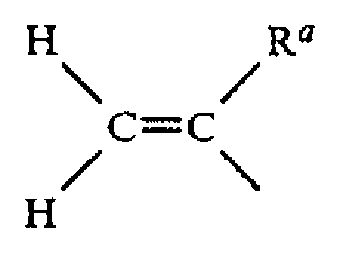
상기 식에서, Ra는 수소 원자 또는 메틸기이다.In the above formula, R a is a hydrogen atom or a methyl group.
바람직한 Y기는Preferred Y group
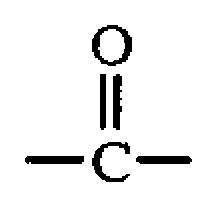
기(즉, 2가 카보닐기)이다.Group (ie, a divalent carbonyl group).
바람직한 Z 부분은 일반식 III의 1가 폴리에테르이다:Preferred Z moiety is the monovalent polyether of formula III:
[일반식 III][Formula III]

상기 식에서, Rb는 수소, 저급 알킬, 페닐 또는 치환된 페닐이며; W는 2 내지 약 250개 반복 알콕시 유닛을 함유하는 2가 폴리(저급 알킬렌 옥사이드)기이며, 폴리(에틸렌 옥사이드) 라디칼, 폴리(프로필렌 옥사이드) 라디칼, 에틸렌 옥사이드 및 프로필렌 옥사이드의 코폴리머의 라디칼 및 폴리(테트라메틸렌 옥사이드) 라디칼로 이루어진 군으로부터 선택된다. 바람직한 친수성 마크로모노머에서, 화학식 III의 1가 폴리에테르는 W 부분에 함유된 말단 산소 원자를 통하여 카보닐기(즉, 여기서, Y는 2가 카보닐이다)에 공유 결합된다.Wherein R b is hydrogen, lower alkyl, phenyl or substituted phenyl; W is a divalent poly (lower alkylene oxide) group containing from 2 to about 250 repeating alkoxy units, wherein W is a poly (ethylene oxide) radical, a poly (propylene oxide) radical, a radical of a copolymer of ethylene oxide and propylene oxide and Poly (tetramethylene oxide) radicals. In a preferred hydrophilic macromonomer, the monovalent polyether of formula III is covalently bonded to a carbonyl group (ie, wherein Y is divalent carbonyl) via a terminal oxygen atom contained in the W moiety.
다양한 친수성 거대분자 모노머는 상업적으로 입수할 수 있다. 예를 들어, 적절한 것으로 관찰된 상업적으로 입수할 수 있는 모노머에는 미국 페실베니아 웨스트 체스터 소재의 사토머 컴퍼니(Sartomer Company)로부터 상표명 "SR-256"으로 입수할 수 있는 2-(2-에톡시에톡시)에틸 아크릴레이트; 미국 펜실베니아주 트레보스 소재의 모노머-폴리머 앤드 다자크 래보러터리즈, 인코포레이티드(Monomer-Polymer & Dajac Laboratories, Inc.)로부터 상표명 "넘버(No.) 8816"으로 입수할 수 있는 메톡시 폴리(에틸렌 옥사이드) 아크릴레이트; 각각 미국 펜실베니아주 워링턴 소재의 폴리사이언스즈, 인코포레이티드(Polysciences, Inc.)로부터 상표명 "넘버 16664", "넘버 16665" 및 "넘버 16666"으로 입수할 수 있는 200 달톤, 400 달톤 및 1000 달톤의 메톡시 폴리(에틸렌 옥사이드) 메타크릴레이트; 및 미국 펜실베니아주 워링턴 소재의 폴리사이언스즈, 인코포레이티드로부터 상표명 "넘버 16712"로 입수할 수 있는 하이드록시 폴리(에틸렌 옥사이드) 메타크릴레이트가 있다.Various hydrophilic macromolecular monomers are commercially available. For example, commercially available monomers that have been observed to be suitable include 2- (2-ethoxy) available under the trade name " SR-256 " from Sartomer Company, West Chester, Pa. Oxy) ethyl acrylate; Methoxy, available under the trade name "No. 8816" from Monomer-Polymer & Dajac Laboratories, Inc., Trevors, Pennsylvania, USA Poly (ethylene oxide) acrylates; 200 Daltons, 400 Daltons and 1000s, available under the trade names "No. 16664", "No. 16665" and "No. 16666" from Polysciences, Inc., Warrington, Pennsylvania, USA, respectively. Methoxy poly (ethylene oxide) methacrylate of Dalton; And hydroxy poly (ethylene oxide) methacrylate, available under the trade designation “No. 16712” from Polysciences, Inc., Warrington, Pennsylvania.
다른 바람직한 친수성 거대분자 모노머는 예를 들어, 미국 특허 제4,871,812호에 기재된 바와 같은 상업적으로 입수할 수 있는 출발 물질 및 통상적인 방법을 사용하여 제조될 수 있다.Other preferred hydrophilic macromolecular monomers can be prepared using commercially available starting materials and conventional methods as described, for example, in US Pat. No. 4,871,812.
일반적으로, 친수성 거대분자 모노머는 터폴리머 내의 모든 모노머의 총 중량의 약 5 내지 30%의 양으로 존재한다. 모노머에 대한 바람직한 양은 터폴리머 내의 모든 모노머의 총량을 기준으로, 약 10 내지 20 중량%이다.Generally, the hydrophilic macromolecular monomer is present in an amount of about 5-30% of the total weight of all monomers in the terpolymer. Preferred amounts for the monomers are about 10 to 20 weight percent based on the total amount of all monomers in the terpolymer.
PSA에 포함되는 바람직한 폴리머는 (메트)아크릴레이트 폴리머이다. 특히 유용한 접착제 조성물은 65:15:20의 2-에틸헥실아크릴레이트: 아크릴산 코폴리머와 배합된 상표명 플루로닉의 비반응성 폴리알킬렌 옥사이드 코폴리머를 포함한다. 다른 적합한 예는 90:10의 아이소-옥틸 아크릴레이트: 아크릴산 코폴리머, 70:15:15의 아이소옥틸 아크릴레이트: 에틸렌옥사이드 아크릴레이트: 아크릴산 터폴리머, 및 25:69:6의 2-에틸헥실아크릴레이트: 부틸 아크릴레이트: 아크릴산 터폴리머를 포함한다. 유용한 접착제는 미국 특허 제Re. 24,906호(울리히(Ulrich)), 제5,849,325호(하이네케 등) 및 제4,871,812호(루카스트(Lucast) 등)(수계 및 용매계 접착제); 제4,833,179호(영(Young) 등)(핫-멜트 접착제); 제5,908,693호(델가도(Delgado) 등)(마이크로스피어 접착제); 제6,171,985호 및 제6,083,856호(둘 모두 요셉(Joseph) 등)(저 트라우마(trauma) 섬유상 접착제); 및 미국 특허 제6,198,016호(루카스트 등), 제6,518,343호(루카스트 등) 및 제6,441,082호(기젤만(Gieselman))(습윤-피부 접착제)에 개시된 것과 같은 상처 드레싱에 유용하고, 피부와 상용성인 것 중 임의의 것일 수 있다. 미국 특허 제4,310,509호 및 제4,323,557호에 기재된 바와 같이, 접착제 내의 약제 또는 항미생물제의 포함도 또한 예상된다.Preferred polymers included in the PSA are (meth) acrylate polymers. Particularly useful adhesive compositions include the non-reactive polyalkylene oxide copolymers of the Pluronic brand in combination with a 65:15:20 2-ethylhexylacrylate: acrylic acid copolymer. Other suitable examples are 90:10 iso-octyl acrylate: acrylic acid copolymer, 70:15:15 isooctyl acrylate: ethylene oxide acrylate: acrylic acid terpolymer, and 25: 69: 6 2-ethylhexyl Acrylate: butyl acrylate: acrylic acid terpolymer. Useful adhesives are described in US Pat. 24,906 (Ulrich), 5,849,325 (Heineke et al.) And 4,871,812 (Lucast et al.) (Aqueous and solvent-based adhesives); No. 4,833,179 (Young et al.) (Hot-melt adhesives); No. 5,908,693 (Delgado et al.) (Microsphere adhesive); 6,171,985 and 6,083,856 (both Joseph et al.) (Low trauma fibrous adhesive); And wound dressings such as those disclosed in US Pat. Nos. 6,198,016 (Lucast et al.), 6,518,343 (Lucast et al.) And 6,441,082 (Gieselman) (wet-skin adhesives) and are compatible with skin. It can be any of the adult. As also described in US Pat. Nos. 4,310,509 and 4,323,557, the inclusion of pharmaceutical or antimicrobial agents in adhesives is also envisaged.
스캐폴드Scaffold
사용되는 경우, 예를 들어, 도 2에 나타낸 스캐폴드(22)는 부직물 재료를 포함할 수 있다. 적절한 부직물 재료에는 둘 모두 미국 위스콘신주 그린베이 소재의 알스트롬 그린 베이(Ahlstrom Green Bay)로부터 입수할 수 있는 텐셀(TENCEL)/폴리에스테르 부직물 및 라이코셀-레이온(Lycocell-Rayon)/폴리에스테르 부직물이 포함되나 이에 한정되지 않는다. 다른 적절한 부직물에는 일본 소재의 유니티카 리미티드(Unitika Ltd.)로부터 입수할 수 있는 면직물 스펀 레이스드 부직물(cotton spun laced nonwoven)이 포함된다. 다른 실시형태에서, 스캐폴드(22)는 미국 매사추세츠주 이스트 햄프턴 소재의 내셔널 난우븐즈 컴퍼니(National Nonwovens Co.)로부터 입수할 수 있는 TMED011 부직물이다. 스캐폴드(22)는 또한, 직물, 편직물(knitted fabric), 발포체, 다공성 필름, 겔, 하이드로콜로이드, 셀룰로오스 물질, 카복실 메틸 셀룰로오스, 알긴산염 및 수팽윤성 또는 흡수성 접착제를 포함할 수 있다. 바람직한 실시형태에서, 스캐폴드(22)는 수분을 흡수할 수 있다.When used, for example, the
여과층Filtration layer
사용되는 경우, 여과층(32)은 예를 들어, 도 3b에 나타낸 바와 같이, 하나 이상의 부직물층을 포함할 수 있다. 적절한 부직물 재료에는 둘 모두 미국 위스콘신주 그린베이 소재의 알스트롬 그린 베이로부터 입수할 수 있는 텐셀/폴리에스테르 부직물 및 라이코셀-레이온/폴리에스테르 부직물이 포함되나 이에 한정되지 않는다. 다른 적절한 부직물에는 일본 소재의 유니티카 리미티드로부터 입수할 수 있는 면직물 스펀 레이스드 부직물이 포함된다. 다른 실시형태에서, 여과층(32)은 미국 매사추세츠주 이스트 햄프턴 소재의 내셔널 난우븐즈 컴퍼니로부터 입수할 수 있는 TMED011 부직물이다. 또한, 여과층은 직물, 편직물, 발포체, 다공성 필름, 겔, 하이드로콜로이드, 셀룰로오스 물질, 알긴산염, 다공성 접착제(소수성 또는 친수성) 및 수팽윤성 또는 흡수성 접착제로 구성될 수 있다.When used,
여과 목적을 위해 선택되는 여과층의 적절한 예에는 여과막, 여과 재료, 부직물, 직물, 겔 및 발포체가 포함된다.Suitable examples of filtration layers selected for filtration purposes include filtration membranes, filtration materials, nonwovens, fabrics, gels and foams.
흡수층Absorber layer
사용되는 경우, 흡수성 패드는 직물 또는 부직물 면 또는 레이온을 포함하지만 이들로 한정되지 않는 다양한 재료들 중 임의의 것으로 제조될 수 있다. 임의로 항미생물제, 경피 약물 전달용 약물, 환자에서 호르몬 또는 다른 물질을 모니터링하기 위한 화학적 인디케이터(indicator) 등을 포함하는 많은 물질을 함유하는 흡수층이 유용하다.When used, the absorbent pad can be made of any of a variety of materials, including but not limited to woven or nonwoven cotton or rayon. Absorbent layers containing many substances are optionally useful, including antimicrobial agents, drugs for transdermal drug delivery, chemical indicators for monitoring hormones or other substances in patients, and the like.
흡수층은 미국 특허 제5,622,711호 및 제5,633,010호에 기재된 하이드로콜로이드 조성물을 비롯한 하이드로콜로이드 조성물을 포함할 수 있다. 또한, 흡수성 재료는 폴리머 겔, 발포체, 콜라겐, 카복시메틸 셀룰로오스 섬유, 알긴산염, 부직물 또는 직물 재료를 비롯한 다른 합성 및 천연 재료로부터 선택될 수 있다. 일부 실시형태에서, 흡수층은 폴리머 패브릭, 폴리머 발포체 및 이들의 조합을 포함할 수 있다. 예를 들어, 폴리머 패브릭은 부직물일 수 있으며, 폴리머 발포체는 미국 미네소타주 세인트폴 소재의 쓰리엠 컴퍼니(3M Company)로부터 입수할 수 있는 테가덤 발포성 접착제 드레싱에 사용되는 발포체일 수 있다. 특정 실시형태에서, 폴리머 발포체는 폴리우레탄 발포체이다.The absorbent layer can include hydrocolloid compositions, including the hydrocolloid compositions described in US Pat. Nos. 5,622,711 and 5,633,010. In addition, the absorbent material may be selected from other synthetic and natural materials, including polymeric gels, foams, collagen, carboxymethyl cellulose fibers, alginates, nonwovens, or textile materials. In some embodiments, the absorbent layer can include a polymer fabric, a polymer foam, and combinations thereof. For example, the polymer fabric may be a nonwoven, and the polymer foam may be a foam used in Tegaderm foamable adhesive dressing, available from 3M Company, St. Paul, Minn., USA. In certain embodiments, the polymeric foam is a polyurethane foam.
대면층Facing layer
사용되는 경우, 대면층은 바람직하게는 연성, 가요성, 정합성, 비자극성, 그리고 비-민감성이다. 폴리우레탄, 폴리에틸렌, 폴리프로필렌, 폴리아미드 또는 폴리에스테르 물질을 비롯한 임의의 다양한 폴리머가 사용될 수 있다. 또한, 대면층은 수증기 투과성 필름, 천공형 필름, 직물, 부직물 또는 편직 웨브 또는 스크림(scrim)의 형태로 존재할 수 있다.If used, the facing layer is preferably soft, flexible, conformable, non-irritating, and non-sensitive. Any of a variety of polymers can be used, including polyurethanes, polyethylenes, polypropylenes, polyamides or polyester materials. The facing layer may also be in the form of a water vapor permeable film, perforated film, woven, nonwoven or knitted web or scrim.
또한, 대면층은 상처 또는 다른 표적 부위에 대면하는 여과층의 표면 상에 적층된 접착제를 포함할 수 있다. 이러한 실시형태에서, 제2 접착제는 아크릴, 실리콘 겔, 폴리우레탄 또는 고무계 접착제일 수 있다. 적절한 대면층 및 접착제의 예시적인 실시형태는 예를 들어, 버튼(Burton) 등의 미국 특허 제7,612,248호에서 찾을 수 있다. 또한, 대면층은 표적 부위 반대편의 대면층의 표면 상에 추가의 접착제를 포함할 수 있다.In addition, the facing layer may comprise an adhesive laminated on the surface of the filtration layer facing the wound or other target site. In such embodiments, the second adhesive may be an acrylic, silicone gel, polyurethane or rubber based adhesive. Exemplary embodiments of suitable facing layers and adhesives can be found, for example, in US Pat. No. 7,612,248 to Burton et al. The facing layer may also include additional adhesive on the surface of the facing layer opposite the target site.
캐리어 필름Carrier film
본 발명에서 사용하기에 적합한 캐리어 필름(예컨대, 도 11에 나타낸 바와 같은)은 크라프트지, 폴리에틸렌, 폴리프로필렌, 폴리에스테르 또는 임의의 이들 재료의 복합물질로 제작될 수 있다. 필름은 바람직하게는 불소 화합물 또는 실리콘과 같은 이형제로 코팅된다. 예를 들어, 미국 특허 제4,472,480호는 저 표면 에너지 퍼플루오르화합물 라이너를 기재하고 있다. 라이너는 실리콘 이형 재료로 코팅된 종이, 폴리올레핀 필름, 또는 폴리에스테르 필름이다. 구입할 수 있는 실리콘 코팅 이형지의 예는 폴리실크(POLYSLIK)™, 렉삼 릴리즈(Rexam Release)(미국 일리노이주 베드포드 파크)로부터 입수가능한 실리콘 이형지 및 로파렉스 인코포레이티드(Loparex Inc.)(미국 일리노이주 윌로우브룩)에 의해 공급되는 실리콘 이형지이다.Carrier films suitable for use in the present invention (eg, as shown in FIG. 11) can be made of kraft paper, polyethylene, polypropylene, polyester or composites of any of these materials. The film is preferably coated with a releasing agent such as a fluorine compound or silicone. For example, US Pat. No. 4,472,480 describes a low surface energy perfluorine liner. The liner is paper, polyolefin film, or polyester film coated with a silicone release material. Examples of silicone coated release papers available are POLYSLIK ™, silicone release papers available from Rexam Release (Bedford Park, Illinois) and Loparex Inc. (Illinois, USA). It is a silicone release paper supplied by Willowbrook.
본 발명의 목적 및 이점은 하기의 실시예에 의해 추가로 예시되지만, 이들 실시예에 인용된 특정 물질 및 그 양 뿐만 아니라 기타 조건이나 상세 사항은 본 발명을 부당하게 제한하는 것으로 해석되어서는 안된다. 달리 표시되지 않으면, 모든 부 및 백분율은 중량 기준이다.The objects and advantages of the present invention are further illustrated by the following examples, but the specific materials and amounts recited in these examples as well as other conditions or details should not be construed as unduly limiting the present invention. Unless otherwise indicated, all parts and percentages are by weight.
[실시예][Example]

시험 방법Test Methods
1. 수증기 투과율 - 직립(건조) MVTR1. Water vapor transmission rate-upright (dry) MVTR
a. 발포체 성분을 함유하지 않는 샘플용a. For samples that do not contain foam components
직립 MVTR을 변형된 페인 컵(Payne cup)을 사용하여 ASTM E-96-80에 따라 측정하였다. 3.8 ㎝ 직경의 샘플을 각각이 5.1 ㎠ 타원형 개구부를 갖는 2개의 포일 접착제 링(adhesive ring)의 접착제-함유 표면 사이에 배치하였다. 각각의 링의 홀(hole)을 조심스럽게 조정하였다. 지압을 사용하여, 평평하며, 주름이 없고, 노출된 표면에 공극 영역을 갖지 않는 포일/샘플/포일 어셈블리를 형성하였다.Upright MVTR was measured according to ASTM E-96-80 using a modified Payne cup. Samples of 3.8 cm diameter were placed between the adhesive-containing surfaces of two foil adhesive rings, each with a 5.1 cm 2 oval opening. The holes in each ring were carefully adjusted. Acupressure was used to form a foil / sample / foil assembly that was flat, wrinkle-free, and without void areas on the exposed surface.
120-mL 유리 용기를 실시예에 특별히 명시되지 않는 한, 2 방울의 0.02% (w/w) 메틸렌 블루 USP(베이직 블루(Basic Blue) 9, C.I.52015) 수용액을 함유하는 대략 50 g의 수돗물로 채웠다. 용기에, 그의 중심에 3.8 ㎝ 직경의 홀을 가지며, 그의 중심에 대략 3.6 ㎝ 홀을 갖는 4.45 ㎝ 직경의 고무 와셔(rubber washer)를 갖는 나사고정식 캡(screw-on cap)을 끼웠다. 고무 와셔를 용기의 입구에 배치하고, 포일/샘플/포일 어셈블리를 고무 와셔 상에 배킹측을 아래로 배치하였다. 그 다음, 뚜껑을 용기에 느슨하게 나사 조임하였다.A 120-mL glass container was poured into approximately 50 g of tap water containing two drops of 0.02% (w / w) methylene blue USP (Basic Blue 9, CI52015) aqueous solution, unless otherwise specified in the examples. Filled. The vessel was fitted with a screw-on cap with a 4.45 cm diameter rubber washer having a 3.8 cm diameter hole in its center and approximately 3.6 cm hole in its center. The rubber washer was placed at the inlet of the container and the foil / sample / foil assembly was placed down on the rubber washer. The lid was then loosely screwed into the container.
어셈블리를 40℃ 및 20% 상대 습도에서 4시간 동안 챔버에 두었다. 4시간의 마지막에, 캡을 챔버 안쪽에서 조여, 샘플을 캡으로 평평하게 하고(돌출 없음), 고무 와셔가 적절한 안착 위치에 있게 하였다.The assembly was placed in the chamber at 40 ° C. and 20% relative humidity for 4 hours. At the end of 4 hours, the cap was tightened inside the chamber to level the sample with the cap (no protrusion) and ensure that the rubber washer was in the proper seating position.
포일 샘플 어셈블리를 챔버로부터 제거하고, 초기 건조 중량, W1을 위하여 즉시 0.01 g 자리로 반올림하여 칭량하였다. 그 다음, 어셈블리를 적어도 18시간 동안 챔버로 복귀시키고, 노출시간인 시간 단위의 T1 후에, 이를 제거하고, 최종 건조 중량, W2를 위하여 즉시 0.01 g 자리로 반올림하여 칭량하였다. 그 다음, 24시간당 샘플 영역 제곱미터당 투과된 수증기 그램 단위의 MVTR을 하기의 식을 사용하여 계산할 수 있다.The foil sample assembly was removed from the chamber and weighed immediately rounded to 0.01 g place for the initial dry weight, W1. The assembly was then returned to the chamber for at least 18 hours and after the time unit T1 of the exposure time, it was removed and weighed immediately rounded to 0.01 g place for the final dry weight, W2. The MVTR in grams of permeated water vapor per square meter of sample area per 24 hours can then be calculated using the equation below.
직립(건조) MVTR = (W1-W2) × (4.74 × 104) / T1Upright (dry) MVTR = (W1-W2) × (4.74 × 10 4 ) / T1
b. 발포체 성분을 함유하지 않는 샘플용b. For samples that do not contain foam components
이들 샘플에 대한 직립 MVTR 절차는 시험 샘플 크기가 4.45 ㎝ 직경의 샘플이었으며, 샘플이 포일 접착제 링 대신에, 2개의 렉산(LEXAN)(폴리카보네이트) 워셔(중간에 2.54 ㎝ 홀이 있는 4.47 ㎝ 직경) 사이에 개재되어 있는 것을 제외하고는, 상술된 것과 동일하였다.The upright MVTR procedure for these samples was a test sample size of 4.45 cm diameter, with two LEXAN (polycarbonate) washers (4.47 cm diameter with 2.54 cm hole in the middle), instead of the foil adhesive ring. It was the same as that mentioned above except the thing interrupted in between.
2. 수증기 투과율 - 역전(습윤) MVTR2. Water vapor transmission rate-reversal (wet) MVTR
역전 MVTR을 하기의 시험 절차를 사용하여 측정하였다. 직립 MVTR 절차에 대하여 기재된 바와 같이 최종 "건조" 중량인 W2를 수득한 후에, 용기를 역전시킨 채로, 어셈블리를 적어도 추가 18시간의 노출 시간, T2 동안 챔버로 복귀시켜, 수돗물이 시험 샘플과 직접 접촉되게 하였다. 그 다음, 샘플을 챔버로부터 제거하고, 최종 습윤 중량, W3을 위하여 0.01 g 자리로 반올림하여 칭량하였다. 그 다음, 24시간당 샘플 영역 제곱미터당 투과된 수증기 그램 단위의 역전된 습윤 MVTR을 하기의 식을 사용하여 계산할 수 있다.Reversal MVTR was measured using the following test procedure. After obtaining the final "dry" weight W2 as described for the upright MVTR procedure, the assembly is returned to the chamber for at least an additional 18 hours of exposure time, T2, with the container inverted, so that the tap water is in direct contact with the test sample. It was made. The sample was then removed from the chamber and weighed rounded to 0.01 g site for final wet weight, W3. The inverted wet MVTR in grams of permeated water vapor per square meter of sample area per 24 hours can then be calculated using the equation below.
역전(습윤) MVTR = (W2-W3) × (4.74 × 104) / T2Reversal (wet) MVTR = (W2-W3) × (4.74 × 10 4 ) / T2
하기 실시예의 다수의 샘플을 직립(건성) 및 역전(습윤) MVTR에 대해 측정하였다. 평균 결과를 하기에 기록하였으며, 다수의 샘플의 표준 편차(+/-)가 뒤에 온다.Multiple samples of the following examples were measured for upright (dry) and inverted (wet) MVTR. The average result is reported below, followed by the standard deviation (+/−) of the multiple samples.
3. 강철에 대한 접착력3. Adhesion to steel
강철에 대한 접착력 시험을 30.5 ㎝/분 및 180 도 박리에서 ASTM D3330M에 따라 수행하였다.Adhesion test to steel was performed according to ASTM D3330M at 30.5 cm / min and 180 degree peel.
실시예 1(비교)Example 1 (comparative)
40 g/㎡ 70/30 (w/w) 텐셀/폴리에스테르 등급 240(SX-33) 스펀레이스드 부직물(미국 위스콘신주 그린베이 소재의 알스트롬 그린 베이)을 수작업으로 쓰리엠 테가덤 9548HP 드레싱의 접착제 측에 적층하고, 시험 전에 대략 30일 동안 놔두었다. 샘플로부터의 5개의 표본을 직립 및 역전 수증기 투과율(MVTR) 둘 모두에 대해 시험하였다. 평균 직립 MVTR 및 역전 MVTR 값은 각각 1150 +/- 100 g/㎡/24시간 및 2340 +/- 190 g/㎡/24시간이었다.40 g /
실시예 2(비교)Example 2 (comparative)
실시예 1로부터의 부직물을 시트르산나트륨 데하이드레이트(dehydrate)의 2.6% (w/w) 수용액으로 포화시키고, 실험실 규모의 강제 공기 오븐(메머트 유니버설 오븐(Memmert Universal Oven); 미국 위스콘신주 이스트 트로이 소재의 위스콘신 오븐 컴퍼니(Wisconsin Oven Company))에서 80℃에서 30분 동안 건조시켰다. 부직물 상의 시트르산나트륨 데하이드레이트의 코팅 중량은 15 g/㎡였다. 그 다음, 이러한 코팅된 부직물을 수작업으로 쓰리엠 테가덤 9548HP 드레싱의 접착제 측에 적층하였다. 샘플을 시험 전에 대략 30분 동안 놔두었다. 샘플로부터 시험한 5개의 표본에 대하여, 평균 직립 MVTR 및 역전 MVTR 값은 각각 1000 +/- 30 g/㎡/24시간 및 2350 +/- 90 g/㎡/24시간이었다.The nonwoven from Example 1 was saturated with a 2.6% (w / w) aqueous solution of sodium citrate dehydrate, and a laboratory scale forced air oven (Memmert Universal Oven; East Troy, Wisconsin) Drying was carried out at 80 ° C. for 30 minutes in the Wisconsin Oven Company. The coating weight of sodium citrate dehydrate on the nonwoven was 15 g / m 2. This coated nonwoven was then manually laminated to the adhesive side of the 3M Tegaderm 9548HP dressing. Samples were left for approximately 30 minutes before testing. For the five samples tested from the samples, the mean upright MVTR and inverted MVTR values were 1000 +/- 30 g / m2 / 24 hours and 2350 +/- 90 g / m2 / 24 hours, respectively.
실시예 3(비교)Example 3 (comparative)
100% 면직물 스펀레이스드 부직물(코토아세)을 시트르산의 5.4% (w/w) 수용액으로 포화시키고, 오븐에서 85℃에서 대략 30분 동안 건조시킨 다음, 수작업으로 쓰리엠 테가덤 9548HP 드레싱의 접착제 측에 적층하였다. 샘플을 시험 전에 대략 3일 동안 놔두었다. 4개의 시험 표본에 대한 평균 직립 MVTR 및 역전 MVTR 값은 각각 1180 +/- 60 g/㎡/24시간 및 1720 +/- 40 g/㎡/24시간이었다.100% cotton spunlaced nonwoven (Cotoace) was saturated with 5.4% (w / w) aqueous solution of citric acid, dried in an oven at 85 ° C. for approximately 30 minutes, and then manually adhesive of 3M Tegaderm 9548HP dressing It laminated on the side. Samples were left for approximately 3 days before testing. Mean upright MVTR and inverted MVTR values for the four test samples were 1180 +/- 60 g / m 2/24 hours and 1720 +/- 40 g / m 2/24 hours, respectively.
실시예 4Example 4
실시예 1로부터의 부직물을 수산화나트륨의 0.15 M 수용액으로 포화시킨 다음, 드레싱의 접착제 측에 적층하기 전에 오븐에서 75℃에서 30분 동안 건조시켰다. 부직물 상의 수산화나트륨의 코팅 중량을 5 g/㎡에서 측정하였다. 그 다음, 이러한 코팅된 부직물을 수작업으로 쓰리엠 테가덤 9548HP 드레싱의 접착제 측에 적층하였다. 샘플로부터의 4개의 시험 표본을 직립 및 역전 수증기 투과율(MVTR) 둘 모두에 대한 적층 단계 2일 후에 시험하였다. 평균 직립 MVTR 및 역전 MVTR 값은 각각 1210 +/- 50 g/㎡/24시간 및 11400 +/- 1800 g/㎡/24시간이었다.The nonwovens from Example 1 were saturated with 0.15 M aqueous solution of sodium hydroxide and then dried in an oven at 75 ° C. for 30 minutes before laminating to the adhesive side of the dressing. The coating weight of sodium hydroxide on the nonwovens was measured at 5 g / m 2. This coated nonwoven was then manually laminated to the adhesive side of the 3M Tegaderm 9548HP dressing. Four test specimens from the samples were tested two days after the lamination step for both upright and inverted water vapor transmission (MVTR). Mean upright MVTR and inverted MVTR values were 1210 +/- 50 g / m 2/24 hours and 11400 +/- 1800 g / m 2/24 hours, respectively.
실시예 5Example 5
실시예 1로부터의 부직물을 수산화나트륨의 0.30 M 수용액으로 포화시킨 다음, 드레싱의 접착제 측에 적층하기 전에 오븐에서 75℃에서 30분 동안 건조시켰다. 부직물 상의 수산화나트륨의 코팅 중량을 7 g/㎡에서 측정하였다. 그 다음, 이러한 코팅된 부직물을 수작업으로 쓰리엠 테가덤 9548HP 드레싱의 접착제 측에 적층하였다. 샘플로부터의 4개의 시험 표본을 직립 및 역전 수증기 투과율(MVTR) 둘 모두에 대한 적층 단계 2일 후에 시험하였다. 평균 직립 MVTR 및 역전 MVTR 값은 각각 1280 +/- 60 g/㎡/24시간 및 16900 +/- 740 g/㎡/24시간이었다.The nonwovens from Example 1 were saturated with a 0.30 M aqueous solution of sodium hydroxide and then dried in an oven at 75 ° C. for 30 minutes before laminating to the adhesive side of the dressing. The coating weight of sodium hydroxide on the nonwoven was measured at 7 g / m 2. This coated nonwoven was then manually laminated to the adhesive side of the 3M Tegaderm 9548HP dressing. Four test specimens from the samples were tested two days after the lamination step for both upright and inverted water vapor transmission (MVTR). Mean upright MVTR and inverted MVTR values were 1280 +/- 60 g / m 2/24 hours and 16900 +/- 740 g / m 2/24 hours, respectively.
실시예 6Example 6
실시예 1로부터의 부직물을 3.96 m/분(13 feet/분)의 속도로 탄산나트륨 일수화물의 4.0% (w/w) 수용액에서 딥 코팅하고, 중간 시험 규모(pilot scale)의 강제 공기 오븐에서 대략 105℃에서 약 5분 동안 건조시켰다. 부직물 상의 탄산나트륨 일수화물의 코팅 중량은 16.3 g/㎡였다. 그 다음, 이러한 코팅된 부직물을 수작업으로 쓰리엠 테가덤 9548HP 드레싱의 접착제 측에 적층하였다. 시험한 5개의 표본에 대하여, 평균 직립 MVTR 및 역전 MVTR 값은 각각 1070 +/- 40 g/㎡/24시간 및 20800 +/- 980 g/㎡/24시간이었다.The nonwovens from Example 1 were dip coated in a 4.0% (w / w) aqueous solution of sodium carbonate monohydrate at a rate of 3.96 m / min (13 feet / min) and in a forced pilot air oven on a medium pilot scale Dry at about 105 ° C. for about 5 minutes. The coating weight of sodium carbonate monohydrate on the nonwoven was 16.3 g / m 2. This coated nonwoven was then manually laminated to the adhesive side of the 3M Tegaderm 9548HP dressing. For the five samples tested, mean upright MVTR and inverted MVTR values were 1070 +/- 40 g / m 2/24 hours and 20800 +/- 980 g / m 2/24 hours, respectively.
실시예 7Example 7
100% 면직물 스펀레이스드 부직물(코토아세)을 중탄산나트륨의 3.5% (w/w) 수용액으로 포화시키고 오븐에서 45℃에서 건조될 때까지 건조시킨 다음, 수작업으로 쓰리엠 테가덤 9548HP 드레싱의 접착제 측에 적층하였다. 샘플을 시험 전에 대략 3일 동안 놔두었다. 평균 직립 MVTR 및 역전 MVTR 값은 각각 1340 +/- 100 g/㎡/24시간 및 19100 +/- 870 g/㎡/24시간이었다.100% cotton spunlaced nonwoven (Kotoace) was saturated with a 3.5% (w / w) aqueous solution of sodium bicarbonate and dried in an oven until dry at 45 ° C., then manually glued to 3M Tegaderm 9548HP dressing It laminated on the side. Samples were left for approximately 3 days before testing. Mean upright MVTR and inverted MVTR values were 1340 +/- 100 g / m 2/24 hours and 19100 +/- 870 g / m 2/24 hours, respectively.
실시예 8Example 8
실시예 1로부터의 부직물, 즉, 40 g/㎡ 70/30 (w/w) 텐셀/폴리에스테르 스펀레이스드 부직물을 탄산칼륨의 5.3% (w/w) 수용액으로 포화시킨 다음, 85℃에서 40분 동안 건조시켰다. 부직물 상의 탄산칼륨의 코팅 중량은 46 g/㎡였다. 그 다음, 이러한 코팅된 부직물을 수작업으로 쓰리엠 테가덤 9548HP 드레싱의 접착제 측에 적층하였다. 샘플을 적층 단계 4일 후에 시험하였다. 4개의 시험 표본의 평균 직립 MVTR 및 역전 MVTR 값은 각각 1390 +/- 40 g/㎡/24시간 및 20700 +/- 530 g/㎡/24시간이었다.The nonwoven from Example 1, ie, 40 g / m 2 70/30 (w / w) tencel / polyester spunlaced nonwoven, was saturated with 5.3% (w / w) aqueous solution of potassium carbonate and then 85 ° C. Dried for 40 minutes. The coating weight of potassium carbonate on the nonwoven was 46 g / m 2. This coated nonwoven was then manually laminated to the adhesive side of the 3M Tegaderm 9548HP dressing. Samples were tested 4 days after the lamination step. Mean upright MVTR and inverted MVTR values of the four test specimens were 1390 +/- 40 g / m 2/24 hours and 20700 +/- 530 g / m 2/24 hours, respectively.
실시예 9Example 9
실시예 1로부터의 40 g/㎡ 70/30 (w/w) 텐셀/폴리에스테르 스펀레이스드 부직물을 중탄산칼륨의 3.7% (w/w) 수용액으로 포화시킨 다음 75℃에서 30분 동안 건조시켰다. 부직물 상의 중탄산칼륨의 코팅 중량은 24 g/㎡였다. 그 다음, 이러한 코팅된 부직물을 수작업으로 쓰리엠 테가덤 9548HP 드레싱의 접착제 측에 적층하였다. 샘플을 적층 단계 5일 후에 시험하였다. 4개의 시험 표본의 평균 직립 MVTR 및 역전 MVTR 값은 각각 1650 +/- 20 g/㎡/24시간 및 20300 +/- 610 g/㎡/24시간이었다.40 g / m 2 70/30 (w / w) tencel / polyester spunlaced nonwoven from Example 1 was saturated with an aqueous solution of 3.7% (w / w) of potassium bicarbonate and then dried at 75 ° C. for 30 minutes. . The coating weight of potassium bicarbonate on the nonwoven was 24 g / m 2. This coated nonwoven was then manually laminated to the adhesive side of the 3M Tegaderm 9548HP dressing. Samples were tested 5 days after the lamination step. Mean upright MVTR and inverted MVTR values of the four test specimens were 1650 +/- 20 g / m2 / 24 hours and 20300 +/- 610 g / m2 / 24 hours, respectively.
실시예 10Example 10
실시예 1로부터의 40 g/㎡ 70/30 (w/w) 텐셀/폴리에스테르 스펀레이스드 부직물을 탄산나트륨 일수화물의 2.6% (w/w) 수용액으로 포화시킨 다음, 실험실 규모의 강제 공기 오븐(메머트 유니버설 오븐; 미국 위스콘신주 이스트 트로이 소재의 위스콘신 오븐 컴퍼니)에서 80℃에서 30분 동안 건조시켰다. 부직물 상의 탄산나트륨 일수화물의 코팅 중량은 8.3 g/㎡였다. 이러한 코팅된 부직물을 수작업으로 쓰리엠 테가덤 9548HP 드레싱의 접착제 측에 적층하였다. 미처리 부직물의 2개의 층을 드레싱의 접착제 측에 적층한 부직물의 코팅된 층의 상측에 두었다. 샘플로부터의 4개의 표본을 적층 단계 5일 후에 시험하였다. 4개의 시험 표본의 평균 직립 MVTR 및 역전 MVTR 값은 각각 1190 +/- 100 g/㎡/24시간 및 16700 +/- 1700 g/㎡/24시간이었다.40 g / m 2 70/30 (w / w) tencel / polyester spunlaced nonwoven from Example 1 was saturated with a 2.6% (w / w) aqueous solution of sodium carbonate monohydrate, followed by a laboratory scale forced air oven (Mermet Universal Oven; Wisconsin Oven Company, East Troy, Wisconsin) was dried at 80 ° C. for 30 minutes. The coating weight of sodium carbonate monohydrate on the nonwoven was 8.3 g / m 2. This coated nonwoven was manually laminated to the adhesive side of the 3M Tegaderm 9548HP dressing. Two layers of untreated nonwoven were placed on top of the coated layer of nonwoven laminated to the adhesive side of the dressing. Four specimens from the sample were tested 5 days after the lamination step. Mean upright MVTR and inverted MVTR values of the four test specimens were 1190 +/- 100 g / m 2/24 hours and 16700 +/- 1700 g / m 2/24 hours, respectively.
실시예 11Example 11
이러한 실시예는 미처리 부직물의 2개의 층을 접착제와 부직물의 탄산나트륨 일수화물 처리된 층 사이에 배치한 것을 제외하고는 실시예 10과 같이 제조하였다. 시험 표본의 평균 직립 MVTR 및 역전 MVTR 값은 각각 1240 +/- 280 g/㎡/24시간 및 9150 +/- 1280 g/㎡/24시간이었다.This example was prepared as in Example 10 except that two layers of untreated nonwoven were disposed between the adhesive and the sodium carbonate monohydrate treated layer of the nonwoven. Mean upright MVTR and inverted MVTR values of the test specimens were 1240 +/- 280 g / m 2/24 hours and 9150 +/- 1280 g / m 2/24 hours, respectively.
실시예 12Example 12
이러한 실시예는 시트르산의 2.6% (w/w) 수용액으로 처리한 다음 80℃에서 30분 동안 건조시킨 부직물의 추가의 층을 탄산나트륨 일수화물 처리된 부직물 층 상에 배치한 것을 제외하고는 실시예 6과 같이 제조하였다. 시트르산 처리된 부직물 층의 첨가는 탄산나트륨 일수화물 샘플의 드레싱의 접착제 측으로의 적층 8일 후에 일어났다. 부직물 상의 시트르산의 코팅 중량은 18.5 g/㎡였다. 샘플로부터의 5개의 시험 표본을 시트르산 처리된 부직물 층의 샘플로의 첨가 24시간 후에 시험하였다. 시험 표본의 평균 직립 MVTR 및 역전 MVTR 값은 각각 1080 +/- 30 g/㎡/24시간 및 9880 +/- 2660 g/㎡/24시간이었다.This example is carried out except that an additional layer of the nonwoven treated with a 2.6% (w / w) aqueous solution of citric acid and then dried at 80 ° C. for 30 minutes is placed on a sodium carbonate monohydrate treated nonwoven layer. Prepared as in Example 6. Addition of the citric acid treated nonwoven layer occurred 8 days after lamination of the sodium carbonate monohydrate sample to the adhesive side of the dressing. The coating weight of citric acid on the nonwovens was 18.5 g / m 2. Five test specimens from the samples were tested 24 hours after addition of the citric acid treated nonwoven layer to the samples. Mean upright MVTR and inverted MVTR values of the test specimens were 1080 +/- 30 g / m2 / 24 hours and 9880 +/- 2660 g / m2 / 24 hours, respectively.
실시예 13Example 13
이러한 실시예는 90612 쓰리엠 테가덤 발포성 접착제 드레싱(미국 미네소타주 세인트폴 소재의 쓰리엠 컴퍼니)으로부터 대략 7.5 ㎝ × 7.5 ㎝ 발포체 샘플을 절단함으로서 제조하여, 발포체 조각이 드레싱이 모든 다른 부분으로부터 분리되게 하였다. 그 다음, 이러한 발포체 조각의 한 측을 탄산나트륨 일수화물의 5.5% (w/w) 수용액으로 코팅하고, 80℃에서 40분 동안 건조시켰다. 발포체 조각 상의 탄산나트륨 일수화물의 코팅 중량은 대략 19 g/㎡였다. 그 다음, 발포체 조각의 코팅된 측을 수작업으로, 쓰리엠 테가덤 9548HP 투명 드레싱의 접착제 측에 적층하였다. 4개의 시험 표본을 적층 단계 5일 후에 시험하였다. 시험 표본의 평균 직립 MVTR 및 역전 MVTR 값은 각각 900 +/- 60 g/㎡/24시간 및 7840 +/- 1600 g/㎡/24시간이었다.This example was made by cutting approximately 7.5 cm x 7.5 cm foam samples from 90612 3M Tegaderm foam adhesive dressing (Three Company, St. Paul, MN), so that the foam pieces were separated from all other parts. . One side of this piece of foam was then coated with a 5.5% (w / w) aqueous solution of sodium carbonate monohydrate and dried at 80 ° C. for 40 minutes. The coating weight of sodium carbonate monohydrate on the foam pieces was approximately 19 g / m 2. The coated side of the foam piece was then manually laminated to the adhesive side of the 3M Tegaderm 9548HP clear dressing. Four test specimens were tested 5 days after the lamination step. Mean upright MVTR and inverted MVTR values of the test specimens were 900 +/- 60 g / m2 / 24 hours and 7840 +/- 1600 g / m2 / 24 hours, respectively.
실시예 14Example 14
이러한 실시예에 대하여, 미국 특허 제4,737,410호 실시예 31에 기재된 바와 같이, 1% 미만의 폴리에틸옥사졸린을 갖는 종이 라이너 상의 70/15/15 비의 IOA/AA/EOA의 대략 25 미크론 두께의 감압성 접착제층을 사용하였다. 대략 25 미크론 우레탄 필름(에스탄 58237 수지; 미국 오하이오주 위클리프 소재의 루브리졸 코포레이션)을 미국 특허 제4,499,896호에 기재된 바와 같은 방법을 사용하여 상술된 접착제층 위에 압출하여, 라이너 상에 접착제/필름 적층물을 형성하였다. 실시예 1로부터의 부직물, 즉, 40 g/㎡ 70/30 (w/w) 텐셀/폴리에스테르 스펀레이스드 부직물을 오븐에서 이를 건조시키기 전에, 탄산나트륨 일수화물의 2.6% (w/w) 수용액으로 포화시켰다. 그 다음, 이러한 포화된 부직물을 85℃에서 대략 30분 동안 건조시켰다. 부직물 상의 탄산나트륨 일수화물의 코팅 중량은 8 g/㎡였다. 5개의 시험 표본의 평균 직립 MVTR 및 역전 MVTR 값은 각각 1660 +/- 60 g/㎡/24시간 및 18800 +/- 860 g/㎡/24시간이었다.For this example, as described in US Pat. No. 4,737,410, Example 31, approximately 25 microns thick of 70/15/15 ratio IOA / AA / EOA on paper liner with less than 1% polyethyloxazoline A pressure sensitive adhesive layer was used. An approximately 25 micron urethane film (Estan 58237 resin; Lubrizol Corporation, Wickliffe, Ohio) is extruded onto the adhesive layer described above using a method as described in US Pat. No. 4,499,896 to provide an adhesive / film on the liner. The laminate was formed. 2.6% (w / w) of sodium carbonate monohydrate prior to drying the nonwoven from Example 1, ie 40 g / m 2 70/30 (w / w) tencel / polyester spunlaced nonwoven, in an oven Saturated with aqueous solution. This saturated nonwoven was then dried at 85 ° C. for approximately 30 minutes. The coating weight of sodium carbonate monohydrate on the nonwoven was 8 g / m 2. Mean upright MVTR and inverted MVTR values of the five test specimens were 1660 +/- 60 g / m2 / 24 hours and 18800 +/- 860 g / m2 / 24 hours, respectively.
실시예 15(비교)Example 15 (comparative)
이러한 실시예를 위하여, 실시예 14로부터의 접착제 및 실시예 14로부터의 우레탄 필름을 실시예 14에 기재된 바와 같이 구성하였다. 실시예 1로부터의 부직물, 즉, 40 g/㎡ 70/30 (w/w) 텐셀/폴리에스테르 스펀레이스드 부직물을 수작업으로 임의의 MVTR-변경 물질의 첨가 없이, 적층물의 접착제 측에 직접 적층하였다. 최대 5개의 시험 표본의 평균 직립 MVTR 및 역전 MVTR 값은 각각 1150 +/- 30 g/㎡/24시간 및 2250 +/- 250 g/㎡/24시간이었다.For this example, the adhesive from Example 14 and the urethane film from Example 14 were constructed as described in Example 14. The nonwoven from Example 1, i.e. 40 g / m 2 70/30 (w / w) tencel / polyester spunlaced nonwoven, was manually handed onto the adhesive side of the laminate without the addition of any MVTR-modifying material. Laminated. The average upright MVTR and inverted MVTR values of up to five test specimens were 1150 +/- 30 g / m 2/24 hours and 2250 +/- 250 g / m 2/24 hours, respectively.
실시예 16(비교)Example 16 (comparative)
샘플을 먼저 실시예 14로부터의 접착제를 대략 0.14 MPa(20 psig(1.4 bar))로 설정된 XRL 120 롤 라미네이터(roll laminator)(미국 캘리포니아주 엘세건도 소재의 웨스턴 마그넘(Western Magnum))를 사용하여 종이 캐리어 상의 25 미크론 에스탄 58237 필름에 적층함으로써 제조하였다. 그 다음, 제2 접착제층을 롤 라미네이터를 사용하여 제1 접착제층에 적층하여, 접착제의 두께를 두배로 만들었다. 그 다음, 실시예 1에 사용된 미처리 부직물의 조각을 수작업으로 시험 6일 전에 접착제에 적층하였다. 4개의 시험 표본의 평균 직립 MVTR 및 역전 MVTR 값은 각각 690 +/- 40 g/㎡/24시간 및 1170 +/- 210 g/㎡/24시간이었다.Samples were first used with an
실시예 17Example 17
샘플을, 부직물을 탄산나트륨 일수화물의 2.6% (w/w) 수용액으로 포화시킨 것을 제외하고는 실시예 16과 같이 제조하였다. 그 다음, 이러한 포화된 부직물을 11 g/㎡의 건조된 코팅 중량을 위해 85℃에서 대략 30분 동안 건조시켰다. 4개의 시험 표본의 평균 직립 MVTR 및 역전 MVTR 값은 각각 1235 +/- 40 g/㎡/24시간 및 20700 +/- 500 g/㎡/24시간이었다.Samples were prepared as in Example 16 except the nonwoven was saturated with a 2.6% (w / w) aqueous solution of sodium carbonate monohydrate. This saturated nonwoven was then dried at 85 ° C. for approximately 30 minutes for a dry coating weight of 11 g / m 2. Mean upright MVTR and inverted MVTR values of the four test specimens were 1235 +/- 40 g / m 2/24 hours and 20700 +/- 500 g / m 2/24 hours, respectively.
실시예 18Example 18
샘플을 1) 부직물을 3.96 m/분(13 feet/분)으로 탄산나트륨 일수화물의 3% (w/w) 수용액으로 딥 코팅하고, 중간 규모의 강제 공기 오븐에서 대략 105℃에서 약 5분 동안 건조시키고; 2) 제2 부직물 흡수층(내셔널 난우븐즈; 미국 매사추세츠주 이스트햄프턴 소재)을 탄산나트륨 일수화물 처리된 부직물 층의 상측에 배치한 다음; 3) 제3 흡수층(쓰리엠 테가덤 발포성 접착제 드레싱에 사용된 폴리우레탐 발포체)을 제2 부직물 흡수층의 상측에 배치하는 것을 제외하고, 실시예 14와 유사하게 제조하였다. 처리된 부직물 상의 탄산나트륨 일수화물의 코팅 중량은 12.6 g/㎡였다. 또한 이들 샘플을 35.8-41.4 kGy에서 감마선 조사하였다. 샘플을 구성 12일 후 및 감마선 조사 8일 후에 시험하였다. 4개의 시험 표본의 평균 직립 MVTR 및 역전 MVTR 값은 각각 1200 +/- 60 g/㎡/24시간 및 16000 +/- 2800 g/㎡/24시간이었다.1) Dip the nonwoven fabric into 3.96 m / min (13 feet / min) with a 3% (w / w) aqueous solution of sodium carbonate monohydrate and for about 5 minutes at approximately 105 ° C. in a medium-sized forced air oven. To dry; 2) placing a second nonwoven absorbent layer (National Nanvens, East Hampton, Mass.) On top of the sodium carbonate monohydrate treated nonwoven layer; 3) A third absorbent layer (polyuretam foam used in 3M Tegaderm foamable adhesive dressing) was prepared similarly to Example 14 except that it was placed on top of the second nonwoven absorbent layer. The coating weight of sodium carbonate monohydrate on the treated nonwoven was 12.6 g / m 2. These samples were also gamma irradiated at 35.8-41.4 kGy. Samples were tested after 12 days of construction and 8 days after gamma irradiation. Mean upright MVTR and inverted MVTR values of the four test specimens were 1200 +/- 60 g / m2 / 24 hours and 16000 +/- 2800 g / m2 / 24 hours, respectively.
실시예 19Example 19
MVTR 시험에 사용된 시험 용액이 수돗물 대신에, 인산염 완충된 염수 및 성체 소 혈청(Adult Bovine Serum)의 90/10 (w/w) 혼합물이었던 것을 제외하고, 이러한 실시예를 실시예 18과 동일하게 제조하고 행하였다. 인산염 완충된 염수는 pH 7.4에서 P-3813이었다(시그마-알드리치(Sigma-Aldrich); 미국 미주리주 세인트 루이스 소재). 소 혈청은 제품 B9433(시그마-알드리치; 미국 미주리주 세인트 루이스 소재)이었다. 4개의 시험 표본의 평균 직립 MVTR 및 역전 MVTR 값은 각각 1080 +/- 130 g/㎡/24시간 및 11200 +/- 1200 g/㎡/24시간이었다.This example is identical to Example 18 except that the test solution used for the MVTR test was a 90/10 (w / w) mixture of phosphate buffered saline and Adult Bovine Serum instead of tap water. Was prepared. Phosphate buffered saline was P-3813 at pH 7.4 (Sigma-Aldrich; St. Louis, Missouri). Bovine serum was product B9433 (Sigma-Aldrich; St. Louis, Missouri). Mean upright MVTR and inverted MVTR values of the four test specimens were 1080 +/- 130 g / m2 / 24 hours and 11200 +/- 1200 g / m2 / 24 hours, respectively.
실시예 20(비교)Example 20 (comparative)
미국 특허 제4,737,410호 실시예 11에 기재된 바와 같이 제조된 대략 18 미크론 두께의 90/10 (w/w)의 IOA/AA 감압성 접착제층을 사용하였다. 접착제를 XRL 120 롤 라미네이터를 사용하여 종이 캐리어 상의 대략 25 미크론 두께의 폴리우레탄 에스탄 58237 필름에 가압 적층하였다. 그 다음, 실시예 1로부터의 부직물, 즉, 40 g/㎡ 70/30 (w/w) 텐셀/폴리에스테르 스펀레이스드 부직물을 수작업으로 접착제/필름 적층물의 접착제 측으로 적층하였다. 샘플을 부직물의 접착제로의 적층 6일 후에 시험하였다. 4개의 시험 표본의 평균 직립 MVTR 및 역전 MVTR 값은 각각 820 +/- 10 g/㎡/24시간 및 1180 +/- 20 g/㎡/24시간이었다.An approximately 18 micron thick 90/10 (w / w) IOA / AA pressure sensitive adhesive layer prepared as described in US Pat. No. 4,737,410, Example 11 was used. The adhesive was pressure laminated to an approximately 25 micron thick polyurethane ethane 58237 film on a paper carrier using an
실시예 21Example 21
대략 18 미크론 두께의 90/10 (w/w) IOA/AA 감압성 접착제층을 XRL 120 롤 라미네이터를 사용하여 종이 캐리어 상의 대략 25 미크론 두께의 폴리우레탄 에스탄 58237 필름에 가압 적층하였다. 실시예 1로부터의 부직물, 즉, 40 g/㎡ 70/30 (w/w) 텐셀/폴리에스테르 스펀레이스드 부직물을 탄산나트륨 일수화물로 처리하고, 11 g/㎡의 건조된 코팅 중량을 위하여 85℃에서 대략 30분 동안 건조시켰다. 그 다음, 부직물을 수작업으로, 접착제/필름 적층물의 접착제 측에 적층하였다. 샘플을 부직물의 접착제로의 적층 6일 후에 시험하였다. 4개의 시험 표본의 평균 직립 MVTR 및 역전 MVTR 값은 각각 900 +/- 30 g/㎡/24시간 및 1440 +/- 50 g/㎡/24시간이었다.An approximately 18 micron thick 90/10 (w / w) IOA / AA pressure sensitive adhesive layer was pressure laminated to an approximately 25 micron thick polyurethane ethane 58237 film on a paper carrier using an
실시예 22(비교)Example 22 (comparative)
폴리에스테르 라이너 상의 18 미크론 두께의 감압성 접착제를 미국 특허 제4,737,410호에 기재된 방식으로, 그러나, 하기의 모노머 및 비를 사용하여 제조하였다: 25/69/6의 2-EHA/BA/AA (w/w/w). 감압성 접착제를 롤 라미네이터를 사용하여 종이 캐리어 상의 대략 25 미크론 두께의 폴리우레탄 에스탄 58237 필름에 가압 적층하였다. 그 다음, 실시예 1로부터의 부직물, 즉, 40 g/㎡ 70/30 (w/w) 텐셀/폴리에스테르 스펀레이스드 부직물을 수작업으로 접착제/필름 적층물의 접착제 측으로 적층하였다. 샘플을 부직물의 접착제로의 적층 6일 후에 시험하였다. 4개의 시험 표본의 평균 직립 MVTR 및 역전 MVTR 값은 각각 1500 +/- 30 g/㎡/24시간 및 2400 +/- 160 g/㎡/24시간이었다.An 18 micron thick pressure sensitive adhesive on a polyester liner was prepared in the manner described in US Pat. No. 4,737,410, but using the following monomers and ratios: 2-EHA / BA / AA of 25/69/6 (w / w / w). The pressure sensitive adhesive was pressure laminated to a approximately 25 micron thick polyurethane stan 58237 film on a paper carrier using a roll laminator. The nonwoven from Example 1, ie, 40 g / m 2 70/30 (w / w) tencel / polyester spunlaced nonwoven, was manually laminated to the adhesive side of the adhesive / film laminate. Samples were tested 6 days after lamination of the nonwoven with adhesive. Mean upright MVTR and inverted MVTR values of the four test specimens were 1500 +/- 30 g / m2 / 24 hours and 2400 +/- 160 g / m2 / 24 hours, respectively.
실시예 23Example 23
실시예 22의 PSA를 롤 라미네이터를 사용하여 종이 캐리어 상의 대략 25 미크론 두께의 폴리우레탄 에스탄 58237 필름에 가압 적층하였다. 실시예 1로부터의 부직물, 즉, 40 g/㎡ 70/30 (w/w) 텐셀/폴리에스테르 스펀레이스드 부직물을 탄산나트륨 일수화물로 처리하고, 11 g/㎡의 건조된 코팅 중량을 위하여 85℃에서 대략 30분 동안 건조시켰다,. 그 다음, 부직물을 수작업으로, 접착제/필름 적층물의 접착제 측에 적층하였다. 샘플을 부직물의 접착제로의 적층 6일 후에 시험하였다. 4개의 시험 표본의 평균 직립 MVTR 및 역전 MVTR 값은 각각 1570 +/- 80 g/㎡/24시간 및 2540 +/- 60 g/㎡/24시간이었다.The PSA of Example 22 was pressure laminated to a approximately 25 micron thick polyurethane ethane 58237 film on a paper carrier using a roll laminator. The nonwoven from Example 1, ie 40 g / m 2 70/30 (w / w) tencel / polyester spunlaced nonwoven, was treated with sodium carbonate monohydrate and for a dry coating weight of 11 g / m 2 Dried at 85 ° C. for approximately 30 minutes. The nonwoven was then manually laminated to the adhesive side of the adhesive / film laminate. Samples were tested 6 days after lamination of the nonwoven with adhesive. Mean upright MVTR and inverted MVTR values of the four test specimens were 1570 +/- 80 g / m 2/24 hours and 2540 +/- 60 g / m 2/24 hours, respectively.
실시예 24(비교)Example 24 (comparative)
등급 SX-473 부직물(미국 위스콘신주 그린베이 소재의 알스트롬)을 XRL 120 롤 라미네이터를 사용하여 대략 38 미크론 두께의 90/10 (w/w) IOA/AA 감압성 접착제층에 적층하였다. 샘플을 부직물의 접착제로의 적층 8일 후에 시험하였다. 5개의 시험 표본의 평균 직립 MVTR은 1390 +/- 420 g/㎡/24시간이었다. 역전 MVTR은 측정되지 않았는데, 이는 표본이 시험 도중 누출되었기 때문이다.A grade SX-473 nonwoven (Alstrom, Green Bay, Wis.) Was laminated to a 90/10 (w / w) IOA / AA pressure sensitive adhesive layer approximately 38 microns thick using an
실시예 25Example 25
이러한 실시예를 등급 SX-473 부직물을 중탄산나트륨의 3.4% (w/w) 수용액으로 포화시키고, 50℃에서 90분 동안에 이어서, 35℃에서 하룻밤 건조시킨 것을 제외하고, 실시예 24와 같이 제조하였다. 중탄산나트륨의 코팅 중량은 대략 24 g/㎡였다. 이러한 처리된 부직물을 실시예 24의 접착제에 적층하였다. 샘플을 부직물의 접착제로의 적층 8일 후에 시험하였다. 5개의 시험 표본의 평균 직립 MVTR은 1860 +/- 260 g/㎡/24시간이었다.This example was prepared as in Example 24 except that the grade SX-473 nonwoven was saturated with an aqueous 3.4% (w / w) solution of sodium bicarbonate, dried at 50 ° C. for 90 minutes, then overnight at 35 ° C. It was. The coating weight of sodium bicarbonate was approximately 24 g / m 2. This treated nonwoven was laminated to the adhesive of Example 24. Samples were tested after 8 days of lamination with a nonwoven adhesive. The average upright MVTR of the five test specimens was 1860 +/- 260 g / m 2/24 hours.
실시예 26(비교)Example 26 (comparative)
등급 SX-473 부직물(미국 위스콘신주 그린베이 소재의 알스트롬)을 실시예 22로부터의 대략 38 미크론 두께 PSA 층, 25/69/6 (w/w/w) 2-EHA/BA/AA에 롤 적층하였다. 샘플을 부직물의 접착제로의 적층 8일 후에 시험하였다. 5개의 시험 표본의 평균 직립 MVTR은 1390 +/- 420 g/㎡/24시간이었다. 역전 MVTR은 측정되지 않았는데, 이는 표본이 시험 도중 누출되었기 때문이다.A grade SX-473 nonwoven (Alstrom, Green Bay, WI) was applied to approximately 38 micron thick PSA layer, 25/69/6 (w / w / w) 2-EHA / BA / AA from Example 22. Roll laminated. Samples were tested after 8 days of lamination with a nonwoven adhesive. The average upright MVTR of the five test specimens was 1390 +/- 420 g / m 2/24 hours. Reversal MVTR was not measured because the sample leaked during the test.
실시예 27Example 27
부직물을 중탄산나트륨의 3.4% (w/w) 수용액으로 포화시키고, 50℃에서 90분 동안에 이어서, 35℃에서 하룻밤 건조시킨 것을 제외하고, 이러한 샘플을 실시예 26과 같이 제조하고 시험하였다. 중탄산나트륨의 코팅 중량은 대략 24 g/㎡였다. 이러한 처리된 부직물을 수작업으로 접착제에 적층하였다. 5개의 시험 표본의 평균 직립 MVTR은 1680 +/- 250 g/㎡/24시간이었다.This sample was prepared and tested as in Example 26, except the nonwoven was saturated with 3.4% (w / w) aqueous solution of sodium bicarbonate and dried at 50 ° C. for 90 minutes, then overnight at 35 ° C. The coating weight of sodium bicarbonate was approximately 24 g / m 2. This treated nonwoven was manually laminated to the adhesive. The average upright MVTR of the five test samples was 1680 +/- 250 g / m 2/24 hours.
실시예 28(비교)Example 28 (comparative)
실시예 14에서 라이너 상의 접착제를 스프레이 병을 사용한 스프레이를 통하여 멸균수의 액적으로 처리하여, 대략 40%의 접착제가 액적으로 덮이게 한 다음, 샘플을 실험실 오븐에서 75℃에서 35분 동안 건조시켰다. 그 다음, 종이 캐리어 상의 25 미크론 두께의 폴리우레탄 에스탄 58237 필름을 XRL 120 라미네이터를 사용하여 라이너 상의 접착제의 수처리된 측에 적층하였다. 접착제/필름 적층물의 샘플을 적층 단계 6일 후에 시험하였다. 5개의 시험 표본의 평균 직립 MVTR 및 역전 MVTR 값은 각각 940 +/- 30 g/㎡/24시간 및 1600 +/- 490 g/㎡/24시간이었다. 2.54 ㎝ 너비의 샘플의 강철에 대한 평균 접착력은 294 +/- 9 g/㎝인 것으로 측정되었다.In Example 14 the adhesive on the liner was treated with droplets of sterile water through a spray using a spray bottle, so that approximately 40% of the adhesive was covered with droplets, and then the sample was dried at 75 ° C. for 35 minutes in a laboratory oven. A 25 micron thick polyurethane estane 58237 film on a paper carrier was then laminated to the water treated side of the adhesive on the liner using an
실시예 29Example 29
이러한 샘플을 라이너 상의 접착제를 건조 전에 주사기를 통하여 탄산나트륨 일수화물의 1.5% (w/w) 수용액의 액적으로 처리한 것을 제외하고, 실시예 28과 같이 제조하였다. 각각의 액적은 대략 80 ㎎으로 칭량되었다. 5개의 시험 표본의 평균 직립 MVTR 및 역전 MVTR 값은 각각 1530 +/- 40 g/㎡/24시간 및 9460 +/- 950 g/㎡/24시간이었다. 2.54 ㎝ 너비의 샘플의 강철에 대한 평균 접착력은 166 +/- 16 g/㎝인 것으로 측정되었다.This sample was prepared as in Example 28, except that the adhesive on the liner was treated with a droplet of 1.5% (w / w) aqueous solution of sodium carbonate monohydrate through a syringe prior to drying. Each drop weighed approximately 80 mg. Mean upright MVTR and inverted MVTR values of the five test specimens were 1530 +/- 40 g / m 2/24 hours and 9460 +/- 950 g / m 2/24 hours, respectively. The average adhesion of the 2.54 cm wide sample to the steel was determined to be 166 +/- 16 g / cm.
실시예 30(비교)Example 30 (comparative)
이러한 실시예를 위하여, 폴리에스테르 라이너 상의 대략 28 미크론 두께의 90/10 (w/w) IOA/AA의 접착제층을 XRL 120 라미네이터를 사용하여 종이 캐리어 상의 대략 25 미크론 두께의 폴리우레탄 에스탄 58237 필름에 적층하였다. 실시예 1로부터의 부직물, 즉, 40 g/㎡ 70/30 (w/w) 텐셀/폴리에스테르 스펀레이스드 부직물을 수작업으로, MVTR-변경 물질 없이 적층물의 접착제 측에 직접 적층하고, 종이 캐리어를 샘플의 필름 측으로부터 제거하였다. 4개의 표본을 샘플의 구성 6일 후에 시험하였다. 평균 직립 MVTR 및 역전 MVTR 값은 각각 640 +/- 15 g/㎡/24시간 및 1090 +/- 30 g/㎡/24시간이었다.For this example, an adhesive layer of approximately 28 micron thick 90/10 (w / w) IOA / AA on a polyester liner was used with an
실시예 31(비교)Example 31 (comparative)
샘플을 접착제가 오직 18 미크론 두께였다는 것을 제외하고는 실시예 30과 같이 제조하였다. 4개의 시험 표본의 평균 직립 MVTR 및 역전 MVTR 값은 각각 820 +/- 15 g/㎡/24시간 및 1180 +/- 20 g/㎡/24시간이었다.Samples were prepared as in Example 30 except that the adhesive was only 18 microns thick. Mean upright MVTR and inverted MVTR values of the four test specimens were 820 +/- 15 g / m 2/24 hours and 1180 +/- 20 g / m 2/24 hours, respectively.
실시예Example 32 32
샘플을 (1) 부직물을 탄산나트륨 일수화물의 2.5% (w/w)의 수용액으로 포화시키고, 11 g/㎡의 건조된 부직물 상의 탄산나트륨 일수화물의 코팅 중량을 위하여 85℃에서 대략 30분 동안 건조시키고; (2) 접착제가 오직 18 미크론 두께였다는 것을 제외하고, 실시예 30과 같이 제조하였다. 4개의 시험 표본의 평균 직립 MVTR 및 역전 MVTR 값은 각각 900 +/- 30 g/㎡/24시간 및 1440 +/- 50 g/㎡/24시간이었다.The sample was saturated with (1) the nonwoven fabric with an aqueous solution of 2.5% (w / w) of sodium carbonate monohydrate and for approximately 30 minutes at 85 ° C. for a coating weight of sodium carbonate monohydrate on 11 g / m 2 dried nonwoven. To dry; (2) Prepared as in Example 30, except that the adhesive was only 18 microns thick. Mean upright MVTR and inverted MVTR values of the four test specimens were 900 +/- 30 g / m2 / 24 hours and 1440 +/- 50 g / m2 / 24 hours, respectively.
실시예 33(비교)Example 33 (comparative)
이러한 샘플을 종이 캐리어 상의 폴리우레탄 에스탄 58237 필름을 25/69/6의 2-EHA/BA/AA (w/w/w)인 실시예 22의 18 미크론 두께의 PSA 층에 적층하였다는 것을 제외하고는 실시예 30과 같이 제조하였다(부직물 상의 MVTR-변경 물질로의 처리 없음). 4개의 표본을 샘플의 구성 6일 후에 시험하였다. 평균 직립 MVTR 및 역전 MVTR 값은 각각 1500 +/- 30 g/㎡/24시간 및 2400 +/- 160 g/㎡/24시간이었다.Except that this sample was laminated to the 18 micron thick PSA layer of Example 22, which was a polyurethane Estan 58237 film on a paper carrier, 25/69/6 2-EHA / BA / AA (w / w / w). And was prepared as in Example 30 (no treatment with MVTR-modifying material on nonwovens). Four specimens were tested 6 days after the construction of the samples. Mean upright MVTR and inverted MVTR values were 1500 +/- 30 g / m2 / 24 hours and 2400 +/- 160 g / m2 / 24 hours, respectively.
실시예 34Example 34
샘플을 부직물을 탄산나트륨 일수화물의 2.5% (w/w)의 수용액으로 포화시키고, 11 g/㎡의 코팅 중량을 위하여 85℃에서 대략 30분 동안 건조시켰다는 것을 제외하고, 실시예 33과 같이 제조하였다. 4개의 시험 표본의 평균 직립 MVTR 및 역전 MVTR 값은 각각 1570 +/- 80 g/㎡/24시간 및 2540 +/- 60 g/㎡/24시간이었다.Samples were prepared as in Example 33 except that the nonwoven was saturated with an aqueous solution of 2.5% (w / w) of sodium carbonate monohydrate and dried at 85 ° C. for approximately 30 minutes for a coating weight of 11 g / m 2. It was. Mean upright MVTR and inverted MVTR values of the four test specimens were 1570 +/- 80 g / m 2/24 hours and 2540 +/- 60 g / m 2/24 hours, respectively.
실시예 35(비교)Example 35 (comparative)
대략 22 미크론 두께의 90/10 (w/w) IOA/AA 감압성 접착제층을 종이 캐리어 상의 대략 25 미크론 두께의 폴리우레탄 에스탄 58237 필름에 가압 적층하였다. 그 다음, 실시예 1로부터의 미처리 부직물, 즉, 40 g/㎡ 70/30 (w/w) 텐셀/폴리에스테르 스펀레이스드 부직물을 수작업으로, 접착제/필름 적층물의 접착제 측에 적층하고, 종이 캐리어를 샘플의 필름 측으로부터 제거하였다. 샘플을 부직물의 접착제로의 적층 7일 후에 시험하였다. 4개의 시험 표본의 평균 직립 MVTR 및 역전 MVTR 값은 각각 920 +/- 10 g/㎡/24시간 및 1460 +/- 140 g/㎡/24시간이었다.An approximately 22 micron thick 90/10 (w / w) IOA / AA pressure sensitive adhesive layer was pressure laminated to a approximately 25 micron thick polyurethane ethane 58237 film on a paper carrier. Then, the untreated nonwoven fabric from Example 1, ie, 40 g / m 2 70/30 (w / w) tencel / polyester spunlaced nonwoven, was manually laminated to the adhesive side of the adhesive / film laminate, The paper carrier was removed from the film side of the sample. Samples were tested after 7 days of lamination with a nonwoven adhesive. Mean upright MVTR and inverted MVTR values of the four test specimens were 920 +/- 10 g / m 2/24 hours and 1460 +/- 140 g / m 2/24 hours, respectively.
실시예 36Example 36
샘플을 부직물을 탄산나트륨 일수화물의 3% (w/w) 수용액으로 포화시키고, 접착제로의 적층 후에, 75℃에서 30분 동안 건조시킨 것을 제외하고는 실시예 35와 같이 제조하고 시험하였다. 부직물 상의 탄산나트륨 일수화물의 코팅 중량은 대략 11 g/㎡였다. 4개의 시험 표본의 평균 직립 MVTR 및 역전 MVTR 값은 각각 1040 +/- 60 g/㎡/24시간 및 1570 +/- 100 g/㎡/24시간이었다.Samples were prepared and tested as in Example 35 except the nonwoven was saturated with 3% (w / w) aqueous solution of sodium carbonate monohydrate and dried at 75 ° C. for 30 minutes after lamination with adhesive. The coating weight of sodium carbonate monohydrate on the nonwoven was approximately 11 g / m 2. Mean upright MVTR and inverted MVTR values of the four test specimens were 1040 +/- 60 g / m 2/24 hours and 1570 +/- 100 g / m 2/24 hours, respectively.
실시예 37(비교)Example 37 (comparative)
미국 특허 제4,737,410호에 기재된 방식으로, 그러나 하기의 모노머 및 비로 제조된 대략 22 두께의 감압성 접착제를 종이 캐리어 상의 대략 25 미크론 두께의 폴리우레탄 에스탄 58237 필름에 가압 적층하였다: 46.5/46/7.5 비의 2-EHA/BA/AA (w/w/w). 그 다음, 실시예 1로부터의 미처리 부직물, 즉, 40 g/㎡ 70/30 (w/w) 텐셀/폴리에스테르 스펀레이스드 부직물을 수작업으로, 접착제/필름 적층물의 접착제 측에 적층하고, 종이 캐리어를 샘플의 필름 측으로부터 제거하였다. 샘플을 부직물의 접착제로의 적층 7일 후에 시험하였다. 4개의 시험 표본의 평균 직립 MVTR 및 역전 MVTR 값은 각각 1560 +/- 30 g/㎡/24시간 및 2470 +/- 110 g/㎡/24시간이었다.In a manner described in US Pat. No. 4,737,410, however, approximately 22 thick pressure sensitive adhesives prepared with the following monomers and ratios were pressure laminated to approximately 25 micron thick polyurethane ester 58237 films on a paper carrier: 46.5 / 46 / 7.5 Ratio of 2-EHA / BA / AA (w / w / w). Then, the untreated nonwoven fabric from Example 1, ie, 40 g / m 2 70/30 (w / w) tencel / polyester spunlaced nonwoven, was manually laminated to the adhesive side of the adhesive / film laminate, The paper carrier was removed from the film side of the sample. Samples were tested after 7 days of lamination with a nonwoven adhesive. The mean upright MVTR and inverted MVTR values of the four test specimens were 1560 +/- 30 g / m 2/24 hours and 2470 +/- 110 g / m 2/24 hours, respectively.
실시예 38Example 38
샘플을 부직물을 탄산나트륨 일수화물의 3% (w/w)의 수용액으로 포화시키고, 11 g/ma2의 코팅 중량을 위하여 85℃에서 대략 30분 동안 건조시켰다는 것을 제외하고 실시예 37과 같이 제조하고 시험하였다. 4개의 시험 표본의 평균 직립 MVTR 및 역전 MVTR 값은 각각 1590 +/- 10 g/㎡/24시간 및 2590 +/- 130 g/㎡/24시간이었다.Samples were prepared as in Example 37 except the nonwoven was saturated with an aqueous solution of 3% (w / w) of sodium carbonate monohydrate and dried at 85 ° C. for approximately 30 minutes for a coating weight of 11 g / ma 2 . And tested. Mean upright MVTR and inverted MVTR values of the four test specimens were 1590 +/- 10 g / m2 / 24 hours and 2590 +/- 130 g / m2 / 24 hours, respectively.
실시예 39(아민 접착제가 있는 비교예)Example 39 (comparative example with amine adhesive)
아민계 접착제를 에틸 아세테이트(122 g) 중의 2-EHA(90 g), 아크릴아미드(4 g), 다이메틸아미노에틸 메타크릴레이트, DMAEMA(6 g)의 혼합물을 55℃에서 16시간에 이어서, 65℃에서 8시간 동안 중합하여 제조하였다. 용액 중의 생성된 접착제를 이형 라이너 상에 코팅하고, 건조시켜, 라이너 상에 대략 25 미크론 두께의 접착제층으로 이어졌다. 그 다음, 이러한 접착제를 종이 캐리어 상의 대략 25 미크론 두께의 폴리우레탄 에스탄 58237 필름에 가압 적층하였다. 그 다음, 실시예 1로부터의 부직물, 즉, 40 g/㎡ 70/30 (w/w) 텐셀/폴리에스테르 스펀레이스드 부직물을 시험 7일 전에, 수작업으로 접착제/필름 적층물의 접착제 측으로 적층하였다. 5개의 시험 표본의 평균 직립 MVTR 및 역전 MVTR 값은 각각 950 +/- 40 g/㎡/24시간 및 1520 +/- 210 g/㎡/24시간이었다.The amine adhesive was added to a mixture of 2-EHA (90 g), acrylamide (4 g), dimethylaminoethyl methacrylate, DMAEMA (6 g) in ethyl acetate (122 g) at 55 ° C. for 16 hours, Prepared by polymerization at 65 ℃ for 8 hours. The resulting adhesive in solution was coated onto a release liner and dried to lead to an adhesive layer approximately 25 microns thick on the liner. This adhesive was then pressure laminated to an approximately 25 micron thick polyurethane estan 58237 film on a paper carrier. The nonwoven from Example 1, ie, 40 g / m 2 70/30 (w / w) tencel / polyester spunlaced nonwoven, was manually laminated to the adhesive side of the adhesive / film laminate 7 days prior to testing. It was. The mean upright MVTR and inverted MVTR values of the five test specimens were 950 +/- 40 g / m 2/24 hours and 1520 +/- 210 g / m 2/24 hours, respectively.
실시예 40(MVTR-변경 물질 및 베이스 접착제가 있는 비교용 베이스)Example 40 (comparative base with MVTR-modifying material and base adhesive)
이러한 실시예를 부직물을 MVTR-변경 물질, 탄산나트륨 일수화물로 처리하고, 접착제의 적층 전에 12 g/㎡의 코팅 중량을 위하여 대략 30분 동안 건조시킨 것을 제외하고는 실시예 39와 같이 제조하고 시험하였다. 5개의 시험 표본의 평균 직립 MVTR 및 역전 MVTR 값은 각각 990 +/- 30 g/㎡/24시간 및 1590 +/- 300 g/㎡/24시간이었다.This example was prepared and tested as in Example 39 except that the nonwoven fabric was treated with MVTR-modifying material, sodium carbonate monohydrate and dried for approximately 30 minutes for a coating weight of 12 g / m 2 prior to lamination of the adhesive. It was. Mean upright MVTR and inverted MVTR values of the five test specimens were 990 +/- 30 g / m 2/24 hours and 1590 +/- 300 g / m 2/24 hours, respectively.
실시예 41(비교)Example 41 (comparative)
실시예 14로부터의 접착제의 에틸 아세테이트 중의 33% 고체 접착제 용액을 이형 라이너 상에 코팅하고, 23 미크론 두께로 건조시켰다. 접착제를 종이 캐리어 상의 대략 25 미크론 두께의 폴리우레탄 에스탄 58237 필름에 가압 적층하였다. 그 다음, 실시예 1로부터의 부직물, 즉, 40 g/㎡ 70/30 (w/w) 텐셀/폴리에스테르 스펀레이스드 부직물을 적어도 시험 7일 전에, 수작업으로 접착제/필름 구성물의 접착제 측으로 적층하였다. 4개의 시험 표본의 평균 직립 MVTR 및 역전 MVTR 값은 각각 1300 +/- 30 g/㎡/24시간 및 1950 +/- 110 g/㎡/24시간이었다. 2.54 ㎝ 너비의 5개의 시험 표본의 강철에 대한 평균 접착력은 540 +/- 5 g/㎝인 것으로 측정되었다.A 33% solid adhesive solution in ethyl acetate of the adhesive from Example 14 was coated onto a release liner and dried to 23 micron thickness. The adhesive was pressure laminated to a approximately 25 micron thick polyurethane estane 58237 film on a paper carrier. The nonwoven from Example 1, ie 40 g / m 2 70/30 (w / w) tencel / polyester spunlaced nonwoven, was then manually handed over to the adhesive side of the adhesive / film composition at least 7 days prior to testing. Laminated. Mean upright MVTR and inverted MVTR values of the four test specimens were 1300 +/- 30 g / m 2/24 hours and 1950 +/- 110 g / m 2/24 hours, respectively. The average adhesion of the five test specimens 2.54 cm wide to the steel was determined to be 540 +/- 5 g / cm.
실시예 42(접착제 중의 MVTR-변경 물질의 분산물로서의 비교예)Example 42 (Comparative Example as Dispersion of MVTR-Modifying Substance in Adhesive)
탄산나트륨 일수화물의 20% (w/w) 수용액의 액적을 접착제 상에 존재하는 대략 20%의 산기가 중화될 때까지 실시예 41의 접착제 용액에 첨가하였다. 생성된 접착제 혼합물은 약간 흐렸다. 그 다음, 이러한 접착제 혼합물을 사용하여 샘플을 실시예 41에 기재된 바와 같이 제조하고 시험하였다. 접착제의 두께는 대략 26 미크론이었다. 4개의 시험 표본의 평균 직립 MVTR 및 역전 MVTR 값은 각각 1360 +/- 20 g/㎡/24시간 및 2030 +/- 60 g/㎡/24시간이었다. 2.54 ㎝ 너비의 5개의 시험 표본의 강철에 대한 평균 접착력은 140 +/- 3 g/㎝인 것으로 측정되었다.Droplets of a 20% (w / w) aqueous solution of sodium carbonate monohydrate were added to the adhesive solution of Example 41 until approximately 20% of the acid groups present on the adhesive were neutralized. The resulting adhesive mixture was slightly cloudy. This adhesive mixture was then used to prepare and test the samples as described in Example 41. The thickness of the adhesive was approximately 26 microns. Mean upright MVTR and inverted MVTR values of the four test specimens were 1360 +/- 20 g / m 2/24 hours and 2030 +/- 60 g / m 2/24 hours, respectively. The average adhesion of the five test specimens 2.54 cm wide to the steel was determined to be 140 +/- 3 g / cm.
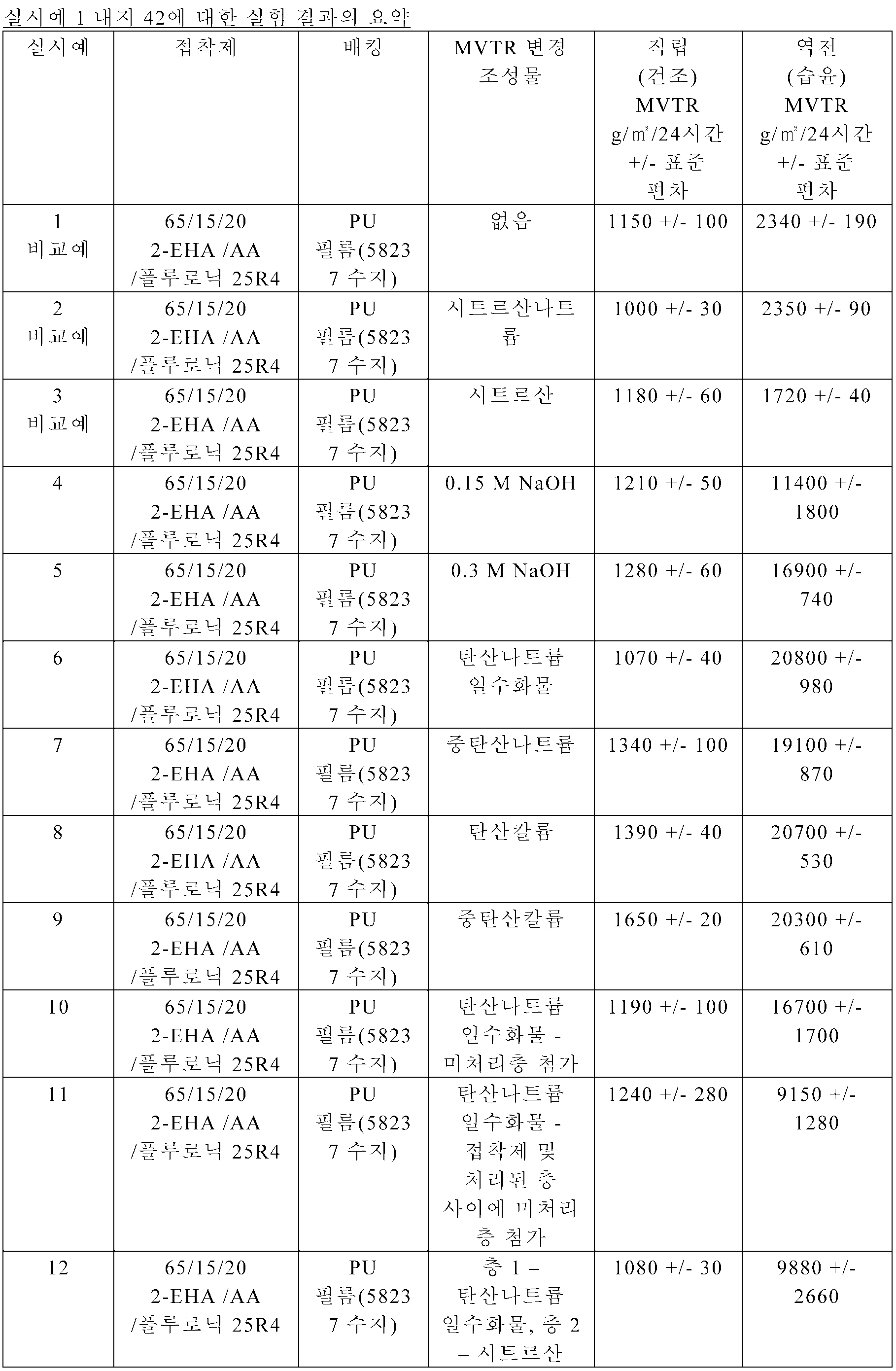
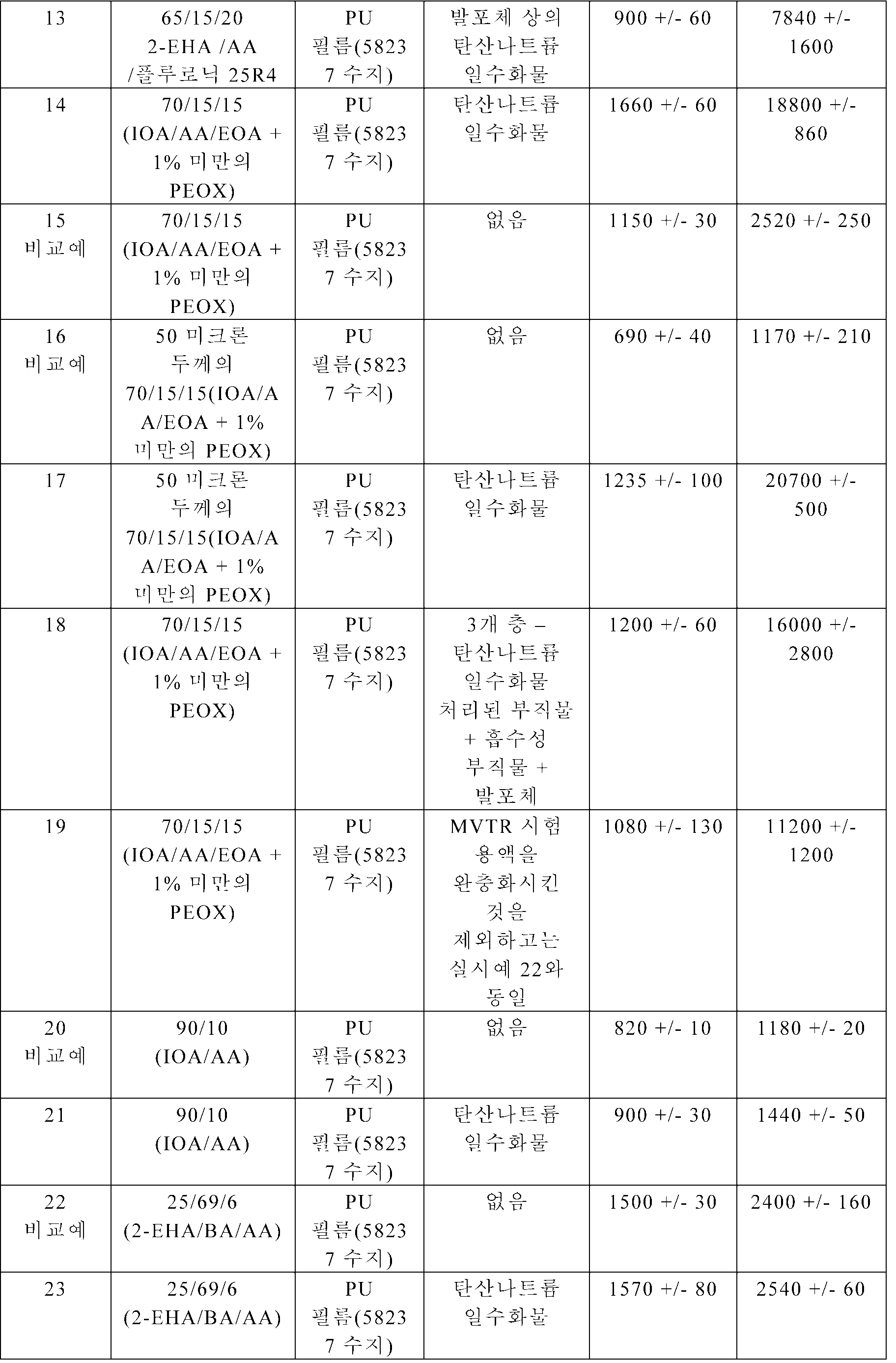
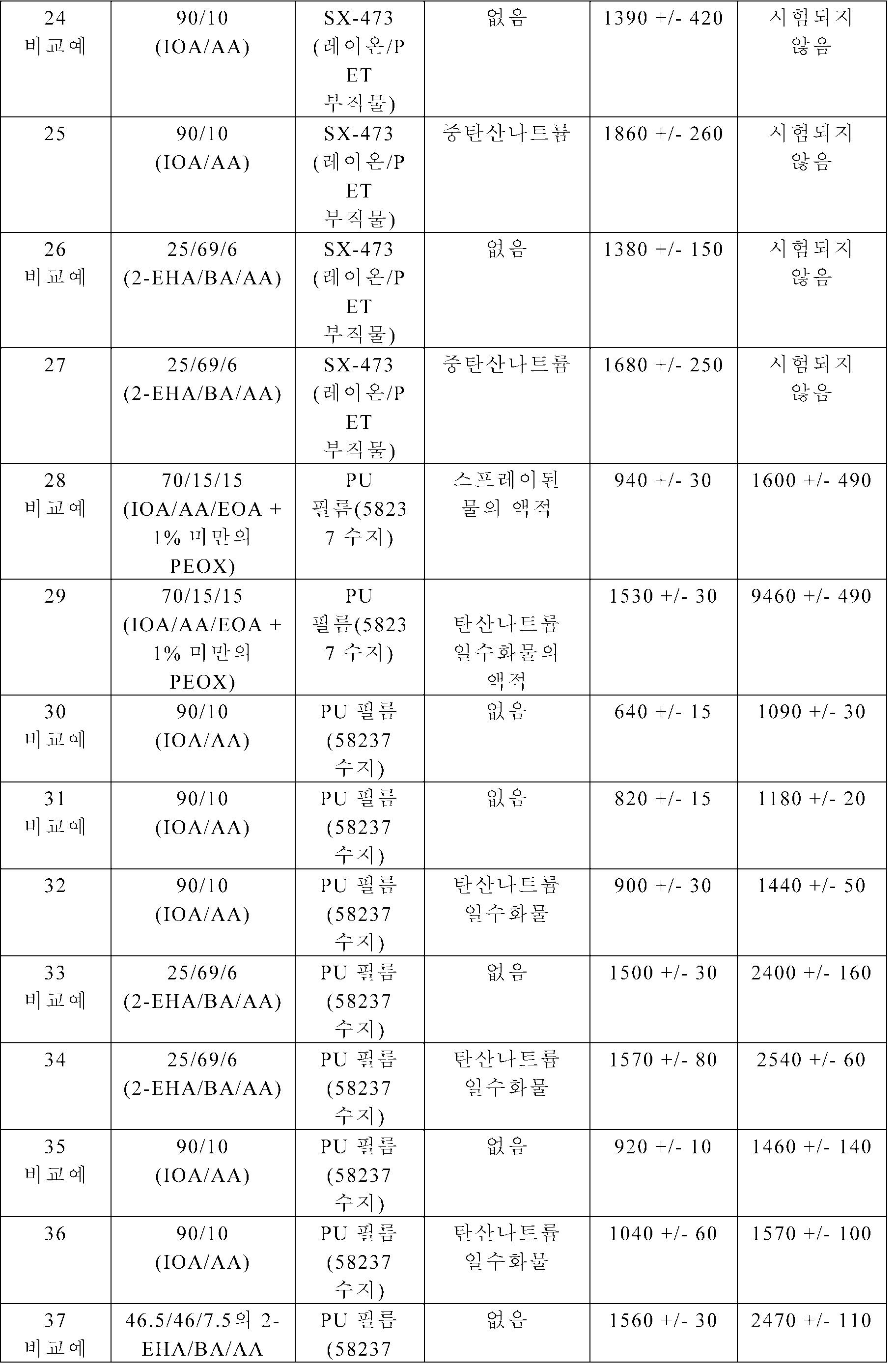

실시예 43(비교)Example 43 (comparative)
대략 25 미크론 두께의 85/15 (w/w) IOA/AA 접착제를 종이 캐리어 상의 대략 25 미크론 두께의 폴리우레탄 에스탄 58237 필름에 가압 적층하였다. 그 다음, 40 g/㎡ 70/30 (w/w) 텐셀/폴리에스테르 스펀레이스드 부직물(미국 위스콘신주 그린베이 소재의 알스트롬 그린 베이)을 수작업으로, 접착제/필름 적층물의 접착제 측에 적층하고, 종이 캐리어를 샘플의 필름 측으로부터 제거하였다. 샘플을 부직물의 접착제로의 적층 7일 후에 시험하였다. 4개의 시험 표본의 평균 직립 MVTR 및 역전 MVTR 값은 각각 600 +/- 40 g/㎡/24시간 및 750 +/- 30 g/㎡/24시간이었다.An approximately 25 micron thick 85/15 (w / w) IOA / AA adhesive was pressure laminated to a approximately 25 micron thick polyurethane ethane 58237 film on a paper carrier. Then 40 g / m 2 70/30 (w / w) tencel / polyester spunlaced nonwoven (Alstrom Green Bay, Green Bay, WI) was manually laminated to the adhesive side of the adhesive / film laminate The paper carrier was removed from the film side of the sample. Samples were tested after 7 days of lamination with a nonwoven adhesive. Mean upright MVTR and inverted MVTR values of the four test specimens were 600 +/- 40 g / m2 / 24 hours and 750 +/- 30 g / m2 / 24 hours, respectively.
실시예Example 44 44
실시예 43으로부터의 부직물을 3.96 m/분(13 feet/분)의 속도로 탄산나트륨 일수화물의 4.0% (w/w) 수용액으로 포화시키고, 중간 시험 규모의 강제 공기 오븐에서 대략 105℃에서 약 5분 동안 건조시켰다. 부직물 상의 탄산나트륨 일수화물의 코팅 중량은 16.3 g/㎡였다. 그 다음, 이러한 코팅된 부직물을 수작업으로 실시예 43C로부터의 접착제/필름 적층물의 접착제 측으로 적층하였다. 표본을 적층 7일 후에 시험하였다. 4개의 시험 표본의 평균 직립 MVTR 및 역전 MVTR 값은 각각 720 +/- 100 g/㎡/24시간 및 1090 +/- 230 g/㎡/24시간이었다.The nonwovens from Example 43 were saturated with a 4.0% (w / w) aqueous solution of sodium carbonate monohydrate at a rate of 3.96 m / min (13 feet / min) and at approximately 105 ° C. in a medium test scale forced air oven. Dry for 5 minutes. The coating weight of sodium carbonate monohydrate on the nonwoven was 16.3 g / m 2. This coated nonwoven was then laminated manually to the adhesive side of the adhesive / film laminate from Example 43C. Samples were tested 7 days after lamination. Mean upright MVTR and inverted MVTR values of the four test specimens were 720 +/- 100 g / m2 / 24 hours and 1090 +/- 230 g / m2 / 24 hours, respectively.
실시예 45(비교)Example 45 (comparative)
대략 25 미크론 두께의 87.5/12.5 (w/w) IOA/AA 접착제를 종이 캐리어 상의 대략 25 미크론 두께의 폴리우레탄 에스탄 58237 필름에 가압 적층하였다. 그 다음 실시예 44로부터의 미처리 부직물을 수작업으로, 접착제/필름 적층물의 접착제 측에 적층하고, 종이 캐리어를 샘플의 필름 측으로부터 제거하였다. 샘플을 부직물의 접착제로의 적층 7일 후에 시험하였다. 4개의 시험 표본의 평균 직립 MVTR 및 역전 MVTR 값은 각각 600 +/- 10 g/㎡/24시간 및 800 +/- 20 g/㎡/24시간이었다.An approximately 25 micron thick 87.5 / 12.5 (w / w) IOA / AA adhesive was pressure laminated to a approximately 25 micron thick polyurethane ethane 58237 film on a paper carrier. The untreated nonwoven from Example 44 was then manually laminated to the adhesive side of the adhesive / film laminate and the paper carrier was removed from the film side of the sample. Samples were tested after 7 days of lamination with a nonwoven adhesive. Mean upright MVTR and inverted MVTR values of the four test specimens were 600 +/- 10 g / m2 / 24 hours and 800 +/- 20 g / m2 / 24 hours, respectively.
실시예 46Example 46
이러한 실시예를 실시예 44로부터의 탄산나트륨 코팅된 부직물을 수작업으로 미처리 부직물 대신에, 접착제/필름 적층물의 87.5/12.5 (w/w) IOA/AA 접착제 측에 적층한 것을 제외하고, 실시예 45와 같이 제조하고 시험하였다. 4개의 시험 표본의 평균 직립 MVTR 및 역전 MVTR 값은 각각 600 +/- 20 g/㎡/24시간 및 910 +/- 100 g/㎡/24시간이었다.This example was applied except that the sodium carbonate coated nonwoven from Example 44 was manually laminated to the 87.5 / 12.5 (w / w) IOA / AA adhesive side of the adhesive / film laminate instead of the untreated nonwoven. Prepared and tested as 45. Mean upright MVTR and inverted MVTR values of the four test specimens were 600 +/- 20 g / m2 / 24 hours and 910 +/- 100 g / m2 / 24 hours, respectively.
실시예 47(비교)Example 47 (comparative)
대략 25 미크론 두께의 80/10/10(w/w/w) IOA/AA/EOA 접착제를 종이 캐리어 상의 대략 25 미크론 두께의 폴리우레탄 에스탄 58237 필름에 가압 적층하였다. 그 다음 실시예 44로부터의 미처리 부직물을 수작업으로, 접착제/필름 적층물의 접착제 측에 적층하고, 종이 캐리어를 샘플의 필름 측으로부터 제거하였다. 샘플을 부직물의 접착제로의 적층 7일 후에 시험하였다. 4개의 시험 표본의 평균 직립 MVTR 및 역전 MVTR 값은 각각 1580 +/- 40 g/㎡/24시간 및 3070 +/- 130 g/㎡/24시간이었다.An approximately 25 micron thick 80/10/10 (w / w / w) IOA / AA / EOA adhesive was pressure laminated to a approximately 25 micron thick polyurethane ethane 58237 film on a paper carrier. The untreated nonwoven from Example 44 was then manually laminated to the adhesive side of the adhesive / film laminate and the paper carrier was removed from the film side of the sample. Samples were tested after 7 days of lamination with a nonwoven adhesive. Mean upright MVTR and inverted MVTR values of the four test specimens were 1580 +/- 40 g / m 2/24 hours and 3070 +/- 130 g / m 2/24 hours, respectively.
실시예 48Example 48
이러한 실시예를 실시예 44로부터의 탄산나트륨 코팅된 부직물을 수작업으로 미처리 부직물 대신에, 접착제/필름 적층물의 80/10/10 (w/w/w) IOA/AA/EOA 접착제 측에 적층한 것을 제외하고 실시예 47과 같이 제조하고 시험하였다. 4개의 시험 표본의 평균 직립 MVTR 및 역전 MVTR 값은 각각 1440 +/- 110 g/㎡/24시간 및 3350 +/- 190 g/㎡/24시간이었다.This example was prepared by laminating the sodium carbonate coated nonwoven from Example 44 on the 80/10/10 (w / w / w) IOA / AA / EOA adhesive side of the adhesive / film laminate, instead of manually treating the nonwoven. Except that it was prepared and tested in the same manner as in Example 47. Mean upright MVTR and inverted MVTR values of the four test specimens were 1440 +/− 110 g / m 2/24 hours and 3350 +/− 190 g / m 2/24 hours, respectively.
실시예 49(비교)Example 49 (comparative)
대략 25 미크론 두께의 75/12.5/12.5(w/w/w) IOA/AA/EOA 접착제를 종이 캐리어 상의 대략 25 미크론 두께의 폴리우레탄 에스탄 58237 필름에 가압 적층하였다. 그 다음 실시예 44로부터의 미처리 부직물을 수작업으로, 접착제/필름 적층물의 접착제 측에 적층하고, 종이 캐리어를 샘플의 필름 측으로부터 제거하였다. 샘플을 부직물의 접착제로의 적층 7일 후에 시험하였다. 4개의 시험 표본의 평균 직립 MVTR 및 역전 MVTR 값은 각각 1500 +/- 100 g/㎡/24시간 및 2870 +/- 240 g/㎡/24시간이었다.An approximately 25 micron thick 75 / 12.5 / 12.5 (w / w / w) IOA / AA / EOA adhesive was pressure laminated to a approximately 25 micron thick polyurethane estane 58237 film on a paper carrier. The untreated nonwoven from Example 44 was then manually laminated to the adhesive side of the adhesive / film laminate and the paper carrier was removed from the film side of the sample. Samples were tested after 7 days of lamination with a nonwoven adhesive. Mean upright MVTR and inverted MVTR values of the four test specimens were 1500 +/- 100 g / m 2/24 hours and 2870 +/- 240 g / m 2/24 hours, respectively.
실시예 50Example 50
이러한 실시예를 실시예 44로부터의 탄산나트륨 코팅된 부직물을 수작업으로 미처리 부직물 대신에, 접착제/필름 적층물의 75/12.5/12.5 (w/w/w) IOA/AA/EOA 접착제 측에 적층한 것을 제외하고 실시예 49와 같이 제조하고 시험하였다. 4개의 시험 표본의 평균 직립 MVTR 및 역전 MVTR 값은 각각 1450 +/- 80 g/㎡/24시간 및 11400 +/- 600 g/㎡/24시간이었다.This example was prepared by laminating the sodium carbonate coated nonwoven from Example 44 on the 75 / 12.5 / 12.5 (w / w / w) IOA / AA / EOA adhesive side of the adhesive / film laminate instead of manually untreated nonwoven. Except that it was prepared and tested in the same manner as in Example 49. Mean upright MVTR and inverted MVTR values of the four test specimens were 1450 +/- 80 g / m 2/24 hours and 11400 +/- 600 g / m 2/24 hours, respectively.
실시예 51(비교)Example 51 (comparative)
대략 25 미크론 두께의 84/6/10(w/w/w) IOA/AA/EOA 접착제를 종이 캐리어 상의 대략 25 미크론 두께의 폴리우레탄 에스탄 58237 필름에 가압 적층하였다. 그 다음 실시예 44로부터의 미처리 부직물을 수작업으로, 접착제/필름 적층물의 접착제 측에 적층하고, 종이 캐리어를 샘플의 필름 측으로부터 제거하였다. 샘플을 부직물의 접착제로의 적층 7일 후에 시험하였다. 4개의 시험 표본의 평균 직립 MVTR 및 역전 MVTR 값은 각각 1880 +/- 90 g/㎡/24시간 및 4250 +/- 260 g/㎡/24시간이었다.An approximately 25 micron thick 84/6/10 (w / w / w) IOA / AA / EOA adhesive was pressure laminated to a approximately 25 micron thick polyurethane ethane 58237 film on a paper carrier. The untreated nonwoven from Example 44 was then manually laminated to the adhesive side of the adhesive / film laminate and the paper carrier was removed from the film side of the sample. Samples were tested after 7 days of lamination with a nonwoven adhesive. Mean upright MVTR and inverted MVTR values of the four test specimens were 1880 +/- 90 g / m2 / 24 hours and 4250 +/- 260 g / m2 / 24 hours, respectively.
실시예 52Example 52
이러한 실시예를 실시예 44로부터의 탄산나트륨 코팅된 부직물을 수작업으로 미처리 부직물 대신에, 접착제/필름 적층물의 84/6/10 (w/w/w) IOA/AA/EOA 접착제 측에 적층한 것을 제외하고 실시예 51과 같이 제조하고 시험하였다. 4개의 시험 표본의 평균 직립 MVTR 및 역전 MVTR 값은 각각 1740 +/- 40 g/㎡/24시간 및 5400 +/- 1400 g/㎡/24시간이었다.This example was prepared by laminating the sodium carbonate coated nonwoven from Example 44 on the 84/6/10 (w / w / w) IOA / AA / EOA adhesive side of the adhesive / film laminate instead of manually untreated nonwoven. Was prepared and tested in the same manner as in Example 51. Mean upright MVTR and inverted MVTR values of the four test specimens were 1740 +/- 40 g / m 2/24 hours and 5400 +/- 1400 g / m 2/24 hours, respectively.
실시예 53(비교)Example 53 (comparative)
대략 25 미크론 두께의 74/6/20(w/w/w) IOA/AA/EOA 접착제를 종이 캐리어 상의 대략 25 미크론 두께의 폴리우레탄 에스탄 58237 필름에 가압 적층하였다. 그 다음 실시예 44로부터의 미처리 부직물을 수작업으로, 접착제/필름 적층물의 접착제 측에 적층하고, 종이 캐리어를 샘플의 필름 측으로부터 제거하였다. 샘플을 부직물의 접착제로의 적층 7일 후에 시험하였다. 4개의 시험 표본의 평균 직립 MVTR 및 역전 MVTR 값은 각각 2410 +/- 80 g/㎡/24시간 및 8350 +/- 510 g/㎡/24시간이었다.An approximately 25 micron thick 74/6/20 (w / w / w) IOA / AA / EOA adhesive was pressure laminated to a approximately 25 micron thick polyurethane estane 58237 film on a paper carrier. The untreated nonwoven from Example 44 was then manually laminated to the adhesive side of the adhesive / film laminate and the paper carrier was removed from the film side of the sample. Samples were tested after 7 days of lamination with a nonwoven adhesive. Mean upright MVTR and inverted MVTR values of the four test specimens were 2410 +/- 80 g / m 2/24 hours and 8350 +/- 510 g / m 2/24 hours, respectively.
실시예 54Example 54
이러한 실시예를 실시예 44로부터의 탄산나트륨 코팅된 부직물을 수작업으로 미처리 부직물 대신에, 접착제/필름 적층물의 74/6/20 (w/w/w) IOA/AA/EOA 접착제 측에 적층한 것을 제외하고 실시예 53과 같이 제조하고 시험하였다. 4개의 시험 표본의 평균 직립 MVTR 및 역전 MVTR 값은 각각 2190 +/- 50 g/㎡/24시간 및 10500 +/- 1780 g/㎡/24시간이었다.This example was prepared by laminating the sodium carbonate coated nonwoven from Example 44 on the 74/6/20 (w / w / w) IOA / AA / EOA adhesive side of the adhesive / film laminate instead of manually untreated nonwoven. Was prepared and tested in the same manner as in Example 53. Mean upright MVTR and inverted MVTR values of the four test specimens were 2190 +/- 50 g / m 2/24 hours and 10500 +/- 1780 g / m 2/24 hours, respectively.
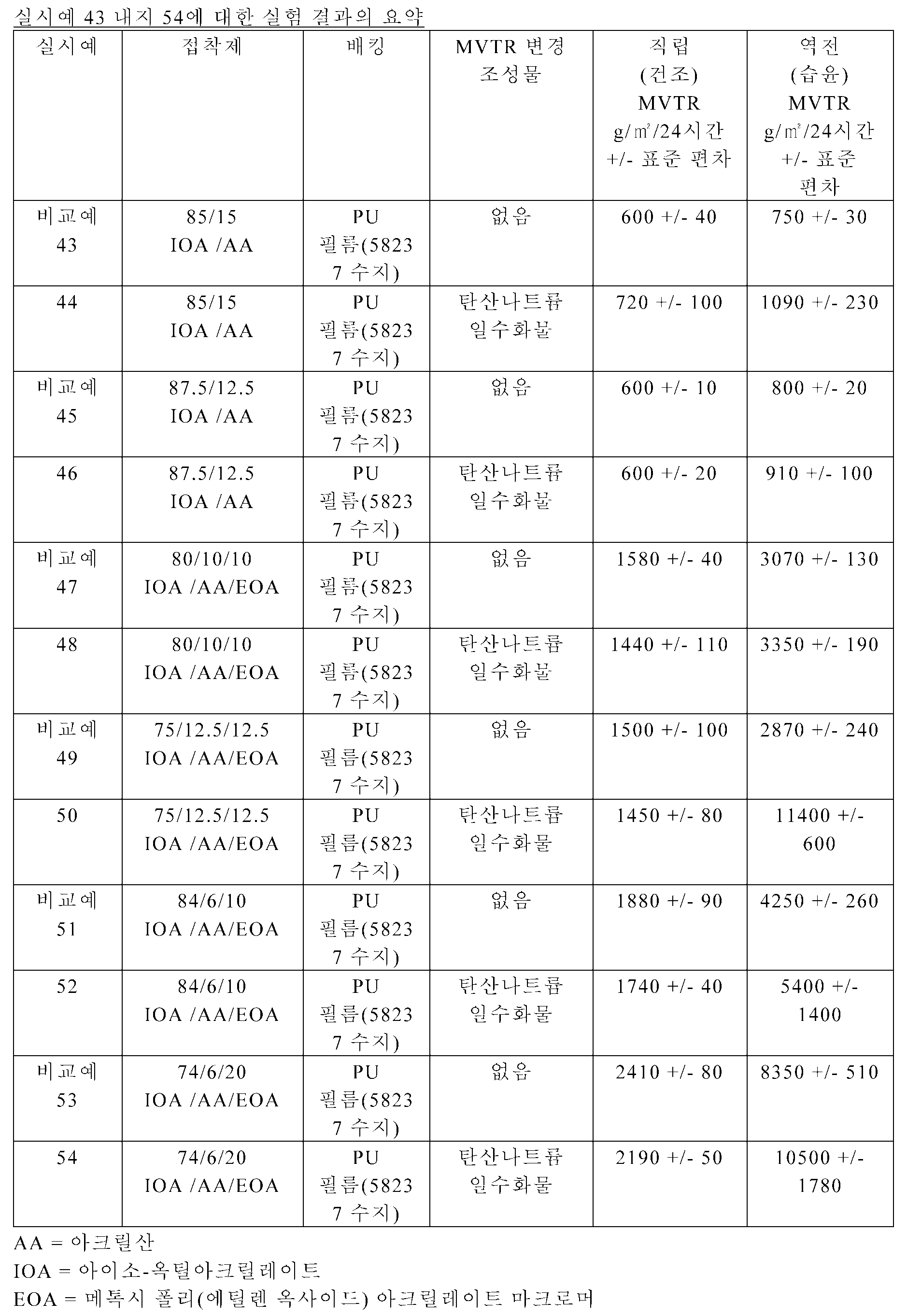
실시형태Embodiment
1.One.
산-작용기 또는 염기-작용기를 포함하는 PSA 층 - PSA는 PSA 그램당 적어도 0.84 mmole의 산- 또는 염기-작용기를 포함함 - ; 및 PSA가 산-작용기를 포함하는 경우 염기성이거나, PSA가 염기-작용기를 포함하는 경우 산성인 MVTR-변경 물질 - MVTR-변경 물질은 PSA와 비혼화성이고, 유체의 존재 하에서 접촉 시에 PSA의 작용기와 반응하여 폴리-염을 형성함 - 을 포함하는 의료 용품.A PSA layer comprising an acid-functional or base-functional group, wherein the PSA comprises at least 0.84 mmole of an acid- or base-functional group per gram of PSA; And an MVTR-modifying substance that is basic when the PSA contains an acid-functional group, or is acidic when the PSA includes a base-functional group. Reacting with to form a poly-salt.
2. PSA가 작용성 폴리머를 포함하며, 상기 폴리머가 PSA의 총 중량을 기준으로, 적어도 6 중량%의 산- 또는 염기-작용성 모노머로부터 제조되는 실시형태 1의 의료 용품.2. The medical article of embodiment 1 wherein the PSA comprises a functional polymer, wherein the polymer is made from at least 6% by weight acid- or base-functional monomer based on the total weight of the PSA.
3. PSA가 PSA 그램당 적어도 1.8 mmole의 산- 또는 염기-작용기를 포함하는 실시형태 1의 의료 용품.3. The medical article of embodiment 1 wherein the PSA comprises at least 1.8 mmole of acid- or base-functional groups per gram of PSA.
4. PSA가 PSA 그램당 4.2 mmole 이하의 산- 또는 염기-작용기를 포함하는 실시형태 1 내지 3 중 어느 한 실시형태의 의료 용품.4. The medical article of any one of embodiments 1-3 wherein the PSA comprises up to 4.2 mmole of acid- or base-functional groups per gram of PSA.
5. MVTR-변경 물질이 PSA 층의 표면 상에 배치된 실시형태 1 내지 4 중 어느 한 실시형태의 의료 용품.5. The medical article of any one of embodiments 1-4 wherein the MVTR-modifying material is disposed on the surface of the PSA layer.
6. MVTR-변경 물질이 PSA 층의 표면 상에 패턴 코팅된 실시형태 5의 의료 용품.6. The medical article of embodiment 5 wherein the MVTR-modifying material is pattern coated on the surface of the PSA layer.
7. 제2 PSA 층을 추가로 포함하며, MVTR-변경 물질이 2개의 PSA 층 사이에 배치된 실시형태 5 또는 실시형태 6의 의료 용품.7. The medical article of embodiment 5 or 6 further comprising a second PSA layer, wherein the MVTR-modifying material is disposed between the two PSA layers.
8. MVTR-변경 물질이 PSA 층과 접촉하는 스캐폴드 내에 혼입된 실시형태 1 내지 4 중 어느 한 실시형태의 의료 용품.8. The medical article of any of embodiments 1-4 wherein the MVTR-modifying material is incorporated into a scaffold in contact with the PSA layer.
9. 의료 용품이 배킹을 포함하며, MVTR-변경 물질이 PSA 층과 배킹 사이에 배치된 실시형태 1 내지 8 중 어느 한 실시형태의 의료 용품.9. The medical article of any one of embodiments 1 to 8 wherein the medical article comprises a backing and the MVTR-modifying material is disposed between the PSA layer and the backing.
10. pH-변경층을 추가로 포함하며, MVTR-변경 물질이 PSA 층과 pH-변경층 사이에 배치된 실시형태 1 내지 9 중 어느 한 실시형태의 의료 용품.10. The medical article of any one of embodiments 1 to 9 further comprising a pH-changing layer, wherein the MVTR-modifying material is disposed between the PSA layer and the pH-changing layer.
11. pH-변경층이 폴리아크릴산, 시트르산 및 이들의 조합으로 이루어진 군으로부터 선택되는 pH-변경 물질을 포함하는 실시형태 10의 의료 용품.11. The medical article of
12. 여과층을 추가로 포함하며, 여과층이 MVTR-변경 물질과 표적 부위 사이에 배치된 실시형태 1 내지 11 중 어느 한 실시형태의 의료 용품.12. The medical article of any one of embodiments 1-11 further comprising a filtration layer, wherein the filtration layer is disposed between the MVTR-modifying material and the target site.
13. MVTR-변경 물질 대 작용기의 몰비가 0.1:1 내지 100:1인 실시형태 1 내지 12 중 어느 한 실시형태의 의료 용품.13. The medical article of any one of embodiments 1-12 wherein the molar ratio of MVTR-modifying material to functional group is 0.1: 1 to 100: 1.
14. 상처 드레싱인 실시형태 1 내지 13 중 어느 한 실시형태의 의료 용품.14. The medical article of any one of embodiments 1 to 13 which is a wound dressing.
15.15.
PSA 층과 접촉하는 캐리어 필름; 캐리어 필름과 접착제층 사이에 배치된 흡수성 패드; 및 지지층과 PSA 층 사이에 배치된 배킹을 추가로 포함하는 실시형태 14의 의료 용품.A carrier film in contact with the PSA layer; An absorbent pad disposed between the carrier film and the adhesive layer; And a backing disposed between the support layer and the PSA layer.
16. PSA 층이 산-작용기를 갖는 폴리머를 포함하며, MVTR-변경 물질이 염기성인 실시형태 1 내지 15 중 어느 한 실시형태의 의료 용품.16. The medical article of any of embodiments 1-15 wherein the PSA layer comprises a polymer having an acid-functional group and the MVTR-modifying material is basic.
17. MVTR-변경 물질이 수산화나트륨, 수산화칼륨, 수산화칼슘, 수산화리튬, 수산화은, 수산화아연, 수산화암모늄, 수산화마그네슘, 수산화바륨, 수산화스트론튬, 수산화세슘, 수산화루비듐, 탄산암모늄, 탄산나트륨, 중탄산나트륨, 탄산칼륨, 중탄산칼륨, 탄산은, 탄산리튬, 중탄산리튬, 중탄산바륨, 탄산마그네슘, 탄산세슘, 이들의 수화물 및 이들의 조합으로 이루어진 군으로부터 선택된 염기를 포함하는 실시형태 16의 의료 용품.17. MVTR-modifying materials are sodium hydroxide, potassium hydroxide, calcium hydroxide, lithium hydroxide, silver hydroxide, zinc hydroxide, ammonium hydroxide, magnesium hydroxide, barium hydroxide, strontium hydroxide, cesium hydroxide, rubidium hydroxide, ammonium carbonate, sodium carbonate, sodium bicarbonate, carbonate The medical article of
18. PSA가 고무계 접착제, (메트)아크릴류, 폴리(알파-올레핀), 폴리우레탄, 실리콘 및 이들의 조합을 포함하는 실시형태 16 또는 실시형태 17의 의료 용품.18. The medical article of
19. PSA가 염기-작용기를 포함하며, MVTR-변경 물질이 산성인 실시형태 1 내지 15 중 어느 한 실시형태의 의료 용품.19. The medical article of any of embodiments 1-15 wherein the PSA comprises a base-functional group and the MVTR-modifying substance is acidic.
20. PSA가 아민 폴리머를 포함하는 실시형태 19의 의료 용품.20. The medical article of embodiment 19 wherein the PSA comprises an amine polymer.
21. MVTR-변경 물질이 아민기와 반응하여 폴리-염을 형성할 수 있는 산을 포함하는 실시형태 19 또는 실시형태 20의 의료 용품.21. The medical article of
22. 습윤 MVTR이 적어도 1200 g/㎡/24시간인 실시형태 1 내지 21 중 어느 한 실시형태의 의료 용품.22. The medical article of any one of embodiments 1 to 21 wherein the wet MVTR is at least 1200 g / m 2/24 hours.
23. MVTR-변경 물질이 MVTR-변경 물질이 없는 동일한 의료 용품에 비해 의료 용품의 습윤 MVTR을 적어도 20% 향상시키는 실시형태 1 내지 22 중 어느 한 실시형태의 의료 용품.23. The medical article of any one of embodiments 1 to 22 wherein the MVTR-modifying substance improves the wet MVTR of the medical article by at least 20% over the same medical article without the MVTR-modifying substance.
24. PSA 층이 PSA 층의 도처에 균일하게 분산된 MVTR-변경 물질을 포함하지 않는 실시형태 1 내지 23 중 어느 한 실시형태의 의료 용품.24. The medical article of any one of embodiments 1 through 23 wherein the PSA layer does not comprise MVTR-modifying material uniformly dispersed throughout the PSA layer.
25.25.
제1 주표면 및 제2 주표면을 갖는 배킹; 배킹의 제1 주표면의 적어도 일부분 상에 배치된 PSA 층 - PSA는 산-작용기 또는 염기-작용기를 포함하며, PSA는 PSA 그램당 적어도 0.84 mmole의 산- 또는 염기-작용기를 포함함 - ; 및 PSA 층에 가까운 MVTR-변경층 - MVTR-변경층은 PSA가 산-작용기를 포함하는 경우 염기성이거나, PSA가 염기-작용기를 포함하는 경우 산성인 MVTR-변경 물질을 포함하며, MVTR-변경 물질은 PSA와 비혼화성이고, 유체의 존재 하에서의 접촉 시에, 작용기와 반응하여 폴리-염을 형성함 - 을 포함하는 상처 드레싱.A backing having a first major surface and a second major surface; A PSA layer disposed on at least a portion of the first major surface of the backing, the PSA comprising an acid- or base-functional group, wherein the PSA comprises at least 0.84 mmole of acid- or base-functional group per gram of PSA; And an MVTR-modifying layer close to the PSA layer—the MVTR-modifying layer includes an MVTR-modifying material that is basic when the PSA contains an acid-functional group or is acidic when the PSA contains a base-functional group, Is immiscible with PSA and, upon contact in the presence of a fluid, reacts with the functional group to form a poly-salt.
26. MVTR-변경층이 스캐폴드를 포함하는 실시형태 25의 상처 드레싱.26. The wound dressing of embodiment 25, wherein the MVTR-modifying layer comprises a scaffold.
27. 스캐폴드가 부직포를 포함하는 실시형태 26의 상처 드레싱.27. The wound dressing of embodiment 26, wherein the scaffold comprises a nonwoven fabric.
28. 흡수층을 추가로 포함하며, 흡수층이 폴리머 패브릭, 폴리머 발포체 또는 이들의 조합을 포함하는 실시형태 25 내지 27 중 어느 한 실시형태의 상처 드레싱.28. The wound dressing of any one of embodiments 25 to 27, further comprising an absorbent layer, wherein the absorbent layer comprises a polymer fabric, a polymer foam, or a combination thereof.
29. MVTR-변경층이 PSA 층의 적어도 일부분과 직접 접촉하는 실시형태 25 내지 28 중 어느 한 실시형태의 상처 드레싱.29. The wound dressing of any of embodiments 25-28, wherein the MVTR-modifying layer is in direct contact with at least a portion of the PSA layer.
30. MVTR-변경층과 PSA 층 사이에 하나 이상의 층을 추가로 포함하는 실시형태 25 내지 28 중 어느 한 실시형태의 상처 드레싱.30. The wound dressing of any one of embodiments 25 to 28, further comprising one or more layers between the MVTR-modifying layer and the PSA layer.
31. PSA가 카복실산기를 포함하는 실시형태 25 내지 30 중 어느 한 실시형태의 상처 드레싱.31. The wound dressing according to any one of embodiments 25 to 30, wherein the PSA comprises a carboxylic acid group.
32. MVTR-변경 물질이 수산화나트륨, 수산화칼륨, 수산화칼슘, 수산화리튬, 수산화은, 수산화아연, 수산화암모늄, 수산화마그네슘, 수산화바륨, 수산화스트론튬, 수산화세슘, 수산화루비듐, 탄산암모늄, 탄산나트륨, 중탄산나트륨, 탄산칼륨, 중탄산칼륨, 탄산은, 탄산리튬, 중탄산리튬, 중탄산바륨, 탄산마그네슘, 탄산세슘, 이들의 수화물 및 이들의 조합으로 이루어진 군으로부터 선택된 염기를 포함하는 실시형태 31의 상처 드레싱.32. MVTR-modifying materials are sodium hydroxide, potassium hydroxide, calcium hydroxide, lithium hydroxide, silver hydroxide, zinc hydroxide, ammonium hydroxide, magnesium hydroxide, barium hydroxide, strontium hydroxide, cesium hydroxide, rubidium hydroxide, ammonium carbonate, sodium carbonate, sodium bicarbonate, carbonate The wound dressing of embodiment 31 comprising a base selected from the group consisting of potassium, potassium bicarbonate, silver carbonate, lithium carbonate, lithium bicarbonate, barium bicarbonate, magnesium carbonate, cesium carbonate, hydrates thereof, and combinations thereof.
33. PSA가 염기성 아민기를 포함하는 실시형태 25 내지 30 중 어느 한 실시형태의 상처 드레싱.33. The wound dressing according to any one of embodiments 25 to 30, wherein the PSA comprises a basic amine group.
34. MVTR-변경 물질이 유체의 존재 하에서 아민과 반응하여 폴리-염을 생성할 수 있는 산을 포함하는 실시형태 33의 상처 드레싱.34. The wound dressing of embodiment 33, wherein the MVTR-modifying material comprises an acid capable of reacting with an amine in the presence of a fluid to produce a poly-salt.
35.35.
제1 주표면 및 제2 주표면을 갖는 배킹; 배킹의 제1 주표면의 적어도 일부분 상에 배치되며, 산-작용기를 포함하는 PSA 층; 배킹의 제2 주표면에 해제가능하게 부착되는 지지층; 및 PSA 층과 접촉하는 MVTR-변경 물질을 포함하는 MVTR-변경 층 - PSA 층은 PSA 층의 도처에 균일하게 분산된 MVTR-변경 물질을 포함하지 않으며, MVTR-변경 물질은 염기성이고, PSA와 비혼화성이며, 유체의 존재 하에서의 접촉 시에, 작용기와 반응하여 폴리-염을 형성함 - 을 포함하는 상처 드레싱.A backing having a first major surface and a second major surface; A PSA layer disposed on at least a portion of the first major surface of the backing and comprising an acid-functional group; A support layer releasably attached to the second major surface of the backing; And an MVTR-modifying layer comprising an MVTR-modifying material in contact with the PSA layer—the PSA layer does not include an MVTR-modifying material uniformly dispersed throughout the PSA layer, wherein the MVTR-modifying material is basic and unmixed with the PSA. Wound dressing, reacting with a functional group to form a poly-salt upon contact in the presence of a fluid.
36. PSA가 PSA 그램당 적어도 0.84 mmole의 산- 또는 염기-작용기를 포함하는 실시형태 35의 상처 드레싱.36. The wound dressing of embodiment 35, wherein the PSA comprises at least 0.84 mmole of acid- or base-functional groups per gram of PSA.
37.37.
제1 주표면 및 제2 주표면을 갖는 배킹; 배킹의 제1 주표면의 적어도 일부분 상에 배치된 PSA 층 - PSA는 산-작용기를 갖는 (메트)아크릴레이트 폴리머를 포함하며, 폴리머는 PSA의 총 중량을 기준으로, 적어도 6 중량%의 산-작용성 모노머로부터 제조됨 - ; 배킹의 제2 주표면에 해제가능하게 부착된 지지층; 및 PSA 층과 접촉하는 MVTR-변경 물질을 포함하는 MVTR-변경 층 - MVTR-변경 물질은 염기성이고, PSA와 비혼화성이며, 유체의 존재 하에서 접촉 시에 폴리머의 작용기와 반응하여 폴리-염을 형성함 - 을 포함하는 상처 드레싱.A backing having a first major surface and a second major surface; PSA layer disposed on at least a portion of the first major surface of the backing, wherein the PSA comprises a (meth) acrylate polymer having an acid-functional group, wherein the polymer comprises at least 6% by weight of acid- based on the total weight of the PSA Prepared from functional monomers; A support layer releasably attached to the second major surface of the backing; And an MVTR-modifying material comprising an MVTR-modifying material in contact with the PSA layer. The MVTR-modifying material is basic, immiscible with PSA, and reacts with the functional groups of the polymer upon contact in the presence of a fluid to form a poly-salt. Including wound dressings.
38. 산-작용기 또는 염기-작용기를 포함하는 PSA 층을 제공하는 단계 - PSA는 PSA 그램당 적어도 0.84 mmole의 산- 또는 염기-작용기를 포함함 - ; PSA가 산-작용기를 포함하는 경우 염기성이거나, PSA가 염기-작용기를 포함하는 경우 산성인 MVTR-변경 물질을 제공하는 단계 - MVTR-변경 물질은 PSA와 비혼화성임 - ; 및 MVTR-변경 물질을 의료 용품 내에, 의료 용품이 사용 동안 유체와 접촉하게 되는 경우, MVTR-변경 물질이 PSA와 접촉되게 하는 위치에 배치하는 단계 - MVTR-변경 물질, PSA 및 유체 간의 접촉은 산-염기 반응을 야기하여, 폴리-염을 형성하고, PSA 층의 적어도 일부분의 수분 투과성을 증가시킴 - 를 포함하는 의료 용품 내의 접착제층의 수증기 투과율의 증가 방법.38. providing a PSA layer comprising an acid- or base-functional group, wherein the PSA comprises at least 0.84 mmole of acid- or base-functional group per gram of PSA; Providing a MVTR-modifying substance that is basic when the PSA comprises an acid-functional group or is acidic when the PSA includes a base-functional group, wherein the MVTR-modifying substance is immiscible with the PSA; And placing the MVTR-modifying material in the medical article and where the MVTR-modifying material is brought into contact with the PSA when the medical article is in contact with the fluid during use, the contact between the MVTR-modifying material, the PSA and the fluid being acidic. Causing a base reaction to form a poly-salt and increase water permeability of at least a portion of the PSA layer.
39. 산-작용기를 갖는 폴리머 또는 염기-작용기를 갖는 폴리머를 포함하는 PSA 층을 제공하는 단계 - 폴리머는 PSA의 총 중량을 기준으로, 적어도 6 중량%의 산- 또는 염기-작용성 모노머로부터 제조됨 - ; PSA가 산-작용성 폴리머를 포함하는 경우 염기성이거나, PSA가 염기-작용성 폴리머를 포함하는 경우 산성인 MVTR-변경 물질을 제공하는 단계 - MVTR-변경 물질은 PSA와 비혼화성임 - ; 및 MVTR-변경 물질을 의료 용품 내에, 의료 용품이 사용 동안 유체와 접촉하게 되는 경우 MVTR-변경 물질이 PSA와 접촉되게 하는 위치에 배치하는 단계 - MVTR-변경 물질, PSA 및 유체 간의 접촉은 산-염기 반응을 야기하여, 폴리-염을 형성하고, PSA 층의 적어도 일부분의 수분 투과성을 증가시킴 - 를 포함하는 의료 용품 내의 접착제층의 수증기 투과율의 증가 방법.39. Providing a PSA layer comprising a polymer having an acid-functional group or a polymer having a base-functional group, wherein the polymer is prepared from at least 6% by weight of acid- or base-functional monomer based on the total weight of the PSA. -; Providing an MVTR-modifying material that is basic when the PSA comprises an acid-functional polymer or is acidic when the PSA comprises a base-functional polymer, wherein the MVTR-modifying material is immiscible with the PSA; And placing the MVTR-modifying material in the medical article, such that the MVTR-modifying material is in contact with the PSA when the medical article is in contact with the fluid during use, wherein the contact between the MVTR-modifying material, the PSA and the fluid is acid- Causing a base reaction to form a poly-salt and increase the water permeability of at least a portion of the PSA layer.
40. MVTR-변경 물질을 의료 용품 내에, MVTR-변경 물질이 PSA와 접촉되게 하는 위치에 배치하는 단계가 MVTR-변경 물질을 PSA 층 상에 코팅하는 것을 포함하는 실시형태 38 또는 실시형태 39의 방법.40. The method of
41. MVTR-변경 물질을 의료 용품 내에, MVTR-변경 물질이 PSA와 접촉되게 하는 위치에 배치하는 단계가 스캐폴드를 제공하고; 스캐폴드를 MVTR-변경 물질로 코팅하고; PSA 층의 적어도 일부분을 코팅된 스캐폴드와 접촉시키는 것을 포함하는 실시형태 38지 40 중 어느 한 실시형태의 방법.41. The step of placing the MVTR-modifying material in the medical article, where the MVTR-modifying material is in contact with the PSA, provides a scaffold; The scaffold is coated with an MVTR-modifying material; The method of any one of embodiments 38-40, including contacting at least a portion of the PSA layer with a coated scaffold.
본 명세서에 인용된 특허, 특허 문서 및 간행물의 전 개시 내용은 마치 각각이 개별적으로 포함되는 것처럼 전체적으로 본 명세서에 참고로 포함된다. 본 발명의 범위 및 취지를 벗어나지 않고도 본 발명의 다양한 변경 및 변경이 당업자에게 명백하게 될 것이다. 본 발명은 본 명세서에 설명된 예시적인 실시형태 및 실시예에 의해 부당하게 제한되는 것으로 의도되지 않고 그러한 실시예 및 실시형태는 단지 예로서 제시된 것이며, 본 발명의 범주는 본 명세서에 하기와 같이 설명되는 특허청구범위에 의해서만 한정되는 것으로 의도됨을 이해하여야 한다.The entire disclosures of patents, patent documents and publications cited herein are hereby incorporated by reference in their entirety as if each were individually incorporated. Various modifications and alterations of this invention will become apparent to those skilled in the art without departing from the scope and spirit of this invention. The present invention is not intended to be unduly limited by the illustrative embodiments and examples described herein and such examples and embodiments are presented by way of example only, and the scope of the present invention is described herein as follows. It is to be understood that it is intended to be limited only by the claims that follow.
Claims (32)
PSA가 산-작용기를 포함하는 경우 염기성이거나, PSA가 염기-작용기를 포함하는 경우 산성인 MVTR-변경 물질 - MVTR-변경 물질은 PSA와 비혼화성이고, 유체의 존재 하에서 접촉 시에 PSA의 작용기와 반응하여 폴리-염을 형성함 - 을 포함하는 의료 용품.A PSA layer comprising an acid-functional or base-functional group, wherein the PSA comprises at least 0.84 mmole of an acid- or base-functional group per gram of PSA; And
MVTR-modifying materials that are basic when the PSA contains an acid-functional group or are acidic when the PSA contains a base-functional group—the MVTR-modifying material is immiscible with the PSA and, upon contact in the presence of a fluid, Reacting to form a poly-salt.
PSA 층과 접촉하는 캐리어 필름;
캐리어 필름과 접착제층 사이에 배치된 흡수성 패드; 및
지지층과 PSA 층 사이에 배치된 배킹을 추가로 포함하는 의료 용품.The method of claim 1,
A carrier film in contact with the PSA layer;
An absorbent pad disposed between the carrier film and the adhesive layer; And
A medical article further comprising a backing disposed between the backing layer and the PSA layer.
배킹의 제1 주표면의 적어도 한 부분 상에 배치된 PSA 층 - PSA는 산-작용기 또는 염기-작용기를 포함하며, PSA는 PSA 그램당 적어도 0.84 mmole의 산- 또는 염기-작용기를 포함함 - ; 및
PSA 층에 가까운 MVTR-변경층 - MVTR-변경층은 PSA가 산-작용기를 포함하는 경우 염기성이거나, PSA가 염기-작용기를 포함하는 경우 산성인 MVTR-변경 물질을 포함하며, MVTR-변경 물질은 PSA와 비혼화성이고, 유체의 존재 하에서의 접촉 시에, 작용기와 반응하여 폴리-염을 형성함 - 을 포함하는 상처 드레싱(wound dressing).A backing having a first major surface and a second major surface;
A PSA layer disposed on at least a portion of the first major surface of the backing, the PSA comprising an acid- or base-functional group, wherein the PSA comprises at least 0.84 mmole of acid- or base-functional group per gram of PSA; And
MVTR-modifying layer close to the PSA layer—The MVTR-modifying layer comprises an MVTR-modifying material that is basic when the PSA contains an acid-functional group or is acidic when the PSA contains a base-functional group. Wound dressing comprising immiscible with PSA and reacting with a functional group to form a poly-salt upon contact in the presence of a fluid.
배킹의 제1 주표면의 적어도 일부분 상에 배치되며, 산-작용기를 포함하는 PSA 층;
배킹의 제2 주표면에 해제가능하게 부착되는 지지층; 및
PSA 층과 접촉하는 MVTR-변경 물질을 포함하는 MVTR-변경층 - PSA 층은 PSA 층의 도처에 균일하게 분산된 MVTR-변경 물질을 포함하지 않으며, MVTR-변경 물질은 염기성이고, PSA와 비혼화성이며, 유체의 존재 하에서 접촉 시에, 작용기와 반응하여 폴리-염을 형성함 - 을 포함하는 상처 드레싱.A backing having a first major surface and a second major surface;
A PSA layer disposed on at least a portion of the first major surface of the backing and comprising an acid-functional group;
A support layer releasably attached to the second major surface of the backing; And
MVTR-modifying layer comprising MVTR-modifying material in contact with the PSA layer—The PSA layer does not include MVTR-modifying material uniformly dispersed throughout the PSA layer, and the MVTR-modifying material is basic and incompatible with PSA. And, upon contact in the presence of a fluid, react with a functional group to form a poly-salt.
배킹의 제1 주표면의 적어도 일부분 상에 배치된 PSA 층 - PSA는 산-작용기를 갖는 (메트)아크릴레이트 폴리머를 포함하며, 폴리머는 PSA의 총 중량을 기준으로, 적어도 6 중량%의 산-작용성 모노머로부터 제조됨 - ;
배킹의 제2 주표면에 해제가능하게 부착된 지지층; 및
PSA 층과 접촉하는 MVTR-변경 물질을 포함하는 MVTR-변경층 - MVTR-변경 물질은 염기성이고, PSA와 비혼화성이며, 유체의 존재 하에서 접촉 시에 폴리머의 작용기와 반응하여 폴리-염을 형성함 - 을 포함하는 상처 드레싱.A backing having a first major surface and a second major surface;
PSA layer disposed on at least a portion of the first major surface of the backing, wherein the PSA comprises a (meth) acrylate polymer having an acid-functional group, wherein the polymer comprises at least 6% by weight of acid- based on the total weight of the PSA Prepared from functional monomers;
A support layer releasably attached to the second major surface of the backing; And
MVTR-modifying layer comprising MVTR-modifying material in contact with the PSA layer—The MVTR-modifying material is basic, immiscible with PSA, and reacts with the functional groups of the polymer upon contact in the presence of a fluid to form poly-salts. Wound dressings comprising.
PSA가 산-작용기를 포함하는 경우 염기성이거나, PSA가 염기-작용기를 포함하는 경우 산성인 MVTR-변경 물질을 제공하는 단계 - MVTR-변경 물질은 PSA와 비혼화성임 - ; 및
MVTR-변경 물질을 의료 용품 내에, 의료 용품이 사용 동안 유체와 접촉하게 되는 경우 MVTR-변경 물질이 PSA와 접촉되게 하는 위치에 배치하는 단계 - MVTR-변경 물질, PSA 및 유체 간의 접촉은 산-염기 반응을 야기하여, 폴리-염을 형성하고, PSA 층의 적어도 일부분의 수분 투과성을 증가시킴 - 를 포함하는 의료 용품 내의 접착제층의 수증기 투과율의 증가 방법.Providing a PSA layer comprising an acid-functional or base-functional group, wherein the PSA comprises at least 0.84 mmole of acid- or base-functional group per gram of PSA;
Providing a MVTR-modifying substance that is basic when the PSA comprises an acid-functional group or is acidic when the PSA includes a base-functional group, wherein the MVTR-modifying substance is immiscible with the PSA; And
Placing the MVTR-modifying substance in the medical article, such that the MVTR-modifying substance, in contact with the fluid during use, is brought into contact with the PSA, wherein the contact between the MVTR-modifying substance, PSA and the fluid is acid-base. Causing a reaction to form a poly-salt and increase water permeability of at least a portion of the PSA layer.
PSA가 산-작용성 폴리머를 포함하는 경우 염기성이거나, PSA가 염기-작용성 폴리머를 포함하는 경우 산성인 MVTR-변경 물질을 제공하는 단계 - MVTR-변경 물질은 PSA와 비혼화성임 - ; 및
MVTR-변경 물질을 의료 용품 내에, 의료 용품이 사용 동안 유체와 접촉하게 되는 경우 MVTR-변경 물질이 PSA와 접촉되게 하는 위치에 배치하는 단계 - MVTR-변경 물질, PSA 및 유체 간의 접촉은 산-염기 반응을 야기하여, 폴리-염을 형성하고, PSA 층의 적어도 일부분의 수분 투과성을 증가시킴 - 를 포함하는 의료 용품 내의 접착제층의 수증기 투과율의 증가 방법.Providing a PSA layer comprising a polymer having an acid-functional group or a polymer having a base-functional group, wherein the polymer is prepared from at least 6% by weight of acid- or base-functional monomer based on the total weight of the PSA ;
Providing an MVTR-modifying material that is basic when the PSA comprises an acid-functional polymer or is acidic when the PSA comprises a base-functional polymer, wherein the MVTR-modifying material is immiscible with the PSA; And
Placing the MVTR-modifying substance in the medical article, such that the MVTR-modifying substance, in contact with the fluid during use, is brought into contact with the PSA, wherein the contact between the MVTR-modifying substance, PSA and the fluid is acid-base. Causing a reaction to form a poly-salt and increase water permeability of at least a portion of the PSA layer.
스캐폴드를 제공하고;
스캐폴드를 MVTR-변경 물질로 코팅하고;
PSA 층의 적어도 일부분을 코팅된 스캐폴드와 접촉시키는 것을 포함하는 방법.32. The method of claim 30 or 31, wherein the step of placing the MVTR-modifying material in the medical article, such that the MVTR-modifying material is in contact with the PSA
Providing a scaffold;
The scaffold is coated with an MVTR-modifying material;
Contacting at least a portion of the PSA layer with the coated scaffold.
Applications Claiming Priority (4)
| Application Number | Priority Date | Filing Date | Title |
|---|---|---|---|
| US25962209P | 2009-11-09 | 2009-11-09 | |
| US61/259,622 | 2009-11-09 | ||
| US30138610P | 2010-02-04 | 2010-02-04 | |
| US61/301,386 | 2010-02-04 |
Publications (1)
| Publication Number | Publication Date |
|---|---|
| KR20120091339A true KR20120091339A (en) | 2012-08-17 |
Family
ID=43970416
Family Applications (1)
| Application Number | Title | Priority Date | Filing Date |
|---|---|---|---|
| KR1020127014829A Withdrawn KR20120091339A (en) | 2009-11-09 | 2010-11-09 | Medical articles and methods of making using immiscible material |
Country Status (7)
| Country | Link |
|---|---|
| US (2) | US8546637B2 (en) |
| EP (2) | EP2498828B1 (en) |
| JP (1) | JP5767235B2 (en) |
| KR (1) | KR20120091339A (en) |
| CN (1) | CN102686249B (en) |
| BR (1) | BR112012010858B8 (en) |
| WO (1) | WO2011057240A1 (en) |
Cited By (1)
| Publication number | Priority date | Publication date | Assignee | Title |
|---|---|---|---|---|
| KR20220126742A (en) * | 2020-01-17 | 2022-09-16 | 덤에코 오이 | Adhesive dressings and methods for preparing adhesive dressings |
Families Citing this family (52)
| Publication number | Priority date | Publication date | Assignee | Title |
|---|---|---|---|---|
| GB0808376D0 (en) | 2008-05-08 | 2008-06-18 | Bristol Myers Squibb Co | Wound dressing |
| GB0817796D0 (en) | 2008-09-29 | 2008-11-05 | Convatec Inc | wound dressing |
| WO2011057175A1 (en) * | 2009-11-09 | 2011-05-12 | 3M Innovative Properties Company | Medical articles and methods of making using miscible composition |
| GB201020236D0 (en) | 2010-11-30 | 2011-01-12 | Convatec Technologies Inc | A composition for detecting biofilms on viable tissues |
| CA2819475C (en) | 2010-12-08 | 2019-02-12 | Convatec Technologies Inc. | Integrated system for assessing wound exudates |
| WO2012078723A1 (en) | 2010-12-08 | 2012-06-14 | Convatec Technologies Inc. | Method and system for removing exudates from a wound site |
| US9526816B2 (en) | 2010-12-08 | 2016-12-27 | Convatec Technologies Inc. | Wound exudate monitor accessory |
| DE102011106046A1 (en) | 2011-06-30 | 2013-01-03 | Paul Hartmann Ag | Wound Care Product |
| AU2012282287B2 (en) | 2011-07-14 | 2017-06-01 | Smith & Nephew Plc | Wound dressing and method of treatment |
| GB201115182D0 (en) | 2011-09-02 | 2011-10-19 | Trio Healthcare Ltd | Skin contact material |
| GB2497406A (en) | 2011-11-29 | 2013-06-12 | Webtec Converting Llc | Dressing with a perforated binder layer |
| GB201120693D0 (en) | 2011-12-01 | 2012-01-11 | Convatec Technologies Inc | Wound dressing for use in vacuum therapy |
| US10940047B2 (en) | 2011-12-16 | 2021-03-09 | Kci Licensing, Inc. | Sealing systems and methods employing a hybrid switchable drape |
| US9132039B2 (en) | 2012-03-29 | 2015-09-15 | Principle Business Enterprises, Inc. | Disposable absorbent moisture management dressing |
| CA2895896A1 (en) | 2012-12-20 | 2014-06-26 | Convatec Technologies Inc. | Processing of chemically modified cellulosic fibres |
| WO2014159419A1 (en) | 2013-03-14 | 2014-10-02 | 3M Innovative Properties Company | Hydrocolloid wound dressings with increased wvtr |
| CN105579003A (en) * | 2013-07-10 | 2016-05-11 | 张洁 | A kit for sustained transdermal drug delivery using liquid or semisolid formulations and method of using the same |
| JP6744315B2 (en) | 2014-12-30 | 2020-08-19 | スリーエム イノベイティブ プロパティズ カンパニー | Wound dressing having multiple adhesive layers |
| WO2017004136A1 (en) | 2015-06-30 | 2017-01-05 | Tela Bio, Inc. | Corner-lock stitch patterns |
| US10426587B2 (en) | 2015-07-21 | 2019-10-01 | Tela Bio, Inc. | Compliance control stitching in substrate materials |
| JP6875378B2 (en) * | 2015-08-31 | 2021-05-26 | スリーエム イノベイティブ プロパティズ カンパニー | Negative pressure wound therapy dressing containing (meth) acrylate pressure-sensitive adhesive with enhanced adhesion to wet surfaces |
| GB2543544A (en) | 2015-10-21 | 2017-04-26 | Brightwake Ltd | Wound dressing |
| US10858528B2 (en) | 2015-12-23 | 2020-12-08 | Kornit Digital Ltd. | Rub-resistant inkjet composition |
| EP3435941B1 (en) | 2016-03-30 | 2021-09-01 | ConvaTec Technologies Inc. | Detecting microbial infections in wounds |
| KR20190015210A (en) | 2016-03-30 | 2019-02-13 | 퀄리자임 다이아그노스틱스 게엠베하 엔드 코 카게 | Detection of microbial infection in wound |
| EP3448308B1 (en) | 2016-04-26 | 2024-08-14 | Tela Bio, Inc. | Hernia repair grafts having anti-adhesion barriers |
| GB201608099D0 (en) | 2016-05-09 | 2016-06-22 | Convatec Technologies Inc | Negative pressure wound dressing |
| CN109640904A (en) | 2016-07-08 | 2019-04-16 | 康沃特克科技公司 | fluid collection equipment |
| PL3481360T3 (en) | 2016-07-08 | 2022-05-02 | Convatec Technologies Inc. | Fluid flow sensing |
| CN109688991B (en) | 2016-07-08 | 2021-10-29 | 康沃特克科技公司 | Flexible negative pressure system |
| USD808026S1 (en) | 2016-08-03 | 2018-01-16 | Aspen Surgical Products, Inc. | Border dressing |
| USD808024S1 (en) | 2016-08-03 | 2018-01-16 | Aspen Surgical Products, Inc. | Border dressing |
| USD808025S1 (en) | 2016-08-03 | 2018-01-16 | Aspen Surgical Products, Inc. | Border dressing |
| CN106390213A (en) * | 2016-08-29 | 2017-02-15 | 唐山市博世德医疗器械有限公司 | A multifunctional silicone gel negative pressure drainage device and its preparation method |
| USD806882S1 (en) | 2016-10-07 | 2018-01-02 | 3M Innovative Properties Company | Medical dressing |
| USD806255S1 (en) | 2016-10-07 | 2017-12-26 | 3M Innovative Properties Company | Medical dressing |
| GB2555584B (en) * | 2016-10-28 | 2020-05-27 | Smith & Nephew | Multi-layered wound dressing and method of manufacture |
| CN109923151B (en) * | 2016-11-03 | 2021-08-20 | 3M创新有限公司 | Silicone copolymer, preparation method and article |
| GB201713511D0 (en) * | 2017-08-23 | 2017-10-04 | Scapa Uk Ltd | Wound dressing |
| US12161792B2 (en) | 2017-11-16 | 2024-12-10 | Convatec Limited | Fluid collection apparatus |
| WO2019173792A1 (en) * | 2018-03-09 | 2019-09-12 | Tela Bio, Inc. | Surgical repair graft |
| US20210308318A1 (en) * | 2018-08-17 | 2021-10-07 | 3M Innovative Properties Company | Wound dressing system |
| CN109381294B (en) * | 2018-10-11 | 2020-01-24 | 广州光鼎科技集团有限公司 | Medical dressing containing rubidium and application thereof |
| WO2020185688A1 (en) | 2019-03-08 | 2020-09-17 | Tela Bio, Inc. | Textured medical textiles |
| WO2020245656A1 (en) | 2019-06-03 | 2020-12-10 | Convatec Limited | Methods and devices to disrupt and contain pathogens |
| EP3818968B1 (en) * | 2019-11-05 | 2024-01-17 | 3M Innovative Properties Company | Adhesive medical article having fluid management properties |
| US11331221B2 (en) | 2019-12-27 | 2022-05-17 | Convatec Limited | Negative pressure wound dressing |
| US11771819B2 (en) | 2019-12-27 | 2023-10-03 | Convatec Limited | Low profile filter devices suitable for use in negative pressure wound therapy systems |
| CN113214763B (en) | 2020-01-21 | 2023-01-10 | 3M创新有限公司 | Pressure-sensitive adhesive composition and pressure-sensitive tape |
| US20230087430A1 (en) * | 2020-02-13 | 2023-03-23 | Avery Dennison Corporation | Method, kit, and system for tracking graphic film applications |
| GB202013871D0 (en) * | 2020-09-03 | 2020-10-21 | Brightwake Ltd | Wound dressing |
| FR3147943B1 (en) * | 2023-04-20 | 2025-03-14 | Bhealthcare | ASSEMBLY COMPRISING AT LEAST ONE DRESSING AND A DEVICE FOR GRIPPING SAID DRESSING BY SUCTION, BLOOD SAMPLING MACHINE, DRESSING AND ROLLER |
Family Cites Families (58)
| Publication number | Priority date | Publication date | Assignee | Title |
|---|---|---|---|---|
| US2736721A (en) | 1952-10-08 | 1956-02-28 | Optionally | |
| USRE24906E (en) | 1955-11-18 | 1960-12-13 | Pressure-sensitive adhesive sheet material | |
| NO134790C (en) * | 1968-07-09 | 1984-03-22 | Smith & Nephew | Kleber ,; PRESSURE SENSITIVE, WATERPUME-PERMEABLE PRODUCT FOR SKIN USE BY HUMANS. |
| US4310509A (en) | 1979-07-31 | 1982-01-12 | Minnesota Mining And Manufacturing Company | Pressure-sensitive adhesive having a broad spectrum antimicrobial therein |
| US4323557A (en) | 1979-07-31 | 1982-04-06 | Minnesota Mining & Manufacturing Company | Pressure-sensitive adhesive containing iodine |
| US4499896A (en) | 1982-03-30 | 1985-02-19 | Minnesota Mining And Manufacturing Co. | Reservoir wound dressing |
| WO1983003549A1 (en) | 1982-04-08 | 1983-10-27 | Smith And Nephew Associated Companies P.L.C. | Surgical adhesive dressing |
| US4472480A (en) | 1982-07-02 | 1984-09-18 | Minnesota Mining And Manufacturing Company | Low surface energy liner of perfluoropolyether |
| GB8309993D0 (en) | 1983-04-13 | 1983-05-18 | Smith & Nephew Ass | Surgical adhesive dressing |
| US5214119A (en) | 1986-06-20 | 1993-05-25 | Minnesota Mining And Manufacturing Company | Block copolymer, method of making the same, dimaine precursors of the same, method of making such diamines and end products comprising the block copolymer |
| US4871812A (en) | 1986-11-28 | 1989-10-03 | Minnesota Mining And Manufacturing Company | Moldable medical adhesive |
| US4737410A (en) | 1986-11-28 | 1988-04-12 | Minnesota Mining And Manufacturing Company | Polyalkyloxazoline-reinforced acrylic pressure-sensitive adhesive composition |
| US4833179A (en) | 1987-07-27 | 1989-05-23 | Minnesota Mining And Manufacturing Company | Suspension polymerization |
| US5209971A (en) | 1989-09-06 | 1993-05-11 | Minnesota Mining And Manufacturing Company | Radiation curable polyolefin pressure sensitive adhesive |
| AU641580B2 (en) | 1991-02-28 | 1993-09-23 | National Starch And Chemical Investment Holding Corporation | Water vapor permeable pressure sensitive adhesive composition |
| US5120781A (en) | 1991-05-07 | 1992-06-09 | Union Camp Corporation | Acid-modified polyhydric alcohol rosin ester tackifiers and hot melt adhesive compositions containing those tackifiers |
| CA2104046C (en) | 1992-10-05 | 1998-09-15 | Yen-Lane Chen | Adhesive compositions, wound dressings and methods |
| DE4308649C2 (en) | 1993-03-18 | 1995-11-16 | Lohmann Gmbh & Co Kg | Medical plaster material and process for its production and its use |
| JP2886021B2 (en) * | 1993-03-19 | 1999-04-26 | 帝三製薬株式会社 | Stable patch |
| KR100355857B1 (en) | 1993-03-22 | 2003-03-31 | 미네소타 마이닝 앤드 매뉴팩춰링 캄파니 | Adhesive composite dressing and manufacturing method |
| US5731387A (en) * | 1994-07-11 | 1998-03-24 | Adhesives Research, Inc. | Ionically-crosslinked water-absorbent graft copolymer |
| US5614310A (en) | 1994-11-04 | 1997-03-25 | Minnesota Mining And Manufacturing Company | Low trauma wound dressing with improved moisture vapor permeability |
| US5849325A (en) | 1996-10-07 | 1998-12-15 | Minnesota Mining And Manufacturing Company | Moisture-regulating adhesive dressing |
| DE19718289A1 (en) | 1997-04-30 | 1998-11-05 | Wacker Chemie Gmbh | Process for the preparation of aqueous polymer dispersions |
| US6083856A (en) | 1997-12-01 | 2000-07-04 | 3M Innovative Properties Company | Acrylate copolymeric fibers |
| US6171985B1 (en) | 1997-12-01 | 2001-01-09 | 3M Innovative Properties Company | Low trauma adhesive article |
| US6198016B1 (en) | 1998-12-01 | 2001-03-06 | 3M Innovative Properties Company | Wet skin adhesive article |
| US6518343B1 (en) | 1999-06-18 | 2003-02-11 | 3M Innovative Properties Company | Wet-stick adhesives, articles, and methods |
| CA2374922C (en) | 1999-06-18 | 2009-11-10 | 3M Innovative Properties Company | Wet-stick adhesives |
| US6495229B1 (en) | 1999-09-17 | 2002-12-17 | Avery Dennison Corporation | Pattern coated adhesive article |
| US6264976B1 (en) | 1999-11-29 | 2001-07-24 | 3M Innovative Properties Company | Absorbent pad dressing frame delivery system |
| US6558790B1 (en) * | 1999-11-30 | 2003-05-06 | Avery Dennison Corporation | Water vapor-permeable, pressure-sensitive adhesives |
| US6566575B1 (en) * | 2000-02-15 | 2003-05-20 | 3M Innovative Properties Company | Patterned absorbent article for wound dressing |
| US6548727B1 (en) | 2000-02-17 | 2003-04-15 | 3M Innovative Properties Company | Foam/film composite medical articles |
| US6642304B1 (en) | 2000-02-25 | 2003-11-04 | 3M Innovative Properties Company | Polyurethane-based adhesives, systems for such adhesives, articles therefrom, and methods of making |
| US6518359B1 (en) | 2000-02-25 | 2003-02-11 | 3M Innovative Properties Co. | Polyurethane-based pressure-sensitive adhesives, systems for such adhesives, articles therefrom, and methods of making |
| JP4149814B2 (en) * | 2001-01-17 | 2008-09-17 | スリーエム イノベイティブ プロパティズ カンパニー | Medical article and manufacturing method thereof |
| CN1269533C (en) | 2001-02-21 | 2006-08-16 | 科洛普拉斯特公司 | Adhesive composition |
| US20030054025A1 (en) | 2001-09-14 | 2003-03-20 | 3M Innovative Properties Company | Non-contact printing method for making a medical pressure sensitive adhesive article |
| US7005031B2 (en) * | 2002-01-16 | 2006-02-28 | 3M Innovative Properties Company | Pressure sensitive adhesives having quaternary ammonium functionality, articles, and methods |
| US7612248B2 (en) | 2002-12-19 | 2009-11-03 | 3M Innovative Properties Company | Absorbent medical articles |
| US6838589B2 (en) | 2003-02-19 | 2005-01-04 | 3M Innovative Properties Company | Conformable wound dressing |
| US7927703B2 (en) | 2003-04-11 | 2011-04-19 | 3M Innovative Properties Company | Adhesive blends, articles, and methods |
| DE10317789A1 (en) | 2003-04-16 | 2004-12-02 | Tesa Ag | Pressure sensitive adhesive made of polyurethane |
| GB2402882B (en) * | 2003-06-20 | 2007-03-28 | Johnson & Johnson Medical Ltd | Antioxidant wound dressing materials |
| JP4896714B2 (en) * | 2003-06-20 | 2012-03-14 | ジョンソン・アンド・ジョンソン・メディカル・リミテッド | Antioxidant wound dressing material |
| EP1641499B1 (en) * | 2003-06-20 | 2012-12-19 | Systagenix Wound Management IP Co. BV. | Antioxidant wound dressing materials |
| US7745509B2 (en) | 2003-12-05 | 2010-06-29 | 3M Innovative Properties Company | Polymer compositions with bioactive agent, medical articles, and methods |
| US7858838B2 (en) | 2006-08-10 | 2010-12-28 | 3M Innovative Properties Company | Conformable wound dressing |
| US7931774B2 (en) | 2006-11-06 | 2011-04-26 | 3M Innovative Properties Company | Acrylic adhesives containing an amine plasticizer |
| JP5426822B2 (en) * | 2006-11-07 | 2014-02-26 | コラノ・アクチェンゲゼルシャフト | Wound covering and method for producing the same |
| RU2009127797A (en) | 2006-12-20 | 2011-01-27 | Колопласт А/С (Dk) | COMPOSITION OF SALT SENSITIVE FOR PRESSURE GLUE CONTAINING SALT |
| ES2727972T3 (en) | 2007-07-06 | 2019-10-21 | Coloplast As | A permeable contact adhesive |
| EP2191810B1 (en) * | 2007-09-28 | 2018-01-03 | Nichiban Co. Ltd. | Cosmetic auxiliary patch material and method of cosmetizing therewith |
| EP2235245B1 (en) | 2007-12-31 | 2015-12-02 | 3M Innovative Properties Company | Composite non-woven fibrous webs having continuous particulate phase and methods of making and using the same |
| US20100280429A1 (en) | 2008-01-10 | 2010-11-04 | Anders Bach | Pressure sensitive adhesive composition comprising a water soluble compound |
| JP5288812B2 (en) * | 2008-01-21 | 2013-09-11 | 日東電工株式会社 | Water-dispersed pressure-sensitive adhesive composition and pressure-sensitive adhesive sheet |
| WO2011057175A1 (en) | 2009-11-09 | 2011-05-12 | 3M Innovative Properties Company | Medical articles and methods of making using miscible composition |
-
2010
- 2010-11-09 KR KR1020127014829A patent/KR20120091339A/en not_active Withdrawn
- 2010-11-09 WO PCT/US2010/055958 patent/WO2011057240A1/en not_active Ceased
- 2010-11-09 JP JP2012538077A patent/JP5767235B2/en active Active
- 2010-11-09 CN CN201080050703.5A patent/CN102686249B/en active Active
- 2010-11-09 EP EP10829267.3A patent/EP2498828B1/en active Active
- 2010-11-09 US US12/942,489 patent/US8546637B2/en active Active
- 2010-11-09 EP EP18175925.9A patent/EP3398619B1/en active Active
- 2010-11-09 BR BR112012010858A patent/BR112012010858B8/en not_active IP Right Cessation
-
2013
- 2013-07-19 US US13/946,469 patent/US9273233B2/en active Active
Cited By (1)
| Publication number | Priority date | Publication date | Assignee | Title |
|---|---|---|---|---|
| KR20220126742A (en) * | 2020-01-17 | 2022-09-16 | 덤에코 오이 | Adhesive dressings and methods for preparing adhesive dressings |
Also Published As
| Publication number | Publication date |
|---|---|
| EP3398619B1 (en) | 2020-03-25 |
| US20110112457A1 (en) | 2011-05-12 |
| CN102686249B (en) | 2014-06-25 |
| US8546637B2 (en) | 2013-10-01 |
| BR112012010858A2 (en) | 2015-09-15 |
| US20130303958A1 (en) | 2013-11-14 |
| EP2498828A4 (en) | 2014-07-09 |
| EP2498828B1 (en) | 2018-12-26 |
| CN102686249A (en) | 2012-09-19 |
| WO2011057240A1 (en) | 2011-05-12 |
| BR112012010858B1 (en) | 2018-09-18 |
| BR112012010858B8 (en) | 2018-10-02 |
| EP3398619A1 (en) | 2018-11-07 |
| JP2013509969A (en) | 2013-03-21 |
| EP2498828A1 (en) | 2012-09-19 |
| JP5767235B2 (en) | 2015-08-19 |
| US9273233B2 (en) | 2016-03-01 |
Similar Documents
| Publication | Publication Date | Title |
|---|---|---|
| JP5767235B2 (en) | Manufacturing method using medical article and immiscible material | |
| US20200046871A1 (en) | Medical articles using miscible composition | |
| RU2445947C2 (en) | Multilayer absorbent wound dressing having wound contact hydrophilic layer | |
| EP2670369B1 (en) | Silicone wound dressing laminate and method for making the same | |
| AU2000269055B2 (en) | Foam-on-film medical articles | |
| DK2252667T3 (en) | Fluid absorbent adhesive articles | |
| EP0855921A1 (en) | Wound dressing and manufacturing method therefor | |
| EP1671660B1 (en) | Hot melt adhesives for medical application | |
| JP5063952B2 (en) | Breathable adhesive tape | |
| JP2015188500A (en) | Hydrocolloid adhesive composition and adhesive bandage using the same | |
| JP2008136656A (en) | Breathable adhesive tape | |
| JP2005314618A (en) | Adhesive composition for skin application and skin adhesive material using the adhesive composition for skin application | |
| KR102823773B1 (en) | Tie layer chemistry to promote bonding with silicone adhesives |
Legal Events
| Date | Code | Title | Description |
|---|---|---|---|
| PA0105 | International application |
Patent event date: 20120608 Patent event code: PA01051R01D Comment text: International Patent Application |
|
| PG1501 | Laying open of application | ||
| PC1203 | Withdrawal of no request for examination | ||
| WITN | Application deemed withdrawn, e.g. because no request for examination was filed or no examination fee was paid |