KR20120055623A - Lipidated oxoadenine derivatives - Google Patents
Lipidated oxoadenine derivatives Download PDFInfo
- Publication number
- KR20120055623A KR20120055623A KR1020127005993A KR20127005993A KR20120055623A KR 20120055623 A KR20120055623 A KR 20120055623A KR 1020127005993 A KR1020127005993 A KR 1020127005993A KR 20127005993 A KR20127005993 A KR 20127005993A KR 20120055623 A KR20120055623 A KR 20120055623A
- Authority
- KR
- South Korea
- Prior art keywords
- alkyl
- alkoxy
- integer
- acyl
- alkylamino
- Prior art date
- Legal status (The legal status is an assumption and is not a legal conclusion. Google has not performed a legal analysis and makes no representation as to the accuracy of the status listed.)
- Ceased
Links
- MKAXTWZVXLPMCF-UHFFFAOYSA-N 6-nitroso-7h-purine Chemical class O=NC1=NC=NC2=C1NC=N2 MKAXTWZVXLPMCF-UHFFFAOYSA-N 0.000 title description 5
- 150000001875 compounds Chemical class 0.000 claims abstract description 55
- 102000004127 Cytokines Human genes 0.000 claims abstract description 15
- 108090000695 Cytokines Proteins 0.000 claims abstract description 15
- 229910052757 nitrogen Inorganic materials 0.000 claims abstract description 8
- 125000000217 alkyl group Chemical group 0.000 claims description 36
- 125000003545 alkoxy group Chemical group 0.000 claims description 28
- 125000002252 acyl group Chemical group 0.000 claims description 17
- -1 amino, thio, hydrazino Chemical group 0.000 claims description 17
- 229910052760 oxygen Inorganic materials 0.000 claims description 16
- 150000003839 salts Chemical class 0.000 claims description 12
- 125000004890 (C1-C6) alkylamino group Chemical group 0.000 claims description 9
- 125000005913 (C3-C6) cycloalkyl group Chemical group 0.000 claims description 9
- 230000001939 inductive effect Effects 0.000 claims description 7
- 230000015788 innate immune response Effects 0.000 claims description 7
- 238000000034 method Methods 0.000 claims description 7
- 230000000770 proinflammatory effect Effects 0.000 claims description 5
- 238000006243 chemical reaction Methods 0.000 claims description 4
- 229910052717 sulfur Inorganic materials 0.000 claims description 4
- 230000002708 enhancing effect Effects 0.000 claims description 3
- 125000002887 hydroxy group Chemical group [H]O* 0.000 claims description 3
- 125000003178 carboxy group Chemical group [H]OC(*)=O 0.000 claims description 2
- 125000000623 heterocyclic group Chemical group 0.000 claims description 2
- 125000004433 nitrogen atom Chemical group N* 0.000 claims description 2
- 125000003282 alkyl amino group Chemical group 0.000 claims 2
- 241000124008 Mammalia Species 0.000 claims 1
- 230000010468 interferon response Effects 0.000 claims 1
- IJGRMHOSHXDMSA-UHFFFAOYSA-N Atomic nitrogen Chemical compound N#N IJGRMHOSHXDMSA-UHFFFAOYSA-N 0.000 abstract description 7
- 239000002671 adjuvant Substances 0.000 abstract description 7
- 230000003308 immunostimulating effect Effects 0.000 abstract description 4
- 150000003904 phospholipids Chemical group 0.000 abstract description 4
- 239000000411 inducer Substances 0.000 abstract description 2
- 229960001438 immunostimulant agent Drugs 0.000 abstract 1
- 239000003022 immunostimulating agent Substances 0.000 abstract 1
- 101000669402 Homo sapiens Toll-like receptor 7 Proteins 0.000 description 13
- ZMXDDKWLCZADIW-UHFFFAOYSA-N N,N-Dimethylformamide Chemical compound CN(C)C=O ZMXDDKWLCZADIW-UHFFFAOYSA-N 0.000 description 13
- 102100039390 Toll-like receptor 7 Human genes 0.000 description 13
- 239000000203 mixture Substances 0.000 description 12
- 239000007787 solid Substances 0.000 description 11
- HEDRZPFGACZZDS-UHFFFAOYSA-N Chloroform Chemical compound ClC(Cl)Cl HEDRZPFGACZZDS-UHFFFAOYSA-N 0.000 description 10
- 239000011541 reaction mixture Substances 0.000 description 10
- 101000800483 Homo sapiens Toll-like receptor 8 Proteins 0.000 description 9
- 102000002689 Toll-like receptor Human genes 0.000 description 9
- 108020000411 Toll-like receptor Proteins 0.000 description 9
- 102100033110 Toll-like receptor 8 Human genes 0.000 description 9
- 229920006395 saturated elastomer Polymers 0.000 description 9
- 238000009472 formulation Methods 0.000 description 8
- XEKOWRVHYACXOJ-UHFFFAOYSA-N Ethyl acetate Chemical compound CCOC(C)=O XEKOWRVHYACXOJ-UHFFFAOYSA-N 0.000 description 7
- 230000004913 activation Effects 0.000 description 7
- 229960005486 vaccine Drugs 0.000 description 7
- OKKJLVBELUTLKV-UHFFFAOYSA-N Methanol Chemical compound OC OKKJLVBELUTLKV-UHFFFAOYSA-N 0.000 description 6
- 241000699670 Mus sp. Species 0.000 description 6
- JUJWROOIHBZHMG-UHFFFAOYSA-N Pyridine Chemical compound C1=CC=NC=C1 JUJWROOIHBZHMG-UHFFFAOYSA-N 0.000 description 6
- VYPSYNLAJGMNEJ-UHFFFAOYSA-N Silicium dioxide Chemical compound O=[Si]=O VYPSYNLAJGMNEJ-UHFFFAOYSA-N 0.000 description 6
- ZMANZCXQSJIPKH-UHFFFAOYSA-N Triethylamine Chemical compound CCN(CC)CC ZMANZCXQSJIPKH-UHFFFAOYSA-N 0.000 description 6
- 239000000427 antigen Substances 0.000 description 6
- 108091007433 antigens Proteins 0.000 description 6
- 102000036639 antigens Human genes 0.000 description 6
- 238000003818 flash chromatography Methods 0.000 description 6
- 239000000741 silica gel Substances 0.000 description 6
- 229910002027 silica gel Inorganic materials 0.000 description 6
- 239000000243 solution Substances 0.000 description 6
- 108010047761 Interferon-alpha Proteins 0.000 description 5
- 102000006992 Interferon-alpha Human genes 0.000 description 5
- 230000000694 effects Effects 0.000 description 5
- 238000010828 elution Methods 0.000 description 5
- 239000002502 liposome Substances 0.000 description 5
- 238000002360 preparation method Methods 0.000 description 5
- RYHBNJHYFVUHQT-UHFFFAOYSA-N 1,4-Dioxane Chemical compound C1COCCO1 RYHBNJHYFVUHQT-UHFFFAOYSA-N 0.000 description 4
- 102000019034 Chemokines Human genes 0.000 description 4
- 108010012236 Chemokines Proteins 0.000 description 4
- GFFGJBXGBJISGV-UHFFFAOYSA-N adenyl group Chemical class N1=CN=C2N=CNC2=C1N GFFGJBXGBJISGV-UHFFFAOYSA-N 0.000 description 4
- 125000004432 carbon atom Chemical group C* 0.000 description 4
- 210000004443 dendritic cell Anatomy 0.000 description 4
- 238000004519 manufacturing process Methods 0.000 description 4
- 125000000999 tert-butyl group Chemical group [H]C([H])([H])C(*)(C([H])([H])[H])C([H])([H])[H] 0.000 description 4
- 239000012646 vaccine adjuvant Substances 0.000 description 4
- 229940124931 vaccine adjuvant Drugs 0.000 description 4
- MZOFCQQQCNRIBI-VMXHOPILSA-N (3s)-4-[[(2s)-1-[[(2s)-1-[[(1s)-1-carboxy-2-hydroxyethyl]amino]-4-methyl-1-oxopentan-2-yl]amino]-5-(diaminomethylideneamino)-1-oxopentan-2-yl]amino]-3-[[2-[[(2s)-2,6-diaminohexanoyl]amino]acetyl]amino]-4-oxobutanoic acid Chemical compound OC[C@@H](C(O)=O)NC(=O)[C@H](CC(C)C)NC(=O)[C@H](CCCN=C(N)N)NC(=O)[C@H](CC(O)=O)NC(=O)CNC(=O)[C@@H](N)CCCCN MZOFCQQQCNRIBI-VMXHOPILSA-N 0.000 description 3
- KILNVBDSWZSGLL-KXQOOQHDSA-N 1,2-dihexadecanoyl-sn-glycero-3-phosphocholine Chemical compound CCCCCCCCCCCCCCCC(=O)OC[C@H](COP([O-])(=O)OCC[N+](C)(C)C)OC(=O)CCCCCCCCCCCCCCC KILNVBDSWZSGLL-KXQOOQHDSA-N 0.000 description 3
- 230000024932 T cell mediated immunity Effects 0.000 description 3
- YXFVVABEGXRONW-UHFFFAOYSA-N Toluene Chemical compound CC1=CC=CC=C1 YXFVVABEGXRONW-UHFFFAOYSA-N 0.000 description 3
- 108060008682 Tumor Necrosis Factor Proteins 0.000 description 3
- 102000000852 Tumor Necrosis Factor-alpha Human genes 0.000 description 3
- 230000033289 adaptive immune response Effects 0.000 description 3
- 230000029936 alkylation Effects 0.000 description 3
- 238000005804 alkylation reaction Methods 0.000 description 3
- 125000003118 aryl group Chemical group 0.000 description 3
- 210000004027 cell Anatomy 0.000 description 3
- SQQXRXKYTKFFSM-UHFFFAOYSA-N chembl1992147 Chemical compound OC1=C(OC)C(OC)=CC=C1C1=C(C)C(C(O)=O)=NC(C=2N=C3C4=NC(C)(C)N=C4C(OC)=C(O)C3=CC=2)=C1N SQQXRXKYTKFFSM-UHFFFAOYSA-N 0.000 description 3
- 238000011161 development Methods 0.000 description 3
- 235000019439 ethyl acetate Nutrition 0.000 description 3
- 125000001495 ethyl group Chemical group [H]C([H])([H])C([H])([H])* 0.000 description 3
- 229940124669 imidazoquinoline Drugs 0.000 description 3
- 230000028993 immune response Effects 0.000 description 3
- 230000006698 induction Effects 0.000 description 3
- 230000002757 inflammatory effect Effects 0.000 description 3
- 230000003993 interaction Effects 0.000 description 3
- 125000006606 n-butoxy group Chemical group 0.000 description 3
- 239000012044 organic layer Substances 0.000 description 3
- UMJSCPRVCHMLSP-UHFFFAOYSA-N pyridine Natural products COC1=CC=CN=C1 UMJSCPRVCHMLSP-UHFFFAOYSA-N 0.000 description 3
- 238000003756 stirring Methods 0.000 description 3
- 125000001424 substituent group Chemical group 0.000 description 3
- 239000000725 suspension Substances 0.000 description 3
- 229940044616 toll-like receptor 7 agonist Drugs 0.000 description 3
- XLYOFNOQVPJJNP-UHFFFAOYSA-N water Substances O XLYOFNOQVPJJNP-UHFFFAOYSA-N 0.000 description 3
- 0 *c(nc1[n]2*)nc(N)c1nc2O Chemical compound *c(nc1[n]2*)nc(N)c1nc2O 0.000 description 2
- SHKVHAAEKHGXSM-UHFFFAOYSA-N 2-butoxy-8-methoxy-7h-purin-6-amine Chemical compound CCCCOC1=NC(N)=C2N=C(OC)NC2=N1 SHKVHAAEKHGXSM-UHFFFAOYSA-N 0.000 description 2
- RHKWIGHJGOEUSM-UHFFFAOYSA-N 3h-imidazo[4,5-h]quinoline Chemical class C1=CN=C2C(N=CN3)=C3C=CC2=C1 RHKWIGHJGOEUSM-UHFFFAOYSA-N 0.000 description 2
- ZCYVEMRRCGMTRW-UHFFFAOYSA-N 7553-56-2 Chemical compound [I] ZCYVEMRRCGMTRW-UHFFFAOYSA-N 0.000 description 2
- 102000013462 Interleukin-12 Human genes 0.000 description 2
- 108010065805 Interleukin-12 Proteins 0.000 description 2
- 108090001005 Interleukin-6 Proteins 0.000 description 2
- 108010077432 Myeloid Differentiation Factor 88 Proteins 0.000 description 2
- 102000010168 Myeloid Differentiation Factor 88 Human genes 0.000 description 2
- 206010028980 Neoplasm Diseases 0.000 description 2
- FAPWRFPIFSIZLT-UHFFFAOYSA-M Sodium chloride Chemical compound [Na+].[Cl-] FAPWRFPIFSIZLT-UHFFFAOYSA-M 0.000 description 2
- 210000001744 T-lymphocyte Anatomy 0.000 description 2
- 125000003277 amino group Chemical group 0.000 description 2
- 210000000182 cd11c+cd123- dc Anatomy 0.000 description 2
- SIHHLZPXQLFPMC-UHFFFAOYSA-N chloroform;methanol;hydrate Chemical compound O.OC.ClC(Cl)Cl SIHHLZPXQLFPMC-UHFFFAOYSA-N 0.000 description 2
- IJOOHPMOJXWVHK-UHFFFAOYSA-N chlorotrimethylsilane Chemical compound C[Si](C)(C)Cl IJOOHPMOJXWVHK-UHFFFAOYSA-N 0.000 description 2
- 125000000753 cycloalkyl group Chemical group 0.000 description 2
- 210000001151 cytotoxic T lymphocyte Anatomy 0.000 description 2
- 238000010511 deprotection reaction Methods 0.000 description 2
- 125000000524 functional group Chemical group 0.000 description 2
- 230000014509 gene expression Effects 0.000 description 2
- 239000011521 glass Substances 0.000 description 2
- 238000010438 heat treatment Methods 0.000 description 2
- 125000001183 hydrocarbyl group Chemical group 0.000 description 2
- 210000000987 immune system Anatomy 0.000 description 2
- 238000001727 in vivo Methods 0.000 description 2
- 229910052740 iodine Inorganic materials 0.000 description 2
- 239000011630 iodine Substances 0.000 description 2
- 230000021633 leukocyte mediated immunity Effects 0.000 description 2
- 239000003446 ligand Substances 0.000 description 2
- 230000015654 memory Effects 0.000 description 2
- 125000002496 methyl group Chemical group [H]C([H])([H])* 0.000 description 2
- 230000000813 microbial effect Effects 0.000 description 2
- OHDXDNUPVVYWOV-UHFFFAOYSA-N n-methyl-1-(2-naphthalen-1-ylsulfanylphenyl)methanamine Chemical compound CNCC1=CC=CC=C1SC1=CC=CC2=CC=CC=C12 OHDXDNUPVVYWOV-UHFFFAOYSA-N 0.000 description 2
- 125000001312 palmitoyl group Chemical group O=C([*])C([H])([H])C([H])([H])C([H])([H])C([H])([H])C([H])([H])C([H])([H])C([H])([H])C([H])([H])C([H])([H])C([H])([H])C([H])([H])C([H])([H])C([H])([H])C([H])([H])C([H])([H])[H] 0.000 description 2
- 244000052769 pathogen Species 0.000 description 2
- 210000005134 plasmacytoid dendritic cell Anatomy 0.000 description 2
- BWHMMNNQKKPAPP-UHFFFAOYSA-L potassium carbonate Chemical compound [K+].[K+].[O-]C([O-])=O BWHMMNNQKKPAPP-UHFFFAOYSA-L 0.000 description 2
- 230000003389 potentiating effect Effects 0.000 description 2
- 102000005962 receptors Human genes 0.000 description 2
- 108020003175 receptors Proteins 0.000 description 2
- 230000001105 regulatory effect Effects 0.000 description 2
- 210000002966 serum Anatomy 0.000 description 2
- 238000006467 substitution reaction Methods 0.000 description 2
- 231100000419 toxicity Toxicity 0.000 description 2
- 230000001988 toxicity Effects 0.000 description 2
- 230000003612 virological effect Effects 0.000 description 2
- ASAADZNSXOCOCZ-MXSWDONDSA-N (2s,3s,4r,5r)-5-(2-amino-6-oxo-3h-purin-9-yl)-3,4-dihydroxyoxolane-2-carboxylic acid Chemical compound C1=NC=2C(=O)NC(N)=NC=2N1[C@@H]1O[C@H](C(O)=O)[C@@H](O)[C@H]1O ASAADZNSXOCOCZ-MXSWDONDSA-N 0.000 description 1
- 108091032973 (ribonucleotides)n+m Proteins 0.000 description 1
- 102000040650 (ribonucleotides)n+m Human genes 0.000 description 1
- WTBFLCSPLLEDEM-JIDRGYQWSA-N 1,2-dioleoyl-sn-glycero-3-phospho-L-serine Chemical compound CCCCCCCC\C=C/CCCCCCCC(=O)OC[C@H](COP(O)(=O)OC[C@H](N)C(O)=O)OC(=O)CCCCCCC\C=C/CCCCCCCC WTBFLCSPLLEDEM-JIDRGYQWSA-N 0.000 description 1
- JVSFQJZRHXAUGT-UHFFFAOYSA-N 2,2-dimethylpropanoyl chloride Chemical compound CC(C)(C)C(Cl)=O JVSFQJZRHXAUGT-UHFFFAOYSA-N 0.000 description 1
- GVNVAWHJIKLAGL-UHFFFAOYSA-N 2-(cyclohexen-1-yl)cyclohexan-1-one Chemical compound O=C1CCCCC1C1=CCCCC1 GVNVAWHJIKLAGL-UHFFFAOYSA-N 0.000 description 1
- JBKINHFZTVLNEM-UHFFFAOYSA-N 2-bromoethoxy-tert-butyl-dimethylsilane Chemical compound CC(C)(C)[Si](C)(C)OCCBr JBKINHFZTVLNEM-UHFFFAOYSA-N 0.000 description 1
- IZDRTRANTUARGN-UHFFFAOYSA-N 2-bromoethyl piperazine-1-carboxylate Chemical compound N1(CCNCC1)C(=O)OCCBr IZDRTRANTUARGN-UHFFFAOYSA-N 0.000 description 1
- SFHYNDMGZXWXBU-LIMNOBDPSA-N 6-amino-2-[[(e)-(3-formylphenyl)methylideneamino]carbamoylamino]-1,3-dioxobenzo[de]isoquinoline-5,8-disulfonic acid Chemical compound O=C1C(C2=3)=CC(S(O)(=O)=O)=CC=3C(N)=C(S(O)(=O)=O)C=C2C(=O)N1NC(=O)N\N=C\C1=CC=CC(C=O)=C1 SFHYNDMGZXWXBU-LIMNOBDPSA-N 0.000 description 1
- YIPURAIZBZXDTP-UHFFFAOYSA-N 6-amino-2-butoxy-9-(2-piperazin-1-ylethyl)-7h-purin-8-one;hydrochloride Chemical compound Cl.C12=NC(OCCCC)=NC(N)=C2N=C(O)N1CCN1CCNCC1 YIPURAIZBZXDTP-UHFFFAOYSA-N 0.000 description 1
- FQEBMEJYPBOILY-UHFFFAOYSA-N 6-amino-9-[[1-(2-aminoethyl)piperidin-4-yl]methyl]-2-butoxy-7h-purin-8-one;dihydrochloride Chemical compound Cl.Cl.C12=NC(OCCCC)=NC(N)=C2N=C(O)N1CC1CCN(CCN)CC1 FQEBMEJYPBOILY-UHFFFAOYSA-N 0.000 description 1
- YPDSIEMYVQERLJ-UHFFFAOYSA-N 8-Hydroxypurine Chemical compound C1=NC=C2NC(O)=NC2=N1 YPDSIEMYVQERLJ-UHFFFAOYSA-N 0.000 description 1
- 102100032814 ATP-dependent zinc metalloprotease YME1L1 Human genes 0.000 description 1
- CPELXLSAUQHCOX-UHFFFAOYSA-M Bromide Chemical compound [Br-] CPELXLSAUQHCOX-UHFFFAOYSA-M 0.000 description 1
- 102100021943 C-C motif chemokine 2 Human genes 0.000 description 1
- 101710155857 C-C motif chemokine 2 Proteins 0.000 description 1
- ISBZHSDCEFHPGV-UHFFFAOYSA-N CCCCCCCCCCCCCCCC(OC/C(/COP(N1CCN(CC[n](c2n3)c(O)nc2c(N)nc3OCCCC)CC1)(O)=O)=[O]\C(CCCCCCCCCCCCCCC)=O)=O Chemical compound CCCCCCCCCCCCCCCC(OC/C(/COP(N1CCN(CC[n](c2n3)c(O)nc2c(N)nc3OCCCC)CC1)(O)=O)=[O]\C(CCCCCCCCCCCCCCC)=O)=O ISBZHSDCEFHPGV-UHFFFAOYSA-N 0.000 description 1
- FQQIBPUYEURLLX-UHFFFAOYSA-N CCCCCCCCCCCCCCCC(OCC(COP(O)(OCCN1CCC(C[n](c2n3)c(O)nc2c(N)nc3OCCCC)CC1)=O)OC(CCCCCCCCCCCCCCC)=O)=O Chemical compound CCCCCCCCCCCCCCCC(OCC(COP(O)(OCCN1CCC(C[n](c2n3)c(O)nc2c(N)nc3OCCCC)CC1)=O)OC(CCCCCCCCCCCCCCC)=O)=O FQQIBPUYEURLLX-UHFFFAOYSA-N 0.000 description 1
- MELQNULAXMEKNN-UHFFFAOYSA-N CCN(CC)CC.CCN(CC)CC.CCN(CC)CC.OB(O)O Chemical compound CCN(CC)CC.CCN(CC)CC.CCN(CC)CC.OB(O)O MELQNULAXMEKNN-UHFFFAOYSA-N 0.000 description 1
- 210000001266 CD8-positive T-lymphocyte Anatomy 0.000 description 1
- 101150065749 Churc1 gene Proteins 0.000 description 1
- 208000035473 Communicable disease Diseases 0.000 description 1
- NYHBQMYGNKIUIF-UUOKFMHZSA-N Guanosine Chemical class C1=NC=2C(=O)NC(N)=NC=2N1[C@@H]1O[C@H](CO)[C@@H](O)[C@H]1O NYHBQMYGNKIUIF-UUOKFMHZSA-N 0.000 description 1
- 101000595548 Homo sapiens TIR domain-containing adapter molecule 1 Proteins 0.000 description 1
- 101000595554 Homo sapiens TIR domain-containing adapter molecule 2 Proteins 0.000 description 1
- 101000637726 Homo sapiens Toll/interleukin-1 receptor domain-containing adapter protein Proteins 0.000 description 1
- 101000649115 Homo sapiens Translocating chain-associated membrane protein 1 Proteins 0.000 description 1
- 206010061218 Inflammation Diseases 0.000 description 1
- 108010014726 Interferon Type I Proteins 0.000 description 1
- 102000002227 Interferon Type I Human genes 0.000 description 1
- 102100037850 Interferon gamma Human genes 0.000 description 1
- 108010074328 Interferon-gamma Proteins 0.000 description 1
- 108010050904 Interferons Proteins 0.000 description 1
- 102000014150 Interferons Human genes 0.000 description 1
- 241000699666 Mus <mouse, genus> Species 0.000 description 1
- 101800000795 Proadrenomedullin N-20 terminal peptide Proteins 0.000 description 1
- 102100038239 Protein Churchill Human genes 0.000 description 1
- 108010071811 Simian immunodeficiency virus Gag protein p27 Proteins 0.000 description 1
- 230000005867 T cell response Effects 0.000 description 1
- 102100036073 TIR domain-containing adapter molecule 1 Human genes 0.000 description 1
- 229940124613 TLR 7/8 agonist Drugs 0.000 description 1
- 229940124614 TLR 8 agonist Drugs 0.000 description 1
- 102000008235 Toll-Like Receptor 9 Human genes 0.000 description 1
- 108010060818 Toll-Like Receptor 9 Proteins 0.000 description 1
- 102100032120 Toll/interleukin-1 receptor domain-containing adapter protein Human genes 0.000 description 1
- 102100027965 Translocating chain-associated membrane protein 1 Human genes 0.000 description 1
- 108020000999 Viral RNA Proteins 0.000 description 1
- 206010047700 Vomiting Diseases 0.000 description 1
- 230000002378 acidificating effect Effects 0.000 description 1
- 230000003044 adaptive effect Effects 0.000 description 1
- 125000001931 aliphatic group Chemical group 0.000 description 1
- 125000003342 alkenyl group Chemical group 0.000 description 1
- 150000001347 alkyl bromides Chemical class 0.000 description 1
- 125000000304 alkynyl group Chemical group 0.000 description 1
- 125000004103 aminoalkyl group Chemical group 0.000 description 1
- 230000000840 anti-viral effect Effects 0.000 description 1
- 230000005875 antibody response Effects 0.000 description 1
- 230000030741 antigen processing and presentation Effects 0.000 description 1
- 230000008349 antigen-specific humoral response Effects 0.000 description 1
- 125000005098 aryl alkoxy carbonyl group Chemical group 0.000 description 1
- 230000001580 bacterial effect Effects 0.000 description 1
- 244000052616 bacterial pathogen Species 0.000 description 1
- 210000004369 blood Anatomy 0.000 description 1
- 239000008280 blood Substances 0.000 description 1
- 210000004556 brain Anatomy 0.000 description 1
- RDHPKYGYEGBMSE-UHFFFAOYSA-N bromoethane Chemical compound CCBr RDHPKYGYEGBMSE-UHFFFAOYSA-N 0.000 description 1
- 244000309464 bull Species 0.000 description 1
- 201000011510 cancer Diseases 0.000 description 1
- 230000003915 cell function Effects 0.000 description 1
- 238000011260 co-administration Methods 0.000 description 1
- 230000000139 costimulatory effect Effects 0.000 description 1
- 125000004122 cyclic group Chemical group 0.000 description 1
- 230000001086 cytosolic effect Effects 0.000 description 1
- 230000007123 defense Effects 0.000 description 1
- UNWBBBCIZYEGIZ-UHFFFAOYSA-N denin Natural products C1CC2(C)C3C(O)C(O)C4(C)C(C(O)C)CCC4(O)C3CCC2CC1OC(C(C1O)O)OC(C)C1OC1OC(CO)C(O)C(O)C1O UNWBBBCIZYEGIZ-UHFFFAOYSA-N 0.000 description 1
- 230000001419 dependent effect Effects 0.000 description 1
- 238000001514 detection method Methods 0.000 description 1
- 230000004069 differentiation Effects 0.000 description 1
- 201000010099 disease Diseases 0.000 description 1
- 208000037265 diseases, disorders, signs and symptoms Diseases 0.000 description 1
- 231100000673 dose–response relationship Toxicity 0.000 description 1
- 210000001163 endosome Anatomy 0.000 description 1
- 210000002919 epithelial cell Anatomy 0.000 description 1
- LNOQURRKNJKKBU-UHFFFAOYSA-N ethyl piperazine-1-carboxylate Chemical compound CCOC(=O)N1CCNCC1 LNOQURRKNJKKBU-UHFFFAOYSA-N 0.000 description 1
- 239000000284 extract Substances 0.000 description 1
- 238000001914 filtration Methods 0.000 description 1
- 125000001153 fluoro group Chemical group F* 0.000 description 1
- 230000006870 function Effects 0.000 description 1
- 210000003494 hepatocyte Anatomy 0.000 description 1
- 125000001072 heteroaryl group Chemical group 0.000 description 1
- 125000005842 heteroatom Chemical group 0.000 description 1
- 210000003630 histaminocyte Anatomy 0.000 description 1
- 230000028996 humoral immune response Effects 0.000 description 1
- 230000004727 humoral immunity Effects 0.000 description 1
- 230000036571 hydration Effects 0.000 description 1
- 238000006703 hydration reaction Methods 0.000 description 1
- 125000000717 hydrazino group Chemical group [H]N([*])N([H])[H] 0.000 description 1
- 229910052739 hydrogen Inorganic materials 0.000 description 1
- 239000001257 hydrogen Substances 0.000 description 1
- 125000004435 hydrogen atom Chemical class [H]* 0.000 description 1
- 230000002519 immonomodulatory effect Effects 0.000 description 1
- 210000002865 immune cell Anatomy 0.000 description 1
- 230000001900 immune effect Effects 0.000 description 1
- 230000037451 immune surveillance Effects 0.000 description 1
- 230000036039 immunity Effects 0.000 description 1
- 230000005847 immunogenicity Effects 0.000 description 1
- 239000002955 immunomodulating agent Substances 0.000 description 1
- 229940121354 immunomodulator Drugs 0.000 description 1
- 238000000338 in vitro Methods 0.000 description 1
- 230000004054 inflammatory process Effects 0.000 description 1
- 238000002347 injection Methods 0.000 description 1
- 239000007924 injection Substances 0.000 description 1
- 229940047124 interferons Drugs 0.000 description 1
- 230000003834 intracellular effect Effects 0.000 description 1
- 230000031146 intracellular signal transduction Effects 0.000 description 1
- 239000007927 intramuscular injection Substances 0.000 description 1
- 238000010255 intramuscular injection Methods 0.000 description 1
- 125000000959 isobutyl group Chemical group [H]C([H])([H])C([H])(C([H])([H])[H])C([H])([H])* 0.000 description 1
- 125000001449 isopropyl group Chemical group [H]C([H])([H])C([H])(*)C([H])([H])[H] 0.000 description 1
- 239000010410 layer Substances 0.000 description 1
- 150000002632 lipids Chemical class 0.000 description 1
- 230000007246 mechanism Effects 0.000 description 1
- 230000001404 mediated effect Effects 0.000 description 1
- 239000002207 metabolite Substances 0.000 description 1
- 239000013586 microbial product Substances 0.000 description 1
- 230000009456 molecular mechanism Effects 0.000 description 1
- 125000001971 neopentyl group Chemical group [H]C([*])([H])C(C([H])([H])[H])(C([H])([H])[H])C([H])([H])[H] 0.000 description 1
- PIRWNASAJNPKHT-SHZATDIYSA-N pamp Chemical compound C([C@@H](C(=O)N[C@@H](CCCNC(N)=N)C(=O)N[C@@H](CCCCN)C(=O)N[C@@H](CCCCN)C(=O)N[C@@H](CC=1C2=CC=CC=C2NC=1)C(=O)N[C@@H](CC(N)=O)C(=O)N[C@@H](CCCCN)C(=O)N[C@@H](CC=1C2=CC=CC=C2NC=1)C(=O)N[C@@H](C)C(=O)N[C@@H](CC(C)C)C(=O)N[C@@H](CO)C(=O)N[C@@H](CCCNC(N)=N)C(N)=O)NC(=O)[C@H](CCC(O)=O)NC(=O)[C@H](CO)NC(=O)[C@H](C)NC(=O)[C@@H](NC(=O)[C@H](CC(O)=O)NC(=O)[C@H](CC(C)C)NC(=O)[C@H](CCCNC(N)=N)NC(=O)[C@H](C)N)C(C)C)C1=CC=CC=C1 PIRWNASAJNPKHT-SHZATDIYSA-N 0.000 description 1
- 230000001717 pathogenic effect Effects 0.000 description 1
- 230000001575 pathological effect Effects 0.000 description 1
- 230000037361 pathway Effects 0.000 description 1
- 229910000027 potassium carbonate Inorganic materials 0.000 description 1
- 238000012910 preclinical development Methods 0.000 description 1
- 125000002924 primary amino group Chemical group [H]N([H])* 0.000 description 1
- 230000007126 proinflammatory cytokine response Effects 0.000 description 1
- 238000011321 prophylaxis Methods 0.000 description 1
- 230000001681 protective effect Effects 0.000 description 1
- OENLEHTYJXMVBG-UHFFFAOYSA-N pyridine;hydrate Chemical compound [OH-].C1=CC=[NH+]C=C1 OENLEHTYJXMVBG-UHFFFAOYSA-N 0.000 description 1
- 230000009467 reduction Effects 0.000 description 1
- 230000010076 replication Effects 0.000 description 1
- 229950010550 resiquimod Drugs 0.000 description 1
- BXNMTOQRYBFHNZ-UHFFFAOYSA-N resiquimod Chemical compound C1=CC=CC2=C(N(C(COCC)=N3)CC(C)(C)O)C3=C(N)N=C21 BXNMTOQRYBFHNZ-UHFFFAOYSA-N 0.000 description 1
- 230000004044 response Effects 0.000 description 1
- 125000002914 sec-butyl group Chemical group [H]C([H])([H])C([H])([H])C([H])(*)C([H])([H])[H] 0.000 description 1
- 230000019491 signal transduction Effects 0.000 description 1
- 150000003384 small molecules Chemical class 0.000 description 1
- 239000011780 sodium chloride Substances 0.000 description 1
- 238000011146 sterile filtration Methods 0.000 description 1
- 239000000126 substance Substances 0.000 description 1
- 230000004083 survival effect Effects 0.000 description 1
- 230000009885 systemic effect Effects 0.000 description 1
- 125000006633 tert-butoxycarbonylamino group Chemical group 0.000 description 1
- YGJXBTRLYHCWGD-UHFFFAOYSA-N tert-butyl 4-(bromomethyl)piperidine-1-carboxylate Chemical compound CC(C)(C)OC(=O)N1CCC(CBr)CC1 YGJXBTRLYHCWGD-UHFFFAOYSA-N 0.000 description 1
- 230000001225 therapeutic effect Effects 0.000 description 1
- 230000002588 toxic effect Effects 0.000 description 1
- 231100000563 toxic property Toxicity 0.000 description 1
- 230000003827 upregulation Effects 0.000 description 1
- 230000008673 vomiting Effects 0.000 description 1
Images


Classifications
-
- A—HUMAN NECESSITIES
- A61—MEDICAL OR VETERINARY SCIENCE; HYGIENE
- A61K—PREPARATIONS FOR MEDICAL, DENTAL OR TOILETRY PURPOSES
- A61K31/00—Medicinal preparations containing organic active ingredients
- A61K31/33—Heterocyclic compounds
- A61K31/395—Heterocyclic compounds having nitrogen as a ring hetero atom, e.g. guanethidine or rifamycins
- A61K31/495—Heterocyclic compounds having nitrogen as a ring hetero atom, e.g. guanethidine or rifamycins having six-membered rings with two or more nitrogen atoms as the only ring heteroatoms, e.g. piperazine or tetrazines
- A61K31/505—Pyrimidines; Hydrogenated pyrimidines, e.g. trimethoprim
- A61K31/519—Pyrimidines; Hydrogenated pyrimidines, e.g. trimethoprim ortho- or peri-condensed with heterocyclic rings
- A61K31/52—Purines, e.g. adenine
-
- A—HUMAN NECESSITIES
- A61—MEDICAL OR VETERINARY SCIENCE; HYGIENE
- A61K—PREPARATIONS FOR MEDICAL, DENTAL OR TOILETRY PURPOSES
- A61K31/00—Medicinal preparations containing organic active ingredients
- A61K31/33—Heterocyclic compounds
- A61K31/395—Heterocyclic compounds having nitrogen as a ring hetero atom, e.g. guanethidine or rifamycins
- A61K31/495—Heterocyclic compounds having nitrogen as a ring hetero atom, e.g. guanethidine or rifamycins having six-membered rings with two or more nitrogen atoms as the only ring heteroatoms, e.g. piperazine or tetrazines
- A61K31/505—Pyrimidines; Hydrogenated pyrimidines, e.g. trimethoprim
- A61K31/519—Pyrimidines; Hydrogenated pyrimidines, e.g. trimethoprim ortho- or peri-condensed with heterocyclic rings
- A61K31/52—Purines, e.g. adenine
- A61K31/522—Purines, e.g. adenine having oxo groups directly attached to the heterocyclic ring, e.g. hypoxanthine, guanine, acyclovir
-
- A—HUMAN NECESSITIES
- A61—MEDICAL OR VETERINARY SCIENCE; HYGIENE
- A61K—PREPARATIONS FOR MEDICAL, DENTAL OR TOILETRY PURPOSES
- A61K47/00—Medicinal preparations characterised by the non-active ingredients used, e.g. carriers or inert additives; Targeting or modifying agents chemically bound to the active ingredient
- A61K47/50—Medicinal preparations characterised by the non-active ingredients used, e.g. carriers or inert additives; Targeting or modifying agents chemically bound to the active ingredient the non-active ingredient being chemically bound to the active ingredient, e.g. polymer-drug conjugates
- A61K47/51—Medicinal preparations characterised by the non-active ingredients used, e.g. carriers or inert additives; Targeting or modifying agents chemically bound to the active ingredient the non-active ingredient being chemically bound to the active ingredient, e.g. polymer-drug conjugates the non-active ingredient being a modifying agent
- A61K47/54—Medicinal preparations characterised by the non-active ingredients used, e.g. carriers or inert additives; Targeting or modifying agents chemically bound to the active ingredient the non-active ingredient being chemically bound to the active ingredient, e.g. polymer-drug conjugates the non-active ingredient being a modifying agent the modifying agent being an organic compound
- A61K47/543—Lipids, e.g. triglycerides; Polyamines, e.g. spermine or spermidine
- A61K47/544—Phospholipids
-
- A—HUMAN NECESSITIES
- A61—MEDICAL OR VETERINARY SCIENCE; HYGIENE
- A61K—PREPARATIONS FOR MEDICAL, DENTAL OR TOILETRY PURPOSES
- A61K47/00—Medicinal preparations characterised by the non-active ingredients used, e.g. carriers or inert additives; Targeting or modifying agents chemically bound to the active ingredient
- A61K47/50—Medicinal preparations characterised by the non-active ingredients used, e.g. carriers or inert additives; Targeting or modifying agents chemically bound to the active ingredient the non-active ingredient being chemically bound to the active ingredient, e.g. polymer-drug conjugates
- A61K47/51—Medicinal preparations characterised by the non-active ingredients used, e.g. carriers or inert additives; Targeting or modifying agents chemically bound to the active ingredient the non-active ingredient being chemically bound to the active ingredient, e.g. polymer-drug conjugates the non-active ingredient being a modifying agent
- A61K47/54—Medicinal preparations characterised by the non-active ingredients used, e.g. carriers or inert additives; Targeting or modifying agents chemically bound to the active ingredient the non-active ingredient being chemically bound to the active ingredient, e.g. polymer-drug conjugates the non-active ingredient being a modifying agent the modifying agent being an organic compound
- A61K47/554—Medicinal preparations characterised by the non-active ingredients used, e.g. carriers or inert additives; Targeting or modifying agents chemically bound to the active ingredient the non-active ingredient being chemically bound to the active ingredient, e.g. polymer-drug conjugates the non-active ingredient being a modifying agent the modifying agent being an organic compound the modifying agent being a steroid plant sterol, glycyrrhetic acid, enoxolone or bile acid
-
- A—HUMAN NECESSITIES
- A61—MEDICAL OR VETERINARY SCIENCE; HYGIENE
- A61K—PREPARATIONS FOR MEDICAL, DENTAL OR TOILETRY PURPOSES
- A61K47/00—Medicinal preparations characterised by the non-active ingredients used, e.g. carriers or inert additives; Targeting or modifying agents chemically bound to the active ingredient
- A61K47/50—Medicinal preparations characterised by the non-active ingredients used, e.g. carriers or inert additives; Targeting or modifying agents chemically bound to the active ingredient the non-active ingredient being chemically bound to the active ingredient, e.g. polymer-drug conjugates
- A61K47/69—Medicinal preparations characterised by the non-active ingredients used, e.g. carriers or inert additives; Targeting or modifying agents chemically bound to the active ingredient the non-active ingredient being chemically bound to the active ingredient, e.g. polymer-drug conjugates the conjugate being characterised by physical or galenical forms, e.g. emulsion, particle, inclusion complex, stent or kit
- A61K47/6905—Medicinal preparations characterised by the non-active ingredients used, e.g. carriers or inert additives; Targeting or modifying agents chemically bound to the active ingredient the non-active ingredient being chemically bound to the active ingredient, e.g. polymer-drug conjugates the conjugate being characterised by physical or galenical forms, e.g. emulsion, particle, inclusion complex, stent or kit the form being a colloid or an emulsion
- A61K47/6911—Medicinal preparations characterised by the non-active ingredients used, e.g. carriers or inert additives; Targeting or modifying agents chemically bound to the active ingredient the non-active ingredient being chemically bound to the active ingredient, e.g. polymer-drug conjugates the conjugate being characterised by physical or galenical forms, e.g. emulsion, particle, inclusion complex, stent or kit the form being a colloid or an emulsion the form being a liposome
-
- A—HUMAN NECESSITIES
- A61—MEDICAL OR VETERINARY SCIENCE; HYGIENE
- A61P—SPECIFIC THERAPEUTIC ACTIVITY OF CHEMICAL COMPOUNDS OR MEDICINAL PREPARATIONS
- A61P25/00—Drugs for disorders of the nervous system
- A61P25/08—Antiepileptics; Anticonvulsants
-
- A—HUMAN NECESSITIES
- A61—MEDICAL OR VETERINARY SCIENCE; HYGIENE
- A61P—SPECIFIC THERAPEUTIC ACTIVITY OF CHEMICAL COMPOUNDS OR MEDICINAL PREPARATIONS
- A61P37/00—Drugs for immunological or allergic disorders
- A61P37/02—Immunomodulators
-
- A—HUMAN NECESSITIES
- A61—MEDICAL OR VETERINARY SCIENCE; HYGIENE
- A61P—SPECIFIC THERAPEUTIC ACTIVITY OF CHEMICAL COMPOUNDS OR MEDICINAL PREPARATIONS
- A61P37/00—Drugs for immunological or allergic disorders
- A61P37/02—Immunomodulators
- A61P37/04—Immunostimulants
-
- A—HUMAN NECESSITIES
- A61—MEDICAL OR VETERINARY SCIENCE; HYGIENE
- A61P—SPECIFIC THERAPEUTIC ACTIVITY OF CHEMICAL COMPOUNDS OR MEDICINAL PREPARATIONS
- A61P43/00—Drugs for specific purposes, not provided for in groups A61P1/00-A61P41/00
-
- C—CHEMISTRY; METALLURGY
- C07—ORGANIC CHEMISTRY
- C07D—HETEROCYCLIC COMPOUNDS
- C07D403/00—Heterocyclic compounds containing two or more hetero rings, having nitrogen atoms as the only ring hetero atoms, not provided for by group C07D401/00
- C07D403/02—Heterocyclic compounds containing two or more hetero rings, having nitrogen atoms as the only ring hetero atoms, not provided for by group C07D401/00 containing two hetero rings
- C07D403/06—Heterocyclic compounds containing two or more hetero rings, having nitrogen atoms as the only ring hetero atoms, not provided for by group C07D401/00 containing two hetero rings linked by a carbon chain containing only aliphatic carbon atoms
Landscapes
- Health & Medical Sciences (AREA)
- Chemical & Material Sciences (AREA)
- Life Sciences & Earth Sciences (AREA)
- Public Health (AREA)
- General Health & Medical Sciences (AREA)
- Animal Behavior & Ethology (AREA)
- Pharmacology & Pharmacy (AREA)
- Medicinal Chemistry (AREA)
- Veterinary Medicine (AREA)
- Organic Chemistry (AREA)
- Epidemiology (AREA)
- Bioinformatics & Cheminformatics (AREA)
- Engineering & Computer Science (AREA)
- Immunology (AREA)
- General Chemical & Material Sciences (AREA)
- Nuclear Medicine, Radiotherapy & Molecular Imaging (AREA)
- Molecular Biology (AREA)
- Chemical Kinetics & Catalysis (AREA)
- Biophysics (AREA)
- Botany (AREA)
- Dispersion Chemistry (AREA)
- Pain & Pain Management (AREA)
- Biomedical Technology (AREA)
- Neurology (AREA)
- Neurosurgery (AREA)
- Pharmaceuticals Containing Other Organic And Inorganic Compounds (AREA)
- Medicines Containing Antibodies Or Antigens For Use As Internal Diagnostic Agents (AREA)
Abstract
인지질 또는 포스포노지질에 공유적으로 연결된 질소 헤테로시클릴-치환된 옥소아데닌 분자를 포함하는 신규한 지질화된 옥소아데닌이 인터페론-a 및 다른 면역자극성 사이토카인의 유도인자인 것으로 밝혀졌다. 이러한 화합물은 면역자극제 및 애쥬번트로 유용하다.It has been found that novel lipidated oxoadenins comprising nitrogen heterocyclyl-substituted oxoadenin molecules covalently linked to phospholipids or phosphonolipids are inducers of interferon-a and other immunostimulatory cytokines. Such compounds are useful as immunostimulants and adjuvants.
Description
발명의 배경Background of the Invention
본 발명은 신규한 애쥬번트 화합물, 이의 제조 방법, 이를 함유하는 조성물, 및 백신 애쥬번트로서의 이의 용도에 관한 것이다.The present invention relates to novel adjuvant compounds, methods for their preparation, compositions containing them, and their use as vaccine adjuvants.
미생물 백신의 정제(refinement) 및 간소화, 및 백신 제작성(manufacturability) 및 안전성을 개선시키기 위한 합성 및 재조합 서브유닛 항원의 사용은 백신 효능을 감소시킨다. 이러한 사실은 백신 활성, 및 합성 및 재조합 에피토프의 약한 면역원성을 강화시키기 위해 항원과 애쥬번트의 공동 투여에 대한 연구를 촉발시켰다. 애쥬번트는 백신 항원에 대한 체액성 및/또는 세포-매개 면역 반응을 향상시키는 부가물이다. 그러나, 백신 애쥬번트의 설계는 전통적으로 난해한 문제였는데, 이는 면역계 기능과 관련된 분자 메커니즘의 복잡한 특성 때문이다. 미생물 성분의 첨가가 적응 면역 반응을 향상시키는 것으로 오래전부터 공지되어 왔으나, 면역 감시와 관련된 세포, 예를 들어, 상피세포 및 수지상 세포 상의 toll-유사 수용체(TLR)가 소위 "병원체-연관 패턴(pathogen-associated pattern)" 또는 PAMP를 통해 상기 미생물 생성물 중 다수와 연관된 것으로 최근에 밝혀졌다. 많은 백신 애쥬번트 및 독립적인 면역조절물질이 TLR 패밀리의 일원과 상호작용하는 것으로 보인다.Refinement and simplification of microbial vaccines and the use of synthetic and recombinant subunit antigens to improve vaccine manufacturability and safety reduce vaccine efficacy. This fact prompted the study of co-administration of antigen and adjuvant to enhance vaccine activity and weak immunogenicity of synthetic and recombinant epitopes. Adjuvants are adducts that enhance humoral and / or cell-mediated immune responses to vaccine antigens. However, the design of vaccine adjuvants has traditionally been a difficult problem because of the complex nature of the molecular mechanisms involved in immune system function. Although the addition of microbial components has long been known to enhance adaptive immune responses, toll-like receptors (TLRs) on cells involved in immune surveillance, such as epithelial and dendritic cells, are known as "pathogen-associated patterns. -associated pattern "or PAMP has recently been found to be associated with many of these microbial products. Many vaccine adjuvants and independent immunomodulators appear to interact with members of the TLR family.
인간에서 확인된 10개의 공지된 TLR 중, 5개(TLR 1, 2, 4, 5, 6)는 박테리아 성분의 인지와 관련이 있고, 다른 4개(TLR 3, 7, 8, 9)는 세포질 구획에 제한되는 것으로 보이며, 이는 바이러스 RNA(TLR 3, 7, 8) 및 메틸화되지 않은 DNA(TLR9)의 검출과 관련이 있다(Iwasaki, A., Nat Immunol 2004, 5, 987). TLR의 활성화는 세포내 신호전달 경로를 조절하고, 세포내 어댑터 분자, 예를 들어, MyD88, TRIF, TIRAP 및 TRAM과의 상호작용을 통해 유전자 발현을 유도한다(Akira, S. Nat Rev Immunol 2004, 4, 499; Takeda, K. Semin Immunol 2004, 16, 3). 이러한 어댑터 분자는 염증성 사이토카인/케모카인 및 타입 Ⅰ 인터페론(IFNα/β)의 발현을 차별적으로 조절할 수 있고, 이는 항원 특이적 체액성 및 세포-매개 면역 반응의 선택적 향상을 발생시킬 수 있다(Zughaier, S. Infect Immun 2005, 73, 2940). 체액성 면역은 박테리아 병원체에 대한 주요 방어선인 반면, 세포독성 T 림프구(CTL)의 유도는 바이러스 질병 및 암의 경우에서 보호성 면역에 중요한 것으로 보인다.Of the ten known TLRs identified in humans, five (
TLR7 및 TLR8 활성화의 경우, 자연(U-풍부 및/또는 G-풍부) 바이러스 ssRNA 리간드의 소분자 모방체(mimetic)의 소수의 상이한 부류가 확인되었다. 이들은 주로 TLR7과 상호작용하는 산화된 구아노신 대사물(옥소구아노신)(Heil, F. Eur J Immunol 2003, 33, 2987; Hemmi, 2002) 및 TLR7 및/또는 TLR8과 관련된 아데닌의 유도체와 관련된 특정 항바이러스 화합물을 포함한다. 이러한 화합물의 면역 조절 능력은 TLR/MyD88-의존성 신호전달 경로 및 IL-6 및 타입 Ⅰ(특히, 인터페론-α) 및 Ⅱ 인터페론을 포함하는 사이토카인의 생성에 기원되는 것으로 생각되어 왔다. TLR7 또는 TLR8 활성화는 수지상 세포(DC) 상의 공동자극 분자(예를 들어, CD-40, CD-80, CD-86) 및 클래스 Ⅰ 및 Ⅱ MHC 분자의 상향조절을 발생시킨다. DC는 항원의 흡수 및 T 림프구로의 제시와 관련된 면역계의 주요 세포이다. TLR7을 우선적으로 발현하는 형질세포형 수지상 세포(Plasmacytoid dendritic cell, pDC)는 전문적인 인터페론-α 생성 세포인 반면, mDC는 오직 TLR8만 발현한다. mDC에서의 TLR8 활성화는 전염증성 사이토카인, 예를 들어, IL-12, TNF-α, 및 IFN-γ 및 세포-매개 면역(CMI)의 우선적 생성을 발생시킨다. TLR7 효능제는 IFN-α 및 INF에 의해 조절되는 사이토카인을 발생시키는데 더욱 효과적인 반면, CD4+ 조절성(Treg) 세포 기능의 역전을 발생시키는 TLR8 효능제는 TNF-α 및 IL-12와 같은 전염증성 사이토카인을 유도하는데 있어서 더욱 효과적인 것으로 밝혀졌고, 이는 TLR7 활성화가 항체 반응(Th2-타입 반응)에 더욱 중요할 수 있고, TLR8 활성화가 CMI 또는 Th1-타입 면역 반응을 유도하는 것을 암시한다(Gordon J Immunol 2005, 1259).For TLR7 and TLR8 activation, a few different classes of small molecule mimetic of natural (U-rich and / or G-rich) viral ssRNA ligands have been identified. They are primarily associated with oxidized guanosine metabolites (oxoguanosine) that interact with TLR7 (Heil, F. Eur J Immunol 2003 , 33 , 2987; Hemmi, 2002) and derivatives of adenine associated with TLR7 and / or TLR8. Antiviral compounds. The immunomodulatory capacity of these compounds has been thought to originate in the production of cytokines including TLR / MyD88-dependent signaling pathways and IL-6 and type I (particularly interferon-α) and II interferons. TLR7 or TLR8 activation results in upregulation of costimulatory molecules (eg, CD-40, CD-80, CD-86) and class I and II MHC molecules on dendritic cells (DC). DC is the major cell of the immune system involved in the uptake of antigen and the presentation to T lymphocytes. Plasmacytoid dendritic cells (pDCs) that preferentially express TLR7 are specialized interferon-α producing cells, whereas mDCs express only TLR8. TLR8 activation in mDCs results in the preferential production of proinflammatory cytokines such as IL-12, TNF-α, and IFN-γ and cell-mediated immunity (CMI). TLR7 agonists are more effective at generating cytokines regulated by IFN-α and INF, whereas TLR8 agonists that cause reversal of CD4 + regulatory (Treg) cell function are proinflammatory, such as TNF-α and IL-12. It has been found to be more effective in inducing cytokines, which suggests that TLR7 activation may be more important for antibody responses (Th2-type responses), suggesting that TLR8 activation induces CMI or Th1-type immune responses (Gordon J Immunol 2005 , 1259).
상당한 관심이 집중되는 TLR-활성 아데닌 유도체의 한 부류는 옥소아데닌이다. 옥소아데닌은 통상적으로 아데닌 고리의 8-위치(종종 8-케토/옥소 토토머(tautomer) 형태로 제시됨)에 히드록실기, 2-위치 및 9-위치에 다양한 치환기, 및 4-위치에 비치환된 방향족 아미노기를 함유한다. 이미다조퀴놀린과 같은 다른 IFN-유도 아데닌 유도체와 마찬가지로, 비치환된 방향족 아미노기는 IFN-유도 활성에서 중요한 것으로 생각된다. 이미다조퀴놀린과 관련된 특정 부작용을 극복하기 위해 최초로 개발된 옥소아데닌 중 다수는 시험관내 및 생체내에서 IFN-유도 활성과 관련하여 이미퀴모드 및 레시퀴모드와 같은 원형 이미다조퀴놀린보다 상당히 효능이 있는 것으로 밝혀졌으나, 이미다조퀴놀린을 이용한 주요 임상 부작용인 구토유발 활성이 없지 않다. 예를 들어, 옥소아데닌 SM360320은 현재 HCV에 대해 전임상 개발중이며, 이는 타입 Ⅰ IFN 유도 뿐만 아니라 IFN-독립적 메커니즘을 통해 인간 간세포에서 HCV의 복제를 억제하는 것으로 밝혀졌다(Lee PNAS 2006, 103, 1828). 그러나, 옥소아데닌 부류가 이미다조퀴놀린보다 나은 종합적인 독성/대생물활성(bioactivity) 프로파일을 나타내는 것을 보인다는 사실에도 불구하고, 다양한 경로에 의한 마우스로의 SM360320의 투여는 비만세포에 의해 방출되는 염증성 사이토카인에 의해 부분적으로 매개되는 전신 병적 반응을 발생시킨다(Hayashi Am J Physiol Regul Integr Comp Physiol 2008, 295, R123). 사실, 대체로 TLR7 효능제의 큰 면역학적 "풋프린트(footprint)"는 많은 경우에 독성에 대한 우려 및 임상 시험의 중지를 발생시켰다(Strominger Brain Res Bull 2001, 55, 445; Schmidt Nat Biotech 2007, 25, 825).One class of TLR-active adenine derivatives of considerable interest is oxoadenine. Oxoadenine is typically unsubstituted at the 8-position of the adenine ring (often presented in the form of 8-keto / oxo tautomer), with various substituents at the 2- and 9-positions, and at the 4-position. Containing aromatic amino groups. As with other IFN-derived adenine derivatives such as imidazoquinoline, unsubstituted aromatic amino groups are considered important for IFN-induced activity. Many of the first oxoadenins originally developed to overcome certain side effects associated with imidazoquinolines are significantly more potent than circular imidazoquinolines such as imimiquimod and resiquimod with respect to IFN-induced activity in vitro and in vivo. It has been found that there is no vomiting-inducing activity, which is a major clinical side effect with imidazoquinoline. For example, oxoadenine SM360320 is currently under preclinical development for HCV, which has been shown to inhibit the replication of HCV in human hepatocytes through type I IFN induction as well as IFN-independent mechanisms (Lee PNAS 2006 , 103 , 1828). . However, despite the fact that the oxoadenine class shows a better overall toxicity / bioactivity profile than imidazoquinoline, the administration of SM360320 to mice by various pathways is inflammatory released by mast cells. Develop a systemic pathological reaction that is partially mediated by cytokines (Hayashi Am J Physiol Regul Integr Comp Physiol 2008 , 295 , R123). In fact, large immunological “footprints” of TLR7 agonists have, in many cases, raised concerns about toxicity and the suspension of clinical trials (Strominger Brain). Res Bull 2001 , 55, 445; Schmidt Nat Biotech 2007 , 25 , 825).
현재 개발중인 TLR7/8 효능제의 대부분은 종종 독성 특성을 나타내고/내거나, 불안정하고/하거나, 약한 면역자극 효과를 가지므로, TLR7 및/또는 TLR8을 활성화시키는 효과적이고 안전한 백신 애쥬번트의 발견 및 개발은 현존 백신 및 신규한 백신의 안전성 및 효능을 개선시키는데 필수적이다.Many of the TLR7 / 8 agonists currently in development often exhibit toxic properties, and / or have unstable and / or weak immunostimulatory effects, so the discovery and development of effective and safe vaccine adjuvants that activate TLR7 and / or TLR8. Is essential for improving the safety and efficacy of existing and novel vaccines.
발명의 간단한 설명Brief Description of the Invention
본원에서, 본 발명자는 단독으로 투여되거나, 항원과 함께 데포(depot) 제형으로 투여되는 경우, 면역 세포로의 흡수를 촉진시키고, 엔도솜 TLR7/8 활성화 및 항원 제시를 향상시키기 위한 방식으로 인지질 또는 포스포노지질에 공유적으로 연결된 질소 헤테로시클릴-치환된 옥소아데닌 분자를 포함하는 신규한 지질화된 옥소아데닌을 기재한다. 본 발명의 화합물을 이용한 향상된 면역 반응은 화학식 (Ⅰ)의 화합물과 엔도솜 TLR7 및/또는 TLR8 또는 다른 분자 수용체의 직접적인 상호작용, 및/또는 효소적 작용 후의 활성 대사물과 TLR7 및/또는 TLR8 또는 다른 분자 수용체의 상호작용으로 인한 것일 수 있다.Herein, the inventors, when administered alone or in a depot formulation with an antigen, promote phospholipids in a manner to promote uptake into immune cells and to enhance endosomal TLR7 / 8 activation and antigen presentation. A novel lipidated oxoadenin comprising a nitrogen heterocyclyl-substituted oxoadenin molecule covalently linked to phosphonolipids. An enhanced immune response with the compounds of the present invention is characterized by the direct interaction of endosomes TLR7 and / or TLR8 or other molecular receptors with the compounds of formula (I) and / or active metabolites after TLR7 and / or TLR8 or It may be due to the interaction of other molecular receptors.
본 발명의 화합물은 인터페론-α 및 다른 면역자극성 사이토카인의 유도인자인 것으로 밝혀졌고, 이는 감염성 질병 및 암의 치료적 또는 예방적 치료에서 백신 항원에 대한 애쥬번트로 사용되는 경우 공지된 사이토카인 유도인자에 비해 개선된 활성-독성 프로파일을 가질 수 있다. 이러한 화합물은 또한 그 자체로 신규하다.Compounds of the invention have been found to be inducers of interferon-α and other immunostimulatory cytokines, which are known cytokine inductions when used as an adjuvant for vaccine antigens in the therapeutic or prophylactic treatment of infectious diseases and cancers. It may have an improved activity-toxicity profile compared to the factor. Such compounds are also novel in themselves.
대표적 구체예의 상세한 설명Detailed Description of Representative Embodiments
본 출원 전체에 걸쳐, 화합물, 조성물 및 방법에 관한 다양한 구체예가 참조된다. 기재된 다양한 구체예는 다양한 예시적 예를 제공하기 위한 것으로, 택일적 종류의 기재로 간주되어선 안된다. 오히려, 본원에 제공된 다양한 구체예의 기재는 중복적 범위일 수 있음이 주지되어야 한다. 본원에 논의된 구체예는 단지 예시이며, 본 발명의 범위를 제한하고자 하는 것이 아니다.Throughout this application, reference is made to various embodiments of compounds, compositions, and methods. The various embodiments described are intended to provide various illustrative examples and should not be considered as an alternative type of description. Rather, it should be noted that the description of the various embodiments provided herein may be redundant. The embodiments discussed herein are illustrative only and are not intended to limit the scope of the invention.
본원에서 사용되는 용어는 단지 특정 구체예를 기재하기 위한 것으로, 본 발명의 범위를 제한하고자 하는 것이 아님이 이해되어야 한다. 이러한 명세서 및 하기 기재되는 청구의 범위에서, 다음과 같은 의미를 갖도록 규정되는 다수의 용어가 참조될 것이다.It is to be understood that the terminology used herein is for the purpose of describing particular embodiments only, and is not intended to limit the scope of the present invention. In this specification and the claims set forth below, reference is made to a number of terms that are defined to have the following meanings.
"알킬"은 1 내지 14개의 탄소 원자 및 일부 구체예에서 1 내지 6개의 탄소 원자를 갖는 1가의 포화 지방족 하이드로카르빌 기를 의미한다. "(Cx -Cy)알킬"은 x 내지 y의 탄소 원자를 갖는 알킬기를 의미한다. 이러한 용어는, 예를 들어, 선형 및 분지형 하이드로카르빌 기, 예를 들어, 메틸(CH3-), 에틸(CH3CH2-), n-프로필(CH3CH2CH2-), 이소프로필((CH3)2CH-), n-부틸(CH3CH2CH2CH2-), 이소부틸((CH3)2CHCH2-), sec-부틸((CH3)(CH3CH2)CH-), t-부틸((CH3)3C-), n-펜틸(CH3CH2CH2CH2CH2-), 및 네오펜틸((CH3)3CCH2-)을 포함한다."Alkyl" means a monovalent saturated aliphatic hydrocarbyl group having 1 to 14 carbon atoms and in some
"알콕시"는 기 -O-알킬을 의미하며, 여기서 알킬은 본원에 정의되어 있다. 알콕시는, 예를 들어, 메톡시, 에톡시, n-프로폭시, 이소프로폭시, n-부톡시, t-부톡시, sec-부톡시, 및 n-펜톡시를 포함한다."Alkoxy" means a group -O-alkyl, wherein alkyl is defined herein. Alkoxy includes, for example, methoxy, ethoxy, n -propoxy, isopropoxy, n -butoxy, t -butoxy, sec -butoxy, and n -pentoxy.
"아실"은 기 H-C(O)-, 알킬-C(O) 및 알케닐-C(O)을 의미한다."Acyl" refers to the groups H-C (O)-, alkyl-C (O) and alkenyl-C (O).
"아미노"는 기 -NHR4를 의미하며, 여기서 R4는 수소, 알킬, 알케닐, 알키닐, 아릴, 시클로알킬, 헤테로아릴 및 헤테로시클릭으로부터 독립적으로 선택된다."Amino" refers to the group -NHR 4 , wherein R 4 is independently selected from hydrogen, alkyl, alkenyl, alkynyl, aryl, cycloalkyl, heteroaryl and heterocyclic.
"시클로알킬"은 3 내지 14개의 탄소 원자를 갖고, 고리 헤테로원자를 갖지 않는 포화되거나 부분적으로 포화된 시클릭기를 의미한다."Cycloalkyl" means a saturated or partially saturated cyclic group having 3 to 14 carbon atoms and no ring heteroatoms.
달리 지시하지 않는 경우, 본원에서 명백히 정의되지 않는 치환기의 명명법은 작용기의 말단 부분을 명명한 후, 부착 지점에 대한 인접 작용기를 명명함으로써 도출된다. 예를 들어, 치환기 "아릴알킬옥시카르보닐"은 기 (아릴)-(알킬)-O-C(O)-를 의미한다. 상기 정의는 허용되지 않는 치환 패턴(예를 들어, 5 플루오로기로 치환된 메틸)을 포함하지 않는 것이 이해된다. 이러한 허용되지 않는 치환 패턴은 당업자에게 널리 공지되어 있다.Unless otherwise indicated, the nomenclature of substituents not explicitly defined herein is derived by naming the terminal portion of the functional group and then naming the adjacent functional group for the point of attachment. For example, the substituent "arylalkyloxycarbonyl" refers to the group (aryl)-(alkyl) -O-C (O)-. It is understood that the above definition does not include unacceptable substitution patterns (eg methyl substituted with 5 fluoro groups). Such unacceptable substitution patterns are well known to those skilled in the art.
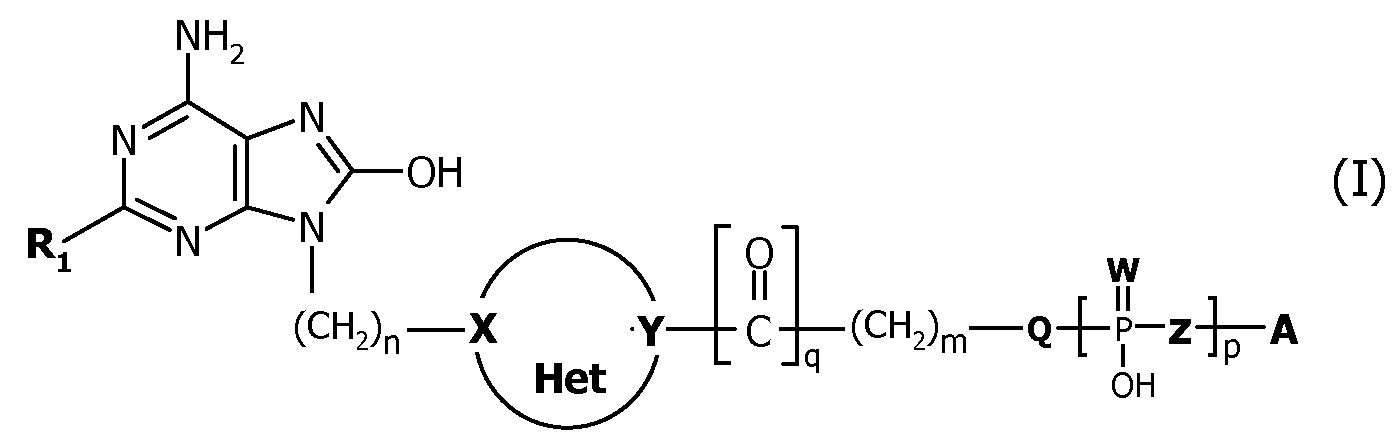
본 발명의 화합물은 인지질 또는 포스포노지질기와 공유적으로 연결된 질소 헤테로시클릴-치환된 옥소아데닌 분자를 포함하는 애쥬번트 분자이다. 본 발명의 화합물은 일반적으로 하기 화학식(Ⅰ)의 화합물 또는 이의 약학적으로 허용되는 염이다:Compounds of the present invention are adjuvant molecules comprising nitrogen heterocyclyl-substituted oxoadenin molecules covalently linked to phospholipids or phosphonolipids. Compounds of the present invention are generally a compound of formula (I) or a pharmaceutically acceptable salt thereof:
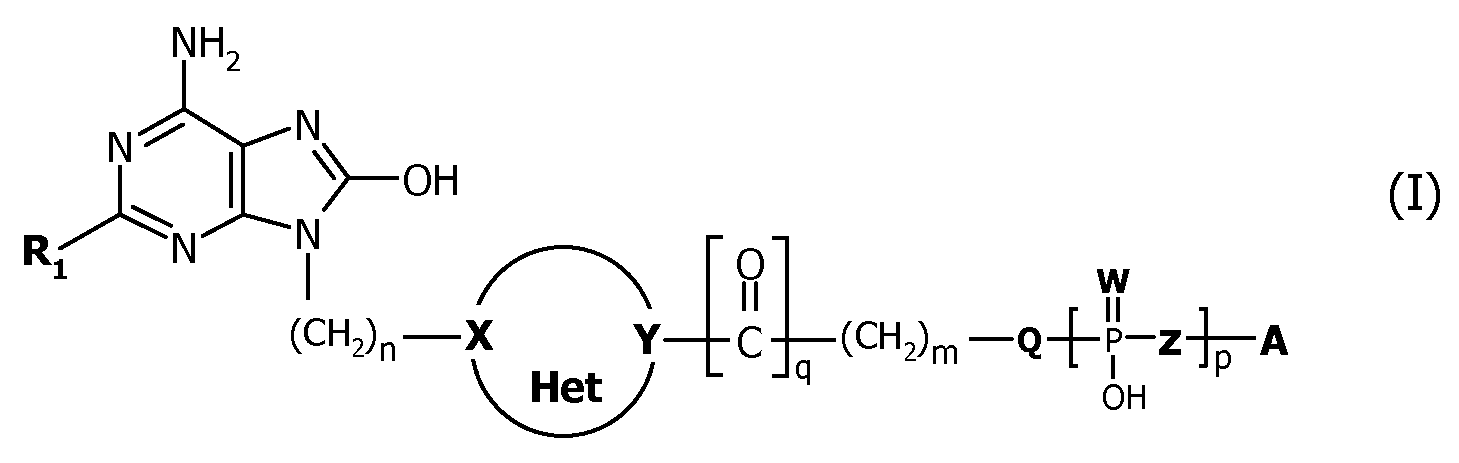
상기 식에서,Where
R 1 은 C1 - 6알킬, C1 - 6알킬아미노, C1 - 6알콕시, C3 - 6시클로알킬C1 - 6알킬, C3 - 6시클로알킬C1- 6알킬아미노, C3 - 6시클로알킬C1 - 6알콕시, C1 - 6알콕시C1 - 6알킬, C1 - 6알콕시C1 - 6알킬아미노, C1 - 6알콕시C1 - 6알콕시이고, 히드록실, 아미노, 티오, 히드라지노, 히드라지도, 아지도, 아세틸레닐, 카르복실 또는 말레이미도기로 말단 치환되거나 비치환되고; R 1 is C 1 - 6 alkyl, C 1 - 6 alkylamino, C 1 - 6 alkoxy, C 3 - 6 cycloalkyl, C 1 - 6 alkyl, C 3 - 6 cycloalkyl, C 1- 6 alkylamino, C 3 - 6 cycloalkyl C 1 - 6 alkoxy, C 1 - 6 alkoxy C 1 - 6 alkyl, C 1 - 6 alkoxy C 1 - 6 alkylamino, C 1 - 6 alkoxy C 1 - 6 alkoxy, hydroxyl, amino, thio Terminally substituted or unsubstituted with hydrazino, hydrazido, azido, acetylenyl, carboxyl or maleimido;
n은 0 내지 6이고; n is 0 to 6;
Het은 4원, 5원, 또는 6원의 포화 질소 헤테로사이클이고, Het is a 4, 5 or 6 membered saturated nitrogen heterocycle,
여기서,here,
X 및 Y는 CH 또는 N이고, X 및 Y 중 하나 이상은 질소 원자이고; X and Y are CH or N, and at least one of X and Y is a nitrogen atom;
Q는 O, NH 또는 공유 결합이고; Q is O, NH or a covalent bond;
Z는 O, CH2, CF2 또는 공유 결합이고; Z is O, CH 2 , CF 2 or a covalent bond;
W는 O 또는 S이고; W is O or S;
m은 0 내지 6이고; m is 0 to 6;
p는 1 또는 2이고; p is 1 or 2;
q는 0 또는 1이고; q is 0 or 1;
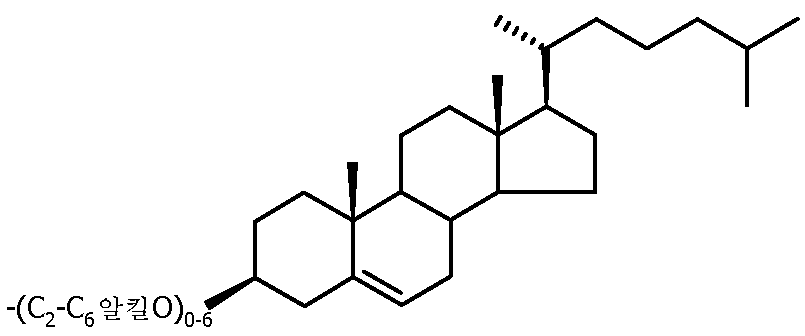
A는 

여기서,here,
R 2 는 H 또는 포화 또는 불포화 C4-C24 알킬 또는 아실이고; R 2 is H or saturated or unsaturated C 4 -C 24 alkyl or acyl;
R 3 는 포화 또는 불포화 C4-C24 알킬 또는 아실이다. R 3 is saturated or unsaturated C 4 -C 24 alkyl or acyl.
바람직한 일 구체예에서, 본 발명의 화합물은 일반적으로 하기 화학식(Ⅱ)의 화합물 또는 이의 약학적으로 허용되는 염이다:In one preferred embodiment, the compounds of the present invention are generally compounds of formula (II) or pharmaceutically acceptable salts thereof:

상기 식에서,Where
R 1 은 C1 - 6알킬, C1 - 6알킬아미노, C1 - 6알콕시, C3 - 6시클로알킬C1 - 6알킬, C3 - 6시클로알킬C1- 6알킬아미노, C3 - 6시클로알킬C1 - 6알콕시, C1 - 6알콕시C1 - 6알킬, C1 - 6알콕시C1 - 6알킬아미노, C1 - 6알콕시C1 - 6알콕시이고, 분지되거나 분지되지 않고; R 1 is C 1 - 6 alkyl, C 1 - 6 alkylamino, C 1 - 6 alkoxy, C 3 - 6 cycloalkyl, C 1 - 6 alkyl, C 3 - 6 cycloalkyl, C 1- 6 alkylamino, C 3 - 6 cycloalkyl C 1 - 6 alkoxy, C 1 - 6 alkoxy C 1 - 6 alkyl, C 1 - 6 alkoxy C 1 - 6 alkylamino, C 1 - 6 alkoxy C 1 - and 6-alkoxy, it is not branched or branched;
n은 0 내지 6이고; n is 0 to 6;
X는 CH 또는 N이고; X is CH or N;
Q는 O, NH 또는 공유 결합이고; Q is O, NH or a covalent bond;
Z는 O, CH2, CF2 또는 공유 결합이고; Z is O, CH 2 , CF 2 or a covalent bond;
W는 O 또는 S이고; W is O or S;
m은 0 내지 6이고; m is 0 to 6;
p는 1 또는 2이고; p is 1 or 2;
q는 0 또는 1이고; q is 0 or 1;
R 2 는 H 또는 포화 또는 불포화 C4-C24 알킬 또는 아실이고; R 2 is H or saturated or unsaturated C 4 -C 24 alkyl or acyl;
R 3 는 포화 또는 불포화 C4-C24 알킬 또는 아실이다. R 3 is saturated or unsaturated C 4 -C 24 alkyl or acyl.
본 발명의 화합물은 반응식 1의 한 구체예에 제시된 바와 같이, (1) 적합하게 보호된 질소 헤테로시클릴 알킬 브로마이드(IV)를 이용한 옥소아데닌 중간체(III)의 알킬화, (2) 산성 조건하에서의 화학식(V)의 화합물의 N-보호기 및 O-보호기의 동시 탈보호, 및 (3) 화학식(VII)의 화합물을 이용한 화학식(VI)의 화합물(m = 0, Q = 단일 결합)의 N-헤테로시클릭 치환기의 직접적인 포스파티딜화에 의한 본 발명의 화합물(VIII)(여기서, m = 0 및 Q = 단일 결합)의 생성, 또는 대안적으로 N-보호 또는 O-보호된 아미노-알킬 또는 히드록시-알킬 브로마이드를 이용한 화학식(VI)의 화합물의 N-알킬화 후, 탈보호 및 화학식(VII)의 화합물을 이용한 O-포스파티딜화 또는 N-포스파딜화에 의한 본 발명의 화합물(VIII)(여기서, m = 2-6 및 Q = O 또는 NH)의 생성에 의해, 공지된 옥소아데닌 중간체(III)로부터 제조된다.Compounds of the present invention, as shown in one embodiment of
반응식 1

추가 일 양태에서, 본 발명은 하기 화학식(IX)의 구조에 따른 화합물 또는 이의 약학적으로 허용되는 염을 포함한다:In a further aspect, the invention comprises a compound according to the structure of formula (IX) or a pharmaceutically acceptable salt thereof:
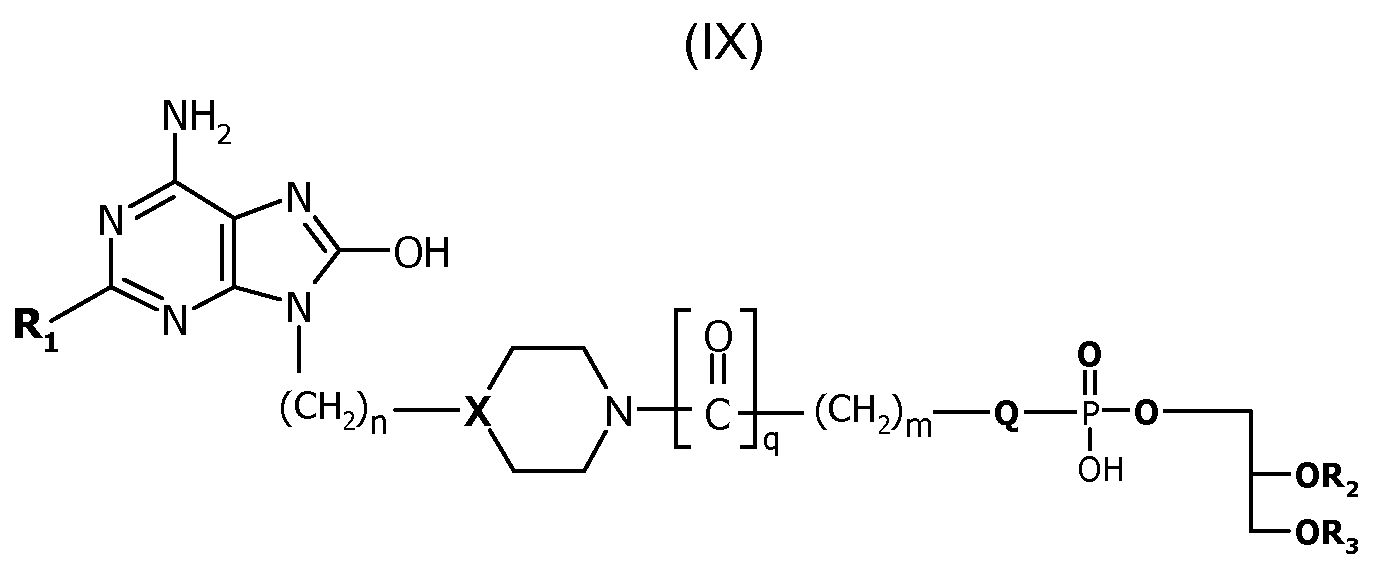
상기 식에서,Where
R 1 은 C1 - 6알킬, C1 - 6알킬아미노, C1 - 6알콕시, C1 - 6알콕시C1 - 6알킬아미노, C1 - 6알콕시C1- 6알콕시로 구성된 군으로부터 선택되고; R 1 is C 1 - 6 alkyl, C 1 - 6 alkylamino, C 1 - 6 alkoxy, C 1 - 6 alkoxy C 1 - 6 alkylamino, C 1 - 6 alkoxy C 1- 6 alkoxy is selected from the group consisting of ;
n은 0 내지 2이고; n is 0 to 2;
X는 CH 또는 N이고; X is CH or N;
Q는 O, NH 또는 공유 결합이고; Q is O, NH or a covalent bond;
m은 0 내지 2이고; m is 0 to 2;
q는 0이고; q is 0;
R 2 는 H 또는 포화 또는 불포화 C4-C24 알킬 또는 아실이고; R 2 is H or saturated or unsaturated C 4 -C 24 alkyl or acyl;
R 3 는 포화 또는 불포화 C4-C24 알킬 또는 아실이다. R 3 is saturated or unsaturated C 4 -C 24 alkyl or acyl.
또 다른 양태에서, 본 발명은 화학식(IX)의 구조에 따른 화합물 또는 이의 약학적으로 허용되는 염을 포함하며, 상기 식에서,In another embodiment, the invention comprises a compound according to the structure of formula (IX) or a pharmaceutically acceptable salt thereof, wherein
R 1 은 C1 - 6알콕시이고; R 1 is C 1 - 6 alkoxy;
n은 0 내지 2이고; n is 0 to 2;
X는 CH 또는 N이고; X is CH or N;
Q는 O 또는 NH이고; Q is O or NH;
m은 0 내지 2이고; m is 0 to 2;
q는 0이고; q is 0;
R 2 는 H 또는 포화 또는 불포화 C4-C24 알킬 또는 아실이고; R 2 is H or saturated or unsaturated C 4 -C 24 alkyl or acyl;
R 3 는 포화 또는 불포화 C4-C24 알킬 또는 아실이다. R 3 is saturated or unsaturated C 4 -C 24 alkyl or acyl.
실시예Example 1 (화합물 A1) 1 (Compound A1)
6-아미노-2-부톡시-9-[N-(2-(1,2-디팔미토일-sn-글리세로-3-포스포)에틸)-4-피페리디닐메틸]-8-히드록시퓨린(화합물(II), R1=n-부톡시, n=1, X=CH, Q=O, Z=O, W=O, m=2, p=1, R1=R2=n-C15H31CO)의 제조6-amino-2-butoxy-9- [N- (2- (1,2-dipalmitoyl-sn-glycero-3-phospho) ethyl) -4-piperidinylmethyl] -8-hydrate Roxypurine (Compound (II), R 1 = n-butoxy, n = 1, X = CH, Q = O, Z = O, W = O, m = 2, p = 1, R 1 = R 2 = Preparation of nC 15 H 31 CO)
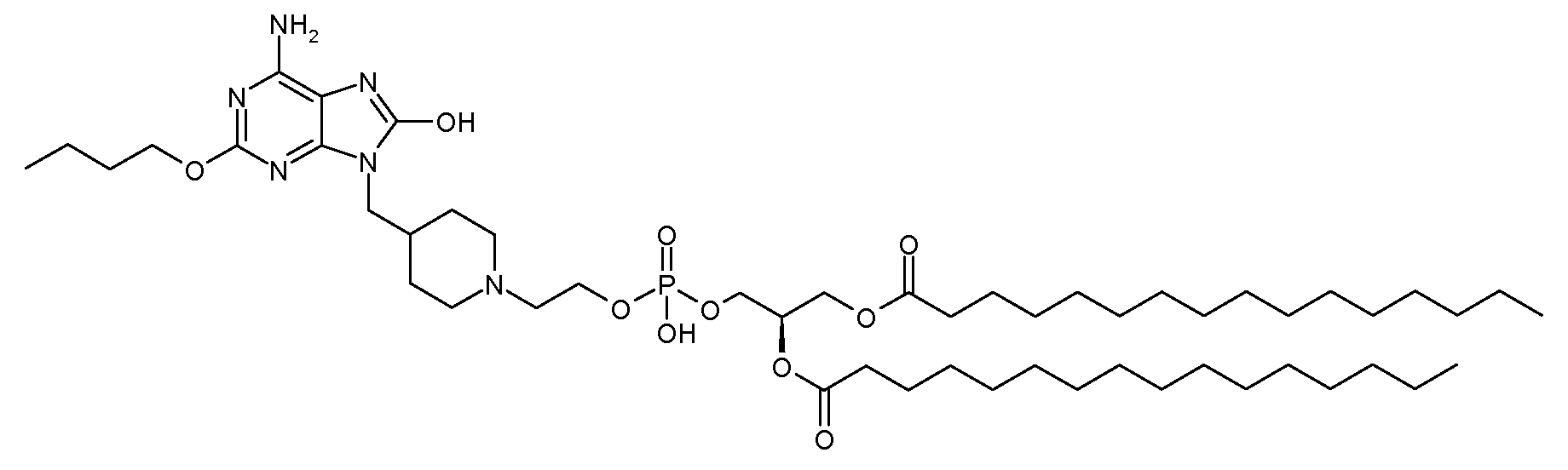
(1) 탄산칼륨(0.65 g)을 건조 N,N-디메틸포름아미드(DMF, 5.5 mL) 중의 6-아미노-2-부톡시-8-메톡시퓨린(0.55 g)의 용액에 첨가하고, 생성된 반응 혼합물을 1시간 동안 60℃에서 가열하였다. 추가 DMF(1.5 mL)를 이용하여 1,1-디메틸에틸 4-(브로모메틸)-1-피페리딘카르복실레이트(0.5 g)를 첨가하여 잔여 브로마이드를 옮기고, 반응 혼합물을 3시간 동안 50℃에서 교반하였다. 실온에서 16시간 후, 가열을 또 다른 5시간 동안 50℃에서 지속시켜 반응을 완료시켰다. 이후, 물을 첨가하고, 생성된 혼합물을 에틸 아세테이트(EtOAc)로 3회 추출하였다. 결합된 유기 추출물을 물로 세척하고, 건조시키고(Na2SO4), 농축시켰다. MeOH-CHCl3(구배 용리; 1:99→2.5:97.5)를 이용한 실리카 겔상에서의 플래시 크로마토그래피로 0.64 g (94%)의 1,1-디메틸에틸 4-[6-아미노-2-부톡시-8-메톡시-퓨린-9-일]메틸-1-피페리딘카르복실레이트를 황색 고체로 생성시켰다. 1H NMR (CDCl3): δ 5.14 (s, 2H), 4.27(t, 2H), 4.11 (s, 3H), 3.81 (d, 2H), 2.65 (m, 2H), 2.03 (m, 1H), 1.77 (p, 3H), 1.57-1.45 (m, 14H), 1.26-1.17 (m, 2H), 0.97 (t, 3H).(1) Potassium carbonate (0.65 g) is added to a solution of 6-amino-2-butoxy-8-methoxypurine (0.55 g) in dry N, N-dimethylformamide (DMF, 5.5 mL), resulting in The reaction mixture was heated at 60 ° C. for 1 h. Transfer residual bromide by adding 1,1-dimethylethyl 4- (bromomethyl) -1-piperidinecarboxylate (0.5 g) with additional DMF (1.5 mL), and add the reaction mixture for 50 hours. Stir at ° C. After 16 hours at room temperature, heating was continued at 50 ° C. for another 5 hours to complete the reaction. Then water was added and the resulting mixture was extracted three times with ethyl acetate (EtOAc). The combined organic extracts were washed with water, dried (Na 2 SO 4 ) and concentrated. Flash chromatography on silica gel with MeOH-CHCl 3 (gradient elution; 1: 99 → 2.5: 97.5) 0.64 g (94%) of 1,1-dimethylethyl 4- [6-amino-2-butoxy -8-methoxy-purin-9-yl] methyl-1-piperidinecarboxylate was produced as a yellow solid. 1 H NMR (CDCl 3 ): δ 5.14 (s, 2H), 4.27 (t, 2H), 4.11 (s, 3H), 3.81 (d, 2H), 2.65 (m, 2H), 2.03 (m, 1H) , 1.77 (p, 3H), 1.57-1.45 (m, 14H), 1.26-1.17 (m, 2H), 0.97 (t, 3H).
(2) MeOH(16 mL) 중의 상기 (1)에서 제조된 화합물(0.63 g)의 용액에 디옥산(5.3 mL) 중의 4.0 M HCl을 첨가하였다. 실온에서 4.5시간 동안 교반한 후, 반응 혼합물을 농축시키고, 고진공하에서 건조시켰다. CHCl3-MeOH-H2O(구배 용리; 90:10:1→75:25:1)를 이용한 실리카 겔상에서의 플래시 크로마토그래피로 0.404 g(85%)의 6-아미노-2-부톡시-9-(4-피페리디닐메틸)-8-히드록시퓨린 히드로클로라이드를 백색 고체로 생성시켰다. 1H NMR (CDCl3): δ 4.84 (s, 5H), 4.27(t, 2H), 3.79 (d, 2H), 3.40 (d, 2H), 2.96 (t, 2H), 2.21 (m, 1H), 1.92 (d, 2H), 1.75 (m, 2H), 1.60-1.47 (m, 4H), 1.00 (t, 3H).(2) To a solution of compound (0.63 g) prepared in (1) above in MeOH (16 mL) was added 4.0 M HCl in dioxane (5.3 mL). After stirring for 4.5 hours at room temperature, the reaction mixture was concentrated and dried under high vacuum. 0.404 g (85%) of 6-amino-2-butoxy- by flash chromatography on silica gel using CHCl 3 -MeOH-H 2 O (gradient elution; 90: 10: 1 → 75: 25: 1) 9- (4-piperidinylmethyl) -8-hydroxypurine hydrochloride was produced as a white solid. 1 H NMR (CDCl 3 ): δ 4.84 (s, 5H), 4.27 (t, 2H), 3.79 (d, 2H), 3.40 (d, 2H), 2.96 (t, 2H), 2.21 (m, 1H) , 1.92 (d, 2H), 1.75 (m, 2H), 1.60-1.47 (m, 4H), 1.00 (t, 3H).
(3) DMF(12.6 mL; 0.25 M) 중의 상기 (2)에서 제조된 화합물(1.24 g)의 용액에 K2CO3(1.74 g)를 첨가하였다. 생성된 혼합물을 1시간 동안 60℃로 가열하고, 2-브로모에톡시-터트-부틸디메틸실란(0.81 mL)으로 처리한 후, 18시간 동안 50℃에서 가열하였다. 냉각된 반응 혼합물을 물로 켄칭시키고, 분별깔때기(separatory funnel)로 옮기고, EtOAc로 3회 추출하였다. 결합된 유기 층을 건조시키고(Na2SO4), 농축시켰다. 실리카 겔상에서의 플래시 크로마토그래피로 1.25 g(83%)의 6-아미노-2-부톡시-9-[N-(2-O-터트-부틸디메틸실릴)에틸)-4-피페리디닐메틸-]-8-히드록시퓨린을 회백색 고체로 생성시켰다. NMR (CDCl3-CD3OD, 400 MHz): δ 4.26 (m, 4H), 3.75 (m, 4H), 3.36 (m, 2H), 2.96 (m, 2H), 2.54 (t, 2H), 1.92 (bs, 1H), 1.73 (m, 2H), 1.66 (m, 2H), 1.40-1.51 (m, 5H), 0.98 (t, 3H), 0.89 (m, 9H), 0.06 (s, 6H).(3) K 2 CO 3 (1.74 g) was added to a solution of compound (1.24 g) prepared in (2) above in DMF (12.6 mL; 0.25 M). The resulting mixture was heated to 60 ° C. for 1 hour, treated with 2-bromoethoxy-tert-butyldimethylsilane (0.81 mL) and then heated at 50 ° C. for 18 hours. The cooled reaction mixture was quenched with water, transferred to a separatory funnel and extracted three times with EtOAc. The combined organic layer was dried (Na 2 SO 4 ) and concentrated. Flash chromatography on silica gel 1.25 g (83%) of 6-amino-2-butoxy-9- [N- (2-O-tert-butyldimethylsilyl) ethyl) -4-piperidinylmethyl- ] -8-hydroxypurine was produced as an off-white solid. NMR (CDCl 3 -CD 3 OD, 400 MHz): δ 4.26 (m, 4H), 3.75 (m, 4H), 3.36 (m, 2H), 2.96 (m, 2H), 2.54 (t, 2H), 1.92 (bs, 1H), 1.73 (m, 2H), 1.66 (m, 2H), 1.40-1.51 (m, 5H), 0.98 (t, 3H), 0.89 (m, 9H), 0.06 (s, 6H).
(4) MeOH(41 mL) 중의 상기 (3)에서 제조된 화합물(2.74 g)의 용액에 디옥산(5.7 mL) 중의 4.0 M HCl을 첨가하였다. 실온에서 0.5시간 교반한 후, 반응 혼합물을 농축시키고, 고진공하에서 건조시켰다. CHCl3-MeOH-H2O(구배 용리; 90:10:1→75:25:1)를 이용한 실리카 겔상에서의 플래시 크로마토그래피로 2.29 g(100%)의 6-아미노-2-부톡시-9-(N-(2-히드록시에틸)-4-피페리디닐메틸)-8-히드록시퓨린 히드로클로라이드를 백색 고체로 생성시켰다. 1H NMR (CD3OD, 400 MHz): δ 4.53 (t, 2H), 3.87 (m, 4H), 3.66 (d, 2H), 3.22 (m, 2H), 3.01 (t, 2H), 2.21 (m, 1H), 1.98 (d, 2H), 1.81 (m, 2H), 1.68 (m, 2H), 1.52 (m, 2H), 1.01 (t, 3H).(4) To a solution of compound (2.74 g) prepared in (3) above in MeOH (41 mL) was added 4.0 M HCl in dioxane (5.7 mL). After 0.5 h of stirring at room temperature, the reaction mixture was concentrated and dried under high vacuum. 2.29 g (100%) of 6-amino-2-butoxy- by flash chromatography on silica gel using CHCl 3 -MeOH-H 2 O (gradient elution; 90: 10: 1 → 75: 25: 1) 9- (N- (2-hydroxyethyl) -4-piperidinylmethyl) -8-hydroxypurine hydrochloride was produced as a white solid. 1 H NMR (CD 3 OD, 400 MHz): δ 4.53 (t, 2H), 3.87 (m, 4H), 3.66 (d, 2H), 3.22 (m, 2H), 3.01 (t, 2H), 2.21 ( m, 1H), 1.98 (d, 2H), 1.81 (m, 2H), 1.68 (m, 2H), 1.52 (m, 2H), 1.01 (t, 3H).
(5) 피리딘(6.4 mL) 중의 상기 (4)에서 제조된 화합물(51 mg) 및 1,2-디팔미토일-sn-글리세릴 하이드로겐포스포네이트(93 mg; 화합물 V1, R1=R2=팔미토일)의 용액에 피발로일 클로라이드(0.047 mL)를 처리하고, 생성된 반응 혼합물을 6시간 동안 실온에서 교반하였다. 이후, 피리딘-물(19:1, v/v) 중의 요오드(129 mg)의 용액을 첨가하고, 반응 혼합물을 1시간 동안 실온에서 교반하고, CHCl3로 희석시킨 후, 1 M Na2S2O5로 켄칭시켰다. 수성층을 CHCl3로 2회 추출하고, 결합된 유기층을 1 M 트리에틸암모늄 보레이트(pH 8)로 세척하였다. 유기층을 건조시키고(Na2SO4), 농축시켰다. CHCl3-MeOH-Et3N(구배 용리; 90:10:1→75:25:1)을 이용한 실리카 겔상에서의 플래시 크로마토그래피로 38 mg(30%)의 6-아미노-2-부톡시-9-[N-(2-(1,2-디팔미토일-sn-글리세로-3-포스포)에틸-4-피페리디닐메틸]-8-히드록시퓨린을 회백색 고체로 생성시켰다. 1H NMR (CDCl3-CD3OD, 400 MHz): δ 5.17 (bs, 1H), 4.32 (dd, 1H), 4.20-4.09 (m, 5H), 3.98 (br t, 2H), 3.69 (br d, 3H), 3.23 (br s, 1H), 1.86 (br s, 4H), 1.69 (m, 2H), 1.53 (br s, 4H), 1.42 (dd, 2H), 1.20 (m, 48H), 0.91 (t, 3H), 0.83 (t, 6H); [M-H]-C52H94N6O10P에 대해 계산된 HRMS:993.6768, 실측치:993.6782.(5) Compound (51 mg) and 1,2-dipalmitoyl-sn-glyceryl hydrogenphosphonate (93 mg; Compound V1, R 1 = R prepared in (4) above in pyridine (6.4 mL) 2 = palmitoyl) was treated with pivaloyl chloride (0.047 mL) and the resulting reaction mixture was stirred for 6 hours at room temperature. Then, a solution of iodine (129 mg) in pyridine-water (19: 1, v / v) is added and the reaction mixture is stirred at rt for 1 h, diluted with CHCl 3 and then 1 M Na 2 S 2 Quenched with O 5 . The aqueous layer was extracted twice with CHCl 3 and the combined organic layers were washed with 1 M triethylammonium borate (pH 8). The organic layer was dried (Na 2 SO 4 ) and concentrated. Flash chromatography on silica gel using CHCl 3 -MeOH-Et 3 N (gradient elution; 90: 10: 1 → 75: 25: 1) to 38 mg (30%) of 6-amino-2-butoxy- 9- [N- (2- (1,2- di-palmitoyl -sn- glycero-3-phospho) ethyl-4-methyl-piperidinyl] were generated to 8-hydroxy-purine as an off-white solid: 1 H NMR (CDCl 3 -CD 3 OD, 400 MHz): δ 5.17 (bs, 1H), 4.32 (dd, 1H), 4.20-4.09 (m, 5H), 3.98 (br t, 2H), 3.69 (br d , 3H), 3.23 (br s, 1H), 1.86 (br s, 4H), 1.69 (m, 2H), 1.53 (br s, 4H), 1.42 (dd, 2H), 1.20 (m, 48H), 0.91 (t, 3H), 0.83 ( t, 6H); [MH] - C 52 H 94 N a HRMS calculated for 6 O 10 P: 993.6768, found: 993.6782.
실시예Example 2 (화합물 A2) 2 (Compound A2)
6-아미노-2-부톡시-9-[N-(2-(1,2-디팔미토일-sn-글리세로-3-포스포르아미도)에틸)-4-피페리디닐메틸]-8-히드록시퓨린(화합물(II), R1=n-부톡시, n=1, X=CH, Q=NH, Z=O, W=O, m=2, p=1, R1=R2= n-C15H31CO)의 제조6-amino-2-butoxy-9- [N- (2- (1,2-dipalmitoyl-sn-glycero-3-phosphoramido) ethyl) -4-piperidinylmethyl] -8 Hydroxypurine (Compound (II), R 1 = n-butoxy, n = 1, X = CH, Q = NH, Z = O, W = O, m = 2, p = 1, R 1 = R 2 = preparation of nC 15 H 31 CO)
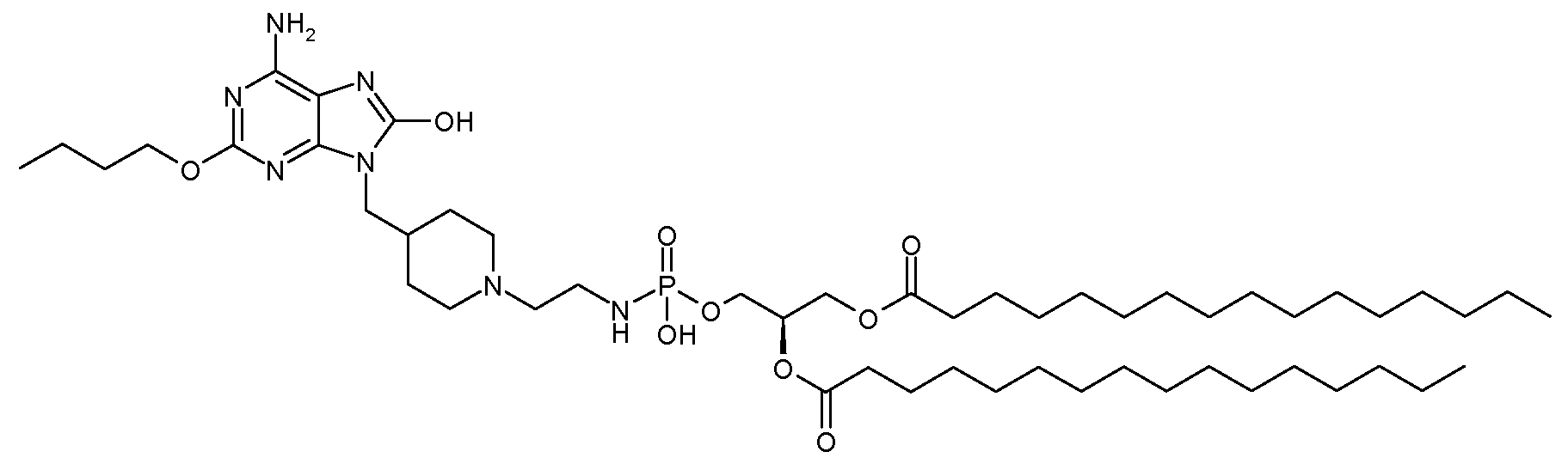
(1) 실시예 1-(3)에 기재된 것과 동일한 방식으로, 실시예 1-(2)에서 제조된 화합물(107 mg)을 K2CO3의 존재하에서 2-(터트-부톡시카르보닐아미노)에틸 브로마이드(67 mg)를 갖는 DMF(1.1 mL) 중에서 알킬화시켜, 84 mg(67%)의 1,1-디메틸에틸 4-[6-아미노-2-부톡시-8-메톡시-퓨린-9-일]메틸-1-피페리디닐에틸아미닐카르복실레이트를 회백색 고체로 생성시켰다. 1H NMR (CDCl3-CD3OD, 400 MHz): δ 4.25 (t, 2H), 3.73 (d, 2H), 3.38 (m, 2H), 3.20 (m, 2H), 2.89 (m, 2H), 2.44 (m, 2H), 1.97 (t, 3H), 1.75 (m, 2H), 1.66 (m, 2H), 1.42-1.51 (m, 11H), 0.97 (t, 3H).(1) In the same manner as described in Example 1- (3), the compound (107 mg) prepared in Example 1- (2) was added with 2- (tert-butoxycarbonylamino in the presence of K 2 CO 3 . Alkylated in DMF (1.1 mL) with ethyl bromide (67 mg) to 84 mg (67%) of 1,1-dimethylethyl 4- [6-amino-2-butoxy-8-methoxy-purine- 9-yl] methyl-1-piperidinylethylaminylcarboxylate was produced as an off-white solid. 1 H NMR (CDCl 3 -CD 3 OD, 400 MHz): δ 4.25 (t, 2H), 3.73 (d, 2H), 3.38 (m, 2H), 3.20 (m, 2H), 2.89 (m, 2H) , 2.44 (m, 2H), 1.97 (t, 3H), 1.75 (m, 2H), 1.66 (m, 2H), 1.42-1.51 (m, 11H), 0.97 (t, 3H).
(2) 실시예 1-(4)에 기재된 것과 동일한 방식으로, 상기 (1)에서 제조된 화합물(83 mg)을 디옥산 중의 4 N HCl로 N-탈보호시켜, 58 mg(74%)의 6-아미노-2-부톡시-9-[N-(2-아미노에틸)4-피페리디닐메틸]-8-히드록시퓨린 디히드로클로라이드를 회백색 고체로 생성시켰다. 1H NMR (DMSO-d6, 400 MHz): δ 4.15 (t, 2H), 3.58 (d, 2H), 2.88 (t, 2H), 2.81 (d, 2H), 2.46 (t, 2H), 1.91 (t, 2H), 1.79 (m, 1H), 1.64 (m, 2H), 1.52 (m, 2H), 1.39 (dd, 2H), 1.28 (m, 2H), 0.91 (t, 3H).(2) In the same manner as described in Examples 1- (4), the compound (83 mg) prepared in (1) was N-deprotected with 4 N HCl in dioxane to give 58 mg (74%) of 6-amino-2-butoxy-9- [N- (2-aminoethyl) 4-piperidinylmethyl] -8-hydroxypurine dihydrochloride was produced as an off-white solid. 1 H NMR (DMSO-d 6 , 400 MHz): δ 4.15 (t, 2H), 3.58 (d, 2H), 2.88 (t, 2H), 2.81 (d, 2H), 2.46 (t, 2H), 1.91 (t, 2H), 1.79 (m, 1H), 1.64 (m, 2H), 1.52 (m, 2H), 1.39 (dd, 2H), 1.28 (m, 2H), 0.91 (t, 3H).
(3) 피리딘(11.3 mL) 중의 1,2-디팔미토일-sn-글리세릴 하이드로겐포스포네이트(167 mg; 화합물 V1, R1=R2=팔미토일)의 용액에 클로로트리메틸실란(0.087 mL) 및 트리에틸아민(0.126 mL)을 처리하고, 생성된 반응 혼합물을 0.5시간 동안 실온에서 교반하였다. 피리딘(2.3 mL) 중의 상기 (2)에서 제조된 화합물(37 mg) 및 트리에틸아민(0.126 mL)의 현탁액을 반응 혼합물에 첨가한 후, 요오드(75 mg)를 첨가하였다. 반응 혼합물을 2시간 동안 실온에서 교반하고, 농축시키고, 톨루엔으로 2회 공동 증발시켰다. CHCl3-MeOH-Et3N(구배 용리; 90:10:1→75:25:1)을 이용한 실리카 겔상에서의 플래시 크로마토그래피로 39 mg(18%)의 6-아미노-2-부톡시-9-[N-(2-(1,2-디팔미토일-sn-글리세로-3-포스포르아미도)에틸-4-피페리디닐메틸]-8-히드록시퓨린을 오렌지색의 유리질 고체로 생성시켰다. Rf(CHCl3-CH3OH-H2O-NH4OH)=0.68.(3) Chlorotrimethylsilane (0.087) in a solution of 1,2-dipalmitoyl-sn-glyceryl hydrogenphosphonate (167 mg; Compound V1, R 1 = R 2 = palmitoyl) in pyridine (11.3 mL) mL) and triethylamine (0.126 mL) and the resulting reaction mixture was stirred for 0.5 h at room temperature. A suspension of compound (37 mg) and triethylamine (0.126 mL) prepared in (2) above in pyridine (2.3 mL) was added to the reaction mixture followed by iodine (75 mg). The reaction mixture was stirred for 2 hours at room temperature, concentrated and co-evaporated twice with toluene. Flash chromatography on silica gel using CHCl 3 -MeOH-Et 3 N (gradient elution; 90: 10: 1 → 75: 25: 1) to 39 mg (18%) of 6-amino-2-butoxy- 9- [N- (2- (1,2-dipalmitoyl-sn-glycero-3-phosphoramido) ethyl-4-piperidinylmethyl] -8-hydroxypurine as an orange glassy solid Rf (CHCl 3 —CH 3 OH—H 2 O—NH 4 OH) = 0.68.
실시예Example 3 (화합물 A3) 3 (Compound A3)
6-아미노-2-부톡시-9-[1-(1,2-디팔미토일-sn-글리세로-3-포스포르아미도)-4-피페라지닐에틸]-8-히드록시퓨린(화합물(II), R1=n-부톡시, n=2, X=N, Q=단일 결합, Z=O, W=O, m=0, p=1, R1=R2= n-C15H31CO)의 제조6-amino-2-butoxy-9- [1- (1,2-dipalmitoyl-sn-glycero-3-phosphoramido) -4-piperazinylethyl] -8-hydroxypurine ( Compound (II), R 1 = n-butoxy, n = 2, X = N, Q = single bond, Z = O, W = O, m = 0, p = 1, R 1 = R 2 = nC 15 H 31 CO) Preparation
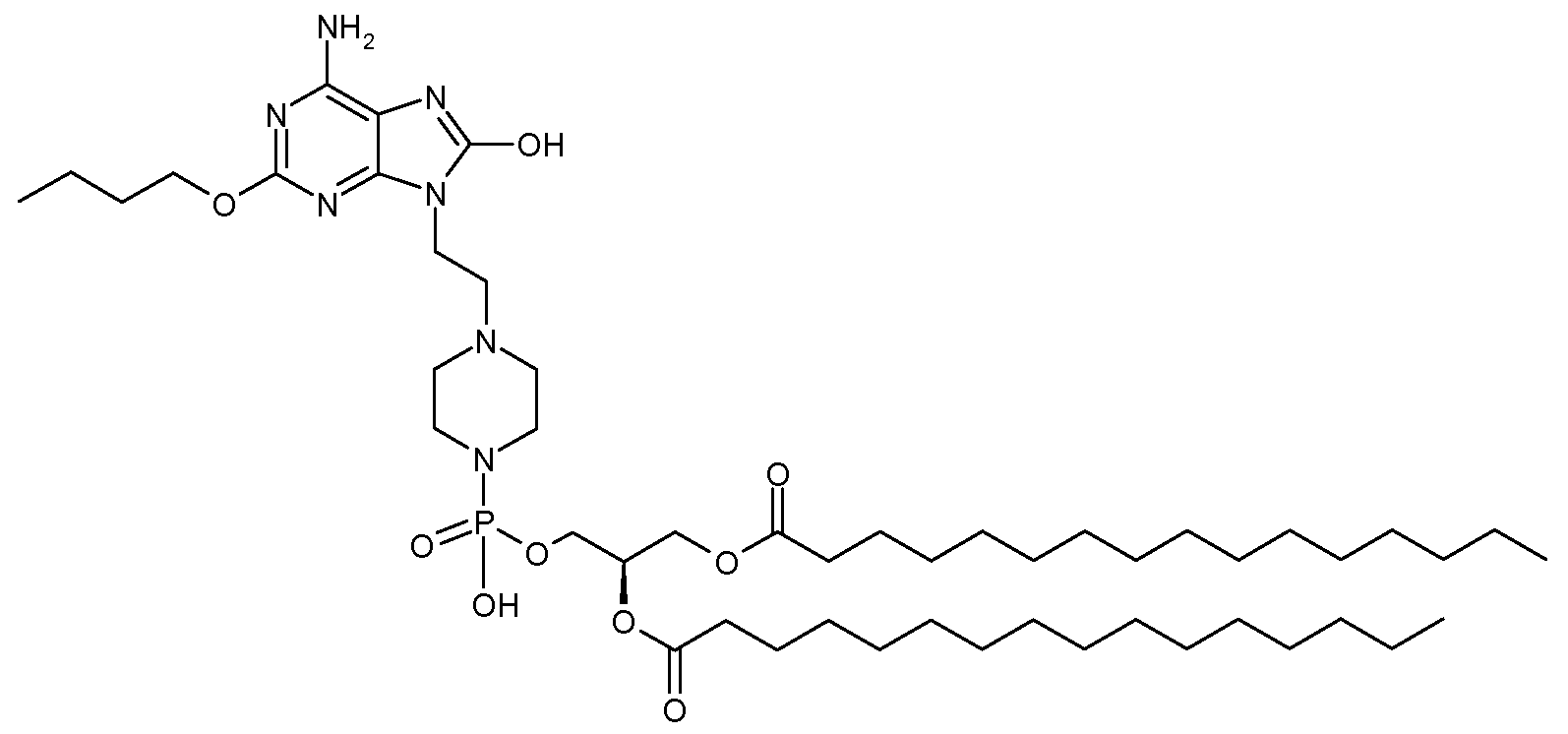
(1) 실시예 1-(1)에 기재된 것과 동일한 방식으로, 6-아미노-2-부톡시-8-메톡시퓨린(131 mg)을 K2CO3의 존재하에서 1,1-디메틸에틸 4-(브로모에틸)-1-피페라진카르복실레이트(120 mg)를 갖는 DMF 중에서 알킬화시켜, 124 mg(74%)의 1,1-디메틸에틸 4-[6-아미노-2-부톡시-8-메톡시-퓨린-9-일]에틸-1-피페라진카르복실레이트를 담황색 고체로 생성시켰다. 1H NMR (CDCl3-CD3OD, 400 MHz): δ 5.66 (d, 2H), 4.25 (t, 2H), 4.05 (t, 2H), 4.10 (s, 3H), 3.35 (bs, 4H), 2.71 (t, 2H), 2.46 (bs, 4H), 1.76 (m, 2H), 1.48 (m, 2H), 1.45 (s, 9H), 0.96 (t, 3H).(1) In the same manner as described in Example 1- (1), 6-amino-2-butoxy-8-methoxypurine (131 mg) was added with 1,1-dimethylethyl 4 in the presence of K 2 CO 3 . 124 mg (74%) of 1,1-dimethylethyl 4- [6-amino-2-butoxy- by alkylation in DMF with (bromoethyl) -1-piperazinecarboxylate (120 mg) 8-methoxy-purin-9-yl] ethyl-1-piperazinecarboxylate was produced as a pale yellow solid. 1 H NMR (CDCl 3 -CD 3 OD, 400 MHz): δ 5.66 (d, 2H), 4.25 (t, 2H), 4.05 (t, 2H), 4.10 (s, 3H), 3.35 (bs, 4H) , 2.71 (t, 2H), 2.46 (bs, 4H), 1.76 (m, 2H), 1.48 (m, 2H), 1.45 (s, 9H), 0.96 (t, 3H).
(2) 실시예 1-(2)에 기재된 것과 동일한 방식으로, 상기 (1)에서 제조된 화합물(124 mg)을 디옥산 중의 4.0 M HCl로 N-탈보호시켜, 87 mg(77%)의 6-아미노-2-부톡시-9-(4-피페라지닐에틸)-8-히드록시퓨린 히드로클로라이드를 회백색 고체로 생성시켰다. 1H NMR (CD3OD, 400 MHz) δ 4.26 (t, 2H), 3.96 (m, 2H), 3.11 (m, 5H), 2.78 (m, 7H), 1.73 (m, 2H), 1.48 (m, 2H), 1.38 (m, 1H), 0.98 (t, 3H); 13C NMR 161.8, 155.6, 150.8, 149.7, 100.1, 68.8, 55.9, 50.8, 44.2, 37.7, 31.9, 20.1, 14.1; [M+H]+ C15H25N7O2에 대해 계산된 HRMS:336.2136, 실측치:336.2148. (2) In the same manner as described in Examples 1- (2), the compound (124 mg) prepared in (1) was N-deprotected with 4.0 M HCl in dioxane to give 87 mg (77%) of 6-Amino-2-butoxy-9- (4-piperazinylethyl) -8-hydroxypurine hydrochloride was produced as an off-white solid. 1 H NMR (CD 3 OD, 400 MHz) δ 4.26 (t, 2H), 3.96 (m, 2H), 3.11 (m, 5H), 2.78 (m, 7H), 1.73 (m, 2H), 1.48 (m , 2H), 1.38 (m, 1 H), 0.98 (t, 3 H); 13 C NMR 161.8, 155.6, 150.8, 149.7, 100.1, 68.8, 55.9, 50.8, 44.2, 37.7, 31.9, 20.1, 14.1; HRMS: 336.2136, found for [M + H] + C 15 H 25 N 7 0 2 , 336.2148.
(3) 실시예 2-(3)에 기재된 것과 동일한 방식으로, 상기 (2)에서 제조된 화합물(288 mg)을 1,2-디팔미토일-sn-글리세릴 하이드로겐포스포네이트(518 mg)로 포스파티딜화시켜, 313 mg(46%)의 6-아미노-2-부톡시-9-[1-(1,2-디팔미토일-sn-글리세로-3-포스포르아미도)-4-피페라지닐에틸]-8-히드록시퓨린을 황갈색 고체로 생성시켰다. 1H NMR (CDCl3-CD3OD, 400 MHz): δ 5.11 (br s, 1H), 4.28 (d, 1H), 4.12-4.01 (m, 5H), 3.76 (br s, 2H), 3.60-2.60 (m, 11H), 2.21 (m, 4H), 1.65 (m, 2H), 1.49 (m, 4H), 1.39 (q, 2H), 1.17 (m, 48H), 0.88 (t, 3H), 0.81 (t, 6H); [M-H]- C50H92N7O9P에 대해 계산된 HRMS:964.6616, 실측치:964.6600.(3) In the same manner as described in Example 2- (3), the compound (288 mg) prepared in the above (2) was prepared with 1,2-dipalmitoyl-sn-glyceryl hydrogenphosphonate (518 mg). Phosphatidylated) to 313 mg (46%) of 6-amino-2-butoxy-9- [1- (1,2-dipalmitoyl-sn-glycero-3-phosphoramido) -4 -Piperazinylethyl] -8-hydroxypurine was produced as a tan solid. 1 H NMR (CDCl 3 -CD 3 OD, 400 MHz): δ 5.11 (br s, 1H), 4.28 (d, 1H), 4.12-4.01 (m, 5H), 3.76 (br s, 2H), 3.60- 2.60 (m, 11H), 2.21 (m, 4H), 1.65 (m, 2H), 1.49 (m, 4H), 1.39 (q, 2H), 1.17 (m, 48H), 0.88 (t, 3H), 0.81 (t, 6H); [M − H] − HRMS calculated for C 50 H 92 N 7 O 9 P: 964.6616. Found: 964.6600.
본 발명자들은 마우스에서 면역 반응의 다양한 양태를 촉진시키는 TLR7 리간드의 능력을 평가하였다. 지질화된 TLR7 화합물이 선천성 케모카인 및 전염증성 사이토카인을 유도할 수 있는지의 여부를 결론내리기 위해 선천성 면역을 특별히 연구하였다. 이러한 선천성 면역 반응은 병원체에 대한 최초의 비특이적인 보호를 신체에 제공한다. 이러한 선천성 케모카인 및 사이토카인 중, 타입 Ⅰ IFN이 생존, 분화 및 기억 발달과 관련하여 나이브 CD8 T-세포의 프로그래밍에 필요한 것으로 생각된다. 마우스 연구는 또한 염증의 크기 및 기간이 CD8+ T-세포가 기억 특성을 획득하는 속도를 조절하는 것을 암시하였다.We evaluated the ability of TLR7 ligands to promote various aspects of the immune response in mice. Innate immunity was specifically studied to conclude whether lipidated TLR7 compounds can induce innate chemokines and proinflammatory cytokines. This innate immune response provides the body with the first nonspecific protection against pathogens. Of these innate chemokines and cytokines, type I IFN is thought to be necessary for the programming of naïve CD8 T-cells with respect to survival, differentiation and memory development. Mouse studies also suggested that the size and duration of inflammation regulate the rate at which CD8 + T-cells acquire memory properties.
실시예Example 4: 4: TLR7TLR7 -- DPPCDPPC 리포솜 제조 Liposome manufacturing
10.4 ml의 10 mg/ml로 클로로포름에 용해된 지질화된-TLR7-L A1을 둥근 바닥 유리 바이얼로 옮겼다. 이러한 바이얼에 18.4 ml의 100 mg/ml로 클로로포름에 용해된 DPPC를 첨가하였다. 21.9 ml의 5 mg/ml로 클로로포름에 용해된 지질화된-TLR7-L 화합물 A3를 둥근 바닥 유리 바이얼로 옮겼다. 이러한 바이얼에 20 ml의 100 mg/ml로 클로로포름에 용해된 DPPC를 첨가하였다. 클로로포름을 느린 압력 감소하에서 뷔치 회전농축기(Buechi Rotavapor)에서 증발시켰다. 수득된 필름을 진공하에서 데시케이터(dessicator)에서 적어도 밤새 추가로 건조시켰다. 이후, 지질 필름을 60℃에서 미리 가열된 50 mM PO4 - 100 mM NaCl, pH 7 완충액을 이용하여 회전식 진탕기(orbital shaker)(최대 속도: 250 rpm)에서 천천히 수화시켰다.Lipidated-TLR7-L A1 dissolved in chloroform at 10.4 ml of 10 mg / ml was transferred to a round bottom glass vial. To this vial was added 18.4 ml of 100 mg / ml DPPC dissolved in chloroform. Lipidated-TLR7-L Compound A3 dissolved in chloroform at 21.9 ml 5 mg / ml was transferred to a round bottom glass vial. To this vial was added 20 ml of 100 mg / ml DPPC dissolved in chloroform. Chloroform was evaporated in a Buchi Rotavapor under slow pressure reduction. The film obtained was further dried at least overnight in a desiccator under vacuum. Then, a lipid film pre-heating a 50 mM PO 4 at 60 ℃ - using a 100 mM NaCl, pH 7 buffer group rotary shaking (orbital shaker): was slowly sign language (maximum speed 250 rpm).
재현탁 완료 후, 인지질 수화를 추가로 증가시키기 위해 팽창 단계를 수행하였고, 이는 실온에서 제조물을 인큐베이션하는 것으로 구성된다. 이후, 현탁액을 8000 rpm에서 12분 동안 회전자-고정자 균질화기(rotor-stator homogenizer)(X620 CAT)를 이용하여 예비 균질화시켰다.After completion of the resuspension, an expansion step was performed to further increase phospholipid hydration, which consists of incubating the preparation at room temperature. The suspension was then pre-homogenized using a rotor-stator homogenizer (X620 CAT) for 12 minutes at 8000 rpm.
이후, 약 40℃로 미세유동화(microfluidization) 챔버를 유지시키면서 6바(bar)에서 미세유동화기(Model 110S- Serial 90181- Microfluidics Corporation)를 이용하여 미세유동화를 수행하였다. PES 필터(GD/X 0.2 ㎛, 25 mm, Whatman) 상에서 멸균 여과를 수행하였다.Thereafter, microfluidization was performed using a microfluidizer (Model 110S-Serial 90181-Microfluidics Corporation) at 6 bar while maintaining a microfluidization chamber at about 40 ° C. Sterile filtration was performed on a PES filter (GD / X 0.2 μm, 25 mm, Whatman).
실시예Example 5: 20080672: 5: 20080672: SIVSIV -- p27p27 모델 - Model - DPPCDPPC 리포솜 - A3 및 A1 Liposomes-A3 and A1
지질화된 분자 A3 및 A1을 생체내에서 평가하였다. 표 1에 요약된 SIV-p27-함유 제형을 6-8주령의 C57BL/6 암컷 마우스(10마리/군)를 백신접종하는데 사용하였다. 마우스에 50 ㎕의 2회의 근내 주사를 14일 간격으로 투여하였고, 하기 예시되는 바와 같이 프라임 및 부스트 후에 상이한 시점에서 채혈하였다.Lipidated molecules A3 and A1 were evaluated in vivo. The SIV-p27-containing formulations summarized in Table 1 were used to vaccinate 6-8 week old C57BL / 6 female mice (10 mice / group). Mice were administered 50 μL of two intramuscular injections at 14 day intervals and blood was collected at different time points after prime and boost as illustrated below.
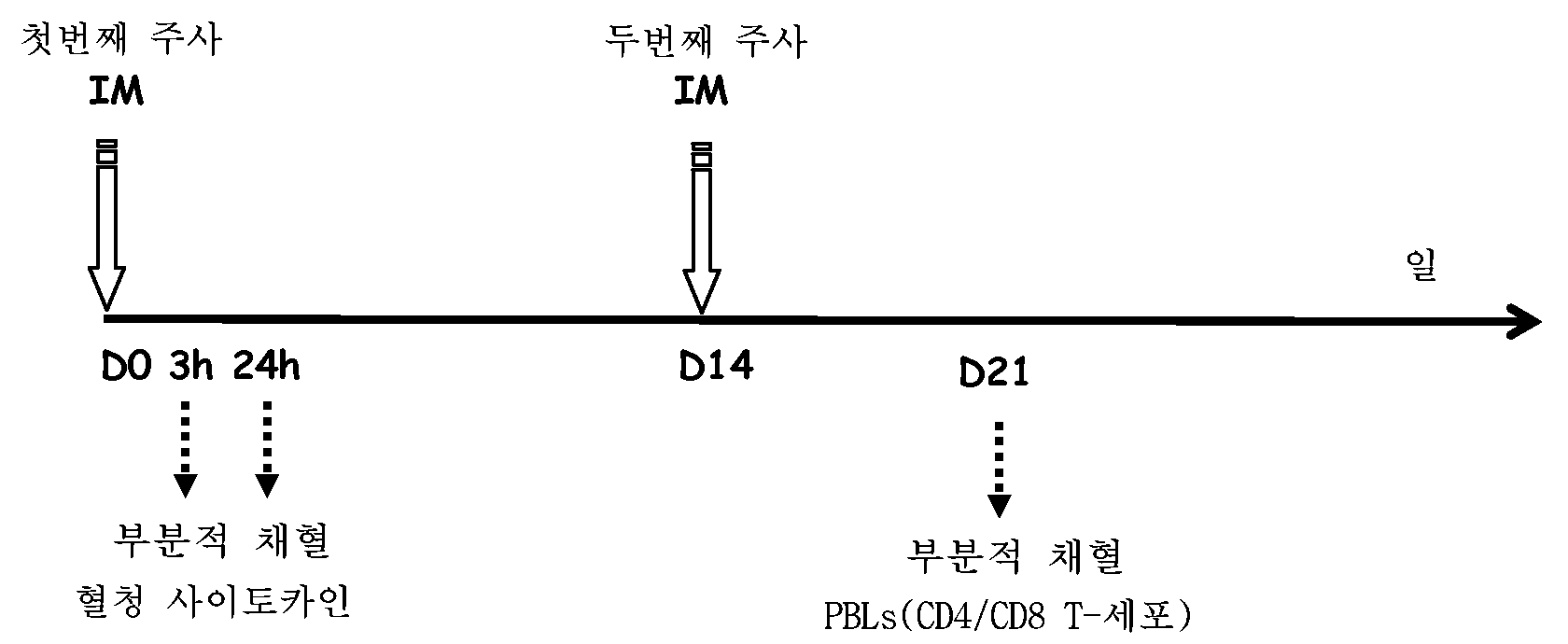
TLR7 효능제 및 전매 AS01B 애쥬번트(QS21+MPL)를 함유하는 제형에 의해 유도되는 선천성 및 적응 면역 반응을 또한 상응하는 AS01B-함유 제형 및 빈(empty) DPPC 리포솜에 의해 유도되는 선천성 및 적응 면역 반응과 비교하였다.Innate and adaptive immune responses induced by formulations containing a TLR7 agonist and a proprietary AS01B adjuvant (QS21 + MPL) are also innate and adaptive immune responses induced by corresponding AS01B-containing formulations and empty DPPC liposomes. Compared with.
표 1: 제형 내용물의 요약표Table 1: Summary Table of Formulation Contents
모든 화합물은 달리 지정하지 않는 경우 ㎍이다.All compounds are in μg unless otherwise specified.
* 용량은 A1-DPPC 및 A3-DPPC 리포솜을 제조하는데 사용된 TLR7-L의 양을 기초로 한다. 실제 주사된 용량은 여과 동안의 손실로 인해 더 적을 수 있다.* Dose is based on the amount of TLR7-L used to prepare A1-DPPC and A3-DPPC liposomes. The actual injected dose may be less due to loss during filtration.

AS01B 참조 군 및 TLR7-L 함유 제형으로 면역화된 군 사이에서 사이토카인의 상이한 프로파일을 관찰하였다. 주사 직후(3시간), DPPC-리포솜 내에서 제형화된 경우 둘 모두의 TLR7-L로 면역화된 마우스의 혈청에서 용량-의존적 방식으로 IFN-알파가 검출되었다(도 1). 이러한 혈청 IFNa 선천성 면역은, TLR7-L이 DOPS/DOPC-리포솜 내에서 제형화된 경우에 관찰되지 않았다(데이터는 제시되지 않음).Different profiles of cytokines were observed between the AS01B reference group and the group immunized with the TLR7-L containing formulation. Immediately following injection (3 hours), IFN-alpha was detected in a dose-dependent manner in the serum of mice immunized with both TLR7-L when formulated in DPPC-liposomes (FIG. 1). This serum IFNa innate immunity was not observed when TLR7-L was formulated in DOPS / DOPC-liposomes (data not shown).
A3 또는 A1이 제형 내에 존재하는 경우에 다른 염증성 사이토카인, 예를 들어, TNF-α 및 IL-6이 향상되었고, A1이 A3보다 더욱 효능이 있었다(도 2). 케모카인 MCP-1이 또한 둘 모두의 화합물의 존재하에서 향상되었다(도 3). 전체적으로, 이러한 데이터는 TLR7-L 지질화된 분자가 MPL/QS21 기반의 제형과 조합되는 경우 타입 Ⅰ IFN을 유도하고, 전염증성 사이토카인 반응을 향상시키는데 효과적인 것을 나타낸다.When A3 or A1 was present in the formulation, other inflammatory cytokines such as TNF-α and IL-6 were enhanced and A1 was more potent than A3 (FIG. 2). Chemokine MCP-1 was also enhanced in the presence of both compounds (FIG. 3). Overall, these data indicate that TLR7-L lipidated molecules are effective in inducing Type I IFN when combined with MPL / QS21 based formulations and enhancing proinflammatory cytokine responses.
여기서 사용된 TLR7-L 분자는 AS01 참조군과 비교하여 적응 T-세포 반응을 추가로 향상시키지 않았다(데이터는 제시되지 않음).The TLR7-L molecules used here did not further enhance adaptive T-cell responses compared to the AS01 reference group (data not shown).
Claims (12)
상기 식에서,
R 1 은 C1 - 6알킬, C1 - 6알킬아미노, C1 - 6알콕시, C3 - 6시클로알킬C1 - 6알킬, C3 - 6시클로알킬C1- 6알킬아미노, C3 - 6시클로알킬C1 - 6알콕시, C1 - 6알콕시C1 - 6알킬, C1 - 6알콕시C1 - 6알킬아미노, C1 - 6알콕시C1 - 6알콕시로 구성된 군으로부터 선택되고, 히드록실, 아미노, 티오, 히드라지노, 히드라지도, 아지도, 아세틸레닐, 카르복실 또는 말레이미도기로 말단 치환되거나 비치환되고;
n은 0 또는 1 내지 6으로부터의 정수이고;
Het은 4원, 5원, 또는 6원의 포화된 헤테로사이클이고,
여기서,
X 및 Y는 CH 또는 N이고, X 및 Y 중 하나 이상은 질소 원자이고;
Q는 O, NH 또는 공유 결합이고;
Z는 O, CH2, CF2 또는 공유 결합이고;
W는 O 또는 S이고;
m은 0 또는 1 내지 6으로부터의 정수이고;
p는 1 또는 2의 정수이고;
q는 0 또는 정수 1이고;
A는

여기서,
R 2 는 H 또는 선형, 분지형 또는 불포화 C4-C24 알킬 또는 아실이고;
R 3 는 선형, 분지형 또는 불포화 C4-C24 알킬 또는 아실이다.A compound according to the structure of formula (I) or a pharmaceutically acceptable salt thereof:
Where
R 1 is C 1 - 6 alkyl, C 1 - 6 alkylamino, C 1 - 6 alkoxy, C 3 - 6 cycloalkyl, C 1 - 6 alkyl, C 3 - 6 cycloalkyl, C 1- 6 alkylamino, C 3 - 6 cycloalkyl C 1 - 6 alkoxy, C 1 - 6 alkoxy C 1 - 6 alkyl, C 1 - 6 alkoxy C 1 - 6 alkylamino, C 1 - 6 alkoxy C 1 - is selected from the group consisting of 6 alkoxy, hydroxy Terminally substituted or unsubstituted with a hydroxyl, amino, thio, hydrazino, hydrazido, azido, acetylenyl, carboxyl or maleimido group;
n is 0 or an integer from 1 to 6;
Het is a 4, 5 or 6 membered saturated heterocycle,
here,
X and Y are CH or N, and at least one of X and Y is a nitrogen atom;
Q is O, NH or a covalent bond;
Z is O, CH 2 , CF 2 or a covalent bond;
W is O or S;
m is 0 or an integer from 1 to 6;
p is an integer of 1 or 2;
q is 0 or integer 1;
A is
here,
R 2 is H or linear, branched or unsaturated C 4 -C 24 alkyl or acyl;
R 3 is linear, branched or unsaturated C 4 -C 24 alkyl or acyl.

상기 식에서,
R 1 은 C1-6알킬, C1-6알킬아미노, C1-6알콕시, C3-6시클로알킬C1-6알킬, C3-6시클로알킬C1-6알킬아미노, C3-6시클로알킬C1-6알콕시, C1-6알콕시C1-6알킬, C1-6알콕시C1-6알킬아미노, C1-6알콕시C1-6알콕시로 구성된 군으로부터 선택되고;
n은 0 또는 1 내지 6으로부터의 정수이고;
X는 CH 또는 N이고;
Q는 O, NH 또는 공유 결합이고;
Z는 O, CH2, CF2 또는 공유 결합이고;
W는 O 또는 S이고;
m은 0 또는 1 내지 6으로부터의 정수이고;
p는 1 또는 2의 정수이고;
q는 0 또는 정수 1이고;
R 2 는 H 또는 선형, 분지형 또는 불포화 C4-C24 알킬 또는 아실이고;
R 3 는 선형, 분지형 또는 불포화 C4-C24 알킬 또는 아실이다.A compound according to the structure of formula (II) or a pharmaceutically acceptable salt thereof:
Where
R 1 is C 1-6 alkyl, C 1-6 alkylamino, C 1-6 alkoxy, C 3-6 cycloalkylC 1-6 alkyl, C 3-6 cycloalkylC 1-6 alkylamino, C 3- 6 cycloalkylC 1-6 alkoxy, C 1-6 alkoxyC 1-6 alkyl, C 1-6 alkoxyC 1-6 alkylamino, C 1-6 alkoxyC 1-6 alkoxy;
n is 0 or an integer from 1 to 6;
X is CH or N;
Q is O, NH or a covalent bond;
Z is O, CH 2 , CF 2 or a covalent bond;
W is O or S;
m is 0 or an integer from 1 to 6;
p is an integer of 1 or 2;
q is 0 or integer 1;
R 2 is H or linear, branched or unsaturated C 4 -C 24 alkyl or acyl;
R 3 is linear, branched or unsaturated C 4 -C 24 alkyl or acyl.
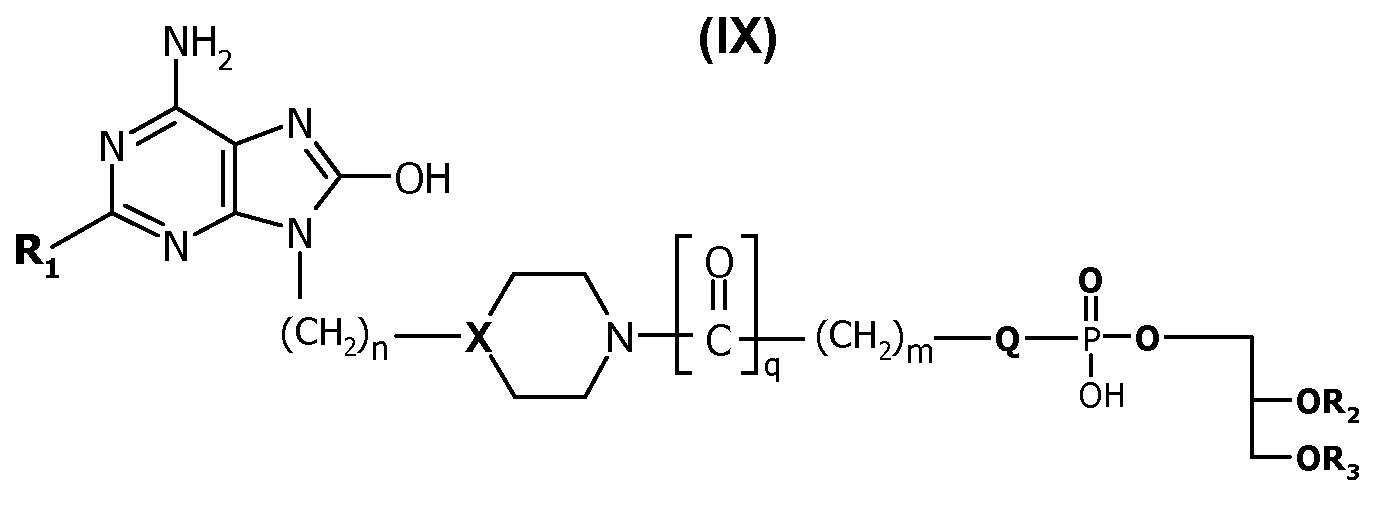
상기 식에서,
R 1 은 C1 -6알킬, C1 -6알킬아미노, C1 -6알콕시, C1-6알콕시C1-6알킬아미노, C1-6알콕시C1-6알콕시로 구성된 군으로부터 선택되고;
n은 0 또는 1 또는 2의 정수이고;
X는 CH 또는 N이고;
Q는 O, NH 또는 공유 결합이고;
m은 0 또는 1 또는 2의 정수이고;
q는 0이고;
R 2 는 H 또는 선형, 분지형 또는 불포화 C4-C24 알킬 또는 아실이고;
R 3 는 선형, 분지형 또는 불포화 C4-C24 알킬 또는 아실이다.A compound according to the structure of formula (IX) or a pharmaceutically acceptable salt thereof:
Where
R 1 is C 1 -6 alkyl, C 1 -6 alkylamino, C 1 -6 alkoxy, C 1-6 alkoxy C 1-6 alkylamino, C 1-6 alkoxy C 1-6 alkoxy are selected from the group consisting of ;
n is 0 or an integer of 1 or 2;
X is CH or N;
Q is O, NH or a covalent bond;
m is 0 or an integer of 1 or 2;
q is 0;
R 2 is H or linear, branched or unsaturated C 4 -C 24 alkyl or acyl;
R 3 is linear, branched or unsaturated C 4 -C 24 alkyl or acyl.
R 1 이 C1 -6알콕시 또는 C1 -6알콕시C1 -6알킬이고;
Q가 O 또는 NH이고;
m이 0 또는 1 또는 2의 정수이고;
q가 0이고;
R 2 가 H 또는 선형, 분지형 또는 불포화 C4-C24 알킬 또는 아실이고;
R 3 가 선형, 분지형 또는 불포화 C4-C24 알킬 또는 아실인, 화합물 또는 이의 약학적으로 허용되는 염.The method of claim 3, wherein
R 1 is C 1 -6 alkoxy or C 1 -6 alkoxy C 1 -6 alkyl;
Q is O or NH;
m is 0 or an integer of 1 or 2;
q is 0;
R 2 is H or linear, branched or unsaturated C 4 -C 24 alkyl or acyl;
A compound or a pharmaceutically acceptable salt thereof, wherein R 3 is linear, branched or unsaturated C 4 -C 24 alkyl or acyl.
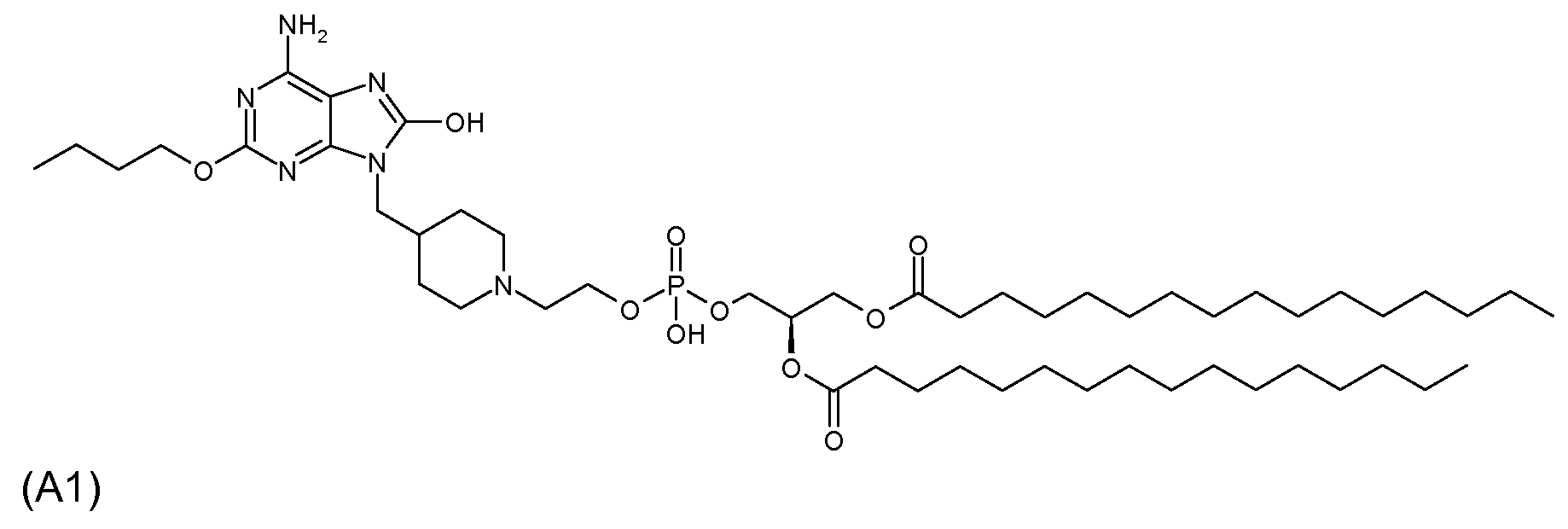
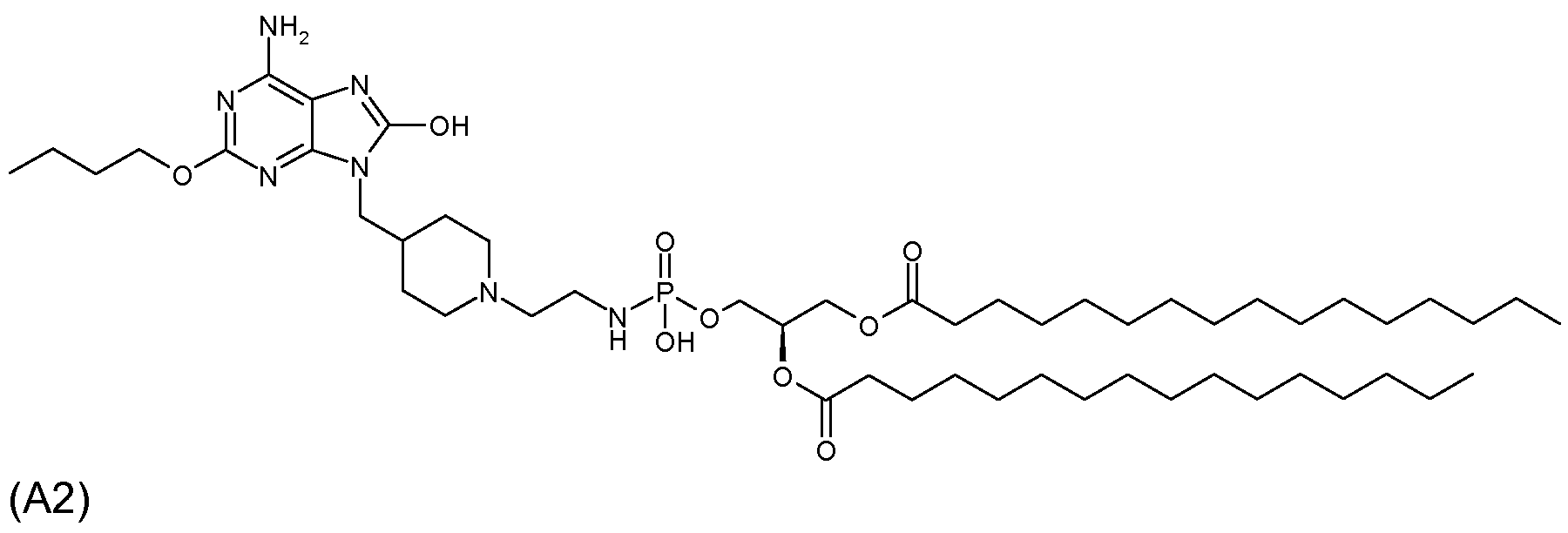
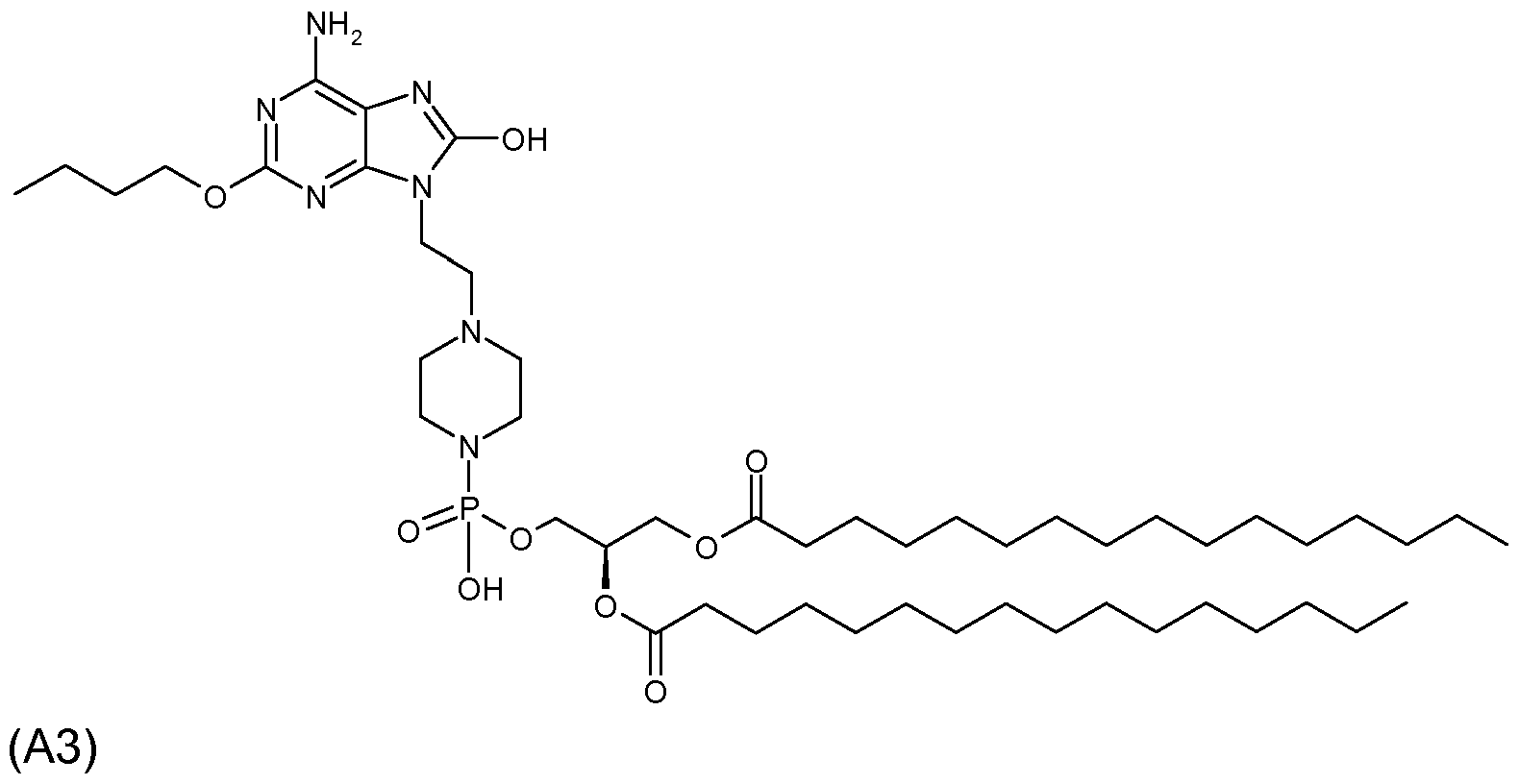


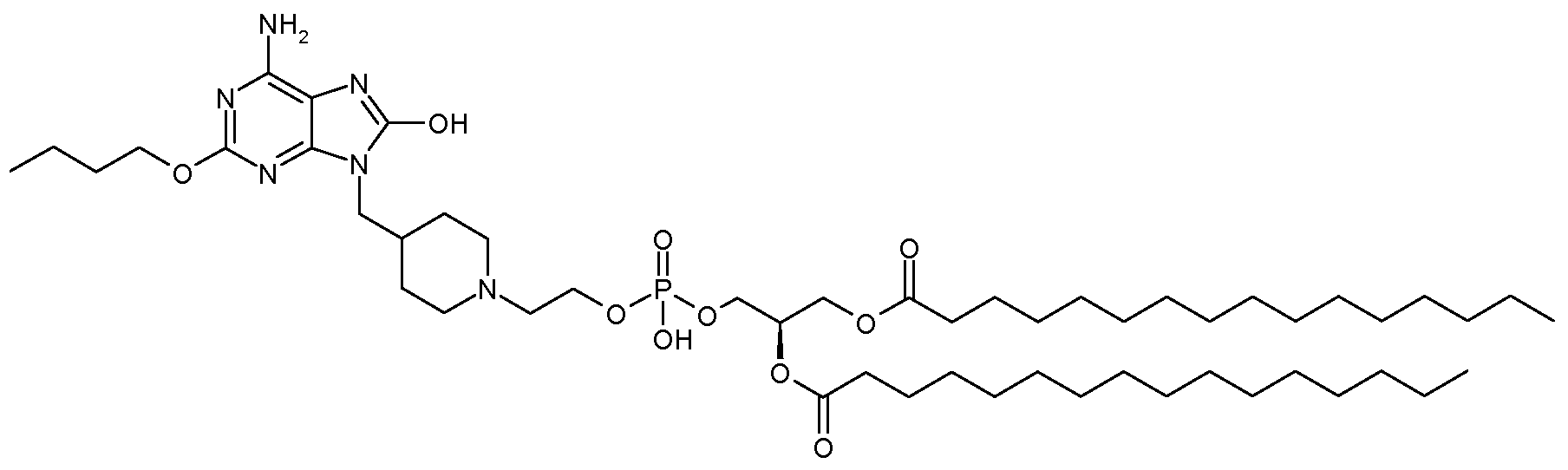
Applications Claiming Priority (2)
| Application Number | Priority Date | Filing Date | Title |
|---|---|---|---|
| US23213209P | 2009-08-07 | 2009-08-07 | |
| US61/232,132 | 2009-08-07 |
Publications (1)
| Publication Number | Publication Date |
|---|---|
| KR20120055623A true KR20120055623A (en) | 2012-05-31 |
Family
ID=43544685
Family Applications (1)
| Application Number | Title | Priority Date | Filing Date |
|---|---|---|---|
| KR1020127005993A Ceased KR20120055623A (en) | 2009-08-07 | 2010-08-06 | Lipidated oxoadenine derivatives |
Country Status (15)
| Country | Link |
|---|---|
| US (1) | US9044481B2 (en) |
| EP (2) | EP3199159B1 (en) |
| JP (1) | JP5759992B2 (en) |
| KR (1) | KR20120055623A (en) |
| CN (1) | CN102469790B (en) |
| AU (1) | AU2010279299B2 (en) |
| BR (1) | BR112012002349A2 (en) |
| CA (1) | CA2768195A1 (en) |
| EA (1) | EA023536B1 (en) |
| ES (1) | ES2732999T3 (en) |
| MX (1) | MX2012001524A (en) |
| SG (1) | SG178237A1 (en) |
| TR (1) | TR201909600T4 (en) |
| WO (1) | WO2011017611A1 (en) |
| ZA (1) | ZA201200646B (en) |
Cited By (1)
| Publication number | Priority date | Publication date | Assignee | Title |
|---|---|---|---|---|
| KR20220111153A (en) | 2021-02-01 | 2022-08-09 | 주식회사 에이티솔루션 | Propagation delay apparatus and method for minimizing the distance of the target generated from the radar electronic target generator |
Families Citing this family (35)
| Publication number | Priority date | Publication date | Assignee | Title |
|---|---|---|---|---|
| US8563717B2 (en) * | 2008-08-11 | 2013-10-22 | Glaxosmithkline Llc | Adenine derivatives |
| US8802684B2 (en) | 2008-08-11 | 2014-08-12 | Glaxosmithkline Llc | Adenine derivatives |
| UA103195C2 (en) | 2008-08-11 | 2013-09-25 | Глаксосмитклайн Ллк | PURCHASE DERIVATIVES FOR THE APPLICATION IN THE TREATMENT OF ALLERGIES, INFLAMMATORY AND INFECTIOUS DISEASES |
| WO2010018131A1 (en) * | 2008-08-11 | 2010-02-18 | Smithkline Beecham Corporation | Purine derivatives for use in the treatment of allergic, inflammatory and infectious diseases |
| WO2010088924A1 (en) | 2009-02-06 | 2010-08-12 | Telormedix Sa | Pharmaceutical compositions comprising imidazoquinolin(amines) and derivatives thereof suitable for local administration |
| CN102666541B (en) | 2009-10-22 | 2015-11-25 | 吉里德科学公司 | Derivatives of purines or deazapurines for use in the treatment, especially of viral infections |
| WO2011098451A1 (en) * | 2010-02-10 | 2011-08-18 | Glaxosmithkline Llc | Purine derivatives and their pharmaceutical uses |
| EP2563401A1 (en) * | 2010-04-30 | 2013-03-06 | Telormedix SA | Methods for inducing an immune response |
| CA2797315C (en) | 2010-04-30 | 2018-09-11 | Telormedix Sa | Phospholipid drug analogs |
| US9050319B2 (en) | 2010-04-30 | 2015-06-09 | Telormedix, Sa | Phospholipid drug analogs |
| BR112014001425A2 (en) | 2011-07-22 | 2017-11-21 | Glaxosmithkline Llc | pharmaceutical dosage form, pharmaceutical composition, and compound (i) or pharmaceutically acceptable salt thereof |
| EP2674170B1 (en) * | 2012-06-15 | 2014-11-19 | Invivogen | Novel compositions of TLR7 and/or TLR8 agonists conjugated to lipids |
| MY175676A (en) | 2012-08-24 | 2020-07-06 | Glaxosmithkline Llc | Pyrazolopyrimidine compounds |
| PL2922549T3 (en) | 2012-11-20 | 2017-11-30 | Glaxosmithkline Llc | Novel compounds |
| JP6216386B2 (en) | 2012-11-20 | 2017-10-18 | グラクソスミスクライン・リミテッド・ライアビリティ・カンパニーGlaxoSmithKline LLC | New compounds |
| AU2013348217B2 (en) | 2012-11-20 | 2016-10-06 | Glaxosmithkline Llc | Novel compounds |
| US9295732B2 (en) | 2013-02-22 | 2016-03-29 | Invivogen | Conjugated TLR7 and/or TLR8 and TLR2 polycationic agonists |
| WO2015036044A1 (en) * | 2013-09-13 | 2015-03-19 | Telormedix Sa | Cationic lipid vehicles for delivery of tlr7 agonists for specific targeting of human cd14+ monocytes in whole blood |
| AR100137A1 (en) | 2014-04-22 | 2016-09-14 | Hoffmann La Roche | 4-AMINO-IMIDAZOQUINOLINE COMPOUNDS |
| JP2017533925A (en) | 2014-11-13 | 2017-11-16 | グラクソスミスクライン バイオロジカルズ ソシエテ アノニム | Adenine derivatives useful for the treatment of allergic diseases or other inflammatory conditions |
| MX364223B (en) | 2015-03-06 | 2019-04-16 | Hoffmann La Roche | Benzazepine dicarboxamide compounds. |
| EP3268036A1 (en) * | 2015-03-10 | 2018-01-17 | GlaxoSmithKline Biologicals S.A. | Compositions and uses |
| JP6893501B2 (en) | 2015-09-17 | 2021-06-23 | エフ・ホフマン−ラ・ロシュ・アクチェンゲゼルシャフト | Sulfinylphenyl or sulfonimideylphenyl benzazepine |
| ES2805724T3 (en) | 2015-09-29 | 2021-02-15 | Sumitomo Dainippon Pharma Co Ltd | Conjugated adenine compounds and their use as vaccine adjuvants |
| US10632192B2 (en) | 2015-10-07 | 2020-04-28 | Sumitomo Dainippon Pharma Co., Ltd. | Pyrimidine compounds and their use as vaccine adjuvants |
| US10774099B2 (en) * | 2015-12-14 | 2020-09-15 | Glaxosmithkline Biologicals Sa | Phospholipidation of imidazoquinolines and oxoadenines |
| JP7022702B2 (en) | 2016-05-23 | 2022-02-18 | エフ・ホフマン-ラ・ロシュ・アクチェンゲゼルシャフト | Benzazepine dicarboxamide compound having a secondary amide group |
| EP3464245B1 (en) | 2016-05-23 | 2020-10-14 | H. Hoffnabb-La Roche Ag | Benzazepine dicarboxamide compounds with tertiary amide function |
| WO2017216054A1 (en) | 2016-06-12 | 2017-12-21 | F. Hoffmann-La Roche Ag | Dihydropyrimidinyl benzazepine carboxamide compounds |
| WO2019197598A1 (en) | 2018-04-13 | 2019-10-17 | Glaxosmithkline Biologicals Sa | Tlr7 and / or tlr8 agonists |
| CN115710266B (en) | 2018-07-03 | 2024-09-13 | 江苏恒瑞医药股份有限公司 | Pyridopyrimidine derivative, preparation method thereof and application thereof in medicines |
| PH12021550175A1 (en) | 2018-07-23 | 2022-07-11 | Japan As Represented By Director General Of Nat Institute Of Infectious Diseases | Composition containing influenza vaccine |
| KR20220018503A (en) * | 2019-05-23 | 2022-02-15 | 더 유니버시티 오브 몬타나 | Vaccine adjuvants based on TLR receptor ligands |
| CA3140708A1 (en) | 2019-06-18 | 2020-12-24 | Helen Horton | Combination of hepatitis b virus (hbv) vaccines and pyridopyrimidine derivatives |
| KR20220123437A (en) | 2020-01-02 | 2022-09-06 | 지앙수 헨그루이 파마슈티컬스 컴퍼니 리미티드 | Crystalline form of pyridopyrimidine derivative and method for preparing same |
Family Cites Families (9)
| Publication number | Priority date | Publication date | Assignee | Title |
|---|---|---|---|---|
| JP3042540B2 (en) * | 1990-08-20 | 2000-05-15 | ミヨシ油脂株式会社 | Adenosine monophosphate trimer containing 8-hydroxyadenosine-5'-phosphate, method for producing the same, and protein synthesis inhibitor comprising the compound |
| JPH093091A (en) * | 1995-06-21 | 1997-01-07 | Rikagaku Kenkyusho | Nucleoside derivative substance, its production method and antitumor agent |
| CA2230808C (en) | 1996-07-03 | 2006-08-15 | Japan Energy Corporation | A novel purine derivative |
| WO2003066649A1 (en) * | 2002-02-04 | 2003-08-14 | Biomira Inc. | Immunostimulatory, covalently lipidated oligonucleotides |
| WO2007034881A1 (en) * | 2005-09-22 | 2007-03-29 | Dainippon Sumitomo Pharma Co., Ltd. | Novel adenine compound |
| JP5356228B2 (en) * | 2006-07-07 | 2013-12-04 | ギリアード サイエンシーズ, インコーポレイテッド | Regulator of toll-like receptor 7 |
| JP5480637B2 (en) * | 2007-03-19 | 2014-04-23 | アストラゼネカ・アクチエボラーグ | 9-Substituted-8-oxo-adenine compounds as TOLL-like receptor (TLR7) modulators |
| WO2010018130A1 (en) * | 2008-08-11 | 2010-02-18 | Smithkline Beecham Corporation | Purine derivatives for use in the treatment of allergic, inflammatory and infectious diseases |
| WO2010018131A1 (en) * | 2008-08-11 | 2010-02-18 | Smithkline Beecham Corporation | Purine derivatives for use in the treatment of allergic, inflammatory and infectious diseases |
-
2010
- 2010-08-06 KR KR1020127005993A patent/KR20120055623A/en not_active Ceased
- 2010-08-06 ES ES16190246T patent/ES2732999T3/en active Active
- 2010-08-06 SG SG2012007522A patent/SG178237A1/en unknown
- 2010-08-06 EP EP16190246.5A patent/EP3199159B1/en active Active
- 2010-08-06 JP JP2012523976A patent/JP5759992B2/en not_active Expired - Fee Related
- 2010-08-06 TR TR2019/09600T patent/TR201909600T4/en unknown
- 2010-08-06 BR BR112012002349A patent/BR112012002349A2/en not_active Application Discontinuation
- 2010-08-06 EP EP20100807229 patent/EP2461690A4/en not_active Withdrawn
- 2010-08-06 US US13/389,307 patent/US9044481B2/en active Active
- 2010-08-06 EA EA201290036A patent/EA023536B1/en not_active IP Right Cessation
- 2010-08-06 AU AU2010279299A patent/AU2010279299B2/en not_active Ceased
- 2010-08-06 MX MX2012001524A patent/MX2012001524A/en active IP Right Grant
- 2010-08-06 CN CN201080034927.7A patent/CN102469790B/en not_active Expired - Fee Related
- 2010-08-06 CA CA2768195A patent/CA2768195A1/en not_active Abandoned
- 2010-08-06 WO PCT/US2010/044703 patent/WO2011017611A1/en not_active Ceased
-
2012
- 2012-01-25 ZA ZA2012/00646A patent/ZA201200646B/en unknown
Cited By (1)
| Publication number | Priority date | Publication date | Assignee | Title |
|---|---|---|---|---|
| KR20220111153A (en) | 2021-02-01 | 2022-08-09 | 주식회사 에이티솔루션 | Propagation delay apparatus and method for minimizing the distance of the target generated from the radar electronic target generator |
Also Published As
| Publication number | Publication date |
|---|---|
| EP2461690A4 (en) | 2013-03-27 |
| JP2013501730A (en) | 2013-01-17 |
| US20120135963A1 (en) | 2012-05-31 |
| EP3199159B1 (en) | 2019-04-10 |
| EA201290036A1 (en) | 2012-12-28 |
| EP2461690A1 (en) | 2012-06-13 |
| TR201909600T4 (en) | 2019-07-22 |
| ZA201200646B (en) | 2013-06-26 |
| CN102469790B (en) | 2014-12-03 |
| MX2012001524A (en) | 2012-02-29 |
| CA2768195A1 (en) | 2011-02-10 |
| CN102469790A (en) | 2012-05-23 |
| AU2010279299A1 (en) | 2012-03-29 |
| SG178237A1 (en) | 2012-03-29 |
| ES2732999T3 (en) | 2019-11-27 |
| EP3199159A1 (en) | 2017-08-02 |
| BR112012002349A2 (en) | 2015-10-13 |
| AU2010279299B2 (en) | 2015-10-01 |
| WO2011017611A1 (en) | 2011-02-10 |
| JP5759992B2 (en) | 2015-08-05 |
| EA023536B1 (en) | 2016-06-30 |
| US9044481B2 (en) | 2015-06-02 |
Similar Documents
| Publication | Publication Date | Title |
|---|---|---|
| KR20120055623A (en) | Lipidated oxoadenine derivatives | |
| CN102264394B (en) | Lipidated imidazoquinoline derivatives | |
| AU2008227128B2 (en) | Conjugates of synthetic TLR agonists and uses therefor | |
| ES2296390T3 (en) | COMPOSITION COADYUVANTE AND PROCEDURE FOR USE. | |
| JP6453855B2 (en) | Compositions and methods for activating "interferon gene stimulator" dependent signaling | |
| HK1219024B (en) | Compositions and methods for activating "stimulator of interferon gene"-dependent signalling | |
| HK1138767B (en) | Conjugates of synthetic tlr agonists and uses therefor |
Legal Events
| Date | Code | Title | Description |
|---|---|---|---|
| PA0105 | International application |
Patent event date: 20120306 Patent event code: PA01051R01D Comment text: International Patent Application |
|
| PG1501 | Laying open of application | ||
| A201 | Request for examination | ||
| PA0201 | Request for examination |
Patent event code: PA02012R01D Patent event date: 20150728 Comment text: Request for Examination of Application |
|
| PE0902 | Notice of grounds for rejection |
Comment text: Notification of reason for refusal Patent event date: 20161215 Patent event code: PE09021S01D |
|
| E601 | Decision to refuse application | ||
| PE0601 | Decision on rejection of patent |
Patent event date: 20170328 Comment text: Decision to Refuse Application Patent event code: PE06012S01D Patent event date: 20161215 Comment text: Notification of reason for refusal Patent event code: PE06011S01I |