KR20110129932A - Key Recovery Mechanisms for Cryptographic Systems - Google Patents
Key Recovery Mechanisms for Cryptographic Systems Download PDFInfo
- Publication number
- KR20110129932A KR20110129932A KR1020117022719A KR20117022719A KR20110129932A KR 20110129932 A KR20110129932 A KR 20110129932A KR 1020117022719 A KR1020117022719 A KR 1020117022719A KR 20117022719 A KR20117022719 A KR 20117022719A KR 20110129932 A KR20110129932 A KR 20110129932A
- Authority
- KR
- South Korea
- Prior art keywords
- key
- aes
- data
- block
- bit
- Prior art date
- Legal status (The legal status is an assumption and is not a legal conclusion. Google has not performed a legal analysis and makes no representation as to the accuracy of the status listed.)
- Ceased
Links
- 238000011084 recovery Methods 0.000 title description 40
- 230000007246 mechanism Effects 0.000 title 1
- 238000000034 method Methods 0.000 claims description 32
- 238000004422 calculation algorithm Methods 0.000 description 31
- 238000004364 calculation method Methods 0.000 description 27
- 230000008569 process Effects 0.000 description 19
- 230000015654 memory Effects 0.000 description 12
- 238000010586 diagram Methods 0.000 description 11
- 238000001514 detection method Methods 0.000 description 8
- 238000004590 computer program Methods 0.000 description 6
- 230000000873 masking effect Effects 0.000 description 6
- 239000011159 matrix material Substances 0.000 description 5
- 238000004891 communication Methods 0.000 description 3
- 230000002452 interceptive effect Effects 0.000 description 3
- 230000008859 change Effects 0.000 description 2
- 125000004122 cyclic group Chemical group 0.000 description 2
- 230000006870 function Effects 0.000 description 2
- 230000000977 initiatory effect Effects 0.000 description 2
- 230000003287 optical effect Effects 0.000 description 2
- 230000009471 action Effects 0.000 description 1
- 230000001010 compromised effect Effects 0.000 description 1
- 238000013500 data storage Methods 0.000 description 1
- 238000005265 energy consumption Methods 0.000 description 1
- 238000005516 engineering process Methods 0.000 description 1
- 230000003993 interaction Effects 0.000 description 1
- 239000004973 liquid crystal related substance Substances 0.000 description 1
- 238000007726 management method Methods 0.000 description 1
- 238000012986 modification Methods 0.000 description 1
- 230000004048 modification Effects 0.000 description 1
- 230000009467 reduction Effects 0.000 description 1
- 239000004065 semiconductor Substances 0.000 description 1
- 238000006467 substitution reaction Methods 0.000 description 1
Images


Classifications
-
- H—ELECTRICITY
- H04—ELECTRIC COMMUNICATION TECHNIQUE
- H04L—TRANSMISSION OF DIGITAL INFORMATION, e.g. TELEGRAPHIC COMMUNICATION
- H04L9/00—Cryptographic mechanisms or cryptographic arrangements for secret or secure communications; Network security protocols
- H04L9/06—Cryptographic mechanisms or cryptographic arrangements for secret or secure communications; Network security protocols the encryption apparatus using shift registers or memories for block-wise or stream coding, e.g. DES systems or RC4; Hash functions; Pseudorandom sequence generators
- H04L9/0618—Block ciphers, i.e. encrypting groups of characters of a plain text message using fixed encryption transformation
- H04L9/0631—Substitution permutation network [SPN], i.e. cipher composed of a number of stages or rounds each involving linear and nonlinear transformations, e.g. AES algorithms
-
- G—PHYSICS
- G09—EDUCATION; CRYPTOGRAPHY; DISPLAY; ADVERTISING; SEALS
- G09C—CIPHERING OR DECIPHERING APPARATUS FOR CRYPTOGRAPHIC OR OTHER PURPOSES INVOLVING THE NEED FOR SECRECY
- G09C1/00—Apparatus or methods whereby a given sequence of signs, e.g. an intelligible text, is transformed into an unintelligible sequence of signs by transposing the signs or groups of signs or by replacing them by others according to a predetermined system
-
- H—ELECTRICITY
- H04—ELECTRIC COMMUNICATION TECHNIQUE
- H04L—TRANSMISSION OF DIGITAL INFORMATION, e.g. TELEGRAPHIC COMMUNICATION
- H04L2209/00—Additional information or applications relating to cryptographic mechanisms or cryptographic arrangements for secret or secure communication H04L9/00
- H04L2209/12—Details relating to cryptographic hardware or logic circuitry
- H04L2209/122—Hardware reduction or efficient architectures
-
- H—ELECTRICITY
- H04—ELECTRIC COMMUNICATION TECHNIQUE
- H04L—TRANSMISSION OF DIGITAL INFORMATION, e.g. TELEGRAPHIC COMMUNICATION
- H04L2209/00—Additional information or applications relating to cryptographic mechanisms or cryptographic arrangements for secret or secure communication H04L9/00
- H04L2209/24—Key scheduling, i.e. generating round keys or sub-keys for block encryption
Landscapes
- Engineering & Computer Science (AREA)
- Computer Security & Cryptography (AREA)
- Computer Networks & Wireless Communication (AREA)
- Signal Processing (AREA)
- Physics & Mathematics (AREA)
- General Physics & Mathematics (AREA)
- Theoretical Computer Science (AREA)
- Storage Device Security (AREA)
Abstract
암호 시스템은 키를 포함하는 레지스터 및 상기 레지스터에 연결된 프로세서를 포함한다. 상기 프로세서는, 상기 레지스터를 작업 공간으로 이용하여 키 스케줄을 계산하는 것을 포함하는 제1 암호화 연산을 수행한다. 상기 제1 암호화 연산의 끝에, 상기 키는 제2 암호화 연산에서의 사용을 위해 상기 레지스터로부터 복구된다.The cryptographic system includes a register containing a key and a processor coupled to the register. The processor performs a first cryptographic operation comprising calculating a key schedule using the register as a workspace. At the end of the first cryptographic operation, the key is recovered from the register for use in a second cryptographic operation.
Description
이 출원의 내용은 일반적으로 암호 시스템에 관한 것이다.The content of this application relates generally to cryptographic systems.
고급 암호화 표준(AES, Advanced Encryption Standard)은 대칭 키 암호에서 사용되는 전자 데이터를 보호할 수 있는 암호 알고리즘을 위한 미국 국립 표준 기술원(NIST, National Institute of Standards and Technology) 명세이다. AES 알고리즘은 전자 데이터의 형태로 된 정보를 암호화(encrypt, encipher) 및 해독(decrypt, decipher)할 수 있다. 암호화는 전자 데이터를 암호문(ciphertext)이라 불리는 난해한 형태로 변환하고; 암호문을 해독하는 것은 전자 데이터를 평문(plaintext)이라 불리는 그것의 최초의 형태로 다시 변환한다. AES 알고리즘은 128 비트의 블록들로 전자 데이터를 암호화 및 해독하기 위해 128, 192, 및 256 비트의 암호 키들을 이용할 수 있는 인터랙티브형, 대칭 키 블록 암호(interactive, symmetric-key block cipher)이다.The Advanced Encryption Standard (AES) is a National Institute of Standards and Technology (NIST) specification for cryptographic algorithms that can protect electronic data used in symmetric key cryptography. The AES algorithm can encrypt (encrypt, encipher) and decrypt (decipher) information in the form of electronic data. Encryption converts electronic data into a difficult form called ciphertext; Decrypting ciphertext converts electronic data back to its original form, called plaintext. The AES algorithm is an interactive, symmetric-key block cipher that can use 128, 192, and 256 bit cryptographic keys to encrypt and decrypt electronic data in 128 bit blocks.
공개 키 암호들(public-key ciphers)은 한 쌍의 암호 키들을 이용할 수 있다. 그러나, AES 알고리즘은 전자 데이터를 암호화 및 해독하기 위해 동일한 암호 키를 이용한다. AES 알고리즘은 블록 암호이다. 블록 암호들에 의해 반환된 암호화된 데이터는 입력 데이터와 동일한 수의 비트를 가질 수 있다. AES 알고리즘은 데이터의 블록들에 대해 그것의 암호를 수행하여, 그것을 인터랙티브형 암호로 만든다. 인터랙티브형 암호들은 입력 데이터의 순열(permutations) 및 치환(substitutions)을 반복하여 수행하는 루프 구조를 이용할 수 있다.Public-key ciphers may use a pair of cryptographic keys. However, the AES algorithm uses the same encryption key to encrypt and decrypt the electronic data. The AES algorithm is a block cipher. The encrypted data returned by the block ciphers may have the same number of bits as the input data. The AES algorithm performs its encryption on blocks of data, making it an interactive encryption. Interactive ciphers can use a loop structure that repeatedly performs permutations and substitutions of input data.
암호화된 데이터의 각각의 블록은 데이터를 암호화 또는 해독하기 위해 동일한 암호 키를 이용한다. AES 알고리즘은 128 비트 블록들로 데이터를 암호화 및 해독한다. AES 알고리즘에 의한 128 비트 블록의 데이터의 각각의 암호화 및 해독은 복수의 AES 연산들을 이용할 수 있다. 계속적인 연산들의 그룹이 반복하여 수행되는 복수의 AES 연산들을 이용한 128 비트 블록의 데이터의 암호화 및 해독은 라운드(round)라고 칭해질 수 있다. AES 알고리즘은 또한 암호 키를 획득하고 키 확장(key expansion)을 수행하여 AES 암호화 알고리즘에서 이용하기 위한 키 스케줄을 생성한다. 대안적으로, 128 비트 블록의 데이터의 해독에서, AES 알고리즘은 스케줄된 키로부터 시작하고 역 키 스케줄 연산(inverse key schedule operation)을 수행하여 128 비트 블록으로 데이터를 해독하기 위하여 암호화에서 사용되는 암호 키를 생성한다.Each block of encrypted data uses the same encryption key to encrypt or decrypt the data. The AES algorithm encrypts and decrypts data in 128 bit blocks. Each encryption and decryption of the 128-bit block of data by the AES algorithm may utilize a plurality of AES operations. Encryption and decryption of a 128-bit block of data using a plurality of AES operations, in which successive groups of operations are performed repeatedly, may be referred to as rounds. The AES algorithm also obtains an encryption key and performs key expansion to generate a key schedule for use in the AES encryption algorithm. Alternatively, in decrypting a 128-bit block of data, the AES algorithm starts with the scheduled key and performs an inverse key schedule operation to decrypt the data into the 128-bit block in order to decrypt the data. Create
128 비트 블록의 데이터의 각각의 암호화는 128 비트 블록의 입력 데이터와 함께 입력으로서 암호 키를 필요로 한다. 128 비트보다 큰 암호화를 위한 입력 전자 데이터는 복수의 128 비트 블록들로 분할될 수 있다. 각각의 128 비트 블록은 AES 알고리즘을 이용하여 암호화될 수 있다. AES 알고리즘은 암호 키를 획득하고 키 확장 루틴을 수행하여 키 스케줄을 생성하여, 최초의 암호 키를 변환한다.Each encryption of data in a 128-bit block requires an encryption key as input with input data in a 128-bit block. Input electronic data for encryption larger than 128 bits may be divided into a plurality of 128 bit blocks. Each 128 bit block can be encrypted using the AES algorithm. The AES algorithm obtains an encryption key and performs a key expansion routine to generate a key schedule to convert the original encryption key.
128 비트 블록의 데이터의 각각의 해독은 128 비트 블록의 입력 데이터와 함께 입력으로서 스케줄된 키를 필요로 한다. 128 비트보다 큰 해독을 위한 입력 전자 데이터는 복수의 128 비트 블록들로 분할될 수 있다. 각각의 128 비트 블록은 AES 알고리즘을 이용하여 해독될 수 있다. AES 알고리즘은 암호화를 위해 사용된 AES 연산들을 인버트(invert)하고 역순으로 수행할 수 있다. AES 알고리즘은 스케줄된 키를 획득하고 역 키 스케줄 연산을 수행하여 암호화를 위해 사용된 최초의 암호 키를 결정한다.Each decryption of the data of the 128 bit block requires a key scheduled as input with the input data of the 128 bit block. Input electronic data for decryption larger than 128 bits may be divided into a plurality of 128 bit blocks. Each 128 bit block can be decrypted using the AES algorithm. The AES algorithm can invert AES operations used for encryption and perform the reverse order. The AES algorithm obtains the scheduled key and performs a reverse key schedule operation to determine the first encryption key used for encryption.
종래의 암호 시스템들은 암호화를 위해 필요한 키 또는 해독을 위해 필요한 키 스케줄을 암호화 또는 해독 연산 동안에 AES 알고리즘에 의해 사용되는 작업 공간 버퍼(workspace buffer)로부터 분리된 버퍼에 저장한다. 각각의 128 비트 블록 암호화 또는 해독에 앞서, 시스템은 분리된 버퍼로부터 키 또는 스케줄된 키를 각각 복구한다. 대안적으로, 일부 종래의 암호 시스템들은 암호화 또는 해독되는 각각의 128 비트 블록의 데이터에 대하여 암호화 또는 해독을 각각 수행하는 암호 엔진에 키 또는 스케줄된 키를 제공한다. 이것은 암호 키 또는 키 스케줄의 추가적인 핸들링 및 조작으로 귀결될 수 있다. 이 추가적인 핸들링 및 조작은 키 및 그것의 스케줄의 비밀을 위태롭게 할 수 있다.Conventional cryptographic systems store the key needed for encryption or the key schedule required for decryption in a buffer separate from the workspace buffer used by the AES algorithm during the encryption or decryption operation. Prior to each 128-bit block encryption or decryption, the system recovers the key or the scheduled key, respectively, from a separate buffer. Alternatively, some conventional cryptographic systems provide a key or a scheduled key to a cryptographic engine that performs encryption or decryption on each 128-bit block of data to be encrypted or decrypted, respectively. This can result in additional handling and manipulation of cryptographic keys or key schedules. This additional handling and manipulation can jeopardize the secret of the key and its schedule.
일부 구현들에서, 암호 시스템은 키 복구 연산을 수행할 수 있다. 암호화의 경우에는, 128 비트 블록의 데이터를 암호화하는 것의 끝에, 시스템은 암호화를 위해 사용된 스케줄된 키에 대해 역 키 스케줄 연산을 수행하여 최초의 암호 키를 복구할 수 있다. 이 키는 다음 암호화 프로세스에서 사용하기 위해 키 버퍼에 배치될 수 있다. 해독의 경우에는, 128 비트 블록의 데이터를 해독하는 것의 끝에, 시스템은 해독을 위해 사용된 암호 키에 대해 키 스케줄 연산을 수행하여 키 스케줄을 복구할 수 있다.In some implementations, the cryptographic system can perform a key recovery operation. In the case of encryption, at the end of encrypting the 128-bit block of data, the system can perform an inverse key schedule operation on the scheduled key used for encryption to recover the original encryption key. This key can be placed in the key buffer for use in the next encryption process. In the case of decryption, at the end of decrypting the 128-bit block of data, the system can perform a key schedule operation on the cryptographic key used for decryption to recover the key schedule.
암호 연산 동안에 키 복구 연산을 수행하는 것은 암호 엔진이 암호화 또는 해독을 위해 각각 키 또는 키 스케줄의 사본을 유지할 필요를 제거할 수 있다. 또한, 그것은 키 및 키 스케줄의 불필요한 핸들링 및 조작을 제거할 수 있다. 암호화의 경우에는, 암호 시스템은 암호화를 위한 각각의 128 비트 블록의 데이터에 대하여 암호 엔진에 키를 리로드(reload)할 필요가 없다. 해독의 경우에는, 암호 시스템은 해독을 위한 각각의 128 비트 블록의 데이터에 대하여 암호 엔진에 키 스케줄을 리로드할 필요가 없다.Performing a key recovery operation during the cryptographic operation may eliminate the need for the cryptographic engine to maintain a copy of the key or key schedule, respectively, for encryption or decryption. In addition, it can eliminate unnecessary handling and manipulation of keys and key schedules. In the case of encryption, the cryptographic system does not need to reload the key into the cryptographic engine for each 128-bit block of data for encryption. In the case of decryption, the cryptographic system does not need to reload the key schedule into the cryptographic engine for each 128-bit block of data for decryption.
도 1은 고급 암호화 표준(AES) 암호 엔진의 예시 구현의 블록도이다.
도 2는 고급 암호화 표준(AES) 블록에 포함되는 AES 시스템의 예시 구현의 블록도이다.
도 3a는 고급 암호화 표준(AES) 연산 레지스터 내의 비트들 및 그 비트 값들과 관련된 연산들을 보여주는 표이다.
도 3b는 고급 암호화 표준(AES) 연산 레지스터를 이용하여 선택된 AES 연산들을 위한 실행 시간들을 보여주는 표이다.
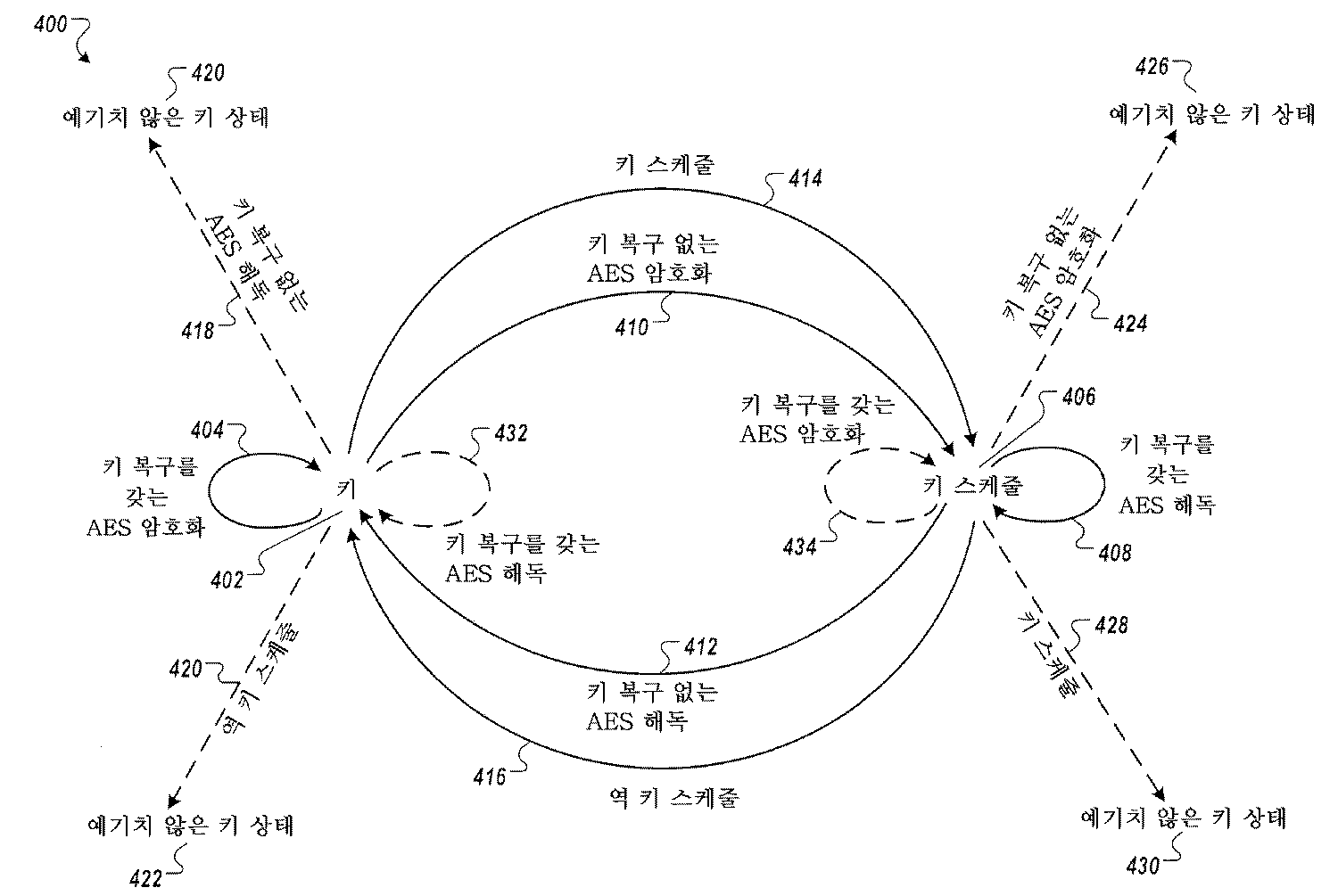
도 4는 고급 암호화 표준(AES) 블록에서의 예시 AES 키 상태들을 보여주는 상태도이다.
도 5는 암호 시스템에서의 암호화 프로세스의 예시 구현의 흐름도이다.
도 6은 암호 시스템에서의 해독 프로세스의 예시 구현의 흐름도이다.
도 7은 암호 시스템을 포함할 수 있는 시스템의 예시 구현의 블록도이다.1 is a block diagram of an example implementation of an Advanced Encryption Standard (AES) crypto engine.
2 is a block diagram of an example implementation of an AES system included in an Advanced Encryption Standard (AES) block.
3A is a table showing the bits in the Advanced Encryption Standard (AES) Operation Register and the operations associated with those bit values.
3B is a table showing execution times for AES operations selected using the Advanced Encryption Standard (AES) operation register.
4 is a state diagram showing example AES key states in an Advanced Encryption Standard (AES) block.
5 is a flowchart of an example implementation of an encryption process in a cryptographic system.
6 is a flowchart of an example implementation of a decryption process in a cryptographic system.
7 is a block diagram of an example implementation of a system that may include a cryptographic system.
AESAES 암호 엔진의 구현 Implementation of the Cryptographic Engine
도 1은 고급 암호화 표준(AES) 암호 엔진(100)의 예시 구현의 블록도이다. 엔진(100)은 암호문 및 평문을 각각 생성하는 전자 데이터의 블록들에 대한 AES 암호화 및 해독 연산들을 포함할 수 있는 AES 계산을 수행할 수 있다. 엔진(100)은 암호 시스템에 포함될 수 있다.1 is a block diagram of an example implementation of an advanced encryption standard (AES) crypto engine. The
도 1에 도시된 바와 같이, 엔진(100)은 AES 블록(102)에 의해 수행되는 AES 암호화 및 해독 연산들을 인에이블(enable) 및 제어할 수 있는 AES 블록(102)에의 입력을 제공할 수 있는 레지스터들을 포함한다. 레지스터들은 AES 연산들을 위한 데이터(예를 들면, 암호문 또는 평문)를 제공할 수 있다. 레지스터들은 AES 암호화 및 해독 연산들에서 사용하기 위한 암호 키 데이터를 제공할 수 있다. 또한, 레지스터들은 AES 블록(102)에 의해 수행되는 AES 연산들에 관련된 결과 및 상태 정보를 제공할 수 있다. 레지스터들은 AES 연산들의 결과 데이터(예를 들면, 암호문 또는 평문)를 제공할 수 있다. 다르게 지시되지 않는 한, 레지스터들은 8 비트(1 바이트) 값들을 포함한다. 구체적인 레지스터들, 그들의 값들 및 기능들은 아래에 더 상세히 설명될 것이다.As shown in FIG. 1, the
암호 시스템에 포함된 전력 관리 제어 레지스터 내의 AES ON 비트는 AES 암호 엔진(100)의 인에이블을 제어할 수 있다. AES ON 비트가 0으로 설정되면, 암호 시스템은 엔진(100)을 셧 다운(shut down)하여 엔진의 전류 소비를 최소화하고 엔진(100)을 파워다운 모드(power-down mode)에 둘 수 있다. 파워다운 모드 동안에, 엔진(100)의 레지스터들에 포함된 값들은 판독 또는 기입을 위해 이용 가능하지 않다. 이에 대한 예외는 AES 마스크 레지스터(116)이다. 암호 시스템은, AES 암호 엔진(100)의 버전 넘버를 포함할 수 있는, AES 마스크 레지스터(116)를 판독할 수 있다. 또한, 엔진(100)에 포함된 대다수의 레지스터들의 콘텐츠는 파워다운 모드 동안에 유지될 수 있다. AES ON 비트를 1로 설정하는 것은 엔진(100)의 전원을 켜고(powers up) 인에이블하여 그것을 계산 모드에 둔다. 엔진(100)의 전원을 켜는 것은 그것의 전류 소비를 증가시킨다. 엔진(100)은 AES 연산들을 이용하여 AES 계산들을 수행할 수 있다. AES ON 비트의 사용은 엔진(100)이 사용되지 않을 때 그것의 전원을 끄는 것에 의해 AES 암호 엔진(100)을 포함하는 암호 시스템에서의 전력 소비를 최소화할 수 있다.The AES ON bit in the power management control register included in the cryptographic system may control the enable of the
AES 연산 레지스터(AESOP)는 AES 블록(102)에 입력될 수 있는 6개 비트(104a-f)를 포함할 수 있다. 이 6개 비트(104a-f)는 암호 유형(암호화 또는 해독), 키 스케줄, 및 AES 연산들에서 사용된 암호 키에 포함되는 비트의 수를 선택할 수 있다. AES 스타트 비트(104b)(AESOP.START)는, 1로 설정될 때, AES 블록(102)에서 요청된 암호 연산들(암호화 또는 해독)을 시작할 수 있다. AES 블록(102)이 요청된 암호(암호화 또는 해독)를 완료하면 AES 스타트 비트(104b)는 클리어된다(0으로 설정된다). AES 암호 비트(104a)(AESOP.CIPHER)는 암호화 방향(또는 암호 유형 선택) 비트일 수 있다. AES 암호 비트(104a)를 1로 설정하는 것은 AES 블록(102)에게 그것이 AES 암호화를 수행해야 할 것임을 알린다. AES 암호 비트(104a)를 0으로 설정하는 것은 AES 블록(102)에게 그것이 AES 해독을 수행해야 할 것임을 알린다.The AES Operation Register (AESOP) may include six
AES 키 선택 비트들(104e, 104f)(각각, AESOP.KEYSEL0 및 AESOP.KEYSEL1)은 입력 암호 키에 대한 3개의 가능한 입력 사이즈들: 128, 192, 또는 256 비트 중 하나를 선택할 수 있다. AES 블록(102)은 AES 연산을 위해 암호 키를 사용할 수 있다. AES 키 선택 비트들(104e, 104f)은 AES 스타트 비트(104b)를, AES 연산을 시작하는, 1로 설정하기에 앞서 설정된다. AES 스타트 비트(104b)가 1인 동안에 AES 키 선택 비트들(104e, 104f)에 행해진 변화들은 AES 블록(102)에서 고장 상태(fault condition)가 발생하게 한다. AES 블록(102)은 AES 스타트 비트(104b)를 클리어하고(0으로 설정하고) AES 상태 레지스터 고장 검출 비트(108a)를 1로 설정하는 것에 의해 발생된 고장을 나타낸다. AES 입력 데이터 레지스터들(106)(AESDI[0...F]), AES 출력 데이터 레지스터들(114)(AESDO[0...F]) 및 AES 키 레지스터들(112)(AESK[0...31])은 변하지 않는다. 이들 레지스터들은 아래에 더 상세히 설명될 것이다.The AES key
AES 연산 비트들(104c, 104d)(각각, AESOP.AESOP0 및 AESOP.AESOP1)은 AES 스타트 비트(104b)가 1로 설정될 때 시작할 가능한 4개의 AES 연산들 중 하나를 선택할 수 있다. AES 연산 비트들(104c, 104d) 양쪽 모두를 클리어하는 것(0으로 설정하는 것)은 암호 비트(104a)의 값에 의해 결정된 선택된 암호 연산을 위한 어떤 키 복구도 선택하지 않는다. AES 연산 비트들(104c, 104d) 양쪽 모두를 1로 설정하는 것은 입력 암호 키의 무결성을 검증하기 위한 순환 중복 검사(CRC) 키 계산을 선택한다. AES 연산 비트(104c)를 클리어하는 것(0으로 설정하는 것) 및 AES 연산 비트(104d)를 1로 설정하는 것은 암호 비트(104a)의 값에 의해 결정된 선택된 암호 연산을 위한 키 복구를 선택한다. AES 연산 비트(104c)를 1로 설정하는 것 및 AES 연산 비트(104d)를 클리어하는 것(0으로 설정하는 것)은 AES 키 스케줄 연산을 선택한다. AES 연산들을 셋업하고 시작하기 위한 AES 연산 레지스터의 사용은 도 3을 참조하여 더 상세히 설명될 것이다.
암호 시스템은 AES 블록(102)에서 수행되는 AES 연산들의 양태들을 제어하기 위해, 4개의 비트(110a-110d)를 포함할 수 있는 AES 제어 레지스터(AESCR)의 비트들을 설정하거나 또는 클리어할 수 있다. XOR 키 데이터 입력 비트(110a)(AESCR.XKDI)를 1로 설정하는 것은 선택된 입력 데이터 레지스터(예를 들면, AES 입력 데이터 레지스터들(106)(AESDI[0...15]))에 기입된 입력 데이터와, 레지스터에 이미 포함된 데이터의 배타적-OR 연산(XOR 연산)을 허용한다. XOR 키 데이터 입력 비트(110a)를 클리어하는 것(0으로 설정하는 것)은 AES 암호 엔진(100)이 선택된 입력 데이터 레지스터(예를 들면, AES 입력 데이터 레지스터들(106))에 직접 데이터를 기입하여 그 데이터 레지스터에 포함된 임의의 이전의 데이터 위에 겹쳐 쓰는(overwrite) 것을 허용한다.The cryptographic system may set or clear the bits of the AES Control Register (AESCR), which may include four
XOR 키 데이터 입력 비트(110a)를 1로 설정하는 것은 또한 선택된 키 레지스터(예를 들면, 키 레지스터들(112)(AESK[0...31]))에 기입된 입력 데이터와, 그 키 레지스터에 이미 포함된 데이터의 배타적-OR 연산(XOR 연산)을 허용할 수 있다. XOR 키 데이터 입력 비트(110a)를 클리어하는 것(0으로 설정하는 것)은 AES 암호 엔진(100)이 선택된 키 레지스터(예를 들면, 키 레지스터들(112))에 직접 데이터를 기입하여 그 키 레지스터에 포함된 임의의 이전의 데이터 위에 겹쳐 쓰는 것을 허용한다.Setting the XOR key
일부 구현들에서, 암호 시스템은 AES 기반 암호 블록 연쇄 메시지 인증 코드(CBC-MAC, Cipher Block Chaining Message Authentication Code) 알고리즘들을 구현할 때 XOR 키 데이터 입력 비트(110a)를 1로 설정할 수 있다.In some implementations, the cryptographic system can set the XOR key
XOR 키 데이터 입력 비트(110a)를 설정하거나 또는 클리어하는 것은, 암호 연산을 시작하는, AES 스타트 비트(104b)를 1로 설정하기 전에 또는 그와 동시에 일어날 수 있다. XOR 키 데이터 입력 비트(110a)는 AES 계산 동안에(AES 스타트 비트(104b)를 1로 설정한 후부터 시작하여 AES 계산의 끝까지) 기입될 수 있다.Setting or clearing the XOR key
리절트 투 키 데이터 레지스터 비트들(result to key data register bits)(110b 및 110c)(각각, AESCR.RTKDR0 및 AESCR.RTKDR1)은 AES 블록 연산의 결과가 어디에 저장되는지를 결정할 수 있다. 도 1에 도시된 구현에서, 리절트 투 키 데이터 레지스터 비트(110b)는 클리어(0으로 설정)된다. 리절트 투 키 데이터 레지스터 비트(110b)가 클리어(0으로 설정)될 때 리절트 투 키 데이터 레지스터 비트(110c)를 1로 설정하는 것은 AES 블록(102)에서 수행된 AES 블록 연산의 결과를 출력 데이터 레지스터들(114)(AESDO[0...15]) 및 입력 데이터 레지스터들(106)에 저장한다. 리절트 투 키 데이터 레지스터 비트(110b)를 클리어된 상태로 유지하면서 리절트 투 키 데이터 레지스터 비트(110c)를 클리어하는 것(0으로 설정하는 것)은 AES 블록(102)에서 수행된 AES 블록 연산의 결과를 출력 데이터 레지스터들(114)에 저장한다.Result to key data register
리절트 투 키 데이터 레지스터 비트들(110b 및 110c)을 설정하거나 또는 클리어하는 것은 AES 스타트 비트(104b)를 1로 설정하는 것과 동시에 일어날 수 있다. AES 스타트 비트(104b)가 이미 1로 설정되어 있을 때 리절트 투 키 데이터 레지스터 비트들(110b 및 110c)을 설정하거나 또는 클리어하는 것은 AES 블록(102)에서 고장 상태가 발생하게 할 수 있다. AES 블록(102)은 AES 스타트 비트(104b)를 클리어하는 것(0으로 설정하는 것) 및 AES 상태 레지스터 고장 검출 비트(108a)를 1로 설정하는 것에 의해 발생된 고장을 나타낸다. AES 입력 데이터 레지스터들(106)(AESDI[0...F]), AES 출력 데이터 레지스터들(114)(AESDO[0...F]) 및 AES 키 레지스터들(112)(AESK[0...31])은 변하지 않는다.Setting or clearing the recess to key data register
AES 데이터 마스크 인에이블 비트(110d)(AESCR.DATAMSK)는 AES 암호 엔진(100)에서의 데이터 마스킹 특징을 제어한다. AES 데이터 마스크 인에이블 비트(110d)를 1로 설정하는 것은 데이터 마스크 특징을 인에이블한다. AES 데이터 마스크 인에이블 비트(110d)를 클리어하는 것(0으로 설정하는 것)은 데이터 마스크 특징을 디스에이블(disable)한다. 인에이블될 때, 데이터 마스크 특징은 AES 입력 데이터 레지스터들(106)에 포함된 암호화 또는 해독을 위한 입력 데이터를 AES 마스크 레지스터(116)(AESMSK)의 콘텐츠로 마스킹할 수 있다. 이것은 아래에 더 상세히 설명될 것이다.AES data mask enable bit 110d (AESCR.DATAMSK) controls the data masking feature in
AES 암호 엔진(100)은 AES CRC 레지스터들(118)(AESCRC0 및 ARSCRC1)을 포함할 수 있고, 이것들은, 조합될 때, AES 연산을 위해 사용되는 입력 암호 키에 대해 수행된 순환 중복 검사(CRC)의 16 비트 결과를 포함한다. 엔진(100)은 128, 192, 및 256 비트의 입력 암호 키들에 대해 CRC 검사를 수행할 수 있다. AES 블록(102)은 임의의 AES 연산들에서 키를 사용하기 전에 키의 임의의 데이터 손상(data corruption)을 검출하기 위해 키에 대해 수행된 CRC의 결과를 이용할 수 있다.
AES 암호 엔진(100)은 1 바이트(8 비트) 마스크 값을 포함할 수 있는 AES 마스크 레지스터(116)(AESMSK)를 포함할 수 있다. 암호 시스템은 마스크 레지스터(116)에 1 바이트 마스크 값을 로딩한다. AES 연산들의 시작에 앞서, 엔진(100)은 입력 암호 키 데이터를 한 바이트씩 마스크 레지스터(116)로 마스킹할 수 있다. AES 연산들의 시작과 동시에, 엔진(100)은 또한 암호화 또는 해독을 위한 입력 데이터를 한 바이트씩 마스크 레지스터로 마스킹할 수 있다.The
AES 암호 엔진(100)은 마스크 레지스터(116) 내의 값과 키의 각 바이트를 배타적-OR 연산(XOR 연산)하는 것에 의해 입력 암호 키의 값으로 한 바이트씩 마스크 레지스터(116)의 콘텐츠를 마스킹할 수 있다. 엔진(100)은 결과적으로 마스킹된 키를 키 레지스터들(112)에 기입할 수 있다. 키 마스킹은 임의의 AES 연산의 시작 전에 일어날 수 있다. 방금 설명된 방식으로 입력 암호 키를 마스킹하는 것은 XOR 키 데이터 입력 비트(110a)가 클리어(0으로 설정)되는 경우에 발생할 수 있다. XOR 키 데이터 입력 비트(110a)를 1로 설정하는 것은 키 레지스터들(112)에 기입된 입력 키 데이터와, 키 레지스터들(112)에 이미 포함된 데이터의 배타적-OR 연산(XOR 연산)을 허용한다.The
일부 구현들에서, AES 암호 엔진(100)은 암호 키 CRC 계산을 수행할 수 있다. 입력 암호 키 데이터는 마스크 레지스터(116)의 콘텐츠와 한 바이트씩 배타적-OR 연산(XOR 연산)될 수 있다. 엔진(100)은 결과적으로 XOR 연산된 키 바이트들을 키 레지스터들(112)에 기입할 수 있다. 키 레지스터들(112)은 (예를 들면, AES 블록(102)에 포함된) AES CRC 계산 엔진에 입력될 수 있다. CRC 계산 엔진은 CRC 계산에서 사용되는 최초 값으로서 AES CRC 레지스터들(118)에 포함된 값을 이용하여 CRC 계산을 수행할 수 있다.In some implementations,
만일 AES 연산의 처음에 AES 마스크 레지스터(116) 내의 AES 데이터 마스크 인에이블 비트(110d)가 1로 설정되면, AES 암호 엔진(100)은 입력 데이터 레지스터들(106) 각각으로 마스크 레지스터(116)를 마스킹할 수 있다. AES 암호 엔진(100)은 마스크 레지스터(116) 내의 값과 입력 데이터 레지스터 내의 값을 배타적-OR 연산(XOR 연산)하는 것에 의해 마스킹을 수행할 수 있다. AES 블록(102)은 결과적으로 마스킹된 입력 데이터 레지스터들을 수신할 수 있다.If the AES data mask enable bit 110d in the
AES ON 비트가 0으로 설정될 때, AES 암호 엔진(100)은 셧 다운 모드에 놓일 수 있다. 이 모드에서, 암호 시스템은 엔진(100)의 버전 넘버를 포함할 수 있는 AES 마스크 레지스터(116)를 판독할 수 있다. 암호 시스템은 마스크 레지스터(116)를 판독하고 시스템에 포함된 엔진(100)의 버전 넘버를 결정할 수 있다.When the AES ON bit is set to 0, the
AES 출력 데이터 레지스터들(114)(AESDO[0...F])은 AES 암호 엔진(100) 내의 AES 블록(102)에 의해 수행되는 AES 계산의 결과를 포함하는 16개의 8 비트(1 바이트) 레지스터들일 수 있다. AES 입력 데이터 레지스터들(114)(AESDI[0...F])은 AES 암호 엔진(100) 내의 AES 블록(102)에 의해 수행되는 AES 계산에서 사용되는 암호화 또는 해독을 위한 입력 데이터를 포함하는 16개의 8 비트(1 바이트) 레지스터들일 수 있다. 암호 시스템은 엔진(100)에서 AES 연산들의 시작을 개시하기에 앞서 암호화 또는 해독을 위한 입력 데이터를 데이터 버스(120)부터 입력 데이터 레지스터들(114)에 로딩한다. 전술한 바와 같이, AES 연산들의 시작을 개시하기에 앞서 입력 데이터 레지스터들(114)에 포함된 입력 데이터에 대해 마스킹 연산들이 조건부로 수행될 수도 있다.The AES output data registers 114 (AESDO [0 ... F]) contain sixteen eight bits (one byte) containing the result of the AES calculation performed by the
AES 키 레지스터들(112)(AESK[0...31])은 AES 암호 엔진(100) 내의 AES 블록(102)에 의해 수행되는 AES 계산에서 사용되는 암호 키 값을 포함하는 32개의 8 비트(1 바이트) 레지스터들일 수 있다. 암호 시스템은, 데이터 버스(120)에 대하여, 키 레지스터들(112)에 128, 192, 또는 256 비트(각각, 16 바이트, 24 바이트 또는 32 바이트)일 수 있는 암호 키를 로딩한다. 전술한 바와 같이, 키 레지스터들(112)에 대해 마스킹 연산들이 선택적으로 수행될 수도 있다.The AES key registers 112 (AESK [0 ... 31]) contain 32 eight bits (8) containing the cryptographic key value used in the AES calculation performed by the
암호 시스템은 AES 암호 엔진(100)에 관련된 상태 정보 및 AES 블록(102)에 의해 수행되는 AES 연산들에 관련된 상태 정보를 결정하기 위해 AES 상태 레지스터(AESSR)의 비트들을 판독할 수 있다. AES 인터럽트 플래그 비트(108b)(AESSR.AESIRQ)는 AES 블록(102)이 AES 계산을 완료했을 때 1로 설정될 수 있다. 만일 암호 시스템에 포함된 추가적인 레지스터 비트들이 적절히 설정되면, 인터럽트 플래그 비트(108b)를 설정하는 것은 암호 시스템에서 인터럽트의 발생을 초래할 수 있다.The cryptographic system can read the bits of the AES Status Register (AESSR) to determine status information related to
고장 검출 비트(108a)(AESSR.FAULT)는, 1로 설정될 때, AES 블록(102)이 AES 연산을 수행하고 있던 동안에 발생된 문제를 나타낸다. 일부 구현들에서, AES 블록(102)은 그것의 내부 상태들을 요청된 연산과 비교하는 것에 의해 그 문제를 검출할 수 있다.The
예를 들면, AES 블록(102)은 AES 블록(102)이 무효 요청을 수신할 때 고장 검출 비트(108a)를 1로 설정할 수 있다. 다른 예로, AES 블록(102)은 내부적으로 그것의 연산들의 일관성을 검사할 수 있고 모순이 발생할 때 고장 검출 비트(108a)를 1로 설정할 수 있다. 다른 예로, AES 블록(102)은 입력 데이터의 블록에 대해 그것이 수행하는 AES 라운드의 수를 카운트할 수 있다. 라운드의 수는 AES 연산들에서 사용되는 키의 사이즈에 기초하기 때문에(예를 들면, 128 비트 키를 사용하는 AES 암호는 128 비트 블록의 데이터에 대해 10 라운드를 수행한다) AES 블록(102)은 128 비트 블록의 데이터에 대해 AES 블록이 수행해야 하는 라운드의 수를 결정할 수 있다. 만일 실제 라운드의 수가 계산된 라운드의 수와 다르다면, AES 블록(102)은 고장 검출 비트(108a)를 1로 설정할 수 있다.For example, AES block 102 can set
만일 AES 블록(102)에 의한 AES 계산 동안에 고장이 발생하면, 인터럽트 플래그 비트(108b)를 1로 설정하는 것과 동시에 AES 계산의 끝에 AES 블록(102)에 의해 고장 검출 비트(108a)가 1로 설정된다. 일부 경우에, AES 계산 동안에 고장을 검출하는 AES 블록(102)은 잘못된 AES 계산을 계속하는 AES 블록(102)으로 귀결될 수 있다. 예를 들면, AES 블록(102)은 손상된 키를 이용할 수 있거나 또는 AES 계산의 결과로 생기는 AES 블록(102)의 출력 데이터는 손상될 수 있다. 일부 경우에, AES 블록(102)은 고장 검출 비트(108a)의 설정을 준비하고 잘못된 출력 데이터로 귀결되는 종료 전에 AES 계산을 중지할 수 있다.If a failure occurs during the AES calculation by the
기초 Foundation AESAES 알고리즘 algorithm
AES 알고리즘은 행렬의 각 원소가 1 바이트(8 비트)의 데이터인 스테이트(state)라고 불리는 4x4 행렬에 대해 AES 연산들을 수행할 수 있다. 스테이트는 총 16 바이트 또는 128 비트의 데이터를 포함한다. AES 알고리즘을 위한 암호화 또는 해독을 위한 바이트들의 입력 어레이는 또한 4x4 행렬로 조직된 128 비트의 데이터이다. 출력 데이터를 생성하기 위해 스테이트를 이용하여 입력 데이터에 대해 AES 연산들이 수행되고, 출력 데이터도 행렬의 각 원소가 1 바이트(8 비트)인 4x4 행렬의 형태이다. AES 알고리즘은 각각의 128 비트 블록의 데이터에 대해 AES 연산들의 다수의 라운드를 수행한다. 라운드의 수는 암호 키의 사이즈에 기초하여 결정될 수 있다. 암호 시스템은 128 비트보다 큰 입력 데이터를 다수의 128 비트의 데이터로 분할할 수 있다. 이들 데이터 블록들은 도 1에 도시된 바와 같이 AES 블록(102)에 연속적으로 입력될 수 있다.The AES algorithm can perform AES operations on a 4x4 matrix called a state, where each element of the matrix is one byte (8 bits) of data. The state contains a total of 16 bytes or 128 bits of data. The input array of bytes for encryption or decryption for the AES algorithm is also 128 bits of data organized in a 4x4 matrix. AES operations are performed on the input data using the state to generate output data, and the output data is also in the form of a 4x4 matrix in which each element of the matrix is one byte (8 bits). The AES algorithm performs multiple rounds of AES operations on each 128-bit block of data. The number of rounds may be determined based on the size of the encryption key. The cryptographic system can split input data larger than 128 bits into a plurality of 128 bits of data. These data blocks may be continuously input to the AES block 102 as shown in FIG.
라운드 내의 모든 AES 연산들은 인버트 가능하다(invertible). AES 블록(102)은 입력 데이터의 해독을 수행하기 위해 입력 데이터의 암호화를 수행하기 위해 사용되는 연산들을 인버트하고 역순으로 수행할 수 있다.All AES operations in a round are invertible. AES block 102 may invert and perform the reverse operations the operations used to perform encryption of input data to perform decryption of the input data.
입력 데이터의 암호화에서, AES 블록(102)은 암호 키를 키 스케줄로 확장할 수 있다. AES 알고리즘은 키를 획득하고 키 확장 루틴을 수행하여 키 스케줄을 생성할 수 있다. 키 스케줄은 키를 다수의 개별 키들(서브 키들)로 확장할 수 있고 AES 블록(102)은 AES 알고리즘의 각 라운드에 대하여 그 서브 키들을 이용할 수 있다. 서브 키들은 또한 라운드 키들이라고 불릴 수 있다. 키 확장 루틴은 AES 연산들을 이용하여 키를 확장할 수 있고 확장된 키의 길이는, 블록 사이즈*라운드의 수+1일 수 있다(예를 들면, 128 비트 키는 176 바이트 키로 확장하고, 192 비트 키는 208 바이트 키로 확장하고, 256 비트 키는 240 바이트 키로 확장한다). AES 블록(102)은 AES 알고리즘의 각 라운드에 대하여 확장된 키의 상이한 부분을 이용할 수 있다. 입력 데이터의 해독에서, AES 블록(102)은 키 스케줄을 이용하여 입력 데이터를 해독할 수 있다. AES 블록(102)은 역 키 스케줄 연산을 수행하여 입력 데이터를 암호화하기 위해 사용되는 암호 키를 생성할 수 있다.In encrypting the input data, AES block 102 may extend the encryption key to a key schedule. The AES algorithm can generate a key schedule by obtaining a key and performing a key expansion routine. The key schedule can extend the key into a number of individual keys (sub keys) and the AES block 102 can use the sub keys for each round of the AES algorithm. Sub keys may also be called round keys. The key expansion routine may extend the key using AES operations and the length of the extended key may be block size * number of rounds + 1 (e.g. 128 bit key extends to 176 byte key, 192 bit Key extends to 208 byte key, 256 bit key expands to 240 byte key). AES block 102 may use different portions of the extended key for each round of the AES algorithm. In decrypting the input data, AES block 102 can decrypt the input data using the key schedule. AES block 102 may perform an inverse key schedule operation to generate an encryption key that is used to encrypt the input data.
키 복구를 이용한 Key recovery AESAES 블록의 구현 Block implementation
도 2는 도 1의 고급 암호화 표준(AES) 블록(102)에 포함되는 AES 시스템(200)의 구현의 블록도이다. 시스템(200)은 키 복구를 이용하여 입력 데이터의 128 비트 블록의 암호화 또는 해독을 위한 AES 연산들을 수행할 수 있다. 일단 128 비트 블록의 입력 데이터의 암호화 또는 해독이 완료되면, 그 결과는 AES 암호 엔진(100)에 출력되고 시스템(200)은 암호화 또는 해독할 다음 128 비트 블록의 데이터에 대한 입력 데이터를 수신할 수 있다.2 is a block diagram of an implementation of an AES system 200 included in the Advanced Encryption Standard (AES) block 102 of FIG. 1. System 200 may perform AES operations for encryption or decryption of a 128 bit block of input data using key recovery. Once the encryption or decryption of the 128-bit block's input data is complete, the result is output to the
도 2에 도시된 바와 같이, 시스템(200)은 입력/출력 데이터 블록(202)을 포함한다. 입력/출력 데이터 블록(202)은 암호화 또는 해독을 위한 128 비트 입력 데이터 블록을 AES 데이터 처리 암호화/해독 블록(204)에 제공할 수 있다. 입력/출력 데이터 블록(202)은 또한 결과적으로 암호화된 또는 해독된 128 비트 출력 데이터 블록을 AES 데이터 처리 암호화/해독 블록(204)으로부터 수신할 수 있다. 데이터 처리 암호화/해독 블록(204)은 입력/출력 데이터 블록(202)에 의해 수신된 각각의 128 비트 블록의 데이터에 대해 AES 연산들을 수행할 수 있다.As shown in FIG. 2, system 200 includes input / output data block 202. Input / output data block 202 may provide a 128-bit input data block to AES data processing encryption / decryption block 204 for encryption or decryption. The input / output data block 202 can also receive the encrypted or decrypted 128-bit output data block from the AES data processing encryption / decryption block 204 as a result. Data processing encryption / decryption block 204 may perform AES operations on the data of each 128-bit block received by input / output data block 202.
AES 암호 엔진(100)을 이용한 데이터 암호화 또는 해독의 시작에 앞서, 암호 시스템은 도 1에 도시된 바와 같이 키 레지스터들(112)에 암호 키를 로딩할 수 있다. 제1 128 비트 입력 데이터 블록의 암호화 또는 해독의 시작에 앞서, 키 레지스터들(112)은 키 레지스터 블록(208)에 로딩될 수 있다.Prior to the start of data encryption or decryption using the
데이터 암호화 또는 해독을 수행할 때, AES 키 처리 암호화/해독 블록(206)은 암호 키를 이용하여 키 확장 루틴을 수행하여 키 스케줄을 생성할 수 있다. 키 레지스터 블록(208)은 처음에 임의의 AES 암호화 연산들의 시작에 앞서 암호 키를 저장할 수 있다. 키 레지스터 블록(208)은 전체 키(예를 들면, 256 비트 또는 32 바이트(예를 들면, 키 레지스터들(112)))를 버퍼링하기에 충분할 만큼 클 수 있고 키는 128, 192, 또는 최대 256 비트일 수 있다.When performing data encryption or decryption, AES key processing encryption /
시스템(200)에서 제1 128 비트 입력 데이터 블록에 대한 암호화 또는 해독 연산들 동안에, 키 레지스터들(112)로부터 키 레지스터 블록(208)에 로딩된 최초 암호 키는 겹쳐 쓰일 수 있다. 키 값을 포함하는 레지스터들은 암호 연산들을 수행할 때 작업 공간으로서 사용될 수 있다. 다음 128 비트 입력 데이터 블록에 대해 후속의 암호화 또는 해독 연산들을 수행하기 전에, 시스템(200)은 암호 키를 키 레지스터 블록(208)에 복구할 수 있다.During encryption or decryption operations on the first 128 bit input data block in the system 200, the initial cryptographic key loaded from the
상이한 키 레지스터 블록들 및 키 스케줄 연산들의 구현Implementation of different key register blocks and key schedule operations
일부 구현들에서, 각각의 128 비트 입력 데이터 블록 암호화 또는 해독 연산 전에, AES 암호 시스템(100)은 키 레지스터들(112)을 레지스터 블록(208)으로 로딩할 수 있다. 이 구현은 처리되는 데이터의 모든 128 비트 블록마다 한 번 암호 키를 핸들링하는 것을 요구할 수 있다. 이것은 큰 블록의 데이터에 대하여 암호 키의 다수의 조작들로 귀결될 수 있다. 또한, 일부 구현들에서, 시스템(200)은 키 레지스터들(112)로부터 레지스터 블록(208)으로 암호 키가 로딩될 때마다 암호 키의 무결성을 검사할 수 있다. 이것은 AES 암호 엔진(100)의 계산 처리량을 증가시킬 수 있다.In some implementations, prior to each 128-bit input data block encryption or decryption operation, AES cryptosystem 100 can load
일부 구현들에서, 시스템(100)은 암호 키의 2개의 사본을 키 레지스터 블록(208)에 저장할 수 있다. 키의 한 사본은 보존될 수 있고 암호화 또는 해독 연산들을 수행하면서 작업 공간 계산 동안에 겹쳐 쓰일 수 있는 키의 다른 사본을 복구하기 위해 이용될 수 있다. 이 구현은 암호 키를 저장하기 위해 키 레지스터 블록(208)에 추가적인 레지스터들을 요구할 수 있고, 이것은 키 레지스터 블록(208)의 게이트 카운트를 증가시킨다. 이것은 AES 암호 엔진(100)을 포함하는 통합 프로세서의 게이트 카운트를 증가시킨다. 증가된 게이트 카운트는 통합 프로세서의 풋프린트(footprint)를 증가시킬 뿐만 아니라 그것의 에너지 소비를 증가시킬 수 있다.In some implementations,
일부 구현들에서, 시스템(200)은 제1 128 비트 입력 데이터 블록의 암호화를 수행한 후에 키 레지스터 블록(208)에 암호 키를 복구할 수 있다. 시스템(200)은 다음 128 비트 입력 데이터 블록을 암호화하기 위해 필요한 암호 키를 복구하기 위해 제1 128 비트 입력 데이터 블록을 암호화하기 위해 사용된 키 스케줄에 대해 역 키 스케줄을 이용하는 키 복구 연산을 수행할 수 있다. 키 스케줄의 생성 및 128 비트 입력 데이터 블록을 암호화하는 데 그것을 사용하는 것은 최초 암호 키 값이 더 이상 시스템(200)에 이용 가능하지 않도록 키 데이터를 변경하는 것으로 귀결된다. 시스템(200)은 제1 128 비트 입력 데이터 블록이 암호화된 후에 및 다음 128 비트 입력 데이터 블록을 암호화하기 전에 키 복구 연산을 수행할 수 있다. 시스템(200)은 키 레지스터 블록(208)에서 복구된 키를 키 레지스터들(112)로부터 수신된 최초 암호 키를 유지한 동일한 레지스터들에 저장할 수 있다. 제1 128 비트 입력 데이터 블록은 이미 암호화되어 출력 데이터 블록(202)에 출력되었기 때문에, 시스템(200)은 암호화 연산들을 위한 작업 공간으로서 사용되었을 수 있는 이들 레지스터들에 포함된 임의의 데이터를 겹쳐 쓸 수 있다.In some implementations, the system 200 can recover the cryptographic key to the
일부 구현들에서, 시스템(200)은 제1 128 비트 입력 데이터 블록의 해독을 수행한 후에 키 레지스터 블록(208)에 키 스케줄을 복구할 수 있다. 해독은 암호화가 이용하는 것과 동일한 AES 연산들을 이용할 수 있다. 그러나, 그 연산들은 인버트되고 그 후 역순으로 구현된다. 제1 128 비트 입력 데이터 블록의 해독은 최초 키 스케줄로 시작된다. 역 키 스케줄 연산은 최초의 데이터를 암호화하기 위해 사용된 최초의 암호 키를 결정할 수 있다. 역 키 스케줄 연산 및 128 비트 입력 데이터 블록을 해독하는 데 그것을 사용하는 것은 최초 키 스케줄이 더 이상 시스템(200)에 이용 가능하지 않도록 키 스케줄 데이터를 변경하는 것으로 귀결될 수 있다. 시스템(200)은 제1 128 비트 입력 데이터 블록이 해독된 후에 및 다음 128 비트 입력 데이터 블록을 해독하기 전에 키 복구 연산을 수행할 수 있다. 키 복구 연산은 결과적인 암호 키에 대해 키 확장 연산을 실행하여 키 스케줄을 생성하고 복구하는 것에 의해 키 스케줄 연산을 수행한다. 시스템(200)은 키 레지스터 블록(208)에서 복구된 키 스케줄을 최초 키 스케줄을 유지한 동일한 레지스터들에 저장할 수 있다. 제1 128 비트 입력 데이터 블록은 이미 해독되어 출력 데이터 블록(202)에 출력되었기 때문에, 시스템(200)은 해독을 위한 작업 공간으로서 사용되었을 수 있는 이들 레지스터들에 포함된 임의의 데이터를 겹쳐 쓸 수 있다.In some implementations, the system 200 can restore the key schedule to the
키 복구 연산은 AES 암호 엔진(100)의 계산 처리량을 증가시킬 수 있다. 그러나, 시스템(200)은 키 값이 시스템(200)에 로딩될 때마다 키 값의 무결성을 검사할 수 있기 때문에, AES 블록(102)은 엔진(100)에게 암호 키를 복구하기 위하여 키 레지스터 블록(208)에 키 레지스터들(112)을 로딩할 것을 요구하지 않아 보다 적은 수의 키 조작 및 계산으로 귀결된다. 또한, 암호화 키가 또한 키 레지스터 블록(208)에 보존되지 않기 때문에 보다 적은 수의 레지스터들이 사용되므로 키 레지스터 블록(208)에서 보다 적은 수의 게이트가 요구될 수 있다.The key recovery operation can increase the computational throughput of the
일부 구현들에서, 도 1의 AES 암호 엔진(100)은 암호 시스템에서 특정한 연산들을 수행하기 위한 추가적인 통합 프로세서들을 포함할 수 있는 암호 시스템에 포함된 통합 프로세서일 수 있다. 암호 시스템의 풋프린트를 최소화하는 것을 돕기 위해 엔진(100)의 풋프린트를 최소화하는 것이 바람직할 수 있다. 엔진(100) 내의 AES 블록(102)에 포함된 시스템(200) 내의 키 저장을 위해 요구되는 레지스터들의 수를 감소시키는 것은 통합 프로세서의 사이즈 및 전체로서 암호 시스템의 사이즈를 감소시키는 데 도움이 될 수 있다.In some implementations, the
AESAES 연산 레지스터 Operation register
도 3a는 고급 암호화 표준(AES) 연산 레지스터 내의 비트들 및 그 비트 값들과 관련된 연산들을 보여주는 표(300)이다. 도 1을 참조하면, AES 연산 레지스터(AESOP)는 AES 연산 비트들(104c, 104d)(각각, AESOP0 및 AESOP1), AES 키 선택 비트들(104e, 104f)(각각, KEYSEL0 및 KEYSEL1) 및 AES 암호 비트(104a)(CIPHER)를 포함한다.3A is a table 300 showing the bits in the Advanced Encryption Standard (AES) Operation Register and the operations associated with those bit values. Referring to Fig. 1, the AES operation register (AESOP) includes
AES 연산 비트들(104c, 104d)은 AES 스타트 비트(104b)가 1로 설정될 때 시작할 가능한 4개의 AES 연산들, 즉, 키 복구를 갖는 암호 연산, 키 복구 없는 암호 연산, 키 스케줄 연산, 또는 CRC 계산 중 하나를 선택할 수 있다. AES 암호 비트(104a)는 암호화 연산과 해독 연산 사이에 선택할 수 있다. AES 키 선택 비트들(104e, 104f)은 입력 암호 키를 위한 3개의 가능한 입력 사이즈들, 즉, 128, 192, 또는 256 비트 중 하나를 선택할 수 있다.The
AES 연산 비트들(104c, 104d) 양쪽 모두를 클리어하는 것(0으로 설정하는 것)은 키 복구 없는 연산을 선택한다. 또한, AES 키 선택 비트들(104e, 104f) 양쪽 모두를 클리어하는 것(0으로 설정하는 것)은 128 비트 키를 사용하는 키 복구 없는 AES 연산을 선택한다. AES 암호 비트(104a)를 클리어하는 것(0으로 설정하는 것) 또는 1로 설정하는 것은 연산이 각각 해독일지 또는 암호화일지를 결정한다.Clearing (setting to 0) both
AES 연산 비트들(104c, 104d) 양쪽 모두를 클리어하는 것(0으로 설정하는 것)은 키 복구 없는 연산을 선택한다. 또한, AES 키 선택 비트(104e)를 1로 설정하는 것 및 AES 키 선택 비트(104f)를 클리어하는 것(0으로 설정하는 것)은 192 비트 키를 사용하는 키 복구 없는 AES 연산을 선택한다. AES 암호 비트(104a)를 클리어하는 것(0으로 설정하는 것) 또는 1로 설정하는 것은 연산이 각각 해독일지 또는 암호화일지를 결정한다.Clearing (setting to 0) both
AES 연산 비트들(104c, 104d) 양쪽 모두를 클리어하는 것(0으로 설정하는 것)은 키 복구 없는 연산을 선택한다. 또한, AES 키 선택 비트(104e)를 클리어하는 것(0으로 설정하는 것) 및 AES 키 선택 비트(104f)를 1로 설정하는 것은 256 비트 키를 사용하는 키 복구 없는 AES 연산을 선택한다. AES 암호 비트(104a)를 클리어하는 것(0으로 설정하는 것) 또는 1로 설정하는 것은 연산이 각각 해독일지 또는 암호화일지를 결정한다.Clearing (setting to 0) both
AES 연산 비트(104d)를 클리어하는 것(0으로 설정하는 것) 및 AES 연산 비트(104c)를 1로 설정하는 것은 키 스케줄 연산을 선택한다. 또한, AES 키 선택 비트들(104e, 104f) 양쪽 모두를 클리어하는 것(0으로 설정하는 것)은 128 비트 키를 사용하는 키 스케줄 연산을 선택한다. AES 암호 비트(104a)를 클리어하는 것(0으로 설정하는 것) 또는 1로 설정하는 것은 키 스케줄 연산이 각각 키 스케줄일지 또는 역 키 스케줄 연산일지를 결정한다.Clearing the
AES 연산 비트(104d)를 클리어하는 것(0으로 설정하는 것) 및 AES 연산 비트(104c)를 1로 설정하는 것은 키 스케줄 연산을 선택한다. 또한, AES 키 선택 비트(104e)를 1로 설정하는 것 및 AES 키 선택 비트(104f)를 클리어하는 것(0으로 설정하는 것)은 192 비트 키를 사용하는 키 스케줄 연산을 선택한다. AES 암호 비트(104a)를 클리어하는 것(0으로 설정하는 것) 또는 1로 설정하는 것은 키 스케줄 연산이 각각 키 스케줄일지 또는 역 키 스케줄 연산일지를 결정한다.Clearing the
AES 연산 비트(104d)를 클리어하는 것(0으로 설정하는 것) 및 AES 연산 비트(104c)를 1로 설정하는 것은 키 스케줄 연산을 선택한다. 또한, AES 키 선택 비트(104e)를 클리어하는 것(0으로 설정하는 것) 및 AES 키 선택 비트(104f)를 1로 설정하는 것은 256 비트 키를 사용하는 키 스케줄 연산을 선택한다. AES 암호 비트(104a)를 클리어하는 것(0으로 설정하는 것) 또는 1로 설정하는 것은 키 스케줄 연산이 각각 키 스케줄일지 또는 역 키 스케줄 연산일지를 결정한다.Clearing the
AES 연산 비트(104c)를 클리어하는 것(0으로 설정하는 것) 및 AES 연산 비트(104d)를 1로 설정하는 것은 키 복구를 갖는 연산을 선택한다. 또한, AES 키 선택 비트들(104e, 104f) 양쪽 모두를 클리어하는 것(0으로 설정하는 것)은 128 비트 키를 사용하는 키 복구를 갖는 AES 연산을 선택한다. AES 암호 비트(104a)를 클리어하는 것(0으로 설정하는 것) 또는 1로 설정하는 것은 연산이 각각 해독일지 또는 암호화일지를 결정한다.Clearing (setting to 0) the
AES 연산 비트(104c)를 클리어하는 것(0으로 설정하는 것) 및 AES 연산 비트(104d)를 1로 설정하는 것은 키 복구를 갖는 연산을 선택한다. 또한, AES 키 선택 비트(104e)를 1로 설정하는 것 및 AES 키 선택 비트(104f)를 클리어하는 것(0으로 설정하는 것)은 192 비트 키를 사용하는 키 복구를 갖는 AES 연산을 선택한다. AES 암호 비트(104a)를 클리어하는 것(0으로 설정하는 것) 또는 1로 설정하는 것은 연산이 각각 해독일지 또는 암호화일지를 결정한다.Clearing (setting to 0) the
AES 연산 비트(104c)를 클리어하는 것(0으로 설정하는 것) 및 AES 연산 비트(104d)를 1로 설정하는 것은 키 복구를 갖는 연산을 선택한다. 또한, AES 키 선택 비트(104e)를 클리어하는 것(0으로 설정하는 것) 및 AES 키 선택 비트(104f)를 1로 설정하는 것은 256 비트 키를 사용하는 키 복구를 갖는 AES 연산을 선택한다. AES 암호 비트(104a)를 클리어하는 것(0으로 설정하는 것) 또는 1로 설정하는 것은 연산이 각각 해독일지 또는 암호화일지를 결정한다.Clearing (setting to 0) the
AES 연산 비트들(104c, 104d) 양쪽 모두를 1로 설정하는 것은 키 CRC 계산을 선택한다. 또한, AES 키 선택 비트들(104e, 104f) 양쪽 모두를 클리어하는 것(0으로 설정하는 것) 및 AES 암호 비트(104a)를 클리어하는 것(0으로 설정하는 것)은 AES-128 키 CRC 연산을 선택한다.Setting both
AES 연산 비트들(104c, 104d) 양쪽 모두를 1로 설정하는 것은 키 CRC 계산을 선택한다. 또한, AES 키 선택 비트(104e)를 1로 설정하는 것, AES 키 선택 비트(104f)를 클리어하는 것(0으로 설정하는 것) 및 AES 암호 비트(104a)를 클리어하는 것(0으로 설정하는 것)은 AES-192 키 CRC 연산을 선택한다.Setting both
AES 연산 비트들(104c, 104d) 양쪽 모두를 1로 설정하는 것은 키 CRC 계산을 선택한다. 또한, AES 키 선택 비트(104e)를 클리어하는 것(0으로 설정하는 것), AES 키 선택 비트(104f)를 1로 설정하는 것 및 AES 암호 비트(104a)를 클리어하는 것(0으로 설정하는 것)은 AES-256 키 CRC 연산을 선택한다.Setting both
AESAES 계산 타이밍 Calculation timing
도 3b는 AES 연산 레지스터를 이용하여 선택된 AES 연산들(354)을 위한 (중앙 처리 장치(CPU) 사이클에서의) 실행 시간들(352)을 보여주는 표(350)이다. 도 3a의 표(300)는 AES 연산들(354)을 선택하기 위해 이용되는 AES 연산 레지스터의 비트들에 대한 값들을 보여준다.3B is a table 350 showing execution times 352 (in the central processing unit (CPU) cycle) for the selected
일반적으로, 보다 큰 암호 키들을 사용하는 AES 연산들은 완료하기 위해 더 많은 CPU 사이클을 요구한다. 키 복구를 사용하는 AES 연산들도 더 많은 CPU 사이클을 이용한다. 그러나, CPU 사이클의 증가는 통합 프로세서의 사이즈를 감소시키는 암호 키를 저장하기 위해 필요한 키 레지스터들의 수의 감소에 의해 상쇄될 수 있다. 또한, 키 복구는 암호 키의 불필요한 조작의 양을 감소시켜 암호 시스템에서 보안 문제들을 감소시킨다.In general, AES operations that use larger cryptographic keys require more CPU cycles to complete. AES operations that use key recovery also use more CPU cycles. However, the increase in CPU cycles can be offset by a reduction in the number of key registers needed to store the cryptographic keys, which reduces the size of the integrated processor. In addition, key recovery reduces the amount of unnecessary manipulation of cryptographic keys, thereby reducing security problems in cryptographic systems.
AESAES 키 상태도 Key state diagram
도 4는 고급 암호화 표준(AES) 블록(예를 들면, 도 1의 AES 블록(102))에서의 예시 AES 키 상태들을 보여주는 상태도(400)이다. 상태도(400)는 암호화 및 해독에서 사용되는 AES 암호 키에 대한 가능한 키 상태들 및 키 값들을 보여준다. 상태도(400)는 키가 진화할 수 있는 방법들과 AES 블록에 의해 실행되는 연산들 사이의 연결을 보여준다. 도 4에 도시된 AES 연산들은, 도 3에 도시된 고급 암호화 표준(AES) 연산 레지스터 내의 비트들에 의해 선택되고 AES 블록(102)에 포함된 도 2의 AES 시스템(200)에 의해 실행되는 AES 연산들일 수 있다.4 is a state diagram 400 illustrating example AES key states in an advanced encryption standard (AES) block (eg, AES block 102 of FIG. 1). State diagram 400 shows possible key states and key values for an AES encryption key used in encryption and decryption. State diagram 400 shows the link between how keys can evolve and the operations performed by the AES block. The AES operations shown in FIG. 4 are selected by the bits in the Advanced Encryption Standard (AES) operation register shown in FIG. 3 and executed by the AES system 200 of FIG. 2 included in the
상호 연결선들은 AES 연산들을 보여준다. 실선들은 FIPS-197 AES 표준에 순응하는 연산들을 보여준다. 점선들은 AES 연산들의 비통상적인 사용(unusual usage)을 수반할 수 있는 FIPS-197 AES 표준에 순응하지 않는(non-compliant) 연산들을 보여준다.Interconnect lines show AES operations. Solid lines show operations that conform to the FIPS-197 AES standard. Dotted lines show the operations that are non-compliant with the FIPS-197 AES standard, which may involve unusual usage of AES operations.
AES 블록이 키 상태(402)에 있을 때, 키 복구를 갖는 AES 암호화 연산(404)을 수행하는 것은 AES 블록을 키 상태(402)로 되돌려 놓을 수 있다. AES 블록이 키 스케줄 상태(406)에 있을 때, 키 복구를 갖는 AES 해독 연산(408)을 수행하는 것은 AES 블록을 키 스케줄 상태(404)로 되돌려 놓을 수 있다.When the AES block is in
AES 블록이 키 상태(402)에 있을 때, 키 복구 없는 AES 암호화 연산(410)을 수행하는 것은 AES 블록을 키 스케줄 상태(406)에 놓을 수 있다. AES 블록이 키 스케줄 상태(406)에 있을 때, 키 복구 없는 AES 해독 연산(412)을 수행하는 것은 AES 블록을 키 상태(402)로 놓을 수 있다.When the AES block is in
AES 블록이 키 상태(402)에 있을 때, 키 스케줄 연산(414)을 수행하는 것은 AES 블록을 키 스케줄 상태(406)에 놓을 수 있다. AES 블록이 키 스케줄 상태(406)에 있을 때, 역 키 스케줄 연산(416)을 수행하는 것은 AES 블록을 키 상태(402)로 놓을 수 있다.When the AES block is in
순응하지 않는 연산들은 AES 블록이 예기치 않은 상태들로 이행하는 것으로 귀결될 수 있다. AES 블록이 키 상태(402)에 있을 때, 키 복구 없는 AES 해독 연산(418)을 수행하는 것은 AES 블록을 예기치 않은 키 상태(420)에 놓을 수 있다. AES 블록이 키 상태(402)에 있을 때, 역 키 스케줄 연산(420)을 수행하는 것은 AES 블록을 예기치 않은 키 상태(422)에 놓을 수 있다. AES 블록이 키 상태(402)에 있을 때, 키 복구를 갖는 AES 해독 연산(432)을 수행하는 것은 AES 블록을 키 상태(402)에 놓을 수 있다. 그러나, AES 해독 연산은 키 스케줄을 그의 입력 키로서 이용하므로, AES 블록은 아마 이 연산을 수행하지 않을 것이다.Noncompliant operations may result in the AES block transitioning to unexpected states. When the AES block is in the
키 스케줄 상태(406)에 있을 때, 키 복구 없는 AES 암호 연산(424)은 AES 블록을 예기치 않은 키 상태(426)에 놓을 수 있다. 키 스케줄 상태(406)에 있을 때, 키 스케줄 연산(428)을 수행하는 것은 AES 블록을 예기치 않은 키 상태(430)에 놓을 수 있다. AES 블록이 키 스케줄 상태(406)에 있을 때, 키 복구를 갖는 AES 암호화 연산(434)을 수행하는 것은 AES 블록을 키 스케줄 상태(406)에 놓을 수 있다. 그러나, AES 암호화 연산을 키를 그의 입력 키로서 이용하므로, AES 블록은 아미 이 연산을 수행하지 않을 것이다.When in
암호화 프로세스의 구현Implementation of the encryption process
도 5는 암호 시스템에서의 암호화 프로세스(500)의 구현의 흐름도이다. 암호 시스템은 도 1에 도시된 AES 암호 엔진(100)을 포함할 수 있다. 암호화 프로세스는 도 1-4에서 설명된 AES 알고리즘을 이용할 수 있다.5 is a flowchart of an implementation of an encryption process 500 in a cryptographic system. The cryptographic system may include the
프로세스(500)는 암호 시스템이 암호화를 위한 데이터의 블록을 수신하는 것으로 시작된다(단계 502). 암호 시스템은 데이터의 서브블록에 포함된 비트의 수를 결정하고, 데이터의 서브블록의 사이즈는 수신된 데이터의 블록의 사이즈보다 작다(단계 504). 예를 들면, 도 1에 관하여 설명된 바와 같이, AES 알고리즘에서 사용되는 데이터의 서브블록은 128 비트일 수 있다. 입력된 데이터의 블록은 데이터의 다수의 서브블록들로 분할될 수 있고 데이터의 각각의 서브블록은 128 비트이다. 암호 시스템은 입력된 데이터의 블록에 포함된 데이터의 128 비트 블록들의 수 n을 결정한다(단계 506). 다음으로, 암호 시스템은 암호 키를 획득한다(단계 508). 암호 시스템은 AES 알고리즘 및 암호 키를 이용하여 데이터의 n번째 128 비트 서브블록을 암호화한다(단계 510). 예를 들면, 암호 시스템에 포함된 AES 암호 엔진(100)은 데이터의 n번째 128 비트 서브블록을 암호화할 수 있다.Process 500 begins with the cryptographic system receiving a block of data for encryption (step 502). The cryptographic system determines the number of bits included in the subblock of data, and the size of the subblock of data is smaller than the size of the block of data received (step 504). For example, as described with respect to FIG. 1, the subblock of data used in the AES algorithm may be 128 bits. The block of input data can be divided into multiple subblocks of data and each subblock of data is 128 bits. The cryptographic system determines the number n of 128 bit blocks of data contained in the block of data entered (step 506). Next, the cryptographic system obtains a cryptographic key (step 508). The encryption system encrypts the nth 128-bit subblock of data using the AES algorithm and the encryption key (step 510). For example, the
암호 시스템은 키 복구 연산을 사용하여 암호 키를 복구한다(단계 512). 예를 들면, 암호 시스템의 AES 암호 엔진(100) 내의 AES 블록(102)은 다음 서브블록 암호화에서 사용되는 키를 복구하는 키 복구 연산을 포함할 수 있다. 암호 시스템은 데이터의 서브블록들의 수를 감소시킬 수 있다(단계 514). 만일 암호화할 데이터의 서브블록이 남아 있다면(단계 516에서 n이 0이 아니라면), 프로세스(500)는 단계 510으로 계속된다. 그 후 암호 엔진은 단계 512에서 복구된 키를 이용하여 데이터의 다른 서브블록을 암호화한다. 만약 암호화할 데이터의 서브블록이 남아 있지 않다면(단계 516에서 n이 0이라면), 암호 시스템은 수신된 데이터의 암호화된 블록을 출력할 수 있다(단계 518). 프로세스(500)는 종료된다.The cryptographic system recovers the cryptographic key using a key recovery operation (step 512). For example, AES block 102 in
일부 구현들에서, 프로세스(500)는 입력된 데이터의 블록이 n개의 서브블록들을 포함하는 경우 제1 서브블록에서 시작하여 n번째 서브블록에서 끝나는 데이터의 서브블록들을 암호화할 수 있다.In some implementations, process 500 can encrypt subblocks of data starting at the first subblock and ending at the nth subblock if the block of input data includes n subblocks.
해독 프로세스의 구현Implementation of Decryption Process
도 6은 암호 시스템에서의 해독 프로세스(600)의 구현의 흐름도이다. 암호 시스템은 도 1에 도시된 AES 암호 엔진(100)을 포함할 수 있다. 해독 프로세스는 도 1-4에서 설명된 AES 알고리즘을 이용할 수 있다.6 is a flowchart of an implementation of a
프로세스(600)는 암호 시스템이 해독을 위한 데이터의 블록을 수신하는 것으로 시작된다(단계 602). 암호 시스템은 데이터의 서브블록에 포함된 비트의 수를 결정하고, 데이터의 서브블록의 사이즈는 수신된 데이터의 블록의 사이즈보다 작다(단계 604). 예를 들면, 도 1에 관하여 설명된 바와 같이, AES 알고리즘에서 사용되는 데이터의 서브블록은 128 비트일 수 있다. 입력된 데이터의 블록은 데이터의 다수의 서브블록들로 분할될 수 있고 데이터의 각각의 서브블록은 128 비트이다. 암호 시스템은 입력된 데이터의 블록에 포함된 데이터의 128 비트 블록들의 수 n을 결정한다(단계 606). 다음으로, 암호 시스템은 키 스케줄을 획득한다(단계 608). 암호 시스템은 AES 알고리즘 및 키 스케줄을 이용하여 데이터의 n번째 128 비트 서브블록을 해독한다(단계 610). 예를 들면, 암호 시스템에 포함된 AES 암호 엔진(100)은 데이터의 n번째 128 비트 서브블록을 해독할 수 있다.
암호 시스템은 역 키 복구 연산을 이용하여 키 스케줄을 복구한다(단계 612). 예를 들면, 암호 시스템의 AES 암호 엔진(100) 내의 AES 블록(102)은 다음 서브블록 연산에서 사용되는 키 스케줄을 복구하는 역 키 복구 연산을 포함할 수 있다. 암호 시스템은 데이터의 서브블록들의 수를 감소시킬 수 있다(단계 614). 만일 해독할 데이터의 서브블록이 남아 있다면(단계 616에서 n이 0이 아니라면), 프로세스(600)는 단계 610으로 계속된다. 그 후 암호 엔진은 단계 612에서 복구된 키를 이용하여 데이터의 다른 서브블록을 해독한다. 만약 해독할 데이터의 서브블록이 남아 있지 않다면(단계 616에서 n이 0이라면), 암호 시스템은 수신된 데이터의 해독된 블록을 출력할 수 있다(단계 618). 프로세스(600)는 종료된다.The cryptographic system recovers the key schedule using a reverse key recovery operation (step 612). For example, the
일부 구현들에서, 프로세스(600)는 입력된 데이터의 블록이 n개의 서브블록들을 포함하는 경우 제1 서브블록에서 시작하여 n번째 서브블록에서 끝나는 데이터의 서브블록들을 해독할 수 있다.In some implementations,
시스템 아키텍처System architecture
도 7은 도 1에서 설명된 고급 암호화 표준(AES) 암호 엔진을 포함할 수 있는 암호 시스템을 포함할 수 있는 시스템의 구현의 블록도이다. 시스템(700)은 프로세서(710), 메모리(720), 저장 장치(730), 및 입력/출력 장치(740)를 포함한다. 이 컴포넌트들(710, 720, 730, 및 740) 각각은 시스템 버스(750)를 이용하여 상호 연결된다. 프로세서(710)는 시스템(700) 내의 실행을 위한 명령어들을 처리할 수 있다. 일부 구현들에서, 프로세서(710)는 싱글 스레드 프로세서(single-threaded processor)이다. 다른 구현에서, 프로세서(710)는 멀티 스레드 프로세서(multi-threaded processor)이다. 프로세서(710)는 입력/출력 장치(740) 상에 사용자 인터페이스를 위한 그래픽 정보를 표시하기 위해 메모리(720)에 또는 저장 장치(730)에 저장된 명령어들을 처리할 수 있다.FIG. 7 is a block diagram of an implementation of a system that may include a cryptographic system that may include the Advanced Encryption Standard (AES) crypto engine described in FIG. 1. System 700 includes a
메모리(720)는 시스템(700) 내의 정보를 저장한다. 일부 구현들에서, 메모리(720)는 컴퓨터 판독가능한 매체이다. 다른 구현들에서, 메모리(720)는 휘발성 메모리 유닛이다. 또 다른 구현들에서, 메모리(720)는 비휘발성 메모리 유닛이다.
저장 장치(730)는 시스템(700)을 위한 대용량 저장을 제공할 수 있다. 일부 구현들에서, 저장 장치(730)는 컴퓨터 판독가능한 매체이다. 다양한 상이한 구현들에서, 저장 장치(730)는 플로피 디스크 장치, 하드 디스크 장치, 광 디스크 장치, 또는 테이프 장치일 수 있다.
입력/출력 장치(740)는 시스템(700)을 위한 입력/출력 동작들을 제공한다. 일부 구현들에서, 입력/출력 장치(740)는 키보드 및/또는 포인팅 장치를 포함한다. 다른 구현들에서, 입력/출력 장치(740)는 그래픽 사용자 인터페이스를 표시하기 위한 디스플레이 유닛을 포함한다.Input /
설명된 특징들은 디지털 전자 회로에서, 또는 컴퓨터 하드웨어, 펌웨어, 소프트웨어에서, 또는 그것들의 조합들에서 구현될 수 있다. 그 특징들은 프로그램 가능한 프로세서에 의한 실행을 위해, 정보 캐리어에, 예를 들면, 기계 판독가능 저장 장치에 또는 전파 신호에 실체적으로 구현된 컴퓨터 프로그램 제품에서 구현될 수 있고; 방법 단계들은 입력 데이터에 작용하여 출력을 생성하는 것에 의해 설명된 구현들의 기능들을 수행하는 명령어들의 프로그램을 실행하는 프로그램 가능한 프로세서에 의해 수행될 수 있다. 설명된 특징들은 데이터 저장 시스템, 적어도 하나의 입력 장치, 및 적어도 하나의 출력 장치로부터 데이터 및 명령어들을 수신하고 그것들에 데이터 및 명령어들을 송신하도록 연결된 적어도 하나의 프로그램 가능한 프로세서를 포함하는 프로그램 가능한 시스템 상에서 실행 가능한 하나 이상의 컴퓨터 프로그램들에서 유리하게 구현될 수 있다. 컴퓨터 프로그램은 특정 동작을 수행하거나 특정 결과를 초래하기 위해 컴퓨터에서 직접 또는 간접적으로 이용될 수 있는 명령어들의 세트이다. 컴퓨터 프로그램은 컴파일된 또는 인터프리트된 언어들을 포함하는, 임의의 형태의 프로그래밍 언어로 작성될 수 있고, 그것은 임의의 형태로, 예를 들면, 독립형 프로그램으로서 또는 컴퓨팅 환경에서 사용하기에 적합한 모듈, 컴포넌트, 서브루틴, 또는 다른 유닛으로서 전개될 수 있다.The described features can be implemented in digital electronic circuitry, or in computer hardware, firmware, software, or combinations thereof. The features may be implemented in a computer program product tangibly embodied in an information carrier, eg, in a machine readable storage device, or in a propagation signal, for execution by a programmable processor; The method steps may be performed by a programmable processor executing a program of instructions to perform the functions of the described implementations by operating on input data and generating output. The described features are executed on a programmable system comprising a data storage system, at least one input device, and at least one programmable processor coupled to receive data and instructions from and send data and instructions to the at least one output device. It may be advantageously implemented in one or more computer programs as possible. A computer program is a set of instructions that can be used, directly or indirectly, on a computer to perform a particular action or produce a particular result. A computer program may be written in any form of programming language, including compiled or interpreted languages, which may be in any form, for example, as a standalone program or as a module, component suitable for use in a computing environment. , Subroutines, or other units.
명령어들의 프로그램의 실행을 위한 적합한 프로세서들은, 예로서, 범용 및 특수 목적 마이크로프로세서 양쪽 모두, 및 단독 프로세서 또는 임의의 종류의 컴퓨터의 다수의 프로세서들 중 하나를 포함한다. 일반적으로, 프로세서는 ROM(read-only memory) 또는 RAM(random access memory) 또는 양쪽 모두로부터 명령어들 및 데이터를 수신할 것이다. 컴퓨터의 필수적인 엘리먼트들은 명령어들을 실행하기 위한 프로세서 및 명령어들 및 데이터를 저장하기 위한 하나 이상의 메모리들이다. 일반적으로, 컴퓨터는 또한 데이터 파일들을 저장하기 위한 하나 이상의 대용량 저장 장치들을 포함하거나, 그러한 장치들과 통신하도록 동작 가능하게 연결될 것이고; 그러한 장치들은 내부 하드 디스크 및 이동식 디스크와 같은 자기 디스크; 광자기 디스크; 및 광 디스크를 포함한다. 컴퓨터 프로그램 명령어들 및 데이터를 실체적으로 구현하기에 적합한 저장 장치들은, 예로서 EPROM, EEPROM, 및 플래시 메모리 장치와 같은 반도체 메모리 장치; 내부 하드 디스크 및 이동식 디스크와 같은 자기 디스크; 광자기 디스크; 및 CD-ROM 및 DVD-ROM 디스크를 포함하는, 모든 형태의 비휘발성 메모리를 포함한다. 프로세서 및 메모리는 ASIC(application-specific integrated circuit)들에 의해 보충되거나, ASIC들에 통합될 수 있다.Suitable processors for the execution of a program of instructions include, by way of example, both general purpose and special purpose microprocessors, and either a single processor or a plurality of processors of any kind of computer. In general, a processor will receive instructions and data from read-only memory (ROM) or random access memory (RAM) or both. Essential elements of a computer are a processor for executing instructions and one or more memories for storing instructions and data. In general, a computer will also include one or more mass storage devices for storing data files, or will be operatively connected to communicate with such devices; Such devices include magnetic disks such as internal hard disks and removable disks; Magneto-optical disks; And optical disks. Storage devices suitable for tangibly embodying computer program instructions and data include, for example, semiconductor memory devices such as EPROM, EEPROM, and flash memory devices; Magnetic disks such as internal hard disks and removable disks; Magneto-optical disks; And all forms of nonvolatile memory, including CD-ROM and DVD-ROM disks. The processor and memory may be supplemented by application-specific integrated circuits (ASICs) or integrated into ASICs.
사용자와의 상호 작용을 제공하기 위해, 특징들은 사용자에게 정보를 표시하기 위한 CRT(cathode ray tube) 또는 LCD(liquid crystal display)와 같은 디스플레이 장치 및 사용자가 컴퓨터에 입력을 제공할 수 있는 키보드 및 마우스 또는 트랙볼과 같은 포인팅 장치를 갖는 컴퓨터에서 구현될 수 있다.To provide for interaction with a user, features include a display device, such as a cathode ray tube (CRT) or liquid crystal display (LCD), to display information to the user, and a keyboard and mouse that can provide input to the computer. Or in a computer with a pointing device, such as a trackball.
특징들은 데이터 서버와 같은 백엔드 컴포넌트를 포함하는, 또는 애플리케이션 서버 또는 인터넷 서버와 같은 미들웨어 컴포넌트를 포함하는, 또는 그래픽 사용자 인터페이스 또는 인터넷 브라우저를 갖는 클라이언트 컴포넌트와 같은 프런트엔드 컴포넌트를 포함하는, 또는 그것들의 임의의 조합을 포함하는 컴퓨터 시스템에서 구현될 수 있다. 시스템의 컴포넌트들은 통신 네트워크와 같은 디지털 데이터 통신의 임의의 형태 또는 매체에 의해 연결될 수 있다. 통신 네트워크들의 예들은, 예를 들면, LAN, WAN, 및 인터넷을 형성하는 컴퓨터들 및 네트워크들을 포함한다.The features include a backend component, such as a data server, or a middleware component, such as an application server or an internet server, or a frontend component, such as a client component with a graphical user interface or an internet browser, or any thereof. It can be implemented in a computer system including a combination of. The components of the system may be connected by any form or medium of digital data communication, such as a communication network. Examples of communication networks include, for example, computers and networks forming a LAN, WAN, and the Internet.
컴퓨터 시스템은 클라이언트들 및 서버들을 포함할 수 있다. 클라이언트 및 서버는 일반적으로 서로 멀리 떨어져 있고 전형적으로 네트워크를 통하여 상호 작용한다. 클라이언트와 서버의 관계는 각각의 컴퓨터들에서 실행되고 서로 클라이언트-서버 관계를 갖는 컴퓨터 프로그램들의 덕분으로 발생한다.The computer system can include clients and servers. Clients and servers are generally remote from each other and typically interact through a network. The relationship of client and server occurs due to the computer programs running on the respective computers and having a client-server relationship with each other.
다수의 구현들이 설명되었다. 그럼에도 불구하고, 다양한 변경들이 이루어질 수 있다는 것이 이해될 것이다. 예를 들면, 하나 이상의 구현들의 엘리먼트들이 조합, 삭제, 변경, 또는 보충되어 추가적인 구현들을 형성할 수 있다. 도면들에서 도시된 논리 흐름들은 바람직한 결과들을 달성하기 위해, 도시된 특정한 순서, 또는 순차적인 순서를 요구하지 않는다. 또한, 다른 단계들이 제공될 수 있고, 또는 설명된 흐름들로부터 단계들이 제거될 수 있고, 다른 컴포넌트들이 설명된 시스템들에 추가되거나, 설명된 시스템들로부터 제거될 수 있다. 따라서, 다른 구현들은 다음의 청구항들의 범위 내에 있다.Many implementations have been described. Nevertheless, it will be understood that various modifications may be made. For example, elements of one or more implementations can be combined, deleted, changed, or supplemented to form additional implementations. The logic flows shown in the figures do not require the particular order shown, or sequential order, to achieve desirable results. Also, other steps may be provided, or steps may be removed from the described flows, other components may be added to, or removed from, the described systems. Accordingly, other implementations are within the scope of the following claims.
Claims (16)
키를 포함하는 레지스터; 및
상기 레지스터에 연결된 프로세서
를 포함하고,
상기 프로세서는,
상기 레지스터를 작업 공간으로 이용하여 키 스케줄(key schedule)을 계산하는 것을 포함하는 제1 암호화 연산(encrypting operation)을 수행하고,
상기 제1 암호화 연산의 끝에, 제2 암호화 연산에서의 사용을 위해 상기 레지스터로부터 상기 키를 복구(recover)하도록 동작 가능한 암호 시스템.As a cryptographic system,
A register containing a key; And
The processor connected to the register
Including,
The processor comprising:
Perform a first encryption operation comprising calculating a key schedule using the register as a work space,
At the end of the first cryptographic operation, operable to recover the key from the register for use in a second cryptographic operation.
상기 키를 복구하는 것은 역 키 스케줄 연산(inverse key schedule operation)을 실행하는 것을 포함하는 암호 시스템.The method of claim 1,
Recovering the key includes performing an inverse key schedule operation.
키를 포함하는 레지스터; 및
상기 레지스터에 연결된 프로세서
를 포함하고,
상기 프로세서는,
상기 레지스터를 작업 공간으로 이용하여 역 키 스케줄(inverse key schedule)을 계산하는 것을 포함하는 제1 해독 연산(decrypting operation)을 수행하고,
상기 제1 해독 연산의 끝에, 제2 해독 연산에서의 사용을 위해 상기 레지스터로부터 상기 키를 복구하도록 동작 가능한 암호 시스템.As a crypto system,
A register containing a key; And
The processor connected to the register
Including,
The processor comprising:
Perform a first decrypting operation comprising calculating an inverse key schedule using the register as a workspace;
At the end of the first decryption operation, operable to recover the key from the register for use in a second decryption operation.
상기 키를 복구하는 것은 키 스케줄 연산을 실행하는 것을 포함하는 암호 시스템.The method of claim 3,
Restoring the key includes executing a key schedule operation.
암호화를 위한 데이터의 블록을 수신하는 단계;
데이터의 서브블록 내의 비트들의 수를 결정하는 단계 - 데이터의 서브블록 내의 비트들의 수는 상기 데이터의 블록 내의 비트들의 수 이하임 -;
상기 데이터의 블록을 포함하는 데이터의 복수의 서브블록들을 결정하는 단계;
키를 획득하는 단계;
데이터의 제1 서브블록에 대해 암호화 연산을 수행하는 단계 - 상기 암호화 연산은, 상기 키를 이용하여 상기 데이터의 제1 서브블록을 암호화하는 단계; 및 상기 키를 복구하는 단계를 포함함 -; 및
상기 복구된 키를 이용하여 데이터의 제2 서브블록에 대해 상기 암호화 연산을 수행하는 단계
를 포함하는 방법.A method for encrypting data in a cryptographic system,
Receiving a block of data for encryption;
Determining the number of bits in the subblock of data, wherein the number of bits in the subblock of data is less than or equal to the number of bits in the block of data;
Determining a plurality of subblocks of data including the block of data;
Obtaining a key;
Performing an encryption operation on a first subblock of data, wherein the encryption operation comprises: encrypting the first subblock of data using the key; And recovering the key; And
Performing the encryption operation on a second subblock of data using the recovered key.
How to include.
상기 키를 복구하는 단계는 역 키 스케줄 연산을 실행하는 단계를 포함하는 방법.The method of claim 5,
Recovering the key comprises executing a reverse key schedule operation.
상기 비트들의 수는 128인 방법.The method of claim 5,
And the number of bits is 128.
해독을 위한 데이터의 블록을 수신하는 단계;
데이터의 서브블록 내의 비트들의 수를 결정하는 단계 - 데이터의 서브블록 내의 비트들의 수는 상기 데이터의 블록 내의 비트들의 수 이하임 -;
상기 데이터의 블록을 포함하는 데이터의 복수의 서브블록들을 결정하는 단계;
키 스케줄을 획득하는 단계;
데이터의 제1 서브블록에 대해 해독 연산을 수행하는 단계 - 상기 해독 연산은, 상기 키 스케줄을 이용하여 상기 데이터의 제1 서브블록을 해독하는 단계; 및 상기 키 스케줄을 복구하는 단계를 포함함 -; 및
상기 복구된 키 스케줄을 이용하여 데이터의 제2 서브블록에 대해 상기 해독 연산을 수행하는 단계
를 포함하는 방법.As a method for decrypting data in a cryptographic system,
Receiving a block of data for decryption;
Determining the number of bits in the subblock of data, wherein the number of bits in the subblock of data is less than or equal to the number of bits in the block of data;
Determining a plurality of subblocks of data including the block of data;
Obtaining a key schedule;
Performing a decryption operation on a first subblock of data, wherein the decryption operation comprises: decrypting the first subblock of data using the key schedule; And recovering the key schedule; And
Performing the decryption operation on a second subblock of data using the recovered key schedule
How to include.
상기 키 스케줄을 복구하는 단계는 키 스케줄 연산을 실행하는 단계를 포함하는 방법.The method of claim 8,
Restoring the key schedule comprises executing a key schedule operation.
상기 비트들의 수는 128인 방법.The method of claim 8,
And the number of bits is 128.
암호화를 위한 데이터의 블록을 수신하도록 동작 가능한 인터페이스; 및
상기 인터페이스에 연결된 프로세서
를 포함하고,
상기 프로세서는,
데이터의 서브블록 내의 비트들의 수를 결정하고 - 데이터의 서브블록 내의 비트들의 수는 상기 데이터의 블록 내의 비트들의 수 이하임 -,
상기 데이터의 블록을 포함하는 데이터의 복수의 서브블록들을 결정하고,
키를 획득하고,
데이터의 제1 서브블록에 대해 암호화 연산을 수행하고 - 상기 암호화 연산은, 상기 키를 이용하여 상기 데이터의 제1 서브블록을 암호화하는 것 및 상기 키를 복구하는 것을 포함함 -,
상기 복구된 키를 이용하여 데이터의 제2 서브블록에 대해 상기 암호화 연산을 수행하도록 동작 가능한 시스템.A system for encrypting data in a cryptographic system,
An interface operable to receive a block of data for encryption; And
A processor connected to the interface
Including,
The processor comprising:
Determine the number of bits in the subblock of data, wherein the number of bits in the subblock of data is less than or equal to the number of bits in the block of data;
Determine a plurality of subblocks of data including the block of data,
Get the key,
Perform an encryption operation on a first subblock of data, wherein the encryption operation includes encrypting the first subblock of data with the key and recovering the key;
A system operable to perform the encryption operation on a second subblock of data using the recovered key.
상기 키를 복구하는 것은 역 키 스케줄 연산을 실행하는 것을 포함하는 시스템.The method of claim 11,
Recovering the key includes executing a reverse key schedule operation.
상기 비트들의 수는 128인 시스템.The method of claim 11,
And the number of bits is 128.
해독을 위한 데이터의 블록을 수신하도록 동작 가능한 인터페이스; 및
상기 인터페이스에 연결된 프로세서
를 포함하고,
상기 프로세서는,
데이터의 서브블록 내의 비트들의 수를 결정하고 - 데이터의 서브블록 내의 비트들의 수는 상기 데이터의 블록 내의 비트들의 수 이하임 -,
상기 데이터의 블록을 포함하는 데이터의 복수의 서브블록들을 결정하고,
키 스케줄을 획득하고,
데이터의 제1 서브블록에 대해 해독 연산을 수행하고 - 상기 해독 연산은, 상기 키 스케줄을 이용하여 상기 데이터의 제1 서브블록을 해독하는 것 및 상기 키 스케줄을 복구하는 것을 포함함 -,
상기 복구된 키 스케줄을 이용하여 데이터의 제2 서브블록에 대해 상기 해독 연산을 수행하도록 동작 가능한 시스템.A system for decrypting data in a cryptographic system,
An interface operable to receive a block of data for decryption; And
A processor connected to the interface
Including,
The processor comprising:
Determine the number of bits in the subblock of data, wherein the number of bits in the subblock of data is less than or equal to the number of bits in the block of data;
Determine a plurality of subblocks of data including the block of data,
Obtain a key schedule,
Perform a decryption operation on a first subblock of data, the decryption operation including decrypting the first subblock of data using the key schedule and restoring the key schedule;
A system operable to perform the decryption operation on a second subblock of data using the recovered key schedule.
상기 키 스케줄을 복구하는 것은 키 스케줄 연산을 실행하는 것을 포함하는 시스템.The method of claim 14,
Restoring the key schedule includes executing a key schedule operation.
상기 비트들의 수는 128인 시스템.The method of claim 14,
And the number of bits is 128.
Applications Claiming Priority (2)
| Application Number | Priority Date | Filing Date | Title |
|---|---|---|---|
| US12/395,504 | 2009-02-27 | ||
| US12/395,504 US8233620B2 (en) | 2009-02-27 | 2009-02-27 | Key recovery mechanism for cryptographic systems |
Publications (1)
| Publication Number | Publication Date |
|---|---|
| KR20110129932A true KR20110129932A (en) | 2011-12-02 |
Family
ID=42667096
Family Applications (1)
| Application Number | Title | Priority Date | Filing Date |
|---|---|---|---|
| KR1020117022719A Ceased KR20110129932A (en) | 2009-02-27 | 2010-02-25 | Key Recovery Mechanisms for Cryptographic Systems |
Country Status (7)
| Country | Link |
|---|---|
| US (1) | US8233620B2 (en) |
| EP (1) | EP2401837A2 (en) |
| KR (1) | KR20110129932A (en) |
| CN (1) | CN102334307B (en) |
| CA (1) | CA2751623A1 (en) |
| TW (1) | TWI469609B (en) |
| WO (1) | WO2010126647A2 (en) |
Families Citing this family (150)
| Publication number | Priority date | Publication date | Assignee | Title |
|---|---|---|---|---|
| US8584239B2 (en) | 2004-04-01 | 2013-11-12 | Fireeye, Inc. | Virtual machine with dynamic data flow analysis |
| US7587537B1 (en) | 2007-11-30 | 2009-09-08 | Altera Corporation | Serializer-deserializer circuits formed from input-output circuit registers |
| US8171553B2 (en) | 2004-04-01 | 2012-05-01 | Fireeye, Inc. | Heuristic based capture with replay to virtual machine |
| US8881282B1 (en) | 2004-04-01 | 2014-11-04 | Fireeye, Inc. | Systems and methods for malware attack detection and identification |
| US8549638B2 (en) | 2004-06-14 | 2013-10-01 | Fireeye, Inc. | System and method of containing computer worms |
| US8566946B1 (en) | 2006-04-20 | 2013-10-22 | Fireeye, Inc. | Malware containment on connection |
| US8528086B1 (en) | 2004-04-01 | 2013-09-03 | Fireeye, Inc. | System and method of detecting computer worms |
| US8898788B1 (en) | 2004-04-01 | 2014-11-25 | Fireeye, Inc. | Systems and methods for malware attack prevention |
| US9106694B2 (en) | 2004-04-01 | 2015-08-11 | Fireeye, Inc. | Electronic message analysis for malware detection |
| US8793787B2 (en) | 2004-04-01 | 2014-07-29 | Fireeye, Inc. | Detecting malicious network content using virtual environment components |
| US8997219B2 (en) | 2008-11-03 | 2015-03-31 | Fireeye, Inc. | Systems and methods for detecting malicious PDF network content |
| US8832829B2 (en) | 2009-09-30 | 2014-09-09 | Fireeye, Inc. | Network-based binary file extraction and analysis for malware detection |
| WO2012167345A1 (en) | 2011-06-06 | 2012-12-13 | Certicom Corp. | Squaring binary finite field elements |
| US20130067212A1 (en) * | 2011-09-14 | 2013-03-14 | Augustin J. Farrugia | Securing implementation of cryptographic algorithms using additional rounds |
| EP2791784A1 (en) * | 2011-12-15 | 2014-10-22 | Inside Secure | Method for generating prime numbers proven suitable for chip cards |
| US9135450B2 (en) | 2011-12-21 | 2015-09-15 | Intel Corporation | Systems and methods for protecting symmetric encryption keys |
| KR101330664B1 (en) * | 2012-06-15 | 2013-11-15 | 한국전자통신연구원 | Low power encryption apparatus and method |
| US10572665B2 (en) | 2012-12-28 | 2020-02-25 | Fireeye, Inc. | System and method to create a number of breakpoints in a virtual machine via virtual machine trapping events |
| US9195829B1 (en) | 2013-02-23 | 2015-11-24 | Fireeye, Inc. | User interface with real-time visual playback along with synchronous textual analysis log display and event/time index for anomalous behavior detection in applications |
| US9176843B1 (en) | 2013-02-23 | 2015-11-03 | Fireeye, Inc. | Framework for efficient security coverage of mobile software applications |
| US8990944B1 (en) | 2013-02-23 | 2015-03-24 | Fireeye, Inc. | Systems and methods for automatically detecting backdoors |
| US9367681B1 (en) | 2013-02-23 | 2016-06-14 | Fireeye, Inc. | Framework for efficient security coverage of mobile software applications using symbolic execution to reach regions of interest within an application |
| US9009823B1 (en) | 2013-02-23 | 2015-04-14 | Fireeye, Inc. | Framework for efficient security coverage of mobile software applications installed on mobile devices |
| US9355247B1 (en) | 2013-03-13 | 2016-05-31 | Fireeye, Inc. | File extraction from memory dump for malicious content analysis |
| US9104867B1 (en) | 2013-03-13 | 2015-08-11 | Fireeye, Inc. | Malicious content analysis using simulated user interaction without user involvement |
| US9626509B1 (en) | 2013-03-13 | 2017-04-18 | Fireeye, Inc. | Malicious content analysis with multi-version application support within single operating environment |
| US9311479B1 (en) | 2013-03-14 | 2016-04-12 | Fireeye, Inc. | Correlation and consolidation of analytic data for holistic view of a malware attack |
| US9430646B1 (en) | 2013-03-14 | 2016-08-30 | Fireeye, Inc. | Distributed systems and methods for automatically detecting unknown bots and botnets |
| US9413781B2 (en) | 2013-03-15 | 2016-08-09 | Fireeye, Inc. | System and method employing structured intelligence to verify and contain threats at endpoints |
| US10713358B2 (en) | 2013-03-15 | 2020-07-14 | Fireeye, Inc. | System and method to extract and utilize disassembly features to classify software intent |
| US9495180B2 (en) | 2013-05-10 | 2016-11-15 | Fireeye, Inc. | Optimized resource allocation for virtual machines within a malware content detection system |
| US9635039B1 (en) | 2013-05-13 | 2017-04-25 | Fireeye, Inc. | Classifying sets of malicious indicators for detecting command and control communications associated with malware |
| US10133863B2 (en) | 2013-06-24 | 2018-11-20 | Fireeye, Inc. | Zero-day discovery system |
| US9300686B2 (en) | 2013-06-28 | 2016-03-29 | Fireeye, Inc. | System and method for detecting malicious links in electronic messages |
| US9690936B1 (en) | 2013-09-30 | 2017-06-27 | Fireeye, Inc. | Multistage system and method for analyzing obfuscated content for malware |
| US9171160B2 (en) | 2013-09-30 | 2015-10-27 | Fireeye, Inc. | Dynamically adaptive framework and method for classifying malware using intelligent static, emulation, and dynamic analyses |
| US9628507B2 (en) | 2013-09-30 | 2017-04-18 | Fireeye, Inc. | Advanced persistent threat (APT) detection center |
| US10515214B1 (en) | 2013-09-30 | 2019-12-24 | Fireeye, Inc. | System and method for classifying malware within content created during analysis of a specimen |
| US9736179B2 (en) | 2013-09-30 | 2017-08-15 | Fireeye, Inc. | System, apparatus and method for using malware analysis results to drive adaptive instrumentation of virtual machines to improve exploit detection |
| US9294501B2 (en) | 2013-09-30 | 2016-03-22 | Fireeye, Inc. | Fuzzy hash of behavioral results |
| US9921978B1 (en) | 2013-11-08 | 2018-03-20 | Fireeye, Inc. | System and method for enhanced security of storage devices |
| US9189627B1 (en) * | 2013-11-21 | 2015-11-17 | Fireeye, Inc. | System, apparatus and method for conducting on-the-fly decryption of encrypted objects for malware detection |
| US9756074B2 (en) | 2013-12-26 | 2017-09-05 | Fireeye, Inc. | System and method for IPS and VM-based detection of suspicious objects |
| US9747446B1 (en) | 2013-12-26 | 2017-08-29 | Fireeye, Inc. | System and method for run-time object classification |
| US9740857B2 (en) | 2014-01-16 | 2017-08-22 | Fireeye, Inc. | Threat-aware microvisor |
| US9262635B2 (en) | 2014-02-05 | 2016-02-16 | Fireeye, Inc. | Detection efficacy of virtual machine-based analysis with application specific events |
| US9241010B1 (en) | 2014-03-20 | 2016-01-19 | Fireeye, Inc. | System and method for network behavior detection |
| US10242185B1 (en) | 2014-03-21 | 2019-03-26 | Fireeye, Inc. | Dynamic guest image creation and rollback |
| US9591015B1 (en) | 2014-03-28 | 2017-03-07 | Fireeye, Inc. | System and method for offloading packet processing and static analysis operations |
| US9223972B1 (en) | 2014-03-31 | 2015-12-29 | Fireeye, Inc. | Dynamically remote tuning of a malware content detection system |
| US9432389B1 (en) | 2014-03-31 | 2016-08-30 | Fireeye, Inc. | System, apparatus and method for detecting a malicious attack based on static analysis of a multi-flow object |
| US9973531B1 (en) | 2014-06-06 | 2018-05-15 | Fireeye, Inc. | Shellcode detection |
| US9438623B1 (en) | 2014-06-06 | 2016-09-06 | Fireeye, Inc. | Computer exploit detection using heap spray pattern matching |
| US9594912B1 (en) | 2014-06-06 | 2017-03-14 | Fireeye, Inc. | Return-oriented programming detection |
| US10084813B2 (en) | 2014-06-24 | 2018-09-25 | Fireeye, Inc. | Intrusion prevention and remedy system |
| US10805340B1 (en) | 2014-06-26 | 2020-10-13 | Fireeye, Inc. | Infection vector and malware tracking with an interactive user display |
| US9398028B1 (en) | 2014-06-26 | 2016-07-19 | Fireeye, Inc. | System, device and method for detecting a malicious attack based on communcations between remotely hosted virtual machines and malicious web servers |
| US10002252B2 (en) | 2014-07-01 | 2018-06-19 | Fireeye, Inc. | Verification of trusted threat-aware microvisor |
| US9363280B1 (en) | 2014-08-22 | 2016-06-07 | Fireeye, Inc. | System and method of detecting delivery of malware using cross-customer data |
| US10671726B1 (en) | 2014-09-22 | 2020-06-02 | Fireeye Inc. | System and method for malware analysis using thread-level event monitoring |
| US10027689B1 (en) | 2014-09-29 | 2018-07-17 | Fireeye, Inc. | Interactive infection visualization for improved exploit detection and signature generation for malware and malware families |
| US9773112B1 (en) | 2014-09-29 | 2017-09-26 | Fireeye, Inc. | Exploit detection of malware and malware families |
| US9485088B2 (en) * | 2014-10-31 | 2016-11-01 | Combined Conditional Access Development And Support, Llc | Systems and methods for dynamic data masking |
| US9690933B1 (en) | 2014-12-22 | 2017-06-27 | Fireeye, Inc. | Framework for classifying an object as malicious with machine learning for deploying updated predictive models |
| US10075455B2 (en) | 2014-12-26 | 2018-09-11 | Fireeye, Inc. | Zero-day rotating guest image profile |
| US9934376B1 (en) | 2014-12-29 | 2018-04-03 | Fireeye, Inc. | Malware detection appliance architecture |
| US9838417B1 (en) | 2014-12-30 | 2017-12-05 | Fireeye, Inc. | Intelligent context aware user interaction for malware detection |
| US9690606B1 (en) | 2015-03-25 | 2017-06-27 | Fireeye, Inc. | Selective system call monitoring |
| US10148693B2 (en) | 2015-03-25 | 2018-12-04 | Fireeye, Inc. | Exploit detection system |
| US9438613B1 (en) | 2015-03-30 | 2016-09-06 | Fireeye, Inc. | Dynamic content activation for automated analysis of embedded objects |
| US10417031B2 (en) | 2015-03-31 | 2019-09-17 | Fireeye, Inc. | Selective virtualization for security threat detection |
| US9483644B1 (en) | 2015-03-31 | 2016-11-01 | Fireeye, Inc. | Methods for detecting file altering malware in VM based analysis |
| US10474813B1 (en) | 2015-03-31 | 2019-11-12 | Fireeye, Inc. | Code injection technique for remediation at an endpoint of a network |
| US9654485B1 (en) | 2015-04-13 | 2017-05-16 | Fireeye, Inc. | Analytics-based security monitoring system and method |
| EP3086585B1 (en) * | 2015-04-23 | 2019-12-11 | Nxp B.V. | Method and system for securing data communicated in a network |
| US9594904B1 (en) | 2015-04-23 | 2017-03-14 | Fireeye, Inc. | Detecting malware based on reflection |
| US11113086B1 (en) | 2015-06-30 | 2021-09-07 | Fireeye, Inc. | Virtual system and method for securing external network connectivity |
| US10726127B1 (en) | 2015-06-30 | 2020-07-28 | Fireeye, Inc. | System and method for protecting a software component running in a virtual machine through virtual interrupts by the virtualization layer |
| US10642753B1 (en) | 2015-06-30 | 2020-05-05 | Fireeye, Inc. | System and method for protecting a software component running in virtual machine using a virtualization layer |
| US10454950B1 (en) | 2015-06-30 | 2019-10-22 | Fireeye, Inc. | Centralized aggregation technique for detecting lateral movement of stealthy cyber-attacks |
| US10715542B1 (en) | 2015-08-14 | 2020-07-14 | Fireeye, Inc. | Mobile application risk analysis |
| US10176321B2 (en) | 2015-09-22 | 2019-01-08 | Fireeye, Inc. | Leveraging behavior-based rules for malware family classification |
| US10204532B2 (en) * | 2015-09-25 | 2019-02-12 | Intel Corporation | Multiple input cryptographic engine |
| US10033747B1 (en) | 2015-09-29 | 2018-07-24 | Fireeye, Inc. | System and method for detecting interpreter-based exploit attacks |
| US10601865B1 (en) | 2015-09-30 | 2020-03-24 | Fireeye, Inc. | Detection of credential spearphishing attacks using email analysis |
| US10817606B1 (en) | 2015-09-30 | 2020-10-27 | Fireeye, Inc. | Detecting delayed activation malware using a run-time monitoring agent and time-dilation logic |
| US10210329B1 (en) | 2015-09-30 | 2019-02-19 | Fireeye, Inc. | Method to detect application execution hijacking using memory protection |
| US9825976B1 (en) | 2015-09-30 | 2017-11-21 | Fireeye, Inc. | Detection and classification of exploit kits |
| US10706149B1 (en) | 2015-09-30 | 2020-07-07 | Fireeye, Inc. | Detecting delayed activation malware using a primary controller and plural time controllers |
| US9825989B1 (en) | 2015-09-30 | 2017-11-21 | Fireeye, Inc. | Cyber attack early warning system |
| US10284575B2 (en) | 2015-11-10 | 2019-05-07 | Fireeye, Inc. | Launcher for setting analysis environment variations for malware detection |
| US10447728B1 (en) | 2015-12-10 | 2019-10-15 | Fireeye, Inc. | Technique for protecting guest processes using a layered virtualization architecture |
| US10846117B1 (en) | 2015-12-10 | 2020-11-24 | Fireeye, Inc. | Technique for establishing secure communication between host and guest processes of a virtualization architecture |
| US10108446B1 (en) | 2015-12-11 | 2018-10-23 | Fireeye, Inc. | Late load technique for deploying a virtualization layer underneath a running operating system |
| US10050998B1 (en) | 2015-12-30 | 2018-08-14 | Fireeye, Inc. | Malicious message analysis system |
| US10621338B1 (en) | 2015-12-30 | 2020-04-14 | Fireeye, Inc. | Method to detect forgery and exploits using last branch recording registers |
| US10565378B1 (en) | 2015-12-30 | 2020-02-18 | Fireeye, Inc. | Exploit of privilege detection framework |
| US10133866B1 (en) | 2015-12-30 | 2018-11-20 | Fireeye, Inc. | System and method for triggering analysis of an object for malware in response to modification of that object |
| US9824216B1 (en) | 2015-12-31 | 2017-11-21 | Fireeye, Inc. | Susceptible environment detection system |
| US10581874B1 (en) | 2015-12-31 | 2020-03-03 | Fireeye, Inc. | Malware detection system with contextual analysis |
| US11552986B1 (en) | 2015-12-31 | 2023-01-10 | Fireeye Security Holdings Us Llc | Cyber-security framework for application of virtual features |
| US10601863B1 (en) | 2016-03-25 | 2020-03-24 | Fireeye, Inc. | System and method for managing sensor enrollment |
| US10785255B1 (en) | 2016-03-25 | 2020-09-22 | Fireeye, Inc. | Cluster configuration within a scalable malware detection system |
| US10476906B1 (en) | 2016-03-25 | 2019-11-12 | Fireeye, Inc. | System and method for managing formation and modification of a cluster within a malware detection system |
| US10671721B1 (en) | 2016-03-25 | 2020-06-02 | Fireeye, Inc. | Timeout management services |
| US10893059B1 (en) | 2016-03-31 | 2021-01-12 | Fireeye, Inc. | Verification and enhancement using detection systems located at the network periphery and endpoint devices |
| US10826933B1 (en) | 2016-03-31 | 2020-11-03 | Fireeye, Inc. | Technique for verifying exploit/malware at malware detection appliance through correlation with endpoints |
| US10169585B1 (en) | 2016-06-22 | 2019-01-01 | Fireeye, Inc. | System and methods for advanced malware detection through placement of transition events |
| US10462173B1 (en) | 2016-06-30 | 2019-10-29 | Fireeye, Inc. | Malware detection verification and enhancement by coordinating endpoint and malware detection systems |
| US10592678B1 (en) | 2016-09-09 | 2020-03-17 | Fireeye, Inc. | Secure communications between peers using a verified virtual trusted platform module |
| US10491627B1 (en) | 2016-09-29 | 2019-11-26 | Fireeye, Inc. | Advanced malware detection using similarity analysis |
| US10795991B1 (en) | 2016-11-08 | 2020-10-06 | Fireeye, Inc. | Enterprise search |
| US10587647B1 (en) | 2016-11-22 | 2020-03-10 | Fireeye, Inc. | Technique for malware detection capability comparison of network security devices |
| US10581879B1 (en) | 2016-12-22 | 2020-03-03 | Fireeye, Inc. | Enhanced malware detection for generated objects |
| US10552610B1 (en) | 2016-12-22 | 2020-02-04 | Fireeye, Inc. | Adaptive virtual machine snapshot update framework for malware behavioral analysis |
| US10523609B1 (en) | 2016-12-27 | 2019-12-31 | Fireeye, Inc. | Multi-vector malware detection and analysis |
| US10904286B1 (en) | 2017-03-24 | 2021-01-26 | Fireeye, Inc. | Detection of phishing attacks using similarity analysis |
| US10791138B1 (en) | 2017-03-30 | 2020-09-29 | Fireeye, Inc. | Subscription-based malware detection |
| US10798112B2 (en) | 2017-03-30 | 2020-10-06 | Fireeye, Inc. | Attribute-controlled malware detection |
| US10902119B1 (en) | 2017-03-30 | 2021-01-26 | Fireeye, Inc. | Data extraction system for malware analysis |
| US10848397B1 (en) | 2017-03-30 | 2020-11-24 | Fireeye, Inc. | System and method for enforcing compliance with subscription requirements for cyber-attack detection service |
| US10503904B1 (en) | 2017-06-29 | 2019-12-10 | Fireeye, Inc. | Ransomware detection and mitigation |
| US10601848B1 (en) | 2017-06-29 | 2020-03-24 | Fireeye, Inc. | Cyber-security system and method for weak indicator detection and correlation to generate strong indicators |
| US10855700B1 (en) | 2017-06-29 | 2020-12-01 | Fireeye, Inc. | Post-intrusion detection of cyber-attacks during lateral movement within networks |
| US10893068B1 (en) | 2017-06-30 | 2021-01-12 | Fireeye, Inc. | Ransomware file modification prevention technique |
| US10747872B1 (en) | 2017-09-27 | 2020-08-18 | Fireeye, Inc. | System and method for preventing malware evasion |
| US10805346B2 (en) | 2017-10-01 | 2020-10-13 | Fireeye, Inc. | Phishing attack detection |
| US11108809B2 (en) | 2017-10-27 | 2021-08-31 | Fireeye, Inc. | System and method for analyzing binary code for malware classification using artificial neural network techniques |
| US11271955B2 (en) | 2017-12-28 | 2022-03-08 | Fireeye Security Holdings Us Llc | Platform and method for retroactive reclassification employing a cybersecurity-based global data store |
| US11240275B1 (en) | 2017-12-28 | 2022-02-01 | Fireeye Security Holdings Us Llc | Platform and method for performing cybersecurity analyses employing an intelligence hub with a modular architecture |
| US11005860B1 (en) | 2017-12-28 | 2021-05-11 | Fireeye, Inc. | Method and system for efficient cybersecurity analysis of endpoint events |
| US10826931B1 (en) | 2018-03-29 | 2020-11-03 | Fireeye, Inc. | System and method for predicting and mitigating cybersecurity system misconfigurations |
| US11003773B1 (en) | 2018-03-30 | 2021-05-11 | Fireeye, Inc. | System and method for automatically generating malware detection rule recommendations |
| US10956477B1 (en) | 2018-03-30 | 2021-03-23 | Fireeye, Inc. | System and method for detecting malicious scripts through natural language processing modeling |
| US11558401B1 (en) | 2018-03-30 | 2023-01-17 | Fireeye Security Holdings Us Llc | Multi-vector malware detection data sharing system for improved detection |
| US11314859B1 (en) | 2018-06-27 | 2022-04-26 | FireEye Security Holdings, Inc. | Cyber-security system and method for detecting escalation of privileges within an access token |
| US11075930B1 (en) | 2018-06-27 | 2021-07-27 | Fireeye, Inc. | System and method for detecting repetitive cybersecurity attacks constituting an email campaign |
| US11228491B1 (en) | 2018-06-28 | 2022-01-18 | Fireeye Security Holdings Us Llc | System and method for distributed cluster configuration monitoring and management |
| US11316900B1 (en) | 2018-06-29 | 2022-04-26 | FireEye Security Holdings Inc. | System and method for automatically prioritizing rules for cyber-threat detection and mitigation |
| US11182473B1 (en) | 2018-09-13 | 2021-11-23 | Fireeye Security Holdings Us Llc | System and method for mitigating cyberattacks against processor operability by a guest process |
| US11763004B1 (en) | 2018-09-27 | 2023-09-19 | Fireeye Security Holdings Us Llc | System and method for bootkit detection |
| US11456891B2 (en) | 2018-12-20 | 2022-09-27 | Rolls-Royce North American Technologies Inc. | Apparatus and methods for authenticating cyber secure control system configurations using distributed ledgers |
| US11368475B1 (en) | 2018-12-21 | 2022-06-21 | Fireeye Security Holdings Us Llc | System and method for scanning remote services to locate stored objects with malware |
| US12074887B1 (en) | 2018-12-21 | 2024-08-27 | Musarubra Us Llc | System and method for selectively processing content after identification and removal of malicious content |
| US11258806B1 (en) | 2019-06-24 | 2022-02-22 | Mandiant, Inc. | System and method for automatically associating cybersecurity intelligence to cyberthreat actors |
| US11556640B1 (en) | 2019-06-27 | 2023-01-17 | Mandiant, Inc. | Systems and methods for automated cybersecurity analysis of extracted binary string sets |
| US11392700B1 (en) | 2019-06-28 | 2022-07-19 | Fireeye Security Holdings Us Llc | System and method for supporting cross-platform data verification |
| US11886585B1 (en) | 2019-09-27 | 2024-01-30 | Musarubra Us Llc | System and method for identifying and mitigating cyberattacks through malicious position-independent code execution |
| US11637862B1 (en) | 2019-09-30 | 2023-04-25 | Mandiant, Inc. | System and method for surfacing cyber-security threats with a self-learning recommendation engine |
| CN115130125B (en) * | 2022-07-06 | 2025-08-12 | 中国人民解放军陆军军医大学第一附属医院 | Data storage safety management method based on key shielding |
Family Cites Families (16)
| Publication number | Priority date | Publication date | Assignee | Title |
|---|---|---|---|---|
| JPH088897A (en) | 1994-06-15 | 1996-01-12 | Nippon Telegr & Teleph Corp <Ntt> | Data encryption / decryption processing method and encryption device |
| US20080192928A1 (en) | 2000-01-06 | 2008-08-14 | Super Talent Electronics, Inc. | Portable Electronic Storage Devices with Hardware Security Based on Advanced Encryption Standard |
| KR100525389B1 (en) | 2001-01-17 | 2005-11-02 | 엘지전자 주식회사 | Scrambler/descrambler of real time input stream |
| US7280657B2 (en) | 2001-06-13 | 2007-10-09 | Itt Manufacturing Enterprises, Inc. | Data encryption and decryption system and method using merged ciphers |
| US7221763B2 (en) | 2002-04-24 | 2007-05-22 | Silicon Storage Technology, Inc. | High throughput AES architecture |
| AU2003241594A1 (en) * | 2002-05-23 | 2003-12-12 | Atmel Corporation | Advanced encryption standard (aes) hardware cryptographic engine |
| US7257229B1 (en) * | 2002-06-07 | 2007-08-14 | Winbond Electronics Corporation | Apparatus and method for key scheduling |
| US20040047466A1 (en) | 2002-09-06 | 2004-03-11 | Joel Feldman | Advanced encryption standard hardware accelerator and method |
| JP2004133087A (en) * | 2002-10-09 | 2004-04-30 | Sony Corp | Block cipher method and block cipher circuit |
| US8060755B2 (en) * | 2003-04-18 | 2011-11-15 | Via Technologies, Inc | Apparatus and method for providing user-generated key schedule in a microprocessor cryptographic engine |
| US20080019524A1 (en) | 2006-06-29 | 2008-01-24 | Kim Moo S | Apparatus and method for low power aes cryptographic circuit for embedded system |
| JP4905000B2 (en) | 2006-09-01 | 2012-03-28 | ソニー株式会社 | Cryptographic processing apparatus, cryptographic processing method, and computer program |
| US7822206B2 (en) * | 2006-10-26 | 2010-10-26 | International Business Machines Corporation | Systems and methods for management and auto-generation of encryption keys |
| JP5055993B2 (en) * | 2006-12-11 | 2012-10-24 | ソニー株式会社 | Cryptographic processing apparatus, cryptographic processing method, and computer program |
| US7949130B2 (en) | 2006-12-28 | 2011-05-24 | Intel Corporation | Architecture and instruction set for implementing advanced encryption standard (AES) |
| US8538015B2 (en) | 2007-03-28 | 2013-09-17 | Intel Corporation | Flexible architecture and instruction for advanced encryption standard (AES) |
-
2009
- 2009-02-27 US US12/395,504 patent/US8233620B2/en not_active Expired - Fee Related
-
2010
- 2010-02-25 CA CA2751623A patent/CA2751623A1/en not_active Abandoned
- 2010-02-25 WO PCT/US2010/025443 patent/WO2010126647A2/en not_active Ceased
- 2010-02-25 CN CN201080009480.8A patent/CN102334307B/en not_active Expired - Fee Related
- 2010-02-25 TW TW99105492A patent/TWI469609B/en not_active IP Right Cessation
- 2010-02-25 EP EP10747713A patent/EP2401837A2/en not_active Withdrawn
- 2010-02-25 KR KR1020117022719A patent/KR20110129932A/en not_active Ceased
Also Published As
| Publication number | Publication date |
|---|---|
| CN102334307B (en) | 2015-04-01 |
| US20100220863A1 (en) | 2010-09-02 |
| CN102334307A (en) | 2012-01-25 |
| TW201121279A (en) | 2011-06-16 |
| CA2751623A1 (en) | 2010-11-04 |
| US8233620B2 (en) | 2012-07-31 |
| WO2010126647A3 (en) | 2010-12-29 |
| TWI469609B (en) | 2015-01-11 |
| WO2010126647A2 (en) | 2010-11-04 |
| EP2401837A2 (en) | 2012-01-04 |
Similar Documents
| Publication | Publication Date | Title |
|---|---|---|
| US8233620B2 (en) | Key recovery mechanism for cryptographic systems | |
| US10270589B2 (en) | Flexible architecture and instruction for advanced encryption standard (AES) | |
| US8737606B2 (en) | Method and system for high throughput blockwise independent encryption/decryption | |
| CN101520966A (en) | Method and apparatus for optimizing advanced encryption standard encryption and decryption in parallel modes of operation | |
| US8301905B2 (en) | System and method for encrypting data |
Legal Events
| Date | Code | Title | Description |
|---|---|---|---|
| PA0105 | International application |
Patent event date: 20110927 Patent event code: PA01051R01D Comment text: International Patent Application |
|
| PG1501 | Laying open of application | ||
| N231 | Notification of change of applicant | ||
| PN2301 | Change of applicant |
Patent event date: 20121130 Comment text: Notification of Change of Applicant Patent event code: PN23011R01D |
|
| PA0201 | Request for examination |
Patent event code: PA02012R01D Patent event date: 20150123 Comment text: Request for Examination of Application |
|
| E902 | Notification of reason for refusal | ||
| PE0902 | Notice of grounds for rejection |
Comment text: Notification of reason for refusal Patent event date: 20160215 Patent event code: PE09021S01D |
|
| E90F | Notification of reason for final refusal | ||
| PE0902 | Notice of grounds for rejection |
Comment text: Final Notice of Reason for Refusal Patent event date: 20160524 Patent event code: PE09021S02D |
|
| E601 | Decision to refuse application | ||
| PE0601 | Decision on rejection of patent |
Patent event date: 20160901 Comment text: Decision to Refuse Application Patent event code: PE06012S01D Patent event date: 20160524 Comment text: Final Notice of Reason for Refusal Patent event code: PE06011S02I Patent event date: 20160215 Comment text: Notification of reason for refusal Patent event code: PE06011S01I |