KR20110071012A - Modified blood factors that include low levels of water soluble polymers - Google Patents
Modified blood factors that include low levels of water soluble polymers Download PDFInfo
- Publication number
- KR20110071012A KR20110071012A KR1020117011049A KR20117011049A KR20110071012A KR 20110071012 A KR20110071012 A KR 20110071012A KR 1020117011049 A KR1020117011049 A KR 1020117011049A KR 20117011049 A KR20117011049 A KR 20117011049A KR 20110071012 A KR20110071012 A KR 20110071012A
- Authority
- KR
- South Korea
- Prior art keywords
- blood factor
- molecule
- water soluble
- factor
- factor molecule
- Prior art date
- Legal status (The legal status is an assumption and is not a legal conclusion. Google has not performed a legal analysis and makes no representation as to the accuracy of the status listed.)
- Ceased
Links
- 229960000182 blood factors Drugs 0.000 title claims abstract description 192
- 229920003169 water-soluble polymer Polymers 0.000 title claims abstract description 116
- 238000000034 method Methods 0.000 claims abstract description 55
- 229920001223 polyethylene glycol Polymers 0.000 claims description 135
- 239000002202 Polyethylene glycol Substances 0.000 claims description 128
- 108010054218 Factor VIII Proteins 0.000 claims description 116
- 102000001690 Factor VIII Human genes 0.000 claims description 115
- 229960000301 factor viii Drugs 0.000 claims description 110
- 108010047303 von Willebrand Factor Proteins 0.000 claims description 47
- 229920000642 polymer Polymers 0.000 claims description 40
- 125000005647 linker group Chemical group 0.000 claims description 37
- 208000009292 Hemophilia A Diseases 0.000 claims description 35
- 208000031220 Hemophilia Diseases 0.000 claims description 22
- 101000911390 Homo sapiens Coagulation factor VIII Proteins 0.000 claims description 19
- 230000007812 deficiency Effects 0.000 claims description 17
- 238000004519 manufacturing process Methods 0.000 claims description 17
- DNIAPMSPPWPWGF-UHFFFAOYSA-N Propylene glycol Chemical compound CC(O)CO DNIAPMSPPWPWGF-UHFFFAOYSA-N 0.000 claims description 15
- 239000002253 acid Substances 0.000 claims description 15
- -1 polyphosphazpagen Polymers 0.000 claims description 15
- 102100026735 Coagulation factor VIII Human genes 0.000 claims description 14
- LYCAIKOWRPUZTN-UHFFFAOYSA-N Ethylene glycol Chemical compound OCCO LYCAIKOWRPUZTN-UHFFFAOYSA-N 0.000 claims description 14
- 201000003542 Factor VIII deficiency Diseases 0.000 claims description 13
- 102100022641 Coagulation factor IX Human genes 0.000 claims description 11
- 239000008194 pharmaceutical composition Substances 0.000 claims description 11
- 208000015294 blood coagulation disease Diseases 0.000 claims description 10
- 208000011580 syndromic disease Diseases 0.000 claims description 10
- 108010094028 Prothrombin Proteins 0.000 claims description 9
- AGVAZMGAQJOSFJ-WZHZPDAFSA-M cobalt(2+);[(2r,3s,4r,5s)-5-(5,6-dimethylbenzimidazol-1-yl)-4-hydroxy-2-(hydroxymethyl)oxolan-3-yl] [(2r)-1-[3-[(1r,2r,3r,4z,7s,9z,12s,13s,14z,17s,18s,19r)-2,13,18-tris(2-amino-2-oxoethyl)-7,12,17-tris(3-amino-3-oxopropyl)-3,5,8,8,13,15,18,19-octamethyl-2 Chemical group [Co+2].N#[C-].[N-]([C@@H]1[C@H](CC(N)=O)[C@@]2(C)CCC(=O)NC[C@@H](C)OP(O)(=O)O[C@H]3[C@H]([C@H](O[C@@H]3CO)N3C4=CC(C)=C(C)C=C4N=C3)O)\C2=C(C)/C([C@H](C\2(C)C)CCC(N)=O)=N/C/2=C\C([C@H]([C@@]/2(CC(N)=O)C)CCC(N)=O)=N\C\2=C(C)/C2=N[C@]1(C)[C@@](C)(CC(N)=O)[C@@H]2CCC(N)=O AGVAZMGAQJOSFJ-WZHZPDAFSA-M 0.000 claims description 9
- 229920001451 polypropylene glycol Polymers 0.000 claims description 9
- QNAYBMKLOCPYGJ-UHFFFAOYSA-N Alanine Chemical compound CC([NH3+])C([O-])=O QNAYBMKLOCPYGJ-UHFFFAOYSA-N 0.000 claims description 8
- 206010053567 Coagulopathies Diseases 0.000 claims description 8
- 108010076282 Factor IX Proteins 0.000 claims description 8
- 108010049003 Fibrinogen Proteins 0.000 claims description 8
- 102000008946 Fibrinogen Human genes 0.000 claims description 8
- 229920003171 Poly (ethylene oxide) Polymers 0.000 claims description 8
- 150000001720 carbohydrates Chemical class 0.000 claims description 8
- 229940012952 fibrinogen Drugs 0.000 claims description 8
- XLYOFNOQVPJJNP-UHFFFAOYSA-N water Substances O XLYOFNOQVPJJNP-UHFFFAOYSA-N 0.000 claims description 8
- 229920001390 poly(hydroxyalkylmethacrylate) Polymers 0.000 claims description 6
- KIUKXJAPPMFGSW-DNGZLQJQSA-N (2S,3S,4S,5R,6R)-6-[(2S,3R,4R,5S,6R)-3-Acetamido-2-[(2S,3S,4R,5R,6R)-6-[(2R,3R,4R,5S,6R)-3-acetamido-2,5-dihydroxy-6-(hydroxymethyl)oxan-4-yl]oxy-2-carboxy-4,5-dihydroxyoxan-3-yl]oxy-5-hydroxy-6-(hydroxymethyl)oxan-4-yl]oxy-3,4,5-trihydroxyoxane-2-carboxylic acid Chemical compound CC(=O)N[C@H]1[C@H](O)O[C@H](CO)[C@@H](O)[C@@H]1O[C@H]1[C@H](O)[C@@H](O)[C@H](O[C@H]2[C@@H]([C@@H](O[C@H]3[C@@H]([C@@H](O)[C@H](O)[C@H](O3)C(O)=O)O)[C@H](O)[C@@H](CO)O2)NC(C)=O)[C@@H](C(O)=O)O1 KIUKXJAPPMFGSW-DNGZLQJQSA-N 0.000 claims description 5
- 229920002307 Dextran Polymers 0.000 claims description 5
- LFQSCWFLJHTTHZ-UHFFFAOYSA-N Ethanol Chemical compound CCO LFQSCWFLJHTTHZ-UHFFFAOYSA-N 0.000 claims description 5
- 229920000881 Modified starch Polymers 0.000 claims description 5
- 229920002472 Starch Polymers 0.000 claims description 5
- 229920001577 copolymer Polymers 0.000 claims description 5
- 229960004222 factor ix Drugs 0.000 claims description 5
- 208000009429 hemophilia B Diseases 0.000 claims description 5
- 229920002674 hyaluronan Polymers 0.000 claims description 5
- 229960003160 hyaluronic acid Drugs 0.000 claims description 5
- 235000019426 modified starch Nutrition 0.000 claims description 5
- 229920000233 poly(alkylene oxides) Polymers 0.000 claims description 5
- 229920001583 poly(oxyethylated polyols) Polymers 0.000 claims description 5
- 229920002451 polyvinyl alcohol Polymers 0.000 claims description 5
- 239000008107 starch Substances 0.000 claims description 5
- 235000019698 starch Nutrition 0.000 claims description 5
- XLPJNCYCZORXHG-UHFFFAOYSA-N 1-morpholin-4-ylprop-2-en-1-one Chemical compound C=CC(=O)N1CCOCC1 XLPJNCYCZORXHG-UHFFFAOYSA-N 0.000 claims description 4
- 208000011403 Alexander disease Diseases 0.000 claims description 4
- 229920002134 Carboxymethyl cellulose Polymers 0.000 claims description 4
- 229920002101 Chitin Polymers 0.000 claims description 4
- WHNWPMSKXPGLAX-UHFFFAOYSA-N N-Vinyl-2-pyrrolidone Chemical compound C=CN1CCCC1=O WHNWPMSKXPGLAX-UHFFFAOYSA-N 0.000 claims description 4
- 229940061720 alpha hydroxy acid Drugs 0.000 claims description 4
- 150000001280 alpha hydroxy acids Chemical class 0.000 claims description 4
- 239000001768 carboxy methyl cellulose Substances 0.000 claims description 4
- 235000010948 carboxy methyl cellulose Nutrition 0.000 claims description 4
- 239000008112 carboxymethyl-cellulose Substances 0.000 claims description 4
- 230000009852 coagulant defect Effects 0.000 claims description 4
- 229950010030 dl-alanine Drugs 0.000 claims description 4
- 201000007386 factor VII deficiency Diseases 0.000 claims description 4
- 208000005376 factor X deficiency Diseases 0.000 claims description 4
- 150000004676 glycans Chemical class 0.000 claims description 4
- JRZJOMJEPLMPRA-UHFFFAOYSA-N olefin Natural products CCCCCCCC=C JRZJOMJEPLMPRA-UHFFFAOYSA-N 0.000 claims description 4
- 229920000765 poly(2-oxazolines) Polymers 0.000 claims description 4
- 229920001444 polymaleic acid Polymers 0.000 claims description 4
- 229920000193 polymethacrylate Polymers 0.000 claims description 4
- 229920001282 polysaccharide Polymers 0.000 claims description 4
- 239000005017 polysaccharide Substances 0.000 claims description 4
- 229920001389 Poly(hydroxyalkylmethacrylamide) Polymers 0.000 claims description 2
- 150000001336 alkenes Chemical class 0.000 claims description 2
- 208000011664 congenital factor XI deficiency Diseases 0.000 claims description 2
- 201000007219 factor XI deficiency Diseases 0.000 claims description 2
- 125000003827 glycol group Chemical group 0.000 claims 6
- 108010071289 Factor XIII Proteins 0.000 claims 1
- 229940012444 factor xiii Drugs 0.000 claims 1
- 230000004071 biological effect Effects 0.000 abstract description 11
- 239000000463 material Substances 0.000 abstract description 6
- 230000001747 exhibiting effect Effects 0.000 abstract description 4
- 108090000623 proteins and genes Proteins 0.000 description 107
- 102000004169 proteins and genes Human genes 0.000 description 101
- 235000018102 proteins Nutrition 0.000 description 99
- 108090000765 processed proteins & peptides Proteins 0.000 description 73
- 102000004196 processed proteins & peptides Human genes 0.000 description 64
- 229920001184 polypeptide Polymers 0.000 description 59
- 239000000203 mixture Substances 0.000 description 46
- 102100036537 von Willebrand factor Human genes 0.000 description 38
- 229960001134 von willebrand factor Drugs 0.000 description 36
- FAPWRFPIFSIZLT-UHFFFAOYSA-M Sodium chloride Chemical compound [Na+].[Cl-] FAPWRFPIFSIZLT-UHFFFAOYSA-M 0.000 description 32
- JKMHFZQWWAIEOD-UHFFFAOYSA-N 2-[4-(2-hydroxyethyl)piperazin-1-yl]ethanesulfonic acid Chemical compound OCC[NH+]1CCN(CCS([O-])(=O)=O)CC1 JKMHFZQWWAIEOD-UHFFFAOYSA-N 0.000 description 28
- 230000000694 effects Effects 0.000 description 27
- 210000004027 cell Anatomy 0.000 description 26
- 230000001225 therapeutic effect Effects 0.000 description 25
- 230000006320 pegylation Effects 0.000 description 24
- 230000021615 conjugation Effects 0.000 description 23
- 238000001727 in vivo Methods 0.000 description 23
- 238000011282 treatment Methods 0.000 description 23
- 239000012634 fragment Substances 0.000 description 18
- 239000003114 blood coagulation factor Substances 0.000 description 17
- 239000003795 chemical substances by application Substances 0.000 description 17
- 239000011780 sodium chloride Substances 0.000 description 17
- 238000006243 chemical reaction Methods 0.000 description 16
- 230000002829 reductive effect Effects 0.000 description 16
- 239000000243 solution Substances 0.000 description 16
- 108020004414 DNA Proteins 0.000 description 15
- HEMHJVSKTPXQMS-UHFFFAOYSA-M Sodium hydroxide Chemical compound [OH-].[Na+] HEMHJVSKTPXQMS-UHFFFAOYSA-M 0.000 description 15
- 235000001014 amino acid Nutrition 0.000 description 15
- 238000009472 formulation Methods 0.000 description 15
- 102000015081 Blood Coagulation Factors Human genes 0.000 description 14
- 108010039209 Blood Coagulation Factors Proteins 0.000 description 14
- 150000001413 amino acids Chemical class 0.000 description 14
- 239000003153 chemical reaction reagent Substances 0.000 description 14
- 229940024606 amino acid Drugs 0.000 description 13
- 230000023555 blood coagulation Effects 0.000 description 13
- 229940019700 blood coagulation factors Drugs 0.000 description 13
- 239000003550 marker Substances 0.000 description 11
- 108010013773 recombinant FVIIa Proteins 0.000 description 11
- 238000006467 substitution reaction Methods 0.000 description 11
- 108010023321 Factor VII Proteins 0.000 description 10
- 150000001875 compounds Chemical class 0.000 description 10
- 239000003814 drug Substances 0.000 description 10
- 229940068953 recombinant fviia Drugs 0.000 description 10
- 102100023804 Coagulation factor VII Human genes 0.000 description 9
- DHMQDGOQFOQNFH-UHFFFAOYSA-N Glycine Chemical compound NCC(O)=O DHMQDGOQFOQNFH-UHFFFAOYSA-N 0.000 description 9
- 241000124008 Mammalia Species 0.000 description 9
- 208000037265 diseases, disorders, signs and symptoms Diseases 0.000 description 9
- 238000004191 hydrophobic interaction chromatography Methods 0.000 description 9
- 238000000338 in vitro Methods 0.000 description 9
- 239000000126 substance Substances 0.000 description 9
- 108010008281 Recombinant Fusion Proteins Proteins 0.000 description 8
- 102000007056 Recombinant Fusion Proteins Human genes 0.000 description 8
- 238000007792 addition Methods 0.000 description 8
- 239000000872 buffer Substances 0.000 description 8
- 229940012413 factor vii Drugs 0.000 description 8
- 230000004048 modification Effects 0.000 description 8
- 238000012986 modification Methods 0.000 description 8
- 238000002360 preparation method Methods 0.000 description 8
- 239000011541 reaction mixture Substances 0.000 description 8
- 108010014173 Factor X Proteins 0.000 description 7
- NQTADLQHYWFPDB-UHFFFAOYSA-N N-Hydroxysuccinimide Chemical compound ON1C(=O)CCC1=O NQTADLQHYWFPDB-UHFFFAOYSA-N 0.000 description 7
- 125000003275 alpha amino acid group Chemical group 0.000 description 7
- 125000000539 amino acid group Chemical group 0.000 description 7
- 201000010099 disease Diseases 0.000 description 7
- 239000012528 membrane Substances 0.000 description 7
- 239000000047 product Substances 0.000 description 7
- 229940124597 therapeutic agent Drugs 0.000 description 7
- PEDCQBHIVMGVHV-UHFFFAOYSA-N Glycerine Chemical compound OCC(O)CO PEDCQBHIVMGVHV-UHFFFAOYSA-N 0.000 description 6
- 208000032843 Hemorrhage Diseases 0.000 description 6
- 108090000190 Thrombin Proteins 0.000 description 6
- 150000001299 aldehydes Chemical class 0.000 description 6
- 238000003556 assay Methods 0.000 description 6
- 230000015572 biosynthetic process Effects 0.000 description 6
- 208000034158 bleeding Diseases 0.000 description 6
- 230000000740 bleeding effect Effects 0.000 description 6
- 210000004369 blood Anatomy 0.000 description 6
- 239000008280 blood Substances 0.000 description 6
- 230000002950 deficient Effects 0.000 description 6
- 239000003937 drug carrier Substances 0.000 description 6
- 230000006870 function Effects 0.000 description 6
- 230000014509 gene expression Effects 0.000 description 6
- 230000008569 process Effects 0.000 description 6
- 150000003839 salts Chemical class 0.000 description 6
- 238000002415 sodium dodecyl sulfate polyacrylamide gel electrophoresis Methods 0.000 description 6
- 229960004072 thrombin Drugs 0.000 description 6
- 102000004127 Cytokines Human genes 0.000 description 5
- 108090000695 Cytokines Proteins 0.000 description 5
- 108010074860 Factor Xa Proteins 0.000 description 5
- 241000699670 Mus sp. Species 0.000 description 5
- 108091006006 PEGylated Proteins Proteins 0.000 description 5
- 108010000499 Thromboplastin Proteins 0.000 description 5
- 102000002262 Thromboplastin Human genes 0.000 description 5
- 208000007536 Thrombosis Diseases 0.000 description 5
- 230000005856 abnormality Effects 0.000 description 5
- 238000009826 distribution Methods 0.000 description 5
- 239000003102 growth factor Substances 0.000 description 5
- 230000002779 inactivation Effects 0.000 description 5
- 210000004962 mammalian cell Anatomy 0.000 description 5
- 108091005573 modified proteins Proteins 0.000 description 5
- 102000035118 modified proteins Human genes 0.000 description 5
- 150000007523 nucleic acids Chemical class 0.000 description 5
- 230000001575 pathological effect Effects 0.000 description 5
- 239000000546 pharmaceutical excipient Substances 0.000 description 5
- 150000003904 phospholipids Chemical class 0.000 description 5
- 238000003786 synthesis reaction Methods 0.000 description 5
- 108091032973 (ribonucleotides)n+m Proteins 0.000 description 4
- 239000004471 Glycine Substances 0.000 description 4
- 241000282412 Homo Species 0.000 description 4
- 241001465754 Metazoa Species 0.000 description 4
- 108091028043 Nucleic acid sequence Proteins 0.000 description 4
- 239000000427 antigen Substances 0.000 description 4
- 108091007433 antigens Proteins 0.000 description 4
- 102000036639 antigens Human genes 0.000 description 4
- 238000012217 deletion Methods 0.000 description 4
- 230000037430 deletion Effects 0.000 description 4
- 238000002474 experimental method Methods 0.000 description 4
- 230000036541 health Effects 0.000 description 4
- 102000057593 human F8 Human genes 0.000 description 4
- 230000007062 hydrolysis Effects 0.000 description 4
- 238000006460 hydrolysis reaction Methods 0.000 description 4
- 230000000069 prophylactic effect Effects 0.000 description 4
- 238000000746 purification Methods 0.000 description 4
- 238000001959 radiotherapy Methods 0.000 description 4
- 238000006268 reductive amination reaction Methods 0.000 description 4
- 239000004627 regenerated cellulose Substances 0.000 description 4
- 238000012216 screening Methods 0.000 description 4
- 210000002966 serum Anatomy 0.000 description 4
- 238000002560 therapeutic procedure Methods 0.000 description 4
- 231100000419 toxicity Toxicity 0.000 description 4
- 230000001988 toxicity Effects 0.000 description 4
- QTBSBXVTEAMEQO-UHFFFAOYSA-M Acetate Chemical compound CC([O-])=O QTBSBXVTEAMEQO-UHFFFAOYSA-M 0.000 description 3
- 102000002260 Alkaline Phosphatase Human genes 0.000 description 3
- 108020004774 Alkaline Phosphatase Proteins 0.000 description 3
- WVDDGKGOMKODPV-UHFFFAOYSA-N Benzyl alcohol Chemical compound OCC1=CC=CC=C1 WVDDGKGOMKODPV-UHFFFAOYSA-N 0.000 description 3
- OYPRJOBELJOOCE-UHFFFAOYSA-N Calcium Chemical compound [Ca] OYPRJOBELJOOCE-UHFFFAOYSA-N 0.000 description 3
- 241000282472 Canis lupus familiaris Species 0.000 description 3
- 229920000858 Cyclodextrin Polymers 0.000 description 3
- 102000004190 Enzymes Human genes 0.000 description 3
- 108090000790 Enzymes Proteins 0.000 description 3
- 108010048049 Factor IXa Proteins 0.000 description 3
- 201000007371 Factor XIII Deficiency Diseases 0.000 description 3
- KDXKERNSBIXSRK-YFKPBYRVSA-N L-lysine Chemical compound NCCCC[C@H](N)C(O)=O KDXKERNSBIXSRK-YFKPBYRVSA-N 0.000 description 3
- KDXKERNSBIXSRK-UHFFFAOYSA-N Lysine Natural products NCCCCC(N)C(O)=O KDXKERNSBIXSRK-UHFFFAOYSA-N 0.000 description 3
- 108091005804 Peptidases Proteins 0.000 description 3
- 241001662443 Phemeranthus parviflorus Species 0.000 description 3
- 239000004365 Protease Substances 0.000 description 3
- 238000010521 absorption reaction Methods 0.000 description 3
- 230000004913 activation Effects 0.000 description 3
- 239000013543 active substance Substances 0.000 description 3
- 229940031675 advate Drugs 0.000 description 3
- 150000001408 amides Chemical group 0.000 description 3
- 150000001412 amines Chemical class 0.000 description 3
- 238000004458 analytical method Methods 0.000 description 3
- 230000008901 benefit Effects 0.000 description 3
- 239000011575 calcium Substances 0.000 description 3
- 229910052791 calcium Inorganic materials 0.000 description 3
- 235000014633 carbohydrates Nutrition 0.000 description 3
- 238000001311 chemical methods and process Methods 0.000 description 3
- 238000007385 chemical modification Methods 0.000 description 3
- 230000000973 chemotherapeutic effect Effects 0.000 description 3
- 210000004978 chinese hamster ovary cell Anatomy 0.000 description 3
- 238000003776 cleavage reaction Methods 0.000 description 3
- 230000015271 coagulation Effects 0.000 description 3
- 238000005345 coagulation Methods 0.000 description 3
- 229940097362 cyclodextrins Drugs 0.000 description 3
- 239000012149 elution buffer Substances 0.000 description 3
- 229940088598 enzyme Drugs 0.000 description 3
- 230000001900 immune effect Effects 0.000 description 3
- 239000007924 injection Substances 0.000 description 3
- 238000002347 injection Methods 0.000 description 3
- 210000003734 kidney Anatomy 0.000 description 3
- 229920001427 mPEG Polymers 0.000 description 3
- 238000010172 mouse model Methods 0.000 description 3
- 238000010647 peptide synthesis reaction Methods 0.000 description 3
- 102000040430 polynucleotide Human genes 0.000 description 3
- 108091033319 polynucleotide Proteins 0.000 description 3
- 239000002157 polynucleotide Substances 0.000 description 3
- 230000007017 scission Effects 0.000 description 3
- 239000002904 solvent Substances 0.000 description 3
- 208000024891 symptom Diseases 0.000 description 3
- 229920001897 terpolymer Polymers 0.000 description 3
- 238000012360 testing method Methods 0.000 description 3
- 150000007970 thio esters Chemical group 0.000 description 3
- 230000002110 toxicologic effect Effects 0.000 description 3
- MTCFGRXMJLQNBG-REOHCLBHSA-N (2S)-2-Amino-3-hydroxypropansäure Chemical compound OC[C@H](N)C(O)=O MTCFGRXMJLQNBG-REOHCLBHSA-N 0.000 description 2
- 125000003088 (fluoren-9-ylmethoxy)carbonyl group Chemical group 0.000 description 2
- TYMLOMAKGOJONV-UHFFFAOYSA-N 4-nitroaniline Chemical compound NC1=CC=C([N+]([O-])=O)C=C1 TYMLOMAKGOJONV-UHFFFAOYSA-N 0.000 description 2
- QTBSBXVTEAMEQO-UHFFFAOYSA-N Acetic acid Chemical compound CC(O)=O QTBSBXVTEAMEQO-UHFFFAOYSA-N 0.000 description 2
- 102000009027 Albumins Human genes 0.000 description 2
- QGZKDVFQNNGYKY-UHFFFAOYSA-N Ammonia Chemical class N QGZKDVFQNNGYKY-UHFFFAOYSA-N 0.000 description 2
- 206010002091 Anaesthesia Diseases 0.000 description 2
- CIWBSHSKHKDKBQ-JLAZNSOCSA-N Ascorbic acid Chemical compound OC[C@H](O)[C@H]1OC(=O)C(O)=C1O CIWBSHSKHKDKBQ-JLAZNSOCSA-N 0.000 description 2
- 241000193830 Bacillus <bacterium> Species 0.000 description 2
- 241000283690 Bos taurus Species 0.000 description 2
- 239000012619 Butyl Sepharose® Substances 0.000 description 2
- BHPQYMZQTOCNFJ-UHFFFAOYSA-N Calcium cation Chemical compound [Ca+2] BHPQYMZQTOCNFJ-UHFFFAOYSA-N 0.000 description 2
- 102000016289 Cell Adhesion Molecules Human genes 0.000 description 2
- 108010067225 Cell Adhesion Molecules Proteins 0.000 description 2
- 102000000844 Cell Surface Receptors Human genes 0.000 description 2
- 108010001857 Cell Surface Receptors Proteins 0.000 description 2
- 241000282693 Cercopithecidae Species 0.000 description 2
- 102000019034 Chemokines Human genes 0.000 description 2
- 108010012236 Chemokines Proteins 0.000 description 2
- 108091026890 Coding region Proteins 0.000 description 2
- 241000699800 Cricetinae Species 0.000 description 2
- VMQMZMRVKUZKQL-UHFFFAOYSA-N Cu+ Chemical compound [Cu+] VMQMZMRVKUZKQL-UHFFFAOYSA-N 0.000 description 2
- 108010014172 Factor V Proteins 0.000 description 2
- 108010054265 Factor VIIa Proteins 0.000 description 2
- 108010074864 Factor XI Proteins 0.000 description 2
- 241000282326 Felis catus Species 0.000 description 2
- KRHYYFGTRYWZRS-UHFFFAOYSA-N Fluorane Chemical compound F KRHYYFGTRYWZRS-UHFFFAOYSA-N 0.000 description 2
- 108700028146 Genetic Enhancer Elements Proteins 0.000 description 2
- 102000003886 Glycoproteins Human genes 0.000 description 2
- 108090000288 Glycoproteins Proteins 0.000 description 2
- 108060003393 Granulin Proteins 0.000 description 2
- 241000238631 Hexapoda Species 0.000 description 2
- AHLPHDHHMVZTML-BYPYZUCNSA-N L-Ornithine Chemical compound NCCC[C@H](N)C(O)=O AHLPHDHHMVZTML-BYPYZUCNSA-N 0.000 description 2
- QNAYBMKLOCPYGJ-REOHCLBHSA-N L-alanine Chemical compound C[C@H](N)C(O)=O QNAYBMKLOCPYGJ-REOHCLBHSA-N 0.000 description 2
- AYFVYJQAPQTCCC-GBXIJSLDSA-N L-threonine Chemical compound C[C@@H](O)[C@H](N)C(O)=O AYFVYJQAPQTCCC-GBXIJSLDSA-N 0.000 description 2
- 239000004472 Lysine Substances 0.000 description 2
- 108010006519 Molecular Chaperones Proteins 0.000 description 2
- 102000005431 Molecular Chaperones Human genes 0.000 description 2
- 108010085220 Multiprotein Complexes Proteins 0.000 description 2
- 102000007474 Multiprotein Complexes Human genes 0.000 description 2
- AHLPHDHHMVZTML-UHFFFAOYSA-N Orn-delta-NH2 Natural products NCCCC(N)C(O)=O AHLPHDHHMVZTML-UHFFFAOYSA-N 0.000 description 2
- UTJLXEIPEHZYQJ-UHFFFAOYSA-N Ornithine Natural products OC(=O)C(C)CCCN UTJLXEIPEHZYQJ-UHFFFAOYSA-N 0.000 description 2
- 241000283973 Oryctolagus cuniculus Species 0.000 description 2
- 229920001734 PEG propionaldehyde Polymers 0.000 description 2
- 229910019142 PO4 Inorganic materials 0.000 description 2
- 241000282579 Pan Species 0.000 description 2
- 241001494479 Pecora Species 0.000 description 2
- 239000004695 Polyether sulfone Substances 0.000 description 2
- 239000012614 Q-Sepharose Substances 0.000 description 2
- 241000700159 Rattus Species 0.000 description 2
- 108020004511 Recombinant DNA Proteins 0.000 description 2
- 102100037486 Reverse transcriptase/ribonuclease H Human genes 0.000 description 2
- 241000235070 Saccharomyces Species 0.000 description 2
- 241000607142 Salmonella Species 0.000 description 2
- MTCFGRXMJLQNBG-UHFFFAOYSA-N Serine Natural products OCC(N)C(O)=O MTCFGRXMJLQNBG-UHFFFAOYSA-N 0.000 description 2
- 108010022999 Serine Proteases Proteins 0.000 description 2
- 102000012479 Serine Proteases Human genes 0.000 description 2
- 101710172711 Structural protein Proteins 0.000 description 2
- 241000282887 Suidae Species 0.000 description 2
- AYFVYJQAPQTCCC-UHFFFAOYSA-N Threonine Natural products CC(O)C(N)C(O)=O AYFVYJQAPQTCCC-UHFFFAOYSA-N 0.000 description 2
- 239000004473 Threonine Substances 0.000 description 2
- 101150045640 VWF gene Proteins 0.000 description 2
- 241000700605 Viruses Species 0.000 description 2
- 208000027276 Von Willebrand disease Diseases 0.000 description 2
- 150000001241 acetals Chemical class 0.000 description 2
- 239000004480 active ingredient Substances 0.000 description 2
- 230000010933 acylation Effects 0.000 description 2
- 238000005917 acylation reaction Methods 0.000 description 2
- 230000002776 aggregation Effects 0.000 description 2
- 238000004220 aggregation Methods 0.000 description 2
- 229960003767 alanine Drugs 0.000 description 2
- 235000004279 alanine Nutrition 0.000 description 2
- 230000003321 amplification Effects 0.000 description 2
- 230000037005 anaesthesia Effects 0.000 description 2
- 238000010171 animal model Methods 0.000 description 2
- 125000000129 anionic group Chemical group 0.000 description 2
- 239000007864 aqueous solution Substances 0.000 description 2
- 230000009286 beneficial effect Effects 0.000 description 2
- 239000006177 biological buffer Substances 0.000 description 2
- 210000004204 blood vessel Anatomy 0.000 description 2
- 230000037396 body weight Effects 0.000 description 2
- 229910001424 calcium ion Inorganic materials 0.000 description 2
- 150000004657 carbamic acid derivatives Chemical group 0.000 description 2
- 150000004649 carbonic acid derivatives Chemical class 0.000 description 2
- 238000012754 cardiac puncture Methods 0.000 description 2
- 239000012141 concentrate Substances 0.000 description 2
- 238000012258 culturing Methods 0.000 description 2
- 210000004292 cytoskeleton Anatomy 0.000 description 2
- 230000007547 defect Effects 0.000 description 2
- 238000001212 derivatisation Methods 0.000 description 2
- 238000011161 development Methods 0.000 description 2
- 235000014113 dietary fatty acids Nutrition 0.000 description 2
- 239000000539 dimer Substances 0.000 description 2
- LOKCTEFSRHRXRJ-UHFFFAOYSA-I dipotassium trisodium dihydrogen phosphate hydrogen phosphate dichloride Chemical compound P(=O)(O)(O)[O-].[K+].P(=O)(O)([O-])[O-].[Na+].[Na+].[Cl-].[K+].[Cl-].[Na+] LOKCTEFSRHRXRJ-UHFFFAOYSA-I 0.000 description 2
- 208000035475 disorder Diseases 0.000 description 2
- 229940079593 drug Drugs 0.000 description 2
- 239000003995 emulsifying agent Substances 0.000 description 2
- 239000000839 emulsion Substances 0.000 description 2
- 210000002889 endothelial cell Anatomy 0.000 description 2
- 238000005516 engineering process Methods 0.000 description 2
- 230000002255 enzymatic effect Effects 0.000 description 2
- 239000006167 equilibration buffer Substances 0.000 description 2
- 229930195729 fatty acid Natural products 0.000 description 2
- 239000000194 fatty acid Substances 0.000 description 2
- 150000004665 fatty acids Chemical class 0.000 description 2
- 239000013020 final formulation Substances 0.000 description 2
- 239000012467 final product Substances 0.000 description 2
- 102000037865 fusion proteins Human genes 0.000 description 2
- 108020001507 fusion proteins Proteins 0.000 description 2
- 239000000499 gel Substances 0.000 description 2
- 230000013595 glycosylation Effects 0.000 description 2
- 238000006206 glycosylation reaction Methods 0.000 description 2
- 208000031169 hemorrhagic disease Diseases 0.000 description 2
- 229920001519 homopolymer Polymers 0.000 description 2
- 239000005556 hormone Substances 0.000 description 2
- 229940088597 hormone Drugs 0.000 description 2
- 230000005847 immunogenicity Effects 0.000 description 2
- 238000000099 in vitro assay Methods 0.000 description 2
- 238000011534 incubation Methods 0.000 description 2
- 239000003112 inhibitor Substances 0.000 description 2
- 230000005764 inhibitory process Effects 0.000 description 2
- 238000002955 isolation Methods 0.000 description 2
- 229960000310 isoleucine Drugs 0.000 description 2
- 239000007788 liquid Substances 0.000 description 2
- 238000011068 loading method Methods 0.000 description 2
- 238000003199 nucleic acid amplification method Methods 0.000 description 2
- 108020004707 nucleic acids Proteins 0.000 description 2
- 102000039446 nucleic acids Human genes 0.000 description 2
- 229960003104 ornithine Drugs 0.000 description 2
- NBIIXXVUZAFLBC-UHFFFAOYSA-K phosphate Chemical compound [O-]P([O-])([O-])=O NBIIXXVUZAFLBC-UHFFFAOYSA-K 0.000 description 2
- 239000010452 phosphate Substances 0.000 description 2
- 239000002953 phosphate buffered saline Substances 0.000 description 2
- 150000003014 phosphoric acid esters Chemical class 0.000 description 2
- 229920002627 poly(phosphazenes) Polymers 0.000 description 2
- 230000008488 polyadenylation Effects 0.000 description 2
- 229920001515 polyalkylene glycol Polymers 0.000 description 2
- 229920006393 polyether sulfone Polymers 0.000 description 2
- 239000002243 precursor Substances 0.000 description 2
- 239000003755 preservative agent Substances 0.000 description 2
- 150000003141 primary amines Chemical class 0.000 description 2
- 230000004952 protein activity Effects 0.000 description 2
- 230000017854 proteolysis Effects 0.000 description 2
- 210000003370 receptor cell Anatomy 0.000 description 2
- 102000005962 receptors Human genes 0.000 description 2
- 108020003175 receptors Proteins 0.000 description 2
- 238000010188 recombinant method Methods 0.000 description 2
- GHMLBKRAJCXXBS-UHFFFAOYSA-N resorcinol Chemical compound OC1=CC=CC(O)=C1 GHMLBKRAJCXXBS-UHFFFAOYSA-N 0.000 description 2
- 239000007790 solid phase Substances 0.000 description 2
- 241000894007 species Species 0.000 description 2
- 208000010110 spontaneous platelet aggregation Diseases 0.000 description 2
- 238000010561 standard procedure Methods 0.000 description 2
- UCSJYZPVAKXKNQ-HZYVHMACSA-N streptomycin Chemical compound CN[C@H]1[C@H](O)[C@@H](O)[C@H](CO)O[C@H]1O[C@@H]1[C@](C=O)(O)[C@H](C)O[C@H]1O[C@@H]1[C@@H](NC(N)=N)[C@H](O)[C@@H](NC(N)=N)[C@H](O)[C@H]1O UCSJYZPVAKXKNQ-HZYVHMACSA-N 0.000 description 2
- 125000005931 tert-butyloxycarbonyl group Chemical group [H]C([H])([H])C(OC(*)=O)(C([H])([H])[H])C([H])([H])[H] 0.000 description 2
- 231100000331 toxic Toxicity 0.000 description 2
- 231100000027 toxicology Toxicity 0.000 description 2
- 230000014616 translation Effects 0.000 description 2
- 239000003981 vehicle Substances 0.000 description 2
- 210000003462 vein Anatomy 0.000 description 2
- 208000012137 von Willebrand disease (hereditary or acquired) Diseases 0.000 description 2
- 239000011534 wash buffer Substances 0.000 description 2
- 230000003442 weekly effect Effects 0.000 description 2
- 239000000080 wetting agent Substances 0.000 description 2
- LJRDOKAZOAKLDU-UDXJMMFXSA-N (2s,3s,4r,5r,6r)-5-amino-2-(aminomethyl)-6-[(2r,3s,4r,5s)-5-[(1r,2r,3s,5r,6s)-3,5-diamino-2-[(2s,3r,4r,5s,6r)-3-amino-4,5-dihydroxy-6-(hydroxymethyl)oxan-2-yl]oxy-6-hydroxycyclohexyl]oxy-4-hydroxy-2-(hydroxymethyl)oxolan-3-yl]oxyoxane-3,4-diol;sulfuric ac Chemical compound OS(O)(=O)=O.N[C@@H]1[C@@H](O)[C@H](O)[C@H](CN)O[C@@H]1O[C@H]1[C@@H](O)[C@H](O[C@H]2[C@@H]([C@@H](N)C[C@@H](N)[C@@H]2O)O[C@@H]2[C@@H]([C@@H](O)[C@H](O)[C@@H](CO)O2)N)O[C@@H]1CO LJRDOKAZOAKLDU-UDXJMMFXSA-N 0.000 description 1
- GBKPNGVKZQBPCZ-UHFFFAOYSA-N 2-(2,5-dioxopyrrol-1-yl)acetic acid Chemical compound OC(=O)CN1C(=O)C=CC1=O GBKPNGVKZQBPCZ-UHFFFAOYSA-N 0.000 description 1
- FALRKNHUBBKYCC-UHFFFAOYSA-N 2-(chloromethyl)pyridine-3-carbonitrile Chemical compound ClCC1=NC=CC=C1C#N FALRKNHUBBKYCC-UHFFFAOYSA-N 0.000 description 1
- QKNYBSVHEMOAJP-UHFFFAOYSA-N 2-amino-2-(hydroxymethyl)propane-1,3-diol;hydron;chloride Chemical compound Cl.OCC(N)(CO)CO QKNYBSVHEMOAJP-UHFFFAOYSA-N 0.000 description 1
- VHSHLMUCYSAUQU-UHFFFAOYSA-N 2-hydroxypropyl methacrylate Chemical compound CC(O)COC(=O)C(C)=C VHSHLMUCYSAUQU-UHFFFAOYSA-N 0.000 description 1
- MNTLSHJBDKQYOF-UHFFFAOYSA-N 2-oxo-2-[[6-(trifluoromethyl)-2H-benzotriazol-4-yl]oxy]acetic acid Chemical compound C1=C(C=C(C2=NNN=C21)OC(=O)C(=O)O)C(F)(F)F MNTLSHJBDKQYOF-UHFFFAOYSA-N 0.000 description 1
- NZAQRZWBQUIBSF-UHFFFAOYSA-N 4-(4-sulfobutoxy)butane-1-sulfonic acid Chemical compound OS(=O)(=O)CCCCOCCCCS(O)(=O)=O NZAQRZWBQUIBSF-UHFFFAOYSA-N 0.000 description 1
- 208000030507 AIDS Diseases 0.000 description 1
- 206010000234 Abortion spontaneous Diseases 0.000 description 1
- 241000251468 Actinopterygii Species 0.000 description 1
- 206010056867 Activated protein C resistance Diseases 0.000 description 1
- 108010088751 Albumins Proteins 0.000 description 1
- GUBGYTABKSRVRQ-XLOQQCSPSA-N Alpha-Lactose Chemical compound O[C@@H]1[C@@H](O)[C@@H](O)[C@@H](CO)O[C@H]1O[C@@H]1[C@@H](CO)O[C@H](O)[C@H](O)[C@H]1O GUBGYTABKSRVRQ-XLOQQCSPSA-N 0.000 description 1
- 239000004475 Arginine Substances 0.000 description 1
- DCXYFEDJOCDNAF-UHFFFAOYSA-N Asparagine Natural products OC(=O)C(N)CC(N)=O DCXYFEDJOCDNAF-UHFFFAOYSA-N 0.000 description 1
- 241000894006 Bacteria Species 0.000 description 1
- 229940122361 Bisphosphonate Drugs 0.000 description 1
- 206010005133 Bleeding tendencies Diseases 0.000 description 1
- 102000004506 Blood Proteins Human genes 0.000 description 1
- 108010017384 Blood Proteins Proteins 0.000 description 1
- 208000019838 Blood disease Diseases 0.000 description 1
- 241000283707 Capra Species 0.000 description 1
- KXDHJXZQYSOELW-UHFFFAOYSA-M Carbamate Chemical compound NC([O-])=O KXDHJXZQYSOELW-UHFFFAOYSA-M 0.000 description 1
- 241000700198 Cavia Species 0.000 description 1
- 108090000317 Chymotrypsin Proteins 0.000 description 1
- KRKNYBCHXYNGOX-UHFFFAOYSA-K Citrate Chemical compound [O-]C(=O)CC(O)(CC([O-])=O)C([O-])=O KRKNYBCHXYNGOX-UHFFFAOYSA-K 0.000 description 1
- 108020004705 Codon Proteins 0.000 description 1
- 208000035473 Communicable disease Diseases 0.000 description 1
- 241000699802 Cricetulus griseus Species 0.000 description 1
- FBPFZTCFMRRESA-KVTDHHQDSA-N D-Mannitol Chemical compound OC[C@@H](O)[C@@H](O)[C@H](O)[C@H](O)CO FBPFZTCFMRRESA-KVTDHHQDSA-N 0.000 description 1
- 150000008574 D-amino acids Chemical group 0.000 description 1
- 102000053602 DNA Human genes 0.000 description 1
- 206010059866 Drug resistance Diseases 0.000 description 1
- 238000002965 ELISA Methods 0.000 description 1
- 241000196324 Embryophyta Species 0.000 description 1
- 241000283086 Equidae Species 0.000 description 1
- 241000588724 Escherichia coli Species 0.000 description 1
- 108010029144 Factor IIa Proteins 0.000 description 1
- 108010080865 Factor XII Proteins 0.000 description 1
- 108010080805 Factor XIa Proteins 0.000 description 1
- 239000004606 Fillers/Extenders Substances 0.000 description 1
- 241000192125 Firmicutes Species 0.000 description 1
- WQZGKKKJIJFFOK-GASJEMHNSA-N Glucose Natural products OC[C@H]1OC(O)[C@H](O)[C@@H](O)[C@@H]1O WQZGKKKJIJFFOK-GASJEMHNSA-N 0.000 description 1
- WHUUTDBJXJRKMK-UHFFFAOYSA-N Glutamic acid Natural products OC(=O)C(N)CCC(O)=O WHUUTDBJXJRKMK-UHFFFAOYSA-N 0.000 description 1
- SXRSQZLOMIGNAQ-UHFFFAOYSA-N Glutaraldehyde Chemical compound O=CCCCC=O SXRSQZLOMIGNAQ-UHFFFAOYSA-N 0.000 description 1
- 208000028782 Hereditary disease Diseases 0.000 description 1
- 241001272567 Hominoidea Species 0.000 description 1
- 108090000144 Human Proteins Proteins 0.000 description 1
- 102000003839 Human Proteins Human genes 0.000 description 1
- VEXZGXHMUGYJMC-UHFFFAOYSA-N Hydrochloric acid Chemical compound Cl VEXZGXHMUGYJMC-UHFFFAOYSA-N 0.000 description 1
- CPELXLSAUQHCOX-UHFFFAOYSA-N Hydrogen bromide Chemical compound Br CPELXLSAUQHCOX-UHFFFAOYSA-N 0.000 description 1
- DGAQECJNVWCQMB-PUAWFVPOSA-M Ilexoside XXIX Chemical compound C[C@@H]1CC[C@@]2(CC[C@@]3(C(=CC[C@H]4[C@]3(CC[C@@H]5[C@@]4(CC[C@@H](C5(C)C)OS(=O)(=O)[O-])C)C)[C@@H]2[C@]1(C)O)C)C(=O)O[C@H]6[C@@H]([C@H]([C@@H]([C@H](O6)CO)O)O)O.[Na+] DGAQECJNVWCQMB-PUAWFVPOSA-M 0.000 description 1
- 208000026350 Inborn Genetic disease Diseases 0.000 description 1
- QUOGESRFPZDMMT-UHFFFAOYSA-N L-Homoarginine Natural products OC(=O)C(N)CCCCNC(N)=N QUOGESRFPZDMMT-UHFFFAOYSA-N 0.000 description 1
- ODKSFYDXXFIFQN-BYPYZUCNSA-P L-argininium(2+) Chemical compound NC(=[NH2+])NCCC[C@H]([NH3+])C(O)=O ODKSFYDXXFIFQN-BYPYZUCNSA-P 0.000 description 1
- DCXYFEDJOCDNAF-REOHCLBHSA-N L-asparagine Chemical compound OC(=O)[C@@H](N)CC(N)=O DCXYFEDJOCDNAF-REOHCLBHSA-N 0.000 description 1
- CKLJMWTZIZZHCS-REOHCLBHSA-N L-aspartic acid Chemical compound OC(=O)[C@@H](N)CC(O)=O CKLJMWTZIZZHCS-REOHCLBHSA-N 0.000 description 1
- WHUUTDBJXJRKMK-VKHMYHEASA-N L-glutamic acid Chemical compound OC(=O)[C@@H](N)CCC(O)=O WHUUTDBJXJRKMK-VKHMYHEASA-N 0.000 description 1
- ZDXPYRJPNDTMRX-VKHMYHEASA-N L-glutamine Chemical compound OC(=O)[C@@H](N)CCC(N)=O ZDXPYRJPNDTMRX-VKHMYHEASA-N 0.000 description 1
- HNDVDQJCIGZPNO-YFKPBYRVSA-N L-histidine Chemical compound OC(=O)[C@@H](N)CC1=CN=CN1 HNDVDQJCIGZPNO-YFKPBYRVSA-N 0.000 description 1
- QUOGESRFPZDMMT-YFKPBYRVSA-N L-homoarginine Chemical compound OC(=O)[C@@H](N)CCCCNC(N)=N QUOGESRFPZDMMT-YFKPBYRVSA-N 0.000 description 1
- AGPKZVBTJJNPAG-WHFBIAKZSA-N L-isoleucine Chemical compound CC[C@H](C)[C@H](N)C(O)=O AGPKZVBTJJNPAG-WHFBIAKZSA-N 0.000 description 1
- ROHFNLRQFUQHCH-YFKPBYRVSA-N L-leucine Chemical compound CC(C)C[C@H](N)C(O)=O ROHFNLRQFUQHCH-YFKPBYRVSA-N 0.000 description 1
- FFEARJCKVFRZRR-BYPYZUCNSA-N L-methionine Chemical compound CSCC[C@H](N)C(O)=O FFEARJCKVFRZRR-BYPYZUCNSA-N 0.000 description 1
- COLNVLDHVKWLRT-QMMMGPOBSA-N L-phenylalanine Chemical compound OC(=O)[C@@H](N)CC1=CC=CC=C1 COLNVLDHVKWLRT-QMMMGPOBSA-N 0.000 description 1
- QIVBCDIJIAJPQS-VIFPVBQESA-N L-tryptophane Chemical compound C1=CC=C2C(C[C@H](N)C(O)=O)=CNC2=C1 QIVBCDIJIAJPQS-VIFPVBQESA-N 0.000 description 1
- OUYCCCASQSFEME-QMMMGPOBSA-N L-tyrosine Chemical compound OC(=O)[C@@H](N)CC1=CC=C(O)C=C1 OUYCCCASQSFEME-QMMMGPOBSA-N 0.000 description 1
- KZSNJWFQEVHDMF-BYPYZUCNSA-N L-valine Chemical compound CC(C)[C@H](N)C(O)=O KZSNJWFQEVHDMF-BYPYZUCNSA-N 0.000 description 1
- GUBGYTABKSRVRQ-QKKXKWKRSA-N Lactose Natural products OC[C@H]1O[C@@H](O[C@H]2[C@H](O)[C@@H](O)C(O)O[C@@H]2CO)[C@H](O)[C@@H](O)[C@H]1O GUBGYTABKSRVRQ-QKKXKWKRSA-N 0.000 description 1
- ROHFNLRQFUQHCH-UHFFFAOYSA-N Leucine Natural products CC(C)CC(N)C(O)=O ROHFNLRQFUQHCH-UHFFFAOYSA-N 0.000 description 1
- FYYHWMGAXLPEAU-UHFFFAOYSA-N Magnesium Chemical compound [Mg] FYYHWMGAXLPEAU-UHFFFAOYSA-N 0.000 description 1
- OFOBLEOULBTSOW-UHFFFAOYSA-L Malonate Chemical compound [O-]C(=O)CC([O-])=O OFOBLEOULBTSOW-UHFFFAOYSA-L 0.000 description 1
- 229930195725 Mannitol Natural products 0.000 description 1
- 208000024556 Mendelian disease Diseases 0.000 description 1
- 241000699666 Mus <mouse, genus> Species 0.000 description 1
- 206010028980 Neoplasm Diseases 0.000 description 1
- 108091034117 Oligonucleotide Proteins 0.000 description 1
- 239000002033 PVDF binder Substances 0.000 description 1
- 102000035195 Peptidases Human genes 0.000 description 1
- 241000235648 Pichia Species 0.000 description 1
- 229920001213 Polysorbate 20 Polymers 0.000 description 1
- 239000004372 Polyvinyl alcohol Substances 0.000 description 1
- ZLMJMSJWJFRBEC-UHFFFAOYSA-N Potassium Chemical compound [K] ZLMJMSJWJFRBEC-UHFFFAOYSA-N 0.000 description 1
- 241000288906 Primates Species 0.000 description 1
- XBDQKXXYIPTUBI-UHFFFAOYSA-M Propionate Chemical compound CCC([O-])=O XBDQKXXYIPTUBI-UHFFFAOYSA-M 0.000 description 1
- 239000012564 Q sepharose fast flow resin Substances 0.000 description 1
- 102000002278 Ribosomal Proteins Human genes 0.000 description 1
- 108010000605 Ribosomal Proteins Proteins 0.000 description 1
- 241000283984 Rodentia Species 0.000 description 1
- 240000004808 Saccharomyces cerevisiae Species 0.000 description 1
- 229920002684 Sepharose Polymers 0.000 description 1
- 108010071390 Serum Albumin Proteins 0.000 description 1
- BQCADISMDOOEFD-UHFFFAOYSA-N Silver Chemical group [Ag] BQCADISMDOOEFD-UHFFFAOYSA-N 0.000 description 1
- VMHLLURERBWHNL-UHFFFAOYSA-M Sodium acetate Chemical compound [Na+].CC([O-])=O VMHLLURERBWHNL-UHFFFAOYSA-M 0.000 description 1
- 238000002105 Southern blotting Methods 0.000 description 1
- 241000187747 Streptomyces Species 0.000 description 1
- 229930006000 Sucrose Natural products 0.000 description 1
- CZMRCDWAGMRECN-UGDNZRGBSA-N Sucrose Chemical compound O[C@H]1[C@H](O)[C@@H](CO)O[C@@]1(CO)O[C@@H]1[C@H](O)[C@@H](O)[C@H](O)[C@@H](CO)O1 CZMRCDWAGMRECN-UGDNZRGBSA-N 0.000 description 1
- QAOWNCQODCNURD-UHFFFAOYSA-L Sulfate Chemical compound [O-]S([O-])(=O)=O QAOWNCQODCNURD-UHFFFAOYSA-L 0.000 description 1
- 244000269722 Thea sinensis Species 0.000 description 1
- 108090000631 Trypsin Proteins 0.000 description 1
- 102000004142 Trypsin Human genes 0.000 description 1
- QIVBCDIJIAJPQS-UHFFFAOYSA-N Tryptophan Natural products C1=CC=C2C(CC(N)C(O)=O)=CNC2=C1 QIVBCDIJIAJPQS-UHFFFAOYSA-N 0.000 description 1
- KZSNJWFQEVHDMF-UHFFFAOYSA-N Valine Natural products CC(C)C(N)C(O)=O KZSNJWFQEVHDMF-UHFFFAOYSA-N 0.000 description 1
- 241000251539 Vertebrata <Metazoa> Species 0.000 description 1
- 206010052428 Wound Diseases 0.000 description 1
- 208000027418 Wounds and injury Diseases 0.000 description 1
- 108700029631 X-Linked Genes Proteins 0.000 description 1
- JLCPHMBAVCMARE-UHFFFAOYSA-N [3-[[3-[[3-[[3-[[3-[[3-[[3-[[3-[[3-[[3-[[3-[[5-(2-amino-6-oxo-1H-purin-9-yl)-3-[[3-[[3-[[3-[[3-[[3-[[5-(2-amino-6-oxo-1H-purin-9-yl)-3-[[5-(2-amino-6-oxo-1H-purin-9-yl)-3-hydroxyoxolan-2-yl]methoxy-hydroxyphosphoryl]oxyoxolan-2-yl]methoxy-hydroxyphosphoryl]oxy-5-(5-methyl-2,4-dioxopyrimidin-1-yl)oxolan-2-yl]methoxy-hydroxyphosphoryl]oxy-5-(6-aminopurin-9-yl)oxolan-2-yl]methoxy-hydroxyphosphoryl]oxy-5-(6-aminopurin-9-yl)oxolan-2-yl]methoxy-hydroxyphosphoryl]oxy-5-(6-aminopurin-9-yl)oxolan-2-yl]methoxy-hydroxyphosphoryl]oxy-5-(6-aminopurin-9-yl)oxolan-2-yl]methoxy-hydroxyphosphoryl]oxyoxolan-2-yl]methoxy-hydroxyphosphoryl]oxy-5-(5-methyl-2,4-dioxopyrimidin-1-yl)oxolan-2-yl]methoxy-hydroxyphosphoryl]oxy-5-(4-amino-2-oxopyrimidin-1-yl)oxolan-2-yl]methoxy-hydroxyphosphoryl]oxy-5-(5-methyl-2,4-dioxopyrimidin-1-yl)oxolan-2-yl]methoxy-hydroxyphosphoryl]oxy-5-(5-methyl-2,4-dioxopyrimidin-1-yl)oxolan-2-yl]methoxy-hydroxyphosphoryl]oxy-5-(6-aminopurin-9-yl)oxolan-2-yl]methoxy-hydroxyphosphoryl]oxy-5-(6-aminopurin-9-yl)oxolan-2-yl]methoxy-hydroxyphosphoryl]oxy-5-(4-amino-2-oxopyrimidin-1-yl)oxolan-2-yl]methoxy-hydroxyphosphoryl]oxy-5-(4-amino-2-oxopyrimidin-1-yl)oxolan-2-yl]methoxy-hydroxyphosphoryl]oxy-5-(4-amino-2-oxopyrimidin-1-yl)oxolan-2-yl]methoxy-hydroxyphosphoryl]oxy-5-(6-aminopurin-9-yl)oxolan-2-yl]methoxy-hydroxyphosphoryl]oxy-5-(4-amino-2-oxopyrimidin-1-yl)oxolan-2-yl]methyl [5-(6-aminopurin-9-yl)-2-(hydroxymethyl)oxolan-3-yl] hydrogen phosphate Polymers Cc1cn(C2CC(OP(O)(=O)OCC3OC(CC3OP(O)(=O)OCC3OC(CC3O)n3cnc4c3nc(N)[nH]c4=O)n3cnc4c3nc(N)[nH]c4=O)C(COP(O)(=O)OC3CC(OC3COP(O)(=O)OC3CC(OC3COP(O)(=O)OC3CC(OC3COP(O)(=O)OC3CC(OC3COP(O)(=O)OC3CC(OC3COP(O)(=O)OC3CC(OC3COP(O)(=O)OC3CC(OC3COP(O)(=O)OC3CC(OC3COP(O)(=O)OC3CC(OC3COP(O)(=O)OC3CC(OC3COP(O)(=O)OC3CC(OC3COP(O)(=O)OC3CC(OC3COP(O)(=O)OC3CC(OC3COP(O)(=O)OC3CC(OC3COP(O)(=O)OC3CC(OC3COP(O)(=O)OC3CC(OC3COP(O)(=O)OC3CC(OC3CO)n3cnc4c(N)ncnc34)n3ccc(N)nc3=O)n3cnc4c(N)ncnc34)n3ccc(N)nc3=O)n3ccc(N)nc3=O)n3ccc(N)nc3=O)n3cnc4c(N)ncnc34)n3cnc4c(N)ncnc34)n3cc(C)c(=O)[nH]c3=O)n3cc(C)c(=O)[nH]c3=O)n3ccc(N)nc3=O)n3cc(C)c(=O)[nH]c3=O)n3cnc4c3nc(N)[nH]c4=O)n3cnc4c(N)ncnc34)n3cnc4c(N)ncnc34)n3cnc4c(N)ncnc34)n3cnc4c(N)ncnc34)O2)c(=O)[nH]c1=O JLCPHMBAVCMARE-UHFFFAOYSA-N 0.000 description 1
- 230000002159 abnormal effect Effects 0.000 description 1
- 230000002378 acidificating effect Effects 0.000 description 1
- 239000000654 additive Substances 0.000 description 1
- 239000002671 adjuvant Substances 0.000 description 1
- 125000001931 aliphatic group Chemical group 0.000 description 1
- 230000029936 alkylation Effects 0.000 description 1
- 238000005804 alkylation reaction Methods 0.000 description 1
- 229940002246 alphanate Drugs 0.000 description 1
- 229920005603 alternating copolymer Polymers 0.000 description 1
- 229910021529 ammonia Inorganic materials 0.000 description 1
- 150000008064 anhydrides Chemical class 0.000 description 1
- 239000003242 anti bacterial agent Substances 0.000 description 1
- 230000000844 anti-bacterial effect Effects 0.000 description 1
- 229940121375 antifungal agent Drugs 0.000 description 1
- 239000003429 antifungal agent Substances 0.000 description 1
- 239000003963 antioxidant agent Substances 0.000 description 1
- 235000006708 antioxidants Nutrition 0.000 description 1
- 238000013459 approach Methods 0.000 description 1
- ODKSFYDXXFIFQN-UHFFFAOYSA-N arginine Natural products OC(=O)C(N)CCCNC(N)=N ODKSFYDXXFIFQN-UHFFFAOYSA-N 0.000 description 1
- 125000003118 aryl group Chemical group 0.000 description 1
- 125000004104 aryloxy group Chemical group 0.000 description 1
- 229920001718 aryloxy-PEG Polymers 0.000 description 1
- 235000010323 ascorbic acid Nutrition 0.000 description 1
- 229960005070 ascorbic acid Drugs 0.000 description 1
- 239000011668 ascorbic acid Substances 0.000 description 1
- 229960001230 asparagine Drugs 0.000 description 1
- 235000009582 asparagine Nutrition 0.000 description 1
- 235000003704 aspartic acid Nutrition 0.000 description 1
- WPYMKLBDIGXBTP-UHFFFAOYSA-N benzoic acid Chemical compound OC(=O)C1=CC=CC=C1 WPYMKLBDIGXBTP-UHFFFAOYSA-N 0.000 description 1
- 235000019445 benzyl alcohol Nutrition 0.000 description 1
- OQFSQFPPLPISGP-UHFFFAOYSA-N beta-carboxyaspartic acid Natural products OC(=O)C(N)C(C(O)=O)C(O)=O OQFSQFPPLPISGP-UHFFFAOYSA-N 0.000 description 1
- OMAHFYGHUQSIEF-UHFFFAOYSA-N bis(2,5-dioxopyrrolidin-1-yl) oxalate Chemical compound O=C1CCC(=O)N1OC(=O)C(=O)ON1C(=O)CCC1=O OMAHFYGHUQSIEF-UHFFFAOYSA-N 0.000 description 1
- 229920001743 bis-succinimidyl carbonate PEG Polymers 0.000 description 1
- 150000004663 bisphosphonates Chemical class 0.000 description 1
- 229920001400 block copolymer Polymers 0.000 description 1
- 230000017531 blood circulation Effects 0.000 description 1
- 210000002798 bone marrow cell Anatomy 0.000 description 1
- 210000000069 breast epithelial cell Anatomy 0.000 description 1
- 239000007853 buffer solution Substances 0.000 description 1
- 239000007975 buffered saline Substances 0.000 description 1
- 201000011510 cancer Diseases 0.000 description 1
- 235000013877 carbamide Nutrition 0.000 description 1
- 125000002915 carbonyl group Chemical group [*:2]C([*:1])=O 0.000 description 1
- 125000003178 carboxy group Chemical group [H]OC(*)=O 0.000 description 1
- 230000015556 catabolic process Effects 0.000 description 1
- 238000004113 cell culture Methods 0.000 description 1
- 230000010261 cell growth Effects 0.000 description 1
- 210000000170 cell membrane Anatomy 0.000 description 1
- 239000001913 cellulose Substances 0.000 description 1
- 229920002678 cellulose Polymers 0.000 description 1
- 239000007795 chemical reaction product Substances 0.000 description 1
- 229960002376 chymotrypsin Drugs 0.000 description 1
- 230000004087 circulation Effects 0.000 description 1
- 238000000576 coating method Methods 0.000 description 1
- 238000004737 colorimetric analysis Methods 0.000 description 1
- 230000000052 comparative effect Effects 0.000 description 1
- 239000002299 complementary DNA Substances 0.000 description 1
- 230000009918 complex formation Effects 0.000 description 1
- 238000007796 conventional method Methods 0.000 description 1
- 230000008878 coupling Effects 0.000 description 1
- 238000010168 coupling process Methods 0.000 description 1
- 238000005859 coupling reaction Methods 0.000 description 1
- 230000002380 cytological effect Effects 0.000 description 1
- 238000006731 degradation reaction Methods 0.000 description 1
- 230000003111 delayed effect Effects 0.000 description 1
- 230000002939 deleterious effect Effects 0.000 description 1
- 239000003599 detergent Substances 0.000 description 1
- 239000008121 dextrose Substances 0.000 description 1
- 238000011026 diafiltration Methods 0.000 description 1
- 238000003745 diagnosis Methods 0.000 description 1
- 239000000032 diagnostic agent Substances 0.000 description 1
- 229940039227 diagnostic agent Drugs 0.000 description 1
- 235000013681 dietary sucrose Nutrition 0.000 description 1
- 239000003085 diluting agent Substances 0.000 description 1
- 238000006471 dimerization reaction Methods 0.000 description 1
- 239000002612 dispersion medium Substances 0.000 description 1
- 239000012990 dithiocarbamate Chemical group 0.000 description 1
- 239000002552 dosage form Substances 0.000 description 1
- 230000008030 elimination Effects 0.000 description 1
- 238000003379 elimination reaction Methods 0.000 description 1
- 230000002708 enhancing effect Effects 0.000 description 1
- 230000007515 enzymatic degradation Effects 0.000 description 1
- 210000002919 epithelial cell Anatomy 0.000 description 1
- 150000002148 esters Chemical class 0.000 description 1
- 229960004756 ethanol Drugs 0.000 description 1
- RTZKZFJDLAIYFH-UHFFFAOYSA-N ether Substances CCOCC RTZKZFJDLAIYFH-UHFFFAOYSA-N 0.000 description 1
- 150000002170 ethers Chemical group 0.000 description 1
- 210000003527 eukaryotic cell Anatomy 0.000 description 1
- 238000011156 evaluation Methods 0.000 description 1
- 108010031626 factor XIII subunit A Proteins 0.000 description 1
- 229940012414 factor viia Drugs 0.000 description 1
- 230000020764 fibrinolysis Effects 0.000 description 1
- 210000002950 fibroblast Anatomy 0.000 description 1
- 125000003983 fluorenyl group Chemical group C1(=CC=CC=2C3=CC=CC=C3CC12)* 0.000 description 1
- 125000000524 functional group Chemical group 0.000 description 1
- 230000002068 genetic effect Effects 0.000 description 1
- 235000013922 glutamic acid Nutrition 0.000 description 1
- 239000004220 glutamic acid Substances 0.000 description 1
- ZDXPYRJPNDTMRX-UHFFFAOYSA-N glutamine Natural products OC(=O)C(N)CCC(N)=O ZDXPYRJPNDTMRX-UHFFFAOYSA-N 0.000 description 1
- 229960002449 glycine Drugs 0.000 description 1
- 239000011544 gradient gel Substances 0.000 description 1
- 230000002650 habitual effect Effects 0.000 description 1
- 238000010438 heat treatment Methods 0.000 description 1
- 229940083810 helixate Drugs 0.000 description 1
- 208000014951 hematologic disease Diseases 0.000 description 1
- 208000018706 hematopoietic system disease Diseases 0.000 description 1
- 230000002008 hemorrhagic effect Effects 0.000 description 1
- 230000023597 hemostasis Effects 0.000 description 1
- 208000006454 hepatitis Diseases 0.000 description 1
- 231100000283 hepatitis Toxicity 0.000 description 1
- 210000003494 hepatocyte Anatomy 0.000 description 1
- 238000004128 high performance liquid chromatography Methods 0.000 description 1
- HNDVDQJCIGZPNO-UHFFFAOYSA-N histidine Natural products OC(=O)C(N)CC1=CN=CN1 HNDVDQJCIGZPNO-UHFFFAOYSA-N 0.000 description 1
- 239000008240 homogeneous mixture Substances 0.000 description 1
- 238000002744 homologous recombination Methods 0.000 description 1
- 230000006801 homologous recombination Effects 0.000 description 1
- 210000005260 human cell Anatomy 0.000 description 1
- 150000007857 hydrazones Chemical class 0.000 description 1
- 230000002209 hydrophobic effect Effects 0.000 description 1
- WGCNASOHLSPBMP-UHFFFAOYSA-N hydroxyacetaldehyde Natural products OCC=O WGCNASOHLSPBMP-UHFFFAOYSA-N 0.000 description 1
- 150000002466 imines Chemical class 0.000 description 1
- 238000012744 immunostaining Methods 0.000 description 1
- 230000006872 improvement Effects 0.000 description 1
- 230000000415 inactivating effect Effects 0.000 description 1
- 238000001802 infusion Methods 0.000 description 1
- 239000004615 ingredient Substances 0.000 description 1
- 230000002401 inhibitory effect Effects 0.000 description 1
- 238000003780 insertion Methods 0.000 description 1
- 230000037431 insertion Effects 0.000 description 1
- 230000010354 integration Effects 0.000 description 1
- 230000003993 interaction Effects 0.000 description 1
- 210000002490 intestinal epithelial cell Anatomy 0.000 description 1
- 238000007918 intramuscular administration Methods 0.000 description 1
- 239000007928 intraperitoneal injection Substances 0.000 description 1
- 238000001990 intravenous administration Methods 0.000 description 1
- 238000004255 ion exchange chromatography Methods 0.000 description 1
- AGPKZVBTJJNPAG-UHFFFAOYSA-N isoleucine Natural products CCC(C)C(N)C(O)=O AGPKZVBTJJNPAG-UHFFFAOYSA-N 0.000 description 1
- 210000002510 keratinocyte Anatomy 0.000 description 1
- 238000011813 knockout mouse model Methods 0.000 description 1
- 229940005769 koate Drugs 0.000 description 1
- 229940047434 kogenate Drugs 0.000 description 1
- 239000008101 lactose Substances 0.000 description 1
- 229960003136 leucine Drugs 0.000 description 1
- 108020001756 ligand binding domains Proteins 0.000 description 1
- 239000012669 liquid formulation Substances 0.000 description 1
- 210000004185 liver Anatomy 0.000 description 1
- 238000011866 long-term treatment Methods 0.000 description 1
- 230000007774 longterm Effects 0.000 description 1
- 210000004698 lymphocyte Anatomy 0.000 description 1
- 125000003588 lysine group Chemical group [H]N([H])C([H])([H])C([H])([H])C([H])([H])C([H])([H])C([H])(N([H])[H])C(*)=O 0.000 description 1
- 239000011777 magnesium Substances 0.000 description 1
- 229910052749 magnesium Inorganic materials 0.000 description 1
- 239000000594 mannitol Substances 0.000 description 1
- 235000010355 mannitol Nutrition 0.000 description 1
- 238000004949 mass spectrometry Methods 0.000 description 1
- 230000001404 mediated effect Effects 0.000 description 1
- 230000002503 metabolic effect Effects 0.000 description 1
- 230000004060 metabolic process Effects 0.000 description 1
- 229910052751 metal Inorganic materials 0.000 description 1
- 239000002184 metal Substances 0.000 description 1
- 229930182817 methionine Natural products 0.000 description 1
- 125000001160 methoxycarbonyl group Chemical group [H]C([H])([H])OC(*)=O 0.000 description 1
- 230000003278 mimic effect Effects 0.000 description 1
- 208000015994 miscarriage Diseases 0.000 description 1
- 238000002156 mixing Methods 0.000 description 1
- 239000000178 monomer Substances 0.000 description 1
- 210000000663 muscle cell Anatomy 0.000 description 1
- 238000002703 mutagenesis Methods 0.000 description 1
- 231100000350 mutagenesis Toxicity 0.000 description 1
- 230000035772 mutation Effects 0.000 description 1
- 210000004498 neuroglial cell Anatomy 0.000 description 1
- 210000002569 neuron Anatomy 0.000 description 1
- 230000003472 neutralizing effect Effects 0.000 description 1
- 229940112216 novoseven Drugs 0.000 description 1
- 239000012038 nucleophile Substances 0.000 description 1
- 230000003287 optical effect Effects 0.000 description 1
- 239000003960 organic solvent Substances 0.000 description 1
- 150000002905 orthoesters Chemical class 0.000 description 1
- 230000002611 ovarian Effects 0.000 description 1
- 210000001672 ovary Anatomy 0.000 description 1
- 230000002018 overexpression Effects 0.000 description 1
- 238000012261 overproduction Methods 0.000 description 1
- 238000007911 parenteral administration Methods 0.000 description 1
- 230000037361 pathway Effects 0.000 description 1
- 229960001639 penicillamine Drugs 0.000 description 1
- COLNVLDHVKWLRT-UHFFFAOYSA-N phenylalanine Natural products OC(=O)C(N)CC1=CC=CC=C1 COLNVLDHVKWLRT-UHFFFAOYSA-N 0.000 description 1
- NMHMNPHRMNGLLB-UHFFFAOYSA-N phloretic acid Chemical group OC(=O)CCC1=CC=C(O)C=C1 NMHMNPHRMNGLLB-UHFFFAOYSA-N 0.000 description 1
- 230000004962 physiological condition Effects 0.000 description 1
- 238000005498 polishing Methods 0.000 description 1
- 229920000191 poly(N-vinyl pyrrolidone) Polymers 0.000 description 1
- 229920002401 polyacrylamide Polymers 0.000 description 1
- 238000006116 polymerization reaction Methods 0.000 description 1
- 239000000256 polyoxyethylene sorbitan monolaurate Substances 0.000 description 1
- 235000010486 polyoxyethylene sorbitan monolaurate Nutrition 0.000 description 1
- 239000000244 polyoxyethylene sorbitan monooleate Substances 0.000 description 1
- 235000010482 polyoxyethylene sorbitan monooleate Nutrition 0.000 description 1
- 229940068977 polysorbate 20 Drugs 0.000 description 1
- 229920000053 polysorbate 80 Polymers 0.000 description 1
- 229940068968 polysorbate 80 Drugs 0.000 description 1
- 229920002981 polyvinylidene fluoride Polymers 0.000 description 1
- 239000011591 potassium Substances 0.000 description 1
- 229910052700 potassium Inorganic materials 0.000 description 1
- 239000002244 precipitate Substances 0.000 description 1
- 230000002335 preservative effect Effects 0.000 description 1
- 238000009117 preventive therapy Methods 0.000 description 1
- 125000002924 primary amino group Chemical group [H]N([H])* 0.000 description 1
- 230000002947 procoagulating effect Effects 0.000 description 1
- 229940002612 prodrug Drugs 0.000 description 1
- 239000000651 prodrug Substances 0.000 description 1
- 210000001236 prokaryotic cell Anatomy 0.000 description 1
- 230000002035 prolonged effect Effects 0.000 description 1
- 238000011321 prophylaxis Methods 0.000 description 1
- 125000006239 protecting group Chemical group 0.000 description 1
- 238000001243 protein synthesis Methods 0.000 description 1
- 230000006337 proteolytic cleavage Effects 0.000 description 1
- 238000010791 quenching Methods 0.000 description 1
- 230000000171 quenching effect Effects 0.000 description 1
- 229920005604 random copolymer Polymers 0.000 description 1
- 229940047431 recombinate Drugs 0.000 description 1
- 238000009256 replacement therapy Methods 0.000 description 1
- 230000010076 replication Effects 0.000 description 1
- 238000011160 research Methods 0.000 description 1
- 238000002741 site-directed mutagenesis Methods 0.000 description 1
- 239000011734 sodium Substances 0.000 description 1
- 229910052708 sodium Inorganic materials 0.000 description 1
- 239000001632 sodium acetate Substances 0.000 description 1
- 235000017281 sodium acetate Nutrition 0.000 description 1
- 239000001509 sodium citrate Substances 0.000 description 1
- NLJMYIDDQXHKNR-UHFFFAOYSA-K sodium citrate Chemical compound O.O.[Na+].[Na+].[Na+].[O-]C(=O)CC(O)(CC([O-])=O)C([O-])=O NLJMYIDDQXHKNR-UHFFFAOYSA-K 0.000 description 1
- HRZFUMHJMZEROT-UHFFFAOYSA-L sodium disulfite Chemical compound [Na+].[Na+].[O-]S(=O)S([O-])(=O)=O HRZFUMHJMZEROT-UHFFFAOYSA-L 0.000 description 1
- 229940001584 sodium metabisulfite Drugs 0.000 description 1
- 235000010262 sodium metabisulphite Nutrition 0.000 description 1
- 239000001488 sodium phosphate Substances 0.000 description 1
- 229910000162 sodium phosphate Inorganic materials 0.000 description 1
- 230000000392 somatic effect Effects 0.000 description 1
- 208000000995 spontaneous abortion Diseases 0.000 description 1
- 239000003381 stabilizer Substances 0.000 description 1
- 238000011301 standard therapy Methods 0.000 description 1
- 239000007858 starting material Substances 0.000 description 1
- 229960005322 streptomycin Drugs 0.000 description 1
- 238000007920 subcutaneous administration Methods 0.000 description 1
- 125000001424 substituent group Chemical group 0.000 description 1
- 239000000758 substrate Substances 0.000 description 1
- 229940014800 succinic anhydride Drugs 0.000 description 1
- 229960004793 sucrose Drugs 0.000 description 1
- 239000011593 sulfur Substances 0.000 description 1
- 229910052717 sulfur Inorganic materials 0.000 description 1
- 150000003467 sulfuric acid derivatives Chemical class 0.000 description 1
- 239000004094 surface-active agent Substances 0.000 description 1
- 239000000725 suspension Substances 0.000 description 1
- 230000008685 targeting Effects 0.000 description 1
- 229940126585 therapeutic drug Drugs 0.000 description 1
- RTKIYNMVFMVABJ-UHFFFAOYSA-L thimerosal Chemical compound [Na+].CC[Hg]SC1=CC=CC=C1C([O-])=O RTKIYNMVFMVABJ-UHFFFAOYSA-L 0.000 description 1
- 150000003558 thiocarbamic acid derivatives Chemical group 0.000 description 1
- 150000003568 thioethers Chemical group 0.000 description 1
- 150000003585 thioureas Chemical group 0.000 description 1
- 230000000699 topical effect Effects 0.000 description 1
- 230000002588 toxic effect Effects 0.000 description 1
- 239000003656 tris buffered saline Substances 0.000 description 1
- RYFMWSXOAZQYPI-UHFFFAOYSA-K trisodium phosphate Chemical compound [Na+].[Na+].[Na+].[O-]P([O-])([O-])=O RYFMWSXOAZQYPI-UHFFFAOYSA-K 0.000 description 1
- 239000012588 trypsin Substances 0.000 description 1
- OUYCCCASQSFEME-UHFFFAOYSA-N tyrosine Natural products OC(=O)C(N)CC1=CC=C(O)C=C1 OUYCCCASQSFEME-UHFFFAOYSA-N 0.000 description 1
- 230000034512 ubiquitination Effects 0.000 description 1
- 238000010798 ubiquitination Methods 0.000 description 1
- 238000000108 ultra-filtration Methods 0.000 description 1
- 150000003672 ureas Chemical group 0.000 description 1
- 239000004474 valine Substances 0.000 description 1
- 229960004295 valine Drugs 0.000 description 1
- 230000035899 viability Effects 0.000 description 1
- 230000003612 virological effect Effects 0.000 description 1
- 238000011179 visual inspection Methods 0.000 description 1
- 238000012800 visualization Methods 0.000 description 1
- 108010033683 von Willebrand factor drug combination factor VIII Proteins 0.000 description 1
- 238000009736 wetting Methods 0.000 description 1
- 239000002023 wood Substances 0.000 description 1
- 230000029663 wound healing Effects 0.000 description 1
- 210000005253 yeast cell Anatomy 0.000 description 1
Images


Classifications
-
- A—HUMAN NECESSITIES
- A61—MEDICAL OR VETERINARY SCIENCE; HYGIENE
- A61K—PREPARATIONS FOR MEDICAL, DENTAL OR TOILETRY PURPOSES
- A61K47/00—Medicinal preparations characterised by the non-active ingredients used, e.g. carriers or inert additives; Targeting or modifying agents chemically bound to the active ingredient
- A61K47/50—Medicinal preparations characterised by the non-active ingredients used, e.g. carriers or inert additives; Targeting or modifying agents chemically bound to the active ingredient the non-active ingredient being chemically bound to the active ingredient, e.g. polymer-drug conjugates
- A61K47/51—Medicinal preparations characterised by the non-active ingredients used, e.g. carriers or inert additives; Targeting or modifying agents chemically bound to the active ingredient the non-active ingredient being chemically bound to the active ingredient, e.g. polymer-drug conjugates the non-active ingredient being a modifying agent
- A61K47/56—Medicinal preparations characterised by the non-active ingredients used, e.g. carriers or inert additives; Targeting or modifying agents chemically bound to the active ingredient the non-active ingredient being chemically bound to the active ingredient, e.g. polymer-drug conjugates the non-active ingredient being a modifying agent the modifying agent being an organic macromolecular compound, e.g. an oligomeric, polymeric or dendrimeric molecule
- A61K47/61—Medicinal preparations characterised by the non-active ingredients used, e.g. carriers or inert additives; Targeting or modifying agents chemically bound to the active ingredient the non-active ingredient being chemically bound to the active ingredient, e.g. polymer-drug conjugates the non-active ingredient being a modifying agent the modifying agent being an organic macromolecular compound, e.g. an oligomeric, polymeric or dendrimeric molecule the organic macromolecular compound being a polysaccharide or a derivative thereof
-
- A—HUMAN NECESSITIES
- A61—MEDICAL OR VETERINARY SCIENCE; HYGIENE
- A61K—PREPARATIONS FOR MEDICAL, DENTAL OR TOILETRY PURPOSES
- A61K47/00—Medicinal preparations characterised by the non-active ingredients used, e.g. carriers or inert additives; Targeting or modifying agents chemically bound to the active ingredient
- A61K47/50—Medicinal preparations characterised by the non-active ingredients used, e.g. carriers or inert additives; Targeting or modifying agents chemically bound to the active ingredient the non-active ingredient being chemically bound to the active ingredient, e.g. polymer-drug conjugates
- A61K47/51—Medicinal preparations characterised by the non-active ingredients used, e.g. carriers or inert additives; Targeting or modifying agents chemically bound to the active ingredient the non-active ingredient being chemically bound to the active ingredient, e.g. polymer-drug conjugates the non-active ingredient being a modifying agent
- A61K47/54—Medicinal preparations characterised by the non-active ingredients used, e.g. carriers or inert additives; Targeting or modifying agents chemically bound to the active ingredient the non-active ingredient being chemically bound to the active ingredient, e.g. polymer-drug conjugates the non-active ingredient being a modifying agent the modifying agent being an organic compound
- A61K47/549—Sugars, nucleosides, nucleotides or nucleic acids
-
- A—HUMAN NECESSITIES
- A61—MEDICAL OR VETERINARY SCIENCE; HYGIENE
- A61K—PREPARATIONS FOR MEDICAL, DENTAL OR TOILETRY PURPOSES
- A61K38/00—Medicinal preparations containing peptides
- A61K38/16—Peptides having more than 20 amino acids; Gastrins; Somatostatins; Melanotropins; Derivatives thereof
- A61K38/17—Peptides having more than 20 amino acids; Gastrins; Somatostatins; Melanotropins; Derivatives thereof from animals; from humans
- A61K38/36—Blood coagulation or fibrinolysis factors
- A61K38/37—Factors VIII
-
- A—HUMAN NECESSITIES
- A61—MEDICAL OR VETERINARY SCIENCE; HYGIENE
- A61K—PREPARATIONS FOR MEDICAL, DENTAL OR TOILETRY PURPOSES
- A61K38/00—Medicinal preparations containing peptides
- A61K38/16—Peptides having more than 20 amino acids; Gastrins; Somatostatins; Melanotropins; Derivatives thereof
- A61K38/43—Enzymes; Proenzymes; Derivatives thereof
- A61K38/46—Hydrolases (3)
- A61K38/48—Hydrolases (3) acting on peptide bonds (3.4)
- A61K38/482—Serine endopeptidases (3.4.21)
- A61K38/4846—Factor VII (3.4.21.21); Factor IX (3.4.21.22); Factor Xa (3.4.21.6); Factor XI (3.4.21.27); Factor XII (3.4.21.38)
-
- A—HUMAN NECESSITIES
- A61—MEDICAL OR VETERINARY SCIENCE; HYGIENE
- A61K—PREPARATIONS FOR MEDICAL, DENTAL OR TOILETRY PURPOSES
- A61K47/00—Medicinal preparations characterised by the non-active ingredients used, e.g. carriers or inert additives; Targeting or modifying agents chemically bound to the active ingredient
- A61K47/50—Medicinal preparations characterised by the non-active ingredients used, e.g. carriers or inert additives; Targeting or modifying agents chemically bound to the active ingredient the non-active ingredient being chemically bound to the active ingredient, e.g. polymer-drug conjugates
- A61K47/51—Medicinal preparations characterised by the non-active ingredients used, e.g. carriers or inert additives; Targeting or modifying agents chemically bound to the active ingredient the non-active ingredient being chemically bound to the active ingredient, e.g. polymer-drug conjugates the non-active ingredient being a modifying agent
- A61K47/56—Medicinal preparations characterised by the non-active ingredients used, e.g. carriers or inert additives; Targeting or modifying agents chemically bound to the active ingredient the non-active ingredient being chemically bound to the active ingredient, e.g. polymer-drug conjugates the non-active ingredient being a modifying agent the modifying agent being an organic macromolecular compound, e.g. an oligomeric, polymeric or dendrimeric molecule
- A61K47/59—Medicinal preparations characterised by the non-active ingredients used, e.g. carriers or inert additives; Targeting or modifying agents chemically bound to the active ingredient the non-active ingredient being chemically bound to the active ingredient, e.g. polymer-drug conjugates the non-active ingredient being a modifying agent the modifying agent being an organic macromolecular compound, e.g. an oligomeric, polymeric or dendrimeric molecule obtained otherwise than by reactions only involving carbon-to-carbon unsaturated bonds, e.g. polyureas or polyurethanes
- A61K47/60—Medicinal preparations characterised by the non-active ingredients used, e.g. carriers or inert additives; Targeting or modifying agents chemically bound to the active ingredient the non-active ingredient being chemically bound to the active ingredient, e.g. polymer-drug conjugates the non-active ingredient being a modifying agent the modifying agent being an organic macromolecular compound, e.g. an oligomeric, polymeric or dendrimeric molecule obtained otherwise than by reactions only involving carbon-to-carbon unsaturated bonds, e.g. polyureas or polyurethanes the organic macromolecular compound being a polyoxyalkylene oligomer, polymer or dendrimer, e.g. PEG, PPG, PEO or polyglycerol
-
- A—HUMAN NECESSITIES
- A61—MEDICAL OR VETERINARY SCIENCE; HYGIENE
- A61P—SPECIFIC THERAPEUTIC ACTIVITY OF CHEMICAL COMPOUNDS OR MEDICINAL PREPARATIONS
- A61P7/00—Drugs for disorders of the blood or the extracellular fluid
-
- A—HUMAN NECESSITIES
- A61—MEDICAL OR VETERINARY SCIENCE; HYGIENE
- A61P—SPECIFIC THERAPEUTIC ACTIVITY OF CHEMICAL COMPOUNDS OR MEDICINAL PREPARATIONS
- A61P7/00—Drugs for disorders of the blood or the extracellular fluid
- A61P7/02—Antithrombotic agents; Anticoagulants; Platelet aggregation inhibitors
-
- A—HUMAN NECESSITIES
- A61—MEDICAL OR VETERINARY SCIENCE; HYGIENE
- A61P—SPECIFIC THERAPEUTIC ACTIVITY OF CHEMICAL COMPOUNDS OR MEDICINAL PREPARATIONS
- A61P7/00—Drugs for disorders of the blood or the extracellular fluid
- A61P7/04—Antihaemorrhagics; Procoagulants; Haemostatic agents; Antifibrinolytic agents
-
- C—CHEMISTRY; METALLURGY
- C12—BIOCHEMISTRY; BEER; SPIRITS; WINE; VINEGAR; MICROBIOLOGY; ENZYMOLOGY; MUTATION OR GENETIC ENGINEERING
- C12Y—ENZYMES
- C12Y304/00—Hydrolases acting on peptide bonds, i.e. peptidases (3.4)
- C12Y304/21—Serine endopeptidases (3.4.21)
- C12Y304/21021—Coagulation factor VIIa (3.4.21.21)
-
- C—CHEMISTRY; METALLURGY
- C12—BIOCHEMISTRY; BEER; SPIRITS; WINE; VINEGAR; MICROBIOLOGY; ENZYMOLOGY; MUTATION OR GENETIC ENGINEERING
- C12Y—ENZYMES
- C12Y304/00—Hydrolases acting on peptide bonds, i.e. peptidases (3.4)
- C12Y304/21—Serine endopeptidases (3.4.21)
- C12Y304/21022—Coagulation factor IXa (3.4.21.22)
Landscapes
- Health & Medical Sciences (AREA)
- Life Sciences & Earth Sciences (AREA)
- Chemical & Material Sciences (AREA)
- Public Health (AREA)
- Bioinformatics & Cheminformatics (AREA)
- Veterinary Medicine (AREA)
- Medicinal Chemistry (AREA)
- Animal Behavior & Ethology (AREA)
- General Health & Medical Sciences (AREA)
- Pharmacology & Pharmacy (AREA)
- Engineering & Computer Science (AREA)
- Epidemiology (AREA)
- Hematology (AREA)
- Immunology (AREA)
- Proteomics, Peptides & Aminoacids (AREA)
- Gastroenterology & Hepatology (AREA)
- Zoology (AREA)
- Nuclear Medicine, Radiotherapy & Molecular Imaging (AREA)
- General Chemical & Material Sciences (AREA)
- Organic Chemistry (AREA)
- Chemical Kinetics & Catalysis (AREA)
- Diabetes (AREA)
- Molecular Biology (AREA)
- Biochemistry (AREA)
- Medicines That Contain Protein Lipid Enzymes And Other Medicines (AREA)
- Medicinal Preparation (AREA)
- Peptides Or Proteins (AREA)
- Polysaccharides And Polysaccharide Derivatives (AREA)
- Addition Polymer Or Copolymer, Post-Treatments, Or Chemical Modifications (AREA)
- Medicines Containing Material From Animals Or Micro-Organisms (AREA)
Abstract
본 발명은 일반적으로 혈액 인자에 콘주게이션된 낮은 수준의 수용성 중합체 분자를 갖지만, 보다 다수의 수용성 중합체 잔기를 갖는 분자와 유사한 또는 그보다 우수한 생물학적 활성을 나타내는 개질된 혈액 인자의 제조 방법 및 그를 위한 물질에 관한 것이다.The present invention is generally directed to methods of making modified blood factors and materials for them having low levels of water soluble polymer molecules conjugated to blood factors but exhibiting similar or better biological activity to molecules having more water soluble polymer residues. It is about.
Description
본 발명은 일반적으로 낮은 수준의 수용성 중합체 분자를 포함하지만, 보다 다수의 수용성 중합체 잔기를 갖는 분자와 유사한 생물학적 활성을 나타내는 개질된 혈액 인자의 제조 방법 및 그를 위한 물질에 관한 것이다.The present invention relates generally to methods for preparing modified blood factors and materials therefor, including generally low levels of water soluble polymer molecules, but exhibiting biological activity similar to molecules having a greater number of water soluble polymer moieties.
혈액 응고는 일련의 성분, 특히 피브리노겐, II 인자, V 인자, VII 인자, VIIa 인자, VIII 인자, IX 인자, X 인자, XI 인자, XII 인자 및 폰 빌레브란트 인자(von Willebrand)의 순차적인 상호작용을 포함하는 복잡한 과정이다. 이들 성분 중 어느 하나의 결손 또는 그의 기능의 억제는 혈액 응고 성향의 증가 또는 응고 불능을 초래할 수 있으며, 이는 몇몇 환자에게 치명적일 수 있다.Blood coagulation is a sequential interaction of a series of components, in particular fibrinogen, factor II, V, VII, VIIa, VIII, IX, X, XI, XII and von Willebrand It is a complex process involving. Defects in either of these components or inhibition of their function can lead to an increase in blood coagulation propensity or inability to coagulate, which can be fatal for some patients.
VIII 인자는 혈액 응고를 유도하는 반응 캐스케이드에서 X 인자를 Xa 인자로 전환시키는 IXa 인자에 대한 보조인자이다. 혈액에서의 VIII 인자 활성 수준의 장애는, 주로 남성에게 나타나는 유전 질환인 응고 장애 A형 혈우병을 초래한다. A형 혈우병은 인간 혈장으로부터 유도되거나 또는 재조합 DNA 기술을 사용하여 제조된 VIII 인자의 치료 제제를 이용하여 현재 치료하고 있다. 상기 제제는 출혈이 일어났을 때 또는 제어되지 않는 출혈을 방지하기 위해 (예방) 빈번한 규칙적인 간격으로 투여된다. Factor VIII is a cofactor for Factor IXa that converts Factor X to Factor Xa in a reaction cascade that induces blood coagulation. Disorders of VIII factor activity levels in the blood result in coagulation disorder type A hemophilia, a hereditary disease that appears mainly in men. Hemophilia A is currently being treated using therapeutic agents of factor VIII derived from human plasma or prepared using recombinant DNA technology. The formulations are administered at frequent regular intervals when (bleeding) occurs or to prevent uncontrolled bleeding.
폰 빌레브란트 인자 (VWF)는 VIII 인자와의 복합체로 혈장을 순환하며, VIII 인자 단백질을 안정화시키고 그것이 단백질가수분해되는 것을 방지한다. 혈소판 응집에서의 VWF의 기능 때문에, VWF는 또한 혈액 응고에 직접적으로 관여한다. 폰 빌레브란트 결핍증 (VWD) (폰 빌레브란트 증후군이라고도 함)은 VWF의 결핍 또는 과발현으로부터 초래된다. VWF의 결핍은 VWF 보조인자가 결여된 VIII 인자의 급속한 분해로 인해 혈우병과 유사한 질환을 초래한다.Von Willebrand factor (VWF) circulates the plasma in complex with factor VIII, stabilizes the VIII protein and prevents it from hydrolysis. Because of the function of VWF in platelet aggregation, VWF is also directly involved in blood coagulation. Von Willebrand Deficiency (VWD) (also called von Willebrand syndrome) results from deficiency or overexpression of VWF. Deficiency of VWF results in hemophilia-like diseases due to the rapid degradation of factor VIII lacking the VWF cofactor.
A형 혈우병 및 폰 빌레브란트 증후군의 치료에서 정제된 VII 인자, VWF 또는 VIII 인자/VWF 복합체를 이용하여 환자를 치료하는 것에 대한 연구가 다수 있었다. 그러나, 투여된 외인성 단백질에 대한 항체의 발달이 치료법 효능을 감소시키는 것으로 나타났고 상기 환자의 치료법에 문제를 제기한다. 예를 들면, 항-FVIII 항체는 중증 및 중등도 혈우병 환자에게 특히 우세하게 나타나며, 50%의 빈도로 항-FVIII 항체가 발달한다 (문헌 [Gilles et al., Blood 82:2452-61, 1993]; 문헌 [Lacroix-Desmazes et al., J Immunol. 177:1355-63, 2006]). 생체내에서 뛰어난 효능을 갖는 치료 단백질을 낮은 투여량으로 투여하는 것은 투여된 혈액 인자에 대한 항체의 발생률을 감소시키거나 또는 제한하는 데에 도움이 될 것이다.There have been a number of studies on treating patients with purified factor VII, VWF or VIII factor / VWF complexes in the treatment of hemophilia A and von Willebrand syndrome. However, the development of antibodies to the exogenous protein administered has been shown to reduce therapeutic efficacy and poses a problem for the treatment of such patients. For example, anti-FVIII antibodies are particularly prevalent in patients with severe and moderate hemophilia, with anti-FVIII antibodies developing at a frequency of 50% (Gilles et al., Blood 82: 2452-61, 1993); Lacroix-Desmazes et al., J Immunol. 177: 1355-63, 2006). Low doses of therapeutic proteins with excellent efficacy in vivo will help to reduce or limit the incidence of antibodies to administered blood factors.
치료 단백질의 약물동력학적 및 면역학적 특징은 폴리에틸렌글리콜 (PEG)과 같은 수용성 중합체와의 콘주게이션(conjugation)에 의해 개선될 수 있다. 특히, 생리학적으로 활성인 단백질의 생리학적으로 허용되는 중합체 분자에의 결합은 생체내 반감기를 실질적으로 연장시킬 수 있다. 분자의 PEG화(PEGylation)는 또한 효소 분해에 대한 약제 내성 증가, 투여 빈도 감소, 면역원성 감소, 물리적 및 열적 안정성 증가, 용해도 증가, 액체 안정성 증가 및 응집 감소를 유도할 수 있다.The pharmacokinetic and immunological characteristics of the therapeutic protein can be improved by conjugation with a water soluble polymer such as polyethylene glycol (PEG). In particular, binding of physiologically active proteins to physiologically acceptable polymer molecules can substantially prolong half-life in vivo. PEGylation of molecules can also lead to increased drug resistance to enzymatic degradation, reduced frequency of administration, reduced immunogenicity, increased physical and thermal stability, increased solubility, increased liquid stability and reduced aggregation.
미국 특허 제4,970,300호에 중합체 분자 (덱스트란)의 VIII 인자 (FVIII)에의 콘주게이션은 트롬빈에 의해 활성화가능하고, 포유동물의 혈류에서의 실질적으로 연장된 생체내 체류 시간 및 실질적으로 감소된 항원성 및 면역반응성을 갖는 FVIII 단백질을 초래함이 개시되어 있다. 국제 특허 출원 WO 94/15625호에 FVIII의 생리학적으로 허용되는 중합체 분자에의 콘주게이션은 (i) 생체내 가수분해에 대한 내성을 증가시켜 투여 후의 활성을 연장시킴으로써, (ii) 비개질 단백질에 비해 생체내 순환 수명을 유의하게 연장시킴으로써, 또한 (iii) 혈류로의 흡수 시간을 연장시킴으로써 FVIII의 생체내 기능을 개선함이 개시되어 있다. 미국 특허 제6,037,452호에 단백질이 단백질 내의 카르보닐기를 통해 폴리(알킬렌 옥시드)에 공유 결합된 FVIII 및 IX 인자 (FIX) 콘주게이트가 개시되어 있다. 또한, 생리학적으로 허용되는 중합체 분자, 특히 폴리(에틸렌 글리콜) ("PEG")에의 콘주게이션에 의해 FIX의 생체내 기능을 개선하는 것은 국제 특허 공보 WO 94/29370호에 개시되어 있다. 비활성을 유지하는 PEG화된 FVIII은 국제 특허 공보 WO 2007/126808호에 개시되어 있다.Conjugation of polymer molecules (dextran) to factor VIII (FVIII) in US Pat. No. 4,970,300 is activatable by thrombin, substantially extended in vivo residence time and substantially reduced antigenicity in the bloodstream of mammals And FVIII protein with immunoreactivity. Conjugation of FVIII to physiologically acceptable polymer molecules in international patent application WO 94/15625 results in (i) increased resistance to hydrolysis in vivo, thereby prolonging activity after administration, and (ii) In comparison, it has been disclosed to improve the in vivo function of FVIII by significantly prolonging circulating life in vivo and (iii) prolonging absorption time into the bloodstream. US Pat. No. 6,037,452 discloses FVIII and IX factor (FIX) conjugates in which a protein is covalently bonded to a poly (alkylene oxide) via a carbonyl group in the protein. In addition, improving in vivo function of FIX by conjugation to physiologically acceptable polymer molecules, in particular poly (ethylene glycol) (“PEG”), is disclosed in International Patent Publication WO 94/29370. PEGylated FVIII that maintains inactivity is disclosed in International Patent Publication WO 2007/126808.
수용성 중합체의 단백질과 같은 활성제에의 콘주게이션은 수용성 중합체가 유리가능한 공유 결합 (프로드럭 개념)을 통해, 즉 가수분해가능한, 분해가능한 또는 유리가능한 링커(linker)를 통해 단백질에 부착된, 중합체-단백질 콘주게이트 또는 안정한 중합체-단백질 콘주게이트를 제조함으로써 수행가능하다. 예를 들면, 유리가능한 PEG 잔기는 2개의 PEG 사슬을 함유하는 9-플루오레닐메톡시카르보닐 (FMOC) 콘주게이션 시스템을 사용하여 개발되었다 (미국 알라바마주 헌츠빌 소재의 넥타르 인코포레이티드(Nektar Inc.)). 또한, 단백질의 리신 잔사의 화학적 개질에 유용한 N-히드록시숙신이미드 에스테르기 (NHS)는 메톡시카르보닐기를 통해 플루오렌 고리계에 연결되어 유리가능한 PEG 잔기를 생성할 수 있다. 국제 특허 공보 WO 2008/082669호 (본원에 참조로 인용됨)에 유리가능한 PEG 개념을 기반으로 하는 일련의 PEG화된 재조합 FVIII 변이체가 개시되어 있다.Conjugation of a water soluble polymer to an active agent, such as a protein, is a polymer-attached water soluble polymer to a protein via free covalent bonds (a prodrug concept), ie, through a hydrolyzable, degradable or free linker. This can be accomplished by preparing protein conjugates or stable polymer-protein conjugates. For example, a free PEG residue was developed using a 9-fluorenylmethoxycarbonyl (FMOC) conjugation system containing two PEG chains (Nektar, Huntsville, Alabama, USA). Inc.)). In addition, N-hydroxysuccinimide ester groups (NHS) useful for chemical modification of lysine residues of proteins can be linked to the fluorene ring system via methoxycarbonyl groups to produce free PEGyl residues. International patent publication WO 2008/082669 (incorporated herein by reference) discloses a series of PEGylated recombinant FVIII variants based on the advantageous PEG concept.
치료 단백질에 대하여 비교적 높은 수준의 개질 및 수용성 중합체 함량을 유도하는 화학적 공정은 제조에 다량의 시약이 필요하기 때문에 경제적이지 않다. 또한, 높은 수준의 수용성 중합체, 예컨대 PEG는 다량의 중합체 및 링커 때문에 독물학적 또는 면역학적 위험성 증가를 초래한다.Chemical processes that lead to relatively high levels of modification and water soluble polymer content for therapeutic proteins are not economical because of the large amount of reagents required for their manufacture. In addition, high levels of water soluble polymers such as PEG result in increased toxicological or immunological risk due to the large amount of polymers and linkers.
따라서, 당분야에서는 최종적으로 독성 또는 면역학적 영향 없이 치료 단백질의 반감기 및 안정성을 개선시키는 수용성 중합체를 포함하는 치료 조성물이 여전히 요구된다.Thus, there remains a need in the art for therapeutic compositions comprising water soluble polymers that ultimately improve the half-life and stability of therapeutic proteins without toxic or immunological effects.
본 발명은 소량의 수용성 중합체를 포함하는 혈액 인자 변이체의 제조 방법 및 그를 위한 물질에 관한 것이다. 한 측면에서, 본 발명은 재조합 혈액 인자 및 혈액 인자 분자당 1개 이상 내지 10개 이하의 수용성 중합체 잔기를 포함하는 개질된 혈액 인자 분자를 제공한다. 한 실시양태에서, 개질된 혈액 인자는 혈액 인자 분자당 적어도 2개, 3개, 4개, 5개, 6개, 7개, 8개 또는 9개의 수용성 중합체 잔기를 포함한다.The present invention relates to a process for the preparation of blood factor variants comprising small amounts of water soluble polymers and materials therefor. In one aspect, the present invention provides a modified blood factor molecule comprising a recombinant blood factor and at least 1-10 water soluble polymer residues per blood factor molecule. In one embodiment, the modified blood factor comprises at least 2, 3, 4, 5, 6, 7, 8 or 9 water soluble polymer residues per blood factor molecule.
추가의 실시양태에서, 개질된 혈액 인자는 혈액 인자 분자당 4 내지 8개의 수용성 중합체 잔기 (포괄적 (즉, 4개, 5개, 6개, 7개 및 8개의 중합체 잔기를 포함함))를 포함한다. 몇몇 실시양태에서, 혈액 인자는 혈액 인자 분자당 1 내지 4개의 수용성 중합체 (포괄적)를 포함한다. 다른 실시양태에서, 혈액 인자는 혈액 인자 분자당 4 내지 6개의 수용성 중합체 (포괄적)를 포함한다. 다른 실시양태에서, 혈액 인자는 혈액 인자 분자당 1 내지 2개의 중합체를 포함한다.In a further embodiment, the modified blood factor comprises 4 to 8 water soluble polymer residues (ie, comprising 4, 5, 6, 7 and 8 polymer residues) per blood factor molecule. do. In some embodiments, the blood factor comprises 1 to 4 water soluble polymers (inclusive) per blood factor molecule. In other embodiments, the blood factor comprises 4 to 6 water soluble polymers (inclusive) per blood factor molecule. In other embodiments, the blood factor comprises 1 to 2 polymers per blood factor molecule.
관련 실시양태에서, 개질된 혈액 인자는 혈액 인자 분자당 8개의 수용성 중합체 잔기를 포함한다. 추가의 실시양태에서, 개질된 혈액 인자는 혈액 인자 분자당 5개의 수용성 중합체 잔기를 포함한다. 또다른 실시양태에서, 개질된 혈액 인자는 혈액 인자 분자당 4개의 수용성 중합체 잔기를 포함한다. 관련 실시양태에서, 개질된 혈액 인자는 혈액 인자 분자당 2개의 수용성 중합체 잔기를 포함한다. 또다른 실시양태에서, 개질된 혈액 인자는 혈액 인자 분자당 1개의 수용성 중합체를 포함한다.In related embodiments, the modified blood factor comprises eight water soluble polymer residues per blood factor molecule. In further embodiments, the modified blood factor comprises five water soluble polymer residues per blood factor molecule. In another embodiment, the modified blood factor comprises four water soluble polymer residues per blood factor molecule. In related embodiments, the modified blood factor comprises two water soluble polymer residues per blood factor molecule. In another embodiment, the modified blood factor comprises one water soluble polymer per blood factor molecule.
수용성 중합체 잔기는 안정한 링커를 통해 또는 유리가능한 또는 분해가능한 링커를 통해 혈액 인자 분자에 부착되는 것이 고려된다. 한 실시양태에서, 유리가능한 링커는 가수분해가능한 링커이다.It is contemplated that the water soluble polymer moiety is attached to the blood factor molecule via a stable linker or via a free or degradable linker. In one embodiment, the freeable linker is a hydrolyzable linker.
한 실시양태에서, 수용성 중합체는 폴리에틸렌 글리콜 (PEG), 폴리(프로필렌 글리콜) (PPG), 에틸렌 글리콜과 프로필렌 글리콜의 공중합체, 폴리에틸렌 옥시드 (PEO), 폴리(옥시에틸화 폴리올), 폴리(올레핀 알콜), 폴리(비닐피롤리돈), 폴리(히드록시알킬메타크릴아미드), 폴리(히드록시알킬메타크릴레이트), 폴리(사카라이드), 폴리(α-히드록시산), 폴리(비닐 알콜), 폴리포스파스파젠, 폴리옥사졸린, 폴리(N-아크릴로일모르폴린), 폴리(알킬렌 옥시드) 중합체, 폴리(말레산), 폴리(DL-알라닌), 폴리사카라이드, 카르복시메틸셀룰로스, 덱스트란, 전분 또는 전분 유도체, 히알루론산 키틴, 폴리(메트)아크릴레이트, 폴리시알산 (PSA) 및 이들의 조합물로 이루어진 군으로부터 선택된다.In one embodiment, the water soluble polymer is polyethylene glycol (PEG), poly (propylene glycol) (PPG), copolymer of ethylene glycol and propylene glycol, polyethylene oxide (PEO), poly (oxyethylated polyol), poly (olefin Alcohols), poly (vinylpyrrolidone), poly (hydroxyalkylmethacrylate), poly (hydroxyalkylmethacrylate), poly (saccharides), poly (α-hydroxy acids), poly (vinyl alcohol ), Polyphosphazene, polyoxazoline, poly (N-acryloylmorpholine), poly (alkylene oxide) polymer, poly (maleic acid), poly (DL-alanine), polysaccharides, carboxymethyl Cellulose, dextran, starch or starch derivatives, hyaluronic acid chitin, poly (meth) acrylate, polysialic acid (PSA) and combinations thereof.
관련 실시양태에서, 수용성 중합체는 폴리에틸렌 글리콜 (PEG)이다. 또한 PEG 분자는 선형 PEG 잔기 또는 분지형 PEG 잔기인 것이 고려된다.In related embodiments, the water soluble polymer is polyethylene glycol (PEG). It is also contemplated that the PEG molecule is a linear PEG residue or a branched PEG residue.
또다른 실시양태에서, PEG는 3 kD 내지 200 kD의 분자량을 갖는다. 관련 실시양태에서, PEG의 평균 분자량은 약 3 내지 200 킬로달톤 ("kDa"), 약 5 kDa 내지 약 120 kDa, 약 10 kDa 내지 약 100 kDa, 약 20 kDa 내지 약 50 kDa, 약 10 kDa 내지 약 25 kDa, 약 5 kDa 내지 약 50 kDa, 또는 약 5 kDa 내지 약 10 kDa의 범위일 것이다.In another embodiment, PEG has a molecular weight of 3 kD to 200 kD. In related embodiments, the average molecular weight of PEG is from about 3 to 200 kilodaltons (“kDa”), from about 5 kDa to about 120 kDa, from about 10 kDa to about 100 kDa, from about 20 kDa to about 50 kDa, from about 10 kDa About 25 kDa, about 5 kDa to about 50 kDa, or about 5 kDa to about 10 kDa.
본 발명은 개질된 혈액 인자가 II 인자, III 인자, V 인자, VII 인자, VIIa 인자, VIII 인자, IX 인자, X 인자, XI 인자, 폰 빌레브란트 인자 및 피브리노겐으로 이루어진 군으로부터 선택되는 것을 고려한다. 한 실시양태에서, 혈액 인자 분자는 VIII 인자이다. 한 실시양태에서, 혈액 인자 분자는 VIIa 인자이다. 한 실시양태에서, 혈액 인자 분자는 IX 인자이다. 추가의 실시양태에서, 혈액 인자 분자는 인간의 것이다. The present invention contemplates that the modified blood factor is selected from the group consisting of factor II, III, V, VII, VIIa, VIII, IX, X, XI, von Willebrands factor and fibrinogen. . In one embodiment, the blood factor molecule is Factor VIII. In one embodiment, the blood factor molecule is VIIa factor. In one embodiment, the blood factor molecule is Factor IX. In further embodiments, the blood factor molecule is human.
한 실시양태에서, 개질된 혈액 인자는 VIII 인자 분자당 4개 이상 내지 10개 미만의 PEG 잔기를 포함한다. 또다른 실시양태에서, 개질된 혈액 인자는 VIII 인자 분자당 4 내지 8개의 PEG 잔기 (포괄적)를 포함한다. 또다른 실시양태에서, 개질된 혈액 인자는 VIII 인자 분자당 1 내지 4개의 PEG 잔기 (포괄적)를 포함한다. 또다른 실시양태에서 개질된 혈액 인자는 VIII 인자 분자당 4 내지 6개의 PEG 잔기 (포괄적)를 포함한다. 또다른 실시양태에서 개질된 혈액 인자는 VIII 인자 분자당 1 또는 2개의 PEG 잔기를 포함한다.In one embodiment, the modified blood factor comprises at least 4 and less than 10 PEG residues per molecule of Factor VIII. In another embodiment, the modified blood factor comprises 4 to 8 PEG residues (inclusive) per molecule of Factor VIII. In another embodiment, the modified blood factor comprises 1 to 4 PEG residues (inclusive) per molecule of Factor VIII. In another embodiment the modified blood factor comprises 4 to 6 PEG residues (inclusive) per molecule of Factor VIII. In another embodiment the modified blood factor comprises one or two PEG residues per molecule of Factor VIII.
또다른 실시양태에서, 개질된 혈액 인자는 VIII 인자 분자당 1 내지 4개의 PSA 잔기 (포괄적)를 포함한다. 또다른 실시양태에서, 개질된 혈액 인자는 VIII 인자 분자당 4 내지 6개의 PSA 잔기 (포괄적)를 포함한다. 또다른 실시양태에서, 개질된 혈액 인자는 VIII 인자 분자당 1 또는 2개의 PSA 잔기를 포함한다.In another embodiment, the modified blood factor comprises 1 to 4 PSA residues (inclusive) per molecule of Factor VIII. In another embodiment, the modified blood factor comprises 4 to 6 PSA residues (inclusive) per molecule of VIII factor. In another embodiment, the modified blood factor comprises one or two PSA residues per molecule of Factor VIII.
또다른 실시양태에서, 개질된 혈액 인자는 VIII 인자 분자당 4 내지 6개의 PEG 또는 PSA 잔기 (포괄적)를 포함하며, 여기서 중합체는 유리가능한 또는 가수분해가능한 링커에 의해 연결된다. 또다른 실시양태에서, 개질된 혈액 인자는 VIII 인자 분자당 1 또는 2개의 PEG 또는 PSA 잔기를 포함하며, 여기서 중합체는 안정한, 유리가능한 또는 가수분해가능한 링커를 통해 연결된다.In another embodiment, the modified blood factor comprises 4 to 6 PEG or PSA residues (inclusive) per molecule of Factor VIII, wherein the polymers are linked by free or hydrolyzable linkers. In another embodiment, the modified blood factor comprises one or two PEG or PSA residues per molecule of Factor VIII, wherein the polymer is linked via a stable, free or hydrolyzable linker.
또다른 실시양태에서, 개질된 혈액 인자는 FVIIa 분자당 1 내지 6개의 수용성 중합체 잔기 (포괄적)를 포함한다. 관련 실시양태에서, 개질된 혈액 인자는 FVIIa 분자당 1 또는 2개의 수용성 중합체 잔기를 포함한다. 관련 실시양태에서, 수용성 중합체는 PEG 또는 PSA로 이루어진 군으로부터 선택된다. 한 실시양태에서, 중합체는 안정한, 유리가능한 또는 가수분해가능한 링커를 통해 연결된다.In another embodiment, the modified blood factor comprises 1 to 6 water soluble polymer residues (inclusive) per FVIIa molecule. In related embodiments, the modified blood factor comprises one or two water soluble polymer residues per FVIIa molecule. In related embodiments, the water soluble polymer is selected from the group consisting of PEG or PSA. In one embodiment, the polymers are linked via a stable, free or hydrolyzable linker.
또다른 실시양태에서, 개질된 혈액 인자는 FVIIa 분자당 1 내지 6개의 수용성 중합체 잔기 (포괄적)를 포함한다. 추가의 실시양태에서, 개질된 혈액 인자는 FIX 분자당 1 또는 2개의 수용성 중합체 잔기를 포함한다. 특정 실시양태에서, 수용성 중합체는 PEG 또는 PSA로 이루어진 군으로부터 선택된다. 한 실시양태에서, 중합체는 안정한, 유리가능한 또는 가수분해가능한 링커를 통해 연결된다.In another embodiment, the modified blood factor comprises 1 to 6 water soluble polymer residues (inclusive) per FVIIa molecule. In further embodiments, the modified blood factor comprises one or two water soluble polymer residues per FIX molecule. In certain embodiments, the water soluble polymer is selected from the group consisting of PEG or PSA. In one embodiment, the polymers are linked via a stable, free or hydrolyzable linker.
추가의 측면에서, 본 발명은 본원에 기재된, 개질된 혈액 인자를 포함하는 제약 조성물을 제공한다.In a further aspect, the present invention provides a pharmaceutical composition comprising a modified blood factor, as described herein.
또다른 측면에서, 본 발명은, 혈액 인자 분자에 1개 이상 내지 10개 미만의 수용성 중합체를 부착시키는 조건하에서 혈액 인자 분자를 혈액 인자 분자에 대해 30 M 과량 이하의 수용성 중합체인 몰과량의 수용성 중합체와 접촉시키는 것을 포함하는, 혈액 인자 분자에 콘주게이션된 소수의 수용성 중합체를 갖는 개질된 혈액 인자 분자의 제조 방법을 고려한다.In another aspect, the invention provides a molar excess of water soluble polymer wherein the blood factor molecule is 30 M excess or less water soluble polymer relative to the blood factor molecule under conditions that attach at least one to less than 10 water soluble polymers to the blood factor molecule. A method of making a modified blood factor molecule having a small number of water soluble polymers conjugated to a blood factor molecule is contemplated, including contacting with a blood factor molecule.
한 실시양태에서, 수용성 중합체의 몰과량은 2 M 과량 내지 30 M 과량이다. 또다른 실시양태에서, 수용성 중합체의 몰과량은 10 M 내지 25 M 과량이다. 또다른 실시양태에서, 수용성 중합체의 몰과량은 약 2 M, 약 5 M, 약 10 M, 약 15 M, 약 20 M, 약 25 M 또는 약 30 M 과량이다.In one embodiment, the molar excess of water soluble polymer is from 2 M excess to 30 M excess. In another embodiment, the molar excess of water soluble polymer is 10 M to 25 M excess. In another embodiment, the molar excess of water soluble polymer is about 2 M, about 5 M, about 10 M, about 15 M, about 20 M, about 25 M, or about 30 M excess.
또다른 측면에서, 본 발명은 치료 유효량의 본원에 기재된, 개질된 혈액 인자를 환자에게 투여하는 것을 포함하는, 혈액 응고 장애를 앓고 있는 대상체의 치료 방법을 제공한다.In another aspect, the present invention provides a method of treating a subject suffering from a blood clotting disorder, comprising administering to the patient a therapeutically effective amount of a modified blood factor described herein.
한 실시양태에서, 혈액 응고 장애는 A형 혈우병, B형 혈우병, 폰 빌레브란트 증후군, X 인자 결핍증, VII 인자 결핍증, 알렉산더병(Alexander's disease), 로젠탈(Rosenthal) 증후군 (C형 혈우병) 및 XIII 인자 결핍증으로 이루어진 군으로부터 선택된다.In one embodiment, the coagulation disorders are hemophilia A, hemophilia B, von Willebrand syndrome, factor X deficiency, factor VII deficiency, Alexander's disease, Rosenthal syndrome (type C hemophilia) and factor XIII Deficiency.
관련 실시양태에서, 혈액 응고 장애는 A형 혈우병이고 개질된 혈액 인자는 VIII 인자 분자를 포함한다.In related embodiments, the blood coagulation disorder is hemophilia A and the modified blood factor comprises a Factor VIII molecule.
추가의 실시양태에서, 본 발명의 방법에 사용하기 위한 수용성 중합체는 상기 기재된 수용성 중합체이다. 관련 실시양태에서, 수용성 중합체는 폴리에틸렌 글리콜이다.In a further embodiment, the water soluble polymer for use in the process of the invention is the water soluble polymer described above. In related embodiments, the water soluble polymer is polyethylene glycol.
또다른 실시양태에서, 본 발명의 방법에 사용하기 위한 혈액 인자는 II 인자, III 인자, V 인자, VII 인자, VIIa 인자, VIII 인자, IX 인자, X 인자, XI 인자, 폰 빌레브란트 인자 및 피브리노겐으로 이루어진 군으로부터 선택된다. 한 실시양태에서, 혈액 인자 분자는 VIII 인자이다. 또다른 실시양태에서, 혈액 인자는 FVIIa이다. 추가의 실시양태에서, 혈액 인자는 FIX이다. 추가의 실시양태에서, 혈액 인자 분자는 인간의 것이다. In another embodiment, the blood factors for use in the methods of the present invention are factor II, III, V, VII, VIIa, VIII, IX, X, XI, von Willebrands and fibrinogen It is selected from the group consisting of. In one embodiment, the blood factor molecule is Factor VIII. In another embodiment, the blood factor is FVIIa. In further embodiments, the blood factor is FIX. In further embodiments, the blood factor molecule is human.
도 1은 적은 몰과량의 PEG를 사용하여 제조된 낮은 수준으로 PEG화된 VIII 인자의 SDS-PAGE 겔을 도시한다. 도 1a는 항-FVIII 항체로 염색하였고, 도 1b는 항-PEG 항체로 염색하였다.
도 2는 FVIII 결핍 마우스 모델에서 생체내 검출된 낮은 수준으로 PEG화된 FVIII의 약물동력학적 프로파일을 도시한다. 데이터는 200 U/kg으로 조정된 투여량이다.
도 3은 FVII 결핍 마우스 모델에서 생체내 검출된, PEG화 단백질의 AUC (도 3a), 반감기 (HL, 도 3b) 및 평균 내성 시간 (MRT, 도 3c)에 대한 FVIII의 PEG화 수준의 비교를 도시한다.
도 4는 FVIII 결핍 마우스 모델에서 생체내 검출된 낮은 수준으로 폴리시알화된 rFVIII의 약물동력학적 프로파일을 도시한다. 데이터는 200 U/kg으로 조정된다.1 shows low level PEGylated SDS-PAGE gels prepared using low molar excess of PEG. 1A was stained with anti-FVIII antibody and FIG. 1B was stained with anti-PEG antibody.
2 shows the pharmacokinetic profile of PEGylated FVIII at low levels detected in vivo in a FVIII deficient mouse model. Data is dose adjusted to 200 U / kg.
FIG. 3 shows a comparison of PEGylation levels of FVIII against AUC (FIG. 3A), half-life (HL, FIG. 3B), and mean time to resistance (MRT, FIG. 3C) of PEGylated proteins detected in vivo in a FVII deficient mouse model. Illustrated.
4 shows the pharmacokinetic profile of rFVIII polysialed to low levels detected in vivo in a FVIII deficient mouse model. Data is adjusted to 200 U / kg.
본 발명은 소량의 수용성 중합체를 포함하며, 수용성 중합체, 예컨대 PEG의 양은 분자의 반감기를 연장시키는 충분량인 혈액 인자 변이체의 제조 방법 및 그를 위한 물질에 관한 것이다. 소량의 수용성 중합체를 포함하는 개질된 혈액 인자는 표준 제조 프로토콜을 사용하여 제조된 혈액 인자 분자와 비교하여 감소된 독성을 나타낸다는 것이 고려된다.The present invention includes small amounts of water soluble polymers and the amount of water soluble polymers such as PEG is directed to methods for preparing blood factor variants and substances therefor that are sufficient to extend the half-life of the molecule. It is contemplated that modified blood factors comprising small amounts of water soluble polymers exhibit reduced toxicity compared to blood factor molecules prepared using standard manufacturing protocols.
달리 명시하지 않는 한, 본원에서 사용된 모든 기술 용어 및 과학 용어는 본 발명이 속하는 당분야의 당업자에 의해 통상 이해되는 것과 동일한 의미를 갖는다. 하기 참조문헌이 본 발명에서 사용된 여러 용어들의 일반적인 정의를 당업자에게 제공한다: 문헌 [Singleton, et al., DICTIONARY OF MICROBIOLOGY AND MOLECULAR BIOLOGY (2d ed. 1994)]; 문헌 [THE CAMBRIDGE DICTIONARY OF SCIENCE AND TECHNOLOGY (Walker ed., 1988)]; 문헌 [THE GLOSSARY OF GENETICS, 5TH ED., R. Rieger, et al. (eds.), Springer Verlag (1991)]; 및 문헌 [Hale and Marham, THE HARPER COLLINS DICTIONARY OF BIOLOGY (1991)].Unless otherwise stated, all technical and scientific terms used herein have the same meaning as commonly understood by one of ordinary skill in the art to which this invention belongs. The following references provide those skilled in the art with a general definition of several terms used in the present invention: Singleton, et al., DICTIONARY OF MICROBIOLOGY AND MOLECULAR BIOLOGY (2d ed. 1994); THE CAMBRIDGE DICTIONARY OF SCIENCE AND TECHNOLOGY (Walker ed., 1988); THE GLOSSARY OF GENETICS, 5TH ED., R. Rieger, et al. (eds.), Springer Verlag (1991); And Hale and Marham, THE HARPER COLLINS DICTIONARY OF BIOLOGY (1991).
본원에서 인용된, 각각의 공보, 특허 출원, 특허 및 기타 참조문헌은 본 명세서와 상충되지 않는 정도로 그 전문이 참조로 인용된다.Each publication, patent application, patent, and other reference cited herein is incorporated by reference in its entirety to the extent that it does not conflict with this specification.
본 명세서 및 첨부된 특허청구범위에서 사용된, 단수형 "한", "하나의" 및 "그"는 문맥에서 명확히 다르게 명시하지 않는 한 복수형을 포함함을 알아야 한다.As used in this specification and the appended claims, it is to be understood that the singular forms "a", "an" and "the" include plural unless the context clearly dictates otherwise.
본원에서 사용된 하기 용어들은 달리 언급하지 않는 한, 그에 부여된 의미를 갖는다.As used herein, the following terms have the meanings assigned thereto, unless stated otherwise.
용어 "개질된 혈액 인자"는 수용성 중합체에의 콘주게이션, 또다른 탄수화물 잔기에의 콘주게이션 또는 천연 또는 야생형 혈액 응고 인자로부터의 개질과 같은 하나 이상의 개질이 일어난 혈액 인자를 말한다. 본원에서 사용된 "혈액 인자" 또는 "혈액 응고 인자"는 응고 캐스케이드에 관여하는 것들을 포함하는, 대상체에서의 혈액 응고에 관여하는 단백질을 말한다. 혈액 인자는 II 인자, III 인자, V 인자, VII 인자, VIIa 인자, VIII 인자, IX 인자, X 인자, XI 인자, 폰 빌레브란트 인자 및 피브리노겐을 포함하나, 이들로 제한되지는 않는다.The term “modified blood factor” refers to a blood factor that has undergone one or more modifications, such as conjugation to a water soluble polymer, conjugation to another carbohydrate moiety, or modification from natural or wild type blood coagulation factors. As used herein, “blood factor” or “blood coagulation factor” refers to a protein involved in blood coagulation in a subject, including those involved in a coagulation cascade. Blood factors include, but are not limited to, Factor II, III, V, VII, VIIa, VIII, IX, X, XI, von Willebrands, and fibrinogen.
용어 "단백질"은 펩티드 결합을 통해 연결된 아미노산 잔사로 이루어진 폴리펩티드, 단백질 복합체 및 재조합 단백질을 포함하는, 임의의 단백질, 단백질 복합체 또는 폴리펩티드를 말한다. 단백질은 생체내 공급원으로부터의 단리에 의해 (즉, 자연 발생), 인공적인 방법에 의해, 또는 재조합 DNA 기술에 의해 수득된다. 합성 폴리펩티드는, 예를 들면 자동화된 폴리펩티드 합성장치를 사용하여 합성된다. 본 발명에 따라 사용되는 재조합 단백질은 본원 하기에 기재된, 당분야에 알려진 임의의 방법에 의해 생산된다. 한 실시양태에서, 단백질은 치료 단백질 또는 그의 생물학적 활성 유도체를 포함하는, 생리학적 활성 단백질이다. 용어 "생물학적 활성 유도체"는 어느 한 단백질과 실질적으로 동일한 기능적 및/또는 생물학적 특징을 갖는 상기 단백질의 유도체를 말한다. 용어 "단백질"은 통상적으로 큰 폴리펩티드를 말한다. 용어 "펩티드"는 통상적으로 짧은 폴리펩티드를 말한다. 차이점에 상관없이, 본원에서 사용된 폴리펩티드, 단백질 및 펩티드는 교체 사용이 가능하다.The term "protein" refers to any protein, protein complex or polypeptide, including polypeptides, protein complexes and recombinant proteins consisting of amino acid residues linked through peptide bonds. Proteins are obtained by isolation from in vivo sources (ie, naturally occurring), by artificial methods, or by recombinant DNA techniques. Synthetic polypeptides are synthesized using, for example, an automated polypeptide synthesizer. The recombinant protein used according to the invention is produced by any method known in the art, described herein below. In one embodiment, the protein is a physiologically active protein, including a therapeutic protein or a biologically active derivative thereof. The term "biologically active derivative" refers to a derivative of said protein that has substantially the same functional and / or biological characteristics as either protein. The term "protein" typically refers to large polypeptides. The term “peptide” typically refers to a short polypeptide. Regardless of the difference, the polypeptides, proteins and peptides used herein can be used interchangeably.
폴리펩티드의 "단편"은 전장 폴리펩티드 또는 단백질 발현 산물보다 작은 폴리펩티드의 임의 부분을 말한다. 한 측면에서, 단편은 하나 이상의 아미노산 잔사가 전장 폴리펩티드의 아미노 말단 및/또는 카르복시 말단으로부터 제거된, 전장 폴리펩티드의 결실 유사체이다. 따라서, "단편"은 하기 기재된 결실 유사체의 하위군이다."Fragment" of a polypeptide refers to any portion of a polypeptide that is smaller than the full-length polypeptide or protein expression product. In one aspect, the fragment is a deletion analog of the full length polypeptide, wherein one or more amino acid residues are removed from the amino and / or carboxy termini of the full length polypeptide. Thus, "fragments" are a subgroup of deletion analogs described below.
화합물, 예를 들어 펩티드의 "유사물", "유사체" 또는 "유도체"는 자연 발생 분자와 그 구조가 실질적으로 유사하고, 특정한 경우에는 상이한 수준이기는 하지만, 동일한 생물학적 활성을 갖는 폴리펩티드를 말한다. 유사체는 (i) 자연 발생 폴리펩티드 서열의 하나 이상의 내부 구역 및/또는 폴리펩티드의 하나 이상의 말단에서 하나 이상의 아미노산 잔사의 결실, (ii) 자연 발생 폴리펩티드 서열의 하나 이상의 내부 구역 (통상적으로 "삽입" 유사체) 및/또는 폴리펩티드의 하나 이상의 말단 (통상적으로 "부가" 유사체)에서 하나 이상의 아미노산의 삽입 또는 부가, 또는 (iii) 자연 발생 폴리펩티드 서열에서 다른 아미노산에 의한 하나 이상의 아미노산의 치환을 포함하는 하나 이상의 돌연변이를 기반으로 하여, 유사체가 유도된 자연 발생 폴리펩티드와 비교하여 아미노산 서열 조성이 상이하다.A “analog”, “analog” or “derivative” of a compound, eg, a peptide, refers to a polypeptide that is substantially similar in structure to a naturally occurring molecule and, in certain cases, at different levels but has the same biological activity. Analogs include (i) one or more internal regions of a naturally occurring polypeptide sequence and / or a deletion of one or more amino acid residues at one or more ends of a polypeptide, and (ii) one or more internal regions of a naturally occurring polypeptide sequence (usually a “insert” analog) And / or inserting or adding one or more amino acids at one or more termini (typically "additional" analogs) of a polypeptide, or (iii) replacing one or more amino acids by another amino acid in a naturally occurring polypeptide sequence. Based on this, the amino acid sequence composition is different compared to the naturally occurring polypeptide from which the analog is derived.
한 측면에서, 유사체는 주어진 화합물, 예를 들면 펩티드와 약 70% 서열 유사성 내지 100% 미만 서열 유사성을 나타낸다. 한 측면에서, 그러한 유사체 또는 유도체는, 예를 들어 호모아르기닌, 오르니틴, 페니실라민, 및 노르발린을 포함하나, 이들로 제한되지는 않는 비-자연 발생 아미노산 잔사, 및 자연 발생 아미노산 잔사로 이루어진다. 또다른 측면에서, 그러한 유사체 또는 유도체는 하나 또는 복수 개의 D-아미노산 잔사로 이루어지거나, 또는 2개 이상의 아미노산 잔사 사이의 비-펩티드 상호연결을 함유한다. 본원에서 사용된 용어 "로부터 유도된"은 야생형 또는 자연 발생 폴리펩티드 또는 펩티드 서열의 개질 (아미노산 치환 또는 결실을 포함함)인, 하나 이상의 아미노산 치환, 부가 또는 결실을 가져 유도체 서열이 야생형 또는 자연 발생 서열과 약 70% 내지 100% 미만의 서열 유사성을 공유하는 폴리펩티드 또는 펩티드 서열을 말한다. 한 실시양태에서, 유도체는 야생형 폴리펩티드의 적어도 5개, 10개, 15개, 20개, 25개, 30개, 35개, 40개, 45개 또는 50개 아미노산 길이에 걸쳐서 실질적으로 상동성인 (즉, 70% 이상, 75% 이상, 80% 이상, 85% 이상, 90% 이상 또는 95% 이상의 상동성), 폴리펩티드의 단편일 수 있다.In one aspect, an analog exhibits about 70% sequence identity to less than 100% sequence similarity with a given compound, eg, a peptide. In one aspect, such analogs or derivatives consist of non-naturally occurring amino acid residues, including, but not limited to, homoarginine, ornithine, penicillamine, and norvalin, and naturally occurring amino acid residues, for example. . In another aspect, such analogs or derivatives consist of one or a plurality of D-amino acid residues or contain non-peptide interconnects between two or more amino acid residues. As used herein, the term “derived from” refers to a modification of a wild type or naturally occurring polypeptide or peptide sequence, including one or more amino acid substitutions, additions or deletions, wherein the derivative sequence is a wild type or naturally occurring sequence. Refers to a polypeptide or peptide sequence that shares less than about 70% to less than 100% sequence similarity with the. In one embodiment, the derivative is substantially homologous (ie, over at least 5, 10, 15, 20, 25, 30, 35, 40, 45 or 50 amino acids in length of the wild-type polypeptide) , At least 70%, at least 75%, at least 80%, at least 85%, at least 90%, or at least 95% homology).
서열 비교에 있어서, 통상적으로 어느 한 서열이 시험 서열을 비교하는 참조 서열로서 작용한다. 서열 비교 알고리즘을 사용할 경우에, 시험 서열 및 참조 서열을 컴퓨터에 입력하고, 필요에 따라 부분열 좌표를 지정하고, 서열 알고리즘 프로그램 파라미터를 지정한다. 그 후에 서열 비교 알고리즘이 지정된 프로그램 파라미터를 기반으로 하여 참조 서열에 대한 시험 서열(들)의 서열 동일성 (%)을 계산한다.In sequence comparison, typically either sequence acts as a reference sequence to compare test sequences. When using a sequence comparison algorithm, test and reference sequences are entered into a computer, subsequence coordinates are designated as needed, and sequence algorithm program parameters are specified. The sequence comparison algorithm then calculates the percent sequence identity of the test sequence (s) relative to the reference sequence based on the designated program parameters.
비교용 서열의 최적의 정렬은, 예를 들어 문헌 [Smith & Waterman, Adv. Appl. Math. 2:482 (1981)]의 국부 상동성 알고리즘에 의해, 문헌 [Needleman & Wunsch, J. Mol. Biol. 48:443 (1970)]의 상동성 정렬 알고리즘에 의해, 문헌 [Pearson & Lipman, Proc. Natl. Acad. Sci. USA 85:2444 (1988)]의 유사성 검색 방법에 의해, 상기 알고리즘의 컴퓨터 실행 (미국 위스콘신주 매디슨 575 사이언스 드라이브 소재의 제네틱스 컴퓨터 그룹(Genetics Computer Group)의 위스콘신 제네틱스 소프트웨어 패키지(Wisconsin Genetics Software Package)의 GAP, BESTFIT, FASTA 및 TFASTA)에 의해, 또는 육안 검사에 의해 수행가능하다. 유용한 알고리즘의 한 예는 문헌 [Feng & Doolittle, J. Mol. Evol. 35:351-360 (1987)]의 연쇄 정렬 방법의 단순화된 방법을 사용하며 문헌 [Higgins & Sharp, CABIOS 5:151-153 (1989)]에 개시된 방법과 유사한 PILEUP이다. 서열의 다중 정렬에 유용한 또다른 알고리즘은 Clustal W (문헌 [Thompson, et al., Nucleic Acids Research 22: 4673-4680 (1994)])이다. 서열 동일성 및 서열 유사성 (%)을 측정하는 데에 적합한 알고리즘의 예는 BLAST 알고리즘 (문헌 [Altschul, et al., J. Mol. Biol. 215:403-410 (1990)]; 문헌 [Henikoff & Henikoff, Proc. Natl. Acad. Sci. USA 89:10915 (1989)]; 문헌 [Karlin & Altschul, Proc. Natl. Acad. Sci. USA 90:5873-5787 (1993)])이다. BLAST 분석을 수행하기 위한 소프트웨어는 국립 바이오테크놀로지 정보 센터(National Center for Biotechnology Information)를 통해 공개적으로 이용가능하다.Optimal alignment of comparative sequences is described, for example, in Smith & Waterman, Adv. Appl. Math. 2: 482 (1981), by the homology homology algorithm of Needleman & Wunsch, J. Mol. Biol. 48: 443 (1970) by the homology alignment algorithm of Pearson & Lipman, Proc. Natl. Acad. Sci. USA 85: 2444 (1988)] by the similarity search method of the Wisconsin Genetics Software Package of the Genetics Computer Group of Genetics Computer Group of Madison 575 Science Drive, Wisconsin, USA. GAP, BESTFIT, FASTA and TFASTA) or by visual inspection. One example of a useful algorithm is Feng & Doolittle, J. Mol. Evol. 35: 351-360 (1987), which uses a simplified method of chain alignment method and is a PILEUP similar to the method disclosed in Higgins & Sharp, CABIOS 5: 151-153 (1989). Another algorithm useful for multiple alignment of sequences is Clustal W (Thompson, et al., Nucleic Acids Research 22: 4673-4680 (1994)). Examples of algorithms suitable for measuring sequence identity and percent sequence similarity are the BLAST algorithm (Altschul, et al., J. Mol. Biol. 215: 403-410 (1990); Henikoff & Henikoff). Proc. Natl. Acad. Sci. USA 89: 10915 (1989); Karlin & Altschul, Proc. Natl. Acad. Sci. USA 90: 5873-5787 (1993). Software for performing BLAST analyzes is publicly available through the National Center for Biotechnology Information.
치환은 대체되는 아미노산 및 그것을 대체하는 아미노산의 물리화학적 또는 기능적 관련성을 기준으로 하였을 때 보존적 또는 비보존적이다. 이러한 유형의 치환은 당분야에 널리 알려져 있다. 별법으로, 본 발명은 또한 비보존적인 치환을 포함한다. 보존적 치환의 예는 문헌 [Lehninger, Biochemistry, 2nd Edition; Worth Publishers, Inc., New York (1975), pp. 71-77]에 개시되어 있으며 하기 상술되었다.Substitutions are conservative or non-conservative based on the physicochemical or functional relevance of the amino acid being replaced and the amino acid replacing it. Substitutions of this type are well known in the art. Alternatively, the present invention also includes non-conservative substitutions. Examples of conservative substitutions are described in Lehninger, Biochemistry, 2nd Edition; Worth Publishers, Inc., New York (1975), pp. 71-77 and detailed below.

또다른 보존적 치환의 예가 바로 다음에 상술되었다.Another example of conservative substitutions is described immediately below.
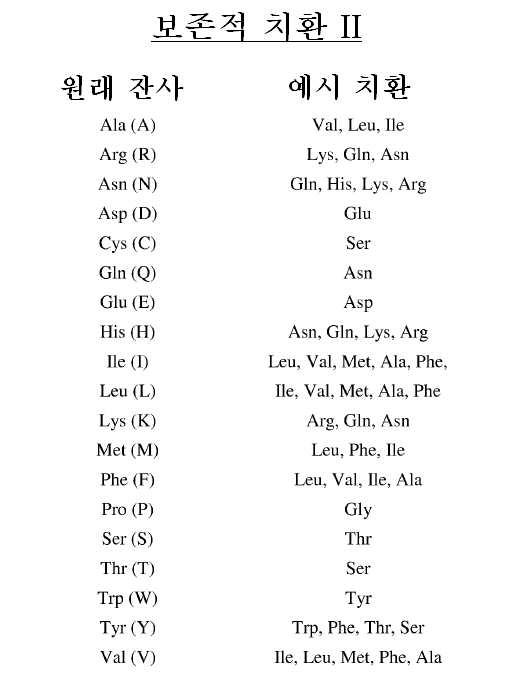
용어 "변이체"는 보통은 분자의 일부가 아닌 추가의 화학 잔기를 포함하도록 개질된 단백질 또는 그의 유사체를 말한다. 그러한 잔기는 분자의 용해도, 흡수도 및 생물학적 반감기를 포함하나, 이들로 제한되지는 않는 다양한 측면에서 개선시킨다. 잔기는 다르게는 분자의 독성을 감소시키고 분자의 임의의 원치않는 부작용 등을 제거하거나 약화시킬 수 있다. 그러한 효과를 매개할 수 있는 잔기는 문헌 [Remington's Pharmaceutical Sciences (1980)]에 개시되어 있다. 그러한 잔기를 분자에 커플링시키는 방법은 당분야에 널리 알려져 있다. 특정 측면에서, 변이체는 글리코실화, PEG화 또는 폴리시알화에 의해 개질된 폴리펩티드이며, 이들로 제한되지는 않는다.The term "variant" refers to a protein or analog thereof modified to include additional chemical moieties that are not usually part of a molecule. Such residues improve in various aspects, including but not limited to solubility, absorption and biological half-life of the molecule. Residues may alternatively reduce the toxicity of the molecule and eliminate or attenuate any unwanted side effects of the molecule, and the like. Residues that can mediate such effects are disclosed in Remington's Pharmaceutical Sciences (1980). Methods of coupling such moieties to molecules are well known in the art. In certain aspects, the variant is, but is not limited to, a polypeptide modified by glycosylation, PEGylation or polysialation.
단백질 또는 폴리펩티드에 사용되는 용어 "자연 발생"은 자연계에서 발견되는 단백질을 말한다. 예를 들면, 자연계에 존재하는 공급원으로부터 단리된 유기체 (바이러스 포함)에 존재하고 실험실에서 인간에 의해 의도적으로 개질되지 않은 폴리펩티드 또는 폴리뉴클레오티드 서열은 자연 발생적이다. 용어 "자연 발생" 및 "야생형"은 교체 사용이 가능하다.The term "naturally occurring" as used in a protein or polypeptide refers to a protein found in nature. For example, polypeptides or polynucleotide sequences that are present in organisms (including viruses) isolated from sources that exist in nature and that are not intentionally modified by humans in the laboratory are naturally occurring. The terms "naturally occurring" and "wild type" are interchangeable.
단백질 또는 폴리펩티드에 사용되는 용어 "혈장 유도된"은 대상체의 혈장 또는 혈청에서 발견되는 자연 발생 폴리펩티드 또는 그의 단편을 말한다.The term "plasma derived" as used in a protein or polypeptide refers to a naturally occurring polypeptide or fragment thereof found in the plasma or serum of a subject.
용어 "수용성 중합체"는 수용액에서 실질적으로 가용성이거나 현탁액의 형태로 존재하고 제약학적 유효량으로 상기 중합체에 콘주게이션된 단백질의 투여시에 포유동물에 실질적으로 부정적 영향을 주지 않으며 생체적합성으로 간주될 수 있는 중합체 분자를 말한다. 한 실시양태에서, 생리학적으로 허용되는 분자는 약 2 내지 약 300개의 반복 단위를 포함한다. 수용성 중합체의 예는 폴리(알킬렌 글리콜), 예컨대 폴리에틸렌 글리콜 (PEG), 폴리(프로필렌 글리콜) ("PPG"), 에틸렌 글리콜과 프로필렌 글리콜의 공중합체 등, 폴리(옥시에틸화 폴리올), 폴리(올레핀 알콜), 폴리(비닐피롤리돈), 폴리(히드록시알킬메타크릴아미드), 폴리(히드록시알킬메타크릴레이트), 폴리(사카라이드), 폴리(α-히드록시산), 폴리(비닐 알콜), 폴리포스파스파젠, 폴리옥사졸린, 폴리(N-아크릴로일모르폴린), 폴리(알킬렌 옥시드) 중합체, 폴리(말레산), 폴리(DL-알라닌), 폴리사카라이드, 예컨대 카르복시메틸셀룰로스, 덱스트란, 전분 또는 전분 유도체, 히알루론산 및 키틴, 폴리(메트)아크릴레이트, 및 상기의 조합물을 포함하나, 이들로 제한되지는 않는다.The term “water soluble polymer” is substantially soluble in aqueous solution or present in the form of a suspension and upon administration of a protein conjugated to the polymer in a pharmaceutically effective amount, does not have a substantially negative effect on the mammal and can be considered biocompatible. Refers to a polymer molecule. In one embodiment, the physiologically acceptable molecule comprises about 2 to about 300 repeat units. Examples of water soluble polymers include poly (alkylene glycols) such as polyethylene glycol (PEG), poly (propylene glycol) (“PPG”), copolymers of ethylene glycol and propylene glycol, such as poly (oxyethylated polyols), poly ( Olefin alcohol), poly (vinylpyrrolidone), poly (hydroxyalkylmethacrylate), poly (hydroxyalkylmethacrylate), poly (saccharide), poly (α-hydroxy acid), poly (vinyl Alcohols), polyphosphazenes, polyoxazolines, poly (N-acryloylmorpholine), poly (alkylene oxide) polymers, poly (maleic acid), poly (DL-alanine), polysaccharides such as Carboxymethylcellulose, dextran, starch or starch derivatives, hyaluronic acid and chitin, poly (meth) acrylates, and combinations thereof, including, but not limited to.
수용성 중합체 분자는 특정 구조로 제한되지 않으며, 특정 측면에서 분지형 또는 멀티암형(multi-armed), 수지상이거나, 분해가능한, 유리가능한 또는 가수분해가능한 링커를 갖는다. 또한 또다른 측면에서, 중합체 분자의 내부 구조는 여러 상이한 패턴으로 조직화되고 단독중합체, 교호 공중합체, 랜덤 공중합체, 블록 공중합체, 교호 삼원공중합체, 랜덤 삼원공중합체 및 블록 삼원공중합체로 이루어진 군으로부터 선택되나, 이들로 제한되지는 않는다.The water soluble polymer molecule is not limited to a specific structure, and in certain aspects has a branched or multi-armed, dendritic, degradable, free or hydrolyzable linker. In yet another aspect, the internal structure of a polymer molecule is organized in a number of different patterns and consists of a homopolymer, an alternating copolymer, a random copolymer, a block copolymer, an alternating terpolymer, a random terpolymer and a block terpolymer Are selected from, but are not limited to these.
용어 "PEG화된"이란 하나 이상의 PEG 잔기에 결합된 단백질, 단백질 복합체 또는 폴리펩티드를 말한다. 본원에서 사용된 용어 "PEG화"는 하나 이상의 PEG를 단백질에 결합시키는 방법을 말한다. 한 실시양태에서, 상기 PEG의 분자량은 2 내지 200 kDa, 5 내지 120 kDa, 10 내지 100 kDa, 20 내지 50 kDa, 10 내지 25 kDa, 5 kDa 내지 10 kDa, 또는 2 kDa 내지 5 kDa 범위이다.The term "PEGylated" refers to a protein, protein complex or polypeptide bound to one or more PEG residues. As used herein, the term “PEGylation” refers to a method of binding one or more PEGs to a protein. In one embodiment, the molecular weight of PEG ranges from 2 to 200 kDa, 5 to 120 kDa, 10 to 100 kDa, 20 to 50 kDa, 10 to 25 kDa, 5 kDa to 10 kDa, or 2 kDa to 5 kDa.
용어 "폴리시알화된"이란 하나 이상의 폴리시알산 (PSA) 잔기에 결합된 단백질, 단백질 복합체 또는 폴리펩티드를 말한다. 본원에서 사용된 용어 "폴리시알화"는 하나 이상의 PSA 잔기를 단백질에 결합시키는 방법을 말한다. 한 실시양태에서, 상기 PSA의 분자량은 2 내지 80 kDa, 5 내지 60 kDa, 10 내지 40 kDa, 또는 15 내지 25 kDa 범위이다.The term "polysialized" refers to a protein, protein complex or polypeptide bound to one or more polysialic acid (PSA) residues. As used herein, the term "polysialation" refers to a method of binding one or more PSA residues to a protein. In one embodiment, the molecular weight of the PSA ranges from 2 to 80 kDa, 5 to 60 kDa, 10 to 40 kDa, or 15 to 25 kDa.
용어 "링커"는 수용성 중합체를 생물학적 활성 분자에 연결하는 분자 단편을 말한다. 단편은 통상적으로 커플링 또는 활성화되어 또다른 링커와 반응하거나 또는 생물학적 활성 친핵체와 직접 반응할 수 있는 2개의 관능기를 갖는다. 예를 들면, 리신과 같은 ω-아미노알칸산이 통상 사용된다. 본 발명에서, 링커는 안정한, 유리가능한, 분해가능한, 또한 가수분해가능한 링커를 포함한다.The term "linker" refers to a molecular fragment that connects a water soluble polymer to a biologically active molecule. Fragments typically have two functional groups that can be coupled or activated to react with another linker or directly with a biologically active nucleophile. For example, ω-aminoalkanoic acid such as lysine is usually used. In the present invention, the linker includes a stable, free, degradable, and also hydrolyzable linker.
용어 "제약 조성물"은 인간 및 포유동물을 포함하는, 대상체 동물에 제약학적으로 사용하기에 적합한 조성물을 말한다. 제약 조성물은 약리학적 유효량의 중합체-폴리펩티드 콘주게이트를 포함하며, 또한 제약상 허용되는 담체를 포함한다. 제약 조성물은 활성 성분(들), 및 제약상 허용되는 담체를 구성하는 비활성 성분(들) 뿐만 아니라, 직접적으로 또는 간접적으로 임의의 2종 이상의 성분의 조합, 복합체 형성 또는 응집으로부터 초래되는 임의의 생성물을 포함하는 조성물을 포괄한다. 따라서, 본 발명의 제약 조성물은 본 발명의 화합물 또는 콘주게이트 및 제약상 허용되는 담체를 혼합함으로써 제조된 임의의 조성물을 포괄한다.The term “pharmaceutical composition” refers to a composition suitable for pharmaceutical use in a subject animal, including humans and mammals. The pharmaceutical composition comprises a pharmacologically effective amount of the polymer-polypeptide conjugate and also includes a pharmaceutically acceptable carrier. A pharmaceutical composition is any product resulting from the combination, complex formation or aggregation of any two or more components, directly or indirectly, as well as the active ingredient (s) and inert ingredient (s) constituting a pharmaceutically acceptable carrier. It encompasses a composition comprising a. Accordingly, the pharmaceutical composition of the present invention encompasses any composition prepared by mixing the compound or conjugate of the present invention with a pharmaceutically acceptable carrier.
용어 "제약상 허용되는 담체"는 임의의 및 모든 임상학적으로 유용한 용매, 분산 매체, 코팅물, 항박테리아성 및 항진균성 제제, 등장성 및 흡수 지연 제제, 완충제, 및 부형제, 예컨대 포스페이트 완충 식염수, 5% 덱스트로스 수용액, 및 에멀젼, 예컨대 오일/물 또는 물/오일 에멀젼, 및 다양한 유형의 습윤제 및/또는 보조제를 포함한다. 적합한 제약학적 담체 및 제형은 문헌 [Remington's Pharmaceutical Sciences, 19th Ed. (Mack Publishing Co., Easton, 1995)]에 개시되어 있다. 조성물에 유용한 제약학적 담체는 활성제의 의도하는 투여 방식에 좌우된다. 통상적인 투여 방식은 장내 (예를 들면, 경구) 또는 비경구 투여 (예를 들면, 피하, 근육내, 정맥내 또는 복강내 주사; 또는 국소, 경피 또는 경점막 투여)를 포함하나, 이들로 제한되지 않는다. "제약상 허용되는 염"은 예를 들어 금속염 (나트륨, 칼륨, 마그네슘, 칼슘 등) 및 암모니아 또는 유기 아민의 염을 포함하는, 제약학적 용도를 위한 화합물 또는 콘주게이트로 제형화가능한 염이다.The term “pharmaceutically acceptable carrier” refers to any and all clinically useful solvents, dispersion media, coatings, antibacterial and antifungal agents, isotonic and delayed absorption agents, buffers, and excipients such as phosphate buffered saline, 5% dextrose aqueous solution, and emulsions such as oil / water or water / oil emulsions, and various types of wetting agents and / or auxiliaries. Suitable pharmaceutical carriers and formulations are described in Remington's Pharmaceutical Sciences, 19th Ed. (Mack Publishing Co., Easton, 1995). Pharmaceutical carriers useful in the composition depend on the intended mode of administration of the active agent. Conventional modes of administration include, but are not limited to, enteral (eg, oral) or parenteral administration (eg, subcutaneous, intramuscular, intravenous or intraperitoneal injection; or topical, transdermal or transmucosal administration). It doesn't work. “Pharmaceutically acceptable salts” are salts formulatable with compounds or conjugates for pharmaceutical use, including, for example, metal salts (sodium, potassium, magnesium, calcium, etc.) and salts of ammonia or organic amines.
용어 "제약상 허용되는" 또는 "약리학적으로 허용되는"은 생물학적으로 또는 다르게는 바람직하지 않은 것이 아닌 물질을 의미한다. 즉, 상기 물질은 임의의 바람직하지 않은 생물학적 영향을 유발하거나 또는 물질이 함유된 조성물의 임의 성분과 유해한 방식으로 상호작용하지 않으면서 하기 기재된 바와 같이, 당분야에 널리 알려진 경로를 사용하여 개체에 투여가능하다.The term "pharmaceutically acceptable" or "pharmacologically acceptable" means a material that is not biologically or otherwise undesirable. That is, the substance is administered to the subject using routes well known in the art, as described below, without causing any undesirable biological effects or interacting in any deleterious manner with any component of the composition containing the substance. It is possible.
용어 "혈액 응고 장애" 또는 "출혈 장애"는 대상체에서 혈액이 효율적으로 혈괴를 형성할 수 없게 하고, 그에 따라 비정상적인 출혈을 유도하는 혈액 응고 인자의 임의의 다수의 유전적 또는 후천적 결핍증을 말한다. 혈액 응고 장애는 A형 혈우병, B형 혈우병, 폰 빌레브란트 증후군, X 인자 결핍증, VII 인자 결핍증, 알렉산더병, 로젠탈 증후군 (C형 혈우병) 및 XIII 인자 결핍증을 포함하나, 이들로 제한되지는 않는다. 혈액 응고 장애의 치료는 예방적 처치 또는 치료적 처치를 말한다.The term “blood coagulation disorder” or “bleeding disorder” refers to any of a number of genetic or acquired deficiencies of blood coagulation factors that prevent blood from forming efficiently in a subject and thus induce abnormal bleeding. Blood clotting disorders include, but are not limited to, hemophilia A, hemophilia B, von Willebrand syndrome, factor X deficiency, factor VII deficiency, Alexander disease, Rosental syndrome (type C hemophilia) and factor XIII deficiency. Treatment of a blood coagulation disorder refers to prophylactic or therapeutic treatment.
"치료"는 예방적 처치 또는 치료적 처치를 말한다. "예방적" 처치는 질환의 징후를 나타내지 않거나 또는 단지 초기 징후를 나타내는 대상체에 병리학적 이상이 발생할 위험성을 감소시키기 위해 실시되는 치료이다. 본 발명의 화합물 또는 콘주게이트는 병리학적 이상이 발생할 가능성을 낮추거나 또는, 발생하였다면, 병리학적 이상의 중증도를 최소화하기 위한 예방적 처치로서 제공될 수 있다. "치료적" 처치는 병리학적 이상의 징후 또는 증상을 나타내는 대상체에 징후 또는 증상을 감소 또는 제거하기 위해 실시되는 치료이다. 징후 또는 증상은 생화학적, 세포학적, 조직학적, 기능적, 주관적 또는 객관적일 수 있다. 본 발명의 조성물은 치료적 처치로서 또는 진단을 위해 제공될 수 있다. "Treatment" refers to prophylactic or therapeutic treatment. A “prophylactic” treatment is a treatment carried out to reduce the risk of developing pathological abnormalities in a subject that does not show signs of disease or only shows early signs. The compounds or conjugates of the present invention can be provided as a prophylactic treatment to reduce the likelihood of developing pathological abnormalities or, if they occur, to minimize the severity of pathological abnormalities. A "therapeutic" treatment is a treatment carried out to reduce or eliminate signs or symptoms in a subject who exhibits signs or symptoms of pathological abnormality. The signs or symptoms can be biochemical, cytological, histological, functional, subjective or objective. The composition of the present invention may be provided as a therapeutic treatment or for diagnosis.
본원에서 사용된 용어 "대상체"는 포유동물 및 비포유동물을 포괄한다. 포유동물의 예는 포유강의 임의의 구성원: 인간, 비인간 영장류, 예컨대 침팬지, 및 기타 유인원 및 원숭이 종; 농장 동물, 예컨대 소, 말, 양, 염소, 돼지; 가축, 예컨대 토끼, 개 및 고양이; 설치류, 예컨대 래트, 마우스 및 기니 피그를 포함하는 실험 동물 등을 포함하나, 이들로 제한되지는 않는다. 비포유동물의 예는 조류, 어류 등을 포함하나, 이들로 제한되지는 않는다. 상기 용어는 특정 연령 또는 성을 의미하지 않는다.As used herein, the term "subject" encompasses mammals and non-mammals. Examples of mammals include any member of the mammalian river: humans, nonhuman primates such as chimpanzees, and other apes and monkey species; Farm animals such as cattle, horses, sheep, goats, pigs; Domestic animals such as rabbits, dogs, and cats; Rodents, such as, but not limited to, experimental animals including rats, mice, and guinea pigs. Examples of non-mammals include, but are not limited to birds, fish, and the like. The term does not mean a particular age or gender.
용어 "유효량"은 대상체의 건강 상태, 병리학적 이상 및 질환에 대하여 목적하는 결과를 초래하거나 또는 진단 목적에 충분한 투여량을 의미한다. 목적하는 결과는 투여량의 수용체에서의 주관적인 또는 객관적인 개선을 포함할 수 있다. "치료 유효량"은 건강에 의도했던 유익한 효과를 초래하는 효과적인 제제의 양을 말한다. 임의의 각각의 사례에서 적절한 "유효량"은 일상적인 실험을 사용하여 당업자에 의해 결정될 수 있다.The term "effective amount" means a dosage that results in a desired result or is sufficient for diagnostic purposes for a subject's health condition, pathological abnormality and disease. Desired results may include subjective or objective improvements in the dose of the receptor. A "therapeutically effective amount" refers to an amount of an effective agent that results in a beneficial effect intended for health. The appropriate "effective amount" in any of the cases can be determined by one skilled in the art using routine experimentation.
단백질 및 단백질 복합체Proteins and Protein Complexes
제약 조성물에의 사용을 위해 고려되는 단백질은 대상체에 투여하는 데에 유용한 생리학적 활성 혈액 응고 인자를 포함한다. 혈액 응고 인자는 단백질 또는 상기 단백질의 일부, 또는 실질적으로 모든, 또는 모든 치료학적 또는 생물학적 활성을 여전히 유지하는 그의 임의의 단편, 유사체 또는 변이체이다. 몇몇 실시양태에서, 혈액 응고 인자는 발현 또는 생산되지 않거나, 또는 발현 또는 생산이 실질적으로 감소한다면 질환을 초래하게 될 것들이다. 한 측면에서, 혈액 응고 인자는 포유동물로부터 유도되거나 또는 그로부터 수득된다.Proteins contemplated for use in pharmaceutical compositions include physiologically active blood clotting factors useful for administration to a subject. A blood coagulation factor is a protein or any fragment, analog or variant thereof that still retains some, or substantially all, or all therapeutic or biological activity of the protein. In some embodiments, the blood coagulation factors are those that are not expressed or produced or that will result in disease if the expression or production is substantially reduced. In one aspect, the blood coagulation factor is derived from or obtained from a mammal.
본 발명의 다양한 실시양태에서, 수용성 중합체에 콘주게이션된 혈액 응고 인자는 혈액 응고 인자 또는 상기 단백질의 생물학적 활성을 갖는 그의 단편이며, 인간 또는 포유류 단백질의 상응하는 부분에 대한 아미노산 서열과 동일한 아미노산 서열을 갖는다. 다른 실시양태에서, 콘주게이트의 혈액 응고 인자는 인간 또는 포유동물 종의 천연의 단백질이다. 다른 실시양태에서, 혈액 응고 인자 또는 그의 단편은 상응하는 인간 또는 포유동물 단백질의 천연 서열과 실질적으로 상동성이다 (즉, 활성제의 적어도 10개, 25개, 50개, 100개, 150개 또는 200개 아미노산 길이, 또는 전장에 걸쳐서 아미노산 서열이 적어도 80%, 85%, 90%, 95%, 보다 바람직하게는 98%, 가장 바람직하게는 99% 동일함).In various embodiments of the invention, the blood coagulation factor conjugated to the water soluble polymer is a blood coagulation factor or a fragment thereof having the biological activity of the protein, and has an amino acid sequence identical to the amino acid sequence for the corresponding portion of a human or mammalian protein. Have In other embodiments, the blood coagulation factor of the conjugate is a natural protein of human or mammalian species. In other embodiments, the blood coagulation factor or fragment thereof is substantially homologous to the natural sequence of the corresponding human or mammalian protein (ie, at least 10, 25, 50, 100, 150 or 200 of the active agent). Amino acid sequence at least 80%, 85%, 90%, 95%, more preferably 98%, most preferably 99% identical throughout the dog amino acid length, or the full length).
단백질의 생산 방법Protein production method
재조합 단백질의 생산 방법은 당분야에 널리 알려져 있다. 재조합 단백질을 코딩하는 DNA 또는 RNA를 발현하는, 포유류 세포를 포함하는 세포의 생산 방법은 미국 특허 제6,048,729호, 미국 특허 제5,994,129호 및 미국 특허 제6,063,630호에 개시되어 있다. 상기 출원 각각의 교시내용은 그 전문이 본원에 참조로 인용됨을 분명히 나타낸다.Methods of producing recombinant proteins are well known in the art. Methods for producing cells, including mammalian cells, expressing DNA or RNA encoding recombinant proteins are disclosed in US Pat. No. 6,048,729, US Pat. No. 5,994,129, and US Pat. No. 6,063,630. The teachings of each of these applications clearly indicate that the entirety is incorporated herein by reference.
폴리펩티드 또는 그의 단편, 변이체 또는 유사체를 발현시키는 데에 사용되는 핵산 구조물은, 한 측면에서, 형질감염된 포유류 세포에서 염색체외 (에피솜) 발현되는 것 또는 상동 재조합을 통해 예정된 표적화된 부위에서 또는 무작위로 수용체 세포의 게놈으로 통합되는 것이다. 염색체외 발현되는 구조물은 폴리펩티드 코딩 서열 이외에도 세포에서의 단백질의 발현에, 또한 임의로는 구조물의 복제에 충분한 서열을 포함한다. 상기 구조물은 프로모터, 폴리펩티드 코딩 DNA 서열 및/또는 폴리아데닐화 부위를 임의로 포함한다. 단백질을 코딩하는 DNA는 그의 발현이 프로모터의 조절하에 있도록 하는 방식으로 구조물에 위치한다. 임의로, 구조물은 스플라이스 부위, 인핸서 서열, 적절한 프로모터의 조절하의 선별가능한 마커 유전자, 및 적절한 프로모터의 조절하의 증폭가능한 마커 유전자 중 하나 이상과 같은 추가 성분을 함유한다.Nucleic acid constructs used to express polypeptides or fragments, variants or analogs thereof may, in one aspect, be extrachromosomal (episomal) expressed in transfected mammalian cells or randomly at predetermined targeted sites through homologous recombination. It is integrated into the genome of the receptor cell. The extrachromosomal expressed construct includes, in addition to the polypeptide coding sequence, a sequence sufficient for expression of the protein in the cell and optionally for replication of the construct. The construct optionally includes a promoter, a polypeptide coding DNA sequence and / or a polyadenylation site. The DNA encoding the protein is located in the construct in such a way that its expression is under the control of the promoter. Optionally, the construct contains additional components such as one or more of a splice site, an enhancer sequence, a selectable marker gene under the control of an appropriate promoter, and an amplifiable marker gene under the control of an appropriate promoter.
DNA 구조물이 세포의 게놈으로 통합되는 실시양태에서, 한 측면에서, 상기 구조물은 단지 폴리펩티드 코딩 핵산 서열만을 포함할 필요가 있다. 임의로, 구조물은 프로모터 및 인핸서 서열, 폴리아데닐화 부위 또는 부위들, 스플라이스 부위 또는 부위들, 선별가능한 마커 또는 마커들을 코딩하는 핵산 서열, 증폭가능한 마커를 코딩하는 핵산 서열 및/또는 게놈에서의 선별된 부위에의 DNA의 통합을 표적화하기 위한 (DNA 또는 DNA 서열 표적화) 수용체 세포에서의 게놈 DNA에 상동성인 DNA를 포함한다.In embodiments in which the DNA constructs are integrated into the genome of the cell, in one aspect, the constructs need only comprise polypeptide encoding nucleic acid sequences. Optionally, the construct comprises a promoter and enhancer sequence, a polyadenylation site or sites, a splice site or sites, a nucleic acid sequence encoding a selectable marker or markers, a nucleic acid sequence encoding an amplifiable marker, and / or a selection in the genome. DNA homologous to genomic DNA in the receptor cell (DNA or DNA sequence targeting) to target the integration of the DNA into the labeled site.
숙주 세포Host cell
재조합 단백질의 생산에 사용되는 숙주 세포는, 제한하지 않고 예를 들면, 박테리아, 효모, 곤충, 비포유류 척추동물 또는 포유류 세포이고, 포유류 세포는 햄스터, 원숭이, 침팬지, 개, 고양이, 소, 돼지, 마우스, 래트, 토끼, 양 및 인간 세포를 포함하나, 이들로 제한되지는 않는다. 숙주 세포는 불멸화 세포 (세포주) 또는 비불멸화 (1차 또는 2차) 세포이고 매우 다양한 세포형, 예컨대 섬유아세포, 케라틴세포, 상피 세포 (예를 들면, 유방 상피 세포, 장 상피 세포), 난소 세포 (예를 들면, 차이니즈 햄스터 난소 또는 CHO 세포), 내피 세포, 교질 세포, 신경 세포, 혈액의 유형 성분 (예를 들면, 림프구, 골수 세포), 근육 세포, 간세포 및 상기 체세포형의 전구체 (이들로 제한되지는 않음) 중 어느 하나이다. 통상 사용되는 숙주 세포는 원핵 세포, 예컨대 그람 음성 또는 그람 양성 박테리아, 즉 임의 계통의 이. 콜라이(E. coli), 바실루스(Bacillus), 스트렙토미세스(Streptomyces), 사카로미세스(Saccharomyces), 살모넬라(Salmonella) 등; 진핵 세포, 예컨대 CHO (차이니즈 햄스터 난소) 세포; 베이비 햄스터 신장 (BHK) 세포; 인간 신장 293 세포; COS-7 세포; 곤충 세포, 예컨대 D. Mel-2, Sf4, Sf5, Sf9 및 Sf21 및 High5; 식물 세포 및 다양한 효모 세포, 예컨대 사카로미세스(Saccharomyces) 및 피키아(Pichia)를 포함하나, 이들로 제한되지는 않는다.Host cells used in the production of recombinant proteins include, but are not limited to, bacteria, yeast, insects, mammalian vertebrate or mammalian cells, and mammalian cells are hamsters, monkeys, chimpanzees, dogs, cats, cows, pigs, Including but not limited to mouse, rat, rabbit, sheep and human cells. Host cells are immortalized cells (cell lines) or non-immortalized (primary or secondary) cells and a wide variety of cell types such as fibroblasts, keratinocytes, epithelial cells (eg breast epithelial cells, intestinal epithelial cells), ovarian cells (E.g., Chinese hamster ovary or CHO cells), endothelial cells, glial cells, neurons, tangible components of blood (e.g. lymphocytes, bone marrow cells), muscle cells, hepatocytes and precursors of these somatic types (But not limited to). Commonly used host cells are prokaryotic cells such as gram negative or gram positive bacteria, i. Coli (E. coli), Bacillus (Bacillus), streptomycin MRS (Streptomyces), saccharose in MRS (Saccharomyces), Salmonella (Salmonella), and the like; Eukaryotic cells such as CHO (Chinese hamster ovary) cells; Baby hamster kidney (BHK) cells; Human kidney 293 cells; COS-7 cells; Insect cells such as D. Mel-2, Sf4, Sf5, Sf9 and Sf21 and High5; Plant cells and various yeast cells such as, but not limited to, Saccharomyces and Pichia .
폴리펩티드 코딩 DNA 또는 RNA를 함유하는 숙주 세포는 세포 성장 및 DNA 또는 RNA 발현에 적절한 조건하에서 배양된다. 폴리펩티드를 발현하는 세포는 알려진 방법, 및 알려진 방법을 사용하여 단리 및 정제된 재조합 단백질을 사용하여, 폴리펩티드 생산을 증폭시키거나 또는 폴리펩티드 생산의 증폭 없이 동정된다. 동정은, 제한하지 않고 예를 들면, 단백질을 코딩하는 DNA 또는 RNA의 존재를 지시하는 표현형을 나타내는 유전자 변형된 포유류 세포의 스크리닝, 예컨대 PCR 스크리닝, 서던 블롯(Southern blot) 분석법에 의한 스크리닝, 또는 단백질의 발현에 대한 스크리닝을 통해 수행된다. 도입된 단백질 코딩 DNA를 갖는 세포의 선별은, 예를 들면, 선별가능한 마커를 DNA 구조물에 포함시키고 선별가능한 마커 유전자를 함유하는, 형질감염 또는 감염된 세포를 선별가능한 마커 유전자를 발현하는 세포만이 생존하는 적절한 조건하에서 배양함으로써 달성된다. 도입된 DNA 구조물의 추가 증폭은 유전자 변형된 세포를 증폭에 적절한 조건하에서 배양함으로써 (예를 들면, 증폭가능한 마커 유전자를 함유하는, 유전자 변형된 세포를 증폭가능한 마커 유전자의 다수의 카피(copy)를 함유하는 세포만이 생존할 수 있는 약물 농도의 존재하에서 배양함으로써) 수행된다.Host cells containing polypeptide encoding DNA or RNA are cultured under conditions appropriate for cell growth and expression of DNA or RNA. Cells expressing polypeptides are identified using known methods and recombinant proteins isolated and purified using known methods, either to amplify polypeptide production or to amplify polypeptide production. Identification can include, but is not limited to, screening of genetically modified mammalian cells exhibiting a phenotype indicating, for example, the presence of DNA or RNA encoding the protein, such as PCR screening, screening by Southern blot assays, or proteins. Screening for the expression of is performed. Selection of cells with introduced protein encoding DNA survives, for example, only cells expressing a marker gene capable of selecting a transfected or infected cell, including the selectable marker in the DNA construct and containing the selectable marker gene. Is achieved by incubating under appropriate conditions. Further amplification of the introduced DNA constructs can be achieved by culturing the genetically modified cells under conditions suitable for amplification (e.g., making multiple copies of the amplified marker gene containing the amplifiable marker gene. By only culturing cells in the presence of drug concentrations that can survive).
생리학적 활성 단백질 또는 치료 단백질인 재조합 단백질은 시토카인, 성장 인자, 혈액 응고 인자, 효소, 케모카인, 가용성 세포 표면 수용체, 세포 부착 분자, 항체, 호르몬, 세포골격 단백질, 기질 단백질, 샤페론 단백질, 구조 단백질, 대사 단백질 및 당업자에게 알려진 다른 치료 단백질을 포함하나, 이들로 제한되지는 않는다.Recombinant proteins that are physiologically active proteins or therapeutic proteins include cytokines, growth factors, blood clotting factors, enzymes, chemokines, soluble cell surface receptors, cell adhesion molecules, antibodies, hormones, cytoskeleton proteins, matrix proteins, chaperone proteins, structural proteins, Metabolic proteins and other therapeutic proteins known to those of skill in the art.
치료제로 사용되는 재조합 혈액 응고 인자의 예는 II 인자, III 인자, V 인자, VII 인자, VIIa 인자, VIII 인자, IX 인자, X 인자, XI 인자, 폰 빌레브란트 인자 및 피브리노겐을 포함하나, 이들로 제한되지는 않는다. 관련 실시양태에서, 단백질 복합체는 1종 이상의 혈액 인자를 포함하는 복합체이다.Examples of recombinant blood coagulation factors used as therapeutic agents include, but are not limited to, Factor II, III, V, VII, VIIa, VIII, IX, X, XI, von Willebrand and Fibrinogen It is not limited. In related embodiments, the protein complex is a complex comprising one or more blood factors.
혈액 인자Blood factor
VIII 인자 (FVIII)는 포유동물의 간에서 생산되는 분자 질량 약 260 kDa의 혈장 당단백질이다 (진뱅크(Genbank) 등록 번호 NP_000123). 상기 인자는 혈액 응고를 유도하는 응고 반응의 캐스케이드의 중요한 성분이다. 상기 캐스케이드에는 IXa 인자가 FVIII과 함께 X 인자 (진뱅크 등록번호 NP_000495)를 활성화된 형태인 Xa 인자로 전환시키는 단계가 있다. FVIII은 상기 단계에서 IXa 인자의 활성을 위해 칼슘 이온 및 인지질과 함께 요구되는 보조인자로서 작용한다. 2가지의 가장 일반적인 혈우병성 장애가 기능적 FVIII (A형 혈우병, 모든 사례의 약 80%) 또는 기능적 IXa 인자 (B형 혈우병 또는 크리스마스 인자(Christmas Factor) 질환)의 결핍에 의해 초래된다. FVIII은 혈장에서 매우 낮은 농도로 순환하고 폰 빌레브란트 인자 (VWF)에 비공유 결합한다. 지혈 동안에, FVIII은 VWF로부터 분리되어 칼슘 및 인지질 또는 세포막의 존재하에 활성화 속도를 향상시킴으로써 활성화된 IX 인자 (FIXa) 매개 X 인자 (FX) 활성화를 위한 보조인자로서 작용한다.Factor VIII (FVIII) is a plasma glycoprotein of about 260 kDa molecular mass produced in the liver of a mammal (Genbank Accession No. NP — 000123). This factor is an important component of the cascade of coagulation reactions that induce blood coagulation. In the cascade, there is a step of converting factor X (GenBank Accession No. NP — 000495) together with FVIII to factor Xa in activated form. FVIII acts as a cofactor required with calcium ions and phospholipids for the activity of Factor IXa in this step. The two most common hemophilia disorders are caused by a deficiency of functional FVIII (type A hemophilia, about 80% of all cases) or functional IXa factor (type B hemophilia or Christmas Factor disease). FVIII circulates at very low concentrations in plasma and non-covalently binds to von Willebrand factor (VWF). During hemostasis, FVIII separates from VWF and acts as a cofactor for activated IX factor (FIXa) mediated X factor (FX) activation by enhancing the rate of activation in the presence of calcium and phospholipids or cell membranes.
FVIII은 도메인 구조 A1-A2-B-A3-C1-C2를 갖는 대략 270 내지 330 kD의 단쇄 전구체로서 합성된다. 혈장으로부터 정제시에, FVIII은 중쇄 (A1-A2-B) 및 경쇄 (A3-C1-C2)로 이루어진다. 경쇄의 분자 질량은 80 kD이고, B 도메인 내에서의 단백질가수분해 때문에 중쇄는 90 내지 220 kD 범위이다.FVIII is synthesized as short chain precursor of approximately 270 to 330 kD with domain structure A1-A2-B-A3-C1-C2. Upon purification from plasma, FVIII consists of heavy chains (A1-A2-B) and light chains (A3-C1-C2). The molecular mass of the light chain is 80 kD and the heavy chain ranges from 90 to 220 kD due to proteolysis in the B domain.
FVIII은 또한 출혈 장애에 치료를 위해 사용되는 재조합 단백질로서 합성된다. 다양한 시험관내 분석법이 치료 의약으로서의 재조합 FVIII (rFVIII)의 잠재적인 효능을 측정하기 위해 고안되었다. 이들 분석법은 내인성 FVIII의 생체내 효능을 모방한다. FVIII의 시험관내 트롬빈 처리는 시험관내 분석법에 의해 측정하였을 때, 전구응고인자 활성의 급속한 증가 및 후속 감소를 초래한다. 이러한 활성화 및 불활성화는 중쇄 및 경쇄에서의 특별한 제한된 단백질가수분해와 동시에 일어나며, 이는 FVIII에서의 상이한 결합 에피토프의 이용가능성을 변화시키는데, 예를 들면 FVIII이 VWF로부터 해리되어 인지질 표면에 결합하도록 하거나 또는 특정한 단일클론 항체에의 결합 능력을 변화시킨다. FVIII is also synthesized as a recombinant protein used for the treatment of bleeding disorders. Various in vitro assays have been designed to determine the potential efficacy of recombinant FVIII (rFVIII) as a therapeutic drug. These assays mimic the in vivo efficacy of endogenous FVIII. In vitro thrombin treatment of FVIII results in a rapid increase and subsequent decrease in procoagulant activity as measured by in vitro assays. This activation and inactivation coincides with particular limited proteolysis in the heavy and light chains, which changes the availability of different binding epitopes in FVIII, for example, allowing FVIII to dissociate from VWF and bind to the phospholipid surface or Alter the ability to bind to specific monoclonal antibodies.
최근까지, A형 혈우병의 표준 치료법은 인간 공여자의 혈장으로부터 유도된 FVIII 농축물 제제의 빈번한 주입을 포함하였다. 상기 대체 요법은 대체적으로 효과적이지만, 상기 치료법은 환자가 간염 및 AIDS와 같은 바이러스 전염성 질환에 걸릴 위험에 처하게 한다. 그러한 위험성은 단일클론 항체를 사용하는 면역정제로 혈장으로부터의 FVIII을 추가 정제함으로써, 또한 유기 용매 또는 열 처리로 바이러스를 불활성화시킴으로써 감소되었지만, 상기 제제는 치료 비용을 현저히 상승시키고 위험성이 없는 것도 아니다. 그러한 이유로, 환자는 예방용보다는 일화적으로 치료받았다. 또다른 합병증은 환자의 약 15%에서 혈장 유도된 FVIII에 대한 억제성 항체가 발달한다는 것이다. FVIII 수준이 1% 미만인, 중증 A형 혈우병 환자는 일반적으로 투여 간격 사이에 FVIII을 1%보다 높게 유지하기 위한 예방적 요법을 실시한다. 순환계에서의 다양한 FVIII 산물의 평균 반감기를 고려하여, 이는 통상적으로 1주일에 2회 내지 3회 FVIII을 제공함으로써 달성될 수 있다.Until recently, standard therapies for hemophilia A included frequent infusions of FVIII concentrate formulations derived from the plasma of human donors. The replacement therapy is generally effective, but the therapy puts the patient at risk for viral infectious diseases such as hepatitis and AIDS. Such risks have been reduced by further purification of FVIII from plasma with immunopurification using monoclonal antibodies, as well as by inactivating the virus with organic solvents or heat treatments, but the formulation significantly increases the cost of treatment and is not without risk. . For that reason, the patient was treated anecdotally rather than prophylactically. Another complication is the development of inhibitory antibodies to plasma induced FVIII in about 15% of patients. Severe hemophilia patients with FVIII levels of less than 1% generally undergo prophylactic therapy to maintain FVIII higher than 1% between dose intervals. Given the average half-life of the various FVIII products in the circulation, this can typically be achieved by providing FVIII two to three times a week.
A형 혈우병 치료에 있어서 중요한 진일보는 인간 FVIII의 완전한 2,351개 아미노산 서열을 코딩하는 cDNA 클론의 단리 (문헌 [Wood et al, Nature, 312:330 (1984)] 및 미국 특허 제4,757,006호 참조), 및 인간 FVIII 유전자 DNA 서열 및 그의 생산을 위한 재조합 방법의 제공이다. 혈우병의 치료를 위한 FVIII 산물은 ADVATE® (항혈우병 인자 (재조합체), 혈장/알부민 무함유 방법, rAHF-PFM), 재조합 항혈우병 인자 (BIOCLATE™, GENARC®, HELIXATE FS®, KOATE®, KOGENATE FS®, RECOMBINATE®), MONOCLATE-P® (VIII 인자:C의 정제 제제), 항혈우병 인자/폰 빌레브란트 인자 복합체 (인간) HUMATE-P® 및 ALPHANATE® (항혈우병 인자/폰 빌레브란트 인자 복합체 (인간)), 및 HYATE C® (정제된 돼지 VIII 인자)를 포함하나, 이들로 제한되지는 않는다. ADVATE®은 CHO 세포에서 생산되고 백스터 헬쓰케어 코포레이션(Baxter Healthcare Corporation)에 의해 제조된다. 인간 또는 동물 혈장 단백질 또는 알부민이 세포 배양 공정, 정제 또는 ADVATE®의 최종 제형화에서 첨가되지 않는다.An important step forward in the treatment of hemophilia A is the isolation of cDNA clones encoding the complete 2,351 amino acid sequence of human FVIII (see Wood et al, Nature, 312: 330 (1984) and US Pat. No. 4,757,006), and Provided are human FVIII gene DNA sequences and recombinant methods for their production. FVIII products for the treatment of hemophilia include ADVATE® (anti-hemophilic factor (recombinant), plasma / albumin free method, rAHF-PFM), recombinant anti-hemophilic factor (BIOCLATE ™, GENARC®, HELIXATE FS®, KOATE®, KOGENATE FS®, RECOMBINATE®), MONOCLATE-P® (purified formulation of Factor VIII: C), anti-hemopathy factor / von Willebrand factor complex (human) HUMATE-P® and ALPHANATE® (anti-hemopathy factor / von Willebrand factor complex (Human)), and HYATE C® (purified porcine VIII factor), but are not limited to these. ADVATE® is produced in CHO cells and manufactured by Baxter Healthcare Corporation. No human or animal plasma protein or albumin is added in the cell culture process, purification or final formulation of ADVATE®.
폰 빌레브란트 인자는 분자량 1 x 10⁶ 내지 20 x 106 달톤의 일련의 다합체 형태로 혈장에 존재한다. VWF (진뱅크 등록 번호 NP_000543)는 포유동물의 내피 세포에서 주로 형성된 후에 순환계로 분비되는 당단백질이다. 이와 관련하여, 대략 220 kD의 분자량을 갖는 폴리펩티드 사슬로부터 출발하여, 550 kD의 분자량을 갖는 VWF 이합체가 다수의 황 결합의 형성에 의해 세포에서 생산된다. 2천만 달톤까지 분자량이 증가된 VWF의 추가 중합체는 VWF 이합체의 연결에 의해 형성된다. 특히 고분자 VWF 다합체는 혈액 응고에 있어서 본질적인 중요성을 갖는 것으로 생각된다. Von Willebrand factor is present in the plasma in the form of a series of multimers having a molecular weight of 1 × 10 6 to 20 × 10 6 Daltons. VWF (Genbank Accession No. NP — 000543) is a glycoprotein that is secreted into the circulatory system after being formed primarily in mammalian endothelial cells. In this regard, starting from a polypeptide chain having a molecular weight of approximately 220 kD, VWF dimers having a molecular weight of 550 kD are produced in cells by the formation of a number of sulfur bonds. Additional polymers of VWF having an increased molecular weight of up to 20 million Daltons are formed by the linkage of VWF dimers. In particular, the polymeric VWF multimers are believed to have intrinsic importance in blood coagulation.
VWF 증후군은 VWF가 저생산 또는 과생산될 때 임상학적으로 발현된다. VWF의 과생산은 증가된 혈전증 (혈류를 방해하는, 혈관 내부에서의 혈괴 또는 혈전의 형성)을 초래하고, 반면 VWF의 고분자 형태의 감소된 수준 또는 결여는 혈소판 응집 및 상처 봉합의 억제로 인해 출혈 시간의 연장 및 증가된 출혈을 초래한다.VWF syndrome is clinically expressed when VWF is underproduced or overproduced. Overproduction of VWF results in increased thrombosis (the formation of blood clots or thrombus inside the blood vessel, which interferes with blood flow), while reduced levels or lack of polymer form of VWF causes bleeding due to inhibition of platelet aggregation and wound closure Resulting in prolonged time and increased bleeding.
VWF 결핍은 또한 VWF가 기능적 VIII 인자의 필수 성분이기 때문에 표현형 A형 혈우병을 초래할 수 있다. 이러한 경우에, VIII 인자의 반감기는 혈액 응고 캐스케이드에서의 그의 기능이 저해될 정도로 감소된다. 폰 빌레브란트 질환 (VWD) 또는 VWF 증후군을 앓고 있는 환자는 흔히 VIII 인자 결핍을 나타낸다. 이들 환자의 경우에, 감소된 VIII 인자 활성은 X 염색체 유전자의 결함 때문이 아니라, 혈장내 VWF의 정량적 및 정성적 변화의 간접적인 결과이다. A형 혈우병과 VWD는 보통 VWF 항원을 측정함으로써 또는 리스토세틴 보조인자 활성을 측정함으로써 구분할 수 있다. VWF 항원 함량 및 리스토세틴 보조인자 활성은 둘다 대부분의 VWD 환자에서 감소하고, 반면 A형 혈우병 환자에서는 보통 수준이다. VWF 증후군의 치료를 위한 VWF 산물은 HUMATE-P, IMMUNATE®, INNOBRAND® 및 8Y®을 포함하나, 이들로 제한되지는 않으며, 이들은 혈장으로부터의 FVIII/VWF 농축물을 포함하는 치료제이다.VWF deficiency can also lead to phenotype A hemophilia because VWF is an essential component of functional VIII factor. In this case, the half-life of Factor VIII is reduced to such an extent that its function in the blood coagulation cascade is inhibited. Patients suffering from von Willebrand disease (VWD) or VWF syndrome often exhibit a factor VIII deficiency. In these patients, the reduced VIII factor activity is not due to a defect in the X chromosome gene, but indirectly as a result of quantitative and qualitative changes in VWF in plasma. Hemophilia A and VWD can usually be distinguished by measuring VWF antigen or by measuring ristocetin cofactor activity. Both VWF antigen content and ristocetin cofactor activity are reduced in most VWD patients, while they are moderate in hemophilia A patients. VWF products for the treatment of VWF syndrome include, but are not limited to, HUMATE-P, IMMUNATE®, INNOBRAND® and 8Y®, which are therapeutic agents that include FVIII / VWF concentrates from plasma.
세린 프로테아제 효소인 VII 인자 (프로콘버틴(proconvertin))는 혈액 응고 캐스케이드에서의 핵심 단백질 중 하나이다 (진뱅크 등록 번호 NP_000122). VII 인자 (FVII)의 주요 역할은 조직 인자 (TF)와 함께 응고 과정을 개시하는 것이다. 혈관이 손상되었을 때, TF는 혈액 및 순환하는 VII 인자에 노출된다. TF에 결합되면, FVII은 상이한 프로테아제, 특히 트롬빈 (IIa 인자), 활성화된 X 인자 및 FVIIa-TF 복합체 자체에 의해 FVIIa로 활성화된다. 재조합 인간 VIIa 인자 (NOVOSEVEN®)는 대체 응고 인자에 대한 억제제가 발달한 혈우병 환자의 제어불가능한 출혈에 사용하기 위해 도입되었다.Serine protease enzyme, Factor VII (proconvertin), is one of the key proteins in the blood coagulation cascade (Genbank Accession No. NP — 000122). The main role of factor VII (FVII) is to initiate the coagulation process with tissue factor (TF). When blood vessels are damaged, TF is exposed to blood and circulating Factor VII. Upon binding to TF, FVII is activated to FVIIa by different proteases, in particular thrombin (factor IIa), activated X factor and the FVIIa-TF complex itself. Recombinant human VIIa factor (NOVOSEVEN®) has been introduced for use in uncontrollable bleeding in hemophilia patients with inhibitors for alternative coagulation factors.
IX 인자 (FIX, 크리스마스 인자) (진뱅크 등록 번호 NP_000124)는 XIa 인자 또는 VIIa 인자 (조직 인자 경로)에 의해 활성화되지 않는 한, 불활성 상태인 세린 프로테아제이다. IXa 인자로 활성화되면, 이는 X 인자의 아르기닌-이소류신 결합을 가수분해하여 Xa 인자를 형성하는 작용을 한다. VIII 인자는 FIX 프로테아제 활성을 위해 요구되는 보조인자이다 (문헌 [Lowe GD, Br. J. Haematol. 115: 507-13, 2002]). IX 인자의 결핍은 B형 혈우병 또는 크리스마스 질환을 초래한다.Factor IX (FIX, Christmas Factor) (Genbank Accession No. NP — 000124) is an inactive serine protease unless activated by Factor XIa or Factor VIIa (tissue factor pathway). When activated with factor IXa, it acts to hydrolyze the arginine-isoleucine bond of factor X to form factor Xa. Factor VIII is a cofactor required for FIX protease activity (Lowe GD, Br. J. Haematol. 115: 507-13, 2002). Deficiency of factor IX results in hemophilia B or Christmas disease.
또다른 혈액 인자에는, 그의 결핍이 혈전증 및 이상프로트롬빈혈증을 초래하는 II 인자 (트롬빈) (진뱅크 등록 번호 NP_000497); 그의 결핍이 출혈성 소질 또는 임의 유형의 혈전성향증 (활성화된 단백질 C 내성으로도 알려짐)을 초래하는 V 인자 (진뱅크 등록 번호 NP_000121); 그의 결핍이 로젠탈 증후군 (C형 혈우병)을 초래하는 XI 인자 (진뱅크 등록 번호 NP_000119); 그의 결핍이 제I형 결핍증 (A 및 B 서브유닛 둘다의 결핍) 및 제II형 결핍증 (A 서브유닛 단독의 결핍) (두 가지 모두 평생 동안의 출혈 성향, 불완전한 상처 치유 및 습관성 유산을 초래할 수 있음)으로서 특성화되는 XIII 인자 서브유닛 A (진뱅크 등록 번호 NP_000120) 및 서브유닛 B (진뱅크 등록 번호 NP_001985)가 포함된다.Still other blood factors include Factor II (thrombin) (GenBank Accession No. NP_000497), the deficiency of which results in thrombosis and dysthythrombinemia; Factor V (GenBank Accession No. NP — 000121), whose deficiency results in hemorrhagic predisposition or any type of thrombosis (also known as activated protein C resistance); Factor XI (GenBank Accession No. NP — 000119), whose deficiency results in Rosental syndrome (type C hemophilia); Its deficiency can result in type I deficiency (deficiency of both A and B subunits) and type II deficiency (deficiency of A subunit alone) (both can lead to lifelong bleeding tendencies, incomplete wound healing and habitual miscarriage) Factor XIII subunit A (GenBank Accession No. NP — 000120) and Subunit B (GenBank Accession No. NP — 001985), characterized as).
폴리펩티드 유사체 또는 Polypeptide analogs or 변이체Mutant
폴리펩티드 단편, 변이체 또는 유사체의 제조 방법은 당분야에 널리 알려져 있다. 폴리펩티드의 단편은 효소 분열 (예를 들면, 트립신, 키모트립신)을 포함하는 방법을 사용하고 또한 특정 아미노산 서열을 갖는 폴리펩티드 단편을 생성하는 재조합 수단을 사용하여 제조된다. 한 측면에서, 단편은 리간드 결합 도메인, 수용체 결합 도메인, 이합체화 또는 다합체화 도메인, 또는 당분야에 알려진 임의의 다른 동정가능한 도메인을 포함하도록 생성된다.Methods of making polypeptide fragments, variants or analogs are well known in the art. Fragments of polypeptides are prepared using methods that include enzymatic cleavage (eg, trypsin, chymotrypsin) and using recombinant means to generate polypeptide fragments having specific amino acid sequences. In one aspect, the fragment is generated to include a ligand binding domain, a receptor binding domain, a dimerization or multimerization domain, or any other identifiable domain known in the art.
특정 측면에서, 유사체는 유사체가 유도된 자연 발생 폴리펩티드와 실질적으로 상동성이거나 또는 실질적으로 동일하며, 본 발명에 의해 고려되는 유사체는 상기 기재된 바와 같이 자연 발생 폴리펩티드의 생물학적 활성을 적어도 일부 유지하는 것이다.In certain aspects, the analog is substantially homologous or substantially identical to the naturally occurring polypeptide from which the analog is derived, and the analogs contemplated by the present invention are at least in part maintaining the biological activity of the naturally occurring polypeptide as described above.
치환 유사체는 통상적으로 단백질 내의 하나 이상의 부위에서 야생형의 한 아미노산을 또다른 것으로 교환하고, 폴리펩티드의 하나 이상의 특징, 예컨대 단백질가수분해 분열에 대한 안정성을 다른 기능 또는 특징의 결손 없이 조절하도록 고안될 수 있다. 이러한 종류의 치환은 일반적으로 보존적이다. "보존적 아미노산 치환"이란 유사한 화학적 특성의 측쇄를 갖는 아미노산으로 한 아미노산을 치환하는 것을 의미한다. 보존적 치환을 위한 유사한 아미노산은 산성 측쇄 (글루탐산, 아스파라트산); 염기성 측쇄 (아르기닌, 리신, 히스티딘); 극성 아미드 측쇄 (글루타민, 아스파라긴); 소수성 지방족 측쇄 (류신, 이소류신, 발린, 알라닌, 글리신); 방향족 측쇄 (페닐알라닌, 트립토판, 티로신); 작은 측쇄 (글리신, 알라닌, 세린, 트레오닌, 메티오닌); 또는 지방족 히드록실 측쇄 (세린, 트레오닌)를 갖는 것들을 포함한다.Substitution analogs can be designed to exchange one amino acid of a wild type with another at one or more sites within the protein, and to control one or more features of the polypeptide, such as stability against proteolytic cleavage, without a deficiency of other functions or features. . Substitutions of this kind are generally conservative. "Conservative amino acid substitutions" means substituting one amino acid with an amino acid having side chains of similar chemical properties. Similar amino acids for conservative substitutions include acidic side chains (glutamic acid, aspartic acid); Basic side chains (arginine, lysine, histidine); Polar amide side chains (glutamine, asparagine); Hydrophobic aliphatic side chains (leucine, isoleucine, valine, alanine, glycine); Aromatic side chains (phenylalanine, tryptophan, tyrosine); Small side chains (glycine, alanine, serine, threonine, methionine); Or those having aliphatic hydroxyl side chains (serine, threonine).
폴리뉴클레오티드 유사체 및 단편은 자연 발생 분자와 동일한 또는 유사한 생물학적 활성을 갖는, 자연 발생 분자의 생물학적 활성 단편 또는 유사체를 코딩하도록 숙련인에 의해 용이하게 제조된다. 일상적으로 실시되는 방법은 PCR 기술, 단백질 분자를 코딩하는 DNA의 효소 절단 및 이종성 폴리뉴클레오티드 서열에의 리게이션(ligation) 등을 포함한다. 예를 들면, PCR 및 당분야에 널리 알려진 다른 기술을 사용하는 점 돌연변이유발을 사용하여 특히 어느 아미노산 잔사가 단백질 활성과 관련된 특정한 활성에서 중요한지를 동정할 수 있다. 따라서, 당업자라면 DNA 가닥에서 단일 염기 변화를 일으켜 변경된 코돈 및 미스센스(missense) 돌연변이를 초래할 수 있을 것이다.Polynucleotide analogs and fragments are readily prepared by those skilled in the art to encode biologically active fragments or analogs of naturally occurring molecules that have the same or similar biological activity as naturally occurring molecules. Routinely practiced methods include PCR techniques, enzymatic cleavage of DNA encoding protein molecules and ligation to heterologous polynucleotide sequences. For example, point mutagenesis using PCR and other techniques well known in the art can be used to identify which amino acid residues are particularly important for specific activities related to protein activity. Thus, those skilled in the art will be able to produce single base changes in the DNA strand resulting in altered codon and missense mutations.
또한, 단백질 또는 폴리펩티드는 폴리펩티드인 제2 제제를 더 포함하는 본원에 기재된 단백질, 즉 융합 단백질인 유사체를 제조하도록 개질된다는 것이 고려된다. 한 실시양태에서, 폴리펩티드인 제2 제제는 시토카인, 성장 인자, 혈액 인자, 효소, 케모카인, 가용성 세포 표면 수용체, 세포 부착 분자, 항체, 호르몬, 세포골격 단백질, 기질 단백질, 샤페론 단백질, 구조 단백질, 대사 단백질 및 당업자에게 알려진 다른 치료 단백질, 또는 상기 기재된 단백질 또는 당분야에 알려진 임의의 다른 유형의 단백질의 단편 또는 활성 도메인이다. 관련 실시양태에서, 제2 제제는 II 인자, III 인자, V 인자, VII 인자, VIIa 인자, VIII 인자, IX 인자, X 인자, XI 인자, 폰 빌레브란트 인자 및 피브리노겐과 같은 혈액 응고 인자이다. 고려되는 융합 단백질은 당분야에 널리 알려진 화학적 또는 재조합 기술에 의해 제조된다.It is also contemplated that the protein or polypeptide is modified to produce a protein described herein further comprising a second agent that is a polypeptide, ie an analog that is a fusion protein. In one embodiment, the second agent, which is a polypeptide, is a cytokine, growth factor, blood factor, enzyme, chemokine, soluble cell surface receptor, cell adhesion molecule, antibody, hormone, cytoskeleton protein, matrix protein, chaperone protein, structural protein, metabolism Proteins and other therapeutic proteins known to those skilled in the art, or fragments or active domains of the proteins described above or any other type of protein known in the art. In related embodiments, the second agent is a blood coagulation factor such as Factor II, III, V, VII, VIIa, VIII, IX, X, XI, von Willebrands factor and fibrinogen. Contemplated fusion proteins are prepared by chemical or recombinant techniques that are well known in the art.
고려되는 단백질 변이체는 유비퀴틴화, 글리코실화, 치료 또는 진단 제제에의 콘주게이션, 표지 (예를 들면, 방사성 핵종 또는 다양한 효소 이용), 공유 중합체 부착, 예컨대 PEG화 (폴리에틸렌 글리콜에 의한 유도체화), 비가수분해성 결합의 도입 및 인간 단백질에서 보통 발생하지 않는 오르니틴과 같은 아미노산의 화학적 합성에 의한 삽입 또는 치환과 같은 기술에 의해 화학적으로 개질된 폴리펩티드를 포함한다. 변이체는 본 발명의 비개질 분자의 결합 특징을 유지한다.Contemplated protein variants include ubiquitination, glycosylation, conjugation to therapeutic or diagnostic agents, labels (eg using radionuclides or various enzymes), covalent polymer attachments such as PEGylation (derivatization with polyethylene glycol), Polypeptides that have been chemically modified by techniques such as the introduction of non-hydrolyzable bonds and insertion or substitution by chemical synthesis of amino acids such as ornithine, which does not normally occur in human proteins. Variants retain the binding characteristics of the unmodified molecules of the invention.
본 발명의 방법에서 유용한 추가의 폴리펩티드 변이체는 폴리시알화된 (PSA) 잔기를 포함하는 폴리펩티드를 포함한다. 폴리시알화된 폴리펩티드의 제조 방법은 미국 특허 공보 제20060160948호 및 문헌 [Saenko et al., Haemophilia 12:42-51, 2006]에 개시되어 있다.Additional polypeptide variants useful in the methods of the present invention include polypeptides comprising polysialed (PSA) residues. Methods for preparing polysialed polypeptides are disclosed in US Patent Publication No. 20060160948 and Saenko et al., Haemophilia 12: 42-51, 2006.
수용성 중합체Water soluble polymer
한 실시양태에서, 본 발명은 단백질 또는 폴리펩티드의 생산, 생존도에 유리한 영향을 제공하는 화학 잔기에 연결된, 화학적으로 개질된 단백질 또는 폴리펩티드를 고려한다. 예를 들면, 수용성 중합체, 예를 들면 PEG 또는 PEO의 폴리펩티드에의 비특이적 또는 부위 특이적 (예를 들면, N-말단) 콘주게이션은 당분야에서 면역원성, 신장 청소율을 잠재적으로 감소시키고/시키거나 프로테아제 내성을 향상시킴으로써 반감기를 향상시키는 것으로 알려져 있다. 몇몇 실시양태에서, 본 발명에서 사용하기 위한 폴리펩티드는 분자의 반감기 및/또는 안정성을 증가시키기 위해 펩티드 N- 또는 C-말단에 공유 연결된 수용성 중합체, 예컨대 PEG를 포함한다.In one embodiment, the present invention contemplates a chemically modified protein or polypeptide linked to a chemical moiety that provides a beneficial effect on the production, viability of the protein or polypeptide. For example, nonspecific or site specific (eg, N-terminal) conjugation to a polypeptide of a water soluble polymer such as PEG or PEO potentially reduces immunogenicity, renal clearance in the art and / or It is known to improve half-life by improving protease resistance. In some embodiments, a polypeptide for use in the present invention comprises a water soluble polymer covalently linked to the peptide N- or C-terminus, such as PEG, to increase the half-life and / or stability of the molecule.
폴리(알킬렌 글리콜), 예컨대 폴리에틸렌 글리콜 (PEG), 폴리(프로필렌 글리콜) ("PPG"), 에틸렌 글리콜과 프로필렌 글리콜의 공중합체 등, 폴리(옥시에틸화 폴리올), 폴리(올레핀 알콜), 폴리(비닐피롤리돈), 폴리(히드록시알킬메타크릴아미드), 폴리(히드록시알킬메타크릴레이트), 폴리(사카라이드), 폴리(α-히드록시산), 폴리(비닐 알콜), 폴리포스파스파젠, 폴리옥사졸린, 폴리(N-아크릴로일모르폴린), 폴리(알킬렌 옥시드) 중합체, 폴리(말레산), 폴리(DL-알라닌), 폴리사카라이드, 예컨대 카르복시메틸셀룰로스, 덱스트란, 전분 또는 전분 유도체, 히알루론산 및 키틴, 폴리(메트)아크릴레이트, 및 폴리시알산 (PSA), 및 상기 임의의 조합물을 포함하나, 이들로 제한되지는 않는 수용성 중합체가 통상적으로 단백질 또는 펩티드에 콘주게이션되어 단백질 또는 펩티드의 안정성 또는 크기를 증가시킨다.Poly (alkylene glycols) such as polyethylene glycol (PEG), poly (propylene glycol) (“PPG”), copolymers of ethylene glycol and propylene glycol, such as poly (oxyethylated polyols), poly (olefin alcohols), poly (Vinylpyrrolidone), poly (hydroxyalkylmethacrylamide), poly (hydroxyalkylmethacrylate), poly (saccharides), poly (α-hydroxy acid), poly (vinyl alcohol), polyforce Paspagen, polyoxazoline, poly (N-acryloylmorpholine), poly (alkylene oxide) polymer, poly (maleic acid), poly (DL-alanine), polysaccharides such as carboxymethylcellulose, dex Water-soluble polymers, including, but not limited to, tran, starch or starch derivatives, hyaluronic acid and chitin, poly (meth) acrylates, and polysialic acid (PSA), and any combinations thereof, are typically proteins or peptides. Conjugated to proteins or peptides It increases the stability or size of the de.
한 측면에서, 거대분자 화학적 개질은 비특이적 방식으로 (유도체화된 화학종의 혼합물을 유도함) 또는 부위 특이적 방식으로 (야생형 거대분자 반응성 지정 유도체화 및/또는 부위 지정 돌연변이유발 및 화학적 개질의 조합을 사용하는 부위 선택적 개질을 기반으로 함), 또는 별법으로 발현된 단백질 리게이션 방법 (문헌 [Curr Opin Biotechnol. 13(4):297-303 (2002)])을 사용하여 수행된다.In one aspect, the macromolecular chemical modifications may be performed in a nonspecific manner (leading to a mixture of derivatized species) or in a site specific manner (wild type macromolecular reactive directed derivatization and / or a combination of site directed mutagenesis and chemical modification. Based on site-selective modifications used), or alternatively expressed protein ligation methods (Curr Opin Biotechnol. 13 (4): 297-303 (2002)).
본 발명은 유형, 콘주게이션, 연결 및 길이에 있어서 다양한 수용성 중합체, 예를 들면 PEG 또는 PEO 분자의 사용을 고려한다. 특정 실시양태에서, PEG-단백질 콘주게이트는 선형 또는 분지형 콘주게이트, NHS (N-히드록시숙신이미드) 또는 알데히드 기반 화학법에 의해 연결된 중합체-단백질 콘주게이트, 수용성 중합체 사슬과 콘주게이션 부위 사이의 상이한 화학 연결을 갖는 변이체, 및 길이가 상이한 변이체를 포함하나, 이들로 제한되지는 않는다. 한 실시양태에서, 수용성 중합체가 PEG인 경우에, PEG의 평균 분자량은 약 2 내지 200 킬로달톤 ("kDa"), 약 5 kDa 내지 약 120 kDa, 약 10 kDa 내지 약 100 kDa, 약 20 kDa 내지 약 50 kDa, 약 10 kDa 내지 약 25 kDa, 약 5 kDa 내지 약 50 kDa, 약 5 kDa 내지 약 10 kDa, 또는 약 2 kDa 내지 5 kDa의 범위일 것이다.The present invention contemplates the use of various water soluble polymers such as PEG or PEO molecules in type, conjugation, ligation and length. In certain embodiments, the PEG-protein conjugate is a polymer-protein conjugate, linked between a water-soluble polymer chain and a conjugation site, by linear or branched conjugates, NHS (N-hydroxysuccinimide) or aldehyde based chemistry. Variants with different chemical linkages of, and variants of different lengths, are not limited to these. In one embodiment, where the water soluble polymer is PEG, the average molecular weight of PEG is about 2 to 200 kilodaltons (“kDa”), about 5 kDa to about 120 kDa, about 10 kDa to about 100 kDa, about 20 kDa to About 50 kDa, about 10 kDa to about 25 kDa, about 5 kDa to about 50 kDa, about 5 kDa to about 10 kDa, or about 2 kDa to 5 kDa.
한 측면에서, 본 발명은 NHS-콘주게이션되고 길이 범위가 -(CH2-CH2-O)n- (여기서, n은 10 내지 2000임)인 선형 PEG-단백질 콘주게이트, 알데히드-콘주게이션되고 길이 범위가 -(CH2-CH2-O)n- (여기서, n은 10 내지 2000임)인 선형 PEG-단백질 콘주게이트, NHS-콘주게이션되고 길이 범위가 10 내지 2000인 2암 분지형 및 멀티암 PEG-단백질 콘주게이트, 및 NHS-콘주게이션된 3암 분지형 PEG-단백질 콘주게이트로 이루어진 군으로부터 선택되는 PEG-단백질 콘주게이트를 고려한다. 본 발명은 또한 그의 콘주게이션 부위 및 PEG 사슬 사이에 상이한 화학 연결, 예를 들면 -CO(CH2)n- 및 -(CH2)n- (여기서, n은 1 내지 5임)을 함유하는 PEG-단백질 콘주게이트를 고려한다. 본 발명은 또한 카르복실화, 술페이트화 및 포스포릴화 화합물 (음이온성)을 포함하나, 이들로 제한되지는 않는 신장 청소율을 감소시키기 위한 하전된 음이온성 PEG-단백질 콘주게이트를 고려한다 (문헌 [Caliceti, Adv Drug Deliv Rev 55:1261-77, 2003]; 문헌 [Perlman, J Clin Endo Metab 88:3227-35, 2003]; 문헌 [Pitkin, Antimicrb Ag Chemo 29:440-44, 1986]; 문헌 [Vehaskari, Kidney Intl 22:127-135, 1982]. 추가의 실시양태에서, 펩티드는 임의로 비스포스포네이트, 탄수화물, 지방산 또는 추가의 아미노산을 포함하는 잔기에 콘주게이션된다.In one aspect, the present invention provides a linear PEG-protein conjugate, an aldehyde-conjugated and length range NHS-conjugated and having a length range of-(CH2-CH2-O) n-, where n is from 10 to 2000 Linear PEG-protein conjugates with-(CH2-CH2-O) n-, where n is from 10 to 2000, 2-arm branched and multiarm PEG- having NHS-conjugation and a length ranging from 10 to 2000 Consider a protein conjugate, and a PEG-protein conjugate selected from the group consisting of NHS-conjugated triarm branched PEG-protein conjugates. The invention also relates to PEG-proteins containing different chemical linkages between their conjugation sites and PEG chains, for example -CO (CH2) n- and-(CH2) n-, where n is 1-5. Consider the conjugate. The present invention also contemplates charged anionic PEG-protein conjugates for reducing renal clearance, including but not limited to carboxylated, sulfated and phosphorylated compounds (anionic) (documents) Caliceti, Adv Drug Deliv Rev 55: 1261-77, 2003; Perlman, J Clin Endo Metab 88: 3227-35, 2003; Pitkin, Antimicrb Ag Chemo 29: 440-44, 1986; Vehaskari, Kidney Intl 22: 127-135, 1982. In further embodiments, the peptide is optionally conjugated to a residue comprising bisphosphonates, carbohydrates, fatty acids or additional amino acids.
PEG 및 PEO는 분자량 분포를 갖는, 즉 다분산성인 분자를 포함한다. 크기 분포는 통계학적으로 중량 평균 분자량 (Mw) 및 수평균 분자량 (Mn)에 의해 특성화될 수 있고, 그의 비율은 다분산성 지수 (Mw/Mn)라 한다. Mw 및 Mn은 질량분석법에 의해 측정가능하다. 대부분의 PEG-단백질 콘주게이트, 특히 1 KD 초과의 PEG에 콘주게이션된 것은 PEG 모분자의 다분산성 때문에 분자량 범위를 나타낸다. 예를 들면, mPEG2K (Sunbright ME-020HS, NOF)의 경우에, 실제 분자 질량은 1.5 내지 3.0 KD 범위에 걸쳐서 분포되고, 다분산성 지수는 1.036이다. 독립적인 사슬 길이 및 한정된 분자량을 갖는 단일분산성 혼합물로서 특수 제조된, MS(PEG)n (여기서, n은 4, 8, 12 또는 24임, 예를 들면 PEO4, PEO12) 기재 시약 (피어스(Pierce))에 콘주게이션된 단백질은 예외로 한다. PEG and PEO include molecules having a molecular weight distribution, that is, polydispersity. The size distribution can be statistically characterized by weight average molecular weight (Mw) and number average molecular weight (Mn), the ratio of which is referred to as the polydispersity index (Mw / Mn). Mw and Mn can be measured by mass spectrometry. Conjugation to most PEG-protein conjugates, particularly PEGs above 1 KD, represents a molecular weight range due to the polydispersity of PEG parent molecules. For example, for mPEG2K (Sunbright ME-020HS, NOF), the actual molecular mass is distributed over the range of 1.5 to 3.0 KD, with a polydispersity index of 1.036. MS (PEG) n (where n is 4, 8, 12 or 24, e.g. PEO4, PEO12) based reagents specially prepared as monodisperse mixtures with independent chain lengths and defined molecular weights (Pierce An exception is a protein conjugated to)).
펩티드의 생체내 치료 반감기가 PEG화로부터 이점을 얻는지를 결정하기 위해, 매우 다양한 상이한 PEG-단백질 콘주게이트가 합성되고, 약물동력학에 대해 시험관내 및 생체내 특성화된다.To determine whether the in vivo therapeutic half-life of peptides benefits from PEGylation, a wide variety of different PEG-protein conjugates are synthesized and characterized in vitro and in vivo for pharmacokinetics.
본 발명의 PEG화된 단백질의 제조 방법은 일반적으로 (a) 해당 단백질을, PEG가 단백질의 N-말단/C-말단에 부착되는 조건하에 폴리에틸렌 글리콜과 반응시키고, (b) 반응 생성물(들)을 수득하는 단계를 포함한다. 단백질을 PEG화하는 것은 단백질의 고유 활성을 유의하게 변화시키기 때문에, 상이한 유형의 PEG가 연구된다. 단백질의 PEG화를 위해 사용할 수 있는 화학법은 메톡시-PEG의 NHS-에스테르 (O-[(N-숙신이미딜옥시카르보닐)-메틸]-O'-메틸폴리에틸렌 글리콜)를 사용하여 단백질의 1차 아민을 아실화하는 것을 포함한다. 메톡시-PEG-NHS 또는 메톡시-PEG-SPA에 의한 아실화는 원래 1차 아민으로부터 전하를 제거하는 아미드 연결을 초래한다 (또한 C-말단의 경우에는 Boc-PEG). 리보솜 단백질 합성과 달리, 합성 펩티드 합성은 C-말단에서 N-말단으로 진행된다. 따라서, Boc-PEG는 PEG를 펩티드의 C-말단에 부착시키는 한 방법이다 (즉, tert-부틸 옥시 카르보닐 (Boc, t-Boc) 합성법을 사용함) (문헌 [R. B. Merrifield (1963). "Solid Phase Peptide Synthesis. I. The Synthesis of a Tetrapeptide". J. Am. Chem. Soc. 85: 2149-2154]). 별법으로, 플루오레닐-메톡시-카르보닐 (FMOC) 화학법 (문헌 [Atherton, E.; Sheppard, R. C. (1989). Solid Phase peptide synthesis: a practical approach. Oxford, England: IRL Press.])은 측쇄 보호기를 제거하기 위해 유해한 히드로플루오르산을 사용할 필요가 없기 때문에 이 또한 사용된다.The process for the preparation of PEGylated proteins of the present invention generally involves (a) reacting the protein with polyethylene glycol under conditions such that PEG is attached to the N-terminus / C-terminus of the protein, and (b) reacting the reaction product (s). Obtaining. Because PEGylation of proteins significantly changes the intrinsic activity of the protein, different types of PEG are studied. Chemistry that can be used for PEGylation of proteins is the use of NHS-esters of methoxy-PEG (O-[(N-succinimidyloxycarbonyl) -methyl] -O'-methylpolyethylene glycol) Acylating primary amines. Acylation by methoxy-PEG-NHS or methoxy-PEG-SPA results in amide linkages that remove charge from the original primary amine (also Boc-PEG in the C-terminus). Unlike ribosomal protein synthesis, synthetic peptide synthesis proceeds from the C-terminus to the N-terminus. Thus, Boc-PEG is one method of attaching PEG to the C-terminus of the peptide (ie using tert-butyl oxycarbonyl (Boc, t-Boc) synthesis) (RB Merrifield (1963). "Solid Phase Peptide Synthesis. I. The Synthesis of a Tetrapeptide ". J. Am. Chem. Soc. 85: 2149-2154]. Alternatively, fluorenyl-methoxy-carbonyl (FMOC) chemistry (Atherton, E .; Sheppard, RC (1989). Solid Phase peptide synthesis: a practical approach. Oxford, England: IRL Press.) This is also used because it is not necessary to use harmful hydrofluoric acid to remove silver side chain protecting groups.
한 실시양태에서, 수용성 중합체가 PSA인 경우에, PSA의 평균 분자량은 약 2 내지 80 kDa, 5 내지 60 kDa, 10 내지 40 kDa 또는 15 내지 25 kDa 범위일 것이다.In one embodiment, where the water soluble polymer is PSA, the average molecular weight of the PSA will range from about 2 to 80 kDa, 5 to 60 kDa, 10 to 40 kDa or 15 to 25 kDa.
수용성 중합체의 해당 폴리펩티드에의 콘주게이션을 용이하게 할 수 있는 안정한 링커의 예는 아미드, 아민, 에테르, 카르바메이트, 티오우레아, 우레아, 티오카르바메이트, 티오카르보네이트, 티오에테르, 티오에스테르 및 디티오카르바메이트 링커, 예컨대 ω,ω-아미노알칸, N-카르복시알킬말레이미드 또는 아미노알칸산, 말레이미도벤조일 술포숙신이미드 에스테르, 글루타르알데히드 또는 숙신산 무수물, N-카르복시메틸말레이미드 N,N'-디숙신이미딜 옥살레이트 및 1,1'-비스[6-(트리플루오로메틸)벤조-트리아졸릴]옥살레이트를 포함하나, 이들로 제한되지는 않는다.Examples of stable linkers that may facilitate conjugation of the water soluble polymer to the polypeptide of interest include amides, amines, ethers, carbamates, thioureas, ureas, thiocarbamates, thiocarbonates, thioethers, thioesters And dithiocarbamate linkers such as ω, ω-aminoalkane, N-carboxyalkylmaleimide or aminoalkanoic acid, maleimidobenzoyl sulfosuccinimide ester, glutaraldehyde or succinic anhydride, N-carboxymethylmaleimide N , N'-disuccinimidyl oxalate and 1,1'-bis [6- (trifluoromethyl) benzo-triazolyl] oxalate.
다른 실시양태에서, 수용성 중합체는 유리가능한, 분해가능한 또는 가수분해가능한 링커를 사용하여 폴리펩티드에 콘주게이션된다. 가수분해가능한 결합은 생리학적 조건하에서 물과 반응하는 (즉, 가수분해되는) 비교적 약한 결합이다. 수중에서 가수분해되는 결합의 성향은 2개의 중심 원자를 연결하는 링커의 일반적인 유형 뿐만 아니라, 상기 중심 원자에 부착된 치환체에 좌우될 것이다. 가수분해가능한 링커를 갖는 수용성 중합체를 포함하는 콘주게이트의 제조 방법은 미국 특허 제7,259,224호 (넥타르 테라퓨틱스(Nektar Therapeutics)) 및 미국 특허 제7,267,941호 (넥타르 테라퓨틱스 및 미국 국립보건원(National Institutes of Health))에 개시되어 있다. 예를 들면, 가수분해되는 중합체 백본 내의 에스테르 링커를 갖는 PEG를 제조할 수 있다. 상기 가수분해는 중합체의 저분자량 단편으로의 분열을 초래한다. 적절한 가수분해에 불안정한, 유리가능한, 또는 분해가능한 링커는 카르복실레이트 에스테르, 포스페이트 에스테르, 무수물, 아세탈, 케탈, 아실옥시알킬 에테르, 이민, 오르토에스테르, 펩티드 및 올리고뉴클레오티드, 티오에스테르, 티올에스테르 및 카르보네이트를 포함하나, 이들로 제한되지는 않는다. 중합체 백본 내에 함유될 수 있는 가수분해에 의해 분해가능한 링커는 카르바메이트, 카르보네이트, 술페이트 및 아실옥시알킬 에테르 링커; 예를 들어 아민과 알데히드의 반응으로부터 초래되는 이민 링커 (예를 들면, 문헌 [Ouchi et al., Polymer Preprints, 38(1):582-3 (1997)] 참조); 카르바메이트, 포스페이트 에스테르, 히드라존, 아세탈, 케탈 또는 오르토에스테르 링커, 예컨대 아세톤-비스-(N-말레이미도에틸)케탈 링커 (MK)를 포함한다.In other embodiments, the water soluble polymer is conjugated to the polypeptide using a free, degradable or hydrolyzable linker. Hydrolyzable bonds are relatively weak bonds that react (ie, hydrolyze) with water under physiological conditions. The propensity of the bond to hydrolyze in water will depend on the general type of linker connecting the two central atoms as well as the substituents attached to the central atoms. Methods for preparing conjugates comprising water-soluble polymers with hydrolyzable linkers are described in US Pat. No. 7,259,224 (Nektar Therapeutics) and US Pat. No. 7,267,941 (Nectar Therafutics and US National Institutes of Health). National Institutes of Health). For example, PEG can be prepared having an ester linker in the polymer backbone that is hydrolyzed. The hydrolysis results in the cleavage of the polymer into low molecular weight fragments. Unstable, degradable, or degradable linkers that are unstable for proper hydrolysis include carboxylate esters, phosphate esters, anhydrides, acetals, ketals, acyloxyalkyl ethers, imines, orthoesters, peptides and oligonucleotides, thioesters, thiol esters and carbohydrates. Carbonates, including, but not limited to. Hydrolyzable linkers that may be contained within the polymer backbone include carbamates, carbonates, sulfates and acyloxyalkyl ether linkers; Imine linkers resulting from, for example, the reaction of amines with aldehydes (see, eg, Ouchi et al., Polymer Preprints, 38 (1): 582-3 (1997)); Carbamate, phosphate esters, hydrazones, acetals, ketals or orthoesters linkers such as acetone-bis- (N-maleimidoethyl) ketal linkers (MK).
본 발명의 방법은 중합체-단백질 콘주게이트의 실질적으로 균질한 혼합물을 제공한다. 본원에서 사용된 "실질적으로 균질한"은 중합체-단백질 콘주게이트 분자만이 관찰되는 것을 의미한다. 중합체-단백질 콘주게이트는 생물학적 활성을 갖고 본 발명의 "실질적으로 균질한" PEG화 단백질 제제는 균질한 제제의 이점, 예를 들면 다양한 약물동력학이 예측가능한 상태에서 임상학적 적용에서의 용이함을 나타내기에 충분하게 균질한 것이다.The method of the present invention provides a substantially homogeneous mixture of polymer-protein conjugates. As used herein, "substantially homogeneous" means that only polymer-protein conjugate molecules are observed. Polymer-protein conjugates have biological activity and the "substantially homogeneous" PEGylated protein preparations of the present invention exhibit the advantages of homogeneous preparations, e.g., ease of clinical application, with various pharmacokinetics predictable. It is sufficiently homogeneous.
본원에 기재된 부착 방법에 사용하기 위해 고려되는 중합체 분자는 수용성 중합체 또는 그의 혼합물로부터 선택될 수 있다. 중합체는 아실화의 경우에는 활성 에스테르, 또는 알킬화의 경우에는 알데히드와 같은 단일 반응성기를 가질 수 있으므로, 중합도를 조절할 수 있다. 수용성 중합체, 또는 필요에 따라 그의 혼합물은, 예를 들면 PEG, 모노메톡시-PEG, PEO, 덱스트란, 전분 또는 전분 유도체, 폴리-(N-비닐 피롤리돈), 프로필렌 글리콜 단독중합체, 지방산, 폴리프로필렌 옥시드/에틸렌 옥시드 공중합체, 폴리옥시에틸화 폴리올 (예를 들면, 글리세롤), HPMA, FLEXIMAR™ 및 폴리비닐 알콜, 모노-(C1-C10)알콕시-PEG, 아릴옥시-PEG, 트레실 모노메톡시 PEG, PEG 프로피온알데히드, 비스-숙신이미딜 카르보네이트 PEG, 셀룰로스, 다른 탄수화물 기재 중합체 또는 이들의 혼합물로 이루어진 군으로부터 선택될 수 있다. 선택된 중합체는, 그것이 부착된 단백질이 수성 환경, 예컨대 생리학적 환경에서 침전되지 않도록 수용성이어야 한다. 중합체는 분지형 또는 비분지형일 수 있다. 바람직하게는, 최종 제품 제제의 치료 용도를 위해, 중합체는 제약상 허용되는 것일 것이다. PEG 잔기를 포함하는 펩티드의 제조 방법은 당분야에 널리 알려져 있다. 예를 들어 미국 특허 제5,824,784호를 참조한다.Polymer molecules contemplated for use in the attachment methods described herein can be selected from water soluble polymers or mixtures thereof. The polymer may have a single reactive group, such as an active ester in the case of acylation, or an aldehyde in the case of alkylation, so that the degree of polymerization can be controlled. Water soluble polymers, or mixtures thereof as needed, include, for example, PEG, monomethoxy-PEG, PEO, dextran, starch or starch derivatives, poly- (N-vinyl pyrrolidone), propylene glycol homopolymers, fatty acids, Polypropylene oxide / ethylene oxide copolymers, polyoxyethylated polyols (eg glycerol), HPMA, FLEXIMAR ™ and polyvinyl alcohol, mono- (C1-C10) alkoxy-PEG, aryloxy-PEG, tre Real monomethoxy PEG, PEG propionaldehyde, bis-succinimidyl carbonate PEG, cellulose, other carbohydrate based polymers or mixtures thereof. The polymer selected should be water soluble so that the protein to which it is attached does not precipitate in an aqueous environment, such as a physiological environment. The polymer may be branched or unbranched. Preferably, for therapeutic use of the final product formulation, the polymer will be pharmaceutically acceptable. Methods of preparing peptides comprising PEG moieties are well known in the art. See, eg, US Pat. No. 5,824,784.
용어 "PEG"는 다른 단백질을 유도체화하는 데에 사용되는 임의 형태의 PEG, 예컨대 모노-(C1-C10) 알콕시- 또는 아릴옥시-폴리에틸렌 글리콜을 포함시킨다. PEG 중합체는 분지형 또는 비분지형일 수 있다. 바람직하게는, 최종 제품 제제의 치료 용도를 위해, 중합체는 제약상 허용되는 것일 것이다. 한 실시양태에서, 반응성 알데히드는 수중에서 안정한 PEG-프로피온알데히드, 또는 그의 모노-C1-C10 알콕시 또는 아릴옥시 유도체이다 (미국 특허 제5,252,714호 참조).The term "PEG" includes any form of PEG, such as mono- (C1-C10) alkoxy- or aryloxy-polyethylene glycol, used to derivatize other proteins. PEG polymers may be branched or unbranched. Preferably, for therapeutic use of the final product formulation, the polymer will be pharmaceutically acceptable. In one embodiment, the reactive aldehyde is a stable PEG-propionaldehyde, or mono-C 1 -
본 발명은 10 내지 2000개의 반복 단위 (-CH2-CH2-O-)를 포함하나, 이로 제한되지는 않는 길이의 다수의 상이한 선형 PEG 중합체 또는 2암 분지형 PEG 중합체의 콘주게이트를 고려한다. 12 내지 50개 단위를 갖는, NHS- 또는 알데히드-기재 PEG-(CH2CH2O)n 또한 고려된다. 일반적으로, 본원에서 고려되는 PEG화 반응을 위해, 부가되는 PEG 잔기의 평균 분자량은 약 1 kDa 내지 약 60 kDa이다 (용어 "약"은 +/- 1 kDa를 나타냄). 보다 바람직하게는, 평균 분자량은 약 10 내지 40 kDa이다.The present invention contemplates conjugates of many different linear PEG polymers or biarm branched PEG polymers of length including, but not limited to, 10-2000 repeating units (-CH2-CH2-O-). Also contemplated are NHS- or aldehyde-based PEG- (CH2CH2O) n, having from 12 to 50 units. In general, for the PEGylation reaction contemplated herein, the average molecular weight of the PEG moiety added is from about 1 kDa to about 60 kDa (the term "about" represents +/- 1 kDa). More preferably, the average molecular weight is about 10 to 40 kDa.
본 발명은 개질된 단백질, 예컨대 단백질에 콘주게이션된 낮은 수준의 수용성 중합체를 갖는 혈액 인자를 제공한다. 단백질의 낮은 수준으로 PEG화된 형태는 콘주게이션 반응에서 단백질에 대해 감소된 몰과량의 수용성 중합체를 사용하여 제조된다. 예를 들어, 단백질을 PEG화하는 통상적인 방법은 해당 단백질에 대하여 61.8 M 과량의 PEG를 사용한다. 본원에 기재된, 낮은 수준으로 PEG화된 단백질은 표준 기술에서 사용되는 것보다 적은 몰과량을 반응에서 사용하여 제조하는 것이 고려된다. 한 실시양태에서, 수용성 중합체는 폴리에틸렌 글리콜 (PEG)이다. PEG는 선형 또는 분지형 PEG이고, 본원에 기재된 분자량 및 특징을 가질 수 있는 것이 고려된다.The present invention provides blood factors with modified proteins, such as low levels of water soluble polymers conjugated to the proteins. Low PEGylated forms of the protein are prepared using reduced molar excess of water soluble polymer for the protein in the conjugation reaction. For example, conventional methods of PEGylating a protein use 61.8 M excess PEG for that protein. It is contemplated that low levels of PEGylated protein described herein are prepared using less molar excess in the reaction than those used in standard techniques. In one embodiment, the water soluble polymer is polyethylene glycol (PEG). It is contemplated that PEG is a linear or branched PEG and may have the molecular weight and characteristics described herein.
추가적으로, 본원에 기재된, 낮은 수준으로 PEG화된 단백질은 혈액 인자 분자당 1개 이상 내지 10개 이하의 수용성 중합체 잔기를 포함하는 것이 고려된다. 한 실시양태에서, 개질된 단백질은 단백질 분자당 적어도 2개, 3개, 4개, 5개, 6개, 7개, 8개 또는 9개의 수용성 중합체 잔기를 포함한다. 또다른 실시양태에서, 개질된 단백질은 단백질 분자당 4 내지 8개의 수용성 중합체 잔기 (포괄적 (즉, 4개, 5개, 6개, 7개 및 8개의 중합체 잔기를 포함함))를 포함한다. 몇몇 실시양태에서, 개질된 단백질은 혈액 인자이다. 추가의 실시양태에서, 개질된 혈액 인자는 단백질 분자당 1 내지 4개의 수용성 중합체 잔기 (포괄적)를 포함한다. 또다른 실시양태에서, 개질된 혈액 인자는 단백질 분자당 4 내지 6개의 수용성 중합체 잔기 (포괄적)를 포함한다. 또다른 실시양태에서, 개질된 혈액 인자는 단백질 분자당 1개 또는 2개의 수용성 중합체 잔기를 포함한다.Additionally, it is contemplated that low levels of PEGylated protein, as described herein, comprise from 1 to 10 or less water soluble polymer residues per blood factor molecule. In one embodiment, the modified protein comprises at least 2, 3, 4, 5, 6, 7, 8 or 9 water soluble polymer residues per protein molecule. In another embodiment, the modified protein comprises 4 to 8 water soluble polymer residues (ie, encompassing 4, 5, 6, 7, and 8 polymer residues) per protein molecule. In some embodiments, the modified protein is a blood factor. In further embodiments, the modified blood factor comprises 1 to 4 water soluble polymer residues (inclusive) per protein molecule. In another embodiment, the modified blood factor comprises 4 to 6 water soluble polymer residues (inclusive) per protein molecule. In another embodiment, the modified blood factor comprises one or two water soluble polymer residues per protein molecule.
본원에서 사용된 용어 "내지"는, 예를 들어 "4 내지 8개의 수용성 중합체를 포함한다"와 같이 수용성 중합체의 개수에 관한 문맥에서 사용될 때, 인용된 숫자 및 인용된 숫자 사이의 숫자를 포괄한다. 예를 들어, 4 내지 8개의 수용성 중합체란 4개, 5개, 6개, 7개 및 8개의 수용성 중합체를 말한다.The term "to" as used herein, when used in the context of the number of water-soluble polymers, such as "comprises 4 to 8 water-soluble polymers", encompasses the numbers quoted and between the numbers quoted. . For example, four to eight water soluble polymers refers to four, five, six, seven and eight water soluble polymers.
관련 실시양태에서, 혈액 인자는 II 인자, III 인자, V 인자, VII 인자, VIIa 인자, VIII 인자, IX 인자, X 인자, XI 인자, 폰 빌레브란트 인자 및 피브리노겐으로 이루어진 군으로부터 선택된다. 추가의 실시양태에서, 혈액 인자 분자는 VIII 인자이다. 또다른 추가의 실시양태에서, 혈액 인자 분자는 인간의 것이다. 관련 실시양태에서, 개질된 혈액 인자는 VIII 인자 분자당 4개 이상 내지 10개 미만의 PEG 잔기를 포함한다. 추가의 실시양태에서, 개질된 혈액 인자는 VIII 인자 분자당 4개, 5개, 6개, 7개, 8개, 9개 또는 10개의 수용성 중합체 잔기를 포함한다.In related embodiments, the blood factor is selected from the group consisting of Factor II, III, V, VII, VIIa, VIII, IX, X, XI, von Willebrands factor and fibrinogen. In further embodiments, the blood factor molecule is Factor VIII. In yet further embodiments, the blood factor molecule is human. In related embodiments, the modified blood factor comprises at least 4 and less than 10 PEG residues per molecule of Factor VIII. In further embodiments, the modified blood factor comprises 4, 5, 6, 7, 8, 9 or 10 water soluble polymer residues per molecule of VIII factor.
또다른 실시양태에서, 개질된 혈액 인자는 VIII 인자 분자당 4 내지 8개의 PEG 잔기, 4 내지 6개의 PEG 잔기, 또는 1 내지 4개의 PEG 잔기 (포괄적)를 포함한다. 또다른 실시양태에서, 개질된 혈액 인자는 VIII 인자 분자당 1개 또는 2개의 PEG 잔기를 포함한다. PEG 분자는 안정한, 유리가능한 또는 가수분해가능한 링커를 통해 혈액 인자에 연결 또는 콘주게이션되는 것이 고려된다.In another embodiment, the modified blood factor comprises 4-8 PEG residues, 4-6 PEG residues, or 1-4 PEG residues (inclusive) per molecule of Factor VIII. In another embodiment, the modified blood factor comprises one or two PEG residues per molecule of Factor VIII. PEG molecules are contemplated to be linked or conjugated to blood factors through stable, free or hydrolyzable linkers.
또다른 실시양태에서, 개질된 혈액 인자는 VIII 인자 분자당 1 내지 4개의 PSA 잔기 (포괄적)를 포함한다. 또다른 실시양태에서 개질된 혈액 인자는 VIII 인자 분자당 4 내지 6개의 PSA 잔기 (포괄적)를 포함한다. 또다른 실시양태에서 개질된 혈액 인자는 VIII 인자 분자당 1개 또는 2개의 PSA 잔기를 포함한다. PSA 분자는 안정한, 유리가능한 또는 가수분해가능한 링커를 통해 혈액 인자에 연결 또는 콘주게이션되는 것이 고려된다.In another embodiment, the modified blood factor comprises 1 to 4 PSA residues (inclusive) per molecule of Factor VIII. In another embodiment the modified blood factor comprises 4 to 6 PSA residues (inclusive) per molecule of Factor VIII. In another embodiment the modified blood factor comprises one or two PSA residues per molecule of Factor VIII. It is contemplated that PSA molecules are linked or conjugated to blood factors through stable, free or hydrolyzable linkers.
또다른 실시양태에서, 개질된 혈액 인자는 FVIIa이다. 관련 실시양태에서, 개질된 혈액 인자는 FVIIa 분자당 1 내지 6개의 수용성 중합체 잔기 (포괄적)를 포함한다. 몇몇 실시양태에서, 개질된 혈액 인자는 FVIIa 분자당 1개 또는 2개의 수용성 중합체 잔기를 포함한다. 관련 실시양태에서, 수용성 중합체는 PEG 또는 PSA로 이루어진 군으로부터 선택된다. 특정 실시양태에서, 중합체는 안정한, 유리가능한 또는 가수분해가능한 링커를 통해 연결된다.In another embodiment, the modified blood factor is FVIIa. In related embodiments, the modified blood factor comprises 1 to 6 water soluble polymer residues (inclusive) per FVIIa molecule. In some embodiments, the modified blood factor comprises one or two water soluble polymer residues per FVIIa molecule. In related embodiments, the water soluble polymer is selected from the group consisting of PEG or PSA. In certain embodiments, the polymers are linked through a stable, free or hydrolyzable linker.
또다른 실시양태에서, 개질된 혈액 인자는 FIX이다. 한 실시양태에서, 개질된 혈액 인자는 FIX 분자당 1 내지 6개의 수용성 중합체 잔기 (포괄적)를 포함한다. 몇몇 실시양태에서, 개질된 혈액 인자는 FIX 분자당 1개 또는 2개의 수용성 중합체 잔기를 포함한다. 관련 실시양태에서, 수용성 중합체는 PEG 또는 PSA로 이루어진 군으로부터 선택된다. 한 실시양태에서, 중합체는 안정한, 유리가능한 또는 가수분해가능한 링커를 통해 연결된다.In another embodiment, the modified blood factor is FIX. In one embodiment, the modified blood factor comprises 1 to 6 water soluble polymer residues (inclusive) per FIX molecule. In some embodiments, the modified blood factor comprises one or two water soluble polymer residues per FIX molecule. In related embodiments, the water soluble polymer is selected from the group consisting of PEG or PSA. In one embodiment, the polymers are linked via a stable, free or hydrolyzable linker.
제약 조성물Pharmaceutical composition
본 발명은 유효량의 본 발명의 단백질 또는 유도체 산물을, 제약상 허용되는 희석제, 안정화제, 보존제, 가용화제, 유화제, 보조제 및/또는 담체와 함께 포함하는 제약 조성물을 고려한다. 상기 조성물은 다양한 완충제 함량 (예를 들면, 트리스-HCl, 포스페이트), pH 및 이온 강도의 희석제; 첨가제, 예컨대 디터전트 및 가용화제 (예를 들면, 폴리소르베이트(Polysorbate) 20, 폴리소르베이트 80), 산화방지제 (예를 들면, 아스코르브산, 나트륨 메타비술파이트), 보존제 (예를 들면, 티메로솔(Thimerosol), 벤질 알콜) 및 증량 물질 (예를 들면, 락토스, 만니톨)을 포함하며, 예를 들어 본원에 참조로 인용되는 문헌 [Remington's Pharmaceutical Sciences, 18th Edition (1990, Mack Publishing Co., Easton, Pa.) pages 1435:1712]을 참조한다. 활성 성분의 유효량은 당업자에 의해 체중, 연령 및 치료 목적과 같은 요인을 고려하여 용이하게 결정될 수 있는, 치료적, 예방적 또는 진단적 유효량이다.The present invention contemplates a pharmaceutical composition comprising an effective amount of a protein or derivative product of the invention in combination with a pharmaceutically acceptable diluent, stabilizer, preservative, solubilizer, emulsifier, adjuvant and / or carrier. The composition may be diluted with various buffer contents (eg, tris-HCl, phosphate), pH and ionic strength; Additives such as detergents and solubilizers (
본 발명의 중합체-단백질 조성물은 또한 완충제를 포함하여 용액의 pH를 목적하는 범위 내에서 유지할 수 있다. 바람직한 제제는 나트륨 아세테이트, 나트륨 포스페이트 및 나트륨 시트레이트를 포함한다. 상기 완충제의 혼합물 또한 사용가능하다. 조성물에 유용한 완충제의 양은 대체적으로 사용된 특정 완충제 및 용액의 pH에 따라 크게 달라진다. 예를 들면, 아세테이트는 pH 6에서보다 pH 5에서 보다 효과적인 완충제이므로, pH 6에서보다 pH 5인 용액에서 보다 소량의 아세테이트를 사용할 수 있다. 본 발명의 조성물의 바람직한 pH 범위는 pH 3.0 내지 7.5이다.The polymer-protein composition of the present invention may also include a buffer to maintain the pH of the solution within the desired range. Preferred formulations include sodium acetate, sodium phosphate and sodium citrate. Mixtures of such buffers may also be used. The amount of buffer useful in the composition largely depends on the pH of the particular buffer and solution used. For example, since acetate is a more effective buffer at
본 발명의 조성물은 등장성 조정 제제를 추가로 포함하여 용액이 주사하기에 보다 적합하고 등장성을 갖도록 할 수 있다. 가장 바람직한 제제는 0 내지 150 mM 농도 범위의 염화나트륨이다.The composition of the present invention may further comprise an isotonicity adjusting agent to make the solution more suitable for injection and isotonic. Most preferred is sodium chloride in the range of 0 to 150 mM concentration.
본원에 기재된 방법은 상기 기재된 분자를, 1종 이상의 제약상 허용되는 부형제 또는 비히클, 및 임의로는 다른 치료 및/또는 예방 성분과 함께 포함하는 제약 조성물을 사용한다. 상기 부형제는 액체, 예컨대 물, 식염수, 글리세롤, 폴리에틸렌 글리콜, 히알루론산, 에탄올, 시클로덱스트린, 개질된 시클로덱스트린 (즉, 술포부틸 에테르 시클로덱스트린) 등을 포함한다. 비액체 제형을 위한 적합한 부형제는 또한 당업자에게 알려져 있다.The methods described herein employ pharmaceutical compositions comprising the molecules described above in combination with one or more pharmaceutically acceptable excipients or vehicles, and optionally other therapeutic and / or prophylactic components. Such excipients include liquids such as water, saline, glycerol, polyethylene glycol, hyaluronic acid, ethanol, cyclodextrins, modified cyclodextrins (ie sulfobutyl ether cyclodextrins) and the like. Suitable excipients for non-liquid formulations are also known to those skilled in the art.
제약상 허용되는 염은 본 발명의 조성물에 사용가능하고, 예를 들면 무기산 염, 예컨대 히드로클로라이드, 히드로브로마이드, 포스페이트, 술페이트 등; 및 유기산 염, 예컨대 아세테이트, 프로피오네이트, 말로네이트, 벤조에이트 등을 포함한다. 제약상 허용되는 부형제 및 염에 관한 자세한 논의는 문헌 [Remington's Pharmaceutical Sciences, 18th Edition (Easton, Pennsylvania: Mack Publishing Company, 1990)]에서 찾아볼 수 있다. Pharmaceutically acceptable salts can be used in the compositions of the present invention and include, for example, inorganic acid salts such as hydrochloride, hydrobromide, phosphate, sulfate, and the like; And organic acid salts such as acetate, propionate, malonate, benzoate and the like. A detailed discussion of pharmaceutically acceptable excipients and salts can be found in Remington's Pharmaceutical Sciences, 18 th Edition (Easton, Pennsylvania: Mack Publishing Company, 1990).
추가적으로, 보조 물질, 예컨대 습윤제 또는 유화제, 생물학적 완충 물질, 계면활성제 등이 그러한 비히클에 존재할 수 있다. 생물학적 완충제는 실질적으로 약리학적으로 허용되고, 또한 목적하는 pH, 즉 생리학적으로 허용되는 범위의 pH를 갖는 제형을 제공하는 임의의 용액일 수 있다. 완충제 용액의 예는 식염수, 포스페이트 완충 식염수, 트리스 완충 식염수, 행크(Hank) 완충 식염수 등을 포함한다.In addition, auxiliary materials such as wetting or emulsifying agents, biological buffer materials, surfactants, and the like may be present in such vehicles. The biological buffer can be any solution that provides a formulation having a substantially pharmacologically acceptable and also having a desired pH, ie, a physiologically acceptable range of pH. Examples of buffer solutions include saline, phosphate buffered saline, Tris buffered saline, Hank buffered saline, and the like.
키트Kit
추가의 측면에서, 본 발명은 본 발명의 방법을 실시하기 위한 그의 사용을 용이하게 하는 방식으로 패키징된 1종 이상의 화합물 또는 조성물을 포함하는 키트를 포함한다. 한 실시양태에서, 상기 키트는 본 발명의 방법을 실시할 때의 화합물 또는 조성물의 사용을 설명하는, 용기에 부착되거나 또는 패키지에 포함된 라벨과 함께 용기, 예컨대 밀봉된 병 또는 용기에 패키징된 본원에 기재된 화합물 또는 조성물 (예를 들면, 개질된 혈액 인자, 예컨대 낮은 수준으로 PEG화된 VIII 인자를 포함하는 조성물)을 포함한다. 바람직하게는, 상기 화합물 또는 조성물은 단위 투여 형태로 패키징된다. 키트는 특정 투여 경로에 따라 조성물을 투여하기에 적합한 장치를 더 포함할 수 있다. 바람직하게는, 키트는 개질된 혈액 인자 조성물의 사용을 설명하는 라벨을 함유한다.In a further aspect, the present invention includes a kit comprising one or more compounds or compositions packaged in a manner that facilitates their use for practicing the methods of the present invention. In one embodiment, the kit is herein packaged in a container, such as a sealed bottle or container, with a label attached to or included in the package, illustrating the use of the compound or composition in practicing the methods of the present invention. Compounds or compositions described in (eg, compositions comprising modified blood factors such as low levels PEGylated VIII factor). Preferably the compound or composition is packaged in unit dosage form. The kit may further comprise a device suitable for administering the composition according to a particular route of administration. Preferably the kit contains a label describing the use of the modified blood factor composition.
본 발명의 추가 측면 및 상세 내용은 제한적이기 보다는 예시적인 하기 실시예로부터 자명해질 것이다.Further aspects and details of the invention will be apparent from the following illustrative examples rather than of limitation.
실시예Example
실시예Example 1 One
낮은 수준으로 At a low level PEG화된PEGylated VIIIVIII 인자의 합성 Synthesis of Arguments
치료 단백질로서 투여되는 분자의 안정성을 개선하고 반감기를 연장하기 위해 수용성 중합체의 부가에 의한 혈액 응고 인자의 개질을 수행하였다. 그러나, 수용성 중합체의 높은 수준의 부착은 생체내에서 보다 큰 독성을 유도할 수 있다. 따라서, 치료 분자의 효능을 개선하기 위해, 수용성 중합체의 콘주게이션 수준을 낮추기 위한 실험을 수행하였다. Modification of the blood coagulation factor by addition of water soluble polymers was performed to improve the stability and extend the half-life of the molecules administered as therapeutic proteins. However, high levels of adhesion of the water soluble polymer can lead to greater toxicity in vivo. Thus, to improve the efficacy of the therapeutic molecule, experiments were conducted to lower the conjugation level of the water soluble polymer.
온전한 B 도메인을 함유하는 PEG화 rFVIII의 합성은 미국 특허 공보 제20070244301호 및 국제 특허 공보 WO 2007/126808호에 개시되어 있다. 온전한 B 도메인을 함유하는 상기 PEG화 rFVIII는 실험 조건하에서 개선된 시험관내 및 생체내 특성을 나타냈고, rFVIII 분자의 적어도 부분적으로 PEG화된 경쇄 (A3-C1-C2)를 생성하였다.The synthesis of PEGylated rFVIII containing intact B domains is disclosed in US Patent Publication No. 20070244301 and International Patent Publication WO 2007/126808. The PEGylated rFVIII containing intact B domains exhibited improved in vitro and in vivo properties under experimental conditions, resulting in at least partially PEGylated light chains (A3-C1-C2) of rFVIII molecules.
그러나, 치료 단백질의 비교적 높은 수준의 개질을 유도하는 화학적 공정은 다량의 시약이 필요하기 때문에 경제적이지 않다. 또한 높은 PEG화 수준은 다량의 중합체 및 링커로 인해 독물학적 위험성 증가를 초래한다. 따라서, 낮은 수준의 PEG 잔기를 갖는 분자를 제조하기 위해, 제조 공정에서의 시약 농도를 감소시켰고, 시약 농도를 61.8 M 과량 (표준)에서 각각 30 M, 25 M, 20 M 및 15 M 과량으로 감소시킴으로써 상이한 PEG-rFVIII을 제조하였다.However, chemical processes that induce relatively high levels of modification of the therapeutic protein are not economical because they require large amounts of reagents. High PEGylation levels also result in increased toxicological risk due to the large amount of polymers and linkers. Thus, to prepare molecules with low levels of PEG residues, the reagent concentration in the manufacturing process was reduced and the reagent concentration was reduced from 61.8 M excess (standard) to 30 M, 25 M, 20 M and 15 M excess, respectively. By making different PEG-rFVIII.
당분야에 개시된 PEG화 변이체는 다양한 방출 특성 및 상이한 분자량의 PEG 사슬을 갖는다. 예를 들어 WO 2008082669호 및 US20080234193호 (넥타르 테라퓨틱스 및 백스터 헬쓰케어)를 참조한다. 장기 방출 특성을 나타내며, PEG 사슬 분자량 20 kD의 분지 (Lys 20 K 분지 길이)를 갖는 PEG화 rFVIII 변이체를 61.8 M 과량의 유리가능한 PEG 시약을 사용하여 제조하였다. 상기 PEG화 rFVIII은 시험관내 및 생체내 측정된 분자 데이터를 토대로 PEG화 수준을 개량하기 위한 본보기가 되는 후보물질로서 선택되었다. 초기 PEG화 rFVIII 후보물질의 경우에, 콘주게이트를 61.8 M 과량의 PEG를 사용하여 제조하였을 때, 당분야에 개시된 HPLC 방법 (예를 들면, 문헌 [Chen et al., Bioconjug Chem. 18:371-8, 2007] 참조)을 사용하여 11.1 PEG/rFVIII (몰/몰)의 PEG 수준이 측정되었다. PEGylated variants disclosed in the art have a variety of release properties and PEG chains of different molecular weight. See, for example, WO 2008082669 and US20080234193 (Nectar Therafutics and Baxter Healthcare). PEGylated rFVIII variants exhibiting long-term release properties and having a branch of PEG chain
rFVIII의 PEG화 방법은 다음과 같다: 2시간 동안 실온 및 pH 7.2 +/- 0.2 (c = 2 mg/ml)에서의 rFVIII의 PEG화; 시약 농도 (시약 3.9 mg/단백질 1 mg - 61.8 M 과량); 글리신의 첨가에 의한 반응의 중단/켄칭; Q-세파로스 HP에서의 정제; 약 0.5 M NaCl에 의한 용리; UF/DF 및 PEG화된 분자의 최종 제형화. 낮은 수준의 PEG 콘주게이트를 정해진 몰과량의 PEG 중합체를 사용하여 상기와 같이 제조하였다. 사용된 PEG-rFVIII 샘플은 다음과 같다: 15 M 과량: VIEHLUFB08007PHR; 20 M 과량: VIEHLUFB08016PHR; 25 M 과량: VIEHLUFB08017PHR; 30 M 과량: VIEHLUFB08008PHR, VIEHLUFB08009PHR, VIEHLUFB07029PHR; 61.8 M 과량 (당분야에서의 표준 프로토콜) 및 천연 FVIII: VIEHLUFB08018PHR, ORHLUFB07016PHR, ORHLUFB07017PHR, ORHLUFB08001PHR, ORHLUFB08002PHR.The PEGylation method of rFVIII is as follows: PEGylation of rFVIII at room temperature and pH 7.2 +/− 0.2 (c = 2 mg / ml) for 2 hours; Reagent concentration (reagent 3.9 mg /
재합성된 후보물질의 경우에 8 PEG/rFVIII의 수준이 측정되었다. 낮은 수준의 PEG-FVIII은 또한 하기 실시예에 기재된 바와 같이 시험관내 및 생체내에서 특성화되었다.For the resynthesized candidates the level of 8 PEG / rFVIII was measured. Low levels of PEG-FVIII were also characterized in vitro and in vivo as described in the Examples below.
실시예Example 2 2
낮은 수준으로 At a low level PEG화된PEGylated 혈액 인자 분자의 Of blood factor molecules 시험관내In vitro 분석 analysis
한 측면에서, 낮은 수준의 PEG 샘플을 분자량 및 PEG-FVIII 분자의 일반 구조 뿐만 아니라, PEG 콘주게이션된 FVIII 분자의 비활성에 대해 분석하였다. PEG-FVIII 구조체의 SDS-PAGE 분석을 WO 2007/126808호에서와 같이 수행하였다. 간략하게 설명하면, 천연 rFVIII을, 인비트로젠(Invitrogen; 미국 캘리포니아주 칼스배드 소재) 제조의 4-12% 폴리아크릴아미드 구배 겔을 제조업자의 지침에 따라 사용하여 환원 조건하의 SDS PAGE에 의해 특성화하였다. 분자량 마커 (MW)로서 바이오-라드(Bio-Rad; 미국 캘리포니아주 허큘레스 소재) 제조의 프리시젼 플러스(Precision Plus) 마커 (10 kD - 250 kD)를 사용하였다. 이어서 단백질을 일렉트로블로팅(electroblotting)에 의해 바이오-라드 (미국 캘리포니아주 허큘레스 소재) 제조의 PVDF 막 상에 옮긴 후에 세다란(Cedarlane; 캐나다 온타리오주 호른바이 소재) 제조의 다중클론 양 항 인간 FVIII:C 항체와 함께 인큐베이션하였다. 면역염색 과정의 최종 단계는 애큐리트(Accurate; 미국 뉴욕주 웨스트베리 소재) 제조의 알칼린 포스파타제 (ALP) 콘주게이션 항-양 항체와의 인큐베이션이고, 이어서 ALP 기재 키트 (미국 캘리포니아주 허큘레스 소재의 바이오-라드)를 사용하여 최종적으로 시각화하였다.In one aspect, low levels of PEG samples were analyzed for molecular weight and general structure of PEG-FVIII molecules, as well as specific activity of PEG conjugated FVIII molecules. SDS-PAGE analysis of the PEG-FVIII construct was performed as in WO 2007/126808. Briefly, native rFVIII was characterized by SDS PAGE under reducing conditions using a 4-12% polyacrylamide gradient gel from Invitrogen (Carlsbad, CA) according to the manufacturer's instructions. . As a molecular weight marker (MW), a Precision Plus marker (10 kD-250 kD) manufactured by Bio-Rad (Hercules, CA) was used. The proteins were then transferred onto PVDF membranes from Bio-Rad (Hercules, Calif.) By electroblotting, followed by polyclonal positive anti-human FVIII from Cedarlane (Hornby, Ontario, Canada): Incubation with C antibody. The final step in the immunostaining process is incubation with alkaline phosphatase (ALP) conjugated anti-sheep antibodies from Accucurate (Westbury, NY) followed by an ALP based kit (Biocules, Hercules, CA). -Rad) for final visualization.
추가적으로, FVIII 분자의 비활성을, FVIII 비색법 (문헌 [Rosen S, Scand J Haematol 33: (Suppl 40): 139-45, 1984])을 사용하여 WO 2007/126808호에 개시된 바와 같이 분석하였다. 상기 방법은 문헌 [Ph. Eur. 5th edition (5.05) 2.7.4 Assay of Blood Coagulation Factor VIII]에 따른다. VIII 인자를 함유하는 샘플을 칼슘 함유 완충액 중에서 트롬빈, 활성화된 IX 인자 (FIXa), 인지질 및 X 인자 (FX)와 혼합하였다. FVIII은 트롬빈에 의해 활성화된 후에, 인지질, FIXa 및 칼슘 이온과 복합체를 형성하였다. 상기 복합체는 X 인자를 Xa 인자로 활성화하고, 이는 색원체 기질 FXa-1 (AcOH*CH3OCO-D-CHA-Gly-Arg-pNA)를 분열시켰다. 방출된 파라-니트로아닐린 (pNA)의 시간 곡선을 마이크로플레이트 리더(microplate reader)를 사용하여 405 nm에서 측정하였다. 반응의 기울기는 샘플 내의 VIII 인자 농도에 비례한다. FVIII 항원 값을 시판되는 ELISA 시스템 (캐나다 온타리오주 호른바이 소재의 세다란)을 약간 개량하여 사용함으로써 측정하였다. 상기 값으로부터 FVIII 색원체/FVIII 항원 비율을 계산하였다. 280 nm에서의 광학 밀도를 측정함으로써 제제 내의 단백질 함량을 측정하였다. 상기 데이터로부터 단백질 함량을 계산하였다.In addition, the specific activity of the FVIII molecules was analyzed as disclosed in WO 2007/126808 using the FVIII colorimetric method (Rosen S, Scand J Haematol 33: (Suppl 40): 139-45, 1984). The method is described in Ph. Eur. 5th edition (5.05) 2.7.4 Assay of Blood Coagulation Factor VIII]. Samples containing factor VIII were mixed with thrombin, activated IX factor (FIXa), phospholipids and factor X (FX) in calcium containing buffer. After FVIII was activated by thrombin, it complexed with phospholipids, FIXa and calcium ions. The complex activated factor X to factor Xa, which cleaved the chromogen substrate FXa-1 (AcOH *
SDS-PAGE 결과를 도 1에 나타냈다. FVIII 특이적 항체를 사용하는 FVIII 함량의 SDS-PAGE 평가로부터 적은 몰과량의 PEG 분자 (15, 20, 25 및 30 M 과량)와 조합된 FVIII은 천연 FVIII과 비교하여 저분자량의 분자를 생산하지만, 검출된 FVIII 분자는 보다 많은 몰과량의 PEG 분자 (61.8 M 과량)를 사용할 때 나타나는 것과 유사함이 확인되었다. PEG-특이적 항체에 의한 SDS-PAGE의 프로빙(probing)은 시험한 모든 PEG 샘플에서 PEG-FVIII의 보다 고분자량의 화학종을 검출하였다.SDS-PAGE results are shown in FIG. 1. FVIII in combination with low molar excess PEG molecules (15, 20, 25 and 30 M excess) from SDS-PAGE evaluation of FVIII content using FVIII specific antibodies produced molecules of lower molecular weight compared to native FVIII, The detected FVIII molecules were found to be similar to those seen when using more molar excess of PEG molecules (61.8 M excess). Probing of SDS-PAGE with PEG-specific antibodies detected higher molecular weight species of PEG-FVIII in all PEG samples tested.
낮은 수준으로 PEG화된 FVIII의 비활성 분석 (및 관련 산물 데이터)을 표 1에 나타냈다. 그 결과로부터 낮은 수준으로 PEG화된 FVIII은 많은 몰과량을 사용하여 제조된 PEG-FVIII보다 천연 FVIII에 더 유사함을 알 수 있었다. 예를 들면, 단지 15 M 과량의 PEG를 사용하여 제조된 PEG-FVIII 샘플은 3706 IU/mg의 천연 FVIII 비활성과 비교하여 2221 IU/mg의 비활성을 나타냈다. 이와 달리, 61.8 M 과량의 PEG를 갖는 통상의 PEG화 프로토콜을 사용하여 제조된 샘플은 398 IU/mg 정도의 높은 비활성 내지 104 IU/mg 정도의 낮은 비활성을 나타냈다. 따라서, 15 M 과량의 PEG를 사용하여 제조된 PEG-FVIII은 표준 프로토콜을 사용하여 제조된 (61.8 M 과량) PEG-FVIII의 최대 활성보다 대략 5.5배 더 큰 활성을 나타냈다. 마찬가지로, 20 M 과량의 PEG를 사용하여 제조된 FVIII은 표준 프로토콜을 사용하여 제조된 FVIII보다 적어도 3.8배 더 큰 활성을 나타냈고, 25 M 과량의 PEG-FVIII 분자는 표준 제조 프로토콜보다 적어도 3.2배 더 큰 활성을 나타냈고, 30 M 과량의 PEG-FVIII (969 IU/ml)은 표준 (61.8 M 과량의 PEG) 제조 프로토콜보다 적어도 2.4배 더 큰 활성을 나타냈다.Inactive assays of PEGylated FVIII at low levels (and related product data) are shown in Table 1. The results show that PEGylated FVIII to lower levels is more similar to native FVIII than PEG-FVIII prepared using large molar excesses. For example, a PEG-FVIII sample prepared using only 15 M excess PEG showed an inactivation of 2221 IU / mg compared to native FVIII inactivation of 3706 IU / mg. In contrast, samples prepared using conventional PEGylation protocol with 61.8 M excess PEG showed high inactivities on the order of 398 IU / mg to low inactivation on the order of 104 IU / mg. Thus, PEG-FVIII prepared using 15 M excess PEG showed approximately 5.5-fold greater activity than the maximum activity of (61.8 M excess) PEG-FVIII prepared using standard protocols. Likewise, FVIII prepared using 20 M excess PEG showed at least 3.8 times greater activity than FVIII prepared using standard protocol, and 25 M excess PEG-FVIII molecule was at least 3.2 times more than standard preparation protocol. Greater activity was shown, and the 30 M excess PEG-FVIII (969 IU / ml) showed at least 2.4 times greater activity than the standard (61.8 M excess PEG) preparation protocol.
상기 결과는 FVIII에 대하여 적은 몰과량의 PEG 비율을 사용하여 PEG화된 FVIII 단백질이, 천연 FVIII보다 대략 9배 더 낮은 비활성을 나타내는 많은 몰과량의 PEG를 사용하여 제조된 PEG-FVIII에 비해 천연 FVIII 단백질의 생물학적 활성에 가까운 생물학적 활성을 갖는 낮은 수준의 PEG-FVIII을 생성함을 설명한다. 증가된 비활성 및 감소된 개수의 PEG 분자는 독성 부작용의 가능성이 감소된, 보다 효과적인 치료 분자를 제공한다.The results indicate that the FVIII protein PEGylated using a low molar excess PEG ratio to FVIII is a natural FVIII protein compared to PEG-FVIII prepared using a large molar excess of PEG that exhibits approximately 9 times lower specific activity than native FVIII. It will be described that it produces a low level of PEG-FVIII having a biological activity close to the biological activity of. Increased inactivity and reduced number of PEG molecules provide more effective therapeutic molecules with a reduced likelihood of toxic side effects.
실시예Example 3 3
낮은 수준으로 At a low level PEG화된PEGylated 분자의 Molecular 생체내In vivo 약물동력학Pharmacokinetics
낮은 수준으로 PEG화된 rFVIII의 생체내 약물동력학을 측정하기 위해, FVIII 결핍 녹아웃(knock out) 마우스 모델을 사용하였다. 문헌 [Bi et al., (Nat Genet 1995; 10:119-21)]에 개시된 FVIII 결핍 마우스를 중증 인간 A형 혈우병 모델로서 사용하였다.To measure the in vivo pharmacokinetics of PEGylated rFVIII at low levels, an FVIII deficient knockout mouse model was used. FVIII deficient mice described in Bi et al., (Nat Genet 1995; 10: 119-21) were used as a severe human type A hemophilia model.
마우스 (n = 6)에 실시예 1에 따라 제조된 낮은 수준의 PEG-FVIII 또는 천연 rFVIII을 체중 1 kg 당 20 내지 30 ㎍의 투여량으로 꼬리 정맥을 통해 볼루스 주사하였다. 사용된 PEG-rFVIII 샘플은 다음과 같다: 297 ㎍/kg에서 rFVIIIPEGH07001FC (8.5 PEG 수준 - 몰/몰, 결합 PEG); 144 ㎍/kg에서 VIEHLUFB07029PHR (7.9 PEG 수준 - 몰/몰, 결합 PEG); 66 ㎍/kg에서 VIEHLUFB08007PHR (4.4 PEG 수준 - 몰/몰, 결합 PEG). 각각의 그룹으로부터, 주사 후 5분, 3시간, 6시간, 9시간, 16시간, 24시간 및 32시간, 및 몇몇 경우에는 48시간, 56시간 및 72시간의 간격으로 마취 후에 심장 천자에 의해 시트레이트 혈장을 준비하였다. FVIII 활성 수준을 혈장 샘플에서 측정하였다. 약물동력학 라이브러리로부터의 마이크로매쓰 사이언티스트(MicroMath Scientist) 모델 1 (미국 미주리주 세인트루이스 소재의 마이크로매쓰)에 의해 반감기를 계산하였다.Mice (n = 6) were bolus injected through the tail vein at a dose of 20-30 μg / kg body weight of low levels of PEG-FVIII or natural rFVIII prepared according to Example 1. The PEG-rFVIII samples used were as follows: rFVIIIPEGH07001FC (8.5 PEG levels-mol / mol, bound PEG) at 297 μg / kg; VIEHLUFB07029PHR at 144 μg / kg (7.9 PEG level-moles / mole, bound PEG); VIEHLUFB08007PHR at 4.4 μg / kg (4.4 PEG level-moles / mole, bound PEG). From each group, sheets were taken by cardiac puncture after anesthesia at intervals of 5 minutes, 3 hours, 6 hours, 9 hours, 16 hours, 24 hours and 32 hours, and in some cases 48 hours, 56 hours and 72 hours after injection. Late plasma was prepared. FVIII activity levels were measured in plasma samples. Half-lives were calculated by MicroMath Scientist Model 1 (Micromass, St. Louis, MO) from the Pharmacokinetic Library.
상기 실험의 결과는 도 2 및 도 3과 표 2에 요약하였다. 그 결과로부터 최종 반감기는 4.4 내지 8.5 PEG화 수준을 갖는 PEG-rFVIII에 대하여 유사함을 알 수 있었다 (도 3 및 표 2). 표 2는 낮은 수준으로 PEG화된 rFVIII의 반감기 (HL) 및 평균 체류 시간 (MRT)이 천연 FVIII에 비해 증가하였음을 설명한다. 또한, 곡선 아래 면적 (AUC)은 천연 FVIII에 비해 낮은 수준으로 PEG화된 FVIII에서 증가하였고, 이는 천연 rFVIII에 비해 낮은 수준으로 PEG화된 FVIII 변이체의 개선된 약물동력학을 시사한다. 또한, 목적하는 FVIII 활성을 달성하기 위한 단백질 로딩 투여량은 낮은 PEG화 수준을 갖는 PEG-rFVIII 변이체에서 보다 적었다.The results of the experiment are summarized in FIGS. 2 and 3 and Table 2. The results showed that the final half-life was similar for PEG-rFVIII with 4.4 to 8.5 PEGylation levels (Figure 3 and Table 2). Table 2 demonstrates that the half-life (HL) and mean residence time (MRT) of PEGylated rFVIII increased compared to native FVIII. In addition, the area under the curve (AUC) was increased in FVIII PEGylated at a lower level than native FVIII, suggesting improved pharmacokinetics of PEGylated FVIII variants at lower levels than native rFVIII. In addition, the protein loading dose to achieve the desired FVIII activity was less than in PEG-rFVIII variants with low PEGylation levels.
PEG화 수준에 대한 AUC, 반감기 및 MRT 데이터의 플롯팅 (도 4)으로부터 AUC 및 MRT는 대략 8 PEG/FVIII 이하의 PEG화 수준에서 선형 상관관계를 갖고, 보다 높은 수준의 PEG화에서 추가 증가가 없음을 알 수 있었다. 최종 반감기는 FVIII 당 PEG 분자의 개수가 5 PEG/FVIII보다 클 때 약간 증가하였다.From plotting AUC, half-life and MRT data against PEGylation levels (FIG. 4), AUC and MRT have a linear correlation at PEGylation levels of approximately 8 PEG / FVIII or less, with further increases at higher PEGylation levels. It was found out. The final half-life slightly increased when the number of PEG molecules per FVIII was greater than 5 PEG / FVIII.
요약하면, 상기 데이터는 15 M, 20 M, 25 M 및 30 M 과량의 PEG를 사용하여 제조된, 낮은 수준으로 PEG화된 rFVIII 변이체가 표준 방법 (61.8 M 과량의 PEG)에 따라 제조된 PEG-rFVIII에 비해 개선된 생체내 및 시험관내 특징을 가짐을 시사한다. FVIII의 낮은 수준으로 PEG화된 형태의 활성은 기존의 높은 수준의 PEG-FVIII 제제보다 천연 분자의 활성에 더 유사하였고, 이는 낮은 수준의 PEG 혈액 인자가 요법 실시 중에 낮은 투여량으로 사용가능하므로, 혈액 인자에 대한 중화 항체가 발달될 가능성을 줄이고 조성물의 독성을 감소시킴을 시사한다.In summary, the data show that PEG-rFVIII with low levels of PEGylated rFVIII variants prepared using 15 M, 20 M, 25 M and 30 M excess PEG was prepared according to standard methods (61.8 M excess PEG). Suggests improved in vivo and in vitro characteristics. The activity of the PEGylated form of low levels of FVIII was more similar to the activity of natural molecules than the existing high levels of PEG-FVIII preparations, since the low levels of PEG blood factor are available at low doses during therapy. It suggests reducing the likelihood of developing neutralizing antibodies to the factor and reducing the toxicity of the composition.
실시예Example 4 4
낮은 수준으로 At a low level PEG화된PEGylated rFIXrFIX 의 제조Manufacture
다른 혈액 인자 단백질이 본원에 기재된 바와 같이 수용성 중합체에 콘주게이션되는 것이 고려된다. 예를 들어, 재조합 FIX (rFIX)를 NHS 기를 함유하는 선형 20 kD PEG화 시약을 사용하여 PEG화하였다. 이러한 유형의 시약의 예는 NOF (일본 도쿄 소재의 NOF 코포레이션) 제조의 SUNBRIGHT® ME 씨리즈이다. rFIX를 pH 7.4의 Hepes 완충액 (20 mM Hepes, 150 mM NaCl) 중에서, 2 mg/ml의 단백질 농도 및 5 mg/ml의 시약 농도에서 PEG화하였다. PEG화 반응을 실온에서 2시간 동안 부드럽게 진탕하면서 수행하였다. 그 후에, 글리신 (최종 농도: 10 mM)을 첨가하여 반응을 중단시키고 실온에서 1시간 동안 인큐베이션하였다. 이어서 혼합물을 Q-세파로스 HP 컬럼 (GE-헬쓰케어(GE-Healthcare); 스웨덴 웁살라 소재)에 적용하여 정제하고 천연 rFIX 및 미량의 디- 및 트리-PEG화 rFIX로부터 1개의 PEG 잔사만을 함유하는 모노 PEG화 rFIX를 분리하였다. 최종적으로, 모노 PEG화 rFIX를 함유하는 분획을 수집하고 재생 셀룰로스로 제조된 30 kD 막 (밀리포어(Millipore))을 사용하여 한외여과/정용여과 (UF/DF)하였다.It is contemplated that other blood factor proteins will be conjugated to the water soluble polymer as described herein. For example, recombinant FIX (rFIX) was PEGylated using a linear 20 kD PEGylation reagent containing NHS groups. An example of this type of reagent is SUNBRIGHT® ME series from NOF (NOF Corporation, Tokyo, Japan). rFIX was PEGylated in Hepes buffer (20 mM Hepes, 150 mM NaCl) at pH 7.4 at a protein concentration of 2 mg / ml and reagent concentration of 5 mg / ml. PEGylation reaction was carried out with gentle shaking for 2 hours at room temperature. Thereafter, the reaction was stopped by addition of glycine (final concentration: 10 mM) and incubated for 1 hour at room temperature. The mixture was then purified by applying to a Q-Sepharose HP column (GE-Healthcare; Uppsala, Sweden) and containing only one PEG residue from natural rFIX and traces of di- and tri-PEGylated rFIX. Mono PEGylated rFIX was isolated. Finally, fractions containing mono PEGylated rFIX were collected and ultrafiltration / diafiltration (UF / DF) using a 30 kD membrane (Millipore) made of regenerated cellulose.
실시예Example 5 5
낮은 수준으로 At a low level PEG화된PEGylated rFVIIarFVIIa 의 제조Manufacture
재조합 FVIIa (rFVIIa)를 NHS 기를 함유하는 선형 20 kD PEG화 시약을 사용하여 PEG화하였다. 이러한 유형의 시약의 예는 NOF (일본 도쿄 소재의 NOF 코포레이션) 제조의 SUNBRIGHT® GS 씨리즈이다. rFVIIa를 pH 7.4의 Hepes 완충액 (20 mM Hepes, 150 mM NaCl) 중에서, 2 mg/ml의 단백질 농도 및 5 mg/ml의 시약 농도에서 PEG화하였다. PEG화 반응을 실온에서 2시간 동안 부드럽게 진탕하면서 수행하였다. 글리신 (최종 농도: 10 mM)을 첨가하여 반응을 중단시키고 실온에서 1시간 동안 인큐베이션하였다. 최종적으로 PEG-rFVIIa 콘주게이트를 Q-세파로스 FF (GE-헬쓰케어) 상에서의 이온 교환 크로마토그래피에 의해 정제하였다. 용액을 pH 7.4의 1 mM CaCl2 함유 20 mM Hepes 완충액으로 예비평형화된 컬럼에 로딩하였다 (로딩 용량: 단백질 1.5 mg/겔 1 ml). 콘주게이트를 1 mM CaCl2 및 500 mM 염화나트륨을 함유하는 20 mM Hepes 완충액을 사용하여 용리시켰다. 용리물은 주로 모노 PEG화 rFVIIa를 함유하였다. 최종적으로 용리물을 폴리에테르술폰으로 제조된 30 kD 막 (밀리포어)을 사용하여 UF/DF에 의해 농축시켰다.Recombinant FVIIa (rFVIIa) was PEGylated using a linear 20 kD PEGylation reagent containing NHS groups. An example of this type of reagent is SUNBRIGHT® GS Series, manufactured by NOF (NOF Corporation, Tokyo, Japan). rFVIIa was PEGylated in Hepes buffer at pH 7.4 (20 mM Hepes, 150 mM NaCl) at a protein concentration of 2 mg / ml and reagent concentration of 5 mg / ml. PEGylation reaction was carried out with gentle shaking for 2 hours at room temperature. The reaction was stopped by addition of glycine (final concentration: 10 mM) and incubated for 1 hour at room temperature. Finally the PEG-rFVIIa conjugate was purified by ion exchange chromatography on Q-Sepharose FF (GE-Healthcare). The solution was loaded onto a column equilibrated with 20 mM Hepes buffer containing 1 mM CaCl 2 at pH 7.4 (loading capacity: 1.5 mg protein / 1 ml of gel). The conjugate was eluted using 20 mM Hepes buffer containing 1 mM CaCl 2 and 500 mM sodium chloride. The eluate mainly contained mono PEGylated rFVIIa. Finally the eluate was concentrated by UF / DF using a 30 kD membrane (Millipore) made of polyethersulfone.
실시예Example 6 6
낮은 수준으로 At a low level 폴리시알화된Polysialized rFVIIIrFVIII 의 제조Manufacture
PEG화 뿐만 아니라, 혈액 인자 단백질은 다른 수용성 중합체에도 콘주게이션된다.In addition to PEGylation, blood factor proteins are conjugated to other water soluble polymers.
세럼 인스티튜트 오브 인디아(Serum Institute of India; 인도 푼 소재) 제조의, 좁은 크기 분포 (PD ≤ 1.1) 및 20 kD의 MW를 갖는 산화된 폴리시알산 (PSA)을 사용하는 환원성 아미노화에 의해 rFVIII을 폴리시알화하였다.Polishing rFVIII by reductive amination using oxidized polysialic acid (PSA) with narrow size distribution (PD <1.1) and MW of 20 kD, manufactured by Serum Institute of India Alkalized.
PSA의 rFVIII과의 콘주게이션을 +4℃의 저온실에서 수행하였다. 콘주게이션은 2 mg/ml의 rFVIII 농도 및 200배 몰과량의 산화된 PSA에서 수행하였다. PSA는 Hepes 완충액 (50 mM Hepes 완충액, 5 mM CaCl2, 350 mM NaCl, pH 7.4)에 용해시켜 PSA 200 mg/ml의 최종 농도를 제공하였다. PSA 용액을 rFVIII 용액에 첨가하고 필요한 양의 NaCNBH3를 pH 7.4의 Hepes 완충액 중의 80 mg/ml 용액으로 첨가하여 50 mM의 최종 농도를 제공하였다. 반응 혼합물을 부드럽게 혼합하고 pH 7.4까지 0.5 M NaOH를 적가하여 pH를 7.4로 조정하였다. 반응 혼합물을 16시간 동안 +4℃의 저온 암실에서 부드럽게 진탕하였다. 이어서 콘주게이트를 페닐-세파로스 FF (GE 헬쓰케어) 상에서의 소수성 상호작용 크로마토그래피 (HIC)에 의해 정제하였다. 화학 반응 후에 반응 혼합물을 Hepes 완충액 (50 mM Hepes, 350 mM NaCl, 5 mM CaCl2, pH 6.9) 중의 8 M NH4Ac로 희석시켜 2.5 M의 최종 농도를 제공하고 pH 6.9까지 0.5 M NaOH를 첨가하여 pH를 보정하였다. 그 후에 샘플을 HIC 컬럼에 로딩하였다. 컬럼을 대략 2.5 컬럼 부피 (CV)의 세척 완충액 (50 mM Hepes, 350 mM NaCl, 5 mM CaCl2 중의 2.5 M NH4Ac, pH 6.9)으로 세척하고, 이어서 대략 10 CV의 세척 완충액 (50 mM Hepes, 5 mM CaCl2 중의 3 M NaCl; pH 6.9)으로 세척하였다. 컬럼을 6 CV의 용리 완충액 (50 mM Hepes, 5 mM CaCl2, pH 7.4) 안에서 용리시켰다. 콘주게이트 함유 분획을 30 kD 막 (재생 셀룰로스/밀리포어)을 사용하여 UF/DF에 적용하였다.Conjugation of PSA with rFVIII was performed in a cold room at + 4 ° C. Conjugation was performed at an rFVIII concentration of 2 mg / ml and a 200-fold molar excess of oxidized PSA. PSA was dissolved in Hepes buffer (50 mM Hepes buffer, 5 mM CaCl 2 , 350 mM NaCl, pH 7.4) to give a final concentration of 200 mg / ml PSA. PSA solution was added to the rFVIII solution and the required amount of NaCNBH 3 was added as an 80 mg / ml solution in Hepes buffer at pH 7.4 to give a final concentration of 50 mM. The reaction mixture was gently mixed and the pH was adjusted to 7.4 by dropwise addition of 0.5 M NaOH to pH 7.4. The reaction mixture was gently shaken in a cold dark at + 4 ° C. for 16 h. The conjugate was then purified by hydrophobic interaction chromatography (HIC) on phenyl-Sepharose FF (GE Healthcare). After chemical reaction the reaction mixture is diluted with 8 M NH 4 Ac in Hepes buffer (50 mM Hepes, 350 mM NaCl, 5 mM CaCl 2 , pH 6.9) to give a final concentration of 2.5 M and add 0.5 M NaOH to pH 6.9. PH was corrected. The sample was then loaded onto an HIC column. The column is washed with approximately 2.5 column volumes (CV) of wash buffer (50 mM Hepes, 350 mM NaCl, 2.5 M NH 4 Ac in 5 mM CaCl 2 , pH 6.9) followed by approximately 10 CV of wash buffer (50 mM Hepes 3 M NaCl in 5 mM CaCl 2 ; pH 6.9). The column was eluted in 6 CV of elution buffer (50 mM Hepes, 5 mM CaCl 2 , pH 7.4). The conjugate containing fractions were applied to UF / DF using a 30 kD membrane (regenerated cellulose / millipore).
실시예Example 7 7
낮은 수준으로 At a low level 폴리시알화된Polysialized rFVIIIrFVIII 의 of 시험관내In vitro 및 And 생체내In vivo 특성화 Specialization
실시예 7에 따라 환원성 아미노화에 의해 제조된, 낮은 수준으로 폴리시알화된 PSA-rFVIII 콘주게이트를 단백질 활성에 대해 시험관내 및 생체내 분석하였다.Low levels of polysialed PSA-rFVIII conjugates prepared by reductive amination according to Example 7 were analyzed in vitro and in vivo for protein activity.
PSA-rFVIII 제제를 단백질 함량 (BCA 분석법) 및 FVIII 색원체 활성을 측정함으로써 분석하여 특성화하였다. 2469 IU/mg의 비활성이 상기 제제에 대하여 계산되었다. 이는 rFVIII 출발 물질의 44%였다. 레조르시놀 분석법 (문헌 [Svennerholm L, Biochim Biophys Acta 24:604-11; 1957])을 사용하여 폴리시알화 수준을 측정하였다. 2.1 PSA 분자/단량체 FVIII의 폴리시알화 수준이 측정되었다.PSA-rFVIII preparations were characterized by analysis by measuring protein content (BCA assay) and FVIII chromogen activity. Inactivation of 2469 IU / mg was calculated for this formulation. This was 44% of rFVIII starting material. Polysialication levels were measured using the resorcinol assay (Svennerholm L, Biochim Biophys Acta 24: 604-11; 1957). 2.1 Polysialation levels of PSA molecule / monomer FVIII were measured.
PSA-rFVIII을 또한 혈우병 마우스를 이용한 약물동력학 (PK) 연구에 사용하였다. 6 마리의 혈우병 마우스 그룹에 체중 1 kg 당 FVIII 200 IU의 투여량으로 꼬리 정맥을 통해 볼루스 주사하였다. 각각의 그룹으로부터, 주사 후 5분, 3시간, 6시간, 9시간, 16시간, 24시간, 32시간, 및 몇몇 경우에는 42시간에 마취 후에 심장 천자에 의해 시트레이트 혈장을 준비하였다. FVIII 활성 수준을 혈장 샘플에서 측정하였다. 반감기 및 곡선 아래 면적 (AUC)을 MS 엑셀을 사용하여 계산하였다. 상기 실험의 결과를 도 4에 나타냈다. 상기 제거 곡선에서 FVIII의 경우에는 0.054 (IU x h/ml)/(IU/kg) 및 PSA-rFVIII 콘주게이트의 경우에는 0.076 (IU x h/ml)/(IU/kg)의 조정 투여량이 측정되었다. 상기 결과로부터 PSA-rFVIII은 천연 rFVIII보다 장기간 순환하고 PSA-rFVIII의 상응하는 AUC는 1.4 지수만큼 증가하였음을 알 수 있었다.PSA-rFVIII was also used for pharmacokinetic (PK) studies with hemophilia mice. Groups of 6 hemophilia mice were bolus injected through the tail vein at a dose of FVIII 200 IU per kg of body weight. From each group, citrate plasma was prepared by cardiac puncture after anesthesia at 5 minutes, 3 hours, 6 hours, 9 hours, 16 hours, 24 hours, 32 hours, and in some cases 42 hours after injection. FVIII activity levels were measured in plasma samples. Half-life and area under the curve (AUC) were calculated using MS Excel. The results of the experiment are shown in FIG. 4. In this elimination curve, a adjusted dose of 0.054 (IU x h / ml) / (IU / kg) for FVIII and 0.076 (IU x h / ml) / (IU / kg) for PSA-rFVIII conjugates was measured. The results showed that PSA-rFVIII circulated longer than native rFVIII and the corresponding AUC of PSA-rFVIII increased by 1.4 index.
실시예Example 8 8
낮은 수준으로 At a low level 폴리시알화된Polysialized rFIXrFIX 의 제조Manufacture
세럼 인스티튜트 오브 인디아 (인도 푼 소재) 제조의, 좁은 크기 분포 (PD ≤ 1.1) 및 20 kD의 MW를 갖는 산화된 폴리시알산 (PSA)을 사용하는 환원성 아미노화에 의해 재조합 FIX (rFIX)를 폴리시알화하였다.Polysialation of recombinant FIX (rFIX) by reductive amination with oxidized polysialic acid (PSA) with narrow size distribution (PD <1.1) and MW of 20 kD, manufactured by Serum Institute of India It was.
PSA의 rFIX와의 콘주게이션을 +4℃의 저온실에서 수행하였다. 콘주게이션은 2 mg/ml의 rFIX 농도 및 160배 몰과량의 산화된 PSA를 사용하여 수행하였다. PSA는 Hepes 완충액 (50 mM Hepes 완충액, 5 mM CaCl2, 350 mM NaCl, pH 7.4)에 용해시켜 PSA 200 mg/ml의 최종 농도를 제공하였다. PSA 용액을 rFIX 용액에 첨가하고 필요한 양의 NaCNBH3를 pH 7.4의 Hepes 완충액 중의 80 mg/ml 용액으로 첨가하여 50 mM의 최종 농도를 제공하고 0.5 M NaOH를 적가하여 수득된 용액의 pH를 pH 7.4로 조정하였다. 반응 혼합물을 16시간 동안 +4℃의 저온 암실에서 부드럽게 진탕하였다. 이어서 콘주게이트를 부틸 세파로스 FF (GE 헬쓰케어) 상에서의 소수성 상호작용 크로마토그래피 (HIC)에 의해 정제하였다. 화학 반응 후에, 반응 혼합물을 Hepes 완충액 (50 mM Hepes, 5 mM CaCl2, pH 6.9) 중의 5 M NaCl로 희석시켜 3 M의 최종 농도를 제공하고 0.5 M NaOH를 사용하여 pH를 pH 6.9로 조정하였다. 샘플을 HIC 컬럼에 로딩하고 10 컬럼 부피 (CV)의 평형 완충액 (50 mM Hepes, 5 mM CaCl2 중의 3.0 M NaCl, pH 6.9)으로 세척하였다. 이어서 PSA-rFIX 콘주게이트를 6 CV의 용리 완충액 (50 mM Hepes, 5 mM CaCl2, pH 7.4)으로 용리시켰다. 콘주게이트 함유 분획을 30 kD 막 (재생 셀룰로스/밀리포어)을 사용하여 UF/DF에 적용하였다. 상기 제제는 주로 모노- 및 디-PSA화 rFIX를 함유하는 것으로 예상된다.Conjugation of PSA with rFIX was performed in a cold room at + 4 ° C. Conjugation was performed using an rFIX concentration of 2 mg / ml and a 160-fold molar excess of oxidized PSA. PSA was dissolved in Hepes buffer (50 mM Hepes buffer, 5 mM CaCl 2 , 350 mM NaCl, pH 7.4) to give a final concentration of 200 mg / ml PSA. The PSA solution was added to the rFIX solution and the required amount of NaCNBH 3 was added as an 80 mg / ml solution in Hepes buffer at pH 7.4 to give a final concentration of 50 mM and the pH of the solution obtained by dropwise addition of 0.5 M NaOH was adjusted to pH 7.4. Adjusted to. The reaction mixture was gently shaken in a cold dark at + 4 ° C. for 16 h. The conjugate was then purified by hydrophobic interaction chromatography (HIC) on butyl sepharose FF (GE Healthcare). After the chemical reaction, the reaction mixture was diluted with 5 M NaCl in Hepes buffer (50 mM Hepes, 5 mM CaCl 2 , pH 6.9) to give a final concentration of 3 M and the pH adjusted to pH 6.9 with 0.5 M NaOH. . Samples were loaded into HIC columns and washed with 10 column volumes (CV) of equilibration buffer (50 mM Hepes, 3.0 M NaCl in 5 mM CaCl 2 , pH 6.9). PSA-rFIX conjugates were then eluted with 6 CV of elution buffer (50 mM Hepes, 5 mM CaCl 2 , pH 7.4). The conjugate containing fractions were applied to UF / DF using a 30 kD membrane (regenerated cellulose / millipore). The formulation is expected to contain mainly mono- and di-PSAylated rFIX.
실시예Example 9 9
낮은 수준으로 At a low level 폴리시알화된Polysialized rFVIIarFVIIa 의 제조Manufacture
세럼 인스티튜트 오브 인디아 (인도 푼 소재) 제조의, 좁은 크기 분포 (PD ≤ 1.1) 및 20 kD의 MW를 갖는 산화된 폴리시알산 (PSA)을 사용하는 환원성 아미노화에 의해 rFVIIa를 폴리시알화하였다.RFVIIa was polysialized by reductive amination using a oxidized polysialic acid (PSA) with a narrow size distribution (PD <1.1) and a MW of 20 kD, manufactured by Serum Institute of India (Pun, India).
PSA의 rFVIIa와의 콘주게이션을 +4℃의 저온실에서 수행하였다. 콘주게이션 반응은 2 mg/ml의 rFVIIa 농도 및 125배 몰과량의 산화된 PSA를 사용하여 수행하였다. PSA는 Hepes 완충액 (50 mM Hepes 완충액, 5 mM CaCl2, 350 mM NaCl, pH 7.4)에 용해시키고 2 M NaOH를 적가함으로써 pH를 7.4로 조정하여 150 mg/ml의 최종 농도를 제공하였다. PSA 용액을 rFVIIa 용액에 첨가하고 필요한 양의 NaCNBH3를 pH 7.4의 Hepes 완충액 중의 80 mg/ml 용액으로 첨가하여 50 mM의 최종 농도를 제공하였다. 반응 혼합물을 부드럽게 혼합하고 pH를 다시 7.4로 조정하였다. 반응 혼합물을 16시간 동안 암실에서 부드럽게 진탕하였다. 이어서 콘주게이트를 부틸 세파로스 FF (GE 헬쓰케어) 상에서의 소수성 상호작용 크로마토그래피 (HIC)에 의해 정제하였다. 화학 반응 후에, 반응 혼합물을 Hepes 완충액 (50 mM Hepes, 5 mM CaCl2, pH 6.9) 중의 5 M NaCl로 희석시켜 3 M의 최종 농도를 제공하였다. 이어서 샘플을 HIC 컬럼에 로딩하고 10 컬럼 부피 (CV)의 평형 완충액 (50 mM Hepes, 5 mM CaCl2 중의 3.0 M NaCl, pH 7.4)으로 세척하였다. 이어서 PSA-rFVIIa 콘주게이트를 10 CV의 용리 완충액 (50 mM Hepes, 5 mM CaCl2, pH 7.4)으로 용리시켰다. 콘주게이트 함유 분획을 합쳐서 30 kD 막 (재생 셀룰로스/밀리포어)을 사용하여 UF/DF에 적용하였다. 최종적으로 용리물을 폴리에테르술폰으로 제조된 30 kD 막 (밀리포어)을 사용하여 UF/DF에 의해 농축시켰다. 상기 제제는 주로 모노- 및 디-PEG화 rFVIIa를 함유하는 것으로 예상된다.Conjugation of PSA with rFVIIa was performed in a cold room at + 4 ° C. Conjugation reactions were performed using an rFVIIa concentration of 2 mg / ml and an oxidized PSA of 125-fold molar excess. PSA was dissolved in Hepes buffer (50 mM Hepes buffer, 5 mM CaCl 2 , 350 mM NaCl, pH 7.4) and the pH was adjusted to 7.4 by dropwise addition of 2 M NaOH to give a final concentration of 150 mg / ml. PSA solution was added to the rFVIIa solution and the required amount of NaCNBH 3 was added as an 80 mg / ml solution in Hepes buffer at pH 7.4 to give a final concentration of 50 mM. The reaction mixture was mixed gently and the pH was adjusted back to 7.4. The reaction mixture was gently shaken in the dark for 16 hours. The conjugate was then purified by hydrophobic interaction chromatography (HIC) on butyl sepharose FF (GE Healthcare). After the chemical reaction, the reaction mixture was diluted with 5 M NaCl in Hepes buffer (50 mM Hepes, 5 mM CaCl 2 , pH 6.9) to give a final concentration of 3 M. The sample was then loaded into an HIC column and washed with 10 column volumes (CV) of equilibration buffer (50 mM Hepes, 3.0 M NaCl in 5 mM CaCl 2 , pH 7.4). PSA-rFVIIa conjugates were then eluted with 10 CV of elution buffer (50 mM Hepes, 5 mM CaCl 2 , pH 7.4). The conjugate containing fractions were combined and applied to UF / DF using a 30 kD membrane (regenerated cellulose / millipore). Finally the eluate was concentrated by UF / DF using a 30 kD membrane (Millipore) made of polyethersulfone. The formulation is expected to contain mainly mono- and di-PEGylated rFVIIa.
실시예Example 10 10
낮은 수준의 수용성 중합체로 Low levels of water-soluble polymers 개질된Modified 혈액 인자를 사용하는 혈액 응고 장애의 치료 Treatment of blood clotting disorders using blood factors
혈액 응고 인자가 결핍된 대상체를 본원에 기재된, 개질된 혈액 인자 조성물로 치료하였다. 혈액 장애를 앓고 있는 인간을 치료하는 당분야에 알려진 프로토콜을 사용하고 낮은 수준의 수용성 중합체를 갖는 개질된 혈액 인자(들)를 혈액 응고 장애의 동물 모델에 투여하는 것이 본원에 기재된, 개질된 혈액 인자(들)를 단독으로 또는 다른 치료제, 예를 들면 화학요법제 또는 방사선요법제, 시토카인, 성장 인자 및 다른 통상 사용되는 치료제와 함께 대상체에 투여하는 것에 대한 기준을 제공한다.Subjects deficient in blood clotting factors were treated with the modified blood factor compositions described herein. Modified blood factors, described herein, using herein known protocols for treating humans with blood disorders and administering modified blood factor (s) having low levels of water soluble polymers to animal models of blood coagulation disorders Criteria for administering (s) alone or in combination with other therapeutic agents, such as chemotherapeutic or radiotherapy agents, cytokines, growth factors and other commonly used therapeutic agents, are provided.
예를 들면, FVIII이 결핍된 A형 혈우병 환자를 치료 의사에 의해 용이하게 결정된 치료 유효량의 낮은 수준으로 PEG화된 FVIII로 치료하였다. 예를 들어, 대체 FVIII의 2가지 상이한 제제를 중증 혈우병 환자에게 투여하고 비교하는 것에 대해 개시하고 있는 문헌 [Di Paola et al., Haemophilia. 13:124-30, 2007]을 참조한다. For example, hemophilia A patients lacking FVIII were treated with PEGylated FVIII at low levels of therapeutically effective amounts readily determined by the treating physician. For example, Di Paola et al., Haemophilia, which discloses the administration and comparison of two different agents of alternative FVIII to severe hemophilia patients. 13: 124-30, 2007.
추가의 실시양태에서, FVIII 단백질이 결핍될 수 있거나 또는 결핍되지 않을 수 있는 혈우병 환자 (예를 들면, B형 또는 C형 혈우병 환자)를 또한 다른 개질된 혈액 인자, 예컨대 개질된 VWF, FVII, FIX, FXI 또는 질환 상태에 따라 적절한 것으로 치료하였다. 예를 들어, FVIII 및 FIX에 대한 억제제가 발달된 혈우병 환자를 정제된 FVIIa로 치료하는 것에 대해 개시하고 있는 문헌 [Konkle et al., J Thromb Haemost. 5:1904-13, 2007]을 참조한다.In further embodiments, hemophilia patients (eg, patients with type B or C), which may or may not lack FVIII protein, may also be modified by other modified blood factors such as modified VWF, FVII, FIX. Treatment according to the condition, FXI or disease state. For example, Konkle et al., J Thromb Haemost., Which discloses treatment of hemophilia patients with developed inhibitors for FVIII and FIX with purified FVIIa. 5: 1904-13, 2007.
정제된 VWF를 사용하여 폰 빌레브란트 질환을 앓고 있는 환자를 치료하였다 (문헌 [Majumdar et al., Blood Coagul Fibrinolysis. 4:1035-7, 1993]). 본원에 기재된, 낮은 수준의 수용성 중합체를 갖는 개질된 VWF는 대체 VWF로부터 이점을 얻을 환자를 치료하기 위해 당업자에게 알려진 치료법에 사용된다.Purified VWF was used to treat patients suffering from von Willebrand disease (Majumdar et al., Blood Coagul Fibrinolysis. 4: 1035-7, 1993). Modified VWFs having low levels of water soluble polymers, as described herein, are used in therapies known to those of skill in the art to treat patients who would benefit from alternative VWFs.
추가적으로, 당분야에 알려진 다른 혈액 응고 장애, 예를 들면 X 인자 결핍증, VII 인자 결핍증, 알렉산더병 및 XIII 인자 결핍증을 치료 유효량의 적절한 개질된 혈액 인자(들)로 치료할 수 있다.In addition, other blood clotting disorders known in the art, such as Factor X deficiency, Factor VII deficiency, Alexander's disease and Factor XIII deficiency, can be treated with a therapeutically effective amount of appropriate modified blood factor (s).
개질된 혈액 인자의 투여는 1 내지 24시간 이상 지속될 수 있고, 일상적인 실험을 사용하여 최적화되도록 변경가능하다. 개질된 혈액 인자는 또한 장기 치료를 요하지 않는 소정의 기간 동안 제공될 수 있다. 추가적으로, 개질된 혈액 인자 조성물은 매일, 매주, 주 2회, 또는 당업자에 의해 결정될 수 있는 다른 효과적인 빈도로 투여가능하다.Administration of the modified blood factor can last from 1 to 24 hours or more and can be altered to optimize using routine experiments. Modified blood factors may also be provided for a period of time that does not require long term treatment. In addition, the modified blood factor composition can be administered daily, weekly, twice weekly, or at other effective frequencies that can be determined by one skilled in the art.
개질된 혈액 인자를 다른 치료제, 예컨대 다른 화학요법제 또는 방사선요법제, 또는 성장 인자 또는 시토카인과 함께 환자에게 투여하는 것이 고려된다. 또다른 제제와 함께 제공될 경우에, 개질된 혈액 인자의 양은 그에 따라 감소할 수 있다. 제2 제제는 인간 질환을 완화시키는 데에 효과적이고 안전한 것으로 판단되는 양으로 투여된다.It is contemplated that the modified blood factor be administered to the patient along with other therapeutic agents, such as other chemotherapeutic or radiotherapy agents, or growth factors or cytokines. When provided with another agent, the amount of modified blood factor may decrease accordingly. The second agent is administered in an amount determined to be effective and safe for alleviating human disease.
시토카인 또는 성장 인자, 및 화학요법제 또는 방사선요법제가 개질된 혈액 인자와 동일한 제형으로 투여되고 동시에 제공되는 것이 고려된다. 별법으로, 상기 제제는 또한 별도의 제형으로 투여가능하고 개질된 혈액 인자와 동시에 투여가능하다. 본원에서 사용된 "동시에"란 서로 30분 이내에 제공되는 제제를 말한다. 제2 제제는 또한 개질된 혈액 인자를 투여하기 전에 투여가능하다. "선행 투여"란 개질된 혈액 인자로 치료하기 1주일 전 내지 개질된 혈액 인자를 투여하기 30분 전까지의 범위 이내에 제제를 투여하는 것을 말한다. 또한 제2 제제를 개질된 혈액 인자를 투여한 이후에 투여하는 것이 고려된다. 후속 투여는 개질된 혈액 인자로 치료한지 30분 후 내지 개질된 혈액 인자를 투여한지 1주일 이후까지의 투여를 말한다. 개질된 혈액 인자 조성물은 또한 혈액 응고 장애 및 임의 유형의 암에 걸린 대상체에 방사선 치료요법과 함께 투여가능하고, 상기 요법은 치료 의사의 처방에 따라 수행된다.It is contemplated that the cytokine or growth factor and the chemotherapeutic or radiotherapy agent are administered and provided simultaneously in the same formulation as the modified blood factor. Alternatively, the agent may also be administered in a separate formulation and concurrently with the modified blood factor. As used herein, “simultaneously” refers to agents that are provided within 30 minutes of each other. The second agent may also be administered prior to administering the modified blood factor. "Preceding administration" refers to administration of an agent within the range of one week prior to treatment with the modified blood factor and up to 30 minutes before administration of the modified blood factor. It is also contemplated to administer the second agent after administering the modified blood factor. Subsequent administration refers to administration from 30 minutes after treatment with the modified blood factor to one week after administration of the modified blood factor. The modified blood factor composition is also administrable with radiation therapy to a subject with a blood coagulation disorder and any type of cancer, the therapy being performed according to the treatment doctor's prescription.
상기 예시 실시예에 설명된 본 발명에 대한 다수의 수정 및 변형이 당업자에 의해 가능할 것이라고 생각된다. 따라서 첨부된 특허청구범위에서 나타난 제한만이 본 발명에 적용되어야 한다.It is contemplated that many modifications and variations of the present invention described in the foregoing exemplary embodiments will be possible by those skilled in the art. Therefore, only the limitations shown in the appended claims should be applied to the present invention.
[표 1]TABLE 1

[표 2]TABLE 2
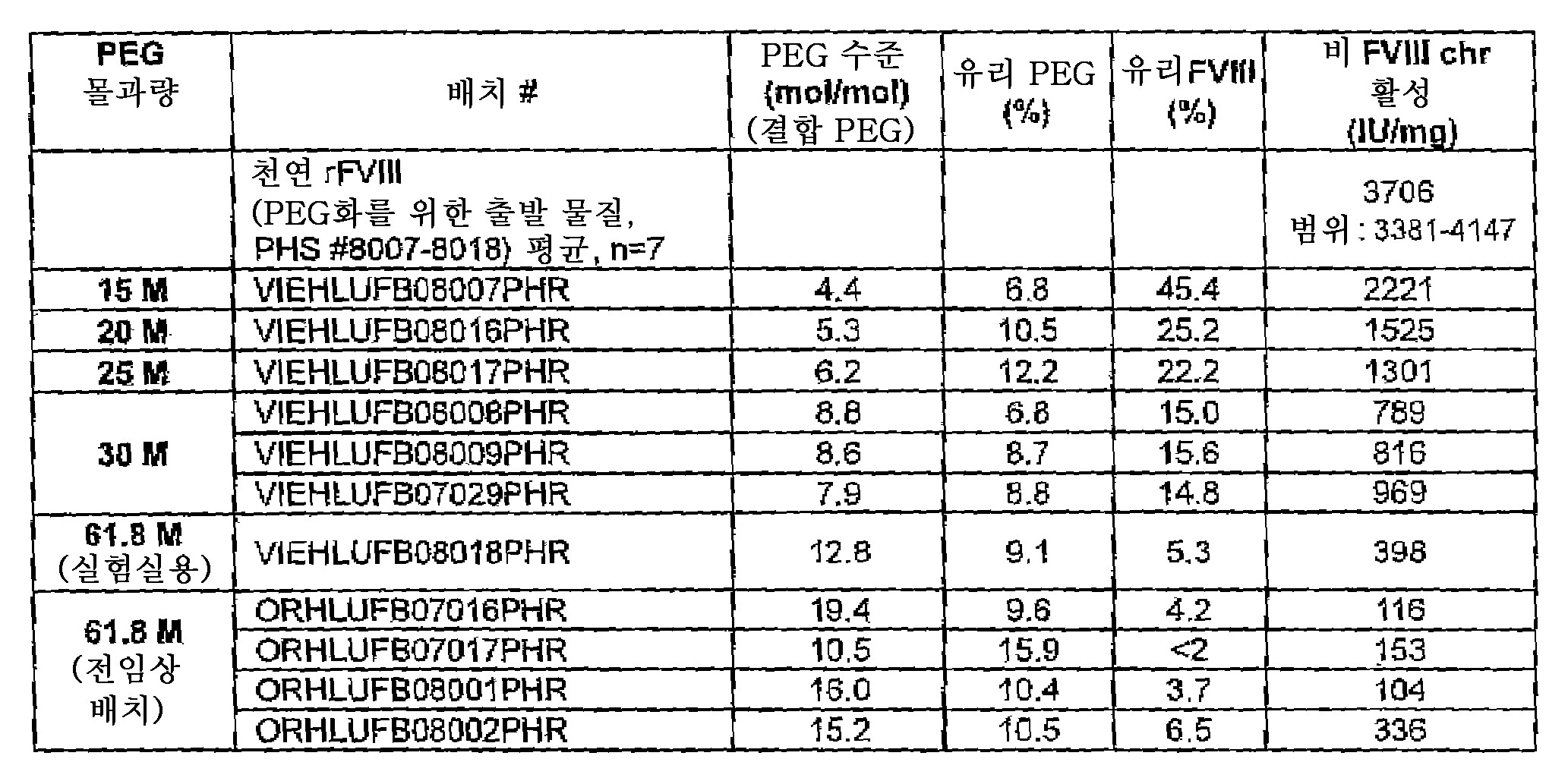
Claims (50)
Applications Claiming Priority (2)
| Application Number | Priority Date | Filing Date | Title |
|---|---|---|---|
| US10642408P | 2008-10-17 | 2008-10-17 | |
| US61/106,424 | 2008-10-17 |
Related Child Applications (1)
| Application Number | Title | Priority Date | Filing Date |
|---|---|---|---|
| KR1020167022913A Division KR101929641B1 (en) | 2008-10-17 | 2009-10-16 | Modified blood factors comprising a low degree of water soluble polymer |
Publications (1)
| Publication Number | Publication Date |
|---|---|
| KR20110071012A true KR20110071012A (en) | 2011-06-27 |
Family
ID=41650072
Family Applications (2)
| Application Number | Title | Priority Date | Filing Date |
|---|---|---|---|
| KR1020117011049A Ceased KR20110071012A (en) | 2008-10-17 | 2009-10-16 | Modified blood factors that include low levels of water soluble polymers |
| KR1020167022913A Active KR101929641B1 (en) | 2008-10-17 | 2009-10-16 | Modified blood factors comprising a low degree of water soluble polymer |
Family Applications After (1)
| Application Number | Title | Priority Date | Filing Date |
|---|---|---|---|
| KR1020167022913A Active KR101929641B1 (en) | 2008-10-17 | 2009-10-16 | Modified blood factors comprising a low degree of water soluble polymer |
Country Status (20)
| Country | Link |
|---|---|
| US (4) | US20100099616A1 (en) |
| EP (3) | EP3620177A1 (en) |
| JP (2) | JP5785872B2 (en) |
| KR (2) | KR20110071012A (en) |
| AU (1) | AU2009305612B2 (en) |
| BR (1) | BRPI0920259A8 (en) |
| CA (1) | CA2738679A1 (en) |
| CY (1) | CY1120921T1 (en) |
| DK (1) | DK2349342T3 (en) |
| ES (1) | ES2692172T3 (en) |
| HR (1) | HRP20181454T1 (en) |
| HU (1) | HUE039906T2 (en) |
| LT (1) | LT2349342T (en) |
| MX (1) | MX2011004085A (en) |
| NZ (1) | NZ592688A (en) |
| PL (1) | PL2349342T3 (en) |
| PT (1) | PT2349342T (en) |
| SI (1) | SI2349342T1 (en) |
| SM (1) | SMT201800486T1 (en) |
| WO (1) | WO2010045568A1 (en) |
Cited By (1)
| Publication number | Priority date | Publication date | Assignee | Title |
|---|---|---|---|---|
| KR20140146171A (en) * | 2012-04-16 | 2014-12-24 | 캔탭 바이오팔마수티칼 패턴트 리미티드 | Optimised subcutaneous therapeutic agents |
Families Citing this family (12)
| Publication number | Priority date | Publication date | Assignee | Title |
|---|---|---|---|---|
| HUE028056T2 (en) | 2009-07-27 | 2016-11-28 | Baxalta GmbH | Blood coagulation protein conjugates |
| EP2536753B1 (en) | 2010-02-16 | 2017-12-20 | Novo Nordisk A/S | Factor viii molecules with reduced vwf binding |
| GB201007356D0 (en) | 2010-04-30 | 2010-06-16 | Leverton Licence Holdings Ltd | Conjugated factor VIIa |
| US20130183280A1 (en) * | 2010-07-15 | 2013-07-18 | Novo Nordisk A/S | Stabilized factor viii variants |
| MY167234A (en) | 2011-09-23 | 2018-08-14 | Novo Nordisk As | Novel glucagon analogues |
| WO2014170496A1 (en) | 2013-04-18 | 2014-10-23 | Novo Nordisk A/S | Stable, protracted glp-1/glucagon receptor co-agonists for medical use |
| WO2015185640A1 (en) | 2014-06-04 | 2015-12-10 | Novo Nordisk A/S | Glp-1/glucagon receptor co-agonists for medical use |
| WO2016020210A1 (en) | 2014-08-04 | 2016-02-11 | Csl Behring Gmbh | Csl behring gmbh |
| CN107406493B (en) | 2015-03-06 | 2021-08-13 | 康诺贝林伦瑙有限公司 | Modified von Willebrand factor with improved half-life |
| JP6552286B2 (en) * | 2015-06-05 | 2019-07-31 | 公立大学法人奈良県立医科大学 | Method and reagent kit for obtaining information on complexing ability of coagulation factor VIII |
| KR20220029733A (en) | 2019-07-04 | 2022-03-08 | 체에스엘 베링 렝나우 아게 | truncated von Willebrand factor (VWF) to increase the in vitro stability of coagulation factor VIII |
| WO2021094344A1 (en) | 2019-11-11 | 2021-05-20 | CSL Behring Lengnau AG | Polypeptides for inducing tolerance to factor viii |
Family Cites Families (28)
| Publication number | Priority date | Publication date | Assignee | Title |
|---|---|---|---|---|
| US4179337A (en) * | 1973-07-20 | 1979-12-18 | Davis Frank F | Non-immunogenic polypeptides |
| US4757006A (en) | 1983-10-28 | 1988-07-12 | Genetics Institute, Inc. | Human factor VIII:C gene and recombinant methods for production |
| US4970300A (en) | 1985-02-01 | 1990-11-13 | New York University | Modified factor VIII |
| US6048729A (en) | 1987-05-01 | 2000-04-11 | Transkaryotic Therapies, Inc. | In vivo protein production and delivery system for gene therapy |
| US5122614A (en) * | 1989-04-19 | 1992-06-16 | Enzon, Inc. | Active carbonates of polyalkylene oxides for modification of polypeptides |
| US5252714A (en) | 1990-11-28 | 1993-10-12 | The University Of Alabama In Huntsville | Preparation and use of polyethylene glycol propionaldehyde |
| US6063630A (en) | 1991-11-05 | 2000-05-16 | Transkaryotic Therapies, Inc. | Targeted introduction of DNA into primary or secondary cells and their use for gene therapy |
| US6037452A (en) * | 1992-04-10 | 2000-03-14 | Alpha Therapeutic Corporation | Poly(alkylene oxide)-Factor VIII or Factor IX conjugate |
| US5298643A (en) * | 1992-12-22 | 1994-03-29 | Enzon, Inc. | Aryl imidate activated polyalkylene oxides |
| WO1994015625A1 (en) | 1993-01-15 | 1994-07-21 | Enzon, Inc. | Factor viii - polymeric conjugates |
| US5621039A (en) * | 1993-06-08 | 1997-04-15 | Hallahan; Terrence W. | Factor IX- polymeric conjugates |
| US5824784A (en) | 1994-10-12 | 1998-10-20 | Amgen Inc. | N-terminally chemically modified protein compositions and methods |
| US6238908B1 (en) * | 1995-06-07 | 2001-05-29 | Aastrom Biosciences, Inc. | Apparatus and method for maintaining and growth biological cells |
| US7074878B1 (en) | 1999-12-10 | 2006-07-11 | Harris J Milton | Hydrolytically degradable polymers and hydrogels made therefrom |
| US20030211094A1 (en) * | 2001-06-26 | 2003-11-13 | Nelsestuen Gary L. | High molecular weight derivatives of vitamin k-dependent polypeptides |
| BR0311978A (en) * | 2002-06-21 | 2005-03-22 | Novo Nordisk Healthcare Ag | Preparation, method for preparing it, pharmaceutical formulation, methods for treating a factor responsive syndrome vii, to prevent unwanted bleeding, to prevent unwanted blood clotting and to prevent tissue factor mediated reactions, and to use a preparation |
| JP2006517400A (en) | 2002-12-19 | 2006-07-27 | ネクター セラピューティクス アラバマ,コーポレイション | Cyanovirin mutant-polymer conjugate |
| DK1596887T3 (en) * | 2003-02-26 | 2022-06-20 | Nektar Therapeutics | Polymer-Factor VIII conjugate |
| NZ542094A (en) * | 2003-03-14 | 2008-12-24 | Neose Technologies Inc | Branched polymer conjugates comprising a peptide and water-soluble polymer chains |
| KR101146160B1 (en) * | 2004-06-30 | 2012-07-16 | 넥타르 테라퓨틱스 | Polymer-factor ix moiety conjugates |
| HRP20070268B1 (en) * | 2004-11-12 | 2018-04-20 | Bayer Healthcare Llc | Site-directed modification of fviii |
| BRPI0519562A2 (en) * | 2004-12-27 | 2009-01-27 | Baxter Int | proteinaceous construct, complex, method for prolonging the in vivo half-life of factor viii (fviii) or a biologically active derivative of the same pharmaceutical composition, and method for forming a proteinaceous construct |
| WO2006114105A2 (en) * | 2005-04-26 | 2006-11-02 | Maxygen Holdings Ltd. | Use of modified factor vii for treating bleeding |
| EP2975135A1 (en) * | 2005-05-25 | 2016-01-20 | Novo Nordisk A/S | Glycopegylated factor IX |
| US7645860B2 (en) * | 2006-03-31 | 2010-01-12 | Baxter Healthcare S.A. | Factor VIII polymer conjugates |
| NZ572050A (en) | 2006-03-31 | 2011-09-30 | Baxter Int | Factor VIII conjugated to polyethylene glycol |
| AU2007333049B2 (en) * | 2006-12-15 | 2014-02-20 | Takeda Pharmaceutical Company Limited | Factor VIIa-(poly)sialic acid conjugate having prolonged in vivo half-life |
| WO2008082669A2 (en) | 2006-12-27 | 2008-07-10 | Nektar Therapeutics Al, Corporation | Von willebrand factor- and factor viii-polymer conjugates having a releasable linkage |
-
2009
- 2009-10-16 KR KR1020117011049A patent/KR20110071012A/en not_active Ceased
- 2009-10-16 SM SM20180486T patent/SMT201800486T1/en unknown
- 2009-10-16 NZ NZ592688A patent/NZ592688A/en unknown
- 2009-10-16 EP EP19189998.8A patent/EP3620177A1/en not_active Withdrawn
- 2009-10-16 JP JP2011532289A patent/JP5785872B2/en active Active
- 2009-10-16 MX MX2011004085A patent/MX2011004085A/en active IP Right Grant
- 2009-10-16 US US12/580,786 patent/US20100099616A1/en not_active Abandoned
- 2009-10-16 LT LTEP09752930.9T patent/LT2349342T/en unknown
- 2009-10-16 HU HUE09752930A patent/HUE039906T2/en unknown
- 2009-10-16 WO PCT/US2009/061023 patent/WO2010045568A1/en not_active Ceased
- 2009-10-16 BR BRPI0920259A patent/BRPI0920259A8/en not_active Application Discontinuation
- 2009-10-16 DK DK09752930.9T patent/DK2349342T3/en active
- 2009-10-16 EP EP09752930.9A patent/EP2349342B1/en active Active
- 2009-10-16 ES ES09752930.9T patent/ES2692172T3/en active Active
- 2009-10-16 KR KR1020167022913A patent/KR101929641B1/en active Active
- 2009-10-16 PL PL09752930T patent/PL2349342T3/en unknown
- 2009-10-16 EP EP18179965.1A patent/EP3437661A1/en not_active Withdrawn
- 2009-10-16 HR HRP20181454TT patent/HRP20181454T1/en unknown
- 2009-10-16 PT PT09752930T patent/PT2349342T/en unknown
- 2009-10-16 CA CA2738679A patent/CA2738679A1/en not_active Abandoned
- 2009-10-16 AU AU2009305612A patent/AU2009305612B2/en active Active
- 2009-10-16 SI SI200931874T patent/SI2349342T1/en unknown
-
2011
- 2011-09-23 US US13/242,934 patent/US20120076749A1/en not_active Abandoned
-
2015
- 2015-03-20 JP JP2015057790A patent/JP2015110676A/en active Pending
-
2016
- 2016-01-08 US US14/991,172 patent/US20160199503A1/en not_active Abandoned
-
2018
- 2018-09-24 CY CY181100982T patent/CY1120921T1/en unknown
- 2018-10-30 US US16/175,744 patent/US20190160178A1/en not_active Abandoned
Cited By (1)
| Publication number | Priority date | Publication date | Assignee | Title |
|---|---|---|---|---|
| KR20140146171A (en) * | 2012-04-16 | 2014-12-24 | 캔탭 바이오팔마수티칼 패턴트 리미티드 | Optimised subcutaneous therapeutic agents |
Also Published As
| Publication number | Publication date |
|---|---|
| US20100099616A1 (en) | 2010-04-22 |
| MX2011004085A (en) | 2011-09-27 |
| EP3437661A1 (en) | 2019-02-06 |
| EP2349342B1 (en) | 2018-06-27 |
| ES2692172T3 (en) | 2018-11-30 |
| KR101929641B1 (en) | 2018-12-14 |
| PL2349342T3 (en) | 2019-01-31 |
| AU2009305612A1 (en) | 2010-04-22 |
| BRPI0920259A8 (en) | 2017-09-19 |
| US20190160178A1 (en) | 2019-05-30 |
| AU2009305612B2 (en) | 2015-05-21 |
| BRPI0920259A2 (en) | 2016-01-05 |
| SI2349342T1 (en) | 2018-10-30 |
| EP3620177A1 (en) | 2020-03-11 |
| US20160199503A1 (en) | 2016-07-14 |
| EP2349342A1 (en) | 2011-08-03 |
| LT2349342T (en) | 2018-10-10 |
| JP2012505917A (en) | 2012-03-08 |
| KR20160103173A (en) | 2016-08-31 |
| HRP20181454T1 (en) | 2018-12-14 |
| JP5785872B2 (en) | 2015-09-30 |
| JP2015110676A (en) | 2015-06-18 |
| WO2010045568A1 (en) | 2010-04-22 |
| HUE039906T2 (en) | 2019-02-28 |
| US20120076749A1 (en) | 2012-03-29 |
| PT2349342T (en) | 2018-10-26 |
| DK2349342T3 (en) | 2018-10-08 |
| SMT201800486T1 (en) | 2018-11-09 |
| CA2738679A1 (en) | 2010-04-22 |
| CY1120921T1 (en) | 2019-12-11 |
| NZ592688A (en) | 2012-12-21 |
Similar Documents
| Publication | Publication Date | Title |
|---|---|---|
| KR101929641B1 (en) | Modified blood factors comprising a low degree of water soluble polymer | |
| JP5715983B2 (en) | Polymer-von Willebrand factor conjugate | |
| JP6347468B2 (en) | Treatment of coagulation disease by administration of recombinant von Willebrand factor | |
| EP2245456B1 (en) | Method and compositions for specifically detecting physiologically acceptable polymer molecules | |
| HK1105276B (en) | Polymer-von willebrand factor-conjugates |
Legal Events
| Date | Code | Title | Description |
|---|---|---|---|
| PA0105 | International application |
Patent event date: 20110516 Patent event code: PA01051R01D Comment text: International Patent Application |
|
| PG1501 | Laying open of application | ||
| A201 | Request for examination | ||
| PA0201 | Request for examination |
Patent event code: PA02012R01D Patent event date: 20141015 Comment text: Request for Examination of Application |
|
| E902 | Notification of reason for refusal | ||
| PE0902 | Notice of grounds for rejection |
Comment text: Notification of reason for refusal Patent event date: 20160222 Patent event code: PE09021S01D |
|
| PN2301 | Change of applicant |
Patent event date: 20160422 Comment text: Notification of Change of Applicant Patent event code: PN23011R01D |
|
| A107 | Divisional application of patent | ||
| PA0104 | Divisional application for international application |
Comment text: Divisional Application for International Patent Patent event code: PA01041R01D Patent event date: 20160822 |
|
| E601 | Decision to refuse application | ||
| PE0601 | Decision on rejection of patent |
Patent event date: 20161129 Comment text: Decision to Refuse Application Patent event code: PE06012S01D Patent event date: 20160222 Comment text: Notification of reason for refusal Patent event code: PE06011S01I |