KR20110063640A - Proliferation of blood forming progenitor cells - Google Patents
Proliferation of blood forming progenitor cells Download PDFInfo
- Publication number
- KR20110063640A KR20110063640A KR1020117005959A KR20117005959A KR20110063640A KR 20110063640 A KR20110063640 A KR 20110063640A KR 1020117005959 A KR1020117005959 A KR 1020117005959A KR 20117005959 A KR20117005959 A KR 20117005959A KR 20110063640 A KR20110063640 A KR 20110063640A
- Authority
- KR
- South Korea
- Prior art keywords
- cells
- disease
- progenitor cells
- cell
- hematopoietic progenitor
- Prior art date
- Legal status (The legal status is an assumption and is not a legal conclusion. Google has not performed a legal analysis and makes no representation as to the accuracy of the status listed.)
- Granted
Links
Images

Classifications
-
- A—HUMAN NECESSITIES
- A61—MEDICAL OR VETERINARY SCIENCE; HYGIENE
- A61K—PREPARATIONS FOR MEDICAL, DENTAL OR TOILETRY PURPOSES
- A61K35/00—Medicinal preparations containing materials or reaction products thereof with undetermined constitution
- A61K35/12—Materials from mammals; Compositions comprising non-specified tissues or cells; Compositions comprising non-embryonic stem cells; Genetically modified cells
- A61K35/14—Blood; Artificial blood
-
- A—HUMAN NECESSITIES
- A61—MEDICAL OR VETERINARY SCIENCE; HYGIENE
- A61K—PREPARATIONS FOR MEDICAL, DENTAL OR TOILETRY PURPOSES
- A61K35/00—Medicinal preparations containing materials or reaction products thereof with undetermined constitution
- A61K35/12—Materials from mammals; Compositions comprising non-specified tissues or cells; Compositions comprising non-embryonic stem cells; Genetically modified cells
- A61K35/28—Bone marrow; Haematopoietic stem cells; Mesenchymal stem cells of any origin, e.g. adipose-derived stem cells
-
- A—HUMAN NECESSITIES
- A61—MEDICAL OR VETERINARY SCIENCE; HYGIENE
- A61K—PREPARATIONS FOR MEDICAL, DENTAL OR TOILETRY PURPOSES
- A61K45/00—Medicinal preparations containing active ingredients not provided for in groups A61K31/00 - A61K41/00
- A61K45/06—Mixtures of active ingredients without chemical characterisation, e.g. antiphlogistics and cardiaca
-
- A—HUMAN NECESSITIES
- A61—MEDICAL OR VETERINARY SCIENCE; HYGIENE
- A61P—SPECIFIC THERAPEUTIC ACTIVITY OF CHEMICAL COMPOUNDS OR MEDICINAL PREPARATIONS
- A61P19/00—Drugs for skeletal disorders
-
- A—HUMAN NECESSITIES
- A61—MEDICAL OR VETERINARY SCIENCE; HYGIENE
- A61P—SPECIFIC THERAPEUTIC ACTIVITY OF CHEMICAL COMPOUNDS OR MEDICINAL PREPARATIONS
- A61P19/00—Drugs for skeletal disorders
- A61P19/02—Drugs for skeletal disorders for joint disorders, e.g. arthritis, arthrosis
-
- A—HUMAN NECESSITIES
- A61—MEDICAL OR VETERINARY SCIENCE; HYGIENE
- A61P—SPECIFIC THERAPEUTIC ACTIVITY OF CHEMICAL COMPOUNDS OR MEDICINAL PREPARATIONS
- A61P25/00—Drugs for disorders of the nervous system
- A61P25/30—Drugs for disorders of the nervous system for treating abuse or dependence
-
- A—HUMAN NECESSITIES
- A61—MEDICAL OR VETERINARY SCIENCE; HYGIENE
- A61P—SPECIFIC THERAPEUTIC ACTIVITY OF CHEMICAL COMPOUNDS OR MEDICINAL PREPARATIONS
- A61P31/00—Antiinfectives, i.e. antibiotics, antiseptics, chemotherapeutics
-
- A—HUMAN NECESSITIES
- A61—MEDICAL OR VETERINARY SCIENCE; HYGIENE
- A61P—SPECIFIC THERAPEUTIC ACTIVITY OF CHEMICAL COMPOUNDS OR MEDICINAL PREPARATIONS
- A61P31/00—Antiinfectives, i.e. antibiotics, antiseptics, chemotherapeutics
- A61P31/04—Antibacterial agents
- A61P31/06—Antibacterial agents for tuberculosis
-
- A—HUMAN NECESSITIES
- A61—MEDICAL OR VETERINARY SCIENCE; HYGIENE
- A61P—SPECIFIC THERAPEUTIC ACTIVITY OF CHEMICAL COMPOUNDS OR MEDICINAL PREPARATIONS
- A61P31/00—Antiinfectives, i.e. antibiotics, antiseptics, chemotherapeutics
- A61P31/12—Antivirals
-
- A—HUMAN NECESSITIES
- A61—MEDICAL OR VETERINARY SCIENCE; HYGIENE
- A61P—SPECIFIC THERAPEUTIC ACTIVITY OF CHEMICAL COMPOUNDS OR MEDICINAL PREPARATIONS
- A61P31/00—Antiinfectives, i.e. antibiotics, antiseptics, chemotherapeutics
- A61P31/12—Antivirals
- A61P31/14—Antivirals for RNA viruses
- A61P31/18—Antivirals for RNA viruses for HIV
-
- A—HUMAN NECESSITIES
- A61—MEDICAL OR VETERINARY SCIENCE; HYGIENE
- A61P—SPECIFIC THERAPEUTIC ACTIVITY OF CHEMICAL COMPOUNDS OR MEDICINAL PREPARATIONS
- A61P35/00—Antineoplastic agents
-
- A—HUMAN NECESSITIES
- A61—MEDICAL OR VETERINARY SCIENCE; HYGIENE
- A61P—SPECIFIC THERAPEUTIC ACTIVITY OF CHEMICAL COMPOUNDS OR MEDICINAL PREPARATIONS
- A61P35/00—Antineoplastic agents
- A61P35/02—Antineoplastic agents specific for leukemia
-
- A—HUMAN NECESSITIES
- A61—MEDICAL OR VETERINARY SCIENCE; HYGIENE
- A61P—SPECIFIC THERAPEUTIC ACTIVITY OF CHEMICAL COMPOUNDS OR MEDICINAL PREPARATIONS
- A61P37/00—Drugs for immunological or allergic disorders
-
- A—HUMAN NECESSITIES
- A61—MEDICAL OR VETERINARY SCIENCE; HYGIENE
- A61P—SPECIFIC THERAPEUTIC ACTIVITY OF CHEMICAL COMPOUNDS OR MEDICINAL PREPARATIONS
- A61P7/00—Drugs for disorders of the blood or the extracellular fluid
-
- A—HUMAN NECESSITIES
- A61—MEDICAL OR VETERINARY SCIENCE; HYGIENE
- A61P—SPECIFIC THERAPEUTIC ACTIVITY OF CHEMICAL COMPOUNDS OR MEDICINAL PREPARATIONS
- A61P7/00—Drugs for disorders of the blood or the extracellular fluid
- A61P7/02—Antithrombotic agents; Anticoagulants; Platelet aggregation inhibitors
-
- A—HUMAN NECESSITIES
- A61—MEDICAL OR VETERINARY SCIENCE; HYGIENE
- A61P—SPECIFIC THERAPEUTIC ACTIVITY OF CHEMICAL COMPOUNDS OR MEDICINAL PREPARATIONS
- A61P7/00—Drugs for disorders of the blood or the extracellular fluid
- A61P7/06—Antianaemics
-
- A—HUMAN NECESSITIES
- A61—MEDICAL OR VETERINARY SCIENCE; HYGIENE
- A61P—SPECIFIC THERAPEUTIC ACTIVITY OF CHEMICAL COMPOUNDS OR MEDICINAL PREPARATIONS
- A61P9/00—Drugs for disorders of the cardiovascular system
-
- C—CHEMISTRY; METALLURGY
- C12—BIOCHEMISTRY; BEER; SPIRITS; WINE; VINEGAR; MICROBIOLOGY; ENZYMOLOGY; MUTATION OR GENETIC ENGINEERING
- C12N—MICROORGANISMS OR ENZYMES; COMPOSITIONS THEREOF; PROPAGATING, PRESERVING, OR MAINTAINING MICROORGANISMS; MUTATION OR GENETIC ENGINEERING; CULTURE MEDIA
- C12N5/00—Undifferentiated human, animal or plant cells, e.g. cell lines; Tissues; Cultivation or maintenance thereof; Culture media therefor
- C12N5/06—Animal cells or tissues; Human cells or tissues
- C12N5/0602—Vertebrate cells
- C12N5/0634—Cells from the blood or the immune system
- C12N5/0647—Haematopoietic stem cells; Uncommitted or multipotent progenitors
-
- C—CHEMISTRY; METALLURGY
- C12—BIOCHEMISTRY; BEER; SPIRITS; WINE; VINEGAR; MICROBIOLOGY; ENZYMOLOGY; MUTATION OR GENETIC ENGINEERING
- C12N—MICROORGANISMS OR ENZYMES; COMPOSITIONS THEREOF; PROPAGATING, PRESERVING, OR MAINTAINING MICROORGANISMS; MUTATION OR GENETIC ENGINEERING; CULTURE MEDIA
- C12N5/00—Undifferentiated human, animal or plant cells, e.g. cell lines; Tissues; Cultivation or maintenance thereof; Culture media therefor
- C12N5/06—Animal cells or tissues; Human cells or tissues
- C12N5/0602—Vertebrate cells
- C12N5/0652—Cells of skeletal and connective tissues; Mesenchyme
- C12N5/0662—Stem cells
- C12N5/0665—Blood-borne mesenchymal stem cells, e.g. from umbilical cord blood
-
- C—CHEMISTRY; METALLURGY
- C12—BIOCHEMISTRY; BEER; SPIRITS; WINE; VINEGAR; MICROBIOLOGY; ENZYMOLOGY; MUTATION OR GENETIC ENGINEERING
- C12N—MICROORGANISMS OR ENZYMES; COMPOSITIONS THEREOF; PROPAGATING, PRESERVING, OR MAINTAINING MICROORGANISMS; MUTATION OR GENETIC ENGINEERING; CULTURE MEDIA
- C12N5/00—Undifferentiated human, animal or plant cells, e.g. cell lines; Tissues; Cultivation or maintenance thereof; Culture media therefor
- C12N5/06—Animal cells or tissues; Human cells or tissues
- C12N5/0602—Vertebrate cells
- C12N5/0652—Cells of skeletal and connective tissues; Mesenchyme
- C12N5/0662—Stem cells
- C12N5/0668—Mesenchymal stem cells from other natural sources
-
- A—HUMAN NECESSITIES
- A61—MEDICAL OR VETERINARY SCIENCE; HYGIENE
- A61K—PREPARATIONS FOR MEDICAL, DENTAL OR TOILETRY PURPOSES
- A61K35/00—Medicinal preparations containing materials or reaction products thereof with undetermined constitution
- A61K35/12—Materials from mammals; Compositions comprising non-specified tissues or cells; Compositions comprising non-embryonic stem cells; Genetically modified cells
- A61K2035/124—Materials from mammals; Compositions comprising non-specified tissues or cells; Compositions comprising non-embryonic stem cells; Genetically modified cells the cells being hematopoietic, bone marrow derived or blood cells
-
- C—CHEMISTRY; METALLURGY
- C12—BIOCHEMISTRY; BEER; SPIRITS; WINE; VINEGAR; MICROBIOLOGY; ENZYMOLOGY; MUTATION OR GENETIC ENGINEERING
- C12N—MICROORGANISMS OR ENZYMES; COMPOSITIONS THEREOF; PROPAGATING, PRESERVING, OR MAINTAINING MICROORGANISMS; MUTATION OR GENETIC ENGINEERING; CULTURE MEDIA
- C12N2501/00—Active agents used in cell culture processes, e.g. differentation
- C12N2501/10—Growth factors
- C12N2501/125—Stem cell factor [SCF], c-kit ligand [KL]
-
- C—CHEMISTRY; METALLURGY
- C12—BIOCHEMISTRY; BEER; SPIRITS; WINE; VINEGAR; MICROBIOLOGY; ENZYMOLOGY; MUTATION OR GENETIC ENGINEERING
- C12N—MICROORGANISMS OR ENZYMES; COMPOSITIONS THEREOF; PROPAGATING, PRESERVING, OR MAINTAINING MICROORGANISMS; MUTATION OR GENETIC ENGINEERING; CULTURE MEDIA
- C12N2501/00—Active agents used in cell culture processes, e.g. differentation
- C12N2501/10—Growth factors
- C12N2501/145—Thrombopoietin [TPO]
-
- C—CHEMISTRY; METALLURGY
- C12—BIOCHEMISTRY; BEER; SPIRITS; WINE; VINEGAR; MICROBIOLOGY; ENZYMOLOGY; MUTATION OR GENETIC ENGINEERING
- C12N—MICROORGANISMS OR ENZYMES; COMPOSITIONS THEREOF; PROPAGATING, PRESERVING, OR MAINTAINING MICROORGANISMS; MUTATION OR GENETIC ENGINEERING; CULTURE MEDIA
- C12N2501/00—Active agents used in cell culture processes, e.g. differentation
- C12N2501/20—Cytokines; Chemokines
- C12N2501/22—Colony stimulating factors (G-CSF, GM-CSF)
-
- C—CHEMISTRY; METALLURGY
- C12—BIOCHEMISTRY; BEER; SPIRITS; WINE; VINEGAR; MICROBIOLOGY; ENZYMOLOGY; MUTATION OR GENETIC ENGINEERING
- C12N—MICROORGANISMS OR ENZYMES; COMPOSITIONS THEREOF; PROPAGATING, PRESERVING, OR MAINTAINING MICROORGANISMS; MUTATION OR GENETIC ENGINEERING; CULTURE MEDIA
- C12N2501/00—Active agents used in cell culture processes, e.g. differentation
- C12N2501/20—Cytokines; Chemokines
- C12N2501/26—Flt-3 ligand (CD135L, flk-2 ligand)
-
- C—CHEMISTRY; METALLURGY
- C12—BIOCHEMISTRY; BEER; SPIRITS; WINE; VINEGAR; MICROBIOLOGY; ENZYMOLOGY; MUTATION OR GENETIC ENGINEERING
- C12N—MICROORGANISMS OR ENZYMES; COMPOSITIONS THEREOF; PROPAGATING, PRESERVING, OR MAINTAINING MICROORGANISMS; MUTATION OR GENETIC ENGINEERING; CULTURE MEDIA
- C12N2502/00—Coculture with; Conditioned medium produced by
- C12N2502/13—Coculture with; Conditioned medium produced by connective tissue cells; generic mesenchyme cells, e.g. so-called "embryonic fibroblasts"
- C12N2502/1352—Mesenchymal stem cells
-
- C—CHEMISTRY; METALLURGY
- C12—BIOCHEMISTRY; BEER; SPIRITS; WINE; VINEGAR; MICROBIOLOGY; ENZYMOLOGY; MUTATION OR GENETIC ENGINEERING
- C12N—MICROORGANISMS OR ENZYMES; COMPOSITIONS THEREOF; PROPAGATING, PRESERVING, OR MAINTAINING MICROORGANISMS; MUTATION OR GENETIC ENGINEERING; CULTURE MEDIA
- C12N2502/00—Coculture with; Conditioned medium produced by
- C12N2502/13—Coculture with; Conditioned medium produced by connective tissue cells; generic mesenchyme cells, e.g. so-called "embryonic fibroblasts"
- C12N2502/1352—Mesenchymal stem cells
- C12N2502/1358—Bone marrow mesenchymal stem cells (BM-MSC)
Landscapes
- Health & Medical Sciences (AREA)
- Life Sciences & Earth Sciences (AREA)
- Engineering & Computer Science (AREA)
- Chemical & Material Sciences (AREA)
- Organic Chemistry (AREA)
- General Health & Medical Sciences (AREA)
- Biomedical Technology (AREA)
- Bioinformatics & Cheminformatics (AREA)
- Veterinary Medicine (AREA)
- Medicinal Chemistry (AREA)
- Pharmacology & Pharmacy (AREA)
- Public Health (AREA)
- Animal Behavior & Ethology (AREA)
- Hematology (AREA)
- Nuclear Medicine, Radiotherapy & Molecular Imaging (AREA)
- General Chemical & Material Sciences (AREA)
- Chemical Kinetics & Catalysis (AREA)
- Zoology (AREA)
- Biotechnology (AREA)
- Developmental Biology & Embryology (AREA)
- Immunology (AREA)
- Cell Biology (AREA)
- Genetics & Genomics (AREA)
- Wood Science & Technology (AREA)
- Virology (AREA)
- Microbiology (AREA)
- General Engineering & Computer Science (AREA)
- Biochemistry (AREA)
- Oncology (AREA)
- Epidemiology (AREA)
- Communicable Diseases (AREA)
- Diabetes (AREA)
- Rheumatology (AREA)
- Physical Education & Sports Medicine (AREA)
- Psychiatry (AREA)
- Tropical Medicine & Parasitology (AREA)
- Cardiology (AREA)
- AIDS & HIV (AREA)
- Addiction (AREA)
- Pulmonology (AREA)
Abstract
본 발명은 STRO-lbright 세포가 농축된 세포 집단의 존재하에서 조혈모 전구 세포 배양과 관련하는 그의 필요로 하는 대상 내로 조혈모 전구 세포를 이식하는 방법에 관한 것이다. 본 발명의 방법은 혈액 질환의 치료에 유용하다. The present invention is STRO-l bright A method of transplanting hematopoietic progenitor cells into its desired subject relating to hematopoietic progenitor cell culture in the presence of a cell population in which the cells are enriched. The method of the present invention is useful for the treatment of blood diseases.
Description
본 발명은 STRO-lbright 세포가 농축된 세포 집단의 존재하에서 조혈모 전구 세포를 배양하는 것을 포함하는 그를 필요로 하는 대상 내로 조혈모 전구 세포를 이식하는 방법에 관한 것이다. 본 발명의 방법은 혈액 질환의 치료에 유용하다.
The present invention is STRO-l bright A method of transplanting hematopoietic progenitor cells into a subject in need thereof comprising culturing the hematopoietic progenitor cells in the presence of a cell population in which the cells are enriched. The method of the present invention is useful for the treatment of blood diseases.
10년 이상 동안, 제대혈(CB)은 임상학적으로 HLA-매치된 골수 증여자가 부족한 환자의 동종 이계 이식을 위한 조혈모 선구의 대안적인 근원으로 조사되어 왔다. 골수와 비교하여 CB에서의 더 적은 T-세포 및/또는 덜 발달된 T-세포는 CD 이식이 동종 이계 이식 환경에서 질병률 및 사망률의 주요 원인인 이식편대 숙주병(Graft vs. Host Disease (GVHD))을 보다 적게 발생시킨다는 가능성을 감안하고 있다. 다른 잠재적인 이점은 살아있는 증여자로부터 골수 또는 말초 혈액 선구 세포(PBPCs)를 수집하는 것에 비교하여 태반 처리 전에 태반 정맥으로부터 제대혈을 수집하는 입수가능성 및 편이성을 고려해 볼 때 이용가능한 동종 이식의 수 및 이식될 수 있는 환자의 수를 현저하게 증가시키는 능력을 포함한다. 이러한 조혈모 선구의 새로운 근원은 제대혈 은행으로 하여금 국립 골수 기증 프로그램 등록소(NMDPR)에 낮게 제시된 소수인종인 미국 흑인 및 히스페닉 집단의 HLA와 같은 인간 백혈구 항원(HLA) 타입을 지닌 유닛을 목표로 하고 있다. For more than a decade, cord blood (CB) has been investigated as an alternative source of hematopoietic stem precursors for allogeneic transplantation in patients who lack clinically HLA-matched bone marrow donors. Less T-cells and / or less-developed T-cells in CB compared to bone marrow are associated with Graft vs. Host Disease (GVHD), where CD transplantation is a major cause of morbidity and mortality in allogeneic transplant environments. The possibility of generating fewer) is taken into account. Another potential advantage is the number of allogeneic grafts available and the grafts available given the ease and convenience of collecting cord blood from placental veins prior to placental treatment as compared to collecting bone marrow or peripheral blood precursor cells (PBPCs) from living donors. Includes the ability to significantly increase the number of patients that can be. The new source of these hematopoietic stem precursors is to target cord blood banks to units with human leukocyte antigen (HLA) types, such as HLA from the American black and Hispanic populations, a minority group presented at the National Bone Marrow Donation Program Registry (NMDPR). have.
첫번째 CB 이식이 1988년도에 수행된 이후로, 전 세계의 5000명 이상의 환자가 다양한 악성 및 비-악성 질병으로 인해 관련된 또는 비관련된 CB 이식을 받았다. HLA-매치된 증여자가 입수가능할 수 없을 때 성인이 CB 이식을 점증적으로 받음에도 불구하고 대다수의 CD 수령자는 어린이였다. 이렇게 해서 지금까지 보고된 무진행 생존률(progression-free survival rates)은 동종 이계 골수 이식 후에 얻어진 결과와 비교할 만 하다(Barker JN et al., (2001)). 더우기, 골수 또는 PBPC 동종이식의 수령자에서 묵인되는 것보다 실질적으로 더 많은 증여자-수령자 HLA 불일치를 갖는 CB 이식을 사용함에도 불구하고, 골수 이식과 연관된 것보다 더 적은 GVHD인 것으로 보이는 많은 보고들이 있다. CB의 주요한 단점은 낮은 세포 투여량이고 이것은 골수 이식과 비교할 시 더 느린 이식 시간 및 높은 이식실패율을 야기시킨다(Kernan NA et al.. (1993)). Kurtzberg (Kurtzberg J., (1996)), Gluckman (Gluckman et al., (1997)), Rubinstein (Rubinstein P., (1998)), Rizzieri (Rizzieri DA et al., (2001)), 및 Laughlin (Laughlin MJ et al., (2001))에 의해 발행된 CB 이식에 대한 연구에서, ≥0.5x10⁹/L의 절대 호중구 수에 대한 평균시간(Median times)은 22 내지 34일 범위였다. 수혈과 독립된 혈소판 카운트 ≥20 x 109/L에 대한 평균시간은 12-18%의 이식 실패율을 가지고 56 내지 100일 이상으로 변하였다. 그러나, 그런 계열에서 성인 환자(>18 세 및/또는 >45 Kg)에 대한 이식 실패율은 10-62%의 범위로 실질적으로 더 높았다. 이러한 더 큰 성인 환자는 CB 선구 세포의 생체 외 증식으로부터 가장 많은 혜택을 얻는다. Since the first CB transplant was performed in 1988, more than 5000 patients worldwide have received related or unrelated CB transplants due to various malignant and non-malignant diseases. The majority of CD recipients were children, although adults received incremental CB transplantation when HLA-matched donors were not available. The progression-free survival rates reported thus far are comparable to those obtained after allogeneic bone marrow transplantation (Barker JN et al., (2001)). Moreover, despite the use of CB transplants with substantially more donor-recipient HLA mismatches than tolerated in recipients of bone marrow or PBPC allograft, there are many reports that appear to be less GVHD than those associated with bone marrow transplantation. The major drawback of CB is low cell dose, which leads to slower transplant time and higher graft failure rate when compared to bone marrow transplantation (Kernan NA et al. (1993)). Kurtzberg (Kurtzberg J., (1996)), Gluckman (Gluckman et al., (1997)), Rubinstein (Rubinstein P., (1998)), Rizzieri (Rizzieri DA et al., (2001)), and Laughlin ( In a study on CB transplantation published by Laughlin MJ et al., (2001)), median times for absolute neutrophil counts of ≧ 0.5 × 10 9 / L ranged from 22 to 34 days. The mean time for platelet counts ≧ 20 × 10 9 / L independent of transfusions varied from 56-100 days or more with a transplant failure rate of 12-18%. However, graft failure rates for adult patients (> 18 years old and / or> 45 Kg) in that series were substantially higher in the range of 10-62%. These larger adult patients benefit most from ex vivo proliferation of CB precursor cells.
상기에 인용된 연구들로부터, 주입된 조작 안된 CB의 전체 진핵 세포(TNC) 투여량 및 이식 시간에서 역치 효과가 있는 것으로 보인다. Gluckman의 연구에서, ≥3.7xlO7 TNC/Kg를 받은 환자에서 이식과 생존이 우수하였다. 이렇게 큰 세포 투여량은 체중45 kg 이상의 환자에게는 일반적으로 이용 불가능하다. 성인 환자의 경우, ≥1.0x10⁷ TNC/Kg의 수령자가 더 낮은 세포 투여량의 수령자보다 더 바람직한 이식을 가진 것으로 보인다. Kurtzberg 등은 연관 안된 CB 이식 환경에서 주입된 CB 진핵 세포의 수 및 호중성 백혈구 이식에 대한 시간(p <0.002)간의 선형 연관성을 보고하였다. 이들 데이터는 더 많은 CB 세포의 주입이 더 빠른 호중성 백혈구 이식을 야기한다는 것을 제시한다.
From the studies cited above, there appears to be a threshold effect on the total eukaryotic (TNC) dose and transplantation time of injected unengineered CB. In Gluckman's study, transplantation and survival were excellent in patients who received> 3.7xlO 7 TNC / Kg. Such large cell doses are generally unavailable to patients weighing 45 kg or more. For adult patients, recipients of ≧ 1.0 × 10 7 TNC / Kg appear to have a better transplant than recipients of lower cell doses. Kurtzberg et al. Reported a linear association between the number of CB eukaryotic cells injected in an unassociated CB transplantation environment and the time for neutrophil leukocyte transplantation (p <0.002). These data suggest that infusion of more CB cells results in faster neutrophil leukocyte transplantation.
발명의 요약Summary of the Invention
본 발명자는 STRO- lbright 세포 또는 그의 자손으로 농축된 세포 집단과 공동 배양하여 혈액 선구 세포(HPCs)를 증식하는 방법을 개발하였다. 상기의 증식된 HPCs는 그를 필요로 하는 대상 예를 들어 혈액 질환을 가진 개체 내로 이식하는데 사용될 수 있다.The present inventors have developed a method of proliferating blood precursor cells (HPCs) by co-culture with a population of cells enriched with STRO-1 bright cells or their progeny. The proliferated HPCs can be used to transplant into a subject in need thereof, for example, a subject with a blood disease.
따라서, 본 발명은 STRO-lbright 세포가 농축된 세포 집단 또는 상등액 또는 그로부터 유래된 자손의 존재하에서 조혈모 전구 세포를 배양시켜 조혈모 전구 세포를 증식하고자 증식된 조혈모 전구 세포를 대상에 투여하는 단계를 포함하며, 이때 그러한 STRO-lbright 세포가 콜로니-형성 유닛-섬유아세포(CFU-F)를 생성할 수 있는 중간엽 전구 세포를 포함하는 중간엽 전구 세포(MPC)이고, 그를 필요로 하는 대상에게 조혈모 전구 세포를 이식하는 방법을 제공한다.Thus, the present invention is STRO-l bright In the presence of a concentrated cell population or supernatant or progeny derived therefrom Culturing the hematopoietic progenitor cells and administering the proliferated hematopoietic progenitor cells to a subject to propagate the hematopoietic progenitor cells, wherein such STRO-l bright The cells are mesenchymal progenitor cells (MPCs), including mesenchymal precursor cells capable of producing colony-forming unit-fibroblasts (CFU-F), and how to transplant hematopoietic progenitor cells into a subject in need thereof. to provide.
본 발명의 하나의 구현 예에서, STRO- lbright 농축 세포 집단이 동종 이계인 세포이다.In one embodiment of the invention, the STRO-1 bright enriched cell population is a cell that is allogeneic.
또 다른 구현 예에서, STRO- lbright농축 세포는 초기 배양후 약 4일간 제대혈 공동 배양에 대해 > 70% 합류점(confluency) 으로 배양되었다. In another embodiment, the STRO-1 bright enriched cells were incubated at> 70% confluency for cord blood coculture for about 4 days after initial culture.
또 다른 구현 예에서, 공동 배양 시작에서 STRO- lbright농축 세포 대 조혈모 전구 세포의 비는 약 1:4, 약 1:5, 약 1:6, 약 1:7, 약 1:8, 약 1:9 또는 약 1:10이다. In another embodiment, the ratio of STROl bright enriched cells to hematopoietic progenitor cells at the start of co-culture is about 1: 4, about 1: 5, about 1: 6, about 1: 7, about 1: 8, about 1: 9 or about 1:10.
STRO- lbright농축 세포는 임의의 적합한 조직 근원으로부터 유래될 수 있다. 적합한 조직 근원의 예는 골수, 혈액, 치수(dental pulp) 세포, 지방 조직, 피부, 비장, 췌장, 뇌, 신장, 간, 심장, 망막, 뇌, 모낭, 창자, 폐, 림프절, 흉선, 뼈, 인대, 건, 골격근, 진피, 및 골막을 포함한다. STRO-1 bright enriched cells may be derived from any suitable tissue source. Examples of suitable tissue sources include bone marrow, blood, dental pulp cells, adipose tissue, skin, spleen, pancreas, brain, kidneys, liver, heart, retina, brain, hair follicles, intestines, lungs, lymph nodes, thymus, bones, Ligaments, tendons, skeletal muscle, dermis, and periosteum.
또 다른 구현 예에서, 조혈모 전구 세포는 제대혈로부터 유래된다. 상기 조혈모 전구 세포는 증식전에 제대혈로부터 분리될 수 있거나 또는 분리될 수 없다. 따라서, 하나의 구현 예에서 상기 방법은 조작안 된 제대혈 세포를 STRO- lbright 세포로 농축된 세포 및 그의 자손의 집단과 공동 배양하는 것을 포함한다.In another embodiment, the hematopoietic stem progenitor cells are derived from umbilical cord blood. The hematopoietic stem progenitor cells may or may not be separated from cord blood prior to proliferation. Thus, in one embodiment, the method further comprises STRO-l bright for unengineered cord blood cells. Into the cell Co-culture with a population of enriched cells and their progeny.
본 발명의 다른 구현 예에서 증식된 조혈모 전구 세포는 CFU-GM 세포를 포함한다. 증식된 조혈모 전구 세포는 대상 체중 kg 당 적어도 1 x 10⁴ CFU-GM을 포함할 수 있다.In another embodiment of the invention the proliferated hematopoietic progenitor cells comprise CFU-GM cells. The proliferated hematopoietic progenitor cells may comprise at least 1 × 10 4 CFU-GM per kg body weight of the subject.
본 발명의 또 다른 구현 예에서, 조혈모 재구성은 증식된 조혈모 전구 세포의 투여 후에 대상에서 일어난다. 예를 들어, 조혈모 재구성은 대상에서 증식된 조혈모 전구 세포의 투여의 30일 이내에 일어날 수 있고, 보다 바람직하게는 25일 이내에, 보다 바람직하게는 20일 이내에, 보다 바람직하게는 15일 이내에, 보다 바람직하게는 10일 이내에 일어날 수 있다. In another embodiment of the invention, hematopoietic stem reconstitution occurs in a subject after administration of proliferated hematopoietic progenitor cells. For example, hematopoietic stem reconstitution can occur within 30 days of administration of proliferating hematopoietic progenitor cells in a subject, more preferably within 25 days, more preferably within 20 days, more preferably within 15 days, More preferably within 10 days.
더욱 더 다른 구현 예에서, 조혈모 재구성은 해로운 면역반응의 부재하에서 일어난다. 이 구현 예에서, 증식된 조혈모 전구 세포의 투여는 현저한 이식 거부를 야기시키지 않는다.In yet another embodiment, hematopoietic stem reconstitution occurs in the absence of a detrimental immune response. In this embodiment, administration of the proliferated hematopoietic progenitor cells does not cause significant transplant rejection.
조혈모 재구성은 다수의 적절한 측정법중의 어느 하나에 의해 측정할 수 있다. 예를 들어, 조혈모 재구성은 호중성 백혈구 이식, 혈소판 이식, 림프 이식, 적혈구 이식, 및/또는 거대핵세포 이식에 의해 측정할 수 있다. Hematopoietic stem reconstitution can be measured by any one of a number of suitable measures. For example, hematopoietic stem reconstitution can be measured by neutrophil leukocyte transplantation, platelet transplantation, lymph transplantation, erythrocyte transplantation, and / or megakaryocyte transplantation.
본 발명의 방법은 대상에 조혈모 전구 세포의 특정 조혈모 계통 세포로의 분화를 강화하는 하나 또는 그 이상의 인자를 투여하는 단계를 포함할 수 있다. 분화를 강화하는 인자는 증식된 조혈모 전구 세포와 동시에 투여될 수 있거나, 또는 증식된 조혈모 전구 세포의 투여 뒤에 독립적으로 투여될 수 있다. The methods of the invention may comprise administering to the subject one or more factors that enhance the differentiation of the hematopoietic progenitor cells into specific hematopoietic stem cell. Factors that enhance differentiation may be administered simultaneously with the proliferated hematopoietic progenitor cells or may be administered independently following administration of the proliferated hematopoietic progenitor cells.
분화로부터 야기된 조혈모 계통 세포는, 예를 들어, B-세포, T-세포, 수지상 세포, 단핵 세포, 호중성 백혈구, 대식세포, 자연 살해 세포, 과립성 백혈구, 적혈구, 호산구, 거대핵세포, 혈소판, 골수, 비장, 피부, 또는 간질 세포일 수 있다. Hematopoietic stem cells resulting from differentiation include, for example, B-cells, T-cells, dendritic cells, monocytes, neutrophils, macrophages, natural killer cells, granulocytes, erythrocytes, eosinophils, megakaryocytes , Platelets, bone marrow, spleen, skin, or stromal cells.
분화를 강화하는 인자는, 예를 들어, 줄기 세포 인자(SCF), GM-SCF, M-CSF, G-CSF, MGDF, EPO, FLT3-리간드, IL-I, IL-2, IL-3, IL-4, IL-6, IL-7, IL-11, TNFα 또는 혈소판증식 촉진인자일 수 있다. Factors that enhance differentiation include, for example, stem cell factor (SCF), GM-SCF, M-CSF, G-CSF, MGDF, EPO, FLT3-ligand, IL-I, IL-2, IL-3, IL-4, IL-6, IL-7, IL-11, TNFα or platelet growth promoter.
증식된 조혈모 전구 세포의 이식은 공동배양된 MPC 또는 그의 자손과 함께 및/또는 상등액 또는 공동배양된 MPC 또는 그의 자손으로부터 유래된 하나 또는 그 이상의 가용성 인자와 함께 수행할 수 있다.Transplantation of proliferated hematopoietic progenitor cells may be performed with cocultured MPCs or their progeny and / or with one or more soluble factors derived from supernatants or cocultured MPCs or their progeny.
하나의 구현 예에서, 본 발명의 방법에 따라 증식된 조혈모 전구 세포의 투여는 생체 외로 증식되지 않은 조혈모 전구 세포의 투여와 비교할 때 이식편대숙주병의 위험성을 감소시킨다. 다른 구현 예에서, 본 발명의 방법에 따라 증식된 조혈모 전구 세포의 투여는 본 발명의 그것과 다른 방법에 의해 증식된 조혈모 전구 세포의 투여와 비교할 때 이식편대숙주병의 위험성을 감소시킨다. In one embodiment, administration of hematopoietic progenitor cells expanded according to the methods of the present invention reduces the risk of graft-versus-host disease when compared to administration of hematopoietic progenitor cells that have not proliferated in vitro. In another embodiment, administration of hematopoietic progenitor cells grown according to the methods of the present invention reduces the risk of graft-versus-host disease when compared to administration of hematopoietic progenitor cells proliferated by other methods of the present invention.
본 발명의 방법은 광범위한 혈액 질환의 치료에 사용될 수 있다고 인식될 것이다. It will be appreciated that the methods of the present invention can be used to treat a wide range of blood diseases.
예를 들어, 본 발명의 방법은 혈소판감소증, 특발성 혈소판감소성 자반증(ITP), 또는 바이러스 감염, 약물 남용, 또는 악성 종양과 같은 혈소판 수 및/또는 기능의 질환의 치료에 사용될 수 있다. For example, the methods of the present invention can be used for the treatment of diseases of platelet count and / or function, such as thrombocytopenia, idiopathic thrombocytopenic purpura (ITP), or viral infections, drug abuse, or malignancies.
또 다른 예에서, 본 발명의 방법은 빈혈과 같은 적혈구 수 및/또는 기능의 질환의 치료에 사용될 수 있다. 치료될 수 있는 빈혈의 예는 재생 불량성 빈혈, 자가면역 용혈성 빈혈, 실혈성 빈혈, 쿠울리빈혈, 다이아몬드-블랙판 빈혈, 판코니 빈혈, 엽산 결핍성 빈혈, 용혈성 빈혈, 철 결핍증 빈혈, 악성 빈혈, 겸상적혈구빈혈, 지중해빈혈 또는 진성 적혈구증가증을 포함한다. In another example, the methods of the present invention can be used for the treatment of diseases of red blood cell count and / or function, such as anemia. Examples of anemia that can be treated include aplastic anemia, autoimmune hemolytic anemia, strangular anemia, couli anemia, diamond-blackplate anemia, faucony anemia, folate deficiency anemia, hemolytic anemia, iron deficiency anemia, pernicious anemia, Sickle cell disease, thalassemia, or true erythrocytosis.
또 다른 예에서, 본 발명의 방법은 T-세포 또는 B-세포 결핍증에 의해 기인하는 질환과 같은 림프구 수 및/또는 기능의 질환의 치료에 사용될 수 있다. 림프구 수 및/또는 기능의 질환의 예는 AIDS, 백혈병, 림프종, 호지킨 룸포마(Hodgkins lumphoma), 속립성 결핵, 바이러스 감염, 류마티스 관절염, 전신성 홍반성 낭창과 같은 만성 감염, 또는 무감마글로불린혈증, 디죠지 어노말리(DiGeorge anomaly), 위스코트-알드리치 증후군, 모세혈관확장성 조화운동불능과 같은 유전적 질환이다. In another example, the methods of the present invention can be used for the treatment of diseases of lymphocyte number and / or function, such as diseases caused by T-cell or B-cell deficiency. Examples of diseases of lymphocyte count and / or function include AIDS, leukemia, lymphoma, Hodgkins lumphoma, miliary tuberculosis, viral infections, chronic arthritis such as rheumatoid arthritis, systemic lupus erythematosus, or agammaglobulinemia , Genetic disorders such as DiGeorge anomaly, Wiscott-Aldrich syndrome, capillary dilatation dysfunction.
또 다른 예에서, 본 발명의 방법은 방사선요법 또는 화학요법 또는 악성 종양 대체의 결과인 다계통성 골수부전의 질환의 치료에 사용될 수 있다. 예를 들어, 상기 질환은 골수 섬유증, 급성 골수성 백혈병(AML), 골수이형성증후군(MDS), 급성림프구성백혈병(ALL), 크롬 골수백혈병(CML), 만성 림프구성 백혈병(CLL), 비호지킨림프종(NHL), 호지킨 질병(HD), 다발성 골수종(MM), 또는 뼈로 산재된 2차 악성종양일 수 있다. In another example, the methods of the present invention can be used to treat diseases of multiple systemic myeloid failure that are the result of radiotherapy or chemotherapy or malignant tumor replacement. For example, the disease may include myeloid fibrosis, acute myeloid leukemia (AML), myelodysplastic syndrome (MDS), acute lymphocytic leukemia (ALL), chrome myeloid leukemia (CML), chronic lymphocytic leukemia (CLL), non-Hodgkin's lymphoma (NHL), Hodgkin's disease (HD), multiple myeloma (MM), or secondary malignancy interspersed with bone.
본 발명은 광범위한 동물에 적용될 수 있다. 예를 들어, 대상은 인간, 개, 고양이, 발, 소, 또는 양일 수 있다. 하나의 구현 예에서 상기 대상은 사람이다.The present invention can be applied to a wide range of animals. For example, the subject can be a human, dog, cat, paw, cow, or sheep. In one embodiment the subject is a human.
본 명세서 전반을 통해 "포함하다(comprise)"라는 용어, 또는 "포함하다(comprises)" 또는 "포함하는(comprising)"과 같은 변형체는 언급된 구성 요소, 정수 또는 단계, 또는 구성 요소의 그룹을 포함함을 암시하는 것으로 이해될 것이나, 어느 다른 구성요소, 정수, 또는 단계, 또는 구성요소, 정수, 또는 단계의 그룹을 제외하는 것으로 이해되지는 않을 것이다.
Throughout this specification, the term “comprise” or variant such as “comprises” or “comprising” refers to the constituent, integer or step, or group of components mentioned. It will be understood to imply inclusion, but not to exclude any other component, integer, or step, or group of components, integers, or steps.
본 발명은 중간엽 전구 세포(MPCs)와 공동 배양함으로써 제대혈 유래 HPCs의 생체 외 증식에 대한 방법을 제공한다. 그러한 증식된 HPCs는 조혈모 악성 종양과 같은 상태의 치료 및 골수 재생을 촉진하는 동종 이계 세포 치료법에 유용한다.The present invention provides a method for ex vivo proliferation of cord blood derived HPCs by co-culture with mesenchymal progenitor cells (MPCs). Such proliferated HPCs are useful for treating conditions such as hematopoietic malignancies and allogeneic cell therapies that promote bone marrow regeneration.
여기서 사용되는 "확장하는(expanding)" 또는 "확장"이라는 용어는 세포 증식의 과정을 지칭한다. 확장을 행하는 세포는 그들의 세포 재생 성질을 유지한다. The term "expanding" or "expansion" as used herein refers to the process of cell proliferation. Cells that undergo expansion retain their cell regeneration properties.
따라서 본 발명은 STRO-lbright 세포가 농축된 세포 집단 또는 상등액 또는 그로부터 유래된 자손의 존재하에서 조혈모 전구 세포를 배양시켜 조혈모 전구 세포를 증식하고자 증식된 조혈모 전구를 대상에 투여하는 단계를 포함하며, 여기서 상기 STRO-lbright 세포가 콜로니-형성 유닛-섬유아세포(CFU-F)를 생성할 수 있는 중간엽 전구 세포를 포함하는 중간엽 전구 세포(MPC)인, 그를 필요로 하는 대상에게 조혈모 전구 세포를 이식하는 방법을 제공한다. Therefore, the present invention is STRO-l bright In the presence of a concentrated cell population or supernatant or progeny derived therefrom Culturing the hematopoietic progenitor cells and administering the proliferated hematopoietic progenitors to a subject, wherein the STRO-l bright A method of transplanting hematopoietic progenitor cells into a subject in need thereof is mesenchymal progenitor cells (MPCs) including mesenchymal precursor cells capable of producing colony-forming unit-fibroblasts (CFU-F). to provide.
"상등액"이라는 용어는 적합한 배지, 바람직하게는 액체 배지에서 중간엽 전구 세포 및/또는 그의 자손 세포의 생체 외 배양 후 생성되는 하나 또는 그 이상의 가용성 인자를 포함하는 비세포 물질을 지칭한다. 통상적으로, 상등액은 적합한 조건과 시간하에 배지에서 세포를 배양함으로써 생성되고 그 후 원심분리와 같은 절차를 통해 세포 물질을 제거한다. 상기 상등액은 투여 전에 추가로 정제 과정을 거칠 수도 있고 또는 거치지 않을 수도 있다. 바람직한 구현 예에서. 상기 상등액은 105 미만, 더욱 바람직하게는 104 미만, 더더욱 바람직하게는 103 미만의 세포를 포함하며, 및 가장 바람직하게는 임의의 살아있는 세포를 포함하고 있지 않다.The term "supernatant" refers to a non-cellular material comprising one or more soluble factors produced after in vitro culture of mesenchymal progenitor cells and / or progeny cells thereof in a suitable medium, preferably liquid medium. Typically, the supernatant is produced by culturing the cells in the medium under suitable conditions and time and then removing the cellular material through a procedure such as centrifugation. The supernatant may or may not be further purified prior to administration. In a preferred embodiment. The supernatant is less than 10 5 , more preferably Less than 10 4 , even more preferably It contains less than 10 3 cells, and most preferably does not contain any living cells.
"하나 또는 그 이상의 가용성 인자"라는 용어는 분자, 전형적으로 배양 중에 MPCs 및/또는 그의 자손 세포에 의해 분비되는 단백질을 지칭한다.The term "one or more soluble factors" refers to proteins that are secreted by molecules, typically MPCs and / or progeny cells thereof, in culture.
본 발명의 하나의 구현 예에서 STRO- lbright 세포로 농축된 세포의 집단은 동종 이계의 세포이다. 상기 동종 이계 세포는 대상에 밀접한 HLA 매치(match)를 갖는 개체인으로부터 얻어질 수 있다. 본 발명의 이점은 조혈모 전구 세포의 생체 외 증식에서 "오프-더-쉐프(off-the-shelf)" 사용을 위해 상기 동종 이계 세포들이 상업적으로 대규모로 생성될 수 있다는 점이다.In one embodiment of the invention STRO-l bright The population of cells enriched in cells are allogeneic cells. The allogeneic cells can be obtained from being an individual having an HLA match close to the subject. An advantage of the present invention is that allogeneic cells can be produced on a large scale commercially for "off-the-shelf" use in ex vivo proliferation of hematopoietic stem progenitor cells.
"오프-더-쉐프(off-the-shelf)" 근원은 패밀리 맴버-유래 STRO- lbright 세포에 대해 주요한 잠재적인 이점을 제공한다. 첫째로 긴 처리에 대한 필요성 또는 배양 중에 오염될 수 있는 가능성 없이 즉각적인 용도로 이용가능할 수 있다. 젊고 건강한 자원자로부터 마스터 세포 은행의 개발은 제대혈 공동 배양을 위해 STRO- lbright 세포의 최상의 근원을 제공하면서 줄기 세포 기능의 질병-연관 쇠퇴를 우회하는 방안을 제공한다. 마지막으로, 선택 및 분리 절차의 표준화는 상당히 재현가능한 산물을 제공한다."Off-the-shelf" sources are family members-derived STRO- l bright It offers a major potential advantage for cells. Firstly it may be available for immediate use without the need for long treatments or the possibility of contamination during culture. The development of a master cell bank from young and healthy volunteers has led to STRO- l bright It provides a way to bypass disease-associated decline in stem cell function while providing the best source of cells. Finally, standardization of the selection and separation procedures provides a highly reproducible product.
본 발명의 방법의 추가적인 이점은 제대혈 세포와 공동배양되기 위해 사용된 충분한 수의 STRO- lbright 농축세포는 골수 증여자로부터 MPCs를 자체(de novo) 생성하는 이전 방법보다 상당히 더 빠르게 얻어질 수 있다. 이것은 이식 전 프레자일 리미션(fragile remission)에 있는 환자를 더 빨리 치료할 수 있게 하여 악화의 가능성을 줄여준다.An additional advantage of the method of the present invention is a sufficient number of STRO- l bright used to be co-culture with cord blood cells Enriched cells can be obtained significantly faster than previous methods of de novo producing MPCs from bone marrow donors. This reduces the likelihood of exacerbation by allowing patients with pregile remission to be treated sooner.
조혈모 전구 세포는 임의의 적합한 근원으로부터 유래될 수 있으며, 그 중 하나가 제대혈(cord blood)이다. 증식 전에 조혈모 전구 세포를 분리할 필요가 없다. 따라서, 본 발명의 방법은 제대혈을 STRO- lbright 세포로 농축된 세포 집단 또는 상등액 또는 그것으로부터 유래된 자손과 공동 배양하는 것에 관한 것이다. 이 구현 예의 이점은 증식 전에 제대혈로부터 CD34+ 또는 CD133+ 세포를 분리할 필요성을 제거하며, 따라서 조혈모 전구 세포의 조작과 손실을 최소화한다.Hematopoietic stem progenitor cells may be derived from any suitable source, one of which is cord blood. There is no need to isolate hematopoietic progenitor cells prior to proliferation. Thus, the method of the present invention makes cord blood STRO- bright. And to co-culture with a cell population or supernatant enriched with cells or progeny derived therefrom. The advantage of this embodiment eliminates the need to separate CD34 + or CD133 + cells from cord blood prior to proliferation, thus minimizing the manipulation and loss of hematopoietic progenitor cells.
이식은 줄기 세포 인자 (SCF), GM-SCF, M-CSF, G-CSF, MGDF, EPO, FLT3-리간드, IL-I, IL-2, IL-3, IL-4, IL-6, IL-7, IL-I l, TNFα 또는 혈소판형성인자(thrombopoietin)와 같은 분화 인자의 공동 투여에 의해 촉진될 수 있다. 분화 인자의 투여는 HPCs의 투여 시간 및/또는 HPCs의 투여 후 일정한 간격으로 일어날 수 있다. Transplantation is stem cell factor (SCF), GM-SCF, M-CSF, G-CSF, MGDF, EPO, FLT3-ligand, IL-I, IL-2, IL-3, IL-4, IL-6, IL -7, IL-I, TNFα or thrompopoietin, may be promoted by co-administration of differentiation factors. Administration of the differentiation factor may occur at regular intervals after administration of HPCs and / or after administration of HPCs.
분화로부터 생기는 조혈모 계통 세포는, 예를 들어, B-세포, T-세포, 수지상 세포, 단핵 세포, 호중성 백혈구, 대식세포, 자연 살해 세포, 과립성 백혈구, 적혈구, 호산구, 거대핵세포, 혈소판, 골수, 비장, 피부, 또는 간질 세포일 수 있다. Hematopoietic stem cells resulting from differentiation include, for example, B-cells, T-cells, dendritic cells, monocytes, neutrophils, macrophages, natural killer cells, granulocytes, erythrocytes, eosinophils, megakaryocytes, Platelets, bone marrow, spleen, skin, or stromal cells.
따라서, 본 발명의 방법은 또한 증식된 HPCs 주입 후 조혈모 재구성을 촉진하는 하나 또는 그 이상의 분화 인자의 선택적 용도로 확장한다.
Thus, the method also extends to the selective use of one or more differentiation factors to promote hematopoietic hair reconstitution following proliferation of HPCs.
STROSTRO - - ll brightbright 세포로 농축된 세포Cells enriched in cells
하나의 구현 예에서 본 발명의 방법은 조혈모 전구 세포를 STRO-1bright 세포로 농축된 세포 집단과 공동배양을 포함하며, 여기서 상기 STRO-1bright 세포는 콜로니-형성 유닛-섬유아세포(CFU-F)를 생성할 수 있는 중간엽 전구 세포를 포함하는 중간엽 전구 세포(MPC)이다. In one embodiment the method of the present invention comprises STRO-1 bright Cell populations enriched in cells and co-culture, wherein the STRO-1 bright The cells are mesenchymal progenitor cells (MPCs) including mesenchymal progenitor cells capable of producing colony-forming unit-fibroblasts (CFU-F).
MPCs는 다수의 다능성 세포 콜로니를 형성할 수 있는 비-조혈모 선구자(progenitor) 세포이다. 성인 MPCs의 농축은 국제특허 공보 WO 01/04268에 상세히 기술되어 있고, 상기 전체 내용은 참고로 포함되어 있다. 본 발명에 따라 상기 용어 "MPCs"는 또한 국제특허 공보 WO 2006/032092에 정의된 바와 같이 다기능 증식 MPC 자손(MEMPs)을 포함하도록 이해될 것이다.MPCs are non-hematopoietic progenitor cells capable of forming multiple pluripotent cell colonies. Enrichment of adult MPCs is described in detail in WO 01/04268, the entire contents of which are incorporated by reference. According to the invention the term "MPCs" will also be understood to include multifunctional multiplying MPC progeny (MEMPs) as defined in International Patent Publication WO 2006/032092.
중간엽 전구 세포(MPCs)는 골수, 혈액, 치수(dental pulp) 세포, 지방 조직, 피부, 비장, 췌장, 뇌, 신장, 간, 심장, 망막, 뇌, 모낭, 창자, 폐, 림프절, 흉선, 뼈, 인대, 건, 골격근, 진피, 및 골막에서 발견되는 세포이고 중배엽, 내배엽 및 외배엽과 같은 다른 생식선 세포로 분화할 수 있다. 따라서, MPCs는 지방, 뼈, 연골, 탄성(elastic), 근육, 및 섬유 연결 조직를 포함하지만 여기에 국한적이지 않는 다수의 세포 타입으로 분화할 수 있다. 이들 세포가 들어가는 특이적 계통-위탁 및 분화 경로는 기계적 영향으로부터의 다양한 영향 및/또는 성장 인자, 사이토카인, 및/또는 숙주 조직에 의해 확립된 국소적 미세환경 조건과 같은 내재적인 바이오활성 인자에 의존한다. 조혈모 전구 세포는 분열하여 시간이 지남에 따라 비가역적으로 표현형 세포를 생성하는 줄기세포 또는 전구 세포인 딸세포를 생성하는 비-조혈모 선구 세포이다. Mesenchymal precursor cells (MPCs) are bone marrow, blood, dental pulp cells, adipose tissue, skin, spleen, pancreas, brain, kidney, liver, heart, retina, brain, hair follicle, intestines, lungs, lymph nodes, thymus, It is a cell found in bone, ligaments, tendons, skeletal muscle, dermis, and periosteum and can differentiate into other germline cells such as mesoderm, endoderm and ectoderm. Thus, MPCs can differentiate into many cell types, including but not limited to fat, bone, cartilage, elastic, muscle, and fibrous connective tissue. The specific lineage-charging and differentiation pathways into which these cells enter may involve various effects from mechanical influences and / or intrinsic bioactive factors such as growth factors, cytokines, and / or local microenvironment conditions established by host tissues. Depends. Hematopoietic progenitor cells are stem cells that divide and produce phenotypic cells irreversibly over time, or non-hematopoietic progenitor cells that produce daughter cells that are progenitor cells.
하나의 구현 예에서, 본 발명에 사용된 STRO-I+ 세포는 또한 NAP+, STRO-3+ (TNSAP), VCAM-I+, THY-I+, STRO-2+, CD45+, CD146+, 3G5+ 또는 그의 임의의 조합이다. 예를 들어, STRO-lbright 세포는 부가적으로 VCAM-I+, THY-I+, STRO-2+, STRO-3+ (TNSAP) 및/또는 CD146+의 하나 또는 그 이상일 수 있다.In one embodiment, the STRO-I + cells used in the present invention are also NAP + , STRO-3 + (TNSAP), VCAM-I + , THY-I + , STRO-2 + , CD45 + , CD146 + , 3G5 + or any combination thereof. For example, STRO-1 bright cells may additionally be one or more of VCAM-I + , THY-I + , STRO-2 + , STRO-3 + (TNSAP) and / or CD146 + .
하나의 구현 예에서, 상기 중간엽 전구 세포는 국제특허 공보 WO 2004/85630에 정의된 바와 같이 혈관 주위의 중간엽 전구 세포이다. In one embodiment, the mesenchymal progenitor cells are mesenchymal progenitor cells around blood vessels as defined in International Patent Publication WO 2004/85630.
세포는 낮거나(Io or dim) 높은(bright, bri) 마커의 표현자라면 주어진 마커에 대해 "양성"이고 그 마커는 마커가 세포 표면에 존재하는 정도에 따라 의존하며, 상기 용어는 세포의 색상 구분 절차에서 사용되는 형광 또는 다른 색깔의 강도에 관한 것이다. Io (또는 dim 또는 dull) 및 bri의 구별은 구분되는 특이적 세포 집단에 사용되는 마커의 관점에서 이해될 것이다. If a cell is a presenter of a low (Io or dim) or a high (bri) marker, it is "positive" for a given marker and the marker depends on the extent to which the marker is present on the cell surface, the term being the color of the cell The intensity of fluorescence or other colors used in the classification procedure. The distinction of Io (or dim or dull) and bri will be understood in terms of the markers used for the specific cell populations to be distinguished.
여기서 사용되는 용어 "bright"은 검출 가능하게 라벨된 경우에 비교적 높은 신호를 나타내는 세포 표면상의 마커를 언급하는 것이다. 이론에 의해 제한받기를 원하지 않지만, "bright" 세포가 타켓 마커 항원을 많이 발현한다고 제안되고 있다. 예를 들어, STRO- lbri 세포는 FITC -컨쥬게이트화 STRO-I 항체로 라벨되고 FACS 분석에 의해 측정한 경우에, 밝지 않은 세포(STRO- ldull / dim)보다 더 큰 형광 신호를 생성한다. 다른 실시 예에서, STRO- lbright세포는 동기준 표본(isotype) 부합된 음성 대조군에 대해 STRO-1 표면 발현의 2 로그(log) 크기가 더 높은 발현을 가진다. 그에 비해, STRO- ldim 및/또는 STR0-lintermediate 세포는 STRO-I 표면 발현의 2 로그 크기 더 높은 발현보다 작은 값을 가지며, 통상적으로 동 기준 표본 부합된 음성 대조군에 대한 더 높은 발현에 대해 1 로그 또는 작은 값을 지닌다. The term "bright" as used herein refers to a marker on the cell surface that shows a relatively high signal when detectably labeled. While not wishing to be bound by theory, it has been suggested that "bright" cells express many target marker antigens. For example, STRO-l bri Cells When labeled with a FITC-conjugated STRO-I antibody and measured by FACS analysis, it produces a greater fluorescence signal than non-bright cells (STRO-1 dull / dim ). In another embodiment, STRO-1 bright cells have a higher 2 log size expression of STRO-1 surface expression for an isotype matched negative control. In comparison, STROl dim and / or STR0-l intermediate cells have a value less than the 2 log size higher expression of STRO-I surface expression, and typically for higher expression for the same sample matched negative control. It has 1 log or small value.
본 발명에서 사용되는 세포 집단은 바람직하게는 STRO-1dim 및/또는 STR0-1intermediate 세포에 대하여 STRO- I+ 세포로 농축된다.The cell population used in the present invention is preferably enriched with STRO-I + cells for STRO-1 dim and / or STR0-1 intermediate cells.
여기서 사용되는 "TNAP"라는 용어가 조직의 비-특이적 알카라인 포스퍼타제의 모든 이소폼(isoform)을 포함하는 것이다. 예를 들어, 상기 용어는 간 이소폼(LAP), 뼈 이소폼(BAP) 및 신장 이소폼(KAP)을 포함한다. 바람직한 구현 예에서, 상기 TNAP는 BAP이다. 더욱 바람직한 구현 예에서, 여기에 사용되는 TNAP는 기탁번호 PTA-7282로 부다페스트 조약의 규정하에 2005년 12월 19일에 ATCC에 기탁된 하이브리도마 세포주에 의해 생성되는 STRO-3 항체에 결합할 수 있는 분자를 지칭한다. As used herein, the term "TNAP" is intended to include all isoforms of non-specific alkaline phosphatase in tissues. For example, the term includes hepatic isoform (LAP), bone isoform (BAP) and kidney isoform (KAP). In a preferred embodiment, the TNAP is BAP. In a more preferred embodiment, the TNAP used herein is capable of binding to the STRO-3 antibody produced by the hybridoma cell line deposited with the ATCC on December 19, 2005 under the provisions of the Budapest Treaty under accession number PTA-7282. Refers to a molecule.
바람직하게 MPCs의 상당한 일부가 적어도 2개의 다른 생식선 세포로 분화할 수 있다. 다능성 세포가 위탁되는 계통의 제한적이지 않은 예는 골 전구 세포; 담관 상피세포에 대해 다능적인 간세포 선구 및 간세포; 희소돌기아교세포 및 성상 세포로 진행하는 신경교세포 전구를 생성할 수 있는 신경 제한 세포; 신경세포로 진행하는 신경 전구 세포; 심장 근육의 전구 세포 및 심근세포, 글루코스-반응 인슐린 분비 췌장 베타 세포를 포함한다. 다른 계통은 치아 모세포, 덴틴-프로듀싱 셀(dentin-producing cell) 및, 연골세포, 및 하기 세포 즉, 망막색소상피세포, 섬유아세포, 케라티노사이트와 같은 피부세포, 수지상 세포, 모낭 세포, 신장관 상피 세포, 평활 및 골격근 세포, 고환 선구 세포, 혈관내피세포, 건, 인대, 연골, 지방세포, 섬유아세포, 골수 간질세포, 심장 근육, 평활근, 골격근, 혈관주위세포, 혈관, 상피, 신경교, 신경, 성상세포, 희소돌기아교세포의 전구를 포함하지만 여기에 국한적이지는 않다. Preferably, a substantial portion of MPCs can differentiate into at least two different germline cells. Non-limiting examples of lineages to which pluripotent cells are committed include bone progenitor cells; Hepatocyte progenitors and hepatocytes pluripotent for bile duct epithelial cells; Nerve limiting cells capable of producing glial progenitors that progress into oligodendrocytes and astrocytes; Neural progenitor cells that progress into neurons; Progenitor and cardiomyocytes of the cardiac muscle, glucose-responsive insulin secreting pancreatic beta cells. Other lineages include dental blasts, dentin-producing cells and chondrocytes and the following cells: retinal pigment epithelial cells, fibroblasts, skin cells such as keratinocytes, dendritic cells, hair follicle cells, kidney tubes. Epithelial cells, smooth and skeletal muscle cells, testicular progenitor cells, vascular endothelial cells, tendons, ligaments, cartilage, adipocytes, fibroblasts, bone marrow stromal cells, cardiac muscle, smooth muscle, skeletal muscle, perivascular cells, blood vessels, epithelium, glial, nerves , But not limited to astrocytic, oligodendrocyte progenitors.
또 다른 구현 예에서, 상기 MPCs는 배양되자마자 조혈모세포를 생성할 수 없다. In another embodiment, the MPCs are unable to produce hematopoietic stem cells as soon as they are cultured.
본 발명은 또한 새로 분리된 MPCs의 시험관 내 배양으로부터 생성되는 MPCs 및/또는 그의 자손 세포(후자는 증식된 세포로도 지칭됨)로부터 얻어진 상등액 또는 가용성 인자의 용도에 관한 것이다. 본 발명의 증식된 세포는 배양조건(배양 배지에서 자극 인자의 수 및/또는 타입을 포함), 패시지(passage)의 수 등에 의존하여 광범위하게 다양한 형질을 가질 수 있다. 특정한 구현 예에서, 상기 자손 세포는 부모 집단으로부터 약 2, 약 3, 약 4, 약 5, 약 6, 약 7, 약 8, 약 9, 또는 약 10 패시지 후에 얻어진다. 그러나, 상기 자손 세포는 부모 집단으로부터 임의의 패시지 수 후에 얻어질 수 있다.The invention also relates to the use of supernatants or soluble factors obtained from MPCs and / or their progeny cells (the latter also referred to as proliferated cells) resulting from in vitro culture of newly isolated MPCs. Proliferated cells of the present invention may have a wide variety of traits depending on the culture conditions (including the number and / or type of stimulating factors in the culture medium), the number of passages and the like. In certain embodiments, the progeny cells are obtained after about 2, about 3, about 4, about 5, about 6, about 7, about 8, about 9, or about 10 passages from a parent population. However, the progeny cells can be obtained after any passage number from the parent population.
상기 자손 세포는 임의의 적합한 배지에서 배양하여 얻어질 수 있다. 세포 배양에 참고하여 사용되는 "배지(medium)"라는 용어는 세포를 감싼 주위의 성분을 포함한다. 바람직하게는, 본 발명의 공동배양에서 사용된 배지는 액체 배지이다.The progeny cells can be obtained by culturing in any suitable medium. The term "medium" as used in reference to cell culture includes surrounding components surrounding the cell. Preferably, the medium used in the coculture of the present invention is a liquid medium.
바람직하게, 배양 배지는 HPCs 증식을 지지하는 하나 또는 그 이상의 성장 인자 또는 사이토카인으로 보충된다. 바람직하게, 상기 사이토카인은 초기 활성 사이토카인, 예를 들어 재조합 metHu 줄기 세포 인자 (SCF), flt-3 리간드 (FLT3), IL-I, IL-2, IL-3, IL-6, IL-IO, IL-12, 종양 괴사 인자-α 및 혈소판증식촉진인자를 포함하나 여기에 국한적이지는 않다.Preferably, the culture medium is supplemented with one or more growth factors or cytokines that support HPCs proliferation. Preferably, the cytokines are initially active cytokines such as recombinant metHu stem cell factor (SCF), flt-3 ligand (FLT3), IL-I, IL-2, IL-3, IL-6, IL- IO, IL-12, tumor necrosis factor-α and thrombocytopenia factors, including but not limited to.
후기 활성 사이토카인도 또한 사용될 수 있다. 예를 들어, 이들은 과립구 군락 촉진인자(G-CSF), 과립구/대식세포 군락 촉진인자(GM-CSF), 에리스로포이에틴(EPO), LIF 및 대식세포 성장 인자(M-CSF)를 포함한다.Late active cytokines can also be used. For example, these include granulocyte colony promoter (G-CSF), granulocyte / macrophage colony promoter (GM-CSF), erythropoietin (EPO), LIF and macrophage growth factor (M-CSF).
다능성 증식 MPC 자손(MEMPs)은 국제특허 공보 WO 2006/032092에서 정의되어 있다. 자손이 유래되는 MPC의 농축 집단 제조 방법은 국제특허 공보 WO 01/04268 및 WO 2004/085630에 기술되어 있다. 시험관 내 환경상 MPCs는 절대적으로 순수한 제조물로 존재하지 않을 것이고 일반적으로 조직 특이적 위탁 세포(TSCCs)인 다른 세포와 존재할 것이다. 국제 특허 공보 WO 01/04268은 골수에서 그런 세포를 약 90% 까지의 순도로 수확함을 언급하고 있다. 자손이 유래되는 MPC를 포함하는 집단은 조직 근원으로부터 직접 수확, 마스터 세포 은행으로부터 얻어질 수 있거나, 또는 이와는 달리 생체 외에서 이미 증식된 집단일 수도 있다.Pluripotent proliferating MPC progeny (MEMPs) are defined in International Patent Publication WO 2006/032092. Methods for producing enriched populations of MPCs from which progeny are derived are described in International Patent Publications WO 01/04268 and WO 2004/085630. In an in vitro environment MPCs will not exist as absolutely pure preparations and will be present with other cells, which are generally tissue specific committed cells (TSCCs). International patent publication WO 01/04268 mentions harvesting such cells in bone marrow with up to about 90% purity. The population containing the MPC from which the progeny is derived may be obtained directly from a tissue source, obtained from a master cell bank, or alternatively may be a population that has already grown in vitro.
예를 들어, 상기 자손은 그들이 존재하는 집단의 전체 세포의 적어도 약 0.1, 1, 5, 10, 20, 30, 40, 50, 60, 70, 80 또는 95%를 포함하는 실질적으로 정제된 MPC의 회수된 비증식 집단으로부터 얻어질 수 있다. 예를 들어, 이러한 수준은 TNAP, STRO-lbright, 3G5+, VCAM-I, THY-I, CD146 및 STRO-2로 이루어진 그룹으로부터 선택된 적어도 하나의 마커에 대해 양성인 세포를 선택하여 달성할 수 있다. For example, the progeny may comprise a substantially purified MPC comprising at least about 0.1, 1, 5, 10, 20, 30, 40, 50, 60, 70, 80 or 95% of the total cells of the population in which they are present. Can be obtained from recovered non-proliferative population. For example, this level can be achieved by selecting cells that are positive for at least one marker selected from the group consisting of TNAP, STRO-l bright , 3G5 + , VCAM-I, THY-I, CD146 and STRO-2. .
MPC 시작 집단은 국제특허 공보 WO 01/04268 또는 WO 2004/085630에 제시된 임의의 하나 또는 그 이상의 조직 타입으로부터 유래될 수 있고, 그들은 골수, 치수세포, 지방 조직 및 피부, 또는 지방 조직으로부터 아마도 더욱 넓게, 치아, 치수, 피부, 간, 신장, 심장, 망막, 뇌, 모낭, 창자, 폐, 비장,림프절, 흉선, 췌장, 뼈, 인대, 골수, 건 및 골격근이다.MPC starting populations may be derived from any one or more tissue types set forth in International Patent Publication WO 01/04268 or WO 2004/085630, and they may be more widely from bone marrow, pulp cells, adipose tissue and skin, or adipose tissue. , Teeth, pulp, skin, liver, kidney, heart, retina, brain, hair follicle, bowel, lung, spleen, lymph nodes, thymus, pancreas, bone, ligament, bone marrow, tendon and skeletal muscle.
그들이 마커 STRO-lbri 에 대해서는 양성이고 마커 알카라인 포스퍼타제(ALP)에 대해서는 음성이기에 MEMPs는 새로이 수확된 MPCs와 구별될 수 있다. 본 발명의 바람직한 구현 예에서, 상기 세포의 적어도 15%, 20%, 30%, 40%, 50%, 60%, 70%, 80%, 90% 또는 95% 가 STRO- lbri, ALP-인 형질형을 가지고 있다. 더욱 바람직한 구현 예에서, 상기 MEMPs는 하나 또는 그 이상의 마커 Ki67, CD44 및/또는 CD49c/CD29, VLA-3, α3βl에 대해 양성이다. 더더욱 바람직한 예에서, 상기 MEMPs는 TERT 활성을 나타내지 않고 및/또는 마커 CD 18에 대해 음성이다. MEMPs can be distinguished from newly harvested MPCs because they are positive for marker STRO-l bri and negative for marker alkaline phosphatase (ALP). In a preferred embodiment of the invention, at least 15%, 20%, 30%, 40%, 50%, 60%, 70%, 80%, 90% or 95% of the cells are STRO-l bri , ALP - phosphorus Have a trait. In a more preferred embodiment, the MEMPs are positive for one or more markers Ki67, CD44 and / or CD49c / CD29, VLA-3, α3βl. In an even more preferred example, the MEMPs do not exhibit TERT activity and / or are negative for marker CD 18.
적합한 MPC 집단이 얻어진다면, 임의의 적합한 도구에 의해 배양 또는 증식되어 MEMPs를 얻을 수 있다.If a suitable MPC population is obtained, it can be cultured or propagated by any suitable tool to obtain MEMPs.
본 발명의 바람직한 구현 예에서, 상기 MPCs는 젊고 건강한 자원자의 골수로부로터 농축된 MPCs로부터 유래된 마스터 세포 은행으로부터 얻어진다. 이러한 근원으로부터 유래된 MPCs의 사용은 MPCs 증여자로서 작용할 수 있는 적합한 패밀리 맴버를 갖지 않는 대상에게 특히 유리하다. 더우기 다른 대상들, 특히 급성백혈병을 지닌 대상들은 이식 전에 프레자일 리미션(fragile remission)에 있고 MPCs를 생성하고 공동배양하는 오랜 기간동안 재발의 높은 위험성에 있다. "오프-더-쉐프(off-the-shelf)" 근원은 긴 처리의 필요성 또는 배양시 오염의 가능성 없이 상기 세포가 즉각적인 용도로 입수가능하기 때문에 패밀리 맴버-유래 MPCs에 대해서 주요 잠재적인 이점을 제공한다. 마스터 세포 은행의 개발은 제대혈 공동배양 동안 MPCs의 최적의 근원을 제공하면서 줄기 세포 기능에서 질병과 연관된 쇠퇴를 우회하는 방법을 제공한다. In a preferred embodiment of the invention, the MPCs are obtained from a master cell bank derived from MPCs enriched from the bone marrow of young and healthy volunteers. The use of MPCs derived from these sources is particularly advantageous for subjects who do not have suitable family members who can act as MPCs donors. Moreover, other subjects, especially those with acute leukemia, are in fragile remission before transplantation and are at high risk of relapse for a long time to produce and co-culture MPCs. The "off-the-shelf" source provides a major potential advantage for family member-derived MPCs because the cells are available for immediate use without the need for long treatments or the possibility of contamination in culture. do. The development of master cell banks provides a way to bypass disease-related decline in stem cell function while providing an optimal source of MPCs during cord blood coculture.
출원인은 허혈성 심혈관 질병을 치료하기 위해 호프-더-쉐프 생체 외로 증식된 동종 이계의 MPCs 산물을 개발하였고 이들은 "중간엽 전구 세포" 또는 Revascor™으로 지칭되었다. 골수 세포는 건강한 인간 증여자의 후장골능(posterior iliac crest)으로부터 수확되었다. 단핵 세포는 간질세포 농축을 위해 STRO-3(TNSAP) 단일 클론 항체(Simmons PJ et al, (1991))를 사용하여 면역 선택되었으며, 그 후 증식, 및 동결보관되어 세포 은행을 생성하였다. 중간엽 전구로 농축된 면역 선택된 골수 단핵 세포의 발현은 정의된 순도, 중간엽 전구 특이적 마커의 발현, 및 잠재적인 생물학적 활성을 갖는 산물을 생성하였다. 더욱이, 본 출원인 및 다른 사람들에 의한 연구는 다양한 전임상학적 및 임상학적 동종 이계 환경에서 동종 이계 MPCs의 면역 관용을 확인하였다. Applicants have developed allogeneic MPCs products that have been propagated in Hope-the-Chef in vitro to treat ischemic cardiovascular disease and these are referred to as "mesenchymal progenitor cells" or Revascor ™. Bone marrow cells were harvested from the posterior iliac crest of healthy human donors. Mononuclear cells were immunoselected using STRO-3 (TNSAP) monoclonal antibody (Simmons PJ et al, (1991)) for interstitial cell enrichment, and then proliferated and cryopreserved to generate cell banks. Expression of immune selected bone marrow mononuclear cells enriched with mesenchymal progenitors produced products with defined purity, expression of mesenchymal progenitor specific markers, and potential biological activity. Moreover, studies by Applicants and others have confirmed the immune tolerance of allogeneic MPCs in a variety of preclinical and clinical allogeneic environments.
출원인의 상업적으로 입수가능한 MPCs 근원은 HLA-II (DR)를 발현하지 않기 때문에, 그들은 비-면역성이고 본 발명에서 사용하는데 이상적인 MPC 근원을 제공한다.
Since Applicants' commercially available MPCs sources do not express HLA-II (DR), they are non-immune and provide an ideal MPC source for use in the present invention.
제대혈액Umbilical cord blood
제대혈의 출혈(exsanguination)은, 예를 들어, 제한적 이지는 않지만, 배수, 중력 유도 유출, 마사지, 짜냄, 펌핑등에 의애 수행될 수 있다. 바람직한 구현 예에서, 제대혈의 출혈은 항응고제를 포함하거나 또는 포함하지 않는 주사를 사용하여 수행된다. Exsanguination of umbilical cord blood can be performed, for example, by way of example, but not limited to drainage, gravity induced drainage, massage, squeezing, pumping, and the like. In a preferred embodiment, bleeding of umbilical cord blood is performed using injections with or without anticoagulant.
본 발명의 방법에서 사용되는 제대혈은 예를 들어 LifeBank USA (세다 크놀, 뉴저지), ViaCord (보스턴 메사추세츠), Cord Blood Registry (산 브루노, 캘리포니아) 및 Cryocell (클리어워터, 플로리다)과 같은 상업적인 근원으로부터 수득될 수 있다. Umbilical cord blood used in the methods of the invention is obtained from commercial sources such as, for example, LifeBank USA (Sedaknole, NJ), ViaCord (Boston Massachusetts), Cord Blood Registry (San Bruno, CA) and Cryocell (Clearwater, FL). Can be.
제대혈 세포를 수확하는 방법은 당업계에 알려져 있다. 이러한 방법의 실시 예는 또한 예를 들어, "Umbilical cord blood collection"란 명칭의 미국 특허 제 5,916,202호 및 "Cord blood and placenta collection kit"란 명칭의 미국특허 제 7,147,626호를 비롯한 특허 문헌에 기술되어 있다. Methods of harvesting cord blood cells are known in the art. Embodiments of this method are also described in patent documents, including, for example, US Pat. No. 5,916,202, entitled "Umbilical cord blood collection," and US Pat. No. 7,147,626, entitled "Cord blood and placenta collection kit." .
하나의 구현 예에서, 상기 제대혈은 대상과 4, 5 또는 6/6 HLA 클래스 I (혈청) 및 II (분자) 항원에서 부합된다. 다른 구현 예에서, 적어도 2개의 제대혈 유닛이 대상당 사용된다. 상기 제대혈 유닛은 사용전에 초극냉각적으로 동결되거나 또는 제대혈로부터 회수될 때 즉시 사용된다. In one embodiment, the cord blood is matched with the subject in 4, 5 or 6/6 HLA class I (serum) and II (molecular) antigens. In other embodiments, at least two umbilical cord blood units are used per subject. The umbilical cord blood unit is used immediately when supercooled or withdrawn from umbilical cord blood prior to use.
배양전에, 상기 제대혈 세포는 CD34+ 선구 세포로 농축될 수 있거나, 또는 마커 CD 133의 발현에 기초하여 선구 세포에 대해 농축될 수 있다.Prior to culturing, the cord blood cells may be enriched for CD34 + progenitor cells or may be enriched for progenitor cells based on the expression of marker CD 133.
하나의 구현 예에서, 상기 제대혈 세포는 MPCs에 첨가되기 전에 조작되지 않는다. In one embodiment, the cord blood cells are not manipulated before being added to MPCs.
또 다른 구현 예에서, 상기 제대혈 세포는 미리 확립된 MPCs 또는 MEMPs의 컨플루언트 단일층(confluent monolayer)에 첨가된다.In another embodiment, the cord blood cells are added to a confluent monolayer of pre-established MPCs or MEMPs.
또 다른 구현 예에서, 상기 제대혈 유닛은 적합한 생체 외 증식 배지에서 14일간 공동배양된다. 공동 배양에 사용되는 증식 배지는 태아 소 혈청, 글루타민 및 적합한 성장 인자를 포함할 수 있다. In another embodiment, the cord blood unit is cocultured for 14 days in a suitable ex vivo growth medium. Proliferation media used for co-culture may include fetal bovine serum, glutamine and suitable growth factors.
본 발명의 하나의 구현 예에서, 대상을 치료하기 위해 사용된 증식된 HPCs의 수는 ≥1.0 x 10⁷ TNC/kg 내지 ≥4.0 x 10⁷ TNC/kg의 범위에 있다.
In one embodiment of the invention, the number of expanded HPCs used to treat the subject ranges from ≧ 1.0 × 10 7 TNC / kg to ≧ 4.0 × 10 7 TNC / kg.
공동배양 조건Coculture Conditions
본 발명의 하나의 구현 예에서, 조혈모 전구 세포, 또는 조작되지 않은 제대혈 세포는 확립된 점착성 MPC 세포 배양에 첨가된다. 상기 MPCs는 공동 배양을 위해 제대혈 세포에 첨가되는 피더 레이어(feeder layer)를 제공하려고 컨플루언스(confluence)로 배양되고 재도말(replating)되고 재배양된다. In one embodiment of the invention, hematopoietic progenitor cells, or unmanipulated umbilical cord blood cells, are added to an established sticky MPC cell culture. The MPCs are incubated, replated, and rearranged in confluence to provide a feeder layer that is added to cord blood cells for co-culture.
본 발명의 구현 예들의 하나의 이점은 공동 배양을 위해 충분한 수의 컨플루언트 점착성의 동종 이계 MPCs가 단일 동결보존된 바이알로부터 MPCs를 초기화한 후 약 4일 내에 얻어질 수 있다는 것이다(동결보존에 ≥1.5 x 10⁷ cells/ml 포함). 본 발명에 따른 MPCs의 충분한 수는 충분한 세포가 12 x T- 150cm2 조직 배양 플라스크(대상 당)에서 >70% 컨플루언시를 나타내는 것이다. 이것은 전형적으로 약 4주 걸리는 골수 증여자 자체로 부터 MPCs를 생성하는 선행기술 방법보다 상당히 더 빠르다. One advantage of embodiments of the present invention is that a sufficient number of confluent tacky allogeneic MPCs for co-culture can be obtained within about 4 days after initializing MPCs from a single cryopreserved vial. ≥1.5 x 10⁷ cells / ml). Sufficient number of MPCs according to the present invention is that sufficient cells exhibit> 70% confluency in a 12 × T-150 cm 2 tissue culture flask (per subject). This is considerably faster than prior art methods for producing MPCs from the bone marrow donor itself, which typically takes about 4 weeks.
본 발명의 하나의 구현 예에서, 제대혈 세포는 태아 소 혈청, 글루타민,G-CSF, SCF, FLT3-리간드 및 혈소판증식촉진인자를 포함하는 생체 외 증식 배지에서 MPCs와 공동 배양된다. In one embodiment of the invention, the cord blood cells are co-cultured with MPCs in an ex vivo proliferation medium comprising fetal bovine serum, glutamine, G-CSF, SCF, FLT3-ligand and thrombocytopenia.
상기 세포는 약 14일 동안 공동 배양될 수 있다.
The cells can be cocultured for about 14 days.
대상으로 Target HPCsHPCs 의 투여Dosing
본 발명의 방법에 따르면, (추가로 공동 배양된 MPCs 또는 MEMPs를 포함하거나 또는 포함하지 않는) 생체 외 증식된 HPCs는 혈액 악성 종양을 가진 대상에게 이식한다. 바람직한 구현 예에서, 상기 대상은 인간이다. According to the methods of the invention, ex vivo propagated HPCs (with or without co-cultured MPCs or MEMPs) are transplanted into subjects with hematologic malignancies. In a preferred embodiment, the subject is a human.
상기 세포의 투여 방법은 전신 정맥 주사를 포함하나 여기에 국한적이지는 않다. 세포 제형은 임의의 편리한 경로로, 예를 들어, 정맥 주입 또는 환약 주사로 투여될 수 있고 또한 다른 생물학적 활성제와 함께 투여될 수 있다. Methods of administering such cells include, but are not limited to, systemic intravenous injection. The cell formulation may be administered by any convenient route, for example by intravenous infusion or pill injection, and may also be administered with other biologically active agents.
몇몇 구현 예에서, 이식거부 및/또는 HPCs의 이식편대 숙주병(graft vs. host disease)을 감소하는 체제가 특히 동종 이계 MPCs가 또한 대상에게 제공되는 상황에서 실행될 수 있다. 그러한 체제는 당업계에 알려져 있다. 예를 들어, Slavin S et al, J Clin Immunol. 2002 22:64를 참조하시오. 전형적인 GVHD 예방제는 항가슴샘세포 글로불린(antithymocyte globulin (ATG)), 마이코페날레이트 모페틸(mycophenalate mofetil (MMF)), 및 타크로리무스(tacrolimus)를 포함한다.In some embodiments, a system for reducing graft rejection and / or graft vs. host disease of HPCs may be implemented, particularly in situations where allogeneic MPCs are also provided to a subject. Such regimes are known in the art. See, eg, Slavin S et al, J Clin Immunol. See 2002 22:64. Typical GVHD prophylactic agents include antithymocyte globulin (ATG), mycophenalate mofetil (MMF), and tacrolimus.
HPCs는 배양 배지 상등액 또는 배양 배지로부터 분리된 공동배양된 MPCs로부터 유래된 하나 또는 그 이상의 인자와 같이 제공될 수 있으며, 약학적으로 허용가능한 담체로 투여될 수 있다. 따라서, 본 발명의 세포 집단은 약학적으로 허용가능한 담체 또는 멸균된 생리식염수 및 수용 완충용액과 같은 희석제로서 투여될 수 있다. 그런 담체 및 희석제의 용도는 당업계에 잘 알려져 있다. HPCs may be provided with one or more factors derived from the culture medium supernatant or co-cultured MPCs isolated from the culture medium, and may be administered as a pharmaceutically acceptable carrier. Thus, the cell populations of the present invention may be administered as pharmaceutically acceptable carriers or as diluents, such as sterile saline and aqueous buffer. The use of such carriers and diluents is well known in the art.
하나의 실시 예에서, 증식된 HPCs는 공동 배양의 MPCs 또는 MEMPs와 함께 제공된다. 또 다른 실시 예에서, HPCs는 MPCs 또는 MEMPs 없이 제공된다. 중간엽 세포 및 혈액형성 세포의 분리 방법은 당업계에 잘 알려져 있고 또한 크로마토그래피에 의한 친화도 분리(중간엽 세포 및 혈액형성 세포에 존재하는 마커에 따라), 배치식 분리 및/또는 유세포 분석기(FACS)를 포함하나 여기에 국한적이지는 않다. In one embodiment, the propagated HPCs are provided with MPCs or MEMPs in coculture. In another embodiment, HPCs are provided without MPCs or MEMPs. Methods of isolating mesenchymal cells and hematopoietic cells are well known in the art and also by affinity separation by chromatography (depending on the markers present on mesenchymal cells and hematopoietic cells), batch separation and / or flow cytometry ( FACS), including but not limited to.
MPCs, MEMPs 또는 그로부터 유래된 상등액은 HPCs 투여 전에, 동시에 또는 후에 투여될 수 있다.
MPCs, MEMPs or supernatants derived therefrom may be administered before, simultaneously or after HPCs administration.
조혈모Hematopoietic stem 재구성 Reconstruction
본 발명의 하나의 구현 예에서, 조혈모 재구성은 증식된 조혈모 전구 세포의 투여 후 대상에서 일어난다. 예를 들어, 조혈모 재구성은 대상에서 증식된 조혈모 전구 세포의 투여의 30일 내에, 더 바람직하게는 25일 내에, 더더욱 바람직하게는 20일 내에, 보다 더더욱 바람직하게는 15일 내에 및 가장 바람직하게는 10일 내에 일어날 수 있다. In one embodiment of the invention, hematopoietic stem reconstitution occurs in a subject after administration of proliferated hematopoietic progenitor cells. For example, hematopoietic stem reconstitution is within 30 days, more preferably within 25 days, even more preferably within 20 days, even more preferably within 15 days, and most preferably within 30 days of administration of proliferated hematopoietic progenitor cells in a subject. May occur within 10 days.
조혈모 재구성은 다수의 적절한 측정법중 어느 하나에 의해 측정할 수 있다. 예를 들어, 조혈모 재구성은 하기의 어느 하나 또는 그 이상의 것이 일어날 때 일어나는 것으로 처리된다; 호중성 백혈구 이식, 혈소판 이식, 림프 이식, 백혈구 이식, 적혈구(red blood cell) 이식, 적혈구(erythroid) 이식 및/또는 거대핵세포 이식.
Hematopoietic stem reconstitution can be measured by any of a number of suitable measures. For example, hematopoietic stem reconstruction is treated as what happens when any one or more of the following occur; Neutrophil leukocyte transplantation, platelet transplantation, lymph graft, leukocyte transplantation, red blood cell transplantation, erythroid transplantation and / or megakaryocyte transplantation.
호중성Neutrophil 백혈구 이식 Leukocyte transplantation
호중성 백혈구 이식은 연속적인 3일 간 0.5 x 10⁹/L보다 크거나 같은 지속된 절대호중구수(ANC)로 정의된다.
Neutrophil leukocyte transplantation is defined as a sustained absolute neutrophil count (ANC) greater than or equal to 0.5 x 10 9 / L for 3 consecutive days.
혈소판 이식Platelet transplantation
혈소판 이식은 지지받지 않은 혈소판 수가 50 x 109/L보다 클 때의 연속적인 3일간의 첫번째로 정의된다.
Platelet transplantation is defined as the first of three consecutive days when the number of unsupported platelets is greater than 50 × 10 9 / L.
백혈구 이식 Leukocyte transplantation
백혈구 이식은 절대 다형핵 백혈구(polymorphonuclear cell (PMN))가 50 x 109/L보다 클 때의 연속적인 3일간의 첫번째로 정의된다.
Leukocyte transplantation is defined as the first of three consecutive days when absolute polymorphonuclear cells (PMN) are greater than 50 × 10 9 / L.
적혈구 이식Red blood cell transplantation
적혈구 이식은 HbF의 측정을 사용 및 혈액 필름에 있는 F 세포를 관찰함으로써 기록될 수 있다. 예를 들어, 적혈구 이식은 HbF가 약 3.6%이고 F 세포가 약 7-8%일때 일어날 수 있다. Erythrocyte transplantation can be recorded using the measurement of HbF and by observing F cells in the blood film. For example, erythrocyte transplantation can occur when HbF is about 3.6% and F cells are about 7-8%.
본 발명은 하기의 제한적이지 않은 실시예를 참고로 하여 자세하게 기술될 것이다.
The invention will be described in detail with reference to the following non-limiting examples.
실시예Example
실시예Example 1 " One " 오프off -더--more- 쉐프chef " 동종 "Homogeneous 이계Foreign MPCsMPCs 와 자가조직의 And autologous MSCsMSCs 의 비교Comparison of
처음부터 골수로부터 생성된 MSCs와 공동 배양된 제대혈(CB)이 출원인의 "오프-더-쉐프" MPCs와 같이 공동배양된 제대혈과 비교하였다(Robinson et al, 2007). Umbilical cord blood (CB) co-cultured with MSCs generated from bone marrow from the beginning was compared to cord blood co-cultured with Applicants' "off-the-chef" MPCs (Robinson et al, 2007).
처음부터 골수로부터 MSCs를 하기와 같이 생성하였다. 골수의 약 80-100 ml을 멸균된 헤파린-함유 주사기에 흡인하여 MSC 생성을 위해 MDACC Cell Therapy Laboratory에 취했다. 골수 단핵세포를 피콜-하이패크를 사용하여 분리한 후 젠타마이신, 글루타민 (2 mM) 및 20% (v/v) 태아 소 혈청(FBS)(Hyclone)을 포함하는 알파 변형 MEM(αMEM)을 포함하는 MSC 증식 배지를 플라스크 당 50ml 갖는 2개의 T175 플라스크에 옮겼다. MSCs were generated from the bone marrow from the beginning as follows. About 80-100 ml of bone marrow was aspirated in a sterile heparin-containing syringe and taken to MDACC Cell Therapy Laboratory for MSC production. Bone marrow mononuclear cells were isolated using Ficoll-Hypaque followed by alpha modified MEM (αMEM) containing gentamycin, glutamine (2 mM) and 20% (v / v) fetal bovine serum (FBS) (Hyclone) MSC propagation medium was transferred to two T175 flasks with 50 ml per flask.
상기 세포는 5% CO2 , 37℃에서 2-3 일간 배양하였고 부착되지 않은 세포는 제거되었다; 남아있는 부착된 세포는 세포 컨플루언스가 70% 또는 그 이상일 때(7-10 일)까지 계속적으로 배양하였고, 그 후 세포를 트립신 처리하여 MSC 증식 배지(플라스크 당 배지 50ml)를 갖는 6개의 T 175 플라스크에 옮겼다. 상기 세포를 5% CO2, 37℃에서 일주일 더 배양하였다. 14일(+/- 5 일) 째에 70% 또는 그 이상의 세포 컨플루언스를 갖는 6개의 MSCs 플라스크를 12개 플라스크에 다시 스플릿(split)하여 MSC 증식 배지에서 상기 세 번째 주 동안 배양하였다. 이 시기에 >70% 컨플루언스를 갖는 MSC 모노레이어(monolayer)는 화학요법 14일째에 초기화되어야하는 CB 증식을 위해 준비되었다. MSCs가 14일 전에 준비된다면, 상기 MSC 모노레이어를 사용할 때까지 MSC 배양 배지를 가지고 일주일 간 배지를 갈아줌으로써 유지하였다. The cells were incubated for 2-3 days at 5% CO 2 , 37 ° C. and unattached cells were removed; The remaining adherent cells were continuously cultured until the cell confluence was 70% or more (7-10 days), after which the cells were trypsinized to give 6 Ts with MSC proliferation medium (50 ml medium per flask). Transferred to 175 flasks. The cells were incubated for another week at 37 ° C. with 5% CO 2 . On day 14 (+/- 5 days), six MSCs flasks with 70% or more cell confluence were split back into 12 flasks and incubated for the third week in MSC growth medium. At this time, an MSC monolayer with> 70% confluence was prepared for CB proliferation that should be initialized on day 14 of chemotherapy. If MSCs were prepared 14 days ago, they were maintained by changing the medium for one week with MSC culture medium until the MSC monolayer was used.
2개의 동결된 제대혈 유닛을 녹이고 세척하고 각 근원(MSCs 또는 MPCs)으로부터의 부착 모노레이어와 14일 동안 성장인자 SCF, FLT3-리간드, G-CSF 및 TPO를 사용하여 공동배양하였다. 표 1에 기술되어 있는 바와 같이, 동종 이계 MPCs는 동종 이계 MSCs보다 제대혈 CD34 선구 세포의 증식에 있어서 더 양호하다.Two frozen umbilical cord blood units were thawed and washed and co-cultured with adherent monolayers from each source (MSCs or MPCs) and growth factors SCF, FLT3-ligand, G-CSF and TPO for 14 days. As described in Table 1, allogeneic MPCs are better in the proliferation of cord blood CD34 precursor cells than allogeneic MSCs.
표 1TABLE 1
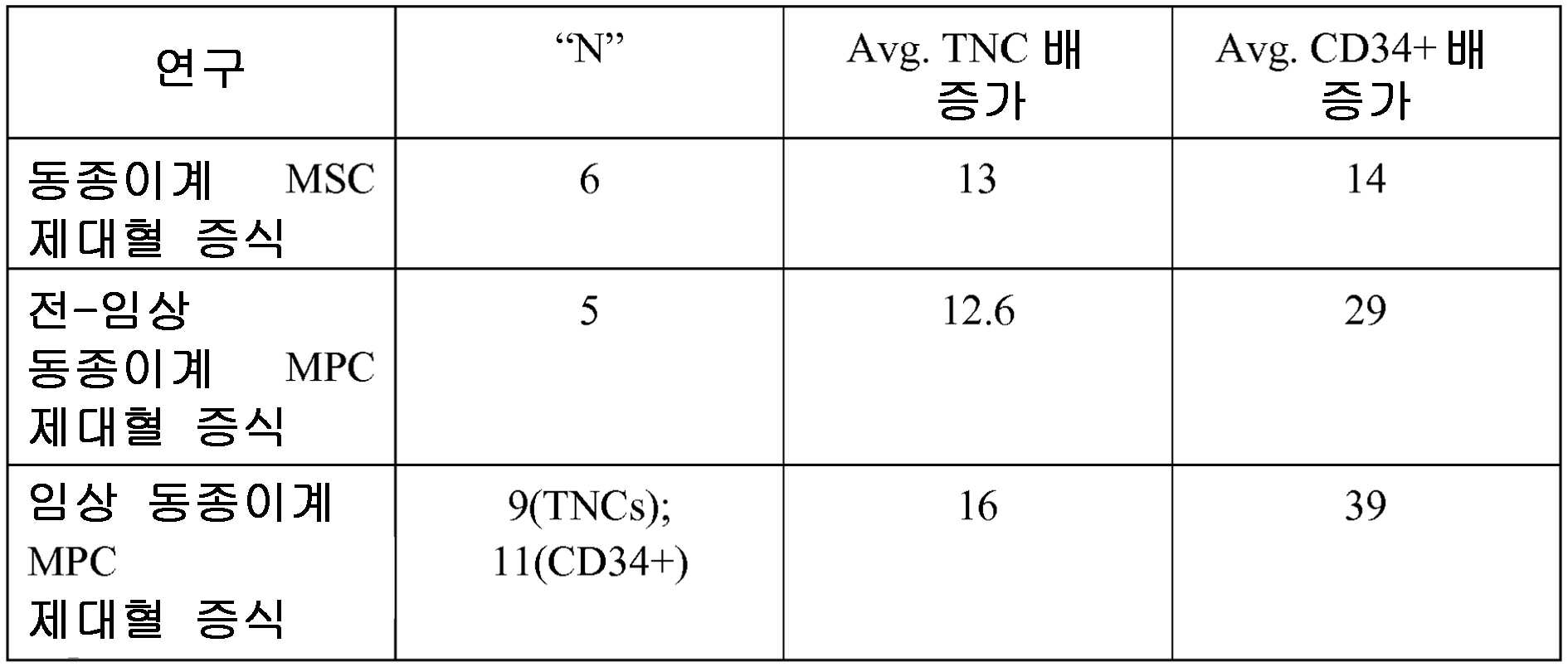
실시예Example 2 제대혈 공동 배양을 위해 " 2 for cord blood coculture " 오프off -더--more- 쉐프chef " " MPCsMPCs 의 충분한 수의 생성에 대한 시간Time for the creation of a sufficient number of
동결된 인간 중간엽 전구 세포(로트 번호.25126787, >1.5 x 10⁷ 세포/ml)를 포함하는 바이알을 녹여 2.03 x 10⁶ 세포를 항생제(페니실린 및 스트렙토마이신), 글루타민 및 10% (v/v) 태아 소 혈청(FBS)가 첨가된 알파 MEM 배지 360 ml에 수거하였다. 상기 세포 현탁액을 그 후 12개의 T- 150 cm2 조직 배양 플라스크에 분배하였다(T- 150 cm2 조직 배양 플라스크 당 약1.7 x 10⁶ 세포). 배양은 도립 위상차 현미경을 사용하여 모니터링하였다. 배양 시작 4 내지 5일 후, MPCs는 >70% 컨플루언스를 보였고 제대혈 단핵세포(MNC) 공동배양 증식을 위해 사용하였다. 따라서, 배양된 MPCs는 배양 시작 4일에 충분히 컨플루언트하였다. 이것은 오프-더-쉐프 MPCs의 1개 바이알로도 배양 3-5일 후에 제대혈 공동 배양을 위한 세포의 충분한 수를 생성하는데 족함을 나타낸다. 이것은 골수 흡인으로부터 공동배양을 위한 충분한 수의 컨플루언트한 MPCs를 이루기 위해 필요한 증식 배양의 약 4 주로부터 현저한 감소를 나타낸다.
Tear the vial containing frozen human mesenchymal progenitor cells (lot no. 25126787,> 1.5 x 10 7 cells / ml) to dissolve 2.03 x 10 6 cells with antibiotics (penicillin and streptomycin), glutamine and 10% (v / v). ) 360 ml of Alpha MEM medium with Fetal Bovine Serum (FBS) was added. The cell suspension was then distributed to 12 T- 150 cm 2 tissue culture flasks (150 cm 2 tissue culture T- from about 1.7 x 10 6 cells per flask). Cultures were monitored using an inverted phase contrast microscope. Four to five days after incubation, MPCs showed> 70% confluence and were used for cord blood mononuclear cell (MNC) coculture proliferation. Therefore, cultured MPCs were fully confluent at 4 days of incubation. This indicates that even one vial of off-the-chef MPCs is sufficient to produce a sufficient number of cells for cord blood co-culture after 3-5 days of culture. This represents a significant reduction from about 4 weeks of proliferation culture necessary to achieve a sufficient number of confluent MPCs for coculture from bone marrow aspiration.
실시예Example
3 제대혈 이식 프로토콜 3 Cord Blood Transplant Protocol
3.1 더블 제대혈 이식3.1 Double Umbilical Cord Blood Transplantation
높은 투여량 또는 골수박멸성(nonmyeloablative) 요법 후 주입된 CB 세포의 수를 증가시키기 위한 시도에서, 본 발명자는 다른 HLA 타입의 2개 유닛을 결합하여 그들을 동종 이계의 조혈모 지지체로서 정맥 주입하였다. 이들 연구는 2개의 면역학적으로 독특한 CD 유닛의 이식은 교차된 면역거부 관점에서 안전하다라는 법칙을 지지한다. 이식 실패가 관찰되지만, 대다수의 환자는 오직 하나의 CB 유닛으로 이식하였다. 현재 시험에서 본 발명자는 2개의 CB 유닛을 사용할 것이며, 그중 하나는 CB 이식 수령자에서 이러한 환경에서 통상적으로 보고된 20-30일 아래로 거부에 대한 시간을 줄이고자 생체 외에서 증식될 것이다.
In an attempt to increase the number of CB cells injected after high dose or nonmyeloablative therapy, we combined two units of different HLA types and injected them intravenously as allogeneic hematopoietic scaffolds. These studies support the rule that the transplantation of two immunologically distinct CD units is safe in terms of crossed immunorejection. Although graft failure was observed, the majority of patients transplanted with only one CB unit. In the current trial we will use two CB units, one of which will be expanded in vitro to reduce the time for rejection below 20-30 days as commonly reported in this environment in CB transplant recipients.
3.2 3.2 생체외In vitro 증식을 위한 성장 인자 Growth Factors for Proliferation
상기 CB 세포를 본 섹션에서 기술된 낮은 농도(전신적으로 사용된 마이크로그램 농도에 반하여 나노그램 농도)의 성장 인자를 가지고 배양할 것이다. 게다가, 증식된 세포를 대상에 주입되기 전에 광범위하게 세척하였다. 따라서, 그들이 임의의 전신 부작용을 생성하지 않을 것 같다.
The CB cells will be cultured with growth factors at the low concentrations described in this section (nanogram concentrations as opposed to the microgram concentrations used systemically). In addition, the expanded cells were washed extensively before being injected into the subject. Thus, they do not seem to produce any systemic side effects.
적합한 성장 인자가 하기에 기술되어 있다.
Suitable growth factors are described below.
1. 필그라스팀 [과립구 집락자극인자 (G-CSF)] 1. Peel Glass Team [G-CSF]
치료적 분류: 재조합 성장 인자 Therapeutic classification : recombinant growth factor
활동 기작: G-CSF는 과립구-자극인자로서 조혈모 세포에 작용하여 분열, 분화, 및 몇몇 종말 세포의 기능적 활성을 자극한다. Mechanism of action : G-CSF acts as a granulocyte-stimulating factor on hematopoietic stem cells to stimulate division, differentiation, and functional activity of some terminal cells.
보관 및 안정성: G-CSF는 2 내지 8℃에서 보관되어야 한다. 주사 전에, 필그라스팀은 실온까지 올라가도록 허락되지만, 24시간 이상 실온에서 방치된 임의의 바이알은 버려져야 한다. 바이알은 흔들어서는 안된다. 바이알은 투여 전에 침전 또는 변색에 대해 면밀히 관찰되어야 한다. 침전 또는 변색이 관찰되면 상기 바이알은 사용되지 말아야 한다. Storage and Stability : G-CSF should be stored at 2-8 ° C. Prior to injection, filgrastim is allowed to rise to room temperature, but any vial left at room temperature for more than 24 hours should be discarded. The vial should not be shaken. Vials should be closely monitored for precipitation or discoloration prior to administration. The vial should not be used if precipitation or discoloration is observed.
투여의 경로: 피하주사-정맥주사 Route of administration : subcutaneous injection-intravenous injection
부적합: 어떠한 명확한 부적합이 알려지고 있지 않다. 그러나, 호중성 백혈구의 분비를 촉진하는 약물은 주의를 가지고 사용되어야 한다. Nonconformity : No clear nonconformity is known. However, drugs that promote the secretion of neutrophils should be used with caution.
입수가능성: 필그라스팀 300 mcg (1 ml 바이알) 및 48Omcg (1.6 ml 바이알)을 포함하는 1회용 투여, 보존제 없는 바이알이 상업적으로 입수가능. Availability : Disposable, preservative-free vials containing 300 mgg (1 ml vial) and 48Omcg (1.6 ml vials) of Philgrastim are commercially available.
부작용: 골수억제 요법을 받는 환자에서 순한 내지 보통의 골 통증이 가능하다. Side effects : Mild to moderate bone pain is possible in patients undergoing myelosuppression therapy.
일반적인 피부발진, 탈모증, 열병, 혈소판 감소증, 골다공증, 구역질, 구토, 설사, 점막염, 신경성 식욕 부진증, 혈관 염증 및/또는 심장 리듬장애가 일어날 수 있다. General skin rash, alopecia, fever, thrombocytopenia, osteoporosis, nausea, vomiting, diarrhea, mucositis, anorexia nervosa, vascular inflammation and / or heart rhythm disorders may occur.
필그라스팀을 고용량 투여시 비장 비대증이 일어날 수 있다.
Spleen hypertrophy can occur when high doses of filgrastim are administered.
2. 재조합-metHu 줄기 세포 인자 (SCF).2. Recombinant-metHu stem cell factor (SCF).
치료적 분류: 재조합 성장 인자 Therapeutic classification : recombinant growth factor
활동 기작: SCF는 인간 과립구-자극인자로서 조혈모 세포에 작용하여 분열, 분화, 및 몇몇 종말 세포의 기능적 활성을 자극한다. Mechanism of action : SCF is a human granulocyte-stimulating factor that acts on hematopoietic stem cells to stimulate division, differentiation, and functional activity of some terminal cells.
약학적 데이터: 재조합 메티오닐 인간 줄기 세포 인자(r-metHuSCF)는 재조합 DNA 기술에 의해 대장균에서 생성된 재조합 인간 단백질이다. 165-아미노산의 비글라이코실화된 단백질은 2개의 분자내 다이설피드 결합을 가지고 있고 분자량 36,000의 비공유결합으로 연관된 이합체로서 존재하며, 및 천연단백질과는 N-말단(잔기번호 [-1])의 메티오닌 모이어티의 존재에 의해 다르며 이것은 상기 재조합 단백질이 글라이코실화되지 않는 발현 및 사실에 기인한다. r-metHuSCF를 발현하는 세포는 정의되고 조절된 조건하에서 배양된다. 상기 세포를 수확하여 r-metHuSCF가 추출되는 페이스트(paste)를 생성하고 일련의 독점적인 절차와 크로마토그래픽 단계를 거쳐 정제하였다. 결과적으로 정제된 r-metHuSCF를 멸균 여과및 필링(filling) 전에 수용 완충용액에서 제형화하였다. 임상에서 사용하기 위한 r-metHuSCF 분비에 대한 기준은 엄격하다. 이들은 USP 토끼 발열성 물질시험, 생물학적내독소시험, 멸균 시험, 및 일반적인 안전성 시험 통과를 포함한다(미국 연방규정집, 타이틀 21, 섹션 610.11). 상기 핵산량은 1.7 pg/mg 단백질보다 크지 않다. 최종 산물은 깨끗하고, 무색의, 멸균된 미세입자가 없는 단백질 용액이다; r-metHuSCF는 95% 순도보다 적지 않다. 정제된 제조물의 생물학적 활성은 방사선 수용체 결합 및 분열 검사법을 통해 평가된다. Pharmaceutical Data : Recombinant Methionyl Human Stem Cell Factor (r-metHuSCF) is a recombinant human protein produced in Escherichia coli by recombinant DNA technology. Unglycosylated proteins of 165-amino acids have two intramolecular disulfide bonds and exist as dimers associated with noncovalent bonds of molecular weight 36,000, and the N-terminus (residual number [-1]) of the native protein It depends on the presence of the methionine moiety, which is due to the expression and fact that the recombinant protein is not glycosylated. Cells expressing r-metHuSCF are cultured under defined and controlled conditions. The cells were harvested to create a paste from which r-metHuSCF was extracted and purified through a series of proprietary procedures and chromatographic steps. The resulting purified r-metHuSCF was formulated in aqueous buffer prior to sterile filtration and filling. The criteria for r-metHuSCF secretion for use in the clinic are strict. These include passing the USP rabbit pyrogenicity test, biological endotoxin test, sterilization test, and general safety test (US Code of Federal Regulations, Title 21, Section 610.11). The amount of nucleic acid is not greater than 1.7 pg / mg protein. The final product is a clean, colorless, sterile, microparticle free protein solution; r-metHuSCF is not less than 95% purity. The biological activity of the purified preparations is assessed through radiological receptor binding and cleavage assays.
보관 및 안정성: 재조합-metHuSCF는 2-8℃에서 보관되어야 한다. 1.5 mg/ml 농도에서 r-metHuSCF이 안정성은 이러한 조건에서 저장될 때 12개월간 증명되었다. 안정성 시험은 진행 중이다. 상기 물질을 이러한 범위보다 높거나 낮은 과도한 온도에 노출하는것은 피해야한다. r-metHuSCF를 얼리지 말고 이동이나 보관중 내용물이 얼려있다면 사용하지 마시오. Storage and Stability : Recombinant-metHuSCF should be stored at 2-8 ° C. The stability of r-metHuSCF at a concentration of 1.5 mg / ml was demonstrated for 12 months when stored under these conditions. Stability testing is in progress. Exposure of the material to excessive temperatures above or below this range should be avoided. Do not freeze r-metHuSCF and do not use if contents are frozen during transport or storage.
부작용: 알려지지 않았지만 두드러기 및 홍반 같은 주사부위 합병증
Side effects : unknown complications of injection sites such as hives and erythema
3. 혈소판증식촉진인자 (TPO)3. Platelet Proliferation Factor (TPO)
치료적 분류: 재조합 성장 인자 Therapeutic classification : recombinant growth factor
활동 기작: TPO는 인간 과립구-자극인자로서 조혈모 세포에 작용하며 특히 거대핵세포 선구에 작용하여 분열, 분화, 및 몇몇 종말-세포(end-cell)의 기능적 활성을 자극한다. Mechanism of action : TPO acts on hematopoietic stem cells as a human granulocyte-stimulating factor, especially on megakaryocyte progenitors to stimulate division, differentiation and functional activity of some end-cells.
보관 및 안정성: TPO는 2 내지 8℃에서 보관되어야 한다. 바이알을 흔들어서는 안된다. 바이알은 투여 전에 침전 또는 변색에 대해 면밀히 관찰되어야 한다. 침전 또는 변색이 관찰되면 상기 바이알은 사용되지 말아야 한다. Storage and Stability : TPO should be stored at 2-8 ° C. Do not shake the vial. Vials should be closely monitored for precipitation or discoloration prior to administration. The vial should not be used if precipitation or discoloration is observed.
알려진 부작용: 혈소판증가증, 심정맥혈전증, 폐색전증, 혈전성정맥염
Known side effects : thrombocytopenia, deep vein thrombosis, pulmonary embolism, thrombophlebitis
4. FLT3-리간드 (FLT3)4.FLT3-ligand (FLT3)
치료적 분류: 재조합 성장 인자 Therapeutic classification : recombinant growth factor
활동 기작: TPO는 인간 과립구-자극인자로서 조혈모 세포에 작용한다. Mechanism of action : TPO acts on hematopoietic stem cells as human granulocyte-stimulating factor.
보관 및 안정성: FLT3은 2 내지 8℃에서 보관되어야 한다. 바이알은 투여 전에 침전 또는 변색에 대해 면밀히 관찰되어야 한다. 침전 또는 변색이 관찰되면 상기 바이알은 사용되지 말아야 한다. Storage and Stability : FLT3 should be stored at 2-8 ° C. Vials should be closely monitored for precipitation or discoloration prior to administration. The vial should not be used if precipitation or discoloration is observed.
알려진 부작용: 혈소판증가증, 심정맥혈전증, 폐색전증, 혈전성정맥염
Known side effects : thrombocytopenia, deep vein thrombosis, pulmonary embolism, thrombophlebitis
3.3 오프-더-쉐프 MPCs의 투여3.3 Administration of Off-the-Chef MPCs
Angioblast Revascor™ MPCs가 CB 공동 배양을 위해 사용되었다. Angioblast Revascor™ MPC의 하나의 얼려진 바이알은 3 내지 4 T-300 cm2 배양 플라스크를 시딩(seeding)하기에 충분한 세포를 제공할 것이다. 해동으로부터의 복구 후 및 10% 태아 소 혈청(MPC 배양 배지)이 첨가된 αMEM 배지에서 2 내지 3일간 배양 후, 부착된 세포를 트립신화하여 수거하고 상기 전체를 12개의 T-150 cm2 배양 플라스크에 옮겼다. 세포를 MPC 배양 배지에 12개의 T-150 cm2 배양 플라스크에서 입수가능한 배양 표면에 대해 70% 이상의 컨플루언스를 이루기에 충분한 성장을 완수할 때까지 부가적인 5 내지 6일간 배양할 것이다. 이 점에서 상기 T- 150 cm2 배양 플라스크는 제대혈 공동 배양 증식 프로토콜에서의 사용을 위해 릴리스(release)될 것이다. 이러한 방식으로 생성된 배양 플라스크는 주간 배지 교환에 의해 필요로 될 때까지 >70% 컨플루언스로 유지될 수 있다. >70% MPC 컨플루언스를 포함하고 생성된 12개의 T-150 cm2 배양 플라스크 중 10개가 해동되고 세척된 제대혈 유닛을 받을 것이다. 공동 배양은 패밀리 맴버-유래 MSCs에 대해 상기에 언급된 바와 같이 태아 소 혈청이 첨가되고 SCF, FLT3-L, TPO 및 G-CSF 각각 100 ng/ml을 포함하는 배양 배지에서 수행할 것이다. Angioblast Revascor ™ MPCs were used for CB coculture. One frozen vial of Angioblast Revascor ™ MPC will provide enough cells to seed 3-4 T-300 cm 2 culture flasks. After recovery from thawing and after incubation for 2-3 days in αMEM medium with 10% fetal bovine serum (MPC culture medium), attached cells were trypsinized and collected in total in 12 T-150 cm 2 culture flasks. Transferred to. Cells will be incubated for an additional 5-6 days in MPC culture medium until they have completed sufficient growth to achieve at least 70% confluence on the available culture surface in 12 T-150 cm 2 culture flasks. At this point the T-150 cm 2 culture flask will be released for use in cord blood co-culture proliferation protocol. Culture flasks produced in this manner can be maintained at> 70% confluence until needed by weekly media exchange. Ten of the 12 T-150 cm 2 culture flasks generated containing> 70% MPC confluence will receive thawed and washed cord blood units. Co-culture will be performed in culture medium containing fetal bovine serum added and 100 ng / ml each of SCF, FLT3-L, TPO and G-CSF, as mentioned above for family member-derived MSCs.
환자는 수화를 위해 - 9 일째 병원에 허락될 것이고 -8 내지 -2일째에 고안된 준비 처방책을 받는다. 0일째 조작되지 않은 CB 유닛이 주입될 것이고 다음 증식된 CB유닛이 따른다. 0일째 (배양 14일째), 2개의 배양으로부터의 상기 세포는 주입을 위해 수확되고 세척될 것이다.
The patient will be allowed to the hospital on day 9 for hydration and receive a prepared prescription designed on day 8 to day 2. On day 0 an unmanaged CB unit will be injected followed by the next multiplied CB unit. On day 0 (day 14 of culture), the cells from the two cultures will be harvested and washed for infusion.
실시예Example 4: 임상학적 시험 결과 4: Clinical trial results
14명의 환자가 진행중의 시험에서 MPC로 유도된 증식 제대혈로 이식되었다. 환자의 평균나이는 40 세였다. 이식의 현재 결과는 아래 표 2와 같다. Fourteen patients were implanted with MPC-induced proliferation cord blood in an ongoing trial. The average age of patients was 40 years. The current results of the transplant are shown in Table 2 below.
호중성 백혈구 이식에 대한 중간 기간은 17일이었다(34일의 히스토릭 대조군과 비교하여). 혈소판 이식에 대한 중간 기간은 (128일의 히스토릭 대조군과 비교하여) 38일이었다. 어떠한 환자도 Grade III/IV GVHD를 가지지 않았다(40%의 히스토릭 대조군과 비교하여).The median period for neutrophil leukocyte transplantation was 17 days (compared to 34 days historical control). The median period for platelet transplantation was 38 days (relative to 128 days historical control). None of the patients had Grade III / IV GVHD (compared to 40% historical control).
표 3은 현재 MPC로 유도된 증식 제대혈 이식 결과는 다른 대안의 제대혈 증식 전략보다 우수함을 나타낸다. Table 3 shows that current MPC-induced proliferation cord blood transplant results are superior to other alternative cord blood proliferation strategies.
본 발명에 포함된 문서, 활동, 물질, 기구, 기사등의 어떠한 토의도 본 명세서의 문맥을 제공하기 위한 유일한 목적이다. 이 명세서의 각 청구항의 우선권일 전에 존재하므로 이들 물질의 어느 하나 또는 모든것은 이전 당업계의 부분을 형성하거나 또는 본 발명의과 관계된 분야에서 상식이었다는 것을 인정해서는 안된다. Any discussion of documents, activities, materials, instruments, articles, etc., included in the present invention is the sole purpose of providing the context of this specification. As it exists before the priority date of each claim in this specification, it should not be admitted that any or all of these materials form part of the prior art or were common sense in the art related to the present invention.
폭 넓게 기술된 바와 같이 본 발명의 범위에서 떠나지않는 특이적 구현 예에서 나타나는 것처럼 다수의 변형 및/또는 개조가 본 발명에서 이루어 질 수 있다는 것은 당업자에게 잘 알려져 있다. 본 구현 예는, 그러므로, 예시적이지 제한적이지 않은 모든 면에서 고려되어야 한다.
It is well known to those skilled in the art that many modifications and / or adaptations can be made in the present invention as indicated by specific embodiments without departing from the scope of the present invention as broadly described. This embodiment is, therefore, to be considered in all respects as illustrative and not restrictive.
표 2Table 2

표 3TABLE 3

ReferencesReferences
Barker, J.N., S.M. Davies, T. DeFor, N.K. Ramsay, DJ. Weisdorf, and J.E. Wagner, Survival after transplantation of unrelated donor umbilical cord blood is comparable to that of human leukocyte antigen-matched unrelated donor bone marrow: results of a matched-pair analysis. Blood, 2001. 97(10): p. 2957-61.
Barker, JN, SM Davies, T. DeFor, NK Ramsay, DJ. Weisdorf, and JE Wagner, Survival after transplantation of unrelated donor umbilical cord blood is comparable to that of human leukocyte antigen-matched unrelated donor bone marrow: results of a matched-pair analysis. Blood, 2001. 97 (10): p. 2957-61.
Chan, S. L et al., Enhanced in vivo homing of uncultured and selectively amplified cord blood CD34+ cells by co-transplantation with cord-blood derived unrestricted somatic stem cells. Stem Cells, 2006. 25:529-536.
Chan, S. L et al., Enhanced in vivo homing of uncultured and selectively amplified cord blood CD34 + cells by co-transplantation with cord-blood derived unrestricted somatic stem cells. Stem Cells, 2006. 25: 529-536.
De Lima, M. et al. Transplanatation of ex vivo expanded cord blood cells using the copper chelator tetraethylenepentamine: a phase I/II clinical trial. Bone Marrow Transplantation, 2008., 1-8.
De Lima, M. et al. Transplanatation of ex vivo expanded cord blood cells using the copper chelator tetraethylenepentamine: a phase I / II clinical trial. Bone Marrow Transplantation, 2008., 1-8.
Gluckman, E., V. Rocha, A. Boyer-Chammard, F. Locatelli, W. Arcese, R. Pasquini, J. Ortega, G. Souillet, E. Ferreira, J. P. Laporte, M. Fernandez, and C. Chastang, Outcome of cord-blood transplantation from related and unrelated donors. Eurocord Transplant Group and the European Blood and Marrow Transplantation Group. N. Engl. J. Med., 1997. 337(6): p. 373-81.
Gluckman, E., V. Rocha, A. Boyer-Chammard, F. Locatelli, W. Arcese, R. Pasquini, J. Ortega, G. Souillet, E. Ferreira, JP Laporte, M. Fernandez, and C. Chastang , Outcome of cord-blood transplantation from related and unrelated donors. Eurocord Transplant Group and the European Blood and Marrow Transplantation Group. N. Engl. J. Med., 1997. 337 (6): p. 373-81.
Jaroscak. J. et al., Augmentation of umbilical cord blood transplantation with ex-vivo expanded UCB cells: results of phase I trial using Aastrom Replicell system. Blood, 2003. 101 :5061-5067.
Jaroscak. J. et al., Augmentation of umbilical cord blood transplantation with ex-vivo expanded UCB cells: results of phase I trial using Aastrom Replicell system. Blood, 2003. 101: 5061-5067.
Kernan, N.A., G. Bartsch, R.C. Ash, P.G. Beatty, R. Champlin, A. Filipovich, J. Gajewski, J.A. Hansen, J. Henslee-Downey, and J. McCullough, Analysis of 462 transplantations from unrelated donors facilitated by the National Marrow Donor Program. N. Engl. J. Med., 1993. 328(9): p. 593-602.
Kernan, NA, G. Bartsch, RC Ash, PG Beatty, R. Champlin, A. Filipovich, J. Gajewski, JA Hansen, J. Henslee-Downey, and J. McCullough, Analysis of 462 transplantations from unrelated donors facilitated by the National Marrow Donor Program. N. Engl. J. Med., 1993. 328 (9): p. 593-602.
Kurtzberg, J., M. Laughlin, MX. Graham, C. Smith, J.F. Olson, E. C. Halperin, G.Ciocci, C. Carrier, CE. Stevens, and P. Rubinstein, Placental blood as a source of hematopoietic stem cells for transplantation into unrelated recipients. N. Engl. J. Med., 1996. 335(3): p. 157-66.
Kurtzberg, J., M. Laughlin, MX. Graham, C. Smith, JF Olson, EC Halperin, G. Ciocci, C. Carrier, CE. Stevens, and P. Rubinstein, Placental blood as a source of hematopoietic stem cells for transplantation into unrelated recipients. N. Engl. J. Med., 1996. 335 (3): p. 157-66.
Laughlin, M. J., J. Barker, B. Bambach, O.N. Koc, D.A. Rizzieri, J.E. Wagner, S. L. Gerson, H.M. Lazarus, M. Cairo, CE. Stevens, P. Rubinstein, and J. Kurtzberg, Hematopoietic engraftment and survival in adult recipients of umbilical-cord blood from unrelated donors. N. Engl. J. Med., 2001. 344(24): p. 1815-22.
Laughlin, MJ, J. Barker, B. Bambach, ON Koc, DA Rizzieri, JE Wagner, SL Gerson, HM Lazarus, M. Cairo, CE. Stevens, P. Rubinstein, and J. Kurtzberg, Hematopoietic engraftment and survival in adult recipients of umbilical-cord blood from unrelated donors. N. Engl. J. Med., 2001. 344 (24): p. 1815-22.
Rizzieri, D.A., G. D. Long, J.J. Vredenburgh, C. Gasparetto, A. Morris, D. Niedzwiecki, M. Lassiter, J. Loftis, P. Davis, C. McDonald, T. Stenzel, B. Waters-Pick, J. Kurtzberg, and N.J. Chao, Durable Engraftment of Mismatched Unrelated Cord Blood Following a Non-Myeloablative Prepative Regimen for Adults. Blood, 2001. 98(11 (I)): p. 185a.
Rizzieri, DA, GD Long, JJ Vredenburgh, C. Gasparetto, A. Morris, D. Niedzwiecki, M. Lassiter, J. Loftis, P. Davis, C. McDonald, T. Stenzel, B. Waters-Pick, J. Kurtzberg, and NJ Chao, Durable Engraftment of Mismatched Unrelated Cord Blood Following a Non-Myeloablative Prepative Regimen for Adults. Blood, 2001. 98 (11 (I)): p. 185a.
Robinson, S.N. et al., Efficacy of "Off-the-Shelf ' commercially available, third-party mesenchymal stem cells (MSC) in ex vivo cord blood (CB) co-culture expansion. Blood (ASH Annual Meeting Abstracts) 2007 110: Abstract 4106.
Robinson, SN et al., Efficacy of "Off-the-Shelf 'commercially available, third-party mesenchymal stem cells (MSC) in ex vivo cord blood (CB) co-culture expansion.Blood (ASH Annual Meeting Abstracts) 2007 110 : Abstract 4106.
Rubinstein, P., C. Carrier, A. Scaradavou, J. Kurtzberg, J. Adamson, A.R. Migliaccio, R.L. Berkowitz, M. Cabbad, NX. Dobrila, P.E. Taylor, R.E. Rosenfeld, and CE. Stevens, Outcomes among 562 recipients of placental-blood transplants from unrelated donors. N. Engl. J. Med., 1998. 339(22): p. 1565-77.
Rubinstein, P., C. Carrier, A. Scaradavou, J. Kurtzberg, J. Adamson, AR Migliaccio, RL Berkowitz, M. Cabbad, NX. Dobrila, PE Taylor, RE Rosenfeld, and CE. Stevens, Outcomes among 562 recipients of placental-blood transplants from unrelated donors. N. Engl. J. Med., 1998. 339 (22): p. 1565-77.
Claims (29)
STRO-l bright In the presence of a concentrated cell population or supernatant or progeny derived therefrom Culturing the hematopoietic progenitor and administering the proliferated hematopoietic progenitor to a subject, wherein the STRO-l bright A method of transplanting a hematopoietic progenitor into a subject in need thereof, wherein the cell is a mesenchymal progenitor cell (MPC) comprising mesenchymal progenitor cells capable of producing colony-forming unit-fibroblasts (CFU-F).
The method of claim 1, wherein the cell population enriched for STRO-1 bright cells is allogeneic.
The method of claim 1 or 2, wherein said proliferated hematopoietic progenitor cells comprise CFU-GM cells.
The method of claim 3, wherein the proliferated hematopoietic progenitor cells comprise 1 × 10 4 CFU-GM cells per kg of body weight of the subject.
5. The method of claim 1, wherein said hematopoietic stem reconstitution occurs in a subject after administration of proliferated hematopoietic progenitor cells.
The method of claim 5, wherein the hematopoietic stem reconstitution occurs in the subject within 10 to 30 days of administering the proliferated hematopoietic progenitor cells.
7. The method of claim 5 or 6, wherein the hematopoietic stem reconstruction occurs in the absence of a detrimental immune response.
8. The method of any one of claims 5-7, wherein the hematopoietic stem reconstitution is determined by neutrophil leukocyte transplantation, platelet transplantation, lymph transplantation, erythrocyte transplantation, and / or megakaryocyte transplantation.
9. The method of claim 1, further comprising administering to the subject a factor that enhances the differentiation of the hematopoietic progenitor cells into specific hematopoietic stem cell cells.
The method of claim 9, wherein said factor that enhances differentiation is administered concurrently with proliferated hematopoietic progenitor cells.
The method of claim 9, wherein said factor that enhances differentiation is administered independently after administration of proliferated hematopoietic progenitor cells.
The method according to any one of claims 9 to 11, wherein the hematopoietic stem cells are B-cells, T-cells, dendritic cells, monocytes, neutrophils, macrophages, natural killer cells, granular leukocytes, erythrocytes, Eosinophils, megakaryocytes, platelets, bone marrow, spleen, skin, or stromal cells.
The method according to any one of claims 10 to 12, wherein said factor that enhances differentiation is stem cell factor (SCF), GM-SCF, M-CSF, G-CSF, MGDF, EPO, FLT3-ligand, IL-I. , IL-2, IL-3, IL-4, IL-6, IL-7, IL-I l. TNFα or thrombocytopenia.
The method according to any one of claims 1 to 13, wherein the transplantation of proliferated hematopoietic progenitor cells is made with cocultured MPCs or their progeny.
The method of claim 1, wherein the transplantation of the proliferated hematopoietic progenitor cells is performed with one or more soluble factors derived from supernatant or co-cultured MPC or progeny thereof.
16. The method of any one of claims 1-15, wherein the administration of proliferated hematopoietic progenitor cells reduces the risk of host-to-graft disease as compared to hematopoietic progenitor cells that have not proliferated in vitro.
The method of claim 1, wherein the subject has a blood disease.
18. The method of claim 17, wherein the blood disease is a disease of platelet count and / or function.
The method of claim 18, wherein the blood disease is thrombocytopenia, idiopathic thrombocytopenic purpura (ITP), or a disease associated with a viral infection, drug abuse, or malignant tumor.
The method of claim 17, wherein the blood disease is a disease of red blood cell count and / or function.
The method of claim 20, wherein the blood disease is anemia.
22. The method of claim 21, wherein the anemia is aplastic anemia, autoimmune hemolytic anemia, strangular anemia, couli anemia, diamond-blackplate anemia, faucony anemia, folic acid deficient anemia, hemolytic anemia, iron deficiency anemia, pernicious anemia, A method that is sickle cell disease, thalassemia or diabetes mellitus.
The method of claim 17, wherein the blood disease is a disease of lymphocyte count and / or function.
The method of claim 23, wherein the disease is T-cell or B-cell deficiency.
The method of claim 23, wherein the disease is AIDS, leukemia, lymphoma, Hodgkins lumphoma, miliary tuberculosis, viral infection, rheumatoid arthritis, chronic infection, such as systemic lupus erythematosus, or agammaglobulinemia, di Genetic disorders such as George Anomaly, Wiscott-Aldrich Syndrome, and capillary dilatation dysfunction.
18. The method of claim 17, wherein the blood disease is a disease of multiple systemic bone marrow failure.
The method of claim 26, wherein the blood disease is the result of radiotherapy or chemotherapy.
27. The method of claim 26, wherein said blood disease is the result of malignant tumor replacement.
Applications Claiming Priority (3)
| Application Number | Priority Date | Filing Date | Title |
|---|---|---|---|
| US19096708P | 2008-09-03 | 2008-09-03 | |
| US61/190,967 | 2008-09-03 | ||
| PCT/AU2009/001145 WO2010025506A1 (en) | 2008-09-03 | 2009-09-03 | Expansion of haemopoietic precursors |
Publications (2)
| Publication Number | Publication Date |
|---|---|
| KR20110063640A true KR20110063640A (en) | 2011-06-13 |
| KR101708067B1 KR101708067B1 (en) | 2017-02-17 |
Family
ID=41796639
Family Applications (1)
| Application Number | Title | Priority Date | Filing Date |
|---|---|---|---|
| KR1020117005959A Active KR101708067B1 (en) | 2008-09-03 | 2009-09-03 | Expansion of haemopoietic precursors |
Country Status (9)
| Country | Link |
|---|---|
| US (2) | US8828375B2 (en) |
| EP (1) | EP2324109B1 (en) |
| JP (1) | JP5639058B2 (en) |
| KR (1) | KR101708067B1 (en) |
| CN (1) | CN102144028B (en) |
| AU (3) | AU2009290134B2 (en) |
| CA (1) | CA2735800C (en) |
| SG (1) | SG193888A1 (en) |
| WO (1) | WO2010025506A1 (en) |
Cited By (1)
| Publication number | Priority date | Publication date | Assignee | Title |
|---|---|---|---|---|
| WO2017176048A1 (en) * | 2016-04-06 | 2017-10-12 | 가톨릭대학교 산학협력단 | Heterogeneous niche activity in mesenchymal stromal cell-based cell therapy |
Families Citing this family (17)
| Publication number | Priority date | Publication date | Assignee | Title |
|---|---|---|---|---|
| CN106434527A (en) | 2006-04-14 | 2017-02-22 | 安斯泰来再生医药协会 | Hemangio-colony forming cells |
| CA2657308C (en) * | 2006-07-12 | 2017-06-27 | Angioblast Systems, Inc. | Treatment of excessive neovascularization |
| JP5639058B2 (en) * | 2008-09-03 | 2014-12-10 | メソブラスト,インコーポレーテッド | Hematopoietic progenitor cell proliferation |
| KR101891260B1 (en) | 2010-07-02 | 2018-08-24 | 메소블라스트, 아이엔씨. | Treatment of t-cell mediated immune disorders |
| JP6184942B2 (en) * | 2011-06-03 | 2017-08-23 | メゾブラスト,インコーポレーテッド | Methods for treating or preventing neurological diseases |
| SG195170A1 (en) * | 2011-07-04 | 2013-12-30 | Mesoblast Inc | Methods of treating or preventing rheumatic disease |
| US8961956B2 (en) | 2011-11-30 | 2015-02-24 | Ocata Therapeutics, Inc. | Mesenchymal stromal cells and uses related thereto |
| TW202344258A (en) | 2011-11-30 | 2023-11-16 | 安斯泰來再生醫藥協會 | Methods of generating mesenchymal stromal cells using hemangioblasts |
| HK1208054A1 (en) | 2012-07-12 | 2016-02-19 | 爱姆斯坦生物技术公司 | Mesenchymal-like stem cells derived from human embryonic stem cells, methods and uses thereof |
| CN103816183A (en) * | 2012-11-16 | 2014-05-28 | 臻景生物技术(上海)有限公司 | Application of stromal vascular fraction cells and mesenchymal progenitor cells to prevention or treatment of osteoarthritis |
| EP2931373B1 (en) * | 2012-12-12 | 2019-08-21 | Mesoblast, Inc. | Methods of treating or preventing respiratory conditions |
| US9763984B2 (en) | 2012-12-21 | 2017-09-19 | Astellas Institute For Regenerative Medicine | Methods for production of platelets from pluripotent stem cells and compositions thereof |
| US10273455B2 (en) * | 2014-04-07 | 2019-04-30 | Iucf-Hyu | In vitro expansion of erythroid cells |
| KR102288953B1 (en) * | 2016-09-02 | 2021-08-11 | 다카라 바이오 가부시키가이샤 | How to obtain microglia from pluripotent stem cells |
| CA3144640A1 (en) * | 2019-06-24 | 2020-12-30 | Children's Hospital Los Angeles | Bcl11b overexpression to enhance human thymopoiesis and t cell function |
| BR112022016448A2 (en) * | 2020-02-19 | 2022-11-29 | Mesoblast Int Sarl | METHOD FOR TREATMENT OF CHRONIC GRAFT VS HOST DISEASE |
| CN113750220B (en) * | 2020-06-02 | 2023-11-03 | 南京大学 | Application of mesenchymal stem cells combined with TPO and analogues thereof in treatment of chronic myelogenous leukemia |
Citations (1)
| Publication number | Priority date | Publication date | Assignee | Title |
|---|---|---|---|---|
| KR20080027295A (en) * | 2005-06-02 | 2008-03-26 | 스템사이트, 인코포레이티드 | Plasma-depleted, erythrocyte-non-depleted cord blood compositions and methods of use |
Family Cites Families (6)
| Publication number | Priority date | Publication date | Assignee | Title |
|---|---|---|---|---|
| AUPQ147799A0 (en) | 1999-07-07 | 1999-07-29 | Medvet Science Pty. Ltd. | Mesenchymal precursor cell |
| AR051573A1 (en) * | 2004-09-22 | 2007-01-24 | Sds Digger Tools Pty Ltd | PISTON DESIGN FOR BACKGROUND HAMMER |
| CA2580975A1 (en) | 2004-09-24 | 2006-03-30 | Angioblast Systems, Inc. | Multipotential expanded mesenchymal precursor cell progeny (memp) and uses thereof |
| EP1874922A4 (en) * | 2005-04-19 | 2009-10-28 | Univ Johns Hopkins | METHOD FOR USE OF CORDIAL HARVESURES FOR EXPANDING AND PLANTING CORE-CONTAINING CELLS FROM CORDIAL BLOOD BLOOD |
| JP2007202506A (en) * | 2006-02-03 | 2007-08-16 | Toshiba Ceramics Co Ltd | Method for culturing human hematopoietic stem cells or hematopoietic progenitor cells |
| JP5639058B2 (en) * | 2008-09-03 | 2014-12-10 | メソブラスト,インコーポレーテッド | Hematopoietic progenitor cell proliferation |
-
2009
- 2009-09-03 JP JP2011524142A patent/JP5639058B2/en active Active
- 2009-09-03 CA CA2735800A patent/CA2735800C/en active Active
- 2009-09-03 KR KR1020117005959A patent/KR101708067B1/en active Active
- 2009-09-03 SG SG2013071717A patent/SG193888A1/en unknown
- 2009-09-03 US US13/061,693 patent/US8828375B2/en active Active
- 2009-09-03 EP EP09810917.6A patent/EP2324109B1/en active Active
- 2009-09-03 WO PCT/AU2009/001145 patent/WO2010025506A1/en not_active Ceased
- 2009-09-03 AU AU2009290134A patent/AU2009290134B2/en active Active
- 2009-09-03 CN CN200980134570.7A patent/CN102144028B/en active Active
-
2014
- 2014-09-03 US US14/476,467 patent/US9415072B2/en active Active
-
2016
- 2016-07-14 AU AU2016204920A patent/AU2016204920B2/en active Active
-
2018
- 2018-08-14 AU AU2018217219A patent/AU2018217219A1/en not_active Abandoned
Patent Citations (1)
| Publication number | Priority date | Publication date | Assignee | Title |
|---|---|---|---|---|
| KR20080027295A (en) * | 2005-06-02 | 2008-03-26 | 스템사이트, 인코포레이티드 | Plasma-depleted, erythrocyte-non-depleted cord blood compositions and methods of use |
Cited By (1)
| Publication number | Priority date | Publication date | Assignee | Title |
|---|---|---|---|---|
| WO2017176048A1 (en) * | 2016-04-06 | 2017-10-12 | 가톨릭대학교 산학협력단 | Heterogeneous niche activity in mesenchymal stromal cell-based cell therapy |
Also Published As
| Publication number | Publication date |
|---|---|
| SG193888A1 (en) | 2013-10-30 |
| JP2012501968A (en) | 2012-01-26 |
| US20110217263A1 (en) | 2011-09-08 |
| CN102144028A (en) | 2011-08-03 |
| EP2324109A4 (en) | 2013-06-12 |
| AU2009290134B2 (en) | 2016-04-14 |
| CA2735800C (en) | 2018-05-01 |
| CN102144028B (en) | 2017-12-26 |
| CA2735800A1 (en) | 2010-03-11 |
| WO2010025506A1 (en) | 2010-03-11 |
| US9415072B2 (en) | 2016-08-16 |
| AU2016204920A1 (en) | 2016-08-04 |
| US8828375B2 (en) | 2014-09-09 |
| JP5639058B2 (en) | 2014-12-10 |
| AU2016204920B2 (en) | 2018-05-17 |
| EP2324109B1 (en) | 2016-10-26 |
| AU2018217219A1 (en) | 2018-08-30 |
| EP2324109A1 (en) | 2011-05-25 |
| KR101708067B1 (en) | 2017-02-17 |
| US20150202232A1 (en) | 2015-07-23 |
| AU2009290134A1 (en) | 2010-03-11 |
Similar Documents
| Publication | Publication Date | Title |
|---|---|---|
| KR101708067B1 (en) | Expansion of haemopoietic precursors | |
| KR102510368B1 (en) | Hemangio-colony forming cells | |
| TWI698242B (en) | Methods of generating mesenchymal stromal cells using hemangioblasts | |
| EP2785834A1 (en) | Enhanced stem cell composition | |
| WO2003039232A2 (en) | Endothelial cell derived hemotopoietic growth factor | |
| WO2021131261A1 (en) | Cell group and method for acquiring same | |
| KR20080072748A (en) | How to improve stem cell homing and engraftment | |
| EP1673445B1 (en) | Blood products from mesenchymal stem cells | |
| KR100641684B1 (en) | Increasing Bone Marrow Adhesion Activity of Hematopoietic Stem Cells Containing Cells Isolated from Adipose Tissue |
Legal Events
| Date | Code | Title | Description |
|---|---|---|---|
| PA0105 | International application |
St.27 status event code: A-0-1-A10-A15-nap-PA0105 |
|
| PG1501 | Laying open of application |
St.27 status event code: A-1-1-Q10-Q12-nap-PG1501 |
|
| R18-X000 | Changes to party contact information recorded |
St.27 status event code: A-3-3-R10-R18-oth-X000 |
|
| A201 | Request for examination | ||
| P11-X000 | Amendment of application requested |
St.27 status event code: A-2-2-P10-P11-nap-X000 |
|
| P13-X000 | Application amended |
St.27 status event code: A-2-2-P10-P13-nap-X000 |
|
| PA0201 | Request for examination |
St.27 status event code: A-1-2-D10-D11-exm-PA0201 |
|
| R18-X000 | Changes to party contact information recorded |
St.27 status event code: A-3-3-R10-R18-oth-X000 |
|
| D13-X000 | Search requested |
St.27 status event code: A-1-2-D10-D13-srh-X000 |
|
| D14-X000 | Search report completed |
St.27 status event code: A-1-2-D10-D14-srh-X000 |
|
| E902 | Notification of reason for refusal | ||
| PE0902 | Notice of grounds for rejection |
St.27 status event code: A-1-2-D10-D21-exm-PE0902 |
|
| T11-X000 | Administrative time limit extension requested |
St.27 status event code: U-3-3-T10-T11-oth-X000 |
|
| E13-X000 | Pre-grant limitation requested |
St.27 status event code: A-2-3-E10-E13-lim-X000 |
|
| P11-X000 | Amendment of application requested |
St.27 status event code: A-2-2-P10-P11-nap-X000 |
|
| P13-X000 | Application amended |
St.27 status event code: A-2-2-P10-P13-nap-X000 |
|
| E902 | Notification of reason for refusal | ||
| PE0902 | Notice of grounds for rejection |
St.27 status event code: A-1-2-D10-D21-exm-PE0902 |
|
| E13-X000 | Pre-grant limitation requested |
St.27 status event code: A-2-3-E10-E13-lim-X000 |
|
| P11-X000 | Amendment of application requested |
St.27 status event code: A-2-2-P10-P11-nap-X000 |
|
| P13-X000 | Application amended |
St.27 status event code: A-2-2-P10-P13-nap-X000 |
|
| E701 | Decision to grant or registration of patent right | ||
| PE0701 | Decision of registration |
St.27 status event code: A-1-2-D10-D22-exm-PE0701 |
|
| GRNT | Written decision to grant | ||
| PR0701 | Registration of establishment |
St.27 status event code: A-2-4-F10-F11-exm-PR0701 |
|
| PR1002 | Payment of registration fee |
St.27 status event code: A-2-2-U10-U12-oth-PR1002 Fee payment year number: 1 |
|
| PG1601 | Publication of registration |
St.27 status event code: A-4-4-Q10-Q13-nap-PG1601 |
|
| PR1001 | Payment of annual fee |
St.27 status event code: A-4-4-U10-U11-oth-PR1001 Fee payment year number: 4 |
|
| PR1001 | Payment of annual fee |
St.27 status event code: A-4-4-U10-U11-oth-PR1001 Fee payment year number: 5 |
|
| PR1001 | Payment of annual fee |
St.27 status event code: A-4-4-U10-U11-oth-PR1001 Fee payment year number: 6 |
|
| PR1001 | Payment of annual fee |
St.27 status event code: A-4-4-U10-U11-oth-PR1001 Fee payment year number: 7 |
|
| PR1001 | Payment of annual fee |
St.27 status event code: A-4-4-U10-U11-oth-PR1001 Fee payment year number: 8 |
|
| PR1001 | Payment of annual fee |
St.27 status event code: A-4-4-U10-U11-oth-PR1001 Fee payment year number: 9 |
|
| PR1001 | Payment of annual fee |
St.27 status event code: A-4-4-U10-U11-oth-PR1001 Fee payment year number: 10 |
|
| U11 | Full renewal or maintenance fee paid |
Free format text: ST27 STATUS EVENT CODE: A-4-4-U10-U11-OTH-PR1001 (AS PROVIDED BY THE NATIONAL OFFICE) Year of fee payment: 10 |