KR20090045277A - Computer-implemented systems, telephone call routing management methods, and call management systems that facilitate telephone call management - Google Patents
Computer-implemented systems, telephone call routing management methods, and call management systems that facilitate telephone call management Download PDFInfo
- Publication number
- KR20090045277A KR20090045277A KR1020097003906A KR20097003906A KR20090045277A KR 20090045277 A KR20090045277 A KR 20090045277A KR 1020097003906 A KR1020097003906 A KR 1020097003906A KR 20097003906 A KR20097003906 A KR 20097003906A KR 20090045277 A KR20090045277 A KR 20090045277A
- Authority
- KR
- South Korea
- Prior art keywords
- call
- client
- server
- routing
- rule
- Prior art date
- Legal status (The legal status is an assumption and is not a legal conclusion. Google has not performed a legal analysis and makes no representation as to the accuracy of the status listed.)
- Granted
Links
Images


Classifications
-
- H—ELECTRICITY
- H04—ELECTRIC COMMUNICATION TECHNIQUE
- H04M—TELEPHONIC COMMUNICATION
- H04M3/00—Automatic or semi-automatic exchanges
- H04M3/42—Systems providing special services or facilities to subscribers
- H04M3/54—Arrangements for diverting calls for one subscriber to another predetermined subscriber
-
- H—ELECTRICITY
- H04—ELECTRIC COMMUNICATION TECHNIQUE
- H04W—WIRELESS COMMUNICATION NETWORKS
- H04W40/00—Communication routing or communication path finding
- H04W40/02—Communication route or path selection, e.g. power-based or shortest path routing
-
- H—ELECTRICITY
- H04—ELECTRIC COMMUNICATION TECHNIQUE
- H04L—TRANSMISSION OF DIGITAL INFORMATION, e.g. TELEGRAPHIC COMMUNICATION
- H04L65/00—Network arrangements, protocols or services for supporting real-time applications in data packet communication
- H04L65/1066—Session management
- H04L65/1096—Supplementary features, e.g. call forwarding or call holding
-
- H—ELECTRICITY
- H04—ELECTRIC COMMUNICATION TECHNIQUE
- H04L—TRANSMISSION OF DIGITAL INFORMATION, e.g. TELEGRAPHIC COMMUNICATION
- H04L65/00—Network arrangements, protocols or services for supporting real-time applications in data packet communication
- H04L65/1066—Session management
- H04L65/1101—Session protocols
- H04L65/1104—Session initiation protocol [SIP]
-
- H—ELECTRICITY
- H04—ELECTRIC COMMUNICATION TECHNIQUE
- H04M—TELEPHONIC COMMUNICATION
- H04M3/00—Automatic or semi-automatic exchanges
- H04M3/42—Systems providing special services or facilities to subscribers
- H04M3/42136—Administration or customisation of services
- H04M3/42153—Administration or customisation of services by subscriber
-
- H—ELECTRICITY
- H04—ELECTRIC COMMUNICATION TECHNIQUE
- H04W—WIRELESS COMMUNICATION NETWORKS
- H04W80/00—Wireless network protocols or protocol adaptations to wireless operation
- H04W80/08—Upper layer protocols
- H04W80/10—Upper layer protocols adapted for application session management, e.g. SIP [Session Initiation Protocol]
-
- H—ELECTRICITY
- H04—ELECTRIC COMMUNICATION TECHNIQUE
- H04W—WIRELESS COMMUNICATION NETWORKS
- H04W88/00—Devices specially adapted for wireless communication networks, e.g. terminals, base stations or access point devices
- H04W88/18—Service support devices; Network management devices
Landscapes
- Engineering & Computer Science (AREA)
- Signal Processing (AREA)
- Computer Networks & Wireless Communication (AREA)
- Business, Economics & Management (AREA)
- General Business, Economics & Management (AREA)
- Multimedia (AREA)
- Telephonic Communication Services (AREA)
- Mobile Radio Communication Systems (AREA)
- Data Exchanges In Wide-Area Networks (AREA)
Abstract
호 서버(call server)에서 전화 호(telephone call)가 처리되는 방식을 클라이언트가 제어할 수 있게 하는 클라이언트측 시그널링 메커니즘이 제공된다. 클라이언트 사용자는 세션 프로토콜 메시지를 관리하는 클라이언트 제어 컴포넌트를 사용하여 클라이언트 장치에서 호 라우팅 규칙을 생성할 수 있다. 생성된 경우, 클라이언트 상에서 생성된 호 라우팅 규칙(들)은 호 서버로 전송되며, 호 서버의 호 라우팅 컴포넌트는 클라이언트와 관련된 호에 대한 규칙(들)을 처리한다. 서버가 규칙(들)을 수신하고 규칙(들)이 기존의 호(착신 호 또는 현재 처리 중인 호)와 관련되어 있는 것으로 판정할 때, 서버는 그 호에 대한 현재의 통상적인 서버 규칙 처리를 중단하고 클라이언트-생성 규칙(들)을 실행한다. 일례에서, 서버측 호 전달의 클라이언트 제어를 위해 SIP 세션 메시지가 이용된다.Client-side signaling mechanisms are provided that allow a client to control how telephone calls are handled at a call server. Client users can create call routing rules at the client device using a client control component that manages session protocol messages. When created, the call routing rule (s) generated on the client are sent to the call server, and the call routing component of the call server handles the rule (s) for the call associated with the client. When the server receives the rule (s) and determines that the rule (s) are related to an existing call (an incoming call or a call that is currently being processed), the server stops processing the current normal server rule for that call. And execute the client-generated rule (s). In one example, a SIP session message is used for client control of server side call forwarding.
호 전달, 호 서버, 호 라우팅, SIP, 위치 서버 Call forwarding, call server, call routing, SIP, location server
Description
인터넷 등의 전세계 통신 네트워크의 등장은 컴퓨팅 능력 및 서비스를 휴대용 컴퓨팅 장치에 통합시키는 촉매제로서 역할하였다. 이러한 휴대용 무선 장치의 저장 및 컴퓨팅 능력의 진보에 따라, 이제 이들 장치는, 예를 들어, 이미지, 음성, 음성 클립, 오디오 데이터, 및 텍스트 데이터 등의 많은 유형의 서로 다른 데이터 유형을 처리할 수 있다. 이 데이터는 통상적으로 특정의 목적에 따라 서로 다르게 이용된다. 네트워크 운영자 및 제공업자(셀룰러 및 비셀룰러 둘다를 포함함)는 모바일 통신이 엄청난 수익을 가져다줄 수 있는 그 다음 분야라는 것을 오래 전부터 알고 있었다. 따라서, 셀룰러 고객은 이제 인터넷 상에서 이용가능한 멀티미디어에 액세스할 수 있게 하는 셀 전화를 구입할 수 있다. 다른 예에서, 셀 전화 사용자는 또한 인터넷 상의 IP 노드(다른 사용자)에 메시지를 보낼 수 있고, 인터넷에 기초하여 사용자의 이메일 제공자로부터의 이메일을 읽을 수 있다. 이와 마찬가지로, 컴퓨팅 장치의 전화 기능은 또한 수익 창출 기회도 제공한다.The emergence of global communication networks, such as the Internet, has served as a catalyst for integrating computing capabilities and services into portable computing devices. With advances in the storage and computing capabilities of such portable wireless devices, these devices can now handle many different types of data, such as images, voice, voice clips, audio data, and text data, for example. . This data is typically used differently for certain purposes. Network operators and providers (including both cellular and non-cellular) have long known that mobile communication is the next area that can generate huge returns. Thus, cellular customers can now purchase cell phones that provide access to the multimedia available on the Internet. In another example, the cell phone user can also send a message to an IP node (another user) on the Internet and read email from the user's email provider based on the Internet. Similarly, the telephony capabilities of computing devices also provide opportunities for monetization.
IP-기반의 클라이언트-서버 전기 통신(예를 들어, VoIP(voice over Internet protocol))과 관련하여, 전화 호 처리/전달 규칙이 종래에는 서버측에서 구현되었다. 이렇게 하려면 서버가 클라이언트에 의해 설정된 규칙을 미리 알고 있어야만 한다. 과거에 서버측 전달(server-side forwarding)이 가능했던 이유는 클라이언트가 적용할 수 있는 규칙이 구현하기 간단하고 용이했기 때문이었다.With regard to IP-based client-server telecommunications (eg voice over Internet protocol), telephone call processing / forwarding rules have conventionally been implemented on the server side. To do this, the server must know in advance the rules set by the client. In the past, server-side forwarding was possible because the rules that could be applied by the client were simple and easy to implement.
그러나, 장래에는 서버가 클라이언트로부터의 부가적인 도움을 받지 않고는 호 처리 규칙을 이해하거나 적용할 수 없게 되는 경우들이 많이 있게 될 것이다. 이것은 클라이언트 배포 및 롤아웃(rollout)이 서버 배포보다 훨씬 더 빈번한 경우(이러한 경우가 아마 더 많음)에 특히 중요할 수 있다.In the future, however, there will be many cases in which the server will not be able to understand or apply call processing rules without additional help from the client. This can be especially important if client deployments and rollouts are much more frequent than server deployments (and probably more).
게다가, 사용자가 새로운 상용 클라이언트 소프트웨어를 구입하고 기존의 서버 기반구조에서 이를 사용할 수 있다는 것은 쉽게 생각할 수 있는데, 그 이유는 클라이언트 애플리케이션이 서버 애플리케이션보다 개발하여 배포하는 데 시간이 덜 걸리고 더 빨리 진화하기 때문이다. 따라서, 예를 들어, SIP(session initiation protocol)에서의 기존의 시그널링 메커니즘은 부적절하거나 문제의 해결에 도움이 되도록 정의되어 있지 않다. 기존의 시그널링 프로토콜에서의 다른 문제는 클라이언트가 서버에 호를 대신 처리하도록 명시할 방법이 없다는 것이다.In addition, it is easy to think that users can purchase new commercial client software and use it on their existing server infrastructure because client applications take less time to develop and evolve than server applications and evolve faster. to be. Thus, for example, existing signaling mechanisms in the session initiation protocol (SIP) are not defined to be inappropriate or to aid in troubleshooting. Another problem with the existing signaling protocol is that there is no way for the client to tell the server to handle the call instead.
이하는 개시된 발명의 일부 양태들에 대한 기본적인 이해를 제공하기 위해 간략화된 요약을 제공한다. 이 요약은 전반적인 개요가 아니며, 주된/필수적인 구성요소를 확인하거나 본 발명의 범위를 정하기 위한 것이 아니다. 그의 유일한 목적은 이후에 제시되는 보다 상세한 설명에 대한 도입부로서 몇몇 개념들을 간략화된 형태로 제공하는 데 있다.The following provides a simplified summary to provide a basic understanding of some aspects of the disclosed subject matter. This summary is not an exhaustive overview, and is not intended to identify key / essential components or to define the scope of the present invention. Its sole purpose is to present some concepts in a simplified form as a prelude to the more detailed description that is presented later.
개시된 아키텍처는 클라이언트 핸드셋 또는 컴퓨팅 장치로 하여금 호 서버에서 전화 호가 처리되는 방식을 제어할 수 있게 하는 클라이언트측 시그널링 메커니즘을 소개한다. 클라이언트 사용자는 기존의 세션 프로토콜에 의해 이용되는 세션 프로토콜 메시지(예를 들어, SIP(session initiation protocol))에 기초하여 클라이언트에서 호 라우팅 규칙을 생성할 수 있다. 생성된 경우, 사용자는 호 라우팅 규칙(들)이 호 서버로 전송되게 할 수 있으며, 이 호 서버가 규칙(들)을 처리한다. 서버가 규칙(들)을 수신하여 규칙(들)이 기존의 호(착신 호 또는 현재 처리 중인 호)와 관련되어 있는 것으로 판정할 때, 서버는 그 호에 대한 현재의 규칙 처리를 중단하고 클라이언트측 규칙(들)을 실행한다. 서버는 클라이언트 호(client call)의 통상적인 처리를 위해 서버에 저장된 서버측 규칙을 처리하도록 구성될 수 있다. 그러나, 서버가 클라이언트-생성 규칙(들)을 수신하면, 서버는 그 호에 대한 서버측 규칙 처리를 하지 않고 수신된 클라이언트 규칙을 처리한다.The disclosed architecture introduces a client side signaling mechanism that allows a client handset or computing device to control how telephone calls are handled at a call server. The client user may generate call routing rules at the client based on session protocol messages (eg, session initiation protocol (SIP)) used by existing session protocols. When created, the user can have the call routing rule (s) sent to the call server, which handles the rule (s). When the server receives the rule (s) and determines that the rule (s) are related to an existing call (an incoming call or a call that is currently being processed), the server stops processing the current rule for that call and leaves the client side. Run the rule (s). The server may be configured to process server-side rules stored at the server for normal processing of client calls. However, when the server receives the client-generated rule (s), the server processes the received client rule without doing server-side rule processing for that call.
개시된 발명은 서버 라우팅 규칙 시스템을 변경할 필요없이 기존의 호 기반구조(call infrastructure)에 적용될 수 있다. 또한, 본 발명은 클라이언트가 로그온할 때 동적으로 서버에 부가적인 클라이언트-유사 기능(client-like functionality)을 추가하는 일 없이 적용될 수 있다. 따라서, 사용자들은 보다 최신의 상용 클라이언트를 구입할 수 있고 기존의 서버 기반구조를 사용하면서 보다 최신의 클라이언트에서 이용가능한 새로운 지능적인 호 처리 기능들을 사용할 수 있다.The disclosed invention can be applied to existing call infrastructure without having to change the server routing rule system. In addition, the present invention can be applied without dynamically adding additional client-like functionality to the server when the client logs on. Thus, users can purchase newer commercial clients and use the new intelligent call processing functions available in newer clients while using existing server infrastructure.
예시적인 일 구현예에서, 세션 프로토콜은 SIP이고 클라이언트에 의해 생성된 호 라우팅 규칙은 SIP 응답을 이용한다. 서버측 호 라우팅의 클라이언트측 제어를 제공하기 위해 SIP 프로토콜에서의 SIP 임시 응답 메시지(1xx) 및/또는 리디렉션 응답(3xx)이 이용될 수 있다. 보다 자동화된 구현예에서, 클라이언트 사용자는 클라이언트 상에서 스크립트를 작성할 수 있으며, 이 스크립트는 호 서버로 전송될 때 서버가 그 특정의 호에 적용할 호 전달 규칙을 포함하고 있다. 예를 들어, 프록시 서버가 이러한 요청을 수신할 때, 프록시 서버는 현재의 호 포킹(call forking)을 중단하고 1xx 응답에 지정되어 있는 규칙을 적용한다.In one exemplary implementation, the session protocol is SIP and the call routing rule generated by the client uses a SIP response. A SIP temporary response message 1xx and / or a redirect response 3xx in the SIP protocol may be used to provide client side control of server side call routing. In a more automated implementation, the client user can write a script on the client, which contains call forwarding rules that the server will apply to that particular call when sent to the call server. For example, when the proxy server receives such a request, the proxy server stops the current call forking and applies the rules specified in the 1xx response.
이를 지원하여, 본 명세서에 개시되고 청구된 아키텍처는 호 관리(call management)를 용이하게 하는 컴퓨터-구현 시스템을 포함한다. 본 시스템은 클라이언트의 호를 목적지로 라우팅하는 호 서버의 호 라우팅 컴포넌트, 및 서버에서의 호의 라우팅을 제어하는 클라이언트의 제어 컴포넌트를 포함한다. 클라이언트 사용자는 제어 컴포넌트를 사용하여 클라이언트측 규칙을 생성하고, 클라이언트와 관련된 호에 대해 실행하기 위해, 이 규칙을 서버측 호 라우팅 컴포넌트로 전송한다. 그러면, 호는 클라이언트측 규칙에 따라 라우팅된다.In support of this, the architecture disclosed and claimed herein includes a computer-implemented system that facilitates call management. The system includes a call routing component of a call server that routes the client's call to a destination, and a control component of the client that controls the routing of the call at the server. The client user uses the control component to create a client-side rule and sends this rule to the server-side call routing component for execution on the call associated with the client. The call is then routed according to the client side rule.
현재의 클라이언트가 계속 링잉하도록(또는 경보를 받도록) 하면서 클라이언트가 대안의 호 규칙을 전송하여 대안의 일련의 호 규칙에 기초하여 호출자를 리디렉션할 수 있게 하는 기능, 호 서버가 클라이언트-발생 호 전달 규칙을 적용하여 이미 진행 중인 다른 호 전달을 중단시키는 기능, 및 서버가 할 수 없는 경우, 호-발신 클라이언트(call-originating client)가 호 전달 규칙을 적용하는 기능과 관련된 방법이 기술되어 있다.Ability to allow a client to send alternative call rules to redirect the caller based on a set of alternative call rules while keeping the current client ringing (or receiving alerts), the call server generating client-generated call forwarding rules A method is described in which the function of interrupting other call forwarding which is already in progress by applying the method, and the function of applying a call forwarding rule by a call-originating client when the server cannot.
이상의 목적 및 관련 목적을 달성하기 위해, 개시된 발명의 소정의 예시적인 양태들이 이하의 설명 및 첨부 도면과 관련하여 본 명세서에 기술되어 있다. 그러나, 이들 양태는 본 명세서에 개시된 원리들이 이용될 수 있는 다양한 방식들 중 단지 몇몇을 나타낸 것이며, 이러한 양태 및 그 등가물 모두를 포함하는 것으로 보아야 한다. 다른 이점들 및 새로운 특징들이 도면과 관련하여 살펴보면 이하의 상세한 설명으로부터 명백하게 될 것이다.To the accomplishment of the foregoing and related ends, certain illustrative aspects of the disclosed invention are described herein in connection with the following description and the annexed drawings. These aspects are indicative, however, of but a few of the various ways in which the principles disclosed herein may be employed and are intended to include all such aspects and their equivalents. Other advantages and new features will become apparent from the following detailed description when read in conjunction with the drawings.
도 1은 개시된 발명에 따라 호 관리를 용이하게 하는 컴퓨터-구현 시스템을 나타낸 도면이다.1 is a diagram of a computer-implemented system that facilitates call management in accordance with the disclosed invention.
도 2는 클라이언트로부터의 호를 관리하는 방법을 나타낸 도면이다.2 is a diagram illustrating a method for managing a call from a client.
도 3은 클라이언트-기반 메시지에 응답하여 호 관리를 용이하게 하는 시스템을 보다 상세히 나타낸 도면이다.3 is a more detailed diagram of a system that facilitates call management in response to client-based messages.
도 4는 클라이언트측 제어에 따라 호를 전달하는 방법을 나타낸 도면이다.4 is a diagram illustrating a method for transferring a call according to client-side control.
도 5는 호 서버의 클라이언트-제어 호 전달 동안에 클라이언트측 프로세스를 유지하는 방법을 나타낸 도면이다.5 illustrates a method of maintaining a client-side process during client-controlled call delivery of a call server.
도 6은 클라이언트측 규칙에 기초한 서버측 처리 방법을 나타낸 도면이다.6 is a diagram showing a server-side processing method based on client-side rules.
도 7은 SIP 클라이언트-기반 호 전달 시스템을 나타낸 도면이다.7 illustrates a SIP client-based call forwarding system.
도 8은 SIP 프록시 서버를 사용하는 클라이언트측 제어 방법을 나타낸 도면이다.8 is a diagram illustrating a client-side control method using a SIP proxy server.
도 9는 SIP 리디렉션 서버를 사용하는 클라이언트측 제어 방법을 나타낸 도면이다.9 is a diagram illustrating a client-side control method using a SIP redirection server.
도 10은 현재 온라인 상태에 있는 다른 연락처들에 전화를 거는 것에 의한 클라이언트 제어에 대한 예시적인 호 흐름도이다.10 is an exemplary call flow diagram for client control by calling other contacts who are currently online.
도 11은 3xx 리디렉션을 사용하여 호를 전환시키는 예시적인 호 흐름도이다.11 is an exemplary call flow diagram for switching calls using 3xx redirection.
도 12는 호를 PSTN 목적지로 리디렉션시키는 예시적인 호 흐름도이다.12 is an example call flow diagram for redirecting a call to a PSTN destination.
도 13은 호 서버의 클라이언트측 제어를 사용하여 다양한 계정들에 대한 호를 동적으로 관리하는 방법을 나타낸 도면이다.FIG. 13 illustrates a method for dynamically managing calls for various accounts using client-side control of the call server.
도 14는 호 서버의 클라이언트측 제어를 사용하여 클라이언트에서 프레즌스 정보를 관리하는 방법을 나타낸 도면이다.14 is a diagram illustrating a method of managing presence information in a client using client-side control of a call server.
도 15는 호 서버의 클라이언트측 제어를 사용하여 오프후크(off-hook)(즉, 온라인) 클라이언트로의 착신 호를 관리하는 방법을 나타낸 도면이다.15 is a diagram illustrating a method for managing incoming calls to off-hook (i.e., online) clients using client-side control of the call server.
도 16은 호 서버 처리의 클라이언트측 제어를 사용하여 클라이언트 장소의 변경에 기초하여 호를 동적으로 관리하는 방법을 나타낸 도면이다.16 is a diagram illustrating a method for dynamically managing a call based on a change in client location using client side control of call server processing.
도 17은 클라이언트측 규칙 생성 및 호 서버 제어를 용이하게 하는 휴대용 무선 장치의 개략 블록도이다.17 is a schematic block diagram of a portable wireless device that facilitates client-side rule generation and call server control.
도 18은 개시된 아키텍처에 따라 호 서버의 클라이언트측 호 전달 제어를 실행하는 동작을 하는 데스크톱 또는 휴대용 컴퓨터의 블록도이다.18 is a block diagram of a desktop or portable computer operating to execute client side call forwarding control of a call server in accordance with the disclosed architecture.
이제, 도면을 참조하여 본 발명에 대해 기술하며, 도면 전체에 걸쳐 유사한 참조 번호가 유사한 구성요소를 나타내는 데 사용된다. 이하의 설명에서는, 설명의 목적상, 본 발명에 대한 완전한 이해를 제공하기 위해 많은 구체적인 상세가 기 술되어 있다. 그러나, 이들 구체적인 상세 없이도 본 발명이 실시될 수 있다는 것은 명백하다. 다른 경우에, 본 발명의 설명을 용이하게 하기 위해 공지의 구조 및 장치가 블록도 형태로 도시되어 있다.DETAILED DESCRIPTION OF THE INVENTION The present invention is now described with reference to the drawings, wherein like reference numerals are used to refer to like elements throughout. In the following description, for purposes of explanation, numerous specific details are set forth in order to provide a thorough understanding of the present invention. However, it will be apparent that the present invention may be practiced without these specific details. In other instances, well-known structures and devices are shown in block diagram form in order to facilitate describing the present invention.
개시된 아키텍처는, 예를 들어, SIP(session initiation protocol) 및/또는 기타 세션 프로토콜에 시그널링 메커니즘을 도입하며, 이 시그널링 메커니즘은 기존의 서버 호 라우팅 규칙을 변경하거나 클라이언트가 로그온할 때 동적으로 서버에 부가적인 클라이언트-유사 기능을 추가할 필요없이 호 서버에서 호가 전달되는 방식을 클라이언트가 제어할 수 있게 한다. 그 결과, 사용자는 보다 최신의 상용 클라이언트를 구입하고 관리자들이 배포한 기존의 서버 기반구조를 사용하여 클라이언트에서 이용가능할 수 있는 최신의 지능적인 호 처리 기능을 이용할 수 있다. 본 설명이 클라이언트와 호 서버 간의 통신을 위한 세션 프로토콜로서 SIP를 사용하는 것에 대해 기술하고 있지만, 개시된 발명이 다른 세션 프로토콜(예를 들어, H.323)에도 적용된다는 것을 잘 알 것이다.The disclosed architecture introduces signaling mechanisms in, for example, session initiation protocol (SIP) and / or other session protocols, which change existing server call routing rules or dynamically add to the server when a client logs on. This allows the client to control how the call is forwarded from the call server without the need for additional client-like functionality. As a result, users can purchase newer commercial clients and take advantage of the latest intelligent call processing capabilities that may be available to clients using existing server infrastructure distributed by administrators. Although this description describes using SIP as a session protocol for communication between a client and a call server, it will be appreciated that the disclosed invention applies to other session protocols (eg, H.323).
SIP는 IETF(Internet Engineering Task Force) MMUSIC(Multiparty Multimedia Session Control) 워킹 그룹에 의해 개발된 프로토콜로서, 인터넷을 통한 전화 호, 멀티미디어 회의, 인스턴트 메시징, 및 기타 실시간 통신(예를 들어, 온라인 게임 및 가상 현실) 등의 멀티미디어 요소들을 수반하는 대화형 사용자 세션을 개시, 수정 및 종료시키는 제안된 표준이다. SIP는 H.323과 함께 VoIP(Voice over IP)의 선도적인 시그널링 프로토콜들 중 하나이다.SIP is a protocol developed by the Internet Engineering Task Force (IETF) Multiparty Multimedia Session Control (MMUSIC) Working Group, which provides telephone calls, multimedia conferencing, instant messaging, and other real-time communications over the Internet (for example, online games and virtual Is a proposed standard for initiating, modifying and terminating an interactive user session involving multimedia elements. SIP, along with H.323, is one of the leading signaling protocols for Voice over IP (VoIP).
SIP의 동기가 된 목표는 PSTN(public switched telephone network)에 존재하 는 호 처리 기능들 및 특징들의 상위 집합(superset)을 지원할 수 있는 IP-기반 통신을 위한 시그널링 및 호 설정 프로토콜을 제공하는 것이었다. SIP의 주안점은 호 설정 및 시그널링이며, 이들 특징은 친숙한 전화와 유사한 동작들(예를 들어, 번호를 다이얼링하는 것, 전화 벨이 울리게 하는 것, 통화 연결음 또는 통화중 신호를 듣는 것)을 가능하게 한다.The motivation for SIP was to provide a signaling and call setup protocol for IP-based communication that could support a superset of call processing functions and features present in public switched telephone networks (PSTNs). The focus of SIP is call setup and signaling, and these features enable familiar phone-like operations (eg, dialing a number, ringing a phone, listening to a ringing tone or busy signal). do.
SIP는 종단점(하드웨어 또는 소프트웨어로 구축된 종단 장치)에 지능을 내장하고 있는 아주 간단한 코어 네트워크만을 필요로 하는 피어-투-피어 프로토콜이다. 통상적인 구현예에서, SIP 세션은 단순히 RTP(Realtime Transport Protocol)의 패킷 스트림, 즉 실제 음성 또는 비디오 컨텐츠 자체에 대한 캐리어이다.SIP is a peer-to-peer protocol that requires only a very simple core network that embeds intelligence in endpoints (hardware or software-end devices). In a typical implementation, a SIP session is simply a packet stream of the Realtime Transport Protocol (RTP), ie the carrier for the actual voice or video content itself.
종래의 전화의 외관, 느낌 및 형상을 제공하는 하드웨어 종단점은 통신을 위해 SIP 및 RTP를 사용하고, 또한 ENUM(Electronic Numbering)을 사용하여 기존의 전화 번호를 SIP 주소(URL(uniform resource locator) 형식에 기초함)로 변환할 수 있다. 그에 따라, 서비스 제공업체가 통상적으로 종래의 전화 번호 및 관련 요금을 위해 PSTN 네트워크에 대해 게이트웨이로서 기능할 수도 있지만, 다른 SIP 사용자에 대한 호가 전화 네트워크를 우회할 수 있다.Hardware endpoints that provide the look, feel, and shape of conventional telephones use SIP and RTP for communication, and also use ENUM (Electronic Numbering) to convert existing telephone numbers into SIP address (uniform resource locator) formats. Base). As such, a service provider may typically function as a gateway to the PSTN network for conventional phone numbers and associated charges, but calls to other SIP users may bypass the phone network.
SIP는 요청들을 사용자의 현재 위치로 라우팅하는 것, 서비스를 위해 사용자를 인증 및 허가하는 것, 제공업체 호-라우팅 정책을 구현하는 것, 및 사용자에게 기능들을 제공하는 것을 돕기 위해 프록시 서버라고 하는 네트워크 요소들을 사용한다. SIP는 또한 등록 기관(registrar)(또는 사용자 에이전트 서버)을 통해 사용자가 프록시 서버에서 사용되는 그의 현재 위치를 업로드할 수 있게 하는 등록 기 능을 제공한다.SIP is a network called a proxy server to help route requests to the user's current location, authenticate and authorize the user for services, implement provider call-routing policies, and provide features to the user. Use elements SIP also provides a registration function through a registrar (or user agent server) that allows users to upload their current location for use on a proxy server.
먼저, 도면들을 참조하면, 도 1은 개시된 발명에 따라 호 관리를 용이하게 하는 컴퓨터-구현 시스템(100)을 나타낸 것이다. 시스템(100)은 클라이언트(106)의 호를 목적지로 라우팅하는 호 서버(104)(예를 들어, 프록시 서버)의 호 라우팅 컴포넌트(102)를 포함한다. 시스템(100)은 또한 서버(104)에서의 호의 라우팅을 제어하는 클라이언트(106)의 제어 컴포넌트(108)도 포함할 수 있다. 동작을 설명하면, 호 서버(104)가 클라이언트(106)로 보내지는 호를 수신할 때, 호 서버(104)는 호가 착신될 것이라는 것을 클라이언트(106)에 신호한다. 클라이언트(106)가 현재 온라인 상태에서 통화중인지 오프라인 상태인지에 상관없이, 클라이언트(106)는 호 서버(104)로 하여금 현재 호 서버(104) 상에서 클라이언트(106)에 대한 호를 처리하는 규칙과 다른 클라이언트 규칙에 따라 착신 호를 처리하게 할 수 있다. 클라이언트(106)는 호를 어떻게 라우팅해야 하는지를 호 서버(104)에 알려주는 하나 이상의 세션 메시지(예를 들어, SIP)로 호 서버(104)에 응답한다.First, referring to the drawings, FIG. 1 illustrates a computer-implemented
일례에서, SIP의 임시 응답 메시지는 클라이언트(106)로부터 서버(104)로 전송되는 호 전달 규칙을 포함하고 있으며, 이 규칙은 서버(104)에 의해 실행될 때 그에 따라 호를 라우팅한다. 다른 예에서, SIP의 리디렉션 응답 메시지는 클라이언트로부터 서버로 전송되는 호 전달 규칙을 포함하고 있으며, 이 규칙은 서버에 의해 실행될 때 호를 라우팅한다. 보다 구체적으로는, 개시된 아키텍처는 SIP 프로토콜에서의 (1xx, 단 x는 0 내지 9임) 정보(또는 임시) 응답 메시지, 및/또는 (3xx, 단 x는 0 내지 9임) 리디렉션 응답(redirect response)을 이용한다. 이들 유형의 응답 중 적어도 하나 이상을 사용하여, 클라이언트(106)에서 스크립트가 발생되어, 클라이언트(106)로부터 호 서버(104)로 전송될 수 있으며, 이 스크립트는 서버(104)가 그 특정의 호에 적용하는 호 전달 규칙을 포함하고 있다. 호 서버(104)가 클라이언트(106)로부터 스크립트를 수신할 때, 호 서버(104)는 그 호에 대한 현재의 호 포킹(call forking)을 중단하고 1xx 응답에 명시되어 있는 스크립트 내의 하나 이상의 규칙들을 적용한다.In one example, the temporary response message of the SIP includes a call forwarding rule sent from the
개시된 아키텍처와 연관된 다른 기능들에 대해 이하에서 더 상세히 기술한다. 예를 들어, 클라이언트(106)는 클라이언트(106)가 다른 호를 처리함(예를 들어, 계속 링잉하거나 경보를 받음)과 동시에 대안의 호 규칙을 프록시 서버(104)로 전송하는 기능을 포함할 수 있다. 다른 예에서, 클라이언트(106)는 SIP 리디렉션 응답 메시지에 따라 착신 호의 처리를 리디렉션하는 규칙들의 스크립트를 전송하는 기능을 포함하고 있다. 게다가, 호 서버(104)는 클라이언트(106)로부터 수신된 호 전달 규칙을 적용하고 호와 관련된 이미 진행 중인 다른 호 전달 프로세스를 중단시키는 기능을 포함하고 있다. 또한, 호 발신 클라이언트(106)로부터 수신된 호 전달 규칙을 적용하기 위해 기존의 호 또는 프록시 서버를 특별히 재구성할 필요는 없다.Other functions associated with the disclosed architecture are described in more detail below. For example,
종래에, 예를 들어, SIP RFC(Request For Comment) 3261 문서가 380 대안 서비스 응답(SIP의 리디렉션 응답)을 제공하지만, 그의 정의 또는 목적은 확정되지 않은 채로 있다. 적어도 하나의 시나리오에서는 클라이언트가 서버에 프록시 거동을 명시해 주어야만 한다. 예를 들어, 사용자가 발신자로부터의 착신 호를 받고 발신자를 그의 모바일 번호로 보내고자 하는 것을 생각해보자. 이 경우에, LS(location server) 프록시에 의해 (예를 들어, 대리로) 재라우팅이 행해져야만 하며, 그에 따라 이를 위해 기존의 SIP 302 Moved Temporarily 리디렉션 응답이 사용되지 못하게 된다.Conventionally, for example, the SIP Request For Comment (RFC) 3261 document provides 380 alternative service responses (redirection responses of SIP), but its definition or purpose remains undefined. In at least one scenario, the client must specify the proxy behavior on the server. For example, consider a user receiving an incoming call from a caller and wanting to send the caller to his mobile number. In this case, rerouting must be done (eg, alternatively) by the location server (LS) proxy, thereby preventing the existing
도 2는 클라이언트로부터의 호를 관리하는 방법을 나타낸 것이다. 설명의 간략함을 위해, 예를 들어, 본 명세서에서 플로우차트 또는 흐름도의 형태로 도시되어 있는 하나 이상의 방법이 일련의 동작으로 도시되고 기술되어 있지만, 본 발명에 따르면 일부 동작들이 본 명세서에 도시되고 기술된 것과 다른 순서로 및/또는 다른 동작들과 동시에 행해질 수 있기 때문에, 본 발명이 동작들의 순서에 의해 제한되지 않는다는 것을 잘 알 것이다. 예를 들어, 당업자라면 방법이 대안으로서 상태도에서와 같이 일련의 상호 연관된 상태 또는 이벤트로서 표현될 수 있다는 것을 잘 알 것이다. 게다가, 본 발명에 따라 발명을 구현하는 데 도시된 동작들 모두가 필요한 것은 아닐 수도 있다.2 illustrates a method of managing a call from a client. For simplicity of description, for example, one or more methods shown herein in the form of flowcharts or flowcharts are shown and described in a series of operations, but in accordance with the present invention, some operations are shown herein and It will be appreciated that the present invention is not limited by the order of the operations, as it may be done in a different order than the described and / or concurrently with other operations. For example, those skilled in the art will appreciate that the method may alternatively be represented as a series of interrelated states or events, such as in a state diagram. Moreover, not all illustrated acts may be required to implement the invention in accordance with the invention.
단계(200)에서, 처리를 위해 클라이언트에 전화 호가 수신된다. 이것은 IP-기반 전화 호(예를 들어, VoIP)일 수 있으며, 그의 처리는 IP 세션 프로토콜(예를 들어, SIP)과 호환된다. 일 구현예에서, 호 서버는 호가 착신될 것이고 클라이언트와의 접속을 위해 처리될 것임을 클라이언트에 신호한다. 다른 구현예에서, 호가 클라이언트로 전달되고, 그 후에 호를 재라우팅하기 위해 호 전달이 시작된다. 단계(202)에서, 클라이언트는 클라이언트 스크립트에 따라 호를 전달하도록 호 서버를 제어하는 SIP 메시지들(또는 호 규칙들)의 스크립트를 호 서버로 전송한다. 단계(204)에서, 호 서버는 클라이언트 스크립트를 수신하고 처리하여 호를 재라우팅한다.In
도 3은 클라이언트-기반 메시지에 응답하여 호 관리를 용이하게 하는 시스템(300)을 더 상세히 나타낸 것이다. 시스템(300)은 클라이언트(106)의 호를 목적지로 라우팅하는 호 서버(104)의 호 라우팅 컴포넌트(102), 및 서버(104)에서의 호의 라우팅을 발생, 전송하고 궁극적으로 제어하는 클라이언트(106)의 제어 컴포넌트(108)를 포함하고 있다.3 illustrates in more detail a
이 구현예에서, 클라이언트(106)는 또한 클라이언트 시그널링 컴포넌트(304)를 통해 서버(104)에 전달할 하나 이상의 규칙을 생성하는 클라이언트 규칙 컴포넌트(302)를 포함하고 있다. 클라이언트 시그널링 컴포넌트(304)는 SIP 등의 서로 다른 세션 프로토콜의 이용을 용이하게 한다. 클라이언트 규칙 컴포넌트(302)에의 사용자 인터페이스를 통해 클라이언트 사용자에 의해 생성된 하나 이상의 규칙이 클라이언트 시그널링 컴포넌트(304)를 통해 서버 시그널링 컴포넌트(306)로 전달될 수 있다. 일 구현예에서, 클라이언트 및 서버 시그널링 컴포넌트(304, 306)는 세션 프로토콜로서 SIP를 처리한다. 다른 구현예에서, H.323이 세션 프로토콜이다. 대안으로서, 예를 들어, HTTP(hypertext transfer protocol) 및 FTP(file transport protocol) 등의 다른 애플리케이션 계층 세션 프로토콜이 이용될 수 있다.In this implementation, the
앞서 언급한 바와 같이, 클라이언트 규칙이 서버(104)에 의해 실행가능한 스크립트의 형태로 클라이언트(106)로부터 서버(또는 프록시 서버)로 전달될 수 있으 며, 이는 착신 호를 처리하기 위해 선택된 하나 이상의 서버측 규칙에 우선하게 하는 것을 용이하게 한다. 스크립트는 스크립트 및 관련 규칙을 처리하여 그에 따라 호를 라우팅(또는 전달)하는 서버 규칙 컴포넌트(308)에 의해 수신된다.As mentioned above, client rules may be passed from the
상기한 바와 같이, 다른 호가 착신할 때 클라이언트(106)가 현재 온라인 상태로 통화중인지 오프라인인지에 상관없이, 클라이언트(106)는 호 서버(104)로 하여금 현재 호 서버(104) 상에서 클라이언트(106)에 대한 호의 정상적인 처리를 위한 규칙과 다른 클라이언트 규칙에 따라 착신 호를 처리하게 할 수 있다.As noted above, regardless of whether the
도 4는 클라이언트측 제어에 따라 호를 전달하는 방법을 나타낸 것이다. 단계(400)에서, 호 서버는 호 서버에서의 클라이언트 호의 정상적인 처리를 위한 호 규칙을 수신한다. 호 서버는 클라이언트측 제어 규칙에 의해 달리 지시될 때까지 클라이언트에 대한 또는 클라이언트로부터의 호에 대해 이들 규칙을 처리한다. 단계(402)에서, 호 서버는 클라이언트에 대한 호를 수신한다. 단계(404)에서, 서버는 클라이언트에 착신 호를 신호하며 서버측 클라이언트 호 라우팅 규칙의 처리를 개시한다. 단계(406)에서, 클라이언트는 하나 이상의 클라이언트-기반의 대안의 호 라우팅 규칙을 처리하는 메시지(들)로 응답한다. 단계(408)에서, 서버는 하나 이상의 대안의 클라이언트 호 라우팅 규칙을 수신하여 처리한다.4 shows a method of forwarding a call under client-side control. In
도 5는 호 서버의 클라이언트-제어 호 전달 동안에 클라이언트측 프로세스를 유지하는 방법을 나타낸 것이다. 단계(500)에서, 클라이언트는 현재의 호를 수신하고 그와 접속한다. 단계(502)에서, 클라이언트는 다른 착신 호와 관련된 신호를 수신하여 처리한다. 단계(504)에서, 클라이언트는 서버측 처리를 위한 하나 이상 의 클라이언트-기반의 대안의 호 라우팅 규칙을 선택한다. 단계(506)에서, 클라이언트는 세션 프로토콜을 사용하여 하나 이상의 대안의 호 라우팅 규칙을 서버로 전송한다. 단계(508)에서, 호 서버가 하나 이상의 대안의 규칙을 처리하는 동안, 클라이언트는 현재의 호의 통상적인 호 프로세스를 유지한다. 환언하면, 클라이언트는 사용자가 다른 착신 호(이에 응답하여 대안의 규칙이 새로운 호를 전달하기 위해 호 서버로 전달될 수 있음)를 알아채도록 호 서버를 제어함과 동시에 착신 호 및 기타 발신 프로세스와 관련된 경보, 통지(예를 들어, 사운드, 처프(chirp), 진동, 벨소리,...), 및 메시지를 처리한다. 다른 예에서, 부가의 수신자들(예를 들어, 전화 회의)을 현재의 호에 접속시키기 위해 현재의 호가 전송된 클라이언트측 규칙에 따라 처리될 수 있다.5 illustrates a method of maintaining a client-side process during client-controlled call delivery of a call server. In
이제 도 6을 참조하면, 클라이언트측 규칙에 기초한 서버측 처리 방법이 나타나 있다. 단계(600)에서, 호 서버는 클라이언트 호의 정상적인 처리를 위한 클라이언트 호 라우팅 규칙을 저장한다. 이 규칙은 착신 호를 처리하고 클라이언트-발신 호를 처리하기 위한 것일 수 있다. 단계(602)에서, 서버는 클라이언트-종단 호(client-terminated call)를 수신하고 그 클라이언트에 대한 통상적인 처리 라우팅 규칙에 액세스한다. 단계(604)에서, 클라이언트는 서버측 처리를 위한 하나 이상의 클라이언트-기반의 대안의 호 라우팅 규칙을 선택한다. 단계(606)에서, 서버는 착신 클라이언트 호에 관하여 신호받은 것에 응답하여 클라이언트-기반의 대안의 규칙(들)을 수신한다. 단계(608)에서, 호 서버는 착신 호의 통상적인 처리를 중단시키고 대안의 규칙(들)을 처리한다. 단계(610)에서, 서버는 대안의 규칙(들) 에 따라 현재의 호를 라우팅한다.Referring now to FIG. 6, a server side processing method based on client side rules is shown. In
도 7은 SIP 클라이언트-기반 호 전달 시스템(700)을 나타낸 것이다. 시스템(700)은 프록시 서버(702), 리디렉션 서버(704), 및 클라이언트 (유선 또는 무선) 장치(708)의 SIP 사용자 클라이언트(706)를 포함하고 있다. 장치(708)의 SIP 클라이언트(706)는 클라이언트 SIP 인터페이스(712)를 통해 프록시 서버(702) 및/또는 리디렉션 서버(704)로 전송하여 그에 의해 실행하기 위한 규칙을 클라이언트 상에서 생성하는 클라이언트 규칙 컴포넌트(710)를 포함할 수 있다. 도시된 바와 같이, 클라이언트 규칙 컴포넌트(710) 및 클라이언트 SIP 인터페이스(712)는 SIP 사용자 클라이언트(706)의 일부이다. 그러나, 이것이 요건은 아닌데, 그 이유는 클라이언트 규칙 컴포넌트(710) 및/또는 클라이언트 SIP 인터페이스(712) 중 어느 하나 또는 둘다가 장치(708)의 SIP 사용자 클라이언트(706)의 외부에 있는 컴포넌트일 수 있기 때문이다.7 illustrates a SIP client-based
프록시 서버(702)는 클라이언트(예를 들어, 클라이언트(706))로부터 SIP 요청을 수신하고 클라이언트를 대신하여 이 요청을 전달하는 중간 네트워크 엔티티이다. 환언하면, 프록시 서버(702)는 SIP 메시지를 수신하고 이 메시지를 네트워크의 그 다음 SIP 서버로 전달한다. 프록시 서버(702)는 인증, 허가, 네트워크 액세스 제어, 라우팅, 요청 재전송, 및 보안 기능을 제공할 수 있다.
리디렉션 서버(704)는 메시지가 지나가야만 하는 그 다음 홉(또는 홉들)에 관한 정보를 클라이언트에 제공한다. 그 후에, 클라이언트는 그 다음 홉 엔티티(또는 서버)와 직접 연락을 한다. 등록 서버(registrar server)(도시 생략)는 클 라이언트의 현재 위치를 등록하기 위한 클라이언트(706)의 요청을 처리한다. 유의할 점은 등록 서버가 프록시 서버(702) 또는 리디렉션 서버(704)와 동일한 곳에 있을 수 있다는 것이다. 클라이언트 장치가 이동될 때, 그의 위치가 SIP 서버에 동적으로 등록될 수 있다.The
클라이언트 장치(708)에서 생성된 규칙에서 SIP 리디렉션 코드가 이용될 때, 클라이언트 SIP 인터페이스(712)는 SIP 리디렉션 응답을 리디렉션 서버(704)의 리디렉션 서버 SIP 인터페이스(714)로 전달한다. 리디렉션 서버(704)는 리디렉션 응답을 처리하는 리디렉션 규칙 컴포넌트(716), 및 수신된 클라이언트 규칙(들)에 따라 호의 라우팅을 용이하게 하는 리디렉션 호 라우팅 컴포넌트(718)를 포함할 수 있다.When the SIP redirection code is used in the rules generated at the
클라이언트(706)에 의해 생성된 규칙에서 SIP 정보 응답이 이용될 때, 클라이언트 SIP 인터페이스는 규칙을 프록시 서버 SIP 인터페이스(720)로 전달한다. 프록시 서버(702)는 정보 응답을 처리하는 프록시 규칙 컴포넌트(722), 및 수신된 클라이언트 규칙(들)에 따라 호를 라우팅하는 것을 용이하게 하는 프록시 호 라우팅 컴포넌트(724)를 포함할 수 있다.When a SIP information response is used in a rule generated by the
SIP 서버(702, 704)는 LDAP(lightweight directory access protocol), 위치 서버(예를 들어, 위치 서버(726)), 데이터베이스 애플리케이션, 및 XML(extensible markup language) 애플리케이션 등의 다른 서비스들과 상호작용할 수 있다. 이들 애플리케이션 서비스는 디렉토리, 인증, 및 과금 서비스 등의 백엔드 서비스를 제공할 수 있다. 또한, 유의할 점은 전화가 서버 또는 클라이언트로서 기능할 수 있 다는 것이다.
클라이언트 장치(708)에 의해 호가 개시되어, SIP 게이트웨이(728)를 통해, 예를 들어, 레거시 PBX(private branch exchange) 및/또는 PSTN(public switched telephone network)으로 라우팅될 수 있다. 게이트웨이(728)는 호 제어, 회의 종단점 간의 변환, 오디오/비디오 코덱을 제공하고, IP 네트워크측 및 회선 교환측 둘다에서 호 설정 및 해제(clearing)를 수행한다.The call may be initiated by the
도 8은 SIP 프록시 서버를 사용하는 클라이언트측 제어 방법을 나타낸 것이다. 단계(800)에서, 호 프록시 서버와 클라이언트 간의 호 처리를 위해 SIP가 이용된다. 단계(802)에서, 서버측 처리를 위한 대안의 규칙으로서 SIP 정보 응답(1xx)의 클라이언트측 스크립트가 생성된다. 단계(804)에서, (클라이언트-발신 또는 클라이언트-종단) 호가 개시되고 클라이언트는 클라이언트 호 처리의 일부로서 실행하기 위해 스크립트를 프록시 서버로 전송한다. 단계(806)에서, 프록시 서버는 클라이언트 호에 대한 현재의 호 포킹을 중단한다. 단계(808)에서, 프록시 서버는 1xx 메시지(들)로서 명시된 규칙(들)을 현재의 호에 적용한다.8 illustrates a client side control method using a SIP proxy server. In
도 9는 SIP 리디렉션 서버를 사용하는 클라이언트측 제어 방법을 나타낸 것이다. 단계(900)에서, 클라이언트와 리디렉션 서버 간의 호 처리를 위해 SIP가 이용된다. 단계(902)에서, 대안의 호 라우팅 규칙으로서 하나 이상의 리디렉션 응답의 클라이언트측 스크립트가 생성된다. 단계(904)에서, (클라이언트-발신 또는 클라이언트-종단) 호가 개시되고 클라이언트는 서버에 저장되어 클라이언트 호에 사용되는 규칙을 통상적으로 처리하는 대신에 처리하기 위해 스크립트를 리디렉션 서 버로 전송한다. 906에서, 리디렉션 서버는 그 클라이언트와 관련된 현재의 호 포킹을 중단한다. 908에서, 리디렉션 서버는 규칙들의 스크립트를 실행하고 그에 따라 호를 처리한다.9 illustrates a client side control method using a SIP redirection server. In
도 10은 현재 온라인 상태에 있는 다른 연락처들에 전화하는 것에 의한 클라이언트 제어에 대한 예시적인 호 흐름도를 나타낸 것이다. 이 예는 당사자 Alice와 Bob 사이에 대한 것이며, 이 경우 Alice가 Bob에게 전화를 건다. Alice는 sip:alice@contoso.com의 SIP 주소를 가지며, 여기서 이 형식은 sip:userID@gateway.com이다. Alice의 클라이언트는 SIP INVITE 요청을 프록시 서버로 전송하고, 프록시 서버는 착신자 Bob까지의 경로(이 경로는 SIP 주소 sip:bob@contoso.com임)를 결정하며, INVITE 요청을 Bob에게 전달한다. 서버는 호가 시도되고 있음을 Alice에게 알려주는 메시지를 Alice의 클라이언트에 회신한다. Bob의 클라이언트는 100 TRYING 응답으로 프록시 서버에 답신한다.10 shows an exemplary call flow diagram for client control by calling other contacts who are currently online. This example is between parties Alice and Bob, in which case Alice calls Bob. Alice has a SIP address of sip: alice@contoso.com, where this format is sip: userID@gateway.com . Alice's client sends a SIP INVITE request to the proxy server, which determines the route to the called party Bob, which is the SIP address sip: bob@contoso.com, and forwards the INVITE request to Bob. The server returns a message to Alice's client telling Alice that the call is being attempted. Bob's client responds to the proxy server with a 100 TRYING response.
Bob은 현재 온라인 상태에 있는 다른 연락처들에 전화를 걸기 위해 규칙 세트를 생성하여 그의 클라이언트에 저장한다. Carol이 온라인 상태에 있고, Bob의 클라이언트가 Carol을 호에 추가하라고 프록시 서버에 알려주는 임시 응답(1xx 규칙으로 표시됨)을 프록시 서버(예를 들어, 위치 서버)로 전송한다. 프록시 서버는 Carol의 SIP 주소를 찾아내고 carol@contoso.com인 Carol의 주소로 SIP INVITE를 개시한다. Carol의 클라이언트는 프록시 서버에 180 RINGING 응답으로 답신한다. 서버는 링잉 신호를 Alice의 클라이언트로 전달한다. Alice의 클라이언트는 또한 200 OK 성공 응답을 프록시 서버로 회신하고, 프록시 서버는 이를 Alice의 클라이 언트로 전달한다. Alice의 클라이언트는 확인 응답(ACK로 표시됨)을 프록시로 전송하고, 프록시는 ACK를 Carol의 클라이언트로 전달한다. 소정 시점에서, Bob은 다중 당사자 호를 그만두기로 결정한다. 그에 따라, CANCEL 메시지가 프록시 서버로부터 Bob의 클라이언트로 전송되고, 이 클라이언트는 SIP OK 메시지로 답신한다. Bob의 클라이언트는 487 Request Cancelled를 프록시 서버로 전송하고, 서버는 ACK로 답신한다.Bob creates a rule set and stores it on his client to call other contacts who are currently online. Carol is online, and Bob's client sends a temporary response (indicated by a 1xx rule) to the proxy server (eg, a location server) that tells the proxy server to add Carol to the call. The proxy server finds Carol's SIP address and launches SIP INVITE with Carol's address at carol@contoso.com. Carol's client responds to the proxy server with a 180 RINGING response. The server forwards the ringing signal to Alice's client. Alice's client also returns a 200 OK success response to the proxy server, which forwards it to Alice's client. Alice's client sends an acknowledgment (marked ACK) to the proxy, which forwards the ACK to Carol's client. At some point, Bob decides to drop the multi-party call. Accordingly, a CANCEL message is sent from the proxy server to Bob's client, which responds with a SIP OK message. Bob's client sends a 487 Request Cancelled to the proxy server, which responds with an ACK.
상기한 1xx 임시 응답(예를 들어, 199 응답)은 유연한 스크립트, 예를 들어, 호가 어떻게 라우팅되어야 하는지에 대한 상세를 포함하는 XML 스크립트를 가질 수 있다. 1xx 응답은 현재의 장치가 링잉하지 않게 하지 않고 다른 사용자들이 호에 추가되어야만 하는 경우에 도움이 된다. 일부 예들이 이하에 제시되어 있다. 유의할 점은 다른 언어들이 이용될 수 있기 때문에 XML이 예시적인 것에 불과하다는 것이다.The 1xx interim response (eg, 199 response) described above may have a flexible script, eg, an XML script containing details of how the call should be routed. The 1xx response is helpful when other users must be added to the call without causing the current device to ring. Some examples are given below. Note that XML is merely exemplary because other languages may be used.
클라이언트는 클라이언트 사용자가 스크립트를 생성하는 것을 용이하게 하는 소프트웨어를 포함하고 있다. 이하는 다른 발신자를 기존의 호에 추가하는 예시적인 XML 코드 스크립트이다.The client includes software that facilitates client users to generate scripts. The following is an example XML code script that adds another caller to an existing call.

이하는 기존의 호에 Carol과 Dan의 팀을 추가하는 예시적인 XML 코드이다.The following is example XML code that adds Carol and Dan's team to an existing issue.


이하는 10초 동안에 소정의 팀에게 전송하고 이어서 음성 메일 또는 대답 없음으로 리디렉션하는 예시적인 XML 코드이다.The following is example XML code that sends to a given team in 10 seconds and then redirects to voicemail or no answer.

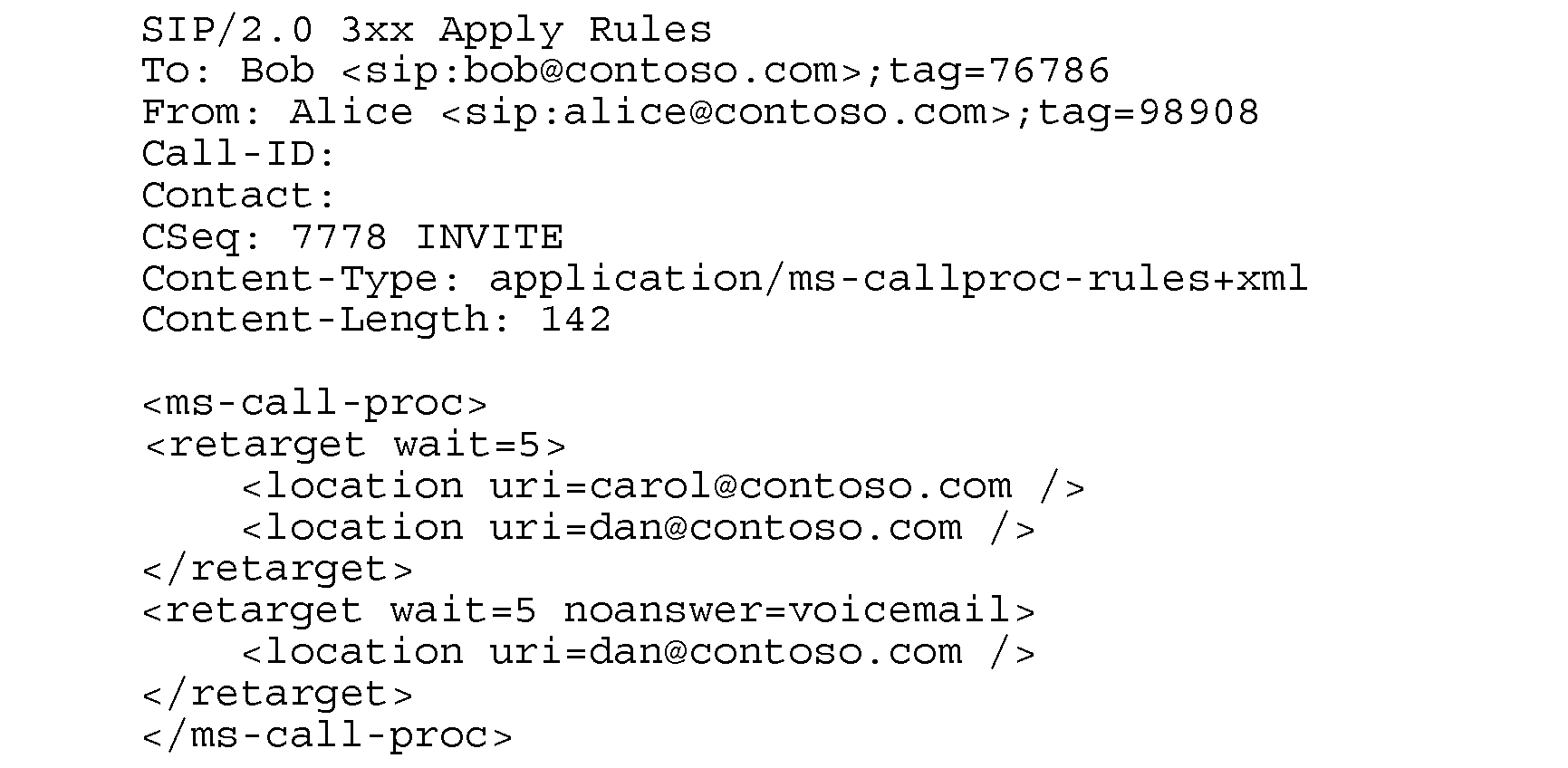
도 11은 3xx 리디렉션을 사용하여 호를 전환하는 예시적인 호 흐름도를 나타낸 것이다. 이하의 호 흐름도는 3xx 응답(예를 들어, 399)이 호를 전환하는 데 사용되는 예이다. 3xx 응답은 클라이언트에 의해 지정된 규칙에 기초하여 호를 재라우팅하라고 서버에 알려주는 데 유용하다. 3xx 응답은 기본적으로 클라이언트를 링잉하는 것을 중단하고 지정된 전달 규칙을 적용한다.11 shows an example call flow diagram for switching a call using 3xx redirection. The call flow below is an example where a 3xx response (e.g., 399) is used to transfer a call. The 3xx response is useful for telling the server to reroute a call based on rules specified by the client. The 3xx response basically stops ringing the client and applies the specified forwarding rule.
호 흐름도에서, Bob은 먼저 5초 동안 Carol에게 호를 전달하고 Carol과의 접속을 단절하며 이어서 Dan과 접속하도록 동적 호 전달 규칙을 설정하였다. Alice는 Bob에 전화를 걸고 이 호는 Dan을 링잉하기 전에 먼저 Carol을 링잉한다.In the call flow diagram, Bob first set up dynamic call forwarding rules to forward Carol to the call for five seconds, disconnect from Carol, and then connect to Dan. Alice calls Bob and the call rings Carol first before ringing Dan.
Alice의 클라이언트는 bob@contoso.com인 Bob의 주소를 포함하는 SIP INVITE 요청을 프록시 서버로 전송하며, 프록시 서버는 착신자 Bob까지의 경로를 결정하고 INVITE 요청을 Bob에게 전달한다. 서버는 호가 시도되고 있음을 Alice에게 알려주기 위해 Alice의 클라이언트로 메시지를 회신한다. Bob의 클라이언트는 100 TRYING 응답으로 프록시 서버에 답신한다. Bob의 클라이언트는 리디렉션 규 칙(3xx)을 프록시 서버로 전송한다. 서버는 ACK로 Bob의 클라이언트에 답신한다.Alice's client sends a SIP INVITE request that contains Bob's address, bob@contoso.com, to the proxy server, which determines the route to the called party Bob and forwards the INVITE request to Bob. The server returns a message to Alice's client to inform Alice that the call is being attempted. Bob's client responds to the proxy server with a 100 TRYING response. Bob's client sends a redirect rule (3xx) to the proxy server. The server responds to Bob's client with an ACK.
Carol이 온라인 상태에 있고, 프록시 서버는 SIP INVITE 요청을 Carol의 클라이언트로 전송하며, Carol의 클라이언트는 180 RINGING 메시지로 서버에 답신한다. 서버는 링잉 신호를 Alice의 클라이언트에게 전달한다. 그 시점에서, 5초의 타임아웃이 일어나며, 이어서 CANCEL 메시지가 Carol의 클라이언트로 보내진다. Carol의 클라이언트는 ACK로 서버에 답신한다.Carol is online, the proxy server sends a SIP INVITE request to Carol's client, who responds to the server with a 180 RINGING message. The server sends a ringing signal to Alice's client. At that point, a 5 second timeout occurs, followed by a CANCEL message to Carol's client. Carol's client replies to the server with an ACK.
그 다음에, 서버는 SIP INVITE를 Dan의 클라이언트로 전송하고, Dan의 클라이언트는 180 RINGING 메시지로 서버에, 이어서 Alice의 클라이언트에 답신한다. Dan의 클라이언트는 200 OK 메시지를 서버로 전송하고, 이 메시지는 Alice의 클라이언트에게 전달된다. 그 다음에, Alice의 클라이언트는 Dan의 클라이언트로 전달하기 위해 ACK를 서버로 전송한다. 그러면, Dan과 Alice 사이에 양방향 음성 채널이 설정된다.The server then sends a SIP INVITE to Dan's client, who replies to the server with a 180 RINGING message, followed by Alice's client. Dan's client sends a 200 OK message to the server, which passes it to Alice's client. Alice's client then sends an ACK to the server for delivery to Dan's client. This establishes a two-way voice channel between Dan and Alice.
이하는 3xx 메시지가 호의 리디렉션에서 사용되는 예시적인 XML 코드이다.Below is an example XML code where a 3xx message is used in the call redirection.
도 12는 호를 PSTN 목적지로 리디렉션하기 위한 예시적인 호 흐름도를 나타낸 것이다. Alice의 클라이언트는 SIP INVITE 요청을 프록시 서버로 전송하며, 프록시 서버는 착신자 Bob까지의 경로(이 경로는 SIP 주소 sip:bob@contoso.com임)를 결정하고 INVITE 요청을 Bob에게 전달한다. 서버는 호가 시도되고 있음을 Alice에게 알려주기 위해 메시지를 Alice의 클라이언트로 회신한다. Bob의 클라이언트는 SIP 180 RINGING 메시지 뿐만 아니라 100 TRYING 응답으로 프록시 서버에 답신한다. 서버는 180 RINGING 메시지를 Alice의 클라이언트에게 전달한다.12 illustrates an example call flow diagram for redirecting a call to a PSTN destination. Alice's client sends a SIP INVITE request to the proxy server, which determines the route to the called party Bob, which is the SIP address sip: bob@contoso.com, and forwards the INVITE request to Bob. The server returns a message to Alice's client to inform Alice that the call is being attempted. Bob's client responds to the proxy server with a 100 TRYING response as well as a
Bob은 호를 리디렉션하기 위해 그의 클라이언트에서 규칙 세트를 생성하여 저장하였다. 그에 따라, 리디렉션 스크립트를 사용하는 SIP 3xx REDIRECT 메시지가 Bob의 클라이언트로부터 서버로 전송된다. 그 다음에, 서버는 SIP 181 CALL IS FORWARDED 메시지를 Alice의 클라이언트로 전송한다. 서버는 ACK를 Bob의 클라이 언트로 전송하고, INVITE 메시지를 Bob의 리디렉션 메시지에 명시된 주소를 갖는 PSTN 게이트웨이로 전송한다. 게이트웨이는 180 RINGIMG 메시지를 서버로 전송하는 것으로 응답을 하고, 이 메시지는 Alice의 클라이언트에게 전달된다. SIP 200 OK 메시지도 게이트웨이로부터 서버로, 이어서 Alice의 클라이언트로 전송된다. Alice의 클라이언트는 ACK를 서버로 전송하고, 서버는 ACK를 게이트웨이에게 전달한다. 그러면, Alice의 클라이언트와 PSTN 게이트웨이 사이에 양방향 음성 채널이 설정된다.Bob created and saved a set of rules in his client to redirect calls. As a result, a SIP 3xx REDIRECT message using a redirect script is sent from Bob's client to the server. The server then sends a
이하는 종래의 서버측 호 처리가 개시된 클라이언트 호 전달 제어로부터 이득을 볼 수 있는 예들의 방법이다. 도 13은 호 서버의 클라이언트측 제어를 사용하여 다양한 계정에 대한 호를 동적으로 관리하는 방법을 나타낸 것이다. 여기서, 클라이언트 장치는 사용자 계정 정보를 제공하는 CRM(customer relationship management) 애플리케이션을 포함한다. 사용자는 클라이언트 사용자가 동적으로 소정 계정으로부터의 호를 소정의 다른 목적지로 보낼 수 있게(예를 들어, 은행 계좌 정보에 관련된 착신 호를 PSTN-종단 집 전화 핸드셋으로 라우팅되게 리디렉션할 수 있게) 하는 규칙을 클라이언트 상에서 생성할 수 있다. 단계(1300)에서, 클라이언트 사용자는 특정의 호 유형을 라우팅하기 위한 하나 이상의 규칙을 클라이언트 상에서 생성한다. 단계(1302)에서, 클라이언트는 특정의 호 유형들 중 하나에 관련된 착신 호를 받는다. 단계(1304)에서, 클라이언트는 특정의 호 유형을 처리하기 위한 클라이언트 규칙을 호 서버로 전송하는 것으로 서버에 답신한다. 단계(1306)에서, 호 서버는 착신 호에 관련된 현재의 호 처리를 중단하고, 수신된 클 라이언트측 규칙(들)을 실행하며, 그에 따라 특정의 호 유형을 라우팅한다. 단계(1308)에서, 호 서버는 그 특정의 호와 연관된 통상적인 서버측 호 라우팅으로 복귀한다.The following is an example method that can benefit from client call forwarding control in which conventional server side call processing has been initiated. Figure 13 illustrates a method of dynamically managing calls for various accounts using client-side control of the call server. Here, the client device includes a customer relationship management (CRM) application that provides user account information. The user can allow the client user to dynamically send calls from a given account to some other destination (e.g., redirect incoming calls associated with bank account information to be routed to the PSTN-terminated home phone handset). Can be created on the client. In
도 14는 호 서버의 클라이언트측 제어를 사용하여 클라이언트에서 프레즌스 정보를 관리하는 방법을 나타낸 것이다. 여기서, 클라이언트 장치는 다른 제3자 프레즌스 제공자들로부터 프레즌스 정보를 취합하는 프레즌스-기반 애플리케이션을 포함한다. 따라서, 착신 호가 상기 다른 제공자들에 대해 온라인 상태에 있는 사람들에게로 보내질 수 있게 하기 위해 호 서버에서 실행하기 위한 클라이언트측 규칙이 생성되어 전송될 수 있다. 단계(1400)에서, 클라이언트 사용자는 다른 제공자의 온라인 사용자의 상태에 관련된 호를 라우팅하기 위한 하나 이상의 프레즌스 규칙을 생성한다. 단계(1402)에서, 클라이언트는 착신 호를 받거나 발신 호를 개시한다. 단계(1404)에서, 클라이언트는 처리하기 위해 프레즌스 규칙을 호 서버로 전송한다. 단계(1406)에서, 발신자는 프레즌스 규칙을 수신하여 처리하고 규칙 결과를 클라이언트에 신호하며, 이 규칙 결과는 다른 제공자의 사용자가 온라인인지 오프라인인지일 수 있다. 단계(1408)에서, 호 서버는 프레즌스 규칙에 따라 온라인 사용자에 대한 호를 처리한다. 이것은 현재의 호에 접속하라고 온라인 사용자에 신호하는 것을 포함할 수 있다(예를 들어, 전화 회의).14 illustrates a method of managing presence information at a client using client-side control of the call server. Here, the client device includes a presence-based application that collects presence information from other third party presence providers. Thus, client-side rules for execution at the call server may be generated and sent to allow incoming calls to be sent to those who are online for the other providers. In
도 15는 호 서버의 클라이언트측 제어를 사용하여 오프후크(즉, 온라인) 클라이언트로의 착신 호를 관리하는 방법을 나타낸 것이다. 여기서, 클라이언트 장치는 사용자가 "관리자와 회의 중일 때 방해하지 말 것"과 같은 다양한 "상태"를 소개하는 규칙을 생성하는 것을 용이하게 한다. 호 서버는 사용자가 현재 누구와 이야기하고 있는지를 알 필요가 없으며, 본 발명의 클라이언트-기반 호 전달 기능에 따르면, 클라이언트는 착신 호를 비서 또는 다른 누군가에게로 지능적으로 라우팅할 수 있다. 단계(1500)에서, 클라이언트 사용자는 사용자가 현재 전화를 받고 있을 때 착신 호를 라우팅하기 위한 하나 이상의 오프후크 규칙을 클라이언트 상에서 생성한다. 단계(1502)에서, 클라이언트는 호를 수신하고 오프후크로 된다. 단계(1504)에서, 클라이언트는 처리하기 위해 오프후크 규칙을 호 서버로 전송하는 것으로 응답을 한다. 단계(1506)에서, 호 서버는 오프후크 규칙을 처리하고 착신 호를 다른 종단으로 라우팅한다. 이 규칙은 또한 누가 전화를 하려고 하는지를 오프후크 사용자가 알게 해주는 시그널링을 클라이언트 장치에 제공하는 것을 포함할 수 있다. 따라서, 간결한 텍스트 메시지가 디스플레이될 수 있고, 짧은 오디오 톤이 재생될 수 있으며, 짧은 비디오 클립이 재생될 수 있는 등이 행해질 수 있으며, 이들 모두는 특정의 발신자에 대해 커스터마이즈될 수 있다.Figure 15 illustrates a method of managing incoming calls to off-hook (i.e., online) clients using client-side control of the call server. Here, the client device facilitates creating a rule that introduces various "states" such as "do not disturb when the user is in a meeting with the manager." The call server does not need to know who the user is currently talking to, and according to the client-based call forwarding function of the present invention, the client can intelligently route the incoming call to the assistant or someone else. In
도 16은 호 서버 처리의 클라이언트측 제어를 사용하여 클라이언트 위치 변경에 기초하여 호를 동적으로 관리하는 방법을 나타낸 것이다. 예를 들어, 클라이언트의 상태가 빈번하게 변할 수 있어 서버가 이 상태를 모르고 있을 수도 있으며, 따라서 서버 상에서의 호 처리 규칙이 적용가능하지 않을 수도 있다. 일례는 GPS(global positioning system) 수신기를 구비한 모바일 장치의 클라이언트를 포함한다. 사용자는 그 국가의 여러 지역으로 모바일 장치를 가지고 갈 수 있으며, 본 발명의 클라이언트-기반 호 전달 기능에 따르면, 사용자는 사용자의 현재 위치 에 기초하여 적절히 호를 라우팅하도록 장치를 프로그램한다. 예를 들어, 한 규칙은 "직장에 있을 때는, 회사 전화로 전화하고, 알라바마에 있을 때는 모바일 장치로 전화하세요"일 수 있다.Figure 16 illustrates a method for dynamically managing a call based on client location change using client side control of call server processing. For example, the state of the client may change frequently so that the server may not be aware of this state and therefore call processing rules on the server may not be applicable. One example includes a client of a mobile device having a global positioning system (GPS) receiver. The user can take the mobile device to various regions of the country, and according to the client-based call forwarding function of the present invention, the user programs the device to route the call appropriately based on the user's current location. For example, one rule may be "Call your work phone when you are at work and call your mobile device when you are in Alabama."
단계(1600)에서, GPS 기능 및 클라이언트측 규칙 생성 기능을 포함하는 클라이언트 장치를 받는다. 단계(1602)에서, 클라이언트 사용자는 클라이언트 장치의 지리적 위치의 변화에 관련된 착신 호를 라우팅하기 위한 하나 이상의 위치 규칙을 생성한다. 단계(1604)에서, 클라이언트 사용자는 클라이언트 장치를 다른 지리적 위치로 이동시킨다. 단계(1606)에서, 클라이언트는 장치의 위치 변화를 검출한다. 이것은 이 결정을 하기 위해 GPS 데이터를 수신하여 정기적으로 처리하는 기능을 갖는 장치에 의해 행해질 수 있다. 단계(1608)에서, 호 서버는 착신 호를 클라이언트에 신호한다. 단계(1610)에서, 클라이언트는 위치 규칙의 서버측 처리를 위해 위치 규칙을 호 서버로 전송하는 것으로 응답한다. 단계(1612)에서, 서버는 규칙을 처리하고 그에 따라 착신 호를 라우팅한다.In
본 출원에서 사용되는 바와 같이, 용어 "컴포넌트" 및 "시스템"은 컴퓨터-관련 엔티티, 즉 하드웨어, 하드웨어와 소프트웨어의 조합, 소프트웨어, 또는 실행 중인 소프트웨어를 말하기 위한 것이다. 예를 들어, 컴포넌트는 프로세서 상에서 실행 중인 프로세스, 프로세서, 하드 디스크 드라이브, (광 및/또는 자기 저장 매체의) 다수의 저장 장치 드라이브, 개체, 실행 파일, 실행 쓰레드, 프로그램, 및/또는 컴퓨터일 수 있지만, 이에 제한되지 않는다. 예로서, 서버 상에서 실행 중인 애플리케이션 및 서버 둘다가 컴포넌트일 수 있다. 하나 이상의 컴포넌트가 프로 세스 및/또는 실행 쓰레드 내에 존재할 수 있고, 컴포넌트가 하나의 컴퓨터에 로컬화되어 있고 및/또는 2개 이상의 컴퓨터 간에 분산되어 있을 수 있다.As used in this application, the terms "component" and "system" are intended to refer to a computer-related entity, that is, hardware, a combination of hardware and software, software, or running software. For example, a component can be a process running on a processor, a processor, a hard disk drive, multiple storage drives (of optical and / or magnetic storage media), an object, an executable, an execution thread, a program, and / or a computer. However, it is not limited thereto. By way of example, both an application running on a server and the server can be a component. One or more components may reside within a process and / or thread of execution and a component may be localized on one computer and / or distributed between two or more computers.
도 17은 클라이언트측 규칙 생성 및 호 서버 제어를 용이하게 하는 휴대용 무선 장치(PWD, portable wireless device)(1700)(예를 들어, 셀 전화, 휴대용 컴퓨터, 태블릿 PC)의 개략 블록도를 나타낸 것이다. 장치(1700)는 데이터 및 명령어의 처리 및 제어를 위해 하나 이상의 내부 컴포넌트와 인터페이스하는 프로세서(1702)를 포함하고 있다. 프로세서(1702)는 본 명세서에 기술된 다양한 기능들을 수행하기 위해 장치(1700) 내의 다양한 컴포넌트를 제어하고 동작시키도록 프로그램될 수 있다. 프로세서(1702)는 복수의 적당한 프로세서 중 어느 것(예를 들어, DSP(digital signal processor))이라도 될 수 있고, 멀티프로세서 서브시스템일 수 있다.FIG. 17 shows a schematic block diagram of a portable wireless device (PWD) 1700 (eg, cell phone, portable computer, tablet PC) that facilitates client-side rule generation and call server control.
메모리 및 저장 컴포넌트(1704)는 프로세서(1702)와 인터페이스하고 프로그램 코드를 저장하는 기능을 하며, 또한 데이터, 애플리케이션, 서비스, 메타데이터, 장치 상태 등의 정보의 저장 수단으로서 역할한다. 메모리 및 저장 컴포넌트(1704)는 감지 서브시스템 및/또는 센서로부터 획득되는 감지된 입력 데이터 세트 전부를 적어도 저장하도록 적당히 구성되어 있는 비휘발성 메모리를 포함할 수 있다. 따라서, 메모리(1704)는 프로세서(1702)가 고속으로 액세스하기 위한 RAM 또는 플래쉬 메모리, 및/또는 텍스트, 이미지, 오디오, 및/또는 비디오 컨텐츠를 포함하는 수 기가바이트의 데이터를 저장할 수 있는 대용량 저장 메모리(예를 들어, 마이크로 드라이브)를 포함할 수 있다. 일 양태에 따르면, 메모리(1704)는 서 로 다른 서비스에 관한 다수의 정보 세트를 저장하기에 충분한 저장 공간을 가지고 있으며, 프로세서(1702)는 서로 다른 서비스에 대응하는 다양한 정보 세트 간을 왔다갔다하거나 순환하는 것을 용이하게 하는 프로그램을 포함할 수 있다.The memory and
디스플레이(1706)는 디스플레이 드라이버 서브시스템(1708)을 통해 프로세서(1702)에 연결될 수 있다. 디스플레이(1706)는 컬러 액정 디스플레이(LCD), 플라즈마 디스플레이, 터치 스크린 디스플레이 등일 수 있다. 디스플레이(1706)는 데이터, 그래픽, 또는 기타 정보 컨텐츠를 제공하는 기능을 한다. 또한, 디스플레이(1706)는 사용자 선택가능하고 장치(1700)의 제어 및 구성을 제공하는 각종 기능을 제공할 수 있다. 터치 스크린 예에서, 디스플레이(1706)는 제어 및/또는 구성을 위한 사용자 상호작용을 용이하게 하는 터치 선택가능 아이콘을 디스플레이할 수 있다.
온보드 전원 시스템(1710)(예를 들어, 배터리 팩 또는 연료 전지)에 의해 장치(1700)를 형성하는 프로세서(1702) 및 기타 온보드 컴포넌트에 전원이 제공될 수 있다. 전원 시스템(1710)이 고장나거나 장치(1700)로부터 분리되는 경우, 프로세서(1702) 및 기타 컴포넌트(예를 들어, 센서, 이미지 캡처 장치,...)에 전원을 제공하고, 충전가능 기술인 경우, 온보드 전원 시스템(1710)을 충전하기 위해 대체 전원(1712)이 이용될 수 있다. 예를 들어, 대체 전원(1712)은 전원 컨버터를 통해 외부 그리드 접속과의 인터페이스를 용이하게 할 수 있다. 프로세서(1702)는, 예를 들어, 전류 소모를 감소시키는 슬립 모드를 유발하거나 예기된 전원 고장의 검출 시에 장치(1700)의 정상적인 정지를 개시하기 위해 전원 관리 서비스를 제공하 도록 구성될 수 있다.Power may be provided to the
장치(1700)는 데이터 통신 포트(1716)를 갖는 데이터 통신 서브시스템(1714)을 포함하며, 이 포트(1716)는 장치(1700)를 원격 컴퓨팅 시스템, 서버, 서비스 등과 인터페이스하게 하는 데 이용된다. 이 포트(1716)는 직렬 통신 기능을 제공하는 USB(Universal Serial Bus) 및/또는 IEEE 1794 등의 하나 이상의 직렬 인터페이스를 포함할 수 있다. 예를 들어, 적외선 통신 포트를 이용하는 적외선 통신, 및 무선 패킷 통신(예를 들어, 블루투스™, Wi-Fi 및 Wi-Max) 등의 다른 기술들도 포함될 수 있지만, 그에 제한되지 않는다. 스마트 폰인 경우, 데이터 통신 서브시스템(1714)은 SIM(subscriber identity module) 데이터와 셀룰러 등록 및 네트워크 통신에 필요한 정보를 포함할 수 있다.The
장치(1700)는 프로세서(1702)와 통신을 하는 무선 주파수(RF) 송수신기 섹션(1718)도 포함할 수 있다. RF 섹션(1718)은 RF 수신기(1720)를 포함하고, 이 수신기(1720)는 안테나(1722)를 통해 원격 장치 또는 시스템으로부터 RF 신호를 수신하고 이 신호를 복조하여 그 신호 안에 변조되어 있는 디지털 정보를 획득할 수 있다. RF 섹션(1718)은, 예를 들어, 사용자 입력 장치(1726)(예를 들어, 키패드)를 통한 수동 사용자 입력에 응답하여, 또는 통신 범위에 들어간 것을 검출하는 것 및/또는 그로부터 빠져 나갈 것으로 예상되는 것 또는 다른 미리 정해진 프로그램된 기준에 응답하여 자동적으로, 원격 장치 또는 시스템으로 정보(예를 들어, 데이터, 서비스(들))를 전송하는 RF 송신기(1724)도 포함하고 있다.The
장치(1700)는 또한 프로세서(1702)에 의해 제어되고 마이크 또는 유사한 오 디오 입력 장치(도시 생략)로부터의 음성 입력을 처리하는 오디오 I/O 서브시스템(1728)도 포함할 수 있다. 오디오 서브시스템(1728)은 또한 스피커 또는 유사한 오디오 출력 장치(도시 생략)를 통해 음성 및 오디오 출력 신호를 표현하는 것을 용이하게 한다.
장치(1700)는 또한 프로세서와 인터페이스하고 장치 자체 및/또는 원격 시스템에 대해 사용자를 인증하는 것을 용이하게 하는 인증 컴포넌트(1730)도 포함할 수 있다. 프로세서(1702)는 또한, 예를 들어, 사용자 컨텍스트 및/또는 개념을 판정하기 위해, OCR 데이터, 음성 데이터, 필기 데이터, 및 이미지/비디오 데이터를 캡처 및 입력하는 것을 용이하게 하는 감지 서브시스템 블록(1732)과 인터페이스한다. 또한, 장치(1700)는 본 발명의 아키텍처에 따라 감지된 입력 데이터를 수신하는 감지 시스템을 동작시키는 것을 가능하게 하기 위해 기동될 수 있는 하나 이상의 애플리케이션(1734)(예를 들어, 이미징 프로그램, 비디오 프리젠테이션 프로그램, OCR 프로그램, 검색 엔진,...)을 포함한다. 본 발명에 따르면, 애플리케이션(1734)은 호 라우팅 관리를 위한 프록시 및/또는 리디렉션 서버와의 세션 프로토콜 통신을 용이하게 하는 클라이언트(1736)를 포함할 수 있다. 규칙 생성 및 제어를 지원하여, 애플리케이션(1734)은 또한 규칙 및 제어 컴포넌트(1738)도 포함할 수 있다. 그러면, 장치 사용자는, 호를 수신한 것에 응답하여 및/또는 호 동안에(클라이언트 발신이든지 클라이언트 종단이든지 관계없음), 호 전달을 제어하기 위해 서버로 전달하기 위한 하나 이상의 세션 응답(예를 들어, SIP 응답)의 규칙을 생성할 수 있다.The
장치(1700)는 또한, 무선 통신 또는 유선 통신에 의하기보다는, (예를 들어, 커넥터를 통해) 다른 시스템에의 직접적인 물리 접속을 가능하게 하는 물리 인터페이스 서브시스템(1740)도 포함할 수 있다.The
이제 도 18을 참조하면, 개시된 아키텍처에 따라 호 서버의 클라이언트측 호 전달 제어를 실행하는 동작을 하는 데스크톱 또는 휴대용 컴퓨터의 블록도가 도시되어 있다. 본 발명의 여러 양태들에 대한 부가적인 상황을 제공하기 위해, 도 18 및 이하의 설명은 본 발명의 여러 양태들이 구현될 수 있는 적당한 컴퓨팅 환경(1800)에 대한 간략하고 전반적인 설명을 제공하기 위한 것이다. 이상의 설명이 일반적으로 하나 이상의 컴퓨터 상에서 실행될 수 있는 컴퓨터-실행가능 명령어와 관련하여 기술되어 있지만, 당업자라면 본 발명이 또한 다른 프로그램 모듈들과 함께 및/또는 하드웨어와 소프트웨어의 조합으로서 구현될 수 있다는 것을 잘 알 것이다.Referring now to FIG. 18, shown is a block diagram of a desktop or portable computer operating to perform client side call forwarding control of a call server in accordance with the disclosed architecture. In order to provide additional context for the various aspects of the present invention, FIGS. 18 and the following description are intended to provide a brief and general description of a
일반적으로, 프로그램 모듈은 특정 태스크를 수행하거나 특정 추상 데이터 유형을 구현하는 루틴, 프로그램, 컴포넌트, 데이터 구조 등을 포함한다. 또한, 당업자라면 본 발명의 방법이 단일-프로세서 또는 멀티프로세서 컴퓨터 시스템, 미니컴퓨터, 메인프레임 컴퓨터는 물론 퍼스널 컴퓨터, 핸드헬드 컴퓨팅 장치, 마이크로프로세서-기반 또는 프로그램가능한 가전제품 등(이들 각각은 하나 이상의 연관된 장치와 연결되어 동작할 수 있음)을 비롯한 다른 컴퓨터 시스템 구성으로 실시될 수 있다는 것을 잘 알 것이다.Generally, program modules include routines, programs, components, data structures, etc. that perform particular tasks or implement particular abstract data types. In addition, those skilled in the art will appreciate that the method of the present invention may include uniprocessor or multiprocessor computer systems, minicomputers, mainframe computers, as well as personal computers, handheld computing devices, microprocessor-based or programmable consumer electronics, and the like, each of which is one or more. It will be appreciated that the implementation may be carried out in other computer system configurations, including in connection with the associated device.
본 발명의 예시된 양태들은 또한 통신 네트워크를 통해 연결되어 있는 원격 처리 장치들에 의해 소정의 태스크가 수행되는 분산 컴퓨팅 환경에서 실시될 수 있다. 분산 컴퓨팅 환경에서, 프로그램 모듈은 로컬 및 원격 메모리 저장 장치 둘다에 위치될 수 있다.The illustrated aspects of the invention can also be practiced in distributed computing environments where certain tasks are performed by remote processing devices that are linked through a communications network. In a distributed computing environment, program modules may be located in both local and remote memory storage devices.
컴퓨터는 통상적으로 각종 컴퓨터-판독가능 매체를 포함한다. 컴퓨터에 의해 액세스 가능한 이용가능한 매체는 그 어떤 것이든지 컴퓨터-판독가능 매체가 될 수 있고, 휘발성 및 비휘발성 매체, 이동식 및 비이동식 매체 둘다를 포함한다. 예로서, 컴퓨터-판독가능 매체는 컴퓨터 저장 매체 및 통신 매체를 포함할 수 있지만 이에 제한되는 것은 아니다. 컴퓨터 저장 매체는 컴퓨터-판독가능 명령어, 데이터 구조, 프로그램 모듈 또는 기타 데이터와 같은 정보를 저장하는 임의의 방법 또는 기술로 구현되는 휘발성 및 비휘발성, 이동식 및 비이동식 매체 둘다를 포함한다. 컴퓨터 저장 매체는 RAM, ROM, EEPROM, 플래쉬 메모리 또는 기타 메모리 기술, CD-ROM, DVD(digital video disk) 또는 기타 광 디스크 저장 장치, 자기 카세트, 자기 테이프, 자기 디스크 저장 장치 또는 기타 자기 저장 장치, 또는 컴퓨터에 의해 액세스될 수 있고 원하는 정보를 저장하는 데 사용될 수 있고 임의의 기타 매체를 포함하지만 이에 제한되는 것은 아니다.Computers typically include a variety of computer-readable media. Available media that can be accessed by a computer can be any computer-readable medium and includes both volatile and nonvolatile media, removable and non-removable media. By way of example, computer-readable media may include, but are not limited to, computer storage media and communication media. Computer storage media includes both volatile and nonvolatile, removable and non-removable media implemented in any method or technology for storing information such as computer-readable instructions, data structures, program modules or other data. Computer storage media may include RAM, ROM, EEPROM, flash memory or other memory technology, CD-ROMs, digital video disks or other optical disk storage devices, magnetic cassettes, magnetic tapes, magnetic disk storage devices or other magnetic storage devices, Or may be accessed by a computer and used to store desired information, including but not limited to any other medium.
다시 도 18과 관련하여, 여러 양태들을 구현하는 예시적인 환경(1800)은 컴퓨터(1802)를 포함하고, 이 컴퓨터(1802)는 처리 장치(1804), 시스템 메모리(1806), 및 시스템 버스(1808)를 포함한다. 시스템 버스(1808)는 시스템 메모리(1806)를 포함하지만 이에 제한되지 않는 시스템 컴포넌트들을 처리 장치(1804)에 연결시킨다. 처리 장치(1804)는 다양한 상용 프로세서들 중 어느 것이라도 될 수 있다. 듀얼 마이크로프로세서 및 기타 멀티프로세서 아키텍처도 처리 장치(1804)로서 이용될 수 있다.Referring again to FIG. 18, an
시스템 버스(1808)는 메모리 버스(메모리 컨트롤러를 갖거나 갖지 않음), 주변 장치 버스, 및 각종 상용 버스 아키텍처 중 임의의 것을 이용하는 로컬 버스에 추가적으로 상호 연결될 수 있는 몇몇 유형의 버스 구조 중 어느 것이라도 될 수 있다. 시스템 메모리(1806)는 판독 전용 메모리(ROM)(1810) 및 랜덤 액세스 메모리(RAM)(1812)를 포함한다. 기본 입/출력 시스템(BIOS)은 ROM, EPROM, EEPROM 등의 비휘발성 메모리(1810)에 저장되며, 이 BIOS는 시동 중과 같은 때에 컴퓨터(1802) 내의 구성요소들 사이의 정보 전송을 돕는 기본 루틴을 포함한다. RAM(1812)은 또한 데이터를 캐싱하기 위한 정적 RAM과 같은 고속 RAM을 포함할 수 있다.The
컴퓨터(1802)는 또한 내장형 하드 디스크 드라이브(HDD)(1814)(예를 들어, EIDE, SATA)(이 내장형 하드 디스크 드라이브(1814)는 적당한 섀시(도시 생략)에 넣어 외장용으로도 구성될 수 있음), 자기 플로피 디스크 드라이브(FDD)(1816)(예를 들어, 이동식 디스켓(1818)에 기록을 하거나 그로부터 판독을 함), 및 광 디스크 드라이브(1820)(예를 들어, CD-ROM 디스크(1822)를 판독하거나, DVD와 같은 기타 대용량 광 매체에 기록을 하거나 그로부터 판독을 함)를 포함한다. 하드 디스크 드라이브(1814), 자기 디스크 드라이브(1816), 및 광 디스크 드라이브(1820)는 각각 하드 디스크 드라이브 인터페이스(1824), 자기 디스크 드라이브 인터페이스(1826), 및 광 드라이브 인터페이스(1828)에 의해 시스템 버스(1808)에 접속될 수 있다. 외장형 드라이브 구현을 위한 인터페이스(1824)는 USB(Universal Serial Bus) 및 IEEE 1394 인터페이스 기술 중 적어도 하나 또는 둘다를 포함한다. 다른 외장형 드라이브 접속 기술도 본 발명에서 생각되고 있다.The
상기 드라이브들 및 그와 관련된 컴퓨터-판독가능 매체는 데이터, 데이터 구조, 컴퓨터-실행가능 명령어 등의 비휘발성 저장을 제공한다. 컴퓨터(1802)의 경우, 이들 드라이브 및 매체는 임의의 데이터를 적당한 디지털 형식으로 저장하기 위한 것이다. 컴퓨터-판독가능 매체에 대한 이상의 설명이 HDD, 이동식 자기 디스켓, 및 CD나 DVD 등의 이동식 광 매체를 언급하고 있지만, 당업자라면 ZIP 드라이브, 자기 카세트, 플래쉬 메모리 카드, 카트리지 등의 컴퓨터에 의해 판독가능한 다른 유형의 매체도 예시적인 운영 환경에서 사용될 수 있고 임의의 이러한 매체가 개시된 발명의 방법들을 수행하는 컴퓨터-실행가능 명령어들을 포함할 수 있다는 것을 잘 알 것이다.The drives and their associated computer-readable media provide nonvolatile storage of data, data structures, computer-executable instructions, and the like. In the case of
운영 체제(1830), 하나 이상의 애플리케이션 프로그램(1832), 기타 프로그램 모듈(1834), 및 프로그램 데이터(1836)를 비롯한 다수의 프로그램 모듈이 드라이브 및 RAM(1812)에 저장될 수 있다. 운영 체제, 애플리케이션, 모듈, 및/또는 데이터의 전부 또는 그 일부는 또한 RAM(1812)에 캐싱될 수 있다. 본 발명이 다양한 상용 운영 체제 또는 운영 체제들의 조합으로 구현될 수 있다는 것을 잘 알 것이다.Multiple program modules may be stored in the drive and
사용자는 하나 이상의 유선/무선 입력 장치, 예를 들어, 키보드(1838), 및 마우스(1840)와 같은 포인팅 장치를 통해 컴퓨터(1802)에 명령 및 정보를 입력할 수 있다. 다른 입력 장치(도시 생략)로는 마이크, IR 리모콘, 조이스틱, 게임 패 드, 스타일러스 펜, 터치 스크린 등을 포함할 수 있다. 이들 및 기타 입력 장치는 종종 시스템 버스(1808)에 결합된 입력 장치 인터페이스(1842)를 통해 처리 장치(1804)에 접속되지만, 병렬 포트, IEEE 1394 직렬 포트, 게임 포트, USB 포트, IR 인터페이스 등의 다른 인터페이스에 의해 접속될 수 있다.A user may enter commands and information into the
모니터(1844) 또는 다른 유형의 디스플레이 장치도 비디오 어댑터(1846) 등의 인터페이스를 통해 시스템 버스(1808)에 접속된다. 모니터(1844) 외에, 컴퓨터는 통상적으로 스피커, 프린터 등의 기타 주변 출력 장치(도시 생략)도 포함한다.A
컴퓨터(1802)는 원격 컴퓨터(들)(1848)과 같은 하나 이상의 원격 컴퓨터로의 유선 및/또는 무선 통신을 통한 논리적 접속을 사용하여 네트워크화된 환경에서 동작할 수 있다. 원격 컴퓨터(들)(1848)는 워크스테이션, 서버 컴퓨터, 라우터, 퍼스널 컴퓨터, 휴대용 컴퓨터, 마이크로프로세서-기반 오락 기기, 피어 장치, 또는 기타 통상의 네트워크 노드일 수 있으며, 통상적으로 컴퓨터(1802)와 관련하여 기술된 구성요소들의 대부분 또는 그 전부를 포함하지만, 간략함을 위해 메모리/저장 장치(1850)만이 도시되어 있다. 도시된 논리적 접속은 LAN(1852) 및/또는 대규모 네트워크, 예를 들어, WAN(1854))에의 유선/무선 접속을 포함한다. 이러한 LAN 및 WAN 네트워킹 환경은 사무실 및 회사에서 흔하며, 인트라넷과 같은 전사적 컴퓨터 네트워크(enterprise-wide computer)를 용이하게 하며, 이들 모두는, 예를 들어, 인터넷과 같은 전세계 통신 네트워크에 접속될 수 있다.
LAN 네트워킹 환경에서 사용될 때, 컴퓨터(1802)는 유선 및/또는 무선 통신 네트워크 인터페이스 또는 어댑터(1856)를 통해 로컬 네트워크(1852)에 접속된다. 어댑터(1856)는 LAN(1852)에의 유선 또는 무선 통신을 용이하게 할 수 있으며, 이 LAN은 또한 무선 어댑터(1856)와 통신하기 위해 LAN 상에 배치된 무선 액세스 포인트를 포함할 수 있다.When used in a LAN networking environment, the
WAN 네트워킹 환경에서 사용될 때, 컴퓨터(1802)는 모뎀(1858)을 포함할 수 있거나, WAN(1854) 상의 통신 서버에 접속되거나, 인터넷 등의 WAN(1854)을 통해 통신을 설정하는 다른 수단을 갖는다. 내장형 또는 외장형의 유선 또는 무선 장치일 수 있는 모뎀(1858)은 직렬 포트 인터페이스(1842)를 통해 시스템 버스(1808)에 접속된다. 네트워크화된 환경에서, 컴퓨터(1802) 또는 그의 일부와 관련하여 기술된 프로그램 모듈은 원격 메모리/저장 장치(1850)에 저장될 수 있다. 도시된 네트워크 접속이 예시적인 것이며 이 컴퓨터들 사이에 통신 링크를 설정하는 기타 수단이 사용될 수 있다는 것을 잘 알 것이다.When used in a WAN networking environment, the
컴퓨터(1802)는 무선 통신으로 배치되어 동작하는 임의의 무선 장치 또는 엔티티, 예를 들어, 프린터, 스캐너, 데스크톱 및/또는 휴대용 컴퓨터, PDA, 통신 위성, 무선 검출가능 태그와 연관된 장비 또는 장소(예를 들어, 키오스크, 신문 가판대, 오락실) 및 전화와 통신하는 동작을 한다. 이것은 적어도 Wi-Fi 및 블루투스™ 무선 기술을 포함한다. 따라서, 이 통신은 종래의 네트워크에서와 같이 사전 정의된 구조이거나 단순히 적어도 2개의 장치 간의 애드혹 통신일 수 있다.
Wi-Fi(Wireless Fidelity)는 전선을 사용하지 않고 집의 소파, 호텔방의 침대, 또는 직장의 회의실로부터 인터넷에의 접속을 가능하게 한다. Wi-Fi는 이러한 장치(예를 들어, 컴퓨터)가 실내 및 실외에서(기지국의 통화권 내라면 어디라도 괜 찮음) 데이터를 전송 및 수신할 수 있게 하는 무선 기술(셀 전화에서 사용되는 것과 유사함)이다. Wi-Fi 네트워크는 안전하고 신뢰성있으며 고속인 무선 접속을 제공하기 위해 IEEE 802.11x (a, b, g, 기타)라고 하는 무선 기술을 사용한다. Wi-Fi 네트워크는 컴퓨터들을 서로, 인터넷에 또한 유선 네트워크(IEEE 802.3 또는 이더넷을 사용함)에 접속시키는 데 사용될 수 있다.Wireless Fidelity (Wi-Fi) allows access to the Internet from a sofa in the home, a bed in a hotel room, or a meeting room at work, without using wires. Wi-Fi is a wireless technology (similar to that used in cell phones) that allows these devices (such as computers) to send and receive data indoors and outdoors (anywhere within the base station's coverage area). to be. Wi-Fi networks use a wireless technology called IEEE 802.11x (a, b, g, etc.) to provide secure, reliable, high-speed wireless access. Wi-Fi networks can be used to connect computers to each other, to the Internet and to wired networks (using IEEE 802.3 or Ethernet).
Wi-Fi 네트워크는 비인가 2.4 및 5 GHz 무선 대역에서 동작할 수 있다. IEEE 802.11는 일반적으로 무선 LAN에 적용되고, FHSS(frequency hopping spread spectrum) 또는 DSSS(direct sequence spread spectrum)를 사용하여 2.4 GHz 대역에서 1 또는 2 Mbps 전송을 제공한다. IEEE 802.11a는 IEEE 802.11에 대한 확장으로서, 무선 LAN에 적용되고 5 GHz 대역에서 최대 54 Mbps를 제공한다. IEEE 802.11a는 FHSS 또는 DSSS보다는 OFDM(orthogonal frequency division multiplexing) 인코딩 방식을 사용한다. IEEE 802.11b(802.11 고속 DSSS 또는 Wi-Fi라고도 함)는 802.11에 대한 확장으로서, 무선 LAN에 적용되고 2.4 GHz 대역에서 11 Mbps 전송(5.5, 2 및 1 Mbps로의 폴백을 가짐)을 제공한다. IEEE 802.11g는 무선 LAN에 적용되고, 2.4 GHz 대역에서 20+ Mbps를 제공한다. 제품들은 2개 이상의 대역(예를 들어, 듀얼 대역)을 포함할 수 있으며, 따라서 네트워크는 많은 사무실에서 사용되는 기본적인 10BaseT 유선 이더넷 네트워크와 유사한 실세계 성능을 제공할 수 있다.Wi-Fi networks can operate in unlicensed 2.4 and 5 GHz wireless bands. IEEE 802.11 is generally applied to wireless LANs and provides 1 or 2 Mbps transmission in the 2.4 GHz band using frequency hopping spread spectrum (FHSS) or direct sequence spread spectrum (DSSS). IEEE 802.11a is an extension to IEEE 802.11 that applies to wireless LANs and provides up to 54 Mbps in the 5 GHz band. IEEE 802.11a uses orthogonal frequency division multiplexing (OFDM) encoding scheme rather than FHSS or DSSS. IEEE 802.11b (also known as 802.11 high-speed DSSS or Wi-Fi) is an extension to 802.11 that applies to wireless LANs and provides 11 Mbps transmission (with fallback to 5.5, 2 and 1 Mbps) in the 2.4 GHz band. IEEE 802.11g applies to wireless LANs and provides 20+ Mbps in the 2.4 GHz band. Products can include more than one band (eg dual band), so the network can provide real world performance similar to the basic 10BaseT wired Ethernet network used in many offices.
이상에서, 개시된 발명의 예들에 대해 기술하였다. 물론, 생각할 수 있는 모든 컴포넌트 및/또는 방법의 조합을 기술할 수는 없지만, 당업자라면 많은 추가 의 조합 및 치환이 가능하다는 것을 잘 알 것이다. 그에 따라, 본 발명은 첨부된 청구항의 정신 및 범위 내에 속하는 이러한 변경, 수정 및 변형 모두를 포함하는 것으로 보아야 한다. 게다가, 용어 "포함하다"가 상세한 설명 또는 청구항에서 사용되는 한, 이러한 용어는 용어 "포함하는"이 청구항에서 이행구로서 이용될 때 해석되는 것과 유사한 방식으로 포함적인 것으로 보아야 한다.In the above, examples of the disclosed invention have been described. Of course, not all possible combinations of components and / or methods can be described, but one of ordinary skill in the art will recognize that many further combinations and substitutions are possible. Accordingly, the invention should be regarded as including all such alterations, modifications and variations that fall within the spirit and scope of the appended claims. In addition, as long as the term "comprises" is used in the description or claims, such terms are to be regarded as inclusive in a manner similar to that interpreted when the term "comprising" is used as a transition phrase in a claim.
Claims (20)
Applications Claiming Priority (3)
| Application Number | Priority Date | Filing Date | Title |
|---|---|---|---|
| US11/513,518 US8837704B2 (en) | 2006-08-31 | 2006-08-31 | Client controlled dynamic call forwarding |
| US11/513,518 | 2006-08-31 | ||
| PCT/US2007/076027 WO2008048742A1 (en) | 2006-08-31 | 2007-08-15 | Client controlled dynamic call forwarding |
Publications (2)
| Publication Number | Publication Date |
|---|---|
| KR20090045277A true KR20090045277A (en) | 2009-05-07 |
| KR101424300B1 KR101424300B1 (en) | 2014-08-13 |
Family
ID=39224965
Family Applications (1)
| Application Number | Title | Priority Date | Filing Date |
|---|---|---|---|
| KR1020097003906A Expired - Fee Related KR101424300B1 (en) | 2006-08-31 | 2007-08-15 | A telephone call routing management device, a computer implemented method, and a call management system |
Country Status (11)
| Country | Link |
|---|---|
| US (1) | US8837704B2 (en) |
| EP (1) | EP2062406A4 (en) |
| JP (1) | JP5145339B2 (en) |
| KR (1) | KR101424300B1 (en) |
| CN (1) | CN101507211B (en) |
| AU (1) | AU2007313049C1 (en) |
| BR (1) | BRPI0715520A2 (en) |
| CA (1) | CA2657655C (en) |
| MX (1) | MX2009001225A (en) |
| RU (1) | RU2499359C2 (en) |
| WO (1) | WO2008048742A1 (en) |
Families Citing this family (52)
| Publication number | Priority date | Publication date | Assignee | Title |
|---|---|---|---|---|
| US8914022B2 (en) | 1992-03-06 | 2014-12-16 | Gogo Llc | System for providing high speed communications service in an airborne wireless cellular network |
| US8145208B2 (en) | 2006-10-31 | 2012-03-27 | Gogo Llc | Air-to-ground cellular communication network terrestrial base station having multi-dimensional sectors with alternating radio frequency polarizations |
| US8081968B2 (en) | 2000-10-11 | 2011-12-20 | Gogo Llc | System for creating an air-to-ground IP tunnel in an airborne wireless cellular network to differentiate individual passengers |
| US8060083B2 (en) | 2000-10-11 | 2011-11-15 | Gogo Llc | System for managing an aircraft-oriented emergency services call in an airborne wireless cellular network |
| US7113780B2 (en) | 1992-03-06 | 2006-09-26 | Aircell, Inc. | System for integrating an airborne wireless cellular network with terrestrial wireless cellular networks and the public switched telephone network |
| EP1186144B1 (en) | 1999-06-08 | 2013-10-23 | The Trustees of Columbia University in the City of New York | Network telephony appliance and system for inter/intranet telephony |
| US8452276B2 (en) | 2000-10-11 | 2013-05-28 | Gogo Llc | Differentiated services code point mirroring for wireless communications |
| US8457627B2 (en) | 1999-08-24 | 2013-06-04 | Gogo Llc | Traffic scheduling system for wireless communications |
| US8442519B2 (en) | 2003-12-07 | 2013-05-14 | Gogo Llc | Spectrum sharing between an aircraft-based air-to-ground communication system and existing geostationary satellite services |
| US8131556B2 (en) | 2007-04-03 | 2012-03-06 | Microsoft Corporation | Communications using different modalities |
| US8983051B2 (en) * | 2007-04-03 | 2015-03-17 | William F. Barton | Outgoing call classification and disposition |
| US8675637B2 (en) | 2007-04-18 | 2014-03-18 | Cisco Technology, Inc. | Interworking between H.320/H.324 and SIP |
| CN101127766B (en) * | 2007-09-24 | 2010-06-09 | 中兴通讯股份有限公司 | Message processing method, device and IP communication system based on SIP protocol |
| US8792118B2 (en) * | 2007-09-26 | 2014-07-29 | Ringcentral Inc. | User interfaces and methods to provision electronic facsimiles |
| US20090086278A1 (en) * | 2007-09-27 | 2009-04-02 | Ringcentral, Inc. | Electronic facsimile delivery systems and methods |
| US8275110B2 (en) | 2007-09-28 | 2012-09-25 | Ringcentral, Inc. | Active call filtering, screening and dispatching |
| US8600391B2 (en) | 2008-11-24 | 2013-12-03 | Ringcentral, Inc. | Call management for location-aware mobile devices |
| US8670545B2 (en) | 2007-09-28 | 2014-03-11 | Ringcentral, Inc. | Inbound call identification and management |
| US8838082B2 (en) * | 2008-11-26 | 2014-09-16 | Ringcentral, Inc. | Centralized status server for call management of location-aware mobile devices |
| EP2066101B1 (en) * | 2007-11-28 | 2012-10-17 | Alcatel Lucent | System and method for an improved high availability component implementation |
| ES2542150T3 (en) * | 2008-01-22 | 2015-07-31 | Savox Communications Oy Ab (Ltd) | A procedure and arrangement to connect an ad-hoc communication network to a permanent communication network |
| EP2112799A1 (en) * | 2008-04-25 | 2009-10-28 | Koninklijke KPN N.V. | Service integrity handling in an IMS-based system |
| US8917718B2 (en) * | 2008-10-13 | 2014-12-23 | Centurylink Intellectual Property Llc | System, method, and apparatus for user-initiated provisioning of a communication device |
| US8780383B2 (en) | 2008-11-25 | 2014-07-15 | Ringcentral, Inc. | Authenticated facsimile transmission from mobile devices |
| JP5458110B2 (en) * | 2009-01-20 | 2014-04-02 | テレフオンアクチーボラゲット エル エム エリクソン(パブル) | Processing communication session invitations |
| US8972551B1 (en) * | 2010-04-27 | 2015-03-03 | Amazon Technologies, Inc. | Prioritizing service requests |
| CN102244567A (en) * | 2010-05-13 | 2011-11-16 | 清华大学 | Communication control server, base station, terminal and joint service system and method |
| US20120084243A1 (en) * | 2010-09-30 | 2012-04-05 | Certicom Corp. | Malleable Access Decision Processing And Ordering |
| US8989759B2 (en) * | 2011-03-10 | 2015-03-24 | Vonage Network, Llc | Methods and apparatus for proximity based call termination |
| US8571060B2 (en) * | 2011-12-22 | 2013-10-29 | Vonage Network, Llc | Systems and methods for terminating telephony communications to mobile telephony devices |
| US8600364B2 (en) | 2011-12-22 | 2013-12-03 | Vonage Network, Llc | Systems and methods for terminating telephony communications to mobile telephony devices |
| US8934882B2 (en) | 2011-12-22 | 2015-01-13 | Vonage Network, Llc | Systems and methods for terminating telephony communications to mobile telephony devices |
| US9002336B2 (en) | 2011-12-22 | 2015-04-07 | Vonage Network, Llc | Systems and methods for terminating telephony communications to mobile telephony devices |
| US8744422B2 (en) | 2011-12-22 | 2014-06-03 | Vonage Network, Llc. | Systems and methods for terminating telephony communications to mobile telephony devices |
| US8855612B2 (en) | 2011-12-22 | 2014-10-07 | Vonage Network, Llc. | Systems and methods of terminating telephony communications to mobile telephony devices |
| US9002335B2 (en) | 2011-12-22 | 2015-04-07 | Guy Fighel | Systems and methods for terminating telephony communications to mobile telephony devices |
| US9020478B2 (en) | 2011-12-22 | 2015-04-28 | Vonage Network, Llc | Systems and methods for terminating telephony communications to mobile telephony devices |
| US8989721B2 (en) | 2011-12-22 | 2015-03-24 | Vonage Network, Llc | Systems and methods for terminating telephony communications to mobile telephony devices |
| US9491600B2 (en) | 2011-12-22 | 2016-11-08 | Vonage America Inc. | Systems and methods for terminating telephony communications to mobile telephony devices |
| US8958785B2 (en) | 2011-12-22 | 2015-02-17 | Vonage Network, Llc | Systems and methods for terminating telephony communications to mobile telephony devices |
| WO2013149301A1 (en) * | 2012-04-04 | 2013-10-10 | Ollo Mobile Pty Ltd | Call processing system |
| CN103391307B (en) * | 2012-05-11 | 2018-03-20 | 阿里巴巴集团控股有限公司 | Offline transparent transmission and display methods, the apparatus and system of off-line data |
| US9154639B2 (en) * | 2014-02-04 | 2015-10-06 | MobileDay, Inc. | Rule-based mobile dialing based on a change of event |
| US9686668B2 (en) | 2014-05-30 | 2017-06-20 | Vonage America Inc. | Method and apparatus for intra-network roaming for IP telephony network |
| US9491610B2 (en) | 2014-05-30 | 2016-11-08 | Vonage America Inc. | Method and apparatus for intra-network roaming for IP telephony network |
| US9584518B1 (en) | 2015-09-09 | 2017-02-28 | Callware Technologies, Inc. | Dynamic communications controller |
| US20170126844A1 (en) * | 2015-10-30 | 2017-05-04 | Microsoft Technology Licensing, Llc | Server architecture and protocol development |
| US9654639B1 (en) | 2015-12-10 | 2017-05-16 | Microsoft Technology Licensing, Llc | Resource partitioning for routing on-demand services |
| US9686406B1 (en) | 2015-12-10 | 2017-06-20 | Microsoft Technology Licensing, Llc | Issue detection for routing assistance requests |
| US10275775B2 (en) | 2015-12-10 | 2019-04-30 | Microsoft Technology Licensing, Llc | Context generation for routing on-demand services |
| US10223174B2 (en) | 2015-12-10 | 2019-03-05 | Microsoft Technology Licensing, Llc | Tenant engagement signal acquisition and exposure |
| US10251115B2 (en) * | 2017-09-07 | 2019-04-02 | Verizon Patent And Licensing Inc. | System and method for intelligent assistant service |
Family Cites Families (42)
| Publication number | Priority date | Publication date | Assignee | Title |
|---|---|---|---|---|
| US6148074A (en) * | 1997-02-10 | 2000-11-14 | Genesys Telecommunications Laboratories, Inc. | Personal desktop router |
| SE521114C2 (en) * | 1998-10-20 | 2003-09-30 | Corus Technologies Ab | Device and method for integrating a number of computerized substantially arbitrary client systems |
| DE19857179A1 (en) | 1998-12-11 | 2000-06-15 | Alcatel Sa | Telecommunications network |
| US6937597B1 (en) * | 1999-02-26 | 2005-08-30 | Lucent Technologies Inc. | Signaling method for internet telephony |
| US7103167B2 (en) * | 2002-05-20 | 2006-09-05 | Callwave, Inc. | Systems and methods for call screening |
| EP1093281A3 (en) | 1999-10-15 | 2002-11-06 | Nortel Networks Limited | Call redirection through portable device |
| US7050861B1 (en) * | 1999-12-22 | 2006-05-23 | Nortel Networks Limited | Controlling a destination terminal from an originating terminal |
| US6678735B1 (en) * | 2000-01-26 | 2004-01-13 | Nortel Networks Limited | Method and apparatus for a sip client manager |
| US7463619B1 (en) * | 2000-05-25 | 2008-12-09 | Nortel Networks Limited | Launching a web browser in response to a message relating to communications sessions |
| US7319744B1 (en) * | 2001-01-31 | 2008-01-15 | Palmsource, Inc. | Unified messaging/call routing configuration using palmtop computer |
| US6438114B1 (en) * | 2001-02-05 | 2002-08-20 | Motorola, Inc. | Method and apparatus for enabling multimedia calls using session initiation protocol |
| US7912193B2 (en) * | 2001-02-27 | 2011-03-22 | Verizon Data Services Llc | Methods and systems for call management with user intervention |
| US20020141404A1 (en) * | 2001-04-03 | 2002-10-03 | Michael Wengrovitz | Call routing using information in session initiation protocol messages |
| CN1516951A (en) * | 2001-04-12 | 2004-07-28 | 西门子公司 | Personalized call management system controlled with customizable profiles |
| US7020707B2 (en) * | 2001-05-30 | 2006-03-28 | Tekelec | Scalable, reliable session initiation protocol (SIP) signaling routing node |
| US20030051037A1 (en) * | 2001-06-12 | 2003-03-13 | Mukesh Sundaram | Open portal interface manager |
| US7058033B1 (en) * | 2001-07-18 | 2006-06-06 | Cisco Technology, Inc. | Method and system for providing wireless-specific services for a wireless access network |
| AU2002301409B2 (en) * | 2001-10-13 | 2003-11-06 | Samsung Electronics Co., Ltd. | Internet protocol telephony exchange system and call control method thereof |
| EP1387589A1 (en) * | 2002-07-29 | 2004-02-04 | Siemens Aktiengesellschaft | Media gateway for providing PSTN/ISDN services in next generation networks |
| US7203294B2 (en) * | 2002-08-06 | 2007-04-10 | At&T Corp. | System and method for dynamically routing communications |
| GB0218712D0 (en) * | 2002-08-12 | 2002-09-18 | Mitel Knowledge Corp | Context aware call handling system |
| US20040229600A1 (en) * | 2003-05-13 | 2004-11-18 | Motorola, Inc. | Method and apparatus for call screening and management in a wireless communication device |
| DE10323403A1 (en) * | 2003-05-23 | 2004-12-09 | Siemens Ag | Method for signaling call forwarding parameters in a SIP network |
| FI20030944A0 (en) * | 2003-06-25 | 2003-06-25 | Nokia Corp | Group calls in a communication system |
| US20050003830A1 (en) * | 2003-06-27 | 2005-01-06 | Microsoft Corporation | Smart telephone call routing for wireless communication devices |
| US7054417B2 (en) * | 2003-08-19 | 2006-05-30 | Qwest Communications International Inc. | Advanced call screening appliance |
| JP4277621B2 (en) * | 2003-08-20 | 2009-06-10 | 沖電気工業株式会社 | Service providing system and method, service providing program, and recording medium |
| WO2005067595A2 (en) * | 2004-01-05 | 2005-07-28 | Tools For Health, Inc. | System for remote control of an automated call system |
| US7580419B2 (en) * | 2004-02-17 | 2009-08-25 | Zyxel Communications Corp | Network system integrated with SIP call server and SIP agent client |
| US7751545B2 (en) * | 2004-04-21 | 2010-07-06 | Cisco Technology, Inc. | Enhanced call pickup |
| US7272382B2 (en) * | 2004-04-29 | 2007-09-18 | Motorola Inc. | Communication device operation management |
| US7870091B2 (en) * | 2004-06-18 | 2011-01-11 | Sap Ag | Methods and systems for receiving data, selecting a condition table, selecting a ruleset based on the condition table, and determining and applying rules to data |
| US7869798B2 (en) * | 2004-10-13 | 2011-01-11 | At&T Intellectual Property I, L.P. | Methods, systems, and computer-readable media for redirecting telephone calls from a wireless device in a telecommunications network |
| US20060101098A1 (en) * | 2004-11-10 | 2006-05-11 | Morgan David P | Session initiation protocol call center |
| US20060098624A1 (en) * | 2004-11-10 | 2006-05-11 | Morgan David P | Using session initiation protocol |
| US7558246B2 (en) * | 2004-12-21 | 2009-07-07 | Cisco Technology, Inc. | Selecting a routing mode for a call session |
| RU45583U1 (en) * | 2005-01-21 | 2005-05-10 | Кучерявый Андрей Евгеньевич | PACKAGE SWITCHING SYSTEM USING SIP INFORMATION PROTOCOL |
| US7616750B2 (en) * | 2005-02-25 | 2009-11-10 | Microsoft Corporation | Method and system for forwarding telephone calls based on presence information |
| CN1842083A (en) | 2005-03-31 | 2006-10-04 | 株式会社日立制作所 | Method and device for dynamically controlling multiple communication terminals |
| US7957517B2 (en) * | 2005-08-26 | 2011-06-07 | At&T Intellectual Property Ii, L.P. | Method and apparatus for providing internet protocol call transfer in communication networks |
| US7916853B2 (en) * | 2005-12-19 | 2011-03-29 | At&T Intellectual Property, I, L.P. | Methods, systems, and computer program products for providing calendar based routings of communications |
| US7890090B2 (en) * | 2006-06-09 | 2011-02-15 | Motorola Mobility, Inc. | Dynamic mobile call forwarding by local area service discovery |
-
2006
- 2006-08-31 US US11/513,518 patent/US8837704B2/en active Active
-
2007
- 2007-08-15 WO PCT/US2007/076027 patent/WO2008048742A1/en not_active Ceased
- 2007-08-15 CA CA2657655A patent/CA2657655C/en active Active
- 2007-08-15 CN CN2007800314030A patent/CN101507211B/en not_active Expired - Fee Related
- 2007-08-15 EP EP07840989A patent/EP2062406A4/en not_active Withdrawn
- 2007-08-15 MX MX2009001225A patent/MX2009001225A/en active IP Right Grant
- 2007-08-15 RU RU2009107182/07A patent/RU2499359C2/en not_active IP Right Cessation
- 2007-08-15 JP JP2009526804A patent/JP5145339B2/en active Active
- 2007-08-15 AU AU2007313049A patent/AU2007313049C1/en not_active Ceased
- 2007-08-15 BR BRPI0715520-4A patent/BRPI0715520A2/en not_active Application Discontinuation
- 2007-08-15 KR KR1020097003906A patent/KR101424300B1/en not_active Expired - Fee Related
Also Published As
| Publication number | Publication date |
|---|---|
| CA2657655C (en) | 2016-01-05 |
| US20080075261A1 (en) | 2008-03-27 |
| MX2009001225A (en) | 2009-02-11 |
| BRPI0715520A2 (en) | 2013-06-25 |
| WO2008048742A1 (en) | 2008-04-24 |
| AU2007313049A1 (en) | 2008-04-24 |
| CN101507211A (en) | 2009-08-12 |
| CN101507211B (en) | 2012-08-29 |
| EP2062406A4 (en) | 2010-04-28 |
| RU2009107182A (en) | 2010-09-10 |
| RU2499359C2 (en) | 2013-11-20 |
| AU2007313049B2 (en) | 2010-12-09 |
| EP2062406A1 (en) | 2009-05-27 |
| US8837704B2 (en) | 2014-09-16 |
| KR101424300B1 (en) | 2014-08-13 |
| JP5145339B2 (en) | 2013-02-13 |
| JP2010503282A (en) | 2010-01-28 |
| CA2657655A1 (en) | 2008-04-24 |
| AU2007313049C1 (en) | 2011-04-07 |
Similar Documents
| Publication | Publication Date | Title |
|---|---|---|
| CA2657655C (en) | Client controlled dynamic call forwarding | |
| KR101219925B1 (en) | Associating a telephone call with a dialog based on a computer protocol such as sip | |
| KR101224254B1 (en) | Next generation integration between different domains, such as, enterprise and service provider using sequencing applications and ims peering | |
| CN101843081B (en) | Accommodation of two independent telephony systems | |
| US8675834B2 (en) | System and apparatus for managing calls | |
| US20080220781A1 (en) | Methods and arrangment for implementing an active call handover by employing a switching component | |
| EP2018760B1 (en) | Telecommunications system and method of initiating file transfers from voice endpoints | |
| US9100416B2 (en) | System and method for conveying end-to-end call status | |
| JP2006087016A (en) | Communication terminal, communication system, and communication method | |
| CN100563219C (en) | System and method for implementing click-to-dial | |
| JP4677350B2 (en) | Call control signal transfer apparatus, call control signal transfer method, and call control signal transfer program | |
| EP2092724A1 (en) | Method and server for filtering telephone calls | |
| KR20170087941A (en) | Controlling a pbx phone call via a client application | |
| EP2506524B1 (en) | Methods and devices for notifying the status of communication services | |
| US20070130288A1 (en) | Distributed communication through media services |
Legal Events
| Date | Code | Title | Description |
|---|---|---|---|
| PA0105 | International application |
St.27 status event code: A-0-1-A10-A15-nap-PA0105 |
|
| PG1501 | Laying open of application |
St.27 status event code: A-1-1-Q10-Q12-nap-PG1501 |
|
| R17-X000 | Change to representative recorded |
St.27 status event code: A-3-3-R10-R17-oth-X000 |
|
| A201 | Request for examination | ||
| P11-X000 | Amendment of application requested |
St.27 status event code: A-2-2-P10-P11-nap-X000 |
|
| P13-X000 | Application amended |
St.27 status event code: A-2-2-P10-P13-nap-X000 |
|
| PA0201 | Request for examination |
St.27 status event code: A-1-2-D10-D11-exm-PA0201 |
|
| E902 | Notification of reason for refusal | ||
| PE0902 | Notice of grounds for rejection |
St.27 status event code: A-1-2-D10-D21-exm-PE0902 |
|
| E13-X000 | Pre-grant limitation requested |
St.27 status event code: A-2-3-E10-E13-lim-X000 |
|
| P11-X000 | Amendment of application requested |
St.27 status event code: A-2-2-P10-P11-nap-X000 |
|
| P13-X000 | Application amended |
St.27 status event code: A-2-2-P10-P13-nap-X000 |
|
| PN2301 | Change of applicant |
St.27 status event code: A-3-3-R10-R13-asn-PN2301 St.27 status event code: A-3-3-R10-R11-asn-PN2301 |
|
| E701 | Decision to grant or registration of patent right | ||
| PE0701 | Decision of registration |
St.27 status event code: A-1-2-D10-D22-exm-PE0701 |
|
| GRNT | Written decision to grant | ||
| PR0701 | Registration of establishment |
St.27 status event code: A-2-4-F10-F11-exm-PR0701 |
|
| PR1002 | Payment of registration fee |
St.27 status event code: A-2-2-U10-U12-oth-PR1002 Fee payment year number: 1 |
|
| PG1601 | Publication of registration |
St.27 status event code: A-4-4-Q10-Q13-nap-PG1601 |
|
| PN2301 | Change of applicant |
St.27 status event code: A-5-5-R10-R11-asn-PN2301 |
|
| PN2301 | Change of applicant |
St.27 status event code: A-5-5-R10-R14-asn-PN2301 |
|
| FPAY | Annual fee payment |
Payment date: 20170616 Year of fee payment: 4 |
|
| PR1001 | Payment of annual fee |
St.27 status event code: A-4-4-U10-U11-oth-PR1001 Fee payment year number: 4 |
|
| PR1001 | Payment of annual fee |
St.27 status event code: A-4-4-U10-U11-oth-PR1001 Fee payment year number: 5 |
|
| R18-X000 | Changes to party contact information recorded |
St.27 status event code: A-5-5-R10-R18-oth-X000 |
|
| FPAY | Annual fee payment |
Payment date: 20190617 Year of fee payment: 6 |
|
| PR1001 | Payment of annual fee |
St.27 status event code: A-4-4-U10-U11-oth-PR1001 Fee payment year number: 6 |
|
| R17-X000 | Change to representative recorded |
St.27 status event code: A-5-5-R10-R17-oth-X000 |
|
| PR1001 | Payment of annual fee |
St.27 status event code: A-4-4-U10-U11-oth-PR1001 Fee payment year number: 7 |
|
| PR1001 | Payment of annual fee |
St.27 status event code: A-4-4-U10-U11-oth-PR1001 Fee payment year number: 8 |
|
| PR1001 | Payment of annual fee |
St.27 status event code: A-4-4-U10-U11-oth-PR1001 Fee payment year number: 9 |
|
| PR1001 | Payment of annual fee |
St.27 status event code: A-4-4-U10-U11-oth-PR1001 Fee payment year number: 10 |
|
| PC1903 | Unpaid annual fee |
St.27 status event code: A-4-4-U10-U13-oth-PC1903 Not in force date: 20240723 Payment event data comment text: Termination Category : DEFAULT_OF_REGISTRATION_FEE |
|
| PC1903 | Unpaid annual fee |
St.27 status event code: N-4-6-H10-H13-oth-PC1903 Ip right cessation event data comment text: Termination Category : DEFAULT_OF_REGISTRATION_FEE Not in force date: 20240723 |