KR20060068348A - Siloxane-based polymer and insulating film production method using the polymer - Google Patents
Siloxane-based polymer and insulating film production method using the polymer Download PDFInfo
- Publication number
- KR20060068348A KR20060068348A KR1020040107010A KR20040107010A KR20060068348A KR 20060068348 A KR20060068348 A KR 20060068348A KR 1020040107010 A KR1020040107010 A KR 1020040107010A KR 20040107010 A KR20040107010 A KR 20040107010A KR 20060068348 A KR20060068348 A KR 20060068348A
- Authority
- KR
- South Korea
- Prior art keywords
- siloxane
- hydrogen atom
- group
- solvents
- insulating film
- Prior art date
- Legal status (The legal status is an assumption and is not a legal conclusion. Google has not performed a legal analysis and makes no representation as to the accuracy of the status listed.)
- Ceased
Links
Images


Classifications
-
- C—CHEMISTRY; METALLURGY
- C08—ORGANIC MACROMOLECULAR COMPOUNDS; THEIR PREPARATION OR CHEMICAL WORKING-UP; COMPOSITIONS BASED THEREON
- C08G—MACROMOLECULAR COMPOUNDS OBTAINED OTHERWISE THAN BY REACTIONS ONLY INVOLVING UNSATURATED CARBON-TO-CARBON BONDS
- C08G77/00—Macromolecular compounds obtained by reactions forming a linkage containing silicon with or without sulfur, nitrogen, oxygen or carbon in the main chain of the macromolecule
- C08G77/04—Polysiloxanes
- C08G77/06—Preparatory processes
-
- C—CHEMISTRY; METALLURGY
- C08—ORGANIC MACROMOLECULAR COMPOUNDS; THEIR PREPARATION OR CHEMICAL WORKING-UP; COMPOSITIONS BASED THEREON
- C08G—MACROMOLECULAR COMPOUNDS OBTAINED OTHERWISE THAN BY REACTIONS ONLY INVOLVING UNSATURATED CARBON-TO-CARBON BONDS
- C08G77/00—Macromolecular compounds obtained by reactions forming a linkage containing silicon with or without sulfur, nitrogen, oxygen or carbon in the main chain of the macromolecule
- C08G77/04—Polysiloxanes
- C08G77/14—Polysiloxanes containing silicon bound to oxygen-containing groups
-
- C—CHEMISTRY; METALLURGY
- C08—ORGANIC MACROMOLECULAR COMPOUNDS; THEIR PREPARATION OR CHEMICAL WORKING-UP; COMPOSITIONS BASED THEREON
- C08G—MACROMOLECULAR COMPOUNDS OBTAINED OTHERWISE THAN BY REACTIONS ONLY INVOLVING UNSATURATED CARBON-TO-CARBON BONDS
- C08G77/00—Macromolecular compounds obtained by reactions forming a linkage containing silicon with or without sulfur, nitrogen, oxygen or carbon in the main chain of the macromolecule
- C08G77/48—Macromolecular compounds obtained by reactions forming a linkage containing silicon with or without sulfur, nitrogen, oxygen or carbon in the main chain of the macromolecule in which at least two but not all the silicon atoms are connected by linkages other than oxygen atoms
- C08G77/50—Macromolecular compounds obtained by reactions forming a linkage containing silicon with or without sulfur, nitrogen, oxygen or carbon in the main chain of the macromolecule in which at least two but not all the silicon atoms are connected by linkages other than oxygen atoms by carbon linkages
-
- C—CHEMISTRY; METALLURGY
- C08—ORGANIC MACROMOLECULAR COMPOUNDS; THEIR PREPARATION OR CHEMICAL WORKING-UP; COMPOSITIONS BASED THEREON
- C08J—WORKING-UP; GENERAL PROCESSES OF COMPOUNDING; AFTER-TREATMENT NOT COVERED BY SUBCLASSES C08B, C08C, C08F, C08G or C08H
- C08J5/00—Manufacture of articles or shaped materials containing macromolecular substances
- C08J5/20—Manufacture of shaped structures of ion-exchange resins
- C08J5/22—Films, membranes or diaphragms
-
- C—CHEMISTRY; METALLURGY
- C09—DYES; PAINTS; POLISHES; NATURAL RESINS; ADHESIVES; COMPOSITIONS NOT OTHERWISE PROVIDED FOR; APPLICATIONS OF MATERIALS NOT OTHERWISE PROVIDED FOR
- C09D—COATING COMPOSITIONS, e.g. PAINTS, VARNISHES OR LACQUERS; FILLING PASTES; CHEMICAL PAINT OR INK REMOVERS; INKS; CORRECTING FLUIDS; WOODSTAINS; PASTES OR SOLIDS FOR COLOURING OR PRINTING; USE OF MATERIALS THEREFOR
- C09D183/00—Coating compositions based on macromolecular compounds obtained by reactions forming in the main chain of the macromolecule a linkage containing silicon, with or without sulfur, nitrogen, oxygen, or carbon only; Coating compositions based on derivatives of such polymers
- C09D183/04—Polysiloxanes
-
- C—CHEMISTRY; METALLURGY
- C09—DYES; PAINTS; POLISHES; NATURAL RESINS; ADHESIVES; COMPOSITIONS NOT OTHERWISE PROVIDED FOR; APPLICATIONS OF MATERIALS NOT OTHERWISE PROVIDED FOR
- C09D—COATING COMPOSITIONS, e.g. PAINTS, VARNISHES OR LACQUERS; FILLING PASTES; CHEMICAL PAINT OR INK REMOVERS; INKS; CORRECTING FLUIDS; WOODSTAINS; PASTES OR SOLIDS FOR COLOURING OR PRINTING; USE OF MATERIALS THEREFOR
- C09D183/00—Coating compositions based on macromolecular compounds obtained by reactions forming in the main chain of the macromolecule a linkage containing silicon, with or without sulfur, nitrogen, oxygen, or carbon only; Coating compositions based on derivatives of such polymers
- C09D183/14—Coating compositions based on macromolecular compounds obtained by reactions forming in the main chain of the macromolecule a linkage containing silicon, with or without sulfur, nitrogen, oxygen, or carbon only; Coating compositions based on derivatives of such polymers in which at least two but not all the silicon atoms are connected by linkages other than oxygen atoms
-
- H10P14/6342—
-
- H10P14/665—
-
- H10P14/6686—
-
- H10P14/6922—
-
- Y—GENERAL TAGGING OF NEW TECHNOLOGICAL DEVELOPMENTS; GENERAL TAGGING OF CROSS-SECTIONAL TECHNOLOGIES SPANNING OVER SEVERAL SECTIONS OF THE IPC; TECHNICAL SUBJECTS COVERED BY FORMER USPC CROSS-REFERENCE ART COLLECTIONS [XRACs] AND DIGESTS
- Y10—TECHNICAL SUBJECTS COVERED BY FORMER USPC
- Y10T—TECHNICAL SUBJECTS COVERED BY FORMER US CLASSIFICATION
- Y10T428/00—Stock material or miscellaneous articles
- Y10T428/31504—Composite [nonstructural laminate]
- Y10T428/31652—Of asbestos
- Y10T428/31663—As siloxane, silicone or silane
Landscapes
- Chemical & Material Sciences (AREA)
- Organic Chemistry (AREA)
- Chemical Kinetics & Catalysis (AREA)
- Polymers & Plastics (AREA)
- Health & Medical Sciences (AREA)
- Medicinal Chemistry (AREA)
- Engineering & Computer Science (AREA)
- Materials Engineering (AREA)
- Wood Science & Technology (AREA)
- Life Sciences & Earth Sciences (AREA)
- Manufacturing & Machinery (AREA)
- Silicon Polymers (AREA)
- Formation Of Insulating Films (AREA)
Abstract
본 발명은 신규한 실록산계 중합체 및 상기 중합체를 이용한 절연막 제조방법에 관한 것으로, 더욱 상세하게는 기계적 물성과 저유전 특성이 우수한 실록산계 중합체 및 이 중합체를 이용한 절연막의 제조방법에 관한 것이다.The present invention relates to a novel siloxane-based polymer and a method for producing an insulating film using the polymer, and more particularly, to a siloxane-based polymer excellent in mechanical properties and low dielectric properties and a method for producing an insulating film using the polymer.
본 발명에 따른 실록산계 중합체는 우수한 기계적 물성을 가질 뿐만 아니라, 낮은 흡습률을 나타내며 기공형성물질과의 상용성도 우수하여 낮은 절연계수를 가질 수 있고, 나아가, 기공형성물질과의 상용성도 뛰어나고 공정 적용성도 크게 향상되어 반도체 소자의 절연막 제조에 유용하게 사용될 수 있다.
The siloxane polymer according to the present invention not only has excellent mechanical properties but also shows low moisture absorption and excellent compatibility with the pore-forming material, so that it can have a low insulation coefficient, and furthermore, excellent compatibility with the pore-forming material and process application. Its properties are also greatly improved and can be usefully used in the manufacture of insulating films for semiconductor devices.
실록산, 절연막, 저유전, 기계적 물성 Siloxane, insulating film, low dielectric, mechanical properties
Description
도 1 및 도 2는 각각 본 발명의 일 제조예에 의해 제조된 중합체의 Si-NMR을 나타낸 것이다.
1 and 2 show Si-NMR of the polymer prepared according to one production example of the present invention, respectively.
본 발명은 신규한 실록산계 중합체 및 상기 중합체를 이용한 절연막 제조방법에 관한 것으로, 더욱 상세하게는 기계적 물성과 저유전 특성이 우수한 실록산계 중합체 및 이 중합체를 이용한 절연막의 제조방법에 관한 것이다.The present invention relates to a novel siloxane-based polymer and a method for producing an insulating film using the polymer, and more particularly, to a siloxane-based polymer excellent in mechanical properties and low dielectric properties and a method for producing an insulating film using the polymer.
반도체의 집적도가 증가함에 따라 배선 구조의 RC delay 증가에 의한 신호 전달속도의 감소문제가 심각해지고 있어 반도체 소자에 있어 층간 절연 박막의 축전용량을 낮추는 것은 중요한 관심사가 되고 있다. 이를 위해, 미국특허 제 3,615,272 호, 제 4,399,266 호, 제 4,756,977 호 및 제 4,999,397 호는 화학 증착 법(Chemical Vapor Deposition)을 이용해야 하는 SiO2(유전율 4.0) 절연막 대신에 SOD(spin on deposition) 방식으로 제조할 수 있는 폴리실세스퀴옥산 (Polysilsesquioxane: 유전율 2.5~3.1 정도) 절연막에 관해 개시하고 있다. 하이드로젠 실세스퀴옥산 및 이의 다양한 제조방법은 당해 기술분야에 공지되어 있는 바, 예를 들어, 미국특허 제 3,615,272 호는 황산매질 내에서 트리클로로, 트리메톡시 또는 트리아세톡시 실란을 축합하여 완전축합된 상태의 하이드로젠 실세스퀴옥산을 제조하는 방법을 개시하고 있다. 한편, 미국특허 제 5,010,159호는 아릴술폰산 수화물을 포함한 가수분해 매질 내에서 하이드로 실란을 가수분해하여 수지를 형성한 후, 이 수지를 중화제와 접촉시켜 하이드로젠 실세스퀴옥산을 제조하는 방법을 개시하고 있다. 또한, 미국특허 제 6,232,424 호는 테트라알콕시실란 (tetraalkoxysilane), 유기실란(organosilane) 및 유기트리알콕시실란 (organotrialkoxysilane)을 물과 촉매의 존재 하에 가수분해 및 축합반응시켜 제조한, 용액 내에서 안정하고 용해도가 우수한 실리콘 수지 조성물에 관해 개시하고 있다. 미국특허 제 6,000,339호는 산소 플라즈마에 대한 저항성 및 기타 물성이 개선되고 두꺼운 박막형성이 가능한 실리카계 화합물을 제조하는 방법을 개시하고 있는 바, 상기방법에서는 알콕시실란, 불소가 함유된 알콕시실란 및 알킬알콕시실란으로부터 선택된 단량체와 티타늄(Ti) 또는 지르코늄(Zr) 알콕시드(alkoxide) 화합물을 물과 촉매 하에 반응시켜 실리카계 화합물을 제조한다. 미국특허 제 5,853,808 호는 박막의 SiO2 의 함량을 높이기 위하여 유기실란(organosilane)의 β 위치에 반응성기(reactive group)가 치환된 화합물을 이용하여 제조한 실록산과 실세스퀴옥산계 중합체 및 이를 이용한 박막 조성물을 개시하고 있다. 또한, 유럽특허 제 1376671 A1호는 저유전율을 갖는 물질을 제조하기 위한 조성물들로 실록산 또는 유기 실록산 전구체를 개시하고 있으며, 이들 전구체를 이용한 유전율 3.7 이하의 유전막 제조방법을 개시하고 있다. 또한 미국특허 제 5,378,790 호는 우수한 물성을 가진 유·무기 하이브리드 물질(inorganic/organic hybrid materials)을 개시하고 있고, 대한민국 특허 공개 제 2002-80097 호는 선형 유기실란 올리고머를 다른 실란화합물과 가수분해 및 축합반응시켜 제조한 유기실리케이트 중합체 및 이를 이용한 저유전 절연막을 개시하고 있다.As the degree of integration of semiconductors increases, a problem of decreasing signal transmission speed due to an increase in the RC delay of the wiring structure becomes serious. Therefore, lowering the capacitance of an interlayer insulating thin film is an important concern in semiconductor devices. To this end, U.S. Patent Nos. 3,615,272, 4,399,266, 4,756,977, and 4,999,397 use a spin on deposition (SOD) method instead of SiO 2 (dielectric constant 4.0) insulating films that require chemical vapor deposition. Disclosed is a polysilsesquioxane (a dielectric constant of about 2.5 to 3.1) insulating film that can be produced. Hydrogen silsesquioxanes and various methods for their preparation are known in the art, for example, U.S. Pat. No. 3,615,272 discloses complete condensation of trichloro, trimethoxy or triacetoxy silanes in a sulfuric acid medium. A method of producing hydrogen silsesquioxane in a condensed state is disclosed. U.S. Patent No. 5,010,159 discloses a process for producing hydrogen silsesquioxane by hydrolyzing hydrosilane in a hydrolysis medium containing arylsulfonic acid hydrate to form a resin and then contacting the resin with a neutralizing agent. have. In addition, US Pat. No. 6,232,424 discloses stable and solubility in solution, prepared by hydrolysis and condensation reaction of tetraalkoxysilane, organosilane and organotrialkoxysilane in the presence of water and a catalyst. Discloses an excellent silicone resin composition. U. S. Patent No. 6,000,339 discloses a method for preparing a silica-based compound having improved resistance to oxygen plasma and other physical properties and capable of forming a thin film, wherein the alkoxysilane, fluorine-containing alkoxysilane and alkylalkoxy A silica-based compound is prepared by reacting a monomer selected from silane and a titanium (Ti) or zirconium (Zr) alkoxide compound with water and a catalyst. U.S. Patent No. 5,853,808 discloses siloxane and silsesquioxane polymers prepared by using a compound in which a reactive group is substituted at the β position of an organosilane to increase the SiO 2 content of a thin film and A thin film composition is disclosed. In addition, EP 1376671 A1 discloses a siloxane or an organosiloxane precursor as a composition for preparing a material having a low dielectric constant, and discloses a method of preparing a dielectric film having a dielectric constant of 3.7 or less using these precursors. In addition, U.S. Patent No. 5,378,790 discloses organic / organic hybrid materials having excellent properties, and Korean Patent Publication No. 2002-80097 discloses hydrolysis and condensation of linear organosilane oligomers with other silane compounds. An organosilicate polymer prepared by reacting and a low dielectric insulating film using the same are disclosed.
그러나, 상기 모든 공지된 기술에 의해 제조된 실록산계 중합체를 이용한 절연박막은 충분히 낮은 유전율을 제공하지 못하거나, 혹은 충분히 낮은 유전율을 제공하는 경우에도 막의 기계적 물성이 좋지 않거나, 절연막 내의 유기 탄소함량이 높아 반도체 공정에로의 적용성이 좋지 않은 문제점이 있다. 특히 테트라메톡시실란 또는 테트라에톡시실란과 같은 Q 구조의 Si 화합물로부터 제조한 중합체의 경우, 절연막 내의 유기 탄소함량이 낮고, 높은 기계적 물성을 가짐에도 불구하고 흡습율이 높고 이로 인해 유전율이 크게 상승되는 문제가 있어 절연막(특히, SOD 공정으로 제조되는 절연막)으로써의 사용이 제한되고 있다. 한편, 최근 실록산계 중합체는, 보다 낮은 절연계수를 갖도록 하기 위해 함께 사용되는 기공형성물질에 대해 우수한 상용성을 가질 것이 요구되고 있다.However, the insulating thin film using the siloxane polymer prepared by all the above known techniques does not provide sufficiently low dielectric constant, or even if it provides sufficiently low dielectric constant, the mechanical properties of the film are not good, or the organic carbon content in the insulating film. There is a problem that the applicability to the semiconductor process is high. In particular , in the case of polymers prepared from Si compounds having a Q structure such as tetramethoxysilane or tetraethoxysilane, the organic carbon content in the insulating film is low, and despite the high mechanical properties, the moisture absorption rate is high, thereby increasing the dielectric constant. There is a problem in that the use as an insulating film (in particular, an insulating film produced by the SOD process) is limited. On the other hand, siloxane-based polymers have recently been required to have excellent compatibility with pore-forming materials used together in order to have a lower insulation coefficient.
따라서, 당해 기술분야에는 SOD 방식에 의해 제조가능한 절연막으로서, 낮은 절연계수를 가질 뿐만 아니라, 모듈러스 등의 기계적 물성이 우수하며, 기공형성물질과의 상용성도 뛰어나고 공정 적용성도 크게 향상된 절연막 형성 재료의 개발이 요구되고 있다.
Accordingly, the art has a manufacturable insulating film by SOD manner, not only it has a low insulating coefficient and good mechanical properties of modulus, etc., and pores excellent the compatibility with the forming material step applies Chengdu significant development of improved insulation film forming material This is required.
본 발명자들은 상기 문제를 해결하기 위해 예의 연구한 결과, 흡습이 적은 T 구조(주쇄 고리 중의 Si가 3개의 산소를 갖는 구조)의 선형 실록산 화합물을 형성할 수 있는 1 종 이상의 선형 및/또는 환형 실록산 화합물과 함께 공중합하여 제조된 실록산계 중합체는 저유전 특성과 탄성계수 등의 기계적 물성이 뛰어날 뿐만 아니라, 종래 기공형성물질과의 상용성이 우수하며 SOD(Spin on Deposition) 공정 하에서도 흡습성을 낮은 수준으로 유지할 수 있어 높은 절연특성이 보장되고, SiO2 함량이 높아 공정 적용성 또한 우수한 것을 확인하고 본 발명에 이르게 되었다.The present inventors earnestly studied to solve the above problems, and as a result, at least one linear and / or cyclic siloxane capable of forming a linear siloxane compound having a low moisture absorption T structure (a structure in which Si in the main chain has three oxygens) The siloxane polymer prepared by copolymerization with the compound has excellent mechanical properties such as low dielectric properties and modulus of elasticity, excellent compatibility with conventional pore-forming materials, and low hygroscopicity even under a spin on deposition (SOD) process. It is possible to maintain a high insulation properties, high SiO 2 content is confirmed that the process applicability is also excellent and led to the present invention.
결국, 본 발명은 우수한 저유전 특성, 기계적 물성 및 절연특성을 가진 절연막을 제공할 수 있는 실록산계 중합체와 이를 이용한 절연막의 제조방법을 제공하고자 하는 것이다. After all, it is an object of the present invention to provide a siloxane-based polymer capable of providing an insulating film having excellent low dielectric properties, mechanical properties, and insulating properties and a method of manufacturing the insulating film using the same.
즉, 본 발명의 한 측면은 하기 화학식 1로 나타내어지는 화합물 단량체를, 하기 화학식 2 내지 5로 표시되는 화합물, 그것의 가수분해물 및 축합물에서 선택한 1 종 이상의 단량체와 함께, 유기 용매 내에서 산 또는 염기촉매와 물의 존재 하에 가수분해 및 축중합하여 제조되는 실록산계 중합체를 제공하는 것이다:That is, one aspect of the present invention is to provide a compound monomer represented by the following formula (1) together with at least one monomer selected from the compounds represented by the following formulas (2) to (5), its hydrolyzate and condensate, in an organic solvent or To provide a siloxane-based polymer prepared by hydrolysis and polycondensation in the presence of a base catalyst and water:

상기 식 중, R1 및 R2는 각각 독립적으로 수소원자, 히드록시, 알콕사이드, 아세톡시, 알킬, 아릴 또는 O-Si(OR)3(이때, R은 C1 내지 C3의 알킬기이다.)이며, n은 2 내지 100의 정수이다(단, 상기 R1 및 R2 중 하나 이상은 반응성 작용기로서 수소원자, 히드록시, 알콕사이드, 아세톡시 또는 O-Si(OR)3이다);Wherein R 1 and R 2 are each independently a hydrogen atom, hydroxy, alkoxide, acetoxy, alkyl, aryl or O-Si (OR) 3 , wherein R is an alkyl group of C 1 to C 3 . N is an integer from 2 to 100, provided that at least one of R 1 and R 2 is a hydrogen atom, hydroxy, alkoxide, acetoxy or O-Si (OR) 3 as a reactive functional group;
상기 식 중, R1은 수소원자, C1 내지 C3의 알킬기, 할로겐기 또는 C6 내지 C15의 아릴기이고, R2는 수소원자, C1 내지 C3의 알킬기 또는 C6 내지 C15의 아릴기로서, R1 및 OR2 중 적어도 하나는 가수분해 가능한 작용기이며; n은 0 내지 3의 정수이 다;Wherein R 1 is a hydrogen atom, an alkyl group of C 1 to C 3 , a halogen group or an aryl group of C 6 to C 15 , and R 2 is a hydrogen atom, an alkyl group of C 1 to C 3 or C 6 to C 15 As an aryl group, at least one of R 1 and OR 2 is a hydrolyzable functional group; n is an integer from 0 to 3;

상기 식 중, R1은 수소원자, C1 내지 C3의 알킬기 또는 C6 내지 C15의 아릴기이고; R2는 수소원자, C1 내지 C10의 알킬기 또는 SiX1X2 X3이며(이 때, X1, X2, X3는 각각 독립적으로 수소원자, C1 내지 C3의 알킬기, C1 내지 C10의 알콕시기 또는 할로겐원자로서, 적어도 하나는 가수분해 가능한 작용기임); p는 3 내지 8의 정수이다 ;In the above formula, R 1 is a hydrogen atom, an alkyl group of C 1 to C 3 or an aryl group of C 6 to C 15 ; R 2 is a hydrogen atom, an alkyl group of C 1 to C 10 or SiX 1 X 2 X 3 (wherein X 1 , X 2 , X 3 are each independently a hydrogen atom, an alkyl group of C 1 to C 3 , C 1 To alkoxy or halogen atom of C 10 , at least one of which is a hydrolyzable functional group; p is an integer of 3 to 8;
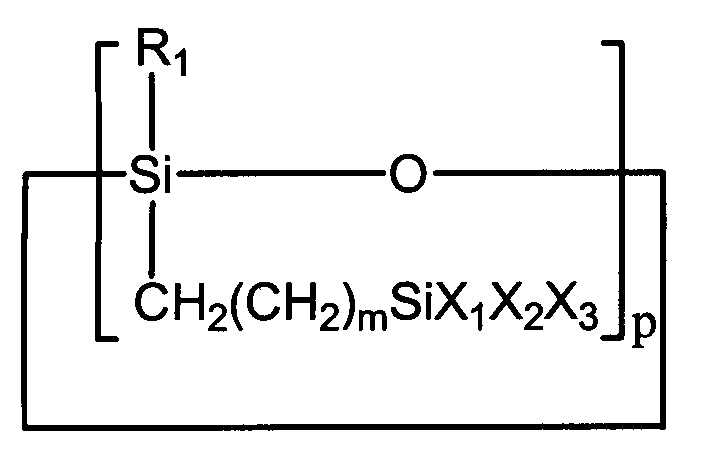
상기 식 중, R1은 수소원자, C1 내지 C3의 알킬기 또는 C6 내지 C15의 아릴기이고; X1, X2 및 X3는 각각 독립적으로 수소원자, C1 내지 C 3의 알킬기, C1 내지 C10의 알콕시기 또는 할로겐원자로서, 적어도 하나는 가수분해 가능한 작용기이며; m 은 0 내지 10의 정수, p는 3 내지 8의 정수이다; 및 In the above formula, R 1 is a hydrogen atom, an alkyl group of C 1 to C 3 or an aryl group of C 6 to C 15 ; X 1 , X 2 and X 3 are each independently a hydrogen atom, an alkyl group of C 1 to C 3 , an alkoxy group or halogen atom of C 1 to C 10 , at least one of which is a hydrolyzable functional group; m is an integer from 0 to 10, p is an integer from 3 to 8; And

상기 식 중, X1, X2 및 X3는 각각 독립적으로 수소원자, C1 내지 C3의 알킬기, C1 내지 C10의 알콕시기 또는 할로겐원자로서, 적어도 하나는 가수분해 가능한 작용기이며; M은 C1 내지 C10의 알킬렌기이거나 C6 내지 C15의 아릴렌기이다.
In the above formula, X 1 , X 2 and X 3 are each independently a hydrogen atom, an alkyl group of C 1 to C 3 , an alkoxy group or halogen atom of C 1 to C 10 , at least one being a hydrolyzable functional group; M is an alkylene group of C 1 to C 10 or an arylene group of C 6 to C 15 .
본 발명의 다른 한 측면은 상기 실록산계 중합체를 이용한 절연막의 제조방법을 제공하는 것이다.
Another aspect of the present invention is to provide a method for producing an insulating film using the siloxane-based polymer.
이하, 본 발명의 실록산계 중합체에 대하여 보다 상세히 설명하고자 한다.Hereinafter, the siloxane polymer of the present invention will be described in more detail.
본 발명의 실록산계 수지는 T 구조를 형성할 수 있는 1종의 실록산 화합물과 1종 내지 4종의 다른 실록산 화합물을 유기용매 중에서 산 또는 염기촉매와 물의 존재 하에 가수분해 및 축중합하여 제조된 공중합체임을 특징으로 한다.The siloxane resin of the present invention is a copolymer prepared by hydrolyzing and polycondensing one siloxane compound capable of forming a T structure and one to four other siloxane compounds in an organic solvent in the presence of an acid or a base catalyst and water. It is characterized by.
본 발명에서 T 구조를 형성할 수 있는 선형 실록산 화합물이라 함은 주쇄 고리 중의 반응을 통해 산소와 결합할 수 있는 반응성 작용기를 포함하여 Si가 3개의 산소를 가질 수 있는 하기 화학식 1의 구조를 가진 선형 실록산 화합물을 의미한 다: In the present invention, a linear siloxane compound capable of forming a T structure includes a linear structure having a structure of Formula 1 below in which Si may have three oxygen, including a reactive functional group capable of bonding with oxygen through a reaction in a main chain ring. Means siloxane compound:
[화학식 1][Formula 1]

상기 식 중, R1 및 R2는 각각 독립적으로 수소원자, 히드록시, 알콕사이드, 아세톡시, 알킬, 아릴 또는 O-Si(OR)3(이때, R은 C1 내지 C3의 알킬기이다.)이며, n은 2 내지 100의 정수이다(단, 상기 R1 및 R2 중 하나 이상은 반응성 작용기로서 수소원자, 히드록시, 알콕사이드, 아세톡시 또는 O-Si(OR)3이다).
Wherein R 1 and R 2 are each independently a hydrogen atom, hydroxy, alkoxide, acetoxy, alkyl, aryl or O-Si (OR) 3 , wherein R is an alkyl group of C 1 to C 3 . And n is an integer from 2 to 100, provided that at least one of R 1 and R 2 is a hydrogen atom, hydroxy, alkoxide, acetoxy or O-Si (OR) 3 as a reactive functional group.
상기 화학식 1의 흡습이 적은 T 구조를 가질 수 있는 실록산 화합물을 필수물질로 사용함으로써, 본 발명에 의해 제공되는 실록산계 중합체는 흡습이 낮아져서 저유전율의 달성이 가능하며, 또한 이 중합체를 사용한 절연막의 절연성이 우수하며 또한 도막의 기계적 물성 또한 우수하게 된다.By using the siloxane compound which may have a T structure having low moisture absorption as the essential material, the siloxane-based polymer provided by the present invention has low moisture absorption, thereby achieving a low dielectric constant, and also providing an insulating film using the polymer. Excellent insulation and mechanical properties of the coating film is also excellent.
상기 화학식 1의 구조를 갖는 화합물의 바람직한 예로는 하기 화학식 6 및 화학식 7로 표시되는 화합물을 들 수 있다:Preferred examples of the compound having the structure of

상기 식 중, n은 2 내지 100의 정수이다; Wherein n is an integer from 2 to 100;

상기 식 중, n은 2 내지 100의 정수이다.
In said formula, n is an integer of 2-100.
본 발명의 실록산계 중합체를 얻기 위해 상기 화학식 1의 실록산 화합물과 함께 중합되는 공단량체로는 하기 화학식 2 내지 화학식 5의 구조를 갖는 실록산 화합물, 그것의 가수분해물 및 축합물에서 선택된 1종 이상이 사용된다:As a comonomer polymerized together with the siloxane compound of Formula 1 to obtain the siloxane polymer of the present invention, at least one selected from siloxane compounds having the structures of Formulas 2 to 5, hydrolyzates and condensates thereof may be used. do:
[화학식 2][Formula 2]
(R1)nSi(OR2)4-n (R 1 ) n Si (OR 2 ) 4-n
상기 식 중, R1은 수소원자, C1 내지 C3의 알킬기, 할로겐기 또는 C6 내지 C15의 아릴기이고, R2는 수소원자, C1 내지 C3의 알킬기 또는 C6 내지 C15의 아릴기로서, R1 및 OR2 중 적어도 하나는 가수분해 가능한 작용기이며; n은 0 내지 3의 정수이다;Wherein R 1 is a hydrogen atom, an alkyl group of C 1 to C 3 , a halogen group or an aryl group of C 6 to C 15 , and R 2 is a hydrogen atom, an alkyl group of C 1 to C 3 or C 6 to C 15 As an aryl group, at least one of R 1 and OR 2 is a hydrolyzable functional group; n is an integer from 0 to 3;
[화학식 3] [Formula 3]

상기 식 중, R1은 수소원자, C1 내지 C3의 알킬기 또는 C6 내지 C15의 아릴기이고; R2는 수소원자, C1 내지 C10의 알킬기 또는 SiX1X2 X3이며(이 때, X1, X2, X3는 각각 독립적으로 수소원자, C1 내지 C3의 알킬기, C1 내지 C10의 알콕시기 또는 할로겐원자로서, 적어도 하나는 가수분해 가능한 작용기임); p는 3 내지 8의 정수이다 ;In the above formula, R 1 is a hydrogen atom, an alkyl group of C 1 to C 3 or an aryl group of C 6 to C 15 ; R 2 is a hydrogen atom, an alkyl group of C 1 to C 10 or SiX 1 X 2 X 3 (wherein X 1 , X 2 , X 3 are each independently a hydrogen atom, an alkyl group of C 1 to C 3 , C 1 To alkoxy or halogen atom of C 10 , at least one of which is a hydrolyzable functional group; p is an integer of 3 to 8;
[화학식 4][Formula 4]

상기 식 중, R1은 수소원자, C1 내지 C3의 알킬기 또는 C6 내지 C15의 아릴기이고; X1, X2 및 X3는 각각 독립적으로 수소원자, C1 내지 C 3의 알킬기, C1 내지 C10 의 알콕시기 또는 할로겐원자로서, 적어도 하나는 가수분해 가능한 작용기이며; m은 0 내지 10의 정수, p는 3 내지 8의 정수이다; 및 In the above formula, R 1 is a hydrogen atom, an alkyl group of C 1 to C 3 or an aryl group of C 6 to C 15 ; X 1 , X 2 and X 3 are each independently a hydrogen atom, an alkyl group of C 1 to C 3 , an alkoxy group or halogen atom of C 1 to C 10 , at least one of which is a hydrolyzable functional group; m is an integer from 0 to 10, p is an integer from 3 to 8; And
[화학식 5][Formula 5]

상기 식 중, X1, X2 및 X3는 각각 독립적으로 수소원자, C1 내지 C3의 알킬기, C1 내지 C10의 알콕시기 또는 할로겐원자로서, 적어도 하나는 가수분해 가능한 작용기이며; M은 C1 내지 C10의 알킬렌기이거나 C6 내지 C15의 아릴렌기이다.
In the above formula, X 1 , X 2 and X 3 are each independently a hydrogen atom, an alkyl group of C 1 to C 3 , an alkoxy group or halogen atom of C 1 to C 10 , at least one being a hydrolyzable functional group; M is an alkylene group of C 1 to C 10 or an arylene group of C 6 to C 15 .
상기 화학식 2 내지 5의 구조를 갖는 화합물, 그것의 가수분해물 및 축합물의 바람직한 예로는 하기 화학식 8 또는 9로 표시되는 화합물을 들 수 있다:Preferred examples of the compound having the structure of Chemical Formulas 2 to 5, hydrolyzates thereof and condensates thereof include compounds represented by the following Chemical Formulas 8 and 9:
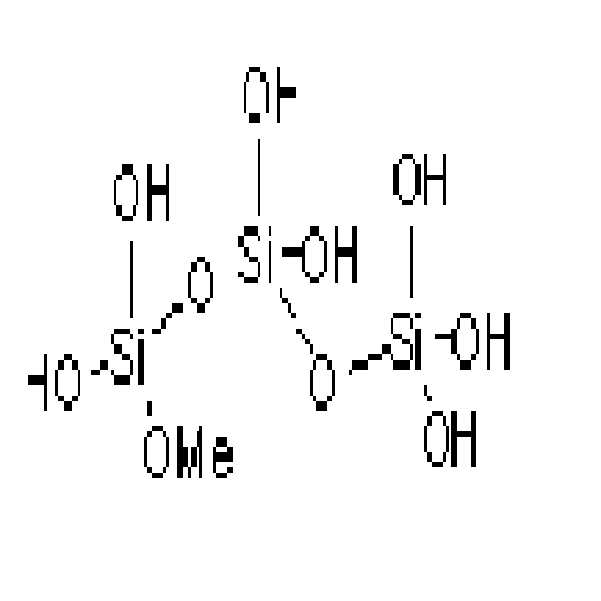

본 발명의 실록산계 중합체 제조 시, 상기 화학식 1의 화합물(이하, 모노머 (a)라 함)과 공단량체인 상기 화학식 2 내지 화학식 5의 구조를 갖는 실록산 화합물, 그것의 가수분해물 및 축합물에서 선택된 1종 이상으로부터 공중합체를 제조할 경우, 각 단량체들 간의 몰비는 특별히 제한되지는 않으며, 수득하고자 하는 절연막의 특성을 고려하여 정한다. 예를 들어, 상기 화학식 1의 실록산 화합물과 공단량체인 상기 화학식 2의 화합물, 상기 화학식 3의 화합물, 상기 화학식 4의 화합물 또는 상기 화학식 5의 화합물을 공중합하는 경우, 양 단량체의 비는 0.01 : 99.99 내지 99.99 : 0.01로 할 수 있다.When preparing the siloxane polymer of the present invention, the compound of formula 1 (hereinafter referred to as monomer (a)) and the comonomer selected from the siloxane compound having the structure of formula 2 to formula 5, its hydrolyzate and condensate When the copolymer is prepared from one or more species, the molar ratio between the monomers is not particularly limited and is determined in consideration of the properties of the insulating film to be obtained. For example, when copolymerizing the compound of Formula 2, the compound of Formula 3, the compound of Formula 4, or the compound of Formula 5 that is a comonomer with the siloxane compound of
본 발명에서 실록산계 중합체를 제공하기 위해 사용되는 유기용매는 특별히 제한되지 않으나, 바람직하게는 헥산(hexane), 헵탄 (heptane) 등의 지방족 탄화수소 용매(aliphatic hydrocarbon solvent); 아니솔(anisole), 메시틸렌 (mesitylene), 크실렌(xylene) 등의 방향족계 탄화수소 용매(aromatic hydrocarbon solvent); 메틸 이소부틸 케톤(methyl isobutyl ketone), 1-메틸-2-피롤리디논(1-methyl-2-pyrrolidinone), 시클로헥산온(cyclohexanone), 아세톤(acetone) 등의 케 톤계 용매(ketone-based solvent); 테트라히드로퓨란(tetrahydrofuran), 이소프로필 에테르(isopropyl ether), 프로필렌 글리콜 프로필 에테르(propylene glycol propyl ether) 등의 에테르계 용매(ether-based solvent); 에틸 아세테이트(ethyl acetate), 부틸 아세테이트(butyl acetate), 프로필렌 글리콜 메틸 에테르 아세테이트(propylene glycol methyl ether acetate) 등의 아세테이트계 용매(acetate-based solvent); 이소프로필 알코올(isopropyl alcohol), 부틸 알코올(butyl alcohol) 등의 알코올계 용매(alcohol-based solvent); 디메틸아세트아미드(dimethylacetamide), 디메틸포름아미드(dimethylformamide) 등의 아미드계 용매; 실리콘계 용매(silicon-based solvent); 또는 이들의 혼합물을 사용할 수 있다.The organic solvent used to provide the siloxane polymer in the present invention is not particularly limited, but is preferably an aliphatic hydrocarbon solvent such as hexane and heptane; Aromatic hydrocarbon solvents such as anisole, mesitylene and xylene; Ketone-based solvents such as methyl isobutyl ketone, 1-methyl-2-pyrrolidinone, cyclohexanone and acetone ); Ether-based solvents such as tetrahydrofuran, isopropyl ether, and propylene glycol propyl ether; Acetate-based solvents such as ethyl acetate, butyl acetate, and propylene glycol methyl ether acetate; Alcohol-based solvents such as isopropyl alcohol and butyl alcohol; Amide solvents such as dimethylacetamide and dimethylformamide; Silicon-based solvents; Or mixtures thereof.
한편, 본 발명에서 사용가능한 산 촉매의 예는 특별히 제한되지는 않으나, 바람직하게는 염산(hydrochloric acid), 질산(nitric acid), 벤젠 술폰산(benzene sulfonic acid), 옥살산(oxalic acid), 포름산(formic acid) 또는 이들의 혼합물을 사용한다. 본 발명에 사용가능한 염기촉매의 예는 특별히 제한되지는 않으나, 바람직하게는 수산화칼륨(potassium hydroxide), 수산화나트륨(sodium hydroxide), 트리에틸아민(triethylamine), 탄산수소나트륨(sodium bicarbonate), 피리딘(pyridine) 또는 이들의 혼합물을 사용한다. 전체 단량체와 사용되는 촉매간의 몰 비는 1 : 1 X 10⁻⁵ 내지 1 : 10 으로 한다. 한편, 본 발명에 따른 실록산계 중합체의 제조에 있어, 전체 단량체 혼합물 및 사용되는 물간의 몰 비는 1 : 1 내지 1 : 100으로 한다. 가수분해 및 축중합반응은, 적절한 온도 및 시간 조건하에서 수행 할 수 있으며, 바람직하게는 0 내지 200℃의 온도에서 0.1 내지 100 시간동안 수행한다.On the other hand, examples of the acid catalyst usable in the present invention is not particularly limited, but preferably hydrochloric acid, nitric acid, benzene sulfonic acid, oxalic acid, formic acid acid) or mixtures thereof. Examples of the base catalyst usable in the present invention are not particularly limited, but preferably potassium hydroxide, sodium hydroxide, triethylamine, sodium bicarbonate, pyridine pyridine) or mixtures thereof. The molar ratio between the entire monomers and the catalyst used is from 1: 1 X 10 -5 to 1: 10. In the production of the siloxane polymer according to the present invention, on the other hand, the molar ratio between the entire monomer mixture and the water used is from 1: 1 to 1: 100. The hydrolysis and polycondensation reaction can be carried out under suitable temperature and time conditions, preferably at a temperature of 0 to 200 ℃ for 0.1 to 100 hours.
제조된 실록산계 중합체의 무게평균 분자량은 바람직하게는 300 내지 300,000이며, 전체 중합체의 말단기 중 Si-OH 함량이 5% 이상인 것이 바람직하다.
The weight average molecular weight of the prepared siloxane polymer is preferably 300 to 300,000, and the Si-OH content in the end groups of the entire polymer is preferably 5% or more.
본 발명은 또한 ⅰ) 상기 실록산계 중합체 및, 필요에 따라, 기공형성물질을 유기용매에 용해시켜 코팅액을 제조하는 단계; 및 ⅱ) 상기 코팅액을 기판 위에 도포하고 열 경화시키는 단계를 포함하는 절연막 제조방법을 제공한다. The present invention also comprises the steps of: iii) dissolving the siloxane polymer and, if necessary, the pore-forming material in an organic solvent to prepare a coating solution; And ii) applying the coating solution onto a substrate and thermally curing the coating solution.
우선, 본 발명의 절연막 제조에 사용되는 코팅액 제조에 대해 설명하기로 한다.First, the production of the coating liquid used in the production of the insulating film of the present invention will be described.
본 발명의 코팅액 제조시 사용가능한 기공형성 물질은 다공성 절연막 형성을 위해 사용되는 모든 공지된 기공형성물질을 포함한다. 바람직하게는, 시클로덱스트린(cyclodextrin), 폴리카프로락톤(polycaprolactone), Brij계 계면활성제 (surfactant), 폴리에틸렌글리콜-폴리프로필렌글리콜-폴리에틸렌글리콜 삼원블록공중합체(polyethylene glycol-polypropylene glycol-polyethylene glycol triblock copolymer) 계면활성제(surfactant) 및 이들의 유도체로 이루어진 군으로부터 선택된 화합물을 단독으로 또는 둘 이상 조합하여 사용할 수 있다. 상기 기공 형성물질은 코팅액 중 고형분(즉, 실록산계 중합체와 기공형성물질)의 총 중량을 기준으로 0 내지 70 중량%의 양으로 존재하는 것이 바람직하나, 이에 제한되지는 않는다.The pore-forming material usable in preparing the coating liquid of the present invention includes all known pore-forming materials used for forming the porous insulating film. Preferably, cyclodextrin, polycaprolactone, Brij surfactant, polyethylene glycol-polypropylene glycol-polyethylene glycol triblock copolymer Compounds selected from the group consisting of surfactants and derivatives thereof may be used alone or in combination of two or more thereof. The pore-forming material is preferably present in an amount of 0 to 70% by weight based on the total weight of solids (ie, siloxane-based polymer and pore-forming material) in the coating solution, but is not limited thereto.
본 발명의 코팅액 제조 시 사용가능한 유기용매는 특별히 제한되지는 않으며, 바람직하게는 상기 실록산계 중합체의 제조에서 상술한 모든 유기용매를 사용할 수 있다. 코팅액 중 고형분의 함량은 특별히 제한되지는 않으나, 총 조성물의 중량을 기준으로 5 내지 70 중량%가 되도록 한다.The organic solvent usable in the preparation of the coating liquid of the present invention is not particularly limited, and preferably all organic solvents described above in the preparation of the siloxane polymer can be used. The content of solids in the coating liquid is not particularly limited, but is 5 to 70% by weight based on the total weight of the composition.
이어서, 상기 코팅액을 기판에 도포한 후, 열경화를 실시하여 본 발명의 절연막을 제조한다.Subsequently, the coating solution is applied to a substrate and then thermally cured to prepare an insulating film of the present invention.
본 발명의 절연막 제조에 사용되는 기판은 본 발명의 목적을 저해하지 않는 한 특별히 제한되지 않으며, 열경화 조건을 견딜 수 있는 모든 기판, 예를 들어, 유리 기판, 실리콘 웨이퍼, 플라스틱 기판 등을 용도에 따라 선택하여 사용할 수 있다.The substrate used for manufacturing the insulating film of the present invention is not particularly limited as long as the object of the present invention is not impaired, and any substrate capable of withstanding thermosetting conditions, for example, a glass substrate, a silicon wafer, a plastic substrate, and the like may be used. Can be selected accordingly.
본 발명에서 사용가능한 코팅액을 도포하는 방법의 예는 스핀 코팅(spin coating), 딥 코팅(dip coating), 분무 코팅(spray coating), 흐름 코팅(flow coating), 및 스크린 인쇄(screen printing)을 포함하나, 이에 제한되지는 않는다. 편의성 및 균일성의 측면에서 가장 바람직한 도포방법은 스핀 코팅이다. 스핀코팅을 행하는 경우, 스핀속도는 800 내지 5,000 rpm의 범위 내에서 조절되는 것이 바람직하다.Examples of methods for applying coating solutions usable in the present invention include spin coating, dip coating, spray coating, flow coating, and screen printing. However, it is not limited thereto. The most preferred application method in terms of convenience and uniformity is spin coating. When spin coating is performed, the spin speed is preferably adjusted within the range of 800 to 5,000 rpm.
도포가 완료된 후, 필요에 따라 용매를 증발시켜 필름을 건조하는 과정을 포함할 수 있다. 필름 건조과정은 단순히 주위 환경에 노출시키거나, 경화 공정의 초기 단계에서 진공을 적용하거나, 혹은 200℃ 이하의 비교적 낮은 온도로 가열하여 수행할 수 있다.After the application is completed, the process may include evaporating the solvent to dry the film as necessary. The film drying process can be carried out simply by exposing to the ambient environment, applying a vacuum at the initial stage of the curing process, or by heating to a relatively low temperature of 200 ° C. or less.
이어서, 상기 필름을 1 내지 180분 동안 150℃ 내지 600℃, 바람직하게는 200℃ 내지 450℃의 온도로 열경화시켜 균열이 없는 불용성 피막을 형성시킨다. "균열이 없는 피막"이란 1000 배율의 광학현미경으로 관찰할 때, 육안으로 볼 수 있는 임의의 균열이 관찰되지 않는 피막을 뜻하며, 불용성 피막이란 실록산계 중합체를 침착시켜 막을 형성시키는 용매 또는 수지를 도포시키기에 유용한 것으로 기술된 용매에 본질적으로 용해되지 않는 피막을 말한다. 기공형성물질이 포함된 경우, 기공형성물질의 분해온도를 고려하여 열 경화온도를 정한다.The film is then thermally cured at temperatures between 150 ° C. and 600 ° C., preferably between 200 ° C. and 450 ° C. for 1 to 180 minutes to form an insoluble coating that is free of cracks. "Film without crack" means a film in which any crack visible to the naked eye is not observed when viewed under an optical microscope at a magnification of 1000. Insoluble coating means a solvent or resin that deposits a siloxane-based polymer to form a film. Refers to a coating that is essentially insoluble in a solvent described as useful. When the pore-forming material is included, the thermosetting temperature is determined in consideration of the decomposition temperature of the pore-forming material.
본 발명에 따라 제조된 절연막은 저유전율이며, 탄성계수 등의 기계적 물성이 우수하여 반도체 층간 절연막으로써 유용하게 사용될 수 있다.
The insulating film prepared according to the present invention has a low dielectric constant and is excellent in mechanical properties such as elastic modulus, and thus may be usefully used as a semiconductor interlayer insulating film.
이하, 실시예를 통하여 본 발명을 보다 상세하게 설명하고자 하나, 하기의 실시예는 설명의 목적을 위한 것으로 본 발명을 제한하기 위한 것이 아니다.
Hereinafter, the present invention will be described in more detail with reference to Examples, but the following Examples are for the purpose of explanation and are not intended to limit the present invention.
[물성평가방법][Property evaluation method]
먼저, 하기 실시예 및 비교예에서 제조된 절연막의 성능을 측정하는 방법에 대하여 상술한다:First, a method of measuring the performance of the insulating film prepared in the following Examples and Comparative Examples will be described in detail.
① 두께 및 유전율 측정 :① Thickness and permittivity measurement:
붕소 도핑된(boron-doped) p 타입의 실리콘 웨이퍼 상에 실리콘 열산화막 3,000Å을 도포하고 금속 증착기(metal evaporator)로 티타늄 100Å, 알루미늄 2,000Å, 티타늄 100Å을 증착한 다음, 그 위에 측정 대상 절연막을 형성한다. 상기 절연막 위에 전극지름이 1㎜로 설계된 하드마스크를 이용하여 1㎜ 지름을 가지는 원형의 티타늄 100Å 및 알루미늄 박막 5,000Å을 증착하여 MIM(metal-insulator-metal) 구조의 유전율 측정용 저유전 박막을 완성한다. 완성된 박막을 Probe station(micromanipulator 6200 probe station)이 장착된 PRECISION LCR METER(HP4284A)를 이용하여 약 10㎑, 100㎑, 및 1㎒의 주파수에서 정전용량(capacitance)을 측정하고, 프리즘 커플러를 이용하여 박막 두께를 측정한 다음, 하기 식으로부터 유전율을 구한다:The silicon thermal oxide film 3,000Å was deposited on a boron-doped p-type silicon wafer, and 100 titanium, 2,000 aluminum and 100 titanium were deposited using a metal evaporator. Form. A low dielectric thin film for measuring dielectric constant of MIM (metal-insulator-metal) structure is completed by depositing a circular titanium 100Å and an aluminum thin film 5,000Å having a diameter of 1mm using a hard mask designed with an electrode diameter of 1 mm on the insulating film. do. The finished thin film was measured using a PRECISION LCR METER (HP4284A) equipped with a probe station (micromanipulator 6200 probe station) to measure capacitance at frequencies of about 10 kHz, 100 kHz, and 1 MHz, using a prism coupler. The thickness of the thin film is measured, and then the dielectric constant is obtained from
k = C x d/εo x A k = C xd / ε o x A
(상기 식에서, k는 유전율(relative permittivity)이고, C는 정전용량 (capacitance)이며,εo는 진공의 유전상수(dielectric constant, εo=8.8542 X 10
-12Fm-1)이고, d는 절연막의 두께이며, A는 전극의 접촉 단면적이다.)
Where k is the relative permittivity, C is the capacitance, ε o is the dielectric constant (ε o = 8.8542 X 10 -12 Fm -1 ), and d is the insulating film Is the thickness of A, and A is the contact cross-sectional area of the electrode.)
② 탄성계수(modulus):② modulus of elasticity:
탄성계수는 MTS사의 나노인덴터(nanoindenter) II를 이용하여 절연막을 정량적으로 분석하여 결정한다. 보다 상세하게는, 박막을 나노인덴터로 압입(indent)하고, 압입깊이가 박막 두께의 10% 일 때 박막의 탄성계수를 구한다. 박막의 두께는 프리즘 커플러(prism coupler)를 이용하여 측정한다. 본 실시예 및 비교예에서는 신뢰도를 확보하기 위해 절연막상의 9개 지점를 압입하여 평균값으로부터 각각의 탄성계수를 구하였다.
The modulus of elasticity is determined by quantitatively analyzing the insulating film using MTS Nanoindenter II. More specifically, the thin film is indented with a nanoindenter, and the elastic modulus of the thin film is obtained when the indentation depth is 10% of the thin film thickness. The thickness of the thin film is measured using a prism coupler. In the present Example and the comparative example, in order to ensure reliability, nine points on the insulating film were press-fitted and each elastic coefficient was calculated | required from the average value.
합성예 1. 화합물 A-1의 합성Synthesis Example 1. Synthesis of Compound A-1
폴리메틸하이드로실록산(polymethyl hydrosiloxane, 트리메틸실릴 종결(trimethylsilyl terminated)), 평균 분자량 약 5,000, n은 dir 80) 10.00g을 플라스크에 투입하고, 테트라히드로퓨란 100㎖를 넣어 희석시킨 후, 10 중량% Pd/C (palladium/charcoal)을 200mg 첨가하였다. 이어서, 증류수 177.8mmol(3.20㎖)를 첨가하고, 이 때 발생하는 수소 가스를 제거하였다. 상온에서 15시간 반응을 진행 시킨 후, 반응액을 셀라이트(celite)와 MgSO4를 통해 여과하고, 여액을 0.1토르(torr) 정도의 감압 하에 두어 휘발성 물질을 제거하여 하기 화학식 6을 가진 액상 실란화합물[이하, (A-1)라 함]을 합성하였다:10.00 g of polymethyl hydrosiloxane (trimethylsilyl terminated), average molecular weight of about 5,000, n is dir 80) was added to the flask, and diluted with 100 ml of tetrahydrofuran, followed by 10 wt% Pd 200 mg of / C (palladium / charcoal) was added. Subsequently, 177.8 mmol (3.20 mL) of distilled water were added to remove hydrogen gas generated at this time. After the reaction was conducted at room temperature for 15 hours, the reaction solution was filtered through celite and MgSO 4 , and the filtrate was removed under a reduced pressure of about 0.1 Torr to remove volatiles. A compound [hereinafter referred to as (A-1)] was synthesized:
[화학식 6][Formula 6]
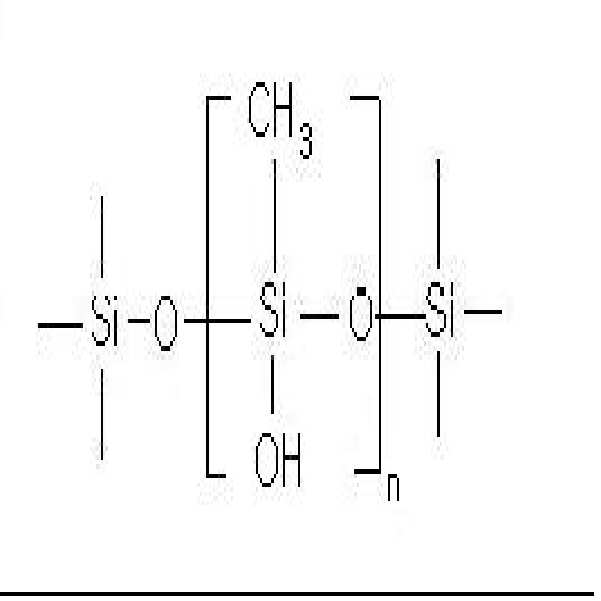
상기 식 중, n은 약 80의 정수이다.
Wherein n is an integer of about 80.
합성예 2. 화합물 A-2의 합성Synthesis Example 2 Synthesis of Compound A-2
폴리메틸하이드로실록산(polymethyl hydrosiloxane, 트리메틸실릴 종결(trimethylsilyl terminated)), 평균 분자량 약 390, n은 약 4) 10.00g을 사용하는 것을 제외하고는 상기 합성예 1과 동일한 방법으로 제조하여 화학식 6-1을 가진 실란화합물을 합성하였다: Polymethyl hydrosiloxane (trimethylsilyl terminated), the average molecular weight of about 390, n is prepared in the same manner as in Synthesis Example 1 except for using about 4) 10.00g A silane compound having was synthesized:
[화학식 6-1][Formula 6-1]
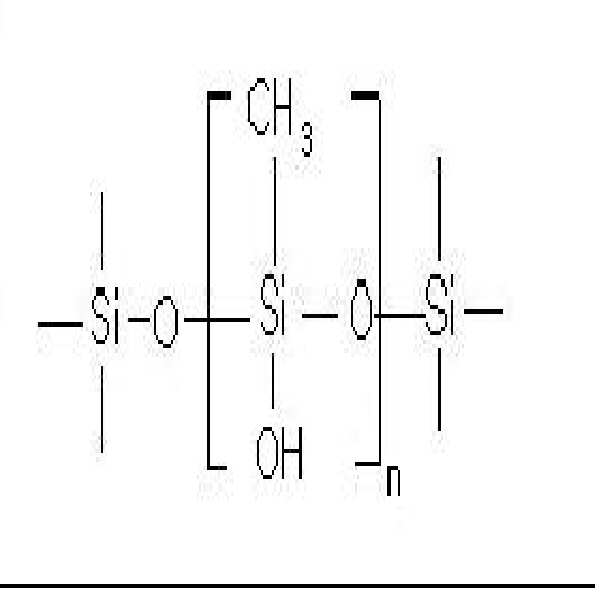
상기 식 중에서, n은 4의 정수이다.
In said formula, n is an integer of 4.
합성예 3. 화합물 A-3의 합성Synthesis Example 3 Synthesis of Compound A-3
증류수 177.8mmol(3.20㎖) 대신 메탄올 180mmol(7.3㎖)을 사용한 것을 제외하고는 상기 합성예 1과 동일한 방법으로 제조하여 하기 화학식 7의 실란화합물[이하, (A-3)라 함]을 합성하였다. A silane compound of the following Chemical Formula 7 was synthesized in the same manner as in Synthesis Example 1, except that 180 mmol (7.3 mL) of methanol was used instead of 177.8 mmol (3.20 mL) of distilled water. .
[화학식 7] [Formula 7]

상기 식에서, n은 약 80의 정수이다.
Wherein n is an integer of about 80.
합성예 4. 화합물 A-4의 합성 Synthesis Example 4 Synthesis of Compound A-4
테트라메톡시실란(Tetramethoxysilane) 9g을 플라스크에 넣고, 테트라히드로퓨란 42㎖를 넣어 희석시킨 후, 반응액 온도를 -78℃로 하였다. 상기 플라스크에 염산수용액(0.001 mol/㎖) 8.52g를 첨가한 후, 반응액의 온도를 -78℃에서 70℃로 서서히 승온하여 3시간 동안 반응을 진행시킨 후, 상온으로 냉각시켜 하기 화학식 8의 화합물 용액[이하, (A-4)라 함]을 합성하였다:9 g of tetramethoxysilane was placed in a flask, and 42 ml of tetrahydrofuran was added and diluted, and the reaction solution temperature was -78 ° C. After adding 8.52 g of an aqueous hydrochloric acid solution (0.001 mol / mL) to the flask, the temperature of the reaction solution was gradually raised from −78 ° C. to 70 ° C., followed by reaction for 3 hours, and then cooled to room temperature. A compound solution [hereinafter referred to as (A-4)] was synthesized:
[화학식 8] [Formula 8]

합성예 4-1.Synthesis Example 4-1.
테트라메톡시실란(Tetramethoxysilane) 4.5g, 테트라히드로퓨란 20㎖ 및 염 산수용액(0.001 mol/㎖) 4.26g을 사용한 것을 제외하고는 상기 합성예 3과 동일한 방법으로 상기 화학식 8의 화합물 용액[이하, (A-4)라 함]을 합성하였다.
Except for using 4.5 g of tetramethoxysilane, 20 ml of tetrahydrofuran, and 4.26 g of a salt acid solution (0.001 mol / ml), the compound solution of Chemical Formula 8 was the same as in Synthesis Example 3 [hereinafter, (A-4)] was synthesized.
합성예 5. 화합물 B-1의 합성Synthesis Example 5 Synthesis of Compound B-1
2,4,6,8-테트라메틸-2,4,6,8-시클로테트라실록산 (2,4,6,8-tetramethyl-2,4,6,8-cyclotetrasiloxane) 41.6mmol(10.00g)을 플라스크에 투입하고 테트라히드로퓨란 100ml를 넣어 희석시킨 후 10wt% Pd/C (palladium/charcol) 을 200mg 첨가하였다. 이어서, 증류수 177.8mmol (3.20ml)를 첨가하고, 이 때 발생하는 수소 가스를 제거하였다. 상온에서 15시간 반응을 진행시킨 후, 반응액을 셀라이트(celite)와 MgSO4를 통해 여과하고, 여액을 0.1토르(torr) 정도의 감압하에 두어 휘발성 물질을 제거하여 하기 화학식을 가진 무색의 액상 단량체 (B-1)을 합성하였다:2,4,6,8-tetramethyl-2,4,6,8-cyclotetrasiloxane (2,4,6,8-tetramethyl-2,4,6,8-cyclotetrasiloxane) 41.6 mmol (10.00 g) Into the flask and diluted with 100ml of tetrahydrofuran, 200mg of 10wt% Pd / C (palladium / charcol) was added. Subsequently, 177.8 mmol (3.20 ml) of distilled water were added, and hydrogen gas generated at this time was removed. After the reaction was conducted at room temperature for 15 hours, the reaction solution was filtered through celite and MgSO 4 , and the filtrate was removed under a reduced pressure of about 0.1 Torr to remove volatiles. Monomer (B-1) was synthesized:

상기 합성된 상기 단량체 (acetone-d6 용액)의 1H NMR(300MHz) 측정결과는 다음과 같다: δ 0.067(s, 12H, 4 X [-CH3]), 5.52(s, 4H, 4 X [-OH]).
1 H NMR (300 MHz) measurement results of the synthesized monomer (acetone-d 6 solution) were as follows: δ 0.067 (s, 12H, 4 X [−CH 3 ]), 5.52 (s, 4H, 4 X [-OH]).
합성예 6. 화합물 B-2의 합성Synthesis Example 6 Synthesis of Compound B-2
상기 합성예 5의 방법으로 수득한 액상 반응 생성물 41.6mmol (12.6g)을 200 ㎖의 THF(테트라히드로퓨란)으로 희석시킨 용액에 트리에틸아민 177.8 mmol (13.83g)을 첨가하였다. 상기 용액의 온도를 -0℃로 낮춘 후, 클로로트리메톡시 메틸실란 (chlorotrimothxymethylsilane) 177.8mmol (25.0g)을 서서히 가하고 온도를 서서히 상온까지 올려서 15시간 동안 반응을 진행시켰다. 반응액을 셀라이트(celite)를 통해 여과하고, 여액을 0.1토르(torr) 정도의 감압 하에 두어 휘발성 물질을 제거하여 농축하여 하기 화학식을 가지는 무색의 액상 단량체 (B-2)를 제조하였다:177.8 mmol (13.83 g) of triethylamine was added to a solution obtained by diluting 41.6 mmol (12.6 g) of the liquid reaction product obtained by the method of Synthesis Example 5 with 200 mL of THF (tetrahydrofuran). After the temperature of the solution was lowered to −0 ° C., 177.8 mmol (25.0 g) of chlorotrimothxymethylsilane was slowly added, and the temperature was gradually raised to room temperature to allow the reaction to proceed for 15 hours. The reaction solution was filtered through celite, and the filtrate was placed under reduced pressure of about 0.1 Torr to remove volatiles and concentrated to prepare a colorless liquid monomer (B-2) having the following formula:

상기 합성된 단량체의 1H NMR(300MHz) 측정결과는 다음과 같다: δ 0.092(s, 12H, 4 X [-CH3]), 3.58 (s, 9H, 4 X [-CH3]). 1 H NMR (300 MHz) measurement results of the synthesized monomers are as follows: δ 0.092 (s, 12H, 4 X [−CH 3 ]), 3.58 (s, 9H, 4 X [—CH 3 ]).
제조예 1. 중합체 (P-1)의 제조Preparation Example 1 Preparation of Polymer (P-1)
Q구조와 T구조의 몰비(Q/T)가 0.5가 되도록 상기 합성예 1에서 수득한 화합물 A-1을 테트라히드로퓨란으로 8.3 중량%로 희석한 용액 36㎖와 상기 합성예 3에서 수득한 화합물 용액 A-3 18.3g을 플라스크에 넣고, 반응액의 온도를 상온에서 70℃로 서서히 승온하여 20시간 동안 반응을 진행하였다. 반응용액을 분별 깔대기에 옮긴 후, 최초 넣어 준 테트라히드로퓨란과 동일한 양의 디에틸에테르와 테트라히드로퓨란을 첨가하고, 전체 용매의 1/10 가량의 물로 3회 씻어 준 다음, 감압 하에서 휘발성 물질을 제거하여 흰색 분말 형태의 중합체를 얻었다. 상기의 방법으로 얻은 중합체를 테트라히드로퓨란에 용해시켜 투명한 용액을 만들고, 이를 기공이 0.2㎛인 필터로 여과한 후 여액에 물을 서서히 첨가하여 흰색분말의 침전을 수득하였다. 상기 흰색 분말은 0 내지 20℃의 온도, 0.1 토르(torr) 압력 하에서 10시간 동안 건조시켜서 실록산계 중합체를 얻었다. 수득된 중합체 P-1의 Si-NMR을 도 1에 나타내었다. 36 ml of a solution obtained by diluting compound A-1 obtained in Synthesis Example 1 to 8.3 wt% with tetrahydrofuran so that the molar ratio (Q / T) of the Q structure and the T structure was 0.5 and the compound obtained in Synthesis Example 3 18.3 g of solution A-3 was placed in a flask, and the temperature of the reaction solution was gradually raised from room temperature to 70 deg. C for 20 hours. After the reaction solution was transferred to a separatory funnel, the same amount of tetraethylfuran and tetrahydrofuran in the same amount were added, washed three times with about 1/10 of the total solvent, and then the volatiles were removed under reduced pressure. Removal to obtain a polymer in the form of a white powder. The polymer obtained by the above method was dissolved in tetrahydrofuran to form a transparent solution, which was filtered through a filter having a pore of 0.2 μm, and water was slowly added to the filtrate to obtain a precipitate of white powder. The white powder was dried for 10 hours at a temperature of 0 to 20 ℃, 0.1 tor (torr) pressure to obtain a siloxane-based polymer. Si-NMR of the obtained polymer P-1 is shown in FIG.
제조예 2. 중합체 (P-2)의 제조 : Preparation Example 2 Preparation of Polymer (P-2):
Q구조와 T구조의 몰비(Q/T)가 0.9가 되도록 상기 합성예 1에서 수득한 화합물 A-1을 테트라히드로퓨란으로 8.3 중량%으로 희석한 용액 30㎖와 상기 합성예 3에서 수득한 실록산계 화합물 용액 A-3 27.43g을 플라스크에 넣고, 상기 중합체 (P-1)의 제조와 동일한 방법으로 중합체 P-2를 제조하였다. 수득된 중합체 P-2의 Si-NMR을 도 2에 나타내었다.
30 ml of a solution obtained by diluting compound A-1 obtained in Synthesis Example 1 to 8.3 wt% with tetrahydrofuran so that the molar ratio (Q / T) of the Q structure and the T structure became 0.9 and the siloxane obtained in Synthesis Example 3 27.43 g of acid compound solution A-3 was placed in a flask, and polymer P-2 was prepared in the same manner as in the preparation of polymer (P-1). Si-NMR of the obtained polymer P-2 is shown in FIG.
제조예 3. 중합체 (P-3)~(P-6)의 제조 :Preparation Example 3 Preparation of Polymers (P-3) to (P-6):
합성예 6에서 수득한 다반응성 환형 실리케이트 화합물과 합성예 1과 2에서 합성한 실록산화합물을 표 1에 나타난 양으로 플라스크에 넣고, 테트라히드로퓨란 50㎖를 넣어 희석시킨 후, 반응액 온도를 -78℃로 하였다. 상기 플라스크에 표 1에 나타난 바와 같은 양의 염산수용액(0.001 mol/㎖)을 첨가한 후, 반응액의 온도를 -78℃에서 70℃로 서서히 승온하여 20시간 동안 반응을 진행하였다. 반응용액을 분별 깔대기에 옮긴 후, 최초 넣어 준 테트라히드로퓨란과 동일한 양의 디에틸에테르와 테트라히드로퓨란을 첨가하고, 전제 용매의 1/10배 가량의 물로 3회 씻어 준 다음, 감압 하에서 휘발성 물질을 제거하여 흰색 분말 형태의 중합체를 얻었다. 상기의 방법으로 얻은 중합체를 아세톤을 용해시켜 투명한 용액을 만들고, 이를 기공이 0.2㎛인 필터로 여과한 후 여액에 물을 서서히 첨가하여 흰색분말의 침전을 수득하였다. 상기 흰색 분말은, 0 내지 20℃, 0.1 토르(torr) 감압하에서 10시간 동안 건조시켜서 분별된 실록산계 중합체를 얻었다. The polyreactive cyclic silicate compound obtained in Synthesis Example 6 and the siloxane compound synthesized in Synthesis Examples 1 and 2 were added to the flask in the amount shown in Table 1, 50 ml of tetrahydrofuran was diluted, and the reaction solution temperature was -78. It was set to ° C. After adding an aqueous hydrochloric acid solution (0.001 mol / ml) to the flask as shown in Table 1, the temperature of the reaction solution was gradually raised from -78 ° C to 70 ° C for 20 hours. After the reaction solution was transferred to a separatory funnel, the same amount of tetraethylfuran and tetrahydrofuran in the same amount were added, washed three times with 1/10 times the total solvent, and then volatile under reduced pressure. Was removed to obtain a polymer in the form of a white powder. The polymer obtained by the above method was dissolved in acetone to form a transparent solution, which was then filtered through a filter having a pore of 0.2 μm, and water was slowly added to the filtrate to obtain a precipitate of white powder. The white powder was dried at 0 to 20 ° C. under a 0.1 Torr reduced pressure for 10 hours to obtain a fractionated siloxane polymer.
[표 1]TABLE 1
절연막 가 및 가-1의 제조:Preparation of Insulation Layer A and A-1:
실록산계 중합체로써 기공을 포함하지 않는 절연막(절연막 가)은 중합체 (P-1) 만을 0.83g을 사용하고, 기공을 포함하는 절연막(절연막 가-1)은 중합체 (P-1) 및 기공형성 물질로서 헵타키스[2,3,6-트리-메톡시]-베타-시클로덱스트린[heptakis(2,3,6-tri-O-methyl)-Ղ-cyclodextrin) 0.249g을 사용하고, 용매로서 프로필렌 글리콜 메틸 에테르 아세테이트(propylene glycol methyl ether acetate)를 사용하여 고형분 함량 25중량%의 코팅액을 제조하였다. 상기 코팅액을 3,000rpm으로 30초간 실리콘 웨이퍼 위에 스핀 코팅을 하고, 질소 분위기의 핫플레이트(hot plate)상에서, 150℃로 1분간 그리고 250℃로 1분간 예비가열하여 건조시켜 필름을 제조하였다. 상기 필름을 진공 분위기에서 420℃(승온속도: 3℃/min)로 1시간 열처리하여 절연막 가 및 가-1을 제조하였다. 제조된 절연막의 두께 (thickness), 굴절률 (refractive index), 유전율 (dielectric constant) 및 탄성계수를 상기 물성평가방법에 따라서 측정하고, 그 결과를 표 2에 나타내었다.As the siloxane-based polymer, the insulating film (insulation film A) which does not contain pores uses 0.83 g of only polymer (P-1), and the insulating film containing pores (insulating film A-1) contains the polymer (P-1) and the pore-forming material. 0.249 g of heptakis [2,3,6-tri-methoxy] -beta-cyclodextrin [heptakis (2,3,6-tri-O-methyl)-Ղ -cyclodextrin) was used as a solvent. As a propylene glycol methyl ether acetate (propylene glycol methyl ether acetate) as a coating liquid of 25% by weight solid content was prepared. The coating solution was spin-coated on a silicon wafer for 30 seconds at 3,000 rpm, and preheated at 150 ° C. for 1 minute and at 250 ° C. for 1 minute on a hot plate in a nitrogen atmosphere to prepare a film. The film was heat-treated at 420 ° C. (heating rate: 3 ° C./min) for 1 hour in a vacuum atmosphere to prepare an insulating film Ga and Ga-1. The thickness, refractive index, dielectric constant, and elastic modulus of the prepared insulating film were measured according to the property evaluation method, and the results are shown in Table 2.
절연막 나 및 나-1의 제조 :Preparation of insulating film B and B-1:
중합체 (P-1) 대신 각각 공중합체 (P-2)를 사용한 것을 제외하고는 절연막 가 또는 가-1의 제조방법과 동일한 방법을 사용하여 절연막 나와 나-1을 제조하였 다. 제조된 절연막의 두께, 굴절률, 유전율 및 탄성계수를 측정하고, 그 결과를 표 2에 나타내었다.An insulating film Na-1 was prepared using the same method as the method of preparing the insulating film A or A-1 except that copolymer (P-2) was used instead of the polymer (P-1), respectively. The thickness, refractive index, dielectric constant and elastic modulus of the prepared insulating film were measured, and the results are shown in Table 2.
[표 2]TABLE 2
표에서처럼 Q구조의 양이 증가할수록 유전율이 증가하지만, Q/T 몰비가 0.9정도에서도 흡습이 없고 탄성계수가 높은 박막을 제조할 수 있었으며, 기공형성물질 첨가시 유전율이 감소되는 것으로 보아 기공형성물질과 중합체와의 혼합성도 우수한 것을 알 수 있었다.
As shown in the table, the dielectric constant increases as the amount of Q structure increases, but even when the Q / T molar ratio is around 0.9, a thin film without moisture absorption and high modulus of elasticity can be produced. It was also found that the mixing properties between the polymer and the polymer were excellent.
절연막 다 및 다-1의 제조 :Preparation of Insulation Films DA and DA-1:
중합체 (P-1) 대신 각각 공중합체 (P-3)를 사용한 것을 제외하고는 절연막 가 또는 가-1의 제조방법과 동일한 방법을 사용하여 절연막 다와 다-1을 제조하였다. 제조된 절연막의 두께, 굴절률, 유전율 및 탄성계수를 측정하고, 그 결과를 표 3에 나타내었다.The insulating film Dawada-1 was manufactured using the same method as the method for preparing the insulating film A or A-1 except that the copolymer (P-3) was used instead of the polymer (P-1), respectively. The thickness, refractive index, dielectric constant, and elastic modulus of the prepared insulating film were measured, and the results are shown in Table 3.
절연막 라 및 라-1의 제조 :Preparation of Insulation La and La-1:
중합체 (P-1) 대신 각각 공중합체 (P-4)를 사용한 것을 제외하고는 절연막 가 또는 가-1의 제조방법과 동일한 방법을 사용하여 절연막 라와 라-1을 제조하였다. 제조된 절연막의 두께, 굴절률, 유전율 및 탄성계수를 측정하고, 그 결과를 표 3에 나타내었다.
The insulating films Ra and Ra-1 were manufactured using the same method as the method for preparing insulating film A or G-1, except that copolymer (P-4) was used instead of polymer (P-1), respectively. The thickness, refractive index, dielectric constant, and elastic modulus of the prepared insulating film were measured, and the results are shown in Table 3.
절연막 마 및 마-1의 제조 :Preparation of Insulation Layer MA and MA-1:
중합체 (P-1) 대신 각각 공중합체 (P-5)를 사용한 것을 제외하고는 절연막 가 또는 가-1의 제조방법과 동일한 방법을 사용하여 절연막 마와 마-1을 제조하였다. 제조된 절연막의 두께, 굴절률, 유전율 및 탄성계수를 측정하고, 그 결과를 표 3에 나타내었다.The insulating film MA and MA-1 were manufactured using the same method as the manufacturing method of insulating film A or GA-1 except having used copolymer (P-5) instead of the polymer (P-1), respectively. The thickness, refractive index, dielectric constant, and elastic modulus of the prepared insulating film were measured, and the results are shown in Table 3.
[표 3]TABLE 3
공중합체 (P-6)로는 박막형성이 잘 안되었으며, 동량의 기공형성물질을 첨가한 것을 감안할 때 표에서 처럼 상대적으로 분자량이 큰 화합물 A-1으로 합성한 막의 물성이 분자량이 적은 화합물 A-2로부터 합성한 막보다 탄성계수 및 기공형성물질과의 혼합성에서 우수함을 알 수 있었다.
As the copolymer (P-6) did not form a thin film, and considering that the same amount of pore-forming material was added, the physical properties of the film synthesized with the relatively large molecular weight Compound A-1 as shown in the table were small. From the membrane synthesized from 2, it was found to be superior in elastic modulus and mixing property with the pore-forming material.
본 발명에 따른 실록산 화합물은 높은 반응성을 가지며, 그로부터 제조된 중합체는 우수한 기계적 물성, 열안정성 및 균열 저항성을 가질 뿐만 아니라, 낮은 흡습률을 나타내며 기공형성물질과의 상용성도 우수하여 낮은 절연계수를 가질 수 있고, SiO2의 함량이 높아 반도체 공정에로의 적용성이 향상되어 반도체 소자의 절연막으로써 유용하게 사용될 수 있다.The siloxane compound according to the present invention has high reactivity, and the polymer prepared therefrom has not only excellent mechanical properties, thermal stability and crack resistance, but also low moisture absorption and good compatibility with pore-forming materials, thus having low insulation coefficient. Since the content of SiO 2 is high, the applicability to the semiconductor process is improved, and thus it may be usefully used as an insulating film of a semiconductor device.
Claims (15)


Priority Applications (2)
| Application Number | Priority Date | Filing Date | Title |
|---|---|---|---|
| KR1020040107010A KR20060068348A (en) | 2004-12-16 | 2004-12-16 | Siloxane-based polymer and insulating film production method using the polymer |
| US11/304,628 US20060134441A1 (en) | 2004-12-16 | 2005-12-16 | Siloxane-based polymer and method for forming dielectric film using the polymer |
Applications Claiming Priority (1)
| Application Number | Priority Date | Filing Date | Title |
|---|---|---|---|
| KR1020040107010A KR20060068348A (en) | 2004-12-16 | 2004-12-16 | Siloxane-based polymer and insulating film production method using the polymer |
Publications (1)
| Publication Number | Publication Date |
|---|---|
| KR20060068348A true KR20060068348A (en) | 2006-06-21 |
Family
ID=36596244
Family Applications (1)
| Application Number | Title | Priority Date | Filing Date |
|---|---|---|---|
| KR1020040107010A Ceased KR20060068348A (en) | 2004-12-16 | 2004-12-16 | Siloxane-based polymer and insulating film production method using the polymer |
Country Status (2)
| Country | Link |
|---|---|
| US (1) | US20060134441A1 (en) |
| KR (1) | KR20060068348A (en) |
Cited By (1)
| Publication number | Priority date | Publication date | Assignee | Title |
|---|---|---|---|---|
| KR20150017970A (en) * | 2013-08-08 | 2015-02-23 | 제일모직주식회사 | Composition for forming silica based insulating layer, silica based insulating layer and method for manufacturing silica based insulating layer |
Families Citing this family (7)
| Publication number | Priority date | Publication date | Assignee | Title |
|---|---|---|---|---|
| US8901268B2 (en) | 2004-08-03 | 2014-12-02 | Ahila Krishnamoorthy | Compositions, layers and films for optoelectronic devices, methods of production and uses thereof |
| US20080206997A1 (en) * | 2007-02-26 | 2008-08-28 | Semiconductor Energy Laboratory Co., Ltd. | Method for Manufacturing Insulating Film and Method for Manufacturing Semiconductor Device |
| US8557877B2 (en) | 2009-06-10 | 2013-10-15 | Honeywell International Inc. | Anti-reflective coatings for optically transparent substrates |
| US8864898B2 (en) | 2011-05-31 | 2014-10-21 | Honeywell International Inc. | Coating formulations for optical elements |
| WO2016167892A1 (en) | 2015-04-13 | 2016-10-20 | Honeywell International Inc. | Polysiloxane formulations and coatings for optoelectronic applications |
| US11015082B2 (en) * | 2017-12-19 | 2021-05-25 | Honeywell International Inc. | Crack-resistant polysiloxane dielectric planarizing compositions, methods and films |
| US12312684B2 (en) * | 2018-06-15 | 2025-05-27 | Versum Materials Us, Llc | Siloxane compositions and methods for using the compositions to deposit silicon containing films |
Family Cites Families (16)
| Publication number | Priority date | Publication date | Assignee | Title |
|---|---|---|---|---|
| US3615272A (en) * | 1968-11-04 | 1971-10-26 | Dow Corning | Condensed soluble hydrogensilsesquioxane resin |
| EP0046695B1 (en) * | 1980-08-26 | 1986-01-08 | Japan Synthetic Rubber Co., Ltd. | Ladder-like lower alkylpolysilsesquioxanes and process for their preparation |
| US4756977A (en) * | 1986-12-03 | 1988-07-12 | Dow Corning Corporation | Multilayer ceramics from hydrogen silsesquioxane |
| US4999397A (en) * | 1989-07-28 | 1991-03-12 | Dow Corning Corporation | Metastable silane hydrolyzates and process for their preparation |
| US5010159A (en) * | 1989-09-01 | 1991-04-23 | Dow Corning Corporation | Process for the synthesis of soluble, condensed hydridosilicon resins containing low levels of silanol |
| US5378790A (en) * | 1992-09-16 | 1995-01-03 | E. I. Du Pont De Nemours & Co. | Single component inorganic/organic network materials and precursors thereof |
| EP0768352A4 (en) * | 1994-06-30 | 1997-12-10 | Hitachi Chemical Co Ltd | Material for forming silica-base coated insulation film, process for producing the material, silica-base insulation film, semiconductor device, and process for producing the device |
| JPH11512474A (en) * | 1995-09-12 | 1999-10-26 | ゲレスト インコーポレーテツド | Beta-substituted organosilsesquioxanes and uses thereof |
| EP0966503B2 (en) * | 1997-03-14 | 2008-01-09 | Minnesota Mining And Manufacturing Company | Cure-on-demand, moisture-curable compositions having reactive silane functionality |
| US6759126B1 (en) * | 1998-09-21 | 2004-07-06 | University Of South Florida | Solid phase microextraction fiber structure and method of making |
| US6232424B1 (en) * | 1999-12-13 | 2001-05-15 | Dow Corning Corporation | Soluble silicone resin compositions having good solution stability |
| KR100343938B1 (en) * | 2000-11-29 | 2002-07-20 | Samsung Electronics Co Ltd | Preparation method of interlayer insulation membrane of semiconductor |
| US20040129141A1 (en) * | 2002-03-08 | 2004-07-08 | Abdul Malik | High efficiency sol-gel gas chromatography column |
| US6632748B2 (en) * | 2001-03-27 | 2003-10-14 | Samsung Electronics Co., Ltd. | Composition for preparing substances having nano-pores |
| KR100506695B1 (en) * | 2003-06-02 | 2005-08-08 | 삼성전자주식회사 | Siloxane-based Resin and Semiconductive Interlayer Insulating Film Using the Same |
| JP4465233B2 (en) * | 2003-06-30 | 2010-05-19 | 三星電子株式会社 | Polyfunctional cyclic siloxane compound, siloxane-based polymer produced from this compound, and method for producing insulating film using this polymer |
-
2004
- 2004-12-16 KR KR1020040107010A patent/KR20060068348A/en not_active Ceased
-
2005
- 2005-12-16 US US11/304,628 patent/US20060134441A1/en not_active Abandoned
Cited By (2)
| Publication number | Priority date | Publication date | Assignee | Title |
|---|---|---|---|---|
| KR20150017970A (en) * | 2013-08-08 | 2015-02-23 | 제일모직주식회사 | Composition for forming silica based insulating layer, silica based insulating layer and method for manufacturing silica based insulating layer |
| US9574108B2 (en) | 2013-08-08 | 2017-02-21 | Cheil Industries, Inc. | Composition for forming silica based insulating layer, silica based insulating layer and method for manufacturing silica based insulating layer |
Also Published As
| Publication number | Publication date |
|---|---|
| US20060134441A1 (en) | 2006-06-22 |
Similar Documents
| Publication | Publication Date | Title |
|---|---|---|
| US7750176B2 (en) | Multi-functional cyclic siloxane compound and process for preparing dielectric film by using siloxane-based polymer prepared from the compound | |
| US8053173B2 (en) | Multi-functional linear siloxane compound, a siloxane polymer prepared from the compound, and a process for forming a dielectric film by using the polymer | |
| US7867574B2 (en) | Multi-functional cyclic silicate compound, siloxane-based polymer prepared from the compound and process of producing insulating film using the polymer | |
| JP5010098B2 (en) | Method for forming semiconductor interlayer insulating film using molecular polyhedral silsesquioxane | |
| KR20050024721A (en) | Novel Siloxane Polymer and a Composition for preparing Dielectric Film by using the Same | |
| KR100507967B1 (en) | Siloxane-based Resin and Semiconductive Interlayer Insulating Film Using the Same | |
| KR100506695B1 (en) | Siloxane-based Resin and Semiconductive Interlayer Insulating Film Using the Same | |
| KR100504291B1 (en) | Siloxane-based Resin containing Germanium and Method of Semiconductor Interlayer Insulating Film Using the Same | |
| KR20060068348A (en) | Siloxane-based polymer and insulating film production method using the polymer | |
| KR100554327B1 (en) | Siloxane-based resin and method of forming a semiconductor interlayer insulating film using the same | |
| US6908977B2 (en) | Siloxane-based resin and method of forming an insulating film between interconnect layers of a semiconductor device using the same | |
| KR100660265B1 (en) | Multi-functional Cyclic Siloxane compound, Siloxane Polymer prepared from the Compound and Process for preparing Dielectric Film by using the Polymer | |
| KR101067596B1 (en) | Manufacturing method of low dielectric porous thin film | |
| KR101083228B1 (en) | Composition comprising calix-arene derivatives for preparing materials having nano-porosity | |
| KR101023916B1 (en) | Method of Forming Semiconductor Interlayer Insulating Film Using Molecular Polyhedral Silsesquioxane | |
| KR20050058893A (en) | Multi-functional siloxane compound containing etheralkoxy group, polymer prepared from the compound and process for preparing dielectric film by using the same | |
| KR20060039628A (en) | Low dielectric porous thin film with reduced solvent diffusion |
Legal Events
| Date | Code | Title | Description |
|---|---|---|---|
| PA0109 | Patent application |
Patent event code: PA01091R01D Comment text: Patent Application Patent event date: 20041216 |
|
| PG1501 | Laying open of application | ||
| N231 | Notification of change of applicant | ||
| PN2301 | Change of applicant |
Patent event date: 20080228 Comment text: Notification of Change of Applicant Patent event code: PN23011R01D |
|
| A201 | Request for examination | ||
| PA0201 | Request for examination |
Patent event code: PA02012R01D Patent event date: 20091110 Comment text: Request for Examination of Application Patent event code: PA02011R01I Patent event date: 20041216 Comment text: Patent Application |
|
| E902 | Notification of reason for refusal | ||
| PE0902 | Notice of grounds for rejection |
Comment text: Notification of reason for refusal Patent event date: 20110520 Patent event code: PE09021S01D |
|
| E601 | Decision to refuse application | ||
| PE0601 | Decision on rejection of patent |
Patent event date: 20120220 Comment text: Decision to Refuse Application Patent event code: PE06012S01D Patent event date: 20110520 Comment text: Notification of reason for refusal Patent event code: PE06011S01I |