KR102751284B1 - Interactive autonomous driving system - Google Patents
Interactive autonomous driving system Download PDFInfo
- Publication number
- KR102751284B1 KR102751284B1 KR1020190098230A KR20190098230A KR102751284B1 KR 102751284 B1 KR102751284 B1 KR 102751284B1 KR 1020190098230 A KR1020190098230 A KR 1020190098230A KR 20190098230 A KR20190098230 A KR 20190098230A KR 102751284 B1 KR102751284 B1 KR 102751284B1
- Authority
- KR
- South Korea
- Prior art keywords
- target
- information
- autonomous driving
- obstacle
- passenger
- Prior art date
- Legal status (The legal status is an assumption and is not a legal conclusion. Google has not performed a legal analysis and makes no representation as to the accuracy of the status listed.)
- Active
Links
Images




Classifications
-
- G—PHYSICS
- G06—COMPUTING OR CALCULATING; COUNTING
- G06F—ELECTRIC DIGITAL DATA PROCESSING
- G06F3/00—Input arrangements for transferring data to be processed into a form capable of being handled by the computer; Output arrangements for transferring data from processing unit to output unit, e.g. interface arrangements
- G06F3/01—Input arrangements or combined input and output arrangements for interaction between user and computer
- G06F3/048—Interaction techniques based on graphical user interfaces [GUI]
- G06F3/0484—Interaction techniques based on graphical user interfaces [GUI] for the control of specific functions or operations, e.g. selecting or manipulating an object, an image or a displayed text element, setting a parameter value or selecting a range
-
- B—PERFORMING OPERATIONS; TRANSPORTING
- B60—VEHICLES IN GENERAL
- B60K—ARRANGEMENT OR MOUNTING OF PROPULSION UNITS OR OF TRANSMISSIONS IN VEHICLES; ARRANGEMENT OR MOUNTING OF PLURAL DIVERSE PRIME-MOVERS IN VEHICLES; AUXILIARY DRIVES FOR VEHICLES; INSTRUMENTATION OR DASHBOARDS FOR VEHICLES; ARRANGEMENTS IN CONNECTION WITH COOLING, AIR INTAKE, GAS EXHAUST OR FUEL SUPPLY OF PROPULSION UNITS IN VEHICLES
- B60K35/00—Instruments specially adapted for vehicles; Arrangement of instruments in or on vehicles
-
- B—PERFORMING OPERATIONS; TRANSPORTING
- B60—VEHICLES IN GENERAL
- B60K—ARRANGEMENT OR MOUNTING OF PROPULSION UNITS OR OF TRANSMISSIONS IN VEHICLES; ARRANGEMENT OR MOUNTING OF PLURAL DIVERSE PRIME-MOVERS IN VEHICLES; AUXILIARY DRIVES FOR VEHICLES; INSTRUMENTATION OR DASHBOARDS FOR VEHICLES; ARRANGEMENTS IN CONNECTION WITH COOLING, AIR INTAKE, GAS EXHAUST OR FUEL SUPPLY OF PROPULSION UNITS IN VEHICLES
- B60K35/00—Instruments specially adapted for vehicles; Arrangement of instruments in or on vehicles
- B60K35/10—Input arrangements, i.e. from user to vehicle, associated with vehicle functions or specially adapted therefor
-
- B—PERFORMING OPERATIONS; TRANSPORTING
- B60—VEHICLES IN GENERAL
- B60K—ARRANGEMENT OR MOUNTING OF PROPULSION UNITS OR OF TRANSMISSIONS IN VEHICLES; ARRANGEMENT OR MOUNTING OF PLURAL DIVERSE PRIME-MOVERS IN VEHICLES; AUXILIARY DRIVES FOR VEHICLES; INSTRUMENTATION OR DASHBOARDS FOR VEHICLES; ARRANGEMENTS IN CONNECTION WITH COOLING, AIR INTAKE, GAS EXHAUST OR FUEL SUPPLY OF PROPULSION UNITS IN VEHICLES
- B60K35/00—Instruments specially adapted for vehicles; Arrangement of instruments in or on vehicles
- B60K35/20—Output arrangements, i.e. from vehicle to user, associated with vehicle functions or specially adapted therefor
- B60K35/21—Output arrangements, i.e. from vehicle to user, associated with vehicle functions or specially adapted therefor using visual output, e.g. blinking lights or matrix displays
- B60K35/22—Display screens
-
- B—PERFORMING OPERATIONS; TRANSPORTING
- B60—VEHICLES IN GENERAL
- B60K—ARRANGEMENT OR MOUNTING OF PROPULSION UNITS OR OF TRANSMISSIONS IN VEHICLES; ARRANGEMENT OR MOUNTING OF PLURAL DIVERSE PRIME-MOVERS IN VEHICLES; AUXILIARY DRIVES FOR VEHICLES; INSTRUMENTATION OR DASHBOARDS FOR VEHICLES; ARRANGEMENTS IN CONNECTION WITH COOLING, AIR INTAKE, GAS EXHAUST OR FUEL SUPPLY OF PROPULSION UNITS IN VEHICLES
- B60K35/00—Instruments specially adapted for vehicles; Arrangement of instruments in or on vehicles
- B60K35/20—Output arrangements, i.e. from vehicle to user, associated with vehicle functions or specially adapted therefor
- B60K35/28—Output arrangements, i.e. from vehicle to user, associated with vehicle functions or specially adapted therefor characterised by the type of the output information, e.g. video entertainment or vehicle dynamics information; characterised by the purpose of the output information, e.g. for attracting the attention of the driver
-
- B—PERFORMING OPERATIONS; TRANSPORTING
- B60—VEHICLES IN GENERAL
- B60K—ARRANGEMENT OR MOUNTING OF PROPULSION UNITS OR OF TRANSMISSIONS IN VEHICLES; ARRANGEMENT OR MOUNTING OF PLURAL DIVERSE PRIME-MOVERS IN VEHICLES; AUXILIARY DRIVES FOR VEHICLES; INSTRUMENTATION OR DASHBOARDS FOR VEHICLES; ARRANGEMENTS IN CONNECTION WITH COOLING, AIR INTAKE, GAS EXHAUST OR FUEL SUPPLY OF PROPULSION UNITS IN VEHICLES
- B60K35/00—Instruments specially adapted for vehicles; Arrangement of instruments in or on vehicles
- B60K35/65—Instruments specially adapted for specific vehicle types or users, e.g. for left- or right-hand drive
- B60K35/656—Instruments specially adapted for specific vehicle types or users, e.g. for left- or right-hand drive the user being a passenger
-
- B—PERFORMING OPERATIONS; TRANSPORTING
- B60—VEHICLES IN GENERAL
- B60R—VEHICLES, VEHICLE FITTINGS, OR VEHICLE PARTS, NOT OTHERWISE PROVIDED FOR
- B60R21/00—Arrangements or fittings on vehicles for protecting or preventing injuries to occupants or pedestrians in case of accidents or other traffic risks
- B60R21/01—Electrical circuits for triggering passive safety arrangements, e.g. airbags, safety belt tighteners, in case of vehicle accidents or impending vehicle accidents
- B60R21/013—Electrical circuits for triggering passive safety arrangements, e.g. airbags, safety belt tighteners, in case of vehicle accidents or impending vehicle accidents including means for detecting collisions, impending collisions or roll-over
- B60R21/0134—Electrical circuits for triggering passive safety arrangements, e.g. airbags, safety belt tighteners, in case of vehicle accidents or impending vehicle accidents including means for detecting collisions, impending collisions or roll-over responsive to imminent contact with an obstacle, e.g. using radar systems
-
- B—PERFORMING OPERATIONS; TRANSPORTING
- B60—VEHICLES IN GENERAL
- B60W—CONJOINT CONTROL OF VEHICLE SUB-UNITS OF DIFFERENT TYPE OR DIFFERENT FUNCTION; CONTROL SYSTEMS SPECIALLY ADAPTED FOR HYBRID VEHICLES; ROAD VEHICLE DRIVE CONTROL SYSTEMS FOR PURPOSES NOT RELATED TO THE CONTROL OF A PARTICULAR SUB-UNIT
- B60W30/00—Purposes of road vehicle drive control systems not related to the control of a particular sub-unit, e.g. of systems using conjoint control of vehicle sub-units
- B60W30/14—Adaptive cruise control
-
- B—PERFORMING OPERATIONS; TRANSPORTING
- B60—VEHICLES IN GENERAL
- B60W—CONJOINT CONTROL OF VEHICLE SUB-UNITS OF DIFFERENT TYPE OR DIFFERENT FUNCTION; CONTROL SYSTEMS SPECIALLY ADAPTED FOR HYBRID VEHICLES; ROAD VEHICLE DRIVE CONTROL SYSTEMS FOR PURPOSES NOT RELATED TO THE CONTROL OF A PARTICULAR SUB-UNIT
- B60W30/00—Purposes of road vehicle drive control systems not related to the control of a particular sub-unit, e.g. of systems using conjoint control of vehicle sub-units
- B60W30/18—Propelling the vehicle
- B60W30/18009—Propelling the vehicle related to particular drive situations
- B60W30/18163—Lane change; Overtaking manoeuvres
-
- B—PERFORMING OPERATIONS; TRANSPORTING
- B60—VEHICLES IN GENERAL
- B60W—CONJOINT CONTROL OF VEHICLE SUB-UNITS OF DIFFERENT TYPE OR DIFFERENT FUNCTION; CONTROL SYSTEMS SPECIALLY ADAPTED FOR HYBRID VEHICLES; ROAD VEHICLE DRIVE CONTROL SYSTEMS FOR PURPOSES NOT RELATED TO THE CONTROL OF A PARTICULAR SUB-UNIT
- B60W40/00—Estimation or calculation of non-directly measurable driving parameters for road vehicle drive control systems not related to the control of a particular sub unit, e.g. by using mathematical models
- B60W40/02—Estimation or calculation of non-directly measurable driving parameters for road vehicle drive control systems not related to the control of a particular sub unit, e.g. by using mathematical models related to ambient conditions
- B60W40/06—Road conditions
-
- B—PERFORMING OPERATIONS; TRANSPORTING
- B60—VEHICLES IN GENERAL
- B60W—CONJOINT CONTROL OF VEHICLE SUB-UNITS OF DIFFERENT TYPE OR DIFFERENT FUNCTION; CONTROL SYSTEMS SPECIALLY ADAPTED FOR HYBRID VEHICLES; ROAD VEHICLE DRIVE CONTROL SYSTEMS FOR PURPOSES NOT RELATED TO THE CONTROL OF A PARTICULAR SUB-UNIT
- B60W40/00—Estimation or calculation of non-directly measurable driving parameters for road vehicle drive control systems not related to the control of a particular sub unit, e.g. by using mathematical models
- B60W40/08—Estimation or calculation of non-directly measurable driving parameters for road vehicle drive control systems not related to the control of a particular sub unit, e.g. by using mathematical models related to drivers or passengers
-
- B—PERFORMING OPERATIONS; TRANSPORTING
- B60—VEHICLES IN GENERAL
- B60W—CONJOINT CONTROL OF VEHICLE SUB-UNITS OF DIFFERENT TYPE OR DIFFERENT FUNCTION; CONTROL SYSTEMS SPECIALLY ADAPTED FOR HYBRID VEHICLES; ROAD VEHICLE DRIVE CONTROL SYSTEMS FOR PURPOSES NOT RELATED TO THE CONTROL OF A PARTICULAR SUB-UNIT
- B60W50/00—Details of control systems for road vehicle drive control not related to the control of a particular sub-unit, e.g. process diagnostic or vehicle driver interfaces
- B60W50/08—Interaction between the driver and the control system
-
- B—PERFORMING OPERATIONS; TRANSPORTING
- B60—VEHICLES IN GENERAL
- B60W—CONJOINT CONTROL OF VEHICLE SUB-UNITS OF DIFFERENT TYPE OR DIFFERENT FUNCTION; CONTROL SYSTEMS SPECIALLY ADAPTED FOR HYBRID VEHICLES; ROAD VEHICLE DRIVE CONTROL SYSTEMS FOR PURPOSES NOT RELATED TO THE CONTROL OF A PARTICULAR SUB-UNIT
- B60W50/00—Details of control systems for road vehicle drive control not related to the control of a particular sub-unit, e.g. process diagnostic or vehicle driver interfaces
- B60W50/08—Interaction between the driver and the control system
- B60W50/14—Means for informing the driver, warning the driver or prompting a driver intervention
-
- B—PERFORMING OPERATIONS; TRANSPORTING
- B60—VEHICLES IN GENERAL
- B60W—CONJOINT CONTROL OF VEHICLE SUB-UNITS OF DIFFERENT TYPE OR DIFFERENT FUNCTION; CONTROL SYSTEMS SPECIALLY ADAPTED FOR HYBRID VEHICLES; ROAD VEHICLE DRIVE CONTROL SYSTEMS FOR PURPOSES NOT RELATED TO THE CONTROL OF A PARTICULAR SUB-UNIT
- B60W50/00—Details of control systems for road vehicle drive control not related to the control of a particular sub-unit, e.g. process diagnostic or vehicle driver interfaces
- B60W50/08—Interaction between the driver and the control system
- B60W50/14—Means for informing the driver, warning the driver or prompting a driver intervention
- B60W50/16—Tactile feedback to the driver, e.g. vibration or force feedback to the driver on the steering wheel or the accelerator pedal
-
- B—PERFORMING OPERATIONS; TRANSPORTING
- B60—VEHICLES IN GENERAL
- B60W—CONJOINT CONTROL OF VEHICLE SUB-UNITS OF DIFFERENT TYPE OR DIFFERENT FUNCTION; CONTROL SYSTEMS SPECIALLY ADAPTED FOR HYBRID VEHICLES; ROAD VEHICLE DRIVE CONTROL SYSTEMS FOR PURPOSES NOT RELATED TO THE CONTROL OF A PARTICULAR SUB-UNIT
- B60W60/00—Drive control systems specially adapted for autonomous road vehicles
- B60W60/001—Planning or execution of driving tasks
- B60W60/0011—Planning or execution of driving tasks involving control alternatives for a single driving scenario, e.g. planning several paths to avoid obstacles
-
- G—PHYSICS
- G05—CONTROLLING; REGULATING
- G05D—SYSTEMS FOR CONTROLLING OR REGULATING NON-ELECTRIC VARIABLES
- G05D1/00—Control of position, course, altitude or attitude of land, water, air or space vehicles, e.g. using automatic pilots
- G05D1/02—Control of position or course in two dimensions
- G05D1/021—Control of position or course in two dimensions specially adapted to land vehicles
- G05D1/0231—Control of position or course in two dimensions specially adapted to land vehicles using optical position detecting means
- G05D1/0238—Control of position or course in two dimensions specially adapted to land vehicles using optical position detecting means using obstacle or wall sensors
-
- G—PHYSICS
- G06—COMPUTING OR CALCULATING; COUNTING
- G06F—ELECTRIC DIGITAL DATA PROCESSING
- G06F3/00—Input arrangements for transferring data to be processed into a form capable of being handled by the computer; Output arrangements for transferring data from processing unit to output unit, e.g. interface arrangements
- G06F3/01—Input arrangements or combined input and output arrangements for interaction between user and computer
- G06F3/048—Interaction techniques based on graphical user interfaces [GUI]
- G06F3/0484—Interaction techniques based on graphical user interfaces [GUI] for the control of specific functions or operations, e.g. selecting or manipulating an object, an image or a displayed text element, setting a parameter value or selecting a range
- G06F3/04842—Selection of displayed objects or displayed text elements
-
- G—PHYSICS
- G06—COMPUTING OR CALCULATING; COUNTING
- G06F—ELECTRIC DIGITAL DATA PROCESSING
- G06F3/00—Input arrangements for transferring data to be processed into a form capable of being handled by the computer; Output arrangements for transferring data from processing unit to output unit, e.g. interface arrangements
- G06F3/01—Input arrangements or combined input and output arrangements for interaction between user and computer
- G06F3/048—Interaction techniques based on graphical user interfaces [GUI]
- G06F3/0484—Interaction techniques based on graphical user interfaces [GUI] for the control of specific functions or operations, e.g. selecting or manipulating an object, an image or a displayed text element, setting a parameter value or selecting a range
- G06F3/04847—Interaction techniques to control parameter settings, e.g. interaction with sliders or dials
-
- G—PHYSICS
- G06—COMPUTING OR CALCULATING; COUNTING
- G06F—ELECTRIC DIGITAL DATA PROCESSING
- G06F3/00—Input arrangements for transferring data to be processed into a form capable of being handled by the computer; Output arrangements for transferring data from processing unit to output unit, e.g. interface arrangements
- G06F3/01—Input arrangements or combined input and output arrangements for interaction between user and computer
- G06F3/048—Interaction techniques based on graphical user interfaces [GUI]
- G06F3/0487—Interaction techniques based on graphical user interfaces [GUI] using specific features provided by the input device, e.g. functions controlled by the rotation of a mouse with dual sensing arrangements, or of the nature of the input device, e.g. tap gestures based on pressure sensed by a digitiser
- G06F3/0488—Interaction techniques based on graphical user interfaces [GUI] using specific features provided by the input device, e.g. functions controlled by the rotation of a mouse with dual sensing arrangements, or of the nature of the input device, e.g. tap gestures based on pressure sensed by a digitiser using a touch-screen or digitiser, e.g. input of commands through traced gestures
-
- G—PHYSICS
- G06—COMPUTING OR CALCULATING; COUNTING
- G06F—ELECTRIC DIGITAL DATA PROCESSING
- G06F3/00—Input arrangements for transferring data to be processed into a form capable of being handled by the computer; Output arrangements for transferring data from processing unit to output unit, e.g. interface arrangements
- G06F3/01—Input arrangements or combined input and output arrangements for interaction between user and computer
- G06F3/048—Interaction techniques based on graphical user interfaces [GUI]
- G06F3/0487—Interaction techniques based on graphical user interfaces [GUI] using specific features provided by the input device, e.g. functions controlled by the rotation of a mouse with dual sensing arrangements, or of the nature of the input device, e.g. tap gestures based on pressure sensed by a digitiser
- G06F3/0488—Interaction techniques based on graphical user interfaces [GUI] using specific features provided by the input device, e.g. functions controlled by the rotation of a mouse with dual sensing arrangements, or of the nature of the input device, e.g. tap gestures based on pressure sensed by a digitiser using a touch-screen or digitiser, e.g. input of commands through traced gestures
- G06F3/04883—Interaction techniques based on graphical user interfaces [GUI] using specific features provided by the input device, e.g. functions controlled by the rotation of a mouse with dual sensing arrangements, or of the nature of the input device, e.g. tap gestures based on pressure sensed by a digitiser using a touch-screen or digitiser, e.g. input of commands through traced gestures for inputting data by handwriting, e.g. gesture or text
-
- G—PHYSICS
- G06—COMPUTING OR CALCULATING; COUNTING
- G06N—COMPUTING ARRANGEMENTS BASED ON SPECIFIC COMPUTATIONAL MODELS
- G06N20/00—Machine learning
-
- G—PHYSICS
- G06—COMPUTING OR CALCULATING; COUNTING
- G06V—IMAGE OR VIDEO RECOGNITION OR UNDERSTANDING
- G06V10/00—Arrangements for image or video recognition or understanding
- G06V10/40—Extraction of image or video features
- G06V10/44—Local feature extraction by analysis of parts of the pattern, e.g. by detecting edges, contours, loops, corners, strokes or intersections; Connectivity analysis, e.g. of connected components
-
- G—PHYSICS
- G06—COMPUTING OR CALCULATING; COUNTING
- G06V—IMAGE OR VIDEO RECOGNITION OR UNDERSTANDING
- G06V10/00—Arrangements for image or video recognition or understanding
- G06V10/70—Arrangements for image or video recognition or understanding using pattern recognition or machine learning
- G06V10/77—Processing image or video features in feature spaces; using data integration or data reduction, e.g. principal component analysis [PCA] or independent component analysis [ICA] or self-organising maps [SOM]; Blind source separation
- G06V10/778—Active pattern-learning, e.g. online learning of image or video features
- G06V10/7784—Active pattern-learning, e.g. online learning of image or video features based on feedback from supervisors
-
- G—PHYSICS
- G06—COMPUTING OR CALCULATING; COUNTING
- G06V—IMAGE OR VIDEO RECOGNITION OR UNDERSTANDING
- G06V20/00—Scenes; Scene-specific elements
- G06V20/20—Scenes; Scene-specific elements in augmented reality scenes
-
- G—PHYSICS
- G06—COMPUTING OR CALCULATING; COUNTING
- G06V—IMAGE OR VIDEO RECOGNITION OR UNDERSTANDING
- G06V20/00—Scenes; Scene-specific elements
- G06V20/50—Context or environment of the image
- G06V20/56—Context or environment of the image exterior to a vehicle by using sensors mounted on the vehicle
-
- G—PHYSICS
- G06—COMPUTING OR CALCULATING; COUNTING
- G06V—IMAGE OR VIDEO RECOGNITION OR UNDERSTANDING
- G06V20/00—Scenes; Scene-specific elements
- G06V20/50—Context or environment of the image
- G06V20/56—Context or environment of the image exterior to a vehicle by using sensors mounted on the vehicle
- G06V20/58—Recognition of moving objects or obstacles, e.g. vehicles or pedestrians; Recognition of traffic objects, e.g. traffic signs, traffic lights or roads
-
- G—PHYSICS
- G06—COMPUTING OR CALCULATING; COUNTING
- G06V—IMAGE OR VIDEO RECOGNITION OR UNDERSTANDING
- G06V20/00—Scenes; Scene-specific elements
- G06V20/50—Context or environment of the image
- G06V20/56—Context or environment of the image exterior to a vehicle by using sensors mounted on the vehicle
- G06V20/588—Recognition of the road, e.g. of lane markings; Recognition of the vehicle driving pattern in relation to the road
-
- G—PHYSICS
- G08—SIGNALLING
- G08G—TRAFFIC CONTROL SYSTEMS
- G08G1/00—Traffic control systems for road vehicles
- G08G1/16—Anti-collision systems
- G08G1/161—Decentralised systems, e.g. inter-vehicle communication
- G08G1/163—Decentralised systems, e.g. inter-vehicle communication involving continuous checking
-
- G—PHYSICS
- G08—SIGNALLING
- G08G—TRAFFIC CONTROL SYSTEMS
- G08G1/00—Traffic control systems for road vehicles
- G08G1/16—Anti-collision systems
- G08G1/165—Anti-collision systems for passive traffic, e.g. including static obstacles, trees
-
- G—PHYSICS
- G08—SIGNALLING
- G08G—TRAFFIC CONTROL SYSTEMS
- G08G1/00—Traffic control systems for road vehicles
- G08G1/16—Anti-collision systems
- G08G1/166—Anti-collision systems for active traffic, e.g. moving vehicles, pedestrians, bikes
-
- B—PERFORMING OPERATIONS; TRANSPORTING
- B60—VEHICLES IN GENERAL
- B60K—ARRANGEMENT OR MOUNTING OF PROPULSION UNITS OR OF TRANSMISSIONS IN VEHICLES; ARRANGEMENT OR MOUNTING OF PLURAL DIVERSE PRIME-MOVERS IN VEHICLES; AUXILIARY DRIVES FOR VEHICLES; INSTRUMENTATION OR DASHBOARDS FOR VEHICLES; ARRANGEMENTS IN CONNECTION WITH COOLING, AIR INTAKE, GAS EXHAUST OR FUEL SUPPLY OF PROPULSION UNITS IN VEHICLES
- B60K2360/00—Indexing scheme associated with groups B60K35/00 or B60K37/00 relating to details of instruments or dashboards
- B60K2360/143—Touch sensitive instrument input devices
- B60K2360/1438—Touch screens
-
- B—PERFORMING OPERATIONS; TRANSPORTING
- B60—VEHICLES IN GENERAL
- B60K—ARRANGEMENT OR MOUNTING OF PROPULSION UNITS OR OF TRANSMISSIONS IN VEHICLES; ARRANGEMENT OR MOUNTING OF PLURAL DIVERSE PRIME-MOVERS IN VEHICLES; AUXILIARY DRIVES FOR VEHICLES; INSTRUMENTATION OR DASHBOARDS FOR VEHICLES; ARRANGEMENTS IN CONNECTION WITH COOLING, AIR INTAKE, GAS EXHAUST OR FUEL SUPPLY OF PROPULSION UNITS IN VEHICLES
- B60K2360/00—Indexing scheme associated with groups B60K35/00 or B60K37/00 relating to details of instruments or dashboards
- B60K2360/146—Instrument input by gesture
- B60K2360/1468—Touch gesture
-
- B—PERFORMING OPERATIONS; TRANSPORTING
- B60—VEHICLES IN GENERAL
- B60K—ARRANGEMENT OR MOUNTING OF PROPULSION UNITS OR OF TRANSMISSIONS IN VEHICLES; ARRANGEMENT OR MOUNTING OF PLURAL DIVERSE PRIME-MOVERS IN VEHICLES; AUXILIARY DRIVES FOR VEHICLES; INSTRUMENTATION OR DASHBOARDS FOR VEHICLES; ARRANGEMENTS IN CONNECTION WITH COOLING, AIR INTAKE, GAS EXHAUST OR FUEL SUPPLY OF PROPULSION UNITS IN VEHICLES
- B60K2360/00—Indexing scheme associated with groups B60K35/00 or B60K37/00 relating to details of instruments or dashboards
- B60K2360/16—Type of output information
- B60K2360/175—Autonomous driving
-
- B—PERFORMING OPERATIONS; TRANSPORTING
- B60—VEHICLES IN GENERAL
- B60K—ARRANGEMENT OR MOUNTING OF PROPULSION UNITS OR OF TRANSMISSIONS IN VEHICLES; ARRANGEMENT OR MOUNTING OF PLURAL DIVERSE PRIME-MOVERS IN VEHICLES; AUXILIARY DRIVES FOR VEHICLES; INSTRUMENTATION OR DASHBOARDS FOR VEHICLES; ARRANGEMENTS IN CONNECTION WITH COOLING, AIR INTAKE, GAS EXHAUST OR FUEL SUPPLY OF PROPULSION UNITS IN VEHICLES
- B60K35/00—Instruments specially adapted for vehicles; Arrangement of instruments in or on vehicles
- B60K35/20—Output arrangements, i.e. from vehicle to user, associated with vehicle functions or specially adapted therefor
- B60K35/25—Output arrangements, i.e. from vehicle to user, associated with vehicle functions or specially adapted therefor using haptic output
-
- B—PERFORMING OPERATIONS; TRANSPORTING
- B60—VEHICLES IN GENERAL
- B60K—ARRANGEMENT OR MOUNTING OF PROPULSION UNITS OR OF TRANSMISSIONS IN VEHICLES; ARRANGEMENT OR MOUNTING OF PLURAL DIVERSE PRIME-MOVERS IN VEHICLES; AUXILIARY DRIVES FOR VEHICLES; INSTRUMENTATION OR DASHBOARDS FOR VEHICLES; ARRANGEMENTS IN CONNECTION WITH COOLING, AIR INTAKE, GAS EXHAUST OR FUEL SUPPLY OF PROPULSION UNITS IN VEHICLES
- B60K35/00—Instruments specially adapted for vehicles; Arrangement of instruments in or on vehicles
- B60K35/20—Output arrangements, i.e. from vehicle to user, associated with vehicle functions or specially adapted therefor
- B60K35/26—Output arrangements, i.e. from vehicle to user, associated with vehicle functions or specially adapted therefor using acoustic output
-
- B—PERFORMING OPERATIONS; TRANSPORTING
- B60—VEHICLES IN GENERAL
- B60W—CONJOINT CONTROL OF VEHICLE SUB-UNITS OF DIFFERENT TYPE OR DIFFERENT FUNCTION; CONTROL SYSTEMS SPECIALLY ADAPTED FOR HYBRID VEHICLES; ROAD VEHICLE DRIVE CONTROL SYSTEMS FOR PURPOSES NOT RELATED TO THE CONTROL OF A PARTICULAR SUB-UNIT
- B60W50/00—Details of control systems for road vehicle drive control not related to the control of a particular sub-unit, e.g. process diagnostic or vehicle driver interfaces
- B60W2050/0001—Details of the control system
- B60W2050/0002—Automatic control, details of type of controller or control system architecture
- B60W2050/0008—Feedback, closed loop systems or details of feedback error signal
-
- B—PERFORMING OPERATIONS; TRANSPORTING
- B60—VEHICLES IN GENERAL
- B60W—CONJOINT CONTROL OF VEHICLE SUB-UNITS OF DIFFERENT TYPE OR DIFFERENT FUNCTION; CONTROL SYSTEMS SPECIALLY ADAPTED FOR HYBRID VEHICLES; ROAD VEHICLE DRIVE CONTROL SYSTEMS FOR PURPOSES NOT RELATED TO THE CONTROL OF A PARTICULAR SUB-UNIT
- B60W50/00—Details of control systems for road vehicle drive control not related to the control of a particular sub-unit, e.g. process diagnostic or vehicle driver interfaces
- B60W2050/0062—Adapting control system settings
- B60W2050/0063—Manual parameter input, manual setting means, manual initialising or calibrating means
- B60W2050/0064—Manual parameter input, manual setting means, manual initialising or calibrating means using a remote, e.g. cordless, transmitter or receiver unit, e.g. remote keypad or mobile phone
-
- B—PERFORMING OPERATIONS; TRANSPORTING
- B60—VEHICLES IN GENERAL
- B60W—CONJOINT CONTROL OF VEHICLE SUB-UNITS OF DIFFERENT TYPE OR DIFFERENT FUNCTION; CONTROL SYSTEMS SPECIALLY ADAPTED FOR HYBRID VEHICLES; ROAD VEHICLE DRIVE CONTROL SYSTEMS FOR PURPOSES NOT RELATED TO THE CONTROL OF A PARTICULAR SUB-UNIT
- B60W50/00—Details of control systems for road vehicle drive control not related to the control of a particular sub-unit, e.g. process diagnostic or vehicle driver interfaces
- B60W50/08—Interaction between the driver and the control system
- B60W50/14—Means for informing the driver, warning the driver or prompting a driver intervention
- B60W2050/143—Alarm means
-
- B—PERFORMING OPERATIONS; TRANSPORTING
- B60—VEHICLES IN GENERAL
- B60W—CONJOINT CONTROL OF VEHICLE SUB-UNITS OF DIFFERENT TYPE OR DIFFERENT FUNCTION; CONTROL SYSTEMS SPECIALLY ADAPTED FOR HYBRID VEHICLES; ROAD VEHICLE DRIVE CONTROL SYSTEMS FOR PURPOSES NOT RELATED TO THE CONTROL OF A PARTICULAR SUB-UNIT
- B60W50/00—Details of control systems for road vehicle drive control not related to the control of a particular sub-unit, e.g. process diagnostic or vehicle driver interfaces
- B60W50/08—Interaction between the driver and the control system
- B60W50/14—Means for informing the driver, warning the driver or prompting a driver intervention
- B60W2050/146—Display means
-
- B—PERFORMING OPERATIONS; TRANSPORTING
- B60—VEHICLES IN GENERAL
- B60W—CONJOINT CONTROL OF VEHICLE SUB-UNITS OF DIFFERENT TYPE OR DIFFERENT FUNCTION; CONTROL SYSTEMS SPECIALLY ADAPTED FOR HYBRID VEHICLES; ROAD VEHICLE DRIVE CONTROL SYSTEMS FOR PURPOSES NOT RELATED TO THE CONTROL OF A PARTICULAR SUB-UNIT
- B60W2552/00—Input parameters relating to infrastructure
- B60W2552/05—Type of road, e.g. motorways, local streets, paved or unpaved roads
-
- B—PERFORMING OPERATIONS; TRANSPORTING
- B60—VEHICLES IN GENERAL
- B60W—CONJOINT CONTROL OF VEHICLE SUB-UNITS OF DIFFERENT TYPE OR DIFFERENT FUNCTION; CONTROL SYSTEMS SPECIALLY ADAPTED FOR HYBRID VEHICLES; ROAD VEHICLE DRIVE CONTROL SYSTEMS FOR PURPOSES NOT RELATED TO THE CONTROL OF A PARTICULAR SUB-UNIT
- B60W2552/00—Input parameters relating to infrastructure
- B60W2552/50—Barriers
-
- B—PERFORMING OPERATIONS; TRANSPORTING
- B60—VEHICLES IN GENERAL
- B60W—CONJOINT CONTROL OF VEHICLE SUB-UNITS OF DIFFERENT TYPE OR DIFFERENT FUNCTION; CONTROL SYSTEMS SPECIALLY ADAPTED FOR HYBRID VEHICLES; ROAD VEHICLE DRIVE CONTROL SYSTEMS FOR PURPOSES NOT RELATED TO THE CONTROL OF A PARTICULAR SUB-UNIT
- B60W2554/00—Input parameters relating to objects
-
- B—PERFORMING OPERATIONS; TRANSPORTING
- B60—VEHICLES IN GENERAL
- B60W—CONJOINT CONTROL OF VEHICLE SUB-UNITS OF DIFFERENT TYPE OR DIFFERENT FUNCTION; CONTROL SYSTEMS SPECIALLY ADAPTED FOR HYBRID VEHICLES; ROAD VEHICLE DRIVE CONTROL SYSTEMS FOR PURPOSES NOT RELATED TO THE CONTROL OF A PARTICULAR SUB-UNIT
- B60W2554/00—Input parameters relating to objects
- B60W2554/20—Static objects
-
- B—PERFORMING OPERATIONS; TRANSPORTING
- B60—VEHICLES IN GENERAL
- B60W—CONJOINT CONTROL OF VEHICLE SUB-UNITS OF DIFFERENT TYPE OR DIFFERENT FUNCTION; CONTROL SYSTEMS SPECIALLY ADAPTED FOR HYBRID VEHICLES; ROAD VEHICLE DRIVE CONTROL SYSTEMS FOR PURPOSES NOT RELATED TO THE CONTROL OF A PARTICULAR SUB-UNIT
- B60W2554/00—Input parameters relating to objects
- B60W2554/40—Dynamic objects, e.g. animals, windblown objects
- B60W2554/402—Type
-
- B—PERFORMING OPERATIONS; TRANSPORTING
- B60—VEHICLES IN GENERAL
- B60W—CONJOINT CONTROL OF VEHICLE SUB-UNITS OF DIFFERENT TYPE OR DIFFERENT FUNCTION; CONTROL SYSTEMS SPECIALLY ADAPTED FOR HYBRID VEHICLES; ROAD VEHICLE DRIVE CONTROL SYSTEMS FOR PURPOSES NOT RELATED TO THE CONTROL OF A PARTICULAR SUB-UNIT
- B60W2554/00—Input parameters relating to objects
- B60W2554/40—Dynamic objects, e.g. animals, windblown objects
- B60W2554/404—Characteristics
- B60W2554/4041—Position
-
- G—PHYSICS
- G06—COMPUTING OR CALCULATING; COUNTING
- G06K—GRAPHICAL DATA READING; PRESENTATION OF DATA; RECORD CARRIERS; HANDLING RECORD CARRIERS
- G06K2207/00—Other aspects
- G06K2207/1012—Special detection of object
Landscapes
- Engineering & Computer Science (AREA)
- Theoretical Computer Science (AREA)
- Physics & Mathematics (AREA)
- Mechanical Engineering (AREA)
- Transportation (AREA)
- General Physics & Mathematics (AREA)
- Automation & Control Theory (AREA)
- General Engineering & Computer Science (AREA)
- Human Computer Interaction (AREA)
- Combustion & Propulsion (AREA)
- Chemical & Material Sciences (AREA)
- Multimedia (AREA)
- Software Systems (AREA)
- Computer Vision & Pattern Recognition (AREA)
- Mathematical Physics (AREA)
- Medical Informatics (AREA)
- Evolutionary Computation (AREA)
- Computing Systems (AREA)
- Artificial Intelligence (AREA)
- Databases & Information Systems (AREA)
- Data Mining & Analysis (AREA)
- Health & Medical Sciences (AREA)
- General Health & Medical Sciences (AREA)
- Radar, Positioning & Navigation (AREA)
- Remote Sensing (AREA)
- Electromagnetism (AREA)
- Aviation & Aerospace Engineering (AREA)
- Traffic Control Systems (AREA)
- Control Of Driving Devices And Active Controlling Of Vehicle (AREA)
Abstract
본 발명은 대화형 자율 주행 시스템에 관한 것으로, 특히 자율 주행 차량에서 자율 주행의 모드를 변경할 수 있도록 하는 기술이다. 이러한 본 발명은, 승객으로부터 선택된 타겟의 일정 범위 내에 장애물이 있는지를 확인하여 장애물 정보를 출력하는 타겟 매핑부, 장애물 정보에 대응하여 타겟 속성을 판단하고, 타겟 제어 가능 항목 정보를 출력하는 타겟 속성 판단부 및 타겟 제어 가능 항목 정보에 대응하여 승객이 선택 가능한 제어 모드 추천 정보를 생성하고, 승객으로부터 제어모드 선택 정보를 수신하면 타겟 속성 정보와 선택된 제어모드를 출력하는 처리부를 포함한다. The present invention relates to an interactive autonomous driving system, and more particularly, to a technology that enables changing the mode of autonomous driving in an autonomous vehicle. The present invention includes a target mapping unit that checks whether there is an obstacle within a certain range of a target selected by a passenger and outputs obstacle information, a target attribute determination unit that determines a target attribute in response to the obstacle information and outputs target controllable item information, and a processing unit that generates control mode recommendation information selectable by the passenger in response to the target controllable item information and outputs target attribute information and the selected control mode when control mode selection information is received from the passenger.
Description
본 발명은 대화형 자율 주행 시스템에 관한 것으로, 특히 자율 주행 차량에서 자율 주행의 모드를 변경할 수 있도록 하는 기술이다. The present invention relates to an interactive autonomous driving system, and more particularly, to a technology that enables changing the mode of autonomous driving in an autonomous vehicle.
자동차 산업의 발전에 따라 운전자에게 편의성을 제공할 수 있는 자율 주행 시스템 내지 주행 보조 시스템의 개발이 지속적으로 이루어지고 있다. 상술한 자율 주행 시스템은, 센서를 통해 주변 주변 차량 또는 장애물 등을 인식하여, 차선 유지, 속도 유지, 전방 차량 추종 및 차선 변경 등과 같은 다양한 편의 기능을 운전자에게 제공할 수 있다.As the automobile industry develops, autonomous driving systems and driving assistance systems that can provide convenience to drivers are continuously being developed. The autonomous driving system described above can provide drivers with various convenient functions such as lane keeping, speed maintenance, following the vehicle in front, and lane changing by recognizing surrounding vehicles or obstacles through sensors.
그런데, 현재 기술의 자율주행 센서 또는 시스템은 인식이 어려운 장애물(특이 형상, 높이가 낮은 동물이나 떨어진 짐 등), 인식이 어려운 노면(맨홀, 움푹 파인 땅, 포트홀 등), 불안한 장애물(트럭/버스 등 큰차, 난폭 운전 차량)을 인지하고 회피하거나 추종하지 못하는 한계가 있다. However, current autonomous driving sensors or systems have limitations in recognizing, avoiding, or following obstacles that are difficult to recognize (such as unusual shapes, short animals, or fallen loads), difficult to recognize road surfaces (such as manholes, potholes, or potholes), or unstable obstacles (such as large vehicles such as trucks or buses, or vehicles driving recklessly).
운전자는 자율주행 시스템을 일정 시간 이상 경험하면 자율주행 센서 및 제어의 한계 상황을 파악하는 것이 가능하다. 그러므로, 운전자는 한계 상황으로 인한 제어 실패가 예상될 경우 불안하지만 자율주행에 몸을 맡겨 참고 지나가기도 한다. 또한, 운전자는 제어 실패가 예상되는 경우 불편하지만 직접 수동운전(조향/페달)으로 개입하여 한계 상황을 회피한다. 이때, 다시 자율주행 모드로 전환하기 위해서는 운전자의 재조작이 필요하다. Drivers can identify the limits of autonomous driving sensors and controls when they experience the autonomous driving system for a certain period of time. Therefore, when a control failure is expected due to a limit situation, the driver may feel anxious but may allow the autonomous driving to pass by. In addition, when a control failure is expected, the driver may directly intervene manually (steering/pedaling) to avoid the limit situation, even though it is inconvenient. At this time, the driver must re-operate to switch back to autonomous driving mode.
그런데, 이러한 회피 방법은 탑승객 중 운전석에 위치한 운전자 1인에 의해서만 조작 가능하다. However, this avoidance method can only be operated by one person among the passengers, the driver in the driver's seat.
본 발명의 실시예는 자율주행 센서 및 제어의 한계 상황 발생 시 차량 내 어떤 승객이라도 간단한 터치 화면 등의 조작으로 전방 및/또는 주변에 대한 보정 정보를 시스템에 제시할 수 있도록 한다. An embodiment of the present invention enables any passenger in a vehicle to provide correction information about the front and/or surroundings to the system by simply operating a touch screen or the like when a limit situation of autonomous driving sensors and controls occurs.
또한, 본 발명의 실시예는 차량 내 장치뿐 아니라 승객 개인 소지 장치 등을 활용하여 자율주행 시스템에 보정 정보를 제시하는 것이 가능하도록 한다. In addition, embodiments of the present invention enable the autonomous driving system to be provided with correction information by utilizing not only in-vehicle devices but also devices carried by passengers.
본 발명의 실시예에 따른 대화형 자율 주행 시스템은, 승객으로부터 선택된 타겟의 일정 범위 내에 장애물이 있는지를 확인하여 장애물 정보를 출력하는 타겟 매핑부; 장애물 정보에 대응하여 타겟 속성을 판단하고, 타겟 제어 가능 항목 정보를 출력하는 타겟 속성 판단부; 및 타겟 제어 가능 항목 정보에 대응하여 승객이 선택 가능한 제어 모드 추천 정보를 생성하고, 승객으로부터 제어모드 선택 정보를 수신하면 타겟 속성 정보와 선택된 제어모드를 출력하는 처리부를 포함한다. An interactive autonomous driving system according to an embodiment of the present invention includes a target mapping unit that checks whether there is an obstacle within a certain range of a target selected by a passenger and outputs obstacle information; a target attribute determination unit that determines a target attribute in response to the obstacle information and outputs target controllable item information; and a processing unit that generates control mode recommendation information selectable by the passenger in response to the target controllable item information and outputs target attribute information and the selected control mode when control mode selection information is received from the passenger.
본 발명의 실시예는 차량 내 어떤 승객으로부터 제시된 정보를 바탕으로 시스템이 장애물, 도로 정보 등을 재판단 함으로써 자율주행 상태를 유지하면서 한계 상황을 회피, 추종할 수 있도록 하는 효과를 제공한다. An embodiment of the present invention provides an effect that enables the system to avoid and follow limit situations while maintaining an autonomous driving state by re-evaluating obstacles, road information, etc. based on information provided by a passenger in the vehicle.
아울러 본 발명의 실시예는 예시를 위한 것으로, 당업자라면 첨부된 특허청구범위의 기술적 사상과 범위를 통해 다양한 수정, 변경, 대체 및 부가가 가능할 것이며, 이러한 수정 변경 등은 이하의 특허청구범위에 속하는 것으로 보아야 할 것이다. In addition, the embodiments of the present invention are for illustrative purposes only, and those skilled in the art will be able to make various modifications, changes, substitutions, and additions through the technical spirit and scope of the appended claims, and such modifications and changes should be considered to fall within the scope of the following claims.
도 1은 본 발명의 실시예에 따른 대화형 자율 주행 시스템의 구성도.
도 2a 내지 도 2c는 도 1의 승객 인터페이스부에 디스플레이되는 화면의 입력 예들을 나타낸 도면.
도 3a 및 도 3b는 도 1의 승객 인터페이스부에서 타겟 맞춤 제어 모드가 표시되는 예들을 나타낸 도면.
도 4 내지 도 8은 제어 모드에 따른 화면 입력의 예들을 나타낸 도면.Figure 1 is a configuration diagram of an interactive autonomous driving system according to an embodiment of the present invention.
FIGS. 2A to 2C are diagrams showing input examples of screens displayed on the passenger interface unit of FIG. 1.
FIGS. 3a and 3b are diagrams showing examples of displaying a target customization control mode in the passenger interface section of FIG. 1.
Figures 4 to 8 are drawings showing examples of screen input according to control mode.
이하, 첨부한 도면을 참조하여 본 발명의 실시예에 대해 상세히 설명하고자 한다. 각 도면의 구성요소들에 참조부호를 부가함에 있어서, 동일한 구성요소들에 대해서는 비록 다른 도면상에 표시되더라도 가능한 한 동일한 부호를 가지도록 하고 있음에 유의해야 한다. 또한, 본 발명의 실시예를 설명함에 있어, 관련된 공지 구성 또는 기능에 대한 구체적인 설명이 본 발명의 실시예에 대한 이해를 방해한다고 판단되는 경우에는 그 상세한 설명은 생략한다.Hereinafter, embodiments of the present invention will be described in detail with reference to the attached drawings. When adding reference numerals to components in each drawing, it should be noted that identical components are given the same numerals as much as possible even if they are shown in different drawings. In addition, when describing embodiments of the present invention, if it is determined that a specific description of a related known configuration or function hinders understanding of the embodiments of the present invention, the detailed description thereof will be omitted.
도 1은 본 발명의 실시예에 따른 대화형 자율 주행 시스템의 구성도이다. Figure 1 is a configuration diagram of an interactive autonomous driving system according to an embodiment of the present invention.
도 1을 참조하면, 본 발명의 실시예에 따른 대화형 자율 주행 시스템은, 센서부(100), 승객 인터페이스부(110), 타겟 매핑부(120), 타겟 속성 판단부(130), 처리부(140) 및 자율주행 제어부(150)를 포함한다. Referring to FIG. 1, an interactive autonomous driving system according to an embodiment of the present invention includes a sensor unit (100), a passenger interface unit (110), a target mapping unit (120), a target attribute determination unit (130), a processing unit (140), and an autonomous driving control unit (150).
여기서, 센서부(100)는 복수의 센서를 포함하여 차선, 장애물, 주변환경 등에 대한 정보를 센싱한다. 센서부(100)에서 센싱된 센싱정보는 타겟 매핑부(120)에 전달된다. Here, the sensor unit (100) includes multiple sensors to sense information about lanes, obstacles, the surrounding environment, etc. The sensing information sensed by the sensor unit (100) is transmitted to the target mapping unit (120).
그리고, 승객 인터페이스부(110)는 화면의 터치 등으로 승객으로부터 보정 정보를 입력받는다. 승객 인터페이스부(110)는 먼저, 승객으로부터 최초 위치 정보, 타겟 선택 정보를 입력받고, 추후 제어모드 선택 정보를 입력받을 수 있다. And, the passenger interface unit (110) receives correction information from the passenger by touching the screen, etc. The passenger interface unit (110) first receives initial location information and target selection information from the passenger, and can then receive control mode selection information.
자율 주행 중 차량(자차) 주위의 화면은 승객 인터페이스부(110)의 디스플레이 화면에 표시된다. 승객은 디스플레이 화면 위에서 회피 및/또는 추종을 원하는 타겟을 선택한다. During autonomous driving, the screen surrounding the vehicle (self-vehicle) is displayed on the display screen of the passenger interface unit (110). The passenger selects a target to avoid and/or follow on the display screen.
여기서, 승객 인터페이스부(110)는 터치 스크린 등을 이용하여 타겟 선택 정보를 입력받을 수 있다. 이때, 승객은 타겟 선택 정보를 입력하는 것 외에도, 먼지 등을 제거하기 위해 터치 스크린을 터치할 수도 있다. 이때, 승객 인터페이스부(110)는 오인식을 방지하기 위해 특정 상황을 인지하여 타겟 선택 정보의 입력을 판단할 수 있다. Here, the passenger interface unit (110) can receive target selection information using a touch screen, etc. At this time, in addition to entering target selection information, the passenger can also touch the touch screen to remove dust, etc. At this time, the passenger interface unit (110) can recognize a specific situation and determine the input of target selection information to prevent misrecognition.
예를 들어, 승객 인터페이스부(110)는 터치 스크린의 타겟에 일정시간(예컨대, 1초) 이상 연속으로 터치되는 포인트를 인지할 수 있다. 다른 예로, 다른 화면의 터치 기능 사용과 구분될 필요가 있을 경우 더블 터치되는 포인트를 인지할 수도 있다. For example, the passenger interface unit (110) can recognize a point that is continuously touched for a certain period of time (e.g., 1 second) or longer on the target of the touch screen. As another example, a point that is double-touched can be recognized if it is necessary to distinguish it from the use of a touch function on another screen.
승객 인터페이스부(110)는 승객으로부터 입력된 최초 위치 정보, 타겟 선택 정보를 타겟 매핑부(120)로 전달한다. 승객 인터페이스부(110)는 제어모드 선택 정보를 처리부(140)에 전달한다. The passenger interface unit (110) transmits the initial location information and target selection information input by the passenger to the target mapping unit (120). The passenger interface unit (110) transmits the control mode selection information to the processing unit (140).
승객 인터페이스부(110)는 처리부(140)로부터 처리 정보를 입력받아 승객이 인지할 수 있도록 디스플레이할 수 있다. 승객은 승객 인터페이스부(110)에 디스플레이되는 처리 정보를 고려하여 제어모드 선택 정보를 선택하는데 참고할 수 있다. 여기서, 처리 정보는, 승객이 선택 가능한 제어모드 추천 정보와, 네가티브 피드백(negative feedback) 정보, 제어 실패 피드백 정보 등을 포함할 수 있다. The passenger interface unit (110) can receive processing information from the processing unit (140) and display it so that the passenger can recognize it. The passenger can use the processing information displayed on the passenger interface unit (110) as a reference when selecting control mode selection information. Here, the processing information can include control mode recommendation information that the passenger can select, negative feedback information, control failure feedback information, etc.
예를 들어, 승객은 승객 인터페이스부(110)의 화면을 통해 타겟 선택 정보를 입력한 이후에, 손가락을 땐 후 원하는 제어모드 선택 정보를 터치하여 선택할 수 있다. 다른 예로, 승객은 승객 인터페이스부(110)의 화면을 통해 타겟 선택 정보를 입력한 이후에, 화면을 터치 슬라이딩해서 원하는 제어모드 선택 정보를 선택할 수 있다. 또 다른 예로, 승객은 빠른 조작을 위해 처리 정보를 기다리지 않고 타겟 선택 정보, 제어모드 선택 정보를 한번에 이어서 입력할 수도 있다. For example, after a passenger inputs target selection information through the screen of the passenger interface unit (110), the passenger can select the desired control mode selection information by touching and sliding the finger after releasing the finger. As another example, after a passenger inputs target selection information through the screen of the passenger interface unit (110), the passenger can select the desired control mode selection information by touching and sliding the screen. As another example, the passenger can input target selection information and control mode selection information at once without waiting for processing information for quick operation.
다른 실시예에 따라, 차량 내의 장치뿐만 아니라 승객 개인이 소지한 장치 등을 활용하여(예를 들면, 스마트폰 전용앱 등) 자율주행 시스템에 보정 정보를 제시하는 것도 가능하다. 이러한 경우, 승객 인터페이스부(110)가 승객 개인이 소지한 스마트폰 등으로 구현될 수 있다. According to another embodiment, it is also possible to provide correction information to the autonomous driving system by utilizing not only devices within the vehicle but also devices carried by individual passengers (e.g., a smartphone-only app, etc.). In this case, the passenger interface unit (110) may be implemented using a smartphone carried by an individual passenger.
또 다른 실시예에 따라, 승객이 보정 정보를 입력하기 위해 사용하는 입력 장치 또는 디스플레이의 위치에 따라 운전자뿐만 아니라 차량 내 전체 승객이 보정 정보를 입력하는 것이 가능하다. In another embodiment, it is possible for all passengers in the vehicle, not just the driver, to enter correction information, depending on the location of the input device or display used by the passenger to enter correction information.
그리고, 타겟 매핑부(120)는 센서부(100)로부터 센싱 정보가 입력된다. 그리고, 타겟 매핑부(120)는 승객 인터페이스부(110)로부터 최초 위치 정보, 타겟 선택 정보가 입력된다. 타겟 매핑부(120)는 센싱 정보, 최초 위치 정보, 타겟 선택 정보에 대응하여 타겟에 매핑되는 장애물을 인식하고 선택된 장애물 정보를 타겟 속성 판단부(130)에 출력한다. And, the target mapping unit (120) receives sensing information from the sensor unit (100). And, the target mapping unit (120) receives initial location information and target selection information from the passenger interface unit (110). The target mapping unit (120) recognizes an obstacle mapped to a target in response to the sensing information, initial location information, and target selection information, and outputs the selected obstacle information to the target attribute determination unit (130).
이러한 타겟 매핑부(120)는 타겟 포인트 주변의 일정 범위 내에 센서부(100)로 부터 인식된 장애물이 있는지를 확인한다. 만약, 타겟 매핑부(120)는 인식된 장애물 있는 경우 선택된 타겟에 매핑되는 장애물의 경계(boundary) 정보를 출력한다. 반면에, 타겟 매핑부(120)는 인식된 장애물이 없는 경우 선택된 타겟 주변 소정의 범위 내에서 장애물을 재인식하거나 노면(맨홀, 포트홀, 움푹 패인 땅 등) 인식을 수행한다. This target mapping unit (120) checks whether there is an obstacle recognized by the sensor unit (100) within a certain range around the target point. If there is a recognized obstacle, the target mapping unit (120) outputs boundary information of the obstacle mapped to the selected target. On the other hand, if there is no recognized obstacle, the target mapping unit (120) re-recognizes the obstacle or performs recognition of the road surface (manhole, pothole, sunken ground, etc.) within a certain range around the selected target.
여기서, 타겟 매핑부(120)는 다음과 같은 방식으로 장애물을 재인식한다. 예를 들어, 타겟 매핑부(120)는 장애물을 인식하는 판단 임계치(threshold)를 낮춰 인식률을 높일 수 있다. 다른 예로, 타겟 매핑부(120)는 상호 보완적인 별도의 인식 알고리즘을 사용하여 타겟에 매핑되는 장애물을 신규로 인식하고 경계 정보를 출력할 수 있다. Here, the target mapping unit (120) re-recognizes the obstacle in the following manner. For example, the target mapping unit (120) can lower the judgment threshold for recognizing the obstacle to increase the recognition rate. As another example, the target mapping unit (120) can newly recognize the obstacle mapped to the target using a separate recognition algorithm that is complementary to each other and output boundary information.
타겟 매핑부(120)는 머신 러닝(machine learning) 기반의 사전 학습된 장애물 패턴 인식기를 기본 장애물 인식기로 포함할 수 있다. 타겟 매핑부(120)의 보완 알고리즘은 에지(edge) 기반 검출기 또는 기타 다른 알고리즘을 사용할 수 있다. The target mapping unit (120) may include a pre-learned obstacle pattern recognizer based on machine learning as a basic obstacle recognizer. The supplementary algorithm of the target mapping unit (120) may use an edge-based detector or other algorithms.
타겟 매핑부(120)는 재인식 과정을 수행했음에도 불구하고, 인식된 장애물이 없는 경우, 제어할 대상 타겟이 장애물로 인식되지 않았음을 출력할 수 있다. The target mapping unit (120) can output that the target to be controlled was not recognized as an obstacle if there is no recognized obstacle even though a re-recognition process has been performed.
타겟 속성 판단부(130)는 타겟 매핑부(120)로부터 선택된 장애물 정보를 수신하여 타겟 속성을 판단한다. 타겟 속성 판단부(130)는 타겟 제어 가능 항목 정보를 처리부(140)에 출력한다. The target attribute judgment unit (130) receives obstacle information selected from the target mapping unit (120) and determines the target attribute. The target attribute judgment unit (130) outputs target controllable item information to the processing unit (140).
타겟 속성 판단부(130)는 타겟 매핑부(120)에서 선택된 장애물 정보의 타입을 다음과 같이 구분할 수 있다. 예를 들어, 타겟 속성 판단부(130)는 장애물이 차량 등 입체물인지, 맨홀 등 노면 상 장애물인지를 판단한다.The target attribute judgment unit (130) can distinguish the types of obstacle information selected from the target mapping unit (120) as follows. For example, the target attribute judgment unit (130) determines whether the obstacle is a three-dimensional object such as a vehicle or an obstacle on the road surface such as a manhole.
타겟 속성 판단부(130)는 타겟 매핑부(120)로부터 인가된 장애물 정보에 대응하여 다음의 타겟 속성을 판단한다. 즉, 타겟 속성 판단부(130)는 타겟 속성의 도로 타입을 판단한다. 예를 들어, 선택된 타겟의 차선이 곡선로 상에 있는지, 직선로 상에 있는지를 판단한다. 타겟 속성 판단부(130)는 선택된 장애물이 자차로에 있는지, 좌우 인접차로에 있는지, 컷-인(cut-in) 중인지, 추종 중인 차량인지 등을 판단한다. The target attribute judgment unit (130) judges the following target attributes in response to the obstacle information authorized from the target mapping unit (120). That is, the target attribute judgment unit (130) judges the road type of the target attribute. For example, it judges whether the lane of the selected target is on a curved road or a straight road. The target attribute judgment unit (130) judges whether the selected obstacle is on the own lane, on the left and right adjacent lanes, in the process of being cut-in, or a following vehicle.
타겟 속성 판단부(130)는 위의 정보를 종합하여 승객이 선택한 타겟의 속성을 아래의 예시들과 같이 구분할 수 있다. 예를 들어, 타겟 속성 판단부(130)는 곡선로 자차로 추종 차량, 곡선로 인접차로 추종/비추종 차량, 직선로/곡선로 자차로로 컷-인 중인 차량, 직선로 자차로 추종 차량, 직선로 인접차로 차량, 직선로 자차로 노면 장애물 등의 속성을 구분할 수 있다. The target attribute judgment unit (130) can classify the attributes of the target selected by the passenger by synthesizing the above information as in the examples below. For example, the target attribute judgment unit (130) can classify the attributes of a following vehicle on a curve, a following/non-following vehicle on an adjacent lane on a curve, a vehicle cutting in on a straight/curved own lane, a following vehicle on a straight own lane, a vehicle on an adjacent lane on a straight own lane, and a road obstacle on a straight own lane.
처리부(140)는 타겟 속성 판단부(130)에서 인가되는 타겟 제어 가능 항목 정보와 승객 인터페이스부(110)에서 인가되는 제어모드 선택 정보에 대응하여 처리 정보를 생성한다. 그리고, 처리부(140)는 타겟 속성 정보와 제어 모드 정보를 자율 주행 제어부(150)에 출력한다. The processing unit (140) generates processing information in response to target controllable item information approved by the target attribute judgment unit (130) and control mode selection information approved by the passenger interface unit (110). Then, the processing unit (140) outputs target attribute information and control mode information to the autonomous driving control unit (150).
처리부(140)는 타겟 속성 판단부(130)에서 판단된 타겟 속성을 기반으로 하여 아래 [표 1]에서처럼 사전 정의된 제어 모드 추천 정보를 승객 인터페이스부(110)로 출력할 수 있다. The processing unit (140) can output predefined control mode recommendation information to the passenger interface unit (110) as shown in [Table 1] below based on the target attribute determined by the target attribute determination unit (130).
(줄임/늘임)Adjust relative distance
(Reduce/increase)
(줄임/늘임)Adjust relative distance
(Reduce/increase)
위의 [표 1]을 살펴보면, 제어 타겟 선택 배경 A는 전방 추종 제어 중 곡선로 전방 타겟을 놓쳐 급가속의 예상시 승객이 타겟을 재선정하는 케이스를 나타낼 수 있다. 제어 타겟 선택 배경 B는 승객의 간단한 입력으로 전방 차량 추종 제어 설정 거리를 조절하는 케이스를 나타낼 수 있다. Looking at [Table 1] above, control target selection background A can represent a case where a passenger re-selects a target when a forward target is missed due to a curve during forward following control and rapid acceleration is expected. Control target selection background B can represent a case where a forward vehicle following control setting distance is adjusted with a simple input from a passenger.
제어 타겟 선택 배경 C는 승객의 간단한 입력으로 전방 저속 차량 추월을 지시하는 케이스를 나타낼 수 있다. 제어 타겟 선택 배경 D는 곡선로에서 인접차로를 전방 차량으로 오인식하는 경우 승객이 타겟을 해제하는 케이스를 나타낼 수 있다. Control target selection background C can represent a case where a passenger simply inputs instructions to overtake a slow-moving vehicle ahead. Control target selection background D can represent a case where a passenger releases the target when misrecognizing an adjacent lane as a vehicle ahead on a curved road.
제어 타겟 선택 배경 E는 횡으로 나란히 달리기 불안한 차량(예를 들면, 트럭, 버스, 난폭 차량, 졸음운전 차량 등)과 떨어져 달릴 것을 지시하는 케이스를 나타낼 수 있다. 여기서, 편향 제어 모드는 해당 인접차로 차량의 옆을 지날 때 횡으로 멀어지는 방향으로 오프셋(offset)을 주어 지나가도록 제어하는 것을 말한다. 제어 타겟 선택 배경 F는 컷-인 시 추종 타겟 선정이 늦어 급제동이 예상되는 경우 승객이 미리 타겟을 선정하는 케이스를 나타낼 수 있다. Background E of the control target selection can represent a case in which it is instructed to drive away from a vehicle that is unstable to drive laterally side by side (e.g., a truck, a bus, a reckless vehicle, a vehicle driven while drowsy). Here, the bias control mode refers to a case in which it is controlled to pass by giving an offset in the direction of moving away laterally when passing next to the adjacent vehicle. Background F of the control target selection can represent a case in which a passenger selects a target in advance when sudden braking is expected due to delayed selection of a following target at the time of cut-in.
제어 타겟 선택 배경 G는 승객의 간단한 입력으로 전방 컷-인 차량의 추월을 지시하는 케이스를 나타낼 수 있다. 제어 타겟 선택 배경 H는 승객의 간단한 입력으로 전방 차량의 추종 제어 중 설정 거리를 조절하는 케이스를 나타낼 수 있다. Control target selection background G can represent a case in which a simple input from a passenger instructs the overtaking of a front cut-in vehicle. Control target selection background H can represent a case in which a set distance is adjusted during the following control of a front vehicle by a simple input from a passenger.
제어 타겟 선택 배경 I는 승객의 간단한 입력으로 전방 차량 추월을 지시하는 케이스를 나타낼 수 있다. 제어 타겟 선택 배경 J는 횡으로 나란히 달리기 불안한 차량과 떨어져 달릴 것을 지시하는 케이스를 나타낼 수 있다. Control target selection background I can represent a case in which a simple input from a passenger instructs to overtake a front vehicle. Control target selection background J can represent a case in which a command is given to drive away from a vehicle that is unstable in driving sideways.
제어 타겟 선택 배경 K는 센서로는 인지하기 어려운 노면 장애물(예를 들면, 맨홀, 움푹 파인 땅, 포트홀 등)을 승객이 확인하여 회피를 지시하는 케이스를 나타낼 수 있다. 제어 타겟 선택 배경 L은 노면 장애물을 회피하기가 어려울 경우 서행을 지시하는 케이스를 나타낼 수 있다. Control target selection background K can represent a case where a passenger identifies a road obstacle (e.g., a manhole, a hollow ground, a pothole, etc.) that is difficult to detect with a sensor and instructs avoidance. Control target selection background L can represent a case where slow driving is instructed when it is difficult to avoid a road obstacle.
처리부(140)는 타겟 매핑부(120)에서 결정한 타겟 매핑 장애물 경계 표시 및 터치음, 진동 구동 명령을 타겟 속성 판단부(130)를 통해 전달받아 승객 인터페이스부(110)에 처리 정보로 함께 출력할 수 있다. The processing unit (140) can receive target mapping obstacle boundary indication and touch sound and vibration drive commands determined by the target mapping unit (120) through the target attribute determination unit (130) and output them together as processing information to the passenger interface unit (110).
만약, 승객의 선택 위치에 타겟 매핑 장애물이 없거나, 있어도 위의 [표 1]과 같이 사전에 정의된 타겟 속성 중 해당사항이 없는 경우가 있을 수 있다. 이러한 경우, 처리부(140)는 장애물 경계 표시, 터치음, 진동 구동 명령을 출력하지 않거나, 이러한 경우를 별도로 구분하여 네가티브 피드백 정보로 출력할 수 있다. 처리부(140)는 승객 인터페이스부(110)로부터 지원이 불가한 제어 모드가 입력된 경우 제어 불가를 의미하는 네가티브 피드백 정보를 출력할 수 있다.If there is no target mapping obstacle at the passenger's selected location, or even if there is, there may be a case where none of the target attributes defined in advance, as in [Table 1] above, is applicable. In such a case, the processing unit (140) may not output an obstacle boundary display, touch sound, or vibration drive command, or may output such a case separately as negative feedback information. If a control mode that cannot be supported is input from the passenger interface unit (110), the processing unit (140) may output negative feedback information indicating that control is not possible.
또한, 처리부(140)는 제어 모드 중 자차로 좌우로 중앙차로, 갓길, 가드레일, 장애물 등이 인식되어 주행이 불가능한 경로는 제어 모드 추천 정보로 출력하지 않고 비활성화시킨다. In addition, the processing unit (140) deactivates a route on which driving is impossible due to the recognition of a center lane, shoulder, guardrail, obstacles, etc. on the left and right of the vehicle during the control mode, and does not output it as control mode recommendation information.
자율주행 제어부(150)는 타겟 속성 판단부(130)에서 판단되어 처리부(140)에 전달된 타겟 속성 정보 및 승객이 최종 선택한 제어모드 정보에 따라 자율 주행 중 일시적 제어 미션을 수행한다. 자율주행 제어부(150)는 제어 미션의 실패 시 처리부(140)에 제어 실패 피드백 정보를 출력한다. 그러면, 처리부(140)는 승객 인터페이스부(110)에 제어 실패에 대한 처리 정보를 출력하여, 실패 여부 및 원인이 디스플레이될 수 있도록 한다. The autonomous driving control unit (150) performs a temporary control mission during autonomous driving according to the target attribute information determined by the target attribute determination unit (130) and transmitted to the processing unit (140) and the control mode information finally selected by the passenger. When the control mission fails, the autonomous driving control unit (150) outputs control failure feedback information to the processing unit (140). Then, the processing unit (140) outputs processing information on the control failure to the passenger interface unit (110) so that the failure and the cause can be displayed.
이와 같이, 본 발명의 실시예는 차량의 자율 주행 중 승객이 센서부(100)의 인식이 어렵다고 판단하여 예상한 타겟의 위치를 입력할 경우, 타겟 매핑부(120)에서 해당 위치에 실제 존재하는 장애물의 종류 및 정확한 위치를 검출한다. 그러면, 타겟 속성 판단부(130)는 주변의 환경 정보와 종합하여 타겟 속성을 판단하고, 해당 타겟에 대해 자율 주행 시스템이 제공 가능한 회피, 추종 제어 모드를 추천한다. 그리고, 처리부(140)를 통해 제어모드 추천 정보가 승객 인터페이스부(110)에 전달된다. 승객이 승객 인터페이스부(110)를 통해 최종 제어 모드를 선택하면 자율주행 제어부(150)에서 해당 제어를 실시할 수 있다. In this way, in the embodiment of the present invention, when a passenger determines that the recognition of the sensor unit (100) is difficult during autonomous driving of a vehicle and inputs the location of an expected target, the target mapping unit (120) detects the type and exact location of an obstacle actually existing at the corresponding location. Then, the target attribute determination unit (130) determines the target attribute by synthesizing it with the surrounding environmental information, and recommends an avoidance and follow-up control mode that can be provided by the autonomous driving system for the corresponding target. Then, the control mode recommendation information is transmitted to the passenger interface unit (110) through the processing unit (140). When the passenger selects the final control mode through the passenger interface unit (110), the autonomous driving control unit (150) can perform the corresponding control.
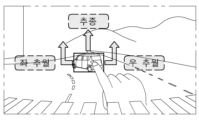
도 2a 내지 도 2c는 도 1의 승객 인터페이스부(110)에 디스플레이되는 화면의 입력 예들을 나타낸 도면이다. 도 2a 내지 도 2c의 실시예들은 차량이 자차로로 컷-인 중인 상황을 나타내는 화면의 입력 예를 나타낸다. FIGS. 2A to 2C are diagrams showing input examples of a screen displayed on the passenger interface unit (110) of FIG. 1. The embodiments of FIGS. 2A to 2C show input examples of a screen indicating a situation in which a vehicle is cutting into its own lane.
도 2a는 승객이 타겟을 선택하는 화면을 나타낸다. 이때, 승객은 승객 인터페이스부(110)의 화면에서 타겟 차량을 터치하거나 별도의 조작계를 사용하여 타겟을 선택할 수 있다. 다른 예로, 승객은 승객 인터페이스부(110)의 화면에서 타겟 차량을 길게 터치 하거나 두번 터치하여 타겟을 선택할 수 있다. Figure 2a shows a screen where a passenger selects a target. At this time, the passenger can select a target by touching the target vehicle on the screen of the passenger interface unit (110) or by using a separate control unit. As another example, the passenger can select a target by long-touching or double-touching the target vehicle on the screen of the passenger interface unit (110).
도 2b는 승객이 승객 인터페이스부(110)의 화면에서 타겟의 경계 정보와, 타겟 맞춤 제어 모드 정보가 디스플레이되는 것을 나타낸다. 도 2b 및 이하의 도면에서 실선은 타겟 매핑 장애물의 경계 정보를 나타내고, 점선은 타겟 맞춤 제어 모드 정보를 나타낸다. Fig. 2b shows that the boundary information of the target and the target customization control mode information are displayed on the screen of the passenger interface unit (110). In Fig. 2b and the drawings below, the solid line represents the boundary information of the target mapping obstacle, and the dotted line represents the target customization control mode information.
도 2b에서, 승객 인터페이스부(110)의 화면에 디스플레이되는 타겟 맞춤 제어 모드는 "좌 추월", "추종", "우 추월" 등의 모드를 포함할 수 있다. In Fig. 2b, the target customization control mode displayed on the screen of the passenger interface unit (110) may include modes such as “left overtaking,” “following,” and “right overtaking.”
도 2c는 승객이 승객 인터페이스부(110)의 화면에서 원하는 제어 모드(예를 들면, 추종 모드)를 선택하는 것을 나타낸다. 예를 들어, 승객이 제어 모드를 선택하고자 하는 경우, 타겟에서 손가락을 뗐다가 원하는 제어 모드를 터치하거나, 타겟에서 원하는 제어 모드를 슬라이딩 할 수 있다. Figure 2c illustrates a passenger selecting a desired control mode (e.g., a follow mode) on the screen of the passenger interface unit (110). For example, if the passenger wishes to select a control mode, the passenger may lift his/her finger from the target and touch the desired control mode, or slide the desired control mode on the target.
도 3a 및 도 3b는 도 1의 승객 인터페이스부(110)에서 타겟 맞춤 제어 모드가 표시되는 예들을 나타낸 도면이다. 도 3a 및 도 3b의 실시예는 일 실시예들을 나타낼 뿐이며, 직관성 향상을 위해 영상을 탑뷰로 표현할 수도 있다. FIGS. 3A and 3B are drawings showing examples of displaying a target customization control mode in the passenger interface unit (110) of FIG. 1. The embodiments of FIGS. 3A and 3B only show examples, and the image may be expressed in a top view to improve intuitiveness.
도 3a 및 도 3b를 참조하면, 처리부(140)가 승객이 선택 가능한 제어모드 추천 정보를 승객 인터페이스부(110)에 전달하면, 승객 인터페이스부(110)에 타겟 맞춤 제어 모드가 표시될 수 있다. Referring to FIGS. 3a and 3b, when the processing unit (140) transmits information on recommended control modes selectable by passengers to the passenger interface unit (110), a target-tailored control mode may be displayed on the passenger interface unit (110).
도 3a를 참조하면, 승객 인터페이스부(110)의 화면에 실선과 같이 타겟 경계가 표시되고, 점선과 같이 "좌 추월", "추종", "우 추월" 등의 타겟 맞춤 제어 모드가 표시될 수 있다. Referring to FIG. 3a, a target boundary may be displayed as a solid line on the screen of the passenger interface unit (110), and a target-specific control mode such as “left overtaking,” “following,” or “right overtaking” may be displayed as a dotted line.
도 3b의 실시예는, 승객 인터페이스부(110)의 화면에 표시된 타겟에서 손가락을 뗐다가 원하는 제어 모드(예를 들면, 추종 모드)를 터치하는 예를 나타낸다. The embodiment of FIG. 3b shows an example of lifting a finger from a target displayed on a screen of a passenger interface unit (110) and then touching a desired control mode (e.g., a follow mode).
도 4 내지 도 8은 제어 모드에 따른 화면 입력의 예들을 나타낸 도면이다. Figures 4 to 8 are drawings showing examples of screen input according to control mode.
도 4의 실시예는, 승객 인터페이스부(110)의 화면에서 포트홀을 오른쪽으로 회피하는 모드를 선택하는 것을 나타낸다. 이때, "좌 회피"는 중앙차로 또는 장애물 인식으로 인해 비활성화 상태가 된다. The embodiment of Fig. 4 shows selecting a mode for avoiding potholes to the right on the screen of the passenger interface unit (110). At this time, “avoiding left” is disabled due to the center lane or obstacle recognition.
도 5의 실시예는, 승객 인터페이스부(110)의 화면에서 불안한 차량의 인접차로 왼쪽으로 횡 차량을 이동하는 편향 주행 모드를 선택하는 것을 나타낸다. 이때, 우측 인접차로 차량이므로, "우 편향"은 비활성화 상태가 된다. The embodiment of Fig. 5 shows selecting a bias driving mode for moving a vehicle sideways to the left of an adjacent lane of an unstable vehicle on the screen of the passenger interface unit (110). At this time, since it is a vehicle in the right adjacent lane, “right bias” is deactivated.
도 6의 실시예는, 승객 인터페이스부(110)의 화면에서 자차로 추종 차량의 설정 거리를 멀게 변경하는 모드를 선택하는 것을 나타낸다. 이때, "좌 회피", "우 회피"는 장애물 및 황색 차로 인식으로 비활성화 상태가 된다. The embodiment of Fig. 6 shows selecting a mode for changing the set distance of a following vehicle to a greater distance from the self-vehicle on the screen of the passenger interface unit (110). At this time, “Left Avoidance” and “Right Avoidance” are deactivated due to recognition of obstacles and yellow lanes.
도 7의 실시예는, 승객 인터페이스부(110)의 화면에서 곡선로 추종 타겟을 놓쳐 가속시 타겟을 재설정하는 것을 나타낸다. 이때, 미 추종 중인 차량이므로 "추월" 및 "거리 조절" 모드는 미표시된다. The embodiment of Fig. 7 shows that the target is reset during acceleration when the curved tracking target is missed on the screen of the passenger interface unit (110). At this time, since it is a non-tracking vehicle, the “overtaking” and “distance control” modes are not displayed.
도 8의 실시예는, 승객 인터페이스부(110)의 화면에서 곡선로 인접차로 타겟을 추종 타겟으로 오인식하는 경우 추종 타겟을 해제하는 모드를 선택하는 것을 나타낸다. 여기서, 타겟은 좌측 인접차로 차량이므로, "좌 편향"은 비활성화 상태가 된다. The embodiment of Fig. 8 shows selecting a mode for releasing a following target when a curved adjacent lane target is mistakenly recognized as a following target on the screen of the passenger interface unit (110). Here, since the target is a vehicle in the left adjacent lane, “left bias” is deactivated.
이상에서와 같이, 본 발명의 실시예는 차량 내 어떤 승객이라도 화면 상의 간단한 보조 입력을 통해 자율 주행 시스템의 센서 한계로 인해 발생하는 상황을 회피 또는 추종할 수 있도록 한다. 이에, 승객의 불편, 불안함을 해소함과 동시에 자율 주행 기능에 승객 참여를 유도해 게임을 하는 것 같은 재미를 더할 수 있다. As described above, the embodiment of the present invention allows any passenger in the vehicle to avoid or follow a situation that occurs due to the sensor limitations of the autonomous driving system through a simple auxiliary input on the screen. This can relieve the discomfort and anxiety of the passenger and at the same time induce the passenger's participation in the autonomous driving function, adding fun like playing a game.
또한, 본 발명의 실시예는 승객이 선정한 타겟의 상황(장애물 타입, 도로 타입, 장애물 위치, 추종 여부, 주변 기타 장애물 등)을 자율 주행 시스템이 센서를 통해 확인 및 판단할 수 있다. 이에, 해당 타겟에 대해 시스템이 지원 가능한 맞춤형 제어 모드만을 선별적으로 승객에게 제시해 줌으로써 간단하면서도 직관적인 명령 입력이 가능하도록 한다. In addition, the embodiment of the present invention enables the autonomous driving system to check and determine the situation of the target selected by the passenger (obstacle type, road type, obstacle location, whether to follow, other obstacles in the vicinity, etc.) through sensors. Accordingly, only the customized control mode that the system can support for the target is selectively presented to the passenger, thereby enabling simple and intuitive command input.
또한, 본 발명의 실시예는 차량 내 장치 뿐만 아니라 승객 개인이 소지한 장치 등을 활용해서 자율 주행 시스템에 보정 정보의 입력이 가능하도록 한다. 이에, 운전석에 승객이 없는 상황에서도 자율 주행 중 긴급 상황의 대응 지시가 가능하도록 한다. In addition, the embodiment of the present invention enables input of correction information into the autonomous driving system by utilizing not only devices in the vehicle but also devices carried by individual passengers. Accordingly, it is possible to issue instructions for responding to emergency situations during autonomous driving even when there is no passenger in the driver's seat.
본 발명이 속하는 기술분야의 당업자는 본 발명이 그 기술적 사상이나 필수적 특징을 변경하지 않고서 다른 구체적인 형태로 실시될 수 있으므로, 이상에서 기술한 실시예들은 모든 면에서 예시적인 것이며 한정적인 것이 아닌 것으로서 이해해야만 한다. 본 발명의 범위는 상세한 설명보다는 후술하는 특허청구범위에 의하여 나타내어지며, 특허청구범위의 의미 및 범위 그리고 그 등가 개념으로부터 도출되는 모든 변경 또는 변형된 형태가 본 발명의 범위에 포함되는 것으로 해석되어야 한다. Those skilled in the art should understand that the present invention can be implemented in other specific forms without changing the technical idea or essential characteristics thereof, and therefore the embodiments described above are exemplary in all respects and not restrictive. The scope of the present invention is indicated by the claims described below rather than the detailed description, and all changes or modifications derived from the meaning and scope of the claims and their equivalent concepts should be interpreted as being included in the scope of the present invention.
Claims (20)
상기 장애물 정보에 대응하여 타겟 속성을 판단하고, 타겟 제어 가능 항목 정보를 출력하는 타겟 속성 판단부; 및
상기 타겟 제어 가능 항목 정보에 대응하여 상기 승객이 선택 가능한 제어 모드 추천 정보를 생성하고, 상기 승객으로부터 제어모드 선택 정보를 수신하면 타겟 속성 정보와 선택된 제어모드를 출력하는 처리부를 포함하는 대화형 자율 주행 시스템. A target mapping unit that checks whether there is an obstacle within a certain range of a target selected from a passenger and outputs obstacle information;
A target attribute determination unit that determines target attributes in response to the above obstacle information and outputs target controllable item information; and
An interactive autonomous driving system comprising a processing unit that generates control mode recommendation information selectable by the passenger in response to the target controllable item information, and outputs target attribute information and the selected control mode when receiving control mode selection information from the passenger.
상기 장애물 있는 경우 상기 선택된 타겟에 매핑되는 장애물의 경계 정보를 출력하며, 상기 장애물이 없는 경우 상기 선택된 타겟의 소정의 범위 내에서 상기 장애물을 재인식하거나 노면을 인식하는 대화형 자율 주행 시스템. In the first paragraph, the target mapping section
An interactive autonomous driving system that outputs boundary information of an obstacle mapped to the selected target when there is an obstacle, and recognizes the obstacle or the road surface within a predetermined range of the selected target when there is no obstacle.
상기 장애물을 인식하는 판단 임계치를 낮춰 인식률을 높이는 방식으로 상기 장애물을 재인식하는 대화형 자율 주행 시스템. In the first paragraph, the target mapping section
An interactive autonomous driving system that re-recognizes the obstacle by lowering the judgment threshold for recognizing the obstacle and increasing the recognition rate.
상기 재인식의 과정에서 인식된 장애물이 없는 경우, 제어할 대상의 타겟이 상기 장애물로 인식되지 않았음을 출력하는 대화형 자율 주행 시스템. In the third paragraph, the target mapping section
An interactive autonomous driving system that outputs that the target to be controlled has not been recognized as an obstacle if there is no obstacle recognized during the above re-recognition process.
머신 러닝 기반의 사전 학습된 장애물 패턴 인식기를 이용하여 상기 장애물을 인식하는 대화형 자율 주행 시스템. In the first paragraph, the target mapping section
An interactive autonomous driving system that recognizes obstacles using a pre-learned obstacle pattern recognizer based on machine learning.
에지 기반 검출기의 알고리즘을 사용하여 상기 타겟에 매핑되는 장애물을 신규로 인식하고 경계 정보를 출력하는 대화형 자율 주행 시스템. In the first paragraph, the target mapping section
An interactive autonomous driving system that uses an edge-based detector algorithm to newly recognize obstacles mapped to the target and output boundary information.
상기 장애물 정보에 대응하여 상기 장애물의 타입, 도로 타입, 장애물 위치, 추종 여부 중 적어도 하나의 타겟 속성을 판단하는 대화형 자율 주행 시스템. In the first paragraph, the target attribute determination unit
An interactive autonomous driving system that determines at least one target attribute among the type of the obstacle, the road type, the location of the obstacle, and whether to follow in response to the above obstacle information.
상기 처리부에서 생성되는 상기 제어 모드 추천 정보는 상기 타겟 속성에 따라 사전 정의되는 대화형 자율 주행 시스템. In paragraph 1,
The control mode recommendation information generated in the above processing unit is an interactive autonomous driving system that is predefined according to the target properties.
상기 장애물의 경계 표시, 터치음, 진동 구동 명령을 처리 정보로 출력하는 대화형 자율 주행 시스템. In the first paragraph, the processing unit
An interactive autonomous driving system that outputs boundary indications, touch sounds, and vibration drive commands of the above obstacles as processing information.
인식된 장애물이 없거나, 사전 정의된 타겟 속성 중 해당사항이 없는 경우 상기 장애물의 경계 표시, 터치음, 진동 구동 명령을 네가티브 피드백 정보로 출력하는 대화형 자율 주행 시스템. In the first paragraph, the processing unit
An interactive autonomous driving system that outputs a boundary indication, touch sound, and vibration drive command of an obstacle as negative feedback information when there is no recognized obstacle or none of the predefined target properties applies.
중앙차로, 갓길, 가드레인, 장애물 중 적어도 하나를 포함하는 주행 불가 경로는 상기 제어 모드 추천 정보로 출력하지 않고 비활성화시키는 대화형 자율 주행 시스템.In the first paragraph, the processing unit
An interactive autonomous driving system that disables a path that cannot be driven, including at least one of a center lane, a shoulder, a guard lane, and an obstacle, without outputting the control mode recommendation information.
네가티브 피드백 정보, 제어 실패 피드백 정보 중 적어도 하나를 포함하는 처리 정보를 출력하는 대화형 자율 주행 시스템. In the first paragraph, the processing unit
An interactive autonomous driving system that outputs processing information including at least one of negative feedback information and control failure feedback information.
차선, 상기 장애물, 주변환경 정보 중 적어도 하나의 정보를 센싱하여 센싱정보를 상기 타겟 매핑부에 출력하는 센서부;
상기 승객으로부터 타겟 선택 정보, 상기 제어모드 선택 정보가 입력되고, 상기 처리부로부터 처리 정보를 입력받아 상기 승객이 인지할 수 있도록 디스플레이하는 승객 인터페이스부; 및
상기 타겟 속성 정보와 상기 선택된 제어 모드에 대응하여 차량의 자율 주행 중 일시적 제어 미션을 수행하는 자율 주행 제어부를 더 포함하는 대화형 자율 주행 시스템. In paragraph 1,
A sensor unit that senses at least one of a lane, an obstacle, and surrounding environment information and outputs the sensing information to the target mapping unit;
A passenger interface unit that inputs target selection information and control mode selection information from the passenger and receives processing information from the processing unit and displays it so that the passenger can recognize it; and
An interactive autonomous driving system further comprising an autonomous driving control unit that performs a temporary control mission during autonomous driving of a vehicle in response to the target attribute information and the selected control mode.
화면을 통해 상기 승객으로부터 최초 위치 정보, 회피 또는 추종을 원하는 상기 타겟의 선택 정보, 상기 제어모드 선택 정보 중 적어도 하나의 정보가 수신되는 대화형 자율 주행 시스템. In the 13th paragraph, the passenger interface section
An interactive autonomous driving system in which at least one of initial location information, selection information of a target to be avoided or followed, and control mode selection information is received from the passenger through a screen.
터치 스크린을 이용하여 상기 타겟의 선택 정보를 수신하고, 특정 상황을 인지하여 상기 타겟의 입력을 판단하는 대화형 자율 주행 시스템. In the 13th paragraph, the passenger interface section
An interactive autonomous driving system that receives selection information of the target using a touch screen, recognizes a specific situation, and determines the input of the target.
상기 터치 스크린의 상기 타겟에 일정시간 이상 연속으로 터치되는 포인트를 상기 특정 상황으로 인지하는 대화형 자율 주행 시스템. In the 15th paragraph, the passenger interface section
An interactive autonomous driving system that recognizes a point that is continuously touched on the target of the touch screen for a certain period of time as a specific situation.
상기 터치 스크린이 더블 터치되는 포인트를 상기 특정 상황으로 인지하는 대화형 자율 주행 시스템. In the 15th paragraph, the passenger interface section
An interactive autonomous driving system that recognizes a point where the above touch screen is double-touched as a specific situation.
터치 스크린을 통해 상기 타겟의 선택 정보가 수신된 이후에, 화면의 터치 슬라이딩을 통해 상기 제어모드 선택 정보가 수신되는 대화형 자율 주행 시스템. In the 13th paragraph, the passenger interface section
An interactive autonomous driving system in which the control mode selection information is received through touch sliding on the screen after the target selection information is received through the touch screen.
상기 차량 내 전체 승객 중 적어도 하나의 승객이 소지한 스마트폰으로 구현되는 대화형 자율 주행 시스템. In the 13th paragraph, the passenger interface section
An interactive autonomous driving system implemented using a smartphone carried by at least one passenger among all passengers in the vehicle.
상기 제어 미션의 실패 시 상기 처리부에 제어 실패 피드백 정보를 출력하는 대화형 자율 주행 시스템. In the 13th paragraph, the autonomous driving control unit
An interactive autonomous driving system that outputs control failure feedback information to the processing unit when the above control mission fails.
Priority Applications (3)
| Application Number | Priority Date | Filing Date | Title |
|---|---|---|---|
| KR1020190098230A KR102751284B1 (en) | 2019-08-12 | 2019-08-12 | Interactive autonomous driving system |
| US16/801,426 US11048949B2 (en) | 2019-08-12 | 2020-02-26 | Interactive autonomous driving system |
| DE102020202550.9A DE102020202550A1 (en) | 2019-08-12 | 2020-02-28 | INTERACTIVE AUTONOMOUS DRIVING SYSTEM |
Applications Claiming Priority (1)
| Application Number | Priority Date | Filing Date | Title |
|---|---|---|---|
| KR1020190098230A KR102751284B1 (en) | 2019-08-12 | 2019-08-12 | Interactive autonomous driving system |
Publications (2)
| Publication Number | Publication Date |
|---|---|
| KR20210019630A KR20210019630A (en) | 2021-02-23 |
| KR102751284B1 true KR102751284B1 (en) | 2025-01-10 |
Family
ID=74239719
Family Applications (1)
| Application Number | Title | Priority Date | Filing Date |
|---|---|---|---|
| KR1020190098230A Active KR102751284B1 (en) | 2019-08-12 | 2019-08-12 | Interactive autonomous driving system |
Country Status (3)
| Country | Link |
|---|---|
| US (1) | US11048949B2 (en) |
| KR (1) | KR102751284B1 (en) |
| DE (1) | DE102020202550A1 (en) |
Families Citing this family (9)
| Publication number | Priority date | Publication date | Assignee | Title |
|---|---|---|---|---|
| USD1066364S1 (en) * | 2021-01-08 | 2025-03-11 | Sony Group Corporation | Display screen or portion thereof with animated graphical user interface |
| DE102023204457B3 (en) * | 2023-05-12 | 2024-07-18 | Volkswagen Aktiengesellschaft | Method for selecting a target object for a longitudinal guidance system of a motor vehicle, electronic vehicle guidance system for a motor vehicle and motor vehicle with an electronic vehicle guidance system |
| CN119527332B (en) * | 2025-01-22 | 2025-05-13 | 浙江吉利控股集团有限公司 | Human-computer interaction method, device, electronic device, vehicle and medium for vehicle control |
| CN119527324B (en) * | 2025-01-22 | 2025-05-13 | 浙江吉利控股集团有限公司 | Vehicle control method, device, electronic device, vehicle and storage medium |
| CN119527331B (en) * | 2025-01-22 | 2025-05-13 | 浙江吉利控股集团有限公司 | Touch-controlled human-computer interaction method, device, electronic device, vehicle and storage medium |
| CN119551005B (en) * | 2025-01-22 | 2025-05-13 | 浙江吉利控股集团有限公司 | Electronic image generation and display method and device, electronic equipment, vehicle and medium |
| CN119527307B (en) * | 2025-01-22 | 2025-05-13 | 浙江吉利控股集团有限公司 | Vehicle distance control method, device, electronic device, vehicle and storage medium |
| CN119527291B (en) * | 2025-01-22 | 2025-05-13 | 浙江吉利控股集团有限公司 | Vehicle speed control method, device, electronic equipment, vehicle and storage medium |
| CN119527325B (en) * | 2025-01-22 | 2025-05-13 | 浙江吉利控股集团有限公司 | Vehicle control method, device, electronic device, vehicle and storage medium |
Citations (5)
| Publication number | Priority date | Publication date | Assignee | Title |
|---|---|---|---|---|
| US20120083960A1 (en) | 2010-10-05 | 2012-04-05 | Google Inc. | System and method for predicting behaviors of detected objects |
| US20150187214A1 (en) | 2012-08-01 | 2015-07-02 | Toyota Jidosha Kabushiki Kaisha | Drive assist device |
| US20160171314A1 (en) | 2013-08-23 | 2016-06-16 | Harman International Industries, Incorporated | Unstructured road boundary detection |
| US20170228126A1 (en) | 2015-12-22 | 2017-08-10 | Lg Electronics Inc. | Vehicle user interface apparatus and vehicle |
| JP2018108800A (en) | 2016-12-28 | 2018-07-12 | バイドゥ ユーエスエイ エルエルシーBaidu USA LLC | Dynamic adjusting method of velocity control rate for autonomous traveling vehicle |
Family Cites Families (9)
| Publication number | Priority date | Publication date | Assignee | Title |
|---|---|---|---|---|
| US8479122B2 (en) * | 2004-07-30 | 2013-07-02 | Apple Inc. | Gestures for touch sensitive input devices |
| US7844396B2 (en) * | 2005-09-13 | 2010-11-30 | Deere & Company | Method and system for modular data processing for a vehicle control system |
| US8031062B2 (en) * | 2008-01-04 | 2011-10-04 | Smith Alexander E | Method and apparatus to improve vehicle situational awareness at intersections |
| US8188887B2 (en) * | 2009-02-13 | 2012-05-29 | Inthinc Technology Solutions, Inc. | System and method for alerting drivers to road conditions |
| US9047778B1 (en) * | 2010-06-25 | 2015-06-02 | Cellco Partnership | Collision avoidance system using telematics unit |
| KR101410416B1 (en) * | 2011-12-21 | 2014-06-27 | 주식회사 케이티 | Remote control method, system and user interface |
| WO2016189495A1 (en) * | 2015-05-27 | 2016-12-01 | Van Dyke, Marc | Alerting predicted accidents between driverless cars |
| US9841762B2 (en) * | 2015-05-27 | 2017-12-12 | Comigo Ltd. | Alerting predicted accidents between driverless cars |
| US10031522B2 (en) * | 2015-05-27 | 2018-07-24 | Dov Moran | Alerting predicted accidents between driverless cars |
-
2019
- 2019-08-12 KR KR1020190098230A patent/KR102751284B1/en active Active
-
2020
- 2020-02-26 US US16/801,426 patent/US11048949B2/en active Active
- 2020-02-28 DE DE102020202550.9A patent/DE102020202550A1/en active Pending
Patent Citations (5)
| Publication number | Priority date | Publication date | Assignee | Title |
|---|---|---|---|---|
| US20120083960A1 (en) | 2010-10-05 | 2012-04-05 | Google Inc. | System and method for predicting behaviors of detected objects |
| US20150187214A1 (en) | 2012-08-01 | 2015-07-02 | Toyota Jidosha Kabushiki Kaisha | Drive assist device |
| US20160171314A1 (en) | 2013-08-23 | 2016-06-16 | Harman International Industries, Incorporated | Unstructured road boundary detection |
| US20170228126A1 (en) | 2015-12-22 | 2017-08-10 | Lg Electronics Inc. | Vehicle user interface apparatus and vehicle |
| JP2018108800A (en) | 2016-12-28 | 2018-07-12 | バイドゥ ユーエスエイ エルエルシーBaidu USA LLC | Dynamic adjusting method of velocity control rate for autonomous traveling vehicle |
Also Published As
| Publication number | Publication date |
|---|---|
| DE102020202550A1 (en) | 2021-02-18 |
| US20210049379A1 (en) | 2021-02-18 |
| US11048949B2 (en) | 2021-06-29 |
| KR20210019630A (en) | 2021-02-23 |
Similar Documents
| Publication | Publication Date | Title |
|---|---|---|
| KR102751284B1 (en) | Interactive autonomous driving system | |
| US9159235B2 (en) | Method of operating a driver assistance system of a motor vehicle | |
| US9753459B2 (en) | Method for operating a motor vehicle | |
| EP3124319B1 (en) | Vehicle seat control system | |
| JP6342856B2 (en) | Vehicle control device | |
| JP4610604B2 (en) | Driver assistance system for connecting trailers using a vehicle level adjuster | |
| KR101779823B1 (en) | Method for switching the control mode in autonomous vehicle and apparatus thereof | |
| US10308249B2 (en) | Adaptive cruise control system and vehicle comprising an adaptive cruise control system | |
| KR102528232B1 (en) | Vehicle, and control method for the same | |
| US10311734B2 (en) | Operation control apparatus | |
| EP3395600A1 (en) | In-vehicle device | |
| JP2017178267A (en) | Drive support method, drive support device using the same, automatic drive control device, vehicle, and program | |
| CN112041192B (en) | Activation and deactivation of a driving function of automatic driving with longitudinal and lateral control | |
| US11827248B2 (en) | Autonomous controller, vehicle system including the same, and method thereof | |
| JP6768604B2 (en) | Vehicle control device | |
| JP2017194961A (en) | Method for supporting driver in driving vehicle and driver supporting system | |
| CN113071513A (en) | Automatic driving controller and automatic driving control method | |
| CN116867697A (en) | Physical feedback confirmation of traffic events by assisted driving systems | |
| CN112004728A (en) | Activation of a further driving function for autonomous driving with longitudinal and transverse control by means of a driving function for autonomous driving with a low degree of automation | |
| US12280799B2 (en) | Travel controller and method for travel control | |
| JP4158796B2 (en) | Driving support device | |
| KR101449161B1 (en) | A lane guidance revision method and system using historical information of driving | |
| CN121335828A (en) | A computing device, an assistance system, and a method for a vehicle assistance system that considers the driver's lane-changing intention to perform automated lane-changing maneuvers. | |
| EP4446853B1 (en) | Device and method for controlling mouse using gaze recognition | |
| US12187121B2 (en) | Vehicle control system, method and storage medium for determination and display of driver grip on a steering operation element |
Legal Events
| Date | Code | Title | Description |
|---|---|---|---|
| PA0109 | Patent application |
Patent event code: PA01091R01D Comment text: Patent Application Patent event date: 20190812 |
|
| PG1501 | Laying open of application | ||
| PA0201 | Request for examination |
Patent event code: PA02012R01D Patent event date: 20220722 Comment text: Request for Examination of Application Patent event code: PA02011R01I Patent event date: 20190812 Comment text: Patent Application |
|
| E701 | Decision to grant or registration of patent right | ||
| PE0701 | Decision of registration |
Patent event code: PE07011S01D Comment text: Decision to Grant Registration Patent event date: 20241125 |
|
| PG1601 | Publication of registration |