KR102722473B1 - Aluminum alloy parts manufacturing process - Google Patents
Aluminum alloy parts manufacturing process Download PDFInfo
- Publication number
- KR102722473B1 KR102722473B1 KR1020217002276A KR20217002276A KR102722473B1 KR 102722473 B1 KR102722473 B1 KR 102722473B1 KR 1020217002276 A KR1020217002276 A KR 1020217002276A KR 20217002276 A KR20217002276 A KR 20217002276A KR 102722473 B1 KR102722473 B1 KR 102722473B1
- Authority
- KR
- South Korea
- Prior art keywords
- mass fraction
- less
- optionally
- alloy
- powder
- Prior art date
- Legal status (The legal status is an assumption and is not a legal conclusion. Google has not performed a legal analysis and makes no representation as to the accuracy of the status listed.)
- Active
Links
Classifications
-
- C—CHEMISTRY; METALLURGY
- C22—METALLURGY; FERROUS OR NON-FERROUS ALLOYS; TREATMENT OF ALLOYS OR NON-FERROUS METALS
- C22C—ALLOYS
- C22C21/00—Alloys based on aluminium
- C22C21/12—Alloys based on aluminium with copper as the next major constituent
- C22C21/14—Alloys based on aluminium with copper as the next major constituent with silicon
-
- C—CHEMISTRY; METALLURGY
- C22—METALLURGY; FERROUS OR NON-FERROUS ALLOYS; TREATMENT OF ALLOYS OR NON-FERROUS METALS
- C22C—ALLOYS
- C22C21/00—Alloys based on aluminium
-
- B—PERFORMING OPERATIONS; TRANSPORTING
- B22—CASTING; POWDER METALLURGY
- B22F—WORKING METALLIC POWDER; MANUFACTURE OF ARTICLES FROM METALLIC POWDER; MAKING METALLIC POWDER; APPARATUS OR DEVICES SPECIALLY ADAPTED FOR METALLIC POWDER
- B22F10/00—Additive manufacturing of workpieces or articles from metallic powder
- B22F10/20—Direct sintering or melting
-
- B—PERFORMING OPERATIONS; TRANSPORTING
- B22—CASTING; POWDER METALLURGY
- B22F—WORKING METALLIC POWDER; MANUFACTURE OF ARTICLES FROM METALLIC POWDER; MAKING METALLIC POWDER; APPARATUS OR DEVICES SPECIALLY ADAPTED FOR METALLIC POWDER
- B22F10/00—Additive manufacturing of workpieces or articles from metallic powder
- B22F10/20—Direct sintering or melting
- B22F10/25—Direct deposition of metal particles, e.g. direct metal deposition [DMD] or laser engineered net shaping [LENS]
-
- B—PERFORMING OPERATIONS; TRANSPORTING
- B22—CASTING; POWDER METALLURGY
- B22F—WORKING METALLIC POWDER; MANUFACTURE OF ARTICLES FROM METALLIC POWDER; MAKING METALLIC POWDER; APPARATUS OR DEVICES SPECIALLY ADAPTED FOR METALLIC POWDER
- B22F10/00—Additive manufacturing of workpieces or articles from metallic powder
- B22F10/20—Direct sintering or melting
- B22F10/28—Powder bed fusion, e.g. selective laser melting [SLM] or electron beam melting [EBM]
-
- B—PERFORMING OPERATIONS; TRANSPORTING
- B22—CASTING; POWDER METALLURGY
- B22F—WORKING METALLIC POWDER; MANUFACTURE OF ARTICLES FROM METALLIC POWDER; MAKING METALLIC POWDER; APPARATUS OR DEVICES SPECIALLY ADAPTED FOR METALLIC POWDER
- B22F10/00—Additive manufacturing of workpieces or articles from metallic powder
- B22F10/60—Treatment of workpieces or articles after build-up
- B22F10/64—Treatment of workpieces or articles after build-up by thermal means
-
- B—PERFORMING OPERATIONS; TRANSPORTING
- B22—CASTING; POWDER METALLURGY
- B22F—WORKING METALLIC POWDER; MANUFACTURE OF ARTICLES FROM METALLIC POWDER; MAKING METALLIC POWDER; APPARATUS OR DEVICES SPECIALLY ADAPTED FOR METALLIC POWDER
- B22F3/00—Manufacture of workpieces or articles from metallic powder characterised by the manner of compacting or sintering; Apparatus specially adapted therefor ; Presses and furnaces
- B22F3/12—Both compacting and sintering
- B22F3/14—Both compacting and sintering simultaneously
- B22F3/15—Hot isostatic pressing
-
- B—PERFORMING OPERATIONS; TRANSPORTING
- B22—CASTING; POWDER METALLURGY
- B22F—WORKING METALLIC POWDER; MANUFACTURE OF ARTICLES FROM METALLIC POWDER; MAKING METALLIC POWDER; APPARATUS OR DEVICES SPECIALLY ADAPTED FOR METALLIC POWDER
- B22F3/00—Manufacture of workpieces or articles from metallic powder characterised by the manner of compacting or sintering; Apparatus specially adapted therefor ; Presses and furnaces
- B22F3/24—After-treatment of workpieces or articles
-
- B—PERFORMING OPERATIONS; TRANSPORTING
- B33—ADDITIVE MANUFACTURING TECHNOLOGY
- B33Y—ADDITIVE MANUFACTURING, i.e. MANUFACTURING OF THREE-DIMENSIONAL [3-D] OBJECTS BY ADDITIVE DEPOSITION, ADDITIVE AGGLOMERATION OR ADDITIVE LAYERING, e.g. BY 3-D PRINTING, STEREOLITHOGRAPHY OR SELECTIVE LASER SINTERING
- B33Y10/00—Processes of additive manufacturing
-
- B—PERFORMING OPERATIONS; TRANSPORTING
- B33—ADDITIVE MANUFACTURING TECHNOLOGY
- B33Y—ADDITIVE MANUFACTURING, i.e. MANUFACTURING OF THREE-DIMENSIONAL [3-D] OBJECTS BY ADDITIVE DEPOSITION, ADDITIVE AGGLOMERATION OR ADDITIVE LAYERING, e.g. BY 3-D PRINTING, STEREOLITHOGRAPHY OR SELECTIVE LASER SINTERING
- B33Y40/00—Auxiliary operations or equipment, e.g. for material handling
- B33Y40/20—Post-treatment, e.g. curing, coating or polishing
-
- B—PERFORMING OPERATIONS; TRANSPORTING
- B33—ADDITIVE MANUFACTURING TECHNOLOGY
- B33Y—ADDITIVE MANUFACTURING, i.e. MANUFACTURING OF THREE-DIMENSIONAL [3-D] OBJECTS BY ADDITIVE DEPOSITION, ADDITIVE AGGLOMERATION OR ADDITIVE LAYERING, e.g. BY 3-D PRINTING, STEREOLITHOGRAPHY OR SELECTIVE LASER SINTERING
- B33Y70/00—Materials specially adapted for additive manufacturing
-
- C—CHEMISTRY; METALLURGY
- C22—METALLURGY; FERROUS OR NON-FERROUS ALLOYS; TREATMENT OF ALLOYS OR NON-FERROUS METALS
- C22C—ALLOYS
- C22C1/00—Making non-ferrous alloys
- C22C1/04—Making non-ferrous alloys by powder metallurgy
- C22C1/0408—Light metal alloys
- C22C1/0416—Aluminium-based alloys
-
- C—CHEMISTRY; METALLURGY
- C22—METALLURGY; FERROUS OR NON-FERROUS ALLOYS; TREATMENT OF ALLOYS OR NON-FERROUS METALS
- C22C—ALLOYS
- C22C21/00—Alloys based on aluminium
- C22C21/12—Alloys based on aluminium with copper as the next major constituent
-
- C—CHEMISTRY; METALLURGY
- C22—METALLURGY; FERROUS OR NON-FERROUS ALLOYS; TREATMENT OF ALLOYS OR NON-FERROUS METALS
- C22F—CHANGING THE PHYSICAL STRUCTURE OF NON-FERROUS METALS AND NON-FERROUS ALLOYS
- C22F1/00—Changing the physical structure of non-ferrous metals or alloys by heat treatment or by hot or cold working
- C22F1/04—Changing the physical structure of non-ferrous metals or alloys by heat treatment or by hot or cold working of aluminium or alloys based thereon
-
- B—PERFORMING OPERATIONS; TRANSPORTING
- B22—CASTING; POWDER METALLURGY
- B22F—WORKING METALLIC POWDER; MANUFACTURE OF ARTICLES FROM METALLIC POWDER; MAKING METALLIC POWDER; APPARATUS OR DEVICES SPECIALLY ADAPTED FOR METALLIC POWDER
- B22F3/00—Manufacture of workpieces or articles from metallic powder characterised by the manner of compacting or sintering; Apparatus specially adapted therefor ; Presses and furnaces
- B22F3/24—After-treatment of workpieces or articles
- B22F2003/248—Thermal after-treatment
-
- B—PERFORMING OPERATIONS; TRANSPORTING
- B22—CASTING; POWDER METALLURGY
- B22F—WORKING METALLIC POWDER; MANUFACTURE OF ARTICLES FROM METALLIC POWDER; MAKING METALLIC POWDER; APPARATUS OR DEVICES SPECIALLY ADAPTED FOR METALLIC POWDER
- B22F2301/00—Metallic composition of the powder or its coating
- B22F2301/05—Light metals
- B22F2301/052—Aluminium
-
- B—PERFORMING OPERATIONS; TRANSPORTING
- B22—CASTING; POWDER METALLURGY
- B22F—WORKING METALLIC POWDER; MANUFACTURE OF ARTICLES FROM METALLIC POWDER; MAKING METALLIC POWDER; APPARATUS OR DEVICES SPECIALLY ADAPTED FOR METALLIC POWDER
- B22F2998/00—Supplementary information concerning processes or compositions relating to powder metallurgy
- B22F2998/10—Processes characterised by the sequence of their steps
-
- Y—GENERAL TAGGING OF NEW TECHNOLOGICAL DEVELOPMENTS; GENERAL TAGGING OF CROSS-SECTIONAL TECHNOLOGIES SPANNING OVER SEVERAL SECTIONS OF THE IPC; TECHNICAL SUBJECTS COVERED BY FORMER USPC CROSS-REFERENCE ART COLLECTIONS [XRACs] AND DIGESTS
- Y02—TECHNOLOGIES OR APPLICATIONS FOR MITIGATION OR ADAPTATION AGAINST CLIMATE CHANGE
- Y02P—CLIMATE CHANGE MITIGATION TECHNOLOGIES IN THE PRODUCTION OR PROCESSING OF GOODS
- Y02P10/00—Technologies related to metal processing
- Y02P10/25—Process efficiency
Landscapes
- Chemical & Material Sciences (AREA)
- Engineering & Computer Science (AREA)
- Materials Engineering (AREA)
- Manufacturing & Machinery (AREA)
- Mechanical Engineering (AREA)
- Metallurgy (AREA)
- Organic Chemistry (AREA)
- Physics & Mathematics (AREA)
- Thermal Sciences (AREA)
- Crystallography & Structural Chemistry (AREA)
- Plasma & Fusion (AREA)
- Powder Metallurgy (AREA)
Abstract
본 발명은 서로 겹친 상태로 연속적인 솔리드 금속 층의 형성을 포함하는 부품(20)을 제조하는 공정에 관한 것으로, 이 방법은 각 층은 수치 모델(M)의 기반에서 정의된 패턴을 나타내며, 각 층은 금속(25), 소위 충전재에 의해 형성되며, 이 충전재는 증착되고 공급된 에너지에 노출되어 용융되고 응고 시에 층을 형성하며, 상기 방법에서 상기 충전재는 분말(25)의 형태이며, 이 분말은 에너지 빔(32)에 노출될 때 솔리드 층(201...20n)을 형성하고, 상기 방법은, 상기 충전재(25)가 알루미늄 합금이고, 이 알루미늄 합금이: 1 내지 6%, 바람직하게는 1 내지 5%, 보다 바람직하게는 2 내지 4%의 질량 분율의 Ni; 1 내지 7%, 바람직하게는 1 내지 6%, 보다 바람직하게는 2 내지 5%의 질량 분율의 Mn; 0.5 내지 4%, 바람직하게는 1 내지 3%의 질량 분율의 Zr; 1% 이하, 바람직하게는 0.05 내지 0.5%, 보다 바람직하게는 0.1 내지 0.3%의 질량 분율의 Fe; 1% 이하, 바람직하게는 0.5% 이하의 질량 분율의 Si를 적어도 포함하는 것을 특징으로 한다. 본 발명은 또한 상기 방법에 의해 획득된 부품에 관한 것이다. 본 발명에 따른 적층 제조 프로세스에서 이용되는 합금은 현저한 특성을 갖는 부품을 얻을 수 있게 한다.The present invention relates to a process for manufacturing a component (20) comprising the formation of successive solid metal layers, one overlapping the other, the method comprising the steps of: each layer representing a defined pattern on the basis of a numerical model (M), each layer being formed by a metal (25 ) , the so-called filler, which is deposited and exposed to supplied energy to melt and form a layer upon solidification, the method comprising the steps of: the filler (25) being an aluminum alloy, the aluminum alloy comprising: a mass fraction of Ni of from 1 to 6%, preferably 1 to 5%, more preferably 2 to 4%; a mass fraction of Mn of from 1 to 7%, preferably 1 to 6%, more preferably 2 to 5%; a mass fraction of Zr of from 0.5 to 4%, preferably 1 to 3%; Characterized in that it comprises at least Fe in a mass fraction of 1% or less, preferably from 0.05 to 0.5%, more preferably from 0.1 to 0.3%; Si in a mass fraction of 1% or less, preferably from 0.5% or less. The present invention also relates to a component obtained by the method. The alloy used in the additive manufacturing process according to the present invention makes it possible to obtain components having remarkable properties.
Description
본 발명의 기술분야는 적층 제조 기술(additive manufacturing technique)을 이용하여 알루미늄 합금 부품을 제조하는 방법이다.The technical field of the present invention is a method for manufacturing an aluminum alloy part using an additive manufacturing technique.
1980년대 이후, 적층 제조 기술들이 개발되었다. 이 기술들은 재료 제거를 목표로 하는 가공 기술과 반대로 재료를 추가하여 부품을 형성하는 것으로 구성된다. 이전에는 프로토타이핑(prototyping)에 국한되었던 적층 제조가 현재 금속 부품들을 포함한 산업용 제품의 대량 생산을 위해 운용되고 있다.Since the 1980s, additive manufacturing technologies have been developed. These technologies consist of forming parts by adding material, as opposed to machining technologies that aim to remove material. Previously limited to prototyping, additive manufacturing is now being used for mass production of industrial products, including metal parts.
"적층 제조" 라는 용어는 프랑스 표준 XP E67-001에 따라 "디지털 객체로부터 재료를 한 층씩 추가함으로써 물리적 객체를 제조하는 방법의 세트" 로 정의된다. 표준 ASTM F2792(2012년 1월)도 또한 적층 제조를 정의한다. 다양한 적층 제조법이 ISO/ASTM 17296-1 표준에 또한 정의되고 설명되어 있다. 저 다공성의 알루미늄 부품을 제조하는 데에 적층 제조의 사용은 문헌 WO 2015/006447에 설명되어 있다. 연속적인 층의 도포는 통상적으로 소위 충전재를 도포하고, 그 후 충전재를 레이저 빔, 전자 빔, 플라즈마 토치 또는 전기 아크 유형의 에너지원에 의하여 용융 또는 소결함에 의해 이루어진다. 어떤 적층 제조법이 적용되든 추가되는 각 층의 두께는 약 수십 또는 수백 미크론이다.The term "additive manufacturing" is defined by the French standard XP E67-001 as "a set of methods for manufacturing physical objects by adding material layer by layer from a digital object". The standard ASTM F2792 (January 2012) also defines additive manufacturing. Various additive manufacturing methods are also defined and described in the standard ISO/ASTM 17296-1. The use of additive manufacturing to manufacture low-porosity aluminum components is described in the document WO 2015/006447. The application of successive layers is typically accomplished by applying a so-called filler material, which is then melted or sintered by an energy source such as a laser beam, an electron beam, a plasma torch or an electric arc. Whichever additive manufacturing method is applied, the thickness of each additional layer is about tens or hundreds of microns.
한 가지 적층 제조 수단은 분말 형태를 취하는 충전재를 용융 또는 소결하는 것이다. 이 방법은 에너지 빔에 의해 용융 또는 소결되는 경우일 수 있다.One means of additive manufacturing is to melt or sinter filler materials in powder form. This can be done by melting or sintering with an energy beam.
특히, 금속 분말 또는 금속 합금 층을 제조할 부품에 도포하고 레이저 빔의 열에너지로 디지털 모델에 따라 선택적으로 소결하는 선택적 레이저 소결(SLS) 또는 직접 금속 레이저 소결(DMLS) 기술이 알려져 있다. 또 다른 유형의 금속 조형 방법은 레이저 또는 지향성 전자 빔에 의해 공급되는 열에너지가 냉각되고 응고될 때 융합되도록 금속 분말을 선택적으로 용융(소결 대신)하는데 사용되는 선택적 레이저 용융(SLM) 또는 전자 빔 용융(EBM)을 포함한다. In particular, selective laser sintering (SLS) or direct metal laser sintering (DMLS) technologies are known, in which metal powder or metal alloy layers are applied to the part to be manufactured and selectively sintered according to a digital model by the heat energy of a laser beam. Another type of metal shaping method includes selective laser melting (SLM) or electron beam melting (EBM), in which heat energy supplied by a laser or directed electron beam is used to selectively melt (instead of sintering) metal powder so that it fuses when cooled and solidified.
분말을 분사와 동시에 레이저 빔에 의해 용융시키는 레이저 용융 증착(LMD)도 알려져 있다. Laser melting deposition (LMD) is also known, in which powder is sprayed and melted simultaneously by a laser beam.
특허 출원 WO 2016/209652는, 하나 이상의 필요한 대략적인 분말 크기 및 대략적인 형태(morphology)를 갖는 무화된(atomised) 알루미늄 분말의 준비 단계; 적층 제조에 의해 제품을 형성하기 위해 분말을 소결하는 단계; 용체화 열처리 단계; 담금질 단계; 그리고 적층 제조된 알루미늄의 에이징 하는 단계를 포함하는, 기계적 고강도의 알루미늄을 제조하는 방법을 설명한다.Patent application WO 2016/209652 describes a method for manufacturing high mechanical strength aluminium, comprising the steps of preparing an atomised aluminium powder having one or more desired approximate powder sizes and approximate morphologies; sintering the powder to form a product by additive manufacturing; a solution heat treatment step; a quenching step; and aging the additively manufactured aluminium.
특허 출원 EP 2796229는 분산에 의해 강화된 금속 알루미늄 합금을 형성하는 방법을 개시하는데, 이 방법은 분산에 의해 강화된 미세조직을 얻을 수 있는 알루미늄 합금 조성물을 분말 형태로 얻는 단계; 합금의 조성을 갖는 분말의 일부분에 저 에너지 밀도를 갖는 레이저 빔을 지향시키는 단계; 분말 형태의 합금 조성물의 상기 부분으로부터 레이저 빔을 제거하는 단계; 그리고 분말 형태의 합금 조성물의 상기 부분을 초당 약 106℃ 이상의 속도로 냉각시켜 분산에 의해 강화된 금속 알루미늄 합금을 형성하는 단계를 포함한다. 이 방법은 특히 화학식: AlcompFeaSibXc에 따른 조성을 갖는 합금에 적합하며, 여기서 [Fe + Si]/Si 비율이 약 2.0:1 내지 5.0:1 범위에 있다고 할 때 X는 Mn, V, Cr, Mo, W, Nb 및 Ta로 구성된 그룹에서 선택된 하나 이상의 원소를 나타내며; "a"는 2.0 내지 7.5 원자% 범위; "b"는 0.5 내지 3.0 원자% 범위; "c"는 0.05 내지 3.5 원자% 범위; 그리고 잔부는 알루미늄 및 뜻하지 않은 불순물이다.Patent application EP 2796229 discloses a method for forming a metallic aluminum alloy strengthened by dispersion, comprising the steps of: obtaining an aluminum alloy composition in powder form, wherein a microstructure strengthened by dispersion is obtainable; directing a laser beam having a low energy density on a portion of the powder having the composition of the alloy; removing the laser beam from said portion of the alloy composition in powder form; and cooling said portion of the alloy composition in powder form at a rate of at least about 10 6 ° C per second to form a metallic aluminum alloy strengthened by dispersion. The method is particularly suitable for an alloy having a composition according to the chemical formula: Al comp Fe a Si b X c , wherein the ratio [Fe + Si]/Si is in the range of about 2.0:1 to 5.0:1, X represents one or more elements selected from the group consisting of Mn, V, Cr, Mo, W, Nb and Ta; "a" is in the range of 2.0 to 7.5 at.%; "b" is in the range of 0.5 to 3.0 at.%; "c" is in the range of 0.05 to 3.5 atomic percent; and the remainder is aluminum and unintended impurities.
특허 출원 US 2017/0211168은 알루미늄, 실리콘, 철 및/또는 니켈을 포함하는 고온에서 고성능인 경량 강 합금을 제조하는 방법을 개시한다.Patent application US 2017/0211168 discloses a method for producing a high-temperature, high-performance, lightweight steel alloy comprising aluminum, silicon, iron and/or nickel.
특허 출원 EP 3026135는 알루미늄과 실리콘 87 내지 99 중량부, 구리 0.25 내지 0.4 중량부, Mg, Ni 및 Ti로부터 2개 이상의 원소 조합 0.15 내지 0.35 중량부를 포함하는 주조 합금을 설명하고 있다. 이 주조 합금은 에이징 처리를 그 뒤에 받는 물체를 레이저 적층 제조에 의해 형성하는 데 사용되는 분말을 형성하기 위해 불활성 기체에 의해 무화하는데에 적합하다.Patent application EP 3026135 describes a casting alloy comprising 87 to 99 parts by weight of aluminum and silicon, 0.25 to 0.4 parts by weight of copper and 0.15 to 0.35 parts by weight of a combination of two or more elements selected from Mg, Ni and Ti. The casting alloy is suitable for atomization by an inert gas to form a powder which is used to form an object by laser additive manufacturing which is then subjected to an aging treatment.
간행물 "선택적 레이저 용융에 의해 제조된 Al-Fe-V-Si 내열성 알루미늄 합금 부품의 특성화"(Journal of Material Research, Vol. 30, No. 10, 2015년 5월 28일)는 중량%로 Al-8.5Fe-1.3V-1.7Si의 조성을 갖는 내열성 부품의 SLM에 의한 제조를 설명한다.The publication "Characterization of heat-resistant aluminum alloy parts manufactured by selective laser melting of Al-Fe-V-Si" (Journal of Material Research, Vol. 30, No. 10, May 28, 2015) describes the manufacturing by SLM of heat-resistant parts having a composition of Al-8.5Fe-1.3V-1.7Si in wt.%.
간행물“전자 빔 용융에 의해 생산된 Al-Fe-V-Si 알루미늄 합금의 미세조직 및 기계적 특성(Materials Science & Engineering A659(2016) 207-214)은 EBM에서 획득되는 상기 논문에서와 동일한 합금의 부품을 설명한다.The publication “Microstructure and mechanical properties of Al-Fe-V-Si aluminum alloy produced by electron beam melting (Materials Science & Engineering A659(2016) 207-214) describes parts of the same alloy as in the above paper obtained by EBM.
SLM 용례를 위한 고강도 알루미늄 합금에 대한 수요의 증가가 존재한다. 4xxx 합금(주로 Al10SiMg, Al7SiMg 및 Al12Si)은 SLM 적용을 위한 가장 발전한 알루미늄 합금이다. 이 합금은 SLM 방법에 매우 적합하지만 제한적인 기계적 특성이 결점이다.There is a growing demand for high-strength aluminum alloys for SLM applications. 4xxx alloys (mainly Al10SiMg, Al7SiMg and Al12Si) are the most advanced aluminum alloys for SLM applications. These alloys are well suited to SLM methods, but their limited mechanical properties are a drawback.
APWorks에서 개발한 Scalmalloy
적층 제조를 통해 획득된 알루미늄 부품의 기계적 특성은 솔더를 형성하는 합금, 보다 정확하게는 그 합금의 조성 및 적층 제조법의 파라미터들과 적용되는 열처리에 의존한다. 본 발명자들은 적층 제조법에 사용할 때, 현저한 특성을 갖는 부품을 얻는 것을 가능케 하는 합금 조성을 찾아내었다. 특히, 본 발명에 따라 획득된 부품은 고온일 때(예를 들어 400℃에서 1시간 후) 특히 경도 측면에서 종래 기술(특히 8009 합금)에 비해 개선된 특성을 갖는다.The mechanical properties of aluminum components obtained by means of additive manufacturing depend on the alloy forming the solder, more precisely on the composition of the alloy and on the parameters of the additive manufacturing method and on the heat treatment applied. The inventors have found an alloy composition which makes it possible to obtain components with remarkable properties when used in an additive manufacturing method. In particular, the components obtained according to the invention have improved properties compared to prior art (in particular alloy 8009), especially with respect to hardness, at elevated temperatures (e.g. after 1 hour at 400° C.).
본 발명의 제 1 목적은 서로 겹친 상태로 연속적인 솔리드 금속 층(solid metal layer)의 형성을 포함하는 부품을 제조하는 방법으로서, 각 층은 디지털 모델에서 정의된 패턴을 나타내고, 각 층은 솔더로 지칭하는 금속의 증착에 의해 형성되고, 상기 솔더는 용융되어 응고 시에 상기 층을 구성하도록 에너지 투입을 겪고, 상기 솔더는 분말 형태를 취하며, 이 분말의 에너지 빔에 대한 노출은 용융 및 이에 후속한 응고를 초래하여 솔리드(solid)를 형성하는, 방법에 있어서, 상기 솔더는 알루미늄 합금이며, 이 알루미늄 합금은, A first object of the present invention is a method for manufacturing a component comprising the formation of successive solid metal layers in an overlapping state, each layer representing a pattern defined in a digital model, each layer being formed by the deposition of a metal, referred to as solder, said solder undergoing an energy input such that it melts and upon solidification forms said layer, said solder taking the form of a powder, wherein exposure of said powder to an energy beam causes melting and subsequent solidification to form a solid, said solder being an aluminum alloy, said aluminum alloy comprising:
- 1 내지 6%, 바람직하게는 1 내지 5%, 보다 바람직하게는 2 내지 4%의 질량 분율의 Ni;- Ni in a mass fraction of 1 to 6%, preferably 1 to 5%, more preferably 2 to 4%;
- 1 내지 7%, 바람직하게는 1 내지 6%, 보다 바람직하게는 2 내지 5%의 질량 분율의 Mn;- Mn in a mass fraction of 1 to 7%, preferably 1 to 6%, more preferably 2 to 5%;
- 0.5 내지 4%, 바람직하게는 1 내지 3%의 질량 분율의 Zr;- Zr in a mass fraction of 0.5 to 4%, preferably 1 to 3%;
- 1% 이하, 바람직하게는 0.05 내지 0.5%, 보다 바람직하게는 0.1 내지 0.3%의 질량 분율의 Fe;- Fe in a mass fraction of 1% or less, preferably 0.05 to 0.5%, more preferably 0.1 to 0.3%;
- 1% 이하, 바람직하게는 0.5% 이하의 질량 분율의 Si;- Si with a mass fraction of less than 1%, preferably less than 0.5%;
를 포함하는 것을 특징으로 한다.It is characterized by including .
본 발명에 따른 합금은 또한:The alloy according to the present invention also comprises:
- 각각 0.05%(즉, 500ppm) 미만 및 총 0.15% 미만의 질량 분율의 불순물;- Impurities having a mass fraction of less than 0.05% (i.e. 500 ppm) each and less than 0.15% total;
- 잔부로서 알루미늄,- Aluminum as a remainder,
을 포함할 수 있음에 유념해야 한다.It should be noted that this may include:
바람직하게는, 본 발명에 따른 합금은 80% 이상, 보다 바람직하게는 85% 이상의 질량 분율의 알루미늄을 포함한다.Preferably, the alloy according to the present invention comprises a mass fraction of aluminum of at least 80%, more preferably at least 85%.
Zr의 일부는 SLM 방법 동안 고용체로 유지될 수 있으며, 예를 들어, 400℃에서 제조 후 열처리 동안, 예를 들어 Al3Zr 유형의 나노미터 분산질의 형성에 의해 추가 경화를 가능하게 할 수 있음을 유념해야 한다.It should be noted that some of the Zr may remain in the solid solution during the SLM process, which may allow further hardening, for example by the formation of nanometric dispersions of the Al 3 Zr type, during post-manufacturing heat treatment at, for example, 400°C.
분말의 용융은 부분적 또는 전체적일 수 있다. 바람직하게는, 노출된 분말의 50 내지 100%, 보다 바람직하게는 80 내지 100%가 용융된다.Melting of the powder may be partial or complete. Preferably, 50 to 100%, more preferably 80 to 100%, of the exposed powder is melted.
선택적으로, 이 합금은 또한 0 내지 8%, 바람직하게는 0 내지 6%, 보다 바람직하게는 0.5 내지 6%, 더욱더 바람직하게는 1 내지 5%의 질량 분율로 Cu를 포함할 수 있다. 이론에 얽매이고자 하는 것은 아니지만, Cu는 SLM 방법 동안 균열에 대한 민감성을 감소시키는 것으로 보인다.Optionally, the alloy may also include Cu in a mass fraction of 0 to 8%, preferably 0 to 6%, more preferably 0.5 to 6%, even more preferably 1 to 5%. Without wishing to be bound by theory, it is believed that Cu reduces the susceptibility to cracking during the SLM process.
선택적으로, 이 합금은 또한 각각 5% 이하, 바람직하게는 3%, 그리고 총 15% 이하, 바람직하게는 12% 이하, 보다 바람직하게는 5% 이하의 질량 분율의 Ti, W, Nb, Ta, Y, Yb, Nd, Er, Cr, Hf, Ce, Sc, La, V, Co 및/또는 미시 메탈(mischmetal)로부터 선택된 적어도 하나의 원소를 포함할 수 있다. 그러나, 일 실시예에서, Sc의 첨가는 피하고, Sc의 바람직한 질량 분율은 0.05% 미만, 바람직하게는 0.01% 미만이다. 다른 실시예에서, La의 양은 질량 분율로 3% 이하이다. 바람직하게는, La의 첨가를 피하고, La의 바람직한 질량 분율은 0.05% 미만, 바람직하게는 질량 분율로 0.01% 미만이다.Optionally, the alloy may also comprise at least one element selected from Ti, W, Nb, Ta, Y, Yb, Nd, Er, Cr, Hf, Ce, Sc, La, V, Co and/or mischmetals, each in a mass fraction of not more than 5%, preferably not more than 3%, and a total of not more than 15%, preferably not more than 12%, more preferably not more than 5%. However, in one embodiment, the addition of Sc is avoided, and the preferred mass fraction of Sc is less than 0.05%, preferably not more than 0.01%. In another embodiment, the amount of La is less than 3% by mass fraction. Preferably, the addition of La is avoided, and the preferred mass fraction of La is less than 0.05%, preferably not more than 0.01% by mass fraction.
이러한 원소들은 획득된 재료의 경도를 증가시킬 수 있게 하는 분산질 또는 미세한 금속간 상의 형성을 가져올 수 있다. These elements can lead to the formation of dispersed or fine intermetallic phases which can increase the hardness of the obtained material.
선택적으로, 이 합금은 또한 각각 1% 이하, 바람직하게는 0.1% 이하, 보다 바람직하게는 700ppm 이하, 그리고 총 2% 이하, 바람직하게는 1% 이하의 질량 분율로 Sr, Ba, Sb, Bi, Ca, P, B, In 및/또는 Sn에서 선택된 적어도 하나의 원소를 포함할 수 있다. 그러나, 일 실시예에서, Bi의 첨가는 피하고, Bi의 바람직한 질량 분율은 0.05% 미만, 바람직하게는 0.01% 미만이다.Optionally, the alloy may also include at least one element selected from Sr, Ba, Sb, Bi, Ca, P, B, In and/or Sn in a mass fraction of not more than 1%, preferably not more than 0.1%, more preferably not more than 700 ppm, and not more than 2% in total, preferably not more than 1%. However, in one embodiment, the addition of Bi is avoided, and the preferred mass fraction of Bi is less than 0.05%, preferably less than 0.01%.
선택적으로, 이 합금은 또한 0.06 내지 1%의 질량 분율의 Ag, 0.06 내지 1%의 질량 분율의 Li, 및/또는 0.06 내지 1%의 질량 분율의 Zn으로부터 선택된 적어도 하나의 원소를 포함할 수 있다. 이러한 원소들은 석출경화에 의해 또는 고용체의 특성에 미치는 영향을 통해 재료의 강도에 영향을 미칠 수 있다.Optionally, the alloy may also include at least one element selected from Ag in a mass fraction of 0.06 to 1%, Li in a mass fraction of 0.06 to 1%, and/or Zn in a mass fraction of 0.06 to 1%. These elements may affect the strength of the material by precipitation hardening or through their effect on the properties of solid solutions.
선택적으로, 이 합금은 0.06% 이상 0.5% 이하의 질량 분율로 Mg를 포함할 수도 있다. 그러나 Mg의 첨가는 권장되지 않으며, Mg의 비율은 0.05 질량%의 불순물 값 이하로 유지하는 것이 바람직하다.Optionally, the alloy may contain Mg in a mass fraction of not less than 0.06% nor more than 0.5%. However, the addition of Mg is not recommended, and it is desirable to keep the proportion of Mg below an impurity value of 0.05 mass%.
선택적으로, 이 합금은 결정립을 미세화하고 조대한 주상 미세조직을 방지하기 위한 적어도 하나의 원소, 예를 들어 AlTiC 또는 Al-TiB2(예: AT5B 또는 AT3B 형태)를 각각 50kg/톤 이하, 바람직하게는 20kg/톤 이하, 보다 바람직하게는 12kg/톤 이하, 그리고 총 50kg/톤 이하, 바람직하게는 20kg/톤 이하의 양으로 포함할 수 있다. Optionally, the alloy may comprise at least one element for refining grains and preventing a coarse columnar microstructure, for example AlTiC or Al-TiB 2 (e.g. in the form AT5B or AT3B), each in an amount of up to 50 kg/tonne, preferably up to 20 kg/tonne, more preferably up to 12 kg/tonne, and a total of up to 50 kg/tonne, preferably up to 20 kg/tonne.
일 실시예에 따르면, 상기 방법은 층의 형성 후에:According to one embodiment, the method comprises:
- 용체화 열처리 및 이에 후속한 담금질 및 에이징을 행하는 단계 또는- A step of performing solution heat treatment and subsequent quenching and aging, or
- 통상적으로 100℃ 이상 550℃ 이하의 온도에서의 열처리 단계,- Heat treatment step, usually at a temperature of 100℃ or higher and 550℃ or lower.
- 및/또는 열간 등방압 압축(HIC) 단계,- and/or hot isostatic pressing (HIC) stage,
를 포함할 수 있다.may include.
상기 열처리는 특히 잔류 응력의 사이징 및/또는 경화상의 추가 석출을 허용할 수 있다.The above heat treatment may allow, in particular, sizing of residual stresses and/or additional precipitation of hardening phases.
특히, 상기 HIC 처리는 신장 특성 및 피로 특성을 향상시키는 것을 가능케 한다. 이 열간 등방압 압축은 열처리 전, 후 또는 그 대신에 수행될 수 있다.In particular, the HIC treatment enables improvement of elongation properties and fatigue properties. This hot isostatic pressing can be performed before, after or instead of the heat treatment.
유리하게는, 상기 열간 등방압 압축은 250℃ 내지 550℃, 바람직하게는 300℃ 내지 450℃의 온도에서, 500 내지 3000bar의 압력 및 0.5 내지 10시간 동안 수행된다.Advantageously, the hot isostatic pressing is performed at a temperature of 250°C to 550°C, preferably 300°C to 450°C, at a pressure of 500 to 3000 bar and for 0.5 to 10 hours.
상기 열처리 및/또는 열간 등방압 압축은 특히 획득되는 제품의 경도를 증가시키는 것을 가능케 한다.The above heat treatment and/or hot isostatic pressing makes it possible in particular to increase the hardness of the product obtained.
구조용 경화 합금에 적합한 다른 실시예에 따르면, 형성된 부품의 용체화 열처리 및 이에 후속한 담금질과 에이징을 수행하거나 및/또는 열간 등방압 압축을 수행하는 것이 가능하다. 이 경우 열간 등방압 압축은 유리하게 용체화 열처리를 대신할 수 있다. 그러나, 본 발명에 따른 방법은 바람직하게는 용체화 열처리 및 이에 후속한 담금질을 필요로 하지 않기 때문에 유리하다. 용체화 열처리는 분산질 또는 미세 금속간 상의 확대에 가담함으로써 특정 경우에 기계적 강도에 해로운 영향을 미칠 수 있다.According to another embodiment suitable for the structural hardening alloy, it is possible to carry out a solution heat treatment of the formed component followed by quenching and aging and/or to carry out a hot isostatic pressing. In this case, the hot isostatic pressing can advantageously replace the solution heat treatment. However, the method according to the invention is advantageous because it preferably does not require a solution heat treatment followed by quenching. The solution heat treatment can in certain cases have a detrimental effect on the mechanical strength by participating in the expansion of the dispersed or fine intermetallic phases.
일 실시예에 따르면, 본 발명에 따른 방법은 선택적으로 기계 가공 처리, 및/또는 화학적, 전기 화학적 또는 기계적 표면 처리 및/또는 트리보피니싱(tribofinishing)을 추가로 포함한다. 이러한 처리들은 특히 거칠기의 감소 및/또는 내식성의 개선 및/또는 피로 균열의 개시에 대한 내성을 개선하기 위해 수행될 수 있다.According to one embodiment, the method according to the present invention optionally further comprises a mechanical processing treatment, and/or a chemical, electrochemical or mechanical surface treatment and/or tribofinishing. These treatments can be carried out in particular to reduce the roughness and/or to improve the corrosion resistance and/or to improve the resistance to fatigue crack initiation.
선택적으로, 예를 들어 상기 적층 제조 후 및/또는 상기 열처리 전에 부품의 기계적 변형을 수행하는 것이 가능하다.Optionally, it is possible to perform mechanical deformation of the component, for example after the additive manufacturing and/or before the heat treatment.
본 발명의 제 2 목적은 본 발명의 제 1 목적에 따른 방법에 의해 획득된 금속 부품이다.The second object of the present invention is a metal part obtained by the method according to the first object of the present invention.
본 발명의 제 3 목적은 알루미늄 합금을 포함하고, 바람직하게는 알루미늄 합금으로 이루어지는 분말이며, 이 알루미늄 합금은 적어도 다음과 같은 합금 원소:The third object of the present invention is a powder comprising an aluminum alloy, preferably made of an aluminum alloy, wherein the aluminum alloy comprises at least the following alloy elements:
- 1 내지 6%, 바람직하게는 1 내지 5%, 보다 바람직하게는 2 내지 4%의 질량 분율의 Ni;- Ni in a mass fraction of 1 to 6%, preferably 1 to 5%, more preferably 2 to 4%;
- 1 내지 7%, 바람직하게는 1 내지 6%, 보다 바람직하게는 2 내지 5%의 질량 분율의 Mn;- Mn in a mass fraction of 1 to 7%, preferably 1 to 6%, more preferably 2 to 5%;
- 0.5 내지 4%, 바람직하게는 1 내지 3%의 질량 분율의 Zr;- Zr in a mass fraction of 0.5 to 4%, preferably 1 to 3%;
- 1% 이하, 바람직하게는 0.05 내지 0.5%, 보다 바람직하게는 0.1 내지 0.3%의 질량 분율의 Fe;- Fe in a mass fraction of 1% or less, preferably 0.05 to 0.5%, more preferably 0.1 to 0.3%;
- 1% 이하, 보다 바람직하게는 0.5% 이하의 질량 분율의 Si;- Si in a mass fraction of less than 1%, more preferably less than 0.5%;
를 포함한다.Includes.
본 발명에 따른 합금은: The alloy according to the present invention comprises:
- 각각 0.05% 미만(즉, 500ppm) 및 총 0.15% 미만의 질량 분율의 불순물; - Impurities having a mass fraction of less than 0.05% each (i.e. 500 ppm) and less than 0.15% total;
- 잔부로서 알루미늄,- Aluminum as a remainder,
을 또한 포함할 수 있음에 유념해야 한다.It should be noted that this may also include:
본 발명에 따른 상기 분말의 알루미늄 합금은 또한 다음 원소를 포함할 수 있다:The aluminum alloy of the powder according to the present invention may also include the following elements:
선택적으로, 0 내지 8%, 바람직하게는 0 내지 6%, 보다 바람직하게는 0.5 내지 6%, 더욱더 바람직하게는 1 내지 5%의 질량 분율의 Cu; 및/또는Optionally, Cu in a mass fraction of 0 to 8%, preferably 0 to 6%, more preferably 0.5 to 6%, even more preferably 1 to 5%; and/or
선택적으로, 각각 5% 이하, 바람직하게는 3% 이하, 그리고 총 15% 이하, 바람직하게는 12% 이하, 보다 바람직하게는 5% 이하의 질량 분율의 Ti, W, Nb, Ta, Y, Yb, Nd, Er, Cr, Hf, Ce, Sc, La, V, Co 및/또는 미시 메탈로부터 선택된 적어도 하나의 원소. 그러나, 일 실시예에서, Sc의 첨가는 피하고, Sc의 바람직한 질량 분율은 0.05% 미만, 바람직하게는 0.01% 미만이다. 다른 실시예에서, La의 양은 질량 분율로 3% 이하다. 바람직하게는 La의 첨가를 피하고, La의 바람직한 질량 분율은 질량 분율로 0.05% 미만, 바람직하게는 0.01% 미만; 및/또는Optionally, at least one element selected from Ti, W, Nb, Ta, Y, Yb, Nd, Er, Cr, Hf, Ce, Sc, La, V, Co and/or mischmetals in a mass fraction of not more than 5%, preferably not more than 3%, and a total of not more than 15%, preferably not more than 12%, more preferably not more than 5%. However, in one embodiment, the addition of Sc is avoided, and the preferred mass fraction of Sc is less than 0.05%, preferably not more than 0.01%. In another embodiment, the amount of La is less than 3% by mass fraction. Preferably, the addition of La is avoided, and the preferred mass fraction of La is less than 0.05%, preferably not more than 0.01% by mass fraction; and/or
선택적으로, 각각 1% 이하, 바람직하게는 0.1% 이하, 보다 바람직하게는 700ppm 이하, 그리고 총 2% 이하, 바람직하게는 1% 이하의 질량 분율의 Sr, Ba, Sb, Bi, Ca, P, B, In 및/또는 Sn 중에서 선택된 적어도 하나의 원소. 그러나, 일 실시예에서, Bi의 첨가는 피하고, Bi의 바람직한 질량 분율은 0.05% 미만, 바람직하게는 0.01% 미만; 및/또는Optionally, at least one element selected from Sr, Ba, Sb, Bi, Ca, P, B, In and/or Sn, each in a mass fraction of less than or equal to 1%, preferably less than or equal to 0.1%, more preferably less than or equal to 700 ppm, and a total of less than or equal to 2%, preferably less than or equal to 1%. However, in one embodiment, the addition of Bi is avoided, and the preferred mass fraction of Bi is less than 0.05%, preferably less than 0.01%; and/or
선택적으로, 0.06 내지 1%의 질량 분율의 Ag, 0.06 내지 1%의 질량 분율의 Li, 및/또는 0.06 내지 1%의 질량 분율의 Zn으로부터 선택된 적어도 하나의 원소; 및/또는Optionally, at least one element selected from Ag in a mass fraction of 0.06 to 1%, Li in a mass fraction of 0.06 to 1%, and/or Zn in a mass fraction of 0.06 to 1%; and/or
선택적으로, 0.06% 이상 0.5% 이하의 질량 분율의 Mg. 그러나 Mg의 첨가는 권장되지 않으며 Mg의 비율은 0.05 질량%의 불순물 값 이하로 유지하는 것이 바람직하다; 및/또는Optionally, Mg with a mass fraction of 0.06% or more and 0.5% or less. However, the addition of Mg is not recommended and it is desirable to keep the proportion of Mg below the impurity value of 0.05 mass%; and/or
선택적으로, 결정립을 미세화하고 조대한 주상 미세조직을 방지하도록 선택된, 각각 50kg/톤 이하, 바람직하게는 20kg/톤 이하, 보다 바람직하게는 12kg/톤 이하, 그리고 총 50kg/톤 이하, 바람직하게는 20kg/톤 이하의 양의 적어도 하나의 원소, 예를 들어 AlTiC 또는 Al-TiB2(예: AT5B 또는 AT3B 형태). Optionally, at least one element selected to refine the grains and prevent a coarse columnar microstructure, each in an amount of less than or equal to 50 kg/tonne, preferably less than or equal to 20 kg/tonne, more preferably less than or equal to 12 kg/tonne, and in total less than or equal to 50 kg/tonne, preferably less than or equal to 20 kg/tonne, for example AlTiC or Al-TiB 2 (e.g. in the form AT5B or AT3B).
다른 장점 및 특징은 이하의 상세한 설명 및 비제한적인 예로부터 보다 명확하게 드러나며, 하기에 나열된 도면에 제시된다.Other advantages and features will become more apparent from the detailed description and non-limiting examples below, which are illustrated in the drawings listed below.
도 1은 SLM 또는 EBM 타입의 적층 제조법을 도시한 도면이다.
도 2는 용융된 층에서 레이저로 표면을 스위핑 후 절단 및 연마하고 두 개의 누프 압흔(Knoop indentation)이 있는 Al10Si0.3Mg 샘플의 단면의 현미경 사진을 도시한다.Figure 1 is a drawing illustrating an SLM or EBM type additive manufacturing method.
Figure 2 shows a photomicrograph of a cross-section of an Al10Si0.3Mg sample with two Knoop indentations, cut and polished after laser sweeping the surface in the molten layer.
상세한 설명에서, 달리 언급되지 않는 한:In the detailed description, unless otherwise stated:
- 알루미늄 합금의 명칭은 알루미늄 협회에서 정한 명명법에 따르며;- The names of aluminum alloys follow the nomenclature established by the Aluminum Association;
- 화학 원소의 비율은 %로 표시하며 질량 분율을 나타낸다. - The ratio of chemical elements is expressed as % and represents mass fraction.
도 1은 본 발명에 따른 적층 제조법이 구현되는 실시예를 개괄적으로 설명한다. 이 방법에 따르면, 충전재(25)는 본 발명에 따른 합금 분말 형태이다. 예를 들어 레이저 소스 또는 전자 소스(31)와 같은 에너지 소스는 에너지 빔, 예를 들어 레이저 빔 또는 전자 빔(32)을 방출한다. 상기 에너지 소스는 광학 시스템 또는 전자기 렌즈 시스템(33)에 의해 충전재에 결합되며, 따라서 빔의 움직임은 디지털 모델(M)에 따라 결정될 수 있다. 에너지 빔(32)은 디지털 모델(M)에 의존하는 패턴을 그리는 종방향 평면 XY에서의 움직임을 따른다. 분말(25)은 지지체(10)상에 증착된다. 에너지 빔(32)과 분말(25)의 상호 작용은 분말의 선택적인 용융을 야기하고, 이어서 응고되어 층(201...20n)이 형성된다. 층이 형성되면, 이 층은 솔더 분말(25)로 덮이고 이전에 생성된 층 위에 중첩되는 다른 층이 형성된다. 층을 형성하는 분말의 두께는 예를 들어 10 내지 100㎛일 수 있다. 이 적층 제조법은 일반적으로, 에너지 빔이 레이저 빔인 경우 유리하게는 대기압에서 실행되는 선택적인 레이저 용융(SLM)이라는 이름으로 알려져 있는 한편, 에너지 빔이 전자 빔인 경우 유리하게는 일반적으로 0.01bar 미만, 바람직하게는 0.1mbar 미만의 감소된 압력에서 실행되는 전자 빔 용융(EBM)이라는 이름으로 알려져 있다. Figure 1 schematically illustrates an embodiment in which an additive manufacturing method according to the present invention is implemented. According to this method, the filler (25) is in the form of an alloy powder according to the present invention. An energy source, such as a laser source or an electron source (31), for example, emits an energy beam, for example a laser beam or an electron beam (32). The energy source is coupled to the filler by an optical system or an electromagnetic lens system (33), so that the movement of the beam can be determined according to a digital model ( M) . The energy beam (32) follows a movement in the longitudinal plane XY, which describes a pattern depending on the digital model ( M ). The powder (25) is deposited on a support (10). The interaction of the energy beam (32) and the powder (25) causes selective melting of the powder, which then solidifies to form a layer (20 1 ... 20 n ). Once the layer has been formed, this layer is covered with solder powder (25) and another layer is formed which is superimposed on the previously formed layer. The thickness of the powder forming the layer can be, for example, 10 to 100 μm. This additive manufacturing process is generally known under the name selective laser melting (SLM), which is advantageously carried out at atmospheric pressure when the energy beam is a laser beam, or under the name electron beam melting (EBM), which is advantageously carried out at reduced pressures, typically less than 0.01 bar, preferably less than 0.1 mbar, when the energy beam is an electron beam.
다른 실시예에서, 본 발명에 따른 합금 분말 층은 선택적 레이저 소결(SLS) 또는 직접 금속 레이저 소결(DMLS)에 의해 획득되는 것으로, 레이저 빔에 의해 공급되는 열에너지로 선택된 디지털 모델에 따라 선택적으로 소결된다. In another embodiment, the alloy powder layer according to the present invention is obtained by selective laser sintering (SLS) or direct metal laser sintering (DMLS), selectively sintering according to a selected digital model with heat energy supplied by a laser beam.
도 1에 의해 설명되지 않은 또 다른 실시예에서, 분사와 동시에 분말은 일반적으로 레이저 빔인 빔에 의해 용융된다. 이 방법은 레이저 용융 증착이라는 이름으로 알려져 있다.In another embodiment not illustrated by Figure 1, the powder is melted simultaneously with the spraying by a beam, typically a laser beam. This process is known as laser melting deposition.
다른 방법, 특히 직접 에너지 증착(DED), 직접 금속 증착(DMD), 직접 레이저 증착(DLD), 레이저 증착 기술(LDT), 레이저 금속 증착(LMD), 레이저 가공 네트 쉐이핑(LENS), 레이저 클래딩 기술(LCT) 또는 레이저 자유형 제조 기술(LFMT)으로 알려진 방법들이 사용될 수 있다. Other methods may be used, particularly those known as Direct Energy Deposition (DED), Direct Metal Deposition (DMD), Direct Laser Deposition (DLD), Laser Deposition Technology (LDT), Laser Metal Deposition (LMD), Laser Net Shaping (LENS), Laser Cladding Technology (LCT) or Laser Freeform Manufacturing Technology (LFMT).
일 실시예에서, 본 발명에 따른 방법은 종래의 압연 및/또는 압출 및/또는 주조 및/또는 단조 방법 및 선택적으로는 이에 후속한 기계 가공에 의해 획득된 부분(10)과 적층 제조에 의해 획득된 그에 부착된 부분(20)을 포함하는 하이브리드 부품을 제조하기 위해 사용된다. 이 실시예는 또한 종래 방법으로 획득된 부품을 수리하는데 적합할 수 있다.In one embodiment, the method according to the present invention is used to manufacture a hybrid component comprising a part (10) obtained by conventional rolling and/or extrusion and/or casting and/or forging processes and optionally subsequent machining, and an attached part (20) obtained by additive manufacturing. This embodiment may also be suitable for repairing components obtained by conventional processes.
본 발명의 일 실시예에서, 적층 제조에 의해 획득된 부품을 수리하기 위해 본 발명에 따른 방법을 사용하는 것도 또한 가능하다.In one embodiment of the present invention, it is also possible to use the method according to the present invention to repair a part obtained by additive manufacturing.
연속적인 층의 형성의 종료 시에 미처리 부품 또는 제조된 부품이 획득된다.At the end of the formation of successive layers, an unprocessed part or a manufactured part is obtained.
본 발명에 따른 방법으로 획득된 금속 부품들은, 제조된 상태에서의 경도가 8009 참조 합금보다 낮고, 동시에 열처리 후 경도가 8009 참조 합금보다 더 우수하기 때문에, 특히 유리하다. 따라서, 8009 합금과 같은 종래 기술에 따른 합금들과 달리, 본 발명에 따른 합금의 경도는 제조된 상태와 열처리 후 상태 간에서 증가한다. 8009 합금에 비해 본 발명에 따른 합금의 제조된 상태에서 더 낮은 경도는 SLM 제조 동안 더 낮은 응력 수준을 야기하고 따라서 고온 균열에서 더 낮은 민감도를 야기함으로서 SLM 방법에 대한 적합성에 유리한 것으로 간주된다. 8009 합금에 비해 본 발명에 따른 합금의 열처리 후(예를 들어 400℃에서 1시간) 더 큰 경도는 더 나은 열 안정성을 제공한다. 상기 열처리는 SLM 제조 후 열간 등방압 압축(HIC)단계일 수 있다. 따라서, 본 발명에 따른 합금은 제조된 상태에서는 보다 연질이지만 열처리 후 더 나은 경도를 가지므로, 사용중의 부품에 대해 더 나은 기계적 특성을 갖는다.Metal components obtained by the method according to the invention are particularly advantageous since they have a lower hardness in the as-manufactured state than the 8009 reference alloy, while at the same time their hardness after heat treatment is superior to the 8009 reference alloy. Thus, unlike prior art alloys such as the 8009 alloy, the hardness of the alloy according to the invention increases between the as-manufactured state and the state after heat treatment. The lower hardness of the alloy according to the invention in the as-manufactured state compared to the 8009 alloy is considered advantageous for its suitability for the SLM method, since it leads to a lower stress level during SLM production and thus to a lower susceptibility to hot cracking. The higher hardness of the alloy according to the invention after heat treatment (e.g. at 400° C. for 1 hour) compared to the 8009 alloy provides for a better thermal stability. The heat treatment can be a hot isostatic pressing (HIC) step after the SLM production. Thus, the alloy according to the invention is softer in the as-manufactured state, but has a better hardness after heat treatment, and therefore has better mechanical properties for components in use.
본 발명에 따라 획득된 금속 부품의 제조된 상태에서의 HK0.05 누프 경도는 바람직하게는 110 내지 250HK, 보다 바람직하게는 130 내지 220HK이다. 바람직하게는, 본 발명에 따라 획득된 금속 부품들의 HK0.05 누프 경도는, 100℃ 이상 550℃ 이하에서의 열처리 및/또는 열간 등방압 압축 후, 예를 들어 400℃에서 1시간 후, 140 내지 300 HK이며, 더 바람직하게는 150 내지 250HK이다. 상기 누프 경도 측정 프로토콜은 다음 예들에서 설명되어 있다.The HK0.05 Knoop hardness in the as-manufactured state of the metal parts obtained according to the present invention is preferably 110 to 250 HK, more preferably 130 to 220 HK. Preferably, the HK0.05 Knoop hardness of the metal parts obtained according to the present invention is 140 to 300 HK, more preferably 150 to 250 HK after a heat treatment at 100°C or more and 550°C or less and/or hot isostatic pressing, for example at 400°C for 1 hour. The Knoop hardness measurement protocol is described in the following examples.
본 발명에 따른 분말은,The powder according to the present invention comprises:
- 5 내지 100㎛, 바람직하게는 5 내지 25㎛, 또는 20 내지 60㎛의, 평균 입자 크기. 주어진 값은 입자들의 적어도 80%가 특정한 범위의 평균 크기를 가짐을 의미한다.- An average particle size of 5 to 100 μm, preferably 5 to 25 μm, or 20 to 60 μm. A given value means that at least 80% of the particles have an average size in the specified range.
- 구형. 분말의 구형도는 예를 들어 입자형태크기 분석기(morphogranulometer)를 사용하여 측정할 수 있다.- Sphericity. The sphericity of a powder can be measured, for example, using a morphogranulometer.
- 우수한 주조성. 분말의 주조성은 예를 들어 ASTM B213 또는 ISO 4490:2018에 따라 결정될 수 있다. ISO 4490:2018에 따르면, 유동 시간은 바람직하게는 50초 미만이다.- Excellent castability. The castability of the powder can be determined, for example, according to ASTM B213 or ISO 4490:2018. According to ISO 4490:2018, the flow time is preferably less than 50 seconds.
- 바람직하게는 0 내지 5 체적%, 보다 바람직하게는 0 내지 2 체적%, 더욱더 바람직하게는 0 내지 1 체적%의, 낮은 다공도. 상기 다공도는 특히 주사 전자 현미경 검사법(scanning electron microscopy) 또는 헬륨 밀도측정법(pycnometry)에 의해 결정될 수 있다(ASTM B923 참조).- Low porosity, preferably from 0 to 5 vol%, more preferably from 0 to 2 vol%, even more preferably from 0 to 1 vol%. The porosity can be determined in particular by scanning electron microscopy or helium pycnometry (see ASTM B923).
- 더 큰 입자에 달라붙는 새틀라이트(satellite)로 알려진 작은 입자(분말 평균 크기의 1 내지 20%)가 없거나 소량(10% 미만, 바람직하게는 5% 미만).- Absence or small amount (less than 10%, preferably less than 5%) of small particles known as satellites (1 to 20% of the average size of the powder) that adhere to larger particles.
중 적어도 하나의 특성을 가질 수 있다.can have at least one of the following characteristics.
본 발명에 따른 분말은, 본 발명에 따른 액체 또는 고체 형태의 합금을 사용하여 종래의 무화 방법에 의해 획득될 수 있거나, 대안적으로 상기 분말은 에너지 빔에 노출되기 전에 본 발명에 따른 합금의 조성에 해당하는 평균 조성을 갖는 다양한 조성의 1차 분말을 혼합하여 획득될 수 있다. The powder according to the present invention can be obtained by conventional atomization methods using the alloy according to the present invention in liquid or solid form, or alternatively, the powder can be obtained by mixing primary powders of various compositions having an average composition corresponding to the composition of the alloy according to the present invention before exposure to the energy beam.
분말을 무화 전 및/또는 분말이 증착될 때 및/또는 1차 분말이 혼합될 때, 예를 들어 TiB2 산화물 또는 입자들 또는 탄소 입자와 같은 비용융성 및 불용성 입자를 베스에 첨가하는 것도 가능하다. 이러한 입자들은 미세조직을 미세화하는 역할을 할 수 있다. 이 입자들은 나노미터 크기인 경우 합금을 경화시키는 역할도 또한 할 수 있다. 이들 입자는 30% 미만, 바람직하게는 20% 미만, 더 바람직하게는 10% 미만의 체적 분율로 존재할 수 있다.It is also possible to add non-fusible and insoluble particles, such as for example TiB 2 oxide or particles or carbon particles, to the bath prior to powder atomization and/or when the powder is deposited and/or when the primary powder is mixed. These particles can serve to refine the microstructure. If the particles are nanometer-sized, they can also serve to harden the alloy. These particles can be present in a volume fraction of less than 30%, preferably less than 20%, more preferably less than 10%.
본 발명에 따른 분말은, 예를 들어 가스 제트 무화, 플라즈마 무화, 워터 제트 무화, 초음파 무화, 원심 분리 무화, 전기 분해 및 구상화, 또는 분쇄 및 구상 화에 의해 획득될 수 있다.The powder according to the present invention can be obtained, for example, by gas jet atomization, plasma atomization, water jet atomization, ultrasonic atomization, centrifugal atomization, electrolysis and spheroidization, or grinding and spheroidization.
바람직하게는, 본 발명에 따른 분말은 가스 제트 무화에 의해 획득된다. 가스 제트 무화 방법은 노즐을 통해 용융 금속을 급탕하는 것으로 시작된다. 용융 금속은 그 다음에 질소 또는 아르곤과 같은 중성 가스 제트의 공격을 받아, 매우 작은 액적으로 무화되고, 이들 액적은 무화 타워 내에서 떨어지면서 냉각 및 응고된다. 그 다음에, 상기 분말은 통(can)에 모집된다. 상기 가스 제트 무화법은 불규칙한 형상의 분말을 생산하는 워터 제트 무화와 달리 구형의 분말을 생산할 수 있는 장점이 있다. 가스 제트 무화의 또 다른 장점은 특히 구형 형상과 입자의 크기 분포로 인한 우수한 분말 밀도다. 이 방법의 또 다른 장점은 입자 크기 분포의 우수한 재현성이다.Preferably, the powder according to the invention is obtained by gas jet atomization. The gas jet atomization process begins with feeding molten metal through a nozzle. The molten metal is then bombarded by a neutral gas jet, such as nitrogen or argon, and atomized into very small droplets, which fall inside an atomization tower and cool and solidify. The powder is then collected in a can. The gas jet atomization process has the advantage of producing spherical powders, unlike water jet atomization, which produces irregularly shaped powders. Another advantage of gas jet atomization is the excellent powder density, particularly due to the spherical shape and the size distribution of the particles. Another advantage of the process is the excellent reproducibility of the particle size distribution.
분말의 제조 후, 본 발명에 따른 상기 분말은 특히 습도를 낮추기 위해 건조로에 의해 건조될 수 있다. 이 분말은 또한 분말의 제조와 사용 간에 포장되고 저장될 수 있다.After preparation of the powder, the powder according to the present invention can be dried by a drying oven, particularly to reduce the humidity. The powder can also be packaged and stored between preparation and use of the powder.
본 발명에 따른 분말은 특히 다음:The powder according to the present invention comprises in particular the following:
- 선택적 레이저 소결(SLS); - Selective laser sintering (SLS);
- 직접 금속 레이저 소결(DMLS); - Direct metal laser sintering (DMLS);
- 선택적 열 소결(SHS); - Selective heat sintering (SHS);
- 선택적 레이저 용융(SLM); - Selective Laser Melting (SLM);
- 전자 빔 용융(EBM); - Electron beam melting (EBM);
- 레이저 용융 증착; - Laser melting deposition;
- 직접 에너지 증착(DED); - Direct Energy Deposition (DED);
- 직접 금속 증착(DMD); - Direct metal deposition (DMD);
- 직접 레이저 증착(DLD); - Direct Laser Deposition (DLD);
- 레이저 증착 기술(LDT); - Laser deposition technology (LDT);
- 레이저 가공 네트 쉐이핑(LENS); - Laser processing net shaping (LENS);
- 레이저 클래딩 기술(LCT); - Laser cladding technology (LCT);
- 레이저 자유형 제조 기술(LFMT); - Laser freeform manufacturing technology (LFMT);
- 레이저 금속 증착(LMD); - Laser metal deposition (LMD);
- 저온 분사 압밀(CSC:Cold Spray Consolidation); - Cold Spray Consolidation (CSC);
- 적층 마찰 교반(AFS); - Additive Friction Stirring (AFS);
- 현장 지원 소결 기술(FAST) 또는 스파크 플라즈마 소결; 또는 - Field Assisted Sintering Technology (FAST) or Spark Plasma Sintering; or
- 관성 회전 마찰 용접(IRFW)- Inertial Rotation Friction Welding (IRFW)
과 같은 적용으로 사용될 수 있다.It can be used for the same application.
본 발명은 다음의 예에서 보다 상세히 설명될 것이다.The present invention will be described in more detail in the following examples.
본 발명은 상기한 상세한 설명 또는 다음의 예들에서 설명된 실시예로 제한되지 않으며, 본 설명에 수반되는 청구 범위에 의해 정의된 바와 같이 본 발명의 맥락에서 광범위하게 변할 수 있다.The present invention is not limited to the embodiments described in the detailed description above or in the following examples, but may vary widely within the context of the present invention as defined by the claims accompanying this description.
예yes
예 1Example 1
본 발명에 따른 합금인 Innov1, Innov2 및 Innov3와 종래 기술의 8009 합금을 650V Induthem VC 기계를 사용하여 구리 주형에 주조하여 높이 130mm, 너비 95mm 및 두께 5mm의 잉곳을 얻었다. ICP에서 얻은 합금의 조성은 다음 표 1에 질량 분율로 제공된다.The alloys Innov1, Innov2 and Innov3 according to the present invention and the prior art 8009 alloy were cast into a copper mold using a 650V Induthem VC machine to obtain ingots having a height of 130 mm, a width of 95 mm and a thickness of 5 mm. The compositions of the alloys obtained by ICP are given in mass fraction in the following Table 1.

상기 표 1에 설명된 합금은 고속 프로토타이핑 방법으로 시험되었다. 상기 획득된 잉곳으로부터의 60 x 22 x 3mm 치수의 슬라이스 형태로 레이저로 표면을 스위핑하기 위해 샘플들을 가공했다. 이 슬라이스를 SLM 기계에 배치하고 SLM 방법에 사용된 것에 상응하는 동일한 스위핑 전략 및 방법 조건에 따라 표면을 레이저로 스위핑했다. 실제로 이러한 방식으로 SLM 방법에 대한 합금의 적합성, 특히 표면 품질, 고온 균열에 대한 민감도, 제조된 상태의 경도 및 열처리 후 경도를 평가할 수 있다는 것이 밝혀졌다.The alloys described in Table 1 above were tested by a rapid prototyping method. Samples were machined for surface swept by laser in the form of slices with the dimensions 60 x 22 x 3 mm from the obtained ingot. These slices were placed in an SLM machine and the surface was swept by laser according to the same sweeping strategy and method conditions corresponding to those used in the SLM method. In practice, it was found that in this way the suitability of the alloys for the SLM method can be evaluated, in particular with respect to surface quality, susceptibility to hot cracking, hardness in the as-manufactured state and hardness after heat treatment.
레이저 빔 하에서, 금속은 10 내지 350μm 두께의 베스에서 용융된다. 레이저 통과 후, 금속은 SLM 방법에서처럼 빠르게 냉각된다. 레이저 스위핑 후, 10 내지 350㎛ 두께의 미세한 표면층이 용융된 다음 응고되었다. 이 층에 있는 금속의 특성들은, 스위핑 파라미터가 신중하게 선택되었기 때문에 SLM으로 제조한 부품의 코어에서의 금속의 특성과 유사하다. 다양한 샘플의 표면의 레이저 스위핑은 3DSystems의 ProX300 선택적 레이저 용융 기계를 사용하여 수행되었다. 레이저 소스의 출력은 250W, 벡터 분리는 60μm, 스위핑 속도는 300mm/s, 빔의 직경은 80μm다. Under the laser beam, the metal is melted in a bath with a thickness of 10 to 350 μm. After passing through the laser, the metal is cooled rapidly as in the SLM method. After laser sweeping, a fine surface layer with a thickness of 10 to 350 μm is melted and then solidified. The properties of the metal in this layer are similar to those of the metal in the core of the SLM-manufactured part, since the sweeping parameters were carefully selected. Laser sweeping of the surfaces of the various samples was performed using a ProX300 selective laser melting machine from 3DSystems. The laser source power was 250 W, the vector separation was 60 μm, the sweeping speed was 300 mm/s, and the beam diameter was 80 μm.
누프Noop 경도의 측정Measurement of hardness
경도는 합금의 중요한 특성이다. 이는, 레이저로 표면을 스위핑해 녹인 층의 경도가 높으면, 동일한 합금으로 제조된 부품이 잠재적으로 높은 파단점을 가지기 때문이다.Hardness is an important property of an alloy, because if the hardness of the melted layer swept over the surface with a laser is high, parts manufactured from the same alloy will potentially have a higher fracture point.
용융된 층의 경도를 평가하기 위해, 상기 획득된 슬라이스들을 레이저가 통과하는 방향과 수직인 평면에서 절단한 후 연마하였다. 연마 후, 경도 측정은 용융된 층에서 수행되었다. 경도 측정은 Struers의 Durascan 장치를 사용하여 주위 온도에서 수행되었다. 압흔의 긴 대각선을 용융된 층의 평면에 평행하게 배치한 50g 누프 경도 측정법이 압흔과 샘플의 가장자리 사이에 충분한 거리를 유지하기 위해 선택되었다. 용융된 층의 중간에 15개의 압흔이 위치했다. 도 2는 경도 측정의 예를 도시한다. 참조 번호 1은 용융된 층에 해당하고 참조 번호 2는 누프 경도 압흔에 해당한다.To evaluate the hardness of the molten layer, the obtained slices were cut in a plane perpendicular to the direction of laser passage and then polished. After polishing, hardness measurements were performed on the molten layer. Hardness measurements were performed at ambient temperature using a Durascan device from Struers. A 50 g Knoop hardness measurement method with the long diagonal of the indentation parallel to the plane of the molten layer was chosen to maintain a sufficient distance between the indentation and the edge of the sample. 15 indentations were positioned in the middle of the molten layer. Figure 2 shows an example of hardness measurements. Reference number 1 corresponds to the molten layer and reference number 2 corresponds to the Knoop hardness indentation.
경도는 레이저 처리 후(제조된 상태에서) 및 다양한 시간(1시간, 4시간 및 10시간) 동안 400℃에서 추가적 열처리 후 주위 온도에서 50g의 부하로 누프 스케일로 측정하여, 특히 열처리 동안 경화에 대한 합금의 적합성과 기계적 특성에 대한 HIC 처리의 영향을 평가할 수 있게 한다.Hardness was measured on a Knoop scale at ambient temperature with a load of 50 g after laser treatment (as manufactured) and after additional heat treatment at 400°C for various times (1 h, 4 h and 10 h), allowing to evaluate, in particular, the suitability of the alloy for hardening during heat treatment and the influence of the HIC treatment on the mechanical properties.
제조된 상태와 400℃에서 다양한 기간 후 HK0.05 누프 경도 값은 하기 표 2(HK0.05)에 주어진다. The HK0.05 Knoop hardness values in the as-manufactured state and after various periods at 400°C are given in Table 2 (HK0.05) below.

본 발명에 따른 합금(Innov1, Innov2 및 Innov3)은 제조된 상태에서는 참조 8009 합금보다 낮지만 400℃에서 열처리 후 참조 8009 합금의 경도보다 큰 HK0.05 누프 경도를 보였다. The alloys according to the present invention (Innov1, Innov2 and Innov3) exhibited a Knoop hardness of HK0.05, which was lower than that of the reference 8009 alloy in the as-manufactured state but greater than that of the reference 8009 alloy after heat treatment at 400°C.
또한, 본 발명에 따른 합금의 HK0.05 누프 경도는 1시간과 4시간의 열처리에 의해 증가했다. 이러한 증가는 Zr에 기초한 경화 분산질의 열처리 동안의 형성과 관련이 있는 것으로 보인다. 반면, 참조 8009 합금의 HK0.05 누프 경도는 상기 열처리에 의해 크게 감소했다. 따라서 열처리에 대한 본 발명에 따른 합금의 반응은 참조 8009 합금의 반응에 비해 개선되었다.In addition, the HK0.05 Knoop hardness of the alloy according to the present invention increased by heat treatment for 1 hour and 4 hours. This increase seems to be related to the formation of a Zr-based hardening dispersion during the heat treatment. On the other hand, the HK0.05 Knoop hardness of the reference 8009 alloy significantly decreased by the heat treatment. Therefore, the response of the alloy according to the present invention to heat treatment was improved compared to that of the reference 8009 alloy.
상기 표 2는 참조 8009 합금과 비교하여 본 발명에 따른 합금의 더 우수한 열 안정성을 명확하게 보여주고 있다. 이는 8009 합금의 경도가 열처리 초기에 눈에 띄게 떨어진 다음 안정기에 도달했기 때문이다. 반면, 본 발명에 따른 합금의 경도는 우선 증가한 후 점차 감소하였다.Table 2 above clearly shows the superior thermal stability of the alloy according to the present invention compared to the reference 8009 alloy. This is because the hardness of the 8009 alloy noticeably decreased at the beginning of the heat treatment and then reached a plateau. On the other hand, the hardness of the alloy according to the present invention first increased and then gradually decreased.
마지막으로, 본 발명에 따른 합금에 Cu를 첨가하면 양호한 열 안정성을 유지하면서 HK0.05 경도를 더욱 증가시킨다.Finally, the addition of Cu to the alloy according to the present invention further increases the HK0.05 hardness while maintaining good thermal stability.
예 2Example 2
질량 백분율로 하기 표 3에 표시된 조성을 갖는 본 발명에 따른 합금이 잉곳 형태로 주조되었다.An alloy according to the present invention having a composition shown in Table 3 below in mass percentage was cast in the form of an ingot.

각 합금의 잉곳은 VIGA(진공 불활성 가스 무화) 아토마이저를 사용하여 무화에 의해 분말로 변환되었다. 각 합금 분말의 입자 크기는 Malvern 2000 기기를 사용하여 레이저 회절로 측정했으며 하기 표 4에 주어진다. The ingots of each alloy were converted into powder by atomization using a VIGA (Vacuum Inert Gas Atomization) atomizer. The particle size of each alloy powder was measured by laser diffraction using a Malvern 2000 instrument and is given in Table 4 below.
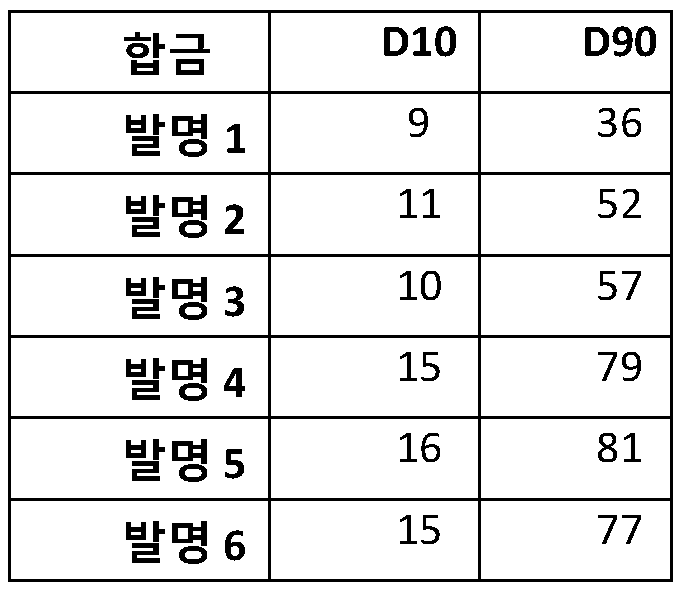
본 발명의 합금 3은 다음 표들에 나타낸 바와 같이, 특히 유리한 것으로 보인다. 본 발명의 합금 3의 분말은 EOS M290 선택적 레이저 용융 기계를 사용한 SLM 시험에 성공적으로 사용되었다. 상기 시험은 다음 파라미터: 층 두께 60μm, 레이저 출력 370-390W, 약 200℃로의 플레이트 가열, 벡터 분리 0.11-0.13mm, 레이저 속도 1000-1400mm/s 로 수행되었다.Alloy 3 of the present invention appears to be particularly advantageous, as shown in the following tables. Powders of alloy 3 of the present invention were successfully used in SLM tests using an EOS M290 selective laser melting machine. The tests were performed with the following parameters: layer thickness 60 μm, laser power 370-390 W, plate heating to about 200° C., vector separation 0.11-0.13 mm, laser speed 1000-1400 mm/s.
이하의 두 가지 유형의 시험편이 사용되었다:The following two types of test specimens were used:
- 축조 방향 Z(가장 중요한 방향)로 인장 시험을 위한 원통형 시험편(높이 45mm 및 직경 11mm).- Cylindrical test specimens (45 mm height and 11 mm diameter) for tensile tests in the longitudinal direction Z (the most critical direction).
- SLM 제조 동안 균열에 대한 민감도를 평가하기 위해 입방체의 수직면 중 하나의 전체 길이에 걸쳐 3개의 수평 홈이 있는 9*9*9mm3 치수의 입방체 형태의 균열 시험편. 상기 홈의 직경은 0.6, 1.2 및 4mm다. 따라서 상기 홈은 SLM 방법에서 균열의 잠재적인 시작 지점이다. - Crack test specimens in the shape of a cube with three dimensions of 9*9*9 mm with three horizontal grooves along the entire length of one of the vertical faces of the cube to evaluate the susceptibility to cracking during SLM manufacturing. The diameters of the grooves are 0.6, 1.2 and 4 mm. Therefore, the grooves are potential initiation points of cracks in the SLM method.
본 발명의 합금 3의 균열 시험편은 균열에 대한 매우 낮은 민감도를 보였다.The crack test specimen of alloy 3 of the present invention showed very low sensitivity to cracking.
선택적 레이저 용융(SLM)으로 제조한 후, 본 발명의 합금 3의 원통형 시험편은 300℃에서 2시간의 팽창 열처리를 거쳤다. 일부 시험편은 비팽창 상태에서 사용되었으며, 다른 시험편은 400℃에서 1시간 또는 4시간의 추가 처리(경화 어닐링)를 거쳤다.After fabrication by selective laser melting (SLM), cylindrical test specimens of alloy 3 of the present invention were subjected to an expansion heat treatment at 300°C for 2 hours. Some test specimens were used in the non-expanded state, while others were subjected to an additional treatment (hardening annealing) at 400°C for 1 hour or 4 hours.
상술한 원통형 시험편으로부터 원통형 인장 시험편(TOR4)을 가공했다. 인장 시험은 NF EN ISO 6892-1(2009-10)에 따라 주위 온도에서 수행되었다. 이 획득된 결과들은 하기 표에 주어진다.Cylindrical tensile test specimens (TOR4) were machined from the above-mentioned cylindrical test specimens. The tensile tests were performed at ambient temperature according to NF EN ISO 6892-1 (2009-10). The results obtained are given in the table below.

상기 표 5의 결과는 본 발명의 합금 3이 비팽창 상태에서 410MPa보다 크고 400℃에서 4시간 후에는 약 500MPa의 Rp0.2로 주위 온도에서 매우 우수한 성능을 가짐을 보여준다.The results in Table 5 above show that alloy 3 of the present invention has very good performance at ambient temperature with Rp0.2 of greater than 410 MPa in the non-expanded state and about 500 MPa after 4 hours at 400°C.
400℃에서 1시간, 4시간의 열처리를 한 합금은 제조된 상태에 비해 기계적 강도가 현저하게 증가했다. 이러한 증가는 Zr에 기초한 경화 분산질의 열처리 동안의 형성과 관련이 있는 것으로 보인다. 따라서, 본 발명에 따른 합금은 용체화 열처리/담금질/에이징 유형의 종래의 열처리를 생략할 수 있게 한다.The alloys heat-treated at 400°C for 1 hour and 4 hours showed a significant increase in mechanical strength compared to the as-manufactured state. This increase appears to be related to the formation of a hardening dispersion based on Zr during the heat treatment. Therefore, the alloy according to the present invention enables the omission of conventional heat treatments of the solution heat treatment/quenching/aging type.
고온(200℃ 및 250℃)에서 인장 시험은 NF EN ISO 6892-1(2009-10)에 따라 수행되었다. 획득된 결과는 하기 표 6에 주어진다.Tensile tests at high temperatures (200°C and 250°C) were performed according to NF EN ISO 6892-1 (2009-10). The results obtained are given in Table 6 below.
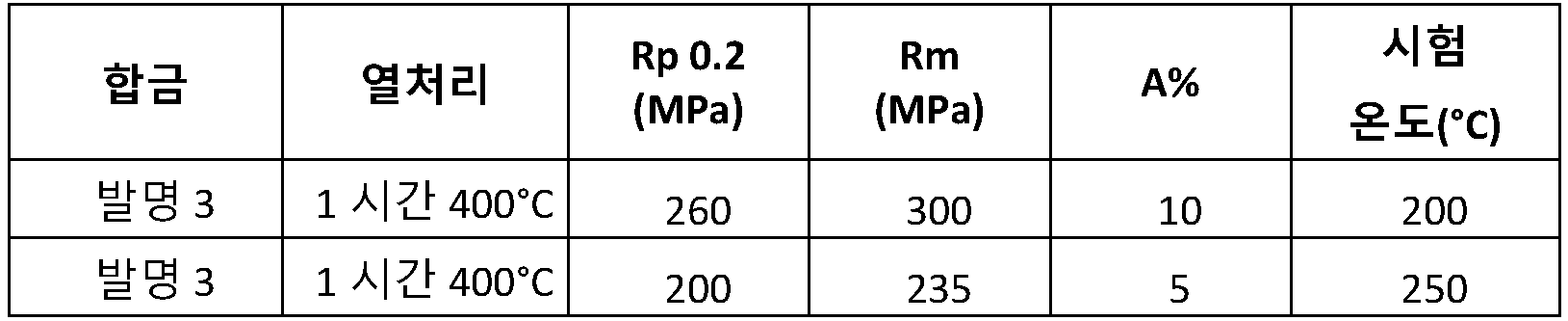
상기 표 6의 결과는 본 발명의 합금 3이 또한 고온에서 매우 우수한 성능을 나타냄을 보여준다. 400℃에서 1시간의 열처리는, 시험 온도(사용 온도)에서 열간 등방압 압축 단계 및/또는 긴 에이징(> 1000시간)에 필적하는 결과를 가져올 수 있다. The results in Table 6 above show that alloy 3 of the present invention also exhibits very good performance at high temperatures. A heat treatment at 400°C for 1 hour can produce results comparable to a hot isostatic pressing step and/or long aging (> 1000 hours) at the test temperature (service temperature).
따라서 본 발명의 합금 3은 SLM에서 매우 우수한 가공성(매우 낮은 균열 민감도)과 주위 온도, 200℃ 및 250℃에서의 매우 우수한 기계적 특성을 겸비한다.Therefore, alloy 3 of the present invention has both very good workability (very low crack sensitivity) in SLM and very good mechanical properties at ambient temperature, 200°C and 250°C.
추가 시험(본 발명의 합금 3을 사용한 다양한 두께의 벽의 SLM에 의한 축조;두께 0.5 내지 4mm)결과는 벽 두께에 따라 경도가 거의 변하지 않는 것으로 나타났다. 이 결과는 유리하다. 이는 사실, 종래 기술의 일부 합금과 달리, 본 발명의 합금 3은 상이한 두께의 영역을 갖는 복잡한 부품에 대해 균일한 특성을 가질 수 있음을 나타낸다.Additional tests (SLM fabrication of walls of various thicknesses using alloy 3 of the present invention; thicknesses from 0.5 to 4 mm) showed that the hardness hardly changed with wall thickness. This result is advantageous. This indicates that, in fact, unlike some alloys of the prior art, alloy 3 of the present invention can have uniform properties for complex parts having different thickness regions.
예 3Example 3
본 발명의 합금 1, 4 및 5의 분말은 AddUp사가 판매하는 FormUp 350 선택적 레이저 용융 기계를 사용하여 SLM 시험에 성공적으로 사용되었다. 상기 시험은 다음 파라미터: 층 두께 60μm, 레이저 출력 370W-390W, 약 200℃로의 플레이트 가열, 벡터 분리 0.11-0.13mm, 레이저 속도 1000-1400mm/s 로 수행되었다.Powders of alloys 1, 4 and 5 of the present invention were successfully used in SLM tests using a FormUp 350 selective laser melting machine sold by AddUp. The tests were performed with the following parameters: layer thickness 60 μm, laser power 370 W-390 W, plate heating to about 200 °C, vector separation 0.11-0.13 mm, laser speed 1000-1400 mm/s.
축조 방향 Z(가장 중요한 방향)의 인장 시험을 위한 원통형 시험편(높이 45mm, 직경 11mm)이 사용되었다.Cylindrical specimens (45 mm height, 11 mm diameter) were used for tensile tests in the longitudinal direction Z (the most critical direction).
본 발명의 합금 1, 4 및 5의 원통형 시험편은 선택적 레이저 용융(SLM)에 의해 제조된 후, 300℃에서 2시간의 팽창 열처리를 거쳤다. 일부 시험편은 비팽창 상태에서 사용되었으며 다른 시험편은 400℃에서 1시간의 추가 처리(경화 어닐링)를 거쳤다.Cylindrical test specimens of alloys 1, 4 and 5 of the present invention were prepared by selective laser melting (SLM) and then subjected to an expansion heat treatment at 300°C for 2 hours. Some of the test specimens were used in the non-expanded state, while others were subjected to an additional treatment (hardening annealing) at 400°C for 1 hour.
상술한 원통형 시험편으로부터 원통형 인장 시험편(TOR4)을 가공했다. 인장 시험은 NF EN ISO 6892-1(2009-10)에 따라 주위 온도에서 수행되었다. 획득된 결과는 하기 표 7에 주어진다.Cylindrical tensile test specimens (TOR4) were machined from the above-mentioned cylindrical test specimens. The tensile tests were performed at ambient temperature according to NF EN ISO 6892-1 (2009-10). The results obtained are given in Table 7 below.

시험된 상기 합금은 250MPa보다 크고 본 발명의 합금 1 및 합금 4에 대해서는 400MPa를 초과하는 제조된 상태에서의 항복 강도를 갖는다. 본 발명의 합금 4 및 합금 5에 시험된 400℃에서 1시간의 열처리는 열처리 동안 Zr에 기초한 경화 분산질 형성과 관련된 것으로 보이는 항복 강도의 상당한 증가를 보여준다.The tested alloys have an as-fabricated yield strength of greater than 250 MPa and for alloys 1 and 4 of the present invention greater than 400 MPa. Heat treatment at 400°C for 1 hour tested for alloys 4 and 5 of the present invention shows a significant increase in yield strength which appears to be related to the formation of Zr-based hardening dispersions during the heat treatment.
본 발명의 합금 4 및 합금 5에 대해 고온(200 및 250℃)에서의 인장 시험이 NF EN ISO 6892-1(2009-10)에 따라 수행됐다. 획득된 결과는 하기 표 8에 주어진다.Tensile tests at high temperatures (200 and 250°C) were performed on alloys 4 and 5 of the present invention according to NF EN ISO 6892-1 (2009-10). The results obtained are given in Table 8 below.
400℃에서 1시간의 열처리는 시험 온도(사용 온도)에서 열간 등방압 압축 단계 및/또는 긴 에이징(> 1000시간)에 필적하는 결과를 가져올 수 있다.A heat treatment at 400°C for 1 hour can produce results comparable to a hot isostatic pressing step and/or long-term aging (> 1000 hours) at the test temperature (service temperature).
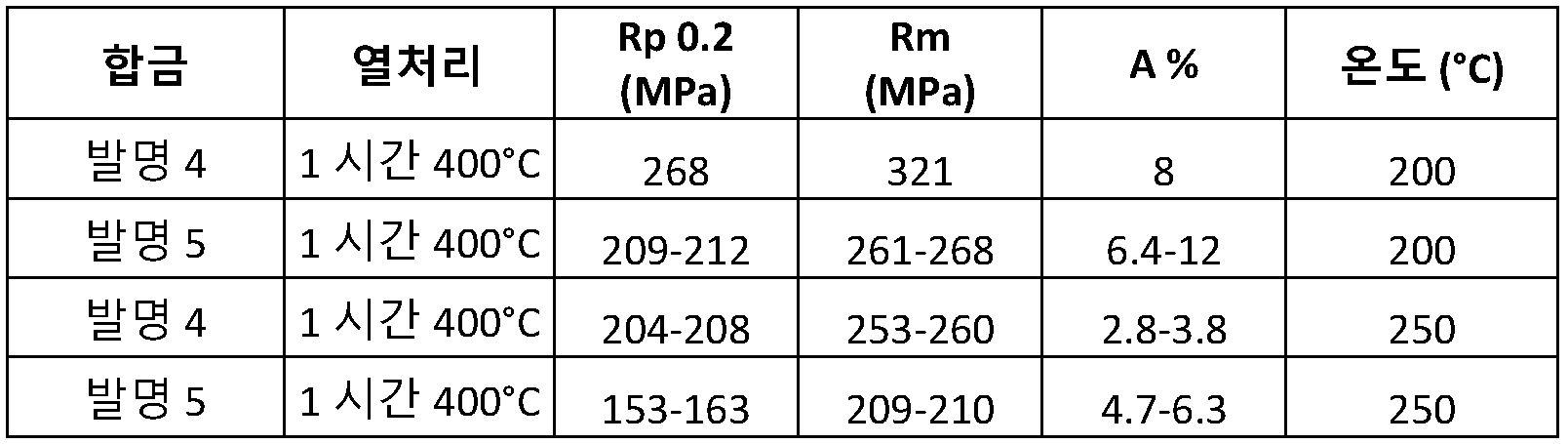
상기 표에 따르면, 시험된 모든 합금은 200℃ 및 250℃ 각각에서 200MPa 및 150MPa보다 큰 항복 강도 Rp0.2를 갖는다.According to the above table, all the tested alloys have yield strength Rp0.2 greater than 200 MPa and 150 MPa at 200°C and 250°C, respectively.
따라서 시험된 합금은 SLM에서 매우 우수한 가공성(매우 낮은 균열 민감도)과 주위 온도, 200℃ 및 250℃에서 매우 우수한 기계적 특성을 겸비한다.Therefore, the tested alloy combines very good machinability (very low crack susceptibility) in SLM with very good mechanical properties at ambient temperature, 200°C and 250°C.
Claims (9)
상기 솔더(25)는 알루미늄 합금이며, 이 알루미늄 합금은
- 2 내지 4%의 질량 분율의 Ni;
- 2 내지 5%의 질량 분율의 Mn;
- 0.5 내지 4%의 질량 분율의 Zr;
- 1% 이하의 질량 분율의 Fe;
- 1% 이하의 질량 분율의 Si
- 선택적으로, 0 내지 8%의 질량 분율의 Cu;
- 선택적으로, 각각 5% 이하 그리고 총 15% 이하의 질량 분율로 Ti, W, Nb, Ta, Y, Yb, Nd, Er, Cr, Hf, Ce, Sc, La, V, Co 및 미시 메탈(mischmetal)로부터 선택된 적어도 하나의 원소;
- 선택적으로, 각각 1% 이하 그리고 총 2% 이하의 질량 분율로 Sr, Ba, Sb, Bi, Ca, P, B, In 및 Sn으로부터 선택된 적어도 하나의 원소;
- 선택적으로, 0.06 내지 1%의 질량 분율의 Ag, 0.06 내지 1%의 질량 분율의 Li 및 0.06 내지 1%의 질량 분율의 Zn으로부터 선택된 적어도 하나의 원소;
- 선택적으로, 0.06% 이상 0.5% 이하의 질량 분율로 Mg;
- 선택적으로, 각각 0.05% 미만(즉, 500ppm) 및 총 0.15% 미만의 질량 분율의 불순물;
- 잔부로서 알루미늄
을 합금 원소로서 적어도 포함하는 것을 특징으로 하는, 부품 제조 방법.A method for manufacturing a component (20), comprising the formation of successive solid metal layers (20 1 ... 20 n ) in an overlapping state, each layer being formed by the deposition of a metal (25), referred to as solder, said solder undergoing an energy input such that it melts and upon solidification forms said layer, said solder taking the form of a powder (25), and wherein exposure to an energy beam (32) causes melting and subsequent solidification of said powder to form a solid metal layer (20 1 ... 20 n ).
The above solder (25) is an aluminum alloy, and this aluminum alloy is
- Ni with a mass fraction of 2 to 4%;
- Mn with a mass fraction of 2 to 5%;
- Zr with a mass fraction of 0.5 to 4%;
- Fe with a mass fraction of less than 1%;
- Si with a mass fraction of less than 1%
- Optionally, Cu in a mass fraction of 0 to 8%;
- Optionally, at least one element selected from Ti, W, Nb, Ta, Y, Yb, Nd, Er, Cr, Hf, Ce, Sc, La, V, Co and mischmetals in a mass fraction of 5% or less each and 15% or less in total;
- Optionally, at least one element selected from Sr, Ba, Sb, Bi, Ca, P, B, In and Sn in a mass fraction of not more than 1% each and not more than 2% in total;
- optionally, at least one element selected from Ag in a mass fraction of 0.06 to 1%, Li in a mass fraction of 0.06 to 1% and Zn in a mass fraction of 0.06 to 1%;
- Optionally, Mg in a mass fraction of 0.06% or more and 0.5% or less;
- Optionally, impurities having a mass fraction of less than 0.05% each (i.e. 500 ppm) and less than 0.15% total;
- Aluminum as a remainder
A method for manufacturing a part, characterized in that it contains at least as an alloying element.
Cu를 0 내지 6%의 질량 분율로 포함한 것인, 부품 제조 방법.In paragraph 1,
A method for manufacturing a part, comprising containing Cu in a mass fraction of 0 to 6%.
Ti, W, Nb, Ta, Y, Yb, Nd, Er, Cr, Hf, Ce, Sc, La, V, Co 및 미시 메탈(mischmetal)로부터 선택된 적어도 하나의 원소를 각각 3% 이하 그리고 총 12% 이하의 질량 분율로 포함한 것인, 부품 제조 방법.In claim 1 or 2,
A method for manufacturing a part, comprising: containing at least one element selected from Ti, W, Nb, Ta, Y, Yb, Nd, Er, Cr, Hf, Ce, Sc, La, V, Co, and mischmetals, each with a mass fraction of 3% or less and a total of 12% or less.
Sr, Ba, Sb, Bi, Ca, P, B, In 및 Sn으로부터 선택된 적어도 하나의 원소를 각각 0.1% 이하 그리고 총 1% 이하의 질량 분율로 포함한 것인, 부품 제조 방법.In claim 1 or 2,
A method for manufacturing a part, comprising: containing at least one element selected from Sr, Ba, Sb, Bi, Ca, P, B, In, and Sn in a mass fraction of 0.1% or less and a total of 1% or less.
상기 알루미늄 합금은 또한 결정립을 미세화하기 위한 AlTiC 또는 Al-TiB2를, 각각 50kg/톤 이하, 그리고 총 50kg/톤 이하의 양으로 포함한 것인, 부품 제조 방법.In claim 1 or 2,
A method for manufacturing a part, wherein the above aluminum alloy also contains AlTiC or Al-TiB 2 for refining grains, each in an amount of 50 kg/ton or less, and a total of 50 kg/ton or less.
상기 층(201...20n)의 형성 후에,
- 용체화 열처리 및 이에 후속한 담금질과 에이징을 행하는 단계,
- 100℃ 이상 550℃ 이하의 온도에서의 열처리 단계,
- 및 열간 등방압 압축 단계(hot isostatic compression)
중 하나 이상의 단계를 포함한 것인, 부품 제조 방법.In claim 1 or 2,
After the formation of the above layers (20 1 ...20 n ),
- A step of performing solution heat treatment and subsequent quenching and aging.
- Heat treatment step at a temperature of 100℃ or higher and 550℃ or lower;
- and hot isostatic compression stage
A method for manufacturing a component, comprising one or more of the steps of:
- 2 내지 4%의 질량 분율의 Ni;
- 2 내지 5%의 질량 분율의 Mn;
- 0.5 내지 4%의 질량 분율의 Zr;
- 1% 이하의 질량 분율의 Fe;
- 1% 이하의 질량 분율의 Si;
- 선택적으로, 0 내지 8%의 질량 분율의 Cu;
- 선택적으로, 각각 5% 이하 그리고 총 15% 이하의 질량 분율로 Ti, W, Nb, Ta, Y, Yb, Nd, Er, Cr, Hf, Ce, Sc, La, V, Co 및 미시 메탈(mischmetal)로부터 선택된 적어도 하나의 원소;
- 선택적으로, 각각 1% 이하 그리고 총 2% 이하의 질량 분율로 Sr, Ba, Sb, Bi, Ca, P, B, In 및 Sn으로부터 선택된 적어도 하나의 원소;
- 선택적으로, 0.06 내지 1%의 질량 분율의 Ag, 0.06 내지 1%의 질량 분율의 Li 및 0.06 내지 1%의 질량 분율의 Zn으로부터 선택된 적어도 하나의 원소;
- 선택적으로, 0.06% 이상 0.5% 이하의 질량 분율로 Mg;
- 선택적으로, 각각 0.05% 미만(즉, 500ppm) 및 총 0.15% 미만의 질량 분율의 불순물;
- 잔부로서 알루미늄
을 포함하는 것인 분말.A powder comprising an aluminum alloy, wherein the aluminum alloy is
- Ni with a mass fraction of 2 to 4%;
- Mn with a mass fraction of 2 to 5%;
- Zr with a mass fraction of 0.5 to 4%;
- Fe with a mass fraction of less than 1%;
- Si with a mass fraction of less than 1%;
- Optionally, Cu in a mass fraction of 0 to 8%;
- Optionally, at least one element selected from Ti, W, Nb, Ta, Y, Yb, Nd, Er, Cr, Hf, Ce, Sc, La, V, Co and mischmetals in a mass fraction of 5% or less each and 15% or less in total;
- Optionally, at least one element selected from Sr, Ba, Sb, Bi, Ca, P, B, In and Sn in a mass fraction of not more than 1% each and not more than 2% in total;
- optionally, at least one element selected from Ag in a mass fraction of 0.06 to 1%, Li in a mass fraction of 0.06 to 1% and Zn in a mass fraction of 0.06 to 1%;
- Optionally, Mg in a mass fraction of 0.06% or more and 0.5% or less;
- Optionally, impurities having a mass fraction of less than 0.05% each (i.e. 500 ppm) and less than 0.15% total;
- Aluminum as a remainder
A powder containing:
Applications Claiming Priority (3)
| Application Number | Priority Date | Filing Date | Title |
|---|---|---|---|
| FR1870820A FR3083479B1 (en) | 2018-07-09 | 2018-07-09 | METHOD OF MANUFACTURING AN ALUMINUM ALLOY PART |
| FR1870820 | 2018-07-09 | ||
| PCT/FR2019/050805 WO2019155180A1 (en) | 2018-07-09 | 2019-04-05 | Process for manufacturing aluminium alloy parts |
Publications (2)
| Publication Number | Publication Date |
|---|---|
| KR20210030939A KR20210030939A (en) | 2021-03-18 |
| KR102722473B1 true KR102722473B1 (en) | 2024-10-25 |
Family
ID=63579517
Family Applications (1)
| Application Number | Title | Priority Date | Filing Date |
|---|---|---|---|
| KR1020217002276A Active KR102722473B1 (en) | 2018-07-09 | 2019-04-05 | Aluminum alloy parts manufacturing process |
Country Status (9)
| Country | Link |
|---|---|
| US (1) | US20210276099A1 (en) |
| EP (1) | EP3821047A1 (en) |
| JP (1) | JP7314184B2 (en) |
| KR (1) | KR102722473B1 (en) |
| CN (1) | CN112368407A (en) |
| CA (1) | CA3102411A1 (en) |
| DE (1) | DE19720977T1 (en) |
| FR (1) | FR3083479B1 (en) |
| WO (1) | WO2019155180A1 (en) |
Families Citing this family (21)
| Publication number | Priority date | Publication date | Assignee | Title |
|---|---|---|---|---|
| US20200199716A1 (en) * | 2018-12-24 | 2020-06-25 | Hrl Laboratories, Llc | Additively manufactured high-temperature aluminum alloys, and feedstocks for making the same |
| US12305267B2 (en) | 2017-02-22 | 2025-05-20 | Ut-Battelle, Llc | Rapidly solidified aluminum-rare earth element alloy and method of making the same |
| FR3086872B1 (en) * | 2018-10-05 | 2022-05-27 | C Tec Tech Center | METHOD FOR MANUFACTURING AN ALUMINUM ALLOY PART |
| US20200232070A1 (en) | 2019-01-18 | 2020-07-23 | Divergent Technologies, Inc. | Aluminum alloy compositions |
| FR3092777A1 (en) * | 2019-02-15 | 2020-08-21 | C-Tec Constellium Technology Center | Manufacturing process of an aluminum alloy part |
| US12247272B2 (en) | 2019-10-30 | 2025-03-11 | Ut-Battelle, Llc | Aluminum-cerium-copper alloys for metal additive manufacturing |
| US11986904B2 (en) * | 2019-10-30 | 2024-05-21 | Ut-Battelle, Llc | Aluminum-cerium-nickel alloys for additive manufacturing |
| FR3103123B1 (en) * | 2019-11-19 | 2022-07-01 | C Tec Constellium Tech Center | Method of manufacturing an aluminum alloy part |
| CN110923529A (en) * | 2019-11-29 | 2020-03-27 | 安徽峰创云通数据科技有限公司 | Al-Cu-Sr-RE-Ge aluminum alloy wire for power cable and preparation method thereof |
| CN110899696B (en) * | 2019-12-10 | 2021-03-26 | 华中科技大学 | Method for preparing scandium-containing aluminum alloy part by using 3D printing and product thereof |
| RU2730821C1 (en) * | 2019-12-27 | 2020-08-26 | Общество с ограниченной ответственностью "Объединенная Компания РУСАЛ Инженерно-технологический центр" | Heat resistant aluminum powder material |
| US20210285076A1 (en) * | 2020-03-02 | 2021-09-16 | Alexander J. Plotkowski | Aluminum-copper-manganese-zirconium alloys for metal additive manufacturing |
| FR3110095B1 (en) * | 2020-05-13 | 2022-11-11 | C Tec Constellium Tech Center | Method of manufacturing an aluminum alloy part |
| FR3110097B1 (en) * | 2020-05-13 | 2022-11-18 | C Tec Constellium Tech Center | Method of manufacturing an aluminum alloy part |
| MX2023006924A (en) * | 2020-12-10 | 2023-08-25 | Hoeganaes Ab Publ | New powder, method for additive manufacturing of components made from the new powder and article made therefrom. |
| US12365965B2 (en) | 2021-07-01 | 2025-07-22 | Divergent Technologies, Inc. | Al—Mg—Si based near-eutectic alloy composition for high strength and stiffness applications |
| US12172227B1 (en) * | 2021-11-30 | 2024-12-24 | Bae Systems Plc | Additive friction stir deposition on cold sprayed barrier layer |
| JP2023150899A (en) * | 2022-03-31 | 2023-10-16 | 本田技研工業株式会社 | Powder metal material for additive manufacturing made of aluminum alloy and additive manufacturing method |
| CN115383129B (en) * | 2022-08-16 | 2024-03-19 | 燕山大学 | Preparation method and composite material of in-situ synthesis of intermetallic compound-reinforced aluminum-based gradient composite materials |
| EP4344804A1 (en) * | 2022-09-29 | 2024-04-03 | EOS GmbH Electro Optical Systems | Highly conductive aluminium alloy |
| CN117778823B (en) * | 2024-01-02 | 2025-06-10 | 季华实验室 | High-strength heat-resistant aluminum alloy and preparation method thereof |
Citations (2)
| Publication number | Priority date | Publication date | Assignee | Title |
|---|---|---|---|---|
| US20040261916A1 (en) * | 2001-12-21 | 2004-12-30 | Lin Jen C. | Dispersion hardenable Al-Ni-Mn casting alloys for automotive and aerospace structural components |
| WO2018119283A1 (en) * | 2016-12-21 | 2018-06-28 | Arconic Inc. | Aluminum alloy products having fine eutectic-type structures, and methods for making the same |
Family Cites Families (24)
| Publication number | Priority date | Publication date | Assignee | Title |
|---|---|---|---|---|
| US4661172A (en) * | 1984-02-29 | 1987-04-28 | Allied Corporation | Low density aluminum alloys and method |
| JPH0651895B2 (en) * | 1985-08-26 | 1994-07-06 | 東洋アルミニウム株式会社 | Heat-resistant aluminum powder metallurgy alloy |
| JPS63157831A (en) * | 1986-12-18 | 1988-06-30 | Toyo Alum Kk | Heat-resisting aluminum alloy |
| JPS63274733A (en) * | 1987-04-28 | 1988-11-11 | Furukawa Alum Co Ltd | Aluminum alloy for fin |
| JP2787466B2 (en) * | 1988-05-12 | 1998-08-20 | 住友電気工業株式会社 | Forming method of aluminum alloy for large diameter products |
| JP2795611B2 (en) * | 1994-03-29 | 1998-09-10 | 健 増本 | High strength aluminum base alloy |
| CN1487109A (en) * | 2003-07-31 | 2004-04-07 | 上海交通大学 | Powder metallurgy self-generated ceramic particle reinforced aluminum matrix composite material and preparation method thereof |
| KR100840385B1 (en) * | 2006-07-20 | 2008-06-23 | 성훈엔지니어링(주) | Heat resistant aluminum alloy |
| DE102007018123B4 (en) | 2007-04-16 | 2009-03-26 | Eads Deutschland Gmbh | Method for producing a structural component from an aluminum-based alloy |
| KR101999795B1 (en) * | 2012-06-27 | 2019-07-12 | 삼성전자주식회사 | Conductive paste and electronic device and solar cell including an electrode formed using the conductive paste |
| KR101564661B1 (en) * | 2013-01-11 | 2015-10-30 | 지케이 주식회사 | Apparatus and method for manufacturing aluminium alloy ingot |
| US9267189B2 (en) | 2013-03-13 | 2016-02-23 | Honeywell International Inc. | Methods for forming dispersion-strengthened aluminum alloys |
| JP6626441B2 (en) | 2013-07-10 | 2019-12-25 | アーコニック インコーポレイテッドArconic Inc. | Method of manufacturing forged products and other processed products |
| TWI530569B (en) | 2014-11-21 | 2016-04-21 | 財團法人工業技術研究院 | Method for forming alloy cast material and alloy article |
| JP2018519412A (en) | 2015-06-15 | 2018-07-19 | ノースロップ グルマン システムズ コーポレーションNorthrop Grumman Systems Corporation | High strength aluminum added by powder bed laser process |
| US20170016093A1 (en) * | 2015-07-16 | 2017-01-19 | Hamilton Sundstrand Corporation | Method of manufacturing aluminum alloy articles |
| US10105798B2 (en) * | 2015-11-05 | 2018-10-23 | Honeywell International Inc. | Surface improvement of additively manufactured articles produced with aluminum alloys |
| US10294552B2 (en) | 2016-01-27 | 2019-05-21 | GM Global Technology Operations LLC | Rapidly solidified high-temperature aluminum iron silicon alloys |
| KR101743234B1 (en) * | 2016-02-16 | 2017-06-02 | (주)제이에스루미 | Aluminum alloy for die casting |
| US20170312857A1 (en) * | 2016-05-02 | 2017-11-02 | Board Of Regents, The University Of Texas System | Methods of additive manufacturing |
| GB2552998C (en) * | 2016-08-19 | 2020-06-24 | Mahle Int Gmbh | Aluminium alloy composition for a sliding element |
| JP6393008B1 (en) * | 2017-04-27 | 2018-09-19 | 株式会社コイワイ | High-strength aluminum alloy laminated molded body and method for producing the same |
| CN107502795A (en) * | 2017-08-31 | 2017-12-22 | 西安铂力特增材技术股份有限公司 | High strength alumin ium alloy metal powder material for increasing material manufacturing and preparation method thereof |
| WO2020097169A1 (en) * | 2018-11-07 | 2020-05-14 | Arconic Inc. | 2xxx aluminum lithium alloys |
-
2018
- 2018-07-09 FR FR1870820A patent/FR3083479B1/en active Active
-
2019
- 2019-04-05 CN CN201980044276.0A patent/CN112368407A/en active Pending
- 2019-04-05 DE DE19720977.8T patent/DE19720977T1/en active Pending
- 2019-04-05 JP JP2020570514A patent/JP7314184B2/en active Active
- 2019-04-05 EP EP19720977.8A patent/EP3821047A1/en active Pending
- 2019-04-05 WO PCT/FR2019/050805 patent/WO2019155180A1/en not_active Ceased
- 2019-04-05 CA CA3102411A patent/CA3102411A1/en active Pending
- 2019-04-05 KR KR1020217002276A patent/KR102722473B1/en active Active
- 2019-04-05 US US17/257,443 patent/US20210276099A1/en active Pending
Patent Citations (2)
| Publication number | Priority date | Publication date | Assignee | Title |
|---|---|---|---|---|
| US20040261916A1 (en) * | 2001-12-21 | 2004-12-30 | Lin Jen C. | Dispersion hardenable Al-Ni-Mn casting alloys for automotive and aerospace structural components |
| WO2018119283A1 (en) * | 2016-12-21 | 2018-06-28 | Arconic Inc. | Aluminum alloy products having fine eutectic-type structures, and methods for making the same |
Also Published As
| Publication number | Publication date |
|---|---|
| KR20210030939A (en) | 2021-03-18 |
| CA3102411A1 (en) | 2019-08-15 |
| WO2019155180A1 (en) | 2019-08-15 |
| EP3821047A1 (en) | 2021-05-19 |
| FR3083479A1 (en) | 2020-01-10 |
| US20210276099A1 (en) | 2021-09-09 |
| CN112368407A (en) | 2021-02-12 |
| DE19720977T1 (en) | 2021-07-15 |
| JP7314184B2 (en) | 2023-07-25 |
| FR3083479B1 (en) | 2021-08-13 |
| JP2021531398A (en) | 2021-11-18 |
Similar Documents
| Publication | Publication Date | Title |
|---|---|---|
| KR102722473B1 (en) | Aluminum alloy parts manufacturing process | |
| US11692240B2 (en) | Process for manufacturing an aluminum alloy part | |
| US12037661B2 (en) | Process for manufacturing an aluminum alloy part | |
| US12152291B2 (en) | Process for manufacturing an aluminum-chromium alloy part with superimposed successive solid metals layer | |
| US12377463B2 (en) | Method for manufacturing an aluminum alloy part | |
| CN112805106B (en) | Methods of manufacturing aluminum alloy parts | |
| US12428706B2 (en) | Process for manufacturing an aluminum alloy part | |
| CN113412172B (en) | Method for manufacturing aluminum alloy parts | |
| JP7386819B2 (en) | Method for manufacturing parts made of aluminum alloy | |
| US20230191488A1 (en) | Method for producing an aluminium alloy part | |
| US20230191489A1 (en) | Method for producing an aluminium alloy part | |
| CN117396290A (en) | Method for preparing aluminum alloy parts using additive manufacturing technology containing preheating |
Legal Events
| Date | Code | Title | Description |
|---|---|---|---|
| PA0105 | International application |
Patent event date: 20210122 Patent event code: PA01051R01D Comment text: International Patent Application |
|
| PG1501 | Laying open of application | ||
| PA0201 | Request for examination |
Patent event code: PA02012R01D Patent event date: 20220330 Comment text: Request for Examination of Application |
|
| E902 | Notification of reason for refusal | ||
| PE0902 | Notice of grounds for rejection |
Comment text: Notification of reason for refusal Patent event date: 20240110 Patent event code: PE09021S01D |
|
| E701 | Decision to grant or registration of patent right | ||
| PE0701 | Decision of registration |
Patent event code: PE07011S01D Comment text: Decision to Grant Registration Patent event date: 20240827 |
|
| GRNT | Written decision to grant | ||
| PR0701 | Registration of establishment |
Comment text: Registration of Establishment Patent event date: 20241023 Patent event code: PR07011E01D |
|
| PR1002 | Payment of registration fee |
Payment date: 20241023 End annual number: 3 Start annual number: 1 |
|
| PG1601 | Publication of registration |