KR102710757B1 - Method for providing parking location information of a vehicle and electronic device thereof - Google Patents
Method for providing parking location information of a vehicle and electronic device thereof Download PDFInfo
- Publication number
- KR102710757B1 KR102710757B1 KR1020160101684A KR20160101684A KR102710757B1 KR 102710757 B1 KR102710757 B1 KR 102710757B1 KR 1020160101684 A KR1020160101684 A KR 1020160101684A KR 20160101684 A KR20160101684 A KR 20160101684A KR 102710757 B1 KR102710757 B1 KR 102710757B1
- Authority
- KR
- South Korea
- Prior art keywords
- information
- vehicle
- electronic device
- processor
- image information
- Prior art date
- Legal status (The legal status is an assumption and is not a legal conclusion. Google has not performed a legal analysis and makes no representation as to the accuracy of the status listed.)
- Active
Links
Images


Classifications
-
- G—PHYSICS
- G01—MEASURING; TESTING
- G01C—MEASURING DISTANCES, LEVELS OR BEARINGS; SURVEYING; NAVIGATION; GYROSCOPIC INSTRUMENTS; PHOTOGRAMMETRY OR VIDEOGRAMMETRY
- G01C21/00—Navigation; Navigational instruments not provided for in groups G01C1/00 - G01C19/00
- G01C21/26—Navigation; Navigational instruments not provided for in groups G01C1/00 - G01C19/00 specially adapted for navigation in a road network
- G01C21/34—Route searching; Route guidance
- G01C21/36—Input/output arrangements for on-board computers
- G01C21/3679—Retrieval, searching and output of POI information, e.g. hotels, restaurants, shops, filling stations, parking facilities
- G01C21/3685—Retrieval, searching and output of POI information, e.g. hotels, restaurants, shops, filling stations, parking facilities the POI's being parking facilities
-
- G—PHYSICS
- G08—SIGNALLING
- G08G—TRAFFIC CONTROL SYSTEMS
- G08G1/00—Traffic control systems for road vehicles
- G08G1/14—Traffic control systems for road vehicles indicating individual free spaces in parking areas
- G08G1/141—Traffic control systems for road vehicles indicating individual free spaces in parking areas with means giving the indication of available parking spaces
- G08G1/144—Traffic control systems for road vehicles indicating individual free spaces in parking areas with means giving the indication of available parking spaces on portable or mobile units, e.g. personal digital assistant [PDA]
-
- G—PHYSICS
- G01—MEASURING; TESTING
- G01C—MEASURING DISTANCES, LEVELS OR BEARINGS; SURVEYING; NAVIGATION; GYROSCOPIC INSTRUMENTS; PHOTOGRAMMETRY OR VIDEOGRAMMETRY
- G01C21/00—Navigation; Navigational instruments not provided for in groups G01C1/00 - G01C19/00
- G01C21/20—Instruments for performing navigational calculations
- G01C21/206—Instruments for performing navigational calculations specially adapted for indoor navigation
-
- G—PHYSICS
- G01—MEASURING; TESTING
- G01C—MEASURING DISTANCES, LEVELS OR BEARINGS; SURVEYING; NAVIGATION; GYROSCOPIC INSTRUMENTS; PHOTOGRAMMETRY OR VIDEOGRAMMETRY
- G01C21/00—Navigation; Navigational instruments not provided for in groups G01C1/00 - G01C19/00
- G01C21/26—Navigation; Navigational instruments not provided for in groups G01C1/00 - G01C19/00 specially adapted for navigation in a road network
- G01C21/34—Route searching; Route guidance
- G01C21/36—Input/output arrangements for on-board computers
- G01C21/3602—Input other than that of destination using image analysis, e.g. detection of road signs, lanes, buildings, real preceding vehicles using a camera
-
- G—PHYSICS
- G06—COMPUTING OR CALCULATING; COUNTING
- G06V—IMAGE OR VIDEO RECOGNITION OR UNDERSTANDING
- G06V20/00—Scenes; Scene-specific elements
- G06V20/50—Context or environment of the image
- G06V20/52—Surveillance or monitoring of activities, e.g. for recognising suspicious objects
-
- G—PHYSICS
- G06—COMPUTING OR CALCULATING; COUNTING
- G06V—IMAGE OR VIDEO RECOGNITION OR UNDERSTANDING
- G06V20/00—Scenes; Scene-specific elements
- G06V20/50—Context or environment of the image
- G06V20/56—Context or environment of the image exterior to a vehicle by using sensors mounted on the vehicle
-
- G—PHYSICS
- G06—COMPUTING OR CALCULATING; COUNTING
- G06V—IMAGE OR VIDEO RECOGNITION OR UNDERSTANDING
- G06V20/00—Scenes; Scene-specific elements
- G06V20/60—Type of objects
- G06V20/62—Text, e.g. of license plates, overlay texts or captions on TV images
- G06V20/63—Scene text, e.g. street names
-
- G—PHYSICS
- G08—SIGNALLING
- G08G—TRAFFIC CONTROL SYSTEMS
- G08G1/00—Traffic control systems for road vehicles
- G08G1/005—Traffic control systems for road vehicles including pedestrian guidance indicator
-
- G—PHYSICS
- G08—SIGNALLING
- G08G—TRAFFIC CONTROL SYSTEMS
- G08G1/00—Traffic control systems for road vehicles
- G08G1/20—Monitoring the location of vehicles belonging to a group, e.g. fleet of vehicles, countable or determined number of vehicles
- G08G1/205—Indicating the location of the monitored vehicles as destination, e.g. accidents, stolen, rental
-
- H—ELECTRICITY
- H04—ELECTRIC COMMUNICATION TECHNIQUE
- H04W—WIRELESS COMMUNICATION NETWORKS
- H04W4/00—Services specially adapted for wireless communication networks; Facilities therefor
- H04W4/02—Services making use of location information
- H04W4/025—Services making use of location information using location based information parameters
-
- H—ELECTRICITY
- H04—ELECTRIC COMMUNICATION TECHNIQUE
- H04W—WIRELESS COMMUNICATION NETWORKS
- H04W4/00—Services specially adapted for wireless communication networks; Facilities therefor
- H04W4/30—Services specially adapted for particular environments, situations or purposes
- H04W4/40—Services specially adapted for particular environments, situations or purposes for vehicles, e.g. vehicle-to-pedestrians [V2P]
- H04W4/44—Services specially adapted for particular environments, situations or purposes for vehicles, e.g. vehicle-to-pedestrians [V2P] for communication between vehicles and infrastructures, e.g. vehicle-to-cloud [V2C] or vehicle-to-home [V2H]
-
- G—PHYSICS
- G06—COMPUTING OR CALCULATING; COUNTING
- G06V—IMAGE OR VIDEO RECOGNITION OR UNDERSTANDING
- G06V2201/00—Indexing scheme relating to image or video recognition or understanding
- G06V2201/08—Detecting or categorising vehicles
-
- H—ELECTRICITY
- H04—ELECTRIC COMMUNICATION TECHNIQUE
- H04W—WIRELESS COMMUNICATION NETWORKS
- H04W4/00—Services specially adapted for wireless communication networks; Facilities therefor
- H04W4/80—Services using short range communication, e.g. near-field communication [NFC], radio-frequency identification [RFID] or low energy communication
Landscapes
- Engineering & Computer Science (AREA)
- Radar, Positioning & Navigation (AREA)
- Remote Sensing (AREA)
- Physics & Mathematics (AREA)
- General Physics & Mathematics (AREA)
- Automation & Control Theory (AREA)
- Computer Networks & Wireless Communication (AREA)
- Signal Processing (AREA)
- Multimedia (AREA)
- Theoretical Computer Science (AREA)
- Computer Vision & Pattern Recognition (AREA)
- Traffic Control Systems (AREA)
- User Interface Of Digital Computer (AREA)
- Devices For Checking Fares Or Tickets At Control Points (AREA)
Abstract
전자 장치의 동작 방법은, 차량의 주차장 진입이 감지되면, 영상 정보를 획득하는 과정과, 상기 영상 정보에 기초하여 주차 구역을 나타내는 정보를 포함하는 객체의 영상 정보를 생성하는 과정과, 상기 객체의 영상 정보에 기초하여 상기 차량의 주차 위치와 관련된 정보를 식별하는 과정과, 상기 차량의 주차 위치와 관련된 정보를 출력하는 과정을 포함한다. 상기 전자 장치는, 주차장에 미리 설치된 장치 없이, 상기 차량의 주차 위치를 제공할 수 있다.The method of operating an electronic device includes a process of acquiring image information when a vehicle enters a parking lot is detected, a process of generating image information of an object including information indicating a parking area based on the image information, a process of identifying information related to a parking location of the vehicle based on the image information of the object, and a process of outputting information related to the parking location of the vehicle. The electronic device can provide the parking location of the vehicle without a device installed in advance in the parking lot.
Description
본 발명의 실시 예들은 주차 위치를 인식할 수 있는 방법 및 그 전자 장치에 관한 것으로, 보다 구체적으로 주차장 등에 미리 설치된 인프라(infra)의 도움 없이 주차한 차량의 위치를 제공하기 위한 방법 및 그 전자 장치에 관한 것이다.Embodiments of the present invention relate to a method and an electronic device capable of recognizing a parking location, and more specifically, to a method and an electronic device for providing the location of a parked vehicle without the aid of infrastructure installed in advance in a parking lot or the like.
백화점, 문화시설, 아파트 단지 등 대다수의 차량이 밀집되는 장소의 경우, 자신의 차량을 주차한 위치를 파악하는 것은 쉽지 않을 수 있다. 특히, 대형 주차장의 경우, 층(예: B2, 지하2층)과 구역(예: 075)으로 주차 위치를 구분하고 있으므로 차량 소유자가 주차 위치를 기억하기 어려울 수 있다.In places where many vehicles are concentrated, such as department stores, cultural facilities, and apartment complexes, it may not be easy to know where you parked your vehicle. In particular, in the case of large parking lots, parking locations are divided by floor (e.g., B2, B2) and zone (e.g., 075), so it may be difficult for vehicle owners to remember where they parked.
따라서, 차량 소유자는, 차량이 주차한 위치를 알기 위해서, 주차장 내에 미리 설치되어 있는 카메라를 이용한 기술을 이용하고 있다. 예를 들어, 광학적 문자 판독(optical character reader, OCR) 장치는 주차장에 진입한 차량을 카메라로 촬영하고 광학적 문자 판독 분석을 통해 차량의 번호판을 인식한다. 상기 광학적 문자 판독 장치는 차량의 주차 위치를 파악하고 이를 사용자에게 제공한다.Therefore, vehicle owners are using technology that utilizes cameras installed in advance in parking lots to know where their vehicles are parked. For example, an optical character reader (OCR) device captures a vehicle entering a parking lot with a camera and recognizes the vehicle's license plate through OCR analysis. The OCR device identifies the vehicle's parking location and provides it to the user.
상기한 예는 센서나 카메라가 미리 설치되어 있는 주차장에서 적용될 수 있으므로, 별도의 시스템 및 서비스가 요구될 수 있다. 또한, 개인의 차량이 주차장의 카메라를 통해 지속적으로 관찰됨에 따라, 개인 프라이버시(privacy)가 침해될 우려가 있다.The above example can be applied in parking lots where sensors or cameras are already installed, so separate systems and services may be required. In addition, there is a concern that personal privacy may be violated as individual vehicles are continuously observed through the parking lot's cameras.
상술한 바와 같은 논의를 바탕으로, 본 개시(disclosure)는, 사용자의 프라이버시(privacy)를 보호하면서, 사용자에게 주차한 차량의 위치를 제공하는 장치 및 방법을 제공한다.Based on the discussion above, the present disclosure provides a device and method for providing a user with the location of a parked vehicle while protecting the user's privacy.
또한, 본 개시는, 주차장에 별도의 센서 및 카메라 등을 설치하지 않고 사용자에게 주차한 차량의 위치를 제공하는 장치 및 방법을 제공한다. In addition, the present disclosure provides a device and method for providing a user with the location of a parked vehicle without installing separate sensors and cameras in the parking lot.
또한, 본 개시는, 주차한 차량의 위치를 판단하기 위하여 차량에 장착된 외부 카메라 기기 또는 스마트폰(smartphone)과 같은 모바일 단말(mobile device)을 이용하여, 주차 장소를 촬영하고 이를 분석함으로써 사용자에게 주차한 차량의 위치를 제공하는 장치 및 방법을 제공한다.In addition, the present disclosure provides a device and method for providing a user with the location of a parked vehicle by taking a picture of a parking space using an external camera device mounted on a vehicle or a mobile device such as a smartphone to determine the location of the parked vehicle and analyzing the picture.
또한, 본 개시는, 전자 장치 및 외부 서버의 연동을 통해 사용자에게 주차한 차량의 위치를 제공하는 장치 및 방법을 제공한다.In addition, the present disclosure provides a device and method for providing a user with the location of a parked vehicle through linkage between an electronic device and an external server.
또한, 본 개시는, 차량이 주차장에 진입한 이후에 획득된 영상 정보에서 추출된 문자 정보를 층(floor)을 나타내는 정보와 구역(section)을 나타내는 정보로 구분하여 식별하는 장치 및 방법을 제공한다.In addition, the present disclosure provides a device and method for identifying character information extracted from image information acquired after a vehicle enters a parking lot by dividing it into information indicating a floor and information indicating a section.
본 개시의 다양한 실시 예들에 따르면, 전자 장치는 차량의 주차장 진입이 감지되면, 영상 정보를 획득하고, 상기 영상 정보에 기초하여 주차 구역을 나타내는 정보를 포함하는 객체의 영상 정보를 생성하고, 상기 객체의 영상 정보에 기초하여 상기 차량의 주차 위치와 관련된 정보를 식별하고, 상기 차량의 주차 위치와 관련된 정보를 출력하는 프로세서와, 상기 영상 정보, 상기 객체의 영상 정보 및 상기 차량의 주차 위치와 관련된 정보 중 적어도 하나를 저장하는 메모리를 포함한다.According to various embodiments of the present disclosure, an electronic device includes a processor which, when a vehicle enters a parking lot, acquires image information, generates image information of an object including information indicating a parking area based on the image information, identifies information related to a parking location of the vehicle based on the image information of the object, and outputs information related to the parking location of the vehicle, and a memory which stores at least one of the image information, the image information of the object, and the information related to the parking location of the vehicle.
본 개시의 다양한 실시 예들에 따르면, 전자 장치의 동작 방법은 차량의 주차장 진입이 감지되면, 영상 정보를 획득하는 과정과, 상기 영상 정보에 기초하여 주차 구역을 나타내는 정보를 포함하는 객체의 영상 정보를 생성하는 과정과, 상기 객체의 영상 정보에 기초하여 상기 차량의 주차 위치와 관련된 정보를 식별하는 과정과, 상기 차량의 주차 위치와 관련된 정보를 출력하는 과정을 포함한다.According to various embodiments of the present disclosure, a method of operating an electronic device includes a process of acquiring image information when a vehicle enters a parking lot is detected, a process of generating image information of an object including information indicating a parking area based on the image information, a process of identifying information related to a parking location of the vehicle based on the image information of the object, and a process of outputting information related to the parking location of the vehicle.
본 개시의 다양한 실시 예들에 따르면, 전자 장치는 상기 차량의 주차장 진입이 감지되면, 적어도 하나의 영상 정보를 획득하는 프로세서와, 상기 적어도 하나의 영상 정보를 서버로 송신하고, 상기 서버로부터 상기 적어도 하나의 영상 정보에 대한 분석 결과를 포함하는 정보를 수신하는 통신부를 포함하고, 상기 프로세서는, 상기 분석 결과를 포함하는 정보에 기초하여 상기 차량의 주차 위치와 관련된 정보를 식별하고, 상기 차량의 주차 위치와 관련된 정보를 더 출력하고, 상기 적어도 하나의 영상 정보, 상기 분석 결과를 포함하는 정보 및 차량의 주차 위치와 관련된 정보 중 적어도 하나를 저장하는 메모리를 더 포함한다.According to various embodiments of the present disclosure, an electronic device includes a processor which, when entry of a vehicle into a parking lot is detected, obtains at least one image information, and a communication unit which transmits the at least one image information to a server and receives information including an analysis result of the at least one image information from the server, wherein the processor further includes a memory which identifies information related to a parking location of the vehicle based on the information including the analysis result, further outputs information related to the parking location of the vehicle, and stores at least one of the at least one image information, the information including the analysis result, and the information related to the parking location of the vehicle.
본 개시의 다양한 실시 예들에 따른 장치 및 방법은, 주차장에 미리 설치된 센서 및 카메라 등 없이, 사용자의 차량에 설치된 블랙박스(blackbox) 또는 사용자의 스마트폰(smartphone)과 같은 모바일 단말을 이용하여, 사용자의 프라이버시(privacy)를 보호하면서, 사용자의 주차한 차량의 위치를 정확하게 제공할 수 있다. Devices and methods according to various embodiments of the present disclosure can accurately provide the location of a user's parked vehicle while protecting the user's privacy by using a black box installed in the user's vehicle or a mobile terminal such as the user's smartphone, without sensors and cameras installed in advance in the parking lot.
본 개시에서 얻을 수 있는 효과는 이상에서 언급한 효과들로 제한되지 않으며, 언급하지 않은 또 다른 효과들은 아래의 기재로부터 본 개시가 속하는 기술 분야에서 통상의 지식을 가진 자에게 명확하게 이해될 수 있을 것이다. The effects obtainable from the present disclosure are not limited to the effects mentioned above, and other effects not mentioned will be clearly understood by a person skilled in the art to which the present disclosure belongs from the description below.
도 1은 본 개시의 다양한 실시 예들에 따른 전자 장치를 포함하는 네트워크 환경의 예를 도시한다.
도 2는 본 개시의 다양한 실시 예들에 따른 전자 장치의 블록도의 예를 도시한다.
도 3은 본 개시의 다양한 실시 예들에 따른 프로그램 모듈의 블록도의 예를 도시한다.
도 4a는 본 개시의 다양한 실시 예들에 따른 전자 장치의 기능적 구성의 예를 도시한다.
도 4b는 본 개시의 다양한 실시 예들에 따른 영상 분석부의 기능적 구성의 예를 도시한다.
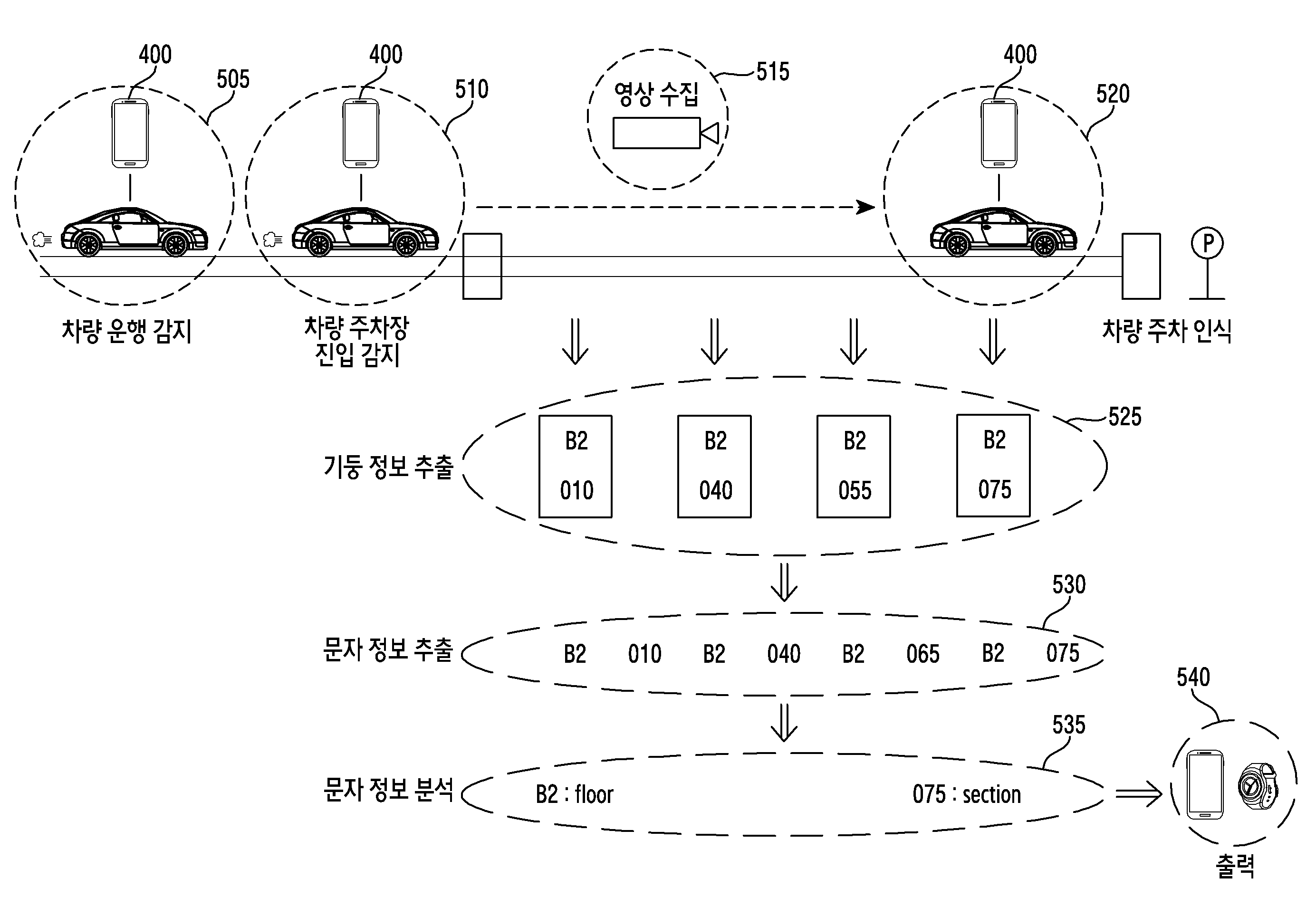
도 5는 본 개시의 다양한 실시 예들에 따른 차량의 주차 위치 정보를 제공하는 절차의 예를 도시한다.
도 6은 본 개시의 다양한 실시 예들에 따른 전자 장치의 동작 프로세스의 일 예를 도시한다.
도 7은 본 개시의 다양한 실시 예들에 따른 전자 장치의 동작 프로세스의 다른 예를 도시한다.
도 8은 본 개시의 다양한 실시 예들에 따른 전자 장치에서 영상을 분석하는 프로세스의 예를 도시한다.
도 9는 본 개시의 다양한 실시 예들에 따른 전자 장치에서 기둥 정보를 추출하는 프로세스의 예를 도시한다.
도 10은 본 개시의 다양한 실시 예들에 따른 전자 장치에서 후보 기둥 영역을 검출하는 프로세스의 예를 도시한다.
도 11은 본 개시의 다양한 실시 예들에 따른 전자 장치에서 후보 기둥 영역이 기둥을 포함하는지 여부를 결정하는 프로세스의 예를 도시한다.
도 12는 본 개시의 다양한 실시 예들에 따른 전자 장치에서 기둥 영역을 결정하는 프로세스의 예를 도시한다.
도 13은 본 개시의 다양한 실시 예들에 따른 문자 추출 및 분석 알고리즘의 예를 도시한다.
도 14는 본 개시의 다양한 실시 예들에 따른 문자 추출 모듈의 동작 프로세스의 예를 도시한다.
도 15는 본 개시의 다양한 실시 예들에 따른 문자 분석 모듈의 동작 프로세스의 예를 도시한다.
도 16은 본 개시의 다양한 실시 예들에 따른 차량의 주차 위치 정보를 제공하는 절차의 예를 도시한다.
도 17은 본 개시의 다양한 실시 예들에 따른 서버의 기능적 구성의 예를 도시한다.
도 18은 본 개시의 다양한 실시 예들에 따른 전자 장치와 서버 간 신호 흐름의 예를 도시한다.
도 19는 본 개시의 다양한 실시 예들에 따른 전자 장치의 동작 프로세스의 예를 도시한다.
도 20은 본 개시의 다양한 실시 예들에 따른 서버의 동작 프로세스의 예를 도시한다.
도 21 본 개시의 다양한 실시 예들에 따른 차량의 주차 위치 정보를 제공하는 절차의 예를 도시한다.
도 22는 본 개시의 다양한 실시 예들에 따른 전자 장치에서 주차 위치를 표시하기 위한 화면의 예를 도시한다.FIG. 1 illustrates an example of a network environment including electronic devices according to various embodiments of the present disclosure.
FIG. 2 illustrates an example block diagram of an electronic device according to various embodiments of the present disclosure.
FIG. 3 illustrates an example block diagram of a program module according to various embodiments of the present disclosure.
FIG. 4a illustrates an example of a functional configuration of an electronic device according to various embodiments of the present disclosure.
FIG. 4b illustrates an example of a functional configuration of an image analysis unit according to various embodiments of the present disclosure.
FIG. 5 illustrates an example of a procedure for providing parking location information of a vehicle according to various embodiments of the present disclosure.
FIG. 6 illustrates an example of an operation process of an electronic device according to various embodiments of the present disclosure.
FIG. 7 illustrates another example of an operation process of an electronic device according to various embodiments of the present disclosure.
FIG. 8 illustrates an example of a process for analyzing an image in an electronic device according to various embodiments of the present disclosure.
FIG. 9 illustrates an example of a process for extracting pillar information in an electronic device according to various embodiments of the present disclosure.
FIG. 10 illustrates an example of a process for detecting a candidate pillar region in an electronic device according to various embodiments of the present disclosure.
FIG. 11 illustrates an example of a process for determining whether a candidate pillar region includes a pillar in an electronic device according to various embodiments of the present disclosure.
FIG. 12 illustrates an example of a process for determining a pillar area in an electronic device according to various embodiments of the present disclosure.
FIG. 13 illustrates an example of a character extraction and analysis algorithm according to various embodiments of the present disclosure.
FIG. 14 illustrates an example of an operation process of a character extraction module according to various embodiments of the present disclosure.
FIG. 15 illustrates an example of an operation process of a character analysis module according to various embodiments of the present disclosure.
FIG. 16 illustrates an example of a procedure for providing parking location information of a vehicle according to various embodiments of the present disclosure.
FIG. 17 illustrates an example of a functional configuration of a server according to various embodiments of the present disclosure.
FIG. 18 illustrates an example of signal flow between an electronic device and a server according to various embodiments of the present disclosure.
FIG. 19 illustrates an example of an operation process of an electronic device according to various embodiments of the present disclosure.
FIG. 20 illustrates an example of an operation process of a server according to various embodiments of the present disclosure.
FIG. 21 illustrates an example of a procedure for providing parking location information of a vehicle according to various embodiments of the present disclosure.
FIG. 22 illustrates an example of a screen for displaying a parking location in an electronic device according to various embodiments of the present disclosure.
이하, 본 문서의 다양한 실시 예들이 첨부된 도면을 참조하여 기재된다. 실시 예 및 이에 사용된 용어들은 본 문서에 기재된 기술을 특정한 실시 형태에 대해 한정하려는 것이 아니며, 해당 실시 예의 다양한 변경, 균등물, 및/또는 대체물을 포함하는 것으로 이해되어야 한다. 도면의 설명과 관련하여, 유사한 구성요소에 대해서는 유사한 참조 부호가 사용될 수 있다. 단수의 표현은 문맥상 명백하게 다르게 뜻하지 않는 한, 복수의 표현을 포함할 수 있다. 본 문서에서, "A 또는 B" 또는 "A 및/또는 B 중 적어도 하나" 등의 표현은 함께 나열된 항목들의 모든 가능한 조합을 포함할 수 있다. "제1", "제2", "첫째", 또는 "둘째" 등의 표현들은 해당 구성요소들을, 순서 또는 중요도에 상관없이 수식할 수 있고, 한 구성요소를 다른 구성요소와 구분하기 위해 사용될 뿐 해당 구성요소들을 한정하지 않는다. 어떤(예: 제1) 구성요소가 다른(예: 제2) 구성요소에 "(기능적으로 또는 통신적으로) 연결되어" 있다거나 "접속되어" 있다고 언급된 때에는, 상기 어떤 구성요소가 상기 다른 구성요소에 직접적으로 연결되거나, 다른 구성요소(예: 제3 구성요소)를 통하여 연결될 수 있다.Hereinafter, various embodiments of the present disclosure will be described with reference to the accompanying drawings. It should be understood that the embodiments and terms used herein are not intended to limit the technology described in this disclosure to a specific embodiment, but rather to encompass various modifications, equivalents, and/or substitutes of the embodiments. In connection with the description of the drawings, similar reference numerals may be used for similar components. The singular expression may include plural expressions unless the context clearly indicates otherwise. In this document, expressions such as “A or B” or “at least one of A and/or B” may include all possible combinations of the items listed together. Expressions such as “first,” “second,” “first,” or “second” may modify the corresponding components, regardless of order or importance, and are only used to distinguish one component from another, but do not limit the corresponding components. When it is said that a certain (e.g., a first) component is "(functionally or communicatively) connected" or "connected" to another (e.g., a second) component, said certain component may be directly connected to said other component, or may be connected through another component (e.g., a third component).
본 문서에서, "~하도록 구성된(또는 설정된)(configured to)"은 상황에 따라, 예를 들면, 하드웨어(hardware)적 또는 소프트웨어(software)적으로 "~에 적합한", "~하는 능력을 가지는", "~하도록 변경된", "~하도록 만들어진", "~를 할 수 있는", 또는 "~하도록 설계된"과 상호 호환적으로(interchangeably) 사용될 수 있다. 어떤 상황에서는, "~하도록 구성된 장치"라는 표현은, 그 장치가 다른 장치 또는 부품들과 함께 "~할 수 있는" 것을 의미할 수 있다. 예를 들면, 문구 "A, B, 및 C를 수행하도록 구성된(또는 설정된) 프로세서"는 해당 동작을 수행하기 위한 전용 프로세서(예: 임베디드 프로세서), 또는 메모리 장치에 저장된 하나 이상의 소프트웨어 프로그램들을 실행함으로써, 해당 동작들을 수행할 수 있는 범용 프로세서(generic-purpose processor)(예: CPU(central processing unit) 또는 AP(application processor))를 의미할 수 있다. In this document, "configured to" can be used interchangeably with, for example, "suitable for", "capable of", "modified to", "made to", "capable of", or "designed to", depending on the context, for example, hardware or software. In some contexts, the phrase "a device configured to" can mean that the device is "capable of" doing something together with other devices or components. For example, the phrase "a processor configured to perform A, B, and C" can mean a dedicated processor (e.g., an embedded processor) for performing the operations, or a generic-purpose processor (e.g., a central processing unit (CPU) or an application processor (AP)) that can perform the operations by executing one or more software programs stored in a memory device.
본 문서의 다양한 실시 예들에 따른 전자 장치는, 예를 들면, 스마트폰, 태블릿 PC(personal computer), 이동 전화기, 영상 전화기, 전자책 리더기, 데스크탑 PC, 랩탑 PC, 넷북 컴퓨터, 워크스테이션, 서버, PDA(personal digital assistant), PMP(portable multimedia player), MP3 플레이어, 의료기기, 카메라, 또는 웨어러블 장치(wearable device) 중 적어도 하나를 포함할 수 있다. 웨어러블 장치는 액세서리형(예: 시계, 반지, 팔찌, 발찌, 목걸이, 안경, 콘택트 렌즈, 또는 머리 착용형 장치(HMD(head-mounted-device), 직물 또는 의류 일체형(예: 전자 의복), 신체 부착형(예: 스킨 패드(skin pad) 또는 문신), 또는 생체 이식형 회로(implantable circuit) 중 적어도 하나를 포함할 수 있다. 어떤 실시 예들에서, 전자 장치는, 예를 들면, 텔레비전, DVD(digital video disk) 플레이어, 오디오, 냉장고, 에어컨, 청소기, 오븐, 전자레인지, 세탁기, 공기 청정기, 셋톱 박스, 홈 오토매이션 컨트롤 패널, 보안 컨트롤 패널, 미디어 박스(예: 삼성 HomeSyncTM, 애플TVTM, 또는 구글 TVTM), 게임 콘솔(예: XboxTM, PlayStationTM), 전자 사전, 전자 키, 캠코더, 또는 전자 액자 중 적어도 하나를 포함할 수 있다.An electronic device according to various embodiments of the present document may include, for example, at least one of a smartphone, a tablet PC (personal computer), a mobile phone, a video phone, an e-book reader, a desktop PC, a laptop PC, a netbook computer, a workstation, a server, a personal digital assistant (PDA), a portable multimedia player (PMP), an MP3 player, a medical device, a camera, or a wearable device. A wearable device may include at least one of an accessory type (e.g., a watch, a ring, a bracelet, an anklet, a necklace, glasses, contact lenses, or a head-mounted device (HMD), an integrated piece of fabric or clothing (e.g., an electronic garment), a body-attached type (e.g., a skin pad or a tattoo), or an implantable circuit. In some embodiments, the electronic device may include at least one of a television, a digital video disk (DVD) player, an audio device, a refrigerator, an air conditioner, a vacuum cleaner, an oven, a microwave oven, a washing machine, an air purifier, a set-top box, a home automation control panel, a security control panel, a media box (e.g., Samsung HomeSync TM , Apple TV TM , or Google TV TM ), a game console (e.g., Xbox TM , PlayStation TM ), an electronic dictionary, an electronic key, a camcorder, or an electronic picture frame.
다른 실시 예에서, 전자 장치는, 각종 의료기기(예: 각종 휴대용 의료측정기기(예: 혈당 측정기, 심박 측정기, 혈압 측정기, 또는 체온 측정기 등), MRA(magnetic resonance angiography), MRI(magnetic resonance imaging), CT(computed tomography), 촬영기, 또는 초음파기 등), 네비게이션 장치, 위성 항법 시스템(GNSS(global navigation satellite system)), EDR(event data recorder), FDR(flight data recorder), 자동차 인포테인먼트 장치, 선박용 전자 장비(예: 선박용 항법 장치, 자이로 콤파스 등), 항공 전자기기(avionics), 보안 기기, 차량용 헤드 유닛(head unit), 산업용 또는 가정용 로봇, 드론(drone), 금융 기관의 ATM(automated teller machine), 상점의 POS(point of sales), 또는 사물 인터넷(IoT(internet of things)) 장치(예: 전구, 각종 센서, 스프링클러 장치, 화재 경보기, 온도조절기, 가로등, 토스터, 운동기구, 온수탱크, 히터, 보일러 등) 중 적어도 하나를 포함할 수 있다. 어떤 실시 예에 따르면, 전자 장치는 가구, 건물/구조물 또는 자동차의 일부, 전자 보드(electronic board), 전자 사인 수신 장치(electronic signature receiving device), 프로젝터, 또는 각종 계측 기기(예: 수도, 전기, 가스, 또는 전파 계측 기기 등) 중 적어도 하나를 포함할 수 있다. 다양한 실시 예들에서, 전자 장치는 플렉서블(flexible)하거나, 또는 전술한 다양한 장치들 중 둘 이상의 조합일 수 있다. 본 문서의 실시 예에 따른 전자 장치는 전술한 기기들에 한정되지 않는다. 본 문서에서, 사용자라는 용어는 전자 장치를 사용하는 사람 또는 전자 장치를 사용하는 장치(예: 인공지능 전자 장치)를 지칭할 수 있다. In another embodiment, the electronic device may be configured to include various medical devices (e.g., various portable medical measuring devices (e.g., blood glucose meters, heart rate monitors, blood pressure monitors, or body temperature monitors), magnetic resonance angiography (MRA), magnetic resonance imaging (MRI), computed tomography (CT), a camera, or an ultrasound device), a navigation device, a global navigation satellite system (GNSS), an event data recorder (EDR), a flight data recorder (FDR), an automobile infotainment device, electronic equipment for ships (e.g., a navigation device for ships, a gyro compass, etc.), avionics, a security device, a head unit for a vehicle, an industrial or household robot, a drone, an automated teller machine (ATM) of a financial institution, a point of sales (POS) of a store, or an Internet of Things (IoT) device (e.g., a light bulb, various sensors, a sprinkler device, a fire alarm, a thermostat, a streetlight, a toaster, an exercise machine, The electronic device may include at least one of a hot water tank, a heater, a boiler, etc.) In some embodiments, the electronic device may include at least one of a piece of furniture, a building/structure, or a vehicle, an electronic board, an electronic signature receiving device, a projector, or various measuring devices (e.g., water, electricity, gas, or radio wave measuring devices, etc.). In various embodiments, the electronic device may be flexible, or a combination of two or more of the various devices described above. The electronic device according to the embodiments of the present document is not limited to the devices described above. In this document, the term user may refer to a person using an electronic device or a device (e.g., an artificial intelligence electronic device) using the electronic device.
도 1은 본 개시의 다양한 실시 예들에 따른 전자 장치를 포함하는 네트워크 환경의 예를 도시한다.FIG. 1 illustrates an example of a network environment including electronic devices according to various embodiments of the present disclosure.
도 1을 참조하여, 다양한 실시 예들에서의, 네트워크 환경(100) 내의 전자 장치(101)가 기재된다. 전자 장치(101)는 버스(110), 프로세서(120), 메모리(130), 입출력 인터페이스(150), 디스플레이(160), 및 통신 인터페이스(170)를 포함할 수 있다. 어떤 실시 예에서는, 전자 장치(101)는, 구성요소들 중 적어도 하나를 생략하거나 다른 구성요소를 추가적으로 구비할 수 있다. Referring to FIG. 1, an electronic device (101) within a network environment (100) in various embodiments is described. The electronic device (101) may include a bus (110), a processor (120), a memory (130), an input/output interface (150), a display (160), and a communication interface (170). In some embodiments, the electronic device (101) may omit at least one of the components or additionally include other components.
버스(110)는 구성요소들(110-170)을 서로 연결하고, 구성요소들 간의 통신(예: 제어 메시지 또는 데이터)을 전달하는 회로를 포함할 수 있다. The bus (110) may include circuitry that connects the components (110-170) to each other and transmits communication (e.g., control messages or data) between the components.
프로세서(120)는, 중앙처리장치(CPU), 어플리케이션 프로세서(AP), 또는 커뮤니케이션 프로세서(CP(communication processor)) 중 하나 또는 그 이상을 포함할 수 있다. 프로세서(120)는, 예를 들면, 전자 장치(101)의 적어도 하나의 다른 구성요소들의 제어 및/또는 통신에 관한 연산이나 데이터 처리를 실행할 수 있다. 다양한 실시 예들에 따른 프로세서(120)의 처리(또는 제어) 동작은 후술하는 도면들을 참조하여 구체적으로 설명된다. 프로세서(120)는 도 2의 프로세서(210) 및 도 4a의 프로세서(402)에 대응될 수 있다.The processor (120) may include one or more of a central processing unit (CPU), an application processor (AP), or a communication processor (CP). The processor (120) may, for example, execute calculations or data processing related to control and/or communication of at least one other component of the electronic device (101). The processing (or control) operation of the processor (120) according to various embodiments is specifically described with reference to the drawings described below. The processor (120) may correspond to the processor (210) of FIG. 2 and the processor (402) of FIG. 4A.
메모리(130)는, 휘발성 메모리(volatile memory) 및/또는 비휘발성 메모리(non-volatile memory)를 포함할 수 있다. 메모리(130)는, 예를 들면, 전자 장치(101)의 적어도 하나의 다른 구성요소에 관계된 명령 또는 데이터를 저장할 수 있다. 한 실시 예에 따르면, 메모리(130)는 소프트웨어 및/또는 프로그램(140)을 저장할 수 있다. 프로그램(140)은, 예를 들면, 커널(kernel)(141), 미들웨어(middleware)(143), 어플리케이션 프로그래밍 인터페이스(API(application programming interface))(145), 및/또는 어플리케이션 프로그램(application program)(또는 "어플리케이션")(147) 등을 포함할 수 있다. 커널(141), 미들웨어(143), 또는 API(145)의 적어도 일부는, 운영 시스템(OS(operating system))으로 지칭될 수 있다. The memory (130) may include volatile memory and/or non-volatile memory. The memory (130) may store, for example, commands or data related to at least one other component of the electronic device (101). According to one embodiment, the memory (130) may store software and/or a program (140). The program (140) may include, for example, a kernel (141), middleware (143), an application programming interface (API) (145), and/or an application program (or “application”) (147). At least a portion of the kernel (141), the middleware (143), or the API (145) may be referred to as an operating system (OS).
메모리(130)는, 프로세서(120)에 의해 실행되는 하나 또는 그 이상의 프로그램들(one or more programs)을 저장할 수 있고, 입/출력되는 데이터들의 임시 저장을 위한 기능을 수행할 수도 있다. 다양한 실시 예들에 따라, 메모리(130)는 획득된 데이터를 저장하는 역할을 담당하며, 실시간으로 획득된 데이터는 일시적인 저장 장치에 저장할 수 있고, 저장하기로 확정된 데이터는 오래 보관 가능한 저장 장치에 저장할 수 있다. 메모리(130)는, 다양한 실시 예들에 따른 방법을 프로세서(120)에서 실행시키기 위한 프로그램을 기록한 컴퓨터로 판독 가능한 기록 매체를 포함할 수 있다. The memory (130) can store one or more programs executed by the processor (120), and can also perform a function for temporary storage of input/output data. According to various embodiments, the memory (130) plays a role of storing acquired data, and data acquired in real time can be stored in a temporary storage device, and data determined to be stored can be stored in a storage device that can be stored for a long time. The memory (130) can include a computer-readable recording medium that records a program for executing a method according to various embodiments on the processor (120).
또한, 메모리(130)는 사용자가 차량의 주차 위치 정보와 관련된 데이터들을 저장할 수 있다.Additionally, the memory (130) can store data related to the parking location information of the vehicle.
커널(141)은, 예를 들면, 다른 프로그램들(예: 미들웨어(143), API(145), 또는 어플리케이션 프로그램(147))에 구현된 동작 또는 기능을 실행하는 데 사용되는 시스템 리소스들(예: 버스(110), 프로세서(120), 또는 메모리(130) 등)을 제어 또는 관리할 수 있다. 또한, 커널(141)은 미들웨어(143), API(145), 또는 어플리케이션 프로그램(147)에서 전자 장치(101)의 개별 구성요소에 접근함으로써, 시스템 리소스들을 제어 또는 관리할 수 있는 인터페이스를 제공할 수 있다. The kernel (141) may control or manage system resources (e.g., a bus (110), a processor (120), or a memory (130)) used to execute operations or functions implemented in other programs (e.g., a middleware (143), an API (145), or an application program (147)). In addition, the kernel (141) may provide an interface that allows the middleware (143), the API (145), or the application program (147) to control or manage system resources by accessing individual components of the electronic device (101).
미들웨어(143)는, 예를 들면, API(145) 또는 어플리케이션 프로그램(147)이 커널(141)과 통신하여 데이터를 주고받을 수 있도록 중개 역할을 수행할 수 있다. 또한, 미들웨어(143)는 어플리케이션 프로그램(147)으로부터 수신된 하나 이상의 작업 요청들을 우선 순위에 따라 처리할 수 있다. 예를 들면, 미들웨어(143)는 어플리케이션 프로그램(147) 중 적어도 하나에 전자 장치(101)의 시스템 리소스(예: 버스(110), 프로세서(120), 또는 메모리(130) 등)를 사용할 수 있는 우선 순위를 부여하고, 상기 하나 이상의 작업 요청들을 처리할 수 있다. API(145)는 어플리케이션(147)이 커널(141) 또는 미들웨어(143)에서 제공되는 기능을 제어하기 위한 인터페이스로, 예를 들면, 파일 제어, 창 제어, 영상 처리, 또는 문자 제어 등을 위한 적어도 하나의 인터페이스 또는 함수(function)(예: 명령어)를 포함할 수 있다. The middleware (143) may, for example, act as an intermediary so that the API (145) or the application program (147) can communicate with the kernel (141) to exchange data. In addition, the middleware (143) may process one or more work requests received from the application program (147) according to priorities. For example, the middleware (143) may give priority to at least one of the application programs (147) to use the system resources (e.g., the bus (110), the processor (120), the memory (130), etc.) of the electronic device (101) and process the one or more work requests. The API (145) is an interface for the application (147) to control functions provided by the kernel (141) or the middleware (143), and may include at least one interface or function (e.g., a command) for, for example, file control, window control, image processing, or character control.
입출력 인터페이스(150)는, 예를 들면, 사용자 또는 다른 외부 기기로부터 입력된 명령 또는 데이터를 전자 장치(101)의 다른 구성요소(들)에 전달하거나, 또는 전자 장치(101)의 다른 구성요소(들)로부터 수신된 명령 또는 데이터를 사용자 또는 다른 외부 기기로 출력할 수 있다. 예를 들면, 유/무선 헤드폰 포트(port), 외부 충전기 포트, 유/무선 데이터 포트, 메모리 카드(memory card) 포트, 오디오 입/출력(input/output) 포트, 비디오 입/출력 포트, 이어폰 포트 등이 입출력 인터페이스(150)에 포함될 수 있다.The input/output interface (150) may, for example, transmit a command or data input from a user or another external device to other component(s) of the electronic device (101), or output a command or data received from other component(s) of the electronic device (101) to the user or other external device. For example, a wired/wireless headphone port, an external charger port, a wired/wireless data port, a memory card port, an audio input/output port, a video input/output port, an earphone port, etc. may be included in the input/output interface (150).
디스플레이(160)는, 예를 들면, 액정 디스플레이(LCD(liquid crystal display)), 발광 다이오드(LED(light emitting diode)) 디스플레이, 유기 발광 다이오드(OLED(organic LED)) 디스플레이, 또는 마이크로 전자기계 시스템(MEMS(micro-electromechanical systems)) 디스플레이, 또는 전자종이(electronic paper) 디스플레이를 포함할 수 있다. 디스플레이(160)는, 예를 들면, 사용자에게 각종 콘텐츠(예: 텍스트, 이미지, 비디오, 아이콘, 및/또는 심볼 등)을 표시할 수 있다. 디스플레이(160)는, 터치 스크린(touchscreen)을 포함할 수 있으며, 예를 들면, 전자 펜 또는 사용자의 신체의 일부를 이용한 터치, 제스처, 근접, 또는 호버링 입력을 수신할 수 있다. The display (160) may include, for example, a liquid crystal display (LCD), a light emitting diode (LED) display, an organic light emitting diode (OLED) display, a micro-electromechanical systems (MEMS) display, or an electronic paper display. The display (160) may display, for example, various contents (e.g., text, images, videos, icons, and/or symbols) to a user. The display (160) may include a touchscreen and may receive, for example, touch, gesture, proximity, or hovering inputs using an electronic pen or a part of the user's body.
디스플레이(160)는, 예를 들면, 사용자에게 시각적인 출력(visual output)을 보여줄 수 있다. 시각적 출력은 텍스트(text), 그래픽(graphic), 비디오(video)와 이들의 조합의 형태로 나타날 수 있다. 디스플레이(160)는 전자 장치에서 처리되는 다양한 정보를 표시(출력)할 수 있다. 예를 들면, 디스플레이(160)는 전자 장치의 사용과 관련된 유저 인터페이스(UI(user interface)) 또는 그래픽 유저 인터페이스(GUI(graphical UI))를 표시할 수 있다.The display (160) can, for example, show a visual output to the user. The visual output can appear in the form of text, graphics, video, and a combination thereof. The display (160) can display (output) various information processed in the electronic device. For example, the display (160) can display a user interface (UI) or a graphical user interface (GUI) related to the use of the electronic device.
또한, 디스플레이(160)는 전자 장치 또는 서버에서 분석된 데이터에 기초하여 사용자가 주차한 차량의 위치를 표시할 수 있다.Additionally, the display (160) can display the location of a vehicle parked by a user based on data analyzed by an electronic device or server.
통신 인터페이스(170)는, 예를 들면, 전자 장치(101)와 외부 장치(예: 제1 외부 전자 장치(102), 제2 외부 전자 장치(104), 또는 서버(106)) 간의 통신을 설정할 수 있다. 예를 들면, 통신 인터페이스(170)는 무선 통신 또는 유선 통신을 통해서 네트워크(162)에 연결되어 외부 장치(예: 제2 외부 전자 장치(104) 또는 서버(106))와 통신할 수 있다.The communication interface (170) can establish communication between, for example, the electronic device (101) and an external device (e.g., a first external electronic device (102), a second external electronic device (104), or a server (106)). For example, the communication interface (170) can be connected to a network (162) via wireless communication or wired communication to communicate with an external device (e.g., a second external electronic device (104) or a server (106)).
무선 통신은, 예를 들면, LTE(long term evolution), LTE-A(LTE Advance), CDMA(code division multiple access), WCDMA(wideband CDMA), UMTS(universal mobile telecommunications system), WiBro(wireless broadband), 또는 GSM(global system for mobile communications) 등 중 적어도 하나를 사용하는 셀룰러 통신을 포함할 수 있다. 한 실시 예에 따르면, 무선 통신은, 예를 들면, WiFi(wireless fidelity), 블루투스(Bluetooth), 블루투스 저전력(BLE(Bluetooth low energy)), 지그비(Zigbee), NFC(near field communication), 자력 시큐어 트랜스미션(magnetic secure transmission), 라디오 프리퀀시(RF(radio frequency)), 또는 보디 에어리어 네트워크(BAN(body area network)) 중 적어도 하나를 포함할 수 있다. 한 실시 예에 따르면, 무선 통신은 GNSS를 포함할 수 있다. GNSS는, 예를 들면, GPS(global positioning system), Glonass(global navigation satellite system), Beidou Navigation Satellite System(이하 "Beidou") 또는 Galileo, the European global satellite-based navigation system일 수 있다. 이하, 본 문서에서는, "GPS"는 "GNSS"와 상호 호환적으로 사용될 수 있다. 유선 통신은, 예를 들면, USB(universal serial bus), HDMI(high definition multimedia interface), RS-232(recommended standard232), 전력선 통신(power line communication), 또는 POTS(plain old telephone service) 등 중 적어도 하나를 포함할 수 있다. The wireless communication may include, for example, cellular communication using at least one of LTE (long term evolution), LTE-A (LTE Advance), CDMA (code division multiple access), WCDMA (wideband CDMA), UMTS (universal mobile telecommunications system), WiBro (wireless broadband), or GSM (global system for mobile communications). According to one embodiment, the wireless communication may include, for example, at least one of WiFi (wireless fidelity), Bluetooth, Bluetooth low energy (BLE), Zigbee, NFC (near field communication), magnetic secure transmission, radio frequency (RF), or body area network (BAN). According to one embodiment, the wireless communication may include GNSS. GNSS can be, for example, GPS (global positioning system), Glonass (global navigation satellite system), Beidou Navigation Satellite System (hereinafter "Beidou"), or Galileo, the European global satellite-based navigation system. Hereinafter, in this document, "GPS" can be used interchangeably with "GNSS". Wired communication can include, for example, at least one of USB (universal serial bus), HDMI (high definition multimedia interface), RS-232 (recommended standard232), power line communication, or POTS (plain old telephone service).
또한, 통신 인터페이스(170)는, 영상 획득을 위하여, 전자 장치(101)와 차량에 설치된 외부기기(예: 블랙박스(black box)) 간의 통신을 설정할 수 있다.Additionally, the communication interface (170) can establish communication between the electronic device (101) and an external device (e.g., black box) installed in the vehicle for image acquisition.
또한, 통신 인터페이스(170)는, 차량의 운행 모드 감지, 차량의 주차장 진입 감지 및 차량의 주차 모드 감지를 위하여, 전자 장치(101)와 차량의 내부 전자 장치 간의 통신을 설정할 수 있다.Additionally, the communication interface (170) can establish communication between the electronic device (101) and the internal electronic device of the vehicle for detecting the vehicle's driving mode, detecting the vehicle's entry into a parking lot, and detecting the vehicle's parking mode.
또한, 통신 인터페이스(170)는, 차량의 주차 위치를 출력하기 위하여, 전자 장치(101)와 웨어러블 장치(wearable device) 간의 통신을 설정할 수 있다.Additionally, the communication interface (170) can establish communication between the electronic device (101) and the wearable device to output the parking location of the vehicle.
네트워크(162)는 텔레커뮤니케이션 네트워크(telecommunications network), 예를 들면, 컴퓨터 네트워크(예: LAN(local area network) 또는 WAN(wide area network)), 인터넷, 또는 텔레폰 네트워크(telephone network) 중 적어도 하나를 포함할 수 있다.The network (162) may include at least one of a telecommunications network, for example, a computer network (e.g., a local area network (LAN) or a wide area network (WAN)), the Internet, or a telephone network.
제1 및 제2 외부 전자 장치(102, 104) 각각은 전자 장치(101)와 동일한 또는 다른 종류의 장치일 수 있다. 다양한 실시 예들에 따르면, 전자 장치(101)에서 실행되는 동작들의 전부 또는 일부는 다른 하나 또는 복수의 전자 장치(예: 전자 장치(102, 104), 또는 서버(106))에서 실행될 수 있다. 한 실시 예에 따르면, 전자 장치(101)가 어떤 기능이나 서비스를 자동으로 또는 요청에 의하여 수행해야 할 경우에, 전자 장치(101)는 기능 또는 서비스를 자체적으로 실행시키는 대신에 또는 추가적으로, 그와 연관된 적어도 일부 기능을 다른 장치(예: 전자 장치(102, 104), 또는 서버(106))에게 요청할 수 있다. 다른 전자 장치(예: 전자 장치(102, 104), 또는 서버(106))는 요청된 기능 또는 추가 기능을 실행하고, 그 결과를 전자 장치(101)로 전달할 수 있다. 전자 장치(101)는 수신된 결과를 그대로 또는 추가적으로 처리하여 요청된 기능이나 서비스를 제공할 수 있다. 이를 위하여, 예를 들면, 클라우드 컴퓨팅(cloud computing), 분산 컴퓨팅(distributed computing), 또는 클라이언트-서버 컴퓨팅(client-server computing) 기술이 이용될 수 있다.Each of the first and second external electronic devices (102, 104) may be the same type of device as or different from the electronic device (101). According to various embodiments, all or part of the operations executed in the electronic device (101) may be executed in another one or more electronic devices (e.g., the electronic device (102, 104) or the server (106)). According to one embodiment, when the electronic device (101) is to perform a certain function or service automatically or upon request, the electronic device (101) may request at least some functions related thereto from another device (e.g., the electronic device (102, 104) or the server (106)) instead of executing the function or service by itself or in addition. The other electronic device (e.g., the electronic device (102, 104) or the server (106)) may execute the requested function or additional function and transmit the result to the electronic device (101). The electronic device (101) can process the received result as is or additionally to provide the requested function or service. For this purpose, for example, cloud computing, distributed computing, or client-server computing technology can be used.
도 2는 본 개시의 다양한 실시 예들에 따른 전자 장치의 블록도의 예를 도시한다.FIG. 2 illustrates an example block diagram of an electronic device according to various embodiments of the present disclosure.
전자 장치(201)는, 예를 들면, 도 1에 도시된 전자 장치(101)의 전체 또는 일부를 포함할 수 있다. 전자 장치(201)는 하나 이상의 프로세서(예: AP)(210), 통신 모듈(220), 가입자 식별 모듈(224), 메모리(230), 센서 모듈(240), 입력 장치(250), 디스플레이(260), 인터페이스(270), 오디오 모듈(280), 카메라 모듈(291), 전력 관리 모듈(295), 배터리(296), 인디케이터(297), 및 모터(298) 를 포함할 수 있다. The electronic device (201) may include, for example, all or part of the electronic device (101) illustrated in FIG. 1. The electronic device (201) may include one or more processors (e.g., AP) (210), a communication module (220), a subscriber identification module (224), a memory (230), a sensor module (240), an input device (250), a display (260), an interface (270), an audio module (280), a camera module (291), a power management module (295), a battery (296), an indicator (297), and a motor (298).
프로세서(210)는, 예를 들면, 운영 체제 또는 어플리케이션 프로그램을 구동하여 프로세서(210)에 연결된 다수의 하드웨어 또는 소프트웨어 구성요소들을 제어할 수 있고, 각종 데이터 처리 및 연산을 수행할 수 있다. 프로세서(210)는, 예를 들면, SoC(system on chip)로 구현될 수 있다. 한 실시 예에 따르면, 프로세서(210)는 GPU(graphic processing unit) 및/또는 이미지 시그널 프로세서(ISP(image signal processor))를 더 포함할 수 있다. 프로세서(210)는 도 2에 도시된 구성요소들 중 적어도 일부(예: 셀룰러 모듈(221))를 포함할 수도 있다. 프로세서(210)는 다른 구성요소들(예: 비휘발성 메모리) 중 적어도 하나로부터 수신된 명령 또는 데이터를 휘발성 메모리에 로드하여 처리하고, 결과 데이터를 비휘발성 메모리에 저장할 수 있다. 프로세서(210)는 도4a의 프로세서(402)에 대응될 수 있다.The processor (210) may control a plurality of hardware or software components connected to the processor (210) by, for example, driving an operating system or an application program, and may perform various data processing and calculations. The processor (210) may be implemented as, for example, a system on chip (SoC). According to one embodiment, the processor (210) may further include a GPU (graphic processing unit) and/or an image signal processor (ISP). The processor (210) may also include at least some of the components illustrated in FIG. 2 (e.g., a cellular module (221)). The processor (210) may load and process a command or data received from at least one of the other components (e.g., a nonvolatile memory) into a volatile memory, and store the resulting data in the nonvolatile memory. The processor (210) may correspond to the processor (402) of FIG. 4A.
또한, 프로세서(210)는 카메라 모듈(291) 또는 차량에 설치된 블랙박스 등 외부 카메라 장치를 이용하여 획득된 영상을 분석하고, 분석된 결과에 기초하여 차량의 최종 주차 위치를 식별할 수 있다.Additionally, the processor (210) can analyze images acquired using an external camera device such as a camera module (291) or a black box installed in a vehicle, and identify the final parking location of the vehicle based on the analyzed results.
또한, 프로세서(210)는 차량의 운행 모드 관련 데이터, 차량의 주차장 진입 관련 데이터 및 차량의 주차 모드 관련 데이터를 처리할 수 있다.Additionally, the processor (210) can process data related to the vehicle's driving mode, data related to the vehicle's entry into a parking lot, and data related to the vehicle's parking mode.
통신 모듈(220)은, 예를 들면, 도 1에 도시된 통신 인터페이스(170)와 동일 또는 유사한 구성을 가질 수 있다. 통신 모듈(220)은, 예를 들면, 셀룰러 모듈(221), WiFi 모듈(223), 블루투스 모듈(225), GNSS 모듈(227), NFC 모듈(228) 및 RF 모듈(229)을 포함할 수 있다. The communication module (220) may have, for example, a configuration identical to or similar to the communication interface (170) illustrated in FIG. 1. The communication module (220) may include, for example, a cellular module (221), a WiFi module (223), a Bluetooth module (225), a GNSS module (227), an NFC module (228), and an RF module (229).
셀룰러 모듈(221)은, 예를 들면, 통신 네트워크를 통해서 음성 통화, 영상 통화, 문자 서비스, 또는 인터넷 서비스 등을 제공할 수 있다. 한 실시 예에 따르면, 셀룰러 모듈(221)은 가입자 식별 모듈(예: SIM(subscriber identification module) 카드)(224)을 이용하여 통신 네트워크 내에서 전자 장치(201)의 구별 및 인증을 수행할 수 있다. 한 실시 예에 따르면, 셀룰러 모듈(221)은 프로세서(210)가 제공할 수 있는 기능 중 적어도 일부 기능을 수행할 수 있다. 한 실시 예에 따르면, 셀룰러 모듈(221)은 커뮤니케이션 프로세서(CP)를 포함할 수 있다. 어떤 실시 예에 따르면, 셀룰러 모듈(221), WiFi 모듈(223), 블루투스 모듈(225), GNSS 모듈(227) 또는 NFC 모듈(228) 중 적어도 일부(예: 두 개 이상)는 하나의 IC(integrated chip) 또는 IC 패키지 내에 포함될 수 있다. The cellular module (221) may provide, for example, voice calls, video calls, text services, or Internet services through a communication network. According to one embodiment, the cellular module (221) may perform differentiation and authentication of the electronic device (201) within the communication network using a subscriber identification module (e.g., a SIM (subscriber identification module) card) (224). According to one embodiment, the cellular module (221) may perform at least some of the functions that the processor (210) may provide. According to one embodiment, the cellular module (221) may include a communication processor (CP). According to some embodiments, at least some (e.g., two or more) of the cellular module (221), the WiFi module (223), the Bluetooth module (225), the GNSS module (227), or the NFC module (228) may be included in one integrated chip (IC) or IC package.
RF 모듈(229)은, 예를 들면, 통신 신호(예: RF 신호)를 송수신할 수 있다. RF 모듈(229)은, 예를 들면, 트랜시버(transceiver), PAM(power amp module), 주파수 필터, LNA(low noise amplifier), 또는 안테나(antenna) 등을 포함할 수 있다. 다른 실시 예에 따르면, 셀룰러 모듈(221), WiFi 모듈(223), 블루투스 모듈(225), GNSS 모듈(227) 또는 NFC 모듈(228) 중 적어도 하나는 별개의 RF 모듈을 통하여 RF 신호를 송수신할 수 있다. The RF module (229) may, for example, transmit and receive communication signals (e.g., RF signals). The RF module (229) may include, for example, a transceiver, a power amp module (PAM), a frequency filter, a low noise amplifier (LNA), or an antenna. According to another embodiment, at least one of the cellular module (221), the WiFi module (223), the Bluetooth module (225), the GNSS module (227), or the NFC module (228) may transmit and receive RF signals through a separate RF module.
WiFi 모듈(223)은, 예를 들면, 무선 인터넷 접속 및 다른 외부 장치(예: 다른 전자 장치(102) 또는 서버(106) 등)와 무선 랜 링크(link)를 형성하기 위한 모듈을 나타낼 수 있다. WiFi 모듈(223)은 전자 장치(400)에 내장되거나 외장될 수 있다. 무선 인터넷 기술로는 WiFi, Wibro, WiMax(world interoperability for microwave access), HSDPA(high speed downlink packet access), 또는 mmWave(millimeter Wave) 등이 이용될 수 있다. WiFi 모듈(223)은 전자 장치와 네트워크(예: 무선 인터넷 네트워크)(예: 네트워크(162))를 통해 연결되어 있는 다른 외부 장치(예: 다른 전자 장치(104) 등)와 연동하여, 전자 장치의 다양한 데이터들을 외부로 전송하거나, 또는 외부로부터 수신할 수 있다. WiFi 모듈(223)은 상시 온(on) 상태를 유지하거나, 전자 장치의 설정 또는 사용자 입력에 따라 턴-온(turn-on)/턴-오프(turn-off) 될 수 있다.The WiFi module (223) may represent, for example, a module for forming a wireless LAN link with a wireless Internet connection and other external devices (e.g., other electronic devices (102) or servers (106)). The WiFi module (223) may be built into or external to the electronic device (400). As wireless Internet technologies, WiFi, Wibro, WiMax (world interoperability for microwave access), HSDPA (high speed downlink packet access), or mmWave (millimeter Wave) may be used. The WiFi module (223) may be connected to the electronic device through a network (e.g., a wireless Internet network) (e.g., the network (162)) by interworking with other external devices (e.g., other electronic devices (104) and the like), and may transmit various data of the electronic device to the outside or receive them from the outside. The WiFi module (223) may be kept in a constantly on state or may be turned on/off depending on the settings of the electronic device or user input.
블루투스 모듈(225) 및 NFC 모듈(228)은, 예를 들면, 근거리 통신(short range communication)을 수행하기 위한 근거리 통신 모듈을 나타낼 수 있다. 근거리 통신 기술로 블루투스, 저전력 블루투스(BLE), RFID(radio frequency identification), 적외선 통신(IrDA), UWB(ultra wideband), 지그비(Zigbee), 또는 NFC 등이 이용될 수 있다. 근거리 통신 모듈은 전자 장치와 네트워크(예: 근거리 통신 네트워크)를 통해 연결되어 있는 다른 외부 장치(예: 다른 전자 장치(102) 등)와 연동하여, 전자 장치의 다양한 데이터들을 외부 장치로 전송하거나 수신 받을 수 있다. 근거리 통신 모듈은 상시 온 상태를 유지하거나, 전자 장치의 설정 또는 사용자 입력에 따라 턴-온/턴-오프 될 수 있다.The Bluetooth module (225) and the NFC module (228) may represent, for example, a short-range communication module for performing short-range communication. Bluetooth, low-power Bluetooth (BLE), radio frequency identification (RFID), infrared communication (IrDA), ultra-wideband (UWB), Zigbee, or NFC may be used as short-range communication technologies. The short-range communication module may be connected to another external device (e.g., another electronic device (102), etc.) connected to the electronic device through a network (e.g., a short-range communication network), and may transmit or receive various data of the electronic device to or from the external device. The short-range communication module may be maintained in a constantly on state, or may be turned on/off according to the settings of the electronic device or user input.
가입자 식별 모듈(224)은, 예를 들면, 가입자 식별 모듈을 포함하는 카드 또는 임베디드 SIM을 포함할 수 있으며, 고유한 식별 정보(예: ICCID(integrated circuit card identifier)) 또는 가입자 정보(예: IMSI(international mobile subscriber identity))를 포함할 수 있다. The subscriber identification module (224) may include, for example, a card or embedded SIM including a subscriber identification module and may include unique identification information (e.g., an integrated circuit card identifier (ICCID)) or subscriber information (e.g., an international mobile subscriber identity (IMSI)).
메모리(230)(예: 메모리(130))는, 예를 들면, 내장 메모리(232) 또는 외장 메모리(234)를 포함할 수 있다. 내장 메모리(232)는, 예를 들면, 휘발성 메모리(예: DRAM(dynamic RAM(random access memory)), SRAM(synchronous RAM), 또는 SDRAM(synchronous dynamic RAM) 등), 비휘발성 메모리(예: OTPROM(one time programmable ROM(read only memory)), PROM(programmable ROM), EPROM(erasable and programmable ROM), EEPROM(electrically EPROM), mask ROM, flash ROM, 플래시 메모리, 하드 드라이브, 또는 솔리드 스테이트 드라이브(SSD(solid state drive)) 중 적어도 하나를 포함할 수 있다. 외장 메모리(234)는 플래시 드라이브(flash drive), 예를 들면, CF(compact flash), SD(secure digital), Micro-SD, Mini-SD, xD(extreme digital), MMC(multi-media card) 또는 메모리 스틱 등을 포함할 수 있다. 외장 메모리(234)는 다양한 인터페이스를 통하여 전자 장치(201)와 기능적으로 또는 물리적으로 연결될 수 있다.The memory (230) (e.g., memory (130)) may include, for example, built-in memory (232) or external memory (234). The built-in memory (232) may include at least one of, for example, a volatile memory (e.g., a dynamic RAM (random access memory) (DRAM), a synchronous RAM (SRAM), or a synchronous dynamic RAM (SDRAM)), a nonvolatile memory (e.g., a one time programmable ROM (OTPROM), a programmable ROM (PROM), an erasable and programmable ROM (EPROM), an electrically EPROM (EEPROM), a mask ROM, a flash ROM, a flash memory, a hard drive, or a solid state drive (SSD). The external memory (234) may include a flash drive, for example, a compact flash (CF), a secure digital (SD), a Micro-SD, a Mini-SD, an extreme digital (xD), a multi-media card (MMC), or a memory stick. The external memory (234) may be functionally or physically connected to the electronic device (201) via various interfaces.
또한, 메모리(230)는 차량의 주차 위치를 식별하기 위하여 획득된 영상 정보, 획득된 영상 정보를 분석한 데이터 및 최종 판단된 차량의 주차 위치를 저장할 수 있다.Additionally, the memory (230) can store image information acquired to identify the parking location of the vehicle, data analyzing the acquired image information, and the final determined parking location of the vehicle.
센서 모듈(240)은, 예를 들면, 물리량을 계측하거나 전자 장치(201)의 작동 상태를 감지하여, 계측 또는 감지된 정보를 전기 신호로 변환할 수 있다. 센서 모듈(240)은, 예를 들면, 제스처 센서(gesture sensor)(240A), 자이로 센서(gyro sensor)(240B), 기압 센서(barometer sensor)(240C), 마그네틱 센서(magnetic sensor)(240D), 가속도 센서(acceleration sensor)(240E), 그립 센서(grip sensor)(240F), 근접 센서(proximity sensor)(240G), 컬러 센서(color sensor)(240H)(예: RGB(red, green, blue) 센서), 생체 센서(medical sensor)(240I), 온/습도 센서(temperature-humidity sensor)(240J), 조도 센서(illuminance sensor)(240K), 또는 UV(ultra violet) 센서(240M) 중의 적어도 하나를 포함할 수 있다. 추가적으로 또는 대체적으로(additionally or alternatively), 센서 모듈(240)은, 예를 들면, 후각(e-nose) 센서, 일렉트로마이오그라피(EMG(electromyography)) 센서, 일렉트로엔씨팔로그램 센서(EEG(electroencephalogram) sensor), 일렉트로카디오그램 센서(ECG(electrocardiogram) sensor), IR(infrared) 센서, 홍채 센서(iris scan sensor) 및/또는 지문 센서(finger scan sensor)를 포함할 수 있다. 센서 모듈(240)은 그 안에 속한 적어도 하나 이상의 센서들을 제어하기 위한 제어 회로를 더 포함할 수 있다. 어떤 실시 예에서는, 전자 장치(201)는 프로세서(210)의 일부로서 또는 별도로, 센서 모듈(240)을 제어하도록 구성된 프로세서를 더 포함하여, 프로세서(210)가 슬립(sleep) 상태에 있는 동안, 센서 모듈(240)을 제어할 수 있다.The sensor module (240) can, for example, measure a physical quantity or detect the operating status of an electronic device (201) and convert the measured or detected information into an electrical signal. The sensor module (240) may include, for example, at least one of a gesture sensor (240A), a gyro sensor (240B), a barometer sensor (240C), a magnetic sensor (240D), an acceleration sensor (240E), a grip sensor (240F), a proximity sensor (240G), a color sensor (240H) (e.g., a red, green, blue (RGB) sensor), a medical sensor (240I), a temperature-humidity sensor (240J), an illuminance sensor (240K), or an ultra violet (UV) sensor (240M). Additionally or alternatively, the sensor module (240) may include, for example, an e-nose sensor, an electromyography (EMG) sensor, an electroencephalogram (EEG) sensor, an electrocardiogram (ECG) sensor, an infrared (IR) sensor, an iris scan sensor, and/or a finger scan sensor. The sensor module (240) may further include a control circuit for controlling at least one or more sensors included therein. In some embodiments, the electronic device (201) further includes a processor configured to control the sensor module (240), either as part of or separately from the processor (210), such that the sensor module (240) can be controlled while the processor (210) is in a sleep state.
입력 장치(250)는, 예를 들면, 터치 패널(252), (디지털) 펜 센서(254), 키(256), 또는 초음파 입력 장치(258)를 포함할 수 있다. 터치 패널(252)은, 예를 들면, 정전식, 감압식, 적외선 방식, 또는 초음파 방식 중 적어도 하나의 방식을 사용할 수 있다. 또한, 터치 패널(252)은 제어 회로를 더 포함할 수도 있다. 터치 패널(252)은 택타일 레이어(tactile layer)를 더 포함하여, 사용자에게 촉각 반응을 제공할 수 있다. (디지털) 펜 센서(254)는, 예를 들면, 터치 패널의 일부이거나, 별도의 인식용 쉬트를 포함할 수 있다. 키(256)는, 예를 들면, 물리적인 버튼, 광학식 키, 또는 키패드를 포함할 수 있다. 초음파 입력 장치(258)는 마이크(288)를 통해, 입력 도구에서 발생된 초음파를 감지하여, 상기 감지된 초음파에 대응하는 데이터를 확인할 수 있다.The input device (250) may include, for example, a touch panel (252), a (digital) pen sensor (254), a key (256), or an ultrasonic input device (258). The touch panel (252) may use, for example, at least one of a capacitive, a pressure-sensitive, an infrared, or an ultrasonic method. In addition, the touch panel (252) may further include a control circuit. The touch panel (252) may further include a tactile layer to provide a tactile response to the user. The (digital) pen sensor (254) may be, for example, a part of the touch panel or may include a separate recognition sheet. The key (256) may include, for example, a physical button, an optical key, or a keypad. The ultrasonic input device (258) may detect ultrasonic waves generated from an input tool through a microphone (288) and confirm data corresponding to the detected ultrasonic waves.
디스플레이(260)(예: 디스플레이(160))는 패널(262), 홀로그램 장치(264), 프로젝터(266), 및/또는 이들을 제어하기 위한 제어 회로를 포함할 수 있다. A display (260) (e.g., display (160)) may include a panel (262), a holographic device (264), a projector (266), and/or control circuitry for controlling them.
패널(262)은, 예를 들면, 유연하게, 투명하게, 또는 착용할 수 있게 구현될 수 있다. 패널(262)은 터치 패널(252)과 하나 이상의 모듈로 구성될 수 있다. 한 실시 예에 따르면, 패널(262)은 사용자의 터치에 대한 압력의 세기를 측정할 수 있는 압력 센서(또는 포스 센서)를 포함할 수 있다. 상기 압력 센서는 터치 패널(252)과 일체형으로 구현되거나, 또는 터치 패널(252)과는 별도의 하나 이상의 센서로 구현될 수 있다. 홀로그램 장치(264)는 빛의 간섭을 이용하여 입체 영상을 허공에 보여줄 수 있다. 프로젝터(266)는 스크린에 빛을 투사하여 영상을 표시할 수 있다. 스크린은, 예를 들면, 전자 장치(201)의 내부 또는 외부에 위치할 수 있다. The panel (262) may be implemented to be, for example, flexible, transparent, or wearable. The panel (262) may be composed of a touch panel (252) and one or more modules. According to one embodiment, the panel (262) may include a pressure sensor (or force sensor) that can measure the intensity of pressure for a user's touch. The pressure sensor may be implemented as an integral part of the touch panel (252), or may be implemented as one or more sensors separate from the touch panel (252). The hologram device (264) may display a three-dimensional image in the air by utilizing interference of light. The projector (266) may display an image by projecting light onto a screen. The screen may be located, for example, inside or outside the electronic device (201).
인터페이스(270)는, 예를 들면, HDMI(272), USB(274), 광 인터페이스(optical interface)(276), 또는 D-sub(D-subminiature)(278)를 포함할 수 있다. 인터페이스(270)는, 예를 들면, 도 1에 도시된 통신 인터페이스(170)에 포함될 수 있다. 추가적으로 또는 대체적으로, 인터페이스(270)는, 예를 들면, MHL(mobile high-definition link) 인터페이스, SD카드/MMC(multi-media card) 인터페이스, 또는 IrDA(infrared data association) 규격 인터페이스를 포함할 수 있다. The interface (270) may include, for example, HDMI (272), USB (274), an optical interface (276), or D-sub (D-subminiature) (278). The interface (270) may be included, for example, in the communication interface (170) illustrated in FIG. 1. Additionally or alternatively, the interface (270) may include, for example, a mobile high-definition link (MHL) interface, an SD card/multi-media card (MMC) interface, or an infrared data association (IrDA) standard interface.
오디오 모듈(280)은, 예를 들면, 소리와 전기 신호를 쌍방향으로 변환시킬 수 있다. 오디오 모듈(280)의 적어도 일부 구성요소는, 예를 들면, 도 1 에 도시된 입출력 인터페이스(145)에 포함될 수 있다. 오디오 모듈(280)은, 예를 들면, 스피커(282), 리시버(284), 이어폰(286), 또는 마이크(288) 등을 통해 입력 또는 출력되는 소리 정보를 처리할 수 있다. 오디오 모듈(280)은 프로세서(210)로부터 입력 받은 오디오 신호를 출력 장치(예: 스피커(282), 리시버(284) 또는 이어폰(286))로 전송하고, 입력 장치(예: 마이크(288))로부터 입력 받은 음성 등의 오디오 신호를 프로세서(210)에 전달하는 기능을 수행할 수 있다. 오디오 모듈(280)은 음성/음향 데이터를 프로세서(210)의 제어에 따라 출력 장치를 통해 가청음으로 변환하여 출력하고, 입력 장치로부터 수신되는 음성 등의 오디오 신호를 디지털 신호로 변환하여 프로세서(210)에게 전달할 수 있다.The audio module (280) can, for example, convert sound and electrical signals bidirectionally. At least some components of the audio module (280) can be included in, for example, the input/output interface (145) illustrated in FIG. 1. The audio module (280) can process sound information input or output through, for example, a speaker (282), a receiver (284), an earphone (286), or a microphone (288). The audio module (280) can perform a function of transmitting an audio signal input from the processor (210) to an output device (e.g., a speaker (282), a receiver (284), or an earphone (286)) and transmitting an audio signal, such as a voice, input from an input device (e.g., a microphone (288)) to the processor (210). The audio module (280) can convert voice/sound data into audible sound and output it through an output device under the control of the processor (210), and can convert audio signals such as voice received from an input device into digital signals and transmit them to the processor (210).
스피커(282) 또는 리시버(284)는 통신 모듈(220)로부터 수신되거나, 또는 메모리(230)에 저장된 오디오 데이터를 출력할 수 있다. 스피커(282) 또는 리시버(284)는 전자 장치에서 수행되는 다양한 동작(기능)과 관련된 음향 신호를 출력할 수도 있다. 마이크(288)는 외부의 음향 신호를 입력 받아 전기적인 음성 데이터로 처리할 수 있다. 마이크(288)에는 외부의 음향 신호를 입력 받는 과정에서 발생되는 잡음(noise)을 제거하기 위한 다양한 잡음 제거 알고리즘(noise reduction algorithm)이 구현될 수 있다. 마이크(288)는 음성 명령 등과 같은 오디오 스트리밍의 입력을 담당할 수 있다.The speaker (282) or receiver (284) may output audio data received from the communication module (220) or stored in the memory (230). The speaker (282) or receiver (284) may also output audio signals related to various operations (functions) performed in the electronic device. The microphone (288) may receive external audio signals and process them into electrical voice data. The microphone (288) may implement various noise reduction algorithms to remove noise generated in the process of receiving external audio signals. The microphone (288) may be responsible for inputting audio streaming such as voice commands.
카메라 모듈(291)은, 예를 들면, 정지 영상 및 동영상을 촬영할 수 있는 장치로서, 한 실시 예에 따르면, 하나 이상의 이미지 센서(예: 전면 센서 또는 후면 센서), 렌즈, 이미지 시그널 프로세서(ISP), 또는 플래시(예: LED 또는 xenon lamp 등)를 포함할 수 있다. 카메라 모듈(291)은 도 4a의 카메라 모듈(422)에 대응될 수 있다.The camera module (291) is, for example, a device capable of capturing still images and moving images, and according to one embodiment, may include one or more image sensors (e.g., a front sensor or a rear sensor), a lens, an image signal processor (ISP), or a flash (e.g., an LED or a xenon lamp, etc.). The camera module (291) may correspond to the camera module (422) of FIG. 4A.
전력 관리 모듈(295)은, 예를 들면, 전자 장치(201)의 전력을 관리할 수 있다. 한 실시 예에 따르면, 전력 관리 모듈(295)은 PMIC(power management integrated circuit), 충전 IC, 배터리 또는 연료 게이지(fuel gauge)를 포함할 수 있다. PMIC는, 유선 및/또는 무선 충전 방식을 가질 수 있다. 무선 충전 방식은, 예를 들면, 자기공명 방식, 자기유도 방식 또는 전자기파 방식 등을 포함하며, 무선 충전을 위한 부가적인 회로, 예를 들면, 코일 루프, 공진 회로, 또는 정류기 등을 더 포함할 수 있다. 배터리 게이지는, 예를 들면, 배터리(296)의 잔량, 충전 중 전압, 전류, 또는 온도를 측정할 수 있다. 배터리(296)는, 예를 들면, 충전식 전지(rechargeable battery) 및/또는 태양 전지(solar battery)를 포함할 수 있다. The power management module (295) can manage power of the electronic device (201), for example. According to one embodiment, the power management module (295) can include a power management integrated circuit (PMIC), a charging IC, a battery, or a fuel gauge. The PMIC can have a wired and/or wireless charging method. The wireless charging method includes, for example, a magnetic resonance method, a magnetic induction method, or an electromagnetic wave method, and can further include an additional circuit for wireless charging, for example, a coil loop, a resonant circuit, or a rectifier. The battery gauge can measure, for example, the remaining capacity of the battery (296), voltage, current, or temperature during charging. The battery (296) can include, for example, a rechargeable battery and/or a solar battery.
인디케이터(297)는 전자 장치(201) 또는 그 일부(예: 프로세서(210))의 특정 상태, 예를 들면, 부팅 상태, 메시지 상태 또는 충전 상태 등을 표시할 수 있다. 모터(298)는 전기적 신호를 기계적 진동으로 변환할 수 있고, 진동, 또는 햅틱 효과 등을 발생시킬 수 있다. 전자 장치(201)는, 예를 들면, DMB(digital multimedia broadcasting), DVB(digital video broadcasting), 또는 미디어플로(mediaFloTM) 등의 규격에 따른 미디어 데이터를 처리할 수 있는 모바일 TV 지원 장치(예: GPU)를 포함할 수 있다. The indicator (297) may indicate a specific state of the electronic device (201) or a part thereof (e.g., the processor (210)), for example, a booting state, a message state, or a charging state. The motor (298) may convert an electrical signal into a mechanical vibration and may generate vibration, a haptic effect, or the like. The electronic device (201) may include a mobile TV support device (e.g., a GPU) capable of processing media data according to a standard such as, for example, DMB (digital multimedia broadcasting), DVB (digital video broadcasting), or mediaFlo TM .
본 문서에서 기술된 구성요소들 각각은 하나 또는 그 이상의 부품(component)으로 구성될 수 있으며, 해당 구성요소의 명칭은 전자 장치의 종류에 따라서 달라질 수 있다. 다양한 실시 예들에서, 전자 장치(예: 전자 장치(101, 201))는 일부 구성요소가 생략되거나, 추가적인 구성요소를 더 포함하거나, 또는, 구성요소들 중 일부가 결합되어 하나의 개체로 구성되되, 결합 이전의 해당 구성요소들의 기능을 동일하게 수행할 수 있다.Each of the components described in this document may be composed of one or more parts (components), and the names of the components may vary depending on the type of the electronic device. In various embodiments, the electronic device (e.g., the electronic device (101, 201)) may have some components omitted, may include additional components, or may be composed of some of the components combined to form a single entity, but may perform the same functions of the corresponding components prior to combination.
도 3은 본 개시의 다양한 실시 예들에 따른 프로그램 모듈의 블록도의 예를 도시한다.FIG. 3 illustrates an example block diagram of a program module according to various embodiments of the present disclosure.
한 실시 예에 따르면, 프로그램 모듈(310)(예: 프로그램(140))은 전자 장치(예: 전자 장치(101, 201))에 관련된 자원을 제어하는 운영 체제 및/또는 운영 체제 상에서 구동되는 다양한 어플리케이션(예: 어플리케이션 프로그램(147))을 포함할 수 있다. 운영 체제는, 예를 들면, AndroidTM, iOSTM, WindowsTM, SymbianTM, TizenTM, 또는 BadaTM를 포함할 수 있다. According to one embodiment, a program module (310) (e.g., a program (140)) may include an operating system that controls resources related to an electronic device (e.g., an electronic device (101, 201)) and/or various applications (e.g., application programs (147)) running on the operating system. The operating system may include, for example, Android TM , iOS TM , Windows TM , Symbian TM , Tizen TM , or Bada TM .
도 3을 참조하면, 프로그램 모듈(310)은 커널(320)(예: 커널(141)), 미들웨어(330)(예: 미들웨어(143)), API(360)(예: API(145)), 및/또는 어플리케이션(370)(예: 어플리케이션 프로그램(147))을 포함할 수 있다. 프로그램 모듈(310)의 적어도 일부는 전자 장치 상에 프리로드(preload) 되거나, 외부 전자 장치(예: 전자 장치(102, 104), 서버(106) 등)로부터 다운로드(download) 가능하다.Referring to FIG. 3, the program module (310) may include a kernel (320) (e.g., kernel (141)), middleware (330) (e.g., middleware (143)), API (360) (e.g., API (145)), and/or application (370) (e.g., application program (147)). At least a portion of the program module (310) may be preloaded on the electronic device or may be downloaded from an external electronic device (e.g., electronic device (102, 104), server (106), etc.).
커널(320)은, 예를 들면, 시스템 리소스 매니저(321) 및/또는 디바이스 드라이버(323)를 포함할 수 있다. 시스템 리소스 매니저(321)는 시스템 리소스의 제어, 할당, 또는 회수를 수행할 수 있다. 한 실시 예에 따르면, 시스템 리소스 매니저(321)는 프로세스 관리부, 메모리 관리부, 또는 파일 시스템 관리부를 포함할 수 있다. 디바이스 드라이버(323)는, 예를 들면, 디스플레이 드라이버, 카메라 드라이버, 블루투스 드라이버, 공유 메모리 드라이버, USB 드라이버, 키패드 드라이버, WiFi 드라이버, 오디오 드라이버, 또는 IPC(inter-process communication) 드라이버를 포함할 수 있다. 미들웨어(330)는, 예를 들면, 어플리케이션(370)이 공통적으로 필요로 하는 기능을 제공하거나, 어플리케이션(370)이 전자 장치 내부의 제한된 시스템 자원을 사용할 수 있도록 API(360)를 통해 다양한 기능들을 어플리케이션(370)으로 제공할 수 있다. The kernel (320) may include, for example, a system resource manager (321) and/or a device driver (323). The system resource manager (321) may perform control, allocation, or recovery of system resources. According to one embodiment, the system resource manager (321) may include a process management unit, a memory management unit, or a file system management unit. The device driver (323) may include, for example, a display driver, a camera driver, a Bluetooth driver, a shared memory driver, a USB driver, a keypad driver, a WiFi driver, an audio driver, or an IPC (inter-process communication) driver. The middleware (330) may provide, for example, functions commonly required by the application (370) or provide various functions to the application (370) through the API (360) so that the application (370) can use limited system resources within the electronic device.
한 실시 예에 따르면, 미들웨어(330)는 런타임 라이브러리(runtime library)(335), 어플리케이션 매니저(application manager)(341), 윈도우 매니저(window manager)(342), 멀티미디어 매니저(multimedia manager)(343), 리소스 매니저(resource manager)(344), 파워 매니저(power manager)(345), 데이터베이스 매니저(database manager)(346), 패키지 매니저(package manager)(347), 커넥티비티 매니저(connectivity manager)(348), 노티피케이션 매니저(notification manager)(349), 로케이션 매니저(location manager)(350), 그래픽 매니저(graphic manager)(351), 또는 시큐리티 매니저(security manager)(352) 중 적어도 하나를 포함할 수 있다.According to one embodiment, the middleware (330) may include at least one of a runtime library (335), an application manager (341), a window manager (342), a multimedia manager (343), a resource manager (344), a power manager (345), a database manager (346), a package manager (347), a connectivity manager (348), a notification manager (349), a location manager (350), a graphics manager (351), or a security manager (352).
런타임 라이브러리(335)는, 예를 들면, 어플리케이션(370)이 실행되는 동안에 프로그래밍 언어(programming language)를 통해 새로운 기능을 추가하기 위해 컴파일러(compiler)가 사용하는 라이브러리 모듈을 포함할 수 있다. 런타임 라이브러리(335)는 입출력 관리, 메모리 관리, 또는 산술 함수 처리를 수행할 수 있다. The runtime library (335) may include, for example, library modules used by a compiler to add new functionality via a programming language while the application (370) is running. The runtime library (335) may perform input/output management, memory management, or arithmetic function processing.
어플리케이션 매니저(341)는, 예를 들면, 어플리케이션(370)의 생명 주기(life cycle)를 관리할 수 있다. 윈도우 매니저(342)는 화면에서 사용되는 GUI(graphical user interface) 자원을 관리할 수 있다. 멀티미디어 매니저(343)는 미디어 파일들의 재생에 필요한 포맷을 파악하고, 해당 포맷에 맞는 코덱을 이용하여 미디어 파일의 인코딩 또는 디코딩을 수행할 수 있다. 리소스 매니저(344)는 어플리케이션(370)의 소스 코드 또는 메모리의 공간을 관리할 수 있다. 파워 매니저(345)는, 예를 들면, 배터리의 용량 또는 전원을 관리하고, 전자 장치의 동작에 필요한 전력 정보를 제공할 수 있다. 한 실시 예에 따르면, 파워 매니저(345)는 바이오스(BIOS(basic input/output system))와 연동할 수 있다. 데이터베이스 매니저(346)는, 예를 들면, 어플리케이션(370)에서 사용될 데이터베이스를 생성, 검색, 또는 변경할 수 있다. 패키지 매니저(347)는 패키지 파일의 형태로 배포되는 어플리케이션의 설치 또는 갱신을 관리할 수 있다. The application manager (341) can manage, for example, the life cycle of the application (370). The window manager (342) can manage the GUI (graphical user interface) resources used on the screen. The multimedia manager (343) can identify the format required for playing media files and perform encoding or decoding of the media files using a codec suitable for the format. The resource manager (344) can manage the source code or memory space of the application (370). The power manager (345) can manage, for example, the capacity or power of a battery and provide power information required for the operation of the electronic device. According to one embodiment, the power manager (345) can be linked with a BIOS (basic input/output system). The database manager (346) can create, search, or change, for example, a database to be used in the application (370). The package manager (347) can manage the installation or update of an application distributed in the form of a package file.
커넥티비티 매니저(348)는, 예를 들면, 무선 연결을 관리할 수 있다. 노티피케이션 매니저(349)는, 예를 들면, 도착 메시지, 약속, 근접성 알림 등의 이벤트를 사용자에게 제공할 수 있다. 로케이션 매니저(350)는, 예를 들면, 전자 장치의 위치 정보를 관리할 수 있다. 그래픽 매니저(351)는, 예를 들면, 사용자에게 제공될 그래픽 효과 또는 이와 관련된 사용자 인터페이스를 관리할 수 있다. 시큐리티 매니저(352)는, 예를 들면, 시스템 보안 또는 사용자 인증을 제공할 수 있다. The connectivity manager (348) may, for example, manage wireless connections. The notification manager (349) may, for example, provide events such as arrival messages, appointments, and proximity alerts to the user. The location manager (350) may, for example, manage location information of the electronic device. The graphics manager (351) may, for example, manage graphic effects to be provided to the user or a user interface related thereto. The security manager (352) may, for example, provide system security or user authentication.
한 실시 예에 따르면, 미들웨어(330)는 전자 장치의 음성 또는 영상 통화 기능을 관리하기 위한 통화(telephony) 매니저 또는 전술된 구성요소들의 기능들의 조합을 형성할 수 있는 하는 미들웨어 모듈을 포함할 수 있다. 한 실시 예에 따르면, 미들웨어(330)는 운영 체제의 종류 별로 특화된 모듈을 제공할 수 있다. 미들웨어(330)는 동적으로 기존의 구성요소를 일부 삭제하거나 새로운 구성요소들을 추가할 수 있다. According to one embodiment, the middleware (330) may include a telephony manager for managing voice or video call functions of the electronic device or a middleware module that may form a combination of functions of the aforementioned components. According to one embodiment, the middleware (330) may provide modules specialized for each type of operating system. The middleware (330) may dynamically delete some of the existing components or add new components.
API(360)는, 예를 들면, API 프로그래밍 함수들의 집합으로, 운영 체제에 따라 다른 구성으로 제공될 수 있다. 예를 들면, 안드로이드 또는 iOS의 경우, 플랫폼 별로 하나의 API 셋을 제공할 수 있으며, 타이젠의 경우, 플랫폼 별로 두 개 이상의 API 셋을 제공할 수 있다.API (360) is, for example, a set of API programming functions, and may be provided in different configurations depending on the operating system. For example, in the case of Android or iOS, one set of APIs may be provided for each platform, and in the case of Tizen, two or more sets of APIs may be provided for each platform.
어플리케이션(370)은, 예를 들면, 홈(371), 다이얼러(372), SMS/MMS(373), IM(instant message)(374), 브라우저(375), 카메라(376), 알람(377), 컨택트(378), 음성 다이얼(379), 이메일(380), 달력(381), 미디어 플레이어(382), 앨범(383), 와치(384), 헬스 케어(예: 운동량 또는 혈당 등을 측정), 또는 환경 정보(예: 기압, 습도, 또는 온도 정보) 제공 어플리케이션을 포함할 수 있다. The application (370) may include, for example, a home (371), a dialer (372), an SMS/MMS (373), an instant message (IM) (374), a browser (375), a camera (376), an alarm (377), a contact (378), a voice dial (379), an email (380), a calendar (381), a media player (382), an album (383), a watch (384), a health care (e.g., measuring the amount of exercise or blood sugar, etc.), or an environmental information (e.g., providing information on barometric pressure, humidity, or temperature) application.
한 실시 예에 따르면, 어플리케이션(370)은 전자 장치와 외부 전자 장치 사이의 정보 교환을 지원할 수 있는 정보 교환 어플리케이션을 포함할 수 있다. 정보 교환 어플리케이션은, 예를 들면, 외부 전자 장치에 특정 정보를 전달하기 위한 노티피케이션 릴레이(notification relay) 어플리케이션, 또는 외부 전자 장치를 관리하기 위한 장치 관리(device management) 어플리케이션을 포함할 수 있다. 예를 들면, 노티피케이션 릴레이 어플리케이션은 전자 장치의 다른 어플리케이션에서 발생된 알림 정보를 외부 전자 장치로 전달하거나, 또는 외부 전자 장치로부터 알림 정보를 수신하여 사용자에게 제공할 수 있다. 장치 관리 어플리케이션은, 예를 들면, 전자 장치와 통신하는 외부 전자 장치의 기능(예: 외부 전자 장치 자체(또는, 일부 구성 부품)의 턴-온(turn-on)/턴-오프(turn-off) 또는 디스플레이의 밝기(또는, 해상도) 조절), 또는 외부 전자 장치에서 동작하는 어플리케이션을 설치, 삭제, 또는 갱신할 수 있다. 한 실시 예에 따르면, 어플리케이션(370)은 외부 전자 장치의 속성에 따라 지정된 어플리케이션(예: 모바일 의료 기기의 건강 관리 어플리케이션)을 포함할 수 있다. According to one embodiment, the application (370) may include an information exchange application that can support information exchange between the electronic device and the external electronic device. The information exchange application may include, for example, a notification relay application for transmitting specific information to the external electronic device, or a device management application for managing the external electronic device. For example, the notification relay application may transmit notification information generated from another application of the electronic device to the external electronic device, or receive notification information from the external electronic device and provide it to the user. The device management application may install, delete, or update, for example, a function of the external electronic device that communicates with the electronic device (e.g., turning on/off the external electronic device itself (or some components) or adjusting the brightness (or resolution) of the display), or an application operating on the external electronic device. According to one embodiment, the application (370) may include an application specified according to the property of the external electronic device (e.g., a health management application of a mobile medical device).
한 실시 예에 따르면, 어플리케이션(370)은 외부 전자 장치로부터 수신된 어플리케이션을 포함할 수 있다. 프로그램 모듈(310)의 적어도 일부는 소프트웨어, 펌웨어, 하드웨어(예: 프로세서(210)), 또는 이들 중 적어도 둘 이상의 조합으로 구현(예: 실행)될 수 있으며, 하나 이상의 기능을 수행하기 위한 모듈, 프로그램, 루틴, 명령어 세트 또는 프로세스를 포함할 수 있다.According to one embodiment, the application (370) may include an application received from an external electronic device. At least a portion of the program module (310) may be implemented (e.g., executed) by software, firmware, hardware (e.g., processor (210)), or a combination of at least two or more of these, and may include modules, programs, routines, instruction sets, or processes for performing one or more functions.
본 문서에서 사용된 용어 "모듈"은 하드웨어, 소프트웨어 또는 펌웨어로 구성된 유닛(unit)을 포함하며, 예를 들면, 로직(logic), 논리 블록(logic block), 부품(component), 또는 회로(circuit) 등의 용어와 상호 호환적으로 사용될 수 있다. "모듈"은, 일체로 구성된 부품 또는 하나 또는 그 이상의 기능을 수행하는 최소 단위 또는 그 일부가 될 수 있다. "모듈"은 기계적으로 또는 전자적으로 구현될 수 있으며, 예를 들면, 어떤 동작들을 수행하는, 알려졌거나 앞으로 개발될, ASIC(application-specific integrated circuit) 칩, FPGAs(field-programmable gate arrays), 또는 프로그램 가능 논리 장치를 포함할 수 있다. 다양한 실시 예들에 따른 장치(예: 모듈들 또는 그 기능들) 또는 방법(예: 동작들)의 적어도 일부는 프로그램 모듈의 형태로 컴퓨터로 판독 가능한 저장 매체(예: 메모리(130))에 저장된 명령어로 구현될 수 있다. 상기 명령어가 프로세서(예: 프로세서(120))에 의해 실행될 경우, 프로세서가 상기 명령어에 해당하는 기능을 수행할 수 있다. The term "module" used in this document includes a unit composed of hardware, software or firmware, and may be used interchangeably with terms such as logic, logic block, component, or circuit. A "module" may be an integrally configured component or a minimum unit or part thereof that performs one or more functions. A "module" may be implemented mechanically or electronically, and may include, for example, an ASIC (application-specific integrated circuit) chip, FPGAs (field-programmable gate arrays), or a programmable logic device, known or to be developed in the future, that performs certain operations. At least a portion of a device (e.g., modules or functions thereof) or a method (e.g., operations) according to various embodiments may be implemented as an instruction stored in a computer-readable storage medium (e.g., memory (130)) in the form of a program module. When the instruction is executed by a processor (e.g., processor (120)), the processor may perform a function corresponding to the instruction.
컴퓨터로 판독 가능한 기록 매체는, 하드디스크, 플로피디스크, 마그네틱 매체(magnetic media)(예: 자기테이프), 광기록 매체(optical recording media)(예: CD-ROM(compact disc read only memory), DVD(digital versatile disc), 자기-광 매체(magneto-optical media)(예: 플롭티컬 디스크(floptical disk)), 내장 메모리 등을 포함할 수 있다. 명령어는 컴파일러에 의해 만들어지는 코드 또는 인터프리터에 의해 실행될 수 있는 코드를 포함할 수 있다. 다양한 실시 예들에 따른 모듈 또는 프로그램 모듈은 전술한 구성요소들 중 적어도 하나 이상을 포함하거나, 일부가 생략되거나, 또는 다른 구성요소를 더 포함할 수 있다. The computer-readable recording medium may include a hard disk, a floppy disk, a magnetic media (e.g., a magnetic tape), an optical recording media (e.g., a compact disc read only memory (CD-ROM), a digital versatile disc (DVD), a magneto-optical media (e.g., a floptical disk)), an internal memory, etc. The instructions may include codes generated by a compiler or codes executable by an interpreter. A module or program module according to various embodiments may include at least one or more of the above-described components, some of them may be omitted, or other components may be further included.
다양한 실시 예들에 따른, 모듈, 프로그램 모듈 또는 다른 구성요소에 의해 수행되는 동작들은 순차적, 병렬적, 반복적 또는 휴리스틱(heuristic)하게 실행되거나, 적어도 일부 동작이 다른 순서로 실행되거나, 생략되거나, 또는 다른 동작이 추가될 수 있다.According to various embodiments, operations performed by a module, program module, or other component may be performed sequentially, in parallel, iteratively, or heuristically, or at least some operations may be performed in a different order, omitted, or other operations may be added.
본 발명의 다양한 실시 예들에 따른 전자 장치는, 통신 기능을 지원하며, AP, CP, GPU, 및 CPU 등의 다양한 프로세서 중 하나 또는 그 이상을 사용하는 모든 장치를 포함할 수 있다. 예를 들면, 다양한 실시 예들에 따른 전자 장치는, 통신 기능 지원하는 모든 정보통신기기, 멀티미디어기기, 웨어러블 장치(wearable device), IoT 기기, 또는 그에 대한 응용기기를 포함할 수 있다.An electronic device according to various embodiments of the present invention may include any device that supports a communication function and uses one or more of various processors such as an AP, a CP, a GPU, and a CPU. For example, an electronic device according to various embodiments may include any information and communication device, a multimedia device, a wearable device, an IoT device, or an application device therefor that supports a communication function.
이하에서, 첨부 도면을 참조하여 본 발명의 다양한 실시 예들에 따른 동작 방법 및 장치에 대하여 살펴보기로 한다. 하지만, 본 발명의 다양한 실시 예들이 하기에서 기술하는 내용에 의해 제한되거나 한정되는 것은 아니므로, 하기의 실시 예에 의거하여 다양한 실시 예들에 적용할 수 있음에 유의하여야 한다. 이하에서 설명되는 본 발명의 다양한 실시 예들에서는 하드웨어적인 접근 방법을 예시로서 설명한다. 하지만, 본 발명의 다양한 실시 예들에서는 하드웨어와 소프트웨어를 모두 사용하는 기술을 포함하고 있으므로, 본 발명의 다양한 실시 예들이 소프트웨어 기반의 접근 방법을 제외하는 것은 아니다.Hereinafter, the operating methods and devices according to various embodiments of the present invention will be described with reference to the accompanying drawings. However, it should be noted that the various embodiments of the present invention are not limited or restricted by the contents described below, and thus can be applied to various embodiments based on the following embodiments. In the various embodiments of the present invention described below, a hardware-based approach is described as an example. However, since the various embodiments of the present invention include technologies that utilize both hardware and software, the various embodiments of the present invention do not exclude a software-based approach.
도 4a는 본 개시의 다양한 실시 예들에 따른 전자 장치(400)의 기능적 구성의 예를 도시한다.FIG. 4a illustrates an example of a functional configuration of an electronic device (400) according to various embodiments of the present disclosure.
다양한 실시 예들에서, 전자 장치(400)는 프로세서(402), 표시부(408), 제1 통신부(410), 제2 통신부(412), 메모리부(414), 센서부(416) 및 카메라 모듈(418), 입출력부(420)을 포함하여 구성될 수 있다. 어떤 실시 예에서는, 전자 장치(400)는, 구성요소들 중 적어도 하나를 생략하거나 다른 구성요소를 추가적으로 구비할 수 있다.In various embodiments, the electronic device (400) may be configured to include a processor (402), a display unit (408), a first communication unit (410), a second communication unit (412), a memory unit (414), a sensor unit (416), a camera module (418), and an input/output unit (420). In some embodiments, the electronic device (400) may omit at least one of the components or additionally include other components.
프로세서(402)는 전자 장치(400)의 전반적인 동작을 제어할 수 있다. 프로세서(402)는 도 1의 프로세서(120) 및 도 2의 프로세서(210)에 대응될 수 있다. 또한, 프로세서(402)는 중앙처리장치(CPU), 어플리케이션 프로세서(AP), 또는 커뮤니케이션 프로세서(CP) 중 하나 또는 그 이상을 포함할 수 있다. 여기에서, 프로세서(402)는 전자 장치(400)의 적어도 하나의 다른 구성요소들의 제어 및/또는 통신에 관한 연산이나 데이터 처리를 실행할 수 있다.The processor (402) can control the overall operation of the electronic device (400). The processor (402) can correspond to the processor (120) of FIG. 1 and the processor (210) of FIG. 2. In addition, the processor (402) can include one or more of a central processing unit (CPU), an application processor (AP), or a communication processor (CP). Here, the processor (402) can execute calculations or data processing related to control and/or communication of at least one other component of the electronic device (400).
프로세서(402)는 상태 감지부(404) 및 영상 분석부(406)를 포함할 수 있다. 상태 감지부(404)는 차량의 상태(예: 차량의 운행, 주차 및 주차장 진입 여부)를 감지할 수 있다. 영상 분석부(406)는 카메라 모듈(418) 또는 차량에 설치된 외부기기(예: 블랙박스) 등을 이용하여 획득된 영상을 분석할 수 있다. 영상 분석부(406)는 이하 도 4b를 참고하여 보다 상세하게 설명된다.The processor (402) may include a state detection unit (404) and an image analysis unit (406). The state detection unit (404) may detect the state of the vehicle (e.g., whether the vehicle is driving, parked, or entering a parking lot). The image analysis unit (406) may analyze an image acquired using a camera module (418) or an external device (e.g., a black box) installed in the vehicle. The image analysis unit (406) will be described in more detail with reference to FIG. 4b below.
표시부(408)는 도 1의 디스플레이(160) 및 도 2의 디스플레이(260)에 대응될 수 있다. 여기에서, 표시부(408)는 액정 디스플레이(LCD), 발광 다이오드(LED) 디스플레이, 유기 발광 다이오드(OLED) 디스플레이, 또는 마이크로 전자기계 시스템 (MEMS) 디스플레이, 또는 전자종이(electronic paper) 디스플레이를 포함할 수 있다. 본 개시의 다양한 실시 예들에 따라, 표시부(408)는 차량의 주차 위치 정보를 표시할 수 있다.The display unit (408) may correspond to the display (160) of FIG. 1 and the display (260) of FIG. 2. Here, the display unit (408) may include a liquid crystal display (LCD), a light emitting diode (LED) display, an organic light emitting diode (OLED) display, a micro electro mechanical system (MEMS) display, or an electronic paper display. According to various embodiments of the present disclosure, the display unit (408) may display parking location information of the vehicle.
전자 장치(400)는 제1 통신부(410) 또는 제2 통신부(412)를 이용하여 외부 장치들(예: 서버, 웨어러블 장치 등)과 통신할 수 있다. 제1 통신부(410) 및 제2 통신부(412)는 도 1의 통신 인터페이스(170) 및 도 2의 통신 모듈(220)에 대응될 수 있다. The electronic device (400) can communicate with external devices (e.g., a server, a wearable device, etc.) using the first communication unit (410) or the second communication unit (412). The first communication unit (410) and the second communication unit (412) can correspond to the communication interface (170) of FIG. 1 and the communication module (220) of FIG. 2.
다양한 실시 예들에서, 제1 통신부(410)는 근거리 무선 통신부로, 블루투스, 저전력 블루투스, 와이파이, 와이기그 등의 통신을 수행할 수 있다. 여기에서, 제1 통신부(410)는 WiFi 모듈(223), 블루투스 모듈(225), GNSS 모듈(227), NFC 모듈(228)을 포함할 수 있다. 예를 들어, 전자 장치(400)는 제1 통신부(410)를 이용하여, 차량 또는 웨어러블 디바이스와 연결될 수 있다. 또는, 전자 장치(400)는 제1 통신부(410)를 이용하여 웨어러블 디바이스로 차량의 주차 위치와 관련된 정보를 송신할 수 있다.In various embodiments, the first communication unit (410) may be a short-range wireless communication unit, and may perform communication such as Bluetooth, low-power Bluetooth, WiFi, or WiGig. Here, the first communication unit (410) may include a WiFi module (223), a Bluetooth module (225), a GNSS module (227), and an NFC module (228). For example, the electronic device (400) may be connected to a vehicle or a wearable device using the first communication unit (410). Alternatively, the electronic device (400) may transmit information related to the parking location of the vehicle to a wearable device using the first communication unit (410).
다양한 실시 예들에서, 전자 장치(400)는 제2 통신부(412)를 이용하여 무선 인터넷 접속 및 서버(106)와의 무선 랜 링크를 형성할 수 있다. 여기에서, 제2 통신부(412)는 RF 모듈(229), WiFi 모듈(223) 및 셀룰러 모듈(221)을 포함할 수 있다. 예를 들어, 전자 장치(400)는 제2 통신부(412)를 이용하여 서버(106)로 영상 정보를 송신하고, 서버(106)로부터 영상 정보를 분석한 결과 또는 차량의 주차 위치와 관련된 정보를 수신할 수 있다.In various embodiments, the electronic device (400) may use the second communication unit (412) to establish a wireless Internet connection and a wireless LAN link with the server (106). Here, the second communication unit (412) may include an RF module (229), a WiFi module (223), and a cellular module (221). For example, the electronic device (400) may use the second communication unit (412) to transmit image information to the server (106) and receive a result of analyzing the image information or information related to the parking location of the vehicle from the server (106).
메모리부(414)는 차량의 주차 위치와 관련된 정보를 저장할 수 있다. 메모리부(414)는 도 1의 메모리(130) 및 도 2의 메모리(230)에 대응될 수 있다. 예를 들어, 상기 차량의 주차 위치와 관련된 정보는 카메라 모듈(418)을 이용하여 획득된 영상 또는 차량에 설치된 외부 기기로부터 수신된 영상과 같은 영상 정보일 수 있다. 또는, 상기 차량의 주차 위치와 관련된 정보는 영상 분석부(406)에서 처리된 주차장의 기둥 정보, 기둥에 포함된 문자와 관련된 정보, 또는 서버(106)로부터 수신된 영상 분석 결과일 수 있다.The memory unit (414) can store information related to the parking location of the vehicle. The memory unit (414) can correspond to the memory (130) of FIG. 1 and the memory (230) of FIG. 2. For example, the information related to the parking location of the vehicle can be image information such as an image acquired using a camera module (418) or an image received from an external device installed in the vehicle. Alternatively, the information related to the parking location of the vehicle can be information on a pillar of a parking lot processed by the image analysis unit (406), information related to characters included in a pillar, or an image analysis result received from a server (106).
센서부(416)는 전자 장치(400)의 동작 상태 또는 주변 상황을 감지하여, 감지된 정보를 전기 신호로 변환할 수 있다. 센서부(416)는 도 2의 센서 모듈(240)에 대응될 수 있다. 예를 들어, 센서부(416)는 기압 센서(240C), 마그네틱 센서(240D), 가속도 센서(240E) 및 조도 센서(240K)를 포함할 수 있다. 본 개시의 다양한 실시 예들에서, 센서부(416)는 상기 센서들을 이용하여, 차량의 위치, 차량이 운행되는 환경의 조도 또는 마그네틱 값의 변화를 감지할 수 있다.The sensor unit (416) can detect the operating status or surrounding conditions of the electronic device (400) and convert the detected information into an electric signal. The sensor unit (416) can correspond to the sensor module (240) of FIG. 2. For example, the sensor unit (416) can include a pressure sensor (240C), a magnetic sensor (240D), an acceleration sensor (240E), and an illuminance sensor (240K). In various embodiments of the present disclosure, the sensor unit (416) can detect changes in the position of the vehicle, illuminance of the environment in which the vehicle is driven, or a magnetic value by using the sensors.
카메라 모듈(418)은 정지 영상 및 동영상을 촬영할 수 있는 장치이다. 예를 들어, 차량이 주차장에 진입한 것으로 판단되는 경우, 프로세서(402)는 카메라 모듈(418)을 이용하여 주차장의 동영상을 촬영할 수 있다. 또는, 차량이 주차된 것으로 판단되는 경우, 프로세서(402)는 카메라 모듈(418)을 이용하여 주차장의 정지 영상을 촬영할 수 있다.The camera module (418) is a device capable of capturing still images and moving images. For example, if it is determined that a vehicle has entered a parking lot, the processor (402) can capture a moving image of the parking lot using the camera module (418). Alternatively, if it is determined that a vehicle is parked, the processor (402) can capture a still image of the parking lot using the camera module (418).
입출력부(420)는 사용자 또는 외부 기기로부터 입력된 명령 또는 데이터를 전자 장치(400)의 다른 구성요소(들)에 전달할 수 있는 인터페이스의 역할을 할 수 있다. 여기에서, 입출력부(420)는 도 1의 입출력 인터페이스(150)에 대응될 수 있으며, 도 2의 오디오 모듈(280), 스피커(282), 리시버(284), 이어폰(286), 또는 마이크 등을 포함할 수 있다.The input/output unit (420) may serve as an interface that can transmit commands or data input from a user or an external device to other component(s) of the electronic device (400). Here, the input/output unit (420) may correspond to the input/output interface (150) of FIG. 1, and may include an audio module (280), a speaker (282), a receiver (284), an earphone (286), or a microphone of FIG. 2.
다양한 실시 예들에서, 프로세서(402)는 차량이 주차장에 진입하는지 여부를 감지할 수 있다. 이 경우, 프로세서(402)는 제1 통신부(410)에 포함된 GNSS 모듈(예: GNSS 모듈(227)) 또는 센서부(416)에 포함된 조도 센서, 마그네틱 센서 등 다양한 센서를 이용할 수 있다. In various embodiments, the processor (402) can detect whether a vehicle enters a parking lot. In this case, the processor (402) can utilize various sensors such as a GNSS module (e.g., GNSS module (227)) included in the first communication unit (410) or a light sensor or magnetic sensor included in the sensor unit (416).
다양한 실시 예들에서, 프로세서(402)는 영상 정보를 획득할 수 있다. 이 경우, 프로세서(402)는 카메라 모듈(418) 또는 차량에 설치된 외부기기(예: 블랙박스) 등을 이용할 수 있다. 여기에서, 차량에 설치된 외부기기 등을 이용하여 주차장의 영상 정보를 획득하는 경우, 프로세서(402)는 제1 통신부(410) 또는 제2 통신부(412)를 통해 차량에 설치된 외부기기로부터 영상 정보를 수신할 수 있다.In various embodiments, the processor (402) may obtain image information. In this case, the processor (402) may use a camera module (418) or an external device (e.g., a black box) installed in the vehicle. Here, when obtaining image information of a parking lot using an external device installed in the vehicle, the processor (402) may receive image information from an external device installed in the vehicle through the first communication unit (410) or the second communication unit (412).
다양한 실시 예들에서, 프로세서(402)는 차량의 주차 여부를 감지할 수 있다. 이 경우, 프로세서(402)는 제1 통신부(410)에 포함된 블루투스 모듈 또는 센서부(416)에 포함된 가속도 센서를 이용할 수 있다. In various embodiments, the processor (402) can detect whether the vehicle is parked. In this case, the processor (402) can utilize a Bluetooth module included in the first communication unit (410) or an acceleration sensor included in the sensor unit (416).
다양한 실시 예들에서, 프로세서(402)는 차량의 최종 주차 위치 정보를 식별할 수 있다. 이때, 프로세서(402)는 차량이 주차장에 진입한 후 획득된 영상 및 차량이 주차된 시점 또는 그 이후에 획득된 영상에 대한 분석 결과에 기초하여 주차 위치 정보를 식별할 수 있다. 이를 위해, 프로세서(402)는 영상 획득 및 분석을 동시에 수행할 수 있다. 예를 들어, 프로세서(402)는 주차장에 차량이 진입한 후 획득된 영상 정보를 실시간으로 분석할 수 있다. 또는, 프로세서(402)는 모든 영상들을 획득한 후 분석을 수행할 수 있다. 예를 들어, 주차한 시점 또는 그 이후의 영상을 획득한 경우, 프로세서(402)는 차량이 주차장에 진입한 후 획득된 영상, 주차한 시점에 획득된 영상 또는 그 이후의 영상을 분석할 수 있다.In various embodiments, the processor (402) may identify the final parking location information of the vehicle. At this time, the processor (402) may identify the parking location information based on the analysis results of the images acquired after the vehicle enters the parking lot and the images acquired at the time the vehicle is parked or thereafter. To this end, the processor (402) may perform image acquisition and analysis simultaneously. For example, the processor (402) may analyze the image information acquired after the vehicle enters the parking lot in real time. Alternatively, the processor (402) may perform the analysis after acquiring all the images. For example, if the images acquired at the time of parking or thereafter are acquired, the processor (402) may analyze the images acquired after the vehicle enters the parking lot, the images acquired at the time of parking, or the images acquired thereafter.
다양한 실시 예들에서, 프로세서(402)는 차량의 주차 위치 정보를 출력할 수 있다. 예를 들어, 프로세서(402)는 디스플레이(260)을 이용하여 차량의 주차 위치 정보를 표시할 수 있다. 또는, 프로세서(402)는 제1 통신부(410)에 포함된 블루투스 모듈 또는 NFC 모듈을 이용하여 다른 장치(예: 웨어러블 장치)로 주차 위치 정보를 송신할 수 있다. 이와 달리, 음성 출력을 요청하는 사용자 입력이 검출되는 경우, 프로세서(402)는 오디오부(420)에 포함된 오디오 모듈을 이용하여 차량의 위치 정보를 소리의 형태로 출력할 수도 있다.In various embodiments, the processor (402) may output parking location information of the vehicle. For example, the processor (402) may display parking location information of the vehicle using the display (260). Alternatively, the processor (402) may transmit parking location information to another device (e.g., a wearable device) using a Bluetooth module or an NFC module included in the first communication unit (410). Alternatively, when a user input requesting voice output is detected, the processor (402) may output the vehicle location information in the form of sound using an audio module included in the audio unit (420).
다양한 실시 예들에서, 프로세서(402)는 서버(106)로 영상 정보를 송신할 수 있다. 이 경우, 프로세서(402)는 제2 통신부(412)를 이용할 수 있다. 여기에서, 서버(106)로 영상 정보가 송신된 경우, 프로세서(402)는 서버(106)로부터 영상 분석 결과를 수신할 수 있다. 서버(106)로부터 영상 분석 결과가 수신된 후에, 프로세서(402)는 수신된 영상 분석 결과에 기초하여 차량의 최종 주차 위치 정보를 식별하고, 식별된 차량의 최종 주차 위치 정보를 출력할 수 있다.In various embodiments, the processor (402) may transmit image information to the server (106). In this case, the processor (402) may utilize the second communication unit (412). Here, when the image information is transmitted to the server (106), the processor (402) may receive an image analysis result from the server (106). After the image analysis result is received from the server (106), the processor (402) may identify the final parking location information of the vehicle based on the received image analysis result, and output the final parking location information of the identified vehicle.
다양한 실시 예들에서, 프로세서(402)는 차량이 주차된 것으로 판단되면, 카메라(376)을 실행시킬 수 있다. 여기에서, 카메라(376)를 이용하여 영상이 획득되는 경우, 프로세서(402)는 획득된 영상에서 문자 정보를 추출하고 분석할 수 있다. 그 후, 프로세서(402)는 분석된 문자 정보를 이용하여 차량의 주차 위치 정보를 출력할 수 있다.In various embodiments, the processor (402) may execute the camera (376) if it is determined that the vehicle is parked. Here, when an image is acquired using the camera (376), the processor (402) may extract and analyze text information from the acquired image. Thereafter, the processor (402) may output parking location information of the vehicle using the analyzed text information.
도 4b는 본 개시의 다양한 실시 예들에 따른 영상 분석부(406)의 구성의 예를 도시한다. 도 4b를 참고하면, 영상 분석부(406)은 객체 추출 모듈(432), 문자 추출 모듈(434) 및 문자 분석 모듈(436)을 포함할 수 있다.FIG. 4b illustrates an example of a configuration of an image analysis unit (406) according to various embodiments of the present disclosure. Referring to FIG. 4b, the image analysis unit (406) may include an object extraction module (432), a character extraction module (434), and a character analysis module (436).
객체 추출 모듈(432)은 영상 정보에서 주차장의 구역에 대한 정보를 포함하는 객체 정보를 생성할 수 있다. 예를 들어, 영상 정보에서 주차장의 기둥 정보를 추출할 수 있다. 이 경우, 상기 주차장의 기둥 정보는 기둥에 대한 영상을 의미할 수 있다. 구체적으로, 객체 추출 모듈(432)은 영상 정보에서 후보 기둥 영역을 판단하고, 후보 기둥 영역이 기둥을 포함하고 있는지 여부를 판단하고, 대상 영역을 기둥으로 최종 판단할 수 있다.The object extraction module (432) can generate object information including information about the area of the parking lot from the image information. For example, the pillar information of the parking lot can be extracted from the image information. In this case, the pillar information of the parking lot can mean an image of the pillar. Specifically, the object extraction module (432) can determine a candidate pillar area from the image information, determine whether the candidate pillar area includes a pillar, and finally determine the target area as a pillar.
문자 추출 모듈(434)은 영상 정보에서 문자를 추출할 수 있다. 이 경우, 문자 추출 모듈(434)는 입력된 영상을 이진화하여 윤곽선을 인식한 후, 문자 인식 알고리즘(예: 회선 신경망 기술(Convolutional Neural Network, CNN))을 이용할 수 있다.The character extraction module (434) can extract characters from image information. In this case, the character extraction module (434) can recognize an outline by binarizing the input image, and then use a character recognition algorithm (e.g., convolutional neural network (CNN)).
문자 분석 모듈(436)은 추출된 문자를 패턴에 따라 분류할 수 있다. 예를 들어, 문자 분석 모듈(436)은 추출된 문자들을 주차장의 층(floor) 정보를 나타내는 문자와 구역(section) 정보를 나타내는 문자로 분류할 수 있다. 여기에서, 구역은 하나의 층을 물리적인 공간으로 구분하는 단위로서, 하나의 층은 다수의 구역들을 포함할 수 있다.The character analysis module (436) can classify the extracted characters according to the pattern. For example, the character analysis module (436) can classify the extracted characters into characters indicating the floor information of the parking lot and characters indicating the section information. Here, a section is a unit that divides one floor into physical spaces, and one floor can include multiple sections.
도 5는 본 개시의 다양한 실시 예들에 따른 차량의 주차 위치 정보를 제공하는 절차의 예를 도시한다. 도 5에서, 전자 장치(400)는 주차장에 차량이 진입한 경우, 영상을 수집하는 것이 가정된다. 또한, 전자 장치(400)가 기둥 추출, 문자 추출 및 문자 분석 동작을 수행하는 것이 가정된다.FIG. 5 illustrates an example of a procedure for providing parking location information of a vehicle according to various embodiments of the present disclosure. In FIG. 5, it is assumed that the electronic device (400) collects images when a vehicle enters a parking lot. In addition, it is assumed that the electronic device (400) performs pillar extraction, character extraction, and character analysis operations.
전자 장치(400)는 차량의 운행 여부를 감지할 수 있다(단계 505). 예를 들어, 전자 장치(400)는 차량과의 블루투스의 연결 상태에 기초하여 차량의 운행 여부를 판단할 수 있다. 이 경우, 전자 장치(400)는 차량과의 블루투스 연결 시간 또는 연결 패턴을 이용할 수 있다. 다양한 실시 예들에서, 전자 장치(400)는 차량과의 블루투스 연결의 패턴을 분석하여 사용자의 차량으로 판단하는 경우에만, 차량의 주차 위치를 제공하는 알고리즘을 수행할 수도 있다. 다른 예를 들어, 전자 장치(400)는 차량의 진동 패턴 분석을 이용할 수 있다. 예컨대, 전자 장치(400)는 가속도 센서(240E)를 이용하여 차량의 지속적인 진동을 검출하여, 검출된 진동의 패턴을 분석할 수 있다.The electronic device (400) can detect whether the vehicle is running (step 505). For example, the electronic device (400) can determine whether the vehicle is running based on the Bluetooth connection status with the vehicle. In this case, the electronic device (400) can use the Bluetooth connection time or connection pattern with the vehicle. In various embodiments, the electronic device (400) can perform an algorithm that provides the parking location of the vehicle only when it determines that the vehicle is the user's vehicle by analyzing the pattern of the Bluetooth connection with the vehicle. As another example, the electronic device (400) can use the vibration pattern analysis of the vehicle. For example, the electronic device (400) can detect continuous vibration of the vehicle using the acceleration sensor (240E) and analyze the pattern of the detected vibration.
전자 장치(400)는 차량의 주차장 진입 여부를 감지할 수 있다(단계 510). 여기에서, 주차장은 실내 또는 실외 주차장일 수 있다. 즉, 실내 주차장이라도, 구역에 대한 표식(sign)(예: 문자)를 표시한 기둥 또는 이에 대체 가능한 객체가 존재하면, 본 개시의 다양한 실시 예들이 적용될 수 있다. 예를 들어, 실내 주차장인 경우, 전자 장치(400)는 GPS 신호의 측정, 조도 측정 또는 지자기 변화 값의 측정을 통하여 차량의 주차장 진입 여부를 판단할 수 있다. 다른 예를 들어, 실외 주차장인 경우, 전자 장치(400)는 GPS 신호 측정에 의한 차량의 위치 측정에 의해 차량의 주차장 진입 여부를 판단할 수 있다.The electronic device (400) can detect whether the vehicle has entered a parking lot (step 510). Here, the parking lot can be an indoor or outdoor parking lot. That is, even in an indoor parking lot, if there is a pillar or an object that can replace it that displays a sign (e.g., a letter) for the area, various embodiments of the present disclosure can be applied. For example, in the case of an indoor parking lot, the electronic device (400) can determine whether the vehicle has entered the parking lot by measuring a GPS signal, measuring illuminance, or measuring a geomagnetic change value. For another example, in the case of an outdoor parking lot, the electronic device (400) can determine whether the vehicle has entered the parking lot by measuring the location of the vehicle by measuring a GPS signal.
차량이 주차장에 진입한 것으로 판단되면, 전자 장치(400)는 영상을 수집할 수 있다(단계 515). 이 경우, 전자 장치(400)는 카메라 모듈(418)을 이용할 수 있다. 또는, 전자 장치(400)는 차량에 설치된 외부기기(예: 블랙박스 등)에서 촬영된 주차장에 대한 영상을 획득할 수 있다. 다양한 실시 예들에서, 영상 수집은 차량이 주차를 하거나 주차하지 않고 주차장을 나갈 때까지 계속 될 수 있다.If it is determined that the vehicle has entered the parking lot, the electronic device (400) can collect images (step 515). In this case, the electronic device (400) can use the camera module (418). Alternatively, the electronic device (400) can obtain images of the parking lot taken by an external device (e.g., a black box, etc.) installed in the vehicle. In various embodiments, the image collection can continue until the vehicle parks or exits the parking lot without parking.
전자 장치(400)는 차량의 주차 상태를 인식할 수 있다(단계 520). 예를 들어, 전자 장치(400)는 블루투스의 연결이 해제된 것을 감지하여 차량이 주차된 것으로 판단할 수 있다. 또는, 전자 장치(400)는 가속도 센서를 이용하여 차량의 진동이 일정 시간 동안 발생하지 않는 것으로 판단하는 경우, 차량이 주차된 것으로 판단할 수 있다. 또는, 전자 장치(400)는 차량에 설치된 외부기기(예: 블랙박스, OBD(On-board diagnostics))-2 등)를 이용하여 차량의 시동이 꺼지거나, 주차 모드(P(parking) mode)로 차량 상태가 변화된 것을 감지할 수 있다.The electronic device (400) can recognize the parking state of the vehicle (step 520). For example, the electronic device (400) can determine that the vehicle is parked by detecting that the Bluetooth connection is disconnected. Alternatively, the electronic device (400) can determine that the vehicle is parked if it determines that vibration of the vehicle does not occur for a certain period of time using an acceleration sensor. Alternatively, the electronic device (400) can detect that the vehicle engine is turned off or the vehicle state is changed to a parking mode (P (parking) mode) by using an external device installed in the vehicle (e.g., a black box, OBD (On-board diagnostics)-2, etc.).
전자 장치(400)는 수집된 영상들에서 기둥 정보를 추출할 수 있다(단계 525). 여기에서, 기둥 정보는 주차 위치와 관련된 정보를 포함할 수 있다. 예를 들어, 전자 장치(400)는 가장자리(edge) 또는 색(color) 특성을 이용하여 영상 정보에서 기둥 정보를 인식할 수 있으며, 다양한 기둥 영상으로부터 학습된 모델을 이용하는 머신 러닝(Machine Learning) 기법을 통해 기둥 정보를 인식할 수 있다. 도 5에 도시된 것과 같이, 전자 장치(400)는 수집된 영상들에서 제1 기둥 정보(B2 010), 제2 기둥 정보(B2 040), 제3 기둥 정보(B2 055) 및 제4 기둥 정보(B2 075)를 추출할 수 있다. 여기에서, B2는 지하 2층을 의미하고, 010, 040, 055 및 075는 주차 구역을 의미할 수 있다. 다양한 실시 예에서, 전자 장치(400)는 기둥 이외에 주차장에서 차량의 주차 위치를 표시할 수 있는 식별 정보를 검출할 수 있다.The electronic device (400) can extract pillar information from the collected images (step 525). Here, the pillar information may include information related to a parking location. For example, the electronic device (400) can recognize the pillar information from the image information using edge or color characteristics, and can recognize the pillar information through a machine learning technique using a model learned from various pillar images. As illustrated in FIG. 5, the electronic device (400) can extract first pillar information (B2 010), second pillar information (B2 040), third pillar information (B2 055), and fourth pillar information (B2 075) from the collected images. Here, B2 means the second basement floor, and 010, 040, 055, and 075 may mean parking areas. In various embodiments, the electronic device (400) can detect identification information that can indicate a parking location of a vehicle in a parking lot in addition to the pillar.
전자 장치(400)는 단계 525에서 추출된 기둥 정보에서 문자 정보를 추출할 수 있다(단계 530). 여기에서, 문자 정보는 주차 위치와 관련된 문자 정보일 수 있다. 이 경우, 전자 장치(400)는 윤곽선 인식과 영상 잡음(image noise) 제거 기법을 이용할 수 있다.The electronic device (400) can extract character information from the pillar information extracted in step 525 (step 530). Here, the character information may be character information related to the parking location. In this case, the electronic device (400) can utilize contour recognition and image noise removal techniques.
전자 장치(400)는 단계 530에서 추출된 문자 정보를 분석할 수 있다(단계 535). 예를 들어, 전자 장치(400)는 추출된 각각의 문자 정보의 빈도 수에 기초하여 문자 정보를 분류할 수 있다. 도 5에 도시된 것과 같이, 전자 장치(400)는 최종 주차 위치에 대한 문자 정보(B2 075)를 층(floor)을 나타내는 정보(B2) 및 구역(section)을 나타내는 정보(075)로 분류할 수 있다.The electronic device (400) can analyze the character information extracted in step 530 (step 535). For example, the electronic device (400) can classify the character information based on the frequency of each extracted character information. As illustrated in FIG. 5, the electronic device (400) can classify the character information (B2 075) on the final parking location into information (B2) indicating a floor and information (075) indicating a section.
전자 장치(400)는 단계 535에서 분석된 주차 위치 정보를 출력할 수 있다(단계 540). 예를 들어, 전자 장치(400)는 차량의 주차 위치 정보를 표시부(408)를 이용하여 표시할 수 있다. 또는, 전자 장치(400)는 차량의 주차 위치 정보를 입출력부(420)에 포함된 오디오 모듈을 이용하여 음성 정보로 출력할 수 있다. 이 외에도, 전자 장치(400)는 차량의 주차 위치 정보를 다른 장치(예: 웨어러블 장치, 갤럭시 기어 등)로 송신할 수 있다.The electronic device (400) can output the parking location information analyzed in step 535 (step 540). For example, the electronic device (400) can display the parking location information of the vehicle using the display unit (408). Alternatively, the electronic device (400) can output the parking location information of the vehicle as voice information using the audio module included in the input/output unit (420). In addition, the electronic device (400) can transmit the parking location information of the vehicle to another device (e.g., a wearable device, Galaxy Gear, etc.).
도 5을 참고하면, 전자 장치(400)는 차량이 주차된 것이 인식(단계 520)된 후에 기둥 정보 추출(단계 525), 문자 정보 추출(단계 530) 및 문자 정보 분석(단계 535)을 수행하는 것으로 도시되어 있다. 그러나, 다양한 실시 예들에서, 전자 장치(400)는 차량이 주차장에 진입한 후, 영상이 수집될 때마다 실시간으로 기둥 정보 추출, 문자 정보 추출 및 문자 정보 분석을 수행할 수도 있다.Referring to FIG. 5, the electronic device (400) is illustrated as performing pillar information extraction (step 525), character information extraction (step 530), and character information analysis (step 535) after recognizing that a vehicle is parked (step 520). However, in various embodiments, the electronic device (400) may perform pillar information extraction, character information extraction, and character information analysis in real time every time an image is collected after the vehicle enters the parking lot.
도 5를 참고하여 설명한 주차 위치 식별 절차에 따르면, 영상들에서 기둥 정보가 추출된다. 여기서, 기둥은 주차 위치에 관한 정보가 표시된 객체를 의미한다. 즉, 도 5의 설명에서 기둥은 일 예시로서, 다양한 실시 예에 따라 영상에서 추출되는 객체는 기둥이 아닌 다른 대상으로 대체될 수 있다. 예를 들어, 주차 위치에 대한 정보를 포함하는 적어도 하나의 객체는 주차장을 구성하는 구조물 또는 구조물의 일부(예: 기둥, 벽, 바닥), 주차장에 설치된 설치물(예: 표지판, 전광판, 인쇄물 등), 또는 이와 유사한 주차 구역에 대한 정보를 포함하는 물리적인 객체일 수 있다.According to the parking location identification procedure described with reference to FIG. 5, pillar information is extracted from images. Here, the pillar means an object on which information about a parking location is displayed. That is, the pillar in the description of FIG. 5 is an example, and according to various embodiments, the object extracted from the image may be replaced with an object other than a pillar. For example, at least one object including information about a parking location may be a structure forming a parking lot or a part of a structure (e.g., a pillar, a wall, a floor), an installation installed in a parking lot (e.g., a sign, an electronic board, printed matter, etc.), or a physical object including information about a parking area similar thereto.
객체에 대한 정보는, 적어도 하나의 객체가 지닌 형태적 특성(예: 수직선을 포함하는 형태, 수평선을 포함하는 형태, 곡선을 포함하는 형태 등)에 기초하여, 추출될 수 있다. 따라서, 객체는 일정한 패턴의 형태, 모양 또는 색채를 가지는 대상으로 정의되는 것이 바람직하다. 예를 들어, 적어도 하나의 객체가 기둥인 경우, 프로세서(402)는 수직선의 형태를 포함하는 기둥의 형태적 특성에 기초하여, 획득된 영상 정보에서 주차장의 기둥에 대한 영상 정보를 추출할 수 있다.Information about an object can be extracted based on morphological characteristics of at least one object (e.g., a shape including a vertical line, a shape including a horizontal line, a shape including a curve, etc.). Therefore, it is preferable that an object be defined as a target having a shape, shape, or color of a certain pattern. For example, if at least one object is a pillar, the processor (402) can extract image information about a pillar in a parking lot from the acquired image information based on the morphological characteristics of the pillar including a shape of a vertical line.
영상에서 추출되는 객체는 주차 위치에 대한 정보를 가질 확률이 높은 영상의 일부를 의미한다. 따라서, 영상에서 객체의 정보를 추출함은, 영상에서 주차장에서 위치 정보를 포함하는 영역을 추출하는 것을 의미한다. 즉, 영상에서 객체에 대한 정보를 추출함은, 위치 정보를 포함하는 부분 이미지를 생성하는 것과 동등한 의미로 해석될 수 있다.The object extracted from the image means a part of the image that is likely to have information about the parking location. Therefore, extracting information about the object from the image means extracting an area in the parking lot from the image that contains location information. In other words, extracting information about the object from the image can be interpreted as having the same meaning as generating a partial image that contains location information.
도 6은 본 개시의 다양한 실시 예들에 따른 전자 장치(400)의 동작 프로세스의 일 예를 도시한다. 도 6에서, 전자 장치(400)가 영상 정보를 획득하여 획득된 영상 정보를 실시간으로 분석하는 경우가 가정된다.FIG. 6 illustrates an example of an operation process of an electronic device (400) according to various embodiments of the present disclosure. In FIG. 6, it is assumed that the electronic device (400) acquires image information and analyzes the acquired image information in real time.
도 6을 참고하면, 프로세서(402)는 차량의 주차장 진입 여부를 감지할 수 있다(단계 605). 예를 들어, 프로세서(402)는 제1 통신부(410)를 이용한 GPS 신호 측정을 통하여 차량이 주차장에 진입하는 것을 판단할 수 있다. GPS 신호 측정을 통하여 주차장 진입 여부를 판단하는 경우, 프로세서(402)는 GPS 신호 감도의 저하를 인식하여 차량의 주차장 진입을 판단할 수 있다. 다른 예를 들어, 프로세서(402)는 센서부(416)를 이용한 조도 값의 변화, 마그네틱 값의 변화 또는 주차장 내의 특정 위치(예: 입구)에 설치된 전자 장치에서 송신되는 비콘(beacon) 신호를 검출함으로써 차량이 주차장에 진입하는지 여부를 판단할 수 있다.Referring to FIG. 6, the processor (402) can detect whether the vehicle enters the parking lot (step 605). For example, the processor (402) can determine whether the vehicle enters the parking lot by measuring a GPS signal using the first communication unit (410). When determining whether the vehicle enters the parking lot by measuring a GPS signal, the processor (402) can recognize a decrease in GPS signal sensitivity to determine whether the vehicle enters the parking lot. As another example, the processor (402) can determine whether the vehicle enters the parking lot by detecting a change in an illuminance value using the sensor unit (416), a change in a magnetic value, or a beacon signal transmitted from an electronic device installed at a specific location (e.g., an entrance) in the parking lot.
프로세서(402)는 영상 정보를 획득할 수 있다(단계 610). 예를 들어, 프로세서(402)는 센서부(416)에 포함되는 가속도 센서(예: 가속도 센서(240E))를 이용한 측정에 기초하여 전자 장치(400)가 차량에 거치되어 있는 것으로 판단하는 경우, 영상 정보를 획득하기 위하여 카메라 모듈(418)을 이용할 수 있다. 다른 예를 들어, 프로세서(402)는 차량에 설치된 외부기기(예: 블랙박스)에서 촬영된 영상 정보를 제1 통신부(410)를 이용하여 수신함으로써 영상 정보를 획득할 수도 있다.The processor (402) can obtain image information (step 610). For example, if the processor (402) determines that the electronic device (400) is installed in the vehicle based on a measurement using an acceleration sensor (e.g., acceleration sensor (240E)) included in the sensor unit (416), the processor (402) can use the camera module (418) to obtain image information. As another example, the processor (402) can also obtain image information by receiving image information captured by an external device (e.g., black box) installed in the vehicle using the first communication unit (410).
프로세서(402)는 획득된 영상을 분석할 수 있다(단계 615). 구체적으로, 프로세서(402)는 획득한 영상을 분석하기 위하여 기둥 정보의 검출, 문자 정보의 추출 및 문자를 패턴에 기초한 분석을 수행할 수 있다. 영상 분석의 절차는 이하 도 9 내지 도 15에서 상세하게 설명된다.The processor (402) can analyze the acquired image (step 615). Specifically, the processor (402) can perform detection of pillar information, extraction of character information, and pattern-based analysis of characters to analyze the acquired image. The procedure of the image analysis is described in detail in FIGS. 9 to 15 below.
영상 정보를 분석한 후, 프로세서(402)는 차량이 주차되었는지 여부를 판단할 수 있다(단계 620). 여기에서, 차량이 주차되었는지 여부는 차량이 주차되었음을 나타내는 신호의 검출을 통해 결정될 수 있다. 예를 들어, 프로세서(402)는 제1 통신부(410)에 포함된 블루투스 모듈(예: BT 모듈(225))을 이용하여 블루투스의 연결이 해제된 것을 감지함으로써 차량이 주차된 것을 판단할 수 있다. 또는, 프로세서(402)는 센서부(416)에 포함된 가속도 센서(예: 가속도 센서(240E))를 이용하여 차량에서 진동이 발생되지 않는 것을 감지함으로써 차량이 주차된 것을 판단할 수 있다. 이 외에도, 차량의 주차 여부 판단을 위하여, 프로세서(402)는 차량에 설치된 외부기기(예: OBD-2, 블랙박스 등)를 이용할 수 있다.After analyzing the image information, the processor (402) can determine whether the vehicle is parked (step 620). Here, whether the vehicle is parked can be determined by detecting a signal indicating that the vehicle is parked. For example, the processor (402) can determine whether the vehicle is parked by detecting that the Bluetooth connection is released using the Bluetooth module (e.g., BT module (225)) included in the first communication unit (410). Alternatively, the processor (402) can determine whether the vehicle is parked by detecting that no vibration occurs in the vehicle using the acceleration sensor (e.g., acceleration sensor (240E)) included in the sensor unit (416). In addition, the processor (402) can use an external device (e.g., OBD-2, black box, etc.) installed in the vehicle to determine whether the vehicle is parked.
만일, 차량이 주차되지 않은 것으로 판단되는 경우, 프로세서(402)는 단계 610으로 되돌아가 영상 정보를 획득할 수 있다. 따라서, 프로세서(402)는 차량이 주차되기 전까지 영상 정보를 지속적으로 획득할 수 있다.If it is determined that the vehicle is not parked, the processor (402) can return to step 610 to acquire image information. Accordingly, the processor (402) can continuously acquire image information until the vehicle is parked.
반면, 차량이 주차되어 있는 것으로 판단되는 경우, 프로세서(402)는 차량이 주차된 시점의 영상 정보를 획득할 수 있다(단계 625). 이 경우, 프로세서(402)는 카메라 모듈(418) 또는 차량에 설치된 외부기기(예: 블랙박스 등)을 이용하여 차량이 주차된 시점의 영상 정보를 획득할 수 있다.On the other hand, if it is determined that the vehicle is parked, the processor (402) can obtain image information at the time the vehicle was parked (step 625). In this case, the processor (402) can obtain image information at the time the vehicle was parked using a camera module (418) or an external device (e.g., a black box, etc.) installed in the vehicle.
프로세서(402)는 차량이 주차된 시점의 영상 정보가 획득되면, 주차 시 획득된 영상 정보를 분석할 수 있다(단계 630). 여기에서, 프로세서(402)는 영상 분석부(406)에 포함된 객체 추출 모듈(432), 문자 추출 모듈(434), 문자 분석 모듈(436)을 이용할 수 있다. 영상 정보의 분석의 절차는 이하 도 9 내지 도 15에서 상세하게 설명된다. 또는, 다른 실시 예들에서 프로세서(402)는 광학적 문자 판독(optical character reader, OCR) 기법을 이용할 수도 있다.When the processor (402) acquires image information at the time the vehicle is parked, it can analyze the image information acquired at the time of parking (step 630). Here, the processor (402) can use the object extraction module (432), the character extraction module (434), and the character analysis module (436) included in the image analysis unit (406). The procedure for analyzing the image information is described in detail in FIGS. 9 to 15 below. Alternatively, in other embodiments, the processor (402) can also use an optical character reader (OCR) technique.
차량의 주차 전에 획득된 적어도 하나의 영상 및 차량의 주차 후에 획득된 영상 정보를 분석한 후에, 프로세서(402)는 분석된 결과에 기초하여 차량의 주차 위치 정보를 식별하고, 식별된 주차 위치 정보를 출력할 수 있다(단계 635).After analyzing at least one image acquired before parking the vehicle and image information acquired after parking the vehicle, the processor (402) can identify parking location information of the vehicle based on the analyzed result and output the identified parking location information (step 635).
여기에서, 프로세서(402)는 획득된 영상 정보에서 주차 구역에 대한 정보를 포함하는 적어도 하나의 객체의 영상 정보를 생성한 후, 생성된 적어도 하나의 객체의 영상 정보에 기초하여 차량의 최종 주차 위치 정보를 식별할 수 있다. 예컨대, 프로세서(402)는 차량이 주차된 위치의 층을 나타내는 정보와 구역을 나타내는 정보를 식별할 수 있다. 또는, 주차 시 획득된 영상 정보에서 OCR 기법을 이용하여 문자 정보가 추출된 경우, 프로세서(402)는 추출된 문자 정보와 주차 전에 획득된 영상 정보의 분석 결과 간의 대응 관계를 확인함에 따라 차량이 주차된 위치의 층을 나타내는 정보와 구역을 나타내는 정보를 식별할 수도 있다.Here, the processor (402) can generate image information of at least one object including information about a parking area from the acquired image information, and then identify the final parking location information of the vehicle based on the generated image information of at least one object. For example, the processor (402) can identify information indicating a floor of a location where the vehicle is parked and information indicating a zone. Alternatively, if character information is extracted using an OCR technique from image information acquired during parking, the processor (402) can identify information indicating a floor of a location where the vehicle is parked and information indicating a zone by confirming a correspondence between the extracted character information and the analysis result of image information acquired before parking.
차량의 최종 주차 위치 정보를 식별한 후, 프로세서(402)는 차량의 주차 위치 정보를 출력할 수 있다. 이 경우, 프로세서(402)는 표시부(408)를 이용할 수 있다. 예를 들어, 프로세서(402)는 차량의 최종 주차 위치와 관련된 영상 및 차량의 최종 주차 위치와 관련된 문자 정보를 표시부(408)를 이용하여 표시할 수 있다. 또는, 프로세서(402)는 최종 주차 위치와 관련된 문자 정보만을 표시할 수도 있다. 이 외에도, 프로세서(402)는 입출력부(420)에 포함된 오디오 모듈을 이용하여 최종 주차 위치와 관련된 음성 정보를 출력할 수 있다.After identifying the final parking location information of the vehicle, the processor (402) can output the parking location information of the vehicle. In this case, the processor (402) can use the display unit (408). For example, the processor (402) can display an image related to the final parking location of the vehicle and text information related to the final parking location of the vehicle using the display unit (408). Alternatively, the processor (402) can display only text information related to the final parking location. In addition, the processor (402) can output audio information related to the final parking location using an audio module included in the input/output unit (420).
다양한 실시 예들에서, 프로세서(402)는 최종 주차 위치 정보를 식별하는 경우, 알림창(notification window) 또는 주차 위치와 관련된 어플리케이션을 이용하여 차량의 주차 위치 정보를 출력할 수 있다.In various embodiments, when the processor (402) identifies the final parking location information, it may output the parking location information of the vehicle using a notification window or an application related to the parking location.
도 6에 도시된 실시 예에서, 단계 620 이후, 특별한 조건 없이, 단계 625가 수행되는 것으로 설명되었다. 그러나, 다른 실시 예들에서, 단계 625에 추가적 또는 대체적으로, 프로세서(402)는 사용자의 요청을 감지한 경우, 차량의 주차 위치 정보를 출력할 수 있다. 예를 들어, 사용자가 음성으로 차량의 주차 위치 정보를 요청하는 경우, 프로세서(402)는 차량의 주차 위치와 관련된 문자 정보, 사진, 음성 중 적어도 어느 하나를 출력할 수 있다. 또는, 사용자가 어플리케이션을 실행하여 차량의 주차 위치 정보를 요청하는 경우, 프로세서(402)는 사용자의 입력에 대응하여 어플리케이션을 이용하여 차량의 주차 위치와 관련된 문자 정보, 사진, 음성 중 적어도 어느 하나를 출력할 수 있다.In the embodiment illustrated in FIG. 6, it has been described that
다양한 실시 예들에서, 프로세서(402)는 차량이 주차된 위치 정보를 다른 장치(예: 웨어러블 장치, 갤럭시 기어 등)로 송신할 수 있다. 예를 들어, 프로세서(402)는 제1 통신부(410)를 이용하여 외부의 웨어러블 장치로 차량이 주차된 위치 정보를 송신할 수 있다. 이러한 경우, 차량이 주차된 위치 정보는 웨어러블 장치에서 표시될 수 있다.In various embodiments, the processor (402) may transmit information on the location where the vehicle is parked to another device (e.g., a wearable device, Galaxy Gear, etc.). For example, the processor (402) may transmit information on the location where the vehicle is parked to an external wearable device using the first communication unit (410). In this case, information on the location where the vehicle is parked may be displayed on the wearable device.
도 7은 본 개시의 다양한 실시 예들에 따른 전자 장치(400)의 동작 프로세스의 다른 예를 도시한다. 도 7에서, 전자 장치(400)는 모든 영상 정보들을 획득한 경우에, 획득된 영상 정보들을 분석하는 것이 가정된다.FIG. 7 illustrates another example of an operation process of an electronic device (400) according to various embodiments of the present disclosure. In FIG. 7, it is assumed that the electronic device (400) analyzes the acquired image information when all image information is acquired.
도 7을 참고하면, 프로세서(402)는 차량의 주차장 진입 여부를 감지할 수 있다(단계 705). 여기에서, 프로세서(402)는 제1 통신부(410)에 포함된 GNSS 모듈(예: GNSS 모듈(227)) 또는 센서부(416)에 포함된 조도 센서(예: 조도 센서(240K)) 또는 마그네틱 센서(예: 마그네틱 센서(240D))를 이용할 수 있다. 또는, 프로세서(402)는 주차장 내의 특정 위치에 설치된 전자 장치에서 송신되는 비콘(beacon) 신호를 수신함에 따라 차량의 주차장 진입 여부를 감지할 수 있다.Referring to FIG. 7, the processor (402) can detect whether the vehicle has entered the parking lot (step 705). Here, the processor (402) can use a GNSS module (e.g., GNSS module (227)) included in the first communication unit (410) or a light sensor (e.g., light sensor (240K)) or a magnetic sensor (e.g., magnetic sensor (240D)) included in the sensor unit (416). Alternatively, the processor (402) can detect whether the vehicle has entered the parking lot by receiving a beacon signal transmitted from an electronic device installed at a specific location within the parking lot.
프로세서(402)는 영상 정보를 획득할 수 있다(단계 710). 여기에서, 프로세서(402)는 영상 정보를 획득하기 위하여, 카메라 모듈(418)을 이용하거나 제1 통신부(410)를 이용하여 차량에 설치된 외부기기(예: 블랙박스)에서 촬영된 영상 정보를 수신할 수 있다. 단계 710에서의 동작은 도 6의 단계 610의 영상 획득 동작과 유사할 수 있다.The processor (402) can obtain image information (step 710). Here, the processor (402) can receive image information captured by an external device (e.g., a black box) installed in the vehicle using a camera module (418) or a first communication unit (410) to obtain the image information. The operation in
영상 정보를 획득한 후, 프로세서(402)는 차량이 주차되었는지 여부를 판단할 수 있다(단계 715). 여기에서, 차량이 주차되었는지 여부는 차량이 주차되었음을 나타내는 신호의 검출을 통해 결정될 수 있다. 예를 들어, 프로세서(402)는 제1 통신부(410)에 포함된 블루투스 모듈(예: BT 모듈(225)), 센서부(416)에 포함된 가속도 센서(예: 가속도 센서(240E)), 또는 차량에 설치된 외부기기(예: OBD-2, 블랙박스 등)를 이용하여 차량이 주차되었음을 나타내는 신호를 검출할 수 있다.After acquiring the image information, the processor (402) can determine whether the vehicle is parked (step 715). Here, whether the vehicle is parked can be determined by detecting a signal indicating that the vehicle is parked. For example, the processor (402) can detect a signal indicating that the vehicle is parked by using a Bluetooth module (e.g., BT module (225)) included in the first communication unit (410), an acceleration sensor (e.g., acceleration sensor (240E)) included in the sensor unit (416), or an external device (e.g., OBD-2, black box, etc.) installed in the vehicle.
만일, 차량이 주차되지 않은 것으로 판단되는 경우, 프로세서(402)는 단계 710으로 되돌아가 영상 정보를 획득할 수 있다. 즉, 프로세서(402)는 차량이 주차되기 전까지 영상 정보를 지속적으로 획득할 수 있다.If it is determined that the vehicle is not parked, the processor (402) may return to step 710 to acquire image information. That is, the processor (402) may continuously acquire image information until the vehicle is parked.
반면, 차량이 주차되어 있는 것으로 판단되는 경우, 프로세서(402)는 차량이 주차된 시점의 영상 정보를 획득할 수 있다(단계 720). 예를 들어, 프로세서(402)는 카메라 모듈(418)을 이용하여 주차된 차량 및 그 주변을 촬영하거나 차량에 설치된 외부기기(예: 블랙박스 등)로부터 차량이 주차된 시점의 영상 정보를 수신할 수 있다.On the other hand, if the vehicle is determined to be parked, the processor (402) can obtain image information at the time the vehicle was parked (step 720). For example, the processor (402) can photograph the parked vehicle and its surroundings using the camera module (418) or receive image information at the time the vehicle was parked from an external device (e.g., a black box, etc.) installed in the vehicle.
프로세서(402)는 차량이 주차된 시점의 영상 정보가 획득되면, 획득된 모든 영상 정보를 분석할 수 있다(단계 725). 여기에서, 프로세서(402)는 영상 분석부(406)에 포함된 객체 추출 모듈(432), 문자 추출 모듈(434), 문자 분석 모듈(436)을 이용할 수 있다. 기둥 추출, 문자 추출 및 문자 분석과 관련된 내용은 이하 도 9 내지 도 15에서 상세하게 설명된다. 또는, 프로세서(402)는 광학적 문자 판독(optical character reader, OCR) 기법을 이용할 수도 있다. When the processor (402) acquires image information at the time the vehicle is parked, it can analyze all acquired image information (step 725). Here, the processor (402) can use the object extraction module (432), the character extraction module (434), and the character analysis module (436) included in the image analysis unit (406). Details related to pillar extraction, character extraction, and character analysis are described in detail in FIGS. 9 to 15 below. Alternatively, the processor (402) can also use an optical character reader (OCR) technique.
획득된 모든 영상 정보가 분석된 후, 프로세서(402)는 분석된 결과에 기초하여 차량의 주차 위치 정보를 식별하고, 식별된 주차 위치 정보를 출력할 수 있다(단계 730).After all acquired image information is analyzed, the processor (402) can identify parking location information of the vehicle based on the analyzed results and output the identified parking location information (step 730).
여기에서, 프로세서(402)는 획득된 영상 정보에서 주차 구역에 대한 정보를 포함하는 적어도 하나의 객체의 영상 정보를 생성한 후, 생성된 적어도 하나의 객체의 영상 정보에 기초하여 차량의 최종 주차 위치 정보를 식별할 수 있다. Here, the processor (402) can generate image information of at least one object including information about a parking area from the acquired image information, and then identify the final parking location information of the vehicle based on the generated image information of at least one object.
단계 730의 차량의 주차 위치 정보를 식별 및 출력하는 동작은 도 6의 단계 635에서 설명된 동작 및 실시 예들과 유사할 수 있다.The operation of identifying and outputting the parking location information of the vehicle in
도 8은 본 개시의 다양한 실시 예들에 따른 전자 장치(400)에서 영상을 분석하는 프로세스의 예를 도시한다. 도 8를 참고하면, 전자 장치(400)는 도 6의 단계 615, 단계 630 또는 도 7의 단계 725에서 영상을 분석하는 경우, 이하 설명과 같은 프로세스를 수행할 수 있다.FIG. 8 illustrates an example of a process for analyzing an image in an electronic device (400) according to various embodiments of the present disclosure. Referring to FIG. 8, when analyzing an image in
프로세서(402)는 영상 정보를 획득하는 경우, 획득된 영상 정보에서 기둥 정보를 추출할 수 있다(단계 805). 여기에서, 기둥 정보는 기둥에 대한 영상을 의미할 수 있다. 예를 들어, 프로세서(402)는 객체 추출 모듈(432)를 이용하여 획득된 영상 정보에서 주차 구역이 표시되어 있는 기둥 정보를 추출할 수 있다. 이러한 경우, 프로세서(402)는 획득된 영상 정보에서 후보 기둥 영역을 검출하고, 검출된 후보 기둥 영역이 기둥을 포함하는지 여부를 판단하고, 기둥을 포함하는 경우 대상 영역을 기둥으로서 추출하는 절차를 수행할 수 있다. 예를 들어, 프로세서(402)는 영상 정보의 가장자리(edge) 또는 색(color) 특성에 기초하여 기둥 정보를 인식할 수 있다. 가장자리 특성에 기초하여 기둥 정보를 추출하는 동작의 절차는 이하 도 10 내지 도 12에서 보다 상세하게 설명된다. 또한, 프로세서(402)는 다양한 기둥 이미지로부터 학습된 모델을 이용하는 머신 러닝 기법으로 기둥 정보를 인식할 수도 있다.When the processor (402) acquires image information, it can extract pillar information from the acquired image information (step 805). Here, the pillar information can mean an image of a pillar. For example, the processor (402) can extract pillar information indicating a parking area from the acquired image information using the object extraction module (432). In this case, the processor (402) can perform a procedure of detecting a candidate pillar area from the acquired image information, determining whether the detected candidate pillar area includes a pillar, and extracting the target area as a pillar if it includes a pillar. For example, the processor (402) can recognize the pillar information based on edge or color characteristics of the image information. The procedure of the operation of extracting the pillar information based on the edge characteristics is described in more detail in FIGS. 10 to 12 below. In addition, the processor (402) can also recognize the pillar information using a machine learning technique that utilizes a model learned from various pillar images.
다양한 실시 예들에서, 프로세서(402)는 영상을 획득하는 경우, 획득된 영상에서 주차 구역과 관련된 정보가 포함된 영역을 추출할 수 있다. 예를 들어, 프로세서(402)는 획득된 영상에서 MSER(Maximally Stable Extermal Region) 컴퓨터 비전(computer vision) 알고리즘을 이용할 수 있다. 구체적으로, 프로세서(402)는 획득된 영상에 포함된 다수의 MSER들에서 복수의 객체들이 수평적으로(horizontally) 근접한 경우, 이러한 객체들이 주차장의 위치 정보를 나타내는 것으로 결정할 수 있다. 예컨대, 프로세서(402)는 주차 구역과 관련된 정보가 포함된 표지판, 바닥 면 등에 대한 정보를 추출할 수 있다.In various embodiments, when the processor (402) acquires an image, the processor (402) may extract a region containing information related to a parking area from the acquired image. For example, the processor (402) may use a MSER (Maximally Stable Extermal Region) computer vision algorithm from the acquired image. Specifically, when a plurality of objects are horizontally close to each other in a plurality of MSERs included in the acquired image, the processor (402) may determine that these objects represent location information of the parking lot. For example, the processor (402) may extract information on a sign, a floor surface, etc. containing information related to a parking area.
획득된 영상 정보에서 기둥 정보가 추출된 경우, 프로세서(402)는 추출된 기둥 정보에 포함된 문자 정보를 추출할 수 있다(단계 810). 여기에서, 프로세서(402)는 문자 추출 모듈(434)을 이용할 수 있다. 보다 상세하게는, 프로세서(402)는 추출된 기둥 정보를 이진화(binarization) 처리하고, 이진화 처리된 기둥 정보에서 윤곽선들을 인식한 후, 인식된 윤곽선들을 회선 신경망 기법에 기초하여 처리함으로써 문자 정보를 추출할 수 있다. 문자 정보를 추출하는 동작에 대한 내용은 이하 도 14에서 보다 상세하게 설명된다.If pillar information is extracted from the acquired image information, the processor (402) can extract character information included in the extracted pillar information (step 810). Here, the processor (402) can use the character extraction module (434). More specifically, the processor (402) can extract character information by binarizing the extracted pillar information, recognizing outlines from the binarized pillar information, and then processing the recognized outlines based on a convolutional neural network technique. The content of the operation of extracting character information is described in more detail in FIG. 14 below.
기둥 정보에 포함된 문자 정보가 추출된 경우, 프로세서(402)는 추출된 문자 정보를 분석할 수 있다(단계 815). 이 경우, 문자 정보를 분석하기 위하여, 프로세서(402)는 반복적인 연산을 통하여 문자 정보의 패턴 검출할 수 있다. 이를 통해, 프로세서(402)는 추출된 주차 위치와 관련된 문자 정보를 층을 지시하는 문자 정보와 구역을 지시하는 문자 정보로 분류할 수 있다. 문자 정보를 분석하는 절차는 이하 도 15에서 상세하게 설명된다.If the character information included in the pillar information is extracted, the processor (402) can analyze the extracted character information (step 815). In this case, in order to analyze the character information, the processor (402) can detect a pattern of the character information through repeated operations. Through this, the processor (402) can classify the character information related to the extracted parking location into character information indicating a floor and character information indicating a zone. The procedure for analyzing the character information is described in detail in FIG. 15 below.
이하 도 9 내지 도 12에 대한 설명에서, 본 개시의 다양한 실시 예들에 따른 전자 장치에서 기둥 정보를 검출하는 프로세스가 설명된다. 도 9는 본 개시의 다양한 실시 예들에 따른 전자 장치(400)에서 기둥 정보를 추출하는 프로세스의 예를 도시한다. 또한, 도 10, 도 11 및 도 12는 각각 본 개시의 다양한 실시 예들에 따른 전자 장치(400)에서 후보 기둥 영역을 검출하는 프로세스, 후보 기둥 영역이 기둥을 포함하는지 여부를 결정하는 프로세스, 기둥 영역을 결정하는 프로세스의 예를 도시한다.In the following description of FIGS. 9 to 12, a process for detecting pillar information in an electronic device according to various embodiments of the present disclosure is described. FIG. 9 illustrates an example of a process for extracting pillar information in an electronic device (400) according to various embodiments of the present disclosure. In addition, FIGS. 10, 11, and 12 illustrate examples of a process for detecting a candidate pillar area, a process for determining whether the candidate pillar area includes a pillar, and a process for determining the pillar area, respectively, in an electronic device (400) according to various embodiments of the present disclosure.
여기에서, 전자 장치(400)는 도 8의 단계 805에서 기둥 정보를 추출하는 경우, 이하 설명과 같은 프로세스를 수행할 수 있다.Here, the electronic device (400) can perform a process as described below when extracting pillar information in
프로세서(402)는 획득된 영상 정보에서 후보 기둥 영역을 검출할 수 있다(단계 905). 이 경우, 프로세서(402)는 가장자리(edge) 기법을 이용할 수 있는데, 이에 대한 구체적인 프로세스는 도 10을 참고하여 이하 설명된다.The processor (402) can detect a candidate pillar area from the acquired image information (step 905). In this case, the processor (402) can use an edge technique, and a specific process for this is described below with reference to FIG. 10.
도 10에 도시된 입력 영상(1002)이 전자 장치(400)에 입력되면, 프로세서(402)는 입력된 영상에 기초하여 도 10에 도시된 것과 같이, 가장자리 정보(1004)를 생성할 수 있다. 이 경우, 프로세서(402)는 다양한 알고리즘들(예: Canny 가장자리 검출 알고리즘 또는 Sobel 가장자리 검출 알고리즘)을 이용하여 입력 영상으로부터 가장자리 성분들을 검출할 수 있다.When an input image (1002) illustrated in FIG. 10 is input to an electronic device (400), the processor (402) can generate edge information (1004) based on the input image, as illustrated in FIG. 10. In this case, the processor (402) can detect edge components from the input image using various algorithms (e.g., Canny edge detection algorithm or Sobel edge detection algorithm).
가장자리 정보(1004)가 생성된 경우, 프로세서(402)는 검출된 가장자리 정보에 기초하여, 도 10에 도시된 것과 같이, 수직선 정보(1006)를 생성할 수 있다. 여기에서, 프로세서(402)는 다양한 변환 기법들(예: 허브 변환(Hough Transform))을 이용하여 검출된 가장자리들로부터 수직 성분을 검출할 수 있다.When edge information (1004) is generated, the processor (402) can generate vertical line information (1006), as illustrated in FIG. 10, based on the detected edge information. Here, the processor (402) can detect vertical components from the detected edges using various transformation techniques (e.g., Hough Transform).
입력 영상에 대한 수직선들이 검출된 경우, 프로세서(402)는 도 10에 도시된 것과 같이, 후보 기둥 영역 정보(1008)를 생성할 수 있다. 여기에서, 후보 기둥 영역은 검출된 수직선을 기준으로 일정 범위의 좌우 영역을 의미할 수 있다.When vertical lines are detected for the input image, the processor (402) can generate candidate pillar area information (1008) as illustrated in FIG. 10. Here, the candidate pillar area can mean a left and right area of a certain range based on the detected vertical line.
획득된 영상 정보에서 후보 기둥 영역이 검출된 경우, 프로세서(402)는 후보 기둥 영역이 기둥을 포함하는지 여부를 판단할 수 있다(단계 910). 이 경우, 프로세서(402)는 다양한 영상 처리 기법들을 이용할 수 있는데, 이에 대한 구체적인 프로세스는 도 11을 참고하여 이하 설명된다.If a candidate pillar area is detected from the acquired image information, the processor (402) can determine whether the candidate pillar area includes a pillar (step 910). In this case, the processor (402) can use various image processing techniques, and the specific process thereof is described below with reference to FIG. 11.
후보 기둥 영역 정보가 생성된 경우, 프로세서(402)는 검출된 후보 기둥 영역에 대하여 도 11에 도시된 것과 같이, 관심 영역(region of interest, ROI) 정보(1102)를 생성할 수 있다. 예를 들어, 프로세서(402)는 후보 기둥 영역 정보(1008)을 여러 단계로 스케일링(scaling)한 후, 미리 정해진 크기로 나눔으로써 ROI를 검출할 수 있다. 검출된 ROI를 이용하여, 프로세서(402)는 주차 구역 정보와 관련된 특정 영역들에 대한 분석을 수행할 수 있다.When candidate pillar region information is generated, the processor (402) can generate region of interest (ROI) information (1102) for the detected candidate pillar region, as illustrated in FIG. 11. For example, the processor (402) can detect the ROI by scaling the candidate pillar region information (1008) into several stages and then dividing it into a predetermined size. Using the detected ROI, the processor (402) can perform an analysis on specific regions related to parking area information.
ROI가 검출된 경우, 프로세서(402)는 해당 ROI에 대한 특성(feature)을 검출할 수 있다. 예를 들어, 상기 특성은 HOG(Histogram of Oriented Gradients) 특성일 수 있다. 구체적으로, 프로세서(402)는 ROI에 대하여 픽셀 단위로 도 11에 도시된 것과 같이, 기울기들(1104)을 측정한 후, 측정된 기울기를 이용하여 히스토그램(histogram)의 방향(1106)을 검출할 수 있다.When a ROI is detected, the processor (402) can detect a feature for the ROI. For example, the feature can be a Histogram of Oriented Gradients (HOG) feature. Specifically, the processor (402) can measure gradients (1104) for the ROI on a pixel basis, as illustrated in FIG. 11, and then detect a direction (1106) of a histogram using the measured gradients.
추출된 HOG 특성에 기초하여, 프로세서(402)는 후보 기둥 영역이 기둥을 포함하는지 여부를 결정할 수 있다. 일 실시 예에 따라, 프로세서(402)는 아다부스트 분류(adaptive boost)를 통해 해당 영역의 기둥 스코어(score)를 결정함에 따라 기둥 포함 여부를 판단할 수 있다. 또한, 다른 실시 예에 따라, 프로세서(402)는 학습된 기둥 형상에 관련된 모델을 이용한 머신 러닝 기법을 이용할 수도 있다.Based on the extracted HOG features, the processor (402) can determine whether the candidate pillar region contains a pillar. In one embodiment, the processor (402) can determine whether the pillar is contained by determining a pillar score of the region through adaptive boost classification. In addition, in another embodiment, the processor (402) can utilize a machine learning technique using a model related to the learned pillar shape.
만일, 후보 기둥 영역이 기둥을 포함하지 않는 것으로 판단되면, 프로세서(402)는 기둥을 포함하지 않는 것으로 판단된 후보 기둥 영역에 대한 정보를 삭제할 수 있다(단계 915). 해당 영역에 대한 정보가 삭제된 경우, 프로세서(402)는 단계 905로 되돌아가, 다시 후보 기둥 영역을 검출할 수 있다. 여기에서, 해당 영역은 기둥을 포함하지 않는 것으로 판단된 후보 기둥 영역을 의미한다.If it is determined that the candidate pillar region does not include a pillar, the processor (402) may delete information on the candidate pillar region determined not to include a pillar (step 915). If the information on the region is deleted, the processor (402) may return to step 905 and detect the candidate pillar region again. Here, the region means the candidate pillar region determined not to include a pillar.
도 9에 기둥을 포함하지 않는 것으로 판단되는 경우, 해당 영역에 대한 정보가 반드시 삭제되는 것처럼 도시되어 있지만, 전자 장치(400)의 부하(load)량에 따라 해당 영역에 대한 정보를 삭제하는 절차를 생략할 수 있다. 이 경우, 프로세서(402)는 단계 905로 되돌아가, 다시 후보 기둥 영역을 검출할 수 있다.Although it is illustrated that information for the corresponding area is necessarily deleted when it is determined that a pillar is not included in FIG. 9, the procedure for deleting information for the corresponding area may be omitted depending on the load of the electronic device (400). In this case, the processor (402) may return to step 905 and detect the candidate pillar area again.
반면, 후보 기둥 영역을 포함하는 것으로 판단되면, 프로세서(402)는 도 11에 도시된 것과 같이, 해당 후보 기둥 영역이 포함된 기둥을 포함하는 영역 정보(1108)를 생성할 수 있다. 이 경우, 프로세서(402)는 기둥을 포함하는 영역을 추적(tracking) 대상으로 결정할 수 있다.On the other hand, if it is determined that the candidate pillar region is included, the processor (402) may generate region information (1108) including a pillar including the candidate pillar region, as illustrated in FIG. 11. In this case, the processor (402) may determine the region including the pillar as a tracking target.
기둥을 포함하는 영역 정보(1108)이 생성된 경우, 프로세서(402)는 기둥 영역을 결정할 수 있다. 이 경우, 프로세서(402)는 추적 및 스코어링(scoring) 기법을 이용할 수 있는데, 이에 대한 구체적인 프로세스는 도 12를 참고하여 이하 설명된다.When area information (1108) including a pillar is generated, the processor (402) can determine the pillar area. In this case, the processor (402) can use a tracking and scoring technique, and a specific process for this is described below with reference to FIG. 12.
도 12에 도시된 것과 같이, 기둥을 포함하는 영역 정보(1108)에 포함된 영역들에 대한 지속적인 추적(1202)을 수행할 수 있다. 이 경우, 추적(1202)은 프레임의 역순(reverse)으로 추적의 대상 영역들의 위치와 크기를 갱신하여 대상 영역들을 업데이트함으로써 수행될 수 있다. 예를 들어, 프로세서(402)는 프레임 n, 프레임 n-1, 프레임 n-2 순으로 추적의 대상 영역들을 검출할 수 있다. As illustrated in FIG. 12, continuous tracking (1202) can be performed on areas included in area information (1108) including a pillar. In this case, tracking (1202) can be performed by updating the target areas by updating the positions and sizes of the target areas of tracking in the reverse order of the frames. For example, the processor (402) can detect the target areas of tracking in the order of frame n, frame n-1, and frame n-2.
대상 영역들의 업데이트가 수행됨에 따라, 프로세서(402)는 각각의 대상 영역들에 해당하는 스코어를 갱신할 수 있다. 여기에서, 스코어는 최종 기둥 영역을 결정하는데 사용되는 지표(metric)일 수 있다.As updates to the target areas are performed, the processor (402) may update a score corresponding to each of the target areas. Here, the score may be a metric used to determine the final column area.
도 12에 도시된 것과 같이, 프로세서(402)는 대상 영역들에 대한 추적 및 스코어를 갱신함에 따라 기둥 영역(1206)을 결정할 수 있다. 여기에서, 기둥 영역은 미리 결정된 스코어 임계 값을 초과하는 영역을 의미할 수 있다. 또한, 프로세서(402)는 주차 시점에 획득된 마지막 프레임(1204)을 기준으로 스코어링 한 경우, 스코어가 가장 높은 영역을 최종 주차한 기둥 영역으로 판단할 수 있다.As illustrated in FIG. 12, the processor (402) may determine a pillar area (1206) by updating tracking and scoring for target areas. Here, the pillar area may mean an area exceeding a predetermined score threshold. In addition, the processor (402) may determine an area with the highest score as the final parked pillar area when scoring is performed based on the last frame (1204) acquired at the time of parking.
도 13은 본 개시의 다양한 실시 예들에 따른 문자 추출 및 분석 알고리즘의 예를 도시한다. 도 13에서, 전자 장치(400)는 문자 추출 모듈(434) 및 문자 분석 모듈(436)을 이용하여 문자 추출 및 분석을 수행할 수 있다. FIG. 13 illustrates an example of a character extraction and analysis algorithm according to various embodiments of the present disclosure. In FIG. 13, the electronic device (400) can perform character extraction and analysis using a character extraction module (434) and a character analysis module (436).
도 13을 참고하면, 기둥이 포함된 것으로 결정된 기둥 영상들(1302)이 문자 추출 모듈(1304)에 입력될 수 있다. 여기에서, 기둥 영상들(1302)은 기둥에 대한 정보를 포함하는 영상을 의미할 수 있다. 기둥 영상들(1302)이 문자 추출 모듈(434)로 입력되는 경우, 문자 추출 모듈(434)은 기둥 영상들(1302)에 포함된 문자 정보(1306)를 추출한다. 이 경우, 문자 추출 모듈(434)은 윤곽선 판별 및 회선 신경망 기법을 이용할 수 있다.Referring to FIG. 13, pillar images (1302) determined to include pillars may be input to a character extraction module (1304). Here, the pillar images (1302) may refer to images including information about the pillars. When the pillar images (1302) are input to the character extraction module (434), the character extraction module (434) extracts character information (1306) included in the pillar images (1302). In this case, the character extraction module (434) may utilize contour determination and convolutional neural network techniques.
문자 정보(1306)가 추출된 후, 문자 정보(1306)는 문자 분석 모듈(436)에 입력될 수 있다. 문자 정보(1306)가 문자 분석 모듈(436)에 입력되는 경우, 문자 분석 모듈(436)은 문자 정보(1306)를 분석할 수 있다. 예컨대, 문자 분석 모듈(436)은 문자 정보(1306)를 분석함으로써, 층(floor)을 나타내는 문자 정보인 B3(1310)와 구역(section)을 나타내는 문자 정보 A1(1312)로 분류할 수 있다.After the character information (1306) is extracted, the character information (1306) can be input into the character analysis module (436). When the character information (1306) is input into the character analysis module (436), the character analysis module (436) can analyze the character information (1306). For example, the character analysis module (436) can classify the character information (1306) into B3 (1310), which is character information indicating a floor, and A1 (1312), which is character information indicating a section, by analyzing the character information (1306).
도 14는 본 개시의 다양한 실시 예들에 따른 문자 추출 모듈(434)의 동작 프로세스의 예를 도시한다. FIG. 14 illustrates an example of an operation process of a character extraction module (434) according to various embodiments of the present disclosure.
도 14를 참고하면, 기둥 영상들(1402)의 입력을 감지하는 경우, 전자 장치(400)는 임계 모듈(Thresholding module)을 이용하여 기둥 영상들(1402)을 이진화 처리하여 이진화된 영상들(1406)을 생성할 수 있다. 예를 들어, 전자 장치(400)는 임계값(threshold value)을 '135'로 지정한 경우, '135' 이하의 값들은 배경으로 판단하고, '135'초과의 값들은 문자 정보로 판단할 수 있다.Referring to FIG. 14, when detecting input of pillar images (1402), the electronic device (400) can use a thresholding module to binarize the pillar images (1402) to generate binarized images (1406). For example, when the electronic device (400) sets the threshold value to '135', values less than '135' can be determined as background, and values greater than '135' can be determined as character information.
전자 장치(400)는 이진화된 영상들(1406)에 대하여 윤곽선(contour) 인식(1408)을 수행하여 윤곽선이 인식된 영상들을 생성할 수 있다. 예를 들어, 전자 장치(400)는 이진화된 영상들(1406)에 포함된 'B3'에 대한 윤곽선을 인식하여 윤곽선이 인식된 영상을 생성할 수 있다.The electronic device (400) can perform contour recognition (1408) on binarized images (1406) to generate images with recognized contours. For example, the electronic device (400) can recognize the contour of 'B3' included in the binarized images (1406) to generate images with recognized contours.
윤곽선이 인식된 영상들이 생성된 후, 전자 장치(400)는 회선 신경망(Convolutional Neural Network, CNN) 기법(1410)을 이용하여 각각의 윤곽선이 인식된 영상들에 대한 문자 정보(1412)를 생성할 수 있다. 이 경우, 전자 장치(400)는 각각의 윤곽선이 인식된 영상들에 대한 반복적인 연산에 기초하여 윤곽선을 문자로 인식하는 기법을 이용할 수 있다. 이 외에도, 다양한 실시 예들에서, 회선 신경망 기법 이외의 광학적 문자 인식(OCR), 딥러닝(deep learning), 침식(erosion) 연산, 팽창(dilation) 연산 등과 같은 문자 인식 알고리즘들이 사용될 수 있다. 또한, 생성된 각각의 문자 정보(1412)는 유효한 정보(예: B3, C13) 뿐만 아니라 문자 인식의 오류에 의한 정보(예: 2, 7)도 포함할 수 있다.After the images with recognized outlines are generated, the electronic device (400) can generate character information (1412) for each of the images with recognized outlines using a convolutional neural network (CNN) technique (1410). In this case, the electronic device (400) can use a technique of recognizing the outlines as characters based on repeated operations for each of the images with recognized outlines. In addition, in various embodiments, character recognition algorithms such as optical character recognition (OCR), deep learning, erosion operation, dilation operation, etc. other than the convolutional neural network technique can be used. In addition, each of the generated character information (1412) can include not only valid information (e.g., B3, C13) but also information due to errors in character recognition (e.g., 2, 7).
도 15는 본 개시의 다양한 실시 예들에 따른 문자 분석 모듈(436, 1308)의 동작 프로세스의 예를 도시한다. FIG. 15 illustrates an example of an operation process of a character analysis module (436, 1308) according to various embodiments of the present disclosure.
도 15를 참고하면, 전자 장치(400)는 기둥 영상들(1402)의 입력을 감지하는 경우, 문자 분석 모듈(436)을 이용하여, 고 신뢰성(high confidence)의 숫자를 포함하는 기둥 영상들을 선택할 수 있다. 여기에서, 고 신뢰성의 숫자는, 인식된 윤곽선과 그에 대응하는 숫자에 대한 연산을 통하여 신뢰도가 높은 것으로 판단된 숫자를 의미할 수 있다. 예컨대, 숫자에 대한 신뢰도가 0인 경우, 해당 문자는 숫자가 아닌 것으로 판단되고, 숫자에 대한 신뢰도가 100인 경우, 해당 문자는 숫자인 것으로 판단될 수 있다.Referring to FIG. 15, when the electronic device (400) detects input of pillar images (1402), it can select pillar images including high confidence numbers by using the character analysis module (436). Here, the high confidence number may mean a number that is determined to have high confidence through an operation on a recognized outline and a corresponding number. For example, when the confidence for a number is 0, the corresponding character may be determined not to be a number, and when the confidence for a number is 100, the corresponding character may be determined to be a number.
고 신뢰성의 숫자를 포함하는 기둥 영상이 선택된 후, 전자 장치(400)는 선택된 기둥 영상에 포함된 각각의 글자(letter)를 숫자들과 연결할 수 있다. 예를 들어, 전자 장치(400)는 선택된 기둥 영상에 글자 'B'가 포함되어 있는 경우, 숫자 '3'과 연결하여 'B3'을 생성할 수 있다.After a pillar image containing a high reliability number is selected, the electronic device (400) can associate each letter included in the selected pillar image with numbers. For example, if the selected pillar image contains the letter 'B', the electronic device (400) can associate it with the number '3' to generate 'B3'.
전자 장치(400)는 숫자와 글자가 연결된 정보들 중에서 층 정보만을 고려할 수 있다. 예를 들어, 전자 장치(400)는 숫자와 연결된 글자가 '층', 'floor'의 'F'또는 'basement'의 'B'인 경우, 해당 문자 정보를 층 정보로 고려할 수 있다. 이와 달리, 전자 장치(400)는 센서부(416)에 포함된 기압 센서(pressure sensor)를 이용하여 미리 정해진 값에 기초하여 하나의 층 정보만을 고려할 수도 있다.The electronic device (400) may consider only floor information among the information in which numbers and letters are connected. For example, if the letter connected to the number is 'floor', 'F' of 'floor', or 'B' of 'basement', the electronic device (400) may consider the corresponding character information as floor information. Alternatively, the electronic device (400) may consider only one floor information based on a pre-determined value by using a pressure sensor included in the sensor unit (416).
층 정보가 고려된 경우, 전자 장치(400)는 연속되는 영상에서 주기적으로 검출되는 문자 정보를 추출할 수 있다. 이에 따라, 전자 장치(400)는 층 문자(1512)와 구역 문자(1514)를 구분할 수 있다. 예를 들어, 'B3'가 연속되는 영상에서 최대 빈도로 검출되는 경우, 'B3'는 층 문자(1512)를 의미할 수 있다. 이 경우, 연속되는 영상에서 검출되는 나머지 문자 정보들(예: A1, C13)은 구역 문자(1514)를 의미할 수 있다.When the layer information is taken into consideration, the electronic device (400) can extract character information that is periodically detected in the continuous images. Accordingly, the electronic device (400) can distinguish between the layer character (1512) and the zone character (1514). For example, when 'B3' is detected with the highest frequency in the continuous images, 'B3' may mean the layer character (1512). In this case, the remaining character information (e.g., A1, C13) detected in the continuous images may mean the zone character (1514).
도 16은 본 개시의 다양한 실시 예들에 따른 차량의 주차 위치 정보를 제공하는 절차의 예를 도시한다. 도 16에서, 전자 장치(400)가 주차장에 차량이 진입한 경우에 영상을 수집하는 것이 가정된다. 또한, 전자 장치(400)와 서버(106)가 협력하여 차량의 주차한 위치에 대한 정보를 제공하는 것이 가정된다. 예컨대, 전자 장치(400)는 서버(106)와 네트워크(162)를 이용하여 차량의 주차 위치를 제공하는 것과 관련된 정보를 송신 또는 수신할 수 있다.FIG. 16 illustrates an example of a procedure for providing parking location information of a vehicle according to various embodiments of the present disclosure. In FIG. 16, it is assumed that the electronic device (400) collects images when a vehicle enters a parking lot. In addition, it is assumed that the electronic device (400) and the server (106) cooperate to provide information on the parking location of the vehicle. For example, the electronic device (400) can transmit or receive information related to providing the parking location of the vehicle by using the server (106) and the network (162).
전자 장치(400)는 차량의 운행 여부를 감지할 수 있다(단계 1605). 예를 들어, 전자 장치(400)는 차량과의 블루투스 연결 상태 또는 차량의 진동 패턴 분석, 또는 차량에 설치된 외부기기(예: OBD-2, 블랙박스 등)로부터의 차량 상태 정보 수신을 통하여 차량의 운행 여부를 감지할 수 있다. 차량 운행 감지(단계 1605)와 관련된 동작은 도 5의 단계 505에서의 동작과 유사할 수 있다.The electronic device (400) can detect whether the vehicle is running (step 1605). For example, the electronic device (400) can detect whether the vehicle is running by analyzing the Bluetooth connection status with the vehicle, the vibration pattern of the vehicle, or receiving vehicle status information from an external device (e.g., OBD-2, black box, etc.) installed in the vehicle. The operation related to vehicle running detection (step 1605) may be similar to the operation in
전자 장치(400)는 차량의 주차장 진입 여부를 감지할 수 있다(단계 1610). 예를 들어, 전자 장치(400)는 GPS 신호의 측정, 조도 측정 또는 지자기 변화 값의 측정을 통하여 차량의 주차장 진입 여부를 감지할 수 있다. 차량의 주차장 진입 감지(단계 1610)와 관련된 동작은 도 5의 단계 510, 도 6의 단계 605 및 도 7의 단계 705에서의 동작과 유사할 수 있다.The electronic device (400) can detect whether the vehicle enters the parking lot (step 1610). For example, the electronic device (400) can detect whether the vehicle enters the parking lot by measuring a GPS signal, measuring illuminance, or measuring a geomagnetic change value. The operation related to detecting whether the vehicle enters the parking lot (step 1610) can be similar to the operation in
차량이 주차장에 진입한 것이 판단되면, 전자 장치(400)는 영상을 수집할 수 있다(단계 1615). 예를 들어, 전자 장치(400)는 차량이 주차장에 진입한 것으로 판단되면, 카메라 모듈(418) 또는 차량에 설치된 외부기기(예: 블랙박스 등)를 이용하여 주차장에 대한 영상을 획득할 수 있다. 다양한 실시 예들에서, 영상 수집은 차량이 주차를 하거나 주차를 하지 않고 주차장을 나갈 때까지 계속 될 수 있다. 영상 수집(단계 1615)과 관련된 동작은 도 5의 단계 515, 도 6의 610 및 도 7의 단계 710에서의 동작과 유사할 수 있다.If it is determined that the vehicle has entered the parking lot, the electronic device (400) can collect images (step 1615). For example, if it is determined that the vehicle has entered the parking lot, the electronic device (400) can obtain images of the parking lot using the camera module (418) or an external device (e.g., a black box, etc.) installed in the vehicle. In various embodiments, the image collection can continue until the vehicle parks or exits the parking lot without parking. The operation related to the image collection (step 1615) can be similar to the operation in
전자 장치(400)는 차량의 주차 상태를 인식할 수 있다(단계 1620). 예를 들어, 전자 장치(400)는 블루투스의 연결 상태, 차량의 진동 상태 또는 차량에 설치된 외부기기(예: OBD-2, 블랙박스 등)로부터의 차량 상태 정보 수신을 통하여 차량의 주차 상태를 인식할 수 있다. 차량의 주차 상태 인식(단계 1620)과 관련된 동작은 도 5의 단계 520, 도 6의 단계 620 및 도 7의 단계 715에서의 동작과 유사할 수 있다.The electronic device (400) can recognize the parking state of the vehicle (step 1620). For example, the electronic device (400) can recognize the parking state of the vehicle through the connection state of Bluetooth, the vibration state of the vehicle, or the reception of vehicle state information from an external device (e.g., OBD-2, black box, etc.) installed in the vehicle. The operation related to recognizing the parking state of the vehicle (step 1620) may be similar to the operation in
전자 장치(400)는 단계 1615에서 수집된 영상들을 서버(106)로 송신할 수 있다. 이에 따라, 서버(106)는 수신된 영상들을 이용하여 기둥 정보를 추출할 수 있다(단계 1625). 여기에서, 상기 기둥 정보는 주차 위치와 관련된 정보를 포함하는 기둥 정보일 수 있다. 이 경우, 서버(106)는 가장자리 또는 색 특성을 이용하여 영상 정보에서 기둥 정보를 인식할 수 있으며, 또는 다양한 기둥 영상으로부터 학습된 모델을 이용하는 머신 러닝 기법을 통해 기둥 정보를 인식할 수도 있다. 예컨대, 서버(106)는 수집된 영상들에서 제1 기둥 정보(B2 010), 제2 기둥(B2 040), 제3 기둥(B2 055) 및 제4 기둥(B2 075) 정보를 추출할 수 있다. 여기에서, B2는 지하 2층을 의미하고, 010, 040, 055 및 075는 주차 구역을 의미할 수 있다. 다양한 실시 예에서, 서버(106)는 기둥 이외에 주차장에서 차량의 주차 위치를 표시할 수 있는 식별 정보를 검출할 수 있다. 또한, 다양한 실시 예에서, 서버(106)는 도 9 내지 도 12에서 설명된 기둥 정보 추출 기법을 이용하여 기둥 정보를 추출할 수 있다.The electronic device (400) may transmit the images collected in
서버(106)는 단계 1625에서 추출된 기둥 정보에서 문자 정보를 추출할 수 있다(단계 1630). 다양한 실시 예에서, 서버(106)는 도 14에서 설명된 문자 정보 추출 알고리즘을 이용하여 문자 정보를 추출할 수 있다.The server (106) can extract character information from the column information extracted in step 1625 (step 1630). In various embodiments, the server (106) can extract character information using the character information extraction algorithm described in FIG. 14.
서버(106)는 단계 1630에서 추출된 문자 정보를 분석할 수 있다(단계 1635). 예를 들어, 서버(106)는 추출된 각각의 문자 정보의 빈도 수에 기초하여 추출된 문자 정보를 분류할 수 있다. 구체적으로, 서버(106)는 문자 정보가 추출되는 빈도 수에 기초하여 최종 주차 위치에 대한 문자 정보(B2 075)를 층 정보(B2) 및 구역 정보(075)로 분류할 수 있다. 다양한 실시 예에서, 서버(106)는 도 15에서 설명된 문자 정보 분석 알고리즘을 이용하여 문자 정보를 분석할 수 있다.The server (106) can analyze the character information extracted in step 1630 (step 1635). For example, the server (106) can classify the extracted character information based on the frequency of each extracted character information. Specifically, the server (106) can classify the character information (B2 075) for the final parking location into floor information (B2) and zone information (075) based on the frequency of the character information being extracted. In various embodiments, the server (106) can analyze the character information using the character information analysis algorithm described in FIG. 15.
서버(106)는 단계 1635에서 생성된 문자 분석 정보를 전자 장치(400)로 송신할 수 있다. 이에 따라, 전자 장치(400)는 수신된 문자 분석 정보에 기초하여 생성된 주차 위치 정보를 출력할 수 있다(단계 1640). 예를 들어, 전자 장치(400)는 표시부(408) 또는 입출력부(420)를 이용하여 차량의 주차 위치 정보를 시각 정보 또는 음성 정보로 출력할 수 있다. 이와 달리, 전자 장치(400)는 차량의 주차 위치 정보를 다른 장치(예: 웨어러블 장치, 갤럭시 기어 등)로 송신할 수 있다. 주차 위치 정보 출력(단계 1640)과 관련된 동작은 도 5의 단계 540, 도 6의 단계 635 및 도 7의 단계 730에서의 동작과 유사할 수 있다.The server (106) may transmit the character analysis information generated in
도 16에서, 전자 장치(400)로부터 획득된 모든 영상을 수신한 후, 서버(106)는 기둥 정보 추출(단계 1625), 문자 정보 추출(단계 1630) 및 문자 정보 분석(단계 1635)을 수행하는 경우가 도시되어 있다. 그러나, 다양한 실시 예들에서, 서버(106)는 차량이 주차장에 진입한 후, 영상이 수집될 때마다 전자 장치(400)로부터 영상을 수신하여 실시간으로 기둥 정보 추출, 문자 정보 추출 및 문자 정보 분석을 수행할 수 있다. 이러한 경우, 서버(106)는 분석이 끝날 때마다 전자 장치(400)로 분석 결과를 송신할 수 있다.In FIG. 16, after receiving all images acquired from the electronic device (400), the server (106) is illustrated to perform pillar information extraction (step 1625), character information extraction (step 1630), and character information analysis (step 1635). However, in various embodiments, the server (106) may perform pillar information extraction, character information extraction, and character information analysis in real time by receiving images from the electronic device (400) every time images are collected after the vehicle enters the parking lot. In this case, the server (106) may transmit the analysis results to the electronic device (400) every time the analysis is finished.
또한, 도 16에서, 서버(106)가 기둥 정보 추출(단계 1625), 문자 정보 추출(단계 1630) 및 문자 정보 분석(단계 1635)을 모두 수행하는 경우가 도시되어 있다. 그러나, 다양한 실시 예들에서, 전자 장치(400)는 획득된 영상들에 대하여 기둥 정보 추출(단계 1625)을 수행한 후, 추출된 결과를 서버(106)로 송신할 수 있다. 이러한 경우, 서버(106)는 추출된 결과를 전자 장치(400)로부터 수신하여 문자 정보 추출(단계 1630) 및 문자 정보 분석(단계 1635)을 수행할 수 있다. Also, in FIG. 16, it is illustrated that the server (106) performs all of pillar information extraction (step 1625), character information extraction (step 1630), and character information analysis (step 1635). However, in various embodiments, the electronic device (400) may perform pillar information extraction (step 1625) on the acquired images and then transmit the extracted result to the server (106). In this case, the server (106) may receive the extracted result from the electronic device (400) and perform character information extraction (step 1630) and character information analysis (step 1635).
또한, 다양한 실시 예들에서, 전자 장치(400)는 획득된 영상들에 대하여 기둥 정보 추출(단계 1625) 및 문자 정보 추출(단계 1630)을 수행한 후, 추출된 결과를 서버(106)로 송신할 수 있다. 이러한 경우, 서버(106)는 추출된 결과를 전자 장치(400)로부터 수신하여 문자 정보 분석(단계 1635)을 수행할 수 있다.In addition, in various embodiments, the electronic device (400) may perform column information extraction (step 1625) and character information extraction (step 1630) on the acquired images, and then transmit the extracted results to the server (106). In this case, the server (106) may receive the extracted results from the electronic device (400) and perform character information analysis (step 1635).
도 16을 참고하여 설명한 주차 위치 식별 절차에 따르면, 영상들에서 기둥 정보가 추출된다. 여기서, 기둥은 주차 위치에 관한 정보가 표시된 객체를 의미한다. 즉, 도 16의 설명에서 기둥은 일 예시로서, 다양한 실시 예에 따라 영상에서 추출되는 객체는 기둥이 아닌 다른 대상으로 대체될 수 있다. 예를 들어, 주차 위치에 대한 정보를 포함하는 적어도 하나의 객체는 주차장을 구성하는 구조물 또는 구조물의 일부(예: 기둥, 벽, 바닥), 주차장에 설치된 설치물(예: 표지판, 전광판, 인쇄물 등), 또는 이와 유사한 주차 구역에 대한 정보를 포함하는 물리적인 객체일 수 있다.According to the parking location identification procedure described with reference to FIG. 16, pillar information is extracted from images. Here, the pillar means an object on which information about a parking location is displayed. That is, the pillar in the description of FIG. 16 is an example, and according to various embodiments, the object extracted from the image may be replaced with an object other than a pillar. For example, at least one object including information about a parking location may be a structure forming a parking lot or a part of a structure (e.g., a pillar, a wall, a floor), an installation installed in a parking lot (e.g., a sign, an electronic board, printed matter, etc.), or a physical object including information about a parking area similar thereto.
객체에 대한 정보는, 적어도 하나의 객체가 지닌 형태적 특성(예: 수직선을 포함하는 형태, 수평선을 포함하는 형태, 곡선을 포함하는 형태 등)에 기초하여, 추출될 수 있다. 따라서, 객체는 일정한 패턴의 형태, 모양 또는 색채를 가지는 대상으로 정의되는 것이 바람직하다. 예를 들어, 적어도 하나의 객체가 기둥인 경우, 프로세서(1704)는 수직선의 형태를 포함하는 기둥의 형태적 특성에 기초하여, 획득된 영상 정보에서 주차장의 기둥에 대한 영상 정보를 추출할 수 있다.Information about an object can be extracted based on morphological characteristics of at least one object (e.g., a shape including a vertical line, a shape including a horizontal line, a shape including a curve, etc.). Therefore, it is preferable that an object is defined as a target having a shape, shape, or color of a certain pattern. For example, if at least one object is a pillar, the processor (1704) can extract image information about a pillar in a parking lot from the acquired image information based on the morphological characteristics of the pillar including a shape of a vertical line.
영상에서 추출되는 객체는 주차 위치에 대한 정보를 가질 확률이 높은 영상의 일부를 의미한다. 따라서, 영상에서 객체의 정보를 추출함은, 영상에서 주차장에서 위치 정보를 포함하는 영역을 추출하는 것을 의미한다. 즉, 영상에서 객체에 대한 정보를 추출함은, 위치 정보를 포함하는 부분 이미지를 생성하는 것과 동등한 의미로 해석될 수 있다.The object extracted from the image means a part of the image that is likely to have information about the parking location. Therefore, extracting information about the object from the image means extracting an area in the parking lot from the image that contains location information. In other words, extracting information about the object from the image can be interpreted as having the same meaning as generating a partial image that contains location information.
도 17은 본 개시의 다양한 실시 예들에 따른 서버(106)의 기능적 구성의 예를 도시한다. 도 17을 참고하면, 서버(106)는 전자 장치(400)와 데이터 통신을 수행할 수 있다.FIG. 17 illustrates an example of a functional configuration of a server (106) according to various embodiments of the present disclosure. Referring to FIG. 17, the server (106) can perform data communication with an electronic device (400).
다양한 실시 예들에서, 서버(106)는 메모리부(1702), 프로세서(1704) 및 통신 인터페이스(1708)를 포함할 수 있다. 또한, 프로세서(1704)는 영상 분석부(1706)를 포함할 수 있다. 어떤 실시 예에서는, 서버(106)는, 구성요소들 중 적어도 하나를 생략하거나 다른 구성요소를 추가적으로 구비할 수 있다.In various embodiments, the server (106) may include a memory unit (1702), a processor (1704), and a communication interface (1708). Additionally, the processor (1704) may include an image analysis unit (1706). In some embodiments, the server (106) may omit at least one of the components or may additionally include other components.
메모리부(1702)는 휘발성 메모리 및/또는 비휘발성 메모리를 포함할 수 있다. 메모리부(1702)는 서버(106)의 적어도 하나의 다른 구성요소에 관계된 명령 또는 데이터를 저장할 수 있다. 메모리부(1702)는, 프로세서(1704)에 의해 실행되는 하나 또는 그 이상의 프로그램들(one or more programs)을 저장할 수 있고, 입/출력되는 데이터들의 임시 저장을 위한 기능을 수행할 수도 있다. 다양한 실시 예들에 따라, 메모리부(1702)는 획득된 데이터를 저장하는 역할을 담당하며, 실시간으로 획득된 데이터는 일시적인 저장 장치에 저장할 수 있고, 저장하기로 확정된 데이터는 오래 보관 가능한 저장 장치에 저장할 수 있다. 메모리부(1702)는, 다양한 실시 예들에 따른 방법을 프로세서(1704)에서 실행시키기 위한 프로그램을 기록한 컴퓨터로 판독 가능한 기록 매체를 포함할 수 있다.The memory unit (1702) may include volatile memory and/or nonvolatile memory. The memory unit (1702) may store commands or data related to at least one other component of the server (106). The memory unit (1702) may store one or more programs executed by the processor (1704) and may also perform a function for temporary storage of input/output data. According to various embodiments, the memory unit (1702) is responsible for storing acquired data, and data acquired in real time may be stored in a temporary storage device, and data determined to be stored may be stored in a long-term storage device. The memory unit (1702) may include a computer-readable recording medium having recorded thereon a program for executing a method according to various embodiments on the processor (1704).
다양한 실시 예들에서, 메모리부(1702)는 전자 장치(400)로부터 수신된 차량의 주차 위치와 관련된 정보를 저장할 수 있다. 예를 들어, 메모리부(1702)는 전자 장치(400)로부터 수신된 영상, 주차 위치와 관련된 기둥 정보, 주차 위치와 관련된 문자 정보 또는 주차 위치를 제공하기 위한 분석 결과가 포함된 정보를 저장할 수 있다.In various embodiments, the memory unit (1702) may store information related to a parking location of a vehicle received from the electronic device (400). For example, the memory unit (1702) may store information including an image received from the electronic device (400), pillar information related to a parking location, text information related to a parking location, or analysis results for providing a parking location.
다양한 실시 예들에서, 메모리부(1702)는 주차장의 주차 구역과 관련된 데이터를 저장할 수 있다. 예를 들어, 메모리부(1702)는 주차장의 주차 구역과 관련된 정보를 포함하는 데이터베이스(database, DB) 정보를 포함할 수 있다. 또한, 상기 데이터베이스 정보는 층 정보에 대한 입력과 구역 정보에 대한 입력을 구분하여 포함할 수 있다.In various embodiments, the memory unit (1702) may store data related to a parking area of a parking lot. For example, the memory unit (1702) may include database (DB) information including information related to a parking area of a parking lot. In addition, the database information may include inputs for floor information and inputs for area information separately.
프로세서(1704)는 서버(106)의 적어도 하나의 다른 구성요소들의 제어 및/또는 통신에 관한 연산이나 데이터 처리를 실행할 수 있다. 다양한 실시 예들에 따른 프로세서(1704)의 처리(또는 제어) 동작은 후술하는 도면들을 참조하여 구체적으로 설명된다.The processor (1704) may perform operations or data processing related to control and/or communication of at least one other component of the server (106). The processing (or control) operation of the processor (1704) according to various embodiments is specifically described with reference to the drawings described below.
프로세서(1704)는 영상 분석부(1706)를 포함할 수 있다. 영상 분석부(1706)의 구성은 도 4b의 영상 분석부(406)의 구성과 유사할 수 있다. 예를 들어, 영상 분석부(1706)는 객체 추출 모듈, 문자 추출 모듈 및 문자 분석 모듈을 포함할 수 있다.The processor (1704) may include an image analysis unit (1706). The configuration of the image analysis unit (1706) may be similar to the configuration of the image analysis unit (406) of FIG. 4B. For example, the image analysis unit (1706) may include an object extraction module, a character extraction module, and a character analysis module.
다양한 실시 예들에서, 프로세서(1704)는 전자 장치(400)로부터 영상 정보를 수신할 수 있다. 여기에서, 상기 영상 정보는 차량이 주차장에 진입한 후에 전자 장치(400)에서 획득된 영상 정보일 수 있다.In various embodiments, the processor (1704) may receive image information from the electronic device (400). Here, the image information may be image information acquired from the electronic device (400) after the vehicle enters the parking lot.
다양한 실시 예들에서, 프로세서(1704)는 전자 장치(400)로부터 수신된 영상 정보를 분석할 수 있다. 구체적으로, 프로세서(1704)는 전자 장치(400)로부터 수신된 영상 정보에서 기둥 정보를 추출하고, 추출된 기둥 정보에서 문자 정보를 추출하고, 추출된 문자 정보를 분석할 수 있다.In various embodiments, the processor (1704) may analyze image information received from the electronic device (400). Specifically, the processor (1704) may extract pillar information from the image information received from the electronic device (400), extract character information from the extracted pillar information, and analyze the extracted character information.
다양한 실시 예들에서, 프로세서(1704)는 통신 인터페이스(1708)를 이용하여 전자 장치(400)로부터 주차장에서 획득된 영상들, 획득된 영상들에서 추출된 기둥 정보 및 추출된 기둥 정보로부터 추출된 문자 정보 중 적어도 하나를 수신할 수 있다. 또한, 프로세서(1704)는 통신 인터페이스(1708)를 이용하여 전자 장치(400)로 차량의 주차 위치와 관련된 분석 결과가 포함된 정보를 송신할 수도 있다.In various embodiments, the processor (1704) may receive at least one of images acquired in a parking lot, pillar information extracted from the acquired images, and text information extracted from the extracted pillar information from the electronic device (400) using the communication interface (1708). In addition, the processor (1704) may transmit information including analysis results related to a parking location of a vehicle to the electronic device (400) using the communication interface (1708).
통신 인터페이스(1708)는 전자 장치(400)와 다른 외부 장치 간의 통신을 설정할 수 있다. 이 경우, 통신 인터페이스(1780)는 무선 통신 또는 유선 통신으로 연결된 네트워크(162)를 이용할 수 있다. The communication interface (1708) can establish communication between the electronic device (400) and another external device. In this case, the communication interface (1780) can utilize a network (162) connected by wireless communication or wired communication.
도 18은 본 개시의 다양한 실시 예들에 따른 전자 장치(400)와 서버(106) 간 신호 흐름의 예를 도시한다. 도 18에서, 서버(106)가 전자 장치(400)로부터 차량이 주차된 시점까지의 영상 정보를 수신한 후, 수신한 영상 정보들을 분석하는 것이 가정된다.FIG. 18 illustrates an example of a signal flow between an electronic device (400) and a server (106) according to various embodiments of the present disclosure. In FIG. 18, it is assumed that the server (106) receives image information from the electronic device (400) up to the point where the vehicle is parked, and then analyzes the received image information.
전자 장치(400)는 차량이 주차장에 진입하는 것을 감지할 수 있다(단계 1805). 이 경우, 전자 장치(400)는 제1 통신부(410)에 포함된 GNSS 모듈(예: GNSS 모듈(227))과 센서부(416)에 포함된 조도 센서(예: 240K)), 가속도 센서(예: 240E)) 등을 이용할 수 있다.The electronic device (400) can detect that a vehicle enters a parking lot (step 1805). In this case, the electronic device (400) can use a GNSS module (e.g., GNSS module (227)) included in the first communication unit (410) and a light sensor (e.g., 240K)), an acceleration sensor (e.g., 240E)) included in the sensor unit (416).
전자 장치(400)는 주차장에서 획득된 영상 정보를 서버(106)로 송신할 수 있다(단계 1810). 예를 들어, 전자 장치(400)는 차량이 주차장에 진입하는 경우, 카메라 모듈(418) 또는 차량에 설치된 외부기기(예: 블랙박스 등)를 이용하여 획득된 영상 정보를 송신할 수 있다. 예컨대, 전자 장치(400)는 영상 A 정보, 영상 B 정보 내지 영상 N 정보, 즉 N개의 영상 정보를 서버(106)로 송신할 수 있다. 여기에서, N개의 영상 정보는 차량이 주차장에 진입한 시점부터 차량이 주차되기 전까지 시계열(time series)적으로 획득되는 영상 정보일 수 있다.The electronic device (400) can transmit image information acquired in a parking lot to the server (106) (step 1810). For example, when a vehicle enters a parking lot, the electronic device (400) can transmit image information acquired using a camera module (418) or an external device (e.g., a black box, etc.) installed in the vehicle. For example, the electronic device (400) can transmit image A information, image B information, and image N information, that is, N pieces of image information, to the server (106). Here, the N pieces of image information can be image information acquired in a time series from the time the vehicle enters the parking lot until the vehicle is parked.
전자 장치(400)는 차량의 주차 여부를 감지할 수 있다(단계 1815). 이 경우, 차량의 주차 여부를 감지하기 위하여, 전자 장치(400)는 블루투스의 연결 해제 여부 또는 차량의 진동 존재 여부를 결정할 수 있다.The electronic device (400) can detect whether the vehicle is parked (step 1815). In this case, in order to detect whether the vehicle is parked, the electronic device (400) can determine whether Bluetooth is disconnected or whether there is vibration in the vehicle.
차량의 주차가 감지된 경우, 전자 장치(400)는 차량이 주차된 시점의 영상 정보를 서버(106)로 송신할 수 있다(단계 1820). 예를 들어, 전자 장치(400)는 차량이 주차된 것을 감지하는 경우, 카메라 모듈(418) 또는 차량에 설치된 외부기기(예: 블랙박스 등)를 이용하여 차량이 주차된 시점의 영상을 획득할 수 있다. When the parking of the vehicle is detected, the electronic device (400) can transmit image information of the time when the vehicle was parked to the server (106) (step 1820). For example, when the electronic device (400) detects that the vehicle is parked, it can obtain an image of the time when the vehicle was parked using a camera module (418) or an external device (e.g., a black box, etc.) installed in the vehicle.
서버(106)는 전자 장치(400)로부터 차량이 주차된 시점의 영상 정보를 수신하는 경우, 수신된 영상 정보를 분석할 수 있다(단계 1825). 구체적으로, 서버(106)는 전자 장치(400)로부터 수신된 영상 정보에서 기둥 정보를 추출하고, 추출된 기둥 정보에서 주차 위치와 관련된 문자 정보를 추출하고, 추출된 문자 정보를 분석할 수 있다. 예컨대, 서버(106)는 추출된 문자 정보를 분석함으로써, 차량이 주차된 위치에 대한 층 정보와 구역 정보를 구분하여 생성할 수 있다. 다양한 실시 예들에서, 서버(106)는 도 9 내지 도 15에서 설명되는 분석 기법을 이용하여 수신된 영상 정보를 분석할 수 있다.When the server (106) receives image information of the time when the vehicle is parked from the electronic device (400), the server (106) can analyze the received image information (step 1825). Specifically, the server (106) can extract pillar information from the image information received from the electronic device (400), extract text information related to the parking location from the extracted pillar information, and analyze the extracted text information. For example, the server (106) can generate floor information and zone information for the location where the vehicle is parked by analyzing the extracted text information. In various embodiments, the server (106) can analyze the received image information using the analysis technique described in FIGS. 9 to 15.
수신된 영상에 대한 분석이 종료된 후, 서버(106)는 전자 장치(400)로 분석 결과를 송신할 수 있다. 이 경우, 분석 결과는 차량이 주차된 위치에 대한 층 정보 및 구역 정보를 포함할 수 있다.After analysis of the received image is completed, the server (106) can transmit the analysis result to the electronic device (400). In this case, the analysis result can include floor information and zone information about the location where the vehicle is parked.
전자 장치(400)는 서버(106)로부터 분석 결과를 수신하는 경우, 수신된 분석 결과에 기초하여 차량의 최종 주차 위치 정보를 식별할 수 있다(단계 1835). 여기에서, 상기 최종 주차 위치 정보는 차량이 주차된 위치에 대한 층을 나타내는 정보 및 구역을 나타내는 정보를 의미할 수 있다. 구체적으로, 전자 장치(400)는 서버(106)로부터 '층: B2' 및 '구역: 075' 같은 분석 결과를 수신한 경우, 차량이 주차된 위치가 'B2 075'임을 식별한 후, 'B2 075'에 해당하는 지시자(indicator)를 설정할 수 있다.When the electronic device (400) receives the analysis result from the server (106), it can identify the final parking location information of the vehicle based on the received analysis result (step 1835). Here, the final parking location information can mean information indicating the floor and information indicating the zone for the location where the vehicle is parked. Specifically, when the electronic device (400) receives the analysis result such as 'Floor: B2' and 'Zone: 075' from the server (106), it can identify that the location where the vehicle is parked is 'B2 075' and then set an indicator corresponding to 'B2 075'.
차량의 최종 주차 위치 정보가 식별된 경우, 전자 장치(400)는 차량의 최종 주차 위치 정보를 출력할 수 있다(단계 1840). 예를 들어, 전자 장치(400)는 표시부(408)를 이용하여 차량의 주차 위지 정보를 표시할 수 있다. 또는, 전자 장치(400)는 입출력부(420)에 포함된 오디오 모듈(예: 오디오 모듈(280))을 이용하여 최종 주차 위치와 관련된 음성 정보를 출력할 수 있다. 이 외에도, 전자 장치(400)는 음성 관련 어플리케이션(예: S 보이스)을 이용하여 음성 정보를 출력할 수 있다.When the final parking location information of the vehicle is identified, the electronic device (400) can output the final parking location information of the vehicle (step 1840). For example, the electronic device (400) can display the parking location information of the vehicle using the display unit (408). Alternatively, the electronic device (400) can output voice information related to the final parking location using an audio module (e.g., audio module (280)) included in the input/output unit (420). In addition, the electronic device (400) can output voice information using a voice-related application (e.g., S Voice).
다양한 실시 예들에서, 최종 주차 위치 정보가 식별되는 경우, 전자 장치(400)는 알림창(notification window) 또는 주차 위치와 관련된 어플리케이션을 이용하여 차량의 주차 위치 정보를 출력할 수 있다. 또는, 사용자의 요청(예: 음성 입력, 터치 입력, 문자 입력 등)을 감지한 경우에만, 전자 장치(400)가 차량의 주차 위치 정보를 출력할 수도 있다.In various embodiments, when the final parking location information is identified, the electronic device (400) may output the parking location information of the vehicle using a notification window or an application related to the parking location. Alternatively, the electronic device (400) may output the parking location information of the vehicle only when it detects a user's request (e.g., voice input, touch input, text input, etc.).
도 18에서, 서버(106)는 전자 장치(400)로부터 모든 영상 정보를 수신한 후, 분석하는 것으로 설명되었다. 그러나, 다양한 실시 예들에 따라, 서버(106)는 전자 장치(400)로부터 영상 정보를 수신할 때마다 영상 정보를 분석할 수 있다. 예를 들어, 서버(106)는 전자 장치(400)로부터 영상 A 정보를 수신하는 경우, 영상 A 정보에 대한 분석을 수행할 수 있다. 이러한 경우, 서버(106)는 영상 A 정보에 대한 분석 결과를 메모리부(1702)에 저장할 수 있다. 또한, 서버(106)는 영상 A 정보에 대한 분석 결과를 전자 장치(400)로 송신할 수 있다. 즉, 서버(106)는 전자 장치(400)로부터 수신되는 영상 정보를 실시간으로 분석한 후, 전자 장치(400)로 분석 결과를 송신할 수 있다.In FIG. 18, the server (106) is described as receiving all image information from the electronic device (400) and then analyzing it. However, according to various embodiments, the server (106) may analyze the image information whenever it receives the image information from the electronic device (400). For example, when the server (106) receives image A information from the electronic device (400), it may perform analysis on the image A information. In this case, the server (106) may store the analysis result on the image A information in the memory unit (1702). In addition, the server (106) may transmit the analysis result on the image A information to the electronic device (400). That is, the server (106) may analyze the image information received from the electronic device (400) in real time and then transmit the analysis result to the electronic device (400).
도 18에서, 전자 장치(400)는 획득된 영상 정보를 송신하는 것으로 설명되었다. 그러나, 다양한 실시 예들에서, 전자 장치(400)는 주차장에 진입한 후 획득된 영상 정보에서 추출된 기둥 정보를 서버(106)로 송신할 수 있다. 예를 들어, 전자 장치(400)는 주차장에 진입한 후 영상 정보를 획득하고, 획득된 영상 정보에서, 도 9 내지 도 12에서 설명된 기둥 추출 알고리즘을 이용하여 기둥 정보를 추출할 수 있다. 기둥 정보를 추출한 후, 전자 장치(400)는 추출된 기둥 정보를 서버(106)로 송신할 수 있다. 이러한 경우, 서버(106)는 단계 1825에서 기둥 정보를 추출하는 동작을 수행하지 않을 수 있다. In FIG. 18, the electronic device (400) is described as transmitting the acquired image information. However, in various embodiments, the electronic device (400) may transmit the pillar information extracted from the acquired image information to the server (106) after entering the parking lot. For example, the electronic device (400) may obtain the image information after entering the parking lot, and extract the pillar information from the acquired image information using the pillar extraction algorithm described in FIGS. 9 to 12. After extracting the pillar information, the electronic device (400) may transmit the extracted pillar information to the server (106). In this case, the server (106) may not perform the operation of extracting the pillar information in step 1825.
또한, 다양한 실시 예들에서, 전자 장치(400)는 기둥 정보에서 추출된 문자 정보를 서버(106)로 송신할 수 있다. 전자 장치(400)는 획득된 영상 정보에서 기둥 정보를 추출하고, 추출된 기둥 정보에서, 도 14에서 설명된 문자 추출 알고리즘을 이용하여 문자 정보를 추출할 수 있다. 문자 정보를 추출한 후, 전자 장치(400)는 추출된 문자 정보를 서버(106)로 송신할 수 있다. 이러한 경우, 서버(106)는 단계 1825에서 기둥 정보를 추출하는 동작 및 문자 정보를 추출하는 동작을 수행하지 않을 수 있다.In addition, in various embodiments, the electronic device (400) may transmit character information extracted from the pillar information to the server (106). The electronic device (400) may extract the pillar information from the acquired image information, and extract character information from the extracted pillar information using the character extraction algorithm described in FIG. 14. After extracting the character information, the electronic device (400) may transmit the extracted character information to the server (106). In this case, the server (106) may not perform the operation of extracting the pillar information and the operation of extracting the character information in step 1825.
도 19는 본 개시의 다양한 실시 예들에 따른 전자 장치(400)의 동작 프로세스의 예를 도시한다. 도 19에서, 전자 장치(400)가 차량이 주차장에 진입한 후, 영상 정보를 획득할 때마다 서버(106)로 영상 정보를 송신하는 경우가 가정된다. 또한, 전자 장치(400)가 서버(106)로 차량이 주차된 시점까지의 영상 정보를 송신한 후, 영상 정보들에 대한 분석 결과를 수신하는 경우가 가정된다.FIG. 19 illustrates an example of an operation process of an electronic device (400) according to various embodiments of the present disclosure. In FIG. 19, it is assumed that the electronic device (400) transmits image information to the server (106) every time it acquires image information after the vehicle enters the parking lot. In addition, it is assumed that the electronic device (400) transmits image information up to the point where the vehicle is parked to the server (106) and then receives analysis results for the image information.
프로세서(402)는 차량이 주차장에 진입하는 것을 감지할 수 있다(단계 1905). 이 경우, 프로세서(402)는 제1 통신부에 포함된 GNSS 모듈(예: GNSS 모듈(227)), 센서부(416)에 포함된 조도 센서(예: 조도 센서(240K)) 또는 마그네틱 센서(예: 마그네틱 센서(240D))를 이용할 수 있다. 이 외에도, 차량의 주차장 진입 여부를 판단하기 위하여, 프로세서(402)는 주차장의 특정 위치에 설치된 전자 장치에서 송신되는 비콘 신호를 수신할 수 있다. 차량의 주차장 진입 감지(단계 1905)와 관련된 동작은 도 6의 단계 605 및 도 7의 단계 705에서의 동작과 유사할 수 있다.The processor (402) can detect that the vehicle enters the parking lot (step 1905). In this case, the processor (402) can use a GNSS module (e.g., GNSS module (227)) included in the first communication unit, a light sensor (e.g., light sensor (240K)) included in the sensor unit (416), or a magnetic sensor (e.g., magnetic sensor (240D)). In addition, in order to determine whether the vehicle enters the parking lot, the processor (402) can receive a beacon signal transmitted from an electronic device installed at a specific location in the parking lot. The operation related to detecting that the vehicle enters the parking lot (step 1905) can be similar to the operation in
차량이 주차장에 진입한 것으로 판단되는 경우, 프로세서(402)는 영상 정보를 획득할 수 있다(단계 1910). 이 경우, 영상 정보를 획득하기 위하여, 프로세서(402)는 카메라 모듈(418)을 이용하거나 제1 통신부(410)를 통해 차량에 설치된 외부기기(예: 블랙박스 등)로부터 영상 정보를 수신할 수 있다. 영상 정보 획득(단계 1910)과 관련된 동작은 도 6의 단계 610 및 도 7의 단계 710에서의 동작과 유사할 수 있다.If it is determined that a vehicle has entered a parking lot, the processor (402) can obtain image information (step 1910). In this case, in order to obtain the image information, the processor (402) can receive the image information from an external device (e.g., a black box, etc.) installed in the vehicle using a camera module (418) or through the first communication unit (410). The operation related to obtaining the image information (step 1910) may be similar to the operation in
프로세서(402)는 영상 정보가 획득되는 경우, 획득된 영상 정보를 서버(106)로 송신할 수 있다(단계 1915). 이 경우, 프로세서(402)는 제2 통신부(412)를 이용할 수 있다.When image information is acquired, the processor (402) can transmit the acquired image information to the server (106) (step 1915). In this case, the processor (402) can use the second communication unit (412).
영상 정보가 송신된 후, 프로세서(402)는 차량의 주차 여부를 결정할 수 있다(단계 1920). 예를 들어, 프로세서(402)는 제1 통신부(410)에 포함된 블루투스 모듈(예: BT 모듈(225)), 센서부(416)에 포함된 가속도 센서(예: 가속도 센서(240E)) 또는 차량에 설치된 외부기기(예: 블랙박스, OBD-2 등)를 이용하여 차량의 주차 여부를 결정할 수 있다. 차량의 주차 여부 결정(단계 1920)과 관련된 동작은 도 6의 단계 620 및 단계 715에서의 동작과 유사할 수 있다.After the image information is transmitted, the processor (402) can determine whether the vehicle is parked (step 1920). For example, the processor (402) can determine whether the vehicle is parked using a Bluetooth module (e.g., BT module (225)) included in the first communication unit (410), an acceleration sensor (e.g., acceleration sensor (240E)) included in the sensor unit (416), or an external device (e.g., black box, OBD-2, etc.) installed in the vehicle. The operation related to determining whether the vehicle is parked (step 1920) can be similar to the operation in
만일, 차량이 주차되지 않은 것으로 판단된 경우, 프로세서(402)는 단계 1910으로 되돌아가 영상 정보를 획득할 수 있다. 이 경우, 프로세서(402)는 차량이 주차되기 전까지 영상 정보 획득(단계 1910) 및 영상 정보 송신(단계 1915) 절차를 반복적으로 수행할 수 있다.If it is determined that the vehicle is not parked, the processor (402) may return to step 1910 to acquire image information. In this case, the processor (402) may repeatedly perform the image information acquisition (step 1910) and image information transmission (step 1915) procedures until the vehicle is parked.
반면, 차량이 주차된 것으로 판단된 경우, 프로세서(402)는 주차된 시점의 영상 정보를 서버(106)로 송신할 수 있다(단계 1925). 이 경우, 프로세서(402)는 제2 통신부(412)를 이용하여 영상 정보를 송신할 수 있다. 또한, 상기 주차된 시점의 영상 정보뿐만 아니라, 추가적으로 차량이 주차한 시점 이후에 획득된 복수의 영상 정보를 송신할 수도 있다. 여기에서, 영상 정보를 획득하기 위하여, 프로세서(402)는 카메라 모듈(418) 또는 차량에 설치된 외부기기(예: 블랙박스 등)를 이용할 수 있다.On the other hand, if the vehicle is determined to be parked, the processor (402) can transmit image information at the time of parking to the server (106) (step 1925). In this case, the processor (402) can transmit image information using the second communication unit (412). In addition, in addition to the image information at the time of parking, a plurality of image information acquired after the time of parking the vehicle can be transmitted. Here, in order to acquire image information, the processor (402) can use a camera module (418) or an external device (e.g., a black box, etc.) installed in the vehicle.
또한, 다양한 실시 예들에서, 프로세서(402)는 서버(106)로 차량이 주차되었음을 알리는 지시자(indicator)를 송신할 수 있다. 예를 들어, 프로세서(402)는 제2 통신부(412)를 이용하여, 서버(106)로 차량이 주차되었음을 알리는 지시자와 차량이 주차된 시점에 획득된 영상을 함께 송신할 수 있다. 이러한 경우, 서버(106)는 차량이 주차되었음을 알리는 지시자에 기초하여, 획득된 영상이 차량이 주차된 시점에 획득된 영상임을 인식할 수 있다.In addition, in various embodiments, the processor (402) may transmit an indicator to the server (106) indicating that the vehicle is parked. For example, the processor (402) may transmit an indicator indicating that the vehicle is parked and an image acquired at the time the vehicle is parked together to the server (106) using the second communication unit (412). In this case, the server (106) may recognize that the acquired image is an image acquired at the time the vehicle is parked based on the indicator indicating that the vehicle is parked.
프로세서(402)는 차량이 주차된 시점의 영상 정보를 송신한 후, 서버(106)로부터 영상 정보를 분석한 결과를 수신할 수 있다(단계 1930). 예를 들어, 프로세서(402)는 제2 통신부(412)를 이용하여 분석 결과를 수신할 수 있다. 여기에서, 상기 분석 결과는 차량이 주차된 위치에 대한 층 정보 및 구역 정보를 포함할 수 있다. 또는, 다양한 실시 예들에 따라, 프로세서(402)는 서버(106)로부터 차량이 주차된 위치에 대한 식별자를 수신할 수도 있다.The processor (402) may receive the result of analyzing the image information from the server (106) after transmitting the image information at the time the vehicle is parked (step 1930). For example, the processor (402) may receive the analysis result using the second communication unit (412). Here, the analysis result may include floor information and zone information about the location where the vehicle is parked. Alternatively, according to various embodiments, the processor (402) may receive an identifier for the location where the vehicle is parked from the server (106).
프로세서(402)는 차량의 최종 주차 위치 정보를 식별할 수 있다(단계 1935). 구체적으로, 프로세서(402)는 서버(106)로부터 영상 정보에 대한 분석 결과를 수신한 경우, 분석 결과에 기초하여 최종 주차 위치 정보를 식별할 수 있다. 예컨대, 프로세서(402)는 서버(106)로부터 수신한 분석 결과에 기초하여, 차량이 최종 주차한 위치에 대한 주차장의 층 정보에 대한 식별자(또는 지시자) 및 구역 정보에 대한 식별자(또는 지시자)를 결정할 수 있다.The processor (402) can identify the final parking location information of the vehicle (step 1935). Specifically, when the processor (402) receives an analysis result of the image information from the server (106), the processor (402) can identify the final parking location information based on the analysis result. For example, the processor (402) can determine an identifier (or indicator) for floor information of the parking lot for the final parking location of the vehicle and an identifier (or indicator) for zone information based on the analysis result received from the server (106).
차량의 최종 주차 위치 정보가 식별된 경우, 프로세서(402)는 차량의 주차 위치에 대한 정보를 출력할 수 있다(단계 1940). 이 경우, 프로세서(402)는 표시부(408)를 이용하여 차량의 주차 위지 정보를 표시할 수 있다. 상기 차량의 주차 위치 정보는 차량의 최종 주차 위치와 관련된 영상, 문자 정보 중 적어도 하나일 수 있다. 또는, 프로세서(402)는 입출력부(420)에 포함된 오디오 모듈(예: 오디오 모듈(280))을 이용하여 최종 주차 위치와 관련된 음성 정보를 출력할 수도 있다. 차량의 주차 위치 정보를 출력(단계 1940)하는 동작은 도 6의 단계 635 및 도 7의 730에서의 동작과 유사할 수 있다.If the final parking location information of the vehicle is identified, the processor (402) can output information about the parking location of the vehicle (step 1940). In this case, the processor (402) can display the parking location information of the vehicle using the display unit (408). The parking location information of the vehicle may be at least one of image and text information related to the final parking location of the vehicle. Alternatively, the processor (402) may output audio information related to the final parking location using an audio module (e.g., audio module (280)) included in the input/output unit (420). The operation of outputting the parking location information of the vehicle (step 1940) may be similar to the operation in
또한, 다양한 실시 예들에서, 최종 주차 위치가 식별되는 경우, 프로세서(402)는 알림창 또는 어플리케이션을 이용하여 차량의 주차 위치 정보를 표시할 수 있다. 여기에서, 상기 표시되는 차량의 주차 위치 정보는 최종 주차 위치와 관련된 문자 정보, 영상 정보 중 적어도 하나를 포함할 수 있다.In addition, in various embodiments, when the final parking location is identified, the processor (402) may display the parking location information of the vehicle using a notification window or an application. Here, the displayed parking location information of the vehicle may include at least one of text information and image information related to the final parking location.
도 19에 도시된 실시 예에서, 단계 1935 이후, 특별한 조건 없이, 단계 1940가 수행되는 것으로 설명되었다. 그러나, 다른 실시 예들에서, 단계 1935에 추가적 또는 대체적으로, 주차 위치 출력에 대한 사용자의 요청이 감지된 경우, 프로세서(402)는 사용자의 요청에 대응하여 차량의 주차 위치 정보를 출력할 수 있다. 예를 들어, 사용자가 음성으로 차량의 주차 위치를 요청한 경우, 프로세서(402)는 차량의 주차 위치와 관련된 정보를 출력할 수 있다. 예컨대, 프로세서(402)는 사용자가 음성으로 차량의 주차 위치를 요청한 경우, 음성 어플리케이션을 이용하여 음성으로 주차 위치를 출력할 수 있다.In the embodiment illustrated in FIG. 19, it has been described that
또한, 도 19에 도시되지 않았지만, 다양한 실시 예들에서, 프로세서(402)는 차량이 주차된 위치 정보를 외부기기를 통해 표시할 수 있다. 예를 들어, 프로세서(402)는 차량이 주차된 위치 정보를 다른 장치(예: 웨어러블 장치, 갤럭시 기어 등)로 송신하여, 상기 다른 장치를 이용하여 차량이 주차된 위치 정보를 표시할 수 있다.In addition, although not shown in FIG. 19, in various embodiments, the processor (402) may display information on the location where the vehicle is parked via an external device. For example, the processor (402) may transmit information on the location where the vehicle is parked to another device (e.g., a wearable device, Galaxy Gear, etc.) and display information on the location where the vehicle is parked using the other device.
도 20은 본 개시의 다양한 실시 예들에 따른 서버(106)의 동작 프로세스의 예를 도시한다. 도 20에서, 서버(106)가 전자 장치(400)로부터 차량이 주차된 시점까지의 영상 정보를 수신한 후 영상 정보를 분석하는 경우가 가정된다.FIG. 20 illustrates an example of an operation process of a server (106) according to various embodiments of the present disclosure. In FIG. 20, it is assumed that the server (106) receives image information from an electronic device (400) up to the point where a vehicle is parked and then analyzes the image information.
프로세서(1704)는 전자 장치(400)로부터 영상 정보를 수신할 수 있다(단계 2005). 예를 들어, 프로세서(1704)는 통신 인터페이스(1708)를 이용하여, 차량이 주차장에 진입한 이후의 영상 정보를 전자 장치(400)로부터 수신할 수 있다.The processor (1704) can receive image information from the electronic device (400) (step 2005). For example, the processor (1704) can receive image information after the vehicle enters the parking lot from the electronic device (400) using the communication interface (1708).
프로세서(1704)는 전자 장치(400)로부터 차량이 주차된 시점의 영상을 수신하였는지 여부를 결정할 수 있다(단계 2010). 예를 들어, 미리 정해진 시간이 경과하여도 전자 장치(400)로부터 추가적인 영상 정보가 수신되지 않는 경우, 프로세서(1704)는 차량이 주차한 시점의 영상을 수신한 것으로 결정할 수 있다. 이 경우, 추가적으로, 프로세서(1704)는 전자 장치(400)로부터 최종 수신된 영상 정보를 차량이 주차된 시점의 영상 정보로 인식할 수 있다. 또는, 프로세서(1704)는 전자 장치(400)로부터 수신된 차량이 주차되었음을 나타내는 지시자를 수신함에 따라 차량이 주차된 시점의 영상을 수신 여부를 판단할 수도 있다.The processor (1704) may determine whether an image of the time when the vehicle was parked was received from the electronic device (400) (step 2010). For example, if no additional image information is received from the electronic device (400) even after a predetermined amount of time has elapsed, the processor (1704) may determine that an image of the time when the vehicle was parked was received. In this case, additionally, the processor (1704) may recognize the image information finally received from the electronic device (400) as image information of the time when the vehicle was parked. Alternatively, the processor (1704) may determine whether an image of the time when the vehicle was parked was received upon receiving an indicator indicating that the vehicle was parked from the electronic device (400).
만일, 차량이 주차된 시점의 영상 정보가 수신되지 않은 경우, 프로세서(1704)는 단계 2005로 되돌아가 지속적으로 전자 장치(400)로부터 영상 정보를 수신할 수 있다.If image information at the time the vehicle was parked is not received, the processor (1704) can return to step 2005 and continuously receive image information from the electronic device (400).
반면, 차량이 주차된 시점의 영상 정보가 수신된 경우, 프로세서(1704)는 수신된 영상 정보를 분석할 수 있다(단계 2015). 예를 들어, 프로세서(1704)는 영상 분석부(1706)를 이용하여, 전자 장치(400)로부터 수신된 영상 정보를 분석할 수 있다. On the other hand, if image information of the time when the vehicle is parked is received, the processor (1704) can analyze the received image information (step 2015). For example, the processor (1704) can analyze the image information received from the electronic device (400) using the image analysis unit (1706).
이 경우, 프로세서(1704)는 전자 장치(400)로부터 수신된 영상 정보에서 주차 구역에 대한 정보를 포함하는 적어도 하나의 객체의 영상 정보를 추출할 수 있다. 적어도 하나의 객체의 영상 정보를 추출하는 것은 수신된 영상 정보에서 적어도 하나의 객체의 영상 정보를 생성하는 것을 의미할 수 있다.In this case, the processor (1704) may extract image information of at least one object including information about a parking area from the image information received from the electronic device (400). Extracting image information of at least one object may mean generating image information of at least one object from the received image information.
여기에서, 프로세서(1704)는, 적어도 하나의 객체가 지닌 형태적 특성(예: 수직선을 포함하는 형태, 수평선을 포함하는 형태, 곡선을 포함하는 형태 등)에 기초하여, 획득된 영상 정보에서 주차 구역에 대한 정보를 포함하는 적어도 하나의 객체의 영상 정보를 추출할 수 있다. 이 경우, 주차 구역에 대한 정보를 포함하는 적어도 하나의 객체는 주차장의 기둥, 주차장의 바닥에 설치된 표지판, 주차장의 천장에 설치된 표지판, 또는 이와 유사한 주차 구역에 대한 정보를 포함하는 물리적인 객체일 수 있다. 예를 들어, 적어도 하나의 객체가 기둥인 경우, 프로세서(1704)는 수직선의 형태를 포함하는 기둥의 형태적 특성에 기초하여, 주차장의 기둥에 대한 영상 정보를 추출할 수 있다. Here, the processor (1704) can extract image information of at least one object including information about a parking area from the acquired image information based on a morphological characteristic of at least one object (e.g., a shape including a vertical line, a shape including a horizontal line, a shape including a curve, etc.). In this case, the at least one object including information about the parking area may be a physical object including information about a parking area, such as a pillar of a parking lot, a sign installed on the floor of a parking lot, a sign installed on the ceiling of a parking lot, or the like. For example, when the at least one object is a pillar, the processor (1704) can extract image information about the pillar of the parking lot based on a morphological characteristic of the pillar including a shape of a vertical line.
또한, 주차 구역에 대한 정보를 포함하는 적어도 하나의 객체의 영상 정보가 추출된 후, 프로세서(1704)는 추출된 적어도 하나의 객체의 영상 정보에서 문자 정보를 추출할 수 있다. 또한, 문자 정보를 추출한 후, 프로세서(1704)는 추출된 문자 정보를 분석할 수 있다. 이에 따라, 프로세서(1704)는 전자 장치(400)로부터 수신된 영상 정보에 기초하여, 차량이 주차된 위치에 대한 층을 나타내는 정보 및 구역을 나타내는 정보 중 적어도 하나를 생성할 수 있다. In addition, after the image information of at least one object including information about a parking area is extracted, the processor (1704) can extract text information from the image information of the extracted at least one object. In addition, after extracting the text information, the processor (1704) can analyze the extracted text information. Accordingly, the processor (1704) can generate at least one of information indicating a floor for a location where a vehicle is parked and information indicating a zone based on the image information received from the electronic device (400).
다양한 실시 예들에서, 프로세서(1704)는 도 10 내지 도 15에 설명된 알고리즘들을 이용하여, 수신된 영상 정보에서 기둥 정보 추출, 문자 정보 추출 및 문자 정보 분석을 수행할 수 있다. 구체적으로, 프로세서(1704)는 가장자리를 검출하는 알고리즘에 기초하여 기둥에 대한 영상 정보를 추출할 수 있고, 윤곽선 인식 기법 및 회선 신경망 기법에 기초하여 문자 정보를 추출할 수 있으며, 숫자와 글자가 연결된 정보의 고려 및 영상 정보에서 검출되는 문자 정보의 빈도 수에 기초하여 추출된 문자 정보를 분석할 수 있다.In various embodiments, the processor (1704) may perform column information extraction, character information extraction, and character information analysis from the received image information using the algorithms described in FIGS. 10 to 15. Specifically, the processor (1704) may extract image information about a column based on an edge detection algorithm, extract character information based on an outline recognition technique and a convolutional neural network technique, and analyze the extracted character information based on consideration of information linked between numbers and letters and the frequency of character information detected from the image information.
영상 정보에 대한 분석이 종료된 경우, 프로세서(1704)는 분석된 결과를 전자 장치(400)로 송신할 수 있다. 이 경우, 프로세서(1704)는 통신 인터페이스(1708)를 이용하여 차량이 주차된 위치 정보를 제공하기 위한 분석 결과를 포함하는 정보를 송신할 수 있다.When the analysis of the image information is completed, the processor (1704) can transmit the analyzed result to the electronic device (400). In this case, the processor (1704) can transmit information including the analysis result for providing information on the location where the vehicle is parked using the communication interface (1708).
도 19 및 도 20에 도시된 실시 예에서, 전자 장치(400)가 차량이 주차된 시점의 영상을 서버(106)로 송신한 후, 서버(106)로부터 영상 정보에 대한 분석 결과를 수신하는 경우가 설명되었다. 그러나, 다양한 실시 예들에서, 전자 장치(400)는 영상 정보를 송신할 때마다, 서버(106)로부터 영상 정보에 대한 분석 결과를 수신할 수 있다. 다시 말해, 전자 장치(400)는 영상 정보에 대한 분석 결과를 서버(106)로부터 실시간으로 수신할 수 있다. 이러한 경우, 서버(106)는 전자 장치(400)로부터 영상 정보를 수신하는 경우, 곧바로 수신된 영상 정보에 대한 분석을 수행하여 분석된 결과를 전자 장치(400)로 송신할 수 있다.In the embodiments illustrated in FIGS. 19 and 20, it has been described that the electronic device (400) transmits an image at the time when the vehicle is parked to the server (106) and then receives an analysis result for the image information from the server (106). However, in various embodiments, the electronic device (400) may receive an analysis result for the image information from the server (106) every time it transmits the image information. In other words, the electronic device (400) may receive an analysis result for the image information from the server (106) in real time. In this case, when the server (106) receives the image information from the electronic device (400), it may immediately perform an analysis on the received image information and transmit the analyzed result to the electronic device (400).
또한, 도 19 및 도 20에 도시된 실시 예에서, 전자 장치(400)는 영상 정보를 송신하는 것으로 설명되었다. 그러나, 다양한 실시 예들에서, 전자 장치(400)는 영상 정보를 처리(process)한 결과를 서버(106)로 송신할 수 있다. 일 실시 예에 따라, 전자 장치(400)는 영상 정보에서 추출된 기둥 정보 또는 기둥 정보에서 추출된 문자 정보를 서버(106)로 송신할 수 있다. 이러한 경우, 서버(106)는 전자 장치(400)로부터 수신된 정보에 대하여 분석한 결과를 전자 장치(400)로 송신할 수 있다. 예를 들어, 서버(106)는 전자 장치(400)로부터 기둥 정보를 수신하는 경우, 기둥 정보에 대한 문자 정보 추출 및 추출된 문자 정보에 대한 분석을 통해 생성된 분석 결과를 포함하는 정보를 전자 장치(400)로 송신할 수 있다.Also, in the embodiments illustrated in FIGS. 19 and 20, the electronic device (400) has been described as transmitting image information. However, in various embodiments, the electronic device (400) may transmit the result of processing the image information to the server (106). According to one embodiment, the electronic device (400) may transmit pillar information extracted from the image information or character information extracted from the pillar information to the server (106). In this case, the server (106) may transmit the result of analyzing the information received from the electronic device (400) to the electronic device (400). For example, when the server (106) receives pillar information from the electronic device (400), it may transmit information including the result of analyzing the extracted character information for the pillar information and the extracted character information to the electronic device (400).
또한, 도 19 및 도 20에 도시되지 않았지만, 다양한 실시 예들에서, 전자 장치(400)는 주차된 시점의 영상과 서버(106)에 저장된 주차장과 관련된 데이터베이스 정보에 기초하여 차량의 주차 위치를 식별할 수 있다. 예를 들어, 전자 장치(400)는 주차된 시점의 영상에서 문자 정보를 추출하고, 서버(106)로부터 주차장과 관련된 데이터베이스 정보를 수신할 수 있다. 이러한 경우, 전자 장치(400)는 도 10 내지 도 14에서 설명된 알고리즘, OCR 기법, 또는 이와 유사한 다양한 문자 인식 기법들을 이용하여 문자 정보 추출할 수 있다. 그 후에, 전자 장치(400)는 추출된 문자 정보와 데이터베이스 정보에 기초하여 차량의 주차 위치를 식별할 수 있다. 예컨대, 전자 장치(400)는 데이터베이스 정보에 포함된 층을 나타내는 정보 및 구역을 나타내는 정보에 추출된 문자 정보의 각각의 구성요소들을 대응시킴으로써 차량이 주차된 위치에 대한 층 정보 및 구역 정보를 식별할 수 있다. 구체적으로, 추출된 문자 정보에 'B3'가 포함되어 있고, 데이터베이스 정보의 층 정보가 'B1', 'B2', 'B3'를 포함하는 경우, 전자 장치(400)는 문자 정보에 포함된 'B3'를 데이터베이스 정보에 포함된 'B3'에 매핑(mapping)하여 차량이 주차된 층이 'B3'임을 식별할 수 있다.In addition, although not shown in FIGS. 19 and 20, in various embodiments, the electronic device (400) may identify the parking location of the vehicle based on the image at the time of parking and the database information related to the parking lot stored in the server (106). For example, the electronic device (400) may extract text information from the image at the time of parking and receive the database information related to the parking lot from the server (106). In this case, the electronic device (400) may extract the text information using the algorithm described in FIGS. 10 to 14, the OCR technique, or various similar text recognition techniques. Thereafter, the electronic device (400) may identify the parking location of the vehicle based on the extracted text information and the database information. For example, the electronic device (400) may identify the floor information and the zone information for the location where the vehicle is parked by corresponding each component of the extracted text information to the floor information and the zone information included in the database information. Specifically, if the extracted character information includes 'B3' and the floor information of the database information includes 'B1', 'B2', and 'B3', the electronic device (400) can identify that the floor on which the vehicle is parked is 'B3' by mapping 'B3' included in the character information to 'B3' included in the database information.
도 21은 본 개시의 다양한 실시 예들에 따른 차량의 주차 위치 정보를 제공하는 절차의 예를 도시한다. 도 22는 도 21의 차량의 주차 위치 정보를 제공하는 절차에 따라, 전자 장치(400)에 표시되는 화면의 예를 도시한다. 도 21 및 도 22에서, 차량이 주차된 후, 전자 장치(400)가 사용자에 의해 주차 구역과 관련된 영상을 획득하는 경우가 가정된다.FIG. 21 illustrates an example of a procedure for providing parking location information of a vehicle according to various embodiments of the present disclosure. FIG. 22 illustrates an example of a screen displayed on an electronic device (400) according to the procedure for providing parking location information of a vehicle of FIG. 21. In FIGS. 21 and 22, it is assumed that after a vehicle is parked, the electronic device (400) acquires an image related to a parking area by a user.
전자 장치(400)는 차량이 주차되는 것을 감지할 수 있다(단계 2105). 이 경우, 앞서 설명한 것과 같이 전자 장치(400)는 차량과의 블루투스 연결 여부 또는 가속도 센서를 이용하여 검출된 차량의 진동 패턴을 이용할 수 있다.The electronic device (400) can detect that the vehicle is parked (step 2105). In this case, as described above, the electronic device (400) can use the presence of a Bluetooth connection with the vehicle or the vibration pattern of the vehicle detected using an acceleration sensor.
차량의 주차가 감지된 경우, 전자 장치(400)는 카메라 어플리케이션을 자동으로 실행할 수 있다(단계 2110). 이 경우, 전자 장치(400)는 도 22의 단계 2202와 같이, 카메라 어플리케이션 실행 화면을 표시할 수 있다. 예를 들어, 전자 장치(400)는 블루투스 연결 패턴에 대한 분석에 기초하여 차량과의 블루투스 연결이 해제되는 경우, 차량이 주차된 것으로 인식함으로써 카메라 어플리케이션을 자동으로 실행할 수 있다. 뿐만 아니라, 다양한 실시 예들에서, 전자 장치(400)는 카메라 어플리케이션이 자동으로 실행되는 경우에, 사용자를 위한 알림 신호를 생성할 수 있다. 구체적으로, 전자 장치(400)는 카메라 어플리케이션이 자동으로 실행되는 경우, 점등 신호, 진동 신호, 소리 신호 등 사용자가 인식할 수 있는 신호를 생성할 수 있다. If the parking of the vehicle is detected, the electronic device (400) can automatically execute the camera application (step 2110). In this case, the electronic device (400) can display the camera application execution screen, as in
카메라 어플리케이션이 실행된 후, 전자 장치(400)는 카메라 어플리케이션을 이용하여 차량이 주차된 구역을 나타내는 표시에 대한 영상을 획득할 수 있다(단계 2115). 예를 들어, 전자 장치(400)는 연속 촬영(continuous shooting) 기능을 통하여 차량이 주차된 구역을 나타내는 표시에 대한 복수의 영상을 획득할 수 있다. 상기 연속 촬영 기능을 이용하여 복수의 영상이 획득된 경우에, 전자 장치(400)는 문자 인식 동작을 보다 정확하게 수행할 수 있다.After the camera application is executed, the electronic device (400) can obtain an image of a sign indicating an area where a vehicle is parked using the camera application (step 2115). For example, the electronic device (400) can obtain multiple images of a sign indicating an area where a vehicle is parked using a continuous shooting function. When multiple images are obtained using the continuous shooting function, the electronic device (400) can perform a character recognition operation more accurately.
사용자는 카메라 어플리케이션이 실행되는 경우, 차량이 주차된 구역을 나타내는 표시에 대한 영상을 촬영할 수 있다(단계 2115).The user can capture an image of a sign indicating the area where the vehicle is parked when the camera application is running (step 2115).
카메라 어플리케이션을 이용하여 영상이 획득되는 경우, 전자 장치(400)는 획득된 영상에 포함된 문자 정보를 추출하고 추출된 문자 정보를 분석할 수 있다(단계 2120). 이 경우, 문자 정초 추출을 위하여, 전자 장치(400)는 OCR 기법을 이용하거나, 도 14에서 설명된 문자 정보 추출 알고리즘을 이용할 수 있다. 여기에서, 문자 정보가 추출된 경우, 전자 장치(400)는 도 22의 단계 2204와 같이, 획득된 영상에서 추출된 문자 부분을 표시할 수 있다. 예를 들어, 전자 장치(400)는 문자로 인식되는 부분인 'B', '2', '0', '7' 및 '5'를 박스 형태로 표시할 수 있다. When an image is acquired using a camera application, the electronic device (400) can extract character information included in the acquired image and analyze the extracted character information (step 2120). In this case, in order to extract the character outline, the electronic device (400) can use an OCR technique or a character information extraction algorithm described in FIG. 14. Here, when character information is extracted, the electronic device (400) can display a character portion extracted from the acquired image, as in
문자 정보가 추출된 경우, 전자 장치(400)는 차량의 주차 위치 정보를 생성하기 위하여, 추출된 문자 정보를 분석할 수 있다. 이 경우, 전자 장치(400)는 도 15에서 설명된 문자 정보 분석 알고리즘을 이용할 수 있다. 구체적으로, 전자 장치(400)는 추출된 문자 정보에서 차량이 주차된 위치에 대한 층을 나타내는 정보 및 구역을 나타내는 정보 중 적어도 하나를 생성할 수 있다. 또한, 문자 정보가 추출되는 동안, 전자 장치(400) 는 도 22의 단계 2206과 같이, 문자 정보를 추출하는 동작이 수행되고 있음을 알리는 화면을 표시할 수 있다.When the text information is extracted, the electronic device (400) can analyze the extracted text information to generate parking location information of the vehicle. In this case, the electronic device (400) can use the text information analysis algorithm described in FIG. 15. Specifically, the electronic device (400) can generate at least one of information indicating the floor and information indicating the zone for the location where the vehicle is parked from the extracted text information. In addition, while the text information is being extracted, the electronic device (400) can display a screen indicating that an operation of extracting the text information is being performed, such as
전자 장치(400)는 영상에 포함된 문자 정보의 분석이 완료된 경우, 차량의 주차 위치와 관련된 정보를 표시할 수 있다(단계 2125). 이 경우, 전자 장치(400)는 표시부(408)를 이용할 수 있다. 여기에서, 차량의 주차 위치와 관련된 정보는 차량이 주차된 구역 정보가 포함된 영상, 차량의 주차 위치를 나타내는 문자 정보, 차량의 주차 시간 중 적어도 하나를 포함할 수 있다. 예컨대, 영상에 포함된 문자 정보의 분석이 완료된 경우, 전자 장치(400) 는 도 22의 단계 2208과 같이, 문자 부분이 표시된 영상, 차량의 주차 위치를 나타내는 문자 정보 및 차량의 주차 시간을 표시할 수 있다.When the analysis of the text information included in the image is completed, the electronic device (400) can display information related to the parking location of the vehicle (step 2125). In this case, the electronic device (400) can use the display unit (408). Here, the information related to the parking location of the vehicle can include at least one of an image including information on the area where the vehicle is parked, text information indicating the parking location of the vehicle, and the parking time of the vehicle. For example, when the analysis of the text information included in the image is completed, the electronic device (400) can display an image in which a text portion is displayed, text information indicating the parking location of the vehicle, and the parking time of the vehicle, as in
다양한 실시 예들에서, 도 21 및 도 22에서 설명된 절차는, 앞서 설명된 주차장에 차량이 진입한 후 영상을 촬영하는 경우의 절차와 병합될 수 있다. 예를 들어, 전자 장치(400)는 차량이 주차장에 진입한 이후 영상을 지속적으로 촬영하고, 차량이 주차된 경우에 카메라 어플리케이션을 실행할 수 있다.In various embodiments, the procedure described in FIGS. 21 and 22 may be combined with the procedure described above for capturing video after a vehicle enters a parking lot. For example, the electronic device (400) may continuously capture video after a vehicle enters a parking lot and execute a camera application when the vehicle is parked.
또한 도 21 및 도 22에 도시되지 않았지만, 다양한 실시 예들에서, 전자 장치(400)는, 차량이 주차된 이후에 실행된 카메라 어플리케이션을 이용하여 영상을 획득한 경우, 획득된 영상에서 문자를 추출하여, 추출된 문자 정보를 서버(106)로부터 수신된 데이터베이스 정보에 매핑함으로써 차량의 주차 위치 정보를 식별할 수 있다. 예를 들어, 전자 장치(400)는 카메라 어플리케이션을 이용하여 획득한 영상에서 문자 정보 'B3'를 추출하여, 추출된 'B3'를 서버(106)로부터 수신된 데이터베이스 정보에 포함된 층 정보('B1', 'B2', 'B3')에 매핑함으로써 차량이 주차된 층이 'B3'임을 식별할 수 있다.Also, although not shown in FIGS. 21 and 22, in various embodiments, the electronic device (400) may identify parking location information of the vehicle by extracting text from the acquired image and mapping the extracted text information to database information received from the server (106) when the image is acquired using a camera application that is executed after the vehicle is parked. For example, the electronic device (400) may identify that the floor on which the vehicle is parked is 'B3' by extracting text information 'B3' from the image acquired using the camera application and mapping the extracted 'B3' to floor information ('B1', 'B2', 'B3') included in the database information received from the server (106).
한편 본 개시의 상세한 설명에서는 구체적인 실시 예에 관해 설명하였으나, 본 개시의 범위에서 벗어나지 않는 한도 내에서 여러 가지 변형이 가능함은 물론이다. 그러므로 본 개시의 범위는 설명된 실시 예에 국한되어 정해져서는 아니 되며 후술하는 특허청구의 범위뿐만 아니라 이 특허청구의 범위와 균등한 것들에 의해 정해져야 한다.Meanwhile, although the detailed description of the present disclosure has described specific embodiments, it is obvious that various modifications are possible within the scope of the present disclosure. Therefore, the scope of the present disclosure should not be limited to the described embodiments, but should be determined not only by the scope of the claims described below, but also by equivalents of the scope of the claims.
그리고 본 명세서와 도면에 개시된 실시 예들은 본 발명의 내용을 쉽게 설명하고, 이해를 돕기 위해 특정 예를 제시한 것일 뿐이며, 본 발명의 범위를 한정하고자 하는 것은 아니다. 따라서 본 발명의 범위는 여기에 개시된 실시 예들 이외에도 본 발명의 기술적 사상을 바탕으로 도출되는 모든 변경 또는 변형된 형태가 본 발명의 범위에 포함되는 것으로 해석되어야 한다.And the embodiments disclosed in this specification and drawings are only specific examples presented to easily explain and help understand the contents of the present invention, and are not intended to limit the scope of the present invention. Therefore, the scope of the present invention should be interpreted as including all changes or modified forms derived based on the technical idea of the present invention in addition to the embodiments disclosed herein.
Claims (27)
차량의 주차장 진입이 감지되면, 영상 정보를 획득하는 과정과,
상기 영상 정보에 기초하여 주차 구역을 나타내는 정보를 포함하는 객체의 영상 정보를 생성하는 과정과,
상기 객체의 영상 정보를 생성하는 과정은,
상기 영상 정보에서 수직선을 기준으로 일정 범위의 좌우 영역을 갖는 객체를 복수의 후보 기둥 영역을 검출하고,
상기 복수의 후보 기둥 영역 중에서 가장자리 또는 색 특성을 이용하여, 상기 객체가 기둥인 것으로 인식하는 과정을 포함하고,
상기 객체의 영상 정보에 기초하여 상기 차량의 주차 위치와 관련된 정보를 식별하는 과정과,
상기 차량의 주차 위치와 관련된 정보를 식별하는 과정은,
상기 기둥에서 문자 정보를 추출하고, 상기 문자 정보를 분석하는 과정을 포함하고,
상기 문자 정보를 분석하는 과정은,
연속되는 영상을 획득하고,
상기 연속되는 영상에서 추출된 상기 문자 정보의 빈도 수에 기초하여 문자 정보를 층 정보와 구역 정보로 분류하되, 상기 층 정보는 상기 연속되는 영상에서 최대 빈도로 검출된 것이고, 상기 층 정보를 제외한 나머지 문자 정보는 구역 정보인 과정을 포함하고,
상기 문자 정보를 분석한 결과에 따라 상기 차량의 주차 위치와 관련된 정보를 출력하는 과정을 포함하는 방법.
In a method of operating an electronic device,
When a vehicle entering a parking lot is detected, the process of acquiring video information is performed,
A process for generating image information of an object including information indicating a parking area based on the image information,
The process of generating image information of the above object is:
In the above image information, multiple candidate pillar areas are detected, with objects having a certain range of left and right areas based on a vertical line,
A process of recognizing that the object is a pillar by using edge or color characteristics among the plurality of candidate pillar regions,
A process for identifying information related to the parking location of the vehicle based on image information of the object;
The process of identifying information related to the parking location of the above vehicle is as follows:
It includes a process of extracting character information from the above pillar and analyzing the character information,
The process of analyzing the above text information is:
Acquire continuous images,
A process of classifying character information into layer information and zone information based on the frequency of the character information extracted from the continuous images, wherein the layer information is detected with the highest frequency in the continuous images, and the remaining character information excluding the layer information is zone information.
A method including a process of outputting information related to the parking location of the vehicle based on a result of analyzing the above text information.
상기 영상 정보에 기초하여 주차 구역을 나타내는 정보를 포함하는 객체의 영상 정보를 생성하는 과정은,
상기 영상 정보에서 상기 객체에 대한 후보 영역을 결정하는 과정과,
상기 후보 영역이 상기 객체를 포함하는지 여부를 결정하는 과정과,
상기 후보 영역이 상기 객체를 포함하는 경우, 상기 후보 영역을 상기 객체의 영상 정보로 결정하는 과정을 포함하는 방법.
In paragraph 1,
The process of generating image information of an object including information indicating a parking area based on the above image information is as follows:
A process for determining a candidate region for the object from the above image information,
A process for determining whether the above candidate area contains the above object,
A method comprising a process of determining the candidate area as image information of the object, if the candidate area includes the object.
상기 영상 정보에서 상기 객체에 대한 후보 영역을 결정하는 과정은,
상기 영상 정보에서 적어도 하나의 가장자리를 추출하는 과정과,
상기 추출된 적어도 하나의 가장자리 중에서 상기 객체의 형태적 특성과 관련이 있는 적어도 하나의 가장자리를 선택하는 과정과,
상기 선택된 적어도 하나의 가장자리로부터 미리 결정된 값 이내의 영역을 상기 객체에 대한 후보 영역으로 결정하는 과정을 포함하는 방법.
In the second paragraph,
The process of determining a candidate region for the object from the above image information is as follows:
A process of extracting at least one edge from the above image information,
A process of selecting at least one edge related to the morphological characteristics of the object from among at least one edge extracted above,
A method comprising the step of determining an area within a predetermined value from at least one edge selected above as a candidate area for the object.
상기 객체의 영상 정보에 기초하여 상기 차량의 주차 위치와 관련된 정보를 식별하는 과정은,
상기 객체의 영상 정보에서 문자 정보를 추출하는 과정과,
상기 추출된 문자 정보의 패턴에 기초하여 상기 차량의 주차 위치와 관련된 정보를 식별하는 과정을 포함하는 방법.
In paragraph 1,
The process of identifying information related to the parking location of the vehicle based on the image information of the object is as follows:
A process of extracting character information from image information of the above object,
A method comprising a process of identifying information related to a parking location of the vehicle based on a pattern of the extracted character information.
상기 객체의 영상 정보에 기초하여 상기 차량의 주차 위치와 관련된 정보를 식별하는 과정은,
상기 차량의 주차 위치에 대한 층(floor)을 나타내는 정보와 구역(section)을 나타내는 정보를 식별하는 과정을 포함하는 방법.
In paragraph 1,
The process of identifying information related to the parking location of the vehicle based on the image information of the object is as follows:
A method comprising a process of identifying information indicating a floor and information indicating a section of a parking location of the vehicle.
상기 차량의 주차 위치와 관련된 정보를 출력하는 과정은,
사용자의 요청을 획득하는 과정과,
상기 사용자의 요청에 대응하여 상기 차량의 주차 위치와 관련된 정보를 출력하는 과정을 포함하는 방법.
In paragraph 1,
The process of outputting information related to the parking location of the above vehicle is as follows:
The process of obtaining the user's request, and
A method comprising the step of outputting information related to the parking location of the vehicle in response to a request from the user.
상기 차량의 주차 위치와 관련된 정보를 출력하는 과정은,
상기 차량의 주차 위치와 관련된 정보를 표시하기 위한 웨어러블 장치(wearable device)로 송신하는 과정을 포함하는 방법.
In paragraph 1,
The process of outputting information related to the parking location of the above vehicle is as follows:
A method comprising the step of transmitting to a wearable device information related to the parking location of the vehicle.
상기 영상 정보를 획득하는 과정은,
외부 기기로부터 상기 영상 정보를 수신하는 과정을 포함하는 방법.
In paragraph 1,
The process of obtaining the above image information is:
A method comprising a process of receiving said image information from an external device.
상기 차량의 주차 위치와 관련된 정보를 서버로 송신하는 과정을 더 포함하는 방법.
In paragraph 1,
A method further comprising the step of transmitting information related to the parking location of the vehicle to a server.
상기 차량의 주차 위치와 관련된 정보는 문자 정보, 음성 정보 및 영상 정보 중 적어도 하나를 포함하는 방법.
In paragraph 1,
A method wherein information related to the parking location of the vehicle includes at least one of text information, audio information, and video information.
차량의 주차장 진입이 감지되면, 영상 정보를 획득하고, 상기 영상 정보에 기초하여 주차 구역을 나타내는 정보를 포함하는 객체의 영상 정보를 생성하고,
상기 영상 정보에서 수직선을 기준으로 일정 범위의 좌우 영역을 갖는 객체를 복수의 후보 기둥 영역을 검출하고,
상기 복수의 후보 기둥 영역 중에서 가장자리 또는 색 특성을 이용하여, 상기 객체가 기둥인 것으로 인식하고, 상기 객체의 영상 정보에 기초하여 상기 차량의 주차 위치와 관련된 정보를 식별하고, 상기 기둥에서 문자 정보를 추출하고, 상기 문자 정보를 분석하는 과정을 포함하고,
상기 문자 정보를 분석하는 과정은,
연속되는 영상을 획득하고,
상기 연속되는 영상에서 추출된 상기 문자 정보의 빈도 수에 기초하여 문자 정보를 층 정보와 구역 정보로 분류하되, 상기 층 정보는 상기 연속되는 영상에서 최대 빈도로 검출된 것이고, 상기 층 정보를 제외한 나머지 문자 정보는 구역 정보인 과정을 포함하고,
상기 문자 정보를 분석한 결과에 따라 상기 차량의 주차 위치와 관련된 정보를 출력하는 프로세서와,
상기 영상 정보, 상기 객체의 영상 정보 및 상기 차량의 주차 위치와 관련된 정보 중 적어도 하나를 저장하는 메모리를 포함하는 장치.
In electronic devices,
When a vehicle's entry into a parking lot is detected, image information is acquired, and image information of an object including information indicating a parking area is generated based on the image information.
In the above image information, multiple candidate pillar areas are detected, with objects having a certain range of left and right areas based on a vertical line,
It includes a process of recognizing that the object is a pillar by using edge or color characteristics among the plurality of candidate pillar areas, identifying information related to the parking location of the vehicle based on image information of the object, extracting character information from the pillar, and analyzing the character information.
The process of analyzing the above text information is:
Acquire continuous images,
A process of classifying character information into layer information and zone information based on the frequency of the character information extracted from the continuous images, wherein the layer information is detected with the highest frequency in the continuous images, and the remaining character information excluding the layer information is zone information.
A processor that outputs information related to the parking location of the vehicle based on the results of analyzing the above text information,
A device including a memory that stores at least one of the image information, the image information of the object, and information related to the parking location of the vehicle.
상기 프로세서는,
상기 영상 정보에서 상기 객체에 대한 후보 영역을 결정하고, 상기 후보 영역이 상기 객체를 포함하는지 여부를 결정하고, 상기 후보 영역이 상기 객체를 포함하는 경우, 상기 후보 영역을 상기 객체의 영상 정보로 결정하는 장치.
In Article 11,
The above processor,
A device for determining a candidate region for the object from the image information, determining whether the candidate region includes the object, and if the candidate region includes the object, determining the candidate region as image information of the object.
상기 프로세서는,
상기 영상 정보에서 적어도 하나의 가장자리를 추출하고, 상기 추출된 적어도 하나의 가장자리 중에서 상기 객체의 형태적 특성과 관련이 있는 적어도 하나의 가장자리를 선택하고, 상기 선택된 적어도 하나의 가장자리로부터 미리 결정된 값 이내의 영역을 상기 객체에 대한 후보 영역으로 결정하는 장치.
In Article 12,
The above processor,
A device for extracting at least one edge from the image information, selecting at least one edge related to a morphological characteristic of the object from among the at least one extracted edge, and determining an area within a predetermined value from the at least one selected edge as a candidate area for the object.
상기 프로세서는,
상기 객체의 영상 정보에서 문자 정보를 추출하고, 상기 추출된 문자 정보의 패턴에 기초하여 상기 차량의 주차 위치와 관련된 정보를 식별하는 장치.
In Article 11,
The above processor,
A device for extracting character information from image information of the object and identifying information related to the parking location of the vehicle based on a pattern of the extracted character information.
상기 프로세서는,
상기 차량의 주차 위치에 대한 층(floor)을 나타내는 정보와 구역(section)을 나타내는 정보를 식별하는 장치.
In Article 11,
The above processor,
A device that identifies information indicating the floor and section of the parking location of the above vehicle.
사용자의 요청을 획득하는 입출력부를 더 포함하고,
상기 프로세서는, 상기 사용자의 요청이 획득되는 경우, 상기 사용자의 요청에 대응하여 상기 차량의 주차 위치와 관련된 정보를 출력하는 장치.
In Article 11,
It further includes an input/output unit for obtaining a user's request,
The above processor is a device that outputs information related to the parking location of the vehicle in response to the user's request when the user's request is obtained.
상기 차량의 주차 위치와 관련된 정보를 표시하기 위한 웨어러블 장치(wearable device)로 송신하는 통신부를 더 포함하는 장치.
In Article 11,
A device further comprising a communication unit for transmitting information related to the parking location of the vehicle to a wearable device.
상기 영상 정보를 획득하기 위한 카메라 모듈을 더 포함하는 장치.
In Article 11,
A device further comprising a camera module for obtaining the above image information.
외부 기기로부터 상기 영상 정보를 수신하는 통신부를 더 포함하는 장치.
In Article 11,
A device further comprising a communication unit that receives the image information from an external device.
상기 차량의 주차 위치와 관련된 정보를 서버로 송신하는 통신부를 더 포함하는 장치.
In Article 11,
A device further comprising a communication unit that transmits information related to the parking location of the vehicle to a server.
상기 차량의 주차 위치와 관련된 정보는 문자 정보, 음성 정보 및 영상 정보 중 적어도 하나를 포함하는 장치.
In Article 11,
A device wherein information related to the parking location of the vehicle includes at least one of text information, voice information, and video information.
상기 프로세서는,
상기 차량의 주차장 진입 여부 및 상기 차량의 주차 여부 중 적어도 하나를 감지하는 상태 감지부와,
상기 획득된 영상 정보를 분석하는 영상 분석부를 포함하는 장치.
In Article 11,
The above processor,
A status detection unit that detects at least one of whether the vehicle has entered a parking lot and whether the vehicle has been parked;
A device including an image analysis unit that analyzes the acquired image information.
상기 영상 분석부는,
상기 영상 정보에 기초하여 주차 구역을 나타내는 정보를 포함하는 객체의 영상 정보를 생성하는 객체 추출 모듈과,
상기 생성된 객체의 영상 정보에서 문자 정보를 추출하는 문자 추출 모듈과,
상기 추출된 문자 정보의 패턴에 기초하여 상기 차량의 주차 위치와 관련된 정보를 식별하는 문자 분석 모듈을 포함하는 장치.
In Article 22,
The above image analysis unit,
An object extraction module that generates image information of an object including information indicating a parking area based on the image information,
A character extraction module that extracts character information from the image information of the object created above,
A device including a character analysis module that identifies information related to the parking location of the vehicle based on a pattern of the extracted character information.
차량의 주차장 진입이 감지되면, 적어도 하나의 영상 정보를 획득하는 프로세서와,
상기 적어도 하나의 영상 정보를 서버로 송신하고, 상기 서버로부터 상기 적어도 하나의 영상 정보에 대한 분석 결과를 포함하는 정보를 수신하는 통신부를 포함하고,
상기 서버는,
상기 영상 정보에서 수직선을 기준으로 일정 범위의 좌우 영역을 갖는 객체를 복수의 후보 기둥 영역을 검출하고,
상기 복수의 후보 기둥 영역 중에서 가장자리 또는 색 특성을 이용하여, 상기 객체가 기둥인 것으로 인식하고,
상기 기둥에서 문자 정보를 추출하고, 상기 문자 정보를 분석하고,
상기 문자 정보를 분석하는 것은,
연속되는 영상을 획득하고,
상기 연속되는 영상에서 추출된 상기 문자 정보의 빈도 수에 기초하여 문자 정보를 층 정보와 구역 정보로 분류하되, 상기 층 정보는 상기 연속되는 영상에서 최대 빈도로 검출된 것이고, 상기 층 정보를 제외한 나머지 문자 정보는 구역 정보이고,
상기 프로세서는, 상기 분석 결과를 포함하는 정보에 기초하여 상기 차량의 주차 위치와 관련된 정보를 식별하고, 상기 차량의 주차 위치와 관련된 정보를 더 출력하고,
상기 적어도 하나의 영상 정보, 상기 분석 결과를 포함하는 정보 및 차량의 주차 위치와 관련된 정보 중 적어도 하나를 저장하는 메모리를 더 포함하는 장치.
In electronic devices,
When a vehicle entering a parking lot is detected, a processor that acquires at least one image piece of information;
A communication unit that transmits at least one piece of image information to a server and receives information including an analysis result for the at least one piece of image information from the server,
The above server,
In the above image information, multiple candidate pillar areas are detected, with objects having a certain range of left and right areas based on a vertical line,
By using edge or color characteristics among the above multiple candidate pillar areas, the object is recognized as a pillar,
Extracting character information from the above pillars, analyzing the character information,
Analyzing the above text information,
Acquire continuous images,
The character information is classified into layer information and zone information based on the frequency of the character information extracted from the continuous images, wherein the layer information is detected with the highest frequency in the continuous images, and the remaining character information excluding the layer information is zone information.
The processor identifies information related to the parking location of the vehicle based on information including the analysis result, and further outputs information related to the parking location of the vehicle.
A device further comprising a memory storing at least one of the at least one image information, information including the analysis result, and information related to the parking location of the vehicle.
상기 통신부는,
각각의 상기 적어도 하나의 영상 정보에 대한 분석 결과를 수신하는 장치.
In Article 24,
The above communication department,
A device for receiving analysis results for each of the above at least one piece of image information.
상기 통신부는,
상기 차량의 주차 위치와 관련된 정보를 서버로 더 송신하는 장치.
In Article 24,
The above communication department,
A device that further transmits information related to the parking location of the above vehicle to a server.
상기 프로세서는,
상기 차량의 주차 위치에 대한 층(floor)을 나타내는 정보와 구역(section)을 나타내는 정보를 더 식별하는 장치.
In Article 24,
The above processor,
A device further identifying information indicating the floor and section of the parking location of the above vehicle.
Priority Applications (3)
| Application Number | Priority Date | Filing Date | Title |
|---|---|---|---|
| KR1020160101684A KR102710757B1 (en) | 2016-08-10 | 2016-08-10 | Method for providing parking location information of a vehicle and electronic device thereof |
| US15/672,224 US10520329B2 (en) | 2016-08-10 | 2017-08-08 | Method for providing parking location information of vehicle and electronic device thereof |
| PCT/KR2017/008656 WO2018030799A1 (en) | 2016-08-10 | 2017-08-10 | Method for providing parking location information of vehicle and electronic device thereof |
Applications Claiming Priority (1)
| Application Number | Priority Date | Filing Date | Title |
|---|---|---|---|
| KR1020160101684A KR102710757B1 (en) | 2016-08-10 | 2016-08-10 | Method for providing parking location information of a vehicle and electronic device thereof |
Publications (2)
| Publication Number | Publication Date |
|---|---|
| KR20180017606A KR20180017606A (en) | 2018-02-21 |
| KR102710757B1 true KR102710757B1 (en) | 2024-09-27 |
Family
ID=61158758
Family Applications (1)
| Application Number | Title | Priority Date | Filing Date |
|---|---|---|---|
| KR1020160101684A Active KR102710757B1 (en) | 2016-08-10 | 2016-08-10 | Method for providing parking location information of a vehicle and electronic device thereof |
Country Status (3)
| Country | Link |
|---|---|
| US (1) | US10520329B2 (en) |
| KR (1) | KR102710757B1 (en) |
| WO (1) | WO2018030799A1 (en) |
Families Citing this family (28)
| Publication number | Priority date | Publication date | Assignee | Title |
|---|---|---|---|---|
| US20180144622A1 (en) * | 2016-11-18 | 2018-05-24 | Toyota Motor Engineering & Manufacturing North America,Inc. | Parking Notification Systems And Methods For Identifying Locations Of Vehicles |
| JP7060334B2 (en) * | 2017-03-30 | 2022-04-26 | 株式会社デンソーテン | Training data collection device, training data collection system and training data collection method |
| JP6852604B2 (en) * | 2017-07-12 | 2021-03-31 | 住友電気工業株式会社 | In-vehicle equipment, management methods and management programs |
| CN113596772B (en) * | 2018-03-23 | 2024-04-19 | 西安艾润物联网技术服务有限责任公司 | Parking management system call realization method, system and storage medium |
| CN109087524A (en) * | 2018-07-30 | 2018-12-25 | 西安艾润物联网技术服务有限责任公司 | Parking stall distribution method and device |
| CN108847053A (en) * | 2018-08-28 | 2018-11-20 | 龙荟智能科技(上海)有限责任公司 | A kind of indoor navigation method |
| US10733891B2 (en) * | 2018-11-05 | 2020-08-04 | Toyota Motor Engineering & Manufacturing North America, Inc. | Parking lot assistant |
| US11346685B2 (en) * | 2018-11-09 | 2022-05-31 | Toyota Motor North America, Inc. | Parking exit coordination systems and methods |
| JP7147513B2 (en) * | 2018-11-29 | 2022-10-05 | トヨタ自動車株式会社 | INFORMATION PROVISION SYSTEM, SERVER, IN-VEHICLE DEVICE, AND INFORMATION PROVISION METHOD |
| US10745002B2 (en) * | 2018-12-31 | 2020-08-18 | Robert Bosch Gmbh | Autonomously guiding a vehicle to a desired parking location selected with a remote device |
| US10971012B2 (en) | 2019-01-24 | 2021-04-06 | Here Global B.V. | Dual mode indoor parking data delivery and map integration |
| EP3678112B1 (en) * | 2019-02-21 | 2024-12-04 | LG Electronics Inc. | Method and device for recording parking location |
| KR102862470B1 (en) * | 2019-06-28 | 2025-09-24 | 엘지전자 주식회사 | Apparatus for informing parking position and method thereof |
| CN110779533B (en) * | 2019-09-16 | 2022-04-12 | 腾讯科技(深圳)有限公司 | Navigation method, system and electronic equipment |
| EP3809313B1 (en) * | 2019-10-16 | 2025-01-29 | Ningbo Geely Automobile Research & Development Co., Ltd. | A vehicle parking finder support system, method and computer program product for determining if a vehicle is at a reference parking location |
| DE102019128010A1 (en) * | 2019-10-17 | 2021-04-22 | Audi Ag | Method for determining a position, method for controlling a position and computer program product |
| KR102253434B1 (en) | 2019-11-29 | 2021-05-20 | 한국산업기술대학교산학협력단 | Parking vehicle location recognition method and system using drone |
| DE102019132623A1 (en) * | 2019-12-02 | 2021-06-02 | Audi Ag | METHOD OF DETERMINING A POSITION OF A USER OF A VEHICLE AFTER LEAVING THE VEHICLE AND COMPUTER PROGRAM PRODUCT |
| JP2021140410A (en) * | 2020-03-04 | 2021-09-16 | 日本システムバンク株式会社 | Electronic settlement method for parking fee in parking lot |
| KR20220020515A (en) * | 2020-08-12 | 2022-02-21 | 현대자동차주식회사 | Vehicle and method of controlling the same |
| KR102476388B1 (en) * | 2020-09-08 | 2022-12-12 | 김광남 | Apparatus and method for checking parking position of vehicle |
| TWI838592B (en) * | 2020-11-06 | 2024-04-11 | 廣達電腦股份有限公司 | Contouring system |
| CN112818895A (en) * | 2021-02-18 | 2021-05-18 | 重庆长安汽车股份有限公司 | Parking position recording system and method based on image recognition |
| KR102764313B1 (en) | 2021-09-29 | 2025-02-07 | 주식회사 피플카 | Apparatus and method for measuring the position of the vehicle located in an indoor |
| KR20230106195A (en) * | 2022-01-05 | 2023-07-13 | 현대모비스 주식회사 | Method and Apparatus for Recognizing Parking Space |
| CN117373275A (en) * | 2022-07-01 | 2024-01-09 | 华为技术有限公司 | A method and device for determining parking location |
| CN117373276A (en) * | 2022-07-01 | 2024-01-09 | 华为技术有限公司 | A method, device and system for parking interaction |
| KR20250055951A (en) | 2023-10-18 | 2025-04-25 | 주식회사 한랩 | Automated system for customized modulizing diagnostic analysis based on pre-process module capable of independent handling error and the apparatus thereof |
Citations (2)
| Publication number | Priority date | Publication date | Assignee | Title |
|---|---|---|---|---|
| US20110261200A1 (en) | 2010-04-27 | 2011-10-27 | GM Global Technology Operations LLC | Method for locating a parked vehicle and portable localization device for locating a parked vehicle |
| KR101643292B1 (en) * | 2016-05-30 | 2016-07-27 | (주) 맑은생각 | System for checking of parking positioning and method for checking of parking positioning using the same |
Family Cites Families (17)
| Publication number | Priority date | Publication date | Assignee | Title |
|---|---|---|---|---|
| JP4178154B2 (en) | 2005-08-30 | 2008-11-12 | 松下電器産業株式会社 | Parking position search support device, method and program |
| CA2633114A1 (en) * | 2005-12-06 | 2007-06-14 | Key-Chang Khim | System for parking management |
| JP4940168B2 (en) | 2008-02-26 | 2012-05-30 | 日立オートモティブシステムズ株式会社 | Parking space recognition device |
| US20110002230A1 (en) * | 2009-07-02 | 2011-01-06 | Research In Motion Limited | Quality of Service Parameter Relaxation for Non-Conversational Voice Calls Over a Packet-Switched Network |
| US20110022301A1 (en) | 2009-07-27 | 2011-01-27 | Htc Corporation | Method, mobile device and recording medium for recording parking information |
| US20120316774A1 (en) | 2011-06-09 | 2012-12-13 | Microsoft Corporation | Automatic navigation to a prior known location |
| US8625853B2 (en) * | 2011-08-11 | 2014-01-07 | International Business Machines Corporation | Parking lot information system using image technology for identifying available parking spaces |
| KR101585442B1 (en) | 2012-08-16 | 2016-01-15 | 주식회사 만도 | Apparatus for assisting parking and method for assisting thereof |
| KR20140089999A (en) * | 2013-01-08 | 2014-07-16 | 연세대학교 산학협력단 | Parking Area Guidance System and Method |
| JP6106073B2 (en) * | 2013-12-10 | 2017-03-29 | 株式会社ニフコ | Flap valve device and gas-liquid separator equipped with flap valve device |
| KR20150093065A (en) | 2014-02-06 | 2015-08-17 | 옥은호 | The positioning camera system and method tehefor |
| KR101509596B1 (en) * | 2014-05-08 | 2015-04-08 | 경북대학교 산학협력단 | Mobile device system for remote starting and management of vehicle |
| KR101570432B1 (en) * | 2014-08-18 | 2015-11-27 | 엘지전자 주식회사 | Wearable device and method for controlling the same |
| KR102197198B1 (en) * | 2014-09-05 | 2021-01-04 | 현대엠엔소프트 주식회사 | Parking position guidance apparatus |
| KR101596762B1 (en) * | 2014-12-15 | 2016-02-23 | 현대자동차주식회사 | Method for providing location of vehicle using smart glass and apparatus for the same |
| KR20160079512A (en) * | 2014-12-26 | 2016-07-06 | 현대자동차주식회사 | Apparatus and Method for Location Estimating of Vehicle in Indoor Parking Lot |
| KR101493353B1 (en) | 2014-12-31 | 2015-02-23 | 연세대학교 산학협력단 | Parking Area Guidance System and Method |
-
2016
- 2016-08-10 KR KR1020160101684A patent/KR102710757B1/en active Active
-
2017
- 2017-08-08 US US15/672,224 patent/US10520329B2/en not_active Expired - Fee Related
- 2017-08-10 WO PCT/KR2017/008656 patent/WO2018030799A1/en not_active Ceased
Patent Citations (2)
| Publication number | Priority date | Publication date | Assignee | Title |
|---|---|---|---|---|
| US20110261200A1 (en) | 2010-04-27 | 2011-10-27 | GM Global Technology Operations LLC | Method for locating a parked vehicle and portable localization device for locating a parked vehicle |
| KR101643292B1 (en) * | 2016-05-30 | 2016-07-27 | (주) 맑은생각 | System for checking of parking positioning and method for checking of parking positioning using the same |
Also Published As
| Publication number | Publication date |
|---|---|
| WO2018030799A1 (en) | 2018-02-15 |
| KR20180017606A (en) | 2018-02-21 |
| US20180045535A1 (en) | 2018-02-15 |
| US10520329B2 (en) | 2019-12-31 |
Similar Documents
| Publication | Publication Date | Title |
|---|---|---|
| KR102710757B1 (en) | Method for providing parking location information of a vehicle and electronic device thereof | |
| CN108664829B (en) | A device used to provide information about objects in an image | |
| EP3057024B1 (en) | Electronic device and method of registering fingerprint in electronic device | |
| US10990196B2 (en) | Screen output method and electronic device supporting same | |
| KR102457724B1 (en) | Method for performing image process and electronic device thereof | |
| KR102545768B1 (en) | Method and apparatus for processing metadata | |
| US10917552B2 (en) | Photographing method using external electronic device and electronic device supporting the same | |
| KR102355039B1 (en) | Lock screen output controlling method and electronic device supporting the same | |
| KR102798195B1 (en) | Electronic apparatus for iris recognition and operating method thereof | |
| KR20160072705A (en) | Method for updating biometric feature pattern and the electronic device therefor | |
| KR20170071159A (en) | Method, storage medium and apparatus for providing service associated with images | |
| KR20160103398A (en) | Method and apparatus for measuring the quality of the image | |
| KR102437698B1 (en) | Apparatus and method for encoding image thereof | |
| US10504560B2 (en) | Electronic device and operation method thereof | |
| EP3608794B1 (en) | Method for outputting content corresponding to object and electronic device therefor | |
| KR20160105239A (en) | Electronic device and method for displaying picture thereof | |
| US10198828B2 (en) | Image processing method and electronic device supporting the same | |
| KR102457247B1 (en) | Electronic device for processing image and method for controlling thereof | |
| KR102690524B1 (en) | Electronic Device and Method for Outputting Thumbnail Corresponding to User Input | |
| KR102407624B1 (en) | Method for processing image of electronic device and electronic device thereof | |
| KR102391490B1 (en) | Method for tracking an object in an image and electronic device thereof | |
| KR20180091380A (en) | Electronic device and operating method thereof | |
| US10091436B2 (en) | Electronic device for processing image and method for controlling the same | |
| KR20170014919A (en) | Electronic apparatus and method for detecting skin condition in electronic apparatus | |
| KR102798196B1 (en) | Method for detecting marker and an electronic device thereof |
Legal Events
| Date | Code | Title | Description |
|---|---|---|---|
| PA0109 | Patent application |
Patent event code: PA01091R01D Comment text: Patent Application Patent event date: 20160810 |
|
| PG1501 | Laying open of application | ||
| PA0201 | Request for examination |
Patent event code: PA02012R01D Patent event date: 20210806 Comment text: Request for Examination of Application Patent event code: PA02011R01I Patent event date: 20160810 Comment text: Patent Application |
|
| E902 | Notification of reason for refusal | ||
| PE0902 | Notice of grounds for rejection |
Comment text: Notification of reason for refusal Patent event date: 20230717 Patent event code: PE09021S01D |
|
| E90F | Notification of reason for final refusal | ||
| PE0902 | Notice of grounds for rejection |
Comment text: Final Notice of Reason for Refusal Patent event date: 20240123 Patent event code: PE09021S02D |
|
| E701 | Decision to grant or registration of patent right | ||
| PE0701 | Decision of registration |
Patent event code: PE07011S01D Comment text: Decision to Grant Registration Patent event date: 20240724 |
|
| GRNT | Written decision to grant | ||
| PR0701 | Registration of establishment |
Comment text: Registration of Establishment Patent event date: 20240923 Patent event code: PR07011E01D |
|
| PR1002 | Payment of registration fee |
Payment date: 20240924 End annual number: 3 Start annual number: 1 |
|
| PG1601 | Publication of registration |