KR102651253B1 - An electronic device for determining user's emotions and a control method thereof - Google Patents
An electronic device for determining user's emotions and a control method thereof Download PDFInfo
- Publication number
- KR102651253B1 KR102651253B1 KR1020170162116A KR20170162116A KR102651253B1 KR 102651253 B1 KR102651253 B1 KR 102651253B1 KR 1020170162116 A KR1020170162116 A KR 1020170162116A KR 20170162116 A KR20170162116 A KR 20170162116A KR 102651253 B1 KR102651253 B1 KR 102651253B1
- Authority
- KR
- South Korea
- Prior art keywords
- emotion
- user
- data
- emotions
- electronic device
- Prior art date
- Legal status (The legal status is an assumption and is not a legal conclusion. Google has not performed a legal analysis and makes no representation as to the accuracy of the status listed.)
- Active
Links
Images




Classifications
-
- G—PHYSICS
- G06—COMPUTING OR CALCULATING; COUNTING
- G06V—IMAGE OR VIDEO RECOGNITION OR UNDERSTANDING
- G06V10/00—Arrangements for image or video recognition or understanding
- G06V10/70—Arrangements for image or video recognition or understanding using pattern recognition or machine learning
- G06V10/764—Arrangements for image or video recognition or understanding using pattern recognition or machine learning using classification, e.g. of video objects
-
- H—ELECTRICITY
- H04—ELECTRIC COMMUNICATION TECHNIQUE
- H04N—PICTORIAL COMMUNICATION, e.g. TELEVISION
- H04N21/00—Selective content distribution, e.g. interactive television or video on demand [VOD]
- H04N21/40—Client devices specifically adapted for the reception of or interaction with content, e.g. set-top-box [STB]; Operations thereof
- H04N21/45—Management operations performed by the client for facilitating the reception of or the interaction with the content or administrating data related to the end-user or to the client device itself, e.g. learning user preferences for recommending movies, resolving scheduling conflicts
- H04N21/466—Learning process for intelligent management, e.g. learning user preferences for recommending movies
- H04N21/4662—Learning process for intelligent management, e.g. learning user preferences for recommending movies characterized by learning algorithms
- H04N21/4666—Learning process for intelligent management, e.g. learning user preferences for recommending movies characterized by learning algorithms using neural networks, e.g. processing the feedback provided by the user
-
- G—PHYSICS
- G06—COMPUTING OR CALCULATING; COUNTING
- G06F—ELECTRIC DIGITAL DATA PROCESSING
- G06F16/00—Information retrieval; Database structures therefor; File system structures therefor
- G06F16/40—Information retrieval; Database structures therefor; File system structures therefor of multimedia data, e.g. slideshows comprising image and additional audio data
- G06F16/43—Querying
- G06F16/432—Query formulation
- G06F16/434—Query formulation using image data, e.g. images, photos, pictures taken by a user
-
- G—PHYSICS
- G06—COMPUTING OR CALCULATING; COUNTING
- G06F—ELECTRIC DIGITAL DATA PROCESSING
- G06F16/00—Information retrieval; Database structures therefor; File system structures therefor
- G06F16/40—Information retrieval; Database structures therefor; File system structures therefor of multimedia data, e.g. slideshows comprising image and additional audio data
- G06F16/43—Querying
- G06F16/435—Filtering based on additional data, e.g. user or group profiles
- G06F16/436—Filtering based on additional data, e.g. user or group profiles using biological or physiological data of a human being, e.g. blood pressure, facial expression, gestures
-
- G—PHYSICS
- G06—COMPUTING OR CALCULATING; COUNTING
- G06F—ELECTRIC DIGITAL DATA PROCESSING
- G06F16/00—Information retrieval; Database structures therefor; File system structures therefor
- G06F16/40—Information retrieval; Database structures therefor; File system structures therefor of multimedia data, e.g. slideshows comprising image and additional audio data
- G06F16/48—Retrieval characterised by using metadata, e.g. metadata not derived from the content or metadata generated manually
- G06F16/483—Retrieval characterised by using metadata, e.g. metadata not derived from the content or metadata generated manually using metadata automatically derived from the content
-
- G—PHYSICS
- G06—COMPUTING OR CALCULATING; COUNTING
- G06F—ELECTRIC DIGITAL DATA PROCESSING
- G06F16/00—Information retrieval; Database structures therefor; File system structures therefor
- G06F16/40—Information retrieval; Database structures therefor; File system structures therefor of multimedia data, e.g. slideshows comprising image and additional audio data
- G06F16/48—Retrieval characterised by using metadata, e.g. metadata not derived from the content or metadata generated manually
- G06F16/487—Retrieval characterised by using metadata, e.g. metadata not derived from the content or metadata generated manually using geographical or spatial information, e.g. location
-
- G—PHYSICS
- G06—COMPUTING OR CALCULATING; COUNTING
- G06F—ELECTRIC DIGITAL DATA PROCESSING
- G06F3/00—Input arrangements for transferring data to be processed into a form capable of being handled by the computer; Output arrangements for transferring data from processing unit to output unit, e.g. interface arrangements
- G06F3/01—Input arrangements or combined input and output arrangements for interaction between user and computer
- G06F3/011—Arrangements for interaction with the human body, e.g. for user immersion in virtual reality
-
- G—PHYSICS
- G06—COMPUTING OR CALCULATING; COUNTING
- G06N—COMPUTING ARRANGEMENTS BASED ON SPECIFIC COMPUTATIONAL MODELS
- G06N5/00—Computing arrangements using knowledge-based models
- G06N5/04—Inference or reasoning models
-
- G—PHYSICS
- G06—COMPUTING OR CALCULATING; COUNTING
- G06V—IMAGE OR VIDEO RECOGNITION OR UNDERSTANDING
- G06V10/00—Arrangements for image or video recognition or understanding
- G06V10/70—Arrangements for image or video recognition or understanding using pattern recognition or machine learning
- G06V10/82—Arrangements for image or video recognition or understanding using pattern recognition or machine learning using neural networks
-
- G—PHYSICS
- G06—COMPUTING OR CALCULATING; COUNTING
- G06V—IMAGE OR VIDEO RECOGNITION OR UNDERSTANDING
- G06V40/00—Recognition of biometric, human-related or animal-related patterns in image or video data
- G06V40/20—Movements or behaviour, e.g. gesture recognition
-
- H—ELECTRICITY
- H04—ELECTRIC COMMUNICATION TECHNIQUE
- H04N—PICTORIAL COMMUNICATION, e.g. TELEVISION
- H04N21/00—Selective content distribution, e.g. interactive television or video on demand [VOD]
- H04N21/40—Client devices specifically adapted for the reception of or interaction with content, e.g. set-top-box [STB]; Operations thereof
- H04N21/45—Management operations performed by the client for facilitating the reception of or the interaction with the content or administrating data related to the end-user or to the client device itself, e.g. learning user preferences for recommending movies, resolving scheduling conflicts
- H04N21/466—Learning process for intelligent management, e.g. learning user preferences for recommending movies
-
- G—PHYSICS
- G06—COMPUTING OR CALCULATING; COUNTING
- G06F—ELECTRIC DIGITAL DATA PROCESSING
- G06F2203/00—Indexing scheme relating to G06F3/00 - G06F3/048
- G06F2203/01—Indexing scheme relating to G06F3/01
- G06F2203/011—Emotion or mood input determined on the basis of sensed human body parameters such as pulse, heart rate or beat, temperature of skin, facial expressions, iris, voice pitch, brain activity patterns
Landscapes
- Engineering & Computer Science (AREA)
- Theoretical Computer Science (AREA)
- Physics & Mathematics (AREA)
- Databases & Information Systems (AREA)
- General Physics & Mathematics (AREA)
- Multimedia (AREA)
- Evolutionary Computation (AREA)
- General Engineering & Computer Science (AREA)
- Artificial Intelligence (AREA)
- General Health & Medical Sciences (AREA)
- Health & Medical Sciences (AREA)
- Data Mining & Analysis (AREA)
- Computing Systems (AREA)
- Software Systems (AREA)
- Computer Vision & Pattern Recognition (AREA)
- Human Computer Interaction (AREA)
- Medical Informatics (AREA)
- Library & Information Science (AREA)
- Mathematical Physics (AREA)
- Signal Processing (AREA)
- Computational Linguistics (AREA)
- Social Psychology (AREA)
- Psychiatry (AREA)
- Biophysics (AREA)
- Physiology (AREA)
- Molecular Biology (AREA)
- Biomedical Technology (AREA)
- Life Sciences & Earth Sciences (AREA)
- User Interface Of Digital Computer (AREA)
- Information Retrieval, Db Structures And Fs Structures Therefor (AREA)
Abstract
본 개시는 딥러닝 등의 기계학습 알고리즘을 활용하는 인공지능(AI)시스템 및 그 응용에 관련된 것이다. 특히 본 개시의 전자 장치의 제어 방법은, 전자 장치와 연결된 외부 단말로부터 사용자를 포함하는 영상 데이터 및 부가 데이터를 획득하고, 영상 데이터 및 부가 데이터를 이용하여 사용자의 실제 감정을 판단하기 위한 특징 데이터를 생성하며, 특징 데이터를 감정 인식 모델에 입력하여 사용자의 실제 감정을 판단한다.This disclosure relates to artificial intelligence (AI) systems and their applications that utilize machine learning algorithms such as deep learning. In particular, the control method of an electronic device of the present disclosure acquires image data and additional data including a user from an external terminal connected to the electronic device, and collects feature data for determining the user's actual emotions using the image data and additional data. It generates feature data and inputs it into an emotion recognition model to determine the user's actual emotion.
Description
본 개시는 전자 장치 및 이의 제어 방법에 관한 것으로, 더욱 상세하게는 데이터를 분석하여 사용자의 감정을 판단하고, 해당 감정이 발생한 원인을 추론할 수 있는 전자 장치 및 이의 제어 방법에 관한 것이다.This disclosure relates to an electronic device and a control method thereof, and more specifically, to an electronic device and a control method thereof that can analyze data to determine a user's emotion and infer the cause of the emotion.
또한, 본 개시는 딥러닝 등의 기계 학습 알고리즘을 활용하여 인간 두뇌의 인지, 판단 등의 기능을 모사하는 인공지능(AI) 시스템 및 그 응용에 관련된 것이다.Additionally, the present disclosure relates to an artificial intelligence (AI) system and its applications that mimic the functions of the human brain, such as cognition and judgment, using machine learning algorithms such as deep learning.
인공지능(Artificial Intelligence, AI) 시스템은 인간 수준의 지능을 구현하는 컴퓨터 시스템이며, 기존의 규칙 기반 스마트 시스템과 달리 기계가 스스로 학습하고 판단하며 똑똑해지는 시스템이다. 인공지능 시스템은 사용할수록 인식률이 향상되고 사용자의 취향을 더욱 정확하게 이해할 수 있게 된다. 따라서, 기존의 규칙 기반 스마트 시스템은 점차 딥러닝 기반의 인공지능 시스템으로 대체되고 있다.An artificial intelligence (AI) system is a computer system that implements human-level intelligence, and unlike existing rule-based smart systems, it is a system in which machines learn, make decisions, and become smarter on their own. As artificial intelligence systems are used, their recognition rate improves and they are able to more accurately understand users' tastes. Therefore, existing rule-based smart systems are gradually being replaced by deep learning-based artificial intelligence systems.
인공지능 기술은 기계학습(ex. 딥러닝) 및 기계 학습을 활용한 요소 기술들로 구성된다. 기계 학습은 입력 데이터들의 특징을 스스로 분류하여 학습하는 알고리즘 기술이다. 요소 기술은 딥러닝 등의 기계학습 알고리즘을 활용하는 기술로서, 언어적 이해, 시각적 이해, 추론/예측, 지식 표현, 동작 제어 등의 기술 분야로 구성될 수 있다.Artificial intelligence technology consists of machine learning (ex. deep learning) and element technologies using machine learning. Machine learning is an algorithmic technology that learns by classifying the characteristics of input data. Element technology is technology that utilizes machine learning algorithms such as deep learning, and can be comprised of technical fields such as linguistic understanding, visual understanding, inference/prediction, knowledge expression, and motion control.
인공지능 기술이 응용되는 다양한 분야는 다음과 같다. 언어적 이해는 인간의 언어/문자를 인식하고 응용/처리하는 기술로서, 자연어 처리, 기계 번역, 대화 시스템, 질의응답, 음성 인식/합성 등을 포함한다. 시각적 이해는 사물을 인간의 시각처럼 인식하여 처리하는 기술로서, 객체 인식, 객체 추적, 영상 검색, 사람 인식, 장면 이해, 공간 이해, 영상 개선 등을 포함한다. 추론/예측은 정보를 판단하여 논리적으로 추론하고 예측하는 기술로서, 지식/확률 기반 추론, 최적화 예측, 선호 기반 계획, 추천 등을 포함한다. 지식 표현은 인간의 경험 정보를 지식 데이터로 자동화 처리하는 기술로서, 지식 구축(데이터 생성/분류), 지식 관리(데이터 활용) 등을 포함한다. 동작 제어는 차량의 자율 주행, 로봇의 움직임 등을 제어하는 기술로서, 움직임 제어(항법, 충돌, 주행), 조작 제어(행동 제어) 등을 포함한다.The various fields where artificial intelligence technology is applied are as follows. Linguistic understanding is a technology that recognizes and applies/processes human language/characters, and includes natural language processing, machine translation, conversation systems, question and answering, and voice recognition/synthesis. Visual understanding is a technology that recognizes and processes objects like human vision, and includes object recognition, object tracking, image search, person recognition, scene understanding, spatial understanding, and image improvement. Inference/prediction is a technology that judges information to make logical inferences and predictions, and includes knowledge/probability-based reasoning, optimization prediction, preference-based planning, and recommendations. Knowledge expression is a technology that automatically processes human experience information into knowledge data, and includes knowledge construction (data creation/classification) and knowledge management (data utilization). Motion control is a technology that controls the autonomous driving of vehicles and the movement of robots, and includes motion control (navigation, collision, driving), operation control (behavior control), etc.
한편, 종래에는 감정을 판단하고자 하는 사용자의 얼굴 표정을 분석하여 사용자의 감정 상태를 판단하였다. 그러나, 사용자의 얼굴을 분석한 감정과 실제 사용자의 감정은 다른 경우가 존재한다. 즉, 사용자의 얼굴 표정은 화가난 상태지만, 실제 사용자의 감정은 행복한 기분일 수 있고, 사용자의 얼굴 표정은 웃고 있으나, 실제 사용자의 감정은 슬플 수도 있다. 이와 같이, 사용자의 얼굴 표정만을 분석하여 감정을 판단하는 경우, 사용자의 실제 감정을 정확하게 파악하지 못하는 경우가 존재한다.Meanwhile, in the past, the user's emotional state was determined by analyzing the user's facial expression. However, there are cases where the emotion analyzed from the user's face is different from the actual user's emotion. In other words, the user's facial expression may be angry, but the user's actual emotion may be happy, and the user's facial expression may be smiling, but the user's actual emotion may be sad. In this way, when emotions are judged by analyzing only the user's facial expressions, there are cases where the user's actual emotions cannot be accurately identified.
본 개시는 상술한 문제점을 해결하기 위한 것으로, 감정을 판단하고자 하는 사용자의 표정을 분석함과 동시에 사용자의 주변 환경 정보를 함께 분석하여, 사용자의 실제 감정을 판단할 수 있는 전자 장치 및 이의 제어 방법을 제공함에 있다.The present disclosure is intended to solve the above-described problems, and is an electronic device and method for controlling the same that can determine the user's actual emotion by analyzing the facial expression of the user who wants to determine the emotion and simultaneously analyzing information about the user's surrounding environment. In providing.
상기 목적을 달성하기 위한 본 개시의 일 실시예에 따른 전자 장치의 제어 방법은, 상기 전자 장치와 연결된 외부 단말로부터 사용자를 포함하는 영상 데이터 및 부가 데이터를 획득하는 단계; 상기 영상 데이터 및 상기 부가 데이터를 이용하여 상기 사용자의 실제 감정을 판단하기 위한 특징 데이터를 생성하는 단계; 상기 특징 데이터를 감정 인식 모델에 입력하여 상기 사용자의 실제 감정을 판단하는 단계; 를 포함한다.A method of controlling an electronic device according to an embodiment of the present disclosure for achieving the above object includes obtaining image data including a user and additional data from an external terminal connected to the electronic device; generating feature data for determining the user's actual emotions using the image data and the additional data; Inputting the feature data into an emotion recognition model to determine the user's actual emotion; Includes.
이때, 상기 부가 데이터는, 상기 영상의 GPS 정보, 방위 정보, 상기 사용자에 대한 기 입력된 정보 상기 사용자의 과거 감정 및 상기 영상에 대한 크롤링 정보 중 적어도 하나를 포함할 수 있다.At this time, the additional data may include at least one of GPS information of the image, direction information, previously input information about the user, the user's past emotions, and crawling information about the image.
이때, 상기 특징 데이터는 제1 특징 데이터 및 제2 특징 데이터를 포함하고, 상기 제1 특징 데이터는 주변 정보를 제외한 상기 사용자의 감정과 관련된 특징 데이터이며, 상기 제2 특징 데이터는, 상기 사용자의 주변 정보에 대한 특징 데이터일 수 있다.At this time, the feature data includes first feature data and second feature data, the first feature data is feature data related to the user's emotions excluding surrounding information, and the second feature data includes the user's surroundings. It may be feature data about information.
이때, 상기 판단하는 단계는, 상기 제1 특징 데이터를 감정 인식 모델에 입력하여 상기 사용자의 감정을 판단하고, 상기 제2 특징 데이터를 감정 인식 모델에 입력하여 상기 주변 정보를 판단하며, 판단된 상기 제1 특징 데이터에 대한 사용자의 감정 및 제2 특징 데이터에 대한 주변 정보를 분석하여 상기 사용자의 실제 감정을 판단할 수 있다.At this time, the determining step includes inputting the first feature data into an emotion recognition model to determine the user's emotion, inputting the second feature data into an emotion recognition model to determine the surrounding information, and determining the user's emotion. The user's actual emotion may be determined by analyzing the user's emotion regarding the first characteristic data and surrounding information regarding the second characteristic data.
이때, 상기 감정을 판단하는 단계는, 상기 사용자의 과거 감정에 대한 가중치를 계산하는 단계; 및 상기 특징 데이터 및 상기 가중치를 이용하여 상기 사용자의 현재 감정을 판단하는 단계; 를 포함할 수 있다.At this time, determining the emotion may include calculating a weight for the user's past emotion; and determining the user's current emotion using the feature data and the weight. may include.
이때, 상기 특징 데이터를 시간, 장소, 인물 또는 사건별로 분류하여 메모리에 저장하는 단계; 를 포함할 수 있다.At this time, classifying the feature data by time, place, person, or event and storing it in memory; may include.
이때, 상기 외부 단말로부터 사용자 요청이 수신되면, 상기 특징 데이터를 감정 추론 모델에 입력하여 상기 사용자의 감정 발생 원인을 판단하는 단계; 및 상기 판단된 감정 발생 원인을 상기 외부 단말로 제공하는 단계;를 포함할 수 있다.At this time, when a user request is received from the external terminal, inputting the feature data into an emotion inference model to determine the cause of the user's emotion; and providing the determined cause of emotion generation to the external terminal.
이때, 상기 판단하는 단계는, 상기 사용자의 감정 발생 원인을 시간 또는 장소 별로 판단하는 것을 특징으로 하는 포함할 수 있다.At this time, the determining step may include determining the cause of the user's emotion by time or place.
한편, 본 개시의 일 실시예에 따른 전자 장치는, 상기 전자 장치와 연결된 외부 단말로부터 사용자를 포함하는 영상 데이터 및 부가 데이터를 수신하는 통신부; 상기 영상 데이터 및 상기 부가 데이터를 이용하여 상기 사용자의 실제 감정을 판단하기 위한 특징 데이터를 생성하고, 상기 특징 데이터를 감정 인식 모델에 입력하여 상기 사용자의 실제 감정을 판단하는 프로세서; 및 상기 특징 데이터를 저장하는 메모리; 를 포함한다.Meanwhile, an electronic device according to an embodiment of the present disclosure includes a communication unit that receives image data and additional data including a user from an external terminal connected to the electronic device; a processor that generates feature data for determining the user's actual emotion using the image data and the additional data, and determines the user's actual emotion by inputting the feature data into an emotion recognition model; and a memory storing the feature data; Includes.
이때, 상기 부가 데이터는, 상기 영상의 GPS 정보, 방위 정보, 상기 사용자에 대한 기 입력된 정보 상기 사용자의 과거 감정 및 상기 영상에 대한 크롤링 정보 중 적어도 하나를 포함할 수 있다.At this time, the additional data may include at least one of GPS information of the image, direction information, previously input information about the user, the user's past emotions, and crawling information about the image.
이때, 상기 특징 데이터는 제1 특징 데이터 및 제2 특징 데이터를 포함하고, 상기 제1 특징 데이터는 주변 정보를 제외한 상기 사용자의 감정과 관련된 특징 데이터이며, 상기 제2 특징 데이터는, 상기 사용자의 주변 정보에 대한 특징 데이터일 수 있다.At this time, the feature data includes first feature data and second feature data, the first feature data is feature data related to the user's emotions excluding surrounding information, and the second feature data includes the user's surroundings. It may be feature data about information.
이때, 상기 프로세서는, 상기 제1 특징 데이터를 감정 인식 모델에 입력하여 상기 사용자의 감정을 판단하고, 상기 제2 특징 데이터를 감정 인식 모델에 입력하여 상기 주변 정보를 판단하며, 판단된 상기 제1 특징 데이터에 대한 사용자의 감정 및 제2 특징 데이터에 대한 주변 정보를 분석하여 상기 사용자의 실제 감정을 판단하는 것을 특징으로 할 수 있다.At this time, the processor inputs the first feature data into an emotion recognition model to determine the user's emotion, inputs the second feature data into an emotion recognition model to determine the surrounding information, and determines the first feature data. The method may be characterized in that the user's actual emotions are determined by analyzing the user's emotions regarding the feature data and surrounding information regarding the second feature data.
이때, 상기 프로세서는, 상기 사용자의 과거 감정에 대한 가중치를 계산하고, 상기 특징 데이터 및 상기 가중치를 이용하여 상기 사용자의 현재 감정을 판단하는 것을 특징으로 할 수 있다.At this time, the processor may calculate a weight for the user's past emotion and determine the user's current emotion using the feature data and the weight.
이때, 상기 프로세서는, 상기 특징 데이터를 시간, 장소, 인물 또는 사건별로 분류하여 메모리에 전송하는 것을 특징으로 할 수 있다.At this time, the processor may classify the feature data by time, place, person, or event and transmit it to memory.
이때, 상기 프로세서는, 상기 외부 단말로부터 사용자 요청이 수신되면, 상기 특징 데이터를 감정 추론 모델에 입력하여 상기 사용자의 감정 발생 원인을 판단하고, 상기 판단된 감정 발생 원인을 상기 외부 단말로 제공할 수 있다.At this time, when a user request is received from the external terminal, the processor may input the feature data into an emotion inference model to determine the cause of the user's emotion, and provide the determined cause of the emotion to the external terminal. there is.
이때, 상기 프로세서는, 상기 사용자의 감정 발생 원인을 시간 또는 장소 별로 판단하는 것을 특징으로 할 수 있다.At this time, the processor may be characterized in that it determines the cause of the user's emotion by time or place.
한편, 본 개시의 일 실시예에 따른 전자 장치의 제어 방법을 실행하기 위한 프로그램을 저장하는 비일시적인 컴퓨터 판독 가능 매체에 있어서, 상기 전자 장치의 제어 방법은, 상기 전자 장치와 연결된 외부 단말로부터 사용자를 포함하는 영상 데이터 및 부가 데이터를 획득하는 단계; 상기 영상 데이터 및 상기 부가 데이터를 이용하여 상기 사용자의 실제 감정을 판단하기 위한 특징 데이터를 생성하는 단계; 상기 특징 데이터를 감정 인식 모델에 입력하여 상기 사용자의 실제 감정을 판단하는 단계; 를 포함한다. Meanwhile, in a non-transitory computer-readable medium storing a program for executing a method for controlling an electronic device according to an embodiment of the present disclosure, the method for controlling the electronic device includes: Obtaining image data and additional data including; generating feature data for determining the user's actual emotions using the image data and the additional data; Inputting the feature data into an emotion recognition model to determine the user's actual emotion; Includes.
상술한 바와 같이 본 개시의 실시예에 따라, 주변 정보를 이용하여 사용자의 감정을 더욱 정확하게 판단할 수 있으며, 특징데이터를 통해 감정 원인을 추론할 수 있다.As described above, according to an embodiment of the present disclosure, the user's emotion can be more accurately determined using surrounding information, and the cause of the emotion can be inferred through feature data.
도 1a 및 도 1b는 본 개시의 일 실시예에 따른 전자 장치(100)의 구성을 설명하기 위한 도면이다.
도 2는 본 개시의 일 실시예에 따른 사용자의 실제 감정 판단 및 감정 원인 추론을 설명하기 위한 블록도이다.
도 3은 본 개시의 일 실시예에 따른, 감정 판단 방법을 설명하는 도면이다.
도 4a 및 도 4b는 주변 정보를 이용하여 사용자의 감정을 분석하는 방법을 설명하는 도면이다.
도 5a 및 도 5b는 본 개시의 일 실시예에 따른 감정 원인 분석을 설명하기 위한 도면이다.
도 6은 본 개시의 또다른 실시예에 따른 사용자의 실제 감정 및 감정 원인을 판단하는 과정을 설명하는 도면이다.
도 7은 본 개시의 일 실시예에 따른 전자 장치(100)의 제어 방법을 설명하기 위한 흐름도이다.
도 8은 본 개시의 일 실시예에 따른 사용자 감정 판단 및 감정 원인 분석을 추론하기 위한 시스템의 제어 방법을 설명하기 위한 시퀀스도이다.
도 9는 본 개시의 또 다른 실시예에 따른, 감정 판단 및 감정 원인 분석을 수행하는 사용자 단말을 설명하는 도면이다.
도 10은 본 개시의 일부 실시 예에 따른 프로세서의 블록도이다.
도 11a 및 도 11b는 본 개시의 일부 실시 예에 따른 데이터 학습부 및 감정 판단부의 블록도이다.1A and 1B are diagrams for explaining the configuration of an
Figure 2 is a block diagram for explaining a user's actual emotion judgment and emotion cause inference according to an embodiment of the present disclosure.
3 is a diagram illustrating a method for determining an emotion according to an embodiment of the present disclosure.
FIGS. 4A and 4B are diagrams illustrating a method of analyzing a user's emotions using surrounding information.
5A and 5B are diagrams for explaining emotion cause analysis according to an embodiment of the present disclosure.
FIG. 6 is a diagram illustrating a process for determining a user's actual emotion and cause of the emotion according to another embodiment of the present disclosure.
FIG. 7 is a flowchart illustrating a control method of the
FIG. 8 is a sequence diagram illustrating a control method of a system for inferring user emotion judgment and emotion cause analysis according to an embodiment of the present disclosure.
FIG. 9 is a diagram illustrating a user terminal that performs emotion judgment and emotion cause analysis according to another embodiment of the present disclosure.
10 is a block diagram of a processor according to some embodiments of the present disclosure.
11A and 11B are block diagrams of a data learning unit and an emotion determination unit according to some embodiments of the present disclosure.
본 명세서에서 사용되는 용어에 대해 간략히 설명하고, 본 발명에 대해 구체적으로 설명하기로 한다. The terms used in this specification will be briefly explained, and the present invention will be described in detail.
본 발명의 실시 예에서 사용되는 용어는 본 발명에서의 기능을 고려하면서 가능한 현재 널리 사용되는 일반적인 용어들을 선택하였으나, 이는 당 분야에 종사하는 기술자의 의도 또는 판례, 새로운 기술의 출현 등에 따라 달라질 수 있다. 또한, 특정한 경우는 출원인이 임의로 선정한 용어도 있으며, 이 경우 해당되는 발명의 설명 부분에서 상세히 그 의미를 기재할 것이다. 따라서 본 발명에서 사용되는 용어는 단순한 용어의 명칭이 아닌, 그 용어가 가지는 의미와 본 발명의 전반에 걸친 내용을 토대로 정의되어야 한다. The terms used in the embodiments of the present invention are general terms that are currently widely used as much as possible while considering the function in the present invention, but this may vary depending on the intention or precedent of a person working in the art, the emergence of new technology, etc. . In addition, in certain cases, there are terms arbitrarily selected by the applicant, and in this case, the meaning will be described in detail in the description of the relevant invention. Therefore, the terms used in the present invention should be defined based on the meaning of the term and the overall content of the present invention, rather than simply the name of the term.
본 발명의 실시 예들은 다양한 변환을 가할 수 있고 여러 가지 실시 예를 가질 수 있는바, 특정 실시 예들을 도면에 예시하고 상세한 설명에 상세하게 설명하고자 한다. 그러나 이는 특정한 실시 형태에 대해 범위를 한정하려는 것이 아니며, 발명된 사상 및 기술 범위에 포함되는 모든 변환, 균등물 내지 대체물을 포함하는 것으로 이해되어야 한다. 실시 예들을 설명함에 있어서 관련된 공지 기술에 대한 구체적인 설명이 요지를 흐릴 수 있다고 판단되는 경우 그 상세한 설명을 생략한다.Embodiments of the present invention can be modified in various ways and have various embodiments, and specific embodiments will be illustrated in the drawings and described in detail in the detailed description. However, this is not intended to limit the scope to specific embodiments, and should be understood to include all transformations, equivalents, and substitutes included in the spirit and technical scope of the invention. In describing the embodiments, if it is determined that a detailed description of related known technology may obscure the point, the detailed description will be omitted.
제1, 제2 등의 용어는 다양한 구성요소들을 설명하는데 사용될 수 있지만, 구성요소들은 용어들에 의해 한정되어서는 안 된다. 용어들은 하나의 구성요소를 다른 구성요소로부터 구별하는 목적으로만 사용된다.Terms such as first, second, etc. may be used to describe various components, but the components should not be limited by the terms. Terms are used only to distinguish one component from another.
단수의 표현은 문맥상 명백하게 다르게 뜻하지 않는 한, 복수의 표현을 포함한다. 본 출원에서, "포함하다" 또는 "구성되다" 등의 용어는 명세서 상에 기재된 특징, 숫자, 단계, 동작, 구성요소, 부품 또는 이들을 조합한 것이 존재함을 지정하려는 것이지, 하나 또는 그 이상의 다른 특징들이나 숫자, 단계, 동작, 구성요소, 부품 또는 이들을 조합한 것들의 존재 또는 부가 가능성을 미리 배제하지 않는 것으로 이해되어야 한다.Singular expressions include plural expressions unless the context clearly dictates otherwise. In this application, terms such as “comprise” or “consist of” are intended to designate the presence of features, numbers, steps, operations, components, parts, or combinations thereof described in the specification, but are intended to indicate the presence of one or more other It should be understood that this does not exclude in advance the presence or addition of features, numbers, steps, operations, components, parts, or combinations thereof.
본 발명의 실시 예에서 '모듈' 혹은 '부'는 적어도 하나의 기능이나 동작을 수행하며, 하드웨어 또는 소프트웨어로 구현되거나 하드웨어와 소프트웨어의 결합으로 구현될 수 있다. 또한, 복수의 '모듈' 혹은 복수의 '부'는 특정한 하드웨어로 구현될 필요가 있는 '모듈' 혹은 '부'를 제외하고는 적어도 하나의 모듈로 일체화되어 적어도 하나의 프로세서로 구현될 수 있다.In an embodiment of the present invention, a 'module' or 'unit' performs at least one function or operation, and may be implemented as hardware or software, or as a combination of hardware and software. Additionally, a plurality of 'modules' or a plurality of 'units' may be integrated into at least one module and implemented with at least one processor, except for 'modules' or 'units' that need to be implemented with specific hardware.
본 발명의 실시 예에서, 어떤 부분이 다른 부분과 "연결"되어 있다고 할 때, 이는 "직접적으로 연결"되어 있는 경우뿐 아니라, 그 중간에 다른 소자를 사이에 두고 "전기적으로 연결"되어 있는 경우도 포함한다. 또한, 물리적인 연결뿐만 아니라 무선 연결되어 있는 경우도 포함한다. 또한 어떤 부분이 어떤 구성요소를 "포함"한다고 할 때, 이는 특별히 반대되는 기재가 없는 한 다른 구성요소를 제외하는 것이 아니라 다른 구성요소를 더 포함할 수 있는 것을 의미한다.In an embodiment of the present invention, when a part is said to be “connected” to another part, this means not only when it is “directly connected” but also when it is “electrically connected” with another element in between. Also includes. In addition, it includes not only physical connections but also wireless connections. Additionally, when a part "includes" a certain component, this means that it may further include other components rather than excluding other components, unless specifically stated to the contrary.
아래에서는 첨부한 도면을 참고하여 본 개시의 실시 예에 대하여 본 개시가 속하는 기술 분야에서 통상의 지식을 가진 자가 용이하게 실시할 수 있도록 상세히 설명한다. 그러나 본 개시는 여러 가지 상이한 형태로 구현될 수 있으며 여기에서 설명하는 실시 예에 한정되지 않는다. 그리고 도면에서 본 개시를 명확하게 설명하기 위해서 설명과 관계없는 부분은 생략하였으며, 명세서 전체를 통하여 유사한 부분에 대해서는 유사한 도면 부호를 붙였다.Below, with reference to the attached drawings, embodiments of the present disclosure will be described in detail so that those skilled in the art can easily practice them. However, the present disclosure may be implemented in many different forms and is not limited to the embodiments described herein. In order to clearly explain the present disclosure in the drawings, parts that are not related to the description are omitted, and similar parts are given similar reference numerals throughout the specification.
한편, 본 개시에서, 사용자라는 용어는 전자 장치를 사용하는 사람 또는 전자 장치를 사용하는 장치(예: 인공지능 전자 장치)를 지칭할 수 있다.Meanwhile, in the present disclosure, the term user may refer to a person using an electronic device or a device (eg, an artificial intelligence electronic device) using the electronic device.
도 1a 및 도 1b는 본 개시의 일 실시예에 따른 전자 장치(100)의 구성을 설명하기 위한 도면이다.1A and 1B are diagrams for explaining the configuration of an
전자 장치(100)는 도 1에 도시된 바와 같이, 서버로 구현되어 외부 단말(200-1 내지 200-3)과 연동하여 사용자의 감정 분석 서비스를 제공할 수 있다. As shown in FIG. 1, the
도 1b에 도시된 바와 같이, 전자 장치(100)는 통신부(110), 메모리 및 프로세서(130)를 포함한다.As shown in FIG. 1B, the
통신부(110)는 다양한 외부 단말로부터 사용자의 감정을 분석하기 위한 데이터를 수신한다. 구체적으로, 통신부(100)는 외부 사용자 단말(200-1), 외부 서버(200-2) 또는 외부 촬영 장치(200-3)등과 같은 다양한 외부 단말로부터 사용자 감정을 분석하기 위한 데이터를 수신할 수 있다. The
이때, 외부로부터 수신된 데이터는 영상 데이터 및 부가데이터를 포함할 수 있다. 구체적으로, 영상데이터는 외부 촬영 장치(200-3)로부터 수신한 사진 및 동영상 데이터일 수 있다. 이때, 영상 데이터가 동영상 데이터인 경우, 영상 데이터는 동영상 데이터에 포함된 소리 데이터를 포함할 수 있다.At this time, data received from outside may include image data and additional data. Specifically, the image data may be photo and video data received from the external photographing device 200-3. At this time, when the video data is video data, the video data may include sound data included in the video data.
부가데이터는 영상 데이터와 관련된 데이터를 의미한다. 예를 들어, 부가데이터는 영상데이터에 포함된 사람들의 대화 내용, 영상 데이터에 포함된 GPS 정보, 방위 정보, 해시태그 정보, 사용자에 대한 기 입력된 정보, 전자 장치(100)로부터 판단된 사용자의 과거 감정 정보, 영상을 크롤링하여 획득한 정보 등 다양한 형태로 구성될 수 있다. 다만, 부가 데이터는 상술한 예에 한정되는 것은 아니며 사용자 감정 판단을 위해 필요하다고 판단되는 다양한 데이터를 포함할 수 있음은 물론이다.Additional data refers to data related to image data. For example, additional data includes the contents of people's conversations included in the video data, GPS information included in the video data, direction information, hashtag information, previously entered information about the user, and the user's status determined from the
메모리(120)는 전자 장치(100)를 구동시키기 위한 다양한 O/S(Operating System)가 저장될 수 있으며, 전자 장치(100)가 동작하기 위한 각종 소프트웨어 프로그램이나 어플리케이션이 저장될 수 있다.The
메모리(120)는 특징 데이터를 저장할 수 있다. 이때, 특징 데이터란 영상 데이터 및 부가 데이터를 이용하여 생성된 데이터를 의미한다. 이에 대한 자세한 설명은 후술한다. 또는 필요에 따라 메모리(120)는 영상 데이터 및 부가 데이터를 저장할 수 있다.
한편, 메모리(120)는 사용자의 감정 판단 및 감정 원인 분석을 수행하기 위한 복수의 소프트웨어 모듈을 포함할 수 있다. 구체적으로, 메모리(120)는 도 2에 도시된 바와 같이, 데이터 입력 모듈(210), 특징 데이터 판단 모듈(230), 감정 판단 모듈(240), 특징 데이터 저장 모듈(260) 및 감정 원인 추론 모듈(270)을 포함할 수 있다.Meanwhile, the
데이터 입력 모듈(210)은 외부 단말로부터 다양한 형태의 데이터를 획득할 수 있다.The
특징 데이터 판단 모듈(230)은 입력 데이터를 분석하여 특징 데이터를 판단할 수 있다. 구체적으로, 특징 데이터 판단 모듈(230)은 감정 인식 모델(220)를 이용하여 특징 데이터를 판단할 수 있다. The feature
감정 판단 모듈(240)는 특징 데이터로부터 사용자의 실제 감정을 판단할 수 있다. 도 2에 도시 되지는 않았으나, 사용자의 실제 감정은 특징 데이터를 감정 인식 모델(220)에 적용하여 획득할 수도 있음은 물론이다.The
특징 데이터 저장 모듈(240)은 생성된 특징 데이터를 저장할 수 있다. The feature
감정 추론 모듈(270)은 사용자의 감정 발생 원인을 판단할 수 있다. 예를 들어, 감정 추론 모듈(270)은 특징 데이터를 감정 추론 모델(250)에 적용하여 감정이 발생한 원인을 파악할 수 있다.The
프로세서(130)는 전자 장치(100)의 상술한 구성들을 제어 할 수 있다. 예를 들어, 프로세서(130)는 메모리(120)에 저장된 복수의 소프트웨어 모듈을 이용하여 사용자의 실제 감정을 판단하거나, 사용자의 감정 원인을 판단할 수 있다.The
구체적으로, 프로세서(130)는 영상 데이터 및 부가 데이터를 이용하여 사용자의 감정을 판단하기 위한 특징 데이터를 생성할 수 있다. 그리고, 프로세서(130)는 감정 판단 모듈(240)을 제어하여 생성된 특징 데이터를 감정 인식 모델에 입력하여 사용자의 실제 감정을 판단할 수 있다.Specifically, the
프로세서(130)는 특징 데이터 판단 모듈(230)을 제어하여 영상 데이터 및 부가 데이터를 이용하여 제1 특징 데이터 및 제2 특징 데이터를 포함하는 특징 데이터를 생성할 수 있다. 이때 제1 특징 데이터는 감정을 판단하고자 하는 사용자에 관련된 데이터일 수 있다. 예를 들어, 프로세서(130)는 특징 데이터 판단 모듈(230)을 제어하여 영상 데이터에서 사용자의 표정을 검출하고, 검출된 사용자의 표정에 해당하는 감정을 제1 특징 데이터로 결정할 수 있다. 이때 검출된 사용자의 감정(제1 특징 데이터)은 사용자가 느끼는 실제 감정과 다를 수 있다. 예를 들어 실제 사용자의 감정은 "행복"이나 제1 특징 데이터에 대응되는 감정은"화남" 일 수 있다.The
한편, 제2 특징 데이터는, 제1 특징 데이터를 제외한 특징 데이터일 수 있다. 예를 들어, 제2 특징 데이터는 영상에 포함된 사용자 주변 인물들의 얼굴 표정으로부터 결정된 감정 정보일 수 있다. 또는, 영상에 포함된 대화 내용으로부터 결정된 대화자 및 대화 상대방의 감정에 관한 것일 수 있다. 또는, 영상을 촬영한 장소 및 해당 장소에서 통계적으로 사람들이 느끼는 감정에 대한 것일 수 있다. Meanwhile, the second feature data may be feature data excluding the first feature data. For example, the second feature data may be emotional information determined from the facial expressions of people around the user included in the image. Alternatively, it may be about the emotions of the conversationalist and the conversational partner determined from the conversation content included in the video. Or, it could be about the location where the video was filmed and the emotions people statistically feel in that location.
상술한 바와 같이 특징 데이터는 입력된 영상 데이터 및 부가 데이터 중 사용자 또는 주변 인물들의 감정과 관련된 데이터일 수 있다. 그러나 이에 한정되는 것은 아니고, 감정 이외의 다양한 정보를 포함할 수도 있음은 물론이다. 예를 들어, 특징 데이터는, 사용자 주변의 다양한 오브젝트, 상황, 날씨 및 시간 정보 등 다양한 정보를 포함할 수도 있음은 물론이다.As described above, feature data may be data related to the emotions of the user or people around him among input image data and additional data. However, it is not limited to this, and of course may include various information other than emotions. For example, feature data may include various information such as various objects around the user, situations, weather, and time information.
이때, 특징 데이터는 영상 데이터 및 부가 데이터와 비교할 때 더 적은 용량을 가질 수 있다. 즉, 다양한 입력 데이터 중 사용자의 감정을 판단하는데 필요한 데이터만을 특징 데이터로 생성함으로써, 프로세서(130)는 메모리에 할당된 저장 공간을 사용할 수 있다.At this time, feature data may have a smaller capacity compared to image data and additional data. That is, by generating only the data necessary to determine the user's emotion among various input data as feature data, the
한편, 프로세서(130)는 제1 특징 데이터 및 제2 특징 데이터를 감정 인식 모델에 입력하여 사용자의 실제 감정을 판단할 수 있다. 예를 들어, 프로세서(130)는 제1 특징 데이터를 감정 인식 모델이 입력하여 제1 특징 데이터에 대한 사용자의 감정을 판단할 수 있다. 이때 판단된 감정은 사용자의 실제 감정과 다를 수 있다. 또한 프로세서(130)는 제2 특징 데이터를 감정 인식 모델에 입력하여 주변 인물에 대한 감정 및 기타 주변 정보를 판단할 수 있다. 프로세서(130)는 판단된 제1 특징 데이터에 대한 사용자의 감정 정보 및, 제2 특징 데이터에 대한 주변 정보를 바탕으로 사용자의 실제 감정을 판단할 수 있다.Meanwhile, the
다만, 상술한 실시예에 한정되는 것은 아니며, 제1 특징 데이터 및 제2 특징 데이터를 감정 인식 모델에 동시에 적용하여 사용자의 실제 감정을 판단할 수 있음은 물론이다. However, it is not limited to the above-described embodiment, and of course, the user's actual emotion can be determined by simultaneously applying the first feature data and the second feature data to the emotion recognition model.
이때, 사용자의 실제 감정을 판단할 때, 프로세서(130)는 사용자의 과거 감정에 대한 가중치를 계산하고, 계산된 가중치를 이용하여 사용자의 현재 감정을 판단할 수 있다. 이에 대한 설명은 후술한다.At this time, when determining the user's actual emotion, the
또한, 프로세서(130)는 특징 데이터를 특정 카테고리별로 분류하여 메모리(120)에 저장할 수 있다. 예를 들어 프로세서(130)는 특징 데이터를 시간의 흐름에 따라 분류하여 메모리(120)에 저장할 수 있다. 또 다른 예로 프로세서(130)는 특징 데이터를 장소별로 분류하여 메모리(120)에 저장할 수 있다. 상술한 예에서는 시간 및 장소별로 특징 데이터를 분류하는 예에 대하여 설명하였으나, 다양한 카테고리별로 특징 데이터를 분류할 수 있음은 물론이다.Additionally, the
한편, 외부 단말로부터 사용자 요청을 수신한 경우, 프로세서(130)는 특징 데이터를 감정 추론 모델에 입력하여 사용자의 감정 발생 원인을 판단하여 외부 단말에 제공할 수 있다. 예를 들어, 사용자의 실제 감정이 "화남" 인 경우, 프로세서(130)는 사용자가 화가 난 원인을 특징 데이터로부터 분석하여 사용자에게 제공할 수 있다. Meanwhile, when receiving a user request from an external terminal, the
또한, 프로세서(130)는 사용자의 실제 감정 및 감정 발생 원인을 시간, 장소, 인물 또는 사건별로 판단할 수 있다. 사용자의 요청이 있는 경우, 프로세서(130)는 사용자에게 감정 및 원인 정보를 제공할 수 있다. 예를 들어 사용자가 시간별로 정리된 감정 및 감정 원인을 요청한 경우, 프로세서(130)는 시간에 따른 감정 및 감정 발생 원인 정보를 사용자에게 제공할 수 있다. 따라서 사용자는 시간별로 사용자의 감정 상태 및 감정 발생원인을 파악할 수 있다.Additionally, the
또는, 사용자가 장소별로 정리된 감정 및 감정 원인을 요청한 경우, 프로세서(130)는 장소에 따른 감정 및 감정 발생 원인 정보를 사용자에게 제공할 수 있다. Alternatively, if the user requests emotions and causes of emotions organized by location, the
또는, 사용자가 인물별로 정리된 감정 및 감정 원인을 요청한 경우, 프로세서(130)는 특정 인물에 따른 감정 및 감정 발생 원인 정보를 사용자에게 제공할 수 있다. 구체적으로, 프로세서(130)는 특정 인물과 함께 있는 경우, 사용자의 감정 및 감정 발생 원인 정보를 사용자에게 제공할 수 있다.Alternatively, if the user requests emotions and causes of emotions organized by person, the
또는, 사용자가 사건별로 정리된 감정 및 감정 원인을 요청한 경우, 프로세서(130)는 특정 사건에 대한 감정 및 감정 발생 원인 정보를 사용자에게 제공할 수 있다. 구체적으로, 프로세서(130)는 특정 사건이 발생한 경우, 사용자의 감정 및 감정 발생 원인 정보를 사용자에게 제공할 수 있다. Alternatively, if the user requests emotions and causes of emotions organized by event, the
또한 본 개시에 따른 다양한 실시예에 의할 때. 전자 장치(100)는 입력된 영상 데이터 및 부가 데이터로부터 특징 데이터를 획득하고, 획득된 특징 데이터를 분석하여 감정 데이터를 결정할 수 있다. 본 개시에서 학습된 인식 모델은 인식 모델의 적용 분야 또는 장치의 컴퓨터 성능 등을 고려하여 구축될 수 있다. 학습된 객체 인식 모델은, 예로, 신경망(Neural Network)을 기반으로 하는 모델일 수 있다. 객체 인식 모델은 인간의 뇌 구조를 컴퓨터 상에서 모의하도록 설계될 수 있으며 인간의 신경망의 뉴런(neuron)을 모의하는, 가중치를 가지는 복수의 네트워크 노드들을 포함할 수 있다. 복수의 네트워크 노드들은 뉴런이 시냅스(synapse)를 통하여 신호를 주고 받는 뉴런의 시냅틱(synaptic) 활동을 모의하도록 각각 연결 관계를 형성할 수 있다. 또한 객체 인식 모델은, 일 예로, 신경망 모델, 또는 신경망 모델에서 발전한 딥 러닝 모델을 포함할 수 있다. 딥 러닝 모델에서 복수의 네트워크 노드들은 서로 다른 깊이(또는, 레이어)에 위치하면서 컨볼루션(convolution) 연결 관계에 따라 데이터를 주고 받을 수 있다. 객체 인식 모델의 예에는 DNN(Deep Neural Network), RNN(Recurrent Neural Network), BRDNN(Bidirectional Recurrent Deep Neural Network) 등이 있을 수 있으나 이에 한정되지 않는다. 상술한 객체 인식 모델의 구체적인 적용예는 후술한다.Also, according to various embodiments according to the present disclosure. The
또한, 전자 장치(100)는 상술한 바와 같은 동작을 수행하기 위하여 인공지능 에이전트(Artificial intelligence agent)를 이용할 수 있다. 이때, 인공지능 에이전트는 AI(Artificial Intelligence) 기반의 서비스(예를 들어, 음성 인식 서비스, 비서 서비스, 번역 서비스, 검색 서비스 등)를 제공하기 위한 전용 프로그램으로서, 기존의 범용 프로세서(예를 들어, CPU) 또는 별도의 AI 전용 프로세서(예를 들어, GPU 등)에 의해 실행될 수 있다. Additionally, the
도 4a 내지 도 6은 본 개시의 다양한 실시예들을 설명하기 위한 도면이다.4A to 6 are diagrams for explaining various embodiments of the present disclosure.
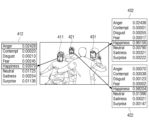
도 4a 및 도 4b는 주변 정보를 이용하여 사용자의 감정을 분석하는 방법을 설명하는 도면이다. 구체적으로, 도 4a 및 도 4b는 축구 경기 우승팀의 축구선수들을 촬영한 사진 데이터를 이용하여 사용자(411)의 감정을 판단하는 과정을 설명하는 도면이다.FIGS. 4A and 4B are diagrams illustrating a method of analyzing a user's emotions using surrounding information. Specifically, FIGS. 4A and 4B are diagrams illustrating the process of determining the emotions of the
프로세서(130)는 특징 데이터 판단 모듈(230)를 제어하여 사진 데이터로부터 특징 데이터를 생성할 수 있다. 예를 들어, 프로세서(130)는 특징 데이터 판단 모듈(230)를 제어하여 이미지 분석을 통해 사용자의 감정을 판단할 수 있다. 이때, 프로세서(130)는 특징 데이터 판단 모듈(230)를 제어하여 감정을 판단하고자 하는 사용자(411) 및 주변 인물(421,431)의 얼굴 표정을 분석하여 감정을 판단할 수 있다.The
구체적으로, 도 4a에 도시된 바와 같이, 프로세서(130)는 특징 데이터 판단 모듈(230)를 제어하여 사용자(411)의 얼굴 표정을 분석하여 감정 테이블(412)을 생성할 수 있다. 이때, 사용자(411)의 감정은 "화남"이다. 또한, 주변 인물(421,431) 및 주변 인물들의 감정 테이블(422,432)를 살펴보면 주변인물의 감정 상태는 "행복"이다. 이때, 사용자 및 주변 인물(411,421,431)의 감정 상태가 특징 데이터이며, 특징 데이터는 특징 데이터 저장 모듈(260)에 저장될 수 있다. 구체적으로, 사용자(411)의 "화남"에 대한 데이터는 제1 특징 데이터, 주변인물(421,431)의 "행복"에 대한 데이터는 제2 특징 데이터가 될 수 있다.Specifically, as shown in FIG. 4A, the
프로세서(130)는 감정 판단 모듈(240)을 제어하여 획득한 특징 데이터를 분석하고, 사용자(411)의 실제 감정을 판단할 수 있다. 구체적으로, 프로세서(130)는 감정 판단 모듈(240)을 제어하여 특징 데이터를 감정 인식 모델(220)에 입력하여 사용자(411)의 감정을 판단할 수 있다. 이때 프로세서(130)는 감정 판단 모듈(240)을 제어하여 주변 인물(421,422)에 관한 특징 데이터를 이용하여 사용자(411)가 행복한 상태임을 판단할 수 있다. 구체적으로, 프로세서(130)는 감정 판단 모듈(240)을 제어하여 도 4b에 도시된 바와 같이 주변 정보를 포함하여 사용자(411)의 감정이 "행복"임을 판단할 수 있다.The
상술한 실시예에서는 사용자 및 주변 인물(411,421,431)의 얼굴 표정만을 이용하여 사용자(411)의 감정을 분석하는 방법에 대하여 설명하였으나, 이에 한정되는 것은 아니다. 예를 들어, 제1 특징 데이터 및 제2 특징 데이터는 얼굴 표정뿐만 아니라, 시선 방향, 행동, 주변 상황, 주변 소음, 장소, 대화 내용등 다양한 데이터로부터 판단될 수 있다.In the above-described embodiment, a method of analyzing the emotions of the
도 5a 및 도 5b는 본 개시의 일 실시예에 따른 감정 원인 분석을 설명하기 위한 도면이다.5A and 5B are diagrams for explaining emotion cause analysis according to an embodiment of the present disclosure.
구체적으로, 도 5a는 전자 장치(100)에 의해 판단된 사용자의 감정을 나타낸 도면이다. 구체적으로, 사용자(511)의 감정 테이블(512)를 살펴보면, 사용자(511)는 "슬픔" 상태인 것을 알 수 있다. 또한, 사용자(521)의 감정 테이블(522)를 살펴보면 사용자(521)는 "행복" 상태임을 알 수 있다.Specifically, FIG. 5A is a diagram showing the user's emotions determined by the
이때, 사용자의 요청이 있는 경우, 전자 장치(100)는 사용자(511,521)의 감정 원인을 분석할 수 있다. 구체적으로, 프로세서(130)는 감정 추론 모듈(270)을 제어하여 감정 원인을 판단할 수 있다. 구체적으로, 특징 데이터 저장 모듈(260)에 저장된 특징 데이터를 감정 원인 추론 모델(250)에 입력하여 사용자의 감정 원인을 추론할 수 있다. 예를 들어, 프로세서(130)는 특정 감정과 관련된 특징 데이터를 분석하여 감정 원인을 추론할 수 있다. 즉, 프로세서(130)는 특징 데이터 저장 모듈(260)에 저장된 작은 크기의 데이터만을 이용하여 감정 원인을 판단할 수 있다.At this time, if there is a user request, the
구체적으로, 도 5b에 도시된 바와 같이, 프로세서(130)는 사용자(511)가 슬픈 원인에 대응하여 사용자의 친구가 사용자(511)를 괴롭히는 이미지(530)를 제공하고, 사용자(521) 기쁜 이유에 대응하여 사용자(521)가 선물을 받은 이미지(540)를 제공할 수 있다.Specifically, as shown in FIG. 5B, the
한편 상술한 바와 같이, 프로세서(130)는 사용자의 요청이 있는 경우, 사용자의 감정 및 감정 발생 원인을 특정 카테고리별로 분류하여 사용자에게 제공할 수 있다. 이때, 특정 카테고리란 시간 장소, 인물 또는 사건에 대한 것일 수 있으며, 그 외 다양한 카테고리일 수 있다. 예를 들어, 카테고리는 사용자가 특정 인물과 함께 있는 경우, 사용자가 특정 방송을 시청하는 경우, 특정 사이트에 접속하는 경우 등 다양할 수 있다. 그러나 상술한 실시예에 한정되는 것은 아니며 다양한 종류의 카테고리별로 사용자의 감정 및 감정 발생 원인을 분류할 수 있다.Meanwhile, as described above, if there is a user's request, the
한편, 사용자가 시간에 따른 감정 및 감정 원인에 대한 정보를 요청하는 경우, 프로세서(130)는 시간별 사용자의 감정 및 감정 발생 원인을 제공할 수 있다.Meanwhile, when the user requests information about emotions and causes of emotions according to time, the
이때, 프로세서(130)는 가장 특징적인 감정들을 요약하여 사용자에게 제공할 수 있다. 예를 들어, 하루 중, 사용자가 가장 화난 경우, 가장 흥분한 경우, 가장 행복한 경우, 가장 슬픈 경우 등을 특정하여 사용자에게 제공할 수 있다. 그러나 상술한 실시예에 한정되는 것은 아니며, 다양한 방법에 의해 사용자의 감정 및 감정 원인이 제공될 수 있다.At this time, the
이때, 사용자에게 제공되는 정보는 영상 데이터의 형태일 수 있다. 그러나 영상 데이터에 한정되는 것은 아니며, 음성 데이터 또는 텍스트 데이터로 제공될 수도 있으며, 상술한 다양한 데이터가 함께 제공될 수 있음은 물론이다.At this time, the information provided to the user may be in the form of image data. However, it is not limited to video data, and may be provided as voice data or text data, and of course, the various data described above may also be provided together.
예를 들어, 사용자가 감정 및 감정 원인 정보를 요청한 경우, 프로세서(130)는 도 5b와 같은 영상 데이터를 제공할 수 있다. 또는 프로세서(130)는, "제니는 오늘 전체적으로 재미있는 유치원 생활을 했지만, 블록 쌓기 시간에 친구와의 다툼으로 잠시 울었다. 하지만 결국엔 블록 쌓기 1등을 하여 선생님께 상을 받았고, 그때 최고로 즐거워하였다."와 같은 텍스트 또는 음성을 사용자에게 제공할 수도 있다.For example, when the user requests emotion and emotion cause information, the
한편, 상술한 실시예에서는 하나의 카테고리로 사용자의 감정을 분류하였으나 이에 한정되는 것은 아니다. 즉, 전자 장치(100)는 복수의 카테고리를 함께 고려하여 사용자의 감정을 분류할 수 있다. 예를 들어, 선택된 카테고리가 시간 및 장소인 경우, 전자 장치(100)는 특정 장소에서의 사용자의 감정을 시간에 따라 분류할 수 있다.Meanwhile, in the above-described embodiment, the user's emotions are classified into one category, but this is not limited to this. That is, the
도 6은 본 개시의 또다른 실시예에 따른 사용자의 실제 감정 및 감정 원인을 판단하는 과정을 설명하는 도면이다. 구체적으로, 도 6은 동일한 장소에서 시간에 따른 사용자의 감정을 판단하는 방법을 설명하는 도면이다.FIG. 6 is a diagram illustrating a process for determining a user's actual emotion and cause of the emotion according to another embodiment of the present disclosure. Specifically, FIG. 6 is a diagram explaining a method of determining a user's emotions over time at the same location.
프로세서(130)는 특징 데이터 판단 모듈(230) 및 감정 판단 모듈(240)을 제어하여 사용자의 감정을 판단할 수 있다. 예를 들어, 프로세서(130)는 특징 데이터 판단 모듈(130)를 제어하여 특징 데이터를 생성할 수 있다. 이때 특징 데이터는 사용자(611)의 얼굴 표정, 사용자(611)가 위치한 장소, 영상이 촬영된 시간에 관한 데이터일 수 있다. 프로세서(130)는 감정 판단 모듈(240)을 제어하여 감정 테이블(612)을 생성할 수 있으며, 14시 15분의 사용자(611)의 감정이 "중립" 임을 판단할 수 있다. The
또한, 프로세서(130)는 15시 15분의 사용자(621)의 감정을 판단할 수 있다. 예를 들어, 프로세서(130)는 특징 데이터 판단 모듈(130)를 제어하여 특징 데이터를 생성할 수 있다. 이때 특징 데이터는 사용자(611)의 얼굴 표정, 사용자(611)가 위치한 장소, 영상이 촬영된 시간에 관한 데이터일 수 있으며, 추가적으로, 해당 장소에서 판단된 사용자의 과거 감정을 포함할 수 있다. Additionally, the
프로세서(130)는 감정 판단 모듈(240)을 제어하여 감정 테이블(622)을 생성할 수 있으며, 15시 15분의 사용자(621)의 감정이 "행복" 임을 판단할 수 있다. The
한편, 도 5a 및 도 5b와 같이, 프로세서(130)는 사용자의 요청이 있는 경우, 사용자의 감정 및 감정 발생 원인을 특정 카테고리별로 분류하여 사용자에게 제공할 수 있다. Meanwhile, as shown in FIGS. 5A and 5B, when there is a user's request, the
상술한 바와 같이, 프로세서(130)는 사용자의 요청에 대응하여 영상 데이터를 제공할 수 있으며, 텍스트 또는 음성 메시지를 제공할 수도 있다.As described above, the
예를 들어, 사용자가 감정 및 감정 원인 정보를 요청한 경우, 프로세서(130)는 도 6과 같은 영상 데이터를 제공할 수 있다. 또는, 프로세서(160)는 "존은 오늘 낮 14시 15분에 에 공원 벤치에 앉아 여자친구를 기다렸다. 이때 존의 감정은 "중립" 이었으나, 15시 15분 여자친구를 만나 행복해졌다." 와 같은 텍스트 또는 음성을 사용자에게 제공할 수도 있다.For example, when a user requests emotion and emotion cause information, the
도 7은 본 개시의 일 실시예에 따른 전자 장치(100)의 제어 방법을 설명하기 위한 흐름도이다.FIG. 7 is a flowchart illustrating a control method of the
먼저, 전자 장치(100)는 외부 단말(200-1 내지 200-3)으로부터 영상 데이터 및 부가 데이터를 수신하여 획득할 수 있다(S710).First, the
전자 장치(100)는 획득된 데이터를 이용하여 특징 데이터를 생성할 수 있다. 구체적으로, 프로세서(130)는 특징 데이터 판단 모듈(230)을 제어하여 특징 데이터를 생성할 수 있다.The
전자 장치(100)는 생성된 특징 데이터를 감정 인식 모델에 입력하여 사용자의 실제 감정을 판단할 수 있다. The
도 8는 본 개시의 일 실시예에 따른 사용자 감정 판단 및 감정 원인 분석을 추론하기 위한 시스템의 제어 방법을 설명하기 위한 시퀀스도이다. 상술한 바와 같이, 도1 내지 도 7에서 설명한 전자 장치(100)는 서버(100)로 구현될 수 있다.FIG. 8 is a sequence diagram illustrating a control method of a system for inferring user emotion judgment and emotion cause analysis according to an embodiment of the present disclosure. As described above, the
이때, 사용자 단말(800)은 범용 프로세서를 포함하고, 서버(100)는 인공지능 전용 프로세서를 포함할 수 있다. 또는, 사용자 단말(800)은 적어도 하나의 어플리케이션을 포함할 수 있고, 서버(100)는 운영 체제(operating system)를 포함할 수 있다. 서버(100)는 사용자 단말(800)보다 더 집적화되거나, 전용화되거나, 딜레이(delay)가 작거나, 성능이 우수하거나 또는 많은 리소스를 가진 구성 요소로서 인식 모델의 생성, 갱신 또는 적용 시에 요구되는 많은 연산을 사용자 단말(800)보다 신속하고 효과적으로 처리 가능한 구성 요소가 될 수 있다. At this time, the
이 경우, 사용자 단말(800) 및 서버(100) 간에 데이터를 송/수신하기 위한 인터페이스가 정의될 수 있다. In this case, an interface for transmitting/receiving data between the
예로, 인식 모델에 적용할 학습 데이터를 인자 값(또는, 매개 값 또는 전달 값)으로 갖는 API(application program interface)가 정의될 수 있다. API는 어느 하나의 프로토콜(예로, 사용자 단말(800)에서 정의된 프로토콜)에서 다른 프로토콜(예로, 서버(100)에서 정의된 프로토콜)의 어떤 처리를 위해 호출할 수 있는 서브 루틴 또는 함수의 집합으로 정의될 수 있다. 즉, API를 통하여 어느 하나의 프로토콜에서 다른 프로토콜의 동작이 수행될 수 있는 환경을 제공될 수 있다.For example, an API (application program interface) may be defined that has learning data to be applied to a recognition model as an argument value (or a parameter value or transfer value). An API is a set of subroutines or functions that can be called for certain processing of another protocol (e.g., a protocol defined in the server 100) from one protocol (e.g., a protocol defined in the user terminal 800). can be defined. In other words, an environment in which operations of another protocol can be performed in one protocol can be provided through the API.
사용자 단말(800)은 데이터를 획득한다(S810). 이때, 데이터는 상술한 바와 같이 영상 데이터 및 부가데이터를 포함할 수 있다.The
사용자 단말(800)은 감정 분석을 위해 획득한 데이터를 서버(100)로 전송할 수 있다(S820).The
이때, 서버(100)는 사용자 단말(800)로부터 수신한 데이터를 이용하여 특징 데이터를 획득할 수 있다(S830). 생성된 특징 데이터는 서버(100)에 저장될 수 있으며, 사용자 단말(800)의 메모리에 저장될 수도 있다.At this time, the
서버(100)는 특징 데이터를 감정 판단 모델에 입력하여 사용자의 실제 감정을 판단할 수 있다(S840). The
서버(100)는 판단된 사용자 감정을 사용자 단말(800)로 전송할 수 있다(S850). 이때, 사용자 단말(800)이 감정 원인 분석을 요청한 경우(S860), 서버(100)는 감정 원인을 추론할 수 있다(S870). 구체적으로, 서버(100)는 특징 데이터를 감정 원인 추론 모델에 입력하여 감정 원인을 판단할 수 있다. The
도 9는 본 개시의 또 다른 실시예에 따른, 감정 판단 및 감정 원인 분석을 수행하는 사용자 단말을 설명하는 도면이다. FIG. 9 is a diagram illustrating a user terminal that performs emotion judgment and emotion cause analysis according to another embodiment of the present disclosure.
상술한 실시예에서는 전자 장치(100)가 서버로 구현되어 사용자의 실제 감정을 판단하고, 감정 원인을 분석하였으나 이러한 실시예에 한정되는 것은 아니다. 구체적으로, 도 9에 도시된 바와 같이 전자 장치(100)는 사용자 단말(800)로 구성될 수 있다. 예를 들어, 사용자 단말은(800) 스마트 폰, 타블렛 PC, 노트북 PC, 데스크탑 PC, 스마트 워치와 같은 웨어러블 장치, 전자 액자, 인간형 로봇, 오디오 장치, 스마트 TV 등과 같은 다양한 전자 장치로 구성되어 단독으로 사용자의 감정을 분석할 수도 있다.In the above-described embodiment, the
구체적으로, 도 9에 도시된 바와 같이, 사용자 단말(800)은 센서(810), 메모리(820), 디스플레이(830), 통신부(840) 촬영부(850) 및 프로세서(860)을 포함할 수 있다.Specifically, as shown in FIG. 9, the
센서(810)는 다양한 형태의 데이터를 감지할 수 있다. 예를 들어, 센서(810)는 자이로 센서, GPS 센서, 가속도 센서, 조도 센서, 습도 센서 등을 포함할 수 있다. 상술한 다양한 센서들은 다양한 데이터를 감지할 수 있다.The
메모리(820)는 센서로부터 감지한 데이터들을 저장할 수 있다. 또한, 메모리는 서버(100)로부터 특징 데이터를 수신하여 저장할 수도 있다. The
디스플레이(830)은, 사용자 단말(800)에 제공되는 다양한 컨텐츠를 표시할 수 있다. 이때, 디스플레이(830)는 액정 표시 장치(Liquid Crystal Display, LCD), 유기 전기 발광 다이오드(Organic Light Emitting Display, OLED) 또는 플라즈마 표시 패널(Plasma Display Panel, PDP) 등으로 구현되어, 사용자 단말(800)을 통해 제공 가능한 다양한 화면을 표시할 수 있다.The
통신부(840)는 와이파이 칩(841), 블루투스 칩(842), 무선 통신 칩(843), NFC칩(844)중 적어도 하나를 포함할 수 있다. 와이파이 칩(841)이나 블루투스 칩(842)을 이용하는 경우에는 SSID 및 세션 키 등과 같은 각종 연결 정보를 먼저 송수신하여, 이를 이용하여 통신 연결한 후 각종 정보들을 송수신할 수 있다. 무선 통신 칩(843)은 IEEE, Zigbee, 3G(3rd Generation), 3GPP(3rd Generation Partnership Project), LTE(Long Term Evolution) 등과 같은 다양한 통신 규격에 따라 통신을 수행하는 칩을 의미한다. NFC 칩(844)은 135kHz, 13.56MHz, 433MHz, 860~960MHz, 2.45GHz 등과 같은 다양한 RF-ID 주파수 대역들 중에서 13.56MHz 대역을 사용하는 NFC(Near Field Communication) 방식으로 동작하는 칩을 의미한다.The
통신부(840)는 상술한 바와 같이 서버(100)와의 통신을 수행할 수 있다. 구체적으로, 사용자 단말(800)은 통신부를 통해 다양한 데이터를 서버(100)로 전송할 수 있으며, 서버(100)로부터 다양한 결과를 수신할 수 있다.The
촬영부(850)는 영상 데이터를 촬영할 수 있다. 촬영된 영상 데이터는 센서(810)로부터 감지된 다양한 데이터들과 함께 사용자의 감정을 분석하기 위해 서버(100)로 전송될 수 있다.The photographing
프로세서(860)는 전자 장치의 전반적인 동작을 제어한다. 상술한 바와 같이, 프로세서(860)는 획득된 데이터를 이용하여 사용자의 감정을 판단하거나 감정 원인을 분석할 수도 있으며, 서버(100)의 요청이 있는 경우, 다양한 형태의 데이터를 전송하도록 통신부(840)를 제어할 수 있다.The
한편, 도 1 내지 도 9에서 상술한 다양한 실시예에서는, 영상 데이터를 분석하여 사용자의 감정을 분석하는 방법에 대하여 설명하였으나, 이에 한정되는 것은 아니다. 즉, 영상 데이터가 아닌 오디오 데이터를 이용하여 사용자 감정을 분석할 수도 있다. 예를 들어, 사용자의 통화 내용에 대한 오디오 데이터 및 통화 상대방, 통화 내용 등을 분석하여 사용자의 감정을 분석할 수 있다. 또는, 사용자가 작성하거나 공유한 다양한 컨텐츠(예를 들어, SNS에 작성하거나 공유한 글, 공유한 영상 및 해당 영상에 태그된 다른 사용자들)를 분석하여 사용자 감정을 판단할 수도 있다. 이와 같이 본 개시는 영상뿐만 아니라 다양한 컨텐츠들을 분석하여 사용자 감정을 판단할 수 있다.Meanwhile, in the various embodiments described above with reference to FIGS. 1 to 9, a method of analyzing a user's emotions by analyzing image data has been described, but the method is not limited thereto. In other words, user emotions can be analyzed using audio data rather than video data. For example, the user's emotions can be analyzed by analyzing the audio data of the user's call, the other party on the call, and the call content. Alternatively, the user's emotions may be determined by analyzing various contents written or shared by the user (for example, posts written or shared on SNS, shared videos, and other users tagged in the videos). In this way, the present disclosure can determine user emotions by analyzing various contents as well as videos.
도 10은 본 개시의 일부 실시 예에 따른 프로세서의 블록도이다. 도 10을 참조하면, 일부 실시 예에 따른 프로세서(130)는 데이터 학습부(131) 및 감정 판단부(132)를 포함할 수 있다.10 is a block diagram of a processor according to some embodiments of the present disclosure. Referring to FIG. 10 , the
데이터 학습부(131)는 사용자 감정 판단을 위한 기준을 학습할 수 있다. 프로세서(130)는 학습된 기준에 따라 입력된 데이터을 분석하여 사용자의 실제 감정을 판단할 수 있다. 데이터 학습부(131)는 사용자의 실제 감정을 판단하기 위하여 어떠한 데이터(또는 특징 데이터)를 이용할 것인지 결정할 수 있다. 또한, 데이터 학습부(131)는 학습에 이용될 데이터를 획득하고, 획득된 데이터를 후술할 감정 인식 모델 및 감정 추론 모델에 적용함으로써 사용자의 실제 감정 또는 감정 발생 원인 판단을 위한 기준을 학습할 수 있다.The
감정 판단부(132)는 기학습된 감정 인식 모델 및 감정 추론 모델을 이용하여, 소정의 데이터로부터 사용자의 실제 감정 또는 감정 발생 원인을 판단할 수 있다. 감정 판단부(132)는 학습에 의한 기설정된 기준에 따라 소정의 데이터(예를 들어, 특징 데이터)를 획득하고, 획득된 데이터를 입력값으로 하여 감정 판단 모델을 이용할 수 있다. 또한, 감정 판단부(132)는 입력된 데이터를 감정 판단 모델에 적용하여 사용자의 실제 감정을 판단할 수 있다. The
데이터 학습부(131)의 적어도 일부 및 감정 판단부(132)의 적어도 일부는, 소프트웨어 모듈로 구현되거나 적어도 하나의 하드웨어 칩 형태로 제작되어 전자 장치에 탑재될 수 있다. 예를 들어, 데이터 학습부(131) 및 데이터 인식부(132) 중 적어도 하나는 인공 지능(AI; artificial intelligence)을 위한 전용 하드웨어 칩 형태로 제작될 수도 있고, 또는 기존의 범용 프로세서(예: CPU 또는 application processor) 또는 그래픽 전용 프로세서(예: GPU)의 일부로 제작되어 전술한 각종 전자 장치에 탑재될 수도 있다. 이 때, 인공 지능을 위한 전용 하드웨어 칩은 확률 연산에 특화된 전용 프로세서로서, 기존의 범용 프로세서보다 병렬처리 성능이 높아 기계 학습과 같은 인공 지능 분야의 연산 작업을 빠르게 처리할 수 있다. 데이터 학습부(131) 및 데이터 인식부(132)가 소프트웨어 모듈(또는, 인스트럭션(instruction) 포함하는 프로그램 모듈)로 구현되는 경우, 소프트웨어 모듈은 컴퓨터로 읽을 수 있는 판독 가능한 비일시적 판독 가능 기록매체(non-transitory computer readable media)에 저장될 수 있다. 이 경우, 소프트웨어 모듈은 OS(Operating System)에 의해 제공되거나, 소정의 애플리케이션에 의해 제공될 수 있다. 또는, 소프트웨어 모듈 중 일부는 OS(Operating System)에 의해 제공되고, 나머지 일부는 소정의 애플리케이션에 의해 제공될 수 있다.At least a portion of the
데이터 인식 모델은, 인식 모델의 적용 분야, 학습의 목적 또는 장치의 컴퓨터 성능 등을 고려하여 구축될 수 있다. 데이터 인식 모델은, 예를 들어, 신경망(Neural Network)을 기반으로 하는 모델일 수 있다. 데이터 인식 모델은 인간의 뇌 구조를 컴퓨터 상에서 모의하도록 설계될 수 있다. 데이터 인식 모델은 인간의 신경망의 뉴런(neuron)을 모의하는, 가중치를 가지는 복수의 네트워크 노드들을 포함할 수 있다. 복수의 네트워크 노드들은 뉴런이 시냅스(synapse)를 통하여 신호를 주고 받는 시냅틱(synaptic) 활동을 모의하도록 각각 연결 관계를 형성할 수 있다. 데이터 인식 모델은, 일 예로, 신경망 모델, 또는 신경망 모델에서 발전한 딥 러닝 모델을 포함할 수 있다. 딥 러닝 모델에서 복수의 네트워크 노드들은 서로 다른 깊이(또는, 레이어)에 위치하면서 컨볼루션(convolution) 연결 관계에 따라 데이터를 주고 받을 수 있다.A data recognition model may be built considering the application field of the recognition model, the purpose of learning, or the computer performance of the device. The data recognition model may be, for example, a model based on a neural network. A data recognition model can be designed to simulate the structure of the human brain on a computer. The data recognition model may include a plurality of network nodes with weights that simulate neurons of a human neural network. A plurality of network nodes can each form a connection relationship to simulate synaptic activity in which neurons send and receive signals through synapses. The data recognition model may include, for example, a neural network model or a deep learning model developed from a neural network model. In a deep learning model, multiple network nodes are located at different depths (or layers) and can exchange data according to convolutional connections.
예컨대, DNN(Deep Neural Network), RNN(Recurrent Neural Network), BRDNN(Bidirectional Recurrent Deep Neural Network)과 같은 모델이 데이터 인식 모델로서 사용될 수 있으나, 이에 한정되지 않는다.For example, models such as Deep Neural Network (DNN), Recurrent Neural Network (RNN), and Bidirectional Recurrent Deep Neural Network (BRDNN) may be used as data recognition models, but are not limited thereto.
도 10의 실시 예에서는 데이터 학습부(131) 및 감정 판단부(132)가 모두 전자 장치(100)에 탑재된 경우를 도시하였으나, 이들은 각각 별개의 장치에 탑재될 수도 있다. 예를 들어, 데이터 학습부(131) 및 감정 판단부(132) 중 하나는 서버(100)에 포함되고, 나머지 하나는 사용자 단말(800)에 포함될 수 있다. 또한 데이터 학습부(131) 및 감정 판단부(132)는 서로 유선 또는 무선으로 연결되어, 데이터 학습부(131)가 구축한 감정 판단 모델에 대한 정보가 감정 판단부(132)로 제공될 수 있고, 감정 판단부(132)로 입력된 데이터가 추가 학습 데이터로 데이터 학습부(131)로 제공될 수도 있다.10 illustrates a case where both the
한편, 데이터 학습부(131) 및 감정 판단부(132) 중 적어도 하나는 소프트웨어 모듈로 구현될 수 있다. 데이터 학습부(131) 및 감정 판단부(132) 중 적어도 하나가 소프트웨어 모듈(또는, 인스트럭션을 포함하는 프로그램 모듈)로 구현되는 경우, 소프트웨어 모듈은 비일시적 컴퓨터 판독 가능 기록매체에 저장될 수 있다. 적어도 하나의 소프트웨어 모듈은 OS(Operating System)에 의해 제공되거나, 소정의 어플리케이션에 의해 제공될 수 있다. 또는 적어도 하나의 소프트웨어 모듈 중 일부는 OS에 의해 제공되고, 나머지 일부는 소정의 어플리케이션에 의해 제공될 수도 있다.Meanwhile, at least one of the
도 11a는 본 개시의 일부 실시 예에 따른 데이터 학습부(131)의 블록도이다. 도 11a를 참조하면, 일부 실시 예에 따른 데이터 학습부(131)는 데이터 획득부(131-1), 전처리부(131-2), 학습 데이터 선택부(131-3), 모델 학습부(131-4) 및 모델 평가부(131-5)를 포함할 수 있다.FIG. 11A is a block diagram of the
데이터 획득부(131-1)는 사용자의 실제 감정을 판단하기 위해 필요한 데이터를 획득할 수 있다. 특히, 데이터 획득부(131-1)는 영상 데이터, 부가 데이터 또는 영상 데이터 및 부가 데이터로부터 생성된 특징 데이터를 학습 데이터로 획득할 수 있다. The data acquisition unit 131-1 may acquire data necessary to determine the user's actual emotion. In particular, the data acquisition unit 131-1 may acquire image data, additional data, or feature data generated from image data and additional data as learning data.
전처리부(131-2)는 사용자의 실제 감정 판단을 위한 학습에 획득된 데이터가 이용될 수 있도록, 획득된 데이터를 전처리할 수 있다. 전처리부(131-2)는 후술할 모델 학습부(131-4)가 사용자의 실제 감정 판단을 위한 학습을 위하여 획득된 데이터를 이용할 수 있도록, 획득된 데이터를 기설정된 포맷으로 가공할 수 있다.The preprocessor 131-2 may preprocess the acquired data so that the acquired data can be used for learning to determine the user's actual emotion. The pre-processing unit 131-2 may process the acquired data into a preset format so that the model learning unit 131-4, which will be described later, can use the acquired data for learning to determine the user's actual emotion.
학습 데이터 선택부(131-3)는 전처리된 데이터 중에서 학습에 필요한 데이터를 선택할 수 있다. 선택된 데이터는 모델 학습부(131-4)에 제공될 수 있다. 학습 데이터 선택부(131-3)는 사용자의 실제 감정 판단을 위한 기설정된 기준에 따라, 전처리된 데이터 중에서 학습에 필요한 데이터를 선택할 수 있다. 또한, 학습 데이터 선택부(131-3)는 후술할 모델 학습부(131-4)에 의한 학습에 의해 기설정된 기준에 따라 데이터를 선택할 수도 있다. 모델 학습부(131-4)는 학습 데이터에 기초하여 사용자의 실제 감정을 어떻게 판단할지에 관한 기준을 학습할 수 있다. 또한, 모델 학습부(131-4)는 사용자의 실제 감정 판단을 위하여 어떤 학습 데이터를 이용해야 하는지에 대한 기준을 학습할 수도 있다.The learning data selection unit 131-3 may select data required for learning from preprocessed data. The selected data may be provided to the model learning unit 131-4. The learning data selection unit 131-3 may select data required for learning from preprocessed data according to preset standards for determining the user's actual emotion. Additionally, the learning data selection unit 131-3 may select data according to preset criteria through learning by the model learning unit 131-4, which will be described later. The model learning unit 131-4 may learn standards for how to determine the user's actual emotions based on the learning data. Additionally, the model learning unit 131-4 may learn standards for what learning data should be used to determine the user's actual emotion.
모델 학습부(131-4)는 사용자의 실제 감정 판단에 이용되는 감정 판단 모델을 학습 데이터를 이용하여 학습시킬 수 있다. 이 경우, 감정 판단 모델은 미리 구축된 모델일 수 있다. 예를 들어, 감정 판단 모델은 기본 학습 데이터을 입력 받아 미리 구축된 모델일 수 있다. 다른 예로, 감정 판단 모델은 빅데이터를 이용하여 미리 구축된 모델일 수 있다. The model learning unit 131-4 may train an emotion judgment model used to judge the user's actual emotion using learning data. In this case, the emotion judgment model may be a pre-built model. For example, the emotion judgment model may be a pre-built model that receives basic learning data as input. As another example, the emotion judgment model may be a model built in advance using big data.
감정 판단 모델은, 인식 모델의 적용 분야, 학습의 목적 또는 장치의 컴퓨터 성능 등을 고려하여 구축될 수 있다. 감정 판단 모델은, 예를 들어, 신경망(Neural Network)을 기반으로 하는 모델일 수 있다. 예컨대, DNN(Deep Neural Network), RNN(Recurrent Neural Network), BRDNN(Bidirectional Recurrent Deep Neural Network)과 같은 모델이 감정 판단 모델로서 사용될 수 있으나, 이에 한정되지 않는다.The emotion judgment model may be constructed taking into account the application field of the recognition model, the purpose of learning, or the computer performance of the device. The emotion judgment model may be, for example, a model based on a neural network. For example, models such as Deep Neural Network (DNN), Recurrent Neural Network (RNN), and Bidirectional Recurrent Deep Neural Network (BRDNN) may be used as emotion judgment models, but are not limited thereto.
구체적으로, 본 개시에 따른 감정 판단 모델은 도 3a에 도시된 바와 같이 DNN 모델을 이용할 수 있다. 그러나, 도 3b에 도시된 바와 같이 RNN 모델을 이용하여 사용자의 실제 감정을 판단할 수도 있다. 구체적으로, RNN 모델에 의할 경우, 과거 데이터 과거 감정(311 내지313) 및 현재의 데이터 입력(321)를 이용하여 현재의 감정(t)(322)를 획득할 수 있다. 또한 미래의 감정(t+1)(333)을 판단하는 경우 데이터 입력(331)과 현재의 데이터 입력(321)을 이용할 수 있다.Specifically, the emotion judgment model according to the present disclosure may use a DNN model as shown in FIG. 3A. However, as shown in Figure 3b, the user's actual emotion can also be determined using a RNN model. Specifically, in the case of the RNN model, the current emotion (t) 322 can be obtained using past data
다양한 실시 예에 따르면, 모델 학습부(131-4)는 미리 구축된 감정 판단 모델이 복수 개가 존재하는 경우, 입력된 학습 데이터와 기본 학습 데이터의 관련성이 큰 감정 판단 모델을 학습할 감정 판단 모델로 결정할 수 있다. 이 경우, 기본 학습 데이터는 데이터의 타입별로 기분류되어 있을 수 있으며, 감정 판단 모델은 데이터의 타입별로 미리 구축되어 있을 수 있다. 예를 들어, 기본 학습 데이터는 학습 데이터가 생성된 지역, 학습 데이터가 생성된 시간, 학습 데이터의 크기, 학습 데이터의 장르, 학습 데이터의 생성자, 학습 데이터 내의 오브젝트의 종류 등과 같은 다양한 기준으로 기분류되어 있을 수 있다. According to various embodiments, when there are a plurality of pre-built emotion judgment models, the model learning unit 131-4 selects an emotion judgment model with a high correlation between the input learning data and the basic learning data as an emotion judgment model to be learned. You can decide. In this case, the basic learning data may be classified by data type, and the emotion judgment model may be built in advance for each data type. For example, the basic training data is categorized by various criteria such as the region where the training data was created, the time the training data was created, the size of the training data, the genre of the training data, the creator of the training data, the type of object in the training data, etc. It may be.
또한, 모델 학습부(131-4)는, 예를 들어, 오류 역전파법(error back-propagation) 또는 경사 하강법(gradient descent)을 포함하는 학습 알고리즘 등을 이용하여 감정 판단 모델을 학습시킬 수 있다.In addition, the model learning unit 131-4 may learn an emotion judgment model using, for example, a learning algorithm including error back-propagation or gradient descent. .
예를 들어, 모델 학습부(131-4)는 학습 데이터를 입력 값으로 하는 지도 학습(supervised learning) 을 통하여 감정 판단 모델을 학습시킬 수 있다. 다른 예로, 모델 학습부(131-4)는 별도의 지도 없이 감정 판단을 위해 필요한 데이터의 종류를 스스로 학습함으로써 감정 판단을 위한 기준을 발견하는 비지도 학습(unsupervised learning)을 통하여, 감정 판단 모델을 학습시킬 수 있다. 또 다른 예로, 모델 학습부(131-4)는 학습에 따른 감정 판단의 결과가 올바른지에 대한 피드백을 이용하는 강화 학습(reinforcement learning)을 통하여, 감정 판단 모델을 학습시킬 수 있다.For example, the model learning unit 131-4 can learn an emotion judgment model through supervised learning using training data as input. As another example, the model learning unit 131-4 creates an emotion judgment model through unsupervised learning, which discovers a standard for emotion judgment by learning the type of data needed for emotion judgment on its own without separate guidance. It can be learned. As another example, the model learning unit 131-4 may learn an emotion judgment model through reinforcement learning that uses feedback regarding whether the result of the emotion judgment resulting from learning is correct.
또한, 감정 판단 모델이 학습되면, 모델 학습부(131-4)는 학습된 감정 판단 모델을 저장할 수 있다. 이 경우, 모델 학습부(131-4)는 학습된 감정 판단 모델을 전자 장치(100)의 메모리(120)에 저장할 수 있다. Additionally, when the emotion judgment model is learned, the model learning unit 131-4 may store the learned emotion judgment model. In this case, the model learning unit 131-4 may store the learned emotion judgment model in the
이 경우, 학습된 감정 판단 모델이 저장되는 메모리(120)는 전자 장치(100)의 적어도 하나의 다른 구성요소에 관계된 명령 또는 데이터를 함께 저장할 수도 있다. 또한, 메모리(120)는 소프트웨어 및/또는 프로그램을 저장할 수도 있다. 예를 들어, 프로그램은 커널, 미들웨어, 어플리케이션 프로그래밍 인터페이스(API) 및/또는 어플리케이션 프로그램(또는 "어플리케이션") 등을 포함할 수 있다.In this case, the
모델 평가부(131-5)는 감정 판단 모델에 평가 데이터를 입력하고, 평가 데이터로부터 출력되는 판단 결과가 소정 기준을 만족하지 못하는 경우, 모델 학습부(131-4)로 하여금 다시 학습하도록 할 수 있다. 이 경우, 평가 데이터는 감정 판단 모델을 평가하기 위한 기설정된 데이터일 수 있다. The model evaluation unit 131-5 inputs evaluation data into the emotion judgment model, and, if the judgment result output from the evaluation data does not satisfy a predetermined standard, can cause the model learning unit 131-4 to learn again. there is. In this case, the evaluation data may be preset data for evaluating the emotion judgment model.
예를 들어, 모델 평가부(131-5)는 평가 데이터에 대한 학습된 감정 판단 모델의 판단 결과 중에서, 판단 결과가 정확하지 않은 평가 데이터의 개수 또는 비율이 미리 설정된 임계치를 초과하는 경우 소정 기준을 만족하지 못한 것으로 평가할 수 있다. 예컨대, 소정 기준이 비율 2%로 정의되는 경우, 학습된 감정 판단 모델이 총 1000개의 평가 데이터 중의 20개를 초과하는 평가 데이터에 대하여 잘못된 판단 결과를 출력하는 경우, 모델 평가부(131-5)는 학습된 감정 판단 모델이 적합하지 않은 것으로 평가할 수 있다.For example, the model evaluation unit 131-5 applies a predetermined standard when the number or ratio of evaluation data for which the judgment result is inaccurate among the judgment results of the learned emotion judgment model for the evaluation data exceeds a preset threshold. It can be evaluated as unsatisfactory. For example, when the predetermined standard is defined as a ratio of 2%, and the learned emotion judgment model outputs an incorrect judgment result for more than 20 evaluation data out of a total of 1000 evaluation data, the model evaluation unit 131-5 It can be evaluated that the learned emotion judgment model is not suitable.
한편, 학습된 감정 판단 모델이 복수 개가 존재하는 경우, 모델 평가부(131-5)는 각각의 학습된 감정 판단 모델에 대하여 소정 기준을 만족하는지를 평가하고, 소정 기준을 만족하는 모델을 최종 감정 판단 모델로서 결정할 수 있다. 이 경우, 소정 기준을 만족하는 모델이 복수 개인 경우, 모델 평가부(131-5)는 평가 점수가 높은 순으로 미리 설정된 어느 하나 또는 소정 개수의 모델을 최종 감정 판단 모델로서 결정할 수 있다.Meanwhile, when there are a plurality of learned emotion judgment models, the model evaluation unit 131-5 evaluates whether each learned emotion judgment model satisfies a predetermined standard, and makes a final emotion judgment on the model that satisfies the predetermined standard. You can decide as a model. In this case, when there are multiple models that satisfy a predetermined standard, the model evaluation unit 131-5 may determine one or a predetermined number of models preset in order of highest evaluation score as the final emotion judgment model.
한편, 데이터 학습부(131) 내의 데이터 획득부(131-1), 전처리부(131-2), 학습 데이터 선택부(131-3), 모델 학습부(131-4) 및 모델 평가부(131-5) 중 적어도 하나는, 적어도 하나의 하드웨어 칩 형태로 제작되어 전자 장치에 탑재될 수 있다. 예를 들어, 데이터 획득부(131-1), 전처리부(131-2), 학습 데이터 선택부(131-3), 모델 학습부(131-4) 및 모델 평가부(131-5) 중 적어도 하나는 인공 지능(AI; artificial intelligence)을 위한 전용 하드웨어 칩 형태로 제작될 수도 있고, 또는 기존의 범용 프로세서(예를 들어, CPU 또는 application processor) 또는 특정 기능을 위한 IP의 일부로 제작되어 전술한 각종 전자 장치(100)에 탑재될 수도 있다.Meanwhile, the data acquisition unit 131-1, pre-processing unit 131-2, learning data selection unit 131-3, model learning unit 131-4, and
또한, 데이터 획득부(131-1), 전처리부(131-2), 학습 데이터 선택부(131-3), 모델 학습부(131-4) 및 모델 평가부(131-5)는 하나의 전자 장치에 탑재될 수도 있으며, 또는 별개의 전자 장치들에 각각 탑재될 수도 있다. 예를 들어, 데이터 획득부(131-1), 전처리부(131-2), 학습 데이터 선택부(131-3), 모델 학습부(131-4) 및 모델 평가부(131-5) 중 일부는 전자 장치(100)에 포함되고, 나머지 일부는 서버(200)에 포함될 수 있다.In addition, the data acquisition unit 131-1, the pre-processing unit 131-2, the learning data selection unit 131-3, the model learning unit 131-4, and the model evaluation unit 131-5 are one electronic unit. It may be mounted on a device, or it may be mounted on separate electronic devices. For example, some of the data acquisition unit 131-1, preprocessing unit 131-2, learning data selection unit 131-3, model learning unit 131-4, and model evaluation unit 131-5. may be included in the
한편, 데이터 획득부(131-1), 전처리부(131-2), 학습 데이터 선택부(131-3), 모델 학습부(131-4) 및 모델 평가부(131-5) 중 적어도 하나는 소프트웨어 모듈로 구현될 수 있다. 데이터 획득부(131-1), 전처리부(131-2), 학습 데이터 선택부(131-3), 모델 학습부(131-4) 및 모델 평가부(131-5) 중 적어도 하나가 소프트웨어 모듈(또는, 인스트럭션을 포함하는 프로그램 모듈)로 구현되는 경우, 소프트웨어 모듈은 비일시적 컴퓨터 판독가능 기록매체에 저장될 수 있다. 적어도 하나의 소프트웨어 모듈은 OS(Operating System)에 의해 제공되거나, 소정의 어플리케이션에 의해 제공될 수 있다. 또는 적어도 하나의 소프트웨어 모듈 중 일부는 OS에 의해 제공되고, 나머지 일부는 소정의 어플리케이션에 의해 제공될 수도 있다.Meanwhile, at least one of the data acquisition unit 131-1, the preprocessing unit 131-2, the learning data selection unit 131-3, the model learning unit 131-4, and the model evaluation unit 131-5 It can be implemented as a software module. At least one of the data acquisition unit 131-1, the preprocessing unit 131-2, the learning data selection unit 131-3, the model learning unit 131-4, and the model evaluation unit 131-5 is a software module. When implemented as a program module (or a program module including instructions), the software module may be stored in a non-transitory computer-readable recording medium. At least one software module may be provided by an operating system (OS) or a predetermined application. Alternatively, part of at least one software module may be provided by the OS, and the remaining part may be provided by a predetermined application.
도 11b는 본 개시의 일부 실시 예에 따른 감정 판단부(132)의 블록도이다. 도 11b를 참조하면, 일부 실시예에 따른 감정 판단부(132)는 데이터 획득부(132-1), 전처리부(132-2), 데이터 선택부(132-3), 판단 결과 제공부(132-4) 및 모델 갱신부(132-5)를 포함할 수 있다FIG. 11B is a block diagram of the
데이터 획득부(132-1)는 사용자의 실제 감정 판단에 필요한 데이터를 획득할 수 있으며, 전처리부(132-2)는 사용자의 실제 감정 판단을 위해 획득된 데이터가 이용될 수 있도록, 획득된 데이터를 전처리할 수 있다. 전처리부(132-2)는 후술할 판단 결과 제공부(132-4)가 사용자의 실제 감정 판단을 위하여 획득된 데이터를 이용할 수 있도록, 획득된 데이터를 기설정된 포맷으로 가공할 수 있다. The data acquisition unit 132-1 can acquire data necessary for determining the user's actual emotion, and the preprocessor 132-2 can obtain data so that the acquired data can be used to determine the user's actual emotion. can be preprocessed. The pre-processing unit 132-2 may process the acquired data into a preset format so that the judgment result providing unit 132-4, which will be described later, can use the acquired data to determine the user's actual emotion.
데이터 선택부(132-3)는 전처리된 데이터 중에서 사용자의 실제 감정 판단에 필요한 데이터를 선택할 수 있다. 선택된 데이터는 판단 결과 제공부(132-4)에게 제공될 수 있다. 데이터 선택부(132-3)는 사용자의 실제 감정 판단을 위한 기설정된 기준에 따라, 전처리된 데이터 중에서 일부 또는 전부를 선택할 수 있다. 또한, 데이터 선택부(132-3)는 후술할 모델 학습부(142-4)에 의한 학습에 의해 기설정된 기준에 따라 데이터를 선택할 수도 있다.The data selection unit 132-3 may select data necessary for determining the user's actual emotion from the preprocessed data. The selected data may be provided to the judgment result providing unit 132-4. The data selection unit 132-3 may select some or all of the preprocessed data according to preset criteria for determining the user's actual emotion. Additionally, the data selection unit 132-3 may select data according to preset criteria through learning by the model learning unit 142-4, which will be described later.
판단 결과 제공부(132-4)는 선택된 데이터를 감정 판단 모델에 적용하여 사용자의 실제 감정을 판단할 수 있다. 판단 결과 제공부(132-4)는 데이터 선택부(132-3)에 의해 선택된 데이터를 입력 값으로 이용함으로써, 선택된 데이터를 감정 판단 모델에 적용할 수 있다. 또한, 판단 결과는 감정 판단 모델에 의해 결정될 수 있다. 예를 들어, 판단 결과 제공부(132-4)는 사용자의 실제 감정을 판단할 수 있는 데이터를 감정 판단 모델에 입력하여 사용자의 실제 감정을 판단할 수 있다.The judgment result providing unit 132-4 may determine the user's actual emotion by applying the selected data to the emotion judgment model. The judgment result providing unit 132-4 can apply the selected data to the emotion judgment model by using the data selected by the data selection unit 132-3 as an input value. Additionally, the judgment result may be determined by an emotion judgment model. For example, the judgment result providing unit 132-4 may determine the user's actual emotion by inputting data capable of determining the user's actual emotion into the emotion judgment model.
모델 갱신부(132-5)는 판단 결과 제공부(132-4)에 의해 제공되는 판단 결과에 대한 평가에 기초하여, 감정 판단 모델이 갱신되도록 할 수 있다. 예를 들어, 모델 갱신부(132-5)는 판단 결과 제공부(132-4)에 의해 제공되는 판단 결과를 모델 학습부(131-4)에게 제공함으로써, 모델 학습부(131-4)가 감정 판단 모델을 갱신하도록 할 수 있다.The model updating unit 132-5 may update the emotion judgment model based on the evaluation of the judgment result provided by the judgment result providing unit 132-4. For example, the model updating unit 132-5 provides the decision result provided by the judgment result providing unit 132-4 to the model learning unit 131-4, so that the model learning unit 131-4 The emotion judgment model can be updated.
한편, 감정 판단부(132) 내의 데이터 획득부(132-1), 전처리부(132-2), 데이터 선택부(132-3), 판단 결과 제공부(132-4) 및 모델 갱신부(132-5) 중 적어도 하나는, 적어도 하나의 하드웨어 칩 형태로 제작되어 전자 장치에 탑재될 수 있다. 예를 들어, 데이터 획득부(132-1), 전처리부(132-2), 데이터 선택부(132-3), 판단 결과 제공부(132-4) 및 모델 갱신부(132-5) 중 적어도 하나는 인공 지능(AI; artificial intelligence)을 위한 전용 하드웨어 칩 형태로 제작될 수도 있고, 또는 기존의 범용 프로세서(예를 들어, CPU 또는 application processor) 또는 특정 기능을 위한 IP의 일부로 제작되어 전술한 각종 전자 장치(100)에 탑재될 수도 있다.Meanwhile, the data acquisition unit 132-1, pre-processing unit 132-2, data selection unit 132-3, judgment result providing unit 132-4, and
또한, 데이터 획득부(132-1), 전처리부(132-2), 데이터 선택부(132-3), 판단 결과 제공부(132-4) 및 모델 갱신부(132-5) 하나의 전자 장치에 탑재될 수도 있으며, 또는 별개의 전자 장치들에 각각 탑재될 수도 있다. 예를 들어, 데이터 획득부(132-1), 전처리부(132-2), 데이터 선택부(132-3), 판단 결과 제공부(132-4) 및 모델 갱신부(132-5) 중 일부는 전자 장치(100)에 포함되고, 나머지 일부는 전자 잗치(100)와 연동하는 서버에 포함될 수 있다.In addition, a data acquisition unit 132-1, a pre-processing unit 132-2, a data selection unit 132-3, a judgment result providing unit 132-4, and a model update unit 132-5 are included in one electronic device. It may be mounted on a , or it may be mounted on separate electronic devices. For example, some of the data acquisition unit 132-1, preprocessing unit 132-2, data selection unit 132-3, judgment result provision unit 132-4, and model update unit 132-5. may be included in the
한편, 데이터 획득부(132-1), 전처리부(132-2), 데이터 선택부(132-3), 판단 결과 제공부(132-4) 및 모델 갱신부(132-5) 중 적어도 하나는 소프트웨어 모듈로 구현될 수 있다. 데이터 획득부(132-1), 전처리부(132-2), 데이터 선택부(132-3), 판단 결과 제공부(132-4) 및 모델 갱신부(132-5) 중 적어도 하나가 소프트웨어 모듈(또는, 인스트럭션을 포함하는 프로그램 모듈)로 구현되는 경우, 소프트웨어 모듈은 비일시적 컴퓨터 판독가능 기록매체에 저장될 수 있다. 적어도 하나의 소프트웨어 모듈은 OS(Operating System)에 의해 제공되거나, 소정의 어플리케이션에 의해 제공될 수 있다. 또는 적어도 하나의 소프트웨어 모듈 중 일부는 OS에 의해 제공되고, 나머지 일부는 소정의 어플리케이션에 의해 제공될 수도 있다.Meanwhile, at least one of the data acquisition unit 132-1, the pre-processing unit 132-2, the data selection unit 132-3, the judgment result providing unit 132-4, and the model updating unit 132-5 It can be implemented as a software module. At least one of the data acquisition unit 132-1, preprocessing unit 132-2, data selection unit 132-3, judgment result providing unit 132-4, and model update unit 132-5 is a software module. When implemented as a program module (or a program module including instructions), the software module may be stored in a non-transitory computer-readable recording medium. At least one software module may be provided by an operating system (OS) or a predetermined application. Alternatively, part of at least one software module may be provided by the OS, and the remaining part may be provided by a predetermined application.
한편, 도 10 내지 도 11b에서는, 사용자의 실제 감정을 판단하기 위한 감정 판단 모델을 중심으로 설명하였으나, 사용자의 감정 발생 원인을 판단할 수 있는 감정 추론 모델에도 상술한 기술적 사상이 적용될 수 있음은 물론이다. 구체적으로, 프로세서(130)는 데이터 학습부(131) 및 감정 추론부(미도시)를 포함할 수 있으며, 프로세서(130)는 감정 추론 모델을 구축할 수 있음은 물론이다.Meanwhile, in FIGS. 10 to 11B, the explanation is centered on the emotion judgment model for determining the user's actual emotion, but the above-described technical idea can also be applied to the emotion inference model for determining the cause of the user's emotion. am. Specifically, the
본 개시에서 사용된 용어 "~부"는 하드웨어, 소프트웨어 또는 펌웨어로 구성된 유닛을 포함하며, 예를 들면, 로직, 논리 블록, 부품, 또는 회로 등의 용어와 상호 호환적으로 사용될 수 있다. 모듈은, 일체로 구성된 부품 또는 하나 또는 그 이상의 기능을 수행하는 최소 단위 또는 그 일부가 될 수 있다. 예를 들면, 모듈은 ASIC(application-specific integrated circuit)으로 구성될 수 있다. The term “unit” used in the present disclosure includes a unit comprised of hardware, software, or firmware, and may be used interchangeably with terms such as logic, logic block, component, or circuit, for example. A module may be an integrated part, a minimum unit that performs one or more functions, or a part thereof. For example, a module may be comprised of an application-specific integrated circuit (ASIC).
본 문서의 다양한 실시예들은 기기(machine)(예: 컴퓨터)로 읽을 수 있는 저장 매체(machine-readable storage media에 저장된 명령어를 포함하는 소프트웨어로 구현될 수 있다. 기기는, 저장 매체로부터 저장된 명령어를 호출하고, 호출된 명령어에 따라 동작이 가능한 장치로서, 개시된 실시예들에 따른 전자 장치(예: 전자 장치(A))를 포함할 수 있다. 상기 명령이 프로세서에 의해 실행될 경우, 프로세서가 직접, 또는 상기 프로세서의 제어하에 다른 구성요소들을 이용하여 상기 명령에 해당하는 기능을 수행할 수 있다. 명령은 컴파일러 또는 인터프리터에 의해 생성 또는 실행되는 코드를 포함할 수 있다. 기기로 읽을 수 있는 저장매체는, 비일시적(non-transitory) 저장매체의 형태로 제공될 수 있다. 여기서, '비일시적'은 저장매체가 신호(signal)를 포함하지 않으며 실재(tangible)한다는 것을 의미할 뿐 데이터가 저장매체에 반영구적 또는 임시적으로 저장됨을 구분하지 않는다.Various embodiments of this document may be implemented as software including instructions stored in a machine-readable storage media that can be read by a machine (e.g., a computer). The device may read instructions stored from the storage medium. A device capable of calling and operating according to the called instruction, may include an electronic device (e.g., electronic device A) according to the disclosed embodiments. When the instruction is executed by a processor, the processor directly: Alternatively, the function corresponding to the command may be performed using other components under the control of the processor. The command may include code generated or executed by a compiler or interpreter. The storage medium that can be read by a device is , It can be provided in the form of a non-transitory storage medium. Here, 'non-transitory' only means that the storage medium does not contain signals and is tangible, and the data is stored in the storage medium. There is no distinction between semi-permanent or temporary storage.
일시예에 따르면, 본 문서에 개시된 다양한 실시예들에 따른 방법은 컴퓨터 프로그램 제품(computer program product)에 포함되어 제공될 수 있다. 컴퓨터 프로그램 제품은 상품으로서 판매자 및 구매자 간에 거래될 수 있다. 컴퓨터 프로그램 제품은 기기로 읽을 수 있는 저장 매체(예: compact disc read only memory (CD-ROM))의 형태로, 또는 어플리케이션 스토어(예: 플레이 스토어TM)를 통해 온라인으로 배포될 수 있다. 온라인 배포의 경우에, 컴퓨터 프로그램 제품의 적어도 일부는 제조사의 서버, 어플리케이션 스토어의 서버, 또는 중계 서버의 메모리와 같은 저장 매체에 적어도 일시 저장되거나, 임시적으로 생성될 수 있다.According to one example, methods according to various embodiments disclosed in this document may be provided and included in a computer program product. Computer program products are commodities and can be traded between sellers and buyers. The computer program product may be distributed on a machine-readable storage medium (e.g. compact disc read only memory (CD-ROM)) or online through an application store (e.g. Play Store™). In the case of online distribution, at least a portion of the computer program product may be at least temporarily stored or created temporarily in a storage medium such as the memory of a manufacturer's server, an application store's server, or a relay server.
다양한 실시예들에 따른 구성 요소(예: 모듈 또는 프로그램) 각각은 단수 또는 복수의 개체로 구성될 수 있으며, 전술한 해당 서브 구성 요소들 중 일부 서브 구성 요소가 생략되거나, 또는 다른 서브 구성 요소가 다양한 실시예에 더 포함될 수 있다. 대체적으로 또는 추가적으로, 일부 구성 요소들(예: 모듈 또는 프로그램)은 하나의 개체로 통합되어, 통합되기 이전의 각각의 해당 구성 요소에 의해 수행되는 기능을 동일 또는 유사하게 수행할 수 있다. 다양한 실시예들에 따른, 모듈, 프로그램 또는 다른 구성 요소에 의해 수행되는 동작들은 순차적, 병렬적, 반복적 또는 휴리스틱하게 실행되거나, 적어도 일부 동작이 다른 순서로 실행되거나, 생략되거나, 또는 다른 동작이 추가될 수 있다.Each component (e.g., module or program) according to various embodiments may be composed of a single or multiple entities, and some of the above-described sub-components may be omitted or other sub-components may be used. It may be further included in various embodiments. Alternatively or additionally, some components (e.g., modules or programs) may be integrated into a single entity and perform the same or similar functions performed by each corresponding component prior to integration. According to various embodiments, operations performed by a module, program, or other component may be executed sequentially, in parallel, iteratively, or heuristically, or at least some operations may be executed in a different order, omitted, or other operations may be added. It can be.
이상과 같이 본 개시는 비록 한정된 실시 예와 도면에 의해 설명되었으나, 본 개시는 상기의 실시 예에 한정되는 것은 아니며, 본 개시가 속하는 분야에서 통상의 지식을 가진 자라면 이러한 기재로부터 다양한 수정 및 변형이 가능하다. 그러므로, 본 개시의 범위는 설명된 실시 예에 국한되어 정해져서는 아니 되며, 후술하는 특허청구범위뿐 아니라 이 특허청구범위와 균등한 것들에 의해 정해져야 한다.As described above, although the present disclosure has been described with limited examples and drawings, the present disclosure is not limited to the above embodiments, and various modifications and variations can be made from these descriptions by those skilled in the art. This is possible. Therefore, the scope of the present disclosure should not be limited to the described embodiments, but should be determined by the claims and equivalents thereof as well as the claims described later.
100: 전자 장치 110: 통신부
120: 메모리 130: 프로세서100: Electronic device 110: Communication department
120: memory 130: processor
Claims (17)
상기 전자 장치와 연결된 외부 단말로부터 사용자와 관련된 영상 데이터를 포함하는 입력 데이터를 획득하는 단계;
상기 입력 데이터를 이용하여 상기 영상 데이터에 포함된 상기 사용자의 감정에 관련된 제1 특징 데이터 및 상기 영상 데이터 내의 상기 사용자의 주변에 배치된 인물의 감정에 관련된 정보를 포함하는 제2 특징 데이터를 획득하는 단계;
신경망을 포함하는 감정 인식 모델에 상기 제1 특징 데이터를 입력하여 상기 영상 데이터에 포함된 상기 사용자의 감정을 식별하는 단계;
상기 제2 특징 데이터를 상기 감정 인식 모델에 입력하여 상기 인물의 감정을 식별하는 단계; 및
상기 사용자의 감정이 상기 인물의 감정과 상이한 것으로 식별되면, 상기 인물의 감정을 상기 사용자의 실제 감정으로 결정하는 단계; 를 포함하는 제어 방법.In a method of controlling an electronic device,
Obtaining input data including image data related to a user from an external terminal connected to the electronic device;
Using the input data, obtain first feature data related to the user's emotions included in the image data and second feature data including information related to the emotions of people placed around the user in the image data. step;
identifying the user's emotion included in the image data by inputting the first feature data into an emotion recognition model including a neural network;
identifying the person's emotion by inputting the second feature data into the emotion recognition model; and
If the user's emotion is identified as being different from the person's emotion, determining the person's emotion to be the user's actual emotion; A control method comprising:
상기 입력 데이터는 부가 데이터를 더 포함하고,
상기 부가 데이터는,
상기 영상의 GPS 정보, 방위 정보, 해시 태그 정보, 상기 사용자에 대한 기 입력된 정보, 상기 사용자의 과거 감정 및 상기 영상에 대한 크롤링 정보 중 적어도 하나를 포함하는 제어 방법. According to paragraph 1,
The input data further includes additional data,
The additional data is,
A control method including at least one of GPS information, direction information, hashtag information, pre-entered information about the user, past emotions of the user, and crawling information about the image.
상기 부가 데이터는 상기 사용자의 과거 감정에 대한 정보를 포함하고,
상기 결정하는 단계는,
상기 사용자의 과거 감정에 대한 가중치를 계산하는 단계; 및
상기 가중치를 이용하여 상기 사용자의 실제 감정을 결정하는 단계; 를 포함하는 제어 방법.According to paragraph 2,
The additional data includes information about the user's past emotions,
The determining step is,
calculating a weight for the user's past emotions; and
determining the user's actual emotion using the weight; A control method comprising:
상기 제1 특징 데이터를 시간 또는 장소로 분류하여 메모리에 저장하는 단계;를 포함하는 제어 방법.According to paragraph 1,
A control method comprising: classifying the first feature data by time or place and storing it in a memory.
상기 외부 단말로부터 사용자 요청이 수신되면, 상기 제1 특징 데이터를 감정 추론 모델에 입력하여 상기 사용자의 감정 발생 원인을 식별하는 단계; 및
상기 식별된 감정 발생 원인을 상기 외부 단말로 제공하는 단계;를 포함하는 제어 방법.According to clause 6,
When a user request is received from the external terminal, inputting the first characteristic data into an emotion inference model to identify the cause of the user's emotion; and
A control method comprising: providing the identified cause of emotion generation to the external terminal.
상기 감정 발생 원인을 식별하는 단계는,
상기 사용자의 감정 발생 원인을 시간, 장소, 인물 또는 사건 별로 식별하는 것을 특징으로 하는 포함하는 제어 방법.In clause 7,
The step of identifying the cause of the emotion is,
A control method comprising identifying the cause of the user's emotion by time, place, person, or event.
통신부;
메모리; 및
상기 통신부를 통해 상기 전자 장치와 연결된 외부 단말로부터 사용자와 관련된 영상 데이터를 포함하는 입력 데이터를 획득하고,
상기 입력 데이터를 이용하여 상기 영상 데이터에 포함된 상기 사용자의 감정에 관련된 제1 특징 데이터 및 상기 영상 데이터 내의 상기 사용자의 주변에 배치된 인물의 감정에 관련된 정보를 포함하는 제2 특징 데이터를 획득하며,
신경망을 포함하는 감정 인식 모델에 상기 제1 특징 데이터를 입력하여 상기 영상 데이터에 포함된 상기 사용자의 감정을 식별하고,
상기 제2 특징 데이터를 상기 감정 인식 모델에 입력하여 상기 인물의 감정을 식별하며,
상기 사용자의 감정이 상기 인물의 감정과 상이한 것으로 식별되면, 상기 인물의 감정을 상기 사용자의 실제 감정으로 결정하는 프로세서; 를 포함하는 전자 장치.
In electronic devices,
Ministry of Communications;
Memory; and
Obtaining input data including image data related to a user from an external terminal connected to the electronic device through the communication unit,
Using the input data, obtain first feature data related to the user's emotions included in the image data and second feature data including information related to the emotions of people placed around the user in the image data; ,
Identifying the user's emotion included in the image data by inputting the first feature data into an emotion recognition model including a neural network,
Identifying the person's emotion by inputting the second feature data into the emotion recognition model,
a processor that, when the user's emotion is identified as being different from the person's emotion, determines the person's emotion as the user's actual emotion; Electronic devices containing.
상기 입력 데이터는 부가 데이터를 더 포함하고,
상기 부가 데이터는,
상기 영상의 GPS 정보, 방위 정보, 해시태그 정보, 상기 사용자에 대한 기 입력된 정보, 상기 사용자의 과거 감정 및 상기 영상에 대한 크롤링 정보 중 적어도 하나를 포함하는 전자 장치.According to clause 9,
The input data further includes additional data,
The additional data is,
An electronic device including at least one of GPS information, direction information, hashtag information, pre-entered information about the user, past emotions of the user, and crawling information about the image.
상기 부가 데이터는 상기 사용자의 과거 감정에 대한 정보를 포함하고,
상기 프로세서는,
상기 사용자의 과거 감정에 대한 가중치를 계산하고, 상기 가중치를 이용하여 상기 사용자의 실제 감정을 결정하는 전자 장치.According to clause 10,
The additional data includes information about the user's past emotions,
The processor,
An electronic device that calculates a weight for the user's past emotions and uses the weight to determine the user's actual emotion.
상기 프로세서는,
상기 제1 특징 데이터를 시간, 장소, 인물 또는 사건별로 분류하여 메모리에 전송하는 전자 장치.According to clause 9,
The processor,
An electronic device that classifies the first characteristic data by time, place, person, or event and transmits it to a memory.
상기 프로세서는,
상기 외부 단말로부터 사용자 요청이 수신되면, 상기 제1 특징 데이터를 감정 추론 모델에 입력하여 상기 사용자의 감정 발생 원인을 식별하고, 상기 식별된 감정 발생 원인을 상기 외부 단말로 제공하는 전자 장치.According to clause 14,
The processor,
When a user request is received from the external terminal, the electronic device inputs the first characteristic data into an emotion inference model to identify the cause of the user's emotion, and provides the identified cause of the emotion to the external terminal.
상기 프로세서는,
상기 사용자의 감정 발생 원인을 시간 또는 장소 별로 식별하는 것을 특징으로 하는 포함하는 전자 장치.According to clause 15,
The processor,
An electronic device characterized in that it identifies the cause of the user's emotion by time or place.
상기 전자 장치의 제어 방법은,
상기 전자 장치와 연결된 외부 단말로부터 사용자와 관련된 영상 데이터를 포함하는 입력 데이터를 획득하는 단계;
상기 입력 데이터를 이용하여 상기 영상 데이터에 포함된 상기 사용자의 감정에 관련된 제1 특징 데이터 및 상기 영상 데이터 내의 상기 사용자의 주변에 배치된 인물의 감정에 관련된 정보를 포함하는 제2 특징 데이터를 획득하는 단계;
신경망을 포함하는 감정 인식 모델에 상기 제1 특징 데이터를 입력하여 상기 영상 데이터에 포함된 상기 사용자의 감정을 식별하는 단계;
상기 제2 특징 데이터를 상기 감정 인식 모델에 입력하여 상기 인물의 감정을 식별하는 단계; 및
상기 사용자의 감정이 상기 인물의 감정과 상이한 것으로 식별되면, 상기 인물의 감정을 상기 사용자의 실제 감정으로 결정하는 단계; 를 포함하는 기록 매체.In a computer-readable recording medium storing a program for performing a control method of an electronic device using an artificial intelligence neural network model,
The control method of the electronic device is,
Obtaining input data including image data related to a user from an external terminal connected to the electronic device;
Using the input data, obtain first feature data related to the user's emotions included in the image data and second feature data including information related to the emotions of people placed around the user in the image data. step;
identifying the user's emotion included in the image data by inputting the first feature data into an emotion recognition model including a neural network;
identifying the person's emotion by inputting the second feature data into the emotion recognition model; and
If the user's emotion is identified as being different from the person's emotion, determining the person's emotion as the user's actual emotion; A recording medium containing.
Priority Applications (4)
| Application Number | Priority Date | Filing Date | Title |
|---|---|---|---|
| US16/478,960 US20190347285A1 (en) | 2017-03-31 | 2018-03-29 | Electronic device for determining emotion of user and method for controlling same |
| EP18777880.8A EP3598770A4 (en) | 2017-03-31 | 2018-03-29 | ELECTRONIC DEVICE FOR DETERMINING A USER EMOTION AND ITS CONTROL METHOD |
| PCT/KR2018/003735 WO2018182337A1 (en) | 2017-03-31 | 2018-03-29 | Electronic device for determining emotion of user and method for controlling same |
| CN201880020292.1A CN110447232B (en) | 2017-03-31 | 2018-03-29 | Electronic device for determining user emotion and control method thereof |
Applications Claiming Priority (2)
| Application Number | Priority Date | Filing Date | Title |
|---|---|---|---|
| KR20170041774 | 2017-03-31 | ||
| KR1020170041774 | 2017-03-31 |
Publications (2)
| Publication Number | Publication Date |
|---|---|
| KR20180111467A KR20180111467A (en) | 2018-10-11 |
| KR102651253B1 true KR102651253B1 (en) | 2024-03-27 |
Family
ID=63864875
Family Applications (1)
| Application Number | Title | Priority Date | Filing Date |
|---|---|---|---|
| KR1020170162116A Active KR102651253B1 (en) | 2017-03-31 | 2017-11-29 | An electronic device for determining user's emotions and a control method thereof |
Country Status (4)
| Country | Link |
|---|---|
| US (1) | US20190347285A1 (en) |
| EP (1) | EP3598770A4 (en) |
| KR (1) | KR102651253B1 (en) |
| CN (1) | CN110447232B (en) |
Families Citing this family (16)
| Publication number | Priority date | Publication date | Assignee | Title |
|---|---|---|---|---|
| CN110431569A (en) | 2017-03-21 | 2019-11-08 | 首选网络株式会社 | Server device, learned model provider, learned model providing method, and learned model providing system |
| WO2019103484A1 (en) | 2017-11-24 | 2019-05-31 | 주식회사 제네시스랩 | Multi-modal emotion recognition device, method and storage medium using artificial intelligence |
| WO2020175969A1 (en) * | 2019-02-28 | 2020-09-03 | 주식회사 하가 | Emotion recognition apparatus and emotion recognition method |
| KR102351008B1 (en) * | 2019-02-28 | 2022-01-14 | 주식회사 하가 | Apparatus and method for recognizing emotions |
| KR102183280B1 (en) * | 2019-03-22 | 2020-11-26 | 한국과학기술원 | Electronic apparatus based on recurrent neural network of attention using multimodal data and operating method thereof |
| KR102850049B1 (en) | 2019-07-16 | 2025-08-25 | 삼성전자주식회사 | Method and apparatus of estimating intention of user |
| KR102351169B1 (en) * | 2019-10-01 | 2022-01-14 | 심희정 | Big data and AI-based color recognition measurement platform and method using the same |
| CN111241259B (en) * | 2020-01-08 | 2023-06-20 | 百度在线网络技术(北京)有限公司 | Interactive information recommendation method and device |
| CN111597955A (en) * | 2020-05-12 | 2020-08-28 | 博康云信科技有限公司 | Smart home control method and device based on expression emotion recognition of deep learning |
| CN111967361A (en) * | 2020-08-07 | 2020-11-20 | 盐城工学院 | Emotion detection method based on baby expression recognition and crying |
| TR202021847A2 (en) * | 2020-12-26 | 2021-01-21 | Turkcell Technology Research And Development Co | AN EMOTIONAL TEACHING SYSTEM |
| KR102565321B1 (en) | 2021-01-26 | 2023-08-09 | 주식회사 플랫팜 | Character emotion recognition and tagging appratus, character emotion recognition and tagging method, and character emotion recognition and tagging system including the character emotion recognition and tagging apparatus |
| US11914690B2 (en) | 2021-02-08 | 2024-02-27 | Typingdna Inc. | Systems and methods for using typing characteristics for authentication |
| CN112990017B (en) * | 2021-03-16 | 2022-01-28 | 刘宏伟 | A smart city big data analysis method and monitoring system |
| US20220404900A1 (en) * | 2021-06-21 | 2022-12-22 | Typingdna Inc. | System and method of predicting a mood of a user based on typing input |
| KR20230173900A (en) | 2022-06-20 | 2023-12-27 | 주식회사 엘지유플러스 | Apparatus for judging emotional state of child |
Citations (5)
| Publication number | Priority date | Publication date | Assignee | Title |
|---|---|---|---|---|
| JP2002091482A (en) | 2000-09-13 | 2002-03-27 | Agi:Kk | Method and device for detecting feeling and recording medium |
| KR100714535B1 (en) * | 2000-09-13 | 2007-05-07 | 가부시키가이샤 에이.지.아이 | Emotion recognizing method, sensibility creating method, device, and software |
| US20090002178A1 (en) * | 2007-06-29 | 2009-01-01 | Microsoft Corporation | Dynamic mood sensing |
| US20140112556A1 (en) * | 2012-10-19 | 2014-04-24 | Sony Computer Entertainment Inc. | Multi-modal sensor based emotion recognition and emotional interface |
| WO2015178078A1 (en) * | 2014-05-22 | 2015-11-26 | ソニー株式会社 | Information processing device, information processing method, and program |
Family Cites Families (3)
| Publication number | Priority date | Publication date | Assignee | Title |
|---|---|---|---|---|
| KR101727592B1 (en) * | 2013-06-26 | 2017-04-18 | 한국전자통신연구원 | Apparatus and method for personalized sensory media play based on the inferred relationship between sensory effects and user's emotional responses |
| US10448867B2 (en) * | 2014-09-05 | 2019-10-22 | Vision Service Plan | Wearable gait monitoring apparatus, systems, and related methods |
| CN105615902A (en) * | 2014-11-06 | 2016-06-01 | 北京三星通信技术研究有限公司 | Emotion monitoring method and device |
-
2017
- 2017-11-29 KR KR1020170162116A patent/KR102651253B1/en active Active
-
2018
- 2018-03-29 US US16/478,960 patent/US20190347285A1/en not_active Abandoned
- 2018-03-29 EP EP18777880.8A patent/EP3598770A4/en not_active Withdrawn
- 2018-03-29 CN CN201880020292.1A patent/CN110447232B/en active Active
Patent Citations (5)
| Publication number | Priority date | Publication date | Assignee | Title |
|---|---|---|---|---|
| JP2002091482A (en) | 2000-09-13 | 2002-03-27 | Agi:Kk | Method and device for detecting feeling and recording medium |
| KR100714535B1 (en) * | 2000-09-13 | 2007-05-07 | 가부시키가이샤 에이.지.아이 | Emotion recognizing method, sensibility creating method, device, and software |
| US20090002178A1 (en) * | 2007-06-29 | 2009-01-01 | Microsoft Corporation | Dynamic mood sensing |
| US20140112556A1 (en) * | 2012-10-19 | 2014-04-24 | Sony Computer Entertainment Inc. | Multi-modal sensor based emotion recognition and emotional interface |
| WO2015178078A1 (en) * | 2014-05-22 | 2015-11-26 | ソニー株式会社 | Information processing device, information processing method, and program |
Also Published As
| Publication number | Publication date |
|---|---|
| US20190347285A1 (en) | 2019-11-14 |
| KR20180111467A (en) | 2018-10-11 |
| EP3598770A4 (en) | 2020-04-01 |
| EP3598770A1 (en) | 2020-01-22 |
| CN110447232A (en) | 2019-11-12 |
| CN110447232B (en) | 2022-06-10 |
Similar Documents
| Publication | Publication Date | Title |
|---|---|---|
| KR102651253B1 (en) | An electronic device for determining user's emotions and a control method thereof | |
| KR102448382B1 (en) | Electronic device for providing an image associated with text and method for operating the same | |
| KR102643027B1 (en) | Electric device, method for control thereof | |
| KR102473447B1 (en) | Electronic device and Method for controlling the electronic device thereof | |
| US11218429B2 (en) | Electronic device and method for changing chatbot | |
| KR102425578B1 (en) | Method and apparatus for recognizing an object | |
| US11126833B2 (en) | Artificial intelligence apparatus for recognizing user from image data and method for the same | |
| KR102490916B1 (en) | Electronic apparatus, method for controlling thereof, and non-transitory computer readable recording medium | |
| US11153426B2 (en) | Electronic device and control method thereof | |
| KR102656620B1 (en) | Electronic apparatus, controlling method of thereof and non-transitory computer readable recording medium | |
| US10936918B2 (en) | Electronic device and method for controlling the electronic device to provide output information of event based on context | |
| KR102595790B1 (en) | Electronic apparatus and controlling method thereof | |
| US20190362718A1 (en) | Electronic device for outputting response to speech input by using application and operation method thereof | |
| KR102474246B1 (en) | Method and system for processing Neural network model using a plurality of electronic devices | |
| US20230036080A1 (en) | Device and method for providing recommended words for character input | |
| US20180144346A1 (en) | Method and device applying artificial intelligence to send money by using voice input | |
| KR20240032779A (en) | Electric device, method for control thereof | |
| US10816800B2 (en) | Electronic device and method of controlling the same | |
| US11430137B2 (en) | Electronic device and control method therefor | |
| KR102440963B1 (en) | Electronic apparatus, method for controlling thereof, and non-transitory computer readable recording medium | |
| KR102464906B1 (en) | Electronic device, server and method thereof for recommending fashion item | |
| WO2018182337A1 (en) | Electronic device for determining emotion of user and method for controlling same |
Legal Events
| Date | Code | Title | Description |
|---|---|---|---|
| PA0109 | Patent application |
St.27 status event code: A-0-1-A10-A12-nap-PA0109 |
|
| PG1501 | Laying open of application |
St.27 status event code: A-1-1-Q10-Q12-nap-PG1501 |
|
| A201 | Request for examination | ||
| PA0201 | Request for examination |
St.27 status event code: A-1-2-D10-D11-exm-PA0201 |
|
| D13-X000 | Search requested |
St.27 status event code: A-1-2-D10-D13-srh-X000 |
|
| D14-X000 | Search report completed |
St.27 status event code: A-1-2-D10-D14-srh-X000 |
|
| E902 | Notification of reason for refusal | ||
| PE0902 | Notice of grounds for rejection |
St.27 status event code: A-1-2-D10-D21-exm-PE0902 |
|
| E13-X000 | Pre-grant limitation requested |
St.27 status event code: A-2-3-E10-E13-lim-X000 |
|
| P11-X000 | Amendment of application requested |
St.27 status event code: A-2-2-P10-P11-nap-X000 |
|
| P13-X000 | Application amended |
St.27 status event code: A-2-2-P10-P13-nap-X000 |
|
| E701 | Decision to grant or registration of patent right | ||
| PE0701 | Decision of registration |
St.27 status event code: A-1-2-D10-D22-exm-PE0701 |
|
| PR0701 | Registration of establishment |
St.27 status event code: A-2-4-F10-F11-exm-PR0701 |
|
| PR1002 | Payment of registration fee |
St.27 status event code: A-2-2-U10-U11-oth-PR1002 Fee payment year number: 1 |
|
| PG1601 | Publication of registration |
St.27 status event code: A-4-4-Q10-Q13-nap-PG1601 |