KR102545195B1 - Method and apparatus for delivering and playbacking content in virtual reality system - Google Patents
Method and apparatus for delivering and playbacking content in virtual reality system Download PDFInfo
- Publication number
- KR102545195B1 KR102545195B1 KR1020160117072A KR20160117072A KR102545195B1 KR 102545195 B1 KR102545195 B1 KR 102545195B1 KR 1020160117072 A KR1020160117072 A KR 1020160117072A KR 20160117072 A KR20160117072 A KR 20160117072A KR 102545195 B1 KR102545195 B1 KR 102545195B1
- Authority
- KR
- South Korea
- Prior art keywords
- content
- metadata
- user device
- interest
- version
- Prior art date
- Legal status (The legal status is an assumption and is not a legal conclusion. Google has not performed a legal analysis and makes no representation as to the accuracy of the status listed.)
- Active
Links
Images


Classifications
-
- H—ELECTRICITY
- H04—ELECTRIC COMMUNICATION TECHNIQUE
- H04N—PICTORIAL COMMUNICATION, e.g. TELEVISION
- H04N21/00—Selective content distribution, e.g. interactive television or video on demand [VOD]
- H04N21/40—Client devices specifically adapted for the reception of or interaction with content, e.g. set-top-box [STB]; Operations thereof
- H04N21/43—Processing of content or additional data, e.g. demultiplexing additional data from a digital video stream; Elementary client operations, e.g. monitoring of home network or synchronising decoder's clock; Client middleware
- H04N21/44—Processing of video elementary streams, e.g. splicing a video clip retrieved from local storage with an incoming video stream or rendering scenes according to encoded video stream scene graphs
- H04N21/44008—Processing of video elementary streams, e.g. splicing a video clip retrieved from local storage with an incoming video stream or rendering scenes according to encoded video stream scene graphs involving operations for analysing video streams, e.g. detecting features or characteristics in the video stream
-
- H—ELECTRICITY
- H04—ELECTRIC COMMUNICATION TECHNIQUE
- H04N—PICTORIAL COMMUNICATION, e.g. TELEVISION
- H04N21/00—Selective content distribution, e.g. interactive television or video on demand [VOD]
- H04N21/40—Client devices specifically adapted for the reception of or interaction with content, e.g. set-top-box [STB]; Operations thereof
- H04N21/43—Processing of content or additional data, e.g. demultiplexing additional data from a digital video stream; Elementary client operations, e.g. monitoring of home network or synchronising decoder's clock; Client middleware
- H04N21/435—Processing of additional data, e.g. decrypting of additional data, reconstructing software from modules extracted from the transport stream
- H04N21/4351—Processing of additional data, e.g. decrypting of additional data, reconstructing software from modules extracted from the transport stream involving reassembling additional data, e.g. rebuilding an executable program from recovered modules
-
- G—PHYSICS
- G06—COMPUTING OR CALCULATING; COUNTING
- G06T—IMAGE DATA PROCESSING OR GENERATION, IN GENERAL
- G06T15/00—3D [Three Dimensional] image rendering
- G06T15/10—Geometric effects
- G06T15/20—Perspective computation
- G06T15/205—Image-based rendering
-
- G—PHYSICS
- G06—COMPUTING OR CALCULATING; COUNTING
- G06T—IMAGE DATA PROCESSING OR GENERATION, IN GENERAL
- G06T19/00—Manipulating 3D models or images for computer graphics
- G06T19/006—Mixed reality
-
- H—ELECTRICITY
- H04—ELECTRIC COMMUNICATION TECHNIQUE
- H04N—PICTORIAL COMMUNICATION, e.g. TELEVISION
- H04N13/00—Stereoscopic video systems; Multi-view video systems; Details thereof
- H04N13/10—Processing, recording or transmission of stereoscopic or multi-view image signals
- H04N13/106—Processing image signals
- H04N13/111—Transformation of image signals corresponding to virtual viewpoints, e.g. spatial image interpolation
-
- H—ELECTRICITY
- H04—ELECTRIC COMMUNICATION TECHNIQUE
- H04N—PICTORIAL COMMUNICATION, e.g. TELEVISION
- H04N13/00—Stereoscopic video systems; Multi-view video systems; Details thereof
- H04N13/10—Processing, recording or transmission of stereoscopic or multi-view image signals
- H04N13/106—Processing image signals
- H04N13/111—Transformation of image signals corresponding to virtual viewpoints, e.g. spatial image interpolation
- H04N13/117—Transformation of image signals corresponding to virtual viewpoints, e.g. spatial image interpolation the virtual viewpoint locations being selected by the viewers or determined by viewer tracking
-
- H—ELECTRICITY
- H04—ELECTRIC COMMUNICATION TECHNIQUE
- H04N—PICTORIAL COMMUNICATION, e.g. TELEVISION
- H04N13/00—Stereoscopic video systems; Multi-view video systems; Details thereof
- H04N13/10—Processing, recording or transmission of stereoscopic or multi-view image signals
- H04N13/106—Processing image signals
- H04N13/172—Processing image signals image signals comprising non-image signal components, e.g. headers or format information
- H04N13/178—Metadata, e.g. disparity information
-
- H—ELECTRICITY
- H04—ELECTRIC COMMUNICATION TECHNIQUE
- H04N—PICTORIAL COMMUNICATION, e.g. TELEVISION
- H04N13/00—Stereoscopic video systems; Multi-view video systems; Details thereof
- H04N13/10—Processing, recording or transmission of stereoscopic or multi-view image signals
- H04N13/194—Transmission of image signals
-
- H—ELECTRICITY
- H04—ELECTRIC COMMUNICATION TECHNIQUE
- H04N—PICTORIAL COMMUNICATION, e.g. TELEVISION
- H04N21/00—Selective content distribution, e.g. interactive television or video on demand [VOD]
- H04N21/40—Client devices specifically adapted for the reception of or interaction with content, e.g. set-top-box [STB]; Operations thereof
- H04N21/41—Structure of client; Structure of client peripherals
- H04N21/4104—Peripherals receiving signals from specially adapted client devices
- H04N21/4112—Peripherals receiving signals from specially adapted client devices having fewer capabilities than the client, e.g. thin client having less processing power or no tuning capabilities
-
- H—ELECTRICITY
- H04—ELECTRIC COMMUNICATION TECHNIQUE
- H04N—PICTORIAL COMMUNICATION, e.g. TELEVISION
- H04N21/00—Selective content distribution, e.g. interactive television or video on demand [VOD]
- H04N21/40—Client devices specifically adapted for the reception of or interaction with content, e.g. set-top-box [STB]; Operations thereof
- H04N21/43—Processing of content or additional data, e.g. demultiplexing additional data from a digital video stream; Elementary client operations, e.g. monitoring of home network or synchronising decoder's clock; Client middleware
- H04N21/435—Processing of additional data, e.g. decrypting of additional data, reconstructing software from modules extracted from the transport stream
- H04N21/4355—Processing of additional data, e.g. decrypting of additional data, reconstructing software from modules extracted from the transport stream involving reformatting operations of additional data, e.g. HTML pages on a television screen
-
- H—ELECTRICITY
- H04—ELECTRIC COMMUNICATION TECHNIQUE
- H04N—PICTORIAL COMMUNICATION, e.g. TELEVISION
- H04N21/00—Selective content distribution, e.g. interactive television or video on demand [VOD]
- H04N21/40—Client devices specifically adapted for the reception of or interaction with content, e.g. set-top-box [STB]; Operations thereof
- H04N21/47—End-user applications
- H04N21/472—End-user interface for requesting content, additional data or services; End-user interface for interacting with content, e.g. for content reservation or setting reminders, for requesting event notification, for manipulating displayed content
- H04N21/4728—End-user interface for requesting content, additional data or services; End-user interface for interacting with content, e.g. for content reservation or setting reminders, for requesting event notification, for manipulating displayed content for selecting a Region Of Interest [ROI], e.g. for requesting a higher resolution version of a selected region
-
- H—ELECTRICITY
- H04—ELECTRIC COMMUNICATION TECHNIQUE
- H04N—PICTORIAL COMMUNICATION, e.g. TELEVISION
- H04N21/00—Selective content distribution, e.g. interactive television or video on demand [VOD]
- H04N21/80—Generation or processing of content or additional data by content creator independently of the distribution process; Content per se
- H04N21/81—Monomedia components thereof
- H04N21/816—Monomedia components thereof involving special video data, e.g 3D video
-
- H—ELECTRICITY
- H04—ELECTRIC COMMUNICATION TECHNIQUE
- H04N—PICTORIAL COMMUNICATION, e.g. TELEVISION
- H04N23/00—Cameras or camera modules comprising electronic image sensors; Control thereof
- H04N23/60—Control of cameras or camera modules
- H04N23/698—Control of cameras or camera modules for achieving an enlarged field of view, e.g. panoramic image capture
-
- G—PHYSICS
- G06—COMPUTING OR CALCULATING; COUNTING
- G06F—ELECTRIC DIGITAL DATA PROCESSING
- G06F3/00—Input arrangements for transferring data to be processed into a form capable of being handled by the computer; Output arrangements for transferring data from processing unit to output unit, e.g. interface arrangements
- G06F3/01—Input arrangements or combined input and output arrangements for interaction between user and computer
- G06F3/048—Interaction techniques based on graphical user interfaces [GUI]
- G06F3/0481—Interaction techniques based on graphical user interfaces [GUI] based on specific properties of the displayed interaction object or a metaphor-based environment, e.g. interaction with desktop elements like windows or icons, or assisted by a cursor's changing behaviour or appearance
- G06F3/0482—Interaction with lists of selectable items, e.g. menus
-
- H—ELECTRICITY
- H04—ELECTRIC COMMUNICATION TECHNIQUE
- H04N—PICTORIAL COMMUNICATION, e.g. TELEVISION
- H04N13/00—Stereoscopic video systems; Multi-view video systems; Details thereof
- H04N13/30—Image reproducers
- H04N13/332—Displays for viewing with the aid of special glasses or head-mounted displays [HMD]
- H04N13/344—Displays for viewing with the aid of special glasses or head-mounted displays [HMD] with head-mounted left-right displays
Landscapes
- Engineering & Computer Science (AREA)
- Multimedia (AREA)
- Signal Processing (AREA)
- Physics & Mathematics (AREA)
- Theoretical Computer Science (AREA)
- Computer Graphics (AREA)
- General Physics & Mathematics (AREA)
- Library & Information Science (AREA)
- General Engineering & Computer Science (AREA)
- Software Systems (AREA)
- Computer Hardware Design (AREA)
- Computing Systems (AREA)
- Geometry (AREA)
- Databases & Information Systems (AREA)
- Human Computer Interaction (AREA)
- Two-Way Televisions, Distribution Of Moving Picture Or The Like (AREA)
Abstract
본 개시는 센서 네트워크(Sensor Network), 사물 통신(Machine to Machine, M2M), MTC(Machine Type Communication) 및 사물 인터넷(Internet of Things, IoT)을 위한 기술과 관련된 것이다. 본 개시는 상기 기술을 기반으로 하는 지능형 서비스(스마트 홈, 스마트 빌딩, 스마트 시티, 스마트 카 혹은 커넥티드 카, 헬스 케어, 디지털 교육, 소매업, 보안 및 안전 관련 서비스 등)에 활용될 수 있다. 본 개시는 가상 현실 시스템에서 컨텐트를 재생하는 방법에 있어서 사용자 장치의 기능에 관한 파라미터들을 전송하는 과정과, 상기 전송한 파라미터 집합에 부합되는 컨텐트에 관한 관심 메타데이터를 수신하는 과정과, 상기 관심 메타데이터를 기반으로, 상기 전송한 파라미터 집합에 부합되는 버전에 해당하는 컨텐트를 사용자의 시점(viewpoint)에 상응하도록 디스플레이될 뷰 영역에 해당하는 적어도 하나의 타일(tile) 단위로 수신하여 디코딩하는 과정과, 상기 디코딩된 타일을 상기 관심 메타데이터를 기반으로 렌더링하는 과정을 포함한다.The present disclosure relates to technologies for a sensor network, machine to machine (M2M), machine type communication (MTC), and Internet of Things (IoT). The present disclosure can be used for intelligent services (smart home, smart building, smart city, smart car or connected car, health care, digital education, retail business, security and safety related service, etc.) based on the above technology. The present disclosure relates to a method for reproducing content in a virtual reality system, which includes a process of transmitting parameters related to functions of a user device, a process of receiving interest metadata about content matching the transmitted parameter set, and the interest metadata A process of receiving and decoding content corresponding to a version matching the transmitted parameter set in units of at least one tile corresponding to a view area to be displayed to correspond to a user's viewpoint, based on data; and , rendering the decoded tile based on the metadata of interest.

Description
본 개시는 VR(virtual reality; 가상 현실) 컨텐트의 재생을 위한 메타데이터를 정의하고 메타데이터를 이용하여 컨텐트를 전송 및 재생하는 방법 및 장치에 관한 것이다.The present disclosure relates to a method and apparatus for defining metadata for reproducing virtual reality (VR) content and transmitting and reproducing the content using the metadata.
인터넷은 인간이 정보를 생성하고 소비하는 인간 중심의 연결 망에서, 사물 등 분산된 구성 요소들 간에 정보를 주고 받아 처리하는 사물인터넷 (Internet of Things, IoT) 망으로 진화하고 있다. IoE (Internet of Everything) 기술은 클라우드 서버 등과의 연결을 통한 빅데이터 (Big data) 처리 기술 등이 IoT 기술에 결합된 하나의 예가 될 수 있다.The Internet is evolving from a human-centered connection network in which humans create and consume information to an Internet of Things (IoT) network in which information is exchanged and processed between distributed components such as objects. Internet of Everything (IoE) technology can be an example in which IoT technology is combined with big data processing technology through connection to a cloud server.
IoT를 구현하기 위해서, 센싱 기술, 유무선 통신 및 네트워크 인프라, 서비스 인터페이스 기술, 및 보안 기술 등과 같은 기술 요소 들이 요구되어, 최근에는 사물간의 연결을 위한 센서 네트워크 (sensor network), 사물 통신 (Machine to Machine, M2M), MTC (Machine Type Communication) 등의 기술이 연구되고 있다.In order to implement IoT, technical elements such as sensing technology, wired and wireless communication and network infrastructure, service interface technology, and security technology are required, and recently, sensor networks for connection between objects and machine to machine communication (Machine to Machine) are required. , M2M), and MTC (Machine Type Communication) technologies are being studied.
IoT 환경에서는 연결된 사물들에서 생성된 데이터를 수집, 분석하여 인간의 삶에 새로운 가치를 창출하는 지능형 IT (Internet Technology) 서비스가 제공될 수 있다. IoT는 기존의 IT 기술과 다양한 산업 간의 융합 및 복합을 통하여 스마트홈, 스마트 빌딩, 스마트 시티, 스마트 카 혹은 커넥티드 카, 스마트 그리드, 헬스 케어, 스마트 가전, 첨단의료서비스 등의 분야에 응용될 수 있다.In the IoT environment, intelligent IT (Internet Technology) services that create new values in human life by collecting and analyzing data generated from connected objects can be provided. IoT can be applied to fields such as smart home, smart building, smart city, smart car or connected car, smart grid, health care, smart home appliances, and advanced medical service through convergence and combination of existing IT technology and various industries. there is.
한편, 소비자 미디어 컨텐트(consumer media content)는 흑백 컨텐트에서 컬러 컨텐트, 고선명(high definition; HD) 컨텐트, 초고선명(ultra high definition; UHD) 컨텐트 등으로 계속적으로 진화하고 있다. 최근에는 HDR(high dynamic range) 컨텐트에 대한 표준화가 진행되어 HDR 컨텐트에 관한 표준이 배포되었다. 한편, VR 컨텐트는 VR 디바이스들이 배포되기까지는 인큐베이션(incubation) 단계에 있었다.Meanwhile, consumer media content continues to evolve from black-and-white content to color content, high definition (HD) content, and ultra high definition (UHD) content. Recently, standardization of high dynamic range (HDR) content has progressed and standards for HDR content have been distributed. Meanwhile, VR content was in an incubation stage until VR devices were distributed.
VR 컨텐트의 성격은 기존의 2D, 3D 컨텐트의 성격과는 상이하다. VR 컨텐트는 사용자에게 360도 컨텐트를 경험할 수 있게 함으로써 진정한 몰입을 경험할 수 있게 해준다. 그러나 사용자가 360도를 자유롭게 볼 수 있도록 함으로써 컨텐트 제공자는 사용자에게 예술적인 묘사에 있어서 손실된 컨텐트를 제공할 수 있다.The nature of VR content is different from that of existing 2D and 3D content. VR content allows users to experience true immersion by allowing them to experience 360-degree content. However, by allowing the user to freely view 360 degrees, the content provider can provide the user with content that is lost in artistic depiction.
가상 현실 에코시스템(VR ecosystem)은 사용자를 모니터링하여, 사용자가 어떤 종류의 제어기를 사용하여 컨텐트 디스플레이 장치나 프로세싱 유닛으로 피드백 입력을 제공할 수 있도록 하고, 컨텐트 디스플레이 장치나 프로세싱 유닛이 해당 입력을 처리하여 컨텐트를 조정함으로써 인터랙션을 가능하게 하는 시스템이다.The VR ecosystem monitors the user so that the user can use some kind of controller to provide feedback input to the content display device or processing unit, and the content display device or processing unit processes that input. It is a system that enables interaction by adjusting the content.
상기 가상 현실 에코시스템에서 상기 사용자가 상기 제어 장치를 통해 가상 현실 에코시스템으로 입력할 수 있는 움직임의 피드백은 방위(즉, 회전)와 이동(즉, 위치변동)으로 나뉠 수 있다. 상기 가상 현실 에코시스템은 상기 사용자의 피드백에 따른 VR 컨텐트를 제공하여야 한다.In the virtual reality ecosystem, motion feedback that the user may input into the virtual reality ecosystem through the control device may be divided into orientation (ie, rotation) and movement (ie, position change). The virtual reality ecosystem should provide VR content according to the user's feedback.
가상 현실 체험에 있어 상기 디스플레이 장치를 통해 상기 사용자에게 제공되는 FOV(field of view)도 중요하다. 사람의 일반적인 수평 FOV(또는 시야각)는 대략 200도이다. 그 중 120도는 입체 중복이 된다. 상기 디스플레이 장치(예를 들어, HMD)는 100-120도의 FOV를 갖는다. 그 중 60도는 터널 시야에 해당한다. 사람의 FOV에 대응하는 것이 상기 가상 현실 에코시스템에서는 FOR(field of regard)이다. 상기 FOR은 상기 가상 현실 에코시스템에서 상기 사용자를 둘러싼 공간의 정도를 의미한다. 예를 들면, HMD는 FOR이 100%이다. 그 이유는 사용자가 이동하더라도 상기 HMD는 지속적으로 바뀌는 뷰를 제공하기 때문이다. CAVE의 FOR은 가상 스크린들로 사용되는 벽들의 개수에 의해 좌우된다. 반면, 텔레비젼이나 모니터들은 매우 제한적인 FOR의 값을 갖는다. 그 이유는 가상 세계가 사용자 앞의 상기 텔레비젼이나 상기 모니터에만 존재하고, 상기 텔레비젼이나 상기 모니터 외에서는 상기 가상 세계가 급작스럽게 단절되기 때문이다. 따라서, 상기 텔레비젼이나 상기 모니터로 VR 컨텐트를 나타내기는 힘들다. In virtual reality experience, a field of view (FOV) provided to the user through the display device is also important. A typical horizontal FOV (or field of view) for humans is approximately 200 degrees. Among them, 120 degrees are three-dimensional overlap. The display device (eg, HMD) has a FOV of 100-120 degrees. 60 degrees of that corresponds to tunnel vision. Corresponding to a person's FOV is a field of regard (FOR) in the virtual reality ecosystem. The FOR means the degree of space surrounding the user in the virtual reality ecosystem. For example, HMD is 100% FOR. This is because the HMD continuously provides a changing view even when the user moves. The CAVE's FOR is governed by the number of walls used as virtual screens. On the other hand, televisions and monitors have very limited FOR values. The reason is that the virtual world exists only on the TV or the monitor in front of the user, and the virtual world is abruptly disconnected outside the TV or the monitor. Therefore, it is difficult to display VR content on the TV or the monitor.
상술한 바와 같이, 컨텐트, 디스플레이 장치 및 디스플레이 상황 등은 VR 컨텐트의 DOF(degree of freedom) 및 FOV(screen field of view)에 영향을 미친다. 따라서 다양한 종류의 360도 VR 컨텐트와 360도 VR 컨텐트를 소비하기 위해 사용될 수 있는 다양한 디스플레이 장치를 고려해야 한다. As described above, content, a display device, and a display condition affect a degree of freedom (DOF) and a screen field of view (FOV) of VR content. Therefore, it is necessary to consider various types of 360-degree VR content and various display devices that can be used to consume 360-degree VR content.
한편, 종래에는 사용자가 컨텐트의 DOF를 조절할 수 없기 때문에 컨텐트에 컨텐트 제공자의 제작 의도를 모두 반영하였다. 사용자는 단순히 재생 버튼만 누르고, 이에 따라 제작자가 의도한 그대로 컨텐트가 디스플레이 된다. 이에 반해 360도 VR 컨텐트는 제작자에 의해 POV(point of view)가 제어될 수 없고 사용자에 의해 제어되므로 컨텐트 제작자들이 예술적 의도를 컨텐트 안에 포함시키지 않는다. Meanwhile, in the prior art, since the user cannot adjust the DOF of the content, all production intentions of the content provider are reflected in the content. The user simply presses the play button, and accordingly, the content is displayed as intended by the creator. In contrast, 360-degree VR content cannot be controlled by the producer but by the user, so content producers do not include artistic intentions in the content.
360도 VR 컨텐트와 같이 사용자가 POV를 제어할 수 있는 컨텐트는, 사용자가 디스플레이에 관한 세부사항들을 알고 있어야 한다. 그런데 현재의 프레임 워크(부호화부, 파일 포맷, 전송 시스템, 복호화부, 디스플레이 장치 또는 전체 컨텐트 에코시스템 내의 다른 블록 등)는, 사용자에게 어디를 또는 무엇을 봐야 하는지에 관한 어떠한 힌트나 안내도 제공하지 않는다. 또한 종래의 컨텐트는 TV 디스플레이에 보여지는 영상만으로 구성되어 FOV가 작기 때문에 가이드된 뷰(Guided viewing)가 불필요하다. 그러나 TV 디스플레이 밖에 존재하는 VR 360 컨텐트에 대해서는 가이드된 뷰가 필요하다. Content in which the user can control the POV, such as 360-degree VR content, requires the user to know details about the display. However, current frameworks (encoders, file formats, delivery systems, decoders, display devices, or other blocks within the entire content ecosystem) do not provide users with any hints or guidance as to where or what to look at. don't In addition, since conventional content consists of only images shown on a TV display and has a small FOV, guided viewing is unnecessary. However, guided views are required for
따라서 종래의 컨텐트와는 달리, 360도 VR 컨텐트를 위해서는 사용자의 VR 컨텐트 호환 장치의 종류 및 기능에 따라 가능한 한 최상의 VR 경험을 사용자에게 제공할 수 있는 VR 재생을 위한 메타데이터를 포함하는 프레임워크가 필요하다.Therefore, unlike conventional content, for 360-degree VR content, a framework including metadata for VR playback that can provide the user with the best possible VR experience according to the type and function of the user's VR content-compatible device is required. need.
본 개시의 목적은 VR 컨텐트의 타입과 VR 컨텐트를 디스플레이 하는 디바이스의 특성에 따라 메타데이터를 정의하는 방법 및 이를 위한 장치를 제공하는데 있다. An object of the present disclosure is to provide a method and apparatus for defining metadata according to the type of VR content and the characteristics of a device displaying the VR content.
또한, 본 개시의 목적은 메타데이터를 이용하여 디스플레이 장치에서 VR 컨텐트를 효과적으로 디스플레이 할 수 있는 방법 및 이를 위한 장치를 제공하는데 있다.In addition, an object of the present disclosure is to provide a method and an apparatus for effectively displaying VR content on a display device using metadata.
본 개시는 가상 현실 시스템에서 컨텐트를 재생하는 방법에 있어서, 사용자 장치의 기능에 관한 파라미터들을 전송하는 과정과, 상기 전송한 파라미터 집합에 부합되는 컨텐트에 관한 관심 메타데이터를 수신하는 과정과, 상기 관심 메타데이터를 기반으로, 상기 전송한 파라미터 집합에 부합되는 버전에 해당하는 컨텐트를 사용자의 시점(viewpoint)에 상응하도록 디스플레이될 뷰 영역에 해당하는 적어도 하나의 타일(tile) 단위로 수신하여 디코딩하는 과정과, 상기 디코딩된 타일을 상기 관심 메타데이터를 기반으로 렌더링하는 과정을 포함한다.The present disclosure relates to a method for reproducing content in a virtual reality system, comprising: transmitting parameters related to functions of a user device; receiving interest metadata about content matching the transmitted parameter set; A process of receiving and decoding content corresponding to a version matching the transmitted parameter set in units of at least one tile corresponding to a view area to be displayed to correspond to a user's viewpoint, based on metadata and rendering the decoded tile based on the metadata of interest.
또한 본 개시는 가상 현실 시스템에서 컨텐트를 재생하는 장치에 있어서, 사용자 장치의 기능에 관한 파라미터들을 전송하고, 상기 전송한 파라미터 집합에 부합되는 컨텐트에 관한 관심 메타데이터를 수신하는 제어부와, 상기 관심 메타데이터를 기반으로, 상기 전송한 파라미터 집합에 부합되는 버전에 해당하는 컨텐트를 사용자의 시점(viewpoint)에 상응하도록 디스플레이될 뷰 영역에 해당하는 적어도 하나의 타일(tile) 단위로 수신하여 디코딩하는 복호화부와, 상기 디코딩된 타일을 상기 관심 메타데이터를 기반으로 렌더링하는 재생부를 포함한다.In addition, the present disclosure relates to a device for reproducing content in a virtual reality system, comprising: a control unit that transmits parameters related to functions of a user device and receives interest metadata about content that matches the transmitted parameter set; and the interest metadata A decoder that receives and decodes the content corresponding to the version corresponding to the transmitted parameter set in units of at least one tile corresponding to the view area to be displayed to correspond to the user's viewpoint, based on the data. and a playback unit that renders the decoded tile based on the metadata of interest.
또한 본 개시는 가상 현실 시스템에서 컨텐트를 전송하는 방법에 있어서, 사용자 장치의 기능에 관한 파라미터들을 수신하는 과정과, 상기 수신한 파라미터 집합에 부합되는 컨텐트에 관한 관심 메타데이터를 전송하는 과정과, 상기 관심 메타데이터를 기반으로, 상기 수신한 파라미터 집합에 부합되는 버전에 해당하는 컨텐트를 사용자의 시점(viewpoint)에 상응하도록 디스플레이될 뷰 영역에 해당하는 적어도 하나의 타일(tile) 단위로 인코딩하여 전송하는 과정을 포함한다.In addition, the present disclosure provides a method for transmitting content in a virtual reality system, comprising: receiving parameters related to functions of a user device; transmitting metadata of interest related to content that matches the received parameter set; Based on the metadata of interest, encoding and transmitting content corresponding to a version matching the received parameter set in units of at least one tile corresponding to a view area to be displayed to correspond to a user's viewpoint include the process
또한 본 개시는 가상 현실 시스템에서 컨텐트를 전송하는 장치에 있어서, 사용자 장치의 기능에 관한 파라미터들을 수신하고, 상기 수신한 파라미터 집합에 부합되는 컨텐트에 관한 관심 메타데이터를 전송하는 제어부와, 상기 관심 메타데이터를 기반으로, 상기 전송한 파라미터 집합에 부합되는 버전에 해당하는 컨텐트를 사용자의 시점(viewpoint)에 상응하도록 디스플레이될 뷰 영역에 해당하는 적어도 하나의 타일(tile) 단위로 인코딩하여 전송하는 부호화부를 포함한다.In addition, the present disclosure relates to a device for transmitting content in a virtual reality system, comprising: a control unit that receives parameters related to functions of a user device and transmits interest metadata about content that matches the received parameter set; and the interest metadata Based on the data, an encoder that encodes and transmits the content corresponding to the version corresponding to the transmitted parameter set in units of at least one tile corresponding to a view area to be displayed to correspond to a user's viewpoint include
도 1은 일반적인 VR 경험을 위한 프레임워크를 도시한 도면
도 2는 본 개시에 따른 VR 경험을 위한 프레임워크를 도시한 도면
도 3은 본 개시에 따른 VR 컨텐트의 종류들(content_dof와 degree_range)를 도시한 도면
도 4는 본 개시에 따른 메타데이터 집합을 결정하는 동작을 개략적으로 도시한 도면
도 5는 본 개시에 따른 메타데이터 집합 결정부(420) 내에서의 동작 플로우를 도시한 도면
도 6은 본 개시에 따라 메타데이터 집합을 결정하기 위한 장치들을 도시한 도면
도 7은 interest_metadata 필드 및 각각의 관심 메타데이터가 어떤 영역이나 포인트를 특정하는지에 따른 해당 관심 메타데이터를 나타낸 도면
도 8은 멀티 뷰포트 기반의 타일 전송을 나타낸 도면
도 9와 도 10은 POI 기반 타일 전송 동작을 도시한 도면
도 11과 도 12는 ROI 메타데이터 기반 타일 전송을 나타낸 도면
도 13은 이벤트 기반 타일 전송을 도시한 도면
도 14는 ROI 메타데이터 기반 뷰를 도시한 도면
도 15는 각각의 프레임에 대한 개별 POI 및 ROI로 구성된 관심 메타데이터 트랙을 도시한 도면
도 16은 동일한 360도 VR 컨텐트로부터 관심 메타데이터 뷰를 위해 서로 다른 ROI 트랙들을 사용하여 제한된 재생을 수행하는 예를 도시한 도면
도 17은 POI 메타데이터가 다중 뷰 및 카메라 적용을 지원하는 예를 도시한 도면
도 18은 동일 화면 내에서 복수의 VR 360도 카메라들 간에 POI ID를 동기화하는 예를 도시한 도면
도 19는 본 개시에 따른 메타데이터 집합을 결정하는 하나의 방법을 도시한 도면
도 20은 본 개시에 따른 메타데이터 집합을 결정하는 하나의 방법을 도시한 도면
도 21은 본 개시에 따른 컨텐스 서버의 장치 구성을 예시하는 도면
도 22는 본 개시에 따른 사용자 장치의 구성을 예시하는 도면
도 23은 본 개시에 따라 360도 컨텐츠를 처리하는 시스템의 구성을 나타낸 도면 Figure 1 shows a framework for a general VR experience
2 is a diagram illustrating a framework for a VR experience according to the present disclosure;
3 is a diagram showing types (content_dof and degree_range) of VR content according to the present disclosure;
4 schematically illustrates an operation of determining a metadata set according to the present disclosure;
5 is a diagram illustrating an operational flow within the metadata set determining
6 illustrates devices for determining a metadata set according to the present disclosure;
7 is a diagram showing interest_metadata fields and corresponding interest metadata according to which region or point each interest metadata specifies.
8 is a diagram illustrating multi-viewport-based tile transmission
9 and 10 are diagrams illustrating a POI-based tile transmission operation.
11 and 12 are diagrams illustrating tile transmission based on ROI metadata
13 is a diagram illustrating event-based tile transfer
14 illustrates a view based on ROI metadata
15 shows a metadata track of interest composed of individual POIs and ROIs for each frame;
16 illustrates an example of performing restricted playback using different ROI tracks for a metadata view of interest from the same 360 degree VR content.
17 is a diagram showing an example in which POI metadata supports multi-view and camera application
18 is a diagram showing an example of synchronizing POI IDs between a plurality of VR 360-degree cameras within the same screen
19 illustrates one method for determining a metadata set according to the present disclosure;
20 illustrates one method for determining a metadata set according to the present disclosure;
21 is a diagram illustrating a device configuration of a content server according to the present disclosure
22 is a diagram illustrating a configuration of a user device according to the present disclosure
23 is a diagram showing the configuration of a system for processing 360-degree content according to the present disclosure.
이하, 첨부된 도면들을 참조하여 본 개시의 실시예를 상세하게 설명한다. 하기에서 본 개시를 설명함에 있어 관련된 공지 기능 또는 구성에 대한 구체적인 설명이 본 개시의 요지를 불필요하게 흐릴 수 있다고 판단되는 경우에는 그 상세한 설명을 생략할 것이다. 그리고 후술되는 용어들은 본 개시에서의 기능을 고려하여 정의된 용어들로써 이는 사용자, 운용자의 의도 또는 관례 등에 따라 달라질 수 있다. 그러므로 그 정의는 본 명세서 전반에 걸친 내용을 토대로 내려져야 할 것이다.Hereinafter, embodiments of the present disclosure will be described in detail with reference to the accompanying drawings. In the following description of the present disclosure, if it is determined that a detailed description of a related known function or configuration may unnecessarily obscure the gist of the present disclosure, the detailed description will be omitted. In addition, terms to be described below are terms defined in consideration of functions in the present disclosure, which may vary according to the intention or custom of a user or operator. Therefore, the definition should be made based on the contents throughout this specification.
도 1은 일반적인 VR 경험을 위한 프레임워크를 도시한 것이다. Figure 1 shows a framework for a general VR experience.
도 1에 도시한 바와 같이, VR 컨텐트의 특성들로 인해, VR 재생을 위한 VR 장치들 및 컨텐트 버전은 다양할 수 있다. VR 장치들은 장치의 종류(가령, HMD, TV, 전화 등)에 따라 대략적으로 분류될 수 있으나, 동일한 카테고리에 있는 장치들도 서로 다른 재생 기능과 특징을 가질 수 있으며, 이로 인해 사용자는 동일한 카테고리에 있는 장치들을 통한 VR 경험에서도 차이를 느낄 수 있다. VR 컨텐트도, 재생을 위한 다양한 특징들(에를 들어, 180도 비디오, 360도 비디오, 비디오 매핑 기법, 상호동작 기능 등)을 가질 수 있다.As shown in FIG. 1, due to the characteristics of VR content, VR devices and content versions for VR playback may vary. VR devices can be roughly classified according to the type of device (e.g., HMD, TV, phone, etc.), but devices in the same category can have different playback functions and characteristics, which causes users to fall into the same category. You can also feel the difference in the VR experience through the devices you have. VR content may also have various features for playback (eg, 180-degree video, 360-degree video, video mapping technique, interactive function, etc.).
그런데 현재의 VR 시스템이나 프레임워크는 다양한 종류의 VR 장치들에 부합되는 VR 컨텐트 버전들에 대한 최적의 선택과 재생을 가능하게 하는 기술을 제공하지 못한다. 따라서 본 개시는 다양한 종류의 VR 장치 및 VR 컨텐트에 대한 메타데이터를 정의하고, 상기 정의된 메타데이터를 사용하여 각각의 VR 장치에 부합되는 컨텐트 버전을 인식, 선택, 인증, 전송 및 재생하는 방법 및 이를 위한 장치를 제공하고자 한다. However, current VR systems or frameworks do not provide a technology enabling optimal selection and reproduction of VR content versions suitable for various types of VR devices. Therefore, the present disclosure defines various types of VR devices and metadata for VR content, and uses the defined metadata to recognize, select, authenticate, transmit, and reproduce a content version corresponding to each VR device. It is intended to provide a device for this purpose.
본 개시에 따른 방법 및 장치를 설명하기에 앞서, 본 명세서에서 사용되는 몇 가지 용어들에 대해 해석 가능한 의미의 예를 제시한다. 하지만, 아래 제시하는 해석 예로 한정되는 것은 아님을 주의하여야 한다.Prior to describing the method and apparatus according to the present disclosure, examples of interpretable meanings of several terms used in this specification are presented. However, it should be noted that it is not limited to the interpretation examples presented below.
영상은 동영상(video), 정지 영상(image) 등이 될 수 있으며, 영상 컨텐트는 동영상, 정지 영상 등은 물론 관련된 오디오, 자막 등을 포함하는 각종 멀티미디어 컨텐트를 포함할 수 있다. The image may be a video, a still image, and the like, and the image content may include various multimedia contents including related audio, subtitles, and the like, as well as a moving image, a still image, and the like.
VR 컨텐트는 상기 영상을 360도 영상, 3D 영상 등으로 제공하는 영상 컨텐트를 포함한다. 미디어 파일 포맷은 ISO(International Organization for Standardization) 기반 미디어 파일 포맷(ISOBMFF) 등과 같은 각종 미디어 관련 규격에 따른 미디어 파일 포맷 등이 될 수 있다. 360도 영상이란 스티칭 카메라 등에 의해 촬영되고 스티칭되는 영상으로서, 사용자가 위치 또는 오리엔테이션을 변경하는 경우에 360도 전체에 대한 뷰를 제공할 수 있는 영상이다.VR content includes video content that provides the video as a 360-degree video or 3D video. The media file format may be a media file format according to various media-related standards such as an ISO (International Organization for Standardization) based media file format (ISOBMFF). A 360-degree image is an image captured and stitched by a stitching camera or the like, and is an image capable of providing a view of the entire 360 degree when a user changes location or orientation.
투영(projection)은 360도 영상 등의 표현을 위한 구형 영상(spherical image)이 평면(planar surface) 상에 투영되는 처리 또는 그 처리 결과에 따른 영상 프레임을 의미한다. Projection refers to a process in which a spherical image for expressing a 360-degree image or the like is projected onto a planar surface or an image frame according to the result of the process.
맵핑(mapping)은 상기 투영에 따른 평면 상의 영상 데이터가 2D 평면에 매핑되는 처리 또는 그 처리 결과에 따른 영상 프레임을 의미한다. Mapping refers to a process in which image data on a plane according to the projection is mapped to a 2D plane or an image frame according to a result of the processing.
전방향 미디어(omnidirectional media)는 예컨대, 사용자가 HMD를 이용하였을 때 사용자의 머리 움직임의 방향에 따라 또는 사용자의 뷰 포트(viewport)에 따라 렌더링될 수 있는 (동)영상(image or video) 및/또는 관련된 오디오를 포함한다. Omnidirectional media is, for example, (image or video) that can be rendered according to the direction of the user's head movement or according to the user's viewport when the user uses the HMD, and/or or related audio.
뷰 포트는 FOV(Field Of View)로 칭해질 수 있으며, 특정 시점에 사용자에게 보여지는 영상의 영역(여기서 상기 영상의 영역은 상기 구형 영상의 영역 등이 될 수 있다.)을 의미한다.A viewport may be referred to as a field of view (FOV), and means an area of an image shown to a user at a specific point in time (here, the area of the image may be the area of the spherical image, etc.).
VR 장치는 본 개시에서 설명되는 VR 컨텐트를 출력하는 장치로서, 디스플레이 하드웨어, 처리 유닛, 사용자 장치, UE, 이동국(Mobile Station; MS), 이동장비(Mobile Equipment; ME), 디바이스(device), 터미널(terminal) 등으로 지칭될 수도 있다. A VR device is a device that outputs VR content described in the present disclosure, and includes display hardware, a processing unit, a user device, a UE, a mobile station (MS), a mobile equipment (ME), a device, and a terminal. (terminal) and the like.
VR 시스템은 VR 장치의 VR 컨텐트 소비를 지원하기 위한 제반 환경을 의미하며, VR 에코시스템(ecosystem)으로 호칭될 수도 있다. VR의 기본(fundamental)은 사용자를 모니터할 수 있는 시스템이다. 상기 시스템은 사용자가 컨텐트 디스플레이 디바이스(display device) 또는 처리 유닛(processing unit)에게 피드백 입력을 제공하도록 하는 일종의 제어기(controller)를 사용할 수 있게 한다. 상기 시스템은 피드백 입력에 상응하게 컨텐트를 조절할 수 있게 하며, 사용자와의 인터랙션을 가능하게 한다.A VR system refers to an environment for supporting consumption of VR content by a VR device, and may be referred to as a VR ecosystem. The fundamental of VR is a system that can monitor the user. The system allows the user to use some kind of controller to provide feedback input to a content display device or processing unit. The system enables content to be adjusted in response to a feedback input and enables interaction with a user.
상기 시스템은 예를 들어 다음 표와 같은 대략적 구성(또는 기능)들 중 적어도 하나를 포함할 수 있다.The system may include, for example, at least one of the approximate configurations (or functions) shown in the following table.
제어기를 통한 사용자의 피드백 입력은, 1) 오리엔테이션 트래킹(orientation tracking) 및 2) 위치 트래킹(position tracking)으로 나뉠 수 있다. 오리엔테이션 트래킹은 제어기가 회전(rotation)(즉, 사용자 시점의 방향)을 트래킹하는 것으로서, 3 DOF를 갖는다. 위치 트래킹은 제어기가 이동(translation)(즉, 사용자의 이동)을 트래킹하는 것으로서 3 DOF를 갖는다. 따라서, 사용자가 VR 컨텐트를 경험할 때 가능한 최대 DOF는 6이다. The user's feedback input through the controller may be divided into 1) orientation tracking and 2) position tracking. Orientation tracking is tracking the rotation (ie, the direction of the user's point of view) of the controller, and has 3 DOF. Position tracking is a controller tracking translation (ie, user's movement) and has 3 DOF. Therefore, the maximum DOF possible when a user experiences VR content is 6.
도 2는 본 개시에 따른 VR 경험을 위한 프레임워크를 도시한 것이다. 2 illustrates a framework for a VR experience according to the present disclosure.
도 2를 참조하면, 다수의 VR 장치들은 각각의 재생 기능에 따라 HMD, TV, 태블릿(TAB), 개인 컴퓨터(PC) 등의 장치 기능 집합으로 분류될 수 있으며, 장치 기능 집합은 컨텐트의 최적 재생을 위한 최적 컨텐트 버전 및 이에 상응하는 컨텐트 메타데이터 집합에 대한 인식, 선택 및 인증에 사용될 수 있다. 컨텐트 서버(또는 컨텐트 미디어 개체)는 하나의 컨텐트에 대해 다수의 버전의 컨텐트들을 저장할 수 있으며, 컨텐트의 재생을 돕고 최적화하기 위한 다수의 컨텐트 메타데이터를 저장할 수 있다. 컨텐트의 재생을 위해, VR 장치는 최적 재생을 위한 최적 버전의 컨텐트 및 이에 대응하는 메타데이터 집합을 가질 수 있다. 컨텐트 재생을 위해, 소정 버전의 컨텐트 및 메타데이터 집합이 VR 장치로 전달되어야 하고, 해당 버전의 컨텐트가 어떻게 전송되는지에 대한 결정은 이하에서 설명하는 장치 기능 집합 및 컨텐트 메타데이터 집합의 정의 내에서 규정된 다수의 파라미터들에 기반한다.Referring to FIG. 2 , a plurality of VR devices can be classified into device function sets such as HMD, TV, tablet (TAB), and personal computer (PC) according to their respective playback functions, and the device function set is used to optimally reproduce content. It can be used for recognizing, selecting, and authenticating the optimal content version and the corresponding content metadata set for A content server (or content media entity) may store multiple versions of content for one content, and may store multiple content metadata to assist and optimize content reproduction. For content reproduction, a VR device may have an optimal version of content for optimum reproduction and a metadata set corresponding thereto. For content playback, a certain version of the content and metadata set must be delivered to the VR device, and the determination of how that version of the content is transmitted is defined within the definition of the device capability set and content metadata set described below. based on a number of parameters.
먼저 VR 장치 기능을 나타내는 파라미터들을 정의한다. First, parameters representing VR device functions are defined.
VR 장치들은 예를 들어 HMD, TV, 태블릿, 모바일 장치, PC, 랩탑 등으로 구분될 수 있다. 이와 같이 VR 장치들은 기본 기능에 따라 분류되지만, 동일한 카테고리 안의 장치들이라도 재생 기능이 다를 수 있다. 예를 들어, 두 개의 HMD 장치들은 스크린 해상도, FOV(screen field of view), 상호 동작 기능, 가이드된 VR 기능 등에 대해 상이한 기능들을 가질 수 있다. 따라서 본 개시는 VR 장치의 종류에 따라 장치의 기능을 식별하는 대신에, 장치의 기능을 나타낼 수 있는 장치 기능 파라미터들의 집합을 새롭게 정의한다. 장치 기능 파라미터들의 집합은 호환 가능한 버전의 컨텐트 및 컨텐트 메타데이터를 요청하기 위해 사용되는 메타데이터들로 구성된다. 장치 기능 파라미터들의 종류는 다음과 같다. VR devices may be classified into, for example, HMDs, TVs, tablets, mobile devices, PCs, laptops, and the like. In this way, VR devices are classified according to basic functions, but even devices within the same category may have different playback functions. For example, the two HMD devices may have different capabilities for screen resolution, screen field of view (FOV), interactivity capabilities, guided VR capabilities, and the like. Therefore, the present disclosure newly defines a set of device function parameters capable of representing the function of the device instead of identifying the function of the device according to the type of the VR device. The set of device capability parameters consists of metadata used to request compatible versions of content and content metadata. The types of device function parameters are as follows.
1. DOF(degree of freedom)1. Degree of freedom (DOF)
서로 다른 장치들은 컨텐트 탐색을 위한 서로 다른 DOF를 지원할 수 있다. 예를 들어 가장 간단한 HMD들은 3 DOF를 지원할 수 있고, 이때 사용자는 360도 비디오의 다양한 각도를 뷰 위해 방위 트래킹(회전)을 탐색할 수 있으며, 게임 지향적인 HMD들은 최대 6 DOF를 지원할 수 있으며, 이동 트래킹뿐만 아니라 회전 트래킹에 대한 탐색도 가능할 수 있다. 이동 트래킹은 실제 위치 모션 트래킹이나, 탐색 입력 제어기와 같은 다른 수단을 통해 수행될 수 있다. 방위 및 모션 트래킹 이외에, 시선 트래킹, 핸드 트래킹, 액션 입력(마우스/버튼의 클릭 등)과 같은 상호 동작 기능들도 VR 컨텐트 사용을 위해 지시될 수 있다.Different devices may support different DOFs for content discovery. For example, the simplest HMDs can support 3 DOF, where the user can navigate bearing tracking (rotation) to view different angles of a 360-degree video, game-oriented HMDs can support up to 6 DOF, It may be possible to search for rotation tracking as well as movement tracking. Movement tracking can be performed through real-location motion tracking or other means such as navigation input controllers. In addition to orientation and motion tracking, interactive motion functions such as gaze tracking, hand tracking, and action input (mouse/button clicks, etc.) may also be indicated for VR content use.
2. FOV(screen field of view)2. Field of view (FOV)
VR 장치의 스크린 해상도 및 크기와 밀접하게, 스크린 FOV는 사용자에게 보여질 수 있는 뷰 각도를 나타낸다. 인간의 일반적인 수평 FOV는 대략 200도이며 그 중 120도는 입체적으로 중복이 되는 반면, 통상적인 HMD는 60도 터널 시야에 해당하는 90-120도의 시야각을 제공할 수 있다. HMD의 FOV 기능의 90-120도 범위는 사용자에게 보여지는 실제 VR 경험에 큰 변동을 일으킬 수 있는 범위이다. 사용자다 상이한 VR 장치들 상에서 동일한 각도를 볼 때, FOV에 따라 사용자가 특정 시간과 각도에서 보는 프레임된 영상은 상이할 수 있다. 따라서 컨텐트 메타데이터는 VR 장치의 FOV 특성에 잘 부합되어야 한다.Close to the screen resolution and size of the VR device, the screen FOV represents the viewing angle that can be seen by the user. A typical human horizontal FOV is approximately 200 degrees, of which 120 degrees overlap stereoscopically, whereas a typical HMD can provide a field of view of 90-120 degrees, equivalent to a 60-degree tunnel field of view. The 90-120 degree range of the HMD's FOV function is a range that can cause great variation in the actual VR experience presented to the user. When users view the same angle on different VR devices, the framed image that the user sees at a specific time and angle may be different according to the FOV. Therefore, content metadata should be well suited to the FOV characteristics of VR devices.
3. 스크린 및 코덱 기능3. Screen and codec function
일반적으로 VR 장치가 소정 버전의 컨텐트를 수신할 때에는 VR 장치의 스크린 및 코덱 기능이 고려되어야 한다. 이때 시스템 구조에 따라, VR 장치들은 디폴트로 온전한 360도 비디오를 수신하여 디코딩한다. 따라서 VR 장치의 코덱 기능은 어떤 버전의 컨텐트를 수신할지를 결정하는데 있어서 중요하다. 그러나 소정 뷰들만이 전송되어 소정 시점에 VR 장치에서 렌더링되는 좀더 복잡한 시스템 구조에서는 호환성을 위해 코덱 및 해상도와 같은 스크린 기능을 모두 고려해야 한다. 또한 360도 비디오 전체가 수신되지만 부분 디코딩 기능이 특정되어 사용자의 현재 뷰만 디코딩하는 사용 케이스를 지원할 수 있어야 한다. In general, when a VR device receives content of a predetermined version, the screen and codec functions of the VR device should be considered. At this time, depending on the system structure, the VR devices receive and decode the full 360-degree video by default. Therefore, the codec function of the VR device is important in determining which version of content to receive. However, in a more complex system structure in which only certain views are transmitted and rendered in a VR device at a certain point in time, all screen features such as codec and resolution must be considered for compatibility. In addition, the full 360-degree video is received, but a partial decoding function must be specified to support the use case of decoding only the user's current view.
4. VR 컨텐트 매핑 함수 기능4. VR content mapping function
VR 컨텐트는 360도 비디오가 인코딩되어 전송되기 전에 평면 비디오로 매핑될 필요가 있다. 또한 VR 장치는 VR 컨텐트가 수신되면, 평면 비디오를 360도 비디오로 매핑하는데 사용되는 매핑 기술을 지원해야 한다. VR 장치의 매핑 함수 기능은 적절한 버전의 컨텐트들 및 해당 컨텐트의 메타데이터를 선택하기 위한 매핑 함수가 VR 장치에 의해 지원되는지를 가리킨다.VR content needs to be mapped to planar video before the 360 degree video is encoded and transmitted. In addition, when VR content is received, the VR device must support a mapping technique used to map flat video to 360-degree video. The mapping function function of the VR device indicates whether the VR device supports a mapping function for selecting contents of an appropriate version and metadata of the corresponding content.
5. 가이드된 뷰/멀티카메라의 VR 기능5. Guided View/Multi-Camera VR Features
앞서 기술한 바와 같이, 360도 VR 컨텐트에 있어서, 360도 비디오 전체가 사용자에 의해서만 통제될 때 컨텐트 제작자는 예술적인 의도를 거의 통제할 수없다. 이와 같이 자동화되거나 가이드된 뷰는 VR 장치(특히 TV 및 PC와 같은 비 HMD 장치)에 의해 구현될 수 있다. 또한, 장치의 DOF 기능에 따라, 사용자에게 정확한 VR 경험을 제공하기 위해 자동화 및/또는 가이드된 뷰 메타데이터가 필요할 수 있다. 따라서 다양한 종류의 가이드된 뷰 메타데이터가 컨텐트 파라미터 메타데이터들로 정의된다.As described above, in 360-degree VR content, the content creator has little control over the artistic intent when the entire 360-degree video is controlled only by the user. Such automated or guided views may be implemented by VR devices (especially non-HMD devices such as TVs and PCs). Additionally, depending on the DOF capabilities of the device, automated and/or guided view metadata may be required to provide the user with an accurate VR experience. Accordingly, various types of guided view metadata are defined as content parameter metadata.
또한 VR 컨텐트는 동일 장면(scene) 내에서 여러 개의 360도 카메라(VR 멀티카메라)를 사용하여 생성될 수 있으며, 이 경우 VR 멀티카메라의 기능들은 VR 장치에 의해 지원될 수 있는 기능일 수 있다. 이때 다수의 360도 카메라들을 사용하여 화면 내의 다양한 위치에서 이동이 수행될 수 있다.In addition, VR content can be created using multiple 360-degree cameras (VR multi-cameras) within the same scene, and in this case, the functions of the VR multi-cameras may be functions that can be supported by the VR device. At this time, movement may be performed at various positions within the screen using a plurality of 360-degree cameras.
다음, 장치 기능 집합 메타데이터에 대해 설명한다.Next, device capability set metadata will be described.
위에서 서술한 VR 장치들의 장치 기능 파라미터들은 장치 기능 집합 내의 메타데이터로서 설명될 수 있다. 메타데이터의 신택스는 다음 표 2와 같다. The device function parameters of the VR devices described above can be described as metadata within a device function set. The syntax of metadata is shown in Table 2 below.
unsigned int(8) device_dof;
unsigned int(16) screen_res_vert;
unsigned int(16) screen_res_hor;
unsigned int(16) screen_fov;
unsigned int(16) codec_support;
unsigned int(16) mapping_support;
unsigned int(16) guided_viewing;aligned (8) class DeviceCapabilitySet
unsigned int(8) device_dof;
unsigned int(16) screen_res_vert;
unsigned int(16) screen_res_hor;
unsigned int(16) screen_fov;
unsigned int(16) codec_support;
unsigned int(16) mapping_support;
unsigned int(16) guided_viewing;
device_dof는 제한된 뷰로 한정되는지, 아니면 3/6 DOF 트래킹을 위한 기능을 가지는지와 관계없이, 필드 값을 통해 정의된 대로 컨텐트를 탐색하기 위한 장치의 기능적인 능력을 나타내고 식별한다. device_dof의 필드 값에 따른 의미는 하기의 표 3과 같다. 필드 값의 의미 중 모션 입력 기능 없음은 (사용자 모션 입력 기능이 없는 TV들과 같은) 자동화되거나 가이드된 뷰/재생 메타데이터를 반드시 필요로 하지는 않는다. 3 DOF은 헤드 트래킹 기능만을 가진 기본 HMD 장치 등을 통해 방위(회전) 트래킹을 제공하는 장치 능력을 가리킨다. 모션 6도는 제어기를 통하거나, 어떤 입력 장치를 통한 사용자의 실질적 위치 트래킹을 이용하여 회전 및 이동 트래킹을 제공하는 장치 능력을 나타낸다. 또한 시선 트래킹, 핸드 트래킹 또는 어떤 상호동작 관련 장치 파라미터들과 같은 상호동작 가능성을 위해 예비 입력 필드 값들이 예비된다.device_dof represents and identifies the device's functional capabilities for navigating content, as defined through field values, regardless of whether it is limited to a limited view or has capabilities for 3/6 DOF tracking. The meaning according to the field value of device_dof is shown in Table 3 below. No motion input function in the meaning of the field value does not necessarily require automated or guided view/playback metadata (such as TVs without user motion input function). 3 DOF refers to the ability of a device to provide orientation (rotational) tracking, such as a basic HMD device with head tracking only. Motion Figure 6 represents the device's ability to provide rotation and movement tracking, either through a controller or using actual positional tracking of the user through some input device. Reserved input field values are also reserved for interactivity possibilities, such as eye tracking, hand tracking or any interactivity related device parameters.
screen_res_vert는 장치의 픽셀 단위 수직 스크린 해상도를 나타낸다. screen_res_vert represents the vertical screen resolution in pixels of the device.
screen_res_hor는 장치의 픽셀 단위 수평 스크린 해상도를 나타낸다. screen_res_hor represents the horizontal screen resolution in pixels of the device.
screen_fov는 디폴트 360도 컨텐트를 디스플레이할 때의 장치의 FOV 능력을 나타낸다. 이 필드는 장치의 스크린에 대한 정확한 FOV 값을 도수(degrees)로 나타낸다. 통상적인 VR 장치는 90-120도 사이의 FOV를 제공한다.screen_fov represents the FOV capability of the device when displaying
codec_support는 장치의 코덱 해상도 지원 능력을 나타낸다. 정확한 해상도 표준이 AVC(Advanced Video Coding) 및 HEVC() 표준들에서 사전에 규정된다.codec_support indicates the device's codec resolution support capability. A precise resolution standard is predefined in the Advanced Video Coding (AVC) and HEVC() standards.
mapping_support는 장치의 매핑 지원 능력을 나타낸다. 각각의 매핑 방법 알고리즘에 대한 지원은 표 4에서 정의된 바와 같이 해당 비트 플래그(0: 지원되지 않음, 1: 지원됨)를 통해 지시된다. 매핑 방법들은 MPEG OMAF(Omnidirectional Media Application Format) 표준에서 정의된 것과 같이 컨텐트의 'geometry_type’ 필드에 기반한다.mapping_support indicates the ability of the device to support mapping. Support for each mapping method algorithm is indicated through a corresponding bit flag (0: not supported, 1: supported) as defined in Table 4. Mapping methods are based on the 'geometry_type' field of the content as defined in the MPEG Omnidirectional Media Application Format (MPEG) standard.
guided_viewing은 표 5에 정의된 바와 같이 여러 종류의 가이드된/자동화된 뷰 메타데이터를 지원하는 장치 기능을 나타낸다.guided_viewing represents a device function that supports various types of guided/automated view metadata as defined in Table 5.
다음, 컨텐트 파라미터 메타데이터에 대해 설명한다. Next, content parameter metadata will be described.
VR 컨텐트에 대한 컨텐트 파라미터 메타데이터들은 기능 호환성 메타데이터 및 전송/재생 지원 메타데이터의 두 가지로 구분할 수 있다. 컨텐트 메타데이터 집합은 컨텐트의 제목에 고유한 것이 아니라 해당 컨텐트 제목의 특정 컨텐트 버전에 고유하다. 가령, 수신된 컨텐트 제목이 동일하더라도 다양한 메타데이터 집합들이 2 개의 서로 다른 VR 장치들로 전송될 수 있다. Content parameter metadata for VR content can be divided into function compatibility metadata and transmission/playback support metadata. A set of content metadata is not specific to a title of content, but specific to a specific content version of that content title. For example, even if the received content title is the same, various metadata sets may be transmitted to two different VR devices.
기능 호환성 메타데이터는, VR 장치의 기능과 호환되는 VR 컨텐트 버전을 선택하는데 사용된다. 이러한 파라미터들을 특정하는 메타데이터가 없으면, 장치들은 호환되지 않는 버전의 컨텐트들을 수신할 수 있으며, 그에 따라 부정확한 VR 컨텐트를 재생할 수 있다. 예를 들어, 3 DOF의 HMD VR 장치가 6 DOF를 지원하는 버전의 컨텐트를 수신하게 될 수 있다. 따라서 VR 장치의 기능과 호환되는 VR 컨텐트 버전을 선택하기 위해서는 다음과 같은 기능 호환성 메타데이터가 필요하다. Feature compatibility metadata is used to select a VR content version that is compatible with the features of the VR device. Without metadata specifying these parameters, devices may receive incompatible versions of content and thus play incorrect VR content. For example, a 3 DOF HMD VR device may receive content of a version supporting 6 DOF. Therefore, in order to select a VR content version compatible with the functions of a VR device, the following feature compatibility metadata is required.
1. DOF1. DOF
컨텐트 버전들은 재생하도록 의도된 DOF에 따라 생성된다. 대다수의 VR 컨텐트는 3 DOF를 탐색할 수 있는 장치들 상에서의 재생에 맞춰진 360도 비디오들이다. 그러나 어떤 컨텐트는 3 DOF를 탐색할 수 없는 장치를 대상으로 할 수 있으며, 이 경우 비디오 뷰는 소정 관심 영역으로 한정될 수밖에 없다. 따라서 VR 컨텐트는 360도 미만의 비디오(가령, 180도 비디오)이거나 어떤 주어진 시점에 소정 시점만을 제공할 수도 있다. 한편, VR 컨텐트는 재생하도록 의되된 3 DOF를 넘는 것에 대해서도 생성될 수 있다. 예를 들어 6 DOF의 경우, 사용자는 컨텐트 안에서 자신의 위치를 탐색할 수 있을 것이다. 이러한 컨텐트는 한 화면 안에 다수의 VR 카메라들을 사용하여 생성될 수 있으며, 이 경우 사용자는 화면 안에서 자신의 위치를 바꾼 것에 상응하도록 카메라 뷰들을 변경할 수 있다. 또한, 위치 탐색이 가능한 컨텐트 환경을 생성하기 위해 컨텐트가 생성 도중 그래픽과 믹싱될 수 있다.Content versions are created according to the DOF they are intended to reproduce. The majority of VR content is 360 degree videos geared for playback on devices capable of navigating 3 DOF. However, some content may target a device that cannot search 3 DOF, and in this case, the video view is bound to be limited to a certain region of interest. Accordingly, the VR content may be a video of less than 360 degrees (eg, a 180 degree video) or may provide only a certain view at a given point in time. On the other hand, VR content can also be created beyond the 3 DOF it is intended to reproduce. For example, in the case of 6 DOF, users will be able to navigate their position within the content. Such content can be created using multiple VR cameras in one screen, and in this case, the user can change the camera views to correspond to the change of his/her position in the screen. Also, content may be mixed with graphics during creation to create a content environment capable of location discovery.
2. 컨텐트 해상도 및 부분 디코딩2. Content resolution and partial decoding
컨텐트 해상도 버전은 대상 장치의 코덱 기능의 디코딩 능력에 부합해야 한다. 또한, 컨텐트에 의해 지원되는 부분 디코딩(예를 들어, HEVC 타일들을 이용한 부분 디코딩)도 메타데이터로 표시될 수 있다.The content resolution version must match the decoding capability of the target device's codec capabilities. In addition, partial decoding supported by content (eg, partial decoding using HEVC tiles) may also be indicated as metadata.
3. 컨텐트 매핑 투영3. Content mapping projection
360도 VR 컨텐트는 인코딩 전에 ERP, 큐브, 피라미드 등과 같은 다양한 매핑 기법들을 이용하여 평면 비디오에 매핑될 수 있다. 컨텐트 매핑 투영 파라미터들은 대상 장치 상에서의 컨텐트의 정확한 렌더링에 필수적이다. 이러한 파라미터는 MPEG의 OMAF 표준 내의 'geometry_type’ 필드에 부합된다. 360-degree VR content may be mapped to a flat video using various mapping techniques such as ERP, cube, pyramid, and the like before encoding. Content mapping projection parameters are essential for accurate rendering of content on the target device. These parameters conform to the 'geometry_type' field in MPEG's OMAF standard.
전송/재생 지원 메타데이터는, 기능 호환성 메타데이터를 고려하여 소정의 호환 가능한 버전의 컨텐트가 선택되었을 때 대상 장치 상에서의 최적의 VR 경험을 제공하기 위해 사용될 수 있다. 또한, 컨텐트 버전 및 이에 상응하는 이용 가능한 관심 메타데이터에 따라, 컨텐트 내의 특정 영역들을 명시하는 관심 메타데이터를 사용하여, 관심 메타데이터 기반의 컨텐트를 전송할 수 있다. The transmission/playback support metadata may be used to provide an optimal VR experience on a target device when content of a predetermined compatible version is selected in consideration of function compatibility metadata. In addition, interest metadata-based content may be transmitted using interest metadata specifying specific areas within the content according to the content version and corresponding available interest metadata.
예를 들어, 360도 비디오 버전의 컨텐트가 회전 탐색 기능이 없는 TV 장치 상에서의 재생을 위해 선택되었다면, 올바른 재생 지원 메타데이터가 먼저 선택되어 사용자 장치로 보내져야 한다. 사용자 장치가 해당 재생 지원 메타데이터를 수신하였으면, 컨텐트 영역들을 포함하는 해당 타일들이 관심 메타데이터 룰 기반으로(타일된 컨텐트가) 전송될 수 있고, 이후에 가이드된/자동화된 VR 뷰 경험이 사용자 장치를 통해 제공될 수 있다. 이러한 가이드된 뷰 (타일된) 전송 및 경험과 관련하여, 하기와 같이 다양한 형태의 관심 메타데이터가 정의될 수 있다.For example, if a 360-degree video version of content is selected for playback on a TV device without rotation navigation, the correct playback support metadata must first be selected and sent to the user device. If the user device has received the corresponding playback support metadata, the corresponding tiles including the content areas can be transmitted based on the metadata rule of interest (the tiled content), and then the guided/automated VR viewing experience is provided to the user device. can be provided through Regarding this guided view (tiled) delivery and experience, various forms of interest metadata may be defined as follows.
1. 매핑 투영 평면 구성1. Construct the mapping projection plane
컨텐트에 사용된 매핑 투영 종류가 기능 호환성 메타데이터에 정의되어 있으나, 동일한 매핑 투영 방법을 사용해도, 결과적인 평면 비디오는 컨텐트의 품질 및 재생에 영향을 미치는 다양한 방식으로 구성될 수 있다. 이러한 평면 구성들은 각각의 매핑 방법에 대해 특정되며, MPEG OMAF와 같은 표준 사양에 미리 규정되어 있다.The type of mapping projection used for the content is defined in the feature compatibility metadata, but even using the same mapping projection method, the resulting flat video can be configured in a variety of ways that affect the quality and playback of the content. These planar configurations are specific to each mapping method and are predefined in standard specifications such as MPEG OMAF.
2. 초기 프론트 포인트(Initial Front Point)2. Initial Front Point ( Initial Front Point )
매핑에 있어서, 3D 기하학의 표면 디폴트 프론트 센터 포인트가 매핑되고 렌더링되는, 인코딩된 평면 영상에서 (x, y 좌표에서) 디폴트 초기초프론트 픽셀을 가리키기 위한 프론트 포인트 메타 데이터가 필요하다.For mapping, front point metadata is required to indicate the default initial superfront pixel (at x, y coordinates) in the encoded planar image, to which the surface default front center point of the 3D geometry is mapped and rendered.
- 기하학 타입 표면 디폴트 센터 포인트들(Geometry type surface default front center points)- Geometry type surface default front center points
정의된 메타데이터를 통해 모든 장치들에 대해 3D 기하학들에 대해 평면 비디오의 일관된 매핑을 보증하기 위해, 각 기하학 타입을 위한 표면 디폴트 프론트 센터 포인트가 정의된다.To ensure consistent mapping of flat video to 3D geometries across all devices via defined metadata, a surface default front center point for each geometry type is defined.
3D 공간에서 정의된, 표면 디폴트 센터 포인트는 포지티브 x 축과 기하학의 표면간에 교차 지점의 포인트이며, 포지티브 x 축의 방향은 기하학의 프론트 표면에 수직이다. Defined in 3D space, the surface default center point is the point of intersection between the positive x axis and the surface of the geometry, the direction of the positive x axis being perpendicular to the front surface of the geometry.
- 롤(Roll), 요(yaw), 피치(pitch)- Roll, yaw, pitch
본 개시에서 사용되는 용어인 롤, 요, 피치 각도는 OMAF에서와 같이 3개의 축에 따라 정의된다. X 축의 포지티브 방향은 소정 기하학을 위한 프론트 방향으로 정의되고, y 축은 x 축의 수직 방향이고 위로 향하며, y 축은 x 축과 y 축 모두에 직각이다.The terms roll, yaw, and pitch angles used in this disclosure are defined along three axes as in OMAF. The positive direction of the X axis is defined as the front direction for a given geometry, the y axis is perpendicular to the x axis and points upward, and the y axis is perpendicular to both the x and y axes.
3. 표면 거리 범위(SurfaceRangeCoverage)3. SurfaceRangeCoverage
다수의 어플리케이션에서 VR 컨텐트 비디오는 (flag entire_surface = 0로 지시되는 바와 같이)3D 기하학(geometry)의 전체 표면을 커버하지 못한다. 특히, 라이브(live) VR 컨텐트 비디오는 3D 기하학의 전체 표면 중 180도만을 커버할 수 있다. 이와 같이 컨텐트 비디오에 의해 기하학의 일부 범위만을 커버하는 경우에, 각도의 범위는 degree_range field에 의해 특정될 수 있다. In many applications the VR content video does not cover the entire surface of the 3D geometry (as indicated by the flag entire_surface = 0). In particular, live VR content video can only cover 180 degrees of the entire surface of the 3D geometry. In this way, when only a partial range of geometry is covered by the content video, the range of angles can be specified by the degree_range field.
4. 배경 택스처 데이터(Background Texture Data)4. Background Texture Data
VR 컨텐트는 다음과 같은 경우에 기하학을 오버레이하는데 사용배경 택스처 데이터를 포함할 수 있다. VR content may include background texture data used to overlay geometry in the following cases.
1) 컨텐트 비디오가 3D 기하학의 전체 표면을 커버하지 못하는 경우: 배경 택스처 데이터는 컨텐트 비디오 데이터에 의해 커버되지 않는 표면의 영역들을 오버레이 하기 위해 사용될 수 있다.1) When the content video does not cover the entire surface of the 3D geometry: Background texture data may be used to overlay areas of the surface not covered by the content video data.
2) 뷰포트 기반 또는 관심 메타데이터 기반의 타일 전송 메커니즘이 사용되는 경우: 사용자에 의한 빠른 모션 변화에 따라 뷰포트를 렌더링하기 위한 타일들을 리프레시 하고 전송하기 위한 충분한 시스템 딜레이가 있을 때, 배경 택스처 데이터는 표면의 영역들을 오버레이하는데 사용될 수 있다. 상기 두 가지 경우에 대해, 배경 택스처 데이터는 정적인 이미지들과, 인코딩된 I 프레임 또는 다른 트랙의 비디오 데이터를 포함할 수 있다. 2) When a viewport-based or metadata-of-interest-based tile transfer mechanism is used: when there is sufficient system delay to refresh and transfer tiles for rendering the viewport in response to rapid motion changes by the user, the background texture data It can be used to overlay areas of a surface. For the above two cases, background texture data may include static images and encoded I-frames or other tracks of video data.
5. 프레임 디폴트 뷰포트와 기하학 회전5. Frame default viewport and geometry rotation
매핑과 프로젝션을 위해 사용되는 기하학에 따르면, 특정 매핑 기하학의컨특성에 따라, 컨텐트 또는 서비스 제공자가 동적으로 360도 비디오 화면을 매핑할 것을 선택하는 경우가 있을 수 있다. 예를 들어, 기하학이 화면 품질과 왜곡을 토대로 한 방향에 대해 비대칭 특성을 가지는 경우, 360도 프래임 내에서의 중요한 사항은 기하학의 특정 지향에 매핑될 수 있다. 게다가 360도 비디오가 디코딩되고 렌더링될 때, 기하학 타입에 따라, 표면 디폴트 프론트 센터 포인트가 아닌 포인트가 프론트로서 사용되도록, 전체적인 기하학이 회전될 필요가 있을 수 있다. Depending on the geometry used for mapping and projection, there may be cases where a content or service provider dynamically chooses to map a 360-degree video screen, depending on the specific characteristics of the specific mapping geometry. For example, if a geometry has an asymmetry characteristic with respect to a direction based on picture quality and distortion, important points within a 360-degree frame can be mapped to a particular orientation of the geometry. Furthermore, when the 360 degree video is decoded and rendered, depending on the geometry type, the entire geometry may need to be rotated so that a point other than the surface default front center point is used as the front.
프레임 디폴트 프론트 필드는 컨텐트 프레임별로(즉, 동적으로) (기하학의) 표면 디폴트 프론트 센터 포인트에 매핑되기 위해 사용될 인코딩된 화면에서의 다른 포인트를 특정한다. 기하학 회전 필드는 디폴트 지향(여기에서 표면 디폴트 프론트 센터 포인트가 프론트임) 에 대한 기하학을 회전하기 위한 양을 특정한다. The Frame Default Front field specifies a different point in the encoded picture that will be used to be mapped to the (geometric) surface default front center point on a content frame-by-frame (ie dynamically) basis. The Geometry Rotation field specifies an amount by which to rotate the geometry relative to the default orientation (where the surface default front center point is front).
6. 가이드된 뷰/FOV 메타데이터6. Guided View/FOV Metadata
타일(tiled) 전송을 특정하고 장치들을 통해 가이드 되거나 자동화된 뷰 재생을 구현하는데 사용될 수 있는 다양한 종류의 메타데이터들이 있을 수 있다. 모든 종류의 관심 메타데이터는 정적이거나 프레임 혹은 화면 등에 대해 동적으로 특정될 수 있다.There may be various kinds of metadata that can be used to specify tiled transfers and implement guided or automated view playback across devices. All kinds of metadata of interest can be static or dynamically specified for a frame or scene, etc.
가이드된 뷰/FOV 메타데이터는 POI(point of interest) 메타데이터, ROI(region of interest) 메타데이터, 이벤트 메타데이터를 포함할 수 있다. Guided view/FOV metadata may include point of interest (POI) metadata, region of interest (ROI) metadata, and event metadata.
POI 메타데이터는 360도 (또는 다른) 비디오 내 포인트가 POI 메타데이터에 의해 지시된다. 대상 VR 장치는 관심 메타데이터 타일 기반 전송 및/또는 포인트 기반 가이드되거나 자동화된 재생을 위해 이 메타데이터를 사용할 수 있다.Points in 360-degree (or other) video are indicated by POI metadata. The target VR device may use this metadata for tile-based transmission of interest metadata and/or point-based guided or automated playback.
ROI 메타데이터는 360도 (또는 다른) 비디오 내 특정 영역이 명시되고, 관심 메타데이터 타일 기반 전송 및/또는 재생을 위해 사용될 수 있다. 가장 간단한 ROI 메타데이터는 구 표면 상의 한 영역을 ROI 영역으로 특정한다. ROI 메타데이터는 대상 장치에 의해 디스플레이 하도록 의도한 360도 컨텐트 비디오 내의 소정 영역을 특정한다. 이 ROI 영역은 특정 FOV 이거나 의도한 FOV보다 작거나 큰 영역일 수 있다. 다양한 ROI 메타데이터의 다양한 집합들이 다양한 영역 크기들 및 FOV 들에 대해 존재할 경우, ROI 영역이 대상 장치에 부합하도록 하기 위해 가장 근접한 집합을 선택해야 한다. 선택된 ROI 메타데이터 영역 크기나 FOV가 장치의 FOV에 정확히 부합되지 않으면, ROI 기반 재생 중에 FOV 보상이 필요하다. FOV 보상에 대해서는 추후에 상술한다.ROI metadata specifies a specific region within a 360 degree (or other) video and can be used for metadata-of-interest tile-based transmission and/or playback. The simplest ROI metadata specifies an area on the surface of a sphere as the ROI area. ROI metadata specifies a region within a 360 degree content video intended for display by a target device. This ROI area can be a specific FOV or an area smaller or larger than the intended FOV. If different sets of ROI metadata exist for different area sizes and FOVs, the closest set should be chosen in order to make the ROI area conform to the target device. If the selected ROI metadata area size or FOV does not exactly match the FOV of the device, FOV compensation is required during ROI-based playback. FOV compensation will be described in detail later.
이벤트 메타데이터는 특정 위치(360도 비디오 내의 한 포인트) 및 "이벤트 시간”을 가진 컨텐트 내의 이벤트 발생과, 관심 메타데이터 타일 기반 전송을 통해 비디오 타일들을 예측 및 수신하고, 컨텐트 내의 이벤트를 향해 사용자가 시선을 돌리도록 가이드하기 위해 대상 장치에 의해 사용될 수 있다.Event metadata predicts and receives the occurrence of an event within the content with a specific location (a point in the 360-degree video) and “event time”, and video tiles are predicted and received through tile-based transmission of interest metadata, and user-direction towards events within the content. It can be used by the target device to guide it to look away.
이상에서 설명한 ROI, POI, 이벤트 및 상응하는 메타데이터에 대한 관심 메타데이터 개념들은 제작자의 예술적 의도를 포함하고 표현하는 종래의 컨텐트 및 360도 VR 컨텐트 간의 갭을 이어줄 수 있다. 이를 위해 본 개시는 컨텐트 송신장치에서 관심 메타데이터 기반 타일 전송을 수행하고, VR 장치에서는 송신장치에 의해 관심 메타데이터 기반 뷰를 수행한다. 관심 메타데이터는 관심 메타데이터에 의해 특정된 포인트들 및 영역들을 통해 타일 기반 전송에 사용될 수 있다. 또한 관심 메타데이터는 VR 장치들에 의해, 사용자에게 가이드된 뷰 경험을 제공하기 위해 사용될 수 있으며, 이때 ROI 및 POI 메타데이터는 재생 리스트들을 생성하고, 사용자가 소정 시점에 소정 뷰 포인트를 쉽게 선택할 수 있게 하는 데에도 사용될 수 있다.The ROI, POI, event, and metadata concepts of interest for corresponding metadata described above can bridge the gap between conventional content and 360-degree VR content that includes and expresses the artistic intention of a producer. To this end, according to the present disclosure, a content transmitter performs tile transmission based on metadata of interest and a view based on metadata of interest is performed by the transmitter in a VR device. Metadata of interest may be used for tile-based transmission over the points and areas specified by the metadata of interest. Interest metadata can also be used by VR devices to provide users with a guided viewing experience, where the ROI and POI metadata create playlists and allow the user to easily select a certain point of view at a given point in time. It can also be used to make
그러나 본 개시는 ROI 및 POI 메타데이터 개념들의 적용 및 사용이 관심 메타데이터 기반 전송/뷰 단독으로만 국한되지 않으며, 뷰 종속 가변 ROI/POI 인코딩 및/또는 디코딩, 뷰 종속 ROI/POI 톤 매핑, 뷰 종속 ROI/POI 타일 버퍼 선택과 같은 뷰 종속 처리 지원을 위해 사용될 수 있다. 가령, 현재의 사용자의 뷰포트가 소정 POI를 포함하는 경우, 이벤트 트리거를 위한 결정을 지원할 수 있다. However, the present disclosure is not limited to application and use of ROI and POI metadata concepts to only metadata-based transmission/view of interest, view-dependent variable ROI/POI encoding and/or decoding, view-dependent ROI/POI tone mapping, view Can be used to support view-dependent processing, such as dependent ROI/POI tile buffer selection. For example, when the current user's viewport includes a predetermined POI, a decision for triggering an event may be supported.
컨텐트 메타데이터 집합의 신택스는 표 6과 같다. Table 6 shows the syntax of the content metadata set.
고정 메타데이터(컨텐트 샘플마다 변경 가능):
unsigned int(8) content_dof;
if (content_dof == 2) {
unsigned int(8) no_of_viewports;
for (i=1; i<= no_of_viewports; i++ {
unsigned int(16) viewport_id;
unsigned int(16) left_horizontal_offset;
unsigned int(16) top_vertical_offset;
unsigned int(16) viewport_width;
unsigned int(16) viewport_height;
{
if (content_dof == 3) {
if (!is_default_front) {
unsigned int(16) initial_front_x;
unsigned int(16) initial_front_y;
}
unsigned int(1) entire_surface;
if (!entire_surface) {
unsigned int(8) degree_range;
if (degree_range == 3) {
unsigned int(8) hor_range;
unsigned int(8) vert_range;
}
}
unsigned int(16) content_res_vert;
unsigned int(16) content_res_hor;
unsigned int(16) mapping_projection;
for (i=1; i<= mapping_projection; i++) {
unsigned int (8) planar_arrangement;
}
unsigned int(1) background;
if (background == 1) {
unsigned int(8) background_type;
unsigned int(16) background_pitch_start;
unsigned int(16) background_yaw_start;
unsigned int(16) background_pitch_end;
unsigned int(16) background_yaw_end;
}
동적 메타데이터(샘플/프레임마다 변경 가능):
unsigned int(1) frame_default_front;
unsigned int(1) geometry_rotation;
if (frame_default_front) {
unsigned int(16) frame_default_front_x;
unsigned int(16) frame_default_front_y;
}
if (geomtry_rotation) {
unsigned int(16) geometry_rotation_pitch;
unsigned int(16) geometry_rotation_front_yaw;
unsigned int(16) geometry_rotation_front_roll;
}
unsigned int(16) interest_metadata
if (interest_metadata == 1){
unsigned int(8) no_of_viewports;
for (i=1; i<= no_of_viewports; i++ {
unsigned int(16) viewport_id;
unsigned int(16) left_horizontal_offset;
unsigned int(16) top_vertical_offset;
unsigned int(16) viewport_width;
unsigned int(16) viewport_height;
} else if (interest_metadata == 2){
unsigned int(8) no_of_POI;
for (i=1; i<= no_of_POI; i++ {
unsigned int(16) POI_id;
signed int(16) POI_yaw;
signed int(16) POI_pitch;
} else if (interest_metadata == 3){
unsigned int(8) no_of_ROI;
for (i=1; i<= no_of_ROI; i++ {
unsigned int(16) content_fov;
unsigned int(16) ROI_id;
signed int(16) ROI_pitch_start;
signed int(16) ROI_yaw_start;
signed int(16) ROI_pitch_end;
signed int(16) ROI_yaw_end;
} else if (interest_metadata == 4){
unsigned int(8) no_of_events;
for (i=1; i<= no_of_events; i++ {
unsigned(16) event_id;
signed(16) event_pitch;
signed(16) event_yaw;
unsigned int(16) time_to_event;
}aligned(8) class ContentMetadataSet
Fixed metadata (can change per content sample):
unsigned int(8) content_dof;
if (content_dof == 2) {
unsigned int(8) no_of_viewports;
for (i=1; i<= no_of_viewports; i++ {
unsigned int(16) viewport_id;
unsigned int(16) left_horizontal_offset;
unsigned int(16) top_vertical_offset;
unsigned int(16) viewport_width;
unsigned int(16) viewport_height;
{
if (content_dof == 3) {
if (!is_default_front) {
unsigned int(16) initial_front_x;
unsigned int(16) initial_front_y;
}
unsigned int(1) entire_surface;
if (!entire_surface) {
unsigned int(8) degree_range;
if (degree_range == 3) {
unsigned int(8) hor_range;
unsigned int(8) vert_range;
}
}
unsigned int(16) content_res_vert;
unsigned int(16) content_res_hor;
unsigned int(16) mapping_projection;
for (i=1; i<= mapping_projection; i++) {
unsigned int (8) planar_arrangement;
}
unsigned int(1) background;
if (background == 1) {
unsigned int(8) background_type;
unsigned int(16) background_pitch_start;
unsigned int(16) background_yaw_start;
unsigned int(16) background_pitch_end;
unsigned int(16) background_yaw_end;
}
Dynamic metadata (can change per sample/frame):
unsigned int(1) frame_default_front;
unsigned int(1) geometry_rotation;
if (frame_default_front) {
unsigned int(16) frame_default_front_x;
unsigned int(16) frame_default_front_y;
}
if (geomtry_rotation) {
unsigned int(16) geometry_rotation_pitch;
unsigned int(16) geometry_rotation_front_yaw;
unsigned int(16) geometry_rotation_front_roll;
}
unsigned int(16) interest_metadata
if (interest_metadata == 1){
unsigned int(8) no_of_viewports;
for (i=1; i<= no_of_viewports; i++ {
unsigned int(16) viewport_id;
unsigned int(16) left_horizontal_offset;
unsigned int(16) top_vertical_offset;
unsigned int(16) viewport_width;
unsigned int(16) viewport_height;
} else if (interest_metadata == 2){
unsigned int(8) no_of_POI;
for (i=1; i<= no_of_POI; i++ {
unsigned int(16) POI_id;
signed int(16) POI_yaw;
signed int(16) POI_pitch;
} else if (interest_metadata == 3){
unsigned int(8) no_of_ROI;
for (i=1; i<= no_of_ROI; i++ {
unsigned int(16) content_fov;
unsigned int(16) ROI_id;
signed int(16) ROI_pitch_start;
signed int(16) ROI_yaw_start;
signed int(16) ROI_pitch_end;
signed int(16) ROI_yaw_end;
} else if (interest_metadata == 4){
unsigned int(8) no_of_events;
for (i=1; i<= no_of_events; i++ {
unsigned(16) event_id;
signed(16) event_pitch;
signed(16) event_yaw;
unsigned int(16) time_to_event;
}
content_dof는 재생이 의도된 버전의 컨텐트 안에 구현되는 DOF를 나타낸다. content_dof represents the DOF implemented in the content of the version intended for reproduction.
content_dof의 값에 따른 의미는 표 7과 같다. content_dof=1일 때, 컨텐트는 단 단일 뷰포트만을 가진 2D 비디오이다. content_dof=2일 때, 컨텐트는 다수의 미리 정의된 뷰포트(360도 비디오에 의해 선택되거나 그와 유사한 것)로 구성되는 2D 비디오이다.The meaning according to the value of content_dof is shown in Table 7. When content_dof=1, the content is a 2D video with only a single viewport. When content_dof=2, the content is a 2D video consisting of a number of predefined viewports (selected by 360 degree video or similar).
no_of_viewports는 content_dof = 2일 때 컨텐트 내 멀티 뷰포트들의 개수를 나타낸다.no_of_viewports indicates the number of multi-viewports in the content when content_dof = 2.
viewport_id는 특정된 해당 뷰포트의 아이디(ID)를 나타낸다.viewport_id represents the ID (ID) of the specified viewport.
left_horizontal_offset, top_vertical_offset, viewport_width, viewport_height는 멀티 뷰포트들의 위치 및 크기를 나타내는 정수값들이다. left_horizontal_offset 및 top_vertical_offset은 기본 영역과 관련하여 대응하는 뷰포트의 상부 좌측 코너의 수평 및 수직 좌표들을 각각 휘도 샘플들을 통해 나타낸다. viewport_width 및 viewport_height는 해당 뷰포트의 폭과 높이를 각각 휘도 샘플들을 통해 나타낸다. left_horizontal_offset, top_vertical_offset, viewport_width, and viewport_height are integer values representing the location and size of multi-viewports. left_horizontal_offset and top_vertical_offset represent the horizontal and vertical coordinates, respectively, of the upper left corner of the corresponding viewport with respect to the base region, via luminance samples. viewport_width and viewport_height indicate the width and height of the corresponding viewport through luminance samples, respectively.
is_default_front는, 해당 필드 값이 0이면 initial_front_x와 initial_front_y가 존재하고, 해당 필드 값이 1이면 initial_front_x와 initial_front_y가 존재하지 않음을 나타낸다.is_default_front indicates that initial_front_x and initial_front_y exist when the corresponding field value is 0, and initial_front_x and initial_front_y do not exist when the corresponding field value is 1.
initial_front_x와 initial_front_y는, 3D 기하학의 표면 디폴트 프론트 센터 포인트가 매핑되고 렌더링되는, 각각 인코딩된 영상에서 포인트의 x 좌표와 y 좌표를 나타낸다. initial_front_x and initial_front_y indicate the x-coordinate and y-coordinate of the point in the encoded image, respectively, to which the surface default front center point of the 3D geometry is mapped and rendered.
entire_surface는 content_dof = 3 (모션 3도의 컨텐트)의 경우에 비디오가 기하학의 전체 볼륨을 커버하는지를 나타낸다. 이 필드 값이 1이면, 기하학의 전체 표면(360도)이 참조된 트랙에서 비디오를 가지고 렌더링될 수 있다. 이 필드 값이 0이면, 현재 트랙이 아닌 다른 수단에 의해 기하학의 몇몇 영역의 택스처가 제공될 수 있다. entire_surface indicates whether the video covers the entire volume of the geometry in the case of content_dof = 3 (content of
degree_range는 표 8에 따라, content_dof = 3(모션 3도의 컨텐트)일 때 컨텐트의 커버리지 정도를 나타낸다. degree_range는 entire_suirface = 0일 때 참조된 트랙 내의 비디오를 가지고 렌더링 될 컨텐트의 (기하학 표면의) 커버리지 정도를 나타낸다.According to Table 8, degree_range represents the degree of coverage of content when content_dof = 3 (content with
hor_range는 필드 degree_range = 3일 때(즉, 컨텐트가 제한된 뷰를 가질 때) 컨텐트의 수평 정도의 범위를 도수(degrees)로 나타낸다.When the field degree_range = 3 (ie, when the content has a limited view), the hor_range represents the range of the horizontal degree of the content in degrees.
vert_range는 필드 degree_range = 3일 때(즉, 컨텐트가 제한된 뷰를 가질 때) 컨텐트의 수직 정도의 범위를 도수(degrees)로 나타낸다.When the field degree_range = 3 (that is, when the content has a limited view), vert_range represents the vertical degree range of the content in degrees.
content_res_vert는 컨텐트의 픽셀 단위 수직 스크린 해상도를 나타낸다. content_res_vert represents the vertical screen resolution of the content in units of pixels.
content_res_hor는 컨텐트의 픽셀 단위 수평 스크린 해상도를 나타낸다.content_res_hor represents the horizontal screen resolution of the content in units of pixels.
mapping_projection는 컨텐트 버전에 사용되는 매핑 투영 종류를 나타낸다. 이 필드는 표 9와 같이 MPEG OMAF 표준에 정의된 geometry_type 필드에 상응한다.mapping_projection indicates the type of mapping projection used for the content version. This field corresponds to the geometry_type field defined in the MPEG OMAF standard as shown in Table 9.
planar_arrangement는 특정 매핑 투영을 위해 사용되는 평면 구성을 나타낸다. 예컨대 mapping_projection == 4인 경우, planar_arrangement 필드는 평면 정다면체 표면들이 인코딩된 평면 비디오 안에서 어떻게 구성되는지를 나타낸다.planar_arrangement represents the planar configuration used for a particular mapping projection. For example, when mapping_projection == 4, the planar_arrangement field indicates how planar regular polyhedral surfaces are organized in the encoded planar video.
background는 현재 제공되는 트랙에 있는 비디오 이외에 배경 택스처 데이터가 있는지를 나타낸다.이 필드 값이 1이면 배경 택스처 매핑 타입이 배경 타입과 배경 영역에 의한 해당 영역 위치에 의해 특정된다. background_type는 현재 제공되는 트랙에 있는 비디오가 아닌 배경을 위한 택스처 데이터 타입을 지시한다. background indicates whether there is background texture data other than the video in the currently provided track. If this field value is 1, the background texture mapping type is specified by the background type and the location of the corresponding area by the background area. background_type indicates a texture data type for a non-video background in a currently provided track.
background_pitch_start/end와 background_yaw_start/end는 각각 배경 택스처 데이터의 특정 영역의 시작과 끝 피치와 요 각도를 나타낸다.background_pitch_start/end and background_yaw_start/end represent the start and end pitches and yaw angles of a specific area of the background texture data, respectively.
frame_default_front는, 이 필드 값이 0이면 소정 샘플 또는 프레임에 대한 frame_default_front_x와 frame_default_front_y가 존재함을 나타내고, 이 필드 값이 1이면 소정 샘플 또는 프레임에 대한 frame_default_front_x와 frame_default_front_y가 존재하지 않음을 나타낸다. frame_default_front indicates that frame_default_front_x and frame_default_front_y for a given sample or frame exist when this field value is 0, and frame_default_front_x and frame_default_front_y for a given sample or frame do not exist when this field value is 1.
geometry_rotation는, 이 필드 값이 0이면 소정 샘플 또는 프레임에 대한 geometry_rotation_pitch, geometry_rotation_yaw, geometry_rotation_roll 이 존재함을 나타내고, 이 필드 값이 1이면 소정 샘플 또는 프레임에 대한 geometry_rotation_pitch, geometry_rotation_yaw, geometry_rotation_roll 이 존재하지 않음을 나타낸다.If this field value is 0, geometry_rotation_pitch, geometry_rotation_yaw, and geometry_rotation_roll for a given sample or frame are present, and if this field value is 1, geometry_rotation_pitch, geometry_rotation_yaw, geometry_rotation_roll for a given sample or frame.
planar_default_front_x, y는 각각 3D 기하학의 표면 디폴트 프론트 센터 포인트가 매핑되고 렌더링되는 평면 인코딩 픽처 프레임에서의 포인트의 x 좌표와 y 좌표를 나타낸다.planar_default_front_x, y represent the x-coordinate and y-coordinate of a point in the planar encoding picture frame to which the surface default front center point of the 3D geometry is mapped and rendered, respectively.
geometry_rotation_ pitch, yaw, roll는 디폴트 지향(표면 디폴트 프론트 센터가 프론트임)에 관한, 3D 기하학이 회전되는 전체 회전 각도를 나타낸다.geometry_rotation_ pitch, yaw, roll indicate the total rotation angle by which the 3D geometry is rotated, relative to the default orientation (surface default front center is front).
interest_metadata는 표 11과 같이 컨텐트 메타데이터 집합에 포함된 관심 메타데이터의 종류를 나타낸다.As shown in Table 11, interest_metadata represents the type of interest metadata included in the content metadata set.
no_of_viewports, viewport_id, left_horizontal_offset, top_vertical_offset, viewport_width, viewport_height는 기능 호환성 메타데이터에 해당되며 멀티 뷰포트 재생에 필요하다.no_of_viewports, viewport_id, left_horizontal_offset, top_vertical_offset, viewport_width, and viewport_height correspond to feature compatibility metadata and are required for multi-viewport playback.
POI_id, yaw, pitch는 소정 샘플/프레임에 대한 POI 메타데이터에 의해 지시된 관심 포인트의 아이디, 요(yaw) 및 피치(pitch)를 나타낸다. POI_id, yaw, and pitch represent the ID, yaw, and pitch of a point of interest indicated by POI metadata for a predetermined sample/frame.
content_fov는 interest_metadata=2(즉, ROI 메타데이터)일 때 컨텐트 메타데이터 집합에서 interest_metadata가 특정하는 디폴트 FOV를 나타낸다. 값에 따른 FOV는 표 12와 같다. content_fov represents a default FOV specified by interest_metadata in the content metadata set when interest_metadata=2 (ie, ROI metadata). FOV according to the value is shown in Table 12.
ROI_id, yaw, pitch, start, end는 각각 소정 샘플/프레임에 대한 ROI 메타데이터에 의해 지시된 관심 영역의 ID, z축 기준의 회전각을 나타내는 요(yaw) 및 y축 기준의 회전각을 나타내는 피치(pitch), 시작, 끝을 나타낸다. ROI_id, yaw, pitch, start, and end are the ID of the region of interest indicated by the ROI metadata for a predetermined sample/frame, the yaw representing the rotation angle on the z-axis, and the rotation angle on the y-axis, respectively. Indicates pitch, start, end.
event_id, yaw, pitch는 소정 샘플/프레임에 대한 이벤트 메타데이터에 의해 지시된 이벤트의 ID, 요(yaw) 및 피치(pitch)를 나타낸다. event_id, yaw, and pitch represent the ID, yaw, and pitch of an event indicated by event metadata for a predetermined sample/frame.
time_to_event는 이벤트 시작까지 남은 시간을 밀리초 단위로 나타낸다.time_to_event represents the remaining time until the start of the event in milliseconds.
다음, 본 개시에 따른 메타데이터를 이용한 시스템의 동작에 대해 상술한다. Next, the operation of the system using metadata according to the present disclosure will be described in detail.
먼저, 본 개시에 따른 시스템의 동작을 개략적으로 설명하면, 메타데이터 집합을 결정하고, 관심 메타데이터 기반(타일)으로 컨텐트를 전송하며, 최종적으로 VR 장치에서는 관심 메타데이터 기반으로 VR 컨텐트를 디스플레이를 한다.First, schematically describing the operation of the system according to the present disclosure, a set of metadata is determined, content is transmitted based on metadata of interest (tile), and finally, the VR device displays VR content based on metadata of interest. do.
메타데이터 집합 결정Determining the metadata set
메타데이터 집합 결정은 VR 장치와 관련된 버전의 컨텐트 및 이에 상응하는 컨텐트 메타데이터를 결정하고 선택하는 절차이다. 결정된 버전의 컨텐트 및 컨텐트 메타데이터가 장치로 전송되는 방법은 관심 메타데이터 기반 (타일) 전송에 좌우된다.Metadata set determination is a procedure for determining and selecting a version of content associated with a VR device and corresponding content metadata. The method by which the determined version of the content and the content metadata are transmitted to the device depends on the interest metadata based (tiled) transmission.
도 3은 본 개시에 따른 VR 컨텐트의 종류들(content_dof와 degree_range)를 도시한 것이다. (a)는 뷰포트가 하나인 경우를 나타내고, (b)는 뷰포트가 여러 개(도 3에서는 4개)인 경우를 나타낸다. (c)는 X(수평), Y(수직), Z(깊이)를 움직일 수 있는 3 DOF를 나타내고, (c)는 가상 현실 시스템에서 사용되는 모든 동작 요소, 즉 X(수평), Y(수직), Z(깊이), 피치(pitch), 요(yaw), 롤(roll)을 움직일 수 있는 6 DOF을 나타낸다. 도 3에서 굵은 선들은 주어진 시점 및 뷰포트에서 사용자가 시청할 수 있는 영역을 나타낸다.3 illustrates VR content types (content_dof and degree_range) according to the present disclosure. (a) shows a case where there is one viewport, and (b) shows a case where there are multiple viewports (four in FIG. 3). (c) represents 3 DOF that can move X (horizontal), Y (vertical), and Z (depth), and (c) shows all motion elements used in virtual reality systems, that is, X (horizontal), Y (vertical) ), Z (depth), pitch, yaw, and roll. In FIG. 3 , thick lines represent areas that can be viewed by a user from a given point of view and viewport.
도 4는 본 개시에 따른 메타데이터 집합을 결정하는 동작을 개략적으로 도시한 것이다. 4 schematically illustrates an operation of determining a metadata set according to the present disclosure.
본 개시에 따른 장치는 메타데이터 집합을 결정하기 위한 메타데이터 집합 결정부(420)를 구비할 수 있으며, 메타데이터 집합 결정부(420)는 장치 기능 집합 메타데이터(410)를 입력받아서 사용자의 대상 장치와 재생 호환성이 있는 버전의 컨텐트(430) 및 해당 버전의 컨텐트가 대상 장치에서 재생되는데 필요한/유용한 컨텐트 메타데이터(440)를 결정하여 출력한다.A device according to the present disclosure may include a metadata set determining
메타데이터 집합 결정부(420)는 컨텐트 버전(430) 및 관련 컨텐트 메타데이터(440)를 선택하기 위해 장치 기능 집합 메타데이터(410)를 입력받는다. 메타데이터 집합 결정부(420)는 사용자의 VR 장치가 호환 가능한 버전의 컨텐트와 컨텐트 메타데이터를 결정 및 요청하는 경우에는 사용자의 VR 장치 내에 존재할 수도 있고, 컨텐트 서버(450)와 같은 외부 개체 내에 존재할 수 있다. 후자의 경우에는 개체 간에 협의 세션이 필요할 수 있다.The metadata
도 5는 본 개시에 따른 메타데이터 집합 결정부(420) 내에서의 동작 플로우를 도시한 것이다. 5 illustrates an operational flow within the metadata set determining
도 5를 참조하면, 메타데이터 집합 결정부(420)는 해당 장치에 대한 장치 기능 메타데이터(421)를 입력받아서 이를 토대로 호환 가능한 버전의 컨텐트를 선택한다(424). 그런 다음 메타데이터 집합 결정부(420)는 장치 기능 메타데이터(421)와 선택된 버전의 컨텐트(424)을 이용하여 컨텐트 기능 호환성 메타데이터를 결정한다(422). 그리고 결정된 컨텐트 기능 호환성 메타데이터(422)를 토대로 컨텐트 재생 지원 메타데이터를 결정하고(423), 선택된 버전의 컨텐트(424)과 결정된 컨텐트 재생 지원 메타데이터(423)를 토대로 사용자 맞춤 컨텐트 메타데이터 집합을 결정(425)하여 사용자 장치(500)로 전달한다. Referring to FIG. 5 , the metadata set determining
사용자 장치(500)는 수신된 컨텐트 메타데이터 집합(425) 내의 재생 지원 메타데이터(423)를 사용하여 해당 버전의 컨텐트에 대한 관련 전송 메커니즘(예를 들어, 관심 메타데이터 기반 (타일) 전송)을 요청할 수 있고, 또한 최적 버전의 컨텐트(예를 들어, 관심 메타데이터 기반 뷰)을 재생할 수 있다.The
또한 메타데이터 집합 결정부(420)는 각각의 장치 기능 집합 파라미터에 대해, 관련 버전의 컨텐트(424) 및 컨텐트 재생 지원 메타데이터(423)를 선택하기 위한 결정을 할 수 있다.Also, the metadata set determining
표 13은 컨텐트 버전 선택과 관심 메타데이터 선택을 위한 DOF 결정을 나타낸 것으로, device_dof 및 content_dof 필드들, 그리고 특정 interest_metadata가 이용 가능한지 불가한지 여부에 따라, 메타데이터 집합 결정부에 의해 가능한 결정 결과들을 나타낸 것이다.Table 13 shows DOF decision for content version selection and interest metadata selection, and indicates possible decision results by the metadata set determiner according to device_dof and content_dof fields, and whether a particular interest_metadata is available or not. .

표 13에서 풀 재생(Full playback)은 컨텐트의 DOF 버전과 관련하여 참조되고(가령, 멀티 뷰포트 컨텐트의 풀 재생은 여러 뷰포트들 사이에서 장치가 선택하는 기능임), 제한된 재생(Restricted playback)은 interest_metadata를 사용한 컨텐트의 제한된 뷰 재생을 나타낸다.In Table 13, full playback is referred to in relation to the DOF version of the content (eg, full playback of multi-viewport content is a function for the device to select between several viewports), and restricted playback is interest_metadata Represents restricted view playback of content using .
DOF 결정을 위해, 메타데이터 집합 결정부(420)는 device_dof 필드를 확인하고, “풀 재생”에 대해 동일하거나 보다 낮은 값에 해당하는 content_dof 필드를 가지는 버전의 컨텐트를 선택한다. 가령, device_dof = 3이면, 이용 가능성에 따라 content_dof <= 3을 선택할 수 있다. 즉, device_dof => content_dof인 버전의 컨텐트를 선택한다. 만약 device_dof < content_dof이면, 요구되는 interest_metadata가 존재하는 조건에서만 재생이 가능하다. For DOF determination, the metadata set
또한 코덱 해상도 호환성 결정을 위해, 메타데이터 집합 결정부(420)는 codec_support 필드를 확인하고, 코덱에 의해 디코딩될 수 있는 content_res_vert/hor를 가진 버전의 컨텐트를 선택한다.Also, to determine codec resolution compatibility, the metadata set
또한 매핑 호환성 결정을 위해, 메타데이터 집합 결정부(420)는 mapping_support 필드를 확인하고, mapping_support에 의해 지시되는 지원되는 매핑 투영들 중 어느 하나에 상응하는 mapping_projection 필드를 가진 버전의 컨텐트를 선택한다. Also, to determine mapping compatibility, the metadata set determining
또한 관심 메타데이터 결정을 위해, 메타데이터 집합 결정부(420)는 먼저 device_dof 필드를 확인한다. device_dof=1인 경우 guided_viewing 필드 내 가이드 요소가 전송된 해당 interest_metadata를 통해 식별된다. device_dof = 1이고 어떤 가이드 요소도 지원되지 않는 경우, VR 장치는 어떤 VR 컨텐트도 재생할 수 없다. device_dof = 2 또는 3인 경우, 지원되는 interest_metadata가 전송될 수 있다. 따라서, guided_viewing 필드 및 이용 가능한 interest_metadata에 따라, device_dof = 1을 가진 VR 장치가 VR 컨텐트의 풀 재생(단일 뷰포트, 멀티 뷰포트) 또는 제한된 재생을 지원할 수 있다. Also, to determine metadata of interest, the metadata set
ROI 관심 메타데이터에 있어서, 정확한 FOV는 장치의 screen_fov 및 content_fov 필드들에 따라 다를 수 있다. 장치에 가장 근접한 FOV를 가진 interest_metadata를 선택하고 보상하기 위한 동작들은 후술될 것이다.For ROI interest metadata, the exact FOV may depend on the device's screen_fov and content_fov fields. Operations for selecting and compensating for interest_metadata with a FOV closest to the device will be described later.
관심 메타데이터는 소정 버전의 컨텐트에 특정될 수 있고, 컨텐트/컨텐트 메타데이터 생성 중 관심 메타데이터의 이용 가능성 및 적용에 따라 두 가지 이상의 컨텐트 버전에 적용될 수 있다.Metadata of interest may be specific to a certain version of content, and may be applied to two or more versions of content according to availability and application of metadata of interest during creation of content/content metadata.
도 6은 본 개시에 따라 메타데이터 집합을 결정하기 위한 장치들을 도시한 것이다. 6 illustrates devices for determining a metadata set according to the present disclosure.
도 6을 참조하면, VR 최적화 장치(610)는 관련 버전의 컨텐트 및 컨텐트 메타데이터 집합을 선택한다. VR 최적화 장치(610)는 메타데이터 집합 결정부(611), 장치 기능 집합 분석부(612), 컨텐트 메타데이터 분석부(613), 컨텐트 메타데이터 집합 작성부(614)를 포함하도록 구성될 수 있다. VR 최적화 장치(610)는 사용자 장치(620) 또는 컨텐트/메타데이터 서버(630)에 포함되거나 별도의 장치로 구성될 수 있다.Referring to FIG. 6 , the
장치 기능 집합 분석부(612)는 사용자 장치(620)로부터 획득한 장치 기능 집합 내 성분들을 분석 및 식별한다. 메타데이터 집합 결정부(611)는 장치 기능 집합 분석부(612) 및 컨텐트 메타데이터 분석부(613)로부터의 출력들을 입력받아서 적합한 메타데이터 집합을 결정하여 출력한다. 컨텐트 메타데이터 분석부(613)는 컨텐트 서버(630)로부터 컨텐트 메타데이터를 획득하고 메타데이터 집합 결정부(611)로의 입력을 분석하고 메타데이터 집합 결정부(611)와의 상호동작을 처리한다. 컨텐트 메타데이터 집합 작성부(614)는 메타데이터 집합 결정부(611)에 의해 결정되고 메타데이터 서버(630)로부터 컨텐트 메타데이터 분석부(613)를 통해 제공되는 특정 메타데이터를 작성한다. The device function set
사용자 장치(620)는 장치 기능부(621)를 구비하며, 장치 기능부(621)는 사용자 장치(620)의 기능들을 분석하고, 장치 기능 집합을 생성 및 전송할 수 있다. The
관심 메타데이터 기반 (타일) 전송Metadata-based ( tile ) transfers of interest
메타데이터 집합 결정부에서 컨텐트 버전 및 컨텐트 메타데이터 집합이 결정되면, 결정된 버전의 컨텐트를 컨텐트 메타데이터에 기반한 여러 가지 방법을 통하여 사용자 장치로 전달될 수 있다. 따라서, 컨텐트 interest_metadata는 이하에서 설명되는 컨텐트 전달 및 컨텐트 재생/뷰 모두에 대해 사용될 수 있다.When the content version and the content metadata set are determined by the metadata set determiner, the determined version of the content may be delivered to the user device through various methods based on the content metadata. Accordingly, the content interest_metadata can be used for both content delivery and content playback/view described below.
표 14는 관심 메타데이터의 종류를 나타낸 것이다.Table 14 shows the types of metadata of interest.
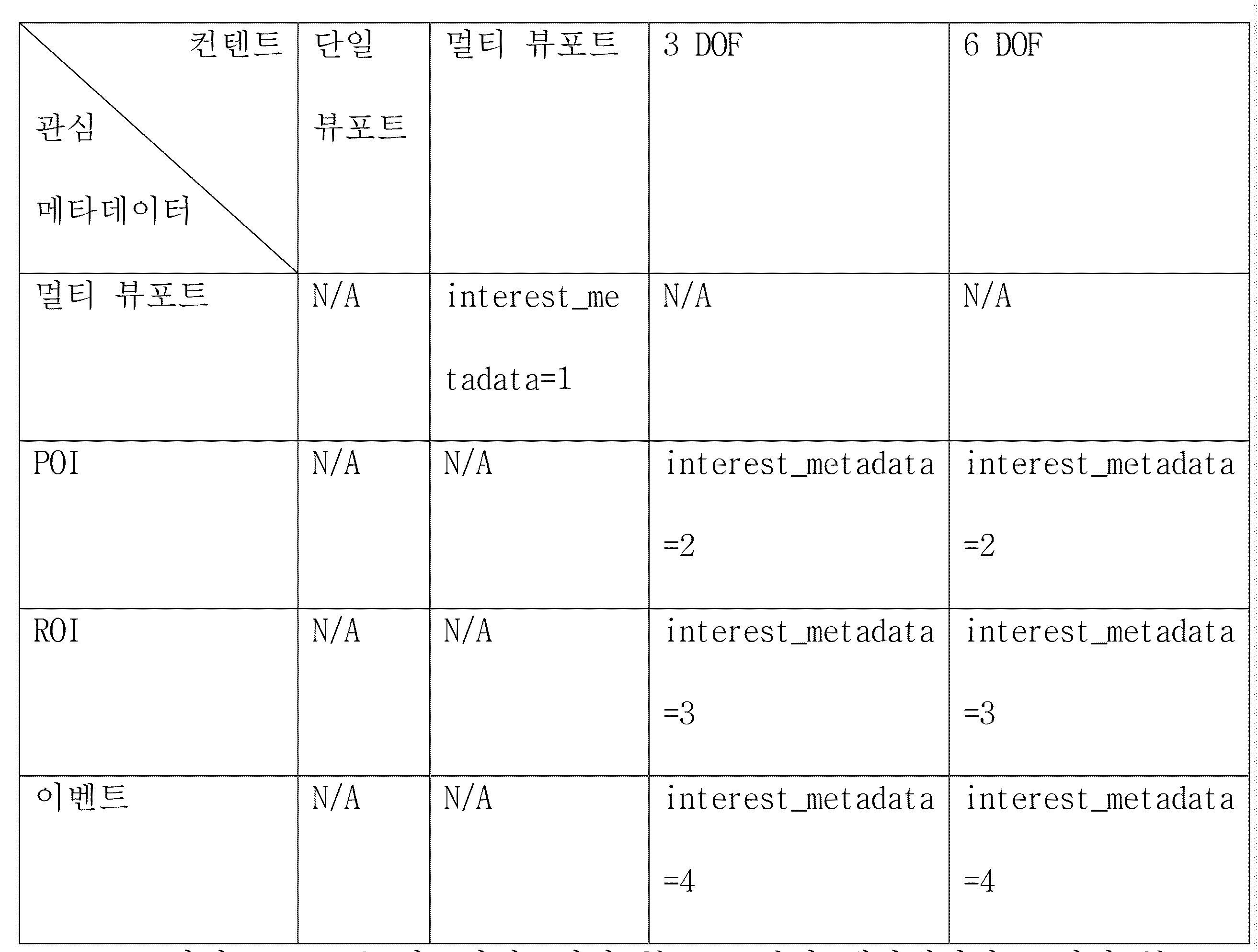
상기 표 14를 참조하면, 멀티 뷰포트 관심 메타데이터는 멀티 뷰포트 컨텐트에 대해서만 적용될 수 있는 반면, POI, ROI, 및 이벤트 관심 메타데이터는 3 DOF 및 6 DOF 컨텐트에 모두 적용될 수 있다.Referring to Table 14, multi-viewport interest metadata can be applied only to multi-viewport content, whereas POI, ROI, and event interest metadata can be applied to both 3 DOF and 6 DOF content.
도 7은 interest_metadata 필드 및 각각의 관심 메타데이터가 어떤 영역이나 포인트를 특정하는지에 따른 해당 관심 메타데이터를 나타낸 것이다. 7 illustrates interest_metadata fields and corresponding interest metadata according to which region or point each interest metadata specifies.
도 7을 참조하면, (a)는 interest_metadata가 멀티 뷰포트인 경우를 나타내며, viewport_id를 이용하여 가이드된 뷰포트의 아이디와 위치를 특정할 수 있다. (b)는 interest_metadata가 POI인 경우를 나타내며, POI_id, POI_yaw, POI_pitch를 이용하여 360도 비디오 공간에 있는 특정 포인트를 특정할 수 있다. (c)는 interest_metadata가 ROI인 경우를 나타내며, ROI_id, ROI_pitch_start, ROI_yaw_start, ROI_pitch_end, ROI_yaw_end를 이용하여 360도 비디오 공간 내의 정확한 뷰포트를 특정할 수 있다. (d)는 interest_metadata가 이벤트인 경우를 나타내며, event_id, event_yaw, event_pitch, event_to_event를 이용하여 컨텐트 내에서 앞으로 발생할 이벤트의 위치와 시간을 특정할 수 있다. Referring to FIG. 7 , (a) shows a case where interest_metadata is a multi-viewport, and the ID and location of the guided viewport can be specified using viewport_id. (b) shows a case where interest_metadata is POI, and a specific point in a 360-degree video space can be specified using POI_id, POI_yaw, and POI_pitch. (c) indicates a case where interest_metadata is an ROI, and an accurate viewport within a 360-degree video space can be specified using ROI_id, ROI_pitch_start, ROI_yaw_start, ROI_pitch_end, and ROI_yaw_end. (d) indicates a case where interest_metadata is an event, and the position and time of an event to occur in the future can be specified using event_id, event_yaw, event_pitch, and event_to_event.
도 8은 멀티 뷰포트 기반의 타일 전송을 나타낸 도면이다.8 is a diagram illustrating multi-viewport-based tile transmission.
멀티 뷰포트 관심 메타데이터는 멀티 뷰포트 컨텐트 안에서 각각의 뷰포트의 정확한 위치, 크기 및 id를 특정한다. 이때 관심 메타데이터를 통해 특정 뷰포트를 선택함으로써 해당 타일만 요청하는 것이 가능하다. 각각의 뷰포트들은 개별 타일들로서 인코딩되므로, 멀티 뷰포트 기반 타일 전송을 위해, 선택된/보여진 뷰포트들에 상응하는 타일들을 선택적으로 전송함으로써 대역폭을 아낄 수 있다. 도 8은 (a)에서 멀티 뷰포트 컨텐트가 뷰포트에 대응하는 4 개의 타일들 안에 인코딩되었음을 보여주며, (b)에서 top_left_viewport_interest metadata를 통해 좌측 상단 타일을 선택하고, (c)에서 상기 선택된 타일/뷰포트를 전송 및 사용자 장치에서 렌더링하는 것을 도시하였다. 이와 같이 함으로써 사용자 장치는 정확한 뷰포트(들)을 재생할 수 있다. The multi-viewport interest metadata specifies the exact location, size, and id of each viewport within the multi-viewport content. At this time, it is possible to request only the corresponding tile by selecting a specific viewport through interest metadata. Since each viewport is encoded as individual tiles, bandwidth can be saved by selectively transmitting tiles corresponding to selected/shown viewports for multi-viewport-based tile transmission. 8 shows that multi-viewport content is encoded in four tiles corresponding to the viewport in (a), the top left tile is selected through top_left_viewport_interest metadata in (b), and the selected tile/viewport is selected in (c). Transmission and rendering on the user device are shown. By doing so, the user device can reproduce the correct viewport(s).
한편, POI 메타데이터는 사람, 또는 객체, 또는 다른 관심사와 같이 (컨텐트 생성자, 제공자, 또는 사용자들에 의해 만들어진) POI들에 해당하는 VR 컨텐트 비디오 내의 포인트들을 특정한다. 메타데이터에 의해 특정된 POI들을 기반으로 타일 전송을 수행할 수 있다. On the other hand, POI metadata specifies points in VR content video that correspond to POIs (created by content creators, providers, or users), such as people, objects, or other interests. Tile transmission may be performed based on POIs specified by metadata.
도 9는 POI 기반 타일 전송 동작을 도시한 것으로, 주어진 프레임에 대한 POI 메타데이터 내에 오직 하나의 관심 포인트(POI)만 있는 경우의 POI 기반 타일 전송의 동작을 보여준다. 9 illustrates POI-based tile transmission operation when there is only one point of interest (POI) in POI metadata for a given frame.
(a)는 하나의 POI interest_metadata를 가지는 12개의 타일 내에 인코딩 된 360도 컨텐트를 나타내며, (b)는 POI 메타데이터와 장치 또는 컨텐트의 FOV 메타데이터(device screen_fov 또는 content_fov)를 이용하여, POI를 둘러싼 뷰포트를 계산하는 것을 나타낸다. (c)는 POI를 포함하는 뷰포트를 렌더링 할 수 있도록 하기 위해 전송을 위해 필요한 타일의 개수를 확인함(도 9에서는 4개의 타일이 필요함)을 나타내고, (d)는 POI를 포함하는 뷰포트의 재생을 위하여 (c)에서 확인된 타일들을 전송 및 사용자 장치에서 렌더링함을 나타낸다.(a) represents 360-degree content encoded in 12 tiles with one POI interest_metadata, and (b) uses POI metadata and FOV metadata (device screen_fov or content_fov) of the device or content to enclose the POI. Represents calculating the viewport. (c) indicates that the number of tiles required for transmission is checked (in FIG. 9, 4 tiles are required) in order to be able to render the viewport including the POI, and (d) shows reproduction of the viewport including the POI. For this, it indicates that the tiles identified in (c) are transmitted and rendered in the user device.
도 10은 POI 기반 타일 전송 동작을 도시한 것으로, 주어진 프레임에 대한 관심 메타데이터 내에 두 개의 POI가 있는 경우의 POI 기반 타일 전송의 기본 동작을 보여준다.10 illustrates a POI-based tile transmission operation, and shows a basic operation of POI-based tile transmission when there are two POIs in interest metadata for a given frame.
도 10에서는 두 개의 POI 각각에 대해 도 9의 (a), (b), (c)와 동일한 절차가 수행되고 사용자 장치로 전달될 수 있다. 사용자 장치에서는 전달된 두 개의 POI 중 현재 뷰의 POI에 해당하는 뷰포트만을 렌더링 하고(d) 나머지 POI에 해당하는 뷰포트는 필요한 경우(사용자가 POI들 상에서, 그리고 그 주변에서 선택/탐색할 때)에 빠른 렌더링을 위해 미리 준비해 둔다(e). In FIG. 10, the same procedures as (a), (b), and (c) of FIG. 9 are performed for each of the two POIs, and may be transmitted to the user device. The user device renders only the viewport corresponding to the POI of the current view among the two POIs delivered (d), and the viewport corresponding to the remaining POIs, if necessary (when the user selects/navigates on and around POIs). Prepare in advance for fast rendering (e).
POI 기반 타일 전송이 모션 기능이 없는(device_dof=1인) 장치로 컨텐트를 전송하는데 사용되는 경우, 식별 및 전송된 타일들은 제한된 재생을 위해 충분하다. 그러나 모션 기능이 있는(device_dof=2, 3인) 장치들에 대해, 사용자가 타일들이 전달되지 않은 뷰에 대한 뷰포트를 탐색하면, 탐색된 뷰포트를 위한 타일들이 곧바로(약간의 지연을 가지고) 전송되거나, 타일들이 요청 및 전송되는 동안 백그라운드 저 해상도 뷰/백그라운드 고정 영상이 디스플레이될 수 있다.When POI-based tile transmission is used to transmit content to a device without motion capability (device_dof=1), the identified and transmitted tiles are sufficient for limited playback. However, for motion-capable devices (device_dof=2, 3), if the user navigates to a viewport for a view to which tiles are not delivered, the tiles for the browsed viewport are sent directly (with a slight delay) or , a background low resolution view/background static image may be displayed while tiles are requested and transmitted.
한편, ROI 메타데이터는 소정 지역에서 발생하는 동작들이나 컨텐트 특정 객체들에 해당하는 VR 컨텐트 비디오 내의 정확한 영역을 특정한다. ROI의 영역 크기는 평균 뷰포트/장치의 FOV들보다 크거나, 장치의 FOV들을 목표로 하거나, 평균 뷰포트/장치의 FOV들보다 작을 수 있다. Meanwhile, ROI metadata specifies an exact region within a VR content video corresponding to motions or content-specific objects occurring in a predetermined region. The region size of the ROI can be larger than the average viewport/device FOVs, target device FOVs, or smaller than the average viewport/device FOVs.
ROI들이 장치 FOV의 뷰포트들(컨텐트 제작자의 컷 뷰포트, 또는 다른 이전 사용자의 뷰포트)를 목표로 할 경우에는 ROI들의 크기가 장치 FOV들의 크기에 부합되기 때문에, ROI 메타데이터를 사용하여 360도 VR 컨텐트에 대한 제작자의 특정한 예술적 의도를 장치를 통해 사용자에게 전달할 수 있다. 또한 ROI의 크기와 무관하게, 모든 영역에 대해 ROI 기반 타일 전송을 할 수도 있다.When ROIs are targeted at the viewports of the device FOV (the content creator's cut viewport, or another previous user's viewport), the size of the ROIs corresponds to the size of the device FOVs, so ROI metadata is used to create 360 degree VR content. The specific artistic intention of the producer can be conveyed to the user through the device. In addition, regardless of the size of the ROI, ROI-based tile transmission may be performed for all regions.
도 11은 ROI 메타데이터 기반 타일 전송을 나타낸 것으로, 주어진 프레임에 대해 관심 메타데이터 안에 하나의 ROI가 존재할 때 ROI 기반 타일 전송을 도시한 것이다. 이때 특정 ROI 크기는 사용자 장치의 뷰포트의 크기에 부합한다. 11 illustrates ROI metadata-based tile transmission, and illustrates ROI-based tile transmission when one ROI exists in metadata of interest for a given frame. In this case, the size of the specific ROI corresponds to the size of the viewport of the user device.
도 11을 참조하면, (a)는 ROI 관심 메타데이터를 가지며 12개의 타일에 인코딩 된 360도 컨텐트를 나타내며, (b)는 ROI 렌더링을 위해 전송에 필요한 4개의 타일을 확인하는 것을 나타내며, (c)는 ROI 재생을 위해 확인된 타일을 전송 및 렌더링함을 나타낸다. Referring to FIG. 11, (a) shows 360-degree content encoded in 12 tiles with ROI interest metadata, (b) shows checking 4 tiles required for transmission for ROI rendering, (c ) indicates transmission and rendering of the identified tile for ROI reproduction.
도 12는 관심 영역(ROI) 메타데이터 기반 타일 전송을 나타낸 것으로, 주어진 프레임 내 다수(도 12에서는 두 개)의 ROI가 존재하는 경우의 ROI 기반 타일 전송을 도시한 것이다. 이때 특정 ROI 크기들은 사용자 장치의 뷰포트의 크기에 부합한다. FIG. 12 illustrates ROI metadata-based tile transmission, and illustrates ROI-based tile transmission when multiple (two in FIG. 12) ROIs exist in a given frame. At this time, the specific ROI sizes correspond to the size of the viewport of the user device.
도 12를 참조하면, (a)는 2개의 ROI 관심 메타데이터를 가지며 12개의 타일에 인코딩 된 360도 컨텐트를 나타내며, (b)는 2개의 ROI 렌더링을 위해 전송에 필요한 7개의 타일을 확인하는 것을 나타내며, (c)와 (d)는 ROI 재생을 위해 확인된 타일을 전송 및 렌더링함을 나타낸다. 사용자 장치에서는 전달된 두 개의 ROI 중 현재 뷰의 ROI에 해당하는 뷰포트만을 렌더링 하고(c) 나머지 ROI에 해당하는 뷰포트는 필요한 경우(사용자가 ROI들 상에서, 그리고 그 주변에서 선택/탐색할 때)에 빠른 렌더링을 위해 미리 준비해 둔다(d).Referring to FIG. 12, (a) shows 360-degree content encoded in 12 tiles with two ROI-interest metadata, and (b) identifies 7 tiles required for transmission for rendering 2 ROIs. (c) and (d) indicate that the identified tile is transmitted and rendered for ROI reproduction. The user device renders only the viewport corresponding to the ROI of the current view among the two ROIs delivered (c), and the viewport corresponding to the remaining ROIs, if necessary (when the user selects/navigates on and around the ROIs). Prepare in advance for fast rendering (d).
ROI 메타데이터에 의해 특정된 영역의 크기에 따라, ROI의 재생에 있어 ROI content_fov 값과 장치의 screen_fov 값은 다를 수 있다. 이 경우, FOV 보상이 필요하다. FOV 보상을 동작들은 후술될 것이다. Depending on the size of the region specified by the ROI metadata, the ROI content_fov value and the screen_fov value of the device may be different when reproducing the ROI. In this case, FOV compensation is required. Operations for FOV compensation will be described later.
POI 기반 타일 전송과 마찬가지로, ROI 기반 타일 전송이 모션 기능이 없는(device_dof=1) 장치로 컨텐트를 전송하는데 사용되는 경우에는 식별 및 전송된 타일들은 제한된 재생을 위해 충분하다. 이 경우 FOV 보상이 필요할 수는 있다. 그러나 모션 기능이 있는(device_dof=2, 3) 장치들에 대해 사용자가 타일들이 전달되지 않은 뷰에 대한 자신의 뷰포트를 탐색할 경우에는, 탐색된 뷰포트를 위한 타일들이 곧바로(약간의 지연을 가지고) 전송하거나, 타일들이 요청 및 전송되는 동안 백그라운드 저 해상도 뷰/백그라운드 고정 영상이 디스플레이될 수 있다.Similar to POI-based tile transmission, when ROI-based tile transmission is used to transmit content to a device without motion capability (device_dof=1), the identified and transmitted tiles are sufficient for limited playback. In this case, FOV compensation may be required. However, for devices with motion capabilities (device_dof=2, 3), if the user navigates his/her viewport to a view to which the tiles are not propagated, the tiles for the browsed viewport are immediately (with a slight delay) or a background low resolution view/background static image may be displayed while the tiles are being requested and transmitted.
한편, 이벤트 관심 메타데이터가 VR 컨텐트 비디오 공간 내의 특정 포인트 또는 특정 포인트에서 이벤트가 발생할 때까지의 시간(time_to_event 필드)으로 특정될 수 있다. time_to_event 필드들을 통해, 이벤트 기반 타일 전송 시 전송되어야 할 중요한 타일들이 이벤트 관심 메타데이터를 통해 미리 식별되고 사용자 장치로 전송될 수 있다.Meanwhile, the event interest metadata may be specified as a specific point in the VR content video space or a time until an event occurs at the specific point (time_to_event field). Via the time_to_event fields, important tiles to be transmitted during event-based tile transmission may be identified in advance through event interest metadata and transmitted to the user device.
도 13은 이벤트 기반 타일 전송을 도시한 것으로, 하나의 이벤트가 관심 메타데이터 내에 기술될 때 이벤트 기반 타일 전송을 도시한 것이다.13 illustrates event-based tile transfer, when an event is described in interest metadata.
(a)는 사용자의 현재 뷰포트와 time_to_enet=2를 가지는 이벤트를 가지고, 12 타일 내에 인코딩 된 360도 컨텐트를 나타내며, (b)는 이벤트에 의해 지시된 시간 이전에 이벤트 메타데이터에 대응되는 타일(들)을 전송하기 위해 이벤트 메타데이터와 device_fov 또는 content_fov를 사용하는 것을 나타내며, (c)와 (d)는 time_to_event에 의해 기술된 바와 같이 이벤트 발생 전에 해당 타일(들)을 전송함을 나타낸다. 이와 같이 하면 이벤트 기반 타일 전송 및 렌더링에서의 딜레이를 없앨 수 있다. (a) represents 360 degree content encoded within 12 tiles, with the user's current viewport and an event with time_to_enet=2, and (b) corresponds to the event metadata prior to the time indicated by the event (s) ) to transmit event metadata and device_fov or content_fov, and (c) and (d) indicate that the corresponding tile(s) is transmitted before the event occurs as described by time_to_event. This eliminates delays in event-based tile transfer and rendering.
이와 같이 이벤트 기반 타일 전송은 time_to_event 필드를 사용함으로써, 사용자 장치가 언제, 어떻게 이벤트에 대응하는 타일을 전송할지 여부에 대한 정보를 미리 획득함으로써 이벤트들이 지시하는 타일들을 이벤트가 발생되기 전에 미리 가져오는 것이 가능하다. In this way, the event-based tile transmission uses the time_to_event field so that the user device obtains information on when and how to transmit the tile corresponding to the event in advance, thereby bringing the tiles indicated by the events in advance before the event occurs. possible.
예를 들어, 시간 t에서 time_to_event=2인 이벤트가 이벤트 기반 타일 전송될 때, 사용자 장치는 사용자가 이벤트와 관련된 타일을 놓치지 않도록 미리 타일을 수신하기 원하는지 여부를 묻기 위한 팝업을 디스플레이하거나, 이벤트를 렌더링하기 위해 늦지 않게 타일을 미리 수신하도록 자동 결정하거나, 이벤트를 위한 타일이 이미 전송되어 있을 때의 경우, 사용자 장치는 가까운 시간 안에 해당 이벤트가 발생할 때 사용자가 해당 이벤트를 보도록 알리기 위한 (시각, 청각 등의) 알림을 사용자에게 제공할 수 있다.For example, when an event with time_to_event=2 is sent to an event-based tile at time t, the user device displays a pop-up to ask whether the user wants to receive a tile in advance so that the user does not miss a tile related to the event, or renders the event. When a tile for an event has already been sent, or when a tile for an event has already been sent, the user device is configured to notify the user to view the corresponding event when the corresponding event occurs in a near time (visual, auditory, etc.) of) notification can be provided to the user.
이상에서는 interest_metadata 필드로 관심 메타데이터로서 멀티 뷰포트, POI, ROI 및 이벤트 기반의 타일 전송을 개별적으로 기술하였으나, 이들 중 선택된 둘 이상의 메타데이터를 기반으로 하는 타일 전송도 가능하다. In the above, multi-viewport, POI, ROI, and event-based tile transmission have been individually described as interest metadata in the interest_metadata field, but tile transmission based on two or more selected metadata is also possible.
관심 메타데이터 기반 뷰/재생View / playback based on interest metadata
VR 장치는 관심 메타데이터를 사용하여 관심 메타데이터 기반 뷰/재생을 수행한다. 관심 메타데이터 기반 뷰/재생은 풀 VR 비디오 컨텐트 데이터가 이미 이용가능할 때, 혹은 관심 메타데이터 기반 타일 전송에서와 같이 가이드된 영역들이 존재하는 비디오 컨텐트 데이터의 부분적 섹션만이 수신될 때 수행될 수 있다. The VR device performs view/play based on the metadata of interest using the metadata of interest. Interest metadata based view/playback can be performed when full VR video content data is already available, or when only partial sections of video content data in which guided regions exist are received, as in interest metadata based tile transmission. .
멀티 뷰포트 관심 메타데이터는 컨텐트 안에서 이용 가능한 각각의 뷰포트의 정확한 위치, 크기 및 id를 특정한다. VR 장치는 특정 뷰포트 ID(viewport_id)를 선택하여 해당 뷰포트를 디스플레이 할 수 있다. The multi-viewport interest metadata specifies the exact location, size and id of each viewport available within the content. The VR device can select a specific viewport ID (viewport_id) to display the corresponding viewport.
POI 및 ROI 메타데이터 기반 뷰가 동일 VR 컨텐트(즉, 3 DOF의 360도 비디오 컨텐트)에 대해 존재할 수 있으며, 따라서 이하에서는 POI 및 ROI 메타데이터 기반 뷰를 함께 기술한다. POI and ROI metadata-based views may exist for the same VR content (ie, 3 DOF 360-degree video content), so the POI and ROI metadata-based views are described together in the following.
VR 뷰를 가이드하기 위해 POI 및 ROI 메타데이터가 다양한 방식으로 사용될 수 있다. 특히 TV와 같은 VR 장치 상에서의 VR 컨텐트의 가이드된 뷰를 위해, 사용자들이 TV 화면에 맞춤된 뷰포트를 용이하게 선택하도록 하기 위하여 POI 및 ROI 메타데이터를 사용할 수 있다. POI and ROI metadata can be used in a variety of ways to guide VR views. In particular, for guided viewing of VR content on a VR device such as a TV, POI and ROI metadata may be used to allow users to easily select a viewport tailored to the TV screen.
VR 컨텐트 재생 중에, 디스플레이 할 뷰포트를 선택하기 위해 VR 장치는 가이드된 또는 제한된 재생 또는 풀 재생(가령 3 DOF 컨텐트의 뷰포트에 대한 사용자 수동 제어)을 입력으로 받을 수 있다. 가이드된 또는 제한된 재생을 위해 VR 장치는 POI 메타데이터 또는 ROI 메타데이터를 따를 수 있다. 또한 풀 재생을 위해 VR 장치는 POI/ROI 메타데이터로부터 가이드 지시를 받을 수도 있고 받지 않을 수도 있다. During VR content playback, in order to select a viewport to display, the VR device may receive guided or limited playback or full playback (eg, manual user control of a viewport of 3 DOF content) as an input. For guided or restricted playback, VR devices may follow POI metadata or ROI metadata. Also, for full playback, the VR device may or may not receive guide instructions from POI/ROI metadata.
도 14는 ROI 메타데이터 기반 뷰를 도시한 것으로, 모션 능력이 없는 장치(예를 들어, TV) 상에서 ROI 메타데이터를 가진 3 DOF 360도 컨텐트의 제한된 재생을 도시한 것이다. FIG. 14 illustrates a ROI metadata based view, showing limited playback of 3
도 14에서는 특정 프레임에서 3 개의 서로 다른 ROI들이 관심 메타데이터에 의해 특정되고 있으며, VR 장치는 이 중 하나의 ROI에 해당하는 뷰포트만을 제한적으로 재생한다. In FIG. 14, three different ROIs are specified by interest metadata in a specific frame, and the VR device restrictively reproduces only a viewport corresponding to one ROI among them.
제한적 재생을 위해 POI 메타데이터를 따르는 경우, POI 메타데이터는 뷰포트에서의 한 포인트만을 특정하므로, VR 장치는 메타데이터 내의 FOV 필드들을 사용해 POI 메타데이터에 기반하는 뷰포트를 디스플레이할 수 있다. 이때 디스플레이 할 뷰포트는 장치나 컨텐트 FOV 메타데이터(evice screen_fov 또는 content_fov)를 이용하여 계산할 수 있다.When POI metadata is followed for constrained playback, since POI metadata specifies only one point in the viewport, the VR device can use the FOV fields in the metadata to display the viewport based on the POI metadata. At this time, the viewport to be displayed can be calculated using device or content FOV metadata (evice screen_fov or content_fov).
제한적 재생을 위해 ROI 메타데이터를 따르는 경우, ROI 메타데이터에 의해 특정된 영역들은 장치의 FOV 뷰포트보다 작거나, 유사하거나, 일치하거나, 더 클 수 있으므로, 장치에 의해 사용자에게 보여지는 정확한 뷰포트는 ROI 메타데이터에 의해 특정된 영역들의 크기, content_fov, 장치 screen_fov 중 어느 하나에 따라 결정될 수 있다. 이때 장치 screen_fov 및 content_fov의 차이에 따라 렌더링을 위한 FOV 보상을 수행할 필요가 있다. When ROI metadata is followed for constrained playback, the regions specified by the ROI metadata may be smaller, similar, matched, or larger than the device's FOV viewport, so that the exact viewport seen by the device to the user is the ROI It may be determined according to any one of the size of regions specified by metadata, content_fov, and device screen_fov. At this time, it is necessary to perform FOV compensation for rendering according to the difference between device screen_fov and content_fov.
앞서 언급한 바와 같이 ROI 메타데이터 기반의 가이드된 재생 및 다른 경우들에 있어서, 렌더링되고 디스플레이될 정확한 뷰포트는 장치 screen_fov 및 content_fov 필드들에 따라 다를 수 있다. 또한 ROI 메타데이터에 의해 특정된 영역들의 크기에 따라 ROI 메타데이터를 이용한 재생 동작들이 가변될 수 있다.As mentioned above, for guided playback based on ROI metadata and in other cases, the exact viewport to be rendered and displayed may depend on the device screen_fov and content_fov fields. In addition, reproduction operations using ROI metadata may be varied according to the size of regions specified by ROI metadata.
ROI 메타데이터는 소정 영역에서 발생하는 동작들이나 컨텐트 특정 객체들에 해당하는 VR 컨텐트 비디오 내의 정확한 영역을 특정한다. ROI들의 영역 크기는 평균 뷰포트/장치 FOV들보다 크거나, 장치 FOV와 유사한 크기 이거나, 평균 뷰포트/장치 FOV들보다 작을 수 있다. The ROI metadata specifies an exact region within the VR content video corresponding to actions or content-specific objects occurring in a certain region. The area size of the ROIs can be larger than the average viewport/device FOVs, similar in size to the device FOV, or smaller than the average viewport/device FOVs.
ROI 메타데이터가 평균 뷰포트/장치 FOV들보다 크거나 작을 경우에는, 장치의 screen_fov나 content_fov에 의해 특정된 뷰포트가 ROI 메타데이터를 중심으로 디스플레이된다. ROI 메타데이터가 장치의 FOV들과 유사하고 여러 FOV들에 대해 특정된 다수의 ROI 메타데이터가 존재할 경우에는, 먼저 장치에 가장 근접한 FOV를 가진 interest_metadata가 선택된다. 이를 위해 VR 장치는 장치의 screen_fov를 식별하고, 식별된 장치의 screen_fov에 부합되는 content_fov 필드를 가지는 해당 관심 메타데이터를 선택한다. 정확히 부합되는 content_fov 필드를 가지는 관심 메타데이터가 없으면, 다음으로 큰 크기의 FOV를 가지는 관심 메타데이터를 선택한다. 예를 들어 장치의 screen_fov=95인 경우, content_fov=95가 존재하면 상응하는 관심 메타데이터를 선택하며, content_fov=95가 존재하지 않으면 content_fov >95에 해당하는 필드들 중 다음으로 가능한 필드를 선택한다. 즉, interest_metadata의 대응되는 선택을 위한 조건은 screen_fov =< content_fov이다.If the ROI metadata is larger or smaller than the average viewport/device FOVs, the viewport specified by the device's screen_fov or content_fov is displayed centering on the ROI metadata. If the ROI metadata is similar to the device's FOVs and there are multiple ROI metadata specified for different FOVs, the interest_metadata with the FOV closest to the device is selected first. To this end, the VR device identifies the screen_fov of the device, and selects the metadata of interest having a content_fov field that matches the screen_fov of the identified device. If there is no metadata of interest with an exactly matching content_fov field, then metadata of interest with the next largest FOV is selected. For example, when screen_fov = 95 of a device, if content_fov = 95 exists, the corresponding metadata of interest is selected. If content_fov = 95 does not exist, the next available field among fields corresponding to content_fov > 95 is selected. That is, the condition for selection corresponding to interest_metadata is screen_fov =< content_fov.
이러한 절차에 따라 사용자 장치 화면의 FOV에 가장 근접한 ROI 메타데이터가 선택되면, 해당 ROI 메타데이터가 이용 가능한 경우에는 표 15와 같이 FOV 보상이 필요하다.When ROI metadata closest to the FOV of the user device screen is selected according to this procedure, FOV compensation is required as shown in Table 15 when the corresponding ROI metadata is available.
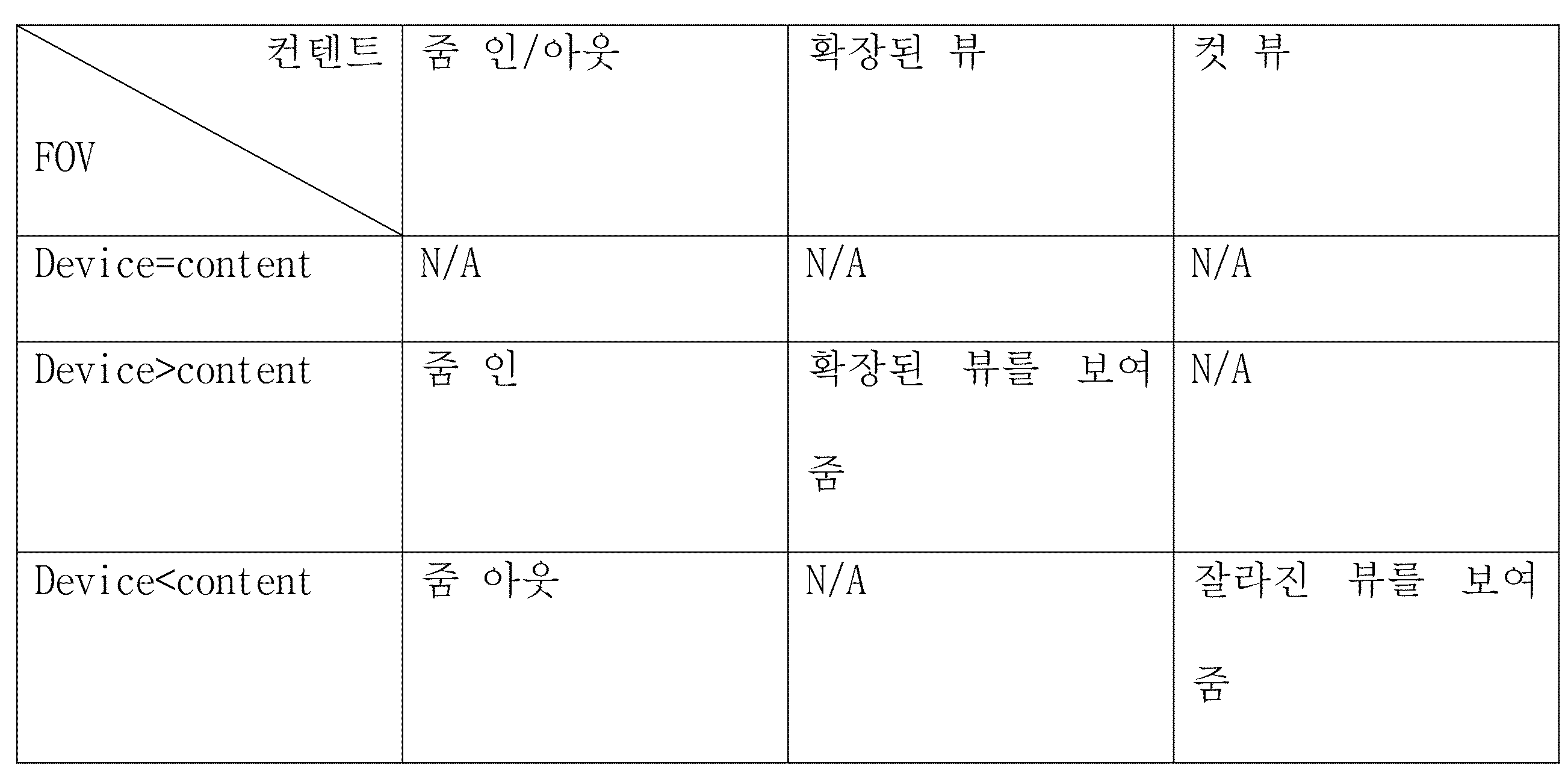
표 15를 참조하면, 장치 screen_fov = content_fov인 경우 ROI 메타데이터에 의해 특정된 영역이 장치 화면에 그대로 디스플레이된다. 장치 screen_fov > content_fov인 경우 장치는 ROI 영역을 screen_fov에 맞추기 위해 컨텐트를 확대하거나, ROI 영역에 의해 특정된 것보다 넓은 영역의 컨텐트를 보여주어야 한다. 또한 장치 screen_fov < content_fov인 경우 장치는 ROI 영역을 screen_fov에 맞추기 위해 컨텐트를 축소하거나, ROI 영역에 의해 특정된 것보다 좁은 영역의 컨텐트를 보여주어야 한다.Referring to Table 15, when device screen_fov = content_fov, an area specified by ROI metadata is displayed on the device screen as it is. If the device screen_fov > content_fov, the device must enlarge the content to fit the ROI area to the screen_fov, or show the content in a wider area than specified by the ROI area. Also, if the device screen_fov < content_fov, the device must reduce the content to fit the ROI area to the screen_fov, or show the content in a narrower area than that specified by the ROI area.
한편, 이벤트 관심 메타데이터는 보통 (“follow POI”과 같은) 특정 “follow 이벤트” 뷰에는 사용되지 않는다. 대신, (time_to_event 필드를 통해) 앞으로 일어날 이벤트들을 나타내기 위한 통지들을 트리거하기 위해 이벤트 관심 메타데이터들이 사용될 수 있다. 이것은 장치가 이벤트들을 이용해 사용자에게 미리 통지를 제공할 수 있다 하더라도, 이하에 설명될 POI 통지 기반 뷰와 유사하다.On the other hand, event interest metadata is usually not used for specific “follow event” views (such as “follow POI”). Instead, event interest metadata may be used to trigger notifications to indicate upcoming events (via the time_to_event field). This is similar to the POI notification-based view described below, although the device can use events to provide notification to the user in advance.
자동화된 POI/ROI 트래킹(follow POI/ROI) 사용이 불가하거나 원하지 않을 경우, 장치는 POI/ROI 알림/통지 안내를 사용자에게 제공하여 POI 또는 ROI 메타데이터 기반 뷰를 위한 사용자의 뷰포인트를 가이드할 수 있다. POI/ROI 알림/통지 안내는 사용자의 현재 뷰포트 안에 없는 POI/ROI의 위치와 방향을 나타내기 위한 팝업 통지나, 테두리(rim) 기반 광(light) 안내(예를 들어, 현재의 뷰포트 밖에 있는 POI/ROI의 위치를 가리키기 위해 부분적으로 점등하는 헤드 마운트 디스플레이나 TV를 둘러싼 빛의 테두리 등) 또는 진동 피드백(예를 들어, POI/ROI의 위치 및 “근접(closeness)”을 나타내기 위한 피드백 장치를 통한 다중 방향 및 다중 세기의 진동이나, 사운드 기반 안내(예를 들어, (보이지 않는) POI/ROI의 방향으로부터 나오는 안내 사운드를 가지는, 현재 뷰포트에 부합하는 3D 사운드를 포함할 수 있다. 진동 세기는 사용자의 현재 뷰포트로부터 POI/ROI의 거리에 부합하도록 조정될 수 있다. If automated POI/ROI tracking (follow POI/ROI) is unavailable or undesirable, the device will provide POI/ROI notification/notification guidance to the user to guide the user's viewpoint for a POI or ROI metadata based view. can POI/ROI notifications/notification guides can be pop-up notifications to indicate the position and orientation of POIs/ROIs that are not within the user's current viewport, or rim-based light guidance (e.g., POIs that are outside the current viewport). A partially lit head-mounted display to indicate the location of a /ROI, or a frame of light surrounding a TV, etc.) or vibration feedback (e.g., a feedback device to indicate the location and “closeness” of a POI/ROI). Vibrations in multiple directions and intensities via , or sound-based guidance (e.g., 3D sounds that match the current viewport, with guidance sounds coming from the direction of the (invisible) POI/ROI. Vibration Intensity can be adjusted to match the POI/ROI's distance from the user's current viewport.
일부의 경우, 소정 컨텐트는 다중 타입(가령, POI 및 ROI 그리고 이벤트들의 혼합)의 관심 메타데이터을 포함할 수 있다. 이 경우, 관심 메타데이터 트랙들이나 재생 리스트들이 컨텐트의 재생 시간에 따른 POI/ROI/이벤트 메타데이터의 체인을 생성하도록 만들어질 수 있다. 관심 메타데이터 트랙들이나 재생 리스트는 재한된 재생(follow interest metadata)이나 풀 재생 중 자동 안내 통지를 위해 사용될 수 있다.In some cases, certain content may include multiple types of interest metadata (eg, POIs and ROIs and a mix of events). In this case, interest metadata tracks or playlists can be made to create a chain of POI/ROI/event metadata according to content playback time. Interest metadata tracks or playlists can be used for automatic guidance notification during follow interest metadata or full playback.
사용자 관점에서 볼 때, VR 장치(예를 들어, TV) 상에서의 POI 및 ROI 메타데이터를 가진 VR 컨텐트의 재생은 사용자가 미리 규정된 (컨텐트 생성자들이나 다른 사용자들, 또는 다른 미리 만들어진 트랙들에 의해 제공되는) 관심 메타데이터 트랙이나 재생 리스트를 선택하거나, 어떤 주어진 시점에 동일한 ID를 가진 특정 POI나 ROI를 디스플레이 장치를 통해 트래킹하도록 선택하거나, POI/ROI 메타데이터로부터의 가이드 지시의 유무에 따라 뷰포트에 대한 사용자의 수동 제어를 수행함으로써 즉각적으로 뷰포트를 제어할 수 있다.From the user's point of view, the playback of VR content with POI and ROI metadata on a VR device (e.g. TV) is performed by the user predefined (by content creators or other users or other pre-made tracks). (provided) by selecting a metadata track or playlist of interest, by choosing to track a specific POI or ROI with the same ID at any given point in time through the display device, or by the presence or absence of guide indications from POI/ROI metadata in the viewport. By performing the user's manual control of the viewport, the viewport can be controlled immediately.
관심 메타데이터 트랙들이나 재생 리스트들은 각 프레임의 개별 POI들이나 ROI들, 다른 관심 메타데이터 재생 리스트들의 일부, 사용자 수동 제어된 뷰포트 데이터(예를 들어, 개인화된(personalized) ROI들)의 조합으로 만들 수 있다. Metadata tracks or playlists of interest can be created as a combination of individual POIs or ROIs for each frame, portions of other metadata playlists of interest, and user manually controlled viewport data (e.g., personalized ROIs). there is.
도 15는 각각의 프레임에 대한 개별 POI 및 ROI로 구성된 관심 메타데이터 트랙을 도시한 것이다. 15 shows a metadata track of interest composed of individual POIs and ROIs for each frame.
도 15를 참조하면, 같은 ID를 가진 POI나 ROI가 각각의 프레임마다 특정(시간에 따른 영역의 이동이 허용)되는 반면, 관심 메타데이터 트랙은 시간에 따라 상이한 ID들을 가진 POI 및/또는 ROI 메타데이터를 포함하도록 허용된다. 관심 메타데이터 트랙은 트랙의 경로 중에 여러 카메라들로부터의 뷰포트들을 포함할 수 있다. Referring to FIG. 15, while a POI or ROI with the same ID is specified for each frame (movement of an area over time is allowed), a metadata track of interest is POI and/or ROI metadata with different IDs over time. It is allowed to include data. A metadata track of interest may include viewports from several cameras along the track's path.
한편, 제한된 재생에 있어서, ROI/POI에 따른 재생에서 다른 프레임간의 변경은 패닝에 한정되지 않고, 다른 ROI나 POI로의 갑작스러운 변경이 구현될 수 있다. 이러한 변경에 따른 영향은 장면 변경과 유사하다. ROI 변경 같은 장면 변경의 사용은 TV들과 같이 회전 제어를 위해 불편한 입력을 사용하는 장치들이나 작은 FOV를 가지는 장치들에 있어서 중요한데, 이는 360도 비디오에 대한 빠르거나 랜덤한 패닝이 사용자에게 어지러움을 야기할 수 있기 때문이다. Meanwhile, in the limited playback, the change between different frames in the playback according to the ROI/POI is not limited to panning, and a sudden change to another ROI or POI can be implemented. The effect of such a change is similar to a scene change. The use of scene changes like ROI change is important for devices that use inconvenient inputs for rotation control, such as TVs, or devices that have a small FOV, where fast or random panning for 360-degree video can cause dizziness to the user. Because you can.
도 16은 동일한 360도 VR 컨텐트로부터 관심 메타데이터 뷰를 위해 서로 다른 ROI 트랙들을 사용하여 제한된 재생을 수행하는 예를 도시한 것이다. 16 illustrates an example of performing restricted playback using different ROI tracks for a metadata view of interest from the same 360 degree VR content.
도 16을 참조하면, TV1과 TV2는 각각 서로 다른 뷰포트들(View1, 2, 3)을 얻기 위해 ROI 및 POI 메타데이터를 사용함으로써, 서로 다른 장치 상에서 재생되는 동일한 VR 컨텐트가 서로 다른 관심 메타데이터 트랙들을 사용하게 되며, 이에 따라 사용자는 동일한 VR 컨텐트에 대해 장치에 따라 서로 다른 VR 경험을 할 수 있다. Referring to FIG. 16, TV1 and TV2 use ROI and POI metadata to obtain different viewports (View1, 2, and 3), so that the same VR content played on different devices can have different metadata tracks of interest. , and accordingly, the user can experience different VR experiences for the same VR content depending on the device.
한편, 향후의 VR 컨텐트에는 어떤 장면이나 스포츠 게임을 캡처하기 위해 여러 대의 360도 VR 카메라들이 사용되는 경우가 있을 수 있다. 이 경우, 사용자 입장에서 동시에 여러 장치들 상에서 VR 컨텐트의 뷰를 지원하기 위해, 여러 카메라들 사이에서 POI 메타데이터를 동기시키는 것이 가능하다. TV는 동일한 컨텐트에 대해 관심 메타데이터 뷰를 통해 자동 가이드된 VR 경험을 디스플레이할 수 있다; 동시에 사용자는 별도의 장치(모바일 장치 등) 상에서 다른 카메라로부터의 POI 트래킹을 위해 같은 장면 안의 POI를 선택할 수 있다.Meanwhile, in future VR content, there may be cases in which multiple 360-degree VR cameras are used to capture a certain scene or sports game. In this case, it is possible to synchronize POI metadata between several cameras in order to support viewing of VR content on multiple devices simultaneously from the user's point of view. The TV can display an auto-guided VR experience with interest metadata views for the same content; At the same time, the user can select a POI in the same scene for POI tracking from another camera on a separate device (such as a mobile device).
도 17은 POI 메타데이터가 다중 뷰 및 카메라 적용을 지원하는 예를 도시한 것이다. 17 illustrates an example in which POI metadata supports application of multiple views and cameras.
도 17을 참조하면, (b)와 같이 POI ID를 동기화함으로써 사용자는 서로 다른 카메라를 이용하여 스포츠 카의 POI를 트래킹할 수 있을 뿐만 아니라, (c)와 같이 사용자는 모바일 장치 상의 드라이버 관점의 POI에 따라 360도 VR을 경험할 수 있다. 또한, 여러 사용자들에게 공유된 VR 경험을 제공하기 위해 다른 사용자들에게 자신들의 POI들을 공유할 수도 있다. 즉각적 POI 공유는 둘 이상의 또는 모든 사용자들이 HMD들을 사용할 때, 사용자들이 해당 사용자의 스크린이나 어떤 형태의 신체 제스처를 물리적으로 볼 수 없기 때문에 유용하다. Referring to FIG. 17, by synchronizing POI IDs as shown in (b), not only can the user track the POI of the sports car using different cameras, but also the user can track the POI of the driver on the mobile device as shown in (c). You can experience 360 degree VR. They may also share their POIs with other users to provide a shared VR experience to multiple users. Instantaneous POI sharing is useful when two or more or all users are using HMDs because the users cannot physically see the user's screen or any type of body gesture.
도 18은 동일 화면 내에서 복수의 VR 360도 카메라들 간에 POI ID를 동기화하는 예를 도시한 것이다. 도 18에서는 두 개의 VR 360도 카메라들 간에 동일한 POI에 대해 POI ID를 동기화하는 예를 도시하였다. 18 illustrates an example of synchronizing POI IDs between a plurality of VR 360-degree cameras within the same screen. 18 shows an example of synchronizing POI IDs for the same POI between two
한편, 관심 메타데이터는 ROI 및/또는 POI 기반의 VR 자막 배치에도 사용될 수 있다. 본 개시에 따르면, ROI 영역 크기가 장치 스크린 FOV를 목표로 할 때 ROI를 트래킹함으로써 자막이 디스플레이될 수 있다. 이때 자막은 뷰포트와 무관하게 스트린의 하부에 항상 디스플레이될 수 있다. 또는 자막들이 POI들을 트래킹하여 그 옆에서 디스플레이될 수 있다. 이때 장치는 풀 재생 또는 제한된 재생을 제공한다. 가령, 두 개의 POI들이 대화를 하는 캐릭터들인 경우, 각각의 캐릭터로부터 자막 처리된 대화가 각각 캐릭터 하단(또는 옆에) 디스플레이될 수 있다. 이러한 방식으로, 풀 재생 시 POI 기반 자막 배치를 제공하는 경우, 사용자는 자막을 뷰 위해 뷰포트가 POI를 보고 있어야 한다.Meanwhile, interest metadata may also be used for VR subtitle placement based on ROI and/or POI. According to the present disclosure, subtitles may be displayed by tracking the ROI when the ROI area size targets the device screen FOV. In this case, the subtitles can always be displayed at the bottom of the screen regardless of the viewport. Or subtitles can track POIs and be displayed next to them. At this time, the device provides full or limited regeneration. For example, if the two POIs are characters having a conversation, captioned conversations from each character may be displayed below (or next to) each character. In this way, when providing POI-based subtitle placement during full playback, the user must view the POI with the viewport to view the subtitles.
또한 본 개시에 따른 관심 메타데이터를 이용하면 AOV(Audio of View)에 따라 올바른 3D 오디오를 대응되는 VR 컨텐트 프레임 내 영역들로 매핑할 수 있다. 오디오 채널들이나 오디오 객체들은 프레임 내 특정 영역들로 매핑될 수 있다. 올바른 오디오 채널들, 또는 그 조합들이 뷰포트에 따라 사용자에게 정확히 제시될 수 있다. AOV들은 오디오 채널이 소정 ROI ID를 따를 수 있는 ROI들에 기반할 수도 있고, 특정 오디오 객체가 특정 POI에 대응하는 POI들에 기반할 수도 있다.In addition, using the metadata of interest according to the present disclosure, correct 3D audio may be mapped to regions within a corresponding VR content frame according to AOV (Audio of View). Audio channels or audio objects may be mapped to specific regions within a frame. The correct audio channels, or combinations thereof, may be accurately presented to the user depending on the viewport. AOVs may be based on ROIs where an audio channel may follow a certain ROI ID, or POIs where a particular audio object corresponds to a particular POI.
또한 본 개시에 따른 ROI/POI 메타데이터는 뷰 종속 처리에도 사용될 수 있다. 고품질의 360도 비디오는 이론상으로 구 컨텐트와 비교해 훨씬 높은 처리 복잡도를 요할 수 있으며, 특히 주어진 시점에서 ROI가 현재의 컨텐트 픽처 품질들(UHD, HDR 등)에 부합해야 할 경우에는 더욱 그러하다. 이러한 이유 및 다른 다양한 이유들로 인해, POV 및 POI 메타데이터가 뷰 종속 처리 중 결정을 위해 사용될 수도 있으며, 뷰 종속 처리는 현재의 ROI들(또는 POI를 둘러싼 뷰포트 영역들)에서만 수행된다. 뷰 종속 처리는 뷰 종속 ROI/POI 컨텐트 전달, 뷰 종속 ROI/POI 디코딩 및 렌더링, 뷰 종속 ROI/POI 톤 매핑, 뷰 종속 ROI/POI 타일 버퍼 선택과 같은뷰 종속 처리 지원 등을 포함할 수 있다.Also, ROI/POI metadata according to the present disclosure may be used for view-dependent processing. High-quality 360-degree video could theoretically require much higher processing complexity compared to older content, especially if the ROI at a given point in time must match current content picture qualities (UHD, HDR, etc.). For this reason and a variety of other reasons, POV and POI metadata may be used for decision-making during view-dependent processing, where view-dependent processing is performed only in the current ROIs (or viewport areas surrounding the POI). View-dependent processing may include view-dependent ROI/POI content delivery, view-dependent ROI/POI decoding and rendering, view-dependent ROI/POI tone mapping, and view-dependent processing support such as view-dependent ROI/POI tile buffer selection.
또한 본 개시에 따른 360도 VR 메타데이터는 컨텐트 내에서의 상호동작 가능성을 허용한다. 상호동작의 일 예는 컨텐트를 시청하는 동안 사용자에 의해 소정 이벤트들이 트리거되는 경우에만 볼 수 있는, 컨텐트 안에 포함될 수 있는 옵션 화면들(예를 들어 감독의 컷 신들 등)을 재생하는 것이다. 이러한 상호동작은 VR 컨텐트에 고유하며, ROI 및 POI 메타데이터가 이러한 종류의 상호동작 이벤트들을 트리거하기 위해 사용될 수 있다. 기본적인 상호동작 이벤트의 일 예는, 사용자의 현재 뷰포트가 소정 개수 이상의 프레임들에 대해 소정 POI나 ROI를 포함하는 경우 현재의 재생 트랙을 별도의 화면이나 다른 화면으로 전환하는 경우일 수 있으며, 이것을 POI 트리거된 동작, 또는 뷰포트 트리거된 동작의 POI라고 부를 수 있다.Also, 360 degree VR metadata according to the present disclosure allows the possibility of interactivity within the content. An example of the interaction is reproducing optional screens (eg, director's cut scenes, etc.) that can be included in the content, which can be viewed only when certain events are triggered by the user while viewing the content. This interaction is unique to VR content, and ROI and POI metadata can be used to trigger these kinds of interaction events. An example of a basic interaction event may be a case where the current playback track is switched to a separate screen or another screen when the user's current viewport includes a predetermined POI or ROI for a predetermined number of frames or more. You can call it the POI of triggered action, or viewport triggered action.
한편, 한 프레임이 여러 ROI 및 POI 메타데이터를 포함하는 경우, 또는 한 컨텐트가 여러 관심 메타데이터 트랙들을 포함하는 경우, ROI/POI 메타데이터는 서로 다른 관심 메타데이터들 사이에서 제작자의 창의적인 의도에 따라 우선순위 또는 서열을 부여하는 데이터를 포함할 수 있다. 예를 들어 사용자가 어떤 관심 메타데이터를 선택할지를 모르는 경우, TV 장치는 프레임 내 관심 메타데이터들 내에서 우선순위/서열 데이터에 기반하여 관심 메타데이터를 자동 선택할 수 있다.On the other hand, if one frame includes several ROI and POI metadata, or if one content includes several metadata tracks of interest, ROI/POI metadata may be selected according to the creator's creative intention among different metadata of interest. It may contain data that assigns priority or order. For example, if the user does not know which metadata of interest to select, the TV device can automatically select the metadata of interest based on priority/sequence data within the metadata of interest within a frame.
도 19는 본 개시에 따른 메타데이터 집합을 결정하는 하나의 방법을 도시한 것으로, 푸쉬 방식에 따라 컨텐트 서버가 적절한 버전의 컨텐트 및 컨텐트 메타데이터 집합을 선택하여 전송하는 경우를 도시한 것이다. FIG. 19 illustrates a method of determining a metadata set according to the present disclosure, in which a content server selects and transmits an appropriate version of content and a content metadata set according to a push method.
도 19를 참조하면, 사용자 장치는 장치 기능 집합 파라미터를 컨텐트 서버로 전송하고(1901), 컨텐트 서버가 장치 기능 집합 파라미터에 부합되는 버전의 컨텐트와 메타데이터 집합을 결정하며(1902), 결정된 버전의 컨텐트와 메타데이터 집합을 사용자 장치로 전송한다(1903).Referring to FIG. 19, the user device transmits the device function set parameter to the content server (1901), the content server determines the content and metadata set of the version matching the device function set parameter (1902), and the determined version The content and metadata set is transmitted to the user device (1903).
도 20은 본 개시에 따른 메타데이터 집합을 결정하는 하나의 방법을 도시한 것으로, 탐색/풀(pull) 방식에 따라 컨텐트 서버가 사용자 장치와 협의 후에 컨텐트 버전 및 컨텐트 메타데이터 집합을 전송하는 경우를 도시한 것이다. 20 illustrates a method for determining a metadata set according to the present disclosure, in which a content server transmits a content version and a content metadata set after consultation with a user device according to a search/pull method. it is depicted
도 20을 참조하면, 사용자 장치는 장치 기능 집합 파라미터를 컨텐트 서버로 전송하고(2001), 컨텐트 서버가 장치 기능 집합 파라미터에 부합되는 버전의 컨텐트와 메타데이터 집합에 대한 목록을 사용자 장치로 전송한다(2002). 그러면 사용자 장치는 목록에서 특정 버전의 컨텐트와 메타데이터 집합을 선택하여 컨텐트 서버로 요청하고(2003), 컨텐트 서버는 요청된 버전의 컨텐트와 메타데이터 집합을 사용자 장치로 전송한다(2004).Referring to FIG. 20, the user device transmits a device function set parameter to the content server (2001), and the content server transmits a list of content and metadata sets of versions matching the device function set parameter to the user device (2001). 2002). Then, the user device selects a content and metadata set of a specific version from the list and requests it to the content server (2003), and the content server transmits the content and metadata set of the requested version to the user device (2004).
도 21은 본 개시에 따른 컨텐스 서버의 장치 구성을 예시하는 도면이다.21 is a diagram illustrating a device configuration of a content server according to the present disclosure.
컨텐트 서버(2100)는 제어기(2102) 및 부호화부(2104) 중 적어도 하나를 포함할 수 있다. 상기 컨텐트 서버(2100)는 VR 컨텐트의 일 예로서 360도 영상을 제공할 수 있다. 부호화부(2104)는 카메라에 의해 촬영된 영상 데이터를 영상 스티칭하고 평면화 한 360도 영상을 인코딩하고 파일 형태로 캡슐화할 수 있다. 제어기(2102)는 부호화부(2104)의 동작을 제어할 수 있다. 또한 본 개시에 따라 메타데이터를 사용하여 각각의 VR 장치에 부합되는 버전의 컨텐트를 인식, 선택, 인증, 전송하기 위한 일련의 동작들을 제어할 수 있다. 제어기(2102)와 복호화부(2104)는 반드시 별도의 장치로 구현되어야 하는 것은 아니고, 단일 칩과 같은 하나의 모듈로 구현될 수 있음은 물론이다.The
도 22는 본 개시에 따른 사용자 장치의 구성을 예시하는 도면이다.22 is a diagram illustrating a configuration of a user device according to the present disclosure.
사용자 장치(2200)는 제어기(2202), 재생부(2206), 및 복호화부(2204) 중 적어도 하나를 포함할 수 있다. 디스플레이 장치(2200)는 전송되는 360도 영상을 관심 메타데이터를 이용하여 최적으로 디스플레이 할 수 있다. 복호화부(2204)는 파일 형태로 캡슐화 되어 전송되는 360도 영상을 디캡슐화하고 디코딩하여 디스플레이 장치(2200)로 전달할 수 있다. 제어기(2202)는 재생부(2206), 및 복호화부(2204)의 일련의 동작들을 제어할 수 있다. 또한 제어기(2202)는 본 개시에 따라 정의된 메타데이터를 사용하여 사용자 장치에 부합되는 버전의 컨텐트를 재생하기 위한 일련의 동작들을 제어할 수 있다. The
도 23은 본 개시에 따라 360도 컨텐츠를 처리하는 시스템의 구성을 나타낸 도면이다.23 is a diagram showing the configuration of a system for processing 360-degree content according to the present disclosure.
도 23을 참조하면, 시스템은 맵핑부(2303), 변환부(2305), 부호화부(encoder)(2307), 저장부(2309), 복호화부(decoder)(2311), 역변환부(2313), 및 재생부(2315)를 포함한다.Referring to FIG. 23, the system includes a
여러 대의 카메라로 촬영한 360도 영상(2300)은 맵핑부(2303)에 입력되고, 맵핑부(2303)는 360도 영상(2300)을 3D 모델, 일례로 구의 표면에 맵핑시켜 3D 영상(2310)을 생성하여 출력한다. A 360-degree image 2300 captured by multiple cameras is input to the
3D 영상(2310)은 변환부(2305)에 입력되고, 변환부(2305)는 입력된 3D 영상(2310)을 영상 스티칭하고 2D 영상(2320)으로 변환하여 출력한다. 상기 2D 영상(2320)은 부호화부(2307)에 입력되고, 부호화부(2307)는 입력된 2D 영상(2320)을 미리 정해진 부호화 방식을 이용하여 부호화하고 파일로 캡슐화하여 출력한다. 상기 부호화된 2D 영상은 저장부(2309)에 저장될 수 있다.The
저장부(2309)로부터 출력된 파일 형태의 2D 영상은 복호화부(2311)에 입력되고, 복호화부(2311)는 입력된 영상을 디캡슐화하고 미리 정해진 복호 방식으로 복호하여 출력한다. 상기 복호된 2D 영상은 역변환부(2313)에 입력되고, 역변환부(2313)는 입력된 2D 영상을 3D 영상으로 역변환하여 출력한다.The 2D image in the form of a file output from the
상기 역변환된 3D 영상(2330)은 재생부(2315)에 입력되고, 재생부(2315)는 입력된 영상을 디스플레이한다.The inversely transformed
변환부(2305)와 부호화부(2307)는 3D 영상을 스티칭하고 2D 영상으로 변환하는 과정에서 본 개시에 따른 메타데이터를 이용할 수 있다. 또한 복호화부(decoder)(2311), 역변환부(2313), 및 재생부(2315)는 2D 영상을 복호하고 역변환하여 재생하는 과정에서 본 개시에 따른 메타데이터를 이용할 수 있다.The
상기 도 2 내지 도 23이 예시하는 방법 및 장치 구성은 본 개시의 권리범위를 한정하기 위한 의도가 없음을 유의하여야 한다. 즉, 상기 도 2 내지 도 23에 기재된 모든 구성부, 또는 동작의 단계가 본 개시의 실시를 위한 필수구성요소인 것으로 해석되어서는 안되며, 일부 구성요소 만을 포함하여도 본 개시의 본질을 해치지 않는 범위 내에서 구현될 수 있다.It should be noted that the method and device configuration illustrated in FIGS. 2 to 23 are not intended to limit the scope of the present disclosure. That is, all components or operational steps described in FIGS. 2 to 23 should not be construed as essential components for the implementation of the present disclosure, and the inclusion of only some components does not harm the essence of the present disclosure. can be implemented within
앞서 설명한 동작들은 해당 프로그램 코드를 저장한 메모리 장치를 통신 시스템의 서버 또는 단말 장치 내의 임의의 구성부에 구비함으로써 실현될 수 있다. 즉, 서버 또는 단말 장치의 제어부는 메모리 장치 내에 저장된 프로그램 코드를 프로세서 혹은 CPU(Central Processing Unit)에 의해 읽어내어 실행함으로써 앞서 설명한 동작들을 실행할 수 있다. The operations described above can be realized by providing a memory device storing the corresponding program code in an arbitrary component in a server or terminal device of a communication system. That is, the control unit of the server or terminal device may execute the above-described operations by reading and executing program codes stored in the memory device by a processor or a central processing unit (CPU).
본 명세서에서 설명되는 서버 또는 단말 장치의 다양한 구성부들과, 모듈(module)등은 하드웨어(hardware) 회로, 일 예로 상보성 금속 산화막 반도체(complementary metal oxide semiconductor) 기반 논리 회로와, 펌웨어(firmware)와, 소프트웨어(software) 및/혹은 하드웨어와 펌웨어 및/혹은 머신 판독 가능 매체에 삽입된 소프트웨어의 조합과 같은 하드웨어 회로를 사용하여 동작될 수도 있다. 일 예로, 다양한 전기 구조 및 방법들은 트랜지스터(transistor)들과, 논리 게이트(logic gate)들과, 주문형 반도체와 같은 전기 회로들을 사용하여 실시될 수 있다.The various components and modules of the server or terminal device described in this specification include a hardware circuit, for example, a complementary metal oxide semiconductor-based logic circuit, firmware, It may be operated using hardware circuitry, such as software and/or a combination of hardware and firmware and/or software embedded in a machine readable medium. As an example, various electrical structures and methods may be implemented using electrical circuits such as transistors, logic gates, and application specific semiconductors.
한편 본 개시의 상세한 설명에서는 구체적인 실시 예에 관해 설명하였으나, 본 개시의 범위에서 벗어나지 않는 한도 내에서 여러 가지 변형이 가능함은 물론이다. 그러므로 본 개시의 범위는 설명된 실시 예에 국한되어 정해져서는 안되며 후술하는 특허청구의 범위뿐만 아니라 이 특허청구의 범위와 균등한 것들에 의해 정해져야 한다.Meanwhile, in the detailed description of the present disclosure, specific embodiments have been described, but various modifications are possible without departing from the scope of the present disclosure. Therefore, the scope of the present disclosure should not be limited to the described embodiments and should not be defined, but should be defined by not only the scope of the claims to be described later, but also those equivalent to the scope of these claims.
Claims (20)
상기 사용자 장치의 적어도 하나의 기능에 관한 복수의 파라미터들을 컨텐트 서버로 전송하는 단계 ― 상기 복수의 파라미터들은 상기 사용자 장치에 의해 지원되는 DOF (degree of freedom)을 나타내는 제1 파라미터 및 상기 사용자 장치의 스크린에 의해 지원되는 FOV(field of view)의 각도를 나타내는 제2 파라미터를 포함함 ― ;
상기 사용자 장치의 상기 적어도 하나의 기능에 관한 상기 전송된 복수의 파라미터들에 대응하는, 상기 컨텐트의 버전들과 상기 컨텐트의 메타데이터의 세트들의 리스트를 상기 컨텐트 서버로부터 수신하는 단계;
상기 컨텐트 서버로, 상기 리스트로부터 선택된 상기 컨텐트의 원하는 버전과 상기 메타데이터의 원하는 세트에 대한 요청을 전송하는 단계;
상기 요청을 전송하는 것에 응답하여, 상기 컨텐트의 상기 메타데이터의 원하는 세트를 수신하는 단계;
상기 복수의 파라미터들을 기반으로, 상기 컨텐트의 원하는 버전을 구성하는 복수의 타일들 중 적어도 하나의 타일을 수신하고 디코딩하는 단계 ― 상기 적어도 하나의 타일은 시점(viewpoint)에 따라 디스플레이될 뷰 영역에 대응함 ― ;
상기 디코딩된 적어도 하나의 타일을 상기 수신된 메타데이터의 원하는 세트를 기반으로 렌더링하는 단계를 포함하는 방법.A method for playing content by a user device in a virtual reality system,
Transmitting a plurality of parameters related to at least one function of the user device to a content server - the plurality of parameters include a first parameter representing a degree of freedom (DOF) supported by the user device and a screen of the user device Includes a second parameter representing the angle of the field of view (FOV) supported by ;
receiving, from the content server, a list of sets of versions of the content and metadata of the content, corresponding to the transmitted plurality of parameters relating to the at least one function of the user device;
sending, to the content server, a request for the desired version of the content selected from the list and the desired set of metadata;
in response to sending the request, receiving the desired set of metadata of the content;
Receiving and decoding at least one tile among a plurality of tiles constituting a desired version of the content, based on the plurality of parameters, wherein the at least one tile corresponds to a view area to be displayed according to a viewpoint. — ;
and rendering the decoded at least one tile based on the received desired set of metadata.
상기 복수의 파라미터들은 스크린 사양, 코덱 기능, 평면 영상을 360도 영상으로 매핑하는 기능, 가이드 된 뷰 메타데이터를 지원하는 장치 기능 중 적어도 하나를 나타내는 파라미터를 포함하는 방법.According to claim 1,
The plurality of parameters include a parameter indicating at least one of a screen specification, a codec function, a function of mapping a flat image to a 360-degree image, and a device function supporting guided view metadata.
상기 메타데이터는 상기 컨텐트의 버전을 선택하기 위한 메타데이터 또는 상기 컨텐트의 전송 및 재생을 위한 메타데이터를 포함하는 방법.According to claim 1,
The metadata includes metadata for selecting a version of the content or metadata for transmitting and reproducing the content.
상기 컨텐트의 버전을 선택하기 위한 메타데이터는 DOF, 상기 컨텐트의 해상도 버전과 상기 컨텐트에 의해 지원되는 부분 디코딩을 나타내는 메타데이터와, 상기 컨텐트를 평면 영상에 매핑하는 것과 관련된 파라미터를 나타내는 메타데이터 중 적어도 하나를 포함하며,
상기 컨텐트의 전송 및 재생을 위한 메타데이터는 멀티 뷰포트, POI(point of interest), ROI(region of interest), 또는 이벤트와 관련된 메타데이터를 포함하는 방법.According to claim 3,
The metadata for selecting the version of the content includes at least one of metadata representing DOF, a resolution version of the content and partial decoding supported by the content, and metadata representing parameters related to mapping the content to a flat image. contains one,
The metadata for transmitting and reproducing the content includes metadata related to a multi-viewport, a point of interest (POI), a region of interest (ROI), or an event.
상기 적어도 하나의 타일을 렌더링하는 단계는,
상기 사용자 장치의 화면의 FOV가 상기 컨텐트의 FOV와 상이한 경우, 상기 컨텐트의 FOV를 상기 사용자 장치의 화면의 FOV에 부합되도록 조절하는 것에 의해 렌더링을 수행하는 단계를 포함하는 방법.According to claim 1,
The rendering of the at least one tile may include:
And if the FOV of the screen of the user device is different from the FOV of the content, performing rendering by adjusting the FOV of the content to match the FOV of the screen of the user device.
복호화기;
재생기; 및
상기 복호화기 및 상기 재생기와 연결된 제어기를 포함하고, 상기 제어기는:
상기 사용자 장치의 적어도 하나의 기능에 관한 복수의 파라미터들을 컨텐트 서버로 전송하고 ― 상기 복수의 파라미터들은 상기 사용자 장치에 의해 지원되는 DOF (degree of freedom)을 나타내는 제1 파라미터 및 상기 사용자 장치의 스크린에 의해 지원되는 FOV(field of view)의 각도를 나타내는 제2 파라미터를 포함함 ― ,
상기 사용자 장치의 상기 적어도 하나의 기능에 관한 상기 전송된 복수의 파라미터들에 대응하는, 상기 컨텐트의 버전들과 상기 컨텐트의 메타데이터의 세트들의 리스트를 상기 컨텐트 서버로부터 수신하고;
상기 컨텐트 서버로, 상기 리스트로부터 선택된 상기 컨텐트의 원하는 버전과 상기 메타데이터의 원하는 세트에 대한 요청을 전송하고;
상기 요청을 전송하는 것에 응답하여, 상기 컨텐트의 상기 메타데이터의 원하는 세트를 수신하고,
상기 복수의 파라미터들을 기반으로, 상기 컨텐트의 원하는 버전을 구성하는 복수의 타일들 중 적어도 하나의 타일을 수신하고 디코딩하고 ― 상기 적어도 하나의 타일은 시점(viewpoint)에 따라 디스플레이될 뷰 영역에 대응함 ― ,
상기 디코딩된 적어도 하나의 타일을 상기 수신된 메타데이터의 원하는 세트를 기반으로 렌더링하도록 구성되는 사용자 장치.A user device for playing content in a virtual reality system,
decryptor;
regenerator; and
a controller connected to the decoder and the player, wherein the controller:
Sending a plurality of parameters related to at least one function of the user device to a content server, wherein the plurality of parameters include a first parameter representing a degree of freedom (DOF) supported by the user device and a screen of the user device including a second parameter representing the angle of the field of view (FOV) supported by ,
receive, from the content server, a list of sets of versions of the content and metadata of the content, corresponding to the transmitted plurality of parameters relating to the at least one function of the user device;
send, to the content server, a request for the desired version of the content selected from the list and the desired set of metadata;
Responsive to sending the request, receive the desired set of metadata of the content;
Based on the plurality of parameters, receiving and decoding at least one tile among a plurality of tiles constituting a desired version of the content, wherein the at least one tile corresponds to a view area to be displayed according to a viewpoint; ,
A user device configured to render the decoded at least one tile based on the received desired set of metadata.
상기 복수의 파라미터들은 스크린 사양, 코덱 기능, 평면 영상을 360도 영상으로 매핑하는 함수 기능, 가이드 된 뷰 메타데이터를 지원하는 장치 기능 중 적어도 하나를 나타내는 파라미터를 포함하는 사용자 장치.According to claim 7,
The plurality of parameters include a parameter indicating at least one of a screen specification, a codec function, a function function for mapping a flat image to a 360-degree image, and a device function supporting guided view metadata.
상기 메타데이터는 상기 컨텐트의 버전을 선택하기 위한 메타데이터 또는 상기 컨텐트의 전송 및 재생을 위한 메타데이터를 포함하는 사용자 장치.According to claim 7,
The metadata includes metadata for selecting a version of the content or metadata for transmitting and reproducing the content.
상기 컨텐트의 버전을 선택하기 위한 메타데이터는 DOF, 상기 컨텐트의 해상도 버전과 상기 컨텐트에 의해 지원되는 부분 디코딩을 나타내는 메타데이터와, 상기 컨텐트를 평면 영상에 매핑하는 것과 관련된 파라미터를 나타내는 메타데이터 중 적어도 하나를 포함하며,
상기 컨텐트의 전송 및 재생을 위한 메타데이터는 멀티 뷰포트, POI(point of interest), ROI(region of interest), 또는 이벤트와 관련된 메타데이터를 포함하는 사용자 장치.According to claim 9,
The metadata for selecting the version of the content includes at least one of metadata representing DOF, a resolution version of the content and partial decoding supported by the content, and metadata representing parameters related to mapping the content to a flat image. contains one,
The metadata for transmitting and reproducing the content includes metadata related to a multi-viewport, a point of interest (POI), a region of interest (ROI), or an event.
상기 제어기는, 상기 사용자 장치의 화면의 FOV가 상기 컨텐트의 FOV와 상이한 경우, 상기 컨텐트의 FOV를 상기 사용자 장치의 화면의 FOV에 부합되도록 조절는 것에 의해 렌더링을 수행하도록 구성되는 사용자 장치.According to claim 7,
Wherein the controller is configured to, when the FOV of the screen of the user device is different from the FOV of the content, perform rendering by adjusting the FOV of the content to match the FOV of the screen of the user device.
사용자 장치의 적어도 하나의 기능에 관한 복수의 파라미터들을 수신하는 단계 ― 상기 복수의 파라미터들은 상기 사용자 장치에 의해 지원되는 DOF (degree of freedom)을 나타내는 제1 파라미터 및 상기 사용자 장치의 스크린에 의해 지원되는 FOV(field of view)의 각도를 나타내는 제2 파라미터를 포함함 ― ;
상기 사용자 장치의 상기 적어도 하나의 기능에 관한 상기 전송된 복수의 파라미터들에 대응하는, 상기 컨텐트의 버전들과 상기 컨텐트의 메타데이터의 세트들의 리스트를 상기 사용자 장치로 전송하는 단계;
상기 사용자 장치로부터, 상기 리스트로부터 선택된 상기 컨텐트의 원하는 버전과 상기 메타데이터의 원하는 세트에 대한 요청을 수신하는 단계;
상기 요청을 수신하는 것에 응답하여, 상기 컨텐트의 상기 메타데이터의 원하는 세트를 상기 사용자 장치로 전송하는 단계; 및
상기 복수의 파라미터들을 기반으로, 상기 컨텐트의 원하는 버전을 구성하는 복수의 타일들 중 적어도 하나의 타일을 인코딩하여 상기 사용자 장치로 전송하는 단계를 포함하고,
상기 적어도 하나의 타일은 시점(viewpoint)에 따라 디스플레이될 뷰 영역에 대응하는 방법.A method for transmitting content by a content server in a virtual reality system,
Receiving a plurality of parameters related to at least one function of a user device, wherein the plurality of parameters include a first parameter representing a degree of freedom (DOF) supported by the user device and a screen supported by the user device. including a second parameter indicating the angle of the field of view (FOV);
transmitting to the user device a list of sets of versions of the content and metadata of the content, corresponding to the transmitted plurality of parameters relating to the at least one function of the user device;
receiving, from the user device, a request for a desired version of the content selected from the list and a desired set of metadata;
in response to receiving the request, transmitting the desired set of metadata of the content to the user device; and
Encoding at least one tile among a plurality of tiles constituting a desired version of the content based on the plurality of parameters and transmitting the encoded tile to the user device;
The at least one tile corresponds to a view area to be displayed according to a viewpoint.
상기 복수의 파라미터들은 스크린 사양, 코덱 기능, 평면 영상을 360도 영상으로 매핑하는 기능, 가이드 된 뷰 메타데이터를 지원하는 장치 기능 중 적어도 하나를 나타내는 파라미터를 포함하는 방법.According to claim 13,
The plurality of parameters include a parameter indicating at least one of a screen specification, a codec function, a function of mapping a flat image to a 360-degree image, and a device function supporting guided view metadata.
상기 메타데이터는 상기 컨텐트의 버전을 선택하기 위한 메타데이터 또는 상기 컨텐트의 전송 및 재생을 위한 메타데이터를 포함하는 방법.According to claim 13,
The metadata includes metadata for selecting a version of the content or metadata for transmitting and reproducing the content.
상기 컨텐트의 버전을 선택하기 위한 메타데이터는 DOF, 상기 컨텐트의 해상도 버전과 상기 컨텐트에 의해 지원되는 부분 디코딩을 나타내는 메타데이터와, 상기 컨텐트를 평면 영상에 매핑하는 것과 관련된 파라미터를 나타내는 메타데이터 중 적어도 하나를 포함하며,
상기 컨텐트의 전송 및 재생을 위한 메타데이터는 멀티 뷰포트, POI(point of interest), ROI(region of interest), 또는 이벤트와 관련된 메타데이터를 포함하는 방법.According to claim 15,
The metadata for selecting the version of the content includes at least one of metadata representing DOF, a resolution version of the content and partial decoding supported by the content, and metadata representing parameters related to mapping the content to a flat image. contains one,
The metadata for transmitting and reproducing the content includes metadata related to a multi-viewport, a point of interest (POI), a region of interest (ROI), or an event.
부호화기; 및
상기 부호화기에 연결된 제어기를 포함하고, 상기 제어기는:
사용자 장치의 적어도 하나의 기능에 관한 복수의 파라미터들을 수신하고 ― 상기 복수의 파라미터들은 상기 사용자 장치에 의해 지원되는 DOF (degree of freedom)을 나타내는 제1 파라미터 및 상기 사용자 장치의 스크린에 의해 지원되는 FOV(field of view)의 각도를 나타내는 제2 파라미터를 포함함 ― ,
상기 사용자 장치의 상기 적어도 하나의 기능에 관한 상기 전송된 복수의 파라미터들에 대응하는, 상기 컨텐트의 버전들과 상기 컨텐트의 메타데이터의 세트들의 리스트를 상기 사용자 장치로 전송하고,
상기 사용자 장치로부터, 상기 리스트로부터 선택된 상기 컨텐트의 원하는 버전과 상기 메타데이터의 원하는 세트에 대한 요청을 수신하고,
상기 요청을 수신하는 것에 응답하여, 상기 컨텐트의 상기 메타데이터의 원하는 세트를 상기 사용자 장치로 전송하고,
상기 복수의 파라미터들을 기반으로, 상기 컨텐트의 원하는 버전을 구성하는 복수의 타일들 중 적어도 하나의 타일을 인코딩하여 상기 사용자 장치로 전송하도록 구성되고,
상기 적어도 하나의 타일은 시점(viewpoint)에 따라 디스플레이될 뷰 영역에 대응하는 컨텐트 서버.A content server for transmitting content in a virtual reality system,
encoder; and
a controller coupled to the encoder, the controller comprising:
Receive a plurality of parameters relating to at least one function of a user device, the plurality of parameters comprising: a first parameter representing a degree of freedom (DOF) supported by the user device and a FOV supported by a screen of the user device; A second parameter representing the angle of the field of view is included.
transmit to the user device a list of sets of versions of the content and metadata of the content, corresponding to the transmitted plurality of parameters relating to the at least one function of the user device;
receive a request from the user device for a desired version of the content selected from the list and a desired set of metadata;
In response to receiving the request, transmit the desired set of metadata of the content to the user device;
Based on the plurality of parameters, at least one of a plurality of tiles constituting a desired version of the content is encoded and transmitted to the user device;
Wherein the at least one tile corresponds to a view area to be displayed according to a viewpoint.
상기 복수의 파라미터들은 스크린 사양, 코덱 기능, 평면 영상을 360도 영상으로 매핑하는 기능, 가이드 된 뷰 메타데이터를 지원하는 장치 기능 중 적어도 하나를 나타내는 파라미터를 포함하며,
상기 메타데이터는 상기 컨텐트의 버전을 선택하기 위한 메타데이터 또는 상기 컨텐트의 전송 및 재생을 위한 메타데이터를 포함하며,
상기 컨텐트의 버전을 선택하기 위한 메타데이터는 DOF, 상기 컨텐트의 해상도 버전과 상기 컨텐트에 의해 지원되는 부분 디코딩을 나타내는 메타데이터와, 상기 컨텐트를 평면 영상에 매핑하는 것과 관련된 파라미터를 나타내는 메타데이터 중 적어도 하나를 포함하며,
상기 컨텐트의 전송 및 재생을 위한 메타데이터는 멀티 뷰포트, POI(point of interest), ROI(region of interest), 또는 이벤트와 관련된 메타데이터를 포함하는 컨텐트 서버.
According to claim 18,
The plurality of parameters include a parameter indicating at least one of a screen specification, a codec function, a function of mapping a flat image to a 360-degree image, and a device function supporting guided view metadata,
The metadata includes metadata for selecting a version of the content or metadata for transmitting and reproducing the content,
The metadata for selecting the version of the content includes at least one of metadata representing DOF, a resolution version of the content and partial decoding supported by the content, and metadata representing parameters related to mapping the content to a flat image. contains one,
The content server, wherein the metadata for transmitting and reproducing the content includes metadata related to a multi-viewport, a point of interest (POI), a region of interest (ROI), or an event.
Priority Applications (4)
| Application Number | Priority Date | Filing Date | Title |
|---|---|---|---|
| KR1020160117072A KR102545195B1 (en) | 2016-09-12 | 2016-09-12 | Method and apparatus for delivering and playbacking content in virtual reality system |
| US15/702,367 US10863235B2 (en) | 2016-09-12 | 2017-09-12 | Method and apparatus for transmitting and reproducing content in virtual reality system |
| PCT/KR2017/009993 WO2018048286A1 (en) | 2016-09-12 | 2017-09-12 | Method and apparatus for transmitting and reproducing content in virtual reality system |
| EP17849170.0A EP3497940B1 (en) | 2016-09-12 | 2017-09-12 | Method and apparatus for transmitting and reproducing content in virtual reality system |
Applications Claiming Priority (1)
| Application Number | Priority Date | Filing Date | Title |
|---|---|---|---|
| KR1020160117072A KR102545195B1 (en) | 2016-09-12 | 2016-09-12 | Method and apparatus for delivering and playbacking content in virtual reality system |
Publications (2)
| Publication Number | Publication Date |
|---|---|
| KR20180029344A KR20180029344A (en) | 2018-03-21 |
| KR102545195B1 true KR102545195B1 (en) | 2023-06-19 |
Family
ID=61560550
Family Applications (1)
| Application Number | Title | Priority Date | Filing Date |
|---|---|---|---|
| KR1020160117072A Active KR102545195B1 (en) | 2016-09-12 | 2016-09-12 | Method and apparatus for delivering and playbacking content in virtual reality system |
Country Status (4)
| Country | Link |
|---|---|
| US (1) | US10863235B2 (en) |
| EP (1) | EP3497940B1 (en) |
| KR (1) | KR102545195B1 (en) |
| WO (1) | WO2018048286A1 (en) |
Families Citing this family (56)
| Publication number | Priority date | Publication date | Assignee | Title |
|---|---|---|---|---|
| KR102551239B1 (en) | 2015-09-02 | 2023-07-05 | 인터디지털 씨이 페이튼트 홀딩스, 에스에이에스 | Method, apparatus and system for facilitating navigation in an extended scene |
| US20190199921A1 (en) * | 2016-08-29 | 2019-06-27 | Lg Electronics Inc. | Method for transmitting 360-degree video, method for receiving 360-degree video, 360-degree video transmitting device, and 360-degree video receiving device |
| US20180095618A1 (en) * | 2016-10-04 | 2018-04-05 | Facebook, Inc. | Controls and Interfaces for User Interactions in Virtual Spaces |
| US20180095636A1 (en) * | 2016-10-04 | 2018-04-05 | Facebook, Inc. | Controls and Interfaces for User Interactions in Virtual Spaces |
| US10999602B2 (en) | 2016-12-23 | 2021-05-04 | Apple Inc. | Sphere projected motion estimation/compensation and mode decision |
| US11259046B2 (en) | 2017-02-15 | 2022-02-22 | Apple Inc. | Processing of equirectangular object data to compensate for distortion by spherical projections |
| US10924747B2 (en) | 2017-02-27 | 2021-02-16 | Apple Inc. | Video coding techniques for multi-view video |
| US10231014B2 (en) * | 2017-03-14 | 2019-03-12 | Futurewei Technologies, Inc. | Virtual reality (VR) video distribution using edge resources |
| US11093752B2 (en) | 2017-06-02 | 2021-08-17 | Apple Inc. | Object tracking in multi-view video |
| US10754242B2 (en) | 2017-06-30 | 2020-08-25 | Apple Inc. | Adaptive resolution and projection format in multi-direction video |
| US20190005709A1 (en) * | 2017-06-30 | 2019-01-03 | Apple Inc. | Techniques for Correction of Visual Artifacts in Multi-View Images |
| EP3649791A1 (en) * | 2017-07-03 | 2020-05-13 | Telefonaktiebolaget LM Ericsson (PUBL) | Methods for personalized 360 video delivery |
| DE112018002432T5 (en) * | 2017-08-18 | 2020-01-23 | Mediatek Inc. | Method and device for reducing artifacts in a projection-based frame |
| US10062414B1 (en) * | 2017-08-22 | 2018-08-28 | Futurewei Technologies, Inc. | Determining a future field of view (FOV) for a particular user viewing a 360 degree video stream in a network |
| US10827159B2 (en) * | 2017-08-23 | 2020-11-03 | Mediatek Inc. | Method and apparatus of signalling syntax for immersive video coding |
| US10819645B2 (en) | 2017-09-20 | 2020-10-27 | Futurewei Technologies, Inc. | Combined method for data rate and field of view size adaptation for virtual reality and 360 degree video streaming |
| WO2019070686A1 (en) * | 2017-10-04 | 2019-04-11 | Vid Scale, Inc. | Customized 360-degree media viewing |
| TWI663868B (en) * | 2017-11-17 | 2019-06-21 | 宏碁股份有限公司 | Display system, content generator, computing device, and control method thereof |
| US10798455B2 (en) * | 2017-12-22 | 2020-10-06 | Comcast Cable Communications, Llc | Video delivery |
| CN115842907A (en) * | 2018-03-27 | 2023-03-24 | 京东方科技集团股份有限公司 | Rendering method, computer product and display device |
| CN111937397B (en) | 2018-04-03 | 2024-05-10 | 华为技术有限公司 | Media data processing method and device |
| WO2019194434A1 (en) * | 2018-04-05 | 2019-10-10 | 엘지전자 주식회사 | Method and device for transceiving metadata for plurality of viewpoints |
| KR102214079B1 (en) * | 2018-04-05 | 2021-02-09 | 엘지전자 주식회사 | Method for transmitting 360-degree video, method for receiving 360-degree video, apparatus for transmitting 360-degree video, and apparatus for receiving 360-degree video |
| CN111819842B (en) * | 2018-04-05 | 2022-11-04 | Lg电子株式会社 | Method and device for sending 360-degree video, and method and device for receiving 360-degree video |
| CN111971954A (en) * | 2018-04-11 | 2020-11-20 | Lg电子株式会社 | Method and apparatus for transmitting 360 degree video using metadata associated with hotspots and ROIs |
| WO2019203456A1 (en) * | 2018-04-15 | 2019-10-24 | 엘지전자 주식회사 | Method and device for transmitting and receiving metadata on plurality of viewpoints |
| WO2019203574A1 (en) * | 2018-04-17 | 2019-10-24 | 엘지전자 주식회사 | 360-degree video data sub-picture-based processing method and apparatus therefor |
| US10990683B2 (en) | 2018-05-25 | 2021-04-27 | At&T Intellectual Property I, L.P. | Virtual reality for security augmentation in home and office environments |
| WO2019235849A1 (en) * | 2018-06-06 | 2019-12-12 | 엘지전자 주식회사 | Method for processing overlay media in 360 video system, and device therefor |
| US10771764B2 (en) | 2018-06-22 | 2020-09-08 | Lg Electronics Inc. | Method for transmitting 360-degree video, method for receiving 360-degree video, apparatus for transmitting 360-degree video, and apparatus for receiving 360-degree video |
| CN113178019B (en) * | 2018-07-09 | 2023-01-03 | 上海交通大学 | Indication information identification method, system and storage medium based on video content |
| US20200296350A1 (en) * | 2018-07-13 | 2020-09-17 | Lg Electronics Inc. | Method and device for transmitting and receiving metadata on coordinate system of dynamic viewpoint |
| WO2020027349A1 (en) * | 2018-07-31 | 2020-02-06 | 엘지전자 주식회사 | Method for 360 video processing based on multiple viewpoints and apparatus therefor |
| US11019449B2 (en) * | 2018-10-06 | 2021-05-25 | Qualcomm Incorporated | Six degrees of freedom and three degrees of freedom backward compatibility |
| JP7484723B2 (en) * | 2018-12-03 | 2024-05-16 | ソニーグループ株式会社 | Information processing device and method |
| US10777087B2 (en) * | 2018-12-07 | 2020-09-15 | International Business Machines Corporation | Augmented reality for removing external stimuli |
| WO2020141259A2 (en) * | 2019-01-04 | 2020-07-09 | Nokia Technologies Oy | Method and apparatus for storage and signaling of media segment sizes and priority ranks |
| CN113424549B (en) * | 2019-01-24 | 2024-05-28 | 交互数字Vc控股公司 | System and method for adaptive spatial content streaming utilizing multiple levels of detail and degrees of freedom |
| KR102251576B1 (en) * | 2019-04-04 | 2021-05-14 | 한국전자기술연구원 | VR video receiving device and method based on ROI |
| US12108124B2 (en) * | 2019-07-03 | 2024-10-01 | Beijing Xiaomi Mobile Software Co., Ltd. | Method and apparatus with improved overlay design used in a virtual reality environment |
| EP4046384A1 (en) * | 2019-10-15 | 2022-08-24 | Nokia Technologies Oy | Method, apparatus and computer program product providing for extended margins around a viewport for immersive content |
| US11733667B2 (en) * | 2019-11-18 | 2023-08-22 | Rockwell Automation Technologies, Inc. | Remote support via visualizations of instructional procedures |
| IL271774A (en) * | 2019-12-31 | 2021-06-30 | Bottega Studios Ltd | System and method for imaging dynamic images |
| KR102668753B1 (en) * | 2019-12-31 | 2024-05-23 | 엘지전자 주식회사 | A method for providing xr contents and xr device for providing xr contents |
| US11217027B2 (en) | 2020-03-13 | 2022-01-04 | Wipro Limited | Method and system for generating augmented reality (AR)/virtual reality (VR) content in real-time |
| CN115225937B (en) * | 2020-03-24 | 2023-12-01 | 腾讯科技(深圳)有限公司 | Immersive media provision method, acquisition method, device, equipment and storage medium |
| CN111736689B (en) * | 2020-05-25 | 2024-05-28 | 苏州端云创新科技有限公司 | Virtual reality device, data processing method, and computer-readable storage medium |
| US11394932B2 (en) | 2020-06-03 | 2022-07-19 | Honeywell International Inc. | System and method for auto selecting a video for display on a mobile device based on the proximity of the mobile device relative to the video source |
| KR102729032B1 (en) | 2020-07-23 | 2024-11-13 | 삼성전자주식회사 | Methods and apparatus for trnasmitting 3d xr media data |
| CN116711302A (en) | 2020-12-16 | 2023-09-05 | 三星电子株式会社 | Method and device for sending multiple pieces of application data with low latency |
| WO2022135507A1 (en) * | 2020-12-23 | 2022-06-30 | Beijing Bytedance Network Technology Co., Ltd. | Video decoder initialization information |
| US11716454B2 (en) | 2021-10-15 | 2023-08-01 | Rovi Guides, Inc. | Systems and methods for improved delivery and display of 360-degree content |
| CN114911990B (en) * | 2022-05-27 | 2023-01-03 | 北京天域北斗文化科技集团有限公司 | Map browsing system based on virtual reality and intelligent interaction |
| US20240022688A1 (en) * | 2022-07-12 | 2024-01-18 | Avatour Technologies, Inc. | Multiuser teleconferencing with spotlight feature |
| WO2024105471A1 (en) * | 2022-11-15 | 2024-05-23 | Samsung Electronics Co., Ltd. | Device and methods for facilitating information flow using meta-context transfer |
| EP4558969A4 (en) | 2022-11-15 | 2025-10-29 | Samsung Electronics Co Ltd | DEVICE AND METHOD FOR ENCHANTING AN INFORMATION FLOW BY MEANS OF METACONTEXT TRANSMISSION |
Citations (2)
| Publication number | Priority date | Publication date | Assignee | Title |
|---|---|---|---|---|
| US20100162292A1 (en) | 2008-12-23 | 2010-06-24 | Microsoft Corporation | Content access |
| EP2824883A1 (en) * | 2013-07-12 | 2015-01-14 | Alcatel Lucent | A video client and video server for panoramic video consumption |
Family Cites Families (10)
| Publication number | Priority date | Publication date | Assignee | Title |
|---|---|---|---|---|
| US20060284791A1 (en) * | 2005-06-21 | 2006-12-21 | National Applied Research Laboratories National Center For High-Performance Computing | Augmented reality system and method with mobile and interactive function for multiple users |
| KR20090034573A (en) * | 2007-10-04 | 2009-04-08 | 삼성전자주식회사 | Content providing method and apparatus and method for playing content and apparatus |
| US20120066304A1 (en) | 2010-09-14 | 2012-03-15 | Apple Inc. | Content configuration for device platforms |
| KR20130118820A (en) * | 2012-04-20 | 2013-10-30 | 삼성전자주식회사 | Method and apparatus of processing media file for augmented reality services |
| US9608676B2 (en) | 2013-07-12 | 2017-03-28 | Analog Devices Global | Digital pre-distortion systems in transmitters |
| KR20150141461A (en) * | 2014-06-10 | 2015-12-18 | 엘지전자 주식회사 | Head mounted display and method for controlling the same |
| US9363569B1 (en) * | 2014-07-28 | 2016-06-07 | Jaunt Inc. | Virtual reality system including social graph |
| US10235714B2 (en) | 2014-12-01 | 2019-03-19 | Verizon Patent And Licensing Inc. | Customized virtual reality user environment control |
| EP3304487A1 (en) * | 2015-05-27 | 2018-04-11 | Google LLC | Streaming spherical video |
| US10219008B2 (en) * | 2016-07-29 | 2019-02-26 | At&T Intellectual Property I, L.P. | Apparatus and method for aggregating video streams into composite media content |
-
2016
- 2016-09-12 KR KR1020160117072A patent/KR102545195B1/en active Active
-
2017
- 2017-09-12 WO PCT/KR2017/009993 patent/WO2018048286A1/en not_active Ceased
- 2017-09-12 EP EP17849170.0A patent/EP3497940B1/en active Active
- 2017-09-12 US US15/702,367 patent/US10863235B2/en active Active
Patent Citations (2)
| Publication number | Priority date | Publication date | Assignee | Title |
|---|---|---|---|---|
| US20100162292A1 (en) | 2008-12-23 | 2010-06-24 | Microsoft Corporation | Content access |
| EP2824883A1 (en) * | 2013-07-12 | 2015-01-14 | Alcatel Lucent | A video client and video server for panoramic video consumption |
Non-Patent Citations (1)
| Title |
|---|
| 비특허문헌1(Byeongdoo Choi 외 2명, ISO/IEC JTC1/SC29/WG11 N16189, 2016.06)* |
Also Published As
| Publication number | Publication date |
|---|---|
| KR20180029344A (en) | 2018-03-21 |
| WO2018048286A1 (en) | 2018-03-15 |
| EP3497940B1 (en) | 2024-07-03 |
| EP3497940A4 (en) | 2019-06-19 |
| US20180077451A1 (en) | 2018-03-15 |
| EP3497940A1 (en) | 2019-06-19 |
| US10863235B2 (en) | 2020-12-08 |
Similar Documents
| Publication | Publication Date | Title |
|---|---|---|
| KR102545195B1 (en) | Method and apparatus for delivering and playbacking content in virtual reality system | |
| US11792378B2 (en) | Suggested viewport indication for panoramic video | |
| US11700352B2 (en) | Rectilinear viewport extraction from a region of a wide field of view using messaging in video transmission | |
| US11699211B2 (en) | Spherical rotation for encoding wide view video | |
| KR102246002B1 (en) | Method, device, and computer program to improve streaming of virtual reality media content | |
| KR20210000761A (en) | Apparatus and method for providing and displaying content | |
| CN108271044A (en) | A method and device for processing information | |
| KR20190121867A (en) | Method and apparatus for packaging and streaming virtual reality media content | |
| US20230328329A1 (en) | User-chosen, object guided region of interest (roi) enabled digital video | |
| US12518797B2 (en) | Data processing method and storage medium | |
| JP2022552853A (en) | METHOD, APPARATUS, APPARATUS AND STORAGE MEDIUM FOR PLAYING MEDIA RESOURCES AND TEXT RENDERING |
Legal Events
| Date | Code | Title | Description |
|---|---|---|---|
| PA0109 | Patent application |
Patent event code: PA01091R01D Comment text: Patent Application Patent event date: 20160912 |
|
| PG1501 | Laying open of application | ||
| PA0201 | Request for examination |
Patent event code: PA02012R01D Patent event date: 20210910 Comment text: Request for Examination of Application Patent event code: PA02011R01I Patent event date: 20160912 Comment text: Patent Application |
|
| PE0902 | Notice of grounds for rejection |
Comment text: Notification of reason for refusal Patent event date: 20220920 Patent event code: PE09021S01D |
|
| E701 | Decision to grant or registration of patent right | ||
| PE0701 | Decision of registration |
Patent event code: PE07011S01D Comment text: Decision to Grant Registration Patent event date: 20230314 |
|
| GRNT | Written decision to grant | ||
| PR0701 | Registration of establishment |
Comment text: Registration of Establishment Patent event date: 20230614 Patent event code: PR07011E01D |
|
| PR1002 | Payment of registration fee |
Payment date: 20230615 End annual number: 3 Start annual number: 1 |
|
| PG1601 | Publication of registration |