KR102536293B1 - Low Tg Polyurethane Protective Display Film - Google Patents
Low Tg Polyurethane Protective Display Film Download PDFInfo
- Publication number
- KR102536293B1 KR102536293B1 KR1020197001920A KR20197001920A KR102536293B1 KR 102536293 B1 KR102536293 B1 KR 102536293B1 KR 1020197001920 A KR1020197001920 A KR 1020197001920A KR 20197001920 A KR20197001920 A KR 20197001920A KR 102536293 B1 KR102536293 B1 KR 102536293B1
- Authority
- KR
- South Korea
- Prior art keywords
- layer
- transparent
- delete delete
- display film
- degrees celsius
- Prior art date
- Legal status (The legal status is an assumption and is not a legal conclusion. Google has not performed a legal analysis and makes no representation as to the accuracy of the status listed.)
- Active
Links
Images


Classifications
-
- B—PERFORMING OPERATIONS; TRANSPORTING
- B32—LAYERED PRODUCTS
- B32B—LAYERED PRODUCTS, i.e. PRODUCTS BUILT-UP OF STRATA OF FLAT OR NON-FLAT, e.g. CELLULAR OR HONEYCOMB, FORM
- B32B5/00—Layered products characterised by the non- homogeneity or physical structure, i.e. comprising a fibrous, filamentary, particulate or foam layer; Layered products characterised by having a layer differing constitutionally or physically in different parts
- B32B5/16—Layered products characterised by the non- homogeneity or physical structure, i.e. comprising a fibrous, filamentary, particulate or foam layer; Layered products characterised by having a layer differing constitutionally or physically in different parts characterised by features of a layer formed of particles, e.g. chips, powder or granules
-
- C—CHEMISTRY; METALLURGY
- C08—ORGANIC MACROMOLECULAR COMPOUNDS; THEIR PREPARATION OR CHEMICAL WORKING-UP; COMPOSITIONS BASED THEREON
- C08J—WORKING-UP; GENERAL PROCESSES OF COMPOUNDING; AFTER-TREATMENT NOT COVERED BY SUBCLASSES C08B, C08C, C08F, C08G or C08H
- C08J7/00—Chemical treatment or coating of shaped articles made of macromolecular substances
- C08J7/04—Coating
-
- B—PERFORMING OPERATIONS; TRANSPORTING
- B32—LAYERED PRODUCTS
- B32B—LAYERED PRODUCTS, i.e. PRODUCTS BUILT-UP OF STRATA OF FLAT OR NON-FLAT, e.g. CELLULAR OR HONEYCOMB, FORM
- B32B25/00—Layered products comprising a layer of natural or synthetic rubber
- B32B25/04—Layered products comprising a layer of natural or synthetic rubber comprising rubber as the main or only constituent of a layer, which is next to another layer of the same or of a different material
- B32B25/08—Layered products comprising a layer of natural or synthetic rubber comprising rubber as the main or only constituent of a layer, which is next to another layer of the same or of a different material of synthetic resin
-
- B—PERFORMING OPERATIONS; TRANSPORTING
- B32—LAYERED PRODUCTS
- B32B—LAYERED PRODUCTS, i.e. PRODUCTS BUILT-UP OF STRATA OF FLAT OR NON-FLAT, e.g. CELLULAR OR HONEYCOMB, FORM
- B32B27/00—Layered products comprising a layer of synthetic resin
- B32B27/06—Layered products comprising a layer of synthetic resin as the main or only constituent of a layer, which is next to another layer of the same or of a different material
- B32B27/08—Layered products comprising a layer of synthetic resin as the main or only constituent of a layer, which is next to another layer of the same or of a different material of synthetic resin
-
- B—PERFORMING OPERATIONS; TRANSPORTING
- B32—LAYERED PRODUCTS
- B32B—LAYERED PRODUCTS, i.e. PRODUCTS BUILT-UP OF STRATA OF FLAT OR NON-FLAT, e.g. CELLULAR OR HONEYCOMB, FORM
- B32B27/00—Layered products comprising a layer of synthetic resin
- B32B27/14—Layered products comprising a layer of synthetic resin next to a particulate layer
-
- B—PERFORMING OPERATIONS; TRANSPORTING
- B32—LAYERED PRODUCTS
- B32B—LAYERED PRODUCTS, i.e. PRODUCTS BUILT-UP OF STRATA OF FLAT OR NON-FLAT, e.g. CELLULAR OR HONEYCOMB, FORM
- B32B27/00—Layered products comprising a layer of synthetic resin
- B32B27/16—Layered products comprising a layer of synthetic resin specially treated, e.g. irradiated
-
- B—PERFORMING OPERATIONS; TRANSPORTING
- B32—LAYERED PRODUCTS
- B32B—LAYERED PRODUCTS, i.e. PRODUCTS BUILT-UP OF STRATA OF FLAT OR NON-FLAT, e.g. CELLULAR OR HONEYCOMB, FORM
- B32B27/00—Layered products comprising a layer of synthetic resin
- B32B27/28—Layered products comprising a layer of synthetic resin comprising synthetic resins not wholly covered by any one of the sub-groups B32B27/30 - B32B27/42
- B32B27/281—Layered products comprising a layer of synthetic resin comprising synthetic resins not wholly covered by any one of the sub-groups B32B27/30 - B32B27/42 comprising polyimides
-
- B—PERFORMING OPERATIONS; TRANSPORTING
- B32—LAYERED PRODUCTS
- B32B—LAYERED PRODUCTS, i.e. PRODUCTS BUILT-UP OF STRATA OF FLAT OR NON-FLAT, e.g. CELLULAR OR HONEYCOMB, FORM
- B32B27/00—Layered products comprising a layer of synthetic resin
- B32B27/28—Layered products comprising a layer of synthetic resin comprising synthetic resins not wholly covered by any one of the sub-groups B32B27/30 - B32B27/42
- B32B27/283—Layered products comprising a layer of synthetic resin comprising synthetic resins not wholly covered by any one of the sub-groups B32B27/30 - B32B27/42 comprising polysiloxanes
-
- B—PERFORMING OPERATIONS; TRANSPORTING
- B32—LAYERED PRODUCTS
- B32B—LAYERED PRODUCTS, i.e. PRODUCTS BUILT-UP OF STRATA OF FLAT OR NON-FLAT, e.g. CELLULAR OR HONEYCOMB, FORM
- B32B27/00—Layered products comprising a layer of synthetic resin
- B32B27/32—Layered products comprising a layer of synthetic resin comprising polyolefins
- B32B27/325—Layered products comprising a layer of synthetic resin comprising polyolefins comprising polycycloolefins
-
- B—PERFORMING OPERATIONS; TRANSPORTING
- B32—LAYERED PRODUCTS
- B32B—LAYERED PRODUCTS, i.e. PRODUCTS BUILT-UP OF STRATA OF FLAT OR NON-FLAT, e.g. CELLULAR OR HONEYCOMB, FORM
- B32B27/00—Layered products comprising a layer of synthetic resin
- B32B27/34—Layered products comprising a layer of synthetic resin comprising polyamides
-
- B—PERFORMING OPERATIONS; TRANSPORTING
- B32—LAYERED PRODUCTS
- B32B—LAYERED PRODUCTS, i.e. PRODUCTS BUILT-UP OF STRATA OF FLAT OR NON-FLAT, e.g. CELLULAR OR HONEYCOMB, FORM
- B32B27/00—Layered products comprising a layer of synthetic resin
- B32B27/36—Layered products comprising a layer of synthetic resin comprising polyesters
-
- B—PERFORMING OPERATIONS; TRANSPORTING
- B32—LAYERED PRODUCTS
- B32B—LAYERED PRODUCTS, i.e. PRODUCTS BUILT-UP OF STRATA OF FLAT OR NON-FLAT, e.g. CELLULAR OR HONEYCOMB, FORM
- B32B27/00—Layered products comprising a layer of synthetic resin
- B32B27/36—Layered products comprising a layer of synthetic resin comprising polyesters
- B32B27/365—Layered products comprising a layer of synthetic resin comprising polyesters comprising polycarbonates
-
- B—PERFORMING OPERATIONS; TRANSPORTING
- B32—LAYERED PRODUCTS
- B32B—LAYERED PRODUCTS, i.e. PRODUCTS BUILT-UP OF STRATA OF FLAT OR NON-FLAT, e.g. CELLULAR OR HONEYCOMB, FORM
- B32B27/00—Layered products comprising a layer of synthetic resin
- B32B27/40—Layered products comprising a layer of synthetic resin comprising polyurethanes
-
- B—PERFORMING OPERATIONS; TRANSPORTING
- B32—LAYERED PRODUCTS
- B32B—LAYERED PRODUCTS, i.e. PRODUCTS BUILT-UP OF STRATA OF FLAT OR NON-FLAT, e.g. CELLULAR OR HONEYCOMB, FORM
- B32B7/00—Layered products characterised by the relation between layers; Layered products characterised by the relative orientation of features between layers, or by the relative values of a measurable parameter between layers, i.e. products comprising layers having different physical, chemical or physicochemical properties; Layered products characterised by the interconnection of layers
- B32B7/04—Interconnection of layers
- B32B7/06—Interconnection of layers permitting easy separation
-
- B—PERFORMING OPERATIONS; TRANSPORTING
- B32—LAYERED PRODUCTS
- B32B—LAYERED PRODUCTS, i.e. PRODUCTS BUILT-UP OF STRATA OF FLAT OR NON-FLAT, e.g. CELLULAR OR HONEYCOMB, FORM
- B32B7/00—Layered products characterised by the relation between layers; Layered products characterised by the relative orientation of features between layers, or by the relative values of a measurable parameter between layers, i.e. products comprising layers having different physical, chemical or physicochemical properties; Layered products characterised by the interconnection of layers
- B32B7/04—Interconnection of layers
- B32B7/12—Interconnection of layers using interposed adhesives or interposed materials with bonding properties
-
- B—PERFORMING OPERATIONS; TRANSPORTING
- B32—LAYERED PRODUCTS
- B32B—LAYERED PRODUCTS, i.e. PRODUCTS BUILT-UP OF STRATA OF FLAT OR NON-FLAT, e.g. CELLULAR OR HONEYCOMB, FORM
- B32B9/00—Layered products comprising a layer of a particular substance not covered by groups B32B11/00 - B32B29/00
- B32B9/04—Layered products comprising a layer of a particular substance not covered by groups B32B11/00 - B32B29/00 comprising such particular substance as the main or only constituent of a layer, which is next to another layer of the same or of a different material
- B32B9/045—Layered products comprising a layer of a particular substance not covered by groups B32B11/00 - B32B29/00 comprising such particular substance as the main or only constituent of a layer, which is next to another layer of the same or of a different material of synthetic resin
-
- C—CHEMISTRY; METALLURGY
- C08—ORGANIC MACROMOLECULAR COMPOUNDS; THEIR PREPARATION OR CHEMICAL WORKING-UP; COMPOSITIONS BASED THEREON
- C08J—WORKING-UP; GENERAL PROCESSES OF COMPOUNDING; AFTER-TREATMENT NOT COVERED BY SUBCLASSES C08B, C08C, C08F, C08G or C08H
- C08J5/00—Manufacture of articles or shaped materials containing macromolecular substances
- C08J5/18—Manufacture of films or sheets
-
- C—CHEMISTRY; METALLURGY
- C08—ORGANIC MACROMOLECULAR COMPOUNDS; THEIR PREPARATION OR CHEMICAL WORKING-UP; COMPOSITIONS BASED THEREON
- C08J—WORKING-UP; GENERAL PROCESSES OF COMPOUNDING; AFTER-TREATMENT NOT COVERED BY SUBCLASSES C08B, C08C, C08F, C08G or C08H
- C08J7/00—Chemical treatment or coating of shaped articles made of macromolecular substances
- C08J7/04—Coating
- C08J7/042—Coating with two or more layers, where at least one layer of a composition contains a polymer binder
-
- C—CHEMISTRY; METALLURGY
- C08—ORGANIC MACROMOLECULAR COMPOUNDS; THEIR PREPARATION OR CHEMICAL WORKING-UP; COMPOSITIONS BASED THEREON
- C08J—WORKING-UP; GENERAL PROCESSES OF COMPOUNDING; AFTER-TREATMENT NOT COVERED BY SUBCLASSES C08B, C08C, C08F, C08G or C08H
- C08J7/00—Chemical treatment or coating of shaped articles made of macromolecular substances
- C08J7/04—Coating
- C08J7/043—Improving the adhesiveness of the coatings per se, e.g. forming primers
-
- C—CHEMISTRY; METALLURGY
- C08—ORGANIC MACROMOLECULAR COMPOUNDS; THEIR PREPARATION OR CHEMICAL WORKING-UP; COMPOSITIONS BASED THEREON
- C08J—WORKING-UP; GENERAL PROCESSES OF COMPOUNDING; AFTER-TREATMENT NOT COVERED BY SUBCLASSES C08B, C08C, C08F, C08G or C08H
- C08J7/00—Chemical treatment or coating of shaped articles made of macromolecular substances
- C08J7/04—Coating
- C08J7/046—Forming abrasion-resistant coatings; Forming surface-hardening coatings
-
- C—CHEMISTRY; METALLURGY
- C09—DYES; PAINTS; POLISHES; NATURAL RESINS; ADHESIVES; COMPOSITIONS NOT OTHERWISE PROVIDED FOR; APPLICATIONS OF MATERIALS NOT OTHERWISE PROVIDED FOR
- C09J—ADHESIVES; NON-MECHANICAL ASPECTS OF ADHESIVE PROCESSES IN GENERAL; ADHESIVE PROCESSES NOT PROVIDED FOR ELSEWHERE; USE OF MATERIALS AS ADHESIVES
- C09J7/00—Adhesives in the form of films or foils
- C09J7/20—Adhesives in the form of films or foils characterised by their carriers
- C09J7/29—Laminated material
-
- G—PHYSICS
- G02—OPTICS
- G02B—OPTICAL ELEMENTS, SYSTEMS OR APPARATUS
- G02B1/00—Optical elements characterised by the material of which they are made; Optical coatings for optical elements
- G02B1/10—Optical coatings produced by application to, or surface treatment of, optical elements
- G02B1/14—Protective coatings, e.g. hard coatings
-
- B—PERFORMING OPERATIONS; TRANSPORTING
- B32—LAYERED PRODUCTS
- B32B—LAYERED PRODUCTS, i.e. PRODUCTS BUILT-UP OF STRATA OF FLAT OR NON-FLAT, e.g. CELLULAR OR HONEYCOMB, FORM
- B32B2255/00—Coating on the layer surface
- B32B2255/10—Coating on the layer surface on synthetic resin layer or on natural or synthetic rubber layer
-
- B—PERFORMING OPERATIONS; TRANSPORTING
- B32—LAYERED PRODUCTS
- B32B—LAYERED PRODUCTS, i.e. PRODUCTS BUILT-UP OF STRATA OF FLAT OR NON-FLAT, e.g. CELLULAR OR HONEYCOMB, FORM
- B32B2255/00—Coating on the layer surface
- B32B2255/20—Inorganic coating
-
- B—PERFORMING OPERATIONS; TRANSPORTING
- B32—LAYERED PRODUCTS
- B32B—LAYERED PRODUCTS, i.e. PRODUCTS BUILT-UP OF STRATA OF FLAT OR NON-FLAT, e.g. CELLULAR OR HONEYCOMB, FORM
- B32B2255/00—Coating on the layer surface
- B32B2255/26—Polymeric coating
-
- B—PERFORMING OPERATIONS; TRANSPORTING
- B32—LAYERED PRODUCTS
- B32B—LAYERED PRODUCTS, i.e. PRODUCTS BUILT-UP OF STRATA OF FLAT OR NON-FLAT, e.g. CELLULAR OR HONEYCOMB, FORM
- B32B2260/00—Layered product comprising an impregnated, embedded, or bonded layer wherein the layer comprises an impregnation, embedding, or binder material
- B32B2260/02—Composition of the impregnated, bonded or embedded layer
- B32B2260/025—Particulate layer
-
- B—PERFORMING OPERATIONS; TRANSPORTING
- B32—LAYERED PRODUCTS
- B32B—LAYERED PRODUCTS, i.e. PRODUCTS BUILT-UP OF STRATA OF FLAT OR NON-FLAT, e.g. CELLULAR OR HONEYCOMB, FORM
- B32B2260/00—Layered product comprising an impregnated, embedded, or bonded layer wherein the layer comprises an impregnation, embedding, or binder material
- B32B2260/04—Impregnation, embedding, or binder material
- B32B2260/046—Synthetic resin
-
- B—PERFORMING OPERATIONS; TRANSPORTING
- B32—LAYERED PRODUCTS
- B32B—LAYERED PRODUCTS, i.e. PRODUCTS BUILT-UP OF STRATA OF FLAT OR NON-FLAT, e.g. CELLULAR OR HONEYCOMB, FORM
- B32B2264/00—Composition or properties of particles which form a particulate layer or are present as additives
- B32B2264/10—Inorganic particles
- B32B2264/102—Oxide or hydroxide
-
- B—PERFORMING OPERATIONS; TRANSPORTING
- B32—LAYERED PRODUCTS
- B32B—LAYERED PRODUCTS, i.e. PRODUCTS BUILT-UP OF STRATA OF FLAT OR NON-FLAT, e.g. CELLULAR OR HONEYCOMB, FORM
- B32B2307/00—Properties of the layers or laminate
- B32B2307/30—Properties of the layers or laminate having particular thermal properties
-
- B—PERFORMING OPERATIONS; TRANSPORTING
- B32—LAYERED PRODUCTS
- B32B—LAYERED PRODUCTS, i.e. PRODUCTS BUILT-UP OF STRATA OF FLAT OR NON-FLAT, e.g. CELLULAR OR HONEYCOMB, FORM
- B32B2307/00—Properties of the layers or laminate
- B32B2307/40—Properties of the layers or laminate having particular optical properties
- B32B2307/412—Transparent
-
- B—PERFORMING OPERATIONS; TRANSPORTING
- B32—LAYERED PRODUCTS
- B32B—LAYERED PRODUCTS, i.e. PRODUCTS BUILT-UP OF STRATA OF FLAT OR NON-FLAT, e.g. CELLULAR OR HONEYCOMB, FORM
- B32B2307/00—Properties of the layers or laminate
- B32B2307/50—Properties of the layers or laminate having particular mechanical properties
- B32B2307/54—Yield strength; Tensile strength
-
- B—PERFORMING OPERATIONS; TRANSPORTING
- B32—LAYERED PRODUCTS
- B32B—LAYERED PRODUCTS, i.e. PRODUCTS BUILT-UP OF STRATA OF FLAT OR NON-FLAT, e.g. CELLULAR OR HONEYCOMB, FORM
- B32B2307/00—Properties of the layers or laminate
- B32B2307/50—Properties of the layers or laminate having particular mechanical properties
- B32B2307/546—Flexural strength; Flexion stiffness
-
- B—PERFORMING OPERATIONS; TRANSPORTING
- B32—LAYERED PRODUCTS
- B32B—LAYERED PRODUCTS, i.e. PRODUCTS BUILT-UP OF STRATA OF FLAT OR NON-FLAT, e.g. CELLULAR OR HONEYCOMB, FORM
- B32B2307/00—Properties of the layers or laminate
- B32B2307/50—Properties of the layers or laminate having particular mechanical properties
- B32B2307/554—Wear resistance
-
- B—PERFORMING OPERATIONS; TRANSPORTING
- B32—LAYERED PRODUCTS
- B32B—LAYERED PRODUCTS, i.e. PRODUCTS BUILT-UP OF STRATA OF FLAT OR NON-FLAT, e.g. CELLULAR OR HONEYCOMB, FORM
- B32B2307/00—Properties of the layers or laminate
- B32B2307/50—Properties of the layers or laminate having particular mechanical properties
- B32B2307/558—Impact strength, toughness
-
- B—PERFORMING OPERATIONS; TRANSPORTING
- B32—LAYERED PRODUCTS
- B32B—LAYERED PRODUCTS, i.e. PRODUCTS BUILT-UP OF STRATA OF FLAT OR NON-FLAT, e.g. CELLULAR OR HONEYCOMB, FORM
- B32B2307/00—Properties of the layers or laminate
- B32B2307/50—Properties of the layers or laminate having particular mechanical properties
- B32B2307/584—Scratch resistance
-
- B—PERFORMING OPERATIONS; TRANSPORTING
- B32—LAYERED PRODUCTS
- B32B—LAYERED PRODUCTS, i.e. PRODUCTS BUILT-UP OF STRATA OF FLAT OR NON-FLAT, e.g. CELLULAR OR HONEYCOMB, FORM
- B32B2307/00—Properties of the layers or laminate
- B32B2307/70—Other properties
- B32B2307/732—Dimensional properties
-
- B—PERFORMING OPERATIONS; TRANSPORTING
- B32—LAYERED PRODUCTS
- B32B—LAYERED PRODUCTS, i.e. PRODUCTS BUILT-UP OF STRATA OF FLAT OR NON-FLAT, e.g. CELLULAR OR HONEYCOMB, FORM
- B32B2307/00—Properties of the layers or laminate
- B32B2307/70—Other properties
- B32B2307/732—Dimensional properties
- B32B2307/734—Dimensional stability
-
- B—PERFORMING OPERATIONS; TRANSPORTING
- B32—LAYERED PRODUCTS
- B32B—LAYERED PRODUCTS, i.e. PRODUCTS BUILT-UP OF STRATA OF FLAT OR NON-FLAT, e.g. CELLULAR OR HONEYCOMB, FORM
- B32B2457/00—Electrical equipment
- B32B2457/20—Displays, e.g. liquid crystal displays, plasma displays
-
- B—PERFORMING OPERATIONS; TRANSPORTING
- B32—LAYERED PRODUCTS
- B32B—LAYERED PRODUCTS, i.e. PRODUCTS BUILT-UP OF STRATA OF FLAT OR NON-FLAT, e.g. CELLULAR OR HONEYCOMB, FORM
- B32B2457/00—Electrical equipment
- B32B2457/20—Displays, e.g. liquid crystal displays, plasma displays
- B32B2457/202—LCD, i.e. liquid crystal displays
-
- B—PERFORMING OPERATIONS; TRANSPORTING
- B32—LAYERED PRODUCTS
- B32B—LAYERED PRODUCTS, i.e. PRODUCTS BUILT-UP OF STRATA OF FLAT OR NON-FLAT, e.g. CELLULAR OR HONEYCOMB, FORM
- B32B2457/00—Electrical equipment
- B32B2457/20—Displays, e.g. liquid crystal displays, plasma displays
- B32B2457/206—Organic displays, e.g. OLED
-
- B—PERFORMING OPERATIONS; TRANSPORTING
- B32—LAYERED PRODUCTS
- B32B—LAYERED PRODUCTS, i.e. PRODUCTS BUILT-UP OF STRATA OF FLAT OR NON-FLAT, e.g. CELLULAR OR HONEYCOMB, FORM
- B32B2457/00—Electrical equipment
- B32B2457/20—Displays, e.g. liquid crystal displays, plasma displays
- B32B2457/208—Touch screens
-
- C—CHEMISTRY; METALLURGY
- C08—ORGANIC MACROMOLECULAR COMPOUNDS; THEIR PREPARATION OR CHEMICAL WORKING-UP; COMPOSITIONS BASED THEREON
- C08J—WORKING-UP; GENERAL PROCESSES OF COMPOUNDING; AFTER-TREATMENT NOT COVERED BY SUBCLASSES C08B, C08C, C08F, C08G or C08H
- C08J2367/00—Characterised by the use of polyesters obtained by reactions forming a carboxylic ester link in the main chain; Derivatives of such polymers
- C08J2367/02—Polyesters derived from dicarboxylic acids and dihydroxy compounds
-
- C—CHEMISTRY; METALLURGY
- C08—ORGANIC MACROMOLECULAR COMPOUNDS; THEIR PREPARATION OR CHEMICAL WORKING-UP; COMPOSITIONS BASED THEREON
- C08J—WORKING-UP; GENERAL PROCESSES OF COMPOUNDING; AFTER-TREATMENT NOT COVERED BY SUBCLASSES C08B, C08C, C08F, C08G or C08H
- C08J2375/00—Characterised by the use of polyureas or polyurethanes; Derivatives of such polymers
- C08J2375/04—Polyurethanes
-
- C—CHEMISTRY; METALLURGY
- C08—ORGANIC MACROMOLECULAR COMPOUNDS; THEIR PREPARATION OR CHEMICAL WORKING-UP; COMPOSITIONS BASED THEREON
- C08J—WORKING-UP; GENERAL PROCESSES OF COMPOUNDING; AFTER-TREATMENT NOT COVERED BY SUBCLASSES C08B, C08C, C08F, C08G or C08H
- C08J2433/00—Characterised by the use of homopolymers or copolymers of compounds having one or more unsaturated aliphatic radicals, each having only one carbon-to-carbon double bond, and only one being terminated by only one carboxyl radical, or of salts, anhydrides, esters, amides, imides, or nitriles thereof; Derivatives of such polymers
- C08J2433/04—Characterised by the use of homopolymers or copolymers of compounds having one or more unsaturated aliphatic radicals, each having only one carbon-to-carbon double bond, and only one being terminated by only one carboxyl radical, or of salts, anhydrides, esters, amides, imides, or nitriles thereof; Derivatives of such polymers esters
- C08J2433/06—Characterised by the use of homopolymers or copolymers of compounds having one or more unsaturated aliphatic radicals, each having only one carbon-to-carbon double bond, and only one being terminated by only one carboxyl radical, or of salts, anhydrides, esters, amides, imides, or nitriles thereof; Derivatives of such polymers esters of esters containing only carbon, hydrogen, and oxygen, the oxygen atom being present only as part of the carboxyl radical
- C08J2433/08—Homopolymers or copolymers of acrylic acid esters
-
- C—CHEMISTRY; METALLURGY
- C08—ORGANIC MACROMOLECULAR COMPOUNDS; THEIR PREPARATION OR CHEMICAL WORKING-UP; COMPOSITIONS BASED THEREON
- C08J—WORKING-UP; GENERAL PROCESSES OF COMPOUNDING; AFTER-TREATMENT NOT COVERED BY SUBCLASSES C08B, C08C, C08F, C08G or C08H
- C08J2475/00—Characterised by the use of polyureas or polyurethanes; Derivatives of such polymers
- C08J2475/04—Polyurethanes
- C08J2475/06—Polyurethanes from polyesters
-
- C—CHEMISTRY; METALLURGY
- C09—DYES; PAINTS; POLISHES; NATURAL RESINS; ADHESIVES; COMPOSITIONS NOT OTHERWISE PROVIDED FOR; APPLICATIONS OF MATERIALS NOT OTHERWISE PROVIDED FOR
- C09J—ADHESIVES; NON-MECHANICAL ASPECTS OF ADHESIVE PROCESSES IN GENERAL; ADHESIVE PROCESSES NOT PROVIDED FOR ELSEWHERE; USE OF MATERIALS AS ADHESIVES
- C09J2203/00—Applications of adhesives in processes or use of adhesives in the form of films or foils
- C09J2203/318—Applications of adhesives in processes or use of adhesives in the form of films or foils for the production of liquid crystal displays
-
- C—CHEMISTRY; METALLURGY
- C09—DYES; PAINTS; POLISHES; NATURAL RESINS; ADHESIVES; COMPOSITIONS NOT OTHERWISE PROVIDED FOR; APPLICATIONS OF MATERIALS NOT OTHERWISE PROVIDED FOR
- C09J—ADHESIVES; NON-MECHANICAL ASPECTS OF ADHESIVE PROCESSES IN GENERAL; ADHESIVE PROCESSES NOT PROVIDED FOR ELSEWHERE; USE OF MATERIALS AS ADHESIVES
- C09J2475/00—Presence of polyurethane
- C09J2475/006—Presence of polyurethane in the substrate
Landscapes
- Chemical & Material Sciences (AREA)
- Organic Chemistry (AREA)
- Chemical Kinetics & Catalysis (AREA)
- Polymers & Plastics (AREA)
- Medicinal Chemistry (AREA)
- Health & Medical Sciences (AREA)
- Engineering & Computer Science (AREA)
- Physics & Mathematics (AREA)
- Optics & Photonics (AREA)
- General Physics & Mathematics (AREA)
- Manufacturing & Machinery (AREA)
- Life Sciences & Earth Sciences (AREA)
- Wood Science & Technology (AREA)
- Materials Engineering (AREA)
- Ceramic Engineering (AREA)
- Laminated Bodies (AREA)
- Adhesive Tapes (AREA)
- Devices For Indicating Variable Information By Combining Individual Elements (AREA)
Abstract
디스플레이 필름은 투명한 가교결합된 폴리우레탄 층을 포함한다. 투명한 가교결합된 폴리우레탄 층은 유리 전이 온도가 섭씨 10도 이하이고 Tan 델타 피크 값이 0.5 이상이다.The display film includes a transparent cross-linked polyurethane layer. The transparent crosslinked polyurethane layer has a glass transition temperature of less than 10 degrees Celsius and a Tan delta peak value of greater than 0.5.
Description
디스플레이 및 전자 디바이스는 만곡되거나, 굽혀지거나, 접혀지도록 진보되어 왔고 새로운 사용자 경험을 제공한다. 이들 디바이스 구조물은, 예를 들어 가요성 유기 발광 다이오드(OLED), 플라스틱 액정 디스플레이(LCD) 등을 포함할 수 있다.Displays and electronic devices have evolved to be curved, bent, or folded and provide new user experiences. These device structures may include, for example, flexible organic light emitting diodes (OLEDs), plastic liquid crystal displays (LCDs), and the like.
그러한 가요성 디스플레이를 실현하고 디스플레이 내의 요소들을 보호하기 위하여, 가요성 커버 시트 또는 가요성 윈도우 필름(window film)이 통상적인 유리 커버 시트를 대체한다. 이러한 가요성 커버 시트는 디스플레이 디바이스 내에 포함된 요소들을 보호하기 위하여 다수의 설계 파라미터, 예컨대 높은 가시광 투과율, 낮은 탁도(haze), 탁월한 내스크래치성(scratch resistance) 및 내관통성(puncture resistance)을 갖는다. 일부 경우에, 가요성 커버 시트는 가시적인 손상을 나타내지 않고서 타이트한 굽힘 반경(tight bend radius)(약 5 mm 이하) 둘레로의 수천 회의 접힘 사건(folding event)을 견뎌야 할 필요가 또한 있을 수 있다. 다른 경우에, 가요성 커버 시트는 승온 및 고습에서 굽힌 후에 주름을 남기지 않고서 펴질 수 있어야 한다.To realize such a flexible display and protect the elements within the display, a flexible cover sheet or a flexible window film replaces the conventional glass cover sheet. These flexible cover sheets have a number of design parameters, such as high visible light transmittance, low haze, excellent scratch resistance and puncture resistance, in order to protect elements contained within a display device. In some cases, the flexible cover sheet may also need to withstand thousands of folding events around a tight bend radius (about 5 mm or less) without showing visible damage. In other cases, the flexible cover sheet must be able to be stretched without leaving wrinkles after bending at elevated temperature and high humidity.
다양한 하드 코팅된 플라스틱 기재(substrate)가 검토되어 왔다. 하드 코팅된 무색 투명한 폴리이미드 필름과 같은 더 색다른 재료가 또한 높은 경도 및 양호한 내스크래치성을 갖는 것으로 나타났다. 그러나, 많은 하드 코팅된 필름은 가시적인 손상을 나타내지 않고서 타이트한 굽힘 반경 둘레로의 접힘 사건을 견디지 못 한다.A variety of hard coated plastic substrates have been reviewed. More exotic materials such as hard coated colorless transparent polyimide films have also been shown to have high hardness and good scratch resistance. However, many hard coated films do not withstand folding events around tight bend radii without showing visible damage.
본 발명은, 디스플레이 윈도우를 보호하며 굽힘 또는 접힘 시험을 견딜 수 있는 디스플레이 필름에 관한 것이다. 보호 디스플레이 필름은 디스플레이에 내스크래치성을 제공하면서 디스플레이 필름의 광학 특성을 유지한다. 디스플레이 필름은 낮은 유리 전이 온도를 갖는 투명한 폴리우레탄 층을 포함한다.The present invention relates to a display film capable of withstanding a bending or folding test while protecting a display window. The protective display film maintains the optical properties of the display film while providing scratch resistance to the display. The display film includes a transparent polyurethane layer having a low glass transition temperature.
일 태양에서, 디스플레이 필름은 투명한 가교결합된 폴리우레탄 층을 포함한다. 투명한 가교결합된 폴리우레탄 층은 유리 전이 온도가 섭씨 10도 이하이고 Tan 델타 피크 값이 0.5 이상이다.In one aspect, the display film includes a transparent cross-linked polyurethane layer. The transparent crosslinked polyurethane layer has a glass transition temperature of less than 10 degrees Celsius and a Tan delta peak value of greater than 0.5.
다른 태양에서, 디스플레이 필름은 투명한 중합체 기재 층, 및 투명한 중합체 기재 층 상에 배치된 투명한 가교결합된 폴리우레탄 층을 포함한다. 투명한 가교결합된 폴리우레탄 층은 유리 전이 온도가 섭씨 10도 이하이고 Tan 델타 피크 값이 0.5 이상이다.In another aspect, the display film includes a transparent polymeric substrate layer and a transparent crosslinked polyurethane layer disposed on the transparent polymeric substrate layer. The transparent crosslinked polyurethane layer has a glass transition temperature of less than 10 degrees Celsius and a Tan delta peak value of greater than 0.5.
다른 태양에서, 디스플레이 필름은 투명한 가교결합된 폴리우레탄 층, 및 투명한 가교결합된 폴리우레탄 층 상에 배치된 투명한 보호 층을 포함한다. 투명한 가교결합된 폴리우레탄 층은 유리 전이 온도가 섭씨 10도 이하이고 Tan 델타 피크 값이 0.5 이상이다. 투명한 보호 층은 하드코트 층, 내마모성 층 또는 탄성 나노-복합체 층일 수 있다.In another aspect, the display film includes a transparent cross-linked polyurethane layer and a transparent protective layer disposed on the transparent cross-linked polyurethane layer. The transparent crosslinked polyurethane layer has a glass transition temperature of less than 10 degrees Celsius and a Tan delta peak value of greater than 0.5. The transparent protective layer can be a hard coat layer, an abrasion resistant layer or an elastic nano-composite layer.
다른 태양에서, 물품은 광학 디스플레이, 본 명세서에 기재된 디스플레이 필름, 및 디스플레이 필름을 광학 디스플레이에 고정하는 광학 접착제 층을 포함한다.In another aspect, an article includes an optical display, a display film described herein, and an optical adhesive layer securing the display film to the optical display.
이하의 상세한 설명을 읽음으로써 이들 및 다양한 기타 특징 및 이점이 명백해질 것이다.These and various other features and advantages will become apparent upon reading the detailed description that follows.
본 발명은 본 발명의 다양한 실시 형태들의 하기 상세한 설명을 첨부 도면과 관련하여 고려하면 더 완전히 이해될 수 있다.
도 1은 예시적인 디스플레이 필름의 개략 측면도이다.
도 2는 다른 예시적인 디스플레이 필름의 개략 측면도이다.
도 3은 다른 예시적인 디스플레이 필름의 개략 측면도이다.
도 4는 다른 예시적인 디스플레이 필름의 개략 측면도이다.
도 5는 다른 예시적인 디스플레이 필름의 개략 측면도이다.
도 6은 다른 예시적인 디스플레이 필름의 개략 측면도이다.
도 7은 물품을 형성하는 광학 디스플레이 상의 예시적인 디스플레이 필름의 개략 측면도이다.
도 8은 예시적인 디스플레이 필름을 포함하는 예시적인 접힘형 물품(folding article)의 개략 사시도이다.
도 9는 마모 시험에 대한 시각적 표준이다.BRIEF DESCRIPTION OF THE DRAWINGS The invention may be more fully understood upon consideration of the following detailed description of various embodiments of the invention in conjunction with the accompanying drawings.
1 is a schematic side view of an exemplary display film.
2 is a schematic side view of another exemplary display film.
3 is a schematic side view of another exemplary display film.
4 is a schematic side view of another exemplary display film.
5 is a schematic side view of another exemplary display film.
6 is a schematic side view of another exemplary display film.
7 is a schematic side view of an exemplary display film on an optical display forming an article.
8 is a schematic perspective view of an exemplary folding article incorporating an exemplary display film.
9 is a visual standard for wear testing.
이하의 상세한 설명에서, 본 명세서의 일부를 형성하고 예시로서 몇몇 특정 실시 형태가 도시된 첨부 도면을 참조한다. 다른 실시 형태들이 고려되며 본 발명의 범주 또는 사상으로부터 벗어남이 없이 이루어질 수 있다는 것이 이해되어야 한다. 따라서, 이하의 상세한 설명은 제한적 의미로 해석되어서는 안 된다.DETAILED DESCRIPTION In the following detailed description, reference is made to the accompanying drawings, which form a part of this specification and in which several specific embodiments are shown by way of example. It should be understood that other embodiments are contemplated and may be made without departing from the scope or spirit of the invention. Accordingly, the detailed description below should not be construed in a limiting sense.
본 명세서에 사용되는 모든 과학 및 기술 용어는, 달리 명시되지 않는 한, 당업계에서 통상적으로 사용되는 의미를 갖는다. 본 명세서에 제공된 정의는 본 명세서에 빈번하게 사용되는 소정 용어의 이해를 용이하게 하기 위한 것이며 본 발명의 범주를 제한하고자 하는 것은 아니다.All scientific and technical terms used herein have meanings commonly used in the art unless otherwise specified. The definitions provided herein are intended to facilitate understanding of certain terms used frequently herein and are not intended to limit the scope of the present invention.
달리 나타내지 않는 한, 본 명세서 및 청구범위에 사용되는 특징부 크기, 양, 및 물리적 특성을 표현하는 모든 수치는 모든 경우에 용어 "약"에 의해 수식되는 것으로 이해되어야 한다. 따라서, 반대로 지시되지 않는 한, 이어지는 명세서 및 첨부된 청구범위에 기술된 수치적 파라미터는 본 명세서에 개시된 교시를 이용하는 당업자가 얻고자 하는 특성에 따라 변할 수 있는 근사치이다.Unless otherwise indicated, all numbers expressing feature sizes, amounts, and physical properties used in the specification and claims are to be understood as being modified in all instances by the term "about." Accordingly, unless indicated to the contrary, the numerical parameters set forth in the ensuing specification and appended claims are approximations that can vary depending on the properties desired by those skilled in the art using the teachings disclosed herein.
종점(endpoint)에 의한 수치 범위의 언급은 그 범위 내에 포함되는 모든 수(예를 들어, 1 내지 5는 1, 1.5, 2, 2.75, 3, 3.80, 4 및 5를 포함함)와 그 범위 내의 임의의 범위를 포함한다.The recitation of numerical ranges by endpoints refers to all numbers subsumed within that range (eg, 1 to 5 includes 1, 1.5, 2, 2.75, 3, 3.80, 4, and 5), as well as all numbers within that range. Any range is included.
본 명세서 및 첨부된 청구범위에 사용되는 바와 같이, 단수 형태("a", "an" 및 "the")는, 그 내용이 명백하게 달리 지시하지 않는 한, 복수의 지시 대상을 갖는 실시 형태를 포함한다.As used in this specification and the appended claims, the singular forms "a", "an" and "the" include embodiments having plural referents unless the content clearly dictates otherwise. do.
본 명세서 및 첨부된 청구범위에 사용되는 바와 같이, 용어 "또는"은, 그 내용이 명백히 달리 지시하지 않는 한, "및/또는"을 포함하는 의미로 일반적으로 사용된다.As used in this specification and the appended claims, the term "or" is generally used in its sense including "and/or" unless the content clearly dictates otherwise.
본 명세서에 사용되는 바와 같이, "갖는다", "갖는", "구비하다", "구비하는", "포함하다", "포함하는" 등은 그의 개방형 의미로 사용되며, 일반적으로 "포함하지만 이로 한정되지 않는"을 의미한다. "~로 본질적으로 이루어진", "~로 이루어진" 등은 "포함하는" 등에 포괄됨이 이해될 것이다.As used herein, "has", "having", "includes", "including", "comprises", "comprising" and the like are used in their open-ended sense, and are generally means "unlimited". It will be understood that “consisting essentially of”, “consisting of” and the like are encompassed by “comprising” and the like.
본 명세서에서, 용어 "디스플레이 필름", "보호 필름", '커버 시트 필름", 및 "보호 디스플레이 필름"은 상호 교환 가능하게 사용된다.In this specification, the terms “display film”, “protective film”, “cover sheet film”, and “protective display film” are used interchangeably.
"투명한 기재" 또는 "투명한 층"은, 가시광 스펙트럼(파장 약 380 내지 약 750 나노미터)을 포함하는, 파장이 약 350 내지 약 1600 나노미터인 광 스펙트럼의 적어도 일부분에 걸쳐 기재의 표면의 적어도 일부분에 걸쳐 높은 광 투과율(전형적으로, 90% 초과)을 갖는 기재 또는 층을 지칭한다.A “transparent substrate” or “transparent layer” refers to at least a portion of the surface of a substrate over at least a portion of the light spectrum having a wavelength of about 350 to about 1600 nanometers, including the visible light spectrum (wavelengths about 380 to about 750 nanometers). Refers to a substrate or layer that has a high light transmittance (typically greater than 90%) over
"폴리우레탄"은, 하이드록실-작용성 재료(하이드록실 기 -OH를 함유하는 재료)와 아이소시아네이트-작용성 재료(아이소시아네이트 기 -NCO를 함유하는 재료)의 단계-성장 중합에 의해 제조되고 이에 따라 우레탄 결합(-O(CO)-NH-)을 함유하는 중합체를 지칭하며, 여기서 (CO)는 카르보닐 기(C=O)를 지칭한다. 이 용어는 우레탄 결합 및 우레아 결합 둘 모두가 존재하는 "폴리우레탄-우레아"를 포함할 수 있다."Polyurethane" is prepared by step-growth polymerization of a hydroxyl-functional material (a material containing a hydroxyl group -OH) and an isocyanate-functional material (a material containing an isocyanate group -NCO) It thus refers to polymers containing urethane linkages (-O(CO)-NH-), where (CO) refers to a carbonyl group (C=O). This term may include "polyurethane-urea" in which both urethane and urea linkages are present.
본 명세서에서, 어구 "유리 전이 온도"는 DSC에 의한 "개시"(on-set) 유리 전이 온도를 지칭하고, ASTM E1256-08 2014에 따라 측정된다.In this specification, the phrase “glass transition temperature” refers to the “on-set” glass transition temperature by DSC and is measured according to ASTM E1256-08 2014.
어구 "Tan 델타 피크 값" 및 피크 온도는 실시예에 기재된 DMA 분석에 따라 측정된다.The phrase “Tan delta peak value” and peak temperature are determined according to the DMA analysis described in the Examples.
본 발명은, 디스플레이 또는 디스플레이 윈도우를 보호하며 굽힘 또는 접힘 시험을 견딜 수 있는 디스플레이 필름에 관한 것이다. 보호 디스플레이 필름은 디스플레이에 내스크래치성 또는 내마모성을 제공하면서 디스플레이 필름의 광학 특성을 유지한다. 보호 디스플레이 필름은, 투명하고 섭씨 10도 미만 또는 섭씨 5도 미만의 유리 전이 온도를 갖는 가교결합된 폴리우레탄 재료의 코어 층을 포함한다. 보호 디스플레이 필름은 저온에서의 동적 접힘의 조건 하에서도 가요성 광학 디스플레이를 보호할 수 있다. 가교결합된 폴리우레탄은 섭씨 5도 이하, 또는 섭씨 0도 이하, 또는 섭씨 -5도 이하, 또는 섭씨 -10도 이하, 또는 섭씨 -40 내지 5도의 범위, 또는 섭씨 -30 내지 5도의 범위, 또는 섭씨 -20 내지 5도의 범위, 또는 섭씨 -15 내지 5도의 범위와 같은 낮은 유리 전이 온도를 갖는다. 가교결합된 폴리우레탄은 Tan 델타 피크 값이 0.5 이상, 또는 0.8 이상, 또는 1.0 이상, 또는 1.2 이상이다. 보호 디스플레이 필름은, 예를 들어 가교결합된 폴리우레탄 재료의 층 및 가교결합된 폴리우레탄 층 상에 배치된 하드코트 층 또는 하드코팅된 기재 층을 포함하는 층상 구조를 포함할 수 있다. 이러한 보호 디스플레이 필름은 파괴 또는 가시적인 결함, 예컨대 탈층, 균열, 또는 혼탁 없이 5 mm 이하, 또는 4 mm 이하, 또는 3 mm 이하, 또는 2 mm 이하, 또는 심지어 1 mm 이하의 굽힘 반경을 견딜 수 있다. 본 발명은 그렇게 제한되지 않지만, 본 발명의 다양한 태양에 대한 이해는 이하에 제공된 예들의 논의를 통해 얻어질 것이다.The present invention relates to a display film capable of withstanding a bending or folding test while protecting a display or display window. The protective display film maintains the optical properties of the display film while providing scratch or abrasion resistance to the display. The protective display film includes a core layer of a crosslinked polyurethane material that is transparent and has a glass transition temperature of less than 10 degrees Celsius or less than 5 degrees Celsius. The protective display film can protect the flexible optical display even under conditions of dynamic folding at low temperatures. The crosslinked polyurethane has a temperature of 5 degrees Celsius or less, or 0 degrees Celsius or less, or -5 degrees Celsius or less, or -10 degrees Celsius or less, or in the range of -40 to 5 degrees Celsius, or in the range of -30 to 5 degrees Celsius, or It has a low glass transition temperature, such as in the range of -20 to 5 degrees Celsius, or in the range of -15 to 5 degrees Celsius. The crosslinked polyurethane has a Tan delta peak value of at least 0.5, or at least 0.8, or at least 1.0, or at least 1.2. The protective display film may include, for example, a layered structure comprising a layer of crosslinked polyurethane material and a hardcoat layer or hardcoated substrate layer disposed on the crosslinked polyurethane layer. Such protective display films can withstand bend radii of 5 mm or less, or 4 mm or less, or 3 mm or less, or 2 mm or less, or even 1 mm or less without fracture or visible defects such as delamination, cracks, or haze. . Although the invention is not so limited, an understanding of various aspects of the invention will be gained through discussion of the examples provided below.
도 1은 예시적인 디스플레이 필름(10)의 개략 측면도이다. 용어 "디스플레이 필름", "커버 필름", "보호 필름", "보호 커버 필름" 또는 "보호 디스플레이 필름"은 본 명세서에서 상호 교환 가능하게 사용된다. 디스플레이 필름(10)은 투명한 중합체 기재 층(12) 및 투명한 중합체 기재 층(12) 상에 배치된 투명한 가교결합된 폴리우레탄 층(14)을 포함한다. 투명한 가교결합된 폴리우레탄 층(14)은 유리 전이 온도가 섭씨 10도 이하이고 Tan 델타 피크 값이 0.5 이상이다. 1 is a schematic side view of an
도 2는 하드코트 층(15)을 포함하는 예시적인 디스플레이 필름(20)의 개략 측면도이다. 하드코트 층(15)은 투명한 중합체 기재 층(12) 상에 배치되고, 투명한 중합체 기재 층(12)은 투명한 가교결합된 폴리우레탄 층(14)을 하드코트 층(15)으로부터 분리한다. 2 is a schematic side view of an
도 3은 도 2의 구조물을 포함하는 예시적인 디스플레이 필름(30)의 개략 측면도이며, 예시적인 디스플레이 필름(30)은 선택적인 접착제 층(24) 및 예시적인 디스플레이 필름(30)의 외부 표면을 한정하는 이형 라이너(22, 27)를 갖는다. 접착제 층(24)은 투명한 가교결합된 폴리우레탄 층(14) 상에 배치된다. 투명한 가교결합된 폴리우레탄 층(14)은 투명한 중합체 기재 층(12)을 접착제 층(24)으로부터 분리한다. 3 is a schematic side view of an
접착제 층(24)은 광학 접착제일 수 있다. 접착제 층(24)은 감압 접착제일 수 있다. 접착제 층(24)은 본 명세서에 기재된 디스플레이 필름 구조물들 중 임의의 것에 포함될 수 있다. 이형 라이너(22, 27) 중 하나 또는 둘 모두가 본 명세서에 기재된 디스플레이 필름 구조물들 중 임의의 것에 포함될 수 있다. 이형 라이너는, 광학 디스플레이에 대한 적용을 위해 또는 광학 디스플레이 상으로의 배치 전에 또는 배치 후에 디스플레이 필름을 드러내기 위해 용이하게 제거될 수 있는 "프리마스크"(premask) 층으로 또한 지칭될 수 있다. 광학 접착제 층은 아크릴레이트, 실리콘, 폴리올레핀, 폴리에스테르, 폴리우레탄 또는 폴리아이소부틸렌계 광학 접착제를 포함할 수 있다.
제거가능한 라이너(또는 프리마스크 층)(22, 27)는 아래에 놓인 디스플레이 필름(12, 14, 15) 및 선택적인 광학 접착제 층(24)에 대한 수송 보호(transport protection)를 제공할 수 있다. 제거가능한 라이너(22, 27)는 디스플레이 필름(10) 및 선택적인 광학 접착제 층(24)으로부터의 라이너(22, 27)의 깨끗한 제거를 가능하게 하도록 낮은 표면 에너지를 갖는 층 또는 필름일 수 있다. 제거가능한 라이너(22, 27)는, 예를 들어, 실리콘으로 코팅된 폴리에스테르의 층일 수 있다.A removable liner (or premask layer) 22 , 27 may provide transport protection for the
제거가능한 라이너(27)는 선택적인 광학 접착제 층(24)에 일시적인 구조를 제공할 수 있다. 예를 들어, 국제특허 공개 WO2014/197194호 및 WO2014/197368호는 광학 접착제 층을 엠보싱하는 제거가능한 라이너를 기재하는데, 여기서 광학 접착제는 일단 제거가능한 라이너가 광학 접착제 층으로부터 벗겨져 나가면 그의 구조를 상실한다.
도 4는 제2 투명한 기재 층(13)을 갖는, 도 2의 구조물을 포함하는 다른 예시적인 디스플레이 필름(40)의 개략 측면도이다. 제2 투명한 중합체 기재 층(13)은 투명한 가교결합된 폴리우레탄 층(14) 상에 배치된다. 투명한 가교결합된 폴리우레탄 층(14)은 투명한 중합체 기재 층(12)을 제2 투명한 중합체 기재 층(13)으로부터 분리한다. FIG. 4 is a schematic side view of another
도 5는 다른 예시적인 디스플레이 필름(50)의 개략 측면도이다. 투명한 보호 층(16)이 투명한 가교결합된 폴리우레탄 층(14) 상에 배치된다. 투명한 가교결합된 폴리우레탄 층(14)은 유리 전이 온도가 섭씨 10도 이하이고 Tan 델타 피크 값이 0.5 이상이다. 보호 층(16)은 하드코트 층, 또는 내마모성 층, 또는 탄성 나노-복합체 층일 수 있다. 5 is a schematic side view of another
도 6은 투명한 기재 층(12)이 투명한 가교결합된 폴리우레탄 층(14) 상에 배치되어 있는, 도 5의 구조물을 포함하는 다른 예시적인 디스플레이 필름(60)의 개략 측면도이다. 투명한 가교결합된 폴리우레탄 층(14)은 투명한 기재 층(12)을 투명한 보호 층(16)으로부터 분리한다. 6 is a schematic side view of another
예시적인 디스플레이 필름 구조물은 관찰 윈도우를 한정하는 잉크 경계(ink border)를 포함할 수 있다. 잉크 경계는, 예를 들어, 투명한 가교결합된 폴리우레탄 층 또는 기재 층 상에, 예를 들어 인쇄된 연속 프레임 요소일 수 있다.An exemplary display film structure can include an ink border defining a viewing window. The ink border may be, for example, a continuous frame element printed on, for example, a transparent cross-linked polyurethane layer or substrate layer.
도 7은 물품(70)을 형성하는 광학 요소(26) 상의 예시적인 디스플레이 필름(10)의 개략 측면도이다. 디스플레이 필름(10)은 본 명세서에 기재된 디스플레이 필름 구조물들 중 임의의 것일 수 있다. 접착제 층(24)(예컨대, 광학 접착제)이 디스플레이 필름(10)을 광학 요소(26)에 접착시킨다. 일부 경우에, 광학 접착제는 디스플레이 필름을 광학 요소(26)에 영구적으로 고정한다. 다른 경우에, 디스플레이 필름 및 광학 접착제는, 디스플레이 필름이 소비자에 의해 대체가능하거나 재배치가능하도록 열 또는 기계적 힘의 인가에 의해, 광학 요소(26)에 대해 제거/접합해제(debond)/재배치될 수 있다. 7 is a schematic side view of
광학 디스플레이의 추가의 예에는 고정형 디스플레이(static display), 예컨대 상업용 그래픽 간판 및 광고판이 포함된다.Additional examples of optical displays include static displays, such as commercial graphic signs and billboards.
도 8은 예시적인 디스플레이 필름(10)을 포함하는 예시적인 접힘형 디스플레이 디바이스(80)의 개략 사시도이다. 디스플레이 필름(10)은 광학 디스플레이(34)와 같은 광학 요소 상에 배치된 본 명세서에 기재된 디스플레이 필름 구조물들 중 임의의 것일 수 있다. 디스플레이 디바이스는 접힘형 물품이 아닐 수 있으며, 소정 범위 내에서만 휠 수 있거나, 또는 고정형 곡면 디스플레이 디바이스일 수 있다. 8 is a schematic perspective view of an exemplary
광학 디스플레이(34)는 디스플레이 디바이스의 적어도 일부분을 형성할 수 있다. 디스플레이 디바이스(80)는 디스플레이 윈도우(32)를 포함할 수 있다. 디스플레이 디바이스(80)는 전화기 또는 스마트폰, 전자 태블릿, 전자 노트북, 컴퓨터 등과 같은 임의의 유용한 물품일 수 있다. 광학 디스플레이는 유기 발광 다이오드(OLED) 디스플레이 패널을 포함할 수 있다. 광학 디스플레이는 액정 디스플레이(LCD) 패널 또는 반사형 디스플레이를 포함할 수 있다. 반사형 디스플레이의 예에는 전기영동 디스플레이, 전기유체 디스플레이(electrofluidic display)(예컨대, 전기습윤 디스플레이), 간섭 디스플레이(interferometric display) 또는 전자 종이 디스플레이 패널이 포함되며, 미국 특허 출원 공개 제2015/0330597호에 기재되어 있다.
도 8에 예시된 바와 같이, 디스플레이 필름(10) 및 광학 디스플레이(34)는 접힘가능하여, 광학 디스플레이(34)가 자신과 대면하고 디스플레이 필름(10)의 적어도 일부분이 보호 필름(10)의 다른 부분과 접촉하거나 직접 대면할 수 있다. 디스플레이 필름(10) 및 광학 디스플레이(34)는 가요성이거나 굽힘가능하거나 접힘가능하여, 디스플레이 필름(10) 및 광학 디스플레이(34)의 일부분이 디스플레이 필름(10) 및 광학 디스플레이(34)의 다른 부분에 대하여 관절운동될 수 있다. 디스플레이 필름(10) 및 광학 디스플레이(34)는 가요성이거나 굽힘가능하거나 접힘가능하여, 디스플레이 필름(10) 및 광학 디스플레이(34)의 일부분이 디스플레이 필름(10) 및 광학 디스플레이(34)의 다른 부분에 대하여 90도 이상 또는 170도 이상으로 관절운동될 수 있다.As illustrated in FIG. 8 , the
디스플레이 필름(10) 및 광학 디스플레이(34)는 가요성이거나 굽힘가능하거나 접힘가능하여, 디스플레이 필름(10) 및 광학 디스플레이(34)의 일부분이 디스플레이 필름(10) 및 광학 디스플레이(34)의 다른 부분에 대하여 관절운동되어 굽힘 또는 접힘 라인에서 디스플레이 필름(10)에서 3 mm 이하의 굽힘 반경을 형성할 수 있다. 디스플레이 필름(10) 및 광학 디스플레이(34)는 가요성이거나 굽힘가능하거나 접힘가능하여, 디스플레이 필름(10) 및 광학 디스플레이(34)의 일부분이 디스플레이 필름(10) 및 광학 디스플레이(34)의 다른 부분에 대하여 관절운동되어, 디스플레이 필름(10)이 자신과 중첩되고 10 mm 이하, 또는 6 mm 이하, 또는 3 mm 이하로 일정 거리만큼 서로 분리되거나 또는 서로 접촉하도록 굽힘 반경을 형성할 수 있다.The
본 명세서에 기재된 보호 커버 필름은 다수의 방식으로 구성될 수 있지만, 심지어 저온(예를 들어, 섭씨 10도 미만, 또는 섭씨 0도 미만, 또는 섭씨 -10도 미만, 또는 섭씨 -20도 미만)에서도, 동적 접힘 사건에서 파괴로 이어지지 않으면서 충격에 유리한 특성을 제공하는 코어 내부 층(가교결합된 폴리우레탄 층)을 포함한다.The protective cover films described herein can be constructed in a number of ways, but even at low temperatures (e.g., less than 10 degrees Celsius, or less than 0 degrees Celsius, or less than -10 degrees Celsius, or less than -20 degrees Celsius). , a core inner layer (crosslinked polyurethane layer) that provides impact-advantageous properties without leading to failure in dynamic folding events.
투명한 가교결합된 폴리우레탄 층(또는 코어 층)은 내충격성 및 저온 조건에서 동적 접힘을 견디는 능력에 대해 유리한 특성을 갖도록 설계될 수 있다. 코어 층은 바람직하게는 아이소시아네이트 및 폴리올 올리고머의 단계 성장 중합으로부터 유도된 화학적으로 또는 공유적으로 가교결합된 재료를 포함한다. 반응물 아이소시아네이트 및 폴리올의 선택은 생성된 경화된 폴리우레탄의 유리 전이 온도를 변경시킬 수 있다.The transparent crosslinked polyurethane layer (or core layer) can be designed with advantageous properties for impact resistance and ability to withstand dynamic folding in low temperature conditions. The core layer preferably comprises chemically or covalently crosslinked materials derived from step growth polymerization of isocyanates and polyol oligomers. The choice of reactant isocyanate and polyol can alter the glass transition temperature of the resulting cured polyurethane.
가교결합된 폴리우레탄 층은 (프라이밍될 수 있는) 투명한 중합체 기재 층 상에 코팅될 수 있고, 이어서 경화 또는 가교결합되어 열경화성 폴리우레탄 층을 형성할 수 있다. 폴리우레탄은 카르바메이트(우레탄) 결합에 의해 연결된 유기 단위들로 구성된 중합체이다. 본 명세서에 기재된 폴리우레탄은 가열될 때 용융되지 않는 열경화성 중합체이다. 폴리우레탄 중합체는 다이- 또는 폴리아이소시아네이트를 폴리올과 반응시킴으로써 형성될 수 있다. 폴리우레탄을 제조하는 데 사용되는 아이소시아네이트 및 폴리올 둘 모두는 분자당 평균 2개 이상의 작용기를 함유한다. 본 명세서에 기재된 폴리우레탄은 2.4 또는 2.5 초과의 작용성(functionality)을 갖는 성분들로부터 유도될 수 있다.A crosslinked polyurethane layer can be coated on a transparent (which can be primed) polymeric substrate layer and then cured or crosslinked to form a thermoset polyurethane layer. Polyurethane is a polymer composed of organic units linked by carbamate (urethane) linkages. The polyurethanes described herein are thermoset polymers that do not melt when heated. Polyurethane polymers can be formed by reacting di- or polyisocyanates with polyols. Both isocyanates and polyols used to make polyurethanes contain an average of at least two functional groups per molecule. The polyurethanes described herein may be derived from components having functionality greater than 2.4 or 2.5.
가공의 목적을 위해, 아이소시아네이트 성분과 폴리올 성분은 커버 필름을 제조하는 데 사용되는 기재에 재료를 적용하기 직전에 혼합될 수 있다. 일반적으로, 코어 층을 제조하는 데 사용되는 아이소시아네이트의 평균 작용성은 3.5(즉, 분자당 평균 3.5개의 아이소시아네이트 작용기) 미만 또는 3 이하이다. 이상적인 경화된 재료는 응용 중인 커버 필름 사용에 대해 안정한 재료 특성을 나타내며, 즉 코어 내부 층은 상당한 유동을 나타내지 않지만, 접힘형 디바이스의 물리적 시험에서 내구성, 예를 들어 저온 동적 접힘 성능을 제공하기에 충분히 안정하다.For processing purposes, the isocyanate component and polyol component may be mixed immediately prior to application of the materials to the substrate used to make the cover film. Typically, the average functionality of the isocyanates used to make the core layer is less than 3.5 (ie, an average of 3.5 isocyanate functionality per molecule) or less than or equal to 3. The ideal cured material exhibits material properties that are stable for in-application cover film use, i.e., the core inner layer does not exhibit significant flow, but is sufficiently durable to provide durability, e.g., low-temperature dynamic folding performance, in physical testing of a foldable device. stable
코어 층의 유리 전이 온도는 10℃ 미만, 또는 5℃ 미만, 또는 0℃ 미만, 또는 심지어 -5℃ 미만이다. 일부 경우에, 가교결합된 코어 재료는 높은 피크 Tan 델타 값(0.5 초과, 0.8 초과, 1.0 초과 또는 1.2 초과)을 갖는 것이 또한 바람직하다. 일부 경우에, 코어 층은 매트릭스에 화학적으로 반응되는 작용성 또는 코어 층 매트릭스 수지에 반응되지 않는 비작용성 중 어느 하나인 무기 나노입자를 또한 함유할 수 있다. 나노입자의 혼입은 충격 사건으로부터의 에너지 소산 및 내충격성과 관련된 유리한 특성을 제공할 수 있다.The glass transition temperature of the core layer is less than 10°C, or less than 5°C, or less than 0°C, or even less than -5°C. In some cases, it is also desirable for the crosslinked core material to have a high peak Tan delta value (greater than 0.5, greater than 0.8, greater than 1.0 or greater than 1.2). In some cases, the core layer may also contain inorganic nanoparticles that are either functional to react chemically to the matrix or non-functional to not react to the core layer matrix resin. The incorporation of nanoparticles can provide advantageous properties related to energy dissipation from impact events and impact resistance.
매우 다양한 폴리아이소시아네이트가 가교결합된 폴리우레탄 층을 형성하는 데 사용될 수 있다. 용어 폴리아이소시아네이트는, 일반적으로 적어도 2개의 말단 아이소시아네이트 기를 포함하는 아이소시아네이트-작용성 재료를 포함한다. 폴리아이소시아네이트는 다이아이소시아네이트(2개의 말단 아이소시아네이트 기를 갖는 재료) 및 더 고차의 폴리아이소시아네이트, 예를 들어 트라이아이소시아네이트(3개의 말단 아이소시아네이트 기를 갖는 재료), 테트라아이소시아네이트(4개의 말단 아이소시아네이트 기를 갖는 재료) 등을 포함한다. 전형적으로, 반응 혼합물은 2작용성 폴리올이 사용되는 경우 적어도 하나의 더 고차의 아이소시아네이트를 함유한다. 더 고차의 아이소시아네이트는 가교결합된 폴리우레탄 중합체를 형성하는 데 특히 유용하다. 다이아이소시아네이트는 일반적으로 구조 OCN-Z-NCO로 기재될 수 있으며, 여기서 Z 기는 지방족 기, 방향족 기, 또는 방향족 기와 지방족 기의 조합을 함유하는 기일 수 있다. 일부 실시 형태에서, 지방족 아이소시아네이트, 예를 들어 아이소포론 다이아이소시아네이트(IPDI), 다이사이클로헥실메탄-4,4'-다이아이소시아네이트(H12MDI), 다이메릴 다이아이소시아네이트(DDI), 펜타메틸렌다이아이소시아네이트(PDI), 헥사메틸렌다이아이소시아네이트(HDI), 및 이들 아이소시아네이트의 올리고머, 유도체, 또는 조합을 사용하는 것이 바람직하다.A wide variety of polyisocyanates can be used to form the crosslinked polyurethane layer. The term polyisocyanate generally includes isocyanate-functional materials comprising at least two terminal isocyanate groups. Polyisocyanates include diisocyanates (materials with two terminal isocyanate groups) and higher polyisocyanates such as triisocyanates (materials with three terminal isocyanate groups), tetraisocyanates (materials with four terminal isocyanate groups). materials), etc. Typically, the reaction mixture contains at least one higher isocyanate when a difunctional polyol is used. Higher isocyanates are particularly useful for forming crosslinked polyurethane polymers. Diisocyanates can be generally described by the structure OCN-Z-NCO, where the Z group can be an aliphatic group, an aromatic group, or a group containing a combination of aromatic and aliphatic groups. In some embodiments, an aliphatic isocyanate such as isophorone diisocyanate (IPDI), dicyclohexylmethane-4,4'-diisocyanate (H12MDI), dimeryl diisocyanate (DDI), pentamethylene diisocyanate (PDI) ), hexamethylene diisocyanate (HDI), and oligomers, derivatives, or combinations of these isocyanates are preferably used.
더 고차 작용성의 폴리아이소시아네이트, 예컨대 트라이아이소시아네이트가 가교결합된 폴리우레탄 중합체 층을 형성하는 데 특히 유용하다. 트라이아이소시아네이트는 다작용성 아이소시아네이트, 예를 들어 아이소시아누레이트, 뷰렛(biuret), 알로파네이트, 우레트다이온, 이미노옥사다이아진다이온, 카르보다이이미드, 우레톤이민 부가물 등으로부터 생성된 것들을 포함하지만 이로 한정되지 않는다. 일부 구매가능한 폴리아이소시아네이트는 미국 펜실베이니아주 피츠버그 소재의 바이엘 코포레이션(Bayer Corporation)으로부터의 데스모두르(DESMODUR) 및 몬두르(MONDUR) 시리즈 및 미국 미시간주 미들랜드 소재의 다우 케미칼 컴퍼니(Dow Chemical Company)의 비즈니스 그룹인 다우 플라스틱스(Dow Plastics)로부터의 PAPI 시리즈의 일부분을 포함한다.Higher functional polyisocyanates, such as triisocyanates, are particularly useful for forming crosslinked polyurethane polymer layers. Triisocyanates are produced from polyfunctional isocyanates such as isocyanurates, biuret, allophanates, uretdione, iminooxadiazinedione, carbodiimide, uretonimine adducts, and the like. including but not limited to those Some commercially available polyisocyanates are the DESMODUR and MONDUR series from Bayer Corporation, Pittsburgh, Pa. and the Dow Chemical Company, Midland, Mich., USA. Includes part of the PAPI series from the group Dow Plastics.
일부 실시 형태에서, HDI에 기초한 아이소시아네이트가 10℃ 미만의 유리 전이 온도를 제공하는 데 바람직하다. 단량체 HDI가 사용될 수 있지만, 일부 실시 형태에서, HDI의 올리고머를 사용하는 것이 바람직하다. 올리고머 HDI는 아이소시아네이트의 증기압을 감소시켜 더 안전한 취급을 가능하게 할 수 있으며, 2.0 초과의 작용성을 제공하여 코어 층 재료의 화학적 가교결합을 제공할 수 있다. HDI 올리고머는 아이소시아누레이트, 뷰렛, 알로파네이트, 우레트다이온, 이미노옥사다이아진다이온, 카르보다이이미드, 또는 우레톤이민을 포함하는 작용기를 함유할 수 있다. 일부 실시 형태에서, HDI 및 폴리올로부터 유도된 예비중합체가 사용될 수 있다. 일부 실시 형태에서, 우레트다이온 작용기 및 아이소시아누레이트 작용기를 함유하는 HDI 올리고머를 사용하는 것이 바람직하다. 특히 유용한 더 고차의 아이소시아네이트는 바이엘 코포레이션으로부터 상표명 데스모두르 N3300A, 데스모두르 N3400, 및 몬두르 489로 입수가능한 것들을 포함한다. 우레트다이온 및 아이소시아누레이트 기 둘 모두를 함유하는 올리고머는 상표명 데스모두르 N3400으로 입수될 수 있으며, 아이소시아누레이트 기를 함유하는 올리고머는 상표명 데스모두르 N3300으로 입수될 수 있다. 특히 적합한 하나의 지방족 폴리아이소시아네이트는 데스모두르 N3300A이다.In some embodiments, isocyanates based on HDI are preferred to provide glass transition temperatures of less than 10°C. Although monomeric HDIs can be used, in some embodiments it is preferred to use oligomers of HDIs. Oligomer HDIs can reduce the vapor pressure of the isocyanates to allow for safer handling, and can provide functionality greater than 2.0 to provide chemical crosslinking of the core layer material. HDI oligomers may contain functional groups comprising isocyanurates, biuret, allophanates, uretdione, iminooxadiazinedione, carbodiimide, or uretonimine. In some embodiments, prepolymers derived from HDIs and polyols may be used. In some embodiments, it is preferred to use HDI oligomers containing uretdione functional groups and isocyanurate functional groups. Higher isocyanates that are particularly useful include those available from Bayer Corporation under the trade designations Desmodur N3300A, Desmodur N3400, and Mondur 489. Oligomers containing both uretdione and isocyanurate groups are available under the tradename Desmodur N3400, and oligomers containing isocyanurate groups are available under the tradename Desmodur N3300. One particularly suitable aliphatic polyisocyanate is Desmodur N3300A.
매우 다양한 폴리올이 가교결합된 폴리우레탄 층을 형성하는 데 사용될 수 있다. 용어 폴리올은, 적어도 2개의 말단 하이드록실 기를 일반적으로 포함하는 하이드록실-작용성 재료를 포함한다. 폴리올은 다이올(2개의 말단 하이드록실 기를 갖는 재료) 및 더 고차의 폴리올, 예를 들어 트라이올(3개의 말단 하이드록실 기를 갖는 재료), 테트라올(4개의 말단 하이드록실 기를 갖는 재료) 등을 포함한다. 전형적으로, 반응 혼합물은 적어도 일부의 다이올을 함유하고, 또한 더 고차의 폴리올을 함유할 수 있다. 더 고차의 폴리올은 가교결합된 폴리우레탄 중합체를 형성하는 데 특히 유용하다. 다이올은 일반적으로 구조 HO-B-OH로 기재될 수 있으며, 여기서 B 기는 지방족 기, 방향족 기, 또는 방향족 기와 지방족 기의 조합을 함유하는 기일 수 있고, 추가의 말단 하이드록실 기를 비롯한 다양한 결합 또는 작용기를 함유할 수 있다.A wide variety of polyols can be used to form the crosslinked polyurethane layer. The term polyol includes hydroxyl-functional materials that generally contain at least two terminal hydroxyl groups. Polyols include diols (materials with two terminal hydroxyl groups) and higher polyols such as triols (materials with three terminal hydroxyl groups), tetraols (materials with four terminal hydroxyl groups), and the like. include Typically, the reaction mixture contains at least some diol and may also contain higher polyols. Higher polyols are particularly useful for forming crosslinked polyurethane polymers. Diols can be generally described by the structure HO-B-OH, where the B group can be an aliphatic group, an aromatic group, or a group containing a combination of an aromatic and aliphatic group, and various linkages including additional terminal hydroxyl groups or may contain functional groups.
일부 실시 형태에서, 폴리올은 올리고머 폴리에테르, 예를 들어 폴리에틸렌 글리콜, 폴리프로필렌 글리콜, 또는 폴리테트라메틸렌 에테르 글리콜이다. 일부 실시 형태에서, 지방족 폴리에스테르 폴리올이 특히 유용하다. 유용한 폴리에스테르 폴리올은, 예를 들어, 폴리에틸렌 아디페이트, 폴리프로필렌 아디페이트, 폴리부틸렌 아디페이트, 폴리헥사메틸렌 아디페이트, 폴리네오펜틸 아디페이트, 폴리사이클로헥산다이메틸 아디페이트, 폴리다이에틸렌 글리콜 아디페이트, 폴리부틸렌 석시네이트, 폴리헥사메틸렌 세바케이트, 폴리헥사메틸렌 도데칸다이오에이트, 및 폴리 ε-카프로락톤 및 이들 폴리에스테르의 공중합체를 포함하는 선형 및 비선형 폴리에스테르 폴리올이다. 미국 코네티컷주 노워크 소재의 킹 인더스트리즈(King Industries)로부터 상표명 "K-플렉스"(K-FLEX), 예컨대 K-플렉스 188 또는 K-플렉스 A308로 입수가능한 지방족 폴리에스테르 폴리올이 특히 유용하다. 일부 실시 형태에서, 폴리에스테르 폴리올은 사이클로헥산다이메탄올 및 지방족 이산으로부터 유도된 폴리에스테르를 포함할 수 있다. 일부 실시 형태에서, 주위 온도에서의 혼합 및 코팅을 용이하게 하기 위해 실온에서 액체인 폴리에스테르 폴리올을 사용하는 것이 바람직하다. 일부 실시 형태에서, DMA 시험에서 뚜렷한 Tan 델타 신호를 생성하는 폴리에스테르 폴리올, 예를 들어 사이클로헥산다이메탄올 및 네오펜틸 글리콜에 기초한 폴리에스테르를 사용하는 것이 바람직하다.In some embodiments, the polyol is an oligomeric polyether, such as polyethylene glycol, polypropylene glycol, or polytetramethylene ether glycol. In some embodiments, aliphatic polyester polyols are particularly useful. Useful polyester polyols include, for example, polyethylene adipate, polypropylene adipate, polybutylene adipate, polyhexamethylene adipate, polyneopentyl adipate, polycyclohexanedimethyl adipate, polydiethylene glycol adipate, linear and non-linear polyester polyols including pates, polybutylene succinate, polyhexamethylene sebacate, polyhexamethylene dodecanedioate, and poly ε-caprolactone and copolymers of these polyesters. Aliphatic polyester polyols available under the trade designation “K-FLEX” such as K-Flex 188 or K-Flex A308 from King Industries, Norwalk, Connecticut, are particularly useful. In some embodiments, the polyester polyol may include polyesters derived from cyclohexanedimethanol and aliphatic diacids. In some embodiments, it is preferred to use polyester polyols that are liquid at room temperature to facilitate mixing and coating at ambient temperatures. In some embodiments, it is preferred to use polyester polyols that produce a distinct Tan delta signal in the DMA test, such as polyesters based on cyclohexanedimethanol and neopentyl glycol.
코어 층은 올리고머 폴리올로부터 유도될 수 있다. 일부 실시 형태에서, 폴리올 성분은 분자량이 200 g/몰 미만인 사슬 연장제를 포함할 수 있다. 일부 실시 형태에서, 폴리올 성분은 올리고머 폴리올만을 포함하며 사슬 연장제가 실질적으로 없다.The core layer may be derived from oligomeric polyols. In some embodiments, the polyol component may include a chain extender with a molecular weight of less than 200 g/mole. In some embodiments, the polyol component includes only oligomeric polyols and is substantially free of chain extenders.
유리 전이 온도가 10℃ 미만인 코어 층을 생성하기 위하여, 아이소시아네이트 성분의 양을 제한하는 것이 바람직할 수 있다. HDI-유도된 아이소시아네이트를 사용하는 일부 실시 형태에서, 총 코어 층 조성물을 기준으로 40 중량% 미만, 또는 38 중량% 미만, 또는 35 중량% 미만의 아이소시아네이트 성분을 사용하는 것이 바람직할 수 있다. 일부 실시 형태에서, 우레트다이온 기를 함유하는 아이소시아네이트 성분을 사용하는 것이 바람직하다. 우레트다이온 기가 포함되는 경우, 아이소시아네이트 기에 비해 과량의 하이드록실 작용기를 사용하는 것이 바람직할 수 있다. 과량의 하이드록실 기는 우레트다이온 기와 반응하여 알로파네이트 기를 형성하여 경화 및 화학적 가교결합을 제공할 수 있다. 일부 실시 형태에서, 좁은 Tan 델타 피크를 생성하기 위해 단일 폴리올 성분만을 포함하는 것이 바람직하다. 일부 실시 형태에서, 실온에서 서로 혼화성인 폴리올 성분 및 아이소시아네이트 성분을 사용하는 것이 바람직하다.In order to produce a core layer with a glass transition temperature of less than 10° C., it may be desirable to limit the amount of the isocyanate component. In some embodiments that use HDI-derived isocyanates, it may be desirable to use less than 40 weight percent, or less than 38 weight percent, or less than 35 weight percent isocyanate component, based on the total core layer composition. In some embodiments, it is preferred to use an isocyanate component containing a uretdione group. When uretdione groups are included, it may be desirable to use an excess of hydroxyl functionality relative to isocyanate groups. Excess hydroxyl groups can react with uretdione groups to form allophanate groups to provide curing and chemical crosslinking. In some embodiments, it is preferred to include only a single polyol component to produce a narrow Tan delta peak. In some embodiments, it is desirable to use a polyol component and an isocyanate component that are miscible with each other at room temperature.
가교결합된 폴리우레탄 층은 바람직하게는 폴리올 성분과 아이소시아네이트 성분의 합계 평균 작용성이 2.4 또는 2.5 초과가 되도록 제조된다. 일부 경우에, 폴리올 및 아이소시아네이트 둘 모두는 각각 2.4 또는 2.5 초과의 평균 작용성을 갖는다. 일부 경우에, 아이소시아네이트만이 2.4 또는 2.5 초과의 평균 작용성을 갖고, 폴리올 성분은 약 2.0의 평균 작용성을 갖는다. 일부 경우에, 폴리올만이 2.4 또는 2.5 초과의 평균 작용성을 갖고, 아이소시아네이트 성분은 약 2.0의 평균 작용성을 갖는다.The crosslinked polyurethane layer is preferably prepared such that the average functionality of the sum of the polyol component and the isocyanate component is greater than 2.4 or 2.5. In some cases, both the polyol and isocyanate have an average functionality greater than 2.4 or 2.5, respectively. In some cases, only the isocyanate has an average functionality greater than 2.4 or 2.5, and the polyol component has an average functionality of about 2.0. In some cases, only the polyol has an average functionality greater than 2.4 or 2.5, and the isocyanate component has an average functionality of about 2.0.
아이소시아네이트 지수는 아이소시아네이트 작용기의 몰 함량을 하이드록실 작용기로 나눈 것으로 정의된다. 가교결합된 폴리우레탄은 바람직하게는 0.6 내지 1.2 또는 0.7 내지 1.1 또는 0.75 내지 1.05의 아이소시아네이트 지수를 갖도록 제조된다.The isocyanate index is defined as the molar content of isocyanate functional groups divided by hydroxyl functional groups. The crosslinked polyurethane is preferably prepared with an isocyanate index of 0.6 to 1.2 or 0.7 to 1.1 or 0.75 to 1.05.
일부 경우에, 아이소시아네이트 성분은 우레트다이온 작용기를 함유할 수 있다. 적절한 조건 하에서, 과량의 하이드록실 기가 우레트다이온 작용기와 반응하여 알로파네이트 기를 형성할 수 있으며, 이는 가교결합을 추가로 향상시킨다. 우레트다이온 작용기가 존재하는 경우, 아이소시아네이트 작용기의 몰과 우레트다이온 작용기의 몰의 합을 하이드록실 작용기의 몰로 나눔으로써 대안적인 지수를 계산할 수 있다. 일부 실시 형태에서, 이러한 대안적인 지수는 0.8 내지 1.2 또는 0.85 내지 1.1 또는 0.90 내지 1.0 인 것이 바람직하다.In some cases, the isocyanate component may contain a uretdione functional group. Under appropriate conditions, excess hydroxyl groups can react with the uretdione functional groups to form allophanate groups, which further enhance crosslinking. If uretdione functionality is present, an alternative index can be calculated by dividing the sum of moles of isocyanate functionality and moles of uretdione functionality by moles of hydroxyl functionality. In some embodiments, it is preferred that these alternative indices range from 0.8 to 1.2 or from 0.85 to 1.1 or from 0.90 to 1.0.
폴리우레탄 코어 층의 가교결합 정도는 우레탄 내의 겔 함량의 양과 관련될 수 있다. 겔 함량은 용매, 예를 들어 환류 THF 중에 우레탄 샘플을 침지시켜 비-겔 성분을 추출함으로써 측정될 수 있다. 이어서, 추출 후의 나머지 건조 중량을 추출 전의 샘플의 중량으로 나눔으로써 겔 함량을 중량측정식으로 측정할 수 있다. 일부 실시 형태에서, 코어 층은 겔 함량이 80% 초과, 또는 90% 초과, 또는 95% 초과일 수 있다.The degree of crosslinking of the polyurethane core layer can be related to the amount of gel content in the urethane. The gel content can be determined by immersing the urethane sample in a solvent such as refluxing THF to extract the non-gel components. Gel content can then be determined gravimetrically by dividing the remaining dry weight after extraction by the weight of the sample before extraction. In some embodiments, the core layer can have a gel content greater than 80%, or greater than 90%, or greater than 95%.
가교결합된 폴리우레탄 층을 형성하는 데 사용되는 반응성 혼합물은 또한 촉매를 함유한다. 촉매는 폴리올과 폴리아이소시아네이트 사이의 단계-성장 반응을 촉진한다. 우레탄의 중합에서 사용되는 것으로 일반적으로 인식된 통상적인 촉매가 본 발명에 사용하기에 적합할 수 있다. 예를 들어, 알루미늄계, 비스무트계, 주석계, 바나듐계, 아연계, 또는 지르코늄계 촉매가 사용될 수 있다. 주석계 촉매가 특히 유용하다. 주석계 촉매는 폴리우레탄에 존재하는 탈기량을 상당히 감소시키는 것으로 확인되었다. 다이부틸주석 화합물, 예컨대 다이부틸주석 다이아세테이트, 다이부틸주석 다이라우레이트, 다이부틸주석 다이아세틸아세토네이트, 다이부틸주석 다이메르캅타이드, 다이부틸주석 다이옥토에이트, 다이부틸주석 다이말레에이트, 다이부틸주석 아세토닐아세토네이트, 및 다이부틸주석 옥사이드가 가장 바람직하다. 구체적으로는, 미국 펜실베이니아주 알렌타운 소재의 에어 프로덕츠 앤드 케미칼즈, 인크.(Air Products and Chemicals, Inc.)로부터 구매가능한 다이부틸주석 다이라우레이트 촉매 DABCO T-12가 특히 적합하다. 촉매는 일반적으로 200 ppm 이상 또는 심지어 300 ppm 이상 또는 그를 초과하는 수준으로 포함된다.The reactive mixture used to form the crosslinked polyurethane layer also contains a catalyst. The catalyst catalyzes the step-growth reaction between the polyol and the polyisocyanate. Conventional catalysts generally recognized for use in the polymerization of urethanes may be suitable for use in the present invention. For example, an aluminum-based, bismuth-based, tin-based, vanadium-based, zinc-based, or zirconium-based catalyst may be used. Tin-based catalysts are particularly useful. Tin-based catalysts have been found to significantly reduce the amount of outgassing present in polyurethanes. Dibutyltin compounds, such as dibutyltin diacetate, dibutyltin dilaurate, dibutyltin diacetylacetonate, dibutyltin dimercaptide, dibutyltin dioctoate, dibutyltin dimaleate, dibutyltin Most preferred are butyltin acetonylacetonate, and dibutyltin oxide. Specifically, the dibutyltin dilaurate catalyst DABCO T-12, commercially available from Air Products and Chemicals, Inc., Allentown, PA, is particularly suitable. Catalysts are generally included at levels of at least 200 ppm or even at least 300 ppm or greater.
일부 실시 형태에서, 가교결합된 폴리우레탄 층(또는 코어 층)의 유리 전이 온도는 섭씨 10도 이하, 또는 섭씨 5도 이하, 또는 섭씨 0도 이하, 또는 섭씨 -5도 이하, 또는 섭씨 -10도 이하, 또는 섭씨 -40 내지 5도의 범위, 또는 섭씨 -30 내지 5도의 범위, 또는 섭씨 -20 내지 5도의 범위, 또는 섭씨 -15 내지 5도의 범위인 것이 바람직하다. 일부 경우에, 가교결합된 재료는 높은 Tan 델타(0.5 초과, 0.8 초과, 1.0 초과 또는 1.2 초과)를 갖는 것이 또한 바람직하다.In some embodiments, the glass transition temperature of the crosslinked polyurethane layer (or core layer) is 10 degrees Celsius or less, or 5 degrees Celsius or less, or 0 degrees Celsius or less, or -5 degrees Celsius or less, or -10 degrees Celsius Below, or in the range of -40 to 5 degrees Celsius, or in the range of -30 to 5 degrees Celsius, or in the range of -20 to 5 degrees Celsius, or in the range of -15 to 5 degrees Celsius is preferable. In some cases, it is also desirable for the crosslinked material to have a high Tan delta (greater than 0.5, greater than 0.8, greater than 1.0 or greater than 1.2).
투명한 가교결합된 폴리우레탄 층은 가교결합 밀도가 0.1 내지 1.0 몰/㎏ 또는 0.2 내지 0.9 몰/㎏ 또는 0.37 내지 0.74 몰/㎏의 범위일 수 있다. 경화된 폴리우레탄 코팅의 가교결합 밀도는 문헌[Macromolecules, Vol. 9, No. 2, pages 206-211 (1976)]에 기재된 방법을 사용하여 계산한다. 이 모델을 구현하기 위해서는, 화학 작용성에 대한 적분값이 필요하다. 데스모두르 N3300은 3.5의 평균 작용성 및 193 g/당량의 아이소시아네이트 당량을 갖는 것으로 보고되어 있다. 이 재료는 수학적 모델에서 47.5 중량%의 HDI 삼량체(168.2 g/당량), 25.0 중량%의 HDI 사량체(210.2 g/당량), 및 27.5 중량%의 HDI 오량체(235.5 g/당량)의 혼합물로서 나타났다. 이 혼합물은 193 g/당량의 평균 당량 및 3.5의 평균 작용성을 산출한다. 데스모두르 N3400은 2.5의 평균 작용성 및 193의 당량을 갖는 것으로 보고되어 있으며, HDI 아이소시아누레이트 삼량체와 HDI 우레트다이온 이량체의 블렌드(blend)인 것으로 보고되어 있다. 이 재료는 수학적 모델에서 19 중량%의 HDI 아이소시아누레이트 삼량체, 33 중량%의 HDI 우레트다이온 이량체, 및 10 중량%의 HDI 우레트다이온 삼량체, 및 하나의 아이소시아레이트 기와 하나의 우레트다이온 기를 갖는 38 중량%의 HDI 사량체의 혼합물로서 나타났다. 수학적 모델에서, 아이소시아네이트 기와 우레트다이온 기의 합에 비해 과량의 하이드록실기가 존재하는 경우에 아이소시아네이트 기와 우레트다이온 기의 합에 의해 작용성을 결정하였다.The transparent crosslinked polyurethane layer may have a crosslink density in the range of 0.1 to 1.0 mol/kg or 0.2 to 0.9 mol/kg or 0.37 to 0.74 mol/kg. The cross-link density of cured polyurethane coatings was determined by Macromolecules , Vol. 9, no. 2, pages 206-211 (1976)]. In order to implement this model, integral values for chemical functionality are required. Desmodur N3300 is reported to have an average functionality of 3.5 and an isocyanate equivalent weight of 193 g/eq. This material was a mixture of 47.5 wt% HDI trimer (168.2 g/equivalent), 25.0 wt% HDI tetramer (210.2 g/equivalent), and 27.5 wt% HDI pentamer (235.5 g/equivalent) in the mathematical model. appeared as This mixture yields an average equivalent weight of 193 g/equivalent and an average functionality of 3.5. Desmodur N3400 is reported to have an average functionality of 2.5 and an equivalent weight of 193, and is reported to be a blend of HDI isocyanurate trimers and HDI uretdione dimers. This material has, in the mathematical model, 19 wt% HDI isocyanurate trimer, 33 wt% HDI uretdione dimer, and 10 wt% HDI uretdione trimer, and one isocyanate group and one isocyanate group. It appeared as a mixture of 38% by weight of HDI tetramers with uretdione groups. In a mathematical model, functionality was determined by the sum of isocyanate and uretdione groups in the presence of an excess of hydroxyl groups relative to the sum of isocyanate and uretdione groups.
일부 실시 형태에서, 가교결합된 폴리우레탄 층은 복수의 층으로 형성될 수 있으며, 각각의 층은 가교결합된 폴리우레탄 재료이고 이들 층 중 적어도 2개는 상이한 유리 전이 온도 값을 갖는다. 이들 층은 예를 들어 섭씨 2도 이상, 또는 섭씨 5도 이상, 또는 섭씨 10도 이상만큼 상이한 유리 전이 온도 값을 가질 수 있다. 일부 경우에, 가교결합된 폴리우레탄의 피크 Tan 델타 값은 명시된 온도에서 상이한 주파수들에서 발생할 수 있다.In some embodiments, the crosslinked polyurethane layer may be formed of a plurality of layers, each layer being a crosslinked polyurethane material and at least two of these layers having different glass transition temperature values. These layers may have glass transition temperature values that differ by, for example, 2 degrees Celsius or more, or 5 degrees Celsius or more, or 10 degrees Celsius or more. In some cases, the peak Tan delta value of a crosslinked polyurethane may occur at different frequencies at a specified temperature.
투명한 가교결합된 폴리우레탄 층은 두께가 50 마이크로미터 이상 또는 75 마이크로미터 이상이다. 투명한 가교결합된 폴리우레탄 층은 두께가 75 내지 200 마이크로미터, 또는 100 내지 200 마이크로미터, 또는 150 내지 200 마이크로미터의 범위이다. 투명한 가교결합된 폴리우레탄 층의 두께는 디스플레이에 대한 원하는 보호를 제공하기에 충분히 두꺼운 두께와 동적 파라미터 및 감소된 두께 설계 파라미터를 제공하기에 충분히 얇은 두께 사이에서 균형을 이룬다.The transparent crosslinked polyurethane layer is at least 50 micrometers or at least 75 micrometers thick. The transparent crosslinked polyurethane layer ranges in thickness from 75 to 200 microns, alternatively from 100 to 200 microns, alternatively from 150 to 200 microns. The thickness of the transparent crosslinked polyurethane layer is balanced between being thick enough to provide the desired protection for the display and thin enough to provide dynamic parameters and reduced thickness design parameters.
하드코트 층은 두께가 50 마이크로미터 미만 또는 40 마이크로미터 미만이다. 하드코트 층은 두께가 2 내지 30 마이크로미터, 또는 2 내지 15 마이크로미터, 또는 3 내지 10 마이크로미터 범위이다. 하드코트 층은 나노입자를 포함한다.The hardcoat layer is less than 50 micrometers or less than 40 micrometers thick. The hardcoat layer ranges in thickness from 2 to 30 microns, alternatively from 2 to 15 microns, alternatively from 3 to 10 microns. The hard coat layer contains nanoparticles.
적합한 하드코트는 무기 나노입자를 갖는 다양한 경화된 중합체 재료를 포함할 수 있다. 이들 하드코트는 (메트)아크릴계 하드코트, 실록산 하드코트, 폴리우레탄 하드코트 등을 포함할 수 있지만 이로 한정되지 않는다.Suitable hardcoats can include a variety of cured polymeric materials with inorganic nanoparticles. These hard coats may include (meth)acrylic hard coats, siloxane hard coats, polyurethane hard coats, and the like, but are not limited thereto.
하드코트의 한 가지 바람직한 부류에는 무기 나노입자를 포함하는 아크릴 하드코트가 포함된다. 그러한 하드코트는 다작용성 (메트)아크릴 단량체, 올리고머, 및 중합체의 혼합물을 포함하는 중합성 수지 조성물을 가질 수 있으며, 여기서 개개의 수지는 1작용성, 2작용성, 3작용성, 4작용성일 수 있거나 심지어 더 높은 작용성을 가질 수 있다. 바람직한 경우에, 수지 시스템의 중합성 (메트)아크릴레이트 성분은, 중합될 때 하드코트가 자유 (메트)아크릴 단량체를 거의 내지 전혀 함유하지 않도록 선택된다.One preferred class of hardcoats includes acrylic hardcoats comprising inorganic nanoparticles. Such hardcoats may have polymerizable resin compositions comprising mixtures of multifunctional (meth)acrylic monomers, oligomers, and polymers, wherein the individual resins may be monofunctional, difunctional, trifunctional, or tetrafunctional. may or may even have higher functionality. In a preferred case, the polymerisable (meth)acrylate component of the resin system is selected such that, when polymerized, the hard coat contains little to no free (meth)acrylic monomers.
유용한 다작용성 (메트)아크릴레이트 단량체 및 올리고머에는 하기가 포함된다:Useful multifunctional (meth)acrylate monomers and oligomers include:
(a) 다이(메트)아크릴 함유 단량체, 예를 들어 1,3-부틸렌 글리콜 다이아크릴레이트, 1,4-부탄다이올 다이아크릴레이트, 1,6-헥산다이올 다이아크릴레이트, 1,6-헥산다이올 모노아크릴레이트 모노메타크릴레이트, 에틸렌 글리콜 다이아크릴레이트, 알콕실화 지방족 다이아크릴레이트, 알콕실화 사이클로헥산 다이메탄올 다이아크릴레이트, 알콕실화 헥산다이올 다이아크릴레이트, 알콕실화 네오펜틸 글리콜 다이아크릴레이트, 카프로락톤 개질된 네오펜틸글리콜 하이드록시피발레이트 다이아크릴레이트, 카프로락톤 개질된 네오펜틸글리콜 하이드록시피발레이트 다이아크릴레이트, 사이클로헥산다이메탄올 다이아크릴레이트, 다이에틸렌 글리콜 다이아크릴레이트, 다이프로필렌 글리콜 다이아크릴레이트, 에톡실화 비스페놀 A 다이아크릴레이트, 하이드록시피발알데하이드 개질된 트라이메틸올프로판 다이아크릴레이트, 네오펜틸 글리콜 다이아크릴레이트, 폴리에틸렌 글리콜 다이아크릴레이트, 프록폭실화 네오펜틸 글리콜 다이아크릴레이트, 테트라에틸렌 글리콜 다이아크릴레이트, 트라이사이클로데칸다이메탄올 다이아크릴레이트, 트라이에틸렌 글리콜 다이아크릴레이트, 트라이프로필렌 글리콜 다이아크릴레이트;(a) di(meth)acryl containing monomers such as 1,3-butylene glycol diacrylate, 1,4-butanediol diacrylate, 1,6-hexanediol diacrylate, 1,6 -hexanediol monoacrylate monomethacrylate, ethylene glycol diacrylate, alkoxylated aliphatic diacrylate, alkoxylated cyclohexane dimethanol diacrylate, alkoxylated hexanediol diacrylate, alkoxylated neopentyl glycol di Acrylates, caprolactone-modified neopentylglycol hydroxypivalate diacrylate, caprolactone-modified neopentylglycol hydroxypivalate diacrylate, cyclohexanedimethanol diacrylate, diethylene glycol diacrylate, dipropylene glycol diacrylate, ethoxylated bisphenol A diacrylate, hydroxypivalaldehyde modified trimethylolpropane diacrylate, neopentyl glycol diacrylate, polyethylene glycol diacrylate, propoxylated neopentyl glycol diacrylate, tetraethylene glycol diacrylate, tricyclodecanedimethanol diacrylate, triethylene glycol diacrylate, tripropylene glycol diacrylate;
(b) 트라이(메트)아크릴 함유 단량체, 예를 들어 글리세롤 트라이아크릴레이트, 트라이메틸올프로판 트라이아크릴레이트, 에톡실화 트라이아크릴레이트 (예를 들어, 에톡실화 트라이메틸올프로판 트라이아크릴레이트), 프록폭실화 트라이아크릴레이트 (예를 들어, 프록폭실화 글리세릴 트라이아크릴레이트, 프록폭실화 트라이메틸올프로판 트라이아크릴레이트), 트라이메틸올프로판 트라이아크릴레이트, 트리스(2-하이드록시에틸)아이소시아누레이트 트라이아크릴레이트;(b) tri(meth)acryl containing monomers such as glycerol triacrylate, trimethylolpropane triacrylate, ethoxylated triacrylates (eg ethoxylated trimethylolpropane triacrylate), propox Sylated triacrylates (e.g., propoxylated glyceryl triacrylate, propoxylated trimethylolpropane triacrylate), trimethylolpropane triacrylate, tris(2-hydroxyethyl)isocyanurate triacrylate;
(c) 더 고차 작용성의 (메트)아크릴 함유 단량체, 예를 들어, 다이트라이메틸올프로판 테트라아크릴레이트, 다이펜타에리트리톨 펜타아크릴레이트, 펜타에리트리톨 트라이아크릴레이트, 에톡실화 펜타에리트리톨 테트라아크릴레이트, 및 카프로락톤 개질된 다이펜타에리트리톨 헥사아크릴레이트.(c) higher functional (meth)acryl containing monomers such as ditrimethylolpropane tetraacrylate, dipentaerythritol pentaacrylate, pentaerythritol triacrylate, ethoxylated pentaerythritol tetraacrylate , and caprolactone modified dipentaerythritol hexaacrylate.
예를 들어 우레탄 아크릴레이트, 폴리에스테르 아크릴레이트, 및 에폭시 아크릴레이트와 같은 올리고머 (메트)아크릴 단량체가 또한 이용될 수 있다.Oligomeric (meth)acrylic monomers such as, for example, urethane acrylates, polyester acrylates, and epoxy acrylates may also be used.
그러한 (메트)아크릴레이트 단량체는, 예를 들어 미국 펜실베이니아주 엑스톤 소재의 사토머 컴퍼니(Sartomer Company); 미국 뉴저지주 우드랜드 파크 소재의 사이텍 인더스트리즈(Cytec Industries); 및 미국 위스콘신주 밀워키 소재의 알드리치 케미칼 컴퍼니(Aldrich Chemical Company)와 같은 공급처로부터 널리 입수가능하다.Such (meth)acrylate monomers are available, for example, from Sartomer Company, Exton, PA; Cytec Industries, Woodland Park, NJ; and Aldrich Chemical Company of Milwaukee, Wisconsin, USA.
일부 실시 형태에서, 하드코트 조성물은 적어도 3개의 (메트)아크릴레이트 작용기를 포함하는 가교결합제 (메트)아크릴레이트 단량체를 적어도 하나(예를 들어, 단독으로) 포함한다. 일부 실시 형태에서, 가교결합 단량체는 적어도 4개, 5개 또는 6개의 (메트)아크릴레이트 작용기를 포함한다. 아크릴레이트 작용기는 (메트)아크릴레이트 작용기에 비해 선호되는 경향이 있다.In some embodiments, the hardcoat composition includes at least one (eg, alone) crosslinker (meth)acrylate monomer comprising at least three (meth)acrylate functional groups. In some embodiments, the crosslinking monomer comprises at least 4, 5 or 6 (meth)acrylate functional groups. Acrylate functionality tends to be favored over (meth)acrylate functionality.
바람직한 구매가능한 가교결합제에는, 예를 들어 트라이메틸올프로판 트라이아크릴레이트(미국 펜실베이니아주 엑스톤 소재의 사토머 컴퍼니로부터 상표명 "SR351"로 구매가능함), 에톡실화 트라이메틸올프로판 트라이아크릴레이트(미국 펜실베이니아주 엑스톤 소재의 사토머 컴퍼니로부터 상표명 "SR454"로 구매가능함), 펜타에리트리톨 테트라아크릴레이트, 펜타에리트리톨 트라이아크릴레이트(사토머로부터 상표명 "SR444"로 구매가능함), 다이펜타에리트리톨 펜타아크릴레이트(사토머로부터 상표명 "SR399"로 구매가능함), 에톡실화 펜타에리트리톨 테트라아크릴레이트, 에톡실화 펜타에리트리톨 트라이아크릴레이트(사토머로부터 상표명 "SR494"), 다이펜타에리트리톨 헥사아크릴레이트, 및 트리스(2-하이드록시 에틸)아이소시아누레이트 트라이아크릴레이트(사토머로부터 상표명 "SR368")가 포함된다. 일부 실시 형태에서, 제2(예를 들어, 가교결합) 단량체는 C2-C4 알콕시 반복 단위를 포함하지 않는다.Preferred commercially available crosslinkers include, for example, trimethylolpropane triacrylate (commercially available under the trade designation "SR351" from Sartomer Company, Exton, PA), ethoxylated trimethylolpropane triacrylate (PA, USA). Pentaerythritol Tetraacrylate, Pentaerythritol Triacrylate (available under the trade designation "SR444" from Sartomer), dipentaerythritol pentaacryl rate (commercially available from Sartomer under the trade designation “SR399”), ethoxylated pentaerythritol tetraacrylate, ethoxylated pentaerythritol triacrylate (commercially available under the trade designation “SR494” from Sartomer), dipentaerythritol hexaacrylate, and tris(2-hydroxy ethyl)isocyanurate triacrylate (trade name “SR368” from Sartomer). In some embodiments, the second (eg, cross-linking) monomer does not include C2-C4 alkoxy repeat units.
하드코트 조성물은 생성된 코팅에 기계적 강도 및 내구성을 부가하는 표면 개질된 무기 산화물 입자를 포함할 수 있다. 입자는 전형적으로 형상이 실질적으로 구형이며 크기가 비교적 균일하다. 입자는 실질적 단분산 크기 분포 또는 둘 이상의 실질적 단분산 분포를 블렌딩함으로써 획득되는 다중모드 분포를 가질 수 있다. 무기 산화물 입자는 전형적으로 응집되지 않은(실질적으로 이산된) 상태인데, 이는 응집이 무기 산화물 입자의 침전 또는 하드코트의 겔화를 초래할 수 있기 때문이다.The hardcoat composition may include surface-modified inorganic oxide particles that add mechanical strength and durability to the resulting coating. The particles are typically substantially spherical in shape and relatively uniform in size. The particles may have a substantially monodisperse size distribution or a multimodal distribution obtained by blending two or more substantially monodisperse distributions. The inorganic oxide particles are typically in an unagglomerated (substantially discrete) state because agglomeration can lead to precipitation of the inorganic oxide particles or gelation of the hard coat.
무기 산화물 입자의 크기는 상당한 가시광 산란을 피하도록 선택된다.The size of the inorganic oxide particles is chosen to avoid significant scattering of visible light.
하드코트 조성물은 평균(예를 들어, 미회합) 일차 입자 크기 또는 회합 입자 크기가 10, 20, 30, 40 또는 50 nm 이상 그리고 약 200, 175 또는 150 nm 이하인 상당한 양의 표면 개질된 무기 산화물 나노입자를 포함할 수 있다. 하드코트 조성물에 그러한 크기의 무기 나노입자의 상당량이 결여될 때, 경화된 하드코트는 연필 경도 시험을 받을 때 균열될 수 있다. 무기 산화물 나노입자의 총 농도는 전형적으로 30, 35, 또는 40 중량% 고형물 이상 및 일반적으로 90 중량%, 80 중량%, 또는 75 중량% 이하, 그리고 일부 실시 형태에서 70 중량%, 또는 65 중량%, 또는 60 중량% 고형물 이하이다.The hardcoat composition comprises a significant amount of surface-modified inorganic oxide nanoparticles having an average (e.g., unassociated) primary particle size or associative particle size greater than or equal to 10, 20, 30, 40, or 50 nm and less than or equal to about 200, 175, or 150 nm. may contain particles. When the hardcoat composition lacks a significant amount of inorganic nanoparticles of that size, the cured hardcoat may crack when subjected to a pencil hardness test. The total concentration of inorganic oxide nanoparticles is typically greater than or equal to 30, 35, or 40 wt% solids and generally less than or equal to 90 wt%, 80 wt%, or 75 wt%, and in some
하드코트 조성물은 최대 약 10 중량% 고형물의 더 작은 나노입자를 포함할 수 있다. 그러한 무기 산화물 나노입자는 전형적으로 평균(예를 들어, 미회합) 일차 입자 크기 또는 회합 입자 크기가 1 nm 또는 5 nm 이상 그리고 50, 40, 또는 30 nm 이하이다.The hardcoat composition may include smaller nanoparticles up to about 10% solids by weight. Such inorganic oxide nanoparticles typically have an average (eg, unassociated) primary particle size or associative particle size greater than or equal to 1 nm or 5 nm and less than or equal to 50, 40, or 30 nm.
무기 산화물 입자의 평균 입자 크기는 주어진 직경의 무기 산화물 입자의 개수를 세기 위하여 투과 전자 현미경 분석(transmission electron microscopy)을 이용하여 측정할 수 있다. 무기 산화물 입자는 실리카와 같은 단일 산화물로 본질적으로 이루어지거나 또는 그로 이루어질 수 있거나, 또는 산화물들의 조합, 또는 하나의 유형의 산화물의 코어(또는 금속 산화물 이외의 재료의 코어) 상에 다른 유형의 산화물이 침착된 것을 포함할 수 있다. 실리카는 하드코트 조성물에 이용되는 일반적인 무기 입자이다. 무기 산화물 입자는 종종 액체 매질 내에 무기 산화물 입자의 콜로이드성 분산물을 함유하는 졸의 형태로 제공된다. 졸은 다양한 기술을 사용하여, 그리고 (물이 액체 매질로서의 역할을 하는) 하이드로졸, (유기 액체가 그러한 역할을 하는) 유기졸, 및 (액체 매질이 물과 유기 액체 둘 모두를 함유하는) 혼합 졸을 포함하는 다양한 형태로 제조될 수 있다.The average particle size of the inorganic oxide particles can be measured using transmission electron microscopy to count the number of inorganic oxide particles of a given diameter. Inorganic oxide particles may consist essentially of or consist of a single oxide, such as silica, or a combination of oxides, or a core of one type of oxide (or a core of material other than a metal oxide) with an oxide of another type. may include deposited ones. Silica is a common inorganic particle used in hard coat compositions. Inorganic oxide particles are often provided in the form of a sol containing a colloidal dispersion of inorganic oxide particles in a liquid medium. Sols can be created using a variety of techniques, including hydrosols (where water serves as the liquid medium), organosols (where the organic liquid serves as such), and mixtures (where the liquid medium contains both water and organic liquid). It can be prepared in various forms including sol.
수성 콜로이드성 실리카 분산물은 미국 일리노이주 네이퍼빌 소재의 날코 케미칼 컴퍼니(Nalco Chemical Co.)로부터 상표명 "날코 콜로이드성 실리카", 예를 들어 제품 1040, 1042, 1050, 1060, 2327, 2329, 및 2329K로 또는 미국 텍사스주 휴스턴 소재의 닛산 케미칼 아메리카 코포레이션(Nissan Chemical America Corporation)으로부터 상표명 스노우텍스(Snowtex)™로 구매가능하다. 콜로이드성 실리카의 유기 분산물이 닛산 케미칼로부터 상표명 오르가노실리카솔(Organosilicasol)™로 구매가능하다. 적합한 건식 실리카에는, 예를 들어 에본키 데구사 코포레이션(Evonki DeGussa Corp.; 미국 뉴저지주 파시패니 소재)으로부터 상표명 "에어로실(Aerosil) 시리즈 OX-50"으로 구매가능한 제품뿐만 아니라 제품 번호 -130, -150, 및 -200이 포함된다. 건식 실리카는 미국 일리노이주 투스콜라 소재의 캐보트 코포레이션(Cabot Corp.)으로부터 상표명 "캅-오-스퍼스(CAB-O-SPERSE) 2095", "캅-오-스퍼스 A105", 및 "캅-오-실(CAB-O-SIL) M5"로 또한 구매가능하다.Aqueous colloidal silica dispersions are commercially available from Nalco Chemical Co., Naperville, Illinois under the trade designation "Nalco Colloidal Silica", for example, Products 1040, 1042, 1050, 1060, 2327, 2329, and 2329K. or from Nissan Chemical America Corporation, Houston, Tex., USA under the trade designation Snowtex™. Organic dispersions of colloidal silica are commercially available from Nissan Chemical under the tradename Organosilicasol™. Suitable fumed silicas include, for example, product number -130; -150, and -200 are included. Fumed silica is commercially available under the trade designations "CAB-O-SPERSE 2095", "CAB-O-SPERSE A105", and "CAB-O" from Cabot Corp., Tuscola, IL. Also commercially available as CAB-O-SIL M5".
광학적 특성, 재료 특성을 최적화하거나 또는 그러한 전체 조성물 원가를 낮추기 위하여 무기 산화물 입자 유형들의 혼합물을 이용하는 것이 바람직할 수 있다.It may be desirable to use mixtures of inorganic oxide particle types to optimize optical properties, material properties, or lower the overall composition cost.
실리카에 대한 대안으로서 또는 실리카와 조합하여, 하드코트는 다양한 고굴절률 무기 나노입자를 포함할 수 있다. 그러한 나노입자는 굴절률이 1.60, 1.65, 1.70, 1.75, 1.80, 1.85, 1.90, 1.95, 2.00 이상이거나 그보다 크다. 고굴절률 무기 나노입자는, 예를 들어 지르코니아("Zr02"), 티타니아("Ti02"), 산화안티몬, 알루미나, 산화주석을 단독으로 또는 조합하여 포함한다. 혼합 금속 산화물이 또한 이용될 수 있다.As an alternative to silica or in combination with silica, the hard coat may include various high refractive index inorganic nanoparticles. Such nanoparticles have a refractive index greater than or equal to 1.60, 1.65, 1.70, 1.75, 1.80, 1.85, 1.90, 1.95, 2.00. The high refractive index inorganic nanoparticles include, for example, zirconia ("Zr0 2 "), titania ("Ti0 2 "), antimony oxide, alumina, and tin oxide alone or in combination. Mixed metal oxides may also be used.
고굴절률 층에 사용하기 위한 지르코니아는 날코 케미칼 컴퍼니로부터 상표명 "날코 OOSS008"로, 스위스 우츠빌 소재의 부흘러 아게(Buhler AG)로부터 상표명 "부흘러 지르코니아 Z-WO 졸"로, 그리고 닛산 케미칼 아메리카 코포레이션으로부터 상표명 나노유즈(NanoUse) ZR™로 입수가능하다. 지르코니아 나노입자는 또한 미국 특허 출원 공개 제2006/0148950호 및 미국 특허 제6,376,590호에 기재된 바와 같이 제조될 수 있다. 산화안티몬으로 피복된 산화주석과 지르코니아의 혼합물을 포함하는 나노입자 분산물(RI -1.9)이 닛산 케미칼 아메리카 코포레이션으로부터 상표명 "HX-05M5"로 구매가능하다. 산화주석 나노입자 분산물(RI -2.0)이 닛산 케미칼 아메리카 코포레이션으로부터 상표명 "CX-S401M"으로 구매가능하다. 지르코니아 나노입자는 또한 미국 특허 제7,241,437호 및 미국 특허 제6,376,590호에 기재된 바와 같이 제조될 수 있다.Zirconia for use in the high refractive index layer is available from Nalco Chemical Company under the trade designation "Nalco OOSS008", from Buhler AG, Utsville, Switzerland, under the trade designation "Buhler Zirconia Z-WO Sol", and from Nissan Chemical America Corporation. under the tradename NanoUse ZR™. Zirconia nanoparticles can also be prepared as described in US Patent Application Publication No. 2006/0148950 and US Patent No. 6,376,590. A nanoparticle dispersion (RI-1.9) comprising a mixture of tin oxide and zirconia coated with antimony oxide is commercially available from Nissan Chemical America Corporation under the trade designation "HX-05M5". A tin oxide nanoparticle dispersion (RI-2.0) is commercially available from Nissan Chemical America Corporation under the trade designation "CX-S401M". Zirconia nanoparticles can also be prepared as described in US Pat. No. 7,241,437 and US Pat. No. 6,376,590.
하드코트의 무기 나노입자는 바람직하게는 표면 처리제로 처리된다. 나노 크기 입자의 표면 처리는 중합체 수지 중의 안정한 분산물을 제공할 수 있다. 바람직하게는, 표면 처리가 나노입자를 안정화시켜서, 입자가 중합성 수지 중에 잘 분산되고 실질적으로 균질한 조성물을 생성할 것이다. 더욱이, 안정화된 입자가 경화 중에 중합성 수지와 공중합하거나 반응할 수 있도록 나노입자는 그의 표면의 적어도 일부에 걸쳐 표면 처리제로 개질될 수 있다. 표면 개질된 무기 입자의 포함은 자유 라디칼 중합성 유기 성분들에 상기 입자가 공유 결합되기 쉽게 하며, 그럼으로써 더 거칠고 더 균질한 중합체/입자 네트워크를 제공한다.The inorganic nanoparticles of the hard coat are preferably treated with a surface treatment agent. Surface treatment of nano-sized particles can provide stable dispersions in polymer resins. Preferably, the surface treatment will stabilize the nanoparticles so that the particles are well dispersed in the polymeric resin and result in a substantially homogeneous composition. Moreover, the nanoparticles can be modified over at least a portion of their surface with a surface treatment agent so that the stabilized particles can copolymerize or react with the polymerizable resin during curing. The inclusion of surface-modified inorganic particles facilitates covalent bonding of the particles to free radically polymerizable organic components, thereby providing a rougher and more homogeneous polymer/particle network.
일반적으로, 표면 처리제는 (공유 결합에 의해, 이온 결합에 의해 또는 강력한 물리흡착을 통하여) 입자 표면에 부착하는 제1 말단과, 입자의 수지와의 상용성을 부여하고/하거나 경화 동안 수지와 반응하는 제2 말단을 갖는다. 표면 처리제의 예에는 알코올, 아민, 카르복실산, 설폰산, 포스폰산, 실란 및 티타네이트가 포함된다. 처리제의 바람직한 유형은, 부분적으로는, 금속 산화물 표면의 화학적 성질에 의해 결정된다. 실란이 실리카에 바람직하고, 규산질 충전제에는 다른 것이 바람직하다. 실란 및 카르복실산이 지르코니아와 같은 금속 산화물을 위해 바람직하다. 표면 개질은 단량체와의 혼합에 이어서, 또는 혼합 후에 행해질 수 있다. 실란의 경우, 수지 내로의 혼입 전에 실란을 입자 또는 나노입자 표면과 반응시키는 것이 바람직하다. 표면 개질제의 필요한 양은 입자 크기, 입자 유형, 개질제 분자량, 및 개질제 유형과 같은 몇몇 요인에 좌우된다. 일반적으로, 거의 개질제의 단층이 입자의 표면에 부착되는 것이 바람직하다. 부착 절차 또는 필요한 반응 조건이 또한 사용되는 표면 개질제에 따라 좌우된다. 실란의 경우, 산성 또는 염기성 조건 하에 승온에서 대략 1 내지 24시간 동안 표면 처리하는 것이 바람직하다. 카르복실산과 같은 표면 처리제는 승온 또는 장시간이 필요하지 않을 수 있다.Generally, a surface treatment agent imparts a first end that attaches to the particle surface (either by covalent bonding, by ionic bonding, or through strong physisorption), imparts compatibility with the resin of the particle, and/or reacts with the resin during curing. and has a second end. Examples of surface treatment agents include alcohols, amines, carboxylic acids, sulfonic acids, phosphonic acids, silanes and titanates. The preferred type of treatment agent is determined, in part, by the chemistry of the metal oxide surface. Silanes are preferred for silica and others are preferred for siliceous fillers. Silanes and carboxylic acids are preferred for metal oxides such as zirconia. Surface modification may be performed following or after mixing with the monomers. In the case of silane, it is preferred to react the silane with the particle or nanoparticle surface prior to incorporation into the resin. The required amount of surface modifier depends on several factors such as particle size, particle type, modifier molecular weight, and modifier type. Generally, it is preferred that almost a monolayer of modifier is attached to the surface of the particle. The attachment procedure or reaction conditions required also depend on the surface modifier used. In the case of silanes, surface treatment for approximately 1 to 24 hours at elevated temperature under acidic or basic conditions is preferred. Surface treatment agents such as carboxylic acids may not require elevated temperatures or long periods of time.
실란 표면 처리제는 무기 산화물(예를 들어, 실리카) 분산물에 첨가될 때 하나 이상의 알콕시 실란 기를 포함한다. 알콕시 실란 기(들)는 (나노입자 분산물 중에 존재하는) 물로써 가수분해되어 Si-OH(하이드록시 기)를 형성한다. 이어서, 이들 SiOH 기는 나노-실리카 표면 상의 SiOH 기와 반응하여 실란 표면 처리된 나노-실리카를 형성한다.The silane surface treatment agent contains one or more alkoxy silane groups when added to an inorganic oxide (eg silica) dispersion. The alkoxy silane group(s) is hydrolyzed with water (present in the nanoparticle dispersion) to form Si-OH (hydroxy group). These SiOH groups then react with SiOH groups on the nano-silica surface to form silane surface treated nano-silica.
일부 실시 형태에서, 무기 산화물(예를 들어, 실리카) 나노입자는 (예를 들어, 공중합성 또는 비중합성) 실란 표면 처리제로 별도로 표면 개질되고, 하드코트는 둘 모두의 유형의 표면 개질된 무기 산화물(예를 들어, 실리카) 나노입자의 혼합물을 포함한다. 다른 실시 형태에서, 무기 산화물(예를 들어, 실리카) 나노입자는 공중합성 및 비중합성 실란 표면 처리제 둘 모두로 동시에 표면 개질된다.In some embodiments, the inorganic oxide (eg silica) nanoparticles are separately surface modified with a (eg copolymerizable or non-polymerizable) silane surface treatment agent, and the hard coat is a surface modified inorganic oxide of both types. (eg, silica) includes mixtures of nanoparticles. In another embodiment, inorganic oxide (eg, silica) nanoparticles are simultaneously surface modified with both copolymerizable and non-polymerizable silane surface treatment agents.
무기 산화물(예를 들어, 실리카) 나노입자는 적어도 하나의 공중합성 실란 표면 처리제를 포함한다. 공중합성 실란 표면 처리제는 자유 라디칼 중합성 기, 예를 들어, 메트(아크릴) 또는 비닐을 포함한다. 자유 라디칼 중합성 기는 하드코트 조성물의 자유 라디칼 중합성(예를 들어, (메트)아크릴레이트) 단량체와 공중합한다.The inorganic oxide (eg silica) nanoparticles include at least one copolymerizable silane surface treatment agent. Copolymerizable silane surface treatments include free radical polymerizable groups such as meth(acrylic) or vinyl. The free radically polymerizable groups copolymerize with the free radically polymerizable (eg, (meth)acrylate) monomers of the hardcoat composition.
적합한 (메트)아크릴 유기실란에는, 예를 들어 (메트)아크릴로일 알콕시 실란, 예를 들어, 3-(메타크릴로일옥시)프로필트라이메톡시실란, 3-아크릴로일옥시프로필트라이메톡시실란, 3-(메타크릴로일옥시)프로필메틸다이메톡시실란, 3-(아크릴로일옥시프로필)메틸 다이메톡시실란, 3-(메타크릴로일옥시)프로필다이메틸메톡시실란, 및 3-(아크릴로일옥시프로필)다이메틸메톡시실란이 포함된다. 일부 실시 형태에서, (메트)아크릴 유기실란이 아크릴 실란에 비해 선호될 수 있다. 적합한 비닐 실란에는 비닐다이메틸에톡시실란, 비닐메틸다이아세톡시실란, 비닐메틸다이에톡시실란, 비닐트라이아세톡시실란, 비닐트라이에톡시실란, 비닐트라이아이소프로폭시실란, 비닐트라이메톡시실란, 비닐트라이페녹시실란, 비닐트라이-t-부톡시실란, 비닐트리스-아이소부톡시실란, 비닐트라이아이소프로페녹시실란, 비닐트리스(2-메톡시에톡시)실란 등이 포함된다.Suitable (meth)acrylic organosilanes include, for example, (meth)acryloyl alkoxy silanes, such as 3-(methacryloyloxy)propyltrimethoxysilane, 3-acryloyloxypropyltrimethoxy Silane, 3-(methacryloyloxy)propylmethyldimethoxysilane, 3-(acryloyloxypropyl)methyl dimethoxysilane, 3-(methacryloyloxy)propyldimethylmethoxysilane, and 3-(acryloyloxypropyl)dimethylmethoxysilane. In some embodiments, (meth)acrylic organosilanes may be preferred over acrylic silanes. Suitable vinyl silanes include vinyldimethylethoxysilane, vinylmethyldiacetoxysilane, vinylmethyldiethoxysilane, vinyltriacetoxysilane, vinyltriethoxysilane, vinyltriisopropoxysilane, vinyltrimethoxysilane, vinyltriphenoxysilane, vinyltri-t-butoxysilane, vinyltris-isobutoxysilane, vinyltriisopropenoxysilane, vinyltris(2-methoxyethoxy)silane and the like.
적합한 비중합성 표면 처리제에는 메틸트라이메톡시실란, 메틸트라이에톡시실란, 프로필트라이에톡시실란, 아이소프로필트라이에톡시실란, 아이소옥틸트라이에톡시실란, 페닐트라이메톡시 실란, 시아노프로필트라이메톡시실란 등이 포함된다.Suitable non-polymerizable surface treatment agents include methyltrimethoxysilane, methyltriethoxysilane, propyltriethoxysilane, isopropyltriethoxysilane, isooctyltriethoxysilane, phenyltrimethoxy silane, cyanopropyltrime Toxysilane and the like are included.
하드코트의 경화를 촉진하기 위하여, 본 명세서에 기재된 중합성 조성물은 적어도 하나의 자유-라디칼 열 개시제 및/또는 광개시제를 추가로 포함할 수 있다. 전형적으로는, 그러한 개시제 및/또는 광개시제가 존재하는 경우, 이는 중합성 조성물의 총 중량을 기준으로, 중합성 조성물의 약 10 중량% 미만, 더욱 전형적으로는 약 5 중량% 미만을 포함한다. 자유-라디칼 경화 기술은 당업계에 잘 알려져 있으며, 예를 들어 열 경화 방법뿐만 아니라 전자 빔 또는 자외 방사선과 같은 방사선 경화 방법도 포함한다. 유용한 자유-라디칼 광개시제에는, 예를 들어 국제특허 공개 WO2006/102383호에 기재된 바와 같은 아크릴레이트 중합체의 UV 경화에 유용한 것으로 알려진 것들이 포함된다.To accelerate curing of the hardcoat, the polymerizable compositions described herein may further include at least one free-radical thermal initiator and/or photoinitiator. Typically, such initiators and/or photoinitiators, if present, comprise less than about 10% by weight of the polymerizable composition, more typically less than about 5% by weight, based on the total weight of the polymerizable composition. Free-radical curing techniques are well known in the art and include, for example, thermal curing methods as well as radiation curing methods such as electron beam or ultraviolet radiation. Useful free-radical photoinitiators include those known to be useful for UV curing of acrylate polymers as described, for example, in WO2006/102383.
하드코트 조성물은 선택적으로 다양한 첨가제를 포함할 수 있다. 예를 들어, 하드코트의 표면 에너지를 낮추기 위해 실리콘 또는 플루오르화 첨가제가 첨가될 수 있다. 일 실시 형태에서, 하드코트 코팅 조성물은, 미국 특허 제7,178,264호에 기재된 바와 같이, 0.005 중량% 고형물 이상, 바람직하게는 0.01 중량% 고형물 이상의 하나 이상의 퍼플루오로폴리에테르 우레탄 첨가제를 추가로 포함한다. 퍼플루오로폴리에테르 우레탄 첨가제의 총량은 단독으로 또는 다른 플루오르화 첨가제와 조합하여 전형적으로 0.05% 내지 1 중량% 고형물의 범위이다.The hard coat composition may optionally contain various additives. For example, silicone or fluorinated additives may be added to lower the surface energy of the hard coat. In one embodiment, the hardcoat coating composition further comprises at least one perfluoropolyether urethane additive at least 0.005 wt% solids, preferably at least 0.01 wt% solids, as described in U.S. Patent No. 7,178,264. The total amount of perfluoropolyether urethane additive, alone or in combination with other fluorinated additives, typically ranges from 0.05% to 1% solids by weight.
퍼플루오로폴리에테르 우레탄 재료는 바람직하게는 아이소시아네이트 반응성 HFPO- 재료로부터 제조된다. 달리 표시되지 않는 한, "HFPO-"는 메틸 에스테르 F(CF(CF3)CF20)aCF(CF3)C(0)OCH3의 말단기 F(CF(CF3)CF20)aCF(CF3)-을 지칭하며, 여기서 "a"는 평균 2 내지 15이다. 일부 실시 형태에서, a는 평균 3 내지 10이거나, 또는 a는 평균 5 내지 8이다. 상기 종은 일반적으로 일정 범위의 a 값을 갖는 올리고머의 분배물 또는 혼합물로서 존재하여, a의 평균값은 정수가 아닐 수 있다. 예를 들어, 일 실시 형태에서, "a"는 평균 6.2이다. HFPO- 퍼플루오로폴리에테르 재료의 분자량은 반복 단위의 수("a")에 따라 약 940 g/몰 내지 약 1600 g/몰로 변하며, 1100 g/몰 내지 1400 g/몰이 전형적으로 바람직하다.Perfluoropolyether urethane materials are preferably prepared from isocyanate reactive HFPO-materials. Unless otherwise indicated, “HFPO-” refers to the terminal group of the methyl ester F(CF(CF 3 )CF 20 ) a CF(CF 3 )C(0)OCH 3 F(CF(CF 3 )CF 20 ) a CF (CF 3 )-, where “a” ranges from 2 to 15 on average. In some embodiments, a averages 3 to 10, or a averages 5 to 8. The species generally exists as a distribution or mixture of oligomers with a range of a values, so that the average value of a may not be an integer. For example, in one embodiment, “a” averages 6.2. The molecular weight of the HFPO-perfluoropolyether material varies from about 940 g/mole to about 1600 g/mole depending on the number of repeat units ("a"), with 1100 g/mole to 1400 g/mole being typically preferred.
본 명세서에 참고로 포함된 국제특허 공개 WO 2009/029438호에 기재된 바와 같이, 특정 실리콘 첨가제가 낮은 린트 인력(lint attraction)과의 조합으로 잉크 반발성을 제공한다고 또한 밝혀져 있다. 그러한 실리콘 (메트)아크릴레이트 첨가제는 일반적으로 폴리다이메틸실록산(PDMS) 골격 및 (메트)아크릴레이트 기로 종결되는 적어도 하나의 알콕시 측쇄를 포함한다. 알콕시 측쇄는 선택적으로 적어도 하나의 하이드록실 치환체를 포함할 수 있다. 그러한 실리콘 (메트)아크릴레이트 첨가제는 다양한 공급처, 예를 들어 테고 케미(Tego Chemie)로부터 상표명 "테고 라드(TEGO Rad) 2300", "테고 라드 2250", "테고 라드 2300", "테고 라드 2500", 및 "테고 라드 2700"으로 구매가능하다. 이들 중, "테고 라드 2100"이 최저 린트 인력을 제공하였다.As described in International Patent Publication No. WO 2009/029438, incorporated herein by reference, it has also been found that certain silicone additives provide ink repellency in combination with low lint attraction. Such silicone (meth)acrylate additives generally include a polydimethylsiloxane (PDMS) backbone and at least one alkoxy side chain terminated in a (meth)acrylate group. The alkoxy side chain may optionally contain at least one hydroxyl substituent. Such silicone (meth)acrylate additives are available from various sources, for example, under the trade designations "TEGO Rad 2300", "TEGO RAD 2250", "TEGO RAD 2300", "TEGO RAD 2500" from Tego Chemie. , and "Tego Rad 2700". Of these, "Tego Rad 2100" provided the lowest lint force.
투명한 중합체 기재 층은 두께가 10 마이크로미터 초과 또는 200 마이크로미터 미만이다. 투명한 중합체 기재 층은 두께가 10 내지 125 마이크로미터, 또는 25 내지 100 마이크로미터, 또는 30 내지 85 마이크로미터의 범위이다. 투명한 중합체 기재 층은 항복 응력 값이 70 MPa 초과, 또는 90 MPa 초과, 또는 120 MPa 초과, 또는 160 MPa 초과일 수 있다. 본 명세서에서, 어구 "항복 응력" 또는 "오프셋 항복 응력"은 ASTM D638-14에 정의된 바와 같은 "0.2% 오프셋 항복 강도"를 지칭한다. ASTM D638-14 섹션 A2.6은 "오프셋 항복 강도"에 대한 시험 방법을 정의하며, 이는 변형률이 응력-변형률 곡선의 초기 비례 부분의 연장부(extension)를 명시된 양(오프셋)만큼 초과할 때의 응력으로서 정의된다. 그것은 단위 면적당 힘, 통상 메가파스칼(제곱인치당 파운드 힘) 단위로 표시된다.The transparent polymeric substrate layer is greater than 10 microns or less than 200 microns thick. The transparent polymeric substrate layer ranges in thickness from 10 to 125 microns, alternatively from 25 to 100 microns, alternatively from 30 to 85 microns. The transparent polymeric substrate layer can have a yield stress value greater than 70 MPa, or greater than 90 MPa, or greater than 120 MPa, or greater than 160 MPa. As used herein, the phrase "yield stress" or "offset yield stress" refers to "0.2% offset yield strength" as defined in ASTM D638-14. ASTM D638-14 Section A2.6 defines a test method for "offset yield strength", which is the value of the test method when the strain exceeds the extension of the initial proportional portion of the stress-strain curve by a specified amount (offset). Defined as stress. It is expressed in units of force per unit area, usually megapascals (pound-force per square inch).
투명한 중합체 기재 층은, 디스플레이 필름에 원하는 기계적 특성(예를 들어, 치수 안정성) 및 광학 특성(예를 들어, 광 투과율 및 투명도)을 제공하는 임의의 유용한 중합체 재료로 형성될 수 있다. 중합체 기재 층에 사용하기에 적합한 재료의 예에는 폴리메틸메타크릴레이트, 폴리카르보네이트, 폴리아미드, 폴리이미드, 폴리에스테르(PET, PEN), 폴리사이클릭 올레핀 중합체, 및 열가소성 폴리우레탄이 포함된다.The transparent polymeric substrate layer can be formed of any useful polymeric material that provides the display film with desired mechanical properties (eg, dimensional stability) and optical properties (eg, light transmittance and transparency). Examples of materials suitable for use in the polymeric substrate layer include polymethylmethacrylates, polycarbonates, polyamides, polyimides, polyesters (PET, PEN), polycyclic olefin polymers, and thermoplastic polyurethanes. .
투명한 중합체 기재 층을 형성하기에 유용한 한 가지 중합체 재료는 폴리이미드이다. 많은 실시 형태에서, 폴리이미드 기재 층은 무색이다. 무색 폴리이미드는 화학반응을 통해 또는 나노입자 혼입을 통해 형성될 수 있다. 화학반응을 통해 형성된 일부 예시적인 무색 폴리이미드는 국제특허 공개 WO 2014/092422호에 기재되어 있다.One polymeric material useful for forming the transparent polymeric substrate layer is polyimide. In many embodiments, the polyimide substrate layer is colorless. Colorless polyimides can be formed through chemical reactions or through nanoparticle incorporation. Some exemplary colorless polyimides formed through chemical reactions are described in WO 2014/092422.
투명한 중합체 기재 층은 그의 표면들 중 하나 이상에 일부 원하는 특성을 부여하기 위해 처리되거나 프라이밍될 수 있다. 특히, 투명한 중합체 기재 층은 투명한 폴리우레탄 재료와 투명한 중합체 기재 층의 접착성을 개선하기 위해 프라이밍될 수 있다. 그러한 처리의 예에는 코로나, 화염, 플라즈마 및 화학적 처리, 예컨대 아크릴레이트 또는 실란 처리가 포함된다.The transparent polymeric substrate layer may be treated or primed to impart some desired properties to one or more of its surfaces. In particular, the transparent polymeric substrate layer can be primed to improve the adhesion of the transparent polyurethane material to the transparent polymeric substrate layer. Examples of such treatments include corona, flame, plasma and chemical treatments such as acrylate or silane treatments.
투명한 폴리우레탄 재료는 (프라이밍될 수 있는) 투명한 중합체 기재 층 상에 코팅될 수 있고, 이어서 경화 또는 가교결합되어 열경화성 또는 가교결합된 폴리우레탄 층을 형성할 수 있다. 본 명세서에 기재된 폴리우레탄은 가열될 때 용융되지 않는 열경화성 중합체이다.A transparent polyurethane material can be coated onto a transparent polymeric substrate layer (which can be primed) and then cured or crosslinked to form a thermoset or crosslinked polyurethane layer. The polyurethanes described herein are thermoset polymers that do not melt when heated.
투명한 보호 층은 내마모성 층일 수 있다. 이 층은 두께가 2 내지 100 마이크로미터, 또는 2 내지 50 마이크로미터, 또는 4 내지 25 마이크로미터, 또는 4 내지 12 마이크로미터의 범위일 수 있다. 많은 경우에, 내마모성 층은 상기에 기재된 바와 같이 하드코트 층을 포함한다. 하드코트는 적합한 내마모성 특성을 제공하는 임의의 화학물질을 포함할 수 있다. 적합한 화학물질의 예에는 아크릴 하드코트, 폴리우레탄 하드코트, 실록산 하드코트, 엔-티올계 하드코트 등이 포함되지만 이로 한정되지 않는다. 많은 경우에, 내마모성 층은 상용성 및/또는 반응성을 위해 표면 작용화될 수 있는 무기 나노입자를 포함한다.The transparent protective layer may be an abrasion resistant layer. This layer can range in thickness from 2 to 100 microns, or from 2 to 50 microns, or from 4 to 25 microns, or from 4 to 12 microns. In many cases, the wear resistant layer includes a hard coat layer as described above. The hard coat may include any chemical that provides suitable abrasion resistance properties. Examples of suitable chemicals include, but are not limited to, acrylic hardcoats, polyurethane hardcoats, siloxane hardcoats, ene-thiol based hardcoats, and the like. In many cases, the wear resistant layer includes inorganic nanoparticles that can be surface functionalized for compatibility and/or reactivity.
마모는 마찰에 의해 재료를 닳게 하거나 문질러 없애는 방법이다. 재료의 내마모성은 재료가 기계적 작용을 견디는 것을 돕고, 재료의 표면으로부터 재료의 제거를 보호하는 경향이 있다. 이는 재료가 그의 완전성을 유지하고 그의 형태를 유지하게 한다. 내마모성은 스틸 울(steel wool) 또는 스코어링 패드(scouring pad)와 같은 거친 재료로 명시된 횟수의 사이클 동안 투명한 보호 층을 문지르거나 와이핑하고, 이어서 미세한 스크래치 또는 혼탁과 같은 가시적인 변화에 대해 층을 검사함으로써 측정될 수 있다.Abrasion is a method of wearing away or rubbing away a material by friction. The wear resistance of a material tends to help the material withstand mechanical action and protects the removal of the material from its surface. This allows the material to retain its integrity and retain its shape. Abrasion resistance is determined by rubbing or wiping a transparent protective layer for a specified number of cycles with a tough material such as steel wool or scoring pad, followed by inspecting the layer for visible changes such as fine scratches or haze. can be measured by
투명한 보호 층은 탄성 나노-복합체 층일 수 있다. 이 층은 두께가 30 내지 125 마이크로미터의 범위일 수 있다. 이러한 탄성 나노복합체 재료는 외부 층에 내구성 있는 표면 특성을 제공하는 임의의 유용한 재료로부터 제조될 수 있다. 일부 경우에, 이러한 탄성 나노복합체 층은 실리카 나노입자 충전된 UV 경화성 폴리우레탄 수지와 같은 폴리우레탄 나노복합체 재료로부터 제조된다. 다른 실시 형태에서, 탄성 나노복합체 재료는 나노입자 충전된 이온성 탄성중합체 재료로부터 제조될 수 있다. 이러한 탄성 나노-복합체 층은 탄성 범위 내에서 신장될 수 있어서, 투과적 변형은 일어나지 않는다. 재료에 대한 비례 한계는 응력이 변형률에 비례할 때의 최대 응력으로서 정의된다(후크의 법칙(Hooke's law)). 탄성 한계는 영구 변형이 측정될 수 있을 때의 최소 응력이다. 탄성 나노-복합체 층은 탄성 한계에서의 변형률이 비례 한계에서의 변형률보다 20% 더 크거나, 비례 한계에서의 변형률보다 50% 더 크거나, 또는 비례 한계에서의 변형률보다 100% 더 클 수 있다. 하기 그래프는 이러한 개념을 예시한다.The transparent protective layer may be an elastic nano-composite layer. This layer may range in thickness from 30 to 125 micrometers. Such elastic nanocomposite materials can be made from any available material that provides durable surface properties to the outer layer. In some cases, these elastic nanocomposite layers are made from a polyurethane nanocomposite material, such as a UV curable polyurethane resin filled with silica nanoparticles. In another embodiment, the elastic nanocomposite material can be made from a nanoparticle-filled ionic elastomer material. This elastic nano-composite layer can be stretched within the elastic range, so no permeable deformation occurs. The proportional limit for a material is defined as the maximum stress at which stress is proportional to strain (Hooke's law). The elastic limit is the minimum stress at which permanent deformation can be measured. The elastic nano-composite layer can have a strain at the elastic limit of 20% greater than the strain at the proportional limit, 50% greater than the strain at the proportional limit, or 100% greater than the strain at the proportional limit. The graph below illustrates this concept.
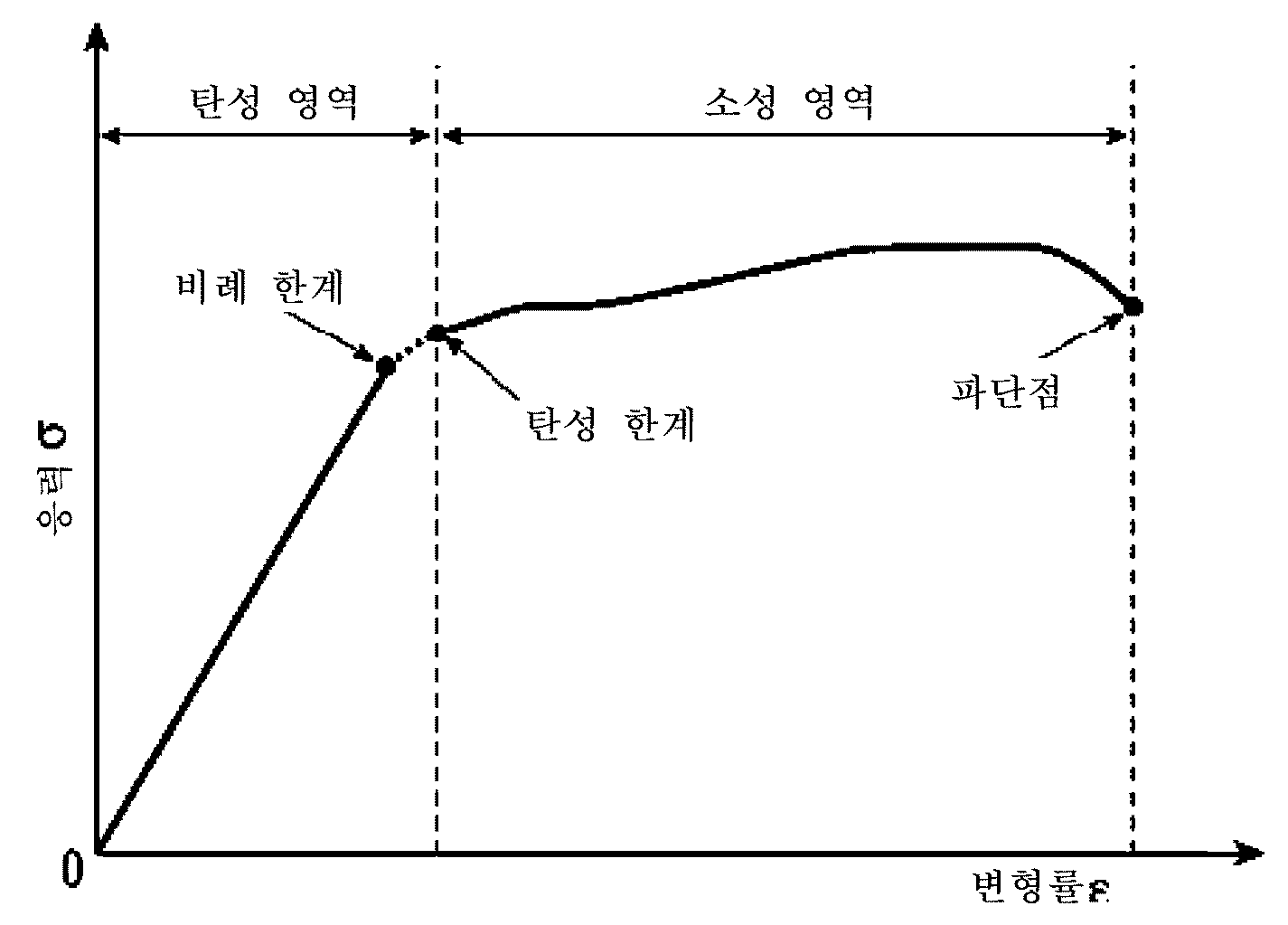
본 명세서에 기재된 디스플레이 필름의 전체 두께는 응용에 따라 임의의 유용한 값을 가질 수 있다. 디스플레이 필름의 두께는 원하는 디스플레이 보호를 제공하기에 충분히 두꺼운 두께와 접힘 파라미터 및 감소된 두께 설계 파라미터를 제공하기에 충분히 얇은 두께 사이에서 균형을 이룬다. 디스플레이 필름이 자신 상으로 접히는 경우, 이 필름은 총 두께가 85 내지 350 마이크로미터 또는 100 내지 300 마이크로미터 또는 150 내지 250 마이크로미터의 범위일 수 있다. 디스플레이 필름이 적당히 휘는 경우, 이 필름은 총 두께가 300 내지 500 마이크로미터의 범위일 수 있다. 디스플레이 필름이 만곡되지만 뚜렷하게 휘지는 않는 경우, 이 필름은 총 두께가 500 내지 1000 마이크로미터의 범위일 수 있다.The total thickness of the display films described herein can have any useful value depending on the application. The thickness of the display film is a balance between being thick enough to provide the desired display protection and thin enough to provide folding parameters and reduced thickness design parameters. When the display film is folded onto itself, the film may range in total thickness from 85 to 350 microns or from 100 to 300 microns or from 150 to 250 microns. When the display film is moderately flexible, the film may range in total thickness from 300 to 500 micrometers. When the display film is curved but not appreciably curved, the film may range in total thickness from 500 to 1000 micrometers.
디스플레이 필름은 하나 이상의 추가 층을 포함할 수 있다. 이러한 선택적인 층은 투명한 배리어(barrier) 층(두께 3 내지 200 나노미터), 미세구조체 층, 눈부심 방지 층, 반사 방지 층, 또는 지문 방지 층을 포함할 수 있다.The display film may include one or more additional layers. Such optional layers may include a transparent barrier layer (thick to 200 nanometers), a microstructure layer, an anti-glare layer, an anti-reflective layer, or an anti-fingerprint layer.
하드코트 층(15)은 투명한 중합체 기재 층(12) 또는 투명한 지방족 가교결합된 폴리우레탄 층(14) 중 하나 또는 둘 모두의 층의 어느 쪽 면 상에도 배치될 수 있다. 하드코트 층은 30 중량% 이상의 나노실리카 입자를 갖는 다작용성 아크릴레이트 수지를 포함할 수 있다. 국제특허 공개 WO2014/011731호는 일부 예시적인 하드코트를 기재한다.
투명한 배리어 층은 투명한 중합체 기재 층(12) 및 투명한 지방족 가교결합 폴리우레탄 층(14) 중 하나 또는 둘 모두의 층의 어느 쪽 면 상에도 배치될 수 있다. 투명한 배리어 층은 디스플레이 필름을 통한 산소 또는 물의 침입을 경감시키거나 또는 늦출 수 있다. 투명한 배리어 층은, 예를 들어 유기 수지와 함께 실리카, 알루미나 또는 지르코니아의 얇은 교번하는 층을 포함할 수 있다. 예시적인 투명한 배리어 층이 미국 특허 제7,980,910호 및 국제특허 공개 WO2003/094256호에 기재되어 있다.A transparent barrier layer may be disposed on either side of either or both of the transparent
일 실시 형태에서, 디스플레이 필름은 (두께가 35 내지 75 마이크로미터의 범위인) 투명한 중합체 기재 층, 및 투명한 중합체 기재 층 상에 배치된 (두께가 100 내지 200 마이크로미터의 범위인) 투명한 가교결합된 폴리우레탄 층을 포함한다. (두께가 4 내지 10 마이크로미터의 범위인) 하드코트 층이 투명한 중합체 기재 층 상에 배치된다. 투명한 가교결합된 폴리우레탄 층은 유리 전이 온도가 섭씨 0도 미만이고 Tan 델타 피크 값이 1.0 초과이다. 디스플레이 필름은 탁도 값이 1% 이하이다.In one embodiment, the display film comprises a transparent polymeric substrate layer (with a thickness in the range of 35 to 75 microns) and a transparent cross-linked material (with a thickness in the range of 100 to 200 microns) disposed on the transparent polymeric substrate layer. It includes a polyurethane layer. A hardcoat layer (thickness ranging from 4 to 10 micrometers) is disposed on the transparent polymeric substrate layer. The transparent crosslinked polyurethane layer has a glass transition temperature of less than 0 degrees Celsius and a Tan delta peak value of greater than 1.0. The display film has a haze value of 1% or less.
디스플레이 필름은 탁도 값이 2% 이하, 또는 1.5% 이하, 또는 1% 이하, 또는 0.5% 이하일 수 있다. 일부 실시 형태에서, 디스플레이 필름(10)은 탁도 값이 5% 이하일 수 있다. 디스플레이 필름은 투명도가 98% 이상, 또는 99% 이상일 수 있다. 디스플레이 필름은 가시광 투과율이 85% 이상, 또는 90% 이상, 또는 93% 이상일 수 있다.The display film may have a haze value of 2% or less, or 1.5% or less, or 1% or less, or 0.5% or less. In some embodiments, the
디스플레이 필름은 황변 지수(yellow index) 또는 b* 값이 5 이하, 또는 4 이하, 또는 3 이하, 또는 2 이하, 또는 1 이하일 수 있다. 많은 실시 형태에서, 디스플레이 필름은 황변 지수 또는 b* 값이 1 이하일 수 있다.The display film may have a yellow index or b* value of 5 or less, or 4 or less, or 3 or less, or 2 or less, or 1 or less. In many embodiments, the display film may have a yellowness index or b* value of 1 or less.
디스플레이 필름은 3 mm 반경 둘레로의 10,000회, 25,000회, 50,000회 또는 100,000회 이상의 굽힘 또는 접힘 사이클 후에 2% 이하, 또는 1.5% 이하, 또는 1% 이하의 탁도 값을 유지할 수 있다. 디스플레이 필름은 5 mm 반경 둘레, 또는 4 mm 반경 둘레, 또는 3 mm 반경 둘레, 또는 2 mm 반경 둘레, 또는 1 mm 반경 둘레로의 10,000회, 25,000회, 50,000회 또는 100,000회 이상의 굽힘 또는 접힘 사이클 후에 안정한 탁도 값을 유지할 수 있거나, 또는 균열 또는 탈층 없이 온전하게 남아 있을 수 있다. 디스플레이 필름은 3 mm 이하 반경 둘레로의 10,000회, 25,000회, 50,000회 또는 100,000회 이상의 굽힘 또는 접힘 사이클 후에 온전하게 남아 있을 수 있다.The display film can maintain a haze value of 2% or less, or 1.5% or less, or 1% or less after 10,000, 25,000, 50,000 or 100,000 or more bending or folding cycles around a 3 mm radius. The display film is formed after at least 10,000, 25,000, 50,000 or 100,000 bending or folding cycles around a 5 mm radius, or around a 4 mm radius, or around a 3 mm radius, or around a 2 mm radius, or around a 1 mm radius. It can maintain a stable turbidity value or it can remain intact without cracking or delamination. The display film may remain intact after more than 10,000, 25,000, 50,000 or 100,000 bending or folding cycles around a radius of 3 mm or less.
본 발명의 목적 및 이점은 하기의 실시예에 의해 추가로 예시되지만, 이들 실시예에 인용된 특정 재료 및 그 양뿐만 아니라 기타 조건과 상세 사항은 본 발명을 부당하게 제한하는 것으로 해석되어서는 안 된다.Objects and advantages of this invention are further illustrated by the following examples, but the specific materials and amounts thereof recited in these examples, as well as other conditions and details, should not be construed as unduly limiting this invention. .
실시예Example
실시예에서 모든 부, 백분율, 비 등은 달리 지시되지 않는 한 중량 기준이다. 사용되는 용매 및 기타 시약은 달리 명시되지 않는 한 미국 미주리주 세인트 루이스 소재의 시그마-알드리치 코포레이션(Sigma-Aldrich Corp.)으로부터 입수하였다.All parts, percentages, ratios, etc. in the examples are by weight unless otherwise indicated. Solvents and other reagents used were obtained from Sigma-Aldrich Corp., St. Louis, MO, USA, unless otherwise specified.
일련의 가교결합된 폴리우레탄 재료를 저 용융 PEN(LmPEN) 투명 필름의 50 마이크로미터 층 상에 제조하였다. 일부 실시예에서, LmPEN 필름을 UV 경화성, 실리카 충전된 아크릴레이트 하드코트 층으로 코팅하였다. 다른 실시예에서, 폴리우레탄 반응성 재료를, 명시된 라이너를 사용하여 코로나 처리된 LmPEN 상에 직접 코팅하였다. 하기에 기재된 시험 방법을 사용하여 각각의 구조물을 특성화하였다.A series of crosslinked polyurethane materials were prepared on a 50 micron layer of low melting PEN (LmPEN) transparent film. In some examples, LmPEN films were coated with a UV curable, silica filled acrylate hardcoat layer. In another example, a polyurethane reactive material was directly coated onto the corona treated LmPEN using a specified liner. Each construct was characterized using the test method described below.
[표 1][Table 1]
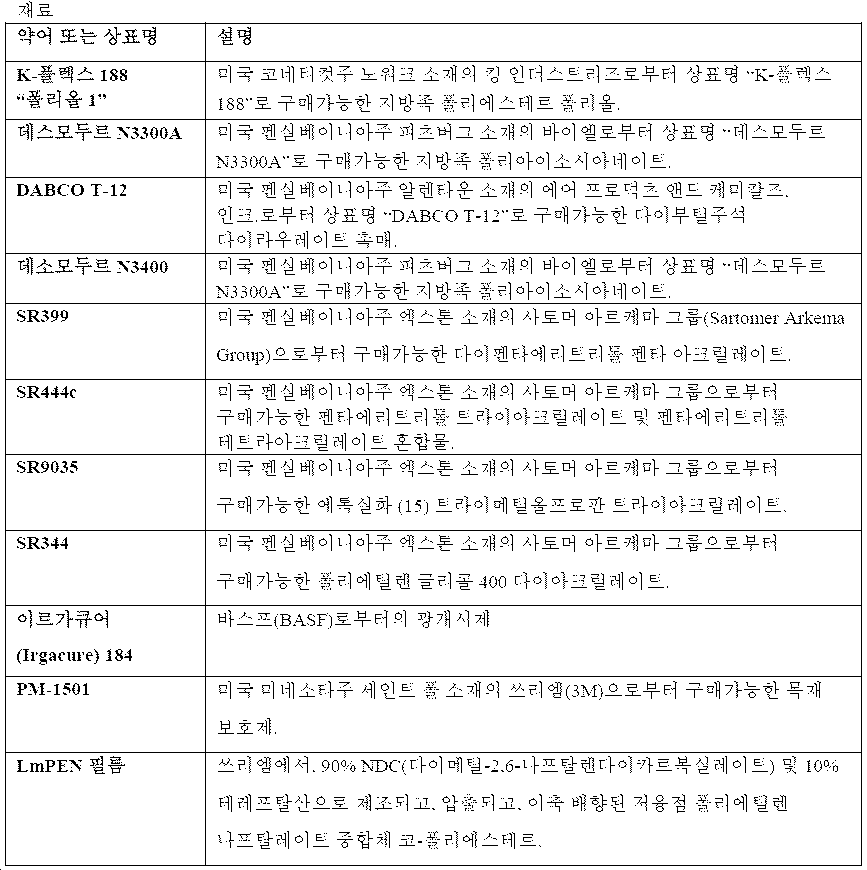
프라이밍된 LmPEN 필름의 제조Preparation of primed LmPEN films
2447.5 그램의 메틸 에틸 케톤(피셔 사이언티픽(Fisher Scientific)) 중에서 52.5 그램의 비텔(Vitel) 2200B(미국 위스콘신주 와우와토사 소재의 보스틱 아메리카즈(Bostik Americas))를 혼합하여 균질한 용액을 형성함으로써 프라이머 용액을 제조하였다. 슬롯 다이를 통해 프라이머 용액을 이동하는 웨브 상으로 계량하는 롤-투-롤(roll to roll) 공정으로 프라이머 용액을 37.5 마이크로미터 및 50 마이크로미터의 LmPEN 필름에 적용하였다. 계량 펌프 및 질량 유랑계의 사용에 의해 두께를 제어하였다. 이어서, 코팅의 휘발성 성분을 3 구역 공기 부상 구역 오븐(air floatation zone oven)에서 건조시켰다(오븐 온도는 모두 175℉로 설정하였다). 건조된 코팅을 롤로 감았고, 프라이머 코팅은 두께가 대략 81 nm였다.Mix 52.5 grams of Vitel 2200B (Bostik Americas, Wauwatosa, WI) in 2447.5 grams of methyl ethyl ketone (Fisher Scientific) to form a homogeneous solution By doing so, a primer solution was prepared. The primer solution was applied to the 37.5 micron and 50 micron LmPEN films in a roll-to-roll process in which the primer solution was metered through a slot die onto a moving web. Thickness was controlled by use of a metering pump and mass flow meter. The volatile components of the coating were then dried in a 3 zone air floatation zone oven (oven temperatures were all set to 175°F). The dried coating was rolled into a roll and the primer coating was approximately 81 nm thick.
고굴절률high refractive index 하드코트hard court 용액의 제조 preparation of solution
1 갤런 병에, 1-메톡시-2-프로판올 중 1440.7 그램의 10 nm 표면 작용화된 지르코니아 나노입자(미국 특허 제7,241,437호에 기재된 바와 같음)(59.0 중량%)를 첨가하였다. 용액에 65.00 그램의 SR399, 65 그램의 SR601, 409.3 그램의 메틸에틸케톤 및 20.0 그램의 이르가큐어 184를 첨가하였다. 용액을 30분 동안 교반하여, 50 중량% 고형물의 용액을 생성하였다.To a 1 gallon jar was added 1440.7 grams of 10 nm surface functionalized zirconia nanoparticles (as described in U.S. Pat. No. 7,241,437) (59.0% by weight) in 1-methoxy-2-propanol. To the solution was added 65.00 grams of SR399, 65 grams of SR601, 409.3 grams of methyl ethyl ketone and 20.0 grams of Irgacure 184. The solution was stirred for 30 minutes, resulting in a solution of 50 wt% solids.
1/4 파장 1/4 wavelength 프라이밍된primed LmPENLmPEN 필름의 제조 manufacture of film
155.5 그램의 메틸 에틸 케톤(피셔 사이언티픽) 및 467.7 그램의 사이클로헥사논 중에서 23.2 그램의 고굴절률 하드코트 용액 및 3.6 그램의 WB50 설폰화 폴리에스테르 수지(쓰리엠)를 혼합하여 균질한 용액을 제조함으로써 프라이머 용액을 제조하였다. 슬롯 다이를 통해 프라이머 용액을 이동하는 웨브 상으로 계량하는 롤-투-롤 공정으로 프라이머 용액을 37.5 마이크로미터, 50 마이크로미터 및 69 마이크로미터의 LmPEN 필름에 적용하였다. 계량 펌프 및 질량 유랑계의 사용에 의해 두께를 제어하였다. 이어서, 코팅의 휘발성 성분을 3 구역 공기 부상 구역 오븐에서 건조시켰다(오븐 온도는 모두 175℉로 설정하였다). 이어서, 건조된 코팅을 롤로 감았고, 프라이머 코팅은 두께가 대략 100 나노미터였다.Primer by mixing 23.2 grams of high refractive index hardcoat solution and 3.6 grams of WB50 sulfonated polyester resin (3M) in 155.5 grams of methyl ethyl ketone (Fisher Scientific) and 467.7 grams of cyclohexanone to make a homogeneous solution. A solution was prepared. The primer solution was applied to 37.5 micron, 50 micron and 69 micron LmPEN films in a roll-to-roll process in which the primer solution was metered through a slot die onto a moving web. Thickness was controlled by use of a metering pump and mass flow meter. The volatile components of the coating were then dried in a three zone air flotation zone oven (oven temperatures were all set to 175°F). The dried coating was then rolled into a roll, and the primer coating was approximately 100 nanometers thick.
하드코팅된hard coated 필름 1의 제조 Preparation of Film 1
1430.98 그램의 메틸 에틸 케톤(피셔 사이언티픽) 중에서 37.79 그램의 에사큐어(Esacure) 1(이탈리아 갈라라테 소재의 람베르티(Lamberti)), 2729.62 그램의 A174 작용화된 20 nm 실리카 입자(1-메톡시-2-프로판올 중 45 중량%), 909.87 그램의 메틸트라이메톡시실란 작용화된 20 nm 실리카 입자(1-메톡시-2-프로판올 중 45 중량%), 259.25 그램의 SR399, 348.99 그램의 SR9035, 478.62 그램의 SR444c, 42.88 그램의 SR344를 혼합하여 하드코트 용액을 제조하였다. 모든 성분들이 용해될 때까지 용액을 교반하였다. 용액에 11.99 g의 PM-1501(쓰리엠)을 첨가하고, 용액을 추가 20분 동안 교반하였다. 생성된 용액은 투명한 푸르스름한 외관을 갖고서 본질적으로 균질하였다. 슬롯 다이를 통해 프라이머 용액을 이동하는 웨브 상으로 계량하는 롤-투-롤 공정으로 하드코트 용액을 2 밀(mil)의 LmPEN 필름에 적용하였다. 계량 펌프 및 질량 유랑계의 사용에 의해 두께를 제어하였다. 코팅의 휘발성 성분을 3 구역 공기 부상 구역 오븐에서 건조시켰다(오븐 온도는 모두 175℉로 설정하였다). 건조된 코팅을 이색성 반사기, H 전구, 질소 불활성화, 및 냉각된 백업 롤을 갖는 인라인 600 W/in 퓨전(Fusion) UV 경화 스테이션으로 경화시켰다. 경화된 코팅을 롤로 감았다.37.79 grams Esacure 1 (Lamberti, Gallarate, Italy), 2729.62 grams A174 functionalized 20 nm silica particles (1-methoxy 45% by weight in -2-propanol), 909.87 grams of methyltrimethoxysilane functionalized 20 nm silica particles (45% by weight in 1-methoxy-2-propanol), 259.25 grams of SR399, 348.99 grams of SR9035, A hardcoat solution was prepared by mixing 478.62 grams of SR444c and 42.88 grams of SR344. The solution was stirred until all components were dissolved. To the solution was added 11.99 g of PM-1501 (3M) and the solution was stirred for an additional 20 minutes. The resulting solution was essentially homogeneous with a clear bluish appearance. The hardcoat solution was applied to a 2 mil LmPEN film in a roll-to-roll process in which the primer solution was metered through a slot die onto a moving web. Thickness was controlled by use of a metering pump and mass flow meter. The volatile components of the coating were dried in a three zone air flotation zone oven (oven temperatures were all set to 175°F). The dried coating was cured with an inline 600 W/in Fusion UV curing station with a dichroic reflector, H bulb, nitrogen inert, and cooled backup roll. The cured coating was wound into a roll.
하드코팅된hard coated 필름 2의 제조 Preparation of Film 2
1430.98 그램의 메틸 에틸 케톤(피셔 사이언티픽) 중에서 37.79 그램의 에사큐어 1(이탈리아 갈라라테 소재의 람베르티), 2729.62 그램의 A174 작용화된 20 nm 실리카 입자(1-메톡시-2-프로판올 중 45 중량%), 909.87 그램의 메틸트라이메톡시실란 작용화된 20 nm 실리카 입자(1-메톡시-2-프로판올 중 45 중량%), 259.25 그램의 SR399, 348.99 그램의 SR9035, 478.62 그램의 SR444c, 42.88 그램의 SR344를 혼합하여 하드코트 용액을 제조하였다. 모든 성분들이 용해될 때까지 용액을 교반하였다. 용액에 11.99 g의 PM-1501(쓰리엠)을 첨가하고, 용액을 추가 20분 동안 교반하였다. 생성된 용액은 투명한 푸르스름한 외관을 갖고서 본질적으로 균질하였다. 슬롯 다이를 통해 프라이머 용액을 이동하는 웨브 상으로 계량하는 롤-투-롤 공정으로 하드코트 용액을 1.5 밀의 LmPEN 필름에 적용하였다. 계량 펌프 및 질량 유랑계의 사용에 의해 두께를 제어하였다. 코팅의 휘발성 성분을 3 구역 공기 부상 구역 오븐에서 건조시켰다(오븐 온도는 모두 175℉로 설정하였다). 건조된 코팅을 이색성 반사기, H 전구, 질소 불활성화, 및 냉각된 백업 롤을 갖는 인라인 600 W/in 퓨전 UV 경화 스테이션으로 경화시켰다. 경화된 코팅을 롤로 감았다.37.79 grams Esacure 1 (Lamberti, Gallarate, Italy) in 1430.98 grams methyl ethyl ketone (Fisher Scientific), 2729.62 grams A174 functionalized 20 nm silica particles (45 % by weight), 909.87 grams of methyltrimethoxysilane functionalized 20 nm silica particles (45% by weight in 1-methoxy-2-propanol), 259.25 grams of SR399, 348.99 grams of SR9035, 478.62 grams of SR444c, 42.88 A hardcoat solution was prepared by mixing grams of SR344. The solution was stirred until all components were dissolved. To the solution was added 11.99 g of PM-1501 (3M) and the solution was stirred for an additional 20 minutes. The resulting solution was essentially homogeneous with a clear bluish appearance. The hardcoat solution was applied to a 1.5 mil LmPEN film in a roll-to-roll process in which the primer solution was metered through a slot die onto a moving web. Thickness was controlled by use of a metering pump and mass flow meter. The volatile components of the coating were dried in a three zone air flotation zone oven (oven temperatures were all set to 175°F). The dried coating was cured with an inline 600 W/in Fusion UV curing station with dichroic reflector, H bulb, nitrogen inert, and cooled backup roll. The cured coating was wound into a roll.
폴리올 및 촉매 혼합물의 제조Preparation of polyol and catalyst mixtures
93℃의 공기 혼합기에서 470 그램의 폴리올-1(K-플렉스 188 또는 K188) 및 4 방울의 촉매를 혼합하였다. 생성된 기포를 감소시키기 위하여, 이어서 혼합물을 60℃에서 하룻밤 진공 오븐 내에 두었다.470 grams of polyol-1 (K-Flex 188 or K188) and 4 drops of catalyst were mixed in an air mixer at 93°C. The mixture was then placed in a vacuum oven overnight at 60° C. to reduce any bubbles that were formed.
실시예Example 1 내지 1 to 실시예Example 4: 폴리우레탄 수지 및 폴리우레탄 필름 4: polyurethane resin and polyurethane film
실시예 1 내지 실시예 4에 있어서, 표 2에 열거된 성분들을 스피드 믹스 컵(speed mix cup)에 첨가하고, 이들을 1500 rpm으로 약 1분 동안 혼합하였다. 용액은 아이소시아네이트 및 폴리올을 촉매와 5분간 혼합하여 사용하였다. 반응성 2 파트 우레탄을 실리콘 코팅된 이형 라이너들 사이에 약 200 마이크로미터의 두께로 캐스팅하고, 70℃에서 10분 동안 경화시킨 후에 85℃ 에서 19시간 동안 포스트-베이킹(postbake)하였다. 생성된 경화된 폴리우레탄 필름에서 실리콘 라이너를 벗겨내고 동적 기계 분석을 사용하여 측정하고 표 3에 보고하였다.In Examples 1-4, the ingredients listed in Table 2 were added to a speed mix cup, and they were mixed at 1500 rpm for about 1 minute. The solution was used by mixing isocyanate and polyol with catalyst for 5 minutes. The reactive two part urethane was cast between silicone coated release liners to a thickness of about 200 micrometers, cured at 70°C for 10 minutes and then post-baked at 85°C for 19 hours. The silicone liner was stripped off the resulting cured polyurethane film and measured using dynamic mechanical analysis and reported in Table 3 .
[표 2][Table 2]
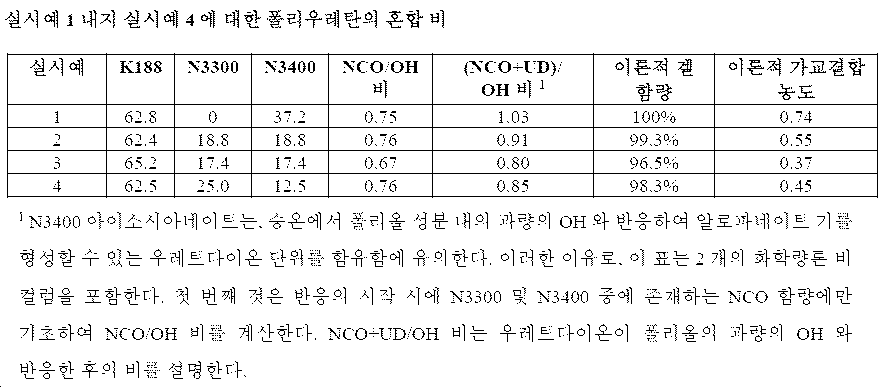
[표 3][Table 3]
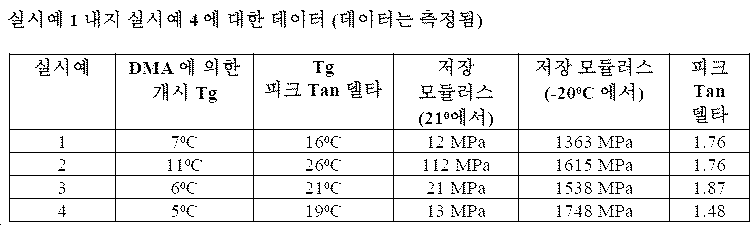
실시예Example 5 내지 5 to 실시예Example 16: 커버 시트 필름의 제조 16: Preparation of cover sheet film
커버 시트 필름을 롤-투-롤 공정으로 제조하였는데, 아이소시아네이트 및 폴리올과 촉매를 인라인 정적 혼합기를 사용하여 혼합하였다. 약 2 밀 두께의 실리콘 이형 라이너와 상기에 기재된 하드코팅된 필름 사이의 이동하는 웨브에 용액을 적용하였는데, 용액은 필름의 비-하드코트 면과 접촉하였고, 원하는 두께의 커버 시트 필름 산출물을 생성하도록 조정된 갭을 갖는 노치 바아(notch bar) 아래에서 당겨졌다. 필름들 사이의 코팅된 폴리우레탄을 70℃에서 가열하고 롤로 감았다. 필름을 시험 전에 75℃에서 72시간 동안 포스트-베이킹하였다. 각각의 실시예에 대한 혼합 비 및 상세 사항이 표 4에 나타나 있다. 필름의 특성(THC는 투과율/탁도/투명도를 지칭함)이 표 5에 나타나 있다.The cover sheet film was prepared in a roll-to-roll process wherein the isocyanate and polyol and catalyst were mixed using an inline static mixer. The solution was applied to a moving web between a silicone release liner about 2 mils thick and the hardcoated film described above, the solution contacting the non-hardcoat side of the film, to produce a cover sheet film output of the desired thickness. It was pulled under a notch bar with an adjusted gap. The coated polyurethane between the films was heated at 70° C. and wound into a roll. Films were post-baked at 75° C. for 72 hours prior to testing. Mixing ratios and details for each example are shown in Table 4 . The properties of the film (THC stands for transmittance/haze/transparency) are shown in Table 5 .
[표 4][Table 4]
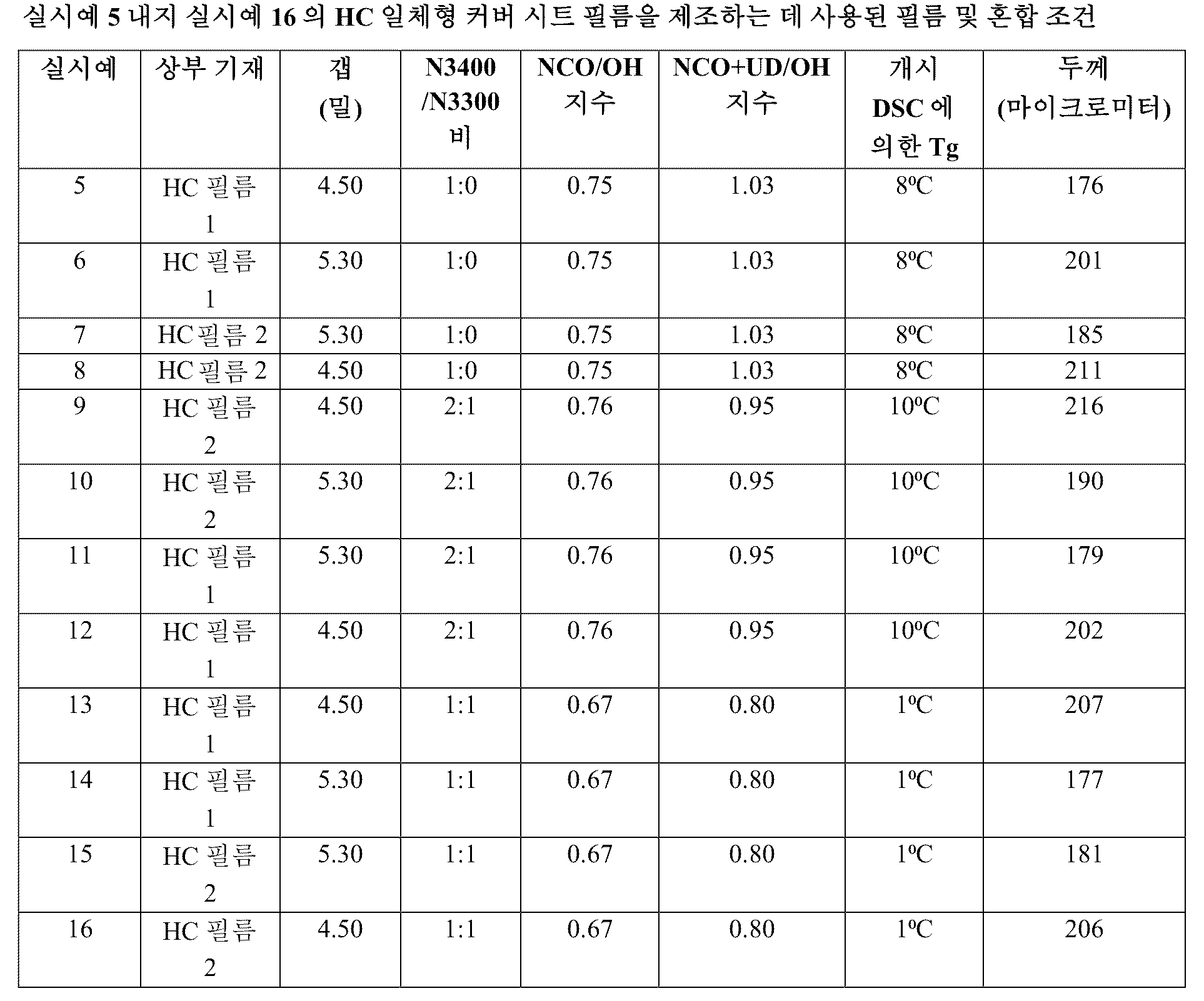
[표 5][Table 5]
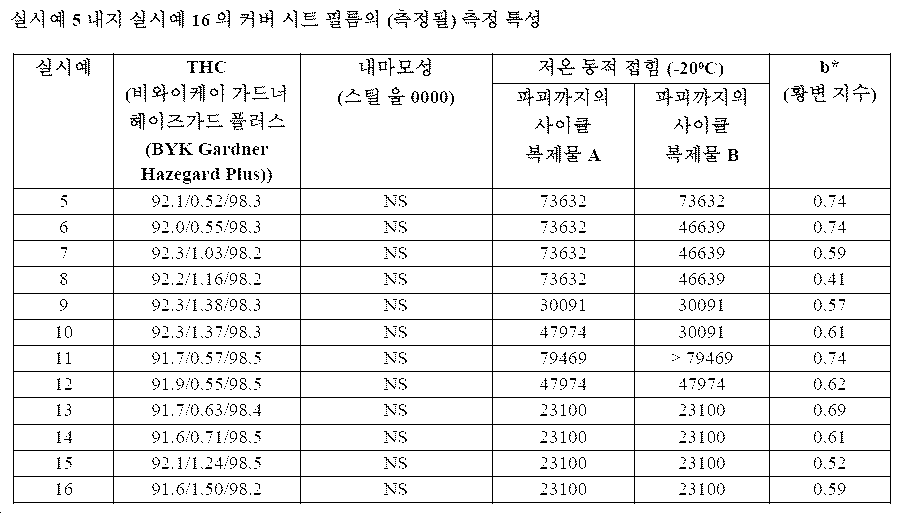
폴리우레탄 층polyurethane layer 특성화 characterization
유리 전이 온도glass transition temperature
폴리우레탄 코팅의 유리 전이 온도를 티에이 인스트루먼츠(TA Instruments) 모델 Q2000 시차 주사 열량계를 사용하여 특성화하였다. 2℃/min의 가열 속도로 스캔을 실시하였다. 하드코팅된 기재의 조각을 갖는 샘플 팬을 기준(reference)으로서 사용하였다. 결과가 상기 표 4에 나타나 있다. 유리 전이의 개시를 ASTM E1356-08 (2014)에 따라 결정하였다.The glass transition temperature of the polyurethane coatings was characterized using a TA Instruments Model Q2000 Differential Scanning Calorimeter. Scans were performed at a heating rate of 2° C./min. A sample pan with a piece of hardcoated substrate was used as a reference. Results are shown in Table 4 above. The onset of glass transition was determined according to ASTM E1356-08 (2014).
동적 기계 분석 시험 방법Dynamic Mechanical Analysis Test Method
샘플을 6.35 mm 폭 및 약 4 cm 길이의 스트립으로 절단하였다. 각각의 필름의 두께를 측정하였다. 필름을 티에이 인스트루먼츠로부터의 Q800 DMA의 인장 그립들 내에 장착하였는데, 이때 초기 그립 분리가 16 mm 내지 19 mm였다. 이어서, 샘플을 2℃/min의 속도로 -20℃로부터 200℃까지의 온도 램프(ramp) 전체에 걸쳐 0.2% 변형률 및 1 ㎐의 진동으로 시험하였다. Tan 델타 신호가 최대에 도달하였을 때의 온도를 피크 Tan 델타 온도로 기록하였다.The sample was cut into strips 6.35 mm wide and about 4 cm long. The thickness of each film was measured. The film was mounted in the tensile grips of a Q800 DMA from TA Instruments with an initial grip separation of 16 mm to 19 mm. The samples were then tested at 0.2% strain and vibration at 1 Hz throughout a temperature ramp from -20°C to 200°C at a rate of 2°C/min. The temperature at which the Tan delta signal reached its maximum was recorded as the peak Tan delta temperature.
투과율, 탁도, 및 투명도(THC)Transmittance, Haze, and Transparency (THC)
제조된 실시예들의 광학 특성을 헤이즈가드 기기를 사용하여 측정하였다. 광 투과율, 투명도 및 탁도는 가드너 헤이즈-가드 플러스 모델 4725(미국 메릴랜드주 콜롬비아 소재의 비와이케이-가드너로부터 입수가능함)를 사용하여 ASTM D1003-00에 따라 측정하였다. 표 5에서의 각각의 결과는 주어진 샘플에 대한 3회 측정의 평균이다.Optical properties of the prepared examples were measured using a haze guard instrument. Light transmittance, clarity and haze were measured according to ASTM D1003-00 using a Gardner Haze-Gard Plus Model 4725 (available from BYK-Gardner, Columbia, MD). Each result in Table 5 is the average of three measurements for a given sample.
황변 지수 또는 b*Yellowness index or b*
D65 광원을 사용하여 b*를 측정함으로써 황변도를 평가하였다. 코니카 미놀타(Konica Minolta) 분광광도계 모델 CM3700d 상에서 투과율에 대하여 측정을 실시하였다. 결과가 표 5에 나타나 있다.Yellowness was evaluated by measuring b* using a D65 light source. Measurements were made for transmittance on a Konica Minolta spectrophotometer model CM3700d. Results are shown in Table 5 .
저온 동적 접힘 시험Low temperature dynamic folding test
저온에서의 다수 회의 접힘 사건에 대한 보호 필름의 내구성을, 동적 접힘 시험기를 사용하여 평가하였다. 동적 접힘 시험기는 2개의 동일평면 플레이트를 가지며, 이들 플레이트 중 하나는 고정되어 있고, 다른 플레이트는 회전하여 서로 중첩 및 대면하게 된다. 폐쇄된 때 플레이트들 사이의 갭을 대략 10 mm로 설정하여 대략 5 mm의 굽힘 반경을 형성하였다. 각각의 샘플의 7" x 1.5" 조각을 레이저 변환하고 라이너를 제거하였다. 50 마이크로미터 두께의 광학적으로 투명한 실리콘 폴리우레아 접착제의 1.5" 폭 스트립을 사용하여, 각각의 샘플 구조물의 2개의 복제물을, (압축 시 폴리우레탄 코팅) 코팅 면을 위로 하여 접힘 플레이트에 부착하였다. 광학적으로 투명한 실리콘 폴리우레아 접착제는 국제특허 공개 WO2016/196460호의 실시예 4에 기재된 바와 같이 제조하였다. 필름이 구속되지 않는 대략 12.5 mm 폭의 자유 구역이 접힘 축의 양측 면 상에 존재하도록 테이프를 플레이트에 적용하였다. 전체 접힘 장치를 환경 챔버(environmental chamber) 내에 넣고, 이어서 0.7 C/min으로 섭씨 -20도까지 냉각시켰다. 일단 챔버가 그의 설정점에 도달하면, 접힘 속도를 대략 20회 접힘/분으로 설정하고, 100,000 사이클 동안 또는 모든 샘플이 파괴될 때까지 시험을 실행하였다. 코팅 균열, 탈층 또는 혼탁과 같은 파괴의 증거를 위하여 10,000회 내지 25,000회 사이클마다 환경 챔버의 윈도우를 통해 샘플을 시각적으로 검사하였다. 결과가 표 5에 나타나 있다.The durability of the protective film to multiple folding events at low temperatures was evaluated using a dynamic folding tester. The dynamic folding tester has two coplanar plates, one of which is stationary and the other rotates so that they overlap and face each other. When closed, the gap between the plates was set to approximately 10 mm to form a bending radius of approximately 5 mm. A 7" x 1.5" piece of each sample was laser converted and the liner removed. Using 50 micron thick 1.5" wide strips of optically clear silicone polyurea adhesive, two replicas of each sample structure were attached (polyurethane coating in compression) coated side up to a folding plate. Optical A transparent silicone polyurea adhesive was prepared as described in WO2016/196460, Example 4. The tape was applied to the plate such that there were approximately 12.5 mm wide free zones on both sides of the fold axis where the film was not constrained. The entire folding device was placed in an environmental chamber and then cooled at 0.7 C/min to -20 degrees C. Once the chamber reached its set point, the folding speed was set to approximately 20 folds/min The test was run for 100,000 cycles or until all samples were destroyed Samples were visually inspected through the window of the environmental chamber every 10,000 to 25,000 cycles for evidence of failure such as coating cracking, delamination or haze .The results are shown in Table 5 .
마모 시험abrasion test
각각의 샘플의 코팅된 표면을 가로질러 스타일러스(stylus)에 부착된 마모 재료를 진동시킬 수 있는 기계 장치를 사용하여, 코팅 방향에 대해 크로스 웨브(cross web) 방향으로 샘플의 마모를 시험하였다. 스타일러스는 210 mm/sec(2회 와이프(wipe)/초)의 속도로 60 mm 폭의 스위프 폭(sweep width)에 걸쳐 진동하였으며, 여기서 와이프는 60 mm의 단일 이동으로서 정의된다. 스타일러스는 편평한 기부 및 3.2 cm의 직경을 갖는 실린더였다. 이 시험에 사용된 마모 재료는 스틸 울이었으며, 이는 로데스-아메리칸(Rhodes-American)(미국 워싱턴주 벨링햄 소재의 호맥스 프로덕츠(Homax Products)의 부문)으로부터 상표명 "#0000-수퍼-파인"(#0000- Super-Fine)으로 입수하였고 입수한 그대로 사용하였다.The samples were tested for wear in a cross web direction relative to the coating direction, using a mechanical device capable of vibrating the wear material attached to a stylus across the coated surface of each sample. The stylus was vibrated over a 60 mm wide sweep width at a rate of 210 mm/sec (2 wipes/sec), where a wipe is defined as a single movement of 60 mm. The stylus was a cylinder with a flat base and a diameter of 3.2 cm. The wear material used in this test was steel wool, which has the trade designation “#0000-Super-Fine” from Rhodes-American (a division of Homax Products, Bellingham, WA). (#0000-Super-Fine) and used as received.
직경 3.2 cm의 디스크를 패드로부터 절단하고, 쓰리엠 스카치 퍼머넌트 어드히시브 트랜스퍼 테이프(3M Scotch Permanent Adhesive Transfer tape)를 사용하여 스타일러스의 기부에 접착하였다. 1.5 ㎏ 중량 및 100회 및 1000회의 와이프로 각각의 실시예에 대해 단일 샘플을 시험하였다. 마모 후에, 샘플을 도 9에서 하기에 나타낸 시각적 표준에 기초하여 스크래치에 대해 시각적으로 등급을 매겼다. HS는 강한 스크래치를 지칭한다. S는 스크래치를 지칭한다. SS는 약간의 스크래치를 지칭한다. NS는 가시적 스크래치가 없음을 지칭한다. 결과가 표 5에 나타나 있다.A 3.2 cm diameter disk was cut from the pad and adhered to the base of the stylus using 3M Scotch Permanent Adhesive Transfer tape. A single sample was tested for each example with a 1.5 kg weight and 100 and 1000 wipes. After abrasion, the samples were visually graded for scratches based on the visual criteria shown below in FIG. 9 . HS refers to hard scratches. S refers to scratch. SS refers to slight scratches. NS indicates no visible scratches. Results are shown in Table 5 .
따라서, 저 Tg 폴리우레탄 보호 디스플레이 필름의 실시 형태가 개시된다.Accordingly, embodiments of low Tg polyurethane protective display films are disclosed.
본 명세서에 인용된 모든 참고 문헌 및 간행물은, 이들이 본 발명과 직접적으로 모순될 수 있는 경우를 제외하고는, 본 명세서에서 명백히 본 발명에 전체적으로 참고로 포함된다. 특정 실시 형태가 본 명세서에 예시되고 기술되어 있지만, 당업자는 본 발명의 범주로부터 벗어나지 않고서 다양한 대안 및/또는 등가의 구현 형태가 도시 및 기술된 특정 실시 형태를 대신할 수 있다는 것을 이해할 것이다. 본 출원은 본 명세서에 논의된 특정 실시 형태의 임의의 개조 또는 변형을 포괄하도록 의도된다. 따라서, 본 발명은 오직 청구범위 및 이의 등가물에 의해서만 제한되는 것으로 의도된다. 개시된 실시 형태는 제한이 아닌 예시의 목적을 위해 제공된다.All references and publications cited herein are expressly incorporated herein by reference in their entirety, except where they may directly contradict this invention. Although specific embodiments have been illustrated and described herein, those skilled in the art will understand that various alternative and/or equivalent implementations may be substituted for the specific embodiments shown and described without departing from the scope of the present invention. This application is intended to cover any adaptations or variations of the specific embodiments discussed herein. Accordingly, it is intended that this invention be limited only by the claims and the equivalents thereof. The disclosed embodiments are provided for purposes of illustration and not limitation.
Claims (32)
투명한 중합체 기재 층 상에 배치된 투명한 가교결합된 열경화성 폴리우레탄 층
을 포함하며,
투명한 가교결합된 열경화성 폴리우레탄 층은 유리 전이 온도가 섭씨 10도 이하이고 피크에서의 Tan 델타 값이 0.5 이상이고,
투명한 가교결합된 열경화성 폴리우레탄 층은 우레트다이온 작용기 및 아이소시아누레이트 작용기를 함유하는 헥사메틸렌다이아이소시아네이트(HDI) 올리고머를 포함하는, 디스플레이 필름.a transparent polymeric substrate layer; and
A transparent cross-linked thermoset polyurethane layer disposed on a transparent polymeric substrate layer.
Including,
The transparent cross-linked thermoset polyurethane layer has a glass transition temperature of less than 10 degrees Celsius and a Tan delta value at the peak greater than or equal to 0.5;
A display film, wherein the transparent cross-linked thermosetting polyurethane layer comprises hexamethylenediisocyanate (HDI) oligomers containing uretdione functional groups and isocyanurate functional groups.
투명한 가교결합된 열경화성 폴리우레탄 층 상에 배치된 투명한 보호 층
을 포함하고,
투명한 가교결합된 열경화성 폴리우레탄 층은 우레트다이온 작용기 및 아이소시아누레이트 작용기를 함유하는 헥사메틸렌다이아이소시아네이트(HDI) 올리고머를 포함하는, 디스플레이 필름.a transparent cross-linked thermosetting polyurethane layer having a glass transition temperature of 10 degrees Celsius or less and a Tan delta value at the peak of 0.5 or more; and
A transparent protective layer disposed on a transparent cross-linked thermoset polyurethane layer.
including,
A display film, wherein the transparent cross-linked thermosetting polyurethane layer comprises hexamethylenediisocyanate (HDI) oligomers containing uretdione functional groups and isocyanurate functional groups.
Applications Claiming Priority (3)
| Application Number | Priority Date | Filing Date | Title |
|---|---|---|---|
| US201662357423P | 2016-07-01 | 2016-07-01 | |
| US62/357,423 | 2016-07-01 | ||
| PCT/US2017/040058 WO2018005833A2 (en) | 2016-07-01 | 2017-06-29 | LOW Tg POLYURETHANE PROTECTIVE DISPLAY FILM |
Publications (2)
| Publication Number | Publication Date |
|---|---|
| KR20190025922A KR20190025922A (en) | 2019-03-12 |
| KR102536293B1 true KR102536293B1 (en) | 2023-05-23 |
Family
ID=60787751
Family Applications (1)
| Application Number | Title | Priority Date | Filing Date |
|---|---|---|---|
| KR1020197001920A Active KR102536293B1 (en) | 2016-07-01 | 2017-06-29 | Low Tg Polyurethane Protective Display Film |
Country Status (7)
| Country | Link |
|---|---|
| US (1) | US10962688B2 (en) |
| EP (1) | EP3478501A4 (en) |
| JP (1) | JP2019529963A (en) |
| KR (1) | KR102536293B1 (en) |
| CN (1) | CN109414915B (en) |
| TW (1) | TW201829566A (en) |
| WO (1) | WO2018005833A2 (en) |
Families Citing this family (22)
| Publication number | Priority date | Publication date | Assignee | Title |
|---|---|---|---|---|
| TW201829170A (en) | 2016-09-21 | 2018-08-16 | 美商3M新設資產公司 | Protective display film with glass |
| CN110035896B (en) | 2016-12-01 | 2021-05-28 | 3M创新有限公司 | Dual Cure Protective Display Film |
| KR102271026B1 (en) * | 2017-09-04 | 2021-06-30 | 코오롱인더스트리 주식회사 | Hard Coating Film Having Multi-Layer and Polyimide film including the same |
| KR102731347B1 (en) | 2017-12-08 | 2024-11-15 | 쓰리엠 이노베이티브 프로퍼티즈 컴파니 | Gayoseong Hardcourt |
| CN111770976A (en) | 2018-02-28 | 2020-10-13 | 3M创新有限公司 | Adhesives comprising polymerized units of sec-hexyl (meth)acrylate |
| WO2020042168A1 (en) * | 2018-08-31 | 2020-03-05 | 华为技术有限公司 | Flexible protective film, curved display screen, and terminal |
| US20220017744A1 (en) * | 2018-12-05 | 2022-01-20 | Bando Chemical Industries, Ltd. | Surface protection film for flexible display and method of producing thereof |
| WO2020116334A1 (en) | 2018-12-05 | 2020-06-11 | バンドー化学株式会社 | Surface protection film for flexible display |
| WO2020116335A1 (en) * | 2018-12-05 | 2020-06-11 | バンドー化学株式会社 | Surface protection film for flexible display |
| KR102564140B1 (en) * | 2019-02-19 | 2023-08-09 | 동우 화인켐 주식회사 | Flexible window stack structure and display device including the same |
| EP3715499A1 (en) * | 2019-03-29 | 2020-09-30 | Picosun Oy | Substrate coating |
| CN110068940B (en) * | 2019-05-07 | 2020-07-28 | 河南达人视界眼镜有限公司 | Special lens for mobile phone |
| CN113874445A (en) | 2019-05-09 | 2021-12-31 | 3M创新有限公司 | Flexible hard coating |
| WO2020225704A1 (en) | 2019-05-09 | 2020-11-12 | 3M Innovative Properties Company | Flexible hardcoat |
| CN114072468A (en) | 2019-05-09 | 2022-02-18 | 3M创新有限公司 | Flexible hard coating |
| WO2021130672A1 (en) * | 2019-12-26 | 2021-07-01 | 3M Innovative Properties Company | Film stacks for thin circular polarizers |
| CN113263718B (en) * | 2020-02-17 | 2022-12-13 | 华为技术有限公司 | Protective film and its preparation method, bonding method and terminal |
| US11571881B2 (en) | 2020-03-03 | 2023-02-07 | Kolon Industries, Inc. | Hard coating film having multilayer-structure, and polyimide film comprising same |
| CN111725269B (en) * | 2020-06-02 | 2022-09-09 | 武汉华星光电半导体显示技术有限公司 | Display panel and its manufacturing method |
| JP2022135952A (en) * | 2021-03-03 | 2022-09-15 | 藤森工業株式会社 | adhesive film |
| JP7211457B1 (en) | 2021-07-05 | 2023-01-24 | 東洋インキScホールディングス株式会社 | Adhesive sheet for flexible image display device, laminate for flexible image display device, and flexible image display device. |
| TWI824357B (en) | 2021-12-17 | 2023-12-01 | 財團法人工業技術研究院 | Transparent elastic composite film and its packaging structure and method for forming the packaging structure |
Family Cites Families (38)
| Publication number | Priority date | Publication date | Assignee | Title |
|---|---|---|---|---|
| FR2608500B1 (en) | 1986-12-19 | 1989-03-31 | Saint Gobain Vitrage | HIGH OPTICAL QUALITY TRANSPARENT PLASTIC SHEET RESISTANT TO SCRATCH AND ABRASION, MANUFACTURING METHOD AND WINDOWS USING THE SAME |
| US6376082B1 (en) | 1997-01-09 | 2002-04-23 | Ellay, Inc. | Exterior weatherable abrasion-resistant foldable plastic window for convertible tops |
| US6376590B2 (en) | 1999-10-28 | 2002-04-23 | 3M Innovative Properties Company | Zirconia sol, process of making and composite material |
| US6607831B2 (en) * | 2000-12-28 | 2003-08-19 | 3M Innovative Properties Company | Multi-layer article |
| EP1318011B1 (en) | 2001-12-07 | 2004-09-22 | 3M Innovative Properties Company | Multi-layer sheet comprising a protective polyurethane layer |
| US20030203210A1 (en) | 2002-04-30 | 2003-10-30 | Vitex Systems, Inc. | Barrier coatings and methods of making same |
| US7018713B2 (en) | 2003-04-02 | 2006-03-28 | 3M Innovative Properties Company | Flexible high-temperature ultrabarrier |
| KR100602242B1 (en) | 2004-05-12 | 2006-07-19 | 주식회사 대우일렉트로닉스 | Dry hot air supply structure of drum washing machine |
| US20090280329A1 (en) * | 2004-09-01 | 2009-11-12 | Ppg Industries Ohio, Inc. | Polyurethanes, Articles and Coatings Prepared Therefrom and Methods of Making the Same |
| US7241437B2 (en) | 2004-12-30 | 2007-07-10 | 3M Innovative Properties Company | Zirconia particles |
| US20060216524A1 (en) | 2005-03-23 | 2006-09-28 | 3M Innovative Properties Company | Perfluoropolyether urethane additives having (meth)acryl groups and hard coats |
| US20080020170A1 (en) | 2006-07-19 | 2008-01-24 | Haubrich Jeanne E | Substrate possessing a transparent protective layer derived from a radiation-curable acrylate composition |
| US20090000727A1 (en) * | 2007-06-29 | 2009-01-01 | Kanta Kumar | Hardcoat layers on release liners |
| WO2009029438A1 (en) | 2007-08-31 | 2009-03-05 | 3M Innovative Properties Company | Hardcoats |
| JP4798156B2 (en) * | 2008-03-17 | 2011-10-19 | 三菱樹脂株式会社 | Laminated film |
| BRPI0909077A2 (en) * | 2008-03-25 | 2015-08-25 | 3M Innovative Properties Co | Multilayer articles and methods of preparation and use |
| KR101098529B1 (en) * | 2008-10-15 | 2011-12-26 | 한국생산기술연구원 | Hard coating film composition |
| US20120204566A1 (en) | 2009-10-26 | 2012-08-16 | Hartzell Andrew K | Fresnel lens |
| BR112012011654A2 (en) * | 2009-11-18 | 2020-08-25 | 3M Innovantive Properties Company | multilayer optical films |
| CN102883878B (en) * | 2010-03-31 | 2014-04-23 | 三菱丽阳株式会社 | Laminated body and manufacturing method thereof |
| JP2012091406A (en) | 2010-10-27 | 2012-05-17 | Daicel Corp | Transparent conductive laminated film and touch panel |
| EP2652020A1 (en) | 2010-12-16 | 2013-10-23 | 3M Innovative Properties Company | Interpenetrated polymer layer |
| US10288254B2 (en) | 2011-02-25 | 2019-05-14 | 3M Innovative Properties Company | Front-lit reflective display device |
| US9016858B2 (en) | 2011-06-21 | 2015-04-28 | Essilor International (Compagnie Generale D'optique) | Optical article containing self-healing and abrasion-resistant coatings |
| BR112014019208A8 (en) * | 2012-02-03 | 2017-07-11 | 3M Innovative Properties Company | PREPARATORY COATING COMPOSITIONS FOR OPTICAL FILMS |
| US20150132583A1 (en) | 2012-07-13 | 2015-05-14 | 3M Innovative Properties Company | Hardcoats comprising alkoxylated multi (meth)acrylate monomers |
| CN104619735B (en) * | 2012-09-20 | 2016-08-17 | Dic株式会社 | Ultra-violet solidified urethane acrylate composition, film shaped body, blooming and the manufacture method of film shaped body |
| KR101537845B1 (en) | 2012-12-12 | 2015-07-17 | 코오롱인더스트리 주식회사 | Transparent Polyimide Substrate and method for producing the same |
| WO2014197368A1 (en) | 2013-06-06 | 2014-12-11 | 3M Innovative Properties Company | Method for preparing structured laminating adhesive articles |
| KR20160014765A (en) | 2013-06-06 | 2016-02-11 | 쓰리엠 이노베이티브 프로퍼티즈 컴파니 | Method for preparing structured adhesive articles |
| BR112016008504B1 (en) * | 2013-10-30 | 2021-02-17 | Dow Global Technologies Llc | cured syntactic polyurethane elastomer and substrate coated with multiple sections of a syntactic polyurethane elastomer |
| GB201409063D0 (en) * | 2014-05-21 | 2014-07-02 | Dupont Teijin Films Us Ltd | Coated polyester films |
| KR20180015224A (en) | 2015-06-03 | 2018-02-12 | 쓰리엠 이노베이티브 프로퍼티즈 컴파니 | A silicon-based assembly layer for flexible display applications |
| US9780318B2 (en) | 2015-12-15 | 2017-10-03 | 3M Innovative Properties Company | Protective display film |
| US10005264B2 (en) | 2015-12-15 | 2018-06-26 | 3M Innovative Properties Company | Thin protective display film |
| CN109311289A (en) * | 2016-06-09 | 2019-02-05 | 3M创新有限公司 | Polyurethane Acrylate Protective Display Film |
| CN110035896B (en) * | 2016-12-01 | 2021-05-28 | 3M创新有限公司 | Dual Cure Protective Display Film |
| TW201830102A (en) * | 2016-12-14 | 2018-08-16 | 美商3M新設資產公司 | Segmented protective display film |
-
2017
- 2017-06-29 CN CN201780041111.9A patent/CN109414915B/en active Active
- 2017-06-29 KR KR1020197001920A patent/KR102536293B1/en active Active
- 2017-06-29 JP JP2018568794A patent/JP2019529963A/en active Pending
- 2017-06-29 EP EP17821272.6A patent/EP3478501A4/en not_active Withdrawn
- 2017-06-29 US US16/311,863 patent/US10962688B2/en active Active
- 2017-06-29 WO PCT/US2017/040058 patent/WO2018005833A2/en not_active Ceased
- 2017-06-30 TW TW106122007A patent/TW201829566A/en unknown
Also Published As
| Publication number | Publication date |
|---|---|
| US20200309999A1 (en) | 2020-10-01 |
| US10962688B2 (en) | 2021-03-30 |
| WO2018005833A3 (en) | 2018-02-22 |
| EP3478501A4 (en) | 2020-03-04 |
| CN109414915B (en) | 2021-10-22 |
| EP3478501A2 (en) | 2019-05-08 |
| JP2019529963A (en) | 2019-10-17 |
| KR20190025922A (en) | 2019-03-12 |
| CN109414915A (en) | 2019-03-01 |
| WO2018005833A2 (en) | 2018-01-04 |
| TW201829566A (en) | 2018-08-16 |
Similar Documents
| Publication | Publication Date | Title |
|---|---|---|
| KR102536293B1 (en) | Low Tg Polyurethane Protective Display Film | |
| JP7442564B2 (en) | Protective display film containing glass | |
| US10882283B2 (en) | Segmented protective display film | |
| KR102503640B1 (en) | Dual Curing Protective Display Film | |
| KR102523404B1 (en) | Polyurethane Acrylate Protective Display Film | |
| EP3390053A1 (en) | Thin protective display film |
Legal Events
| Date | Code | Title | Description |
|---|---|---|---|
| PA0105 | International application |
St.27 status event code: A-0-1-A10-A15-nap-PA0105 |
|
| PG1501 | Laying open of application |
St.27 status event code: A-1-1-Q10-Q12-nap-PG1501 |
|
| A201 | Request for examination | ||
| AMND | Amendment | ||
| E13-X000 | Pre-grant limitation requested |
St.27 status event code: A-2-3-E10-E13-lim-X000 |
|
| P11-X000 | Amendment of application requested |
St.27 status event code: A-2-2-P10-P11-nap-X000 |
|
| P13-X000 | Application amended |
St.27 status event code: A-2-2-P10-P13-nap-X000 |
|
| PA0201 | Request for examination |
St.27 status event code: A-1-2-D10-D11-exm-PA0201 |
|
| P22-X000 | Classification modified |
St.27 status event code: A-2-2-P10-P22-nap-X000 |
|
| E902 | Notification of reason for refusal | ||
| PE0902 | Notice of grounds for rejection |
St.27 status event code: A-1-2-D10-D21-exm-PE0902 |
|
| T11-X000 | Administrative time limit extension requested |
St.27 status event code: U-3-3-T10-T11-oth-X000 |
|
| T11-X000 | Administrative time limit extension requested |
St.27 status event code: U-3-3-T10-T11-oth-X000 |
|
| T11-X000 | Administrative time limit extension requested |
St.27 status event code: U-3-3-T10-T11-oth-X000 |
|
| AMND | Amendment | ||
| P11-X000 | Amendment of application requested |
St.27 status event code: A-2-2-P10-P11-nap-X000 |
|
| P13-X000 | Application amended |
St.27 status event code: A-2-2-P10-P13-nap-X000 |
|
| R17-X000 | Change to representative recorded |
St.27 status event code: A-3-3-R10-R17-oth-X000 |
|
| E601 | Decision to refuse application | ||
| PE0601 | Decision on rejection of patent |
St.27 status event code: N-2-6-B10-B15-exm-PE0601 |
|
| T11-X000 | Administrative time limit extension requested |
St.27 status event code: U-3-3-T10-T11-oth-X000 |
|
| T13-X000 | Administrative time limit extension granted |
St.27 status event code: U-3-3-T10-T13-oth-X000 |
|
| T11-X000 | Administrative time limit extension requested |
St.27 status event code: U-3-3-T10-T11-oth-X000 |
|
| T13-X000 | Administrative time limit extension granted |
St.27 status event code: U-3-3-T10-T13-oth-X000 |
|
| AMND | Amendment | ||
| P11-X000 | Amendment of application requested |
St.27 status event code: A-2-2-P10-P11-nap-X000 |
|
| P13-X000 | Application amended |
St.27 status event code: A-2-2-P10-P13-nap-X000 |
|
| PX0901 | Re-examination |
St.27 status event code: A-2-3-E10-E12-rex-PX0901 |
|
| PX0701 | Decision of registration after re-examination |
St.27 status event code: A-3-4-F10-F13-rex-PX0701 |
|
| X701 | Decision to grant (after re-examination) | ||
| GRNT | Written decision to grant | ||
| PR0701 | Registration of establishment |
St.27 status event code: A-2-4-F10-F11-exm-PR0701 |
|
| PR1002 | Payment of registration fee |
St.27 status event code: A-2-2-U10-U12-oth-PR1002 Fee payment year number: 1 |
|
| PG1601 | Publication of registration |
St.27 status event code: A-4-4-Q10-Q13-nap-PG1601 |