KR102526767B1 - ethylene/1-hexene copolymer having excellent long term property and processibility - Google Patents
ethylene/1-hexene copolymer having excellent long term property and processibility Download PDFInfo
- Publication number
- KR102526767B1 KR102526767B1 KR1020200125236A KR20200125236A KR102526767B1 KR 102526767 B1 KR102526767 B1 KR 102526767B1 KR 1020200125236 A KR1020200125236 A KR 1020200125236A KR 20200125236 A KR20200125236 A KR 20200125236A KR 102526767 B1 KR102526767 B1 KR 102526767B1
- Authority
- KR
- South Korea
- Prior art keywords
- group
- molecular weight
- ethylene
- alkyl
- formula
- Prior art date
- Legal status (The legal status is an assumption and is not a legal conclusion. Google has not performed a legal analysis and makes no representation as to the accuracy of the status listed.)
- Active
Links
Images


Classifications
-
- C—CHEMISTRY; METALLURGY
- C08—ORGANIC MACROMOLECULAR COMPOUNDS; THEIR PREPARATION OR CHEMICAL WORKING-UP; COMPOSITIONS BASED THEREON
- C08F—MACROMOLECULAR COMPOUNDS OBTAINED BY REACTIONS ONLY INVOLVING CARBON-TO-CARBON UNSATURATED BONDS
- C08F210/00—Copolymers of unsaturated aliphatic hydrocarbons having only one carbon-to-carbon double bond
- C08F210/14—Monomers containing five or more carbon atoms
-
- C—CHEMISTRY; METALLURGY
- C08—ORGANIC MACROMOLECULAR COMPOUNDS; THEIR PREPARATION OR CHEMICAL WORKING-UP; COMPOSITIONS BASED THEREON
- C08F—MACROMOLECULAR COMPOUNDS OBTAINED BY REACTIONS ONLY INVOLVING CARBON-TO-CARBON UNSATURATED BONDS
- C08F210/00—Copolymers of unsaturated aliphatic hydrocarbons having only one carbon-to-carbon double bond
- C08F210/16—Copolymers of ethene with alpha-alkenes, e.g. EP rubbers
-
- C—CHEMISTRY; METALLURGY
- C08—ORGANIC MACROMOLECULAR COMPOUNDS; THEIR PREPARATION OR CHEMICAL WORKING-UP; COMPOSITIONS BASED THEREON
- C08F—MACROMOLECULAR COMPOUNDS OBTAINED BY REACTIONS ONLY INVOLVING CARBON-TO-CARBON UNSATURATED BONDS
- C08F2/00—Processes of polymerisation
- C08F2/01—Processes of polymerisation characterised by special features of the polymerisation apparatus used
-
- C—CHEMISTRY; METALLURGY
- C08—ORGANIC MACROMOLECULAR COMPOUNDS; THEIR PREPARATION OR CHEMICAL WORKING-UP; COMPOSITIONS BASED THEREON
- C08F—MACROMOLECULAR COMPOUNDS OBTAINED BY REACTIONS ONLY INVOLVING CARBON-TO-CARBON UNSATURATED BONDS
- C08F210/00—Copolymers of unsaturated aliphatic hydrocarbons having only one carbon-to-carbon double bond
- C08F210/02—Ethene
-
- C—CHEMISTRY; METALLURGY
- C08—ORGANIC MACROMOLECULAR COMPOUNDS; THEIR PREPARATION OR CHEMICAL WORKING-UP; COMPOSITIONS BASED THEREON
- C08F—MACROMOLECULAR COMPOUNDS OBTAINED BY REACTIONS ONLY INVOLVING CARBON-TO-CARBON UNSATURATED BONDS
- C08F4/00—Polymerisation catalysts
- C08F4/42—Metals; Metal hydrides; Metallo-organic compounds; Use thereof as catalyst precursors
- C08F4/44—Metals; Metal hydrides; Metallo-organic compounds; Use thereof as catalyst precursors selected from light metals, zinc, cadmium, mercury, copper, silver, gold, boron, gallium, indium, thallium, rare earths or actinides
- C08F4/60—Metals; Metal hydrides; Metallo-organic compounds; Use thereof as catalyst precursors selected from light metals, zinc, cadmium, mercury, copper, silver, gold, boron, gallium, indium, thallium, rare earths or actinides together with refractory metals, iron group metals, platinum group metals, manganese, rhenium technetium or compounds thereof
- C08F4/62—Refractory metals or compounds thereof
- C08F4/64—Titanium, zirconium, hafnium or compounds thereof
- C08F4/646—Catalysts comprising at least two different metals, in metallic form or as compounds thereof, in addition to the component covered by group C08F4/64
- C08F4/6465—Catalysts comprising at least two different metals, in metallic form or as compounds thereof, in addition to the component covered by group C08F4/64 containing silicium
-
- C—CHEMISTRY; METALLURGY
- C08—ORGANIC MACROMOLECULAR COMPOUNDS; THEIR PREPARATION OR CHEMICAL WORKING-UP; COMPOSITIONS BASED THEREON
- C08F—MACROMOLECULAR COMPOUNDS OBTAINED BY REACTIONS ONLY INVOLVING CARBON-TO-CARBON UNSATURATED BONDS
- C08F4/00—Polymerisation catalysts
- C08F4/42—Metals; Metal hydrides; Metallo-organic compounds; Use thereof as catalyst precursors
- C08F4/44—Metals; Metal hydrides; Metallo-organic compounds; Use thereof as catalyst precursors selected from light metals, zinc, cadmium, mercury, copper, silver, gold, boron, gallium, indium, thallium, rare earths or actinides
- C08F4/60—Metals; Metal hydrides; Metallo-organic compounds; Use thereof as catalyst precursors selected from light metals, zinc, cadmium, mercury, copper, silver, gold, boron, gallium, indium, thallium, rare earths or actinides together with refractory metals, iron group metals, platinum group metals, manganese, rhenium technetium or compounds thereof
- C08F4/62—Refractory metals or compounds thereof
- C08F4/64—Titanium, zirconium, hafnium or compounds thereof
- C08F4/659—Component covered by group C08F4/64 containing a transition metal-carbon bond
- C08F4/65904—Component covered by group C08F4/64 containing a transition metal-carbon bond in combination with another component of C08F4/64
-
- C—CHEMISTRY; METALLURGY
- C08—ORGANIC MACROMOLECULAR COMPOUNDS; THEIR PREPARATION OR CHEMICAL WORKING-UP; COMPOSITIONS BASED THEREON
- C08F—MACROMOLECULAR COMPOUNDS OBTAINED BY REACTIONS ONLY INVOLVING CARBON-TO-CARBON UNSATURATED BONDS
- C08F4/00—Polymerisation catalysts
- C08F4/42—Metals; Metal hydrides; Metallo-organic compounds; Use thereof as catalyst precursors
- C08F4/44—Metals; Metal hydrides; Metallo-organic compounds; Use thereof as catalyst precursors selected from light metals, zinc, cadmium, mercury, copper, silver, gold, boron, gallium, indium, thallium, rare earths or actinides
- C08F4/60—Metals; Metal hydrides; Metallo-organic compounds; Use thereof as catalyst precursors selected from light metals, zinc, cadmium, mercury, copper, silver, gold, boron, gallium, indium, thallium, rare earths or actinides together with refractory metals, iron group metals, platinum group metals, manganese, rhenium technetium or compounds thereof
- C08F4/62—Refractory metals or compounds thereof
- C08F4/64—Titanium, zirconium, hafnium or compounds thereof
- C08F4/659—Component covered by group C08F4/64 containing a transition metal-carbon bond
- C08F4/6592—Component covered by group C08F4/64 containing a transition metal-carbon bond containing at least one cyclopentadienyl ring, condensed or not, e.g. an indenyl or a fluorenyl ring
- C08F4/65922—Component covered by group C08F4/64 containing a transition metal-carbon bond containing at least one cyclopentadienyl ring, condensed or not, e.g. an indenyl or a fluorenyl ring containing at least two cyclopentadienyl rings, fused or not
- C08F4/65927—Component covered by group C08F4/64 containing a transition metal-carbon bond containing at least one cyclopentadienyl ring, condensed or not, e.g. an indenyl or a fluorenyl ring containing at least two cyclopentadienyl rings, fused or not two cyclopentadienyl rings being mutually bridged
-
- C—CHEMISTRY; METALLURGY
- C08—ORGANIC MACROMOLECULAR COMPOUNDS; THEIR PREPARATION OR CHEMICAL WORKING-UP; COMPOSITIONS BASED THEREON
- C08L—COMPOSITIONS OF MACROMOLECULAR COMPOUNDS
- C08L23/00—Compositions of homopolymers or copolymers of unsaturated aliphatic hydrocarbons having only one carbon-to-carbon double bond; Compositions of derivatives of such polymers
- C08L23/02—Compositions of homopolymers or copolymers of unsaturated aliphatic hydrocarbons having only one carbon-to-carbon double bond; Compositions of derivatives of such polymers not modified by chemical after-treatment
- C08L23/04—Homopolymers or copolymers of ethene
- C08L23/08—Copolymers of ethene
- C08L23/0807—Copolymers of ethene with unsaturated hydrocarbons only containing four or more carbon atoms
- C08L23/0815—Copolymers of ethene with unsaturated hydrocarbons only containing four or more carbon atoms with aliphatic 1-olefins containing one carbon-to-carbon double bond
-
- F—MECHANICAL ENGINEERING; LIGHTING; HEATING; WEAPONS; BLASTING
- F16—ENGINEERING ELEMENTS AND UNITS; GENERAL MEASURES FOR PRODUCING AND MAINTAINING EFFECTIVE FUNCTIONING OF MACHINES OR INSTALLATIONS; THERMAL INSULATION IN GENERAL
- F16L—PIPES; JOINTS OR FITTINGS FOR PIPES; SUPPORTS FOR PIPES, CABLES OR PROTECTIVE TUBING; MEANS FOR THERMAL INSULATION IN GENERAL
- F16L9/00—Rigid pipes
- F16L9/12—Rigid pipes of plastics with or without reinforcement
-
- C—CHEMISTRY; METALLURGY
- C08—ORGANIC MACROMOLECULAR COMPOUNDS; THEIR PREPARATION OR CHEMICAL WORKING-UP; COMPOSITIONS BASED THEREON
- C08F—MACROMOLECULAR COMPOUNDS OBTAINED BY REACTIONS ONLY INVOLVING CARBON-TO-CARBON UNSATURATED BONDS
- C08F2420/00—Metallocene catalysts
- C08F2420/02—Cp or analog bridged to a non-Cp X anionic donor
-
- C—CHEMISTRY; METALLURGY
- C08—ORGANIC MACROMOLECULAR COMPOUNDS; THEIR PREPARATION OR CHEMICAL WORKING-UP; COMPOSITIONS BASED THEREON
- C08F—MACROMOLECULAR COMPOUNDS OBTAINED BY REACTIONS ONLY INVOLVING CARBON-TO-CARBON UNSATURATED BONDS
- C08F2420/00—Metallocene catalysts
- C08F2420/06—Cp analog where at least one of the carbon atoms of the non-coordinating part of the condensed ring is replaced by a heteroatom
-
- C—CHEMISTRY; METALLURGY
- C08—ORGANIC MACROMOLECULAR COMPOUNDS; THEIR PREPARATION OR CHEMICAL WORKING-UP; COMPOSITIONS BASED THEREON
- C08F—MACROMOLECULAR COMPOUNDS OBTAINED BY REACTIONS ONLY INVOLVING CARBON-TO-CARBON UNSATURATED BONDS
- C08F2420/00—Metallocene catalysts
- C08F2420/07—Heteroatom-substituted Cp, i.e. Cp or analog where at least one of the substituent of the Cp or analog ring is or contains a heteroatom
-
- C—CHEMISTRY; METALLURGY
- C08—ORGANIC MACROMOLECULAR COMPOUNDS; THEIR PREPARATION OR CHEMICAL WORKING-UP; COMPOSITIONS BASED THEREON
- C08F—MACROMOLECULAR COMPOUNDS OBTAINED BY REACTIONS ONLY INVOLVING CARBON-TO-CARBON UNSATURATED BONDS
- C08F2420/00—Metallocene catalysts
- C08F2420/10—Heteroatom-substituted bridge, i.e. Cp or analog where the bridge linking the two Cps or analogs is substituted by at least one group that contains a heteroatom
-
- C—CHEMISTRY; METALLURGY
- C08—ORGANIC MACROMOLECULAR COMPOUNDS; THEIR PREPARATION OR CHEMICAL WORKING-UP; COMPOSITIONS BASED THEREON
- C08F—MACROMOLECULAR COMPOUNDS OBTAINED BY REACTIONS ONLY INVOLVING CARBON-TO-CARBON UNSATURATED BONDS
- C08F2500/00—Characteristics or properties of obtained polyolefins; Use thereof
- C08F2500/05—Bimodal or multimodal molecular weight distribution
-
- C—CHEMISTRY; METALLURGY
- C08—ORGANIC MACROMOLECULAR COMPOUNDS; THEIR PREPARATION OR CHEMICAL WORKING-UP; COMPOSITIONS BASED THEREON
- C08F—MACROMOLECULAR COMPOUNDS OBTAINED BY REACTIONS ONLY INVOLVING CARBON-TO-CARBON UNSATURATED BONDS
- C08F2500/00—Characteristics or properties of obtained polyolefins; Use thereof
- C08F2500/12—Melt flow index or melt flow ratio
-
- C—CHEMISTRY; METALLURGY
- C08—ORGANIC MACROMOLECULAR COMPOUNDS; THEIR PREPARATION OR CHEMICAL WORKING-UP; COMPOSITIONS BASED THEREON
- C08F—MACROMOLECULAR COMPOUNDS OBTAINED BY REACTIONS ONLY INVOLVING CARBON-TO-CARBON UNSATURATED BONDS
- C08F2500/00—Characteristics or properties of obtained polyolefins; Use thereof
- C08F2500/13—Environmental stress cracking resistance
-
- C—CHEMISTRY; METALLURGY
- C08—ORGANIC MACROMOLECULAR COMPOUNDS; THEIR PREPARATION OR CHEMICAL WORKING-UP; COMPOSITIONS BASED THEREON
- C08F—MACROMOLECULAR COMPOUNDS OBTAINED BY REACTIONS ONLY INVOLVING CARBON-TO-CARBON UNSATURATED BONDS
- C08F2500/00—Characteristics or properties of obtained polyolefins; Use thereof
- C08F2500/18—Bulk density
-
- C—CHEMISTRY; METALLURGY
- C08—ORGANIC MACROMOLECULAR COMPOUNDS; THEIR PREPARATION OR CHEMICAL WORKING-UP; COMPOSITIONS BASED THEREON
- C08F—MACROMOLECULAR COMPOUNDS OBTAINED BY REACTIONS ONLY INVOLVING CARBON-TO-CARBON UNSATURATED BONDS
- C08F2800/00—Copolymer characterised by the proportions of the comonomers expressed
- C08F2800/20—Copolymer characterised by the proportions of the comonomers expressed as weight or mass percentages
-
- C—CHEMISTRY; METALLURGY
- C08—ORGANIC MACROMOLECULAR COMPOUNDS; THEIR PREPARATION OR CHEMICAL WORKING-UP; COMPOSITIONS BASED THEREON
- C08F—MACROMOLECULAR COMPOUNDS OBTAINED BY REACTIONS ONLY INVOLVING CARBON-TO-CARBON UNSATURATED BONDS
- C08F4/00—Polymerisation catalysts
- C08F4/42—Metals; Metal hydrides; Metallo-organic compounds; Use thereof as catalyst precursors
- C08F4/44—Metals; Metal hydrides; Metallo-organic compounds; Use thereof as catalyst precursors selected from light metals, zinc, cadmium, mercury, copper, silver, gold, boron, gallium, indium, thallium, rare earths or actinides
- C08F4/60—Metals; Metal hydrides; Metallo-organic compounds; Use thereof as catalyst precursors selected from light metals, zinc, cadmium, mercury, copper, silver, gold, boron, gallium, indium, thallium, rare earths or actinides together with refractory metals, iron group metals, platinum group metals, manganese, rhenium technetium or compounds thereof
- C08F4/62—Refractory metals or compounds thereof
- C08F4/64—Titanium, zirconium, hafnium or compounds thereof
- C08F4/659—Component covered by group C08F4/64 containing a transition metal-carbon bond
- C08F4/65912—Component covered by group C08F4/64 containing a transition metal-carbon bond in combination with an organoaluminium compound
-
- C—CHEMISTRY; METALLURGY
- C08—ORGANIC MACROMOLECULAR COMPOUNDS; THEIR PREPARATION OR CHEMICAL WORKING-UP; COMPOSITIONS BASED THEREON
- C08F—MACROMOLECULAR COMPOUNDS OBTAINED BY REACTIONS ONLY INVOLVING CARBON-TO-CARBON UNSATURATED BONDS
- C08F4/00—Polymerisation catalysts
- C08F4/42—Metals; Metal hydrides; Metallo-organic compounds; Use thereof as catalyst precursors
- C08F4/44—Metals; Metal hydrides; Metallo-organic compounds; Use thereof as catalyst precursors selected from light metals, zinc, cadmium, mercury, copper, silver, gold, boron, gallium, indium, thallium, rare earths or actinides
- C08F4/60—Metals; Metal hydrides; Metallo-organic compounds; Use thereof as catalyst precursors selected from light metals, zinc, cadmium, mercury, copper, silver, gold, boron, gallium, indium, thallium, rare earths or actinides together with refractory metals, iron group metals, platinum group metals, manganese, rhenium technetium or compounds thereof
- C08F4/62—Refractory metals or compounds thereof
- C08F4/64—Titanium, zirconium, hafnium or compounds thereof
- C08F4/659—Component covered by group C08F4/64 containing a transition metal-carbon bond
- C08F4/65916—Component covered by group C08F4/64 containing a transition metal-carbon bond supported on a carrier, e.g. silica, MgCl2, polymer
-
- C—CHEMISTRY; METALLURGY
- C08—ORGANIC MACROMOLECULAR COMPOUNDS; THEIR PREPARATION OR CHEMICAL WORKING-UP; COMPOSITIONS BASED THEREON
- C08F—MACROMOLECULAR COMPOUNDS OBTAINED BY REACTIONS ONLY INVOLVING CARBON-TO-CARBON UNSATURATED BONDS
- C08F4/00—Polymerisation catalysts
- C08F4/42—Metals; Metal hydrides; Metallo-organic compounds; Use thereof as catalyst precursors
- C08F4/44—Metals; Metal hydrides; Metallo-organic compounds; Use thereof as catalyst precursors selected from light metals, zinc, cadmium, mercury, copper, silver, gold, boron, gallium, indium, thallium, rare earths or actinides
- C08F4/60—Metals; Metal hydrides; Metallo-organic compounds; Use thereof as catalyst precursors selected from light metals, zinc, cadmium, mercury, copper, silver, gold, boron, gallium, indium, thallium, rare earths or actinides together with refractory metals, iron group metals, platinum group metals, manganese, rhenium technetium or compounds thereof
- C08F4/62—Refractory metals or compounds thereof
- C08F4/64—Titanium, zirconium, hafnium or compounds thereof
- C08F4/659—Component covered by group C08F4/64 containing a transition metal-carbon bond
- C08F4/6592—Component covered by group C08F4/64 containing a transition metal-carbon bond containing at least one cyclopentadienyl ring, condensed or not, e.g. an indenyl or a fluorenyl ring
-
- C—CHEMISTRY; METALLURGY
- C08—ORGANIC MACROMOLECULAR COMPOUNDS; THEIR PREPARATION OR CHEMICAL WORKING-UP; COMPOSITIONS BASED THEREON
- C08L—COMPOSITIONS OF MACROMOLECULAR COMPOUNDS
- C08L2203/00—Applications
- C08L2203/18—Applications used for pipes
Landscapes
- Chemical & Material Sciences (AREA)
- Chemical Kinetics & Catalysis (AREA)
- Medicinal Chemistry (AREA)
- Polymers & Plastics (AREA)
- Organic Chemistry (AREA)
- Health & Medical Sciences (AREA)
- Engineering & Computer Science (AREA)
- Materials Engineering (AREA)
- Crystallography & Structural Chemistry (AREA)
- General Engineering & Computer Science (AREA)
- Mechanical Engineering (AREA)
- Addition Polymer Or Copolymer, Post-Treatments, Or Chemical Modifications (AREA)
- Transition And Organic Metals Composition Catalysts For Addition Polymerization (AREA)
Abstract
본 발명에서는 장기 물성 및 가공성이 우수하여, 고내압 난방관, PE-RT 파이프 또는 대구경 파이프 등의 제조에 유용한 에틸렌/1-헥센 공중합체를 제공한다.The present invention provides an ethylene/1-hexene copolymer useful for manufacturing high-voltage heating pipes, PE-RT pipes, or large-diameter pipes because of its excellent long-term physical properties and processability.
Description
본 발명은 장기 물성 및 가공성이 우수한 에틸렌/1-헥센 공중합체에 관한 것이다.The present invention relates to an ethylene/1-hexene copolymer having excellent long-term physical properties and processability.
대구경 고압 파이프관에 쓰이는 폴리올레핀 수지는 일반적으로 높은 내압특성 및 우수한 가공성이 요구된다. 높은 내압특성은 일반적으로 고밀도 영역에서 발현될 수 있는 물성으로서 이는 폴리올레핀 수지 내의 결정화도가 높을수록 강도(Modulus)가 증가하여 고압에 견디는 힘이 증가하기 때문이다. 그러나, 파이프는 일반적으로 최소 50년 동안의 장기내압 안정성이 보장되어야 하지만, 밀도가 높으면 취성 파괴 모드(Brittle Fracture)에 대한 저항력이 떨어져서, 장기내압 특성이 떨어지는 단점이 있다. 또한, 분자량이 낮거나 분자량 분포가 좁으면 대구경 파이프는 가공시에 새깅(Sagging) 현상(Melt 처짐 현상) 발생하여 가공이 어렵기 때문에, 분자량이 높고 분자량 분포가 매우 넓은 폴리올레핀 수지를 적용하여야 이러한 문제를 해결할 수 있다. 특히, 분자량이 높으면 압출 부하가 많이 발생하고, 파이프 외관이 불량하기 때문에 반드시 매우 넓은 분자량 분포가 요구된다.Polyolefin resins used for large-diameter high-pressure pipes generally require high pressure resistance and excellent processability. High pressure resistance is a physical property that can be generally expressed in a high-density area, and this is because the higher the crystallinity in the polyolefin resin, the higher the strength (Modulus) and the higher the strength to withstand high pressure. However, although long-term pressure stability for at least 50 years is generally guaranteed, the pipe has a disadvantage in that long-term pressure characteristics are poor because resistance to a brittle fracture mode is reduced when the density is high. In addition, if the molecular weight is low or the molecular weight distribution is narrow, large-diameter pipes cause sagging (melt sagging) during processing, making it difficult to process. can solve In particular, when the molecular weight is high, a large extrusion load is generated and the pipe appearance is poor, so a very wide molecular weight distribution is necessarily required.
일반적으로 분자량 분포가 넓을수록 전단속도(shear rate)에 따른 점도저하 정도가 커져 가공영역에서 우수한 가공성을 나타내는데, 메탈로센 촉매로 제조된 폴리올레핀은 상대적으로 좁은 분자량 분포 등으로 인해, 높은 전단속도에서 점도가 높아 압출시 부하나 압력이 많이 걸리게 되어 압출 생산성이 저하되고, 블로우몰딩 가공시 버블 안정성이 크게 떨어지며, 제조된 성형품 표면이 불균일해져 투명성 저하 등을 초래하는 단점이 있다.In general, the wider the molecular weight distribution, the greater the degree of viscosity reduction according to the shear rate, resulting in excellent processability in the processing area. Polyolefins made with metallocene catalysts have a relatively narrow molecular weight distribution, etc. It has a high viscosity, so that a lot of load or pressure is applied during extrusion, resulting in a decrease in extrusion productivity, a significant decrease in bubble stability during blow molding, and a non-uniform surface of the manufactured molded article, resulting in a decrease in transparency.
이에, 이전부터 메탈로센 촉매로 넓은 분자량 분포를 갖는 폴리올레핀 등을 얻기 위해 복수의 반응기를 포함하는 다단 반응기가 사용되어 왔으며, 이러한 복수의 반응기에서의 각 중합 단계를 통해, 보다 넓은 다봉 분자량 분포 및 큰 분자량을 동시에 충족하는 폴리올레핀을 얻고자 시도되어 왔다. Accordingly, in the past, a multi-stage reactor including a plurality of reactors has been used to obtain a polyolefin having a wide molecular weight distribution as a metallocene catalyst, and through each polymerization step in the plurality of reactors, a wider multimodal molecular weight distribution and Attempts have been made to obtain polyolefins that simultaneously satisfy a large molecular weight.
그러나, 메탈로센 촉매의 큰 반응성 등으로 인해, 전단의 반응기에서의 중합 지속 시간 등에 따라 후단의 반응기에서 제대로 중합이 이루어지기 어려웠고, 그 결과 충분히 큰 분자량 및 보다 넓은 멀티 모달형 분자량 분포를 동시에 충족하는 폴리올레핀을 제조하는데 한계가 있었던 것이 사실이다. 이에 큰 분자량 및 보다 넓은 다봉 분자량 분포를 가짐에 따라, 기계적 물성 및 가공성 등을 동시에 충족할 수 있고 제품용으로 바람직하게 사용 가능한 폴리올레핀을 보다 효과적으로 제조할 수 있는 기술의 개발이 계속적으로 요구되고 있다. However, due to the high reactivity of the metallocene catalyst, it was difficult to properly perform polymerization in the subsequent reactor depending on the polymerization duration in the preceding reactor, and as a result, a sufficiently large molecular weight and a broader multi-modal molecular weight distribution were simultaneously satisfied. It is true that there were limitations in producing polyolefins that do. Therefore, as it has a large molecular weight and a broader multimodal molecular weight distribution, there is a continuous demand for the development of technologies capable of more effectively producing polyolefins that can simultaneously satisfy mechanical properties and processability and can be preferably used for products.
미국 특허 제6,180,736호는 1종의 메탈로센 촉매를 사용하여 단일 기상 반응기 또는 연속 슬러리 반응기에서 폴리에틸렌을 제조하는 방법에 대해 기재하고 있다. 이 방법을 이용시 폴리에틸렌 제조원가가 낮고 파울링이 거의 발생하지 않으며 중합 활성이 안정적인 장점이 있다. 또한, 미국 특허 제6,911.508호는 새로운 메탈로센 촉매 화합물을 사용하고, 1-헥센을 공단량체로 하여 단일 기상 반응기에서 중합한 유변물성이 개선된 폴리에틸렌 제조에 대해 기재하고 있다. 그러나, 상기 특허들에서 생성된 폴리에틸렌 역시 좁은 분자량 분포를 가져, 충분한 충격 강도 및 가공성을 나타내기 어렵다는 단점을 가지고 있다. US Patent No. 6,180,736 describes a process for producing polyethylene in a single gas phase reactor or continuous slurry reactor using one metallocene catalyst. When using this method, there are advantages in that polyethylene production cost is low, fouling hardly occurs, and polymerization activity is stable. In addition, US Patent No. 6,911.508 describes the preparation of polyethylene with improved rheological properties by polymerization in a single gas phase reactor using a new metallocene catalyst compound and 1-hexene as a comonomer. However, the polyethylene produced in the above patents also has a narrow molecular weight distribution, so it is difficult to exhibit sufficient impact strength and processability.
미국 특허 제4,935,474호에는 2종 또는 그 이상의 메탈로센 화합물을 사용하여 넓은 분자량 분포를 갖는 폴리에틸렌을 제조하는 방법이 기재되어 있다. 또한, 미국 특허 제6,841,631호, 미국 특허 제6,894,128호에는 적어도 2종의 금속 화합물이 사용된 메탈로센계 촉매로 바이모달형 또는 멀티모달형 분자량 분포를 갖는 폴리에틸렌을 제조하여, 상기 폴리에틸렌이 필름, 파이프, 중공성형품 등의 제조에 적용이 가능하다고 기재되어 있다. 그러나, 이렇게 제조된 폴리에틸렌은 개선된 가공성을 가지나, 단위 입자 내의 분자량별 분산 상태가 균일하지 못해 비교적 양호한 가공 조건에서도 외관이 거칠고 물성이 안정적이지 못한 문제점이 있다.U.S. Patent No. 4,935,474 describes a method for producing polyethylene having a broad molecular weight distribution using two or more metallocene compounds. In addition, U.S. Patent No. 6,841,631 and U.S. Patent No. 6,894,128 disclose that polyethylene having a bimodal or multimodal molecular weight distribution is prepared with a metallocene-based catalyst using at least two metal compounds, and the polyethylene is a film or pipe. , it is described that it can be applied to the manufacture of hollow molded products, etc. However, the polyethylene produced in this way has improved processability, but has a rough appearance and unstable physical properties even under relatively good processing conditions because the dispersion state by molecular weight in the unit particle is not uniform.
이러한 배경에서 제반물성간, 또는 제반물성과 가공성 간의 균형이 이루어진, 보다 우수한 수지의 제조가 끊임없이 요구되고 있으며, 이에 대한 연구가 더욱 필요한 상태이다.Against this background, there is a constant demand for manufacturing better resins with a balance between various physical properties or between various physical properties and processability, and further research on this is required.
상기 종래기술의 문제점을 해결하기 위해, 본 발명은 장기 물성 및 가공성이 우수한 에틸렌/1-헥센 공중합체를 제공하고자 한다.In order to solve the problems of the prior art, the present invention is to provide an ethylene/1-hexene copolymer excellent in long-term physical properties and processability.
본 발명은 또한 상기 에틸렌/1-헥센 공중합체를 이용하여 제조한 파이프를 제공하고자 한다. The present invention is also intended to provide a pipe manufactured using the ethylene/1-hexene copolymer.
상기 과제를 해결하기 위하여, 본 발명의 일 구현예에 따르면, 하기 (i) 내지 (v)의 조건을 충족하는 에틸렌/1-헥센 공중합체를 제공한다:In order to solve the above problems, according to an embodiment of the present invention, an ethylene/1-hexene copolymer that satisfies the following conditions (i) to (v) is provided:
(i) 210℃ 및 전단속도 1/1000초에서 캐필러리 레오미터를 이용하여 측정한 전단 점도: 300 내지 400 Pa·s, (i) Shear viscosity measured using a capillary rheometer at 210 ° C and a shear rate of 1/1000 sec: 300 to 400 Pa s;
(ii) 190℃에서 ASTM D1238에 따라 측정한 MFR21.6/MFR2.16의 용융 유동율비: 90 이상 120 미만,(ii) a melt flow rate ratio of MFR 21.6 /MFR 2.16 measured according to ASTM D1238 at 190 ° C: greater than or equal to 90 and less than 120;
(iii) 하기 수학식 1에 따른 BOCD Index: 3.5 내지 5,(iii) BOCD Index according to
(iv) 분자량 분포: 12 내지 15, 및(iv) molecular weight distribution: 12 to 15, and
(v) 바이 모달형 분자량 분포를 가짐.(v) has a bimodal molecular weight distribution.
[수학식 1][Equation 1]

(상기 수학식 1에서, 고분자량쪽 SCB 함량과 저분자량쪽 SCB 함량은, 중량평균분자량의 로그값을 x축으로 하고, 상기 로그값에 대한 분자량 분포를 y축으로 하여 분자량 분포 곡선을 그렸을 때, 전체 면적 대비 좌우 끝 20%를 제외한 가운데 60% 범위의 우측 및 좌측의 경계에서의 Short Chain Branch 함량값을 각각 의미한다)(In
본 발명의 또 다른 일 구현예에 따르면, 상기 에틸렌/1-헥센 공중합체를 이용하여 제조한 파이프를 제공한다. According to another embodiment of the present invention, a pipe manufactured using the ethylene/1-hexene copolymer is provided.
본 발명에 따른 에틸렌/1-헥센 공중합체는, 분자내 고분자 중합체와 저분자 중합체의 비율을 제어함으로써, 장기 물성 및 가공성이 향상되고, 결과로서 고내압 난방관, PE-RT 파이프 또는 대구경 파이프 등에 적용할 수 있다. The ethylene/1-hexene copolymer according to the present invention improves long-term physical properties and processability by controlling the ratio of high molecular weight polymer and low molecular weight polymer in the molecule, and as a result, it is applied to high pressure heating pipes, PE-RT pipes or large-diameter pipes, etc. can do.
도 1 내지 도 8은 각각 실시예 1, 2, 및 비교예 1 내지 6에서 제조한 공중합체의 겔 투과 크로마토 그래피 분석 결과로 수득한 분자량 분포 곡선(GPC 커브)를 나타낸 것이다.
도 9는 실시예 1, 2, 및 비교예 1 내지 6에서 제조한 공중합체의 전단 속도(shear rate)에 따른 전단 점도(shear viscosity, Pa·s)의 변화를 관찰한 그래프이다. 1 to 8 show molecular weight distribution curves (GPC curves) obtained as a result of gel permeation chromatography analysis of the copolymers prepared in Examples 1 and 2 and Comparative Examples 1 to 6, respectively.
9 is a graph observing the change in shear viscosity (Pa·s) according to the shear rate of the copolymers prepared in Examples 1 and 2 and Comparative Examples 1 to 6.
본 발명에서, 제 1, 제 2 등의 용어는 다양한 구성요소들을 설명하는데 사용되며, 상기 용어들은 하나의 구성 요소를 다른 구성 요소로부터 구별하는 목적으로만 사용된다. In the present invention, terms such as first and second are used to describe various components, and the terms are used only for the purpose of distinguishing one component from another.
또한, 본 명세서에서 사용되는 용어는 단지 예시적인 실시예들을 설명하기 위해 사용된 것으로, 본 발명을 한정하려는 의도는 아니다. 단수의 표현은 문맥상 명백하게 다르게 뜻하지 않는 한, 복수의 표현을 포함한다. 본 명세서에서, "포함하다", "구비하다" 또는 "가지다" 등의 용어는 실시된 특징, 숫자, 단계, 구성 요소 또는 이들을 조합한 것이 존재함을 지정하려는 것이지, 하나 또는 그 이상의 다른 특징들이나 숫자, 단계, 구성 요소, 또는 이들을 조합한 것들의 존재 또는 부가 가능성을 미리 배제하지 않는 것으로 이해되어야 한다.In addition, terms used in this specification are only used to describe exemplary embodiments, and are not intended to limit the present invention. Singular expressions include plural expressions unless the context clearly dictates otherwise. In this specification, terms such as "comprise", "comprise" or "having" are intended to indicate that there is an embodied feature, number, step, component, or combination thereof, but one or more other features or It should be understood that the presence or addition of numbers, steps, components, or combinations thereof is not precluded.
본 발명은 다양한 변경을 가할 수 있고 여러 가지 형태를 가질 수 있는 바, 특정 실시예들을 예시하고 하기에서 상세하게 설명하고자 한다. 그러나, 이는 본 발명을 특정한 개시 형태에 대해 한정하려는 것이 아니며, 본 발명의 사상 및 기술 범위에 포함되는 모든 변경, 균등물 내지 대체물을 포함하는 것으로 이해되어야 한다.Since the present invention can have various changes and various forms, specific embodiments will be exemplified and described in detail below. However, it should be understood that this is not intended to limit the present invention to the specific disclosed form, and includes all modifications, equivalents, and substitutes included in the spirit and scope of the present invention.
이하, 본 발명을 상세히 설명한다.Hereinafter, the present invention will be described in detail.
고내압 난방관, 또는 PE-RT 파이프에는 기본적인 기계적 물성과 더불어 우수한 가공성이 요구된다. 제품 구조의 측면에서 새깅 시간(sagging time)과 가공성은 트레이드 오프(trade off) 관계이다. 새깅 시간은 2L Bloma 장비를 이용하여 수지가 1 m 내려오는데 걸리는 시간으로, 파이프 구경을 증가시키기 위해서는 긴 새깅 시간이 필요하지만, 긴 새깅 시간 확보를 위해서는 고분자 비율이 증가해야 하고, 이는 가공성 저하를 초래한다. 또 가공성 확보를 위해 저분자 비율을 증가시킬 경우에는 새깅 시간이 짧아지게 된다.High-voltage heating pipes or PE-RT pipes require excellent processability as well as basic mechanical properties. In terms of product structure, sagging time and processability are in a trade off relationship. Sagging time is the time it takes for resin to descend 1 m using 2L Bloma equipment. Long sagging time is required to increase pipe diameter, but to secure long sagging time, the polymer ratio must be increased, resulting in reduced processability. do. In addition, when the low molecular weight ratio is increased to secure processability, the sagging time is shortened.
이에 대해 본 발명에서는 1-헥센에 대해 저분자량 영역에서는 저공중합을 보이고, 고분자량 영역에서는 고공중합성을 보이는 2종의 메탈로센 화합물을 포함하는 혼성 담지 메탈로센 촉매를 사용하여 중합체내 저분자과 고분자의 비율을 동시에 제어하고, 또 단일 반응기를 사용하는 유니 모달 중합 공정을 통해, 멀티 모달 중합 공정에 의해 제조되는 에틸렌/1-헥센 공중합체의 물성, 구체적으로는 넓은 분자량 분포를 구현함으로써 새깅 시간을 확보하고, 동시에 가공성을 개선시켰다.In contrast, in the present invention, low-molecular-weight and low-molecular-weight 1-hexene in the polymer are obtained by using a hybrid supported metallocene catalyst containing two metallocene compounds showing low copolymerization in the low molecular weight region and high copolymerizability in the high molecular weight region for 1-hexene. Sagging time by simultaneously controlling the ratio of the polymer and realizing the physical properties of ethylene/1-hexene copolymer prepared by the multi-modal polymerization process, specifically, a wide molecular weight distribution, through a uni-modal polymerization process using a single reactor and improved processability at the same time.
구체적으로, 발명의 일 구현예에 따른 에틸렌/1-헥센 공중합체는, 하기 (a1) 내지 (a5)의 조건을 충족한다: Specifically, the ethylene/1-hexene copolymer according to an embodiment of the present invention satisfies the following conditions (a1) to (a5):
(a1) 210℃ 및 전단속도 1/1000초에서 캐필러리 레오미터(capillary rheometer)를 이용하여 측정한 전단 점도 (η1000): 300 내지 400 Pa·s, (a1) Shear viscosity (η 1000 ) measured using a capillary rheometer at 210 ° C and a shear rate of 1/1000 sec: 300 to 400 Pa s,
(a2) 190℃에서 ASTM D1238에 따라 측정한 용융 유동율비(MFRR, MFR21.6/MFR2.16): 90 이상 120 미만,(a2) a melt flow rate ratio (MFRR, MFR 21.6 /MFR 2.16 ) measured according to ASTM D1238 at 190 ° C: 90 or more and less than 120;
(a3) 하기 수학식 1에 따른 BOCD index: 3.5 내지 5, (a3) BOCD index according to
(a4) 분자량 분포: 12 내지 15, 및 (a4) molecular weight distribution: 12 to 15, and
(a5) 바이 모달형(bi-midal) 분자량 분포를 가짐.(a5) has a bi-midal molecular weight distribution.
[수학식 1][Equation 1]

(상기 수학식 1에서, 고분자량쪽 SCB 함량과 저분자량쪽 SCB 함량은 앞서 정의한 바와 같다)(In
또, 상기 에틸렌/1-헥센 공중합체는 하기 (a1') 내지 (a4') 중 1 이상의 조건, 또는 2 이상의 조건, 또는 4개의 조건을 더 충족할 수 있다:In addition, the ethylene/1-hexene copolymer may further satisfy one or more conditions, two or more conditions, or four conditions among the following (a1') to (a4'):
(a1') 210℃ 및 전단속도 1/1000초에서 캐필러리 레오미터를 이용하여 측정한 전단 점도: 320 내지 390 Pa·s, (a1') Shear viscosity measured using a capillary rheometer at 210 ° C and a shear rate of 1/1000 sec: 320 to 390 Pa s,
(a2') 190℃에서 ASTM D1238에 따라 측정한 MFR21.6/MFR2.16의 용융 유동율비: 95 내지 110,(a2') a melt flow rate ratio of MFR 21.6 /MFR 2.16 measured according to ASTM D1238 at 190 ° C: 95 to 110;
(a3') 상기 수학식 1에 따른 BOCD Index: 3.6 내지 4.8, 및(a3') BOCD Index according to Equation 1: 3.6 to 4.8, and
(a4') 분자량 분포: 12.5 내지 14.8. (a4') molecular weight distribution: 12.5 to 14.8.
구체적으로 발명의 일 구현예에 따른 에틸렌/1-헥센 공중합체는, 온도 210℃ 및 전단 속도 1/1000초에서 캐필러리 레오미터를 이용하여 측정한 전단 점도 (η1000)가 300 내지 400 Pa·s 이다. Specifically, the ethylene/1-hexene copolymer according to one embodiment of the present invention has a shear viscosity (η 1000 ) of 300 to 400 Pa measured using a capillary rheometer at a temperature of 210 ° C and a shear rate of 1/1000 second It is s.
상기 전단 속도란 중합체의 가공시 적용되는 전단 속도로, 가공 방법에 따라 조절될 수 있다. 또 상기 온도란 중합체의 가공 온도로, 예컨대 중합체를 압출 또는 사출에 이용하는 경우, 압출 또는 사출 공정에 적용되는 온도를 의미한다. 상기 온도는 적용되는 중합체에 따라서 조절될 수 있으며, 본 발명에 있어서 에틸렌/1-헥센 공중합체에 대한 상기 온도는 190 내지 230 ℃일 수 있으며, 보다 구체적으로는 210℃일 수 있다.The shear rate is a shear rate applied during processing of the polymer, and may be adjusted according to the processing method. In addition, the temperature refers to the processing temperature of the polymer, for example, when the polymer is used for extrusion or injection, the temperature applied to the extrusion or injection process. The temperature may be adjusted according to the applied polymer, and in the present invention, the temperature for the ethylene/1-hexene copolymer may be 190 to 230 °C, and more specifically, 210 °C.
이와 같은 가공시의 온도 및 전단 속도의 조건에서 측정되는 전단 점도는 파이프 압출시 가공성과 관계가 있다. 전단 점도가 낮을수록 가공성이 우수함을 의미한다. 다만, 전단 점도가 지나치게 낮을 경우, 구체적으로 300 Pa·s 미만일 경우, MI가 지나치게 높아 파이프 제조가 어려울뿐더러, FNCT 저하의 우려가 있다. 또, 전단 점도가 지나치게 높으면, 구체적으로 400 Pa·s 를 초과하면, 압출시 가공부하, 토크 등이 높아져 RPM를 올리지 못하고 선속이 떨어진다. 또한 지나치게 높은 전단 점도는 melt fracture를 발생시키고 파이프 제품 외관에 광택 저하, 돌기 생성 등을 초래한다. 이에 대해 발명의 일 구현예에 따른 에틸렌/1-헥센 공중합체는 제조시 수소 투입의 조건 제어를 통해 분자량을 조절하여 상기한 범위의 전단 점도를 나타낸다. 그 결과, FNCT 효과의 저하에 대한 우려없이 우수한 가공성을 나타낼 수 있다. 보다 구체적으로는 300 Pa·s 이상, 또는 320 Pa·s 이상, 또는 340 Pa·s 이상이고, 400 Pa·s 이하, 또는 390 Pa·s 이하, 또는 380 Pa·s 이하의 전단 점도를 나타낼 수 있다. The shear viscosity measured under the conditions of temperature and shear rate at the time of such processing is related to processability during pipe extrusion. The lower the shear viscosity, the better the processability. However, when the shear viscosity is too low, specifically, when it is less than 300 Pa·s, the MI is too high, making pipe manufacture difficult and there is a risk of FNCT deterioration. In addition, if the shear viscosity is too high, specifically exceeding 400 Pa·s, the processing load and torque during extrusion increase, so that the RPM cannot be raised and the line speed drops. In addition, excessively high shear viscosity causes melt fracture and causes a decrease in gloss and formation of protrusions on the appearance of pipe products. On the other hand, the ethylene/1-hexene copolymer according to one embodiment of the present invention exhibits a shear viscosity within the above-described range by adjusting the molecular weight through control of hydrogen input conditions during manufacture. As a result, excellent processability can be exhibited without concern about the deterioration of the FNCT effect. More specifically, it may exhibit a shear viscosity of 300 Pa s or more, or 320 Pa s or more, or 340 Pa s or more, and 400 Pa s or less, or 390 Pa s or less, or 380 Pa s or less. there is.
또 상기 에틸렌/1-헥센 공중합체는 190℃에서 ASTM D1238에 따라 측정한 용융 유동율비(MFRR; MFR21.6/MFR2.16)가 90 이상 120 미만이다. 상기와 같은 범위의 용융 유동율비를 가짐으로써 각 하중에서의 흐름성이 적절히 조절되어, 가공성 및 기계적 물성이 동시에 향상될 수 있다. 보다 바람직하게는, 상기 용융 유동율비는 90 이상, 또는 95 이상, 또는 100 이상이고, 120 미만, 또는 110 이하, 또는 105 이하일 수 있다.In addition, the ethylene/1-hexene copolymer has a melt flow rate ratio (MFRR; MFR 21.6 /MFR 2.16 ) of 90 or more and less than 120 as measured according to ASTM D1238 at 190°C. By having the melt flow rate ratio in the above range, the flowability at each load is appropriately controlled, so that processability and mechanical properties can be improved at the same time. More preferably, the melt flow rate ratio is 90 or more, or 95 or more, or 100 or more, and may be less than 120, or 110 or less, or 105 or less.
또, 상기 에틸렌/1-헥센 공중합체는 하기 수학식 1에 따라 계산되는 BOCD index (Broad Orthogonal Co-monomer Distribution Index)가 3.5 이상이고, 5 이하이다. In addition, the ethylene/1-hexene copolymer has a BOCD index (Broad Orthogonal Co-monomer Distribution Index) calculated according to
본 명세서에서 사용되는 BOCD 구조란, 알파 올레핀과 같은 공단량체의 함량이 고분자량 주쇄에 집중되어 있는 구조, 즉, 짧은 사슬 가지(Short Chain Branch, SCB) 함량이 고분자량 쪽으로 갈수록 많아지는 구조를 의미한다. The BOCD structure used herein is a structure in which the content of comonomers such as alpha olefins is concentrated in the high molecular weight main chain, that is, the structure in which the content of short chain branches (SCB) increases toward the high molecular weight. do.
BOCD Index는, GPC-FTIR 장치를 이용하여 중량평균 분자량, 분자량 분포 및 SCB 함량을 동시에 연속적으로 측정하고, 중량평균 분자량(M)의 로그값(log M)을 x축으로 하고, 상기 로그값에 대한 분자량 분포(dwt/dlog M)를 y축으로 하여 분자량 분포 곡선을 그렸을 때, 전체 면적 대비 좌우 끝 20%를 제외한 가운데 60%의 좌측 및 우측 경계에서 SCB(Short Chain Branch) 함량(탄소 1,000 개당의 탄소수 2 내지 7개의 곁가지(branch) 함량, 단위: 개/1,000C)을 측정한 후, 측정값을 이용하여 하기 수학식 1에 따라 계산하여 구할 수 있다. 이때, 고분자량쪽 SCB 함량과, 저분자량쪽 SCB 함량은 좌우 끝 20%를 제외한 가운데 60% 범위에서 각각 우측 경계 및 및 좌측의 경계에서의 SCB 함량값을 의미한다. In the BOCD Index, the weight average molecular weight, molecular weight distribution, and SCB content are simultaneously and continuously measured using a GPC-FTIR device, the log value (log M) of the weight average molecular weight (M) is used as the x-axis, and the log value When the molecular weight distribution curve was drawn with the molecular weight distribution (dwt/dlog M) as the y-axis, the SCB (Short Chain Branch) content (per 1,000 carbon After measuring the content of a branch having 2 to 7 carbon atoms, unit: number / 1,000 C), it can be obtained by calculating according to
[수학식 1][Equation 1]

이때, BOCD Index가 0 이하인 경우 BOCD 구조의 고분자가 아니고, 0 보다 큰 경우 BOCD 구조의 고분자라고 볼 수 있는데, 그 값이 클수록 고분자량 영역에서 SCB 함량이 높은 구조를 갖는다. At this time, if the BOCD Index is less than 0, it is not a polymer of BOCD structure, and if it is greater than 0, it can be regarded as a polymer of BOCD structure. The higher the value, the higher the SCB content in the high molecular weight region.
발명의 일 구현예에 따른 상기 에틸렌/1-헥센 공중합체는 3.5 이상이고 5 이하의 높은 BOCD Index를 가짐으로써, 고분자량 부분에 높은 공단량체 함량을 가지며, 결과로서 우수한 내압 특성 및 내응력 균열성을 나타낼 수 있다. 상기 에틸렌/1-헥센 공중합체는 12 내지 15의 넓은 분자량 분포를 갖는 것으로, 이와 같이 넓은 분자량 분포를 가지면서 동시에 BOCD Index가 5를 초과하는 물성을 충족하는 공중합체의 제조는 어렵다. 보다 구체적으로는 상기 에틸렌/1-헥센 공중합체는 3.5 이상, 또는 3.6 이상, 또는 3.8 이상이고, 5 이하, 또는 4.8 이하, 또는 4.5 이하의 BOCD Index를 갖는다.The ethylene/1-hexene copolymer according to one embodiment of the present invention has a high BOCD Index of 3.5 or more and 5 or less, thereby having a high comonomer content in the high molecular weight part, and as a result, excellent pressure resistance and stress crack resistance can represent The ethylene/1-hexene copolymer has a wide molecular weight distribution of 12 to 15, and it is difficult to prepare a copolymer having such a wide molecular weight distribution and at the same time satisfying physical properties with a BOCD index exceeding 5. More specifically, the ethylene/1-hexene copolymer has a BOCD Index of 3.5 or more, or 3.6 or more, or 3.8 or more, and 5 or less, or 4.8 or less, or 4.5 or less.
또, 상기 에틸렌/1-헥센 공중합체는 GPC 분석시 바이 모달형(bi-modal) 분자량 분포를 나타낸다. 이와 같은 형태의 분자량 분포는 저분자 함량과 고분자 함량이 높음을 의미하며, 그 결과 물성 및 가공성 면에서 보다 우수한 효과를 나타낼 수 있다.In addition, the ethylene/1-hexene copolymer exhibits a bi-modal molecular weight distribution upon GPC analysis. This type of molecular weight distribution means that the low molecular weight and high polymer content are high, and as a result, better effects can be exhibited in terms of physical properties and processability.
한편, 종래 에틸렌/1-헥센 공중합체는 멀티 모달 중합 공정을 통해 제조됨으로써 분자량 분포가 넓어지고, 결과로서 물성 및 가공성을 확보하였다. 이에 대해 본 발명은 후술하는 이종의 메탈로센 화합물을 포함하는 촉매 조성물을 이용하여 단일 반응기에서의 모노 모달 중합 공정을 수행함으로써, 에틸렌/1-헥센 공중합체에서의 넓은 분자량 분포를 구현하였다. On the other hand, the conventional ethylene/1-hexene copolymer has a wide molecular weight distribution by being prepared through a multi-modal polymerization process, and as a result, physical properties and processability are secured. In contrast, the present invention implements a wide molecular weight distribution in the ethylene/1-hexene copolymer by performing a monomodal polymerization process in a single reactor using a catalyst composition containing a heterogeneous metallocene compound described later.
구체적으로, 상기 에틸렌/1-헥센 공중합체는 12 내지 15의 넓은 분자량 분포(Mw/Mn, PDI)를 나타내며, 결과로서 우수한 물성 및 가공성을 나타낼 수 있다. 보다 구체적으로는 상기 에틸렌/1-헥센 공중합체는 분자량 분포가 12 이상, 또는 12.5 이상이고, 15 이하, 또는 14.8 이하이다.Specifically, the ethylene/1-hexene copolymer exhibits a wide molecular weight distribution (Mw/Mn, PDI) of 12 to 15, and as a result may exhibit excellent physical properties and processability. More specifically, the ethylene/1-hexene copolymer has a molecular weight distribution of 12 or more, or 12.5 or more, and 15 or less, or 14.8 or less.
한편, 본 발명에 있어서 에틸렌1-헥센 공중합체의 분자량 분포는 에틸렌/1-헥센 공중합체의 중량평균 분자량(Mw) 및 수평균 분자량(Mn)을 각각 측정한 후, 수평균 분자량에 대한 중량평균 분자량의 비(Mw/Mn)를 계산함으로써 결정될 수 있다. 또, 상기 중량 평균 분자량 및 수평균 분자량은 겔 투과 크로마토그래피(GPC)를 이용하여 측정할 수 있으며, 구체적인 측정 방법은 이하 시험예에서 보다 상세히 설명한다.Meanwhile, in the present invention, the molecular weight distribution of the ethylene 1-hexene copolymer is obtained by measuring the weight average molecular weight (Mw) and number average molecular weight (Mn) of the ethylene/1-hexene copolymer, respectively, and then calculating the weight average for the number average molecular weight. It can be determined by calculating the ratio of molecular weights (Mw/Mn). In addition, the weight average molecular weight and number average molecular weight can be measured using gel permeation chromatography (GPC), and a specific measurement method will be described in more detail in the following test examples.
상기 에틸렌/1-헥센 공중합체는 상기 (a1) 내지 (a5)의 조건과 더불어, 하기 (b1) 내지 (b6)의 조건 중 1개 이상, 또는 2개 이상, 또는 3개 이상, 또는 4개 이상, 또는 5개 이상, 또는 6개 모두를 더 충족할 수 있다:The ethylene/1-hexene copolymer is one or more, or two or more, or three or more, or four of the following conditions (b1) to (b6) in addition to the conditions (a1) to (a5) above More than 5, or all 6 can be met:
(b1) ASTM 1505에 따라 측정한 밀도: 0.94 내지 0.95 g/cm3,(b1) Density measured according to ASTM 1505: 0.94 to 0.95 g/cm 3 ,
(b2) ASTM D1238에 따라 190℃, 2.16kg 하중에서 측정한 용융 지수: 0.1 내지 0.5 g/10min,(b2) a melt index of 0.1 to 0.5 g/10 min, measured at 190° C. and a load of 2.16 kg according to ASTM D1238;
(b3) ASTM D1238에 따라 190℃, 21.6kg 하중에서 측정한 고하중 용융 지수: 15 내지 30 g/10min,(b3) high load melt index measured at 190° C. and 21.6 kg load according to ASTM D1238: 15 to 30 g/10 min;
(b4) 중량평균 분자량(Mw): 10,000 내지 400,000 g/mol,(b4) weight average molecular weight (Mw): 10,000 to 400,000 g/mol;
(b5) 4.0MPa 및 80℃의 조건에서 ISO 16770에 따른 풀 노치 크립 테스트로 측정된 내응력 균열성: 2,000 내지 20,000 시간, 및(b5) stress crack resistance measured by a full notch creep test according to ISO 16770 under conditions of 4.0 MPa and 80 ° C: 2,000 to 20,000 hours, and
(b6) 상기 에틸렌/1-헥센 공중합체 내 1-헥센 함량: 공중합체 총 중량 기준 5 내지 10중량%.(b6) 1-hexene content in the ethylene/1-hexene copolymer: 5 to 10% by weight based on the total weight of the copolymer.
구체적으로, 상기 에틸렌/1-헥센 공중합체는 ASTM 1505에 따라 측정시, 밀도가 0.94 내지 0.95 g/cm3이다. 밀도가 0.94 g/cm3이 미만이면 내압 효과 저하의 우려가 있고, 0.95 g/cm3를 초과하는 경우에는 FNCT 저하의 우려가 있다. 상기한 범위의 밀도를 가짐으로써 내압 효과 저하 또는 문제 발생에 대한 우려없이 FNCT의 개선 효과를 나타낼 수 있다. 보다 구체적으로는 상기 에틸렌/1-헥센 공중합체의 밀도는 0.942 g/㎤ 이상, 또는 0.945 g/㎤ 이상이고, 0.948 g/㎤ 이하, 또는 0.946 g/㎤ 이하이다.Specifically, the ethylene/1-hexene copolymer has a density of 0.94 to 0.95 g/cm 3 when measured according to ASTM 1505. When the density is less than 0.94 g/cm 3 , there is a fear of lowering the pressure resistance effect, and when the density exceeds 0.95 g/cm 3 , there is a fear of lowering FNCT. By having the density in the above range, the FNCT improvement effect may be exhibited without concern about a decrease in internal pressure effect or occurrence of problems. More specifically, the density of the ethylene/1-hexene copolymer is 0.942 g/
또, 상기 에틸렌/1-헥센 공중합체는 ASTM D1238에 따라 190℃, 2.16kg 하중에서 측정한 용융 지수(MI2.16)가 0.1 내지 0.5 g/10min이다. 용융 지수가 0.1 g/10min 미만이면 가공성 저하의 우려가 있고, 0.5 g/10min를 초과할 경우 FNCT 저하의 우려가 있다. 본 발명에서는 상기한 범위의 용융 지수를 가짐으로써 FNCT 저하 없이 우수한 가공성 개선 효과를 나타낼 수 있다. 보다 구체적으로는 상기 에틸렌/1-헥센 공중합체의 용융 지수는 0.11 g/10min 이상, 또는 0.13 g/10min 이상이고, 0.3 g/10min 이하, 또는 0.25 g/10min 이하이다.In addition, the ethylene/1-hexene copolymer has a melt index (MI 2.16 ) of 0.1 to 0.5 g/10min measured at 190° C. under a load of 2.16 kg according to ASTM D1238. If the melt index is less than 0.1 g / 10 min, there is a risk of deterioration in workability, and if it exceeds 0.5 g / 10 min, there is a risk of FNCT deterioration. In the present invention, by having a melt index in the above range, it is possible to exhibit excellent workability improvement effect without deterioration of FNCT. More specifically, the melt index of the ethylene/1-hexene copolymer is 0.11 g/10min or more, or 0.13 g/10min or more, and 0.3 g/10min or less, or 0.25 g/10min or less.
또 상기 에틸렌/1-헥센 공중합체는 ASTM D1238에 따라 190℃, 21.6kg 하중에서 측정한 고하중 용융 지수(HLMI)가 15 내지 30 g/10min 이다. 고하중 용융 지수는 가공성을 나타내는 것으로, 고하중 용융 지수가 15 g/10min 미만이면 (가공성) 효과 저하의 우려가 있고, 30 g/10min를 초과할 경우 FNCT 저하의 우려가 있다. 본 발명에서는 상기한 범위의 고하중 용융 지수를 가짐으로써 FNCT 저하에 대한 우려없이 가공성 면에서 개선 효과를 나타낼 수 있다. 보다 구체적으로는 상기 에틸렌/1-헥센 공중합체의 고하중 용융 지수는 16g/10min 이상, 또는 16.5 g/10min 이상이고, 30 g/10min 이하, 또는 25 g/10min 이하이다.In addition, the ethylene/1-hexene copolymer has a high load melt index (HLMI) of 15 to 30 g/10min measured at 190° C. under a load of 21.6 kg according to ASTM D1238. The high load melt index indicates workability, and if the high load melt index is less than 15 g/10 min, there is a risk of deterioration of the (processability) effect, and if it exceeds 30 g/10 min, there is a risk of FNCT deterioration. In the present invention, by having a high load melt index in the above range, it is possible to exhibit an improvement effect in terms of processability without fear of FNCT deterioration. More specifically, the high load melt index of the ethylene/1-hexene copolymer is 16 g/10 min or more, or 16.5 g/10 min or more, and 30 g/10 min or less, or 25 g/10 min or less.
또, 상기 에틸렌/1-헥센 공중합체는 10,000 g/mol 이상, 또는 100,000 g/mol 이상이고, 400,000 g/mol 이하, 또는 300,000 g/mol 이하의 중량 평균 분자량(Mw)을 나타낸다. Further, the ethylene/1-hexene copolymer has a weight average molecular weight (Mw) of 10,000 g/mol or more, or 100,000 g/mol or more, and 400,000 g/mol or less, or 300,000 g/mol or less.
일반적으로 메탈로센 촉매로 제조되는 고분자는, 중량평균분자량에 따라 가공성과 기계적 물성이 서로 트레이드 오프(trade off) 관계에 있다. 즉, 중량평균분자량이 높아지면 기계적 물성이 개선되나 가공성이 감소하고, 반대로 중량평균분자량이 낮아지면 가공성이 개선되나 기계적 물성이 감소하게 된다. 이에 대해 상기 에틸렌-1-헥센 공중합체는 상기한 분자량 분포 조건과 더불어, 상기한 범위 내의 중량평균 분자량을 가짐으로써, 발란스 좋게 개선된 가공성과 기계적 물성을 나타낼 수 있다.In general, polymers prepared with metallocene catalysts have a trade-off relationship between processability and mechanical properties depending on their weight average molecular weight. That is, when the weight average molecular weight is increased, mechanical properties are improved but processability is reduced, and on the contrary, when the weight average molecular weight is decreased, processability is improved but mechanical properties are reduced. In contrast, the ethylene-1-hexene copolymer has a weight average molecular weight within the above range in addition to the above molecular weight distribution conditions, so that it can exhibit improved processability and mechanical properties in a well-balanced manner.
본 발명에 있어서 에틸렌/1-헥센 공중합체의 중량평균 분자량은 전술한 바와 같이 겔 투과 크로마토그래피(GPC)를 이용하여 측정할 수 있으며, 구체적인 측정 방법은 이하 시험예에서 보다 상세히 설명한다.In the present invention, the weight average molecular weight of the ethylene/1-hexene copolymer can be measured using gel permeation chromatography (GPC) as described above, and a specific measurement method will be described in more detail in the following test examples.
한편, 대구경 고압 파이프관에 쓰이는 에틸렌/1-헥센 공중합체 수지는 고온 고압에서 견딜 수 있는 특성인 내응력 균열성(Full Notch Creep Test, FNCT)이 요구된다.On the other hand, ethylene/1-hexene copolymer resin used for large-diameter high-pressure pipes requires full notch creep test (FNCT), which is a characteristic that can withstand high temperatures and high pressures.
발명의 일 구현예에 따른 에틸렌/1-헥센 공중합체는 전술한 바와 같은 물성적 특징을 가짐으로써 우수한 내응력 균열성을 나타낼 수 있다. 구체적으로 상기 에틸렌/1-헥센 공중합체는 4.0 MPa와 80℃에서 ISO 16770에 따른 풀 노치 크립 테스트(FNCT)로 측정한, 내응력 균열성이 2,000 시간 이상, 보다 구체적으로는 2300 시간 이상이다. 내응력 균열성의 값이 클수록 물성이 우수한 것이므로 그 상한에 실질적인 제한은 없으나, 일례로 20,000 시간 이하, 또는 10,000 시간 이하, 또는 5,000 시간 이하일 수 있다.The ethylene/1-hexene copolymer according to one embodiment of the present invention may exhibit excellent stress crack resistance by having the above-described physical properties. Specifically, the ethylene/1-hexene copolymer has a stress crack resistance of 2,000 hours or more, more specifically 2,300 hours or more, as measured by a full notch creep test (FNCT) according to ISO 16770 at 4.0 MPa and 80°C. The higher the value of stress cracking resistance, the better the physical properties, so there is no practical limit to the upper limit, but it may be, for example, 20,000 hours or less, 10,000 hours or less, or 5,000 hours or less.
상기 에틸렌/1-헥센 공중합체는 공중합체내 1-헥센 공단량체의 함량이 공중합체 총 중량 기준 5중량% 이상, 또는 6중량% 이상이고, 10중량% 이하, 또는 8중량% 이하일 수 있다.In the ethylene/1-hexene copolymer, the content of the 1-hexene comonomer in the copolymer may be 5% by weight or more, or 6% by weight or more, 10% by weight or less, or 8% by weight or less based on the total weight of the copolymer.
상기와 같은 물성적 특징을 갖는 에틸렌/1-헥센 공중합체는, 단일 반응기에서 하기 화학식 1로 표시되는 제1 메탈로센 화합물 및 하기 화학식 2로 표시되는 제2 메탈로센 화합물을 포함하는 촉매 조성물의 존재 하에, 수소 기체를 투입하며 에틸렌 및 1-헥센 을 공중합시키는 단계를 포함하는, 제조방법에 의해 제조될 수 있다. 이에 따라 발명의 다른 일 구현예에 따르면 상기한 에틸렌/1-헥센 공중합체의 제조방법이 제공된다:An ethylene/1-hexene copolymer having the above physical properties is a catalyst composition comprising a first metallocene compound represented by the following formula (1) and a second metallocene compound represented by the following formula (2) in a single reactor In the presence of, it can be prepared by a manufacturing method comprising the step of copolymerizing ethylene and 1-hexene while introducing hydrogen gas. Accordingly, according to another embodiment of the present invention, a method for preparing the ethylene/1-hexene copolymer described above is provided:
[화학식 1] [Formula 1]
(Cp1Ra)n(Cp2Rb)M1Z1 3-n (Cp 1 R a ) n (Cp 2 R b )M 1 Z 1 3-n
상기 화학식 1에서,In
M1은 4족 전이금속이고;M 1 is a
Cp1 및 Cp2는 각각 시클로펜타디엔닐이고, 이들은 C1-20 탄화수소로 치환되거나 또는 비치환되며; Cp 1 and Cp 2 are each cyclopentadienyl, unsubstituted or substituted with a C 1-20 hydrocarbon;
Ra 및 Rb는 서로 동일하거나 상이하고, 각각 독립적으로 수소, C1-20 알킬, C1-20 알콕시, C2-20 알콕시알킬, C6-20 아릴, C6-20 아릴옥시, C2-20 알케닐, C7-40의 알킬아릴, C7-40의 아릴알킬, C8-40의 아릴알케닐, C2-20 알키닐, 또는 N, O 및 S로 구성되는 군으로부터 선택되는 하나 이상의 헤테로원자를 포함하는 C2-20 헤테로아릴이고;R a and R b are the same as or different from each other, and each independently hydrogen, C 1-20 alkyl, C 1-20 alkoxy, C 2-20 alkoxyalkyl, C 6-20 aryl, C 6-20 aryloxy, C 2-20 alkenyl, C 7-40 alkylaryl, C 7-40 arylalkyl, C 8-40 arylalkenyl, C 2-20 alkynyl, or selected from the group consisting of N, O and S C 2-20 heteroaryl containing one or more heteroatoms that are;
Z1은 할로겐, C1-20 알킬, C2-20 알케닐, C7-40 알킬아릴, C7-40 아릴알킬, C6-20 아릴, 치환되거나 치환되지 않은 C1-20 알킬리덴, 치환되거나 치환되지 않은 아미노기, C2-20 알킬알콕시, 또는 C7-40 아릴알콕시이고;Z 1 is halogen, C 1-20 alkyl, C 2-20 alkenyl, C 7-40 alkylaryl, C 7-40 arylalkyl, C 6-20 aryl, substituted or unsubstituted C 1-20 alkylidene, a substituted or unsubstituted amino group, C 2-20 alkylalkoxy, or C 7-40 arylalkoxy;
n은 1 또는 0 이고;n is 1 or 0;
[화학식 2][Formula 2]

상기 화학식 2에서, In
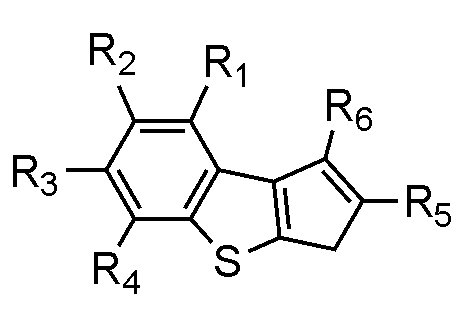
C1은 하기 화학식 3 내지 6으로 표시되는 리간드 중 어느 하나이고, C 1 is any one of the ligands represented by
[화학식 3][Formula 3]
[화학식 4][Formula 4]

[화학식 5][Formula 5]
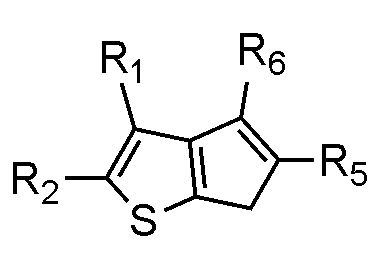
[화학식 6][Formula 6]
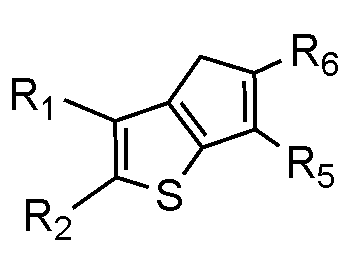
상기 화학식 3 내지 6에서,In
R1 내지 R6은 서로 동일하거나 상이하며, 각각 독립적으로, 수소, C1-30 알킬, C1-30 알콕시, C2-30 알콕시알킬, C6-30 아릴, C6-30 아릴옥시, C2-30 알케닐, C2-30 알키닐, C3-30 사이클로알킬, C7-40의 알킬아릴, C8-40의 알케닐아릴, C8-40의 알키닐아릴, C7-40의 아릴알킬, C8-40의 아릴알케닐, 또는 C8-40의 아릴알키닐이고, R 1 to R 6 are the same as or different from each other, and are each independently selected from hydrogen, C 1-30 alkyl, C 1-30 alkoxy, C 2-30 alkoxyalkyl, C 6-30 aryl, C 6-30 aryloxy, C 2-30 alkenyl, C 2-30 alkynyl, C 3-30 cycloalkyl, C 7-40 alkylaryl, C 8-40 alkenylaryl, C 8-40 alkynylaryl, C 7- 40 arylalkyl, C 8-40 arylalkenyl, or C 8-40 arylalkynyl;
M은 Ti, Zr 또는 Hf이며,M is Ti, Zr or Hf;
Z는 -O-, -S-, -NR7- 또는 -PR7- 이며, Z is -O-, -S-, -NR 7 - or -PR 7 -;
R7은 수소, C1-30 알킬, C6-30 아릴, C2-30 알케닐, C2-30 알키닐, C3-30 사이클로알킬, C7-40의 알킬아릴, C8-40의 알케닐아릴, C8-40의 알키닐아릴, C7-40의 아릴알킬, C8-40의 아릴알케닐, C8-40의 아릴알키닐, C1-30 알콕시실릴기, C6-30 아릴옥시실릴, C1-30 알킬실릴기, 또는 C1-30 실릴알킬기이고,R 7 is hydrogen, C 1-30 alkyl, C 6-30 aryl, C 2-30 alkenyl, C 2-30 alkynyl, C 3-30 cycloalkyl, C 7-40 alkylaryl, C 8-40 alkenylaryl, C 8-40 alkynylaryl, C 7-40 arylalkyl, C 8-40 arylalkenyl, C 8-40 arylalkynyl, C 1-30 alkoxysilyl group, C 6 -30 aryloxysilyl, C 1-30 alkylsilyl group, or C 1-30 silylalkyl group,
X1 및 X2는 서로 동일하거나 상이하고 각각 독립적으로 할로겐, C1-30 알킬, C2-30 알케닐, C7-30 알킬아릴, C7-30 아릴알킬, C6-20 아릴, 치환되거나 치환되지 않은 C1-30 알킬리덴, 치환되거나 치환되지 않은 아미노기, C2-30 알킬알콕시, 또는 C7-30 아릴알콕시이고, X 1 and X 2 are the same as or different from each other and are each independently halogen, C 1-30 alkyl, C 2-30 alkenyl, C 7-30 alkylaryl, C 7-30 arylalkyl, C 6-20 aryl, substituted an optionally substituted C 1-30 alkylidene, a substituted or unsubstituted amino group, a C 2-30 alkylalkoxy, or a C 7-30 arylalkoxy;
T는 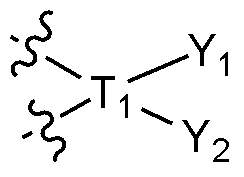

T1은 C, Si, Ge, Sn 또는 Pb이며, T 1 is C, Si, Ge, Sn or Pb;
Y1은 수소, C1-30 알킬, C1-30 알콕시, C2-30 알콕시알킬, C6-30 아릴, C6-30 아릴옥시, C2-30 알케닐, C2-30 알키닐, C3-30 사이클로알킬, C7-40의 알킬아릴, C8-40의 알케닐아릴, C8-40의 알키닐아릴, C7-40의 아릴알킬, C8-40의 아릴알케닐, 또는 C8-40의 아릴알키닐, 실릴기(-SiH3), C1-30 알콕시실릴기, C2-30 알콕시알킬실릴기, C6-30 아릴옥시실릴, C1-30 할로알킬, C6-30 할로아릴, 또는 -NR9R10이고, Y 1 is hydrogen, C 1-30 alkyl, C 1-30 alkoxy, C 2-30 alkoxyalkyl, C 6-30 aryl, C 6-30 aryloxy, C 2-30 alkenyl, C 2-30 alkynyl , C 3-30 cycloalkyl, C 7-40 alkylaryl, C 8-40 alkenylaryl, C 8-40 alkynylaryl, C 7-40 arylalkyl, C 8-40 arylalkenyl , or C 8-40 arylalkynyl, silyl group (-SiH 3 ), C 1-30 alkoxysilyl group, C 2-30 alkoxyalkylsilyl group, C 6-30 aryloxysilyl, C 1-30 haloalkyl , C 6-30 haloaryl, or -NR 9 R 10 ;
Y2는 C2-30 알콕시알킬, 또는 C7-40 아릴옥시알킬이고,Y 2 is C 2-30 alkoxyalkyl or C 7-40 aryloxyalkyl;
R9 및 R10은 각각 독립적으로 수소, C1-30 알킬, C6-30 아릴, C2-30 알케닐, C2-30 알키닐, C3-30 사이클로알킬, C7-40의 알킬아릴, C8-40의 알케닐아릴, C8-40의 알키닐아릴, C7-40의 아릴알킬, C8-40의 아릴알케닐, 또는 C8-40의 아릴알키닐이거나, 또는 서로 연결되어 지방족 또는 방향족 고리를 형성한다.R 9 and R 10 are each independently hydrogen, C 1-30 alkyl, C 6-30 aryl, C 2-30 alkenyl, C 2-30 alkynyl, C 3-30 cycloalkyl, C 7-40 alkyl aryl, C 8-40 alkenylaryl, C 8-40 alkynylaryl, C 7-40 arylalkyl, C 8-40 arylalkenyl, or C 8-40 arylalkynyl, or each other linked to form aliphatic or aromatic rings.
한편, 본 명세서에서 특별한 제한이 없는 한 다음 용어는 하기와 같이 정의될 수 있다. On the other hand, in the present specification, the following terms may be defined as follows unless there is a particular limitation.
할로겐(halogen)은 불소(F), 염소(Cl), 브롬(Br) 또는 요오드(I)일 수 있다.The halogen may be fluorine (F), chlorine (Cl), bromine (Br) or iodine (I).
C1-30 알킬기는 직쇄, 분지쇄 또는 고리형 알킬기일 수 있다. 구체적으로, C1-20 알킬기는 C1-15 직쇄 알킬기; C1-10 직쇄 알킬기; C1-5 직쇄 알킬기; C3-20 분지쇄 또는 고리형 알킬기; C3-15 분지쇄 또는 고리형 알킬기; 또는 C3-10 분지쇄 또는 고리형 알킬기일 수 있다. 보다 구체적으로, C1-20의 알킬기는 메틸기, 에틸기, n-프로필기, iso-프로필기, n-부틸기, iso-부틸기, tert-부틸기, n-펜틸기, iso-펜틸기, neo-펜틸기 또는 사이클로헥실기 등일 수 있다. The C 1-30 alkyl group may be a straight-chain, branched-chain or cyclic alkyl group. Specifically, the C 1-20 alkyl group is a C 1-15 straight chain alkyl group; C 1-10 straight chain alkyl group; C 1-5 straight chain alkyl group; C 3-20 branched or cyclic alkyl group; C 3-15 branched or cyclic alkyl group; Or it may be a C 3-10 branched chain or cyclic alkyl group. More specifically, the C1-20 alkyl group is methyl group, ethyl group, n-propyl group, iso-propyl group, n-butyl group, iso-butyl group, tert-butyl group, n-pentyl group, iso-pentyl group, neo -May be a pentyl group or a cyclohexyl group.
C2-30 알케닐기는 직쇄, 분지쇄 또는 고리형 알케닐기일 수 있다. 구체적으로, C2-30 알케닐기는 C2-20 직쇄 알케닐기, C2-10 직쇄 알케닐기, C2-5 직쇄 알케닐기, C3-20 분지쇄 알케닐기, C3-15 분지쇄 알케닐기, C3-10 분지쇄 알케닐기, C5-20의 고리형 알케닐기 또는 C5-10의 고리형 알케닐기일 수 있다. 보다 구체적으로, C2-20 의 알케닐기는 에테닐기, 프로페닐기, 부테닐기, 펜테닐기 또는 사이클로헥세닐기 등일 수 있다. The C 2-30 alkenyl group may be a straight-chain, branched-chain or cyclic alkenyl group. Specifically, the C 2-30 alkenyl group is a C 2-20 straight-chain alkenyl group, a C 2-10 straight-chain alkenyl group, a C 2-5 straight-chain alkenyl group, a C 3-20 branched-chain alkenyl group, a C 3-15 branched-chain alkenyl group. It may be a yl group, a C 3-10 branched chain alkenyl group, a C 5-20 cyclic alkenyl group, or a C 5-10 cyclic alkenyl group. More specifically, the C 2-20 alkenyl group may be an ethenyl group, a propenyl group, a butenyl group, a pentenyl group, or a cyclohexenyl group.
C6-30 아릴은 모노사이클릭, 바이사이클릭 또는 트라이사이클릭 방향족 탄화수소를 의미할 수 있다. 구체적으로, C6-30 아릴은 페닐기, 나프틸기 또는 안트라세닐기 등일 수 있다.C 6-30 aryl can mean a monocyclic, bicyclic or tricyclic aromatic hydrocarbon. Specifically, C 6-30 aryl may be a phenyl group, a naphthyl group, or an anthracenyl group.
C7-40 알킬아릴은 아릴의 1 이상의 수소가 알킬에 의하여 치환된 치환기를 의미할 수 있다. 구체적으로, C7-40 알킬아릴은 메틸페닐, 에틸페닐, n-프로필페닐, iso-프로필페닐, n-부틸페닐, iso-부틸페닐, tert-부틸페닐 또는 사이클로헥실페닐 등일 수 있다. C 7-40 alkylaryl may mean a substituent in which one or more hydrogens of aryl are substituted with alkyl. Specifically, the C 7-40 alkylaryl may be methylphenyl, ethylphenyl, n-propylphenyl, iso-propylphenyl, n-butylphenyl, iso-butylphenyl, tert-butylphenyl or cyclohexylphenyl.
C7-40 아릴알킬은 알킬의 1 이상의 수소가 아릴에 의하여 치환된 치환기를 의미할 수 있다. 구체적으로, C7-40 아릴알킬은 벤질기, 페닐프로필 또는 페닐헥실 등일 수 있다.C 7-40 arylalkyl may mean a substituent in which one or more hydrogens of alkyl are substituted by aryl. Specifically, C 7-40 arylalkyl may be a benzyl group, phenylpropyl or phenylhexyl.
상기 C1-20 알콕시기로는 메톡시기, 에톡시기, 페닐옥시기, 시클로헥실옥시기 등을 들 수 있으나, 이에만 한정되는 것은 아니다.Examples of the C 1-20 alkoxy group include a methoxy group, an ethoxy group, a phenyloxy group, and a cyclohexyloxy group, but are not limited thereto.
상기 C2-20 알콕시알킬기는 상술한 바와 같은 알킬기의 1개 이상의 수소가 알콕시기로 치환된 작용기이며, 구체적으로 메톡시메틸기, 메톡시에틸기, 에톡시메틸기, iso-프로폭시메틸기, iso-프로폭시에틸기, iso-프로폭시헥실기, tert-부톡시메틸기, tert-부톡시에틸기, tert-부톡시헥실기 등의 알콕시알킬기; 또는 페녹시헥실기 등의 아릴옥시알킬기를 들 수 있으나, 이에만 한정되는 것은 아니다.The C 2-20 alkoxyalkyl group is a functional group in which one or more hydrogens of the above-described alkyl group are substituted with an alkoxy group, specifically a methoxymethyl group, a methoxyethyl group, an ethoxymethyl group, an iso-propoxymethyl group, an iso-propoxy alkoxyalkyl groups such as ethyl group, iso-propoxyhexyl group, tert-butoxymethyl group, tert-butoxyethyl group, and tert-butoxyhexyl group; Or an aryloxyalkyl group such as a phenoxyhexyl group, but is not limited thereto.
상기 C1-20 알킬실릴기 또는 C1-20 알콕시실릴기는 -SiH3의 1 내지 3개의 수소가 1 내지 3개의 상술한 바와 같은 알킬기 또는 알콕시기로 치환된 작용기이며, 구체적으로 메틸실릴기, 다이메틸실릴기, 트라이메틸실릴기, 다이메틸에틸실릴기, 다이에틸메틸실릴기 또는 다이메틸프로필실릴기 등의 알킬실릴기; 메톡시실릴기, 다이메톡시실릴기, 트라이메톡시실릴기 또는 다이메톡시에톡시실릴기 등의 알콕시실릴기; 메톡시다이메틸실릴기, 다이에톡시메틸실릴기 또는 다이메톡시프로필실릴기 등의 알콕시알킬실릴기를 들 수 있으나, 이에만 한정되는 것은 아니다.The C 1-20 alkylsilyl group or C 1-20 alkoxysilyl group is a functional group in which 1 to 3 hydrogens of -SiH 3 are substituted with 1 to 3 alkyl or alkoxy groups as described above, specifically a methylsilyl group, an alkylsilyl group such as a methylsilyl group, a trimethylsilyl group, a dimethylethylsilyl group, a diethylmethylsilyl group, or a dimethylpropylsilyl group; an alkoxysilyl group such as a methoxysilyl group, a dimethoxysilyl group, a trimethoxysilyl group, or a dimethoxyethoxysilyl group; and an alkoxyalkylsilyl group such as a methoxydimethylsilyl group, a diethoxymethylsilyl group, or a dimethoxypropylsilyl group, but is not limited thereto.
상기 C1-20 실릴알킬기는 상술한 바와 같은 알킬기의 1 이상의 수소가 실릴기로 치환된 작용기이며, 구체적으로 -CH2-SiH3, 메틸실릴메틸기 또는 다이메틸에톡시실릴프로필기 등을 들 수 있으나, 이에만 한정되는 것은 아니다.The C 1-20 silylalkyl group is a functional group in which one or more hydrogens of the above-described alkyl group are substituted with a silyl group, specifically -CH 2 -SiH 3 , a methylsilylmethyl group, or a dimethylethoxysilylpropyl group. , but is not limited thereto.
상기 술포네이트기는 -O-SO2-R'의 구조로 R'는 C1-20 알킬기일 수 있다. 구체적으로, C1-20 술포네이트기는 메탄설포네이트기 또는 페닐설포네이트기 등을 들 수 있으나, 이에만 한정되는 것은 아니다.The sulfonate group has a structure of -O-SO 2 -R', and R' may be a C 1-20 alkyl group. Specifically, the C 1-20 sulfonate group may include a methanesulfonate group or a phenylsulfonate group, but is not limited thereto.
상기 헤테로아릴은 이종 원소로 N, O, 및 S 중 1개 이상을 포함하는 C2-20 헤테로아릴로서, 구체적인 예로는, 잔텐(xanthene), 티오잔텐(thioxanthen), 티오펜기, 퓨란기, 피롤기, 이미다졸기, 티아졸기, 옥사졸기, 옥사디아졸기, 트리아졸기, 피리딜기, 비피리딜기, 피리미딜기, 트리아진기, 아크리딜기, 피리다진기, 피라지닐기, 퀴놀리닐기, 퀴나졸린기, 퀴녹살리닐기, 프탈라지닐기, 피리도 피리미디닐기, 피리도 피라지닐기, 피라지노 피라지닐기, 이소퀴놀린기, 인돌기, 카바졸기, 벤즈옥사졸기, 벤조이미다졸기, 벤조티아졸기, 벤조카바졸기, 벤조티오펜기, 디벤조티오펜기, 벤조퓨라닐기, 페난쓰롤린기(phenanthroline), 이소옥사졸릴기, 티아디아졸릴기, 페노티아지닐기 및 디벤조퓨라닐기 등이 있으나, 이들에 한정되는 것은 아니다.The heteroaryl is a C 2-20 heteroaryl containing at least one of N, O, and S as heterogeneous elements, and specific examples include xanthene, thioxanthen, thiophene, furan, A pyrrole group, an imidazole group, a thiazole group, an oxazole group, an oxadiazole group, a triazole group, a pyridyl group, a bipyridyl group, a pyrimidyl group, a triazine group, an acridyl group, a pyridazine group, a pyrazinyl group, a quinolinyl group, Quinazoline group, quinoxalinyl group, phthalazinyl group, pyrido pyrimidinyl group, pyrido pyrazinyl group, pyrazino pyrazinyl group, isoquinoline group, indole group, carbazole group, benzoxazole group, benzoimidazole group, Benzothiazole group, benzocarbazole group, benzothiophene group, dibenzothiophene group, benzofuranyl group, phenanthroline group, isoxazolyl group, thiadiazolyl group, phenothiazinyl group and dibenzofuranyl group, etc. There are, but are not limited to these.
상술한 치환기들은 목적하는 효과와 동일 내지 유사한 효과를 발휘하는 범위 내에서 임의적으로 하이드록시기; 할로겐; 알킬기 또는 알케닐기, 아릴기, 알콕시기; 14족 내지 16족의 헤테로 원자들 중 하나 이상의 헤테로 원자를 포함하는 알킬기 또는 알케닐기, 아릴기, 알콕시기; 실릴기; 알킬실릴기 또는 알콕시실릴기; 포스파인기; 포스파이드기; 술포네이트기; 및 술폰기로 이루어진 군에서 선택된 1 이상의 치환기로 치환될 수 있다.The above-mentioned substituents are optionally hydroxy groups within the range of exhibiting the same or similar effects to the desired effect; halogen; an alkyl group or an alkenyl group, an aryl group, or an alkoxy group; an alkyl group, an alkenyl group, an aryl group, or an alkoxy group containing at least one hetero atom among hetero atoms of groups 14 to 16; silyl group; an alkylsilyl group or an alkoxysilyl group; phosphine group; phosphide group; sulfonate group; And it may be substituted with one or more substituents selected from the group consisting of sulfone groups.
또, 서로 인접하는 2 개의 치환기가 서로 연결되어 지방족 또는 방향족 고리를 형성한다는 것은 2개의 치환기의 원자(들) 및 상기 2개의 치환기가 결합된 원자가(원자들이) 서로 연결되어 고리를 이루는 것을 의미한다. 구체적으로, -NR9R10의 R9 및 R10이 서로 연결되어 지방족 고리를 형성한 예로는 피페리디닐(piperidinyl)기 등을 들 수 있고, -NR9R10의 R9 및 R10이 서로 연결되어 방향족 고리를 형성한 예로는 피롤릴(pyrrolyl)기 등을 예시할 수 있다.Also, that two adjacent substituents are connected to each other to form an aliphatic or aromatic ring means that the atom(s) of the two substituents and the atoms (atoms) to which the two substituents are bonded are connected to each other to form a ring. . Specifically, examples in which R 9 and R 10 of -NR 9 R 10 are connected to each other to form an aliphatic ring include a piperidinyl group, and the like, and R 9 and R 10 of -NR 9 R 10 are An example in which an aromatic ring is formed by being connected to each other may be a pyrrolyl group or the like.
또, 4족 전이금속으로는 티타늄(Ti), 지르코늄(Zr), 하프늄(Hf) 등을 들 수 있으나, 이에만 한정되는 것은 아니다.In addition, examples of the
상기 촉매 조성물에 있어서, 상기 화학식 1로 표시되는 제 1 메탈로센 화합물은 Cp1 및 Cp2의 리간드를 포함하는 비가교 화합물로서, 주로 낮은 SCB(short chain branch) 함량을 가지는 저분자량의 공중합체를 만드는데 유리하다. In the catalyst composition, the first metallocene compound represented by
구체적으로 상기 화학식 1에서, Cp1 및 Cp2의 리간드는 서로 동일하거나 상이할 수 있으며, 각각 시클로펜타디엔닐이고, C1-10 알킬로 1 이상 또는 1 내지 3 치환될 수 있다. 이와 같이 상기 Cp1 및 Cp2의 리간드가 루이스 염기로 작용할 수 있는 비공유 전자쌍을 가짐으로써 높은 중합 활성을 나타낼 수 있으며, 특히 상기 Cp1 및 Cp2의 리간드가 상대적으로 입체 장애가 적은 사이클로펜타디엔닐이기 때문에, 높은 중합 활성과 낮은 수소 반응성을 나타내어 저분자량의 올레핀 중합체를 고활성으로 중합할 수 있다.Specifically, in
또, 상기 Cp1 및 Cp2의 리간드는, 예를 들면, 치환된 작용기의 종류에 따라 입체 장애 효과의 정도를 조절하여 제조되는 올레핀 중합체의 화학적 구조, 분자량, 분자량 분포, 기계적 물성, 투명도 등의 특성을 용이하게 조절할 수 있다. 구체적으로, 상기 Cp1 및 Cp2의 리간드는 각각 Ra 및 Rb로 치환되며, 이때, 상기 Ra 및 Rb는 서로 동일하거나 상이하며, 각각 독립적으로, 수소, C1-20 알킬, C2-20 알콕시알킬, C7-40의 아릴알킬, 또는 N, O 및 S로 구성되는 군으로부터 선택되는 하나 이상의 헤테로원자를 포함하는 C2-12 헤테로아릴일 수 있고, 보다 구체적으로는 C1-10 알킬, C2-10 알콕시알킬, C7-20의 아릴알킬, 또는 N, O 및 S로 구성되는 군으로부터 선택되는 하나 이상의 헤테로원자를 포함하는 C4-12 헤테로아릴;일 수 있다. In addition, the ligands of Cp 1 and Cp 2 are, for example, chemical structure, molecular weight, molecular weight distribution, mechanical properties, transparency, etc. Characteristics can be easily adjusted. Specifically, the ligands of Cp 1 and Cp 2 are each substituted with R a and R b , wherein R a and R b are the same as or different from each other, and each independently hydrogen, C 1-20 alkyl, C It may be 2-20 alkoxyalkyl, C 7-40 arylalkyl, or C 2-12 heteroaryl containing one or more heteroatoms selected from the group consisting of N, O and S, and more specifically, C 1 -10 alkyl, C 2-10 alkoxyalkyl, C 7-20 arylalkyl, or C 4-12 heteroaryl containing one or more heteroatoms selected from the group consisting of N, O and S;
또, 상기 Cp1 및 Cp2는 의 리간드 사이에는 M1Z1 3-n 이 존재하는데, M1Z1 3-n 는 금속 착물의 보관 안정성에 영향을 미칠 수 있다. 이러한 효과를 더욱 효과적으로 담보하기 위하여 Z1은 각각 독립적으로 할로겐 또는 C1-20 알킬일 수 있으며, 보다 구체적으로는 각각 독립적으로 F, Cl, Br 또는 I일 수 있다. 또 상기 M1은 Ti, Zr 또는 Hf이거나; Zr 또는 Hf이거나; 또는 Zr일 수 있다.In addition, M 1 Z 1 3-n exists between the ligands of Cp 1 and Cp 2 , and M 1 Z 1 3-n may affect the storage stability of the metal complex. In order to ensure these effects more effectively, Z 1 may each independently be halogen or C 1-20 alkyl, and more specifically, each independently may be F, Cl, Br or I. In addition, M 1 is Ti, Zr or Hf; Zr or Hf; or Zr.
상기 제1 전이 금속 화합물 중에서도, 상기 화학식 1에 있어서 Cp1 및 Cp2가 각각 비치환되거나 또는 치환된 사이클로펜타디에닐기이고, Ra 및 Rb가 각각 독립적으로 수소, C1-10 알킬, C2-10 알콕시알킬, 또는 C7-20의 아릴알킬이되, Ra 및 Rb 중 적어도 하나가 t-부톡시헥실기와 같은 알콕시알킬, 보다 구체적으로는 -(CH2)n-OR (이때, R은 탄소수 1 내지 6의 직쇄 또는 분지쇄 알킬기이고, n은 2 내지 4의 정수이다.)의 치환기인 화합물일 수 있다. 이 경우, 공단량체를 이용한 폴리올레핀 제조시 상기 치환기를 포함하지 않는 다른 Cp계 촉매에 비하여 공단량체에 대한 낮은 전환율을 나타내어 공중합도 또는 공단량체 분포가 조절된 저분자량의 폴리올레핀을 제조할 수 있다. 또, 상기와 같은 구조의 제1 전이 금속 화합물은 담체에 담지되었을 때, 치환기 중 -(CH2)n-OR기가 담지체로 사용되는 실리카 표면의 실라놀기와 밀접한 상호작용을 통해 공유결합을 형성할 수 있어 안정적인 담지 중합이 가능하다.Among the first transition metal compounds, in
상기 화학식 1으로 표시되는 제1 메탈로센 화합물로는 예를 들어 하기 구조식들 중 하나로 표시되는 화합물일 수 있으나, 이에만 한정되는 것은 아니다:The first metallocene compound represented by

또, 상기 제 2 메탈로센 화합물은 서로 다른 리간드로 싸이오펜(thiophene)을 포함하는 방향족 고리 화합물과 14족 또는 15족 원자를 포함하는 베이스 화합물을 포함하며, 서로 다른 리간드는 -T-에 의하여 가교되어 있고, 서로 다른 리간드 사이에 M(X1)(X2)가 존재하는 구조를 가진다. 이에 따라 높은 촉매 활성을 나타내고, 고분자량의 중합체 제조에 유리하다.In addition, the second metallocene compound includes an aromatic ring compound containing thiophene and a base compound containing a
보다 구체적으로, 상기 화학식 2에서, M은 Ti, Zr 또는 Hf이고, 보다 구체적으로는 Ti일 수 있다.More specifically, in
또, R1 내지 R4는 각각 독립적으로 수소, 또는 C1-20 알킬이고, 보다 구체적으로는 수소 또는 메틸일 수 있다. In addition, R 1 to R 4 may each independently represent hydrogen or C 1-20 alkyl, and more specifically, hydrogen or methyl.
또, R5 및 R6은 각각 독립적으로 C1-10 알킬이고, 보다 구체적으로는 R5 및 R6 모두 메틸일 수 있다.In addition, R 5 and R 6 are each independently C 1-10 alkyl, and more specifically, both R 5 and R 6 may be methyl.
또, Z는 -NR7-이며, 상기 R7은 C1-10 알킬, 보다 구체적으로는 t-부틸과 같은 C3-10 분지상 알킬일 수 있다. Further, Z is -NR 7 -, and R 7 may be C 1-10 alkyl, more specifically C 3-10 branched alkyl such as t-butyl.
또, T는 
또, X1 및 X2는 각각 독립적으로 할로겐 또는 C1-20 알킬이고, 보다 구체적으로는 클로로일 수 있다.In addition, X 1 and X 2 are each independently halogen or C 1-20 alkyl, and more specifically, may be chloro.
일례로, 보다 우수한 활성을 가지며, 에틸렌의 공중합성을 향상시킬 수 있으며, 초고분자를 발현할 수 있는 상기 제2메탈로센 화합물로서, 하기 화학식 2a 내지 2d로 표시되는 화합물을 예시할 수 있다.For example, as the second metallocene compound that has superior activity, can improve ethylene copolymerizability, and can express ultra-high molecules, compounds represented by the following Chemical Formulas 2a to 2d can be exemplified.
[화학식 2a][Formula 2a]
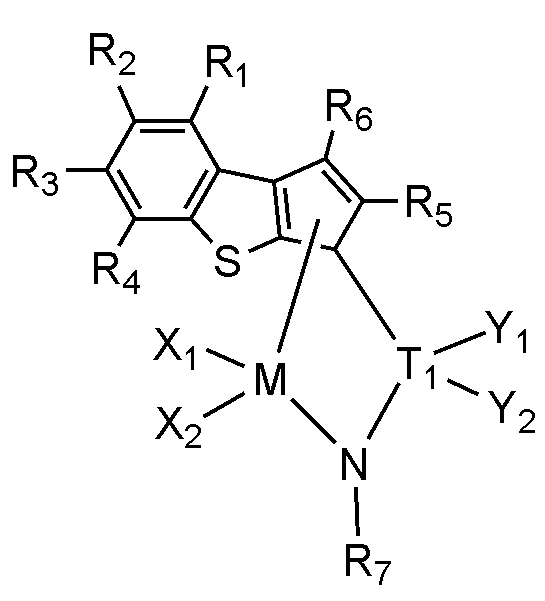
[화학식 2b][Formula 2b]
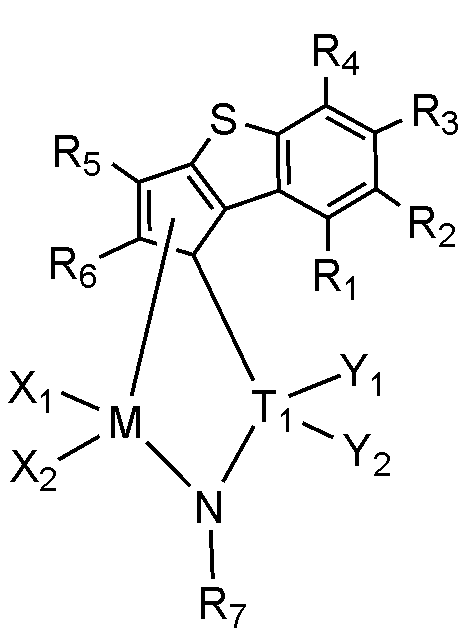
[화학식 2c][Formula 2c]

[화학식 2d][Formula 2d]

상기 화학식 2a 내지 2d에서, R1 내지 R7, M, X1, X2, T1, Y1 및 Y2는 앞서 정의한 바와 같다. In Chemical Formulas 2a to 2d, R 1 to R 7 , M, X 1 , X 2 , T 1 , Y 1 and Y 2 are as defined above.
보다 구체적으로, 상기 제2 메탈로센 화합물은 상기 화학식 2a 내지 2d에서, M은 Ti, Zr 또는 Hf이고, 보다 구체적으로는 Ti이고; R1 내지 R4는 각각 독립적으로 수소, 또는 C1-20 알킬이고, 보다 구체적으로는 수소 또는 메틸이며; R5 및 R6은 각각 독립적으로 C1-10 알킬이고, 보다 구체적으로는 R5 및 R6 모두 메틸이며; 상기 R7은 C1-10 알킬이고, 보다 구체적으로는 보다 구체적으로는 t-부틸과 같은 C3-10 분지상 알킬이며; 상기 T1은 C 또는 Si이며, Y1은 C1-20 알킬, C1-20 알콕시, C2-20 알콕시알킬, C6-20 아릴, C7-30 알킬아릴, C7-30 아릴알킬, C6-20 아릴옥시, 또는 C7-30 아릴옥시알킬이고, Y2는 C2-20 알콕시알킬, 또는 C7-30 아릴옥시알킬이며, 보다 구체적으로는 Y1은 메틸기, 에틸기, n-프로필기 및 n-부틸기 중 어느 하나이고, Y2는 C2-20 알콕시알킬, 또는 C7-30 아릴옥시알킬이며, 보다 구체적으로는 Y2는 메톡시메틸기, 메톡시에틸기, 에톡시메틸기, iso-프로폭시메틸기, iso-프로폭시에틸기, iso-프로폭시헥실기, tert-부톡시메틸기, tert-부톡시에틸기, tert-부톡시헥실기 및 페녹시헥실기 중 어느 하나이며, X1 및 X2는 각각 독립적으로 할로겐 또는 C1-20 알킬이고, 보다 구체적으로는 클로로인 화합물일 수 있다. More specifically, the second metallocene compound in Chemical Formulas 2a to 2d, M is Ti, Zr or Hf, more specifically Ti; R 1 to R 4 are each independently hydrogen or C 1-20 alkyl, more specifically hydrogen or methyl; R 5 and R 6 are each independently C 1-10 alkyl, more specifically, both R 5 and R 6 are methyl; said R 7 is C 1-10 alkyl, more specifically C 3-10 branched alkyl such as t-butyl; T 1 is C or Si, Y 1 is C 1-20 alkyl, C 1-20 alkoxy, C 2-20 alkoxyalkyl, C 6-20 aryl, C 7-30 alkylaryl, C 7-30 arylalkyl , C 6-20 aryloxy, or C 7-30 aryloxyalkyl, Y 2 is C 2-20 alkoxyalkyl, or C 7-30 aryloxyalkyl, more specifically, Y 1 is a methyl group, an ethyl group, n -Any one of a propyl group and an n-butyl group, Y 2 is C 2-20 alkoxyalkyl or C 7-30 aryloxyalkyl, more specifically Y 2 is methoxymethyl, methoxyethyl, ethoxy Any one of a methyl group, an iso-propoxymethyl group, an iso-propoxyethyl group, an iso-propoxyhexyl group, a tert-butoxymethyl group, a tert-butoxyethyl group, a tert-butoxyhexyl group, and a phenoxyhexyl group, X 1 and X 2 are each independently halogen or C 1-20 alkyl, and more specifically, may be a chloroin compound.
보다 구체적으로는, 상기 제2 메탈로센 화합물의 구체예로는 하기 구조의 화합물들을 예시할 수 있으나, 이들에 한정되는 것은 아니다:More specifically, as specific examples of the second metallocene compound, compounds having the following structure may be exemplified, but are not limited thereto:

상기한 제1 및 제2 메탈로센 화합물은 공지의 반응들을 응용하여 합성될 수 있으며, 보다 상세한 합성 방법은 합성예를 참고할 수 있다.The first and second metallocene compounds described above may be synthesized by applying known reactions, and a detailed synthesis method may refer to Synthesis Examples.
상기한 바와 같이 상기 촉매 조성물에 있어서, 상기 화학식 1로 표시되는 제 1 메탈로센 화합물은 주로 낮은 SCB 함량을 가지는 저분자량의 공중합체를 만드는데 기여하고, 상기 화학식 2로 표시되는 제 2 메탈로센 화합물은 주로 높은 SCB 함량을 가지는 고분자량의 공중합체를 만드는데 기여할 수 있다. 보다 구체적으로, 상기 촉매 조성물은 제2 메탈로센 화합물에 의해 고분자량 영역의 공중합체에서는 1-헥센에 대해 높은 공중합성을 나타내고, 또 상기 제1 메탈로센 화합물에 의해 저분자량 영역에서의 공중합체에서는 1-헥센에 대해 낮은 공중합성을 나타낸다. 그 결과, 1-헥센 공단량체의 함량이 고분자량 주쇄에 집중되어 있는 구조, 즉, 곁가지 함량이 고분자량 쪽으로 갈수록 많아지는 구조인 BOCD(Broad Orthogonal Co-monomer Distribution) 구조를 가지며, 동시에 분자량 분포가 넓어 물성이 우수할 뿐만 아니라 가공성도 우수한 올레핀 중합체를 제조할 수 있다.As described above, in the catalyst composition, the first metallocene compound represented by
또, 상기 촉매 조성물내 제1 및 제2 메탈로센 화합물의 함량비 제어를 통해 상기한 물성 구현을 용이하게 하고, 개선 효과를 더욱 증진시킬 수 있다. 이에 따라 본 발명에서의 상기 촉매 조성물 내 제2메탈로센 화합물이 제1메탈로센 화합물 보다 높은 함량으로 포함되는 것이 바람직하다. 구체적으로는 상기 제1 및 제2 메탈로센 화합물은 1:1.1 내지 1:5의 몰비로 포함될 수 있으며, 보다 구체적으로는 1:1.1 이상, 또는 1:1.2 이상, 또는 1:1.3 이상이고, 1:5 이하, 또는 1:3 이하일 수 있다. In addition, by controlling the content ratio of the first and second metallocene compounds in the catalyst composition, the above physical properties can be easily implemented and the improvement effect can be further enhanced. Accordingly, it is preferable that the second metallocene compound in the catalyst composition of the present invention is included in a higher content than the first metallocene compound. Specifically, the first and second metallocene compounds may be included in a molar ratio of 1:1.1 to 1:5, more specifically 1:1.1 or more, or 1:1.2 or more, or 1:1.3 or more, It may be 1:5 or less, or 1:3 or less.
한편, 촉매 조성물은 담체를 더 포함할 수 있으며, 이 경우, 제1 및 제2 메탈로센 화합물은 상기 담체에 담지된 상태로 사용된다. 담지 촉매 상태로 이용시, 제조되는 중합체의 입자 형태 및 벌크 밀도가 우수하며, 종래의 슬러리 중합 또는 벌크 중합, 기상 중합 공정에 적합하게 사용 가능하다.Meanwhile, the catalyst composition may further include a carrier, and in this case, the first and second metallocene compounds are used while supported on the carrier. When used in a supported catalyst state, the particle shape and bulk density of the prepared polymer are excellent, and can be suitably used in conventional slurry polymerization, bulk polymerization, or gas phase polymerization processes.
상기 담체의 구체적인 예로는 실리카, 알루미나, 마그네시아, 실리카-알루미나, 실리카-마그네시아 등을 들 수 있으며, 이들은 통상적으로 Na2O, K2CO3, BaSO4, 및 Mg(NO3)2 등의 산화물, 탄산염, 황산염, 및 질산염 성분을 더 포함할 수 있다. 이중에서도 실리카 담체를 사용할 경우, 상기 전이금속 화합물이 실리카 담체의 표면에 존재하는 실록산기 등의 반응성 작용기와 화학적으로 결합하여 담지되기 때문에, 프로필렌 중합공정에서 담체 표면으로부터 유리되어 나오는 촉매가 거의 없으며, 그 결과 슬러리 또는 기상 중합으로 폴리프로필렌을 제조할 때 반응기 벽면이나 중합체 입자끼리 엉겨 붙는 파울링을 최소화할 수 있다.Specific examples of the support include silica, alumina, magnesia, silica-alumina, silica-magnesia, and the like, which are typically oxides such as Na 2 O, K 2 CO 3 , BaSO 4 , and Mg(NO 3 ) 2 . , carbonate, sulfate, and nitrate components may be further included. Among them, when a silica carrier is used, since the transition metal compound is supported by chemically bonding with a reactive functional group such as a siloxane group present on the surface of the silica carrier, there is almost no catalyst released from the carrier surface in the propylene polymerization process, As a result, when polypropylene is produced by slurry or gas phase polymerization, it is possible to minimize fouling on the wall surface of the reactor or between polymer particles.
또, 상기 담체는, 담지 효율을 높이고, 리칭 및 파울링을 최소화하기 위해, 하소(calcination) 또는 건조 공정을 통해 표면 개질될 수 있다. 상기와 같은 표면 개질 단계를 통해, 담지 성분과의 반응을 저해하는 담체 표면의 수분은 제거하고, 대신 담지 성분들과의 화학적 결합이 가능한 반응성 작용기들, 일례로 히드록시기와 실록산기의 함량을 증가시킬 수 있다. In addition, the carrier may be surface-modified through a calcination or drying process in order to increase loading efficiency and minimize leaching and fouling. Through the above surface modification step, moisture on the surface of the carrier that inhibits the reaction with the supporting component is removed, and instead, the content of reactive functional groups capable of chemical bonding with the supporting component, for example, a hydroxyl group and a siloxane group, can be increased. can
구체적으로, 상기 담체에 대한 하소 또는 건조 공정은, 담체 표면에서 수분이 없어지는 온도에서부터 표면에 존재하는 반응성 작용기, 특히 히드록시기(OH기)가 완전히 없어지는 온도 이하의 범위에서 수행될 수 있다. 구체적으로 상기 온도는 150 내지 600℃, 또는 200 내지 500℃일 수 있다. 상기 담체에 대한 하소 또는 건조시의 온도가 150℃ 미만으로 낮을 경우에는 수분 제거 효율이 낮고, 결과로서 담체에 잔류하는 수분이 조촉매와 반응하여 담지 효율을 저하시킬 우려가 있다. 반면 건조 또는 하소 온도가 600 ℃를 초과하여 지나치게 높을 경우에는, 담체 표면에 존재하는 기공들이 합쳐지면서 비표면적이 감소하고, 또 표면에 존재하는 히드록시기 또는 실라놀기 등의 반응성 작용기가 많이 없어지고, 실록산기만 남게 되어 조촉매와의 반응자리가 감소할 우려가 있다.Specifically, the calcination or drying process for the support may be performed in a range from a temperature at which moisture is eliminated from the surface of the support to a temperature at which reactive functional groups present on the surface, in particular, hydroxyl groups (OH groups) are completely eliminated. Specifically, the temperature may be 150 to 600 °C, or 200 to 500 °C. When the temperature at the time of calcination or drying of the carrier is low, less than 150 ° C., the water removal efficiency is low, and as a result, the water remaining in the carrier may react with the cocatalyst to reduce the supporting efficiency. On the other hand, when the drying or calcination temperature is too high, exceeding 600 ° C, the pores present on the surface of the carrier are combined and the specific surface area is reduced, and many reactive functional groups such as hydroxyl groups or silanol groups present on the surface are lost, and siloxane There is a risk that only residues remain and the reaction sites with the cocatalyst decrease.
상기한 제1 및 제2 메탈로센 화합물이 담체에 담지될 경우, 예컨대 상기 담체가 실리카일 경우, 상기 제1 및 메탈로센 화합물은 합계량으로, 실리카 1g을 기준으로 40 μmol 이상, 또는 80 μmol 이상이고, 240 μmol 이하, 또는 160 μmol 이하의 함량 범위로 담지될 수 있다. 상기 함량 범위로 담지될 때, 적절한 담지 촉매 활성을 나타내어 촉매의 활성 유지 및 경제성 측면에서 유리할 수 있다.When the first and second metallocene compounds are supported on a carrier, for example, when the carrier is silica, the total amount of the first and second metallocene compounds is 40 µmol or more, or 80 µmol based on 1 g of silica. or more, and may be supported in a content range of 240 μmol or less, or 160 μmol or less. When supported in the above content range, appropriate supported catalyst activity may be exhibited, which may be advantageous in terms of maintaining the activity of the catalyst and economic efficiency.
또, 상기 촉매 조성물은 높은 활성과 공정 안정성을 향상시키는 측면에서 조촉매를 추가로 포함할 수 있다. In addition, the catalyst composition may further include a cocatalyst in terms of improving high activity and process stability.
상기 조촉매는 하기 화학식 7로 표시되는 화합물, 화학식 8로 표시되는 화합물 및 화학식 9로 표시되는 화합물 중에서 선택되는 1종 이상을 포함할 수 있다:The cocatalyst may include at least one selected from a compound represented by
[화학식 7][Formula 7]
-[Al(R11)-O]m--[Al(R 11 )-O] m -
상기 화학식 7에서,In
R11은 서로 동일하거나 상이하며, 각각 독립적으로 할로겐; C1-20의 탄화수소; 또는 할로겐으로 치환된 C1-20의 탄화수소이고;R 11 are the same as or different from each other, and each independently halogen; C 1-20 hydrocarbon; or C 1-20 hydrocarbon substituted with halogen;
m은 2 이상의 정수이며;m is an integer of 2 or greater;
[화학식 8][Formula 8]
J(R12)3 J(R 12 ) 3
상기 화학식 8에서,In Formula 8,
R12는 서로 동일하거나 상이하며, 각각 독립적으로 할로겐; C1-20의 탄화수소; 또는 할로겐으로 치환된 C1-20의 탄화수소이고;R 12 are the same as or different from each other, and each independently halogen; C 1-20 hydrocarbon; or C 1-20 hydrocarbon substituted with halogen;
J는 알루미늄 또는 보론이며;J is aluminum or boron;
[화학식 9][Formula 9]
[E-H]+[ZD4]- 또는 [E]+[ZD4]- [EH] + [ZD 4 ] - or [E] + [ZD 4 ] -
상기 화학식 9에서,In
E는 중성 또는 양이온성 루이스 염기이고;E is a neutral or cationic Lewis base;
H는 수소 원자이며;H is a hydrogen atom;
Z는 13족 원소이고;Z is a Group 13 element;
D는 서로 동일하거나 상이하며, 각각 독립적으로 1 이상의 수소 원자가 할로겐, C1-20의 탄화수소, 알콕시 또는 페녹시로 치환되거나 또는 비치환된, C6-20의 아릴기 또는 C1-20의 알킬기이다.D is the same as or different from each other, and each independently represents a C 6-20 aryl group or C 1-20 alkyl group unsubstituted or substituted with one or more hydrogen atoms of halogen, C 1-20 hydrocarbon, alkoxy or phenoxy. am.
상기 화학식 7로 표시되는 화합물의 예로는 메틸알루미녹산, 에틸알루미녹산, 이소부틸알루미녹산 또는 부틸알루미녹산 등의 알킬알루미녹산계 화합물을 들 수 있으며, 이들 중 어느 하나 또는 둘 이상의 혼합물이 사용될 수 있다.Examples of the compound represented by
또, 상기 화학식 8로 표시되는 화합물의 예로는 트리메틸알루미늄, 트리에틸알루미늄, 트리이소부틸알루미늄, 트리프로필알루미늄, 트리부틸알루미늄, 디메틸클로로알루미늄, 트리이소프로필알루미늄, 트리-s-부틸알루미늄, 트리사이클로펜틸알루미늄, 트리펜틸알루미늄, 트리이소펜틸알루미늄, 트리헥실알루미늄, 트리옥틸알루미늄, 에틸디메틸알루미늄, 메틸디에틸알루미늄, 트리페닐알루미늄, 트리-p-톨릴알루미늄, 디메틸알루미늄메톡시드, 디메틸알루미늄에톡시드, 트리메틸보론, 트리에틸보론, 트리이소부틸보론, 트리프로필보론, 또는 트리부틸보론 등을 들 수 있으며, 이들 중 어느 하나 또는 둘 이상의 혼합물이 사용될 수 있다.In addition, examples of the compound represented by Formula 8 include trimethylaluminum, triethylaluminum, triisobutylaluminum, tripropylaluminum, tributylaluminum, dimethylchloroaluminum, triisopropylaluminum, tri-s-butylaluminum, tricyclo Pentyl aluminum, tripentyl aluminum, triisopentyl aluminum, trihexyl aluminum, trioctyl aluminum, ethyl dimethyl aluminum, methyl diethyl aluminum, triphenyl aluminum, tri-p-tolyl aluminum, dimethyl aluminum methoxide, dimethyl aluminum ethoxide , trimethylboron, triethylboron, triisobutylboron, tripropylboron, or tributylboron, and the like, and any one or a mixture of two or more of these may be used.
또, 상기 화학식 9로 표시되는 화합물의 예로는 트리에틸암모니움테트라페닐보론, 트리부틸암모니움테트라페닐보론, 트리메틸암모니움테트라페닐보론, 트리프로필암모니움테트라페닐보론, 트리메틸암모니움테트라(p-톨릴)보론, 트리메틸암모니움테트라(o,p-디메틸페닐)보론, 트리부틸암모니움테트라(p-트리플로로메틸페닐)보론, 트리메틸암모니움테트라(p-트리플로로메틸페닐)보론, 트리부틸암모니움테트라펜타플로로페닐보론, N,N-디에틸아닐리니움테트라페닐보론, N,N-디에틸아닐리니움테트라펜타플로로페닐보론, 디에틸암모니움테트라펜타플로로페닐보론, 트리페닐포스포늄테트라페닐보론, 트리메틸포스포늄테트라페닐보론, 트리에틸암모니움테트라페닐알루미늄, 트리부틸암모니움테트라페닐알루미늄, 트리메틸암모니움테트라페닐알루미늄, 트리프로필암모니움테트라페닐알루미늄, 트리메틸암모니움테트라(p-톨릴)알루미늄, 트리프로필암모니움테트라(p-톨릴)알루미늄, 트리에틸암모니움테트라(o,p-디메틸페닐)알루미늄, 트리부틸암모니움테트라(p-트리플로로메틸페닐)알루미늄, 트리메틸암모니움테트라(p-트리플로로메틸페닐)알루미늄, 트리부틸암모니움테트라펜타플로로페닐알루미늄, N,N-디에틸아닐리니움테트라페닐알루미늄, N,N-디에틸아닐리니움테트라펜타플로로페닐알루미늄, 디에틸암모니움테트라펜타플로로페닐알루미늄, 트리페닐포스포늄테트라페닐알루미늄, 트리메틸포스포늄테트라페닐알루미늄, 트리프로필암모니움테트라(p-톨릴)보론, 트리에틸암모니움테트라(o,p-디메틸페닐)보론, 트리부틸암모니움테트라(p-트리플로로메틸페닐)보론, 트리페닐카보니움테트라(p-트리플로로메틸페닐)보론, 또는 트리페닐카보니움테트라펜타플로로페닐보론 등을 들 수 있으며, 이들 중 어느 하나 또는 둘 이상의 혼합물이 사용될 수 있다.Examples of the compound represented by
상기한 화합물들 중에서도 상기 조촉매는 보다 구체적으로는 메틸알루미녹산과 같은 알킬알루미녹산계 조촉매일 수 있다. Among the above compounds, the cocatalyst may be more specifically an alkylaluminoxane-based cocatalyst such as methylaluminoxane.
상기 알킬알루미녹산계 조촉매는, 상기 메탈로센 화합물들을 안정화시키고, 또 루이스 산으로 작용하며, 또 상기 제2 메탈로센 화합물의 브릿지 그룹(bridge group)에 도입된 작용기와 루이스 산-염기 상호 작용을 통한 결합을 형성할 수 있는 금속 원소를 포함함으로써 촉매 활성을 더욱 증진시킬 수 있다. The alkylaluminoxane-based cocatalyst stabilizes the metallocene compounds, acts as a Lewis acid, and has a Lewis acid-base interaction with a functional group introduced into a bridge group of the second metallocene compound. Catalytic activity can be further enhanced by including a metal element capable of forming a bond through action.
또, 상기 조촉매의 사용 함량은 목적하는 촉매와 수지 조성물의 물성 또는 효과에 따라 적절하게 조절될 수 있다. 예컨대 상기 담체로서 실리카를 사용하는 경우, 상기 조촉매는 담체 중량당, 예컨대, 실리카 1g을 기준으로 8mmol 이상, 또는 10mmol 이상이고, 25mmol 이하, 또는 20mmol 이하의 함량으로 담지될 수 있다. In addition, the amount of the cocatalyst used may be appropriately adjusted according to the physical properties or effects of the desired catalyst and resin composition. For example, when silica is used as the carrier, the cocatalyst may be supported in an amount of 8 mmol or more, 10 mmol or more, 25 mmol or less, or 20 mmol or less based on the weight of the carrier, for example, 1 g of silica.
상기한 구성을 갖는 촉매 조성물은, 담체에 조촉매 화합물을 담지시키는 단계, 및 상기 담체에 상기 화학식 1로 표시되는 전이금속 화합물을 담지시키는 단계를 포함하는 제조방법에 의해 제조될 수 있으며, 이때 조촉매와 화학식 1로 표시되는 전이금속 화합물의 담지 순서는 필요에 따라 바뀔 수 있다. 담지 순서에 따라 결정된 구조의 담지 촉매의 효과를 고려할 때, 이중에서도 담체에 대한 조촉매 담지 후 전이금속 화합물을 담지하는 것이, 제조된 담지 촉매가 폴리프로필렌의 제조 공정에서 높은 촉매 활성과 함께 보다 우수한 공정 안정성을 구현할 수 있다.The catalyst composition having the above structure may be prepared by a manufacturing method comprising the step of supporting a cocatalyst compound on a carrier, and the step of supporting the transition metal compound represented by
또, 상기한 촉매 조성물은, 그 자체로 중합에 사용될 수도 있고, 또는 중합 반응에 사용 전 프로필렌 단량체와의 접촉을 통해 예비 중합된 (prepolymerization) 상태로 사용될 수도 있다. 이 경우, 발명의 일 구현예에 따른 제조방법은, 중합 반응을 통한 호모 폴리프로필렌의 제조 전, 촉매 조성물을 프로필렌 단량체와 접촉 시켜 예비 중합(또는 전 중합)하는 단계를 더 포함할 수 있다. In addition, the catalyst composition described above may be used for polymerization by itself, or may be used in a prepolymerized state through contact with propylene monomers before use in polymerization. In this case, the production method according to one embodiment of the present invention may further include a step of pre-polymerization (or pre-polymerization) by bringing the catalyst composition into contact with a propylene monomer before preparing homo-polypropylene through a polymerization reaction.
또, 상기 촉매 조성물은 탄소수 5 내지 12의 지방족 탄화수소 용매, 예를 들면 펜탄, 헥산, 헵탄, 노난, 데칸, 및 이들의 이성질체와 톨루엔, 벤젠과 같은 방향족 탄화수소 용매, 디클로로메탄, 클로로벤젠과 같은 염소원자로 치환된 탄화수소 용매 등에 용해하거나 희석하여 후술하는 중합 반응에 투입될 수 있다. 여기에 사용되는 용매는 소량의 알킬 알루미늄 처리함으로써 촉매 독으로 작용하는 소량의 물 또는 공기 등을 제거하여 사용하는 것이 바람직하며, 조촉매를 더 사용하여 실시하는 것도 가능하다.In addition, the catalyst composition is an aliphatic hydrocarbon solvent having 5 to 12 carbon atoms, for example, pentane, hexane, heptane, nonane, decane, and isomers thereof, aromatic hydrocarbon solvents such as toluene and benzene, chlorine such as dichloromethane and chlorobenzene It may be dissolved or diluted in an atom-substituted hydrocarbon solvent or the like, and introduced into a polymerization reaction described later. The solvent used here is preferably used by removing a small amount of water or air that acts as a catalyst poison by treating a small amount of alkyl aluminum, and it is also possible to use a cocatalyst further.
한편, 상기 중합 공정은, 상술한 촉매 조성물의 존재 하에서, 에틸렌 및 1-헥센을 공중합 시킴으로써 수행될 수 있다. Meanwhile, the polymerization process may be performed by copolymerizing ethylene and 1-hexene in the presence of the above-described catalyst composition.
구체적으로 상기 공중합은 하나의 반응기에서 단일 촉매를 이용하여 단일 중합 반응 조건 하에 중합 반응시키는, 모노모달형(또는 유니모달형) 중합 공정으로 수행될 수 있으며, 보다 구체적으로는 하나의 루프형 슬러리 반응기에서 상기한 혼성 담지 촉매의 존재 하에 수행될 수 있다.Specifically, the copolymerization may be carried out in a monomodal (or unimodal) polymerization process in which polymerization is performed under a single polymerization reaction condition using a single catalyst in one reactor, and more specifically, in one loop-type slurry reactor It can be carried out in the presence of the above hybrid supported catalyst.
종래 멀티모달형 중합 방법은 촉매의 개수에 따라 복수 개의 반응기를 사용하고, 반응기 마다 각각의 촉매를 투입하여 중합 반응을 수행함으로써, 분자량이 서로 상이한 고분자를 제조한 후, 이를 혼합하는 방식이다. 그러나 이 경우 서로 다른 분자량으로 인해 중합체의 균일성이 저하되는 문제가 있다. 이에 대해 본 발명에서는 하나의 담체에 2종의 메탈로센 화합물을 담지한 혼성 담지 촉매를 사용하여 단일 반응기에서 단일 중합 조건 하에 중합 반응을 수행함으로써, 저분자와 고분자가 동시에 중합되고, 결과로서 균일성이 우수한 중합체를 제조할 수 있다. A conventional multimodal polymerization method uses a plurality of reactors according to the number of catalysts and introduces each catalyst into each reactor to perform a polymerization reaction, thereby preparing polymers having different molecular weights and then mixing them. However, in this case, there is a problem in that uniformity of the polymer is lowered due to different molecular weights. In contrast, in the present invention, a polymerization reaction is performed under a single polymerization condition in a single reactor using a hybrid supported catalyst in which two types of metallocene compounds are supported on one carrier, so that low molecules and high molecules are simultaneously polymerized, resulting in uniformity. This excellent polymer can be made.
그리고, 상기 중합 온도는 25 내지 500℃, 바람직하게는 25 내지 200℃, 보다 바람직하게는 50 내지 150℃일 수 있다. 또한, 중합 압력은 1 내지 100 Kgf/㎠, 바람직하게는 1 내지 50 Kgf/㎠, 보다 바람직하게는 5 내지 30 Kgf/㎠일 수 있다.And, the polymerization temperature may be 25 to 500 ℃, preferably 25 to 200 ℃, more preferably 50 to 150 ℃. In addition, the polymerization pressure may be 1 to 100 Kgf/
상기한 제조 방법을 통해 제조되는 에틸렌/1-헥센 공중합체는, 넓은 분자량 분포에 의한 뛰어난 우수한 내응력 균열성과, 고분자량 영역에의 높은 SCB 함량에 따른 우수한 가공성을 나타낼 수 있다. 상기와 같은 물성 충족으로 인하여, 본 발명에 따른 에틸렌/1-헥센 공중합체는 가공성 및 압출 특성이 양호하고, 내응력 균열성이 우수하여 고내압 난방관, PE-RT 파이프 또는 대구경 파이프 등에 바람직하게 적용될 수 있다. The ethylene/1-hexene copolymer prepared through the above manufacturing method may exhibit excellent stress crack resistance due to a wide molecular weight distribution and excellent processability due to a high SCB content in the high molecular weight region. Due to the above physical properties, the ethylene/1-hexene copolymer according to the present invention has good processability and extrusion characteristics and excellent stress crack resistance, so it is preferably used for high-pressure heating pipes, PE-RT pipes, or large-diameter pipes. can be applied
이하, 본 발명의 이해를 돕기 위하여 바람직한 실시예를 제시한다. 그러나 하기의 실시예는 본 발명을 보다 쉽게 이해하기 위하여 제공되는 것일 뿐, 이에 의해 본 발명의 내용이 한정되는 것은 아니다.Hereinafter, a preferred embodiment is presented to aid understanding of the present invention. However, the following examples are only provided to more easily understand the present invention, and the content of the present invention is not limited thereby.
합성예 1: 제1 메탈로센 화합물(1)의 제조Synthesis Example 1: Preparation of the first metallocene compound (1)
6-클로로헥사놀(6-chlorohexanol)을 사용하여 문헌(Tetrahedron Lett. 2951 (1988))에 제시된 방법으로 t-Butyl-O-(CH2)6-Cl을 제조하고, 여기에 NaCp를 반응시켜 t-Butyl-O-(CH2)6-C5H5를 얻었다(수율 60%, b.p. 80℃ / 0.1 mmHg).Using 6-chlorohexanol, t-Butyl-O-(CH 2 ) 6 -Cl was prepared by the method suggested in the literature (Tetrahedron Lett. 2951 (1988)), and NaCp was reacted thereto. t-Butyl-O-(CH 2 ) 6 -C 5 H 5 was obtained (yield 60%, bp 80°C / 0.1 mmHg).
또한, -78℃에서 t-Butyl-O-(CH2)6-C5H5를 THF에 녹이고, 노르말 부틸리튬(n-BuLi)을 천천히 가한 후, 실온으로 승온시킨 후, 8시간 반응시켰다. 그 용액을 다시 -78℃에서 ZrCl4(THF)2(1.70g, 4.50mmol)/THF(30㎖)의 서스펜젼(suspension) 용액에 기 합성된 리튬염(lithium salt) 용액을 천천히 가하고 실온에서 6시간 동안 더 반응시켰다.In addition, t-Butyl-O-(CH 2 ) 6 -C 5 H 5 was dissolved in THF at -78 ° C, normal butyllithium (n-BuLi) was slowly added, the temperature was raised to room temperature, and the mixture was reacted for 8 hours. . The solution was then slowly added to a previously synthesized lithium salt solution to a suspension solution of ZrCl 4 (THF) 2 (1.70g, 4.50mmol)/THF (30ml) at -78°C and then cooled to room temperature. was further reacted for 6 hours.
모든 휘발성 물질을 진공 건조하고, 얻어진 오일성 액체 물질에 헥산(hexane) 용매를 가하여 걸러내었다. 걸러낸 용액을 진공 건조한 후, 헥산을 가해 저온(-20℃)에서 침전물을 유도하였다. 얻어진 침전물을 저온에서 걸러내어 흰색 고체 형태의 [tBu-O-(CH2)6-C5H4]2ZrCl2 화합물(1)을 얻었다(수율 92%).All volatile substances were vacuum dried, and hexane solvent was added to the obtained oily liquid substance to filter out. After vacuum drying the filtered solution, hexane was added to induce a precipitate at low temperature (-20 ° C). The obtained precipitate was filtered at low temperature to obtain [tBu-O-(CH 2 ) 6 -C 5 H 4 ] 2 ZrCl 2 Compound (1) in the form of a white solid (yield: 92%).
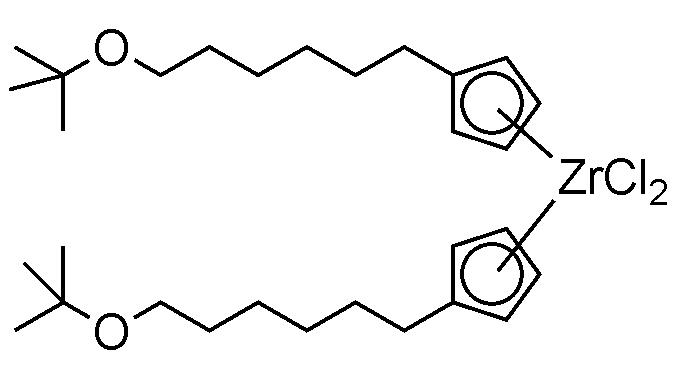
1H NMR (300 MHz, CDCl3): 6.28 (t, J = 2.6 Hz, 2 H), 6.19 (t, J = 2.6 Hz, 2 H), 3.31 (t, 6.6 Hz, 2 H), 2.62 (t, J = 8 Hz), 1.7 - 1.3 (m, 8 H), 1.17 (s, 9 H). 1 H NMR (300 MHz, CDCl 3 ): 6.28 (t, J = 2.6 Hz, 2 H), 6.19 (t, J = 2.6 Hz, 2 H), 3.31 (t, 6.6 Hz, 2 H), 2.62 ( t, J = 8 Hz), 1.7 - 1.3 (m, 8 H), 1.17 (s, 9 H).
13C NMR (CDCl3): 135.09, 116.66, 112.28, 72.42, 61.52, 30.66, 30.61, 30.14, 29.18, 27.58, 26.00. 13 C NMR (CDCl 3 ): 135.09, 116.66, 112.28, 72.42, 61.52, 30.66, 30.61, 30.14, 29.18, 27.58, 26.00.
합성예 2: 제2 메탈로센 화합물(2)의 제조 Synthesis Example 2: Preparation of second metallocene compound (2)
(1) 리간드 A의 제조(1) Preparation of ligand A
1-벤조싸이오펜 4.0g(30mmol)을 THF에 용해시켜 1-벤조싸이오펜 용액을 준비하였다. 그리고, n-BuLi 용액 14mL(36mmol, 2.5M in hexane)와 CuCN 1.3g(15mmol)을 상기 1-벤조싸이오펜 용액에 첨가하였다. A 1-benzothiophene solution was prepared by dissolving 4.0 g (30 mmol) of 1-benzothiophene in THF. Then, 14mL (36mmol, 2.5M in hexane) of n-BuLi solution and 1.3g (15mmol) of CuCN were added to the 1-benzothiophene solution.
이어서, -80℃에서 tigloyl chloride 3.6g(30mmol)을 상기 용액에 천천히 첨가하고, 얻어진 용액을 상온에서 약 10 시간 정도 교반하였다. Subsequently, 3.6 g (30 mmol) of tigloyl chloride was slowly added to the solution at -80°C, and the obtained solution was stirred at room temperature for about 10 hours.
이후, 상기 용액에 10% HCl을 부어 반응을 종료(quenching)시키고, 다이클로로메탄으로 유기층을 분리하여 베이지색 고체인 (2E)-1-(1-벤조싸이엔-2-일)-2-메틸-2-부텐-1-온을 얻었다. Then, the reaction was quenched by pouring 10% HCl into the solution, and the organic layer was separated with dichloromethane to form a beige solid (2E)-1-(1-benzothien-2-yl)-2- This gave methyl-2-buten-1-one.
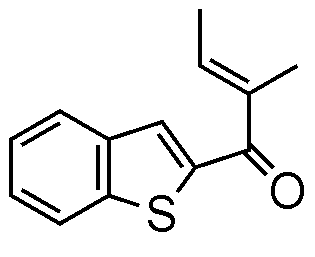
1H NMR (CDCl3): 7.85-7.82 (m, 2H), 7.75 (m, 1H), 7.44-7.34 (m, 2H), 6.68 (m, 1H), 1.99 (m, 3H), 1.92 (m, 3H) 1 H NMR (CDCl 3 ): 7.85-7.82 (m, 2H), 7.75 (m, 1H), 7.44-7.34 (m, 2H), 6.68 (m, 1H), 1.99 (m, 3H), 1.92 (m , 3H)
클로로벤젠 5mL에 상기에서 제조한 (2E)-1-(1-벤조싸이엔-2-일)-2-메틸-2-부텐-1-온 5.0g(22mmol)을 용해시킨 용액을 격렬하게 교반하면서 상기 용액에 황산 34mL를 서서히 첨가하였다. 그리고, 상기 용액을 상온에서 약 1 시간 동안 교반하였다. 이후, 상기 용액에 얼음물을 붓고, 에테르 용매로 유기층을 분리하여 노란색 고체인 1,2-다이메틸-1,2-다이하이드로-3H-벤조[b]사이클로펜타[d]싸이오펜-3-온 4.5g(91% yield)을 얻었다. A solution of 5.0 g (22 mmol) of (2E)-1-(1-benzothien-2-yl)-2-methyl-2-buten-1-one prepared above in 5 mL of chlorobenzene was vigorously stirred. While doing so, 34 mL of sulfuric acid was slowly added to the solution. Then, the solution was stirred at room temperature for about 1 hour. Thereafter, ice water was poured into the solution, and the organic layer was separated with an ether solvent to obtain 1,2-dimethyl-1,2-dihydro-3H-benzo[b]cyclopenta[d]thiophen-3-one as a yellow solid. 4.5 g (91% yield) was obtained.

1H NMR (CDCl3): 7.95-7.91 (m, 2H), 7.51-7.45 (m, 2H), 3.20 (m, 1H), 2.63 (m, 1H), 1.59 (d, 3H), 1.39 (d, 3H) 1 H NMR (CDCl 3 ): 7.95-7.91 (m, 2H), 7.51-7.45 (m, 2H), 3.20 (m, 1H), 2.63 (m, 1H), 1.59 (d, 3H), 1.39 (d , 3H)
THF 20mL 및 메탄올 10mL의 혼합 용매에 1,2-다이메틸-1,2-다이하이드로-3H-벤조[b]사이클로펜타[d]싸이오펜-3-온 2.0g(9.2mmol)을 용해시킨 용액에 NaBH4 570mg(15mmol)을 0℃에서 첨가하였다. 그리고, 상기 용액을 상온에서 약 2 시간 동안 교반하였다. 이후, 상기 용액에 HCl을 첨가하여 pH를 1로 조절하고, 에테르 용매로 유기층을 분리하여 알코올 중간체를 얻었다. A solution obtained by dissolving 2.0 g (9.2 mmol) of 1,2-dimethyl-1,2-dihydro-3H-benzo[b]cyclopenta[d]thiophen-3-one in a mixed solvent of 20mL of THF and 10mL of methanol. 570mg (15mmol) of NaBH 4 was added at 0°C. Then, the solution was stirred at room temperature for about 2 hours. Thereafter, HCl was added to the solution to adjust the pH to 1, and the organic layer was separated with an ether solvent to obtain an alcohol intermediate.
톨루엔에 상기 알코올 중간체를 용해시켜 용액을 제조하였다. 그리고, 상기 용액에 p-톨루엔설폰산 190mg(1.0mmol)을 첨가하고, 약 10 분간 환류하였다. 얻어진 반응 혼합물을 컬럼 크로마토그래피로 분리하여 오렌지-브라운 색상을 띄며, 액상인 1,2-다이메틸-3H-벤조[b]사이클로펜타[d]싸이오펜(리간드 A) 1.8g(9.0mmol, 98% yield)을 얻었다.A solution was prepared by dissolving the alcohol intermediate in toluene. Then, 190 mg (1.0 mmol) of p-toluenesulfonic acid was added to the solution and refluxed for about 10 minutes. The obtained reaction mixture was separated by column chromatography to give an orange-brown color, and 1.8 g (9.0 mmol, 98% of 1,2-dimethyl-3H-benzo[b]cyclopenta[d]thiophene (ligand A) in liquid phase. % yield) was obtained.
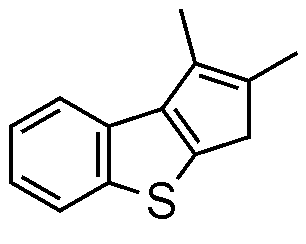
1H NMR (CDCl3): 7.81 (d, 1H), 7.70 (d, 1H), 7.33 (t, 1H), 7.19 (t, 1H), 6.46 (s, 1H), 3.35 (q, 1H), 2.14 (s, 3H), 1.14 (d, 3H) 1H NMR (CDCl 3 ): 7.81 (d, 1H), 7.70 (d, 1H), 7.33 (t, 1H), 7.19 (t, 1H), 6.46 (s, 1H), 3.35 (q, 1H), 2.14 (s, 3H), 1.14 (d, 3H)
(2) 리간드 B의 제조 (2) Preparation of ligand B
250mL schlenk flask에 t-부틸아민 13mL(120mmol)와 에테르 용매 20mL를 넣고, 상기 flask와 다른 250mL schlenk flask에 (6-tert-부톡시헥실)다이클로로(메틸)실란 16g(60mmol)과 에테르 용매 40mL를 넣어 t-부틸아민 용액 및 (6-tert-부톡시헥실)다이클로로(메틸)실란 용액을 각각 준비하였다. 그리고, 상기 t-부틸아민 용액을 -78℃로 냉각한 다음, 냉각된 용액에 (6-tert-부톡시헥실)다이클로로(메틸)실란 용액을 천천히 주입하고, 이를 상온에서 약 2 시간 동안 교반하였다. 생성된 white suspension을 여과하여 아이보리(ivory) 색상을 띄며, 액상인 1-(6-(tert-부톡시)헥실)-N-(tert-부틸)-1-클로로-1-메틸실란아민(리간드 B)을 얻었다. 13mL (120mmol) of t-butylamine and 20mL of ether solvent were added to a 250mL schlenk flask, and 16g (60mmol) of (6-tert-butoxyhexyl)dichloro(methyl)silane and 40mL of ether solvent were added to the flask and another 250mL schlenk flask. was added to prepare a t-butylamine solution and a (6-tert-butoxyhexyl)dichloro(methyl)silane solution, respectively. Then, after cooling the t-butylamine solution to -78 ° C, (6-tert-butoxyhexyl) dichloro (methyl) silane solution was slowly injected into the cooled solution, and stirred at room temperature for about 2 hours did The resulting white suspension was filtered to give an ivory color, and the liquid 1-(6-(tert-butoxy)hexyl)-N-(tert-butyl)-1-chloro-1-methylsilanamine (ligand B) was obtained.
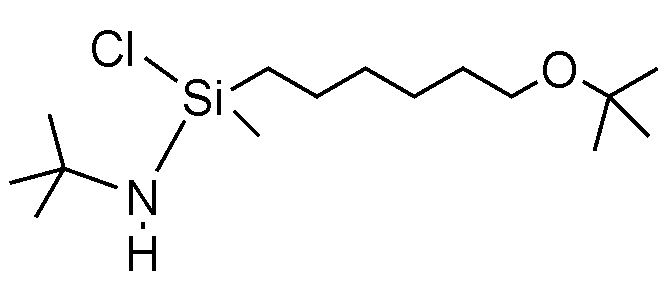
1H NMR (CDCl3): 3.29 (t, 2H), 1.52-1.29 (m, 10H), 1.20 (s, 9H), 1.16 (s, 9H), 0.40 (s, 3H) 1H NMR (CDCl 3 ): 3.29 (t, 2H), 1.52-1.29 (m, 10H), 1.20 (s, 9H), 1.16 (s, 9H), 0.40 (s, 3H)
(3) 리간드 A 및 B의 가교 (3) cross-linking of ligands A and B
250mL schlenk flask에 1,2-다이메틸-3H-벤조[b]사이클로펜타[d]싸이오펜(리간드 A) 1.7g(8.6mmol)을 넣고, THF 30mL를 첨가하여 리간드 A 용액을 제조하였다. 상기 리간드 A 용액을 -78℃로 냉각한 후, n-BuLi 용액 3.6mL(9.1mmol, 2.5M in hexane)를 상기 리간드 A 용액에 첨가하고, 이를 상온에서 하룻밤 동안 교반하여 purple-brown의 용액을 얻었다. 상기 purple-brown 용액의 용매를 톨루엔으로 치환하고, 이 용액에 CuCN 39mg(0.43mmol)을 THF 2mL에 분산시킨 용액을 주입하여 용액 A를 제조하였다. A Ligand A solution was prepared by adding 1.7 g (8.6 mmol) of 1,2-dimethyl-3H-benzo[b]cyclopenta[d]thiophene (ligand A) to a 250mL schlenk flask and adding 30mL of THF. After cooling the Ligand A solution to -78°C, 3.6mL (9.1mmol, 2.5M in hexane) of an n-BuLi solution was added to the Ligand A solution, and stirred at room temperature overnight to obtain a purple-brown solution. got it Solution A was prepared by replacing the solvent of the purple-brown solution with toluene, and injecting a solution in which 39 mg (0.43 mmol) of CuCN was dispersed in 2 mL of THF was injected into the solution.
한편, 250mL schlenk flask에 1-(6-(tert-부톡시)헥실)-N-(tert-부틸)-1-클로로-1-메틸실란아민(리간드 B) 및 톨루엔을 주입하여 준비한 용액 B를 -78℃로 냉각하였다. 상기 냉각된 용액 B에 앞서 제조한 용액 A를 천천히 주입하였다. 그리고 용액 A 및 B의 혼합물을 상온에서 하룻밤 동안 교반하였다. 그리고, 생성된 고체를 여과하여 제거함으로써 brown 색상을 띄며 점성이 있는 액상의 1-(6-(tert-부톡시)헥실)-N-(tert-부틸)-1-(1,2-다이메틸-3H-벤조[b]사이클로펜타[d]싸이오펜-3-일)-1-메틸실란아민(리간드 A 및 B의 가교 생성물) 4.2g(> 99% yield)을 얻었다. Meanwhile, solution B prepared by injecting 1-(6-(tert-butoxy)hexyl)-N-(tert-butyl)-1-chloro-1-methylsilanamine (ligand B) and toluene into a 250mL schlenk flask Cooled to -78 °C. Solution A previously prepared was slowly injected into the cooled solution B. And the mixture of solutions A and B was stirred overnight at room temperature. Then, the produced solid was removed by filtration to obtain a viscous liquid 1-(6-(tert-butoxy)hexyl)-N-(tert-butyl)-1-(1,2-dimethyl 4.2 g (>99% yield) of -3H-benzo[b]cyclopenta[d]thiophen-3-yl)-1-methylsilanamine (cross-linked product of ligands A and B) was obtained.

상기 리간드 A 및 B의 가교 생성물의 구조를 확인하기 위하여 상기 가교 생성물을 상온에서 lithiation한 후, 소량의 pyridine-D5와 CDCl3에 용해시킨 샘플을 이용하여 H-NMR 스펙트럼을 얻었다. In order to confirm the structures of the crosslinked products of ligands A and B, the crosslinked products were lithiated at room temperature, and H-NMR spectra were obtained using samples dissolved in a small amount of pyridine-D5 and CDCl 3 .
1H NMR (pyridine-D5 및 CDCl3): 7.81 (d, 1H), 7.67 (d, 1H), 7.82-7.08 (m, 2H), 3.59 (t, 2H), 3.15 (s, 6H), 2.23-1.73 (m, 10H), 2.15 (s, 9H), 1.91 (s, 9H), 1.68 (s, 3H) 1 H NMR (pyridine-D5 and CDCl 3 ): 7.81 (d, 1H), 7.67 (d, 1H), 7.82-7.08 (m, 2H), 3.59 (t, 2H), 3.15 (s, 6H), 2.23 -1.73 (m, 10H), 2.15 (s, 9H), 1.91 (s, 9H), 1.68 (s, 3H)
(4) 전이 금속 화합물의 제조(4) Preparation of transition metal compounds
250mL schlenk flask에 1-(6-(tert-부톡시)헥실)-N-(tert-부틸)-1-(1,2-다이메틸-3H-벤조[b]사이클로펜타[d]싸이오펜-3-일)-1-메틸실란아민(리간드 A 및 B의 가교 생성물) 4.2g(8.6mmol)을 넣고, 상기 flask에 톨루엔 14mL와 n-헥산 1.7mL를 주입하여 가교 생성물을 용해시켰다. 이 용액을 -78℃로 냉각한 후, n-BuLi 용액 7.3mL(18mmol, 2.5M in hexane)를 상기 냉각된 용액에 주입하였다. 그리고, 상기 용액을 상온에서 약 12시간 동안 교반하였다. 이어서, 상기 용액에 트라이메틸아민 5.3mL(38mmol)을 투입하고, 이 용액을 약 40℃에서 약 3 시간 동안 교반하여 용액 C를 준비하였다. 1-(6-(tert-butoxy)hexyl)-N-(tert-butyl)-1-(1,2-dimethyl-3H-benzo[b]cyclopenta[d]thiophene- After adding 4.2 g (8.6 mmol) of 3-yl)-1-methylsilanamine (a cross-linked product of ligands A and B), 14 mL of toluene and 1.7 mL of n-hexane were injected into the flask to dissolve the cross-linked product. After cooling the solution to -78°C, 7.3mL (18mmol, 2.5M in hexane) of n-BuLi solution was injected into the cooled solution. Then, the solution was stirred at room temperature for about 12 hours. Subsequently, 5.3 mL (38 mmol) of trimethylamine was added to the solution, and the solution was stirred at about 40° C. for about 3 hours to prepare solution C.
한편, 별도로 준비된 250mL schlenk flask에 TiCl4(THF)2 2.3g(8.6mmol)과 톨루엔 10mL를 첨가하여 TiCl4(THF)2를 톨루엔에 분산시킨 용액 D를 제조하였다. 상기 용액 D에 앞서 준비한 용액 C를 -78℃에서 천천히 주입하고, 용액 C 및 D의 혼합물을 상온에서 약 12 시간 동안 교반하였다. 그 후, 상기 용액을 감압하여 용매를 제거하고, 얻어진 용질은 톨루엔에 용해시켰다. 그리고, 톨루엔에 용해되지 않은 고체는 여과하여 제거하고 여과된 용액에서 용매를 제거하여 갈색 고체 형태의 전이 금속 화합물(2) 4.2g(83% yield)를 얻었다. Meanwhile, a solution D in which TiCl 4 (THF) 2 was dispersed in toluene was prepared by adding 2.3 g (8.6 mmol) of TiCl 4 (THF) 2 and 10 mL of toluene to a separately prepared 250 mL schlenk flask. Solution C prepared previously was slowly injected into solution D at -78°C, and the mixture of solutions C and D was stirred at room temperature for about 12 hours. Thereafter, the solvent was removed by reducing the pressure of the solution, and the obtained solute was dissolved in toluene. Then, solids not dissolved in toluene were removed by filtration, and the solvent was removed from the filtered solution to obtain 4.2 g (83% yield) of transition metal compound (2) in the form of a brown solid.

1H NMR (CDCl3): 8.01 (d, 1H), 7.73 (d, 1H), 7.45-7.40 (m, 2H), 3.33 (t, 2H), 2.71 (s, 3H), 2.33 (d, 3H), 1.38 (s, 9H), 1.18 (s, 9H), 1.80-0.79 (m, 10H), 0.79 (d, 3H) 1H NMR (CDCl 3 ): 8.01 (d, 1H), 7.73 (d, 1H), 7.45-7.40 (m, 2H), 3.33 (t, 2H), 2.71 (s, 3H), 2.33 (d, 3H) ), 1.38 (s, 9H), 1.18 (s, 9H), 1.80-0.79 (m, 10H), 0.79 (d, 3H)
제조예 1: 혼성 담지 촉매(A)의 제조Preparation Example 1: Preparation of hybrid supported catalyst (A)
20L sus 고압 반응기에 톨루엔 용액 3.0 kg을 넣고 반응기 온도를 40℃로 유지하였다. 600℃의 온도에서 12시간 동안 진공을 가해 탈수시킨 실리카(Grace Davison, SP2212) 500 g을 반응기에 투입하고 충분히 분산시킨 후, 10 wt% 메틸알루미녹산(MAO)/톨루엔 용액 2.78 kg을 투입하고, 80℃에서 200 rpm으로 15시간 이상 교반하였다.3.0 kg of a toluene solution was put into a 20L sus high-pressure reactor and the temperature of the reactor was maintained at 40°C. 500 g of silica (Grace Davison, SP2212) dehydrated by applying vacuum at a temperature of 600 ° C. for 12 hours was introduced into the reactor and sufficiently dispersed. Then, 2.78 kg of a 10 wt% methylaluminoxane (MAO) / toluene solution was added, The mixture was stirred at 80°C and 200 rpm for 15 hours or longer.
반응기 온도를 40℃로 낮춘 후, 상기 합성예 1에서 제조한 제1 메탈로센 화합물/톨루엔 용액(7.8 wt% in toluene) 200 g을 반응기에 투입하고 1시간 동안 200 rpm으로 교반하였다. 이어서 상기 합성예 2에서 제조한 제2 메탈로센 화합물(b)/톨루엔 용액(7.8 wt% in toluene) 250 g을 반응기에 투입하고 1시간 동안 200 rpm으로 교반하였다(제1메탈로센 화합물과 제2메탈로센 화합물의 몰비=1:1.3). After lowering the temperature of the reactor to 40° C., 200 g of the first metallocene compound/toluene solution (7.8 wt% in toluene) prepared in Synthesis Example 1 was put into the reactor and stirred at 200 rpm for 1 hour. Subsequently, 250 g of the second metallocene compound (b)/toluene solution (7.8 wt% in toluene) prepared in Synthesis Example 2 was put into the reactor and stirred at 200 rpm for 1 hour (with the first metallocene compound). The molar ratio of the second metallocene compound = 1:1.3).
조촉매(anilinium tetrakis(pentafluorophenyl)borate) 70 g을 톨루엔에 묽혀 반응기에 투입하고 15시간 이상 200 rpm으로 교반하였다. 반응기 온도를 상온으로 낮춘 후, 교반을 중지하고 30분 동안 settling 시킨 후 반응 용액을 decantation 하였다. 70 g of a cocatalyst (anilinium tetrakis(pentafluorophenyl)borate) was diluted in toluene, put into the reactor, and stirred at 200 rpm for more than 15 hours. After lowering the temperature of the reactor to room temperature, stopping stirring and settling for 30 minutes, the reaction solution was decanted.
톨루엔 슬러리를 filter dryer로 이송하고 필터하였다. 톨루엔 3.0 kg을 투입하고 10분 동안 교반한 후, 교반을 중지하고 여과하였다. 반응기에 헥산 3.0 kg을 투입하고 10분 동안 교반한 다음, 교반을 중지하고 여과하였다. 50℃에서 4시간 동안 감압 하에 건조하여 500g-SiO2 담지 촉매를 제조하였다.The toluene slurry was transferred to a filter dryer and filtered. After adding 3.0 kg of toluene and stirring for 10 minutes, stirring was stopped and filtered. 3.0 kg of hexane was added to the reactor and stirred for 10 minutes, then the stirring was stopped and filtered. It was dried under reduced pressure at 50°C for 4 hours to prepare a 500g-SiO 2 supported catalyst.
제조예 2: 혼성 담지 촉매(B)의 제조Preparation Example 2: Preparation of hybrid supported catalyst (B)
제2 메탈로센 화합물로서 (methyl(6-t-butoxyhexyl)silyl(η5-tetramethylCp)(t-Butylamido))TiCl2를 사용하는 것을 제외하고는 상기 제조예 1에서와 동일한 방법으로 수행하여 혼성 담지 촉매를 제조하였다.Hybrid support was carried out in the same manner as in Preparation Example 1 except for using (methyl(6-t-butoxyhexyl)silyl(η5-tetramethylCp)(t-Butylamido))TiCl 2 as the second metallocene compound. A catalyst was prepared.
제조예 3: 혼성 담지 촉매(C)의 제조Preparation Example 3: Preparation of hybrid supported catalyst (C)
제1 메탈로센 화합물로서, 하기 구조의 3-(6-(tert-butoxy)hexyl)-1H-inden-1-yl)(3-butylcyclopenta-2,4-dien-1-yl) zirconium(IV) dichloride를 사용하는 것을 제외하고는 상기 제조예 1에서와 동일한 방법으로 수행하여 혼성 담지 촉매를 제조하였다.As the first metallocene compound, 3-(6-(tert-butoxy)hexyl)-1H-inden-1-yl)(3-butylcyclopenta-2,4-dien-1-yl) zirconium (IV of the following structure) ) A hybrid supported catalyst was prepared in the same manner as in Preparation Example 1 except for using dichloride.

실시예Example 1 One
모노모달형 중합 공정을 통해 에틸렌/1-헥센 공중합체를 제조하였다. An ethylene/1-hexene copolymer was prepared through a monomodal polymerization process.
구체적으로는 하기 1에 기재된 조건으로, 상기 제조예 1에서 제조한 혼성 담지 메탈로센 촉매(A)를 이용하고, hexane slurry stirred tank process 중합기를 이용하며, 루프형 반응기 1개에서의 중합 반응을 통해 에틸렌/1-헥센(1-C6) 공중합체를 제조하였다. Specifically, under the conditions described in 1 below, using the hybrid supported metallocene catalyst (A) prepared in Preparation Example 1 above, using a hexane slurry stirred tank process polymerizer, a polymerization reaction in one loop type reactor Through this, an ethylene/1-hexene (1-C6) copolymer was prepared.
실시예Example 2 2
하기 표 1에 기재된 조건으로 수행하는 것을 제외하고는 상기 실시예 1에서와 동일한 방법으로 수행하여 에틸렌/1-헥센 공중합체를 제조하였다.An ethylene/1-hexene copolymer was prepared in the same manner as in Example 1 except for the conditions shown in Table 1 below.
비교예 1Comparative Example 1
지글러 나타(Z/N) 촉매를 이용하고, 두 개의 반응기를 이용한 Bi-modal형 중합공정을 통해 제조된 XRT-70™(Total사제)를 사용하였다. Ziegler-Natta (Z/N) catalyst was used and XRT-70™ (manufactured by Total) manufactured through a bi-modal type polymerization process using two reactors was used.
비교예 2Comparative Example 2
지글러 나타(Z/N) 촉매를 이용하고, 세 개의 반응기를 이용한 Tri-modal형 중합 공정을 통해 제조된 HOSTALEN 4731B™(Basell사제)를 사용하였다. HOSTALEN 4731B™ (manufactured by Basell) manufactured through a tri-modal polymerization process using a Ziegler-Natta (Z/N) catalyst and using three reactors was used.
비교예 3Comparative Example 3
메탈로센계 촉매를 이용하고, 두 개의 반응기를 이용한 Bi-modal형 중합 공정을 통해 제조된 SP700™(LG CHEM사제)를 사용하였다.SP700™ (manufactured by LG CHEM) manufactured through a bi-modal type polymerization process using a metallocene-based catalyst and using two reactors was used.
비교예 4Comparative Example 4
상기 제조예 2에서 제조한 혼성 담지 촉매(B)를 사용하고, 하기 표 1에 기재된 조건으로 수행하는 것을 제외하고는 상기 실시예 1에서와 동일한 방법으로 수행하여 에틸렌/1-헥센 공중합체를 제조하였다. Ethylene / 1-hexene copolymer was prepared in the same manner as in Example 1, except that the supported hybrid catalyst (B) prepared in Preparation Example 2 was used and carried out under the conditions shown in Table 1 below did
비교예 5 Comparative Example 5
상기 제조예 3에서 제조한 혼성 담지 촉매(C)를 사용하고, 하기 표 1에 기재된 조건으로 수행하는 것을 제외하고는 상기 실시예 1에서와 동일한 방법으로 수행하여 에틸렌/1-헥센 공중합체를 제조하였다. Ethylene / 1-hexene copolymer was prepared in the same manner as in Example 1, except that the supported hybrid catalyst (C) prepared in Preparation Example 3 was used and carried out under the conditions shown in Table 1 below did
비교예comparative example 6 6
수소 기체의 투입 없이 하기 표 1에 기재된 조건으로 수행하는 것을 제외하고는, 상기 실시예 1에서와 동일한 방법으로 수행하여 에틸렌/1-헥센 공중합체를 제조하였다.An ethylene/1-hexene copolymer was prepared in the same manner as in Example 1, except that the conditions described in Table 1 were performed without introducing hydrogen gas.
(150)Preparation Example 1 (A)
(150)
(143)Preparation Example 1 (A)
(143)
(170)Production Example 2 (B)
(170)
(153)Preparation Example 3 (C)
(153)
(147)Preparation Example 1 (A)
(147)
(7.1)1-C6
(7.1)
(5.9)1-C6
(5.9)
(6.3)1-C6
(6.3)
(14.3)1-C6
(14.3)
* 촉매활성 (kgPE/gCat.hr): 상기 실시예 또는 비교예의 중합 반응에 이용된 촉매의 중량과, 중합 반응으로부터 제조된 중합체의 중량을 각각 측정한 후, 사용한 촉매 중량 대비 제조된 중합체의 중량 비로서 촉매의 활성(activity)을 산출하였다.* Catalyst activity (kgPE/gCat.hr): After measuring the weight of the catalyst used in the polymerization reaction of the above examples or comparative examples and the weight of the polymer produced from the polymerization reaction, respectively, the weight of the prepared polymer compared to the weight of the catalyst used As a ratio, the activity of the catalyst was calculated.
시험예 1Test Example 1
상기 실시예 및 비교예에서 제조 또는 사용한 에틸렌/1-헥센 공중합체에 대해 하기와 같은 방법으로 물성을 측정하고, 그 결과를 표 2에 나타내었다. The physical properties of the ethylene/1-hexene copolymer prepared or used in Examples and Comparative Examples were measured in the following manner, and the results are shown in Table 2.
1) 밀도: ASTM 1505에 따라 측정하였다.1) Density: measured according to ASTM 1505.
2) 용융 지수(Melt Index; MI2.16): ASTM D1238 (조건 E, 190℃, 2.16kg 하중) 규격에 따라 측정하였다.2) Melt Index (MI 2.16 ): Measured according to ASTM D1238 (condition E, 190°C, 2.16kg load) standard.
3) 고하중 용융 지수(HLMI; MI21.6): ASTM D1238 (조건 E, 190℃, 21.6kg 하중) 규격에 따라 측정하였다.3) High load melt index (HLMI; MI 21.6 ): Measured according to ASTM D1238 (condition E, 190 ° C., 21.6 kg load) standard.
4) MFRR(MFR21.6/MFR2.16): MFR21.6 용융지수(MI, 21.6kg 하중)를 MFR2.16(MI, 2.16kg 하중)으로 나눈 비율이다.4) MFRR (MFR 21.6 /MFR 2.16 ): This is the ratio of MFR 21.6 melt index (MI, 21.6kg load) divided by MFR 2.16 (MI, 2.16kg load).
5) 분자량 분포(PDI, polydispersity index) 및 GPC 커브: 5) Molecular weight distribution (PDI, polydispersity index) and GPC curve:
겔 투과 크로마토그래피(GPC: gel permeation chromatography, Waters사 제조)를 이용하여 중합체의 중량 평균 분자량(Mw)과 수 평균 분자량(Mn)을 측정하였고, 중량 평균 분자량을 수 평균 분자량으로 나누어 분자량 분포(PDI)를 계산하였다. The weight average molecular weight (Mw) and number average molecular weight (Mn) of the polymer were measured using gel permeation chromatography (GPC: gel permeation chromatography, manufactured by Waters), and the weight average molecular weight was divided by the number average molecular weight to determine the molecular weight distribution (PDI). ) was calculated.
구체적으로, 에틸렌/1-헥센 공중합체 샘플을 Polymer Laboratories PLgel MIX-B 300mm 길이 칼럼을 이용하여 Waters PL-GPC220 기기를 이용하여 평가하였다. 평가 온도는 160℃이며, 1,2,4-트리클로로벤젠을 용매로서 사용하였으며 유속은 1mL/min의 속도로 측정하였다. 샘플은 10mg/10mL의 농도로 조제한 다음, 200 μL 의 양으로 공급하였다. 폴리스티렌 표준을 이용하여 형성된 검정 곡선을 이용하여 Mw 및 Mn 의 값을 측정하였다. 폴리스티렌 표준품의 분자량(g/mol)은 2,000 / 10,000 / 30,000 / 70,000 / 200,000 / 700,000 / 2,000,000 / 4,000,000 / 10,000,000의 9종을 사용하였다.Specifically, ethylene/1-hexene copolymer samples were evaluated using a Waters PL-GPC220 instrument using a Polymer Laboratories PLgel MIX-B 300 mm long column. The evaluation temperature was 160 °C, 1,2,4-trichlorobenzene was used as a solvent, and the flow rate was measured at a rate of 1 mL/min. The sample was prepared at a concentration of 10mg/10mL and then supplied in an amount of 200 μL. The values of Mw and Mn were determined using a calibration curve formed using polystyrene standards. Nine kinds of molecular weight (g/mol) of polystyrene standard were 2,000 / 10,000 / 30,000 / 70,000 / 200,000 / 700,000 / 2,000,000 / 4,000,000 / 10,000,000.
6) FNCT(Full Notch Creep Test): 6) FNCT (Full Notch Creep Test):
문헌[M.Fleissner in Kunststoffe 77 (1987), pp. 45 et seq.]에 기술되어 있고, 현재까지 시행되고 있는 ISO 16770에 따라 측정하였다. See M. Fleissner in Kunststoffe 77 (1987), pp. 45 et seq.] and measured according to ISO 16770, which has been implemented to date.
80℃에서 4.0MPa의 장력을 사용하고, 응력 균열 촉진 매개물인 IGEPAL CO-630(Etoxilated Nonylphenol, Branched) 10% 농도에서, 노치(1.5 mm/안전 면도날)에 의한 응력 개시 시간의 단축으로 인해 파손 시간이 단축되었다. 시편은 두께 10mm의 압축된 명판으로부터 가로 10mm, 세로 10mm, 길이 100mm 치수의 3개의 시편을 톱질하여 제작하고, 노치 깊이는 1.5 mm로 하였으며, 시편이 끊어지는 시간까지 측정하였다. Using a tension of 4.0 MPa at 80 °C and at a concentration of 10% IGEPAL CO-630 (Etoxilated Nonylphenol, Branched) as a stress crack promoting medium, the failure time due to the reduction of the stress onset time by the notch (1.5 mm/safety razor blade) this has been shortened The specimens were prepared by sawing three specimens of 10 mm wide, 10 mm long, and 100 mm long from a compressed nameplate with a thickness of 10 mm, the notch depth was set to 1.5 mm, and the time at which the specimens were cut was measured.
7) BOCD Index 및 SCB 함량: 7) BOCD Index and SCB Content:
중량평균분자량(M)의 로그값(log M)을 x축으로 하고, 상기 로그값에 대한 분자량 분포(dwt/dlog M)를 y축으로 하여 분자량 분포 곡선을 그렸을 때, 전체 면적 대비 좌우 끝 20%를 제외한 가운데 60%의 좌측 및 우측 경계에서 SCB(Short Chain Branch) 함량(탄소 1,000 개당의 탄소수 2 내지 7개의 곁가지(branch) 함량, 단위: 개/1,000C)을 측정하여 하기 수학식 1을 바탕으로 BOCD Index를 산출하였다.When the molecular weight distribution curve is drawn with the log value (log M) of the weight average molecular weight (M) as the x-axis and the molecular weight distribution (dwt/dlog M) for the log value as the y-axis, the left and right ends 20 relative to the
이 때, 고분자량쪽 SCB 함량과, 저분자량쪽 SCB 함량은 각각 가운데 60% 범위의 우측 및 좌측의 경계에서의 SCB 함량값을 의미하고, 시료를 PL-SP260을 이용하여 BHT 0.0125%가 포함된 1, 2, 4-Trichlorobenzene에서 160℃, 10시간 동안 녹여 전처리한 후, 고온 GPC(PL-GPC220)와 연결된 PerkinElmer Spectrum 100 FT-IR을 이용하여 160℃에서 측정하였다. At this time, the SCB content on the high molecular weight side and the SCB content on the low molecular weight side mean the SCB content values at the right and left boundaries of the middle 60% range, respectively, and the sample was prepared using PL-SP260, After pretreatment by melting in 1,2,4-Trichlorobenzene at 160°C for 10 hours, measurement was performed at 160°C using a
[수학식 1][Equation 1]

8) 전단 점도(shear viscosity; η1000): 8) Shear viscosity (η 1000 ):
210℃ 및 전단속도 1/1000초의 조건에서 capillary rheometer를 이용하여 전단 점도를 측정하였다. Shear viscosity was measured using a capillary rheometer under conditions of 210 ° C and a shear rate of 1/1000 sec.
구체적으로는, Gottfert의 RHEO-TESTER 2000 장비를 이용하여, die size[L/D] 10/2로 하여(다이의 길이(L)=10 mm, 다이의 직경(D)=2 mm), 온도 210℃ 및 전단속도 1/1000초에서 점도를 측정하였다.Specifically, using Gottfert's RHEO-TESTER 2000 equipment, with die size [L/D] 10/2 (die length (L) = 10 mm, die diameter (D) = 2 mm), temperature The viscosity was measured at 210°C and a shear rate of 1/1000 sec.
9) 변형 경화율(Strain Hardening Modulus; S.H.)9) Strain Hardening Modulus (S.H.)
폴리에틸렌의 느린 균열 성장(slow crack growth)에 대한 저항성을 평가하기 위하여, 실시예 및 비교예에 따른 폴리에틸렌에 대해 ISO 18488 (2015(E))에 따라 변형 경화율을 측정하였다(시편의 두께=0.3mm). In order to evaluate the resistance to slow crack growth of polyethylene, the strain hardening rate was measured according to ISO 18488 (2015(E)) for the polyethylene according to Examples and Comparative Examples (thickness of the specimen = 0.3 mm).
상기 결과를 하기 표 2 에 나타내었다. 또한, 실시예 1, 2 및 비교예 1 내지 6에서 제조한 공중합체의 GPC 커브를 도 1 내지 도 8에 나타내었고, 실시예 1, 2, 및 비교예 1 내지 6에서 제조한 공중합체의 전단 속도(shear rate)에 따른 전단 점도의 변화를 관찰한 그래프를 도 9에 나타내었다. The results are shown in Table 2 below. In addition, the GPC curves of the copolymers prepared in Examples 1 and 2 and Comparative Examples 1 to 6 are shown in FIGS. 1 to 8, and the shear of the copolymers prepared in Examples 1 and 2 and Comparative Examples 1 to 6 A graph observing the change in shear viscosity according to the shear rate is shown in FIG. 9.
(g/cm3)density
(g/cm 3 )
(g/10min)MI 2.16
(g/10min)
(g/10min)HLMI
(g/10min)
(g/mol)
k=103 Mw
(g/mol)
k=10 3
(시간)FNCT
(hour)
(Pa·s)η 1000
(Pa s)
(MPa)SH
(MPa)
실험결과, 실시예 1 및 2의 에틸렌/1-헥센 공중합체는, 비교예들과 비교하여 넓은 분자량 분포와 함께 높은 BOCD 인덱스 및 낮은 전단 점도를 나타내었으며, 이로부터 우수한 장기 물성과 가공성을 나타냄을 예상할 수 있다.As a result of the experiment, the ethylene/1-hexene copolymers of Examples 1 and 2 exhibited a high BOCD index and low shear viscosity along with a wide molecular weight distribution compared to the comparative examples, indicating that they exhibit excellent long-term properties and processability. can be expected
Claims (17)
(a1) 210℃ 및 전단속도 1/1000초에서 캐필러리 레오미터를 이용하여 측정한 전단 점도: 300 내지 400 Pa·s,
(a2) 190℃에서 ASTM D1238에 따라 측정한 MFR21.6/MFR2.16의 용융 유동율비: 90 이상 120 미만,
(a3) 하기 수학식 1에 따른 BOCD Index: 3.5 내지 5,
(a4) 분자량 분포: 12 내지 15, 및
(a5) 바이 모달형 분자량 분포를 가짐.
[수학식 1]

(상기 수학식 1에서, 고분자량쪽 SCB 함량과 저분자량쪽 SCB 함량은, 중량평균분자량의 로그값을 x축으로 하고, 상기 로그값에 대한 분자량 분포를 y축으로 하여 분자량 분포 곡선을 그렸을 때, 전체 면적 대비 좌우 끝 20%를 제외한 가운데 60% 범위의 우측 및 좌측의 경계에서의 Short Chain Branch 함량값을 각각 의미한다)
An ethylene/1-hexene copolymer that satisfies the following conditions (a1) to (a5):
(a1) Shear viscosity measured using a capillary rheometer at 210 ° C and a shear rate of 1/1000 sec: 300 to 400 Pa s,
(a2) a melt flow rate ratio of MFR 21.6 /MFR 2.16 measured according to ASTM D1238 at 190 ° C: greater than or equal to 90 and less than 120;
(a3) BOCD Index according to Equation 1 below: 3.5 to 5,
(a4) molecular weight distribution: 12 to 15, and
(a5) with a bimodal molecular weight distribution.
[Equation 1]
(In Equation 1, the SCB content on the high molecular weight side and the SCB content on the low molecular weight side are the log value of the weight average molecular weight as the x-axis, and the molecular weight distribution for the log value as the y-axis. When a molecular weight distribution curve is drawn , The short chain branch content values at the right and left boundaries of the middle 60% range, excluding the left and right ends 20% of the total area, respectively)
하기 (a1') 내지 (a4') 중 1 이상의 조건을 더 충족하는 에틸렌/1-헥센 공중합체:
(a1') 210℃ 및 전단속도 1/1000초에서 캐필러리 레오미터를 이용하여 측정한 전단 점도: 320 내지 390 Pa·s,
(a2') 190℃에서 ASTM D1238에 따라 측정한 MFR21.6/MFR2.16의 용융 유동율비: 95 내지 110,
(a3') 상기 수학식 1에 따른 BOCD Index: 3.6 내지 4.8, 및
(a4') 분자량 분포: 12.5 내지 14.8.
According to claim 1,
An ethylene/1-hexene copolymer further satisfying at least one of the following conditions (a1') to (a4'):
(a1') Shear viscosity measured using a capillary rheometer at 210 ° C and a shear rate of 1/1000 sec: 320 to 390 Pa s,
(a2') a melt flow rate ratio of MFR 21.6 /MFR 2.16 measured according to ASTM D1238 at 190 ° C: 95 to 110;
(a3') BOCD Index according to Equation 1: 3.6 to 4.8, and
(a4') molecular weight distribution: 12.5 to 14.8.
ASTM 1505에 따라 측정한 밀도가 0.94 내지 0.95 g/cm3인, 에틸렌/1-헥센 공중합체.
According to claim 1,
An ethylene/1-hexene copolymer having a density of 0.94 to 0.95 g/cm 3 measured according to ASTM 1505.
ASTM D1238에 따라 190℃, 2.16kg 하중에서 측정한 용융 지수가 0.1 내지 0.5 g/10min인, 에틸렌/1-헥센 공중합체.
According to claim 1,
An ethylene/1-hexene copolymer having a melt index of 0.1 to 0.5 g/10min measured at 190° C. and a load of 2.16 kg according to ASTM D1238.
ASTM D1238에 따라 190℃, 21.6kg 하중에서 측정한 고하중 용융 지수가 15 내지 30 g/10min인, 에틸렌/1-헥센 공중합체.
According to claim 1,
An ethylene/1-hexene copolymer having a high load melt index of 15 to 30 g/10 min measured at 190° C. under a load of 21.6 kg according to ASTM D1238.
중량평균 분자량이 10,000 내지 400,000 g/mol인, 에틸렌/1-헥센 공중합체.
According to claim 1,
An ethylene/1-hexene copolymer having a weight average molecular weight of 10,000 to 400,000 g/mol.
4.0MPa 및 80℃의 조건에서 ISO 16770에 따른 풀 노치 크립 테스트로 측정된 내응력 균열성이 2,000 내지 20,000 시간인, 에틸렌/1-헥센 공중합체.
According to claim 1,
An ethylene/1-hexene copolymer having a stress crack resistance of 2,000 to 20,000 hours as measured by a full notch creep test according to ISO 16770 under conditions of 4.0 MPa and 80° C.
상기 공중합체 내 1-헥센 함량이 공중합체 총 중량 기준 5 내지 10중량%인, 에틸렌/1-헥센 공중합체.
According to claim 1,
The ethylene / 1-hexene copolymer, wherein the 1-hexene content in the copolymer is 5 to 10% by weight based on the total weight of the copolymer.
[화학식 1]
(Cp1Ra)n(Cp2Rb)M1Z1 3-n
상기 화학식 1에서,
M1은 4족 전이금속이고;
Cp1 및 Cp2는 각각 시클로펜타디엔닐이고, 이들은 C1-20 탄화수소로 치환되거나 또는 비치환되며;
Ra 및 Rb는 서로 동일하거나 상이하고, 각각 독립적으로 수소, C1-20 알킬, C1-20 알콕시, C2-20 알콕시알킬, C6-20 아릴, C6-20 아릴옥시, C2-20 알케닐, C7-40의 알킬아릴, C7-40의 아릴알킬, C8-40의 아릴알케닐, C2-20 알키닐, 또는 N, O 및 S로 구성되는 군으로부터 선택되는 하나 이상의 헤테로원자를 포함하는 C2-20 헤테로아릴이고;
Z1은 할로겐, C1-20 알킬, C2-20 알케닐, C7-40 알킬아릴, C7-40 아릴알킬, C6-20 아릴, 치환되거나 치환되지 않은 C1-20 알킬리덴, 치환되거나 치환되지 않은 아미노기, C2-20 알킬알콕시, 또는 C7-40 아릴알콕시이고;
n은 1 또는 0 이고;
[화학식 2]

상기 화학식 2에서,
C1은 하기 화학식 3 내지 6으로 표시되는 리간드 중 어느 하나이고,
[화학식 3]
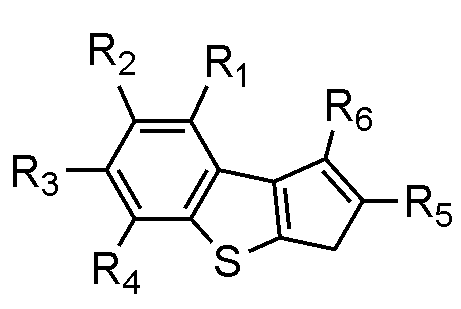
[화학식 4]

[화학식 5]
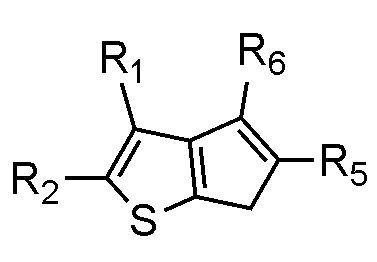
[화학식 6]

상기 화학식 3 내지 6에서,
R1 내지 R6은 서로 동일하거나 상이하며, 각각 독립적으로, 수소, C1-30 알킬, C1-30 알콕시, C2-30 알콕시알킬, C6-30 아릴, C6-30 아릴옥시, C2-30 알케닐, C2-30 알키닐, C3-30 사이클로알킬, C7-40의 알킬아릴, C8-40의 알케닐아릴, C8-40의 알키닐아릴, C7-40의 아릴알킬, C8-40의 아릴알케닐, 또는 C8-40의 아릴알키닐이고,
M은 Ti, Zr 또는 Hf이며,
Z는 -O-, -S-, -NR7- 또는 -PR7- 이며,
R7은 수소, C1-30 알킬, C6-30 아릴, C2-30 알케닐, C2-30 알키닐, C3-30 사이클로알킬, C7-40의 알킬아릴, C8-40의 알케닐아릴, C8-40의 알키닐아릴, C7-40의 아릴알킬, C8-40의 아릴알케닐, C8-40의 아릴알키닐, C1-30 알콕시실릴기, C6-30 아릴옥시실릴, C1-30 알킬실릴기, 또는 C1-30 실릴알킬기이고,
X1 및 X2는 서로 동일하거나 상이하고 각각 독립적으로 할로겐, C1-30 알킬, C2-30 알케닐, C7-30 알킬아릴, C7-30 아릴알킬, C6-20 아릴, 치환되거나 치환되지 않은 C1-30 알킬리덴, 치환되거나 치환되지 않은 아미노기, C2-30 알킬알콕시, 또는 C7-30 아릴알콕시이고,
T는
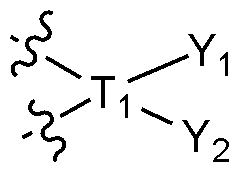
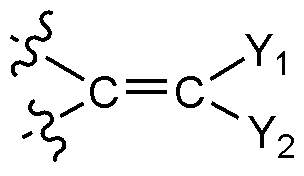
T1은 C, Si, Ge, Sn 또는 Pb이며,
Y1은 수소, C1-30 알킬, C1-30 알콕시, C2-30 알콕시알킬, C6-30 아릴, C6-30 아릴옥시, C2-30 알케닐, C2-30 알키닐, C3-30 사이클로알킬, C7-40의 알킬아릴, C8-40의 알케닐아릴, C8-40의 알키닐아릴, C7-40의 아릴알킬, C8-40의 아릴알케닐, 또는 C8-40의 아릴알키닐, 실릴기(-SiH3), C1-30 알콕시실릴기, C2-30 알콕시알킬실릴기, C6-30 아릴옥시실릴, C1-30 할로알킬, C6-30 할로아릴, 또는 -NR9R10이고,
Y2는 C2-30 알콕시알킬, 또는 C7-40 아릴옥시알킬이고,
R9 및 R10은 각각 독립적으로 수소, C1-30 알킬, C6-30 아릴, C2-30 알케닐, C2-30 알키닐, C3-30 사이클로알킬, C7-40의 알킬아릴, C8-40의 알케닐아릴, C8-40의 알키닐아릴, C7-40의 아릴알킬, C8-40의 아릴알케닐, 또는 C8-40의 아릴알키닐이거나, 또는 서로 연결되어 지방족 또는 방향족 고리를 형성한다.
In the presence of a catalyst composition comprising a first metallocene compound represented by the following formula (1) and a second metallocene compound represented by the following formula (2) in a single reactor, hydrogen gas is introduced to copolymerize ethylene and 1-hexene A method for producing an ethylene/1-hexene copolymer according to claim 1, comprising the steps of:
[Formula 1]
(Cp 1 R a ) n (Cp 2 R b )M 1 Z 1 3-n
In Formula 1,
M 1 is a Group 4 transition metal;
Cp 1 and Cp 2 are each cyclopentadienyl, unsubstituted or substituted with a C 1-20 hydrocarbon;
R a and R b are the same as or different from each other, and each independently hydrogen, C 1-20 alkyl, C 1-20 alkoxy, C 2-20 alkoxyalkyl, C 6-20 aryl, C 6-20 aryloxy, C 2-20 alkenyl, C 7-40 alkylaryl, C 7-40 arylalkyl, C 8-40 arylalkenyl, C 2-20 alkynyl, or selected from the group consisting of N, O and S C 2-20 heteroaryl containing one or more heteroatoms that are;
Z 1 is halogen, C 1-20 alkyl, C 2-20 alkenyl, C 7-40 alkylaryl, C 7-40 arylalkyl, C 6-20 aryl, substituted or unsubstituted C 1-20 alkylidene, a substituted or unsubstituted amino group, C 2-20 alkylalkoxy, or C 7-40 arylalkoxy;
n is 1 or 0;
[Formula 2]
In Formula 2,
C 1 is any one of the ligands represented by Formulas 3 to 6;
[Formula 3]
[Formula 4]
[Formula 5]
[Formula 6]
In Formulas 3 to 6,
R 1 to R 6 are the same as or different from each other, and are each independently selected from hydrogen, C 1-30 alkyl, C 1-30 alkoxy, C 2-30 alkoxyalkyl, C 6-30 aryl, C 6-30 aryloxy, C 2-30 alkenyl, C 2-30 alkynyl, C 3-30 cycloalkyl, C 7-40 alkylaryl, C 8-40 alkenylaryl, C 8-40 alkynylaryl, C 7- 40 arylalkyl, C 8-40 arylalkenyl, or C 8-40 arylalkynyl;
M is Ti, Zr or Hf;
Z is -O-, -S-, -NR 7 - or -PR 7 -;
R 7 is hydrogen, C 1-30 alkyl, C 6-30 aryl, C 2-30 alkenyl, C 2-30 alkynyl, C 3-30 cycloalkyl, C 7-40 alkylaryl, C 8-40 alkenylaryl, C 8-40 alkynylaryl, C 7-40 arylalkyl, C 8-40 arylalkenyl, C 8-40 arylalkynyl, C 1-30 alkoxysilyl group, C 6 -30 aryloxysilyl, C 1-30 alkylsilyl group, or C 1-30 silylalkyl group,
X 1 and X 2 are the same as or different from each other and are each independently halogen, C 1-30 alkyl, C 2-30 alkenyl, C 7-30 alkylaryl, C 7-30 arylalkyl, C 6-20 aryl, substituted an optionally substituted C 1-30 alkylidene, a substituted or unsubstituted amino group, a C 2-30 alkylalkoxy, or a C 7-30 arylalkoxy;
T is
T 1 is C, Si, Ge, Sn or Pb;
Y 1 is hydrogen, C 1-30 alkyl, C 1-30 alkoxy, C 2-30 alkoxyalkyl, C 6-30 aryl, C 6-30 aryloxy, C 2-30 alkenyl, C 2-30 alkynyl , C 3-30 cycloalkyl, C 7-40 alkylaryl, C 8-40 alkenylaryl, C 8-40 alkynylaryl, C 7-40 arylalkyl, C 8-40 arylalkenyl , or C 8-40 arylalkynyl, silyl group (-SiH 3 ), C 1-30 alkoxysilyl group, C 2-30 alkoxyalkylsilyl group, C 6-30 aryloxysilyl, C 1-30 haloalkyl , C 6-30 haloaryl, or -NR 9 R 10 ;
Y 2 is C 2-30 alkoxyalkyl or C 7-40 aryloxyalkyl;
R 9 and R 10 are each independently hydrogen, C 1-30 alkyl, C 6-30 aryl, C 2-30 alkenyl, C 2-30 alkynyl, C 3-30 cycloalkyl, C 7-40 alkyl aryl, C 8-40 alkenylaryl, C 8-40 alkynylaryl, C 7-40 arylalkyl, C 8-40 arylalkenyl, or C 8-40 arylalkynyl, or each other linked to form aliphatic or aromatic rings.
상기 화학식 1에 있어서 Ra 및 Rb가 각각 독립적으로 수소, C1-10 알킬, C2-10 알콕시알킬, 또는 C7-20의 아릴알킬이되, Ra 및 Rb 중 적어도 하나가 -(CH2)n-OR (이때, R은 탄소수 1 내지 6의 직쇄 또는 분지쇄 알킬기이고, n은 2 내지 4의 정수이다.)인, 제조방법.
According to claim 9,
In Formula 1, R a and R b are each independently hydrogen, C 1-10 alkyl, C 2-10 alkoxyalkyl, or C 7-20 arylalkyl, and at least one of R a and R b is - (CH 2 )n-OR (wherein R is a straight-chain or branched-chain alkyl group having 1 to 6 carbon atoms, and n is an integer of 2 to 4).
상기 제1 메탈로센 화합물은 하기 화합물들로 이루어진 군에서 선택되는, 제조방법:
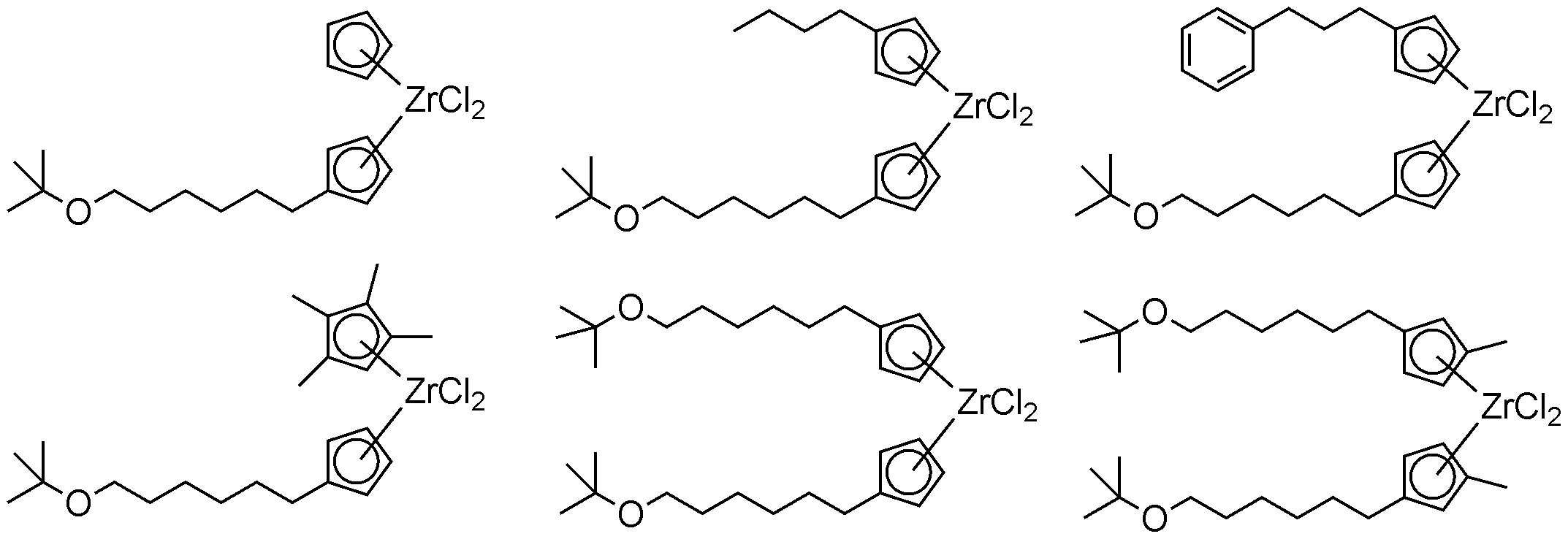
According to claim 9,
The first metallocene compound is selected from the group consisting of the following compounds, manufacturing method:
상기 제2 메탈로센 화합물은 하기 화학식 2a 내지 2d로 표시되는 화합물 중 어느 하나인, 제조방법:
[화학식 2a]

[화학식 2b]
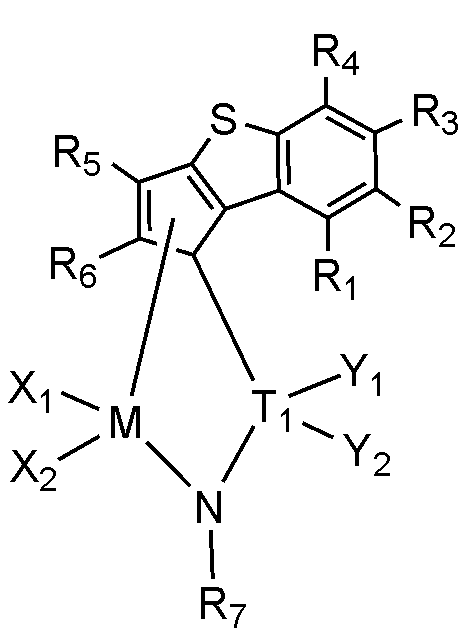
[화학식 2c]
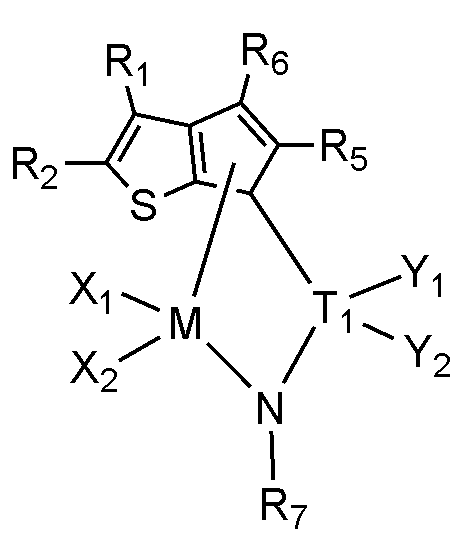
[화학식 2d]

상기 화학식 2a 내지 2d에서,
M은 Ti, Zr 또는 Hf이며,
R1 내지 R4는 각각 독립적으로 수소, 또는 C1-20 알킬이고,
R5 및 R6은 각각 독립적으로 C1-10 알킬이며,
R7은 C1-10 알킬이고,
T1은 C 또는 Si이며,
Y1은 C1-20 알킬, C1-20 알콕시, C2-20 알콕시알킬, C6-20 아릴, C7-30 알킬아릴, C7-30 아릴알킬, C6-20 아릴옥시, 또는 C7-30 아릴옥시알킬이고,
Y2는 C2-20 알콕시알킬 또는 C7-30 아릴옥시알킬이며,
X1 및 X2는 각각 독립적으로 할로겐 또는 C1-20 알킬이다.
According to claim 9,
The second metallocene compound is any one of the compounds represented by the following formulas 2a to 2d, manufacturing method:
[Formula 2a]
[Formula 2b]
[Formula 2c]
[Formula 2d]
In Formulas 2a to 2d,
M is Ti, Zr or Hf;
R 1 to R 4 are each independently hydrogen or C 1-20 alkyl;
R 5 and R 6 are each independently C 1-10 alkyl;
R 7 is C 1-10 alkyl;
T 1 is C or Si;
Y 1 is C 1-20 alkyl, C 1-20 alkoxy, C 2-20 alkoxyalkyl, C 6-20 aryl, C 7-30 alkylaryl, C 7-30 arylalkyl, C 6-20 aryloxy, or C 7-30 aryloxyalkyl;
Y 2 is C 2-20 alkoxyalkyl or C 7-30 aryloxyalkyl;
X 1 and X 2 are each independently halogen or C 1-20 alkyl.
상기 제2 메탈로센 화합물은 하기 화합물들로 이루어진 군에서 선택되는, 제조방법:
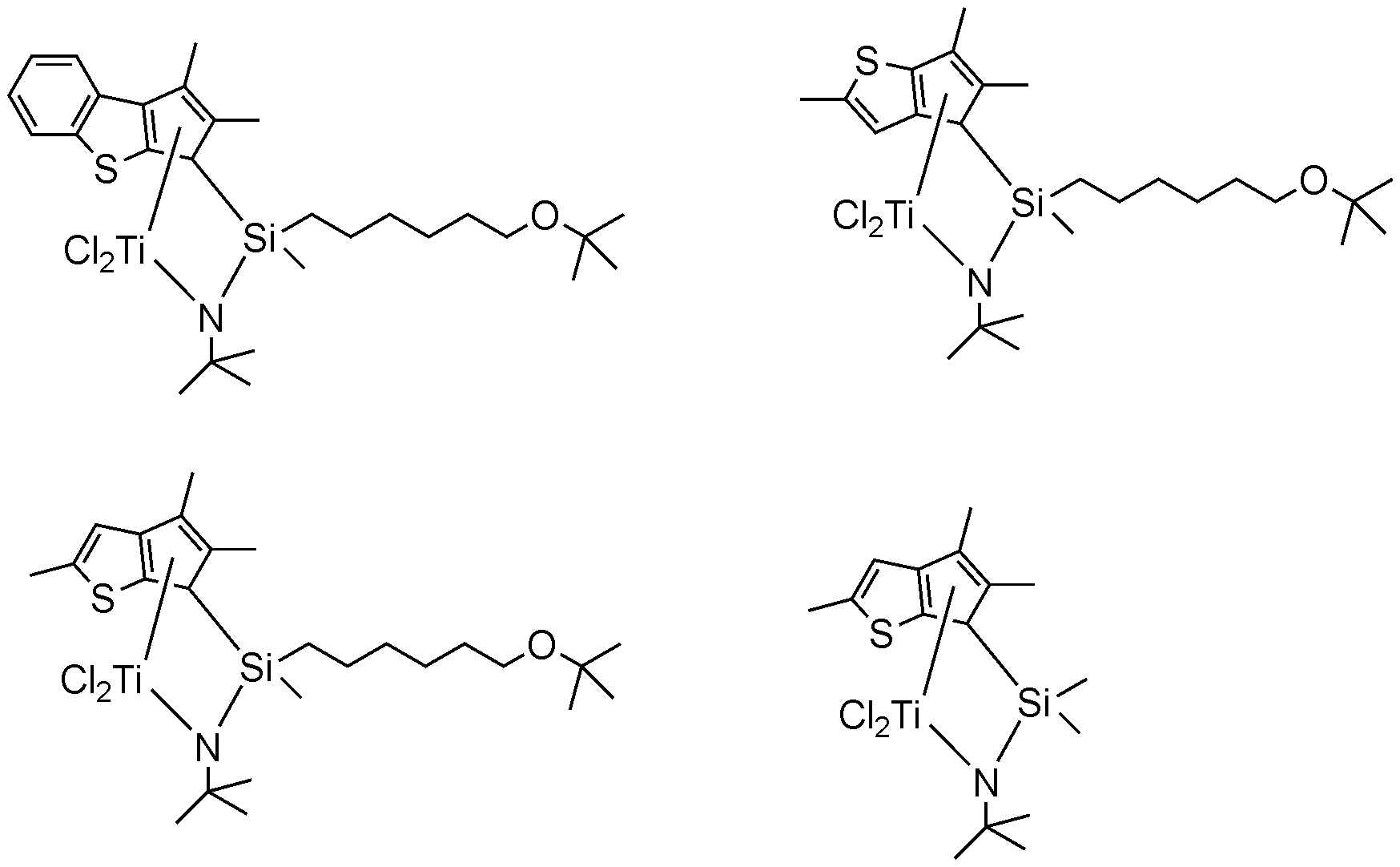
According to claim 9,
The second metallocene compound is selected from the group consisting of the following compounds, manufacturing method:
상기 제1 및 제2 메탈로센 화합물은 1:1.1 내지 1:5의 몰비로 포함되는, 제조방법.
According to claim 9,
Wherein the first and second metallocene compounds are included in a molar ratio of 1:1.1 to 1:5.
상기 공중합은 하나의 루프형 슬러리 반응기에서 수행되는, 제조방법.
According to claim 9,
The copolymerization is carried out in one loop-type slurry reactor, manufacturing method.
상기 1-헥센은 단량체 총 중량에 대하여 5 내지 10중량%로 포함되는, 제조방법.
According to claim 9,
The 1-hexene is contained in 5 to 10% by weight based on the total weight of the monomers, manufacturing method.
Priority Applications (6)
| Application Number | Priority Date | Filing Date | Title |
|---|---|---|---|
| EP20870553.3A EP3872102A4 (en) | 2019-09-30 | 2020-09-28 | Ethylene/1-hexene copolymer having excellent long-term properties and processibility |
| PCT/KR2020/013174 WO2021066437A1 (en) | 2019-09-30 | 2020-09-28 | Ethylene/1-hexene copolymer having excellent long-term properties and processibility |
| CN202080006527.9A CN113166322B (en) | 2019-09-30 | 2020-09-28 | Ethylene/1-hexene copolymer with excellent long-term physical properties and processability |
| JP2021525212A JP7134553B2 (en) | 2019-09-30 | 2020-09-28 | Ethylene/1-hexene copolymer with excellent long-term physical properties and workability |
| CN202311329572.XA CN117384316A (en) | 2019-09-30 | 2020-09-28 | Ethylene/1-hexene copolymer with excellent long-term physical properties and processability |
| US17/311,794 US12091477B2 (en) | 2019-09-30 | 2020-09-28 | Ethylene/1-hexene copolymer having excellent long-term physical properties and processability |
Applications Claiming Priority (2)
| Application Number | Priority Date | Filing Date | Title |
|---|---|---|---|
| KR1020190121175 | 2019-09-30 | ||
| KR20190121175 | 2019-09-30 |
Publications (2)
| Publication Number | Publication Date |
|---|---|
| KR20210038357A KR20210038357A (en) | 2021-04-07 |
| KR102526767B1 true KR102526767B1 (en) | 2023-04-27 |
Family
ID=75469801
Family Applications (1)
| Application Number | Title | Priority Date | Filing Date |
|---|---|---|---|
| KR1020200125236A Active KR102526767B1 (en) | 2019-09-30 | 2020-09-25 | ethylene/1-hexene copolymer having excellent long term property and processibility |
Country Status (5)
| Country | Link |
|---|---|
| US (1) | US12091477B2 (en) |
| EP (1) | EP3872102A4 (en) |
| JP (1) | JP7134553B2 (en) |
| KR (1) | KR102526767B1 (en) |
| CN (2) | CN113166322B (en) |
Families Citing this family (6)
| Publication number | Priority date | Publication date | Assignee | Title |
|---|---|---|---|---|
| US20230096686A1 (en) * | 2020-08-19 | 2023-03-30 | Lg Chem, Ltd. | Pellet-type polyethylene resin composition and method for preparing the same |
| WO2023172009A1 (en) * | 2022-03-10 | 2023-09-14 | 주식회사 엘지화학 | Ethylene/1-hexene copolymer having improved long-term physical property stability and processability |
| US20250154301A1 (en) * | 2022-10-27 | 2025-05-15 | Lg Chem, Ltd. | Polyethylene Resin Having Excellent Thermal Resistance |
| EP4461755A4 (en) * | 2022-10-27 | 2025-04-23 | LG Chem, Ltd. | POLYETHYLENE RESIN WITH EXCELLENT HEAT RESISTANCE |
| WO2024128846A1 (en) * | 2022-12-15 | 2024-06-20 | 주식회사 엘지화학 | Polyethylene and film comprising same |
| KR102865779B1 (en) * | 2022-12-23 | 2025-09-29 | 한화토탈에너지스 주식회사 | Polyethylene resin and article including the same |
Family Cites Families (29)
| Publication number | Priority date | Publication date | Assignee | Title |
|---|---|---|---|---|
| US4935474A (en) | 1983-06-06 | 1990-06-19 | Exxon Research & Engineering Company | Process and catalyst for producing polyethylene having a broad molecular weight distribution |
| US6180736B1 (en) | 1996-12-20 | 2001-01-30 | Exxon Chemical Patents Inc | High activity metallocene polymerization process |
| EP0905151A1 (en) * | 1997-09-27 | 1999-03-31 | Fina Research S.A. | Production of polyethylene having a broad molecular weight distribution |
| US6274684B1 (en) | 1999-10-22 | 2001-08-14 | Univation Technologies, Llc | Catalyst composition, method of polymerization, and polymer therefrom |
| US6911508B2 (en) | 2003-06-05 | 2005-06-28 | Univation Technologies, Llc | Class of metallocenes and method of producing polyethylene |
| ATE489409T1 (en) | 2004-02-13 | 2010-12-15 | Total Petrochemicals Res Feluy | METHOD FOR IMPROVING THE COPOLYMERIZATION OF ETHYLENE AND AN OLEFIN COMONOMER IN A LOOP POLYMERIZATION REACTOR |
| US7312283B2 (en) | 2005-08-22 | 2007-12-25 | Chevron Phillips Chemical Company Lp | Polymerization catalysts and process for producing bimodal polymers in a single reactor |
| JP4810340B2 (en) | 2006-07-19 | 2011-11-09 | 日本ポリエチレン株式会社 | Welding material for plastic fuel tank |
| WO2008136621A1 (en) | 2007-05-02 | 2008-11-13 | Lg Chem, Ltd. | Polyolefin and preparation method thereof |
| US20120172548A1 (en) * | 2007-05-02 | 2012-07-05 | Lg Chem, Ltd. | Polyolefin and preparation method thereof |
| KR101485566B1 (en) * | 2010-10-14 | 2015-01-23 | 주식회사 엘지화학 | Polyethylene having excellent sealing property at low temperature, and method for preparing the same |
| KR101248423B1 (en) | 2011-06-09 | 2013-04-02 | 에스케이종합화학 주식회사 | Method for preparing ethylene - α-olefin - diene copolymer |
| KR101362992B1 (en) * | 2013-03-27 | 2014-02-13 | 주식회사 엘지화학 | Polyolefin with multi-modal molecular weight distributions and pipe comprising the same |
| KR101549209B1 (en) * | 2013-11-18 | 2015-09-02 | 주식회사 엘지화학 | Olefin based polymer having excellent processibility |
| KR101705339B1 (en) | 2014-07-18 | 2017-02-09 | 주식회사 엘지화학 | Ethylene-1-hexene-1-butene terpolymer and film comprising the same |
| KR101617870B1 (en) * | 2014-09-05 | 2016-05-03 | 주식회사 엘지화학 | Olefin based polymer having excellent processibility |
| WO2016036204A1 (en) | 2014-09-05 | 2016-03-10 | 주식회사 엘지화학 | Olefin-based polymer with excellent processability |
| JP6487924B2 (en) * | 2014-10-13 | 2019-03-20 | エルジー・ケム・リミテッド | Ethylene / 1-hexene or ethylene / 1-butene copolymer excellent in processability and environmental stress crack resistance |
| KR101719064B1 (en) | 2014-11-13 | 2017-03-22 | 주식회사 엘지화학 | Ligand compound, transition metal compound, and catalyst composition comprising the same |
| KR20170049272A (en) * | 2015-10-28 | 2017-05-10 | 대림산업 주식회사 | Multimodal polyolefin resin and article prepared with the same |
| KR102107084B1 (en) | 2016-03-11 | 2020-05-06 | 주식회사 엘지화학 | Method for preparing of supported hybrid metallocene catalyst, the supported hybrid metallocene catalyst prepared by the same method, and method for preparing polyolefin using the same |
| KR102209393B1 (en) | 2016-12-02 | 2021-01-28 | 주식회사 엘지화학 | Supported hybrid catalyst |
| KR102072697B1 (en) * | 2016-12-09 | 2020-02-03 | 주식회사 엘지화학 | Ethylene/1-hexene copolymer having excellent processibility and physical property |
| KR101797890B1 (en) | 2017-01-20 | 2017-11-14 | 한화케미칼 주식회사 | Hybride catalyst compositon, preparation method thereof, and manufactured polyolefin using the same |
| EP3689198B1 (en) * | 2017-08-09 | 2023-01-04 | SharkNinja Operating LLC | Cooking device and components thereof |
| WO2019124835A1 (en) | 2017-12-20 | 2019-06-27 | 주식회사 엘지화학 | Polyethylene copolymer and preparation method therefor |
| KR102285480B1 (en) * | 2017-12-20 | 2021-08-03 | 주식회사 엘지화학 | Polyethylene copolymer and method for preparing the same |
| KR102116476B1 (en) * | 2019-01-18 | 2020-05-28 | 대림산업 주식회사 | Catalyst composition for polymerizing polyolefin, method for producing polyolefin, and polyolefin resin |
| WO2022071744A1 (en) * | 2020-09-29 | 2022-04-07 | 주식회사 엘지화학 | Ethylene/1-hexene copolymer having excellent constructability and processability |
-
2020
- 2020-09-25 KR KR1020200125236A patent/KR102526767B1/en active Active
- 2020-09-28 JP JP2021525212A patent/JP7134553B2/en active Active
- 2020-09-28 US US17/311,794 patent/US12091477B2/en active Active
- 2020-09-28 CN CN202080006527.9A patent/CN113166322B/en active Active
- 2020-09-28 EP EP20870553.3A patent/EP3872102A4/en active Pending
- 2020-09-28 CN CN202311329572.XA patent/CN117384316A/en active Pending
Also Published As
| Publication number | Publication date |
|---|---|
| CN113166322B (en) | 2023-11-17 |
| CN113166322A (en) | 2021-07-23 |
| US20220017667A1 (en) | 2022-01-20 |
| KR20210038357A (en) | 2021-04-07 |
| JP7134553B2 (en) | 2022-09-12 |
| US12091477B2 (en) | 2024-09-17 |
| EP3872102A1 (en) | 2021-09-01 |
| CN117384316A (en) | 2024-01-12 |
| EP3872102A4 (en) | 2022-01-26 |
| JP2022507058A (en) | 2022-01-18 |
Similar Documents
| Publication | Publication Date | Title |
|---|---|---|
| KR102526767B1 (en) | ethylene/1-hexene copolymer having excellent long term property and processibility | |
| KR101726820B1 (en) | Ethylene/1-hexene or ethylene/1-butene copolymer having excellent processibility and environmental stress crack resistance | |
| US20170233511A1 (en) | Ethylene/alpha-olefin copolymer having excellent processability | |
| KR101593666B1 (en) | Olefin based polymer having excellent processibility | |
| KR102459861B1 (en) | Ethylene/1-butene copolymer having excellent processibility | |
| CN110869399A (en) | Polyethylene copolymer and preparation method thereof | |
| KR102821274B1 (en) | Hybrid supported catalyst | |
| JP7362192B2 (en) | Ethylene/1-hexene copolymer with excellent workability and processability | |
| KR20240059551A (en) | Polyethylene resin having excellent thermal resistance | |
| EP4446349A1 (en) | Ethylene/1-hexene copolymer having improved long-term physical property stability and processability | |
| KR20230133210A (en) | Ethylene/1-hexene copolymer having improved improved long-term physical property stability and processibility | |
| KR20240063035A (en) | Polyethylene composition and biaxially stretched film comprising the same | |
| KR102608215B1 (en) | Ethylene/1-hexene copolymer having improved flexibility and processibility | |
| KR20220062210A (en) | Hybride supported metallocene catalyst and process for preparing polyethylene copolymer using the same | |
| KR20220043736A (en) | Process for preparing polyethylene composition | |
| EP4461756A1 (en) | Polyethylene resin having excellent heat resistance | |
| EP4461755A1 (en) | Polyethylene resin having excellent thermal resistance | |
| KR20240059552A (en) | Polyethylene resin having excellent thermal resistance | |
| CN118804935A (en) | Polyethylene resin with excellent heat resistance | |
| KR20240062822A (en) | Polyethylene composition and biaxially stretched film comprising the same | |
| KR20250118801A (en) | Polyethylene composition and biaxially stretched film comprising the same | |
| CN118891294A (en) | Polyethylene resin with excellent heat resistance | |
| KR20240085847A (en) | Polyethylene composition and its film | |
| KR20220066744A (en) | Hybrid supported catalyst |
Legal Events
| Date | Code | Title | Description |
|---|---|---|---|
| PA0109 | Patent application |
Patent event code: PA01091R01D Comment text: Patent Application Patent event date: 20200925 |
|
| PG1501 | Laying open of application | ||
| A201 | Request for examination | ||
| PA0201 | Request for examination |
Patent event code: PA02012R01D Patent event date: 20210511 Comment text: Request for Examination of Application Patent event code: PA02011R01I Patent event date: 20200925 Comment text: Patent Application |
|
| E902 | Notification of reason for refusal | ||
| PE0902 | Notice of grounds for rejection |
Comment text: Notification of reason for refusal Patent event date: 20221019 Patent event code: PE09021S01D |
|
| E701 | Decision to grant or registration of patent right | ||
| PE0701 | Decision of registration |
Patent event code: PE07011S01D Comment text: Decision to Grant Registration Patent event date: 20230412 |
|
| GRNT | Written decision to grant | ||
| PR0701 | Registration of establishment |
Comment text: Registration of Establishment Patent event date: 20230424 Patent event code: PR07011E01D |
|
| PR1002 | Payment of registration fee |
Payment date: 20230424 End annual number: 3 Start annual number: 1 |
|
| PG1601 | Publication of registration |