KR102514213B1 - Immune synaptic variant library and its synthesis - Google Patents
Immune synaptic variant library and its synthesis Download PDFInfo
- Publication number
- KR102514213B1 KR102514213B1 KR1020197020597A KR20197020597A KR102514213B1 KR 102514213 B1 KR102514213 B1 KR 102514213B1 KR 1020197020597 A KR1020197020597 A KR 1020197020597A KR 20197020597 A KR20197020597 A KR 20197020597A KR 102514213 B1 KR102514213 B1 KR 102514213B1
- Authority
- KR
- South Korea
- Prior art keywords
- variant
- nucleic acid
- tcr
- delete delete
- library
- Prior art date
- Legal status (The legal status is an assumption and is not a legal conclusion. Google has not performed a legal analysis and makes no representation as to the accuracy of the status listed.)
- Active
Links
Images


Classifications
-
- A—HUMAN NECESSITIES
- A61—MEDICAL OR VETERINARY SCIENCE; HYGIENE
- A61K—PREPARATIONS FOR MEDICAL, DENTAL OR TOILETRY PURPOSES
- A61K39/00—Medicinal preparations containing antigens or antibodies
- A61K39/0005—Vertebrate antigens
- A61K39/0011—Cancer antigens
-
- A—HUMAN NECESSITIES
- A61—MEDICAL OR VETERINARY SCIENCE; HYGIENE
- A61K—PREPARATIONS FOR MEDICAL, DENTAL OR TOILETRY PURPOSES
- A61K39/00—Medicinal preparations containing antigens or antibodies
- A61K39/0005—Vertebrate antigens
- A61K39/0011—Cancer antigens
- A61K39/00118—Cancer antigens from embryonic or fetal origin
- A61K39/001182—Carcinoembryonic antigen [CEA]
-
- A—HUMAN NECESSITIES
- A61—MEDICAL OR VETERINARY SCIENCE; HYGIENE
- A61K—PREPARATIONS FOR MEDICAL, DENTAL OR TOILETRY PURPOSES
- A61K39/00—Medicinal preparations containing antigens or antibodies
- A61K39/0005—Vertebrate antigens
- A61K39/0011—Cancer antigens
- A61K39/001184—Cancer testis antigens, e.g. SSX, BAGE, GAGE or SAGE
- A61K39/001186—MAGE
-
- A—HUMAN NECESSITIES
- A61—MEDICAL OR VETERINARY SCIENCE; HYGIENE
- A61K—PREPARATIONS FOR MEDICAL, DENTAL OR TOILETRY PURPOSES
- A61K39/00—Medicinal preparations containing antigens or antibodies
- A61K39/0005—Vertebrate antigens
- A61K39/0011—Cancer antigens
- A61K39/001184—Cancer testis antigens, e.g. SSX, BAGE, GAGE or SAGE
- A61K39/001188—NY-ESO
-
- A—HUMAN NECESSITIES
- A61—MEDICAL OR VETERINARY SCIENCE; HYGIENE
- A61K—PREPARATIONS FOR MEDICAL, DENTAL OR TOILETRY PURPOSES
- A61K40/00—Cellular immunotherapy
- A61K40/10—Cellular immunotherapy characterised by the cell type used
- A61K40/11—T-cells, e.g. tumour infiltrating lymphocytes [TIL] or regulatory T [Treg] cells; Lymphokine-activated killer [LAK] cells
-
- A—HUMAN NECESSITIES
- A61—MEDICAL OR VETERINARY SCIENCE; HYGIENE
- A61K—PREPARATIONS FOR MEDICAL, DENTAL OR TOILETRY PURPOSES
- A61K40/00—Cellular immunotherapy
- A61K40/30—Cellular immunotherapy characterised by the recombinant expression of specific molecules in the cells of the immune system
- A61K40/32—T-cell receptors [TCR]
-
- A—HUMAN NECESSITIES
- A61—MEDICAL OR VETERINARY SCIENCE; HYGIENE
- A61K—PREPARATIONS FOR MEDICAL, DENTAL OR TOILETRY PURPOSES
- A61K40/00—Cellular immunotherapy
- A61K40/40—Cellular immunotherapy characterised by antigens that are targeted or presented by cells of the immune system
- A61K40/41—Vertebrate antigens
- A61K40/42—Cancer antigens
- A61K40/4267—Cancer testis antigens, e.g. SSX, BAGE, GAGE or SAGE
- A61K40/4268—MAGE
-
- A—HUMAN NECESSITIES
- A61—MEDICAL OR VETERINARY SCIENCE; HYGIENE
- A61K—PREPARATIONS FOR MEDICAL, DENTAL OR TOILETRY PURPOSES
- A61K40/00—Cellular immunotherapy
- A61K40/40—Cellular immunotherapy characterised by antigens that are targeted or presented by cells of the immune system
- A61K40/41—Vertebrate antigens
- A61K40/42—Cancer antigens
- A61K40/4267—Cancer testis antigens, e.g. SSX, BAGE, GAGE or SAGE
- A61K40/4269—NY-ESO
-
- C—CHEMISTRY; METALLURGY
- C07—ORGANIC CHEMISTRY
- C07K—PEPTIDES
- C07K14/00—Peptides having more than 20 amino acids; Gastrins; Somatostatins; Melanotropins; Derivatives thereof
- C07K14/435—Peptides having more than 20 amino acids; Gastrins; Somatostatins; Melanotropins; Derivatives thereof from animals; from humans
- C07K14/705—Receptors; Cell surface antigens; Cell surface determinants
- C07K14/70503—Immunoglobulin superfamily
- C07K14/7051—T-cell receptor (TcR)-CD3 complex
-
- C—CHEMISTRY; METALLURGY
- C12—BIOCHEMISTRY; BEER; SPIRITS; WINE; VINEGAR; MICROBIOLOGY; ENZYMOLOGY; MUTATION OR GENETIC ENGINEERING
- C12N—MICROORGANISMS OR ENZYMES; COMPOSITIONS THEREOF; PROPAGATING, PRESERVING, OR MAINTAINING MICROORGANISMS; MUTATION OR GENETIC ENGINEERING; CULTURE MEDIA
- C12N15/00—Mutation or genetic engineering; DNA or RNA concerning genetic engineering, vectors, e.g. plasmids, or their isolation, preparation or purification; Use of hosts therefor
- C12N15/09—Recombinant DNA-technology
- C12N15/10—Processes for the isolation, preparation or purification of DNA or RNA
- C12N15/102—Mutagenizing nucleic acids
-
- C—CHEMISTRY; METALLURGY
- C12—BIOCHEMISTRY; BEER; SPIRITS; WINE; VINEGAR; MICROBIOLOGY; ENZYMOLOGY; MUTATION OR GENETIC ENGINEERING
- C12N—MICROORGANISMS OR ENZYMES; COMPOSITIONS THEREOF; PROPAGATING, PRESERVING, OR MAINTAINING MICROORGANISMS; MUTATION OR GENETIC ENGINEERING; CULTURE MEDIA
- C12N15/00—Mutation or genetic engineering; DNA or RNA concerning genetic engineering, vectors, e.g. plasmids, or their isolation, preparation or purification; Use of hosts therefor
- C12N15/09—Recombinant DNA-technology
- C12N15/10—Processes for the isolation, preparation or purification of DNA or RNA
- C12N15/1034—Isolating an individual clone by screening libraries
- C12N15/1068—Template (nucleic acid) mediated chemical library synthesis, e.g. chemical and enzymatical DNA-templated organic molecule synthesis, libraries prepared by non ribosomal polypeptide synthesis [NRPS], DNA/RNA-polymerase mediated polypeptide synthesis
-
- C—CHEMISTRY; METALLURGY
- C40—COMBINATORIAL TECHNOLOGY
- C40B—COMBINATORIAL CHEMISTRY; LIBRARIES, e.g. CHEMICAL LIBRARIES
- C40B30/00—Methods of screening libraries
- C40B30/04—Methods of screening libraries by measuring the ability to specifically bind a target molecule, e.g. antibody-antigen binding, receptor-ligand binding
-
- C—CHEMISTRY; METALLURGY
- C40—COMBINATORIAL TECHNOLOGY
- C40B—COMBINATORIAL CHEMISTRY; LIBRARIES, e.g. CHEMICAL LIBRARIES
- C40B40/00—Libraries per se, e.g. arrays, mixtures
- C40B40/04—Libraries containing only organic compounds
- C40B40/06—Libraries containing nucleotides or polynucleotides, or derivatives thereof
- C40B40/08—Libraries containing RNA or DNA which encodes proteins, e.g. gene libraries
-
- G—PHYSICS
- G01—MEASURING; TESTING
- G01N—INVESTIGATING OR ANALYSING MATERIALS BY DETERMINING THEIR CHEMICAL OR PHYSICAL PROPERTIES
- G01N33/00—Investigating or analysing materials by specific methods not covered by groups G01N1/00 - G01N31/00
- G01N33/48—Biological material, e.g. blood, urine; Haemocytometers
- G01N33/50—Chemical analysis of biological material, e.g. blood, urine; Testing involving biospecific ligand binding methods; Immunological testing
- G01N33/5005—Chemical analysis of biological material, e.g. blood, urine; Testing involving biospecific ligand binding methods; Immunological testing involving human or animal cells
- G01N33/5008—Chemical analysis of biological material, e.g. blood, urine; Testing involving biospecific ligand binding methods; Immunological testing involving human or animal cells for testing or evaluating the effect of chemical or biological compounds, e.g. drugs, cosmetics
- G01N33/5044—Chemical analysis of biological material, e.g. blood, urine; Testing involving biospecific ligand binding methods; Immunological testing involving human or animal cells for testing or evaluating the effect of chemical or biological compounds, e.g. drugs, cosmetics involving specific cell types
- G01N33/5047—Cells of the immune system
- G01N33/505—Cells of the immune system involving T-cells
-
- G—PHYSICS
- G01—MEASURING; TESTING
- G01N—INVESTIGATING OR ANALYSING MATERIALS BY DETERMINING THEIR CHEMICAL OR PHYSICAL PROPERTIES
- G01N33/00—Investigating or analysing materials by specific methods not covered by groups G01N1/00 - G01N31/00
- G01N33/48—Biological material, e.g. blood, urine; Haemocytometers
- G01N33/50—Chemical analysis of biological material, e.g. blood, urine; Testing involving biospecific ligand binding methods; Immunological testing
- G01N33/53—Immunoassay; Biospecific binding assay; Materials therefor
- G01N33/574—Immunoassay; Biospecific binding assay; Materials therefor for cancer
-
- G01N33/575—
-
- G—PHYSICS
- G01—MEASURING; TESTING
- G01N—INVESTIGATING OR ANALYSING MATERIALS BY DETERMINING THEIR CHEMICAL OR PHYSICAL PROPERTIES
- G01N33/00—Investigating or analysing materials by specific methods not covered by groups G01N1/00 - G01N31/00
- G01N33/48—Biological material, e.g. blood, urine; Haemocytometers
- G01N33/50—Chemical analysis of biological material, e.g. blood, urine; Testing involving biospecific ligand binding methods; Immunological testing
- G01N33/68—Chemical analysis of biological material, e.g. blood, urine; Testing involving biospecific ligand binding methods; Immunological testing involving proteins, peptides or amino acids
- G01N33/6803—General methods of protein analysis not limited to specific proteins or families of proteins
- G01N33/6806—Determination of free amino acids
- G01N33/6812—Assays for specific amino acids
-
- G—PHYSICS
- G01—MEASURING; TESTING
- G01N—INVESTIGATING OR ANALYSING MATERIALS BY DETERMINING THEIR CHEMICAL OR PHYSICAL PROPERTIES
- G01N33/00—Investigating or analysing materials by specific methods not covered by groups G01N1/00 - G01N31/00
- G01N33/48—Biological material, e.g. blood, urine; Haemocytometers
- G01N33/50—Chemical analysis of biological material, e.g. blood, urine; Testing involving biospecific ligand binding methods; Immunological testing
- G01N33/68—Chemical analysis of biological material, e.g. blood, urine; Testing involving biospecific ligand binding methods; Immunological testing involving proteins, peptides or amino acids
- G01N33/6893—Chemical analysis of biological material, e.g. blood, urine; Testing involving biospecific ligand binding methods; Immunological testing involving proteins, peptides or amino acids related to diseases not provided for elsewhere
-
- C—CHEMISTRY; METALLURGY
- C07—ORGANIC CHEMISTRY
- C07K—PEPTIDES
- C07K2317/00—Immunoglobulins specific features
- C07K2317/50—Immunoglobulins specific features characterized by immunoglobulin fragments
- C07K2317/56—Immunoglobulins specific features characterized by immunoglobulin fragments variable (Fv) region, i.e. VH and/or VL
- C07K2317/565—Complementarity determining region [CDR]
-
- C—CHEMISTRY; METALLURGY
- C07—ORGANIC CHEMISTRY
- C07K—PEPTIDES
- C07K2317/00—Immunoglobulins specific features
- C07K2317/70—Immunoglobulins specific features characterized by effect upon binding to a cell or to an antigen
-
- C—CHEMISTRY; METALLURGY
- C07—ORGANIC CHEMISTRY
- C07K—PEPTIDES
- C07K2317/00—Immunoglobulins specific features
- C07K2317/90—Immunoglobulins specific features characterized by (pharmaco)kinetic aspects or by stability of the immunoglobulin
- C07K2317/92—Affinity (KD), association rate (Ka), dissociation rate (Kd) or EC50 value
-
- C—CHEMISTRY; METALLURGY
- C07—ORGANIC CHEMISTRY
- C07K—PEPTIDES
- C07K2317/00—Immunoglobulins specific features
- C07K2317/90—Immunoglobulins specific features characterized by (pharmaco)kinetic aspects or by stability of the immunoglobulin
- C07K2317/94—Stability, e.g. half-life, pH, temperature or enzyme-resistance
-
- G—PHYSICS
- G01—MEASURING; TESTING
- G01N—INVESTIGATING OR ANALYSING MATERIALS BY DETERMINING THEIR CHEMICAL OR PHYSICAL PROPERTIES
- G01N2800/00—Detection or diagnosis of diseases
- G01N2800/70—Mechanisms involved in disease identification
- G01N2800/7023—(Hyper)proliferation
- G01N2800/7028—Cancer
Landscapes
- Health & Medical Sciences (AREA)
- Life Sciences & Earth Sciences (AREA)
- Chemical & Material Sciences (AREA)
- Engineering & Computer Science (AREA)
- Immunology (AREA)
- General Health & Medical Sciences (AREA)
- Molecular Biology (AREA)
- Biomedical Technology (AREA)
- Organic Chemistry (AREA)
- Genetics & Genomics (AREA)
- Biochemistry (AREA)
- Biotechnology (AREA)
- Medicinal Chemistry (AREA)
- Hematology (AREA)
- Urology & Nephrology (AREA)
- Physics & Mathematics (AREA)
- Cell Biology (AREA)
- Bioinformatics & Cheminformatics (AREA)
- Microbiology (AREA)
- Zoology (AREA)
- Veterinary Medicine (AREA)
- Epidemiology (AREA)
- Public Health (AREA)
- Animal Behavior & Ethology (AREA)
- General Engineering & Computer Science (AREA)
- Wood Science & Technology (AREA)
- Biophysics (AREA)
- Proteomics, Peptides & Aminoacids (AREA)
- Pathology (AREA)
- Analytical Chemistry (AREA)
- General Physics & Mathematics (AREA)
- Food Science & Technology (AREA)
- Plant Pathology (AREA)
- Crystallography & Structural Chemistry (AREA)
- Toxicology (AREA)
- Bioinformatics & Computational Biology (AREA)
- Chemical Kinetics & Catalysis (AREA)
- General Chemical & Material Sciences (AREA)
- Gastroenterology & Hepatology (AREA)
- Tropical Medicine & Parasitology (AREA)
Abstract
핵산 서열의 미리 결정된 변이체를 코딩하는 매우 정확한 핵산 라이브러리의 생성 방법이 본원에서 개시된다. 핵산 서열은 TCR 또는 TCR 결합 항원의 전부 또는 일부를 코딩할 수 있다. 변이 정도는 완전하여 포화 변이체 라이브러리가 생성되거나, 또는 완전하지 않아 변이체의 비포화 라이브러리가 생성될 수 있다. 변이체 핵산 라이브러리는 전사 또는 번역에 의한 추가 처리를 위해 설계될 수 있다. 본원에서 설명되는 변이체 핵산 라이브러리는 변이체 RNA, DNA 및/또는 단백질 집단을 생성하도록 설계될 수 있다. 또한, 생물학적 기능의 조절 및 질환, 예컨대 암의 치료 또는 완화를 위한 치료제의 설계에서의 용도와 함께 증가 또는 감소된 활성을 갖는 변이체 종을 확인하는 방법이 본원에서 제공된다.Methods for generating highly accurate nucleic acid libraries encoding predetermined variants of nucleic acid sequences are disclosed herein. The nucleic acid sequence may encode all or part of a TCR or TCR binding antigen. The degree of mutation may be perfect, resulting in a saturated library of variants, or incomplete, resulting in a non-saturated library of variants. Variant nucleic acid libraries can be designed for further processing by transcription or translation. Variant nucleic acid libraries described herein may be designed to generate variant RNA, DNA and/or protein populations. Also provided herein are methods for identifying variant species with increased or decreased activity, with use in the modulation of biological function and design of therapeutic agents for the treatment or alleviation of diseases, such as cancer.
Description
교차 참조cross reference
본원은 2016년 12월 16일자로 출원된 미국 특허 가출원 제62/435,650호의 이익을 주장하며, 이는 그 전체가 본원에 참고로 포함된다.This application claims the benefit of US Provisional Patent Application No. 62/435,650, filed on December 16, 2016, which is incorporated herein by reference in its entirety.
합성 생물학의 초석은 DNA를 필요로 하는 반복적인 과정인 설계, 구축 및 시험 과정이며, 상기 맞춤형 경로 및 유기체의 신속하고 저렴한 생성 및 최적화를 위해 이용가능하다. 설계 단계에서, DNA를 구성하는 A, C, T 및 G 뉴클레오티드는 관심 유전자좌 또는 경로를 포함하는 다양한 유전자 서열을 형성하며, 각각의 서열 변이체는 시험될 특정 가설을 나타낸다. 이러한 변이체 유전자 서열은 진화 생물학에서 유래된 개념으로 유전자, 게놈, 총전사체(transcriptome) 및 총단백질(proteome)을 구성하는 전체 서열과 관련된 개념인 서열 공간의 하위세트를 나타낸다.The cornerstone of synthetic biology is the design, construction and testing process, an iterative process that requires DNA and is available for the rapid and inexpensive generation and optimization of such tailored pathways and organisms. In the design phase, the A, C, T and G nucleotides that make up DNA form a variety of genetic sequences that include the locus or pathway of interest, each sequence variant representing a particular hypothesis to be tested. These variant gene sequences are concepts derived from evolutionary biology and represent a subset of sequence space, a concept related to the entire sequence constituting genes, genomes, total transcriptomes, and total proteins.
서열 공간의 적절한 샘플링을 가능하게 하고 최적화된 설계의 확률을 최대화하기 위해 많은 상이한 변이체가 일반적으로 각각의 설계-구축-시험 사이클에 대해 설계된다. 개념은 간단하지만, 전통적인 합성 방법의 속도, 처리량 및 품질 측면에서 과정의 병목 현상은 이 사이클이 진행되는 속도를 저해하여 개발 시간을 연장시킨다. 매우 정확한 DNA의 높은 비용 및 현재 합성 기술의 제한된 처리량으로 인해 서열 공간을 충분히 탐색할 수 없다는 것이 현재 속도 제한 단계이다.A number of different variants are generally designed for each design-build-test cycle to allow adequate sampling of the sequence space and to maximize the probability of an optimized design. Although the concept is simple, process bottlenecks in terms of speed, throughput and quality of traditional synthesis methods hinder the pace at which this cycle progresses, extending development time. The high cost of highly precise DNA and the limited throughput of current synthetic technologies are currently rate-limiting that the sequence space cannot be sufficiently explored.
구축 단계에서, 2개의 과정, 즉 핵산 합성 및 유전자 합성이 주목할 만하다. 역사적으로, 상이한 유전자 변이체의 합성은 분자 클로닝을 통해 이루어졌다. 이 접근법은 강력하지만, 규모를 확대할 수 없다. 초기 화학적 유전자 합성 노력은 서열 상동성이 중첩되는 매우 많은 핵산 생산에 초점을 두었다. 이어서, 이들을 모아서 폴리머라제 연쇄 반응(PCR)을 여러 번 반복하여 중첩 핵산을 전장 이중 가닥 유전자로의 연결(concatenation)을 수행할 수 있다. 시간 소모적이고 노동 집약적인 구축, 많은 부피의 포스포르아미다이트, 고가의 원료, 및 하류 단계에서 요구되는 것보다 현저히 더 적은 나노몰 수준의 최종 생성물, 및 한 유전자의 합성을 설정하기 위해 96웰 플레이트에 필요한 매우 많은 별개의 핵산을 비롯한 많은 요인들이 이 방법을 방해한다.In the construction phase, two processes are noteworthy: nucleic acid synthesis and gene synthesis. Historically, the synthesis of different genetic variants has been achieved through molecular cloning. While this approach is powerful, it is not scalable. Early chemical gene synthesis efforts focused on producing a large number of nucleic acids with overlapping sequence homology. They can then be pooled and subjected to multiple iterations of the polymerase chain reaction (PCR) to perform concatenation of the overlapping nucleic acids into full-length double-stranded genes. Time-consuming and labor-intensive construction, large volumes of phosphoramidite, expensive raw materials, and nanomolar end products significantly less than those required for downstream steps, and 96 wells to set up synthesis of one gene Many factors hinder this method, including the large number of distinct nucleic acids required for the plate.
마이크로어레이 상에서의 핵산 합성은 유전자 합성의 처리량의 현저한 증가를 제공하였다. 매우 많은 핵산이 마이크로어레이 표면에서 합성된 후, 절단되어 함께 하나의 풀(pool)로 수거될 수 있다. 특정 유전자를 대상으로 하는 각각의 핵산은 폴리뉴클레오티드의 특정 하위집단이 풀로부터 분리되어 관심 유전자로 조립되도록 하는 특유한 바코드 서열을 포함한다. 과정의 상기 단계에서, 각각의 하위풀은 96웰 플레이트의 하나의 웰로 옮겨져서, 처리량이 96개의 유전자로 증가한다. 이는 고전적인 방법보다 처리량이 백배 이상 더 높지만, 비용 효율이 결여되고 처리 시간이 느리기 때문에 한 번에 수천 개의 서열을 필요로 하는 설계, 구축, 시험 사이클을 적절히 지원하지 못한다. 따라서, 변이체 서열 라이브러리의 보다 효율적인 생성이 필요하다.Nucleic acid synthesis on microarrays has provided a significant increase in the throughput of gene synthesis. After many nucleic acids are synthesized on the microarray surface, they can be cleaved and collected together as a pool. Each nucleic acid targeting a particular gene contains a unique barcode sequence that allows a particular subpopulation of polynucleotides to be isolated from the pool and assembled into the gene of interest. At this stage of the process, each subpool is transferred to one well of a 96 well plate, increasing the throughput to 96 genes. Although this has over a hundred orders of magnitude higher throughput than classical methods, it lacks cost-effectiveness and slow turnaround time, so it does not adequately support design, build, and test cycles that require thousands of sequences at a time. Thus, there is a need for more efficient generation of variant sequence libraries.
면역계는 유해한 세포를 찾고 파괴하는 능력을 갖는다. T 세포는 이러한 과정에서 중요한 역할을 수행한다. 암세포에 대한 감시와 관련하여, 내인성 T 세포 레퍼토리로부터 유도된 T 세포 면역 반응은 그러한 암세포의 제거에 불충분할 수 있다. 면역 시냅스는 T 세포 단백질, 항원 제시 단백질 및 항원의 레퍼토리를 포함한다. 이 시스템의 유전자 변형 성분은 T 세포 매개 면역 반응을 향상시키는 수단을 제공한다. 그러나, 종양의 미세 환경에서 세포 내재적 요인과 면역억제 인자는 상기 유전자 변형 T 세포의 기능을 제한할 수 있다. 따라서, T 세포 매개 신호전달을 이용하는 암 및 항바이러스 요법을 위한 개선된 조성물 및 방법이 필요하다.The immune system has the ability to seek out and destroy harmful cells. T cells play an important role in this process. With regard to surveillance of cancer cells, a T cell immune response derived from the endogenous T cell repertoire may be insufficient for elimination of such cancer cells. The immune synapse contains a repertoire of T cell proteins, antigen presenting proteins and antigens. Genetically modified components of this system provide a means to enhance the T cell mediated immune response. However, cell-intrinsic factors and immunosuppressive factors in the tumor microenvironment may limit the function of the genetically modified T cells. Accordingly, there is a need for improved compositions and methods for cancer and antiviral therapy that utilize T cell mediated signaling.
간단한 요약brief summary
본원에서 핵산 라이브러리가 제공되고, 여기서 핵산 라이브러리가 적어도 3000개의 변이체 핵산을 포함하고, 각각의 변이체 핵산은 T 세포 수용체(TCR) 단백질의 변이체 유전자 또는 유전자 단편을 코딩하고, 변이를 위해 선택된 영역은 1000개 이하의 염기 길이에 걸쳐 있다. 본원에서 추가로 제공되는 것은 변이체 유전자 또는 유전자 단편이 가변 도메인으로부터 유래된 핵산 라이브러리이다. 가변 도메인이 TCR 알파, TCR 베타, TCR 감마 또는 TCR 델타의 가변 도메인인 핵산 라이브러리가 본원에서 추가로 제공된다. 또한, 가변 도메인이 암 항원에 특이적인 핵산 라이브러리가 본원에서 제공된다. 또한, 암 항원이 MAGE A3, MAGE A12, MAGE A2, MAGE A6, NY-ESO-1 또는 CEA인 핵산 라이브러리가 본원에서 제공된다. 변이체 유전자 또는 유전자 단편이 불변 도메인으로부터 유래된 핵산 라이브러리가 또한 본원에서 제공된다. 본원에서 추가로 제공되는 것은 변이체 유전자 또는 유전자 단편이 증가된 특이성, 결합력, 친화성, 안정성 또는 발현을 갖는 TCR 단백질의 생성을 허용하는 핵산 라이브러리이다.Provided herein is a nucleic acid library, wherein the nucleic acid library comprises at least 3000 variant nucleic acids, each variant nucleic acid encoding a variant gene or gene fragment of a T cell receptor (TCR) protein, wherein the region selected for variation is 1000 spans less than two bases in length. Further provided herein are nucleic acid libraries from which variant genes or gene fragments are derived from variable domains. Further provided herein are nucleic acid libraries wherein the variable domains are TCR alpha, TCR beta, TCR gamma or TCR delta variable domains. Also provided herein are nucleic acid libraries whose variable domains are specific to cancer antigens. Also provided herein are nucleic acid libraries wherein the cancer antigen is MAGE A3, MAGE A12, MAGE A2, MAGE A6, NY-ESO-1 or CEA. Also provided herein are nucleic acid libraries from which variant genes or gene fragments are derived from constant domains. Further provided herein are nucleic acid libraries in which variant genes or gene segments allow for the generation of TCR proteins with increased specificity, avidity, affinity, stability or expression.
본원에서 폴리뉴클레오티드 라이브러리가 제공되고, 여기서 폴리뉴클레오티드 라이브러리는 적어도 3000개의 변이체 핵산을 포함하고, 여기서 각각의 폴리뉴클레오티드는 길이가 적어도 15개 염기이고, 각각의 폴리뉴클레오티드는 T 세포 수용체(TCR) 단백질의 가변 도메인 내의 변이체 또는 그의 단편을 코딩하고, 가변 도메인은 1000개 이하의 염기를 포함하며, 각각의 변이체 핵산은 항원 접촉 계면에서의 아미노산 잔기에 대해 미리 선택된 코돈에서의 하나 이상의 변이를 포함한다. 또한, 가변 도메인이 TCR 알파, TCR 베타, TCR 감마 또는 TCR 델타의 가변 도메인인 폴리뉴클레오티드 라이브러리가 제공된다. 또한, 항원이 암 항원인 폴리뉴클레오티드 라이브러리가 본원에서 제공된다. 추가로, 암 항원이 MAGE A3, MAGE A12, MAGE A2, MAGE A6, NY-ESO-1 또는 CEA인 폴리뉴클레오티드 라이브러리가 본원에서 제공된다. 또한, 각각의 변이체 핵산이 항원 접촉 계면에서의 아미노산 잔기에 대해 미리 선택된 코돈에서의 복수의 변이를 포함하는 폴리뉴클레오티드 라이브러리가 본원에서 제공된다. 아미노산 잔기에 대해 미리 선택된 코돈에서의 복수의 변이가 100개 이하의 잔기를 포함하는 것인 폴리뉴클레오티드 라이브러리가 본원에서 추가로 제공된다. 또한, 아미노산 잔기에 대해 미리 선택된 코돈에서의 복수의 변이가 30개 이하의 잔기를 포함하는 것인 폴리뉴클레오티드 라이브러리가 본원에서 제공된다. 아미노산 잔기에 대해 미리 선택된 코돈에서의 복수의 변이가 5개 이하의 잔기를 포함하는 것인 폴리뉴클레오티드 라이브러리가 본원에서 추가로 제공된다. 변이체가 증가된 특이성, 결합력, 친화성, 안정성 또는 발현을 갖는 TCR 단백질의 생성을 허용하는 것인 폴리뉴클레오티드 라이브러리가 본원에서 추가로 제공된다. 또한, 각각의 변이체 핵산이 T 세포 수용체(TCR) 단백질의 불변 도메인 또는 그의 단편 내의 아미노산 잔기에 대해 미리 선택된 코돈에서의 하나 이상의 변이를 추가로 포함하는 것인 폴리뉴클레오티드 라이브러리가 본원에서 추가로 제공된다.Provided herein is a polynucleotide library, wherein the polynucleotide library comprises at least 3000 variant nucleic acids, wherein each polynucleotide is at least 15 bases in length, and each polynucleotide is a protein of a T cell receptor (TCR) protein. Encodes variants or fragments thereof within the variable domain, the variable domain comprising no more than 1000 bases, each variant nucleic acid comprising one or more mutations in preselected codons for amino acid residues at the antigen contacting interface. Also provided are polynucleotide libraries wherein the variable domains are TCR alpha, TCR beta, TCR gamma or TCR delta variable domains. Also provided herein are polynucleotide libraries wherein the antigens are cancer antigens. Additionally provided herein are polynucleotide libraries wherein the cancer antigen is MAGE A3, MAGE A12, MAGE A2, MAGE A6, NY-ESO-1 or CEA. Also provided herein are polynucleotide libraries wherein each variant nucleic acid comprises a plurality of mutations in preselected codons for amino acid residues at the antigen contacting interface. Further provided herein are polynucleotide libraries wherein the plurality of mutations in preselected codons for amino acid residues contain no more than 100 residues. Also provided herein is a polynucleotide library wherein a plurality of mutations in preselected codons for amino acid residues contain no more than 30 residues. Further provided herein are polynucleotide libraries wherein the plurality of mutations in preselected codons for amino acid residues contain no more than 5 residues. Further provided herein are polynucleotide libraries wherein the variants allow for the generation of TCR proteins with increased specificity, avidity, affinity, stability or expression. Also provided herein are further polynucleotide libraries, wherein each variant nucleic acid further comprises one or more mutations in a preselected codon for an amino acid residue within a constant domain of a T cell receptor (TCR) protein or a fragment thereof. .
본원에서 폴리뉴클레오티드 라이브러리가 제공되고, 여기서 폴리뉴클레오티드 라이브러리는 적어도 3000개의 변이체 뉴클레오티드를 포함하고, 여기서 각각의 폴리뉴클레오티드는 길이가 적어도 15개 염기이고, 각각의 폴리뉴클레오티드는 T 세포 수용체(TCR) 단백질의 불변 도메인 내의 변이체 또는 그의 단편을 코딩하고, 불변 도메인은 1000개 이하의 염기를 포함하며, 변이체는 항원 접촉 계면에서의 아미노산 잔기에 대해 미리 선택된 코돈에서의 하나 이상의 변이를 포함한다. 또한, 불변 도메인이 TCR 알파, TCR 베타, TCR 감마 또는 TCR 델타의 불변 도메인인 폴리뉴클레오티드 라이브러리가 제공된다. 또한, 항원이 암 항원인 폴리뉴클레오티드 라이브러리가 본원에서 제공된다. 추가로, 암 항원이 MAGE A3, MAGE A12, MAGE A2, MAGE A6, NY-ESO-1 또는 CEA인 폴리뉴클레오티드 라이브러리가 본원에서 제공된다. 또한, 각각의 폴리뉴클레오티드가 아미노산 잔기에 대해 미리 선택된 코돈에서의 복수의 변이를 포함하는 것인 폴리뉴클레오티드 라이브러리가 본원에서 제공된다. 아미노산 잔기에 대해 미리 선택된 코돈에서의 복수의 변이가 100개 이하의 잔기를 포함하는 것인 폴리뉴클레오티드 라이브러리가 본원에서 추가로 제공된다. 또한, 아미노산 잔기에 대해 미리 선택된 코돈에서의 복수의 변이가 30개 이하의 잔기를 포함하는 것인 폴리뉴클레오티드 라이브러리가 본원에서 제공된다. 아미노산 잔기에 대해 미리 선택된 코돈에서의 복수의 변이가 5개 이하의 잔기를 포함하는 것인 폴리뉴클레오티드 라이브러리가 본원에서 추가로 제공된다. Provided herein is a polynucleotide library, wherein the polynucleotide library comprises at least 3000 variant nucleotides, wherein each polynucleotide is at least 15 bases in length, and each polynucleotide is a protein of a T cell receptor (TCR) protein. Encodes a variant or fragment thereof within a constant domain, wherein the constant domain comprises 1000 bases or less, wherein the variant comprises one or more mutations in preselected codons for amino acid residues at the antigen contacting interface. Also provided are polynucleotide libraries wherein the constant domains are TCR alpha, TCR beta, TCR gamma or TCR delta constant domains. Also provided herein are polynucleotide libraries wherein the antigens are cancer antigens. Additionally provided herein are polynucleotide libraries wherein the cancer antigen is MAGE A3, MAGE A12, MAGE A2, MAGE A6, NY-ESO-1 or CEA. Also provided herein are polynucleotide libraries, wherein each polynucleotide comprises a plurality of mutations at preselected codons for amino acid residues. Further provided herein are polynucleotide libraries wherein the plurality of mutations in preselected codons for amino acid residues contain no more than 100 residues. Also provided herein is a polynucleotide library wherein a plurality of mutations in preselected codons for amino acid residues contain no more than 30 residues. Further provided herein are polynucleotide libraries wherein the plurality of mutations in preselected codons for amino acid residues contain no more than 5 residues.
본원에서 핵산 라이브러리가 제공되고, 여기서 핵산 라이브러리는 적어도 10,000개의 변이체 핵산을 포함하며, 각각의 변이체 핵산은 길이가 약 500 내지 1000개 염기이고, 각각의 변이체 핵산은 T 세포 수용체 단백질 또는 그의 단편에 대한 엑손 서열을 코딩하는 참조 서열의 변이체를 코딩하고, 상기 참조 서열은 암을 갖는 대상체로부터 유래한다. 또한, 본원에서 핵산 라이브러리가 제공되고, 여기서 라이브러리는 적어도 1,000,000개의 변이체 핵산을 포함하며, 각각의 변이체 핵산은 길이가 약 500 내지 1000개 염기이고, 각각의 변이체 핵산은 T 세포 수용체 단백질 또는 그의 단편에 대한 엑손 서열을 코딩하는 참조 서열의 변이체를 코딩하고, T 세포 수용체 단백질 또는 그의 단편의 참조 서열은 대상체들 사이에 공통적인 핵산 서열에 대해 다수의 대상체로부터의 T 세포 수용체 유전자 서열을 비교하는 것에 기초하여 선택되고, 대상체의 적어도 일부는 암으로 진단된 대상체이다. 또한, 암이 고형암 또는 조혈암인 핵산 라이브러리가 제공된다. 약 10,000,000개의 변이체 핵산을 포함하는 핵산 라이브러리가 또한 본원에서 제공된다. 또한, 각각의 변이체 핵산이 길이가 약 600 내지 약 900개 염기인 핵산 라이브러리가 본원에서 제공된다. 각각의 변이체 핵산이 벡터 서열 내에 있는 핵산 라이브러리가 본원에서 추가로 제공된다. 또한, 벡터 서열이 바이러스 벡터 서열인 핵산 라이브러리가 본원에서 제공된다.Provided herein is a nucleic acid library, wherein the nucleic acid library comprises at least 10,000 variant nucleic acids, each variant nucleic acid between about 500 and 1000 bases in length, each variant nucleic acid directed against a T cell receptor protein or fragment thereof. Encodes a variant of a reference sequence encoding an exon sequence, wherein the reference sequence is from a subject having cancer. Also provided herein is a nucleic acid library, wherein the library comprises at least 1,000,000 variant nucleic acids, each variant nucleic acid being about 500 to 1000 bases in length, each variant nucleic acid comprising a T cell receptor protein or fragment thereof. based on comparing T cell receptor gene sequences from multiple subjects to a nucleic acid sequence common among subjects, wherein the reference sequence encodes a variant of a reference sequence that encodes an exon sequence for a T cell receptor protein or fragment thereof. is selected, and at least some of the subjects are subjects diagnosed with cancer. Also provided is a nucleic acid library wherein the cancer is a solid cancer or a hematopoietic cancer. A nucleic acid library comprising about 10,000,000 variant nucleic acids is also provided herein. Also provided herein are nucleic acid libraries wherein each variant nucleic acid is from about 600 to about 900 bases in length. Further provided herein are nucleic acid libraries wherein each variant nucleic acid is within a vector sequence. Also provided herein are nucleic acid libraries wherein the vector sequences are viral vector sequences.
본원에서 설명되는 핵산 라이브러리에 의해 코딩되는 단백질을 포함하는 단백질 라이브러리가 본원에서 제공된다. 본원에서 설명되는 핵산 라이브러리를 포함하는 세포 라이브러리가 본원에서 제공된다.Provided herein are protein libraries comprising proteins encoded by the nucleic acid libraries described herein. Cell libraries comprising the nucleic acid libraries described herein are provided herein.
본원에서 핵산 라이브러리를 합성하는 방법이 제공되고, 이 방법은 (a) TCR 유전자 또는 유전자 단편의 적어도 3000개의 변이체 서열을 코딩하는 미리 선택된 폴리뉴클레오티드 서열의 제1 세트를 제공하는 단계로서, 각각의 변이체 서열은 항원 접촉 계면에서의 아미노산 잔기에 대해 미리 선택된 코돈에서의 하나 이상의 변이를 포함하는 것인 단계; (b) 미리 선택된 폴리뉴클레오티드 서열의 제1 세트를 합성하는 단계; 및 (c) 폴리뉴클레오티드 서열의 제1 세트에 의해 코딩되는 단백질에 대한 결합 활성을 스크리닝하는 단계를 포함한다. 또한, 하나 이상의 변이가 TCR 유전자 또는 유전자 단편의 가변 도메인 코딩 영역에 있는 것인 핵산 라이브러리를 합성하는 방법이 본원에서 제공된다. 가변 도메인이 TCR 알파, TCR 베타, TCR 감마 또는 TCR 델타의 가변 도메인인 핵산 라이브러리를 합성하는 방법이 본원에서 추가로 제공된다. 또한, 하나 이상의 변이가 TCR 유전자 또는 유전자 단편의 불변 도메인 코딩 영역에 있는 것인 핵산 라이브러리를 합성하는 방법이 본원에서 제공된다. 불변 도메인이 TCR 알파, TCR 베타, TCR 감마 또는 TCR 델타의 불변 도메인인 핵산 라이브러리를 합성하는 방법이 본원에서 추가로 제공된다. 항원이 암 항원인 핵산 라이브러리를 합성하는 방법이 본원에서 제공된다. 또한, 추가로, 암 항원이 MAGE A3, MAGE A12, MAGE A2, MAGE A6, NY-ESO-1 또는 CEA인 핵산 라이브러리를 합성하는 방법이 본원에서 제공된다. 또한, 각각의 변이체 서열이 항원 접촉 계면에서의 아미노산 잔기에 대해 미리 선택된 코돈에서의 100개 이하의 변이를 포함하는 것인 핵산 라이브러리를 합성하는 방법이 본원에서 추가로 제공된다. 또한, 각각의 변이체 서열이 항원 접촉 계면에서의 아미노산 잔기에 대해 미리 선택된 코돈에서의 30개 이하의 변이를 포함하는 것인 핵산 라이브러리를 합성하는 방법이 본원에서 추가로 제공된다. 또한, 본원에서 핵산 라이브러리를 합성하는 방법이 제공되고, 이 방법은 (a) TCR 유전자 또는 유전자 단편의 하나 이상의 변이체 서열을 코딩하는 미리 선택된 폴리뉴클레오티드 서열의 제2 세트를 제공하는 단계로서, 각각의 변이체 서열은 불변 도메인을 코딩하는 영역에서 TCR 유전자 또는 유전자 단편에서의 아미노산 잔기에 대해 미리 선택된 코돈에서의 하나 이상의 변이를 포함하는 것인 단계; (b) 미리 선택된 폴리뉴클레오티드 서열의 제2 세트를 합성하는 단계; 및 (c) 폴리뉴클레오티드 서열의 제2 세트에 의해 코딩되는 단백질에 대한 제2 활성을 스크리닝하는 단계를 포함한다. 본원에서 추가로 제공되는 것은 제2 활성이 암세포 사멸, 단백질 발현 또는 단백질 안정성인 핵산 라이브러리를 합성하는 방법이다.Provided herein is a method of synthesizing a nucleic acid library, comprising (a) providing a first set of preselected polynucleotide sequences encoding at least 3000 variant sequences of a TCR gene or gene segment, wherein each variant wherein the sequence comprises one or more mutations in preselected codons for amino acid residues at the antigen contact interface; (b) synthesizing a first set of preselected polynucleotide sequences; and (c) screening for binding activity to the protein encoded by the first set of polynucleotide sequences. Also provided herein are methods of synthesizing a nucleic acid library wherein one or more mutations are in the variable domain coding region of a TCR gene or gene segment. Further provided herein is a method of synthesizing a nucleic acid library wherein the variable domains are TCR alpha, TCR beta, TCR gamma or TCR delta variable domains. Also provided herein are methods of synthesizing a nucleic acid library wherein one or more mutations are in the constant domain coding region of a TCR gene or gene segment. Further provided herein is a method of synthesizing a nucleic acid library wherein the constant domains are TCR alpha, TCR beta, TCR gamma or TCR delta constant domains. Methods of synthesizing a nucleic acid library wherein the antigen is a cancer antigen are provided herein. Also provided herein are further methods of synthesizing a nucleic acid library wherein the cancer antigen is MAGE A3, MAGE A12, MAGE A2, MAGE A6, NY-ESO-1 or CEA. Also provided herein are methods of synthesizing nucleic acid libraries, wherein each variant sequence comprises no more than 100 mutations in preselected codons relative to amino acid residues at the antigen contact interface. Also provided herein are methods of synthesizing nucleic acid libraries, wherein each variant sequence comprises no more than 30 mutations in preselected codons relative to amino acid residues at the antigen contact interface. Also provided herein is a method of synthesizing a nucleic acid library, the method comprising the steps of (a) providing a second set of preselected polynucleotide sequences encoding one or more variant sequences of a TCR gene or gene segment, wherein each wherein the variant sequence comprises one or more mutations in preselected codons for amino acid residues in the TCR gene or gene segment in the region encoding the constant domain; (b) synthesizing a second set of preselected polynucleotide sequences; and (c) screening for a second activity against the protein encoded by the second set of polynucleotide sequences. Further provided herein is a method of synthesizing a nucleic acid library wherein the second activity is cancer cell killing, protein expression, or protein stability.
참조에 의한 통합Integration by reference
본 명세서에 언급되는 모든 간행물, 특허 및 특허 출원은 마치 각각의 개별적인 간행물, 특허 또는 특허 출원이 구체적으로 및 개별적으로 참조로 포함되도록 지시된 것과 동일한 정도로 본원에 참고로 포함된다.All publications, patents and patent applications mentioned in this specification are herein incorporated by reference to the same extent as if each individual publication, patent or patent application was specifically and individually indicated to be incorporated by reference.
도 1a-1d는 PCR 돌연변이 유발 단계를 포함하는 변이체 생물 분자의 합성을 위한 공정 작업 흐름을 도시한 것이다.
도 2a-2d는 하나의 미리 결정된 코돈 위치에서 참조 핵산 서열과 상이한 핵산 서열을 포함하는 핵산의 생성을 위한 공정 작업 흐름을 도시한 것이다.
도 3a-3f는 주형 핵산으로부터 핵산 변이체의 세트를 생성하기 위한 대안적인 작업 흐름을 도시한 것이며, 각각의 변이체는 단일 코돈 위치에서 상이한 핵산 서열을 포함한다. 각각의 변이체 핵산은 그의 단일 코돈 위치에서 상이한 아미노산을 코딩하고, 여기서 상이한 코돈은 X, Y 및 Z로 표시된다.
도 4a-4e는 다수의 아미노산을 갖는 참조 아미노산 서열(도 4a)(여기서, 각각의 잔기는 단일 원으로 표시됨), 및 본원에서 설명되는 방법을 사용하여 생성된 변이체 아미노산 서열(도 4b, 4c, 4d 및 4e)을 도시한 것이다. 참조 아미노산 서열 및 변이체 서열은 본원에서 설명되는 방법에 의해 생성된 핵산 및 그의 변이체에 의해 코딩된다.
도 5a 및 도 5b는 참조 아미노산 서열(도 5a, 서열 번호 24) 및 변이체 아미노산 서열의 라이브러리(도 5b, 제시되는 순서대로 각각 서열 번호 25-31)를 도시한 것으로서, 각각의 변이체는 단일 잔기 변이체("X"로 표시됨)를 포함한다. 참조 아미노산 서열 및 변이체 서열은 본원에서 설명되는 방법에 의해 생성된 핵산 및 그의 변이체에 의해 코딩된다.
도 6a-6b는 참조 아미노산 서열(도 6a) 및 변이체 아미노산 서열의 라이브러리(도 6b)를 도시한 것으로서, 각각의 변이체는 단일 위치 변이체의 2개의 부위를 포함한다. 각각의 변이체는 상이하게 패턴화된 원으로 표시된다. 참조 아미노산 서열 및 변이체 서열은 본원에서 설명되는 방법에 의해 생성된 핵산 및 그의 변이체에 의해 코딩된다.
도 7a-7b는 참조 아미노산 서열(도 7a) 및 변이체 아미노산 서열의 라이브러리(도 7b)를 도시한 것으로서, 각각의 변이체는 아미노산의 스트레치(원 주위의 박스로 표시됨)를 포함하고, 각각의 스트레치는 참조 아미노산 서열과 서열이 상이한 위치 변이체(히스티딘을 코딩함)의 3개의 부위를 갖는다. 참조 아미노산 서열 및 변이체 서열은 본원에서 설명되는 방법에 의해 생성된 핵산 및 그의 변이체에 의해 코딩된다.
도 8a-8b는 참조 아미노산 서열(도 8a) 및 변이체 아미노산 서열의 라이브러리(도 8b)를 도시한 것으로서, 각각의 변이체는 아미노산 서열의 2개의 스트레치(원 주위의 박스로 표시됨)를 포함하고, 각각의 스트레치는 참조 아미노산 서열과 서열이 상이한 단일 위치 변이체(패턴화된 원으로 제시됨)의 하나의 부위를 갖는다. 참조 아미노산 서열 및 변이체 서열은 본원에서 설명되는 방법에 의해 생성된 핵산 및 그의 변이체에 의해 코딩된다.
도 9a-9b는 참조 아미노산 서열(도 9a) 및 아미노산 서열 변이체의 라이브러리(도 9b)를 도시한 것으로서, 각각의 변이체는 아미노산의 스트레치(패턴화된 원으로 표시됨)를 포함하고, 각각의 스트레치는 참조 아미노산 서열과 서열이 상이한 다수의 위치 변이체의 단일 부위를 갖는다. 이 도면에서 5개의 위치가 변이되고, 여기서 제1 위치는 50/50의 K/R 비율을 갖고; 제2 위치는 50/25/25의 V/L/S 비율을 갖고, 제3 위치는 50/25/25의 Y/R/D 비율을 갖고, 제4 위치는 모든 아미노산에 대해 같은 비율을 갖고, 제5 위치는 G/P에 대해 75/25의 비율을 갖는다. 참조 아미노산 서열 및 변이체 서열은 본원에서 설명되는 방법에 의해 생성된 핵산 및 그의 변이체에 의해 코딩된다.
도 10a-10c는 T 세포 수용체(TCR)(도 10a) 및 표적 펩티드 서열이 적절한 주요 조직 적합성 복합체(세포독성 T 세포에 대한 MHC-1)에 의해 제시될 때 표적 세포 상의 항원 펩티드와 상호작용하는 T 세포 상에 발현되는 TCR(도 10b)의 구조 및 기능을 도시한 것이다. TCR에는 2개의 사슬, 즉 알파(α) 및 베타(β) 사슬이 있다. 두 사슬은 모두 불변 영역(c) 및 가변 영역(v), 힌지 영역(h), 막 횡단 영역(tm) 및 세포질 꼬리 영역(ct)를 갖는다. TCR은 3개의 막 횡단 신호전달 분자(CD3ζζ, CD3δε 및 CD3γε)를 포함하는 CD3 복합체와 회합한다. 효율적인 T 세포 활성화는 T 세포 공동 수용체(세포독성 T 세포의 경우 CD8)의 동시 결합을 필요로 한다. "ss"는 디술파이드 다리를 의미한다. 도 10c는 대상체의 T 세포를 조작하고 이를 다시 대상체에게 투여하기 위한 예시적인 작업 흐름을 도시한 것이다.
도 11은 2개의 발현 카세트의 변이체 라이브러리를 생성하기 위해 2개의 발현 카세트의 섹션(예를 들어, 프로모터, 개방 판독 프레임 및 종결인자)을 교환함으로써 생성된 예시적인 수의 변이체를 도시한 것이다.
도 12는 본원에서 개시된 바와 같은 유전자 합성을 위한 예시적인 공정 작업 흐름을 보여주는 단계의 다이어그램을 나타낸다.
도 13은 컴퓨터 시스템의 예를 보여준다.
도 14는 컴퓨터 시스템의 아키텍쳐를 보여주는 블록도이다.
도 15는 다수의 컴퓨터 시스템, 다수의 휴대폰 및 개인 휴대용 정보 단말기(PDA), 및 네트워크 부착형 저장 장치(NAS: Network Attached Storage)를 통합하도록 구성된 네트워크를 보여주는 다이어그램이다.
도 16은 공유 가상 어드레스 메모리 공간을 사용하는 멀티프로세서 컴퓨터 시스템의 블록 다이어그램이다.
도 17은 겔 전기영동에 의해 분해된 PCR 반응 산물의 바이오애널라이저(BioAnalyzer) 플롯을 도시한 것이다.
도 18은 96개 세트의 PCR 산물을 보여주는 전기영동도를 도시한 것으로서, PCR 산물의 각각의 세트는 단일 코돈 위치에서 야생형 주형 핵산과 서열이 상이하고, 각각의 세트의 단일 코돈 위치는 야생형 주형 핵산 서열에서 상이한 부위에 위치한다. PCR 산물의 각각의 세트는 19개의 변이체 핵산을 포함하며, 각각의 변이체는 그들의 단일 코돈 위치에서 상이한 아미노산을 코딩한다.1A-1D depicts a process workflow for the synthesis of variant biological molecules comprising a PCR mutagenesis step.
2A-2D depict a process workflow for the generation of nucleic acids comprising a nucleic acid sequence that differs from a reference nucleic acid sequence at one predetermined codon position.
3A-3F depict an alternative workflow for generating a set of nucleic acid variants from a template nucleic acid, each variant comprising a different nucleic acid sequence at a single codon position. Each variant nucleic acid encodes a different amino acid at its single codon position, where the different codons are indicated by X, Y and Z.
Figures 4A-4E show a reference amino acid sequence with multiple amino acids (Figure 4A), where each residue is represented by a single circle, and variant amino acid sequences generated using the methods described herein (Figures 4B, 4C, 4d and 4e) are shown. Reference amino acid sequences and variant sequences are encoded by nucleic acids and variants thereof generated by the methods described herein.
5A and 5B depict a reference amino acid sequence (FIG. 5A, SEQ ID NO: 24) and a library of variant amino acid sequences (FIG. 5B, SEQ ID NOS: 25-31, respectively, in the order presented), each variant being a single residue variant. (marked with "X"). Reference amino acid sequences and variant sequences are encoded by nucleic acids and variants thereof generated by the methods described herein.
6A-6B depict a reference amino acid sequence (FIG. 6A) and a library of variant amino acid sequences (FIG. 6B), each variant comprising two sites of a single positional variant. Each variant is represented by a differently patterned circle. Reference amino acid sequences and variant sequences are encoded by nucleic acids and variants thereof generated by the methods described herein.
7A-7B depict a reference amino acid sequence (FIG. 7A) and a library of variant amino acid sequences (FIG. 7B), each variant comprising a stretch of amino acids (indicated by a box around a circle), each stretch It has three regions of a positional variant (encoding histidine) that differ in sequence from the reference amino acid sequence. Reference amino acid sequences and variant sequences are encoded by nucleic acids and variants thereof generated by the methods described herein.
8A-8B depict a reference amino acid sequence (FIG. 8A) and a library of variant amino acid sequences (FIG. 8B), each variant comprising two stretches of amino acid sequence (indicated by boxes around a circle), each The stretch of has one site of a single position variant (shown as a patterned circle) that differs in sequence from the reference amino acid sequence. Reference amino acid sequences and variant sequences are encoded by nucleic acids and variants thereof generated by the methods described herein.
9A-9B depict a reference amino acid sequence (FIG. 9A) and a library of amino acid sequence variants (FIG. 9B), each variant comprising a stretch of amino acids (represented by a patterned circle), each stretch It has a single site of multiple positional variants that differ in sequence from the reference amino acid sequence. Five positions are shifted in this figure, where the first position has a K/R ratio of 50/50; The second position has a V/L/S ratio of 50/25/25, the third position has a Y/R/D ratio of 50/25/25, and the fourth position has the same ratio for all amino acids , the fifth position has a ratio of 75/25 to G/P. Reference amino acid sequences and variant sequences are encoded by nucleic acids and variants thereof generated by the methods described herein.
10A-10C show interaction with antigenic peptides on target cells when presented by the T cell receptor (TCR) (FIG. 10A) and the appropriate major histocompatibility complex (MHC-1 for cytotoxic T cells) and the target peptide sequence. The structure and function of TCRs expressed on T cells (FIG. 10B) are shown. The TCR has two chains, alpha (α) and beta (β) chains. Both chains have constant (c) and variable regions (v), a hinge region (h), a transmembrane region (tm) and a cytoplasmic tail region (ct). The TCR associates with the CD3 complex, which contains three transmembrane signaling molecules (CD3ζζ, CD3δε and CD3γε). Efficient T cell activation requires simultaneous engagement of a T cell co-receptor (CD8 for cytotoxic T cells). "ss" means disulfide bridge. 10C depicts an exemplary workflow for manipulating a subject's T cells and administering them back to the subject.
11 depicts an exemplary number of variants generated by exchanging sections (eg, promoters, open reading frames, and terminators) of two expression cassettes to create a library of variants of the two expression cassettes.
12 presents a diagram of steps showing an exemplary process workflow for gene synthesis as disclosed herein.
13 shows an example of a computer system.
14 is a block diagram showing the architecture of a computer system.
15 is a diagram showing a network configured to integrate multiple computer systems, multiple cell phones and personal digital assistants (PDAs), and Network Attached Storage (NAS).
16 is a block diagram of a multiprocessor computer system using a shared virtual address memory space.
17 shows a BioAnalyzer plot of PCR reaction products resolved by gel electrophoresis.
18 is an electropherogram showing 96 sets of PCR products, each set of PCR products differing in sequence from the wild-type template nucleic acid at a single codon position, and each set at a single codon position identical to the wild-type template nucleic acid. located at different sites in the sequence. Each set of PCR products contains 19 variant nucleic acids, each variant encoding a different amino acid at their single codon position.
본 개시내용은 달리 지시되지 않는 한, 관련 기술 분야의 기술 범위 내에 있는 통상적인 분자 생물학 기술을 사용한다. 달리 정의되지 않는 한, 본원에서 사용되는 모든 기술 및 과학 용어는 관련 기술 분야의 통상의 기술자가 일반적으로 이해하는 것과 동일한 의미를 갖는다.This disclosure uses conventional molecular biology techniques within the skill of the art unless otherwise indicated. Unless defined otherwise, all technical and scientific terms used herein have the same meaning as commonly understood by one of ordinary skill in the relevant art.
정의Justice
본 개시내용 전반에 걸쳐, 수치 특징은 범위 형식으로 제시된다. 범위 형식의 설명은 편의상 및 간결성을 위한 것일 뿐임을 이해하여야 하고, 임의의 실시양태의 범위에 대한 융통성 없는 제한으로 해석되지 않아야 한다. 따라서, 범위의 설명은 문맥상 명확하게 달리 지시하지 않는 한, 가능한 모든 하위 범위 및 그 범위 내의 개별 수치 값을 하한의 단위의 1/10까지 구체적으로 개시한 것으로 간주되어야 한다. 예를 들어, 범위, 예를 들어 1 내지 6에 대한 설명은 하위 범위, 예컨대 1 내지 3, 1 내지 4, 1 내지 5, 2 내지 4, 2 내지 6, 3 내지 6 등, 및 상기 범위 내의 개별 값, 예를 들어 1.1, 2, 2.3, 5 및 5.9을 구체적으로 개시한 것으로 간주되어야 한다. 이것은 범위의 폭에 관계없이 적용된다. 이러한 개재 범위의 상한 및 하한은 독립적으로 보다 작은 범위에 포함될 수 있으며, 언급된 범위 내의 임의의 특별히 배제된 한계에 따라 본 발명에 또한 포함된다. 언급된 범위가 한계 중 하나 또는 둘 모두를 포함하는 경우, 문맥이 명백하게 달리 지시하지 않는 한, 포함된 한계 중 하나 또는 둘 모두를 제외한 범위도 본 발명에 포함된다.Throughout this disclosure, numerical characteristics are presented in range format. It should be understood that the description of range formats is for convenience and brevity only, and should not be construed as an inflexible limitation on the scope of any embodiment. Accordingly, recitations of ranges are to be regarded as specifically disclosing all possible subranges and individual numerical values within that range to the tenth of the unit of the lower limit, unless the context clearly dictates otherwise. For example, a description of a range, e.g., 1 to 6, may include subranges, e.g., 1 to 3, 1 to 4, 1 to 5, 2 to 4, 2 to 6, 3 to 6, etc., and the individual within the range. Values such as 1.1, 2, 2.3, 5 and 5.9 should be considered as specifically disclosed. This applies regardless of the width of the range. The upper and lower limits of these intervening ranges may independently be included in the smaller ranges and are also encompassed within the invention, subject to any specifically excluded limit in the stated range. Where the stated range includes one or both of the limits, ranges excluding either or both of those included limits are also included in the invention, unless the context clearly dictates otherwise.
본원에서 사용되는 용어는 단지 특정 실시양태를 설명하기 위한 것이며, 임의의 실시양태를 제한하려는 것이 아니다. 본원에서 사용되는 바와 같이, 단수 형태("a", "an" 및 "the")는 문맥상 명백히 다르게 지시하지 않는 한 복수의 형태를 포함하는 것으로 의도된다. 본 명세서에서 사용될 때 "포함하다" 및/또는 "포함하는"이라는 용어는 언급된 특징, 정수, 단계, 작동, 요소 및/또는 성분의 존재를 특정하지만, 하나 이상의 다른 특징, 정수, 단계, 작동, 요소, 성분 및/또는 그의 군의 존재 또는 추가를 배제하지 않는다. 본원에서 사용되는 바와 같이, "및/또는"이라는 용어는 하나 이상의 나열된 관련 항목의 임의의 및 모든 조합을 포함한다.The terminology used herein is for the purpose of describing a particular embodiment only and is not intended to limit any embodiment. As used herein, the singular forms "a", "an" and "the" are intended to include the plural forms unless the context clearly dictates otherwise. As used herein, the terms "comprise" and/or "comprising" specify the presence of stated features, integers, steps, operations, elements, and/or components, but not one or more other features, integers, steps, or operations. , does not exclude the presence or addition of elements, components and/or groups thereof. As used herein, the term “and/or” includes any and all combinations of one or more of the listed related items.
본원에서 사용되는 바와 같이, 특정하게 언급되거나 문맥상 명백하지 않는 한, 숫자 또는 수자의 범위에 대한 용어 "약"은 언급된 수 및 수 ± 10%, 또는 범위에 대해 나열된 값의 나열된 하한의 10% 미만 및 나열된 상한의 10% 초과를 의미하는 것으로 이해된다.As used herein, unless specifically stated or clear from context, the term "about" for a number or range of numbers refers to the stated number and number ± 10%, or 10 of the recited lower limit of the recited value for the range. It is understood to mean less than % and greater than 10% of the upper listed limit.
본 명세서에 사용된 바와 같이, "미리 선택된 서열", "미리 정의된 서열" 또는 "미리 결정된 서열"이라는 용어는 교환 가능하게 사용된다. 이들 용어는 중합체의 서열이 중합체의 합성 또는 조립 전에 공지되고 선택된다는 것을 의미한다. 특히, 본 발명의 다양한 측면은 주로 핵산 분자의 제조, 핵산 분자의 합성 또는 조립 전에 공지되고 선택되는 올리고뉴클레오티드 또는 폴리뉴클레오티드의 서열과 관련하여 설명된다.As used herein, the terms "preselected sequence", "predefined sequence" or "predetermined sequence" are used interchangeably. These terms mean that the sequence of the polymer is known and selected prior to synthesis or assembly of the polymer. In particular, various aspects of the present invention are described primarily in terms of sequences of oligonucleotides or polynucleotides that are known and selected prior to the preparation, synthesis, or assembly of nucleic acid molecules.
합성(즉, 디 노보(de novo) 합성된 또는 화학적으로 합성된) 폴리뉴클레오티드의 생산을 위한 방법 및 조성물이 본원에서 제공된다. 올리고뉴클레오티드, 올리고 및 폴리뉴클레오티드라는 용어는 전체적으로 동의어로 정의된다. 본원에서 설명되는 합성된 폴리뉴클레오티드의 라이브러리는 하나 이상의 유전자 또는 유전자 단편을 집합적으로 코딩하는 다수의 폴리뉴클레오티드를 포함할 수 있다. 일부 예에서, 폴리뉴클레오티드 라이브러리는 코딩 또는 비코딩 서열을 포함한다. 일부 경우에, 폴리뉴클레오티드 라이브러리는 다수의 cDNA 서열을 코딩한다. cDNA 서열이 기초로하는 참조 유전자 서열은 인트론을 포함할 수 있는 반면, cDNA 서열은 인트론을 배제한다. 본원에서 설명되는 폴리뉴클레오티드는 유기체로부터의 유전자 또는 유전자 단편을 코딩할 수 있다. 예시적인 유기체는 비제한적으로 원핵생물(예를 들어, 박테리아) 및 진핵생물(예를 들어, 마우스, 토끼, 인간 및 비인간 영장류)을 포함한다. 일부 예에서, 폴리뉴클레오티드 라이브러리는 하나 이상의 폴리뉴클레오티드를 포함하고, 하나 이상의 폴리뉴클레오티드는 각각 다중 엑손에 대한 서열을 코딩한다. 본원에서 설명되는 라이브러리 내의 각각의 폴리뉴클레오티드는 상이한 서열, 즉 동일하지 않은 서열을 코딩할 수 있다. 일부 경우에, 본원에서 설명되는 라이브러리 내의 각각의 폴리뉴클레오티드는 라이브러리 내의 다른 폴리뉴클레오티드의 서열에 상보성인 하나 이상의 부분을 포함한다. 본원에서 설명되는 폴리뉴클레오티드 서열은 다르게 언급되지 않는 한, DNA 또는 RNA를 포함할 수 있다.Provided herein are methods and compositions for the production of synthetic (ie, de novo synthesized or chemically synthesized) polynucleotides. The terms oligonucleotide, oligo and polynucleotide are defined synonymously throughout. A library of synthetic polynucleotides described herein may include a plurality of polynucleotides that collectively encode one or more genes or gene segments. In some instances, a polynucleotide library includes coding or non-coding sequences. In some cases, a polynucleotide library encodes multiple cDNA sequences. A reference gene sequence on which a cDNA sequence is based may include introns, whereas a cDNA sequence excludes introns. A polynucleotide described herein may encode a gene or gene fragment from an organism. Exemplary organisms include, but are not limited to, prokaryotes (eg bacteria) and eukaryotes (eg mice, rabbits, humans and non-human primates). In some examples, a polynucleotide library includes one or more polynucleotides, each encoding a sequence for multiple exons. Each polynucleotide in a library described herein may encode a different sequence, i.e., a sequence that is not identical. In some cases, each polynucleotide in a library described herein includes one or more portions that are complementary to sequences of other polynucleotides in the library. Polynucleotide sequences described herein may include DNA or RNA, unless stated otherwise.
합성(즉, 디노보 합성된) 유전자를 생산하기 위한 방법 및 조성물이 본원에서 제공된다. 합성 유전자를 포함하는 라이브러리는 2개 이상의 이중 가닥 폴리뉴클레오티드를 조합("스티칭(stitching))하여 보다 큰 DNA 단위(즉, 섀시)를 생성하는 PCA, 비-PCA 유전자 조립 방법 또는 계층형 유전자 조립과 같은 본원의 다른 곳에서 더 상세히 기술된 다양한 방법에 의해 구축될 수 있다. 대형 구축물의 라이브러리는 적어도 1, 1.5, 2, 3, 4, 5, 6, 7, 8, 9, 10, 15, 20, 30, 40, 50, 60, 70, 80, 90, 100, 125, 150, 175, 200, 250, 300, 400, 500 kb 길이 또는 그 초과의 길이를 갖는 폴리뉴클레오티드를 포함한다. 대형 구축물은 약 5000, 10000, 20000 또는 50000개 염기쌍의 독립적으로 선택된 상한에 의해 경계가 만들어질 수 있다. 임의의 수의 폴리펩티드 세그먼트 코딩 뉴클레오티드 서열, 예를 들어 비리보솜 펩티드(NRP)를 코딩하는 서열, 비리보솜 펩티드-합성 효소(NRPS) 모듈 및 합성 변이체, 다른 모듈 단백질의 폴리펩티드 세그먼트, 예컨대 항체의 폴리펩티드 세그먼트, 다른 단백질 패밀리로부터의 폴리펩티드 세그먼트를 코딩하는 서열, 예를 들어 비코딩 DNA 또는 RNA, 예컨대 조절 서열, 예를 들어 프로모터, 전사 인자, 인핸서, siRNA, shRNA, RNAi, miRNA, 마이크로RNA로부터 유래된 작은 핵소체 RNA, 또는 임의의 관심 기능적 또는 구조적 DNA 또는 RNA 단위가 합성된다. 다음은 폴리뉴클레오티드의 비제한적인 예이다: 유전자 또는 유전자 단편의 코딩 또는 비코딩 영역, 유전자간 DNA, 연관 분석에 의해 규정된 유전자좌, 엑손, 인트론, 전령 RNA(mRNA), 전달 RNA, 리보솜 RNA, 짧은 간섭 RNA(siRNA) 짧은 머리핀 RNA(shRNA), 마이크로-RNA(miRNA), 작은 핵소체 RNA, 리보자임, 전령 RNA(mRNA)의 역전사에 의해 또는 증폭에 의해 얻어지는, mRNA의 DNA 표현인 상보성 DNA(cDNA); 합성에 의해 또는 증폭에 의해 생성된 DNA 분자, 게놈 DNA, 재조합 폴리뉴클레오티드, 분지형 폴리뉴클레오티드, 플라스미드, 벡터, 임의의 서열의 단리된 DNA, 임의의 서열의 단리된 RNA, 핵산 프로브 및 프라이머. 본원에서 언급되는 유전자 또는 유전자 단편을 코딩하는 cDNA는 상응하는 게놈 서열에서 발견되는 개재된 인트론 서열 없이 엑손 서열(들)을 코딩하는 하나 이상의 영역을 포함할 수 있다. 대안적으로, cDNA에 상응하는 게놈 서열에는 처음부터 인트론 서열이 결여될 수 있다. Methods and compositions for producing synthetic (ie, de novo synthesized) genes are provided herein. Libraries containing synthetic genes can be created using PCA, non-PCA gene assembly methods, or hierarchical gene assembly methods in which two or more double-stranded polynucleotides are combined ("stitched") to create larger DNA units (i.e., chassis). A library of at least 1, 1.5, 2, 3, 4, 5, 6, 7, 8, 9, 10, 15, 20 , 30, 40, 50, 60, 70, 80, 90, 100, 125, 150, 175, 200, 250, 300, 400, 500 kb in length or longer. may be bounded by an independently selected upper limit of about 5000, 10000, 20000 or 50000 base pairs Any number of polypeptide segment coding nucleotide sequences, such as sequences encoding non-ribosomal peptides (NRPs), non-ribosomal peptide-synthesizing enzyme (NRPS) modules and synthetic variants, polypeptide segments of other modular proteins, such as polypeptide segments of antibodies, sequences encoding polypeptide segments from other protein families, e.g., non-coding DNA or RNA, such as regulatory sequences; Small nucleolar RNA derived from, for example, a promoter, transcription factor, enhancer, siRNA, shRNA, RNAi, miRNA, microRNA, or any functional or structural DNA or RNA unit of interest is synthesized. Examples are: coding or non-coding regions of genes or gene segments, intergenic DNA, loci defined by linkage analysis, exons, introns, messenger RNA (mRNA), transfer RNA, ribosomal RNA, short interfering RNA (siRNA) short hairpins Complementary D, the DNA representation of mRNA, obtained by reverse transcription or by amplification of RNA (shRNA), micro-RNA (miRNA), small nucleolar RNA, ribozymes, messenger RNA (mRNA) NA (cDNA); DNA molecules produced synthetically or by amplification, genomic DNA, recombinant polynucleotides, branched polynucleotides, plasmids, vectors, isolated DNA of any sequence, isolated RNA of any sequence, nucleic acid probes and primers. A cDNA encoding a gene or gene fragment referred to herein may include one or more regions encoding exon sequence(s) without intervening intronic sequences found in the corresponding genomic sequence. Alternatively, the genomic sequence corresponding to the cDNA may initially lack intronic sequences.
면역 시냅스의 변이 조작Mutational manipulation of immune synapses
본원에서, 각각의 변이체 핵산이 참조 T 세포 수용체(TCR) 단백질 서열에 비해 변이된 서열을 코딩하는 변이체 핵산 라이브러리의 합성 방법이 제공된다. 변이된 서열은 단편 또는 전체 TCR 단백질 서열을 코딩하는 핵산 서열일 수 있다. 일부 경우에, 변이된 서열은 면역 시냅스에서 항원으로 작용하는 펩티드이다. 생성된 핵산 라이브러리는 올리고 라이브러리, 유전자 단편 라이브러리 또는 유전자 라이브러리일 수 있다. 일부 예에서, 핵산 라이브러리는 세포에서 발현되어 변이체 단백질 라이브러리를 생성한다.Provided herein are methods for synthesizing a library of variant nucleic acids in which each variant nucleic acid encodes a sequence that is altered relative to a reference T cell receptor (TCR) protein sequence. The mutated sequence can be a nucleic acid sequence encoding a fragment or the entire TCR protein sequence. In some cases, the mutated sequence is a peptide that acts as an antigen at the immune synapse. The resulting nucleic acid library may be an oligo library, gene fragment library or gene library. In some examples, a nucleic acid library is expressed in a cell to generate a variant protein library.
도 10a-10c를 참조하면, TCR 단백질은 α 및 β 사슬을 포함하는 이종이량체 복합체이며, 그 각각은 세포외, 막 횡단 및 세포내 영역을 갖는다. 두 사슬은 디술파이드 결합에 의해 연결되고, 각각의 수용체는 항원 결합 부위를 제공한다. 항원은 전형적으로 주요 조직 적합성 복합체(MHC) 분자에 의해 제시된다. MHC 클래스 II에 대한 CD4 및 MHC 클래스 I에 대한 CD8과 같은 부속 분자도 T 세포에 의해 발현되며, 복합체에 관여한다. 또한, CD3 복합체가 관련되고, T 세포에서 신호 전달 역할을 제공한다.Referring to Figures 10a-10c, the TCR protein is a heterodimeric complex comprising α and β chains, each of which has extracellular, transmembrane and intracellular domains. The two chains are linked by disulfide bonds, and each receptor provides an antigen binding site. Antigens are typically presented by major histocompatibility complex (MHC) molecules. Accessory molecules such as CD4 for MHC class II and CD8 for MHC class I are also expressed by T cells and participate in the complex. In addition, the CD3 complex is involved and provides a signaling role in T cells.
T 세포를 조작함으로써 T 세포에 의해 매개되는 종양 세포 사멸을 증가시키는 방법이 본원에서 제공된다. 예를 들어, 조직 샘플을 대상체로부터 추출하여 대상체의 T 세포에 존재하는 TCR에 대한 시퀀싱 정보를 수득할 수 있다. 조직 샘플은 혈액, 말초 혈액 단핵 세포를 수집하거나, 절제된 종양 조직으로부터 단리된 종양 침윤 림프구를 수집함으로써 수득할 수 있다. 대상체는 암에 걸릴 수도 있고 암에 걸리지 않을 수도 있다.Methods of increasing tumor cell death mediated by T cells by manipulating the T cells are provided herein. For example, a tissue sample may be extracted from a subject to obtain sequencing information on TCRs present in T cells of the subject. Tissue samples can be obtained by collecting blood, peripheral blood mononuclear cells, or collecting tumor infiltrating lymphocytes isolated from resected tumor tissue. A subject may or may not have cancer.
다수의 대상체로부터 샘플을 얻는 경우, 대상체는 공통적인 HLA 공여자 프로파일을 갖는 것에 대해 스크리닝된다. 예를 들어, HLA는 HLA-A, HLA-B 또는 HLA-C 대립유전자일 수 있다. 예시적인 대립유전자는 하기 표 1에 제공된다.When samples are obtained from multiple subjects, the subjects are screened for having a common HLA donor profile. For example, HLA can be an HLA-A, HLA-B or HLA-C allele. Exemplary alleles are provided in Table 1 below.
표 1. 예시적인 대립 유전자Table 1. Exemplary alleles

상기 영역 내에서 미리 선택된 다양성을 갖는 변이체 라이브러리의 생성을 위한 선택을 위한 관심 핵산 영역을 확인하는 다양한 방법이 본원에서 설명된다. 예를 들어, T 세포는 다수의 대상체로부터 수득될 수 있다. 대상체의 적어도 일부는 암에 걸릴 수도 있거나, 대상체 중 어느 누구도 암에 걸린 것으로 진단될 수 없다. 이어서, T 세포를 시퀀싱하고, 대상체 사이에서 TCR 단백질을 코딩하는 유전자 서열에서 공통 서열을 확인한다. 일부 경우에, 공통 서열의 1, 2, 3, 4, 5개 또는 그 초과의 별개의 스트레치가 대상체 사이에서 TCR을 코딩하는 유전자에서 확인된다. 공통 서열(들)은 전형적으로 TCR 유전자 서열에서 엑손 서열이다. 인트론 서열은 또한 대상체들 사이에서 분석될 수 있다. 대안적으로, T 세포는 암으로 진단되기 전 및 후에 단일 대상체로부터 수득된다. T 세포에서의 TCR 유전자의 유전자 프로파일은 변이에 대한 공통 서열을 확인하기 위해 유사한 방법으로 비교한다. 대안적으로, T 세포는 암에 걸린 것으로 또는 암이 없는 것으로 진단된 단일 대상체로부터 수득하고, T 세포에서의 TCR 유전자의 유전자 프로파일을 서열 데이터베이스와 비교한다. 상기 서열 데이터베이스는 유사하게 HLA 매핑된 대상체로부터의 TCR 유전자 프로파일을 포함할 수 있다.Described herein are a variety of methods for identifying nucleic acid regions of interest for selection for generation of a library of variants having a pre-selected diversity within such regions. For example, T cells can be obtained from multiple subjects. At least some of the subjects may have cancer, or none of the subjects may be diagnosed as having cancer. The T cells are then sequenced and consensus sequences are identified in the gene sequences encoding the TCR proteins among the subjects. In some cases, 1, 2, 3, 4, 5 or more distinct stretches of consensus sequence are identified in genes encoding TCRs between subjects. The consensus sequence(s) is typically an exon sequence in the TCR gene sequence. Intronic sequences can also be analyzed between subjects. Alternatively, the T cells are obtained from a single subject before and after being diagnosed with cancer. Gene profiles of TCR genes in T cells are compared in a similar way to identify consensus sequences for variance. Alternatively, T cells are obtained from a single subject diagnosed with or without cancer, and the gene profile of the TCR gene in the T cell is compared to a sequence database. The sequence database may similarly contain TCR gene profiles from HLA mapped subjects.
이어서, 공통 서열은 (i) 프라이머 핵산의 변이체 라이브러리의 디 노보 합성 및 PCR 돌연변이 유발, (ii) 공통 서열의 전체 변이체 버전의 디 노보 합성, 또는 (iii) 어닐링 및 폴리머라제 연쇄 조립을 포함하는 조립을 위한 공통 서열의 변이체 버전의 다중 단편의 디 노보 합성을 포함하는, 본원에서 설명되는 방법을 사용하여 변이된다.The consensus sequence is then assembled comprising (i) de novo synthesis and PCR mutagenesis of a library of variants of the primer nucleic acids, (ii) de novo synthesis of full variant versions of the consensus sequence, or (iii) annealing and polymerase chain assembly. is mutated using the methods described herein, which involve de novo synthesis of multiple fragments of variant versions of the consensus sequence for
본원에서 설명되는 공통 서열(들)은 길이가 약 50, 100, 200, 300, 400, 500, 600, 700, 800, 900, 1000개 또는 그 초과의 염기일 수 있다. 일부 예에서, 공통 서열(들)은 길이가 약 50, 100, 200, 300, 400, 500, 600, 700, 800, 900, 1000개 또는 그 초과의 염기이다. 일부 예(들)에서, 공통 서열은 길이가 약 100 내지 약 1000, 약 100 내지 약 2000 또는 약 400 내지 약 900개 염기이다. 일부 예에서, 다수의 공통 서열이 확인된다. 일부 예에서, 대상체 사이에서 약 100, 250, 500, 1000개 또는 그 초과의 공통적인 TCR 코딩 유전자 서열이 변이를 위해 선택된다. 변이는 선택된 공통적인 TCR 서열 각각에 대해 적어도 약 500, 1000, 2000, 5000, 10000, 20000, 50000, 100000 또는 그 초과의 변이체의 설계를 포함한다. 총 변이체 라이브러리는 106, 108, 1010, 1011, 1012, 1013개 또는 그 초과의 상이한 핵산을 생성할 수 있다.The consensus sequence(s) described herein can be about 50, 100, 200, 300, 400, 500, 600, 700, 800, 900, 1000 or more bases in length. In some instances, the consensus sequence(s) is about 50, 100, 200, 300, 400, 500, 600, 700, 800, 900, 1000 or more bases in length. In some example(s), the consensus sequence is about 100 to about 1000, about 100 to about 2000, or about 400 to about 900 bases in length. In some instances, multiple consensus sequences are identified. In some instances, about 100, 250, 500, 1000 or more common TCR coding gene sequences among subjects are selected for variation. Variations include the design of at least about 500, 1000, 2000, 5000, 10000, 20000, 50000, 100000 or more variants for each selected common TCR sequence. A total library of variants may generate 10 6 , 10 8 , 10 10 , 10 11 , 10 12 , 10 13 or more different nucleic acids.
본원에서 설명되는 변이체 TCR 서열 라이브러리는 유전자 또는 유전자 단편을 코딩하는 TCR 뉴클레오티드 서열의 임의의 영역으로부터의 공통 서열을 포함할 수 있다. 유전자 또는 유전자 단편 변이에 대한 TCR 뉴클레오티드 서열의 예시적인 영역은 비제한적으로 다음을 포함한다: α 사슬의 가변 영역, β 사슬의 가변 영역, α 사슬의 불변 영역, β 사슬의 불변 영역, 힌지 영역, 막 횡단 영역, 또는 세포질 꼬리 영역. 일부 예에서, 변이체 TCR 서열 라이브러리는 변이를 위한 공통 서열을 포함하며, 가변 도메인의 상보성 결정 영역 외부의 잔기를 코딩하는 핵산이 변이를 위해 선택된다. 일부 예에서, 변이체 TCR 서열 라이브러리는 변이를 위한 공통 서열을 포함하며, 가변 도메인의 상보성 결정 영역 내의 잔기를 코딩하는 핵산이 변이를 위해 선택된다.A library of variant TCR sequences described herein may include consensus sequences from any region of the TCR nucleotide sequence encoding a gene or gene fragment. Exemplary regions of TCR nucleotide sequences for gene or gene segment variations include, but are not limited to: α chain variable region, β chain variable region, α chain constant region, β chain constant region, hinge region, transmembrane region, or cytoplasmic tail region. In some instances, a library of variant TCR sequences contains consensus sequences for variation, and nucleic acids encoding residues outside the complementarity determining regions of the variable domains are selected for variation. In some instances, a library of variant TCR sequences contains consensus sequences for variation, and nucleic acids encoding residues within the complementarity determining regions of the variable domains are selected for variation.
TCRα 및 β 사슬을 코딩하는 서열은 각각 별개의 가변(V), 다양성(D), 결합(J) 유전자 세그먼트, 및 불변(C) 유전자를 포함한다. TCR α 유전자좌(14번 염색체)는 70-80개의 Vα 유전자 세그먼트로 이루어지고, 각각의 세그먼트 앞에는 리더 서열(L)을 코딩하는 엑손이 존재한다. 61개의 Jα 유전자 세그먼트의 클러스터가 Vα 유전자 세그먼트로부터 상당한 먼 거리에 위치한다. Jα 유전자 세그먼트 다음에는 불변 및 힌지 도메인에 대한 별개의 엑손 및 막 횡단 및 세포질 영역을 코딩하는 단일 엑손(제시되지 않음)을 포함하는 단일 C 유전자가 존재한다. TCRβ 유전자좌(7번 염색체)는 상이한 구성을 갖고, 여기서 52개의 기능성 Vβ 유전자 세그먼트의 클러스터는 6개 또는 7개의 J 유전자 세그먼트 및 하나의 C 유전자와 함께 하나의 D 유전자 세그먼트를 각각 포함하는 2개의 별개의 클러스터로부터 멀리 떨어져 위치한다. 각각의 TCRβ C 유전자는 불변 도메인, 힌지, 막 횡단 영역 및 세포질 영역(제시되지 않음)을 코딩하는 별개 엑손을 갖는다. TCRα 유전자좌는 다른 T 세포 수용체 유전자좌인 TCRδ 유전자좌에 의해 J와 V 유전자 세그먼트 사이에서 차단된다. 일부 실시양태에서, 변이를 위해 선택된 공통 서열은 Vα 유전자 세그먼트, Jα 유전자 세그먼트, Cα 유전자 세그먼트, Vβ 유전자 세그먼트, Jβ 유전자 세그먼트 또는 Cβ 유전자 세그먼트 중 하나 이상을 포함한다.The sequences encoding the TCRα and β chains each contain distinct variable (V), diversity (D), joining (J) gene segments, and constant (C) genes. The TCR α locus (chromosome 14) consists of 70-80 Vα gene segments, and an exon encoding a leader sequence (L) exists in front of each segment. A cluster of 61 Jα gene segments is located at a considerable distance from the Vα gene segments. Following the Jα gene segment is a single C gene comprising separate exons for the constant and hinge domains and a single exon encoding the transmembrane and cytoplasmic regions (not shown). The TCRβ locus (chromosome 7) has a different organization, where the cluster of 52 functional Vβ gene segments is divided into two distinct segments each comprising one D gene segment with six or seven J gene segments and one C gene. is located far from the cluster of Each TCRβ C gene has distinct exons encoding a constant domain, hinge, transmembrane region and cytoplasmic region (not shown). The TCRα locus is blocked between the J and V gene segments by another T cell receptor locus, the TCRδ locus. In some embodiments, the consensus sequence selected for variation comprises one or more of a Vα gene segment, a Jα gene segment, a Cα gene segment, a Vβ gene segment, a Jβ gene segment, or a Cβ gene segment.
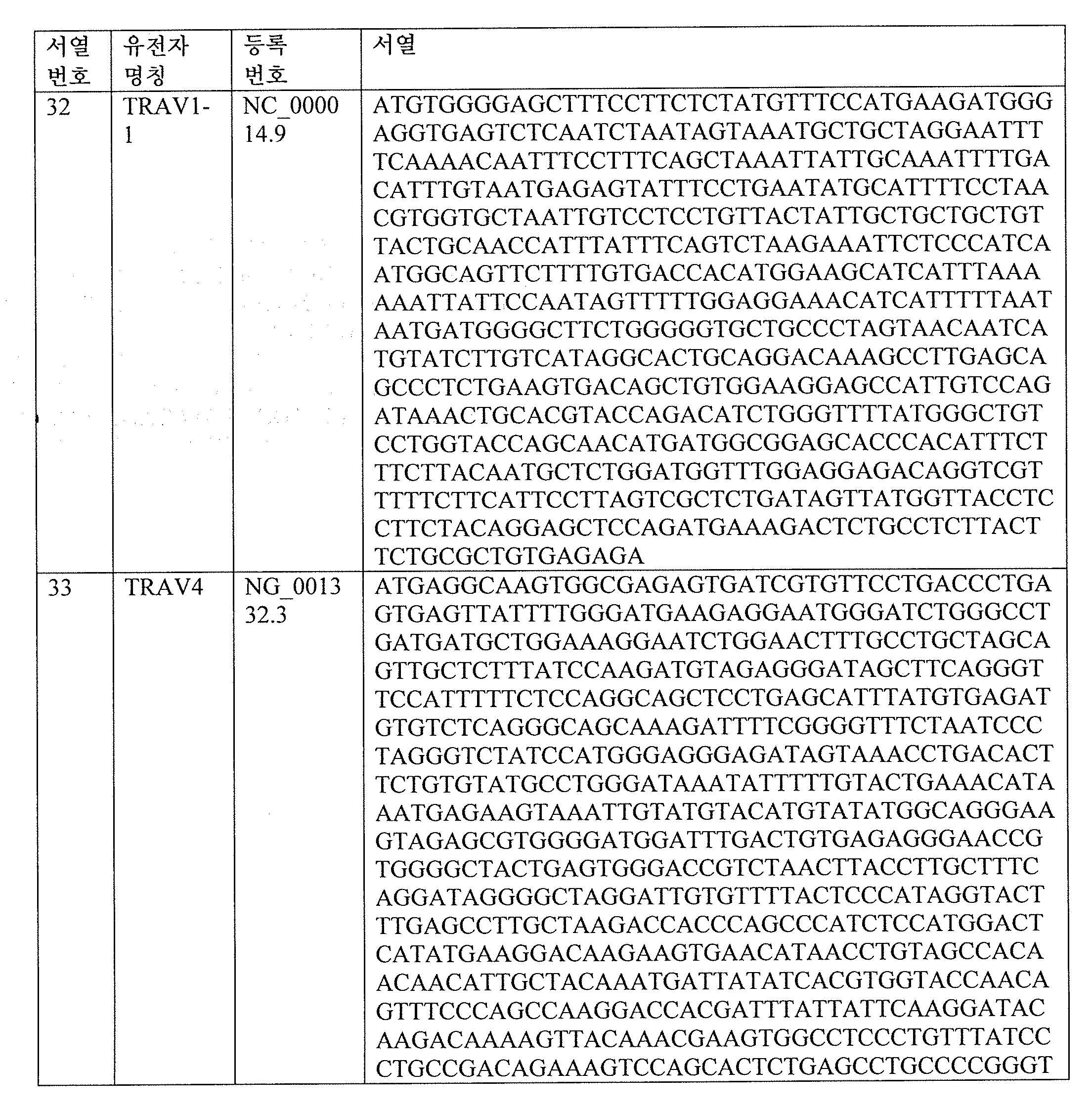
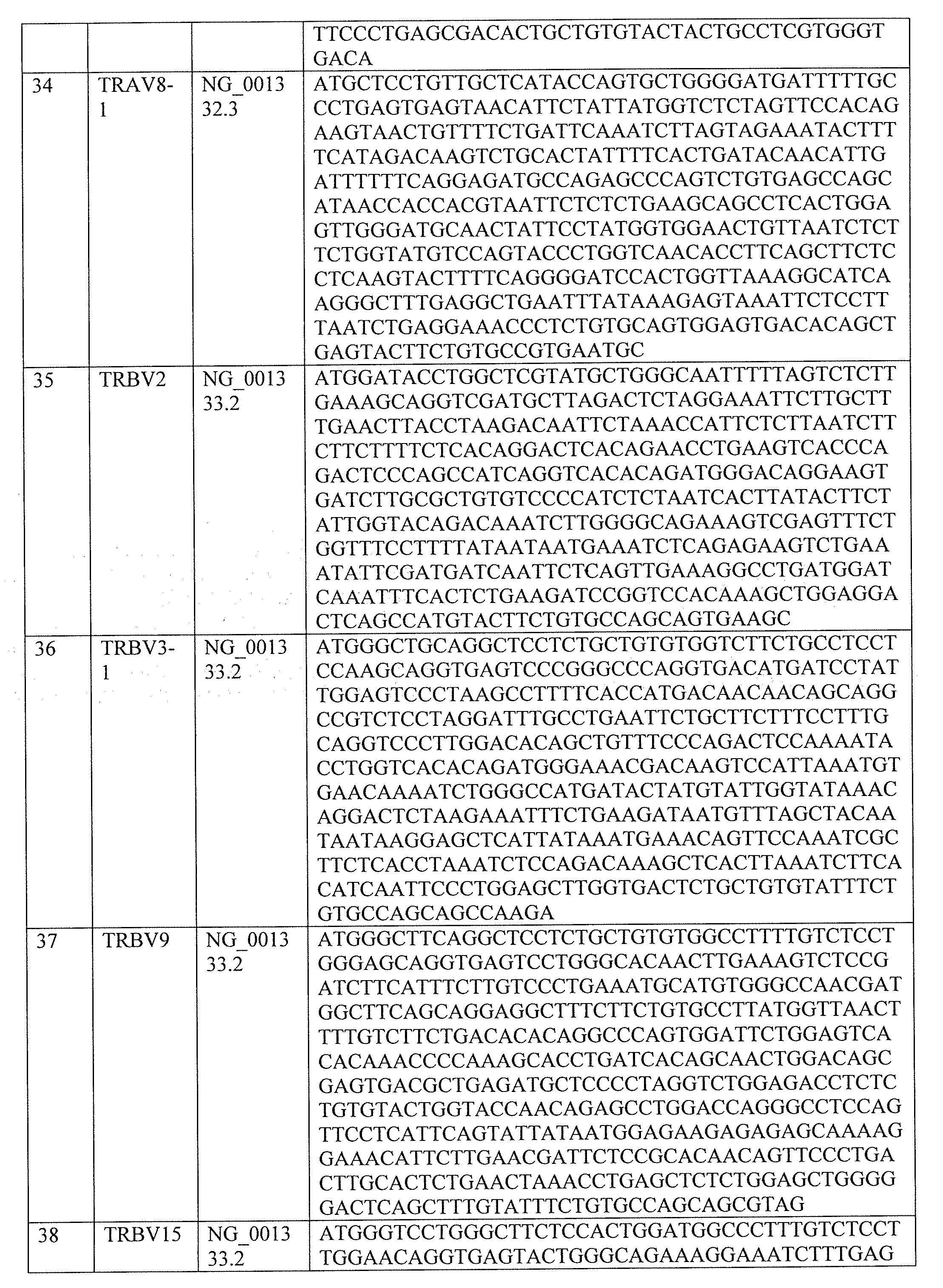
TCRα 사슬의 예시적인 가변 유전자는 다음을 포함하고 이로 제한되지 않는다: TRAV1-1(TRAV11, TCRAV1S1, TCRAV7S1), TRAV1-2, TRAV2, TRAV3, TRAV4(TCRAV20S1, TCRAV4S1), TRAV5, TRAV6(TCRAV5S1), TRAV7, TRAV8-1, TRAV8-2, TRAV8-3, TRAV8-4, TRAV8-5(TRAV85, TCRAV8S5), TRAV8-6, TRAV8-7, TRAV9-1, TRAV9-2, TRAV10(TCRAV10S1, TCRAV24S1), TRAV11, TRAV12-1, TRAV12-2, TRAV12-3(TRAV123, TCRAV2S2, TCRAV12S3), TRAV13-1, TRAV13-2, TRAV14DV4(TRAV14/DV4, TCRAV6S1-hDV104S1, hADV14S1), TRAV15(TCRAV15S1), TRAV16(TCRAV16S1, TCRAV9S1), TRAV17(TCRAV17S1, TCRAV3S1), TRAV18(TCRAV18S1), TRAV19(TCRAV12S1, TCRAV19S1), TRAV20, TRAV21, TRAV22(TCRAV13S1, TCRAV22S1), TRAV23DV6(TRAV23/DV6, TCRAV17S1), TRAV24, TRAV25(TCRAV25S1, TCRAV32S1), TRAV26-1, TRAV26-2(TRAV262, TCRAV4S1, TCRAV26S2), TRAV27, TRAV28, TRAV29DV5(TRAV29/DV5), TRAV30, TRAV31(TCRAV31S1), TRAV32, TRAV33(C14orf12), TRAV34(TCRAV26S1, TCRAV34S1), TRAV35(TCRAV25S1, TCRAV35S1), TRAV36DV7(TRAV36/DV7), TRAV37, TRAV38-1(TRAV381, TCRAV14S2, TCRAV38S1), TRAV38-2DV8(TRAV38-2/DV8, TRAV382DV8, TCRAV14S1, hADV38S2), TRAV39(TCRAV27S1, TCRAV39S1), TRAV40(TCRAV31S1, TCRAV40S1), 및 TRAV41(TCRAV19S1, TCRAV41S1). TCRα 사슬의 가변 유전자에 대한 예시적인 유전자 서열은 표 2에 열거되어 있다.Exemplary variable genes of the TCRα chain include, but are not limited to: TRAV1-1 (TRAV11, TCRAV1S1, TCRAV7S1), TRAV1-2, TRAV2, TRAV3, TRAV4 (TCRAV20S1, TCRAV4S1), TRAV5, TRAV6 (TCRAV5S1), TRAV7, TRAV8-1, TRAV8-2, TRAV8-3, TRAV8-4, TRAV8-5 (TRAV85, TCRAV8S5), TRAV8-6, TRAV8-7, TRAV9-1, TRAV9-2, TRAV10 (TCRAV10S1, TCRAV24S1), TRAV11, TRAV12-1, TRAV12-2, TRAV12-3 (TRAV123, TCRAV2S2, TCRAV12S3), TRAV13-1, TRAV13-2, TRAV14DV4 (TRAV14/DV4, TCRAV6S1-hDV104S1, hADV14S1), TRAV15 (TCRAV1, TRAV16) , TCRAV9S1), TRAV17(TCRAV17S1, TCRAV3S1), TRAV18(TCRAV18S1), TRAV19(TCRAV12S1, TCRAV19S1), TRAV20, TRAV21, TRAV22(TCRAV13S1, TCRAV22S1), TRAV23DV6(TRAV23/DV6, TCRAV17S1), TRAV24, TRAV25(TCRAV25S1, TCRAV32S1 ), TRAV26-1, TRAV26-2 (TRAV262, TCRAV4S1, TCRAV26S2), TRAV27, TRAV28, TRAV29DV5 (TRAV29/DV5), TRAV30, TRAV31 (TCRAV31S1), TRAV32, TRAV33 (C14orf12), TRAV34 (TCRAV3, 1TRAV35TC) H ADV38S2), TRAV39 (TCRAV27S1, TCRAV39S1), TRAV40 (TCRAV31S1, TCRAV40S1), and TRAV41 (TCRAV19S1, TCRAV41S1). Exemplary gene sequences for the variable genes of the TCRα chain are listed in Table 2.
TCR 베타 사슬의 예시적인 가변 유전자는 다음을 포함하고 이로 제한되지 않는다: TRBV1(TCRBV27S1P, TCRBV1S1P) TRBV2(TCRBV22S1A2N1T, TCRBV2S1), TRBV3-1(TRBV31, TCRBV3S1, TCRBV9S1A1T), TRBV3-2(TRBV32, TCRBV3S2, TCRBV9S2A2PT), TRBV4-1(TRBV41, TCRBV4S1, TCRBV7S1A1N2T, BV07S1J2.7), TRBV4-2(TRBV42, TCRBV4S2, TCRBV7S3A2T), TRBV4-3(TRBV43, TCRBV4S3, TCRBV7S2A1N4T), TRBV5-1(TRBV51, TCRBV5S1, TCRBV5S1A1T), TRBV5-2(TRBV52, TCRBV31S1, TCRBV5S2P), TRBV5-3(TRBV53, TCRBV5S3, TCRBV5S5P), TRBV5-4(TRBV54, TCRBV5S4, TCRBV5S6A3N2T), TRBV5-5(TRBV55, TCRBV5S3A2T, TCRBV5S5), TRBV5-6(TRBV56, TCRBV5S2, TCRBV5S6), TRBV5-7(TRBV57, TCRBV5S7, TCRBV5S7P), TRBV5-8(TRBV58, TCRBV5S4A2T, TCRBV5S8), TRBV6-1(TRBV61, TCRBV13S3, TCRBV6S1), TRBV6-2(TRBV62, TCRBV13S2A1T, TCRBV6S2), TRBV6-3(TRBV63, TCRBV13S9/13S2A1T, TCRBV6S3), TRBV6-4(TRBV64, TCRBV13S5, TCRBV6S4), TRBV6-5(TRBV65, TCRBV13S1, TCRBV6S5), TRBV6-6(TRBV66, TCRBV13S6A2T, TCRBV6S6), TRBV6-7(TRBV67, TCRBV13S8P, TCRBV6S7), TRBV6-8(TRBV68, TCRBV13S7P, TCRBV6S8), TRBV6-9(TRBV69, TCRBV13S4, TCRBV6S9), TRBV7-1(TRBV71, TCRBV6S7P, TCRBV7S1), TRBV7-2(TRBV72, TCRBV6S5A1N1, TCRBV7S2), TRBV7-3(TRBV73, TCRBV6S1A1N1, TCRBV7S3), TRBV7-4(TRBV74, TCRBV6S8A2T, TCRBV7S4), TRBV7-5(TRBV75, TCRBV6S9P, TCRBV7S5), TRBV7-6(TRBV76, TCRBV6S3A1N1T, TCRBV7S6), TRBV7-7(TRBV77, TCRBV6S6A2T, TCRBV7S7), TRBV7-8(TRBV78, TCRBV6S2A1N1T, TCRBV7S8), TRBV7-9(TRBV79, TCRBV6S4A1, TCRBV7S9), TRBV8-1(TRBV81, TCRBV30S1P, TCRBV8S1P), TRBV8-2(TRBV82, TCRBV32S1P), TRBV9(TCRBV1S1A1N1, TCRBV9S1), TRBV10-1(TRBV101, TCRBV10S1, TCRBV12S2A1T, TCRBV12S2), TRBV10-2(TRBV102, TCRBV10S2, TCRBV12S3), TRBV10-3(TRBV103, TCRBV10S3, TCRBV12S1A1N2), TRBV11-1(TRBV111, TCRBV11S1, TCRBV21S1), TRBV11-2(TRBV112, TCRBV11S2, TCRBV21S3A2N2T), TRBV11-3(TRBV113, TCRBV11S3, TCRBV21S2A2), TRBV12-1(TRBV121, TCRBV12S1, TCRBV8S4P), TRBV12-2(TRBV122, TCRBV12S2, TCRBV8S5P), TRBV12-3(TRBV123, TCRBV12S3, TCRBV8S1), TRBV12-4(TRBV124, TCRBV12S4, TCRBV8S2A1T), TRBV12-5(TRBV125, TCRBV12S5, TCRBV8S3), TRBV13(TCRBV13S1, TCRBV23S1A2T), TRBV14(TCRBV14S1, TCRBV16S1A1N1), TRBV15(TCRBV15S1, TCRBV24S1A3T), TRBV16(TCRBV16S1, TCRBV25S1A2PT), TRBV17(TCRBV17S1, TCRBV26S1P), TRBV18(TCRBV18S1), TRBV19(TCRBV17S1A1T, TCRBV19S1), TRBV20-1(TRBV201, TCRBV20S1, TCRBV2S1), TRBV21-1(TRBV211, TCRBV10S1P, TCRBV21S1), TRBV22-1(TCRBV22S1, TCRBV29S1P), TRBV23-1(TRBV231, TCRBV19S1P, TCRBV23S1), TRBV24-1(TRBV241, TCRBV15S1, TCRBV24S1), TRBV25-1(TRBV251, TCRBV11S1A1T, TCRBV25S1), TRBV26(TCRBV26S1, TCRBV28S1P), TRBV27(TCRBV14S1, TCRBV27S1), TRBV28(TCRBV28S1, TCRBV3S1), TRBV29-1(TRBV291, TCRBV29S1, TCRBV4S1A1T), 및 TRBV30(TCRBV20S1A1N2, TCRBV30S1). TCR 베타 사슬의 가변 유전자에 대한 예시적인 유전자 서열은 표 2에 열거되어 있다.Exemplary variable genes of the TCR beta chain include, but are not limited to: TRBV1 (TCRBV27S1P, TCRBV1S1P) TRBV2 (TCRBV22S1A2N1T, TCRBV2S1), TRBV3-1 (TRBV31, TCRBV3S1, TCRBV9S1A1T), TRBV3-2 (TRBV32, TCRBV3S2, TCRBV9S2A2PT), TRBV4-1(TRBV41, TCRBV4S1, TCRBV7S1A1N2T, BV07S1J2.7), TRBV4-2(TRBV42, TCRBV4S2, TCRBV7S3A2T), TRBV4-3(TRBV43, TCRBV4S3, TCRBV7S2A1N4T), TRBV5-1(TRBV51, TCRBV5S1, TCRBV5S1A1T) , TRBV5-2(TRBV52, TCRBV31S1, TCRBV5S2P), TRBV5-3(TRBV53, TCRBV5S3, TCRBV5S5P), TRBV5-4(TRBV54, TCRBV5S4, TCRBV5S6A3N2T), TRBV5-5(TRBV55, TCRBV5S3A2T, 5) . TRBV6-3 (TRBV63, TCRBV13S9/13S2A1T, TCRBV6S3), TRBV6-4 (TRBV64, TCRBV13S5, TCRBV6S4), TRBV6-5 (TRBV65, TCRBV13S1, TCRBV6S5), TRBV6-6 (TRBV66, TCRBV13S6A2T, 7TCRBV6) TRBV67, TCRBV13S8P, TCRBV6S7), TRBV6-8 (TRBV68, TCRBV13S7P, TCRBV6S8), TRBV6-9 (TRBV69, TCRBV13S4, TCRBV6S9), TRB V7-1 (TRBV71, TCRBV6S7P, TCRBV7S1), TRBV7-2 (TRBV72, TCRBV6S5A1N1, TCRBV7S2), TRBV7-3 (TRBV73, TCRBV6S1A1N1, TCRBV7S3), TRBV7-4 (TRBV74, TCRBV6S8A2T, TCRBV7S4) (5, TRBV7S4) TCRBV6S9P, TCRBV7S5), TRBV7-6(TRBV76, TCRBV6S3A1N1T, TCRBV7S6), TRBV7-7(TRBV77, TCRBV6S6A2T, TCRBV7S7), TRBV7-8(TRBV78, TCRBV6S2A1N1T, TCRBV7S8), TRBV7-9(TRBV79, TCRBV6S4A1, TCRBV7S9), TRBV8 -1(TRBV81, TCRBV30S1P, TCRBV8S1P), TRBV8-2(TRBV82, TCRBV32S1P), TRBV9(TCRBV1S1A1N1, TCRBV9S1), TRBV10-1(TRBV101, TCRBV10S1, TCRBV12S2A1T, TCRBV12S2), TRBV10-2(TRBV102, TCRBV10S2, TCRBV12S3), TRBV10-3(TRBV103, TCRBV10S3, TCRBV12S1A1N2), TRBV11-1(TRBV111, TCRBV11S1, TCRBV21S1), TRBV11-2(TRBV112, TCRBV11S2, TCRBV21S3A2N2T), TRBV11-3(TRBV113, TCRBV11S3, TCRBV21S2A2), TRBV12-1(TRBV121, TCRBV12S1, TCRBV8S4P), TRBV12-2(TRBV122, TCRBV12S2, TCRBV8S5P), TRBV12-3(TRBV123, TCRBV12S3, TCRBV8S1), TRBV12-4(TRBV124, TCRBV12S4, TCRBV8S2A1T), TRBV12-5(TRBV125, TCRBV12S5, TCRBV8S3), TRBV13 (TCRBV13S1, TCRBV23S1A2T), TRBV14 (TCRBV14S1, TCRBV16S1A1N1), TRBV15(TCRBV15S1, TCRBV24S1A3T), TRBV16(TCRBV16S1, TCRBV25S1A2PT), TRBV17(TCRBV17S1, TCRBV26S1P), TRBV18(TCRBV18S1), TRBV19(TCRBV17S1A1T, TCRBV19S1), TRBV20-1(TRBV201, TCRBV20S1, TCRBV2S1), TRBV21-1(TRBV211, TCRBV10S1P, TCRBV21S1), TRBV22-1(TCRBV22S1, TCRBV29S1P), TRBV23-1(TRBV231, TCRBV19S1P, TCRBV23S1), TRBV24-1(TRBV241, TCRBV15S1, TCRBV24S1), TRBV25-1(TRBV251, TCRBV11S1A1T, TCRBV25S1), TRBV26(TCRBV26S1 . Exemplary gene sequences for the variable genes of the TCR beta chain are listed in Table 2.
표 2. T 세포 수용체 가변 알파 사슬 및 T 세포 수용체 가변 베타 사슬 서열Table 2. T cell receptor variable alpha chain and T cell receptor variable beta chain sequences.

본원에서 설명되는 라이브러리에서의 변이를 위해 선택된 공통 서열은 Jα 유전자 세그먼트, Cα 유전자 단편, Jβ 유전자 세그먼트 또는 Cβ 유전자 세그먼트 중 하나 이상을 포함할 수 있다. 예시적인 Jα 유전자는 다음을 포함하고 이로 제한되지 않는다: TRAJ1, TRAJ2, TRAJ3, TRAJ4, TRAJ5, TRAJ6, TRAJ7, TRAJ8, TRAJ9, TRAJ10, TRAJ11, TRAJ12, TRAJ13, TRAJ14, TRAJ15, TRAJ16, TRAJ17, TRAJ18, TRAJ19, TRAJ20, TRAJ21, TRAJ22, TRAJ23, TRAJ24, TRAJ25, TRAJ26, TRAJ27, TRAJ28, TRAJ29, TRAJ30, TRAJ31, TRAJ32, TRAJ33, TRAJ34, TRAJ35, TRAJ36, TRAJ37, TRAJ38, TRAJ39, TRAJ40, TRAJ41, TRAJ42, TRAJ43, TRAJ44, TRAJ45, TRAJ46, TRAJ47, TRAJ48, TRAJ49, TRAJ50, TRAJ51, TRAJ52, TRAJ53, TRAJ54, TRAJ55, TRAJ56, TRAJ57, TRAJ58, TRAJ59, TRAJ60, 및 TRAJ61. 일부 예에서, Cα 유전자는 TRAC이다. 예시적인 Jβ 유전자는 다음을 포함하고 이로 제한되지 않는다: TRBJ1-1(TRBJ11, TCRBJ1S1), TRBJ1-2(TRBJ12, TCRBJ1S2), TRBJ1-3(TRBJ13, TCRBJ1S3), TRBJ1-4(TRBJ14, TCRBJ1S4), TRBJ1-5(TRBJ15, TCRBJ1S5), TRBJ1-6(TRBJ16, TCRBJ1S6), TRBJ2-1(TRBJ21, TCRBJ2S1), TRBJ2-2(TRBJ22, TCRBJ2S2), TRBJ2-2P(TRBJ22P), TRBJ2-3(TRBJ23, TCRBJ2S3), TRBJ2-4(TRBJ24, TCRBJ2S4), TRBJ2-5(TRBJ25, TCRBJ2S5), TRBJ2-6(TRBJ26, TCRBJ2S6), 및 TRBJ2-7(TRBJ27, TCRBJ2S7). 일부 예에서, Cβ 유전자는 TRBC1(TCRBC1, BV05S1J2.2) 또는 TRBC2이다.A consensus sequence selected for variation in a library described herein may include one or more of a Jα gene segment, a Cα gene segment, a Jβ gene segment, or a Cβ gene segment. Exemplary Jα genes include, but are not limited to: TRAJ1, TRAJ2, TRAJ3, TRAJ4, TRAJ5, TRAJ6, TRAJ7, TRAJ8, TRAJ9, TRAJ10, TRAJ11, TRAJ12, TRAJ13, TRAJ14, TRAJ15, TRAJ16, TRAJ17, TRAJ18, TRAJ19, TRAJ20, TRAJ21, TRAJ22, TRAJ23, TRAJ24, TRAJ25, TRAJ26, TRAJ27, TRAJ28, TRAJ29, TRAJ30, TRAJ31, TRAJ32, TRAJ33, TRAJ34, TRAJ35, TRAJ36, TRAJ37, TRAJ38, TRAJ39, TRAJ40, TRAJ41, TRAJ42, TRAJ43, TRAJ44, TRAJ45, TRAJ46, TRAJ47, TRAJ48, TRAJ49, TRAJ50, TRAJ51, TRAJ52, TRAJ53, TRAJ54, TRAJ55, TRAJ56, TRAJ57, TRAJ58, TRAJ59, TRAJ60, and TRAJ61. In some instances, the Cα gene is TRAC. Exemplary Jβ genes include, but are not limited to: TRBJ1-1 (TRBJ11, TCRBJ1S1), TRBJ1-2 (TRBJ12, TCRBJ1S2), TRBJ1-3 (TRBJ13, TCRBJ1S3), TRBJ1-4 (TRBJ14, TCRBJ1S4), TRBJ1-5 (TRBJ15, TCRBJ1S5), TRBJ1-6 (TRBJ16, TCRBJ1S6), TRBJ2-1 (TRBJ21, TCRBJ2S1), TRBJ2-2 (TRBJ22, TCRBJ2S2), TRBJ2-2P (TRBJ22P), TRBJ2-3 (TRBJ23, TCRBJ2S3) ), TRBJ2-4 (TRBJ24, TCRBJ2S4), TRBJ2-5 (TRBJ25, TCRBJ2S5), TRBJ2-6 (TRBJ26, TCRBJ2S6), and TRBJ2-7 (TRBJ27, TCRBJ2S7). In some instances, the Cβ gene is TRBC1 (TCRBC1, BV05S1J2.2) or TRBC2.
본원에서 설명되는 변이체 TCR 라이브러리는 TCR 델타(TCRδ) 유전자좌의 서열에 대한 변이체를 포함할 수 있다. 일부 예에서, TCRδ 사슬을 코딩하는 서열은 가변(V), 다양성(D), 결합(J) 유전자 세그먼트, 및 불변(C) 유전자를 포함한다. 예시적인 유전자는 다음을 포함하고 이로 제한되지 않는다: TRD(TCRDV1), TRDV1(hDV101S1), TRDV2(hDV102S1, MGC117421), TRDV3(hDV103S1), TRDD1, TRDD2, TRDD3, TRDJ1, TRDJ2, TRDJ3, TRDJ4, 및 TRDC.A variant TCR library described herein may contain variants to the sequence of the TCR delta (TCRδ) locus. In some instances, the sequence encoding a TCRδ chain comprises variable (V), diversity (D), joining (J) gene segments, and constant (C) genes. Exemplary genes include, but are not limited to: TRD (TCRDV1), TRDV1 (hDV101S1), TRDV2 (hDV102S1, MGC117421), TRDV3 (hDV103S1), TRDD1, TRDD2, TRDD3, TRDJ1, TRDJ2, TRDJ3, TRDJ4, and TRDC.
본원에서 설명되는 변이체 TCR 라이브러리는 TCR 감마(TCRγ) 유전자좌의 서열에 대한 변이체를 포함할 수 있다. 일부 예에서, TCRγ 사슬을 코딩하는 서열은 가변(V), 다양성(D), 결합(J) 유전자 세그먼트 또는 불변(C) 유전자를 포함한다. 예시적인 유전자는 다음을 포함하고 이로 제한되지 않는다: TRG, TRGV1(V1S1P), TRGV2(VIS2), TRGV3(V1S3), TRGV4(V1S4), TRGV5(V1S5), TRGV5P(V1S5P), TRGV6(V1S5P, TCRGV5P), TRGV7(V1S7P), TRGV8(V1S8), TRGV9(V2), TRGV10(V3P), TRGV11(V4P), TRGVA(V5P), TRGVB(V6P), TRGJ1(J1), TRGJ2(J2), TRGJP(JP), TRGJP1(JP1), TRGJP2(JP2), TRGC1(C1), TRGC2(TRGC2(2X), TRGC2(3X)).A variant TCR library described herein may contain variants to the sequence of the TCR gamma (TCRγ) locus. In some instances, the sequence encoding the TCRy chain comprises variable (V), diversity (D), joining (J) gene segments or constant (C) genes. Exemplary genes include, but are not limited to: TRG, TRGV1 (V1S1P), TRGV2 (VIS2), TRGV3 (V1S3), TRGV4 (V1S4), TRGV5 (V1S5), TRGV5P (V1S5P), TRGV6 (V1S5P, TCRGV5P ), TRGV7(V1S7P), TRGV8(V1S8), TRGV9(V2), TRGV10(V3P), TRGV11(V4P), TRGVA(V5P), TRGVB(V6P), TRGJ1(J1), TRGJ2(J2), TRGJP(JP) ), TRGJP1 (JP1), TRGJP2 (JP2), TRGC1 (C1), TRGC2 (TRGC2 (2X), TRGC2 (3X)).
본원에서 변이체 TCR을 코딩하는 핵산을 포함하는 TCR 라이브러리가 제공되며, 여기서 각각의 핵산은 하나 이상의 미리 결정된 참조 핵산 서열의 미리 결정된 변이체를 코딩한다. 일부 경우에, 미리 결정된 참조 서열은 단백질을 코딩하는 핵산 서열이고, 변이체 라이브러리는 합성된 핵산에 의해 코딩되는 후속 단백질에서 단일 잔기의 다수의 상이한 변이체가 표준 번역 과정에 의해 생성되도록 하나 이상의 코돈의 변이를 코딩하는 서열을 포함한다. 일부 예에서, 변이체 TCR 라이브러리는 다수의 위치에서 변이를 집합적으로 코딩하는 변이된 핵산을 포함한다. 일부 예에서, 변이체 라이브러리는 TCRα, TCRβ, TCRδ, 또는 TCRγ 사슬의 하나 이상의 코돈의 변이를 코딩하는 서열을 포함한다. 일부 예에서, 변이체 라이브러리는 TCRβ 사슬의 가변 도메인의 하나 이상의 코돈의 변이를 코딩하는 서열을 포함한다. 일부 예에서, 변이체 라이브러리는 TCRβ 사슬의 가변 도메인의 하나 이상의 코돈의 변이를 코딩하는 서열을 포함한다. 일부 예에서, 변이체 라이브러리는 TCRα 및 TCRβ 사슬의 가변 도메인의 하나 이상의 코돈의 변이를 코딩하는 서열을 포함한다. 일부 예에서, 변이체 라이브러리는 TCRα 사슬, TCRβ 사슬 또는 이들의 조합의 가변 도메인의 다중 코돈의 변이를 코딩하는 서열을 포함한다. 변이를 위한 예시적인 코돈의 수는 다음을 포함하고 이로 제한되지 않는다: 적어도 또는 약 1, 5, 10, 15, 20, 25, 30, 35, 40, 45, 50, 55, 60, 65, 70, 75, 80, 85, 90, 95, 100, 125, 150, 175, 225, 250, 275, 300개 또는 300개 초과의 코돈.Provided herein are TCR libraries comprising nucleic acids encoding variant TCRs, wherein each nucleic acid encodes a predetermined variant of one or more predetermined reference nucleic acid sequences. In some cases, the predetermined reference sequence is a nucleic acid sequence encoding a protein, and the variant library is a variation of one or more codons such that a number of different variants of a single residue in a subsequent protein encoded by the synthesized nucleic acid are generated by standard translational processes. It contains a sequence encoding a. In some instances, a variant TCR library comprises mutated nucleic acids that collectively encode mutations at multiple locations. In some examples, a library of variants includes sequences encoding a variant of one or more codons of a TCRα, TCRβ, TCRδ, or TCRγ chain. In some examples, a library of variants includes sequences encoding a variant of one or more codons of a variable domain of a TCRβ chain. In some examples, a library of variants includes sequences encoding a variant of one or more codons of a variable domain of a TCRβ chain. In some examples, a library of variants includes sequences encoding a variant of one or more codons of the variable domains of the TCRα and TCRβ chains. In some instances, the variant library comprises sequences encoding multiple codon variants of the variable domains of the TCRα chain, TCRβ chain, or combinations thereof. Exemplary codon numbers for variation include, but are not limited to: at least or about 1, 5, 10, 15, 20, 25, 30, 35, 40, 45, 50, 55, 60, 65, 70 , 75, 80, 85, 90, 95, 100, 125, 150, 175, 225, 250, 275, 300 or more than 300 codons.
일부 예에서, 변이체 TCR 라이브러리는 TCR 알파 사슬의 가변 유전자의 하나 이상의 엑손에서의 변이를 포함한다. 일부 예에서, 변이체 TCR 라이브러리는 TCR 베타 사슬의 가변 유전자의 하나 이상의 엑손에서의 변이를 포함한다. 예를 들어, TCRα 사슬의 가변 유전자의 하나 이상의 엑손의 적어도 또는 약 10, 15, 20, 25, 30, 40, 50, 75, 100, 150, 200개 또는 200개 초과의 핵산이 변이된다. 일부 예에서, TCR 베타 사슬의 가변 유전자의 하나 이상의 엑손의 적어도 또는 약 10, 15, 20, 25, 30, 40, 50, 75, 100, 150, 200개 또는 200개 초과의 핵산이 변이된다. TCR 알파 사슬 및 TCR 베타 사슬의 가변 유전자의 예시적인 엑손 서열을 표 3에 나타내었다.In some instances, a variant TCR library comprises a mutation in one or more exons of a variable gene of the TCR alpha chain. In some instances, a variant TCR library comprises a mutation in one or more exons of a variable gene of the TCR beta chain. For example, at least or about 10, 15, 20, 25, 30, 40, 50, 75, 100, 150, 200 or more than 200 nucleic acids of one or more exons of a variable gene of a TCRα chain are mutated. In some instances, at least or about 10, 15, 20, 25, 30, 40, 50, 75, 100, 150, 200 or more than 200 nucleic acids of one or more exons of a variable gene of a TCR beta chain are mutated. Exemplary exon sequences of variable genes of TCR alpha chain and TCR beta chain are shown in Table 3.
표 3. TCR 알파 사슬 및 TCR 베타 사슬의 가변 유전자의 엑손 서열Table 3. Exon sequences of variable genes of TCR alpha chain and TCR beta chain
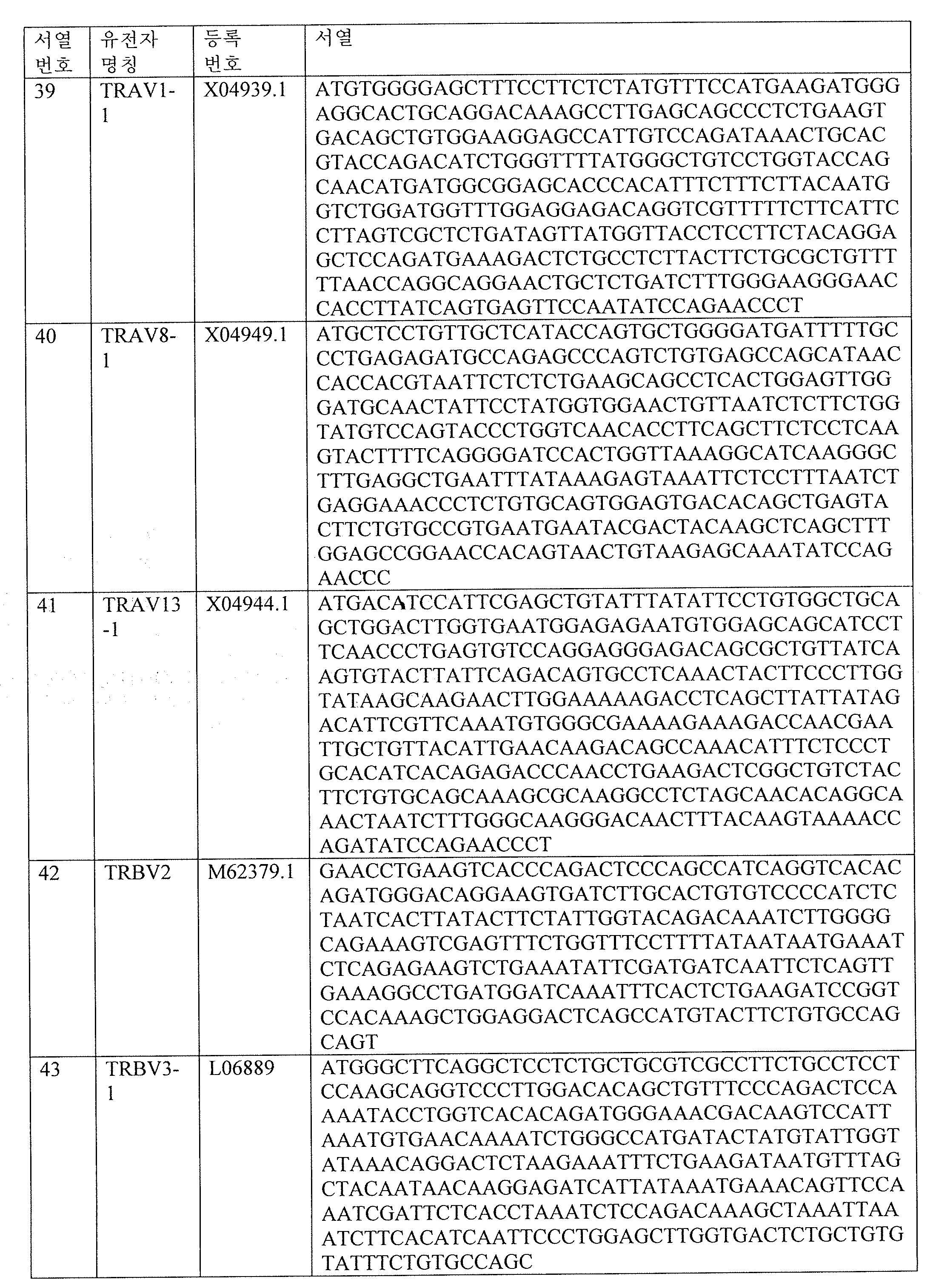

본원에서 설명되는 변이체 TCR을 코딩하는 핵산을 포함하는 라이브러리는 번역될 때 다양한 길이의 아미노산을 포함한다. 일부 예에서, 각각의 아미노산 단편의 길이 또는 합성된 아미노산의 평균 길이는 적어도 또는 약 15, 20, 25, 30, 35, 40, 45, 50, 55, 60, 65, 70, 75, 80, 85, 90, 95, 100, 105, 110, 115, 120, 125, 130, 135, 140, 145, 150개 또는 150개 초과의 아미노산일 수 있다. 일부 예에서, 아미노산의 길이는 약 15 내지 150, 20 내지 145, 25 내지 140, 30 내지 135, 35 내지 130, 40 내지 125, 45 내지 120, 50 내지 115, 55 내지 110, 60 내지 110, 65 내지 105, 70 내지 100 또는 75 내지 95개의 아미노산이다. 일부 예에서, 아미노산의 길이는 약 22 내지 약 75개의 아미노산이다.Libraries containing nucleic acids encoding the variant TCRs described herein contain amino acids of varying length when translated. In some examples, the length of each amino acid fragment or the average length of the synthesized amino acids is at least or about 15, 20, 25, 30, 35, 40, 45, 50, 55, 60, 65, 70, 75, 80, 85 , 90, 95, 100, 105, 110, 115, 120, 125, 130, 135, 140, 145, 150 or more than 150 amino acids. In some examples, the length of the amino acids is about 15 to 150, 20 to 145, 25 to 140, 30 to 135, 35 to 130, 40 to 125, 45 to 120, 50 to 115, 55 to 110, 60 to 110, 65 to 105, 70 to 100 or 75 to 95 amino acids. In some instances, the length of the amino acids is between about 22 and about 75 amino acids.
변이를 위한 TCR 사슬의 하나 이상의 영역에 대한 복수의 변이체 서열은 본원에서 설명되는 방법을 사용하여 디 노보로 합성된다. 일부 예에서, 복수의 변이체 서열은 알파 또는 베타 TCR 사슬의 가변 영역에 대해 디 노보로 합성된다. 변이체 서열의 수는 적어도 약 5, 10, 15, 20, 25, 30, 35, 40, 45, 50, 55, 60, 65, 70, 75, 80, 85, 90, 95, 100, 125, 150, 175, 200, 225, 250, 275, 300, 325, 350, 375, 400, 425, 450, 475, 500개, 또는 500개 초과의 서열일 수 있다. 일부 예에서, 변이체 서열의 수는 약 10 내지 500, 25 내지 475, 50 내지 450, 75 내지 425, 100 내지 400, 125 내지 375, 150 내지 350, 175 내지 325, 200 내지 300, 225 내지 375, 250 내지 350, 또는 275 내지 325개의 서열이다.A plurality of variant sequences for one or more regions of the TCR chain for mutation are synthesized de novo using the methods described herein. In some instances, the plurality of variant sequences are synthesized de novo to the variable regions of either the alpha or beta TCR chains. The number of variant sequences is at least about 5, 10, 15, 20, 25, 30, 35, 40, 45, 50, 55, 60, 65, 70, 75, 80, 85, 90, 95, 100, 125, 150 , 175, 200, 225, 250, 275, 300, 325, 350, 375, 400, 425, 450, 475, 500, or more than 500 sequences. In some instances, the number of variant sequences is between about 10 and 500, 25 and 475, 50 and 450, 75 and 425, 100 and 400, 125 and 375, 150 and 350, 175 and 325, 200 and 300, 225 and 375; 250 to 350, or 275 to 325 sequences.
변이체 TCR을 코딩하는 변이체 핵산이 본원에서 제공되며, 여기서 변이체 TCR은 항원 특이적이다. 일부 예에서, 항원은 질환, 장애 또는 병태에 관여하거나 관련된다. 예를 들어, 항원은 증식성 질환, 종양 질환, 염증성 질환, 면역 장애, 자가면역 질환, 감염성 질환, 바이러스성 질환, 알레르기 반응, 기생충 반응, 이식편 대 숙주 질환 또는 숙주 대 이식편 질환과 관련된다. 일부 예에서, 항원은 종양 세포에서 발현되는 항원이다. 일부 예에서, 항원은 바이러스 또는 박테리아와 같은 병원체와 관련된다.Variant nucleic acids encoding variant TCRs are provided herein, wherein the variant TCRs are antigen specific. In some instances, an antigen is involved in or related to a disease, disorder or condition. For example, the antigen is associated with a proliferative disease, a neoplastic disease, an inflammatory disease, an immune disorder, an autoimmune disease, an infectious disease, a viral disease, an allergic reaction, a parasitic reaction, a graft versus host disease, or a host versus graft disease. In some instances, the antigen is an antigen expressed on tumor cells. In some instances, an antigen is associated with a pathogen such as a virus or bacterium.
일부 예에서, 변이체 TCR은 조직 제한된 항원을 인식한다. 예를 들어, 변이체 TCR은 제한된 비필수 세포 계통 또는 조직이다. 일부 예에서, 변이체 TCR은 돌연변이된 유전자 산물로부터의 항원을 인식한다.In some instances, the variant TCR recognizes a tissue restricted antigen. For example, variant TCRs are restricted non-essential cell lineages or tissues. In some instances, the variant TCR recognizes an antigen from a mutated gene product.
변이체 TCR 라이브러리가 본원에서 제공되고, 여기서 변이체 TCR 라이브러리는 항원 결합 계면에서 변이체를 코딩한다. 일부 예에서, 변이를 위한 잔기는 미리 선택되거나 항원과 접촉하는 예측된 잔기이다. 일부 예에서, 변이를 위한 잔기는 미리 선택되거나 결합 포켓에 위치한 예측된 잔기이다.Provided herein are variant TCR libraries, wherein the variant TCR libraries encode variants at the antigen binding interface. In some instances, residues for variation are preselected or predicted residues that contact the antigen. In some instances, residues for variation are preselected or predicted residues located in the binding pocket.
본원에서 설명되는 변이체 TCR 라이브러리는 라이브러리에 하나 이상의 돌연변이를 포함한다. 일부 예에서, TCR 변이체 라이브러리는 라이브러리에 걸쳐 단일 부위에 변이체를 포함하는 단일 변이체 라이브러리이다. 일부 예에서, TCR 변이체 라이브러리는 다수의 부위에 변이체를 포함하는 다중 변이체 라이브러리이다. 일부 예에서, 부위의 수는 2, 3, 4, 5, 6, 7, 8, 9, 10개 또는 10개 초과의 부위이다.Variant TCR libraries described herein include one or more mutations in the library. In some instances, the TCR variant library is a single variant library comprising variants at a single site across the library. In some instances, the TCR variant library is a multiple variant library comprising variants at multiple sites. In some instances, the number of sites is 2, 3, 4, 5, 6, 7, 8, 9, 10 or more than 10 sites.
TCR 유전자 또는 유전자 단편 내의 하나 이상의 미리 선택된 코돈이 변이체 아미노산 잔기를 코딩하여 생성되는 변이체 TCR 단백질 라이브러리에 변이를 생성하는 라이브러리가 본원에서 제공된다. 일부 예에서, 최대 10, 20, 30, 40, 50, 60, 70, 80, 90 또는 100개의 아미노산 잔기가 변이된다. 일부 예에서, 최대 30개의 아미노산 잔기가 변이된다. 일부 예에서, 최대 5개의 아미노산 잔기가 변이된다. 일부 예에서, 최대 100, 200, 300, 400, 500, 600, 700, 800, 900, 1000개 또는 1000개 초과의 아미노산 잔기가 변이된다. 일부 경우에, 적어도 또는 약 10, 20, 30, 40, 50, 60, 70, 80, 90 또는 100개의 아미노산 잔기가 변이된다. 일부 경우에, 적어도 또는 약 100, 200, 300, 400, 500, 600, 700, 800, 900, 1000개 또는 1000개 초과의 아미노산 잔기가 변이된다. 일부 예에서, 미리 선택된 영역 내의 모든 아미노산 잔기가 변이된다. 일부 예에서, 변이체 TCR 라이브러리는 매우 다양하다. 일부 예에서, 라이브러리는 적어도 또는 약 106, 108, 109, 1010, 1011, 1012, 또는 1013개의 변이체를 포함한다. 일부 예에서, 라이브러리는 적어도 또는 약 109개의 변이체를 포함한다.Provided herein are libraries for generating mutations in a library of variant TCR proteins in which one or more preselected codons in a TCR gene or gene segment encode variant amino acid residues. In some instances, up to 10, 20, 30, 40, 50, 60, 70, 80, 90 or 100 amino acid residues are varied. In some instances, up to 30 amino acid residues are mutated. In some instances, up to 5 amino acid residues are mutated. In some instances, up to 100, 200, 300, 400, 500, 600, 700, 800, 900, 1000 or more than 1000 amino acid residues are varied. In some cases, at least or about 10, 20, 30, 40, 50, 60, 70, 80, 90 or 100 amino acid residues are varied. In some cases, at least or about 100, 200, 300, 400, 500, 600, 700, 800, 900, 1000 or more than 1000 amino acid residues are varied. In some instances, all amino acid residues within the preselected region are mutated. In some instances, the variant TCR library is highly diverse. In some examples, the library comprises at least or about 10 6 , 10 8 , 10 9 , 10 10 , 10 11 , 10 12 , or 10 13 variants. In some examples, a library includes at least or about 10 9 variants.
가용성 변이체 TCR의 생성을 위한 변이체 TCR을 코딩하는 변이체 핵산이 본원에 제공된다. 일부 예에서, 가용성 변이체 TCR은 항원 특이적이다. 일부 예에서, 가용성 변이체 TCR은 TCRα 사슬, TCRβ 사슬, TCRδ 사슬, TCRγ 사슬 또는 이들의 조합 중 하나 이상의 사슬을 포함한다. 일부 예에서, 가용성 변이체 TCR은 TCRα 사슬의 하나 이상의 사슬을 포함한다. 일부 예에서, 가용성 변이체 TCR은 TCRβ 사슬의 하나 이상의 사슬을 포함한다. 일부 예에서, 가용성 변이체 TCR은 TCRα 사슬의 하나 이상의 사슬 및 TCRβ 사슬의 하나 이상의 사슬을 포함한다. 일부 예에서, 다수의 TCR 사슬은 1, 2, 3, 4, 5, 6, 7, 8, 9, 10개, 또는 10개 초과의 TCR 사슬이고, 여기서 TCR 사슬은 TCRα 사슬, TCRβ 사슬, TCRδ 사슬, TCRγ 사슬 또는 이들의 조합물이다.Variant nucleic acids encoding variant TCRs for the generation of soluble variant TCRs are provided herein. In some instances, the soluble variant TCR is antigen specific. In some instances, the soluble variant TCR comprises one or more chains of a TCRα chain, a TCRβ chain, a TCRδ chain, a TCRγ chain, or a combination thereof. In some instances, the soluble variant TCR comprises one or more chains of the TCRα chain. In some instances, a soluble variant TCR comprises one or more chains of a TCRβ chain. In some instances, a soluble variant TCR comprises one or more chains of a TCRα chain and one or more chains of a TCRβ chain. In some instances, the plurality of TCR chains is 1, 2, 3, 4, 5, 6, 7, 8, 9, 10, or more than 10 TCR chains, wherein the TCR chains are TCRα chains, TCRβ chains, TCRδ chain, TCRγ chain, or a combination thereof.
본원에서 설명되는 가용성 변이체 TCR은 TCRα, TCRβ, TCRδ, TCRγ 사슬 또는 이들의 조합물에 변이체를 포함할 수 있다. 일부 예에서, 가용성 변이체 TCR은 TCRα 사슬에 변이체를 포함한다. 일부 예에서, 가용성 변이체 TCR은 TCRβ 사슬에 변이체를 포함한다. 일부 예에서, 가용성 변이체 TCR은 TCRα 사슬 및 TCRβ 사슬에 변이체를 포함한다.Soluble variant TCRs described herein may include variants in the TCRα, TCRβ, TCRδ, TCRγ chains, or combinations thereof. In some instances, a soluble variant TCR comprises a variant in the TCRα chain. In some instances, a soluble variant TCR comprises a variant in the TCRβ chain. In some instances, soluble variant TCRs include variants in the TCRα chain and the TCRβ chain.
본원에서 설명되는 가용성 변이체 TCR은 TCR 사슬 사이에 링커를 포함할 수 있다. 예를 들어, 링커는 TCR 사슬 사이의 펩티드 서열이다. 일부 예에서, 가용성 변이체 TCR은 하나 이상의 링커 서열을 갖는다. 일부 예에서, 다수의 링커 서열은 1, 2, 3, 4, 5, 6, 7, 8, 9, 10개 또는 10개 초과의 링커 서열이다. 일부 예에서, 다수의 링커 서열은 1-10, 2-8, 3-7 또는 4-6개의 링커 서열이다.Soluble variant TCRs described herein may include linkers between TCR chains. For example, a linker is a peptide sequence between TCR chains. In some instances, the soluble variant TCR has one or more linker sequences. In some examples, the plurality of linker sequences is 1, 2, 3, 4, 5, 6, 7, 8, 9, 10 or more than 10 linker sequences. In some examples, the plurality of linker sequences is 1-10, 2-8, 3-7 or 4-6 linker sequences.
가용성 TCR을 수득하기 위한 다양한 방법이 본원에서 고려된다. 일부 예에서, 변이체 TCR 라이브러리는 우선 디 노보로 합성되고, 이어서 발현 벡터(즉, 박테리아 또는 포유동물 세포)로 옮겨진다. 일부 예에서, 정제된 TCR은 가용성 TCR을 생성하기 위해 얻어진다. 가용성 TCR에는 세포막 내에서의 삽입 또는 안정화에 필요한 도메인 또는 잔기가 결여될 수 있다. 가용성 TCR은 융합 단백질의 형태로 추가로 변형될 수 있다. 융합 단백질에 포함시키기 위한 예시적인 추가 성분은 비제한적으로 IgG, IgA 및 IgD, IgM 또는 IgE의 면역글로불린(Ig) 도메인을 포함한다. 특히, 융합 단백질은 가용성 TCR 및 불변 도메인(Fc) 또는 그의 단편 및 Ig 도메인으로 포함하도록 설계된다. 예시적인 IgG 아형은 비제한적으로 IgG1, IgG2, IgG3 및 IgG4를 포함한다. 예를 들어, 이러한 융합 단백질은 인간 IgG1 중쇄의 Fc 영역에 유전적으로 연결된 가용성 단일쇄 T 세포 수용체로 이루어질 수 있다. 융합 단백질에 대해 선택된 Fc 영역은 특정 Fc 수용체, 예를 들어 FcγRI, FcγRIIa, FcγRIIb/c, FccyRIIIa, FcγRIIIb 및 FcRn에 대한 결합을 기초로 선택될 수 있다.A variety of methods for obtaining soluble TCR are contemplated herein. In some instances, the variant TCR library is first synthesized de novo and then transferred into an expression vector (ie, bacterial or mammalian cell). In some instances, purified TCR is obtained to produce soluble TCR. Soluble TCRs may lack domains or residues required for insertion or stabilization within cell membranes. Soluble TCRs can be further modified in the form of fusion proteins. Exemplary additional components for inclusion in the fusion protein include, but are not limited to, immunoglobulin (Ig) domains of IgG, IgA and IgD, IgM or IgE. In particular, the fusion protein is designed to include a soluble TCR and a constant domain (Fc) or fragment thereof and an Ig domain. Exemplary IgG subtypes include, but are not limited to, IgG1, IgG2, IgG3 and IgG4. For example, such fusion proteins may consist of a soluble single chain T cell receptor genetically linked to the Fc region of a human IgG1 heavy chain. The Fc region selected for the fusion protein may be selected based on binding to a particular Fc receptor, eg FcγRI, FcγRIIa, FcγRIIb/c, FccyRIIIa, FcγRIIIb and FcRn.
변이를 위해 선택된 공통 서열의 영역을 갖는 본원에서 설명되는 라이브러리는 미리 선택된 변형 프로파일을 가질 수 있다. 예를 들어, 공통 서열에서 적어도 약 1, 5, 10, 15, 20, 30, 40, 50개 또는 그 초과의 핵산이 불변을 위해 선택될 수 있거나, 또는 제한된 변이 프로파일을 갖도록 선택될 수 있다. 일부 예에서, 변이체 코돈 프로파일을 갖는 변이체 TCR을 각각 코딩하는 변이체 핵산은 발현 벡터에 삽입되고, 스크리닝을 위해 포유류 세포로 전달된다(예를 들어, 전기천공, 형질감염 또는 형질도입에 의해).A library described herein having a region of consensus sequence selected for variation may have a pre-selected variation profile. For example, at least about 1, 5, 10, 15, 20, 30, 40, 50 or more nucleic acids in a consensus sequence can be selected for invariance, or selected to have a limited variation profile. In some instances, variant nucleic acids each encoding a variant TCR having a variant codon profile are inserted into an expression vector and delivered to mammalian cells for screening (eg, by electroporation, transfection or transduction).
본원에서 설명되는 변이체 핵산 라이브러리는 변이체 단백질 라이브러리를 생성하는데 사용될 수 있다. 이러한 단백질 라이브러리는 TCR 활성, 예를 들어 결합 친화성 또는 결합력, 안정성, 단백질 발현, 또는 표적 세포 사멸(예를 들어, 암세포 사멸), 또는 ADCC 활성의 변화에 대해 스크리닝될 수 있다. 스크리닝은 특정 관심 암과 관련된 항원(들)에 대한 결합 검정을 포함할 수 있다. 암은 고형암 또는 혈액암일 수 있다. 일부 예에서, 암은 방광암, 폐암, 뇌암, 흑색종, 유방암, 비-호지킨(Hodgkin) 림프종, 자궁경부암, 난소암, 결직장암, 췌장암, 식도암, 전립선암, 신장암, 피부암, 백혈병, 갑상선암, 간암 또는 자궁암이다. 일부 예에서, 항원은 MART1, CEA, gp100, NY-ESO-1, WT1, MUC1, HER-2/neu, MAGE-A3, p53, PSMA, GD2, 프로테이나제 3(PR1), 티로시나제, 서비빈, PSA, hTERT, 및 EphA2이다. 결합 검정에 사용하기 위한 예시적인 항원은 비제한적으로 표 4에 제시된 것을 포함한다.Variant nucleic acid libraries described herein can be used to generate variant protein libraries. Such protein libraries can be screened for changes in TCR activity, such as binding affinity or avidity, stability, protein expression, or target cell killing (eg, cancer cell killing), or ADCC activity. Screening can include binding assays to antigen(s) associated with a particular cancer of interest. The cancer may be a solid cancer or a hematological cancer. In some instances, the cancer is bladder cancer, lung cancer, brain cancer, melanoma, breast cancer, non-Hodgkin's lymphoma, cervical cancer, ovarian cancer, colorectal cancer, pancreatic cancer, esophageal cancer, prostate cancer, kidney cancer, skin cancer, leukemia, thyroid cancer , liver cancer or cervical cancer. In some instances, the antigen is MART1, CEA, gp100, NY-ESO-1, WT1, MUC1, HER-2/neu, MAGE-A3, p53, PSMA, GD2, proteinase 3 (PR1), tyrosinase, servi Bin, PSA, hTERT, and EphA2. Exemplary antigens for use in binding assays include, but are not limited to, those set forth in Table 4.
표 4. 결합 검정에 사용하기 위한 예시적인 항원Table 4. Exemplary antigens for use in binding assays

스크리닝은 시험관 내, 생체 내 또는 생체 외 검정을 포함할 수 있다. 스크리닝용 세포에는 살아있는 대상체 또는 세포주에서 채취 한 1차 세포가 포함된다. 세포는 원핵생물(예를 들어, 박테리아 및 진균) 또는 진핵생물(예를 들어, 동물 및 식물)로부터 유래할 수 있다. 예시적인 동물 세포는 비제한적으로 마우스, 토끼, 영장류 및 곤충 유래의 세포를 포함한다. 일부 예에서, 스크리닝용 세포에는 차이니즈 햄스터 난소(CHO) 세포주, 인간 배아 신장(HEK) 세포주 또는 아기 햄스터 신장(BHK) 세포주를 포함하고, 이로 제한되지 않는다. 일부 예에서, 본원에서 설명되는 핵산 라이브러리는 또한 다세포 유기체로 전달될 수 있다. 예시적인 다세포 유기체는 비제한적으로 식물, 마우스, 토끼, 영장류 및 곤충을 포함한다.Screening can include in vitro, in vivo or ex vivo assays. Cells for screening include primary cells collected from living subjects or cell lines. Cells may be of prokaryotic origin (eg bacteria and fungi) or eukaryotes (eg animals and plants). Exemplary animal cells include, but are not limited to, cells from mice, rabbits, primates, and insects. In some examples, cells for screening include, but are not limited to, a Chinese Hamster Ovary (CHO) cell line, a Human Embryonic Kidney (HEK) cell line, or a Baby Hamster Kidney (BHK) cell line. In some instances, the nucleic acid libraries described herein can also be delivered to multicellular organisms. Exemplary multicellular organisms include, but are not limited to, plants, mice, rabbits, primates, and insects.
종양 항원에 대한 개선된 친화성(에피토프와 항체의 항원 결합 부위 사이의 상호작용 강도의 척도)을 갖는 단백질 복합체를 제공하는 변형된 TCR 유전자 서열을 선택하기 위해 본원에서 설명되는 방법을 사용하여 생성된 변이체 TCR 라이브러리를 스크리닝할 수 있다. 추가의 기능적 고려 사항, 예를 들어 변이체 유전자 발현, 결합력(항체-항원 복합체의 전체 강도의 척도), 안정성 및 표적 세포(즉, 암세포) 특이성이 또한 평가된다. 일부 예에서, TCR 복합체의 증가된 특이성은 참조 비변형 TCR 복합체와 비교하여 암 비관련 항원에 대한 감소된 교차반응성을 제공한다. 일부 예에서, 변이체 TCR 라이브러리는 세포 내에서의 위치에 대해 스크리닝된다. 일부 예에서, 변이체 TCR 라이브러리는 적절하게 위치하는 변이체 TCR을 확인하기 위해 스크리닝된다.Generated using the methods described herein to select modified TCR gene sequences that provide protein complexes with improved affinity (a measure of the strength of interaction between an epitope and the antigen binding site of an antibody) for a tumor antigen. Variant TCR libraries can be screened. Additional functional considerations such as variant gene expression, avidity (a measure of the overall strength of the antibody-antigen complex), stability and target cell (ie cancer cell) specificity are also evaluated. In some instances, increased specificity of the TCR complex provides reduced cross-reactivity to non-cancer related antigens compared to a reference unmodified TCR complex. In some instances, variant TCR libraries are screened for localization within a cell. In some instances, variant TCR libraries are screened to identify appropriately located variant TCRs.
세포에서 발현되는 항원에 대해 개선된 친화성 또는 특이성을 갖는 변이체 TCR 라이브러리가 본원에서 제공된다. 일부 예에서, 변이체 TCR 라이브러리는 항원에 대한 특이성이 변경된 세포를 생성하기 위해 세포에서 발현된다. 일부 예에서, 세포는 T 세포이다. 일부 예에서, 변이체 라이브러리는 TCR 알파 사슬 또는 TCR 베타 사슬의 가변 도메인의 하나 이상의 코돈의 변이를 코딩하는 서열을 포함한다. 일부 예에서, 변이체 라이브러리는 TCR 알파 사슬 또는 TCR 베타 사슬의 가변 도메인의 다중 코돈의 변이를 코딩하는 서열을 포함한다. 예를 들어, 변이체 라이브러리는 표 2 또는 표 3의 서열 변이를 포함한다. 일부 예에서, 변이체 TCR 라이브러리는 TCR 알파 사슬의 가변 유전자의 하나 이상의 엑손에서의 변이를 포함한다. 변이를 위한 예시적인 엑손 서열은 표 2 또는 표 3에 제시된다. 일부 예에서, 변이체 TCR 라이브러리는 TCR 베타 사슬의 가변 유전자의 하나 이상의 엑손에서의 변이를 포함한다.Variant TCR libraries with improved affinity or specificity for antigens expressed in cells are provided herein. In some instances, variant TCR libraries are expressed in cells to generate cells with altered specificity for an antigen. In some examples, the cell is a T cell. In some examples, a library of variants includes sequences encoding a variant of one or more codons of a variable domain of a TCR alpha chain or a TCR beta chain. In some instances, the variant library comprises sequences encoding multiple codon variants of the variable domain of the TCR alpha chain or the TCR beta chain. For example, the variant library includes sequence variants of Table 2 or Table 3. In some instances, a variant TCR library comprises a mutation in one or more exons of a variable gene of the TCR alpha chain. Exemplary exon sequences for variation are presented in Table 2 or Table 3. In some instances, a variant TCR library comprises a mutation in one or more exons of a variable gene of the TCR beta chain.
일부 예에서, 세포에서 발현되는 변이체 TCR 라이브러리는 개선된 변이체 유전자 발현, 결합력, 안정성, 친화성 또는 특이성을 갖는 변이체 TCR을 확인하기 위해 사용된다. 예를 들어, 종양 항원에 대한 개선된 특이성을 포함하는 제1 변이체 TCR 라이브러리가 생성된다. 일부 예에서, 개선된 유전자 발현, 결합력, 안정성, 친화성 또는 특이성을 갖는 변이체 TCR의 확인 후에, 이들 변이체 TCR은 다시 개선된 변이체 TCR의 제2 라이브러리를 생성하기 위해 추가로 변이된다. 예를 들어, 개선된 특이성을 갖는 변이체 TCR은 개선된 안정성을 추가로 포함하는 변이체를 확인하기 위해 추가로 변이된다. 일부 예에서, 제2 라이브러리는 제1 라이브러리와 동일한 영역에서의 변이체를 포함한다. 일부 예에서, 제2 라이브러리는 제1 라이브러리의 상이한 영역에서의 변이체를 포함한다. 예를 들어, 제1 라이브러리는 TCR의 가변 영역에 변이체를 포함하고, 제2 라이브러리는 TCR의 불변 영역에 변이체를 포함한다. 일부 예에서, 많은 TCR 라이브러리가 생성된다. 일부 예에서, 변이체 TCR 라이브러리의 수는 적어도 2, 3, 4, 5, 6, 7, 8, 9, 10, 11, 12개 또는 12개 초과의 변이체 라이브러리이다. 일부 예에서, 각각의 변이체 라이브러리는 유전자 발현, 결합력, 안정성, 친화성 또는 특이성의 개선을 갖는다. In some instances, a library of variant TCRs expressed in cells is used to identify variant TCRs with improved variant gene expression, avidity, stability, affinity or specificity. For example, a first variant TCR library comprising improved specificity for a tumor antigen is generated. In some instances, after identification of variant TCRs with improved gene expression, avidity, stability, affinity, or specificity, these variant TCRs are further mutated to create a second library of variant TCRs that are in turn improved. For example, variant TCRs with improved specificity are further mutated to identify variants that further comprise improved stability. In some examples, the second library includes variants in the same region as the first library. In some examples, the second library includes variants in a different region of the first library. For example, a first library contains variants in the variable region of the TCR, and a second library contains variants in the constant region of the TCR. In some instances, many TCR libraries are generated. In some examples, the number of variant TCR libraries is at least 2, 3, 4, 5, 6, 7, 8, 9, 10, 11, 12 or more than 12 variant libraries. In some instances, each library of variants has an improvement in gene expression, avidity, stability, affinity or specificity.
일부 예에서, 변이체 TCR을 발현하도록 조작된 세포를 대상체에 도입한다. 일부 예에서, 세포는 자가 세포이고, 이것은 대상체 자신의 세포로부터 유래된 것을 의미한다. 대안적으로, 변이체 TCR을 발현하는 세포는 동종이계(allogeneic)이며, 이것은 유사한 조직 유형을 갖는 다른 대상체로부터 유래된 것을 의미한다. 일부 예에서, 세포는 대상체에 맞게 조정된다. 일부 예에서, 세포는 국소 조직에 적합할 수 있다.In some instances, cells engineered to express a variant TCR are introduced into a subject. In some instances, the cells are autologous cells, meaning that they are derived from the subject's own cells. Alternatively, cells expressing the variant TCR are allogeneic, meaning that they are derived from another subject with a similar tissue type. In some instances, cells are tailored to a subject. In some instances, cells may be adapted to a local tissue.
본원에서 설명되는 방법을 사용하여 생성된 변이체 TCR 라이브러리는 세포에서 조작된 TCR 단백질 복합체의 향상된 발현 프로파일을 제공하는 하나 이상의 변형된 TCR 유전자 코딩 서열을 선택하기 위해 스크리닝될 수 있다. 상대적인 유전자 발현을 향상시키기 위한 전략은 코돈 최적화, TCR 사슬 사이의 하나 이상의 디술파이드 결합의 도입, 불변 영역 도메인 내로의 뮤린 잔기 서열의 도입, 가변 도메인(들)의 비상보성 코딩 영역의 변이, 변형된 T 세포에서 내인성 TCR 단백질의 발현을 선택적으로 낙다운 또는 중지시키기 위한 TALEN 또는 CRISPR 기술의 사용, 변형된 T 세포로의 면역 자극 사이토카인의 전달, 또는 이들 전략의 임의의 또는 전부의 조합을 포함한다. TCRα 또는 β 서브유닛을 코딩하는 변이된 유전자 서열의 디술파이드 결합(예를 들어, 힌지 영역에서)의 삽입은 세포에서 발현될 때 조작된 변이체의 유리한 조립을 제공한다. 본원에서 설명되는 TCR 유전자 서열에 부가된 디술파이드 결합의 수는 적어도 1, 2, 3, 4, 5개 또는 그 초과일 수 있다.Variant TCR libraries generated using the methods described herein can be screened to select one or more modified TCR gene coding sequences that provide an improved expression profile of the engineered TCR protein complex in cells. Strategies for improving relative gene expression include codon optimization, introduction of one or more disulfide bonds between TCR chains, introduction of murine residue sequences into constant region domains, mutation of non-complementary coding regions of the variable domain(s), modified use of TALEN or CRISPR technology to selectively knock down or stop expression of endogenous TCR proteins in T cells, delivery of immune stimulatory cytokines to modified T cells, or a combination of any or all of these strategies. . Insertion of a disulfide bond (eg in the hinge region) of the mutated gene sequence encoding the TCRα or β subunit provides advantageous assembly of the engineered variant when expressed in a cell. The number of disulfide bonds added to a TCR gene sequence described herein may be at least 1, 2, 3, 4, 5 or more.
일부 예에서, 본원에서 설명되는 디 노보 합성 방법은 본원에서 설명되는 방법뿐만 아니라 대상체의 매핑된 MHC I 분자에 의해 생성된 변이체 TCR 복합체에 결합하는데 매우 효과적인 항원을 확인하기 위한 항원의 변이체 라이브러리의 생성을 제공한다. 이러한 방식으로, TCR 복합체 및 항원 결합 부분은 둘 모두 면역 시냅스에서 향상된 상호작용을 위해 최적화될 수 있다. 스크리닝 목적을 위해, 변이체 항원 라이브러리를 코딩하는 핵산을 먼저 디 노보로 합성하고, 이어서 TCR 복합체 및 MHC I 복합체를 사용한 결합 검정을 위한 정제된 펩티드를 얻기 위해 발현을 위한 발현 벡터(즉, 박테리아 또는 포유동물 세포에서) 내로 옮긴다.In some instances, the de novo synthetic methods described herein generate variant libraries of antigens to identify antigens that are highly effective at binding to variant TCR complexes generated by the methods described herein as well as mapped MHC I molecules of a subject. provides In this way, both the TCR complex and antigen binding portion can be optimized for enhanced interactions at the immune synapse. For screening purposes, nucleic acids encoding the variant antigen library are first synthesized de novo, followed by an expression vector (i.e., bacterial or mammalian) for expression to obtain purified peptides for binding assays using the TCR complex and the MHC I complex. in animal cells).
변이체variant 라이브러리 합성 library synthesis
본원에서 설명되는 방법은 하나 이상의 미리 결정된 참조 핵산 서열의 미리 결정된 변이체를 각각 코딩하는 핵산 라이브러리의 합성을 제공한다. 일부 예에서, 미리 결정된 참조 서열은 단백질을 코딩하는 핵산 서열이고, 변이체 라이브러리는 합성된 핵산에 의해 코딩되는 후속 단백질에서 단일 잔기의 다수의 상이한 변이체가 표준 번역 과정에 의해 생성되도록 하나 이상의 단일 코돈의 변이를 코딩하는 서열을 포함한다. 핵산 서열의 합성된 특정 변경은 중첩 또는 평활 말단 핵산 프라이머 내로 뉴클레오티드 변화를 포함시킴으로써 도입될 수 있다. 대안적으로, 핵산 집단은 긴 핵산(예를 들어, 유전자) 및 그의 변이체를 집합적으로 코딩할 수 있다. 이러한 배열에서, 핵산 집단은 혼성화될 수 있고, 긴 핵산(예를 들어, 유전자) 및 그의 변이체를 형성하기 위해 표준 분자 생물학 기술에 적용될 수 있다. 긴 핵산(예를 들어, 유전자) 및 그의 변이체가 세포에서 발현되는 경우, 변이체 단백질 라이브러리가 생성된다. 이와 유사하게, RNA 서열(예를 들어, miRNA, shRNA 및 mRNA) 또는 DNA 서열(예를 들어, 인핸서, 프로모터, UTR 및 종결인자 영역)을 코딩하는 변이체 라이브러리를 합성하는 방법이 본원에서 제공된다. 또한, 본원에서 설명되는 방법을 사용하여 합성된 라이브러리로부터 선택된 변이체에 대한 하류 적용이 본원에서 제공된다. 하류 적용은 향상된 생화학적으로 관련된 기능, 예를 들어 생화학적 친화성, 효소 활성, 세포 활성의 변화, 및 질환 상태의 치료 또는 예방을 보이는 변이체 핵산 또는 단백질 서열의 확인을 포함한다.The methods described herein provide for the synthesis of nucleic acid libraries, each encoding a predetermined variant of one or more predetermined reference nucleic acid sequences. In some instances, the predetermined reference sequence is a nucleic acid sequence encoding a protein, and the variant library is a sequence of one or more single codons such that a number of different variants of a single residue in a subsequent protein encoded by the synthesized nucleic acid are generated by standard translational processes. Sequences encoding variants are included. Certain synthesized alterations to the nucleic acid sequence can be introduced by incorporating nucleotide changes into overlapping or blunt ended nucleic acid primers. Alternatively, a population of nucleic acids may collectively encode long nucleic acids (eg, genes) and variants thereof. In such arrangements, populations of nucleic acids can hybridize and standard molecular biology techniques can be applied to form long nucleic acids (eg, genes) and variants thereof. When long nucleic acids (eg, genes) and variants thereof are expressed in cells, variant protein libraries are created. Similarly, methods for synthesizing variant libraries encoding RNA sequences (eg miRNA, shRNA and mRNA) or DNA sequences (eg enhancer, promoter, UTR and terminator regions) are provided herein. Also provided herein are downstream applications for variants selected from libraries synthesized using the methods described herein. Downstream applications include the identification of variant nucleic acid or protein sequences that exhibit improved biochemically relevant functions, such as biochemical affinity, enzymatic activity, changes in cellular activity, and treatment or prevention of disease states.
합성 및 후속적인 synthesis and subsequent PCRPCR 돌연변이 유발 mutagenesis
핵산의 변이체 라이브러리 합성을 위한 제1 공정은 PCR 돌연변이 유발(포화 또는 비포화) 방법이다. 이 작업 흐름에서, 다수의 핵산이 합성되며, 여기서 각각의 핵산은 참조 핵산 서열의 미리 결정된 변이체인 미리 결정된 서열을 코딩한다. 도면을 참조하면, 핵산이 표면 상에 생성되는 예시적인 작업 흐름이 도 1a-1d에 도시되어 있다. 도 1a는 121개의 로커스가 존재하는 표면의 단일 클러스터의 확대도를 도시한 것이다. 도 1b에 도시된 각각의 핵산은 변이체의 긴 핵산의 라이브러리(도 1c)를 생성하기 위해 참조 핵산 서열로부터의 증폭에 사용될 수 있는 프라이머이다. 이어서, 변이체의 긴 핵산의 라이브러리는 선택적으로 변이체 RNA 또는 단백질 라이브러리(도 1d)를 생성하기 위한 전사 및/또는 번역에 적용된다. 이 예시적인 설명에서, 핵산의 디 노보 합성을 위해 실질적으로 평면인 표면을 갖는 장치가 사용된다(도 1a). 일부 예에서, 상기 장치는 로커스의 클러스터를 포함하고, 여기서 각각의 로커스는 핵산 확장을 위한 부위이다. 일부 예에서, 단일 클러스터는 원하는 변이체 서열 라이브러리를 생성하는데 필요한 모든 핵산 변이체를 포함한다. 대안적인 배열에서, 플레이트는 클러스터로 분리되지 않는 로커스의 필드를 포함한다.The first step for synthesizing a nucleic acid variant library is a PCR mutagenesis (saturation or non-saturation) method. In this workflow, multiple nucleic acids are synthesized, where each nucleic acid encodes a predetermined sequence that is a predetermined variant of a reference nucleic acid sequence. Referring to the drawings, an exemplary workflow in which nucleic acids are generated on a surface is shown in FIGS. 1A-1D. Figure 1A shows an enlarged view of a single cluster of surfaces with 121 loci. Each nucleic acid shown in FIG. 1B is a primer that can be used for amplification from a reference nucleic acid sequence to generate a library of variant long nucleic acids (FIG. 1C). The library of variant long nucleic acids is then optionally subjected to transcription and/or translation to generate variant RNA or protein libraries ( FIG. 1D ). In this exemplary description, a device with a substantially planar surface is used for de novo synthesis of nucleic acids (FIG. 1A). In some examples, the device comprises a cluster of loci, wherein each locus is a site for nucleic acid expansion. In some instances, a single cluster contains all nucleic acid variants necessary to generate a library of desired variant sequences. In an alternative arrangement, the plate contains fields of loci that do not separate into clusters.
일부 예에서, 클러스터 내에서 합성된 핵산(예를 들어, 도 1a에서 볼 수 있는 바와 같이)은 PCR에 의해 증폭된다. 이러한 배열은 클러스터화된 배열이 없는 상태에서의 전체 플레이트에 걸친 비동일 핵산의 증폭에 비해 개선된 핵산 제시물을 제공할 수 있다. 일부 예에서, 클러스터 내의 로커스의 표면에서 합성된 핵산의 증폭은 무거운 GC 함량을 갖는 핵산을 갖는 큰 핵산 집단의 반복된 합성으로 인한 제시물에 대한 부정적인 영향을 극복한다. 일부 예에서, 본원에서 설명되는 클러스터는 약 50-1000, 75-900, 100-800, 125-700, 150-600, 200-500, 50-500 또는 300-400개의 구분되는 로커스를 포함한다. 일부 예에서, 로커스는 스팟, 웰, 마이크로웰, 채널 또는 기둥이다. 일부 예에서, 각각의 클러스터에는 적어도 1X, 2X, 3X, 4X, 5X, 6X, 7X, 8X, 9X, 10X 또는 그 초과로 풍부한, 동일한 서열을 갖는 핵산의 확장을 지지하는 별개의 특징부를 갖는다.In some instances, nucleic acids synthesized within the cluster (eg, as seen in FIG. 1A ) are amplified by PCR. Such arrangements can provide improved nucleic acid presentation compared to amplification of non-identical nucleic acids across the entire plate in the absence of clustered arrangements. In some instances, amplification of nucleic acids synthesized at the surface of a locus within a cluster overcomes the negative impact on presentation due to repeated synthesis of large populations of nucleic acids having nucleic acids with heavy GC content. In some examples, a cluster described herein comprises about 50-1000, 75-900, 100-800, 125-700, 150-600, 200-500, 50-500 or 300-400 distinct loci. In some examples, a locus is a spot, well, microwell, channel or pillar. In some examples, each cluster has a distinct feature that supports expansion of nucleic acids having the same sequence that are at least 1X, 2X, 3X, 4X, 5X, 6X, 7X, 8X, 9X, 10X or more abundant.
본원에서 설명되는 디 노보 합성된 핵산 라이브러리는 각각 제1 위치인 위치 "x"에 하나 이상의 변이체 서열을 갖는 다수의 핵산을 포함할 수 있으며, 각각의 변이체 핵산은 제1 연장 산물을 생성하기 위해 제1 라운드의 PCR에서 프라이머로 사용된다. 이 예에서, 제1 핵산(220)에서의 위치 "x"는 변이체 코돈 서열, 즉 참조 서열로부터의 19개의 가능한 변이체 중 하나를 코딩한다. 도 2a를 참조한다. 또한, 제1 핵산의 서열과 중첩되는 서열을 포함하는 제2 핵산(225)은 제2 연장 산물을 생성하기 위해 별개의 라운드의 PCR에서 프라이머로 사용된다. 또한, 외부 프라이머(215, 230)는 긴 핵산 서열로부터의 단편의 증폭에 사용될 수 있다. 생성된 증폭 산물은 긴 핵산 서열(235, 240)의 단편이다. 도 2b를 참조한다. 이어서, 긴 핵산 서열(235, 240)의 단편이 혼성화되고, 긴 핵산(245)의 변이체를 형성하기 위해 연장 반응에 적용된다. 도 2c를 참조한다. 제1 및 제2 연장 산물의 중첩 말단은 제2 라운드의 PCR의 프라이머로서 작용할 수 있으며, 이에 의해 변이체를 함유하는 제3 연장 산물(도 2d)을 생성한다. 수율을 증가시키기 위해, 긴 핵산의 변이체는 DNA 폴리머라제, 증폭 시약 및 외부 프라이머(215, 230)를 포함하는 반응에서 증폭된다. 일부 예에서, 제2 핵산은 변이체 부위에 인접하지만 이를 포함하지는 않는 서열을 포함한다. 대안적인 배열에서, 제2 핵산과 중접되는 영역을 갖는 제1 핵산이 생성된다. 이 시나리오에서, 최대 19개의 변이체에 대한 단일 코돈에서의 변이를 갖는 제1 핵산이 합성된다. 제2 핵산은 변이체 서열을 포함하지 않는다. 선택적으로, 제1 집단은 제1 핵산 변이체 및 상이한 코돈 부위에서의 변이체를 코딩하는 추가의 핵산을 포함한다. 대안적으로, 제1 핵산 및 제2 핵산은 평활 말단 라이게이션을 위해 설계될 수 있다.A de novo synthesized nucleic acid library described herein may include a plurality of nucleic acids, each having one or more variant sequences at the first position, position "x", each variant nucleic acid being sequenced to generate a first extension product. Used as primers in round 1 of PCR. In this example, position “x” in the first
대안적인 돌연변이 유발에서, PCR 방법이 도 3a-3f에 도시되어 있다. 이 공정에서, 제1 및 제2 가닥(305, 310)을 포함하는 주형 핵산 분자(300)는 제1 프라이머(315) 및 제2 프라이머(320)를 함유하는 PCR 반응에서 증폭된다(도 3a). 증폭 반응은 뉴클레오티드 시약으로서 우라실을 포함한다. 우라실 표지된 연장 산물(325)(도 3b)이 생성되고, 선택적으로 정제되고, 제1 핵산(335) 및 다수의 제2 핵산(330)을 사용하는 후속 PCR 반응의 주형으로서 기능하여 제1 연장 산물(340 및 345)(도 3c-3d)을 생성한다. 이 공정에서, 다수의 제2 핵산(330)은 변이체 서열을 코딩하는 핵산(도 3c에 X, Y 및 Z로 표시됨)을 포함한다. 우라실 표지된 주형 핵산은 우라실 특이적 절제 시약, 예를 들어 뉴 잉글랜드 바이오랩스(New England Biolabs)로부터 상업적으로 이용 가능한 USER 소화제에 의해 소화된다. 변이체(335) 및 변이체 X, Y 및 Z를 갖는 상이한 코돈(330)이 부가되고, 제한된 PCR 단계가 도 3d를 생성하기 위해 수행된다. 우라실 함유 주형이 소화된 후, 연장 산물의 중첩되는 말단은 제1 외부 프라이머(350) 및 제2 외부 프라이머(355)와 조합하여 프라이머로서 작용하는 제1 연장 산물(340 및 345)을 사용하여 PCR 반응을 프라이밍함으로써, 변이체 부위에서 복수의 변이체 X, Y 및 Z를 함유하는 핵산 분자(360)의 라이브러리를 생성한다(도 3f).In an alternative mutagenesis, PCR method is shown in Figures 3A-3F. In this process, a template
긴 핵산의 of long nucleic acids 변이체variant 및 and 비변이체non-mutant 부분을 갖는 집단의 디 D of a group having a part 노보Novo 합성 synthesis
변이체 라이브러리의 합성을 위한 제2 방법에서, 긴 핵산의 다중 단편의 디 노보 합성을 위해 표면이 사용되며, 단편 중 적어도 하나는 다중 버전으로 합성되며, 그 각각의 버전은 상이한 변이체 서열이다. 이러한 배열에서, 변이체의 긴 핵산의 라이브러리를 조립하는데 필요한 모든 단편이 디 노보로 합성된다. 합성된 단편은 중첩 서열을 가질 수 있고, 따라서 합성 후에 단편 라이브러리는 혼성화한다. 혼성화 후, 임의의 상보성 갭을 채우기 위해 연장 반응을 수행할 수 있다.In a second method for the synthesis of a library of variants, a surface is used for de novo synthesis of multiple fragments of a long nucleic acid, at least one of which is synthesized in multiple versions, each version of which is a different variant sequence. In this arrangement, all fragments necessary to assemble a library of variant long nucleic acids are synthesized de novo. Synthesized fragments may have overlapping sequences, so after synthesis the fragment library hybridizes. After hybridization, extension reactions can be performed to fill any complementarity gaps.
대안적으로, 합성된 단편은 프라이머로 증폭된 후, 평활 말단 라이게이션 또는 중첩 혼성화될 수 있다. 일부 예에서, 상기 장치는 로커스의 클러스터를 포함하고, 여기서 각각의 로커스는 핵산 연장을 위한 부위이다. 일부 예에서, 단일 클러스터는 미리 결정된 긴 핵산의 모든 핵산 변이체 및 다른 단편 서열을 포함하여 원하는 변이체 핵산 서열 라이브러리를 생성한다. 클러스터는 약 50 내지 500개의 로커스를 포함할 수 있다. 일부 배열에서, 클러스터는 500개 초과의 로커스를 포함한다.Alternatively, synthesized fragments can be amplified with primers followed by blunt end ligation or overlap hybridization. In some examples, the device comprises a cluster of loci, wherein each locus is a site for nucleic acid extension. In some instances, a single cluster comprises all nucleic acid variants and other fragment sequences of a predetermined long nucleic acid to create a library of desired variant nucleic acid sequences. A cluster may contain between about 50 and 500 loci. In some arrangements, clusters contain more than 500 loci.
제1 핵산 집단 내의 각각의 개별적인 핵산은 클러스터의 별개의 개별적으로 주소 지정 가능한 로커스 상에 생성될 수 있다. 하나의 핵산 변이체는 다수의 개별적으로 주소 지정 가능한 로커스에 의해 제시될 수 있다. 제1 핵산 집단의 각각의 변이체는 1, 2, 3, 4, 5, 6, 7, 8, 9, 10회 또는 그 초과의 빈도로 제시될 수 있다. 일부 예에서, 제1 핵산 집단의 각각의 변이체는 3개 이하의 로커스에서 제시된다. 일부 예에서, 제1 핵산 집단의 각각의 변이체는 2개의 로커스에서 제시된다. 일부 예에서, 제1 핵산 집단의 각각의 변이체는 단지 단일 로커스에서만 제시된다.Each individual nucleic acid within the first population of nucleic acids may be generated on a separate individually addressable locus of the cluster. One nucleic acid variant can be represented by multiple individually addressable loci. Each variant of the first nucleic acid population may be presented with a frequency of 1, 2, 3, 4, 5, 6, 7, 8, 9, 10 or more times. In some examples, each variant of the first population of nucleic acids is presented at no more than three loci. In some instances, each variant of the first population of nucleic acids is presented at two loci. In some instances, each variant of the first population of nucleic acids is presented at only a single locus.
풍부도가 감소된 핵산 라이브러리를 생성하는 방법이 본원에서 제공된다. 일부 예에서, 변이체 폴리뉴클레오티드는 원하는 변이체 폴리뉴클레오티드를 얻기 위해 변이체 폴리뉴클레오티드를 1회 초과의 빈도로 합성할 필요없이 생성될 수 있다. 일부 예에서, 본 개시내용은 원하는 변이체 폴리뉴클레오티드를 얻기 위해 변이체 폴리뉴클레오티드를 1, 2, 3, 4, 5, 6, 7, 8, 9, 10회 또는 그 초과의 빈도로 합성할 필요없이 변이체 폴리뉴클레오티드를 생성하는 방법을 제공한다.Methods of generating nucleic acid libraries of reduced abundance are provided herein. In some instances, variant polynucleotides can be generated without the need to synthesize variant polynucleotides more than once to obtain a desired variant polynucleotide. In some examples, the present disclosure provides variant polynucleotides without the need to synthesize
변이체 폴리뉴클레오티드는 원하는 변이체 폴리뉴클레오티드를 얻기 위해 변이체 폴리뉴클레오티드를 1개 초과의 별개의 부위에서 합성할 필요없이 생성될 수 있다. 본 개시내용은 원하는 변이체 폴리뉴클레오티드를 생성하기 위해 변이체 폴리뉴클레오티드를 1개의 부위, 2개의 부위, 3개의 부위, 4개의 부위, 5개의 부위, 6개의 부위, 7개의 부위, 8개의 부위, 9개의 부위, 또는 10개의 부위 초과의 부위에서 합성할 필요없이 변이체 폴리뉴클레오티드를 생성하는 방법을 제공한다. 일부 예에서, 폴리뉴클레오티드는 최대 6, 5, 4, 3, 2 또는 1개의 별개의 부위에서 합성된다. 동일한 폴리뉴클레오티드는 표면 상의 1, 2 또는 3개의 별개의 로커스에서 합성될 수 있다.Variant polynucleotides can be generated without the need to synthesize the variant polynucleotide at more than one distinct site to obtain the desired variant polynucleotide. The present disclosure provides a method for combining variant polynucleotides at 1 site, 2 sites, 3 sites, 4 sites, 5 sites, 6 sites, 7 sites, 8 sites, 9 sites to generate a desired variant polynucleotide. Provided are methods for generating variant polynucleotides without the need to synthesize at sites, or more than 10 sites. In some instances, polynucleotides are synthesized at up to 6, 5, 4, 3, 2 or 1 distinct sites. The same polynucleotide can be synthesized at 1, 2 or 3 distinct loci on the surface.
일부 경우에, 단일 변이체 폴리뉴클레오티드를 나타내는 로커스의 양은 하류 프로세싱, 예를 들어, 증폭 반응 또는 세포 검정에 필요한 핵산 물질의 양의 함수이다. 일부 예에서, 단일 변이체 폴리뉴클레오티드를 나타내는 로커스의 양은 단일 클러스터 내에서 이용 가능한 로커스의 함수이다.In some cases, the amount of a locus representing a single variant polynucleotide is a function of the amount of nucleic acid material required for downstream processing, such as an amplification reaction or cellular assay. In some instances, the amount of loci representing a single variant polynucleotide is a function of the loci available within a single cluster.
참조 핵산에서 다수의 부위에서 상이한 변이체 핵산을 포함하는 핵산의 라이브러리를 생성하는 방법이 본원에서 제공된다. 이 경우, 각각의 변이체 라이브러리는 로커스의 클러스터 내의 개별적으로 주소 지정 가능한 로커스 상에 생성될 수 있다. 핵산 라이브러리에 의해 제시되는 변이체 부위의 수는 클러스터 내의 개별적으로 주소 지정 가능한 로커스의 수 및 각각의 부위에서의 원하는 변이체의 수에 의해 결정될 것임을 이해할 것이다. 일부 예에서, 각각의 클러스터는 약 50 내지 500개의 로커스를 포함한다. 일부 예에서, 각각의 클러스터는 100 내지 150개의 로커스를 포함한다.Provided herein are methods for generating libraries of nucleic acids comprising variant nucleic acids that differ at multiple sites in a reference nucleic acid. In this case, each variant library can be created on an individually addressable locus within a cluster of loci. It will be appreciated that the number of variant sites represented by a nucleic acid library will be determined by the number of individually addressable loci in the cluster and the number of desired variants at each site. In some instances, each cluster contains between about 50 and 500 loci. In some examples, each cluster contains between 100 and 150 loci.
예시적인 배열에서, 19개의 변이체는 19개의 가능한 변이체 아미노산 각각을 코딩하는 코돈에 상응하는 변이체 부위에서 제시된다. 또 다른 예시적인 경우에, 61개의 변이체는 19개의 가능한 변이체 아미노산 각각을 코딩하는 삼중체에 상응하는 변이체 부위에 제시된다. 비제한적인 예에서, 클러스터는 121개의 개별적으로 주소 지정 가능한 로커스를 포함한다. 이 예에서, 핵산 집단은 각각의 단일 부위 변이체에 대해 6개의 복제체(6개의 복제체 x 1개의 변이체 부위 x 19개의 변이체 = 114개의 로커스), 각각의 이중 부위 변이체에 대한 3개의 복제체(3개의 복제체 x 2개의 변이체 부위 x 19개의 변이체 = 114개의 로커스), 또는 각각의 삼중 부위 변이체에 대한 2개의 복제체(2개의 복제체 x 3개의 변이체 부위 x 19개의 변이체 = 114개의 로커스)를 포함한다. 일부 예에서, 핵산 집단은 4, 5, 6개 또는 6개 초과의 변이체 부위에 변이체를 포함한다.In an exemplary arrangement, 19 variants are presented at variant sites corresponding to codons encoding each of the 19 possible variant amino acids. In another exemplary case, 61 variants are presented at variant sites corresponding to triplets encoding each of the 19 possible variant amino acids. In a non-limiting example, a cluster includes 121 individually addressable loci. In this example, a population of nucleic acids consists of 6 copies for each single site variant (6 copies x 1 variant site x 19 variants = 114 loci), 3 copies for each double site variant ( 3 copies x 2 variant sites x 19 variants = 114 loci), or 2 copies for each triple site variant (2 copies x 3 variant sites x 19 variants = 114 loci) includes In some instances, a population of nucleic acids comprises variants at 4, 5, 6 or more than 6 variant sites.
코돈 변이codon mutation
본원에서 설명되는 변이체 핵산 라이브러리는 다수의 핵산을 포함할 수 있으며, 각각의 핵산은 참조 핵산 서열과 비교하여 변이체 코돈 서열을 코딩한다. 일부 예에서, 제1 핵산 집단의 각각의 핵산은 단일 변이체 부위에 변이체를 함유한다. 일부 예에서, 제1 핵산 집단은 제1 핵산 집단이 동일한 변이체 부위에 하나 초과의 변이체를 함유하도록 단일 변이체 부위에 복수의 변이체를 함유한다. 제1 핵산 집단은 동일한 변이체 부위에 다중 코돈 변이체를 집합적으로 코딩하는 핵산을 포함할 수 있다. 제1 핵산 집단은 동일한 위치에 19개 또는 그 초과의 코돈까지 집합적으로 코딩하는 핵산을 포함할 수 있다. 제1 핵산 집단은 동일한 위치에 60개까지의 변이체 삼중체를 집합적으로 코딩하는 핵산을 포함할 수 있거나, 또는 제1 핵산 집단은 동일한 위치에 코돈의 63개 이하의 상이한 삼중체를 집합적으로 코딩하는 핵산을 포함할 수 있다. 각각의 변이체는 번역 동안 상이한 아미노산을 생성하는 코돈을 코딩할 수 있다. 표 5는 변이체 부위에 대한 가능한 각각의 코돈 (및 대표적인 아미노산)의 목록을 제공한다.Variant nucleic acid libraries described herein may include multiple nucleic acids, each encoding a variant codon sequence compared to a reference nucleic acid sequence. In some instances, each nucleic acid in the first population of nucleic acids contains a variant at a single variant site. In some instances, the first population of nucleic acids contains multiple variants at a single variant site such that the first population of nucleic acids contains more than one variant at the same variant site. The first population of nucleic acids may include nucleic acids that collectively encode multiple codon variants at the same variant site. The first population of nucleic acids may include nucleic acids that collectively encode up to 19 or more codons at the same position. The first nucleic acid population may comprise nucleic acids that collectively encode up to 60 variant triplets at the same position, or the first nucleic acid population may collectively encode up to 63 different triplets of codons at the same position. It may contain nucleic acids that encode. Each variant may encode a codon that produces a different amino acid during translation. Table 5 provides a list of each possible codon (and representative amino acids) for a variant site.
표 5. 코돈 및 아미노산의 목록Table 5. List of codons and amino acids
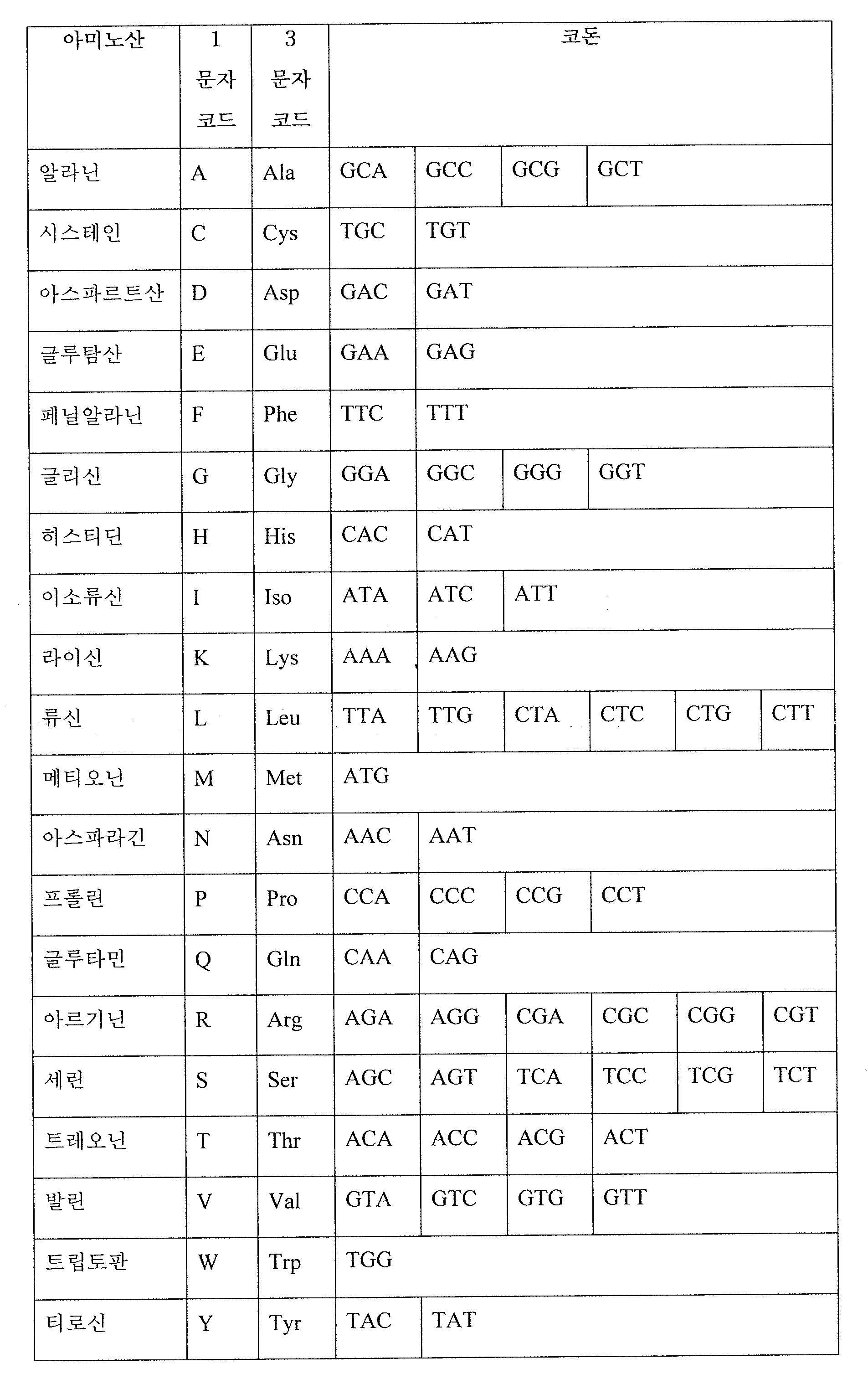
핵산 집단은 다중 위치에서 20개 이하의 코돈 변이를 집합적으로 코딩하는 변이된 핵산을 포함할 수 있다. 이러한 경우, 집단 내의 각각의 핵산은 동일한 핵산 내의 하나 초과의 위치에서 코돈에 대한 변이를 포함한다. 일부 예에서, 집단 내의 각각의 핵산은 단일 핵산 내의 1, 2, 3, 4, 5, 6, 7, 8, 9, 10, 11, 12, 13, 14, 15, 16, 17, 18, 19, 20개 또는 그 초과의 코돈에서 코돈에 대한 변이를 포함한다. 일부 예에서, 각각의 변이체의 긴 핵산은 하나의 긴 핵산 내의 1, 2, 3, 4, 5, 6, 7, 8, 9, 10, 11, 12, 13, 14, 15, 16, 17, 18, 19, 20, 21, 22, 23, 24, 25, 26, 27, 28, 29, 30개 또는 그 초과의 코돈에서 코돈에 대한 변이를 포함한다. 일부 예에서, 변이체 핵산 집단은 단일 핵산 내의 1, 2, 3, 4, 5, 6, 7, 8, 9, 10, 11, 12, 13, 14, 15, 16, 17, 18, 19, 20, 21, 22, 23, 24, 25, 26, 27, 28, 29, 30개 또는 그 초과의 코돈에서 코돈에 대한 변이를 포함한다. 일부 예에서, 변이체 핵산 집단은 하나의 긴 핵산 내의 적어도 약 10, 20, 30, 40, 50, 60, 70, 80, 90, 100개 또는 그 초과의 코돈에서 코돈에 대한 변이를 포함한다.A population of nucleic acids may include mutated nucleic acids that collectively encode up to 20 codon mutations at multiple positions. In this case, each nucleic acid in the population contains a mutation to a codon at more than one position within the same nucleic acid. In some examples, each nucleic acid in a population is 1, 2, 3, 4, 5, 6, 7, 8, 9, 10, 11, 12, 13, 14, 15, 16, 17, 18, 19 in a single nucleic acid. , contains mutations to codons in 20 or more codons. In some instances, the long nucleic acids of each variant are 1, 2, 3, 4, 5, 6, 7, 8, 9, 10, 11, 12, 13, 14, 15, 16, 17, 18, 19, 20, 21, 22, 23, 24, 25, 26, 27, 28, 29, 30 or more codons. In some instances, a population of variant nucleic acids is 1, 2, 3, 4, 5, 6, 7, 8, 9, 10, 11, 12, 13, 14, 15, 16, 17, 18, 19, 20 within a single nucleic acid. , 21, 22, 23, 24, 25, 26, 27, 28, 29, 30 or more codons. In some instances, a population of variant nucleic acids comprises mutations to codons in at least about 10, 20, 30, 40, 50, 60, 70, 80, 90, 100 or more codons within one long nucleic acid.
제2 핵산 집단이 다수의 개별적으로 주소 지정 가능한 로커스를 함유하는 제2 클러스터 상에 생성되는 과정이 본원에서 제공된다. 제2 핵산 집단은 각각의 코돈 위치에 대해 일정한(즉, 각각의 위치에서 동일한 아미노산을 코딩하는) 다수의 제2 핵산을 포함할 수 있다. 제2 핵산은 제1 핵산의 적어도 일부와 중첩될 수 있다. 일부 예에서, 제2 핵산은 제1 핵산 상에 제시된 변이체 부위를 함유하지 않는다. 대안적으로, 제2 핵산 집단은 하나 이상의 코돈 위치에 대해 변이체인 다수의 제2 핵산을 포함할 수 있다.Provided herein are processes wherein a second population of nucleic acids is generated on a second cluster containing a plurality of individually addressable loci. The second population of nucleic acids may include a plurality of second nucleic acids that are constant for each codon position (ie, encode the same amino acid at each position). The second nucleic acid may overlap at least a portion of the first nucleic acid. In some instances, the second nucleic acid does not contain a variant site presented on the first nucleic acid. Alternatively, the second population of nucleic acids may include a plurality of second nucleic acids that are variants for one or more codon positions.
다중 코돈 위치에 변이체를 포함하는 핵산의 단일 집단이 생성되는, 핵산의 라이브러리를 합성하는 방법이 본원에서 제공된다. 제1 핵산 집단은 다수의 개별적으로 주소 지정 가능한 로커스를 함유하는 제1 클러스터 상에 생성될 수 있다. 이 경우, 제1 핵산 집단은 상이한 코돈 위치에 변이체를 포함한다. 일부 예에서, 상이한 부위는 연속적이다(즉, 연속적인 아미노산을 코딩함). 제1 폴리뉴클레오티드 핵산 집단은 동일한 또는 추가의 변이체 부위에 19개 이하의 코돈 변이체를 집합적으로 코딩하는 변이된 핵산을 포함할 수 있다. 제1 폴리뉴클레오티드 핵산 집단은 위치 x에 19개 이하의 변이체, 위치 y에 19개 이하의 변이체 및 위치 z에 최대 19개 이하의 변이체를 포함하는 다수의 제1 핵산을 포함할 수 있다. 이러한 배열에서, 각각의 변이체는 상이한 아미노산을 코딩하여, 19개 이하의 아미노산 변이체가 각각의 상이한 변이체 부위에서 코딩된다. 추가의 예에서, 제2 핵산 집단은 다수의 개별적으로 주소 지정 가능한 로커스를 함유하는 제2 클러스터 상에 생성된다.Provided herein are methods of synthesizing a library of nucleic acids, wherein a single population of nucleic acids comprising variants at multiple codon positions is generated. A first population of nucleic acids can be generated on a first cluster containing multiple individually addressable loci. In this case, the first population of nucleic acids includes variants at different codon positions. In some instances, the different regions are contiguous (ie, encode contiguous amino acids). The first population of polynucleotide nucleic acids may include mutated nucleic acids that collectively encode up to 19 codon variants at the same or additional variant sites. The first population of polynucleotide nucleic acids may comprise a plurality of first nucleic acids comprising no more than 19 variants at position x, no more than 19 variants at position y and up to no more than 19 variants at position z. In this arrangement, each variant encodes a different amino acid, so that no more than 19 amino acid variants are encoded at each different variant site. In a further example, a second population of nucleic acids is generated on a second cluster containing multiple individually addressable loci.
제2 핵산 집단은 각각의 코돈 위치에 대해 일정한(즉, 각각의 위치에서 동일한 아미노산을 코딩하는) 다수의 제2 핵산을 포함할 수 있다. 제2 핵산은 제1 핵산의 적어도 일부와 중첩될 수 있다. 제2 핵산은 제1 핵산 상에 제시된 변이체 부위를 함유하지 않을 수 있다.The second population of nucleic acids may include a plurality of second nucleic acids that are constant for each codon position (ie, encode the same amino acid at each position). The second nucleic acid may overlap at least a portion of the first nucleic acid. The second nucleic acid may not contain the variant site presented on the first nucleic acid.
본원에서 설명되는 방법에 의해 생성된 변이체 핵산 라이브러리는 변이체 단백질 라이브러리의 생성을 제공한다. 예시적인 제1 배열에서, 주형 핵산은 전사되고 번역될 때 단일 원으로 표시된 다수의 코돈 위치를 갖는 참조 아미노산 서열(도 4a)을 생성하는 서열을 코딩한다. 주형의 핵산 변이체는 본원에서 설명되는 방법을 사용하여 생성될 수 있다. 일부 예에서, 단일 변이체가 핵산에 존재하여, 단일 아미노산 서열을 생성한다(도 4b). 일부 예에서, 핵산에 하나 초과의 변이체가 존재하며,이 변이체는 하나 이상의 코돈에 의해 분리되어, 변이체 잔기 사이에 간격을 갖는 단백질을 생성한다(도 4c). 일부 경우에, 하나 초과의 변이체가 핵산에 존재하고, 상기 변이체는 순차적이고 인접한 또는 서로 연속적이어서, 잔기의 이격된 변이체 스트레치를 생성한다(도 4d). 일부 예에서, 변이체의 2개의 스트레치가 핵산에 존재하며, 변이체의 각각의 스트레치는 순차적이고 인접한 또는 연속적인 변이체를 포함한다(도 4e).Variant nucleic acid libraries generated by the methods described herein provide for the creation of variant protein libraries. In an exemplary first arrangement, the template nucleic acid encodes a sequence that, when transcribed and translated, generates a reference amino acid sequence (FIG. 4A) having multiple codon positions indicated by a single circle. Nucleic acid variants of the template can be generated using the methods described herein. In some instances, a single variant is present in a nucleic acid, resulting in a single amino acid sequence (FIG. 4B). In some instances, more than one variant exists in a nucleic acid, and the variants are separated by one or more codons, resulting in a protein with spacing between variant residues (FIG. 4C). In some cases, more than one variant is present in a nucleic acid, and the variants are sequential and contiguous or contiguous with each other, creating a spaced-apart variant stretch of residues (FIG. 4D). In some instances, two stretches of variants are present in the nucleic acid, each stretch of variants being sequential and comprising contiguous or contiguous variants (FIG. 4E).
본원에서 각각 단일 위치 코돈 변이체를 포함하는 핵산 변이체의 라이브러리를 생성하는 방법이 제공된다. 하나의 예에서, 주형 핵산은 다수의 코돈 위치를 가지며, 여기서 예시적인 아미노산 잔기는 그 각각의 1 문자 코드 단백질 코돈을 사용하여 원으로 표시된다(도 5a). 도 5b는 변이체 핵산의 라이브러리에 의해 코딩되는 아미노산 변이체의 라이브러리를 도시한 것으로서, 여기서 각각의 변이체는 상이한 단일 부위에 위치한 "X"에 의해 표시된 단일 위치 변이체를 포함한다. 제1 위치 변이체는 알라닌을 대체하는 임의의 코돈을 갖고, 제2 변이체는 트립토판을 대체하는 변이체 핵산의 라이브러리에 의해 코딩된 임의의 코돈을 갖고, 제3 변이체는 이소류신을 대체하는 임의의 코돈을 갖고, 제4 변이체는 라이신을 대체하는 임의의 코돈을 갖고, 제5 변이체는 아르기닌을 대체하는 임의의 코돈을 갖고, 제6 변이체는 글루탐산을 대체하는 임의의 코돈을 갖고, 제7 변이체는 글루타민을 대체하는 임의의 코돈을 갖는다. 모든 코돈 변이체 또는 모든 코돈에 미치지 않는 코돈 변이체가 변이체 핵산 라이브러리에 의해 코딩될 때, 단백질 발현(즉, DNA 전사의 표준 세포 사건, 이어서 번역 및 프로세싱 사건) 후에 아미노산 서열 변이체의 상응하는 집단이 생성된다.Provided herein are methods for generating libraries of nucleic acid variants, each comprising a single position codon variant. In one example, the template nucleic acid has multiple codon positions, where exemplary amino acid residues are circled using their respective one-letter coded protein codons (FIG. 5A). 5B depicts a library of amino acid variants encoded by a library of variant nucleic acids, wherein each variant comprises a single positional variant indicated by an “X” located at a single site that is different. The first positional variant has any codon replacing alanine, the second variant has any codon encoded by the library of variant nucleic acids replacing tryptophan, and the third variant has any codon replacing isoleucine. , the fourth variant has any codon that replaces lysine, the fifth variant has any codon that replaces arginine, the sixth variant has any codon that replaces glutamic acid, and the seventh variant has any codon that replaces glutamine. has an arbitrary codon that When all codon variants or not all codon variants are encoded by a variant nucleic acid library, a corresponding population of amino acid sequence variants is generated after protein expression (i.e., the standard cellular events of DNA transcription, followed by translation and processing events). .
일부 배열에서, 단일 위치 변이체의 다중 부위를 갖는 라이브러리가 생성된다. 도 6a에 도시된 바와 같이, 야생형 주형이 제공된다. 도 6b는 단일 위치 코돈 변이체의 2개의 부위를 갖는 생성되는 아미노산 서열을 도시한 것으로, 상이한 아미노산을 코딩하는 각각의 코돈 변이체는 상이하게 패턴화된 원으로 표시된다.In some arrangements, libraries with multiple sites of single position variants are created. As shown in Figure 6A, a wild-type template is provided. 6B shows the resulting amino acid sequence with two sites of single position codon variants, each codon variant encoding a different amino acid is represented by a differently patterned circle.
본원에서 다중 부위, 단일 위치 변이체의 스트레치를 갖는 라이브러리를 생성하는 방법이 제공된다. 핵산의 각각의 스트레치는 1, 2, 3, 4, 5개 또는 그 초과의 변이체를 가질 수 있다. 핵산의 각각의 스트레치는 적어도 1개의 변이체를 가질 수 있다. 핵산의 각각의 스트레치는 적어도 2개의 변이체를 가질 수 있다. 핵산의 각각의 스트레치는 적어도 3개의 변이체를 가질 수 있다. 예를 들어, 5개 핵산의 스트레치는 1개의 변이체를 가질 수 있다. 5개 핵산의 스트레치는 2개의 변이체를 가질 수 있다. 5개 핵산의 스트레치는 3개의 변이체를 가질 수 있다. 5개 핵산의 스트레치는 4개의 변이체를 가질 수 있다. 예를 들어, 4개 핵산의 스트레치는 1개의 변이체를 가질 수 있다. 4개의 핵산의 스트레치는 2개의 변이체를 가질 수 있다. 4개 핵산의 스트레치는 3개의 변이체를 가질 수 있다. 4개 핵산의 스트레치는 4개의 변이체를 가질 수 있다.Provided herein are methods for generating libraries with stretches of multiple site, single site variants. Each stretch of nucleic acid may have 1, 2, 3, 4, 5 or more variants. Each stretch of nucleic acid can have at least one variant. Each stretch of nucleic acid can have at least two variants. Each stretch of nucleic acid can have at least three variants. For example, a stretch of 5 nucleic acids can have 1 variant. A stretch of five nucleic acids can have two variants. A stretch of five nucleic acids can have three variants. A stretch of 5 nucleic acids can have 4 variants. For example, a stretch of 4 nucleic acids can have 1 variant. A stretch of four nucleic acids can have two variants. A stretch of four nucleic acids can have three variants. A stretch of four nucleic acids can have four variants.
일부 예에서, 단일 위치 변이체는 모두 동일한 아미노산, 예를 들어 히스티딘을 코딩할 수 있다. 도 7a에 도시된 바와 같이, 참조 아미노산 서열이 제공된다. 이러한 배열에서, 핵산의 스트레치는 단일 위치 변이체의 다중 부위를 코딩하고, 발현될 때, 히스티딘을 코딩하는 모든 단일 위치 변이체를 갖는 아미노산 서열을 생성한다(도 7b). 일부 실시양태에서, 본원에서 설명되는 방법에 의해 합성된 변이체 라이브러리는 생성된 아미노산 서열에서 4개 초과의 히스티딘 잔기를 코딩하지 않는다.In some instances, single position variants may all encode the same amino acid, eg histidine. As shown in Figure 7A, a reference amino acid sequence is provided. In this arrangement, a stretch of nucleic acid encodes multiple sites of single position variants and, when expressed, produces an amino acid sequence with all single position variants encoding histidine (FIG. 7B). In some embodiments, a library of variants synthesized by the methods described herein does not encode more than 4 histidine residues in the resulting amino acid sequence.
일부 예에서, 본원에서 설명되는 방법에 의해 생성된 핵산의 변이체 라이브러리는 별개의 변이 스트레치를 갖는 아미노산 서열의 발현을 제공한다. 주형 아미노산 서열을 도 8a에 나타내었다. 핵산의 스트레치는 2개의 스트레치에 단지 1개의 변이체 코돈만을 가질 수 있고, 발현될 때, 도 8b에 도시된 아미노산 서열을 생성한다. 변이체는 아미노산 내의 변이가 단일 스트레치에서 상이한 위치에 존재함을 나타내기 위해 상이하게 패턴화된 원에 의해 도 8b에 도시된다.In some instances, variant libraries of nucleic acids generated by the methods described herein provide expression of amino acid sequences with distinct stretches of variation. The template amino acid sequence is shown in Figure 8a. A stretch of nucleic acid can have only one variant codon in two stretches and, when expressed, yields the amino acid sequence shown in FIG. 8B. Variants are shown in FIG. 8B by differently patterned circles to indicate that variations within amino acids are at different positions in a single stretch.
본원에서 1, 2, 3개 또는 그 초과의 코돈 변이체를 갖는 핵산 라이브러리를 합성하는 방법 및 장치가 제공되고, 여기서 각각의 부위에 대한 변이체는 선택적으로 제어된다. 단일 부위 변이체에 대한 2개의 아미노산의 비율은 약 1:100, 1:50, 1:10, 1:5, 1:3, 1:2, 1:1일 수 있다. 단일 부위 변이체에 대한 3개의 아미노산의 비율은 약 1:1:100, 1:1:50, 1:1:20, 1:1:10, 1:1:5, 1:1:3, 1:1:2, 1:1:1, 1:10:10, 1:5:5, 1:3:3 또는 1:2:2이다. 도 9a는 야생형 핵산 서열에 의해 코딩되는 야생형 참조 아미노산 서열을 도시한 것이다. 도 9b는 아미노산 변이체의 라이브러리를 도시한 것으로서, 각각의 변이체는 서열의 스트레치(패턴화된 원으로 표시됨)를 포함하며, 각각의 위치는 생성되는 변이체 단백질 라이브러리에서 특정 비율의 아미노산을 가질 수 있다. 생성되는 변이체 단백질 라이브러리는 본원에서 설명되는 방법에 의해 생성된 변이체 핵산 라이브러리에 의해 코딩된다. 이 예시에서, 5개의 위치가 변이된다: 제1 위치(900)는 50/50 K/R 비율을 가지며, 제2 위치(910)는 50/25/25 V/L/S 비율을 가지며, 제3 위치(920)는 50/25/25 Y/R/D 비율을 가지며, 제4 위치(930)는 20개의 모든 아미노산에 대해 동일한 비율을 가지며, 제5 위치(940)는 G/P에 대해 75/25의 비율을 갖는다. 본원에서 설명되는 비율은 단지 예시일 뿐이다.Provided herein are methods and apparatus for synthesizing nucleic acid libraries having one, two, three or more codon variants, wherein the variants for each site are selectively controlled. The ratio of the two amino acids for a single site variant may be about 1:100, 1:50, 1:10, 1:5, 1:3, 1:2, 1:1. The ratio of the three amino acids for single site variants is about 1:1:100, 1:1:50, 1:1:20, 1:1:10, 1:1:5, 1:1:3, 1: 1:2, 1:1:1, 1:10:10, 1:5:5, 1:3:3 or 1:2:2. 9A depicts a wild-type reference amino acid sequence encoded by a wild-type nucleic acid sequence. 9B depicts a library of amino acid variants, each variant comprising a stretch of sequence (represented by a patterned circle), each position may have a specific ratio of amino acids in the resulting variant protein library. The resulting variant protein library is encoded by a variant nucleic acid library generated by the methods described herein. In this example, five positions are shifted:
발현 카세트에서의 변이Variation in Expression Cassettes
일부 예에서, 발현 구축물의 일부를 코딩하는 합성된 변이체 라이브러리가 생성된다. 발현 구축물의 예시적인 부분은 프로모터, 개방 판독 프레임 및 종결 영역을 포함한다. 일부 예에서, 발현 구축물은 1, 2, 3개 또는 그 초과의 발현 카세트를 코딩한다. 도 11에 도시된 바와 같이, 발현 구축물 카세트의 일부를 구성하는 별개의 영역의 단일 부위 또는 다중 부위에서 코돈 변이를 코딩하는 폴리뉴클레오티드 라이브러리가 생성될 수 있다. 2개의 구축물 발현 카세트를 생성하기 위해, 제1 프로모터(1110), 제1 개방 판독 프레임(1120), 제1 종결인자(1130), 제2 프로모터(1140), 제2 개방 판독 프레임(1150), 또는 제2 종결인자 서열(1160)의 변이체 서열의 적어도 일부를 코딩하는 변이체 핵산을 합성하였다. 상기 예에서 설명된 바와 같은 증폭 라운드 후에, 1,024개의 발현 구축물의 라이브러리가 생성되었다. 도 11은 단지 하나의 예시적인 배열을 제공한다. 일부 예에서, 비번역 조절 영역(UTR) 또는 인핸서 영역과 같은 추가의 조절 서열도 본원에서 언급된 발현 카세트에 포함된다. 발현 카세트는 본원에서 설명되는 방법에 의해 변이체 서열이 생성되는 1, 2, 3, 4, 5, 6, 7, 8, 9, 10개 또는 그 초과의 성분을 포함할 수 있다. 일부 예에서, 발현 구축물은 하나 초과의 유전자를 다중시스트론(multicistronic) 벡터에 포함한다. 하나의 예에서, 합성된 DNA 핵산은 바이러스 벡터(예를 들어, 렌티바이러스) 내에 삽입된 다음, 세포 내로의 도입을 위해 패키징되거나, 또는 세포로의 전달을 위해 비바이러스 벡터로 패키징된 다음, 스크리닝 및 분석된다.In some instances, libraries of synthesized variants encoding portions of expression constructs are created. Exemplary parts of an expression construct include a promoter, open reading frame and termination region. In some examples, the expression construct encodes 1, 2, 3 or more expression cassettes. As shown in FIG. 11 , polynucleotide libraries can be generated that encode codon mutations at a single site or at multiple sites in distinct regions constituting part of an expression construct cassette. To generate two construct expression cassettes, a
본원에서 개시되는 핵산을 삽입하기 위한 발현 벡터는 포유동물 세포, 예를 들어 인간, 비인간 영장류, 돼지, 토끼 및 마우스를 포함한다. 예시적인 발현 벡터는 비제한적으로 다음과 같은 포유동물 발현 벡터를 포함한다: pSF-CMV-NEO-NH2-PPT-3XFLAG, pSF-CMV-NEO-COOH-3XFLAG, pSF-CMV-PURO-NH2-GST-TEV, pSF-OXB20-COOH-TEV-FLAG(R)-6His, pCEP4 pDEST27, pSF-CMV-Ub-KrYFP, pSF-CMV-FMDV-daGFP, pEF1a-mCherry-N1 벡터, pEF1a-tdTomato 벡터, pSF-CMV-FMDV-Hygro, pSF-CMV-PGK-Puro, pMCP-tag(m), 및 pSF-CMV-PURO-NH2-CMYC. 본원에서 설명되는 방법에 의해 합성된 핵산은 비제한적으로 형질감염, 형질도입 및 전기천공을 포함하는 관련 기술 분야에 공지된 다양한 방법에 의해 세포 내로 전달될 수 있다. 시험된 예시적인 세포 기능은 비제한적으로 세포 증식의 변화, 사멸, 이동/부착, 대사 및 세포 신호전달 활성을 포함한다.Expression vectors for insertion of the nucleic acids disclosed herein include mammalian cells such as humans, non-human primates, pigs, rabbits and mice. Exemplary expression vectors include, but are not limited to, the following mammalian expression vectors: pSF-CMV-NEO-NH2-PPT-3XFLAG, pSF-CMV-NEO-COOH-3XFLAG, pSF-CMV-PURO-NH2-GST -TEV, pSF-OXB20-COOH-TEV-FLAG(R)-6His, pCEP4 pDEST27, pSF-CMV-Ub-KrYFP, pSF-CMV-FMDV-daGFP, pEF1a-mCherry-N1 vector, pEF1a-tdTomato vector, pSF -CMV-FMDV-Hygro, pSF-CMV-PGK-Puro, pMCP-tag(m), and pSF-CMV-PURO-NH2-CMYC. Nucleic acids synthesized by the methods described herein can be delivered into cells by a variety of methods known in the art including, but not limited to, transfection, transduction and electroporation. Exemplary cellular functions tested include, but are not limited to, changes in cell proliferation, death, migration/adhesion, metabolism, and cell signaling activity.
고도로 병렬화된 핵산 합성Highly Parallel Nucleic Acid Synthesis
본원에서 혁명적인 합성 플랫폼을 생성하기 위해 핵산 합성으로부터 실리콘 상의 나노웰 내에서의 유전자 조립까지의 종단간(end-to-end) 과정의 소형화, 병렬화(parallelization) 및 수직 통합을 이용하는 플랫폼 접근법이 제공된다. 본원에서 설명되는 장치는 96웰 플레이트와 동일한 풋프린트를 제공하며, 실리콘 합성 플랫폼은 전통적인 합성 방법과 비교하여 최대 1,000개 또는 그 초과의 수준으로 처리량을 증가시킬 수 있고, 최대 약 1,000,000개 또는 그 초과의 핵산, 또는 10,000개 또는 그 초과의 유전자를 하나의 고도로 병렬화된 실행으로 생성할 수 있다.Provided herein is a platform approach that takes advantage of miniaturization, parallelization and vertical integration of the end-to-end process from nucleic acid synthesis to gene assembly within nanowells on silicon to create a revolutionary synthetic platform. do. Devices described herein provide a footprint equivalent to a 96-well plate, and the silicon synthesis platform can increase throughput to levels of up to 1,000 or more compared to traditional synthesis methods, up to about 1,000,000 or more of nucleic acids, or 10,000 or more genes, can be generated in one highly parallelized run.
차세대 시퀀싱의 출현으로, 고해상도 게놈 데이터는 정상적인 생물학 및 질환 발병 기전 둘 모두에서 다양한 유전자의 생물학적 역할을 탐구하는 연구에 중요한 요소가 되었다. 이 연구의 핵심은 분자 생물학의 중심 원리 및 "순차적 정보의 잔기별 이동(residue-by-residue transfer of sequential information)" 개념이다. DNA에 코드화된 게놈 정보는 메시지로 전사된 후, 주어진 생물학적 경로 내에서 활성 생성물인 단백질로 번역된다.With the advent of next-generation sequencing, high-resolution genomic data have become an important component of research exploring the biological roles of various genes in both normal biology and disease pathogenesis. At the heart of this work is a central principle of molecular biology and the concept of “residue-by-residue transfer of sequential information”. Genomic information encoded in DNA is transcribed as a message and then translated into proteins, the products of activity within a given biological pathway.
또 다른 흥미로운 연구 영역은 고특이적 세포 표적에 초점을 맞춘 치료 분자의 발견, 개발 및 제조에 관한 것이다. 높은 다양성의 DNA 서열 라이브러리는 표적 치료제 개발을 위한 파이프라인의 핵심이다. 유전자 돌연변이체는 그의 치료 표적에 대한 높은 친화성을 가진 단백질의 높은 발현을 위해 최적화된 유전자에서 이상적으로 최고조에 달하는 단백질 조작 사이클을 설계, 구축 및 시험할 때 단백질을 발현하기 위해 사용된다. 예를 들어, 수용체의 결합 포켓을 고려한다. 결합 포켓 내의 모든 잔기의 모든 서열 순열(permutation)을 동시에 시험할 수 있는 능력은 철저한 조사를 가능하게 하여 성공 가능성을 증가시킨다. 연구자가 수용체 내의 특정 부위에서 가능한 모든 돌연변이를 생성하려고 시도하는 포화 돌연변이 유발이 상기 개발 과제에 대한 하나의 접근 방식을 나타낸다. 이것은 비싸고 시간도 많이 걸리고 노동 집약적이기는 하지만, 각각의 변이체를 각각의 위치에 도입할 수 있다. 이와 대조적으로, DNA의 몇몇의 선택된 위치 또는 짧은 스트레치가 광범위하게 변형될 수 있는 조합 돌연변이 유발은 편향된 제시를 갖는 변이체의 불완전한 레퍼토리를 생성한다.Another interesting area of research relates to the discovery, development and manufacture of therapeutic molecules with a focus on highly specific cellular targets. A high-diversity DNA sequence library is at the heart of the pipeline for targeted therapeutic development. Gene mutants are used to express proteins when designing, constructing and testing cycles of protein engineering that ideally culminate in genes optimized for high expression of proteins with high affinity for their therapeutic targets. For example, consider the binding pocket of a receptor. The ability to simultaneously test all sequence permutations of all residues within a binding pocket allows for thorough investigation, increasing the chances of success. Saturation mutagenesis, in which researchers attempt to generate all possible mutations at a specific site within the receptor, represents one approach to this development challenge. Although this is expensive, time consuming and labor intensive, each variant can be introduced at each location. In contrast, combinatorial mutagenesis in which several selected positions or short stretches of DNA can be extensively modified produces an incomplete repertoire of variants with biased presentation.
약물 개발 파이프 라인을 가속화하기 위해, 시험을 위해 이용 가능한 올바른 위치에서 의도된 빈도로 이용 가능한 원하는 변이체를 갖는 라이브러리, 즉 정밀 라이브러리는 스크리닝을 위한 소요 시간뿐만 아니라 비용 감소를 가능하게 한다. 원하는 빈도로 각각의 의도된 변이체의 정확한 도입을 제공하는 핵산 합성 변이체 라이브러리를 합성하는 방법이 본원에서 제공된다. 최종 사용자에게, 이것은 서열 공간을 철저히 샘플링할 수 있을 뿐만 아니라 효율적인 방법으로 이러한 가설을 질의하여 비용 및 검사 시간을 감소시킬 수 있는 능력으로 제시된다. 게놈 차원의 편집에 의해, 중요한 경로, 각각의 변이체 및 서열 순열을 최적의 기능성에 대해 시험할 수 있는 라이브러리, 및 약물 발견을 위한 생물 시스템을 재조작하기 위한 전체 경로 및 게놈을 재구축하기 위해 사용될 수 있는 수천 개의 유전자를 규명할 수 있다.To accelerate the drug development pipeline, a library with the desired variants available at the intended frequency and in the right location available for testing, i.e., a precision library, enables cost reduction as well as time required for screening. Provided herein are methods for synthesizing a library of nucleic acid synthesis variants that provide precise incorporation of each intended variant at a desired frequency. To the end user, this is presented as the ability to not only thoroughly sample the sequence space, but also to query these hypotheses in an efficient way, reducing cost and testing time. Genome-wide editing can be used to reconstruct critical pathways, libraries where each variant and sequence permutation can be tested for optimal functionality, and entire pathways and genomes to reengineer biological systems for drug discovery. Thousands of possible genes can be identified.
제1 예에서, 약물 자체는 본원에서 설명되는 방법을 사용하여 최적화될 수 있다. 예를 들어, 항체의 특정 기능을 개선하기 위해, 항체의 일부를 코딩하는 변이체 핵산 라이브러리가 설계되고 합성된다. 이어서, 항체에 대한 변이체 핵산 라이브러리는 본원에서 설명되는 공정(예를 들어, PCR 돌연변이 유발, 이어서 벡터 내로의 삽입)에 의해 생성될 수 있다. 이어서 항체를 생산 세포주에서 발현시키고, 향상된 활성에 대해 스크리닝한다. 예시적인 스크리닝은 항원에 대한 결합 친화성, 안정성, 또는 이펙터 기능(예를 들어, ADCC, 보체 또는 아폽토시스)의 조절을 조사하는 것을 포함한다. 항체를 최적화하기 위한 예시적인 영역은 비제한적으로 Fc 영역, Fab 영역, Fab 영역의 가변 영역, Fab 영역의 불변 영역, 중쇄 또는 경쇄의 가변 도메인(VH 또는 VL) 및 VH 또는 VL의 특정 상보성 결정 영역(CDR)을 포함한다.In a first example, the drug itself can be optimized using the methods described herein. For example, to improve a particular function of an antibody, a library of variant nucleic acids encoding portions of the antibody is designed and synthesized. A library of variant nucleic acids for the antibody can then be generated by the processes described herein (eg, PCR mutagenesis followed by insertion into a vector). The antibodies are then expressed in production cell lines and screened for enhanced activity. Exemplary screenings include examining binding affinity to the antigen, stability, or modulation of effector function (eg ADCC, complement or apoptosis). Exemplary regions for optimizing an antibody include, but are not limited to, an Fc region, a Fab region, a variable region of a Fab region, a constant region of a Fab region, a variable domain of a heavy or light chain (V H or V L ), and V H or V L of It contains specific complementarity determining regions (CDRs).
본원에서 설명되는 방법에 의해 합성된 핵산 라이브러리는 질환 상태와 관련된 다양한 세포에서 발현될 수 있다. 질환 상태와 관련된 세포에는 세포주, 조직 샘플, 대상체의 1차 세포, 대상체에서 확장된 배양 세포 또는 모델 시스템의 세포가 포함된다. 예시적인 모델 시스템은 비제한적으로 질환 상태의 식물 및 동물 모델을 포함한다.Nucleic acid libraries synthesized by the methods described herein can be expressed in a variety of cells associated with a disease state. Cells associated with a disease state include cell lines, tissue samples, primary cells from a subject, cultured cells expanded in a subject, or cells from a model system. Exemplary model systems include, but are not limited to, plant and animal models of disease states.
질환 상태의 예방, 감소 또는 치료와 관련된 변이체 분자를 확인하기 위해, 본원에서 설명되는 변이체 핵산 라이브러리는 질환 상태와 관련된 세포에서 발현되거나, 질환 상태가 유도될 수 있는 세포에서 발현된다. 일부 예에서, 세포에서 질환 상태를 유도하기 위해 작용제가 사용된다. 질환 상태 유도를 위한 예시적인 도구는 비제한적으로 Cre/Lox 재조합 시스템, LPS 염증 유도 및 저혈당을 유도하는 스트렙토조토신을 포함한다. 질환 상태와 관련된 세포는 특정 질환 상태를 갖는 대상체로부터의 세포뿐만 아니라, 모델 시스템 또는 배양된 세포로부터의 세포일 수 있다. 예시적인 질환 상태는 박테리아성, 진균성, 바이러스성, 자가면역 또는 증식성 장애(예를 들어, 암)를 포함한다. 일부 예에서, 변이체 핵산 라이브러리는 모델 시스템, 세포주, 또는 대상체로부터 유래된 1차 세포에서 발현되고, 하나 이상의 세포 활성의 변화에 대해 스크리닝된다. 예시적인 세포 활성은 비제한적으로 증식, 주기 진행, 세포 사멸, 부착, 이동, 재생, 세포 신호전달, 에너지 생성, 산소 이용, 대사 활성 및 노화, 자유 라디칼 손상에 대한 반응, 또는 이들의 임의의 조합을 포함한다.To identify variant molecules associated with the prevention, reduction, or treatment of a disease state, the variant nucleic acid libraries described herein are expressed in cells associated with the disease state or in cells from which the disease state can be induced. In some instances, an agent is used to induce a diseased state in a cell. Exemplary tools for inducing disease states include, but are not limited to, the Cre/Lox recombination system, LPS inducing inflammation, and streptozotocin inducing hypoglycemia. Cells associated with a disease state can be cells from a subject having a particular disease state, as well as cells from model systems or cultured cells. Exemplary disease states include bacterial, fungal, viral, autoimmune or proliferative disorders (eg cancer). In some examples, a library of variant nucleic acids is expressed in primary cells derived from a model system, cell line, or subject, and screened for changes in one or more cellular activities. Exemplary cellular activities include, but are not limited to, proliferation, cycle progression, cell death, adhesion, migration, regeneration, cell signaling, energy production, oxygen utilization, metabolic activity and aging, response to free radical damage, or any combination thereof. includes
기재write
본원에서 다수의 클러스터를 포함하는 기재가 제공되며, 여기서 각각의 클러스터는 핵산의 부착 및 합성을 지지하는 다수의 로커스를 포함한다. 본원에서 사용된 용어 "로커스"는 표면으로부터 연장되는 하나의 미리 결정된 서열을 코딩하는 폴리뉴클레오티드에 대한 지지체를 제공하는 구조 상의 별개의 영역을 지칭한다. 일부 예에서, 로커스는 2차원 표면, 예를 들어, 실질적으로 평면인 표면 상에 존재한다. 경우에 따라, 로커스는 표면 상의 별개의 상승 또는 하강 부위, 예를 들어 웰, 마이크로웰, 채널 또는 기둥을 지칭한다. 일부 예에서, 로커스의 표면은 핵산 합성을 위해 하나 이상의 뉴클레오티드 또는 바람직하게는 핵산 집단의 합성을 위한 동일한 뉴클레오티드 집단에 부착되도록 능동적으로 관능화된 물질을 포함한다. 일부 예에서, 핵산은 동일한 핵산 서열을 코딩하는 핵산 집단을 지칭한다. 일부 예에서, 장치의 표면은 기재의 하나 또는 다수의 표면을 포함한다.Provided herein are substrates comprising a plurality of clusters, wherein each cluster comprises a plurality of loci that support attachment and synthesis of nucleic acids. As used herein, the term "locus" refers to a discrete region on a structure that provides support for a polynucleotide encoding one predetermined sequence extending from the surface. In some instances, the locus is on a two-dimensional surface, eg, a substantially planar surface. In some cases, a locus refers to a discrete raised or lowered site on a surface, eg, a well, microwell, channel, or pillar. In some instances, the surface of the locus comprises a material that is actively functionalized to attach to more than one nucleotide for nucleic acid synthesis or preferably to the same population of nucleotides for synthesis of a population of nucleic acids. In some instances, nucleic acid refers to a population of nucleic acids that encode the same nucleic acid sequence. In some examples, the surface of the device includes one or multiple surfaces of a substrate.
제공된 시스템 및 방법을 사용하여 라이브러리 내에서 합성된 핵산에 대한 평균 오류율은 1000개 중 1 미만, 1250개 중 1 미만, 1500개 중 1 미만, 2000개 중 1 미만, 3000개 중 1 미만이거나 이보다 덜 빈번할 수 있다. 일부 예에서, 제공된 시스템 및 방법을 사용하여 라이브러리 내에서 합성된 핵산의 평균 오류율은 1/500, 1/600, 1/700, 1/800, 1/900, 1/1000, 1/1100, 1/1200, 1/1250, 1/1300, 1/1400, 1/1500, 1/1600, 1/1700, 1/1800, 1/1900, 1/2000, 1/3000 미만, 또는 이보다 작은 값 미만이다. 일부 예에서, 제공된 시스템 및 방법을 사용하여 라이브러리 내에서 합성된 핵산의 평균 오류율은 1/1000 미만이다.The average error rate for nucleic acids synthesized within a library using the provided systems and methods is less than 1 in 1000, less than 1 in 1250, less than 1 in 1500, less than 1 in 2000, less than 1 in 3000, or less. can be frequent In some examples, the average error rate of nucleic acids synthesized within a library using the provided systems and methods is 1/500, 1/600, 1/700, 1/800, 1/900, 1/1000, 1/1100, 1 Less than /1200, 1/1250, 1/1300, 1/1400, 1/1500, 1/1600, 1/1700, 1/1800, 1/1900, 1/2000, 1/3000, or any smaller value . In some instances, the average error rate of nucleic acids synthesized within a library using the systems and methods provided is less than 1/1000.
일부 예에서, 제공된 시스템 및 방법을 사용하여 라이브러리 내에서 합성된 핵산에 대한 총 오류율은 미리 결정된 서열에 비해 1/500, 1/600, 1/700, 1/800, 1/900, 1/1000, 1/1100, 1/1200, 1/1250, 1/1300, 1/1400, 1/1500, 1/1600, 1/1700, 1/1800, 1/1900, 1/2000, 1/3000 미만, 또는 이보다 작은 값 미만이다. 일부 예에서, 제공된 시스템 및 방법을 사용하여 라이브러리 내에서 합성된 핵산에 대한 총 오류율은 1/500, 1/600, 1/700, 1/800, 1/900 또는 1/1000 미만이다. 일부 예에서, 제공된 시스템 및 방법을 사용하여 라이브러리 내에서 합성된 핵산에 대한 총 오류율은 1/1000 미만이다.In some examples, the total error rate for nucleic acids synthesized within a library using the provided systems and methods relative to a predetermined sequence is 1/500, 1/600, 1/700, 1/800, 1/900, 1/1000 , 1/1100, 1/1200, 1/1250, 1/1300, 1/1400, 1/1500, 1/1600, 1/1700, 1/1800, 1/1900, 1/2000, 1/3000, or less than a smaller value. In some examples, the total error rate for nucleic acids synthesized within a library using the provided systems and methods is less than 1/500, 1/600, 1/700, 1/800, 1/900 or 1/1000. In some instances, the total error rate for nucleic acids synthesized within a library using the provided systems and methods is less than 1 in 1000.
일부 예에서, 오류 정정 효소는 제공된 시스템 및 방법을 사용하여 라이브러리 내에서 합성된 핵산에 사용될 수 있다. 일부 예에서, 오류 정정이 있는 핵산에 대한 총 오류율은 미리 결정된 서열에 비해 1/500, 1/600, 1/700, 1/800, 1/900, 1/1000, 1/1100, 1/1200, 1/1300, 1/1400, 1/1500, 1/1600, 1/1700, 1/1800, 1/1900, 1/2000, 1/3000 미만, 또는 이보다 작은 값 미만일 수 있다. 일부 예에서, 제공되는 시스템 및 방법을 사용하여 라이브러리 내에서 합성된 핵산에 대한 오류 정정을 포함하는 총 오류율은 1/500, 1/600, 1/700, 1/800, 1/900 또는 1/1000 미만일 수 있다. 일부 예에서, 제공되는 시스템 및 방법을 사용하여 라이브러리 내에서 합성된 핵산에 대한 오류 정정이 있는 총 오류율은 1/1000 미만일 수 있다.In some instances, error correcting enzymes may be used on nucleic acids synthesized within a library using the provided systems and methods. In some instances, the total error rate for nucleic acids with error correction is 1/500, 1/600, 1/700, 1/800, 1/900, 1/1000, 1/1100, 1/1200 relative to a predetermined sequence. , 1/1300, 1/1400, 1/1500, 1/1600, 1/1700, 1/1800, 1/1900, 1/2000, 1/3000, or smaller values. In some examples, the total error rate, including error correction, for nucleic acids synthesized within a library using the provided systems and methods is 1/500, 1/600, 1/700, 1/800, 1/900, or 1/500. may be less than 1000. In some instances, the total error rate with error correction for nucleic acids synthesized within a library using the provided systems and methods can be less than 1 in 1000.
오류율은 유전자 변이체 라이브러리의 생산을 위한 유전자 합성의 가치를 제한할 수 있다. 오류율이 1/300인 경우, 1500개 염기쌍 유전자의 클론 중 약 0.7%가 정확할 것이다. 폴리뉴클레오티드 합성으로 인한 대부분의 오류는 프레임 이동 돌연변이를 야기하기 때문에, 그러한 라이브러리에 있는 클론의 99% 이상이 전장 단백질을 생성하지 않을 것이다. 오류율을 75% 감소시킴으로써, 40의 팩터만큼 정확한 클론의 비율을 증가시킬 수 있다. 본 개시내용의 방법 및 조성물은 개선된 합성 품질 및 대량 병렬 및 시간 효율적 방식으로 실행할 수 있는 오류 정정 방법의 적용 가능성 둘 모두에 의해 일반적으로 관찰되는 유전자 합성 방법보다 더 낮은 오류율로 큰 폴리뉴클레오티드 및 유전자 라이브러리의 신속한 디 노보 합성을 허용한다. 따라서, 라이브러리에 걸쳐, 또는 라이브러리의 80%, 85%, 90%, 93%, 95%, 96%, 97%, 98%, 99%, 99.5%, 99.8%, 99.9%, 99.95%, 99.98%, 99.99% 초과 또는 이보다 큰 수치에 걸쳐 1/300, 1/400, 1/500, 1/600, 1/700, 1/800, 1/900, 1/1000, 1/1250, 1/1500, 1/2000, 1/2500, 1/3000, 1/4000, 1/5000, 1/6000, 1/7000, 1/8000, 1/9000, 1/10000, 1/12000, 1/15000, 1/20000, 1/25000, 1/30000, 1/40000, 1/50000, 1/60000, 1/70000, 1/80000, 1/90000, 1/100000, 1/125000, 1/150000, 1/200000, 1/300000, 1/400000, 1/500000, 1/600000, 1/700000, 1/800000, 1/900000, 1/1000000 미만, 또는 이보다 작은 염기 삽입, 결실, 치환 또는 총 오류율로 라이브러리를 합성할 수 있다. 본 개시내용의 방법 및 조성물은 미리 결정된/미리 선택된 서열와 비교하여 오류 없는 서열에 관련된 라이브러리의 서브 세트에서 적어도 30%, 40%, 50%, 60%, 70%, 75%, 80%, 85%, 90%, 93%, 95%, 96%, 97%, 98%, 99%, 99.5%, 99.8%, 99.9%, 99.95%, 99.98%, 99.99% 또는 그 초과의 폴리뉴클레오티드 또는 유전자에 관련된 낮은 오류율의 큰 합성 폴리뉴클레오티드 및 유전자 라이브러리에 관한 것이다. 일부 예에서, 라이브러리 내의 단리된 부피 내의 적어도 30%, 40%, 50%, 60%, 70%, 75%, 80%, 85%, 90%, 93%, 95%, 96%, 97%, 98%, 99%, 99.5%, 99.8%, 99.9%, 99.95%, 99.98%, 99.99% 또는 그 초과의 폴리뉴클레오티드 또는 유전자는 동일한 서열을 갖는다. 일부 예에서, 95%, 96%, 97%, 98%, 99%, 99.5%, 99.6%, 99.7%, 99.8%, 99.9% 초과 또는 이보다 큰 수치의 유사성 또는 동일성으로 관련되는 적어도 30%, 40%, 50%, 60%, 70%, 75%, 80%, 85%, 90%, 93%, 95%, 96%, 97%, 98%, 99%, 99.5%, 99.8%, 99.9%, 99.95%, 99.98%, 99.99% 또는 그 초과의 임의의 폴리뉴클레오티드 또는 유전자는 동일한 서열을 갖는다. 일부 예에서, 폴리뉴클레오티드 또는 유전자 상의 특정 유전자좌에 관련된 오류율이 최적화된다. 따라서, 큰 라이브러리의 일부로서의 하나 이상의 폴리뉴클레오티드 또는 유전자의 주어진 유전자좌 또는 다수의 선택된 유전자좌는 각각 1/300, 1/400, 1/500, 1/600, 1/700, 1/800, 1/900, 1/1000, 1/1250, 1/1500, 1/2000, 1/2500, 1/3000, 1/4000, 1/5000, 1/6000, 1/7000, 1/8000, 1/9000, 1/10000, 1/12000, 1/15000, 1/20000, 1/25000, 1/30000, 1/40000, 1/50000, 1/60000, 1/70000, 1/80000, 1/90000, 1/100000, 1/125000, 1/150000, 1/200000, 1/300000, 1/400000, 1/500000, 1/600000, 1/700000, 1/800000, 1/900000, 1/1000000 미만, 또는 이보다 작은 값 미만의 오류율을 가질 수 있다. 다양한 예에서, 이러한 오류 최적화된 유전자좌는 적어도 1, 2, 3, 4, 5, 6, 7, 8, 9, 10, 11, 12, 13, 14, 15, 16, 17, 18, 19, 20, 25, 30, 35, 40, 45, 50, 60, 70, 80, 90, 100, 200, 300, 400, 500, 600, 700, 800, 900, 1000, 1500, 2000, 2500, 3000, 4000, 5000, 6000, 7000, 8000, 9000, 10000, 30000, 50000, 75000, 100000, 500000, 1000000, 2000000, 3000000개 또는 그 초과의 유전자좌를 포함할 수 있다. 오류 최적화된 유전자좌는 적어도 1, 2, 3, 4, 5, 6, 7, 8, 9, 10, 11, 12, 13, 14, 15, 16, 17, 18, 19, 20, 25, 30, 35, 40, 45, 50, 60, 70, 80, 90, 100, 200, 300, 400, 500, 600, 700, 800, 900, 1000, 1500, 2000, 2500, 3000, 4000, 5000, 6000, 7000, 8000, 9000, 10000, 30000, 75000, 100000, 500000, 1000000, 2000000, 3000000개 또는 그 초과의 폴리뉴클레오티드 또는 유전자에 분포될 수 있다.Error rates can limit the value of gene synthesis for the production of genetic variant libraries. For an error rate of 1/300, about 0.7% of clones of a 1500 base pair gene will be correct. Because most errors due to polynucleotide synthesis result in frameshift mutations, more than 99% of the clones in such a library will not produce full-length proteins. By reducing the error rate by 75%, one can increase the proportion of correct clones by a factor of 40. The methods and compositions of the present disclosure provide for large polynucleotides and genes with lower error rates than generally observed gene synthesis methods both by improved synthetic quality and the applicability of error correction methods that can be run in a massively parallel and time efficient manner. Allows rapid de novo synthesis of the library. Thus, 80%, 85%, 90%, 93%, 95%, 96%, 97%, 98%, 99%, 99.5%, 99.8%, 99.9%, 99.95%, 99.98% of the library or across the library. , 1/300, 1/400, 1/500, 1/600, 1/700, 1/800, 1/900, 1/1000, 1/1250, 1/1500, over 99.99% or greater 1/2000, 1/2500, 1/3000, 1/4000, 1/5000, 1/6000, 1/7000, 1/8000, 1/9000, 1/10000, 1/12000, 1/15000, 1/ 20000, 1/25000, 1/30000, 1/40000, 1/50000, 1/60000, 1/70000, 1/80000, 1/90000, 1/100000, 1/125000, 1/150000, 1/200000, Synthesize libraries with base insertions, deletions, substitutions, or total error rates of less than 1/300000, 1/400000, 1/500000, 1/600000, 1/700000, 1/800000, 1/900000, 1/1000000, or less can The methods and compositions of the present disclosure can reduce at least 30%, 40%, 50%, 60%, 70%, 75%, 80%, 85% in a subset of the library related to error-free sequences compared to predetermined/preselected sequences. , 90%, 93%, 95%, 96%, 97%, 98%, 99%, 99.5%, 99.8%, 99.9%, 99.95%, 99.98%, 99.99% or more polynucleotides or genes It relates to synthetic polynucleotides and gene libraries with high error rates. In some examples, at least 30%, 40%, 50%, 60%, 70%, 75%, 80%, 85%, 90%, 93%, 95%, 96%, 97%, 98%, 99%, 99.5%, 99.8%, 99.9%, 99.95%, 99.98%, 99.99% or more of the polynucleotides or genes have the same sequence. In some instances, at least 30%, 40%, 95%, 96%, 97%, 98%, 99%, 99.5%, 99.6%, 99.7%, 99.8%, 99.9%, related to a numerical similarity or identity greater than or greater than 99.9%. %, 50%, 60%, 70%, 75%, 80%, 85%, 90%, 93%, 95%, 96%, 97%, 98%, 99%, 99.5%, 99.8%, 99.9%, 99.95%, 99.98%, 99.99% or more of any polynucleotide or gene has the same sequence. In some instances, the error rate associated with a particular locus on a polynucleotide or gene is optimized. Thus, a given locus or multiple selected loci of one or more polynucleotides or genes as part of a large library are 1/300, 1/400, 1/500, 1/600, 1/700, 1/800, 1/900, respectively. , 1/1000, 1/1250, 1/1500, 1/2000, 1/2500, 1/3000, 1/4000, 1/5000, 1/6000, 1/7000, 1/8000, 1/9000, 1 /10000, 1/12000, 1/15000, 1/20000, 1/25000, 1/30000, 1/40000, 1/50000, 1/60000, 1/70000, 1/80000, 1/90000, 1/100000 , less than 1/125000, 1/150000, 1/200000, 1/300000, 1/400000, 1/500000, 1/600000, 1/700000, 1/800000, 1/900000, 1/1000000, or less may have an error rate of less than In various examples, such error-optimized loci are at least 1, 2, 3, 4, 5, 6, 7, 8, 9, 10, 11, 12, 13, 14, 15, 16, 17, 18, 19, 20 , 25, 30, 35, 40, 45, 50, 60, 70, 80, 90, 100, 200, 300, 400, 500, 600, 700, 800, 900, 1000, 1500, 2000, 2500, 3000, 4000 , 5000, 6000, 7000, 8000, 9000, 10000, 30000, 50000, 75000, 100000, 500000, 1000000, 2000000, 3000000 or more loci. Error-optimized loci are at least 1, 2, 3, 4, 5, 6, 7, 8, 9, 10, 11, 12, 13, 14, 15, 16, 17, 18, 19, 20, 25, 30, 35, 40, 45, 50, 60, 70, 80, 90, 100, 200, 300, 400, 500, 600, 700, 800, 900, 1000, 1500, 2000, 2500, 3000, 4000, 5000, 6000, 7000, 8000, 9000, 10000, 30000, 75000, 100000, 500000, 1000000, 2000000, 3000000 or more polynucleotides or genes.
오류율은 오류 정정을 사용하거나 사용하지 않고 달성될 수 있다. 오류율은 라이브러리에 걸쳐 또는 라이브러리의 80%, 85%, 90%, 93%, 95%, 96%, 97%, 98%, 99%, 99.5%, 99.8%, 99.9%, 99.95%, 99.98%, 99.99% 초과 또는 이보다 큰 수치에 걸쳐 달성될 수 있다.Error rates can be achieved with or without error correction. The error rate was 80%, 85%, 90%, 93%, 95%, 96%, 97%, 98%, 99%, 99.5%, 99.8%, 99.9%, 99.95%, 99.98%, Over 99.99% or greater can be achieved.
공통 지지체 상의 주소 지정 가능한 위치에서 상이한 미리 결정된 서열을 갖는 다수의 핵산의 합성을 지지하는 표면을 포함할 수 있는 구조물이 본원에서 제공된다. 일부 예에서, 장치는 2,000; 5,000; 10,000; 20,000; 30,000; 50,000; 75,000; 100,000; 200,000; 300,000; 400,000; 500,000; 600,000; 700,000; 800,000; 900,000; 1,000,000; 1,200,000; 1,400,000; 1,600,000; 1,800,000; 2,000,000; 2,500,000; 3,000,000; 3,500,000; 4,000,000; 4,500,000; 5,000,000; 10,000,000개 초과 또는 이보다 큰 수치의 동일하지 않은 핵산의 합성을 지지한다. 일부 예에서, 장치는 별개의 서열을 코딩하는 2,000; 5,000; 10,000; 20,000; 30,000; 50,000; 75,000; 100,000; 200,000; 300,000; 400,000; 500,000; 600,000; 700,000; 800,000; 900,000; 1,000,000; 1,200,000; 1,400,000; 1,600,000; 1,800,000; 2,000,000; 2,500,000; 3,000,000; 3,500,000; 4,000,000; 4,500,000; 5,000,000; 10,000,000개 초과 또는 이보다 큰 수치의 핵산의 합성을 지지한다. 일부 예에서, 핵산의 적어도 일부는 동일한 서열을 갖거나 동일한 서열로 합성되도록 구성된다.Provided herein are constructs that may include a surface that supports the synthesis of a plurality of nucleic acids having different predetermined sequences at addressable locations on a common support. In some examples, the device is 2,000; 5,000; 10,000; 20,000; 30,000; 50,000; 75,000; 100,000; 200,000; 300,000; 400,000; 500,000; 600,000; 700,000; 800,000; 900,000; 1,000,000; 1,200,000; 1,400,000; 1,600,000; 1,800,000; 2,000,000; 2,500,000; 3,000,000; 3,500,000; 4,000,000; 4,500,000; 5,000,000; Synthesis of non-identical nucleic acids greater than or equal to 10,000,000 is supported. In some examples, a device may include 2,000 encoding distinct sequences; 5,000; 10,000; 20,000; 30,000; 50,000; 75,000; 100,000; 200,000; 300,000; 400,000; 500,000; 600,000; 700,000; 800,000; 900,000; 1,000,000; 1,200,000; 1,400,000; 1,600,000; 1,800,000; 2,000,000; 2,500,000; 3,000,000; 3,500,000; 4,000,000; 4,500,000; 5,000,000; Synthesis of nucleic acids greater than or equal to 10,000,000 is supported. In some instances, at least some of the nucleic acids have identical sequences or are configured to synthesize identical sequences.
약 5, 10, 20, 30, 40, 50, 60, 70, 80, 90, 100, 125, 150, 175, 200, 225, 250, 275, 300, 325, 350, 375, 400, 425, 450, 475, 500, 600, 700, 800, 900, 1000, 1100, 1200, 1300, 1400, 1500, 1600, 1700, 1800, 1900, 또는 2000개 염기 길이의 핵산의 제조 및 성장을 위한 방법 및 장치가 본원에서 제공된다. 일부 예에서, 형성된 핵산의 길이는 약 5, 10, 20, 30, 40, 50, 60, 70, 80, 90, 100, 125, 150, 175, 200 또는 225 염기이다. 핵산은 적어도 5, 10, 20, 30, 40, 50, 60, 70, 80, 90 또는 100개의 염기 길이일 수 있다. 핵산은 10 내지 225개의 염기 길이, 12 내지 100개의 염기 길이, 20 내지 150개의 염기 길이, 20 내지 130개의 염기 길이 또는 30 내지 100개의 염기 길이일 수 있다.Approx. 5, 10, 20, 30, 40, 50, 60, 70, 80, 90, 100, 125, 150, 175, 200, 225, 250, 275, 300, 325, 350, 375, 400, 425, 450 , 475, 500, 600, 700, 800, 900, 1000, 1100, 1200, 1300, 1400, 1500, 1600, 1700, 1800, 1900, or 2000 bases in length. provided herein. In some instances, the nucleic acid formed is about 5, 10, 20, 30, 40, 50, 60, 70, 80, 90, 100, 125, 150, 175, 200 or 225 bases in length. A nucleic acid may be at least 5, 10, 20, 30, 40, 50, 60, 70, 80, 90 or 100 bases in length. A nucleic acid may be 10 to 225 bases in length, 12 to 100 bases in length, 20 to 150 bases in length, 20 to 130 bases in length, or 30 to 100 bases in length.
일부 예에서, 핵산은 기재의 별개의 로커스 상에서 합성되고, 여기서 각각의 로커스는 핵산 집단의 합성을 지지한다. 일부 예에서, 각각의 로커스는 다른 로커스 상에서 성장한 핵산의 집단과 상이한 서열을 갖는 핵산 집단의 합성을 지지한다. 일부 예에서, 장치의 로커스는 다수의 클러스터 내에 위치한다. 일부 예에서, 장치는 적어도 10, 500, 1000, 2000, 3000, 4000, 5000, 6000, 7000, 8000, 9000, 10000, 11000, 12000, 13000, 14000, 15000, 20000, 30000, 40000, 50000개 또는 그 초과의 클러스터를 포함한다. 일부 예에서, 장치는 2,000; 5,000; 10,000; 100,000; 200,000; 300,000; 400,000; 500,000; 600,000; 700,000; 800,000; 900,000; 1,000,000; 1,100,000; 1,200,000; 1,300,000; 1,400,000; 1,500,000; 1,600,000; 1,700,000; 1,800,000; 1,900,000; 2,000,000; 300,000; 400,000; 500,000; 600,000; 700,000; 800,000; 900,000; 1,000,000; 1,200,000; 1,400,000; 1,600,000; 1,800,000; 2,000,000; 2,500,000; 3,000,000; 3,500,000; 4,000,000; 4,500,000; 5,000,000; 또는 10,000,000개 초과 또는 이보다 큰 수치의 별개의 로커스를 포함한다. 일부 예에서, 장치는 약 10,000개의 별개의 로커스를 포함한다. 단일 클러스터 내의 로커스의 양은 상이한 예에서 달라진다. 일부 예에서, 각각의 클러스터는 1, 2, 3, 4, 5, 6, 7, 8, 9, 10, 20, 30, 40, 50, 60, 70, 80, 90, 100, 120, 130, 150, 200, 300, 400, 500개 또는 그 초과의 로커스를 포함한다. 일부 예에서, 각각의 클러스터는 약 50-500개의 로커스를 포함한다. 일부 예에서, 각각의 클러스터는 약 100-200개의 로커스를 포함한다. 일부 예에서, 각각의 클러스터는 약 100-150개의 로커스를 포함한다. 일부 예에서, 각각의 클러스터는 약 109, 121, 130 또는 137개의 로커스를 포함한다. 일부 예에서, 각각의 클러스터는 약 19, 20, 61, 64개 또는 그 초과의 로커스를 포함한다.In some instances, nucleic acids are synthesized on distinct loci of a substrate, where each locus supports the synthesis of a population of nucleic acids. In some instances, each locus supports the synthesis of a population of nucleic acids having a different sequence than the population of nucleic acids grown on the other locus. In some examples, a locus of a device is located within multiple clusters. In some examples, a device may have at least 10, 500, 1000, 2000, 3000, 4000, 5000, 6000, 7000, 8000, 9000, 10000, 11000, 12000, 13000, 14000, 15000, 20000, 0, 300000, 0, or 500000. Include clusters beyond that. In some examples, the device is 2,000; 5,000; 10,000; 100,000; 200,000; 300,000; 400,000; 500,000; 600,000; 700,000; 800,000; 900,000; 1,000,000; 1,100,000; 1,200,000; 1,300,000; 1,400,000; 1,500,000; 1,600,000; 1,700,000; 1,800,000; 1,900,000; 2,000,000; 300,000; 400,000; 500,000; 600,000; 700,000; 800,000; 900,000; 1,000,000; 1,200,000; 1,400,000; 1,600,000; 1,800,000; 2,000,000; 2,500,000; 3,000,000; 3,500,000; 4,000,000; 4,500,000; 5,000,000; or greater than or equal to 10,000,000 distinct loci. In some instances, a device comprises about 10,000 distinct loci. The amount of locus within a single cluster varies in different instances. In some examples, each cluster is 1, 2, 3, 4, 5, 6, 7, 8, 9, 10, 20, 30, 40, 50, 60, 70, 80, 90, 100, 120, 130, 150, 200, 300, 400, 500 or more loci. In some instances, each cluster contains about 50-500 loci. In some examples, each cluster contains about 100-200 loci. In some examples, each cluster contains about 100-150 loci. In some examples, each cluster comprises about 109, 121, 130 or 137 loci. In some examples, each cluster comprises about 19, 20, 61, 64 or more loci.
장치 상에서 합성된 별개의 핵산의 수는 기재에서 이용 가능한 별개의 로커스의 수에 의존할 수 있다. 일부 예에서, 장치의 클러스터 내의 로커스의 밀도는 적어도 또는 약 1 로커스/mm2, 10 로커스/mm2, 25 로커스/mm2, 50 로커스/mm2, 65 로커스/mm2, 75 로커스/mm2, 100 로커스/mm2, 130 로커스/mm2, 150 로커스/mm2, 175 로커스/mm2, 200 로커스/mm2, 300 로커스/mm2, 400 로커스/mm2, 500 로커스/mm2, 1,000 로커스/mm2 또는 그 초과이다. 일부 예에서, 장치는 약 10 로커스/mm2 내지 약 500 로커스/mm2, 약 25 로커스/mm2 내지 약 400 로커스/mm2, 약 50 로커스/mm2 내지 약 500 로커스/mm2, 약 100 로커스/mm2 내지 약 500 로커스/mm2, 약 150 로커스/mm2 내지 약 500 로커스/mm2, 약 10 로커스/mm2 내지 약 250 로커스/mm2, 약 50 로커스/mm2 내지 약 250 로커스/mm2, 약 10 로커스/mm2 내지 약 200 로커스/mm2, 또는 약 50 로커스/mm2 내지 약 200 로커스/mm2를 포함한다. 일부 예에서, 클러스터 내의 2개의 인접한 로커스의 중심으로부터의 거리는 약 10 ㎛ 내지 약 500 ㎛, 약 10 ㎛ 내지 약 200 ㎛, 또는 약 10 ㎛ 내지 약 100 ㎛이다. 일부 예에서, 인접한 로커스의 두 중심으로부터의 거리는 약 10 ㎛, 20 ㎛, 30 ㎛, 40 ㎛, 50 ㎛, 60 ㎛, 70 ㎛, 80 ㎛, 90 ㎛ 또는 100 ㎛ 초과이다. 일부 예에서, 2개의 인접한 로커스의 중심으로부터의 거리는 약 200 ㎛, 150 ㎛, 100 ㎛, 80 ㎛, 70 ㎛, 60 ㎛, 50 ㎛, 40 ㎛, 30 ㎛, 20 ㎛ 또는 10 ㎛ 미만이다. 일부 예에서, 각각의 로커스의 폭은 약 0.5 ㎛, 1 ㎛, 2 ㎛, 3 ㎛, 4 ㎛, 5 ㎛, 6 ㎛, 7 ㎛, 8 ㎛, 9 ㎛, 10 ㎛, 20 ㎛, 30 ㎛, 40 ㎛, 50 ㎛, 60 ㎛, 70 ㎛, 80 ㎛, 90 ㎛ 또는 100 ㎛이다. 일부 예에서, 각각의 로커스의 폭은 약 0.5 ㎛ 내지 100 ㎛, 약 0.5 ㎛ 내지 50 ㎛, 약 10 ㎛ 내지 75 ㎛, 또는 약 0.5 ㎛ 내지 50 ㎛이다.The number of distinct nucleic acids synthesized on the device may depend on the number of distinct loci available on the substrate. In some examples, the density of loci within a cluster of a device is at least or about 1 locus/mm 2 , 10 locus/mm 2 , 25 locus/mm 2 , 50 locus/mm 2 , 65 locus/mm 2 , 75 locus/mm 2 . , 100 locus/mm 2 , 130 locus/mm 2 , 150 locus/mm 2 , 175 locus/mm 2 , 200 locus/mm 2 , 300 locus/mm 2 , 400 locus/mm 2 , 500 locus/mm 2 , 1,000 locus/mm 2 or greater. In some examples, a device can provide between about 10 locus/mm 2 and about 500 locus/mm 2 , between about 25 locus/mm 2 and about 400 locus/mm 2 , between about 50 locus/mm 2 and about 500 locus/mm 2 , about 100 locus/mm 2 . locus/mm 2 to about 500 locus/mm 2 , about 150 locus/mm 2 to about 500 locus/mm 2 , about 10 locus/mm 2 to about 250 locus/mm 2 , about 50 locus/mm 2 to about 250 locus /mm 2 , about 10 locus/mm 2 to about 200 locus/mm 2 , or about 50 locus/mm 2 to about 200 locus/mm 2 . In some examples, the distance from the center of two adjacent loci in a cluster is between about 10 μm and about 500 μm, between about 10 μm and about 200 μm, or between about 10 μm and about 100 μm. In some examples, the distance from two centers of adjacent loci is greater than about 10 μm, 20 μm, 30 μm, 40 μm, 50 μm, 60 μm, 70 μm, 80 μm, 90 μm, or 100 μm. In some examples, the distance from the center of two adjacent loci is less than about 200 μm, 150 μm, 100 μm, 80 μm, 70 μm, 60 μm, 50 μm, 40 μm, 30 μm, 20 μm, or 10 μm. In some examples, the width of each locus is about 0.5 μm, 1 μm, 2 μm, 3 μm, 4 μm, 5 μm, 6 μm, 7 μm, 8 μm, 9 μm, 10 μm, 20 μm, 30 μm, 40 μm, 50 μm, 60 μm, 70 μm, 80 μm, 90 μm or 100 μm. In some examples, the width of each locus is between about 0.5 μm and 100 μm, between about 0.5 μm and 50 μm, between about 10 μm and 75 μm, or between about 0.5 μm and 50 μm.
일부 예에서, 장치 내의 클러스터 밀도는 적어도 또는 약 1 클러스터/100 mm2, 1 클러스터/10 mm2, 1 클러스터/5 mm2, 1 클러스터/4 mm2, 1 클러스터/3 mm2, 1 클러스터/2 mm2, 1 클러스터/1 mm2, 2 클러스터/1 mm2, 3 클러스터/1 mm2, 4 클러스터/1 mm2, 5 클러스터/1 mm2, 10 클러스터/1 mm2, 50 클러스터/1 mm2 또는 그 초과이다. 일부 예에서, 장치는 약 1 클러스터/10 mm2 내지 약 10 클러스터/1 mm2를 포함한다. 일부 예에서, 2개의 인접한 클러스터의 중심으로부터의 거리는 약 50 ㎛, 100 ㎛, 200 ㎛, 500 ㎛, 1000 ㎛ 또는 2000 ㎛ 또는 5000 ㎛ 미만이다. 일부 예에서, 2개의 인접한 클러스터의 중심으로부터의 거리는 약 50 ㎛ 내지 약 100 ㎛, 약 50 ㎛ 내지 약 200 ㎛, 약 50 ㎛ 내지 약 300 ㎛, 약 50 ㎛ 내지 약 500 ㎛, 약 100 ㎛ 내지 약 2000 ㎛이다. 일부 예에서, 2개의 인접한 클러스터의 중심으로부터의 거리는 약 0.05 mm 내지 약 50 mm, 약 0.05 mm 내지 약 10 mm, 약 0.05 mm 내지 약 5 mm, 약 0.05 mm 내지 약 4 mm, 약 0.05 mm 내지 약 3 mm, 약 0.05 mm 내지 약 2 mm, 약 0.1 mm 내지 약 10 mm, 약 0.2 mm 내지 약 10 mm, 약 0.3 mm 내지 약 10 mm, 약 0.4 mm 내지 약 10 mm, 약 0.5 mm 내지 10 mm, 약 0.5 mm 내지 약 5 mm, 또는 약 0.5 mm 내지 약 2 mm이다. 일부 예에서, 각각의 클러스터는 약 0.5 내지 2 mm, 약 0.5 내지 1 mm, 또는 약 1 내지 2 mm의 하나의 치수를 따른 직경 또는 폭을 갖는다. 일부 예에서, 각각의 클러스터는 약 0.5, 0.6, 0.7, 0.8, 0.9, 1, 1.1, 1.2, 1.3, 1.4, 1.5, 1.6, 1.7, 1.8, 1.9 또는 2 mm의 하나의 치수를 따른 직경 또는 폭을 갖는다. 일부 예에서, 각각의 클러스터는 약 0.5, 0.6, 0.7, 0.8, 0.9, 1, 1.1, 1.15, 1.2, 1.3, 1.4, 1.5, 1.6, 1.7, 1.8, 1.9 또는 2 mm의 하나의 치수를 따른 내부 직경 또는 폭을 갖는다.In some examples, the cluster density within the device is at least or about 1 cluster/100 mm 2 , 1 cluster/10 mm 2 , 1 cluster/5 mm 2 , 1 cluster/4 mm 2 , 1 cluster/3 mm 2 , 1 cluster/ 2 clusters/1 mm 2 , 2 clusters/1 mm 2 , 3 clusters/1 mm 2 , 4 clusters/1 mm 2 , 5 clusters/1 mm 2 , 10 clusters/1 mm 2 , 50 clusters/1 mm 2 or more. In some examples, the device includes about 1 cluster/10 mm 2 to about 10 clusters/1 mm 2 . In some examples, the distance from the center of two adjacent clusters is less than about 50 μm, 100 μm, 200 μm, 500 μm, 1000 μm or 2000 μm or 5000 μm. In some examples, the distance from the center of two adjacent clusters is from about 50 μm to about 100 μm, from about 50 μm to about 200 μm, from about 50 μm to about 300 μm, from about 50 μm to about 500 μm, from about 100 μm to about It is 2000 μm. In some examples, the distance from the center of two adjacent clusters is from about 0.05 mm to about 50 mm, from about 0.05 mm to about 10 mm, from about 0.05 mm to about 5 mm, from about 0.05 mm to about 4 mm, from about 0.05 mm to about 3 mm, about 0.05 mm to about 2 mm, about 0.1 mm to about 10 mm, about 0.2 mm to about 10 mm, about 0.3 mm to about 10 mm, about 0.4 mm to about 10 mm, about 0.5 mm to 10 mm, about 0.5 mm to about 5 mm, or about 0.5 mm to about 2 mm. In some examples, each cluster has a diameter or width along one dimension of about 0.5 to 2 mm, about 0.5 to 1 mm, or about 1 to 2 mm. In some examples, each cluster has a diameter or width along one dimension of about 0.5, 0.6, 0.7, 0.8, 0.9, 1, 1.1, 1.2, 1.3, 1.4, 1.5, 1.6, 1.7, 1.8, 1.9, or 2 mm. have In some examples, each cluster has an interior along one dimension of about 0.5, 0.6, 0.7, 0.8, 0.9, 1, 1.1, 1.15, 1.2, 1.3, 1.4, 1.5, 1.6, 1.7, 1.8, 1.9, or 2 mm. diameter or width.
장치는 대략 표준 96웰 플레이트의 크기, 예를 들어 약 100 내지 200 mm x 약 50 내지 150 mm일 수 있다. 일부 예에서, 장치는 약 1000 mm, 500 mm, 450 mm, 400 mm, 300 mm, 250 mm, 200 mm, 150 mm, 100 mm 또는 50 mm 미만의 직경을 갖는다. 일부 예에서, 장치의 직경은 약 25 mm 내지 1000 mm, 약 25 mm 내지 약 800 mm, 약 25 mm 내지 약 600 mm, 약 25 mm 내지 약 500 mm, 약 25 mm 내지 약 400 mm, 약 25 mm 내지 약 300 mm, 또는 약 25 mm 내지 약 200 mm일 수 있다. 장치 크기의 비제한적인 예는 약 300 mm, 200 mm, 150 mm, 130 mm, 100 mm, 76 mm, 51 mm 및 25 mm를 포함한다. 일부 예에서, 장치는 적어도 약 100 mm2; 200 mm2; 500 mm2; 1,000 mm2; 2,000 mm2; 5,000 mm2; 10,000 mm2; 12,000 mm2; 15,000 mm2; 20,000 mm2; 30,000 mm2; 40,000 mm2; 50,000 mm2, 또는 그 초과의 평면 표면적을 갖는다. 일부 예에서, 장치의 두께는 약 50 mm 내지 약 2000 mm, 약 50 mm 내지 약 1000 mm, 약 100 mm 내지 약 1000 mm, 약 200 mm 내지 약 1000 mm, 또는 약 250 mm 내지 약 1000 mm이다. 장치 두께의 비제한적인 예는 275 mm, 375 mm, 525 mm, 625 mm, 675 mm, 725 mm, 775 mm 및 925 mm를 포함한다. 일부 예에서, 장치의 두께는 직경에 따라 변하고, 기재의 조성에 의존한다. 예를 들어, 실리콘 이외의 다른 물질을 포함하는 장치는 동일한 직경의 실리콘 장치와는 상이한 두께를 갖는다. 장치 두께는 사용된 물질의 기계적 강도에 의해 결정될 수 있으며, 장치는 취급 중에 균열 없이 그 자체 중량을 지탱할 만큼 충분히 두꺼워야 한다. 일부 예에서, 구조물은 본원에서 설명되는 다수의 장치를 포함한다.The device may be approximately the size of a standard 96 well plate, for example about 100 to 200 mm by about 50 to 150 mm. In some examples, the device has a diameter of less than about 1000 mm, 500 mm, 450 mm, 400 mm, 300 mm, 250 mm, 200 mm, 150 mm, 100 mm, or 50 mm. In some examples, the device has a diameter of about 25 mm to about 1000 mm, about 25 mm to about 800 mm, about 25 mm to about 600 mm, about 25 mm to about 500 mm, about 25 mm to about 400 mm, about 25 mm to about 300 mm, or about 25 mm to about 200 mm. Non-limiting examples of device sizes include about 300 mm, 200 mm, 150 mm, 130 mm, 100 mm, 76 mm, 51 mm and 25 mm. In some examples, the device is at least about 100 mm 2 ; 200 mm 2 ; 500 mm 2 ; 1,000 mm 2 ; 2,000 mm 2 ; 5,000 mm 2 ; 10,000 mm 2 ; 12,000 mm 2 ; 15,000 mm 2 ; 20,000 mm 2 ; 30,000 mm 2 ; 40,000 mm 2 ; and has a planar surface area of 50,000 mm 2 , or greater. In some examples, the thickness of the device is between about 50 mm and about 2000 mm, between about 50 mm and about 1000 mm, between about 100 mm and about 1000 mm, between about 200 mm and about 1000 mm, or between about 250 mm and about 1000 mm. Non-limiting examples of device thicknesses include 275 mm, 375 mm, 525 mm, 625 mm, 675 mm, 725 mm, 775 mm and 925 mm. In some instances, the thickness of the device varies along the diameter and depends on the composition of the substrate. For example, a device comprising a material other than silicon has a different thickness than a silicon device of the same diameter. Device thickness can be determined by the mechanical strength of the material used, and the device must be thick enough to support its own weight without cracking during handling. In some examples, a structure includes multiple devices described herein.
표면 물질surface matter
표면이 미리 결정된 위치에서 폴리뉴클레오티드의 합성을 지지하도록 변형되고 생성되는 낮은 오류율, 낮은 드롭아웃(dropout) 비율, 높은 수율 및 높은 올리고 제시를 보이는 표면을 포함하는 장치가 본원에서 제공된다. 일부 실시양태에서, 본원에서 제공되는 폴리뉴클레오티드 합성을 위한 장치의 표면은 디 노보 폴리뉴클레오티드 합성 반응을 지지하기 위해 변형될 수 있는 다양한 물질로 제조된다. 몇몇 경우에, 장치는 충분히 전도성이 있으며, 예를 들어, 장치의 전체 또는 일부에 걸쳐 균일한 전계를 형성할 수 있다. 본원에서 설명되는 장치는 가요성 물질을 포함할 수 있다. 예시적인 가요성 물질은 비제한적으로 변형된 나일론, 비변형된 나일론, 니트로셀룰로스 및 폴리프로필렌을 포함한다. 본원에서 설명되는 장치는 경질 물질을 포함할 수 있다. 예시적인 경질 물질은 비제한적으로 유리, 용융 실리카, 규소, 이산화규소, 질화규소, 플라스틱(예를 들어, 폴리테트라플루오로에틸렌, 폴리프로필렌, 폴리스티렌, 폴리카르보네이트, 이들의 블렌드), 및 금속(예를 들어, 금, 백금)을 포함할 수 있다. 본원에서 개시되는 장치는 규소, 폴리스티렌, 아가로스, 덱스트란, 셀룰로스 중합체, 폴리아크릴아미드, 폴리디메틸실록산(PDMS), 유리 또는 이들의 임의의 조합물을 포함하는 물질로 제조될 수 있다. 일부 예에서, 본원에서 개시되는 장치는 본원에 열거된 물질 또는 관련 기술 분야에 공지된 임의의 다른 적합한 물질의 조합물로 제조된다.Provided herein are devices comprising surfaces that exhibit low error rates, low dropout rates, high yields, and high oligo presentation, wherein the surface is modified and generated to support the synthesis of polynucleotides at predetermined locations. In some embodiments, the surfaces of devices for polynucleotide synthesis provided herein are made of various materials that can be modified to support de novo polynucleotide synthesis reactions. In some cases, the device is sufficiently conductive, for example, to form a uniform electric field across all or part of the device. Devices described herein may include flexible materials. Exemplary flexible materials include, but are not limited to, modified nylon, unmodified nylon, nitrocellulose, and polypropylene. Devices described herein may include hard materials. Exemplary hard materials include, but are not limited to, glass, fused silica, silicon, silicon dioxide, silicon nitride, plastics (eg, polytetrafluoroethylene, polypropylene, polystyrene, polycarbonate, blends thereof), and metals ( For example, gold, platinum) may be included. Devices disclosed herein can be made of materials including silicon, polystyrene, agarose, dextran, cellulosic polymers, polyacrylamides, polydimethylsiloxane (PDMS), glass, or any combination thereof. In some examples, devices disclosed herein are made from combinations of the materials listed herein or any other suitable materials known in the art.
본원에서 설명되는 예시적인 물질에 대한 인장 강도의 목록이 다음과 같이 제시된다: 나일론(70 MPa), 니트로셀룰로스(1.5 MPa), 폴리프로필렌(40 MPa), 실리콘(268 MPa), 폴리스티렌(40 MPa), 아가로스(1-10 MPa), 폴리아크릴아미드(1-10 MPa), 폴리디메틸실록산(PDMS)(3.9-10.8 MPa). 본원에서 설명되는 고체 지지체는 1 내지 300, 1 내지 40, 1 내지 10, 1 내지 5, 또는 3 내지 11 MPa의 인장 강도를 가질 수 있다. 본원에서 설명되는 고체 지지체는 약 1, 1.5, 2, 3, 4, 5, 6, 7, 8, 9, 10, 11, 20, 25, 40, 50, 60, 70, 80, 90, 100, 150, 200, 250, 270 또는 그 초과의 MPa의 인장 강도를 가질 수 있다. 일부 예에서, 본원에서 설명되는 장치는 테이프 또는 가요성 시트와 같은 연속 루프 또는 릴에 보관될 수 있는 가요성 물질의 형태인 폴리뉴클레오티드 합성을 위한 고체 지지체를 포함한다.A list of tensile strengths for exemplary materials described herein is presented as follows: nylon (70 MPa), nitrocellulose (1.5 MPa), polypropylene (40 MPa), silicone (268 MPa), polystyrene (40 MPa) ), agarose (1-10 MPa), polyacrylamide (1-10 MPa), polydimethylsiloxane (PDMS) (3.9-10.8 MPa). A solid support described herein can have a tensile strength of 1 to 300, 1 to 40, 1 to 10, 1 to 5, or 3 to 11 MPa. The solid support described herein can contain about 1, 1.5, 2, 3, 4, 5, 6, 7, 8, 9, 10, 11, 20, 25, 40, 50, 60, 70, 80, 90, 100, It may have a tensile strength of 150, 200, 250, 270 or more MPa. In some examples, the devices described herein include a solid support for polynucleotide synthesis in the form of a flexible material that can be stored on a continuous loop or reel, such as tape or flexible sheet.
영률(Young's modulus)은 하중 하에서 탄성(회복 가능한) 변형에 대한 물질의 저항을 측정한다. 본원에서 설명되는 예시적인 물질의 강성에 대한 영률의 목록이 다음과 같이 제시된다: 나일론(3 GPa), 니트로셀룰로스(1.5 GPa), 폴리프로필렌(2 GPa), 실리콘(150 GPa), 폴리스티렌(3 GPa)m, 아가로스(1-10 GPa), 폴리아크릴아미드(1-10 GPa), 폴리디메틸실록산(PDMS)(1-10 GPa). 본원에서 설명되는 고체 지지체는 1 내지 500, 1 내지 40, 1 내지 10, 1 내지 5 또는 3 내지 11 GPa의 영률을 가질 수 있다. 본원에서 설명되는 고체 지지체는 약 1, 1.5, 2, 3, 4, 5, 6, 7, 8, 9, 10, 11, 20, 25, 40, 50, 60, 70, 80, 90, 100, 150, 200, 250, 400, 500 GPa 또는 그 초과의 영률을 가질 수 있다. 가요성과 강성 사이의 관계는 서로 반비례하기 때문에, 가요성 물질은 낮은 영률을 가지며, 하중 하에서 그의 형태를 변경한다.Young's modulus measures a material's resistance to elastic (recoverable) deformation under load. A list of Young's moduli for stiffness of exemplary materials described herein is presented as follows: nylon (3 GPa), nitrocellulose (1.5 GPa), polypropylene (2 GPa), silicone (150 GPa), polystyrene (3 GPa). GPa)m, agarose (1-10 GPa), polyacrylamide (1-10 GPa), polydimethylsiloxane (PDMS) (1-10 GPa). The solid supports described herein may have a Young's modulus of 1 to 500, 1 to 40, 1 to 10, 1 to 5 or 3 to 11 GPa. The solid support described herein can contain about 1, 1.5, 2, 3, 4, 5, 6, 7, 8, 9, 10, 11, 20, 25, 40, 50, 60, 70, 80, 90, 100, may have a Young's modulus of 150, 200, 250, 400, 500 GPa or greater. Since the relationship between flexibility and stiffness is inversely proportional to each other, a flexible material has a low Young's modulus and changes its shape under a load.
몇몇의 경우에, 본원에서 개시되는 장치는 이산화규소 베이스 및 산화규소의 표면층을 포함한다. 대안적으로, 상기 장치는 산화 규소의 베이스를 가질 수 있다. 여기에 제공되는 장치의 표면은 텍스쳐(texture)가 존재하여 폴리뉴클레오티드 합성을 위한 전체 표면적이 증가할 수 있다. 본원에서 개시되는 장치는 적어도 5%, 10%, 25%, 50%, 80%, 90%, 95% 또는 99%의 규소를 포함할 수 있다. 본원에서 개시되는 장치는 절연체 상의 실리콘(SOI: silicon on insulator) 웨이퍼로부터 제조될 수 있다.In some cases, devices disclosed herein include a silicon dioxide base and a surface layer of silicon oxide. Alternatively, the device may have a base of silicon oxide. The surface of the device provided herein may be textured to increase the total surface area for polynucleotide synthesis. A device disclosed herein may comprise at least 5%, 10%, 25%, 50%, 80%, 90%, 95% or 99% silicon. Devices disclosed herein may be fabricated from silicon on insulator (SOI) wafers.
본원에서 제공되는 기재, 장치 및 반응기는 본원에서 설명되는 방법 및 조성물에 적합한 임의의 다양한 물질로 제조된다. 특정 예에서, 장치 물질은 낮은 수준의 뉴클레오티드 결합을 나타내도록 제조된다. 일부 예에서, 장치 물질은 높은 수준의 뉴클레오티드 결합을 나타내는 별개의 표면을 생성하도록 변형된다. 일부 예에서, 장치 물질은 가시광선 및/또는 자외선을 투과시킨다. 일부 예에서, 장치 물질은 충분히 전도성이 있으며, 예를 들어, 기재 전체 또는 일부에 걸쳐 균일한 전계를 형성할 수 있다. 일부 예에서, 전도성 물질은 전기장에 연결된다. 일부 예에서, 장치는 열 전도성 또는 절연성이다. 일부 예에서, 물질은 화학적 또는 생화학적 반응, 예를 들어 핵산 합성 반응 공정을 지지하기 위해 내화학성 및 내열성을 갖는다. 일부 예에서, 장치는 가요성 물질을 포함한다. 가요성 물질은 비제한적으로 변형된 나일론, 비변형된 나일론, 니트로셀룰로스, 폴리프로필렌 등을 포함한다. 일부 예에서, 장치는 경질 물질을 포함한다. 경질 물질은 비제한적으로 유리, 용융 실리카, 규소, 이산화규소, 질화규소, 플라스틱(예를 들어, 폴리테트라플루오로에틸렌, 폴리프로필렌, 폴리스티렌, 폴리카르보네이트, 이들의 블렌드 등), 및 금속(예를 들어, 금, 백금 등)을 포함한다. 일부 예에서, 장치는 규소, 폴리스티렌, 아가로스, 덱스트란, 셀룰로스 중합체, 폴리아크릴아미드, 폴리디메틸실록산(PDMS), 유리 또는 이들의 임의의 조합물을 포함하는 물질로 제조된다. 일부 예에서, 장치는 본원에 열거된 물질 또는 관련 기술 분야에 공지된 임의의 다른 적합한 물질의 조합물로 제조된다.The substrates, devices, and reactors provided herein are made of any of a variety of materials suitable for the methods and compositions described herein. In certain instances, device materials are manufactured to exhibit low levels of nucleotide incorporation. In some instances, the device material is modified to create a distinct surface that exhibits a high level of nucleotide incorporation. In some examples, the device material transmits visible light and/or ultraviolet light. In some instances, the device material is sufficiently conductive, eg, capable of forming a uniform electric field across all or part of the substrate. In some examples, the conductive material is coupled to an electric field. In some examples, the device is thermally conductive or insulative. In some instances, the material has chemical and heat resistance to support a chemical or biochemical reaction, such as a nucleic acid synthesis reaction process. In some examples, the device includes a flexible material. Flexible materials include, but are not limited to, modified nylon, unmodified nylon, nitrocellulose, polypropylene, and the like. In some examples, the device includes a hard material. Hard materials include, but are not limited to, glass, fused silica, silicon, silicon dioxide, silicon nitride, plastics (eg polytetrafluoroethylene, polypropylene, polystyrene, polycarbonate, blends thereof, etc.), and metals (eg eg, gold, platinum, etc.). In some examples, the device is made of materials that include silicon, polystyrene, agarose, dextran, cellulosic polymers, polyacrylamides, polydimethylsiloxane (PDMS), glass, or any combination thereof. In some instances, the device is made of a combination of the materials listed herein or any other suitable materials known in the art.
표면 구조surface structure
상승 및/또는 하강 특징부를 포함하는 장치가 본원에서 제공된다. 이러한 특징부를 갖는 하나의 이점은 핵산 합성을 지지하는 표면적의 증가이다. 일부 예에서, 상승 및/또는 하강 특징부를 형상을 갖는 장치는 3차원 기재로서 언급된다. 일부 예에서, 3차원 장치는 하나 이상의 채널을 포함한다. 일부 예에서, 하나 이상의 로커스는 채널을 포함한다. 일부 예에서, 채널은 핵산 합성기와 같은 침착 장치를 통해 시약 침착물에 접근할 수 있다. 일부 예에서, 시약 및/또는 유체는 하나 이상의 채널과 유체 소통하는 보다 큰 웰 내에 수집된다. 예를 들어, 장치는 클러스터를 갖는 다수의 로커스에 대응하는 다수의 채널을 포함하고, 다수의 채널은 클러스터의 하나의 웰과 유체 소통한다. 일부 방법에서, 핵산의 라이브러리는 클러스터의 다수의 로커스에서 합성된다.A device comprising a raising and/or lowering feature is provided herein. One advantage of having this feature is the increased surface area to support nucleic acid synthesis. In some instances, devices having raised and/or lowered features in shape are referred to as three-dimensional substrates. In some examples, a three-dimensional device includes one or more channels. In some examples, one or more locus comprises a channel. In some examples, the channel can access reagent deposits through a deposition device such as a nucleic acid synthesizer. In some examples, reagents and/or fluids are collected in larger wells in fluid communication with one or more channels. For example, the device includes multiple channels corresponding to multiple loci having a cluster, and the multiple channels are in fluid communication with one well of the cluster. In some methods, a library of nucleic acids is synthesized at multiple loci in a cluster.
일부 예에서, 구조는 표면 상의 핵산 합성을 위한 제어된 유동 및 물질 전달 경로를 허용하도록 구성된다. 일부 예에서, 장치의 구성은 핵산 합성 동안 물질 전달 경로, 화학물질 노출 시간 및/또는 세척 효능의 제어되고 균일한 분포를 허용한다. 일부 예에서, 장치의 구성은 예를 들어 성장하는 핵산에 의해 배제되는 부피가, 핵산을 성장시키기 위해 이용 가능하거나 적합한 초기 이용 가능 부피의 50, 45, 40, 35, 30, 25, 20, 15, 14, 13, 12, 11, 10, 9, 8, 7, 6, 5, 4, 3, 2, 1%를 초과하여, 또는 이보다 작은 값을 초과하여 차지하지 않도록 핵산을 성장시키기 위한 충분한 부피를 제공함으로써 증가된 스윕 효율을 허용한다. 일부 예에서, 3차원 구조는 화학물질 노출의 신속한 교환을 허용하기 위해 유체의 관리된 유동을 허용한다.In some instances, the structure is configured to allow controlled flow and mass transfer pathways for nucleic acid synthesis on the surface. In some instances, the configuration of the device allows for controlled and uniform distribution of mass transfer pathways, chemical exposure times, and/or cleaning efficiencies during nucleic acid synthesis. In some examples, the configuration of the device is such that, for example, the volume excluded by the growing nucleic acid is 50, 45, 40, 35, 30, 25, 20, 15 of the initial available volume available or suitable for growing the nucleic acid. , 14, 13, 12, 11, 10, 9, 8, 7, 6, 5, 4, 3, 2, 1%, or less than a volume sufficient to grow the nucleic acid Allows for increased sweep efficiency by providing In some instances, the three-dimensional structure allows for a controlled flow of fluid to allow rapid exchange of chemical exposure.
본원에서, 1 fM, 5 fM, 10 fM, 25 fM, 50 fM, 75 fM, 100 fM, 200 fM, 300 fM, 400 fM, 500 fM, 600 fM, 700 fM, 800 fM, 900 fM, 1 pM, 5 pM, 10 pM, 25 pM, 50 pM, 75 pM, 100 pM, 200 pM, 300 pM, 400 pM, 500 pM, 600 pM, 700 pM, 800 pM, 900 pM 또는 그 초과의 양의 DNA를 합성하는 방법이 제공된다. 일부 예에서, 폴리뉴클레오티드 라이브러리는 유전자의 약 1%, 2%, 3%, 4%, 5%, 10%, 15%, 20%, 30%, 40%, 50%, 60%, 70%, 80%, 90%, 95%, 또는 100%의 길이에 걸칠 수 있다. 유전자는 약 1%, 2%, 3%, 4%, 5%, 10%, 15%, 20%, 30%, 40%, 50%, 60%, 70%, 80%, 85%, 90%, 95%, 또는 100%까지 변할 수 있다.1 fM, 5 fM, 10 fM, 25 fM, 50 fM, 75 fM, 100 fM, 200 fM, 300 fM, 400 fM, 500 fM, 600 fM, 700 fM, 800 fM, 900 fM, 1 pM , 5 pM, 10 pM, 25 pM, 50 pM, 75 pM, 100 pM, 200 pM, 300 pM, 400 pM, 500 pM, 600 pM, 700 pM, 800 pM, 900 pM or more DNA A synthesis method is provided. In some examples, a polynucleotide library comprises about 1%, 2%, 3%, 4%, 5%, 10%, 15%, 20%, 30%, 40%, 50%, 60%, 70%, It may span 80%, 90%, 95%, or 100% of the length. Genes are about 1%, 2%, 3%, 4%, 5%, 10%, 15%, 20%, 30%, 40%, 50%, 60%, 70%, 80%, 85%, 90% , 95%, or 100%.
동일하지 않은 핵산은 유전자의 적어도 1%, 2%, 3%, 4%, 5%, 10%, 15%, 20%, 30%, 40%, 50%, 60%, 70%, 80%, 85%, 90%, 95%, 또는 100 %의 서열을 집합적으로 코딩할 수 있다. 일부 예에서, 핵산은 유전자의 50%, 60%, 70%, 80%, 85%, 90%, 95 % 또는 그 초과의 서열을 코딩할 수 있다. 일부 예에서, 핵산은 유전자의 80%, 85%, 90%, 95% 또는 그 초과의 서열을 코딩할 수 있다.Non-identical nucleic acids are present in at least 1%, 2%, 3%, 4%, 5%, 10%, 15%, 20%, 30%, 40%, 50%, 60%, 70%, 80%, may collectively encode 85%, 90%, 95%, or 100% of the sequence. In some instances, a nucleic acid may encode a sequence of 50%, 60%, 70%, 80%, 85%, 90%, 95% or more of a gene. In some instances, a nucleic acid may encode the sequence of 80%, 85%, 90%, 95% or more of a gene.
일부 예에서, 분리는 물리적 구조에 의해 달성된다. 일부 예에서, 분리는 핵산 합성을 위한 활성 및 수동적(passive) 영역을 생성하는 표면의 차별화된 관능화에 의해 달성된다. 차별화된 관능화는 또한 장치 표면에 걸쳐 소수성을 교대시켜, 침착된 시약의 비딩(beading) 또는 습윤을 일으키는 물 접촉각 효과를 생성함으로써 달성된다. 더 큰 구조를 사용하면, 이웃하는 스팟의 시약을 사용한 별개의 핵산 합성 위치의 스플래싱 및 교차 오염을 감소시킬 수 있다. 일부 예에서, 핵산 합성기와 같은 장치가 별개의 핵산 합성 위치에 시약을 침착하기 위해 사용된다. 3차원 특징부를 갖는 기재는 낮은 오류율(예를 들어, 약 1:500, 1:1000, 1:1500, 1:2,000, 1:3,000, 1:5,000 또는 1:10,000 미만)로 매우 많은 핵산(예를 들어, 약 10,000개 초과)의 합성을 허용하는 방식으로 구성된다. 일부 예에서, 장치는 특징부를 1 mm2당 약 1, 5, 10, 20, 30, 40, 50, 60, 70, 80, 100, 110, 120, 130, 140, 150, 160, 170, 180, 190, 200, 300, 400 또는 500개 또는 그 초과의 특징부의 밀도로 포함한다.In some instances, separation is achieved by physical structure. In some instances, separation is achieved by differential functionalization of the surface to create active and passive regions for nucleic acid synthesis. Differential functionalization is also achieved by alternating hydrophobicity across the device surface, creating a water contact angle effect that causes beading or wetting of the deposited reagents. The use of larger structures can reduce splattering and cross-contamination of separate nucleic acid synthesis sites with reagents from neighboring spots. In some instances, a device such as a nucleic acid synthesizer is used to deposit reagents at discrete nucleic acid synthesis sites. Substrates with three-dimensional features can have a large number of nucleic acids (e.g., less than about 1:500, 1:1000, 1:1500, 1:2,000, 1:3,000, 1:5,000, or 1:10,000) with low error rates. eg, greater than about 10,000). In some examples , the device may have features of about 1, 5, 10, 20, 30, 40, 50, 60, 70, 80, 100, 110, 120, 130, 140, 150, 160, 170, 180 per mm 2 . , with a density of 190, 200, 300, 400 or 500 or more features.
장치의 웰은 기재의 또 다른 웰과 동일하거나 상이한 폭, 높이 및/또는 부피를 가질 수 있다. 장치의 채널은 기재의 또 다른 채널과 동일하거나 다른 폭, 높이 및/또는 부피를 가질 수 있다. 일부 예에서, 클러스터의 폭은 약 0.05 mm 내지 약 50 mm, 약 0.05 mm 내지 약 10 mm, 약 0.05 mm 내지 약 5 mm, 약 0.05 mm 내지 약 4 mm, 약 0.05 mm 내지 약 3 mm, 약 0.05 mm 내지 약 2 mm, 약 0.05 mm 내지 약 1 mm, 약 0.05 mm 내지 약 0.5 mm, 약 0.05 mm 내지 약 0.1 mm, 약 0.1 mm 내지 10 mm, 약 0.2 mm 내지 10 mm, 약 0.3 mm 내지 약 10 mm, 약 0.4 mm 내지 약 10 mm, 약 0.5 mm 내지 10 mm, 약 0.5 mm 내지 약 5 mm, 또는 약 0.5 mm 내지 약 2 mm이다. 일부 예에서, 클러스터를 포함하는 웰의 폭은 약 0.05 mm 내지 약 50 mm, 약 0.05 mm 내지 약 10 mm, 약 0.05 mm 내지 약 5 mm, 약 0.05 mm 내지 약 4 mm, 약 0.05 mm 내지 약 3 mm, 약 0.05 mm 내지 약 2 mm, 약 0.05 mm 내지 약 1 mm, 약 0.05 mm 내지 약 0.5 mm, 약 0.05 mm 내지 약 0.1 mm, 약 0.1 mm 내지 10 mm, 약 0.2 mm 내지 10 mm, 약 0.3 mm 내지 약 10 mm, 약 0.4 mm 내지 약 10 mm, 약 0.5 mm 내지 10 mm, 약 0.5 mm 내지 약 5 mm, 또는 약 0.5 mm 내지 약 2 mm이다. 일부 예에서, 클러스터의 폭은 약 5 mm, 4 mm, 3 mm, 2 mm, 1 mm, 0.5 mm, 0.1 mm, 0.09 mm, 0.08 mm, 0.07 mm, 0.06 mm 또는 0.05 mm이거나 이들 값 미만이다. 일부 예에서, 클러스터의 폭은 약 1.0 내지 1.3 mm이다. 일부 예에서, 클러스터의 폭은 약 1.150 mm이다. 일부 예에서, 웰의 폭은 약 5 mm, 4 mm, 3 mm, 2 mm, 1 mm, 0.5 mm, 0.1 mm, 0.09 mm, 0.08 mm, 0.07 mm, 0.06 mm 또는 0.05 mm이거나 이들 값 미만이다. 일부 예에서, 웰의 폭은 약 1.0 및 1.3 mm이다. 일부 예에서, 웰의 폭은 약 1.150 mm이다. 일부 예에서, 클러스터의 폭은 약 0.08 mm이다. 일부 예에서, 웰의 폭은 약 0.08 mm이다. 클러스터의 폭은 2차원 또는 3차원 기재 내의 클러스터를 지칭할 수 있다.A well of the device may have the same or different width, height and/or volume as another well of the substrate. A channel of the device may have the same or different width, height and/or volume as another channel of the substrate. In some examples, the cluster has a width of about 0.05 mm to about 50 mm, about 0.05 mm to about 10 mm, about 0.05 mm to about 5 mm, about 0.05 mm to about 4 mm, about 0.05 mm to about 3 mm, about 0.05 mm. mm to about 2 mm, about 0.05 mm to about 1 mm, about 0.05 mm to about 0.5 mm, about 0.05 mm to about 0.1 mm, about 0.1 mm to 10 mm, about 0.2 mm to 10 mm, about 0.3 mm to about 10 mm, about 0.4 mm to about 10 mm, about 0.5 mm to 10 mm, about 0.5 mm to about 5 mm, or about 0.5 mm to about 2 mm. In some examples, the width of a well containing clusters is between about 0.05 mm and about 50 mm, between about 0.05 mm and about 10 mm, between about 0.05 mm and about 5 mm, between about 0.05 mm and about 4 mm, between about 0.05 mm and about 3 mm. mm, about 0.05 mm to about 2 mm, about 0.05 mm to about 1 mm, about 0.05 mm to about 0.5 mm, about 0.05 mm to about 0.1 mm, about 0.1 mm to 10 mm, about 0.2 mm to 10 mm, about 0.3 mm to about 10 mm, about 0.4 mm to about 10 mm, about 0.5 mm to 10 mm, about 0.5 mm to about 5 mm, or about 0.5 mm to about 2 mm. In some examples, the width of the cluster is less than or equal to about 5 mm, 4 mm, 3 mm, 2 mm, 1 mm, 0.5 mm, 0.1 mm, 0.09 mm, 0.08 mm, 0.07 mm, 0.06 mm, or 0.05 mm. In some examples, the width of the cluster is between about 1.0 and 1.3 mm. In some examples, the width of the cluster is about 1.150 mm. In some examples, the width of the well is less than or equal to about 5 mm, 4 mm, 3 mm, 2 mm, 1 mm, 0.5 mm, 0.1 mm, 0.09 mm, 0.08 mm, 0.07 mm, 0.06 mm, or 0.05 mm. In some examples, the width of the well is about 1.0 and 1.3 mm. In some examples, the width of the well is about 1.150 mm. In some examples, the width of the cluster is about 0.08 mm. In some examples, the width of the well is about 0.08 mm. The width of a cluster can refer to a cluster within a two-dimensional or three-dimensional substrate.
일부 예에서, 웰의 높이는 약 20 ㎛ 내지 약 1000 ㎛, 약 50 ㎛ 내지 약 1000 ㎛, 약 100 ㎛ 내지 약 1000 ㎛, 약 200 ㎛ 내지 약 1000 ㎛, 약 300 ㎛ 내지 약 1000 ㎛, 약 400 ㎛ 내지 약 1000 ㎛, 또는 약 500 ㎛ 내지 약 1000 ㎛이다. 일부 예에서, 웰의 높이는 약 1000 ㎛ 미만, 약 900 ㎛ 미만, 약 800 ㎛ 미만, 약 700 ㎛ 미만 또는 약 600 ㎛ 미만이다.In some examples, the height of the well is about 20 μm to about 1000 μm, about 50 μm to about 1000 μm, about 100 μm to about 1000 μm, about 200 μm to about 1000 μm, about 300 μm to about 1000 μm, about 400 μm. to about 1000 μm, or from about 500 μm to about 1000 μm. In some examples, the height of the well is less than about 1000 μm, less than about 900 μm, less than about 800 μm, less than about 700 μm, or less than about 600 μm.
일부 예에서, 장치는 클러스터 내의 다수의 로커스에 대응하는 다수의 채널을 포함하고, 여기서 채널의 높이 또는 깊이는 약 5 ㎛ 내지 약 500 ㎛, 약 5 ㎛ 내지 약 400 ㎛, 약 5 ㎛ 내지 약 300 ㎛, 약 5 ㎛ 내지 약 200 ㎛, 약 5 ㎛ 내지 약 100 ㎛, 약 5 ㎛ 내지 약 50 ㎛, 또는 약 10 ㎛ 내지 약 50 ㎛이다. 일부 예에서, 채널의 높이는 100 ㎛ 미만, 80 ㎛ 미만, 60 ㎛ 미만, 40 ㎛ 미만 또는 20 ㎛ 미만이다.In some examples, a device includes multiple channels corresponding to multiple loci in a cluster, wherein a height or depth of the channels is between about 5 μm and about 500 μm, between about 5 μm and about 400 μm, between about 5 μm and about 300 μm. μm, about 5 μm to about 200 μm, about 5 μm to about 100 μm, about 5 μm to about 50 μm, or about 10 μm to about 50 μm. In some examples, the height of the channel is less than 100 μm, less than 80 μm, less than 60 μm, less than 40 μm or less than 20 μm.
일부 예에서, 채널, 로커스(예를 들어, 실질적으로 평면인 기재 내의) 또는 채널 및 로커스 둘 모두(예를 들어, 로커스가 채널에 대응하는 3차원 장치 내의)의 직경은 약 1 ㎛ 내지 약 1000 ㎛, 약 1 ㎛ 내지 약 500 ㎛, 약 1 ㎛ 내지 약 200 ㎛, 약 1 ㎛ 내지 약 100 ㎛, 약 5 ㎛ 내지 약 100 ㎛ 또는 약 10 ㎛ 내지 약 100 ㎛, 예를 들어 약 90 ㎛, 80 ㎛, 70 ㎛, 60 ㎛, 50 ㎛, 40 ㎛, 30 ㎛, 20 ㎛ 또는 10 ㎛이다. 일부 예에서, 채널, 로커스, 또는 채널과 로커스 둘 모두의 직경은 약 100 ㎛, 90 ㎛, 80 ㎛, 70 ㎛, 60 ㎛, 50 ㎛, 40 ㎛, 30 ㎛, 20 ㎛ 또는 10 ㎛ 미만이다. 일부 예에서, 2개의 인접한 채널, 로커스, 또는 채널과 로커스의 중심으로부터의 거리는 약 1 ㎛ 내지 약 500 ㎛, 약 1 ㎛ 내지 약 200 ㎛, 약 1 ㎛ 내지 약 100 ㎛, 약 5㎛ 내지 약 200 ㎛, 약 5㎛ 내지 약 100 ㎛, 약 5 ㎛ 내지 약 50 ㎛, 또는 약 5 ㎛ 내지 약 30 ㎛, 예를 들어, 약 20 ㎛이다.In some examples, the diameter of a channel, a locus (e.g., within a substantially planar substrate) or both a channel and a locus (e.g., within a three-dimensional device in which a locus corresponds to a channel) is from about 1 μm to about 1000 μm. μm, about 1 μm to about 500 μm, about 1 μm to about 200 μm, about 1 μm to about 100 μm, about 5 μm to about 100 μm or about 10 μm to about 100 μm, such as about 90 μm, 80 μm, 70 μm, 60 μm, 50 μm, 40 μm, 30 μm, 20 μm or 10 μm. In some examples, the diameter of a channel, locus, or both a channel and a locus is less than about 100 μm, 90 μm, 80 μm, 70 μm, 60 μm, 50 μm, 40 μm, 30 μm, 20 μm, or 10 μm. In some examples, the distance from the center of two adjacent channels, loci, or channels and locus is between about 1 μm and about 500 μm, between about 1 μm and about 200 μm, between about 1 μm and about 100 μm, between about 5 μm and about 200 μm. μm, about 5 μm to about 100 μm, about 5 μm to about 50 μm, or about 5 μm to about 30 μm, such as about 20 μm.
표면 변형surface deformation
다양한 경우에 있어서, 표면 변형은 장치 표면 또는 장치 표면의 선택된 부위 또는 영역의 하나 이상의 화학적 및/또는 물리적 특성을 변화시키기 위한 부가 또는 공제 공정에 의한 표면의 화학적 및/또는 물리적 변경을 위해 사용된다. 예를 들어, 표면 변형은 비제한적으로, (1) 표면의 습윤성 변화, (2) 표면의 관능화, 즉 표면 관능기의 제공, 변형 또는 치환, (3) 표면의 탈관능화, 즉 표면 관능기의 제거, (4) 예를 들어 에칭을 통한 표면의 화학적 조성의 변경, (5) 표면 거칠기의 증가 또는 감소, (6) 표면에 코팅, 예를 들어 표면의 습윤 특성과 상이한 습윤 특성을 보이는 코팅의 제공, 및/또는 (7) 표면 상의 입자의 침착을 포함한다.In various cases, surface modification is used to chemically and/or physically alter a surface by an additive or subtractive process to change one or more chemical and/or physical properties of a device surface or selected areas or regions of a device surface. For example, surface modification includes, but is not limited to, (1) changing the wettability of the surface, (2) functionalization of the surface, i.e., providing, modifying or substituting surface functional groups, (3) defunctionalization, i.e., removal of surface functional groups, of the surface. (4) altering the chemical composition of the surface, for example by etching, (5) increasing or decreasing the roughness of the surface, (6) providing a coating on the surface, for example, a coating exhibiting wetting characteristics different from those of the surface. , and/or (7) deposition of particles on a surface.
일부 예에서, 표면의 상부에 화학물질층(접착 촉진제로 언급됨)을 부가하는 것은 기재의 표면 상에 로커스의 구조화된 패턴화를 용이하게 한다. 접착 촉진의 적용을 위한 예시적인 표면은 비제한적으로 유리, 실리콘, 이산화규소 및 질화규소를 포함한다. 일부 예에서, 접착 촉진제는 높은 표면 에너지를 갖는 화학물질이다. 일부 예에서, 제2 화학물질층이 기재의 표면 상에 침착된다. 일부 예에서, 제2 화학물질 층은 낮은 표면 에너지를 갖는다. 일부 예에서, 표면 상에 코팅된 화학물질 층의 표면 에너지가 표면 상의 소적의 국재화를 지지한다. 선택된 패턴화 배열에 따라, 로커스의 근접 및/또는 로커스에서의 유체 접촉 영역이 변경될 수 있다.In some instances, adding a chemical layer (referred to as an adhesion promoter) on top of the surface facilitates structured patterning of the loci on the surface of the substrate. Exemplary surfaces for application of adhesion promotion include, but are not limited to, glass, silicon, silicon dioxide and silicon nitride. In some instances, adhesion promoters are chemicals with high surface energies. In some instances, a second chemical layer is deposited on the surface of the substrate. In some examples, the second chemical layer has a low surface energy. In some instances, the surface energy of a chemical layer coated on a surface supports the localization of droplets on the surface. Depending on the patterning arrangement selected, the proximity of the locus and/or the area of fluid contact at the locus may be altered.
일부 예에서, 핵산 또는 다른 모이어티가 예를 들어 핵산 합성을 위해 그 위에 침착되는 장치 표면 또는 분해된(resolved) 로커스는 평탄하거나 실질적으로 평면(예를 들어, 2차원)이거나 또는 불규칙성, 예를 들어 상승 또는 하강 특징부(예를 들어, 3차원 특징부)를 갖는다. 일부 예에서, 장치 표면은 화합물의 하나 이상의 상이한 층으로 변형된다. 이러한 관심 있는 변형 층은 비제한적으로 무기 및 유기 층, 예를 들어 금속, 금속 산화물, 중합체, 소형 유기 분자 등을 포함한다. 비제한적인 중합체 층은 펩티드, 단백질, 핵산 또는 그의 모방체(예를 들어, 펩티드 핵산 등), 폴리사카라이드, 인지질, 폴리우레탄, 폴리에스테르, 폴리카르보네이트, 폴리우레아, 폴리아미드, 폴리에틸렌아민, 폴리아릴렌 술파이드, 폴리실록산, 폴리이미드, 폴리아세테이트, 및 본원에서 설명되거나 관련 기술 분야에 공지된 임의의 다른 적합한 화합물을 포함한다. 일부 예에서, 중합체는 이종중합체이다. 일부 예에서, 중합체는 단일중합체이다. 일부 예에서, 중합체는 관능성 모이어티 포함하거나 접합된다.In some instances, a device surface or resolved locus on which a nucleic acid or other moiety is deposited, for example for nucleic acid synthesis, is planar or substantially planar (eg, two-dimensional) or has irregularities, such as for example with raised or lowered features (eg three-dimensional features). In some instances, the device surface is modified with one or more different layers of the compound. Such strained layers of interest include, but are not limited to, inorganic and organic layers such as metals, metal oxides, polymers, small organic molecules, and the like. Non-limiting polymeric layers include peptides, proteins, nucleic acids or mimetics thereof (eg, peptide nucleic acids, etc.), polysaccharides, phospholipids, polyurethanes, polyesters, polycarbonates, polyureas, polyamides, polyethyleneamines. , polyarylene sulfides, polysiloxanes, polyimides, polyacetates, and any other suitable compounds described herein or known in the art. In some instances, the polymer is a heteropolymer. In some instances, the polymer is a homopolymer. In some instances, the polymers contain or are conjugated to functional moieties.
일부 예에서, 장치의 분해된 로커스는 표면 에너지를 증가 및/또는 감소시키는 하나 이상의 모이어티로 관능화된다. 일부 경우에, 모이어티는 화학적으로 비활성이다. 일부 예에서, 모이어티는 원하는 화학 반응, 예를 들어 핵산 합성 반응에서의 하나 이상의 공정을 지지하도록 구성된다. 표면의 표면 에너지 또는 소수성은 뉴클레오티드가 표면에 부착하는 친화성을 결정하는 요소이다. 일부 예에서, 장치 관능화를 위한 방법은 (a) 이산화규소를 포함하는 표면을 갖는 장치를 제공하는 단계; 및 (b) 본원에서 설명되거나 관련 기술 분야에 공지된 적합한 실란화제, 예를 들어 유기 관능성 알콕시실란 분자를 사용하여 표면을 실란화하는 단계를 포함할 수 있다.In some instances, a cleaved locus of the device is functionalized with one or more moieties that increase and/or decrease surface energy. In some cases, moieties are chemically inactive. In some instances, the moiety is configured to support one or more processes in a desired chemical reaction, eg, a nucleic acid synthesis reaction. The surface energy or hydrophobicity of a surface is a factor that determines the affinity of nucleotides to attach to the surface. In some examples, a method for device functionalization includes (a) providing a device having a surface comprising silicon dioxide; and (b) silanizing the surface using a suitable silanizing agent described herein or known in the art, such as an organic functional alkoxysilane molecule.
일부 예에서, 유기 관능성 알콕시실란 분자는 디메틸클로로-옥토데실-실란, 메틸디클로로-옥토데실-실란, 트리클로로-옥토데실-실란, 트리메틸-옥토데실-실란, 트리에틸-옥토데실-실란, 또는 이들의 임의의 조합물을 포함한다. 일부 예에서, 장치 표면은 관능화된 폴리에틸렌/폴리프로필렌(감마선 조사 또는 크롬산 산화에 의해 관능화되고, 히드록시알킬 표면으로 환원됨), 고도로 가교결합된 폴리스티렌-디비닐벤젠(클로로메틸화에 의해 유도체화되고 벤질아민 관능성 표면으로 아미노화됨), 나일론(말단 아미노헥실기는 직접 반응성임), 또는 환원된 폴리테트라플루오로에틸렌으로 에칭된 표면을 포함한다. 다른 방법 및 관능화제는 본원에 참고로 포함된 미국 특허 제5474796호에 기재되어 있다.In some examples, the organic functional alkoxysilane molecule is dimethylchloro-octodecyl-silane, methyldichloro-octodecyl-silane, trichloro-octodecyl-silane, trimethyl-octodecyl-silane, triethyl-octodecyl-silane, or any combination thereof. In some instances, the device surface is functionalized polyethylene/polypropylene (functionalized by gamma irradiation or chromic acid oxidation and reduced to a hydroxyalkyl surface), highly cross-linked polystyrene-divinylbenzene (derivative by chloromethylation) etched with nylon (terminal aminohexyl groups are directly reactive), or reduced polytetrafluoroethylene. Other methods and functionalization agents are described in US Pat. No. 5,474,796, incorporated herein by reference.
일부 예에서, 장치 표면은 실란을 장치 표면에 커플링하는데 효과적인 반응 조건 하에, 전형적으로 장치 표면 상에 존재하는 반응성 친수성 모이어티를 통해 실란 혼합물을 함유하는 유도체화 조성물과의 접촉에 의해 관능화된다. 실란화는 일반적으로 유기 관능기 알콕시실란 분자를 사용한 자가 조립을 통해 표면을 덮는다.In some instances, the device surface is functionalized by contact with a derivatizing composition containing a silane mixture, typically via a reactive hydrophilic moiety present on the device surface, under reaction conditions effective to couple the silane to the device surface. . Silanization usually covers surfaces through self-assembly with organofunctional alkoxysilane molecules.
다양한 실록산 관능화 시약이 예를 들어 표면 에너지를 감소시키거나 증가시키기 위해 관련 기술 분야에 현재 공지된 바와 같이 추가로 사용될 수 있다. 유기 관능성 알콕시실란은 그의 유기 관능성에 따라 분류될 수 있다.Various siloxane functionalization reagents may additionally be used as currently known in the art, for example to reduce or increase surface energy. Organofunctional Alkoxysilanes can be classified according to their organic functionality.
뉴클레오시드에 커플링할 수 있는 작용제의 패턴화를 포함할 수 있는 장치가 본원에서 제공된다. 일부 예에서, 장치는 활성제로 코팅될 수 있다. 일부 예에서, 장치는 수동적 작용제로 코팅될 수 있다. 본원에서 설명되는 코팅 물질에 포함시키기 위한 예시적인 활성제는 비제한적으로 다음을 포함한다: N-(3-트리에톡시실릴프로필)-4-히드록시부티르아미드(HAPS), 11-아세톡시운데실트리에톡시실란, n-데실트리에톡시실란, (3-아미노프로필)트리메톡시실란, (3-아미노프로필)트리에톡시실란, 3-글리시독시프로필트리메톡시실란(GOPS), 3-요오도-프로필트리메톡시실란, 부틸-알데히드-트리메톡시실란, 이량체 2차 아미노알킬 실록산, (3-아미노프로필)-디메톡시-메틸실란, (3-아미노프로필)-디메틸-에톡시실란 및 (3-아미노프로필)-트리메톡시실란, (3-글리시독시프로필)-디메틸-에톡시실란, 글리시독시-트리메톡시실란, (3-머캅토프로필)-트리메톡시실란, 3-4 에폭시시클로헥실-에틸트리메톡시실란, 및 (3-머캅토프로필)-메틸-디메톡시실란, 알릴 트리클로로클로로실란, 7-옥트-1-에닐 트리클로로클로로실란 또는 비스(3-트리메톡시실릴프로필) 아민.Devices that can include patterning of agents capable of coupling to nucleosides are provided herein. In some examples, the device may be coated with an active agent. In some instances, the device may be coated with a passive agent. Exemplary active agents for inclusion in the coating materials described herein include, but are not limited to: N-(3-triethoxysilylpropyl)-4-hydroxybutyramide (HAPS), 11-acetoxyunde Syltriethoxysilane, n-decyltriethoxysilane, (3-aminopropyl)trimethoxysilane, (3-aminopropyl)triethoxysilane, 3-glycidoxypropyltrimethoxysilane (GOPS), 3-iodo-propyltrimethoxysilane, butyl-aldehyde-trimethoxysilane, dimer secondary aminoalkyl siloxane, (3-aminopropyl)-dimethoxy-methylsilane, (3-aminopropyl)-dimethyl- Ethoxysilane and (3-aminopropyl)-trimethoxysilane, (3-glycidoxypropyl)-dimethyl-ethoxysilane, glycidoxy-trimethoxysilane, (3-mercaptopropyl)-trimethoxysilane Toxysilane, 3-4 epoxycyclohexyl-ethyltrimethoxysilane, and (3-mercaptopropyl)-methyl-dimethoxysilane, allyl trichlorochlorosilane, 7-oct-1-enyl trichlorochlorosilane or bis (3-trimethoxysilylpropyl) amine.
본원에서 설명되는 코팅 물질에 포함시키기 위한 예시적인 수동적 작용제는 비제한적으로 다음을 포함한다: 퍼플루오로옥틸트리클로로실란; 트리데카플루오로-1,1,2,2-테트라히드로옥틸)트리클로로실란; 1H, 1H, 2H, 2H-플루오로옥틸트리에톡시실란(FOS); 트리클로로(1H, 1H, 2H, 2H-퍼플루오로옥틸)실란; tert-부틸-[5-플루오로-4-(4,4,5,5-테트라메틸-1,3,2-디옥사보롤란-2-일)인돌-1-일]-디메틸-실란; CYTOP™; 플루오리너트(Fluorinert)™; 퍼플루오로옥틸트리클로로실란(PFOTCS); 퍼플루오로옥틸디메틸클로로실란(PFODCS); 퍼플루오로데실트리에톡시실란(PFDTES); 펜타플루오로페닐-디메틸프로필클로로-실란(PFPTES); 퍼플루오로옥틸트리에톡시실란; 퍼플루오로옥틸트리메톡시실란; 옥틸클로로실란; 디메틸클로로-옥타데실-실란; 메틸디클로로-옥타데실-실란; 트리클로로-옥토데실-실란; 트리메틸-옥토데실-실란; 트리에틸-옥토데실-실란; 또는 옥타데실트리클로로실란.Exemplary passive agents for inclusion in the coating materials described herein include, but are not limited to: perfluorooctyltrichlorosilane; tridecafluoro-1,1,2,2-tetrahydrooctyl)trichlorosilane; 1H, 1H, 2H, 2H-fluorooctyltriethoxysilane (FOS); trichloro(1H, 1H, 2H, 2H-perfluorooctyl)silane; tert-Butyl-[5-fluoro-4-(4,4,5,5-tetramethyl-1,3,2-dioxaborolan-2-yl)indol-1-yl]-dimethyl-silane; CYTOP™; Fluorinert™; perfluorooctyltrichlorosilane (PFOTCS); perfluorooctyldimethylchlorosilane (PFODCS); perfluorodecyltriethoxysilane (PFDTES); pentafluorophenyl-dimethylpropylchloro-silane (PFPTES); perfluorooctyltriethoxysilane; perfluorooctyltrimethoxysilane; octylchlorosilane; dimethylchloro-octadecyl-silane; methyldichloro-octadecyl-silane; trichloro-octodecyl-silane; trimethyl-octodecyl-silane; triethyl-octodecyl-silane; or octadecyltrichlorosilane.
일부 예에서, 관능화제는 옥타데실트리클로로실란과 같은 탄화수소 실란을 포함한다. 일부 예에서, 관능화제는 11-아세톡시운데실트리에톡시실란, n-데실트리에톡시실란, (3-아미노프로필)트리메톡시실란, (3-아미노프로필)트리에톡시실란, 글리시딜옥시프로필/트리메톡시실란 및 N-(3-트리에톡시실릴프로필)-4-히드록시부틸아미드를 포함한다.In some instances, the functionalizing agent includes a hydrocarbon silane such as octadecyltrichlorosilane. In some examples, the functionalizing agent is 11-acetoxyundecyltriethoxysilane, n-decyltriethoxysilane, (3-aminopropyl)trimethoxysilane, (3-aminopropyl)triethoxysilane, glycy diyloxypropyl/trimethoxysilane and N-(3-triethoxysilylpropyl)-4-hydroxybutylamide.
폴리뉴polyne 클레오티드 합성cleotide synthesis
핵산 합성에 대한 본 개시내용의 방법은 포스포르아미다이트 화학을 포함하는 공정을 포함할 수 있다. 일부 예에서, 핵산 합성은 염기를 포스포르아미다이트와 커플링시키는 것을 포함한다. 핵산 합성은 커플링 조건 하에 포스포르아미다이트의 침착에 의해 염기를 커플링하는 것을 포함할 수 있으며, 여기서 동일한 염기는 선택적으로 포스포르아미다이트로 1회 초과로 침착, 즉 이중 커플링된다. 핵산 합성은 미반응 부위의 캐핑을 포함할 수 있다. 일부 예에서, 캐핑은 선택적이다. 핵산 합성은 또한 산화 또는 산화 단계 또는 산화 단계들을 포함할 수 있다. 핵산 합성은 차단 해제(deblocking), 탈트리틸화(detritylation) 및 황화를 포함할 수 있다. 일부 예에서, 핵산 합성은 산화 또는 황화를 포함한다. 일부 예에서, 핵산 합성 반응 동안 하나 또는 각각의 단계 사이에서, 예를 들어 테트라졸 또는 아세토니트릴을 사용하여 장치를 세척한다. 포스포르아미다이트 합성 방법에서 임의의 한 단계에 대한 시간 프레임은 약 2분, 1분, 50초, 40초, 30초, 20초 및 10초 미만일 수 있다.Methods of the present disclosure for nucleic acid synthesis may include processes involving phosphoramidite chemistry. In some examples, nucleic acid synthesis includes coupling a base with a phosphoramidite. Nucleic acid synthesis may include coupling bases by deposition of phosphoramidites under coupling conditions, wherein the same base is optionally deposited more than once with phosphoramidites, ie double coupling. Nucleic acid synthesis may include capping of unreacted sites. In some examples, capping is optional. Nucleic acid synthesis may also include oxidation or an oxidation step or oxidation steps. Nucleic acid synthesis can include deblocking, detritylation and sulfation. In some instances, nucleic acid synthesis includes oxidation or sulfation. In some instances, the device is washed between one or each step during the nucleic acid synthesis reaction, for example using tetrazole or acetonitrile. The time frame for any one step in the phosphoramidite synthesis method can be less than about 2 minutes, 1 minute, 50 seconds, 40 seconds, 30 seconds, 20 seconds and 10 seconds.
포스포르아미다이트 방법을 사용하는 핵산 합성은 포스파이트 트리에스테르 연결의 형성을 위해 성장하는 핵산 사슬에 포스포르아미다이트 빌딩 블록(예를 들어, 뉴클레오시드 포스포르아미다이트)의 후속적인 첨가를 포함할 수 있다. 포스포르아미다이트 핵산 합성은 3'에서 5' 방향으로 진행된다. 포스포르아미다이트 핵산 합성은 합성 주기당 성장하는 핵산 사슬에 대한 하나의 뉴클레오티드의 조절된 첨가를 허용한다. 일부 예에서, 각각의 합성 사이클은 커플링 단계를 포함한다. 포스포르아미다이트 커플링은 활성화된 뉴클레오시드 포스포르아미다이트와, 예를 들어 링커를 통해 기재에 결합된 뉴클레오시드 사이에 포스파이트 트리에스테르 연결을 형성하는 것을 포함한다. 일부 예에서, 뉴클레오시드 포스포르아미다이트가 활성화된 장치에 제공된다. 일부 예에서, 뉴클레오시드 포스포르아미다이트가 활성화제와 함께 장치에 제공된다. 일부 경우에, 뉴클레오시드 포스포르아미다이트는 기재에 결합된 뉴클레오시드보다 1.5, 2, 3, 4, 5, 6, 7, 8, 9, 10, 11, 12, 13, 14, 15, 16, 17, 18, 19, 20, 25, 30, 35, 40, 50, 60, 70, 80, 90, 100배 과량 또는 그 초과의 양으로 장치에 제공된다. 일부 예에서, 뉴클레오시드 포스포르아미다이트의 첨가는 무수 환경, 예를 들어 무수 아세토니트릴에서 수행된다. 뉴클레오시드 포스포르아미다이트를 첨가한 후, 장치를 선택적으로 세척한다. 일부 예에서, 커플링 단계는 선택적으로 기재에 대한 뉴클레오시드 포스포르아미다이트의 첨가 사이의 세척 단계와 함께, 1회 이상 추가로 반복된다. 일부 예에서, 본원에서 사용된 핵산 합성 방법은 1, 2, 3개 또는 그 초과의 순차적 커플링 단계를 포함한다. 커플링 전에, 많은 경우에, 장치에 결합된 뉴클레오시드는 보호기의 제거에 의해 탈보호되고, 여기서 보호기는 중합을 방지하도록 기능한다. 일반적인 보호기는 4,4'-디메톡시트리틸(DMT)이다.Nucleic acid synthesis using the phosphoramidite method involves the subsequent addition of phosphoramidite building blocks (e.g., nucleoside phosphoramidites) to the growing nucleic acid chain for the formation of phosphite triester linkages. Additions may be included. Phosphoramidite nucleic acid synthesis proceeds in the 3' to 5' direction. Phosphoramidite nucleic acid synthesis allows the controlled addition of one nucleotide to a growing nucleic acid chain per synthetic cycle. In some examples, each synthesis cycle includes a coupling step. Phosphoramidite coupling involves forming a phosphite triester linkage between an activated nucleoside phosphoramidite and a nucleoside bonded to a substrate, eg, through a linker. In some examples, a nucleoside phosphoramidite is provided to an activated device. In some instances, a nucleoside phosphoramidite is provided to the device along with an activating agent. In some cases, the nucleoside phosphoramidite is 1.5, 2, 3, 4, 5, 6, 7, 8, 9, 10, 11, 12, 13, 14, 15, A 16, 17, 18, 19, 20, 25, 30, 35, 40, 50, 60, 70, 80, 90, 100 fold excess or greater is provided to the device. In some instances, the addition of the nucleoside phosphoramidite is performed in an anhydrous environment, such as anhydrous acetonitrile. After adding the nucleoside phosphoramidite, the device is optionally washed. In some examples, the coupling step is repeated one or more additional times, optionally with a washing step between the addition of the nucleoside phosphoramidite to the substrate. In some examples, the nucleic acid synthesis methods used herein include one, two, three or more sequential coupling steps. Prior to coupling, in many cases, the nucleoside bound to the device is deprotected by removal of a protecting group, wherein the protecting group serves to prevent polymerization. A common protecting group is 4,4'-dimethoxytrityl (DMT).
커플링 후, 포스포르아미다이트 핵산 합성 방법은 선택적으로 캐핑 단계를 포함한다. 캐핑 단계에서, 성장하는 핵산은 캐핑제로 처리된다. 캐핑 단계는 추가의 사슬 연장으로부터 커플링 후 미반응 기질 결합 5'-OH 기를 차단하여 내부 염기가 결실된 핵산의 형성을 방지하는데 유용하다. 또한, 1H-테트라졸로 활성화된 포스포르아미다이트는 구아노신의 O6 위치와 작은 정도로 반응할 수 있다. 이론에 제한되지 않으면서, I2/물을 사용한 산화시에, 상기 부산물은 아마도 O6-N7 이동을 통해 탈퓨린화를 거칠 수 있다. 탈퓨린 부위는 폴리뉴클레오티드의 최종 탈보호 과정에서 결국 절단되어 전장 생성물의 수율을 감소시킬 수 있다. I2/물을 사용한 산화 전에 캐핑 시약으로 처리함으로써 O6 변형은 제거될 수 있다. 일부 예에서, 핵산 합성 동안 캐핑 단계를 포함시키면, 캐핑이 없는 합성에 비해 오류율이 감소한다. 예로서, 캐핑 단계는 기재 결합 핵산을 무수 아세트산과 1-메틸이미다졸의 혼합물로 처리하는 단계를 포함한다. 캐핑 단계 후에, 장치는 선택적으로 세척된다.After coupling, the method of synthesizing phosphoramidite nucleic acids optionally includes a capping step. In the capping step, growing nucleic acids are treated with a capping agent. The capping step is useful to prevent the formation of nucleic acids with deleted internal bases by blocking unreacted substrate-bound 5'-OH groups after coupling from further chain extension. Also, phosphoramidites activated with 1H-tetrazole can react with the O6 position of guanosine to a small extent. Without being bound by theory, upon oxidation with I 2 /water, the by-product undergoes depurination, possibly via an O6-N7 shift. The depurine site may eventually be cleaved during the final deprotection of the polynucleotide, reducing the yield of the full-length product. The O6 transformation can be removed by treatment with a capping reagent prior to oxidation with I 2 /water. In some instances, inclusion of a capping step during nucleic acid synthesis reduces the error rate compared to synthesis without capping. By way of example, the capping step includes treating the substrate bound nucleic acid with a mixture of acetic anhydride and 1-methylimidazole. After the capping step, the device is optionally cleaned.
일부 예에서, 뉴클레오시드 포스포르아미다이트의 첨가 후, 및 선택적으로 캐핑 및 1회 이상의 세척 단계 후에, 장치 결합된 성장하는 핵산이 산화된다. 산화 단계는 포스파이트 트리에스테르를 4배위 결합된 포스페이트 트리에스테르, 즉 자연 발생 포스페이트 디에스테르 뉴클레오시드간 연결의 보호된 전구체로 산화시키는 것을 포함한다. 일부 예에서, 성장하는 핵산의 산화는 선택적으로 약 염기(예를 들어, 피리딘, 루티딘, 콜리딘)의 존재 하에 요오드 및 물로 처리함으로써 달성된다. 산화는 예를 들어 tert-부틸 히드로퍼옥사이드 또는 (1S)-(+)-(10-히드록시-캄포술포닐)-옥사지리딘(CSO)을 사용하여 무수 조건 하에서 수행될 수 있다. 일부 방법에서, 캐핑 단계는 산화 후에 수행된다. 계속 존재할 수 있는, 산화로부터 잔류하는 물은 후속 커플링을 억제할 수 있기 때문에, 제2 캐핑 단계는 장치의 건조를 허용한다. 산화 후에, 장치 및 성장하는 핵산은 선택적으로 세척된다. 일부 예에서, 산화 단계는 황화 단계로 대체되어 폴리뉴클레오티드 포스포로티오에이트를 수득하고, 여기서 임의의 캐핑 단계는 황화 후에 수행될 수 있다. 3-(디메틸아미노메틸리덴)아미노)-3H-1,2,4-디티아졸-3-티온, DDTT, 보카주(Beaucage) 시약으로도 알려진 3H-1,2-벤조디티올-3-온, 및 N,N,N'N'-테트라에틸티우람 디술파이드(TETD)를 포함하고 이로 제한되지 않는 많은 시약이 효율적인 황 전달을 수행할 수 있다.In some instances, after addition of the nucleoside phosphoramidite, and optionally after capping and one or more washing steps, the growing nucleic acid associated with the device is oxidized. The oxidation step involves oxidation of phosphite triesters to tetracoordinated phosphate triesters, i.e., protected precursors of naturally occurring phosphate diester internucleoside linkages. In some instances, oxidation of the growing nucleic acid is accomplished by treatment with iodine and water, optionally in the presence of a weak base (eg, pyridine, lutidine, collidine). Oxidation can be carried out under anhydrous conditions using, for example, tert-butyl hydroperoxide or (1S)-(+)-(10-hydroxy-camphorsulfonyl)-oxaziridine (CSO). In some methods, a capping step is performed after oxidation. The second capping step allows drying of the device, as residual water from oxidation, which may still be present, may inhibit subsequent coupling. After oxidation, the device and growing nucleic acids are optionally washed. In some instances, an oxidation step is replaced with a sulfurization step to obtain a polynucleotide phosphorothioate, wherein an optional capping step may be performed after sulfurization. 3H-1,2-benzodithiol-3-one, also known as 3-(dimethylaminomethylidene)amino)-3H-1,2,4-dithiazole-3-thione, DDTT, Beaucage reagent , and N,N,N'N'-tetraethylthiuram disulfide (TETD) are capable of performing efficient sulfur transfer.
커플링을 통해 뉴클레오시드 혼입의 후속 사이클을 수행하기 위해, 1차 히드록실 기가 다음 뉴클레오시드 포스포르아미다이트와 반응성이 되도록 장치 결합된 성장하는 핵산의 보호된 5' 말단을 제거한다. 일부 예에서, 보호기는 DMT이고, 디클로로메탄 중 트리클로로아세트산에 의해 차단 해제가 일어난다. 연장된 시간 동안 또는 권장된 것보다 더 강한 산 용액을 사용하여 탈트리틸화를 수행하면, 고체 지지체 결합 폴리뉴클레오티드의 탈퓨린화가 증가될 수 있고, 따라서 원하는 전장 생성물의 수율이 감소될 수 있다. 본원에서 설명되는 개시내용의 방법 및 조성물은 바람직하지 않은 탈퓨린화 반응을 제한하는 제어된 차단 해제 조건을 제공한다. 일부 예에서, 장치 결합 핵산은 차단 해제 후에 세척된다. 일부 예에서, 차단 해제 후의 효율적인 세척은 합성된 핵산의 낮은 오류율에 기여한다.To carry out the subsequent cycle of nucleoside incorporation via coupling, the protected 5' end of the growing nucleic acid bound to the device is removed so that the primary hydroxyl group becomes reactive with the next nucleoside phosphoramidite. In some instances, the protecting group is DMT, and unblocking occurs with trichloroacetic acid in dichloromethane. Performing detritylation for an extended period of time or using a stronger acid solution than recommended can increase depurination of the solid support-bound polynucleotide and thus reduce the yield of the desired full-length product. The methods and compositions of the disclosure described herein provide controlled unblocking conditions that limit undesirable depurination reactions. In some instances, device-bound nucleic acids are washed after unblocking. In some instances, efficient washing after unblocking contributes to a low error rate of synthesized nucleic acids.
핵산의 합성 방법은 전형적으로 다음 단계의 반복 순서를 포함한다: 활성화된 표면, 링커 또는 이전에 탈보호된 단량체와 연결하기 위해 능동적으로 관능화된 표면(예를 들어, 로커스)에 보호된 단량체를 적용하는 단계; 적용된 단량체를 탈보호하여 후속적으로 적용되는 보호된 단량체와 반응성이 되도록 하는 단계; 및 연결을 위한 또 다른 보호된 단량체를 적용하는 단계. 하나 이상의 중간 단계는 산화 또는 황화를 포함한다. 일부 예에서, 하나 이상의 세척 단계가 단계 중의 하나 또는 전부에 선행하거나 후행한다.Methods of synthesizing nucleic acids typically involve a repeating sequence of steps: attaching a protected monomer to an activated surface, a linker, or an actively functionalized surface (e.g., a locus) to link with a previously deprotected monomer. applying; deprotecting the applied monomer to make it reactive with the subsequently applied protected monomer; and applying another protected monomer for linking. One or more intermediate steps include oxidation or sulfidation. In some instances, one or more washing steps precede or follow one or all of the steps.
포스포르아미다이트 기반 핵산 합성 방법은 일련의 화학적 단계를 포함한다. 일부 예에서, 합성 방법의 하나 이상의 단계는 시약 순환을 포함하며, 이 방법의 하나 이상의 단계는 단계에 유용한 시약의 장치로의 적용을 포함한다. 예를 들어, 시약은 일련의 액체 침착 및 진공 건조 단계에 의해 순환된다. 웰, 마이크로웰, 채널 등과 같은 3차원 특징부를 포함하는 기재에 대해, 시약은 웰 및/또는 채널을 통해 장치의 하나 이상의 영역을 선택적으로 통과한다.Phosphoramidite-based nucleic acid synthesis methods include a series of chemical steps. In some instances, one or more steps of a synthetic method include reagent cycling, wherein one or more steps of the method include application of reagents useful in the step to a device. For example, reagents are cycled by a series of liquid deposition and vacuum drying steps. For substrates that include three-dimensional features such as wells, microwells, channels, etc., reagents selectively pass through the wells and/or channels to one or more regions of the device.
본원에서 설명되는 방법 및 시스템은 폴리뉴클레오티드의 합성을 위한 폴리뉴클레오티드 합성 장치에 관한 것이다. 합성은 동시에 수행될 수 있다. 예를 들어, 적어도 또는 적어도 약 2, 3, 4, 5, 6, 7, 8, 9, 10, 11, 12, 13, 14, 15, 16, 17, 18, 19, 20, 21, 22, 23, 24, 25, 30, 35, 40, 45, 50, 100, 150, 200, 250, 300, 350, 400, 450, 500, 550, 600, 650, 700, 750, 800, 850, 900, 1000, 10000, 50000, 75000, 100000개 또는 그 초과의 폴리뉴클레오티드를 동시에 합성할 수 있다. 동시에 합성될 수 있는 핵산의 총수는 2-100000, 3-50000, 4-10000, 5-1000, 6-900, 7-850, 8-800, 9-750, 10-700, 11-650, 12-600, 13-550, 14-500, 15-450, 16-400, 17-350, 18-300, 19-250, 20-200, 21-150,22-100, 23-50, 24-45, 25-40, 30-35개일 수 있다. 관련 기술 분야의 통상의 기술자는 동시에 합성된 폴리뉴클레오티드의 총수가 이들 값 중 임의의 값에 의해 규정된 범위 내, 예를 들어 25-100에 있을 수 있음을 인식한다. 동시에 합성된 폴리뉴클레오티드의 총수는 범위의 종점으로 사용되는 임의의 값에 의해 정의된 임의의 범위 내에 있을 수 있다. 장치 내에서 합성된 폴리뉴클레오티드의 총 몰 질량 또는 각각의 폴리뉴클레오티드의 몰 질량은 적어도 또는 적어도 약 10, 20, 30, 40, 50, 100, 250, 500, 750, 1000, 2000, 3000, 4000, 5000, 6000, 7000, 8000, 9000, 10000, 25000, 50000, 75000, 100000 피코몰, 또는 그 초과일 수 있다. 장치 내의 각각의 폴리뉴클레오티드의 길이 또는 폴리뉴클레오티드의 평균 길이는 적어도 또는 적어도 약 10, 15, 20, 25, 30, 35, 40, 45, 50, 100, 150, 200, 300, 400, 500개 뉴클레오티드 또는 그 초과일 수 있다. 장치 내의 각각의 폴리뉴클레오티드의 길이 또는 폴리뉴클레오티드의 평균 길이는 최대 또는 최대 약 500, 400, 300, 200, 150, 100, 50, 45, 35, 30, 25, 20, 19, 18, 17, 16, 15, 14, 13, 12, 11, 10개 뉴클레오티드 또는 그 미만일 수 있다. 장치 내의 각각의 폴리뉴클레오티드의 길이 또는 폴리뉴클레오티드의 평균 길이는 10-500, 9-400, 11-300, 12-200, 13-150, 14-100, 15-50, 16-45, 17-40, 18-35, 19-25개일 수 있다. 관련 기술 분야의 통상의 기술자는 장치 내의 각각의 폴리뉴클레오티드의 길이 또는 폴리뉴클레오티드의 평균 길이가 이들 값 중 임의의 값에 의해 규정된 임의의 범위 내, 예를 들어 100-300일 수 있음을 인식한다. 장치 내의 각각의 폴리뉴클레오티드의 길이 또는 폴리뉴클레오티드의 평균 길이는 범위의 종점으로 사용되는 임의의 값에 의해 정의된 임의의 범위 내에 있을 수 있다.The methods and systems described herein relate to polynucleotide synthesis devices for the synthesis of polynucleotides. Synthesis can be performed simultaneously. For example, at least or at least about 2, 3, 4, 5, 6, 7, 8, 9, 10, 11, 12, 13, 14, 15, 16, 17, 18, 19, 20, 21, 22, 23, 24, 25, 30, 35, 40, 45, 50, 100, 150, 200, 250, 300, 350, 400, 450, 500, 550, 600, 650, 700, 750, 800, 850, 900, 1000, 10000, 50000, 75000, 100000 or more polynucleotides can be synthesized simultaneously. The total number of nucleic acids that can be synthesized simultaneously is 2-100000, 3-50000, 4-10000, 5-1000, 6-900, 7-850, 8-800, 9-750, 10-700, 11-650, 12 -600, 13-550, 14-500, 15-450, 16-400, 17-350, 18-300, 19-250, 20-200, 21-150,22-100, 23-50, 24-45 , 25-40, 30-35. One skilled in the art recognizes that the total number of polynucleotides synthesized simultaneously may be within the range defined by any of these values, for example between 25-100. The total number of polynucleotides synthesized simultaneously can fall within any range defined by any value used as the endpoint of the range. The total molar mass of the polynucleotides synthesized in the device or the molar mass of each polynucleotide is at least or at least about 10, 20, 30, 40, 50, 100, 250, 500, 750, 1000, 2000, 3000, 4000, 5000, 6000, 7000, 8000, 9000, 10000, 25000, 50000, 75000, 100000 picomoles, or more. The length of each polynucleotide or the average length of the polynucleotides in the device is at least or at least about 10, 15, 20, 25, 30, 35, 40, 45, 50, 100, 150, 200, 300, 400, 500 nucleotides or more. The length of each polynucleotide or average length of polynucleotides in the device is at most or at most about 500, 400, 300, 200, 150, 100, 50, 45, 35, 30, 25, 20, 19, 18, 17, 16 , 15, 14, 13, 12, 11, 10 nucleotides or less. The length of each polynucleotide in the device or the average length of the polynucleotides is 10-500, 9-400, 11-300, 12-200, 13-150, 14-100, 15-50, 16-45, 17-40 , 18-35, 19-25. One skilled in the art recognizes that the length of each polynucleotide in the device or the average length of the polynucleotides may be within any range defined by any of these values, for example 100-300. . The length of each polynucleotide or the average length of polynucleotides in the device can be within any range defined by any value used as the endpoint of the range.
본원에서 제공되는 표면 상의 핵산 합성 방법은 빠른 속도의 합성을 가능하게 한다. 예로서, 시간당 적어도 3, 4, 5, 6, 7, 8, 9, 10, 11, 12, 13, 14, 15, 16, 17, 18, 19, 20, 21, 22, 23, 24, 25, 26, 27, 28, 29, 30, 35, 40, 45, 50, 55, 60, 70, 80, 90, 100, 125, 150, 175, 200개 또는 그 초과의 뉴클레오티드가 합성된다. 뉴클레오티드는 아데닌, 구아닌, 티민, 시토신, 우리딘 빌딩 블록 또는 그의 유사체/변형된 버전을 포함한다. 일부 예에서, 핵산의 라이브러리는 기재 상에서 동시에 합성된다. 예를 들어, 약 또는 적어도 약 100; 1,000; 10,000; 30,000; 75,000; 100,000; 1,000,000; 2,000,000; 3,000,000; 4,000,000; 또는 5,000,000개의 분해된 로커스를 포함하는 장치는 적어도 동일한 수의 별개의 핵산의 합성을 지지할 수 있고, 여기서 별개의 서열을 코딩하는 핵산은 분해된 로커스 상에서 합성된다. 일부 예에서, 핵산의 라이브러리는 약 3개월, 2개월, 1개월, 3주, 15, 14, 13, 12, 11, 10, 9, 8, 7, 6, 5, 4, 3, 2일, 24시간 미만 또는 이보다 짧은 시간 미만에 본원에서 설명되는 낮은 오류율로 장치 상에서 합성된다. 일부 예에서, 본원에서 설명되는 기재 및 방법을 사용하여 낮은 오류율로 합성된 핵산 라이브러리로부터 조립된 보다 큰 핵산은 약 3개월, 2개월, 1개월, 3주, 15, 14, 13, 12, 11, 10, 9, 8, 7, 6, 5, 4, 3, 2일, 24시간 미만 또는 이보다 짧은 시간 미만에 제조된다.The methods of synthesizing nucleic acids on surfaces provided herein allow for high-rate synthesis. For example, at least 3, 4, 5, 6, 7, 8, 9, 10, 11, 12, 13, 14, 15, 16, 17, 18, 19, 20, 21, 22, 23, 24, 25 per hour , 26, 27, 28, 29, 30, 35, 40, 45, 50, 55, 60, 70, 80, 90, 100, 125, 150, 175, 200 or more nucleotides are synthesized. Nucleotides include adenine, guanine, thymine, cytosine, uridine building blocks or analogs/modified versions thereof. In some instances, a library of nucleic acids is synthesized simultaneously on a substrate. for example about or at least about 100; 1,000; 10,000; 30,000; 75,000; 100,000; 1,000,000; 2,000,000; 3,000,000; 4,000,000; Alternatively, a device comprising 5,000,000 digested loci may support the synthesis of at least the same number of distinct nucleic acids, wherein nucleic acids encoding distinct sequences are synthesized on the digested loci. In some instances, the library of nucleic acids is harvested in about 3 months, 2 months, 1 month, 3 weeks, 15, 14, 13, 12, 11, 10, 9, 8, 7, 6, 5, 4, 3, 2 days, It is synthesized on the device with the low error rate described herein in less than 24 hours or less. In some instances, larger nucleic acids assembled from nucleic acid libraries synthesized with low error rates using the techniques and methods described herein can be obtained in about 3 months, 2 months, 1 month, 3 weeks, 15, 14, 13, 12, 11 , 10, 9, 8, 7, 6, 5, 4, 3, 2 days, less than 24 hours or less.
일부 예에서, 본원에서 설명되는 방법은 다수의 코돈 부위가 상이한 변이체 핵산을 포함하는 핵산의 라이브러리 생성을 제공한다. 일부 예에서, 핵산은 1개의 부위, 2개의 부위, 3개의 부위, 4개의 부위, 5개의 부위, 6개의 부위, 7개의 부위, 8개의 부위, 9개의 부위, 10개의 부위, 11개의 부위, 12개의 부위, 13개의 부위, 14 부위개의 부위, 15개의 부위, 16개의 부위, 17 부위 18개의 부위, 19개의 부위, 20개의 부위, 30개의 부위, 40개의 부위, 50개의 부위, 또는 그 초과의 변이체 코돈 부위를 가질 수 있다.In some examples, the methods described herein provide for the generation of a library of nucleic acids comprising variant nucleic acids that differ in multiple codon regions. In some examples, the nucleic acid is 1 site, 2 sites, 3 sites, 4 sites, 5 sites, 6 sites, 7 sites, 8 sites, 9 sites, 10 sites, 11 sites, 12 sites, 13 sites, 14 sites, 15 sites, 16 sites, 17 sites, 18 sites, 19 sites, 20 sites, 30 sites, 40 sites, 50 sites, or more may have a variant codon region of
일부 예에서, 변이체 코돈 부위의 하나 이상의 부위는 인접할 수 있다. 일부 경우에, 변이체 코돈 부위의 하나 이상의 부위는 인접하지 않을 수 있고, 1, 2, 3, 4, 5, 6, 7, 8, 9, 10개 또는 그 초과의 코돈으로 분리될 수 있다.In some instances, one or more sites of a variant codon site may be contiguous. In some cases, one or more regions of a variant codon region may not be contiguous and may be separated by 1, 2, 3, 4, 5, 6, 7, 8, 9, 10 or more codons.
일부 예에서, 핵산은 변이체 코돈 부위의 다수의 부위를 포함할 수 있으며, 모든 변이체 코돈 부위는 서로 인접하여 변이체 코돈 부위의 스트레치를 형성한다. 일부 예에서, 핵산은 변이체 코돈 부위의 다수의 부위를 포함할 수 있으며, 변이체 코돈 부위는 서로 인접하지 않는다. 일부 예에서, 핵산은 변이체 코돈 부위의 다수의 부위를 포함할 수 있으며, 일부 변이체 코돈 부위는 서로 인접하여 변이체 코돈 부위의 스트레치를 형성하고, 변이체 코돈 부위의 일부는 서로 인접하지 않는다.In some instances, a nucleic acid may include multiple regions of variant codon regions, all of which are adjacent to each other to form a stretch of variant codon regions. In some instances, a nucleic acid can include multiple regions of variant codon regions, and the variant codon regions are not adjacent to each other. In some instances, a nucleic acid may include multiple regions of variant codon regions, some of which are adjacent to each other to form a stretch of variant codon regions, and some of the variant codon regions that are not adjacent to each other.
도면을 참조하면, 도 12는 보다 짧은 핵산으로부터 핵산(예를 들어, 유전자)의 합성을 위한 예시적인 공정 작업 흐름을 도시한 것이다. 작업 흐름은 일반적으로 다음 단계로 분리된다: (1) 단일 가닥 핵산 라이브러리의 디 노보 합성, (2) 보다 큰 단편을 형성하기 위한 핵산의 결합, (3) 오류 정정, (4) 품질 관리, 및 (5) 발송. 신규 합성 전에, 의도된 핵산 서열 또는 핵산 서열의 군이 미리 선택된다. 예를 들어, 유전자의 군이 생성을 위해 미리 선택된다.Referring to the drawings, FIG. 12 depicts an exemplary process workflow for the synthesis of nucleic acids (eg, genes) from shorter nucleic acids. The workflow is generally separated into the following steps: (1) de novo synthesis of single-stranded nucleic acid libraries, (2) joining of nucleic acids to form larger fragments, (3) error correction, (4) quality control, and (5) Shipping. Prior to de novo synthesis, the intended nucleic acid sequence or group of nucleic acid sequences is preselected. For example, a group of genes is preselected for generation.
생성을 위한 큰 핵산이 선택되면, 핵산의 미리 결정된 라이브러리가 디 노보 합성을 위해 설계된다. 고밀도 핵산 어레이를 생성하기 위한 다양한 적합한 방법이 공지되어 있다. 작업 흐름의 예에서, 장치 표면층(1201)이 제공된다. 이 예에서, 핵산 합성 과정을 개선하기 위해 표면의 화학적 성질이 변경된다. 표면 에너지가 낮은 영역은 액체를 밀어내기 위해 생성되며, 표면 에너지가 높은 영역은 액체를 끌어당기도록 생성된다. 표면 그 자체는 평면인 표면의 형태일 수 있거나 또는 표면적을 증가시키는 돌출부 또는 마이크로웰과 같은 형태의 변형을 포함한다. 작업 흐름의 예에서, 선택된 고 표면 에너지 분자는 본원에서 그 전부가 참고 포함된 국제 특허 출원 공보 WO/2015/021080에 개시된 바와 같이 DNA 화학을 지지하는 이중 기능을 제공한다.Once large nucleic acids are selected for production, a predetermined library of nucleic acids is designed for de novo synthesis. A variety of suitable methods are known for generating high-density nucleic acid arrays. In an example workflow, a
핵산 어레이의 제자리(in situ) 제조는 고체 지지체 상에 생성되고, 단일 뉴클레오티드 연장 공정을 이용하여 다수의 올리고머를 동시에 연장한다. 핵산 합성기와 같은 물질 침착 장치는 다수의 핵산이 미리 결정된 핵산 서열을 갖는 올리고머를 생성하기 위해 한 번에 하나의 잔기를 동시에 연장하는 단계적 방식으로 시약을 방출하도록 설계된다(1202). 일부 예에서, 핵산은 이 단계에서 표면으로부터 절단된다. 절단은 예를 들어 암모니아 또는 메틸아민을 사용한 기체 절단을 포함한다.In situ fabrication of nucleic acid arrays is created on a solid support and uses a single nucleotide extension process to simultaneously extend multiple oligomers. A material deposition device, such as a nucleic acid synthesizer, is designed to release reagents in a step-by-step manner in which multiple nucleic acids are simultaneously extended one residue at a time to create an oligomer having a predetermined nucleic acid sequence (1202). In some instances, nucleic acids are cleaved from the surface in this step. Cleavage includes gas cleavage, for example with ammonia or methylamine.
생성된 핵산 라이브러리는 반응 챔버에 배치된다. 이 예시적인 작업 흐름에서, 반응 챔버("나노 반응기"로도 지칭됨)는 PCR 시약을 함유하고 핵산 라이브러리 상으로 내려간 규소 코팅된 웰이다(1203). 핵산의 밀봉 전 또는 후에, 시약은 기재로부터 핵산을 방출하기 위해 첨가된다(1204). 예시적인 작업 흐름에서, 핵산은 나노 반응기의 밀봉 후에 방출된다(1205). 일단 방출되면, 단일 가닥 핵산의 단편은 DNA의 전체 길이 범위의 서열에 걸치기 위해 혼성화된다. 부분적 혼성화(1205)는 각각의 합성된 핵산이 풀 중의 하나 이상의 다른 핵산과 중첩되는 작은 부분을 갖도록 설계되기 때문에 가능하다.The resulting nucleic acid library is placed in a reaction chamber. In this exemplary workflow, a reaction chamber (also referred to as a "nanoreactor") is a silicon coated well containing PCR reagents and loaded onto a nucleic acid library (1203). Before or after sealing the nucleic acid, reagents are added to release the nucleic acid from the substrate (1204). In an exemplary workflow, nucleic acids are released after sealing of the nanoreactor (1205). Once released, the fragments of single-stranded nucleic acid hybridize to span the entire length of the DNA sequence.
혼성화 후, PCA 반응이 개시된다. 폴리머라제 주기 동안, 핵산은 상보성 단편에 어닐링되고, 갭은 폴리머라제에 의해 채워진다. 각각의 주기는 어느 핵산들이 서로를 발견하는지에 따라 다양한 단편의 길이를 무작위로 증가시킨다. 단편 사이의 상보성은 이중 가닥 DNA의 완전한 큰 스팬을 형성하게 한다(1206).After hybridization, the PCA reaction is initiated. During the polymerase cycle, nucleic acids anneal to complementary fragments and the gaps are filled by the polymerase. Each cycle randomly increases the length of the various fragments depending on which nucleic acids find each other. Complementarity between the fragments results in the formation of a complete large span of double-stranded DNA (1206).
PCA가 완료된 후, 나노 반응기는 장치로부터 분리되고(1207), PCR을 위한 프라이머를 갖는 장치와의 상호작용을 위해 배치된다(1208). 밀봉 후, 나노 반응기는 PCR에 적용되고(1209), 보다 큰 핵산이 증폭된다. PCR 후에(1210), 나노 챔버가 개방되고(1211), 오류 정정 시약이 첨가되고(1212), 챔버가 밀봉되고(1213), 오류 정정 반응이 발생하여 이중 가닥 PCR 증폭 산물로부터 불량한 상보성을 갖는 미스매치 염기쌍 및/또는 가닥을 제거한다(1214). 나노 반응기는 개방되고, 분리된다(1215). 오류 정정된 생성물은 다음에 PCR 및 분자 바코딩과 같은 추가의 처리 단계를 거친 후, 발송(1223)을 위해 포장된다(1222).After PCA is complete, the nanoreactor is removed from the device (1207) and placed for interaction with the device with primers for PCR (1208). After sealing, the nanoreactor is subjected to PCR (1209), and larger nucleic acids are amplified. After PCR (1210), the nanochamber is opened (1211), error correction reagent is added (1212), the chamber is sealed (1213), and an error correction reaction occurs to generate misses with poor complementarity from the double-stranded PCR amplification product. Matching base pairs and/or strands are removed (1214). The nanoreactor is opened and disconnected (1215). The error-corrected product is then packaged (1222) for shipment (1223) after further processing steps such as PCR and molecular barcoding.
일부 예에서, 품질 관리 조치가 취해진다. 오류 정정 후에, 품질 제어 단계는 예를 들어 오류 정정된 생성물의 증폭(1216)을 위한 시퀀싱 프라이머를 갖는 웨이퍼와의 상호작용, 오류 정정된 증폭 생성물을 포함하는 챔버로의 웨이퍼의 밀봉(1217) 및 추가의 증폭 라운드의 수행(1218)을 포함한다. 나노 반응기가 개방되고(1219), 생성물은 수집되고(1220), 시퀀싱된다(1221). 허용 가능한 품질 관리 결정이 내려지면, 포장된 생성물(1222)은 발송(1223)을 위해 승인된다.In some instances, quality control measures are taken. After error correction, quality control steps include, for example, interaction with the wafer with sequencing primers for amplification of the error-corrected product (1216), sealing of the wafer into a chamber containing the error-corrected amplification product (1217), and and performing 1218 an additional round of amplification. The nanoreactor is opened (1219) and the products are collected (1220) and sequenced (1221). If an acceptable quality control decision is made, packaged
일부 예에서, 도 12에서와 같이 작업 흐름에 의해 생성되는 핵산은 본원에서 개시되는 중첩 프라이머를 사용한 돌연변이 유발에 적용될 수 있다. 일부 경우에, 프라이머의 라이브러리는 고체 지지체 상의 제자리 제조에 의해 생성되고, 단일 올리고뉴클레오티드 연장 공정을 이용하여 다수의 올리고머를 동시에 연장한다. 핵산 합성기와 같은 침착 장치는 다수의 핵산이 미리 결정된 핵산 서열을 갖는 올리고머를 생성하기 위해 한 번에 하나의 잔기를 동시에 연장하는 단계적 방식으로 시약을 방출하도록 설계된다(1202).In some examples, nucleic acids generated by a workflow, such as in FIG. 12 , may be subjected to mutagenesis using overlapping primers disclosed herein. In some cases, a library of primers is generated by in situ preparation on a solid support, and a single oligonucleotide extension process is used to simultaneously extend multiple oligomers. A deposition device, such as a nucleic acid synthesizer, is designed to release reagents in a stepwise manner in which multiple nucleic acids are simultaneously extended one residue at a time to create an oligomer having a predetermined nucleic acid sequence (1202).
컴퓨터 시스템computer system
본원에서 설명되는 임의의 시스템은 컴퓨터에 작동 가능하게 연결될 수 있으며, 컴퓨터를 통해 근거리에서 또는 원격으로 자동화될 수 있다. 다양한 경우에 있어서, 본 개시내용의 방법 및 시스템은 컴퓨터 시스템 상의 소프트웨어 프로그램 및 그의 사용을 추가로 포함할 수 있다. 따라서, 물질 침착 장치 이동, 분배 동작 및 진공 작동을 조율하고 동기화하는 것과 같은 분배/진공/리필 기능의 동기화를 위한 컴퓨터 제어는 본 개시내용의 범위 내에 있다. 컴퓨터 시스템은 기재의 특정 영역에 정확한 시약을 전달하기 위해 사용자 지정 염기 서열과 물질 침착 장치의 위치 사이를 인터페이스로 연결하도록 프로그래밍될 수 있다.Any of the systems described herein may be operatively connected to a computer and may be automated locally or remotely via the computer. In various cases, the methods and systems of the present disclosure may further include software programs on computer systems and their use. Thus, computer controls for synchronization of dispensing/vacuum/refill functions, such as coordinating and synchronizing material deposition device movement, dispensing operation and vacuum operation, are within the scope of the present disclosure. The computer system can be programmed to interface between user-specified base sequences and the location of the material deposition device to deliver the correct reagents to specific regions of the substrate.
도 13에 도시된 컴퓨터 시스템(1300)은 고정 매체(1312)를 갖는 서버(1309)에 선택적으로 접속될 수 있는 매체(1311) 및/또는 네트워크 포트(1305)로부터의 명령을 판독할 수 있는 논리 장치로서 이해될 수 있다. 도 13에 도시된 시스템은 CPU(1301), 디스크 드라이브(1303), 선택적인 입력 장치, 예컨대 키보드(1315) 및/또는 마우스(1316) 및 선택적인 모니터(1307)를 포함할 수 있다. 데이터 통신은 근거리 또는 원격 위치의 서버에 대한 표시된 통신 매체를 통해 달성될 수 있다. 통신 매체는 데이터를 전송 및/또는 수신하는 임의의 수단을 포함할 수 있다. 예를 들어, 통신 매체는 네트워크 접속, 무선 접속 또는 인터넷 접속일 수 있다. 이러한 접속은 월드 와이드 웹(World Wide Web)을 통한 통신을 제공할 수 있다. 본 개시내용과 관련된 데이터는 도 13에 도시된 바와 같은 파티(1322)에 의한 수신 및/또는 검토를 위해 이러한 네트워크 또는 접속을 통해 전송될 수 있다는 것이 예상된다.The
도 14는 본 개시내용의 예시적인 실시예와 관련하여 사용될 수 있는 컴퓨터 시스템(1400)의 예시적인 제1 아키텍쳐를 보여주는 블록도이다. 도 14에 도시된 바와 같이, 예시적인 컴퓨터 시스템은 명령을 처리하기 위한 프로세서(1402)를 포함할 수 있다. 프로세서의 비제한적인 예는 다음을 포함한다: 인텔(Intel) 제온(Xeon)™ 프로세서, AMD 옵테론(Opteron)™ 프로세서, 삼성(Samsung) 32-비트 RISC ARM 1176JZ(F)-S v1.0™ 프로세서, ARM 코텍스(Cortex)-A8 삼성 S5PC100™ 프로세서, ARM 코텍스-A8 애플(Apple) A4™ 프로세서, 마벨(Marvell) PXA 930™ 프로세서, 또는 기능적으로 동등한 프로세서. 다수의 실행 쓰레드(thread of execution)가 병렬식 프로세싱을 위해 사용될 수 있다. 일부 실시양태에서, 다수의 프로세서, 또는 다수의 코어를 가진 프로세서가 또한, 단일 컴퓨터 시스템에서, 클러스터에서, 또는 다수의 컴퓨터, 휴대전화 및/또는 개인 휴대용 정보 단말기를 포함하는 네트워크 상에 걸쳐 분산된 시스템에서 사용될 수 있다.14 is a block diagram showing an exemplary first architecture of a
도 14에 도시된 바와 같이, 고속 캐시(cache)(1404)를 프로세서(1402)에 연결하거나 도입하여, 프로세서(1402)에 의해 최근에 사용되었거나 빈번하게 사용되는 명령 또는 데이터를 위한 고속 메모리를 제공할 수 있다. 프로세서(1402)는 프로세서 버스(1408)에 의해 노스 브리지(north bridge)(1406)에 연결된다. 노스 브리지(1406)는 메모리 버스(1412)에 의해 랜덤 접근 메모리(RAM)에 연결되고, 프로세서(1402)에 의해 RAM(1410)으로의 접근을 관리한다. 노스 브리지(1406)는 칩셋 버스(1416)에 의해 사우스 브리지(south bridge)(1414)에도 연결된다. 이어서, 사우스 브리지(1414)는 주변 버스(1418)에 연결된다. 주변 버스는 예를 들어 PCI, PCI-X, PCI 익스프레스(Express) 또는 다른 주변 버스일 수 있다. 노스 브리지 및 사우스 브리지는 종종 프로세서 칩셋으로서 지칭되고, 프로세서, RAM, 및 주변 버스(1418) 상의 주변 구성요소 사이의 데이터 전달을 관리한다. 일부 대안적 구성에서, 별개의 노스 브리지 칩을 사용하는 대신에 노스 브리지의 기능을 프로세서 내로 도입할 수 있다. 일부 예에서, 시스템(1400)은 주변 버스(1418)에 부착된 가속기 카드(1422)를 포함할 수 있다. 가속기는 필드 프로그래밍 가능 게이트 어레이(FPGA: field programmable gate array), 또는 특정 프로세싱을 가속화하기 위한 다른 하드웨어를 포함할 수 있다. 예를 들어, 가속기는 적응 데이터 재구조화를 위해, 또는 연장된 세트 프로세싱에서 사용된 대수적 표현의 평가를 위해 사용될 수 있다.14, a high-
소프트웨어 및 데이터는 외부 저장장치(1424)에 저장되고, 프로세서에 의한 사용을 위해 RAM(1410) 및/또는 캐시(1404)에 로딩될 수 있다. 시스템(1400)은 시스템 자원을 관리하기 위한 운영 체계를 포함하고; 운영 체계의 비제한적인 예는 본 개시내용의 예시적인 실시양태에 따라 데이터 저장 및 최적화를 관리하기 위한 운영 체계의 상부 상에서 실행되는 응용 소프트웨어뿐만 아니라, 리눅스(Linux), 윈도우™, 마코스(MACOS)™, 블랙베리(BlackBerry) OS™, iOS™ 및 다른 기능적으로 동등한 운영 체계도 포함한다. 이 예에서, 시스템(1400)은 또한 외부 저장 장치, 예컨대, 네트워크 부착된 저장 장치(NAS)에 대한 네트워크 인터페이스를 제공하기 위해 주변 버스에 연결된 네트워크 인터페이스 카드(NIC)(1420 및 1421), 및 분산된 병렬식 프로세싱을 위해 사용될 수 있는 다른 컴퓨터 시스템도 포함한다.Software and data may be stored in
도 15는 다수의 컴퓨터 시스템(1502a 및 1502b), 다수의 휴대전화 및 개인 휴대용 정보 단말기(1502c) 및 네트워크 부착된 저장 장치(NAS)(1504a 및 1504b)를 갖는 네트워크(1500)를 보여주는 다이어그램이다. 예시적 실시양태에서, 시스템(1502a, 1502b 및 1502c)은 데이터 저장을 관리할 수 있고, 네트워크 부착된 저장 장치(NAS)(1504a 및 1504b)에 저장된 데이터에 대한 데이터 접근을 최적화할 수 있다. 데이터를 위해 수학적 모델을 이용할 수 있고, 컴퓨터 시스템(1502a 및 1502b), 및 휴대전화 및 개인 휴대용 정보 단말기 시스템(1502c)에 걸쳐 분산된 병렬식 프로세싱을 이용하여 이러한 모델을 평가할 수 있다. 컴퓨터 시스템(1502a 및 1502b), 및 휴대전화 및 개인 휴대용 정보 단말기 시스템(1502c)도 네트워크 부착된 저장 장치(NAS)(1504a 및 1504b)에 저장된 데이터의 적응 데이터 재구조화를 위한 병렬식 프로세싱을 제공할 수 있다. 도 15는 단지 한 예만을 보여주지만, 매우 다양한 다른 컴퓨터 아키텍쳐 및 시스템이 본 개시내용의 다양한 예와 함께 이용될 수 있다. 예를 들면, 블레이드(blade) 서버를 이용하여 병렬식 프로세싱을 제공할 수 있다. 후평면(back plane)을 통해 프로세서 블레이드를 연결하여 병렬식 프로세싱을 제공할 수 있다. 저장 장치도 후평면에 연결될 수 있거나 또는 별개의 네트워크 인터페이스를 통해 네트워크 부착된 저장 장치(NAS)로서 연결될 수 있다. 일부 예시적인 실시양태에서, 프로세서는 별개의 메모리 공간을 유지할 수 있고, 다른 프로세서에 의한 병렬식 프로세싱을 위해 네트워크 인터페이스, 후평면 또는 다른 연결기를 통해 데이터를 전송할 수 있다. 다른 예에서, 프로세서의 일부 또는 전부가 공유된 가상 주소 메모리 공간을 이용할 수 있다.15 is a diagram showing a
도 16은 예시적인 실시양태에 따라 공유된 가상 주소 메모리 공간을 이용하는 멀티프로세서 컴퓨터 시스템(1600)의 블록 다이어그램이다. 상기 시스템은 공유된 메모리 서브시스템(1604)에 접근할 수 있는 다수의 프로세서(1602a-f)을 포함한다. 상기 시스템은 다수의 프로그래밍 가능한 하드웨어 메모리 알고리즘 프로세서(MAP)(1606a-1606f)을 메모리 서브시스템(1604) 내로 도입한다. 각각의 MAP(1606a-f)는 메모리(1608a-f) 및 하나 이상의 필드 프로그래밍 가능한 게이트 어레이(FPGA)(1610a-f)를 포함할 수 있다. MAP는 구성 가능한 기능적 유닛을 제공하고, 특정 알고리즘 또는 알고리즘의 일부는 각각의 프로세서와 긴밀히 협력된 프로세싱을 위해 FPGA(1610a-f)에게 제공될 수 있다. 예를 들면, 예시적인 실시양태에서 MAP를 이용하여 데이터 모델에 대한 대수적 표현을 평가하고 적응 데이터 재구조화를 수행할 수 있다. 이 예에서, 각각의 MAP는 이 목적을 위해 모든 프로세서들에 의해 전체적으로 접근될 수 있다. 한 구성에서, 각각의 MAP는 직접 메모리 접근(DMA)을 이용하여 관련된 메모리(1608a-f)에 접근함으로써, 상기 메모리가 각각의 마이크로프로세서(1602a-f)로부터 독립적으로 및 비동기적으로 과제를 실행할 수 있다. 이 구성에서, MAP는 알고리즘의 파이프라이닝(pipelining) 및 병렬식 실행을 위해 결과를 또 다른 MAP에게 직접 공급할 수 있다.16 is a block diagram of a multiprocessor computer system 1600 utilizing a shared virtual address memory space in accordance with an exemplary embodiment. The system includes
상기 컴퓨터 아키텍쳐 및 시스템은 단지 예일 뿐이고, 일반적인 프로세서, 보조 프로세서, FPGA 및 다른 프로그래밍 가능한 논리 디바이스의 임의의 조합을 이용하는 시스템, 칩 상 시스템(SOC), 특정 용도 집적 회로(ASIC), 및 다른 프로세싱 및 논리 요소를 비롯한 매우 다양한 다른 컴퓨터, 휴대전화 및 개인 휴대용 정보 단말기 아키텍쳐 및 시스템이 예시적 실시양태와 관련하여 사용될 수 있다. 일부 예에서, 컴퓨터 시스템의 전부 또는 일부가 소프트웨어 또는 하드웨어에서 실행될 수 있다. 랜덤 접근 메모리, 하드 드라이브, 플래시 메모리, 테이프 드라이브, 디스크 어레이, 네트워크 부착된 저장 장치(NAS), 및 다른 근거리 또는 분산된 데이터 저장 디바이스 및 시스템을 비롯한 임의의 다양한 데이터 저장 매체가 예시적 실시양태와 관련하여 사용될 수 있다.The above computer architectures and systems are examples only, and systems using any combination of general processors, coprocessors, FPGAs and other programmable logic devices, systems on a chip (SOCs), application specific integrated circuits (ASICs), and other processing and A wide variety of other computer, cell phone, and personal digital assistant architectures and systems, including logic elements, may be used in conjunction with the exemplary embodiments. In some examples, all or part of a computer system may be implemented in software or hardware. Any of a variety of data storage media, including random access memory, hard drives, flash memory, tape drives, disk arrays, network attached storage (NAS), and other local or distributed data storage devices and systems may be used with example embodiments. can be used in relation to
예시적 실시양태에서, 상기 또는 다른 컴퓨터 아키텍쳐 및 시스템 중 임의의 것에서 실행되는 소프트웨어 모듈을 이용하여 컴퓨터 시스템을 실행할 수 있다. 다른 예에서, 펌웨어, 프로그래밍 가능한 논리 디바이스, 예컨대, 도 13에서 언급된 필드 프로그래밍 가능한 게이트 어레이(FPGA), 칩 상 시스템(SOC), 특정 용도 집적 회로(ASIC), 또는 다른 프로세싱 및 논리 요소에서 시스템의 기능을 부분적으로 또는 완전히 실행할 수 있다. 예를 들어, 하드웨어 가속기 카드, 예컨대, 도 13에 제시된 가속기 카드(1322)의 사용을 통한 하드웨어 가속으로 세트 프로세서 및 옵티마이저(Optimizer)를 실행할 수 있다.In an exemplary embodiment, a computer system may be implemented using software modules that run on any of the above or other computer architectures and systems. In another example, a system in firmware, a programmable logic device, such as a field programmable gate array (FPGA) referred to in FIG. 13, a system on a chip (SOC), an application specific integrated circuit (ASIC), or other processing and logic elements. may partially or fully perform its functions. For example, a set processor and an optimizer may be executed with hardware acceleration through the use of a hardware accelerator card, for example, the
하기 실시예는 관련 기술 분야의 통상의 기술자에게 본원에 개시된 실시양태의 원리 및 실시를 보다 명확하게 예시하기 위해 제시되는 것으로, 임의의 청구된 실시양태의 범위를 제한하는 것으로 해석되지 않아야 한다. 달리 언급하지 않는 한, 모든 부 및 백분율은 중량 기준이다.The following examples are presented to more clearly illustrate the principles and practice of the embodiments disclosed herein to those skilled in the relevant art, and are not to be construed as limiting the scope of any claimed embodiment. Unless otherwise indicated, all parts and percentages are by weight.
실시예Example
하기 실시예는 본 개시내용의 다양한 실시양태를 설명하기 위해 제공되는 것이며, 어떠한 방식으로든 본 개시내용을 제한하려는 것이 아니다. 본원에서 설명되는 방법과 함께, 본 실시예는 현재 바람직한 실시양태를 나타내고 있으며, 예시적이고, 본 개시내용의 범위를 제한하는 것으로 의도되지 않는다. 청구항의 범위에 의해 정의되는 본 개시내용의 사상 내에 포함되는 변경 및 다른 용도는 관련 기술 분야의 통상의 기술자에게 자명할 것이다.The following examples are provided to illustrate various embodiments of the present disclosure and are not intended to limit the present disclosure in any way. Together with the methods described herein, these examples represent presently preferred embodiments, are illustrative, and are not intended to limit the scope of the present disclosure. Modifications and other uses that fall within the spirit of the disclosure as defined by the scope of the claims will be apparent to those skilled in the art.
실시예Example 1: 장치 표면의 1: of the device surface 관능화sensualization
장치는 핵산의 라이브러리의 부착 및 합성을 지지하도록 관능화되었다. 장치 표면을 먼저 90% H2SO4 및 10% H2O2를 포함하는 피라냐(piranha) 용액을 사용하여 20분 동안 습식 세정하였다. 장치를 탈이온수로 여러 비이커에서 헹구고, 5분 동안 탈이온수 거위목형 꼭지 아래에 놓고, N2로 건조시켰다. 이어서, 장치를 5분 동안 NH4OH(1:100; 3 mL:300 mL)에 침지하고, 핸드건을 사용하여 탈이온수로 헹구고, 탈이온수가 있는 3개의 연속적인 비이커에 각각 1분 동안 침지한 후, 핸드건을 사용하여 탈이온수로 다시 헹구었다. 이어서, 장치 표면을 02에 노출시켜 장치를 플라스마로 세정하였다. SAMCO PC-300 기기를 사용하여 하류 모드에서 1분 동안 250 와트에서 O2 플라즈마 에칭을 수행하였다. The device has been functionalized to support the attachment and synthesis of libraries of nucleic acids. The device surface was first wet cleaned for 20 minutes using a piranha solution containing 90% H 2 SO 4 and 10% H 2 O 2 . The apparatus was rinsed in several beakers with deionized water, placed under a gooseneck faucet of deionized water for 5 minutes, and dried with N 2 . The device was then immersed in NH 4 OH (1:100; 3 mL:300 mL) for 5 minutes, rinsed with deionized water using a handgun, and immersed in three successive beakers with deionized water for 1 minute each After that, it was rinsed again with deionized water using a handgun. The device surface was then exposed to O 2 to clean the device with plasma. O 2 plasma etching was performed at 250 Watts for 1 minute in downstream mode using a SAMCO PC-300 instrument.
세정된 장치 표면을 다음 파라미터를 갖는 YES-1224P 기상 증착 오븐 시스템을 사용하여 N-(3-트리에톡시실릴프로필)-4-히드록시부티르아미드를 포함하는 용액으로 능동적으로 관능화하였다: 0.5 내지 1 torr, 60분, 70℃, 135℃ 기화기. 장치 표면은 브루어 사이언스(Brewer Science) 200X 스핀 코터를 사용하여 레지스트 코팅하였다. SPR™ 3612 포토레지스트를 2500 rpm에서 40초 동안 장치에 스핀 코팅하였다. 이 장치는 브루어 고온 플레이트에서 90℃에서 30분 동안 예비 베이킹하였다. 이 장치는 칼 수스(Karl Suss) MA6 마스크 정렬 장치를 사용하여 리소그래피에 적용하였다. 장치를 2.2초 동안 노출시키고, MSF 26A에서 1분 동안 현상시켰다. 남아있는 현상액을 핸드건으로 헹구고, 장치를 5분 동안 물에 침지하였다. 장치는 오븐에서 100℃에서 30분 동안 베이킹하고, 니콘(Nikon) L200을 사용하여 리소그래피 결함을 육안으로 검사하였다. 250 와트에서 1분 동안 O2 플라즈마 에칭을 수행하는 SAMCO PC-300 장비를 사용하여 잔류 레지스트를 제거하기 위해 데스 컴(descum) 공정을 사용하였다.The cleaned device surface was actively functionalized with a solution containing N-(3-triethoxysilylpropyl)-4-hydroxybutyramide using a YES-1224P vapor deposition oven system with the following parameters: 0.5 to 1 torr, 60 minutes, 70°C, 135°C vaporizer. The device surface was resist coated using a Brewer Science 200X spin coater. SPR™ 3612 photoresist was spin coated on the device at 2500 rpm for 40 seconds. The apparatus was prebaked at 90° C. for 30 minutes on a brewer hot plate. This device was applied to lithography using a Karl Suss MA6 mask alignment device. The device was exposed for 2.2 seconds and developed for 1 minute in MSF 26A. The remaining developer was rinsed off with a hand gun, and the device was immersed in water for 5 minutes. The devices were baked in an oven at 100° C. for 30 minutes and visually inspected for lithographic defects using a Nikon L200. A descum process was used to remove residual resist using a SAMCO PC-300 machine performing an O 2 plasma etch for 1 minute at 250 Watts.
장치 표면을 10 ㎕의 부드러운 광물유와 혼합된 퍼플루오로옥틸트리클로로실란의 용액 100 ㎕로 수동적으로 관능화하였다. 장치를 챔버에 넣고, 10분 동안 펌핑한 다음, 펌프로 가는 밸브를 닫고 10분 동안 방치하였다. 챔버로부터 공기를 배출하였다. 장치는 최대 출력(크레스트 시스템(Crest system)에서 9)의 초음파 처리와 함께 70℃에서 500 mL NMP에서 5분 동안 2회의 침지를 수행하여 레지스트를 제거하였다. 이어서, 장치를 최대 출력의 초음파 처리와 함께 실온에서 500 mL의 이소프로판올에 5분 동안 침지하였다. 장치를 300 mL의 200 프루프(proof) 에탄올에 담그고, N2를 송풍하여 건조하였다. 관능화된 표면은 핵산 합성을 위한 지지체 역할을 하도록 활성화되었다.The device surface was passively functionalized with 100 μl of a solution of perfluorooctyltrichlorosilane mixed with 10 μl of soft mineral oil. The device was placed in the chamber, pumped for 10 minutes, then the valve to the pump was closed and left for 10 minutes. Air was evacuated from the chamber. The device was subjected to two soaks for 5 minutes in 500 mL NMP at 70 °C with sonication at maximum power (9 on the Crest system) to remove the resist. The device was then immersed in 500 mL of isopropanol at room temperature for 5 minutes with sonication at full power. The device was immersed in 300 mL of 200 proof ethanol and dried by blowing N 2 . The functionalized surface is activated to serve as a support for nucleic acid synthesis.
실시예Example 2: 폴리뉴클레오티드 합성 2: polynucleotide synthesis 장치 상의on device 50-mer 서열의 합성 Synthesis of 50-mer sequence
2차원 폴리뉴클레오티드 합성 장치를 유동셀(어플라이드 바이오시스템스(Applied Biosystems)(ABI394 DNA 합성기))에 연결된 유동셀로 조립하였다. 2차원 폴리뉴클레오티드 합성 장치를 N-(3-트리에톡시실릴프로필)-4-히드록시부티르아미드(Gelest)로 균일하게 관능화하고, 이를 이용하여 본원에서 설명되는 폴리뉴클레오티드 합성 방법을 이용하여 50 bp의 예시적인 폴리뉴클레오티드("50-mer 폴리뉴클레오티드")를 합성하였다.A two-dimensional polynucleotide synthesizer was assembled with a flow cell connected to a flow cell (Applied Biosystems (ABI394 DNA Synthesizer)). A two-dimensional polynucleotide synthesis device is uniformly functionalized with N-(3-triethoxysilylpropyl)-4-hydroxybutyramide (Gelest), and using the polynucleotide synthesis method described herein, An exemplary polynucleotide of 50 bp ("50-mer polynucleotide") was synthesized.
50-mer의 서열은 다음 서열번호 20에 기재된 바와 같았다:The sequence of the 50-mer was as set forth in SEQ ID NO: 20:
5'AGACAATCAACCATTTGGGGTGGACAGCCTTGACCTCTAGACTTCGGCAT##TTTTTTTTTT3'(서열번호 20).5' AGACAATCAACCATTTGGGGTGGACAGCCTTGACCTCTAGACTTCGGCAT##TTTTTTTTTT3' (SEQ ID NO: 20).
상기 서열에서, #은 탈보호 동안 표면으로부터 올리고머를 방출할 수 있게 하는 절단 가능한 링커인 티미딘-숙시닐 헥사마이드 CED 포스포르아미다이트(켐진스(ChemGenes)로부터의 CLP-2244)를 나타낸다.In this sequence, # represents thymidine-succinyl hexamide CED phosphoramidite (CLP-2244 from ChemGenes), a cleavable linker that allows release of oligomers from the surface during deprotection.
표 6의 프로토콜에 따른 표준 DNA 합성 화학 반응(커플링, 캐핑, 산화 및 탈차단 해제) 및 ABI 합성기를 이용하여 합성을 수행하였다.Synthesis was performed using standard DNA synthesis chemistry (coupling, capping, oxidation and unblocking) according to the protocol in Table 6 and the ABI synthesizer.
표 6. 합성 프로토콜Table 6. Synthesis protocol

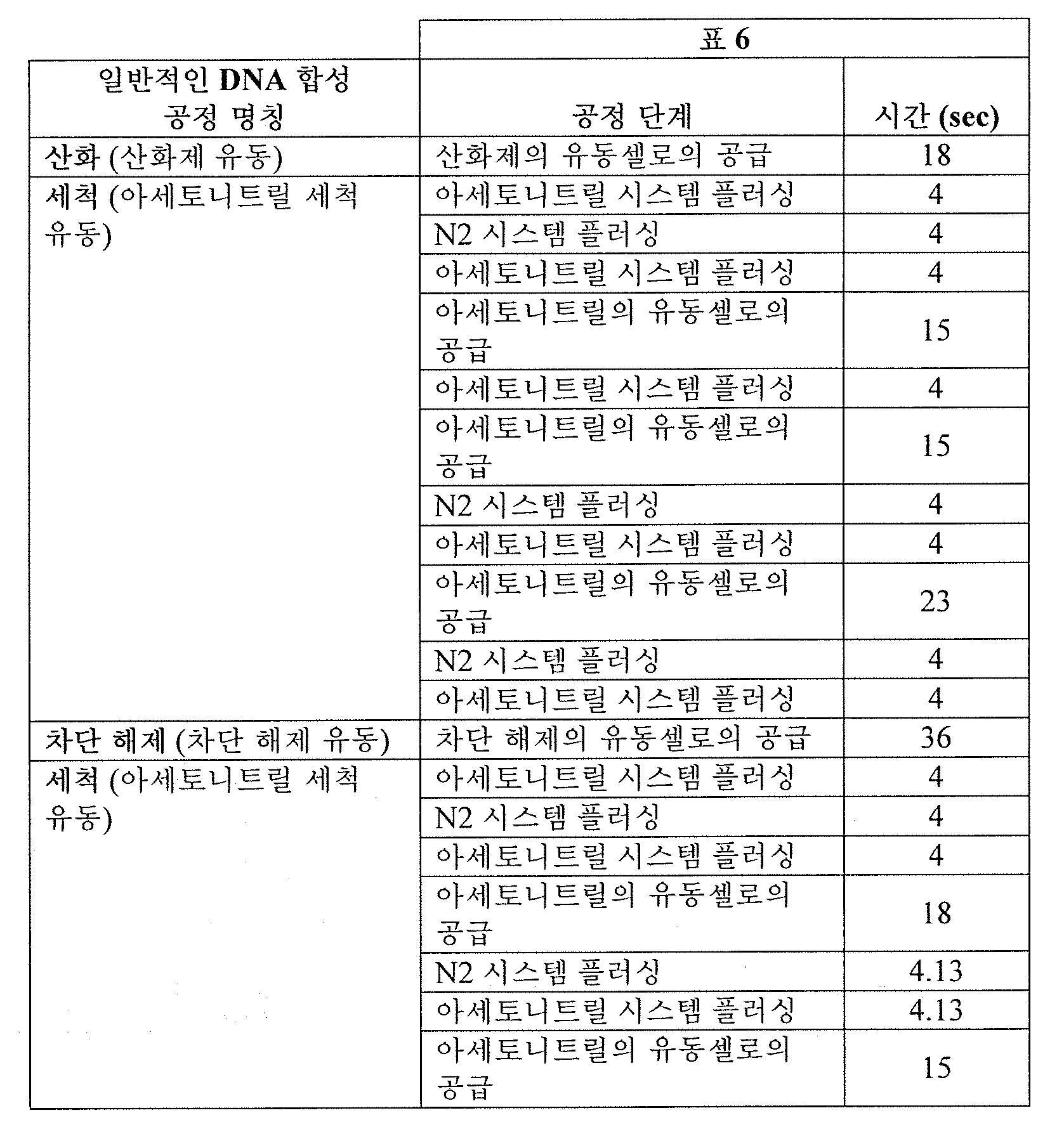
포스포르아미다이트/활성제 조합물을 유동셀을 통한 벌크 시약의 전달과 유사하게 전달하였다. 환경이 전체 시간 동안 시약에 의해 "습한" 상태로 유지되기 때문에 건조 단계를 수행하지 않았다.The phosphoramidite/activator combination was delivered similarly to the delivery of bulk reagents through the flow cell. No drying step was performed as the environment was kept "wet" by the reagents the entire time.
유동 제한제를 ABI 394 합성기로부터 제거하여, 보다 빠른 유동을 가능하게 하였다. 유동 제한제를 이용하지 않았을 때, 아미다이트(ACN 중의 0.1 M), 활성제(ACN 중의 0.25 M 벤조일티오테트라졸("BTT"; 글렌리서치(GlenResearch)로부터의 30-3070-xx) 및 Ox(20% 피리딘, 10% 물 및 70% THF 중의 0.02 M I2)에 대한 유속은 대략 ~100 ㎕/초이었고, 아세토니트릴("ACN") 및 캐핑 시약(CapA와 CapB의 1:1 혼합물, 여기서 CapA는 THF/피리딘 중의 아세트산 무수물이고, CapB는 THF 중의 16% 1-메틸이미디졸임)에 대한 유속은 대략 ~200 ㎕/초이었고, 차단 해제제(톨루엔 중의 3% 디클로로아세트산)에 대한 유속은 대략 ~300 ㎕/초이었다(유속 제한제를 사용하였을 때 모든 시약에 대한 ~50 ㎕/초의 유속과 비교됨). 산화제를 완전히 밀어내기 위한 시간을 관찰하였고, 이에 따라 화학적 유동 시간에 대한 타이밍을 조절하였고, 여분의 ACN 세척을 상이한 화합물들 사이에 수행하였다. 폴리뉴클레오티드 합성 후, 칩을 75 psi에서 암모니아 기체로 밤새 탈보호하였다. 5개의 물방울을 표면에 적용하여 핵산을 회수하였다. 이어서, 회수된 핵산을 바이오애널라이저 작은 RNA 칩 상에서 분석하였다(데이터는 표시되지 않음).The flow restrictor was removed from the ABI 394 synthesizer to allow faster flow. When no flow restricting agent was used, amidite (0.1 M in ACN), active agent (0.25 M benzoylthiotetrazole (“BTT”; 30-3070-xx from GlenResearch) in ACN) and Ox ( 0.02 M I2 in 20% pyridine, 10% water and 70% THF) was approximately -100 μl/sec, acetonitrile (“ACN”) and a capping reagent (a 1:1 mixture of CapA and CapB, where CapA is acetic anhydride in THF/pyridine, CapB is 16% 1-methylimidizole in THF) the flow rate was approximately ~200 μl/sec, and for the unblocker (3% dichloroacetic acid in toluene) the flow rate was approximately ~300 μl/sec (compared to a flow rate of ~50 μl/sec for all reagents when using a flow limiter.) The time to completely drive out the oxidizer was observed and the timing for the chemical flow time adjusted accordingly. , Extra ACN wash was carried out between different compounds.After polynucleotide synthesis, the chip was deprotected with ammonia gas at 75 psi overnight.Nucleic acid was recovered by applying 5 water droplets to the surface.Then, recovered nucleic acid was analyzed on a Bioanalyzer small RNA chip (data not shown).
실시예Example 3: 폴리뉴클레오티드 합성 3: polynucleotide synthesis 장치 상의on device 100-mer 서열의 합성 Synthesis of 100-mer sequences
50-mer 서열의 합성을 위한 실시예 2에서 설명된 공정과 동일한 공정을, 2개의 상이한 실리콘 칩(N-(3-트리에톡시실릴프로필)-4-히드록시부티르아미드로 균일하게 관능화된 제1 칩, 및 11-아세톡시운데실트리에톡시실란 및 n-데실트리에톡시실란의 5/95 혼합물로 관능화된 제2 칩) 상에서 다음과 같은 100-mer 폴리뉴클레오티드("100-mer 폴리뉴클레오티드"; 서열 번호 21)의 합성을 위해 사용하였고, 표면으로부터 추출된 핵산을 바이오애널라이저 기기 상에서 분석하였다(데이터는 표시되지 않음).The same process as described in Example 2 for the synthesis of the 50-mer sequence was followed by two different silicon chips, homogeneously functionalized with N-(3-triethoxysilylpropyl)-4-hydroxybutyramide. The following 100-mer polynucleotides ("100- mer polynucleotide"; SEQ ID NO: 21), and nucleic acids extracted from the surface were analyzed on a bioanalyzer instrument (data not shown).
5'CGGGATCCTTATCGTCATCGTCGTACAGATCCCGACCCATTTGCTGTCCACCAGTCATG5'CGGGATCCTTATCGTCATCGTCGTACAGATCCCGACCCATTTGCTGTCCACCAGTCATG
CTAGCCATACCATGATGATGATGATGATGAGAACCCCGCAT##TTTTTTTTTT3' CTAGCCATACCATGATGATGATGATGATGAGAACCCCGCAT##TTTTTTTTTT3'
여기서, #은 티미딘-숙시닐 헥사마이드 CED 포스포르아미다이트(켐진스로부터의 CLP-2244)를 나타낸다.Here, # represents thymidine-succinyl hexamide CED phosphoramidite (CLP-2244 from Chemjins).
50 ㎕ PCR 혼합물(25 ㎕ NEB Q5 마스터믹스, 2.5 ㎕ 10 μM 정방향 프라이머, 2.5 ㎕ 10 μM 역방향 프라이머, 표면으로부터 추출된 1 ㎕ 핵산, 및 50 ㎕까지 채우는 물) 중의 정방향 프라이머(5'ATGCGGGGTTCTCATCATC3'; 서열번호 22) 및 역방향 프라이머(5'CGGGATCCTTATCGTCATCG3'; 서열번호 23)를 사용하고 하기 열순환 프로그램을 이용하여 상기 2개의 칩으로부터의 10개의 모든 샘플을 PCR에 의해 추가로 증폭하였다:Forward primers (5'ATGCGGGGTTCTCATCATC3'; SEQ ID NO: 22) and reverse primer (5'CGGGATCCTTATCGTCATCG3'; SEQ ID NO: 23) and all 10 samples from the two chips were further amplified by PCR using the following thermocycling program:
98℃, 30초,98℃, 30 seconds,
98℃, 10초; 63℃, 10초; 72℃, 10초; 12주기 반복,98° C., 10 seconds; 63° C., 10 seconds; 72° C., 10 seconds; repeat 12 cycles,
72℃, 2분.72° C., 2 min.
또한, PCR 생성물을 바이오애널라이저 상에서 분석하여(데이터는 표시되지 않음), 100-mer 위치에서 날카로운 피크를 제시하였다. 이어서, PCR에 의해 증폭된 샘플을 클로닝하고, 생거 시퀀싱을 수행하였다. 표 7은 칩 1로부터의 스팟 1 내지 5로부터 채취된 샘플 및 칩 2로부터의 스팟 6 내지 10으로부터 채취된 샘플에 대한 생거 시퀀싱으로부터의 결과를 요약한 것이다.In addition, the PCR product was analyzed on a bioanalyzer (data not shown), showing a sharp peak at the 100-mer position. Samples amplified by PCR were then cloned and subjected to Sanger sequencing. Table 7 summarizes the results from Sanger sequencing for samples taken from spots 1-5 from chip 1 and spots 6-10 from chip 2.
표 7. 시퀀싱 결과Table 7. Sequencing results

따라서, 합성된 폴리뉴클레오티드의 고품질 및 균일성은 상이한 표면 화학을 갖는 2개의 칩 상에서 반복되었다. 종합적으로, 시퀀싱된 262개의 100-mer 중 233개에 상응하는 89%가 오류가 없는 완벽한 서열이었다.Thus, the high quality and uniformity of synthesized polynucleotides were replicated on two chips with different surface chemistries. Overall, 89% of the 262 100-mers sequenced, corresponding to 233, were perfect sequences without errors.
최종적으로, 표 8은 스팟 1-10으로부터의 폴리뉴클레오티드 샘플로부터 수득된 서열에 대한 오류 특징을 요약한 것이다.Finally, Table 8 summarizes the error characteristics for sequences obtained from polynucleotide samples from spots 1-10.
표 8. 오류 특징Table 8. Error Characteristics

실시예Example 4: 단일 부위, 단일 위치 돌연변이 유발에 의한 핵산 라이브러리의 생성 4: Generation of nucleic acid libraries by single site, single site mutagenesis
핵산 프라이머는 주형 핵산의 핵산 변이체의 라이브러리를 생성하기 위한 일련의 PCR 반응에서 사용하기 위해 디 노보 합성되었다(도 2a-2d 참조). 다음과 같은 4가지 유형의 프라이머가 도 2a에서 생성되었다: 외부 5' 프라이머(215), 외부 3' 프라이머(230), 내부 5' 프라이머(225) 및 내부 3' 프라이머(220). 내부 5' 프라이머/제1 핵산(220) 및 내부 3' 프라이머/제2 핵산(225)는 표 6에서 일반적으로 설명한 핵산 합성 방법을 사용하여 생성되었다. 내부 5' 프라이머/제1 핵산(220)은 미리 결정된 서열의 19개 이하의 프라이머의 세트를 나타내며, 세트 내의 각각의 프라이머는 서열의 단일 부위에서 단일 코돈에서 또 다른 프라이머와 상이하다.Nucleic acid primers were synthesized de novo for use in a series of PCR reactions to generate a library of nucleic acid variants of the template nucleic acid (see FIGS. 2A-2D ). Four types of primers were generated in FIG. 2A: external 5' primer (215), external 3' primer (230), internal 5' primer (225) and internal 3' primer (220). Internal 5' primer/first
핵산 합성은 적어도 2개의 클러스터를 갖는 장치에서 수행되었고, 각각의 클러스터는 121개의 개별적으로 주소 지정 가능한 로커스를 갖는다.Nucleic acid synthesis was performed in a device with at least two clusters, each cluster having 121 individually addressable loci.
내부 5' 프라이머(225) 및 내부 3' 프라이머(220)는 별개의 클러스터로 합성되었다. 내부 5' 프라이머(225)는 단일 클러스터 내의 121개 로커스 상에서 연장되어 121번 복제되었다. 내부 3' 프라이머(220)에 대해, 변이체 서열의 19개의 프라이머 각각은 6개의 상이한 로커스 상에서 각각 연장되어, 114개의 상이한 로커스 상에서 114개의 핵산이 연장되었다.Internal 5' primers (225) and internal 3' primers (220) were synthesized as separate clusters. The internal 5'
합성된 핵산을 장치의 표면으로부터 절단하고, 플라스틱 바이알에 옮겼다. 제1 PCR 반응은 도 2b에 도시된 바와 같이, 주형 핵산을 증폭하기 위해 긴 핵산 서열(235, 240)의 단편을 사용하여 수행하였다. 도 2c-2d에 도시된 바와 같이, 프라이머 조합물 및 주형으로서의 제1 PCR 반응 생성물을 사용하여 제2 PCR 반응을 수행하였다. 제2 PCR 산물의 분석은 도 17의 기록에 도시된 바와 같이, 바이오애널라이저에서 수행하였다.The synthesized nucleic acid was cut from the surface of the device and transferred to a plastic vial. A first PCR reaction was performed using fragments of the long
실시예Example 5: 단일 위치 5: single position 변이체의variant 96개의 상이한 세트를 포함하는 핵산 라이브러리의 생성 Generation of a nucleic acid library containing 96 different sets
도 2a에 일반적으로 도시되고 실시예 2에서 언급된 바와 같은 4세트의 프라이머를 디 노보 핵산 합성을 사용하여 생성하였다. 내부 5' 프라이머(220)에 대해, 96개의 상이한 프라이머가 생성되었고, 각각의 프라이머 세트는 주형 핵산의 단일 부위 내에 위치된 상이한 단일 코돈을 표적으로 한다. 각각의 프라이머 세트에 대해, 19개의 상이한 변이체가 생성되었고, 각각의 변이체는 단일 부위에서 상이한 아미노산을 코딩하는 코돈을 포함하였다. 도 2a-2d에 일반적으로 도시되고 실시예 2에서 설명된 바와 같이, 생성된 프라이머를 사용하여 2라운드의 PCR을 수행하였다. 증폭 산물의 96 세트를 전기영동도에서 가시화하였고(도 18), 이것은 100% 증폭 성공율을 계산하기 위해 사용되었다.Four sets of primers, shown generally in FIG. 2A and referenced in Example 2, were generated using de novo nucleic acid synthesis. For the internal 5'
실시예Example 6: 단일 위치 6: single position 변이체의variant 500개의 상이한 세트를 포함하는 핵산 라이브러리의 생성 Generation of nucleic acid libraries containing 500 different sets
도 2a에 일반적으로 도시되고 실시예 2에서 언급된 바와 같은 4세트의 프라이머를 디 노보 핵산 합성을 사용하여 생성하였다. 내부 5' 프라이머(220)에 대해, 500개의 상이한 프라이머가 생성되었고, 각각의 프라이머 세트는 주형 핵산의 단일 부위 내에 위치된 상이한 단일 코돈을 표적으로 한다. 각각의 프라이머 세트에 대해, 19개의 상이한 변이체가 생성되었고, 각각의 변이체는 단일 부위에서 상이한 아미노산을 코딩하는 코돈을 포함하였다. 도 2a에 일반적으로 도시되고 실시예 2에서 설명된 바와 같이, 생성된 프라이머를 사용하여 2라운드의 PCR을 수행하였다. 전기영동도는 상이한 단일 부위에서 19개의 변이체를 갖는 핵산 집단을 갖는 500세트의 PCR 생성물 각각을 보여준다(데이터는 표시되지 않음). 라이브러리의 포괄적인 시퀀싱 분석은 미리 선택된 코돈 돌연변이(서열 기록 및 분석 데이터는 표시되지 않음)에 걸쳐 99% 초과의 성공률을 보여주었다.Four sets of primers, shown generally in FIG. 2A and referenced in Example 2, were generated using de novo nucleic acid synthesis. For the internal 5'
실시예Example 7: 17:1 위치에 대한 단일 부위 돌연변이 유발 Single-site mutagenesis of a position 프라이머primer
코돈 변형 설계의 예는 황색 형광 단백질에 대해 표 9에 제시된다. 이 경우, 서열의 50-mer로부터의 단일 코돈은 19회 변이된다. 변이체 핵산 서열은 굵은 글자로 표시된다. 야생형 프라이머 서열은 다음과 같다:An example of codon modification design is shown in Table 9 for Yellow Fluorescent Protein. In this case, a single codon from the 50-mer of the sequence is mutated 19 times. Variant nucleic acid sequences are indicated in bold. The wild type primer sequence is as follows:
ATGGTGAGCAAGGGCGAGGAGCTGTTCACCGGGGTGGTGCCCAT(서열 번호 1). 이 경우, 야생형 코돈은 서열 번호 1에서 밑줄로 표시된 바와 같이 발린을 코딩한다. 따라서, 아래의 19개 변이체는 발린을 코딩하는 코돈을 배제한다. 대안적인 예로서, 모든 삼중체를 고려해야 한다면, 야생형 코돈에 대한 대안적인 서열을 포함하는 60개의 모든 변이체가 생성될 것이다.ATG GTG AGCAAGGGCGAGGAGCTGTTCACCGGGGTGGTGCCCAT (SEQ ID NO: 1). In this case, the wild-type codon encodes valine as underlined in SEQ ID NO:1. Thus, the 19 variants below exclude the codon encoding valine. As an alternative example, if all triplets were to be considered, all 60 variants containing alternative sequences to the wild-type codon would be generated.
표 9. 변이체 서열Table 9. Variant sequences

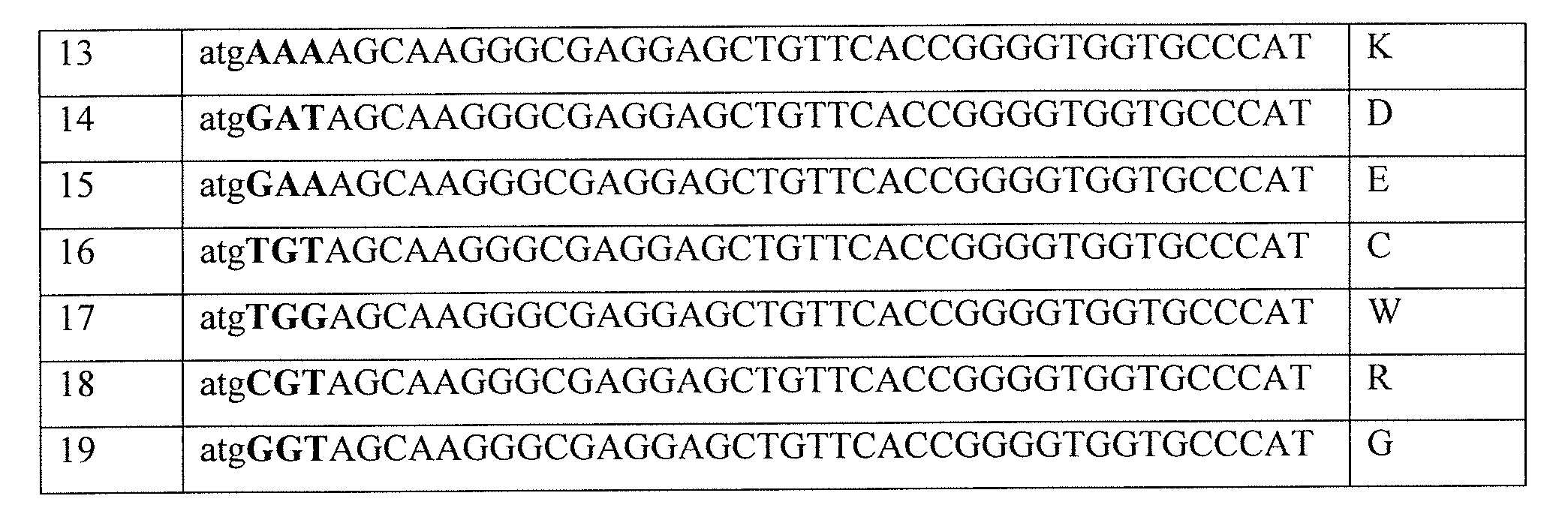
실시예Example 8: 단일 부위, 이중 위치 핵산 8: single site, dual site nucleic acid 변이체variant
디 노보 핵산 합성을 실시예 2에서 설명된 것과 유사한 조건 하에 수행하였다. 단일 부위에서 2개의 연속적인 코돈 위치에 대해 핵산의 합성된 미리 결정된 변이체를 함유하는 장치 상의 단일 클러스터가 생성되었고, 여기서 각각의 위치는 아미노산을 코딩하는 코돈이었다. 이 배열에서, 위치당 19개의 변이체가 2개의 위치에 대해 생성되었고, 각각의 핵산의 3개의 복제체가 생성되어 114개의 핵산이 합성되었다.De novo nucleic acid synthesis was performed under conditions similar to those described in Example 2. A single cluster on the device was created containing synthesized predetermined variants of nucleic acids for two consecutive codon positions at a single site, where each position was a codon encoding an amino acid. In this arrangement, 19 variants per position were generated for 2 positions, and 3 copies of each nucleic acid were generated, resulting in the synthesis of 114 nucleic acids.
실시예Example 9: 다중 부위, 이중 위치 핵산 9: multisite, dual position nucleic acid 변이체variant
디 노보 핵산 합성은 실시예 2에서 설명된 것과 유사한 조건 하에 수행되었다. 2개의 비연속적인 코돈 위치에 대해 핵산의 합성된 미리 결정된 변이체를 함유하는 장치 상의 단일 클러스터가 생성되었고, 여기서 각각의 위치는 아미노산을 코딩하는 코돈이었다. 이 배열에서, 위치당 19개의 변이체가 2개의 위치에 대해 생성되었다.De novo nucleic acid synthesis was performed under conditions similar to those described in Example 2. A single cluster on the device was created containing synthesized predetermined variants of nucleic acids for two non-contiguous codon positions, where each position was a codon encoding an amino acid. In this arrangement, 19 variants per position were generated for 2 positions.
실시예Example 10: 단일 스트레치, 삼중 위치 핵산 10: single stretch, triple position nucleic acid 변이체variant
디 노보 핵산 합성을 실시예 2에서 설명된 것과 유사한 조건 하에 수행하였다. 3개의 연속적인 코돈 위치에 대해 참조 핵산의 합성된 미리 결정된 변이체를 함유하는 장치 상의 단일 클러스터가 생성되었다. 3개의 연속적인 코돈 위치 배열에서, 위치당 19개의 변이체가 3개의 위치에 대해 생성되었고, 각각의 핵산의 2개의 복제체가 생성되어 114개의 핵산이 합성되었다.De novo nucleic acid synthesis was performed under conditions similar to those described in Example 2. A single cluster on the device was created containing synthesized predetermined variants of the reference nucleic acid for three consecutive codon positions. In an array of 3 contiguous codon positions, 19 variants per position were generated for 3 positions, and 2 copies of each nucleic acid were generated, resulting in the synthesis of 114 nucleic acids.
실시예Example 11: 다중 부위, 삼중 위치 핵산 11: multi-site, tri-locus nucleic acid 변이체variant
디 노보 핵산 합성은 실시예 2에서 설명된 것과 유사한 조건 하에 수행되었다. 적어도 3개의 비연속적인 코돈 위치에 대해 참조 핵산의 합성된 미리 결정된 변이체를 함유하는 장치 상의 단일 클러스터가 생성되었다. 미리 결정된 영역 내에서, 3개의 히스티딘 잔기를 코딩하는 코돈의 위치가 변이되었다.De novo nucleic acid synthesis was performed under conditions similar to those described in Example 2. A single cluster on the device was created containing synthesized predetermined variants of the reference nucleic acid for at least three non-contiguous codon positions. Within the predetermined region, the positions of the codons encoding the three histidine residues were shifted.
실시예Example 12: 다중 부위, 다중 위치 핵산 12 multi-site, multi-locus nucleic acid 변이체variant
디 노보 핵산 합성은 실시예 2에서 설명된 것과 유사한 조건 하에 수행되었다. 1개 이상의 스트레치 내의 1개 이상의 코돈 위치에 대한 참조 핵산의 합성된 미리 결정된 변이체를 함유하는 장치 상의 단일 클러스터가 생성되었다. 5개의 위치가 라이브러리에서 변이되었다. 제1 위치는 발현된 단백질에서 생성되는 50/50 K/R 비율의 코돈을 코딩하였고, 제2 위치는 발현된 단백질에서 생성되는 50/25/25 V/L/S 비율의 코돈을 코딩하였고, 제3 위치는 발현된 단백질에서 생성되는 50/25/25 Y/R/D 비율의 코돈을 코딩하였고, 제4 위치는 발현된 단백질에서 생성되는 모든 아미노산에 대해 동일한 비율의 코돈을 코딩하였고, 제5 위치는 발현된 단백질에서 생성되는 75/25 G/P 비율의 코돈을 코딩하였다.De novo nucleic acid synthesis was performed under conditions similar to those described in Example 2. A single cluster on the device was created containing synthesized predetermined variants of the reference nucleic acid for one or more codon positions within one or more stretches. Five positions were mutated in the library. The first position coded for codons with a 50/50 K/R ratio generated in the expressed protein, the second position coded for codons with a 50/25/25 V/L/S ratio generated in the expressed protein, Position 3 coded for codons in a 50/25/25 Y/R/D ratio occurring in the expressed protein, position 4 coded for codons in the same ratio for all amino acids occurring in the expressed protein, Position 5 coded for a codon with a 75/25 G/P ratio occurring in the expressed protein.
실시예Example 13: 다양한 펩티드를 발현하기 위한 모듈 플라스미드 성분 13: Modular plasmid components for expressing various peptides
폴리뉴클레오티드 라이브러리는 실시예 4-6 및 8-12에서와 같이 생성되며, 도 11에 도시된 바와 같이 발현 구축물 카세트의 일부분을 구성하는 각각의 별개의 영역에 대한 다중 부위 또는 단일 부위에서 코돈 변이를 코딩한다. 2개의 구축물 발현 카세트를 생성하기 위해, 제1 프로모터(1110), 제1 개방 판독 프레임(1120), 제1 종결인자(1130), 제2 프로모터(1140), 제2 개방 판독 프레임(1150) 또는 제2 종결인자 서열(1160)의 변이체 서열의 적어도 일부를 코딩하는 변이체 핵산이 합성되었다. 상기 실시예에서 기술된 바와 같은 증폭 라운드 후에, 1,024개의 발현 구축물의 라이브러리가 생성된다.Polynucleotide libraries are generated as in Examples 4-6 and 8-12, and codon mutations are performed at multiple sites or at single sites for each distinct region constituting part of the expression construct cassette, as shown in FIG. 11 . code To generate two construct expression cassettes, a
실시예Example 14: 다중 부위, 단일 위치 14: multi site, single site 변이체variant
핵산의 적어도 일부분을 코딩하는 영역에서의 다중 부위 또는 단일 부위에서 코돈 변이를 코딩하는 폴리뉴클레오티드 라이브러리는 실시예 4-6 및 8-12에서와 같이 생성된다. 핵산 변이체의 라이브러리가 생성되고, 여기서 라이브러리는 다중 부위, 단일 위치 변이체로 이루어진다. 예를 들어, 도 6b를 참조한다.Polynucleotide libraries encoding codon mutations at multiple sites or at a single site in a region encoding at least a portion of a nucleic acid are generated as in Examples 4-6 and 8-12. A library of nucleic acid variants is generated, wherein the library consists of multiple site, single site variants. For example, see FIG. 6B.
실시예Example 15: 15: 변이체variant 라이브러리 합성 library synthesis
디 노보 핵산 합성은 실시예 2에서 설명된 것과 유사한 조건 하에 수행된다. 적어도 30,000개의 동일하지 않은 핵산이 디 노보 합성되며, 각각의 동일하지 않은 핵산은 아미노산 서열의 상이한 코돈 변이체를 코딩한다. 합성된 적어도 30,000개의 동일하지 않은 핵산은 적어도 30,000개의 동일하지 않은 핵산의 각각에 대한 미리 결정된 서열과 비교하여 1:000 염기에서 1 미만의 총 오류율을 갖는다. 라이브러리는 긴 핵산의 PCR 돌연변이 유발에 사용되며, 적어도 30,000개의 동일하지 않은 변이체 핵산이 형성된다.De novo nucleic acid synthesis is performed under conditions similar to those described in Example 2. At least 30,000 non-identical nucleic acids are synthesized de novo, each non-identical nucleic acid encoding a different codon variant of an amino acid sequence. The synthesized at least 30,000 non-identical nucleic acids have an overall error rate of less than 1 in 1:000 bases compared to a predetermined sequence for each of the at least 30,000 non-identical nucleic acids. The library is used for PCR mutagenesis of long nucleic acids, resulting in the formation of at least 30,000 non-identical variant nucleic acids.
실시예Example 16: 클러스터 기반 16: cluster-based 변이체variant 라이브러리 합성 library synthesis
디 노보 핵산 합성은 실시예 2에서 설명된 것과 유사한 조건 하에 수행된다. 2개의 코돈 위치에 대한 참조 핵산의 합성된 미리 결정된 변이체를 함유하는 장치 상의 단일 클러스터가 생성된다. 2개의 연속적인 코돈 위치 배열에서, 위치당 19개의 변이체가 2개의 위치에 대해 생성되었고, 각각의 핵산의 2개의 복제체가 생성되어 38개의 핵산이 합성되었다. 각각의 변이체 서열은 길이가 40개 염기이다. 동일한 클러스터에서, 추가적인 비변이체 핵산 서열이 생성되며, 여기서 추가의 비변이체 핵산 및 변이체 핵산은 유전자의 코딩 서열의 38개 변이체를 집합적으로 코딩한다. 각각의 핵산은 핵산들 중 다른 하나에 역방향으로 상보적인 하나 이상의 영역을 갖는다. 클러스터 내의 핵산은 기상 암모니아 절단에 의해 방출된다. 물을 포함하는 핀은 클러스터와 접촉하고, 핵산을 집어들고, 핵산을 작은 바이알로 이동시킨다. 바이알에는 또한 폴리머라제 순환 조립(PCA) 반응을 위한 DNA 폴리머라제 시약이 들어 있다. 핵산은 어닐링되고, 갭은 연장 반응에 의해 채워지고, 생성되는 이중 가닥 DNA 분자가 형성되어 변이체 핵산 라이브러리를 형성한다. 변이체 핵산 라이브러리는 선택적으로 제한 효소에 의해 처리된 다음, 발현 벡터에 라이게이팅된다.De novo nucleic acid synthesis is performed under conditions similar to those described in Example 2. A single cluster on the device is created that contains synthesized predetermined variants of the reference nucleic acid for the two codon positions. In an arrangement of two contiguous codon positions, 19 variants per position were generated for two positions, and two copies of each nucleic acid were generated, resulting in the synthesis of 38 nucleic acids. Each variant sequence is 40 bases in length. In the same cluster, additional non-variant nucleic acid sequences are generated, wherein the additional non-variant nucleic acids and variant nucleic acids collectively encode 38 variants of the gene's coding sequence. Each nucleic acid has one or more regions that are reverse complementary to another one of the nucleic acids. Nucleic acids within the cluster are released by gas phase ammonia cleavage. A pin containing water contacts the cluster, picks up the nucleic acid, and transfers the nucleic acid into a small vial. The vial also contains DNA polymerase reagent for the polymerase cycle assembly (PCA) reaction. The nucleic acids are annealed, the gaps are filled by an extension reaction, and the resulting double-stranded DNA molecules are formed to form a library of variant nucleic acids. The variant nucleic acid library is optionally treated with restriction enzymes and then ligated into an expression vector.
실시예Example 17: 17: 변이체variant 핵산 nucleic acid TCRTCR 라이브러리의 생성 library creation
다음 단계는 108의 다양성으로 TCR 라이브러리를 생성하기 위해 수행된다. 말초 혈액 단핵 세포는 10명의 인간 공여자로부터 수득하고, T 세포를 단리한다. 10명의 모든 대상체는 일치하는 대립 유전자, 예컨대 HLA-A*2:01을 갖도록 HLA 매핑된다. 10명의 인간 공여자 대상체 중, 7명은 건강한 공여자이고, 3명은 암이 있는 공여자이다. TCR 복합체에 관여하는 유전자는 각각의 공여자의 T 세포로부터 시퀀싱되며, 1000개의 가장 공통적인 TCR 서열이 확인된다. 각각의 공통적인 TCR 서열은 600-900개 염기쌍의 스팬을 가질 것이다.The following steps are performed to generate a TCR library with a diversity of 10 8 . Peripheral blood mononuclear cells were obtained from 10 human donors and T cells were isolated. All 10 subjects are HLA mapped to have a matching allele, such as HLA-A * 2:01. Of the 10 human donor subjects, 7 are healthy donors and 3 are cancerous donors. Genes involved in the TCR complex are sequenced from T cells of each donor, and the 1000 most common TCR sequences are identified. Each consensus TCR sequence will have a span of 600-900 base pairs.
1000개의 가장 공통적인 TCR 서열의 각각에 대해 10,000개의 미리 결정된 변이체 핵산 서열이 설계되어, 적어도 108의 총 다양성으로 DNA 라이브러리를 생성한다. 각각의 변이체 서열은 유전자 발현을 위한 포유동물 발현 벡터에 삽입된다.For each of the 1000 most common TCR sequences, 10,000 predetermined variant nucleic acid sequences are designed, resulting in a DNA library with a total diversity of at least 10 8 . Each variant sequence is inserted into a mammalian expression vector for gene expression.
실시예Example 18: 18: 변이체variant TCRTCR 단백질 복합체 라이브러리의 발현 및 스크리닝 Expression and screening of protein complex libraries
변이체 TCR 유전자의 라이브러리는 각각의 세포 집단이 상이한 TCR 변이체 단백질을 발현하는 세포 집단의 라이브러리를 생성하기 위해 포유동물 세포로 전달된다. 단백질 라이브러리는 MAGE A3 또는 NY-ESO-1과 같은 종양 항원에 대해 개선된 친화성(에피토프와 항체의 항원 결합 부위 사이의 상호작용 강도의 척도)을 갖는 TCR 복합체에 대해 스크리닝된다. 변이체 유전자 발현, 결합력(항체-항원 복합체의 전체 강도의 척도), 안정성 및 표적 특이성과 같은 추가의 기능적 고려 사항이 또한 평가된다.The library of variant TCR genes is transferred into mammalian cells to create a library of cell populations in which each cell population expresses a different TCR variant protein. Protein libraries are screened for TCR complexes with improved affinity (a measure of the strength of interaction between an epitope and the antigen binding site of an antibody) for a tumor antigen such as MAGE A3 or NY-ESO-1. Additional functional considerations such as variant gene expression, avidity (a measure of the overall strength of the antibody-antigen complex), stability and target specificity are also evaluated.
실시예Example 19: 조작된 T 세포의 제조 및 전달 19: Preparation and delivery of engineered T cells
T 세포는 암으로 진단된 대상체로부터 수집하고, 실시예 18에서 분석을 수행 한 후에 선택된 새로운 T 세포 수용체(TCR)로 유전적으로 조작된다. 단기간의 시험 관내 확장 및 제품별 방출 기준의 통과 후, T 세포 제품은 동일한 대상체에게 투여된다. 도 10c를 참조한다.T cells are collected from subjects diagnosed with cancer and genetically engineered with a new T cell receptor (TCR) selected after performing the assay in Example 18. After a short period of in vitro expansion and passing product-specific release criteria, the T cell product is administered to the same subject. See FIG. 10C.
실시예Example 20: 20: 변이체variant TCRTCR 라이브러리 library
디 노보 핵산 합성은 변이체 TCR을 코딩하는 핵산을 생성하기 위해 실시예 2에서 설명된 것과 유사한 조건 하에 수행된다. 변이체 TCR은 TCR과 종양 항원, 예컨대 MAGE A3 또는 NY-ESO-1 사이의 항원 결합 계면에서의 변이체를 포함한다. 변이체는 30개까지의 잔기에 대한 변이체 TCR 라이브러리에 걸쳐 단일 부위에서 생성되어, 약 109의 총 다양성으로 제1 라이브러리를 생성한다. 변이에 대한 잔기는 TCR 알파 사슬 및 TCR 베타 사슬의 가변 도메인에 있다.De novo nucleic acid synthesis is performed under conditions similar to those described in Example 2 to generate nucleic acids encoding variant TCRs. Variant TCRs include variants at the antigen binding interface between a TCR and a tumor antigen such as MAGE A3 or NY-ESO-1. Variants are generated at a single site across the variant TCR library for up to 30 residues, resulting in a first library with a total diversity of about 10 9 . Residues for variation are in the variable domains of the TCR alpha chain and the TCR beta chain.
이어서, 변이체 TCR을 포함하는 제1 라이브러리는 T 세포에서 발현된다. 변이체 TCR은 종양 항원에 대한 변이체 TCR의 특이성에 대해서 종양 항원에 대해 시험관 내에서 스크리닝된다. 종양 항원에 대해 고도로 특이적인 변이체 TCR은 이어서 추가로 다양화되어 제2 라이브러리를 생성한다. 제2 라이브러리는 TCR 알파 사슬 및 TCR 베타 사슬의 불변 도메인에 위치하는 잔기의 변이를 포함한다. 제2 라이브러리는 T 세포에서 발현되고, 제2 개선, 예를 들어 결합력, 안정성, 친화성 또는 발현에 대해 시험관 내에서 스크리닝된다.The first library containing the variant TCRs is then expressed in T cells. The variant TCR is screened in vitro against a tumor antigen for specificity of the variant TCR for the tumor antigen. The variant TCRs highly specific for the tumor antigen are then further diversified to create a second library. The second library contains variations of residues located in the constant domains of the TCR alpha chain and the TCR beta chain. The second library is expressed in T cells and screened in vitro for a second improvement, eg, avidity, stability, affinity or expression.
제1 및/또는 제2 변이체 라이브러리로부터의 생성물을 스크리닝한 후, 원하는 특징을 갖는 TCR 유전자 또는 유전자 단편 변이체는 선택적으로 단백질을 T 세포에 고정하는 영역이 결여된 가용성 TCR 단백질 형태로, 또는 암을 앓고 있는 대상체에서 암세포를 표적화하기 위해 T 세포(대상체 또는 HLA 일치 공여자로부터의)의 재프로그래밍을 수반하는 면역 요법의 일부로서 조작된 T 세포에서의 발현을 위한 유전자의 형태로 잠재적인 치료제를 개발하기 위해 선택된다.After screening products from the first and/or second library of variants, variants of the TCR gene or gene segment having the desired characteristics are selected, optionally in the form of soluble TCR proteins lacking the regions that anchor the proteins to T cells, or cancer. To develop potential therapeutics in the form of genes for expression in engineered T cells as part of immunotherapy involving reprogramming of T cells (either from the subject or from HLA matched donors) to target cancer cells in afflicted subjects. is chosen for
본 개시내용의 바람직한 실시양태가 본원에서 제시되고 설명되어 있지만, 이러한 실시양태는 단지 예로서 제공된다는 것이 관련 기술 분야의 통상의 기술자에게 자명할 것이다. 본 개시내용을 벗어나지 않으면서 다수의 변경, 변화 및 치환이 관련 기술 분야의 통상의 기술자에게 인식될 것이다. 본원에서 설명되는 개시내용의 실시양태에 대한 다양한 대안이 본 개시내용을 실시할 때 사용될 수 있다는 것을 이해하여 한다. 하기 청구범위는 본 개시내용의 범위를 정의하고 이들 청구범위 내의 방법 및 구조, 및 이들의 균등물은 이에 의해 커버되는 것으로 의도된다.Although preferred embodiments of the present disclosure have been shown and described herein, it will be apparent to those skilled in the art that these embodiments are provided by way of example only. Numerous alterations, changes and substitutions will be recognized by those skilled in the art without departing from this disclosure. It is to be understood that various alternatives to the embodiments of the disclosure described herein may be used in practicing the disclosure. It is intended that the following claims define the scope of the disclosure and that methods and structures within the scope of these claims and equivalents thereof be covered thereby.
SEQUENCE LISTING <110> TWIST BIOSCIENCE CORPORATION <120> VARIANT LIBRARIES OF THE IMMUNOLOGICAL SYNAPSE AND SYNTHESIS THEREOF <130> 44854-731.601 <140> PCT/US2017/066847 <141> 2017-12-15 <150> 62/435,650 <151> 2016-12-16 <160> 50 <170> PatentIn version 3.5 <210> 1 <211> 44 <212> DNA <213> Artificial Sequence <220> <223> Description of Artificial Sequence: Synthetic oligonucleotide <400> 1 atggtgagca agggcgagga gctgttcacc ggggtggtgc ccat 44 <210> 2 <211> 44 <212> DNA <213> Artificial Sequence <220> <223> Description of Artificial Sequence: Synthetic oligonucleotide <400> 2 atgtttagca agggcgagga gctgttcacc ggggtggtgc ccat 44 <210> 3 <211> 44 <212> DNA <213> Artificial Sequence <220> <223> Description of Artificial Sequence: Synthetic oligonucleotide <400> 3 atgttaagca agggcgagga gctgttcacc ggggtggtgc ccat 44 <210> 4 <211> 44 <212> DNA <213> Artificial Sequence <220> <223> Description of Artificial Sequence: Synthetic oligonucleotide <400> 4 atgattagca agggcgagga gctgttcacc ggggtggtgc ccat 44 <210> 5 <211> 44 <212> DNA <213> Artificial Sequence <220> <223> Description of Artificial Sequence: Synthetic oligonucleotide <400> 5 atgtctagca agggcgagga gctgttcacc ggggtggtgc ccat 44 <210> 6 <211> 44 <212> DNA <213> Artificial Sequence <220> <223> Description of Artificial Sequence: Synthetic oligonucleotide <400> 6 atgcctagca agggcgagga gctgttcacc ggggtggtgc ccat 44 <210> 7 <211> 44 <212> DNA <213> Artificial Sequence <220> <223> Description of Artificial Sequence: Synthetic oligonucleotide <400> 7 atgactagca agggcgagga gctgttcacc ggggtggtgc ccat 44 <210> 8 <211> 44 <212> DNA <213> Artificial Sequence <220> <223> Description of Artificial Sequence: Synthetic oligonucleotide <400> 8 atggctagca agggcgagga gctgttcacc ggggtggtgc ccat 44 <210> 9 <211> 44 <212> DNA <213> Artificial Sequence <220> <223> Description of Artificial Sequence: Synthetic oligonucleotide <400> 9 atgtatagca agggcgagga gctgttcacc ggggtggtgc ccat 44 <210> 10 <211> 44 <212> DNA <213> Artificial Sequence <220> <223> Description of Artificial Sequence: Synthetic oligonucleotide <400> 10 atgcatagca agggcgagga gctgttcacc ggggtggtgc ccat 44 <210> 11 <211> 44 <212> DNA <213> Artificial Sequence <220> <223> Description of Artificial Sequence: Synthetic oligonucleotide <400> 11 atgcaaagca agggcgagga gctgttcacc ggggtggtgc ccat 44 <210> 12 <211> 44 <212> DNA <213> Artificial Sequence <220> <223> Description of Artificial Sequence: Synthetic oligonucleotide <400> 12 atgaatagca agggcgagga gctgttcacc ggggtggtgc ccat 44 <210> 13 <211> 44 <212> DNA <213> Artificial Sequence <220> <223> Description of Artificial Sequence: Synthetic oligonucleotide <400> 13 atgaaaagca agggcgagga gctgttcacc ggggtggtgc ccat 44 <210> 14 <211> 44 <212> DNA <213> Artificial Sequence <220> <223> Description of Artificial Sequence: Synthetic oligonucleotide <400> 14 atggatagca agggcgagga gctgttcacc ggggtggtgc ccat 44 <210> 15 <211> 44 <212> DNA <213> Artificial Sequence <220> <223> Description of Artificial Sequence: Synthetic oligonucleotide <400> 15 atggaaagca agggcgagga gctgttcacc ggggtggtgc ccat 44 <210> 16 <211> 44 <212> DNA <213> Artificial Sequence <220> <223> Description of Artificial Sequence: Synthetic oligonucleotide <400> 16 atgtgtagca agggcgagga gctgttcacc ggggtggtgc ccat 44 <210> 17 <211> 44 <212> DNA <213> Artificial Sequence <220> <223> Description of Artificial Sequence: Synthetic oligonucleotide <400> 17 atgtggagca agggcgagga gctgttcacc ggggtggtgc ccat 44 <210> 18 <211> 44 <212> DNA <213> Artificial Sequence <220> <223> Description of Artificial Sequence: Synthetic oligonucleotide <400> 18 atgcgtagca agggcgagga gctgttcacc ggggtggtgc ccat 44 <210> 19 <211> 44 <212> DNA <213> Artificial Sequence <220> <223> Description of Artificial Sequence: Synthetic oligonucleotide <400> 19 atgggtagca agggcgagga gctgttcacc ggggtggtgc ccat 44 <210> 20 <211> 62 <212> DNA <213> Artificial Sequence <220> <223> Description of Artificial Sequence: Synthetic oligonucleotide <400> 20 agacaatcaa ccatttgggg tggacagcct tgacctctag acttcggcat tttttttttt 60 tt 62 <210> 21 <211> 112 <212> DNA <213> Artificial Sequence <220> <223> Description of Artificial Sequence: Synthetic polynucleotide <400> 21 cgggatcctt atcgtcatcg tcgtacagat cccgacccat ttgctgtcca ccagtcatgc 60 tagccatacc atgatgatga tgatgatgag aaccccgcat tttttttttt tt 112 <210> 22 <211> 19 <212> DNA <213> Artificial Sequence <220> <223> Description of Artificial Sequence: Synthetic primer <400> 22 atgcggggtt ctcatcatc 19 <210> 23 <211> 20 <212> DNA <213> Artificial Sequence <220> <223> Description of Artificial Sequence: Synthetic primer <400> 23 cgggatcctt atcgtcatcg 20 <210> 24 <211> 7 <212> PRT <213> Artificial Sequence <220> <223> Description of Artificial Sequence: Synthetic peptide <400> 24 Ala Trp Ile Lys Arg Glu Gln 1 5 <210> 25 <211> 7 <212> PRT <213> Artificial Sequence <220> <223> Description of Artificial Sequence: Synthetic peptide <220> <221> MOD_RES <222> (1)..(1) <223> Any amino acid <400> 25 Xaa Trp Ile Lys Arg Glu Gln 1 5 <210> 26 <211> 7 <212> PRT <213> Artificial Sequence <220> <223> Description of Artificial Sequence: Synthetic peptide <220> <221> MOD_RES <222> (2)..(2) <223> Any amino acid <400> 26 Ala Xaa Ile Lys Arg Glu Gln 1 5 <210> 27 <211> 7 <212> PRT <213> Artificial Sequence <220> <223> Description of Artificial Sequence: Synthetic peptide <220> <221> MOD_RES <222> (3)..(3) <223> Any amino acid <400> 27 Ala Trp Xaa Lys Arg Glu Gln 1 5 <210> 28 <211> 7 <212> PRT <213> Artificial Sequence <220> <223> Description of Artificial Sequence: Synthetic peptide <220> <221> MOD_RES <222> (4)..(4) <223> Any amino acid <400> 28 Ala Trp Ile Xaa Arg Glu Gln 1 5 <210> 29 <211> 7 <212> PRT <213> Artificial Sequence <220> <223> Description of Artificial Sequence: Synthetic peptide <220> <221> MOD_RES <222> (5)..(5) <223> Any amino acid <400> 29 Ala Trp Ile Lys Xaa Glu Gln 1 5 <210> 30 <211> 7 <212> PRT <213> Artificial Sequence <220> <223> Description of Artificial Sequence: Synthetic peptide <220> <221> MOD_RES <222> (6)..(6) <223> Any amino acid <400> 30 Ala Trp Ile Lys Arg Xaa Gln 1 5 <210> 31 <211> 7 <212> PRT <213> Artificial Sequence <220> <223> Description of Artificial Sequence: Synthetic peptide <220> <221> MOD_RES <222> (7)..(7) <223> Any amino acid <400> 31 Ala Trp Ile Lys Arg Glu Xaa 1 5 <210> 32 <211> 664 <212> DNA <213> Homo sapiens <400> 32 atgtggggag ctttccttct ctatgtttcc atgaagatgg gaggtgagtc tcaatctaat 60 agtaaatgct gctaggaatt ttcaaaacaa tttcctttca gctaaattat tgcaaatttt 120 gacatttgta atgagagtat ttcctgaata tgcattttcc taacgtggtg ctaattgtcc 180 tcctgttact attgctgctg ctgttactgc aaccatttat ttcagtctaa gaaattctcc 240 catcaatggc agttcttttg tgaccacatg gaagcatcat ttaaaaaatt attccaatag 300 tttttggagg aaacatcatt tttaataatg atggggcttc tgggggtgct gccctagtaa 360 caatcatgta tcttgtcata ggcactgcag gacaaagcct tgagcagccc tctgaagtga 420 cagctgtgga aggagccatt gtccagataa actgcacgta ccagacatct gggttttatg 480 ggctgtcctg gtaccagcaa catgatggcg gagcacccac atttctttct tacaatgctc 540 tggatggttt ggaggagaca ggtcgttttt cttcattcct tagtcgctct gatagttatg 600 gttacctcct tctacaggag ctccagatga aagactctgc ctcttacttc tgcgctgtga 660 gaga 664 <210> 33 <211> 764 <212> DNA <213> Homo sapiens <400> 33 atgaggcaag tggcgagagt gatcgtgttc ctgaccctga gtgagttatt ttgggatgaa 60 gaggaatggg atctgggcct gatgatgctg gaaaggaatc tggaactttg cctgctagca 120 gttgctcttt atccaagatg tagagggata gcttcagggt tccatttttc tccaggcagc 180 tcctgagcat ttatgtgaga tgtgtctcag ggcagcaaag attttcgggg tttctaatcc 240 ctagggtcta tccatgggag ggagatagta aacctgacac ttctgtgtat gcctgggata 300 aatatttttg tactgaaaca taaatgagaa gtaaattgta tgtacatgta tatggcaggg 360 aagtagagcg tggggatgga tttgactgtg agagggaacc gtggggctac tgagtgggac 420 cgtctaactt accttgcttt caggataggg gctaggattg tgttttactc ccataggtac 480 tttgagcctt gctaagacca cccagcccat ctccatggac tcatatgaag gacaagaagt 540 gaacataacc tgtagccaca acaacattgc tacaaatgat tatatcacgt ggtaccaaca 600 gtttcccagc caaggaccac gatttattat tcaaggatac aagacaaaag ttacaaacga 660 agtggcctcc ctgtttatcc ctgccgacag aaagtccagc actctgagcc tgccccgggt 720 ttccctgagc gacactgctg tgtactactg cctcgtgggt gaca 764 <210> 34 <211> 468 <212> DNA <213> Homo sapiens <400> 34 atgctcctgt tgctcatacc agtgctgggg atgatttttg ccctgagtga gtaacattct 60 attatggtct ctagttccac agaagtaact gttttctgat tcaaatctta gtagaaatac 120 ttttcataga caagtctgca ctattttcac tgatacaaca ttgatttttt caggagatgc 180 cagagcccag tctgtgagcc agcataacca ccacgtaatt ctctctgaag cagcctcact 240 ggagttggga tgcaactatt cctatggtgg aactgttaat ctcttctggt atgtccagta 300 ccctggtcaa caccttcagc ttctcctcaa gtacttttca ggggatccac tggttaaagg 360 catcaagggc tttgaggctg aatttataaa gagtaaattc tcctttaatc tgaggaaacc 420 ctctgtgcag tggagtgaca cagctgagta cttctgtgcc gtgaatgc 468 <210> 35 <211> 435 <212> DNA <213> Homo sapiens <400> 35 atggatacct ggctcgtatg ctgggcaatt tttagtctct tgaaagcagg tcgatgctta 60 gactctagga aattcttgct ttgaacttac ctaagacaat tctaaaccat tctcttaatc 120 ttcttctttt ctcacaggac tcacagaacc tgaagtcacc cagactccca gccatcaggt 180 cacacagatg ggacaggaag tgatcttgcg ctgtgtcccc atctctaatc acttatactt 240 ctattggtac agacaaatct tggggcagaa agtcgagttt ctggtttcct tttataataa 300 tgaaatctca gagaagtctg aaatattcga tgatcaattc tcagttgaaa ggcctgatgg 360 atcaaatttc actctgaaga tccggtccac aaagctggag gactcagcca tgtacttctg 420 tgccagcagt gaagc 435 <210> 36 <211> 460 <212> DNA <213> Homo sapiens <400> 36 atgggctgca ggctcctctg ctgtgtggtc ttctgcctcc tccaagcagg tgagtcccgg 60 gcccaggtga catgatccta ttggagtccc taagcctttt caccatgaca acaacagcag 120 gccgtctcct aggatttgcc tgaattctgc ttctttcctt tgcaggtccc ttggacacag 180 ctgtttccca gactccaaaa tacctggtca cacagatggg aaacgacaag tccattaaat 240 gtgaacaaaa tctgggccat gatactatgt attggtataa acaggactct aagaaatttc 300 tgaagataat gtttagctac aataataagg agctcattat aaatgaaaca gttccaaatc 360 gcttctcacc taaatctcca gacaaagctc acttaaatct tcacatcaat tccctggagc 420 ttggtgactc tgctgtgtat ttctgtgcca gcagccaaga 460 <210> 37 <211> 475 <212> DNA <213> Homo sapiens <400> 37 atgggcttca ggctcctctg ctgtgtggcc ttttgtctcc tgggagcagg tgagtcctgg 60 gcacaacttg aaagtctccg atcttcattt cttgtccctg aaatgcatgt gggccaacga 120 tggcttcagc aggaggcttt cttctgtgcc ttatggttaa cttttgtctt ctgacacaca 180 ggcccagtgg attctggagt cacacaaacc ccaaagcacc tgatcacagc aactggacag 240 cgagtgacgc tgagatgctc ccctaggtct ggagacctct ctgtgtactg gtaccaacag 300 agcctggacc agggcctcca gttcctcatt cagtattata atggagaaga gagagcaaaa 360 ggaaacattc ttgaacgatt ctccgcacaa cagttccctg acttgcactc tgaactaaac 420 ctgagctctc tggagctggg ggactcagct ttgtatttct gtgccagcag cgtag 475 <210> 38 <211> 469 <212> DNA <213> Homo sapiens <400> 38 atgggtcctg ggcttctcca ctggatggcc ctttgtctcc ttggaacagg tgagtactgg 60 gcagaaagga aatctttgag caaagctatc ttgtcctcag tctgcacctt tcattcacag 120 cagtaacact gttctcctta actctgactc caaatttgtc ttctttctct acaggtcatg 180 gggatgccat ggtcatccag aacccaagat accaggttac ccagtttgga aagccagtga 240 ccctgagttg ttctcagact ttgaaccata acgtcatgta ctggtaccag cagaagtcaa 300 gtcaggcccc aaagctgctg ttccactact atgacaaaga ttttaacaat gaagcagaca 360 cccctgataa cttccaatcc aggaggccga acacttcttt ctgctttctt gacatccgct 420 caccaggcct gggggacaca gccatgtacc tgtgtgccac cagcagaga 469 <210> 39 <211> 396 <212> DNA <213> Homo sapiens <400> 39 atgtggggag ctttccttct ctatgtttcc atgaagatgg gaggcactgc aggacaaagc 60 cttgagcagc cctctgaagt gacagctgtg gaaggagcca ttgtccagat aaactgcacg 120 taccagacat ctgggtttta tgggctgtcc tggtaccagc aacatgatgg cggagcaccc 180 acatttcttt cttacaatgg tctggatggt ttggaggaga caggtcgttt ttcttcattc 240 cttagtcgct ctgatagtta tggttacctc cttctacagg agctccagat gaaagactct 300 gcctcttact tctgcgctgt ttttaaccag gcaggaactg ctctgatctt tgggaaggga 360 accaccttat cagtgagttc caatatccag aaccct 396 <210> 40 <211> 407 <212> DNA <213> Homo sapiens <400> 40 atgctcctgt tgctcatacc agtgctgggg atgatttttg ccctgagaga tgccagagcc 60 cagtctgtga gccagcataa ccaccacgta attctctctg aagcagcctc actggagttg 120 ggatgcaact attcctatgg tggaactgtt aatctcttct ggtatgtcca gtaccctggt 180 caacaccttc agcttctcct caagtacttt tcaggggatc cactggttaa aggcatcaag 240 ggctttgagg ctgaatttat aaagagtaaa ttctccttta atctgaggaa accctctgtg 300 cagtggagtg acacagctga gtacttctgt gccgtgaatg aatacgacta caagctcagc 360 tttggagccg gaaccacagt aactgtaaga gcaaatatcc agaaccc 407 <210> 41 <211> 417 <212> DNA <213> Homo sapiens <400> 41 atgacatcca ttcgagctgt atttatattc ctgtggctgc agctggactt ggtgaatgga 60 gagaatgtgg agcagcatcc ttcaaccctg agtgtccagg agggagacag cgctgttatc 120 aagtgtactt attcagacag tgcctcaaac tacttccctt ggtataagca agaacttgga 180 aaaagacctc agcttattat agacattcgt tcaaatgtgg gcgaaaagaa agaccaacga 240 attgctgtta cattgaacaa gacagccaaa catttctccc tgcacatcac agagacccaa 300 cctgaagact cggctgtcta cttctgtgca gcaaagcgca aggcctctag caacacaggc 360 aaactaatct ttgggcaagg gacaacttta caagtaaaac cagatatcca gaaccct 417 <210> 42 <211> 285 <212> DNA <213> Homo sapiens <400> 42 gaacctgaag tcacccagac tcccagccat caggtcacac agatgggaca ggaagtgatc 60 ttgcactgtg tccccatctc taatcactta tacttctatt ggtacagaca aatcttgggg 120 cagaaagtcg agtttctggt ttccttttat aataatgaaa tctcagagaa gtctgaaata 180 ttcgatgatc aattctcagt tgaaaggcct gatggatcaa atttcactct gaagatccgg 240 tccacaaagc tggaggactc agccatgtac ttctgtgcca gcagt 285 <210> 43 <211> 336 <212> DNA <213> Homo sapiens <400> 43 atgggcttca ggctcctctg ctgcgtcgcc ttctgcctcc tccaagcagg tcccttggac 60 acagctgttt cccagactcc aaaatacctg gtcacacaga tgggaaacga caagtccatt 120 aaatgtgaac aaaatctggg ccatgatact atgtattggt ataaacagga ctctaagaaa 180 tttctgaaga taatgtttag ctacaataac aaggagatca ttataaatga aacagttcca 240 aatcgattct cacctaaatc tccagacaaa gctaaattaa atcttcacat caattccctg 300 gagcttggtg actctgctgt gtatttctgt gccagc 336 <210> 44 <211> 416 <212> DNA <213> Homo sapiens <400> 44 accccgacct ctcaacccag gaatcagagc ctgagacaga cagatgcttc attcctgtat 60 ggggtggtat tcctgccatg ggtcctgggc ttctccactg gatggccctt tgtctccttg 120 gaacaggtca tggggatgcc atggtcatcc agaacccaag ataccgggtt acccagtttg 180 gaaagccagt gaccctgagt tgttctcaga ctttgaacca taacgtcatg tactggtacc 240 agcagaagtc aagtcaggcc ccaaagctgc tgttccacta ctataacaaa gattttaaca 300 atgaagcaga cacccctgat aacttccaat ccaggaggcc gaacacttct ttctgctttc 360 tagacatccg ctcaccaggc ctgggggacg cagccatgta ccagtgtgcc accagc 416 <210> 45 <211> 9 <212> PRT <213> Homo sapiens <400> 45 Lys Val Ala Glu Leu Val His Phe Leu 1 5 <210> 46 <211> 9 <212> PRT <213> Homo sapiens <400> 46 Lys Met Ala Glu Leu Val His Phe Leu 1 5 <210> 47 <211> 9 <212> PRT <213> Homo sapiens <400> 47 Lys Met Val Glu Leu Val His Phe Leu 1 5 <210> 48 <211> 9 <212> PRT <213> Homo sapiens <400> 48 Lys Val Ala Lys Leu Val His Phe Leu 1 5 <210> 49 <211> 9 <212> PRT <213> Homo sapiens <400> 49 Ser Leu Leu Met Trp Ile Thr Gln Val 1 5 <210> 50 <211> 9 <212> PRT <213> Homo sapiens <400> 50 Ile Met Ile Gly Val Leu Val Gly Val 1 5 SEQUENCE LISTING <110> TWIST BIOSCIENCE CORPORATION <120> VARIANT LIBRARIES OF THE IMMUNOLOGICAL SYNAPSE AND SYNTHESIS THEREOF <130> 44854-731.601 <140> PCT/US2017/066847 <141> 2017-12-15 <150> 62/435,650 > 2016-12-16 <160> 50 <170> PatentIn version 3.5 <210> 1 <211> 44 <212> DNA <213> Artificial Sequence <220> <223> Description of Artificial Sequence: Synthetic oligonucleotide <400> 1 atggtgagca agggcgagga gctgttcacc ggggtggtgc ccat 44 <210> 2 <211> 44 <212> DNA <213> Artificial Sequence <220> <223> Description of Artificial Sequence: Synthetic oligonucleotide <400> 2 atgtttagca agggcgagga gctgttcacc ggggtggtgc ccat 44 <210> 3 <211> 44 <212> DNA <213> Artificial Sequence <220> <223> Description of Artificial Sequence: Synthetic oligonucleotide <400> 3 atgttaagca agggcgagga gctgttcacc ggggtggtgc ccat 44 <210> 4 <211> 44 <212> DNA <213 > Artificial Sequence <220> <223> Description of Artificial Sequence: Synthetic oligonucleotide <400> 4 atgattagca agggcgagga gctgttcacc ggggtggtgc cc at 44 <210> 5 <211> 44 <212> DNA <213> Artificial Sequence <220> <223> Description of Artificial Sequence: Synthetic oligonucleotide <400> 5 atgtctagca agggcgagga gctgttcacc ggggtggtgc ccat 44 <210> 6 <211> 44 <212> DNA <213> Artificial Sequence <220> <223> Description of Artificial Sequence: Synthetic oligonucleotide <400> 6 atgcctagca agggcgagga gctgttcacc ggggtggtgc ccat 44 <210> 7 <211> 44 <212> DNA <213> Artificial Sequence < 220> <223> Description of Artificial Sequence: Synthetic oligonucleotide <400> 7 atgactagca agggcgagga gctgttcacc ggggtggtgc ccat 44 <210> 8 <211> 44 <212> DNA <213> Artificial Sequence <220> <223> Description of Artificial Sequence: Synthetic oligonucleotide <400> 8 atggctagca agggcgagga gctgttcacc ggggtggtgc ccat 44 <210> 9 <211> 44 <212> DNA <213> Artificial Sequence <220> <223> Description of Artificial Sequence: Syntheticnucleotide <400> 9 atgtatagca agggcgagga gctgttcacc ggggtggtgc ccat 44 <210> 10 <211> 44 <212> DNA <213> Artificial Sequence <220> <223> Description of Artificial Sequence: Synthetic oligonucleotide <400> 10 atgcatagca agggcgagga gctgttcacc ggggtggtgc ccat 44 <210> 11 <211> 44 <212> DNA <213> Artificial Sequence <220> <223> Description of Artificial Sequence: Synthetic oligonucleotide <400> 11 atgcaaagca agggcgagga gctgttcacc ggggtggtgc ccat 44 <210> 12 <211> 44 <212> DNA <213> Artificial Sequence <220> <223> Description of Artificial Sequence: Synthetic nucleotide <400> 12 atgaatagca agggcgagga gctgttcacc ggggt 4ggtgc ccat <210> 13 <211> 44 <212> DNA <213> Artificial Sequence <220> <223> Description of Artificial Sequence: Synthetic oligonucleotide <400> 13 atgaaaagca agggcgagga gctgttcacc ggggtggtgc ccat 44 <210> 14 <211> 44 <212 > DNA <213> Artificial Sequence <220> <223> Description of Artificial Sequence: Synthetic oligonucleotide <400> 14 atggatagca agggcgagga gctgttcacc ggggtggtgc ccat 44 <210> 15 <211> 44 <212> DNA <213> Artificial Sequence <220> <223> Description of Artificial Sequence: Synthetic ol igonucleotide <400> 15 atggaaagca agggcgagga gctgttcacc ggggtggtgc ccat 44 <210> 16 <211> 44 <212> DNA <213> Artificial Sequence <220> <223> Description of Artificial Sequence: Synthetic oligonucleotide <400> 16 atgtgtagca agggcgagga gctgttcaccc cggggtggtg 44 <210> 17 <211> 44 <212> DNA <213> Artificial Sequence <220> <223> Description of Artificial Sequence: Synthetic oligonucleotide <400> 17 atgtggagca agggcgagga gctgttcacc ggggtggtgc ccat 44 <210> 18 <211> 44 < 212> DNA <213> Artificial Sequence <220> <223> Description of Artificial Sequence: Synthetic oligonucleotide <400> 18 atgcgtagca agggcgagga gctgttcacc ggggtggtgc ccat 44 <210> 19 <211> 44 <212> DNA <213> Artificial Sequence <220 > <223> Description of Artificial Sequence: Synthetic oligonucleotide <400> 19 atgggtagca agggcgagga gctgttcacc ggggtggtgc ccat 44 <210> 20 <211> 62 <212> DNA <213> Artificial Sequence <220> <223> Description of Artificial Sequence: Synthetic oligonucleotide <400> 20 agacaatcaa ccatttgggg tggacagcct tgacctctag acttcggcat tttttttttt 60 tt 62 <210> 21 <211> 112 <212> DNA <213> Artificial Sequence <220> <223> Description of Artificial Sequence: Synthetic polynucleotide <400> 21 cgggatcctt atcgtcatcg tcgtacagat cccgacccat ttgctgtcca ccagtcatgc 60 tagccatacc atgatgatga tgatgatgag aaccccgcat tttttttttt tt 112 <210> 22 <211> 19 <212> DNA <213> Artificial Sequence <220> <223> Description of Artificial Sequence: Synthetic primer <400> 22 atgcggggtt ctcatcatc 19 <210> 23 <211> 20 < 212> DNA <213> Artificial Sequence <220> <223> Description of Artificial Sequence: Synthetic primer <400> 23 cgggatcctt atcgtcatcg 20 <210> 24 <211> 7 <212> PRT <213> Artificial Sequence <220> <223 > Description of Artificial Sequence: Synthetic peptide <400> 24 Ala Trp Ile Lys Arg Glu Gln 1 5 <210> 25 <211> 7 <212> PRT <213> Artificial Sequence <220> <223> Description of Artificial Sequence: Synthetic peptide <220> <221> MOD_RES <222> (1)..(1) <223> Any amino acid <400> 25 Xaa Trp Ile Lys Arg Glu Gl n 1 5 <210> 26 <211> 7 <212> PRT <213> Artificial Sequence <220> <223> Description of Artificial Sequence: Synthetic peptide <220> <221> MOD_RES <222> (2)..(2 ) <223> Any amino acid <400> 26 Ala Xaa Ile Lys Arg Glu Gln 1 5 <210> 27 <211> 7 <212> PRT <213> Artificial Sequence <220> <223> Description of Artificial Sequence: Synthetic peptide <220> <221> MOD_RES <222> (3)..(3) <223> Any amino acid <400> 27 Ala Trp Xaa Lys Arg Glu Gln 1 5 <210> 28 <211> 7 <212> PRT < 213> Artificial Sequence <220> <223> Description of Artificial Sequence: Synthetic peptide <220> <221> MOD_RES <222> (4)..(4) <223> Any amino acid <400> 28 Ala Trp Ile Xaa Arg Glu Gln 1 5 <210> 29 <211> 7 <212> PRT <213> Artificial Sequence <220> <223> Description of Artificial Sequence: Synthetic peptide <220> <221> MOD_RES <222> (5)..( 5) <223> Any amino acid <400> 29 Ala Trp Ile Lys Xaa Glu Gln 1 5 <210> 30 <211> 7 <212> PRT <213> Artificial Sequence <220> < 223> Description of Artificial Sequence: Synthetic peptide <220> <221> MOD_RES <222> (6)..(6) <223> Any amino acid <400> 30 Ala Trp Ile Lys Arg Xaa Gln 1 5 <210> 31 <211> 7 <212> PRT <213> Artificial Sequence <220> <223> Description of Artificial Sequence: Synthetic peptide <220> <221> MOD_RES <222> (7)..(7) <223> Any amino acid <400> 31 Ala Trp Ile Lys Arg Glu Xaa 1 5 <210> 32 <211> 664 <212> DNA <213> Homo sapiens <400> 32 atgtggggag ctttccttct ctatgtttcc atgaagatgg gaggtgagtc tcaatctaat 60 agtaaatgct gctaggaatt ttcaaaacaa tttcctttca gctaaattat tgcaaatttt 120 gacatttgta atgagagtat ttcctgaata tgcattttcc taacgtggtg ctaattgtcc 180 tcctgttact attgctgctg ctgttactgc aaccatttat ttcagtctaa gaaattctcc 240 catcaatggc agttcttttg tgaccacatg gaagcatcat ttaaaaaatt attccaatag 300 tttttggagg aaacatcatt tttaataatg atggggcttc tgggggtgct gccctagtaa 360 caatcatgta tcttgtcata ggcactgcag gacaaagcct tgagcagccc tctgaagtga 420 cagctgtgga aggagccatt gtccagataa actgcacgta ccagacatct gggttttatg 480 ggctgtcctg gtaccagcaa catgatggcg gagcacccac atttctttct tacaatgctc 540 tggatggttt ggaggagaca ggtcgttttt cttcattcct tagtcgctct gatagttatg 600 gttacctcct tctacaggag ctccagatga aagactctgc ctcttacttc tgcgctgtga 660 gaga 664 <210> 33 <211> 764 <212> DNA <213> Homo sapiens <400> 33 atgaggcaag tggcgagagt gatcgtgttc ctgaccctga gtgagttatt ttgggatgaa 60 gaggaatggg atctgggcct gatgatgctg gaaaggaatc tggaactttg cctgctagca 120 gttgctcttt atccaagatg tagagggata gcttcagggt tccatttttc tccaggcagc 180 tcctgagcat ttatgtgaga tgtgtctcag ggcagcaaag attttcgggg tttctaatcc 240 ctagggtcta tccatgggag ggagatagta aacctgacac ttctgtgtat gcctgggata 300 aatatttttg tactgaaaca taaatgagaa gtaaattgta tgtacatgta tatggcaggg 360 aagtagagcg tggggatgga tttgactgtg agagggaacc gtggggctac tgagtgggac 420 cgtctaactt accttgcttt caggataggg gctaggattg tgttttactc ccataggtac 480 tttgagcctt gctaagacca cccagcccat ctccatggac tcatatgaag gacaagaagt 540 gaacataacc tgtagccaca acaacattgc tacaaatgat tatatcacgt ggtaccaaca 600 gtttcccag c caaggaccac gatttattat tcaaggatac aagacaaaag ttacaaacga 660 agtggcctcc ctgtttatcc ctgccgacag aaagtccagc actctgagcc tgccccgggt 720 ttccctgagc gacactgctg tgtactactg cctcgtgggt gaca 764 <210> 34 <211> 468 <212> DNA <213> Homo sapiens <400> 34 atgctcctgt tgctcatacc agtgctgggg atgatttttg ccctgagtga gtaacattct 60 attatggtct ctagttccac agaagtaact gttttctgat tcaaatctta gtagaaatac 120 ttttcataga caagtctgca ctattttcac tgatacaaca ttgatttttt caggagatgc 180 cagagcccag tctgtgagcc agcataacca ccacgtaatt ctctctgaag cagcctcact 240 ggagttggga tgcaactatt cctatggtgg aactgttaat ctcttctggt atgtccagta 300 ccctggtcaa caccttcagc ttctcctcaa gtacttttca ggggatccac tggttaaagg 360 catcaagggc tttgaggctg aatttataaa gagtaaattc tcctttaatc tgaggaaacc 420 ctctgtgcag tggagtgaca cagctgagta cttctgtgcc gtgaatgc 468 <210> 35 <211> 435 <212> DNA <213> Homo sapiens <400> 35 atggatacct ggctcgtatg ctgggcaatt tttagtctct tgaaagcagg tcgatgctta 60 gactctagga aattcttgct ttgaacttac ctaagacaat tctaaaccat tctcttaatc 120 ttcttctttt ggac tcacagaacc tgaagtcacc cagactccca gccatcaggt 180 cacacagatg ggacaggaag tgatcttgcg ctgtgtcccc atctctaatc acttatactt 240 ctattggtac agacaaatct tggggcagaa agtcgagttt ctggtttcct tttataataa 300 tgaaatctca gagaagtctg aaatattcga tgatcaattc tcagttgaaa ggcctgatgg 360 atcaaatttc actctgaaga tccggtccac aaagctggag gactcagcca tgtacttctg 420 tgccagcagt gaagc 435 <210> 36 <211> 460 <212> DNA < 213> Homo sapiens <400> 36 atgggctgca ggctcctctg ctgtgtggtc ttctgcctcc tccaagcagg tgagtcccgg 60 gcccaggtga catgatccta ttggagtccc taagcctttt caccatgaca acaacagcag 120 gccgtctcct aggatttgcc tgaattctgc ttctttcctt tgcaggtccc ttggacacag 180 ctgtttccca gactccaaaa tacctggtca cacagatggg aaacgacaag tccattaaat 240 gtgaacaaaa tctgggccat gatactatgt attggtataa acaggactct aagaaatttc 300 tgaagataat gtttagctac aataataagg agctcattat aaatgaaaca gttccaaatc 360 gcttctcacc taaatctcca gacaaagctc acttaaatct tcacatcaat tccctggagc 420 ttggtgactc tgctgtgtat ttctgtgcca gcagccaaga 460 <210> 37 <211> 475 <212> DNA <213> Homo sapiens <400 > 37 atgggcttca ggctcctctg ctgtgtggcc ttttgtctcc tgggagcagg tgagtcctgg 60 gcacaacttg aaagtctccg atcttcattt cttgtccctg aaatgcatgt gggccaacga 120 tggcttcagc aggaggcttt cttctgtgcc ttatggttaa cttttgtctt ctgacacaca 180 ggcccagtgg attctggagt cacacaaacc ccaaagcacc tgatcacagc aactggacag 240 cgagtgacgc tgagatgctc ccctaggtct ggagacctct ctgtgtactg gtaccaacag 300 agcctggacc agggcctcca gttcctcatt cagtattata atggagaaga gagagcaaaa 360 ggaaacattc ttgaacgatt ctccgcacaa cagttccctg acttgcactc tgaactaaac 420 ctgagctctc tggagctggg ggactcagct ttgtatttct gtgccagcag cgtag 475 <210> 38 <211> 469 <212> DNA <213> Homo sapiens <400> 38 atgggtcctg ggcttctcca ctggatggcc ctttgtctcc ttggaacagg tgagtactgg 60 gcagaaagga aatctttgag caaagctatc ttgtcctcag tctgcacctt tcattcacag 120 cagtaacact gttctcctta actctgactc caaatttgtc ttctttctct acaggtcatg 180 ggggatgccat ggtcatccag aacccaagat accaggttac ccagtttgga aagccagtga 240 ccctgagttg ttctcagact ttgaaccata acgtcatgta ctggtaccag cagaagtcaa 300 gtcaggcccc aaagctgctg ttccactact at gacaaaga ttttaacaat gaagcagaca 360 cccctgataa cttccaatcc aggaggccga acacttcttt ctgctttctt gacatccgct 420 caccaggcct gggggacaca gccatgtacc tgtgtgccac cagcagaga 469 <210> 39 <211> 396 <212> DNA <213> Homo sapiens <400> 39 atgtggggag ctttccttct ctatgtttcc atgaagatgg gaggcactgc aggacaaagc 60 cttgagcagc cctctgaagt gacagctgtg gaaggagcca ttgtccagat aaactgcacg 120 taccagacat ctgggtttta tgggctgtcc tggtaccagc aacatgatgg cggagcaccc 180 acatttcttt cttacaatgg tctggatggt ttggaggaga caggtcgttt ttcttcattc 240 cttagtcgct ctgatagtta tggttacctc cttctacagg agctccagat gaaagactct 300 gcctcttact tctgcgctgt ttttaaccag gcaggaactg ctctgatctt tgggaaggga 360 accaccttat cagtgagttc caatatccag aaccct 396 <210> 40 <211> 407 <212> DNA <213> Homo sapiens <400> 40 atgctcctgt tgctcatacc agtgctgggg atgatttttg ccctgagaga tgccagagcc 60 cagtctgtga gccagcataa ccaccacgta attctctctg aagcagcctc actggagttg 120 ggatgcaact attcctatgg tggaactgtt aatctcttct ggtatgtcca gtaccctggt 180 caacaccttc agcttctcct caagtacttt tcaggggatc cactggt taa aggcatcaag 240 ggctttgagg ctgaatttat aaagagtaaa ttctccttta atctgaggaa accctctgtg 300 cagtggagtg acacagctga gtacttctgt gccgtgaatg aatacgacta caagctcagc 360 tttggagccg gaaccacagt aactgtaaga gcaaatatcc agaaccc 407 <210> 41 <211> 417 <212> DNA <213> Homo sapiens <400> 41 atgacatcca ttcgagctgt atttatattc ctgtggctgc agctggactt ggtgaatgga 60 gagaatgtgg agcagcatcc ttcaaccctg agtgtccagg agggagacag cgctgttatc 120 aagtgtactt attcagacag tgcctcaaac tacttccctt ggtataagca agaacttgga 180 aaaagacctc agcttattat agacattcgt tcaaatgtgg gcgaaaagaa agaccaacga 240 attgctgtta cattgaacaa gacagccaaa catttctccc tgcacatcac agagacccaa 300 cctgaagact cggctgtcta cttctgtgca gcaaagcgca aggcctctag caacacaggc 360 aaactaatct ttgggcaagg gacaacttta caagtaaaac cagatatcca gaaccct 417 <210> 42 <211> 285 <212> DNA <213> Homo sapiens <400> 42 gaacctgaag tcacccagac tcccagccat caggtcacac agatgggaca ggaagtgatc 60 ttgcactgtg tccccatctc taatcactta tacttctatt ggtacagaca aatcttgggg 120 cagaaagtcg agtttctggtta agtttctggtta tcagagaa gtctgaaata 180 ttcgatgatc aattctcagt tgaaaggcct gatggatcaa atttcactct gaagatccgg 240 tccacaaagc tggaggactc agccatgtac ttctgtgcca gcagt 285 <210> 43 <211> 336 <212> DNA <213> Homo sapiens <400> 43 atgggcttca ggctcctctg ctgcgtcgcc ttctgcctcc tccaagcagg tcccttggac 60 acagctgttt cccagactcc aaaatacctg gtcacacaga tgggaaacga caagtccatt 120 aaatgtgaac aaaatctggg ccatgatact atgtattggt ataaacagga ctctaagaaa 180 tttctgaaga taatgtttag ctacaataac aaggagatca ttataaatga aacagttcca 240 aatcgattct cacctaaatc tccagacaaa gctaaattaa atcttcacat caattccctg 300 gagcttggtg actctgctgt gtatttctgt gccagc 336 <210> 44 <211> 416 <212> DNA <213> Homo sapiens <400> 44 accccgacct ctcaacccag gaatcagagc ctgagacaga cagatgcttc attcctgtat 60 ggggtggtat tcctgccatg ggtcctgggc ttctccactg gatggccctt tgtctccttg 120 gaacaggtca tggggatgcc atggtcatcc agaacccaag ataccgggtt acccagtttg 180 gaaagccagt gaccctgagt tgttctcaga ctttgaacca taacgtcatg tactggtacc 240 agcagaagtc aagtcaggcc ccaaagctgc tgttccacta ctataacaaa gattttaaca 300 atgaagcaga cacccctgat aacttccaat ccaggaggcc gaacacttct ttctgctttc 360 tagacatccg ctcaccaggc ctgggggacg cagccatgta ccagtgtgcc accagc 416 <210> 45 <211> 9 <212> PRT <213> 46 <211> 9 <212> PRT <213> Homo sapiens <400> 46 Lys Met Ala Glu Leu Val His Phe Leu 1 5 <210> 47 <211> 9 <212> PRT <213> Homo sapiens <400> 47 Lys Met Val Glu Leu Val His Phe Leu 1 5 <210> 48 <211> 9 <212> PRT <213> Homo sapiens <400> 48 Lys Val Ala Lys Leu Val His Phe Leu 1 5 <210> 49 <211> 9 <212> PRT <213> Homo sapiens <400> 49 Ser Leu Leu Met Trp Ile Thr Gln Val 1 5 <210> 50 <211> 9 <212> PRT <213> Homo sapiens <400> 50 Ile Met Ile Gly Val Leu Val Gly Val 1 5
Claims (45)
b. 미리 선택된 폴리뉴클레오티드 서열의 제1 세트를 합성하는 단계;
c. 폴리뉴클레오티드 서열의 제1 세트에 의해 코딩되는 단백질에 대한 결합 활성을 스크리닝하는 단계;
d. TCR 유전자 또는 유전자 단편의 하나 이상의 변이체 서열을 코딩하는 미리 선택된 폴리뉴클레오티드 서열의 제2 세트를 제공하는 단계로서, 각각의 변이체 서열은 불변 도메인을 코딩하는 영역에서 TCR 유전자 또는 유전자 단편에서의 아미노산 잔기에 대해 미리 선택된 코돈에서의 하나 이상의 변이를 포함하는 것인 단계;
e. 미리 선택된 폴리뉴클레오티드 서열의 제2 세트를 합성하는 단계; 및
f. 폴리뉴클레오티드 서열의 제2 세트에 의해 코딩되는 단백질에 대한 제2 활성을 스크리닝하는 단계
를 포함하고,
제2 활성이 암세포 사멸, 단백질 발현, 또는 단백질 안정성인, 핵산 라이브러리의 합성 방법.a. providing a first set of preselected polynucleotide sequences encoding at least 3000 variant sequences of a TCR gene or gene fragment, each variant sequence having at least one sequence at a preselected codon for an amino acid residue at an antigen contact interface; comprising a mutation;
b. synthesizing a first set of preselected polynucleotide sequences;
c. screening for binding activity to proteins encoded by the first set of polynucleotide sequences;
d. providing a second set of preselected polynucleotide sequences encoding one or more variant sequences of a TCR gene or gene segment, each variant sequence comprising, in a region encoding a constant domain, an amino acid residue in the TCR gene or gene segment comprising one or more mutations in preselected codons for;
e. synthesizing a second set of preselected polynucleotide sequences; and
f. screening for a second activity against a protein encoded by a second set of polynucleotide sequences;
including,
A method for synthesizing a nucleic acid library, wherein the second activity is cancer cell killing, protein expression, or protein stability.
Applications Claiming Priority (3)
| Application Number | Priority Date | Filing Date | Title |
|---|---|---|---|
| US201662435650P | 2016-12-16 | 2016-12-16 | |
| US62/435,650 | 2016-12-16 | ||
| PCT/US2017/066847 WO2018112426A1 (en) | 2016-12-16 | 2017-12-15 | Variant libraries of the immunological synapse and synthesis thereof |
Publications (2)
| Publication Number | Publication Date |
|---|---|
| KR20190093219A KR20190093219A (en) | 2019-08-08 |
| KR102514213B1 true KR102514213B1 (en) | 2023-03-27 |
Family
ID=62556875
Family Applications (1)
| Application Number | Title | Priority Date | Filing Date |
|---|---|---|---|
| KR1020197020597A Active KR102514213B1 (en) | 2016-12-16 | 2017-12-15 | Immune synaptic variant library and its synthesis |
Country Status (11)
| Country | Link |
|---|---|
| US (2) | US10907274B2 (en) |
| EP (1) | EP3554514A4 (en) |
| JP (1) | JP7169975B2 (en) |
| KR (1) | KR102514213B1 (en) |
| CN (1) | CN110366613A (en) |
| AU (2) | AU2017378492B2 (en) |
| CA (1) | CA3047128A1 (en) |
| EA (1) | EA201991262A1 (en) |
| GB (1) | GB2573069A (en) |
| IL (1) | IL267373A (en) |
| WO (1) | WO2018112426A1 (en) |
Families Citing this family (37)
| Publication number | Priority date | Publication date | Assignee | Title |
|---|---|---|---|---|
| KR102122632B1 (en) | 2013-08-05 | 2020-06-16 | 트위스트 바이오사이언스 코포레이션 | De novo synthesized gene libraries |
| US10669304B2 (en) | 2015-02-04 | 2020-06-02 | Twist Bioscience Corporation | Methods and devices for de novo oligonucleic acid assembly |
| US9981239B2 (en) | 2015-04-21 | 2018-05-29 | Twist Bioscience Corporation | Devices and methods for oligonucleic acid library synthesis |
| KR20180050411A (en) | 2015-09-18 | 2018-05-14 | 트위스트 바이오사이언스 코포레이션 | Oligonucleotide mutant library and its synthesis |
| KR102794025B1 (en) | 2015-09-22 | 2025-04-09 | 트위스트 바이오사이언스 코포레이션 | Flexible substrates for nucleic acid synthesis |
| CN115920796A (en) | 2015-12-01 | 2023-04-07 | 特韦斯特生物科学公司 | Functionalized surfaces and their preparation |
| EP3500672A4 (en) | 2016-08-22 | 2020-05-20 | Twist Bioscience Corporation | De novo synthesized nucleic acid libraries |
| KR102217487B1 (en) | 2016-09-21 | 2021-02-23 | 트위스트 바이오사이언스 코포레이션 | Nucleic acid-based data storage |
| KR102514213B1 (en) | 2016-12-16 | 2023-03-27 | 트위스트 바이오사이언스 코포레이션 | Immune synaptic variant library and its synthesis |
| EP4556433A3 (en) | 2017-02-22 | 2025-08-06 | Twist Bioscience Corporation | Nucleic acid based data storage |
| AU2018234629A1 (en) | 2017-03-15 | 2019-10-17 | Twist Bioscience Corporation | Variant libraries of the immunological synapse and synthesis thereof |
| SG11201912057RA (en) | 2017-06-12 | 2020-01-30 | Twist Bioscience Corp | Methods for seamless nucleic acid assembly |
| WO2018231864A1 (en) | 2017-06-12 | 2018-12-20 | Twist Bioscience Corporation | Methods for seamless nucleic acid assembly |
| GB2581620A (en) | 2017-09-11 | 2020-08-26 | Twist Bioscience Corp | GPCR binding proteins and synthesis thereof |
| KR102889470B1 (en) | 2017-10-20 | 2025-11-21 | 트위스트 바이오사이언스 코포레이션 | Heated nanowells for polynucleotide synthesis |
| CN112041438B (en) | 2018-01-04 | 2025-05-23 | 特韦斯特生物科学公司 | DNA-based digital information storage |
| CN112639130B (en) | 2018-05-18 | 2024-08-09 | 特韦斯特生物科学公司 | Polynucleotides, reagents and methods for nucleic acid hybridization |
| CN119708086A (en) | 2018-12-26 | 2025-03-28 | 特韦斯特生物科学公司 | Highly accurate de novo polynucleotide synthesis |
| KR20210144698A (en) | 2019-02-26 | 2021-11-30 | 트위스트 바이오사이언스 코포레이션 | Variant Nucleic Acid Libraries for Antibody Optimization |
| SG11202109322TA (en) | 2019-02-26 | 2021-09-29 | Twist Bioscience Corp | Variant nucleic acid libraries for glp1 receptor |
| CA3144644A1 (en) | 2019-06-21 | 2020-12-24 | Twist Bioscience Corporation | Barcode-based nucleic acid sequence assembly |
| BR112022001697A2 (en) * | 2019-07-30 | 2022-06-07 | Univ Health Network | T cell receptors and methods of using them |
| US12173282B2 (en) | 2019-09-23 | 2024-12-24 | Twist Bioscience, Inc. | Antibodies that bind CD3 epsilon |
| US12091777B2 (en) | 2019-09-23 | 2024-09-17 | Twist Bioscience Corporation | Variant nucleic acid libraries for CRTH2 |
| EP3808765A1 (en) * | 2019-10-14 | 2021-04-21 | ETH Zurich | Cell line for tcr discovery and engineering and methods of use thereof |
| CN115135778A (en) * | 2019-12-18 | 2022-09-30 | 巴斯夫欧洲公司 | Nucleic acid analysis method and apparatus |
| JP2023523335A (en) | 2020-04-27 | 2023-06-02 | ツイスト バイオサイエンス コーポレーション | Mutant nucleic acid library cross-reference for coronavirus |
| KR20230074151A (en) | 2020-08-26 | 2023-05-26 | 트위스트 바이오사이언스 코포레이션 | Methods and compositions for GLP1R variants |
| CA3190917A1 (en) | 2020-08-28 | 2022-03-03 | Andres Fernandez | Devices and methods for synthesis |
| US11970697B2 (en) | 2020-10-19 | 2024-04-30 | Twist Bioscience Corporation | Methods of synthesizing oligonucleotides using tethered nucleotides |
| US12202905B2 (en) | 2021-01-21 | 2025-01-21 | Twist Bioscience Corporation | Methods and compositions relating to adenosine receptors |
| EP4314075A4 (en) | 2021-03-24 | 2025-04-09 | Twist Bioscience Corporation | VARIANTS OF NUCLEIC ACID LIBRARIES FOR CD3 |
| US12201857B2 (en) | 2021-06-22 | 2025-01-21 | Twist Bioscience Corporation | Methods and compositions relating to covid antibody epitopes |
| CA3238160A1 (en) | 2021-11-18 | 2023-05-25 | Aaron Sato | Dickkopf-1 variant antibodies and methods of use |
| WO2023130123A2 (en) | 2022-01-03 | 2023-07-06 | Twist Bioscience Corporation | Bispecific sars-cov-2 antibodies and methods of use |
| CN116064788B (en) * | 2022-08-01 | 2023-09-08 | 山东大学 | Multiplex gene methylation detection fluorescence quantitative PCR kit for early screening of breast cancer |
| WO2024036166A1 (en) * | 2022-08-08 | 2024-02-15 | The University Of North Carolina At Chapel Hill | Bioorthogonal t cell receptor molecules and methods of making and using the same |
Citations (2)
| Publication number | Priority date | Publication date | Assignee | Title |
|---|---|---|---|---|
| JP2009540838A (en) * | 2006-07-05 | 2009-11-26 | エフ−スター ビオテヒノロジーシュ フォルシュングス− ウント エントヴィックルングスゲス.エム.ベー.ハー. | Method for producing T cell receptor |
| WO2015136072A1 (en) * | 2014-03-14 | 2015-09-17 | Immunocore Limited | Tcr libraries |
Family Cites Families (818)
| Publication number | Priority date | Publication date | Assignee | Title |
|---|---|---|---|---|
| US3549368A (en) | 1968-07-02 | 1970-12-22 | Ibm | Process for improving photoresist adhesion |
| US3920714A (en) | 1972-11-16 | 1975-11-18 | Weber Heinrich | Process for the production of polymeric hydrocarbons with reactive silyl side groups |
| GB1550867A (en) | 1975-08-04 | 1979-08-22 | Hughes Aircraft Co | Positioning method and apparatus for fabricating microcircuit devices |
| US4415732A (en) | 1981-03-27 | 1983-11-15 | University Patents, Inc. | Phosphoramidite compounds and processes |
| EP0090789A1 (en) | 1982-03-26 | 1983-10-05 | Monsanto Company | Chemical DNA synthesis |
| US4994373A (en) | 1983-01-27 | 1991-02-19 | Enzo Biochem, Inc. | Method and structures employing chemically-labelled polynucleotide probes |
| JPS59224123A (en) | 1983-05-20 | 1984-12-17 | Oki Electric Ind Co Ltd | Alignment mark for wafer |
| US5118605A (en) | 1984-10-16 | 1992-06-02 | Chiron Corporation | Polynucleotide determination with selectable cleavage sites |
| JPS61141761A (en) | 1984-12-12 | 1986-06-28 | Kanegafuchi Chem Ind Co Ltd | Curable composition |
| US5242794A (en) | 1984-12-13 | 1993-09-07 | Applied Biosystems, Inc. | Detection of specific sequences in nucleic acids |
| US6492107B1 (en) | 1986-11-20 | 2002-12-10 | Stuart Kauffman | Process for obtaining DNA, RNA, peptides, polypeptides, or protein, by recombinant DNA technique |
| US4613398A (en) | 1985-06-06 | 1986-09-23 | International Business Machines Corporation | Formation of etch-resistant resists through preferential permeation |
| US4981797A (en) | 1985-08-08 | 1991-01-01 | Life Technologies, Inc. | Process of producing highly transformable cells and cells produced thereby |
| US4726877A (en) | 1986-01-22 | 1988-02-23 | E. I. Du Pont De Nemours And Company | Methods of using photosensitive compositions containing microgels |
| US4808511A (en) | 1987-05-19 | 1989-02-28 | International Business Machines Corporation | Vapor phase photoresist silylation process |
| JPH07113774B2 (en) | 1987-05-29 | 1995-12-06 | 株式会社日立製作所 | Pattern formation method |
| US4988617A (en) | 1988-03-25 | 1991-01-29 | California Institute Of Technology | Method of detecting a nucleotide change in nucleic acids |
| US5700637A (en) | 1988-05-03 | 1997-12-23 | Isis Innovation Limited | Apparatus and method for analyzing polynucleotide sequences and method of generating oligonucleotide arrays |
| EP0385410B1 (en) | 1989-02-28 | 1996-10-02 | Canon Kabushiki Kaisha | Partially double-stranded oligonucleotide and method for forming oligonucleotide |
| US5556750A (en) | 1989-05-12 | 1996-09-17 | Duke University | Methods and kits for fractionating a population of DNA molecules based on the presence or absence of a base-pair mismatch utilizing mismatch repair systems |
| US6008031A (en) | 1989-05-12 | 1999-12-28 | Duke University | Method of analysis and manipulation of DNA utilizing mismatch repair systems |
| US5459039A (en) | 1989-05-12 | 1995-10-17 | Duke University | Methods for mapping genetic mutations |
| US5102797A (en) | 1989-05-26 | 1992-04-07 | Dna Plant Technology Corporation | Introduction of heterologous genes into bacteria using transposon flanked expression cassette and a binary vector system |
| US5143854A (en) | 1989-06-07 | 1992-09-01 | Affymax Technologies N.V. | Large scale photolithographic solid phase synthesis of polypeptides and receptor binding screening thereof |
| US6040138A (en) | 1995-09-15 | 2000-03-21 | Affymetrix, Inc. | Expression monitoring by hybridization to high density oligonucleotide arrays |
| US6309822B1 (en) | 1989-06-07 | 2001-10-30 | Affymetrix, Inc. | Method for comparing copy number of nucleic acid sequences |
| US5242974A (en) | 1991-11-22 | 1993-09-07 | Affymax Technologies N.V. | Polymer reversal on solid surfaces |
| US5744101A (en) | 1989-06-07 | 1998-04-28 | Affymax Technologies N.V. | Photolabile nucleoside protecting groups |
| US5527681A (en) | 1989-06-07 | 1996-06-18 | Affymax Technologies N.V. | Immobilized molecular synthesis of systematically substituted compounds |
| CA2036946C (en) | 1990-04-06 | 2001-10-16 | Kenneth V. Deugau | Indexing linkers |
| US5494810A (en) | 1990-05-03 | 1996-02-27 | Cornell Research Foundation, Inc. | Thermostable ligase-mediated DNA amplifications system for the detection of genetic disease |
| US6087482A (en) | 1990-07-27 | 2000-07-11 | Isis Pharmaceuticals, Inc. | Heteroatomic oligonucleoside linkages |
| EP0550693B1 (en) | 1990-09-27 | 1996-04-24 | Invitrogen Corporation | Direct cloning of pcr amplified nucleic acids |
| GB9025236D0 (en) | 1990-11-20 | 1991-01-02 | Secr Defence | Silicon-on porous-silicon;method of production |
| CA2097708A1 (en) | 1990-12-06 | 1992-06-07 | Stephen P. A. Fodor | Very large scale immobilized polymer synthesis |
| WO1992010588A1 (en) | 1990-12-06 | 1992-06-25 | Affymax Technologies N.V. | Sequencing by hybridization of a target nucleic acid to a matrix of defined oligonucleotides |
| US6582908B2 (en) | 1990-12-06 | 2003-06-24 | Affymetrix, Inc. | Oligonucleotides |
| US5455166A (en) | 1991-01-31 | 1995-10-03 | Becton, Dickinson And Company | Strand displacement amplification |
| US5137814A (en) | 1991-06-14 | 1992-08-11 | Life Technologies, Inc. | Use of exo-sample nucleotides in gene cloning |
| US5449754A (en) | 1991-08-07 | 1995-09-12 | H & N Instruments, Inc. | Generation of combinatorial libraries |
| US5474796A (en) | 1991-09-04 | 1995-12-12 | Protogene Laboratories, Inc. | Method and apparatus for conducting an array of chemical reactions on a support surface |
| US6759226B1 (en) | 2000-05-24 | 2004-07-06 | Third Wave Technologies, Inc. | Enzymes for the detection of specific nucleic acid sequences |
| US7045289B2 (en) | 1991-09-09 | 2006-05-16 | Third Wave Technologies, Inc. | Detection of RNA Sequences |
| US5994069A (en) | 1996-01-24 | 1999-11-30 | Third Wave Technologies, Inc. | Detection of nucleic acids by multiple sequential invasive cleavages |
| US7150982B2 (en) | 1991-09-09 | 2006-12-19 | Third Wave Technologies, Inc. | RNA detection assays |
| US5846717A (en) | 1996-01-24 | 1998-12-08 | Third Wave Technologies, Inc. | Detection of nucleic acid sequences by invader-directed cleavage |
| EP0916396B1 (en) | 1991-11-22 | 2005-04-13 | Affymetrix, Inc. (a Delaware Corporation) | Combinatorial strategies for polymer synthesis |
| US5384261A (en) | 1991-11-22 | 1995-01-24 | Affymax Technologies N.V. | Very large scale immobilized polymer synthesis using mechanically directed flow paths |
| EP0636186B1 (en) | 1992-04-03 | 1998-11-25 | The Perkin-Elmer Corporation | Probe composition and method |
| JP2553322Y2 (en) | 1992-05-11 | 1997-11-05 | サンデン株式会社 | Filter feed mechanism of beverage brewing device |
| ES2104160T3 (en) | 1992-07-31 | 1997-10-01 | Behringwerke Ag | METHOD FOR INTRODUCING DEFINED SEQUENCES AT THE 3 'END OF POLYNUCLEOTIDES. |
| US5288514A (en) | 1992-09-14 | 1994-02-22 | The Regents Of The University Of California | Solid phase and combinatorial synthesis of benzodiazepine compounds on a solid support |
| JP3176444B2 (en) | 1992-10-01 | 2001-06-18 | 株式会社リコー | Aqueous ink and recording method using the same |
| DE4241045C1 (en) | 1992-12-05 | 1994-05-26 | Bosch Gmbh Robert | Process for anisotropic etching of silicon |
| US5395753A (en) | 1993-02-19 | 1995-03-07 | Theratech, Inc. | Method for diagnosing rheumatoid arthritis |
| AU684279B2 (en) | 1993-04-12 | 1997-12-11 | Northwestern University | Method of forming oligonucleotides |
| US7135312B2 (en) | 1993-04-15 | 2006-11-14 | University Of Rochester | Circular DNA vectors for synthesis of RNA and DNA |
| US5482845A (en) | 1993-09-24 | 1996-01-09 | The Trustees Of Columbia University In The City Of New York | Method for construction of normalized cDNA libraries |
| CN1039623C (en) | 1993-10-22 | 1998-09-02 | 中国人民解放军军事医学科学院毒物药物研究所 | Pharmaceutical composition for preventing and treating motion sickness syndrome and preparation method thereof |
| DE69435196D1 (en) | 1993-10-28 | 2009-04-23 | Houston Advanced Res Ct | Microfabricated porous flow device for the discrete determination of binding reactions |
| US6893816B1 (en) | 1993-10-28 | 2005-05-17 | Houston Advanced Research Center | Microfabricated, flowthrough porous apparatus for discrete detection of binding reactions |
| US6027877A (en) | 1993-11-04 | 2000-02-22 | Gene Check, Inc. | Use of immobilized mismatch binding protein for detection of mutations and polymorphisms, purification of amplified DNA samples and allele identification |
| US5834252A (en) | 1995-04-18 | 1998-11-10 | Glaxo Group Limited | End-complementary polymerase reaction |
| US6015880A (en) | 1994-03-16 | 2000-01-18 | California Institute Of Technology | Method and substrate for performing multiple sequential reactions on a matrix |
| DE69534464T2 (en) | 1994-03-29 | 2006-09-28 | Novozymes A/S | ALKALIC AMYLASE FROM BACELLUS |
| US5514789A (en) | 1994-04-21 | 1996-05-07 | Barrskogen, Inc. | Recovery of oligonucleotides by gas phase cleavage |
| SE512382C2 (en) | 1994-04-26 | 2000-03-06 | Ericsson Telefon Ab L M | Device and method for placing elongate elements against or adjacent to a surface |
| JP2909216B2 (en) | 1994-04-29 | 1999-06-23 | パーキン‐エルマー コーポレイション | Real-time detection device for nucleic acid amplification products |
| US6287850B1 (en) | 1995-06-07 | 2001-09-11 | Affymetrix, Inc. | Bioarray chip reaction apparatus and its manufacture |
| EP0776330B1 (en) | 1994-06-23 | 2003-08-20 | Affymax Technologies N.V. | Photolabile compounds and methods for their use |
| US5641658A (en) | 1994-08-03 | 1997-06-24 | Mosaic Technologies, Inc. | Method for performing amplification of nucleic acid with two primers bound to a single solid support |
| US5530516A (en) | 1994-10-04 | 1996-06-25 | Tamarack Scientific Co., Inc. | Large-area projection exposure system |
| US6635226B1 (en) | 1994-10-19 | 2003-10-21 | Agilent Technologies, Inc. | Microanalytical device and use thereof for conducting chemical processes |
| US6613560B1 (en) | 1994-10-19 | 2003-09-02 | Agilent Technologies, Inc. | PCR microreactor for amplifying DNA using microquantities of sample fluid |
| US5556752A (en) | 1994-10-24 | 1996-09-17 | Affymetrix, Inc. | Surface-bound, unimolecular, double-stranded DNA |
| KR100253893B1 (en) | 1994-11-22 | 2000-04-15 | 크래이그 엠. 스타우퍼 | Nonamine Photoresist Adhesion Promoter for Microelectronics Applications |
| US5688642A (en) | 1994-12-01 | 1997-11-18 | The United States Of America As Represented By The Secretary Of The Navy | Selective attachment of nucleic acid molecules to patterned self-assembled surfaces |
| US5700642A (en) | 1995-05-22 | 1997-12-23 | Sri International | Oligonucleotide sizing using immobilized cleavable primers |
| US5830655A (en) | 1995-05-22 | 1998-11-03 | Sri International | Oligonucleotide sizing using cleavable primers |
| US5877280A (en) | 1995-06-06 | 1999-03-02 | The Mount Sinai School Of Medicine Of The City University Of New York | Thermostable muts proteins |
| US6446682B1 (en) | 1995-06-06 | 2002-09-10 | James P. Viken | Auto-loading fluid exchanger and method of use |
| US5707806A (en) | 1995-06-07 | 1998-01-13 | Genzyme Corporation | Direct sequence identification of mutations by cleavage- and ligation-associated mutation-specific sequencing |
| US5780613A (en) | 1995-08-01 | 1998-07-14 | Northwestern University | Covalent lock for self-assembled oligonucleotide constructs |
| US5854033A (en) | 1995-11-21 | 1998-12-29 | Yale University | Rolling circle replication reporter systems |
| DE69627189T2 (en) | 1995-12-15 | 2004-02-05 | Duke University | METHOD FOR DETECTING AND REMOVING MUTANT SEQUENCES ARISING DURING ENZYMATIC AMPLIFICATION |
| US5962271A (en) | 1996-01-03 | 1999-10-05 | Cloutech Laboratories, Inc. | Methods and compositions for generating full-length cDNA having arbitrary nucleotide sequence at the 3'-end |
| US5976846A (en) | 1996-01-13 | 1999-11-02 | Passmore; Steven E. | Method for multifragment in vivo cloning and mutation mapping |
| US6090606A (en) | 1996-01-24 | 2000-07-18 | Third Wave Technologies, Inc. | Cleavage agents |
| US5985557A (en) | 1996-01-24 | 1999-11-16 | Third Wave Technologies, Inc. | Invasive cleavage of nucleic acids |
| US7527928B2 (en) | 1996-11-29 | 2009-05-05 | Third Wave Technologies, Inc. | Reactions on a solid surface |
| US7432048B2 (en) | 1996-11-29 | 2008-10-07 | Third Wave Technologies, Inc. | Reactions on a solid surface |
| US7122364B1 (en) | 1998-03-24 | 2006-10-17 | Third Wave Technologies, Inc. | FEN endonucleases |
| US6706471B1 (en) | 1996-01-24 | 2004-03-16 | Third Wave Technologies, Inc. | Detection of nucleic acid sequences by invader-directed cleavage |
| US6274369B1 (en) | 1996-02-02 | 2001-08-14 | Invitrogen Corporation | Method capable of increasing competency of bacterial cell transformation |
| US6013440A (en) | 1996-03-11 | 2000-01-11 | Affymetrix, Inc. | Nucleic acid affinity columns |
| US6020481A (en) | 1996-04-01 | 2000-02-01 | The Perkin-Elmer Corporation | Asymmetric benzoxanthene dyes |
| US6706875B1 (en) | 1996-04-17 | 2004-03-16 | Affyemtrix, Inc. | Substrate preparation process |
| US5869245A (en) | 1996-06-05 | 1999-02-09 | Fox Chase Cancer Center | Mismatch endonuclease and its use in identifying mutations in targeted polynucleotide strands |
| US5863801A (en) | 1996-06-14 | 1999-01-26 | Sarnoff Corporation | Automated nucleic acid isolation |
| US6780982B2 (en) | 1996-07-12 | 2004-08-24 | Third Wave Technologies, Inc. | Charge tags and the separation of nucleic acid molecules |
| US5853993A (en) | 1996-10-21 | 1998-12-29 | Hewlett-Packard Company | Signal enhancement method and kit |
| WO1998022541A2 (en) | 1996-11-08 | 1998-05-28 | Ikonos Corporation | Method for coating substrates |
| US5750672A (en) | 1996-11-22 | 1998-05-12 | Barrskogen, Inc. | Anhydrous amine cleavage of oligonucleotides |
| ES2317658T3 (en) | 1996-11-29 | 2009-04-16 | Third Wave Technologies, Inc. | ENDONUCLEASAS FEN - 1, BLENDS AND EXCISION PROCEDURES. |
| CA2389358C (en) | 1996-12-31 | 2008-07-15 | Genometrix Incorporated | Multiplexed molecular analysis apparatus and method |
| DE69829976T2 (en) | 1997-02-12 | 2006-04-27 | Invitrogen Corp., Carlsbad | METHOD FOR PRODUCING CELLS |
| US5882496A (en) | 1997-02-27 | 1999-03-16 | The Regents Of The University Of California | Porous silicon structures with high surface area/specific pore size |
| US6770748B2 (en) | 1997-03-07 | 2004-08-03 | Takeshi Imanishi | Bicyclonucleoside and oligonucleotide analogue |
| US6028189A (en) | 1997-03-20 | 2000-02-22 | University Of Washington | Solvent for oligonucleotide synthesis and methods of use |
| WO1998041531A2 (en) | 1997-03-20 | 1998-09-24 | University Of Washington | Solvent for biopolymer synthesis, solvent microdroplets and methods of use |
| US6419883B1 (en) | 1998-01-16 | 2002-07-16 | University Of Washington | Chemical synthesis using solvent microdroplets |
| DE69838724T2 (en) | 1997-03-21 | 2008-10-30 | Stratagene California, La Jolla | POLYMERASE-IMPROVING FACTOR (PEF) -HOLDING EXTRACTS, PEF PROTEIN COMPLEXES, ISOLATED PEF PROTEIN, AND METHOD OF CLEANING AND IDENTIFICATION |
| US6969488B2 (en) | 1998-05-22 | 2005-11-29 | Solexa, Inc. | System and apparatus for sequential processing of analytes |
| US5922593A (en) | 1997-05-23 | 1999-07-13 | Becton, Dickinson And Company | Microbiological test panel and method therefor |
| WO1999000657A1 (en) | 1997-06-26 | 1999-01-07 | Perseptive Biosystems, Inc. | High density sample holder for analysis of biological samples |
| GB9714716D0 (en) | 1997-07-11 | 1997-09-17 | Brax Genomics Ltd | Characterising nucleic acids |
| US5989872A (en) | 1997-08-12 | 1999-11-23 | Clontech Laboratories, Inc. | Methods and compositions for transferring DNA sequence information among vectors |
| US6027898A (en) | 1997-08-18 | 2000-02-22 | Transgenomic, Inc. | Chromatographic method for mutation detection using mutation site specifically acting enzymes and chemicals |
| US6794499B2 (en) | 1997-09-12 | 2004-09-21 | Exiqon A/S | Oligonucleotide analogues |
| US6136568A (en) | 1997-09-15 | 2000-10-24 | Hiatt; Andrew C. | De novo polynucleotide synthesis using rolling templates |
| ATE294860T1 (en) | 1997-09-16 | 2005-05-15 | Egea Biosciences Llc | METHODS FOR COMPLETE CHEMICAL SYNTHESIS AND ASSEMBLY OF GENES AND GENOMES |
| US6670127B2 (en) | 1997-09-16 | 2003-12-30 | Egea Biosciences, Inc. | Method for assembly of a polynucleotide encoding a target polypeptide |
| US5976842A (en) | 1997-10-30 | 1999-11-02 | Clontech Laboratories, Inc. | Methods and compositions for use in high fidelity polymerase chain reaction |
| US8182991B1 (en) | 1997-11-26 | 2012-05-22 | Third Wave Technologies, Inc. | FEN-1 endonucleases, mixtures and cleavage methods |
| US6408308B1 (en) | 1998-01-29 | 2002-06-18 | Incyte Pharmaceuticals, Inc. | System and method for generating, analyzing and storing normalized expression datasets from raw expression datasets derived from microarray includes nucleic acid probe sequences |
| US6287776B1 (en) | 1998-02-02 | 2001-09-11 | Signature Bioscience, Inc. | Method for detecting and classifying nucleic acid hybridization |
| US6251588B1 (en) | 1998-02-10 | 2001-06-26 | Agilent Technologies, Inc. | Method for evaluating oligonucleotide probe sequences |
| WO1999041007A2 (en) | 1998-02-11 | 1999-08-19 | University Of Houston | Method and apparatus for chemical and biochemical reactions using photo-generated reagents |
| WO1999042813A1 (en) | 1998-02-23 | 1999-08-26 | Wisconsin Alumni Research Foundation | Method and apparatus for synthesis of arrays of dna probes |
| JP4493844B2 (en) | 1998-03-25 | 2010-06-30 | ランデグレン、ウルフ | Rolling circle replication of padlock probe |
| US6284497B1 (en) | 1998-04-09 | 2001-09-04 | Trustees Of Boston University | Nucleic acid arrays and methods of synthesis |
| US6376285B1 (en) | 1998-05-28 | 2002-04-23 | Texas Instruments Incorporated | Annealed porous silicon with epitaxial layer for SOI |
| US6274725B1 (en) | 1998-06-02 | 2001-08-14 | Isis Pharmaceuticals, Inc. | Activators for oligonucleotide synthesis |
| US6130045A (en) | 1998-06-11 | 2000-10-10 | Clontech Laboratories, Inc. | Thermostable polymerase |
| US6251595B1 (en) | 1998-06-18 | 2001-06-26 | Agilent Technologies, Inc. | Methods and devices for carrying out chemical reactions |
| ATE313548T1 (en) | 1998-06-22 | 2006-01-15 | Affymetrix Inc | REAGENT AND METHOD FOR SOLID PHASE SYNTHESIS |
| US6218118B1 (en) | 1998-07-09 | 2001-04-17 | Agilent Technologies, Inc. | Method and mixture reagents for analyzing the nucleotide sequence of nucleic acids by mass spectrometry |
| US7399844B2 (en) | 1998-07-09 | 2008-07-15 | Agilent Technologies, Inc. | Method and reagents for analyzing the nucleotide sequence of nucleic acids |
| US20030022207A1 (en) | 1998-10-16 | 2003-01-30 | Solexa, Ltd. | Arrayed polynucleotides and their use in genome analysis |
| US6787308B2 (en) | 1998-07-30 | 2004-09-07 | Solexa Ltd. | Arrayed biomolecules and their use in sequencing |
| US6222030B1 (en) | 1998-08-03 | 2001-04-24 | Agilent Technologies, Inc. | Solid phase synthesis of oligonucleotides using carbonate protecting groups and alpha-effect nucleophile deprotection |
| US6951719B1 (en) | 1999-08-11 | 2005-10-04 | Proteus S.A. | Process for obtaining recombined nucleotide sequences in vitro, libraries of sequences and sequences thus obtained |
| US6991922B2 (en) | 1998-08-12 | 2006-01-31 | Proteus S.A. | Process for in vitro creation of recombinant polynucleotide sequences by oriented ligation |
| US6107038A (en) | 1998-08-14 | 2000-08-22 | Agilent Technologies Inc. | Method of binding a plurality of chemicals on a substrate by electrophoretic self-assembly |
| EP2273270A1 (en) | 1998-08-28 | 2011-01-12 | febit holding GmbH | Method and apparatus for the preparation and/or analysis of biochemical carriers |
| US6258454B1 (en) | 1998-09-01 | 2001-07-10 | Agilent Technologies Inc. | Functionalization of substrate surfaces with silane mixtures |
| US6461812B2 (en) | 1998-09-09 | 2002-10-08 | Agilent Technologies, Inc. | Method and multiple reservoir apparatus for fabrication of biomolecular arrays |
| US6458583B1 (en) | 1998-09-09 | 2002-10-01 | Agilent Technologies, Inc. | Method and apparatus for making nucleic acid arrays |
| CA2342838A1 (en) | 1998-09-15 | 2000-03-23 | Yale University | Molecular cloning using rolling circle amplification |
| AR021833A1 (en) | 1998-09-30 | 2002-08-07 | Applied Research Systems | METHODS OF AMPLIFICATION AND SEQUENCING OF NUCLEIC ACID |
| US6399516B1 (en) | 1998-10-30 | 2002-06-04 | Massachusetts Institute Of Technology | Plasma etch techniques for fabricating silicon structures from a substrate |
| US6309828B1 (en) | 1998-11-18 | 2001-10-30 | Agilent Technologies, Inc. | Method and apparatus for fabricating replicate arrays of nucleic acid molecules |
| GB9900298D0 (en) | 1999-01-07 | 1999-02-24 | Medical Res Council | Optical sorting method |
| US6376246B1 (en) | 1999-02-05 | 2002-04-23 | Maxygen, Inc. | Oligonucleotide mediated nucleic acid recombination |
| WO2000042559A1 (en) | 1999-01-18 | 2000-07-20 | Maxygen, Inc. | Methods of populating data structures for use in evolutionary simulations |
| WO2000042561A2 (en) | 1999-01-19 | 2000-07-20 | Maxygen, Inc. | Oligonucleotide mediated nucleic acid recombination |
| US20070065838A1 (en) | 1999-01-19 | 2007-03-22 | Maxygen, Inc. | Oligonucleotide mediated nucleic acid recombination |
| US6251685B1 (en) | 1999-02-18 | 2001-06-26 | Agilent Technologies, Inc. | Readout method for molecular biological electronically addressable arrays |
| EP2175021B1 (en) | 1999-02-19 | 2013-06-19 | Synthetic Genomics, Inc. | Method for producing polymers |
| ATE556149T1 (en) | 1999-02-23 | 2012-05-15 | Caliper Life Sciences Inc | MANIPULATION OF MICROPARTICLES IN MICROFLUIDIC SYSTEMS |
| EP1159285B1 (en) | 1999-03-08 | 2005-05-25 | Metrigen, Inc. | Methods and compositions for economically synthesizing and assembling long dna sequences |
| US6824866B1 (en) | 1999-04-08 | 2004-11-30 | Affymetrix, Inc. | Porous silica substrates for polymer synthesis and assays |
| US6284465B1 (en) | 1999-04-15 | 2001-09-04 | Agilent Technologies, Inc. | Apparatus, systems and method for locating nucleic acids bound to surfaces |
| US6469156B1 (en) | 1999-04-20 | 2002-10-22 | The United States Of America As Represented By The Department Of Health And Human Services | Rapid and sensitive method for detecting histoplasma capsulatum |
| US6221653B1 (en) | 1999-04-27 | 2001-04-24 | Agilent Technologies, Inc. | Method of performing array-based hybridization assays using thermal inkjet deposition of sample fluids |
| US6518056B2 (en) | 1999-04-27 | 2003-02-11 | Agilent Technologies Inc. | Apparatus, systems and method for assaying biological materials using an annular format |
| US6773676B2 (en) | 1999-04-27 | 2004-08-10 | Agilent Technologies, Inc. | Devices for performing array hybridization assays and methods of using the same |
| US6300137B1 (en) | 1999-04-28 | 2001-10-09 | Agilent Technologies Inc. | Method for synthesizing a specific, surface-bound polymer uniformly over an element of a molecular array |
| US7276336B1 (en) | 1999-07-22 | 2007-10-02 | Agilent Technologies, Inc. | Methods of fabricating an addressable array of biopolymer probes |
| US6242266B1 (en) | 1999-04-30 | 2001-06-05 | Agilent Technologies Inc. | Preparation of biopolymer arrays |
| US6323043B1 (en) | 1999-04-30 | 2001-11-27 | Agilent Technologies, Inc. | Fabricating biopolymer arrays |
| NZ515189A (en) | 1999-05-01 | 2004-05-28 | Psimedica Ltd | Derivatized porous silicon as a biomaterial to use as a material for componets in or on the surface of the human body |
| ATE347617T1 (en) | 1999-05-06 | 2006-12-15 | Sinai School Medicine | DNA-BASED STEGANOGRAPHY |
| US7056661B2 (en) | 1999-05-19 | 2006-06-06 | Cornell Research Foundation, Inc. | Method for sequencing nucleic acid molecules |
| US6593464B1 (en) | 1999-05-24 | 2003-07-15 | Invitrogen Corporation | Method for deblocking of labeled oligonucleotides |
| US6472147B1 (en) | 1999-05-25 | 2002-10-29 | The Scripps Research Institute | Methods for display of heterodimeric proteins on filamentous phage using pVII and pIX, compositions, vectors and combinatorial libraries |
| US6132997A (en) | 1999-05-28 | 2000-10-17 | Agilent Technologies | Method for linear mRNA amplification |
| US6815218B1 (en) | 1999-06-09 | 2004-11-09 | Massachusetts Institute Of Technology | Methods for manufacturing bioelectronic devices |
| US6709852B1 (en) | 1999-06-22 | 2004-03-23 | Invitrogen Corporation | Rapid growing microorganisms for biotechnology applications |
| DE19928410C2 (en) | 1999-06-22 | 2002-11-28 | Agilent Technologies Inc | Device housing with a device for operating a laboratory microchip |
| NZ528967A (en) | 1999-06-22 | 2005-03-24 | Invitrogen Corp | Improved primers and methods for the amplification and discrimination of nucleic acids |
| US6399394B1 (en) | 1999-06-30 | 2002-06-04 | Agilent Technologies, Inc. | Testing multiple fluid samples with multiple biopolymer arrays |
| US6465183B2 (en) | 1999-07-01 | 2002-10-15 | Agilent Technologies, Inc. | Multidentate arrays |
| US7504213B2 (en) | 1999-07-09 | 2009-03-17 | Agilent Technologies, Inc. | Methods and apparatus for preparing arrays comprising features having degenerate biopolymers |
| US6461816B1 (en) | 1999-07-09 | 2002-10-08 | Agilent Technologies, Inc. | Methods for controlling cross-hybridization in analysis of nucleic acid sequences |
| US6306599B1 (en) | 1999-07-16 | 2001-10-23 | Agilent Technologies Inc. | Biopolymer arrays and their fabrication |
| US6346423B1 (en) | 1999-07-16 | 2002-02-12 | Agilent Technologies, Inc. | Methods and compositions for producing biopolymeric arrays |
| US6201112B1 (en) | 1999-07-22 | 2001-03-13 | Agilent Technologies Inc. | Method for 3′ end-labeling ribonucleic acids |
| US6180351B1 (en) | 1999-07-22 | 2001-01-30 | Agilent Technologies Inc. | Chemical array fabrication with identifier |
| US7604996B1 (en) | 1999-08-18 | 2009-10-20 | Illumina, Inc. | Compositions and methods for preparing oligonucleotide solutions |
| US6262490B1 (en) | 1999-11-05 | 2001-07-17 | Advanced Semiconductor Engineering, Inc. | Substrate strip for use in packaging semiconductor chips |
| US7211390B2 (en) | 1999-09-16 | 2007-05-01 | 454 Life Sciences Corporation | Method of sequencing a nucleic acid |
| US7244559B2 (en) | 1999-09-16 | 2007-07-17 | 454 Life Sciences Corporation | Method of sequencing a nucleic acid |
| US6319674B1 (en) | 1999-09-16 | 2001-11-20 | Agilent Technologies, Inc. | Methods for attaching substances to surfaces |
| US6743585B2 (en) | 1999-09-16 | 2004-06-01 | Agilent Technologies, Inc. | Methods for preparing conjugates |
| US7078167B2 (en) | 1999-09-17 | 2006-07-18 | Agilent Technologies, Inc. | Arrays having background features and methods for using the same |
| US7122303B2 (en) | 1999-09-17 | 2006-10-17 | Agilent Technologies, Inc. | Arrays comprising background features that provide for a measure of a non-specific binding and methods for using the same |
| EP1218543A2 (en) | 1999-09-29 | 2002-07-03 | Solexa Ltd. | Polynucleotide sequencing |
| DE19964337B4 (en) | 1999-10-01 | 2004-09-16 | Agilent Technologies, Inc. (n.d.Ges.d.Staates Delaware), Palo Alto | Microfluidic microchip with bendable suction tube |
| CA2386791A1 (en) | 1999-10-08 | 2001-04-19 | Protogene Laboratories, Inc. | Method and apparatus for performing large numbers of reactions using array assembly |
| US6232072B1 (en) | 1999-10-15 | 2001-05-15 | Agilent Technologies, Inc. | Biopolymer array inspection |
| US6451998B1 (en) | 1999-10-18 | 2002-09-17 | Agilent Technologies, Inc. | Capping and de-capping during oligonucleotide synthesis |
| US6171797B1 (en) | 1999-10-20 | 2001-01-09 | Agilent Technologies Inc. | Methods of making polymeric arrays |
| US7115423B1 (en) | 1999-10-22 | 2006-10-03 | Agilent Technologies, Inc. | Fluidic structures within an array package |
| US6387636B1 (en) | 1999-10-22 | 2002-05-14 | Agilent Technologies, Inc. | Method of shielding biosynthesis reactions from the ambient environment on an array |
| US6077674A (en) | 1999-10-27 | 2000-06-20 | Agilent Technologies Inc. | Method of producing oligonucleotide arrays with features of high purity |
| US20010055761A1 (en) | 1999-10-29 | 2001-12-27 | Agilent Technologies | Small scale dna synthesis using polymeric solid support with functionalized regions |
| US8268605B2 (en) | 1999-10-29 | 2012-09-18 | Agilent Technologies, Inc. | Compositions and methods utilizing DNA polymerases |
| US6689319B1 (en) | 1999-10-29 | 2004-02-10 | Agilent Technologies, Ind. | Apparatus for deposition and inspection of chemical and biological fluids |
| US6329210B1 (en) | 1999-10-29 | 2001-12-11 | Agilent Technologies, Inc. | Method and apparatus for high volume polymer synthesis |
| US6406849B1 (en) | 1999-10-29 | 2002-06-18 | Agilent Technologies, Inc. | Interrogating multi-featured arrays |
| US6428957B1 (en) | 1999-11-08 | 2002-08-06 | Agilent Technologies, Inc. | Systems tools and methods of assaying biological materials using spatially-addressable arrays |
| US6440669B1 (en) | 1999-11-10 | 2002-08-27 | Agilent Technologies, Inc. | Methods for applying small volumes of reagents |
| US7041445B2 (en) | 1999-11-15 | 2006-05-09 | Clontech Laboratories, Inc. | Long oligonucleotide arrays |
| US6446642B1 (en) | 1999-11-22 | 2002-09-10 | Agilent Technologies, Inc. | Method and apparatus to clean an inkjet reagent deposition device |
| US6582938B1 (en) | 2001-05-11 | 2003-06-24 | Affymetrix, Inc. | Amplification of nucleic acids |
| US6800439B1 (en) | 2000-01-06 | 2004-10-05 | Affymetrix, Inc. | Methods for improved array preparation |
| EP1276900A2 (en) | 2000-01-11 | 2003-01-22 | Maxygen, Inc. | Integrated systems and methods for diversity generation and screening |
| EP1118661A1 (en) | 2000-01-13 | 2001-07-25 | Het Nederlands Kanker Instituut | T cell receptor libraries |
| WO2001056216A2 (en) | 2000-01-25 | 2001-08-02 | Affymetrix, Inc. | Method, system and computer software for providing a genomic web portal |
| US6587579B1 (en) | 2000-01-26 | 2003-07-01 | Agilent Technologies Inc. | Feature quality in array fabrication |
| US6458526B1 (en) | 2000-01-28 | 2002-10-01 | Agilent Technologies, Inc. | Method and apparatus to inhibit bubble formation in a fluid |
| US7198939B2 (en) | 2000-01-28 | 2007-04-03 | Agilent Technologies, Inc. | Apparatus for interrogating an addressable array |
| US6406851B1 (en) | 2000-01-28 | 2002-06-18 | Agilent Technologies, Inc. | Method for coating a substrate quickly and uniformly with a small volume of fluid |
| US6235483B1 (en) | 2000-01-31 | 2001-05-22 | Agilent Technologies, Inc. | Methods and kits for indirect labeling of nucleic acids |
| GB0002389D0 (en) | 2000-02-02 | 2000-03-22 | Solexa Ltd | Molecular arrays |
| US6403314B1 (en) | 2000-02-04 | 2002-06-11 | Agilent Technologies, Inc. | Computational method and system for predicting fragmented hybridization and for identifying potential cross-hybridization |
| EP1259601A2 (en) * | 2000-02-22 | 2002-11-27 | Ahuva Nissim | Chimeric and tcr phage display libraries, chimeric and tcr reagents and methods of use thereof |
| US6833450B1 (en) | 2000-03-17 | 2004-12-21 | Affymetrix, Inc. | Phosphite ester oxidation in nucleic acid array preparation |
| US6365355B1 (en) | 2000-03-28 | 2002-04-02 | The Regents Of The University Of California | Chimeric proteins for detection and quantitation of DNA mutations, DNA sequence variations, DNA damage and DNA mismatches |
| US20020025561A1 (en) | 2000-04-17 | 2002-02-28 | Hodgson Clague Pitman | Vectors for gene-self-assembly |
| US7776021B2 (en) | 2000-04-28 | 2010-08-17 | The Charles Stark Draper Laboratory | Micromachined bilayer unit for filtration of small molecules |
| US6716634B1 (en) | 2000-05-31 | 2004-04-06 | Agilent Technologies, Inc. | Increasing ionization efficiency in mass spectrometry |
| US7163660B2 (en) | 2000-05-31 | 2007-01-16 | Infineon Technologies Ag | Arrangement for taking up liquid analytes |
| EP1287010A1 (en) | 2000-06-02 | 2003-03-05 | Blue Heron Biotechnology, Inc. | Methods for improving the sequence fidelity of synthetic double-stranded oligonucleotides |
| CA2416952A1 (en) | 2000-07-27 | 2002-02-07 | The Australian National University | Combinatorial probes and uses therefor |
| EP1176151B1 (en) | 2000-07-28 | 2014-08-20 | Agilent Technologies, Inc. | Synthesis of polynucleotides using combined oxidation/deprotection chemistry |
| US6599693B1 (en) | 2000-07-31 | 2003-07-29 | Agilent Technologies Inc. | Array fabrication |
| US6890760B1 (en) | 2000-07-31 | 2005-05-10 | Agilent Technologies, Inc. | Array fabrication |
| US7205400B2 (en) | 2000-07-31 | 2007-04-17 | Agilent Technologies, Inc. | Array fabrication |
| US6613893B1 (en) | 2000-07-31 | 2003-09-02 | Agilent Technologies Inc. | Array fabrication |
| EP1598432A3 (en) | 2000-07-31 | 2006-06-07 | Agilent Technologies, Inc. | Array based methods for sythesizing nucleic acid mixtures |
| GB0018876D0 (en) | 2000-08-01 | 2000-09-20 | Applied Research Systems | Method of producing polypeptides |
| WO2002016583A2 (en) | 2000-08-24 | 2002-02-28 | Maxygen, Inc. | Constructs and their use in metabolic pathway engineering |
| WO2002020537A2 (en) | 2000-09-08 | 2002-03-14 | University Technologies International Inc. | Linker phosphoramidites for oligonucleotide synthesis |
| US6966945B1 (en) | 2000-09-20 | 2005-11-22 | Goodrich Corporation | Inorganic matrix compositions, composites and process of making the same |
| WO2002027029A2 (en) | 2000-09-27 | 2002-04-04 | Lynx Therapeutics, Inc. | Method for determining relative abundance of nucleic acid sequences |
| NO20004869D0 (en) | 2000-09-28 | 2000-09-28 | Torbjoern Rognes | Method for fast optimal local sequence alignment using parallel processing |
| US7097809B2 (en) | 2000-10-03 | 2006-08-29 | California Institute Of Technology | Combinatorial synthesis system |
| EP1330306A2 (en) | 2000-10-10 | 2003-07-30 | BioTrove, Inc. | Apparatus for assay, synthesis and storage, and methods of manufacture, use, and manipulation thereof |
| DE10051396A1 (en) | 2000-10-17 | 2002-04-18 | Febit Ferrarius Biotech Gmbh | An integrated synthesis and identification of an analyte, comprises particles immobilized at a carrier to be coupled to receptors in a structured pattern to give receptor arrays for biochemical reactions |
| SK287998B6 (en) | 2000-10-18 | 2012-09-03 | Ultra Proizvodnja Elektronskih Naprav D. O. O. | System for payment data exchange and payment terminal device used therein |
| DE60125312T2 (en) | 2000-10-26 | 2007-06-06 | Agilent Technologies, Inc. (n.d. Ges. d. Staates Delaware), Santa Clara | microarray |
| US6905816B2 (en) | 2000-11-27 | 2005-06-14 | Intelligent Medical Devices, Inc. | Clinically intelligent diagnostic devices and methods |
| US20020155439A1 (en) | 2000-12-04 | 2002-10-24 | Ana Rodriguez | Method for generating a library of mutant oligonucleotides using the linear cyclic amplification reaction |
| CA2714353A1 (en) | 2000-12-05 | 2002-06-13 | Avecia Biotechnology Inc | Process for the preparation of phosphorothioate oligonucleotides |
| US6768005B2 (en) | 2000-12-20 | 2004-07-27 | Avecia Limited | Process |
| DE10060433B4 (en) | 2000-12-05 | 2006-05-11 | Hahn-Schickard-Gesellschaft für angewandte Forschung e.V. | Method for producing a fluid component, fluid component and analysis device |
| US6660475B2 (en) | 2000-12-15 | 2003-12-09 | New England Biolabs, Inc. | Use of site-specific nicking endonucleases to create single-stranded regions and applications thereof |
| AUPR259301A0 (en) | 2001-01-18 | 2001-02-15 | Polymerat Pty Ltd | Polymers having co-continuous architecture |
| EP1385950B1 (en) | 2001-01-19 | 2008-07-02 | Centocor, Inc. | Computer-directed assembly of a polynucleotide encoding a target polypeptide |
| US6958217B2 (en) | 2001-01-24 | 2005-10-25 | Genomic Expression Aps | Single-stranded polynucleotide tags |
| US7166258B2 (en) | 2001-01-31 | 2007-01-23 | Agilent Technologies, Inc. | Automation-optimized microarray package |
| US7027930B2 (en) | 2001-01-31 | 2006-04-11 | Agilent Technologies, Inc. | Reading chemical arrays |
| US6879915B2 (en) | 2001-01-31 | 2005-04-12 | Agilent Technologies, Inc. | Chemical array fabrication and use |
| US20020164824A1 (en) | 2001-02-16 | 2002-11-07 | Jianming Xiao | Method and apparatus based on bundled capillaries for high throughput screening |
| US6660338B1 (en) | 2001-03-08 | 2003-12-09 | Agilent Technologies, Inc. | Functionalization of substrate surfaces with silane mixtures |
| US7211654B2 (en) | 2001-03-14 | 2007-05-01 | Regents Of The University Of Michigan | Linkers and co-coupling agents for optimization of oligonucleotide synthesis and purification on solid supports |
| DK1370690T3 (en) | 2001-03-16 | 2012-07-09 | Kalim Mir | Arrays and methods for using them |
| US6610978B2 (en) | 2001-03-27 | 2003-08-26 | Agilent Technologies, Inc. | Integrated sample preparation, separation and introduction microdevice for inductively coupled plasma mass spectrometry |
| WO2002078947A1 (en) | 2001-04-02 | 2002-10-10 | Prolinx Incorporated | Sensor surfaces for detecting analytes |
| US20030022240A1 (en) | 2001-04-17 | 2003-01-30 | Peizhi Luo | Generation and affinity maturation of antibody library in silico |
| US6943036B2 (en) | 2001-04-30 | 2005-09-13 | Agilent Technologies, Inc. | Error detection in chemical array fabrication |
| EP1393073A4 (en) | 2001-05-03 | 2007-03-28 | Sigma Genosys Ltd | CONSTRUCTION PROCESS FOR PROTEIN MICROARRAYS |
| CA2447240C (en) | 2001-05-18 | 2013-02-19 | Wisconsin Alumni Research Foundation | Method for the synthesis of dna sequences |
| US20040175710A1 (en) | 2001-05-22 | 2004-09-09 | Haushalter Robert C. | Method for in situ, on-chip chemical synthesis |
| US6880576B2 (en) | 2001-06-07 | 2005-04-19 | Nanostream, Inc. | Microfluidic devices for methods development |
| US6613523B2 (en) | 2001-06-29 | 2003-09-02 | Agilent Technologies, Inc. | Method of DNA sequencing using cleavable tags |
| US6649348B2 (en) | 2001-06-29 | 2003-11-18 | Agilent Technologies Inc. | Methods for manufacturing arrays |
| US20040161741A1 (en) | 2001-06-30 | 2004-08-19 | Elazar Rabani | Novel compositions and processes for analyte detection, quantification and amplification |
| US6989267B2 (en) | 2001-07-02 | 2006-01-24 | Agilent Technologies, Inc. | Methods of making microarrays with substrate surfaces having covalently bound polyelectrolyte films |
| US6753145B2 (en) | 2001-07-05 | 2004-06-22 | Agilent Technologies, Inc. | Buffer composition and method for hybridization of microarrays on adsorbed polymer siliceous surfaces |
| US7128876B2 (en) | 2001-07-17 | 2006-10-31 | Agilent Technologies, Inc. | Microdevice and method for component separation in a fluid |
| US6702256B2 (en) | 2001-07-17 | 2004-03-09 | Agilent Technologies, Inc. | Flow-switching microdevice |
| US7314599B2 (en) | 2001-07-17 | 2008-01-01 | Agilent Technologies, Inc. | Paek embossing and adhesion for microfluidic devices |
| US20030108903A1 (en) | 2001-07-19 | 2003-06-12 | Liman Wang | Multiple word DNA computing on surfaces |
| DE60232523D1 (en) | 2001-07-26 | 2009-07-16 | Stratagene California | MULTI-JOBS Mutagenesis |
| US6682702B2 (en) | 2001-08-24 | 2004-01-27 | Agilent Technologies, Inc. | Apparatus and method for simultaneously conducting multiple chemical reactions |
| US7371580B2 (en) | 2001-08-24 | 2008-05-13 | Agilent Technologies, Inc. | Use of unstructured nucleic acids in assaying nucleic acid molecules |
| JP2003101204A (en) | 2001-09-25 | 2003-04-04 | Nec Kansai Ltd | Wiring board, method of manufacturing wiring board, and electronic component |
| US20050124022A1 (en) | 2001-10-30 | 2005-06-09 | Maithreyan Srinivasan | Novel sulfurylase-luciferase fusion proteins and thermostable sulfurylase |
| US6902921B2 (en) | 2001-10-30 | 2005-06-07 | 454 Corporation | Sulfurylase-luciferase fusion proteins and thermostable sulfurylase |
| US6858720B2 (en) | 2001-10-31 | 2005-02-22 | Agilent Technologies, Inc. | Method of synthesizing polynucleotides using ionic liquids |
| US6852850B2 (en) | 2001-10-31 | 2005-02-08 | Agilent Technologies, Inc. | Use of ionic liquids for fabrication of polynucleotide arrays |
| US7524950B2 (en) | 2001-10-31 | 2009-04-28 | Agilent Technologies, Inc. | Uses of cationic salts for polynucleotide synthesis |
| WO2003040410A1 (en) | 2001-11-02 | 2003-05-15 | Nimblegen Systems, Inc. | Detection of hybridization oligonucleotide microarray through covalently labeling microarray probe |
| US7482118B2 (en) | 2001-11-15 | 2009-01-27 | Third Wave Technologies, Inc. | Endonuclease-substrate complexes |
| DE50114507D1 (en) | 2001-11-22 | 2009-01-02 | Sloning Biotechnology Gmbh | Nucleic acid linkers and their use in gene synthesis |
| US20030099952A1 (en) | 2001-11-26 | 2003-05-29 | Roland Green | Microarrays with visible pattern detection |
| US6927029B2 (en) | 2001-12-03 | 2005-08-09 | Agilent Technologies, Inc. | Surface with tethered polymeric species for binding biomolecules |
| US20030143605A1 (en) | 2001-12-03 | 2003-07-31 | Si Lok | Methods for the selection and cloning of nucleic acid molecules free of unwanted nucleotide sequence alterations |
| US6838888B2 (en) | 2001-12-13 | 2005-01-04 | Agilent Technologies, Inc. | Flow cell humidity sensor system |
| WO2003054232A2 (en) | 2001-12-13 | 2003-07-03 | Blue Heron Biotechnology, Inc. | Methods for removal of double-stranded oligonucleotides containing sequence errors using mismatch recognition proteins |
| US7932070B2 (en) | 2001-12-21 | 2011-04-26 | Agilent Technologies, Inc. | High fidelity DNA polymerase compositions and uses therefor |
| US7282183B2 (en) | 2001-12-24 | 2007-10-16 | Agilent Technologies, Inc. | Atmospheric control in reaction chambers |
| US6846454B2 (en) | 2001-12-24 | 2005-01-25 | Agilent Technologies, Inc. | Fluid exit in reaction chambers |
| US6790620B2 (en) | 2001-12-24 | 2004-09-14 | Agilent Technologies, Inc. | Small volume chambers |
| US20030171325A1 (en) | 2002-01-04 | 2003-09-11 | Board Of Regents, The University Of Texas System | Proofreading, error deletion, and ligation method for synthesis of high-fidelity polynucleotide sequences |
| US7025324B1 (en) | 2002-01-04 | 2006-04-11 | Massachusetts Institute Of Technology | Gating apparatus and method of manufacture |
| US20040009498A1 (en) | 2002-01-14 | 2004-01-15 | Diversa Corporation | Chimeric antigen binding molecules and methods for making and using them |
| US6673552B2 (en) | 2002-01-14 | 2004-01-06 | Diversa Corporation | Methods for purifying annealed double-stranded oligonucleotides lacking base pair mismatches or nucleotide gaps |
| US7141368B2 (en) | 2002-01-30 | 2006-11-28 | Agilent Technologies, Inc. | Multi-directional deposition in array fabrication |
| US7157229B2 (en) | 2002-01-31 | 2007-01-02 | Nimblegen Systems, Inc. | Prepatterned substrate for optical synthesis of DNA probes |
| US7037659B2 (en) | 2002-01-31 | 2006-05-02 | Nimblegen Systems Inc. | Apparatus for constructing DNA probes having a prismatic and kaleidoscopic light homogenizer |
| US7422851B2 (en) | 2002-01-31 | 2008-09-09 | Nimblegen Systems, Inc. | Correction for illumination non-uniformity during the synthesis of arrays of oligomers |
| US20040126757A1 (en) | 2002-01-31 | 2004-07-01 | Francesco Cerrina | Method and apparatus for synthesis of arrays of DNA probes |
| US7083975B2 (en) | 2002-02-01 | 2006-08-01 | Roland Green | Microarray synthesis instrument and method |
| US20030148291A1 (en) | 2002-02-05 | 2003-08-07 | Karla Robotti | Method of immobilizing biologically active molecules for assay purposes in a microfluidic format |
| US6728129B2 (en) | 2002-02-19 | 2004-04-27 | The Regents Of The University Of California | Multistate triple-decker dyads in three distinct architectures for information storage applications |
| US6958119B2 (en) | 2002-02-26 | 2005-10-25 | Agilent Technologies, Inc. | Mobile phase gradient generation microfluidic device |
| US6770892B2 (en) | 2002-02-28 | 2004-08-03 | Agilent Technologies, Inc. | Method and system for automated focus-distance determination for molecular array scanners |
| US6914229B2 (en) | 2002-02-28 | 2005-07-05 | Agilent Technologies, Inc. | Signal offset for prevention of data clipping in a molecular array scanner |
| US6929951B2 (en) | 2002-02-28 | 2005-08-16 | Agilent Technologies, Inc. | Method and system for molecular array scanner calibration |
| US20050084907A1 (en) | 2002-03-01 | 2005-04-21 | Maxygen, Inc. | Methods, systems, and software for identifying functional biomolecules |
| US6919181B2 (en) | 2002-03-25 | 2005-07-19 | Agilent Technologies, Inc. | Methods for generating ligand arrays |
| US20030228602A1 (en) | 2002-04-01 | 2003-12-11 | Blue Heron Biotechnology, Inc. | Solid phase methods for polynucleotide production |
| EP1350853A1 (en) | 2002-04-05 | 2003-10-08 | ID-Lelystad, Instituut voor Dierhouderij en Diergezondheid B.V. | Detection of polymorphisms |
| US6773888B2 (en) | 2002-04-08 | 2004-08-10 | Affymetrix, Inc. | Photoactivatable silane compounds and methods for their synthesis and use |
| WO2003089605A2 (en) | 2002-04-22 | 2003-10-30 | Genencor International, Inc. | Method of creating a library of bacterial clones with varying levels of gene expression |
| GB0209539D0 (en) | 2002-04-26 | 2002-06-05 | Avecia Ltd | Monomer Polymer and process |
| US6946285B2 (en) | 2002-04-29 | 2005-09-20 | Agilent Technologies, Inc. | Arrays with elongated features |
| US7125523B2 (en) | 2002-04-29 | 2006-10-24 | Agilent Technologies, Inc. | Holders for arrays |
| US7094537B2 (en) | 2002-04-30 | 2006-08-22 | Agilent Technologies, Inc. | Micro arrays with structured and unstructured probes |
| US6621076B1 (en) | 2002-04-30 | 2003-09-16 | Agilent Technologies, Inc. | Flexible assembly for transporting sample fluids into a mass spectrometer |
| WO2003093504A1 (en) | 2002-05-06 | 2003-11-13 | Noxxon Pharma Ag | Method for amplifying nucleic acids |
| US20030211478A1 (en) | 2002-05-08 | 2003-11-13 | Gentel Corporation | Transcription factor profiling on a solid surface |
| US7221785B2 (en) | 2002-05-21 | 2007-05-22 | Agilent Technologies, Inc. | Method and system for measuring a molecular array background signal from a continuous background region of specified size |
| EP1546378B1 (en) | 2002-05-24 | 2011-06-22 | Roche NimbleGen, Inc. | Microarrays and method for running hybridization reaction for multiple samples on a single microarray |
| US7273730B2 (en) | 2002-05-24 | 2007-09-25 | Invitrogen Corporation | Nested PCR employing degradable primers |
| US6789965B2 (en) | 2002-05-31 | 2004-09-14 | Agilent Technologies, Inc. | Dot printer with off-axis loading |
| US7537936B2 (en) | 2002-05-31 | 2009-05-26 | Agilent Technologies, Inc. | Method of testing multiple fluid samples with multiple biopolymer arrays |
| US7078505B2 (en) | 2002-06-06 | 2006-07-18 | Agilent Technologies, Inc. | Manufacture of arrays with varying deposition parameters |
| US6939673B2 (en) | 2002-06-14 | 2005-09-06 | Agilent Technologies, Inc. | Manufacture of arrays with reduced error impact |
| US7351379B2 (en) | 2002-06-14 | 2008-04-01 | Agilent Technologies, Inc. | Fluid containment structure |
| US7371348B2 (en) | 2002-06-14 | 2008-05-13 | Agilent Technologies | Multiple array format |
| US7919308B2 (en) | 2002-06-14 | 2011-04-05 | Agilent Technologies, Inc. | Form in place gaskets for assays |
| US7220573B2 (en) | 2002-06-21 | 2007-05-22 | Agilent Technologies, Inc. | Array assay devices and methods of using the same |
| US6713262B2 (en) | 2002-06-25 | 2004-03-30 | Agilent Technologies, Inc. | Methods and compositions for high throughput identification of protein/nucleic acid binding pairs |
| US7894998B2 (en) | 2002-06-26 | 2011-02-22 | Agilent Technologies, Inc. | Method for identifying suitable nucleic acid probe sequences for use in nucleic acid arrays |
| US7202358B2 (en) | 2002-07-25 | 2007-04-10 | Agilent Technologies, Inc. | Methods for producing ligand arrays |
| US7452712B2 (en) | 2002-07-30 | 2008-11-18 | Applied Biosystems Inc. | Sample block apparatus and method of maintaining a microcard on a sample block |
| US7101508B2 (en) | 2002-07-31 | 2006-09-05 | Agilent Technologies, Inc. | Chemical array fabrication errors |
| US6835938B2 (en) | 2002-07-31 | 2004-12-28 | Agilent Technologies, Inc. | Biopolymer array substrate thickness dependent automated focus-distance determination method for biopolymer array scanners |
| US7153689B2 (en) | 2002-08-01 | 2006-12-26 | Agilent Technologies, Inc. | Apparatus and methods for cleaning and priming droplet dispensing devices |
| US7205128B2 (en) | 2002-08-16 | 2007-04-17 | Agilent Technologies, Inc. | Method for synthesis of the second strand of cDNA |
| US7563600B2 (en) | 2002-09-12 | 2009-07-21 | Combimatrix Corporation | Microarray synthesis and assembly of gene-length polynucleotides |
| WO2004029220A2 (en) | 2002-09-26 | 2004-04-08 | Kosan Biosciences, Inc. | Synthetic genes |
| US7498176B2 (en) | 2002-09-27 | 2009-03-03 | Roche Nimblegen, Inc. | Microarray with hydrophobic barriers |
| AU2003282885A1 (en) | 2002-09-30 | 2004-04-23 | Nimblegen Systems, Inc. | Parallel loading of arrays |
| DE10393431T5 (en) | 2002-10-01 | 2005-11-17 | Nimblegen Systems, Inc., Madison | Microarrays with multiple oligonucleotides in single array features |
| US7129075B2 (en) | 2002-10-18 | 2006-10-31 | Transgenomic, Inc. | Isolated CEL II endonuclease |
| US8283148B2 (en) | 2002-10-25 | 2012-10-09 | Agilent Technologies, Inc. | DNA polymerase compositions for quantitative PCR and methods thereof |
| EP1581654A4 (en) | 2002-10-28 | 2007-01-03 | Invitrogen Corp | SYNTHESIS AND USE OF MATRIX OLIGOMERS |
| AU2003287449A1 (en) | 2002-10-31 | 2004-05-25 | Nanostream, Inc. | Parallel detection chromatography systems |
| US7422911B2 (en) | 2002-10-31 | 2008-09-09 | Agilent Technologies, Inc. | Composite flexible array substrate having flexible support |
| US7402279B2 (en) | 2002-10-31 | 2008-07-22 | Agilent Technologies, Inc. | Device with integrated microfluidic and electronic components |
| US7364896B2 (en) | 2002-10-31 | 2008-04-29 | Agilent Technologies, Inc. | Test strips including flexible array substrates and method of hybridization |
| US7629120B2 (en) | 2002-10-31 | 2009-12-08 | Rice University | Method for assembling PCR fragments of DNA |
| US7390457B2 (en) | 2002-10-31 | 2008-06-24 | Agilent Technologies, Inc. | Integrated microfluidic array device |
| US20040086892A1 (en) | 2002-11-06 | 2004-05-06 | Crothers Donald M. | Universal tag assay |
| US7029854B2 (en) | 2002-11-22 | 2006-04-18 | Agilent Technologies, Inc. | Methods designing multiple mRNA transcript nucleic acid probe sequences for use in nucleic acid arrays |
| US7062385B2 (en) | 2002-11-25 | 2006-06-13 | Tufts University | Intelligent electro-optical nucleic acid-based sensor array and method for detecting volatile compounds in ambient air |
| US20040110133A1 (en) | 2002-12-06 | 2004-06-10 | Affymetrix, Inc. | Functionated photoacid generator for biological microarray synthesis |
| US7932025B2 (en) | 2002-12-10 | 2011-04-26 | Massachusetts Institute Of Technology | Methods for high fidelity production of long nucleic acid molecules with error control |
| US7879580B2 (en) | 2002-12-10 | 2011-02-01 | Massachusetts Institute Of Technology | Methods for high fidelity production of long nucleic acid molecules |
| US20060076482A1 (en) | 2002-12-13 | 2006-04-13 | Hobbs Steven E | High throughput systems and methods for parallel sample analysis |
| US6987263B2 (en) | 2002-12-13 | 2006-01-17 | Nanostream, Inc. | High throughput systems and methods for parallel sample analysis |
| US7247337B1 (en) | 2002-12-16 | 2007-07-24 | Agilent Technologies, Inc. | Method and apparatus for microarray fabrication |
| US20040191810A1 (en) | 2002-12-17 | 2004-09-30 | Affymetrix, Inc. | Immersed microarrays in conical wells |
| GB0229443D0 (en) | 2002-12-18 | 2003-01-22 | Avecia Ltd | Process |
| US7960157B2 (en) | 2002-12-20 | 2011-06-14 | Agilent Technologies, Inc. | DNA polymerase blends and uses thereof |
| WO2004058391A2 (en) | 2002-12-23 | 2004-07-15 | Febit Biotech Gmbh | Photoactivatable two-stage protective groups for the synthesis of biopolymers |
| DE10260805A1 (en) | 2002-12-23 | 2004-07-22 | Geneart Gmbh | Method and device for optimizing a nucleotide sequence for expression of a protein |
| JP2006511225A (en) | 2002-12-23 | 2006-04-06 | アジレント・テクノロジーズ・インク | Comparative genomic hybridization assay using immobilized oligonucleotide features and compositions for use in the implementation |
| US7372982B2 (en) | 2003-01-14 | 2008-05-13 | Agilent Technologies, Inc. | User interface for molecular array feature analysis |
| US6809277B2 (en) | 2003-01-22 | 2004-10-26 | Agilent Technologies, Inc. | Method for registering a deposited material with channel plate channels, and switch produced using same |
| CA2513535C (en) | 2003-01-29 | 2012-06-12 | 454 Corporation | Bead emulsion nucleic acid amplification |
| US8073626B2 (en) | 2003-01-31 | 2011-12-06 | Agilent Technologies, Inc. | Biopolymer array reading |
| US7202264B2 (en) | 2003-01-31 | 2007-04-10 | Isis Pharmaceuticals, Inc. | Supports for oligomer synthesis |
| US6950756B2 (en) | 2003-02-05 | 2005-09-27 | Agilent Technologies, Inc. | Rearrangement of microarray scan images to form virtual arrays |
| US7413709B2 (en) | 2003-02-12 | 2008-08-19 | Agilent Technologies, Inc. | PAEK-based microfluidic device with integrated electrospray emitter |
| GB2398383B (en) | 2003-02-12 | 2005-03-09 | Global Genomics Ab | Method and means for nucleic acid sequencing |
| US7244513B2 (en) | 2003-02-21 | 2007-07-17 | Nano-Proprietary, Inc. | Stain-etched silicon powder |
| US7252938B2 (en) | 2003-02-25 | 2007-08-07 | Agilent Technologies, Inc. | Methods and devices for producing a polymer at a location of a substrate |
| US7070932B2 (en) | 2003-02-25 | 2006-07-04 | Agilent Technologies, Inc. | Methods and devices for detecting printhead misalignment of an in situ polymeric array synthesis device |
| WO2004080887A1 (en) | 2003-03-07 | 2004-09-23 | Massachusetts Institute Of Technology | Three dimensional mecrofabrication |
| US20050053968A1 (en) | 2003-03-31 | 2005-03-10 | Council Of Scientific And Industrial Research | Method for storing information in DNA |
| US20060134638A1 (en) | 2003-04-02 | 2006-06-22 | Blue Heron Biotechnology, Inc. | Error reduction in automated gene synthesis |
| US7534561B2 (en) | 2003-04-02 | 2009-05-19 | Agilent Technologies, Inc. | Nucleic acid array in situ fabrication methods and arrays produced using the same |
| US20040219663A1 (en) | 2003-04-30 | 2004-11-04 | Page Robert D. | Biopolymer array fabrication using different drop deposition heads |
| US7269518B2 (en) | 2003-04-30 | 2007-09-11 | Agilent Technologies, Inc. | Chemical array reading |
| US7206439B2 (en) | 2003-04-30 | 2007-04-17 | Agilent Technologies, Inc. | Feature locations in array reading |
| US6916113B2 (en) | 2003-05-16 | 2005-07-12 | Agilent Technologies, Inc. | Devices and methods for fluid mixing |
| AU2004240944A1 (en) | 2003-05-20 | 2004-12-02 | Fluidigm Corporation | Method and system for microfluidic device and imaging thereof |
| ATE479777T1 (en) | 2003-05-30 | 2010-09-15 | Univ Illinois | GENE EXPRESSION PROFILES FOR IDENTIFYING GENETICALLY PREFERRED UNGAREES |
| CA2540692C (en) | 2003-06-02 | 2013-05-28 | Isis Pharmaceuticals, Inc. | Oligonucleotide synthesis with alternative solvents |
| US8133670B2 (en) | 2003-06-13 | 2012-03-13 | Cold Spring Harbor Laboratory | Method for making populations of defined nucleic acid molecules |
| US6938476B2 (en) | 2003-06-25 | 2005-09-06 | Agilent Technologies, Inc. | Apparatus and methods for sensing fluid levels |
| US7534563B2 (en) | 2003-06-30 | 2009-05-19 | Agilent Technologies, Inc. | Methods for producing ligand arrays |
| US20050016851A1 (en) | 2003-07-24 | 2005-01-27 | Jensen Klavs F. | Microchemical method and apparatus for synthesis and coating of colloidal nanoparticles |
| US6843281B1 (en) | 2003-07-30 | 2005-01-18 | Agilent Techinologies, Inc. | Methods and apparatus for introducing liquids into microfluidic chambers |
| US7353116B2 (en) | 2003-07-31 | 2008-04-01 | Agilent Technologies, Inc. | Chemical array with test dependent signal reading or processing |
| WO2005014850A2 (en) | 2003-08-06 | 2005-02-17 | University Of Massachusetts | Systems and methods for analyzing nucleic acid sequences |
| US7028536B2 (en) | 2004-06-29 | 2006-04-18 | Nanostream, Inc. | Sealing interface for microfluidic device |
| US7348144B2 (en) | 2003-08-13 | 2008-03-25 | Agilent Technologies, Inc. | Methods and system for multi-drug treatment discovery |
| US7229497B2 (en) | 2003-08-26 | 2007-06-12 | Massachusetts Institute Of Technology | Method of preparing nanocrystals |
| US7427679B2 (en) | 2003-08-30 | 2008-09-23 | Agilent Technologies, Inc. | Precursors for two-step polynucleotide synthesis |
| US7585970B2 (en) | 2003-08-30 | 2009-09-08 | Agilent Technologies, Inc. | Method of polynucleotide synthesis using modified support |
| US7193077B2 (en) | 2003-08-30 | 2007-03-20 | Agilent Technologies, Inc. | Exocyclic amine triaryl methyl protecting groups in two-step polynucleotide synthesis |
| US7417139B2 (en) | 2003-08-30 | 2008-08-26 | Agilent Technologies, Inc. | Method for polynucleotide synthesis |
| US7385050B2 (en) | 2003-08-30 | 2008-06-10 | Agilent Technologies, Inc. | Cleavable linker for polynucleotide synthesis |
| US20050049796A1 (en) | 2003-09-03 | 2005-03-03 | Webb Peter G. | Methods for encoding non-biological information on microarrays |
| WO2005023993A2 (en) | 2003-09-09 | 2005-03-17 | Integrigen, Inc. | Methods and compositions for generation of germline human antibody genes |
| WO2005030929A2 (en) | 2003-09-23 | 2005-04-07 | Atom Sciences, Inc. | Polymeric nucleic acid hybridization probes |
| US7488607B2 (en) | 2003-09-30 | 2009-02-10 | Agilent Technologies, Inc. | Electronically readable microarray with electronic addressing function |
| US7147362B2 (en) | 2003-10-15 | 2006-12-12 | Agilent Technologies, Inc. | Method of mixing by intermittent centrifugal force |
| US7075161B2 (en) | 2003-10-23 | 2006-07-11 | Agilent Technologies, Inc. | Apparatus and method for making a low capacitance artificial nanopore |
| US20050277125A1 (en) | 2003-10-27 | 2005-12-15 | Massachusetts Institute Of Technology | High-density reaction chambers and methods of use |
| US7169560B2 (en) | 2003-11-12 | 2007-01-30 | Helicos Biosciences Corporation | Short cycle methods for sequencing polynucleotides |
| US7276338B2 (en) | 2003-11-17 | 2007-10-02 | Jacobson Joseph M | Nucleotide sequencing via repetitive single molecule hybridization |
| DE10353887A1 (en) | 2003-11-18 | 2005-06-16 | Febit Ag | Highly parallel matrix-based DNA synthesizer |
| US7851192B2 (en) | 2004-11-22 | 2010-12-14 | New England Biolabs, Inc. | Modified DNA cleavage enzymes and methods for use |
| US7282705B2 (en) | 2003-12-19 | 2007-10-16 | Agilent Technologies, Inc. | Microdevice having an annular lining for producing an electrospray emitter |
| JP2007525571A (en) | 2004-01-07 | 2007-09-06 | ソレクサ リミテッド | Modified molecular array |
| US7084180B2 (en) | 2004-01-28 | 2006-08-01 | Velocys, Inc. | Fischer-tropsch synthesis using microchannel technology and novel catalyst and microchannel reactor |
| CA2553833C (en) | 2004-01-28 | 2012-10-02 | 454 Corporation | Nucleic acid amplification with continuous flow emulsion |
| US7125488B2 (en) | 2004-02-12 | 2006-10-24 | Varian, Inc. | Polar-modified bonded phase materials for chromatographic separations |
| CA2555377A1 (en) | 2004-02-12 | 2005-09-01 | Compass Genetics, Llc | Genetic analysis by sequence-specific sorting |
| WO2005089110A2 (en) | 2004-02-27 | 2005-09-29 | President And Fellows Of Harvard College | Polynucleotide synthesis |
| US7875463B2 (en) | 2004-03-26 | 2011-01-25 | Agilent Technologies, Inc. | Generalized pulse jet ejection head control model |
| US20050214779A1 (en) | 2004-03-29 | 2005-09-29 | Peck Bill J | Methods for in situ generation of nucleic acid arrays |
| US8825411B2 (en) | 2004-05-04 | 2014-09-02 | Dna Twopointo, Inc. | Design, synthesis and assembly of synthetic nucleic acids |
| CA2566866A1 (en) | 2004-05-11 | 2006-03-09 | Wyeth | Novel polynucleotides related to oligonucleotide arrays to monitor gene expression |
| DK1773978T3 (en) | 2004-05-19 | 2014-05-26 | Univ Pittsburgh | Perfused, three-dimensional cell / tissue disease models |
| US7302348B2 (en) | 2004-06-02 | 2007-11-27 | Agilent Technologies, Inc. | Method and system for quantifying and removing spatial-intensity trends in microarray data |
| US20060024711A1 (en) | 2004-07-02 | 2006-02-02 | Helicos Biosciences Corporation | Methods for nucleic acid amplification and sequence determination |
| ES2372503T3 (en) | 2004-07-06 | 2012-01-20 | Bioren, Inc. | REVISED MUTAGENESIS TO DEVELOP ALTERED POLYPEPTIDES WITH POTENTIATED PROPERTIES. |
| WO2006014533A2 (en) | 2004-07-07 | 2006-02-09 | Home Guardian Llc | Instrumented mobility assistance device |
| US7811753B2 (en) | 2004-07-14 | 2010-10-12 | Ibis Biosciences, Inc. | Methods for repairing degraded DNA |
| US7276720B2 (en) | 2004-07-19 | 2007-10-02 | Helicos Biosciences Corporation | Apparatus and methods for analyzing samples |
| US20060012793A1 (en) | 2004-07-19 | 2006-01-19 | Helicos Biosciences Corporation | Apparatus and methods for analyzing samples |
| US20060019084A1 (en) | 2004-07-23 | 2006-01-26 | Pearson Laurence T | Monolithic composition and method |
| US20060024678A1 (en) | 2004-07-28 | 2006-02-02 | Helicos Biosciences Corporation | Use of single-stranded nucleic acid binding proteins in sequencing |
| WO2006015789A2 (en) | 2004-08-03 | 2006-02-16 | Geneart Ag | Method for modulating gene expression by modifying the cpg content |
| WO2006073504A2 (en) | 2004-08-04 | 2006-07-13 | President And Fellows Of Harvard College | Wobble sequencing |
| WO2006018044A1 (en) | 2004-08-18 | 2006-02-23 | Agilent Technologies, Inc. | Microfluidic assembly with coupled microfluidic devices |
| US7034290B2 (en) | 2004-09-24 | 2006-04-25 | Agilent Technologies, Inc. | Target support with pattern recognition sites |
| US7943046B2 (en) | 2004-10-01 | 2011-05-17 | Agilent Technologies, Inc | Methods and systems for on-column protein delipidation |
| CA2584984A1 (en) | 2004-10-18 | 2006-04-27 | Codon Devices, Inc. | Methods for assembly of high fidelity synthetic polynucleotides |
| US20070122817A1 (en) | 2005-02-28 | 2007-05-31 | George Church | Methods for assembly of high fidelity synthetic polynucleotides |
| US7141807B2 (en) | 2004-10-22 | 2006-11-28 | Agilent Technologies, Inc. | Nanowire capillaries for mass spectrometry |
| US20060110744A1 (en) | 2004-11-23 | 2006-05-25 | Sampas Nicolas M | Probe design methods and microarrays for comparative genomic hybridization and location analysis |
| US8380441B2 (en) | 2004-11-30 | 2013-02-19 | Agilent Technologies, Inc. | Systems for producing chemical array layouts |
| US7977119B2 (en) | 2004-12-08 | 2011-07-12 | Agilent Technologies, Inc. | Chemical arrays and methods of using the same |
| US7439272B2 (en) | 2004-12-20 | 2008-10-21 | Varian, Inc. | Ultraporous sol gel monoliths |
| US20090285825A1 (en) | 2004-12-22 | 2009-11-19 | National University Of Singapore | Novel snake toxin |
| CA2594832A1 (en) | 2005-01-13 | 2006-07-20 | Codon Devices, Inc. | Compositions and methods for protein design |
| US20060171855A1 (en) | 2005-02-03 | 2006-08-03 | Hongfeng Yin | Devices,systems and methods for multi-dimensional separation |
| WO2006086391A2 (en) | 2005-02-07 | 2006-08-17 | Massachusetts Institute Of Technology | Electrochemically-degradable layer-by-layer thin films |
| US7393665B2 (en) | 2005-02-10 | 2008-07-01 | Population Genetics Technologies Ltd | Methods and compositions for tagging and identifying polynucleotides |
| US20060203236A1 (en) | 2005-03-08 | 2006-09-14 | Zhenghua Ji | Sample cell |
| EP1623763A1 (en) | 2005-03-11 | 2006-02-08 | Agilent Technologies, Inc. | Chip with cleaning cavity |
| US7618777B2 (en) | 2005-03-16 | 2009-11-17 | Agilent Technologies, Inc. | Composition and method for array hybridization |
| US20060219637A1 (en) | 2005-03-29 | 2006-10-05 | Killeen Kevin P | Devices, systems and methods for liquid chromatography |
| WO2006116476A1 (en) | 2005-04-27 | 2006-11-02 | Sigma-Aldrich Co. | Activators for oligonucleotide and phosphoramidite synthesis |
| ATE474937T1 (en) | 2005-04-29 | 2010-08-15 | Synthetic Genomics Inc | AMPLIFICATION AND CLONING OF INDIVIDUAL DNA MOLECULES USING ROLLING CIRCLE AMPLIFICATION |
| US7572907B2 (en) | 2005-04-29 | 2009-08-11 | Agilent Technologies, Inc. | Methods and compounds for polynucleotide synthesis |
| US7396676B2 (en) | 2005-05-31 | 2008-07-08 | Agilent Technologies, Inc. | Evanescent wave sensor with attached ligand |
| CN101466847B (en) | 2005-06-15 | 2014-02-19 | 考利达基因组股份有限公司 | Single-molecule arrays for genetic and chemical analysis |
| US7919239B2 (en) | 2005-07-01 | 2011-04-05 | Agilent Technologies, Inc. | Increasing hybridization efficiencies |
| US7718365B2 (en) | 2005-07-09 | 2010-05-18 | Agilent Technologies, Inc. | Microarray analysis of RNA |
| US8076064B2 (en) | 2005-07-09 | 2011-12-13 | Agilent Technologies, Inc. | Method of treatment of RNA sample |
| WO2007018601A1 (en) | 2005-08-02 | 2007-02-15 | Rubicon Genomics, Inc. | Compositions and methods for processing and amplification of dna, including using multiple enzymes in a single reaction |
| DE102005037351B3 (en) | 2005-08-08 | 2007-01-11 | Geneart Ag | In vitro method for directed evolution of proteins, useful e.g. in pharmaceutical development, uses expression system for performing translation, transcription and reverse transcription |
| US7749701B2 (en) | 2005-08-11 | 2010-07-06 | Agilent Technologies, Inc. | Controlling use of oligonucleotide sequences released from arrays |
| US9404882B2 (en) | 2005-08-11 | 2016-08-02 | New Mexico Tech Research Foundation | Method of producing a multi-microchannel, flow-through element and device using same |
| CA2618699C (en) | 2005-08-11 | 2012-10-02 | J. Craig Venter Institute, Inc. | In vitro recombination method |
| EP1929012B1 (en) | 2005-08-11 | 2010-10-06 | Synthetic Genomics, Inc. | Method for in vitro recombination |
| US7805252B2 (en) | 2005-08-16 | 2010-09-28 | Dna Twopointo, Inc. | Systems and methods for designing and ordering polynucleotides |
| US20070054127A1 (en) | 2005-08-26 | 2007-03-08 | Hergenrother Robert W | Silane coating compositions, coating systems, and methods |
| US20100233429A1 (en) | 2005-09-16 | 2010-09-16 | Yamatake Corporation | Substrate for Biochip, Biochip, Method for Manufacturing Substrate for Biochip and Method for Manufacturing Biochip |
| US20080308884A1 (en) | 2005-10-13 | 2008-12-18 | Silex Microsystems Ab | Fabrication of Inlet and Outlet Connections for Microfluidic Chips |
| US8552174B2 (en) | 2005-10-31 | 2013-10-08 | Agilent Technologies, Inc. | Solutions, methods, and processes for deprotection of polynucleotides |
| US7368550B2 (en) | 2005-10-31 | 2008-05-06 | Agilent Technologies, Inc. | Phosphorus protecting groups |
| US7759471B2 (en) | 2005-10-31 | 2010-07-20 | Agilent Technologies, Inc. | Monomer compositions for the synthesis of RNA, methods of synthesis, and methods of deprotection |
| US8202985B2 (en) | 2005-10-31 | 2012-06-19 | Agilent Technologies, Inc. | Monomer compositions for the synthesis of polynucleotides, methods of synthesis, and methods of deprotection |
| GB0522310D0 (en) | 2005-11-01 | 2005-12-07 | Solexa Ltd | Methods of preparing libraries of template polynucleotides |
| US7291471B2 (en) | 2005-11-21 | 2007-11-06 | Agilent Technologies, Inc. | Cleavable oligonucleotide arrays |
| GB0524069D0 (en) | 2005-11-25 | 2006-01-04 | Solexa Ltd | Preparation of templates for solid phase amplification |
| US8137936B2 (en) | 2005-11-29 | 2012-03-20 | Macevicz Stephen C | Selected amplification of polynucleotides |
| US7939645B2 (en) | 2006-01-06 | 2011-05-10 | Agilent Technologies, Inc | Reaction buffer composition for nucleic acid replication with packed DNA polymerases |
| EP1987162A4 (en) | 2006-01-23 | 2009-11-25 | Population Genetics Technologi | Nucleic acid analysis using sequence tokens |
| WO2007087377A2 (en) | 2006-01-25 | 2007-08-02 | Massachusetts Institute Of Technology | Photoelectrochemical synthesis of high density combinatorial polymer arrays |
| WO2008057127A2 (en) | 2006-02-06 | 2008-05-15 | Massachusetts Institute Of Technology | Self-assembly of macromolecules on multilayered polymer surfaces |
| US8809876B2 (en) | 2006-02-14 | 2014-08-19 | Massachusetts Institute Of Technology | Absorbing film |
| US7807356B2 (en) | 2006-03-09 | 2010-10-05 | Agilent Technologies, Inc. | Labeled nucleotide composition |
| US7572908B2 (en) | 2006-03-23 | 2009-08-11 | Agilent Technologies, Inc. | Cleavable linkers for polynucleotides |
| US7855281B2 (en) | 2006-03-23 | 2010-12-21 | Agilent Technologies, Inc. | Cleavable thiocarbonate linkers for polynucleotide synthesis |
| US20070231800A1 (en) | 2006-03-28 | 2007-10-04 | Agilent Technologies, Inc. | Determination of methylated DNA |
| US20070238108A1 (en) | 2006-04-07 | 2007-10-11 | Agilent Technologies, Inc. | Validation of comparative genomic hybridization |
| US20070238106A1 (en) | 2006-04-07 | 2007-10-11 | Agilent Technologies, Inc. | Systems and methods of determining alleles and/or copy numbers |
| US20070238104A1 (en) | 2006-04-07 | 2007-10-11 | Agilent Technologies, Inc. | Competitive oligonucleotides |
| US8058055B2 (en) | 2006-04-07 | 2011-11-15 | Agilent Technologies, Inc. | High resolution chromosomal mapping |
| EP2010678A2 (en) | 2006-04-11 | 2009-01-07 | New England Biolabs, Inc. | Repair of nucleic acids for improved amplification |
| JP2009538123A (en) | 2006-04-19 | 2009-11-05 | アプライド バイオシステムズ, エルエルシー | Reagents, methods and libraries for gel-free bead-based sequencing |
| US8383338B2 (en) | 2006-04-24 | 2013-02-26 | Roche Nimblegen, Inc. | Methods and systems for uniform enrichment of genomic regions |
| US20070259347A1 (en) | 2006-05-03 | 2007-11-08 | Agilent Technologies, Inc. | Methods of increasing the effective probe densities of arrays |
| US20070259344A1 (en) | 2006-05-03 | 2007-11-08 | Agilent Technologies, Inc. | Compound probes and methods of increasing the effective probe densities of arrays |
| US20070259345A1 (en) | 2006-05-03 | 2007-11-08 | Agilent Technologies, Inc. | Target determination using compound probes |
| US20070259346A1 (en) | 2006-05-03 | 2007-11-08 | Agilent Technologies, Inc. | Analysis of arrays |
| US20090087840A1 (en) | 2006-05-19 | 2009-04-02 | Codon Devices, Inc. | Combined extension and ligation for nucleic acid assembly |
| WO2007137242A2 (en) | 2006-05-19 | 2007-11-29 | Massachusetts Institute Of Technology | Microfluidic-based gene synthesis |
| WO2008054543A2 (en) | 2006-05-20 | 2008-05-08 | Codon Devices, Inc. | Oligonucleotides for multiplex nucleic acid assembly |
| ES2551577T3 (en) | 2006-06-19 | 2015-11-20 | Yeda Research And Development Company Limited | Programmable Iterated Elongation: A method to make synthetic genes and combinatorial DNA and protein libraries |
| US20080193772A1 (en) | 2006-07-07 | 2008-08-14 | Bio-Rad Laboratories, Inc | Mass spectrometry probes having hydrophobic coatiings |
| US9328378B2 (en) | 2006-07-31 | 2016-05-03 | Illumina Cambridge Limited | Method of library preparation avoiding the formation of adaptor dimers |
| US7572585B2 (en) | 2006-07-31 | 2009-08-11 | Agilent Technologies, Inc. | Enzymatic labeling of RNA |
| US7524942B2 (en) | 2006-07-31 | 2009-04-28 | Agilent Technologies, Inc. | Labeled nucleotide composition |
| EP3342415B1 (en) | 2006-08-08 | 2022-01-26 | Rheinische Friedrich-Wilhelms-Universität Bonn | Structure and use of 5' phosphate oligonucleotides |
| DE102006039479A1 (en) | 2006-08-23 | 2008-03-06 | Febit Biotech Gmbh | Programmable oligonucleotide synthesis |
| EP2061909A2 (en) | 2006-08-24 | 2009-05-27 | Illumina Cambridge Limited | Method for retaining even coverage of short insert libraries |
| US8053191B2 (en) | 2006-08-31 | 2011-11-08 | Westend Asset Clearinghouse Company, Llc | Iterative nucleic acid assembly using activation of vector-encoded traits |
| US8415138B2 (en) | 2006-08-31 | 2013-04-09 | Agilent Technologies, Inc. | Apparatuses and methods for oligonucleotide preparation |
| US8097711B2 (en) | 2006-09-02 | 2012-01-17 | Agilent Technologies, Inc. | Thioether substituted aryl carbonate protecting groups |
| US20080311628A1 (en) | 2006-10-03 | 2008-12-18 | Ghc Technologies, Inc. | Methods and compositions for rapid amplification and capture of nucleic acid sequences |
| US20080287320A1 (en) | 2006-10-04 | 2008-11-20 | Codon Devices | Libraries and their design and assembly |
| US20080085511A1 (en) | 2006-10-05 | 2008-04-10 | Peck Bill J | Preparation of biopolymer arrays |
| US20080085514A1 (en) | 2006-10-10 | 2008-04-10 | Peck Bill J | Methods and devices for array synthesis |
| US7867782B2 (en) | 2006-10-19 | 2011-01-11 | Agilent Technologies, Inc. | Nanoscale moiety placement methods |
| US7999087B2 (en) | 2006-11-15 | 2011-08-16 | Agilent Technologies, Inc. | 2′-silyl containing thiocarbonate protecting groups for RNA synthesis |
| WO2008063135A1 (en) | 2006-11-24 | 2008-05-29 | Agency For Science, Technology And Research | Apparatus for processing a sample in a liquid droplet and method of using the same |
| WO2008063134A1 (en) | 2006-11-24 | 2008-05-29 | Agency For Science, Technology And Research | Method of producing a pattern of discriminative wettability |
| US8242258B2 (en) | 2006-12-03 | 2012-08-14 | Agilent Technologies, Inc. | Protecting groups for RNA synthesis |
| US7989396B2 (en) | 2006-12-05 | 2011-08-02 | The Board Of Trustees Of The Leland Stanford Junior University | Biomolecule immobilization on biosensors |
| US7862999B2 (en) | 2007-01-17 | 2011-01-04 | Affymetrix, Inc. | Multiplex targeted amplification using flap nuclease |
| US8314220B2 (en) | 2007-01-26 | 2012-11-20 | Agilent Technologies, Inc. | Methods compositions, and kits for detection of microRNA |
| US20080182296A1 (en) | 2007-01-31 | 2008-07-31 | Chanda Pranab K | Pcr-directed gene synthesis from large number of overlapping oligodeoxyribonucleotides |
| US9029085B2 (en) | 2007-03-07 | 2015-05-12 | President And Fellows Of Harvard College | Assays and other reactions involving droplets |
| US7651762B2 (en) | 2007-03-13 | 2010-01-26 | Varian, Inc. | Methods and devices using a shrinkable support for porous monolithic materials |
| CA2684801C (en) | 2007-04-04 | 2017-10-10 | The Regents Of The University Of California | Compositions, devices, systems, and methods for using a nanopore |
| EP2476689B1 (en) | 2007-05-10 | 2015-10-21 | Agilent Technologies, Inc. | Thiocarbon-protecting groups for RNA synthesis |
| WO2008148392A1 (en) | 2007-06-04 | 2008-12-11 | In Situ Rcp A/S | Enzyme activity assay using rolling circle amplification |
| US20080318334A1 (en) | 2007-06-20 | 2008-12-25 | Robotti Karla M | Microfluidic devices comprising fluid flow paths having a monolithic chromatographic material |
| US20090023190A1 (en) | 2007-06-20 | 2009-01-22 | Kai Qin Lao | Sequence amplification with loopable primers |
| US8194244B2 (en) | 2007-06-29 | 2012-06-05 | Intel Corporation | Solution sample plate with wells designed for improved Raman scattering signal detection efficiency |
| US7659069B2 (en) | 2007-08-31 | 2010-02-09 | Agilent Technologies, Inc. | Binary signaling assay using a split-polymerase |
| US7979215B2 (en) | 2007-07-30 | 2011-07-12 | Agilent Technologies, Inc. | Methods and systems for evaluating CGH candidate probe nucleic acid sequences |
| US8685642B2 (en) | 2007-07-30 | 2014-04-01 | Agilent Technologies, Inc. | Allele-specific copy number measurement using single nucleotide polymorphism and DNA arrays |
| US20090036664A1 (en) | 2007-07-31 | 2009-02-05 | Brian Jon Peter | Complex oligonucleotide primer mix |
| WO2009020435A1 (en) | 2007-08-07 | 2009-02-12 | Agency For Science, Technology And Research | Integrated microfluidic device for gene synthesis |
| US9440231B2 (en) | 2007-08-14 | 2016-09-13 | Fluidigm Corporation | Polymer microfluidic biochip fabrication |
| US20110126929A1 (en) | 2007-08-15 | 2011-06-02 | Massachusetts Institute Of Technology | Microstructures For Fluidic Ballasting and Flow Control |
| US9598737B2 (en) | 2012-05-09 | 2017-03-21 | Longhorn Vaccines And Diagnostics, Llc | Next generation genomic sequencing methods |
| US20090053704A1 (en) | 2007-08-24 | 2009-02-26 | Natalia Novoradovskaya | Stabilization of nucleic acids on solid supports |
| CA2699518A1 (en) | 2007-09-17 | 2009-03-26 | Twof, Inc. | Supramolecular nanostamping printing device |
| US7790387B2 (en) | 2007-09-24 | 2010-09-07 | Agilent Technologies, Inc. | Thiocarbonate linkers for polynucleotides |
| US8003330B2 (en) | 2007-09-28 | 2011-08-23 | Pacific Biosciences Of California, Inc. | Error-free amplification of DNA for clonal sequencing |
| EP2053132A1 (en) | 2007-10-23 | 2009-04-29 | Roche Diagnostics GmbH | Enrichment and sequence analysis of geomic regions |
| WO2009070665A1 (en) | 2007-11-27 | 2009-06-04 | Massachusetts Institute Of Technology | Near field detector for integrated surface plasmon resonance biosensor applications |
| WO2009078016A2 (en) | 2007-12-17 | 2009-06-25 | Yeda Research And Develompment Co. Ltd. | System and method for editing and manipulating dna |
| US8530197B2 (en) | 2008-01-09 | 2013-09-10 | Applied Biosystems, Llc | Method of making a paired tag library for nucleic acid sequencing |
| WO2012044847A1 (en) | 2010-10-01 | 2012-04-05 | Life Technologies Corporation | Nucleic acid adaptors and uses thereof |
| US7682809B2 (en) | 2008-01-11 | 2010-03-23 | Agilent Technologies, Inc. | Direct ATP release sequencing |
| EP2238459B1 (en) | 2008-01-23 | 2019-05-08 | Roche Diagnostics GmbH | Integrated instrument performing synthesis and amplification |
| US8304273B2 (en) | 2008-01-24 | 2012-11-06 | Massachusetts Institute Of Technology | Insulated nanogap devices and methods of use thereof |
| WO2009097368A2 (en) | 2008-01-28 | 2009-08-06 | Complete Genomics, Inc. | Methods and compositions for efficient base calling in sequencing reactions |
| US20090194483A1 (en) | 2008-01-31 | 2009-08-06 | Robotti Karla M | Microfluidic device having monolithic separation medium and method of use |
| DK3064599T3 (en) | 2008-02-15 | 2019-04-08 | Synthetic Genomics Inc | METHODS IN VITRO FOR COMBINING AND COMBINATORY CONSTRUCTION OF NUCLEIC ACID MOLECULES |
| EP2270142A4 (en) | 2008-03-11 | 2011-06-01 | Univ Tokyo | PROCESS FOR THE PREPARATION OF A DNA FRAGMENT HAVING A STICKY EXTREME |
| US20090230044A1 (en) | 2008-03-13 | 2009-09-17 | Agilent Technologies, Inc. | Microfluid Chip Cleaning |
| US20090238722A1 (en) | 2008-03-18 | 2009-09-24 | Agilent Technologies, Inc. | Pressure-Reinforced Fluidic Chip |
| WO2009145818A1 (en) | 2008-03-31 | 2009-12-03 | Pacific Biosciences Of California, Inc | Single molecule loading methods and compositions |
| US20090246788A1 (en) | 2008-04-01 | 2009-10-01 | Roche Nimblegen, Inc. | Methods and Assays for Capture of Nucleic Acids |
| US8911948B2 (en) | 2008-04-30 | 2014-12-16 | Integrated Dna Technologies, Inc. | RNase H-based assays utilizing modified RNA monomers |
| JP4582224B2 (en) | 2008-05-02 | 2010-11-17 | ソニー株式会社 | Microbead manufacturing method and microbead |
| JP4667490B2 (en) | 2008-07-09 | 2011-04-13 | 三菱電機株式会社 | Cooker |
| WO2010014903A1 (en) | 2008-07-31 | 2010-02-04 | Massachusetts Institute Of Technology | Multiplexed olfactory receptor-based microsurface plasmon polariton detector |
| WO2010021936A1 (en) | 2008-08-16 | 2010-02-25 | The Board Of Trustees Of The Leland Stanford Junior University | Digital pcr calibration for high throughput sequencing |
| US8703489B2 (en) | 2008-08-22 | 2014-04-22 | Sangamo Biosciences, Inc. | Methods and compositions for targeted single-stranded cleavage and targeted integration |
| US8808986B2 (en) | 2008-08-27 | 2014-08-19 | Gen9, Inc. | Methods and devices for high fidelity polynucleotide synthesis |
| US8034917B2 (en) | 2008-08-28 | 2011-10-11 | Agilent Technologies, Inc. | Primer-directed chromosome painting |
| US8586310B2 (en) | 2008-09-05 | 2013-11-19 | Washington University | Method for multiplexed nucleic acid patch polymerase chain reaction |
| WO2010028366A2 (en) | 2008-09-05 | 2010-03-11 | Life Technologies Corporation | Methods and systems for nucleic acid sequencing validation, calibration and normalization |
| EP2334692B1 (en) | 2008-09-05 | 2016-04-13 | The Royal Institution for the Advancement of Learning/McGill University | Rna monomers containing o-acetal levulinyl ester groups and their use in rna microarrays |
| US8541569B2 (en) | 2008-09-06 | 2013-09-24 | Chemgenes Corporation | Phosphoramidites for synthetic RNA in the reverse direction, efficient RNA synthesis and convenient introduction of 3'-end ligands, chromophores and modifications of synthetic RNA |
| JP5714490B2 (en) | 2008-09-06 | 2015-05-07 | ケムジーンズ コーポレーション | Methods for preparing oligonucleotides by RNA synthesis, phosphoramidites for synthetic RNA in the reverse direction, and bond formation in the 5 'to 3' direction for synthesis of RNA oligomers |
| US20100062495A1 (en) | 2008-09-10 | 2010-03-11 | Genscript Corporation | Homologous recombination-based DNA cloning methods and compositions |
| US20100076183A1 (en) | 2008-09-22 | 2010-03-25 | Dellinger Douglas J | Protected monomer and method of final deprotection for rna synthesis |
| US8213015B2 (en) | 2008-09-25 | 2012-07-03 | Agilent Technologies, Inc. | Integrated flow cell with semiconductor oxide tubing |
| US8404445B2 (en) | 2008-09-30 | 2013-03-26 | Abbvie Inc. | Antibody libraries |
| US20100090341A1 (en) | 2008-10-14 | 2010-04-15 | Molecular Imprints, Inc. | Nano-patterned active layers formed by nano-imprint lithography |
| US20100301398A1 (en) | 2009-05-29 | 2010-12-02 | Ion Torrent Systems Incorporated | Methods and apparatus for measuring analytes |
| US9080211B2 (en) | 2008-10-24 | 2015-07-14 | Epicentre Technologies Corporation | Transposon end compositions and methods for modifying nucleic acids |
| US8357489B2 (en) | 2008-11-13 | 2013-01-22 | The Board Of Trustees Of The Leland Stanford Junior University | Methods for detecting hepatocellular carcinoma |
| EP2370451B1 (en) | 2008-12-02 | 2016-11-16 | Wave Life Sciences Japan, Inc. | Method for the synthesis of phosphorus atom modified nucleic acids |
| US8963262B2 (en) | 2009-08-07 | 2015-02-24 | Massachusettes Institute Of Technology | Method and apparatus for forming MEMS device |
| TW201104253A (en) | 2008-12-31 | 2011-02-01 | Nat Health Research Institutes | Microarray chip and method of fabricating for the same |
| WO2010089412A1 (en) * | 2009-02-09 | 2010-08-12 | Helmholtz Zentrum Muenchen Deutsches Forschungszentrum Fuer Gesundheit Und Umwelt (Gmbh) | Repertoire of allo-restricted peptide-specific t cell receptor sequences and use thereof |
| US8569046B2 (en) | 2009-02-20 | 2013-10-29 | Massachusetts Institute Of Technology | Microarray with microchannels |
| EP2398915B1 (en) | 2009-02-20 | 2016-08-24 | Synthetic Genomics, Inc. | Synthesis of sequence-verified nucleic acids |
| US20100260739A1 (en) | 2009-03-09 | 2010-10-14 | Bioatla, Llc | Mirac Proteins |
| WO2010115122A2 (en) | 2009-04-03 | 2010-10-07 | Illumina, Inc. | Generation of uniform fragments of nucleic acids using patterned substrates |
| US7862716B2 (en) | 2009-04-13 | 2011-01-04 | Sielc Technologies Corporation | HPLC schematic with integrated sample cleaning system |
| JP5597844B2 (en) | 2009-04-29 | 2014-10-01 | テレコム・イタリア・エッセ・ピー・アー | Method and apparatus for depositing a biological fluid on a substrate |
| WO2010127186A1 (en) | 2009-04-30 | 2010-11-04 | Prognosys Biosciences, Inc. | Nucleic acid constructs and methods of use |
| EP2248914A1 (en) | 2009-05-05 | 2010-11-10 | Max-Planck-Gesellschaft zur Förderung der Wissenschaften e.V. | The use of class IIB restriction endonucleases in 2nd generation sequencing applications |
| US9309557B2 (en) | 2010-12-17 | 2016-04-12 | Life Technologies Corporation | Nucleic acid amplification |
| US20100292102A1 (en) | 2009-05-14 | 2010-11-18 | Ali Nouri | System and Method For Preventing Synthesis of Dangerous Biological Sequences |
| US20100300882A1 (en) | 2009-05-26 | 2010-12-02 | General Electric Company | Devices and methods for in-line sample preparation of materials |
| EP2438195B1 (en) | 2009-06-02 | 2014-12-17 | The Regents of The University of California | Virus discovery by sequencing and assembly of virus-derived sirnas, mirnas, pirnas |
| US8309710B2 (en) | 2009-06-29 | 2012-11-13 | Agilent Technologies, Inc. | Use of N-alkyl imidazole for sulfurization of oligonucleotides with an acetyl disulfide |
| US8642755B2 (en) | 2009-06-30 | 2014-02-04 | Agilent Technologies, Inc. | Use of thioacetic acid derivatives in the sulfurization of oligonucleotides with phenylacetyl disulfide |
| GB0912909D0 (en) | 2009-07-23 | 2009-08-26 | Olink Genomics Ab | Probes for specific analysis of nucleic acids |
| US8329208B2 (en) | 2009-07-28 | 2012-12-11 | Methylation Sciences International Srl | Pharmacokinetics of S-adenosylmethionine formulations |
| CA2769302C (en) | 2009-07-30 | 2018-10-16 | F. Hoffmann-La Roche Ag | A set of oligonucleotide probes as well as methods and uses related thereto |
| ES2562159T3 (en) | 2009-08-20 | 2016-03-02 | Population Genetics Technologies Ltd. | Compositions and methods for the rearrangement of molecular nucleic acid |
| US8476598B1 (en) | 2009-08-31 | 2013-07-02 | Sionyx, Inc. | Electromagnetic radiation imaging devices and associated methods |
| US20110082055A1 (en) | 2009-09-18 | 2011-04-07 | Codexis, Inc. | Reduced codon mutagenesis |
| US20120184724A1 (en) | 2009-09-22 | 2012-07-19 | Agilent Technologies, Inc. | Protected monomers and methods of deprotection for rna synthesis |
| WO2011038241A1 (en) | 2009-09-25 | 2011-03-31 | President And Fellows Of Harvard College | Nucleic acid amplification and sequencing by synthesis with fluorogenic nucleotides |
| US8975019B2 (en) | 2009-10-19 | 2015-03-10 | University Of Massachusetts | Deducing exon connectivity by RNA-templated DNA ligation/sequencing |
| US8389689B2 (en) | 2009-10-28 | 2013-03-05 | Janssen Biotech, Inc. | Anti-GLP-1R antibodies and their uses |
| WO2011053957A2 (en) | 2009-11-02 | 2011-05-05 | Gen9, Inc. | Compositions and methods for the regulation of multiple genes of interest in a cell |
| WO2011056872A2 (en) | 2009-11-03 | 2011-05-12 | Gen9, Inc. | Methods and microfluidic devices for the manipulation of droplets in high fidelity polynucleotide assembly |
| US20110114549A1 (en) | 2009-11-13 | 2011-05-19 | Agilent Technolgies, Inc. | Microfluidic device comprising separation columns |
| ES2574055T3 (en) | 2009-11-25 | 2016-06-14 | Gen9, Inc. | Methods and apparatus for error reduction in chip-based DNA |
| WO2011066185A1 (en) | 2009-11-25 | 2011-06-03 | Gen9, Inc. | Microfluidic devices and methods for gene synthesis |
| US8500979B2 (en) | 2009-12-31 | 2013-08-06 | Intel Corporation | Nanogap chemical and biochemical sensors |
| WO2011085075A2 (en) | 2010-01-07 | 2011-07-14 | Gen9, Inc. | Assembly of high fidelity polynucleotides |
| US9758817B2 (en) | 2010-01-13 | 2017-09-12 | Agilent Technologies, Inc. | Method for identifying a nucleic acid in a sample |
| KR101230350B1 (en) | 2010-01-27 | 2013-02-06 | 주식회사 엘지화학 | Battery Pack of Excellent Structural Stability |
| US20120027786A1 (en) | 2010-02-23 | 2012-02-02 | Massachusetts Institute Of Technology | Genetically programmable pathogen sense and destroy |
| GB201003036D0 (en) | 2010-02-23 | 2010-04-07 | Fermentas Uab | Restriction endonucleases and their applications |
| US8716467B2 (en) | 2010-03-03 | 2014-05-06 | Gen9, Inc. | Methods and devices for nucleic acid synthesis |
| WO2011109031A1 (en) | 2010-03-05 | 2011-09-09 | Synthetic Genomics, Inc. | Methods for cloning and manipulating genomes |
| WO2011130223A1 (en) | 2010-04-12 | 2011-10-20 | Mayo Foundation For Medical Education And Research | System and method for alleviating freezing gait and gait hypokinesia in users with extrapyramidal disorders |
| WO2011143556A1 (en) | 2010-05-13 | 2011-11-17 | Gen9, Inc. | Methods for nucleotide sequencing and high fidelity polynucleotide synthesis |
| WO2011150168A1 (en) | 2010-05-28 | 2011-12-01 | Gen9, Inc. | Methods and devices for in situ nucleic acid synthesis |
| GB2481425A (en) | 2010-06-23 | 2011-12-28 | Iti Scotland Ltd | Method and device for assembling polynucleic acid sequences |
| CA2805320A1 (en) * | 2010-07-28 | 2012-02-02 | Immunocore Ltd | T cell receptors |
| PT2623613T (en) | 2010-09-21 | 2016-10-11 | Population Genetics Tech Ltd | Increasing confidence of allele calls with molecular counting |
| US8715933B2 (en) | 2010-09-27 | 2014-05-06 | Nabsys, Inc. | Assay methods using nicking endonucleases |
| US9689012B2 (en) | 2010-10-12 | 2017-06-27 | Cornell University | Method of dual-adapter recombination for efficient concatenation of multiple DNA fragments in shuffled or specified arrangements |
| EP2630264A4 (en) | 2010-10-22 | 2014-04-02 | Harvard College | ORTHOGONAL AMPLIFICATION AND ASSEMBLY OF NUCLEIC ACID SEQUENCES |
| EP2635679B1 (en) | 2010-11-05 | 2017-04-19 | Illumina, Inc. | Linking sequence reads using paired code tags |
| JP6118725B2 (en) | 2010-11-12 | 2017-04-19 | ジェン9・インコーポレイテッドGen9,INC. | Methods and devices for nucleic acid synthesis |
| US10457935B2 (en) | 2010-11-12 | 2019-10-29 | Gen9, Inc. | Protein arrays and methods of using and making the same |
| CN110079588B (en) | 2010-12-17 | 2024-03-15 | 生命技术公司 | Methods, compositions, systems, instruments and kits for nucleic acid amplification |
| US9487807B2 (en) | 2010-12-27 | 2016-11-08 | Ibis Biosciences, Inc. | Compositions and methods for producing single-stranded circular DNA |
| US20120164633A1 (en) | 2010-12-27 | 2012-06-28 | Ibis Biosciences, Inc. | Digital droplet sequencing |
| US20140178992A1 (en) | 2011-03-30 | 2014-06-26 | National Center For Geriatrics And Gerontology | Membrane-separation-type culture device, membrane-separation-type culture kit, stem cell separation method using same, and separation membrane |
| US10131903B2 (en) | 2011-04-01 | 2018-11-20 | The Regents Of The University Of California | Microfluidic platform for synthetic biology applications |
| US9384920B1 (en) | 2011-04-04 | 2016-07-05 | Eric J. Bakulich | Locking knob |
| US20140357497A1 (en) | 2011-04-27 | 2014-12-04 | Kun Zhang | Designing padlock probes for targeted genomic sequencing |
| US8722585B2 (en) | 2011-05-08 | 2014-05-13 | Yan Wang | Methods of making di-tagged DNA libraries from DNA or RNA using double-tagged oligonucleotides |
| EP2710172B1 (en) | 2011-05-20 | 2017-03-29 | Fluidigm Corporation | Nucleic acid encoding reactions |
| AU2012267220B2 (en) | 2011-06-10 | 2016-04-21 | Bright Devices Group Pty Ltd | Freezing of gait cue apparatus |
| US9752176B2 (en) | 2011-06-15 | 2017-09-05 | Ginkgo Bioworks, Inc. | Methods for preparative in vitro cloning |
| CN107857810A (en) | 2011-06-21 | 2018-03-30 | 非营利性组织佛兰芒综合大学生物技术研究所 | For GPCR:The binding structural domain of G-protein compound and the purposes from it |
| US9487824B2 (en) | 2011-06-28 | 2016-11-08 | Igor Kutyavin | Methods and compositions for enrichment of nucleic acids in mixtures of highly homologous sequences |
| US20130045483A1 (en) | 2011-07-01 | 2013-02-21 | Whitehead Institute For Biomedical Research | Yeast cells expressing amyloid beta and uses therefor |
| US9139874B2 (en) | 2011-07-07 | 2015-09-22 | Life Technologies Corporation | Bi-directional sequencing compositions and methods |
| US20130017978A1 (en) | 2011-07-11 | 2013-01-17 | Finnzymes Oy | Methods and transposon nucleic acids for generating a dna library |
| US20150203839A1 (en) | 2011-08-26 | 2015-07-23 | Gen9, Inc. | Compositions and Methods for High Fidelity Assembly of Nucleic Acids |
| LT2944693T (en) | 2011-08-26 | 2019-08-26 | Gen9, Inc. | Compositions and methods for high fidelity assembly of nucleic acids |
| EP2751729B1 (en) | 2011-09-01 | 2020-10-21 | Genome Compiler Corporation | System for polynucleotide construct design, visualization and transactions to manufacture the same |
| EP2753714B1 (en) | 2011-09-06 | 2017-04-12 | Gen-Probe Incorporated | Circularized templates for sequencing |
| US8840981B2 (en) | 2011-09-09 | 2014-09-23 | Eastman Kodak Company | Microfluidic device with multilayer coating |
| EP3964285A1 (en) | 2011-09-26 | 2022-03-09 | Thermo Fisher Scientific Geneart GmbH | High efficiency, small volume nucleic acid synthesis |
| WO2013055822A2 (en) | 2011-10-11 | 2013-04-18 | Life Technologies Corporation | Systems and methods for analysis and interpretation of nucleic acid sequence data |
| WO2013059746A1 (en) | 2011-10-19 | 2013-04-25 | Nugen Technologies, Inc. | Compositions and methods for directional nucleic acid amplification and sequencing |
| US8987174B2 (en) | 2011-10-28 | 2015-03-24 | Prognosys Biosciences, Inc. | Methods for manufacturing molecular arrays |
| US8815782B2 (en) | 2011-11-11 | 2014-08-26 | Agilent Technologies, Inc. | Use of DNAzymes for analysis of an RNA sample |
| EP2599785A1 (en) | 2011-11-30 | 2013-06-05 | Agilent Technologies, Inc. | Novel methods for the synthesis and purification of oligomers |
| US20130137173A1 (en) | 2011-11-30 | 2013-05-30 | Feng Zhang | Nucleotide-specific recognition sequences for designer tal effectors |
| US8450107B1 (en) | 2011-11-30 | 2013-05-28 | The Broad Institute Inc. | Nucleotide-specific recognition sequences for designer TAL effectors |
| WO2013093693A1 (en) | 2011-12-22 | 2013-06-27 | Rinat Neuroscience Corp. | Staphylococcus aureus specific antibodies and uses thereof |
| WO2013101896A1 (en) | 2011-12-30 | 2013-07-04 | Quest Diagnostics Investments Incorporated | Nucleic acid analysis using emulsion pcr |
| WO2013116771A1 (en) | 2012-02-01 | 2013-08-08 | Synthetic Genomics, Inc. | Materials and methods for the synthesis of error-minimized nucleic acid molecules |
| EP2820174B1 (en) | 2012-02-27 | 2019-12-25 | The University of North Carolina at Chapel Hill | Methods and uses for molecular tags |
| EP2820155B1 (en) | 2012-02-28 | 2017-07-26 | Population Genetics Technologies Ltd. | Method for attaching a counter sequence to a nucleic acid sample |
| US9150853B2 (en) | 2012-03-21 | 2015-10-06 | Gen9, Inc. | Methods for screening proteins using DNA encoded chemical libraries as templates for enzyme catalysis |
| US10286129B2 (en) | 2012-03-28 | 2019-05-14 | Kci Licensing, Inc. | Reduced-pressure systems, dressings, and methods facilitating separation of electronic and clinical component parts |
| EP2836821B1 (en) | 2012-04-10 | 2018-09-26 | The Trustees of Princeton University | Ultra-sensitive sensor |
| US20150353921A9 (en) | 2012-04-16 | 2015-12-10 | Jingdong Tian | Method of on-chip nucleic acid molecule synthesis |
| EP4001427A1 (en) | 2012-04-24 | 2022-05-25 | Gen9, Inc. | Methods for sorting nucleic acids and multiplexed preparative in vitro cloning |
| US20130281308A1 (en) | 2012-04-24 | 2013-10-24 | Gen9, Inc. | Methods for sorting nucleic acids and preparative in vitro cloning |
| CN104736722B (en) | 2012-05-21 | 2018-08-07 | 斯克利普斯研究所 | Sample preparation method |
| US10308979B2 (en) | 2012-06-01 | 2019-06-04 | Agilent Technologies, Inc. | Target enrichment and labeling for multi-kilobase DNA |
| KR20150016572A (en) | 2012-06-01 | 2015-02-12 | 유럽피안 몰레큘러 바이올로지 래보러토리 | High-capacity storage of digital information in dna |
| WO2013188037A2 (en) | 2012-06-11 | 2013-12-19 | Agilent Technologies, Inc | Method of adaptor-dimer subtraction using a crispr cas6 protein |
| EP2864531B2 (en) | 2012-06-25 | 2022-08-03 | Gen9, Inc. | Methods for nucleic acid assembly and high throughput sequencing |
| SG10201610861XA (en) | 2012-07-03 | 2017-02-27 | Integrated Dna Tech Inc | Tm-enhanced blocking oligonucleotides and baits for improved target enrichment and reduced off-target selection |
| US9255245B2 (en) | 2012-07-03 | 2016-02-09 | Agilent Technologies, Inc. | Sample probes and methods for sampling intracellular material |
| WO2014011800A1 (en) | 2012-07-10 | 2014-01-16 | Pivot Bio, Inc. | Methods for multipart, modular and scarless assembly of dna molecules |
| WO2014012071A1 (en) | 2012-07-12 | 2014-01-16 | Massachusetts Institute Of Technology | Methods and apparatus for assembly |
| JP6239813B2 (en) | 2012-07-18 | 2017-11-29 | 株式会社Screenセミコンダクターソリューションズ | Substrate processing apparatus and substrate processing method |
| KR101743846B1 (en) | 2012-07-19 | 2017-06-05 | 프레지던트 앤드 펠로우즈 오브 하바드 칼리지 | Methods of storing information using nucleic acids |
| US20150191524A1 (en) * | 2012-07-27 | 2015-07-09 | The Board Of Trustees Of The University Of Illinoi | Engineering t cell receptors |
| WO2014021938A1 (en) | 2012-08-02 | 2014-02-06 | The Board Of Trustees Of The Leland Stanford Junior University | Methods and apparatus for nucleic acid synthesis using oligo-templated polymerization |
| SG10201701022VA (en) | 2012-08-16 | 2017-04-27 | Synthetic Genomics Inc | Digital to biological converter |
| CA2883454C (en) | 2012-08-31 | 2022-10-18 | The Scripps Research Institute | Methods and compositions related to modulators of eukaryotic cells |
| US9328376B2 (en) | 2012-09-05 | 2016-05-03 | Bio-Rad Laboratories, Inc. | Systems and methods for stabilizing droplets |
| US9133510B2 (en) | 2012-10-15 | 2015-09-15 | Life Technologies Corporation | Compositions, methods, systems and kits for target nucleic acid enrichment |
| KR20140048733A (en) | 2012-10-16 | 2014-04-24 | 삼성전자주식회사 | Multiwell plate and method for analyzing target material using the same |
| US9410173B2 (en) | 2012-10-24 | 2016-08-09 | Clontech Laboratories, Inc. | Template switch-based methods for producing a product nucleic acid |
| EP2928500B1 (en) | 2012-12-04 | 2019-03-06 | Phosphorex Inc. | Microparticles and nanoparticles having negative surface charges |
| JP6745599B2 (en) | 2012-12-06 | 2020-08-26 | アジレント・テクノロジーズ・インクAgilent Technologies, Inc. | Preparation of molecule |
| US10072260B2 (en) | 2012-12-06 | 2018-09-11 | Agilent Technologies, Inc. | Target enrichment of randomly sheared genomic DNA fragments |
| SG10202009015SA (en) | 2012-12-10 | 2020-10-29 | Resolution Bioscience Inc | Methods for targeted genomic analysis |
| US9976162B2 (en) | 2012-12-10 | 2018-05-22 | Agilent Technologies, Inc. | Pairing code directed assembly |
| WO2014093694A1 (en) | 2012-12-12 | 2014-06-19 | The Broad Institute, Inc. | Crispr-cas nickase systems, methods and compositions for sequence manipulation in eukaryotes |
| SG10201707011PA (en) | 2013-02-28 | 2017-10-30 | Univ Nanyang Tech | Method of manufacturing a device for supporting biological material growth and device therefrom |
| US10017820B2 (en) | 2013-03-05 | 2018-07-10 | Agilent Technologies, Inc. | Detection of genomic rearrangements by sequence capture |
| US9580746B2 (en) | 2013-03-05 | 2017-02-28 | Agilent Technologies, Inc. | Synthesis of long fish probes |
| WO2014160004A1 (en) | 2013-03-13 | 2014-10-02 | Gen9, Inc. | Compositions, methods and apparatus for oligonucleotides synthesis |
| US10053719B2 (en) | 2013-03-13 | 2018-08-21 | Gen9, Inc. | Compositions and methods for synthesis of high fidelity oligonucleotides |
| US20140274729A1 (en) | 2013-03-15 | 2014-09-18 | Nugen Technologies, Inc. | Methods, compositions and kits for generation of stranded rna or dna libraries |
| CN105209475B (en) | 2013-03-15 | 2018-06-12 | Gen9股份有限公司 | Compositions and methods for multiplex nucleic acid synthesis |
| EP3795696B1 (en) | 2013-03-15 | 2023-04-26 | The Board of Trustees of the Leland Stanford Junior University | Identification and use of circulating nucleic acid tumor markers |
| US20140274741A1 (en) | 2013-03-15 | 2014-09-18 | The Translational Genomics Research Institute | Methods to capture and sequence large fragments of dna and diagnostic methods for neuromuscular disease |
| US9771613B2 (en) | 2013-04-02 | 2017-09-26 | Molecular Assemblies, Inc. | Methods and apparatus for synthesizing nucleic acid |
| US10683536B2 (en) | 2013-04-02 | 2020-06-16 | Molecular Assemblies, Inc. | Reusable initiators for synthesizing nucleic acids |
| US9279149B2 (en) | 2013-04-02 | 2016-03-08 | Molecular Assemblies, Inc. | Methods and apparatus for synthesizing nucleic acids |
| US20150293102A1 (en) | 2013-04-13 | 2015-10-15 | Jung-Uk Shim | Detecting low-abundant analyte in microfluidic droplets |
| ITRM20130278A1 (en) | 2013-05-10 | 2014-11-11 | Consiglio Nazionale Ricerche | PROCESS OF MANUFACTURE OF SELF-ASSEMBLED FILMS OF BLOCKED COPOLYMERS |
| US10654906B2 (en) | 2013-06-26 | 2020-05-19 | Guangdong Xiangxue Life Sciences, Ltd. | High-stability T-cell receptor and preparation method and application thereof |
| US20150010953A1 (en) | 2013-07-03 | 2015-01-08 | Agilent Technologies, Inc. | Method for producing a population of oligonucleotides that has reduced synthesis errors |
| KR20150005062A (en) | 2013-07-04 | 2015-01-14 | 삼성전자주식회사 | Processor using mini-cores |
| US10421957B2 (en) | 2013-07-29 | 2019-09-24 | Agilent Technologies, Inc. | DNA assembly using an RNA-programmable nickase |
| EP3027771B1 (en) | 2013-07-30 | 2019-01-16 | Gen9, Inc. | Methods for the production of long length clonal sequence verified nucleic acid constructs |
| KR102122632B1 (en) | 2013-08-05 | 2020-06-16 | 트위스트 바이오사이언스 코포레이션 | De novo synthesized gene libraries |
| US9589445B2 (en) | 2013-08-07 | 2017-03-07 | Nike, Inc. | Activity recognition with activity reminders |
| CN104371019B (en) | 2013-08-13 | 2019-09-10 | 鸿运华宁(杭州)生物医药有限公司 | It is a kind of can with GLP-1R specifically bind antibody and its with the fused protein of GLP-1 |
| GB201314721D0 (en) | 2013-08-16 | 2013-10-02 | Almagen Ltd | A method of selectively masking one or more sites on a surface and a method of synthesising an array of molecules |
| EP3965111B8 (en) | 2013-08-30 | 2025-06-11 | Personalis, Inc. | Methods for genomic analysis |
| KR102362030B1 (en) | 2013-09-14 | 2022-02-10 | 켐진스 코포레이션 | Highly efficient synthesis of long rna using reverse direction approach |
| WO2015040075A1 (en) | 2013-09-18 | 2015-03-26 | Genome Research Limited | Genomic screening methods using rna-guided endonucleases |
| US9422325B2 (en) | 2013-10-04 | 2016-08-23 | Trustees Of Tufts College | Glycosylation reactions using phenyl(trifluoroethyl)iodonium salts |
| EP3055676A1 (en) | 2013-10-07 | 2016-08-17 | Cellular Research, Inc. | Methods and systems for digitally counting features on arrays |
| CA2963072A1 (en) | 2013-10-29 | 2015-05-07 | Milbat - Giving Quality To Life | Walker-assist device |
| WO2015081142A1 (en) | 2013-11-26 | 2015-06-04 | Xenco Medical, Llc | Lock and release implant delivery system |
| US20170175110A1 (en) | 2013-11-27 | 2017-06-22 | Gen9, Inc. | Libraries of Nucleic Acids and Methods for Making the Same |
| TWI664331B (en) | 2013-12-04 | 2019-07-01 | 日商中外製藥股份有限公司 | Antigen-binding molecules that change antigen-binding ability in response to compound concentration and its database |
| WO2015089053A1 (en) | 2013-12-09 | 2015-06-18 | Integrated Dna Technologies, Inc. | Long nucleic acid sequences containing variable regions |
| KR20240017102A (en) | 2013-12-17 | 2024-02-06 | 제넨테크, 인크. | Methods of treating cancers using pd-1 axis binding antagonists and taxanes |
| GB2521387B (en) | 2013-12-18 | 2020-05-27 | Ge Healthcare Uk Ltd | Oligonucleotide data storage on solid supports |
| US9587268B2 (en) | 2014-01-29 | 2017-03-07 | Agilent Technologies Inc. | Fast hybridization for next generation sequencing target enrichment |
| US10287627B2 (en) | 2014-02-08 | 2019-05-14 | The Regents Of The University Of Colorado, A Body Corporate | Multiplexed linking PCR |
| EP3114231B1 (en) | 2014-03-03 | 2019-01-02 | Swift Biosciences, Inc. | Enhanced adaptor ligation |
| US10675618B2 (en) | 2014-03-27 | 2020-06-09 | University Of Maryland, College Park | Integration of ex situ fabricated porous polymer monoliths into fluidic chips |
| US20170037790A1 (en) | 2014-04-15 | 2017-02-09 | Volvo Construction Equipment Ab | Device for controlling engine and hydraulic pump of construction equipment and control method therefor |
| GB201407852D0 (en) | 2014-05-02 | 2014-06-18 | Iontas Ltd | Preparation of libraries od protein variants expressed in eukaryotic cells and use for selecting binding molecules |
| WO2015175832A1 (en) | 2014-05-16 | 2015-11-19 | Illumina, Inc. | Nucleic acid synthesis techniques |
| US20150361422A1 (en) | 2014-06-16 | 2015-12-17 | Agilent Technologies, Inc. | High throughput gene assembly in droplets |
| US20150361423A1 (en) | 2014-06-16 | 2015-12-17 | Agilent Technologies, Inc. | High throughput gene assembly in droplets |
| US10472620B2 (en) | 2014-07-01 | 2019-11-12 | General Electric Company | Method, substrate and device for separating nucleic acids |
| US10870845B2 (en) | 2014-07-01 | 2020-12-22 | Global Life Sciences Solutions Operations UK Ltd | Methods for capturing nucleic acids |
| US20170198268A1 (en) | 2014-07-09 | 2017-07-13 | Gen9, Inc. | Compositions and Methods for Site-Directed DNA Nicking and Cleaving |
| ES3047792T3 (en) | 2014-07-14 | 2025-12-04 | Univ California | Crispr/cas transcriptional modulation |
| WO2016011174A1 (en) | 2014-07-15 | 2016-01-21 | Life Technologies Corporation | Compositions and methods for nucleic acid assembly |
| WO2016022557A1 (en) | 2014-08-05 | 2016-02-11 | Twist Bioscience Corporation | Cell free cloning of nucleic acids |
| WO2016053883A1 (en) | 2014-10-03 | 2016-04-07 | Life Technologies Corporation | Detection, identification, validation and enrichment of target nucleic acids |
| CN113930455A (en) | 2014-10-09 | 2022-01-14 | 生命技术公司 | CRISPR oligonucleotides and gene clips |
| JP6722179B2 (en) | 2014-10-10 | 2020-07-15 | インヴァイティ コーポレイションInvitae Corporation | Universal blocking oligo system for multiple capture reactions and improved hybridization capture method |
| CA2964985A1 (en) | 2014-10-18 | 2016-04-21 | Girik MALIK | A biomolecule based data storage system |
| WO2016065056A1 (en) | 2014-10-22 | 2016-04-28 | The Regents Of The University Of California | High definition microdroplet printer |
| US9890417B2 (en) | 2014-11-03 | 2018-02-13 | Agilent Technologies, Inc. | Signal amplification of fluorescence in situ hybridization |
| US10233490B2 (en) | 2014-11-21 | 2019-03-19 | Metabiotech Corporation | Methods for assembling and reading nucleic acid sequences from mixed populations |
| CN104562213A (en) | 2014-12-26 | 2015-04-29 | 北京诺禾致源生物信息科技有限公司 | Amplification sublibrary and construction method thereof |
| US10669304B2 (en) | 2015-02-04 | 2020-06-02 | Twist Bioscience Corporation | Methods and devices for de novo oligonucleic acid assembly |
| CA3253836A1 (en) | 2015-02-04 | 2025-12-01 | Twist Bioscience Corporation | Compositions and methods for synthetic gene assembly |
| US9834774B2 (en) | 2015-02-11 | 2017-12-05 | Agilent Technologies, Inc. | Methods and compositions for rapid seamless DNA assembly |
| WO2016130868A2 (en) | 2015-02-13 | 2016-08-18 | Vaccine Research Institute Of San Diego | Materials and methods to analyze rna isoforms in transcriptomes |
| CN104734848A (en) | 2015-03-02 | 2015-06-24 | 郑州轻工业学院 | Recombinant DNA technology based information encrypting and hiding method and application |
| EA201792084A8 (en) | 2015-04-01 | 2019-06-28 | Зе Скриппс Рисёрч Инститьют | METHODS AND COMPOSITIONS RELATED TO POLYPEPTIDES - GPCR AGONISTS |
| WO2016164779A1 (en) | 2015-04-10 | 2016-10-13 | University Of Washington | Integrated system for nucleic acid-based storage of digital data |
| US10125198B2 (en) | 2015-04-17 | 2018-11-13 | Distributed Bio, Inc. | Method for mass humanization of non-human antibodies |
| US9981239B2 (en) | 2015-04-21 | 2018-05-29 | Twist Bioscience Corporation | Devices and methods for oligonucleic acid library synthesis |
| EP3288973B1 (en) | 2015-04-30 | 2021-10-20 | AbCheck s.r.o. | Method for mass humanization of rabbit antibodies |
| WO2016183100A1 (en) | 2015-05-11 | 2016-11-17 | Twist Bioscience Corporation | Compositions and methods for nucleic acid amplification |
| KR20180030092A (en) | 2015-07-13 | 2018-03-21 | 프레지던트 앤드 펠로우즈 오브 하바드 칼리지 | How to store searchable information using nucleic acids |
| KR20180050411A (en) | 2015-09-18 | 2018-05-14 | 트위스트 바이오사이언스 코포레이션 | Oligonucleotide mutant library and its synthesis |
| KR102794025B1 (en) | 2015-09-22 | 2025-04-09 | 트위스트 바이오사이언스 코포레이션 | Flexible substrates for nucleic acid synthesis |
| US20180320166A1 (en) | 2015-10-01 | 2018-11-08 | University Of Washington | Multiplex pairwise assembly of dna oligonucleotides |
| US20170141793A1 (en) | 2015-11-13 | 2017-05-18 | Microsoft Technology Licensing, Llc | Error correction for nucleotide data stores |
| CN115920796A (en) | 2015-12-01 | 2023-04-07 | 特韦斯特生物科学公司 | Functionalized surfaces and their preparation |
| PT3387152T (en) | 2015-12-08 | 2022-04-19 | Twinstrand Biosciences Inc | Improved adapters, methods, and compositions for duplex sequencing |
| JP7308505B2 (en) | 2016-01-08 | 2023-07-14 | マキシオン セラピューティクス リミテッド | Binding members with scaffold domains of varying diversity |
| GB201604492D0 (en) * | 2016-03-16 | 2016-04-27 | Immatics Biotechnologies Gmbh | Transfected t-cells and t-cell receptors for use in immunotherapy against cancers |
| SG11201811025VA (en) | 2016-06-10 | 2019-01-30 | Twist Bioscience Corp | Systems and methods for automated annotation and screening of biological sequences |
| US11708574B2 (en) | 2016-06-10 | 2023-07-25 | Myriad Women's Health, Inc. | Nucleic acid sequencing adapters and uses thereof |
| WO2018026920A1 (en) | 2016-08-03 | 2018-02-08 | Twist Bioscience Corporation | Textured surfaces for polynucleotide synthesis |
| EP3500672A4 (en) | 2016-08-22 | 2020-05-20 | Twist Bioscience Corporation | De novo synthesized nucleic acid libraries |
| KR102217487B1 (en) | 2016-09-21 | 2021-02-23 | 트위스트 바이오사이언스 코포레이션 | Nucleic acid-based data storage |
| KR102569164B1 (en) | 2016-11-18 | 2023-08-21 | 트위스트 바이오사이언스 코포레이션 | Polynucleotide libraries with controlled stoichiometry and their synthesis |
| KR102514213B1 (en) | 2016-12-16 | 2023-03-27 | 트위스트 바이오사이언스 코포레이션 | Immune synaptic variant library and its synthesis |
| EP4556433A3 (en) | 2017-02-22 | 2025-08-06 | Twist Bioscience Corporation | Nucleic acid based data storage |
| WO2018170164A1 (en) | 2017-03-15 | 2018-09-20 | Twist Bioscience Corporation | De novo synthesized combinatorial nucleic acid libraries |
| AU2018234629A1 (en) | 2017-03-15 | 2019-10-17 | Twist Bioscience Corporation | Variant libraries of the immunological synapse and synthesis thereof |
| DK3872187T3 (en) | 2017-04-23 | 2022-12-05 | Illumina Cambridge Ltd | COMPOSITIONS AND METHODS FOR IMPROVING SAMPLE IDENTIFICATION IN INDEXED NUCLEIC ACID LIBRARIES |
| SG11201912057RA (en) | 2017-06-12 | 2020-01-30 | Twist Bioscience Corp | Methods for seamless nucleic acid assembly |
| WO2018231864A1 (en) | 2017-06-12 | 2018-12-20 | Twist Bioscience Corporation | Methods for seamless nucleic acid assembly |
| GB2581620A (en) | 2017-09-11 | 2020-08-26 | Twist Bioscience Corp | GPCR binding proteins and synthesis thereof |
| KR102889470B1 (en) | 2017-10-20 | 2025-11-21 | 트위스트 바이오사이언스 코포레이션 | Heated nanowells for polynucleotide synthesis |
| CN112041438B (en) | 2018-01-04 | 2025-05-23 | 特韦斯特生物科学公司 | DNA-based digital information storage |
| CN112639130B (en) | 2018-05-18 | 2024-08-09 | 特韦斯特生物科学公司 | Polynucleotides, reagents and methods for nucleic acid hybridization |
| CN119708086A (en) | 2018-12-26 | 2025-03-28 | 特韦斯特生物科学公司 | Highly accurate de novo polynucleotide synthesis |
-
2017
- 2017-12-15 KR KR1020197020597A patent/KR102514213B1/en active Active
- 2017-12-15 CN CN201780086776.1A patent/CN110366613A/en active Pending
- 2017-12-15 CA CA3047128A patent/CA3047128A1/en active Pending
- 2017-12-15 EA EA201991262A patent/EA201991262A1/en unknown
- 2017-12-15 JP JP2019532096A patent/JP7169975B2/en active Active
- 2017-12-15 EP EP17881617.9A patent/EP3554514A4/en not_active Withdrawn
- 2017-12-15 WO PCT/US2017/066847 patent/WO2018112426A1/en not_active Ceased
- 2017-12-15 US US15/844,395 patent/US10907274B2/en active Active
- 2017-12-15 AU AU2017378492A patent/AU2017378492B2/en active Active
- 2017-12-15 GB GB1909158.6A patent/GB2573069A/en not_active Withdrawn
-
2019
- 2019-06-16 IL IL267373A patent/IL267373A/en unknown
-
2020
- 2020-12-23 US US17/133,408 patent/US20210115594A1/en not_active Abandoned
-
2022
- 2022-09-15 AU AU2022231730A patent/AU2022231730A1/en not_active Abandoned
Patent Citations (2)
| Publication number | Priority date | Publication date | Assignee | Title |
|---|---|---|---|---|
| JP2009540838A (en) * | 2006-07-05 | 2009-11-26 | エフ−スター ビオテヒノロジーシュ フォルシュングス− ウント エントヴィックルングスゲス.エム.ベー.ハー. | Method for producing T cell receptor |
| WO2015136072A1 (en) * | 2014-03-14 | 2015-09-17 | Immunocore Limited | Tcr libraries |
Also Published As
| Publication number | Publication date |
|---|---|
| GB2573069A (en) | 2019-10-23 |
| EP3554514A4 (en) | 2020-08-05 |
| CN110366613A (en) | 2019-10-22 |
| US10907274B2 (en) | 2021-02-02 |
| IL267373A (en) | 2019-08-29 |
| AU2022231730A1 (en) | 2022-10-06 |
| EP3554514A1 (en) | 2019-10-23 |
| WO2018112426A1 (en) | 2018-06-21 |
| AU2017378492A1 (en) | 2019-07-04 |
| US20180171509A1 (en) | 2018-06-21 |
| KR20190093219A (en) | 2019-08-08 |
| GB201909158D0 (en) | 2019-08-07 |
| US20210115594A1 (en) | 2021-04-22 |
| EA201991262A1 (en) | 2020-04-07 |
| AU2017378492B2 (en) | 2022-06-16 |
| JP7169975B2 (en) | 2022-11-11 |
| CA3047128A1 (en) | 2018-06-21 |
| JP2020502159A (en) | 2020-01-23 |
Similar Documents
| Publication | Publication Date | Title |
|---|---|---|
| KR102514213B1 (en) | Immune synaptic variant library and its synthesis | |
| US10894959B2 (en) | Variant libraries of the immunological synapse and synthesis thereof | |
| JP7696937B2 (en) | De novo synthesized combinatorial nucleic acid libraries | |
| US20240158955A1 (en) | Oligonucleic acid variant libraries and synthesis thereof |
Legal Events
| Date | Code | Title | Description |
|---|---|---|---|
| PA0105 | International application |
St.27 status event code: A-0-1-A10-A15-nap-PA0105 |
|
| PG1501 | Laying open of application |
St.27 status event code: A-1-1-Q10-Q12-nap-PG1501 |
|
| A201 | Request for examination | ||
| E13-X000 | Pre-grant limitation requested |
St.27 status event code: A-2-3-E10-E13-lim-X000 |
|
| P11-X000 | Amendment of application requested |
St.27 status event code: A-2-2-P10-P11-nap-X000 |
|
| P13-X000 | Application amended |
St.27 status event code: A-2-2-P10-P13-nap-X000 |
|
| PA0201 | Request for examination |
St.27 status event code: A-1-2-D10-D11-exm-PA0201 |
|
| D13-X000 | Search requested |
St.27 status event code: A-1-2-D10-D13-srh-X000 |
|
| R18-X000 | Changes to party contact information recorded |
St.27 status event code: A-3-3-R10-R18-oth-X000 |
|
| D14-X000 | Search report completed |
St.27 status event code: A-1-2-D10-D14-srh-X000 |
|
| E902 | Notification of reason for refusal | ||
| PE0902 | Notice of grounds for rejection |
St.27 status event code: A-1-2-D10-D21-exm-PE0902 |
|
| E13-X000 | Pre-grant limitation requested |
St.27 status event code: A-2-3-E10-E13-lim-X000 |
|
| P11-X000 | Amendment of application requested |
St.27 status event code: A-2-2-P10-P11-nap-X000 |
|
| P13-X000 | Application amended |
St.27 status event code: A-2-2-P10-P13-nap-X000 |
|
| E701 | Decision to grant or registration of patent right | ||
| PE0701 | Decision of registration |
St.27 status event code: A-1-2-D10-D22-exm-PE0701 |
|
| GRNT | Written decision to grant | ||
| PR0701 | Registration of establishment |
St.27 status event code: A-2-4-F10-F11-exm-PR0701 |
|
| PR1002 | Payment of registration fee |
St.27 status event code: A-2-2-U10-U12-oth-PR1002 Fee payment year number: 1 |
|
| PG1601 | Publication of registration |
St.27 status event code: A-4-4-Q10-Q13-nap-PG1601 |
|
| P22-X000 | Classification modified |
St.27 status event code: A-4-4-P10-P22-nap-X000 |
|
| P22-X000 | Classification modified |
St.27 status event code: A-4-4-P10-P22-nap-X000 |
|
| P22-X000 | Classification modified |
St.27 status event code: A-4-4-P10-P22-nap-X000 |