KR102459076B1 - Apparatus and method of generating adaptive questionnaire for measuring user experience - Google Patents
Apparatus and method of generating adaptive questionnaire for measuring user experience Download PDFInfo
- Publication number
- KR102459076B1 KR102459076B1 KR1020200124935A KR20200124935A KR102459076B1 KR 102459076 B1 KR102459076 B1 KR 102459076B1 KR 1020200124935 A KR1020200124935 A KR 1020200124935A KR 20200124935 A KR20200124935 A KR 20200124935A KR 102459076 B1 KR102459076 B1 KR 102459076B1
- Authority
- KR
- South Korea
- Prior art keywords
- user
- questionnaire
- questions
- recognition
- observation data
- Prior art date
- Legal status (The legal status is an assumption and is not a legal conclusion. Google has not performed a legal analysis and makes no representation as to the accuracy of the status listed.)
- Active
Links
Images


Classifications
-
- G—PHYSICS
- G06—COMPUTING OR CALCULATING; COUNTING
- G06Q—INFORMATION AND COMMUNICATION TECHNOLOGY [ICT] SPECIALLY ADAPTED FOR ADMINISTRATIVE, COMMERCIAL, FINANCIAL, MANAGERIAL OR SUPERVISORY PURPOSES; SYSTEMS OR METHODS SPECIALLY ADAPTED FOR ADMINISTRATIVE, COMMERCIAL, FINANCIAL, MANAGERIAL OR SUPERVISORY PURPOSES, NOT OTHERWISE PROVIDED FOR
- G06Q30/00—Commerce
- G06Q30/02—Marketing; Price estimation or determination; Fundraising
- G06Q30/0201—Market modelling; Market analysis; Collecting market data
- G06Q30/0203—Market surveys; Market polls
-
- G—PHYSICS
- G06—COMPUTING OR CALCULATING; COUNTING
- G06F—ELECTRIC DIGITAL DATA PROCESSING
- G06F40/00—Handling natural language data
- G06F40/10—Text processing
- G06F40/166—Editing, e.g. inserting or deleting
- G06F40/174—Form filling; Merging
-
- G—PHYSICS
- G06—COMPUTING OR CALCULATING; COUNTING
- G06F—ELECTRIC DIGITAL DATA PROCESSING
- G06F40/00—Handling natural language data
- G06F40/10—Text processing
- G06F40/166—Editing, e.g. inserting or deleting
- G06F40/186—Templates
Landscapes
- Engineering & Computer Science (AREA)
- Theoretical Computer Science (AREA)
- Business, Economics & Management (AREA)
- Finance (AREA)
- Strategic Management (AREA)
- Development Economics (AREA)
- Physics & Mathematics (AREA)
- Accounting & Taxation (AREA)
- General Physics & Mathematics (AREA)
- Computational Linguistics (AREA)
- Artificial Intelligence (AREA)
- General Engineering & Computer Science (AREA)
- Audiology, Speech & Language Pathology (AREA)
- General Health & Medical Sciences (AREA)
- Entrepreneurship & Innovation (AREA)
- Health & Medical Sciences (AREA)
- Data Mining & Analysis (AREA)
- Game Theory and Decision Science (AREA)
- Economics (AREA)
- Marketing (AREA)
- General Business, Economics & Management (AREA)
- Management, Administration, Business Operations System, And Electronic Commerce (AREA)
Abstract
본 발명은 사용자 경험 측정을 위한 적응형 설문지를 생성하는 기술적 사상에 관한 것으로, 사용자가 대화형 시스템을 이용하는 동안의 사용자의 반응을 수집하고, 수집된 사용자의 반응에 기반하여 설문지의 질문들을 추론 및 선정함에 따라 적응형 설문지를 생성하며, 생성된 적응형 설문지에 기반한 사용자의 피드백을 실시간으로 수집하는 기술에 관한 것으로, 본 발명의 일실시예에 따른 적응형 설문 생성 장치는 사용자가 특정 업무를 수행하는 동안에 상기 특정 업무와 관련된 적어도 하나의 상호 작용 정보를 사용자 관찰 데이터로 수집하는 사용자 추적부, 상기 수집된 사용자 관찰 데이터로부터 사용자의 감정, 행동 및 문제 중 적어도 하나의 인식 대상 정보를 인식하는 인식부 및 상기 인식된 적어도 하나의 인식 대상 정보에 기반하여 사용자의 현재 상황을 확인하고, 상기 확인된 현재 상황 및 상기 사용자 관찰 데이터에 기반하여 추론된 질문들을 추천하고, 상기 사용자에게 상기 추천된 질문들에 기반하여 생성된 설문지를 제공하는 설문지 생성부를 포함할 수 있다.The present invention relates to a technical idea of generating an adaptive questionnaire for measuring user experience, by collecting the user's responses while the user uses an interactive system, and inferring and analyzing the questionnaire's questions based on the collected user's responses It relates to a technology for generating an adaptive questionnaire according to selection and collecting a user's feedback based on the generated adaptive questionnaire in real time. A user tracking unit that collects at least one interaction information related to the specific task as user observation data during the operation, and a recognition unit that recognizes at least one recognition target information of a user's emotions, behaviors, and problems from the collected user observation data and confirming the current situation of the user based on the recognized at least one recognition target information, recommending questions inferred based on the identified current situation and the user observation data, and answering the recommended questions to the user. It may include a questionnaire generator that provides a questionnaire generated based on the questionnaire.
Description
본 발명은 사용자 경험 측정을 위한 적응형 설문지를 생성하는 기술적 사상에 관한 것으로, 사용자가 대화형 시스템을 이용하는 동안의 사용자의 반응을 수집하고, 수집된 사용자의 반응에 기반하여 설문지의 질문들을 추론 및 선정함에 따라 적응형 설문지를 생성하며, 생성된 적응형 설문지에 기반한 사용자의 피드백을 실시간으로 수집하는 기술에 관한 것이다.The present invention relates to a technical idea of generating an adaptive questionnaire for measuring user experience, by collecting the user's responses while the user uses an interactive system, and inferring and analyzing the questionnaire's questions based on the collected user's responses It relates to a technology for generating an adaptive questionnaire according to selection and collecting user feedback based on the generated adaptive questionnaire in real time.
설문지, 얼굴 분석, 음성 분석, 생체 인식 등 다양한 방식으로 제품 사용과 관련된 사용자 경험(user experience, UX)을 획득하기 위한 많은 접근 방식이 사용되고 있다.Many approaches are being used to obtain user experience (UX) related to product use in various ways, such as questionnaires, face analysis, voice analysis, and biometrics.
전통적인 사용자 경험 측정 방법은 자체 보고 된 측정, 사용성 연구(성능) 및 관찰에 의존하고 있다.Traditional user experience measurement methods rely on self-reported measurements, usability studies (performance), and observations.
가장 널리 사용되고 일반적으로 사용되는 방법은 사용자 피드백 및 응답을 얻기 위한 설문지 접근 방식으로, 사용자에게 자신의 경험과 관련된 질문을 전달 받는 방법이다.The most widely used and commonly used method is the questionnaire approach to obtain user feedback and responses, in which users are asked questions related to their experiences.
기술의 발전과 컴퓨터 사용자의 증가에 따라 설문지를 생성 및 개발하는 시스템이 확장되고 있고, 일반적인 전자 질문 시스템은 사용자의 응답을 수집하기 위해 개인을 대상으로 설문지를 작성하고 공유 할 수 있다.With the advancement of technology and the increase of computer users, the system for generating and developing questionnaires is expanding, and the general electronic question system can fill out and share questionnaires for individuals in order to collect user responses.
그러나, 이러한 설문지 평가는 경험을 간접적으로 반영할 뿐 실제 경험에 초점을 맞추고 있지 않은 실정이다.However, this questionnaire evaluation indirectly reflects the experience and does not focus on the actual experience.
일반 전자 질문지는 몇 가지 중요한 제한 사항이 있다. 예를 들어, 긴 질문 서를 작성하는 것은 시간이 많이 걸리는 작업이며 사용자는 중간에 질문지를 떠날 수 있고, 사용자는 설문에 대한 답변과 관련하여 시간과 열정이 없을 수 있다.The general electronic questionnaire has several important limitations. For example, filling out a long questionnaire is a time-consuming task, a user may leave the questionnaire in the middle, and the user may not have the time and enthusiasm for answering the questionnaire.
또한, 일반적으로 개인이 답변해야하는 필수 질문을 포함하거나 답변 되지 않은 질문의 경우 다른 대체 질문을 제공하지 않는다.In addition, they generally do not include mandatory questions that an individual must answer or provide alternative questions in the case of unanswered questions.
또한, 일률적 접근 방식을 사용하는 사용자 경험 평가로 인해 UX 전문가가 관련 질문이 사용자와 관련된 특정 컨텍스트 또는 기타 기능과 어떻게 연결 되어야하는지 지정하지 못할 수 있다.Additionally, user experience evaluation using a one-size-fits-all approach may prevent UX professionals from specifying how relevant questions should relate to specific contexts or other features relevant to the user.
또한, 설문 항목이 명확 하더라도 대부분의 설문에 참가하는 사용자는 정직하고 정확한 성찰에 참여하는 데 어려움을 겪고, 이에 따라서 사용자는 진정한 감정, 능력 및 경험을 충실하게 표현하지 않을 수 도 있다.In addition, even if the survey items are clear, most users who participate in the survey have difficulties in participating in honest and accurate reflection, and accordingly, users may not faithfully express their true feelings, abilities, and experiences.
즉, 기존의 사용성 테스트는 특정 자극에 대한 특정 사용자의 인식, 느낌 및 감정을 결정하기 위해 일률적인 설문지 접근 방식을 통해 유도된 응답을 사용하는 데 중점을 두고 있는데, 일률적인 설문지는 사용자의 감정을 파악한다고 해서 이러한 감정적 반응이 제품에 대한 진정한 사용자 경험인지 연관성을 갖기 어렵다.In other words, existing usability tests focus on using responses elicited through a uniform questionnaire approach to determine a specific user's perception, feeling, and emotion toward a specific stimulus. It is difficult to establish whether these emotional responses are genuine user experiences for the product or not.
또한, 사용자의 현재 상황을 감지하기 어려워서 사용자 경험에 따른 문제 및 사용자 기분과 관련된 질문을 제시하기는 매우 어려운 실정이다. In addition, since it is difficult to detect the user's current situation, it is very difficult to present a question related to a problem according to a user experience and a user's mood.
본 발명은 사용자가 상호 작용하는 제품, 시스템 또는 서비스와의 상호 작용에 따른 감정, 문제 및 행동을 통해 인식된 현재 상황(context)를 고려하여 적응형 설문지를 생성하는 것을 목적으로 한다.An object of the present invention is to generate an adaptive questionnaire in consideration of the current context recognized through emotions, problems, and behaviors according to interactions with products, systems or services with which users interact.
본 발명은 현재 상황(context)를 고려하여 추론된 질문들을 선택하여 형성된 적응형 설문지에 기반하여 수집된 피드백 데이터를 통해 사용자 경험(user experience)를 측정하는 것을 목적으로 한다.An object of the present invention is to measure user experience through feedback data collected based on an adaptive questionnaire formed by selecting questions inferred in consideration of a current context.
본 발명은 평가 대상인 디지털 제품과의 상호작용 중 발생하는 문제에 관한 구체적인 질문을 함으로써 사용자의 주관적인 사용자 경험을 측정하고, 측정된 사용자 경험에 기반하여 평가 대상에 대한 만족도를 증가시키는 것을 목적으로 한다.An object of the present invention is to measure a user's subjective user experience by asking a specific question about a problem that occurs during interaction with a digital product, which is an evaluation target, and to increase satisfaction with an evaluation target based on the measured user experience.
본 발명의 일실시예에 따른 적응형 설문 생성 장치는 사용자가 특정 업무를 수행하는 동안에 상기 특정 업무와 관련된 적어도 하나의 상호 작용 정보를 사용자 관찰 데이터로 수집하는 사용자 추적부, 상기 수집된 사용자 관찰 데이터로부터 사용자의 감정, 행동 및 문제 중 적어도 하나의 인식 대상 정보를 인식하는 인식부 및 상기 인식된 적어도 하나의 인식 대상 정보에 기반하여 사용자의 현재 상황을 확인하고, 상기 확인된 현재 상황 및 상기 사용자 관찰 데이터에 기반하여 추론된 질문들을 추천하고, 상기 사용자에게 상기 추천된 질문들에 기반하여 생성된 설문지를 제공하는 설문지 생성부를 포함할 수 있다.An apparatus for generating an adaptive questionnaire according to an embodiment of the present invention includes a user tracking unit that collects at least one interaction information related to a specific task as user observation data while the user performs a specific task, and the collected user observation data A recognition unit for recognizing at least one recognition target information among emotions, behaviors, and problems of the user and the recognized at least one recognition target information to check the current situation of the user, and observe the confirmed current situation and the user and a questionnaire generator that recommends questions inferred based on data and provides a questionnaire generated based on the recommended questions to the user.
상기 사용자 추적부는 상기 사용자로부터 상기 제공된 설문지와 관련된 피드백 데이터를 수집하고, 상기 수집된 피드백 데이터에 기반하여 사용자 경험(User Experience, UX)을 측정할 수 있다.The user tracking unit may collect feedback data related to the provided questionnaire from the user, and measure a user experience (UX) based on the collected feedback data.
상기 특정 업무는 사용자 경험(User Experience, UX)과 관련된 제품 평가와 관련하여 웹사이트(website), 데스크탑(desktop) 및 모바일 어플리케이션(mobile application) 중 적어도 하나의 디지털 제품을 사용하는 업무를 포함할 수 있다.The specific task may include a task of using at least one digital product among a website, a desktop, and a mobile application in relation to product evaluation related to user experience (UX). have.
상기 사용자 추적부는 카메라를 이용하여 상기 사용자가 특정 업무를 수행하는 동안에 사용자의 행동 및 정서적 반응 중 적어도 하나의 상호 작용 정보를 수집할 수 있다.The user tracking unit may collect at least one interaction information of a user's behavior and emotional response while the user performs a specific task using a camera.
상기 인식부는 상기 행동 및 상기 정서적 반응에 기반하여 두려움, 행복, 슬픔, 놀라움, 분노 및 혐오감 중 적어도 하나를 상기 감정으로 인식하고, 상기 인식된 감정과 상기 행동에 기반하여 상기 문제를 인식할 수 있다.The recognition unit may recognize at least one of fear, happiness, sadness, surprise, anger and disgust as the emotion based on the action and the emotional response, and recognize the problem based on the recognized emotion and the action .
상기 사용자 추적부는 상기 사용자가 시청 중인 콘텐츠(content), 상기 콘텐츠(content)를 시청하기 위한 이벤트, 클릭 및 스크롤과 같은 제어 동작, 오류 발생 빈도 및 상기 콘텐츠(content)를 시청한 시간 중 적어도 하나와 관련된 상기 특정 업무의 수행 결과를 추적하여 상기 적어도 하나의 상호 작용 정보를 수집할 수 있다.The user tracking unit includes at least one of the content the user is watching, an event for viewing the content, a control operation such as clicking and scrolling, the frequency of error occurrence, and the time the content is viewed. The at least one interaction information may be collected by tracking a result of performing the related specific task.
상기 설문지 생성부는 기 설정된 우선 순위에 기반하여 상기 추론된 질문들을 추천하고, 상기 추천된 질문들로 구성된 질문 세트를 생성하고, 기 설정된 검증 기준에 따라 상기 생성된 질문 세트를 검증할 수 있다.The questionnaire generator may recommend the inferred questions based on a preset priority, generate a question set including the recommended questions, and verify the generated question set according to a preset verification criterion.
본 발명의 일실시예에 따르면 적응형 설문 생성 장치는 상기 제공된 설문지와 관련된 피드백 데이터, 상기 특정 업무와 관련된 사용자 세션 로그 데이터, 상기 생성된 설문지, 상기 사용자 관찰 데이터에 기반하여 추론된 질문들을 추천하기 위한 지식 데이터를 저장하는 데이터 저장부를 더 포함할 수 있다.According to an embodiment of the present invention, the adaptive questionnaire generating apparatus recommends questions inferred based on feedback data related to the provided questionnaire, user session log data related to the specific task, the generated questionnaire, and the user observation data. It may further include a data storage unit for storing knowledge data for
본 발명의 일실시예에 따른 적응형 설문 생성 방법은 사용자 추적부에서, 사용자가 특정 업무를 수행하는 동안에 상기 특정 업무와 관련된 적어도 하나의 상호 작용 정보를 사용자 관찰 데이터로 수집하는 단계, 인식부에서, 상기 수집된 사용자 관찰 데이터로부터 사용자의 감정, 행동 및 문제 중 적어도 하나의 인식 대상 정보를 인식하는 단계, 설문지 생성부에서, 상기 인식된 적어도 하나의 인식 대상 정보에 기반하여 사용자의 현재 상황을 확인하는 단계, 상기 설문지 생성부에서, 상기 확인된 현재 상황 및 상기 사용자 관찰 데이터에 기반하여 추론된 질문들을 추천하는 단계 및 상기 설문지 생성부에서, 상기 사용자에게 상기 추천된 질문들에 기반하여 생성된 설문지를 제공하는 단계를 포함할 수 있다.The method for generating an adaptive questionnaire according to an embodiment of the present invention includes, in the user tracking unit, collecting at least one interaction information related to the specific task as user observation data while the user performs the specific task, in the recognition unit , recognizing at least one recognition target information of the user's emotions, behaviors, and problems from the collected user observation data, in the questionnaire generator, confirming the user's current situation based on the recognized at least one recognition target information Recommending, in the questionnaire generating unit, questions inferred based on the confirmed current situation and the user observation data, and in the questionnaire generating unit, a questionnaire generated based on the recommended questions to the user It may include the step of providing
본 발명의 일실시예에 따르면 적응형 설문 생성 방법은 상기 사용자 추적부에서, 상기 사용자로부터 상기 제공된 설문지와 관련된 피드백 데이터를 수집하고, 상기 수집된 피드백 데이터에 기반하여 사용자 경험(User Experience, UX)을 측정하는 단계를 더 포함할 수 있다.According to an embodiment of the present invention, in the method for generating an adaptive questionnaire, the user tracking unit collects feedback data related to the provided questionnaire from the user, and based on the collected feedback data, a user experience (UX) It may further include the step of measuring.
본 발명은 사용자가 상호 작용하는 제품, 시스템 또는 서비스와의 상호 작용에 따른 감정, 문제 및 행동을 통해 인식된 현재 상황(context)를 고려하여 적응형 설문지를 생성할 수 있다.The present invention can generate an adaptive questionnaire in consideration of the current context recognized through emotions, problems, and behaviors according to interactions with products, systems, or services with which the user interacts.
본 발명은 현재 상황(context)를 고려하여 추론된 질문들을 선택하여 형성된 적응형 설문지에 기반하여 수집된 피드백 데이터를 통해 사용자 경험(user experience)를 측정할 수 있다.The present invention can measure user experience through feedback data collected based on an adaptive questionnaire formed by selecting questions inferred in consideration of a current context.
본 발명은 평가 대상인 디지털 제품과의 상호작용 중 발생하는 문제에 관한 구체적인 질문을 함으로써 사용자의 주관적인 사용자 경험을 측정하고, 측정된 사용자 경험에 기반하여 평가 대상에 대한 만족도를 증가시킬 수 있다.The present invention measures a user's subjective user experience by asking a specific question about a problem that occurs during interaction with a digital product, which is an evaluation target, and can increase satisfaction with the evaluation target based on the measured user experience.
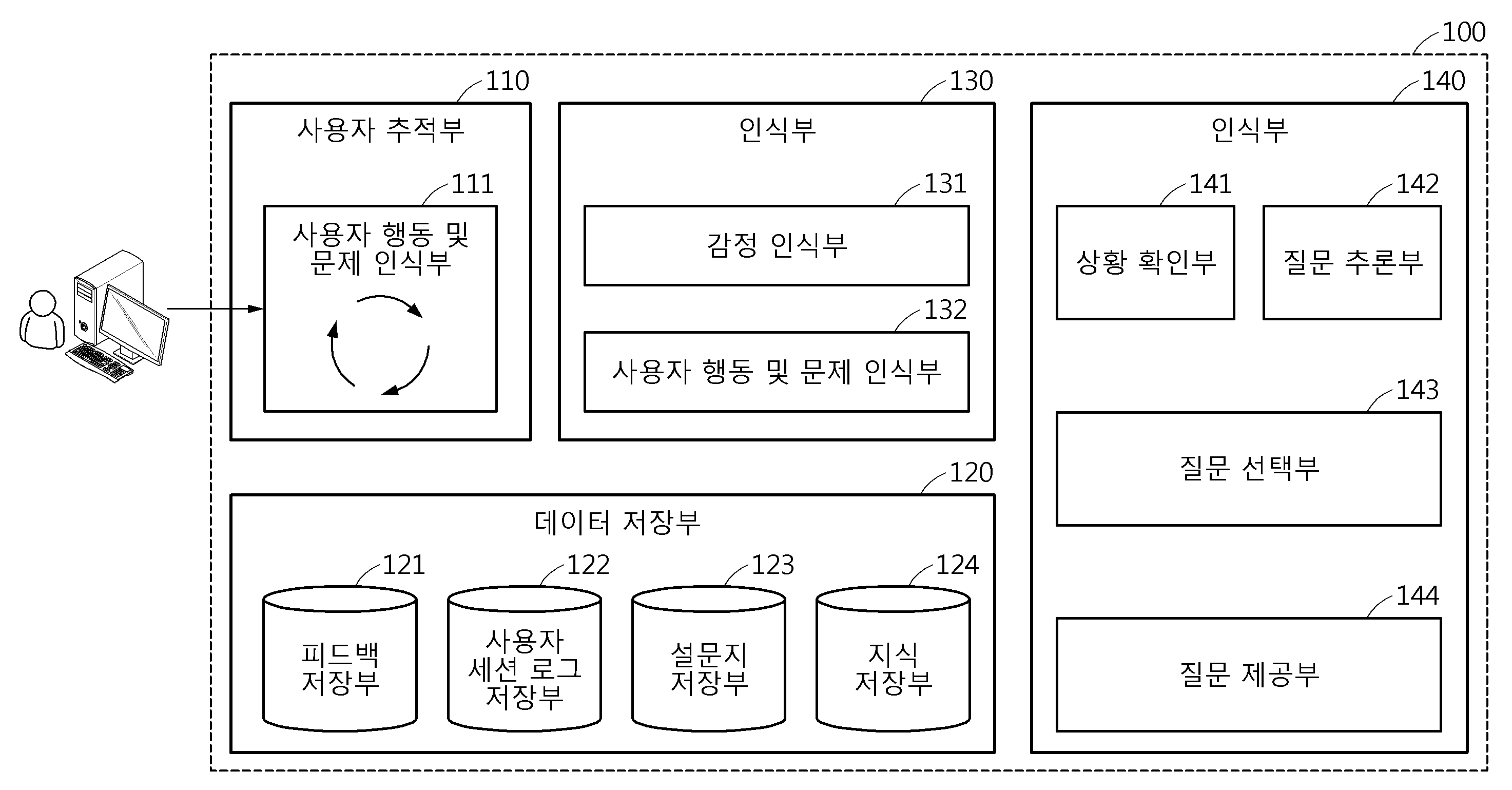
도 1은 본 발명의 일실시예에 따른 적응형 설문 생성 장치의 구성 요소를 설명하는 도면이다.
도 2는 본 발명의 일실시예에 따른 적응형 설문 생성 방법을 설명하는 도면이다.
도 3은 본 발명의 일실시예에 따른 사용자 추적부의 사용자 관찰 데이터 수집 환경을 설명하는 도면이다.1 is a diagram for explaining the components of an apparatus for generating an adaptive questionnaire according to an embodiment of the present invention.
2 is a diagram for explaining a method for generating an adaptive questionnaire according to an embodiment of the present invention.
3 is a view for explaining a user observation data collection environment of the user tracking unit according to an embodiment of the present invention.
본 명세서에 개시되어 있는 본 발명의 개념에 따른 실시예들에 대해서 특정한 구조적 또는 기능적 설명들은 단지 본 발명의 개념에 따른 실시예들을 설명하기 위한 목적으로 예시된 것으로서, 본 발명의 개념에 따른 실시예들은 다양한 형태로 실시될 수 있으며 본 명세서에 설명된 실시예들에 한정되지 않는다.Specific structural or functional descriptions of the embodiments according to the concept of the present invention disclosed herein are only exemplified for the purpose of explaining the embodiments according to the concept of the present invention, and the embodiment according to the concept of the present invention These may be embodied in various forms and are not limited to the embodiments described herein.
본 발명의 개념에 따른 실시예들은 다양한 변경들을 가할 수 있고 여러 가지 형태들을 가질 수 있으므로 실시예들을 도면에 예시하고 본 명세서에 상세하게 설명하고자 한다. 그러나, 이는 본 발명의 개념에 따른 실시예들을 특정한 개시형태들에 대해 한정하려는 것이 아니며, 본 발명의 사상 및 기술 범위에 포함되는 변경, 균등물, 또는 대체물을 포함한다.Since the embodiments according to the concept of the present invention may have various changes and may have various forms, the embodiments will be illustrated in the drawings and described in detail herein. However, this is not intended to limit the embodiments according to the concept of the present invention to specific disclosed forms, and includes changes, equivalents, or substitutes included in the spirit and scope of the present invention.
제1 또는 제2 등의 용어를 다양한 구성요소들을 설명하는데 사용될 수 있지만, 상기 구성요소들은 상기 용어들에 의해 한정되어서는 안 된다. 상기 용어들은 하나의 구성요소를 다른 구성요소로부터 구별하는 목적으로만, 예를 들어 본 발명의 개념에 따른 권리 범위로부터 이탈되지 않은 채, 제1 구성요소는 제2 구성요소로 명명될 수 있고, 유사하게 제2 구성요소는 제1 구성요소로도 명명될 수 있다.Terms such as first or second may be used to describe various elements, but the elements should not be limited by the terms. The above terms are used only for the purpose of distinguishing one component from other components, for example, without departing from the scope of rights according to the concept of the present invention, a first component may be named as a second component, Similarly, the second component may also be referred to as the first component.
어떤 구성요소가 다른 구성요소에 "연결되어" 있다거나 "접속되어" 있다고 언급된 때에는, 그 다른 구성요소에 직접적으로 연결되어 있거나 또는 접속되어 있을 수도 있지만, 중간에 다른 구성요소가 존재할 수도 있다고 이해되어야 할 것이다. 반면에, 어떤 구성요소가 다른 구성요소에 "직접 연결되어" 있다거나 "직접 접속되어" 있다고 언급된 때에는, 중간에 다른 구성요소가 존재하지 않는 것으로 이해되어야 할 것이다. 구성요소들 간의 관계를 설명하는 표현들, 예를 들어 "~사이에"와 "바로~사이에" 또는 "~에 직접 이웃하는" 등도 마찬가지로 해석되어야 한다.When a component is referred to as being “connected” or “connected” to another component, it may be directly connected or connected to the other component, but it is understood that other components may exist in between. it should be On the other hand, when it is said that a certain element is "directly connected" or "directly connected" to another element, it should be understood that the other element does not exist in the middle. Expressions describing the relationship between elements, for example, “between” and “between” or “directly adjacent to”, etc. should be interpreted similarly.
본 명세서에서 사용한 용어는 단지 특정한 실시예들을 설명하기 위해 사용된 것으로, 본 발명을 한정하려는 의도가 아니다. 단수의 표현은 문맥상 명백하게 다르게 뜻하지 않는 한, 복수의 표현을 포함한다. 본 명세서에서, "포함하다" 또는 "가지다" 등의 용어는 설시된 특징, 숫자, 단계, 동작, 구성요소, 부분품 또는 이들을 조합한 것이 존재함으로 지정하려는 것이지, 하나 또는 그 이상의 다른 특징들이나 숫자, 단계, 동작, 구성요소, 부분품 또는 이들을 조합한 것들의 존재 또는 부가 가능성을 미리 배제하지 않는 것으로 이해되어야 한다.The terminology used herein is used only to describe specific embodiments, and is not intended to limit the present invention. The singular expression includes the plural expression unless the context clearly dictates otherwise. In the present specification, terms such as "comprise" or "have" are intended to designate that the described feature, number, step, operation, component, part, or combination thereof exists, and includes one or more other features or numbers, It should be understood that the possibility of the presence or addition of steps, operations, components, parts or combinations thereof is not precluded in advance.
다르게 정의되지 않는 한, 기술적이거나 과학적인 용어를 포함해서 여기서 사용되는 모든 용어들은 본 발명이 속하는 기술 분야에서 통상의 지식을 가진 자에 의해 일반적으로 이해되는 것과 동일한 의미를 가진다. 일반적으로 사용되는 사전에 정의되어 있는 것과 같은 용어들은 관련 기술의 문맥상 가지는 의미와 일치하는 의미를 갖는 것으로 해석되어야 하며, 본 명세서에서 명백하게 정의하지 않는 한, 이상적이거나 과도하게 형식적인 의미로 해석되지 않는다.Unless defined otherwise, all terms used herein, including technical or scientific terms, have the same meaning as commonly understood by one of ordinary skill in the art to which this invention belongs. Terms such as those defined in a commonly used dictionary should be interpreted as having a meaning consistent with the meaning in the context of the related art, and should not be interpreted in an ideal or excessively formal meaning unless explicitly defined in the present specification. does not
이하, 실시예들을 첨부된 도면을 참조하여 상세하게 설명한다. 그러나, 특허출원의 범위가 이러한 실시예들에 의해 제한되거나 한정되는 것은 아니다. 각 도면에 제시된 동일한 참조 부호는 동일한 부재를 나타낸다.Hereinafter, embodiments will be described in detail with reference to the accompanying drawings. However, the scope of the patent application is not limited or limited by these embodiments. Like reference numerals in each figure indicate like elements.
도 1은 본 발명의 일실시예에 따른 적응형 설문 생성 장치의 구성 요소를 설명하는 도면이다.1 is a diagram for explaining the components of an apparatus for generating an adaptive questionnaire according to an embodiment of the present invention.
도 1을 참고하면, 본 발명의 일실시예에 따른 적응형 설문 생성 장치(100)는 사용자 추적부(110), 데이터 저장부(120), 인식부(130) 및 설문지 생성부(140)를 포함한다.Referring to FIG. 1 , an adaptive
본 발명의 일실시예에 따르면 사용자 추적부(110)는 데이터 획득 및 동기화부(111)를 포함한다.According to an embodiment of the present invention, the
일례로, 데이터 획득 및 동기화부(111)는 멀티 모달 데이터(multimodal data)를 획득하고, 획득된 멀티 모달 데이터를 동기화할 수 있다.For example, the data acquisition and
일례로, 사용자 추적부(110)는 사용자가 특정 업무를 수행하는 동안에 특정 업무와 관련된 적어도 하나의 상호 작용 정보를 사용자 관찰 데이터로 수집할 수 있다.For example, the
예를 들어, 특정 업무는 사용자 경험(User Experience, UX)과 관련된 제품 평가와 관련하여 웹사이트(website), 데스크탑(desktop) 및 모바일 어플리케이션(mobile application) 중 적어도 하나의 디지털 제품을 사용하는 업무를 포함할 수 있다.For example, a specific task involves the use of at least one digital product among a website, a desktop, and a mobile application in relation to product evaluation related to user experience (UX). may include
본 발명의 일실시예에 따르면 사용자 추적부(110)는 사용자가 제품, 시스템, 서비스를 사용하는 동안 사용자 상호 작용 데이터를 수집한다.According to an embodiment of the present invention, the
예를 들어, 사용자 추적부(110)는 페이지, 화면, 이벤트, 사용자 타이밍, 교차 도메인 추적, 작업, 충돌, 예외 및 맞춤 측정 기준과 같은 일반적인 사용자 상호 작용을 추적할 수 있다.For example,
또한, 사용자 추적부(110)는 카메라를 이용하여 사용자가 특정 업무를 수행하는 동안에 사용자의 행동 및 정서적 반응 중 적어도 하나의 상호 작용 정보를 수집할 수 있다.In addition, the
본 발명의 일실시예에 따라 사용자 추적부(110)가 상호 작용 중 사용자를 추적함에 따라 사용자가 제품을 얼마나 잘 사용하고 있는지 알 수 있는 사용자 관찰 데이터를 수집할 수 있다.According to an embodiment of the present invention, as the
즉, 사용자 추적부(110)는 사용자가 시청 중인 콘텐츠(content), 콘텐츠(content)를 시청하기 위한 이벤트, 클릭 및 스크롤과 같은 제어 동작, 오류 발생 빈도 및 콘텐츠(content)를 시청한 시간 중 적어도 하나와 관련된 특정 업무의 수행 결과를 추적하여 적어도 하나의 상호 작용 정보를 수집할 수 있다.That is, the
예를 들어, 사용자 관찰 데이터는 특정 사용성 문제의 규모를 추정하는 데 유용하고, 사용자가 많은 오류를 범하는 경우 개선의 기회를 제공할 수 있다.For example, user observation data can be useful for estimating the magnitude of a particular usability problem, and can provide an opportunity for improvement if the user makes many errors.
또한, 사용자 추적부(110)는 사용자로부터 설문지 생성부(140)에서 제공된 설문지와 관련된 피드백 데이터를 수집하고, 수집된 피드백 데이터에 기반하여 사용자 경험(User Experience, UX)을 측정할 수 있다.In addition, the
따라서, 본 발명은 현재 상황(context)를 고려하여 추론된 질문들을 선택하여 형성된 적응형 설문지에 기반하여 수집된 피드백 데이터를 통해 사용자 경험(user experience)를 측정할 수 있다.Accordingly, the present invention can measure user experience through feedback data collected based on an adaptive questionnaire formed by selecting questions inferred in consideration of a current context.
본 발명의 일실시예에 따르면 데이터 저장부(120)는 피드백 저장부(121), 사용자 세션 로그 저장부(122), 설문지 저장부(123) 및 지식 저장부(124)를 포함한다.According to an embodiment of the present invention, the
일례로, 데이터 저장부(120)는 제공된 설문지와 관련된 피드백 데이터, 특정 업무와 관련된 사용자 세션 로그 데이터, 생성된 설문지, 사용자 관찰 데이터에 기반하여 추론된 질문들을 추천하기 위한 지식 데이터를 저장할 수 있다.For example, the
본 발명의 일실시예에 따르면 데이터 저장부(120)는 사용자 추적부(106)를 사용하여 사용자로부터 수집된 사용자 관찰 데이터를 유지한다.According to an embodiment of the present invention, the
일례로, 데이터 저장부(120)는 실시간 데이터 수집 및 이기종 데이터 소스에서 얻은 동기화 및 데이터 특성에 따라 레이블을 할당하고 유지한다.For example, the
예를 들어, 피드백 저장부(121), 사용자 세션 로그 저장부(122), 설문지 저장부(123) 및 지식 저장부(124)에 저장된 데이터는 사용자 경험 대응 매트릭스를 확인하는데 활용될 수 있다.For example, data stored in the
본 발명의 일실시예에 따르면 인식부(130)는 사용자가 특정 업무에 대하여 상호 작용을 하는 동안 감정과 행동 그리고 문제를 인식하기 위해 감정 인식부(131) 및 사용자 행동 및 문제 인식부(132)를 포함한다.According to an embodiment of the present invention, the
일례로, 인식부(130)는 사용자 관찰 데이터로부터 사용자의 감정, 행동 및 문제 중 적어도 하나의 인식 대상 정보를 인식할 수 있다.As an example, the
즉, 인식부(130)는 행동 및 상기 정서적 반응에 기반하여 두려움, 행복, 슬픔, 놀라움, 분노 및 혐오감 중 적어도 하나를 감정으로 인식하고, 인식된 감정과 행동에 기반하여 문제를 인식할 수 있다.That is, the
구체적으로, 감정 인식부(131)는 카메라로부터 캡처 된 얼굴 및 골격 데이터를 사용하여 감정을 인식하기 위해 기계 학습 접근 방식을 사용한다.Specifically, the
예를 들어, 감정 인식부(131)는 자동 비디오 기반 감정 분석은 두려움, 행복, 슬픔, 놀라움, 분노, 혐오감, 중립성 등과 같은 인간의 감정적 반응에 대한 더 깊은 통찰력을 얻는 데 중요한 역할을 수행한다.For example, the
또한, 감정 인식부(131)는 비언어적 제스처는 의사 소통 과정에서 중요한 역할을 하고, 컴퓨팅 시스템과 상호 작용하는 동안 자신의 경험에 대한 중요한 통찰력을 제공 할 수 있다.In addition, the
일례로, 사용자 행동 및 문제 인식부(132)는 사용자가 직면 할 수 있는 문제를 감지하기 위해 사용자 모델 정보를 저장하고, 행동 및 문제 사이의 개념적 연관성에 따른 규칙 측면에서 지식 기반을 만드는 동안 발생할 수 있는 문제와 사용자 행동 사이에서 탐색, 프레젠테이션, 서비스 및 품질 중 적어도 하나와 관련된 문제를 결정할 수 있다.As an example, the user behavior and
본 발명의 일실시예에 따르면 설문지 생성부(140)는 상황 확인부(141), 질문 추론부(142), 질문 선택부(143) 및 질문 제공부(144)를 포함한다.According to an embodiment of the present invention, the
일례로, 설문지 생성부(140)는 인식부(130)에 의해 인식된 적어도 하나의 인식 대상 정보에 기반하여 사용자의 현재 상황을 확인하고, 확인된 현재 상황 및 사용자 관찰 데이터에 기반하여 추론된 질문들을 추천하고, 사용자에게 추천된 질문들에 기반하여 생성된 설문지를 제공할 수 있다.As an example, the
구체적으로, 상황 확인부(141)는 현재 상황을 확인하기 위해 인식부(130)에 의해 인식된 적어도 하나의 인식 대상 정보를 사용하여 사용자의 현재 상황을 확인한다.Specifically, the
또한, 질문 추론부(142)는 현재 상황 및 사용자 관찰 데이터에 기반하여 정량화된 감정 및 문제를 입력 데이터로 현재 상황에 따른 질문들을 추론한다.In addition, the
또한, 질문 선택부(143)는 질문 추론부(142)에 의해 추론 및 추천된 질문들로부터 상위 순위 질문을 선택한다.Also, the
즉, 설문지 생성부(140)는 기 설정된 우선 순위에 기반하여 추론된 질문들을 추천하고, 추천된 질문들로 구성된 질문 세트를 생성하고, 기 설정된 검증 기준에 따라 생성된 질문 세트를 검증할 수 있다.That is, the
다시 말해, 질문 선택부(143)는 기 설정된 우선 순위에 기반하여 질문들 중 상위 순위 질문을 선택한다. 여기서, 기 설정된 우선 순위는 사용자 경험에 대한 전문가가 정의할 수 있다.In other words, the
또한, 질문 선택부(143)는 설문지 저장부(123)에 선택된 질문 세트를 저장하고, 기 설정된 검증 기준에 따라 생성된 질문 세트를 검증할 수 있다.Also, the
본 발명의 일실시예에 따르면 질문 제공부(144)는 사용자에게 제시될 선택된 질문 세트를 보고 피드백 데이터를 수집하도록 설계된다.According to an embodiment of the present invention, the
질문 제공부(144)는 사용자 컴퓨팅 장치 상의 그래픽 사용자 인터페이스 (GUI)상에서 선택된 질문 세트를 렌더링한다.The
또한, 질문 제공부(144)는 개방형 및 폐쇄 형으로 구성된 모든 유형의 질문을 렌더링할 수 있고, 제시된 질문에 대한 사용자 답변을 수집하고 추가 분석을 위해 피드백 저장부(121)에 저장하는 역할도 수행할 수 있다.In addition, the
따라서, 본 발명은 사용자가 상호 작용하는 제품, 시스템 또는 서비스와의 상호 작용에 따른 감정, 문제 및 행동을 통해 인식된 현재 상황(context)를 고려하여 적응형 설문지를 생성할 수 있다.Accordingly, the present invention can generate an adaptive questionnaire in consideration of the current context recognized through emotions, problems, and behaviors according to interactions with products, systems, or services with which the user interacts.
도 2는 본 발명의 일실시예에 따른 적응형 설문 생성 방법을 설명하는 도면이다.2 is a diagram for explaining a method for generating an adaptive questionnaire according to an embodiment of the present invention.
도 2를 참고하면, 본 발명의 일실시예에 따른 적응형 설문 생성 방법은 단계(201)에서 사용자 관찰 데이터를 추적 및 수집한다.Referring to FIG. 2 , the method for generating an adaptive questionnaire according to an embodiment of the present invention tracks and collects user observation data in
즉, 본 발명의 일실시예에 따른 적응형 설문 생성 방법은 사용자가 특정 업무를 수행하는 동안에 특정 업무와 관련된 적어도 하나의 상호 작용 정보를 사용자 관찰 데이터로 수집할 수 있다.That is, the method for generating an adaptive questionnaire according to an embodiment of the present invention may collect at least one interaction information related to a specific job as user observation data while the user performs the specific job.
단계(202)에서 본 발명의 일실시예에 따른 적응형 설문 생성 방법은 사용자의 문제 및 기분(mood)를 식별하여 현재 상황(context)를 확인한다.In
즉, 본 발명의 일실시예에 따른 적응형 설문 생성 방법은 수집된 사용자 관찰 데이터로부터 사용자의 감정, 행동 및 문제 중 적어도 하나의 인식 대상 정보를 인식하고, 인식된 적어도 하나의 인식 대상 정보에 기반하여 사용자의 현재 상황을 확인할 수 있다.That is, the method for generating an adaptive questionnaire according to an embodiment of the present invention recognizes at least one recognition target information of a user's emotions, behaviors, and problems from the collected user observation data, and based on the recognized at least one recognition target information You can check the user's current status.
단계(203)에서 본 발명의 일실시예에 따른 적응형 설문 생성 방법은 현재 상황 및 사용자 관찰 데이터에 기반하여 추론된 질문들을 추천한다.In
즉, 본 발명의 일실시예에 따른 적응형 설문 생성 방법은 단계(202)에서 확인된 현재 상황 및 단계(201)에서 수집된 사용자 관찰 데이터에 기반하여 질문들을 추론하고, 기설정된 우선 순위에 기반하여 추론된 질문들을 추천한다.That is, the method for generating an adaptive questionnaire according to an embodiment of the present invention infers questions based on the current situation identified in
단계(204)에서 본 발명의 일실시예에 따른 적응형 설문 생성 방법은 추천된 질문들에 기반하여 설문지를 생성한다.In
즉, 본 발명의 일실시예에 따른 적응형 설문 생성 방법은 사용자에게 상기 추천된 질문들 중 특정 질문들을 선택하여 질문 세트를 생성하고, 생성된 질문 세트를 포함하여 생성된 설문지를 제공한다.That is, the method for generating an adaptive questionnaire according to an embodiment of the present invention generates a question set by selecting specific questions from among the recommended questions to the user, and provides the generated questionnaire including the generated question set.
단계(205)에서 본 발명의 일실시예에 따른 적응형 설문 생성 방법은 사용자에게 설문지를 제공하여 사용자 경험 관련된 피드백 데이터를 수집한다.In
즉, 본 발명의 일실시예에 따른 적응형 설문 생성 방법은 수집된 피드백 데이터에 기반하여 사용자 경험(User Experience, UX)을 측정하기 위하여 사용자로부터 설문지와 관련된 피드백 데이터를 수집할 수 있다.That is, the method for generating an adaptive questionnaire according to an embodiment of the present invention may collect feedback data related to a questionnaire from a user in order to measure a user experience (UX) based on the collected feedback data.
예를 들어, 적응형 설문 생성 방법은 사용자 관찰 데이터를 사용자가 대상 애플리케이션, 제품 또는 서비스를 사용할 때마다 사용자 컴퓨팅 장치에서 추적 및 수집하고, 멀티 모달 데이터를 시스템, 제품 또는 서비스를 사용하는 동안 감정 및 문제를 인식하기 위해 인식부로 라우팅하기 전에 레이블링한다.For example, an adaptive survey generation method may track and collect user observation data from a user's computing device each time the user uses a target application, product or service, and collect multi-modal data for sentiment and analysis during use of the system, product or service. Label the problem before routing it to the recognizer to recognize it.
예를 들어, 수집된 피드백 데이터는 사용자 경험 전문가에 의해 해당 제품의 개선 영역을 평가하기 위해 검증된 후 제품의 개발팀으로 전달될 수 있다.For example, the collected feedback data may be verified by a user experience expert to evaluate areas for improvement of the corresponding product, and then delivered to the product's development team.
또한, 적응형 설문 생성 방법은 사용자 상호 작용 추적, 감정 및 행동을 인식을 혼합 해석함에 따라 사용자 경험을 측정하기 위한 삼각 측량을 통해 보자 정확한 사용자 경험을 측정할 수 있다.In addition, the adaptive questionnaire generation method can accurately measure user experience through triangulation to measure user experience as it mixes and interprets user interaction tracking, emotion and behavior recognition.
따라서, 본 발명은 평가 대상인 디지털 제품과의 상호작용 중 발생하는 문제에 관한 구체적인 질문을 함으로써 사용자의 주관적인 사용자 경험을 측정하고, 측정된 사용자 경험에 기반하여 평가 대상에 대한 만족도를 증가시킬 수 있다.Accordingly, the present invention can measure a user's subjective user experience by asking a specific question about a problem that occurs during interaction with a digital product, which is an evaluation target, and increase satisfaction with the evaluation target based on the measured user experience.
본 발명의 일실시예에 따르면 적응형 설문 생성 방법은 인터랙티브 시스템을 이용하면서 현재 상황을 기반으로 주관적 사용자 경험 (user experience, UX)을 측정하기위한 적응적이고 최적의 설문지를 생성할 수 있다.According to an embodiment of the present invention, the adaptive questionnaire generation method can generate an adaptive and optimal questionnaire for measuring subjective user experience (UX) based on a current situation while using an interactive system.
감각 자극 경험을 제공하고 해당 사용자의 참여 수준과 프레젠테이션 또는 대화 형 경험의 영향을 결정하는 대화 형 시스템을 사용하는 동안 프레젠테이션 또는 상호 작용에 대한 사용자의 반응일 수 있다.It can be the user's response to a presentation or interaction while using an interactive system that provides a sensory stimulus experience and determines the level of engagement of that user and the impact of the presentation or interactive experience.
특히, 적응형 설문 생성 방법은 사용자가 직면한 문제 및 자극과 상호 작용하는 동안의 정서적 반응을 기반으로 최적의 설문지를 사용하여 사용자로부터 실시간 피드백을 수집하고, 서로 다른 센서를 사용하는 사용자 상호 작용을 추적하여, 감정 및 인식을 모두 고려한 혼합적 접근 방식에 따라 사용자를 추적한다.In particular, the adaptive questionnaire generation method collects real-time feedback from the user using an optimal questionnaire based on the user's emotional response while interacting with the problems and stimuli they face, and analyzes the user interaction using different sensors. By tracking, users are tracked according to a hybrid approach that considers both emotions and perceptions.
여기서, 혼합 방법에 따라 인식된 사용자 상태와 규칙을 활용하여 질문 대상인 사용자에게 질문할 특정 질문할 시 추론 엔진을 사용한다.Here, the reasoning engine is used when asking a specific question to ask the user who is the question target by utilizing the user state and rules recognized according to the mixing method.
즉, 적응형 설문 생성 방법은 수집된 생체 인식 무의식 응답으로 명시된 답변을 삼각 측량할 수 있다.That is, the adaptive questionnaire generation method can triangulate the answers specified by the collected biometric unconscious responses.
도 3은 본 발명의 일실시예에 따른 사용자 추적부의 사용자 관찰 데이터 수집 환경을 설명하는 도면이다.3 is a view for explaining a user observation data collection environment of the user tracking unit according to an embodiment of the present invention.
도 3을 참고하면, 본 발명의 일실시예에 따르면 사용자 관찰 데이터 수집 환경(300)은 사용자(310) 및 사용자를 촬영하기 위한 카메라(320)와 사용자가 적응형 설문지에 대응하기 위한 컴퓨터로 구성된다.Referring to FIG. 3 , according to an embodiment of the present invention, the user observation
일례로, 사용자 관찰 데이터 수집 환경(300)에서 사용자(310)는 컴퓨터 앞에 앉아서 컴퓨터를 이용하여 컨텐츠를 관람하거나 특정 업무를 수행하기 위한 이벤트, 클릭, 및 스크롤 등의 제어 동작을 수행하고 있으며, 카메라(320)는 사용자의 얼굴을 캡쳐하여 얼굴 및 골격 데이터를 수집하고, 수집된 데이터는 사용자의 감정을 인식하는 정보로 이용될 수 있다.For example, in the user observation
예를 들어, 사용자 관찰 데이터 수집 환경(300)에서 수집된 사용자 관찰 데이터는 멀티 모달 데이터로 지칭될 수 있다.For example, user observation data collected in the user observation
예를 들어, 적응형 설문 생성 장치는 사용자 관찰 데이터 수집 환경(300)에 따라 사용자가 평가 대상 시스템과 상호 작용하는 동안 시스템 사용 동작을 자동으로 추적할 수 있고, 각 이벤트 및 작업과 관련된 사용자 감성 반응을 수집할 수 있다.For example, the adaptive questionnaire generating device may automatically track the system usage behavior while the user interacts with the evaluation target system according to the user observation
또한, 적응형 설문 생성 장치는 사용자 관찰 데이터 수집 환경(300)에 따라 상호작용 중에 발생하는 문제와 관련된 질문이 있는 적응형 설문을 생성할 수 있다.Also, the adaptive questionnaire generating apparatus may generate an adaptive questionnaire having a question related to a problem occurring during interaction according to the user observation
한편, 적응형 설문 생성 장치는 관찰 데이터 수집 환경(300)에 기반하여 사용자의 사후작업 수행에 근거하여 사용자로부터 피드백을 제공하는 방법 및 사용자 인식과 감정 경험의 암묵적 측정 검증할 수 있다.Meanwhile, the adaptive questionnaire generating apparatus may verify a method of providing feedback from a user based on the user's post-task performance based on the observation
이상에서 설명된 장치는 하드웨어 구성요소, 소프트웨어 구성요소, 및/또는 하드웨어 구성요소 및 소프트웨어 구성요소의 조합으로 구현될 수 있다. 예를 들어, 실시예들에서 설명된 장치 및 구성요소는, 예를 들어, 프로세서, 콘트롤러, ALU(arithmetic logic unit), 디지털 신호 프로세서(digital signal processor), 마이크로컴퓨터, FPA(field programmable array), PLU(programmable logic unit), 마이크로프로세서, 또는 명령(instruction)을 실행하고 응답할 수 있는 다른 어떠한 장치와 같이, 하나 이상의 범용 컴퓨터 또는 특수 목적 컴퓨터를 이용하여 구현될 수 있다. 처리 장치는 운영 체제(OS) 및 상기 운영 체제 상에서 수행되는 하나 이상의 소프트웨어 애플리케이션을 수행할 수 있다. 또한, 처리 장치는 소프트웨어의 실행에 응답하여, 데이터를 접근, 저장, 조작, 처리 및 생성할 수도 있다. 이해의 편의를 위하여, 처리 장치는 하나가 사용되는 것으로 설명된 경우도 있지만, 해당 기술분야에서 통상의 지식을 가진 자는, 처리 장치가 복수 개의 처리 요소(processing element) 및/또는 복수 유형의 처리 요소를 포함할 수 있음을 알 수 있다. 예를 들어, 처리 장치는 복수 개의 프로세서 또는 하나의 프로세서 및 하나의 콘트롤러를 포함할 수 있다. 또한, 병렬 프로세서(parallel processor)와 같은, 다른 처리 구성(processing configuration)도 가능하다.The device described above may be implemented as a hardware component, a software component, and/or a combination of the hardware component and the software component. For example, devices and components described in the embodiments may include, for example, a processor, a controller, an arithmetic logic unit (ALU), a digital signal processor, a microcomputer, a field programmable array (FPA), It may be implemented using one or more general purpose or special purpose computers, such as a programmable logic unit (PLU), microprocessor, or any other device capable of executing and responding to instructions. The processing device may execute an operating system (OS) and one or more software applications running on the operating system. The processing device may also access, store, manipulate, process, and generate data in response to execution of the software. For convenience of understanding, although one processing device is sometimes described as being used, one of ordinary skill in the art will recognize that the processing device includes a plurality of processing elements and/or a plurality of types of processing elements. It can be seen that may include For example, the processing device may include a plurality of processors or one processor and one controller. Other processing configurations are also possible, such as parallel processors.
실시예에 따른 방법은 다양한 컴퓨터 수단을 통하여 수행될 수 있는 프로그램 명령 형태로 구현되어 컴퓨터 판독 가능 매체에 기록될 수 있다. 상기 컴퓨터 판독 가능 매체는 프로그램 명령, 데이터 파일, 데이터 구조 등을 단독으로 또는 조합하여 포함할 수 있다. 상기 매체에 기록되는 프로그램 명령은 실시예를 위하여 특별히 설계되고 구성된 것들이거나 컴퓨터 소프트웨어 당업자에게 공지되어 사용 가능한 것일 수도 있다. 컴퓨터 판독 가능 기록 매체의 예에는 하드 디스크, 플로피 디스크 및 자기 테이프와 같은 자기 매체(magnetic media), CD-ROM, DVD와 같은 광기록 매체(optical media), 플롭티컬 디스크(floptical disk)와 같은 자기-광 매체(magneto-optical media), 및 롬(ROM), 램(RAM), 플래시 메모리 등과 같은 프로그램 명령을 저장하고 수행하도록 특별히 구성된 하드웨어 장치가 포함된다. 프로그램 명령의 예에는 컴파일러에 의해 만들어지는 것과 같은 기계어 코드뿐만 아니라 인터프리터 등을 사용해서 컴퓨터에 의해서 실행될 수 있는 고급 언어 코드를 포함한다. 상기된 하드웨어 장치는 실시예의 동작을 수행하기 위해 하나 이상의 소프트웨어 모듈로서 작동하도록 구성될 수 있으며, 그 역도 마찬가지이다.The method according to the embodiment may be implemented in the form of program instructions that can be executed through various computer means and recorded in a computer-readable medium. The computer-readable medium may include program instructions, data files, data structures, etc. alone or in combination. The program instructions recorded on the medium may be specially designed and configured for the embodiment, or may be known and available to those skilled in the art of computer software. Examples of the computer-readable recording medium include magnetic media such as hard disks, floppy disks and magnetic tapes, optical media such as CD-ROMs and DVDs, and magnetic such as floppy disks. - includes magneto-optical media, and hardware devices specially configured to store and execute program instructions, such as ROM, RAM, flash memory, and the like. Examples of program instructions include not only machine language codes such as those generated by a compiler, but also high-level language codes that can be executed by a computer using an interpreter or the like. The hardware devices described above may be configured to operate as one or more software modules to perform the operations of the embodiments, and vice versa.
소프트웨어는 컴퓨터 프로그램(computer program), 코드(code), 명령(instruction), 또는 이들 중 하나 이상의 조합을 포함할 수 있으며, 원하는 대로 동작하도록 처리 장치를 구성하거나 독립적으로 또는 결합적으로(collectively) 처리 장치를 명령할 수 있다. 소프트웨어 및/또는 데이터는, 처리 장치에 의하여 해석되거나 처리 장치에 명령 또는 데이터를 제공하기 위하여, 어떤 유형의 기계, 구성요소(component), 물리적 장치, 가상 장치(virtual equipment), 컴퓨터 저장 매체 또는 장치, 또는 전송되는 신호 파(signal wave)에 영구적으로, 또는 일시적으로 구체화(embody)될 수 있다. 소프트웨어는 네트워크로 연결된 컴퓨터 시스템 상에 분산되어서, 분산된 방법으로 저장되거나 실행될 수도 있다. 소프트웨어 및 데이터는 하나 이상의 컴퓨터 판독 가능 기록 매체에 저장될 수 있다.The software may comprise a computer program, code, instructions, or a combination of one or more thereof, which configures a processing device to operate as desired or is independently or collectively processed You can command the device. The software and/or data may be any kind of machine, component, physical device, virtual equipment, computer storage medium or device, to be interpreted by or to provide instructions or data to the processing device. , or may be permanently or temporarily embody in a transmitted signal wave. The software may be distributed over networked computer systems and stored or executed in a distributed manner. Software and data may be stored in one or more computer-readable recording media.
이상과 같이 실시예들이 비록 한정된 도면에 의해 설명되었으나, 해당 기술분야에서 통상의 지식을 가진 자라면 상기의 기재로부터 다양한 수정 및 변형이 가능하다. 예를 들어, 설명된 기술들이 설명된 방법과 다른 순서로 수행되거나, 및/또는 설명된 시스템, 구조, 장치, 회로 등의 구성요소들이 설명된 방법과 다른 형태로 결합 또는 조합되거나, 다른 구성요소 또는 균등물에 의하여 대치되거나 치환되더라도 적절한 결과가 달성될 수 있다.Although the embodiments have been described with reference to the limited drawings as described above, various modifications and variations are possible by those skilled in the art from the above description. For example, the described techniques are performed in a different order than the described method, and/or the described components of the system, structure, apparatus, circuit, etc. are combined or combined in a different form than the described method, or other components Or substituted or substituted by equivalents may achieve an appropriate result.
그러므로, 다른 구현들, 다른 실시예들 및 특허청구범위와 균등한 것들도 후술하는 특허청구범위의 범위에 속한다.Therefore, other implementations, other embodiments, and equivalents to the claims are also within the scope of the following claims.
100: 적응형 설문 생성 장치
110: 사용자 추적부 120: 데이터 저장부
130: 인식부 140: 설문지 생성부100: adaptive survey generating device
110: user tracking unit 120: data storage unit
130: recognition unit 140: questionnaire generation unit
Claims (10)
상기 수집된 사용자 관찰 데이터로부터 사용자의 감정, 행동 및 문제 중 적어도 하나의 인식 대상 정보를 인식하되, 사용성의 문제 규모를 추정하고, 상기 사용자가 범하는 오류 빈도를 인식하는 인식부; 및
상기 인식된 적어도 하나의 인식 대상 정보, 상기 사용성의 문제 규모 및 상기 사용자가 범하는 오류 빈도에 기반하여 사용자의 현재 상황을 확인하고, 상기 확인된 현재 상황 및 상기 사용자 관찰 데이터에 기반하여 상기 적어도 하나의 상호 작용 정보 및 상기 적어도 하나의 인식 대상 정보를 혼합 해석함에 따라 상호 작용 추적, 감정 인식 및 행동 인식의 삼각 측량을 통해 추론된 질문들을 추천하고, 상기 사용자에게 상기 추천된 질문들에 기반하여 생성된 설문지를 제공하는 설문지 생성부를 포함하고,
상기 사용자 추적부는 상기 사용자로부터 상기 제공된 설문지와 관련된 피드백 데이터를 수집하고, 상기 수집된 피드백 데이터에 기반하여 상기 사용자의 주관적인 사용자 경험(User Experience, UX)을 측정하고,
상기 특정 업무는 상기 주관적인 사용자 경험(User Experience, UX)과 관련된 제품 평가와 관련하여 웹사이트(website), 데스크탑(desktop) 및 모바일 어플리케이션(mobile application) 중 적어도 하나의 디지털 제품을 사용하는 업무를 포함하는 것을 특징으로 하는
적응형 설문 생성 장치.Content that the user is viewing, an event for viewing the content, a control operation of at least one of click and scroll, an error frequency according to the control operation, and time associated with viewing the content a user tracking unit for collecting at least one interaction information related to the specific job as user observation data by tracking the performance result of the specific job while performing the specific job;
a recognition unit for recognizing at least one recognition target information of a user's emotions, behaviors, and problems from the collected user observation data, estimating the size of the usability problem, and recognizing the frequency of errors made by the user; and
The user's current situation is checked based on the recognized at least one recognition target information, the size of the usability problem, and the frequency of errors made by the user, and the at least one Recommends questions inferred through triangulation of interaction tracking, emotion recognition, and behavior recognition by mixing and interpreting the interaction information and the at least one recognition target information, and generated based on the recommended questions to the user Including a questionnaire generating unit that provides a questionnaire,
The user tracking unit collects feedback data related to the provided questionnaire from the user, measures the user's subjective user experience (UX) based on the collected feedback data,
The specific task includes a task of using at least one digital product among a website, a desktop, and a mobile application in relation to product evaluation related to the subjective user experience (UX). characterized by
Adaptive survey generator.
상기 사용자 추적부는 카메라를 이용하여 상기 사용자가 특정 업무를 수행하는 동안에 사용자의 행동 및 정서적 반응 중 적어도 하나의 상호 작용 정보를 수집하는 것을 특징으로 하는
적응형 설문 생성 장치.According to claim 1,
The user tracking unit collects at least one interaction information of a user's behavior and emotional response while the user performs a specific task using a camera
Adaptive survey generator.
상기 인식부는 상기 행동 및 상기 정서적 반응에 기반하여 두려움, 행복, 슬픔, 놀라움, 분노 및 혐오감 중 적어도 하나를 상기 감정으로 인식하고, 상기 인식된 감정과 상기 행동에 기반하여 상기 문제를 인식하는 것을 특징으로 하는
적응형 설문 생성 장치.5. The method of claim 4,
The recognition unit recognizes at least one of fear, happiness, sadness, surprise, anger and disgust as the emotion based on the action and the emotional response, and recognizes the problem based on the recognized emotion and the action to do
Adaptive survey generator.
상기 설문지 생성부는 기 설정된 우선 순위에 기반하여 상기 추론된 질문들을 추천하고, 상기 추천된 질문들로 구성된 질문 세트를 생성하고, 기 설정된 검증 기준에 따라 상기 생성된 질문 세트를 검증하는 것을 특징으로 하는
적응형 설문 생성 장치.According to claim 1,
The questionnaire generator recommends the inferred questions based on a preset priority, generates a question set composed of the recommended questions, and verifies the generated question set according to a preset verification criterion
Adaptive survey generator.
상기 제공된 설문지와 관련된 피드백 데이터, 상기 특정 업무와 관련된 사용자 세션 로그 데이터, 상기 생성된 설문지, 상기 사용자 관찰 데이터에 기반하여 추론된 질문들을 추천하기 위한 지식 데이터를 저장하는 데이터 저장부를 더 포함하는 것을 특징으로 하는
적응형 설문 생성 장치.According to claim 1,
Feedback data related to the provided questionnaire, user session log data related to the specific task, the generated questionnaire, and further comprising a data storage unit for storing knowledge data for recommending questions inferred based on the user observation data to do
Adaptive survey generator.
인식부에서, 상기 수집된 사용자 관찰 데이터로부터 사용자의 감정, 행동 및 문제 중 적어도 하나의 인식 대상 정보를 인식하되, 사용성의 문제 규모를 추정하고, 상기 사용자가 범하는 오류 빈도를 인식하는 단계;
설문지 생성부에서, 상기 인식된 적어도 하나의 인식 대상 정보, 상기 사용성의 문제 규모 및 상기 사용자가 범하는 오류 빈도에 기반하여 사용자의 현재 상황을 확인하는 단계;
상기 설문지 생성부에서, 상기 확인된 현재 상황 및 상기 사용자 관찰 데이터에 기반하여 상기 적어도 하나의 상호 작용 정보 및 상기 적어도 하나의 인식 대상 정보를 혼합 해석함에 따라 상호 작용 추적, 감정 인식 및 행동 인식의 삼각 측량을 통해 추론된 질문들을 추천하고, 상기 사용자에게 상기 추천된 질문들에 기반하여 생성된 설문지를 제공하는 단계;
상기 설문지 생성부에서, 상기 사용자에게 상기 추천된 질문들에 기반하여 생성된 설문지를 제공하는 단계; 및
상기 사용자 추적부에서, 상기 사용자로부터 상기 제공된 설문지와 관련된 피드백 데이터를 수집하고, 상기 수집된 피드백 데이터에 기반하여 상기 사용자의 주관적인 사용자 경험(User Experience, UX)을 측정하는 단계를 포함하고,
상기 특정 업무는 상기 주관적인 사용자 경험(User Experience, UX)과 관련된 제품 평가와 관련하여 웹사이트(website), 데스크탑(desktop) 및 모바일 어플리케이션(mobile application) 중 적어도 하나의 디지털 제품을 사용하는 업무를 포함하는 것을 특징으로 하는
적응형 설문 생성 방법.In the user tracking unit, the content that the user is watching, an event for viewing the content, a control operation of at least one of click and scroll, an error occurrence frequency according to the control operation, and the content collecting at least one interaction information related to the specific task as user observation data by tracking the performance result of the specific task while performing the specific task related to the watched time;
Recognizing, in the recognition unit, information on at least one of the user's emotions, behaviors, and problems from the collected user observation data, estimating the size of the usability problem, and recognizing the error frequency that the user makes;
checking, in the questionnaire generator, the current situation of the user based on the recognized at least one recognition target information, the scale of the usability problem, and the frequency of errors that the user makes;
In the questionnaire generator, based on the confirmed current situation and the user observation data, as the at least one interaction information and the at least one recognition target information are mixed and interpreted, the triangle of interaction tracking, emotion recognition and behavior recognition recommending questions inferred through surveying and providing the user with a questionnaire generated based on the recommended questions;
providing, by the questionnaire generator, a questionnaire generated based on the recommended questions to the user; and
In the user tracking unit, collecting feedback data related to the provided questionnaire from the user, and measuring the user's subjective user experience (UX) based on the collected feedback data,
The specific task includes a task of using at least one digital product among a website, a desktop, and a mobile application in relation to product evaluation related to the subjective user experience (UX). characterized by
How to create an adaptive survey.
Priority Applications (1)
| Application Number | Priority Date | Filing Date | Title |
|---|---|---|---|
| KR1020200124935A KR102459076B1 (en) | 2020-09-25 | 2020-09-25 | Apparatus and method of generating adaptive questionnaire for measuring user experience |
Applications Claiming Priority (1)
| Application Number | Priority Date | Filing Date | Title |
|---|---|---|---|
| KR1020200124935A KR102459076B1 (en) | 2020-09-25 | 2020-09-25 | Apparatus and method of generating adaptive questionnaire for measuring user experience |
Publications (2)
| Publication Number | Publication Date |
|---|---|
| KR20220041555A KR20220041555A (en) | 2022-04-01 |
| KR102459076B1 true KR102459076B1 (en) | 2022-10-26 |
Family
ID=81183320
Family Applications (1)
| Application Number | Title | Priority Date | Filing Date |
|---|---|---|---|
| KR1020200124935A Active KR102459076B1 (en) | 2020-09-25 | 2020-09-25 | Apparatus and method of generating adaptive questionnaire for measuring user experience |
Country Status (1)
| Country | Link |
|---|---|
| KR (1) | KR102459076B1 (en) |
Cited By (1)
| Publication number | Priority date | Publication date | Assignee | Title |
|---|---|---|---|---|
| WO2024111791A1 (en) * | 2022-11-25 | 2024-05-30 | 아주대학교 산학협력단 | System for providing user experience design for mobile application |
Families Citing this family (1)
| Publication number | Priority date | Publication date | Assignee | Title |
|---|---|---|---|---|
| CN116308497A (en) * | 2023-02-01 | 2023-06-23 | 上海哔哩哔哩科技有限公司 | Data processing method and device |
Family Cites Families (6)
| Publication number | Priority date | Publication date | Assignee | Title |
|---|---|---|---|---|
| US20110125783A1 (en) * | 2009-11-19 | 2011-05-26 | Whale Peter | Apparatus and method of adaptive questioning and recommending |
| CN102933136A (en) * | 2010-06-07 | 2013-02-13 | 阿弗科迪瓦公司 | Mental state analysis using web services |
| WO2016074036A1 (en) * | 2014-11-11 | 2016-05-19 | Global Stress Index Pty Ltd | A system and a method for generating stress level and stress resilience level information for an individual |
| KR102363794B1 (en) * | 2017-03-31 | 2022-02-16 | 삼성전자주식회사 | Information providing method and electronic device supporting the same |
| KR20190007283A (en) | 2017-07-12 | 2019-01-22 | 한국전자통신연구원 | Apparatus for collecting reaction when person contacts robot and method for the same |
| KR102497042B1 (en) | 2018-01-29 | 2023-02-07 | 삼성전자주식회사 | Robot acting on user behavior and its control method |
-
2020
- 2020-09-25 KR KR1020200124935A patent/KR102459076B1/en active Active
Cited By (1)
| Publication number | Priority date | Publication date | Assignee | Title |
|---|---|---|---|---|
| WO2024111791A1 (en) * | 2022-11-25 | 2024-05-30 | 아주대학교 산학협력단 | System for providing user experience design for mobile application |
Also Published As
| Publication number | Publication date |
|---|---|
| KR20220041555A (en) | 2022-04-01 |
Similar Documents
| Publication | Publication Date | Title |
|---|---|---|
| Alwashmi et al. | The iterative convergent design for mobile health usability testing: mixed methods approach | |
| Brown et al. | Finding waldo: Learning about users from their interactions | |
| US7797261B2 (en) | Consultative system | |
| Dumas et al. | Usability testing: Current practice and future directions | |
| Trafton et al. | The perception of agency | |
| Kronbauer et al. | Smartphone applications usability evaluation: a hybrid model and its implementation | |
| US10546509B2 (en) | Evaluating user contribution in collaborative environments | |
| US20180113782A1 (en) | Adaptive web analytic response environment | |
| WO2020106586A1 (en) | Systems and methods for detecting and analyzing response bias | |
| Reynolds | The sensing and measurement of frustration with computers | |
| Ceneda et al. | Show me your face: Towards an automated method to provide timely guidance in visual analytics | |
| KR102459076B1 (en) | Apparatus and method of generating adaptive questionnaire for measuring user experience | |
| Solórzano Alcívar et al. | Facial expression analysis in children with autism spectrum disorder using a refined Human-Robot-Game platform for active learning | |
| Barra et al. | Automating mockup-based usability testing on the mobile device | |
| Soares et al. | Design, User Experience, and Usability: UX Research, Design, and Assessment: 11th International Conference, DUXU 2022, Held as Part of the 24th HCI International Conference, HCII 2022, Virtual Event, June 26–July 1, 2022, Proceedings, Part I | |
| Ehrhardt et al. | A controlled experiment on the usability of automated reflexion mapping suggestions integrated in code cities | |
| WO2024134621A1 (en) | Systems and methods for assessing social skills in virtual reality | |
| CN111556993A (en) | Electronic product testing system and method | |
| Mizuchi et al. | Estimation of subjective evaluation of HRI performance based on objective behaviors of human and robots | |
| US20080312985A1 (en) | Computerized evaluation of user impressions of product artifacts | |
| Cutler et al. | A Multidimensional Measurement of Photorealistic Avatars Quality of Experience | |
| Babicsné Horváth et al. | Comparison of digital human model-based ergonomic software using eye-tracking methodology–presenting pilot usability tests | |
| Liapis et al. | Combining Heuristics and User Testing: Towards a Holistic Approach in User eXperience (UX) Evaluation of Open MOOC Platforms | |
| Kalpanadevi | Building an optimal model of cognitive using klm and complexity theory in human computer interface | |
| Kim et al. | Improvement of the Usability of Online Mentoring Website |
Legal Events
| Date | Code | Title | Description |
|---|---|---|---|
| PA0109 | Patent application |
St.27 status event code: A-0-1-A10-A12-nap-PA0109 |
|
| PA0201 | Request for examination |
St.27 status event code: A-1-2-D10-D11-exm-PA0201 |
|
| D13-X000 | Search requested |
St.27 status event code: A-1-2-D10-D13-srh-X000 |
|
| D14-X000 | Search report completed |
St.27 status event code: A-1-2-D10-D14-srh-X000 |
|
| PE0902 | Notice of grounds for rejection |
St.27 status event code: A-1-2-D10-D21-exm-PE0902 |
|
| AMND | Amendment | ||
| E13-X000 | Pre-grant limitation requested |
St.27 status event code: A-2-3-E10-E13-lim-X000 |
|
| P11-X000 | Amendment of application requested |
St.27 status event code: A-2-2-P10-P11-nap-X000 |
|
| P13-X000 | Application amended |
St.27 status event code: A-2-2-P10-P13-nap-X000 |
|
| PG1501 | Laying open of application |
St.27 status event code: A-1-1-Q10-Q12-nap-PG1501 |
|
| E601 | Decision to refuse application | ||
| PE0601 | Decision on rejection of patent |
St.27 status event code: N-2-6-B10-B15-exm-PE0601 |
|
| X091 | Application refused [patent] | ||
| AMND | Amendment | ||
| E13-X000 | Pre-grant limitation requested |
St.27 status event code: A-2-3-E10-E13-lim-X000 |
|
| P11-X000 | Amendment of application requested |
St.27 status event code: A-2-2-P10-P11-nap-X000 |
|
| P13-X000 | Application amended |
St.27 status event code: A-2-2-P10-P13-nap-X000 |
|
| PX0901 | Re-examination |
St.27 status event code: A-2-3-E10-E12-rex-PX0901 |
|
| PX0701 | Decision of registration after re-examination |
St.27 status event code: A-3-4-F10-F13-rex-PX0701 |
|
| X701 | Decision to grant (after re-examination) | ||
| PR0701 | Registration of establishment |
St.27 status event code: A-2-4-F10-F11-exm-PR0701 |
|
| PR1002 | Payment of registration fee |
St.27 status event code: A-2-2-U10-U11-oth-PR1002 Fee payment year number: 1 |
|
| PG1601 | Publication of registration |
St.27 status event code: A-4-4-Q10-Q13-nap-PG1601 |
|
| R18-X000 | Changes to party contact information recorded |
St.27 status event code: A-5-5-R10-R18-oth-X000 |
|
| PR1001 | Payment of annual fee |
St.27 status event code: A-4-4-U10-U11-oth-PR1001 Fee payment year number: 4 |
|
| U11 | Full renewal or maintenance fee paid |
Free format text: ST27 STATUS EVENT CODE: A-4-4-U10-U11-OTH-PR1001 (AS PROVIDED BY THE NATIONAL OFFICE) Year of fee payment: 4 |